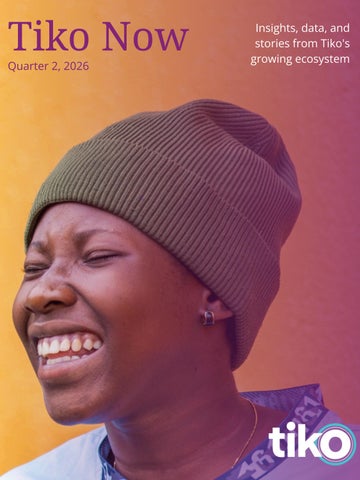
Tiko Now Quarter 2, 2026
Insights, data, and stories from Tiko's growing ecosystem
TIKO NOW | Q2 2026
INTRODUCTION | 2
Dear friends and partners, Returning from an inspiring week at the International AIDS Conference in Rio de Janeiro, widespread concerns about access to Lenacapavir, the new 6-monthly injectable PrEP, underscored a stark reality: scientific breakthroughs are meaningless without equitable access. This reinforced for us Tiko’s role in closing this gap and ensuring vulnerable groups like adolescent girls aren't left behind as next-generation biomedical innovations roll out. This quarter, we reached nearly half a million girls with Triple Threat services. In this report, we share results from shifting HIV testing toward public facilities for same-day PrEP/ART referrals, spotlight Nigeria’s government-backed growth, and detail operational shifts like digital mobiliser training and simplified SGBV screening. Across it all, we are using insights from girls, partners, and data to increase our impact as we scale. We hope you enjoy reading about what we’re learning and where we’re headed next.
This July, Tiko co-CEOs Benoit Renard and Serah Melaba attended the International AIDS Conference in Rio de Janeiro, Brazil.
All the best, Serah and Benoit Co-CEOs of Tiko
TIKO NOW | Q2 2026
INTRODUCTION | 2
Dear friends and partners, Returning from an inspiring week at the International AIDS Conference in Rio de Janeiro, widespread concerns about access to Lenacapavir, the new 6-monthly injectable PrEP, underscored a stark reality: scientific breakthroughs are meaningless without equitable access. This reinforced for us Tiko’s role in closing this gap and ensuring vulnerable groups like adolescent girls aren't left behind as next-generation biomedical innovations roll out. This quarter, we reached nearly half a million girls with Triple Threat services. In this report, we share results from shifting HIV testing toward public facilities for same-day PrEP/ART referrals, spotlight Nigeria’s government-backed growth, and detail operational shifts like digital mobiliser training and simplified SGBV screening. Across it all, we are using insights from girls, partners, and data to increase our impact as we scale. We hope you enjoy reading about what we’re learning and where we’re headed next.
This July, Tiko co-CEOs Benoit Renard and Serah Melaba attended the International AIDS Conference in Rio de Janeiro, Brazil.
All the best, Serah and Benoit Co-CEOs of Tiko
TIKO NOW | Q2 2026
KEY INSIGHTS | 3
3 Key Insights 1. Adolescent girls require provider-led HIV services Our demographic of vulnerable young girls requires a provider-focussed approach to HIV prevention and treatment. In the public sector, HIV testing includes counselling by a trained provider. This ensures that girls can understand the behaviours that may predispose them to new infections, learn how to reduce the risk of acquiring HIV, and be referred to PrEP and ART services on the same day as required.
One key factor driving Nigeria’s rapid growth is Tiko’s partnership with the Nasarawa State Government. Via a co-financing agreement, government champions help ensure consistent healthcare product availability across public health facilities and the timely payment of healthcare workers. As a result, girls have not experienced stockouts or healthcare worker strikes. Within Nasarawa State, 84% of girls received services within the public sector, compared to an average of 30% across all of Tiko’s markets. About 63% of girls in Nigeria accessed more than one Triple Threat service, compared to a global average of 55%.
2. Nigeria demonstrates the power of government partnership
Another important contributor has been the strength of Nigeria’s mostly public sector mobilizer network. Around two-thirds of mobilisers are drawn from the government-recruited Community Health Influencers, Promoters and Services (CHIPS) program. They are well-connected to traditional leaders and are trusted within their communities, including by mothers of adolescent girls, helping them to reach more girls and build confidence in Tiko’s service offer.
In Q2, Nigeria was Tiko’s fastest growing market with a 38% increase in girls taking up services and a 67% increase in the overall number of services delivered compared to Q1.
As a result, Nigeria’s mobilisers were the most productive in Tiko’s network; their average productivity rate was 159 girls reached per mobiliser in the quarter, well above the global average of 127.
Between Q1 and Q2, 67% more girls tested for HIV, primarily in the public sector. During the same period, PrEP and ART uptake increased by 162% and 105%, respectively, indicating more successful linkages from testing to to care.
3. Feedback from girls improved SGBV screenings Screenings for sexual and gender-based violence (SGBV) are highly sensitive, as girls must feel comfortable answering deeply personal questions honestly. Initially, girls were asked to answer seven questions before being referred to services. In Q1, of the 145,000 screenings conducted, 4.7% of respondents skipped at least one question. We received feedback that there were too many screening questions and that some were too complex. At Tiko, we listen to feedback from girls and mobilisers and continually adapt our services accordingly. At the end of Q1, the team introduced four simplified questions instead of seven that capture the same depth of insight into a girl’s SGBV risk and exposure. The results are clear: simplified screening is delivering results. In Q2, Tiko screened 225,000 girls for SGBV, and only 1.9% of respondents skipped a question. We hope this means that more girls who have experienced SGBV will be linked to the services they need to heal and achieve justice and safety.
TIKO NOW | Q2 2026
KEY INSIGHTS | 3
3 Key Insights 1. Adolescent girls require provider-led HIV services Our demographic of vulnerable young girls requires a provider-focussed approach to HIV prevention and treatment. In the public sector, HIV testing includes counselling by a trained provider. This ensures that girls can understand the behaviours that may predispose them to new infections, learn how to reduce the risk of acquiring HIV, and be referred to PrEP and ART services on the same day as required.
One key factor driving Nigeria’s rapid growth is Tiko’s partnership with the Nasarawa State Government. Via a co-financing agreement, government champions help ensure consistent healthcare product availability across public health facilities and the timely payment of healthcare workers. As a result, girls have not experienced stockouts or healthcare worker strikes. Within Nasarawa State, 84% of girls received services within the public sector, compared to an average of 30% across all of Tiko’s markets. About 63% of girls in Nigeria accessed more than one Triple Threat service, compared to a global average of 55%.
2. Nigeria demonstrates the power of government partnership
Another important contributor has been the strength of Nigeria’s mostly public sector mobilizer network. Around two-thirds of mobilisers are drawn from the government-recruited Community Health Influencers, Promoters and Services (CHIPS) program. They are well-connected to traditional leaders and are trusted within their communities, including by mothers of adolescent girls, helping them to reach more girls and build confidence in Tiko’s service offer.
In Q2, Nigeria was Tiko’s fastest growing market with a 38% increase in girls taking up services and a 67% increase in the overall number of services delivered compared to Q1.
As a result, Nigeria’s mobilisers were the most productive in Tiko’s network; their average productivity rate was 159 girls reached per mobiliser in the quarter, well above the global average of 127.
Between Q1 and Q2, 67% more girls tested for HIV, primarily in the public sector. During the same period, PrEP and ART uptake increased by 162% and 105%, respectively, indicating more successful linkages from testing to to care.
3. Feedback from girls improved SGBV screenings Screenings for sexual and gender-based violence (SGBV) are highly sensitive, as girls must feel comfortable answering deeply personal questions honestly. Initially, girls were asked to answer seven questions before being referred to services. In Q1, of the 145,000 screenings conducted, 4.7% of respondents skipped at least one question. We received feedback that there were too many screening questions and that some were too complex. At Tiko, we listen to feedback from girls and mobilisers and continually adapt our services accordingly. At the end of Q1, the team introduced four simplified questions instead of seven that capture the same depth of insight into a girl’s SGBV risk and exposure. The results are clear: simplified screening is delivering results. In Q2, Tiko screened 225,000 girls for SGBV, and only 1.9% of respondents skipped a question. We hope this means that more girls who have experienced SGBV will be linked to the services they need to heal and achieve justice and safety.
TIKO NOW | Q2 2026
DATA POINTS | 4
3 Data Points
2. The demand
Tiko girls accessing services by type, Q1 and Q2 2026 Q1
82,536 108,592 181,937
Testing
488,242
0 00 35 0,
00
00 50 ,
Total number of Tiko girls, Q2 2026
0
5,856
0,
0.3%
3,613
30
Burkina Faso
Services
206,790
0
7.2%
SGBV
0
South Africa
142,596
Screening
00
8.6%
0
Nigeria
14,227
25 0,
11.2%
6,932
0
Uganda
ART
00
11.5%
22,635
0,
Ethiopia
8,627
10
61.2%
PrEP
0
Kenya
HIV
303,024
00
LARC
257,738
0,
Tiko girls per country in Q2 2026
SAM
SPOTLIGHT: Triple Threat Service Integration Rates We want all girls to access a service from each of the Triple Threat categories—family planning, HIV, and SGBV.
194,267
20
Family Planning
Q2
0
In Q1, we impacted nearly 400,000 girls across our markets, despite significant external barriers including Ugandan elections and industrial action and commodity stock-outs in Kenya. Building on the strong foundations laid in Q1, Tiko was able to make significant strides in Q2, and we hope to maintain the momentum in the quarters ahead.
00
This past quarter, we provided services to nearly half a million girls across six countries with Triple Threat services; a major milestone for Tiko and a significant growth trajectory from Q1.
The growth we saw from Q1 to Q2 was reflected across every category of Triple Threat services. Most notably, 67% more girls accessed HIV testing, and PrEP and ART uptake more than doubled. Demand for family planning services, both short- and long-term, increased by about 32% each. Girls accessing SGBV screenings also increased by 45%. For the remainder of 2026, we aim to further refine our SGBV case management to ensure more girls who screen positive for SGBV (including girls identified as being at risk of violence or transactional sex) are supported with a personalized pathway to appropriate care.
15 0,
1. Girls impacted
SAM = short-acting method; LARC = long-acting reversible contraceptive; PrEP = pre-exposure prophylaxis; ART = antiretroviral therapy; SGBV = sexual and gender-based violence
In Q2, 55% of girls accessed at least two types of Triple Threat services. In geographies where Tiko offers all three Triple Threat service categories (SGBV services have been rolled out in parts of Kenya, Uganda, and Ethiopia), 17% accessed at least one service from each category in Q2, compared to 8.4% in Q1. This reflects continued progress in connecting girls to more comprehensive, integrated support.
TIKO NOW | Q2 2026
DATA POINTS | 4
3 Data Points
2. The demand
Tiko girls accessing services by type, Q1 and Q2 2026 Q1
82,536 108,592 181,937
Testing
488,242
0 00 35 0,
00
00 50 ,
Total number of Tiko girls, Q2 2026
0
5,856
0,
0.3%
3,613
30
Burkina Faso
Services
206,790
0
7.2%
SGBV
0
South Africa
142,596
Screening
00
8.6%
0
Nigeria
14,227
25 0,
11.2%
6,932
0
Uganda
ART
00
11.5%
22,635
0,
Ethiopia
8,627
10
61.2%
PrEP
0
Kenya
HIV
303,024
00
LARC
257,738
0,
Tiko girls per country in Q2 2026
SAM
SPOTLIGHT: Triple Threat Service Integration Rates We want all girls to access a service from each of the Triple Threat categories—family planning, HIV, and SGBV.
194,267
20
Family Planning
Q2
0
In Q1, we impacted nearly 400,000 girls across our markets, despite significant external barriers including Ugandan elections and industrial action and commodity stock-outs in Kenya. Building on the strong foundations laid in Q1, Tiko was able to make significant strides in Q2, and we hope to maintain the momentum in the quarters ahead.
00
This past quarter, we provided services to nearly half a million girls across six countries with Triple Threat services; a major milestone for Tiko and a significant growth trajectory from Q1.
The growth we saw from Q1 to Q2 was reflected across every category of Triple Threat services. Most notably, 67% more girls accessed HIV testing, and PrEP and ART uptake more than doubled. Demand for family planning services, both short- and long-term, increased by about 32% each. Girls accessing SGBV screenings also increased by 45%. For the remainder of 2026, we aim to further refine our SGBV case management to ensure more girls who screen positive for SGBV (including girls identified as being at risk of violence or transactional sex) are supported with a personalized pathway to appropriate care.
15 0,
1. Girls impacted
SAM = short-acting method; LARC = long-acting reversible contraceptive; PrEP = pre-exposure prophylaxis; ART = antiretroviral therapy; SGBV = sexual and gender-based violence
In Q2, 55% of girls accessed at least two types of Triple Threat services. In geographies where Tiko offers all three Triple Threat service categories (SGBV services have been rolled out in parts of Kenya, Uganda, and Ethiopia), 17% accessed at least one service from each category in Q2, compared to 8.4% in Q1. This reflects continued progress in connecting girls to more comprehensive, integrated support.
TIKO NOW | Q2 2026
DATA POINTS | 5
3. The ecosystem Every part of Tiko’s ecosystem grew between Q1 and Q2, reflecting strong momentum. During the quarter, Tiko added 872 active mobilisers, 36% of whom are affiliated with the public sector. Our growth in the public sector is also of note, with almost 150 new public sector facilities and 500 new public sector providers joining our ecosystems in Q2. Together, this has led to a 3% increase in the share of services delivered through public health facilities. We monitor the “girls per actor” ratio as a key benchmark of ecosystem productivity. Ecosystem actors continue to perform efficiently as we scale, though lower outputs from public sector providers relative to private ones indicate a need for continued targeted quality assurance support for the public sector.
Growth in Tiko’s ecosystem between Q1 and Q2 (percent growth)
Q1
35
35
Services provided by facility type, Q1 vs Q2 (percentage)
30
Q2
80 72
28 25
25
Girls per actor ACTOR TYPE
NUMBER ACTIVE
GIRLS PER ACTOR
Mobilisers
3,931
127
Public clinicians
1,776
85
Private clinicians
1,215
220
Pharmacy workers
121
397
Retailers
647
771
69
60
22
20 40
14
15
28
10
10
31
20
5 0
m ar
rs ile
Public sector
Ph
cl iv at e Pr
Private sector
Re ta
s ac
ic in
in cl ic bl
ie
s
s ic
s BO C Pu
Ac t iv e
m
ob
ilis
er
s
0
TIKO NOW | Q2 2026
DATA POINTS | 5
3. The ecosystem Every part of Tiko’s ecosystem grew between Q1 and Q2, reflecting strong momentum. During the quarter, Tiko added 872 active mobilisers, 36% of whom are affiliated with the public sector. Our growth in the public sector is also of note, with almost 150 new public sector facilities and 500 new public sector providers joining our ecosystems in Q2. Together, this has led to a 3% increase in the share of services delivered through public health facilities. We monitor the “girls per actor” ratio as a key benchmark of ecosystem productivity. Ecosystem actors continue to perform efficiently as we scale, though lower outputs from public sector providers relative to private ones indicate a need for continued targeted quality assurance support for the public sector.
Growth in Tiko’s ecosystem between Q1 and Q2 (percent growth)
Q1
35
35
Services provided by facility type, Q1 vs Q2 (percentage)
30
Q2
80 72
28 25
25
Girls per actor ACTOR TYPE
NUMBER ACTIVE
GIRLS PER ACTOR
Mobilisers
3,931
127
Public clinicians
1,776
85
Private clinicians
1,215
220
Pharmacy workers
121
397
Retailers
647
771
69
60
22
20 40
14
15
28
10
10
31
20
5 0
m ar
rs ile
Public sector
Ph
cl iv at e Pr
Private sector
Re ta
s ac
ic in
in cl ic bl
ie
s
s ic
s BO C Pu
Ac t iv e
m
ob
ilis
er
s
0
TIKO NOW | Q2 2026
NEWS ITEMS | 6
3 News Items 2. Expanding healthcare access through mobile vans in South Africa
1. Digital learning is transforming mobiliser trainings
One of Tiko's strengths is partnering with trusted local organisations. In March, we began working with the South African nonprofit, Centre for HIV-AIDS Prevention Studies (CHAPS), to expand access to integrated services in Johannesburg and Ekurhuleni, a district immediately to its east.
As Tiko scales, we need to continually onboard new mobilisers to enroll and refer more girls. Within Q2, we added 872 mobilisers to our ecosystem. Earlier this year, the team redesigned Tiko's mobiliser training with two core principles in mind: first, that high-quality training is essential to delivering services, and second, that our training approach needs to evolve as the network grows.
CHAPS has developed a flexible service delivery model that combines a static clinic with community outreach. Four mobile vans travel into communities to meet girls where they are. They provide contraceptive counselling, family planning services, HIV testing, and STI screening and treatment. When girls require additional support, such as PrEP or ART, CHAPS facilitates referrals and linkages to nearby public health facilities. The organisation also conducts outreach specifically for girls engaged in transactional sex.
The new approach, launched in April, blends digital and inperson learning. Foundational content has moved online and face-to-face sessions focus on discussion and role play. Training has become modular, with mobilisers completing short lessons and quizzes on WhatsApp. Greater emphasis is placed on fieldbased practice rather than classroom theory. Finally, the training has been simplified so its delivery doesn’t require extensive equipment or large venues. By the end of Q2, 700 mobilisers were trained with the updated approach. They scored an average of 92% in the post-training assessment, demonstrating excellent comprehension and knowledge retention. As Tiko continues to expand, digital learning will play an increasingly important role in helping us maintain high training standards while reaching more mobilisers than ever before.
From top: During a mobiliser training in Kisumu, Kenya, students practice role-playing. Below, the CHAPS team administers HIV tests and family planning services to Tiko girls in Johannesburg.
In Q2, CHAPS provided family planning and HIV testing services to 815 young people. By the end of the year, the partnership aims to reach nearly 4,000 girls and young women, helping ensure that more girls can access the integrated, high-quality care they need close to where they live.
TIKO NOW | Q2 2026
NEWS ITEMS | 6
3 News Items 2. Expanding healthcare access through mobile vans in South Africa
1. Digital learning is transforming mobiliser trainings
One of Tiko's strengths is partnering with trusted local organisations. In March, we began working with the South African nonprofit, Centre for HIV-AIDS Prevention Studies (CHAPS), to expand access to integrated services in Johannesburg and Ekurhuleni, a district immediately to its east.
As Tiko scales, we need to continually onboard new mobilisers to enroll and refer more girls. Within Q2, we added 872 mobilisers to our ecosystem. Earlier this year, the team redesigned Tiko's mobiliser training with two core principles in mind: first, that high-quality training is essential to delivering services, and second, that our training approach needs to evolve as the network grows.
CHAPS has developed a flexible service delivery model that combines a static clinic with community outreach. Four mobile vans travel into communities to meet girls where they are. They provide contraceptive counselling, family planning services, HIV testing, and STI screening and treatment. When girls require additional support, such as PrEP or ART, CHAPS facilitates referrals and linkages to nearby public health facilities. The organisation also conducts outreach specifically for girls engaged in transactional sex.
The new approach, launched in April, blends digital and inperson learning. Foundational content has moved online and face-to-face sessions focus on discussion and role play. Training has become modular, with mobilisers completing short lessons and quizzes on WhatsApp. Greater emphasis is placed on fieldbased practice rather than classroom theory. Finally, the training has been simplified so its delivery doesn’t require extensive equipment or large venues. By the end of Q2, 700 mobilisers were trained with the updated approach. They scored an average of 92% in the post-training assessment, demonstrating excellent comprehension and knowledge retention. As Tiko continues to expand, digital learning will play an increasingly important role in helping us maintain high training standards while reaching more mobilisers than ever before.
From top: During a mobiliser training in Kisumu, Kenya, students practice role-playing. Below, the CHAPS team administers HIV tests and family planning services to Tiko girls in Johannesburg.
In Q2, CHAPS provided family planning and HIV testing services to 815 young people. By the end of the year, the partnership aims to reach nearly 4,000 girls and young women, helping ensure that more girls can access the integrated, high-quality care they need close to where they live.
TIKO NOW | Q2 2026
NEWS ITEMS | 7
3. A partnership with BRAC expands financial literacy in Uganda Tiko has built an ecosystem designed to find vulnerable girls and solve for their immediate health needs. In June 2026, Tiko’s Uganda team partnered with Audacious grantee BRAC to leverage our collective investments to offer girls more comprehensive services. BRAC’s Accelerating Impact for Young Women (AIM) programme runs two-year cohorts with adolescent girls, building social and life skills, financial literacy, and economic agency through savings groups and structured mentorship. This means that a girl seeking support against the Triple Threat can receive an economic support system to secure their livelihoods. Conversely, a girl building financial resilience inside a BRAC savings group can also access sexual reproductive health services from Tiko. This approach allows Tiko to extend economic empowerment support to girls living in multidimensional poverty. Key members of Tiko’s Uganda team and BRAC’s Uganda team pose for a photo after solidifying a partnership for adolescent girls. From left: Bashir Kabuye (Partnership Officer, Tiko), Dorah Taranta (Country Director,Tiko), Nazneen Jahan Mithun (Deputy Country Director, BRAC), Angella Kemigisha (Partnership Officer, BRAC), Sheila Kobusingye (Programme Lead, Tiko), and Dennis Odwe (Program Manager, BRAC).
“Girls in Uganda don’t experience health challenges in isolation,” says Dorah Taranta, Tiko’s Uganda Country Director. “Unintended pregnancy, HIV risk, and gender-based violence are deeply connected, and our response has to be too.”
Tiko in the News Sexual and Reproductive Health Matters In June, Serah Malaba joined a podcast and penned an essay entitled, “Unlocking the Girl Dividend: Why Smarter Health Financing is Africa’s Best Economic Bet.” Her central argument was that true progress requires African governments to exercise "genuine ownership" over adolescent SRHR programming, and see it as a high-yield driver of continent-wide economic growth.
Devex In a June 2026 Devex report on the rollout of Lenacapavir (LEN) in Kenya, journalist Anthony Langat raised a critical question: Is this breakthrough HIV prevention drug missing adolescent girls and young women? As Tiko pointed out in the piece: “Stigma, fragmented services, out-of-pocket costs, partner disapproval, and the social cost of being seen—none of these are solved by a twice-yearly injection.”
The Economist In June, The Economist ran a story about what the recent Ebola outbreak reveals about African health systems. The story leads with quoting Tiko’s Country Director for Kenya, Celestine Mugambi, and her experience running an HIV programme when external funding dried up. “There was a lot of instability,” she admitted, but “it gave Kenya the opportunity to shape our own programmes.”
TIKO NOW | Q2 2026
NEWS ITEMS | 7
3. A partnership with BRAC expands financial literacy in Uganda Tiko has built an ecosystem designed to find vulnerable girls and solve for their immediate health needs. In June 2026, Tiko’s Uganda team partnered with Audacious grantee BRAC to leverage our collective investments to offer girls more comprehensive services. BRAC’s Accelerating Impact for Young Women (AIM) programme runs two-year cohorts with adolescent girls, building social and life skills, financial literacy, and economic agency through savings groups and structured mentorship. This means that a girl seeking support against the Triple Threat can receive an economic support system to secure their livelihoods. Conversely, a girl building financial resilience inside a BRAC savings group can also access sexual reproductive health services from Tiko. This approach allows Tiko to extend economic empowerment support to girls living in multidimensional poverty. Key members of Tiko’s Uganda team and BRAC’s Uganda team pose for a photo after solidifying a partnership for adolescent girls. From left: Bashir Kabuye (Partnership Officer, Tiko), Dorah Taranta (Country Director,Tiko), Nazneen Jahan Mithun (Deputy Country Director, BRAC), Angella Kemigisha (Partnership Officer, BRAC), Sheila Kobusingye (Programme Lead, Tiko), and Dennis Odwe (Program Manager, BRAC).
“Girls in Uganda don’t experience health challenges in isolation,” says Dorah Taranta, Tiko’s Uganda Country Director. “Unintended pregnancy, HIV risk, and gender-based violence are deeply connected, and our response has to be too.”
Tiko in the News Sexual and Reproductive Health Matters In June, Serah Malaba joined a podcast and penned an essay entitled, “Unlocking the Girl Dividend: Why Smarter Health Financing is Africa’s Best Economic Bet.” Her central argument was that true progress requires African governments to exercise "genuine ownership" over adolescent SRHR programming, and see it as a high-yield driver of continent-wide economic growth.
Devex In a June 2026 Devex report on the rollout of Lenacapavir (LEN) in Kenya, journalist Anthony Langat raised a critical question: Is this breakthrough HIV prevention drug missing adolescent girls and young women? As Tiko pointed out in the piece: “Stigma, fragmented services, out-of-pocket costs, partner disapproval, and the social cost of being seen—none of these are solved by a twice-yearly injection.”
The Economist In June, The Economist ran a story about what the recent Ebola outbreak reveals about African health systems. The story leads with quoting Tiko’s Country Director for Kenya, Celestine Mugambi, and her experience running an HIV programme when external funding dried up. “There was a lot of instability,” she admitted, but “it gave Kenya the opportunity to shape our own programmes.”
TIKO NOW | Q2 2026
STORIES | 8
3 Stories from the Tiko-verse “The session that touched me most was the self-love and self-care
1. Tiko Clubs give girls a place to belong "Before joining the Tiko Club, I was shy and didn't know much about reproductive health,” says Rachael Kemunto, a 24-year-old who lives in Nairobi, Kenya. “Through the sessions, I gained knowledge about HIV prevention, menstrual health, and making informed choices.”
session. It reminded me that I deserve to value myself, protect my mental health, and believe in my dreams.” - Ann, a 23-year-old Tiko Club member in Nairobi, Kenya
When Tiko spoke to girls across our network, one message came through consistently: many lacked a safe communal space where they could ask questions, share their experiences, be heard, and feel less alone in their sexual and reproductive health journeys. Some wanted practical guidance to help them achieve their goals, while others simply wanted a place to connect with girls their own age. In response, Tiko launched Tiko Clubs in 2023. The clubs follow an eight-session curriculum, with some core content shared across all groups, including reproductive health education and goal-setting. Beyond this, each club adapts its activities to the interests and needs of its members. Guest speakers have helped girls build practical skills such as CV writing and public speaking, while other sessions focus on topics like personal finance. The clubs also create space for fun and connection: members have filmed TikTok dance challenges together, hosted talent shows, and celebrated one another's achievements. For many girls, it is this combination of practical learning and community that has made the clubs so meaningful. At a Tiko club in Nairobi, Kenya, girls discuss everything from menstrual health to their goals for the future.
TIKO NOW | Q2 2026
STORIES | 8
3 Stories from the Tiko-verse “The session that touched me most was the self-love and self-care
1. Tiko Clubs give girls a place to belong "Before joining the Tiko Club, I was shy and didn't know much about reproductive health,” says Rachael Kemunto, a 24-year-old who lives in Nairobi, Kenya. “Through the sessions, I gained knowledge about HIV prevention, menstrual health, and making informed choices.”
session. It reminded me that I deserve to value myself, protect my mental health, and believe in my dreams.” - Ann, a 23-year-old Tiko Club member in Nairobi, Kenya
When Tiko spoke to girls across our network, one message came through consistently: many lacked a safe communal space where they could ask questions, share their experiences, be heard, and feel less alone in their sexual and reproductive health journeys. Some wanted practical guidance to help them achieve their goals, while others simply wanted a place to connect with girls their own age. In response, Tiko launched Tiko Clubs in 2023. The clubs follow an eight-session curriculum, with some core content shared across all groups, including reproductive health education and goal-setting. Beyond this, each club adapts its activities to the interests and needs of its members. Guest speakers have helped girls build practical skills such as CV writing and public speaking, while other sessions focus on topics like personal finance. The clubs also create space for fun and connection: members have filmed TikTok dance challenges together, hosted talent shows, and celebrated one another's achievements. For many girls, it is this combination of practical learning and community that has made the clubs so meaningful. At a Tiko club in Nairobi, Kenya, girls discuss everything from menstrual health to their goals for the future.
TIKO NOW | Q2 2026
STORIES | 9
2. In Uganda, self-administered contraceptives represent freedom Two years ago, Nakato Carol made the bold move from her home village to Uganda’s capital, Kampala. She had dropped out of school at the age of 13, after her father died and she had six siblings to help look after. Today, at 21, she runs her own roadside grocery stall, selling tomatoes, onions, and other vegetables. Nakato’s mother had always had open, honest talks with her about relationships, pregnancy, and HIV. As such, Nakato knew she wanted to take active charge of her health, but she needed a pathway that respected her time and dignity. Nakato lives with a close friend from her village who was accessing sexual and reproductive health (SRH) services through the Tiko ecosystem. “I had always wanted to get tested for HIV but always feared it,” Nakato says. “My friend told me about her experience, and I chose to take that step.” Previously, Nakato would navigate the healthcare system alone, waking up at dawn to beat long queues, only to spend the entire day waiting, sometimes leaving without being attended to. By contrast, when she visited Nyamayalwo Medical Centre, a private sector clinic in Tiko’s network, Nakato found the providers to be friendly and respectful. Nakato chose Sayana Press, a self-injectable contraceptive, to manage her family planning. Because she frequently travels for small jobs and to visit her mother, she needed a solution that offered absolute privacy and convenience. The healthcare worker trained Nakato thoroughly, observing her first self-injection to ensure she felt confident. She was then given a calendar and a three-month supply. Today, she is moving forward on her own terms, focusing on her finances and other life goals.
“I am able to self-inject [Sayana Press] without trouble. I don’t have to waste time and money Twenty-one-year-old Nakato Carol decided to take a self-injecting contraceptive to manage her family planning due to the privacy and convenience it offers.
traveling to unfamiliar clinics where I might face stigma. I control my body on my own schedule.” - Nakato Carol, Tiko girl in Kampala, Uganda
TIKO NOW | Q2 2026
STORIES | 9
2. In Uganda, self-administered contraceptives represent freedom Two years ago, Nakato Carol made the bold move from her home village to Uganda’s capital, Kampala. She had dropped out of school at the age of 13, after her father died and she had six siblings to help look after. Today, at 21, she runs her own roadside grocery stall, selling tomatoes, onions, and other vegetables. Nakato’s mother had always had open, honest talks with her about relationships, pregnancy, and HIV. As such, Nakato knew she wanted to take active charge of her health, but she needed a pathway that respected her time and dignity. Nakato lives with a close friend from her village who was accessing sexual and reproductive health (SRH) services through the Tiko ecosystem. “I had always wanted to get tested for HIV but always feared it,” Nakato says. “My friend told me about her experience, and I chose to take that step.” Previously, Nakato would navigate the healthcare system alone, waking up at dawn to beat long queues, only to spend the entire day waiting, sometimes leaving without being attended to. By contrast, when she visited Nyamayalwo Medical Centre, a private sector clinic in Tiko’s network, Nakato found the providers to be friendly and respectful. Nakato chose Sayana Press, a self-injectable contraceptive, to manage her family planning. Because she frequently travels for small jobs and to visit her mother, she needed a solution that offered absolute privacy and convenience. The healthcare worker trained Nakato thoroughly, observing her first self-injection to ensure she felt confident. She was then given a calendar and a three-month supply. Today, she is moving forward on her own terms, focusing on her finances and other life goals.
“I am able to self-inject [Sayana Press] without trouble. I don’t have to waste time and money Twenty-one-year-old Nakato Carol decided to take a self-injecting contraceptive to manage her family planning due to the privacy and convenience it offers.
traveling to unfamiliar clinics where I might face stigma. I control my body on my own schedule.” - Nakato Carol, Tiko girl in Kampala, Uganda
TIKO NOW | Q2 2026
STORIES | 10
3. Enter for a contraceptive, leave with computer skills Grassroots community-based organisations play an important role in sourcing peer mobilisers for Tiko. When appropriate, Tiko offers strategic guidance to the CBO partner, including helping them expand their scope. The organisation Nyalenda Young Turks, located in Kisumu, Kenya, is an excellent example of symbiosis in action. Tiko began partnering with Nyalenda Young Turks in 2021, at which time it was addressing SGBV, mental health, and adolescent pregnancy in three wards. The organisation has since scaled its work across ten wards in Kisumu, and has expanded its work to include health and livelihood programmes. This type of integration works well for Tiko’s peer mobilisers, who can offer more comprehensive support to vulnerable adolescent girls. Today, Nyalenda Young Turks has a “youth resource hub.” It houses sexual and reproductive services alongside vocational trainings that come from 27 distinct partners, in sectors as diverse as agroecology to digital literacy.
“A girl who comes in for contraception might leave with a referral to a tailoring programme. A girl in a baking cohort might get connected to HIV testing through a peer educator she meets during training.” - Victor Mundi, founder of Nyalenda Young Turks
Young people at Nyalenda Young Turks have the opportunity to learn livelihood skills ranging from tailoring to digital literacy.
TIKO NOW | Q2 2026
STORIES | 10
3. Enter for a contraceptive, leave with computer skills Grassroots community-based organisations play an important role in sourcing peer mobilisers for Tiko. When appropriate, Tiko offers strategic guidance to the CBO partner, including helping them expand their scope. The organisation Nyalenda Young Turks, located in Kisumu, Kenya, is an excellent example of symbiosis in action. Tiko began partnering with Nyalenda Young Turks in 2021, at which time it was addressing SGBV, mental health, and adolescent pregnancy in three wards. The organisation has since scaled its work across ten wards in Kisumu, and has expanded its work to include health and livelihood programmes. This type of integration works well for Tiko’s peer mobilisers, who can offer more comprehensive support to vulnerable adolescent girls. Today, Nyalenda Young Turks has a “youth resource hub.” It houses sexual and reproductive services alongside vocational trainings that come from 27 distinct partners, in sectors as diverse as agroecology to digital literacy.
“A girl who comes in for contraception might leave with a referral to a tailoring programme. A girl in a baking cohort might get connected to HIV testing through a peer educator she meets during training.” - Victor Mundi, founder of Nyalenda Young Turks
Young people at Nyalenda Young Turks have the opportunity to learn livelihood skills ranging from tailoring to digital literacy.
Follow Tiko’s journey: LinkedIn: @tikoafrica Instagram: @tikokenya
tiko.org
Follow Tiko’s journey: LinkedIn: @tikoafrica Instagram: @tikokenya
tiko.org