The Primary French Project – Overview of Progression
Year 3 French (niveau bleu) Speaking and Listening
Reading and Writing
Grammar
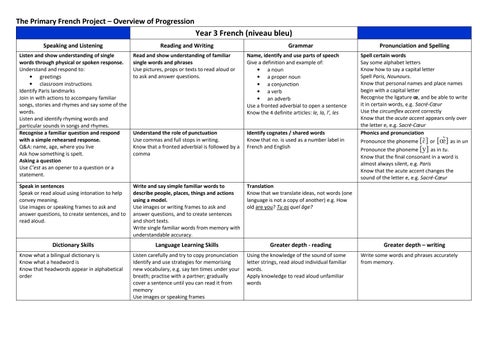
Read and show understanding of familiar single words and phrases Use pictures, props or texts to read aloud or to ask and answer questions.
Name, identify and use parts of speech Give a definition and example of: • a noun • a proper noun • a conjunction • a verb • an adverb Use a fronted adverbial to open a sentence Know the 4 definite articles: le, la, l’, les
Understand the role of punctuation Use commas and full stops in writing. Know that a fronted adverbial is followed by a comma
Identify cognates / shared words Know that no. is used as a number label in French and English
Speak in sentences Speak or read aloud using intonation to help convey meaning. Use images or speaking frames to ask and answer questions, to create sentences, and to read aloud.
Write and say simple familiar words to describe people, places, things and actions using a model. Use images or writing frames to ask and answer questions, and to create sentences and short texts. Write single familiar words from memory with understandable accuracy.
Translation Know that we translate ideas, not words (one language is not a copy of another) e.g. How old are you? Tu as quel âge?
Dictionary Skills
Language Learning Skills
Greater depth - reading
Listen and show understanding of single words through physical or spoken response. Understand and respond to: • greetings • classroom instructions Identify Paris landmarks Join in with actions to accompany familiar songs, stories and rhymes and say some of the words. Listen and identify rhyming words and particular sounds in songs and rhymes. Recognise a familiar question and respond with a simple rehearsed response. Q&A: name, age, where you live Ask how something is spelt. Asking a question Use C’est as an opener to a question or a statement.
Know what a bilingual dictionary is Know what a headword is Know that headwords appear in alphabetical order
Listen carefully and try to copy pronunciation Identify and use strategies for memorising new vocabulary, e.g. say ten times under your breath; practise with a partner; gradually cover a sentence until you can read it from memory Use images or speaking frames
Using the knowledge of the sound of some letter strings, read aloud individual familiar words. Apply knowledge to read aloud unfamiliar words
Pronunciation and Spelling Spell certain words Say some alphabet letters Know how to say a capital letter Spell Paris, Nounours. Know that personal names and place names begin with a capital letter Recognise the ligature œ, and be able to write it in certain words, e.g. Sacré-Cœur Use the circumflex accent correctly Know that the acute accent appears only over the letter e, e.g. Sacré-Cœur Phonics and pronunciation Pronounce the phoneme [ɛ]̃ or [œ̃] as in un Pronounce the phoneme [y] as in tu. Know that the final consonant in a word is almost always silent, e.g. Paris Know that the acute accent changes the sound of the letter e, e.g. Sacré-Cœur
Greater depth – writing Write some words and phrases accurately from memory.
Year 4 French (niveau blanc) Speaking and Listening Questions Use rising intonation to create or recognise a spoken question Use question words to create or recognise a spoken question, e.g. où? Simple sentences and questions Ask spoken questions using a range of question words and create simple spoken responses Compound Sentences Create a compound spoken sentence by using a conjunction to link 2 simple sentences. Reading aloud Read aloud the text of familiar rhymes, stories or songs. Read aloud some simple sentences from a speaking frame.
Reading and Writing Questions Use question words and punctuation (question mark) to create or recognise a question in written form Simple sentences Create simple written sentences Compound Sentences Create a compound written sentence by using a conjunction to link 2 simple sentences
Dictionary Skills Locate headwords in a bilingual dictionary
Grammar Name and identify parts of speech Know and use a range of masculine and feminine ordinary nouns Give a definition and example of: • an ordinary noun • a pronoun • an adjective • a conjunction • a verb • an adverb Know and use a range of adverbial phrases of place Use possessive adjectives; understand how they match the gender and number of the noun Negative Adverb Identify and use a negative adverb Know how to modify the indefinite article following the negative adverb Fronted Adverbial Know that this can be used as a sentence starter Adverbial pronoun Use the adverbial pronoun en Plural Know how to form the plural of a noun and its determiner Recognise and use the plural form of the indefinite article Know some plural verb forms
Language Learning Skills Use a speaking frame to create spoken sentences with accurate syntax. Use a writing frame to create written sentences with accurate spelling, syntax and punctuation.
Grammar
Pronunciation and Spelling
Numeral as determiner Use a numeral as a determiner Cognate Give a definition and example of a cognate Gender Know that in French, nouns have a grammatical gender, masculine and feminine Know that in English, nouns do not have a grammatical gender Know that the determiner must match the gender of the noun that it introduces Adjectival agreement by gender Know that the adjective must agree with the noun it qualifies Know how to modify an adjective to make it agree with a feminine noun Question Words Know what a question word is
Liaison Understand the concept of liaison. Elision Understand the concept of elision Know that an apostrophe is used in writing when elision occurs Silent final consonant Know that there are exceptions to the silent final consonant rule, e.g. ours, in which the final ‘s’ is sounded out Accents Notice the grave accent in some words, e.g. où.
Syntax Know that syntax is the order in which words and phrases are put together to make a meaningful sentence. Understand how the adjective is placed in French and in English
Greater depth - reading Demonstrate knowledge of liaison and elision when reading aloud
Phonics and pronunciation Pronounce the phoneme [w].and recognise its grapheme ‘oi’, as in poisson, bois, trois and étoile. Know that In English, the grapheme ‘oi’ is pronounced [øˆ] as in oil, boil and soil. Know what a homophone is. Apply knowledge of liaison and elision when reading aloud
Greater depth - writing Write some words, phrases and sentences accurately from memory
Year 5 French (niveau rouge) Speaking and Listening Tell the time Tell and understand the time on the hour, the half hour, the quarter hour Use numbers Understand and use numbers 0-60 Asking a question Understand and use a range of questions; be able to use tone of voice, inversion and question words.
Create spoken sentences Use speaking frames to create simple, complex and compound sentences. Create compound spoken sentences using a coordinating conjunction Vocabulary understand and use a wider range of verbs
Dictionary Skills Apply key terminology when using a dictionary: bilingual, headword, entry, type of word, translation. The infinitive is form of the verb used as the head word in a dictionary.
Reading and Writing
Grammar
Create written sentences Parts of speech Use writing frames to create simple, Give a definition and example of complex and compound sentences. • an adverb of time Create compound written sentences • an adverb of place using a coordinating conjunction • a negative adverb Create complex written sentences • a coordinating conjunction using a subordinating conjunction • a subordinating conjunction Be familiar with a simple letter format. • a preposition • a pronoun Position of adjectives Know that some adjectives precede the noun, and that others follow it Agreement of noun and adjective Know how nouns and adjectives agree by gender and number Questions Know how to form questions using tone of voice, and inversion. Terminology Understand and use the terms clause, main clause, subordinate clause, simple, compound and complex sentences, coordinating conjunction, cognate and false friend, compound word, ordinal number, definite and indefinite article, conjugated verb, infinitive. Language Learning Skills Use strategies for memorising and recalling vocabulary.
Greater depth - reading Read longer sentences and short paragraphs and understand the gist and some detail.
Pronunciation and Spelling Know how to pronounce the phoneme represented by the digraph qu, in both French and English. Show deeper understanding of the concepts of liaison and elision in speaking and writing. The circumflex accent Notice the circumflex accent in some words, e.g. âge Know how the pronunciation and spelling of an adjective can change when it agrees with a feminine noun. Capital letters Know that a capital letter is not given to days of the week in French.
Greater depth - writing Write sentences from memory, using familiar vocabulary with a high degree of accuracy.
Year 6 French (niveau tricolore) Speaking and Listening
Reading and Writing
Grammar
Pronunciation and Spelling
Formal and informal speech Know that there is a formal and informal/familiar register of speech in French and recognise examples of each. Asking a question Understand and use a range of questions; be able to recognise and ask spoken questions using a question tag. Create longer spoken sentences Use speaking frames to create simple, complex and compound sentences. Create compound spoken sentences using a relative pronoun
Create written sentences Use writing frames to create simple, complex and compound sentences. Create compound written sentences using a relative pronoun Create complex written sentences using a subordinating conjunction Writing the date Know how to write the date, including details of syntax, capital letters and punctuation. Know a range of conventions for writing the date in numerical format.
Verbs Understand and use the terms infinitive, conjugated, regular, irregular, stem and ending Know that the verb ending must agree with the subject. Be familiar with a verb paradigm (regular verb), present tense. Possessive adjective Recognise some possessive adjectives. Know that a possessive adjective must agree with the noun it is modifying. Agreement of noun and adjective Know how nouns and adjectives agree by gender and number; Know that some adjectives are invariable (they do not agree by gender or number) Questions Know how to create a question by using a question tag. Relative pronoun The relative pronoun qui can join together 2 clauses to make a compound sentence. Futur proche Use the futur proche – aller + infinitive
The cedilla Notice the cedilla in some words, e.g. Ça va? Know how to write it, and know how to pronounce words in which it appears. The circumflex accent Know that the circumflex can be used over any vowel to show that a historical letter has disappeared from the spelling of the word, e.g. âge, château. Ligatures Recognise the œ ligature in certain French words, and be able to write it correctly, e.g. sœur. Capital letters Know that a capital letter is not given to months of the year in French. Use the terminology upper case and lower case when spelling words
Dictionary Skills
Language Learning Skills
Use a bilingual dictionary efficiently and effectively Know that written information is almost always stored in alphabetical order in reference material. The French and English alphabets are identical in appearance, & have 26 letters.
Use vocabulary lists to learn and memorise new vocabulary
Greater depth – listening/speaking/reading/writing Some children will be able to sit the DELF Prim tests, A1.1, in one or more skills. DELF Prim is the first level in the DELF / DALF series of certificates awarded by the French Ministry of Education for proficiency in French as a Foreign Language. DELF Prim is intended for children who are beginners in French as a Foreign Language and who are either undertaking studies corresponding to the French elementary level or are the right age to undertake such studies under the regulations applicable in their country. Successful candidates receive a certificate identical to the general public version. DELF Prim is composed of individual certificates corresponding to the initial levels of the Common European Framework of Reference for Languages (CEFRL).
Copyright IFRU 2020, written by Catherine Cheater. The Primary French Project materials can be downloaded from www.culturetheque.com/EXPLOITATION/GBR/primary-french.aspx, and support is available from the Facebook group at www.facebook.com/groups/primaryfrench.ifru/. The Primary French Project is a joint collaboration between the Institut français du Royaume-Uni (IFRU), the Association for Language Learning (ALL) and Network for Languages.