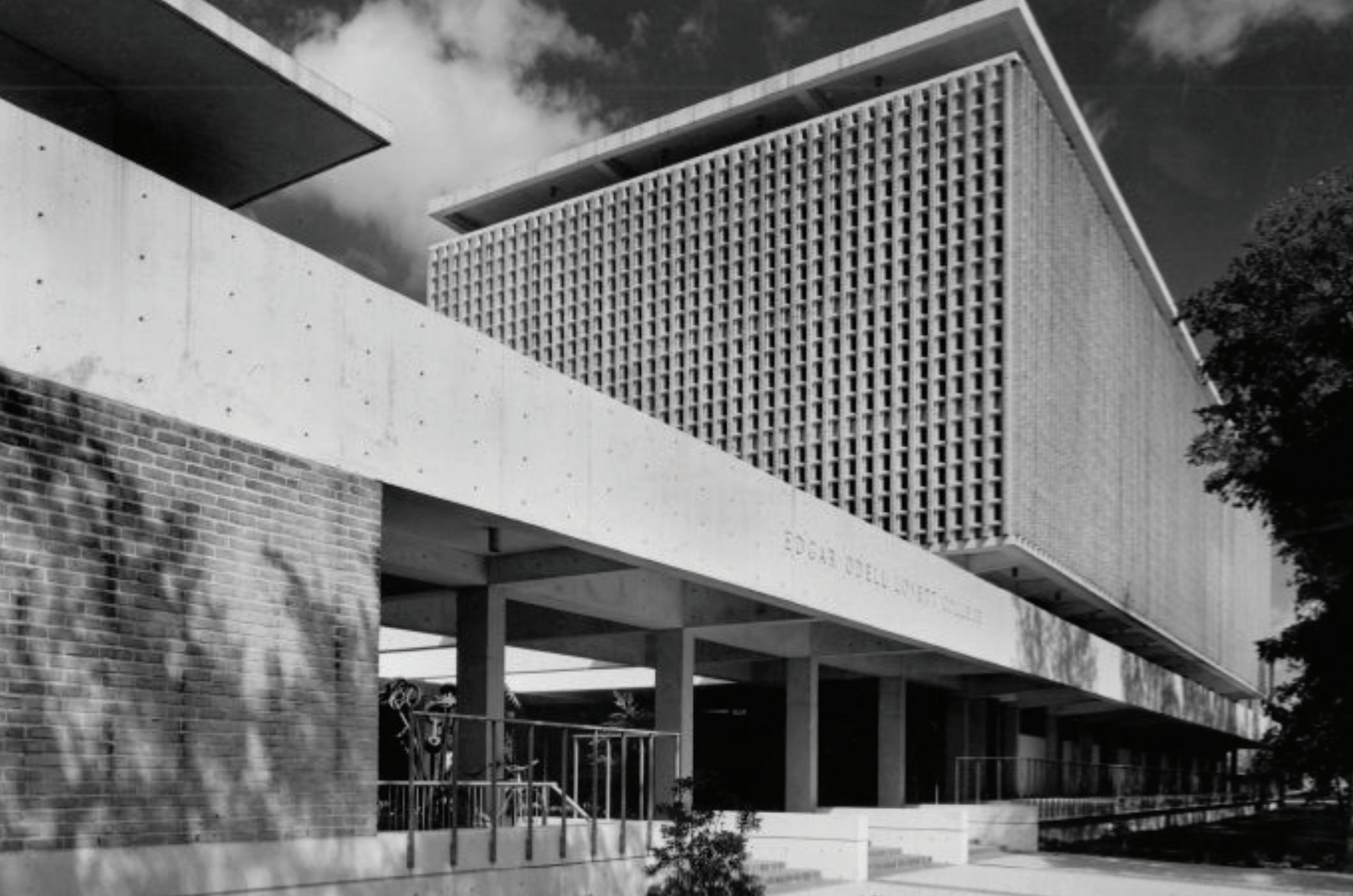
A photo shows Lovett College in 1969. On Thursday, Rice announced the building will be renamed Main Street Residence and used for overflow housing after
A photo shows Lovett College in 1969. On Thursday, Rice announced the building will be renamed Main Street Residence and used for overflow housing after
COPY EDITOR & THRESHER STAFF
For decades, other colleges have shouted the same anti-cheer across Beer Bike tracks and the O-Week events: “Toaster! Toaster!” A reference to the building’s resemblance to the kitchen appliance, the nickname for Lovett College has become one of the most recognizable pieces of Rice lore.
Now, as Lovett College prepares to move into its new space next fall, the building behind the chant is set to be renamed “Main Street Residence” and repurposed as temporary apartment-style housing.
Lee Ivy ’77 spent all four years of his college experience living in the old Lovett building and said the space really shaped his time at Rice. Ivy said the building created a strong sense of community, from the thin walls that carried music between !oors to the suite-style bathrooms that turned neighbors into lifelong friends.
“I have mixed feelings about the announcement, but it was kind of humorous to see that the building was still there and they will never be able to tear this place down,” Ivy said. “I am glad it still has a purpose, but it will be kind of strange to see
it not as a college anymore.”
Founded in 1968, Lovett was originally an all-male residential college. The college was named a er Edgar Odell Lovett, the university’s rst president. Wilson, Morris, Crain & Anderson designed the building to be riot-proof at a time when antiwar protests were common on college campuses.
People who have been here a little bit longer … definitely feel like there should’ve been more homage paid to the building, or more recognition.
Sarah Deng LOVETT
COLLEGE SENIOR
Lovett had an initial capacity of 229 beds, and a February 1968 Thresher article noted Lovett’s lack of a formal library and television set compared to the other colleges. It o$cially became a co-ed college in 1977 —
not before being known as a “rowdy den of sin,” according to former magister Natalye Appel ’80.
The building itself houses memories across eras. A January 1976 Thresher article mentioned ballroom dancing lessons in commons for just 25 cents, and the Lovett College Basement Cabaret Theatre o ered two drinks and admission for just $2.50 throughout the ’70s.
Beyond drinking and dancing, Lovett o ered up the basement for a Student Association grocery co-op in December 1975; when students expressed concern that the precious Lovett space was being used for the SA to spin a pro t, the college’s Central Committee negotiated for the right to shut down the operation at any time.
The Toaster’s unique building has prompted jokes and playful criticism from Rice students for generations.
Robert Du$eld ’87 said in a November 2016 Letter to the Editor that the dimensions of the Lovett building, when scaled, did not match his toaster. Instead, he compared the scaled dimensions to a cheese grater, a shoebox or a “4-slice, extra tall for bagels, toaster.”

BELINDA ZHU
ASST. NEWS EDITOR
Rice announced the conversion of the current Lovett College building into Main Street Residence in a campuswide email on Thursday.
The building will provide on-campus housing for students who were unable to secure rooms at their residential college.
The Sundeck will be removed a er graduation in May, according to the email. Next semester, no public or private parties will be permitted at Main Street Residence.
The basement will be converted into Housing and Dining operations and will be inaccessible to students.
For the upcoming 2026-27 academic year, most rooms in Main Street Residence will be reserved for rising sophomores from Baker and Lovett Colleges.
The un lled rooms will be o ered to rising sophomores, juniors and seniors from any college who participated in the housing draw but did not receive a room.
RESIDENCE PAGE 2

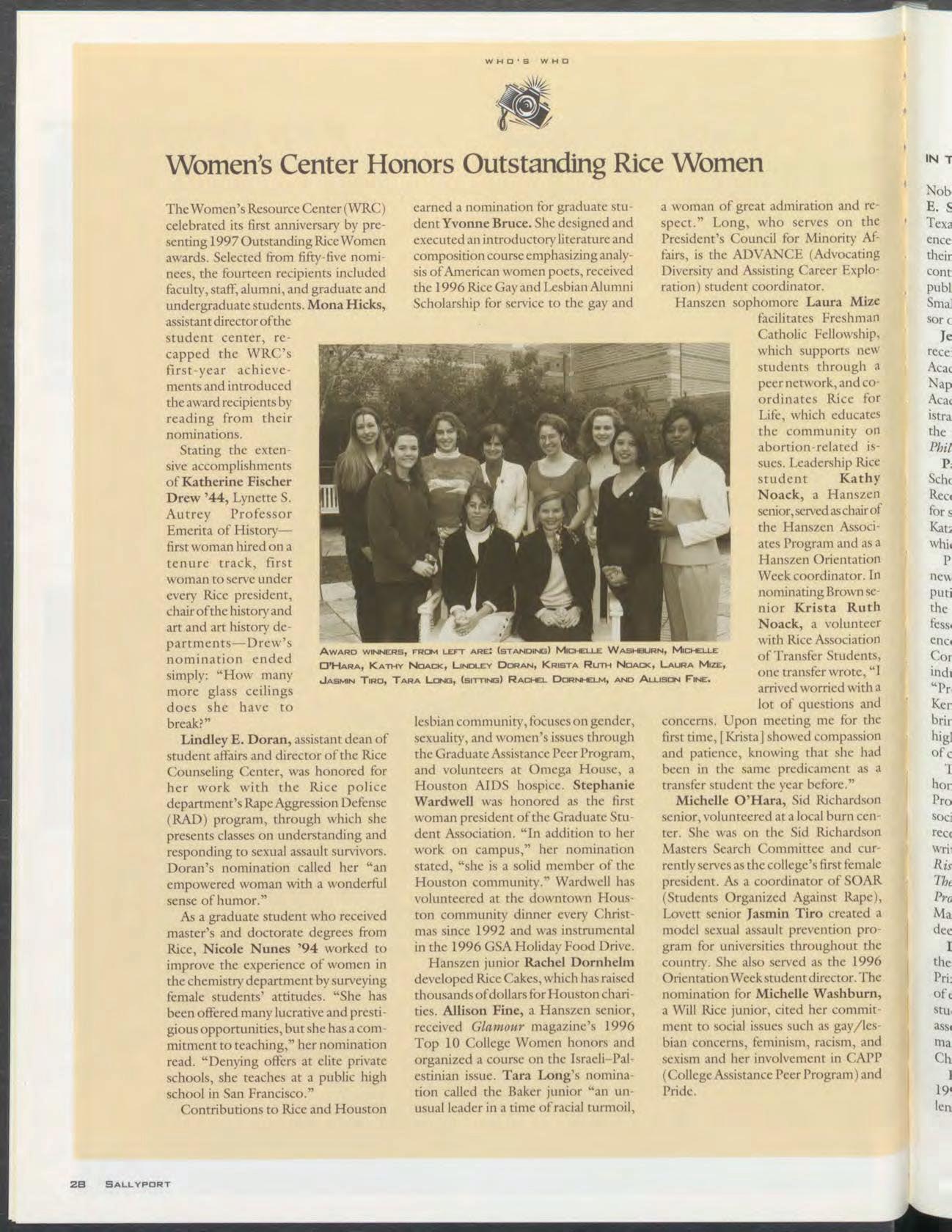
What would you call a community filled with multiple groups of people? Would it still be called Lovett College? I don’t think so.
James Wu LOVETT
ABIGAIL CHIU SENIOR WRITER
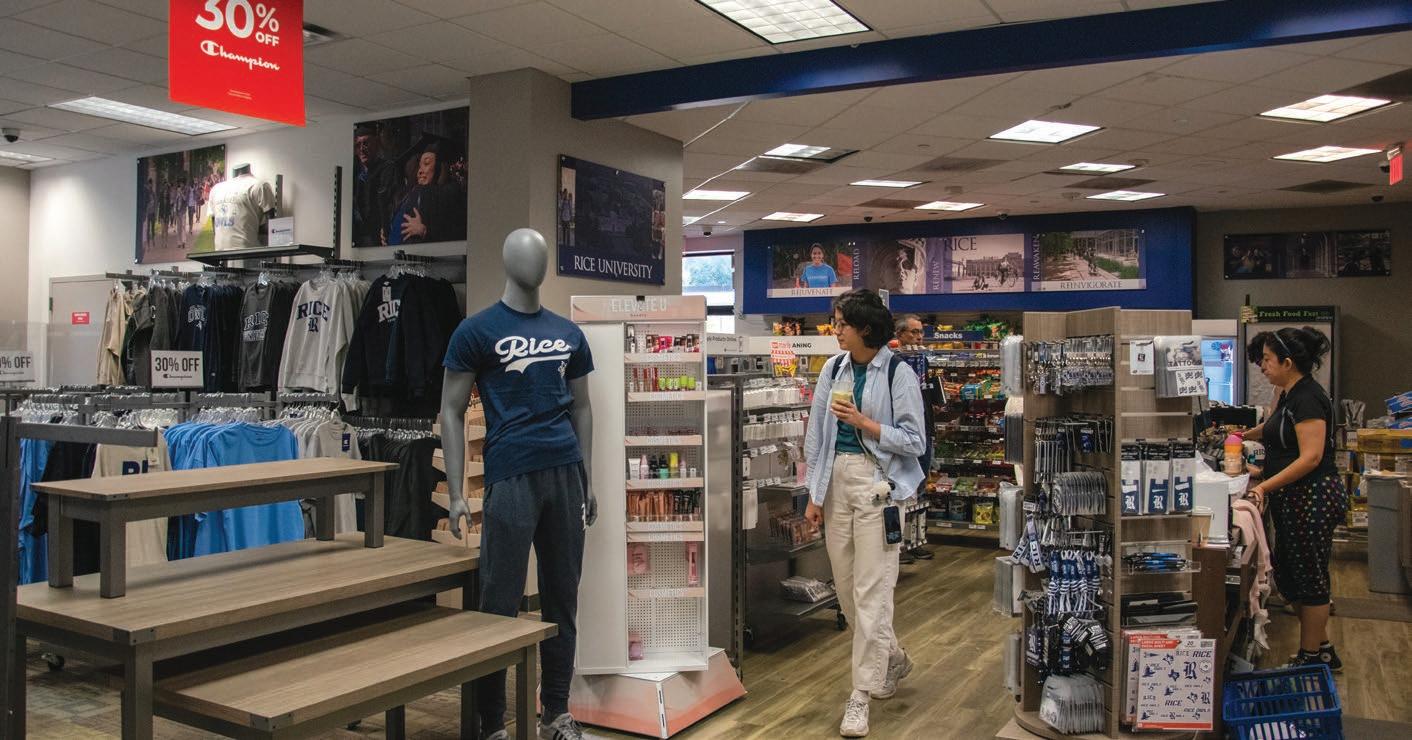
The Students for International Labor Solidarity organization is circulating a petition for Rice University to join the Workers Rights Consortium.
Joining would require Rice to disclose the factories involved in producing university apparel and adhere to a binding code of conduct for labor and human rights at those factories.
Katie Nguyen ’22, a Rice alumna who now works as a national organizer for SILS, said the organization campaigns to hold brands and universities accountable to the workers who make university apparel. She is currently looking for Rice students to lead the movement on campus.
“I think that students have the right to know exactly who is making their merch, and what conditions like those are being made in and this is just a rst step to a rming Rice’s commitment to leading itself in a way based in human rights and community,” Nguyen said.
The Workers Rights Consortium says it conducts independent investigations of garment factories on behalf of its university a liates to protect workers’ rights. There are over 140 US colleges and universities a liated with the WRC as of September 2025, including Duke, Vanderbilt and all of the Ivy League schools, according to the
WRC website.
SILS has held protests at the University of Texas at Austin, University of Michigan, New York University and others since 2024 about their contracts with Nike and the company’s culpability in a wage-the# scandal with Hong Seng Knitting, a former supplier, in Thailand.
The factory, one of Nike’s subcontractors, was accused of coercing employees into unpaid leave during the pandemic. In 2025, they reached a settlement to compensate workers, according to an investigation by the Fair Labor Association.
In August, Rice announced that it would be switching from Adidas to Nike as its o cial supplier for uniforms, shoes and apparel beginning in July 2026. UT Austin’s #een-year contract with Nike, signed in 2015, was worth $250 million — a recordbreaking number at the time. The nancial terms of Rice’s recent agreement with Nike were not disclosed.
Rice administration declined to comment on the petition.
“The reason why we organize with the university students is because students actually have a really unique leveraging power in the global garment supply chain,” Nguyen said.
Nguyen said the petition could connect students with workers. In the past, SILS has brought students on delegations to meet directly with garment workers.
“The idea is that those workers can get
connected with the students at schools that they’re producing merch for, and that those students can put pressure on the universities and brands to answer to those workers,” Nguyen said.
Nguyen said SILS had been working on the Hong Seng campaign for two years by showing up at shareholder meetings and Nike headquarters to demonstrate.
“[The compensation] would not have been possible without student action. And it wasn’t until there was a threat on their contracts with universities that [Nike] came
to the table and agreed to pay,” Nguyen said. “All of that work is not possible, though, without knowing exactly what factories are producing your university’s apparel.”
Nguyen said she hopes to inform Rice students of the signi cance of where the university sources its apparel from.
“Rice students have so much power to have a meaningful impact on all of the places that Rice touches around the world,” Nguyen said. “We’re talking about Rice’s apparel supply chain impacting thousands and thousands and thousands of workers.”
AISHA KHEMANI SENIOR WRITER
This semester, Rice’s department of electrical and computer engineering unveiled a new undergraduate minor in digital health.
The department said in a press release that the minor aims to prepare students to design wearable devices, develop arti cial intelligence-driven diagnostic tools and translate engineering research into realworld healthcare solutions.
The program will build on Rice’s growing collaboration with Houston Methodist, which expanded the university’s 2023 Digital Health Initiative into the Digital Health Institute the following year, according to the press release.
Joseph Cavallaro, director of the Center for Multimedia Communications and a professor in the department who helped lead the minor’s creation, said the idea grew out of expanding digital health research within the department.
“A lot of it started as we built up a digital health research group in the department,” Cavallaro said. “We realized we wanted to create some educational components to go along with that collaboration.”
Akane Sano, an associate professor in the department who helped develop the minor, wrote in an email to the Thresher that it was created in response to growing demand from hospitals for engineers who understand both technology and medicine.
“We’re seeing a huge need from the Texas Medical Center and other hospitals beyond TMC for people who can build and
translate digital technologies for health and medicine,” Sano wrote. “Clinicians want collaborators who understand AI, devices, ethics and human factors and who can speak their language.”
Sano said the minor also creates a clearer pathway for students to develop these interdisciplinary skills.
“Rice is already leading a lot of digital health technology research, but our students didn’t have a structured way to develop all of these skills together,” Sano wrote. “This minor lls that gap by training a new generation who can work across technical and clinical domains.”
With Rice’s proximity to the Texas Medical Center, Sano said the program allows students to connect classroom learning with real clinical challenges.
“Being right in the Texas Medical Center gives our students access to real clinical environments and real problems,” Sano wrote. “Students can join research projects, shadow clinical teams and see rsthand where digital tools succeed and where they fall short.”
Jose Moreto, an assistant teaching professor in the department who worked with Sano to develop the minor, said the goal is to better connect engineering training with medical practice.
“We’re trying to help engineering students learn more about the biology and medical side of devices and AI to integrate that knowledge,” Moreto said.
The minor is organized into two tracks: one focused on hardware and medical devices,
and the other on arti cial intelligence and data analysis.
Students will start with core courses on device design and data processing before choosing electives that connect engineering with biology and health sciences.
Rice is already leading a lot of digital health technology research, but out students didn’t have a structured way to develop all of these skills together.
Akane Sano ASSOCIATE PROFESOR OF ELECTRICAL AND COMPUTER ENGINEERING
“We have core courses related to how you design devices and how you process and understand the data generated by those devices,” Moreto said. “But we also have courses at the interface between biology and these technologies, so our students know how to talk with doctors and understand the problems they have that we can try to solve with technology.”
Ethics and human factors are also built into the minor, with at least one course required for students in the program. Classes such as AI for Health teach students how to identify and address issues like privacy risks,
bias and equity concerns when applying AI in healthcare.
Sano wrote that the goal is to ensure students consider the broader impact of the technologies they design.
“We want to make sure they’re not just building innovative tools, but tools that are safe, responsible and trustworthy,”
While enrollment numbers are still uncertain, Moreto said interest in digital health at Rice is already strong.
“It’s hard to tell right now, but I would expect around 50 or 60 students in the rst years,” Moreto said. “Based on the capstone projects we already see in both master’s and undergraduate programs, at least half are related to digital health devices and AI.”
Cavallaro said the minor is designed to prepare students for careers at the intersection of AI and medical devices, including roles at companies developing digital health technologies.
“This is trying to combine a little bit of both and focus on people that may want to work for a company like Abbott Laboratories that’s doing medical devices, where the devices also have AI data extraction,” Cavallaro said. He also pointed to consumer health technologies as another example.
“Even something like the Apple Watch collects health data, and algorithms on the phone interpret that data,” Cavallaro said. Cavallaro said the eld is expected to grow signi cantly in the coming years.
“It’s really preparing students for the next ve to 10 years of growth in medical devices and medical technology,” Cavallaro said.
The Student Association Senate voted to pass four Initiative Fund proposals as a block following discussions over the use of the funds. All of the organizations were allocated their initially requested funding.
The Senate approved $1,520 towards the SA Students with Disabilities Commission’s Disability Awareness Week. The Hispanic Association for Cultural Enrichment at Rice received $925 for Rodeo Roundup week. The SA’s Brochstein Pavilion Local Foods co$ee party, which features live music at the co$ee shop, was allocated $900.
A#er some discussion, the Rice ReUse donation collection received $5,624.28.
Martel New Student representative Da’Taeveyon Daniels said Rice ReUse stores student appliances o$-campus over the summer and sells them to students in the fall at a discounted rate.
Max Menchaca, the Brown College senator, raised concerns over $200 allocated towards sticky notes.
“These are sticky notes that are custom made for the organization’s use, because it’s what they’re using to essentially categorize all of the appliances,” Daniels said.
As per Blanket Tax rules, the four organization proposals had to be voted on in a block instead of individually.
The Blanket Tax also has a stipulation for the proposals to be “new and innovative.”
Constitutional amendment #3 would
remove this requirement for the Initiative Fund. The results for the amendment will be included in the general ballot. The results will be announced on Friday.
Daijah Wilson, representing the Black Student Association, brought up an application request for BSA’s Soul Night, which was denied some of its funds.
“What do you mean by new and innovative? Is it a new event, is it an event with a new element? If it is a recurring event with new elements, all the things we have to buy for that event won’t relate to the whole event,” said Wilson, a Jones College junior.
Soul Night was an event that showcased music celebrating the Black Rice student experience.
“If the showcase has very new elements
in terms of di$erent performances and di$erent groups that are performing, those are new elements,” Wilson said. “However, the funding that’s being requested may be for di$erent things such as sound equipment.” At the end of the meeting, Daniels brought up concerns about the funding of Africaye week as opposed to BSA’s Soul Night. The new elements included a longer session time as well as more resources for the events.
“I’m just a bit confused about how the new element of Africaye constituted a $4,000 initiative fund disbursement when that element only constituted a lesser amount of money,” Daniels said.
However, the Senate was called to adjourn a#er Daniels’ statements.
JAMES CANCELARICH NEWS EDITOR
Rice University recently released guidance on what happens if Immigration and Customs Enforcement officers appear on campus. The university sent an email to students, faculty and staff after reports that federal agents from the Department of Homeland Security detained a Columbia University student on Thursday.
The federal agents falsely posed as police officers searching for a missing child to gain entry into a university-
owned building to arrest the student, according to reports. The agents did not have a judicial warrant.
“Rice is a private university, so all Rice property is private, not public, unless Rice intentionally opens it to others; in that way, Rice is very different from public colleges and universities,” the email reads.
According to Rice, law enforcement agents must always have a judicial warrant to access non-public areas of campus. An administrative warrant without a judge’s signature does not allow outside law enforcement officers
Rice is a private university, so all property is private, not public, unless Rice intentionally opens it to others; in that way, Rice is very different from public colleges and universities. Email to students, faculty, and sta
to access Rice buildings.
Non-public spaces include residential colleges, Rice-owned graduate apartments, classrooms, faculty and staff offices, locker rooms and other buildings that are locked or require ID card access.
If outside law enforcement o cers are attempting to enter a non-public area of the university, Rice encourages bystanders to ask the o cer to wait and immediately contact Rice University Police Department, according to the email.
From there, RUPD would be in contact with Rice’s general counsel, according to the email.
CHRISTINE XU FOR THE THRESHER
As the rst student-led economics club, the Rice Economic Forum aims to foster a supportive community and build connections around campus, club president Gustavo Vives said.
“Rice has, for some time now, not had an economic club on campus, and that has been very detrimental to the student experience,” said Vives, a Brown College sophomore.
Jimmy DeNicco, professor of economics and club sponsor, said economics is the biggest major under the social sciences department, and students have long been asking for more opportunities outside the classroom.
Despite its size, DeNicco said the department has long lacked an option for students to learn about the subject outside of class.
“There’s a lot of students that are interested in economics that are majoring in economics, and this is really kind of the one component that I think we were lacking
is kind of an extracurricular component to the department,” DeNicco said.
Working closely with faculty, alumni and administration, Vives said REF provides opportunities for students to engage in internships, research and networking.
We’re trying to serve students whose interests may be a little broader than business.
Jimmy DeNicco ECONOMICS PROFESSOR
DeNicco said the club already has engagement from faculty.
“We’ve gotten a lot of people on board: Michael Maher from the Baker Institute and Peter Hartley in my department,” said DeNicco. “People who have connections, people who understand research, people
who know folks out in the eld that might have things like internships available.”
Vives said REF is planning to host workshops to introduce economic thinking and prepare students for skills like auction pricing and arbitrage across multiple elds while also supporting students academically in coursework and economics competition preparation.
As there are lots of business clubs at Rice, DeNicco said that REF focuses more on economics as a broad social science.
“What about students who want to go on to get their PhD in economics or who want to work at the Federal Reserve or the World Bank or the [International Monetary Fund]?” DeNicco said, “We’re trying to serve students whose interests may be a little bit broader than business.”
Ryan Li, an economics and cognitive sciences major, said REF is di$erent from other clubs he has participated in.
“Most of the clubs that I’ve been to are doing work for other people and working with other clients, whereas this club feels a lot more internal, not client-facing, more like helping the students out, which I
was a big fan of,” said Li, a Lovett College sophomore.
DeNicco said the club is open to every student, not just economics majors.
“I teach almost 700 students a year, and the vast majority are not within the major, but they’re interested in economics,” DeNicco said. “Once they take my class, they’re part of our economic community. So we want to serve them as well, anybody that’s interested in economic topics.”
For the rst general body meeting on Feb. 20, 30 people attended, which Vives said exceeded expectations.
Li said the meeting le# a good impression on him.
“As an economics major, it’s good to see that my discipline is gaining some visibility,” Li said.
Still, Vives said challenges are ahead for the new club.
“Three central challenges are funding, networking and getting people who can actually push things through, but we have a great team,” Vives said. “It’s always hard to get o$ the ground. But then once you start moving, things get easier.”

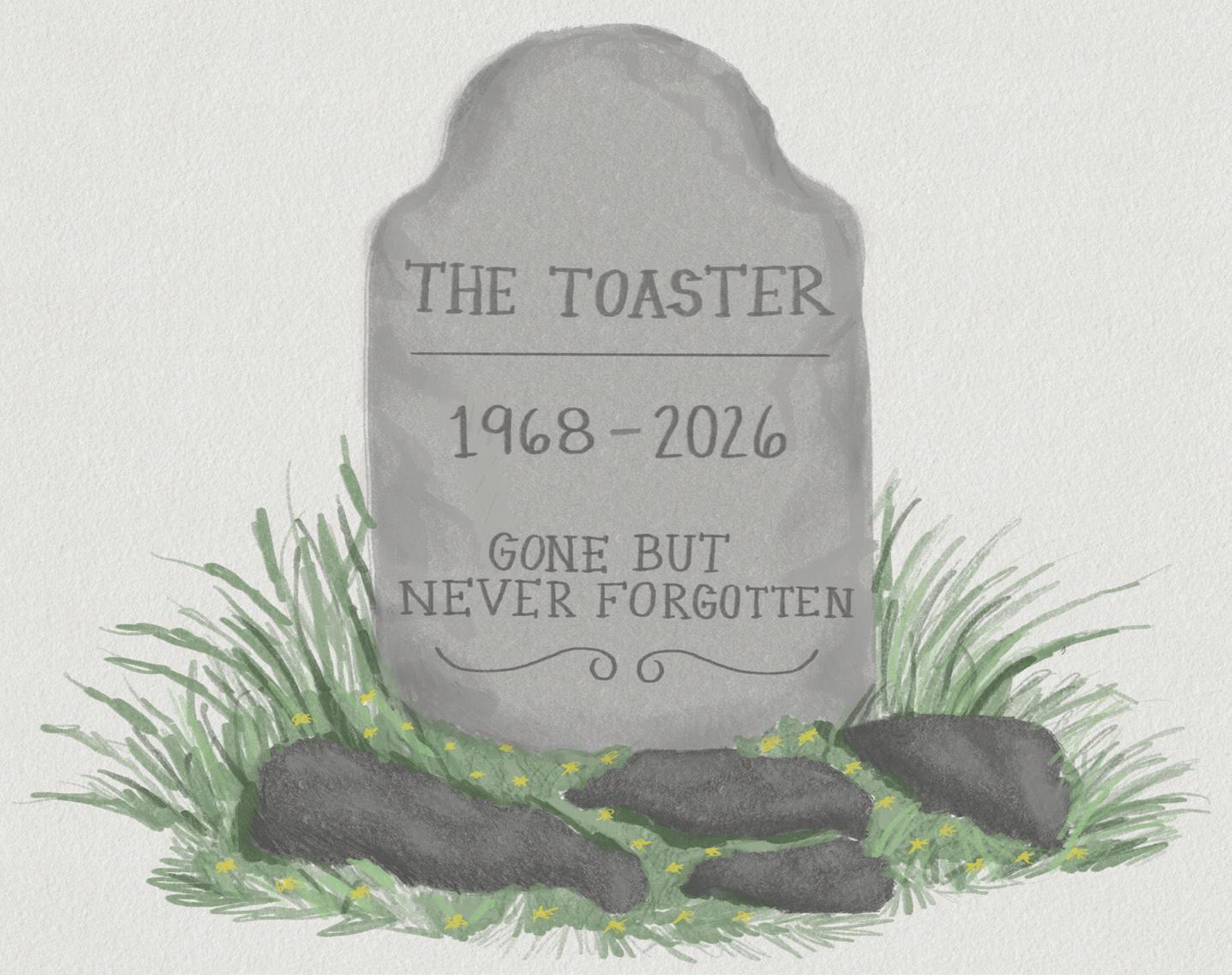
It is with heavy hearts that the Thresher editorial board mourns the death of the Toaster. While the building will continue to exist next year, the Toaster as we know it is dead at 58.
The brutalist structure, which has housed Lovett College students since 1968, is now known as “Main Street Residence” and will be inhabited not only by Lovetteers but by Will Ricers and Bakerites in the coming years.
Best known for inspiring the chants “Toaster, Toaster, Toaster” and “Love it, hate it, burn it down,” the riot-proof college is being replaced by a building that looks exactly like Sid Richardson College and Chao College.
Sid Rich underwent a similar move when they got a new building in 2021. However, their new building retained crucial elements of the college’s original design, particularly its status as the tallest building on campus. Sid’s height is integral to the college’s identity and culture, and Rice respected the importance of preserving that identity even in a new building.
That attention to what makes Sid Rich
distinct was not given to the design of Lovett’s new building.
Famous for its inviting commons culture, quirky traditions and colorful parties, the Toaster has had its own distinct identity for decades that will likely not transfer to the new building.
This identity extends beyond the building’s kitchen appliance exterior. Between Sundeck and Lyle’s, countless parties have drawn students into the brutalist con nes that we call Lovett College.
Lovetteers have thrived despite the lack of sunlight and an elevator that only reaches ve of six oors. No longer will these challenges be unique to Lovetteers, taking away a silly, but key component of the Lovett culture.
More than just one tragic loss, the death of the Toaster symbolizes the death of Rice’s individuality as a whole.
Instead of constructing more cookiecutter colleges, Rice should embrace the Toaster. Nobody is arguing that the Toaster is in perfect condition for students to live in it, but taking it away from Lovetteers is the wrong choice.
CAELYN WANG FOR THE THRESHER
The most meaningful part of Rice’s recent production of “Sunday in the Park with George” did not come from the stage.
This thought struck me as the house was relit and the brass section blew the last note, waving us goodbye. Outside of the auditorium, people passed around owers, exchanged hugs and took photos.
Performers rushed out of the auditorium, ushed and still sweating. The crowd gathered around them, delivering sincere compliments. I saw faces that I hadn’t seen since their graduation, returning not just for the show, but for the people, slipping into conversations like no time had passed at all.
I recognized people I had met through campus, di erent classrooms, and eld
The performance and the curtain call matter, but so does the recognition of effort that often stays invisible. Those moments are what transform a production from pure entertainment into something lasting, not just in the record of the department website, but in people’s memories.
trips. Those situations never really captured this side of them as they shone on the stage, experiencing a completely
di erent life in the span of two hours.
The show itself was touching, as it was the collective e ort of a full cast. however, the post-show moment — the waiting, the congratulating, the remembering — was something that made it matter more.
I was reminded that performances like this are not isolated acts of creativity, but the product of shared e ort, long hours and a community that continues to exist even a er the curtain falls.
At a campus like Rice, these moments feel especially possible given how close the campus is knit together. The boundaries between students, faculty, audiences, and alumni blur easily. Theater is something built collectively, remembered collectively and revisited by those who once stood on the same stage.
That closeness changes what it means to attend a show. You are not watching it,
but feeling it, witnessing a community affirm itself. The performance and the curtain call matter, but so does the recognition of effort that often stays invisible. Those moments are what transform a production from pure entertainment into something lasting, not just in the record of the department website, but in people’s memories.
In that sense, what unfolded outside the theater felt like a quiet extension of what “Sunday in the Park with George” is ultimately about. The musical reminds us that connection is o en fragile, incomplete and eeting, but that does not make it insigni cant. At Rice, these small convergences — between past and present, performer and audience, stranger and familiar face - are where art does its quiet work, turning isolation into something shared, if only for a moment.
ANDREW
RYNSBURGER
The servery poke is one of those dishes that appeals to the eye just as much as to the tongue. The pickled ginger, ahi tuna and fresh vegetables cover much of the color wheel: pale pink, emerald green, cream and golden yellow. The taste proves just as compelling.
Poke is a historically simple dish native to Hawaiian cuisine consisting of diced raw fish. Today, it has become highly versatile. It is popular in fastcasual chains, Korean fusion and trendy coastal restaurants, paired with just about anything from kimchi to asparagus to kale.
The sushi rice anchors the bowl in sticky textural simplicity and mild flavor. Thankfully, the serveries seem to cook it
consistently, so I was relieved to see it as the base for this dish.
The selection of vegetables is thoughtfully arranged. Between the peppery radishes, the pop of the edamame and the refreshing cucumber, the vegetables balance each other and complement the freshness of the fish.
The ahi tuna, served raw and cubed as it should be, stands out. It carries a light dressing of ginger and spice. While the texture is fragile and the small pieces smush easily, the flavor remains fresh.
The bowl, though, lacks some fat for balance. Tuna is a very lean fish, and while the crunchy vegetables contribute a satisfying texture to the rice base, it veers toward austere. My liberal squeeze of spicy mayo is a perfect fix.
The real centerpiece of this dish is the pickled ginger. Its delectable tanginess
juxtaposes the bowl’s milder flavors. Yet, it is missing some nuttiness. Toasted sesame oil is a popular choice for poke— it adds a deeper, savory flavor to the dish. It is typical in seaweed salad, which, when added to poke, gives it a savory, briny tang. Such an addition would helpfully complicate the bowl’s flavors, making what is a conservatively clean palate of flavors into one more distinctly layered.
Yet overall, the collection of flavors tends to coalesce more than compete— even with the final balance left in the hands of the eater, the three offered sauces pushing the bowl into distinct, competing directions.
Ultimately, the poke from Seibel is exactly the type of dish we need to see more often. It’s healthy, refreshing and cohesive. If it hasn’t been evident
Ultimately, the poke from Seibel is exactly the type of dish we need to see more often. It’s healthy, refreshing and cohesive. If it hasn’t been evident already, sometimes all good food needs is thoughtful execution, and this one certainly delivers.
already, sometimes all good food needs is thoughtful execution, and this one certainly delivers.
COLUMN
Free speech is under attack: From the billionaire owners of both social and news media, the Trump administration and most critically, from ourselves.
Over and over, politicians have heaped praise on free speech, yet they increasingly reach for the censorship button when it is advantageous for them. This vicious cycle will remain in place so long as we remain complicit through our own non-participation in political discussion.
The Trump administration has capitalized on this breakdown to force news media to either submit to its demands or face the wrath of a president who is currently going unchecked in his assault on free speech.
Last week, Stephen Colbert accused his network, CBS, of informing him that he would not be allowed to air an interview with Senate candidate James Talarico.
The week prior, the ABC show “The View” was put under investigation for allegedly violating the Federal Communications Commission’s rules on discussions with political candidates. This, too, was a er daring to interview Talarico.
Talk shows have long been exempt from FCC regulations that require broadcast shows to give airtime to all candidates in a race. Despite this, the mere threat of retaliation from FCC director Brendan Carr, a Trump appointee, was enough for CBS to bend the knee and pull the interview from broadcast.
Carr was quoted late last year saying, “We can do this the easy way or the hard way. These companies can nd ways to change conduct, to take action…or there’s going to be additional work for the FCC ahead.”
In the CBS case, the conduct he is calling out is not unusual nor in ammatory; they are merely platforming a political opponent who is threatening a Senate seat where President Trump needs a Republican victory to hold onto power.
Our politicians still look for public support before taking any action. However, increasingly, they nd that their political base holds far more distrust or outright hate for the other party, which enables moves like thinly veiled censorship. Why is this?
A recent survey found that, for the rst time ever, over half of Americans use social media as their primary source of news. Opening your phone and scrolling is almost e ortless, yet we pay a cost that is not immediately obvious.
A study by the University of Michigan found that social media algorithms intensify political outrage by design. The content is hostile, o en directly attacking the opposing

party and its supporters. Exposure to these attacks increases cynicism and decreases participation in politics.
I frequently hear people use “exhaustion” to describe how they feel about the political system. Our continued reliance on social media platforms for news will only stoke fear and increase exhaustion as people pull even further back into their echo chambers.
At Rice, this issue is extraordinarily prevalent, as we earned an “F” grade for free speech in the Foundation for Individual Rights and Expression’s 2026 College Free Speech Rankings. This grade was a result of concerns over restrictive policies and student perceptions of campus climate.
Furthermore, a Student Association survey released in 2025 found that only 31.5% of respondents strongly believe they can share their views freely or frequently engage in meaningful campus discussions. For seniors, this number was just 22.65%, indicating that students’ perception of being able to speak freely is possibly worn down by the environment created by Rice.
These results point to a pressing need for more space for respectful and rigorous debate. Despite the di%culty, the responsibility for cultivating this environment falls squarely on our shoulders.
Political opinions have been fully baked into our identities; we surround ourselves with like-minded thinkers, we frequent brands that support our favorite causes and we vote for the candidate that our
party supports without thinking twice. Considering these factors, it is di%cult to have discussions without disagreements feeling like personal attacks. This is the environment that we have created.
We need to push back. Debates among peers, friends and family can be constructive, positive and two-sided. They present an opportunity for us to reclaim the political sphere from both censorship and extreme polarization.
Admittedly, the idea of opening a conversation on politics with people whose views you either don’t know or outright disagree with is anxiety-inducing at best and terrifying at worst. In fact, 59% of US adults report feeling stressed when discussing politics with people who disagree with their views. But the only way through this fear is to confront it.
I struggle with holding these conversations myself. I do not want to fail to stand up for my own values, but I simultaneously do not want to be someone who makes everything about politics. However, I can say with con dence that as a nation and as a school, we are not speaking up about our own values enough.
So please, voice your opinion when it is safe and let people disagree. That conversation will give you more clarity on what you believe and what is important to you than 100 hours scrolling through social media.
Apathy is no longer an acceptable position.
Mateo DeVries is a Brown College sophomore studying political science with a minor in environmental studies and statistics. He believes civic engagement is a key responsibility for every Rice student to ensure the continued success of our democracy. By sharing insight into recent political and policy developments, he hopes to foster a more involved and excited atmosphere around civic involvement on Rice’s campus.
* Indicates Editorial Board member
Kathleen Ortiz* Editor-in-Chief
Sarah Knowlton* Editor-in-Chief
Juliana Lightsey* Managing Editor
NEWS
James Cancelarich* Editor
Belinda Zhu Asst. Editor
Hongtao Hu Asst. Editor
Hope Yang Asst. Editor
OPINION
Jenna Perrone* Editor
Andrew Rynsburger Asst.
FEATURES
ARTS & ENTERTAINMENT
SPORTS
BACKPAGE
ABOUT
The Rice Thresher, the official student newspaper of Rice University since 1916, is published each Wednesday during the school year, except during examination periods and holidays, by the students of Rice University.
Letters to the Editor must be received by 5 p.m. on the Friday prior to publication and must be signed, including college and year if the writer is a Rice student. The Thresher reserves the right to edit letters for content and length and to place letters on its website.
Editorial and business offices are located on the second floor of the Ley Student Center: 6100 Main St., MS-524 Houston, TX 77005-1892
Phone: (713) 348 - 4801
Email: thresher@rice.edu
Website: www.ricethresher.org
The Thresher is a member of the ACP, TIPA, CMA and CMBAM.
© Copyright 2025 ricethresher.org
SHYLA JOGI THRESHER STAFF
Pilot. Scuba diver. Sailor. Ski instructor.
No, these aren’t the options on a career office’s personality test. This is Wiess College senior Ethan Zhang’s daily life.
Zhang has collected licenses and certificates across land, sea and sky, starting with his pilot’s license. From there, he went on to become a ski instructor, dabble in sailing, obtain a skydiving license and get scuba certified through a Rice LPAP.
“I realized that you can just go do things in life,” Zhang said. “I've always wanted to fly planes and go on adventures. But no one's really stopping me from getting a certificate or learning something new and cool and just going out and doing it.”
Zhang said he has more goals in mind, including designing and building a zeroemissions home, building a plane and taking up beekeeping. The reason he continues to pursue these certifications despite the time, effort and money they consume is to avoid going through life on autopilot.
“I see cool shit on the internet — I gotta go do it,” Zhang said. “I can't sit in my home and watch someone scuba diving and swimming with whales and sharks and say that's good enough for me, because it's not. I have to see it with my own eyes.”
The effort Zhang poured into attaining his pilot’s license paid off in more ways than a new perspective. As an intern for ForeFlight, an aviation app, he works on the product side using his piloting experience to navigate the pain points fellow pilots experience.
Abby Formosa, a University of Houston student and Zhang’s girlfriend of over a year, said landing the internship was the moment she was proudest of him.
“He's always been a go-getter,” Formosa said. “He wants to have his life put together early. Plus, I think he's a bit of an adrenaline junkie. I think he enjoys the thrill of jumping off that plane, skydiving or even skiing. All those things are kind of adrenaline highs. I think he just really wants to experience things.”
Aside from the novelty of the physical experiences Zhang pursues, he said part of the reward is the relationships he forms along the way.
“I’ve met so many new friends flying,” Zhang said. “The aviation community is really small and there's always someone who knows someone. Just through random stuff, I've ended up meeting the president of the FAA [and] the CEO of Gulfstream.”
FROM FRONT PAGE THE TOASTER
Lovetteers — like Adam Keith ’02 in a February 2002 issue — also said the
I think students at Lovett take a kind of pride, reverse pride maybe, in the fact that the architecture is considered ugly and prison-like and toaster-like. I think they secretly like that about it.
Natalye Appel
FORMER LOVETT COLLEGE MAGISTER

Aviation was the reason Zhang met Teresa Hernandez, a University of Massachusetts at Amherst alumna and full-time pilot-in-training.
“He’s just super badass,” Hernandez said. “He’s also very spontaneous. He texted me one day with photos of him skydiving. Like, who on a random weekend goes and gets their skydiving license?”
Zhang said he had to jump out of a plane 25 times in one week to obtain the skydiving license, but his first dive was the most memorable.
“That jump, I was shitting myself,” Zhang said. “I think I've just been chasing that feeling of the unknown.”
“When he goes skydiving, I always tell him not to die or I’ll kill him,” Formosa said. “Although it's really safe and all that, it still stresses me out a bit.”
Although Formosa describes Zhang as a thrill seeker, Zhang said he sticks to the rules to make sure he never crosses the line into true danger.
“I will never do things that are inherently risky, like BASE jumping or skiing some crazy backcountry stuff,”
building has considerable design aws, comparing it to the former Wiess College building.
“When Wiess goes away, we’ll probably be the ugliest building on campus except for maybe Brown,” Keith said. “But we’re ne with that and it’s beautiful.”
Appel said the same.
“I think students at Lovett take a kind of pride, reverse pride maybe, in the fact that the architecture is considered ugly and prison-like and toaster-like,” Appel said. “I think they secretly like that about it.”
Current Lovett senior Alice Xu told a more recent story about the Toaster, explaining how she and her roommates ended up living in a Lovett suite meant for resident associates.
“If you’ve heard of Lovett Loud, it’s in honor of the rst loud party. It was thrown speci cally to annoy these RAs,” Xu said.
Zhang said. “I set lines for myself, and I'm gonna stick by them.”
He’s just super badass. He’s also very spontaneous. He texted me one day with photos of him skydiving. Like, who on a random weekend goes and gets their skydiving license?
Ethan Zhang
WIESS COLLEGE SENIOR
James Zhang, Ethan’s father, said he’s proud of Ethan for completing challenging tasks and trusts his discipline and perseverance to serve him well.
“I have almost never felt nervous about the challenging things he does,” James said. “I even reserved the position of being his first passenger after he earned his pilot’s license as a way of expressing
People who have been here a little bit longer … definitely feel like there should’ve been more homage paid to the building, or more recognition. Having it not be a part of any particular college is kind of just against the whole Rice system.
Sarah Deng
LOVETT COLLEGE SENIOR
“[Students] faced a bunch of speakers towards the suite and just blasted music, and then the RAs moved out the next day
my trust in him.”
James said he applauds his son’s successes and accomplishments, but he also believes that failure is an inevitable part of the road to success and emphasizes its importance. Ethan said he agreed, reflecting on an experience trying to get his instrument rating, an added certification that allows pilots to fly in poor weather conditions.
“I failed my instrument rating the first time, and I had to retake it,” Ethan said. “Honestly, it was so defeating. [But] my examiner encouraged me to keep going, and it taught me so much more than just by passing. I think I'm a better pilot now because of it.”
Ethan said he believes collecting certificates has helped him break out of the straight path he was on and challenges him more than focusing on good grades and academics.
“If you ever want to do something, just go and do it,” Ethan said. “Right now. It will lead you to so many places in life that you will never find otherwise. Flying is my career now. That never would have happened if I didn’t decide to just go see.”
and it’s belonged to students ever since.” The seventh Lovett LOUD party was held last Saturday — the final one in Lovett College.
Xu’s roommate and fellow senior Sarah Deng said the news of the transition to Main Street Residence has received mixed reactions.
“People who have been here a little bit longer … de nitely feel like there should’ve been more homage paid to the building, or more recognition,” Deng said. “Having it not be a part of any particular college is kind of just against the whole Rice system.”
As Xu re ected on the previous 58 years of Lovett, she said the Toaster was a central part of what it means to be a Lovetteer.
“The building itself holds so much culture. There’s people’s handprints and signatures hidden all over the place,” Xu said. “I feel like it’s sad to lose all of that.”
Animated series “______: The Last Airbender”
As opposed to nurture Prestigious British boarding school
What is pictured on the album cover of Pink Floyd’s “The Dark Side of the Moon”
Slippery swimmer
Colored or toned
Faux ___ (social blunder)
triumphant cry Con dentiality doc
RISHI ANARKAT THRESHER STAFF
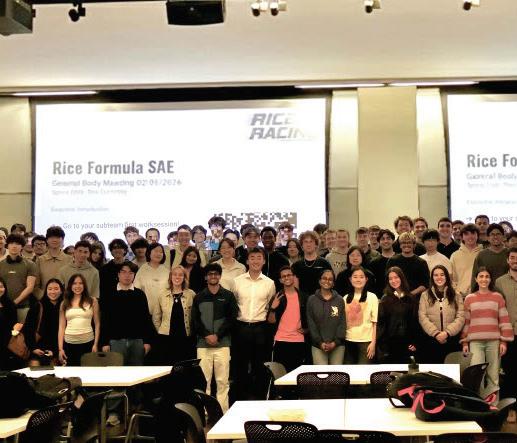
Beneath fluorescent lights and accompanied by the hum of conversation, a group of students tinkers on computer-aided design software, building a race car from scratch. For the newest team in Rice’s engineering ecosystem, their project is largely a design problem — for now.
Rice Formula, which is under the Society of Automotive Engineers, is Rice’s newest engineering organization dedicated to motorsports. Will Feng, a co-president of the club, said participating in an organization like his can pave the way for students to go into a variety of careers.
Everyone knows Formula One, but how do you go from Rice to Formula One? Being on a team like this is one way to build that pathway.
Will Feng
CO - PRESIDENT OF RICE FSAE
“Everyone knows Formula One, but how do you go from Rice to Formula One? Being on a team like this is one way to build that pathway,” said Feng, a Brown College sophomore. “It produces engineers who go on to Formula One, aerospace, automotive and energy industries. Now, Rice finally has a seat at that table.”
What began as a conversation among a handful of students has quickly grown into a full-scale engineering effort, said Egon Ferioli, the other co-president of Rice FSAE. In less than a year, the club has organized leadership, recruited subteams and mapped out a detailed timeline toward its first complete vehicle.
Ferioli said the team plans to compete in the SAE internal combustion engine competition in Michigan next May.
“It is a formula-style car competition, and universities from all over the world attend,” said Ferioli, a Will Rice College sophomore.
For Rice, entering that arena means building a program from the ground up — quickly.
“Formula SAE is one of the most well-known collegiate engineering competitions in the United States,” Feng said. “It has a strong industry presence, and many companies recognize it.”
Rice’s entry into FSAE is an internal combustion car powered by a motorcycle engine — a choice common among FSAE teams because of its balance of power, weight and cost.
“We spent about four months building a structured plan before subteam leads even started,” said Inigo Perez, one of the chief engineers.
A subteam lead is a person responsible for specific sections of the vehicle. Aneesh Depa, a Brown College freshman, is a subteam lead for the vehicle’s chassis, the load-bearing bones of the machine.
“We coordinate meetings with subteam members and are responsible for design and manufacturing of the chassis,” Depa said. “Having subteams allows for precision in every detail and efficient integration of car subsystems.”
Perez, a Brown College sophomore, said the team contacted established FSAE teams at schools such as Kansas State University, Georgia Institute of Technology, University of Michigan and Massachusetts Institute of Technology for suggestions. The motorcycle engine they ended up choosing was recommended by another team.
“We’re representing Rice on a national level in one of the most wellknown collegiate competitions,” Feng said. “Everything we do has Rice first in mind — promoting a stronger engineering community and a stronger undergraduate community overall.”
Fundraising remains a crucial task to ensure success at competitions and the long-term health of the club, Feng said.
“A lot of this year has been about outreach to industry partners, alumni, engineering departments, faculty and administrators,” Feng said. “If we
can compile those relationships and resources now, next year we can begin using them more effectively and make everything more streamlined.
Everything we do has Rice first in mind — promoting a stronger engineering community and a stronger undergraduate community overall.
Will
Feng
CO - PRESIDENT OF RICE FSAE
Ferioli said their goal for this year is $55,000, but the team hopes to raise $80,000 and carry over funds for next year’s car.
“We’ve started alumni outreach and sponsorship efforts and secured some initial funding, but we’re still trying to raise more,” Ferioli said. “Fundraising never really ends.”
As the team begins preparing for FSAE 2027 in Michigan, Perez said the process involves both excitement and nerves.
“What worries me most is designing a car that performs well across all events,” Perez said. “We might build a car that’s great at acceleration but fails after 10 kilometers in endurance. Integration is the real challenge — building a complete system that performs reliably in every category.”
However, Feng said the biggest thrill will be watching the team’s CAD designs transition to metal.
“Once you hit the manufacturing phase and start building the car, that’s when everything begins to come together,” said Feng. “Bringing the car to competition will be very fulfilling.”

ahead of time … then mostly reheat it and then add flavoring, pure flavor. They don’t want to waste time and money.”
pushing people. Because prep will be done, by nine o'clock, we’re starting to cook the food.”
Before the sun rises over North Servery, its chefs are already cooking up lunch — for tomorrow.
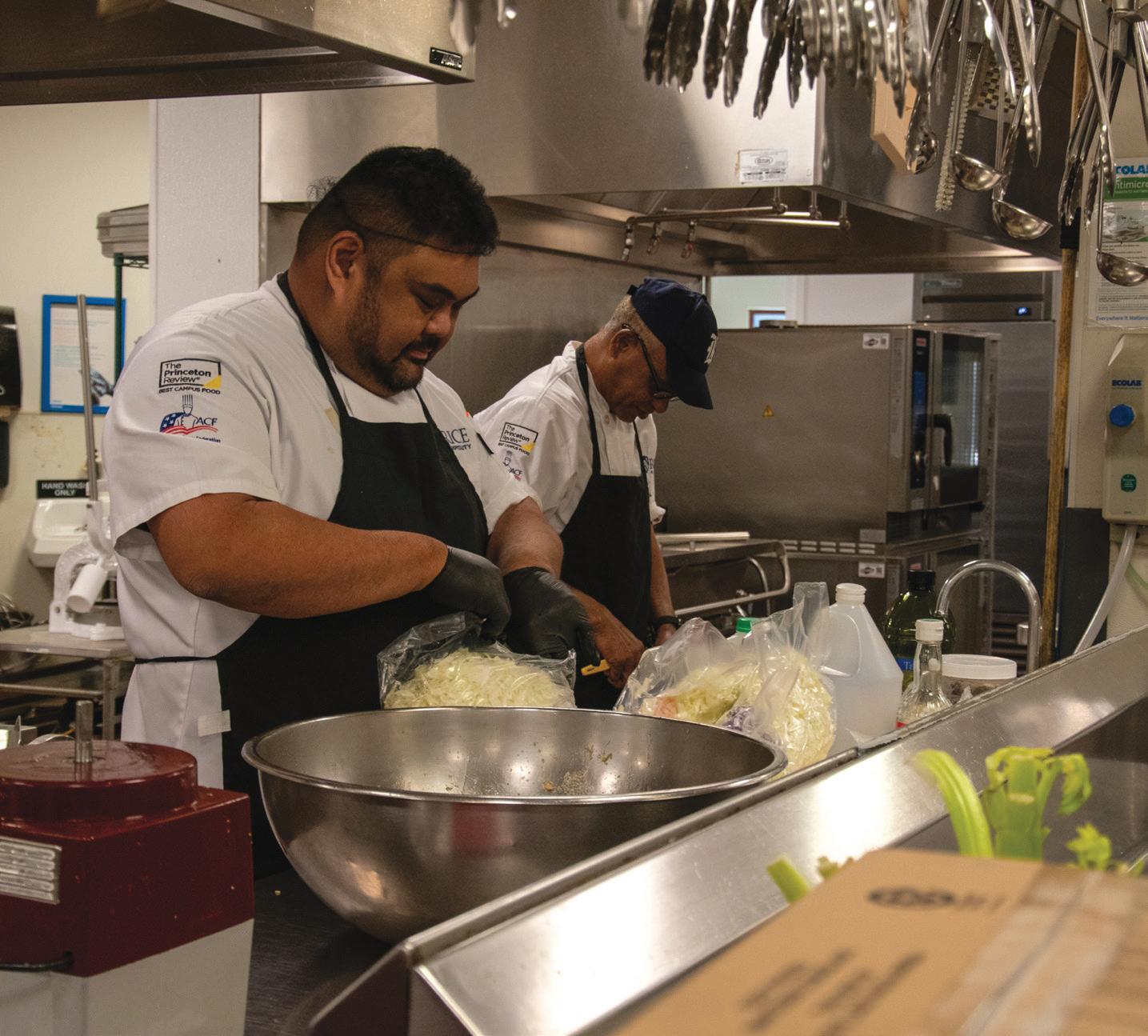
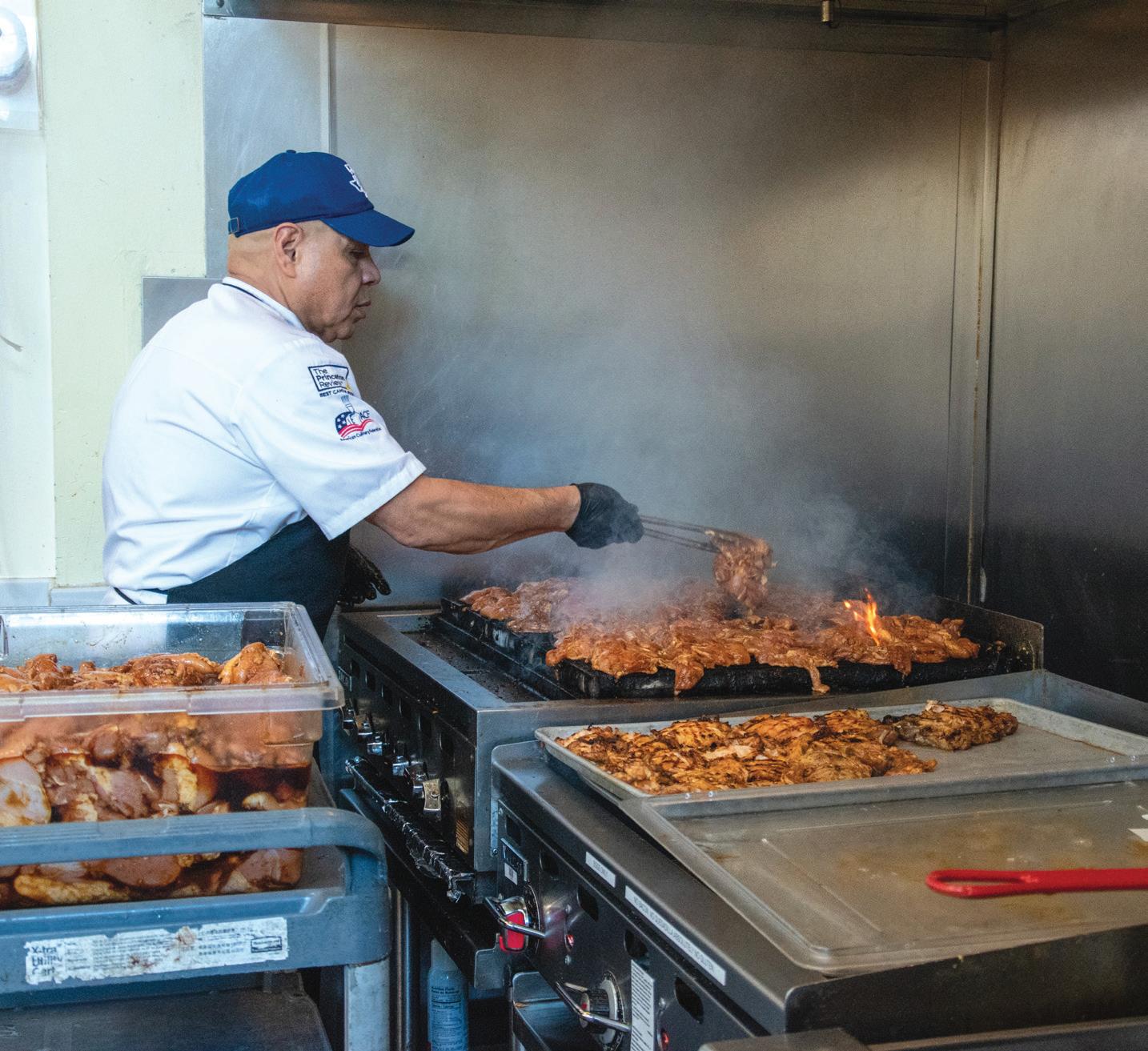
Fitri Yulianti, the morning chef de cuisine, comes in as early as 6 a.m. to manage kitchen staff, prepare menu sheets and meals, grill overnightmarinated meat and dice vegetables for the afternoon.
“I like to have the items for the product two days before,” Yulianti said. “I have items for tomorrow that we prepared yesterday. We cut it up; we marinated yesterday.”
But most dishes at North Servery are prepared day-of, even if they take days to stew. This sets a different — and higher — standard than some private restaurants, where a microwave is often a sidekick to prepare side dishes.
“It’s different in the industry; our food is cooked every day,” Yulianti said. “If you work in a restaurant, you prep
With us, every day is different. So for us cooking, it is fun because we get to cook different kinds of food.
Fitri
Yulianti
NORTH
SERVERY CHEF DE CUISINE
Chef Joe Stayshich, the director of dining operations, said Rice’s serveries aim to break even rather than make a profit by investing in serving the freshest food possible. This makes 9 a.m. the busiest time of the day for Yulianti.
“Nine o'clock is when we start firing most things — chicken, potatoes at 10,” Yulianti said. “Then after that, we set up the stations. So that's pushing people,
Temporary workers are responsible for food preparation or basic cooking, and Rice relies upon them to bolster the kitchen’s manpower.
“It's really hard to find cooks these days, honestly, and I'm in the process of hiring as many as I can at once,” Stayshich said. “When I was running seven [chefs] — the bare minimum in the operation in order to get all this done — that means we were hustling. But a comfortable number is like eight or nine.”
Stayschich is currently searching for as many as 40 new staff members. The addition of Chao and Lovett Colleges’ new servery, which Stayshich said is tentatively named East Servery, requires more cashiers and cooks to run the allelectric dining hall.
After lunch prep is finished at 10:30 a.m., Yulianti begins her next responsibility: preparing future menus.
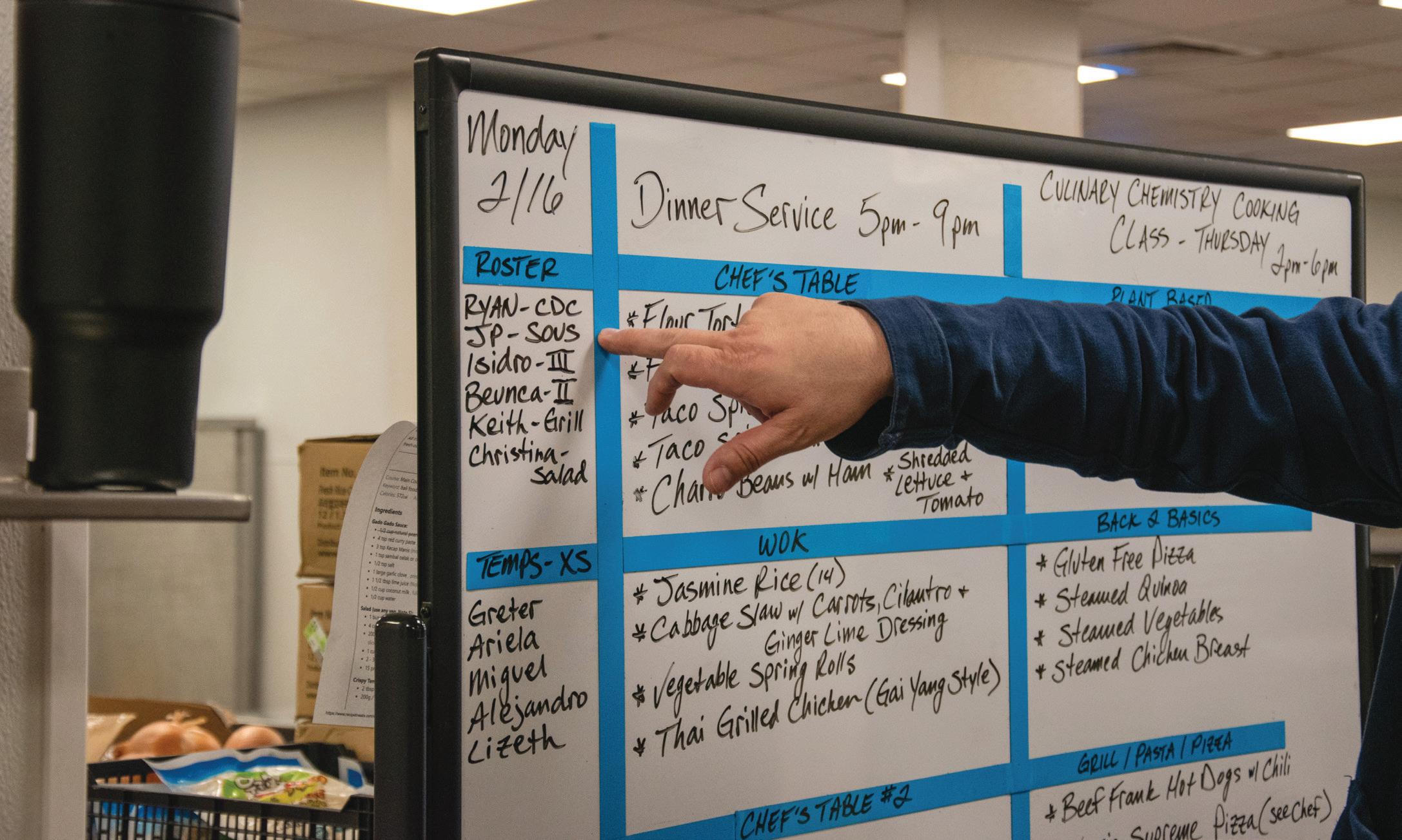
Rice’s serveries are constantly testing out new meals, and many online recipes are tacked to the walls of North Servery’s kitchen.
However, the mass production of food to fit the student body’s needs can sometimes pose a challenge in creating diverse dishes, Yulianti said.
“I’d like to make Indonesian food, but it's hard to cook — it’s hard to do great production because our needed production quality is so high,” Yulianti said.
Even if you work at the best restaurant in the world, there’s going to be problems that happen every single day. It’s how you react to problems, right? Like, we can just kind of lose our stuff and be like here, but it’s how we react, how we keep cool.
Adam Garcia
NORTH SERVERY EXECUTIVE CHEF
A former stay-at-home mother from Indonesia, Yulianti said her Houston neighbors were the ones who pushed her into the culinary field.
“When I moved to Houston after my son turned 12, that's when I started cooking,” Yulianti said. “I was working part time just to have the experience, because I was staying home, I was never working my entire life.”
On Feb. 16, there was an Indonesianstyle salad recipe tacked to the wall, with portion sizes adjusted for the student body.
Because Rice cooks its food on hotelsized scales and serves its meals on continental breakfast pans, Stayshich said he plans to use the AI food monitoring platform Metafoodx to track students’ food preferences, organized by meal time or days of the week.
At Seibel Servery, food scanners have been in beta testing for about a month. These scanners deliver food handling guidance and provide information about how much food is in pans.
Right now, we're making estimations based on sort of historical data,” Stayshich said. “What the back end of [Metafoodx] looks like is that it’ll tell us how much we've overproduced. And so we can take that data and apply it to our production, like in the kitchen, and say, ‘Oh, we’re overproducing on rice.’”
We’re not magicians, but sometimes I do think this is a kind of alchemy ... if you cook it right, and you prepare it correctly and mindfully, it becomes more than what it should be.
Joe Stayshich DIRECTOR OF RICE DINING OPERATIONS
After lunch closes at 2 p.m., North Servery often holds staff meetings; more than 20 cashiers and chefs cluster on the servery floor where students served themselves two hours prior.
During meetings, they reflect on the morning’s successes and possible improvements. Adam Garcia, North Servery’s executive chef, had an encouraging word for the cooks.
“One of my old chefs told me that, even if you work at the best restaurant in
the world, there's going to be problems that happen every single day,” Garcia said. “It's how you react to problems, right? It's how we react, how we keep cool [that matters].”
After the staff meeting ends, Yulianti’s shift is almost over. She often leaves around 4 p.m. — a 10-hour day.
“It's always stressed out. It always comes with different challenges,” Yulianti said. “But I enjoy making the food. I enjoy cooking the food.”
Rice’s serveries offer cooks a more stable working environment than the typical mom-and-pop restaurant, Stayshich said. Rice provides health insurance for chefs and doesn’t struggle as much for customer demand.
“Just coming to Rice presents all sorts of opportunities, which I think is a wonderful thing,” Stayshich said. “Rice University, to me, is like a small city.”
This small city’s serveries are soon expanding. Construction of the tentatively named East Servery is underway. As for its robot chef, Stayshich isn’t too concerned about it replacing the art of cooking. He indicated one chef preparing beef as an example.
“We’re not magicians, but sometimes I do think this is a kind of alchemy,” Stayshich said. “That younger chef was cutting sirloin flap, which is not a very nice, sexy-sounding piece of meat. But if you cook it right, and you prepare it correctly and mindfully, it becomes more than what it should be.”
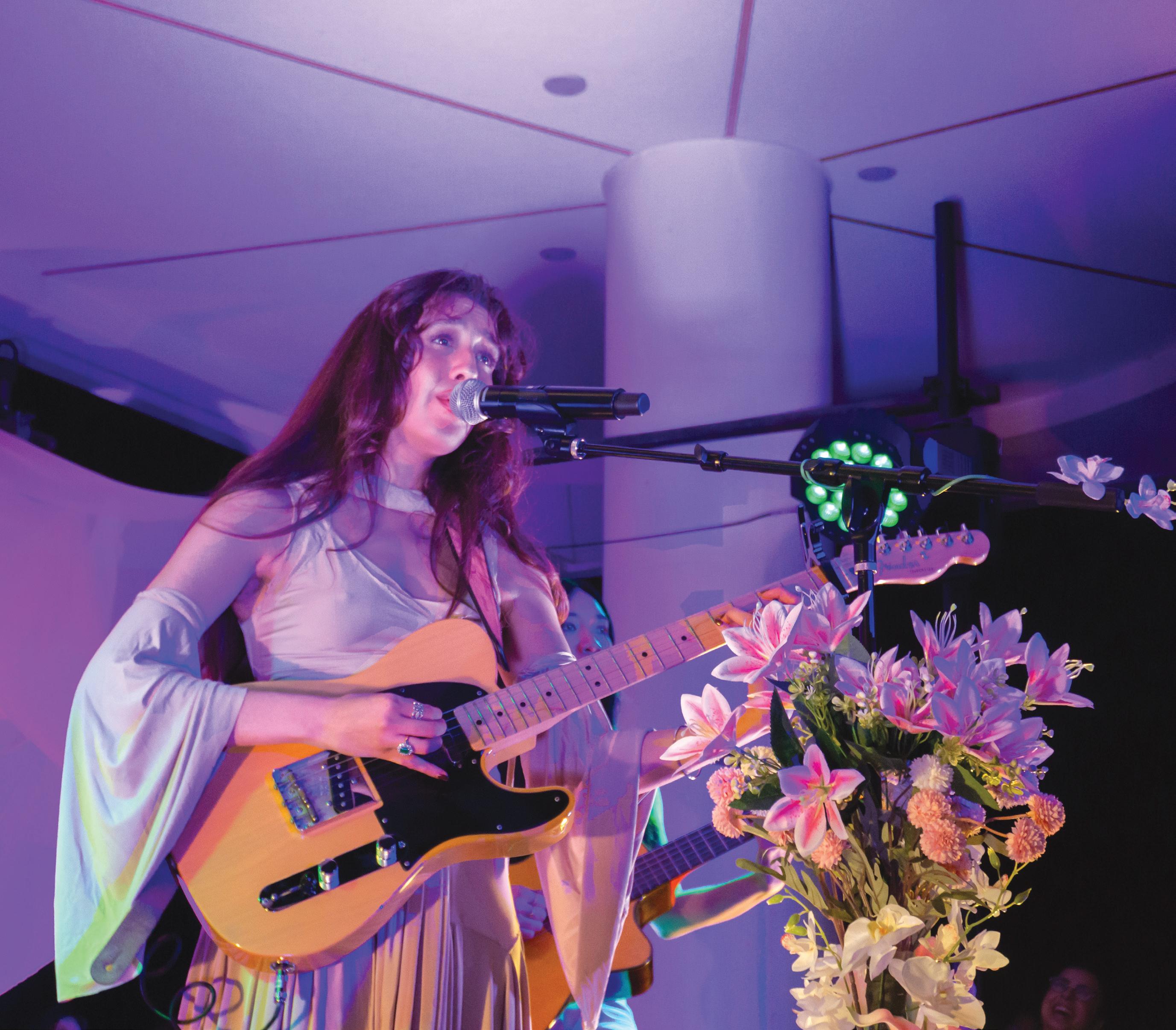
ARMAN SAXENA A&E EDITOR
Oceanic blue lights washed over the Moody Center for the Arts terrace as students and Houston community members stood shoulder-to-shoulder beneath the night sky on Saturday.
Gauzy drapery shi ed in the breeze as South Asian R&B-dream-pop star Raveena stood beneath a halo-like magenta spotlight. When she stepped onto the stage just a er 8 p.m., the crowd of more than 1,200 people erupted.
Raveena, whose sound blends R&B, dream-pop and Indian classical influences, said her performances are intentionally communal.
“Live music is like church,” she said. “It’s this experience where so many bodies can become one for a moment through the experience of music.”
Joel Thompson, the deputy director for the Moody Center for the Arts, said this year’s Spring Fling marked the largest turnout in the event’s history. Thompson estimated 1,250 attendees, a significant jump from the 750- to 800-person crowds of previous years.
The Moody Center primarily serves as a visual arts institution, hosting exhibits in its galleries. Thompson said a live performance like Spring Fling provides both opportunities and
challenges.
“Once a year, we do this large outdoor concert event, and it’s very di erent than what we’re doing the vast majority of the time,” Thompson said.
That di erence required logistical shi s, including expanded sound and lighting; Rice University Police Department and Rice Emergency Medical Services presence; and preparation for a crowd much larger than the Moody Center’s average attendance.
The decision to book Raveena was due to a variety of factors, Thompson said.
“We did our research,” Thompson said. “We also understood that her social media numbers, her Spotify numbers, everything was really trending up, and that she was a good fit for a college-age demo … and also had popular appeal.”
The Moody Center operates under what Thompson called a “dual mandate,” creating programming for Rice students while also engaging the broader Houston community.
“[Raveena] has broad appeal,” Thompson said. “She has broad LGBTQ+ appeal, she appeals to a large age demo. I think she really is somebody who sits at the intersection of a lot of different groups.”
That intersection was visible in the crowd as students mixed and mingled
with those coming from off campus, all brought together in the Moody Center terrace space.
Aliza Chauthani, a Moody Center student gallery guide who saw Raveena perform in Austin a few years ago, said the Moody Center terrace was uniquely suited to the artist’s dreamlike aesthetic.
“The place that I saw her last time was the Parish in Austin, so also a very small venue,” said Chauthani, a Wiess College sophomore. “But I think here with the lighting and the gallery vibe complementing, it’s all artistic. It’s pretty cool.”
Lovett College senior Albert Zhu echoed that sentiment and said the setting influenced the experience.
“The venue was kind of surprising,” Zhu said. “I didn’t expect to be outside, right outside of the Moody Center. It was definitely a much more laid-back vibe compared to other concerts I’ve been to.”
Zhu said the atmosphere was fitting for the artist’s sound.
“It just matched the aesthetic,” Zhu said. “It’s just a very outdoorsy spring kind of concert, very chill. I liked that there was no pomp.”
Throughout the set, Raveena kept her performance interactive, inviting couples — both romantic and platonic
— in the crowd to hug and prompting singalongs.
Zhu said those moments stood out most.
“I liked when she was trying to get us to sing with her,” he said. “It kind of felt like a hangout in a way.”
ktru station manager Chloe Diehl attended the show with a friend who has followed Raveena since high school.
“I typically don’t really listen to much R&B,” said Diehl, a Lovett College junior. “But I feel like, especially if I see artists play live, it changes how I listen to them after.”
The record attendance represented a milestone for the Spring Fling series, but Thompson said the most meaningful metric was student presence.
“The Rice student engagement, that’s so exciting,” Thompson said. “To be in that crowd on Saturday night and look out and see that many Rice students just really enjoying themselves is phenomenal for me.”
He said he hopes events like Spring Fling reshape how students see the Moody Center.
“I want Rice students to feel like the Moody Center for the Arts is part of their daily experience on campus, even if they don’t have much of a reason to get over here,” Thompson said.
EMILY SHI FOR THE THRESHER
In an era where technology and arti cial intelligence are nearly inseparable from our daily lives, the new exhibition “Imaging a er Photography” at the Moody Center for the Arts explores the relationship between AI and photography.
“Imaging a er Photography” opened to the public on Jan. 23. From AI’s presence in the academic world to the artistic realm, the exhibition’s curators, Alison Weaver and Noor Alé, examine its impact and potential to reshape our understanding of the world around us.
Rather than o ering a de nitive framework for understanding AI’s controversial role in the visual culture, Weaver, the executive director of the Moody Center, said the exhibition prompts discussion about the burgeoning technologies that are increasingly integrated into people’s realities.
“[The exhibition] isn’t intended to be a de nitive take on AI and photography, or to outline a new set of parameters for this relationship,” Weaver said. “Instead, it asks open-ended questions about the current moment.”
Weaver and Alé also said they considered AI’s in uence on Rice’s campus, where it has been a helpful resource and tool for higher education. Following Rice’s recent push toward responsible AI use in the proposed Momentous strategic plan, “Imaging a er Photography” echoes this goal from an artistic perspective.
“It has become increasingly di cult to discern if images are created in threedimensional space or if they have been digitally generated with AI,” Alé said. “This moment of uncertainty is exactly when we
turn to artists, as well as to scientists, to help us explore what’s possible and what is at stake.”
For Weaver and Alé, this uncertainty is not a problem to solve. Instead, they said it is a starting point. The photography works included in “Imaging a er Photography” challenge the idea of photography itself.
“Although we o en believe images to be the objective records of the moments they represent, photography isn’t a true index or representation of reality,” Alé said.
Weaver and Alé said there were no internal debates about whether certain works could still be considered photography.
“Photography as a medium is an expanded eld, and it engages with various disciplines and discourses,” Alé said.
Alé pointed to a sculptural work by artist Trevor Paglen, “The Standard Head,” which she said “clearly isn’t a photograph, nor is it manipulated by AI.”
However, Alé said the work’s concepts and source material are rooted in photography and machine learning, particularly their use for surveillance.
Paglen’s work references the “standard head,” developed in the 1960s by mathematician Woodrow Bledsoe using a large database of photographs to establish basic measurements for facial recognition systems, Alé said.
In Paglen’s interactive video work “Faces of ImageNet,” viewers stand before a camera as the AI generates classi cation labels based solely on their appearance. The tags, o en stereotypical, demonstrate how facial recognition systems rely on vast image datasets to sort individuals into prede ned categories.
Other works in the exhibition displays AI’s ability to produce hyper-realistic images that

“Imaging after Photography” features works designed to spark discussion on the rise of technology and arti cial intelligence in the current day.
blur the line between machine-generated output and lived reality.
In the age of AI and growing controversies regarding authorship, artistic labor and creativity within the eld of art, many artists have developed their own methods of interacting and cooperating with technological tools.
“Artists are building their own AI algorithms and models,” Weaver said. “This opens collaborations between technologists, machine intelligence and the arts.”
Architect and exhibition designer Alejandro Stein mapped the layout of “Imaging a er Photography,” collaborating with the presenting artists to shape how the works occupy the gallery space.
Alé said the design was inspired by French philosopher Roland Barthes and his ideas around the dual essence of photography involving the “studium and
punctum,” Barthes’ framework of balancing cultural and intellectual context with emotional impact.
“We came to select the works through a process of conducting studio visits with artists, meeting with curators who have curated exhibitions exploring similar topics and reading essays, artist features and exhibition catalogues on art and AI,” Alé said.
Rather than steering viewers toward a single conclusion, Weaver said “Imaging a er Photography” encourages re ection.
“With the advent of any technology, there is a natural response to be apprehensive, but there are also possibilities to reimagine the future, and to have a sense of agency,” Weaver said.
“Imaging a er Photography” is currently on view at the Moody Center for the Arts until May 9.
a wider range of people.
Stacking up accomplishments and publications like poker chips, Rice professors and faculty are incredibly active in their respective fields. Outside of long discussions and strict deadlines, your 9 a.m. lecturer might just have published the next New York Times bestseller.
If you want to sound smart during office hours, try reading your professor’s latest book which might be coming out in the next few years.
“Patchwork Ethnography: A Methodological Guide” by Gökçe Günel and Chika Watanabe
Publication Date: Expected in 2027
Department: Modern and classical languages, literatures and cultures
As a current associate professor in the anthropology department and a past Cultures of Energy MellonSawyer Postdoctoral Fellow at Rice, Gökçe Günel has been active in Rice’s anthropology department for the past 12 years.
Her forthcoming book, “Patchwork Ethnography: A Methodological Guide,” focuses on the long-standing hardship that comes with fieldwork. It questions how ethnography, the study of people and their cultures, might change if scholars introduce a more humanistic approach to research that is less focused on productivity.
The book dives into the essays of 10 early-career scholars that showcase the different difficulties — geopolitical, institutional and familial — that can arise in the field. By blurring the line between professional and personal life with shorter terms and flexible methods, Günel and Watanabe wrote that fieldwork can become an option for
“In this book, the authors ask a simple question about how researchers’ personal lives affect the process of knowledge production,” Günel and Watanabe wrote in the book. “This question applies to everyone who conducts fieldwork, whether as a beginner in the classroom or as an established researcher.”
“Becoming Martian: How Living in Space Will Change Our Bodies and Minds” by Scott Solomon
Publication Date: February 2026
Department: Biosciences
Scott Solomon is an associate teaching professor in the biosciences department and a research associate at the Smithsonian Institution’s National Museum of Natural History. Through his passion for science communication and biology, Solomon has taken to writing, podcasting and photographing in the hopes of making his field more accessible. In his latest book “Becoming Martian,” he asks us to consider how the human body would evolve if humanity were to live on Mars.
Besides the political, economic and cultural challenges that may come with this notion, there is another important aspect to consider — biology. This book takes readers on a journey from isolated islands to a high-security lab with simulated radiation to showcase the latest scientific research on the topic.
“Becoming Martian” explores the possibilities involving the evolution of the mind and body in space while also questioning the ethics of space settlement. The book was released on Feb. 17 and is now available to buy online.
“If we want to ensure our survival indefinitely ... we have to reach planets orbiting other stars,” Solomon wrote in the book. “But a human diaspora that

spans solar systems would lead toward a future in which our galaxy is inhabited by a great many human species. It’s an irony of cosmic proportions — by preserving ourselves, we would ensure that we will never be the same.”
“Contesting the Climate Unthinkable: Latin American Cultural Responses to a Warming World” by Azucena Castro, Gianfranco Selgas and Ken Benson
Publication Date: December 2025
Department: Modern and classical languages, literatures and cultures
As an interdisciplinary researcher working on Latin American literary and cultural studies and sociopolitical ecologies, Azucena Castro has accumulated over 23 publications. She integrated her multiple disciplines in her latest book “Contesting the Climate Unthinkable: Latin American Cultural Responses to a Warming World.”
Throughout the 20th and 21st centuries, Azucena writes, Latin America has
experienced many environmental changes brought by colonization and capitalism. This book strives to understand humans’ relationship with nature by analyzing literature, movies and other media that highlight ecological crises.
“Contesting the Climate Unthinkable” showcases a decolonized perspective on climate change derived from the longestablished knowledge and cultural practices of indigenous groups.
From gothic horror from Venezuela to dance protests from the Mapuche people of Argentina and Chile, we get a glimpse of how different art forms give voice to affected communities in the Global South.
“Creative works from the Global South contest the unthinkable by documenting the struggles of communities at the front line of environmental devastation and telluric trauma in imaginative ways, underscoring that thinking, writing and creating from the Global South matters,” Castro, Selgas and Benson wrote.
CHI PHAM ASST. A&E EDITOR
Directly beneath the Museum of Fine Arts, Houston’s blockbuster Frida Kahlo exhibition, visitors pass through a quieter gallery in the North Foyer. There, a small exhibit on the painter Peter Bradley and “The De Luxe Show” (1971) hangs on the walls, curated by a Rice senior who, until recently, hadn’t heard of the landmark event.
“As important as it was, I think that a lot of people in Houston don’t really know about ‘The De Luxe Show,’” said Will Marsden, an art history and business major. “Even myself as a Rice student, as an art history major, before I started researching on Peter Bradley … I didn’t know that this amazing thing had happened, like, right in our backyard.”
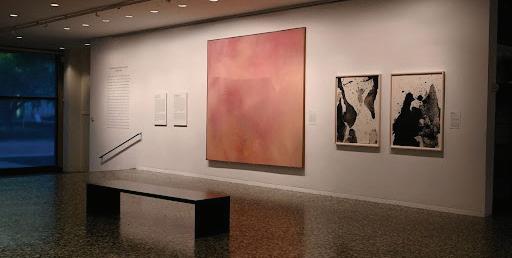
The centerpiece, Marsden said, is Bradley’s “Salmon Spray” (1972), a large color eld painting using aerosol spray guns on canvas that rarely leaves storage.
“This process did away with the tremendous indulgence to create something to which I already knew the answer,” Bradley said of the piece, quoted by Marsden for its label. “The spray gun, you know, has a kind of mind of its own. It deals with an unknown feeling.”
“That one is de nitely di cult to take out of storage, just because it is monumental in size,” said Marsden, a McMurtry College senior. “It de nitely commands the moment when you’re in a gallery.”
“The De Luxe Show” was a racially integrated art exhibition held in a converted movie theater in Houston’s Fi h Ward in 1971 — one of the rst of its kind. Bradley was invited by the de Menil family to organize the show to bring serious contemporary art to Black communities that major museums o en excluded, breaking segregationist barriers by exhibiting lauded Black and white abstract artists together.
Marsden, a McMurtry College senior, began work on the exhibition during his curatorial internship at MFAH last summer. The project began as a hypothetical exercise assigned solely as practice, he said, not intended for gallery walls. However, a er Marsden centered his proposal on a recently acquired Peter Bradley painting and its surrounding history, the museum decided to mount it.
During a visit with the curatorial team to Forehandpress, a Houston print studio run by master printer Darin Forehand, Marsden encountered two lithographs by Bradley from an unrealized 2022 edition.
“He pulls out a Peter Bradley print, and we’re all kind of in awe in the space because of just how energetic the lithographs are,” Marsden said. “It’s almost serendipitous in the way that you see a Peter Bradley print — especially for myself, a er I’ve done all this research.”
The museum acquired both lithographs, and they now hang in the exhibition alongside works by Larry Poons, Sam Gilliam and Anthony Caro. Though none of the pieces were in the original “The De Luxe Show,” all date from the same period and represent their artists’ practice at the time, Marsden said.
The exhibition, which opened this semester and runs through May 31, honors Bradley’s legacy from inside the institution. Marsden said the exhibition’s placement beneath Frida Kahlo, while incidental, works in its favor.
1972
“Even when someone just takes a chance to look around the gallery before continuing up the stairs, they have the opportunity to read about Peter Bradley and read about the moment that happened in Houston in 1971,” Marsden said.
Before arriving at Rice, Marsden had never been to Houston. He grew up in Lexington, Kentucky, where he made watercolor paintings and drawings — many of them equestrian commissions for clients in the horse racing industry.
His introduction to the city’s contemporary art scene came through the Moody Center for the Arts, where he worked as a guide during a fall 2023 installation by the French artist Laure Prouvost.
“Being immersed in that artist’s world and working pretty closely to understanding the artist’s vision … that was an experience Rice provided that really felt like a deep dive into contemporary art and the type of world that an artist can build,” Marsden said.
Outside of the museum, Marsden serves as president of 180 Degrees Consulting at Rice. He sees more overlap between curation and consulting than the pairing might suggest: Both, he said, are project-driven, require managing stakeholders and demand a kind of
visual storytelling.
“You notice that there might be an empty space and there might be an untold story xing both of those things at once is additionally, like, solving a problem,” Marsden said. “You’re trying to work with a client to solve some sort of problem within their organization and o er a creative solution.”
Much of Marsden’s development as a curator he attributes to Alison de Lima Greene, the curator of modern and contemporary art at the MFAH who supervised his internship. He said Greene pushed him to sharpen his writing and, more importantly, to pay attention to what was happening in Houston.
“Being in Houston for the summer opened my eyes to this whole other art world that exists here locally,” Marsden said. “There’s really spectacular things happening here in Houston, just beyond the hedges.”
Greene said Marsden’s research on the Peter Bradley gi opened unexpected doors over the course of the summer, leading to the lithograph acquisitions from Forehandpress and ultimately the installation itself.
“Will brought imagination, wit, and good humor to every task at hand, and I look forward to seeing what happens next as he wraps up his tenure at Rice,” Greene wrote in an email
to the Thresher.
A er graduation, he plans to pursue art consulting or advisory work, combining his interests in business strategy and contemporary art. He said his ambition is to keep working with artists through projects to help articulate their stories and execute their visions.
For rst-year students who feel pulled in competing directions, Marsden’s advice is pragmatic: Be persistent and willing to create what might not yet exist.
“Do whatever feels right to you in the moment,” Marsden said. “Apply for everything. Take the best opportunity. And if you don’t end up with an opportunity, nd a way to make one. You have to feed yourself, but also feed your soul.”
The exhibition will still be on view when Marsden walks across the commencement stage in May.
“I’m very glad that it’s kind of like going out with a bang,” Marsden said. “I think that’s incredibly meaningful to … not only have had the experience to be on the other side of the exchange that goes on between the museum and the community, but to have that happen my last year at Rice … this is probably the biggest thing that has happened to me.”

CALEB
CARROLL THRESHER STAFF
Despite having already clinched the American Conference regular season championship last week, the Rice women’s basketball team didn’t let its foot o the gas, scoring a season high 105-65 victory over the University of Tulsa Golden Hurricane on Saturday.
With the victory, the Owls extended their winning streak to 21 games as they remain 16-0 in conference play.
Tulsa got o to a quick start in a fastpaced rst quarter, jumping out to a 21-15 lead seven minutes in. From that point forward, the game shi ed in the Owls’ favor, as they outscored the Golden Hurricane by 40 points.
Head coach Lindsay Edmonds praised her team’s ability to $ip the switch defensively.
“Tulsa’s a very talented team,” Edmonds said. “We just had to settle into the pace of play.”
Though the elevated defensive e ort was key for turning the game around, the Owls’ o ensive performance was the main factor in their victory.
The team was led by junior guard Victoria Flores, who scored 24 points, and senior center Shelby Hayes, who controlled the paint with 20 points and was named American Conference Player of the Week.
Control what you can control.
Lindsay Edmonds
WOMEN’S BASKETBALL HEAD COACH
The Owls not only dominated on the interior, but they were also e ective from the perimeter, going 12 for 23 on threepoint attempts.
Edmonds said the key to the team’s o ensive performance was the players’ sel$essness.
“They do not care who gets the shot,” Edmonds said. “They do not care who is leading us in points. Because of that, we share the basketball really well.”
Flores said she credited the team’s continued success to their camaraderie.
“We’re successful because of those
bonds,” Flores said. “Coach does a great job choosing players, but even better people.”
Junior guard Louann Battiston gave the team a jolt o the bench, scoring 17 points.
“I thought she brought an incredible spark today,” Edmonds said of Battiston. “We needed it in a major way. She pushed the pace and she pushed the tempo.”
Dominique Ennis, who scored 26 points the last time the two teams met in January, put up a 19-point performance with ve three-pointers. With those ve shots, the senior guard set Rice’s single-season record for most three-pointers made with 81, eclipsing her own record of 80 that she set last season.
Despite their 21-game win streak, the
Owls haven’t broken into the Top 25. They received 28 votes — the most among nontop-25 teams — in Tuesday’s USA TODAY Coaches Poll. However, Edmonds said she doesn’t view rankings as something the team should focus on.
“It would be incredible for Rice women’s basketball to receive that recognition, but it’s not something that I can control,” Edmonds said. “I preach to our players, ‘Control what you can control.’”
With just two games le in the regular season, the Owls will look to maintain their momentum as they head into the American Conference tournament, where they will compete to punch their ticket to March Madness.
“Owl-American” “I got you a gi!!”
LIN TSAI / THRESHER

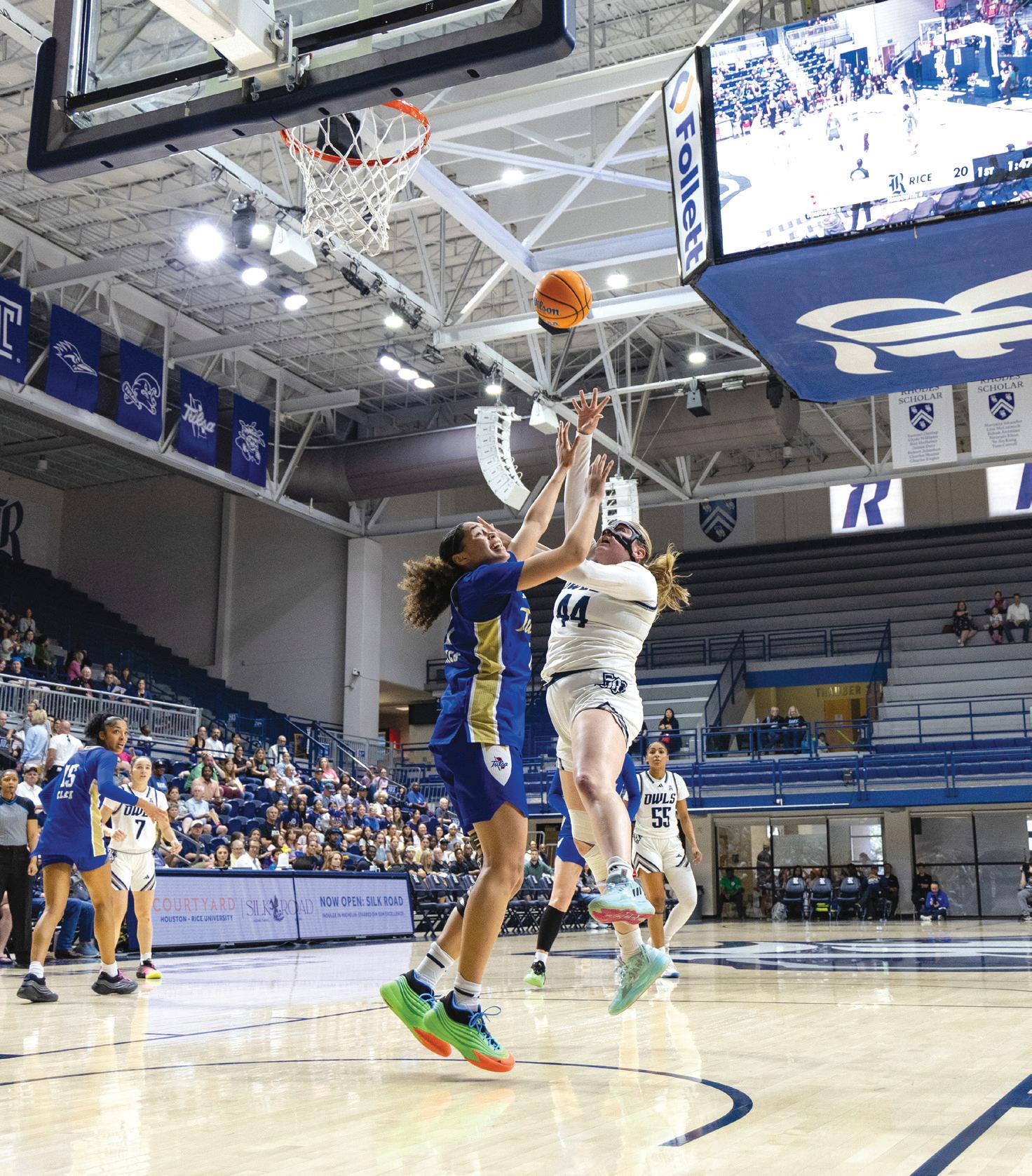
Senior
ZAID RASHID THRESHER STAFF
With the outdoor season approaching, Rice track and eld athletes have already set personal bests, broken school records and received o ers to represent national teams.
The women’s program nished their portion of the American Conference Indoor Championships third among 13 schools over the weekend.
Graduate sprinter Barbora Malíková broke the meet record with a 400-meter time of 51.97 seconds, and sophomore Julia Johannesdottir broke a program record with a time of 8.18 seconds in the 60-meter hurdles.
The men’s team nished the American Conference Indoor Championships sixth out of nine programs. Graduate Cal Abdulky claimed the only event win with a new personal best distance of 21.96 meters in the weight throw.
At the Tyson Invitational in Fayetteville, Arkansas, from Feb. 13-14, Malíková broke the school record in the 400-meter with a time of 51.84 seconds. The previous record
was 52.16 seconds, set by Allison Beckford in 2002. Breaking the 52-second threshold had been a personal goal of Malíková’s.
“I was really happy that I broke the record,” Malíková said. “It just shows the preparation of the season was successful.”
The former Olympian received her third American Conference Track Athlete of the Week honor of the season following the meet.
Malíková said she has received o ers to run outside of the United States for the Czech Republic national team. She quali ed for the World Relay Championships and will compete in Botswana, representing the Czech Republic, in May.
Junior Christian Edgar bested the men’s 60-meter hurdle time at the Texas A&M University meet Feb. 6-7 with a 7.77-second showing.
“I didn’t think it was going to happen that day, so it was pretty exciting when I saw the time,” Edgar said. “The nal heat was extremely fast, which was a big reason for the fast times.”
Edgar, who placed third in the 60-meter hurdles at last week’s American Indoor
Championships, said he attributes his successes to his coaches and trainers.
“Seeing the guys all run up a er was by far the best part,” Edgar said. “Fast times and accomplishments don’t mean much if you don’t have people to celebrate them with.”
Seeing the guys all run up after was by far the best part. Fast times and accomplishments don’t mean much if you don’t have people to celebrate them with.
Christian Edgar JUNIOR SPRINTER AND HURDLER
Junior Sultan Bakare competes in throwing and is currently ranked among the top 30 in the American Conference. He said his goal for this season is to make it to nationals.
Bakare made two trips to the podium during last week’s American Indoor Championships with an 18.03-meter throw in the shot put (third place) and a 21.53-meter nish in the weight throw (second place). The former was a new program record.
A quartet of Owls — Riana Green, Petra Taylor, Arayna Mickles and Maliková — also claimed a title in the women’s 4x400 meter relay, securing a time of 3 minutes and 36.78 seconds.
Senior Saniya Friendly podiumed in both the 60-meter (second place) and 200-meter (third place) events, breaking her own school record in the former.
Graduate Josie Taylor rounded out the meet with a third-place nish of her own in the high jump.
Taylor said she is proud of how the team performed during the indoor season and that she is excited for the outdoor season with new teammates.
“We have some new high jumpers that have joined our group, so I’m looking forward to jumping with them this season,” Taylor said. “This is my last season, so I am just excited to be competing with the team.”
OLIVER STERN FOR THE THRESHER
Although Rice women’s golf will not compete until this fall, the team’s inaugural roster is spending this academic year in a developmental redshirt season. The program is establishing training standards, academic balance and team culture ahead of their debut.
Head coach Joanne Berglund, hired in 2024 to lead the program’s formation, is utilizing the extended preparation period to allow players to adjust to collegiate expectations and shape the team’s identity before entering competition.
Berglund said Rice’s academic reputation and culture drew her to the position.
“I started diving deeper into what Rice was all about and quickly realized it t who I am and what I stand for,” Berglund said. “I like to call it the ‘Rice way,’ with excellence in all we do and living at a high level every day.”
I thought it was pretty cool to be a part of something that is brand new and writing sports history at Rice.
Amelie Phung
FRESHMAN GOLFER
Rice announced the addition of women’s golf in May 2024 following a $5 million gi from alumna Lynn Laverty Elsenhans and her husband John. The donation established the university’s 15th varsity athletic program and fully funded the team’s creation.
“I hope that they can see this as an investment in a game that builds character in young people,” Elsenhans, former CEO of Sunoco and member of Rice’s inaugural women’s basketball team, said in a press release. “It’s tting for Rice to have women’s golf, in that top academic institutions have proven that they can be competitive in this sport.”
The current roster includes freshmen Elisabeth Borsheim, Amelie Phung and Luning Yang, as well as junior transfer Ragini Navet.
Navet competed in 17 tournaments across two seasons at the University of Southern Mississippi, averaging 75.7 strokes per round, recording multiple rounds of par or better and contributing to the program’s rst NCAA Regional appearance while earning Sun Belt Golfer of the Week honors as a freshman.
“I knew I had three freshmen that I had recruited, and I wanted to bring someone in with experience who could take on more of a leadership role and help the younger players understand what college golf is like,” Berglund said.
Borsheim, an IMG Academy graduate and 2023 IMG Player of the Year, posted a 74.2 scoring average with multiple top10 nishes in Florida junior events and a runner-up nish at the Srixon Under-19 tournament in Norway.
“Competing overseas, you meet lots of di erent people and play di erent golf courses, and having di erent situations de nitely helps you adjust easier,” Borsheim said.
Phung, who is studying mechanical engineering, helped Florida Atlantic University High School win the 2023 Florida state championship, earned Palm Beach County Player of the Year honors in 2022 and posted a 72.8 scoring average as a junior while collecting multiple top-three nishes on the Florida junior circuit.
“I thought it was pretty cool to be a part of something that is brand new and writing sports history at Rice,” Phung said. “I also know a lot of golf programs do not let their student-athletes study what they really want to if it is more di cult and timeconsuming. I appreciate that my coach was willing to let me pursue my passion.”
Berglund noted Phung’s drive in both academics and athletics.
“She told me, ‘Why wouldn’t I strive for the hardest thing out there to see what I’m able to do?’ That mindset carries over to mechanical engineering and to her golf game,” Berglund said. “She goes out with intent every single day and always wants to

be better.”
Yang, a four-time MVP at Prem Tinsulanonda International School in Chiang Mai, Thailand, was also a twotime Athlete of the Year and runner-up at last year’s Hurricane Junior Golf Tour’s Hurricane Cup.
“From day 1, Luning has been someone who could stand on a street corner and sell Rice to anybody,” Berglund said. “Rice was her dream, and she brings a lot of energy and excitement. She’s very demanding of herself, whether that’s in pre-med coursework or on the golf course.”
With o cial tournaments over a year away, practices this season have emphasized statistical tracking and skill development.
“We have been doing really purposeful practice and keeping track of everything,” Borsheim said. “Our coach puts it into a stat board so we can see how each of us are doing and ne-tune things.”
To prepare for o cial competition,
the team has played informal matches against other colleges to gain experience in tournament-style settings.
Rice women’s golf also announced in November that Ana Boone, Jessica Jang and Ally Kim signed to join the program as incoming freshmen for the 2026–27 season.
Under NCAA rules, women’s golf programs are limited to nine players. Berglund said she anticipates carrying seven or eight athletes when the team begins o cial competition in 2026 and is exploring the possibility of adding a graduate transfer before then.
Berglund said she expects all her players to meet high standards in both academics and athletics.
“Whether we’re on the course or in the community, we’re representing Rice and the women’s golf program,” Berglund said. “We want to be known for perseverance and grit and for young women who are willing to take on the responsibility of building something from the ground up.”
PATRICK SHUKIS
ASSISTANT SPORTS EDITOR
Baseball defended Reckling Park last weekend against the Harvard University Crimson in a three-game series sweep, scoring 22 runs and allowing just 16 total hits. This series marks the Owls’ rst sweep since the 2024 season, and improves Rice to .500 through its rst 12 games of 2026. Rice entered the rst game in the series on a four-game losing streak from their road trip to the University of Southern California and home loss against Houston Christian University.
Looking to bounce back against the Crimson, the Owls got on the scoreboard early in the top of the rst inning.
Redshirt sophomore out elder Colin Robson, senior designated hitter Paul Smith and sophomore third baseman Cole Green put the Owls up 3-0 on three solo home runs of 380, 404 and 348 feet, respectively.
This opening frame marked the rst time the Owls scored three home runs in an inning since 2019.
Rice continued to apply pressure at the plate as they jumped out to a 9-3 lead through the rst three innings.

“It just got the con dence up, coming o of a tough road series against USC, and it got our energy up for the rest of the game,” Robson said.
The Owls maintained their momentum and held on for an 11-7 nal score. Robson, Smith and Green combined for nine out of 11 hits and seven RBIs, as the Owls’ hot bats secured a comfortable game one victory.
“It was huge for us, honestly, because we’ve been struggling a little bit o ensively,” head coach David Pierce said. “Robson got it started today, and he had four big hits. A lot of guys swung the bat well, and it was good to see Paulie back in there and getting a er it.”
Game 2 was a much lower-scoring a air, with both pitching rotations keeping the opposition o the basepaths. The Owls trailed 1-0 going into the bottom of the 8th.
Junior rst baseman Garet Boehm tied the game up with a 389-foot home run to le eld, and it was Smith who hit the go-ahead home run, a 427-foot solo shot to deep right eld that gave the Owls the lead.
Rice held on for a 2-1 victory, thanks to a solid outing on the mound from redshirt junior Ryland Urbanczyk and junior Anthony Diaz, who combined for 8 2/3 innings, no earned runs and ve strikeouts.
Before the third game on Sunday, Pierce said he wasn’t worried about the sweep as much as taking the series one game at a time.
“Well, we’re going to play tomorrow,” Pierce said. “We’re not going to worry about anything, just playing tomorrow, and I’m
looking for us to go play clean baseball.”
Pierce’s methodology proved e ective in game three, as the Owls turned an early lead into their largest margin of victory so far this season.
Rice led 2-0 in the rst inning on RBIs from Green and redshirt freshman third baseman Kutter-Gage Webb, and they cruised the rest of the way to a comfortable 9-0 victory.
Despite Rice’s solid o ensive production, the story of Sunday’s game was pitching, as the Owls fell just two outs shy of a no-hitter.
Freshman Ethan Sanders, redshirt sophomore Tanner Wiggins and redshirt sophomore Ty Baker combined for eight hitless innings before the Crimson busted the no-hit bid with a single in the top of the 9th.
Nonetheless, Rice earned three important home victories that improved their record from 3-6 to 6-6 on the season.
Pierce says their success this weekend comes down to their “Rice Guys” motto, a slogan he is reviving from the Owls’ 2003 College World Series-winning team.
“It’s something they’re having to earn, it’s not something that’s just given to them,” Pierce said. “I don’t want them to feel pressure from the past, but at the same time, there’s a great history, and I want them to embrace it.”
Rice will attempt to take this weekend’s momentum on a 5-game road trip across Texas. The Owls will tune up against Lamar University and Abilene Christian University before returning to the University of Houston to face their crosstown rivals next Wednesday.
In October of 2025, thirteen Rice students disappeared in the woods near Sam Houston National Forest while on a ROPE Trip.
Five months later, a bottle was found washed up in an Inner Loop puddle, containing a message written on a crumpled, muddy piece of paper. This is their story.