VOLUME 111, ISSUE NO.06 | STUDENT-RUN SINCE 1916 | RICETHRESHER.ORG | WEDNESDAY, SEPTEMBER 30, 2026
High-rise planned for west campus JAMES ELLIS
FOR THE THRESHER
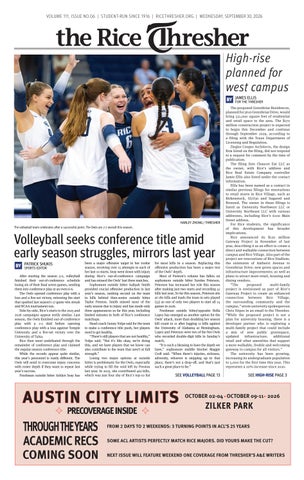
HARLEY ZHONG / THRESHER
The volleyball team celebrates after a successful point. The Owls are 7-7 overall this season.
Volleyball seeks conference title amid early season struggles, mirrors last year PATRICK SHUKIS
SPORTS EDITOR
After starting the season 5-0, volleyball finished their out-of-conference schedule losing six of their final seven games, sending them into conference play at an even 6-6. The Owls opened conference play with a loss and a five-set victory, mirroring the start that sparked last season’s 17-game win streak and NCAA tournament run. Side-by-side, Rice’s starts to the 2025 and 2026 campaigns appear eerily similar. Last season, the Owls finished out-of-conference play with a 2-5 skid before opening conference play with a loss against Temple University and a five-set victory over the University of Tulsa. Rice then went undefeated through the remainder of conference play and claimed the regular season conference title. While the records appear quite similar, this year’s personnel is vastly different. The Owls will need to overcome injury concerns with roster depth if they want to repeat last year’s success. Freshman outside hitter Ashlyn Seay has
been a major offensive target in her rookie season, receiving over 15 attempts in each of her last 10 starts; Seay went down with injury during Rice’s out-of-conference campaign and has missed the Owls’ last three matches. Sophomore outside hitter Aaliyah Smith provided crucial offensive production in last year’s season, ranking second on the team in kills behind then-senior outside hitter Taylor Preston. Smith missed most of the early season due to injury and has made only three appearances so far this year, including limited minutes in both of Rice’s conference matchups. Head coach Genny Volpe said for the team to make a conference title push, her players need to get healthy. “There’s still players that are not healthy,” Volpe said. “But it’s like okay, we’re doing this, and we have players that we know can also contribute to the team that aren’t at full strength.” Losing two major options at outside hitter is problematic for the Owls, especially while trying to fill the void left by Preston last year. In 2025, she contributed 462 kills, which was just four shy of Rice’s top-10 list
for most kills in a season. Replacing this offensive production has been a major test of the Owls’ depth. Most of Preston’s volume has fallen on sophomore outside hitter Syndee Peterson. Peterson has increased her role this season after making just two starts and recording 41 kills last year. So far this season, Peterson sits at 180 kills and leads the team in sets played (53) as one of only two players to start all 14 games in 2026. Freshman outside hitter/opposite Bella Lopez has emerged as another option for the Owls’ attack, more than doubling her season kill count to 21 after logging 12 kills against the University of Alabama at Birmingham. Lopez and Peterson were two of the five Owls who recorded double-digit kills in Sunday’s match. “It is such a blessing to have the depth we have,” sophomore middle blocker Maggie Croft said. “When there’s injuries, sickness, adversity, whoever is stepping up in that place, there’s not a drop-off, and that’s just such a great place to be.”
SEE VOLLEYBALL PAGE 13
AUSTIN CITY LIMITS PRECOVERAGE INSIDE
The proposed Greenbriar Residences, planned for 5610 Greenbriar Drive, would bring 531,000 square feet of residential and retail space to the area. The $170 million construction project is expected to begin this December and continue through September 2029, according to a filing with the Texas Department of Licensing and Regulation. Ziegler Cooper Architects, the design firm listed on the filing, did not respond to a request for comment by the time of publication. The filing lists Chaucer Eat LLC as the owner, with Rice’s address and Rice Real Estate Company controller Jamie Ellis also listed under the contact information. Ellis has been named as a contact in similar previous filings for renovations to retail stores in Rice Village, such as Birkenstock, GLO30 and Sugared and Bronzed. The owner in these filings is listed as University Northwest LLC or University Northeast LLC with various addresses, including Rice’s 6100 Main Street address. For Rice students, the significance of this development has broader implications. Rice announced its $120 million Gateway Project in November of last year, describing it as an effort to create a direct and walkable connection between campus and Rice Village. Also part of the project are renovations of Rice Stadium; the extension of Amherst Avenue to Greenbriar Drive; new green spaces and infrastructure improvements; as well as plans to attract more retail, housing and dining vendors. “The proposed multi-family project is envisioned as part of Rice’s Gateway Project to create an enhanced connection between Rice Village, the surrounding community and the campus,” wrote university spokesperson Chris Stipes in an email to the Thresher. “While the proposed project is not a plan for university housing, there is a developer partner who is exploring a multi-family project that could include a mix of new public greenspace, updated infrastructure, additional retail and other amenities that support a more walkable, livable and welcoming gateway to campus for all visitors.” The university has been growing, increasing its undergraduate population to 5,000 for the first time this year. This represents a 20% increase since 2020.
SEE HIGH-RISE PAGE 3
OCTOBER 02-04 OCTOBER 09-11 2026
ZILKER PARK
FROM 2 DAYS TO 2 WEEKENDS: 3 TURNING POINTS IN ACL’S 25 YEARS SOME ACL ARTISTS PERFECTLY MATCH RICE MAJORS. DID YOURS MAKE THE CUT? NEXT ISSUE WILL FEATURE WEEKEND ONE COVERAGE FROM THRESHER’S A&E WRITERS
2 • WEDNESDAY, SEPTEMBER 30, 2026
THE RICE THRESHER
Beer Bike track adjusted for new Kraft Pavillion EESHA SURAPANENI
THRESHER STAFF
The current Beer Bike track is being shortened for Beer Bike 2027 to accommodate the Kraft Football Pavilion, a new covered athletics facility. The facility is located just beyond Rice Stadium’s northwest corner, adjacent to the Patterson Sports Performance Center and existing outdoor practice field. The pavilion is a result of the Kraft family’s recently announced donation. The track will later be relocated from Hackerman Field in the Greenbriar Lot to the Harris Bayou Recreation Field in between Tudor Fieldhouse and Wiess College as part of the university’s $120 million Gateway Project. Martel College Beer Bike Captain
Floria Elliott said shorter, sharper tracks could make it difficult for riders to safely control their speed, emphasizing the need for accessibility and safety in any replacement track. “A shorter track and sharper turns make our racing speeds nearly impossible to manage safely on an unbanked track,” said Elliott, a senior. “The [current] track is the safest place in Houston for new riders to learn and for experienced bikers to train year-round, and any new track needs to prioritize that accessibility and safety.” Elliott also said many bikers were upset about the original proposal and felt that biker needs were not taken into consideration in the initial design process, making the new track feel like a significant downgrade from the existing
one. According to the Rice Program Council, the changes support Rice’s Gateway Project while aiming to move the event closer to student life while reducing traffic. The Gateway Project is a development
The [current] track is the safest place in Houston for new riders to learn and for experienced bikers to train year-round, and any new track needs to prioritize that accessibility and safety. Floria Elliot MARTEL COLLEGE BEER BIKE CAPTAIN
JESSICA XU / THRESHER
designed to build a pedestrian-friendly connection between the university and Rice Village. This new specific area for Beer Bike was selected to ensure minimal traffic once construction is complete while still having it at a space that is central to campus. The campuswide coordinator declined to conment on the track changes. To address student concern, RPC’s statement noted that the location will maintain the open areas and ecology of the Harris Gully Natural Area by protecting existing trees and habitat areas, among other aspects. The track
CANDICE FU / THRESHER Students visit the current Beer Bike track, which is located in Greenbriar Lot. The track will be relocated as part of the upcoming Gateway Project. construction is being carefully designed in coordination with the Lynn R. Lowrey Arboretum, a campuswide outdoor living laboratory and botanical collection. The final relocated track will be 0.25 miles long, which is slightly shorter than the current track of 0.3 miles, due to the confines of the new location. In addition to serving as the annual Beer Bike track, the field will continue to provide flexible, multiuse space for Lifetime Physical Activity Program classes, intramural and club sports and cycling practices throughout the academic year. More specific details on the use of this space is currently being formulated and will be released once finalized by the university. Construction of the new site will begin after the spring 2027 intramural and club seasons conclude. Beer Bike 2027 will still be held at Hackerman Field on the modified track.
Senate discusses snack pantries and live owl mascot RAMONA LORD
FOR THE THRESHER This week, the Rice Student Association Senate traveled to Baker College Commons and discussed upcoming projects, some receiving pushback from assembled presidents and senators. RSA President Chelsea Asibbey spoke on the controversial statements brought up in the previous senate meeting by Associate Vice President for Campus Safety and Research Security Chief Tam Dao about undocumented students. In previous years, there has been a dedicated task force for undocumented students centred around protecting undocumented students attached to the RSA. “If you are curious about what used to be a task force, it is no longer a task force.
So we used to have an undocumented students task force,” Asibbey said. “They are now officially a club.” Asibbey said with the new change, the club will be able to access more funding while keeping their members anonymous. In November 2024, former co-chair of the task force Dayanh Rubio Gomez asked for further support from the RSA, including an expanded budget. She said the reason they were a task force and not a club was for the protection of members. “That way, we don’t have an official list of who’s in our club because people are insecure and scared of us sharing their citizenship status.” Rubio Gomez said. Additionally, progress was reported by RSA External Vice President Rohan Dharia on the inner-college pantries, a project which seeks to have a 24-hour pantry in every college.
According to Dharia, it will be partially funded by Housing, Dining & Hospitality, with $500 allocated per college, per semester. Additional funds will come from a startup fund allocating $500 initially and grant funding afterwards. While originally marketed to college presidents as a solution to food insecurity, it is now being portrayed as a snack cabinet. McMurtry College President Yazmine Miles said she questions the usefulness of this initiative and the unclear communication about its purpose. “The inconsistent messaging about the purpose is making it difficult for me to find true meaning,” Miles said.
The inconsistent messaging about the purpose is making it difficult for me to find true meaning. Yazmine Miles MCMURTRY COLLEGE PRESIDENT
JUNE LI / THRESHER Students gather in Baker College Commons for Senate. This Senate was the most recent in the traveling Senate series.
Miles also said she believes funding for snack food would be better spent alleviating food insecurity elsewhere. “I would much rather McMurtry donate its donation from Housing and Dining going forward to the centralized pantry,” Miles said. “And I believe if all the presidents and colleges across campus did that, that’s 12,000 additional dollars each year.” Miles questioned the necessity of a “snack cabinet,” especially for oncampus students who have access to unlimited meal swipes and late-night
JUNE LI / THRESHER RSA Secretary Robert Fischer addresses Senate. He discussed sponsoring a live owl mascot at the Houston Zoo. dining. Robert Fischer, RSA secretary, also announced a project to sponsor a live owl mascot at the Houston Zoo, similar to University of Houston’s sponsored cougar. He said UH donated $20,000 a year from alumni to maintain the program. Unlike the cougar, which makes appearances at sporting events to generate hype, owls are nocturnal, prompting ethical questions. Sami Johnson, Baker president, compared it to previous events with petting zoos. “In the past, colleges that have gone [with] petting zoos for events have received backlash from that, so just be aware that you are going to receive some commentary,” Johnson said. In response, Fischer clarified that plans for mobilizing the owl would likely be limited, and it would most likely be a stationary exhibit at the Houston Zoo sponsored by Rice. He did not share an expected cost for the project or where funding would originate.
WEDNESDAY, SEPTEMBER 30, 2026 • 3
NEWS
JESSICA XU / THRESHER FROM FRONT PAGE
HIGH-RISE
A 24-story building would stand considerably taller than many of the structures immediately surrounding the
proposed site. Another development close by, the 15-story, 33 residence Chaucer condominiums, has already begun construction. Unit prices start at $1.7 million.
Together, these projects mark a shift away from the traditionally low-rise character of Rice Village. The scale of these developments has raised questions about how much
the surrounding area should change as Rice grows. While they may make the area more accessible and vibrant, the increased density could also bring greater congestion.
WEDNESDAY, SEPTEMBER 30, 2026 • 4
THE RICE THRESHER
GLOBAL CHATS
International students face barriers to internships VALERIA REVATTA
THRESHER STAFF
Let’s face it. If you are an international student, you will have a difficult time getting an internship. Why? Well, the answer is not so simple. Even though the new rule restricting the duration of status for international students has been paused on Sep.14, we remain uncertain about the future. Most of us don’t know how the new system will impact our ability to change majors, pursue a double major, study abroad or, most importantly, gain work experience. If international students want to apply for an internship, they have to request work authorization first. Typically, this means applying for curricular practical training if students wish to work during their undergraduate degree. Alternatively, they can apply for optional practical training, which allows them to work for up to 12 months after graduation. However, under the Trump administration, we don’t know how these authorizations may change — and that’s the scariest part of it. Two broadcast messages on Aug. 12 and Aug. 24 from the Student and
Exchange Visitor Program indicated that CPT can only be authorized for placements that are a formal requirement to a student’s major field of study. Due to that new requirement, international students’ work opportunities have narrowed significantly.
Most of us don’t know how the new system will impact our ability to change majors, pursue a double major, study abroad or, most importantly, gain work experience. This means that we can only obtain work experience if a course requires it. But what if none of ours do? Having work experience is the most important factor for starting your career. Yet, if you cannot gain work experience because your major does not formally require it, then what? Must we wait until graduation to start looking for a job? That is a risky decision to make. If these restrictive regulations continue, they will create a marginalized
group of students who cannot advance their careers in the same way as their domestic peers. Eventually, this may cause international students to stop applying to American universities, which would have negative economic implications for such institutions. What’s worse is the fact that these regulations are not our only barrier to starting our careers. Companies often don’t want to hire international students because they have a cap on the number of international applicants they can accept, and they must pay a fee to sponsor their working visas. If a company does not retain its international employees, it risks wasting large amounts of money paid for their sponsorship. Daphne Kang discussed the process she endured to get her first internship with me. She only had three options, since only the large and most competitive companies would even accept international applicants. Not only that, she also mentioned feeling frustrated because she could not gain the same experiences as domestic students since she could not apply to other programs that companies o$ered. This limited her opportunities for networking and building occupational skills.
She then said even if she was able to get an offer, it would not guarantee work authorization, since it could always be denied by the government. She had no option but to hope for the best. While the current job environment is not very welcoming for international students, the best thing Rice can do is fight to preserve the opportunities we currently have.
Many of us are scared about what will happen in the coming years. If CPT or OPT are taken away from us, it will put us at a significant disadvantage to our peers. It’s more important now than ever to support each other in this arduous process. Many of us are scared about what will happen in the coming years. If CPT or OPT are taken away from us, it will put us at a significant disadvantage to our peers. It’s more important now than ever to support each other in this arduous process.
Valeria Revatta is a Chao College sophomore majoring in architecture. After living all her life in Mexico City, she brings a unique voice and perspective on international students’ experiences. SENATE SCOOP
RSA needs to make space at the Recreation Center ELI RISINGER & MAX MENCHACA
THRESHER STAFF
Cameras have had quite a semester. They’ve turned campus security into a favorite debate topic. But while the Rice Student Association has been arguing about who’s watching us, a quieter and sweatier crisis has been unfolding every day somewhere between the Smith machines and the StairMasters, and you don’t need a camera to spot it. We’re talking, of course, about the Gibbs Recreation and Wellness Center. Anyone who has tried to work out at the Rec during peak hours knows the routine: Circle the gym, gauge how many sets the person has left, settle for something else and try again later. For a facility already strained by demand, Rice’s continued growth will only make those frustrations more pronounced.
The Rec is ‘bursting at the seams,’ Wright said. When asked whether Rice needs a new facility, his short answer was yes, though such an expansion remains a distant prospect. Last week, the RSA heard a presentation from Andrew Wright, the Rec’s health and well-being coordinator, about the facility
and its future. To his credit, Wright didn’t pretend the problem wasn’t real. He explained that the Rec has already converted two overflow rooms into additional fitness space, while the competing demands for the space remain. Additionally, accessibility and Americans with Disabilities Act requirements shape how any space can be configured. The Rec is “bursting at the seams,” Wright said. When asked whether Rice needs a new facility, his short answer was yes, though such an expansion remains a distant prospect. An o$-campus gym subsidy is unlikely to provide an interim solution, either. Wright hopes to have answers on potential improvements by the end of the semester, naming ellipticals and pec decks as examples, but could not commit to a timeline. He suggested that expansion could eventually become an administrative priority if students continue demonstrating that Rice’s growing population necessitates additional recreational space. For now, that leaves Rice with a facility it has already outgrown and a more immediate question of how to make better use of the space it has. While the creation of the RSA Rec Improvement Task Force is a promising first step, its value will depend on whether it can translate student input into a sustained undergraduate presence in decisions about the Rec. That begins with identifying where the Rec’s limited space and resources can have the greatest impact. The task force should determine which equipment consistently creates wait times, where the most significant bottlenecks emerge during peak hours
and which additions could alleviate them without requiring substantial renovations. Some improvements may be relatively modest — a cable crossover, additional StairMasters or a more e$ective allocation of existing space. These changes could improve the student experience well before a larger facility becomes feasible. The task force should also look beyond immediate fixes and establish what undergraduates want from an eventual expansion.
The Rec has asked for student input, and the task force now has an opportunity to turn the frustrations students experience every day into concrete priorities. While a larger facility may be years away, a better use of the one we already have should not be. Collecting that information, however, is only useful if it informs actual decisions. The task force must distill student input into a defined set of priorities, advocate for them directly with Rec administrators and continue pressing for progress after its initial recommendations are made. If the task force is going to represent undergraduate interests, its role cannot end when it submits its findings. That brings us to another question: Who
is the Rec for? The Rec serves undergraduates alongside graduate students, faculty, sta$, retirees, alumni and other members of the Rice community, each with di$erent expectations of the same limited space. Wright acknowledged the difficulty of balancing these demands. But accommodating multiple constituencies does not require treating every use of that space as equally important. As Rice continues to increase enrollment, the recreational infrastructure primarily serving undergraduates must keep pace. That does not mean ignoring other Rice community members, but it does mean undergraduate needs should carry substantial weight when the Rec decides how to allocate scarce space and resources. The Rec’s expanding wellness services illustrate that question of priorities. Students can book massages for $50 per hour and dual X-ray absorptiometry scans for $30. Both services may have value, and eliminating them would do little to solve the Rec’s broader capacity problem. However, their availability sits somewhat awkwardly in a facility that is, by Wright’s own description, “bursting at the seams.” The Rec has asked for student input, and the task force now has an opportunity to turn the frustrations students experience every day into concrete priorities. While a larger facility may be years away, a better use of the one we already have should not be. If demonstrating Rice’s growing need for recreational space is part of making expansion an administrative priority, the task force needs to make our needs impossible to overlook.
Max Menchaca is a Brown College junior studying political science and statistics. Eli Risinger is a Wiess College junior studying political science and social policy analysis. Both are former RSA senators and believe every Rice student should be well informed to advocate for their interests in student government.
WEDNESDAY, SEPTEMBER 30, 2026 • 5
OPINIONS EDITORIAL
We should appreciate our outdoor spaces As the weather is cooling down — well, by Houston standards — we wanted to tell y’all to take a moment to slow down. Midterms are starting. Project deadlines are looming. Still, we should find some time to enjoy our outdoor spaces. Our tree-lined campus obviously provides a lot of shade. However, it’s also a living history. Walking by the “Twilight Epiphany” Skyspace at night, it’s great to see Houstonians and students alike enjoying the sunsets. Elsewhere, new public art is worth checking out. Now is the time, more than ever,
to enjoy what our campus has to offer. Although so much of it is under construction, the return of the Skyspace is a welcome reprieve from the concrete jungle of Houston. Lounge beneath the groves by Sallyport. Bathe in the sun rays that fill the reimagined Academic Quad. At other college campuses, the outdoor culture is so much more pronounced. Just look at photos of the Brown University Ruth J. Simmons Quadrangle. Maybe it’s our weather. Or our humidity. However, it also feels a
little bit like a cultural thing. While working with friends — the Fondren Library lock-in, a Rice Coffeehouse hang — can be nice, we need more time to completely disconnect from work. The best place to do that is in the great outdoors. Editor’s Note: Thresher editorials are collectively written by the members of the Thresher’s editorial board. Current members include James Cancelarich, Evie Vu, Abigail Chiu, Hongtao Hu, Andrew Rynsburger, Chi Pham, Andersen Pickard and Patrick Shukis.
GUEST OPINION
DesRoches uses our university to launder colonial aggression ERICA AUGENSTEIN & LAUREN PALMIERI
* Indicates Editorial Board member James Cancelarich* Editor-in-Chief Evie Vu* Managing Editor NEWS Abigail Chiu* Editor Toby Chou Asst. Editor Ruby Gao Asst. Editor Lina Kang Asst. Editor OPINION Andrew Rynsburger* Editor FEATURES Amelia Davis Editor London Frey Crossword Editor ARTS & ENTERTAINMENT Chi Pham* Editor Cora Wareh Asst. Editor SPORTS Andersen Pickard* Editor Patrick Shukis* Editor Keya Patel Asst. Editor SPECIAL INVESTIGATIONS Hongtao Hu* Editor
GRADUATE STUDENTS
As two representatives of Rice Students for Justice in Palestine, we wanted to offer further insight and clarification on tThe Thresher’s recent coverage of the Eastern Mediterranean Energy Center. Launched by Rice’s Baker Institute for Public Policy, the goal of the EMEC to facilitate Israel’s expansion into Palestine’s oil fields is completely transparent. The Thresher itself reports that Israel began to expand into the Palestinian oil fields off the coast of Gaza concurrently with the beginning of the ongoing genocide in Gaza. The EMEC’s statements, however, mask this expansionism with the technocratic language of energy policy. In reality, the EMEC has joined forces with Israel to advance its genocide and expropriation of Palestinian land and resources. The Baker Institute’s founding of the EMEC further solidifies its loyalty to the genocidal Zionist project and the destructive aims of U.S. colonialism. Rice SJP has long been protesting the activities of the Baker Institute, including hosting war criminals like Henry Kissinger and Condoleezza Rice and manufacturing consent for genocide. In particular, Rice SJP has identified that the current Director of the Baker Institute, David Satterfield, is using his position to advance his years-long leadership of the U.S. War in Iraq and colonial expansion into the Arab world. Satterfield and his Baker Institute cronies have advanced their own fealty to colonial and, more recently, genocidal violence through Rice’s name. In the Thresher’s coverage, only two Rice community members offered comment, Ted Loch-Temzelides and Gilead Sher. Neither are Rice or Baker Institute leadership, nor do they hold
EDITORIAL STAFF
BACKPAGE Max Scholl Editor Will Howley Editor Rykelle Sandidge Editor Kyle Chen Senior Writer Caleb Song Senior Writer COPY Shruti Patankar Editor Julianne Ma Editor
Erica Augenstein
Lauren Palmieri
leading roles at the EMEC. Additionally, Sher has a long history of involvement in Israel’s genocidal military and the highest levels of its state. Sher openly represents Zionist expansionist interests and does not speak for our institution. The person who owes the Rice community an explanation as to why the university has been directly tied to genocide and ecological destruction is President Reggieinald DesRoches, who signed a declaration of intent to establish the EMEC. DesRoches did so without any democratic input from the Rice community, even after years of student protest condemning Rice’s complicity in ongoing genocidal atrocity. The establishment of the EMEC transforms Rice into a direct collaborator in Zionist expansionism. Since the beginning of the student movement in solidarity with Palestine, Rice has increasingly ruled campus with an iron fist to silence dissent. Rice ranked 250 out of 261 in a recent report on free speech on university campuses by FIRE, continuing its ‘F’ ranking from the previous year. American universities are currently in crisis over issues of institutional collaboration in genocide, fueled by a
complete lack of democratic structures. Francesca Albanese, the United Nations Special Rapporteur on the situation of human rights in the Palestinian territories occupied since 1967, published a 2025 report that found that leading international universities, particularly in the United States, directly contribute to the development of technology used by Israel to commit genocide. This spring, a report that details Rice’s many entanglements with colonialism, weapons, and environmental destruction was published. The report exposes how Rice administrators unilaterally pushed for greater engagement between Rice researchers and the U.S. military. University partnerships like the EMEC not only undermine the integrity of the higher education system but extend colonial warfare through university resources. Therefore, Rice SJP has released a statement condemning the establishment of the EMEC and calling attention to its blatant connection to genocide and ecological collapse. We invite you to read and sign our statement to demand ethical accountability from our administration and to take back our university.
Last Week’s Online Poll Results
PHOTO, VIDEO, & WEB Konstantin Savvon Photo Editor Sarah Bradley Asst. Photo Editor Andrew Gingerich Video Editor Rachel Jeong Asst. Video Editor Megan Zhang Web Editor Fiona Sik Web Editor Varshini Loganathan Web Editor DESIGN Jessica Xu Art & Design Director Magnolia Hickey-Zamora News Sydney Chang Opinion Lisa Wang Features Alexa Bu Arts & Entertainment Kirstie Qian Sports Brandon Nguyen Backpage Richard Li Design Consultant BUSINESS Sivani Vasireddy Manager Alina Zhong Advertisement Rahul Santhanam Advertisement Makeen Shafer Distribution Manager Ary Rodas Social Media Manager
ABOUT The Rice Thresher, the official student newspaper of Rice University since 1916, is published each Wednesday during the school year, except during examination periods and holidays, by the students of Rice University. Letters to the Editor must be received by 5 p.m. on the Friday prior to publication and must be signed, including college and year if the writer is a Rice student. The Thresher reserves the right to edit letters for content and length and to place letters on its website.
Did you like Duncan After Dark?
Editorial and business offices are located on the second floor of the Ley Student Center: 6100 Main St., MS-524 Houston, TX 77005-1892
Next week’s question: What are you doing for midterm recess?
Phone: (713) 348 - 4801 Email: thresher@rice.edu Website: www.ricethresher.org
Total number of responses: 393
19% 58%
10% 13%
Follow @ricethresher on Instagram to answer weekly polls.
Yes Somewhat
The Thresher is a member of the ACP, TIPA and CMA. © Copyright 2026
No Didn’t go ricethresher.org
6 • WEDNESDAY, SEPTEMBER 30, 2026
THE RICE THRESHER
Playing it forward: A tuba, a teacher and 44 years at Shepherd School SOPHIE GARLICK
orchestras and they’re going to have a say in whether I get hired or not,” Jaquez said. “He made us recognize that our reputation was made of people remembering if you’re late to rehearsal or if you’re always prepared, you’re always early ... and I’ve carried that into my daily life. “ Kirk has also taught Jaquez to take responsibility for his own preparation. He gives students assignments and expects them to decide how seriously they want to pursue them. “He was willing to give me free lessons and a lot of them, like five or ten free lessons over the summer which most professors either don’t do or make you pay for,” Jaquez said. “If he sees that you’re working, he’ll give you his time and insight, which is really nice because it encourages you to be a better student.” That work recently paid off when Jaquez won Shepherd’s annual concerto competition, becoming the first tuba player in Shepherd’s history to do so. When orchestra manager Alan Austin announced Jaquez as the winner, Jaquez
ASST. FEATURES EDITOR A fact of life at Rice: You can feel Houston’s humidity before you even step outside. For associate professor of tuba David Kirk, you can hear it, too. “When you play the tuba, the Houston climate is actually very beneficial,” Kirk said. “It’s a good sort of heavy, humid air, which most people would run away from. But when we use that kind of air, it helps us produce literally a warmer sound; a freer, more beautiful sound.” For Kirk, humidity was familiar long before he began calling Houston home. He grew up in Mobile, Alabama, another Gulf Coast city, and after finishing his senior year at The Juilliard School, packed his belongings into a U-Haul and drove south. Three days later, he was playing with the Houston Symphony. Concurrent with his profession in the symphony, Kirk began teaching tuba at Rice in 1982, a time when the Shepherd School of Music was just 8 years old and more like a music department than a school of its own. That changed with the construction of Alice Pratt Brown Hall in 1991, which finally gave the school a dedicated home on campus. “From that point forward, the school took off like a rocket, and it’s not done yet. By 2000, everyone knew where Rice was and what it was. The faculty was excellent and the quality of the students increased exponentially,” Kirk said. Now, as he prepares to retire from the orchestra and his position at Shepherd, Kirk is thinking less about the thousands of concerts he has played than about what will remain after they are over. “When we play a concert, it is by its very nature, it is sort of — it’s very ephemeral. Teaching is really more durable and long-lasting,” Kirk said. “Because the lessons that I learned from my teacher, that gentleman learned from his teacher … are a quest to always try to improve the music in any way we can, which is largely unseen by an audience. So there’s a certain amount of an anonymous quality to it. But trust me, when we’re up there, we’re constantly listening and making them.”
I think that the thing that’s unique at the Shepherd School is it exemplifies a preprofessional attitude and standard. Elizabeth Freimuth ASST. PROFESSOR OF FRENCH HORN At Shepherd, Kirk’s influence has stretched across generations of students. In fact, some of Shepherd’s current professors once sat in his classes. Elizabeth Freimuth, now a professor of French horn at Shepherd, first encountered Kirk during her graduate studies in 1996. At the time, Kirk taught tuba and led the school’s brass repertoire class, bringing together horn, trumpet, trombone and tuba students to study orchestral repertoire outside of their own ensembles. For Freimuth, Kirk’s lessons went beyond simply playing the notes.
GRIFFITH COL / THRESHER David Kirk poses with his tuba. Kirk is retiring after teaching at the Shepherd School of Music for 44 years. “I think that the thing that’s unique at the Shepherd School is it exemplifies a preprofessional attitude and standard,” Freimuth said. “Professor Kirk and all of the professors over at the Shepherd School come from a background of having had success in the professional performance world. So they can speak to the students about what that standard is that the students need to be able to achieve.” Kirk encouraged his students to seek out recordings and compare different performances of the same piece, paying attention to differences between orchestras, conductors and ensembles. “He taught us that listening is just as important as playing, if not more so … He brought a lot of experience to his teaching and he really taught from a perspective that inspired everyone,” Freimuth said. Part of that teaching method came from Kirk’s own tutelage and professional experience as principal tuba. Rather than speaking hypothetically about what a professional musician should do, Kirk could point to what he had actually done. “He wasn’t talking about anything from a hypothetical stance. He was speaking from his own personal experience,” Freimuth said. “So there’s like, a very relatable thing, like when someone is talking to you, and they’re saying, this is how I do it, or this is how we do it, or this is how we’ve done it. You just believe them more.” Kirk’s personal approach to teaching
has also shaped the relationships he has maintained with students long after they left Shepherd. “I have two kids of my own, but I also feel like I have children who are now in their 50s, 30s, 40s,” Kirk said. “And they are having very satisfying lives. And the time that we spent together at school will last. That will be durable. Some of them are teaching. So it’s being passed along again.”
I have two kids of my own, but I also feel like I have children who are now in their 50s, 30s, 40s. And they are having very satisfying lives. And the time that we spent together at school will last. That will be durable. David Kirk PROFESSOR OF TUBA
Diego Jaquez, a Wiess College senior, said Kirk has taught him that becoming a professional musician is about more than playing well. “One of the biggest things that he tried to instill in us my freshman year was to treat everything like an audition … like some of my friends that were grad students are now playing in major
He made us recognize that our reputation was made of people remembering if you’re late to rehearsal or if you’re always prepared, you’re always early ... and I’ve carried that into my daily life. Diego Jaquez WIESS COLLEGE SENIOR
said he was stunned. “I was friends with some of the other performers I was competing with and they were all really happy for me,” Jaquez said. “You can’t wish for competitors to do worse than you, you can only hope that you have your best performance.” Kirk was one of the first people Jaquez shared the news with. As his prize, Jaquez will be performing his concerto solo this spring with Shepherd’s orchestra. By then, Kirk will have retired from the Houston Symphony, but Jaquez said Kirk plans to remain involved attending rehearsals, listening to Jaquez’s performances and offering feedback as he prepares for his upcoming solo. For Jaquez, that relationship is not something he expects to end with Kirk’s retirement or with his own graduation. “It’s pretty crazy, honestly. I don’t know what I’m gonna do when I don’t have him every week,” Jaquez said. “Anytime there’s something wrong in my playing, he just analyzes it and fixes it immediately and then it’s fine.” Jaquez is already thinking about what it will mean to play without Kirk’s guidance each week. Kirk, meanwhile, is looking toward retirement with the knowledge that his influence will live on in his students. “I am looking forward to retiring because I have worked very hard for, for about 44 years and it’s been just incredible,” Kirk said. “I have a huge number of students out there and the time that we spent together at school will last. That will be durable and that’s an amazing thing to be a part of.”
WEDNESDAY, SEPTEMBER 30, 2026 • 7
FEATURES
Sound It Out 1
2
3
4
4
13
14
14
17
18
5
6
FOR THE THRESHER
8
21
21
22
26
27
23
28 32 38 43
43
44
45
50
51
52
47
12
15
31
11
12
12 16
29 33
32
39
40
44
45
34
3536
41 46
49
48 53
55
54
56
61
62 50
64
10
25
24
30
42
9
22
28
37
7
17
20
55
7
STEPHAN HATEM
65
67
68
57
58
52
66
63
69
59
60
ACROSS 1 Drink, casually 4 Opera solos 7 Chocolate coins for Hanukkah 13 ___ Attorney (Capcom game) 14 Larger relatives of violas 15 In-your-face 17 Fast-food chain with propagandist cows 19 Pokémon with eight evolutions 20 Blessed 21 Language mutually intelligible with Thai 22 Line on a map 23 Birthday party spot that once had an animatronic band 26 Game platform famous for its “oof” 29 Cometes (for) 30 Disney mermaid 31 Place for a horseshoe 33 ____ Tuesday 37 Currency used in 65A 38 Crusty tablet user 41 Bygone Wiess public, for short 42 Dr. Pepper, e.g. 44 Right-hand person 45 Tempting words on a Wonderland cake 47 Fruit-!lled pastry 49 Obsessions 50 Rice relative? 55 ______ Mae (student loan company) 56 Sleeping soundly 57 “Get a ____ of this!” 61 Ink or coffee mark 62 Pixar school attended by Mike and Sulley, informally 64 Row of pawns, e.g. 65 Japanese city where takoyaki originated 66 “the perfect pair” artist, familiarly 67 Unsung ____ 68 Cartoonist’s work 69 Vulcano from Impractical Jokers
1 2 3 4 5 6 7 8 9 10 11 12 16 18 22 24 25 26 27 28 31 32 34 35 36 39 40 43 46 48 49 50 51 52 53 54 58 59 60 62 63
DOWN
“Goldberg Variations” composer Result of yelling into a cave It’s lifted at the altar Exasperated exclamation Stomach acid problem Relating to the pelvis “We’re good!” “Chandelier” singer “Faust” playwright Top of the world Flood barrier Canopy makeup When repeated, ____-à-____ Ride a bike “Black Mirror” genre, briefly Hindu festival of colors Bring to mind Sunbeams Apt name for a tuxedo cat Sticky situation Tortuga’s country Like all prime numbers except 2 Not pro Food ____ (feeling after a feast) Praising poems Analyze grammatically Bridget Gorman’s role Manga Witch Hat _______, or an artist’s studio Point of view Closely resembling “My Love Mine All Mine” artist ____ buco (dish with veal) Binge, as a series Send over the moon Raise, as morale _____ New Year Crystal balls, e.g. On the ocean Of two parts Apr. and Oct. Alternative to “sparkling
‘Fake twin’ siblings chase Olympic taekwondo dreams JERRY ZHU
FOR THE THRESHER Joshua and Naomi Alade discovered taekwondo at an elementary school summer camp, where they watched a demonstration team. The team’s flyer made its way to their father, which prompted him to sign them up for lessons. Almost two decades later, they have traveled around the world for international tournaments and championships, establishing themselves among the United States’ top young taekwondo athletes. In competitive taekwondo, there are two main disciplines that athletes compete in: Pomsae, a routine of defensive and offensive moves judged on accuracy, balance and grace, and Kyorugi, the sparring discipline that Joshua and Naomi Alade compete in. A typical Kyorugi tournament could range from two to as many as 60 competitors, meaning that to win a tournament, a competitor has to win upward of five or six matches. Matches are decided in a best-ofthree format, where landing kicks to your opponent’s body or head scores points. It’s an intensely taxing sport that requires equal amounts of mental strength and physical fortitude. Reaching this elite level has been no easy feat. For the two of them, it meant training for up to three hours a day in the afternoons since elementary school and twice a day during the summer. Their father Oladapo Alade said the journey has been a sacrifice. “In our household, academics always came first, so as kids growing up, there were definitely times where Joshua and Naomi Alade had to juggle academics and training, and missed out on things like hanging out with friends,” Oladapo Alade said. “But that’s all part of the responsibility. They wouldn’t be where they were without making that conscious effort.” Naomi Alade is currently ranked sixth worldwide for the +67 kilogram weight class and number three for +73 kilogram weight class, while Joshua Alade sports a ranking of 22nd worldwide in the -80 kilogram
weight class. One of their teammates, Steven Jenq, is a ninth grader in the midst of his taekwondo journey. He moved to Houston last December and has been training with the Alades for around six months. He said the Alades have supported him and served as a source of inspiration for him. “Taekwondo practice gets really tough sometimes, and it’s quite inspiring to see them take it all and push through whatever is in front of them,” Jenq said. Now that the duo has entered college, they’ve encountered a new landscape to fit their training into. For some, the flexibility of the college schedule allows for more leisure time; for Joshua and Naomi Alade, both Chao College freshmen, it means more time for sparring, running and conditioning. A major component of their shared success has been sparring with each other. Fighters can change up their tempo, switch between attacking and defending, throw kicks without intending to score and deliberately frustrate opponents. By sparring with each other, they encounter fighting styles they wouldn’t normally find in typical competition. “There are so many ways to play mind games,” Naomi Alade said. On one hand, nobody kicks as hard as Joshua Alade, which has allowed her to gain experience in training against physicality, Naomi Alade said. On the other hand, Joshua Alade said Naomi Alade forces him to fight smarter. “She’s a very defensive fighter, and that can be very frustrating, but it also forces me to get more creative with how I approach my fights,” Joshua Alade said. Perhaps unlike other parents when their children fight, their father has spent countless hours watching the two duel. “They both choose to approach fights slowly, gradually prodding for weakness and openings. They are both very cerebral fighters, approaching the sport from an analytical point of view,” Oladapo Alade said. This influenced how they approach their
PHOTO COURTESY OF JOSHUA ALADE Joshua Alade lands a kick to his sparring competitor. Joshua, along with his sister Naomi, has been practicing taekwondo for nearly two decades. life as a whole, and more specifically, their decision to pursue higher education. Many top taekwondo athletes choose to double down on taekwondo and forgo higher education in hopes of dedicating their lives to the craft. The Alades, on the other hand, have different plans. Both Joshua and Naomi Alade are on the premed track, with Joshua Alade planning to major in biosciences with a concentration in cell biology and genetics and Naomi Alade pursuing biosciences with a concentration in evolutionary biology. But for now, the short-term goal is very tangible: the 2028 Olympic Games in Los Angeles. Because Olympic taekwondo combines multiple world weight classes into fewer Olympic divisions, the competition for places can be especially intense. Ranking points earned at international tournaments will determine much of the qualification
pathway, meaning the siblings expect 2027 to be filled with tournaments. More tournaments means more travel, more training and more time away from Houston. For all of their success though, neither sibling expects taekwondo to define their entire lives. The two of them ultimately chose to attend Rice over other institutions that offered much closer access to taekwondo training facilities in order to prioritize their education and future aspirations in medicine. “We’ve been running and kicking around since grade school, and there’s so much more life outside of taekwondo to be lived,” Naomi Alade said. “As much as we love the sport, we’re both hoping that the 2028 Olympics will be our last dance. Though we won’t be competing anymore, the sport will be inseparable from us for the rest of our lives.”
8 • WEDNESDAY, SEPTEMBER 30, 2026
THE RICE THRESHER
Rice’s trees carry campus memories
JESSICA XU /THRESHER
ANNIKA BHANDARI
FOR THE THRESHER
“Imagine this campus without trees,” said Cassidy Johnson, director of the Lynn R. Lowrey Arboretum and biosciences professor. If you can’t, that’s for a reason: Rice is home to a wide range of trees that provide environmental benefits, shape the university’s landscape and connect the campus to its history. The trees on Rice’s campus have practical environmental benefits. Their shade reduces the need for air conditioning, lowering the amount of energy used to cool campus buildings, said Johnson. The trees can also help manage stormwater, with a single live oak able to absorb 50 gallons of water per day. In a city known for flooding, that’s not a benefit to sneeze at. Live oak, the immediately recognizable hallmark of Rice’s greenery, currently dominates Rice’s canopy, but Johnson is working with the grounds department to increase the variety of tree species on campus. If a disease were to significantly damage live oaks, a more diverse canopy would provide a buffer against widespread loss. In order to achieve this goal, Johnson is working alongside Brent Moon, director of grounds and landscape design. They plan to introduce more species that are native to the region or adapted to Houston’s climate without known invasive tendencies. By expanding the diversity of Rice’s tree population — especially the team’s plans to plant several rare and uncommon species on campus — their effort builds on Rice’s existing collection of unusual trees. Rice’s trees are far from just iconic: they also boast trees with stories that connect them to famous artists, space and politicians. Behind Anderson Biological Laboratories stands one of Rice’s largest cork oaks, a species native to southwestern Europe and northwestern Africa, Moon said. The cork oak bark is
used to make products including wine bottle corks, flooring, insulation and shoe soles. On the east side of Baker College, students can find a Hercules club, a tree distinguished by the spikes covering its trunk. The species is also known as the “toothache tree” and “tick-tongue tree” because compounds in its leaves and bark can produce a mild numbing or tingling sensation, Moon said. Some of Rice’s trees hold importance beyond their ecological value. Near the Brian Patterson Sports Performance Center stands the “Moon Tree,” a loblolly pine grown from a cutting of a tree whose seeds orbited the moon aboard Apollo 15 in 1971. Planted at Rice in 2016, the tree reflects the university’s longstanding ties to NASA, which date back to President John F. Kennedy’s 1962 speech at Rice Stadium. The original seeds were carried into space by Apollo 14 astronaut Stuart Roosa, and Rice’s tree was propagated from one of the surviving moon trees planted in Mississippi in the 1970s. Furthermore, an oak tree near Sarofim Hall was planted by Andy Warhol during a visit to Houston in 1969. The tree originally stood outside the now-demolished Martel Center, which used to house the Rice Institute of Art and exhibited works by Warhol and other prominent artists. When Rice announced plans to demolish the building in 2014, the tree was slated for preservation. Residing in the Founder’s Court, the Powell Pecan was planted by former Secretary of State Colin Powell following Rice’s 2015 commencement. It replaces the historic Pershing Pecan, planted in 1920 by World War I General John Pershing, which had been severely damaged by lightning. Powell dedicated the new tree to Pershing. To commemorate Rice’s centennial in 2012, the arboretum committee donated a bur oak, designated the Centennial Tree. Located just beyond the outdoor patio of Brochstein Pavillion, the tree marks 100 years since the university’s founding.
Harris County’s champion oak tree is also growing on campus. The tree stands behind Martel College near the running trail, where some of its limbs are supported by a large metal post. Unlike the trees planted to commemorate particular people or events, the post oak predates the university itself. “That tree was here before Rice was here,” Johnson said. Johnson is the first person to hold the arboretum director position in Rice’s history. Some of her primary responsibilities are overseeing an ecosystem restoration on the south side of campus; integrating more of the arboretum into classroom instruction; and hosting outreach events, such as educational programming.
Our trees are one of our biggest assets here at Rice. We take pride in caring for them properly. Brent Moon DIRECTOR OF GROUNDS AND LANDSCAPE DESIGN
The restoration project aims to restore part of Rice’s original coastal prairie ecosystem, which was largely replaced as the university was built. The restoration centers on the Harris Gully detention basin, an area designed to collect stormwater and reduce flooding. The goal of restoration is to improve the basin’s ability to capture and clean stormwater and reintroduce native plants and biodiversity to the area. Initially, Johnson’s conservation biology students proposed restoring the area to a coastal prairie after collecting data there. Since then, students in classes such as BIOS 336: Plant Diversity and BIOS 332: Ecology have continued to collect data, identify plants and participate in the restoration process.
“It’s a great way to learn ecology, just by getting out on our campus green space,” Johnson said. Zoe Soltero-Escalera, a Baker junior, took Johnson’s Plant Diversity lab course. In the class, students collected plant specimens from around campus, preserved them and examined their tissues under microscopes. Johnson’s course helped Soltero-Escalera recognize the diversity of plant life across different areas of Rice’s campus. “If you look around the [intramural] field, like with the Holistic Garden, that’s very different than if you go down to the Harris Building area, or even just around the Inner Loop with all the oak trees,” Soltero-Escalera said. The course also led Soltero-Escalera to further research opportunities with Johnson. Currently, she is working with several Houston conservation organizations to propagate native trees for future restoration projects on campus and throughout Houston. Annamika Konkola, a Baker sophomore, is working with Johnson through the Fondren Fellows Program to develop a digital herbarium. The project digitizes Rice’s collection of preserved plant specimens and makes information about Houston’s biodiversity accessible to researchers and the public. Konkola is also helping revive the Texas Ecological Restoration and Rehabilitation Association, a student organization that provides opportunities for students to participate in ecological restorations. Members participate in the arboretum’s monthly workdays at Harris Gully, helping restore native vegetation on campus. Together, Rice’s trees reflect the ecological diversity of its campus, provide environmental benefits and preserve pieces of the university’s history making their protection and continued care an important part of its future. “Our trees are one of our biggest assets here at Rice,” Moon said. “We take pride in caring for them properly.”
WEDNESDAY, SEPTEMBER 30, 2026 • 9
ARTS & ENTERTAINMENT
From 2 days to 2 weekends: 3 turning points in ACL’s 25 years WENSHI CHEN
THRESHER STAFF
For 25 years, the Austin City Limits Music Festival has transformed Zilker Park into one of the country’s most recognizable music destinations. This year, ACL returns Oct. 2-4 and 9-11 for its 25th-anniversary edition, with more than 100 acts on nine stages, including headliners Charli xcx, Lorde, RÜFÜS DU SOL, Twenty One Pilots and The xx. The festival’s scale today can make its beginnings hard to imagine. In 2002, there were no two weekends, no sprawling ninestage lineup and no annual migration of tens of thousands of people into the park. In fact, “Austin City Limits” did not originally refer to a festival at all. It was a television show. What began as an attempt to translate the intimacy of a PBS music program outdoors has since grown, adapted and occasionally gotten very muddy. These turning points explain how a two-day gathering became the festival Austin knows today. From studio to park The story of ACL begins decades before anyone set up a stage at Zilker. In 1974, KLRN-TV program director Bill Arhos, producer Paul Bosner and director Bruce Scafe developed a program to capture Austin’s distinctive music scene. Bosner was particularly interested in the city’s emerging “cosmic cowboy” and progressive country culture, which blurred boundaries among country, folk, blues, rock and psychedelia. On Oct. 17, 1974, Willie Nelson recorded the pilot of “Austin City Limits” in Studio 6A on the University of Texas at Austin campus. Nelson was not yet the national icon he would become, but his performance helped give the $edgling program a future. PBS aired it in 1975, and the show’s first regular season followed in 1976. Over the following decades, “Austin City Limits” went on to welcome blues, folk,
rock, Latin and country acts, eventually becoming the longest-running music series in American television history. In 2002, the name le! the studio. KLRU-TV, now Austin PBS, partnered with the company that became C3 Presents to launch the first Austin City Limits Music Festival at Zilker Park. Instead of a few hundred people watching musicians under studio lights, 67 bands played five outdoor stages over two days, including Wilco, Los Lobos, Emmylou Harris, Ryan Adams, the Blind Boys of Alabama and the String Cheese Incident. Organizers expected 25,000 people. About 42,000 came. Growth was immediate. In 2003, the festival grew to three days and about 100 bands, and the television series received the National Medal of Arts, the first TV program to earn the honor. By 2004, ACL spanned eight stages.
Learning to live with Zilker Expansion raised another question: What happens when tens of thousands of people repeatedly descend on a public park? The answer, at first, was dust. The 2005 festival became infamous as the “dust bowl,” when triple-digit heat and enormous crowds kicked clouds of dust o# Zilker’s dry fields into the air. Yet the festival itself was still thriving, with that same edition receiving Pollstar’s 2005 Music Festival of the Year award. In 2006, the festival partnered with the Austin Parks Foundation to help restore the lawn, and a portion of ticket revenue has supported the foundation ever since. By 2026, the partnership had generated more than $79 million for Zilker and other parks, trails and green spaces across Austin. Then came another fix. In September 2008, the city approved a $2.5 million project to regrade 42 acres of the Great Lawn, install permanent irrigation and lay more durable grass, with C3 Presents committing to cover the cost over several years. Work began in early 2009. And then came the rain. When ACL
COURTESY SARA MARJORIE Celebrating its 25th-anniversary edition, this year’s Austin City Limits Music Festival takes place over the weekends of Oct. 2–4 and Oct. 9–11. returned that October, heavy rainfall turned the new lawn into thick mud. A!er years of fighting dust, the festival faced the opposite problem. The episode brought the festival and the park closer together. Staging a massive commercial event on public land meant helping sustain the space it depends on. One weekend becomes two By the early 2010s, more people wanted to attend than one weekend could accommodate. In August 2012, the Austin City Council voted to let ACL expand to two weekends starting the following year. Cofounder Charlie Jones said roughly 90% of artists would play both. In October 2013, ACL opened its gates twice, with more than 130 bands on eight stages and approximately 75,000 people per day attending the first weekend. Rain canceled the final Sunday, but the format stuck. The pandemic was the next interruption. In 2020, ACL canceled the in-person festival and streamed a free, three-night virtual edition instead, pairing archival sets from Paul McCartney, Radiohead, Billie Eilish and Willie Nelson with new performances
by Austin artists. The festival returned to Zilker in October 2021 for its 20th-anniversary celebration. Five years later, the two-weekend format is so familiar that it is easy to forget how di#erent it is from the festival that began in 2002. 25 years later ACL’s 25th anniversary is less a celebration of a festival that stayed the same than of one that repeatedly changed its form. It took an intimate television program outdoors, confronted the physical consequences of its growth — from dust clouds to mud — and doubled itself when three days were no longer enough. “Austin City Limits” once brought the city’s music into living rooms across the country. 25 years later, ACL is inseparable from the city around it: from Zilker Park and the skyline to the generations of listeners who have made the festival part of their memories of Austin. And as another crowd gathers beneath the Texas sky this October, the anniversary o#ers a reason to look back and to wonder what the next 25 years will sound like.
Some ACL artists perfectly match Rice majors. Did yours make the cut? CORA WAREH
ASST. A&E EDITOR This year’s Austin City Limits Music Festival is headlined by “brat” singer Charli xcx, DJ (and former feminist studies major) Steve Aoki and “Euphoria” composer Labrinth. If your book smarts aren’t helping you decide which performances to see at Zilker Park, let this article be a lifeline to help you through the maze of options. Computer Science — The Chainsmokers (both weekends, Oct. 2-4 and Oct. 9-11) You emulate Rice’s work hard, play hard attitude in your daily life. A!er a long week of problem sets and a shower, if there’s time for it, you’re ready to dance to the same songs you’ve heard a million times. And what’s wrong with that? You lead a complicated and busy life, and when you have a break, you’d rather go for reliably good pop than something experimental. The Chainsmokers is pure nostalgia, and you probably thought some of their songs were edgy when you were little. (The line “I live in a prison that I built myself, it is my religion” from their 2018 song “Sick Boy” might also describe your course schedule.) The peak era of The Chainsmokers was 2016, but if you think that was your peak too, you’re being a little hard on yourself. 2026 may be the new 2016, but in 2016, you were a kid who didn’t have to worry about artificial intelligence stealing your job. You’re doing better than you think you are, and you deserve to let loose in Austin!
Philosophy — Bleachers (both weekends) Bleachers doesn’t have the most philosophically charged lyrics you could come up with (my personal favorite band for that is fellow headliner Twenty One Pilots), but that might be what you turn out to like about them. You consider yourself a skeptic, but the deep reverberations backing one of Bleachers’ most popular songs, “Merry Christmas, Please Don’t Call,” will make its lyrics feel true to you. Bleachers is alternative enough that you won’t feel uncool for listening to them, but relatable to most people. You might catch yourself believing the catchy lines, but make sure to look for the obscure tracks if you want to keep your claim to a niche music taste. If someone asks you for your favorite Bleachers song, you risk seeming basic by answering the 2026 single “Caught Myself Believing” from the romantasy movie “Practical Magic 2” soundtrack. Media Studies — Rebecca Black (Weekend One) The Rebecca Black song you’ve probably heard is 2011 teen pop single “Friday,” which has more dislikes than likes on YouTube. You call yourself a harsh critic yet consider TikToks an art form, and honestly, the main contradiction here is that you call movies “films” but your favorite actress is Trisha Paytas. You’ll respect Black for ignoring the haters, successfully taking charge of
her career as an adult and continuing to play “Friday” at live shows, even if it’s a heavily distorted version. Your voyeuristic tendencies with art will have you latching onto Black’s 2026 album “Age of the Exhibitionist,” even more if you see her perform its songs live. Art — Cure for Paranoia (Weekend One) Cure for Paranoia is for the burnt-out art major. If the thought of analyzing the brushstrokes of another painting makes you want to cry, lyrics like “Bitch, I am the art show” from “The Artshow” will be a breath of fresh air. Dallas artist Cameron McCloud’s hip-hop collective responds to recent events without the subtlety that can ring hollow in art. McCloud gave the band its name because songwriting is therapy for him, as he told NPR this past May a!er winning the Tiny Desk Contest: “Being able to express myself through music is the only time that I’m not performing.” While some art is self-referential to the point of being inauthentic, Cure for Paranoia clearly references the Epstein files and immigrant detention centers. Environmental Science — Kevin Atwater (Weekend Two) Even though you define yourself more by the trails you’ve conquered than by your nights out, your next listen is Kevin Atwater’s “Blush Red,” an album about a bar in New York City. Atwater’s lyrical thoughtfulness matches your nature,
and his music about queer yearning and coming-of-age is more catchy than whiny, unlike the other tracks on your playlist. You chose a major where you can get your hands dirty, maybe because you’re healing from feeling spiritually unclean, and Atwater’s music is a balm more e#ective than your natural deodorant. History — Sasha Keable (Weekend Two) You watch Lofi Girl while taking notes and read between the lines to find the love stories that aren’t in your textbook. You’re a true romantic, and Keable’s R&B will scratch your brain better than aesthetic study sheets about historical tragedies. This London singer-songwriter of British and Colombian descent contrasts vulnerable lyrics with the steady beats they go over, creating a sensual atmosphere. Keable’s 2026 EP “ACT II” is bookended by the songs “FEEL SOMETHING” and “heal something.” The album begins with a self-destructive search for adrenaline and oxytocin and ends with a more specific neediness for a woman Keable compares to a “$ower.” As a history student, you think a lot about parallels like this. While you study how history repeats itself to try to understand how these cycles can be broken, your intellect can also be applied to the patterns in your own life. You spend a lot of time seeking to understand others; attending Keable’s live performance might help you understand yourself, too.
10 • WEDNESDAY, SEPTEMBER 30, 2026
THE RICE THRESHER
‘Social Spaces’ outside Chao invites students to linger
Installation artist Jeppe Hein’s “Social Spaces for Rice University” is located in front of Chao College, comprised of interactive cyan structures including a swing, bench and lamp.
CORA WAREH
ASST. A&E EDITOR The cyan swing, bench and lamp outside Chao College aren’t just there to look at. The structures making up Jeppe Hein’s “Social Spaces for Rice University” are interactive, offering play and rest as well as illumination of the path ahead. “Social Spaces” is made possible by Rice’s percent-for-art program, which sets aside a percentage of the budget for new construction for new or new-to-Rice art installations, Joel Thompson, deputy director of the Moody Center for the Arts, wrote in an email to the Thresher. Former Moody Center executive director Alison Weaver led the process of choosing an artist for the installation, according to Thompson. Rice Public Art and university administration then
When you have benches, swings, sculptures that invite you to play — when you consider that there are cities around the world that have benches with spikes so people don’t lie down to sleep — that’s a political statement … of coexistence. Luis Duno-Gottberg CHAO COLLEGE MAGISTER
reviewed a selection of artists. Hein was chosen for the installation “with a consideration for the site it would occupy and the students who will spend their daily lives with these works for the duration of their college career,” Thompson wrote. The installation of “Social Spaces” began in early August of this year, Florence Tang ’09, a project manager in facilities and capital planning, wrote in
an email to the Thresher. By Orientation Week, students were already using the swing, according to Chao College freshmen James Yin and Rei Rhymer. “We were doing an activity with our O-Week people and one of the challenges was just to take a photo on the swings, which was cool,” Rhymer said. “I think that’s when we were first introduced to it.” “In general, rather than passive perception and theoretical reflection, people’s direct and physical experiences are more important to me,” Hein wrote in an email to the Thresher. “My installations offer the viewer the possibility of participation in the action of a piece.” Hein said the swing gives people the chance to be “confronted with the surprise of the unexpected.” “It offers you a pause in your head, and you feel your body, when you go up and down. When, for a brief moment, gravity seems to have no effect, you turn your attention inwards and feel yourself very deeply,” he wrote. “We all need that every now and then.” For Chao magister Luis Duno-Gottberg and his 7-year-old son, Francisco Duno, the installation has become part of daily life. “I’ve been on [the swing] many times,” Duno said. His father contrasts “Social Spaces,” which he views as welcoming, with antihomeless architecture. “When you have benches, swings, sculptures that invite you to play — when you consider that there are cities around the world that have benches with spikes so people don’t lie down to sleep — that’s a political statement … of coexistence,” Duno-Gottberg said. Hein hopes students will be unafraid “to sometimes step outside their comfort zone and to open their hearts to other people.” While “Social Spaces” is designed to encourage self-reflection, the signature blue of the installation is inspired by nature. “It is the blue of the sky that we should
look at more often and let our thoughts run free,” Hein wrote.
Hein’s work makes the social fabric of Rice one of the installation’s essential materials, highlighting how public art can both emerge from and contribute to the experience of university life. Claudia Mattos MOODY CENTER FOR THE ARTS ASSOCIATE CURATOR
When Duno-Gottberg came to Rice 18 years ago, there was not as much public art, he said. Now, students can find art all around campus, if they look. “After the Moody [Center] started, that changed the whole dynamic in the university and public art started happening … I think we need to recognize, every time we can, the Moody [Center] for bringing that into our spaces and hopefully into our culture,” DunoGottberg said. Claudia Mattos, an associate curator at Moody Center, said the relationship is reciprocal: Rice benefits from new installations, but the university also makes the art that it houses special. “Hein’s work makes the social fabric of Rice one of the installation’s essential materials, highlighting how public art can both emerge from and contribute to the experience of university life,” Mattos wrote in an email to the Thresher. “Social Spaces” is inspired by Rice’s architecture as well as by its social fabric. “There is indeed a reference [in “Social Spaces”] to the arches of the buildings, which inspired the curved shape of the lamps and benches,” wrote Hein. Owls are making the installation theirs not just by incorporating it into
LUCY LI / THRESHER
O-Week, but also by pulling it into residential college rivalries. “FWR,” the acronym of one of the residential college antichants, is graffitied on a tree next to the “Social Spaces” bench closest to Will Rice College. Chao students said the graffiti’s presence doesn’t detract from the installation. “The graffiti adds to the playful vibe … I would say it’s a good addition to the overall environment that the artist may have been trying to go for,” Rhymer said. Yin added that the installation’s graffiti gives it “a playground vibe” that “makes it more casual.” “It makes it more of a place to hang out instead of some work of art,” he said. Moody Center’s website describes “Social Spaces” as “[s]ituated between Chao and Lovett.” According to Yin and Rhymer, the installation strictly belongs to Chao. “It’s on our side,” Yin said. “They have their sky lounge and whatever. They also have the pickleball court …This is more our territory.” Duno sees overlap between the two residential colleges. “Both of the colleges own the land because they’re very close,” he said. Duno-Gottberg, who has also served as magister of Duncan and Baker Colleges, said Rice students must share the installation. Between dusk and dawn, anyone who comes near “Social Spaces” will be in its light — one of the structures is a lamppost. “The sculptures are activated at dusk with the adjacent footpath lights, and then turn off again at dawn,” wrote Lee Clark, Moody Center’s senior director of exhibitions. “Social Spaces” is poised to offer both physical and metaphorical illumination. “[Rice students] must decide which path to take and are taking a big step into their future life from here,” Hein wrote. “I hope my installations will support them to value dialogue, social engagement and empathy in this process.”
WEDNESDAY, SEPTEMBER 30, 2026 • 11
ARTS & ENTERTAINMENT
Douglas Stuart returns to Booker shortlist with novel ‘John of John’ AJ PARTRIDGE
FOR THE THRESHER Douglas Stuart’s 2026 novel “John of John” opens with an epigraph taken from George Eliot’s “Silas Marner”: “Every man’s work, pursued steadily, tends in this way to become an end in itself, and so to bridge over the loveless chasms of his life.” Set in a devoutly religious community as it slowly unravels, the chasms in Stuart’s third novel — between parents and children, lovers and old friends — are not loveless, but bridges prove di%cult to rebuild. The novel is one of six on the Booker Prize shortlist, announced Sept. 22. The prize honors the year’s best long-form work of fiction written in English and published this year in the U.K. or Ireland, by an author of any nationality. Stuart, who is Scottish American, won it in 2020 for his debut, “Shuggie Bain,” and is one of two past winners on this year’s list. This review is the first in a series covering all six finalists. “John of John” tells the story of the Macleod family and the lies that simultaneously tear them apart and are all that hold them together. Secrets and identity are woven into the cast of characters, who are profoundly human — that is, profoundly $awed. Stuart’s novel follows the titular JohnCalum Macleod as he returns to the Isle of Harris from his time at art school in Edinburgh. He is called home by his father John and his ailing grandmother Ella, the mother of Cal’s mother, who le! their family
a decade earlier. The three form a tenuous household, layered with years of loss and unkindness they keep buried deep. Cal is rejoining a community he knows will be far from accepting of his long, bleached hair and art-student clothes, let alone the fact that he is gay. But “John of John” is far from the familiar story of a boy who struggles to be his true self in a small town. Father and son have much more in common than either realizes. Reading “John of John” feels like standing on the brink. That’s the magic of Stuart’s writing: You can’t help but wait for someone to inevitably tumble over the edge. He approaches tragedy with a kind of stylistic pragmatism that holds the reader in the real world, showing things as they are rather than as we expect them to be. The lambing, which should mark an innocent coming of springtime, is instead a bloody a#air. The people of Harris are no strangers to violence and anger, but they are also resilient and self-sacrificing. They help each other. They hurt each other. Their love may be unconditional, but its expression is destructive. At times, the story veers into the visceral and uncomfortable. Stuart isn’t afraid of the ugly, because in the novel, what is ugly is human. For 400 pages, the novel invites readers to borrow that courage. Stuart has a knack for writing the rhythm of the ocean, capturing its beauty and brutality. It feels possible to reach out and touch the waves he renders in elegant prose and drown in them. He complicates the island cro! setting with Ishbel the
COURTESY GROVE PRESS
bellwether ewe, a reminder that the forces that guide us can be unusual. Stuart’s language is crisp and precise. Colors are described in vivid and unexpected ways — “purple as calf liver” and “mussel blue” come to mind. It’s an intimate glimpse into the father-son relationship, their shared vision of the world and the ways that Cal is “of John.” This is the characteristically light painter’s hand that Stuart applies to his characters, $eshing them out in the “romantic colours
of Scotland” with a tenderness that makes their mistakes hit harder. At its heart, “John of John” is a story about the complexity of relationships, the lies we tell ourselves to preserve them and the assumptions we make that break them apart. Readers will find themselves entangled in its twin narratives of father and son. It isn’t a short novel, and I wouldn’t recommend trying to finish it too quickly. It’s all too easy to get lost on this island.
‘Moonlight’ returns to theaters for its 10th anniversary
COURTESY A24 Barry Jenkins’ 2016 film “Moonlight” won three Oscars from eight nominations, including best picture. It returns to theaters in the U.S. on Friday.
EVA RAMI
FOR THE THRESHER When Barry Jenkins’ “Moonlight” opened in four theaters in October 2016, it made just about $400,000 in its first weekend. It went on to gross over $65 million worldwide on a $1.5 million budget and to win three Oscars from eight nominations, including best picture. On Friday, A24 returns it to theaters in a new 4K remaster for its 10th anniversary. Based on “In Moonlight Black Boys Look Blue,” an unpublished play by Tarell Alvin McCraney, the film follows
a boy growing up in Liberty City, the Miami neighborhood where both Jenkins and McCraney grew up. A triptych (a film in three parts), “Moonlight” follows Chiron through three phases of his life. As a child, Chiron (Alex R. Hibbert) — dubbed “Little” by his schoolmates — faces the relentless bullying of children who have singled him out as other. At home, his mother (Naomie Harris) struggles with drug addiction, leaving her unavailable to meet Little’s physical or emotional needs: he is on his own from the beginning. Then he meets Juan (Mahershala Ali), an unexpected refuge and mentor, who is the first in the film to see past
Little’s reserved disposition and the early expressions of his sexuality, and to accept him as he is. In one scene, an impromptu swimming lesson marks the first moment of open vulnerability for Little, showing the meaningfulness of Juan’s mentorship. Jenkins has called the scene “a baptism.” Act II finds a teenage Chiron (Ashton Sanders) embracing his given name and experiencing his first moments of love, desire and pleasure with his best friend Kevin (Jharrel Jerome). Alongside this — and perhaps because of it — comes the first and only expression of violence from Chiron. The act ends abruptly as uncertainty colors Chiron’s future.
In Act III, an adult Chiron (Trevante Rhodes), now going by “Black,” the nickname Kevin gave him in childhood, is outwardly no longer the same boy of the first two acts. He has made a living in Atlanta dealing drugs, a detail that brings tension to a visit with his recovering mother at her rehabilitation facility. Later, he receives a phone call from Kevin (André Holland) and drives back to Miami to see him at his job, a sequence that culminates in a clear expression of the film’s heart. “Moonlight” is a film about Blackness and queerness that refuses to be only that, exploring at a fundamental level the intimate vulnerability of man. It doesn’t dwell on labels of identity because labels aren’t how Chiron comes to know himself. Jenkins directs the viewer’s attention instead to the rawness of human experience. Chiron is the vessel through which this story is told, but Jenkins’ directorial artistry and James Laxton’s careful cinematography make the story the audience’s, too. It is Jenkins’ way of demonstrating that the stories Hollywood has deemed too specific to put on the big screen can, in fact, resonate universally. In the decade since its release, “Moonlight” has been cemented as a nuanced portrait of Black queer humanity. It was released and awarded amid the #OscarsSoWhite campaign, a movement that called attention to the fact that all 20 acting nominees in 2015 were white. “Moonlight” went on to win best picture, best supporting actor and best adapted screenplay at the 2017 Academy Awards. April Reign, creator of the hashtag, applauded the film for its awards season run, writing in 2017, “The wins that Moonlight earned were deserved, not because of #OscarsSoWhite. Moonlight would have been a tour de force whether it was released in 1996 or 2016.” The 10th-anniversary re-release, in theaters nationwide Oct. 2, includes a conversation with Jenkins, Ali and composer Nicholas Britell.
12 • WEDNESDAY, SEPTEMBER 30, 2026
THE RICE THRESHER
Review: In smoke, Kelela plays every version of herself CHI PHAM
A&E EDITOR
Kelela spent most of her first song hidden in smoke, which filled House of Blues Houston to the rigging on Sept. 17. A white strobe cut through it in bursts, o#ering fragmented glimpses of her: a shoulder, a raised hand, the tilt of her head, copper hair cut in a jagged bob.
The set started with “Fooley - LEECH Ambient Queen Remix” from Kelela’s 2024 album “RAVE:N, The Remixes.” Glitchy synth arpeggios skittered over a bassline that could be felt through the $oor as one line of LEECH’s vocal looped underneath — “I wanna submerge / I wanna go in.” She had opened by withholding her face from the audience. She came out of the smoke slowly. When the light finally settled on her, she was wearing a sleek dark jacket, a chainmail skirt and boots fitted with lights that emitted a white line from each shin. She looked augmented, like a body she had redesigned herself, which suited an
album called “new avatar,” her third studio album released in July. Houston was the last of three consecutive Texas nights on her “new avatar live” tour. Concert lighting usually emphasizes a singer’s face and torso. Kelela’s brightest light was just below her knees, so that is where the eye tended toward. Every time she moved, a beam swept across the dim stage, her body a force giving o# its own light rather than a surface being lit Kelela has called the music industry’s genre categories a form of “sonic racism.” In an interview with the Los Angeles Times, she said the system’s logic of compartmentalization excludes Black fans of noisy, guitar-heavy music from the underground scenes where that sound thrives. The Ethiopian American singer grew up in Gaithersburg, Maryland. She spent her formative musical years embedded in Washington’s punk scene before she ever made a club song, then spent the first decade of her career filed under alternative R&B. At 43, she no longer defers to the rigidity of genre. “new avatar” smears together R&B, electronic music, hardcore and shoegaze so thoroughly that the seams between them stop mattering at all. In Houston, “linknb” made the clearest case. She played the Traps N Trees Philly
CHI PHAM / THRESHER Kelela performed at House of Blues Houston on Sept. 17 in her “new avatar live” tour. Club remix first — by far the loudest part of the night — with the bass turned so loud that it rattled your chest, accompanied by an orange strobe that fired over the crowd. When it cut out, she went straight into the original and sang about 90 seconds of it, stripped back. The same song, back-toback, yet unrecognizable from itself. Its title nods to Linkin Park, and the original comprises distorted guitar, metal drums, a sampled rapped verse and contemporary R&B vocal techniques, as if keeping them apart had never occurred to her. Several songs borrowed from other artists’ records. A remix of “The High,” from 2015’s “Hallucinogen,” opened with
the harpsichord from Massive Attack’s “Teardrop.” The descending notes played alone for nearly a full minute before she started singing, one of the night’s finest moments. For the encore, she sang “Contact,” from 2023, over Timbaland’s stuttering beat from Aaliyah’s “One in a Million” in 1996. By the end, the smoke had cleared. She stood fully lit and thanked the crowd in her speaking voice, her face finally easy to see now that she had chosen to show it. Walking out onto Caroline Street a!erward, I could still see the boots: two lines of cold light where her shins had been, the one part of her that seemed to give o# light rather than take it.
‘Primetime’ has no ‘Camp Miasma’ takes heroes, plenty of nuance pleasure in the slasher DOC MOSS & CECE GONZALEZ
FOR THE THRESHER
“Primetime” chronicles the rise and fall of America’s vigilante showman, Dateline NBC correspondent Chris Hansen, in all of his self-righteous glory. Emphasizing the predation of the entertainment industry in contrast to that of the depraved men Hansen exposes, director Lance Oppenheim paints a cautionary tale about the degradation of one man’s psyche in pursuit of fame, capital and virtuous comeuppance. The film presses its hands against the glasslike boundary between perversion and justice, asking the audience to discern when the cracks must form, as they inevitably must. In chasing absolution, Robert Pattinson’s Hansen projects an ancient evil onto a contemporary one: his sadistic hunger for control over the insatiable moral high ground. Through stunning color grading and visual e#ects, Oppenheim, cinematographer David Bolen and editor Daniel Garber deliver a vibrant, whirling hallucination of the descent into chaos that unfolds. Where its source material, “To Catch a Predator,” featured bland lighting and beige set dressing, “Primetime” serves up colorscapes that compliment the searing intensity of the program’s behind-the-scenes drama. The light-and-shadow contrast is striking, especially in an intense rainy scene in which Pattinson is shrouded in bluish darkness and is then suddenly illuminated by a lone $ash of lightning. The cinematography o!en plays with form. Many moments portray the in-universe footage as it would appear on older screens, with the letters “REC” displayed in a big red font at the top, emphasizing the constant surveillance necessary for the series’s success. Paired with the visuals, the film’s sound design ensures that viewers are fully immersed in 2006. A delightful early needle drop of Fergie’s “London Bridge,” hyping up the cold open predatorcatching, echoes the recent wave of 2000s nostalgia. This era was a unique period in American history colored by the Sept. 11, 2001 attacks alongside new millennium cultural tackiness, a strange duality which
the popularity of “Predator” embodied. The film provides glimpses of this societal backdrop, with references to the Iraq War and the broader war on terror. These references enrich the purported activism of the characters, who demolish the reputation of their low-level enemies, playing on Americans’ relationship to terror in the newly burgeoning century. Pattinson leads the cast with mesmerizing force, but the supporting actors captured our attention as well. Merritt Wever embodies Andie Bender, the show’s cutthroat producer, and her desensitization to the show’s increasing exploitation of its decoys is palpable. Skyler Gisondo stands out as the freckle-faced and dedicated Dan Plum, a decoy actor trying to get his SAGAFTRA card. Plum becomes corrupted by Hansen’s pathos — a surrogate son and mentee, sucked in by the power trips empowered by the show’s premise. Gisondo broke our hearts in the final scenes, delivering an earnest and empathetic humanity that radiated. The ensemble cast shines as well, with Matthew Maher as the fervent Xavier Von Erck, who leads the antipedophile group Perverted Justice, and Phoebe Bridgers in her film debut, who brings an e#ortlessness to her role as a female decoy. The film’s narrative suggests that “To Catch a Predator” preys on viewers’ bleeding hearts and fierce empathy for imagined child victims, allowing them to relish in the fierce and cutting takedowns of the perverts that they wish to keep o# their suburban streets. As pressure from the network, audiences and his personal life closes in on him, Pattinson’s Hansen searches for more high-stakes o#enders, larger “catches,” as the series held the primetime slot on television — and for his own vigilante sense of heroism. A standout moment is Pattinson’s monologue on public shaming, likening his show to historical practices of pillories and punishments of criminals, which focused on the social aspects of justice. While arrests were a large part of the premise of “Predator,” “Primetime” asserts that emotional exploitation is the chief reason why millions of Americans tuned in to the program week a!er week.
MARIA ROHLFSEN
FOR THE THRESHER
“If it gets too real, you can always turn it off.” The line recurs throughout Jane Schoenbrun’s “Teenage Sex and Death at Camp Miasma” and cuts two ways. For a horror audience, it’s comforting: you could always eject the VHS, leave the theater or turn it off. But this is a film about sex, and there, turning it off means something else. Spoilers ahead. The film opens on the flagging Camp Miasma franchise, a 1980s slasher series, whose villain, “Little Death” (Jack Haven), is a child who was raised as both a boy and a girl. Little Death is drowned by the other campers for being transgender, and his ghost rises from the lake to murder the other campers. Queer filmmaker Kris Williams (Hannah Einbinder), who grew up watching the Miasma series, is hired to reboot it. She seeks out one of the original actresses, Billy Presley (Gillian Anderson), who is older now and lives reclusively on the original set. Kris grows increasingly attracted to Billy and seduces her. Midencounter, Kris confesses that she dissociates during sex and struggles to enjoy it. Billy understands and tells her not to get stuck in her head but to live in her body — it’s all just “flesh and fluids.” The climax embeds Kris into the Miasma movie of her true imagination, where Little Death has returned with murderous intent. The point of view cuts between Little Death and Kris as she runs through the woods while every other character is, quite graphically, speared to death. She finds refuge in Billy’s cabin, arranged exactly as Kris needs it to let herself enjoy sex. The camera closes in on Kris’ face, and the music heightens as she reaches her climax with Billy, just as Little Death enters the cabin and spears them both to death. It’s an unusual sex scene: Devoid of nudity, it ends in quite a lot of blood. The point seems to be that no matter how complicated or even “embarrassing” sexual desire may be, in the end it really is just “flesh and fluids,” and with consensual sex, “you can always turn it
off.” Sex is about play, and being willing to turn it off and back on with someone you trust is what leads to true pleasure. Kris’ arc starts with her as a viewer and ends with her immersed in the movie itself. Schoenbrun creates an example of complete discovery and realization through the complete embodiment of one’s work. Sex, in this film, is a vessel for self-discovery and, beyond that, liberation. At a moment when purity culture is resurgent, Schoenbrun represented queer sexuality with joy. And despite the title, the film isn’t completely about sex. It also critiques ‘woke’ tokenism in Hollywood. In one scene, Kris hops on a Zoom call with executives to pitch the reboot. Awkwardness ensues immediately: One executive’s Zoom display name is “Michael Fucking Myers,” which he forgot to change from a previous meeting, and another person is named “Queer Assistant” and never says a word the whole time. Schoenbrun skewers Hollywood tokenism and performativity while keeping the tone light.
Part of Schoenbrun’s point may be that there is no single right reading of their film. A film this unhinged, campy and meta is also, at least partly, about having fun. The visuals and soundtrack create a beautiful blend of aesthetics and horror. Anyone who has seen Schoenbrun’s “I Saw the TV Glow” (2024) will recognize their hand immediately. Certain moments seem to glow, and Alex G’s score matches the ambiance of each scene. The handdrawn, vast landscapes are breathtaking against the very real characters in the foreground. Einbinder, Anderson and Haven are all phenomenal. For anyone looking for a campy, surrealist film — and willing to sit through some exaggerated gore — “Camp Miasma” is well worth the time.
WEDNESDAY, SEPTEMBER 30, 2026 • 13
SPORTS
Optional pull quote. Autosizes for quote length. Text wrapping is automatic. Ensure quote is centered vertically between text above and below; ensure its width matches the column width. Can be placed in-line or centered between columns of text. Firstname Lastname POSITION OR RES. COLLEGE OR YEAR
Senior middle blocker Stephanie Gutierrez winds up to serve in Rice’s match against East Carolina University on Friday. The Owls lost their home opener against the Pirates 1-3. FROM FRONT PAGE
VOLLEYBALL
A major question mark coming into the 2026 season was replacing the volume and efficiency of departed middle blocker Lademi Ogunlana, who logged 222 kills last season with a .344 attack percentage. Senior middle blocker Stephanie Gutierrez is poised to fill Ogunlana’s shoes, hitting for 91 kills at a .332 attack percentage and starting in all 14 of Rice’s matches this year. Croft has also been efficient in limited minutes at middle blocker, making her first start of the season against UAB with 12 kills. Croft sits at a .417 attack percentage on the season, which would rank her at second-best in school history. Volpe had high praise for her middles in Rice’s win over UAB. “Stephanie was just right on point; she was close to 50% kill,” Volpe said. “And then Maggie Croft came in. She does this kind of stuff in practice, though. She’s just a baller. She wants the ball. She was 50% kill, and she’s also got a great serve. She’s such a competitive person, and I think she added a real spark today.” In addition to their newfound depth at middle blocker, Rice has also added some
major depth at the setter position. In 2025, junior setter Kaia Mateo led the offense for the majority of the season’s latter half after sophomore setter Savannah Skopal went down with a midseason injury. This year, while Mateo has received most of the team’s setting minutes, Volpe has made it clear that Mateo, Skopal and freshman Zora Bello are all viable options at the setter position. While Mateo sat Sunday due to a coach’s decision, Skopal and Bello combined for 59 assists in the win. “We have three capable setters that can run the offense,” Volpe said. “We have the depth, but we have to find the consistency.” That volatility defined the Owls’ opening stretch. Rice’s victory over No. 15 Creighton University, their first ranked win since 2023, was a step in the right direction for the Owls after going 0-6 against ranked opponents last season. Yet across the rest of their ranked schedule this year, the Owls went 0-4 and picked up just two sets total. Overall, Rice hasn’t missed a beat in terms of offensive efficiency and player talent, but they will have to get past injury troubles and prove themselves against strong conference opponents to have a shot at the NCAA Tournament and another regular season conference title. “It’s an honor that the team last year was able to put those stepping stones
in place,” said graduate outside hitter Amalia Simmons. “We’re trying not to replicate what was last year, but build our own identity and move forward with that same sort of fire and hungriness to win the conference.” The Owls have three crucial matchups ahead as they take on three top-five teams in the American Conference preseason coaches poll. Rice will travel to Florida this weekend to play the University of South Florida and Florida Atlantic University before returning home next Friday to take
HARLEY ZHONG / THRESHER
on Wichita State University. “I am so excited for this next week of practice to get after it because I feel the shift,” Croft said. “Everyone is on the same page, and everyone is going to do everything it takes to win.” Last year, an early conference loss provided a spark for a historic late-season run. The next 10 days will determine whether history is repeating itself, or if the Owls’ early-season setbacks are too great to overcome.
Sports Mini
PATRICK SHUKIS
SPORTS EDITOR
1
2
3
4
5
6
7
ACROSS
HARLEY ZHONG / THRESHER Amalia Simmons, Stephanie Gutierrez and Kaia Mateo celebrate after winning a point against East Carolina University. Simmons and Gutierrez combined for 15 kills against ECU while Mateo had 37 assists.
1 Caleb Williams’ team, on scoreboards 4 ____ Bowl, famous Alabama football rivalry 5 Football, for example 6 Run alternative 7 The NFL record for most in one play is 109
1 2 3 4 5
DOWN
Simple receiver route ____ d’oeuvres Errant result of a 6-Across, abbr. Sideline aide between drives Defensive counter to a mobile quarterback
14 • WEDNESDAY, SEPTEMBER 30, 2026
THE RICE THRESHER
Women’s soccer shoots for chance at conference playoffs CALEB CARROLL
THRESHER STAFF
The up-and-down season for women’s soccer continued last week as the Owls split a two-game homestand. Last Thursday, Rice secured a 5-1 win against Temple University, but lost 3-0 against the University of Tulsa on Sunday. Rice now sits at 3-5-3 on the season as they enter the final month of regularseason play. The Owls played three teams that are currently ranked in the top 25, losing twice and salvaging a draw against Florida State University. Head coach Brian Lee said he purposely chose a more difficult non-conference schedule so the team could be better prepared for American Conference play. “In the past, we could’ve challenged the team more,” Lee said. “That caught up to us late in the conference season the last year or two, so hopefully this team will be a little more hardened playing so many good teams.” One bright spot this year has been the play of several freshmen recruits. Winger
EDITORIAL CARTOON
Neerali Kapadia recorded three assists in the team’s rout of Temple, bringing her total up to seven on the season, secondmost of any player in the American Conference. “She’s fun to watch,” Lee said. “She’s just a really unique attacking player. Very athletic, can play with either foot. She’s great.” Additionally, freshmen Valentina Labuschagne and Sloane Popov also scored goals against Temple. Popov now has five goals, while Labuschagne has three goals and three assists. Lee said he isn’t surprised by the success of his young players. “We knew they were talented when we recruited them,” Lee said. “They’re just fulfilling our expectations, and they’re really good people who want to get better.” The Owls now enter the most important stretch of the season. Conference standings are solely based on a team’s record in conference play, and all of Rice’s seven remaining games are against conference opponents. The Owls are 1-2 in conference play, which ranks
eighth in their conference. The top eight teams in the American will advance to the conference tournament. Last season, Rice advanced to the American Conference championship as the No. 6 seed, ultimately losing to the
University of Texas at San Antonio in extra time. This season, the team hopes to avenge that loss and win the American Conference tournament for the first time since they joined the conference in 2023.
“Owl-American”
TOBY NGUYEN / THRESHER “Back in the win column!”
MUYIWA OGUNSOLA / THRESHER Junior defender Lilly Reuscher prepares to kick the ball during women’s soccer’s 5-1 win against Temple University Thursday evening. The Owls rank eighth in the American Conference.
5 tennis players qualify, play in All-American Championships SOHANA SCHNEIDER
FOR THE THRESHER
Rice was represented by five tennis players at the Intercollegiate Tennis Association All-American Championships from Sept. 19-27. Senior Petro Kuzmenok and sophomore Rafael Botran competed in the men’s championships in Tulsa, Oklahoma. Senior Divna Ratkovic, senior Nithesa Selvaraj and junior Francesca Maguina competed in the women’s championships in Cary, North Carolina.
The level was very high, and every match challenged me to stay focused, compete for every point and bring my best tennis. Divna Ratkovic SENIOR WOMEN’S TENNIS PLAYER
Kuzmenok and Ratkovic were both entered into the main draw, where winners and finalists advance to the NCAA singles championship. Kuzmenok earned his spot in the main draw as the ITA’s No. 35 player in the nation, and
Ratkovic earned hers after being named the 2026 American Conference Most Outstanding Player. “The level was very high, and every match challenged me to stay focused, compete for every point and bring my best tennis,” Ratkovic said. Botran, Magunia and Selvaraj were all entered into the pre-qualifying rounds based on their World Tennis Numbers, a ranking system created by the International Tennis Federation that reflects a player’s skill level on a scale of 40 to one; the lower the number, the more advanced. Selvaraj won her first match but lost her second; both Magunia and Botran closed out their competitions with two losses. In his first match on Sept. 23, Kuzmenok won the first set 6-3 before dropping the next two to his opponent from the University of Southern California. In his consolation match on Sept. 24, he retired during the second set, not wanting to aggravate the leg he had injured while competing over the summer. Kuzmenok had also gotten sick the week before the tournament, which affected his ability to practice. “Even though the weeks leading up or the days leading up to the tournament, maybe I wasn’t feeling the best, or I wasn’t feeling necessarily as prepared
as I wanted to be in terms of how much I’ve practiced, like I can still go out,” Kuzmenok said. “Tennis is a very upand-down sport. One day, you could be feeling terrible and missing everything. The next day, you could be playing really well and have some good results.” Ratkovic also dropped both of her matches but is walking away with what she said was a meaningful experience. The high level of competition reminded her of what it means to fight for every point.
Tennis is a very up-anddown sport. One day, you could be feeling terrible and missing everything. The next day, you could be playing really well and have some good results. Petro Kuzmenok SENIOR MEN’S TENNIS PLAYER
“With good opponents, you need to be ready,” Ratkovic said. “Like what I experienced on the All-Americans, sometimes you need to earn that point. They will not give you that point. They
will not make that mistake easily.” Beyond the lessons learned in mentality, both athletes now know specific physical areas to improve in practice and future competitions. Women’s tennis head coach Elizabeth Schmidt said moving forward, Ratkovic will work on the intentionality and consistency of each ball she returns, as well as on her serves. “Divna obviously fought really hard and played really tough,” Schmidt said. “It’s just a game of inches.” Men’s tennis head coach Efe Ustundag explained that because the level of competition at the All-Americans is so high, it serves as a good gauge for the teams, especially given that both Kuzmenok and Botran are coming off injuries. “What came out of this event is we need to get a little stronger, we need to get a little fitter, we need to, you know, be in a little bit of a better shape in order to compete,” Ustundag said. Reflecting on her past three years as both a Rice student and an athlete, Ratkovic said she has no regrets and is ready to keep improving. “I’m aware, I’m senior, but I’m taking it day by day,” she said. “Like the last three years here, I really enjoyed both on the court and just being here at Rice, and I’ll keep doing it.”
WEDNESDAY, SEPTEMBER 30, 2026 • 15
SPORTS
Outside of Beer Bike, Rice’s endurance and Ironman culture lead senior to 70.3 World Championship amazing to see how much improvement you can make,” she said.
BENJAMIN SADOWSKI / THRESHER Sid Richardson College senior Annika Porteous recently traveled to Nice, France, for the Ironman 70.3 World Championship. She placed 24th in the women’s 18–24 age group and third among American women in her age group.
KEYA PATEL
ASST. SPORTS EDITOR In mid-September, Annika Porteous traveled to Nice, France, to compete in the Ironman 70.3 World Championship, finishing in 5 hours, 30 minutes and 25 seconds. She placed 24th in the women’s 18–24 age group and third among American women in her age group. For Porteous, Sid Richardson College senior who began competing in triathlons only about a year earlier, the finish marked a milestone in a sport that has quickly become a significant part of her life. “I was not immediately good at any of this before,” Porteous said. “I just took the time to train and I really enjoy doing it.” Porteous’ experience also offers a glimpse into a broader community at Rice: students who make time for endurance sports alongside demanding academic schedules, whether through the Rice University Cycling and Triathlon Club, residential college bike teams or individual training. From Waco to the world stage Porteous’ path to Nice began in October 2025, when she competed in her first half Ironman, known as a 70.3. She had initially been hesitant about attempting the distance, but encouragement from a friend and the opportunity to train with other Rice students helped make the race in Waco feel achievable. The experience exceeded her expectations. Porteous placed third in her age group, earning a qualification opportunity for the world championship through the race’s allocation process. “I was like, oh, that’s kind of crazy,”
Porteous said of the initial idea of completing a 70.3. “But then, I just started training more and I realized this might not be such a crazy idea after all.” By the time she reached Nice, Porteous had completed several triathlons, but the world championship presented a different challenge. The Nice course included a demanding climb and descent that required Porteous to adjust her preparation. While previous races in Texas had been relatively %at, she spent the summer practicing climbs and studying the course. She also worked with a friend to develop a race strategy, setting target power outputs for different sections of the bike course to avoid exhausting herself before the run. “You still have to run a half marathon afterwards,” Porteous said. “So you don’t want to be on dead legs.” The race brought together thousands of athletes from around the world, including competitors who had qualified through their own age groups and races. Porteous said the atmosphere was especially meaningful because the women’s and men’s competitions took place on separate days. “Everyone’s got their own story, their own why,” she said. “You make friends at the start line. I met this one girl from South Africa, and now we’re friends on Instagram. Maybe we’ll do another race together one day.” Porteous finished among the top competitors in her age group, placing 24th out of 174 athletes. She said she was happy with the result, particularly given how recently she had begun competing. “There is some crazy competition and I am nowhere near their level yet, but it was
Finding a balance Preparing for Nice required Porteous to become more deliberate about how she spent her time. During the summer, she built a detailed training spreadsheet, planning workouts and setting benchmarks for the weeks leading up to the championship. Her schedule averaged approximately 12 hours of training per week, including swimming, biking and running. The training also required careful coordination with her academic responsibilities. A bioengineering student, Porteous was balancing her senior design project and medical school applications while preparing for the championship. “I don’t want my training to impede my academics,” she said. “I do my best to mitigate that by being super proactive, and all my professors have been supportive.” Rather than viewing training as another obligation, Porteous said she sees it as a break from schoolwork. Having different interests gives her a way to shift her attention between responsibilities. “Training is a part of my life, you know?” Porteous said. “I make sure that I keep that in mind and remember that the skills are so transferable to my academic work ethic.”
Everyone’s got their own story, their own why. You make friends at the start line. I met this one girl from South Africa and now we’re friends on Instagram. Maybe we’ll do another race together one day. Annika Porteous SID RICHARDSON COLLEGE SENIOR
The trip to Nice also required logistical preparation, from transporting her bike and planning nutrition to communicating with professors. Porteous left several days before the race to adjust to the time difference, then returned to Houston shortly afterward to resume classes. “Being away for the weekend made me excited to come back, and I definitely feel refreshed,” Porteous said. Seeking motivation in teams or individually Porteous’ training is closely connected to the community she has found through RUCT. She said she completes nearly all of her workouts with other people and credits that support system with helping her stay motivated. Even when training becomes difficult, she said having friends who understand the
Porteous, far left, crosses the finish line at the Ironman 70.3 World Championship. She finished with a time of 5 hours, 30 minutes and 25 seconds.
demands of the sport makes a difference. “Everyone in any training block is going to have times where it feels like ‘I can’t do this,’” Porteous said. “Having that support network is essential.” That community extends beyond campus. During the summer, Porteous met up with other club members in the Bay Area for group bike rides. In Nice, her parents attended the race, and a Rice friend rerouted a trip through Europe to cheer her on. Still, not every student approaches endurance training as a group activity. Rishi Anarkat, a Baker College sophomore who is training independently, started running this summer with a goal in mind. “I have been meaning to start running, so I figured that running with a goal in mind would allow me to stay focused while having measurable results as I progressed through my training,” Anarkat said. Anarkat, who had never run on a team or recreationally in high school, now runs approximately 30 to 40 miles per week. His schedule includes easy runs, tempo workouts and long runs as he prepares for a half marathon, the Houston Marathon and a future Ironman. Although he prefers running alone, Anarkat said he regularly sees students and alumni running on Rice’s Inner Loop and Outer Loop. He also said the campus provides opportunities to find advice and training partners. “I definitely think the running culture on campus is amazing,” Anarkat said. More than a race At Rice, endurance sports can also intersect with a familiar campus tradition: Beer Bike. Porteous said many members of RUCT participate in Beer Bike, and she sees the event as an accessible way for students to begin biking and become more comfortable on a bicycle. “It’s a great way to start,” Porteous said. “It’s like just learning how to bike.” For students who eventually pursue triathlons, Beer Bike may be an introduction to a sport that requires a much larger commitment. But the connection also illustrates how cycling and endurance training can become part of student life beyond formal competition. For Porteous, the value of racing extends beyond finishing times or placements. She said completing difficult races has changed how she approaches other challenges and life in general. “If there’s a hard goal of yours and you start taking small steps towards it, then all of a sudden it feels a little less impossible,” Porteous said. She hopes other students who are interested in triathlons will consider getting involved, even if they feel intimidated by more experienced athletes. “It’s not scary,” Porteous said. “If you’re even thinking about it, I would say definitely you should go for it.”
COURTESY ANNIKA PORTEOUS
16 • WEDNESDAY, SEPTEMBER 30, 2026
BACKPAGE
Pub removes mask policy for under 21 attendees, controversy ensues
THRESHER
Underclassmen remain undeterred by the mask mandate and are ready to party.
WILL HOWLEY, RYKELLE SANDIDGE, MAX SCHOLL, CALEB SONG AND KYLE CHEN
BACKPAGE EDITORS
Pub has recently been the subject of campus controversy for li!ing its usual mandate of requiring under-21 attendees to wear masks. In April, Pub implemented a policy requiring students under 21 to wear a mask while inside the establishment to prevent the spread of the Hantavirus. The original rationale behind the age distinction was that freshmen are gross and are statistically more likely to carry rodent-derived, fecallytransmitted viral infections.1 The policy was unintentionally met with favor by many upperclassmen, who enjoyed the increased hiddenness of freshmen. However, the policy has led to increased aggression among seniors on campus who
A freshman ready for a wild night.
have been forced to repress their desires for the youth. Pub employees have reported an uptick in behavior from upperclassmen to underclassmen, including but not limited to hands lingering a!er shoving, over-the-mask dance floor makeouts, and physical altercations that turned even more physical. This sort of aggression is common when adolescents are deprived of deeply-desired sexual encounters. A recent MD Anderson Cancer Hospital study discovered that these outbursts become exponentially more likely with each shot of Svedka that has been consumed by an individual. “Dysregulated Inclinations for the Disguised Youth (DIDY) is a well-known pathology in the psychological sciences. Outbursts are a predictable consequence of these individuals being forced to deny their natural impulses,” said Professor
COURTESY WILD FRESHMAN
THRESHER Underclassmen were mandated to wear masks to Pub to stop the spread of the Hantavirus. Dr. Horngel P. Sudanovich, chair of the Department of Psychology. Pub justified the repeal of their mandate in a statement posted on @pubatrice: “To prevent pedophilia and generally icky behavior, we have decided to allow the under 21 to unmask themselves for Stoplight Pub. We believe that allowing upperclassmen to ‘let loose’ for one night will prevent future predatory Pub behavior, and hopefully make people like less annoying in lines.” The decision to unmask the minors was met with mass backlash across campus from non-pedophilic students. “Before we could just pretend they weren’t there. But if I can, like, see their mouths and stuff, they may feel more real. And I don’t love that,” remarked Baker senior John Braiden. The opinion of underclassmen on this controversy is generally unknown, as no one has bothered to ask what they think. However, some have been vocal about the benefits of the mandate and are fearful for its momentary absence. “I am deathly afraid of contracting hemorrhoids. The mask mandate made it feel more acceptable to wear my KN-95 and chastity belt,” said Lovett sophomore Victoria Sandwich. However, others have expressed their gratitude for the li!ing of the mandate. Inter-class couples in particular have remarked about their support of this recent development. “My boyfriend and I have always wanted to try more PDA, but because he is only 20,
the mask mandate made that difficult. We can hardly contain our excitement for the big day,” remarked Martel junior Beatrice Madoff. Others are excited to reap the benefits of the increased visibility of underclassmen. “I miss their mouths,” said Will Rice
I miss their mouths. J.J. Lam
WILL RICE SENIOR
senior J.J. Lam, “When I drink, I get so lovedovey. I just want to be able to see all of my O-Week kids, and all of them.” On Wednesday, a crowd gathered at the top of the Cambridge Garage to oppose the change. Calling themselves the “Pedophilia Truthers,” the protesters chanted “REMASK OUR CHILDREN!” while holding regulation-size picket signs, waterdipped torches, and dulled pitchforks. RUPD, scared of appearing in support of pedophilia, allowed the protest to continue for four hours. The demonstration had no effect. Ultimately, Pub decided to follow through with their removal of their mask policy. The line for Stoplight Pub was out the door, with the faces of dozens of underclassmen bare and ready for action. Besides the usual 12 transports, Stoplight Pub was favorably uneventful.
The Backpage is the satire section of the Thresher, written this week by Will Howley, Rykelle Sandidge, Max Scholl, Caleb Song and Kyle Chen, and designed by Brandon Nguyen. For comments or questions, please email realricethresherofficial@rice.edu.