VOLUME 111, ISSUE NO. 08 | STUDENT-RUN SINCE 1916 | RICETHRESHER.ORG | WEDNESDAY, OCTOBER 21, 2026
Residential college budgets decrease with the opening of Chao RUTHVI TADAKAMALLA
THRESHER STAFF
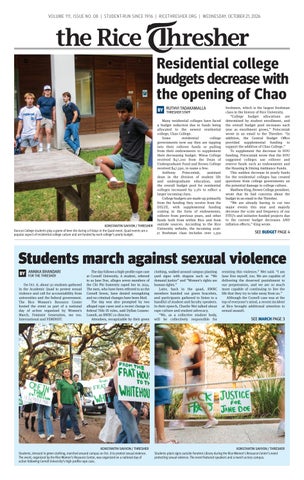
KONSTANTIN SAVVON / THRESHER Duncan College students play a game of beer die during a Fridays in the Quad event. Quad events are a popular aspect of residential college culture and are funded by each college’s yearly budget.
Many residential colleges have faced a budget reduction due to funds being allocated to the newest residential college, Chao College. Some residential college governments now say they are tapping into their rollover funds or pulling from their endowments to supplement their decreasing budget. Wiess College received $47,200 from the Dean of Undergraduate Fund and Brown College received $47,590, to name a few. Anthony Potoczniak, assistant dean in the division of student life and undergraduate education, said the overall budget pool for residential colleges increased by 2.5% to reflect a larger incoming class. College budgets are made up primarily from the funding they receive from the DSLUE, with supplemental funding coming in the form of endowments, rollover from previous years, and other funds both from within Rice and from outside sources. According to the Rice University website, the incoming 202627 freshman class includes over 1,350
freshmen, which is the largest freshman class in the history of Rice University. “College budget allocations are determined by student enrollment, and the overall budget pool increases each year as enrollment grows,” Potoczniak wrote in an email to the Thresher. “In addition, the Central Budget Office provided supplemental funding to support the addition of Chao College.” To supplement the decrease in DOU funding, Potoczniak wrote that the DOU suggested colleges use rollover and reserve funds such as endowments and the Housing & Dining Ambiance Funds. This sudden decrease in yearly funds for the residential colleges has created questions from college governments on the potential damage to college culture. Matthew King, Brown College president, wrote that he had concerns about the budget in an email to the Thresher. “We are already having to cut two major events this year and majorly decrease the scale and frequency of our FITQ’s and initiative funded projects due to the current budget decreases AND inflation e$ects,” King wrote.
SEE BUDGET PAGE 4
Students march against sexual violence ANNIKA BHANDARI
FOR THE THRESHER
On Oct. 8, about 50 students gathered in the Academic Quad to protest sexual violence and call for accountability from universities and the federal government. The Rice Women’s Resource Center hosted the event as part of a national day of action organized by Women’s March, Feminist Generation, me too. International and FEMINIST.
The day follows a high-profile rape case at Cornell University. A student, referred to as Jane Doe, alleges seven members of the Chi Phi fraternity raped her in 2024. The men, who have been referred to as the Cornell Seven, have denied wrongdoing and no criminal changes have been filed. The day was also prompted by two alleged rape cases and a recent change to federal Title IX rules, said Dyllan LozanoLomeli, an RWRC co-director. Attendees, recognizable by their green
KONSTANTIN SAVVON / THRESHER Students, dressed in green clothing, marched around campus on Oct. 8 to protest sexual violence. The event, organized by the Rice Women’s Resource Center, was organized on a national day of action following Cornell University’s high-profile rape case.
clothing, walked around campus planting yard signs with slogans such as “We demand justice” and “Women’s rights are human rights.” Later, back in the quad, RWRC members handed out green bracelets, and participants gathered to listen to a handful of student and faculty speakers. In their speech, Charlie Wei talked about rape culture and student advocacy. “We, as a collective student body, will be collectively responsible for
resisting this violence,” Wei said. “I am Jane Doe myself, too. We are capable of delivering the deserved punishment to our perpetrators, and we are so much more capable of continuing to live the life that they try to take away from us.” Although the Cornell case was at the top of everyone’s mind, a recent incident at Rice brought additional attention to sexual assault.
SEE MARCH PAGE 3
KONSTANTIN SAVVON / THRESHER Students plant signs outside Fondren Library during the Rice Women’s Resource Center’s event protesting sexual violence. The event featured speakers and a march across campus.
2 • WEDNESDAY, OCTOBER 21, 2026
THE RICE THRESHER
As we’re entering the final weeks of this election, I wanted y’all, the next generation of Texas leaders, to be able to hear from me directly. I grew up in Brownsville and went to UT Austin. What I found on campus was Texas itself. Panhandle kids and Houston kids, Valley kids and rural kids, people who had worked their way through school and people who had never worried about money. I learned just how big and complicated this state is, and how much promise it holds. I know you see it too whether you're at Texas A&M or Texas Tech or anything in between. You are about to inherit Texas, and each of you has some idea of the life you want to build here. Maybe you will start a company, teach in a classroom, work in public service, or do something you haven’t quite figured out yet. Whatever your piece of the American Dream looks like, Texas should be the place where you can make it happen. You are doing your part but Texas is not holding up its end. State government is working for insiders and billionaire donors while public schools are starved, costs keep rising, and ordinary Texans pay the Abbott corruption tax. Follow the money and you find the answer to almost every question about why things here are harder than they should be. I have spent my career fighting that. College students across Texas have real power in this election. You will help decide what Texas becomes and who it belongs to. Is this a Texas by and for the people, or is this the billionaires’ world and we just live here? I believe Texas belongs to all of us. That’s why I’m running for governor: to secure the American Dream by saving Texas schools and putting money in your pocket. It’s time for a change, and this election, we’re going to prove it. I’ll see you at the polls, Gina Hinojosa
Candidate for Governor ginafortexas.com PS. You can find your nearest polling place at IWillVote.com/Texas. Make a plan to vote early, October 19–30. Election Day is November 3.
POL. ADV. PAID BY GINA HINOJOSA CAMPAIGN
WEDNESDAY, OCTOBER 21, 2026 • 3
NEWS
Federal rule targets college degrees that fail to pay off JAMES ELLIS
FOR THE THRESHER A new federal rule plans to restrict student loan access for college programs whose graduates fail to earn more than workers with a high school education or less. The rule raises questions about how the government should measure the value of higher education.
People shouldn’t be forced not to study what they think is interesting because they can’t afford to do it without loans, and although they should definitely be aware of what they’re going into, it should ultimately be their decision. Lillian Alexander MCMURTRY COLLEGE JUNIOR
Finalized by the U.S. Department of Education in June, the Student Tuition and Transparency System and Earnings Accountability rule establishes an earnings-premium test for college programs. Unlike earlier accountability
FROM FRONT PAGE
RWRC MEETUP
Five days before the rally, a student reported an attempted sexual assault by an unknown man in an elevator at Wiess College. The Rice University Police Department detained a suspect early the next morning and booked him into the Harris County Joint Processing Center. “For every case that makes the news, there are countless that are held in silence,” said Lakshmi Aravindan, a Lovett College junior. Although Duncan College junior Emma Young said she initially attended the walkout because of her disgust and frustration over the Cornell case, she said she recognizes that sexual violence is not limited to one university. “It’s not happening in isolation and is happening everywhere,” Young said. “I’m here to support all of my friends, all the
frameworks, it covers certificate programs and all programs at for-profit colleges. Under the rule, undergraduate degree programs must show that three years after graduation their graduates earn at least as much as typical workers ages 25 to 34 whose highest education is a high school diploma. Graduate programs will face a benchmark based on workers with bachelor’s degrees, with calculations adjusted for state and field of study. Programs that fail this earnings test in two out of three consecutive years may lose eligibility for federal student loans and Pell Grants. Institutions whose programs may not clear this bar will be required to warn students and disclose earnings information. The Education Department argues that this policy protects students and taxpayers from programs that fail to deliver on financial returns. Many, however, question whether graduates’ salaries should be used to measure the value of fields such as humanities, education and the arts. Lillian Alexander, a McMurtry College junior majoring in anthropology, expressed her concern about how this would affect lower income students and humanities disciplines. “People shouldn’t be forced not to study what they think is interesting because they can’t afford to do it without loans, and although they should
definitely be aware of what they’re going into, it should ultimately be their decision,” Alexander said. “I worry that this is also another way to deprioritize the humanities, which are something we need now more than ever.” For Rice students, the policy is raising
women on campus and stand with Jane Doe.” A 2019 survey from the Association of American Universities of more than 180,000 students at 33 universities found that 13% had experienced nonconsensual sexual contact involving physical force or incapacitation since enrolling, including 25.9 percent of undergraduate women and 6.8 percent of undergraduate men. In the same survey, 22.6 percent of Rice undergraduate women and 5.2 percent of undergraduate men reported some type of nonconsensual sexual contact during their time at the university. “Sometimes we throw around the phrase ‘Culture of Care,’” Young said. “But it’s really important that in practice we’re making sure that Rice is an environment where students can focus on learning and building community and feeling safe.” The demands of the movement extended far beyond the Cornell case or
Rice University. Akshita Patil, a Lovett junior, read the national movement’s demands: justice for Jane Doe and Kendall Francis; accountability, transparency and repair for Jeffrey Epstein’s survivors, including passage of the Survivors’ Rights Restitution Act; restoration of Title IX enforcement powers; abolition of ICE; expansion and protection of women’s, queer and rape crisis resource centers at universities; and prevention of sexual violence before it happens, Patil said. “[Texas Attorney General and candidate for U.S. Senate Ken Paxton] let a known pedophile get off with only one day in jail,” said Lozano-Lomeli, a Jones College senior. “We need to get out there to vote politically, create community.” Claire Branigan, program adviser for Spanish and Portuguese, and Nadelyn Smith, associate director of case management at the SAFE Office, also spoke
broader questions about the relationship between education, career prospects and financial stability. Although Rice’s specific programs may not be under threat, the rule highlights the growing role of earnings data in federal higher education policy.
LAKSHMI ARAVINDAN / THRESHER
KONSTANTIN SAVVON / THRESHER An attendee speaks in Rice’s Academic Quad at the Rice Women’s Resource Center’s protest against sexual violence. Attendees later put signs throughout campus with calls to action.
to the participants following the march. “The most important thing a community can do right now is be together, said Branigan.
It’s not happening in isolation and is happening everywhere. I’m here to support all of my friends, all the women on campus and stand with Jane Doe. Emma Young DUNCAN COLLEGE JUNIOR
“Faculty are human beings too,” Branigan said. “We’re your allies as well.” Branigan invited students to take Rice’s gender and sexuality studies classes. She mentioned how gender and sexuality studies programs at other Texas universities, including the University of Texas at Austin and the University of Houston, are being eliminated. UT Austin stopped enrolling new students in its women and gender studies major this fall, and Texas A&M announced in January that it would end its women’s and gender studies programs. To prevent harm, students should step in early, Smith said. Allie Meachum, a Baker College junior, said it was obvious to her that administrators should take cases seriously. “Unfortunately, it falls on the students for us to call out when things aren’t being addressed,” Meachum said. “We need to call people out.” For Gracyn Reddick, she said her takeaway from the event was that small actions add up. “Big change is made of small changes,” said Reddick, a Baker sophomore. “I want everyone who has experienced sexual violence to feel that they are safe at Rice and that they will be supported by their peers because that is the bare minimum of what they deserve.”
4 • WEDNESDAY, OCTOBER 21, 2026
THE RICE THRESHER
Rice to launch FGLI program following $25 million donation CAMERON GUTIERREZ
THRESHER STAFF
Rice is planning to establish the Sallyport Fellows Program, an initiative supporting first generation and limited income students, announced earlier this year. The program is supported by a $25 million gi$ from university trustee James “Jim” Whitehurst ’89 and his wife, Lauren Whitehurst. Beginning with the incoming class of 2027, all students identified as first generation and/or limited income will automatically be enrolled in the program as fellows.
Right now, most of the FGLI resources feel hidden, like we have to dig for them. Dara Babalola DUNCAN COLLEGE SOPHOMORE
In the announcement, Shelah Crear, the associate dean leading the initiative, said the program will provide FGLI students with consistent support throughout their time at Rice. “Sallyport Fellows will enter Rice together, and while each student will chart an individual path, they will have a trusted adviser, a supportive community and the resources they need every step of the way to graduation,” Crear said. The program will provide “personalized advising, mentorship, career development, financial literacy education and community-building opportunities” to all FGLI students beginning in fall 2027. It will be housed in the former Lovett
College magister house. In a statement to the Thresher, Amy Dittmar, provost and executive vice president for academic affairs, explained the program’s approach to supporting FGLI students. “Sallyport Fellows support is proactive, rather than reactive, and personalized for each student,” Dittmar wrote. “It begins prematriculation by expanding programs such as Owl Access and continues through graduation with academic and career support.” Dittmar said the program will also allow Rice to track student outcomes, including academic progress, campus engagement, career preparation and postgraduation success. “The data will help us know when a student needs extra support before a problem becomes a crisis and will inform Rice’s future strategies based on what we know works,” Dittmar said. During their freshman and sophomore years, fellows will meet weekly with a dedicated professional adviser. According to the announcement, these meetings will focus on identifying academic, social and personal challenges early and connecting students with appropriate resources. Dara Babalola, a Duncan College sophomore, said she hopes the program will advertise more FGLI resources to Rice students. “Right now, most of the FGLI resources feel hidden, like we have to dig for them,” Babalola said. “I hope that the fellowship program will allow more students to take advantage of all that Rice has to offer, without having to necessarily go through a ton of trouble finding adequate resources.” As juniors and seniors, fellows will transition to group-based advising organized around shared academic and
career interests. The program will also collaborate with the Center for Career Development and Alumni Relations to provide networking events, alumni mentorship and professional development opportunities. The donation will expand the current Owl Access program, Rice’s three-day prematriculation program for students who are FGLI. Amir Sultan, a Chao College sophomore, said the program played a key role in helping him transition into the Rice community. “Owl Access made integrating to a rigorous university as a first generation, low income student extremely more comfortable than anticipated,” Sultan said. “The program truly gave me the best
matriculation experience possible, and I cannot recommend it enough to all FGLI students.” The announcement comes alongside Rice’s recent expansion of The Rice Investment, which will provide full-tuition grants to eligible incoming students from families earning between $100,000 and $200,000 annually beginning in fall 2027. Students from families earning less than $100,000 will receive grants covering tuition, mandatory fees, room and board. In addition to funding the Sallyport Fellows Program, $1 million of the Whitehursts’ donation will support the Gateway Project, an initiative to connect Rice’s campus with Rice Village and redevelop portions of the university’s western campus.
PETER YANG / THRESHER The former Lovett College magister hosue will become a central building for FGLI programming under the Sallyport Fellows Program. The program is supported by a $25 million donation.
FROM FRONT PAGE
BUDGET
King, a senior, said the decrease in residential college budgets has also coincided with an increase in college tuition. “The simple fact that the college budget has not been increasing with in%ation over the last four years means that Brown College has to scale back its events and culture every year as food, drinks, and items get more expensive.” King wrote. Ava Brazell, Jones College president, shared similar sentiments. “With the increasing cost of food and other items, I’m not sure Jones could sustain subsequent budget cuts if they’re the same amount,” wrote Brazell, a senior, in an email to the Thresher. Cathy Barr, Hanszen College president, said while Hanszen is in a good position financially with plenty of rollover, she believes the problem occurs for newer colleges that don’t have as strong of an alumni base or endowment funds. “I think Hanszen is in a very healthy position,” said Barr, a senior. “I think it kind of just highlights the disparity between older and newer colleges.” However, Barr said she believes the budget decreases are still a problem. “With populations rising probably across the board in coming years, then I think that budgets should also increase with that rising student population,” Barr said. Elijah White, Chao College president, shared the experience he’s had starting a residential college from the ground up. “As a new college, we don’t yet have an established alumni donor base, and we won’t see returns from our endowment during my time here,” White wrote in an email to the Thresher. The concern for new residential colleges who don’t have established funding sources is shared by Meara McCarthy, Duncan College President. “Duncan does not receive many donations/endowments since we are such a young college. Our alumni haven’t come
OWEN BUTTON / THRESHER Brown College students gather in the quad for a FITQ with an inflatable bounce house. Colleges use their budget, given to them based on their number of students, to host weekly FITQs. into their wealth in the same way as some of the other colleges,” wrote McCarthy, a senior, in an email to the Thresher. “If the budget continues to decrease, it is not sustainable for Duncan to continue pulling from our reserves because it will eventually become depleted. However, for the time being, we’re ready for any budget %uctuations.” The sharp increase in tuition over the past couple years does not re%ect an increase in college budgets, leading to concerns about how colleges are able to maintain college culture with the increasing freshman class sizes and with rising prices. Additionally, residential college government officials have concerns with the supplemental funding the DSLUE
recommended colleges rely on, especially for newer colleges with less alumni donations and endowments.
College budget allocations are determined by student enrollment, and the overall budget pool increases each year as enrollment grows. Anthony Potoczniak ASSISTANT DEAN IN THE DIVISION OF STUDENT LIFE AND UNDERGRADUATE EDUCATION
King summed up his email by emphasizing the impact these budget cuts have had not only on Brown, but on students across Rice as a whole. “Rice University has created a culture where students are continually asked to ‘be creative’ to make more with less,” King writes. “At the same time, restrictive admin crackdowns on party culture and spaces have diminished the very culture that made this university feel like a community rather than a place just to attend classes. And whenever these restrictions create new problems, students are told to ‘be creative,’ as though our ingenuity can indefinitely compensate for shrinking resources, fewer opportunities, and ever-narrowing boundaries.”
WEDNESDAY, OCTOBER 21, 2026 • 5
NEWS
RSA Senate reopens late-night study spaces, tables snack pantries and advances Chaus voucher program SHRIJAYA BOLLAVARAM
FOR THE THRESHER
The Rice Student Association Senate discussed an expansion to late-night study access, a proposed bike and scooter sharing program and upcoming campus events at its latest meeting. In addition, they approved a five-week Rice Coffeehouse voucher pilot and tabled the residential college snack pantry initiative.
At the end of the day, this initiative, while it may not be necessarily a food security initiative, it did start as that, and that was the original sentiment behind it. Rohan Dharia RSA EXTERNAL VICE PRESIDENT
The Late-Night Study Spaces initiative officially reopened Monday at the Ralph S. O’Connor Building for Engineering and Science and Janice and Robert McNair Hall. This year also added new a$er hours access to Kra$ Hall. The spaces are available through swipe access on weekdays and weekends, with hours and guidelines for space use posted on the Rice University Student Association Instagram. Students are encouraged to swipe in when using the spaces so the association can demonstrate student demand for extended hours. Students were also reminded to keep the spaces clean and use them for academic purposes. Rice Rides, a proposed bike and scooter sharing program, is also seeking student input on its potential implementation. Annie Yan, a co-founder of Rice Rides, said the group developed the proposal in response to transportation needs among students, particularly those without cars. “Especially in Houston, it’s very car centric,” said Yan, a Jones College junior. “It’s very hard to get around.” The group pitched its idea to Rice administrators over the summer and is now conducting a campus-wide survey to determine whether students prefer bikes or scooters and where docking stations should be located. The proposed service would cover Rice’s campus, Rice Village and common
off-campus residential complexes, such as Life Tower and the Nest. Yan said the initial plan would use docking stations so students cannot leave vehicles in undesignated locations. Rice Rides aims to collect 500 survey responses to gather student input on the program’s implementation. Yan said a third-party vendor would cover implementation and operating costs, meaning Rice would not bear the costs of establishing the service. The Senate also heard announcements about two upcoming campus events. On Nov. 3, Rice will host “Beyond Party Lines,” a bipartisan panel discussion featuring visiting former U.S. House representatives Vicky Hartzler, R-Mo. and Nick Lampson, D-Texas, who will discuss their experiences serving in Congress and the importance of political dialogue across disagreements. The representatives will discuss “how people can have disagreements and still work in collaboration with one another,” Free Speech Commission Chair Cece Yang said. The panel will take place at the Kelly International Conference Facility in James A. III Baker Hall from 5 to 6:30 p.m. There will be a student leader meetand-greet before the main event from 4:30 to 5 p.m. The Student Health Services Commission also announced an event featuring Dr. Theresa Tran, the head of the Houston Health Department, on Monday at 5 p.m. in Kra$ Hall. The event, organized in partnership with the Baker Institute Student Forum and Students at Rice Committed to Optimizing Medical, Exercise, and Rehabilitation Education, will discuss opportunities for students to get involved with the department. Jake Pessin, chair of the Student Health Services Commission and Chao College senator, said the event could help students learn more about opportunities to engage with the department. “I think it’s a really special opportunity to get involved with Houston Health in a pretty special way [with someone] who’s at the top of the ladder,” said Pessin, a sophomore. The Blanket Tax Committee provided an update on its review of applications for RSA’s semester initiative fund. The committee is reviewing proposed budgets and plans to provide further updates as applications are approved or denied. The committee is also holding
SARAH WANG / THRESHER Will Rice College President Raye Osayimwese-Sisson engages with the Senate discussion. College presidents and senators discussed new initiatives for student opportunities and tabled a previous snack pantry proposal. meetings, typically on Wednesdays or Thursdays, that are open to Blanket Tax fund applicants who wish to attend. Suri Yang, RSA treasurer, said the committee is seeking to fund as many organizations as possible while ensuring applications include sufficient budget information. The Senate also returned to the proposed residential college snack pantry initiative, which was discussed at previous meetings as a way to provide students with food outside regular dining hours. The discussion follows earlier concerns from senators about whether the snack pantries would be the most effective use of RSA funding to address food insecurity, including questions about whether additional resources could instead support the Student Success Initiatives food pantry. RSA External Vice President Rohan Dharia said they are contacting Housing, Dining & Hospitality to determine whether funding initially associated with the initiative could instead support another food insecurity effort. “At the end of the day, this initiative, while it may not be necessarily a food security initiative, it did start as that, and that was the original sentiment behind it,“ said Dharia, a McMurtry College junior. The Senate voted to table the proposal pending a response from H&D.
Finally, RSA passed the proposed $5 Chaus voucher program intended to increase student engagement with RSA communications. The five-week pilot program will begin next week, with students receiving vouchers through quizzes based on RSA-related content sent in senator emails. The bill was discussed at the previous Senate meeting before returning with amendments, including a provision preventing RSA-appointed or elected officials from receiving vouchers. The program’s funding will be requested through the Blanket Tax Committee’s initiative fund, with marketing and discretionary funds potentially covering any shortfall. Brown College Senator Neya Gupta, who presented amendments to the bill, said the pilot will give RSA an opportunity to test a new approach to student engagement. “I’m feeling really excited and hopeful that this will help with student engagement across campus,” said Gupta, a sophomore. Gupta said the association will use the pilot period to assess the program’s effectiveness before deciding whether to renew it. “If student engagement has been on the rise, then we’re going to consider continuing it for next semester,” Gupta said.
Rice’s $120 million Gateway Project construction underway LINA KANG
ASST. NEWS EDITOR Construction on Rice University’s $120 million Gateway Project began in August with the Patricia Lipoma Kraft ’87 and Jonathan A. Kraft Football Pavilion, the first major construction milestone in a project that will renovate Rice Stadium and create a pedestrian connection between campus and Rice Village. The pavilion is expected to open in spring 2027, around spring break, according to an email to the Thresher from Eric George, interim athletic director. The broader Gateway Project is scheduled to continue through 2028. “The entire Gateway Project will be incredibly significant to the long-term success of Rice Athletics,” George wrote. “It will provide a state of the art facility that will help with recruiting.” Kelly Fox, executive vice president for operations, finance and support, wrote in an email to the Thresher that other components of the Gateway Project remain in the planning phase. Fox said the university is moving forward with the project as planned and expressed appreciation for donors
supporting the effort. The Gateway Project is being funded through university resources and philanthropy, according to Fox. Part of the Gateway Project will be to renovate Rice Stadium, with plans for expanded premium options, improved seating and more modern amenities. “The renovated stadium will also create additional revenue generating opportunities with premium sales at Rice events but also concerts, international soccer matches and other outside events,” George wrote. George said Rice Athletics discussed moving the student section to the west side of the stadium with the Rice Student Association during the 2024-25 academic year in anticipation of the renovation. “The students will have a premier spot in the new stadium,” George said. The construction will also affect Beer Bike preparations. The university anticipated that Hackerman Field would be unavailable for Beer Bike practice for a limited period from October 19 November 6. Administration officials said they are working with student groups to identify alternative practice locations during that period.
As someone who frequently treks to Rice Village, I feel that the Greenbriar lot and the surrounding area don’t reflect the rest of the Rice campus, so I’m excited to see it come to fruition. Elijah White CHAO COLLEGE PRESIDENT
The Beer Bike 2027 races will remain at their current location at Hackerman Field, near Rice Stadium, while planning continues for a proposed alternative event location at Harris Bayou Recreation Field. Chao college president Elijah White wrote in an email to the Thresher that the RSA and admin has been diligently communicating with the bike teams and RPC to make sure that the bike teams have ample time to practice on the track. “Although there haven’t been any
clear updates on the Gateway Project as a whole, I think it has tremendous potential to positively impact future generations of Rice students,” White wrote. “As someone who frequently treks to Rice Village, I feel that the Greenbriar lot and the surrounding area don’t reflect the rest of the Rice campus, so I’m excited to see it come to fruition.” The Gateway Project includes plans to create a pedestrian walkway connecting Rice’s campus to Rice Village. George wrote the project will strengthen the connection between Rice Stadium and the surrounding community. “Fans and community members will be able to spend the day tailgating, shopping, and eating before heading over to the stadium to watch the game,” George wrote. Rice President Reggie DesRoches wrote in an email to the Thresher that the project reflects the university’s broader plans for campus growth. “As we grow across our student, faculty and staff community, it is just as important that we expand the spaces and infrastructure that support their success and advance the campus experience,” DesRoches wrote.
WEDNESDAY, OCTOBER 21, 2026 • 6
THE RICE THRESHER
EDITORIAL
Your voice doesn’t end at the ballot box this midterm season On Oct. 8, a group of Rice students flooded the Academic Quad, demanding justice for sexual assault survivors in solidarity with Cornell University’s Jane Doe. It’s been ages since Rice rallied a crowd this large. Moreover, the protests in France have shown us the impact (whether positive or negative) that students can make on society — and we must not forget that these actions, no matter the size, come with significant responsibility. Yet unfortunately, Rice students are largely disinclined to express unpopular opinions and protest on campus. Protests like the one on Oct. 8, which included around 50 students, are rare and seldom draw significant attendance.
Students must navigate an onerous demonstration policy in order to gain the right to protest. More than that, the values of protest and free speech are not deeply woven into Rice’s culture. A survey from the Rice Student Association last year found that only 31.5% of students felt free to express diverse viewpoints and engage in respectful, vigorous debate. Evidently, students fear social reprisal from disagreement, and Rice has fallen short of fostering diverse speech. Earlier this semester, the Foundation for Individual Rights and Expression gave Rice an “F” free speech grade, signaling that students are not readily able to speak their minds. This grade, coupled with an “F” score in “Administrative Support,”
means that students face institutional barriers to expressing their beliefs. As the midterm elections near, we stress the importance of civic engagement and debate. Rice comprises over 9,000 students — and we have power. In order to wield this power, we must vote, and we must engage in society in productive and meaningful ways. We have the ability to make real change, but only if we decide to do so. Early voting in Texas began Monday and will conclude on Oct. 30, and Election Day is Nov. 3. The nearest early voting location is south of the Medical Center at 2727 El Camino St. 77054. The Rice University Welcome Center will be open as a voting location on Nov. 3 from 7 a.m. to 7 p.m. We
encourage all eligible students to exercise their civic duty and right and go vote. Yet our duty to civic engagement does not start nor end at the ballot box. We must be willing to share our opinions on contentious topics and protest when it is necessary. We must be the change we want to see. Voting is the first step to cultivating a culture of social consciousness that our campus so desperately needs. Editor’s Note: Thresher editorials are collectively written by the members of the Thresher’s editorial board. Current members include James Cancelarich, Evie Vu, Abigail Chiu, Hongtao Hu, Andrew Rynsburger, Chi Pham, Andersen Pickard and Patrick Shukis.
KEEPING IT HEALTHY
Maintaining strength might require less time than we think JAKE PESSIN
COLUMNIST
An hour at the gym might look perfectly reasonable at first glance. But then a problem set takes longer than expected, a quick catch-up with a friend interrupts the walk across campus and a meeting drags on. Suddenly, an hour shrinks to 20 minutes, and a full workout seems all but impossible to complete. Exercise is often perceived as a long and drawn-out process, but the amount of training required to hang on to the progress that you already made is likely smaller than you expect. In a 2021 review published in the Journal of Strength and Conditioning Research, researchers found that young people could maintain muscle strength and size for up to eight months with just
one strength training session per week and one set per exercise, as long as they maintained the weight they were lifting. Researchers call this the minimum effective dose. This does not mean you can grab the lightest pair of dumbbells you see, do one set of curls and call it a day. It’s necessary to keep the weight challenging. However, this research shows that it’s possible to reduce the frequency of training substantially and still maintain your strength. In practice, if you normally perform three sets of 10 repetitions on a chest press, you could keep one challenging set at your usual level of resistance or weight, then skip the last two. If you can only manage one gym session a week, a shortened routine can include one working set (at a challenging weight) for
In a 2021 review published in the Journal of Strength and Conditioning Research, researchers found that young people could maintain muscle strength and size for up to eight months with just one strength training session per week and one set per exercise, as long as they maintained the weight they were lifting.
each of your large muscle groups, such as chest press, back rows, leg press or leg extension. While this routine may be effective for maintaining strength when free time is scarce, it’s worth it to optimize training for your long-term goals. A 2023 analysis in the British Journal of Sports Medicine found that lifting heavier loads provides the largest gains in strength, while increasing set volume is generally best to support muscle growth. It’s important to remember that these small bouts of exercise, often referred to as “exercise snacks,” are simply strategies to maintain muscle and strength; they are not an effective longterm approach to improving your health. But during a stretch of midterms or final exams, holding onto progress can be a reasonable goal.
Jake Pessin is a Chao College sophomore studying sports medicine and exercise physiology. He serves as the chair of the Rice Student Association’s Student Health Services Commission and is passionate about making health and nutrition science practical, accessible and useful for all.
THE STATE OF THE HUMANITIES
Bring humanities students the academics they deserve MAX SCHOLL
COLUMNIST
Though Rice is often cast as a STEM school, our excellence is not just relegated to the north side of campus. Our School of Humanities and Arts is populated with some of the most significant figures in contemporary scholarship. Despite this excellence, I’ve rarely seen undergraduates held to that same standard. My past four years taking humanities courses have seen widely divergent class environments. Just as I’ve seen professors struggle to engage students in discussion, I’ve seen syllabuses with meager amounts of reading. I’ve heard students say they don’t feel challenged by their classes and faculty complain about simplifying lessons based on lackluster student performance. Yet, my experience at Rice has shown me that the problem isn’t that the students are lazy. Instead, they aren’t
being challenged enough. I’ve found that the best class environments were ones where professors held us to a standard slightly higher than what we thought we were capable of. It has always been the courses that pushed us to read dizzying amounts or engage with difficult rhetoricals that were the most rewarding and enjoyable for all of us. But raising the bar doesn’t just mean increasing course difficulty. Across the School of Humanities and Arts, many of the research-based seminars and fellowships allow completely open inquiry, where we research nearly any topic we want. While this openness can be beneficial, I’ve also seen it manifest as a lack of guidance, making the bare minimum levels of effort entirely acceptable. I’ve also seen research preparedness vary widely based on who taught a student’s required methodology courses. This leaves students without
a solid understanding of research methods when they actually come to conduct research. How are we to benefit from conducting upper-level research if a sufficient standard isn’t emphasized, and if we lack the training necessary for doing so? Contributing to this is the lack of more theory-oriented course offerings. There is no reason to believe that Rice students aren’t capable of handling difficult theoretical topics. Talking with friends studying the humanities at peer institutions, I’ve learned that their most rewarding courses were on the same theoretical topics that Rice professors told me are too difficult to teach here. Students at other schools have told me that they have learned significantly from the rigor and structure of their programs; meanwhile, at Rice, the bulk of my learning has occurred outside of the classroom. I’ve encountered many students wishing for the same thing:
courses on rigorous topics they had to pursue in their spare time, feeling like their program of study wasn’t operating to its full potential. Yet, this problem is uniquely complicated and cannot be attributed to just one factor. Among students, I’ve noticed an incentive to stack up on credit hours while avoiding readingheavy courses. At the same time, the recent implementation of the Budget Transformation Initiative has put pressure on professors and departments to raise class sizes, making them hesitant to teach courses that may appear too specific or inaccessible to a larger audience. Ultimately, while raising the bar for the humanities may make courses and areas of study more intimidating in the moment, it will ultimately improve Rice’s quality of education in the long run. Rice humanities need to operate at a level of excellence that its students deserve.
Max Scholl is a Lovett College senior majoring in English and anthropology. He is co-president of the Rice Critical Humanities Collective and was a member of the National Humanities Leadership Council. In his free time, he likes to read, watch movies and write satire for the Thresher’s Backpage.
WEDNESDAY, OCTOBER 21, 2026 • 7
OPINIONS AN URBANIST GUIDE TO HOUSTON
It’s time to learn from our mistakes in Rice Village JACOB JORDAN & NICOLAS COOKER
EDITORIAL STAFF * Indicates Editorial Board member James Cancelarich* Editor-in-Chief Evie Vu* Managing Editor
COLUMNISTS
On Oct. 9, a woman in her 20s was struck and killed in broad daylight while crossing University Boulevard at Kelvin Drive in Rice Village. She was crossing on a marked crosswalk with no pedestrian signal, and the driver was stopped at a stop sign in front of her before turning left into her path. This was no accident. This crash, like most pedestrian crashes, was the result of critical urban design failures. Rice Village has long been a car-first space. Wide, sprawling thoroughfares invite cars to barrel down at high speeds, with center turning lanes that create the perfect opportunity for headon collisions. Pedestrians are relegated to narrow, obstructed sidewalks that force them to dodge cars trying to park. The long traffic light cycles make crossing streets incredibly difficult. Additionally, the area has so much parking that, though it may not seem like it, there are thousands of unused spots even at peak hours, introducing unnecessary conflict points for pedestrians and making it feel less like a village and more like a strip mall.
This was no accident. This crash, like most pedestrian crashes, was the result of critical urban design failures. Rice has repeatedly failed to take measures to improve pedestrian safety in Rice Village. In 2018, Rice commissioned a plan for a pedestrianoriented redesign of Amherst Street’s garage underpass that was never implemented. This was followed by a comprehensive plan for Rice Village in 2023, which would have created a pedestrian plaza on Amherst Street between Morningside Drive and Greenbriar Drive. In newer renderings, this plan has been replaced by a tree-lined, mixeduse corridor. It’s not clear what, if anything, will eventually be built. Houston Public Works currently has a substantial redesign planned for University Boulevard between Kirby Drive and Greenbriar Drive that’s slated for completion by winter 2029. This would include higher visibility
NEWS Abigail Chiu* Editor Toby Chou Asst. Editor Ruby Gao Asst. Editor Lina Kang Asst. Editor OPINION Andrew Rynsburger* Editor FEATURES Amelia Davis Editor London Frey Crossword Editor ARTS & ENTERTAINMENT Chi Pham* Editor Cora Wareh Asst. Editor SPORTS Andersen Pickard* Editor Patrick Shukis* Editor Keya Patel Asst. Editor
KAIRI MANO / THRESHER The intersection at Kelvin Drive and University Boulevard where a woman was struck by a vehicle and killed. crosswalks, a rectangular rapid flashing beacon at Kelvin Drive, sidewalk improvements on the south side and a designated southbound right-turn lane on Kelvin. The Rice Village Management District has requested or funded custom street signs, black powdered poles, wider sidewalks and trees on the north side. This redesign is a mixed bag. While crosswalk visibility and rapid flashing beacons can be useful, they both rely on driver compliance and place the burden on pedestrians. Neither fixes the real causes of the danger: overly wide lanes, long crossing distances and high default speed limits. Fixing these will require bolder solutions like raised crosswalks, median refuge islands or a road diet. Any one of these solutions could have prevented the crash that occurred this month. Rice bears significant responsibility in making sure this doesn’t happen again. The Rice Real Estate Company led the effort to create the Rice Village Management District, and all members of the district’s Board of Directors are affiliated with Rice. The Management District’s role in the University Boulevard redesign revealed that Rice has the capacity to directly request and fund infrastructure improvements in Rice Village. Beyond that, as Rice invests millions in a pedestrian walkway to
Rice Village as part of the Gateway Project, it’s important to think about what it actually connects to. While this walkway is a great idea and long overdue, its impact will be in vain if it simply leads pedestrians into this cardominated space. Following the widely adopted Vision Zero approach to traffic safety, this crash was not an accident but rather a preventable death resulting from dangerous design, and we have the tools to prevent similar deaths in the future. Faster traffic speeds, more parking and wider lanes aren’t a fair trade for human lives, yet we continue to make this trade across the country, day after day.
In the context of Rice Village, there’s no excuse. Rice has the power and opportunity to make safety improvements with the Gateway Project. In the context of Rice Village, there’s no excuse. Rice has the power and opportunity to make safety improvements with the Gateway Project. We hope that Rice takes this tragedy as a wake-up call to finally put humans above cars in Rice Village.
Jacob Jordan is a senior from Baker College studying civil and environmental engineering with a minor in environmental studies. Nicolas Cooker is a junior from Martel College studying computer science with a minor in environmental studies. They believe that every Rice student should be well-informed about their built environment and have the knowledge necessary to advocate for their interests in and beyond Houston.
Last Week’s Online Poll Results Where do you usually get your coffee on campus? Total number of responses: 432
Audrey’s
6%
Dandelion Cafe Rice Coffeehouse
76%
5%
SPECIAL INVESTIGATIONS Hongtao Hu* Editor BACKPAGE Max Scholl Editor Will Howley Editor Rykelle Sandidge Editor Kyle Chen Senior Writer Caleb Song Senior Writer COPY Shruti Patankar Editor Julianne Ma Editor PHOTO, VIDEO, & WEB Konstantin Savvon Photo Editor Sarah Bradley Asst. Photo Editor Andrew Gingerich Video Editor Rachel Jeong Asst. Video Editor Megan Zhang Web Editor Fiona Sik Web Editor Varshini Loganathan Web Editor DESIGN Jessica Xu Art & Design Director Magnolia Hickey-Zamora News Sydney Chang Opinion Lisa Wang Features Alexa Bu Arts & Entertainment Kirstie Qian Sports Brandon Nguyen Backpage Richard Li Design Consultant BUSINESS Sivani Vasireddy Manager Alina Zhong Advertisement Rahul Santhanam Advertisement Makeen Shafer Distribution Manager Ary Rodas Social Media Manager
ABOUT The Rice Thresher, the official student newspaper of Rice University since 1916, is published each Wednesday during the school year, except during examination periods and holidays, by the students of Rice University. Letters to the Editor must be received by 5 p.m. on the Friday prior to publication and must be signed, including college and year if the writer is a Rice student. The Thresher reserves the right to edit letters for content and length and to place letters on its website. Editorial and business offices are located on the second floor of the Ley Student Center: 6100 Main St., MS-524 Houston, TX 77005-1892 Phone: (713) 348 - 4801 Email: thresher@rice.edu Website: www.ricethresher.org The Thresher is a member of the ACP, TIPA and CMA. © Copyright 2026
Local Foods
13%
ricethresher.org Follow @ricethresher on Instagram to answer weekly polls.
8 • WEDNESDAY, OCTOBER 21, 2026
THE RICE THRESHER
To proctor or not to proctor, that is the question
AMY MIAO / THRESHER
SOPHIE GARLICK
ASST. FEATURES EDITOR Rice students have long been trusted to keep an eye on their own exams. Now, someone else is keeping an eye on them, too. This semester, 20 courses are participating in a pilot proctoring program in which instructors and teaching assistants monitor classrooms during exams. Under Rice’s traditional system, students are expected to report potential violations while taking their own timed exams. According to the Honor Council, it is distracting to ask that students divide their attention between their own work and monitoring their classmates, and results in many honor cases relying on one student’s testimony against another’s. “Most accusations are submitted by faculty,” said Felix Wang, Honor Council judicial chair. “It is faculty reports of suspected cheating on in-person exams that have increased … but we have not seen a corresponding increase in student reports through confidential accusations.” Wang, a Duncan College senior, said a survey conducted by the Honor Council last spring revealed that students were largely neutral about both the introduction of proctoring and their comfort with reporting classmates for Honor Code violations. The latter was particularly concerning to the council, Wang said, because Rice’s unproctored examination system relies heavily on students reporting their peers. “The amount of students that reported on one another has dropped significantly. Two years ago, we had nine students report other students. Last year it was only four and then this year we’ve only had two,” Wang said. Despite these concerns, Honor Council members maintain that introducing proctoring does not necessarily mean abandoning Rice’s tradition of trust. Instead, they see the pilot as an effort to preserve the Honor Code by addressing weaknesses in how it is enforced. “Trust is not a relic we inherited in 1912,” wrote Honor Council member Da’Taeveyon
Daniels in a message to the Thresher. “It is a practice we renew every semester. This pilot is one more way of practicing it, and we intend to follow the evidence wherever it leads.” For students, however, the experience of being monitored has varied. Dorian Mor, a Will Rice College sophomore, said proctoring has at least one practical advantage. “Proctoring allows for a bit more organization to happen,” Mor said. “As far as I know, professors have to tell you what’s being tested and what has to happen.”
I don’t like it because I think it establishes a system of distrust between the students and the teachers. Neya Gupta BROWN COLLEGE SOPHOMORE
For Neya Gupta, a Brown College sophomore, however, the program has already changed how she behaves during exams in SOSC 302. She said it makes her more conscious of movements that could potentially be interpreted as suspicious. “I don’t like it because I think it establishes a system of distrust already between the students and the teachers,” Gupta said. “If people really want to cheat, they’re still going to cheat. But I just think that it creates a really bad system of distrust, and it’s not built on the whole principle that Rice stands on.” Gupta said she worries even ordinary movements will be interpreted as suspicious. “I have to make sure that I am only looking down at my paper,” Gupta said. “I have to make sure I don’t even just look around. And I can’t do anything. I can’t fidget, and I fidget a lot during my exams.” She also questioned whether the pilot works equally well across disciplines. According to Gupta, SOSC 302 previously
used a 24-hour take-home exam covering both coding and statistics, but has since moved to a shorter, in-class assessment focused solely on statistics. While Gupta described the new format as more restrictive, some faculty members have found that proctoring allows them to incorporate assessments that might otherwise raise academic integrity concerns. Lucas Garcia Camargo, CHBE 302 professor, said the ability to use computers, as opposed to unproctored exams that required writing on pen and paper, can be especially beneficial in his class. “Doing it on the software was really reassuring for the students,” Camargo said. “Essentially you run the code, you press play, it runs, and it tells you it’s correct.” However, while Camargo noted that from his experience within the chemical engineering department there has been substantial faculty and student buyin, the professor also sympathized with concerns about the way the pilot is currently implemented. “I can understand how some professors would feel like you’re walking on landmines, not eggshells,” Camargo said. “It reads extremely serious and extremely intense. And it’s very like, you’re not supposed to do this. You’re supposed to do that. And it reads very prescriptive.” Having previously studied in Brazil, where proctoring was a regular and largely commonplace practice, Camargo questioned whether the Honor Council’s more regimented approach places unnecessary restrictions on instructors who are already familiar with monitoring exams. The program’s current implementation has also raised questions about how proctoring applies to students receiving testing accommodations, whose exams are not currently included in the pilot. Camargo said some faculty members have expressed concerns about the growing number of students receiving accommodations, as well as the process through which they are approved. “Our cohort is increasing. We had a class with one person and then we had a class with three and now we have a
class with eight and [the departmental thought was] is it just becoming popular because people know that anyone can get [accommodations] ... so there’s a distrust in the vetting process and some older faculty are concerned,” Camargo said. James DeNicco, ECON 100 professor, expressed similar concerns about the Honor Council’s involvement in the classroom. While he found proctoring useful, he questioned whether faculty needed such extensive guidance on how to administer their exams. “I don’t think it’s really necessary for the Honor Council,” DeNicco said. “We know how to proctor. Like, I had to take a course on proctoring. I’m not sure that they need to be as involved with how faculty members proctor, though. I think that almost gets to the point where it steps over the line into trying to tell us how to run our classroom.” As the pilot continues, the Honor Council is gathering feedback from participating students and faculty to determine whether the program should continue and what adjustments might be necessary. Surveys distributed at the beginning and end of the semester will allow the council to compare participants’ expectations with their actual experiences, Wang said. The program’s success will depend largely on whether students and faculty report overwhelmingly negative experiences. If students report significant discomfort or anxiety, Wang said the council may revise proctoring procedures. “We’d have to do some major revisions to how we allow proctors to move around the room,” Wang said. “Maybe we tell them, okay, don’t walk around the aisles, just stay in one position or something like that.” The council would then present its evaluation and proposed changes to the administration, which would ultimately decide whether the pilot continues. Despite the concerns surrounding the program, Wang said Honor Council members remain committed to Rice’s traditional Honor System. “We are very fervent believers of the ideal set up by the honor system,” Wang said.
WEDNESDAY, OCTOBER 21, 2026 • 9
FEATURES
A Bunch of Minis 1
2
13
10
1
2
3
5
19
26
27
31
38 44
46 53
34
28 37
41
41 47
46 53
53
42
43
48
49
54
55 59
63
64
65 68
70
71 38
37
46 85
53
74
38 41
75
80
81
86
46 87
91
53
76
96 62 65
97
77
82
83
88
89
92
95
ACROSS
25
31
38
52
41
12
21
32
46
12 15
30 28
40
9
20
67
79
103
8
38
73
100
7
14
36
65 36
94
7
58
69
90
64
32
62
78
8
25
33
41
66
72
7
29
62
84
61
31
61
39
12
19
57
35
43
25
51
64
12 13
37
50
61
24
45
60
6
18
39
56
5
24
36
39
4
28
35
35
7
23
32
29
8
12 17
22
43
7
11
16
26
6
LONDON FREY
CROSSWORD EDITOR
93 98
101
102 104
56 Flightless bird native to Australia 57 Just do it, for one 1 Track and field unit 58 Delta or United 4 Yellow car 59 Genetic code 7 Umami flavoring, for short 60 Scraping the frosting off of a cupcake? 10 He’s got the golden touch 62 Insect that builds mounds that can reach over 30 feet tall 12 Show of indifference or uncertainty 64 Friends for life 14 In life, some open when others close 66 Poetry events 16 North star, officially 67 Blubbery animals or Navy members 18 Short-lived meal plan 68 Standardizes a scale 20 Order 69 Poetic “before” 22 Pigpen 70 Mr.s after a Ph.D. 23 The Devil’s interval 71 Used to be 24 Insect that can get really heated? 72 Uni. in Dallas 25 The “p” in mph or fps 74 An isomer whose branching groups are located on the same 26 Members of the Youth International Party that sound side, or an individual whose gender identity matches their like excited cheers birth sex 28 Wine-producing region of Italy (near the shin of the 76 Results of convergent plate boundaries, abbr. boot) 78 Shorthand for those who do shorthand in court 30 Shows how to do long division 80 District 12 locale 32 Unit of capacitance 82 String instrument 33 Gives to a customer 84 Those mathematically designed to win at games? 34 Slow animal 86 Where you can find 84-Across 35 Spanish contraction 88 Discoverer of two shapes that can infinitely fill a plane while 36 Govt. document that outlines goals never repeating any patterns 37 Projectile’s trajectory 90 Genre that includes house and techno 38 Aisling ___ (Irish comedian who competed on 91 To log into one, you’ll need a password Taskmaster) 92 Insane 40 Chewing the ___ (idiom that references food digested 93 Library directive by cows) 94 Historic Japanese warriors 42 Plead excessively 96 Like some happy birthday wishes 44 Material that sometimes swaps clothes’ first letter 98 Outdoor seating spaces with “J” 100 Outdoor seating spaces for birds? 46 What’s inside apples and the Earth 101 They should be at the start of your story, not the end 48 Buffoon 102 Wizards 50 Metaphor for overwhelming choice in “The Bell Jar” 103 Sports cry from fans 52 Advantage, in some video games 104 Seis dividido entre tres 54 French greeting 105 Cup cap
105
DOWN
1 Lake coverage? 2 Org. that 9 out of 10 dentists might be a part of? 3 Exam credit that non-studiers hope for 4 Blue and brie 5 What is sometimes dropped in STEAM 6 Word that forms a legitimate sentence when repeated eight times 7 State whose nicknames are The Treasure State and Big Sky Country 8 Imposter dirt 9 Like some novels 10 Repeating pattern 11 Fathered 12 Cause of some seasonal sniffling 13 Workout rewards 14 Great _____ (large dogs of a particular breed) 15 Iron + Carbon 16 “Gangnam Style” musician 17 Aunt, to Dad, prehaps 18 . 19 Laundry after sitting on a clothesline 20 What welcomes you into some homes? 21 Ambulance riders’ destinations, stat 27 Gift of time? 29 It’s needed at the end of many relationships 31 Optometrist and car salesman 38 Charm 39 What many reality TV contestants are looking for, aside from the cash prize 40 Retracted in fear 41 Moves a conversation off-topic 42 Operating room cutting tool 43 Found in some parties parting bags 44 Smallest coins 45 Intends (with “to”) 46 Found in the back of your eye, with rods
47 48 49 50 51 52 53 54 55 61 63 65 72 73 74 75 76 77 78 79 80 81 82 83 84 85 86 87 88 89 95 97 99
Hearts and Diamonds Painter known for painting many of 1-Down Cards arranged in columns of 4, 1, and 4 Served 51-Down to someone Yolky breakfast food Anxious feeling in your stomach Before, as a prefix Accessory worn by babies at the dinner table Some professors who live on-campus, briefly Ingredient in flan and some apple pies Drink that some prefer shaken, not stirred Someone who works against the faithfuls in a particular reality TV show Stutter Dig up Made a move in chess, perhaps Legislative bodies that might meet in Fondy’s Kyle Morrow Room, or in the U.S. Capitol building? Sought-after ore Splashed around Typical car design that seats five Black and white ocean predators Group of judges, or specialists He parted the Red Sea in the Bible Toxin Cigarette remnants ___ Moines, Iowa ___ Fi; book and movie genre Lion newborn The eighth residential college, colloquially Domino divot Expressions of mediocrity Land of the free (*eagle sound effect*) “Much ___ About Nothing” Some movies’ quick special effects
10 • WEDNESDAY, OCTOBER 21, 2026
THE RICE THRESHER
After AI, why do math? ANDREW MA
FOR THE THRESHER “It’s a little bit cheating, right?” said Nets Katz, a math professor at Rice. Katz was talking about OpenAI’s Sept. 8th announcement that their unreleased artificial intelligence model had solved a Millennium Prize Problem. In 2000, the Clay Mathematics Institute picked seven famously hard math problems and offered $1 million for the solution to each. Before this fall, only one had been solved. OpenAI’s problem is about the NavierStokes equations, which describe how $uids like air and water move. The open question was whether the equations would ever break down and falsely predict a $uid moving at infinite velocity. Mathematicians call this possibility a “blow-up.” OpenAI found a blow-up. A swarm of about 10,000 AI agents worked for 88 hours, on an estimated $15 million of computing power, and produced a proof. Over a month later, the proof still seems to hold. The catch is that OpenAI’s $uid doesn’t blow up on its own. The proof crafted a specific set of outside forces that caused the $uid to blow up, which is allowed by the Clay Institute’s official rules. But for many mathematicians, the question that really matters is whether a $uid left alone, with nothing pushing on it, can blow up. That version remains unsolved. That’s why Katz considers OpenAI’s result an easier version of the problem. Katz, ’90, graduated from Rice at just 17 years old and returned in 2023 as Rice’s W.L. Moody Professor of Mathematics. In 2015, Katz won the Clay Research Award for solving a problem Paul Erdős posed in 1946, which cemented his status as a legendary mathematician. He has worked on NavierStokes himself, and doesn’t believe that OpenAI’s solution contributed much to the field of math. As he sees it, AI tends to borrow what already exists and finishes problems that were right on the cusp of being solved. “What I’m feeling about Navier-Stokes is a lot of sadness,” Katz said. “There should be something very colorful about [a potential solution] because of the geometry that creates it.” Down the hall, David Urbanik, who joined Rice this fall as an assistant professor in math, took the news differently. He said people have been predicting a Navier-Stokes solution for
about 10 years, with or without AI. “That’s not to diminish the achievement, because it’s extremely difficult and extremely impressive,” Urbanik said. What changed for him was his sense of AI’s progress. “It did give me the impression that, okay, things are happening faster than I thought,” Urbanik said. The month that followed has seen intense conversations among mathematicians that discuss stakes far beyond the NavierStokes equations. On Sept. 11, 25 awardees of the Fields Medal, math’s most prestigious honor, posted a declaration calling AI companies’ goals “severely misaligned” with mathematics. “[Navier-Stokes] kind of triggered a bit of an identity crisis in the math community,” Urbanik said. Namely, if a machine can solve one of the hardest problems in the subject, what’s the point of math research? “The reason I found math fun, the reason I went into math … it was a way I could just be myself and not care what anyone else was doing, and be able to have an impact,” Katz said. “And if that’s not possible anymore, I’m kind of sad about that.” Many mathematicians recommend working on problems just beyond one’s reach. Katz disagrees. “To hell with that,” Katz said. “People should think about really hard open problems where no existing idea can possibly touch them. I don’t want to be … just incrementally pushing the ball forward. I want to be doing something new.” For Urbanik, math is much less about solving famous problems and more about the architecture that mathematicians build in the process. “[Famous problems are] kind of good marketing, because people like famous problems,” Urbanik said. “I work in Hodge theory. I don’t think I’ve ever thought about trying to solve the Hodge conjecture.” Urbanik believes that the value of math lies in creating concepts and language that lay the foundation for future scientific progress. As an example, he brings up Einstein’s theory of general relativity, which required a way of calculating higher dimensional spaces. Einstein got it from Bernhard Riemann, who had worked out the geometry of curved space decades earlier with no physics in mind. So far, Urbanik doesn’t think AI is capable
SKYLAR WANG / THRESHER of the same innovation. “My general impression is that these AI systems are extremely good at working with the framework and the language that mathematicians have already developed, but not necessarily at creating a sort of new linguistic infrastructure,” Urbanik said. The rigorous framework that mathematicians have developed, Urbanik said, is the reason AI has advanced so quickly in math. He takes that as a compliment. AI companies train their models partly through reinforcement learning, which rewards a system for getting answers right, and math offers unusually clear right answers. Katz seemed more disappointed at how AI has been developed. “The thing that kind of really hurts about the whole AI moment is that AI is kind of developed by being all of us at once,” Katz said. “So it just reads everything that was ever written, and it composes together everything that was ever written, and it takes away all the things that seem like they’re kind of fun.” Katz said his own career is not what concerns him. “I’ve had what I need to have, but for people who are going into the field, the next generation, it may be kind of rough,” he said. One member of that generation is not worried. Alex Zhang, a Jones College freshman who plans to major in math, said the belief that AI will keep improving exponentially is just OpenAI salesperson propaganda. “It’s just pattern recognition … there’s no organic intellectual thought behind it,” Zhang said. “It’s just able to imitate stuff super well.” Zhang said AI’s sheer computing power could threaten some jobs. But pushing math beyond what people already know, he said, is something only human intelligence can do. “It’s quality over quantity,” he said, comparing human intelligence to AI. “It’s like
Nets Katz is a math professor at Rice. SKYLAR WANG / THRESHER skill versus spam.” Whatever AI does next, Zhang said, it won’t change why he wants to study math. “I just care about it because it’s just cool,” he said. Simultaneously, Nets Katz is picking up something he finds cool: chess. He appreciates how untainted it is by credit controversies, which currently plague math. “They’re all approaching it kind of in the ways that mathematicians used to approach math, and it’s all very pure,” Katz said. So could math go the way of chess, something people keep doing for the love of it long after machines do it better? Like math, chess once had a truth-seeking side too, Katz said: Players trying to prove whether an opening was sound or a move was really any good. Computers do that work now. The competition is what’s left. “For math, the truth aspect was the central aspect, and you will find lots of people to tell you that math is not a sport,” Katz said. If machines take that over, Katz said, math “loses a lot of its traditional appeal.” He said chess is something he might like to do in retirement. “I’m far from the best human at chess, and I’m certainly far from the best computer at chess,” Katz said, “but I still can have some fun playing chess Sunday afternoon.”
Rice Village: For students or sophisticated shoppers? VERONICA YANG
THRESHER STAFF
In Rice Village, the distance between a cheap boba run and a luxury boutique is measured in footsteps. The Village offers plenty of ways for students to spend an afternoon — and their money. But beyond the more known study spot cafes and affordable restaurants, the Village is also home to upscale clothing boutiques, furniture showrooms and restaurants where a single meal can strain a college student’s budget. The contrast raises a question about the relationship between the shopping district and its university namesake whose identity rests largely on its student community: What does it mean to have a college center that many students cannot comfortably afford? For many students, the answer depends on which stores they frequent. Lucy Li, a Baker College sophomore, visits the Village about once a week. Sharetea, The Teahouse and Tiger Noodle House are among the places she visits, which offer opportunities to spend time with friends without committing to a hefty expense. “I think there are definitely affordable options,” Li said. “I wouldn’t say they’re super, super cheap, but they’re affordable.” Similarly, Atsuko Price, a Lovett College senior, limits her visits to the Village to about two or three times a semester, usually for
dinner, boba or ice cream. “Some places are kind of affordable or at least understandable, while other places definitely aren’t,” Price said. “Dave’s Hot Chicken, Torchy’s [Tacos], Tiger Noodle House, Sharetea, Sweet Paris and Hopdoddy’s are reasonably priced, while places like Sixty Vines, Kasra and Hudson House are steep for a student budget.” For Price, however, the Village’s affordability depends largely on what students are looking to buy. “I do think there are affordable food options, but not affordable clothing options,” Price said. She avoids buying clothes in Rice Village, where retailers such as Lululemon, Alo, Vuori and Banana Republic sell clothing that can cost over $100 per item. This divide extends beyond clothing. Luxury furniture stores such as West Elm and Lovesac occupy space in a neighborhood associated with university life yet their furnishings are priced out of reach for college students on a budget. Their presence re$ects a district that caters not only to Rice students but also the more affluent residential community surrounding campus. “I believe Rice Village is meant for students and the residents of West U[niversity Place],” Price said. Matthew Kan, a Lovett sophomore and former employee of the Sharetea in Rice Village, has observed a similar distinction.
He visits the neighborhood every one or two weeks, primarily for food, and appreciates the discounts some businesses offer Rice students. Yet, Kan agrees that much of the shopping scene does not seem designed around students’ needs. “As a student, I wish there was more to do at Rice Village besides eat or shop,” Kan said. For students with more limited budgets, even the village’s relatively affordable dining options may require additional consideration. Saran Tugsjargal, a Sid Richardson College sophomore who shared that she is a first generation limited income student, considers Rice Village a welcoming place to spend time with friends, even if it requires some planning. “I think there are affordable options, but you have to look for them,” Tugsjargal said. Students who research discounts beforehand may find the Village more accessible than those who simply wander in and choose a place to eat. “Student discounts [and] happy hour deals … can make eating out a bit more affordable,” Tugsjargal said. Rice’s relationship with the district adds another layer to the question of whom the Village actually serves. Rice Real Estate Company owns a substantial portion of Rice Village, and income from its real estate holdings supports
scholarships, research grants and other initiatives. This arrangement creates a relationship between the university and the commercial district. Income generated from the monthly rent for university-owned properties helps support students financially, even if some of the businesses operating within those properties remain unaffordable for some of those same students. Affordability, however, is only one part of a student’s experiences navigating Rice Village. Despite its proximity to campus, Li said the neighborhood can be difficult to navigate without a car, particularly amid ongoing construction. “For students who do not have cars, I don’t think it’s a super walkable area,” Li said. ”In terms of construction, I find it create[s] a lot of inconvenience and possible dangers.” Rice Village does not need to be exclusively for students to be a valuable part of campus life. Yet a neighborhood so closely associated with Rice invites questions about whether its development re$ects the needs of the university community as well as those of its other customers. “I don’t think Rice Village was designed specifically for students,” Tugsjargal said. “It’s a shopping and dining area that serves the broader community, and being close to campus doesn’t necessarily mean everything fits a college student’s budget.”
WEDNESDAY, OCTOBER 21, 2026 • 11
ARTS & ENTERTAINMENT
Q&A: ACL Weekend 2 act Kevin Atwater on ‘turning red’ CORA WAREH
ASST. A&E EDITOR Kevin Atwater and I were both still recovering from the bustle of Austin City Limits Music Festival when we spoke. On Oct. 11, the Illinois-born singersongwriter had just concluded the tour promoting his latest album, “Blush Red,” with his Sunday set, in a city he called “always the warmest welcome.” I’d also noticed a similar warmth in the crowd, an openness among queer fans young and old. It set the tone for our conversation, where we discussed love and intimacy online versus in real life, how Atwater finds joy and laughter while performing sad music in a way that’s authentic to him and the vulnerability and anger behind the core color of his album. Editor’s Note: This interview has been lightly edited and condensed for clarity. Rice Thresher: What are some of the cool interactions you’ve had with the crowd? Kevin Atwater: Today, only because there’s so much separation on a festival stage, it’s harder to have real conversations with people. Usually at my shows, I have somebody explain what “star tripping” [the title of one of his most popular songs] is to the audience. I just let them talk, then I correct them ’cause they’re usually wrong.
I could pretend to be as sad as the subject matter of my songs all the time, but that wouldn’t be true. There’s something to be said for getting it out in the song and then letting that just be in the song. Kevin Atwater ACL WEEKEND 2 PERFORMER
RT: What is star tripping? KA: I’m learning this is more of a Midwestern thing. You go outside with a friend — this is middle of nowhere shit — and you look up at the stars and spin around like 30 times while your friend counts you down. And when you get to zero, you look straight ahead and your friend shines a flashlight right in your face. Stay with me. Stay with me. RT: Uh-huh. KA: Because your body is so disoriented, you fall over. And you’re on the ground, spinning, and you’re like, “Oh my god, I’m so like fucked up.” But you’re not. You’re just dizzy. Why would anyone do that? ’Cause we’re bored. But I named a song after it. I didn’t make that up. That’s a thing that has existed. RT: Looking around, everyone’s outfits are insane. KA: So cute. I was happy. People are on theme even here. RT: It feels almost unreal, like something you’d see on your feed. But then you have these interactions with people and you see how they’re relating to the music, and they feel very real. In “Blush Red,” you talk a lot about the difference between pornography and real relationships. I’m wondering about the difference between what you see online and what’s actually real. KA: Great question. I like what you said about there being people in the crowd I would have only imagined on my screen, but they’re real. They’re in
front of me. There’s this expectation that comes with seeing so much of queer love happen online. Nowadays, I mean, it happens immediately in my life, but when I was younger, I didn’t have anybody in my actual, tangible life to look at expressing intimacy or having sex. It was all online, and me figuring it out from that. That definitely impacted how I think about relationships and intimacy. Yeah, I guess that’s just something that’s always a part of my music, and I wanted to explore it even more. Even though I’m in such a different place, it’s still in the DNA. RT: “Know You” is one of the songs where you talk about that. A lot of your song titles are in lowercase, but “Know You” is capitalized. Why? KA: It’s almost always just vibesbased. I used to capitalize proper nouns. I was annoying about it. Then I broke my own rule once, and I was like, “I don’t know.” I wish there were more of a reason. Sometimes it’s just the way I wrote it down when I was writing the song itself. RT: With “Huntley,” to what extent is love something we project onto people, versus how it really exists? KA: I wrote that song after my dog died, and I was an asshole to everybody around me at a bar ’cause I found out on the phone with my mom. I was listening to myself treat people I love like shit and I couldn’t help it. I thought, “They don’t deserve this, and I’m not deserving of how kind they’re being to me.” That was an interesting thing to explore in a song because everybody is deserving of understanding and love, even if it feels like you don’t. RT: I love that you played “God in my Head.” That’s my favorite song. You have the wordplay between “God” and “got,” and you’ve used it before, like in 2023’s “jacob killed a cat.” KA: That’s my favorite one too. Twins! And, okay, deep cut. I haven’t heard someone bring that song up in years. RT: You come across as a really authentic performer. How do you think you do that? KA: As you know, my music is pretty — I hate to say sad, ’cause I think it’s more than that, but if I’m going to throw it under an umbrella, it has a sadness to it. But I try to lead my life, my personal life, not holding that sadness in me all the time. People tell me they’re surprised when they go to my shows and I’m not just crying between every song. That would be a horrible vibe, especially to do that every night on tour. I could pretend to be as sad as the subject matter of my songs all the time, but that wouldn’t be true. There’s something to be said for getting it out in the song and then letting that just be in the song. I like to laugh. I like to have a good time. But that doesn’t make the things I’m singing about any less real. RT: I love the idea that sadness is something you can perform, too. KA: Which is really cool. There are artists who are so good at performing sadness in a way that’s their brand, and it’s awesome. I just think I would probably go crazy if I tried to do that right now. RT: I’m a classics nerd, so: Why “Achilles” for the title of your 2025 album? KA: A bunch of reasons. I named it after Achilles’ heel at first. It’s an album about vulnerability, and what’s a more iconic metaphor than your one vulnerable place? “In your head” [singing along to “Zombie” by The Cranberries] — sorry, love the song. But I also love “The Song of Achilles” [by Madeline Miller]. It
CORA WAREH / THRESHER Kevin Atwater plays a clarinet and sings on stage at Austin City Limits Music Festival. The Illinois-born singer-songwriter’s Weekend 2 ACL performance on Oct. 11 closed out the American leg of his “Blush Red” tour. wasn’t named after that book, but when I pitched it to my team and they referenced it, I was like, “Well, yeah, I love that book.” So I’m not mad if people think that’s where it came from. And then, while I was going back and forth on the title, I was walking down my block in New York and petting a neighborhood cat who’s lived there for years. I’d never known his name. His owner was there, and it was Achilles. I was like, “It’s fate. Sign it in.” RT: I saw in the comments that people were saying, “He’s definitely read ‘The Song of Achilles.’” And I was like, “Maybe they’re stretching it.” But no, it’s confirmed. KA: I’ve read it four times, I think. RT: I interpreted the red of “Blush Red” as laughter, love, embarrassment. Because you’re so thoughtful about it, I didn’t think of it as being the red of anger until I kept listening. Can you talk about that anger? KA: There are a lot of different reasons why red is the color of the album. And blushing specifically — I’ve talked about this a million times, but I love that blushing is involuntary. It shows how you’re really feeling without you wanting it to. It can mean, “I’m angry, I’m turning red. I’m in love, I’m turning red. I’m embarrassed.” It means a lot of different things.
Things take time. Isn’t that so annoying? Kevin Atwater ACL WEEKEND 2 PERFORMER
There’s anger in the record. Not a lot, but when it is there, it’s there. “I’m not where you’re at” is probably the angriest it gets, but it’s more of a pointed anger. It’s a “fuck you, and I’m better than this”
kind of vibe, even though it does end being more so, “Damn, I wish you would see me how you used to.” But I think that’s normal. It’s normal to have a complicated relationship with forgiving people and being like, “Fuck that guy. But also, I do wish he would like me still.” I think both are possible. RT: I don’t even have a segue into this. On your Wikipedia page, it says — KA: What’s on my Wikipedia? Because I don’t know who’s making my Wikipedia. RT: I have to read this out. It says that you used to make edits of Nicki Minaj and Ariana Grande — KA: This is true, actually. I used to have a comedy TikTok forever ago. Oh my god, like 2020 vibes. RT: I think it’s nice because that’s a different kind of vulnerability. I also saw the more recent “she Kevin on my at til I water” fanmade signs and merchandise. KA: Which is so funny. I don’t even know how that started. I feel kind of honored to have fans who are able to joke around about this stuff and also take it seriously. It feels nice to be understood, and we can say silly stuff like that. I’m like, “Yeah, that’s exactly right. It is so sad and it hurts sometimes, but let’s laugh too.” RT: Last question. I write for a college newspaper. Anything you’d say to people my age who are going through it? KA: I hate giving this advice because it’s the truest thing that I wish someone had told me, but it’s also the most annoying advice to hear: Things take time. Isn’t that so annoying? Everybody wants results immediately, including me. When I was first releasing songs and putting things on the internet and nobody was listening, I was like, “Why?” But I just had to keep doing it and give it time. I know it’s stupid advice, but it kind of is always true.
12 • WEDNESDAY, OCTOBER 21, 2026
THE RICE THRESHER
Rice professor opens lecture series exploring ancient Maya culture
RANI SOODA / THRESHER
SEBI YANG
FOR THE THRESHER Dense columns of glyphs glowed on the screen: squares of supernatural faces crowded together with clusters of dots and bars, all arranged in a sequence of grid-like pairs. These symbols make up a complex calendar system that the Maya developed millennia ago. Lori Boornazian Diel, the L.H. Favrot Professor of Humanities and a professor of art history at Rice, pointed to the symbols one by one. A dot is one; a bar, !ve. But one detail complicates this seemingly straightforward logic. “You would think this is 18, but in fact, it’s 16,” Diel said, pointing to an inscription of three bars with what appears to be three marks. Maya scribes added the extra marks as ornamentation, easily mistaken for numbers. With Diel’s guidance,
the audience soon began calculating dates and deciphering the meanings of inscriptions carved centuries ago. “See, you guys are already deciphering Maya hieroglyphic writing,” Diel said. Diel delivered the opening lecture of Archaeology Now’s 2026-27 series, “Living Maya Worlds: A Journey Through Past and Present,” on Thursday at Rice’s Hudspeth Auditorium. Her lecture “Transcending Time: The Ancient Maya through Art and Writing” introduced the Maya calendar and hieroglyphs, showing how ancient rulers preserved their legacies through art for future generations. The lecture’s central theme, Diel said, is how art and writing can speak to audiences long after their creation. “The monumentality of it makes the message last,” Diel said. In her lecture, Diel introduced Stela 51, a 15-foot-tall stone monument from the ancient Maya city of Calakmul. The
monument commemorates the end of a k’atun, a period of approximately 20 years in the Maya calendar, and the beginning of a new one. Maya rulers performed religious ceremonies at these turning points, presenting themselves as a link to the divine to justify their power. Archaeology Now is a Houston-based nonpro!t affiliated with the Archaeological Institute of America. Aiming to bridge academia and the public, the organization collaborates with a range of local and international communities to share stories of human history through art, science and archaeology. Dallin Evans, an Archaeology Now board member and a doctoral candidate at Rice, said the organization’s decision to focus this year’s lecture series on Maya culture was in$uenced by Houston’s proximity to Latin American communities and the recent addition of Catherine Glover, a scholar of Maya archaeology, to its board. He added that the goal is “to make the Maya interesting and accessible.” “The overall mission of Archaeology Now is to bring high-quality academic discourse and present it to a general audience,” Evans said. The interactive format of Diel’s lecture ties to this mission. She said she hoped audience members could recognize dates when they encounter Maya artifacts in museums.
The past has never been more present. Dallin Evans RICE DOCTORAL CANDIDATE
Maya culture continues to reach far. Diel pointed to how Maya legacies inform contemporary art in “Radiant Geometries: Vectors of Knowledge
from the Indigenous Americas,” an exhibition at the Moody Center for the Arts. Exhibiting artist Patrick Martinez, in his 2025 work “Battle of the City on Fire,” draws inspiration from the Mayainfluenced battle murals of Cacaxtla. In the same exhibition, Eamon OreGiron’s abstract geometric works draw on Indigenous American visual traditions of textiles, maps, astral calendars and celestial bodies, including Maya ceramics from Rice’s collections. “These pieces from the past continue to resonate today,” Diel said. The exploration of connections between Indigenous traditions and contemporary artmaking will continue Nov. 12 at an Artists-in-Dialogue program at the Moody Center, where Ore-Giron will join Diel and Steven Gullberg, a professor of cultural astronomy at the University of Oklahoma. The three will discuss Indigenous understandings of astronomy and how these traditions continue to inform contemporary artists. “We often think about the Maya collapse and this idea that they died out, but there are still millions of people, Maya, living today,” Diel said. “So these memories continue.” Archaeology Now’s “Living Maya Worlds” series will continue in spring 2027. Jocelyne Ponce, an archaeologist and research affiliate at Tulane University’s Middle American Research Institute, will examine how weaving continues to shape Maya identity in “Maya Weaving: Past and Present.” Rosemary Joyce, professor emerita of anthropology at the University of California, Berkeley, will explore women’s lives and roles in Maya society in “Women in the Maya World.” The series will also feature “Ancient Games: Play the Past,” an interactive program that introduces Mesoamerican recreational activities. “The past has never been more present,” Evans said.
Booker reviews: ‘Black Bag’ has a simple premise, uneven payoff AJ PARTRIDGE
THRESHER STAFF Luke Kennard’s 2026 novel “Black Bag” is terri!cally funny, even if conspicuously aware of its own cleverness. Kennard congratulates himself on his wit and absurdist humor many times throughout the book. He deserves to. Kennard was shortlisted for the International Dylan Thomas Prize for his poetry collection “Cain” in 2017 and received the Forward Prize for Best Poetry Collection in 2021 for “Notes on the Sonnets.” “Black Bag” is his third novel and one of six books on this year’s Booker Prize shortlist, with the winner to be announced on Nov. 9. In “Black Bag,” an unnamed, out-ofwork actor takes a job that requires him to wear the titular leather bag while attending a psychology professor’s lectures for the duration of a semester. Kennard borrows his concept from Oregon State University’s 1967 “Black Bag” study of the mere-exposure effect, but his interest lies more in the experience of self-erasure than in the results of the experiment. The novel’s premise is simple. Its payoff is not. Each character has a different perspective on the black bag. For the posthumanist professor Justine, it is the chance to experience a sexual relationship with “nothing.” For the narrator’s friend Claudio, a video game streamer with a penchant for hallucinogens, it is an investment opportunity. For the narrator, the experiment is much more than an acting gig. It is not enough for him to wear black bag (he swiftly drops the use of an article): He must become black bag. The novel is a triumph of satirical humor. The narrator promises not to be “as whiny, as disobliging and egocentric as the average narrator of a novel,” and the reader feels a sense of companionship for this lost soul.
The narrator — who would certainly prefer to be known as black bag — is funny, sarcastic and a bit pathetic at times, but black bag endears himself. Kennard blurs black bag’s thoughts and reality. He does away with the convention of quotation marks; instead, speakers are indicated largely through paragraph breaks. The line between what the narrator is thinking and saying is not always immediately clear. The same is true of the worlds he creates in his head. Does black bag really believe he is having existential conversations with his parents’ dog Elliott? Kennard lets the reader decide. Where the novel falls short is in its attempt to do more than any book is feasibly able. Kennard raises questions of masculinity, identity, sexuality, the world of contemporary academia, parasocial online relationships and the destruction and commodi!cation of the artistic spirit — to name a few. Carving out the meaning of black bag is akin to a choose-your-own-adventure book: So much is left up to readers’ interpretation. The novel provokes a long, hard look in the proverbial mirror, but it also leaves the reader wanting. Granted, it would defeat the purpose of black bag if Kennard were to steer the audience toward answers to his questions rather than meandering around them. The absence of any guidance at all, however, means that readers !nish the book with little more knowledge than they began with. Despite its $aws and oddities, “Black Bag” is grounded in contemporary importance. It is a timely novel that has something — many things — to say about what it means to be a man today. Kennard writes of the “shame that runs under masculinity like a great and powerful river.” Perhaps if the point this simile gestures toward had more room to breathe, readers would be more inclined to agree with him.
COURTESY PENGUIN RANDOM HOUSE Poet and novelist Luke Kennard’s 2026 novel “Black Bag,” a campus satire, is shortlisted for the 2026 Booker Prize. The winner will be announced Nov. 9.
WEDNESDAY, OCTOBER 21, 2026 • 13
ARTS & ENTERTAINMENT
Review: wave to earth says goodbye, for now, in Houston JENA LEW
FOR THE THRESHER Amid the warm, cherry-tinted ambient lighting, a surge of bittersweet emotion swept through the crowd when Daniel Kim, frontman and guitarist of wave to earth, announced that tonight’s show will be the band’s last tour for a couple of years. All hearts of the concertgoers in 713 Music Hall seemed to sink at his words, but as the hypnotic setlist unfolded, grief gave way to gratitude for an unforgettable evening of live music.
On Oct. 9, the South Korean indie-rock trio brought the pieces tour to Houston — its largest North American headlining run to date. The tour supports its sophomore studio album, “bad pieces,” released Aug. 7. The looming hiatus added weight to the performance, yet the band delivered a polished, visually stunning show true to its signature dreamy aesthetic. From the moment the trio stepped onstage, the venue felt both electric and soothingly intimate. Waves of deep indigo and soft crimson light washed across the room, complementing the band’s lush, jazz-infused rock sound. The acoustics were pristine: Kim’s velvety vocals $oated over John Cha’s warm, melodic basslines and Dong Q’s crisp, rhythmic percussion. Formed in 2019, wave to earth has grown into an international phenomenon. Its breakthrough 2020 single, “seasons,” has surpassed 600 million streams on Spotify, propelling the group to more than 7 million monthly listeners on Spotify. Their meteoric rise was on full
JENA LEW / THRESHER Lead vocalist and guitarist Daniel Kim formed wave to earth with percussionist Dong Q while the two were in middle school. The band debuted as a trio with bass guitarist John Cha in 2019. display in Houston, where the audience spanned generations. Crafted to mimic a roaming sanctuary, the stage design drew on Studio Ghibli’s “Howl’s Moving Castle.” Meticulous
touches brought the space to life: shelves adorned with delicate mini-lamps, a wooden stand bearing a handwritten score, a central couch and a mocha record player plastered in stickers.
Behind the set, three cream-curtained windows shifted periodically to display gentle rain glistening in the dark or serene woodland silhouettes. Opening the set with “sing it all again” from “bad pieces,” the group later pivoted into the sentimental strains of “hyang” — a re$ection on how a fragrance can resurrect romantic memories. Kim teased the crowd throughout the night, using subtle guitar motifs to signal upcoming tracks. Before launching into “seasons,” he settled onto the couch alongside ambient percussion to craft a somber prologue. Similarly, the opening sequence for “love.” from the band’s 2023 album “0.1 $aws and all.” bathed the frontman in a piercing crimson spotlight, sending a thrill through attendees as the riff echoed across the hall. The night’s setlist balanced new material with fan favorites. Fresh tracks like “heaven and hell” highlighted a grander, atmospheric production style, with sweeping guitar delay and dramatic dynamic shifts. While the audience listened intently to the newer, more ambient tracks from “bad pieces,” it was the older favorites that ignited the hall. When the opening chords of “bad” and “love.” reverberated through the venue, the entire audience sang along, turning the concert into a chorus of shared nostalgia. Concluding the evening, the trio assembled at center stage with a silk banner inscribed with “the () pieces tour” as concertgoers captured the scene. After a bow, the musicians settled near the front of the stage to take a commemorative photo with the Houston crowd. It was a !tting farewell. The North American leg is over, but the tour continues in Asia throughout the fall, from Taipei to Tokyo. It may be the last chance for a longtime or new listener to catch the band live for a while.
Review: ‘Resident Evil’ works for gamers and horror fans alike
COURTESY SONY PICTURES
KAYLA KARANGI & ARY RODAS
FOR THE THRESHER
“Resident Evil,” directed by Zach Cregger and written by Cregger and Shay Hatten, is a brilliantly terrifying movie adaptation of the popular horror video game franchise by the same name. Released on Sept. 18, the film has grossed more than $360 million worldwide against a $75 million budget. It also became the highest-rated video game film adaptation on Rotten Tomatoes and Metacritic. The original series created by Japanese video game developer Capcom blends survival horror and action, following the fight against zombies infected by viruses
engineered by the pharmaceutical company Umbrella Corporation. The games have been adapted into films and TV series before, but none stood out like Cregger’s production, which turns the world of the franchise into an action-packed film that remains enjoyable even without having played the video games. Austin Abrams plays Bryan Hodukavich, a blustery medical courier in Raccoon City, which is built on top of a secret lab. The !lm opens with Bryan making a last-minute delivery to the Raccoon City General Hospital for double pay. He drives through the snowy mountains with the package and is arguing with his pregnant girlfriend Michelle when he crashes into
an infected woman. When a deputy sheriff arrives, the scene escalates into a violent confrontation, and Bryan is forced to defend himself. Abrams establishes Bryan as an average, slightly awkward guy, and his erratic responses and puzzling expressions make the situation believable. Eventually, Bryan arrives at a farmhouse, where he faces more mutated individuals who merge into an abominable hybrid. He tries to escape into a tunnel and encounters an infected girl who bites him. Abrams acts with fear and grim humor as monsters chase him, making Bryan’s attempts to survive at times hilarious and other times terrifying. When Paul and Maxine from the Umbrella Corporation save Bryan and transport him to Raccoon City, his situation worsens. Paul tells Bryan that the outbreak is the result of a laboratory accident and that Bryan’s package contains a stabilizer needed to create a cure. Soon, a mutant slays Maxine and merges with Paul. As Bryan traverses the sewers, the mutations grow more gruesome, with one bloated creature spitting out mutant rats. As Bryan enters the wretched city, the outbreak becomes terrifyingly massive, with infected individuals seen leaping from nearby rooftops. He fights his way through the hospital to deliver the stabilizer to Umbrella scientists on the top floor in hopes that the world will have a chance to outlast the virus. Abrams’ emotional acting shines here, especially in the parking garage, where Bryan leaves a voicemail for his girlfriend apologizing for how he acted earlier and sobs as the virus spreads through his body. He arrives at the hospital’s horrific maternity ward, ridden with infected newborns, patients and hospital staff — and so much blood. By the time Bryan
reaches the scientists, he has begun mutating, developing tentacles and sores, and is overtaken by an overwhelming urge to get the cure. The contrast between his tentacles slaughtering the scientists and Bryan begging for the injection that can fix him is astonishing on screen. But there is no happy ending — not in “Resident Evil.” In IMAX, the horror felt even more immersive. The bigger screen opened up the surroundings, whether it was the snow-clad mountain or the ruinous streets of Raccoon City. The jarring sound design brought the action and monstrous moments to life, and scenes shot in firstperson perspective were reminiscent of video games, making viewers feel like they were there with Bryan, experiencing the terror.
4DX is worth the upgrade, too. As the movie takes place during the winter, cold bursts and breezes of air were heavily utilized, letting viewers feel just as cold as Bryan when he trekked through snow. 4DX’s ability to shift, vibrate, rock, tilt and jostle theater seats made jumpscares a physical fright and made shots from great heights even more perilous. Cregger’s love for the games is evident in the film, and Abrams’ acting makes Bryan lovable, hilarious and an effective horror protagonist. The small Easter eggs from the games give longtime fans something to reminisce about, while not alienating newcomers. The movie can very well become a horror staple for both devoted gamers and non-diehards alike.
14 • WEDNESDAY, OCTOBER 21, 2026
THE RICE THRESHER
Foil and fast feet: Rice Fencing Club returns to SWIFA RUTHVI TADAKAMALLA
THRESHER STAFF
With Rice-branded socks and foils, sabers and épées in hand, a team from Rice University’s Fencing Club traveled to Carrollton, Texas, on Sept. 24 for the Southwest Intercollegiate Fencing Association’s !rst competition of the year. Rice’s foil team earned !rst place, the saber team earned !fth place and the épée team earned eighth place. Foils, sabers and épées are three different weapons commonly used in fencing. When fencing with foils, competitors may only target the torso areas with the tip of their weapon. On the other hand, in épée, competitors can hit any part of the body with only the tip of their weapon to earn points.
Team fencing is honestly just so much fun. Be it stressing and yelling coaching advice when your teammate messes up or screaming and jumping in joy when they clutch up and secure a win, it’s really easy to get invested in the match and lose yourself to the energy. Harry Zheng HANSZEN COLLEGE SOPHOMORE
Finally, saber is the fastest-paced, allowing competitors to target their opponents on the head, torso or any upper body parts. In saber, both the tip and side of the blade can be used to earn points. Hanszen College sophomore Harry Zheng started fencing at age 10 and joined the Rice Fencing Club last year. Currently, Zheng serves as club president with a six-member
officer board and a total membership of 20. “I think the greatest change I’ve seen in the team is a genuine eagerness to be involved, be it in practices or in management,” Zheng wrote in an email to the Thresher. “Since announcing our involvement in SWIFA, our officer board has really come together, effectively accomplishing delegated tasks and maintaining constant communication with one another. We now have a sense of direction that I feel wasn’t as present last year, and I feel like the team has really rallied around that. There’s a sort of excitement I feel present in our team and it shows through their initiative to get things done!” This year was Rice’s !rst time attending a SWIFA competition in six years. Although there are individual competitive formats, SWIFA focuses on overall team points. In SWIFA, fencers work through a pool before entering into an elimination bracket in teams of two or three fencers each. Each fencer on a team will fence all the fencers on the opposing team, so there are a total of nine “bouts,” or matches, for members competing in each event. In each bout, competitors can earn up to !ve points, and to win overall, the team must win !ve out of nine matches before the opposing team. “Team fencing is honestly just so much fun,” Zheng wrote. “Be it stressing and yelling coaching advice when your teammate messes up or screaming and jumping in joy when they clutch up and secure a win, it’s really easy to get invested in the match and lose yourself to the energy. When it’s down to the !nals and there [are] two teams left with their respective armies of supporters on each side, seeing the resounding mass roars on each side of the room go back and forth as points are scored gives you the same energy as a World Cup match.” Rice’s foil team defeated The University of Texas at San Antonio 5-3 in the !nals, securing their overall victory. “When we won [SWIFA], we shattered our own expectations and it felt like everything
COURTESY HARRY ZHENG A member of Rice Fencing Club competes at the Southwest Intercollegiate Fencing Association’s first event of the year. The experience was headlined by a first place finish for Rice’s foil team. had paid off!” Zheng wrote. “This win is so important because it has made Rice Fencing’s competitive debut extremely strong and put our names on the map of the Texas fencing circuit! Winning SWIFA this year [is] the proof we need to proudly and loudly state, ‘Rice fencing is back!’” This year, Rice Fencing Club focused on training and recruiting. Not only did many ex-fencers join the team, but spare spots were also !lled by new fencers. McMurtry College senior Ian Watson-Hemphill joined at the beginning of this semester. “My favorite part of the fencing club is how welcoming they’ve been,” Watson-Hemphill wrote in an email to the Thresher. “I joined as a complete beginner, and people were willing to fence with me and help me learn, even though I didn’t have their years of experience. Watson-Hemphill competed in SWIFA,
noting the skills he learned in practice had paid off. “I had a great time at SWIFA,” WatsonHemphill wrote. “It was fun to get the chance to apply all the things I’d been practicing at the club, and my teammates were very supportive. Doing well at SWIFA helped give me some con!dence that I’m improving as a fencer, and I’m also happy for my teammates.” SWIFA hosts four events throughout the year, through which teams can accumulate points. Fencers from Rice plan to attend a tournament at the University of Houston on Oct. 24, aiming to win four events and achieve the highest overall standing. Individual fencers will also attend USA Fencing Tournaments. Next year, Rice fencers are considering attending a national tournament hosted by the United States Association of Collegiate Fencing Clubs in Maryland.
Men’s tennis fights to final round of home tournament SHASHANK KAMAL
FOR THE THRESHER
Men’s tennis programs from across Texas convened at Rice last weekend for the Ralph O’Connor Invitational. Rice hosted players from 10 schools Oct. 16-18 at the George R. Brown Tennis Center. Teams of two played in three eight-team draws, and each matchup was one doubles set plus two singles matches. Sophomore Noey Do called it a “small piece” of the spring dual format, which uses three doubles and six singles matches.
I’m not too fired up or upset about the wins and losses. To me, the important thing was, can we sustain good quality through the entire weekend? Efe Ustundag MEN’S TENNIS HEAD COACH
In the A draw, Texas A&M University won all nine of its matches, !nishing with a 3-0 win over Abilene Christian University in Sunday’s !nal. In the C draw, Abilene Christian did the same, beating the University of the Incarnate Word 3-0 for the title. Rice’s deepest run came in the B draw, where Do and junior Gabriel Porras were the top seed. They opened with a 3-0 sweep of
the University of Texas Rio Grande Valley, winning the doubles set 7-5, and Porras closed out his singles match in a third-set tiebreak, 6-3, 3-6, 7-6 (2). Abilene Christian took the semi!nal doubles set in a tiebreak, and the Owls answered in singles. Porras won 6-4, 6-3, and Do took his third set 6-4 to send the pair to the !nal. There they met one Texas A&M studentathlete and two of their own teammates, freshman Francisco Salmain and junior Joshua Mandelbaum. Texas A&M’s group took the title 2-1. Do won Rice’s point, 6-3, 6-4 over Salmain, to !nish 3-0 in singles. No other Owl went unbeaten. “As long as I’m still in the game, I can still !ght,” Do said. In the A draw, senior Tommy Czaplinski and freshman Andrew Li, the No. 3 seed, swept Texas A&M University-Corpus Christi 3-0 to reach the semi!nals and !nished fourth. Li won his !rst two singles matches without dropping a set, including a 6-4, 6-2 win over Abilene Christian. Head coach Efe Ustundag said he cared less about the results than whether his players could hold their level across three days of matches. “I’m not too !red up or upset about the wins and losses,” Ustundag said. “To me, the important thing was, can we sustain good quality through the entire weekend? And really, Noey was the example of that.” Ustundag called the weekend “just another building block” toward the spring, a chance to string together back-to-back days of matches at home. Winning a conference
tournament takes three straight days of play, he said, and the staff will keep building the players’ !tness for it. “If they trust their bodies, I think that takes a lot of pressure off their minds,” Ustundag said. As hosts, Ustundag said, the Owls want visitors to leave seeing a professional program. The facility does some of that work. “When other players come in, immediately they have their phones and they’re !lming the facility or taking pictures of it,” Ustundag said. Rice stays home this week to host
the American Conference individual championships, starting Thursday. Each school enters two singles players and one doubles team, and winners advance to a qualifying event in San Diego for the NCAA individual championships, according to Ustundag. For Do, this weekend not only put him and his teammates across the net from each other, but it also laid the foundation for their spring team season. “This tournament really just taught me how to continue uplifting my own teammates,” Do said.
MUYIWA OGUNSOLA / THRESHER Junior men’s tennis player Gabriel Porras prepares to hit the ball with his racket. Porras forced a thirdset tiebreak in his singles match at the Ralph O’Connor Invitational on Sunday.
WEDNESDAY, OCTOBER 21, 2026 • 15
SPORTS
Owls burrow in bottom of conference standings
KAIRI MANO / THRESHER Redshirt sophomore quarterback Gael Ochoa runs with the football against the University of Tulsa. Ochoa earned more playing time with redshirt senior quarterback Jacurri Brown battling injury.
ANDERSEN PICKARD
SPORTS EDITOR
Football continued on a downward trajectory Saturday, as the Owls surrendered 31 unanswered points in a 38-17 home loss against the University of Tulsa. The loss dropped Rice to 1-6 this season, with its lone win coming against a Football Championship Subdivision school in Week 1. The program has not defeated a Football Bowl Subdivision opponent since Nov. 8, 2025. The Owls are now 0-3 in American Conference play this year, and they own both the worst overall and worst conference records in the American. Momentum swung in Rice’s favor early as redshirt senior quarterback Jacurri Brown broke off two long touchdown runs of 50 and 78 yards, respectively. He !nished the game with 154 rushing yards. Brown now has 668 rushing yards this season, which ranks 14th in FBS and second among FBS quarterbacks. While Brown continued to offer upside with his rushing ability, the passing game was nearly nonexistent. Brown and redshirt sophomore Gael Ochoa shared quarterback
snaps as the former spent some time on the sideline due to injury. They ultimately combined to go just 4-for-8 passing with 62 yards through the air. “Our option game, I thought, was really good,” said head coach Scott Abell. “What kept it from being a banner night is that we got behind, and you’ve got to throw the football and move a little quicker to make a comeback in the fourth quarter.” Abell said Rice had prepared to get Ochoa on the !eld Saturday, but he didn’t anticipate that it would happen because of an injury to Brown. Even when Brown was healthy, the Owls called some plays that required both him and Ochoa to be on the !eld. “We think Gael is one of our best football players, so how do you get them both involved?” Abell said. “We did that a little bit tonight, but probably not to the extent that we wanted to.” A rare bright spot in the Owls’ 38-point defensive letdown was redshirt freshman defensive lineman Braden Bays, who recorded three tackles for loss, one quarterback hit and two forced fumbles. Penalties continued to be a burden for
RITU KANDI / THRESHER Members of the football team face the crowd for Rice’s Honor following Saturday’s loss against the University of Tulsa. The Owls are now 1-6 this season, including 0-3 against American Conference opponents. the Owls, who have now drawn 20 flags for a total of 165 penalty yards over their last three games. “You ask your guys to play with more passion, more energy and effort,” Abell said. “It is a balancing act. The penalties I want to see us clean up are the things you can control, like the offsides.”
What kept it from being a banner night is that we got behind, and you’ve got to throw the football and move a little quicker to make a comeback in the fourth quarter. Scott Abell FOOTBALL HEAD COACH
Redshirt junior linebacker Beau Barton committed the biggest infraction with a third-quarter targeting penalty that resulted in his ejection and gave the Golden Hurricane 15 free yards.
Abell agreed with the enforcement of the targeting penalty and wasn’t publicly critical of Barton for the infraction. “Beau don’t want to get a targeting penalty there,” Abell said. “Really bad timing on that. He’s an incredible, highcharacter young man who plays really hard.’ Throughout the last few weeks, Abell has repeatedly acknowledged that the Owls need to minimize penalties and giveaways to be successful. “We have to excel in winning the turnover [battle] — or at least it’s even; we can’t lose it,” Abell said. “And we have to win the penalty yardage. We have to do all those things right to get over the !nal phase of winning the football game late.” The Owls, who now have sole possession of last place in the American, are one loss away from being ineligible for an automatic bowl game berth. Rice’s next chance to get in the win column will be Saturday against Florida Atlantic University in a battle of the Owls on ESPNU. “We can’t wait for somebody to hand it to us,” Abell said. “People show up on Saturday wanting to win football games just like we do, so we have to go get those.”
Cross country teams ready for postseason action SOHANA SCHNEIDER
Both teams are especially optimistic about their postseason chances given the new depth of their rosters. “Our team is younger this year, so I’m hopeful that improvement will continue to be seen,” Gobran said. “I feel like competition can sometimes bring out the best in people and almost work to raise team morale. You feel more inclined to push for the people that you see, and train and hang out with every day.”
FOR THE THRESHER
The Owls are gearing up to race in this year’s cross country postseason. Both the men’s and women’s teams will compete in the American Conference Cross Country Championships on Oct. 31 and the NCAA Division I South Central Regionals on Nov. 13. After a full season of invitationals for the women — at Rice, the University of Missouri, Texas A&M University and Southwestern University — each race culminates in these two !nal meets, and a possible third meet if either team or any individual quali!es for the NCAA championships.
As the season has progressed, I’ve learned more about each athlete and how they respond to different types of training. Hanna Peterson WOMEN’S CROSS COUNTRY HEAD COACH
“You highlight the Rice invite, and you put a little highlight on the Missouri meet and maybe a little highlight and maybe a tiny circle on the A&M meet,” men’s head coach Jon Warren explained. “And then you put all the arrows and the circles and the highlights and the whole bit on the last two.” After both Rice teams placed !rst at the Rice invite on Sep. 11, Missouri’s Gans Creek Classic, on Sept. 25 proved challenging as the women !nished in 29th place.
HARLEY ZHONG / THRESHER Members of Rice’s men’s cross country team train by running on the Inner Loop. The Owls are preparing for postseason action, starting with the American Conference Championships at the end of the month. Graduate student Gus Gannon was proud, though, of how his team responded to this wake-up call. He said after the Missouri invitational, no one on the team was willing to settle for what they felt was an unsatisfactory performance. “The collective lock-in after that meet was something that got me personally as a senior really excited, because I haven’t seen a teamwide buy-in that strong in my time here,” Gannon said. While disappointment still lingers, the women’s team is also taking their result in stride. “A lot of my teammates and myself were not the happiest with our performances
or felt like we could have like done things differently ... but being able to reflect, move on and take it as a learning experience is also like, ‘you live, and you learn,’” senior Alexandra Gobran said. The women’s team is also adjusting to new leadership this year. Their coach Hanna Peterson has tried to get to know her studentathletes, not just as runners but as people. “As the season has progressed, I’ve learned more about each athlete and how they respond to different types of training,” Peterson wrote in an email to the Thresher. “That’s allowed me to make adjustments based on their individual needs rather than approaching everyone the same way.”
Everyone being so much closer in ability level compared to previous years helps you sort of drag each other through the field as you’re racing. Gus Gannon GRADUATE STUDENT RUNNER
Major !tness gains made by individuals on the men’s team have allowed them to now run and compete as a pack. Gannon said although historically the team has known who the top !ve runners would be going into the conference meet, this time is different, as the order is still undecided. “Everyone being so much closer in ability level compared to previous years helps you sort of drag each other through the !eld as you’re racing,” Gannon said. Motivation and effort are at an alltime high, propelling both teams into the postseason. “We’re hungry and ready to close out the season in style,” Gannon said.
16 • WEDNESDAY, OCTOBER 21, 2026
BACKPAGE
Armies of Baker Institute demons swarming their sulphurous Stygian Council, Baker Hall
Bikini 13 regressing body positivity on campus
Christian queer-baiters
Elon Musk-designed Ion shuttles
Flock cameras becoming sentient (and perverted)
Guest swipe inquiries from high-maintenance off-campus acquaintances
Instagram Texas university rankings listing Rice anywhere but 1st
Job postings for Border Patrol Agents on 12twenty
Kyle Chen
Move 4 Magic Kesem 5K (what – or who – are they moving for? why?)
National Boyfriend Day posts from ex-situationships
Operations Management exams with A-Z answer choices
Period cramp simulators
Quietly realizing you’ll never find a wife at Rice because of hypergamy
Return offers for all your friends
Sugar content in Chaus seasonal drinks
The way I feel when I look at my O-Week dad
Unemployed MBA students
Vaguely xenophobic white lie Pub shirts
West Servery’s mysterious, meat-smelling closure
Xbox thieves on Bolsover
“You’re like a friend to me”
Zelle requests from midterm recess
Delusional pursuits at Rice Hacker House
Honor Council email jumpscares
Locking eyes with someone at the Rec in between sets
The Backpage is the satire section of the Thresher, written this week by Will Howley, Rykelle Sandidge, Max Scholl, Caleb Song and Kyle Chen, and designed by Brandon Nguyen. For comments or questions, please email realricethresherofficial@rice.edu.