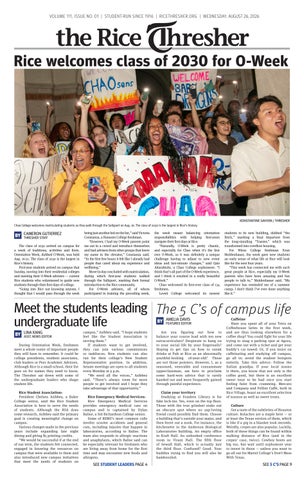
VOLUME 111, ISSUE NO. 01 | STUDENT-RUN SINCE 1916 | RICETHRESHER.ORG | WEDNESDAY, AUGUST 26, 2026
Rice welcomes class of 2030 for O-Week
Chao College welcomes matriculating students as they walk through the Sallyport on Aug. 16. The class of 2030 is the largest in Rice’s history.
CAMERON GUTIERREZ
THRESHER STAFF
The class of 2030 arrived on campus for a week of traditions, activities and firsts. Orientation Week, dubbed O-Week, was held Aug. 16-22. The class of 2030 is the largest in Rice’s history. First-year students arrived on campus that Sunday, moving into their residential colleges and meeting their O-Week advisers — current Rice students who volunteered to guide new students through their first days of college. “Going into Rice not knowing anyone, I thought that I would pass through the week
being just another kid on the list,” said Victoria Constanza, a Hanszen College freshman. “However, I had my O-Week parents point me out in a crowd and introduce themselves and had advisers from other groups that knew my name in the elevator,” Constanza said. “In the first few hours it felt like I already had people that cared about my experience and wellbeing.” Move-in day concluded with matriculation, during which first-year students walked through the Sallyport, marking their formal introduction to the Rice community. For O-Week advisers, all of whom participated in training the preceding week,
the week meant balancing orientation responsibilities with helping first-years navigate their first days at Rice. “Naturally, O-Week is pretty chaotic, and especially for Chao when it’s the first ever O-Week, so it was definitely a unique challenge having to adjust to new event ideas and last-minute changes,” said Qais Altarabishi, a Chao College sophomore. “I think that’s all part of the O-Week experience, and I think it resulted in a really beautiful O-Week.” Chao welcomed its first-ever class of 134 freshmen. Lovett College welcomed its newest
KONSTANTINE SAVVON / THRESHER students to its new building, dubbed “the Brick,” marking a final departure from the long-standing “Toaster,” which was transformed into overflow housing. For Wiess College freshman Evan Moldenhauer, the week gave new students an early sense of what life at Rice will look like for the next four years. “This week has connected me with such great people at Rice, especially my O-Week parents who have been amazing and fun people to talk to,” Moldenhauer said. “My experience has reminded me of a summer camp; I don’t think I’ve ever done anything like it.”
Meet the students leading The 5 C’s of campus life undergraduate life AMELIA DAVIS
FEATURES EDITOR
LINA KANG
ASST. NEWS EDITOR During Orientation Week, freshmen meet a whole roster of important people they will have to remember. It could be college presidents, resident associates, club leaders or Peer Academic Advisors. Although Rice is a small school, their list goes on for names they need to know. The Thresher sat down with some of the undergraduate leaders who shape student life. Rice Student Association: President Chelsea Asibbey, a Baker College senior, said the Rice Student Association is here to serve the needs of students. Although the RSA does some research, Asibbey said the primary goal is creating meaningful change on campus. Various changes made in the previous years include expanding late night dining and giving $5 printing credits. “We would be successful if at the end of our term, the students felt connected, engaged in knowing the resources on campus that were available to them and also introduced new campus initiatives that meet the needs of students on
campus,” Asibbey said. “I hope students feel like the Student Association is serving them.” If students want to get involved, they can join various commissions or taskforces. New students can also run for their college’s New Student Representative position. In addition, Senate meetings are open to all students every Monday at 9 p.m. “We need all the voices,” Asibbey said. “There’s always room for more people to get involved and I hope they take advantage of that opportunity.”
Rice Emergency Medical Services: Rice Emergency Medical Services provides emergency medical care on campus and is captained by Dylan Balise, a Sid Richardson College senior. Some of REMS’s most common calls involve scooter accidents and general cuts, including injuries that happen in laboratories, according to Balise. The team also responds to allergic reactions and anaphylaxis, which Balise said can be especially relevant for freshmen who are living away from home for the first time and may encounter new foods and allergens.
SEE STUDENT LEADERS PAGE 4
Are you figuring out how to balance your course load with ten new extracurriculars? Desperate to hang on to your social life by your fingernails? Hoping to get tips on how to sneak drinks at Pub at Rice as an abnormally youthful-looking 18-year-old? These are not those pointers. However, I, as a seasoned, venerable and consummate upperclassman, am here to proclaim some hard-won advice that is rarely handed out and more frequently gained through painful experience.
Claim your territory Studying at Fondren Library is for fake lock-ins. Yes, even on the top floor. Those with the true grindset stake out an obscure spot where no yap-loving friend could possibly find them. Choose a building that’s outside your major, and then ferret out a nook. For instance, the kitchenette in the Anderson Biological Laboratories building. An empty office in Kraft Hall. An unbooked conference room in Virani Hall. The fifth floor of Sewall Hall, which is actually just the third floor. Confused? Good. Your buddies trying to find you will also be bamboozled.
Caffeine Have you spent all of your Tetra on Coffeehouse lattes in the first week, and are thus looking elsewhere for a coffee shop? You could fight for your life trying to snag a parking spot at Agora, and come out with a ticket and get your buddy’s car towed. Or, if you insist on caffeinating and studying off campus, go all in: avoid the student hotspots entirely. Take this advice: Follow the Italian grandpa. If your local nonno is there, you know that not only is the coffee good, but there is an excellent sweet treat to be had once you start feeling faint from cramming. Mercato and Company and Fellini Caffè, both in Rice Village, boast an excellent selection of nonnos as well as sweet treats. Culture Get a taste of the subtleties of Houston culture. Kolaches are a staple here — or at least the Texas version of them, which is like if a pig in a blanket took steroids. Weirdly, crepes are also popular. Luckily, both of these things can be found within walking distance of Rice (and in the crepes’ case, twice). Cowboy boots are big too, but wait until sophomore year to invest in those — unless you want to go all out for Martel College’s Don’t Mess With Texas.
SEE 5 C’S PAGE 9
THE RICE THRESHER
2 • WEDNESDAY, AUGUST 26 , 2026
H&D rolls out new dining options and locations RACHEL JEONG
THRESHER STAFF
This fall, Housing and Dining debuted a number of new dining options, including South Main Servery at Chao and Lovett Colleges, as well as popular
This will be driven by a software package that will tie all our recipes to our menus and be able to provide allergen and nutritional information to the students. On the back side, it will also tie our inventory and ordering process together. This is in line with Rice being a very technology-driven school. Dylan Longaker HEAD CHEF OF SOUTH MAIN SERVERY
Houston burger shop Trill Burgers. Beth Leaver, assistant vice president of Housing, Dining and Hospitality, said these new options have been a continuous aspiration for H&D. “For the past several years, our strategy has been to expand and diversify Rice’s dining portfolio across campus,” Leaver wrote in an email to the Thresher. “Our priorities have included dietary variety, quality, approachable price points, accessibility, operational sustainability, and the needs of each campus location.” Food Truck Fridays by Fondy Location: area between Fondren Library, Brochstein Pavilion and Humanities Building Hours: Fridays, 6-9 p.m.
Offerings: Varies
Food Truck Fridays, a new concept that will bring food truck vendors to campus, is beginning this fall. “Beginning the first week of classes, we will feature rotating food trucks every Friday from 6 to 9 p.m. near Fondren Library,” Leaver wrote. South Main Servery Location: Chao/New Lovett Colleges Hours: Varies Offerings: Varies The new servery features stations like The Wok, a rotating Global Bowl Center, customizable burgers, a woodfire pizza oven and freshly prepared dim sum on Monday and Friday nights. Zaira Moreno, a Chao College sophomore, said she appreciates both the appearance and palette of South Main. “I think South Main Servery is really nice,” Moreno said. “It’s got a good look to it. It has a lot of variety. It still has all of those good staples that we see in the rest of the serveries, but it has a lot of different new pieces to it.” Dylan Longaker, who started at Rice last spring at Baker Kitchen, is South Main Servery’s head chef. Longaker said the South Main team is exploring new culinary technology, including signage and a robot wok that could be adopted more broadly on campus. The robot wok is called “Botinkit,” which stands for “Robot in Kitchen.” In addition to the robot wok, daily menus will be projected on digital signage at each station. “This will be driven by a software package that will tie all our recipes to our menus and be able to provide allergen and nutritional information to the students. On the back side, it will also tie our inventory and ordering process together,” Longaker said. “This is in line with Rice being a very technology-driven
The new South Main Servery, which is attached to Chao and Lovett Colleges. school.” Trill Burger and APAC Café Location: Rice Memorial Center, Sammy’s Cafe Hours: Varies Offerings: Trill Burgers, pan-Asian cuisine Within the doors of Sammy’s Cafe, the previous Ambassador Cafe was rebranded to APAC Café to represent its expansion from Chinese cuisine into broader Asian-Pacific cuisine. The neighboring Oui Banh Mi at the front kiosk is now offering curries. Next door to APAC lies Trill Burgers.
As a student, as good as the serveries may be to some people, it’s always good to have the option to purchase something that’s very different, and having that accessible on campus is always very, very good because not all students have vehicles. It also brings the campus closer together because you can have a quick bite from a different restaurant and still remain on Rice’s campus. Zaira Moreno CHAO COLLEGE SOPHOMORE
RACHEL JEONG / THRESHER Students wait in line for Trill Burgers. Trill Burgers is located in the Rice Memorial Center.
It was described by Rice Dining as a fullcircle moment for Trill Burgers owner and American rapper Bun B, who used to co-teach the course Religion and HipHop Culture at Rice. Amid new dining changes, Leaver said H&D intends to incorporate venues that have a connection to Rice, as opposed to
bringing in corporate branches. “We intentionally seek opportunities to support locally owned businesses and entrepreneurs as third party partners on campus,” Leaver wrote. Rice Business Cafe Location: McNair Hall Hours: Monday-Friday, 11 a.m.-2 p.m., 5-7 p.m. Offerings: Owl Street Tacos, Whoo Deli 2.0, the Rice Bowl, flatbread and Mediterranean options The new Rice Business Cafe features customizable concepts created and managed by H&D. The cafeteria includes Owl Street Tacos, Whoo Deli and Rice Bowl, which used to be Global Bowl in Sammy’s Cafe in the Rice Memorial Center. Audrey’s Location: McNair Hall Hours: Monday-Saturday, 7 a.m. to 5 p.m. (breakfast until 11 a.m.) Offerings: breakfast selections, illy coffee, pastries, grab-and-go options Audrey’s is no newcomer to the Rice campus. In 2024, Audrey’s closed its four-year operation in McNair Hall due to the Jones Graduate School of Business expansion. Sid Richardson College junior Daniela Ambriz said she’s glad they’re back. “I’ve heard from upperclassmen too that they really liked [Audrey’s] when it was here, and it’s kind of sad that we only had the robot option, CERĒS, before. It just wasn’t really up to par,” Ambriz said. Ambriz said she frequently purchases drinks across campus, and compared to other venues, she considers Audrey’s a high-quality option. “Having something that’s consistently good, like this [Audrey’s] drink, with the steady space [is] a good complement … I think [it’s] more bang for my buck,” Ambriz said.
Rice expands free tuition to all families who make under $200k ABIGAIL CHIU
NEWS EDITOR
Rice University announced that students whose families earn less than $200,000 annually will qualify for free tuition under the Rice Investment financial aid program. This change, an increase from the previous $140,000 threshold, will begin with students entering in fall 2027. Under the new program announced on Aug. 3, students from families who earn
between $100,000 and $200,000 annually will receive free tuition. Students from families who earn less than $100,000 will also have mandatory fees and room and board covered, according to a press release from the Office of Public Affairs. “This is a defining moment for Rice University and for the future of higher education,” said President Reggie DesRoches in the press release. “Talent exists in every community and across every socioeconomic background. Because of the extraordinary generosity of our alumni and supporters,
more students than ever will have access to the life-changing opportunities a Rice education provides.” The previous program covered tuition, mandatory fees, and room and board for students from families earning $75,000 or less and free tuition for families that earned between $75,000 and $140,000. “At many universities, families with middle or upper-middle incomes often assume they will not qualify for meaningful financial aid,” said Yvonne Romero, vice president for enrollment and dean of admissions and
financial aid, in the press release. “This expansion changes that conversation and simplifies the criteria. We want students and families to know that cost should not discourage them from considering Rice.” The Rice Investment was launched in 2019 and has provided more than $1 billion in aid since then, according to the press release. Rice continues to expand its undergraduate and graduate populations as part of DesRoches’ Momentous strategic plan, with a goal of 5,200 undergraduate students by 2028, according to a Rice News article.
NEWS
WEDNESDAY, AUGUST 26, 2026 • 3
Baker Institute announces Eastern Mediterranean Energy Center LINA KANG
ASST. NEWS EDITOR The Baker Institute for Public Policy launched the Eastern Mediterranean Energy Center in partnership with the U.S. Department of Energy, Cyprus, Greece and Israel. Ambassadors from the countries met and signed a declaration of intent of establishing the EMEC with President Reggie DesRoches on campus in June. The U.S. Department of Energy did not respond to requests for comment. The new program will be housed at Rice University’s Center for Energy Studies, led by CES Senior Director Kenneth Medlock. According to Medlock, the center’s longstanding experience advising governments on energy policy positions it to guide the initiative’s work. “The Baker Institute has been involved in high-level dialogues with US government agencies as well as ministries around the world since its founding,” Medlock wrote in an email to the Thresher. “As such, we will bring balance and a data-driven approach rooted in economic fundamentals with a deep understanding of regional politics and geopolitics to the discussion of infrastructure investment and energy security in the Eastern Mediterranean.” Although the EMEC officially launched June 11, it was established and is based on the frameworks laid out in the federal legislation of the Eastern Mediterranean Security and Energy Partnership Act of 2019 in partnership with Cyprus, Greece and Israel. The legislation authorized the U.S. Department of Energy to establish a U.S.-Eastern Mediterranean Energy Center to facilitate research, technology development and collaboration among governments, universities and the private sector. Medlock said the declaration of intent signed at Rice reflects the requirements of the legislation, but the center’s activities are expected to include collaboration with additional countries in the region. “Our remit is to engage with other countries as well, particularly given the importance of cross-border infrastructure
and trade, but the Declaration of Intent is specific to the legislation, which is what DOE is authorized to act upon,” Medlock wrote. According to the legislation, the center is intended to support research on energy security, infrastructure, technology and commercial development in the region. Medlock said the Baker Institute’s role will be to advance those objectives through research and dialogue. “EMEC’s principal aim is to conduct and disseminate research that explores derisking capital investment to expand infrastructure, deploy technologies, and deepen commercial engagement in the energy sector across countries in the region,” Medlock wrote.
The Eastern Mediterranean is at the nexus of trade from the Black Sea, Red Sea, North Africa, Middle East, Central Asia, Eastern Europe, and the Atlantic Basin. Infrastructure is at the core of capturing these opportunities. Unlocking the recipe for expanding international capital flows into the region to develop infrastructure and deepen supply chains is a core mission for EMEC. Ken Medlock
wrote. “It is one of the primary reasons the Baker Institute was chosen to be home for EMEC.” Medlock said one area of focus will be infrastructure investment, which he described as central to expanding energy development and commercial activity throughout the region. “The Eastern Mediterranean is at the nexus of trade from the Black Sea, Red Sea, North Africa, Middle East, Central Asia, Eastern Europe, and the Atlantic Basin,” Medlock wrote. “Infrastructure is at the core of capturing these opportunities. Unlocking the recipe for expanding international capital flows into the region to develop infrastructure and deepen supply chains is a core mission for EMEC.” The center’s work will begin by identifying partner institutions and establishing research priorities before expanding collaborative projects and
regional engagement,” Medlock said. He said detailed milestones are still being developed with the Department of Energy. “There will be specific milestones, and they will evolve as the center grows,” Medlock wrote. “At a high level, we will begin with identifying peer institutions and establishing research objectives, then move into disseminating research and extending regional cooperation.” While much of the center’s work will involve international research and policy discussions, Medlock said the initiative is also expected to create opportunities for the Rice community through academic exchanges and student engagement. “There will likely be opportunities for internships,” Medlock wrote. “There will also be faculty from partner universities in the region who spend time in residence here. To the extent possible, they will provide guest lectures, providing
DIRECTOR OF CENTER FOR ENERGY STUDIES
Medlock said EMEC is intended to serve as a forum for research and dialogue between the various countries involved in this initiative rather than as a diplomatic body. “This starts with well-informed dialogue and engagement,” Medlock
COURTESY RICE NEWS
James A. III Baker Hall, located on Rice’s campus.
Senate now traveling to Kraft family gift to advance Center for Jewish Studies residential colleges TOBY CHOU
ASST. NEWS EDITOR The Rice Student Association announced traveling Senate, an initiative meant to increase student engagement with the RSA by having individual colleges host Senate once a month, with Chao College hosting the first on Aug. 31. Chelsea Asibbey, the RSA president, said
The heart behind traveling Senate is that at least once a month, our presidents, senators and [New Student Representatives] would have interaction with the student body and bring Senate to them. Chelsea Asibbey RSA PRESIDENT
previous administrations struggled with getting students involved, which was most clearly seen when multiple elections did not meet quorum. “I think there was a big sentiment that we were kind of tucked away in the middle of the Kyle Morrow Room,” Asibbey said. “So the heart behind traveling senate is that at least once a month, our presidents, senators and
[New Student Representatives] would have interaction with the student body and bring Senate to them.” Traveling Senate will also include activities such as wing-eating competitions and cookie decorating to further engage the student body. “We will be encouraging our Senate, our presidents, to thoroughly dive into these activities,” Asibbey said. “Hopefully this will send ripples through our student body.” Chao has been selected as the first college to be visited by traveling Senate, with the RSA hoping the allure of a new commons and facilities will increase engagement by the overall student body. “It’s brand new, shiny, and I think it would be great for other students to just get to experience it,” Asibbey said. “Most students on campus have never been to Chao, so giving Chao students a chance to introduce themselves and have other people get to see their commons and just dive into their new undeveloped culture.” While initially traveling Senate was designed to be a permanent change, with all RSA meetings occurring in residential colleges, Asibbey said she thought it would be too confusing for new students to follow. Instead, traveling Senate will occur once a month, with a schedule posted on the RSA Instagram. “I believe that’s just too much movement and really hard for students to follow along,” Asibbey said. “We want to switch up the flavor of Senate and make it more accessible to new students.”
and football pavilion ABIGAIL CHIU
NEWS EDITOR
Alumna trustee Patti Lipoma Kraft ’87 and her husband, Jonathan Kraft, have donated to establish an endowed professorship within the Center for Jewish Studies and build a covered football practice pavilion. The new position will be named the Kraft Family Professorship in Jewish Studies, a permanent endowment in the School of Humanities and Arts, and will support a senior faculty member whose work advances Jewish studies at Rice, according to a press release. The Center for Jewish Studies began as the Jewish Studies Program, founded by
professor Mattias Henze in 2009, which offered a minor in Jewish studies. The center is interdisciplinary, as the program was, with eight affiliated faculty members across humanities departments, including history, religion, and modern and classical languages, literatures and cultures. In addition to the professorship, the endowment may also support graduate and post-graduate fellowships, research initiatives and related scholarly activities, according to the press release. The Patricia Kipoma Kraft ’87 and Jonathan A. Kraft Football Pavilion, an addition to the Gateway Project, will be 80,000 square feet and will replace the inflatable practice facility.
COURTESY RICE NEWS/SWA GROUP A rendering of the future covered Patricia Kipoma Kraft and Jonathan A. Kraft Football Pavilion.
THE RICE THRESHER
4 • WEDNESDAY, AUGUST 26 , 2026 FROM FRONT PAGE
STUDENT LEADERS
“We recognize that students come to campus with a variety of medical conditions and experiences with healthcare and medicine, and language on how to address their medical problems,” Balise said. REMS also responds to substance use emergencies involving alcohol and drugs. Balise said students should not avoid seeking medical care because they are concerned about disciplinary consequences. “Both REMS and [Rice University Police Department] are definitely not there to get you in trouble,” Balise said. “Our job is solely to provide you with healthcare.” When REMS responds to a call, providers address immediate medical concerns, check the student’s vital signs and conduct a comprehensive examination. They then discuss possible next steps with the student, which can include transportation to an emergency department or referrals to urgent care or Student Health Services.
We go about our day to day. We go to our classes. We leave for calls. But it is simply an incredible passion that all of us have to treat our local community. We are very serious. But that is not to say that you can’t come up to us, talk to us. Dylan Balise REMS CAPTAIN
“So I think not only do we treat the medical emergency, we provide a holistic assessment of our patient, but then we educate and help them to create a plan and a path forward to higher level care,” Balise said. Balise said a common misconception about REMS is that members can look unapproachable in the black uniforms when seen around campus, but he said the value of collegiate EMS is that it is students. “We go about our day to day,” Balise said. “We go to our classes. We leave for calls. But it is simply an incredible passion that all of us have to treat our local community. We are very serious. But that is not to say that you can’t come up to us, talk to us.”
Rice Coffeehouse: Rice Coffeehouse, also known as Chaus, is a popular hangout and study spot. They sell pastries and drinks, which can also be purchased with Tetra, and work to provide affordable food to the greater Houston area, said General Manager Cristian Castillo. Beyond the regular cafe hours, Chaus also hosts public events such as Chausmarket, where vendors are invited to sell items like art and jewelry. The cafe also has an event called Chaus After Dark, where students can learn the inner workings of a cafe. “We continuously look for new opportunities to represent the Rice community at Chaus, and we make drinks of the month that are inspired by cultural events/celebrations,” Castillo, a McMurtry College senior, wrote in an email to the Thresher. Castillo said Chaus also has a loyalty punch card program where customers can earn a free drink for every 10 purchases of a drink in a reusable cup. This also reduces the price of a drink by 25 cents. “For current and future Chaus regulars, it is a great way to simultaneously save money and get some freebies along the way, all while helping our planet,” Castillo wrote. “Chaus is very much a microcosm of the very supportive side of the university,” Castillo wrote. “I have received countless amounts of support and advice from my fellow coworkers, and I always try to do the same. With the culture of care ever so present and always so needed, Chaus has always provided that for me, forming a sort of ‘new residential college,’ in its own way.” Rice Women’s Resource Center: The Rice Women’s Resource Center provides sexual, physical and mental health resources to students. The center is entirely student-run and has about 150 volunteers. Jones College seniors Helen Citino and Dyllan Lozano-Lomeli serve as the center’s co-directors. The RWRC provides free pads, tampons and menstrual cups, as well as Plan B, pregnancy tests, condoms and lubricant. It also stocks items including bandages, medicine, heating pads, sunscreen, hair ties and nipple covers. The center disseminates information about contraception and reproductive health and connects students with resources at Rice and in the surrounding community. Its events throughout the
KONSTANTIN SAVVON / THRESHER RSA President Chelsea Asibbey crosses through the Sallyport at Matriculation. She leads Baker College students. year include health panels, student discussions, advocacy events, open mic nights, the RWRC Market and the Women’s Impact Awards.
Chaus is very much a microcosm of the very supportive side of the university. I have received countless amounts of support and advice from my fellow coworkers, and I always try to do the same. With the culture of care ever so present and always so needed, Chaus has always provided that for me, forming a sort of ‘new residential college,’ in its own way. Cristian Castillo GENERAL MANAGER OF CHAUS “I think a common misconception is that we only serve women,” LozanoLomeli said. “While our resources are geared toward women’s issues, we are open to any member of the Rice community.” Citino and Lozano-Lomeli both began volunteering with the RWRC during their freshman year. Citino said her weekly
volunteer shift with a friend became a regular opportunity for them to catch up during their first year. “Three years later, we still make sure to have the same shift,” Citino said. Pub at Rice: Pub at Rice is the student-run bar on campus, located in the basement of the Rice Memorial Center. Gabi Varga, a Duncan College senior and Pub’s general manager, first became involved with Pub during her freshman year. She said she regularly visited with friends before applying to work there. “Pub is another great place on campus to meet people, spend time with friends and take a break from work,” Varga said. “Pub has my whole heart, Pub is my home, Pub is what I live and breathe every day.” “We also have different tabs, trivias and game nights hosted by different major departments, colleges or clubs,” Varga said. “Some great examples are when we host ktru’s Battle of the Bands and when we have different departments do professor beer debates.” Pub also serves a variety of food that students can purchase with Tetra. The bar’s schedule is released weekly on their Instagram, and students can use their website to book events. “Pub culture is a part of Rice culture and to keep it going, we need y’all there,” Varga said. “The same love and energy that goes into your clubs or residential colleges is what we need to keep Pub alive and thriving.”
NEWS
WEDNESDAY, AUGUST 26 , 2026 • 5
Rice researchers land tens of millions in new grants this summer ANNAMIKA KONKOLA
THRESHER STAFF
Rice University’s sponsored research funding topped $250 million for the first time ever last fiscal year, said David Sholl, executive vice president for research. Rice researchers received new funding across four projects, among others, that illustrate that range: a nearly $20 million National Science Foundation award to build an artificial intelligence-driven materials lab, a $15 million Army-funded center researching next-generation wireless technology, just over $1 million in Department of Defense funding to advance research on a rare childhood cancer and a $10 million grant from the Burroughs Wellcome Fund to study the links between climate change and disease. “The money that comes for research is the necessary input,” Sholl said. “What really matters is the output, what goes out and makes a difference in the world.” An AI-powered materials lab Jun Lou, professor of materials science and nanoengineering, is leading a new NSF-funded effort to allow AI to run its own materials science experiments. The award funds a project called READINESS, short for Revolutionizing AI-Driven Autonomous Experimentation for NextGeneration Semiconductor Synthesis. It officially began in August and will run for four years. READINESS is one of 20 projects nationwide selected for the NSF’s Programmable Cloud Laboratories Test Bed initiative, part of a $380 million national investment in automated research infrastructure. The lab will be based in Rice’s Ralph S. O’Connor Building for Engineering and Science and will be focused on technologies for faster electronics, lower-power computing and quantum technologies. Researchers plan to use a virtual model of the physical lab to simulate experiments before running them on real equipment. The project brings together 15 senior researchers, 11 of them from Rice, along with collaborators from the State University of New York Polytechnic Institute and the University of Texas at Austin. The Rice team spans computer science, materials science, chemistry, physics and electrical engineering. Lou said past efforts to use AI in materials science mostly focused on predicting which new material structures might be useful. In contrast, READINESS focuses on manufacturing materials researchers already know they want. “We are focused on how you can actually reproducibly make material, which is very, very hard because all materials have defects,” Lou said. “How you control the defects in those materials is a difficult task. That’s something this center is trying to tackle.” Part of the project’s goal is to make the resulting lab accessible beyond Rice. Since the facility will be cloudconnected, Lou said, researchers and companies anywhere in the country could use it, including startups that lack the resources to synthesize their own materials. “This facility can be accessed through the cloud, through the internet, so it’s not limited to Houston. It can be anywhere,” Lou said. A national center for nextgeneration wireless Rice is also leading a new national research center focused on nextgeneration wireless technology. CLASSIC, short for the Center for Large Aperture Secure Sensing, Imaging and Communications, is directed by Edward Knightly, professor of electrical and computer engineering, with Ashutosh Sabharwal, also a professor of electrical and computer engineering, serving as a co-principal investigator. The center’s
grant from the U.S. Army Research Office began in July and runs through 2031. Knightly said CLASSIC’s research spans security, sensing, imaging and communication. One focus involves curved-beam jamming, a technique for disrupting or protecting wireless signals by bending the electromagnetic waves that carry them rather than sending them in a straight line. The same concept could also be key to extending the reach of future wireless networks, Knightly said, since the higher frequencies used by next-generation Wi-Fi and cellular networks are more easily blocked by physical obstacles than current signals are. “Electronic warfare is a component of national security, and maintaining leadership in electromagnetics is of critical importance,” Knightly said. The center also includes researchers from universities and institutions across the country, including Los Alamos National Laboratory, which is developing next-generation transmitter technology, and Northeastern University, which operates a drone testing facility the team plans to use. “It takes larger teams to build systems of this scale and this importance,” Knightly said. Sabharwal’s lab contributes expertise in imaging through parts of the electromagnetic spectrum invisible to the human eye, aiming to help sensors see clearly through conditions like fog, smoke or fire that blind ordinary cameras. “You’d like to see farther, and you’d like to see better,” Sabharwal said. Sabharwal reiterated that a center this size requires constant coordination between teams. Additionally, training the next generation of researchers is central to the center’s mission. “When students start to work together across labs, that’s when real magic happens. That’s when real collaboration happens,” Sabharwal said. “The students are the ones who are going to
decades. Vlassakis said Ewing sarcoma instead arises from a single catastrophic mutation, present from disease onset, that fuses together two genes that do not normally interact. The resulting protein binds to unusual sites across the genome and interacts with other proteins that alter which genes get turned on or off. Vlassakis’s lab is developing a test to identify which DNA-binding proteins accompany that abnormal fusion
Environmental questions and environmental problems need as many disciplines and practices as possible, because they’re large and complex problems. We need specialists, especially the incredible impact of deep specialized research, but with a capacity to communicate that research across disciplines and across audiences. Joseph Campana DIRECTOR OF RICE CENTER FOR ENVIRONMENTAL STUDIES
help or actually lead the invention of these ideas.” Though the center is funded by the Army, both researchers said its findings are also intended for publication and broader civilian use, from improved Wi-Fi and cellular networks to safety monitoring for buildings and infrastructure.
protein, since those proteins likely help determine whether a tumor cell divides rapidly or spreads to other parts of the body. They use single-cell and singlemolecule measurements to study how these changes affect individual cancer cells differently. Cells with high levels of the fusion protein tend to divide rapidly, Vlassakis said, while cells with lower levels are more likely to metastasize, spreading elsewhere in the body. The new funding specifically supports two research areas: developing technology to study the DNA-binding proteins involved in Ewing sarcoma and mapping the chromatin structures that help control them. Vlassakis said her lab’s long-term goal is to move away from broad chemotherapy, which damages healthy cells as well as cancerous ones, toward treatments that target specific molecules driving the disease. “The goal is therapeutic impact,” Vlassakis said. The standard treatment for Ewing sarcoma is a combination of chemotherapy with surgery or radiation but options narrow considerably for patients whose cancer relapses or spreads, Vlassakis said. Survivors can face lasting effects, including cardiac damage and chronic fatigue, which affects roughly a quarter of childhood cancer survivors into adulthood. “The treatments haven’t changed for decades for Ewing sarcoma,” Vlassakis said. Vlassakis said the lab’s work aims to eventually inform new biomarkers and clinical trials.
Studying a rare childhood cancer Julea Vlassakis, assistant professor of bioengineering, recently received funding to study Ewing sarcoma, the second most common bone cancer among children and young adults. The funding comes from the Department of Defense’s Congressionally Directed Medical Research Programs through its Peer-Reviewed Cancer Research Program. Vlassakis is one of 10 researchers nationally to receive this particular career development award. The award began June 1 and runs for four years, through May 2030. Ewing sarcoma differs from many adult cancers, which typically develop after mutations accumulate over
Tracking climate change and disease across Texas Through the Burroughs Wellcome Fund’s Climate + Health Excellence Centers award, the foundation’s first of its kind, collaborators at Rice, Baylor College of Medicine and UTHealth Houston School of Public Health are supported to develop new research, education and public engagement related to climate and health. The funding supports FORECAST, a climate-health integrated modeling system they are building to study how rapid environmental and weather shifts drive the emergence and spread of disease. The award began in August and will run for five years, through 2031. The new funding will enable the team
When students start to work together across labs, that’s when real magic happens. That’s when real collaboration happens. The students are the ones who are going to help or actually lead the invention of these ideas. Ashutosh Sabharwal CO-PRINCIPAL INVESTIGATOR OF CLASSIC
to expand its focus from Harris County to the entire state of Texas. In the future, they may even expand their scope to the entire Gulf Coast. The Rice components of FORECAST are co-led by Sylvia Dee, associate professor of Earth, environmental and planetary sciences, and Joseph Campana, professor of English and creative writing and director of Rice’s Center for Environmental Studies. Dee leads the Rice team’s climate science and manages the grant’s undergraduate education components, along with K-12 outreach programs run in partnership with organizations like the Girl Scouts. Campana, whose research centers on the environmental humanities, said he is focused on the importance of education, outreach and communication to engage a range of audiences in the intersection of climate and health. Climate and health research has historically been difficult to fund at the federal level, Dee said, because it straddles two disciplines that do not typically apply to the same funding agencies. However, Dee said a new extreme weather program area at the National Institutes of Health is evidence that federal science agencies are increasingly recognizing the connection. Large, foundation-funded centers that pair medical schools and hospital systems with universities that have strong geoscience programs, like FORECAST, are becoming more common as a result. Much of the Rice team’s work involves making public climate and weather data, collected by agencies like NOAA and NASA, usable for colleagues working in epidemiology and public health, who separately gather their own data from sources like hospital records, mosquito trap counts and wastewater monitoring. “The task of amassing the data, curating it, and making it machinereadable is a challenge,” Dee said. Beyond research funding, the grant will support several types of opportunities for the Rice community each year: seed grants for faculty research on any dimension of climate and health, two postdoctoral fellowships, roughly five graduate fellowships, and paid undergraduate internships placed with partners including the Harris County Health Department, the Houston Health Department and the Citizen’s Climate Lobby. It will also fund a new K-12 curriculum aimed at teaching students across Texas about the links between climate change and health. “The biggest problem we are trying to overcome is the fact that most students, even most adults, are not very aware of climate and health interactions,” Dee said. “The work we have to do now is education.” To this end, Campana said the foundation was explicitly about wanting a broad range of disciplines represented in the work. Environmental history, sociology, anthropology, religion and literary and art historical studies are fields that affect how people understand and respond to environmental change just as much as the underlying science does. “Environmental questions and environmental problems need as many disciplines and practices as possible, because they’re large and complex problems,” Campana said. “We need specialists, especially the incredible impact of deep specialized research, but with a capacity to communicate that research across disciplines and across audiences.” Looking ahead, the team plans to expand its focus from infectious disease to other climate health intersections, including extreme heat and toxic waste exposure. “Your zip code should not predict whether you live or die because of environmental pollution,” Dee said.
THE RICE THRESHER
WEDNESDAY, AUGUST 26, 2026 • 6
EDITORIAL
Why we are launching print-only community opinions Welcome, Owls. If there is one thing that we can impart, it is that your four years here are valuable. We all have to buy into Rice culture. Don’t be lame. With our traditions and culture by the wayside, we risk losing what makes Rice so special, especially as the university expands at a breakneck speed. Maintaining culture requires active engagement. We need students to interact with their colleges. Get into debates and arguments.
Ask tough questions. We see the over-registration that everything now requires. Endless forms, institutional approval and more. We can’t even do harmless pranks on other residential colleges without getting them approved. What does it do to a student body when the most innocuous forms of fun are robbed of their spontaneity? And this isn’t just about fun. Look at our protest policies. It now takes an incredible
amount of work and oversight, as well as considerable risk, to participate in one of the most fundamental values of higher education: free speech and dialogue. As one small way to combat this, the Thresher is launching print-only opeds. Students should feel free to express themselves without having to worry that their words will live online forever. Short, long, controversial, irreverent, anything — we want to hear you. You should be
able to have your voice heard in this community without it being broadcast to the entire world. So, submit your opinions to us. We are pleased to publish them. Editor’s Note: Thresher editorials are collectively written by the members of the Thresher’s editorial board. Current members include James Cancelarich, Evie Vu, Abigail Chiu, Hongtao Hu, Andrew Rynsburger, Chi Pham, Andersen Pickard and Patrick Shukis.
LETTER FROM THE EDITOR-IN-CHIEF
Why student journalism? A vision for the newspaper JAMES CANCELARICH
EDITOR-IN-CHIEF
I struggle to come up with an adequate introduction. I almost never turn the pen inward. I’m James Cancelarich. I study English. I’ve been meaning to declare a history major for a few semesters now. If I could do anything in the world, I would sell everything I have and spend my time bumming around the mountains in the Southwest. I also like craft beer and good food. When I was a little freshman, wideeyed and full of energy as the cliche goes, I decided to come to a Thresher training on a whim and wrote some truly dismal articles. I almost got discouraged but one thing led to another and now I’m in charge of everything. It’s funny how things work out. I want to lay out my vision for this newspaper. Student journalism — this odd amalgamation that we are often told is necessary — is actually important. You may think us a little ridiculous for running around, treating everything so seriously. There is a point to it all.
I’m laying it out here in the hopes that we will hold ourselves to the standards we set. This first edition that we are putting out, although it has some bright spots, is in need of much improvement. If we continue to falter, misstep, become complacent or otherwise fail to uphold our duty as student journalists, I hope that someone will come running at us, with this document in hand, to remind us of our purpose. As a campus newspaper, it is paramount that we represent the diversity of the community associated with this institution. We want to present you with the widest possible view of this community. Much of what we write about comes from you, whether that means tips, grabbing coffee with you or the many interviews that we conduct. We want to make sure that you are heard. We work to protect the free flow of information and ideas on campus. Our other function as a student newspaper is as a watchdog. A lot of the work we do will never result in a published article. We attend public meetings, keep tabs on many different groups and organizations and sift through endless
amounts of data. We do all this in the name of accountability. As a paper, we believe in honesty and transparency. For an institution like Rice, we believe that the power the university wields means that we must demand transparency whenever we can. In that vein, I am launching special investigations. The idea is to liberate deep, thoughtful, responsible and impactful reportage from the constraints of a weekly need for content. We believe that in pushing for transparency, we can work to make this institution a better place for everyone. The same goes for ourselves. In all honesty, I believe that students struggle to engage with each other in meaningful disagreement. It would seem that the stakes are lower than ever. But what we do now matters. There is necessary work to be done. If this is an idea that you agree with, I hope you might consider joining us. I can make enticing offers of the various skills you will learn and the experiences you
can gain through our organization. We are one of the few sources for journalism and media education on campus. However, at the most fundamental level, we have a clear duty and a responsibility to this community. It is that knowledge that guides us, every day.
GLOBAL CHATS
My experience as an adviser for international students before O-Week VALERIA REVATTA
THRESHER STAFF
Being an adviser is hard work. Not only do you have to coordinate logistics with the other advisers, but you also have to prepare everything before the students arrive. I was an Undergraduate International Orientation adviser for incoming freshmen this year, and it was one of the best experiences of my summer. When I came back to Rice, the UIO adviser team immediately got to work. We prepared tote bags with T-shirts and water bottles, emailed incoming students and planned fun activities for them. We also received training from the Center for Civic Leadership and learned how to help students complete their documentation after their arrival. While this may seem tedious, there are two main reasons why I decided to become an adviser. The first was to learn about different cultures. In my small group of 14, I had students from England, China, Singapore, Thailand, Taiwan, Brazil, Argentina, Canada and Bulgaria — a unique mix. On Aug. 14, the students began to move in. The day was bright and sunny, and I could feel my clothes sticking to my wet skin. As I stood next to the road, holding a poster with both hands, I got excited whenever a car slowed down in front of me. I immediately
recognized the students’ faces, and my heart melted at the sight of their excited eyes. After welcoming them, I took them to get their key and the tote bag we had prepared for them. Then, with the help of another adviser, they carried their bags up to their room. I stood at our spot from 7:30 a.m. to 5 p.m. Most of the students arrived that day, though we still had one more arriving the next morning. However, two other students never replied to the emails I sent them. I wondered if they would actually come. Did they drop? Would they come later? Was their visa approved? Having more questions than answers, I remembered the complicated reality many international students face: Before entering college, they must first navigate immigration policies. This year, we had fewer international students. After all of our students had moved into their dorms, I finally got the chance to talk to them and learn about their cultures. I asked about what they did during their free time, their high school experience and what they ate at home. Some of them were shy, and it took extra effort and patience to get to know them. Others were more outgoing and would ask me multiple questions about living as a student at Rice. Either way, most students got along quickly, and they were an easygoing group. Still, the most important reason why I
became an adviser was because of the fun activities we did with students. Especially karaoke. Admittedly, I always have way too much fun at karaoke. But this time we also played Just Dance on one of the projectors, and the song “Waka Waka” by Shakira came up.
While being an adviser may require preparing logistics and being responsible for your students, it’s deeply fulfilling and fun. Learning about your students’ unique backgrounds will help you be more open minded and strengthen your leadership skills. Three freshmen and I quickly made a group to dance the choreography. As it started, we followed the movements on the screen as best as we could. At the end of the dance, though, the screen showed the fourth player (me) jumping in front of the other three players, who were supposed to carry the fourth player
as if she were lying down horizontally. When I saw this, I hesitated. Could I really trust three freshmen to carry me without dropping me to the ground? Well… Yes. Yes, I did. In the heat of the moment, I jumped over them, and they caught me without incident. Then, they carried me until the dance was over. It was completely unexpected, but it was the most unforgettable moment of the week. On Sunday, we finally handed off our kids to their Orientation Week advisers. In part, I was relieved that I no longer had to stress about getting them to their activities on time, but I will miss those karaoke nights. While being an adviser may require preparing logistics and being responsible for your students, it’s deeply fulfilling and fun. Learning about your students’ unique backgrounds will help you be more open minded and strengthen your leadership skills. Ultimately, being an adviser means actively contributing to Rice’s culture, and I encourage you to become one next year. Editor’s Note: This is a column that has been submitted by a contributor to the Thresher. The views expressed in this opinion are those of the author and do not necessarily represent or reflect the views of the Thresher or its editorial board. All columns are factchecked to the best of our ability and edited for clarity and conciseness by Thresher editors.
Valeria Revatta is a Duncan College sophomore majoring in architecture. After living all her life in Mexico City, Mexico, she brings a unique voice and perspective on international students’ experiences.
WEDNESDAY, AUGUST 26, 2026 • 7
OPINIONS GUEST OPINION
The unacceptable state of surveillance at Rice
EDITORIAL STAFF * Indicates Editorial Board member James Cancelarich* Editor-in-Chief Evie Vu* Managing Editor NEWS Abigail Chiu* Editor Toby Chou Asst. Editor Ruby Gao Asst. Editor Lina Kang Asst. Editor OPINION Andrew Rynsburger* Editor FEATURES Amelia Davis Editor London Frey Crossword Editor ARTS & ENTERTAINMENT Chi Pham* Editor Cora Wareh Asst. Editor SPORTS Andersen Pickard* Editor Patrick Shukis* Editor Keya Patel Asst. Editor SPECIAL INVESTIGATIONS Hongtao Hu* Editor
KONSTANTIN SAVVON / THRESHER
MATTHEW MANCINI
HANSZEN COLLEGE SOPHOMORE Since 2023, Rice has partnered with a company that is under currently investigation by the Texas Department of Public Safety, was scrutinized by the American Civil Liberties Union in 2022 and has been kicked out of over 50 cities across the U.S. for data sharing and privacy concerns. Rice contracts with Flock Safety for their artificial intelligence-powered automated license plate readers. These are computer-controlled cameras that capture vehicle information, date, time and location and run it against a local “hot list” database of stolen or wanted vehicles. ALPRs can be a useful tool when it comes to public safety. Flock, however, introduces a system of surreptitious surveillance that puts student privacy and civil liberties at risk. At the crux of the problems with Flock is its AI-driven software and nationwide data-sharing model. Flock’s vehicle fingerprint technology captures far more than license plates, using AI to note make, model and cosmetic characteristics of all cars that pass their ALPRs. All collected data is then aggregated in a dataset of citizen movement that is accessible without any external oversight or accountability. Rice has not been transparent about its partnership with Flock. The only communication we’ve received is a 2023 statement from the Rice University Police Department giving notice of a 45-day “pilot program” to test Flock cameras on campus. The RUPD statement claims that Flock “mitigate[s] bias by focusing on wholly objective evidence.” But this has not always been the case. Frequent reporting has found that Flock cameras were responsible for instances of racial profiling and even resulted in a Black family mistakenly being held at gunpoint in 2020 in Colorado. The RUPD statement goes on to say, “One of the ways Flock ensures the privacy and trust of communities is by only allowing access to camera footage to trained, accredited law enforcement professionals.” What the statement does not mention is that this includes federal agencies like Customs and Border Protection and Immigration
The Flock network has been frequently abused in other ways, including to target and track protestors, both by local police departments and ICE. Politically active students who wish to express their views now face surveillance and possible intimidation enabled by the university. and Customs Enforcement via informal cooperation with police departments in Flock’s network. It is unclear whether the university retains final approval rights for data requests, so we don’t know whether data from Rice’s cameras is accessible to federal agencies. ICE has already used Flock cameras located on school campuses, and little prevents them from doing so again. The Flock network has been frequently abused in other ways, including to target and track protestors, both by local police departments and ICE. Politically active students who wish to express their views now face surveillance and possible intimidation enabled by the university. It is no wonder, then, that Rice ranks so low in terms of free speech. The surveillance network has also been used to track and control women, and it has been frequently featured in domestic abuse cases that involve law enforcement officers. In one concerning incident, it was used by a Texas sheriff ’s office to track a woman who traveled out of state to obtain an abortion, with the system sifting through data from over 83,000 cameras nationwide. Since the release of the RUPD statement, there has only been radio silence. This lack of communication is inadequate and unacceptable. The 45 days of the “pilot program” have long since passed, and there are more than 15 Flock cameras operating in and around Rice. To be clear, the Rice Campus Safety Department and RUPD have in good faith pursued the goal of keeping our campus and all individuals on it safe. ALPRs can be a useful tool in this pursuit, but
Next week’s poll: Do you like South Main Servery? Follow @ricethresher on Instagram to answer weekly polls.
safety should not come at the expense of our civil rights and liberties. This lack of transparency from the RCSD is extremely disappointing. We, the Rice community, deserve to know who is watching us. We deserve to have a say in our own safety. The exact details of the contract between Rice and Flock must be made public, and the Rice Department of Public Safety must provide a periodic public audit of all Flock searches. If Rice is going to maintain Flock’s cameras on campus, they must commit to doing so with the necessary safeguards in place. We cannot, in the name of safety, allow a surveillance dragnet that could target our staff, students and their families to go unchecked.
We cannot, in the name of safety, allow a surveillance dragnet that could target our staff, students and their families to go unchecked.
BACKPAGE Max Scholl Editor Will Howley Editor Rykelle Sandidge Editor Kyle Chen Senior Writer Caleb Song Senior Writer COPY Shruti Patankar Editor Julianne Ma Editor PHOTO, VIDEO, & WEB Konstantin Savvon Photo Editor Sarah Bradley Asst. Photo Editor Steven Burgess Video Editor Rachel Jeong Asst. Video Editor Megan Zhang Web Editor Fiona Sik Web Editor Varshini Loganathan Web Editor DESIGN Jessica Xu Art & Design Director Magnolia Hickey-Zamora News Sydney Chang Opinion Lisa Wang Features Alexa Bu Arts & Entertainment Kirstie Qian Sports Richard Li Design Consultant, Backpage BUSINESS Sivani Vasireddy Manager Alina Zhong Advertisement Rahul Santhanam Advertisement Pallob Paul Advertisement
ABOUT The Rice Thresher, the official student newspaper of Rice University since 1916, is published each Wednesday during the school year, except during examination periods and holidays, by the students of Rice University. Letters to the Editor must be received by 5 p.m. on the Friday prior to publication and must be signed, including college and year if the writer is a Rice student. The Thresher reserves the right to edit letters for content and length and to place letters on its website. Editorial and business offices are located on the second floor of the Ley Student Center: 6100 Main St., MS-524 Houston, TX 77005-1892
Editor’s Note: This is a guest opinion that has been submitted by a member of the Rice community. The views expressed in this opinion are those of the author and do not necessarily represent or reflect the views of the Thresher or its editorial board. All guest opinions are fact-checked to the best of our ability and edited for clarity and conciseness by Thresher editors.
Phone: (713) 348 - 4801 Email: thresher@rice.edu Website: www.ricethresher.org The Thresher is a member of the ACP, TIPA, CMA and CMBAM. © Copyright 2026
ricethresher.org
8 • WEDNESDAY, AUGUST 26 , 2026
THE RICE THRESHER
Owl Access: Creating community and growth
ASHLEY ZHANG / THRESHER
AMELIA DAVIS & AISHA KHEMANI
FEATURES EDITOR, THRESHER STAFF Three days before most freshmen arrived on campus for Orientation Week, some students were already beginning their transition into college. Through Owl Access, a pre-orientation program for first-generation and lowincome students, they were introduced to campus resources and a community designed to support students navigating college with fewer resources to rely on. Owl Access participants are placed in small groups led by peer leaders who continue to support them throughout their first year. Many former Owl Access students return to act as peer leaders and usher in the next class of students. Zaira Moreno, a Chao College sophomore studying mechanical engineering, said she was inspired to become a peer leader by witnessing how much her friends enjoyed and benefited from the program, though she herself opted out of participating. “It wasn’t that I didn’t want to be a part of the program, but I just had a very small gap in between my summer
I actually do regret [not attending Owl Access], just because while I was a peer leader and I got to experience it, I really loved seeing all the students make connections with each other and build their own little communities before the school year started. Zaira Moreno
CHAO COLLEGE SOPHOMORE and coming back to Rice,” Moreno said. “But I actually do regret it, just because while I was a peer leader and I got to experience it, I really loved seeing all the students make connections with each other and build their own little communities before the school year started.” One of the most valuable opportunities the program offers, Moreno said, is precisely that community building.
“I actually got to expand my community amongst them, build new friendships. I’m really excited to continue getting closer to them as well.” Araceli Lopez, the executive director of Student Success Initiatives, offered a logistical perspective on the program, which has been growing rapidly in the four years since its inception in the summer of 2023. In addition to building relationships, Owl Access offers a multitude of activities and offerings — which takes a lot of coordination, Lopez said. The program was initially spearheaded by a student initiative, and its offerings have been tweaked in response to student feedback in the four years since it began, including adding more opportunities for peer leadership and assessing incoming students’ knowledge so they can more effectively cater their offerings. Their eventual goal is to enable all FGLI students to attend Owl Access, which comes with its own problems such as space and organization. Owl Access also has programs and aid aimed at parents and guardians for the purpose of ensuring that a student’s
existing support system has the knowledge and tools to help them tackle the college experience. “On the parent side, it’s mostly about empowering them and getting them informed about their resources,” Lopez said. The entire Owl Access program costs around $200,000 annually, which includes the expense of peer leader stipends and student director involvement in the program. That comes out to a cost of about $910 per student, which includes bringing four family members to campus. Owl Access’s priority, in addition to providing resources, is making sure students know how to access those resources. They depend on student leaders to draw on their own experiences to guide new students. That mentorship is not restricted to financial matters. Frequently, it extends to social and professional guidance and is individualized to the student. “When we are selecting peer leaders, we’re looking for students who are okay with being vulnerable about their experiences and transparent and then also encouraging the student to go and seek out these resources with the staff that’s available into that,” Lopez said. “That’s really the role of the peer leader, is developing a relationship with them to normalize all the experiences that they’re going to go through.” Owl Access is also going through a major step in its own growth in the hiring of an official leader for the program within the SSI department. Though peer support is one of the cornerstones of the program, its successful expansion and ambitious plans for the future mean having a dedicated leader of the program is logistically necessary. Chao senior Elijah White said Owl Access gave him an early introduction to the support systems available at Rice. One of the first offices he was introduced to was SSI. “When challenges came up during my first semester, I already knew where to go,” White said. “I’ve been meeting with them ever since.”
When challenges came up during my first semester, I already knew where to go. Elijah White CHAO COLLEGE JUNIOR
Liu and behold: Inside Rice’s summer venture SOPHIE GARLICK
THRESHER STAFF
While Rice’s campus quieted to a humid lull over the summer, the Liu Idea Lab for Innovation and Entrepreneurship’s new cohort stayed busy bringing the heat. As part of the lab’s Summer Venture Studio program, student founders spent three uninterrupted months building their startups from scratch. They traded academic coursework for customer calls,
product experiments and the uncertainty of figuring out where their idea would go next. Kyle Judah, executive director of the entrepreneurship initiative, said Lilie and all its associated programs were started a decade ago to serve as a one-stop shop for students across every major and degree program. “We bet on jockeys, not horses,” Judah said. “We know from our own experience as entrepreneurs that the idea is likely to change — sometimes quite dramatically —
in the course of the accelerator. Frankly, we aren’t doing our job all that well if the idea isn’t evolving as the student gathers data and evidence from customers.” Chao College sophomore Saul Brauns entered SVS after dropping his original startup concept, a college dating app called Bridge. Lacking a set product, Brauns joined forces with Chao sophomore Adam Towner to research opportunities for improvement in the construction industry. Together, the duo said they
completed about 75 discovery calls with contractors, developers and architects in their first two weeks, even flying to San Diego for the American Institute of Architects conference. However, after five weeks of building software to address delays in pending construction permits, Brauns realized during a call with county officials that he lacked long-term interest in the space. He and Towner reset their direction with guidance from Lilie advisers.
SEE LILIE PAGE 10
WEDNESDAY, AUGUST 26 , 2026 • 9
FEATURES
Welcome (Back) to Rice! 1
2
3
4
5
6
7
8
9
10
14
15
16
17
18
19
20 24
25
21
22
31
32
33
36
35
37
37 42
39 43
44
49
40
50
61
62
63
35 38
42
45
57
28
39
54 49
34
27
41
50
48
23 25
26
58
59
64
51 65
51
45
55
56
52
46 53
52
60 66
70
71
72
73
74
75
FROM FRONT PAGE
5 C’S
Contact During Orientation Week, they make you download the phone numbers for Rice Emergency Medical Services and Rice University Police Department. But what about the real emergencies? If you break a leg, you can limp down the street to a hospital, no biggie. What you need is a contact for the true predicaments: a buddy with a vehicle. Thus, the real C? Car. So far, all the Cs can be found within reasonable walking distance. You know what can’t be? H-E-B. This really belongs in the “Culture” section, because H-E-B is a Houston staple you must reconcile yourself with. I, too, doubted the
11
67
hype. How good could a cult — I mean, grocery store — be? The only answer is it could only be better if it were within reasonable walking distance from Rice. The car is only a means to an end. Cover You might think the last C should be “Classes.” Or maybe “Campus,” with a helpful map of highlights to hit. No, this last C is more pressing than either of these more pedestrian guidances. By cover, I mean mattress cover, and by mattress cover, I mean the thickest mattress topper you can get. I offer no defense for this, except the warning that if you do not heed me, the last C may as well be “Coffin” for the funeral of your poor, abused spine. Unless you
1 LONDON FREY 2 CROSSWORD EDITOR 3 4 5 ACROSS 6 12 13 7 1 Sheet of concrete 8 5 It might describe a turn on a dime? 9 10 One of Rice’s colors 10 14 Aa, e.g. 11 15 A bee’s magnum opus? 12 16 Helper for a CEO (abbr.) 16 17 Bunch of bovines, perhaps 21 18 Command 19 CaribbeannationfeaturingHabanaViejainits 23 24 capitol city 29 30 20 ____ it in the bud; stops 25 22 Hole 26 24 Permit 28 27 Goes over 21 29 31 Baby oak 30 32 Matriculation locale 33 36 It’s mightier than some weapons? 34 37 Docs or soldiers 35 38 Creator’s letters 39 39 Parts through arts 40 42 Ψ 47 48 41 45 ____man; superhero or race 42 46 Org. for batters 49 Flamenco percussive 43 52 A# 44 54 “Bless you” predecessor 55 SocialmediaapppromotedbyInstagram 46 47 57 Purposes 48 60 Lion’s cry 53 54 61 Rice’sLBQInst.thatpromotesmultilingualism 64 Ricelocalethatsoundsawfullysimilarto39 50 51 DOWN 68 69 66 Board game featuring animal factions 52 53 70 Pledge 56 71 1/8 of a cup 58 72 Motionless 59 73 Medical serving size? 61 74 Cuts 62 75 Baby plants, generally 63 65 believe in sleeping on hard surfaces like, 67 say, wooden boards or maybe exposed 68 brick, the meeting of your back and the 69 unadorned Rice mattress will not be a happy one.
DOWN
___-Mo; digital effect “I hopped off the plane at ___” St. or Rd. Course registration website Browses, then buys Some racing participants & Fishing equipment Burnpile Second choice Uni. repping Mike the Tiger Flashdrive letters Airport info. (abbr.) Hostel Pit Cookie jar? (According to some elementary teachers) Waterexpandsasitbecomesthis Rebuttal for a pro Artificial lawn material Prefix for 3 Pig’s home _____-garde;unconventionalinthearts Permit Wireless comm. standard (abbr.) Byes Vase Fish eggs Anursehiredtosupportelderlyfamily members Pouch Sorta? Citation format Young gent GrouponitsArirangWorldTourright now “You’veactuallygotapointthere.” Hit (gold) One might be A, B, C, D, or DD He re-invented a wheel? Sprays down with water Subjectcodeformicroandmacro Feng____;interiordesignphilosophy Fish found in the North Atlantic Someone from Vientiane Impersonal possessive Whereamothermightbetreatedbefore giving birth Poem, or type of math problem Bullfighting shout “Thankyouforlisteningtomy___Talk.”
ASHLEY ZHANG / THRESHER
ASHLEY ZHANG / THRESHER
10 • WEDNESDAY, AUGUST 26 , 2026
THE RICE THRESHER
Life beyond the hedges: Owl gap years SHYLA JOGI
THRESHER STAFF Nine days in the jungle with two days of food. Having to lead and listen while being uncomfortable. For Zarius Gazder, his military service was one of the toughest times in his life. Gazder is a Brown College sophomore who spent two years in mandatory Singaporean military service before coming to Rice. His military experience was rigorous and demanding, especially the nine-month training in Officer Cadet School. Gazder views himself as a better leader because of his military experience. “As an officer, you see your troops come in and they don’t know what’s about to hit them,” Gazder said. “At the end of the year, when you finish your service, you see how far they’ve come. It’s a very rewarding thing because you know you’ve contributed to their growth and you’ve been with them through probably some of the toughest times in their lives.” Alumnus Alejandro Salinas ’26, is taking a gap year before starting law school to work on his applications and spend time with his family. “It was the first time I’d ever actually pressed the brakes a little bit in terms of my career,” Salinas said. “I wasn’t sure how much this would actually set me back or that I was doing justice to my career.” As a first-generation American, Salinas felt unsure if a gap year was right for him, especially since he wanted to repay his parents for the work they put into helping him get to Rice. “It can be very difficult for people
that are in a similar position to myself,” Salinas said. “Coming from a first-gen background, there’s the stereotype of the immigrant parent that’s pushing you forward, and the academic stress that comes from that. I think people need to be prepared to have those sorts of conversations and not let themselves be pushed into a position that makes them uncomfortable in regards to what their graduate school plans are.” Salinas’ parents were understanding of his desire to take his foot off the gas pedal, so he is spending his first year out of Rice completing law school applications, working and spending time with his family. He also has been able to pick up hobbies like baking bread and sewing, which help with catching moments to breathe outside of LSAT preparation and applications. “It’s definitely a much healthier mix of doing actual work and forwarding my career, and then just taking personal time and reading or working on my hobbies,” Salinas said. For Alisha Aggarwal ’25, a gap year also meant time to mentally prepare for medical school. She appreciated the time to take time for herself, travel and rediscover her hobbies. However, to her, it was a reality check as well. “When you’re in the Rice bubble, everyone gives you a lot of leeway, and you’re still treated like a student,” Aggarwal said. “But then you get a job, and then you realize you’re not going to be a baby once you get into the real world. It’s very important to get those experiences before starting med school, so that you just have a different perspective and outlook on life and yourself.”
Chris Lhuilier, a Will Rice College sophomore, took a gap year after high school to explore the world outside of academics. His gap year took him from wilderness EMT training to cooking school in Paris, interning at a hedge fund and finally to writing a novel. “I was excited for college, but I didn’t really want to go and commit a lot of my life without actually having gone and explored anything,” Lhuilier said. “So I wanted to go out into the real world and see what everything was like, and try and get some broader experiences.” Cooking school was one of the most impactful experiences from Lhuilier’s gap year. Being thrown into a stressful environment with long hours without a working knowledge of French took some adjusting to, but Lhuilier said he believed it was a valuable experience. “It’s five in the morning in Paris in the wintertime,” Lhuilier said. “It’s freezing, and I biked to school. It was pitch black and nobody else was awake. I’m covered in snow gear because it’s really cold, and then you get there and you’re cooking for nine to twelve hours each day.” “Dealing with a really high stress environment and a high level of complexity became a super useful skill to have,” Lhuilier said. “A lot of the skills that came from this gap year are really going to help me going forward in the rest of my life. And I have the confidence from doing this thing that I think is super impressive and that I’m very proud of.” Lhuilier found himself worrying about how his gap year would pan out, especially since he wasn’t going through the same college experiences the rest of his friends could share.
PHOTO COURTESY OF CHRIS LHUILIER “All of my friends were already going and exploring and doing all the cool college stuff,” Lhuilier said. “I was listening to them and I felt a bit left out. Coming into college being a year older, I wasn’t sure how well I’d mesh with everybody. But overall, completely worth all the risks. I had an amazing time.”
FROM PAGE 8
LILIE
All the great startups rarely did it alone. Every great young entrepreneur needs the wisdom of someone who’s walked the path. You can make mistakes and learn from mistakes, but you can also learn a lot really, really quickly by just absorbing the wisdom of someone who’s been through it. Saul Brauns
“All the great startups rarely did it alone,” Brauns said. “Every great young entrepreneur needs the wisdom of someone who’s walked the path. You can make mistakes and learn from mistakes, but you can also learn a lot really, really quickly by just absorbing the wisdom of someone who’s been through it.” While these underclassmen navigated early pivots, graduate founder Barclay Jumet ’26 worked alongside his cofounder and doctoral adviser, mechanical engineering assistant professor Dan Preston.
We bet on jockeys, not horses. We know from our own experience as entrepreneurs that the idea is likely to change — sometimes quite dramatically — in the course of the accelerator. Kyle Judah
CHAO COLLEGE SOPHOMORE
EXECUTIVE DIRECTOR OF LILIE Their company Actile Technologies uses physical stimuli and smart garments to communicate critical alerts in dynamic environments. They began rolling out their technology to firefighters and defense operators. Jumet said the $15,000 in non-dilutive summer funding offered the flexibility to travel for direct customer engagement and outsource specialized development. Beyond capital, Lilie advisers helped Jumet structure a formal advisory board featuring former special operations generals and military leadership. The summer culminated in pitch presentations to Houston-area investors, leading to capital commitments that helped Actile raise over $700,000 toward its $1.5 million seed goal.
PHOTO COURTESY OF ADHIRA TIPPUR
“The excellence of having capital contributed to your startup is second to none,” Jumet said. “Beyond the mentorship, being introduced to investors where you can get capital committed to your business — that exposure was a huge testament to Lilie.” Other participants, however, used the accelerator to take software solutions directly to market. Adhira Tippur, a McMurtry College junior and co-founder of
Kairos Health, built an artificial intelligence tool to handle front-office tasks like appointment scheduling and insurance verification for dental practices. The idea stemmed from her experience working at her mother’s dental practice in the Rio Grande Valley. During SVS, Kairos Health onboarded its first paying customers and refined its deployment process. “Early on, we thought that if the
technology worked well, practices would naturally want to adopt it,” Tippur said. “We learned pretty quickly that dentists care just as much about how easy it is to get started and whether it fits into the systems their staff already uses.” Following mentor advice to gather direct market feedback, Tippur’s team walked into over 250 dental practices to interview staff about daily operational bottlenecks, ultimately leading them to prioritize system integration over adding new software features. Judah said that of the nearly 40 companies that have participated in Lilie over the past four years, roughly half have gone on to raise at least $1 million in venture capital or gain acceptance into toptier accelerators like Y Combinator within six months of completing the program. “We have this idea and philosophy of the outcome isn’t what matters; the process is. So, if we have a great process, it’ll produce great outcomes at a higher rate,” Judah said. “I think creating that culture where it’s better to have tried and failed than never tried at all … that just helps people get over that psychological hump and a hurdle that might be holding them back from shooting their own shot on something they care deeply about.”
WEDNESDAY, AUGUST 26, 2026 • 11
ARTS & ENTERTAINMENT
Under the Kanopy: ‘Nowhere’ amid apocalyptic anxiety CECE GONZALEZ
FOR THE THRESHER
Why do we throw parties, get too sick to stand and seem to call emergency medical services on our friends every weekend? For Gregg Araki, it is because we know all too well that we are facing oblivion and we are powerless to stop it. Araki is a pioneer of the “New Queer Cinema” movement, a subversive subgenre that depicts LGBTQ+ characters in radical and transgressive ways. His streak of films in the 1990s, dubbed the “Teen Apocalypse Trilogy” consists of “Totally F***ed Up” (1993), “The Doom Generation” (1995) and “Nowhere” (1997). The films are a 1-2-3 punch of isolation, brutality and nihilism that paint Araki’s experience of ’90s Los Angeles with broad, explicit strokes. The trilogy’s final film, “Nowhere,” is a dreary whirlwind, depicting a scattered ensemble of desperate teenagers attempting to find connection at an overcrowded and oversaturated house party. As they wrestle with the creeping fear of total annihilation, the film’s collegeaged characters have only two things on their minds: parties and hookups. Most of the ensemble seems to only be concerned with the next get-together, constantly discussing the “kick-the-can” game (a form of hide-and-seek enhanced by Ecstasy) and “Jujyfruit’s party” (a must-attend event that combines every disjointed story arc). These events center around drug and alcohol consumption, and all characters partake in substance use and gratuitous sex over the course of the film’s one-day timeline. Much of the film’s humor arises from its strange dialogue and over-thetop situations. A comedic sendup of party culture, “Nowhere” satirizes its
own drama, mocking the absurdity of under-the-influence behavior. While every character seems like Araki’s quintessential heightened caricature of ’90s Los Angeles culture (with names like “Cowboy,” “Egg” and “Lucifer” and catchphrases like “pukity” and “I’m so sure”), they also undergo heartbreak, trauma and interpersonal abuse that may leave viewers disturbed or at the very least shaken. This depiction of the multifaceted nature of bizarre characters is a staple of Araki’s style. His hyperspecific teen culture serves to alienate the viewers, throwing us into the peculiar “new norm” that they inhabit. Hailing from Gen X, writer and director Araki imbues “Nowhere” with age-old fears of the end of the world as we know it, careening toward the new millennium and into uncertainty. The lead character, Dark, played with an earnest naivete by James Duval, worries over visions of doom and peril. One notable materialization of these fears is a large green alien lizard with a ray gun, who vaporizes a group of girls in front of Dark’s eyes. All throughout, multiple characters ruminate on “Armageddon Day” and “The Rapture,” discussing an impending sense of despair and death. This creeping dread pervades the film, giving the events an eerie pace that builds to its extravagantly violent conclusion. Now, nearly thirty years later, young adult American life teems with digital overwhelm, the terror of the everapproaching end of the world on each screen. We are constantly searching for the same connection that Dark and his peers crave in the film, and that all Araki characters truly desire. As Araki emphasized in a 2023 Queerty interview, “To be a young person … is a little crazy.”
COURTESY THE CRITERION COLLECTION / FINE LINE FEATURES Rachel True stars as Mel in the 1997 film “Nowhere.” Mel dates both Dark and another girl, Lucifer. But the themes of his 1990s trilogy “are so universal, the search for love and identity and self, so everything is so not changed,” Araki said in the interview. He acknowledged, however, that “technology has changed,” but it seems that it has only exacerbated the isolated desires explored in his “Apocalypse” series. So, what can Gen Z do to combat our gripping terror and need for companionship? Many of us opt to party it away, turning to alcohol and substance use as the only thing worth looking forward to. Our “teen apocalypse” ensues from impending ecological collapse and global warming, the “doomsday clock” that feels like an inevitable end to everything. We tend to respond by blurring it all out.
“Nowhere,” then, feels like an eerily poignant premonition of all these same fears, increased tenfold to maximum Araki eccentricity. If we truly are “eighteen years old and totally doomed,” as Dark monologues, in the “the vast and arid wasteland of glittering filth, emptiness and death,” Araki’s cast of characters teaches us that we might just need to party it up while we still can. “Under the Kanopy” is a new column reviewing a film available to Rice students through Fondren Library’s Kanopy streaming service, with timely commentary on current developments in society and culture.
‘Cascarita’ brings the World Cup home to Houston’s Northside STEVEN BURGESS
VIDEO EDITOR
Sports and art collided this summer during the 2026 FIFA World Cup. As Houston’s Reliant Stadium was filled with roaring fans from all over the world, the National Endowment for the Arts collaborated with 11 host cities to direct grants towards the creation of works celebrating the “spirit of sports.” Houston filmmakers Orlando Briones and Christian Briones were the only recipients to create a documentary. “I remember my family would always talk about [the World Cup] when it was in the U.S. here and they got to go to a game. And for years, this is … the highlight of their lives,” Orlando Briones said. “It was just amazing because it was something that I can consider a highlight of my career, for sure.” Working with the Houston Arts Alliance and Houston Cinema Arts Society, the Briones brothers received $22,000 to make the documentary “Cascarita.” The title of the documentary refers to an informal version of soccer. “[Cascarita is] the smallest form of the game,” Orlando Briones said. “You’re working at a tire shop, you got nothing to do, you already ate your lunch … sometimes they just smash a can if there’s no soccer ball. All of a sudden they make two goals and start playing.” Centered in Houston’s Northside, the Briones brothers put a spotlight on local soccer legends such as goalie Marco Almanza. “[Almanza]’s getting close to his 50s, if not already in his 50s, but to this day he carries his goalie bag, his cleats and everything,” Briones said. “We had him take us to meet everyone, and when we get there, they’re
COURTESY STIXX WILLIAMS A goalkeeper swats away a ball in “Cascarita.” The film, made by Houston filmakers, was released during the 2026 FIFA World Cup. like, ‘Hey, we don’t have a goalie today.’ So instead of just introducing us to everybody, he’s out there playing.” In documenting the essence of the local soccer world, the brothers capture the community they grew up around. Through players like Almanza, they have been introduced to the players who gather for pickup matches. “Everyone is so committed to just the game we call cascarita,” Briones said. “[During] these pickup games, all of a sudden, it means everything for those 45 to 90 minutes that they play.”
The chief programming officer of the Houston Arts Alliance, Grace Zuñiga, described the project as unifying for Houston’s soccer fans. “These actions [bring] people together with something that either is culturally aligned or just a way for people to have an understanding of where they come from,” Zuñiga said. “For both soccer and arts [to come] together and then adjusting it through the medium of filmmaking … it really comes down to the community and how people express themselves and connect.” Exploring how soccer has shaped
communities across Houston, “Cascarita” attempts to complement the city’s diversity with sportsmanship. For the Briones brothers, the film offered an opportunity to show off Houston’s culture and authenticity to viewers on its own terms through something homegrown. “It’s like going to your mom’s house for that home-cooked meal — it has that flavor, that hit,” Briones said. “Now that people are accepting BBQ into Michelin, all of a sudden, we have all the best Michelin BBQ joints. That’s what it’s gonna feel like here — they’re gonna see it for what we’ve always been.”
12 • WEDNESDAY, AUGUST 26, 2026
THE RICE THRESHER
‘Obsession’ director bites off more than he can chew
Inde Navarrette plays Nikki in Curry Barker’s 2025 film “Obsession.” After a co-worker’s wish for her to love him is granted, Nikki becomes possessed by a supernatural entity.
MINA BECKETT
THRESHER STAFF
The movie theater has long been pronounced dead — a shell of what it once was, deprived of its cultural grip, its rituals outsourced to streaming. Yet the youth have not let up as much as Hollywood’s old-guard might suggest. Achieving explosive million-dollar debuts, the horror features “Obsession” by Curry Barker and “Backrooms” by Kane Parsons have struck gold at the box office. Perhaps the kids are all right. That acclaim has come, as it often does, through horror — long a profitable launching pad for emerging directors, from David Fincher to Steven Spielberg to Jordan Peele. Much of this pull, Linda Williams argued in her 1991 essay “Film Bodies: Gender, Genre, and Excess,” owes to the masochism embedded in the genre: the erotics of surrendering our bodies to fear. It is a guilty pleasure. But as we attend to our own sensations — our pulsing hearts, our rising hair — we attend far less to the bodies onscreen, too often female, whose suffering is the source of the thrill. Barker’s “Obsession” is no exception. Its metanarrative embrace of feminist politics online is less his doing than a righteous reinterpretation of a fundamentally male-centric story. The 26-year-old Barker has caught the cultural zeitgeist with an independent film that borrows from the longstanding tradition of W.W. Jacobs’ “The Monkey’s Paw.” Bear (Michael Johnston), an insecure 20-something and seemingly a nice guy, can’t muster the courage to confess his torturous love to his childhood friend and co-worker, Nikki Freeman (Inde Navarrette). After a weekly karaoke night with their co-workers Ian and Sarah, Bear insists on driving Nikki home. He means to profess his affection along the way, but his nerves fail, and sappy memories and insulting banter get him nowhere. So he reaches into his bag for the One Wish Willow, a vanity toy he had meant to give Nikki after her crystal necklace fell down the sink. He uses it himself. Breaking it in two, he half-seriously makes a wish — his kiss of death — for Nikki to love him more than anyone in the world. What follows is a vicious cycle. Nikki
becomes alienated from her own desires, which are remade in the image of Bear’s wish, coercing her into a relationship with him. Her spellbound devotion soon strains even Bear’s selfish ends, trapping him as she splits between herself and the desires brought forth in “Wish Nikki.” It is a mortifying, mind-numbing descent — watching her come apart, pleading for the nightmare to end. It is this horror that has driven the film’s momentum on social media, where it has been hailed as a hallmark of “incel horror,” a subgenre coined by women online for films that address misogyny, male entitlement and women’s loss of autonomy. Bear’s wish and his continued entitlement to Nikki’s affection and personhood have made “Obsession” exemplary of the accelerating manosphere, echoing the misogynistic rallying cries that followed Donald Trump’s victory in the 2024 presidential election: “Your body, my choice.” Against developments like the overturning of Roe v. Wade and the ensuing restrictions on reproductive rights, the film’s apparent themes feel pointed. Yet many viewers, primarily male, have instead taken it as a cautionary tale about the crazed-girlfriend trope that others say it interrogates. The double reading is entirely intentional: Barker’s aim was simply to spark conversation. He succeeds, but with little at stake, staying hands-off from the film’s reception. Barker, who sheepishly said he was unfamiliar with the term “incel” until recently, made his ambivalence clear in a Fandango interview: asked about the film's gender politics, he said, “It wasn’t something I set out to do, it was something I stumbled upon.” Has Barker mastered the art of depicting women’s loss of autonomy, or does he simply not know how to write an autonomous woman? Lest we confuse the two: the violence Nikki endures is a secondary theme in the story he wants to tell. Well into their spurious relationship, Bear takes a call from Ian while on a date with Nikki: Nikki’s father is in fine health, Ian reports. The news contradicts Wish Nikki’s previous lie about his illness — the one that justified her staying over — and confirms to Bear that the wish has taken. A violent smash cut
follows. The camera closes on Nikki’s face, turned away as she and Bear have sex, still bound by the wish. She moans, but her expression stays blank, staring with dead eyes. As long as the wish holds, Nikki is not there. She is and has always been nowhere to be found. Harrowing as it is, this scene — like many — treats Nikki’s possession and the violence done to her as a device: a prop, a vessel for punishing Bear for his cowardice. Bear is plainly the greatest arbiter of violence against Nikki, but even that is subordinate to the film’s real subject: Bear as the greatest threat to himself. His entitlement and passivity are what come to haunt him, and his
Whether Barker can summon his debut’s fervor again in his announced follow-up … will depend on whether he understands why it worked. despairing spiral is the narrative focus. Had he been more confident, more vulnerable, he might have had a chance with her, Barker suggests. Nikki, however battered, remains a spectacle for Bear and audience alike, the source of both great horror and cheap laughter as we voyeuristically watch her abuse. Her interiority is largely absent, glimpsed only in the film’s first minutes and in brief flickers between Wish Nikki and her real self. This is the external spectacle of the female body and internal spectacle of the male psyche that Carol J. Clover identified in her 1992 book “Men, Women, and Chain Saws.” For Clover, the occult horror film explores the supernatural beyond conventional logic, its stories built around women’s bodies and what is done to them, but are concerned foremost with how that transformation affects the psyches of the men who witness it. It is a male-centric story, one that Barker faithfully reproduces. Rendered a blank slate by the wish, Nikki becomes a surface for whatever deranged tropes Barker wishes to play with, consequence-free. Insofar as her
COURTESY FOCUS FEATURES
humiliation, torture and rape lay bare the status of women in a male-supremacist society, that is the rightful promise of “incel horror.” But interposing a One Wish Willow and a “Wish Nikki” between Bear and the carnage does not absolve the film of its woman-hating. Nikki is made into a crazed, jealous girlfriend and possessed woman at once, letting Barker have his cake and eat it too. Barker’s interest in male anxieties — his case against wishful thinking and for “putting yourself out there” — may resonate in an age of social isolation and instant gratification. But the film’s gendered dimension is a byproduct he leaves unexplored. That is less a flaw than a precise intention: this was never a story about Nikki, or about gender-based violence, but about Bear and his selfinflicted destruction. The disparity in the film’s deaths makes this evident. In one prolonged scene, Sarah is slaughtered at close range: Wish Nikki grips her head and repeatedly smashes it against the steering wheel until her face is a gaping hole of blood. The camera lingers on the repeated action, only occasionally cutting to Bear’s horror in the passenger seat. Ian fares differently. When he arrives at Bear’s door to confront him about the wish, Nikki turns and guns him down in a split-second in the scene’s foreground, a death the film never mentions again. Barker revels in the violence of female jealousy and revenge between Sarah and Wish Nikki, while Ian is merely collateral. What might have been a damning critique of male entitlement and rape culture instead reads as a “Tales from the Crypt” riff, indifferent to the women at its center. Violence against women may be an American pastime, one Barker shows neither interest in nor awareness of, but his film covers enough ground to warrant rightful resonance and catharsis among female viewers and allies, with Navarrette’s impassioned performance breathing life into “Obsession.” Whether Barker can summon his debut’s fervor again in his announced follow-up, “Anything but Ghosts,” will depend on whether he understands why it worked. Otherwise, whatever he throws into production may fail to stick, leaving nothing for him to stumble upon.
WEDNESDAY, AUGUST 26, 2026 • 13
ARTS & ENTERTAINMENT
Review: ‘Hadestown’ pro-shot honors a myth meant to be retold ELIAS MARTÍ-CASTRO
THRESHER STAFF
The smash-hit Broadway musical “Hadestown” has a new way of being watched — again and again. Anaïs Mitchell wrote the musical based on her 2010 concept album that drew on two Greek myths: the story of Orpheus and Eurydice and that of Hades and Persephone — their compelling tales of passion, loss and the lengths people will go for love, set to a score that blends American folk music and New Orleans jazz. A ticket to the touring Broadway run of “Hadestown” in Houston usually starts at around $55. This summer, however, a filmed capture of the stage show — recorded during a 2025 reunion of the cast in London’s West End — was recently released in theaters. It’s the cheaper way in, and the only opportunity to see the cast of all five original Broadway principals share a stage at once. Orpheus (Reeve Carney) and Eurydice (Eva Noblezada), who married in 2025, are a compelling couple both on and off the stage. Carney’s singing leaves some doubters, but his heavenly “la la la” runs and the earnest yearning he conveys with his performance make up for it. Noblezada’s performance is the sharper of the two. As Eurydice, her rendering of the “young hungry girl” is exemplified through her physical expression and stellar vocals, making for one of the best parts of the musical.
André De Shields’ incredible charisma and stage presence as Hermes has a way
“Hadestown” retells the myth of Orpheus and Eurydice in a New vOrleans-inspired setting. of leaving you hanging on his every word. Patrick Page’s portrayal of the king of the underworld, Hades, is impressively unsettling, especially when he deploys his characteristic ability to sing deep low notes. But among the five principals, Amber Gray delivers the production’s defining performance. Whenever she takes the stage, her characterization of Persephone was razor-sharp, absolutely hilarious and left a lasting impression. The Fates, played by Bella Brown, Madeline Charlemagne and Allie Daniel
COURTESY BLEECKER STREET / LD ENTERTAINMENT
— none of them members of the original Broadway cast — hold their own. Their pitch-perfect three-part harmonies on “Way Down Hadestown” and “When the Chips Are Down” stand out as highlights of the show, sending a collective chill through the theater. The fact that the musical is filmed does not diminish the performance. On the contrary, it offers a fresh way of enjoying the musical experience. Compared to the single perspective of sitting in a live theater, the pro-shot provides dynamic
angles and closeups that anyone without a sought-after seat would miss. But the experience does not really end when you leave the movie theater. By its very nature, theater is designed to shift: cut songs and new cast members, a different performer finding a new perspective in a familiar role. This unpredictability seems to be the whole point of “Hadestown,” a story meant to be retold again and again, for willing audiences that never really want it to end.
Houston weekly screens and scenes: August 26, 2026 Museum of Fine Arts, Houston. “10 Things I Hate About You” (dir. Gil Junger) Julia Stiles and Heath Ledger star in this teen reimagining of William Shakespeare’s “The Taming of the Shrew,” Gil Junger’s feature directorial debut. New student Cameron falls for the popular Bianca, but her father’s house rule bars her from dating until her older sister, Kat, does first. The resulting scheme to coax local bad boy Patrick into wooing Kat has made it one of the genre’s most beloved rom-coms since the film’s 1999 release. “10 Things I Hate About You” plays at Rooftop Cinema Club Uptown Houston on Thursday.
HAI-VAN HOANG / THRESHER
CHI PHAM
A&E EDITOR
This week’s Houston film events include two directorial debuts: Gina PrinceBythewood’s 2000 sports drama “Love & Basketball” and Gil Junger’s 1999 teen comedy “10 Things I Hate About You.” For the cat video connoisseur to the gangster movie buff, the Thresher’s picks of the best upcoming screenings have you covered. “Tony” (dir. Matt Johnson) Before he became the globe-trotting chef synonymous with food television, Anthony Bourdain was a troubled 19-yearold. Matt Johnson, whose last release “Nirvanna the Band the Show the Movie”
featured a time-traveling rock duo, follows a young Bourdain during a summer in Provincetown, Massachusetts, where a job at a bustling restaurant kitchen steers him toward what would become his life’s fixation. A coming-of-age drama, “Tony” centers on the disorder and discipline that later characterized its titular subject. “Tony” is playing at River Oaks Theatre now through Sept. 3. “CatVideoFest” Will Braden, creator of the “Henri, le Chat Noir” web series, curates this year’s touring reel of the best internet cat ephemera, culled from roughly 15,000 videos. The showcase screens exclusively in theaters and nowhere online. Proceeds
from Houston’s screenings benefit Lear’s Legacy Cat Rescue, a nonprofit founded in memory of a cat who once held court on the University of Houston campus. “CatVideoFest” plays at River Oaks Theatre on Thursday and Saturday. Sundance Film Festival Short Film Tour If you have a taste for shorter cinematic offerings, the Sundance Institute’s touring program includes six selections from this year’s festival, with filmmakers hailing from the United States, Mexico, Sweden and India. Within its tight run time, the lineup encompasses family drama, media satire and more formally experimental films. The tour plays Friday through Sunday at the
“Love & Basketball” (dir. Gina Prince-Bythewood) In Gina Prince-Bythewood’s feature debut, Omar Epps and Sanaa Lathan star as childhood neighbors whose bond is inseparable from their shared love of basketball. The film follows Quincy and Monica from their adolescent rivalry through their time as college sweethearts. Split into quarters like the sport itself, “Love & Basketball” gives the central relationship room to breathe across two decades. It plays at Rooftop Cinema Club Uptown Houston on Friday. “Scarface” (dir. Brian De Palma) Al Pacino stars as Tony Montana, a Cuban refugee who claws his way from a Miami detention camp to the top of the city’s cocaine trade after agreeing to a political assassination in exchange for a green card. Brian De Palma’s crime saga depicts the greed and brutality of Montana’s rise, which eventually comes undone. Its garish spectacle and quotability have cemented its repute as a hallmark of gangster cinema ever since audiences first saw it in 1983. “Scarface” plays at Rooftop Cinema Club Uptown Houston on Monday.
WEDNESDAY, AUGUST 26, 2026 • 13
McClelland named director of athletics at Purdue PATRICK SHUKIS
SPORTS EDITOR
Purdue University announced the hiring of Rice’s Tommy McClelland as the Boilermakers’ new athletic director. McClelland started at Rice in 2023 and was responsible for hiring football head coach Scott Abell and men’s basketball head coach Rob Lanier, along with baseball head coach David Pierce. The midseason hiring of Pierce in March and the preseason acquisition of Abell last fall both led to improved records for their respective teams. Additionally, McClelland spearheaded the launch of the varsity women’s golf team, which will play their inaugural season this fall. “His unwavering support for all of our teams and his particular commitment to advancing women’s athletics have strengthened our department and reinforced Rice’s values of opportunity, inclusion, and excellence,” President Reggie DesRoches said in a statement published Wednesday morning. McClelland was also a major contributor
to the vision for the transformation of Rice Stadium as a part of the Gateway Project. “His partnership with university leaders, alumni and supporters has helped build momentum for this vital initiative, including cultivating the philanthropic support that will make it possible,” DesRoches wrote. This move marks the fourth major change for McClelland since he began his career at McNeese State University in 2008. He has held the position of Athletic Director at Louisiana Tech University and Deputy Athletic Director at Vanderbilt University. In the interim, Deputy Athletic Director Eric George will step into McClelland’s role. “Eric is a highly respected member of our athletics leadership team whose experience, sound judgment and deep understanding of Rice position him well to guide the department during this transition. I know our community will rally behind Eric and our exceptional coaches, staff and student-athletes as we look ahead with confidence and excitement for the future of Rice Athletics,” DesRoches wrote.
ANDERSEN PICKARD / THRESHER Former Rice athletic director Tommy McClelland addresses the media during a press conference to introduce football head coach Scott Abell on Nov. 27, 2024.
Defending the title: 2026 volleyball season preview PATRICK SHUKIS
SPORTS EDITOR
Preseason expectations loom large for the Owls as they look to defend their American Conference regular-season title. Rice received all 12 first-place votes from the other American Conference institutions, making them the preseason coaches poll favorite for the third year in a row. Keep an eye on these key players as the 2026 campaign begins. Kaia Mateo, Setter | Senior (#3) — Already back in mid-season form, the preseason all-conference setter racked up 20 assists and eight digs in limited minutes during Rice’s five-set exhibition win over the University of Houston on Saturday. After junior setter Savannah Skopal went down with an injury in late September of last year, Mateo took over as the team’s starting setter, with her first major appearance against Tulsa marking the start of Rice’s historic 17game win streak. Mateo looks poised to retain the starting job and pick up where she left off last season. Kellen Dorotik, Opposite | Senior (#4) — With the loss of Taylor Preston and Lademi Ogunlana, two of the Owls’ most dangerous hitters, Dorotik has big shoes to fill when it comes to offensive production. She logged eight kills and six errors on 30 attempts in Saturday’s match, but these growing pains can be expected as she continues to make the transition from outside hitter to opposite. Once she settles into the offense, Dorotik will provide a major spark on the right side as she aims to improve on her average of 2.16 kills per set from a season ago. Jordan Hummel, Libero/Defensive Specialist | Graduate (#9) — To fill the role of Gaby Mansfield, the Owls took to the transfer portal, signing Hummel from Davidson College in the offseason. Hummel’s reputation precedes her. The former Atlantic 10 Libero of the Year finished second in her conference with 4.47 digs per set two seasons ago and led her team in service aces with 25 last season. In Saturday’s contest, Hummel played all five sets, recording 19 digs, five assists and two service aces, a promising start for the new libero. Aaliyah Smith, Outside Hitter | Sophomore (#20) — Missing in action during Saturday’s match, the preseason all-conference outside hitter didn’t suit up against Houston and is day-to-day,
COURTESY RICE ATHLETICS Rice volleyball celebrates during their five-set victory over the University of Houston on Saturday. The Owls will begin regular season play on Friday against the University of South Alabama. according to head coach Genny Volpe. Slated for an imminent return, Smith looks to follow up a dominant freshman campaign where she played 92 of 107 sets. In 2025, Smith received American Freshman of the Week honors twice and was unanimously voted to the American All-Freshman Team after averaging 2.66 kills per set and totaling 242 kills on the season. Rice’s offense won’t hit full throttle until Smith makes her return to the court. Arissa Smith, Middle Blocker | Senior (#21) — Another preseason all-conference pick, Smith is an efficient middle blocker who impacts both sides of the ball. On Saturday, Smith recorded five blocks and seven kills for a team-best attacking percentage of .375. At 6-foot-2, Smith gives the Owls much-needed size, going over defenders on tight sets and getting a piece of most swings that come her way. Expect a breakout year from Smith as her target share increases in her final season. Amalia Simmons, Outside Hitter | Graduate (#22) — Along with Dorotik, Simmons is the other piece of the puzzle to replace the offensive void left by Preston and Ogunlana. 2026 marks Simmons’ first year with the Owls after transferring from Michigan last year as a redshirt junior. In the 2025 season, Simmons averaged 2.27 kills per set and 68 total kills over 11 matches; in Saturday’s scrimmage, she racked up ten kills on 43 attempts with an attacking
percentage of .70. Expect to see Simmons become an offensive threat and a key piece to the Owls’ attack once her efficiency improves. Preview As the season gets underway, the key question lingering over Rice’s conference championship expectations is offensive efficiency. On Saturday, Rice posted a team attacking percentage of .110, their lowest since the opening game of last season against the defending national champions, Texas A&M University. “I think the biggest challenge for us right now is trying to find the right pieces to fit in the puzzle,” Volpe said. “We’ve got a lot of different people that can play different positions, and so matches like this help us. We did a lot of different things, and we’re trying to find the best combination.” While there is uncertainty at the outside hitter position, the Owls have plenty of options at setter between Mateo, Skopal and freshman Zora Bello, who recorded 13 assists in three sets on Saturday. Volpe said all options are on the table when it comes to setter rotations. “You can run one setter at a time or two, and we ran all three today,” Volpe said. “It’s up to us to try to figure out what the magic group is going to be, but I think you could see a different look all season to be honest.” Rice showed a variety of different looks against Houston, bringing in 15 of their
17 rostered players over the course of the scrimmage. Nine different players recorded at least one kill and 13 recorded at least one dig. “We have a lot of great pieces,” Mateo said. “No matter what age, everyone is playing so well, and practices are super competitive. We have a lot of depth on our team, and I think that’s something we’re very excited about because everyone can contribute at any time, and so it’s exciting.” Another bright spot for the Owls is their promising freshman class. Volpe showed significant trust in Bello and outside hitter Ashlyn Seay, as she put them in to start the fifth set against Houston. “We have a lot of faith in our freshmen, and I think Zora and AJ both have played on the biggest stages in high school, and so they’re pretty prepared for this,” Volpe said. “I think it does show the depth that we have on the team and the confidence that the coaches have in the end. So it’s really good to see the younguns out there, and they did really well.” Last season the Owls were 4-7 in nonconference play, going 0-6 against top-20 opponents, including #2 University of Texas and #9 Texas A&M University, both of whom the Owls faced over their first three games. This season, Rice will have some time before their first real test, as they do not face a top25 opponent until their matchup at home against #7 University of Louisville on Sept. 11. “We’ll be on the road next weekend,” Volpe said. “We play our first tournament against South Alabama, Mississippi State and Georgia State. All are going to be quality opponents. So we’re going to have plenty of opportunities to kind of get the competition that we need.” The Jaguar Classic this upcoming weekend is a great chance for the Owls to gain some momentum as they head deeper into nonconference play. Currently, the Owls sit just outside the top-25 after receiving only 14 votes in the American Volleyball Coaches Association poll, but they will have plenty of opportunities to raise their ranking, as they face five top-20 opponents during the month of September. Regardless, Rice is the favorite to defend its regular-season title, and this season’s early matches will tell if the Owls have what it takes to make a deep NCAA tournament run.
14 • WEDNESDAY, AUGUST 26, 2026
THE RICE THRESHER
Preview: What you should know about varsity athletics Edmonds, who is 102-60 at Rice, recently signed a five-year extension to keep her at the program’s helm through 2031.
ANDERSEN PICKARD & PATRICK SHUKIS
SPORTS EDITORS
Whether you’ve been a Rice Owl for years or are just spreading your wings on campus, it’s important to be in the know about all of the Division I varsity programs on campus. You’ll find more in-depth coverage from us throughout the year, but for now, here’s a primer for every Rice team, listed in alphabetical order by sport. Baseball After hiring head coach David Pierce midway through the 2025 season, the Owls soared to 35 wins last year in 2026, their most since 2016. Rice also had the best year-toyear improvement in Division I last year, and they will look to improve their dominance in Pierce’s second full season on South Main. Senior right-handed pitcher Jeremiah Arnett is due for a breakout year on the mound in 2027 after securing Pitcher of the Yearpitcher of the year honors in the West Coast League this summer. Editor’s note: Sports editor Patrick Shukis wrote the baseball section. Sports editor Andersen Pickard recused himself due to his role with the baseball program. Men’s basketball The men’s hoops program is looking for better results after finishing with 13 wins in each of head coach Rob Lanier’s first two seasons on South Main. The Owls improved their conference record to 7-11 last year but still missed the conference tournament. This year’s transfer portal class included the signing of three foreign players, as well as the return of 6-foot-7 graduate guard/forward Jacob Dar, who was at Rice for the 2024-25 season and Seton Hall University last year. Women’s basketball After a 17-17 finish in the 2024-25 season, the Owls turned things around last year with 29 wins, which set a new all-time program record. Rice made the American Conference championship for the third year in a row, fueled by a big season from guards Louann Battiston and Hailey Adams, who will both remain on campus for their senior seasons in 2026-27. Head coach Lindsay
Cross country The big storyline comes from the women’s team after head coach Jim Bevan retired following a 40-year career. Bevan, who coached women’s cross country and track and field, led his programs to 23 titles, 14 top-25 finishes in the NCAA Outdoor Championship and 11 top-25 finishes in the NCAA Indoor Championship. He is a member of the Rice Athletics Hall of Fame and the Texas Track and Field Coaches Hall of Fame. New head coach Hanna Peterson took over this summer after a stint at Monmouth University. Football The Owls have made three bowl games in the last four years, but two of those (including last season’s) were earned in the classroom after Rice finished 5-7 and only qualified due to academic standing. The program will have a new starting quarterback this year after Chase Jenkins transferred to the University of Kansas. In his place, Rice signed redshirt senior transfer quarterback Jacurri Brown, who previously played at the University of Central Florida and the University of Miami. He and redshirt senior running back Quinton Jackson will provide a onetwo punch in head coach Scott Abell’s gun choice offense, which emphasizes running the football. Men’s golf The men’s golf program will look to fill the massive void left by Lukas Boandl, who recently won the Austrian National Championship, and Daniel Zou, who transferred to Stanford University. Last year, Boandl and Zou were the only Owls to finish the season below par. Redshirt senior Henry Daly is the program’s only returner who had multiple top-10 finishes last season. The team’s two newcomers are Nolan Kuszyk, a junior transfer from California Polytechnic State University, and Alex Kerins, a freshman from Kildare, Ireland. They’ll hit links on Sept. 14 at the Jackson T. Stephens Cup in Frisco.
Sports Mini
PATRICK SHUKIS
SPORTS EDITOR
1
2
3
Women’s golf After plenty of anticipation, women’s golf is ready for its inaugural season on South Main. This brand new program features a mix of freshmen and more experienced golfers, and they’ll hit the links under the leadership of head coach Joanne Berglund. All eyes are on redshirt junior golfer Ragini Navet, who averaged 75.7 strokes per round at the University of Southern Mississippi before transferring to Rice. The program also features redshirt freshman Elisabeth Borsheim, the 2023 IMG Player of the Year. Soccer The Owls are looking for redemption after falling to the University of Texas at San Antonio in overtime in last year’s American Conference Championship. The team has big shoes to fill after the departure of Leah Chancey, who had 10 goals and 28 total points last year. An early favorite to anchor the offense is senior midfielder Eileen Albers, fresh off a five-goal campaign. The Owls will likely find themselves in plenty of low-scoring affairs with senior goalie Kirsten Ruf, who had an .805 save percentage last year and recently was named American Conference Goalkeeper of the Week.
4
5
6
7
ACROSS
1 With “on,” where sports bar brews are 4 Warm-up aids in the on deck circle 5 Rice’s biggest fan 6 Little devils 7 One step below the majors
HARLEY ZHONG / THRESHER A soccer ball sits next to an owl statue during a Rice women’s soccer game against Lamar University on Sunday at Holloway Field.
1 2 3 4 5
DOWN Home of the Rays and Bucs Bread dispensers? Korean rapper behind “Gangnam Style” Victims of the infamous kick six, colloquially “Chandelier” singer
Swimming and diving Rice’s swimming and diving program is quickly becoming a dynasty after winning back-to-back American Conference Championships. For years, the absence of divers prevented Rice from running away with the conference, but the school added a diving team in 2024-25 and has won the conference in each of the two seasons since then. Junior Ava Portello is a shining star within the program after winning the 1,650 freestyle during last year’s conference championship and following it up with a personal-best time of 16:14.80 in the same event at the NCAA Division I tournament. Men’s tennis The Owls had a deep run in last year’s conference tournament as the No. 1 team
in the American and the No. 49 team in the country. The University of Tulsa defeated Rice in the conference championship, but Petro Kuzmenok was named American Conference Player of the Year, becoming the first player in program history to ever receive that honor. Kuzmenok is back for his final season on South Main, alongside fellow senior Tommy Czaplinski. Women’s tennis One of the many success stories for Rice women’s sports last year, the Owls are fresh off an American Conference championship, which they will look to defend in the upcoming season. Rice was 12-1 at home in 2026, capping off their impressive conference tournament victory with an NCAA Tournament win against No. 20 TCU in the first round. Expect to see 2026 American Conference Coach of the Year Elizabeth Schmidt vie for another conference title in her 18th season at the helm of the program. Track and field One of the most widely recognized Rice student-athletes last year was javelin thrower Mckyla Van der Westhuizen. However, she no longer has NCAA eligibility, leaving big shoes to fill for first-year head coach Andrea Blackett, an internal hire who took over for Bevan. The early favorite to lead the way in javelin is sophomore thrower Emily Harbach, who posted a 56.47-meter mark during the American Conference Championships last May. Volleyball The Owls received all 12 first-place votes from the other American Conference institutions in the preseason coaches poll. For the third year in a row, Rice is the favorite to win the American Conference. If the Owls can make up for the loss of outside hitters Taylor Preston and Lademi Ogunlana, two key offensive pieces of their regular season conference championship last year, expect them to be strong contenders for a conference championship and deep NCAA tournament run.
16 • WEDNESDAY, AUGUST 26, 2026
BACKPAGE
NEW MAJORS
Princeton Review Rankings Among the popular opinions of the multitudes of students surveyed on campus (you just don’t know them), Rice has been ranked…
Introducing two new Majors for rising Rice students that failed as pre-meds! 1. BS (Bachelor of Science, not the other acronym) Degree with a Major in Artificial Intelligence with an Emphasis on Environmental Justice Are you struggling in your environmental sciences classes, but feel wracked by guilt every time you Chat your way through an assignment? Boy, do we have the major for you – no more strife. No more shame. Just prompting your way to a greener tomorrow. Major-required courses include: Denying Korea’s Existence 201: We all know what may or may not have happened in this supposed country… instead of wasting the time debating if this is inevitable worldwide, this course teaches you how to enlighten your peers to the lie that is Korea’s existence (akin to pwning globeheads online). Ice Caps Melting? AI is the solution!: Gain a deep understanding of how data centers truly function and how their exorbitant water consumption is actually a good thing if you really think about it because they help offset rising sea levels.
#1 in Race/Class Interaction - Rice’s strategically placed Diverse College Friend Group ads have paid their dividends. Surveyors had Rice students answer questions such as “how many Black people do you see in an average day?” and “would your friends consider the Cheesecake Factory to be fine dining?” They were also asked to identify the eye and skin color of themselves and each of their friends on gradient scales. Students have been encouraged to maintain Rice’s #1 ranking in this category, but some have become paranoid that they have befriended somebody because of their differing race/class and not because they actually like them. Others have noted exceptions to this standard, such as Jones Commons on Szechuan chicken night at the Wok. #3 Best College Newspaper - Heh, it’s no big deal. Really nothing special… #24 Best College Radio Station - KTRU’s playlists have been determined as slightly less niche than the #23 spot, but still more niche than #25. Suck on that, KTRU!!!
2. BA in Business with a Major Concentration in Marketing Pay hundreds of thousands in tuition so you can team up with an AI major to market for their brand-new B2B SaaS company on Instagram Reels! Selling your likeness is a requirement to graduate. Major-required courses include: The Art of Self-Humiliation: Learn how to master essential techniques of soul-selling, self-flagellation, bargaining with the devil, and the like. Facebook Meta Glasses 101: Remove the bug in your brain that tells you ideas like ‘the golden rule’ or ‘respecting others’ are important. The people around you are meant to be harassed for content that generates millions of likes and bot comments on TikTok. You are not a human being; you are a content machine whose sole purpose is for consumer-gooners.
*Disclaimer: Photo not generated by BackPage
CHAO BULLYING
OZEMPIC ALLEGATIONS
Students are alleging that Beth Leaver’s new proposed meal plan involves the controversial weight-loss drug, Ozempic. Rice Housing and Dining announced they will be offering a premium meal plan to aid students with health concerns. Consisting of 40 swipes a semester, Plan AA will give students exclusive access to special sections of each servery consisting entirely of bonebroth, celery, grapefruit, and small white pills. “We started this meal plan out of environmental and public health concerns,” said Leaver. “We estimate that this plan will save roughly 30 gallons of airplane fuel per person, per flight.” Some students are speaking out due to Leaver’s privatization of peptide distribution. A representative from SFTA (Students for Flat Tummies Association) points out that, “This is perpetuating the narrative that Ozempic is the only peptide provider. Personally, I exclusively get my GLPs from [REDACTED]. Cleaver is limiting the wide arrays of far more effective peptides available.” The student offered to share their affiliate code and then promptly passed out after giving this statement.
“Nobody likes me, where do I go? Chao! Chao! Chao!” These words have been echoing in Chitizens’ minds recently as many of their peers shame these rejects for being losers with no friends throughout their time at Rice. Many of the Clapped Chaowders have started crying to themselves and complaining about the onslaught of harsh rhetoric lobbied against them, bringing the Chaopped Ones to reckon with being second-class citizens. Many Chudizens, especially among the freshman class, have developed internalized ‘Chaophobia’ after hearing the hate speech used against them, resulting in many Chao Meiners to seek out the newly offered “Rice Emotionally Jarring Elimination of Chaophobia Therapy Support” (REJECTS) program at the Wellbeing Office. A recent survey shed light on which majors have been most affected by Chaophobia. Chudizens majoring in Business were found to be the most emotionally devastated by Chaophobia, as it destroys all of their future networking opportunities with upperclassmen and alumni. Alternatively, CS Chao Meiners feel empowered by the bullying due to them getting off on the chants of “Take a Chaower!” and the idea of being a social reject with no friends.
Trill Burgers Menu Announced
By popular demand – and to counteract the aforementioned rise of GLPs on campus – Trill Burgers is opening on campus. All of their menu items will be Rice-themed, from the Sallyport special (with brick shavings included) and the Reggie burger (their vegetarian option). Our sources have indicated that they have requested a collaboration with Local Foods, but it was denied due to concerns over the non-grassfed, non-sustainable, non-Wagyu beef sourced from the Dallas area. Notably, prices for burgers will be slightly higher at the Rice location (11.99 vs 11.29) because of the “Big, Beautiful Tax.” This has been imposed to discourage massive, indulgent, big, gluttonous consumption, lobbied for by SFTA (Students for Flat Tummies Association). At the same time, this 70 cent price increase has been disparaged by Students for BBLs (SBBL), who argue that it pushes the wrong standard of beauty.
The Backpage is the satire section of the Thresher, written this week by Will Howley, Rykelle Sandidge, Max Scholl, Caleb Song and Kyle Chen, and designed by Richard Li. For comments or questions, please email realricethresherofficial@rice.edu.