Students struggle with mail-in ballots during 2024 election
Brad Joiner has requested three mailin ballots from his home state of Georgia — one for the 2022 midterm elections, another for a runoff that same year and one for the 2024 presidential election.
“The first time around, I got it seamlessly. No problem, my vote was counted,” said Joiner, a Sid Richardson College junior. “But the second time around, with the runoff, they took too long to send it to me. I got it the day before [it was] supposed to be counted … I thought that was frustrating, so I made sure to request [a mail-in ballot] very early on for this cycle, but they basically just never sent it.”
Ricardo De Quevedo, a resident of Laredo, Texas, said that he was registered to vote in his home county and wanted to receive a mail-in ballot.
“I’m not registered in Harris County. I’m registered in Webb County,” said De Quevedo, a Lovett College freshman.
“I had already registered there before coming here, so I just didn’t want to go through that whole process of reregistering.”
Although he sent his application for a mail-in ballot on time, he didn’t receive a ballot until Election Day, De Quevedo said.
“I mailed my application … on Oct. 15, and they said that within a week I should have received the mail-in ballot,” De Quevedo said. “It did not come within a week. It took until the day of the election that I received it.”
Meanwhile, Baker College sophomore Francesca Robert said she had issues claiming a mail-in ballot from her parish in her home state of Louisiana.
“I called my parish voter’s office, and the lady I spoke with told me I was not eligible, even though the website said that I was. She then asks around and ... gives me an email address to send the [mail-in ballot] form to,” Robert wrote in an email to the Thresher.
“Ten days later, I still had not received my mail-in ballot, so I decided to call them again,” Robert continued.
“This time I spoke to a different lady [who] said the email address I sent my
[In 2022], with the runoff, they took too long to send it to me … I thought that was frustrating, so I made sure to request [a mail-in ballot] very early on for this cycle, but they basically just never sent it.
Brad Joiner SID RICHARDSON COLLEGE JUNIOR
form to was invalid. I resent my form to the new email address she provided, and it took another week for my ballot to arrive.”
Ben Leebron, a Pennsylvania resident, said he faced a problem with his address when he tried to request his ballot, a full month before Election Day.
Post election, students react with unease, hope
JAMES CANCELARICH ASST. NEWS EDITOR
On the evening of Election Day,
This is an empathy problem, but this is also a problem of speak[ing] for other people and assum[ing], instead of listening, especially to those who are the most marginalized.
Lucia Fernandez
LOVETT COLLEGE SENIOR
Then the
shifted. Ted Cruz pulled ahead, winning re-election to the Senate. North Carolina, the first battleground state to be called, went red. The mood sombered.
By 10 p.m., students started to trickle out. By midnight, after another battleground state was called for president-elect Donald Trump, swaths of tables were empty. Only a few dozen students were left when Trump declared victory at 2:30 a.m.
Now, campus is grappling with last week’s decisive — and unexpected, some say — Republican victory. Amid town
Artsy courses offered this spring semester
CHI PHAM FOR THE THRESHER
Another course registration period has come upon us, but no wories: To help you consider your options, the Thresher has compiled a list of new, unique courses offered this spring semester.
COLL 157: Explicable Fanomena: An Examination of Fandom with Sarah Motteler
From The Beatles to Genshin Impact, COLL 157 raises the question, “How does analyzing fandom enhance one’s engagement with these communities?” Students will explore the emerging field of fandom studies and examine how fan communities can be both positive and inflammatory. The course will culminate in producing a fan work informed by discussions of “fanomena,” or fandom phenomena.
COLL 157 will be offered from 8 to 8:50 p.m. on Thursdays.
ARTS 238; 002: Poetics of Science with Ella Rosenblatt
ARTS 238; 002 is an interdisciplinary course that places the seemingly disparate fields of art and science in direct conversation. Students will explore how creative practices can be informed by science, through creative writing, language art, digital media and beyond.
ARTS 238 002 fulfills a Science and Technology Studies minor credit and will be offered from 4 to 5:15 p.m. on Mondays and Wednesdays.
AAAS/HIST 349: Black Life Behind the Iron Curtain with Nana Osei-Opare
For centuries, Black people have been a part of Central and Eastern European societies, with figures like Alexander Pushkin — widely regarded as Russia’s greatest poet — tracing their roots to African ancestry. AAAS/HIST 349 examines the lives and experiences of Black communities behind the “Iron Curtain,” exploring why they migrated to this region, their contributions within these societies and the challenges they faced.
AAAS/HIST 349 will be offered from 2:30 p.m. to 3:45 p.m. on Tuesdays and Thursdays.
JAPA 238: Japanese Voices on the Margins: Japanese Language in Community, Media, and Art with Mamiko Suzuki Who belongs and who does not? Language often holds an answer. JAPA 238 examines how practices of inclusion and exclusion are shaped by the Japanese language. Students will explore how language reflects and reshapes social boundaries, creating in-groups and out-groups.
JAPA 238 will be offered from 4 to 5:15 p.m. on Mondays and Wednesdays.
ASIA/MDHM 216: Quacks and Wonder Drugs: A History of Medicine in China with Chang Xu
From herbal remedies and acupuncture to quackery and ritual healing, ASIA/MDHM 216 examines how diverse healing practices have shaped China’s medical landscape throughout history. Students will learn to think outside the pill bottle as they reconsider “medicine.”
ASIA/MDHM 216 fulfills a Distribution I and Medical Humanities minor credit and will be offered from 1 to 1:50 p.m. on Mondays, Wednesdays and Fridays.
BELA JOTWANI / THRESHER Students sit in the Multicultural Center during a Nov. 8 election “processing event.” Around 25 people attended, expressing concerns for the future ahead.
halls and discussion forums, students express both optimism and worry for the future ahead.
ANTH 350: Bad Language and Semiotic Crimes with Ilana Gershon Words can offend, break laws and even lead to war — why? In ANTH 350, students will explore why certain ways of speaking are considered “bad language,” from insults to obscenities to slang. Through a crosscultural lens, students will examine the ways in which these “semiotic crimes” emerge and are policed.
ANTH 350 fulfills a Distribution II credit and will be offered from 10:50 a.m. to 12:05 p.m. on Tuesdays and Thursdays.
hundreds of students gathered in the Sid Richardson College commons, sitting chair-to-chair. They cheered when Rep. Colin Allred amassed votes, and again when Massachusetts went blue.
tides
BRYAN MENDOZA / THRESHER
SARAH KNOWLTON NEWS EDITOR
Campus events
The Diversity Council held a “processing space” Nov. 8, where about 25 students and faculty gathered in the Multicultural Center to discuss the election’s results. There, attendees expressed their concerns about the next four years, and reckoned with half of America voting for a man they said is “dangerous” and “bigoted.”
Lucia Fernandez, who attended the Diversity Council event, said that while she was upset by the results of the election, she was not particularly surprised.
“I wasn’t particularly hopeful that Kamala Harris was going to win the election,” Fernandez, a Lovett College senior, said. “We have not been able to get a woman in office … multiply that by multiple marginalized identities that Harris inhabits.”
However, Fernandez also said she rejects categorical assumptions about Trump voters.
“[People] are saying that you hate all people of color if you vote for Trump … This is an empathy problem, but this is also a problem of speak[ing] for other people and assum[ing], instead of listening, especially to those who are the most marginalized,” Fernandez said.
Omar Syed, vice president and general counsel for Rice, later fielded legal questions from students, faculty and staff at the MCC Nov. 11.
Topics discussed included immigrant rights, especially for undocumented immigrants, LGBTQ+ rights, financial aid, diversity and the potential dissolution of the Department of Education.
The audience often asked about Project 2025, a set of conservative policy proposals released by the Heritage Foundation. Syed said Project 2025, alongside much of Trump’s campaign rhetoric, is unlikely to have sweeping effects.
Still, many audience members expressed concern about the next four years. Some asked, anonymously, if transgender students would be able to receive gender-affirming healthcare.
“On Oct. 4, I requested a mail-in ballot to Duncan College,” Leebron, a Duncan senior, said. “I was checking the mail room every day. I checked my [delivery] status. It said out for mail, but nothing had happened. I called the Pennsylvania board of elections a few days before the deadline to request a mail-in ballot.
“They told me it should have been sent to my mom’s house in Pennsylvania, which was weird, because I gave them my Duncan address,” Leebron said. “So then I called my mom, and there was no ballot there.”
Leebron said that because of the mistake with his address, he was not able to vote.
“I requested a second ballot, and then a few days after I requested the second ballot, my party sent me a reminder to mail in my ballot … which means the board of elections had my address at Duncan, and then I never got a ballot,” Leebron said. “I called the board of elections the day of the election, asking, ‘Is there anything to do?’ They were like, ‘No ballot, no vote.’”
Joiner said that he tried to find his ballot, with no luck.
“I emailed [the board of elections]. They said it was on the way, but it just never came,” Joiner said. “They gave me a tracking number that didn’t work.”
Joiner and Leebron’s home states of Georgia and Pennsylvania respectively were considered swing states this election.
Others asked if the U.S. Immigration and Customs Enforcement would be allowed to apprehend people on campus, or if the university would have to disclose information about undocumented immigrants.
Student support measures Rice may consider include bringing immigration lawyers to campus more often, or highlighting emergency funds for students, Syed said.
Student reactions
threat to democracy.
I think it is a horrendous take, a very bad and hurtful take … that you cannot be friends with someone who voted against you.
Kyle Szekeres RICE UNIVERSITY COLLEGE REPUBLICANS PRESIDENT
Kyle Szekeres, president of Rice University College Republicans, said he was pleased with the results of the election. He attributed Trump’s victory to his messaging about the economy and illegal immigration, and tied Harris’ failure to larger issues with the Democratic Party — including an inability to connect with voters and insistence that Trump posed a
“When [President Joe] Biden was still running, all [Democrats] were talking about was [Trump’s] threat to democracy. It was just not working,” Szekeres, a Jones College junior, said. “People did not care. You were like, ‘How does this affect me?’” Szekeres said he was drawn to the Republican Party because of his dissatisfaction with the culture of the left. In particular, Szekeres said he was disappointed seeing his peers’ social media posts in the wake of Trump’s victory.
“I think it is a horrendous take, a very bad and hurtful take … that you cannot be friends with someone who voted against you,” Szekeres said.
Elsewhere on campus, the Rice Young Democrats mobilized Nov. 9 for a ballot
Still hoping to cast his ballot, De Quevedo said he looked for a way to vote in Harris County.
“My sister sent me an article from the ACLU that [said] if your mail-in ballot didn’t arrive, you could go to a polling station and you could explain to them, and they’ll give you a [presidential] ballot,” De Quevedo said. “I went to Sewall Hall to ask for one, but they said they didn’t have one, and I had to go downtown.”
Karyn Fu, the Sewall Hall polling place election judge, said she encountered several voters like De Quevedo who did not receive their ballots and sent them downtown.
“I had a number of voters come to me saying they requested mail-in ballots and never received them,” Fu, a Martel College sophomore, wrote in an email to the Thresher. “Many were registered in other counties in Texas, so on election day, they were eligible to vote with a presidential ballot (only for president and vice president). Presidential ballots were only available at one polling location, which was in downtown Houston.”
However, when De Quevedo went to that polling location, he said that he was told that no presidential ballots were available.
“I talked to the county clerk, and she said they didn’t have any more,” De Quevedo said. “She told me, ‘We don’t have it here, but you can go check in this other polling station in another building across the street.’ So I went, and they told me I
curing event in an attempt to eke out final votes for Arizona’s Democratic senate contender, Ruben Gallego, in his race against Republican Kari Lake. Late Monday night, the Associated Press called the race in Gallego’s favor. About 50 students participated in the event.
Ballot curing allows voters to correct minor mistakes on mail-in ballots for their votes to count. Members of Rice Young Democrats called voters in Arizona with rejected ballots and if the voter said they voted for Gallego, helped them cure their ballots.
Will Howley and Anna Lee, both Brown College sophomores who attended the ballot curing event, said they found mixed success.
“I’ve called about two dozen people and nobody’s picked up,” Howley said.
Editor’s Note: Will Howley is a Thresher Backpage senior writer.
However, both remained motivated and said the ballot curing was a way for them to turn their unease about Trump’s re-election into action.
“These past few days, I’ve been feeling pretty angry,” Howley said. “I wanted to channel that into something more productive than [anger and dismay] about the future of our country,” Howley said.
Sammi Frey and Benjamin Kagan, the co-presidents of Rice Young Democrats, said they were empowered to organize the event due to the president-elect’s seeming disregard for democratic norms.
“This is a really scary time. Someone who does not care about democracy, and actually wants to attack it and dismantle it, is now in one of the biggest positions of power in the world,” Frey, a Hanszen College sophomore, said.
Kagan, a Baker College freshman, said although the election did not turn out in Democrats’ favor, he was still pleased by the strong civic presence on campus.
“It feels, to us, [like] there are a lot of students who are willing to go out and vote.” Kagan said. “We want to get students encouraged to — in addition to voting — go out and make these calls, go out and make an impact for crucial races.”
had no options. They told me, ‘We don’t have that.’”
De Quevedo said that once he found his ballot in the Lovett mailroom, he took it to the post office and mailed it, but does not know if it arrived on time.
Joiner said that he looked for another way to vote, but wasn’t able to find one.
“I didn’t think there’s anything I could do, because I wasn’t able to get back to Georgia for Election Day. I emailed [the board of elections], I asked for any other way for it to be counted. They said I could vote in person, and that just wasn’t really an option,” Joiner said. “That’s the whole reason for requesting an absentee ballot.”
to someone else who says I can, and then sends me the forms and information to fax it. I faxed my vote, but I have no idea if it was accounted for or not.”
“I realize that if I hadn’t known my rights as a voter, I might have accepted the incorrect information I was initially given and missed my chance to vote,” Robert wrote.
If I hadn’t known my rights as a voter, I might have accepted the incorrect information I was initially given and missed my chance to vote.
Francesca Robert LOUISIANA MAIL-IN VOTER
Robert said that because her ballot arrived later than anticipated, she sent it to Louisiana via fax, but is unsure if it went through.
“When I called the parish office to confirm the fax process and request additional forms, the original woman I spoke with answered again and told me I wasn’t allowed to fax it. I told her I knew I could since it stated it on the paperwork I received with my ballot,” Robert wrote in an email to the Thresher. “She then talks
De Quevedo said that he experienced similar confusion.
“Every single online resource tells me something different, every single person I talked to told me something different,” De Quevedo said. “It’s just really frustrating.”
Joiner said that his experience with mail-in ballots this election cycle made him reconsider where he registered.
“I guess I don’t really trust the mailin-ballot system anymore, and I don’t think I’m gonna go that direction again,” Joiner said. “If it came down to it, and I wasn’t able to go back to Georgia, I would probably anticipate that and try to register in Texas instead, because I feel like even in a state like Texas where it’s pretty one-sided, at least having a voice to say something is better than just not being able to vote at all.”
FROM FRONT PAGE POST-ELECTION
JAMES CANCELARICH / THRESHER
General counsel Omar Syed speaks at a Nov. 11 Q-and-A panel unpacking higher education in a post-election legal landscape.
Faculty and staff established the Rice Jewish Network this semester.
Moshe Vardi, Lisa Geda, Anatoly Kolomeisky, Rebeca Kalontarov, Lisa Birenbaum and Yael Hochberg were all involved in the creation of the organization, which aims to create a support system for Jewish people on campus, according to Vardi.
Vardi, a professor in computational engineering, said the influx of antisemitism around the world and on campus after Oct. 7 prompted the creation of this support network.
“The past year has been challenging to those, on the Rice campus and on many campuses as well,” Vardi said. “Protest movements have taken the nature of being anti-Israeli.”
Hillel and Chabad — besides primarily serving students rather than faculty or staff — connect people through religious affiliations, said Kolomeisky.
“In Judaism, there is Reform Judaism, there is Conservative, there is Orthodox and all things reflected,” Kolomeisky said. “Jewish Network is not either Jews or not Jews, it’s for everyone. There is nothing to do with religion. It has this only goal of supporting people who are suffering.”
This resonates with the good feelings of the people that are trying to help those who need it. Educate people, exchange ideas. Just discussion is better than any war. Even if we don’t agree, discussion is better than fighting.
Anatoly Kolomeisky
RICE JEWISH NETWORK COFOUNDER
Vardi said that the Jewish Network aims to focus on socializing and education rather than politics, hoping that people at Rice can converse peacefully and find comfort “with people who understand their points of view” in an otherwise unstable political scene.
Kolomeisky, a professor of chemistry, said he was in Israel on Oct. 7 and that the rise of antisemitic movements after the fact reminded him of the Holocaust.
“I was a visiting professor at Weizmann Institute when the IsraelPalestine war started. I spent a lot of nights in the shelter and was barely able to escape Israel eventually,” Kolomeiskey said. “It hit me. It really hit me. It hit my relatives. My grandparents and other relatives were killed by Nazis during the Holocaust. The Holocaust was a consequence of all this anti-Jewish propaganda, which I see, and I don’t want to do it again.”
Jewish Network is the first Jewish community on campus that unites faculty and staff with students, according to Geda, a math department operations administrator.
Other Rice Jewish clubs such as
Gun violence advocacy group
Team ENOUGH starts chapter
ABIGAIL CHIU THRESHER STAFF
Students walking between the Rice Memorial Center and McNair Hall may notice a collection of t-shirts on poles, labeled with names and phone numbers. The shirts were placed by a new Rice chapter of the national organization Team ENOUGH, a gun violence advocacy group started by Jasir Rahman and Abigail Zimmerman.
According to Rahman, the chapter co-lead and a Texas youth advocacy coordinator with Team ENOUGH’s parent organization, the club aims to combat gun violence through activism and advocacy in legislation.
“We like to do a lot of community grassroots where [we] most focus on education of young folks,” Rahman, a McMurtry College senior, said. “They don’t know that most gun violence is suicide; they don’t know about safe storage practices that are best for ensuring that people are able to safely have firearms stored away from children, because eight kids and teens are shot every single day in the United States. [There’s also] room for local advocacy and state level advocacy.”
Zimmerman said Team ENOUGH’s mission matters at local and state levels.
work with a lot of other groups who really want to mobilize around this 89th [Texas legislative session] in February.”
Rahman said he believes that gun violence is especially prevalent in Texas, so prevention initiatives are impactful.
“We have a lot of history with Uvalde, El Paso, lots of big mass shootings that have happened here,” Rahman said.
Team ENOUGH tabled at the Election Day Block Party to introduce itself as a club and interact with students.
“I think folks are really interested in the idea of advocating for themselves. And obviously, this gun violence affects lots of young people. [It’s the] number one killer of young people,” Rahman said. “Maybe there’s hope for change, and we can elevate our voices because they’re really disenfranchised.”
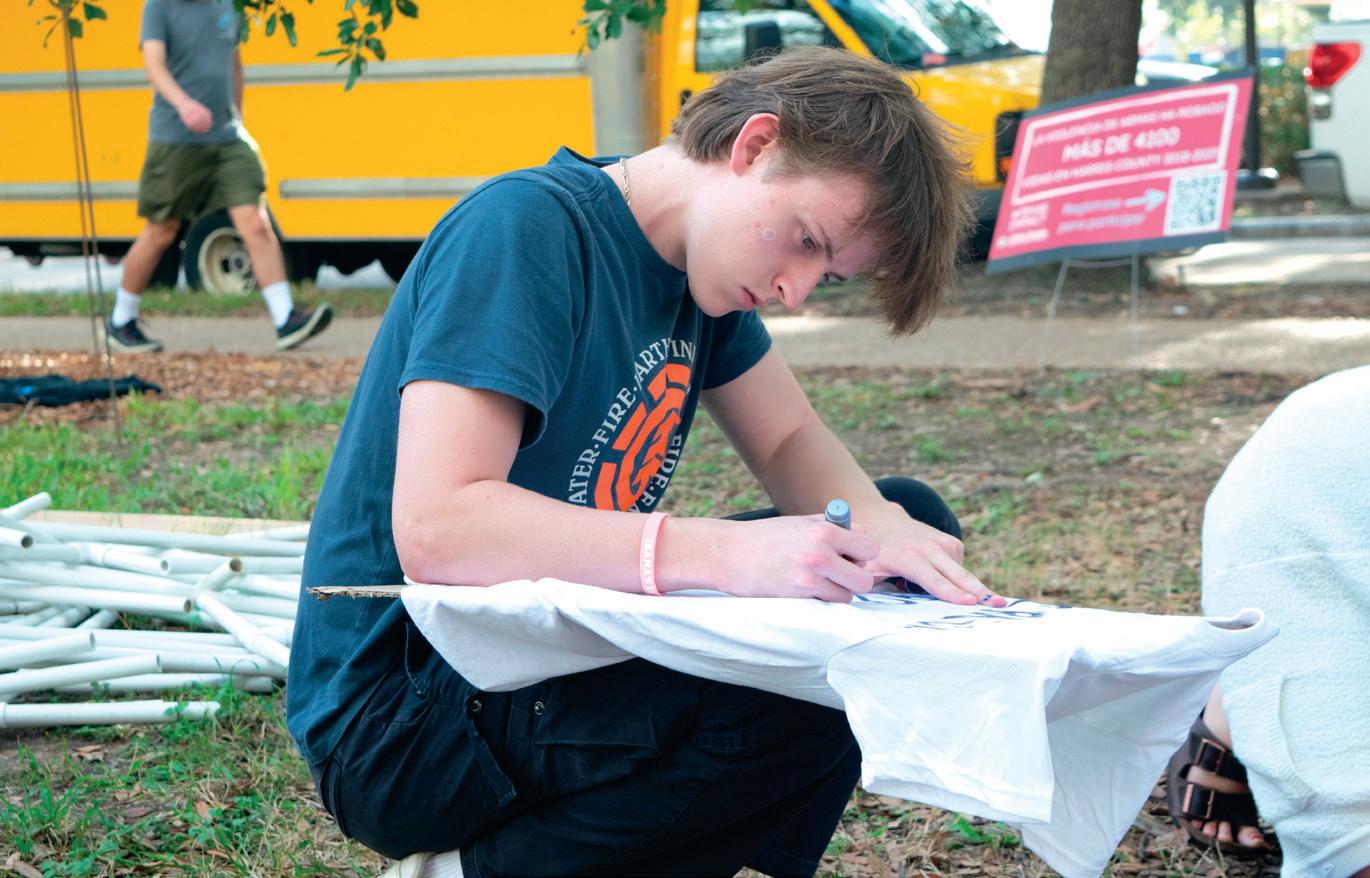
On Friday, Team ENOUGH and the First Generation Legal Collective partnered with Texas Impact to host the event vidas robadas, which translates to stolen lives. Students staked t-shirts into the ground to represent local victims of gun violence.
The Jewish Network met for the first time Oct. 31. A group of about 20 people came together and shared what they hoped to gain from this new support system, according to Vardi.
Kolomeisky said Jewish Network’s main focus this semester will be to educate people to exchange accurate information.
“The main problem is education,” Kolomeisky said. “I believe there is a huge amount of misinformation, fake news and, unfortunately, many people that are not well-educated in history.”
Kolomeisky and Vardi said they foresee inviting guest lecturers and organizing food or international events.
Kenny Weiss, executive director of Houston Hillel and the Rice Hillel rabbi, said he would be open to working with Jewish Network.
“Certainly Hillel and I would welcome working with this group, as we do with similar groups on all the campuses that we have a presence on,” Weiss said.
Kolomeisky said he is excited that many people expressed their wish to join the Jewish Network that are not Jewish or Israeli.
“It means that this resonates with many people’s thinking. This resonates with the good feelings of the people that are trying to help those who need it,” Kolomeisky said. “Educate people, exchange ideas. Just discussion is better than any war. Even if we don’t agree, discussion is better than fighting.”
“We had the death of Andrea [Rodriguez Avila] this year, and gun violence affects everyone, including us here,” Zimmerman, a Sid Richardson College junior said. “So at Rice, in the greater Houston area and in Texas, there’s a lot of work to be done with safety and gun control and keeping preventable deaths preventable, and hopefully we can encourage other people to get involved.”
There’s a lot of work to be done with safety and gun control and keeping preventable deaths preventable, and hopefully we can encourage other people to get involved.
“Each of the white shirts represents a victim of suicide by gun violence, and each of the colored shirts represents a victim of homicide,” Zimmerman said. “Each of the colored shirts have the name and the age of the victim, and then the date they were killed. And then each of the white shirts has just ‘otra vida robada,’ another life stolen, and then the suicide lifeline.”
Abigail Zimmerman TEAM ENOUGH CO-FOUNDER
Jessaly Chavez, the covice president of FGLC, said Team ENOUGH and FGLC collaborated due to shared gun legislation goals.
Rahman and Zimmerman were both active in gun violence advocacy in high school before starting the Team ENOUGH chapter at Rice. Rahman previously served on the executive council of Team ENOUGH and worked on national advocacy after incidents in his high school inspired him to take action.
“Three weeks after Parkland, a gun made its way to my high school’s campus, and people were really scared. No shots were fired, but the school was evacuated, [and] lots of people skipped school the next couple of days,” Rahman said. “[Then] I applied to be on the Team ENOUGH executive council. I had no prior advocacy experience, and then, for whatever reason, they let me be on … We have a lot of momentum because
“I think that there’s a really deep intersection between law and public policy, and I think that gun prevention has a lot to do with public policy, especially in the legal sector,” Chavez said. “So that’s essentially what we’re trying to do, shed light on that intersection.”
The T-shirts will eventually be displayed at the state capitol in Austin. Team ENOUGH plans to bus students for a rally during the Texas Majority to Prevent Gun Violence Advocacy Day Feb. 27.
“There’s such a big barrier to entry to state and federal level change, but if we teach folks that they can make change in their communities and save lives, I think that can help build a grassroots movement,” Rahman said. “[It can] make it feel a little bit less difficult, a little bit less hopeless, which I know is the ethos of our generation.”
EILEEN CHEN FOR THE THRESHER
NDIDI NWOSU / THRESHER
PHOEBE SCHOCKET / THRESHER Students write on t-shirts to memorialize victims of gun violence. Outside the student center, dozens of these shirts display the names of homicide victims and the number of the national suicide hotline.
Awareness club screens Houstonians for lung cancer
the organization upon learning that lung cancer is the deadliest cancer among both men and women in the U.S. and the world.
With the beginning of National Lung Cancer Awareness Month in November, the Rice University American Lung Cancer Screening Initiative leadership said they are striving to bring attention to this disease.
Rice ALCSI is one of 53 university chapters of the national organization, according to Priyanka Senthil ‘24, founder of the Rice chapter and executive director of the national organization.
Rice ALCSI co-president Pranav Mandyam said the club strives to raise awareness about lung cancer screening, in the Rice community and the broader Houston area with upcoming initiatives like the “Breathe Deep Together Lung Cancer Awareness Walk” and screening events. Mandyam emphasized that raising awareness is particularly crucial in Texas.
“The national screening rate is below 5% for high-risk individuals,” Mandyam, a McMurtry College senior, said. “In Texas, it’s even lower, around 1.2% of high-risk individuals getting screened, making it one of the lowest in the country. So, we thought it’s really important to try to raise awareness every year in Texas, and here in Houston specifically.”
Senthil said
“When we think about some of the common cancers, … I think a lot of us think about breast cancer or colon cancer, and lung cancer has really been kind of hidden from the public view,”
Senthil said. “Right now, less than 5% of people who are at high risk for lung cancer are getting screened, when compared to over 70% of people getting screened for breast cancer.”
Mandyam said their biggest goal is the upcoming awareness walk.
When we’re out in the community and identify someone who is eligible and wants to get screened, we can work with screening centers near Rice to help them schedule a scan and guide them through the entire process. We’re now translating our community outreach into real, tangible results — helping people actually get screened.
out in the community and identify someone who is eligible and wants to get screened, we can work with screening centers near Rice to help them schedule a scan and guide them through the entire process,” Senthil said. “We’re really excited about this because it means we’re now translating our community outreach into real, tangible results — helping people actually get screened.”
Priyanka Senthil RICE ALCSI FOUNDER
“We reached out to over 100 different students, different organizations in the Houston area, their community centers, resource fairs, high schools, other industry partners and everything,” Mandyam said. “We’re trying to raise as much awareness as possible within the Houston community.”
Senthil said that Rice ALCSI goes beyond simply raising awareness by helping people schedule screenings. Their community partners include Houston Methodist and MD Anderson Cancer Center, who help subsidize screenings.
“When we’re
Senthil said that all ALCSI chapters host weekly community outreach events and table at places including health fairs, farmers markets, churches, and festivals where they assess if individuals are eligible for lung cancer screening.
“Anyone who is 50-80 years old, who has a 20 pack-year smoking history or more, and who currently smokes or has quit within the past 15 years is considered high risk for lung cancer and should be screened annually,” Senthil said. “At our outreach events, we talk to community members one-on-one to collect their age and smoking history to determine if they qualify for lung cancer screening.”
Senthil emphasized the importance of educating students about lung cancer screening, even if they are not eligible themselves.
“We have found that many students know parents, grandparents, relatives or other individuals in their network who may be eligible for lung cancer screening and oftentimes are willing to share information about screening with that individual,” Senthil said. “In fact, at one of our tabling events on campus last semester, we were able to help get the father of a Rice student screened for lung cancer who had never heard about lung cancer screening prior.”
SA referenda scheduled for December vote
VIOLA HSIA ASST. NEWS EDITOR
Campaigning for the four Student Association referenda, targeting divestment and investment transparency, will begin Nov. 20. The voting period will begin Dec. 4 and end Dec. 11 at noon, with the results published Dec. 12.
According to SA Faculty Advisor Heather-Reneé Gooch, the timeline was determined by the Office of Institutional Effectiveness’ schedule, which will oversee the election as an impartial third party. Gooch said the office will return from vacation on Dec. 2.
“This was something that students had felt very passionate about,” Gooch said. “There [was] a discussion about having a special election, expediting it due to the gravity of what would be voted on.”
Arman Saxena, author of the referenda, said that although he is worried about voter turnout when the vote will happen during ‘dead days’ — designated study days for students — he is happy that the vote is happening.
“During this campaign period, [Students for Justice in Palestine] will be working to spread as much education and information on these referenda as possible,” Saxena, a Lovett College junior, wrote to the Thresher.
Editor’s Note: Arman Saxena is one of the Thresher’s Arts and Entertainment Editors.
SA President Jae Kim said he hopes that the election will set a precedent for future referenda.
“This election will allow us to get every student’s opinion, which I think would be helpful for us in advocating with university administration,” Kim said. “I also want to set a precedent that SA does referenda on questions like this, so when future executive boards want to do direct democracy ... they have a precedent that they can follow.”
Anthropology reports highest major satisfaction in survey
PRASI DESAI SENIOR WRITER
Anthropology students are the most satisfied with their major according to last year’s senior exit survey results, Mary Prendergast, director of undergraduate studies for anthropology, said.
The senior exit survey is a mandatory survey given to all graduating seniors by the Office of Institutional Effectiveness regarding their experience at Rice. Last year, eight students graduated with an anthropology major, though Prendergast said that the major size each year typically varies from eight to 14 students.
According to anthropology and English double major Isabella Campos, anthropology professors are attentive to students’ needs and accommodating towards student schedules — especially as Campos’ role as Hanszen College president sometimes requires her to attend meetings and events during afternoon classes.
Hanszen College junior, said.
Prendergast said anthropology faculty are trained to be good listeners and observers as a byproduct of their position as anthropologists.
“These skills make us highly attuned to students’ needs, their sources of stress and joy,” Prendergast wrote in an email to the Thresher. “We try to create an atmosphere inside and outside of the classroom that is inclusive, and students have told me that they appreciate the ways in which we are approachable, flexible and accommodating.”
For anthropology and medieval and early modern studies major Bri Janson, the diversity and small size of the major is a large contributor to the student experience.
You’re dealing with community issues and you’re seeing what matters to people.
Bri Janson ANTHROPOLOGY MAJOR
“It’s a really small major, so you get to interact with people and hear their opinions on a daily basis,” Janson, a McMurtry College senior, said. “It’s really a privilege to study what you like to study and people in the major understand that. It’s a good environment with good people.”
the conversations between students and professors bolster student happiness. These connections with her professors also helped her join an archeological expedition in Belize over the summer.
“I find joy in the amount of care and attention that each student receives from each professor,” Antinossi, a Sid Richardson College senior, said. “You can tell that each professor is engaged and interested in what they do.”
The opportunity for handson anthropology classes stood out for Campos, she said. Next semester, she plans to take an archeological field techniques class which allows students to work at an archaeological dig site.
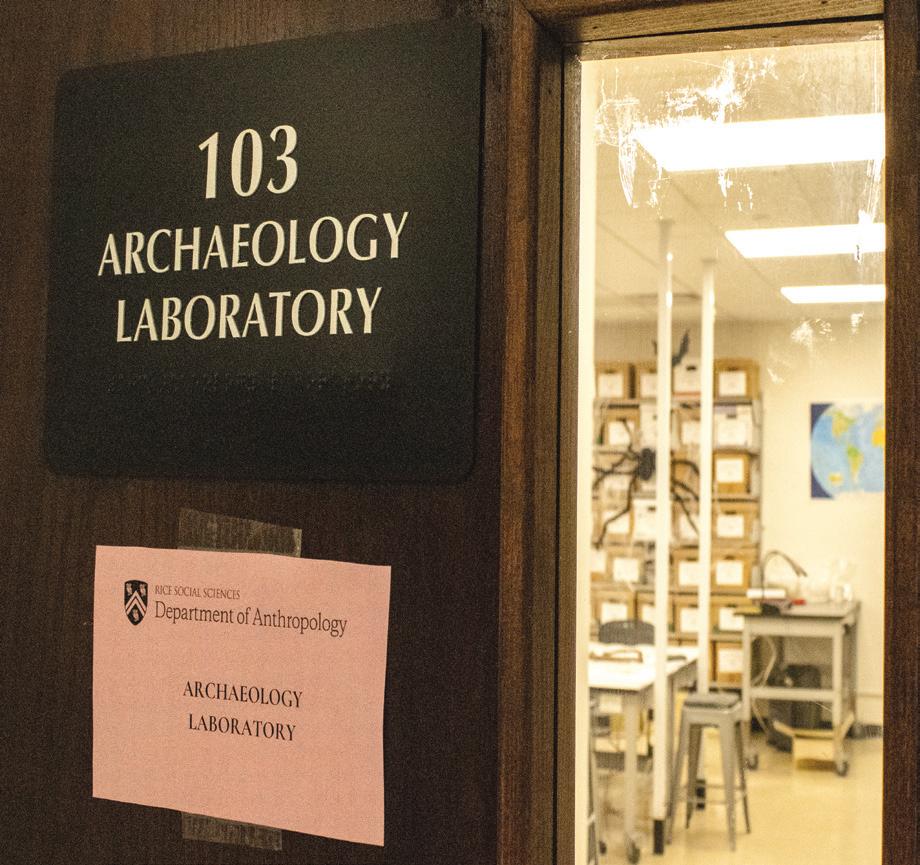
SASHA MILLER / THRESHER Anthropology students have the opportunity to participate in archaeological field work.
“All my professors have been really great about meeting me where I am,” Campos, a
According to Abby Antinossi, an anthropology and history double major,
Janson also said she believed the work done in archaeology is fulfilling, contributing to long-term satisfaction.
“You’re dealing with community issues and you’re seeing what matters to people, which just feels like really fulfilling work,” Janson said.
Antinossi, Campos and Janson initially took introduction to archaeology, ANTH 205, intending to fulfill distribution requirements, but quickly became more interested in the subject and continued with the major.
“[ANTH 205] was like a gateway drug to anthropology at Rice,” Antinossi said.
According to Cymene Howe, chair of the anthropology department, students pursue a wide variety of careers upon graduating.
“[Students] seek out careers in medicine, government and law and take up leadership positions in non-profit organizations, education and social service agencies,” Howe wrote in an email to the Thresher. “They are special because they have a shared sense of caring about the world — of wanting to make it a better place and they are supportive of each other too.”
KATHERINE CITINO / THRESHER
BELINDA ZHU ASST. NEWS EDITOR
EDITORIAL
LPAP courses need wide-ranging change
Picture this: You’re a senior. After four years of churning out every major requirement and elective known to man, you’re ready to graduate. You eagerly submit your spring semester courses in Esther (who asked for a redesign, by the way?), only to be stopped in your tracks by the last, looming task on your plate: the LPAP.
And, of course, every other senior has run into the same issue as you.
Popular lifetime physical activity program classes, like yoga, pilates and scuba diving, often see over 50 seniors register, but can only hold 20 each.
Although classes like tai chi and mental training have merit, the relative course demands speak for themselves, with a paltry 8 and 14 seniors respectively. “Lifetime” physical activity programs should teach skills that are applicable and accessible throughout people’s lives — even beyond Rice.
We need to offer more LPAP courses that cater to the interests of students: Offering two sections of pilates is a great start, but needs to be extended to other areas, as well. We would like to see course offerings on biking or rock climbing, or bring back the Outdoor
Education LPAP offered fall 2022. LPAPs are also exclusively taught by professional instructors. Students have experiences that extend far beyond academics, especially at this university,
It seems like a wasted opportunity for our peers to not host classes that showcase their talents through LPAP classes, similar to how they do with college courses.
whether it be a decade of professional dance training, nationally recognized golf records or professional meditation-yoga certifications. Student-led ROPE courses show that students are trusted to educate and keep their peers safe.
It seems like a wasted opportunity for our peers to not host classes that showcase their talents through LPAP courses, similar to how they do with college courses. Allowing peer-
led LPAP courses would not only increase availability, but also further foster a sense of community and leadership among students without increasing recreation center costs.
Furthermore, the grading systems in many LPAP courses feel unnecessarily harsh. While attendance should be encouraged, many LPAPs are overly strict with their requirements, without exceptions for illness or other academic commitments. Additionally, some of these classes, which should be easy As with regular attendance, contain final exams graded by incredibly particular instructors who dock points for (literally) a toe being out of line — we’re writing from personal experience, if you can tell.
Among the countless grades that we deal with, we certainly do not need to further burden ourselves with an ‘A’ grade in an LPAP course. Surely, a satisfactory/unsatisfactory system would suffice in this case, with a focus on participation and effort.
As registration continues for the spring semester, LPAP courses that work for and are actively worked on by students would leave them gaining far more from this part of their Rice journey.
Why the Democratic Party keeps failing usand what we can do
Editor’s Note: This is a guest opinion that has been submitted by a member of the Rice community. The views expressed in this opinion are those of the author and do not necessarily represent or reflect the views of the Thresher or its editorial board. All guest opinions are fact-checked to the best of our ability and edited for clarity and conciseness by Thresher editors.
In the wake of the 2024 general election, many of us are grappling with frustration, disappointment and even anger toward the Democratic Party — and that’s okay. This isn’t about campaign strategy or a single election loss; it’s about the party’s choice to take a once-promising, potentially transformative nominee and reduce her to a hollow vessel for corporate donors and backers.
These feelings reflect a widening disconnect between party leadership and the working people who depend on their promises of real change. And the consequences go beyond disillusionment — when the party fails to deliver, communities like students, people of color and those in the LGBTQ+ community that need support the most are left with little to show for their votes.
Even at the heels of his resignation, you saw the chair of the Texas Democratic Party choose to denigrate transgender people for losing the 2024 election, rather than confront the party’s own shortcomings.
The Democratic Party won’t fight for transformative change and it’s time for us to create it ourselves. This means organizing for direct action – here and right now – and building solidarity to demand the change our communities deserve.
Since I was 13, I have organized, canvassed and made calls for this party — dedicating eight years to causes I believed would create real change. I staffed a competitive congressional race in the heart of Arkansas that raised over $3.5 million. I served as vice president of the Rice Democrats.
I write this not out of sheer frustration with the Democratic Party, but from deep
disappointment and dismay — especially because in states like Arkansas, my home, the Democratic Party has often been my only channel for mobilization and advocacy.
The party’s repeated unwillingness to boldly tackle fundamental issues of affordable housing, healthcare, climate action and workers’ rights has disillusioned countless supporters. In every election cycle, promises are made, and hope is reignited, only for meaningful reforms to be softened or abandoned.
At this moment, more than ever, we need to come together to protect our community and make a “Culture of Care” a reality.
In 2024, we watched as the Democratic presidential nominee campaigned for the very border wall she once condemned as “a complete waste of taxpayer money and a policy that “won’t make us any safer.”
It’s time to take matters into our own hands. Direct action allows us to create real, immediate pressure where politicians have failed. We can join in solidarity with groups dedicated year-round to making a difference — from labor unions to climate justice groups, tenants’ rights groups and movements on our campus.
Solidarity starts by finding your communities and recognizing the needs of those around you. Channel your energy beyond the hedges — while a second Trump administration would deepen struggles for many, there are people right now, both on campus and across Houston, who need our support – share resources, volunteer, attend community meetings or support campus initiatives — small steps add up to real change.
We can build a “Campus for All” by advocating for the well-being of every student, regardless of race, gender or class, and pushing back against the
EDITORIAL STAFF
OPINION
DESIGN
monopolistic practices that punish all students, especially working-class ones.
At this moment, more than ever, we need to come together to protect our community and make a “Culture of Care” a reality. Creating a “Culture of Care” on campus means fighting for a community that actively prioritizes mutual support.
It means defending freedom of expression and academic freedom, so every voice is heard without fear of retaliation. It means hearing our classmates out when they say the faculty doesn’t represent all of us. It means showing up for each other, standing together in solidarity and creating a campus where everyone feels supported and valued.
We must organize to protect Title IX from a second Trump administration, continue to advocate for comprehensive disability support services across all campus facilities and push for the university to take a principled stance on global issues, such as Palestinian solidarity. By coming together to protect our rights and the rights of others, we build a community that stands in solidarity against all forms of injustice, showing that our campus can be a force for meaningful change.
Solidarity and taking action are deeply embedded in the spirit of Rice students — our history is filled with moments where we stood together and will continue to. Even recently, students have continued to come together for environmental sustainability and racial justice. We need to unite to protect our rights and those of others. We honor this legacy of collective strength by building a community that stands together and firmly against all forms of injustice.
Solomon Ni JONES COLLEGE SENIOR
BUSINESS
during the school year, except during examination periods and holidays, by the students of Rice University.
Letters to the Editor must be received by 5 p.m. on the Friday prior to publication and must be signed, including college and year if the writer is a Rice student. The Thresher reserves the right to edit letters for content and length and to place letters on its website.
Editorial and business offices are located on the second floor of the Ley Student Center: 6100 Main St., MS-524 Houston, TX 77005-1892
Phone: (713) 348 - 4801
Email: thresher@rice.edu
Website: www.ricethresher.org
The Thresher is a member of the ACP, TIPA, CMA and CMBAM.
The post on compost: The latest of composting at Rice
AMELIA DAVIS THRESHER STAFF
Heavier than a commercial plane: Rice has composted one million pounds of food waste in total in May 2024 through the Moonshot Compost program. More bins were added due to demand at the beginning of the 2024-25 school year, according to sustainability coordinator Kristianna Bowles.
From the 1990s to the early 2000s, a composting partnership with a device called the Earth Tub was pursued, said Richard Johnson, senior executive director for sustainability in a Rice News article. Using the device was more trouble than it was worth, and this effort was scrapped. However, interest in alternatives continued, and in 2019, a search for a replacement composting system began, Johnson said.
Bowles said that the Office of Sustainability selected Moonshot as a better composting solution.
“We partnered with Moonshot Compost, a Houston-based start-up, and debuted the program in November 2020 at the West Servery,” Bowles wrote in an email to the Thresher. “The program expanded to all serveries and additional collection points across campus, including the Rice Village and Graduate Apartments.”
the serveries are top composting spots. Smaller contributors like Sammy’s and the Rice Graduate and Village Apartments only contribute a few percentage points each to Rice’s efforts. However, these results vary month to month — in a recent Instagram post from Housing and Dining, South Servery claimed the top spot with 12,536 lbs composted in September 2024 — 4,075 lbs more than the runner-up, West Servery.
According to Bowles, the Moonshot operation has been growing steadily over the years of its implementation.
“Due to this consistent scaling of the program, the amount of food waste we’ve been able to save from the landfill has gone up between 10 and 15% each semester,” Bowles wrote.
Isabelle Chang, an intern in the Office of Sustainability, says the office and other student organizations involved in the Moonshot program have plans to expand the composting program.
The amount of food waste we’ve been able to save from the landfill has gone up between 10 and 15% each semester.
Kristianna Bowles SUSTAINABILITY COORDINATOR
North Servery has composted the most in total, making up 18.48% of Rice’s total composting efforts, with honorable mentions to 16.75% to Seibel Servery and 16.59% to West Servery. As shown through the Moonshot compost tracker,
Obvious
Munich is its capital
Pensioner, often
Aang and Korra
It’s dark-colored and flaky
Cattle farms
25.2 to 26.2, perhaps
Wooden cylindrical peg
Island where Macbeth is buried
British mother
Eco-friendly org.
It’s an attractive iron ore
Superman’s
Chang, a McMurtry College senior, has been the main liaison for the Moonshot program since the end of her freshman year. Chang said one of the initiatives she has planned is redesigning the Moonshot signage to prevent sign fatigue, a psychological phenomenon where people stop paying close attention to signs seen on a daily basis. The signage above composting bins has been the same since the introduction of the program.
Chang said the job does come with some perks — besides exposure to future careers, as she is studying civil
“I’ll return soon,” for a
Fishermen’s tools Golf appointment?
Displaying, as one’s teeth
Hazard in the Rockies
Wind direction indicator
Flight coord.
Rousing cry
Fury Behind
Zombie’s cry
Removes
Opportunity
Like the most clogged ear 17a, 29a, 43a, or 56a Of the womb
French psych-rock band ______’_
environmental engineering and social policy analysis — such as a visit to Moonshot’s headquarters to see behind the scenes on Rice’s contribution to the operation. Two hundred pounds of compost, sorted to remove non-plant matter, is provided to the Rice gardens each year, she said.
“Moonshot is an industrial plant, so they can take a bunch of non-plant matter — but the [Rice] garden only does plant matter. So it’s just interesting to compare those two,” Chang said. “[Moonshot picks] up the compost — and they don’t just do campuses, they also do businesses and residential buildings, and then they have a composting facility out in Conroe.”
After Chang graduates, the cycle of leadership will continue — Will Howley, a Brown College sophomore, is her protegé, she said. The composting program at Rice has changed and grown over the years, and will continue as long as there are technological improvements and cycles of change to be followed — and as long as the cycle of composting can be sustained.
“I’m basically taking him through the things that I do on a regular basis, and I’m obviously still working for them, but just showing him what I do and what my process is, so hopefully this transition will be a little smoother than when I came on — because I basically had to figure everything out,” Chang said.
___ pronounce you...”
Gymnast Simone
Clown Ronald
Reindeer
It’s found in bones and Martian meteorites
Hero’s Journey, for instance
Bombay talkie?
utterance
collar
Jones Sch. degrees
A foe’s antonym
See 46a
Pub drink
Spoil
Possessive pronoun, for example
“That’s __. _ quit!” Chamomile or Earl Grey, in Français
From gardening to global music: 5 must-take courses
AISHA KHEMANI THRESHER STAFF
Crafting your schedule for next semester requires balancing your curiosity and graduation requirements. Do you want to pique your interest while adding value to your academic journey? Take a look at the list below.
BIOS 207: Garden Science
Looking for a fun way to check off that D3 requirement while bringing some green into your life? Taught by Joseph Novak, this class is perfect for non-STEM majors who want hands-on garden time. It meets Tuesdays and Thursdays from 4 p.m. to 6 p.m. Topics covered vary from plant development to soil management to uses of garden crops.
PHIL 269: Markets & Morality
Whether it’s buying your first car or accessing healthcare, you’ll find yourself buying goods and services from a market. But should everything go through a market? What are the moral limits? If you’ve ever done a deep introspective dive about this and want to fulfill that D1 requirement, this class is for you. This course also meets Tuesdays and Thursdays with Thimo Heisenberg from 1 p.m. to 2:15 p.m.
POLI 310: The Biology of Politics
Do you want to understand how our brains are politically wired? From genes to brain chemistry, this is your chance to explore how biology impacts politics from civil engagement to ideology. Taught by Professor John Alford, who is the author of Predisposed: Liberals, Conservatives and the Biology of Political Differences, this course is thought-provoking, accessible and infinitely interesting whether you’re a political science major or not. It meets on Mondays and Wednesdays from 2 p.m. to 3:15 p.m.
MUSI 226: Music in Global Perspective
Knock out that D1 requirement while exploring the diversity of global music. From African drumming to K-pop, this course explores how music influences and reflects history, identity and culture. You’ll enhance your listening skills, analyze music in its social context and uncover the stories behind traditional and modern genres. It’s a global journey for your ear with no passport needed. If your Tuesdays and Thursdays are busy, this course meets on Mondays, Wednesdays and Fridays from 1 p.m. to 1:50 p.m. with Erik Broess.
Robots do the brewing at CERĒS coffee shop
JESLYN CHO FOR THE THRESHER
It’s 8:45 a.m., and you walk into Rice Coffeehouse to find the line wrapped around the hallway of the student center. Begrudgingly, you skip out on your morning coffee and start estimating the perfect time to return when they might not be as busy. As you leave Chaus empty-handed, you realize you could go to Dandelion Cafe if you really wanted a morning drink. But that would mean going into debt.
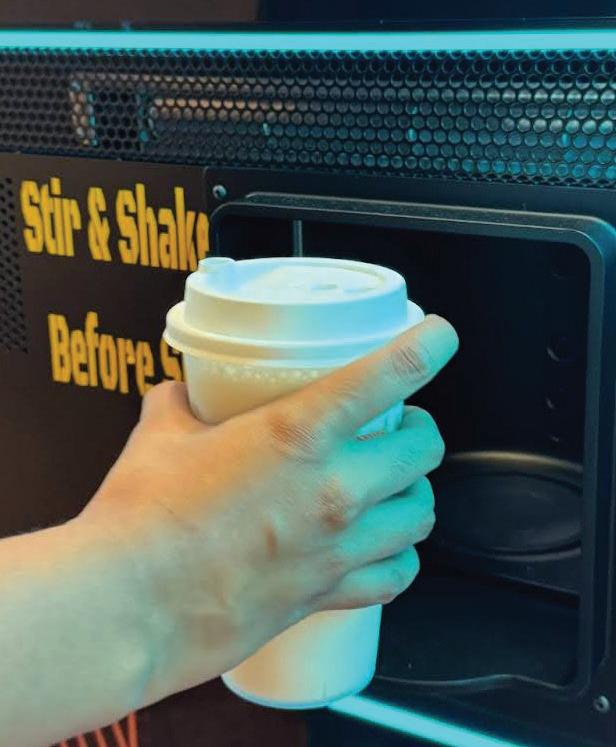
However, a new coffee spot opened at the Jones Graduate School of Business on Sept. 9: CERĒS Robo Coffee Shop. According to the CERĒS website, CERĒS Robot Coffee Barista is a vending machine that uses artificial intelligence to make their drinks, instead of employing baristas. Despite the initial skepticism one might have about a robot making your morning coffee, the accessibility and luxurious-tasting drinks offered at CERĒS make it a good alternative to Chaus and Dandelion Cafe.
ENST 207: Environmental Storytelling
Calling all climate enthusiasts and storytellers — this course unleashes the power of storytelling in shaping public opinion on the climate crisis. You’ll explore the use of fictional storytelling across various mediums and learn how they’re used for
history, psychology and sociology, you’ll also get the opportunity to create your own environmental media project for the final assignment, and earn D1 credit to boot. The course meets on Mondays and Wednesdays from 4 p.m. to 5:15 p.m. with Matthew SchneiderMayerson.
with her friends, as she was previously unaware of CERĒS.
“I didn’t know we had this at Rice ... I had to take a picture to show my Dad. It looks so futuristic,” Perrin said.
The menu offers 20 different drinks and customization options such as toppings and syrup. There are classic drinks such as a vanilla latte and americano. Specialty drinks include the CORA, an iced dragon fruit oat milk latte, and the signature CERĒS drink, a salted caramel cinnamon toffee latte. While the line at CERĒS can get long during busy hours, each drink is crafted in 60 seconds or less, minimizing the wait time.
The CERĒS Robo Coffee Shop is on the first floor, near the entrance to McNair Hall. Upon first glance, it looks more like a gigantic vending machine illuminated by blue lights than a coffee shop. Students can place their order through the built-in kiosk and watch through the glass as a robot arm prepares their coffee.
Brown College freshman Anna Perrin said that she was excited when she stopped by the Robo coffee shop
I tried two different drinks: the iced caramel latte and the chai tea latte. Both drinks exceeded my expectations. The iced caramel latte was a great balance of rich coffee flavor, milkiness and sweet caramel. The taste of warm spice was apparent in the chai tea latte, which made it the perfect drink for the fall season. While CERĒS does not accept Tetra, both drinks were reasonably priced at $4.25.
Unlike Dandelion Cafe or Chaus, the CERĒS Robo Coffee Shop doesn’t provide a cozy sit-down experience with friends. However, for students who are looking for convenience and delicious coffee, the CERĒS Robo Coffee Shop provides quality drinks without a lengthy wait time.
Naomi Bagal said she would definitely consider CERĒS in her regular coffee rotation.
“I will be a returning customer,” said Bagal, a Brown freshman.
JENNIFER LIU / THRESHER
JESLYN CHO / THRESHER
Just ‘phil’ the music: a cappella group releases new album
Step one: Say hi to PHIL, the jolly stick figure on the cover of the Philharmonics’ newest album: “still phil.”
Step two: Click the play button for arrangements of songs by artists like Joji, Conan Gray and Taylor Swift.
Step three: Listen. Did you notice yet? There are no musical instrumentals, only voices.
Rice Philharmonics, the oldest a cappella group on campus — nicknamed “The Phils” — released their album “still phil” on Spotify Aug. 16, marking the end of a project started in 2022. The album boasts a nine-song tracklist, each an a cappella arrangement of mainstream songs like “People Watching” by Conan Gray or “Every Summertime” by NIKI.
“The whole group had a discussion about what was going to be on [the album],” Ajit, a Lovett College senior, said. “Usually, it’s up to the people who make the arrangements because [they] make these [songs] come to life. But I still feel like there was a group-wide consensus about all the songs.”
After finalizing the arrangements, recording began. While most students may remember Fondren Library as a study hub, Ajit remembers its basement — which houses the digital media commons — differently.
“Fondren was just the place I went to study,” Ajit said. “And then it [became] the place where we’re producing this whole album that will eventually be on Spotify.”
Having [the album] be called ‘still phil,’ reminds all those other people who’ve worked on it, that they’re also still Phil.
Rita Ajit
LOVETT SENIOR
For “still phil” to come to life, the Phils made a cappella arrangements of songs they wanted to record. Some of these songs had already been performed at the International Championship of Collegiate A Cappella in 2022, including “Same Old Blues” and “Diamonds,” both of which are mashups of songs from artists like Rihanna, Sam Smith and more.
According to Josh Paik, Phils’ music director, members could also suggest songs to be arranged.
“Phils is unique in the way we arrange all of our own music,” Paik, a Duncan College junior, said. “That [isn’t] common amongst a lot of collegiate a cappella groups.”.
Rita Ajit, now Phils’ president and firstyear member at the time of recording, said she appreciated the amount of input every member had in choosing the setlist.
Unlike other voice parts with sheet music, Paik, the group’s beatboxer, said it would have been difficult to transcribe beatboxing the same way.
“The thing is, you can’t really put beatbox in [sheet music],” Paik said. “I thought about how the drums work in this song. How can I try to improve the rhythm of this? The kind of mood that is brought about by this beat?”
Record. Not satisfied? Repeat. The Phils would spend hours recording in Fondren’s basement, according to Dhilani Premaratne, the Phils’ publicity manager.
“We would try to take each song fully from the beginning to the end without cutting too much … that was the ideal take,” Premaratne, a Jones College junior, said.
According to Premaratne, the experience of recording songs in a studio was new to the a cappella group.
“I didn’t have experience with [recording]. I think most of us didn’t,”
Premaratne said. “We listened to our music director and recording manager give us input to make sure that we felt comfortable in the studio environment.”
According to Paik, finalizing the album took a long time because of the Phils’ threeyear cycle of competing at the International Championship of Collegiate A Cappella, going on tour and producing an album. Now, after nearly three years, “still phil” is available on platforms like Spotify, Apple Music and YouTube.
While it’s a celebratory moment for the Phils, according to Ajit, it’s also bittersweet, because many voices and artistic touches of the album belong to members who have since graduated. Ajit said that ‘PHIL’, the hand-drawn stickman that serves as the album’s cover art, was drawn by a Phils’ alumni.
“Our old music director, Audrey Ma designed this little guy. She graduated last year,” Ajit said.
But despite the time that passes, some
Phils traditions keep the former and current members connected, according to Ajit.
“For our last song at our homecoming concert, we always sing ‘Africa’ by Toto. It’s just a Phils tradition,” Ajit said. “For that song, we always ask if there are any Phil’s alumni in the audience [to] come back up and sing with us. This year, there were four alumni [who] came back on stage. It just felt more complete.”
While the name “still phil” is a clever pun on the album’s title track, “Still Feel,” it takes on a deeper meaning for all generations of the Phils, Ajit said.
“Phils is something that continues after you graduate … Phils is so much more than what we do in rehearsals and concerts,” Ajit said. “It’s also [the] friendship that you take with you … preserving those memories that you made together, and, remembering that that part of you is forever there. Having [the album] be called ‘still phil’, reminds all those other people who’ve worked on it, that they’re also still Phil.”
Festival season: These fall film picks bring drama, intimacy
of the best of the fall festival season.
“All We Imagine as Light”
With the Houston Cinema Arts Festival right around the corner, we’re in the midst of fall film festival season. Many of the biggest film festivals in the world — such as Venice and New York — have already happened, and some of their most acclaimed selections are being released in the next couple of months. Check out these movies, which are some
An intimate drama from Payal Kapadia, the director of “A Night of Knowing Nothing,” “All We Imagine as Light” was the first Indian film to screen at the Cannes Film Festival in 30 years before making the rounds at the three biggest North American fall festivals — Telluride, Toronto and New York — earlier this season. This poetic film follows two young women looking for freedom, togetherness and joy in the city of Mumbai. “All We Imagine as Light” is only Kapadia’s second feature film and cements her as a filmmaker to watch for years to come.
“Anora”
This year’s Oscar Best Picture winner? We’ll see what happens in March, but Sean Baker’s “Anora” is already a frontrunner in conversations about the best movie of 2024. With the cityspanning dramedy-romance “Anora,” Baker, the director of small-scale, location-specific films like “The Florida Project” and “Tangerine,” has made his biggest movie yet. However, “Anora” doesn’t lose the character-focused humanity of Baker’s previous work, with
much credit going to Mikey Madison’s likely-Oscar-nominated starring performance as the titular character.
“The Brutalist”
A three-hour-long epic about an immigrant architect in post-World War II America, Brady Corbet’s “The Brutalist” is ambitious and monumental. With stunning long-take sequences, opulent production design and an ensemble of colorful characters, expect an aweinspiring and audacious experience.
Adrien Brody, Guy Pearce and Felicity Jones all turn in memorable performances that will have you thinking about this future Best Picture nominee even after the credits roll.
“Emilia Pérez” A comedy-crime-thriller-musical about a Mexican cartel boss, Jacques Audiard’s “Emilia Pérez” doesn’t sound like a real film. But it is — and it’s a wild ride. Starring Karla Sofía Gascón as a transgender cartel boss, Zoe Saldana as a lawyer who helps her navigate escaping her life of crime, and a soundtrack that will have you dancing in your seat, “Emilia Pérez” is a genre-defying spectacle. Audiard blends humor, suspense and musical numbers to create
a film that is as entertaining as it is thought-provoking.
“Hard Truths”
Mike Leigh has been making films since 1971, and at 81 years old, he shows no signs of stopping. Like with all his best films, “Hard Truths” is a character-driven exploration of the human condition. He ruminates on relationships, triumphs, hardships, all of the things that make up the everyday. The film is brought to a different echelon by Marianne JeanBaptiste, a British actress who previously worked with Leigh on one of his mostacclaimed films “Secrets & Lies.”
“Nickel Boys”
Adapted from the Pulitzer Prizewining novel by Colson Whitehead, “Nickel Boys” follows the story of two young black men at an abusive reform school in Florida. Directed by Oscarnominated documentarian RaMell Ross, “Nickel Boys” is a deeply human tale of devastation and perseverance, shot beautifully by “All Dirt Roads Taste of Salt” cinematographer Jomo Fray. The film is anchored by an ensemble of acclaimed performances, especially Aunjanue Ellis-Taylor as the teenage protagonist Elwood’s grandmother Hattie.
HANNAH LEE FOR THE THRESHER
COURTESY RICE PHILHARMONICS
JENNIFER LIU / THRESHER
ARMAN SAXENA A&E EDITOR
Altered Origins architecture festival breaks boundaries
A one-of-a-kind festival was hosted by Rice’s School of Architecture Oct. 22 to 26, in collaboration with the department of anthropology, Houston Climate Justice Museum and Moody Center for the Arts. The festival, titled “Altered Origins: Emergencies, Experiments and Environment,” included workshops, conversations and performances challenging the norms of architecture.
“We were pushing for work that was transdisciplinary, that works in the outskirts or limits of the disciplines,” said Tania Tovar Torres, the festival’s organizer and a School of Architecture Wortham Fellow.
The transdisciplinary nature of the festival was reflected in its geographies, Tovar Torres said. Workshops,
conversations and performances were held across campus: from Cannady Hall’s fabrication workshop to the archaeology lab in Sewell’s basement and the Moody Center for the Arts.
The festival featured 14 presenters, who Tovar Torres met through her curatorial work in Mexico City. These guests hosted workshops and gave lectures on various topics throughout the event.
“I would call them all spatial practitioners because they all work in a very spatial manner but on different scales — from the body to the territory or the objects in between,” Tovar Torres said. “Some were trained as artists, sound artists, performance artists or anthropologists”.
Like the participants themselves, programming was varied, with topics ranging from collaborative 3D scanning
of artifacts to a workshop where participants explored “the continuity between our bones and the rocks that compose the foundations of the earth,” according to the festival’s website.
Alice Bian, a senior architecture student at Brown College, said the “Digital Clay” workshop she attended had an intimate and experimental atmosphere. The workshop used 3D printers to create clay models.
“It was a one-to-one learning experience and everyone was very comfortable,” Bian said. “3D printing is a high-tech method using clay, but using the machine to print was very manual.”
The decision to call it a festival was deliberate, said Torres.
“[Symposium or conference] felt so static and a bit too trapped in the academic setting,” Tovar Torres said. “We wanted to create something that was open to everyone and that had a kind of joyful and festive condition to it.”
Their investigative work is then developed and finalized in a spring studio.
The Watkins sequence that Tovar Torres taught last year was also titled Altered Origins.
“Students started by researching and interviewing practitioners in Mexico who were working at the intersection of architecture, the humanities, the sciences and the arts,” Tovar Torres said.
Tovar Torres said she was motivated by a desire to show students how tools and methodologies from other fields could be incorporated into architectural practice.
We wanted to create something that was open to everyone and that had a kind of joyful and festive condition to it.
Tania Tovar Torres FESTIVAL ORGANIZER
The festival was unique, according to Bian.
“The whole workshop idea was a pioneering experience,” Bian said. “It was built around creating a hands-on learning experience, instead of just listening to a lecturer and asking some questions, which is something that we get a lot of at the architecture school.”
The festival was the culmination of a Watkins seminar sequence that Tovar Torres led in the 2023-24 academic year. The Watkin sequence begins with a special topics seminar where fourth-year architecture students develop research projects on contemporary challenges.
“Our students are very versed in digital production and model making, and I wanted to show them how those skills can also be applied in different contexts and to answer different questions,” Tovar Torres said.
For Neha Nayar, a fifthyear architecture student, the “Altered Origins” Watkins sequence was unlike any other architecture seminar or studio.
“It was super detached from the typical design process, instead encouraging us to look for unconventional, designable ‘spaces’ beyond obvious forms of architecture,” Nayar said. “It was also a great opportunity for creative expression outside the architectural discipline.”
Tovar Torres said she hoped that festival participants would expand their horizons on what architecture and architectural research could look like.
“There are so many different avenues in which one can practice, and architecture is so much more than just design and edification,” Tovar Torres said.
Review: ‘Anora’ marries comedy, class consciousness
“Anora” isn’t a traditional romantic comedy, though parts of it may play like one: its protagonist is an erotic dancer, its meet-cute is in a strip club, and the central couple’s romance takes them on a whirlwind of sex, money and drugs. Still, the scenes of the couple dancing in the neon-lit streets of Vegas are some of the most romantic of the year thus far.
These romantic scenes aren’t the only thing Sean Baker’s newest feature does well. “Anora” blends dark screwball comedy, crime drama and class conscious thematics with aplomb. It’s a mash of genre and tone that never feels false due to the tandem of Sean Baker’s ultra-specific writing and Mikey Madison’s phenomenal work in the titular role.
“Anora” is achingly human, laugh-outloud funny and rife with food for thought to the perceptive viewer.
The film grabs the audience from its very first scene — a neon-lit strip club sequence soundtracked to Robin Schulz’s electro-pop rework of Take That’s “Greatest Day.” This is where we meet Anora, the protagonist and the heart and mind of the film. Anora is a go-getter: She goes the extra mile to get more out of her client’s pockets, and the film’s opening scenes follow her as she moves through her night.
The quick editing used here emphasizes that all of this is part of a normal day for Anora. However, Anora’s world becomes as far from normal as possible when Ivan, the son of a wealthy Russian oligarch, walks
into the club and requests a dancer that can speak Russian. Anora, coincidentally, is of Russian descent and their meeting begins the central plot of this roller coaster ride of a film.
“Anora” delves deeply into the grit of sex, drugs and money, but its heart beats with a thoughtful critique of class and the American Dream. While Anora’s life might seem thrilling at first glance, the film doesn’t shy away from showing the limitations imposed by her circumstances. She works without health insurance, bound to a rigid schedule, and her “freedom” is, in reality, carefully restricted — something the film implies is a direct product of her lowerclass status.
Mikey Madison’s performance as Anora is a revelation, cementing her as an undeniable Oscar contender. Madison breathes life into a character who is tough, resourceful and relentlessly defiant. Her scenes talking back to those who seek to exploit her are some of the best of the film.
Her defiance also contributes to some of the film’s hilarious screwball comedy sequences. Director Sean Baker, renowned for his breakout film “Tangerine,” brings a similar energy here, blending screwball and black comedy to emphasize both the absurdity and the darkness of Anora’s world. Like Tangerine, Anora is soundtracked by an electric, pulsing score that keeps the momentum high, while fast-paced editing ensures that the film never drags.
Anora’s romance with Ivan, the son of a wealthy Russian oligarch, offers a sharp, unsparing look at class dynamics. Ivan
embodies the promise of the American Dream for Anora, an escape from her current life and a step into the world of wealth and privilege. But this dream proves illusory: Ivan’s family forbids him from marrying “a prostitute,” leaving Anora locked out of the life he dangles seductively before her.
The film starkly illustrates the lie behind the American Dream — while society may glamorize freedom and upward mobility, strict class barriers persist.
Blending screwball comedy, sex and social critique, Anora is both hilarious
FILMNATION ENTERTAINMENT
and thought-provoking, a dazzlingly original addition to Sean Baker’s filmography. With strong direction, electric editing and cinematography and Madison’s unforgettable performance, “Anora” stands as one of the best films of the year.
The film is a sharp reminder of the limits imposed by class, even in a society that touts itself as the “land of opportunity,” Don’t be surprised if this film ends up at the top of this year’s Oscar Best Picture race come March.
ARMAN SAXENA A&E EDITOR
HUGO GERBICH PAIS SENIOR WRITER
GUILLIAN PAGUILA / THRESHER
Meet the Powderpuff playoff contenders
EVIE VU THRESHER STAFF
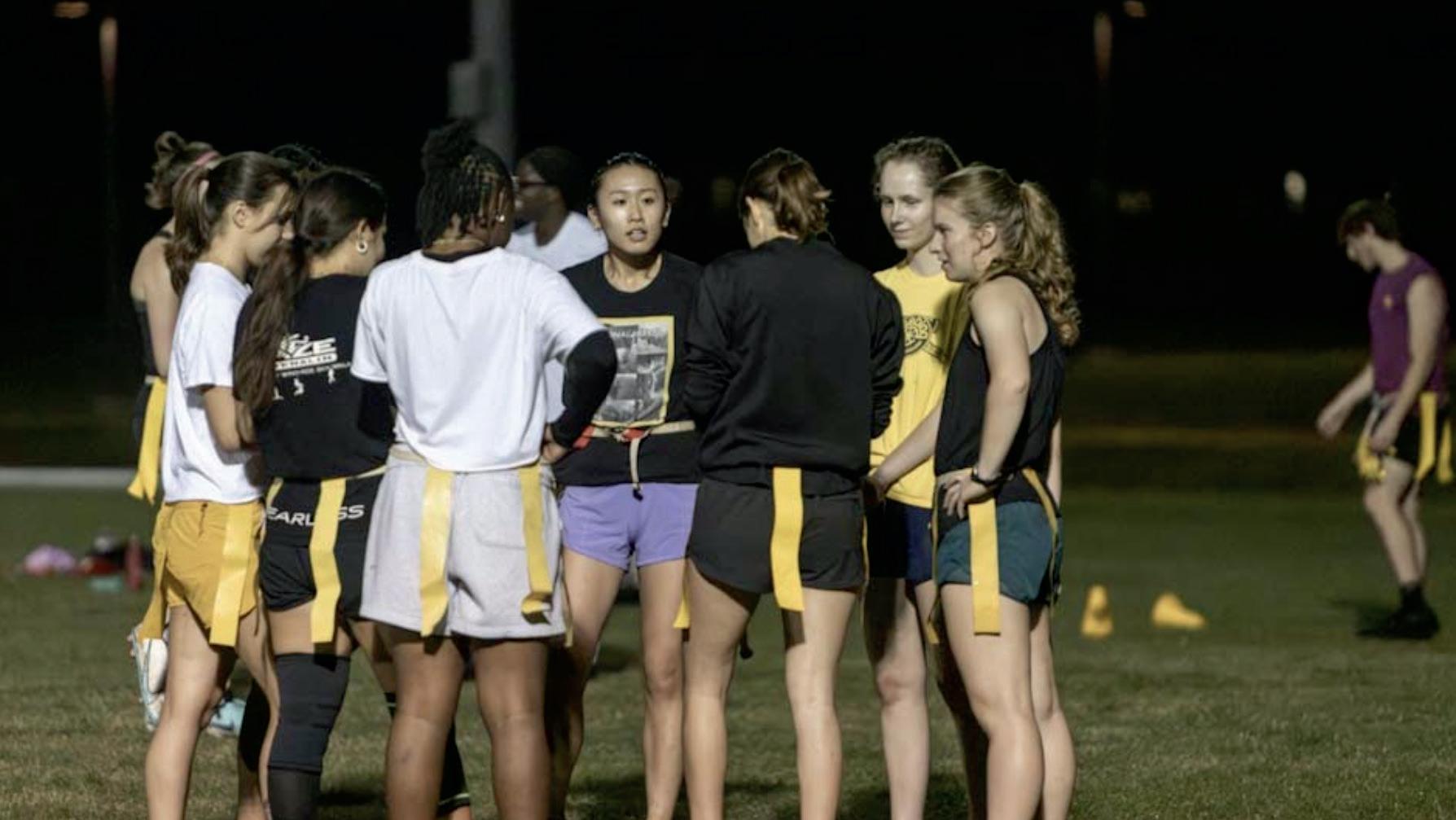
As the Powderpuff regular season comes to a close, six colleges vie for the coveted championship scheduled for Saturday, Nov. 23. With the most players of any intramural sport, Powderpuff is not taken lightly. Each team practices weekly, coached by members of the Rice community, to prepare for weekend games. Representatives from each team shared their regular season highlights and memories in preparation for the postseason. * Asterisks indicate quoted members.
Captains: Kayla Bierman ’25*
Coaches: Savan Patel ’26, Mason Howell ’25, Matthew Edelstein ’25
Stand-out players:
KB: Something unique about Wiess Powderpuff is we don’t just have one player who carries the whole team. Our team is strong all around. We are very confident that with any seven on the field, we’ll be able to pull out a great game.
Team description:
KB: We have a lot of passion. We’re very dedicated. People like to say Wiess tries really hard but it just shows the
Siddy Girls
Captains:
Jess Dooley ’25*, Sienna Tu ’25, Diya Vettical ’27
Coaches: Dylan Council ’26, Giulio Valfre Zaydenman ’26
Stand-out players:
JD: Sopheena Toovey ’25 always pumps up team spirit by cheering everyone on and playing music while we walk to and from practice. She also always has the cutest outfits and game-day sunnies.
Tyra Helper ’28 plays two [flag football] games in the scorching midday heat, –freshmen flag and then powderpuff – and has the best attitude. Cecilia Visco ’25 and Harriet Shapiro ’28 have such consistent attendance for practice and games even though they have busy schedules.
Duncan College
Captains: Chloe Singer ’25*, Ameenat Adisa ’27
Coaches: Winston Liaw (magister), Colin Buechler-Neimeyer ’26, Ian Kleppinger ’26, Ian Oliver ’25, Sean Weiss ’27, Griffin Arndt ’27
Stand-out players:
CS: Ameenat is kind of our do-it-all person. She’s so quick, so fast. Jocelyn, a transfer student, has been a huge impact player for our team as wide receiver. We have a lot of great freshmen that joined our team.
dedication our players have. We’re very blessed to have very athletic people at Wiess as well.
Fondest Powderpuff memory:
KB: Before every game, we have a pregame meeting. The coaches will put on football clips, and we’ll bond and get into a headspace. That’s always a highlight of our week because it creates a team dynamic that’s beyond just playing together. [We’re] friends first and then teammates.
Warning for their opponents: KB: Wiess wants it.
Captains: Whitney Ball ’25, Victoria Albanese ’25
Coaches: Elena Schwegman ’25*, Jonah Lubin ’25, Ben Montag ’25, Sebastian Molina ’25
Stand-out players:
ES: We were able to recruit a lot of freshmen, and even some sophomores who hadn’t played before, to join the team this year. Their participation and eagerness to learn and play has been the biggest standout. We have had a big, athletic team of girls who really love to play and give full effort all the time.
Team description: ES: Hardworking, quick-learners, highenergy and fun.
Fondest Powderpuff memory:
ES: One of the fondest memories I have happened at the beginning of the season for our team this year. We have a tradition for our team called Gin Bucket, a big team-bonding gathering that we do before our first game every year. We had a huge turnout for it this year and it really helped us get closer, especially since we do have a young team with a lot of new girls. We had everyone do a karaoke song of their choice to break the ice at Gin Bucket, which was absolutely hilarious.
Warning for their opponents: ES: Hanszen Women Kick Ass!
Team description:
JD: High-energy, encouraging and competitive. We make a point to cheer everyone on during practice and in games and value everyone’s contributions. We also ensure everyone plays about an equal amount because we know all of our players have what it takes to beat our opponents.
Fondest Powderpuff memory:
JD: When we walk to and from practice. Soph is always playing music, we chat about how our weeks have been, and reflect on the funny things that have happened during games. Our team supports each other on and off the field.
Warning for their opponents:
JD: Our players want opponents to know to watch out. We are coming ready to win.
Captains: Piper Winn ’25*, Olivia Robson ’25, Alice Owens ’25
Coaches:
Nick Harrison ’25, Sutter Armistead ’26, Malcolm Wigder ’26
Stand-out players:
PW: We had some freshmen join the team this year who have brought a lot of new skill and energy. Our quarterbacks Ana Rivera ’26 and Alice Owens ’25 are also very strong, talented players.
Team description:
PW: We like to win and have fun doing it.
Fondest Powderpuff memory:
PW: My fondest Powderpuff memory was a game we played my freshman year. We played a really great game as a team and had a lot of Bakerites come watch and support. The vibes were really high and it brought us closer together as a team, which is one of my favorite aspects of Powderpuff.
Warning for their opponents:
CS: Our opponents should know to watch out for us in the playoffs, we’re coming for you, Hanszen.
Team description:
CS: Determined, energetic, talented.
Fondest Powderpuff memory:
CS: Our Lovett game was our stand-out game. We mercied Lovett 39-0, and you don’t get moments like that very often in Powderpuff. We just played such a complete game from start to finish, and every single person contributed in making that happen.
Warning for their opponents:
CS: Watch out. When our team is playing at our best, we can beat anyone.
Captains:
Priya Bapna ’25*, Lili Nikolova ’25
Coaches: Marco Stine ’25, Ethan Nguyen ’25, Seth Davidson ’25
Stand-out players:
PB: Everyone on our team has shown incredible skill and commitment this season. Abby Thomson ’27 and Jenny In ’28 have been amazing quarterbacks and Claire Callaway ’26 is one of the fastest runners I’ve seen.
Team description:
PB: We started out this season with zero plays, barely 7 players and no idea what the rules were. Lili and I started the team because we wanted to bring some team spirit back into Martel, especially during our last year at Rice.
We had no idea the team would make it to the playoffs .. The girls have been working so hard to win each game.
We’ve built a strong dynamic and connection over time within our team, and I think that coupled with our sheer determination is what has enabled us to make it this far. I think that’s the best way to characterize it: scrappy but fierce.
Fondest Powderpuff memory:
PB: Winning the Jones game because a lot of our friends showed up, and it was very exciting because everyone was cheering and screaming. It was our first win. Also, when we found out we were going to the playoffs, confirmed by the Wiess-Jones game. We were super happy, and Wiess was celebrating too.”
Warning for their opponents:
PB: Don’t underestimate us. Martel is not known as the most competitive or athletic of the colleges, but we are ready to bring it on for playoffs. No one thought we’d win a game and here we are. We want our opponents to know that we’re going in strong, and we plan to win.
Hanszen Women Kick Ass
Baker Powderpuff
Martel Moms
Wiess Powderpuff
CAYDEN CHEN / THRESHER
Wiess College Powderpuff players huddle during practice Sunday, Nov. 10. Wiess is the only undefeated team in the playoffs this year.
Intellectual brutality renewed: How Rice can still achieve bowl eligibility
Rice football lost another American Athletic Conference matchup last Friday, falling to the University of Memphis on the road, 27-20. The Owls’ defeat dropped them to 3-7 on the year, and with two games left, the best they can finish is 5-7.
While the cutoff for bowl eligibility is six wins, there’s still a path for Rice to make a bowl game. The NCAA sets a number of bowl games, and sometimes they can’t fill every game solely with teams boasting six or more wins. As a result, they pull from the pool of 5-7 teams to fill the bowl slots.
This season, the top 82 programs will qualify to play at least one game beyond the regular season: 12 teams in the College Football Playoff and 70 teams in non-playoff bowl games.
Fortunately for Rice, the NCAA prioritizes issuing slots to 5-7 teams based on academic merit. The 5-7 programs with the highest Academic Progress Rates are allowed to choose a bowl game slot after other qualified schools have picked their slot. If there is one open slot, only the 5-7 team with the best APR gets a bowl game. If there are five slots, the top five APR 5-7 teams advance, with first dibs given to the program with the highest APR.
Implemented in 2003, APR measures academic success and is viewed by the NCAA as more accurate than graduation rates.
The APR system “includes rewards for superior academic performance and penalties for teams that do not achieve certain academic benchmarks,” according to the NCAA. Each studentathlete receiving athletically related financial aid earns one point for staying in school and one point for maintaining
academic eligibility. Then, the sum of the school’s points is divided by the total points possible and multiplied by 1,000 to determine their APR.
Given Rice’s academic standing, there’s a very strong chance they could have the best APR among 5-7 programs. Among 133 FBS programs, Rice finished the last reported cycle (2022-23) with an APR of 988, ranking 14th overall. While prominent, this was a significant decline from the 2020-21 cycle in which they ranked sixth with a 994 APR.
This year’s placement of 5-7 teams is based on APR from the 2022-23 cycle. The seven teams eligible for an APRbased slot that rank ahead of Rice are Northwestern University (4-5), the University of North Carolina (54), the University of Cincinnati (5-4), the University of Michigan (5-5), the University of Wisconsin (5-4), the United States Air Force Academy (2-7) and Wake Forest University (4-5).
While seven teams ahead of Rice might seem like a lot, APR only comes into play if a team finishes 5-7. If all of those seven programs were to finish more than five wins, and Rice won its final two games, the Owls would be the first 5-7 team offered a bowl game slot.
Rice has made a bowl game in each of its last two seasons. In 2022, they finished 5-7 but qualified for the LendingTree Bowl based on APR. Thus, precedent exists for Rice to play a 13th game based on academic merit.
The bowl path for the Owls now depends on academics and games against two AAC rivals. Rice travels to the University of Alabama Birmingham (2-7, 1-4 in AAC) Nov. 23 before finishing the regular season at home against the University of South Florida (4-5, 2-3 in AAC) Nov. 30.
Sports Mini #5
Scores & what’s next
Scores from Nov. 6 to 12
Women’s Soccer at University of Memphis (AAC Semifinal)
Nov. 7 - Rice 1, Memphis 3
Women’s Basketball vs. North Carolina Agricultural and Technical State University
Nov. 7 - Rice 61, North Carolina A&T 60
Swimming & Diving at University of North Texas
Nov. 8 - Rice 112, UNT 131
Women’s Tennis at Rice Invitational
Nov. 8-10 - 3-3 in doubles, 9-8 in singles
Baseball vs. McLennan Community College (Exhibition)
Nov. 8 - Rice 9, McLennan 4
Women’s Volleyball vs. Wichita State University
Nov. 8 - Rice 3, Wichita State 2
Football at University of Memphis
Nov. 8 - Rice 20, Memphis 27
Swimming & Diving at Southern Methodist University
Nov. 9 - Rice 121, SMU 178
Men’s Basketball vs. Florida State University
Nov. 9 - Rice 65, FSU 73
Women’s Volleyball vs. University of Alabama Birmingham
Nov. 10 - Rice 3, UAB 0
Women’s Basketball vs. University of South Alabama
Nov. 11 - Rice 76, USA 58
What’s next from Nov. 13 to 19
Women’s Basketball vs. University of Houston
Nov. 14, 7 p.m. - Home on ESPN+
Men’s Cross Country at NCAA South Central Regional
Nov. 15 - Away in College Station, Texas
Women’s Cross Country at NCAA South Central Regional
Nov. 15 - Away in College Station, Texas
Women’s Volleyball vs. University of Memphis
Nov. 15, 6 p.m. - Home on ESPN+
Men’s Basketball vs. Northwestern State University
Nov. 16, 2 p.m. - Home on ESPN+
Women’s Volleyball at University of North Texas
Nov. 17, 1 p.m. - Away on ESPN+
Women’s Basketball vs. Sam Houston State University
Nov. 17, 2 p.m. - Home on ESPN+
Men’s Basketball at University of Louisiana at Lafayette
Nov. 19, 7:30 p.m. - Away on ESPN+
Men’s Tennis at NCAA Individual Championships
Nov. 19-24 - Away in Waco, Texas
Women’s Tennis at NCAA Individual Championships
Nov. 19-24 - Away in Waco, Texas
“Coach says if we study hard, we can still get into a bowl game.”
HONG LIN TSAI / THRESHER
THE BACKPAGE
Hanszen College Night finds itself in students’ bad books
This Friday, Hanszenites will hit the stacks to celebrate their Fall 2024 College Night. Hanszen Socials announced their theme, “Fondrunk Li-beer-y: Bar-row a Book!”, in a triumphant email two weeks ago to mixed reviews.
“We didn’t hold a theme vote this year because we felt we needed to intervene directly in the college’s culture around alcohol,” said Hanszen Social Gordon Chang. “This theme will proactively address healthy drinking habits as well as our declining literacy rate.”
According to the Hanszen Socials, the day will start with drinks in the Digital Media Commons (affectionately dubbed the “Digital Mimosa Commons”) at 7 a.m. In between classes, Hanszenites will be invited to the library to work and peruse the stacks. Hanszen Socials have already submitted dozens of interlibrary loan and offsite material requests for age-
appropriate books in preparation for the big day (and the librarians exploded with joy).
“Once the sun goes down, we’ll get lit crazy novel,” quipped Carissa Nguyen, another Hanszen Social. The college plans to pack the Kyle Morrow Room and exceed maximum capacity, violating the fire code. In addition, Hanszenites will participate in a floor crawl of the library, beginning with peeping naughty microforms in the Kelley Center and culminating in a silent disco on the sixth floor (bring your own headphones). Librarians emphasize that no sounds are allowed, so partygoers will be relegated to gentle, inhibited swaying.
“Rice is so lame bruh. I swear everyone here is so horny for Fondren, of course we have to make our one fun night a semester about an effing library. I just wanna drink and not think about my Orgo exam coming up next next next Thursday,” said Rahul Gupta,
The Backpage is the satire section of the Thresher, written this week by
questions or comments, please email pookiebear@rice.edu.
a pre-med freshman Hanszenite in response to the theme.
“I am transferring to Louisiana State University,” said Hanszen junior Brandon Thompson.
Other Hanszenites had complaints about the inconvenience of holding College Night largely in Fondren. “They won’t let me hotbox study room 420, they won’t let me black out and push over the stacks. Rice culture isn’t dying. It’s already dead,” said Hanszen junior Tessa Hernandez. “Administration is literally 1984.”
Conversely, some students have expressed support for the academic nature of the day. Hanszen sophomore Daria Sun commented, “I really appreciate this theme because it maximizes utility – I can enjoy the benefits of attending a social function (for my personal wellbeing) while completing a p-set [sic] at the same time.”
Rice culture isn’t dying. It’s already dead.
Tessa Hernandez HANSZEN COLLEGE JUNIOR
Amid the controversy, Hanszen College Socials have continued to raise the hype for Friday. As of Wednesday, the Hanszen GroupMe was reportedly inundated with messages from Socials, including “My day is absolutely BOOKED with crazy parties!” and “Friday finna be a storybook.” Regardless of how, Hanszenites agree that this College Night will be one for the books.
CLASSIFIEDS ADVERTISING
The Thresher accepts display and classified advertisements and reserves the right to refuse any advertising for any reason. Additionally, the Thresher does not take responsibility for the factual content of any advertisement. Printing an advertisement does not consititute an endorsement by the Thresher.
Display advertisements must be received by 5 p.m. on the Friday prior to publication; see ricethresher.org for pricing. Classified advertisements must be received with cash, check or credit card payment by 12 p.m. on the Friday prior to publication; see ricethresher.org for pricing. thresher-ads@rice.edu P.O. Box 1892 Houston, TX 77005-1892 (713) 348-4801
Andrew Kim, Will Howley, Charlie Maxson, and Max Scholl and designed by Lauren Yu. For