DIVORCE & ART | TIM R EES | WILDLIFE ART | B.J.O. NOR DFELDT | GR EENSHIELDS FOUNDATION
OCTOBER 20 21 VOLUME 18 ISSUE 5
OC TOBER 2 021
Giovanni Benedetto Castiglione (1609–1664), Self-Portrait (?), c. 1645/47, etching on laid paper plate, 7 7/16 x 5 3/8 in., National Gallery of Art, Washington, Florian Carr Fund. On view September 26–January 9 in the National Gallery’s exhibition A Superb Baroque: Art in Genoa, 1600–1750. For details, see page 117 and visit nga.gov.
“Is this a moral person who would throw his sister off a rooftop? Who would accuse his brother of being a thief and an assassin and send him to jail? Who would flee Genoa with ill-gotten gains? Who would refuse to support the welfare of a niece or provide funds for her burial? And who would come close to killing his nephew by attacking him with seemingly unending punches?” — From a 1655 suit against the artist Castiglione, quoted in Castiglione: Lost Genius by Timothy J. Standring and Martin Clayton (Royal Collection Trust, 2013)
F I N E A R T C O N N O I S S E U R · C O M
S E P T E M B E R / O C T O B E R
2 0 2 1
003
Anni Crouter
AWS, NSPC&A, NWWS, ARCALM, AFC, SAA
E Pluribus Unum, 60x60, acrylic on canvas
www.annicrouter.com
Follow me on Instagram @AnniCrouter
Elizabeth Butler, Midnight Light, 40 x 30 in.
celebration of fine art
Artists Mediums Artwork Experiences
visit celebrateart.com Live Event:
Jan. 15–Mar. 27, 2022 | Open Daily 10am–6pm Loop 101 & Hayden rd, Scottsdale, Az 480.443.7695
Learn about our juried artists, view their work and add to your collection by experiencing our show virtually at celebrateart.com. Where Art Lovers & Artists Connect
JILL BANKS
Capturing Life in Oils AWA | WAOW | WSLP
PUBLISHER
B. Er ic Rhoads bericrhoads@gmail.com Tw i t t e r : @ e r i c r h o a d s f a c e b o ok . c o m /e r ic . rh o a d s
Just Picked oil 30 x 40 in
EDITOR-IN-CHIEF
Peter Tr ippi peter.trippi@gmail.com 9 17.9 6 8 . 4 4 76 MANAGING EDITOR
Br ida Connolly bconnolly @streamlinepublishing.com 702.665.5283 CONTRIBUTING WRITERS
Matthias A nderson Kelly Compton Max Gillies David Masello Louise Nicholson Charles Raskob Robinson C R E AT I V E D I R EC TO R
A lf onso Jones alfonsostreamline@gmail.com 5 61 . 3 2 7. 6 0 3 3 ART DIRECTOR
Kenneth W hitne y k whitney @streamlinepublishing.com 561.655.8778 DIRECTOR OF SALES & MARKETING
Luxembourg Ladies oil 20x16 in
A New Day oil 24x12 in
K atie Reeves k reeves@streamlinepublishing.com 919.673.8 895 P R OJ EC T & D I G I TA L A D M A N AG E R
Yvonne Van Wechel y vanwechel@streamlinepublishing.com 6 02 .810. 3518 VENDOR & CONVENTION MARKETING
S a ra h We b b swebb@streamlinepublishing.com 630.4 45.9182 SENIOR MARKETING SPECIALISTS
Dave Ber nard d b e r n a r d @ s t r e a m l i n e p u b l i s h i n g .com 503.539.870 6 Lauren Kettler Gold l g o l d @ s t r e a m l i n e p u b l i s h i n g .com 305.984.9972 Mar y G reen mgreen@streamlinepublishing.com 508.230.9928 Gina Ward g ward@streamlinepublishing.com 9 2 0 .743 . 2 4 0 5
E D I TO R , F I N E A R T TO DAY
Cher ie Haas chaas@streamlinepublishing.com
JillBanks.com
Jill@JillBanks.com 703.403.7435 jillbanks1 JillBanksStudio Subscribe and follow for happier news and fresh art 006
S E P T E M B E R / O C T O B E R
2 0 2 1
F I N E A R T C O N N O I S S E U R · C O M
Avery Rose Fishing, 60 x 108 oil, Ryan Jensen, 2021.
RyanJensen artwork.com
331 SE Mizner Blvd. Boca Raton, FL 33432 Ph: 561.655. 8778 • Fa x : 561.655.616 4 CHAIRMAN/PUBLISHER/CEO B. Eric Rhoads bericrhoads@gmail.com Tw i t t e r : @ e r i c r h o a d s f a c e b o ok .c om /e r ic . rho a d s E X E C U T I V E V I C E P R E S I D E N T/ C H I E F O P E R AT I N G O F F I C E R Tom Elmo telmo@streamlinepublishing.com
PRODUCTION DIRECTOR Nicolynn Kuper nkuper@streamlinepublishing.com DIRECTOR OF FINANCE Laura Iserman liserman@streamlinepublishing.com CONTROLLER Jaime Osetek jaime@streamlinepublishing.com C I R C U L AT I O N C O O R D I N ATO R Sue Henr y shenr y @streamlinepublishing.com C U S TO M E R S E R V I C E C O O R D I N ATO R Jessica Smith jsmith@streamlinepublishing.com A S S I S TA N T TO T H E C H A I R M A N A li Cr uickshank acr uickshank@streamlinepublishing.com
Subscriptions:800.610.5771 Also 561.655.8778 or www.fineartconnoisseur.com One-year, 6-issue subscription within the United States: $39.98 (International, 6 issues, $76.98). Two-year, 12-issue subscription within the United States: $59.98 (International, 12 issues, $106.98).
Attention retailers: If you would like to carry Fine Art Connoisseur in your store, please contact Tom Elmo at 561.655.8778. Copyright ©2021 Streamline Publishing Inc. Fine Art Connoisseur is a registered trademark of Streamline Publishing; Historic Masters, Today’s Masters, Collector Savvy, Hidden Collection, and Classic Moment are trademarks of Streamline Publishing. All rights reserved. Fine Art Connoisseur is published by Streamline Publishing Inc. Any reproduction of this publication, whole or in part, is prohibited without the express written consent of the publisher. Contact Streamline Publishing Inc. at address below. Fine Art Connoisseur is published six times annually (ISSN 1932-4995) for $39.99 per year in U.S.A. (two years $59.99); Canada and Europe $69.99 per year (two years $99.99) by Streamline Publishing Inc., 331 SE Mizner Blvd., Boca Raton, FL 33432. Periodicals postage paid at Boca Raton, FL, and additional mailing offices. POSTMASTER: Send address changes to Fine Art Connoisseur, 331 SE Mizner Blvd., Boca Raton, FL 33432.Copying done for other than personal or internal reference without the express permission of Fine Art Connoisseur is prohibited. Address requests for special permission to the Managing Editor. Reprints and back issues available upon request. Printed in the United States. Canadian publication agreement # 40028399. Canada Post: Publications Mail Agreement #40612608; Canada returns to be sent to Bleuchip International, P.O. Box 25542, London, ON N6C 6B2.
www.bethclaryschwier.com
010
S E P T E M B E R / O C T O B E R
2 0 2 1
F I N E A R T C O N N O I S S E U R · C O M
Fetterman-fullpg copy.pdf
1
8/1/21
1:12 PM
THE ART OF ALAN FETTERMAN
C
M
Y
CM
MY
CY
CMY
K
“Elevation 960”
A
54 in. x 60 in.
Oil on Linen
Alan Fetterman Fine Art / American Artist / Bucks County’s Artist In Residence Philadelphia Sketch Club Medal of Honor with over 40 solo exhibitions Specializing in large-scale plein air & studio artwork Contact info: alanfetterman.com / 215-345-7769
F I N E
A R T
O C T O B E R
003 Frontispiece: Giovanni Benedetto Castiglione 016 Publisher’s Letter 020 Editor’s Note 025 Favorite: Mark Nadler 115 Off the Walls 146 Classic Moment: Narelle Zeller
055
2 0 2 1
C O N N O I S S E U R
•
VO LU M E
1 8 ,
I S S U E
ARTISTS MAKING THEIR MARK: FIVE TO WATCH
We highlight the talents of Palden Hamilton, Natasha Isenhour, Brianna Lee, Charlie Mostow, and Britt Snyder.
060 068 074
5
092
GREAT ART WORLDWIDE
We survey 12 top-notch projects occurring this summer.
098
PREVENTIVE CONSERVATION By Margaret Holben Ellis
099
GO WILD
By Max Gillies
THE RENAISSANCE OF TIM REES By Brandon Rosas
THE ELIZABETH GREENSHIELDS FOUNDATION: HELPING ARTISTS EMERGE By Leslie Gilbert Elman
DON PERLIS: MODERN OLD MASTER By Peter Trippi
078
LIFE BEHIND THE SCENES: THE ART OF LAURA KNIGHT By Peyton Skipwith
084
B.J.O. NORDFELDT: ARTIST, ACTOR, MODERNIST
104 107
ALL TOGETHER NOW By Steven Parissien
FRICK MADISON: THE BRUTAL TRUTH By David Masello
112
THE ART OF DIVORCE By Daniel Grant
By Janet Whitmore
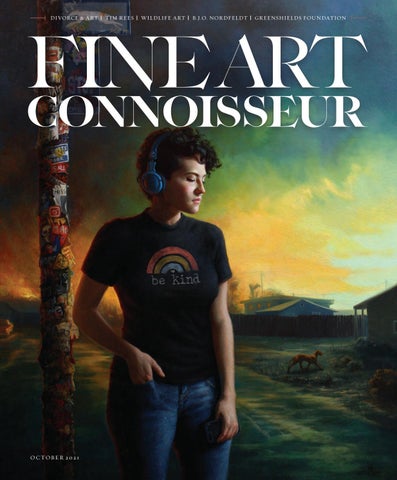
ON THE COVER Brianna Lee (b. 1987), Dissonance (detail), 2020, oil on panel, 20 x 16 in. (overall), available through the artist. For details, please see page 58.
090
ART IN THE WEST: ACTION-PACKED There are many great reasons to visit the American West this season.
Fine Art Connoisseur is also available in a digital edition. Please visit fineartconnoisseur.com for details.
012
S E P T E M B E R / O C T O B E R
2 0 2 1
F I N E A R T C O N N O I S S E U R · C O M
Recharged & Revitalized!
23rd Annual
Laguna Beach Plein Air Painting Invitational Laguna Breaker by Don Demers / 2020 Best In Show
ARTISTS Suzie Baker Richard Boyer Carl Bretzke John Budicin Saim Caglayan Rick J Delanty Gil Dellinger Don Demers Jed Dorsey Bill Farnsworth Mark Fehlman Tatyana Fogarty Kathleen Hudson Jane Hunt Debra Huse Ryan Jensen Paul Kratter Shuang Li
Calvin Liang Daniel Marshall David Marty Jim McVicker Fernando Micheli Terry Miura Dan Mondloch Ned Mueller Michael Obermeyer Scott W Prior Anthony Salvo Aaron Schuerr Jeff Sewell Mark Shasha Michael Situ Barbara Tapp Jove Wang
October 2nd - October 10th, 2021 SUN / OCTOBER 3 Quick Draw Paint Out 35 Artists Paint Laguna In 2 Hours! Meet the Artists and Quick Draw Auction of Freshly Painted Works at the Laguna Beach Festival of Arts MON / OCTOBER 4 Plein Talk - Ask the Artists Q&A w/panel of Invitational Artists at Festival of Arts SAT / OCTOBER 9 Collector’s Gala & Art Show Premiere at the Festival of Arts
Collector’s Gala & Art Show Premiere Saturday, October 9th / Laguna Beach Festival of Arts
TICKETS ON SALE NOW: lpapa.org/laguna-plein-air-invitational
OVER
$45,000
IN AWARDS
First & 59th, Nancie King Mertz, PSA-MP Bill Creevy Award for Pastel Innovation 2020
FORTY-NINTH ANNUAL PSA EXHIBITION
Enduring Brilliance! Opens Online September 7, 2021 View the Exhibition and Award Winners At pastelsocietyofamerica.org JURY OF SELECTION: Richard McKinley, PSA-MP, HFH Colette Odya Smith, PSA-MP Otto Stürcke, PSA-MP
JUROR OF AWARDS: Emily A. Beeny Curator of European Paintings Fine Arts Museums of San Francisco
SUZANNE SIMINGER CONTEMPORARY REALIST LANDSCAPES
Arroyo III, oil on canvas, 12 x 12 inches
California & Southwest Paintings www.suzannesiminger.com suzanne.siminger@gmail.com
P U B L I S H E R ’ S
ROLES OFTEN OVERLOOKED
A
t first glance you may not think so, but artists have made — and continue to make — an enormous impact on the health of our natural environment. In the mid-1800s, the artist Albert Bierstadt (1830–1902) traveled to the American West with government surveyors and railroad builders to capture the rugged beauty of landscapes previously unknown to most of his countrymen. His scenes of Yosemite’s Hetch Hetchy Valley, the mountains surrounding Colorado’s Estes Park, and many other unspoiled areas were initially executed as plein air studies and drawings, which he then consulted in his New York studio in order to create massive versions in oil. Once they were finished, Bierstadt mounted theatrical presentations at which paying viewers marveled at his spectacular vistas, which were revealed from behind a curtain one inch at a time as the artist explained these unfamiliar landscapes. Paintings by Ralph Albert Blakelock (1847–1919) smashed auction records in the late 19th century, yet today he is virtually unknown. Money aside, his works played a major role in creating the American Dream. Unlike Bierstadt, who traveled comfortably as a VIP, protected by tight security from possible attacks, Blakelock toured the West on his own, communing with Native Americans and painting their stories.
016
Both of these men, and quite a few other artists, played a major role in helping Americans learn about this country’s beautiful (then undeveloped) West, and about how Native people lived. Ultimately their efforts led to the longterm preservation of many areas as national and state parks. Sadly, some terrain was destroyed; Hetch Hetchy was flooded in order to create a dam, and now that stunningly beautiful landscape can be appreciated only through the paintings of Bierstadt and others. Fortunately, the desire to depict and protect important landscapes lives on. South of Los Angeles, artists Daniel Pinkham and his wife, Vicky Pinkham, in 1998 helped create the Portuguese Bend Artist Colony, which has spent more than two decades preserving open space and natural habitat. With fellow artists such as Amy Sidrane, Kevin Prince, Thomas Redfield, and Richard Humphrey, the Pinkhams have set up their easels to paint scenic areas scheduled for development. Through their efforts — including exhibitions, publications, and educational programs — much of this land has been saved, and even areas that succumbed are now preserved on canvas, reminding viewers of the downsides of “progress” and our obsession with the “new.” In Indiana, artist Rick Wilson has recorded every county in the state, creating paintings of S E P T E M B E R / O C T O B E R
L E T T E R
iconic landscapes and disappearing barns that have been hung in Indianapolis’s Statehouse in order to focus his fellow Hoosiers on the natural beauty around them. And although New York State has vigorously protected its Adirondack Mountains since 1892, artists continue doing what they can there. Members of my own group — who have attended my annual artist retreat on and around Upper St. Regis Lake — have now painted more than 10,000 scenes of this state park’s landscapes, bringing them to the attention of galleries, collectors, and curators worldwide. Today we too often think of artists as producers of consumable goods without remembering their important role in showing nature to those who don’t have access to it. This is not just about mountains, either; it could be waterways, wetlands, beaches, or even historical neighborhoods within cities. This impulse extends equally to images of wildlife, which can all too easily become endangered or even extinct. Artists view the world through different eyes — eyes that help the rest of us see in new ways. For the most part, they are not people creating art only to make a living. (Actually, most of them would create art even if they never earned a penny, and, sadly, some don’t.) Indeed, it is their ability to open our eyes — to help us feel something about their subjects — that makes artists “matter” more in our society than many other avocations do. Thus a world without artists would not be as meaningful. That’s one reason it’s essential we as collectors seek out their work and acquire it. Whatever the scale of your purchase, it will help that artist buy supplies and create something new tomorrow. Though we may get enamored with the investment aspects of collecting (as in the case of NFTs), we should keep our focus on what really matters. We are now at a critical moment in history when the digital is correlated — mistakenly — with the hand-made. To be sure, digital art has significant potential, but we must all encourage in-person viewing of non-digital art that — among other things — exposes people to places they may not otherwise go (like Yosemite), to the past, to beauty. Your often overlooked role, therefore, is to help others find these artists’ works because they impact, and will continue impacting, the way we all see the world around us.
B. ERIC RHOADS Chairman/Publisher bericrhoads@gmail.com facebook.com/eric.rhoads @ericrhoads
2 0 2 1
F I N E A R T C O N N O I S S E U R · C O M
Don Perlis donperlis.com
ALBERTO J. CAROL In the Frontline 2, 36x24 in. oil on canvas Winner of Fine Art Connoisseur Award at The 4th ANJE, Wausau Museum of Contemporary Art, Wausau, WI, 2020 Honorable Mention at the 85th Midyear National Show, Butler Institute of American Art, Youngstown OH
www.albertojorgecarol.com
•
albertojcarol@aol.com
P U B L I S E H D E I TR O ' SR ’ LS E N T O T E T R E
HEATING UP MANHATTAN
J
uly in New York City is generally hot and quiet, but this year it was perked up significantly — at least for those of us who love contemporary realist art — by an impressive display at Sotheby’s. On view were two large, interconnecting shows — highlights from the 15th International ARC Salon Exhibition, and lots offered in the Contemporary Realism: Important 21st Century Works auction, which was conducted entirely on sothebys.com. Kudos to the Art Renewal Center (ARC) team that organized these projects, especially Fred, Kara, and Sherry Ross, and also to Benjamin Doller, the Sotheby’s executive who coordinated the firm’s participation. Surely he was pleased that 21 out of 28 lots sold, an encouraging figure for the field of contemporary realism, which is relatively untested in the auction marketplace. Of course it was a delight for me to meet or reconnect with the talented exhibiting artists during the opening celebrations, but it was also fascinating to watch “newcomers” stop-
P.S. For details on the ARC Salon’s showing in Barcelona this fall, see page 96.
(RIGHT) HIROSHI FURUYOSHI (b. 1959), Julia, 2019, oil on panel, 7 1/4 x 3 3/4 in.
ping by to browse. Sotheby’s sells all kinds of art, so it made sense that some collectors who initially came to see the cutting-edge contemporary upstairs later made their way to the main floor to check out the realist shows while they were in the building. Quite naughtily, I eavesdropped on some of them, and sure enough — they were astonished that tradition-minded jewels like Hiroshi Furuyoshi’s Julia (illustrated here) are being painted now. They loved what they saw, but it’s a worry that even these sophisticated people simply do not know that artists capable of such quality work among us today. That’s a continuing challenge that every issue of Fine Art Connoisseur seeks to address, and having a major influencer like Sotheby’s get involved is a terrific step in the right direction. Thank you — dear reader — for spreading the word to anyone who will listen and, more importantly, look. We have so many talents in our field, and now we just need more folks to see and buy their remarkable creations.
(BELOW) Panoramic
view of the ground-floor display at
TRIPPI PHOTO: FRANCIS HILLS
Sotheby’s New York this July
020
S E P T E M B E R / O C T O B E R
2 0 2 1
F I N E A R T C O N N O I S S E U R · C O M
Animal Nature, Oil on Canvas, 28 x 18 in | 71.1 x 45.7 cm
GEOFFREY LAURENCE
Animal Nature October 2021
R J D G A L L E RY.C O M | 5 8 6 . 2 81. 3 613 | A R T@ R J D G A L L E RY.C O M
AMERICAN T ONALIST S OCIET Y Fostering the Tradition and Art Form of Contemporary American Tonalism
Mary Erickson
Mary Graham
Summer Journey, Oil on Linen www.maryericksonart.com
Late Winter’s Light on a Cliff-Top, Oil on Linen Panel, 20 x 30 in. www.marygraham.com
John MacDonald
Nancy Howe
Off-season Silence, Oil on Linen Panel, 16 x 20 in. www.jmacdonald.com
After the Storm, Oil on Belgian linen, 18 x 24 in. 2021 www.nancyhowe.com
Visit AmericanTonalistSociety.com or Instagram @americantonalistsociety
Soaring by Angela Mia De la Vega Limited Edition bronze 37 40”h x 40”w x 40”d
www.delavegastudios.com
Photos by Kathy Tarantola/PEM.
AUTHENTIC
Sailors Wreaths FROM NOVA SCOTIA
Subscribe to our newsletter to get the latest promotions, sales, new releases and more! shop.pem.org
MK1360202505_FineArtConnoisseur_SailorWreaths_V2.indd 1
Adorning the doorways of the Peabody Essex Museum’s historic houses in Salem, Massachusetts, these unique wreaths are handcrafted on the shores of the Bay of Fundy with reclaimed lobsterman rope. Made using the traditional Turk’s head knot tied aboard ships for centuries, these elegant wreaths will withstand the tests of time and the elements. Shop an array of colors and sizes in store or online at the PEM Shop.
161 ESSEX STREET SALEM, MASS. 01970 PEM.ORG
#PEMSHOP
7/30/21 2:38 PM
WRIT TEN BY DAVID MASELLO
T H E
MARK NADLER Cabaret and concert performer Photo: Dominic Meiman
Untitled Renate Nadler (1929–2000) c. 1968, oil on canvas, 36 x 24 in. Collection Mark Nadler
W
several measures,” he says. “The words of the song can then float on that space.” Indeed, to watch Nadler perform on stage is as much an experience of the spoken word as it is a musical one. The lyrics to popular standards are presented with such clarity and poignancy that every song is not only understood but felt. Nadler goes into a kind of trance while singing and playing the piano — and, on occasion, rising from the bench to tap dance, too. “With cabaret,” he notes, “it’s about the words more than anything.”
hen Mark Nadler was about 10 years old, he pulled up a stool in his mother’s art studio in their home in Waterloo, Iowa, to watch her paint this scene. She was always happy to have him there, along with the various birds and raccoons, cats and dogs, and additional injured animals she fostered in the other half of the room. “My mother was not only an artist and a teacher of painting, but also an animal rights activist,” says Nadler. “She thought she was Snow White.” As Nadler watched his mother develop the canvas over a period of weeks, he noticed something that he learned to apply to his own artistry as a noted cabaret and concert performer. The scene reveals a patch of dense woods with a stream meandering through, but Nadler recalls that it began as something quite photorealistic, later becoming more impressionistic, with bolder colors, broader strokes, blockier forms. “I remember so clearly watching the magic of this work taking place, and I saw how my mother continued to strip away detail. That’s been a life lesson for me. When I’m putting together an arrangement of a song, I’ll often take a chord and have it last for
F I N E A R T C O N N O I S S E U R · C O M
F O R E S T
S E P T E M B E R / O C T O B E R
2 0 2 1
F O R
T H E
T R E E S
Although Waterloo, Iowa, has its wooded spots, Nadler thinks that what his mother, Renate, painted was a scene from memory — of woods in her native Germany, from which she fled at age 11 in 1940, just in time for a Jewish person. “She went right away to Cedar Rapids [Iowa], because that’s where she had a sponsor to come to this country,” her son explains. Renate Nadler remained in Iowa until her death 60 years later. This landscape hangs in the living room of Nadler’s home in Bronxville, New York, which he shares with his piano teacher husband, Dominic Meiman. There it is set on a deep lavender wall. “Positioned against that color,” Nadler observes, “the painting takes on an almost ethereal quality. As an art teacher, my mother would say that one bold color next to another bold color keeps each fresh.” Nadler admits that he never tires of looking at this work. “I not only notice it every time I go into the living room, but I’m drawn to it. I tend to gaze at it and look at — and into — it.” During those close examinations, he marvels at the canvas’s focal point, where the stream appears to take a turn in the midst of the trees. He looks, too, at a detail in the lower right corner that shows a rocky outcropping. “You’ll see that she made that into blocks of color,” he says, “which is something I’ve noticed in her other landscape paintings.” Growing up in a modest home in a modest town, Nadler was convinced his family was rich, given the number of paintings that filled their rooms. “Of course, all the artworks were by her, and the way they hung on the walls made our interiors look like those in a wealthy home. Her art made our house very special.”
025
DAVINA PERL
davinaperlfineart.com New studio in Lucca, Italy
Spring Arrival by Julia Rogers Available at sewe.com
SEWE 2022 40 years in the making For 40 years, Charleston has hosted one of the most beloved events in the Southeast. SEWE is a celebration of the great outdoors through fine art, live entertainment, and special events. It is where artists, conservationists, collectors, and sporting enthusiasts come together to enjoy the outdoor lifestyle and connect through a shared passion for wildlife. This Is SEWE.
February 17-20, 2022
Charleston, SC
sewe.com
Eric 20x20 oil on linen
PATRICIA A. GRIFFIN
G R I F F I N G A L L E RY. C O M
Aspen Grove, Aspen, CO • Gallery Wild, Jackson, WY • Goldenstein, Sedona, AZ • Going to the Sun, Whitefish, MT
D
eep in the Rocky Mountains, a stream flows by towering cottonwoods, that shift through a spectrum of yellows and reds. Painting from plein air sketches, The fleeting colors are captured in thicks strokes of vibrating color. color.
Big Cottonwood Canyon, 30” x 30”, oil on canas
T
he austerity of the desert is interrupted by an outcropping of trees and the burning sand briefly relieved by cool, clear waters. Painted from a plein air sketch, the desert light is captured in thick strokes of vibrating color.
BRAD TEARE first became enamored of thick paint from the original paintings of Van Gogh. Brad experimented with texture in his paint by adding marble dust and other archival elements. He finally settled on sun-thickened oil paints to add robust layers of highly texture paint. Using palette knives, he applies the thickened paint in fresh, multi-hued strokes of color.
Palace Ave. Gallery • 123 West Palace Avenue Santa Fe, NM 87501 • 505.986.0440 info@manitougalleries.com
Brad Teare painting on location. Above: Desert Solace, oil, 36 x 36”
Matthew Bird Fine Art
Country Kitchen, 22 x 30 in, watercolor on paper, $6,500
Start a conversation about creating a unique and timeless artwork for your family or institution. Matthew@MatthewBird.com MatthewBird.com 410-581-9988 _matthewbird_
Description: Fine Art Connoisseur full page ad Modification: August 3, 2021 10:20 AM Client NA
Contact Gina Ward
Version 1
Prints: 4C, CMYK, bleeds full Size: 9” x 10.875”
To view and purchase art, visit
grandcanyon.org/coa Thank you to our premier sponsor
September 11, 2021 - January 17, 2022 Image: José Luis Nunez, Approaching Rain Showers , 30x40, oil
NATIONAL OIL AND ACRYLIC PAINTERS SOCIETY
The National Oil and Acrylic Painters’ Society supports artists around the world in striving for artistic excellence by recognizing great art, enriching education, enhancing skills, challenging abilities, and expanding opportunities. NOAPS curates five exhibit opportunities each year including the Best in America Exhibition, now in it’s 31st year, and the newly added Associate Members Online Exhibition. For membership information visit us at
ttt..........
NATIONAL OIL AND ACRYLIC PAINTERS SOCIETY
NATIONAL OIL AND ACRYLIC PAINTERS SOCIETY
NATIONAL OIL AND ACRYLIC PAINTERS SOCIETY
NATIONAL OIL AND ACRYLIC PAINTERS SOCIETY
NOAPS FALL JURIED EXHIBITIONS:
ON-LINE INTERNATIONAL FALL EXHIBITION accepting submissions through October 24th
BEST OF AMERICA EXHIBITION PAINTINGS ON DISPLAY
September 1—October 9, 9 2021
246 North Higgins Avenue | Missoula, Montana (406) 721-3154 | danagallery.com
®
MUSKEGON MUSEUM
of
A RT
PAINTING THE FIGURE NOW
2021
September 2 - October 30 2021
Curated by David Hummer & Didi Menendez with guest curators Dr. Elaine Melotti Schmidt and Steven Alan Bennett
45 works by some of the world’s leading contemporary figurative painters
Reception for the Artists September 2 from 6-8pm
Ann Gale, “Standing”, 2020 | Oil on canvas | 72 x 48 inches
Alex Kanevsky Ann Gale Kai Samuels-Davis Edwige Fouvry Zack Zdrale David Kassan Dianne Gall Grant Gilsdorf Kathrin Longhurst June Stratton Megan Elizabeth Read Sara Gallagher Robin Damore Tyler Streeter JuliAnne Jonker Daniel Jared Sorensen Steve Ohlrich Nicole Finger Rodger Schultz Shana Levenson Anna Wypych O’Neil Scott Hilary Swingle Steven Morrell Carlos Fentanes Erica Calardo Ivan Pazlamatchev Patrice Robinson Debra Lott Alexander Shanks Claudia Anrather David Molesky Heidi Bruckner Lisa Bryson Chloe McEldowney Nicole Woodruff Elvira Kravenkova John Hyland Kara Lasiewicz Tony Armendariz Terri Symington Mary Chiaramonte Kim Leutwyler Lisa Bryson Teresa Brutcher
SEPTEMBER 10 - DECEMBER 12, 2021
22nd ANNUAL NATIONAL JURIED EXHIBITION OMAHA, NEBRASKA September 7-8 Howard Friedland AISM Workshop September 8-11 AIS All-Member Paintout
Friday, September 10 Opening Reception 6 - 9 pm Free and Open to the Public
Educational programs and painting demo during the day (see AIS website for details)
Saturday, September 11 Wet Wall Exhibition and Sale 5 - 7 pm
C.W. Mundy AISM Near Williams Creek 36 x 24 Oil
Awards Judge/Presenter C.W. Mundy AISM
Presenter Carolyn Anderson AISM
Proudly sponsored by
AIS was founded in 1998 to promote the appreciation of Impressionism through exhibitions, workshops and events.
2020 Best of Show Brent Jensen AIS
Workshop/Demo Howard Friedland AISM
Memberships are open to American Impressionist artists who are United States residents and anyone who wishes to support American Impressionism and our mission.
FOR MORE INFORMATION LIZ AHRENS, EXECUTIVE DIRECTOR 231-881-7685 americanimpressionistsociety.org
AIS is a 501(c)(3) nonprofit organization.
DEBRA JOY GROESSER AIS
AIS PRESIDENT/CEO Ralston, Nebraska
Rebirth-Into the Light, 20 x 24 in., oil on linen panel Available through the AIS National Juried Exhibition debra@debrajoygroesser.com 402.592.6552 www.debrajoygroesser.com Represented by Illume Gallery of Fine Art, St. George, UT Montgomery Lee Fine Art, Park City, UT Mary Williams Fine Arts, Boulder, CO
BARBARA SCHILLING
Grand Rapids, Michigan Columbia River Gorge, 30 x 39 in., oil on linen Available through the artist bschillingart@gmail.com | www.barbaraschilling.com Represented by Mar y Williams Fine Arts, Boulder, CO Eisele Galler y, Cincinnati, OH Synchronicity Galler y, Glen Arbor, MI
ANN GOBLE
Gainesville, Georgia Lefty, 36 x 36 in., oil on board goble@charter.net 770.851.7321 www.anngoble.com Represented by Reinert Fine Art, Charleston, SC
JILL GLASSMAN
Berlin, Mar yland Midday Marsh, 16 x 20 in., pastel on mounted sanded paper Available through the AIS National Juried Exhibition jill@jglassmanartist.com | 410.353.4769 www.jglassmanartist.com Galler y inquiries welcome
JENNY BUCKNER
Lake Junaluska, North Carolina Unfolding Grace, 20 x 14 in., oil on linen Available through the AIS National Juried Exhibition paintingsbyjenny@bellsouth.net | 828.507.5503 www.paintingsbyjenny.com Represented by Buckner Galler y, Waynesville, NC
RAYMOND YUAN
Rego Park, New York Staring Into the Distance, 36 x 24 in., oil on canvas Available through the AIS National Juried Exhibition r yuan8888@gmail.com | 718.666.9622 www.raymondyuan.com Galler y inquiries welcome
LILY BRAFF
New York, New York Farm Chef at Work, 20 x 24 in., oil Available through the AIS National Juried Exhibition zhonghuibraff42@gmail.com | 718.290.5916 www.lilybraff.com Galler y inquiries welcome
RICHARD SNEARY
Kansas City, Missouri Laundry Day in Havana, 14 x 10 in., watercolor on paper Available through the AIS National Juried Exhibition Allegany County, 12 x 16 in., watercolor on paper Available through the artist richard@richardsnear y.com | 816.665.4911 | www.richardsnear y.com Represented by Art Galler y Prudencia, San Antonio, TX Mar y Williams Fine Arts, Boulder, CO
SUSIEHYER
Evergreen, Colorado Creekside in Winter, 22 x 28 in., oil Available through the artist susiehyer1@yahoo.com www.susiehyerstudio.com Visit website for galler y representation
DEE BEARD DEAN
Charleston, South Carolina Aspen Path, 20 x 24 in., oil Available through the artist deebearddean@me.com | www.deebearddean.com Represented by Mountain Trails Fine Art, Santa Fe, NM Martin House Galler y, Blowing Rock, NC
SPENCER MEAGHER
KATHIE WHEELER
Viroqua, Wisconsin Peace My Soul, 10 x 8 in., oil Available through the AIS National Juried Exhibition kathie@kathiewheeler.com | 608.620.7731 www.kathiewheeler.com Represented by Fineline Designs Galler y, Sister Bay, WI River City Galler y, Lacrosse, WI Kathie Wheeler Fine Art, Viroqua, WI
LINDA MUTTI
Santa Barbara, California A Summer’s Evening Walk, 12 x 16 in., pastel Available through the AIS National Juried Exhibition mutti4art@aol.com | www.lindamutti.com Represented by Santa Barbara Fine Art, Santa Barbara, CA Park Street Galler y, Paso Robles, CA Bronze, Silver and Gold Galler y, Cambria, CA
Mount Vernon, Illinois Toujouse Bar — The Tremont House, 16 x 20 in., acr ylic on panel Available through the AIS National Juried Exhibition smeagher61@gmail.com | www.spencermeagher.com Represented by Outside the Lines Art Galler y, Dubuque, IA & Galena, IL; The Galleries at Heartland Art Club, Kirkwood, MO Galler y inquiries welcome
MARY PETTIS
Taylors Falls, Minnesota Generations, 20 x 16 in., oil on linen Available through the AIS National Juried Exhibition mar y@mar ypettis.com 612.405.0352 www.mar ypettis.com
CAMILLE PRZEWODEK Petaluma, California
Vernazza Snapshot, 20 x 16 in., oil Available through the AIS National Juried Exhibition fineart@sonic.net 707.762.4125 www.przewodek.com Represented by Huse Skelly Fine Art, Balboa Island, CA
MARJORIE HICKS
Nashville, Tennessee Shade on the River, 20 x 24 in., oil on canvas Available through the AIS National Juried Exhibition marjorieshicks@gmail.com www.marjorieshicks.com Represented by Beverly McNeil Galler y, Birmingham, AL
WESTERN ART SHOWCASE “The American West” means many different things to many different people, and that fact should make us all glad. At Fine Art Connoisseur we have long been keenly aware of how art of the West differs from — and overlaps with—art made in or about the rest of this remarkable country. That’s one reason every issue of this magazine contains a separate section called “Art in the West” — to underscore that very point. Its existence does not mean we have passed on a comparable section titled, say, “Art in the Northeast.” Rather, it’s recognition of the fact that Western vitality in the fields of historic and contemporary realism is so noticeably strong that it shouldn’t be overlooked or made to wait on the sidelines. It makes perfect sense, then, that this Western Art Showcase appears in our pages annually as yet another reminder of all the good things going on there, artistically and otherwise. Enjoy, thanks and congratulations to everyone involved, and please keep up the great work! Peter Trippi Editor-in-Chief
Fine Art Connoisseur
TIM OLIVER
Lubbock, Texas Bear Country, 10 x 14 in., watercolor on paper tim@oliverlandscape.com • 806.548.3789 • www.timoliverart.com Represented by Old Spanish Trail Gallery, Fort Davis, TX A Beautiful Mess and Co., Lubbock, TX
CAROL AMOS
St. Louis, Missouri State Fair Hopefuls, 16 x 20 in., oil on linen Available through Small Works, Great Wonders camos@ferrisgroup.com • www.carolamos.com Small Works, Great Wonders at the National Cowboy & Western Heritage Museum
DOREEN IRWIN
Elverta, California Mustang, 30 x 24 in., oil on canvas Available through the artist doreenirwin@comcast.net • 916.991.5232 • www.doreenirwin.com SLOPOKE Fine Art of the West; Bosque 36th Annual Bosque Classic visit website for galleries and shows
OLGA AND ALEKSEY IVANOV
Evergreen, Colorado The Legend of White Buffalo, 42 x 56 in., egg tempera on panel Available through the artists oaivanovcontact@gmail.com 720.412.0135 www.oaivanov.gallery Represented by Victory Contemporary, Santa Fe, NM; Saks Galleries, Denver, CO; The Howell Gallery, Oklahoma City, OK
JAN MARIE DELIPSEY Santa Fe, New Mexico The Homestead, 14 x 20 in., oil Available through the artist jan@jdelipsey.com 214.212.4188 www.jdelipsey.com Visit website for galleries and shows
MARY LOIS BROWN
Sedona, Arizona Cold Day on the Bright Angel Trail, 48 x 36 in., oil Lunch Break in Beauty and Splendor, 36 x 48 in., oil Both available through the artist brightangel@q.com • 928.282.1439 • brightangelcreations.com Represented by High Country Art Gallery, Pinetop, AZ; Sedona Art Center, Sedona, AZ
VICTOR BLAKEY
Plano, Texas
(RIGHT) Noon Day Sun, 24 x 18 in., oil on canvas (TOP LEFT) No Nonsense, 30 x 24 in., oil on canvas (TOP RIGHT) Riding Point, 36 x 24 in., oil on canvas Available through the artist victorblakey@yahoo.com 214.587.6103 www.victorblakeyfineart.com Hold Your Horses Art Show 36th Annual Bosque Art Classic Art in the West
BDW2021__FallSeason_FAC:Layout 1
8/7/21
Special Fall Season
Sept. 27 - Oct. 16 Three-Week Celebration Fine Art & Design Events Open to All - Most Free Nationally-recognized guest speakers, international partner events, demonstrations, tours, openings and so much more!
BostonDesignWeek.com
Produced by: Fusco & Four/Ventures, LLC
Sponsored by:
Visit an 1870’s design time capsule: Trinity Church, Copley Square in Boston’s Back Bay
5:54 PM
Page 1
Fall Into Art & Design
There is a lot of superb art being made these days. This column shines light on five gifted individuals.
Landscape and architecture are two longstanding interests of New Mexico artist NATASHA ISENHOUR (b. 1961). Decades of painting have taught her to interpret the ever-changing effects of light on form, and she incorporates those learnings into her oil and pastel studio paintings of Southwestern structures and terrain. An undergraduate degree in geology and painting outdoors regularly have certainly not hurt her ability to transfer keen visual observations to canvas and paper either. For a recent series of architectural portraits, Isenhour turned her focus entirely to unpopulated outdoor spaces, bringing her back full circle to the first subjects she painted as a budding professional 24 years ago. “This series examines the concept of abandoned dreams scattered throughout the American West,” the artist explains. “In these paintings I seek to combine the surreal feeling of the great expanse of land in the West with the bones of the structure that seem so strong and authentic when their stark profiles are silhouetted against those surroundings. I want viewers to feel the space around them and immerse themselves in the beautiful, lonesome feelings I sense in their presence.” The vast majority of this new series will be on view this December in Isenhour’s show alongside sculptor Roger Martin at Santa Fe’s Ventana Fine Art, and then the entire series will be presented in autumn 2022 at the Taos Museum of Art & Fechin Studio in an exhibition titled The Beautiful Lonesome. The Key is the series’s cornerstone piece and is emblematic of the feelings of contemplative isolation Isenhour seeks to elicit. “It’s all about the exploration of an emotional response,” she notes. “To place viewers in a position of feeling alone with just their reactions to the piece, to breathe and contemplate. The goal isn’t to convey sadness but rather to open up to authenticity and to the bare essence that is at our core when we remove all the pretense.” F I N E A R T C O N N O I S S E U R · C O M
S E P T E M B E R / O C T O B E R
NATASHA ISENHOUR (b. 1961), The Key, 2021, oil on panel, 12 x 24 in., Ventana Fine Art, Santa Fe
This year has brought other accolades and promising invitations to Isenhour. She started teaching oil painting at the historic Ghost Ranch in northern New Mexico, exhibited for the second year in a row at both the Cowgirl Up! Invitational (Desert Caballeros Western Museum, Wickenburg, Arizona) and California’s Borrego Springs Plein Air Invitational, and was elected a member of the Salmagundi Club in New York City. Next May, Isenhour will serve on the faculty of PleinAir magazine’s Plein Air Convention & Expo in Santa Fe. Isenhour is represented by Abend Gallery (Denver), Ethos Contemporary Art (Newport Beach, California), and Ventana Fine Art (Santa Fe). She also shows with Cobalt Fine Arts Gallery (Tubac, Arizona).
2 0 2 1
055
CHARLIE MOSTOW (b. 1989), Self-Portrait, 2019, patinated plaster, 18 1/2 x 7 x 9 in., available from the artist. This sculpture won honors in the Society of Portrait Sculptors UK’s Face 2019 exhibition.
CHARLIE MOSTOW (b. 1989) is a New Jerseybased artist working in the classical tradition of figurative sculpture with many years of solid training to his credit. After earning a B.A. in comparative literature from the University of San Francisco, he moved to Seattle to study drawing with graduates of Juliette Aristides’s Gage Academy. Mostow then relocated to New York City to train in sculpture and drawing for four years at Jacob Collins’s Grand Central Atelier, ultimately becoming an instructor and sculptor-in-residence there after graduation. Perhaps Mostow’s most transformative education, however, is going on right now while working side-by-side with sculptor Sabin Howard on his National World War I Memorial commission, A Soldier’s Journey. This multifigure, bronze relief wall spanning 58 1/2 feet will be unveiled in Washington, D.C.’s Pershing Square Park in 2024. At the moment, Howard and Mostow are busy sculpting numbers 12 through 20 of the composition’s 38 figures. While clocking hundreds of hours on this monumental sculpture, Mostow has gleaned the type of hands-on experience and understanding impossible to replicate in a classroom. When discussing his work and motivations for creating, Mostow mentions several factors that led him to choose sculpture in the first place. “The physical act of making was the impetus to sculpt, as was the concept of working with space,” says the artist. “I work from life and create art that is grounded in the act of observing, while grounding the viewer in space. You must move through space to experience a sculpture. It’s a dynamic creative act for me and a dynamic encounter for the viewer.” Mostow is currently planning for the future with an ambitious new direction in mind. “I am motivated by the structure of the human body and our integration into the natural world,” he explains. “I study geometry, which manifests itself in all of nature. It’s in a crab shell, plant growth, and also the human body. I am currently studying classical architecture and its foundations in geometry. The next phase of my career will be to create sculpture that is integrated into an architectural framework.
056
The figure will be integrated into and supported by the geometry of the architecture. This could be as a niche, a base, or, most important, as an entire building.” Mostow is self-represented.
S E P T E M B E R / O C T O B E R
2 0 2 1
F I N E A R T C O N N O I S S E U R · C O M
PALDEN HAMILTON (b. 1980) does not stick to one subject as a suitable to the mood or message he wants to convey. The artist excels painter but rather explores an array of interesting topics, putting his at subtly making his observations and opinions on the individual’s cirown unique spin on both timeless and novel genres. Looking through cumstances known, while drawing comparisons to the human condihis portfolio, one sees traditional subjects — such as figures, landscapes, tion and culture at large. and flora/fauna—as well as unexpected explorations like his Clothes In Debutante, for instance, Hamilton focuses on the woman’s series, for which he arranges piles of patterned, colorful clothing in innocent expression; with that hint of concern in her eyes as she sits space and on surfaces to create multi-dimensional structures. beneath a deteriorating stone edifice, we sense there’s more to the story. Hamilton’s paintings of people leave a particularly indelible “In this particular piece, I wanted to juxtapose the subject’s youthful impression, with each person posed in different manners and lighting face, quaint pose, and high-society attributes with a dry, crumbling textural treatment,” the Baltimore-based artist explains. “I was thinking about how decadence and decay ambiguously commingle in a society that is in transition.” Hamilton only creates a painting after being with his model or sitter for a prolonged period, always making studies from life before beginning the finished piece. “My personal obsession with working from live observation, although at times limiting, serves as a meaningful boundary between my own experiential lens and that of the increasingly ubiquitous camera lens,” he notes. “Painting is my search for reality, and through painting, I try to connect more deeply with, and create lasting depictions of, the people, places, and things I observe.” The artist began honing his observational and painting skills at Baltimore’s Gilman School, where he studied under Betsey Heuisler. After receiving his B.F.A. from the School of the Art Institute of Chicago, he continued his education at the Art Students League of New York, training there with Ron Sherr, Harvey Dinnerstein, and Mary Beth McKenzie. Passing on what he has learned for more than a decade now, Hamilton currently teaches at the Maryland Institute College of Art and the Zoll Studio School of Fine Art. Hamilton is represented by Crystal Moll Gallery (Baltimore) and Olmsted Gallery (Atlanta).
PALDEN HAMILTON (b. 1980), Debutante, 2021, oil on panel, 36 x 24 in., Olmsted Gallery, Atlanta
F I N E A R T C O N N O I S S E U R · C O M
S E P T E M B E R / O C T O B E R
2 0 2 1
057
BRIANNA LEE (b. 1987), Dissonance, 2020, oil on panel, 20 x 16 in., available through the artist
BRIANNA LEE (b. 1987) is best known for richly colored oil paintings and boldly graphic charcoal drawings that show young women lost in thought while standing outdoors. Though these figures are not specific, nameable individuals, they are inspired by Lee’s imagination, by her own life experiences, and by those of her models, friends, and family members. Illustrated here is Dissonance, in which an explicitly contemporary woman — sporting a nose ring and “Be Kind” T-shirt — tunes out the noise of modern life by gazing down and wearing headphones, through which she surely hears something more edifying. The pole behind her indicates she is waiting at a Greyhound bus stop and presumably plans to go somewhere else. She has wisely turned her back on that pole, which is covered with posters, stickers, graffiti, and other imagery that suggest the cacophony of media and social media. This moment of transition and transformation is further evoked by Lee’s deft handling of coloring and lighting: at left we see dark storm clouds moving off and a fire raging on the horizon, yet sunlight has just emerged at right and a dog is walking confidently in that direction across lush green grass. Lee’s juxtaposition of chaos and calm encourages us to consider how perilously, in her words, “the virtual world can affect our mental and emotional health.” The residential setting of Dissonance is somewhat rare with Lee, who more often poses her figures in rural terrain to underscore nature’s sublime capacity to ground us, to immerse us in something bigger and more enduring than ourselves. Lee herself appreciates that capacity while painting outdoors, an act that offers extended moments of introspection, even meditation. Going back to nature is easy enough, fortunately: she grew up, and has returned to live, in Visalia, a small city surrounded by fertile farmland in California’s Central Valley.
058
As for Lee’s focus on the female figure, she explains that it “is the lens through which I encounter my world. Moreover, there is a silent, often overlooked strength in women that I find endlessly inspiring.” Lee has probably had plenty of time to study strong, quiet women, given her extensive training in classical figure painting and drawing with live models. She studied in the atelier of the Southern California master Adrian Gottlieb and at the Los Angeles Academy of Figurative Art, then earned a B.F.A. with honors from Laguna College of Art and Design. Since then, Lee has taught for academies throughout California and now teaches online while painting fulltime in her studio. We look forward to seeing where she turns her discerning eye next. Lee is represented by 33 Contemporary Gallery (Chicago).
S E P T E M B E R / O C T O B E R
2 0 2 1
F I N E A R T C O N N O I S S E U R · C O M
BRITT SNYDER (b. 1974) creates oil paintings by studying live models grown up in Michigan, he earned his undergraduate degree at Bos—often his wife and daughter — as well as his own sketches and reference ton’s prestigious Berklee College of Music, and now teaches interacphotographs. Informing the compositions are not only traditional paint- tive media and game development at Fitchburg State University. In ings of the past, but also contemporary photography and pop culture. fact, Snyder spent the first 15 years of his career not in music but in Paintings such as Currents, illustrated here, somehow evoke a game development, which makes him eminently qualified now to offer story or emotion without specifying one. Here it seems that two girls courses in 3D modeling, digital painting, concept art, creative illustraare sitting in the surf while two swimmers cavort in the distance. That tion, and other subjects. may be so, but it’s not really the point. Rather, Snyder’s selective focus, Through those years, Snyder enjoyed painting “on the side,” but dynamic brushwork, darkened passages, and cool tones work together finally took the plunge into fine art by pursuing a M.F.A. degree at to convey a fleeting, disorienting version of reality. Is this a foggy mem- Lesley University (Cambridge, Massachusetts). Having earned that ory from childhood, a pleasant dream, or a nightmare in which some- credential seven years ago, he now has enough perspective to observe, thing will soon go terribly wrong? “Creating art for video games is a very different process than painting Gerhard Richter, to name just one contemporary master, often for myself. In game design, the vision is someone else’s and the finemploys some of these methods, but Snyder’s work is more ambigu- ished piece is the result of a very collaborative process. The images also ous and less obviously indebted to photography. His pictures also must be immediately identifiable to the audiences that you are trying offer more insight into the figures’ psychological condition through to attract. In my personal art, I do not want to dictate the painting's both pose and lighting: “I want these paintings to look alive,” Snyder meaning to the viewer. I am most interested in people and depicting explains. “I’ve always loved portraits by artists like Rembrandt, where actions that are unresolved in order to evoke emotion.” you can really get a sense of who that person was, and they have so much life in them.” Water has been a recurring theme for Snyder since 2018, when Snyder is represented by Maybaum Gallery (San Francisco). his family moved to a lakeside home 40 miles west of Boston. Having
BRITT SNYDER (b. 1974), Currents, 2020, oil on panel, 48 x 48 in., Maybaum Gallery, San Francisco
F I N E A R T C O N N O I S S E U R · C O M
S E P T E M B E R / O C T O B E R
2 0 2 1
059
s
BY MAX GILLIES
T O D A Y ’ S M A S T E R S
GO WILD
A
s fellow residents of Earth, wild animals have always fascinated humans, especially the artists among us. Thus many creatures appear in prehistoric cave paintings, and today the desire to depict them endures, actually stronger than ever. The artworks illustrated here confirm this ongoing enthusiasm, and it’s easy to learn more thanks to a host of activities happening across North America. For example, in Charleston next February, the annual Southeastern Wildlife Exposition (sewe.com) will again delight animal lovers with exhibitions, demos, and other activities highlighting the importance of conservation. Touring the country are the annual Art and the Animal exhibitions organized by the Society of Animal Artists (societyofanimalartists.com), and then there is the annual festival hosted by Artists for Conservation (artists forconservation.org), which features an exhibition by leading international artists, screenings, demos, and performances. Look out, too, for the National Museum of Wildlife Art in Jackson Hole (Wyoming) and Wisconsin’s Leigh Yawkey Woodson Art Museum (lywam.org), which hosts an annual Birds in Art exhibition. These are just a few of the truly national array of offerings in wildlife art — all encouraging evidence that this longstanding genre is alive and well. MAX GILLIES is a contributing writer to Fine Art Connoisseur.
ANNI CROUTER (b. 1963), Gold Rush (Golden Eagle), 2012, acrylic on canvas, 40 x 30 in., collection of the artist
060
S E P T E M B E R / O C T O B E R
2 0 2 1
F I N E A R T C O N N O I S S E U R · C O M
s
(CLOCKWISE FROM TOP LEFT) JULIE T. CHAPMAN (b. 1963), Two Hearts, One Love, 2020, mixed media on gallery-wrap canvas, 48 x 48 in., Montana Trails Gallery (Bozeman)
CHRISTINE DREWYER (b. 1954), Once in a
Blue Heron Moon, 2020, oil on linen, 30 x 30 in., available through the artist
LISA GLEIM (b. 1971), Kodiak Moment,
2021, pastel on state and national maps, 34 x 56 in., McLarry Fine Art (Santa Fe)
PATRICIA PÉPIN (b. 1964),
Starfish, 2015, graphite and pencil on paper, 16 x 24 in., available through the artist
CYNTHIE FISHER (b. 1963),
Confrontation, 2019, scratchboard and watercolor on panel, 16 x 20 in., available through the artist
F I N E A R T C O N N O I S S E U R · C O M
S E P T E M B E R / O C T O B E R
2 0 2 1
061
(CLOCKWISE FROM TOP LEFT) MARK EBERHARD (b. 1949), Peek-A-Boo, 2020, oil on canvas, 48 x 48 in., private collection
JACK GIBSON (b. 1946), Prince, 1995, bronze
(edition of 70), 2 1/2 x 7 x 7 in., Gibson Fine Art (Garden Bay, British Columbia)
JAN
MCALLASTER STOMMES (b. 1956), Fish on the Dock in Italy, 2016, pastel on paper, 9 x 12 in., private collection
HARPER HENRY (b. 1966), Bearly There, 2021, oil on
canvas, 36 x 36 in., Frame of Reference Fine Art (Bigfork and Whitefish, Montana)
062
S E P T E M B E R / O C T O B E R
2 0 2 1
F I N E A R T C O N N O I S S E U R · C O M
(CLOCKWISE FROM TOP LEFT) ANN GOBLE (b. 1961), Traveling Mercies, 2021, oil on board, 40 x 30 in., private collection
PATRICIA
A. GRIFFIN (b. 1967), Thor, 2020, oil on linen, 60 x 36 in., Gallery Wild (Jackson, Wyoming)
DOYLE HOSTETLER (b. 1966), Ghost Owl, 2021,
oil on canvas, 32 x 48 in., Sorrel Sky Gallery (Santa Fe and Durango, Colorado)
BRIAN GRIMM (b. 1956), Life on the Western Prairie, 2020,
oil on canvas, 36 x 36 in., InSight Gallery (Fredericksburg, Texas)
F I N E A R T C O N N O I S S E U R · C O M
S E P T E M B E R / O C T O B E R
2 0 2 1
063
CINDY HOUSE (b. 1952), Ice Out, 2021, pastel on paper, 16 x 22 in., Vose Galleries (Boston)
SHELBY KEEFE (b. 1958), Mama Llama and the Machine, 2019, oil on canvas, 24 x 36 in., Fine
MICHELLE VALBORG KONDOS (b. 1965), Fire and Ice, 2020, oil on linen, 24 x 30 in.,
Line Designs Gallery & Sculpture Garden (Sister Bay, Wisconsin)
Dick Idol Signature Gallery (Whitefish, Montana)
064
S E P T E M B E R / O C T O B E R
2 0 2 1
F I N E A R T C O N N O I S S E U R · C O M
KATHRYN ASHCROFT (b. 1961), Beside the Still Waters, 2019, oil on linen, 36 x 24 in., private collection
SHAWN GOULD (b. 1974), Balancing Act, 2020, acrylic on hardboard, 30 x 20
in., Sorrel Sky Gallery (Santa Fe and Durango, Colorado)
ADAM SMITH (b. 1984), Valley
Thunder, 2019, acrylic on board, 30 x 20 in., private collection
JOHANNE MANGI (b. 1953),
Unexpected Fox Encounter, 2021, oil on linen board, 11 x 14 in., available through the artist
F I N E A R T C O N N O I S S E U R · C O M
S E P T E M B E R / O C T O B E R
2 0 2 1
065
(CLOCKWISE FROM TOP) ANDREW DENMAN (b. 1978), Aloft (Raven), 2021, oil over acrylic on board, 24 x 36 in., Astoria Fine Art (Jackson Hole)
STEFAN SAVIDES (b. 1950), Tres Pescadores,
2019, bronze (edition of 35), 6 x 23 x 8 in., available from Broadmoor Galleries (Colorado), Dick Idol Signature Gallery (Whitefish, Montana), Gallery 330 (Fredericksburg, Texas), Rimrock Gallery (Prineville, Oregon), and Trailside Galleries
MICK DOELLINGER (b. 1956), Loud Mouth, 2021,
bronze (edition of 30), 12 1/2 x 13 1/2 x 7 in., InSight Gallery (Fredericksburg, Texas)
066
S E P T E M B E R / O C T O B E R
2 0 2 1
F I N E A R T C O N N O I S S E U R · C O M
KELLY SINGLETON (b. 1971), Silent Advance, 2021, oil on linen, 12 x 24 in., Paderewski Fine Art (Beaver Creek, Colorado)
SUSAN LYNN (b. 1963), Hidden in Plain Sight, 2020, oil on canvas panel, 16 x 20 in., available through the artist
MATT PATTERSON (b. 1981), Bog Turtle, 2021, acrylic on vellum mixed media board, 13 3/4 x 10 1/2 in., Chiricahua Desert Museum (Rodeo, New Mexico)
F I N E A R T C O N N O I S S E U R · C O M
S E P T E M B E R / O C T O B E R
2 0 2 1
067
BY BRANDON ROSAS
T O D A Y ’ S M A S T E R S
THE RENAISSANCE OF
TIM REES
A
lthough Tim Rees (b. 1985) has earned awards for his paintings of intimate family moments, it may surprise his collectors to learn that he is treading new ground here — both as an artist and as a person. “Before I got into art, I didn’t particularly like humanity, because of what it did to itself and how it destroys the earth and the environment,” says the 36-year-old, whose emotionally distant upbringing left him skeptical of society. “Any talkativeness or outgoingness that I have now is a behavior I developed after becoming an artist, in order to teach and interact with people.”
A QUIET YOUTH Rees was born in Dodge City, Kansas, and spent much of his childhood bouncing between Utah, California, and Montana before settling in Mesa, Arizona, during junior high school. “I was a very small, quiet boy, probably more out of caution and fear than anything else,” says Rees, who grew up in a strict household with his mother and stepfather. Even as a teenager, he was rarely allowed to leave the house except for school. Instead, Rees amused himself in his room, reading, writing stories, and drawing comics. After wrestling and playing baseball in his youth, he grew more interested in art and developed a fascination with the sciences at Dobson High School. He pushed himself to take advanced classes and graduated in the top 5 percent of his 680-student class. After graduation, Rees took a job processing registrations in a hospital emergency room. He enrolled at Mesa Community College with vague notions of pursuing art, but soon questioned its wisdom: “My drawing instructor spoke about how
068
The Kiss, 2019, oil on linen panel, 45 x 45 in., private collection
S E P T E M B E R / O C T O B E R
2 0 2 1
F I N E A R T C O N N O I S S E U R · C O M
The Bribe, 2019, oil on linen panel, 58 x 48 in., collection of the artist
F I N E A R T C O N N O I S S E U R · C O M
S E P T E M B E R / O C T O B E R
2 0 2 1
069
Treasure of the Middle East, 2017, oil on linen panel, 16 x 12 in., private collection
he didn’t get benefits as a teacher, so he had to trade paintings with the dentist to get dental work done,” Rees recalls. In search of a more remunerative career in art, Rees switched to studying animation at Collins College in Tempe, where his instructors — some of whom had worked for Fox on films like Anastasia and The Land Before Time — saw his potential. He devoured his hand-drawn animation classes, but when the courses became computerized in his second year, he switched to the pre-medical science track at Scottsdale Community College in order to become an emergency medicine doctor. He explains, “Getting all the clues [to a condition] and trying to find a solution tapped into all the problemsolving stuff that’s associated with being an artist, and all of the fascinating stuff I was learning in high school and college biology.” In 2008, fate intervened while Rees was attending one of his last premed classes: his lab partner spotted his doodles and asked why he wasn’t an artist. Around that time, Rees discovered a magazine titled Masters of Realism that contained paintings by such artists as Daniel Graves and Jeremy Lipking. “I suddenly learned that living fine artists could have successful careers and make money,” he recalls. “I realized that I could become an artist.” Rees decided to take a workshop Lipking would teach two months later at the Scottsdale Artists’ School (SAS). There Rees watched as Lipking squinted to simplify shapes, then carefully mixed and applied colors to recreate the subject on canvas. This straightforward approach clicked with Rees, who prefers conceptual learning to memorization, and he realized that he could now “paint and figure things out on my own.” Rees quit school and began painting whenever he was not working at the hospital, selling his art at a pop-up gallery in downtown Phoenix. Before long, a successful local artist named Mike Maczuga invited him
Backlit, 2019, oil on linen panel, 20 x 30 in., Arcadia Contemporary (New York City)
070
S E P T E M B E R / O C T O B E R
2 0 2 1
F I N E A R T C O N N O I S S E U R · C O M
to join his weekly painting group, where Bonnie Anderson suggested that an aspiring painter with Rees’s potential should attend Chicago’s Palette & Chisel Academy of Art (P&C). After marveling at works by artists associated with that school, including Richard Schmid, Clayton Beck III, and Romel de la Torre, Rees could not resist relocating to Chicago in 2009.
June’s Ascension, 2016, oil on canvas, 72 x 30 in., private collection
INTENSITY, ISOLATION, AND A SOULMATE While Rees had found some measure of community in Scottsdale, in Chicago he sacrificed socializing for study. He took a hospital shift from 11:30 p.m. to 7:30 a.m. and painted at the P&C from 9 a.m. to 3 p.m. every day. “I was painting people, but I was doing it with my headphones and blinders on, not caring about anybody around me,” he says. “I’d have really fast punk rock music playing in my headphones and be drinking energy drinks, working as intently as possible, because I was trying to focus and think and learn as much as I could. Then I’d go home and instantly pass out.” The only mentorship Rees received at the P&C came from his large binder of images by artists like Lipking, Schmid, Casey Baugh, Joseph Todorovich, Scott Burdick, and Susan Lyon. Rees would consult a picture from that book during the model’s break, then try to replicate its technique when he returned to the easel. He also set goals for himself based on his heroes’ career benchmarks, such as selling a painting for $30,000 by age 30: “It wasn’t really about the money; it was sort of this self-competition to do as well as the people I wanted to call my peers,” he remembers. Rees’s focus enabled him to progress by leaps and bounds. Within a year, he had invented a new method of drawing, mounted a successful solo show at the P&C, and been accepted into one of Scottsdale’s top-selling galleries. Soon he was invited to teach at the P&C, where he filled the notoriously slow Saturday-afternoon drawing class in the summer with students eager to learn his new technique: “People liked it because it looked like painting,” says Rees, who realized that painting is as much a science as it is an art. “It became very simple and digestible and formulaic for people to follow and get good results.” By 2011, Rees was leading a landscape painting workshop in Saint-Tropez, France, the first of several overseas workshops he would teach. When Maczuga opened a new studio in Scottsdale in 2011, Rees came to paint at the inaugural open studio session. There, Rees impressed one of the portrait models, Brittany, with his likeness of her, and the two hit it off. Soon after returning to Chicago, he invited Brittany to model for him, and the two married in 2013. The year before, the couple had returned to Arizona to be closer to Rees’s gallery and to network with artists passing through the SAS. Following advice from a radio blog called Artists Helping Artists, Rees purchased a fixer-upper with limited utilities in the mountain town of Miami to cut down on overhead. There, he and Brittany began an experiment in sustainable living, walking to town each day to buy only the groceries that would fit in a mini-fridge and hauling five-gallon jugs of water home in a red wagon. F I N E A R T C O N N O I S S E U R · C O M
S E P T E M B E R / O C T O B E R
2 0 2 1
071
(ABOVE) The Barbarian, 2011, charcoal on paper, 17 x 14 in., collection of the artist (RIGHT) The Barbarian, 2011, oil on linen panel, 16 x 12 in., collection of the artist
BACK TO SCHOOL Soon Rees was invited to teach at the SAS, where many students were twice his age and suspicious of his youthful attire. “They would say, ‘What do you know about painting? You’re just a kid!’” says Rees, who solved that problem by wearing a suit to teach — something he still does when hosting visitors at his studio. The SAS then asked Rees to develop a continuing-education program that would eventually become a full-time atelier. For the next three years he dedicated at least 40 hours per week to teaching this program, writing two course textbooks, and video-recording his demonstrations, all while painting to fulfill his gallery obligations. In Scottsdale, Rees achieved his goal of selling a painting for $30,000 by age 30 with a six-foot-high work titled June’s Ascension. More importantly, he began to make up for the networking he had missed out on in Chicago. “I found out that a lot of artists, especially portrait and figure painters, tend to have personalities similar to my own, so it was easy to become friends with them,” says Rees, who befriended such colleagues as Daniel Keys and David Kassan. His worldview widened when he met the Iowa-based artist Rose Frantzen, who described to him her experiences painting 180 portraits for her Portrait of Maquoketa project: “She would talk with [her models] the whole time, and they would tell her who they were, their struggles and hopes and dreams,” says Rees, who then began conversing with his own models. “I stopped seeing humanity as just a mass of people that were a cancer on the earth, and started to see that every person has these complex little things going on that make them interesting and vulnerable and awesome,” he says. In 2016, Rees and Brittany welcomed their first child, a son named Fawkes. “There’s a different type of attachment you can have to a person when you have a baby, a new level of love,” explains Rees, whose family grew to include daughters Aspen and Violet.
072
Sedona Formation, 2013, oil on linen panel, 12 x 9 in., private collection
S E P T E M B E R / O C T O B E R
2 0 2 1
F I N E A R T C O N N O I S S E U R · C O M
The Two Thousand Dollar House, 2014, oil on panel, 12 x 12 in., collection of the artist
When plans to create a full-time atelier at the SAS were tabled, Rees established Rees Atelier in Mesa in 2017. There he combined open studio sessions with personal guidance for 10–15 apprentices, and even adapted his textbooks and videos to allow students to enroll remotely. Teaching also provided Rees the opportunity to explore art history at length, which paid bigger dividends than the mere accumulation of technical knowledge: “I gained more insight into what humankind likes and values,” he notes. Rees’s fuller understanding of humanity is visible in works like The Bribe, a double portrait in which a pregnant Brittany gazes wearily from an armchair as 3-year-old Fawkes munches a cupcake. At the Portrait Society of America’s 2019 exhibition, where this painting debuted, numerous attendees told Rees how much they admired not only its beauty, but also its insightful and sympathetic portrayal of motherhood. “Until a couple of years ago, I didn’t understand what I wanted people to feel while viewing my work,” Rees observes, “but now I understand that’s really what I’m going after.” A HAPPY HOME When his atelier’s lease expired in 2020, Rees and Brittany decided to move to Frantzen’s hometown of Maquoketa, Iowa. Today, he paints in a downtown storefront studio in between caring for his young children, who keep him on his toes. “Our three kids are very loud and very expressive,” Rees laughs. “As soon as [they] get together, it’s just chaos.” Still, he finds participating in the condition of the human race F I N E A R T C O N N O I S S E U R · C O M
S E P T E M B E R / O C T O B E R
to be enriching: “Painting and having a family helped me connect to my humanity, and both [have] folded into and influenced each other because of it.” Once his children are all old enough to be in school, Rees hopes to give back to society through a series of massive paintings that will bring science to life. “I’ve got a lot of fun conceptual stuff planned, both exhibits and portraits that come together to make an interactive picture of science and scientists who have impacted humanity,” he says of the show, which he plans to tour to both science and art museums. Rees believes that within everyone lies the ability to learn to paint and to relate to others: “It’s important to understand that you can effect those changes,” he explains. “It just took me looking at a magazine to realize it could be done, and then somebody to point out that that’s what I should be doing.” Information: Rees’s retrospective Life through the Lens: The Evolution of a Painter will be on view this November and December at the Maquoketa Art Experience (maquoketa-art.org/tim-rees-exhibit). Rees is represented by Arcadia Contemporary (New York City) and McLarry Fine Art (Santa Fe). BRANDON ROSAS is a writer and artist living in Iowa. You can often find him in a museum peering closely at a painting, studying the brushstrokes of a great artist. 2 0 2 1
073
BY PETER TRIPPI
T O D A Y ’ S M A S T E R S
DON PERLIS MODERN OLD MASTER
D
on Perlis (b. 1941) epitomizes a fascinating conjunction in American realist painting: he is a quintessential, lifelong New Yorker immersed in its colorful modernity, and he is also a sophisticated observer of historical European art, drawing from it discerningly to transform his scenes of modern life into something timeless, even mythic. Born in The Bronx, Perlis took classes at the Art Students League of New York and the School of Visual Arts, and has mounted more than 20 solo exhibitions at museums and galleries globally. He has been elected by his peers to membership in the National Academy of Design, and now maintains studios in both Brooklyn and Manhattan. Perlis came to the art world’s attention in 1970 when his paintings appeared in the controversial Realism show at the Whitney Museum of American Art on Madison Avenue. (For more on that institution’s thennewfangled brutalist building, see page 107.) In that heyday of abstraction, minimalism, and conceptualism, showing realism was a daring choice for the Whitney, and Perlis’s numerous contributions — primarily female nudes — inspired a perceptive review published by Stephen A. Kurtz in ARTnews. His title — “Can You Still Become an Old Master at the Age of 28?” — was intentionally provocative, and Kurtz promptly addressed his own question with “Don Perlis answers in the affirmative and shows the results of his studies in Pollaiuolo, Correggio, Van Dyck et al among the Whitney’s realists this month.” Indeed, while most of his contemporaries were exploring aspects of the avant-garde, Perlis refined his eye by studying traditional masterpieces during his museum visits throughout Europe and America, and by poring over the art books he still collects. From these precedents he has gleaned much, including superb drawing skills, a
Subway/Dancers, 2014–15, oil on canvas, 46 x 34 in., available through the artist
074
S E P T E M B E R / O C T O B E R
2 0 2 1
F I N E A R T C O N N O I S S E U R · C O M
(TOP) Home, 1989, oil on canvas, 68 x 96 in., available through the artist
(LEFT) The Barberini Faun is a life-size
marble sculpture of a drunken satyr, dating to approximately 220 BCE, on permanent view at Munich’s Glyptotek.
Salome Study, 2010, charcoal on linen, 108 x 84 in., available through the artist
F I N E A R T C O N N O I S S E U R · C O M
S E P T E M B E R / O C T O B E R
2 0 2 1
075
(ABOVE) Howard Beach 2, 1989, oil on canvas, 58 x 46 in., available through the artist (TOP RIGHT) Darlinda Darlinda, 2019, oil on canvas, 60 x 72 in., available through the artist
(RIGHT) Otello (Sleepers), 1992, oil on canvas, 78 x 68 in., available
through the artist
(BELOW) Trumpworld, 2016–18, oil on canvas, 62 x 86 in.,
available through the artist
not copied — to form a sleeping homeless man in Home. Perlis’s many drawings after Raphael and other masters are remarkable, and his preparatory drawing for a scene from Richard Strauss’s opera Salome is as memorable as his full-color oil version. seemingly fearless ambition in terms of both canvas size and compositional complexity, an often electric-hued palette that the Mannerists of late Renaissance Italy would have loved, and a desire to work from live models, his own sketches, and his imagination rather than from reference photographs. Throughout Perlis’s oeuvre we see how the soaring angels of Tintoretto or the Carracci are transformed into, say, hip-hop buskers dancing their way up to the ceiling of a subway car. And note here how the Hellenistic Barberini Faun sculpture has been reimagined —
076
NEW YORK, NEW YORK Over the years, Perlis has turned his brush to portraits, still lifes, rural landscapes, ancient Roman monuments, and the interiors and exteriors of ordinary suburban houses he knows well. Yet it is contemporary New York City to which he has devoted the most attention, a place that has literally changed before his eyes since the 1960s, when he began painting in earnest. Rider (1983–85) presents the artist himself standing alone in a graffiti-covered subway car, dressed impeccably in a fedora hat and overcoat while staring directly at us, perhaps with some trepidation. In actuality, much of New York life is performed for all to
S E P T E M B E R / O C T O B E R
2 0 2 1
F I N E A R T C O N N O I S S E U R · C O M
Woman Warrior 2, 2020, oil on canvas, 82 x 55 in., available through the artist
see on subway cars, so Perlis’s Subway Angels series is totally believable while showing us break dancers, singers, and beggars moving through the cars. Up at street level, the vulgarity of modern life is made visible in a 2019 scene of five casually dressed men leering at two young women walking by. Overhead, the name of the men’s social club, Catholic War Veterans, underscores the inappropriateness of the situation, which Perlis observed often at this venue near his Brooklyn studio. This aspect of Perlis’s scene-making — images that are always powerful but not always pleasant — situates him firmly in the arc of humanistic, and pointed, social realism that also encompasses Francisco Goya, Honoré Daumier, and Reginald Marsh — to name just a few forerunners. Long distressed by social injustice, Perlis has created a compelling — and truly tragic — array of scenes depicting race-related crimes in New York. In 1984, police officers shot and killed an elderly, disabled Black woman, Eleanor Bumpurs, during a city-ordered eviction from her Bronx apartment. Perlis’s commemoration shows her standing on a chair wielding a knife as cops reach up toward her. That same year saw the shooting of four Black teens in a subway car by Bernhard Goetz, whom the press dubbed the “Subway Vigilante”; Perlis’s triptych of three episodes from the ordeal — note again his use of a Renaissance format — records it in alarming detail. In 1986, three Black men were set upon by white youths in Howard Beach; 23-year-old Michael Griffith fled onto a highway where he was fatally struck by a car. Perlis created two scenes of this tragedy, one of which (illustrated here) uses the looming shadow of an assailant to underscore the ubiquity of such hatred. And inevitably Perlis turned his gaze to what remains the most appalling injustice of an already troubled decade: the 1989 conviction of the Central Park Five after the rape of a white female jogger, who had actually been attacked by someone who later confessed from his prison cell. Sadly, these stories are all too real, but Perlis has also devoted much attention to the imagined narratives of mythology and the performing arts, especially theater, burlesque (see here his colorful depiction of the exotic dancer Darlinda Darlinda), and opera. His lavish visions of Giacomo Puccini’s Tosca both anticipated and evoked how this tragic tale of ill-starred love looked on the Metropolitan Opera’s vast stage, though he has also created an intimate and emotionally resonant imagining of Otello and Desdemona lying naked together before he murders her. Like Reginald Marsh and other social realists of the 1930s, Perlis is a keen observer of the political present, and so his most recent series is Trumpworld. These scenes are set in Times Square and involve an ever-shifting cast of the costumed characters (think Batman and Elmo) who charge tourists to pose for photos with them, as well as the cops, junkies, and voyeurs always present there. On full display is a crowded Bosch-like world of drunkenness, debauchery, fistfights, and card games, even a few Amazonian women beating up men who have disrespected them. A related suite of pictures centers on the misadventures of the late billionaire Jeffrey Epstein, including a COVID-era riff on Leonardo’s Last Supper that also involves Harvey Weinstein and Bill Cosby, plus disturbingly believable bacchanals containing such miscreants as Epstein, Weinstein, and Kim Jong-Un. F I N E A R T C O N N O I S S E U R · C O M
S E P T E M B E R / O C T O B E R
Perlis concluded the Trumpworld series with his heartbreaking scene of George Floyd’s murder in 2020, composed in the manner of a Renaissance martyrdom, with the victim’s face turned toward us so we can compare his agony with the expressionlessness of a policeman standing nearby. A committee of admirers promptly raised funds to erect a billboard in Times Square bearing a 24-x-26-foot reproduction of Floyd. It stood there for a month, accompanied by a message from the Dalai Lama: “Be kind whenever possible. It is always possible.” That billboard has gone on to visit five other U.S. cities with a quote from Dr. Martin Luther King, Jr.: “Injustice anywhere is a threat to justice everywhere.” These and other projects remind us of how gifted artists can make historical forms speak to new generations on topics of urgent significance. Even if it means discomfiting some viewers, Perlis has stuck to his aesthetic guns and is surely already at work on a new series suited to the post-COVID era. Information: Don Perlis is represented by Dahai (dahai.uk). PETER TRIPPI is editor-in-chief of Fine Art Connoisseur.
2 0 2 1
077
BY PEYTON SKIPWITH
H I S T O R I C M A S T E R S
LIFE BEHIND THE SCENES
THE ART OF LAURA KNIGHT Sennen Cove, c. 1917, oil on canvas, 20 x 24 in., private collection, photo courtesy Bridgeman Images
078
S E P T E M B E R / O C T O B E R
2 0 2 1
F I N E A R T C O N N O I S S E U R · C O M
Ruby Loftus Screwing a Breech-Ring, 1943, oil on canvas, 34 x 40 in., Imperial War Museums
W
hen, at the age of 30, Laura Knight (1877–1970) and her husband, Harold, moved to the village of Lamorna in Cornwall, she had enough confidence and funds to — in her own words — “fling” paint at canvas. She may have been consciously quoting the British critic John Ruskin who, 50 years earlier, had written abusively of Whistler’s Nocturne: The Falling Rocket: “I have seen and heard much of Cockney impudence before now; but never expected to hear a coxcomb ask two hundred guineas for flinging a pot of paint in the public’s face.” Indeed, Knight delighted in slapping on paint, thick and juicy, yet never carelessly, and would often use her pricing, especially in guineas (the British currency that aristocrats quoted instead of mere pounds) to assert the importance of particular works at high-profile exhibitions. Fortunately, her best works are being celebrated this year with museum exhibitions at Penzance (Cornwall) and Milton Keynes (Buckinghamshire), and also with the printing of Barbara C. Morden’s superb 2014 biography in a paperback edition. Much of this revival of interest is predicated on the fact that Knight was a woman. This is an undeniable fact, but also a justification she would have abhorred. She fought unashamedly with men’s weapons in a predominantly male world, and it was probably one of her pictures hanging at the Royal Academy of Arts that occasioned an oft-quoted,
F I N E A R T C O N N O I S S E U R · C O M
S E P T E M B E R / O C T O B E R
and quite problematic, remark from an onlooker — “You can see it’s by a woman; a man would have been more sensitive.” (With their vibrant coloring, Knight’s paintings usually stood out on the walls.) In her heyday, Knight was one of the best known and respected artists not only in Britain but throughout the British Empire and North America. From 1910 she exhibited regularly at Pittsburgh’s triennial Carnegie International Exhibition, and in 1922 was named one of its jurors, giving her the chance, through generous introductions by Carnegie director Homer Saint-Gaudens, to meet many U.S. curators and collectors. Ultimately elected a Royal Academician and created a Dame of the British Empire by King George V, Laura Knight came from a humble background and was always highly ambitious in terms of both painting and status. Over her long life, her subject matter ranged freely from proto-social-realist depictions of fisherfolk in the storm-battered Yorkshire coastal village of Staithes, where shipwrecks and death were ever-present, and three spells in the equally gloomy Dutch village of Laren, to the spotlights of Covent Garden’s theaters. It was only when she and Harold moved to the sunny Cornish artists’ colony of Lamorna in 1907 that Knight began to exploit color and “fling” paint at canvas. This became her mature, no-nonsense style, best exemplified in her rendering of nearby Sennen Cove. Over the ensuing years, she spent months traveling rough with itinerant circuses and fairs, sharing the lives of the performers (her 2 0 2 1
079
(LEFT) Gipsies at Ascot, n.d., oil on canvas, 30 x 25 in., Hereford Museum & Art Gallery (BELOW LEFT) The Dock, Nuremberg, 1946, oil on canvas, 70 x 60 in., Imperial War Museums
(BELOW) Study of a Girl (Sarah), 1893, charcoal on paper, 31 x 24 3/4 in.,
private collection, photo courtesy John Mitchell Fine Paintings, London
paintings of boxers compare well with those of George Bellows), and worked behind the scenes with ballet and theater companies. During World War II, Knight created enduring images of female factory workers; one of the most iconic is Ruby Loftus Screwing a Breech-Ring. She went on to record the trials at Nuremberg (1945–46), sitting in court day after day studying the postures and faces of the lawyers and Nazi war criminals as their unspeakable crimes were revealed. She wrote to Harold, “God gave out no frills in the making of [Hermann] Goering, but he gave him a fascination beyond words.” As if all of this diversity and dedication were insufficient, Knight was also a portraitist of distinction, numbering the playwright George Bernard Shaw, ballerina Anna Pavlova, and painter Florence Carter-Wood among her sitters. Carter-Wood’s courtship by both the land manager Gilbert Evans and the painter Alfred Munnings, and her subsequent suicide, are immortalized in Jonathan Smith’s novel Summer in February, which captures the Lamorna artists, including Harold and Laura Knight, in the years leading up to World War I. Those who have read it, or seen the 2013 film version, will recall that the story opens with the Royal Academy’s annual dinner in 1949 being presided over by its aged and embittered president, Sir Alfred Munnings. The banquet was attended by Winston Churchill, Field Marshal Montgomery, the French ambassador, and other grandees. Seriously drunk, Munnings made an intemperate speech, broadcast live by the BBC, attacking modern art generally and Picasso and Henry Moore particularly. Although she was a Royal Academician, Knight could not attend the dinner herself because it was a strictly male affair. But clearly Munnings had told her of his plan; the day before, she wrote, “Dear A.J., So you’re really going to do it tomorrow? Is it wise? Is it for the best? ... Whatever, I’ll be listening.” Listen she did and, like most of the
080
S E P T E M B E R / O C T O B E R
2 0 2 1
F I N E A R T C O N N O I S S E U R · C O M
(ABOVE) Allez Oop! (The Finishing Horse, or Bareback Riders), 1954, oil on canvas, 30 x
is from the ‘Kiss-Mammy’ picture of the Victorian era.” Knight’s own approach was considered and thoughtful, but also uncompromisingly direct.
40 in., private collection, photo courtesy Bridgeman Images
nationwide audience, was appalled. Yet Knight could not resist a sneaking admiration, hurriedly penning another note: “Yes, you mad old thing, you did it. And now you’ve done it! Love, Laura.” Munnings had indeed “done it”: he had created a seemingly unbridgeable divide between the traditionalists and the avant-garde, one that boosted the latter and consigned the Academy, as represented by the likes of Munnings and Knight, to the margins for the rest of the 20th century. For example, both are absent from John Rothenstein’s influential, three-volume history Modern English Painters, published between 1952 and 1984. Since then, their achievements have gradually been re-assessed; while Munnings’s hunting and racing scenes have beguiled private collectors, Knight’s more diverse work has attracted serious scholarly attention. Knight was no slouch at self-promotion herself and published two autobiographical volumes that provide much useful background information. Of the first, Oil Paint and Grease Paint (1936), one reviewer commented that, “In writing as in painting she is for the full frontal attack.” Knight was indeed forthright, determined, and surprisingly open-minded, declaring in the mid-1930s, while chairing the selection committee for an exhibition of modern British art at the Birmingham Museum & Art Gallery, that “art is art no matter what form it takes.” She reiterated this view some 20 years later when she wrote, “True Realism is as far removed from imitation as Cubism F I N E A R T C O N N O I S S E U R · C O M
S E P T E M B E R / O C T O B E R
DETERMINED FROM THE START Born Laura Johnson, she and two older sisters were brought up in Nottingham by their mother, an art teacher, who died when Laura was 16. She had enrolled at the Nottingham School of Art at 13 and during classes stationed herself behind a mature student, Harold Knight (her future husband), in order to emulate how he carefully applied each brushstroke until the process became second nature to her. She pursued this meticulous method for the rest of her long life. Knight’s oil paintings were seldom spontaneous, even when created directly in front of the subject, but what they lack in animation they more than make up for in monumentality and command of detail. A critic reviewing her 1939 exhibition at London’s Leicester Galleries noted that she “paints jolly subjects in a fine, fresh, hefty way, but there is no intellectual stamp upon her work. Her vision is objective, matter of fact, commonplace.” Despite this somewhat lukewarm praise, he went on to say that she had “added considerably to the sum of innocent human pleasure.” Now, half a century after her death, Knight remains something of an enigma. Her drawing with pencil, charcoal, and the etcher’s burin was masterly, and she was a consummate painter and watercolorist. These talents were underpinned by relentless hard work and an acute power of observation that enabled her, on paper at least, to catch figures in motion with 10 or a dozen quick lines. Knight’s etchings stand apart, complete in themselves, but her hundreds, possibly thousands, of quick sketches of dancers, acrobats, boxers, trapeze artists, and clowns were initially little 2 0 2 1
081
Chloe, 1926, oil on canvas, 14 1/4 x 9 5/8 in., private collection, photo courtesy of Christie’s Images Limited
082
S E P T E M B E R / O C T O B E R
2 0 2 1
F I N E A R T C O N N O I S S E U R · C O M
Spring in Cornwall, 1916–35, oil on canvas, 60 x 72 in., Tate
more than visual aids that helped define and place figures in her larger and more important compositions. Such works were laid out with the careful attention of a general plotting a battle plan. Knight was not interested in straightforward reportage, but always seeking something bigger and beyond the mundane, declaring in 1954 that “fine Realism is indeed true Abstraction.” Her Nuremberg notebooks offer insights into the lengths she was prepared to go to achieve such results. There she described the placing of figures and the laying out of “all the big lines into perspective with pins and cotton.” Then, “I am feeling happy about the start and obviating so much of the difficulties before using paint, with luck I am hoping, with the red lay-in, to finish as I go.” And later, “As some of the lay-in was dry, I started full strength and full painting, in the same manner that I always worked doing the gipsies at race meetings. Each touch with the intention of its being the last touch. I feel right on the dot.” This concentration on eliminating difficulties “before using paint” underlies Knight’s careful, non-spontaneous approach that, given the gusto with which she applied paint to canvas, is more in keeping with the mathematical approach of a technician than with a fine artist. It would also appear at odds with the warm-hearted woman who responded to fairground life in terms of “the gilt and the colour, the worn grass, the sun and even the rain and the wind.” Biographer Barbara Morden describes her as a “passionate woman — her feelings are strong, her senses acute, her capacity to appreciate the physical body — whether male or female, of babies or the elderly, black or white and all shades between — generous and, in her pursuit of successfully rendering these in her art, an all consuming obsession.” OBSERVER OF PEOPLE In the catalogue accompanying this year’s exhibition at Milton Keynes, Sophie Hatchwell rightly notes that “two subjects loom large: performers and the stage; and portraits of members of historically marginalized communities, specifically Travellers and Roma [gypsy] communities in England and African American communities in the U.S.A.” However, Hatchwell’s extrapolation from this fact that Knight was actively concerned in addressing “important sociopolitical issues” is putting a 21st-century spin on early 20th-century attitudes. Despite her natural empathy for these people and fascination with their traditional ways of life, Knight’s passion was painting above all else. She noted in The Magic of a Line — the second of her autobiographies — that it was memories of “the Nottingham Goose Fair that later in life led to my interest in painting show-business and the circus.” Knight loved the bustle of life behind the scenes, and was fascinated by the transformation and illusion created by costume and grease paint, or as Tim Wilcox puts it in the Penzance catalogue, the way “make-up turns one person into another for the sake of a paying audience.” F I N E A R T C O N N O I S S E U R · C O M
S E P T E M B E R / O C T O B E R
From her earliest days, Knight appreciated the availability of models, even poorer than herself, who would sit for her in exchange for a few pennies. In 1927 in Baltimore, where her husband was painting a commissioned portrait of Dr. William S. Baer for the Johns Hopkins Memorial Hospital, she made friends with Baer’s African American assistant, Pearl Johnson, and her sister Irene. Johnson certainly informed Knight on the civil rights movement but, more importantly for the artist, gave her access to the hospital’s segregated wards, where there was a ready supply of child models. Knight painted with gusto. She loved rendering skin tones, be they those of black children in Baltimore, the well-lived-in faces of elderly gypsy women, the clear skin of young ballerinas, or the whitened “masks” of circus clowns. Ever since her childhood delight with the diversity of the showpeople whose spirit animated Nottingham’s fairs, Knight had had a natural empathy for such characters. As Morden writes, Knight “was not a ‘feminist’ in the political sense,” though she showed solidarity with the women’s movement, even attending the funeral of Britain’s leading suffragette, Emmeline Pankhurst. Rather, the single-minded, driving obsession that dominated her life was the conviction that she “was born to draw and paint.” It is from her large and wide-ranging body of work that this year’s exhibitions are drawn, and on which her reputation rests so firmly. PEYTON SKIPWITH is a consultant and author specializing in British fine and decorative arts of the late 19th and early 20th centuries. Information: Laura Knight: A Celebration is on view at Penlee House Gallery & Museum, Penzance, through September 16, and Laura Knight: A Panoramic View is at the MK Gallery in Milton Keynes from October 9 through February 20. Both exhibitions are accompanied by catalogues. Barbara C. Morden’s biography is titled Laura Knight: A Life and published by McNidder & Grace. All illustrations here are © and reproduced with permission from the Estate of Dame Laura Knight DBE RA, 2021.
2 0 2 1
083
BY JANET WHITMORE
H I S T O R I C M A S T E R S
B.J.O. NORDFELDT
ARTIST, ACTOR, MODERNIST
T
he work of B.J.O. (“Bror”) Nordfeldt (1878–1955) — painter, printmaker, set designer, actor, and educator — is little known and rarely studied, and his central role in the development of American modernism has gone unrecognized until now. The retrospective set to open at Kansas’s Wichita Art Museum this September will begin to rectify this oversight by showcasing Nordfeldt’s career and contributions to the creation of a modernist sensibility in the U.S. The concept for this exhibition was first proposed in 2014 by Gabriel P. Weisberg, professor emeritus at the University of Minnesota, and subsequently developed in association with Lyndel King, then director of the Weisman Art Museum in Minneapolis. The exhibition is scheduled to move to the Weisman itself in February 2022. CHICAGO Bror Julius Olsson Nordfeldt arrived in Chicago from Sweden in 1891, joining the city’s community of more than 43,000 Swedish-born residents. For a 13-year-old boy, Chicago must have been a dramatically new environment, pulsing with the energy of a rapidly expanding industrial metropolis. The most exciting project underway at the time was the World’s Columbian Exposition, which opened in 1893. Whether Nordfeldt and his parents visited that gigantic fair remains undocumented, but it would not be surprising if they joined their fellow Chicagoans there on October 8, when it was opened free to all city residents. This would have offered young Nordfeldt an opportunity to visit the fine arts building, filled with artworks from around the world. We do know that he enrolled several years later at the School of the Art Institute of Chicago to study painting; by that time, he was already declaring himself a “modernist” in opposition to the beaux-arts curriculum of John Vanderpoel, the school’s painting master. Nordfeldt’s early advocacy of modernism only increased when he was sent to Paris by the McCormick Harvesting Machine Company in 1899. There he was tasked with supervising the installation of a series of paintings that he had created under the direction of Albert Herter, who was responsible for developing the company’s pavilion at the 1900 Exposition Universelle. Nordfeldt’s paintings for the pavilion illustrate that his beaux-arts education was not wasted, though he also incorporated the sharply outlined figures and asymmetrical compositions typical of post-impressionist French art. During his stay in Paris, Nordfeldt
084
Photograph of B.J.O. “Bror” Nordfeldt, c. 1900, Archives of American Art, Smithsonian Institution, Washington, D.C., Nordfeldt Papers, 1909–89
enrolled briefly at the Académie Julian, but soon left to open his own studio in the hope of attracting some pupils. Those plans changed when he decided to pursue his interest in printmaking and moved to Reading, England, where he studied with Frank Morley Fletcher, a master of Japanese color woodblock techniques. When he finally returned to Chicago in 1903, Nordfeldt had broadened his understanding of contemporary art and the questions it raised
S E P T E M B E R / O C T O B E R
2 0 2 1
F I N E A R T C O N N O I S S E U R · C O M
about 20th-century life. He soon became part of an artists’ colony on the city’s south side, setting up a studio in an abandoned storefront near those of other artists, performers, writers, and academics from the University of Chicago nearby. In addition to avant-garde aesthetic values, the Jackson Park colony embraced progressive political ideas as expressed by the influential editor of the Friday Literary Review, Floyd Dell, who also had a studio there. Multidisciplinary arts communities would become a recurring feature in Nordfeldt’s life and an important environment for his own exploration of both intellectual trends and new media. During these years, Nordfeldt worked as a portrait painter and printmaker, and in 1905 he was asked to teach at the Art Institute despite his reputation as a modernist. The aesthetic debate between beaux-arts proponents and modernists was fundamentally one about the role of the arts: was it the responsibility of artists, writers, and performers to reflect the society in which they lived, perhaps even to provoke audiences into understanding the world from a fresh perspective? Or was it their purpose to uphold an ideal of classical beauty based on European traditions? F I N E A R T C O N N O I S S E U R · C O M
S E P T E M B E R / O C T O B E R
Harvesting with the 1831 McCormick Reaper, 1900, oil on canvas, 32 x 27 in., Wisconsin Historical Society, Madison, WHS-1960.114.105
There was no doubt about Nordfeldt’s position on this question, which he demonstrated routinely in his art. In 1911, he began a series of etchings illustrating the daily life of ordinary Chicagoans. Whether it was coal chutes along the Calumet River, barges on the Chicago River, or people flying kites on Jackson Park’s beach, Nordfeldt captured unapologetically the often gritty life of the city. Concurrently, he produced color woodblock prints of enigmatic abstractions that might be described as symbolist in mood; a fine example illustrated here is The Skyrocket. Both types of prints appeared in 1912 within Nordfeldt’s first solo exhibition at Thurber Galleries, one of the few American venues then displaying non-representational art. The paintings on view may have included Jackson Park, Chicago, a nocturne of revelers beneath 2 0 2 1
085
Portrait of Floyd Dell (1887–1969), n.d., oil on canvas, 48 x 37 in., Newberry Library, Chicago, NL003
the trees, or Chicago Artists Crossing the Bridge to Hades. Such scenes were generally described as post-Impressionist by Chicago reviewers, although today they would be called fauvist. Nordfeldt began exploring the medium of theater around this time. At a Jackson Park party he met Maurice Browne and Ellen Van Volkenburg, with whom he discussed producing plays in the context of a community. Theater historians now cite Browne as founder of the Little Theatre movement in the U.S., though he himself credited Laura Dainty Pelham at Jane Addams’s Hull House with originating this concept of creating new plays with all-volunteer casts, designers, and crews. Nordfeldt was intrigued by the idea and soon became involved with Browne’s Little Theatre company, designing sets and costumes — and also acting — in its first production, The Trojan Women, which opened to positive reviews in 1912. Despite the Little Theatre’s propitious launch and his two successful exhibitions in Chicago and Milwaukee, Nordfeldt felt restless; in May 1913, he and his wife, Margaret, sailed for Paris, where he submitted a painting to the Salon d’Automne. They had hoped to remain in Paris for at least five years, but the political tensions in Europe cut their stay short, so they were living in Manhattan’s Greenwich Village neighborhood by 1914.
The Skyrocket, 1906, color woodcut on paper, 9 x 11 3/8 in., Smithsonian American Art Museum, Washington, D.C., gift of L. Laszlo Ecker-Racz
086
S E P T E M B E R / O C T O B E R
2 0 2 1
F I N E A R T C O N N O I S S E U R · C O M
Chicago Artists Crossing the Bridge to Hades, 1912, oil on canvas, 20 x 24 in., University of New Mexico Art Museum, Albuquerque, bequest of Raymond Jonson
(RIGHT) The Art Student, The Painting
Class, 1916, color woodcut on paper, 12 x 11 in., Metropolitan Museum of Art, New York, gift of Mrs. B.J.O. Nordfeldt, 1955, 55.634.81, photo courtesy Art Resource, New York
Friends from Chicago, such as Floyd Dell and Mary Heaton Vorse, were already there, and this bohemian arts community was a natural fit for the Nordfeldts. PROVINCETOWN Like many of their friends and neighbors, the Nordfeldts liked the idea of summering in Provincetown, Massachusetts — at the eastern tip of Cape Cod. This locale was appealing not only for its natural scenery but also for the art colony established there in 1899 when Charles Webster opened his Cape Cod School of Art; by Nordfeldt’s time, 90 students were enrolled. Founded in 1914, the Provincetown Art Association hosted its first annual exhibition a year later, attracting a growing number of artists from around the country. Among them were poets, playwrights, and painters from Greenwich Village, who contributed a more avant-garde perspective, and also more radical political ideas. In 1915 Bror and Margaret Nordfeldt happily joined Provincetown’s summer arts community along with their Little Theatre colleagues Floyd Dell, George Cram Cook, F I N E A R T C O N N O I S S E U R · C O M
S E P T E M B E R / O C T O B E R
2 0 2 1
087
Jackson Park, Chicago, 1912, oil on canvas, 30 x 20 in., University of New Mexico Art Museum, Albuquerque, bequest of Raymond Jonson
and Edna Kenton. Other visual artists there included Charles Demuth, Marguerite Zorach, and her husband, William Zorach. The journalists Max Eastman and Mary Heaton Vorse participated, as did the fiction writers Susan Glaspell, Neith Boyce, and Wilbur Daniel Steele. As they gathered at the home of Neith Boyce and Hutchins Hapgood one evening, the conversation turned to the Little Theatre movement started back in Jackson Park. When someone proposed mounting one-act plays, Boyce, Glaspell, and Cook volunteered their own scripts. On July 15, 1915, the first performances of what would become the Provincetown Players opened to an enthusiastic audience seated on the verandah of the Boyce-Hapgood home. Its minimalist set was designed by Nordfeldt. The positive reception persuaded the group to offer another round of one-acts and to charge admission. Vorse and Joe O’Brien suggested that one of the slightly dilapidated buildings on their wharf might be converted into a theater, and soon its renovation began. The second playbill of this multidisciplinary group is telling: Wilbur Steele’s play Contemporaries was a political critique of an actual incident in which the Boston police
forced homeless men out of a Catholic church’s shelter at the priests’ requests. Cook’s Change Your Style was a satirical script about the debate between the old-fashioned art schools in Provincetown and the upstart post-impressionists summering there. Nordfeldt’s influence on Cook’s script is clear and naturally he was cast as the leader of the avant-gardists. This program was again well received, making the establishment of a permanent theater seem almost inevitable. By the summer of 1916, the building had electricity, a portable stage designed in sections, and circus-style seating. As the only group member with hands-on theatrical experience, Nordfeldt worked tirelessly on its design. Shortly before the group’s next production, two walls were badly charred during a fire, but without missing a beat, Nordfeldt and Charles Demuth painted the other walls a smoky gray color to match the damaged ones. That summer’s plays included a spoof of Tom Sawyer by the socialist journalist and playwright John Reed, Susan Glaspell’s Trifles, and a script titled Bound East for Cardiff by a young man named Eugene O’Neill. It was his first production. With another successful summer behind them, the Provincetown Players decided to become a legitimate theater with a clear mission, and also to relocate to Greenwich Village. They drew up a constitution governing their democratic collective with Cook as president and Margaret Nordfeldt as secretary/treasurer. The 28 charter members were assigned to various committees, with Nordfeldt heading the design team. But it was only a matter of months before conflict arose, marring the group’s first season in New York with an evolving power struggle and multiple resignations. Cook assumed sole power to select plays and in 1917 ousted Nordfeldt, who had criticized his dictatorial behavior. Margaret Nordfeldt resigned in protest, and others followed until almost no charter members remained. By April 1918, the Provincetown Players were essentially finished, yet within just three years they had produced important new plays using innovative, experimental production methods.1
Sand Fleas, 1916, color woodcut on paper, 12 11/16 x 14 7/16 in., Metropolitan Museum of Art, New York, gift of Mrs. B.J.O. Nordfeldt, 1955.55.634.83
088
S E P T E M B E R / O C T O B E R
2 0 2 1
F I N E A R T C O N N O I S S E U R · C O M
Monday Morning, 1916, color woodcut on paper, 12 x 11 in., Metropolitan Museum of Art, New York, gift of Mrs. B. J. O. Nordfeldt, 1955.55.634.79
layout to the smallest detail of metalwork. This impulse may have grown out of his designing sets for the Provincetown Players, and it was certainly enhanced by the deeprooted craft culture of Santa Fe.
Those summers in Provincetown were equally beneficial for Nordfeldt’s art. He focused primarily on woodcut prints of daily life. The expressive color he had first used in Chicago was now combined with the compression of space seen in fauvist art and the stacked compositions associated with Japanese prints. In his 1916 woodcut The Art Student, The Painting Class, Nordfeldt shows Cape Cod School of Art students painting outdoors on the lawn of a modest house. The dark-haired woman at center stares into the distance, her hand resting on a palette as she ponders which brushstroke to apply next. Behind her, a tightly packed group of students work diligently, watched from a porch by a group of local residents. Patterns of fabric — striped and floral — help flatten this image’s surface, as do the stylized figures, trees, and houses. Several other woodcuts from this period offer Nordfeldt’s humorous insights on Provincetown life. Monday Morning, for example, depicts a large woman hanging her laundry with a scowl on her greencolored face while her daughter looks up with the same green-toned skin and lime-colored hair. (Presumably this was a comment about how they felt about laundry.) Similarly, Sand Fleas seems to suggest that the young women of Provincetown enjoyed their beach time, perhaps at the cost of unwelcome visitors. (Or are the beachcombers themselves the “sand fleas”?) The confidence of his woodcuts suggests that Nordfeldt had not only mastered the modernist idiom, but had also eased into his own personal aesthetic. This approach became the foundation for his continuing artistic evolution. Bror and Margaret Nordfeldt became increasingly fascinated by New Mexico, so in 1919 they moved from New York City to Santa Fe, where he designed and built their home. The artist was intrigued with the entire process of creating a livable environment, from the overall F I N E A R T C O N N O I S S E U R · C O M
S E P T E M B E R / O C T O B E R
A NEW CHAPTER This season, the Nordfeldt retrospective offers a rare opportunity to study his toooften-overlooked art. Edited by Gabriel P. Weisberg, its multi-author catalogue provides detailed information about the artist’s life and development and will hopefully encourage further research. Neither the exhibition nor its publication would have been possible without the dedication of Nordfeldt’s second wife, Emily (1900–1989), who championed arts education and made generous gifts of her late husband’s work to the Weisman Art Museum, Archives of American Art, Metropolitan Museum of Art, Pennsylvania Academy of the Fine Arts, and Philadelphia Museum of Art. Nordfeldt’s early advocacy of modernism belies the misconception that 20th-century American artists did not discover the European avant-garde until the 1913 Armory Show opened in New York. His exploration of a wide range of artistic media, including theater, echoes the interdisciplinary attitude of European Art Nouveau practitioners and foreshadows the work of mid-century artists such as Robert Rauschenberg, Isamu Noguchi, and Jasper Johns. The spirit of curiosity and internationalism that informed all of Nordfeldt’s creativity can and should inspire all of us today. JANET WHITMORE is an art historian based in Chicago. She is currently working on the catalogue raisonné for the 19th-century painter Julien Dupré, as well as developing architectural/design history courses for Ohio University-Athens. Information: B.J.O. Nordfeldt: American Internationalist will be on view at the Wichita Art Museum (wichitaartmuseum.org) from September 25, 2021 through January 16, 2022. It will then appear at Minneapolis’s Weisman Art Museum (February 11–May 15, 2022, weisman.umn.edu). The fact that Nordfeldt held teaching positions in both Wichita and Minneapolis makes this exhibition’s tour schedule even more meaningful. The accompanying 154-page publication has been produced by the Weisman with the University of Minnesota Press. Endnote 1. Brenda Murphy, The Provincetown Players and the Culture of Modernity, New York: Cambridge University Press, 2005, xiii. 2 0 2 1
089
ART IN THE WEST
ACTION-PACKED
QUEST FOR THE BEST INDIANAPOLIS quest.eiteljorg.org September 10–11
Having pivoted online last year, the Eiteljorg Museum of American Indians and Western Art is excitedly returning to its preferred inperson format for the 16th annual Quest for the West Art Show and Sale. As in past years, pre-registered guests will enjoy opportunities to interact with the 51 top artists who have created the new works, all of them inspired by the people and history of the American West. September 10 will encompass several events, including a sale of smaller artworks provided by the artists for buyers just starting
TERRI KELLY MOYERS (b. 1953), Serenity, 2021, oil on canvas, 16 x 16 in.
out on their collecting journeys (or established ones who no longer have wall space), as well as an afternoon social, cocktail party, and presentation of awards. The next day will focus on the main sale, which is fixed-price and also luck-of-the-draw. Speaking three different times during this opening weekend will be Wes Studi (Cherokee), who in 2019 became the first Native American to receive an honorary Academy Award for his film acting. The main exhibition will open to the public on September 12 and run through October 10, and on October 1, Eiteljorg curator Johanna M. Blume will offer a gallery talk about the artworks. Another show in an adjacent gallery will celebrate 15 years of past winners of the annual Harrison Eiteljorg Purchase Award, the announcement of which is always a highlight of Quest’s opening reception.
THEODORE
A PRIVATE COLLECTION REVEALED
088 090
SOELEN
Sunshine, 1926, oil on canvas, 36 1/8 x 40 in., Tia Collection,
OKLAHOMA CITY nationalcowboymuseum.org September 10, 2021–January 2, 2022
The National Cowboy & Western Heritage Museum is the latest venue for the important touring exhibition New Beginnings: An American Story of Romantics and Modernists in the West. This project uses superb artworks from the renowned, yet seldom seen, Tia Collection of Santa Fe to offer a fresh view of the evolution of art in New Mexico during the 20th century. On view will be more than 100 works by 70 artists, including Oscar Berninghaus, Andrew Dasburg, Leon Gaspard, Victor Higgins, and Will Shuster. They reflect the early 20th-century shift from classicism and romanticism, with their evocations of narrative and idealized or realistic forms, toward varieties of modernism such as cubism and abstraction that prioritize geometric form or the emotion of color over verisimilitude. Most date from the 1920s and ’30s, when artists flocked from all over the world to northern
VAN
(1890–1964), Adobe, Snow, and
photo: James Hart, Santa Fe
New Mexico, eager to escape the effects of industrialization and urban pollution, world war and revolution, the 1918 flu epidemic, and the Great Depression. Though the vision of an unspoiled Eden that beckoned them did not always prove real, many found — as the project’s title suggests —
new beginnings here. Northern New Mexico has always been ideal for visual artists thanks to its wide-open spaces, angular mesas, vivid colors, clear air, and intense light. In the early 20th century, artists arriving from America’s East Coast or Europe also admired the interaction of Anglo, Hispanic, and Native American cultures they saw here; though far from perfect, the “live and let live” ethos of this region certainly trumped the allout hostility many of the artists had witnessed during such catastrophes as World War I and the Russian Revolution.
S E P T E M B E R /MOACY T/ JO UB NE ER 22 00 12 71
FF II NN EE AA RR TT CC O O NN NN O O II SS SS EE UU RR ·· CC O OM M
BACK IN THE SADDLE
BUILDING UPON SUCCESS
CODY, WYOMING rendezvousroyale.org bywesternhands.org September 13–18
OKLAHOMA woolaroc.org October 15–December 31
It’s highly appropriate that the slogan for this year’s Rendezvous Royale — the joyful celebration of the arts that Cody hosts each autumn — is “Back in the Saddle.” 2020 was definitely a year to forget, and now this small but lively town is set to enjoy a range of workshops, lectures, art classes, and studio tours. As ever, the centerpiece of the week will be the Buffalo Bill Art Show & Sale, which offers a broad range of stylistic interpretations of the West from both established and emerging artists. The works to be sold during the live auction will be displayed at the Buffalo Bill Center of the West through September 17; that evening the auction and dinner will occur in an adjacent tent, with collectors competing in the room, by phone, online, and via absentee bids. The next day will find the exhibiting artists participating in a quick draw while onlooking patrons enjoy brunch. All proceeds benefit the Buffalo Bill Center of the West, Cody Country Chamber of Commerce, and local art organizations Also buzzing all week long will be By Western Hands, the nonprofit organization that is preserving the legacy of Western design by promoting today’s top artisans. Its Western Functional Art exhibition will remain on view at its downtown gallery right through September 18.
KARMEL TIMMONS (b. 1966), Fringe Benefits, pencil on paper, 22 x 11 1/4 in., Buffalo Bill Art Show & Sale
F I N E A R T C O N N O I S S E U R · C O M
Located 12 miles southwest of Bartlesville, Oklahoma, the Woolaroc Museum and Wildlife Preserve is preparing to launch its latest Woolaroc Retrospective Exhibit and Sale. On offer will be works by nine leading artists: Bill Acheff, Scott L. Christensen, Josh Elliott, Sherrie McGraw, Paul Moore, John Moyers, Peregrine O’Gormley, Grant Redden, and Matt Smith. Though the works themselves will be sold on October 16, they will remain on public view through December 31. According to Woolaroc CEO Bob Fraser and committee chair Dean Zervas, this show stems from the huge success Woolaroc has enjoyed with four comparable projects dating back to 2013. Zervas notes, “The reaction from the general public to our past exhibits and sales has been tremendous, and explains why our committee has been hard at work to make our 2021 show the best one yet.”
PEREGRINE O’GORMLEY (b. 1977), Angelorum, 2016, burnt juniper wood, 21 x 8 x 11 in.
BUSY IN JACKSON JACKSON HOLE, WYOMING jacksonholechamber.com wildlifeartevents.org jacksonholeartauction.com September 8–19
Every month is beautiful in Jackson Hole, but September is especially so as the aspen leaves turn yellow and a slight chill tints the night air. In keeping with the region’s reputation for culture, the middle of the month is dedicated to the Fall Arts Festival. Among its intriguing events are the Western Design Conference (September 9–12), Palates & Palettes (September 10), Taste of the Tetons (September 12), artist Gary Lynn Robert’s signing of the festival’s commemorative poster, which features his painting The Wort Hotel (September 15), Showcase of Homes (September 17), Quickdraw (September 18), and Sunday Art Brunch (September 19). The largest art institution in Jackson is the National Museum of Wildlife Art, which will host its 34th Western Visions Art Show & Sale from September 10 through October 3. This year’s edition will feature works by more than 140 artists, generally skewing toward smaller sizes (such as 16 x 20 inches for paintings, or 18 inches high/wide for sculptures). On September 16 the museum will host a panel discussion involving several participating artists, shortly before the big evening sale occurs on-site and online. S E P T E M B E R / O C T O B E R
2 0 2 1
JOSEPH
HENRY
SHARP
(1859–1953),
The
Drummer, n.d., oil on canvas, 20 x 24 in., estimate $60,000–$90,000 at the Jackson Hole Art Auction
CARRIE WILD (b. 1980),
Summer
Promises,
2021,
acrylic and gold leaf on panel, 16 x 16 in., Western Visions Art Show & Sale
On the next day (September 17), the 15th annual Jackson Hole Art Auction gets underway, offering two days of selling in the handsome Center for the Arts downtown. A key feature will be Western works from the estate of the late billionaire T. Boone Pickens.
091
GREAT ART WORLDWIDE
E V E N T S P R E V I E W
OMAHA BOUND
DOREEN ST. JOHN (b. 1950), Bright Hope
for Tomorrow, 2019, soft pastel on Uart 400
AMERICAN IMPRESSIONIST SOCIETY
Dark, 18 x 24 in.
Gallery 1516 Omaha americanimpressionistsociety.org gallery1516.org September 10–December 12
The American Impressionist Society (AIS) will soon open its 22nd annual National Juried Exhibition at Omaha’s Gallery 1516. On view will be 175 juried paintings, as well as 25 more created by AIS “Masters,” officers, and founders. AIS Master Charles Warren Mundy will serve as the awards judge, distributing more than $75,000 in cash and merchandise, including $12,000 for Best of Show.
RARELY SEEN
September 10 will encompass a range of intriguing activities. Mundy will present a talk titled “Seven Foundational Truths” and will also participate in a panel discussion, moderated by collector Tim Newton, with fellow artist Carolyn Anderson. Anderson will offer a lecture summarizing her take on the
ANNIE LYLE HARMON (1855– 1930), Eucalyptus, Menlo Park, undated (c. 1900–15), oil on
ANNIE LYLE HARMON: ON HER OWN PATH Neill-Cochran House Museum Austin nchmuseum.org September 8–December 19
Austin’s Neill-Cochran House Museum is set to present an exhibition that gathers 17 California landscape paintings created by Annie Lyle Harmon (1855–1930), who is seldom highlighted today because most of her work was destroyed during the 1906 San Francisco earthquake and fire. Drawn from a private Austin collection that descended through the family of Irene Boone, a colleague of Harmon’s friend and patron Emma Noel, this project reveals how Harmon was inspired by the Golden State’s famously beautiful scenery, particularly its northern forests. This is only the second known exhibition of Harmon’s work, the first having occurred
088 092
canvas, 18 x 12 in., private collection, Austin
in 2010 at the College of St. Mary in Moraga, California. Located just west of the University of Texas campus, the Neill-Cochran House Museum focuses its programming on the century that opened with its own construction (1856), and indeed Harmon’s paintings once graced homes just like this one. Harmon was born into a lumbering family who had come from Maine to San Francisco in 1852 to satisfy the Gold Rush’s explosive demand for timber. Her art suggests that the time she spent in the forests where her family’s business thrived inspired in her a love for the very trees that supported
history of art, and during the exhibition’s public opening Newton will offer tips on how to start or build a collection. In addition, artist Howard Friedland will present a demo. The next day will feature a Wet Wall exhibition of paintings created by AIS members in and around Omaha in the preceding week. Founded in 1998, AIS is a nonprofit organization with more than 1,950 U.S.-based members who promote impressionist painting through exhibitions, workshops, and other educational programs.
them. Harmon’s relationship with her mentor William Keith, a friend of John Muir and one of California’s bestknown painters of Yosemite and other natural wonders, influenced her approach to landscape painting. Unlike Keith, however, she focused on intimate and fleeting moments rather than monumental vistas. The paintings on view this season include scenes from the estate of Laurel Court in Menlo Park and from a rubber plantation in Mexico, as well as California’s coastal forests. Several of them are truly intimate in scale, completed on cigar box lids and perhaps intended as gifts to friends. Industrial development rarely intrudes into Harmon’s scenes, even though San Francisco was surging outward at the very time she was painting.
S E P T E M B E R /MOACY T/ JO UB NE ER 22 00 12 71
FF II NN EE AA RR TT CC O O NN NN O O II SS SS EE UU RR ·· CC O OM M
ART AFTER WAR
PAINTINGS, POLITICS, AND THE MONUMENTS MEN: THE BERLIN MASTERPIECES IN AMERICA Cincinnati Art Museum Cincinnati cincinnatiartmuseum.org through October 3
The Cincinnati Art Museum is the only U.S. institution presenting a fascinating exhibition focused on the fate of 202 Old Master paintings that traveled to America from the Berlin State Museums shortly after World War II ended. During the war’s final years, Allied forces worked to protect important artworks, archives, and monuments across Europe, and then, after VE Day, to return works looted by the Nazis to their rightful owners. These efforts were undertaken by men and women in the Monuments, Fine Art, and Archives program, otherwise known as the “Monuments Men.” Many were curators and scholars of art, and a leading figure
SANDRO BOTTICELLI (1445–1510), Ideal Portrait of a Lady (“Simonetta Vespucci”), 1475–80, tempera on poplar panel, 18 3/4 x 13 3/4 in., Gemäldegalerie, Staatliche Museen zu Berlin, 106A
was Cincinnati’s Walter Farmer. He and his colleagues were based in Wiesbaden, Germany, where artworks were gathered, documented, and prepared for return. In 1945, an outcry on both sides of the Atlantic arose when the U.S. Government sent Berlin’s finest Old Master paintings on a 14-city tour of America. This show was an unexpected hit, drawing almost 2.5 million visitors and becoming the first blockbuster art exhibition of our time. The paintings were ultimately returned to Berlin. At the heart of the new exhibition are four of those acclaimed paintings, including Sandro Botticelli’s Ideal Portrait of a Lady. These are paired with pictures from Cincinnati’s own collection of artists represented in the “202,” such as Andrea Mantegna and Peter Paul Rubens, as well as important loans from the National Gallery of Art and J. Paul Getty Museum. The project has been organized by Peter Jonathan Bell, the museum’s curator of European paintings, sculpture, and drawings, with Kristi A. Nelson, who is provost at the University of Cincinnati. They have edited its fascinating publication, which was produced by the museum with D Giles Limited and contains essays by a range of experts.
EIGHT INSIGHTS EIGHT TAKES: CALIFORNIA IMPRESSIONISM Firehouse Arts Center Pleasanton, California September 11–October 30 firehousearts.org/gallery
The City of Pleasanton’s Firehouse Arts Center is presenting an exhibition that highlights how eight artists interpret the inspiring legacy of California impressionism through their landscape and figure paintings. Nancy Seamons Crookston, Terri Ford, Ellen Howard, Ryan Jensen, Laurie Johnson, Jim McVicker, Carole Rafferty, and Tonya Zenin all cherish the impressionistic interest in effects of light, loose brushwork, and rich coloring, yet they pursue their own paths when it comes to atmosphere and emotion. Illustrated here, for example, is one of Carole Rafferty’s emotional responses to the complex energy of urban life, particularly to the strong shapes of buildings at one intersection. This painting originated with a series of graphite and oil sketches made outdoors, as well as several photographic references. Ellen Howard, who co-curated the show with the Firehouse’s Tamara Whitney, notes that her own works will revolve “around water, one of our most precious resources, and how F I N E A R T C O N N O I S S E U R · C O M
the effects of climate change have affected our waterways. I chose to paint marshlands, lakes, and streams in Yosemite and scenes along the Pacific Coast.” Three of the artists will present demos of their techniques during the show’s run: Crookston on September 19, Johnson on October 3, and Howard on October 10.
S E P T E M B E R / O C T O B E R
2 0 2 1
CAROLE RAFFERTY (b. 1953), North Beach: Columbus @ Stockton, San Francisco, 2019, oil on canvas, 30 x 40 in.
093
A LIVING LEGACY THE PRISMATIC PALETTE: FRANK VINCENT DUMOND AND HIS STUDENTS Lyman Allyn Art Museum New London, Connecticut lymanallyn.org through October 3
The Lyman Allyn Art Museum is exhibiting nearly 60 works that survey the art, career, and influential teaching of Frank Vincent DuMond (1865–1951), a key figure in American art education best known for his lush green landscapes. DuMond began courses at the Art Students League of New York in 1884, then attended Paris’s Académie Julian for two years. While abroad, he produced successful illustrations for Harper’s Weekly, and his success in illustrating grew after his return to New York City. DuMond spent 59 years teaching at the League, instructing generations of talents including John Marin, Georgia O’Keeffe, and Norman Rockwell, and so this show naturally includes works by some of those students. He and his wife, Helen, also an artist, were early members of Connecticut’s Lyme Art Colony and in 1906 purchased a home at Old Lyme, only 15 miles from the Lyman Allyn itself.
The project also highlights DuMond’s color theories and the enduring impact of his “prismatic palette,” a method of pre-mixing colors that is especially helpful for those painting outdoors and is still being taught today. This is the first exhibition in 20 years about DuMond, whose legacy is nurtured by his great-grandson Douglas DuMond (Darien,
FRANK VINCENT DUMOND (1865–1951), Approaching Storm, c. 1920, oil on canvas, 28 x 36 in., collection of Douglas and Marcia DuMond
Connecticut) and by Lyman Allyn curator Tanya Pohrt, who will lecture on this show on September 22. Call ahead to purchase a ticket.
QUIET MYSTERIES JEFF BYE (b. 1971), Entrance, 2021, oil
JEFF BYE
on canvas, 22 x 22 in.
Edgewater Gallery Middlebury, Vermont October 1–31 edgewatergallery.co
Edgewater Gallery is exhibiting the latest paintings created by the Brooklyn-based artist Jeff Bye. He has long been fascinated by abandoned buildings, especially their interiors, and particularly theaters. There is something exciting, he feels, about entering a structure that has been boarded up for decades, breathing the often-stifling air — somewhat reminiscent of a mausoleum — to discover its faded opulence and how it once fulfilled its intended functions. Beyond the forgotten histories of these places, Bye is intrigued by the varied patinas of their surfaces, by their quiet — sometimes eerie — stillness, and especially by how changes in lighting throughout the day affect the way he sees them and feels their moods. There is certainly a melancholy within his images of what once was, but is no longer, but also a positive
094
challenge in trying to capture them, if only in paint, before they disappear forever. S E P T E M B E R / O C T O B E R
2 0 2 1
F I N E A R T C O N N O I S S E U R · C O M
CELEBRATING TENNESSEE
LORI PUTNAM (b. 1962), Tennessee Spring, 2021, oil on linen, 24 x 30 in.
LORI PUTNAM: CLOSE TO HOME LeQuire Gallery Nashville October 16–December 31 lequiregallery.com
LeQuire Gallery will soon exhibit approximately two dozen paintings created by Tennessee native Lori Putnam over the last two years. When the pandemic made her energetic travel schedule of teaching and lecturing impossible, the artist turned to something “dear to my heart” — the four distinct seasons with which Tennessee is blessed. Looking closely at the abundant flora and fauna of her region, and mindful that this is the 225th anniversary of Tennessee’s statehood, Putnam applied her impressionistic eye to winter, spring, summer, and autumn, each represented by five or six pieces ranging in size from 8 x 10 inches to 36 x 48 inches.
Born in Nashvillle and now living 40 miles to its west, Putnam grew up with no neighbors in sight, a fact she credits for sparking her creativity through many hours entertaining herself. Today she paints small to medium works in plein air and larger compositions back in the studio, mindful of the essential and invigorating connection between the two.
Having painted and taught in nearly 20 countries, Putnam knows she will eventually get back on the road. Her activities will probably include teaching at the Plein Air Convention & Expo (as she has done for six years), and representing Art Ambassador for a Colorful World, an internationally active organization founded by fellow artist Kevin Macpherson to help children and adults express their vision of the world through art. Putnam and her colleagues believe that children who make art develop life skills such as cooperation, confidence, and leadership, and that art provides a colorful retreat from everyday life. On October 12, Fine Art Connoisseur publisher Eric Rhoads will converse with Putnam about her new exhibition via Zoom. To register, please e-mail info@lequiregallery.com.
A VERMONT TRADITION LAND + LIGHT + WATER + AIR Bryan Memorial Gallery Jeffersonville, Vermont September 9–November 7 bryangallery.org
Located near the resort of Stowe and Smuggler’s Notch State Park, a famously scenic pass cutting through Vermont’s Green Mountains, the town of Jeffersonville and its environs have inspired landscape painters for more than a century. Generations of them have found their way to this mountain community, and many work there today. Since 1984, the Bryan Memorial Gallery has presented its creations in rotating exhibitions, including major examples by Thomas Curtin, Charles Curtis Allen, and Emile Gruppe. The venue was founded by the artist Alden Bryan (1913–2001) in memory of his wife, the painter Mary Bryan (1906–1978). Its major annual show is a juried one titled Land + Light + Water + Air. This year’s edition will be feted on September 12 with an artists’ roundtable, awards announcement, and reception. Once they have explored the Bryan, smart collectors know to walk a block over to see comparable works at another superb gallery, Visions of Vermont (visionsofvermont.com).
F I N E A R T C O N N O I S S E U R · C O M
LEO MANCINI-HRESKO (b. 1981), Thaw on the Great Marsh, 2021, oil on linen, 24 x 30 in.
S E P T E M B E R / O C T O B E R
2 0 2 1
095
PAINTING LAGUNA
CINDY BARON (b. 1957), Morning Sparkle, 2020, oil on Belgian linen on board,
LAGUNA BEACH PLEIN AIR PAINTING INVITATIONAL
10 x 20 in., winner of the 2020 edition’s Award of Excellence
Laguna Plein Air Painters Association Laguna Beach, California October 2–10 lpapa.org
The Laguna Plein Air Painters Association will host its 23rd annual Laguna Beach Plein Air Painting Invitational, both in-person and live-streamed. In the mix will be 35 leading artists set to paint in Laguna Beach and the scenic communities, coastlines, and canyons that surround it. At the end of the week, they will submit their best paintings for judging and
admiration at the gala, where ticket-purchasers have first crack at acquiring them before the general public can. Also on offer will be several talks, an auction, and the beloved quick draw competition. The artists participating this year are Suzie Baker, Richard Boyer, Carl Bretzke, John Budicin, Saim Caglayan, Rick J. Delanty, Gil
Dellinger, Don Demers, Jed Dorsey, Bill Farnsworth, Mark Fehlman, Tatyana Fogarty, Kathleen Hudson, Jane Hunt, Debra Huse, Ryan Jensen, Paul Kratter, Shuang Li, Calvin Liang, Daniel Marshal, David Marty, Jim McVicker, Fernando Micheli, Terry Miura, Dan Mondloch, Ned Mueller, Michael Obermeyer, Scott W. Prior, Anthony Salvo, Aaron Schuerr, Jeff Sewell, Mark Shasha, Michael Situ, Barbara Tapp, and Jove Wang.
BEST OF AMERICA OLENA BABAK (b. 1977), Sounds of Vivaldi, 2021, oil on linen, 11 x 14 in.
NATIONAL OIL & ACRYLIC PAINTERS’ SOCIETY 31ST BEST OF AMERICA NATIONAL JURIED EXHIBITION Dana Gallery Missoula, Montana noaps.org and danagallery.com September 10–October 4
The National Oil & Acrylic Painters’ Society (NOAPS) will mark its 31st anniversary with its Best of America National Juried Exhibition at Dana Gallery. More than 150 paintings by NOAPS members will be on view on site and online. The opening week will be a busy one, encompassing Albin Veselka’s three-day workshop “Painting the Portrait Sketch,” a
two-day plein air paint-out and competition led by Lori McNee, and separate demos by both of these artists, as well as Aaron Schuerr. The awards presentation and reception will occur on September 10.
A PAIR OF LEADERS RUTH FITTON (b. 1992), Where Echoes Meet, 2020, oil on linen,
FIGURATIVAS & 15TH INTERNATIONAL ARC SALON Museu Europeu d’Art Modern Barcelona meam.es and artrenewal.org October 8–December 12
Once again, two leading forces for good in the field of international contemporary realist art will converge in Barcelona this autumn. On October 8, the winners of the Museu Europeu d’Art Modern’s latest Figurativas competition in painting and sculpture will be announced as they are unveiled to the public. On that same evening, 81 finalist works from the 15th
096
20 x 28 in., ARC Purchase Award Winner
ARC International Salon, organized by the American-based Art Renewal Center, will go on view within the museum. Figurativas is held every two years; the 2021 jury consisted of Emma Hopkins, Antonio López, Jeremy Mann, Konstantinos Kyrtis, Tomas Paredes, Jose Enrique González, Jordi Diaz Alamà, and MEAM founder Jose Manuel Infiesta. S E P T E M B E R / O C T O B E R
2 0 2 1
F I N E A R T C O N N O I S S E U R · C O M
ON A GRAND SCALE
NOAH BUCHANAN Dacia Gallery New York City September 12–October 17 daciagallery.com
Dacia Gallery will soon exhibit recent paintings by Noah Buchanan, an artist based in Santa Cruz, California, who explores the mythic, symbolic, and heroic traditions of the human figure as a vessel that, in his words, “confronts and grapples with the divine.” After studying classical drawing and painting, and also human anatomy, at the Pennsylvania Academy of the Fine Arts, Buchanan earned an M.F.A. from the New York Academy of Art, where he focused on figures with Martha Mayer Erlebacher and Steven Assael. The Dacia show will include the painting Symphony, an enormous, swirling assemblage of more than 25 figures engaged in a collective orchestration of music. (Three of these figures are the artist himself, posed as Failure, Composer, and Fool.) Buchanan notes that the scene is “chaotic in that it shows a wide range of individuals representing contrasts from sincerity to farce, birth and death, victory and failure, to name just a few. Despite the chaos, the painting is carefully composed and designed for visual harmony. So the painting, a paradox in and of itself, depicts the chaos that is ordered.” He continues, “The poetic meaning in the work orbits around the idea that Life is coming together. The root term ‘Symph’ means ‘brought together.’ So, the painting is a bringing together of a wildly diverse range of existence, not only physically, but mentally and experientially, because whether we are experiencing success or failure in our lives, we are playing out the full score that is human existence for better or worse.” Buchanan’s paintings employ the heavy contrast of light and shadow that Italian Renaissance masters called chiaroscuro. He notes, “Light in a painting represents the higher self, the divine essence of our human nature; the best that the human condition can offer. In a painting from Caravaggio’s era, the light is thick, colorful, textured, replete with information, and luminous. The shadow is equally compelling. The shadows appear dark, transparent, void of information and color, a void in and of itself really. It is the shadowself that Carl Jung speaks of, the unknown lurking in our subconscious, the darkness of human existence. Therefore, the illumination of the human figure is an emblem of the divine, meeting and confronting mortal humanity. But further still, commitment to F I N E A R T C O N N O I S S E U R · C O M
the use of light and shadow in this way ultimately suggests, within the same painting, that in the light we are not alone, while in the shadow: perhaps we are.” Buchanan is having a good year despite the pandemic. He recently won the Salmagundi Club of New York’s national competition to create two allegorical paintings for the interior doors of its library. Thirty-one artists from the U.S. and Mexico submitted compositional sketches, all assessed by jurors Steven Assael, Jacob Collins, Amaya Gurpide, Jordan Sokol, and Robert Telenick. Buchanan’s two allegories Light and Visual Perception and Intelligence and Education will be unveiled on November 17 during a dinner celebrating the club’s 150th anniversary, and an exhibition of all submissions will open soon thereafter.
S E P T E M B E R / O C T O B E R
2 0 2 1
NOAH BUCHANAN (b. 1976), Symphony, 2020, oil on linen, 96 x 70 in.
097
BY MARGARET HOLBEN ELLIS
C O L L E C T O R S A V V Y
PREVENTIVE CONSERVATION
P
rivate collectors often have questions about how to keep works in their collections in tip-top shape or concerns about developing — or shockingly sudden — condition issues. Finding answers can be difficult, since the original gallery/dealer, or even the artist, is not the best source of information about conservation, the profession devoted to the preservation of cultural property for the future. Fortunately, conservation professionals can readily provide guidance on the care and long-term maintenance of collections regardless of their size or type. When a painting is accidentally scratched while on display, a wooden sculpture is knocked off its pedestal, or a valued print or photograph suffers water damage from a leak in the wall, a qualified conservator can be called upon to assess the damage, provide a clearly written proposal, and undertake an agreed-upon treatment. But even before accidents happen, a prudent collector will develop a strategy of preventive conservation: the mitigation of deterioration and damage to cultural property through the formuMargaret Holben Ellis (background) watches graduate conservation student Soon Kai Poh lation and implementation of policies and procedures designed to undertake a treatment at New York University’s Institute of Fine Arts. Photo: Louisa Riatt minimize deterioration and change. Conservation professionals can partner with collectors and their assist in dating a work of art, or reveal an artist’s underdrawings as well advisers to provide guidance on safe storage, exhibition, and travel of as prior restorations. A skilled conservator can identify these changes artworks. They can suggest and, if desired, provide access to approor additions and propose potential options to address issues caused by priate materials for housing collections in storage and for packing. previous interventions. They may even oversee the packing and unpacking of especially fragFinding a conservator with the most appropriate skills and experiile objects. They can recommend object-specific environmental conence to assist the collector is key, and the American Institute for Conditions such as light levels and percent of relative humidity, and can servation (AIC) can be of service. AIC plays a crucial role in establishadvise on safe methods of handling and display. While no one cares to ing and upholding professional standards, promoting research and dwell on damage caused by regional disasters, such as a hurricane, or publications, providing educational opportunities, and fostering the localized emergencies such as a leaky roof or furnace “puff back,” conexchange of knowledge among conservators, allied professionals, and ducting a risk assessment for a collection and minimizing risk ahead of the public. time can make all the difference in preventing unexpected damage and Only conservators who are peer-reviewed and have agreed to loss. So can a customized emergency response plan, including supplies abide by AIC’s Code of Ethics and Guidelines for Practice are included to keep on hand in case disaster strikes. in the AIC Find a Conservator resource, where conservators across the Beyond being alert to emergencies, what if a collector sees something country can be easily located according to their specialization and zip that just does not appear “right” about an artwork? What if the varnish code. AIC’s website (culturalheritage.org) provides a wealth of inforon a newly acquired painting is cloudy, brown spots develop on a drawing, mation about the conservation profession and advice about working or an invisible repair on a porcelain teapot suddenly fails mid-pour? Conwith a conservator. sulting with a conservator — even before acquisition — can bring to light A good collector-conservator partnership can result in not only the unexpected condition issues, which can be quickly addressed. long-term preservation of a collection, but also in its better understanding But beyond “problems,” conservators also have an understanding and appreciation. of materials and techniques and a sensitivity to artists’ intent. Through training and experience, a conservator might well be aware of the studio practices of a particular artist. A keen eye and specialized knowledge, MARGARET HOLBEN ELLIS is Eugene Thaw Professor Emerita of Paper Conwhen coupled with technical analysis and examination techniques, can servation at the Institute of Fine Arts, New York University, and former president provide information such as the types of pigments used, which can of the AIC.
098
S E P T E M B E R / O C T O B E R
2 0 2 1
F I N E A R T C O N N O I S S E U R · C O M
BY LESLIE GILBERT ELMAN
BEHINDTHESCENES
THE ELIZABETH GREENSHIELDS FOUNDATION: HELPING ARTISTS EMERGE
Q
uietly, elegantly, and with a virtually unerring eye, the Montreal-based Elizabeth Greenshields Foundation awards financial grants to emerging artists working in figurative and representational styles. You’ve seen the art of many Greenshields grantees in the pages of Fine Art Connoisseur, from Daniel E. Greene and Nelson Shanks, who received grants in the 1960s, to such 21st-century recipients as Aleah Chapin, Ellen Eagle, David Kassan, and Alyssa Monks. From its inception in 1955, the foundation has upheld the tradition of figurative and representational art, even when it was not fashionable. “Charles Glass Greenshields established it in memory of his mother, Elizabeth, at a time when… the opportunities for artists who chose this route were rare,” says foundation president Claudette Bellemare. “In fact, he created it precisely for these reasons. His decision to do so was highly publicized at the time and attracted a lot of commentary — not all of it favorable!” Reportedly no great fan of the abstract art that captivated the public in the 1950s, the lawyer and amateur painter Charles Glass Greenshields (1883–1974) wanted to ensure a future for artists working in a traditional, classical manner. Indeed, one individual in the first group of grantees was Jack Chambers (1931–1978), who used the money toward his tuition at Madrid’s Escuela Central de Bellas Artes de San Fernando. In his correspondence with Charles Greenshields, the Canadian painter outlined his course schedule — portrait painting, anatomy, figure drawing —
NELSON SHANKS (1937–2015), Edwina, 2009, oil on canvas, 18 x 16 in., private collection
F I N E A R T C O N N O I S S E U R · C O M
S E P T E M B E R / O C T O B E R
2 0 2 1
099
ELLEN EAGLE (b. 1953), April, 2003, pastel on pumice board, 8 5/8 x 5 1/2 in., private collection
sculptors, who, Bellemare explains, “recognize that there is no shortcut to competence and who evince a willingness to do the hard work and subject themselves to the discipline required for the mastery of their craft.” Since 1955, the foundation has awarded an estimated $26 million (Canadian) to artists and art students worldwide — some 2,000 grantees from 40 countries. In the past five years, it has awarded an average of 90 grants annually.
and mentioned that he planned to spend the summer “copying in the Prado.” In making grants, Charles Greenshields reminded artists, “I am constrained to exclude specifically any grants to students, artists, or sculptors who show clearly a disposition to use the purely abstract or non-objective method in their work without having first mastered the traditional means of artistic expression.” He could not stop artists from venturing into abstraction at some point if they chose, but he could do his utmost to make sure that they were firmly grounded in the fundamentals first. After his death in 1974, the foundation followed Charles Greenshields’s directive to support serious students, artists, and
100
CRITICAL TIMING Roughly half of the applicants for these grants are at, or near, the end of a degree program and preparing to continue their education or to begin a professional career. This can be a precarious time for an artist, both emotionally and financially. “I received my first grant at a relatively nascent point in my career. I was a mere three years removed from graduate school, and the reality of the cold, cruel art world was only beginning to take shape before my eyes,” recalls Philadelphia-based painter Morgan Craig, who received his first Greenshields grant in 2007 and a second in 2011. (Artists may seek and receive three grants at separate times for distinct projects.) “My work involves a tremendous amount of research. I often have to travel great distances, with much trial and error, to attain the proper subject matter, which, coupled with the fact that I tend to work on a large scale, makes what I do rather expensive.” Craig’s next exhibition, set to open in October, is a solo show at the Community Arts Network of Oneonta in central New York. For Jamaican-born, Sarasota-based painter Alicia Brown, a 2019 Greenshields grant made it possible to purchase the materials she needed to prepare work for a solo show at Seattle’s Virago Gallery. It also covered the cost of shipping the art and her travel expenses. A second grant Brown received this year will cover costs related to her upcoming solo show at UUU Art Collective Gallery in Rochester, New York. (Greenshields grants must be applied to purposes that do not have a “permanent life” beyond the project specified in the artist’s application. Thus, the funding may be used to rent studio space or purchase paint and canvas, but not to buy real estate or a computer.) Like a growing number of recipients, Yuri Yuan used her 2019 Greenshields grant to pursue graduate studies. Now concluding an M.F.A. program at Columbia University, the Chinese-born, New Yorkbased painter has been part of 2021 group exhibitions at Make Room Gallery in Los Angeles and The ROOM Contemporary Art Space in Venice, Italy. Alexander Berggruen Gallery hosted her first solo show in New York City and her work will appear in the M.F.A. thesis exhibition at Columbia’s Wallach Art Gallery this October. Massachusetts-based painter Taylor Maroney, who received Greenshields grants in 2018 and 2020, points out, “The fact that you can apply at any time [in the rolling application process] is really beneficial
S E P T E M B E R / O C T O B E R
2 0 2 1
F I N E A R T C O N N O I S S E U R · C O M
representational art, Claudette Bellemare notes that the way art manifests has evolved over the past 66 years. “There has been a growing focus on societal and political concerns in the subject matter of the work, with artists from around the world engaging with environmental issues, human rights, and identity politics,” she explains. Taylor Maroney’s work, for instance, explores issues of binary and nonbinary gender in large-scale paintings that remove the human body from traditional figurative representation. Currently working on a series that highlights the trans/queer community, Maroney is preparing for a solo show. Bellemare adds, “We have also seen the influence, both direct and indirect, that new technologies and social media are having on visual language, composition, expression, and subject matter ... challenging what figurative and representational art can be. There has been a movement to a
ALYSSA MONKS (b. 1977), Gasp, 2010, oil on canvas, 48 x 72 in., private collection
for the artist; it means you have the ability to apply when you have a proposal idea or when you know you are going to need the financial help. These things are usually somewhat unpredictable time-wise.” Maroney used the first grant for graduate school expenses and the second to continue working through the pandemic. “I got it a couple of months into the pandemic, right after my thesis show had been cancelled,” Maroney recalls. “I graduated with my M.F.A. and then lost my job. I felt terrified of the future and wondered how I was going to keep making art. So I began working on my second proposal, and in the middle of the summer found out I would be receiving my second grant. It has covered all of my supplies during this year of making, and has also paid for website maintenance and professional photography. Most importantly, it has allowed me to spend more time in the studio.”
ALICIA BROWN (b. 1981), Her Majesty #2,
CHANGE & CONTINUITY While the Greenshields Foundation always has, and always will, champion F I N E A R T C O N N O I S S E U R · C O M
2018, oil on canvas, 75 2/3 x 43 1/4 in., Bennett Collection of Women Realists
S E P T E M B E R / O C T O B E R
2 0 2 1
101
DANIEL E. GREENE (b. 1934), Self-Portrait — Grand Central, 2010–11, pastel on board, 24 x 20 in., private collection
YURI YUAN (b. 1996), A Train, 2021, oil on canvas, 48 x 30 in., private collection
more subjective or personal interpretation of the subject matter, with emphasis on engaging the viewer both intellectually and emotionally.” Even as they contemporize and expand the boundaries of their genre, recent Greenshields grantees recognize that receiving the grant makes them part of a community with a distinguished heritage. They stay apprised of each other’s activities through the foundation’s website, its
102
quarterly newsletter, and the Instagram hashtag #elizabethgreenshieldsfoundation, which grantees use to announce news and display new work. Many of them learned about the program from teachers, mentors, and fellow artists. Now, they’re committed to spreading the word and encouraging other artists to apply. Brown says that after receiving her first grant she noticed an increase in social media followers from the Caribbean and was especially gratified by the number of artists from that region who expressed interest in pursuing a Greenshields grant. The Elizabeth Greenshields Foundation does not court publicity. Its prestige in the art world comes from its consistent ability to
TAYLOR MARONEY (b. 1989), Bracing, 2019, oil on canvas, 36 x 110 in., available from the artist
S E P T E M B E R / O C T O B E R
2 0 2 1
F I N E A R T C O N N O I S S E U R · C O M
identify and support artists of high caliber at the start of their careers. “I can’t say we have a ‘magic formula’ in selecting grant recipients,” Bellemare notes. “I would simply say that we receive several hundred applications from around the world each year and all are carefully examined. Applicants must demonstrate a sense of purpose and deep commitment to their art practice.” For its dedication to training and development of artists in the early stages of their careers, the foundation received the 2016 Excellence in Fine Art Education Award from the Portrait Society of America. This year, the Artists’ Fellowship voted unanimously to award the foundation its Gari Melchers Memorial Medal, given to a person or organization that has materially furthered the interest of the profession of the fine arts. The award will be presented in a virtual ceremony this October. Fellowship president Charles Yoder notes that the late Daniel E. Greene, a longtime adviser to the Fellowship, had great appreciation for the Greenshields grant he received in 1963 and that current Fellowship trustee Sharon Sprung used her 1975 grant to prepare for her first solo show. F I N E A R T C O N N O I S S E U R · C O M
S E P T E M B E R / O C T O B E R
SHARON SPRUNG (b. 1953), The Curious Chinese Boxes, 2013, oil on panel, 30 x 36 in., private collection
“Since 1955 the foundation has been doing work that is similar to ours by providing generous grants to young artists in the fragile beginnings of their careers,” Yoder says. “They are a natural choice for this recognition, and it is an honor well deserved. The list of their recipients is long, varied, and distinguished. Their steady dedication and unswerving generosity are legendary.” Information: elizabethgreenshieldsfoundation.org. LESLIE GILBERT ELMAN writes about art, antiques, and travel. Her most recent piece for Fine Art Connoisseur was “Graydon Parrish: Meeting the Muse” in the December 2020 issue. 2 0 2 1
103
BY STEVEN PARISSIEN
BEHINDTHESCENES
ALL TOGETHER NOW
I
n the post-COVID landscape, art museums that previously relied on public or private subsidies to survive will predictably find many of those funding sources shrinking, disappearing, or shifting their focus toward health and social justice causes. Virtually every independent museum in North America and Europe established in the last 40 years has been launched with the same basic assumption: that it will become financially self-sustaining within a few years. Unfortunately, the challenges that already existed for this sector before the pandemic have been significantly exacerbated by it, making the goal of long-term fiscal resilience even more unlikely if the museum does not already have a cast-iron guarantee of external support for years to come. Museums have been reopening at different points this year, but even at flagship institutions such as New York’s Museum of Modern Art and London’s Victoria and Albert Museum (V&A), there are now far smaller staffs and exhibition schedules. (The V&A’s controversial staff restructuring plan quickly hit the rocks, with management forced to backtrack and reprieve the layoffs of personnel at its National Art Library.) Many of the reopened destinations
104
The Museum of Modern Art, New York, photo © Brett Beyer
S E P T E M B E R / O C T O B E R
2 0 2 1
F I N E A R T C O N N O I S S E U R · C O M
In 2014, a controversy erupted in Britain when the Northampton Museum
sold
this
important
sculpture (c. 2494–2345 BCE) — in its collection since the 1870s — for £15.76m to an American collector, smashing the world auction record for ancient Egyptian art.
are reporting visitor numbers at or below half of pre-COVID levels. Prior to 2020 some local museums, especially in the U.K., were already being forced to close, with the result that their unique collections were either dispersed or locked inaccessibly away. Now the rate of failure is likely to increase dramatically. One tried-and-trusted way of balancing the books while refreshing the collection has long been — at least in North America — the deac-
cessioning and sale of artworks in order to raise funds for other acquisitions, conservation treatment, or other kinds of collection care and display. Though this idea has become common in the U.S., it has gained little ground in Europe — partly through the perceived wisdom that official agencies would likely block any major disposal (especially if the work is expected to go abroad) and partly owing to widely broadcast horror stories of rogue municipalities selling their museums’ treasures to help fund more voter-friendly projects. In April 2020, just after the pandemic had prompted the sudden closure of museums worldwide, the Times of London noted that “Britain’s cash-strapped [town and city] councils paid for new libraries, museum extensions, and residential care homes … by raiding their collections of Old Masters, paintings by Picasso and Lowry, Ming vases, and ancient Egyptian treasures.” It showed that a total of 2,280 pieces of art had been sold — by an astonishing 70 percent of the U.K.’s local authorities — between January 2009 and March 2020. In the same article, however, the U.K.’s Art Fund stuck to its traditional line, declaring that “deaccessioning for financial reasons is a short-sighted fix that will not bring long-term gain…, [that] reduces public trust and risks lessening donors’ desire to give items to museums for their longterm safekeeping.” The Times article concluded by presciently asking, “How many more [artworks] will have to go under the hammer to allow [museums] to cope with the brutal impact of the coronavirus outbreak?” This discourse also highlights the problem of maintaining public access to valuable collections. Faced with alarming post-pandemic reductions in attendance and external income, many small-tomedium-sized museums say they simply cannot afford to display works of high value. The result is that these works are stored, often in a location unsuited to public access. Such a solution can be in direct violation of the museum’s official charitable obligations, leaving it open to a legal challenge if public access cannot be guaranteed. Given this context, and to help the sector continue welcoming audiences and building alternative income streams, surely it is better that museums sell carefully selected artworks, provided that the process is conducted transparently and even-handedly, and then buy new artworks that revitalize their displays. Even better, however, and perhaps less risky, is the concept of securing long-term collection loans from other cultural organizations.
An artist’s impression of the forthcoming V&A East building in Stratford, East London — site of the 2012 Olympic Summer Games
F I N E A R T C O N N O I S S E U R · C O M
S E P T E M B E R / O C T O B E R
2 0 2 1
105
During planning for All Together Now, which occurred in February 2020 (before the pandemic) at the Tang Teaching Museum, independent curator Lisa Kolosek (wearing scarf) and Tang director Ian Berry pointed to works in its permanent collection; photo: Dan Lubbers
GOOD NEIGHBORS In times of trouble, it’s always wise to look to your neighbor first. This should be a mantra for the brave new cultural world in which we now find ourselves. For some years, many in the museum sector (this author included) have pleaded for the biggest institutions to share their mostly unseen collections with designated regional partners. Well-regarded non-metropolitan venues can provide not only the necessary spaces, environments, and security to showcase “national” collections (think Smithsonian Institution, Metropolitan Museum of Art, or Art Institute of Chicago) at minimal cost, but can also advertise the lender’s holdings — and its brand — to a far broader public, bringing everyone major gains in visibility, access, and diversity. Post-COVID, when budgets are stretched to the limit, museums will inevitably face more demands for public accountability as the role of their collections and their place in the community are re-evaluated. Surely there will be less tolerance for museums that display only a fraction of their holdings (the biggest store up to 80 percent) when excellent alternatives around the country are able to share pieces unseen for years, decades, or even centuries with a more eclectic audience. In an age when everyone is re-examining the need to travel, why go to New York, Los Angeles, or London when a museum partnership could bring great art to your hometown? Somehow it feels like the era of cultural colonialism — when major museum “brands” were exported across continents while ignoring local organizations and home-grown programming — is over. The Smithsonian acknowledged this last year when it pulled out of London’s Olympic Park project, although, surprisingly, the V&A itself is pressing on with its expensive “V&A East” building there — just seven miles from its main base. (It seems to have forgotten there already is a V&A East: its splendid Museum of Childhood at Bethnal Green.) A sustainable and financially resilient way of addressing the continuing scandal of hidden art treasures — one that relies on developing current resources rather than spending more public money on grandstanding grands projets — must reflect our society’s post-COVID emphasis on local communities and the contributions that individual
106
regions make to the national whole. Fortunately, an excellent template for sharing collections was recently brokered by Skidmore College’s Frances Young Tang Teaching Museum and Art Gallery in Saratoga Springs, New York. Its new intra-state, interdisciplinary collaboration, supported by a generous $275,000 grant from the Henry Luce Foundation and aptly called All Together Now, provides just the sort of model the art world needs. Through this initiative, a wide variety of upstate New York museums and venues — including the Hyde Collection, Ellsworth Kelly Studio, National Museum of Racing and Hall of Fame, Saratoga Arts, Saratoga County History Center, Saratoga Performing Arts Center, Shaker Museum, and Yaddo artists’ retreat — have partnered to, in their words, “bring attention to rarely seen works.” At the Tang, current exhibitions are featuring works from the Shaker Museum and Ellsworth Kelly Studio; at its partner venues, the displays contain pieces from the Tang collection, including recently acquired paintings, photographs, and sculptures. As the Tang’s director, Ian Berry, has said: “This gives all of us the rare opportunity to see important American artworks out of storage and in the public view, fostering new connections and conversations, and expanding knowledge.” Equally importantly for life post-COVID, he adds that All Together Now “welcomes visitors back to our institutions and develops new audiences for all of us.” Where the Tang and its partners have led, others should follow. Big museums, take note. STEVEN PARISSIEN, D.Phil., is a Fellow of Kellogg College, Oxford and director of weekly classes and study skills at Oxford University’s department for continuing education. For 10 years he was CEO and artistic director at Compton Verney Art Gallery and Park in Warwickshire, England. Information: For details on the Tang’s All Together Now initiative, visit tang. skidmore.edu.
S E P T E M B E R / O C T O B E R
2 0 2 1
F I N E A R T C O N N O I S S E U R · C O M
BY DAVID MASELLO
I N S I D E T R A C K
FRICK MADISON THE BRUTAL TRUTH
T
he former Whitney Museum of American Art, now known as Frick Madison, is one of New York City’s biggest works of minimalist sculpture. But unlike most such artworks, this is one you can occupy for an afternoon. When the building was completed in 1966 by architect Marcel Breuer (1902–1981), it was as if a giant public sculpture had settled onto a permanent plinth overlooking Madison Avenue. Breuer’s upside-down concrete ziggurat, with cantilevering floors and facades punctuated with projecting trapezoidal windows, is a modernist work of art that was designed to house other works of modern art. Designed in the aptly named brutalist style — whereby reinforced concrete in all its raw gray glory is left exposed, complete with smears of rust flowing down from the bolts that hold its concrete slabs in place — the Whitney instantly became a conspicuous aesthetic presence in the streetscape. In that sense, it is akin to the way Frank Lloyd Wright’s telescoping Solomon R. Guggenheim Museum presents itself on Fifth Avenue as a work of art. One could argue that the Statue of Liberty is also a work of figurative art that can be occupied, though technically it’s in New Jersey. So, when the Frick Collection moved into the Breuer building in March 2021, after the building’s most recent tenant (the Metropolitan Museum of Art) had departed, it was jarring to imagine the Frick’s Vermeers, Rembrandts, Turners, Bellini, Duccio, Cimabue, Renaissance bronzes, and Meissen porcelains residing in a concrete fortress designed specifically for modern art. Entering Breuer’s building has always required crossing a footbridge over a waterless moat, and indeed that experience F I N E A R T C O N N O I S S E U R · C O M
S E P T E M B E R / O C T O B E R
The former Whitney Museum of American Art at 945 Madison Avenue; photo: Ed Lederman
2 0 2 1
107
Marcel Breuer sitting in his Whitney Museum of American Art (while still under construction), 1964; courtesy Breuer papers, 1920–86, Archives of American Art, Smithsonian Institution, photo: Marc and Evelyne Bernheim
has only reinforced the disconnect of traditional art being housed in such a venue. By contrast, entering the neoclassical Frick mansion on East 70th Street requires passing through a pair of carved wooden doors into a hushed foyer whose walls are clad in veined marble. The Frick will occupy the Breuer building until spring 2023 while its customary home is reconfigured and reimagined. I suggest that admirers of the Frick mansion refrain from walking by it for a while, given that its garden (designed by Russell Page in 1977) is now a gaping hole and its limestone facades are concealed by scaffolding. Plywood planks line its roof like something out of a shantytown. I am supposed to like Marcel Breuer’s buildings. Thirty years ago, I published a book (Architecture Without Rules: The Houses of Marcel Breuer and Herbert Beckhard) about 20 of his residential masterpieces around the world. I toured most of them, sipped cocktails with their owners, walked their grounds, sunned on their cantilevered terraces, but I never came to love them. Through my weekly meetings with his (now late) design partner, Herbert Beckhard, I came to admire Breuer’s design ethos, his revolutionary approach to residential architecture, the way he brought the ideals of Germany’s Bauhaus to American houses, and his furniture designs, on which many of us continue to sit. But I was often disappointed by my experience of the interiors. Brutalist buildings (and Breuer’s houses are of that style) are often dark, dank,
Selldorf Architects’ project rendering of the Frick Collection’s neoclassical mansion as it will eventually appear from across East 70th Street
108
S E P T E M B E R / O C T O B E R
2 0 2 1
F I N E A R T C O N N O I S S E U R · C O M
BRONZINO (1503–1572), Lodovico Capponi, c. 1550–55, oil on panel, 45 7/8 x 33 3/4 in.,
JOSEPH
photo: Joseph Coscia, Jr. (This painting is on loan to the Metropolitan Museum of Art
1809, terracotta, 25 3/16 x 25 3/16 x 14 15/16 in., photo: Michael Bodycomb
CHINARD
(1756–1813),
Portrait
of
Louis-Étienne
Vincent-Marniola,
through October 11.)
Giovanni Bellini’s St. Francis in the Desert has been paired with one of Breuer’s iconic trapezoidal windows; photo: Joseph Coscia Jr.
F I N E A R T C O N N O I S S E U R · C O M
S E P T E M B E R / O C T O B E R
scrupulously unadorned. As I rang many a doorbell, I observed moss and lichen growing in darkened recesses, concrete surfaces streaked with rust and discolorations, flat roofs dripping with moisture. Once inside, though, walls of windows admitted an abundance of natural light, and expanses of interior walls were painted the distinctive — and appealing — Breuer Blue, a complicated recipe that results in a periwinkle/cornflower hue. Yet whenever I spotted those brutalist concrete walls, I wanted to clad them in Sheetrock, paint them, hang pictures on them, soften them somehow. Houses are not bunkers or machines for living. There is nothing soft or cozy about the former Whitney building. Whenever I am in its low-ceilinged interior stairwell, I am reminded of a parking garage, vaguely worried that I might forget on which level I’ve left my car. The ceiling of every exhibition gallery is a neat grid of concrete coffers, a gaze up into which is akin to looking into the abyss. While many people profess to adore brutalism, especially now that many of these 1960s and ’70s buildings are being pulled down, I cannot imagine how one could feel warm affection for their cold concrete surfaces. The material itself radiates an actual coolness. One tenet of brutalism is its “celebration” of raw materials and structure, the bolts and mortars that hold everything together, and the ways those materials were made off-site. Not once in the history of architecture, ever since the first freestanding buildings were erected some 10,000 years ago, have their makers wished to express just their structure and leave it there. Why (in the 1960s) was it thought that this had been a millennia-long wish? The experience of visiting the Frick mansion is one of opulence. Clocks chime, Middle Eastern rugs mute voices and footsteps, Fifth Avenue 2 0 2 1
109
GIOVANNI BELLINI (c. 1424/35–1516), St. Francis in the Desert, c. 1476–78, oil on panel, 48 7/8 x 55 1/16 in., photo: Michael Bodycomb
traffic whooshes by — seen through French doors yet somehow not heard. The plashing sounds of the fountain in its covered courtyard trickle into the adjacent galleries, once the spacious rooms of a private home. Swags of drapery are held with fanciful passementerie pulls, and heavy mahogany furnishings discreetly keep viewers distanced from paintings on the walls. The idea of Frick masterpieces residing in Breuer’s building is akin to spotting a Louis XIV commode — all marquetry and ormulu — in an IKEA showroom. Frick publicists report that approximately 290 works are on view now; back at the mansion, the typical number is 470, so that is quite a reduction. There is a kind of cult around the Frick, a pious devotion among adherents to the museum’s collection and setting. I am among its congregants.
110
A newly published book, The Sleeve Should Be Illegal, gathers essays by 62 writers and cultural figures offering comments on their favorite works in the collection. In that volume, I give a prayerful account of my love for Bronzino’s portrait of Lodovico Capponi, based on an earlier essay I wrote for The New York Times. Prior to the renovation/expansion now underway, a scheme proposed in 2014 would have resulted in a tower looming over part of the Frick and the removal altogether of Page’s garden. Fortunately, that plan was soundly defeated; I was among the first to object with an essay in the Times. The new, less ambitious plan, conceived by “starchitect” Annabelle Selldorf, is definitely moving forward, though some say the museum used the pandemic as an excuse for proceeding before some community-based review processes could take place. So, what about the Frick’s artworks, which range from the Middle Ages to the 20th century? They are, after all, the ultimate consideration. When the heavenly blue sky of Bellini’s St. Francis in the Desert or the magenta of the cloak in Vermeer’s The Officer and Laughing Girl or the sea of curls on Chinard’s bust of Louis-Étienne Vincent-Marniola are set
S E P T E M B E R / O C T O B E R
2 0 2 1
F I N E A R T C O N N O I S S E U R · C O M
European and Asian porcelains on view at Frick Madison with two pieces of 18th-century furniture; photo: Joseph Coscia, Jr.
against Breuer’s plain walls, their details, colors, forms, and narratives emerge in full relief. There is nothing in the background to distract viewers, no domestic elements to compete with the image. What we experience now at Frick Madison is, perhaps, a purer form of the artworks than we saw back at the mansion. Here there are no velvet ropes or Savanarola chairs set in front of masterworks to prevent us from getting too close. Indeed, visitors are getting awfully close now, so the guards appear to be on heightened alert as people lean in toward canvases or prepare to pet a bronze. For those who do keep the proper distance, it is a thrill to get closer than ever before. For instance, I have long tried to find any grotesque faces hidden in the folds of cloth behind Lodovico Capponi. We can see them in Bronzino’s portrait of another young man in the collection of the Met, so now I look with extra zeal at the Frick Madison. Early in the pandemic, the Frick launched a series of online video presentations titled Cocktails with the Curator, in which chief curator Xavier F. Salomon, curator Aimee Ng, and assistant curator of sculpture Giulio Dalvit presented conversations about specific artworks, each talk paired with a relevant drink and recipe for making it. (The series ended this past July.) The Friday broadcasts were a welcome way to continue learning about favorite works while the museum remained closed. In one episode Salomon focused on Francesco da Sangallo’s St. John Baptizing, emphasizing that not one Frick artwork was conceived for display in a museum, a concept wholly foreign when many of its Renaissance pieces were created. Because of that fact, the curators have always needed to decide carefully how to display them, not only in the mansion but now in the Breuer building, in such a way that a dialogue ensued among them. Except for a few tweaks, artworks have generally remained in the same locations inside the mansion for decades at a time. With the move to Madison Avenue, the curators had the chance to wholly rearrange. Talented interior designers often encourage homeowners simply to shift around items they already own, as a way to reinvigorate otherwise familiar rooms. The Frick curators, lead designer Stephen Saitas, director Ian Wardropper, and former decorative arts curator Charlotte Vignon have proved themselves talented choreographers in their ability to foster fresh dialogue and movement among the pieces. Bellini’s ecstatic St. Francis now resides in its own gallery/alcove, with one of Breuer’s largest windows bringing in a kind of filtered heavenly urban light. I admit that one of the architect’s most exhilarating features is its trapezoidal windows, through which we capture views of the Upper East Side and the sky over Central Park. Those vistas are framed artworks themselves. F I N E A R T C O N N O I S S E U R · C O M
S E P T E M B E R / O C T O B E R
The gallery of 18th-century French paintings unites François Boucher (left wall) with Jean-Baptiste-Siméon Chardin (right); photo: Joseph Coscia, Jr.
The Frick’s three Vermeers (there are 34 known ones in the world) occupy their own gallery, while its porcelains are now arranged by color and displayed on ledges. Viewers can now get close enough to Duccio’s Temptation of Christ on the Mountain (c. 1308–11) to see the actual scratches near the devil’s face that a 14th-century vandal made with a weapon. A key reward of Frick Madison awaits you on the fourth (top) floor. There the ceilings are higher, the windows more numerous, and, so, the collection of French works particularly bright. Francois-Pascal-Simon Gérard’s full-length portrait of Prince Camillo Borghese is so startling that it stops everyone, with men and women alike commenting on the figure’s sheer beauty. And Boucher’s Four Seasons, the series of painted panels that seemed suited only to their dedicated room in the Frick mansion, translate well here. Ultimately, the Breuer building is a shell. It can house anything, from conceptualism to realism, from modern to ancient. Given its galleries’ neutral palette and unadorned surfaces, I could imagine them working as a car showroom or hardware store, too. Maybe that is one of the building’s chief attributes — its adaptability. For now, the Frick artworks prevail, and when they are redisplayed in their revamped mansion home, we might even miss seeing them in such a pure setting. Even so, I am eager to hear the clocks chime again as I wander its rooms. Information: frick.org. All artworks illustrated here are in the Frick’s permanent collection. DAVID MASELLO is executive editor of Milieu magazine. His new book, Collaborations: Ferguson & Shamamian Architects, will be published by Rizzoli this October. 2 0 2 1
111
I N S I D E T R A C K
BY DANIEL GRANT
THE ART OF DIVORCE I
t is much more pleasant to speak of love and marriage than of splitting up, but divorce does happen, and it probably happens to art collectors at the same rate as everyone else. Marital property — everything acquired during the marriage — needs to be divided in some way: the cars, house, bank account, furniture. So, too, the artworks. Divvying up the art is frequently more contentious than those other assets, and it often gets as heated as battles over child custody because of the emotional attachment that one or both spouses have to the art. According to Dror Bikel, a Manhattan attorney specializing in family law, “Divorce is typically the most difficult time in someone’s life, so fear, anger, resentment, revenge, and all manner of motives, legitimate and otherwise, come to the forefront.” He notes that “there is no law on who gets the house and who gets the Renoir, so division of art collections is among the toughest duties we have to negotiate or litigate.” It isn’t just multi-million-dollar collections that result in legal wrangling between estranged spouses, though those certainly get more attention. New York State real estate developer Harry Macklowe and his wife, Linda, were able to come to terms over all of their shared assets, with the exception of their $700 million art collection — an impasse that
112
Harry and Linda Macklowe bought Andy Warhol’s painting Sixteen Jackies (1964) for $15.7 million in 2006. Its resale at auction was postponed last year due to the COVID-19 pandemic. Photo courtesy of Christie’s © 2021 Andy Warhol Foundation for the Visual Arts / Artists Rights Society (ARS), New York
S E P T E M B E R / O C T O B E R
2 0 2 1
F I N E A R T C O N N O I S S E U R · C O M
The movie star Edward G. Robinson (1893–1973)
Edward G. Robinson owned this Self-Portrait with Necklace, painted by Frida Kahlo (1907–1954) in 1933 (oil on metal, 13 4/5 x 11 2/5 in., Art Gallery of New South Wales,
ultimately led a court in 2019 to order the sale of all 165 postwar paintings. Precedents exist for that, such as in 1956, when actor Edward G. Robinson, whose finances had suffered during the 1950s because he was no longer being cast in films, was forced to sell his entire collection of impressionist and postimpressionist paintings to pay for his divorce from his first wife, Gladys Lloyd. That group was purchased in its entirety by Greek shipping magnate Stavros Niarchos for $3.25 million, and Robinson spent the remainder of his life seeking to repurchase many of its pieces, with little success. (Illustrated here are two items that Robinson treasured: a superb self-portrait by Frida Kahlo, now in Sydney, and the oddly cropped portrait of his family he commissioned from the elderly post-impressionist Edouard Vuillard.) Who gets the art may be just as contentious when the objects are few and not particularly valuable. “The people with less stuff tend to fight the hardest,” says Rosanne S. DeTorres, partner in a New Jersey family law practice. “People fight over the stupidest things.” For her part, Suzanne Landers, an attorney specializing in family law in Memphis, notes that “the most intense battle I ever faced involved the painted portrait of a couple’s child. It was no Mona Lisa and probably had no great market value, but it was not replaceable.” So, along with the custodial arrangement for their child, the divorcing parents decided to share custody of the painting. (Landers confides, “The mom gets it in even years, the dad in odd years.”) Not everything is up for grabs. Artworks or any other items purchased prior to the marriage and those acquired after the couple has separated or filed for divorce (depending upon the jurisdiction) are not counted as marital property. Items that one or the other partner agreed to buy before the marriage but arrived after the wedding are also excluded from the marital assets. Prenuptial agreements often are written specifically to clarify who gets what if the spouses divorce. However, it is possible for an item purchased by one party before the marriage to become marital property if the spouse used money acquired during the marriage F I N E A R T C O N N O I S S E U R · C O M
S E P T E M B E R / O C T O B E R
Sydney) © 2021 Banco de México Diego Rivera Frida Kahlo Museums Trust, Mexico, D.F. / Artists Rights Society (ARS), New York
to pay for its conservation or storage, or to pay off the loans used to buy the artwork. The spouse who originally started the collection, or did the majority of the actual selecting and buying, “will fight harder for it than the other,” says Dallas lawyer Ike Vanden Eykel. However, he adds, “The love of art grows exponentially after the appraiser’s report comes in,” especially if items have increased in value. For the person who bought it, a high valuation “is vindication that he or she is so smart, ‘so I should get it.’ For the other spouse, hearing about the high valuation makes that person think, ‘I’m not going let that so-and-so get it.’” A CLEAR PROCESS The first requirement for both parties in a divorce is “to develop an inventory, a detailed list of all the artworks that were bought before the marriage, which were bought during the marriage, which have been sold and at what price, and which haven’t been sold,” says Raoul Felder, a divorce attorney in New York City. The location of unsold pieces acquired during the marriage must be specified; hiding artworks or failing to disclose relevant documents could lead to further lawsuits. It is not unknown for a spouse to hide artworks, and a New York City art adviser recalls a husband finding “millions of dollars of art hidden in the crawlspace of his summer home.” The adviser continues, “It was later discovered that his wife had been slowly moving works from their storage facility and their main home to the crawlspace of the house she was lobbying to keep in the divorce.” Presumably, the husband had not been much involved in the collecting process and thus was unaware of what was in it or where individual pieces were located. Still, Bikel says, “typically the higher2 0 2 1
113
Edouard Vuillard (1868–1940), The Family of Edward G. Robinson, 1939, pastel on paper, 18 7/8 x 25 in., Museum of Fine Arts, Boston, gift of Mr. and Mrs. Stephen Weiner, 2015.2402
value pieces have very detailed insurance policies, and when you insure something and continue the premiums, it’s a safe bet that you still possess the piece and have advised the insurance company where it is kept. People are often angry, but not criminal.” When an action of this sort does take place, half or even 100 percent of any undisclosed and unallocated assets may be awarded to the other spouse, depending on whether the failure to disclose is determined to be the result of fraud by the non-disclosing spouse. Getting the collection appraised is the next step in the process. A couple may agree on one appraiser, or they each may hire their own, negotiating the differences between the two assessments before arguing over who gets which piece. “You get two appraisals for a house, and maybe they are 10 percent apart,” Felder explains. “With artworks, appraisals can be far apart, perhaps 25 to 50 percent, and then there is the emotional overlay, because one piece means so much to someone.” Knowing how much one side wants the collection, or specific artworks from it, may provide leverage for other demands from the other side, he adds. Artworks may be divided equally by number (“I get five, you get five”) or value, and other assets — the house, vacation home, car, primary custody of the children — might be offered in exchange for one party keeping most or all of the art. Bikel cites a New York couple with a $10 million collection plus
114
Divorce attorney Raoul Felder
a Manhattan condominium worth $3 million, a second home valued at $3 million, and $5 million in their stock and bank accounts. “The marital estate to be split is $21 million. If all are in agreement and one spouse is the art aficionado, that spouse might get the art plus $500,000 in cash with the other spouse taking the real estate and the other liquid assets.” Of course, an art collection is more than just an agglomeration of accumulated artworks. It may have a particular theme and focus, such as landscape painting or early American modernism, so dividing it requires considerable care if its integrity is to be maintained. Such care is not assured, and it is even less likely to occur if spouses are at war and cannot — or will not — come to an agreement. If the courts enter the process, judges will generally order that everything be sold. Such a sale definitely marks the end of the story, a moment potentially as bittersweet as the signing of the final divorce papers. DANIEL GRANT is the author of The Business of Being an Artist and other books published by Skyhorse Press.
S E P T E M B E R / O C T O B E R
2 0 2 1
F I N E A R T C O N N O I S S E U R · C O M
Birmingham, Alabama
Helper, Utah
Kim Mackey (b. 1953), One Day Closer to Summer, 2021, oil on canvas, 12 x 16 in.
In 2016 the artist and dealer Anne Jesperson founded The Helper Project, which fosters revitalization and beautification projects in the small city of Helper, Utah. At Anne Jesperson Fine Arts now is its fifth annual fundraising exhibition, Clouds Are in the Air, curated by Donna L. Poulton, Ph.D. The 21 participating artists have offered a range of paintings, drawings, and photographs that depict the magnificent cloud formations for which the West is renowned. The show’s proceeds will benefit this nonprofit organization, which has completed 48 initiatives in its first five years.
explains, “I grew up on the Baltic Sea in Lithuania. The ocean is embedded in my DNA, and I visit it at least once a year. As COVID dragged on, I started missing the sea with keen intensity.” Bright also began considering how climate change and human activity are changing our oceans, so she sought to capture all that she remembers about the sea, realizing that future generations may have to experience it differently. The resulting paintings now on view at the Loveland Public Library range from close-ups of waves to panoramic vistas.
Perry Austin (b. 1944), Chattooga Eve, 2021, oil on linen, 8 x 16 in.
Ben Steele (b. 1977), Head in the Clouds Hotel, 2021, oil on canvas, 60 x 40 in.
ajfinearts.net and thehelperproject.net through October 16
O F F T H E W A L L S
crossing gates) as “a way to read the passing of time.” He also uses them as “compositional art elements that provide a pleasing assortment of almost calligraphic marks against the enormous shapes of landscape.” His colleague Jeff Gola works in the demanding medium of egg tempera, depicting a variety of façades, paths, and animals that evoke his memories and feelings. He explains, “Having grown up on a farm, I have always had a strong interest in observing the elements that influence that environment; the cycle of the seasons, the changing skies and the weather it portends, the constant presence of the natural processes of life, decay and rebirth, and the fading remnants of distant history and past lives.” Hunter also has a solo show, Semaphore, on view through October 11 at Vermont’s Brattleboro Museum & Art Center (brattleboromuseum.org).
A RT I ST S & G A L L E R I E S
Clinton, Texas
bosqueartscenter.org September 12–25 The Bosque Arts Center is set to host its 36th annual Bosque Art Classic, an exhibition and sale of Western art juried by Tyler Crow, the youngest person ever inducted into the Cowboy Artists of America. On view will be over 180 pieces created by more than 100 artists from across the U.S. The ticketed opening night sale, dinner, and awards celebration will occur on September 11, and the exhibition can be visited by the public for the following two weeks.
beverlymcneilgallery.com September 23–October 30 Beverly McNeil Gallery will soon open a show titled Southern Traditions: Sporting & Wildlife. One of the participating artists is Perry Austin, who says of the painting illustrated here: “I have fished the Chattooga for years. It is a perfect stream to paint and holds a nice population of trout in its upper reaches. This scene is set just above Burl’s Ford and always has a good hatch.”
Charlie Hunter (b. 1960), City Barn, 2021, oil and encaustic on panel, 9 x 12 in.
Northampton, Massachusetts
Julia Bright (b. 1966), Now We Are Free, 2021, oil on archival wood panel, 16 x 20 in.
William Baczek Fine Arts is presenting solo exhibitions by two superb landscapists at the same time. Working in oils and acrylics that tend toward muted grays and ochres, Charlie Hunter sees America’s moldering railroad infrastructure (such as railbeds, signals, and
Loveland, Colorado
New York City
Boulder artist Julia Bright usually paints still lifes, but during the pandemic she turned her attention to seascapes. She
Recent still life paintings by Melanie Parke are going on view soon at the Upper West Side space of Susan Eley
wbfinearts.com through September 25
F I N E A R T C O N N O I S S E U R · C O M
lovelandpubliclibrary.org through September 30
S E P T E M B E R / O C T O B E R
2 0 2 1
Melanie Parke (b. 1966), Spring Bulbs, 2021, oil on canvas, 20 x 16 in.
susaneleyfineart.com and garveysimon.com September 9–October 21
115
Fine Art, which is partnering with the nomadic gallery that represents the artist, Garvey/Simon Art Projects. Parke explains, “Light is the main character in my work,” which is either oil on canvas or gouache on paper. “I find magic in watching refractions move across a table holding just a few objects. Composing a still life with the obvious identifiers — a bouquet, a bowl of fruit — what I want to give my viewer is that feeling of chasing light in a contemplative state of mind.” She adds that “Flowers, which represent friendships and the women in my life, center most of my work.” Garvey/Simon will also exhibit several Parke works at Manhattan’s Art on Paper fair (September 9–12, thepaper fair.com).
Richard McKinley (b. 1958), Meadow Evening, 2020, pastel on sanded surface, 16 x 12 in.
to this year’s Friend of Pastel, Mike Lesczinski, president of Rochester Art Supply, Inc.
B O OK S & FI L M S
Deborah Tilby (b. 1955), Little Island in the Afternoon, 2020, oil on canvas, 20 x 20 in.
Bradenton, Florida
For more than six years, Canadian artist Josh Tiessen (b. 1995) has been creating a series of oil paintings known collectively as Streams in the Wasteland. Though the pictures have been exhibited widely, they have never been seen together, so now Tiessen’s 134-page book allows us to savor that experience. Working in what he calls a “narrative hyper-surrealist” mode, Tiessen imagines animals in the process of reclaiming sites of civilization abandoned by men and women, who have failed to care for Earth properly. Each full-color image is accompanied by the artist’s commentary and often humorous anecdotes, all underscoring the serious environmental and spiritual themes with which he seeks to offer “streams of hope within the apocalyptic wasteland.” Viewing the book is enhanced by listening to the original soundtrack composed by the artist’s brother, Zac Tiessen, on the accompanying CD. The set can be ordered via joshtiessen.com and 10 percent of each sale will be donated to conservation charities.
oilpaintersofamerica.com and artcentermanatee.org September 28–October 22
M USEU MS
The Eastern Regional Juried Exhibition of Traditional Oils organized by Oil Painters of America will be presented soon at the memorably named venue ArtCenter Manatee on Florida’s scenic west coast. Approximately 110 artists were selected from more than 1,200 submissions and will compete for awards to be announced by artist-judge Katie Dobson Cundiff. The show’s opening reception and award ceremony will occur on September 30.
Online only
pastelsocietyofamerica.org Opening September 7 Founded in 1972, the Pastel Society of America (PSA) will present its 49th Annual Enduring Brilliance! exhibition of members’ art online rather than in-person due to public health concerns. Jurors Richard McKinley (Oregon), Colette Odya Smith (Wisconsin), and Otto Stürcke (California) reviewed 1,382 images submitted by 555 PSA member artists from all over the world. Now the San Francisco museum curator Emily A. Beeny is busy assessing these works for her awards announcement, which will entail more than $40,000 in cash and materials bestowed on September 7. This year’s Hall of Fame honoree, SaraSue Pennell, will be highlighted on the PSA website through an exhibition of her self-portraits, and there will be a webpage devoted
116
Although he lives and works in England, Prof. David Jackson is an expert on Scandinavian art and has just published a 224-page book titled Danish Golden Age Painting with Yale University Press (yalebooks.yale. edu). Having gone bankrupt in the Napoleonic Wars, Denmark miraculously turned itself around during what is now called its Golden Age (1801–1864). It featured a remarkable cultural renaissance, spawning such talents as writer Hans Christian Andersen and philosopher Søren Kierkegaard, and also gifted artists who produced luminous images for Copenhagen’s booming middle classes — especially portraits, cityscapes, and landscapes. Among the masters Jackson examines are Christen Købke and C.W. Eckersberg, who also turned their attention to Denmark’s people and customs. S E P T E M B E R / O C T O B E R
Nikolai Astrup (1880–1928), A Morning in March, c. 1920, oil on canvas, 25 9/16 x 18 5/16 in., Savings Bank Foundation DNB / Kode Art Museums and Composer Homes, Bergen
2 0 2 1
F I N E A R T C O N N O I S S E U R · C O M
Williamstown, Massachusetts
Stockbridge, Massachusetts
The Clark Art Institute is presenting the first North American exhibition of Nikolai Astrup (1880–1928), who is considered one of Norway’s key artists yet is virtually unknown elsewhere. Visions of Norway uses more than 85 of his paintings and woodcut prints to show how his colorful palette and magical realism helped shape his homeland’s national identity. After training in what is now Oslo and then Paris, Astrup returned to his remote native region in western Norway. There he created a farmstead that inspired his art, sustained his family, and became an early manifestation of ecological conservation. The area’s landscape and ethereal summer light captivated Astrup, while his childhood memories — marked by local traditions and folklore — shaped his perception of place. This project has been guest-curated by the Londonbased scholar MaryAnne Stevens and is accompanied by a catalogue distributed by Yale University Press. The show will move to the KODE Art Museums in Bergen, Norway (October 15, 2021–January 23, 2022) and then Stockholm’s Prins Eugens Waldemarsudde (February 19–May 28, 2022).
The Norman Rockwell Museum has organized the exhibition Enchanted: A History of Fantasy Illustration, which gathers more than 140 works by over 100 artists spanning five centuries. Inspired in part by Rockwell’s interest in this subject, curator Jesse Kowalski wondered why there had never been a serious examination of fantasy art, tracing the depiction of ageless archetypes from ancient Mesopotamia to today. Aspects of mythology, fairy tales, and the tension between good and evil continue to fascinate people, as seen in such hits as The Lord of the Rings and Dungeons & Dragons. The paintings, etchings, drawings, and digital pieces on view date from the Renaissance to the 19th century and the Golden Age of American Illustration (1880–1920), then spill into our own time; some have been created specifically for this exhibition. It is accompanied by a 256page catalogue co-published with Abbeville Press.
clarkart.edu through September 19
nrm.org through October 31
Mary Cassatt (1844–1926), Peasant Mother and Child, c. 1894, drypoint and aquatint on paper (10th and final state), 17 1/4 x 11 1/4 in., Lunder Collection, 2017.468
Waterville, Maine colby.edu/museum through November 1
John Leslie Breck (1860–1899), The Cove, Annisquam, c. 1893, oil on canvas, 18 x 22 in., private collection, courtesy Martha Richardson Fine Art, Boston
Best known for impressionist paintings of mothers and children, Mary Cassatt (1844–1926) was also an innovative printmaker. The Colby College Museum of Art’s new exhibition Inside Out showcases its significant collection of her prints and shows how they relate to her personal concerns with identity and selfhood, family and child care, and creativity and making. The exhibition is available to enjoy in person and on the museum’s website, and is accompanied by a 128-page catalogue co-published with Delmonico Books. It has been edited by co-curators Shalini Le Gall and Justin McCann and features essays by Justine De Young and Daniel Harkett.
Charlotte
mintmuseum.org September 18, 2021–January 2, 2022 Inspired by its 2016 acquisition of Breck’s canvas Suzanne Hoschedé-Monet Sewing, the Mint Museum has organized John Leslie Breck: American Impressionist, the first modern retrospective dedicated to this influential artist who died in his late 30s. It includes approximately 70 works drawn from public and private collections, some not shown for more than a century. In 1887, Breck co-founded the American art colony near Claude Monet’s home at Giverny and then broke new ground by exhibiting his Impressionist paintings back at home. When he relocated to the Boston area in the 1890s, he helped popularize the still-new style. More than 10 related paintings by Breck’s French and American colleagues, including Theodore Robinson, Willard Metcalf, and Lila Cabot Perry, have been included to help visitors understand his central role in the movement they all championed. The exhibition will move to Memphis’s Dixon Gallery & Gardens (January 22–March 27) and finally the Figge Art Museum in Davenport, Iowa (May 28–August 21). F I N E A R T C O N N O I S S E U R · C O M
Anton Maria Maragliano (1664–1739), The Baptism of Christ, 1723–25, gilt and polychromed wood, 86 5/8 x 82 11/16 x 53 1/8 in. (without base), Parrocchia di San Giovanni Battista, Pieve di Teco, photo: Luigino Visconti
Washington, D.C.
nga.gov September 26, 2021–January 9, 2022
James Gurney (b. 1958), Garden of Hope, 1994, oil on board, 47 x 35 in., collection of the artist
S E P T E M B E R / O C T O B E R
2 0 2 1
The National Gallery of Art is back to mounting massive loan exhibitions, and its first one post-pandemic is A Superb Baroque: Art in Genoa, 1600–1750. It features 130 paintings, sculptures, decorative artworks, drawings, and prints borrowed from 56 lenders around the world, including 13 private collections and five churches in Italy. In the 16th century the Italian port of Genoa transformed itself into the banking center of Europe. Aided by its unique strategic location, it developed far-reaching commercial networks and became a Mediterranean naval power. Its artists synthesized local and foreign impulses,
117
master’s famous series of mythological paintings for the first time in four centuries. Inspired by the Roman poet Ovid’s epic Metamorphoses, he created these six monumental scenes for Philip II of Spain between 1551 and 1562. Now The Rape of Europa — acquired by Mrs. Gardner in 1896 and the only representative of this series in America — will be reunited with Perseus and Andromeda (The Wallace Collection), Danaë (The Wellington Collection), Venus and Adonis (Museo del Prado, Madrid), and Diana and Actaeon and Diana and Callisto (both jointly owned by London’s National Gallery and the National Galleries of Scotland). This show coincides with the Gardner’s restoration of the room where its Titian usually hangs, including new wallcoverings, flooring, lighting, and conservation.
absorbing and adapting the revolutionary approach introduced by followers of Caravaggio and Peter Paul Rubens. Genoa’s leading families accumulated huge wealth and competed to invest in civic buildings, churches, and their own residences, which were filled with the fresco decoration and collections for which the city is still famous. Their aesthetic was an exuberant expression of the baroque style, and this is its first comprehensive examination in the U.S. The project has been organized with Rome’s Scuderie del Quirinale, where it will appear March 4 through June 19, 2022. Those who cannot visit should consider ordering its impressive 370-page catalogue.
Frans Hals (1582/3–1666), Willem Coymans, 1645, oil on canvas, 30 5/16 x 25 3/16 in., National Gallery of Art, Washington, Andrew W. Mellon Collection, 1937.1.69
London
wallacecollection.org September 22, 2021–January 30, 2022
Scott Gentling (1942–2011), Brent Hyder, 1976 (modified c. 1986), graphite, opaque and transparent watercolor on paper, 29 3/8 x 21 1/2 in., private collection of T. Brent Rowan Hyder
Fort Worth
The Dutch painter Frans Hals (c. 1582/3–1666) was praised by contemporaries for portraits that seem “to live and breathe.” Through his lively compositions and dynamic brushwork, he revolutionized the field, and now the Wallace Collection’s exhibition, Frans Hals: The Male Portrait, will celebrate its own Hals portrait by juxtaposing it with more than a dozen examples borrowed from collections around the world. The Laughing Cavalier (1624) was purchased in 1865 by the 4th Marquess of Hertford, the Wallace Collection’s principal founder, who paid the then astronomical sum of 51,000 francs, more than six times its estimate. The resulting publicity brought Hals back into the spotlight after centuries of neglect.
cartermuseum.org September 25, 2021–January 9, 2022 The Amon Carter Museum of American Art is going “all in” on the careers of Stuart Gentling (1942–2006) and Scott Gentling (1942–2011), talented twins who came to Fort Worth at age 5 and spent their lives there creating art long admired in Texas yet little studied elsewhere. Imagined Realism is their first retrospective, encompassing more than 160 sketches, etchings, watercolors, and oil paintings. This year also sees the establishment of the museum’s Gentling Study Center and research fellowship devoted to them and other underappreciated American artists, as well as a new Gentling book. The driving forces behind this initiative are local arts patron Edward P. Bass, curator/archivist Jonathan Frembling, and curatorial assistant Janelle Montgomery. Blessed with a steady income via portrait commissions, including one of President George W. Bush, the brothers evolved artistically in the realm of historicism and hyperrealism. Their subject matter included romantic landscapes, 18th-century clothing, natural history, visualizations of the Aztec empire, and, most visibly, the 80-foot mural that adorns Fort Worth’s Bass Performance Hall.
118
Adin Murray (b. 1974), Lighthouse Beach, Gloucester, Massachusetts, undated, graphite on panel, 6 x 6 in., collection of the artist
Gloucester, Massachusetts capeannmuseum.org through December 31
The Cape Ann Museum is presenting Homeport, an exhibition of lithographs, drypoint drawings, and watercolors by the great Stow Wengenroth (1906–1978) alongside graphite drawings by Adin Murray (b. 1974). Both artists revel in the contrasts offered by black and white, intricate detail, and a desire to convey a place’s personality by observing it closely. Born in New York City, Wengenroth began experimenting with lithography in the 1930s and visited Cape Ann regularly, becoming a permanent resident of Rockport in 1974. Throughout his successful career, he created hundreds of prints depicting New England and especially Cape Ann. Adin Murray was born in Manchester, Massachusetts, and earned his M.F.A. from the Savannah College of Art and Design. On October 2, printmaker Carolyn Muskat will lecture on the lithographic process; tickets are required for this program.
Titian (c. 1488–1576), Venus and Adonis, c. 1553–54, oil on canvas, 73 1/4 x 81 1/2 in., Museo Nacional del Prado, Madrid (P000422)
Huntsville, Alabama
Boston
The Huntsville Museum of Art is the latest stop on the U.S. tour of the exhibition We the People: Portraits of Veterans in America. In 2010, American artist, author, and teacher Mary Whyte set out to paint 50 large watercolor portraits of American veterans today. Over seven years, she met and depicted individuals of all ages and all walks of life, including
isgm.org through January 2, 2022 The Isabella Stewart Gardner Museum is the final stop on the world tour of the exhibition Titian: Women, Myth & Power, which brings together the Venetian Renaissance S E P T E M B E R / O C T O B E R
hsvmuseum.org through September 26
2 0 2 1
F I N E A R T C O N N O I S S E U R · C O M
OUT & A BOUT
LA Art Show producer/director Kassandra Voyagis with Los Angeles Mayor Eric Garcetti on Vellum LA’s stand of NFT works; photo: Birdman
Los Angeles Mayor Eric Garcetti (in gray) discusses a sculpture with LA Art Show president Scott Diament and producer/director Kassandra Voyagis on Caldwell Snyder’s stand; photo: Birdman
In late July, the LA Art Show became the first major art fair to open in Los Angeles since the pandemic began. On opening night, the aisles were busy with patrons, artists, and celebrities admiring the stands. Our colleague Vanessa Rothe had particular praise for works by Casey Childs and Lavely Miller Kershman at Arcadia Contemporary and for the historical and modern pieces at Rehs Galleries. Mary Whyte (b. 1953), Glory, 2015, watercolor on paper, 28 1/2 x 20 in., collection of the artist
a Missouri dairy farmer, a Rhode Island lobsterman, a Pennsylvania science teacher, and a single mother from South Carolina. The project’s 136-page catalogue has been published by the University of South Carolina Press.
In July, art lovers gathered at Sotheby’s New York to celebrate the opening of the 15th International ARC Salon Exhibition. Here artists Daniel Gonzalez, Nik Anikis, and Christopher Remmers converse with Fine Art Connoisseur editor-in-chief Peter Trippi. For details, see page 20.
Dante Gabriel Rossetti (1828–1882), Monna Vanna, 1866, oil on canvas, 35 x 34 in. © Tate, London
Bath, England
holburne.org September 24, 2021–January 9, 2022 Dante Gabriel Rossetti (1828–1882) remains the best known of the 19th-century Pre-Raphaelite artists, and now the Holburne Museum is mounting an exhibition that explores his distinctive portraiture, which blurs boundaries between actual people and literary subjects. On view are paintings, drawings, photographs, and poems, including intimate drawings of his pupil, model, and wife, Elizabeth Siddal. Illustrated here is a characteristically sensual painting from the 1860s, when Rossetti depicted his mistress Fanny Cornforth in a series indebted to the Venetian Old Masters. F I N E A R T C O N N O I S S E U R · C O M
Sculptor Marc Mellon with Youngstown Mayor Tito Brown Sculptor Babette Bloch; Dr. Lou Zona, executive director and
In July, the people of Youngstown, Ohio, gathered to chief curator of Youngstown’s Butler Institute of American celebrate the dedication of Marc Mellon’s monumental Art; and Marc Mellon bronze sculpture depicting their city’s favorite baseball player, George Shuba (1924–2014), as he warmly congratulated his rookie teammate, Jackie Robinson, after Robinson hit a home run in 1946. This unusual gesture of humanity made headlines and helped launch Robinson’s important work as an advocate for social justice. On hand for the festivities were Youngstown Mayor Tito Brown and project co-chair Herb Washington, who secured the major donation from McDonald’s that made it all possible.
S E P T E M B E R / O C T O B E R
2 0 2 1
119
Paul a B. Holtzcl aw
Blaze of Glory 11 x 14 Oil
a i s , awam , opa
Sundown 14 x 14 Oil
“Nature’s Essence” Featuring Artist Paula Holtzclaw and Sculptor Sandy Scott • Cheryl Newby Gallery, Pawleys Island, SC Oct. 22- Nov. 27, 2021 22nd Annual AIS National Exhibition • Gallery 1516, Omaha, NE Sept. 9- Dec.12,20221 NOAPS 31st “Best of America” National Exhibition • Dana Gallery, Missoula, MT. Sept. 10- Oct. 9, 2021 Oil Painters Of America Eastern Regional Exhibition • Art Center Manatee, Bradenton, FL. Sept. 28- Oct. 22,2021
www.paulabholtzclawfineart.com
,
WILLIAM A. SCHNEIDER
Revealing the Soul AISM, OPAM, PSA-MP, IAPS-MC
“Leaving the P&C at Dusk” Oil on Linen on Aluminum Panel, 30 x 30 Available at Reinert Fine Art Charleston, SC (843) 694-2445
Please see website for blog and workshop information
WWW.SCHNEIDERART.COM
120
S E P T E M B E R / O C T O B E R
2 0 2 1
F I N E A R T C O N N O I S S E U R · C O M
Eight Oak Sticks, 60” by 60” : Acrylic on canvas
P E T E R S W I F T FOREST SYM METRY
w w w.peterswif tar tstudio.com pswift73@icloud.com
F I N E A R T C O N N O I S S E U R · C O M
S E P T E M B E R / O C T O B E R
2 0 2 1
121
Stillness on the Harbor 30 x 40 Oil on Canvas
Trish Savides Studio Royal Palm Place 137 Via Naranjas, Unit 46 Boca Raton, FL 33432 November to June
Currently shown at
The Finer Liner Gallery 48 W. Main Street Mystic, Connecticut www.trishsavides.com Trishsavides1@comcast.net 122
With this mesmerizing picture, the Emerging Vision of a Neo-Renaissance Painter was born. Nik Anikis, the Neo-Renaissance Painter from Slovenia. Reawakening of Humanity 90.55 x 55.12 in | 230 x 140 cm Oil on canvas, 2017 Winner of 3 international awards Learn the secrets of this masterpiece here: www.anikis.com/reawakening S E P T E M B E R / O C T O B E R
2 0 2 1
F I N E A R T C O N N O I S S E U R · C O M
The Artful Deposit Gallery 142 Farnsworth Avenue Bordentown City, NJ 08505 artfuldeposit.com artfuldeposit@gmail.com (609) 298-6970 LIKE us on Facebook and follow us on Instagram @artful_deposit Ballerina, c. 1968 original oil on board by the late American Master, Joseph William Dawley (1936-2008), Private Collection
CHANTEL LYNN BARBER
Commission a painting from a vintage photo. A perfect gift for someone you love.
“Courageous Chantel” 16x20, acrylic on panel
chantellynnbarber.com 901.438.2420
F I N E A R T C O N N O I S S E U R · C O M
S E P T E M B E R / O C T O B E R
2 0 2 1
123
Light Washes Over the Tidal Pools , 24x36”, 2021 watercolour
POPPY BALSER ASMA, CSPWC
See more coastal paintings filled with light and energy at poppybalser.com Contact Poppy: (902)-247-1910 | poppy@poppybalser.com
124
S E P T E M B E R / O C T O B E R
2 0 2 1
F I N E A R T C O N N O I S S E U R · C O M
Johanne Mangi Portraits of Distinction Specializing in Animal Art Received The Realism Award of Excellence, Oil Painters of America, 2021
Workshops • Online Teaching • Coaching • Commissions mangifineart@johannemangi.com www.johannemangi.com Next Generation, 10 x 8, oil on linen, available
S usan Hediger Matteson
Moonlit Pass Oil on linen 12 x 28 $2800.00
NOAPS 2021 Best of America National Juried Exhibition Dana Gallery • Missoula, MT • Sept. 10 - Oct. 9 w w w. s u s a n m a t t e s o n . c o m F I N E A R T C O N N O I S S E U R · C O M
S E P T E M B E R / O C T O B E R
2 0 2 1
125
| shaw ngou ld.com
Gambel’s Flush | 20 x 30 | acrylic
Available at Sorrel Sky Gallery | sorrelsky.com
Beverly Ford Evans Sporting Art
.
Wildlife
.
Landscape
Original Oil Paintings GalleryRepresentation www.beverlyfordevans.com
Dall Ram
12x12 . oil on linen
126
S E P T E M B E R / O C T O B E R
2 0 2 1
F I N E A R T C O N N O I S S E U R · C O M
F I N E A R T C O N N O I S S E U R · C O M
S E P T E M B E R / O C T O B E R
2 0 2 1
127
J EAN S C H WAR T Z w w w. j e a n s c h w a r t z p a i n t i n g s . c o m
Clear Sailing 10x16 oil on linen panel
128
S E P T E M B E R / O C T O B E R
2 0 2 1
F I N E A R T C O N N O I S S E U R · C O M
HEATHER ARENAS AWA WAOWM
“Pilgrimage”, 24x48, oil on cradled wood
Visit www.heatherarenas.com for upcoming events and workshops. Email artist@heatherarenas.com for available work and commissions.
CAROL STROCK-WASSON
PSA • AWA • CPPM • IAPS-MC
Red Bucket 12x16 Pastel
STRO CK WASSON S T U DIO
F I N E A R T C O N N O I S S E U R · C O M
•
317 N Columbia • Union City, IN 47390
S E P T E M B E R / O C T O B E R
2 0 2 1
•
carolstrockwasson.com
•
937.459.6492 Cell Phone
129
C I N DY HOU SE Cindy House: Preserving Nature’s Splendor A Solo Exhibition will open with over 40 works by the artist on October 9, 2021 Vose Galleries 238 Newbury Street Boston, MA 02116 617-536-6176 info@vosegalleries.com www.vosegalleries.com www.cindyhouse.com cjhouse@tds.net | 603-456-3005 FAConVanDerHoek Nov20”x23”, 2021 ADpastel Outlines.ai Mallards a Foggy Morn,
1
5/21/21
6:19 PM
C
M
Y
CM
MY
CY
CMY
K
130
S E P T E M B E R / O C T O B E R
2 0 2 1
F I N E A R T C O N N O I S S E U R · C O M
Gerard Erley NOAPS Best of America 2021 Dana Gallery Missoula, MT
Evening Eminence oil on linen panel 16 x 20 inches
www.gerarderley.com mail@gerarderley.com 864-356-3431
The Glow Of A Morning Mist 36x60” oil available at Gallery 46, Lake Placid, NY (518) 523-2512
www.c ynthiarosen.com | 802.345.8863 F I N E A R T C O N N O I S S E U R · C O M
S E P T E M B E R / O C T O B E R
2 0 2 1
131
Save the Date!
36th Annual
Bosque Art Classic N������� A�� E��������� � S��� C������, TX
34th Annual Cheyenne Morning by Dana Lombardo
J����: T���� C���, CA
October 22, 23 and 24, 2021
Palette to Palate A celebration of local painting, conservation and food at Goshen Hill Farm in Malvern, PA. Down at the Old Corral by Marlin Rotach
O������ C������� � S��� S�������� 11 O����� S��� O���� S�������� 13
E��������� E��� S�������� 25
Painting Sales benefiting:
Willistown Conservation Trust
Tickets available at
www.landartevents.com Wildlife in the Deadwoods by Homer Hensley
R����������� � I���������� | P������ ��� S��� B�����A���C�����.��� | 254.675.3724 132 BAC_FineArtConnoisseur_SEPT2021_THE.indd 1
S E P T E M B E R / O C T O B E R
8/4/2021 4:05:15 PM
2 0 2 1
F I N E A R T C O N N O I S S E U R · C O M
BRIAN KEELER American Scene Painter
At the North Star Art Gallery, Ithaca, NY
NEW!
Instructional video: DVD or download Painting the Finger Lakes Plein Air. www.vimeo.com
“Rhythm of Light, Logan Fountain, Philadelphia” Oil on linen 30” x 30” A vid on this work and other fountains at this link: www.youtube.com/watch?v=yl4dFM1iVgI&t=105s
743 Snyder Hill Rd • Ithaca, NY 14850 • 607.323.7684 • www.northstarartgallery.com • info@northstarartgallery.com
CATHERINE HILLIS Preserving a moment in time... traditional art with a twist.
Anderson Fine Art Gallery Saint Simons Island, Georgia
Main Street Gallery Annapolis, MD
Leeward Lady, 26” x 19”, Watercolor catherinehillis.com catherine.h.hillis@gmail.com 703-431-6877 Anticipating Hope Watercolor, 28” x 33
F I N E A R T C O N N O I S S E U R · C O M
S E P T E M B E R / O C T O B E R
2 0 2 1
133
LAURIE HENDRICKS
MFA
Contemporary California Impressionism
CAC Artist Member • LPAPA • AIS • OPA • NOAPS www.lauriehendricksart.com
lauriehendricksart@gmail.com | 626 833-0106
Private Lessons Plein Air Workshops 2021 (Pasadena & Cambria)
Day at the Beach 24” x 20” Oil on Canvas
Sweetgrass Man 20 x 20 oil on linen Exhibited in the American Impressionist Society 22nd Annual Juried Exhibition
www.nancytankersley.com
134
S E P T E M B E R / O C T O B E R
2 0 2 1
F I N E A R T C O N N O I S S E U R · C O M
with more precision, notably his railroad crossing signals and semaphores still in active use and directing us toward some unknown destination. - Eric Aho
Charlie Hunter: SEMAPHORE Brattleboro Museum, Brattleboro,Vermont June 19-October 11, 2021 Charlie Hunter is known for his time-stained pictures of America’s neglected industrial infrastructure including its railroads - trains, tracks and bridges.The Brattleboro Museum and Art Center ,which makes its home in the former Union Station built in 1915) is especially well-suited for this long-awaited focused presentation of Charlie Hunter’s paintings. When asked to organize this exhibition my focus went not to his popular loosely handled subjects, but rather to those elements he renders with more precision, notably his railroad crossing signals and semaphores still in active use and directing us toward some unknown destination. - Eric Aho, show curator
Charlie Hunter www.CharlieHunter.art www.brattleboromuseum.org
Instagram: @CharlieHunterArt Facebook: @CharlieHunterStudio
F I N E A R T C O N N O I S S E U R · C O M
S E P T E M B E R / O C T O B E R
2 0 2 1
135
NATASHA ISENHOUR A TWO-PERSON SHOW WITH ROGER MARTIN • Friday, December 3, 2021 Live Zoom Interview with Natasha begins Thursday, December 2, 2021 at 5 pm
“Beckoning” 12" x 16" Pastel
VENTANA FINE ART 400 Canyon Road
136
•
Santa Fe, NM 87501
•
505-983-8815
•
800-746-8815
S E P T E M B E R / O C T O B E R
2 0 2 1
•
www.ventanafineart.com
F I N E A R T C O N N O I S S E U R · C O M
PAT R I C I A T R I B A S T O N E
www.patriciatribastoneart.com Represented by: The P. Tribastone Fine Art Gallery, Canandaigua, NY The Oxford Gallery,Rochester, NY, Gallery 3040, Old Forge, NY Pictured left, “Golden Calm” 16 12, Oil Below, “Science as Art” 18 x 24, Oil
F I N E A R T C O N N O I S S E U R · C O M
S E P T E M B E R / O C T O B E R
2 0 2 1
137
NED MUELLER
AMERICAN IMPRESSIONIST SOCIETY MASTER • OIL PAINTERS OF AMERICA MASTER • PLEIN AIR PAINTERS OF AMERICA- EMERITUS • LPAPA- SIGNATURE 2021 LAGUNA PLEIN AIR PAINTERS INVITATIONAL PARTICIPANT
Sonoma Coast 9x12 Oil
Summer’s Roses 10x18 Oil
www.nedmueller.com • nedmueller06@comcast.net • 425-894-2447 Gallery Inquiries Welcome
“The swamps, woods, fields, and marshes of the Lowcountry, I could paint it forever and not get tired of it.” “The light and color of the big sky, the calls of the birds, the smell of the marsh, and the breeze off the ocean..”
To see more visit marygilkerson.com Rice Fields, Summer Sky, oil on panel
M A RYB EN T Z G ILK E RS O N STUDIO@MARYGILKERSON.COM | 803.386.1702
138
S E P T E M B E R / O C T O B E R
2 0 2 1
F I N E A R T C O N N O I S S E U R · C O M
Sara Jane Reynolds FINE ART
Painting the Landscapes of the Lowcountry
SaraJaneReynolds.com 843.442.6929 sarareyn@mac. com Egret Estuar y 18x24 Oil on canvas
L INDA D ARSOW S UTTON Revering the Natural World
Red Wolf Sundown, 10” x 16”, Oil
LDSUTTON.com F I N E A R T C O N N O I S S E U R · C O M
l
(Giclee prints available, % to Species Survival Program)
ldsuttoncolors@att.net
S E P T E M B E R / O C T O B E R
2 0 2 1
| 139
SUSAN NEESE
SUSANNEESE.COM
KATHIEOD OM.C OM
Brahmans In The Fall, 18x24, Oil
ONLINE VIDEO LESSONS W W W.PATREON.COM/DEVINMICHAELROBERTS
DEVIN MICHAEL ROBERTS IS AN INTERNATIONALLY RENOWNED ARTIST AND TEACHER. VISIT WWW.PATREON.COM/DEVINMICHAELROBERTS TO LEARN MORE.
WWW.DEVINROBERTSSTUDIO.COM
140
S E P T E M B E R / O C T O B E R
2 0 2 1
F I N E A R T C O N N O I S S E U R · C O M
MEMINENT A R CPASTELIST IA H OLMES AWARD 2021-IAPS Pastels USA
35th International Exhibition PASTEL SOCIETY OF THE WEST COAST Opens Online - August 8, 2021
99 Voices in Pastel
49th Annual Exhibition PASTEL SOCIETY OF AMERICA Opens Online - September 7, 2021
Enduring Brilliance
Central Park Path III (Available from Artist)
Pastel on paper, 36 x 36 in.
marciaholmes.com | 985-630-0774
F I N E A R T C O N N O I S S E U R · C O M
S E P T E M B E R / O C T O B E R
2 0 2 1
141
W
EXPERIENCE ART FROM BEHIND THE SCENES
Waltz Through the Art Treasures of Vienna, Berlin, and Dresden With Fine Art Connoisseur Magazine Fine Art Connoisseur Editor-in-Chief Peter Trippi and Founder Eric Rhoads will lead the magazine’s 11th annual art tour through Vienna and Berlin, with an optional post-trip to Dresden. Fine Art Connoisseur is known for its exquisite behind-the-scenes art trips for collectors and those who deeply appreciate art. See art differently, from the perspective of our editors, who have unparalleled access to places and professionals to make your experience a lifetime memory, Plus you’ll develop deep friendships with like-minded art aficionados.
SALO Your Hosts, Publisher Eric Rhoads and Editor Peter Trippi
ATTENDANCE IS LIMITED TO 25 COUPLES OR 50 PEOPLE TOTAL, SINGLES AND COUPLES. BOOK NOW. RESERVE YOUR SPOT NOW
FineArtTrip.com
MAIN PROGRAM: VIENNA, AUSTRIA AND BERLIN, GERMANY • OCTOBER 16-30, 2021
Contact Gabriel Haigazian with The CTP Group / telephone: 818.444.2700
142
•
e-mail: gabriel@thectpgroup.com
S E P T E M B E R / O C T O B E R
2 0 2 1
F I N E A R T C O N N O I S S E U R · C O M
Acrylic Buildin Noctur Plein A
WIN $33,000 IN PRIZES FROM YOUR ART GRAND PRIZE $15,000 CASH AND THE COVER OF PLEINAIR MAGAZINE
10th Annual Grand Prize Winner – Lori Putnam
N G A T I E B R C E L
T E N
R S Y E A
9th Annual Grand Prize Winner – Dave Santillanes
1 ) 2 0 2 1 1 ( 2 0
$15 K
THE 10 TOP AROU ND FROM ER, LON BRAU E ALIN QUILLER, ILLAN ES, GO STEPHEN DAVE SANT DANN Y GRIE AN, ORDM REVE ALED WINN ERS SALO N ANNUAL
WIN NER SAL ON SANT ILLA NES
DAVE UP WITH WHAT’S LE OILS ? IXAB IN WAT ER-M S WEIG H 3 PRO GUID E THE 2021EVEN TS BON US: N AIR TO PLEI
E Z I N G A M A
Decem ber 2020 - Janua
E Z I N G A M A
L SPECIA ISSUE TERS COLOR WATER PLEIN AIR PAIN WORLD
ry 2021 Volum e 10, Issue 6
JANU ARY
2021
JULY 2021
8th Annual Grand Prize Winner – Tom Hughes
7th Annual Grand Prize Winner – Jim Wodark
SAN D
AND SUR F, LOCATION FROM IDA ON TO FLOR MAIN E AUST RALI A TO MALTA , SAUN DERS LTA PATR ICK LYN ASSE OBER G, TANA BE, KEIK O ER: N WINN SALO ARK $15K JIM WOD
SEA ,
RALP H
E Z I N G A M A
JULY 20188.95 CAN. $6.95
U.S.
E IS N I L D A E D BE R
SALON CATEGORIES
OCTOST 31
Acrylic•Animals & Birds•Artist Over 65•Artist Under 30• Building•Drawing•Figure & Portrait•Floral•Landscape• Nocturne, Sunrise, Sunset•Oil•Outdoor Still Life•Pastel• Plein Air Work ONLY•Vehicle•Water•Watercolor•Western
NOW OPEN FOR ENTRIES Enter now at: PleinAirSalon.com F I N E A R T C O N N O I S S E U R · C O M
S E P T E M B E R / O C T O B E R
2 0 2 1
143
GO INTO DETAIL Learn the secrets of realistic painting from leading artists… without leaving home!
NOVEMBER 11-13, 2021
Painting by Thomas Blackshear II
MORE + ARTISTS
TO BE ADDED SOON
Hosted by ERIC RHOADS and PETER TRIPPI Attendance is limited! Sign up today at RealismLive.com PLATINUM SPONSORS
144
GOLD SPONSOR
S E P T E M B E R / O C T O B E R
MEDIA SPONSORS
CREATIVE CATALYST F I N E
2 0 2 1
Catnip for Artists
CREATIVE CATALYST Catnip for Artists
A R T C O N N O I S S E U R · C O M
d i r e c t o ry o f a d v e rt i s i n g
2021
MORE TISTS O BE DDED OON
Alan Fetterman Fine Arts......... 11
Gandiol, Philippe...................... 128
Oil Painters of America............ 121
American Artists Professional
Gilkerson, Mary........................ 138
Olga and Aleksey Ivanov.......... 51
League...................................... 137
Glassman, Jill........................... 46
Oliver, Tim................................ 50
American Impressionist Society...44
Gleim, Lisa................................ 2
Pastel Society of America........ 14
American Tonalist Society....... 22
Goble, Ann............................... 45
Amos, Carol.............................. 50
Gould, Shawn........................... 126
Anikis, Nik................................. 122
Grand Canyon Conservancy/Celebration
Arenas, Heather....................... 129
of Art........................................ 35
Artful Deposit, The................... 123
Griffin, Patricia A...................... 31
Balser, Poppy............................ 124
Groesser, Debra Joy................. 45
Barber, Chantel Lynn............... 123
Hassard, Ray............................. 142
Basham, Jill.............................. 147
Hicks, Marjorie......................... 49
Beacham, Davina Perl.............. 27
Hillis, Catherine........................ 133
Beth Clary Schwier Fine Art..... 10
Holmes, Marcia........................ 141
Bird, Matthew........................... 34
House, Cindy............................ 130
Savides, Trish........................... 122
Blakey, Victor........................... 53
Hunter Studio........................... 135
Schilling, Barbara..................... 45
Booth Western Art Museum..... 36
Irwin, Doreen............................ 50
Schneider, William A................ 120
Bosque Arts Center.................. 132
Jensen, Ryan............................ 8-9
Schwartz, Jean......................... 128
Boyer, Richard.......................... 127
Jill E. Banks Art, LTD................. 6
Scott, Elizabeth Lewis.............. 141
Braff, Lily................................... 46
Keefe, Shelby L........................ 124
SEWE/Southeastern Wildlife Exposition...28
Brookgreen Gardens................ 30
Koch, Philip.............................. 127
Siminger, Suzanne................... 15
Brown, Mary Lois...................... 52
Laguna Plein Air Painters Assoc...13
Sneary, Richard........................ 47
Buchanan, Noah....................... 19
LandArt Events......................... 132
Buckner, Jenny......................... 46
Laurie Hendricks Fine Art........ 134
Camille Przewodek Studio....... 49
Mangi, Johanne........................ 125
Cape Ann Plein Air, Inc............ 135
Mary Pettis Galleries................ 48
Carol, Alberto Jorge................. 18
Matteson, Susan Hediger........ 125
Celebration of Fine Art............. 5
Meagher, Spencer.................... 48
Crouter, Anni............................ 4
Meyer Gallery, Santa Fe........... 148
de la Vega, Angela Mia............. 23
Mueller, Ned............................. 138
Dean, Dee Beard...................... 47
Mutti, Linda.............................. 48
DeLipsey, Jan Marie................. 52
National Museum of Wildlife Art....26
Drewyer, Christine................... 136
National Sculpture Society...... 32
Ventana Fine Art....................... 136
Erley, Gerard............................. 131
Neese, Susan............................ 140
Wausau Museum Of Contemporary Art...43
Evans, Beverly Ford.................. 126
NOAPS...................................... 37-41
Wheeler, Kathie........................ 48
Fusco Four Marketing.............. 54
North Star Art Gallery.............. 133
Yuan, Raymond........................ 46
F I N E A R T C O N N O I S S E U R · C O M
S E P T E M B E R / O C T O B E R
2 0 2 1
Paula Holtzclaw Fine Art.......... 120 Peabody Essex Museum.......... 24 Perlis, Don................................ 17 Putnam, Lori............................. 7 Reynolds, Sara Jane................. 139 RJD Gallery............................... 21 Roberts, Devin Michael............ 140 Rogo Marketing & Communications........42 Rosen, Cynthia......................... 131
Strock-Wasson, Carol............... 129 Susiehyer Studio...................... 47 Sutton, Linda............................ 139 Swift, Peter............................... 121 Tankersley, Nancy.................... 134 Teare, Brad............................... 33 Ten One Gallery........................ 29 Tribastone, Patricia.................. 137 VanDerHoek, Kim..................... 130
145
C L A S S I C
N A R E L L E Z E L L E R ( b. 1 9 78), S e l f- Po rtra it Pa i nti n g Flowers, 2021, oil on canvas ACM panel, 20 x 16 in., 3 3 C o nte m p o rar y G all e r y (C hic a g o)
146
S E P T E M B E R / O C T O B E R
2 0 2 1
F I N E A R T C O N N O I S S E U R · C O M
Jill Basham
“The Secret”, 36x24 oil on linen
jillbasham.com | jillbasham2014@gmail.com Principle, Alexandria VA I Reinert, Charleston SC I Trippe, Easton MD | Crown, Blowing Rock NC I Handwright, New Canaan CT
Natalie Featherston
“Best Face Forward: Rothko” 12 x 12 oil
“Faux Sho: Trompe L’oiel Double Visions” October 22 - November 4, 2021 225 Canyon Road, Santa Fe, new Mexico 87501 | 505. 983. 1434 www. meyergalleries.com
DI VO
Subscribe today | FineartConnoisseur.com | 800.610.5771
OCT
OBE
R 20 21
RC E
& AR T
| TI M
R EE S
| WI LD
LIF E
AR T
| B.J .O.
NO R
DF EL
DT | GR EE
NS HI
EL DS
FO UN
DATI
ON