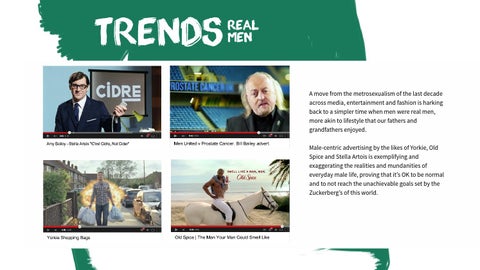
A move from the metrosexualism of the last decade across media, entertainment and fashion is harking back to a simpler time when men were real men, more akin to lifestyle that our fathers and grandfathers enjoyed. Male-centric advertising by the likes of Yorkie, Old Spice and Stella Artois is exemplifying and exaggerating the realities and mundanities of everyday male life, proving that it’s OK to be normal and to not reach the unachievable goals set by the Zuckerberg’s of this world.
Experiences are now more desirable than possessions by many in a post-recessionary world. A continued rise in interest for events such as the Tough Mudder challenge, show how men are collectively supporting each other in a back-to-basics, nofrills, survival-mode experience that does away with the unauthentic gloss of gyms or the pretentiousness of parties.
Bombarded by a constant barrage of news, data and status updates, we are all falling prey to an information overload. For those of us that weren’t born post-google or with a smartphone at school, we are becoming distracted and overwhelmed by technology. From digital detox holidays that let us disconnect, to WiFi-free zones by KitKat in Amsterdam and the success of the Selfridges No Noise campaign and Silence Room in 2013, we are finding ways to slow down and switch off.
Digital dependence aside, online is beginning to be used not as an end in itself, but a means; to facilitate more oline interactions. ActivatAR activates public spaces with augmented reality; turning New York City Metrocards into augmented reality markers into mini portable art galleries that showcase an every-changing roster of artworks through the year.
With the bombardment of confusing brand messages and overload of information, consumers require more guidance than ever to navigate the modern world. Brands are now taking a more active and guiding role in all aspects of our lifestyles and helping men live better, simpler lifestyles. From Google Helpouts, which connects users with online experts that can answer all manner of questions, to Lifetools by highstreet retailer Uniqlo, that pairs its collections with suggested food recipes or hairdo’s. The Polo RL Survival Guide by Ralph Lauren was launched last year on instagram as a regular feed of video tutorials that could help men learn how to brew the perfect cup of coee, gut a fish, or start a fire.
If a recessionary world has done anything positive, it’s been to help redefine what value means and encourage considered consumption. A less but better approach to purchasing goods has meant that simplicity, functionality and subtlety in design have come into demand. In the UK alone, up to 32% of people are willing to pay more for simpler experiences and interactions, according to the 2013 Simplicity Index by Siegel + Gale Successful brands have started to edit consumer options with clearer choices as a key method for dealing with the ‘paradox of choice’ that we all encounter on a daily basis. Erik Schedin in Sweden curates his minimal online storefront. Hudson Made strips back all of its branding to deliver a nononsense approach to men’s grooming products, and Selfridges as part of its No Noise campaign stripped off the branding of well known branded goods in a bid to simplify our lives.
In a world of constantly streaming feeds and visually curated culture driven by Tumblr, Instagram and Vine, we are witnessing the rise in curation over creation. Platforms such as Svpply, Nuji and Fancy have fostered a community around social (media) shopping. A slightly more analogue approach is also catering to a demand for curated convenience in the form of subscription box retail. Men’s subscription services, such as Svbscription work with the likes of interior photographer The Selby to carefully curate a range of collectable and limited edition products for the modern man. Other services such as Bro Box Club and Dollar Shave Club take a no-nonsense approach to a subscription model that offers everyday life essentials in a convenient and approachable way. Dollar Shave Club also offers a tiered range from $1 a month for ‘The Humble Twin’ package, all the way up to ‘The Executive’ for $9 a month.