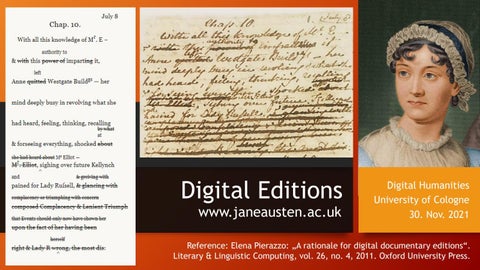
Digital Editions www.janeausten.ac.uk
Digital Humanities University of Cologne 30. Nov. 2021
Reference: Elena Pierazzo: „A rationale for digital documentary editions“. Literary & Linguistic Computing, vol. 26, no. 4, 2011. Oxford University Press.
Table of Contents „Diplomatic Edition“: a definition Digital Media: rethinking possibilities Online Digital Edition: an example Documentary Digital Editions
* 16. Dezember 1775 in Steventon
1787: First manuscript
1811: First novel
† 18. Juli 1817 in Winchester
Definition of „diplomatic edition“ • a transcription that reproduces as many characteristics of the diploma as allowed by the characters used in modern print • line breaks, page breaks, abbreviations, differentiated letter shapes • recently: also reproduce topographic collocation of different writings, incl. functional signs and marks (within limits of print medium)
• a surrogate of a facsimile edition • „transcription“: act of transcribing & product of transcription → derivative document → (proofreading, annotation, publication) → formal (public) presentation of the derivative document
Considerations when transcribing • infinite facts relate to the work • any edition records a selection of observable & recoverable facts • each edition provides a specific representation of the selection
• in print, variable shape and spacing of handwriting is lost • requires interpretation, selective alteration & preservation • „act of translation“ from one semiotic system (manuscript) to another (print) • is irreversible : should be based on informed decisions (choices) • scholarly objectivity & selection: ability to consider or represent facts, information, etc. without being influenced by personal feelings or opinions
Digital media: new possibilities representation (facsimile) → interpretation, model (simplification) • Tanselle (1978): punctuation, spelling, letter shape (long s, i-j, u-v…), capitalization, abbreviations, authorial errors, deleted readings, added texts • digital offers new ways of (user-determined) selective presentation • WHERE to STOP, what limits / boundaries? →rethink the reasons why we make transcriptions →shift from mimetic to analytic editing →use mark-up language, e.g., TEI Guidelines
Rethinking possibilities: Grid of features
Example of an online diplomatic edition www.janeausten.ac.uk
PRESERVED
NOT ENCODED
normal s and long s ( ∫ ) inversion of dipthong ie → ei ( friend → freind ) methods for marking word breaks different length of dashes (3 levels) capital letters (used inconsistently!) original punctuation
exact location of interlinear insertions linguistic features (except part of speech for capitalized words) (NB:TEI genetic mark-up unavailable at the time)
Considerations • WHO is the reader? • intended target (scholars, students of same discipline) • Others • scholars of other disciplines • generic readers → ease of use? lack of website „standard“ look and feel → de-mystify scholarship: use extended web functions • „mouse over“ to superimpose readings • option to choose to expand abbreviations
• document nature (author‘s intent)? manuscript or calligramme? • capabilities of the publishing technology? to reveal author‘s revision habits
Inclusion of facsimile • removes fruitless frustration of trying to preserve exact text layout, illumination & physical appearance
• „diplomatic edition“ can focus on ADDING INSIGHT as a scholarly interpretative activity • presence of the image means the editor is continously on trial, open to account & correction
• engages the user in inspection of translations
„The digital diplomatic edition is a composite, complex, scholarly-informed & at the same time transient object.“
Documentary Digital Editions • SOURCE and OUTPUT are two separate objects + TOOLS • Digital editions allow output to be modified: diplomatic → reading view • Minimum parts of a digital edition • • • •
Source file (XML-TEI) Scripts to read source and transform to „view“ (XSLT, XQuery) One or more outputs to be represented One or more styling files (CSS and Javascript)
Print & digital have same function & ontology, different nature
→ preparation and questions editor has to answer are different
www.janeausten.ac.uk