31.10.2021
The pilgrimage business of Ise through the Edo period: seeing is believing* 4th semester essay for the learning module: “Pilgrimage in the Edo period” (SoSe 2021) Lecturer: Dr. Chantal Weber
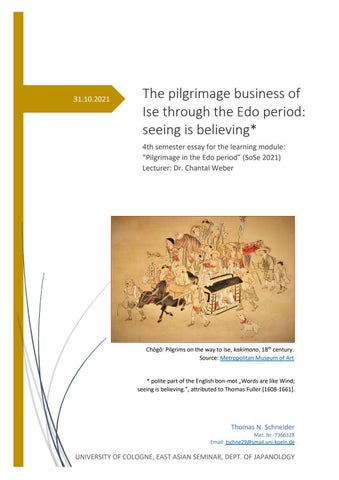
Chōgō: Pilgrims on the way to Ise, kakimono, 18th century. Source: Metropolitan Museum of Art
* polite part of the English bon-mot „Words are like Wind; seeing is believing.”, attributed to Thomas Fuller [1608-1661].
Thomas N. Schneider Mat. Nr. 7366328 Email: tschne29@smail.uni-koeln.de
UNIVERSITY OF COLOGNE, EAST ASIAN SEMINAR, DEPT. OF JAPANOLOGY
Table of Contents Givens: Ise-Yamada and environs............................................................................................................ 1 Market forces: Porter`s model and the shidan seido .............................................................................. 2 Miracles and power seizure: Shingon-Shintô and the Tokugawa ........................................................... 5 Reality (re)constructed: sankei mandala, maps, and travel guides ........................................................ 8 Recap: from danna to tourist ................................................................................................................ 15 Bibliography ........................................................................................................................................... 16
i
Givens: Ise-Yamada and environs “Pax Tokugawa” and sakoku 鎖国 (“locked country”) are terms typically associated with the 250 years of bakufu 幕府 (military government) - from Go-Yôzei tennô 後陽成天皇 (emperor 1571-1617, posthumous name) bestowing the title of shôgun 将軍 (chief military commander) on Tokugawa Ieyasu 徳川家康 [1543-1616] up to the sighting of Perry’s black ships off the coast of Nippon 日本 in 1853. Japan’s “early modern age” is characterized by the shift in the locus of political power to Edo 江戸 (today’s Tokyo), hereditary seat of the Tokugawa family. The Japanese domestic market, freed of internal and external military strife, held significant economic potential, even in “splendid isolation”. 1 Pilgrimage was a common practice, as noted by Engelbert Kaempfer, a German doctor working for the Dutch East-India Company (VOC) in Nagasaki 長崎 towards the end of the 17th century: „The Japanese are very fond of pilgrimages. They have various ones, and to different places. The most important and noblest is to Jsje.“2 In the Edo period [1603-1868], the Isejingû 伊勢神宮 (shrines of Ise) at Uji-Yamada 宇治山田 welcomed 200,000 – 400,000 visitors annually.3 An outsider might wonder why people from across the land sought out this particular spot.4 Kaempfer‘s explanation: “Every honest shinja, or rather, every patriot whatever his belief, should visit this sacred site annually, or, at very least, once in his life, to show due gratitude to the god and founder of his nation by this act of homage. Also, cleansed by this act of all sins, he may enter a happy state after death, or, in the naïve eyes of the uneducated masses, he may be blessed with bodily health, food and drink, money, clothing, children, and a family.” Yamada 山田 at the mouth of the Miya 宮 river was already known as Shinto 神都 in the Middle Ages. By the late 17th century, around 40,000 souls lived in the town, and a further 8,000 in the neighbouring village of Uji 宇治. Uji-Yamada lies about 65 miles south-east of Kyôto 京都 (85 miles by road) in the South of the Ise 伊勢 domain (today´s Mie-ken 三重県) and overlooks the entrance of the “Bay of Ise” towards the Pacific Ocean. Close to the Port of Toba 鳥羽 in the neighbouring Shima 志摩 domain which forms the “Land’s End”, it is readily accessible by sea. The shrines traditionally associated with the shintô 神道 (“way of the gods”) religion are found in and around Uji-Yamada together with a few remaining Buddhist temples. Unlike other pilgrimage circuits, the Ise pilgrimage required no arduous trekking and stopping to worship at countless religious sites along the way. Depending on the point of departure, say, Ôsaka or Kyôto, but also from Edo by way of the Tôkaidô, the journey could be completed 1
After a 100-year period of rapid growth in the 17th century, during which the country’s population doubled, the number of registered subjects of the realm stagnated at 25 – 27 million in the period 1721 – 1846 according to the official records of the bakufu. By way of comparison: the English population (excl. Scotland, Wales, Ireland) for the period 1600 – 1720 is estimated at 4 - 5 million (Continental Europe: 90 – 100 million) and only tripled in the ensuing 125 years (1720 - 1845) to 16 million (Continental Europe: doubling to 200 Mil.). 2 KAEMPFER, Engelbert, Hsg: DOHM, Christian W.: “IV: Of the Sanga, or the Pilgrimage to Jsje”. In: The History of Japan, vol. 2, London, 1727. (Author’s translation to English.) 3 Other sources quote 400,000 – 600,000 visitors for a period in the 18th century. In the context of this article, the relationship of paying guests to beggar-pilgrims and their evolution over time would be of interest. The necessary research could not feasibly be completed by the author for this article. 4 Reasons to travel: escaping the daily grind, time for reflexion, curiosity and thirst for knowledge and adventure, seeking new encounters and the camaraderie of the journey, the admiration of compatriots on return…
1
efficiently and even comfortably in a kago 駕籠 (pallaquin) for minimal distraction. The Gokaidô 五街道 – the trunk roads of the land expanded and ridded of many tolls on the instructions of the bakufu – facilitated the journey for anyone holding an official permit, the tegata 手形. The operators of accommodation, gastronomy, bath-, teahouses and entertainment establishments, shopkeepers, local craftsmen, and the agricultural sector profited from the high volume of men and goods travelling the roads. Places of pilgrimage developed into centres of trade and knowledge exchange.
Market forces: Porter`s model and the shidan seido The business of pilgrimage was an important part of the Japanese economy, providing work and income to many people. What explains the initial success of Ise? How did the market, the customers and the marketing of the town evolve over the Edo period? In this essay we will show that Ise experienced a “rebirth”, with the initial success essentially due to political circumstances surrounding the seizure of power, the propaganda and subsequent regulation of the market by the Tokugawa family. Later, the businessmen of Ise-Yamada responded to increasing competitive pressures and changing customer expectations with innovations and by consolidating their activities. Michael Porter (1979) introduced “five forces analysis” to rationalize the actions of market players, develop insights into the dynamics of a business and assess the attractiveness of potentially entering a new sector.5 This article is an attempt to apply the model to a historic venture, the “pilgrimage business of Ise”. In addition to business rivalry among established competitors, Porter identifies two horizontal forces: threat of new entrants and threat of substitutes; as well as two vertical forces: bargaining power of suppliers and bargaining power of buyers. Business leaders, customers and contractors are treated as independent actors, ideally operating under a free market regime of open, “level playing field” competition, without collusion or (secret or tacit) agreements. Institutional advantages and political entanglements are considered “structural factors” by Porter and therefore do not feature explicitly in his model. Macro-economic and political advantages are, however, key to explaining the early success of Ise and represented significant barriers to entry to new market entrants. The 17th century was characterised by power-asymmetries and monopolies, with political connections the keys to business success. As we will see, the suppression of sankei manga is characteristic of how the bakufu consolidated power and muffled dissenting voices. In the 18th century, market conditions began to change: monetisation of the economy and innovations in publishing increased information transparency, outlet channels multiplied. As enlightenment spread, political-religious motivations for a pilgrimage to Ise diminished. Widening customer choice increased pressure for the businessmen to compete on cost and value. A later part of this essay will explore how scientific progress in mapping and cartography, an increasing canon of travel literature, prose and colourful prints had “game changing” effects on the pilgrimage and travel businesses, as well as on the co-operative financial institutions, the so-called kô.
5
PORTER, Michael E.: “How Competitive Forces Shape Strategy”. In: Harvard Business Review, vol. 57, no. 2 (1979), pp. 137–145.
2
In 1635, the political control instrument of the sankin-kôtai 参覲交代 (alternate residence duty) obliged the daimyo 大名 (lords of a domain) to undertake regular journeys with their retainers from their castle towns to and back from Edo. They were prohibited from participating in pilgrimages to exclude the possibility of acquiring social prestige and political legitimacy by religious association. However, it was expected that the daimyo intermittently send envoys to sacred sites and ceremonies recognized by the bakufu, for example, the Ise sengû 遷 宮 (Consecration of a new shrine). To this end, they had to maintain a relationship and a credit line to an onshi 御師 (owner of a pension and lower priest of the Ise shrines).6 In contrast, the broad class of farmers, together with traders and craftsmen, enjoyed the sanctioned mobility of the mairi 参 (pilgrimage to visit a shrine).7 The living spectacle or cult drama of the matsuri 祭 (festival, carnival) and the rituals in which “gods take possession of the human vessel” can be traced to minzoku (“popular”) shintô 民族神道 belief. The staging and group participation in a kagura 神楽8 held a special significance, especially at Ise, the holiest of sites. Organising the attendance of a kagura was an important task for an onshi, whilst the size of the financial contribution determined the context: the most sublime form was the daidai kagura 太々神楽. The superstitions of the populace were fertile ground for the onshi and for conmen to stage “happenings” and distribute wonder-products. During the Muromachi period [1336-1573] local syndicates had formed in large numbers across the country to manage common land and assets: the kô 講. These co-operatively arranged the financing and planning of pilgrimages to secure the salvation of their respective community. The kô negotiated on behalf of its members and maintained a standing relationship to an onshi as the group’s single-point contact at the sacred site. Contingent on the financial health of a kô and at regular intervals, usually annually, a certain number of group members, often drawn by pulling lots, could be sent on the Ise pilgrimage. These so-called danna 旦那 (patrons) were the end-customers of the onshi. Once a household had entered a relationship with one (or even several) onshi, it would automatically receive amulets and calendars annually - by subscription, as direct marketing, so to speak. In return, a financial return contribution was expected.9 The spatial separation and information gap between the onshi and their danna was bridged, and new danna recruited, by means of a social network of danna mawari 旦那周り (regularly travelling liaison officers and travel guides) under a system known as shidan seido 師団制度. The responsibilities of an onshi were not restricted to organising religious services, offerings, and guided tours. He and his helpers, the sendatsu 先達, also saw to the physical well-being of the danna: transport, reception, accommodation, meals, entertainment, souvenirs, etc. - all could be arranged.10 Hence, the term onshi was not only applied to the person, but also to the The kanji 御師 are usually read oshi. However, for the special case of the Ise shrines, the kanji are read more formally as onshi. In the subsequent text, when referring to Ise, this convention will be adhered to. 7 As alluded to by the self-dimishing form of the english verb „to go“, mairi was less an act of individual religious reflexion than a societal institution and sign of collective respectful submission. 8 The trance dance of a female shaman forms the dramatic climax of the kagura. The practice first finds mention in the Man‘yôshû 万葉集 [8th century] and reflects the practices of kami'gakari 神懸 („oracular divinification“) and chinkon 鎮魂 („purifying and shaking the spirit“). 9 In the 1770´s, the onshi of the gekû distributed over 4 million amulets annually to households across the land. 10 Special importance was attached to a good feast in the home of the onshi - as evidenced by the diaries of the many pilgrims who diligently recorded and raved about the many courses and delicacies. 6
3
danna‘s abode.11 The onshi appeared as lower priests of the religious sites, “hostel owners” and paid go-betweens for worldly services. As such, they might be considered hereditary entrepreneurs, locked in mutual competition at the centre of Porter’s model. The onshi courted the goodwill of the kô and the danna by sending tedai 手 代 (helpers, i.e., “sales representatives”) with promotional gifts on regular repeat visits to the han 藩 (domains of the land), to cultivate new and build on existing business relationships. A ground-breaking innovation was the “invention” of convertible paper “exchange notes” that could be used at selected establishments to pay for goods and services. The creation of fiat money and lending via the kô revolutionized travel and commerce, laying the foundations for new banking and finance models. The kô represented a consolidated purchasing force, carrying weight vis-à-vis the pilgrimage tour operators. Oshi on the same pilgrimage circuit, but also the various circuits amongst each other (→ threat of new entrants), fought for market share, whilst trying to grow total market value. Unsurprisingly, the onshi introduced controls to regulate competition and to stabilize their business: the relationship between a danna and an onshi was supposed to transcend domicile as well as generational changes. The family name of an onshi was a tradeable brand. In modern terms, the network of the onshi could be compared to a lobby association or even a cartel of the pilgrimage business. The town elders of Uji-Yamada were recruited from the elite of the onshi houses. Uji-Yamada’s special privileges (more on the origins later) lay in its own tax and jurisdictive authority - not only over the town but across the complete terroir beyond the Miya River, inclusive of the rice producing villages. Not that the tax revenues were required for the maintenance of the shrines – this was paid for by the bakufu. The income was used for self-administration, such as sending an annual delegation to the New Year audience of the shogun in Edo.12 Latest at this point – congruence of economic interests, religious authority, and political power – one must speak of unfair competition and collusion. Success stories like Ise invariably catch the eye of co-profiteers: it was considered a societal duty to distribute alms to poor pilgrims in the form of food, but also as small change. Special coins bear witness to this practice, the images minted barely hiding contempt. The act of nukemairi 抜け参り (“stealing away” on a pilgrimage) was a risky form of worship or escape, resorted to by family members and house servants. 13 Leaving home and duties without the prior permission of the master meant being dependent on his goodwill at the almost invariably In this aspect the term oshi/onshi is similar to the term ie 家, which can signify, depending on usage, the family, the clan, the household and the building. (SCHNEIDER, Thomas: “The ie system: guarantor of cultural knowledge transfer?”, term essay, University of Cologne, Sep 2020.) 12 These privileges were not absolute and were increasingly restricted: in 1635 the bakufu installed a magistrate at the shore of the Miya River with 30 employees, 40 sailors and a small fleet. Communal decrees required a counter signature and tax collection was turned over to the magistrate’s office. In 1780, the city council effectively lost the right to set taxes. Travel costs to Edo were henceforth reimbursed directly by the bakufu. Nonetheless, the council’s charter proclaimed - up to the Meiji age - the right of shugoshi funyû 守護使不入: “Admittance to the shrine domain is prohibited to representatives of the bakufu.” (TEEUVEN u. BREEN, 2017) 13 From ancient times, the roads were a catchment basin for society’s “outcasts”. Their pathetic existence and begging could be “excused” as supposed pilgrimage and was generally tolerated. The uncensored representations of needy people in precarious circumstances in the print products of the Edo period suggests that the social ills were put down to individual fate and not seen as a political task. The impotence of the disenfranchised to formalise a legitimate right for “time-out” might be a contributing factor to nukemairi. 11
4
miserable return. Nonetheless, in the case of an Ise pilgrimage, the unauthorised break with societal expectations and convention should be forgiven without harsh sentence, as reminded in many a sentimental story of redemption. Every so often, mass pilgrimages were observed, for example in April/May 1705: 3.5 million pilgrims are reported to have trekked to Ise. 2.7 million visitors were recorded between April and August 1771, 4.5 million between late March and August 1830.14 Whilst pilgrimages were often scheduled for the winter months by the kô, these so-called okage-mairi お陰参り took place during the agriculturally busy Spring- and Summertime. The extraordinary influx has been explained as a “generational phenomenon”, aligning roughly to the 60-year cycle of the Chinese calendar.15 Ostensibly provoked by widely publicised miracles and funded by generous sponsors16, okage-mairi offered an escape from the daily grind: a large number of women of all ages, serfs and even children took to the roads for the journey of a lifetime – people who under normal circumstances would not have been granted permission to travel. However, despite the publicity value, hordes of beggar-pilgrims would hardly have been a profitable source of revenue for the onshi. Indeed, they were a disruption to the regular business, with labour shortages impacting on the provision of many goods and services - a “state of exception” to be reined in quickly to maintain stable social order! 17 In this context, the weak negotiating position of “independent” labourers should be highlighted. In contrast to the onshi and the danna organized in the kô, the large pool of have-nots - with little by way of formal education - had no lobby, union representation or champion of their cause. The single worker in the tourism, transportation, or textile industry was exposed, essentially unprotected, to competitive pressure and had no choice but to submit to standards set by the employer. Non-benevolent onshi and shônin 商人 (traders) could collude to limit wages to a sustenance minimum.18 Increasing division of labour and efficiency gains by mass production increased such pressure over time, even in former craft professions.
Miracles and power seizure: Shingon-Shintô and the Tokugawa The shikinen-sengû 式年遷宮 tradition is particular to Ise: the rebuilding of the shrines from the ground up following a 20-year cycle. The style of construction is said to mimic that of the traditional Japanese rice store. Kaempfer describes the shrines as “poorly build of wood and not very high, and […] covered with a low roof of hay. [They are] maintained with great care 14
ISHIMORI, Shuzo: “Popularisation and Commercialization of Tourism in Early Modern Japan”. p. 188. NENZI, Laura: “To Ise at all Costs – Religious and Economic Implications of Early Modern nukemairi”, p. 77. Note: The explanations do not completely convince this author. There may be value to investigate in more depth possible correlations to natural catastrophes, political events, and astronomical phenomena. 16 For example, Kônoike Zenzaemon, a rich trader from Ôsaka, “donated” a total of 460 ryô amongst 184,000 pilgrims of the 1771 okage-mairi (Nenzi, 2006: p. 87) 17 Sanjin Seihoku commented in his 1771 book Kyokun Manbyo Kaishun (Lessons for recovery from all sorts of illnesses): “Recently an unbelievable infectious illness is widely prevailing. There are so many people who are going to travel for pleasure every year, owing to freedom of time and money, though the nominal purpose of travel is for visiting hot springs for medical treatment. Not only men, but also many women, who asked their husbands to stay at home and beg a big amount of money for their travel expenses, went travelling widely for pleasure.” (ISHIMORI, 1989: p. 180) 18 This may hold clues as to the stagnant growth in the Japanese population in the 18th and 19th centuries, the high incidence of infanticide and the high numbers of day-labourers and prostitutes. 15
5
in the image of the original poor temple [sic] of early times, built in their poverty by the first inhabitants and founders of this nation, or, as they call them, the first people.”19 In essence, periodic reconstruction maintained perfect structural integrity and immaculateness, whilst passing on the “living tradition” of shinmei-zukuri 神明造 construction techniques. 235 lunar phases, roughly 19 years, correspond to the metonic cycle, i.e., the astronomical re-synchronisation of sun and moon, but also approximate a human generation or “coming of age”. 20 Maintenance of the shrines is said to have been neglected in the 16th century. The shrines owe the “rebirth of the ancient traditions” to the san-eiketsu 三英傑 (“three unifiers of the Nation”). First and foremost, Oda Nobunaga 織田信長 [1534-1582] and Toyotomi Hideyoshi 豊臣秀吉 [1537-1598] generously sponsored shrine restorations. In 1585, in a break with the royal protocol, Hideyoshi sent his sengû offerings not via the Imperial Court but had them brought to Ise by his mother. When his mother suffered severe illness three years later, he promised a donation of 10,000 koku21 to the shrines, should she convalesce. Celebrating her recovery, in October 1588, Hideyoshi personally undertook the Ise pilgrimage. The 1594 cadastral survey probably represents his most valuable gift of gratitude: lands East of the Miya River were not assessed for tax and thus exempted. Such a privilege was usually only granted to temple/ shrine precincts and the immediately adjoining small strips of monzen-machi 門前町 (“temple town”). This example illustrates how political legitimation and authority could be derived through demonstrative piety and miracle tales.22 The self-image of the Tokugawa is evidenced by the inscription on the amulet of the 3rd shogun, Tokugawa Iemitsu 徳川家光 [1604 – 1651], that he is said to have always carried on his person: “Ise Tenshô Daijin 伊勢天照大神 – Hachiman Daibosatsu 八幡大菩薩 – Tôshô Daigongen–shôgun 東照大権現 将軍. Three shrines, united in body and soul.”23 In other words, the shôgun styled himself as the symbol incarnate of the “holy union” of the “God of all Gods” Tenshô Daijin (Amaterasu) in Ise, Hachiman (God of archery and war), protective deity of the Tokugawa (Minamoto/ Genji 源) clan, and the deified Ieyasu. The Tokugawa family’s claim to power was cemented with construction of the Nikkô 日光 necropolis (about 90 miles from Edo) in honour of the father. The power of the Buddhist temples was to be broken and reconciled with the shintô faith. A central concept of ryôbu shintô 19
KAEMPFER, Engelbert, Hsg: DOHM, Christian W.: “IV: Of the Sanga, or the Pilgrimage to Jsje”. In: The History of Japan, vol. 2, London, 1727. 20 These may all just be coincidences. At the time of writing, I have no references to prove any connection between the metonic cycle and the rebuild-cycle of the Ise shrines, nor to a “coming of age”. 21 1 koku = 180 l, i.e., the amount in dry rice to feed an adult for a year 22 In times of trouble and high mortality – and with Oda Nobunaga raging against Buddhist institutions – looking for supposed divine intervention and turning to faith is hardly unusual. Tokugawa Ieyasu, ultimately victorious in the power struggles for supremacy in the land, recognized the political danger of the newly imported and rapidly growing Christian faith: the symbolic significance of a worldly ruler requiring legitimacy by a Pope in Rome, preachers and religious orders subordinated to foreign powers, the divisive potential of the Reformation and the empowerment of the individual with respect to church and state through critical close reading of the Bible and the philosophical works of Antiquity. Under his son and successor, Tokugawa Hidetata 徳川秀忠 [1581 - 1632], the prohibition of the Christian faith and banning of Western literature was implemented with murderous fervour, and all missionaries expelled from the country. At the same time, the author cannot help but have a sense of déjà-vue. Iemitsu’s scheme of “holy legitimation” seems to imitate the Christian concept of the Trinity: “Mother” Amaterasu instead of the Heavenly Father, Hachiman instead of the Holy Ghost and Ieyasu instead of God’s son Jesus. Even the sound of Ieyasu’s name bears some resemblance to Jesus. Surely, these mere coincidences bring up unwanted associations and must be refuted by reasonable Japanese. 23 The original amulet is held to this day in the Rinnô-ji Tempel in Nikkô, where it is on public display.
6
両部神道 (“way of the gods with dual aspect”), also known as shingon shintô 真言神道, is the principle of honjin suijaku 本地垂迹 (systemic syncretism). According to the “Encyclopaedia Britannica”: “The school developed during the late Heian [794–1185] and Kamakura [1192–1333] periods. The basis of the school’s beliefs was the Japanese concept that Shintō deities (kami) were manifestations of Buddhist divinities. Most important was the identification of the sun goddess Amaterasu with the Buddha Mahāvairocana (Japanese name Dainichi Nyorai: “Great Sun Buddha”). The school’s theorists interpreted the Shingon belief in the two realms of Dainichi as corresponding to the two kami enshrined at the Ise Shrine: Amaterasu was considered to be the equivalent of taizō-kai (“womb world”), and Toyuke (or Toyo‘uke) Ōkami, the kami of food, clothing, and shelter, was equated with kongō-kai (“diamond world”). Their shrines at Ise were identified with the two mandalas used to represent the dual nature of Dainichi.” 24 The Ise-jingû are laid out as a double shrine complex. They consist of an outer shrine, the gekû 外宮 with (today) 32 subsidiary shrines in and around the town of Yamada, and an inner shrine, the naikû 内宮 with (today) 91 subsidiary shrines in the vicinity of the village of Uji. An example of a subsidiary shrine is the Tsukiyomi-no-miya 月夜見宮 (or 月読宮).25 Separated by the Isuzu 五十鈴 (“50 bells”) River, the naikû is reached by crossing Uji-bashi 宇治橋. The shrines are also known as Toyo‘uke-daijingû 豊受大神宮 in the case of the gekû, and Kôtaijingû 皇大神宮 in the case of the naikû. The latter name implicates the (today) close connection to the imperial line: the tenno 天皇 traces his family back to the sun goddess Amaterasu, in accordance with the Kojiki 古事記 [712] and Nihonshoki 日本書紀 [720] chronicles. The Tokugawa might have wanted to be viewed in a similar tradition, but for leaving spiritual responsibility for natural disasters and famines with Toyo‘uke. 26 A myth explains the choice of location for the Ise shrines: 27 the sacred mirror, associated with the Goddess Amaterasu and stored in the Ise-jingû, is said to have been moved out of the Imperial Palace in Kyôto under the 10th emperor, Sujin tennô 崇神天皇 [148 – 30 B.C.?]. Under the 11th emperor, Suinin tennô 垂仁天皇 [29 B.C. – 70 A.D.?] Yamato-hime no Mikoto 倭比売命 was asked to determine the best place of worship. Following a long search, the princess had a revelation: Amaterasu asked to be worshipped forever in Ise. However, the 1st shikinen sengû (rebuilding of the shrine) is said to have occurred at the naikû only in 690 A.D. under the (female) 41st emperor, Jitô tennô 持統天皇 [645-703], shortly before the Nara-period 奈良時代 [710-794]. The location of the capital would still change several times before Kyôto 京都 became the seat of imperial power at the beginning of the Heian-era 平安時代 [794-1185]. The gekû shrine traces its foundation to the year 478 A.D. A naïve reading of the founding myth should not preclude an originally natural place of worship for Amaterasu. Could Amaterasu have been enshrined at the gekû in town before the “1st 24
“Ryôbu Shintô”. In: Encyclopedia Britannica Online (https://www.britannica.com/ last accessed: 9.9.2021) The younger brother of Amaterasu Omikami, Tsukiyomi-no-Mikoto, associated with the moon, is enshrined here, together with the heavenly parents, Izanagi-no-Mikoto 伊邪那岐命 and Izanami-no-Mikoto 伊邪那美命, in accordance with the founding myth of the Japanese isles. 26 At times of poor harvest, the Ise priests and the tennô would be implicated, e.g., for neglecting their responsibilities in the correct conduct of the rites to worship Toyo’uke. The shôgun would not be directly responsible. 27 “History”. In: Website of the Grand Shrines of Ise (www.isejingu.or.jp/en/about/ last accessed: 9.9.2021) 25
7
rebuilding” of the naikû? The pre-eminence of one or other of the gekû and naikû shrines and the order of precedence of New Year offerings became a matter of state for Tokugawa Iemitsu.28 The affair underlines the 3rd shogûn’s determination to correct the Ise priests and incorporate Amaterasu into his “three shrines” scheme of divine legitimation. In person, Iemitsu only paid respect to his ancestors in Nikkô - and he insisted the (again female) tennô do so as well! From 1640, Iemitsu also started to send a kôke 高家 (Master of Ceremonies) to Ise on irregular occasions. Only in 1648 did Iemitsu again permit the tennô to send envoys to the Ise kannamesai 神嘗祭 (harvest festival). In this way, an official system had been established: Nikkô and Ise as “twin power spots”, with the shogûn as the living representation of an “everlasting divine authority” that required no further external legitimation.
Reality (re)constructed: sankei mandala, maps, and travel guides Old maps and depictions of the gekû and naikû shrines offer revealing historical evidence. Presumably, archaeological excavations would yield little - given the perpetual cycle of shrine renewal. However, unlike photographs, the documents handed down are not necessarily accurate representations nor universal in coverage either. They might reflect a “constructed reality” from the point of view of whoever commissioned the work. Moreover, they can be easily misinterpreted from a modern perspective. 29 This certainly applies to the Ise sankei mandala 参詣 曼荼羅 whose true heritage and use remains speculative. In their layout, they are not constrained by spatial reality, and they are certainly not drawn to scale. Prima-facie, they are “narrative guides”: similar in design to a map, they not only show the sites of worship but the people of the time, their traditions and social norms. It is thought that sankei mandala were used as visual aids for improvised narration and picture sermons: etoki 絵解き. The paper format, creases and signs of wear suggest that travelling preachers, kanjin hijiri 勧進聖, took to the roads with such kakemono 掛け物 (hanging scrolls) for “promotional tours”. Based on the content and the style of painting, sankei mandala were probably produced by town painters commissioned by Buddhist temples. The kanjin hijiri knew their audience and could mediate the symbolic content vividly and selectively. For example, the same illustration could be used to remind a “mere mortal” of their religious duty to the shrines, or to point out the splendid isolation of the shintô priesthood, the frivolous merry making, and the greedy gathering up of alms. From a commercial point of view, the concentration of so many varied attractions on a single poster and at a single physical location meant there was bound to be “something for everyone”: Even if a single attraction realizes only a fraction of the custom of the single pilgrim, or even loses out altogether, by 28
The question was raised by Ise priests at the New Year audience of 1636 in Edo and passed to the High Court. The imperial regent’s kugyô 公卿 Nijô Yasumichi 二条 康道 [1607 – 1677] concluded that the gekû should retain its position of pre-eminence. Whilst both shrines carry the title of Amaterasu, the gekû was dedicated to the ancestors, the naikû to the parents. Hence, the precedence of offerings, first at the gekû and then at the naikû, should not be changed. Iemitsu was dissatisfied with this opinion. His regent scholar Razan Hayashi 羅山 林 [1583 – 1657] published a 2nd opinion: there are various theories with regards to the identity of the gekû: Ninigi 瓊瓊, or Kunitokotachi 国之常立, or Mike-tsu-kami 三狐神, or Toyo‘uke. Amaterasu is not among these, hence her name must be linked to the naikû, which should be given precedence in all matters. 29 SCHNEIDER, Thomas: “The ie system: guarantor of cultural knowledge transfer”. First year essay in Japanology, University of Cologne, 2020. The second part of the essay considers the challenges of institutionalising cultural heritage and different methods of inter-generational knowledge transfer.
8
attracting many individuals to a relatively secluded location, all local businesses could symbiotically claim a stake in the total custom. Similarly, there is a common interest to maintain the shared infrastructure, such as the roads, and the virtual capital, i.e., the brand and reputation of the site. The Ise sankei mandala we know of today superficially exhibit a similar layout – horizontally mirrored illustrations of the gekû (to the right) and the naikû (to the left). A differentiating feature are the placement of the sun and the moon in the upper part of the paintings: in the case of two of the mandalas, the sun shines on the right (above the gekû), in the case of the two others, on the left (above the naikû). In this way, symbolic reference is made to the two worlds of Ryôbu Shintô: since both are avatars of Dainichi Nyorai 大日如来, they should indeed be interchangeable. The illustration of Buddhist temples in addition to the sacred sites of shintô should be noted: Segi-dera 世儀寺, Kaze no miya 風の宮, Keikôin 慶光院, Kongôshô-ji 金剛 證寺. The juxtaposition of shrines, tempels and of natural sites is indicative of a mixed reality of faith. Two social classes can be distinguished amongst the pilgrims: people in red cape, some on horseback, and people on foot in plain clothes. Knecht identifies the latter by their characteristic cap, the tokin 頭襟, and their chequered garments as yamabushi 山伏.30 The shintô priesthood divides into two distinct groups: the inner sanctuaries of the gekû as well as the naikû exclusively show negi 禰宜 (high priests of shintô) dressed in black clothing. In public spaces we see “regular” onshi in white. The sankei mandala mediate an impression of the scared sites and their usage before and around the time Ise was re-purposed as an “exclusive” site for Shingon-Shintô and “purged”. In 1643, there were 57 Buddhist temples in Uji. A further 227 existed in Yamada until 1670.31 In 1675, the bakufu revoked the “right to practice” from all Buddhist onshi in Uji-Yamada. The nuns of the Keikôin 慶光院 were given an exception of sorts: considering their former role as fundraisers for the sengû, Tokugawa Ieyasu had granted them the privilege to be seated in the old shrine compound on occasion of the moving of spirits to the new shrine. The art of sankei mandala disappeared in the middle of the 17th century together with the kanjin hijiri, who were no longer granted tegata to travel on the roads. According to the surviving Ise sankei mandala, which sequence of attractions comprised an “ideal pilgrimage” in the early Edo period? Pilgrims reach the town by crossing the Miya River, as shown in the lower right-hand corner of the mandala. This could be done by means of a temporarily constructed bridge.32 Having completed misogi 禊 (ritual cleansing) one enters the busy town of Yamada via a wooden torii 鳥居 (gate) and proceeds towards the datsueba 奪衣 婆 (“the old hag who strips clothes”).33 The Sei-gawa 清川 divides the town into “clean” and 30
KNECHT, Peter: “Ise sankei mandara and the Image of the Pure Land”. p. 228. In that same year (1670), 189 temples together with large swathes of the town were destroyed in an inferno. 47 of these temples were never rebuilt. The town’s shrines miraculously survived the fire almost unscathed. 32 A bridge across the Miya River is not shown in illustrations from the later Edo period. It is possible that a temporary bridge was only constructed on specific ceremonial occasions, like the sengû. 33 …in the case of the Jingû Chôkokan 神宮徴古館 mandala. According to folk tradition, the Datsueba awaits the recently departed at the Sanzu-gawa 三途川, the river to “the beyond”. Other mandalas show a man seated in the same location. Judging by his red face and elaborate crown, this could be King Enma (Yama), the first of the ten kings of the “other world” who hands down the sentence to what hell the dead must go to. (These unsavoury descriptions remind the author of what we today refer to as a “madam” or a “pimp”.) 31
9
“unclean” parts. On walking across Sujikai 筋向 bridge, Segi-dera can be seen to the right. This temple is associated with Shugendô 修験道, an ascetic religion that might have commissioned two of the Ise mandala. After crossing the Toyo-gawa 豊川 one reaches the torii 鳥居 of the gekû. To the right, we see the korakan 子良館, manned by maidens of noble descent. Outside the fence of the gekû, pilgrims of various classes gather in prayer, the inner sanctum being the exclusive preserve of the negi. In the upper right-hand corner of the mandala, in front of the ama no iwato 天の岩戸 (“stone door of Amaterasu”) on Takakura-yama 高倉山, a miko mai 巫女 (shrine maiden or shaman) is seen dancing to musical accompaniment. This kagura traces its roots to a legend: the sun goddess, disgusted by the obscene behaviour of her brother Susanô スサノヲ, withdrew to a cave and by doing so cast the world into darkness. Only the sound of joyous revel of other gods outside her hiding place and the claim, that an even greater god had arrived, tempted her out of hiding and gave the world back its light. As part of the ruse, Amaterasu was shown the legendary mirror yata-no-kagami 八咫の鏡, one of the three royal regalia. The cave was sealed for evermore with a shimenawa 注連縄 (“enclosing rope”). Said cave, perhaps a former place of worship or a kôfun 古墳 (“ancient grave”), can still be visited today. The middle part of the mandala shows the descent through Okamoto 岡本, famous for combs.34 Traversing Oda 小田 bridge, one continues to Ai no Yama 間の山, past the afore-mentioned Keikôin and the village of Uji 宇治. Pilgrims cross Uji bridge tossing coins into the Isuzu River – the alms being busily gathered up from underneath the bridge. Proceeding uphill, past the korakan, one finds the naikû in the mirror image of the gekû. A bridge leads to the Kaze-nomiya 風の宮. 35 Via a mountain path, the (male) pilgrim reaches Kongôshô-ji, a Buddhist temple near the Asama 朝熊 mountain peak (555 m), the highest point of the peninsula.36 The upper left-hand corner of the mandala depicts the futami-ga-ura 二見が浦 rocks. Fuji 富士 (3776 m) mountain is visible on the horizon. It is indeed possible, depending on the viewpoint, to catch a glimpse of the highest and holiest of Japanese peaks on a clear day. To the East lies only the vast expanse of the Pacific Ocean. The same sites continued to be popular sight-seeing spots in the later Edo period: for example, the motive Utagawa Hiroshige 歌川広重 [1797-1858] chose in 1853 for his album of the 60+ provinces to represent “Ise province” is a narrow vista looking across teahouse roofs and hills onto the entrance of Ise Bay (with sailing ships, no Fuji mountain in sight). The futami-ga-ura rocks, joined by a shimenawa, can be seen on various ukiyoe 浮世絵 prints from different angles, in face of the rising sun. On other illustrations, courtesans walk along the beach in front of the rocks in splendid kimonos (Utamaro, late 18th century), or female pilgrims with umbrellas (Hiroshige, 1847-52). A woodcut from the bakumatsu period (Toyokuni, 1857) shows the
According to legend, Yamato-hime no Mikoto lost her comb in the Kushida 櫛田 River on her way to Ise whilst searching for the appropriate place to revere Amaterasu. 35 Prayers to save Nippon from the invasions of the Mongols [1274, 1281] were allegedly said here. 36 A popular Edo period saying: 「お伊勢参らば朝熊をかけよ、朝熊かけねば片参り」 (“If you go worshiping at Ise, also go to Asama. If you don’t, it is only a one-sided worship.”) According to the popular custom of takemairi 岳参り, the souls of the dead rise into the mountains. In the Kongôshô-ji courtyard one encounters square wooden posts, tôba kûyo 塔婆供養, erected in memory of departed family members. 34
10
legendary Genji 源氏37 with ama 海女 (“women of the sea”) diving for abalone, i.e., pearls.38 These prints should be understood as souvenirs that were – like picture postcards today – reproduced in large quantities and sold individually to private buyers. They have little in common with religious sankei mandala, other than perhaps a promotional intent and the fact that they also represent “constructed reality”. The importance of transparency and the challenge of information asymmetry for a properly functioning market economy, as ideally underlies Porter’s model, has already been remarked upon. Being able to access accurate information represents nothing less than a “paradigm shift”. Together with the monetisation of society, the publishing businesses expanding in Edo and Ôsaka over the course of the 18th century changed the dynamics of the market in the interest of customer choice, to the (initial) disadvantage of the onshi. For the danna, loyalty of many years to a particular onshi began to matter less than being able to transparently compare one-off prices, fees, and services. Using maps, travel guides, fictional and non-fictional published accounts and ratings, the individual pilgrim could take matters into his (or her) own hands, compare offers from a variety of service providers and make reservations in advance. At the same time, the kô increasingly lost its raison d’être when just representing a single pilgrimage destination: its core competency lay in financing the members’ travel plans. At this point, we should trace the origins and look at the evolution of the content and accuracy of these maps and travel guides through the Edo-period by way of some examples.39 Typically, Yamada is reached by following the Ise-kaidô 伊 勢 街 道 . The junction is located near Yokkaichi 四日市, a few miles down the Tôkaidô after making the Shichi-ri no watashi 七里 の渡し (“crossing of 7 ri” distance, about 17 miles) river estuary crossing by boat from Miya 宮 to Kuwana 桑名, shortcutting the journey from Edo to Kyôto. Approaching from Kyôto, the Ise-betsu-kaidô 伊勢別街道 at Seki 関 offers a quicker alternative that avoids the mountain fortress town of Kameyama 亀山. Ise-kaidô and Ise-betsu-kaidô merge before reaching the town of Tsu 津 on Ise Bay. One then continues along the coast via the textile town of Matsusaka 松阪 towards the Miya River crossing and the final bakufu magistrate post to Yamada. More directly, avoiding main trunk roads, one can access the town from Ôsaka 大阪 or Nara 奈良 through the mountains. Several circuits can be imagined, for example, taking in the Saikoku sanjûsan kasho 西国三十三箇所 (“33 tempels of the Western lands”) pilgrims’ route. Commercially available printed maps of the provinces from the 18th and 19th centuries can be traced to earlier land surveys initiated by the bakufu. In Edo times, it was surely inconceivable for private individuals to measure out the land (or the sea for that matter) by their own initiative and risk distributing information at odds with a cadastral survey of the bakufu. The origins of The main protagonist of the Genji Monogatari 源氏物語 (“Story of Prince Genji”) by lady-in-waiting Murasaki Shikibu 紫式部 [990–1010]. Late-born son of an ageing tennô, removed from the imperial line and demoted to the family of the Minamoto (alias Genji), he does not need to work and passes his time with the fine arts. 38 In fact, Mikimoto Kôkichi 御木本 幸吉 (1858 – 1954) successfully established the artificial farming of pearls in nearby Toba during the Meiji period. 39 In doing so, we might bear in mind Harley’s assertion: “Maps are never value-free images… Both in the selectivity of their content and in their signs and styles of representation maps are a way of conceiving, articulating and structuring the human world which is biased towards, promoted by, and exerts influence upon particular sets of social relations.” (HARLEY, J. B.: The New Nature of Maps: Essays in the History of Cartography. Baltimore, MD: John Hopkins University Press, 2002.) 37
11
the black-and-white printed products are, for example, evident in the 1830 saiken Ise no kuni ezu 細見伊勢國絵図 (detailed map of Ise province), which closely resembles the hand painted map of 1702. Owing to their original (administrative) purpose, high-level maps are not particularly true to scale, but show named entities, i.e., villages as cartouches, towns as squares or in silhouette, as well as connecting paths and watercourses, and the rough coastline. The lay of the land - hills and woods – is indicated in otherwise “unproductive” white space in between. For Uji-Yamada, the 1702 map explicitly lists each machi 町 (town ward), suggesting a distinct status, different from the usual “castle town”. Despite the “detailed” claim implied by the 1830 map title, it would be necessary to refer to local maps for actual farmland or building plot delimitations and the actual course of the rights of way. The Tôkaidô bungen no zu 東海道分間之図 (1690, “Measured map of the Tôkaidô”) by Hishikawa Moronobu 菱川師宣 [1618-1694] was published in a folded accordion format of joined-up monochrome woodblock prints. The Tôkaidô is shown in straightened out bird’s eye view at a detailed linear scale of 1 bu : 1 cho (= 1 : 36 000), letting the viewer divine elevational changes. The 1752 printing includes tidal and distance tables, as well as an appendix with transportation costs and agency contact details. The attractions along the road – each house, bridge, junction etc – are minutely illustrated. The road is filled with travellers: for example, a long daimyo procession between the Ise-betsu-kaidô at Seki (station #47) and the fortress town of Kameyama (station #46). The bearing of the road is periodically indicated on the map by means of compass roses and can be determined by the traveller based on the position of the sun. This type of presentation was of practical value to those wanting to move swiftly, but informed, along the highway with no intentions of straying too far off the trodden path. Roundtrips could be planned readily using overview maps that showed the road network in two dimensions (without elevation contours). The names of stations along the way – villages and towns - are spelled out. The approximate distance between these nodes is marked off in ri. The map shows the streams and rivers to be crossed, as well as landmarks and barriers, such as hills. Provinces are named, but no exact borders indicated. One intriguing detail on one such a map, Saikoku sanjûsan kasho hôgaku ezu 西国三十三箇所方角絵図 [1759] („pilgrims map of the 33 tempels of Saikoku“) - by its omission - is the fortress town of Kameyama on the Tôkaidô: Presumably, pilgrims were not required here. In time, and with newer editions, we note improvements in quality and resolution: for example, the 1800 edition of the same map. A comprehensive later map, Dai-Nihon saiken dôchû zukan 大 日 本 細 道 中 図 鑑 (1850, “detailed waymap of greater Japan”), depicts the whole country in glorious colour – including Kameyama. An impression of the political division of the land as well as the state of cartography in the 17th century may be gleaned from the hand-coloured map Fusôkoku no zu 扶桑国之図 [1666] (“map of Japan” – although old Chinese kanji crept into the title) by Nakabayashi Kichibei 中 林 吉兵衛. Parts of Ise province have slipped out of place, Uji-Yamada and the Ise-jingû are not on the map. By the early 19th century, Hokusai Katsushika 北斎葛飾 had developed ingenious cross-country vistas from a bird’s eye perspective that, for example, crop the complete Tôkaidô onto a single (large) page by creatively playing with the spatial dimensions. “Virtual travel” became popular in the bakumatsu period [1853-1868] and employed similar representations: the Ise-kaidô can be travelled with the board game sangû jôkyô dôchû ichiran 12
sugoroku 参宮上京道中一覧双六 [1856]. Approaching from Edo, the player may end up either in Ise or Kyôto, the Ise-betsu-kaidô offers a chance to change paths. Despite the unusual representations, progress in geographical understanding compared to 1666 is evident. A nautical chart of Ise Bay from 1863, seikei ichiran 勢海一覧, demonstrates that accurate coastal surveys were within the technical capabilities of the Japanese in the bakumatsu period. As is well known, the strategic position of Ise and its port was of no practical import to the bakufu since coastal shipping of goods was negligible in the Edo period. Other than an outline of Uji-Yamada and the Ise shrines, no inland towns or indeed features of the land are marked on this map. Magnetic and geographic North are distinguished, but there are no beacons to take bearings, no depth soundings nor naval warnings (such as buoys around shallows, flares on rocks). Shading might be interpreted as a rough indication of water depth. Simple to read and handy to carry, as publicity for or as a souvenir from an accompanied pilgrimage, were maps that dispensed with accurate geography. An example from an Ôsaka Isekô shows the road to Ise diagrammatically as a line snaking towards the rising sun, with the sequence of stations and the distances marked off, with famous views shown along the way. To plan an individual pilgrimage in the later Edo period, richly illustrated travel guides could be consulted. The popularity of such guides is evidenced by the many reprint editions. The Ise sangû meisho zue 伊勢参宮名所図絵 (“Illustrated travel guide for the pilgrimage to Ise”) by Shitomi Kangetsu 蔀関月 [1747-1797] in eight volumes first appeared 1797 in Ôsaka and is a remarkable example of the genre. Detailed observations and legends are documented with an idiosyncratic eye and wit. Other features are explicitly omitted and obscured by clouds. The pictorial evidence shows that the Ise-kaidô from Matsusaka up to the Kushida 櫛田 River was lit in the 17th century by stone lanterns and had impressive bridges. These constructions crossed river deltas and flood plains, such as the Miwatari 三渡 River, solidly built to withstand large seasonal fluctuations in water level. Well-developed infrastructure, wide shopping streets with busy shops and rest places, and spacious temple and shrine complexes bear witness to the economic strength of the Ise shônin, particularly in the cotton-textile business.40 The town of Uji-Yamada adjusted to changing times: the onshi house count rose from 145 in the year 1594, to 391 in 1671, to 615 in 1724, but declined again to 357 by 1792.41 It appears that the number of well-to-do customers with a large entourage, and later the organised travel in large kô groups, either waned or the houses consolidated. In accordance with economic theory, cost pressures trigger scale effects: in the competition for custom and in negotiations with subcontractors, well capitalized and innovative onshi survive. In the later Edo period, piety seems to have increasingly taken a back seat to worldly pleasure seeking and purchasing power – a societal “game changer” and door-opener for substitutive services. The reflections of a gekû shrine priest in the Meiji priod [1868-1912] are telling:
For example, Mitsui Takatoshi 三井高利 [1622 – 1694] of Matsusaka: in 1674 he founded the Echigoya 越後屋 kimono shop, precursor to the Mitsukoshi 三越 department store, in Nihonbashi 日本橋, Edo. 41 CHIAVACCI, David: „Die soziale Konstruktion des japanischen Reisemarktes in der Edo-Zeit“. p. 427. 40
13
“There was not a single person who did not associated the Ise pilgrimage with Furuichi… Vast sums of money were squandered [in Ise] by tens of thousands, almost all of it was poured into Furuichi.” 42 Furuichi 古市 advanced to become the third largest pleasure quarter in the land with 71 establishments and 1000 hostesses at its peak. In contrast to the Yoshiwara 𠮷原 in Edo, the brothels in Ise were unlicensed and styled themselves as tee houses, chaya 茶屋. In the late 17th century, the prose of Ihara Saikaku 井原 西鶴 [1642-1693] and kabuki 歌舞伎 pieces by Chikamatsu Monzaemon 近松 門左衛門 [1653-1725] cemented the reputation. Following an inferno in the 1780‘s, the establishments were quickly rebuilt larger and more extravagantly than before. A mass murder in a tea house [1796] and the related kabuki that quickly appeared, together with Jippensha Ikku’s bestseller Tôkaidô dôchû hizakurige 東海道中膝栗毛 [18061822] further advanced the business. However, sex was not the only entertainment on offer: the dance and song of the tea ladies, Ise ondo 伊勢音頭, was known across the land. A successful performance in a local kabuki production could be a springboard to a career on the great stages of Edo, Kyôto and Ôsaka. Colour prints and lurid brochures made no secret of the outstanding beauty and talents of the local female workforce, generating useful hype. The textile business benefitted from the synergies: supplying the ceremonial clothing for shrine ceremonies, as well as designing kimono collections for the ladies. Quality and brand recognition proved to be winning tactics – despite the bakufu’s repeated attempts to suppress ostentatious displays of luxury by the “nouveau riche”. New competitors enter a market with new products when the barriers to entry fall. This also proves to be correct when one looks at the keen marketing of Ise meibutsu 名物 (local specialities) and miyage 土産 (souvenirs). These customarily had to be bought as gifts of the journey for the folks who had to stay at home. Broad informational access to travel literature and maps in the later Edo period offered new advertising channels. Increased transparency of the range of the products and services on offer presented the danna with a multitude of choices that competed for disposable income. Visitors with the necessary purchasing power could increasingly dispense with the mediative services of the onshi. Porter’s model illustrates: four forces act on the “middlemen”, increasing competition among market rivals. Successful onshi adapted to changing customer expectations by increasing the efficiency and scale of their businesses. Where possible, cost pressure would be passed to those independent contractors lacking political advocacy and a lobby – the “working class” of the imminent industrial revolution.
42
TEEUWEN, Mark u. BREEN, John: A social history of the Ise Shrines – Divine Capital. p. 141.
14
Recap: from danna to tourist Porter’s model of the “five forces” - imbued by the ideals of free market competition – is hard to apply to the pilgrimage business of the early Edo period. Too predominant were the institutional and power-political circumstances that explain the initial economic success of the onshi: the attempts of the bakufu to demonstrate supremacy over the tennô and establish its authority in popular belief. The shrines of Ise, traditionally associated with the Japanese imperial family, were appropriated for the Tokugawa narrative and instrumentalised to curtail the influence and theological power of Buddhist institutions and faith. Buddhist temples in Ise – like elsewhere across the land - were increasingly subjected to restrictions and surveillance, leading up to the loss of land privileges, for example, after fires. The state authority supressed troublesome competition in favour of Ise in general, and the shrine-onshi in particular. Networking with the daimyo, the traders and craftsmen in the urban centers, as well as the farmers in the villages of the land, the onshi initially grew the pilgrimage business via the Isekô and the shidan seido. The ceremonies conducted at the Ise shrine, such as the kanname-sai and the sengû took place under the patronage and according to the wishes of the bakufu: the tennô, his court and the envoys of the daimyo acting as extras in a public spectacle. Moreover, the granting of a delineated “free-for-all social play space” in the guise and under the pre-text of a state cult – the supposedly pious pilgrimage to Ise – was part of the political calculation of the Tokugawa and their Neo-Confucian advisors. Here one understood not only to strengthen own political power but to encourage commercial development and innovation. The bakufu thus survived significant economic changes through the 18th century – the rise of an informed and well-capitalized bourgeoisie, impoverishment of the knighthood and of small farmers, a growing number of workers, day labourers and singles without meaningful possessions – right up until the external intervention. This required some ambivalence with regards to the true motivation of pilgrims, whose travels of “homage and salvation” increasingly acquired touristic attributes. Nonetheless, the tegata was a welcome source of income for the bakufu. The danna enjoyed spending recreational time in Uji-Yamada according to their means, not unlike a modern spa-, adventure- and tax-free shopping destination. Ise served a predominantly male clientele that was offered appropriate entertainment in the Furuichi and Uji pleasure quarters by essentially dependent and subordinated service providers. The example of Ise illustrates how income from the “legitimated pilgrimage” became indispensable to the local populace and how the market ultimately came to be characterised by freemarket competition. Efficiency and productivity increased through division of work, the monetisation of society and technical innovations. Popular literature, travel guides and colourful woodcut prints were not only a powerful new economic sector but promoted the standardization of an attractively packaged Ise narrative. A new middle class with the time and the means could experience independent travel for study and for pleasure. Commercially available and increasingly accurate maps and panoramas spread an enhanced spatial and economic awareness amongst the populace, as well as forming a new national identity. With the dawn of the industrial era and of the railways, a well-surveyed and visually defined DaiNippon had become accessible to the many. The danna were turning into tourists. 15
Bibliography ANON: Soul of Japan – An Introduction to Shinto and the Ise Jingu. Public Affairs Headquarters for Shikinen-Sengu, Yoyogi, Shibuya, 2013. ANDREI, Talia J.: “Mapping Sacred Spaces: Representations of Pleasure and Worship in Sankei mandara”, pp. 153-213, Doctor Thesis, Columbia Uni., 2016. CHIAVACCI, David: „Die soziale Konstruktion des japanischen Reisemarktes in der Edo-Zeit“, In: Japanstudien, vol. 13, no. 1 (2002), p. 411-436. ISHIMORI, Shuzo: “Popularisation and Commercialization of Tourism in Early Modern Japan”. In: Senri Ethnological Studies, vol. 26 (1989), pp. 179-194, National Museum of Ethnology. KAEMPFER, Engelbert u. DOHM, Christian W. (Hsg): Geschichte und Beschreibung von Japan, Drittes Buch. Meyersche Buchhandlung, Lemgo, 1777. KNECHT, Peter: “Ise sankei mandara and the Image of the Pure Land”. In: Jap. Journal of Religious Studies, vol. 33, no. 2 (2006), pp. 223-248, Nanzan Institute. KREINER, Josef (Hsg.): Geschichte Japans (6. Auflage). Stuttgart: Reclam, 2018. NENZI, Laura: “To Ise at all Costs – Religious and Economic Implications of Early Modern nukemairi”, In: Jap. Journal of Religious Studies, vol. 33 no. 1 (2006), pp. 75-114, Nanzan Institute. REYNOLDS, Jonathan M.: “Ise Shrine and a Modernist Construction of Japanese Tradition”, In: The Art Bulletin, vol. 83, no. 2 (2001), pp. 316-341, CAA. TEEUWEN, Mark u. BREEN, John: A social history of the Ise Shrines – Divine Capital. Bloomsbury Academic, 2017. VAPORIS, Constantine Nomikos: Breaking barriers: travel and the state in early modern Japan. Cambridge: Harvard University Press, 1994.
16