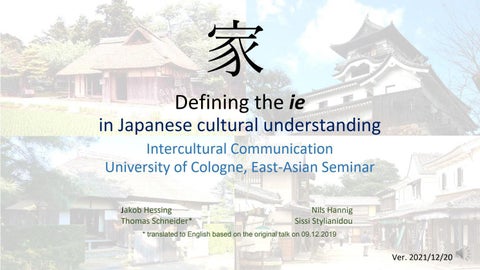
Defining the ie in Japanese cultural understanding Intercultural Communication University of Cologne, East-Asian Seminar Jakob Hessing Thomas Schneider*
Nils Hannig Sissi Stylianidou
* translated to English based on the original talk on 09.12.2019
Ver. 2021/12/20
Defining the ie - Contents 1. Definitions & characteristics
of the Samurai ie 2. Legal meaning in Meiji civil code 3. Nuclear family & demographic change 4. iemoto & patriarchs 5. Discussion
Definition of the term • building used as an abode ie • family or household • family group, in the sense of the Japanese legal code • kinship group or clan, includes ancestors as well as heirs
„The ie is a patrilineage, a network of households related through their respective heads, comprising main houses, branch houses, and the branches of branch houses traced down through the generations.“ (HALL, John Witney, BEARDSLEY, Richard K.: Twelve Doors to Japan. New York et al.: McGraw-Hill Book Co 1965, p. 78)
Characteristics of the ie system • objective: survival of the clan through the co-operation of its members • acceptance of one‘s status and standing in the hierarchy is trained from birth
• head of the family enjoys
• priviliged status • absolute rule over family members’ affairs • control of the family assets (single heir)
• bloodline of the stem family
• daughters & (younger) sons leave the ie • Samurai of high status have an official wife
& support concubines • multitude of heirs = power over the domain (by intermarriage)
Characteristics… • weak position of the wife
in Samurai families & court nobility defer to husband‘s profession • have duty to produce an heir •
• adoption – alternative to the bloodline • to safeguard the survival of the ie (if no heirs at all) • for more effective administration of the inheritance • to ensure the rites of ancestor worship can be correctly honored
Spiritual dimension of the ie • ancestor worship • ancestors as a community of souls • honored as hotoke 仏 (Buddhas) after death → ie system rooted in shintō 神道 & Buddhist belief
• ancestors • • • •
"foundation" & basis for the existence of the ie protect the family and assure its wellfare Japanese houses have a butsudan 仏壇 (family altar) obligation to maintain the ancestral grave and undertake periodic visits e.g. at the time of the bon 盆 festival
The ie in the Meiji civil code (1898-1945) • based on the ie concept of the Samurai (→ Meiji period bureaucrats) • head of the family is the legal guardian of all family members • decides over marriage, divorce & adoption • assigns a home • may ban family members from the koseki 戸籍 (family register)
• parents are the legal guardians of their children • have to agree to marriage, divorce & adoption • in charge of their home • the husband administers assets for children, as well as the wife
§
koseki 戸籍 • introduced in 1872, family name for all • basis for the the modernisation (& militarisation?) of Japan • supersedes the goningumi-chō 五人組帳 („five families register“) of Edo period • used as birth record, death record, marriage register and for national census • from 1947: on marriage, the child leaves koseki of the parents, establishes own koseki • from 1974: restricted public access (no longer accessible e.g. by potential employers)
Quelle: Wikipedia
Today‘s civil code & society • dictated by the American occupation forces in 1947 • • • •
husband & wife have equal rights marriage & divorce require consent only of the partners mutual assets are shared equally koseki format adjusted
• demographic change • economic miracle & structural change • urbanisation & double earners • individualism & ageing society →„nuclear family“ & „single household“
The ie in light of demographic change
(incl. parent/grandparent households?) „Single“ Household (unmarried or living alone)
Source: Japanese Ministry of Health, Labour and Welfare (with minor edits)
Co-residence in parental home on marriage
Source: Akihiko Kato, The Japanese Family System: Change, Continuity and Regionality over the 20th Century, Max-Planck-Institute for Demographic Research, Working Paper Mar 2013
Statistical studies – findings • •
• • • •
2013: 25% of couples continue to live in the parental home – 1920‘s : 56% relative increase in maternal co-residence – 1920‘s 1:5 ; 1960‘s 1:3 co-residence more common in the countryside & for elder sons, but decreasing statistical gap to city from 2000: trend to move into parental home later more financial support on marriage, transfer of assets stronger from paternal side general social trends: • reduction in the number of households with children • later „love“-marriage & increasing „single“-existence, continued „informal“ matchmaking services (no children out of wedlock!) • reduction in female fertility (no. of children), slightly rising after 2005
Co-residency of eldest sons
Source: Akihiko Kato, The Japanese Family System: Change, Continuity and Regionality over the 20th Century, Max-Planck-Institute for Demographic Research, Working Paper Mar 2013
Inter-generationaler wealth transfer (per marriage-cohort, up to 12 years after marriage)
Source: Akihiko Kato, The Japanese Family System: Change, Continuity and Regionality over the 20th Century, Max-Planck-Institute for Demographic Research, Working Paper Mar 2013
Trend to later„love marriage“ ? Mean Age * Female / Male 23.8 / 26.6
24.5 / 27.2 24.7 / 27 25.5 / 28.2
26.3 / 28.5 2000-09
28 / 29.8
2010-18
29.4 / 31.1
*in the case of “mean age” the figures relate to time of marriage, not birth of the partners
Source: Akihiko Kato, The Japanese Family System: Change, Continuity and Regionality over the 20th Century, Max-Planck-Institute for Demographic Research, Working Paper Mar 2013
Marital status at age 30 Women & origin of marital relationship: Overall marital status (2015) :
Married in a relationship in no relationship
Women 39% 26% 34%
Men 27% 21% 50%
Live births per woman & fertility rate
Source: Japanese Ministry of Health, Labour and Welfare
Demographic change: population structure Male
Female
For comparision: German population increased from 70 mil. (1950) to 82 mil. (2005). Prognosis is 77 mil. (2050).
Source: Berlin Institut für Bevölkerung und Entwicklung, 2010
ie : modern (re)imagining […] It is generally believed that as a consequence of modernization, particularly the enforcement of the post-war Constitution, the ie institution no longer exists. This viewpoint looks at the ie from an ideological angle that links it, in particular, with feudal moral concepts, and does not give sufficient consideration to its fundamental structure as a social group.
In my view, the most basic element of the ie institution is not - that form whereby the eldest son (who has taken over as head of the family) live together with the old (retired) parents, - nor is it an authority-structure in which the household head holds the power and so on.
Rather, the ie is a corporate residential group, and, in cases like agriculture, it is a managerial body. […] In other words, the ie is a social group formed on the basis of an established frame of residence (living together) and/or [a] managerial body. (NAKANE, Chie: Human Relations in Japan, Japan: Ministry of Foreign Affairs 1972, S. 10-12)
The ie in Japanese business ● approx. a third of all companies listed on the stock exchange before 1970 continue to be led by a family patriarch ● surprising success: higher profitability and market capitalization compared to professionally managed firms ● half the businesses are inherited to sons by birth, the remainder to adopted sons Source. MEHROTRA, Vikas et al.: „Adoptive expectations: Rising sons in Japanese family firms”. In: Journal of Financial Economics. vol. 103, no. 3 (2013), pp. 840-854.
Osamu Suzuki 鈴木 修 (born Matsuda) Chairman of Suzuki Corp., up to retirement in June 2021, at age 91
iemoto 家元 „grand masters “ of a traditional art or simply the „family head“ of a school for example: • kabuki 歌舞伎 (theatre) • sadō 茶道 (tea ceremony) • ikebana 生け花 (flower arranging) • and many more…
kabuki 歌舞伎 • „Ichikawa Danjūrō“ in kabuki • Danjūrō is a stage name
• awarded in a naming ceremony
→ not necessarily heriditary
Oberste Reihe, von links: Ichikawa Danjūrō I als Yamagami Gennaizaemon (Zōhiki) Ichikawa Danjūrō II als Kamakura Gongorō Kagemasa (Shibaraku) Ichikawa Danjūrō III als Uirō-uri or Soga no Gorō (Uirō) Ichikawa Danjūrō IV als Roku-bu (Kamahige) Zweite Reihe, von links: Ichikawa Danjūrō V as Fudō-myō-ō (Fudō) Ichikawa Danjūrō VI as Hanatogawa Sukeroku (Sukeroku) Ichikawa Danjūrō VII as Taira no Kagekiyo (Kagekiyo) Ichikawa Danjūrō VIII as Soga no Gorō in Ya no Ne Dritte Reihe, von links: Ichikawa Danjūrō IX (1874 – 1903) Sanshō Ichikawa V (Danjūrō X) (posthumous 1962) Ichikawa Danjūrō XI (1962 – 1965) Ichiawa Danjūrō XII (1985 – 2013) Quelle: Wikipedia
sadō 茶道 three tee-schools in the tradition of Sen-no-Rikyū 千 利休 ● ● ●
urasenke 裏千家 omotesenke 表千家 mushakōjisenke 武者小路千家
iemoto title is usually hereditary ● ●
●
sōshitsu sōsa sōshu
Source : „Iemoto Grand Master System”; accessible at: http://japanese-tea-ceremony.net/iemoto.html (last accessed 04.12.2019).
Sen Sōshitsu XV
Discussion - Questions 1. Is the ie-system a guarantor of the transfer of cultural knowledge? 2. Can the term “collective“ be applied to the ie? How does the ie relate to Hansen‘s definition of the nation? 3. What is similar, what is different from our norm of „family“?
Quelle : Kiyonaga (ca 1781), Forgetting Filial Piety The Metropolitan Museum of Art, New York
Appendix – spare slides & additional data
Defining the ie in Japanese cultural understanding Intercultural Communication University of Cologne, East-Asian Seminar
Japan‘s „cultural dimensions“ (Hofstede, 2004) power distance (strength of social hierarchy)
Masculinity (task vs person orientation)
Indulgence (vs. self restraint) Long-term orientation
Individualism
Predictability
…and their reflection in the concept of ie?
ie = „perfect patriarchy“? • Patriarches (alt-gr.): „first among fathers“ • Pater familias: „head of the household“
• Definition by Max Weber (1864-1920): a traditional form of rule centered on the head, founded on power and submission: „Bei der Haushaltsautorität sind uralte naturgewachsene Situationen die Quelle des auf Pietät ruhenden Autoritätsglaubens. Für alle Hausunterworfenen das spezifisch enge, persönliche, dauernde Zusammenleben im Hause mit seiner inneren und äußeren Schicksalsgemeinschaft. Für das haushörige Weib die normale Überlegenheit der physischen und geistigen Spannkraft des Mannes.“
ie : from militarism to old-age provision? „It was respect for the father and head of household positions that was extended to unquestioning respect for the Emperor in State Shintō as Japan moved to militarisation under the emperor system.“ „The Liberal Democratic Party has attempted at different times since the 1980‘s to revive the notion of the ie through the so-called „Japanese-style welfare system“, which calls on the family to accept an increasing level of welfare functions transferred from the state.“ „Today, the absolute authority and omnipresence of the father and household head has been replaced by the concerns over the absent father, overworked, seldom at home when children are awake and reliant on the mother/ wife for household management.“ (BUCKLEY, Sandra: „Family system“. In: BUCKLEY, Sandra (Hrsg.): Encyclopedia of contemporary Japanese Culture, London, New York: Routledge 2002, S. 138 – 139.)
References (alphabetical): 1. 2. 3.
CHAPMAN, David: „Geographies of Self and Other: Mapping Japan through the Koseki”. In: The Asia-Pacific Journal. Bd. 9, Nr. 29 (2011).
4. 5.
HALL, John Witney, BEARDSLEY, Richard K.: Twelve Doors to Japan. New York et al.: McGraw-Hill Book Co 1965
6. 7.
NAKANE, Chie: Human Relations in Japan, Japan: Ministry of Foreign Affairs 1972, S. 10-12
8.
STEINER, Kurt: „The Revision of the Civil Code of Japan: Provisions Affecting the Family”. In: The Far Eastern Quarterly. Bd. 9, Nr. 2 (1950), S. 169 – 184.
9.
TOSHITANI, Nobuyoshi: Kontinuität und Wandel in der Reform des japanischen Familiensystems nach dem 2. Weltkrieg, DeutschJapanisches Symposion in Tokio. Tübingen: J.C.B. Mohr 1994.
10.
TROMMSDORFF, Gisela: „Familie und Eltern-Kind-Beziehungen in Japan“. In: NAUK, Bernhard, SCHOENPFLUG, Ute (Hrsg.): Familien in verschiedenen Kulturen, Berlin: Walter de Gruyter GmbH & Co KG 2016.
DAVID, Roger, IKENO, Osamu: The Japanese Mind: Understanding Contemporary Japanese Culture. Boston et al.: Tuttle Publishing 2002. GERMER, Andrea: Historische Frauenforschung in Japan: Die Rekonstruktion der Vergangenheit in Takamure Itsues „Geschichte der Frau“, München, Iudicium, 2003.
KATO, Akihiko: The Japanese Family System: Change, Continuity and Regionality over the 20th Century. Rostock: Max-Planck-Institute for Demographic Research, 2013.
MEHROTRA, Vikas et al.: „Adoptive expectations: Rising sons in Japanese family firms”. In: Journal of Financial Economics. Bd. 103, Nr. 3 (2013), S. 840-854.
Internet sources: 11. „Iemoto Grand Master System”; abrufbar unter: http://japanese-tea-ceremony.net/iemoto.html (letzter Zugriff am 04.12.2019).