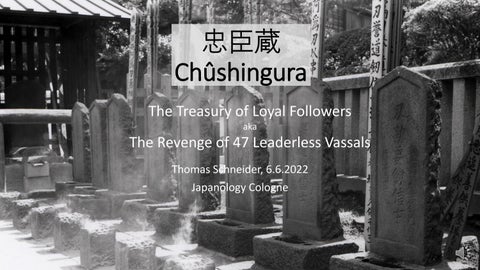
忠臣蔵 Chûshingura The Treasury of Loyal Followers aka
The Revenge of 47 Leaderless Vassals Thomas Schneider, 6.6.2022 Japanology Cologne
Compilation issued by Jishô III (1738 - ?), grandson of the Kyôto publisher Hachimonjiya. Lists 41 performances of the Chûshingura in the 38 years up to publication of the current edition (10x in Kyôto, 10x in Ôsaka, 21x in Edo). The tables reveal who played each of the 26 roles (incl. tayû). Also contains critical reviews of the performance of each actor.
D I S A M B I G U A T I O N
Eisaburô Onoe I (Kikugorô Onoe III) as Hayano Kanpei by Utagawa Toyokuni I; 1805 (Wikipedia)
仮 名 手 本 忠 臣 蔵 文化2年 6月、江戸河原崎座
Content & Questions • kabuki 歌舞伎 Kanadehon Chûshingura (1748) • Historical basis: Akô jiken 赤穂事件 (1701-03) • Contemporary legal debates • What are the key motifs of the play? • Are there parallels to Shakespeare’s Hamlet (1603)? • How do we explain the play’s continued popularity?
Chûshingura ningyô jôruri 人形浄瑠璃 prototypes
Chikamatsu Monzaemon (1653-1724) Goban Taiheiki 1st performed ca. 1710, Takemoto Theatre, Osaka. Jôruri libretto
Ki no Kaion (1663-1742) Onikage Musashi abumi First performed 1713.01.11, Toyotake Theatre, Osaka. Jôruri libretto Source: Tsubouchi Memorial Theatre Museum
Namiki Sôsuke (1695-1751) Chûshin kogane no tanzaku First performed 1732.10, Toyotake Theatre, Osaka. Jôruri libretto
ningyô jôruri 人形浄瑠璃 play bill
Kanadehon Chûshingura
仮名手本 忠臣蔵
performed 1763.01, Takeda-za, Edo
“It is said that ‘The sweetest food, if left untasted, remains unknown, its savour wasted.’ The same holds true of a country at peace: the loyalty and courage of its fine soldiers remains hidden, but the stars, though invisible by day, at night reveal themselves.”
仮 名 手 本 忠 臣 蔵 Comparison of the two sides in the Storehouse of Loyal Retainers, Kô no Moronao vs. En’ya Hangan (Kô no Moronao, En’ya Hangan, Kanadehon Chûshingura, Nakamura-za, 1860, by Ikkaisai Yoshitoshi Source: MFA
Main Protagonists
“BUNRAKU - The Art of the Japanese Puppet Theatre" with text by Donald Keene. Kodansha Intl. Ltd., Tokyo, Japan. 1965.: https://youtu.be/EXBWAbT5XmU
Chûshingura – a family soap
Kaoyo (Hangan’s wife)
Moronô
Tadayoshi (mislabelled as Hangan)
Wakanosuke
Above: Kabuki-za, Tokyo, Nov. 1968 Top right: Bungaku at Aichi Hall, Nagoya, 1963 Right: Kuniyoshi-ga, Morita-za, 1835
J. T. Araki)
https://www.videog.jp/player/4hlXSC9G-umd
Momonoi Family
En’ya Family
Kô Family にんじょうじっけん
Wakanosuke
Hangan
retainers
Tonase
Honzô
Konami
Yuranosuke
Rikiya
Goemon Kanpei
Kaoyo
Moronô
Kudayû (spy)
Okaru
Bannai
https://www2.ntj.jac.go.jp/dglib/contents/learn/edc21/himotoku/jinbutsu/ji2.html
Kanpei’s fate (acts 3, 5 & 6)
Yagorô
Goemon
Sadakurô
Kanpei
Ichimonya
Okaru
Yoichibê
Okaya
https://www2.ntj.jac.go.jp/dglib/contents/learn/edc21/himotoku/jinbutsu/ji3.html
Ninjo triptych Kuniyoshi, 1835 Morita-za
The Actor Nakamura Nakazo I as Ono Sadakurô in the Play Kanadehon Chûshingura, Performed at the Ichimura Theater in the Sixth Month, 1783 Artist: Katsukawa Shunshô 勝川 春章 (1726-1792) Source: Art Institute of Chicago
right: Keisai Eisen 渓斎 英泉 (1790–1848), ca. 1820s Kanadehon Chûshingura (A Treasury of Loyal Retainers), Act 6: Kanpei sumika (At the dwelling of Kampei) (Museum of New Zealand - Te Papa Tongarewa)
At the teahouse: Yuranoske helps Okaru (who spied on him reading the secret letter) down the ladder, Act VII, Kanadehon Chûshingura
Right: Nakamura Senjaku II as Okaru Nakamura Ganjirô II as Ôboshi Yuranoske Shin Kabukiza, Feb 1969 Left: Kitao Shigemasa (1739-1820), polychrome print, 1780’s
Kudayû’s death (act 7), Honzô’s sacrifice (act 9) & Gihei’s trial (act 10)
あ だ う ち
Tonase
Honzô
Yuranosuke
Oishi
Konami
Rikiya
Moronô
Okaru
しえん
Gihei
Heiemon
Kudayû https://www2.ntj.jac.go.jp/dglib/contents/learn/edc21/himotoku/jinbutsu/ji4.html
Michiyuki tabiji no yomeiri
Kamakura (Honzôs Residenz) Yamashina (Yuranosukes Landsitz)
Act 8: Bridal passage of Honzô’s daughter Konami & mother Tonase to Yuranosuke’s wife Oishi & son Rikiya
Yamashina Kankyo (Kunisada, 1837.08) Nakamura-za
Act XI: The Rônin assembling at Ryôgoku Bridge (Chûshingura jûichidanme Ryôgoku-bashi sei-soroi zu) Utagawa Kuniyoshi (1797-1861), about 1827-30 (Bunsei 10-13) (MFA)
The Night Attack (Chûshingura youchi no zu) Utagawa Hiroshige II (1826-1869), about 1847-52 (Kôka 4 – Kaei 5) (MFA)
Chûshingura shôkô no zu 忠臣蔵焼香ノ図 (Incense-offering scene from Chûshingura) Utagawa Kunisada I (1786-1864), 1830s (MFA)
Akô jiken 赤穂事件
14th day of the 3rd month, Genroku 元禄 14 (21.4.1701): Akô-han 赤穂藩 daimyô 大名 Asano Naganori 浅野 長矩 (33) launches his attack on kôke 高家 Kira Yoshinaka 吉良 義央 (59)
Katsushika Hokusai (1760–1849), about 1806 (Bunka 3) (MFA)
仮 名 手 本 忠 臣 蔵 IV
distance Akô - Tôkyo approx. 400 miles
夜 討 Utagawa Hiroshige II (1826-1869), 1855 (Ansei 2) Source: MFA
忠 臣 蔵
“Lord Kira’s residence”
Kira Yoshinaka (吉良 義央, Oct. 5, 1641 – Jan. 30, 1703)
大 尾 Utagawa Hiroshige II (1826-1869), 1855 (Ansei 2) Source: MFA
忠 臣 蔵
Top: Chart of Sengaku-ji 泉岳寺 cemetery. (Waseda University)
Left: Sengaku-ji, gravestone of Ôishi Kuranosuke (photo: John A. Tucker)
Tokugawa Tsunayoshi 徳川 綱吉 (23. Feb. 1646 - 19. Feb. 1709) • • • • • •
5th shogun, born on castle Edo as the 4th son of the 3rd shogun Iemitsu Mother Keishôin, concubine from Kyôto of “modest upbringing” 1680: succeeds older brother Ietsuna (1640-1680, shogun since 1651) Known to the populace as the inu-kubô 犬公方 Cultural “golden age” of genroku 元禄 (1688-1704) Redistributed han 藩 rated at 1.4 Mil. koku 石 in total
• Shogunal records on Asano Naganori – “Dirty Filth and Thieving Enemies” (1690) & “Admonish, Punish, and Correct” (1701): • obsessed with female charms (involved with wife’s maids) • tendency to promote the “corrupt and perverted” • accomplished nothing in martial arts or scholarly learning • honest & conscientious • lacking in compassion and short-tempered • administrative profile undistinguished
Asano Naganori 浅野 長矩 (28. Sep. 1667 – 21 Apr. 1701) • daimyô of Akô han 赤穂藩 (max. 53,000 koku in Naganori’s day) • related to Hiroshima-family line (Asano Nagamasa: Commander of Toyotomi’s Korean campagne, allied to Tokugawa Ieyasu pre Sekigahara) • period of solid economic growth (thanks to salt trade) under grandfather (Naganao, 1610-1672) → actual annual income 75,000 koku
• Born in Asano main residence in Teppôzu, Edo, little time spent in the fief, early death of father (Nagatomo, †1675) • 1680: office of the uchi no takumi no kami 内匠頭 (“carpenter”) • 1883: one of two officials assisting the New Year’s reception of the royal envoys to castle Edo. 1st acquaintance with Kira Yoshinaka. Marries Aguri (daughter of Asano Nagaharu of Bingo domain 備後国) • 1694: confiscates Bichû Matsuyama-jô 備中松山城 in shogun’s name • 1695: severe illness (smallpox?) • childless, adopts younger brother Asano Nagahiro, known as Daigaku • Fire inspector for the Honjo wood storage facility, 1698: supervisor of Kanda district, 1700: supervisor of Sakurada gate. • 21.4.1701: nominated 2nd time for New Year’s reception, injures Kira in the pine corridor of castle Edo, sentenced to seppuku the same day
Kira Yoshinaka 吉良 義央 (5. Oct. 1641 – 30. Jan. 1703) • Murdered: 14th day of the 12th month, Genroku-15 • kōke 高家 (master of ceremonies) • Court title: kôzuke no suke 上野介 • office inherited 1668 from the father, promoted to top grade in 1680 • of “renowned family”: successors to the military governors of Kamakura & the Ashikawa shogunate, lineage traced to Minamoto Yoritomo (1st shogun)
• despite relatively modest stipend (<10,000 koku) tendency to look down on hatamoto & smaller tozama daimyo 外様大名 • Born on Kajibashi estate in proximity to castle Edo, after the fire of 1698 relocated to new premises in Gofukubashi (even closer to the castle) • 1701: conveyed shogun’s New Year greetings in Kyôto, returns to Edo 4 weeks later (end of 2nd month), 10 days prior to arrival of royal delegates
Burg Matsuyama 松山城 in Bicchû (now Okayama Province, “castle in the sky”) “Harima” from “Famous views of the 60+ provinces”, Utagawa Hiroshige, 1855
Kishio Koizumi 小泉 癸巳男 (1893-1945) in 1942 “100 Views of Great Tokyo in the Showa Era”
“For the play is a play, a piece of art, made primarily to give delight and not to be an authentic record of history...” Sakae, Shioya: “Chûshingura – An Exposition”, Hokuseido Press, Tokyo, 1949. P. 6. (foreword written Dec, 1939).
Legal terms & dilemmas
reconciliation?
Smith II, Henry D.: “The capacity of Chûshingura”, In: Monumenta Nipponica, Bd. 58, Nr. 1 (2003), S. 1-42.
! x ?
- jiriki kyûsai 自力救済: warrior’s right to “self-help” i.e. blood feud ( vendetta ) - rojo 籠城: defending the castle to the bitter end ? ( = revolt ) - junshi 殉死: self-sacrifice on demise of the master ? ( but how can his “restless soul” then be pacified?) - kenka ryôseibai 喧嘩両成敗: principle of equally punishing both parties engaged in spontaneous physical violence ( Asano AND Kira! ) - katakiuchi 敵討: system of “registered” vendetta ( NEW in Edo period! ) ( NO solution: Kira was pronounced innocent in the 1st instance.) - totô 徒党: crime of conspiracy ( can a clan of retainers loyal to their lord be in a conspiracy ? when they surrender without resistance and submit to justice ? )
Confucian debate (J. A. Tucker, 2018) • Do the rônin qualify as chûshin gishi 忠臣義士 (“loyal & dutiful samurai”)*? • A matter of faith: do they deserve veneration and remembrance? • Confucian test: did they sacrifice themselves for a spiritual goal or higher purpose? →Self-image of the rônin (“Akô castle pact”) → allusions to the liji 禮記 (book of rites): “A son cannot live under the same sky as the sworn enemy of the deceased father.” →Buddhist negation: vendettas arise from the misplaced worldly struggle for reward and recognition, such as honour, duty unto the lord / the domain, castles, ranks and titles. →Posthumous recognition of rônin as chûshin gishi raises questions of judgement: - the rônin were convicted as criminals and sentenced to die by due legal process - recognition would send a populist sign that the bonds of the state and the people are built on loyalty, duty and honour, not legal formality & abstract construct. * Hayashi Razan 林 羅山 (1583-1657): coined the term chûshin gishi to explain the Chinese idea zhongchen yishi, attributed to Zhu Xi (11301200): he who lays down their life to defend his dynasty, culture and fellow citizens earns the right to be revered and remembered in shrinnes especially constructed for said purposes. This also applies to chûshin gishi. (Tucker, S.123) 忠臣技師
Judgement Commentary (J. A. Tucker, 2018) • Ogyû Sorai 荻生 徂徠 (1666-1728): Asano attacked Kira in a moment of rage and in doing so forgot his filial obligations. (Tucker, S.132) His retainers committed a violent crime without the state’s prior permission. This cannot be tolerated. They have to be pronounced guilty. By their voluntary seppuku they demonstrate their loyalty to their dead (erring) lord. • Satô Naokata 佐藤直方, 1706: The rônin are obliged to the clemency of the shogun for being granted the privilege of seppuku, saving them the disgrace of a public trial and execution. They should have immediately taken their own lives after the vendetta. Regretfully, they were in the service of a criminal and pathetic lord, who chose to break the law but was too incompetent to kill. The law spoke Kira free of all guilt. The rônin were impertinent and naïve to think they could garner public sympathy and escape just punishment. • Dazai Shundai 太宰 春台, 1732: The rônin should have defended Akô castle. Resistance would have found greater support than “only 47 faithful” - out of over 300! The castle would have burnt to the ground with everyone dying honourably. One should also not have hesitated to march on Edo: Since the injury Asano inflicted on Kira in Edo castle was no capital crime (according to law this only applied in case of murder), the anger of the rônin should not have directed itself against Kira but the judgement of the shogunate.
Questions • What are the key motifs of the play? “Shakespeare must have read Chûshingura” Harue Tsutsumi (*1950)
• Are there parallels to Shakespeare’s Hamlet (1603)? • How do we explain the play’s continued popularity?
Japanese Interpretation Chûshingura Matsui, Kesako (translation: Crandall, David): “Kabuki – A Mirror of Japan”, Japan Library, 2010 (2016). p.82/83 & 89.
“Modern people tend to associate Chûshingura with right-wing nationalism, but the original play as written for the kabuki stage was not particularly nationalistic. Most of the characters, including Honzô and Kanpei, are simply swept along by natural human emotions.”
→ “Kanpei’s ardent desire to reinstate himself as a proper retainer motivates all of his actions.” → “Honzô […] attempted to wipe the slate clean with his own death.”
“Each character is trying to restore the world to its proper order, by which they hope to recover a self that was lost.” “the entire tragedy grows out of a trivial scuffle and bad timing” “ribenji リベンジ (revenge) […] is perhaps Chûshingura’s true theme. [A]s a borrowed word from English […] [t]oday it doesn’t mean ‘retaliation’ so much as ‘making recompense’ […] a desire to correct one’s own failures.”
American Views on the Akô jiken Smith II, Henry D.: “The capacity of Chûshingura”, In: Monumenta Nipponica, Bd. 58, Nr. 1 (2003), S. 1-42.
!
“an atavistic, violent and futile event” “crimes involved were fundamentally ones of passion” “the Akô vendetta was inconsequential to the political and institutional history of Japan, but as a mirror of […] dilemmas in a period of transition for the samurai class from practicing warrior to urban bureaucrat, it has no rivals.” “tabloid crime and legal conundrum [provide] the first and most basic explanation of the ‘capacity’ of Chûshingura” “virtually no direct documentation survives, however, of what must have been complex debates within bakufu councils, particularly over the disposition of the avengers” (es fehlen auch die Dankesschreiben der “ehrenhaft Verurteilten”)
March 24-April 18, 2003 Rare Book and Manuscript Library, Butler Library, Columbia University
References • Chûshingura on Stage and in Print: An Exhibition of Books, Manuscripts, and Ukiyoe, March 24-April 18, 2003, Rare Book and Manuscript Library, Butler Library, Columbia University: http://www.columbia.edu/~hds2/chushingura/exhibition/ • Derrah, Rick: Chûshingura (The Forty-Seven Rônin) in History and Film, A Guide for Secondary History Teachers, Advances in Social Sciences Research Journal, Bd. 5, Nr. 7 (2018), S. 477-485. • Introduction to Kanadehon Chûshingura: Historical Basis and Popular Appeal, University of Virginia, 2000: http://jti.lib.virginia.edu/japanese/chushingura/kennelly-chushingura.html • Matsui, Kesako, Übersetzung: Crandall, David: “Kabuki – A Mirror of Japan”, Japan Library, 2010/2016. • Marcon, Frederico & Smith II, Henry D.: “A Chûshingura Palimpsest: young Motoori Norinaga hears the story of the Akô rônin from a Buddhist priest”. In: Monumenta Nipponica, Bd. 58, Nr. 4 (2003), S. 439-465. • McMullen, James: “Confucian Perspectives on the Akô Revenge – Law and Moral Agency”, Monumenta Nipponica, Bd. 58, Nr. 3 (2003), S. 293-315. • Smith II, Henry D.: “The capacity of Chûshingura”, In: Monumenta Nipponica, Bd. 58, Nr. 1 (2003), S. 1-42. • Takeda, Izumo & Miyoshi, Shôraku & Namiki, Senryû; Übers. Inouye, Jukichi: Chûshingura or, the treasury of loyal retainers, 3rd edition, Tokyo: Nakanishi-ya, 1917. https://dev4.gutenberg.org/files/59421/59421h/59421-h.htm • Takeda, Izumo & Miyoshi, Shôraku & Namiki, Senryû; Übers. von Keene, Donald: Chûshingura: the treasury of loyal retainers: a puppet play, New York: Columbia University Press, 1971. • Tucker, John A.: The Forty-Seven Rônin, Cambridge University Press, 2018.
Utagawa Kunisada / Toyokuni III (1786-1865) Okaru and Kampei from Act III of the Chûshingura, 1848. Oban Triptych.
Marcon & Smith: “A Chûshingura Palimpset”. Sophia University, 2003.
(dated to 1744) (recovered 1916, appended 1928, published 1975)
Marcon & Smith: “A Chûshingura Palimpset”. Sophia University, 2003.
本居 宣長 (1730-1801)
Edo meisho zue 江戸名所図会 , Hasegawa, Settan (1778-1843), 1834-36. Source: https://digitalcollections.nypl.org/items/8da4a078-9e86-0b29-e040-e00a18066540
“bushido” 武士道 : Comparison of Ideals (in German) ca. 1653
Dec. 1904
(1934-1941)
Rebecca Sabine Hans: “Bushidô-Ideale anhand von Mayama Seikas Genroku Chûshingura”, Europäische Hochschulschriften, Reihe XIX Volkskunde/Ethnologie, Bd. 56, Berlin, 2000.
Context overlay: tennô & shôgun of Japan Source: Wikipedia