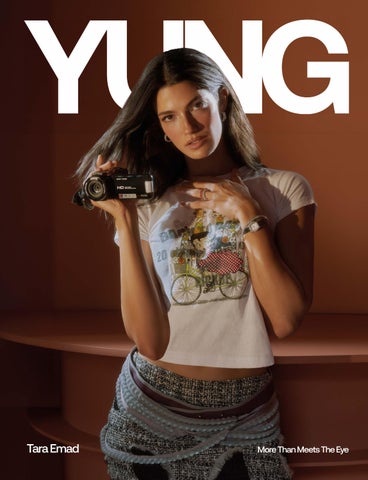
Tara Emad
More Than Meets The Eye
THIS IS YUNG
04-XX
RED, ONLY RED, NOTHING BUT RED
ROSE HACIENDA BEAUTY IS A GESTURE
XXXX
THIS IS YUNG
06-XX
XXXX
THIS IS YUNG
08-XX
XXXX
THIS IS YUNG
10-XX
XXXX
The Dubai Mall, Fashion Avenue, Level G, Dubai
THIS IS YUNG
12-XX
XXXX
R O B E R T PAT T I N S O N
CALIBRE 868
MASTER CONTROL
THIS IS YUNG
14-XX
XXXX
THIS IS YUNG
16-XX
A BOLD NEW RESIDENTIL ICON AT PA L M J U M E I RA H , D U BA I
XXXX
INSPIRED BY TIDES. SHAPED BY WIND. DESIGNED TO MOVE YOU. PASSO is BEYOND’s waterfront landmark on Palm Jumeirah in Dubai, conceived as a sculptural expression of contemporary coastal living.
Comprising the twin towers Avita and Bella, the development unites architecture, nature, and emotion through light, movement, and the rhythm of the sea. It offers over 600 curated residences from one- to four-bedroom homes, complemented by sky-level penthouses and 6 exclusive Beach Mansions on the shoreline, all designed with fluid layouts, panoramic glazing, and sweeping views of the Arabian Gulf, the Palm, and Dubai’s skyline.
PASSO offers 5 distinct residential collections, from wellness-led homes with private gardens and plunge pools to elite residences, penthouses, and beach mansions. A sculptural arrival piazza, cascading pools, landscaped paths to 250 metres of private beachfront, and curated wellness, family, and leisure amenities complete the experience. More than a destination, PASSO reflects BEYOND’s vision for design-led waterfront living, where architecture, nature, and emotion flow as one.
Dream Bold, Live BEYOND. EN QUIRIES@BEYONDPROPE RTI E S. AE
B EYON DDEVELOP MEN TS . A E
+ 971 4 611 6000
THIS IS YUNG
[01] EDITOR'S LETTER [02] MASTHEAD & COVERS [03] EDITOR'S PICK & CONTRIBUTORS [04] THE MOOD [05] READY-TO-WEAR
18-19
CONTENTS
20 - 21
[07] SECOND SKIN
98 - 133
22 - 23
↘ CHANEL: FRAGMENTS OF HER
100 - 109
↘ SAVED
110 - 117
↘ HESSA ALSUWAIDI KEEPS THE PRINT OPEN
118 - 125
↘ 35 BURGUNDY MOVES BEYOND THE SEASON
126 - 129
130 - 133
24 - 25 26 - 51 52 - 59
[06] FACE TO FACE
60 - 97
↘ RICHARD MILLE: BEYOND THE PARTNERS
↘ ACT I: OBSERVE TARA EMAD
62 - 79
[08] THE FREQUENCY
134 - 157
↘ ACT II: CONNECT DONIA WAEL
80 - 97
↘ IN MOVING WATER - WEGZ
136 - 145
↘ THE TRUTH IS OBVIOUS WITH ROGER WATERS & MONA MIARI 146 - 153
[00]
↘ THE LONG WAY HOME WITH TAZ WAVES
154 - 157
[09] SKIN DEEP
158 - 165
CONTENTS
[10] HUMAN NATURE
166 - 221
[11] YUNG ESCAPES
222 - 231
↘ CARTIER & VERSAILLES CELEBRATE MARIE ANTOINETTE AT 20 168 - 171
↘ A LOVE LETTER TO THE PAST
224 - 225
↘ A HOUSE OF FEELING
226 - 229
↘ DUBAI AFTER DARK
230 - 231
[12] THE SPACE
232- 233
↘ STORIES, CRAFT & HERITAGE
172 - 179
↘ THREAD AS MEMORY
180 - 185
↘ WHAT WE INHERIT
186 - 191
↘ WHO TAUGHT YOU TO NOTICE
192 - 197
↘ CARTIER HEADS INTO THE WILD
198 - 203
↘ THE LAST POTTER OF BEIT CHABEB
204 - 207
↘ SYRIA, SEEN AGAIN
208 - 213
↘ WHAT THE HANDS REMEMBER
214 - 221
THIS IS YUNG
The Human Behind It
20-21
On my way back to Beirut from Paris, I found myself thinking about something I had heard Sofia Coppola say. She was speaking about Marie Antoinette at an event with Cartier, before a screening of the film. Coppola spoke about watching footage her mother had taken while she was filming and how it felt to look back at a younger you, remembering hopes, dreams and fears. I had seen the film before, but somehow, watching it again after hearing her speak felt different. I noticed things I hadn’t noticed before. The music, the silences, the smallest details. I could see more of the woman behind the film. I kept thinking about that on the flight home. How much of ourselves we leave in the things we create, often without even realising it.
EDITOR'S LETTER
When Sandra founded YUNG, she created a space for a generation that wanted to be seen and heard differently. A publication with its roots in this region and its eyes on the world. I’m proud to be carrying that vision forward, with a team whose curiosity reminds me why I fell in love with storytelling in the first place. For our first issue together, we chose to explore what makes us human. Our two cover stars, Tara Emad and Donia Wael, approach that question from different places, but their stories have more in common than you might expect.
After more than a decade in front of the camera, Tara found herself questioning the very thing she had spent years buildIt’s a strange time to be reflecting on this. We live in ing. Behind the success was a woman a world where almost anything can be created in navigating grief, searching for meaning seconds. Images, music, stories. Everything is faster, and slowly finding her way back to acting. more polished, more immediate. Yet I find myself I was struck by how easily we can lose our increasingly drawn to the things that take time. The connection to something we once loved, imperfections. The stories behind the stories. The and how much courage it takes to find it people we think we know, until we discover someagain. thing that changes how we see them. Donia, meanwhile, is discovering what It feels fitting that this is where my own story with it means to want more. For years, she YUNG begins. poured her heartbreak and longing into After years of working in publishing, I am stepping into music, hoping to be heard. Now, she my first issue as Editor-in-Chief. There is something wants to be seen, too; as a singer, an both familiar and unfamiliar about beginning again. actress, and someone still figuring out just You bring everything you’ve learned, but you also how far her imagination can take her. have to leave room for what you don’t know. And I think that’s the part I find most exciting. Two women at different moments in their lives, both learning to make room for new versions of themselves. Perhaps that’s something we can all recognise. The uncertainty of change, the vulnerability of wanting more, and the quiet courage it takes to begin again. And perhaps that’s what makes us human.
Elsewhere in the issue, we meet creatives who are reimagining the things they have inherited. From Emirati textile artist and designer Hessa Alsuwaidi, who explores the relationship between craftsmanship and technology, to artists breathing new life into traditions passed down through generations, their stories remind us that creativity is as much about where we come from as it is about where we are going. I keep returning to that afternoon in Paris. To the idea that two people can tell the same story, but it will never feel quite the same. Perhaps that’s what I want for YUNG. To keep looking closer. To question what we think we know. To find the people and stories that make us see the world a little differently. I don’t know what this new chapter will bring. But after all these years, I still get excited by the possibility of discovering something unexpected. And that feels like a good place to begin.
YUNG Editor in Chief
HAPPY SPORT
THIS IS YUNG
22-23
MASTHEAD & COVERS
founder & publisher SANDRA YEGHIAZARIAN editor-in-chief FARAH KREIDIEH farah@thisisyung.com creative director SAIF HIDAYAH saif@thisisyung.com managing editor NADINE KAHIL nadine.kahil@thisisyung.com senior editor LOUIS PARKS creative lead MAYA MAGED maya@thisisyung.com junior art director MALAK AYMAN HOSSNY malak@thisisyung.com social media content editor DINA FADL dina@thisisyung.com executive coordinator MICHELLE MOUTRAN michelle@thisisyung.com SUBMISSIONS AND INQUIRIES hello@thisisyung.com PRINTING AL GHURAIR PRINTING AND PUBLISHING LLC PUBLISHED BY THIS IS YUNG LLC Sharjah Media City hello@thisisyung.com www.thisisyung.com
photography MARK YAREHAM styling ZOEY JACQUELINE
photography FOUAD TADROS styling BEAGY ZIELINSKI
THIS IS YUNG
[EDITOR'S PICK] corso bag, BOTTEGA VENETA
24-25
EDITOR'S PICK & CONTRIBUTORS
AGNES B / EGOR ANDRYUSHIN / ANNA KANDRASHOVA / ANTONIUS / BEAGY ZIELINSKI / BEN COPE / BETTY BEE / CHESS THORNTON / CHIHARU WAKABAYASHI / DANIEL NEGRON / DARINE ALKOBLAWI / EMILY WHITE / EVA VIDAL / FOUAD TADROS / GRACE SPINK / GREG ADAMSKI / HANNAH V / IGNACIO / IVANNA / JAYDON SCOTT / JEAR VELASQUEZ KATE HAZEL / KATYA DEMENTEVA / KYOSUKE TANZAWA / LANA SHASH / MAI EL MOKADEM / MARIANA BAIÃO SANTOS / MARK YAREHAM / MENNA SHANAB / MICHEL KIWARKIS / NAJIB DAGHER / OMAIA JALLAD / PEDRO R / RAFI FAZAA / SAFIYAH CASSIN / SHEERA JOURDAN / TALIA ISSACHAROFF / VIKTOR PILIPCHENKO / YASMINA HILAL / YEHIA BEDEIR / ZOEY JACQUELINE
THIS IS YUNG
26-27
THE MOOD
THIS IS YUNG
28-29
ABSENT FINDINGS The Fashion House Where Absence Is Form
Founded in 2024, Absent Findings is a Dubai-based fashion house rooted in Florence and shaped by a distinctly South Asian sensibility. For creative director Shivin Singh, fashion began with an early fascination with his mother’s leather handbags, before designers such as Raf Simons, Ann Demeulemeester and Yohji Yamamoto expanded his visual vocabulary. Today, Singh explores the tension between minimalism and surrealism, heritage and modernity, drawing on memory, architecture and the sari to create a language distinctly his own.
What first pulled you into fashion design, and what was the moment you knew Absent Findings needed to exist as its own brand?
My first pull into fashion was through leather craftsmanship, noticing my mother’s handbags when I was nine or ten. I became fascinated by why these objects were so desirable beyond their utility, which gave me an early appreciation for craft. Later, around 2018–19, discovering Raf Simons, Ann Demeulemeester, Yohji Yamamoto and Ghesquière’s Balenciaga changed everything. Music was equally formative—Nirvana made me want to dress like Kurt Cobain; The Strokes put me in skinny jeans as a teenager growing up in Dubai.
Your pieces blend memory and architecture into clothing. How did this come to you?
Memory was almost a shadow for me, in the Jungian sense. Growing up in Dubai, I struggled with my heritage and often felt disconnected from my culture; at times I was even embarrassed by it. Over time, that became a huge source of identity and inspiration. Memory gives the work its emotional core, while architecture is more of a foundation for how I think about form, proportion and structure.
THE MOOD
Your silhouettes borrow from the drape of the sari yet feel entirely re-imagined. How do you walk that line between honouring heritage and breaking from it?
The drape of the sari is, for me, one of the purest and most graceful forms of dressing. I’m always trying to dissect and reinterpret it in a way that someone like me can wear. It’s important to study it deeply, but never become too nostalgic. I’m always trying to recontextualise it— looking toward the future while staying grounded in the past.
You work with heirloom saris, deadstock textiles, and forgotten fabrics. What does it mean to you to give a "forgotten" fabric a second life? Whether deadstock or heirloom saris, these fabrics were often just gathering dust in closets or warehouses before we began working with them. They’re already beautiful, already carrying stories and memories within them. For me, there’s more weight in creating something new from something that already exists. It feels less like starting from nothing and more like continuing a story that was already there.
Minimalism and surrealism don't often share the same rack. How do you make that tension work on the body?
I see minimalism as every element having a reason to exist, rather than simply being visually sparse. From that perspective, surrealism can actually be extremely minimal. In a Leonora Carrington painting, every strange element feels necessary. That’s the line Absent Findings tries to balance, both in the clothes and in the visual vocabulary we build around them through art direction, casting and beauty.
You’ve said meaning reveals itself over time. What's something about your own work that you didn't understand until much later?
Imagery courtesy of Absent Findings, photography by Laura Puscasu.
The older I get, the more I understand that everything happens in its own time, and somehow makes sense in retrospect. I see each collection as another piece of a larger jigsaw puzzle, with the completed puzzle hopefully being my entire body of work. Maybe, over time, it reveals something about me to myself that I didn’t fully understand while making it.
30-31
THE MOOD
You trained in product design in Beirut and later did your Master's in interior design in Milan. How did that move between cities and disciplines shape the way you design today?
Imagery courtesy of Ghyda Kanaan Studio, photography by Youssef Itani.
Lebanon taught me to see design as a cultural expression through its craftsmanship, architecture, and the layers of history embedded in everyday life. Moving to Milan exposed me to a different design ethos, particularly the legacy of Italian 1970s modernism where bold forms, material experimentation, and a refined sense of proportion defined an era. The result is a balance between the warmth and narrative depth of Lebanese traditions and the timeless sophistication of the Milanese design scene.
You received the House of Today scholarship early in your career. Looking back, what did it open up for you?
It came at a transitional moment in my life. I was still studying in Beirut and beginning to shape my ambitions as a designer. Through its support and community, House of Today introduced me to the world of collectible design and encouraged me to develop a more personal design language. It gave me a sense of direction and confidence as I was taking my first steps into the profession.
Imagery courtesy of Ghyda Kanaan Studio.
Lebanese designer Ghyda Kanaan approaches interiors through a distinctly personal lens, bringing together sculptural forms, rich materials and unexpected details to create spaces that feel both refined and deeply atmospheric. With a practice shaped across Beirut, Madrid, Boston, Miami and New York, her work reflects a dialogue between the Milanese ’70s and influences from her Lebanese background. Extending this language beyond interiors, Kanaan creates sculptural furniture that balances function with artistic expression, allowing each piece to become an integral part of the spaces it inhabits.
GHYDA KANAAN The Designer Combining East and West
Imagery courtesy of Ghyda Kanaan Studio, photography by Dominique Ricci.
THIS IS YUNG
You're now based between Beirut and Madrid. How do these two very different design cultures pull at your work?
Beirut and Madrid offer very different rhythms, but I see them as complementary rather than opposing influences. Beirut brings a certain emotional richness, layered history, chaos and resourcefulness, while Madrid offers distance, clarity, and a more measured pace. My work doesn’t change depending on where I am, but each city sharpens a different aspect of my perspective.
Interior design is often about someone else's life, their habits, their memories, their taste. How do you find your own voice inside a client's world? I see it as a dialogue rather than a distinction. The foundation of every project is a deep understanding of the client’s lifestyle, aspirations, and sensibilities. From there, I bring in the nuances that define the studio's practice, like the attention to materiality, layering, sculptural proportions, and an elevated atmosphere. So the result feels unmistakably personal to the client, yet quietly reflective of the studio's design language.
What's something about the way you once saw design that has completely changed for you now? I don't think it has fundamentally changed. What began as an instinctive attraction to form, materiality and making, has simply become more nuanced over time. I've always been drawn to the philosophy behind creating an object or a space: the narrative, the intention and the process that give it meaning. I have to admit, I'm quite a romantic when it comes to developing concepts. Over the years, that perspective has been enriched by the people I've met, the places I've experienced, and the lessons I've learned through practice, adding new layers to the way I think about design, while keeping the original curiosity intact.
THIS IS YUNG
32-33
SHUTABUG
The Artist Embracing Imperfection
Mayowa “Shutabug” Alabi doesn’t believe in smoothing everything out. The Lagos-based artist finds beauty in the unfinished, allowing sketches, mistakes and unexpected marks to remain visible across his digital paintings. Moving between photography, animation and graphic design, Alabi follows the same instinct for experimentation across mediums, building a practice that feels distinctly his own. His work has taken him from solo exhibitions in Lagos and Nairobi to collaborations with brands including Meta, Uber and Desperados.
THE MOOD
You've held solo exhibitions in Lagos and Nairobi. Did the two cities pull different things out of you as an artist?
Both exhibitions came early in my career, so I wouldn't say I had a clear sense of what I was seeking from them — I was just excited to share my voice and put my work out there. Lagos was one of the earliest fully digital exhibitions there, with no traditional media involved, and it pushed me out of my comfort zone. Nairobi was one of the first augmented reality exhibitions on the continent, my first AR show, with no one to really learn from. I figured things out as I went, and it truly was a great experience.
back at where you started, Do you remember the first time you Looking what's changed most about picked up a camera, or had one how you see your own work in your hands? now? I first picked up a camera as a kid, a film camera, the kind where you had to load the film in the back and roll it forward. I wasn't particularly fascinated by it at the time. That fascination really kicked in right before my senior year, when I was taking pictures on my phone, hanging out with friends, and realising how cool photography was. I begged my mum, showed her the one I had in mind, which cost about $30, and while she didn't buy that exact one, she got me a really cool film camera that came with a waterproof case. There’s this incessant need I have now to buy a film camera or a Super 8. It feels like coming full circle, craving something more analogue at a time when AI use is so rampant, and that calls back to my first time with a camera.
Because of how frequently I create and how naturally it comes to me, I think I sometimes downplay the significance of my work within the art community. But I've become more appreciative of it lately; I stop to smell the roses, breathe, and really appreciate the work I’ve created and how people connect and see themselves in my art.
You won the EU/UN Women Gender Equality Picture It Comic & Cartoon Competition back in 2017. What did that moment mean to you at the time?
Home Service, 2k, imagery courtesy of Shutabug.
The win gave me the validation I needed to pursue digital art. Before that, I thought my path was graphic design or UI/UX design, very structural disciplines, but digital art gave me freedom to create my own structure instead. Winning that competition let me know this was the path I was meant to pursue.
Your work is described as having a "deliberate rawness". What does rawness mean to you as a visual choice?
Rawness, for me, is being able to make beauty out of mistakes or things that don't quite make sense. I leave my sketches and my mistakes in my paintings to remind myself of the journey it took to get to the finished piece. That approach has worked for me and led to some of my most beautiful paintings; that's the rawness I mean.
Case 018, imagery courtesy of Shutabug.
All Area Boys Go to Heaven ii, imagery courtesy of Shutabug.
THIS IS YUNG
34-35
THE MOOD
Rakans has never been interested in You become obsessed with people. Desire, What’s one thing about Beirut nightmaking himself easy to categorise. The shame, gossip, tenderness, violence. I life you carry with you? Palestinian artist and DJ, raised in Beirut don’t really believe in making clean art. I was going to clubs at fifteen with a fake and now based in Germany, moves I grew up in a place where everybody ID. ACID, POSH, PC Party, all these queer between techno, performance, fashion could hear everybody else living. and free spirited owned parties. Then the and art direction, building a world that is rooftops, chalets, mountains, beaches, as emotional as it is confrontational. His Garden, Uber, B018, Bardo. Those places How does your identity show up shaped my existence. sets hold space for tenderness, sensuality when you’re building a set? and chaos, while his party, Rawmantique, I stopped trying to sound European. I don’t I lived there. I found love there. I got was born from a desire to create the kind want to put an oud over a techno beat dumped there. Nightlife wasn’t an accesof room he struggled to find himself. and call myself “Middle Eastern techno.” sory to life. That’s too easy. My identity comes out in How did growing up in the refugee stranger ways, the drama, the melodies, Nightlife was life. camp in Saida shape you as an the tension, the sensuality.
artist?
I don’t think I’m an artist. I’m a con artist. I grew up in Ein El-Hilweh refugee camp in Saida, tens of thousands of people packed into a few hundred thousand square metres, walls basically touching. There was no such thing as privacy. You hear everything: marriages falling apart, children screaming, people fighting, people falling in love.
When I’m building a set, I’m thinking: what happens when all these parts of me start fighting? Sometimes the Palestinian wins. Sometimes the European wins. Sometimes the techno nerd wins.
RAKANS
The DJ Making Space for Chaos
Why did you start Rawmantique?
You released an EP under the name
I was exhausted by racism. Germany was LÜJAH, and the press called it Was there a gig that changed how supposed to be my promised land. Until it “The Unpredictable Hurricane.” you saw yourself as an artist? wasn’t. I’m not talking about Berlin; Berlin What does that title mean to We had a school play, and I was playing a is basically its own country. I’m talking you? kid mourning his dead father. Suddenly I about Dresden, where I experienced this That was the EP that basically exiled me wasn’t pretending anymore. I was genupeculiar tribalism: locals with locals, immifrom Lebanon. A hurricane doesn’t walk inely mourning someone. I came off stage grants with immigrants, marginalized into a room and ask what kind of weather and thought: I’m a legend. people becoming even more marginal- you prefer. You just deal with it. I had just discovered I could convince ized. The cover was extremely symbolic, too relipeople, including myself, that I was Even within LGBTQI+ communities, there gious for some, too provocative for others. someone I wasn’t. That’s probably when I was separation. I wanted people to give It became a huge controversy, hurt my became a con artist. each other a chance, the immigrant next family, and put me in situations where I DJing is basically the same thing. You conto the local, the outsider next to the insider, genuinely felt my life could be at risk. But I vince a room that, for a few hours, this is everyone sweating in the same room. knew what I was doing. the most important place on Earth. Because sometimes prejudice doesn’t break down in a panel discussion. It breaks down on a dancefloor.
Imagery courtesy of Rakans.
THIS IS YUNG
36-37
The Artist Collaging His World
Imagery courtesy of Jules Bakhos, photography by Rawan Mohsen.
THE MOOD
Lebanese artist Jules Bakhos builds his work from the fragments that stay with him: childhood memories, found materials and the visual contradictions of Beirut. He turned to painting and collage as a space without briefs or boundaries, allowing instinct and experimentation to take over. His practice has expanded beyond the studio through Art Affair, the exhibition platform he founded to spotlight Lebanon’s creative community in unexpected spaces.
You studied product and interior You co-curated Art Affair Volume III Beirut’s art scene has had to rebuild design at ALBA before becomwith Yasmine Saliba, turning a itself more than once. What do ing known as a painter and restored Beirut apartment block you think it still hasn’t figured collage artist. When was the into a six-day exhibition. What out how to say, that Art Affair is moment you knew you needed made that building, and that trying to give it room for? to make that switch? format, feel right for this edition? Beirut has always been a city of ups
The switch happened very organically. I’ve I founded Art Affair, and Yasmine and I have and downs, and naturally, its art scene been drawing since I was very young, so been curating it together for the past few goes through the same cycles. There painting was always somewhere in the years. For this edition, bringing an aban- are moments when things feel slower background. With interior design, I feel doned building back to life felt particularly or when creativity isn’t as visible as it you can really show your talent and ideas meaningful. The building already had so deserves to be. But the level of talent and when you’re given the freedom to do so, much character and history, and filling it creativity here is simply too strong to diswhen a client gives you the green light with the work of so many incredible Leb- appear. to explore and take things somewhere anese artists gave it a completely new Art Affair is about creating space and visunexpected. I love that part of design, but energy. ibility, especially during those quieter with painting, I have complete freedom. moments. There are so many incredible There’s no brief, no client and no limitaArt Affair brings together art, phoartists and creatives in Beirut, and we’re tions. tography, product design, and here to keep that energy alive. Art Affair fashion in the same space, cat- is happening again this December, and I Beirut is a city where oriental and egories that don’t always share can’t wait to show you what we’re workwestern influences constantly a room. Why was blurring those ing on.
collide. How does that show up in your process, when you’re building a collage or a painting?
My work has always been a mix of different styles, references and materials, which I think naturally reflects growing up in Beirut. The city is full of contrasts, and I’m constantly picking up inspiration from different places, objects and visual languages around me. This probably shows up most when I’m working with objects and materials, combining things that might not necessarily belong together, but somehow create their own language once they meet.
lines important to you as a cura- No matter what happens, Beirut has always tor? found a way to keep creating.
It’s not always about completely blurring the lines. In some ways, I actually like giving each discipline its own space so that the work can breathe and be experienced properly. A big part of curating Art Affair is thinking about the route through the exhibition, how people move through the space, what they see next and how one work leads into another.
The Chair, imagery courtesy of Jules Bakhos, photography by Rawan Mohsen.
Playboy, imagery courtesy of Jules Bakhos, photography by Rawan Mohsen.
THIS IS YUNG
38-39
THE MOOD
Your designs are inspired by everyday encounters and conversations with strangers. How does a stranger or a passing moment actually turn into a piece of clothing?
In a world where there are so many beautiful things, it's difficult to feel attached to something for that sole reason…? The human aspect is what makes something feel special. I think speaking to strangers is genuinely what keeps me going. It can be something as simple as someone smiling at you on the street - that somehow rejuvenates me in a way that no other inspiration source can.
Or it’ll be a whole conversation with the person sitting next to you on the plane, and they tell you about their life and you tell them about yours and they give you a broken USB that they keep on their keychain that you keep to one day use in an accessory or something.
You source Saudi shemaghs from your father and work them into your pieces. What does it mean to bring a personal, familial object into a design practice Saudi designer Layal Balubaid is building a built on strangers and everyday You came from a STEM background, fashion practice where humour, nostalencounters? and you've said your decision to Specifically using my father’s shemaghs gia and human connection meet. After pursue fashion was difficult for almost removes its actual cultural signifgraduating from the University for the your parents to accept at the Creative Arts in Epsom, she developed icance for me - it feels like it exists as a time. What was the moment separate her label layal in London, creating pieces family heirloom that's quite priyou knew you had to make that vate. On newer that have been worn by artists including pieces that haven’t been switch anyway? Robyn, Rachel Chinouriri, Yves and Griff. worn much, I always invite people to smell Now pursuing an MA at Central Saint Martins, Balubaid joined the 2026 Fashion Accelerator cohort alongside her studies, continuing to shape a practice that is playful, personal and deeply rooted in the people and experiences around her.
I’ve always loved learning, and in high them, because they still have my dad’s school I always knew I would end up bukhoor scent on them. studying medicine, but not out of a passion for it; I just didn’t necessarily feel His scent is definitely a very personal thing drawn to any other pathway. I don’t to share - but it gives context to why I’ve remember how it started but I suddenly chosen to use shemaghs as fabric, and got really into making clothes, and was inviting someone to smell lets people staying up till 2 am just to finish making come into my world and experience that something. That was when I realised I felt personal moment. seriously passionate about something for possibly the first time in my teenage life.
You're part of this year's Fashion Accelerator cohort alongside eight other emerging designers and creatives. What has that experience, being surrounded by people at the same stage as you, changed about how you see your own work?
LAYAL BALUBAID The Fashion Designer Dressing Nostalgia
That I still don’t know where I sit in the fashion world, neither do so many other incredible creatives.
You're only 22 and already building a distinct voice. What's something about your own design instincts that you're still trying to understand or trust? 23 now! I still struggle with believing that other people would like the work I create, but I think I now trust my taste enough that I’ve stopped caring too much about that.
All photography by Layal Balubaid.
THIS IS YUNG
40-41
ABDELWAHAB HAWAM
The Artist Painting Possibility Abdelwahab Hawam has been painting for as long as he can remember. What began as a childhood habit of drawing across school textbooks grew into a visual world defined by bold colour, exaggerated forms and a sense of play. The Egyptian artist draws from personal experience as much as the world around him, with memories of his hometown, film, music and everyday life all finding their way onto the canvas. There is an immediacy to Hawam’s work; emotional without being overly coded, vibrant without losing its sense of intimacy.
When did you get into art and what was it about painting that pulled you in?
I discovered my passion for art from the age of six. It was my only hobby and I always drew on every textbook. I would always admire the pictures in kids’ books. Art helps me express myself and my feelings in the form of imagery and vibrant colours. I was always keen on drawing figures that expressed my current state, regardless of whether it was good or bad.
Your first solo exhibition was in Beirut. What was that experience like, showing your work somewhere outside your home for the first time?
How would you describe your style to someone who’s never seen your work before?
I always prefer listening to one’s perception of my art pieces, and how they view it. The techniques and forms I use to develop my art are extremely simple. I tend to not have unexplained or hidden feelings or emotions behind the figures' faces. My art is very self-explanatory, so any description of my style will always depend on the feelings and emotions of the viewer.
Where do you usually find the starting point for a new piece, is it a person, a feeling, a colour, something entirely different? My starting point is usually through a specific feeling about a life event, or my current circumstances. I can also get triggered from my surrounding circumstances, which then leads me to draw how I feel towards them. Film and music are also influential.
It was a very special and unique experience. Within my country, my art would be presented with other respected artists. If you could only paint one more However, this was my first solo exhibition piece for the rest of your life, ever as I was lucky enough to have a lot of what would it be? buyers in Beirut. One recommended my I would pick a certain element in life. For art to a prestigious art gallery, and subinstance, 90% of my art is inspired sequently the art collectors there offered by women as they are leaders and me this opportunity. This experience was influential human beings. Women deeply meaningful to me, as it was my first represent the colours of life. They opportunity to showcase my work outinspire, nurture, and influence the side my home country and connect with world around them in countless an international audience. ways. They can be mothers, daughters, partners, leaders, and sources This exhibition was a great success and of strength and inspiration. Through gave me the opportunity to immerse the different colours of the palette, I myself in the rich and iconic Lebanese sought to portray the many dimenculture, from its people and traditions to sions of a woman’s identity—showing its vibrant food and way of life. Art can how a single woman can embody be extremely versatile and perceived by a spectrum of emotions, roles, and everyone, regardless of culture or ethnic experiences, just as different colours background or religion. come together to create one complete and harmonious image.
THE MOOD
Imagery courtesy of Abdelwahab Hawam, photography by Mohamed Anwar.
THIS IS YUNG
42-43
THE MOOD
Imagery courtesy of Farid Mimouni, photography by The Good Trip.
FARID MIMOUNI The Tastemaker Curating For the Senses
For Farid Mimouni, food has never existed in isolation. His journey through some of France and London’s most prestigious kitchens sparked an equal fascination with everything surrounding the plate; from tableware and service to atmosphere and the rituals of gathering. Now based in the UAE, Mimouni brings these elements together through FM Consulting and Boutique Catering, creating experiences that are as visually considered as they are gastronomic. His latest venture, WALDI, takes that sensibility somewhere more personal, drawing on his French-Algerian roots through the nostalgic simplicity of the madeleine.
Take us back to the beginning, when Tell us about FM Consulting, why did How would you describe your art, if did you first get into gastronomy you decide to build your own gastronomy is the base, what's and arts de la table, and what consultancy rather than working the layer on top that makes it pulled you toward that specific within someone else's kitchen or yours? combination rather than just agency? What I add is quite instinctive. I naturally look cooking or just design? FM Consulting came naturally. I was at balance and proportion, the amount of I studied F&B and I started working in gastronomy 23 years ago in Paris, in a traditional restaurant and wine cellar, where I learned all about traditional French food, wine and table etiquette. I then moved to London to work in a Michelin-starred restaurant and discovered arts de la table (porcelain, silverware, crystal). Back to Paris, I worked in the most prestigious restaurants: Joel Robuchon, Helene Darroze, Michel Troisgros, Stephanie Le Quellec. I realised I loved the whole picture. Food and design were never separate for me.
already supporting brands and agencies with everything related to F&B and realised there was a gap for this specialised expertise. Today, we work across culinary direction, menu development, arts de la table, staffing, operations and execution. Boutique Catering is another expression of that vision, with a contemporary approach to catering.
food, colours, materials, height, symmetry and how something looks from every angle. I like things effortless, simple and elegant. Less is more. I often limit colours or materials. You can see that same visual language across FM Consulting, Boutique Catering and WALDI.
Can you tell us about WALDI, what it is, and what it represents within your broader body of work?
WALDI is a madeleine brand I had in mind for three years, but I didn’t want to launch You were named Culinary Creator of until it felt right. It’s probably the most the Year in 2025. What did that personal expression of my work, conrecognition mean to you, and necting my French and Algerian roots. did it change anything about WALDI means “my son” in Arabic, and how you approach your work? the brand is about nostalgia, affection The recognition was completely unex- and memory. With Zeyneb Larabi, my pected. For me, it represents 23 years partner in this project, we both carry the in F&B and the past 12 years creating same passion for F&B and we both want dining experiences in the UAE. I was very to create authentic F&B brands with the proud and I share it with the chefs, cater- same attention to detail. ers, hotels, restaurants, mixologists and teams I’ve collaborated with. It didn’t change how I work. If anything, it encouraged me to stay true to my vision and keep pushing it further. Imagery courtesy of Farid Mimouni, photography by Antonio Production.
THIS IS YUNG
44-45
MOUNIR RAJI The Photographer Finding Home
THE MOOD
Mounir Raji photographs places and people that can easily slip from view. The Dutch-Moroccan photographer’s work is shaped by questions of belonging, heritage and the changing landscapes of Morocco, often finding intimacy in the everyday. His personal series "Yallah" transformed grief into a study of movement through Marrakech, while "Bladi" returns to his father’s ancestral village, documenting its farmers and a river slowly disappearing. Across his work, Raji brings a quiet sensitivity to the people, places and stories that shape his world.
You grew up between Holland and Morocco, and you've "Yallah" came out of shooting from a Marrakech roofsaid that in-between space is where your work top after your father's sudden death. How did you begins. When did you first pick up a camera, and did even begin working during a time like that, and why it feel like a way to make sense of that in-between, motorbikes specifically as the thread through it? even early on? I was in Morocco to photograph for my book. When my father I started photographing around my mid-twenties. In 2018 I was already doing well commercially and I noticed that in those assignments I always wanted to give people of colour a platform. But I wasn't consciously thinking about what drove that. When my father died in 2019, and later during corona, I finally had the time to look back at all my personal work. Then I saw it: I was trying to photograph people who are less visible. People who are always there but rarely seen.
died, I picked up the camera, but I couldn't see anything anymore. Everything had lost its beauty. I had wanted to photograph motorbikes for a long time, but didn't find a way to do it. At one point it got too crowded at home and I went up to the roof. I took my camera for distraction, nothing more. And then I saw them: the scooters. They had been there all along, but I had never thought to photograph them from up there. It felt like a gift — not something I was looking for, but something I found.
You photograph people who are "Bladi" documents Tafergalt, your always there but rarely seen. father's ancestral village, where You move between editorial clients How do you find those people, the river gives less water every like Nike and Vogue and deeply and how do you earn the trust year. What does it mean to you personal long-term projects. Do to photograph them honestly? to document a place changing those two modes of working I follow my instinct. Usually I go by the in real time, rather than looking feed each other, or do you have moment when I really want to photoback at it after the fact? to consciously separate them? graph someone. I approach those people and I'm honest about what I'm working on and why I want to photograph them. That's it. You build that trust by just being yourself and clearly saying what you do.
Photography by Mounir Raji.
Bladi is different. It's an important story that needs to be told, especially because my family is part of it. By telling it small and intimate, I hope I can tell a beautiful story of a group of people who aren't really seen — the farmers, their struggle, their daily reality.
I wish I didn't have to separate them, but practice shows I still do. Some assignments stand further from my personal work. Hopefully that won't be necessary in the future — that everything feels like an extension of the same thing.
THIS IS YUNG
46-47
AIDHA BADR
The Artist Painting From Memory
THE MOOD
Aidha Badr’s paintings exist somewhere between remembering and imagining. Moving between places, timelines and versions of herself, the UAE-based artist returns to childhood as both a source and a subject, particularly summers spent in Alexandria with her grandfather. Her work turns these fragments into intimate, dreamlike scenes, exploring attachment, loss and the things we carry long after they are gone.
You grew up watching your mother constantly sketching. When did that admiration turn into you wanting to paint?
Watching my mother sketch made art feel like a language already spoken in our home. As a child, nothing was more magical to me than watching someone create something with their hands and seeing something that had only existed in their imagination suddenly take form. My mother was always making things, even outside of art. She would write stories, make crafts, bake elaborate pastries, and turn ordinary things into something beautiful and strange. I think I grew up believing that making things was simply a way of being. I wanted to be everything my mother was, and I still do.
exists somewhere between a real place and a place I have been reimagining in my mind for years.
Formally trained as a portrait painter, your recent work leans into something more theoretical, the "loss of the object" in a woman’s early life. How did you first come across this idea?
The “loss of the object” was actually the subject of my MFA research, so it has been central to the way I think about my work from quite early on. I was interested in those first moments in childhood when we begin to understand that the things we love exist separately from us, and that they can be lost, taken away or changed. I became particularly interested in how those early experiences of attachment and separation follow a woman into adulthood, and how we continue to look for pieces of what was lost in other people, objects and places. Painting allows me to return to these things, rearrange them, and give them a place to exist again.
Self-portrait by Aidha Badr.
You paint from the perspective of your childhood self, working through memory almost like a timeline. Is that a comfortable Your work often returns place to sit for long to childhood and periods, or does it get memory, specifically difficult to keep returnyour time in Alexaning there? dria. Why does that It can be both. There is someperiod keep pulling thing comforting about you back? returning to childhood Alexandria holds some of my earliest and most vivid memories. I spent part of every year there with my grandfather, returning to the same house, the same neighbourhood, the same view. As a child, those repetitions made everything feel permanent, like these places and people would always be waiting for me exactly as I had left them. The older I get, the more those memories seem to change with me. Some become clearer, others feel almost imagined, and sometimes I can no longer differentiate between what I remember and what I know because it was told to me. I think that uncertainty is what keeps me returning to Alexandria. It
because it gives me a kind of freedom to be imaginative and playful, and to see ordinary things as much bigger than they are. But memory is never a reliable narrator, so I’m not really returning to childhood as it was. I’m returning to the version of it that I’ve carried with me, which changes as I do.
THIS IS YUNG
48-49
LYNA ZERROUKI The Filmmaker Bringing Fashion to Life
THE MOOD
You’re based in Paris but you often reach back toward Algeria and the region. How do you navigate telling stories rooted there while working from outside it?
I don’t think much about borders. I’ve lived in different cities, but being Algerian doesn’t disappear depending on where I wake up. It’s part of who I am, and naturally, it shapes the way I see the world and the stories I’m drawn to tell. For me, being Algerian also implies a certain relationship to the world. Algeria is an inherently political nation. Our country was founded on a promise of emancipation, dignity and freedom. I think being an Algerian director means trying to remain faithful to those values and, in some way, carrying them into what you create.
For French-Algerian filmmaker Lyna Zer- What first drew you to directing? rouki, music, fashion and film are simply As far back as I can remember, I’ve always different ways of arriving at the same wanted to be a director. place: a story that makes you feel someI became a cinephile at a very young age. thing. Shaped by her relationship with “Exile” and “Diva,” both made with As I watched and re-watched films, my Algeria and a lifelong obsession with Saint Levant, sit at the intersecinterest evolved into a desire to undercinema, her work moves between intition of music, fashion, and film. stand how they were made. mate narratives and striking visual worlds. How do you approach directing Now, as she develops her first feature, Storytelling through film brings people a music video differently from a Zerrouki is chasing an ambition she’s held together, I don’t want to just tell stories, I narrative short? close for years: finding the point where want to be the person bringing them to I approach both the same way. The fashion and cinema become one. life. medium changes but ultimately the goal is the same. How can I tell a story? How Being a director is not an interest - it is my can I share this feeling? obsession. Music videos and short films are my laboratory. They’re the place where I can experiment and try.
Imagery courtesy of Lyna Zerrouki, photography by Nawfel Bouhoura.
How did your visual language develop, As a French-Algerian filmmaker, how What’s a story or project you’re still and what draws you to it? does your identity and heriholding onto — something you Fashion has always been part of the way I tage show up in the stories you haven’t made yet but keep look at the world. Azzedine Alaïa and Yves choose to tell? coming back to? Saint Laurent fascinated me growing up because they built entire worlds, just like Scorsese and Coppola built their own in cinema.
There’s definitely a desire to tell stories My feature film - which I am currently writrelated to my experience being an Algeing and developing. It’s all I think about. rian woman, because I know that there’s Every day. My ambition with this film is to so many stories taking place here that land at the intersection between fashion haven’t been told yet. and cinema.
Imagery courtesy of Lyna Zerrouki, photography by Anis Belarbi.
Fashion and cinema have always been in dialogue. Casino is a great example of a But I share the same urge to tell stories that film where the fashion is so crucial and could also happen anywhere in the world. so perfectly executed by the great Gior- The human experience is what interests gio Armani. Jean Paul Gaultier went into me, and it is collective, borders are just fashion after watching Falbalas, and later these man-made lines. did the costume design on various films. Everything is connected.
THIS IS YUNG
50-51
THE MOOD
For Yas Khazen, music has always been What was the turning point that about escape, connection, and bringing took you from playing music people together. Born and raised in Lebfor yourself to performing in anon and based in Dubai, the producer clubs and eventually building a and DJ has taken that instinct from house career? parties to clubs and festival stages across It was during COVID, everything shut Beirut, Amman, Montreal, New York, down so we were having house parties. I Toronto and beyond. She’s shared stages started playing for my friends, and seeing with Adriatique, Tiësto, Ahmad Spins, and how much they enjoyed the music and Maz. Now, with her latest release “Fanhad a good time made me realise how tasy,” Khazen is stepping further into her much I loved sharing it with people. My identity as a producer, refining her sound friends also encouraged me to pursue while staying rooted in the feeling that DJing after hearing me play. When things started it all. opened up, a promoter asked me to play at a club, which led to gig after gig and eventually a career.
How did you first get into DJing, and when did you realize music was something you wanted to You’ve worked across very different pursue? cities; from Beirut and Amman I’ve always been into music, it’s always to Montreal, New York, and been a way for me to escape from the Dubai. What did each of those outside world and disconnect from reality. scenes teach you? That made me want to share that feeling with people through DJing, playing the music I love and hopefully giving others the chance to enjoy it as much as I do. That’s when it clicked for me: why not turn a hobby I enjoy into something I can share with other people?
Each city has taught me that no matter where you are, people share the same connection through music and wanting to have a good time. The cultures and scenes may be different, but music has a way of bridging those gaps. At the same time, every crowd is different, so it’s important to read the room, and adapt the music throughout the night to keep that connection going.
Growing up in Lebanon, were there particular sounds, artists, or experiences that shaped your taste early on? At what point did producing your My relationship with music started at a own music become important young age. From listening to the radio on to you? the way to school to constantly having my earphones in. Lebanon also has a big nightlife scene, so I always looked forward to weekends out with friends, listening to music and having a good time. My taste kept evolving, but those nights listening to melodic and deep house music shaped what I enjoy today.
I’ve always liked learning new things, so once I became comfortable with DJing, I wanted to take on production and dive deeper into that side of music. It felt like an added layer to me as an artist. DJing is about playing music that connects with people, but producing gave me the chance to create that music myself and eventually play my own tracks, which made the experience even more special.
Your latest release, “Fantasy,” also marks your debut with VUDU. What’s the story behind the track?
“Fantasy” is a track I created that could work anywhere, from clubs and festivals to listening to it on your own. It’s built around a groovy feel, powerful bassline, and captivating vocals, but ultimately, it’s about creating a feeling everyone can connect with. Releasing it with VUDU felt natural; I’m good friends with the artists behind the label, and I trust them with my music, so it felt like the right home for this record.
YAS KHAZEN
The DJ With A Fantasy
Imagery courtesy of Yas Khazen, photography by Mohammad “Skeleton” Hammoudeh.
↘
THIS IS YUNG
52-53
A ready-to-wear story built through collage, clash and contradiction, where cut-and-paste craft turns imperfection into something tactile, playful and unmistakably human.
CUT. PASTE. REPEAT.
photography EMILY WHITE styling SAIF HIDAYAH
CUT. PASTE. REPEAT.
full look, CELINE
THIS IS YUNG
top, PRADA
54-55
CUT. PASTE. REPEAT.
full look, VALENTINO
THIS IS YUNG
full look, VERSACE
56-57
CUT. PASTE. REPEAT.
full look, DIOR
THIS IS YUNG
full look, BOTTEGA VENETA
58-59
CUT. PASTE. REPEAT.
production LANA SHASH; photography assistant JAYDON SCOTT; styling assistant GRACE SPINK; makeup CHIHARU WAKABAYASHI; hair SHEERA JOURDAN; models AGNES B at EST MODELS, HANNAH V at NEVS MODELS, PEDRO R at EST MODELS
full look, MORGANIA
THIS IS YUNG
60-61
FACE TO FACE
Act
THIS IS YUNG
62-63
FACE TO FACE
I: Observe
THIS IS YUNG
Act I
64-65
Observe
FACE TO FACE
photography MARK YAREHAM styling ZOEY JACQUELINE words MAI EL MOKADEM
Tara Emad Finds Her Way Back In conversation with Tara Emad, actress and Cartier brand ambassador, she reflects on the burnout that led her to question her relationship with acting, how grief shifted her perspective, and what it meant to find her way back to the craft on her own terms.
top, AMBER PICKUP skirt, JESSICA STOREY belt, SOL HANSDOTTIR Clash De Cartier earrings in white gold, Clash De Cartier ring in rose gold and red dyed agate, Clash De Cartier ring in white gold, Clash De Cartier bracelet in white gold, CARTIER JEWELRY Tortue De Cartier watch in white gold and diamonds, CARTIER WATCH
THIS IS YUNG
66-67
Tara Emad can often be found in her own head. Her mind wanders when she’s hanging out with people or travelling, sometimes at the worst possible times. Once, while cycling all the way from Cairo to Aswan, she zoned out so completely that she flipped right off her bike.
FACE TO FACE
Where her mind actually goes during these mental escapes, though, is a lot less dramatic. “Usually recipes that I want to make,” she shares a bit sheepishly. Other times, it is something she wishes she had phrased differently, or simply a flood of thoughts arriving without much order. “I don’t fully live in my head, but I spend a lot of time there.”
For someone who makes a living slipping into other people’s minds, that tendency has its uses. People-watching has become its own kind of acting exercise. She reads psychology for much the same reason, driven to understand why people tick and, naturally, stashing those little observations away for later.
“After I lost my mum, my role in life has completely changed from being a daughter, to now I’m just me.”
full look, CHANEL LOVE earrings in yellow gold, LOVE bracelet in white gold with diamonds, LOVE Unlimited bracelet in rose gold, LOVE Unlimited bracelet in yellow gold, LOVE Unlimited ring in yellow gold, LOVE Unlimited ring in white gold, CARTIER JEWELRY
THIS IS YUNG
68-69
FACE TO FACE
“One plus one is two, but in acting, one plus one The Egyptian actress has moved between can be a million, film and television with roles in The Blue Elephant 2, Suits Bel Araby, Beit El Ruby, and you need Catalog and, more recently, 7 Dogs. She has become a familiar presence in the the passion to region’s fashion landscape, working with houses including Chanel and Cartier. believe in the Being looked at, however, came with its own set of expectations — particularly in million.”
There is an irony to how closely Emad studies other people. For much of the past decade, she has been the person everyone else was watching. She was eleven when she first appeared in a commercial, fourteen when she began modelling and fifteen when acting entered the picture.
the modelling industry, which she remem- By twenty-four, acting was taking up more bers as far less forgiving than the one she of her life, and modelling no longer felt like sees today. “It was brutal,” she says. “You something she wanted to pursue for its had to look a specific certain way.” For own sake. This time, leaving was as much a teenager, that scrutiny was difficult to her decision as starting had been. “I was separate from the way she saw herself. “I able to decide for myself that this was no had a lot of body dysmorphia through my longer serving me,” she admits. teenage years,” Emad shares. “My skin More than half of her life has played was not right, my height was not right, my out around cameras, sets, campaigns weight was not enough. Everything was and characters. At some point, though, never right.” between the momentum of moving from one acting project to another, the excitement began to wear off. “I got a bit tired,” she says. Not bored, exactly. Something closer to disconnected. For a while, Emad continued acting without feeling fulfilled by it. “Something in me died out about three years ago,” she admits. The work was still happening, the roles were still coming, but acting stopped feeling the way it used to. That frightened her, because acting had never started as a career calculation. Ages before there were sets to report to, Emad was already performing at home: dancing, singing, re-enacting scenes, becoming whoever she felt like becoming that day. “Fame was not something that I was aware of as a kid,” she says. At home, the promise of acting was never that she might become famous, but that she could make films, travel the world and, most importantly, become someone else for a while. In ordinary life, she couldn’t suddenly decide to become a doctor or an engineer on a spaceship. On screen, she could spend months finding out what it might feel like.
top, BLUMARINE trousers, AGRO STUDIO shoes, LAYAL LOVE Unlimited necklace in yellow gold, LOVE Unlimited ring in yellow gold, LOVE Unlimited ring in white gold, LOVE Unlimited bracelet in rose gold, LOVE Unlimited bracelet in yellow gold, CARTIER JEWELRY
At one point, she even began to wonder whether acting was still what she was meant to be doing. Part of the problem was the pace. Moving from one project to another had left little room for the things that once made her curious about acting in the first place. “I stopped wanting to learn. I stopped wanting to be better,” she shares. “With the whirlwind of so many projects, you don’t have time to fall in love with acting,” she reveals.
top, JIN skirt, VENTCOUVERT shoes, LAYAL LOVE earrings in yellow gold, CARTIER JEWELRY Baignoire watch in yellow gold, CARTIER WATCH Juste Un Clou bracelet in yellow gold and diamonds, LOVE bracelet in white gold with diamonds, Juste Un Clou ring in yellow gold and diamonds, CARTIER JEWELRY
THIS IS YUNG 70-71 FACE TO FACE
THIS IS YUNG
72-73
top, AMBER PICKUP skirt, KONUL AGHAIEVA skirt, YUAN shoes, NIIHAI LOVE earrings in yellow gold, LOVE Unlimited necklace in yellow gold, Clash De Cartier necklace in white gold, CARTIER JEWELRY Baignoire watch in yellow gold, CARTIER WATCH LOVE Unlimited bracelet in yellow gold, LOVE Unlimited bracelet in rose gold, LOVE bracelet in white gold with diamonds, LOVE Unlimited ring in yellow gold, Juste Un Clou ring in yellow gold and diamonds, CARTIER JEWELRY
FACE TO FACE
Then, two years ago, Emad lost her mother. Her mother’s absence is something Emad has learned to live alongside rather than leave behind. Grief settles into small, inherited rites of earth and green. Her mother had loved the garden, tending to herbs, tomatoes, potatoes, and apples. They would lay out seeds and green shoots, sitting side by side to repot them. Now, when the weight of her absence swells too heavy to carry quietly, Emad returns to the soil and begins again. “My role in life has completely changed from being a daughter, to now I’m just me.” So she gardens. She might spend an hour repotting plants, sometimes two or three, recreating an activity that once belonged to the two of them. “Just doing the things that we would do together,” she begins, “in a way to honour her and honour the way that we would bond together.” There is another ritual she has kept intact. Every Friday, Emad and her mother would share a cup of Turkish coffee. She still makes one every week, though the shape of the custom has shifted— she drinks it now, "thinking about her, talking to her." These small acts have become one way of moving through a grief that Emad describes as strangely contradictory: entirely universal and, at the same time, profoundly isolating. “You feel that no one feels what you’re feeling,” she opens up. “I miss her so much. I can’t breathe from how much I really wish she was here.”
full look, FERRAGAMO LOVE earrings in yellow gold, LOVE Unlimited necklace in yellow gold, LOVE Unlimited ring in white gold, LOVE Unlimited ring in yellow gold, LOVE Unlimited bracelet in rose gold, LOVE Unlimited bracelet in yellow gold, CARTIER JEWELRY
THIS IS YUNG
74-75
She knows she is not the person she was two years ago, and she no longer expects herself to operate as though she were. Her capacity has changed. So have the things she is willing to tolerate. “I lost the dearest thing to me,” she says. Grief, in that sense, has reorganised more than her life. It has reorganised what she is willing to give herself away to. If something drains her, why keep forcing herself through it? If someone no longer belongs in her life, why keep them there simply because it’s fine? For someone who admits that her brain “does not shut off,” Emad has developed a surprisingly tactile set of ways to quiet it. Besides gardening, she writes and journals every day, she reads, and she cooks slowly. Unlike the pace of a set, Emad intentionally takes her time in the kitchen. Two people, she argues, could follow exactly the same recipe and still end up with entirely different results. “You can make a soup, exact recipe,” she says, and it can taste terrible. Make it with the intention of feeding someone you love, however, and “it can be insanely good.” She takes the idea quite seriously. Make soup for someone who is ill with the right care and energy, she believes, and “it can actually heal them.”
FACE TO FACE
She loves folding clothes and can easily lose an hour reorganising something that, by her own admission, probably did not need reorganising in the first place. “Cleaning is like my therapy,” she adds. When much of her life is spent travelling, filming and moving between projects, these ordinary tasks force her attention back into the immediate. Give her a pile of clothes to fold and, for a while, there is only the pile of clothes. “I can spend an hour just organising,” she says. “By organising that, mentally, I feel I organise myself.” It makes the Tara from the beginning of our conversation — the one whose thoughts can wander from human behaviour to recipes to something she wishes she had said differently — feel slightly easier to understand. Her mind is always moving; many of the things she loves doing when nobody is watching require her hands to move slowly. When she did return to acting, the scales had tipped. Emad says she began attracting — or, as a firm believer in manifestation, manifesting — the kind of work she had wanted for years. “I started to get the roles I actually wanted to get,” she says. “The jobs that really, really fulfil me.” She describes the change simply: “I shifted my gaze.” Every day she is working, she checks in with herself. Is she anxious? Does she not want to go? Is something about the character not clicking? And, more importantly, why? After spending years moving through work almost automatically, she is wary of slipping back into that rhythm. These days, she wants every character to give her something in return, and most importantly, have fun doing it. That doesn’t necessarily mean playing someone happy, or even particularly easy to inhabit. A character can be depressive, complicated or emotionally exhausting and the process can still be one she enjoys — something to study, immerse herself in and eventually understand.
fur epaulettes, ACIDSIIA skirt, ALEEKA skirt, NIIHAI shoes, RUSSELL & BROMLEY Clash De Cartier earrings in white gold, LOVE Unlimited ring in white gold, Clash De Cartier ring in white gold, LOVE bracelet in white gold with diamonds, Clash De Cartier bracelet in white gold, Clash De Cartier necklace in white gold, CARTIER JEWELRY
THIS IS YUNG
76-77
FACE TO FACE
top, AMBER PICKUP skirt, JESSICA STOREY belt, SOL HANSDOTTIR shoes, DUNE LONDON Clash De Cartier earrings in white gold, Clash De Cartier ring in rose gold and red dyed agate, Clash De Cartier ring in white gold, Clash De Cartier bracelet in white gold, CARTIER JEWELRY Tortue De Cartier watch in white gold and diamonds, CARTIER WATCH
Emad is particularly interested in play- says. Unlike a job with a fixed answer, she says, revolve around family — and feeding women struggling with their mental argues, acting depends on everything ing people. “The first thing, there’s a feast, health. She wants more of that: complithat exists between the obvious choices. and you have to eat.” Montenegro gives cated women, recognisable women, the “One plus one is two,” she says. But here, her mountains, greenery and quiet; Cairo kind she might overhear or interact with “one plus one can be a million, and you gives her the opposite. “Here, I get the life only briefly. The ones she passes on the need the passion to believe in the million.” happening.” street, sits across from over coffee or Emad has always had two versions of home. Ask Emad who she is becoming, and she already knows as friends. She mentions Born and raised in Egypt, she spent her returns, perhaps inevitably, to learning. “I women who are the sole breadwinners summers in Montenegro, and despite the believe I’m a constant student,” she says. of their households, whose lives hold the obvious difference in pace and landscape, “A student of life, a student of my passions, kinds of stories she finds herself hearing. she sees more similarities between the be it acting, be it writing, be it reading. I’m “Acting without passion is nothing,” she two cultures than differences. Both, she a forever student.”
THIS IS YUNG
78-79
FACE TO FACE
jacket and fur collar, ACIDSIIA trousers, ACIDSIIA shoes, ACIDSIIA gloves, VINTAGE Juste Un Clou earrings in yellow gold and diamonds, Juste Un Clou torque necklace in yellow gold and diamonds, CARTIER JEWELRY
It is a particularly fitting answer from someone who can now trace one of the lowest points in her relationship with acting back to the moment she stopped learning. Years of moving through the same cycle had made the work repetitive; curiosity had given way to routine. Finding her way back meant becoming curious again. Now, she is determined to stay that way. There will always be another technique to discover, another school of thought to encounter, another way of approaching the work. For all the travelling Emad has done since she was young, it was leaving Cairo repeatedly that made her realise quite how attached she was to it. As a child, she remembers always wanting to go somewhere else. Homesickness wasn’t really part of the equation. It came later. “Whenever I land, I’m like, ‘Oh, finally.’” What she misses when she is away is less an abstract idea of Cairo than the very partic-
ular life she has built inside it: her house, her friends, the coffee shop she returns to, the little bookstore she knows. When she needs inspiration, she walks Downtown with friends or simply gets in her car and goes somewhere, deliberately pulling herself out of the work-home rhythm she can easily disappear into. “I love Cairo so much,” she says. “Everything happens all the time, all at once.” Emad thinks Cairo is best understood this way: with someone who knows it. Not through its most obvious landmarks, but through the corners a local knows to take you to, the places you stumble into and, perhaps most of all, its noise. “I don’t know if I’ll ever live anywhere other than here,” she says. There are the horns and the beeping she finds herself missing abroad. The call to prayer from a mosque, a church nearby, the familiar call of the robabekya seller moving through the street. “Cairo is sounds,” she says. For a woman whose mind rarely seems to go quiet, there is something fitting about her attachment to a city that doesn’t either.
The
production LANA SHASH; production assistant DARINE ALKOBLAWI; photography assistant EVA VIDAL; dop ANTONIUS; makeup CHESS THORNTON; hair KYOSUKE TANZAWA; styling assistant TALIA ISSACHAROFF
Act
THIS IS YUNG
80-81
FACE TO FACE
II: Connect
THIS IS YUNG
Act II
82-XX 82-83
Connect
FACE TO XXXX FACE
photography FOUAD TADROS styling BEAGY ZIELINSKI words MENNA SHANAB
TheCourage to Want with Donia Wael As music, acting and fashion converge, Donia Wael steps out from behind her voice to embrace visibility, vulnerability and the courage to want more. Donia Wael wears Cartier.
jacket, ALAÏA LOVE Unlimited ring in white gold with diamonds, LOVE Unlimited ring in yellow gold with diamonds, LOVE Unlimited ring in rose gold with diamonds, LOVE Unlimited bracelet in yellow gold with diamonds, Clash De Cartier bracelet in yellow gold, LOVE Unlimited bracelet in rose gold with diamonds, Clash De Cartier bracelet in white gold, LOVE Unlimited bracelet in white gold with diamonds, CARTIER JEWELERY Tank Louis Cartier watch in yellow gold with diamonds, CARTIER WATCH
THIS IS YUNG
84-85
top, MAISON MARGIELA trousers, BADIBANGA heels, BALENCIAGA Tortue De Cartier watch in yellow gold, CARTIER WATCH LOVE Unlimited bracelet in yellow gold, LOVE Unlimited bracelet in rose gold with diamonds, LOVE Colors bracelet in white gold with sapphires, amethysts, garnets, and tsavorite garnets, CARTIER JEWELRY
FACE TO FACE
A few minutes into my conversation with “There are so many things I want to express Donia Wael, I tell her I can see a glow-up now, not only through the music, but is happening, with a big smile across my through how I dress,” she tells me. “It’s the face. first thing people see.” It is not just that the clothes have changed, We pause on that idea, letting it sit there although they have. There are formal for a while in our shared awareness. Being dresses now, stronger silhouettes, even seen. new editorial shoots. She admits she has It seems that at this exact moment and been developing a more deliberate relatransition, fashion is slowly becoming tionship with styling recently. She tells me another language in her creative toolbox. that she has always had an instinct for Before someone hears what she has to image, but lately she seems interested in say, there is already the body, the fabric what an image can say. placed that is placed over it, the decision
of what to reveal or highlight or hide. With eyes lit bright, she talks animatedly about jewellery, belts, styling and the childlike joy she has recently found in dressing up. Fashion has always been something that hovered somewhere in her vicinity. As a child, she remembers searching for the unusual T-shirt, and people repeatedly suggested modelling because of her height, but she had never considered it part of the work. It stayed in her subconscious, and it had not really resurfaced. Until now.
THIS IS YUNG
86-87
FACE TO FACE
“I wasted so much time As a child, she was so shy about sing- worrying about ing that she would not perform even for her family. Born in Alexandria before what could go moving between Cairo and time with her grandmother in Qalyubia, Donia stud- wrong, but what ied pharmacy while knowing that music was where she wanted to go. Her father did go wrong bought her her first keyboard while she was still at school. Eventually, after finish- was never the ing her degree, she returned fully to art. When her music began finding its way things I worried to people, her instinct toward remaining concealed stayed firmly put. And so about.”
This is an interesting moment to catch her at, because Donia has actually built the first part of her career almost entirely around the opposite impulse. She wanted to be heard before she wanted to be seen.
it was. Her voice travelled ahead of her image. Even her face was obscured in her early artworks. The point was the song, not the person attached to it. If she could not tell someone what she was feeling, she could write it.
“I didn’t speak a lot,” she says. “I could write you a song, but I couldn’t talk to you about it.” That was the first iteration of Donia’s language.
In 2021 and 2022, songs like “El 3asal” and “Bekya,” followed by her collaborative EP with El Waili. “Taree2 Tweel” established a world that swam in colloquial Egyptian writing, heartbreak and small, peculiar metaphors – all suspended over electronic production. “El 3asal” became the breakout, its audience eventually climbing into the millions. Her voice had arrived. And it had arrived carrying so much melancholy. Sadness and longing. Love after rupture. These feelings belonged to the stage she was experiencing and her music became a way to externalize an internal world without having to be at the centre of it. Then, almost suddenly, Donia took a liking to acting. “I started acting because I wanted to write better and express my emotions better,” she says. “I knew I wrote a lot, but there were so many emotions I didn’t understand. I thought acting would make me write better songs, sing better, perform better - understand my emotions so I could express them more clearly.” Then she fell in love with it. Acting arrived publicly through Rivo and later Dawa’y El Safar, but its more important effect was private. It forced Donia into her body. It required presence and going inwards. Instead of standing outside an emotion long enough to turn it into a song, she had to inhabit it. More importantly, she had to inhabit people who were not her. “It’s you, but under different circumstances,” she says. “You experience yourself in completely different ways – different emotions, different things you would say, different things you would do.”
jacket, BALENCIAGA skirt, PHOEBE PHILO at HARVEY NICHOLS Juste Un Clou torque necklace in rose gold and diamonds, CARTIER JEWELRY Baignoire watch in yellow gold, CARTIER WATCH Juste Un Clou bracelet in rose gold and diamonds, LOVE Unlimited bracelet in yellow gold with diamonds, LOVE Colors bracelet in white gold with sapphires, amethysts, garnets, and tsavorite garnets, Clash De Cartier ring in rose gold and red dyed agate, Clash De Cartier ring in rose gold and chalcedony, CARTIER JEWELRY
“Before, I wanted to be heard. Now I want to be heard, & seen,”
THIS IS YUNG
88-89
FACE TO FACE
By then, the lines between her practices were beginning to dissolve. Midterm allowed music and acting to operate and coalesce inside the same world. Donia played Malak while contributing songs including “Yaretna,” “3al 3ady,” “Ded El Kon” and “Khalas.” The character could lead her toward the song rather than Donia always having to begin with it herself. Somewhere within that expansion, she also came back into herself. Her 2025 EP Bifkrny Beek moved through a spiral of heartbreak and healing across “Mafish,” “Moshkela,” “Shams W Amar” and “Ezay.” Around the same period, she finally formed the allwomen live band she had been dreaming of since school. The concept of collaboration began replacing some of the solitude that had defined her earlier process.
full look, ALAÏA LOVE Unlimited bracelet in white gold with diamonds, LOVE Unlimited bracelet in rose gold with diamonds, Clash De Cartier bracelet in yellow gold, Clash De Cartier bracelet in white gold, LOVE Unlimited bracelet in yellow gold with diamonds, LOVE Unlimited ring in white gold with diamonds, LOVE Unlimited ring in yellow gold with diamonds, LOVE Unlimited ring in rose gold with diamonds, CARTIER JEWELRY
THIS IS YUNG
90-91
Hear
Clash De Cartier earrings in white gold, LOVE Unlimited necklace in white gold, LOVE Unlimited bracelet in rose gold with diamonds, LOVE Colors bracelet in white gold with sapphires, amethysts, garnets, and tsavorite garnets CARTIER JEWELRY Tortue De Cartier watch in yellow gold, CARTIER WATCH LOVE Unlimited ring in white gold with diamonds, LOVE Unlimited ring in rose gold with diamonds, CARTIER JEWELRY
FACE TO FACE
Taste
Smell
Touch
Sight
THIS IS YUNG
92-93
FACE TO FACE
She calls it seeing through “different She especially felt this in her role as Malak To want something openly can be more eyes.” This practice widened the emoin the Egyptian series Midterm. exposing than grieving something you tional vocabulary available to her. To build have lost. That difference sits underneath Malak avoids. And when situations become a character, Donia reads, researches her recent solo single “Feek Haga.” After emotionally difficult, her instinct is to leave and tries to understand why somebody years in which longing pointed backward them rather than remain inside the disbehaves as they do rather than stand– toward absence, heartbreak and what comfort. Donia eventually recognized ing outside the behaviour and judging remained after something ended – the something in herself in that response. it. Eventually that same curiosity began song feels lighter, flirtier and more immepointing back towards her. A character The lesson she took from the character diate. The direction of the desire has could expose a pattern in someone she was almost its inverse. Stand still. “You’re changed. knew, then a pattern in herself. So she going to see yourself,” she says. “You’re Donia is no longer only describing what found herself in an ongoing cycle of con- going to work on yourself. Yes, you can fall happened to her. She is becoming comfrontations and acceptance. a little bit, but you’re still strong.” fortable saying what she wants. There is And the emotions themselves started particular exposure in that for a woman. It changing. I tell Donia I can hear it. The can feel easier to make virtue out of needemotional range feels wider now. There ing less. We are taught to sacrifice and is sadness, but it no longer occupies the accommodate, wait and accept. Wanting entire room. There is flirtation. Pleasure. requires a different posture. It asks you to Curiosity. Desire. believe that your desire deserves to take up space before anybody agrees to fulfil it. “Before, I wanted to be heard. Now I want to be heard and seen,” she says. Donia laughs when I tell her she is owning her desire. “Exactly,” she says. “Being Then she pushes the thought a little further. seen is actually really vulnerable.” She People tend to associate vulnerability speaks openly about how much she with revealing pain, she says, but there are used to doubt herself, how quickly anxiother kinds of exposure. “Showing love, or ety could move her attention into futures showing that you like someone, that’s that had not happened. One sentence even more vulnerable.” she encountered while working on a film stayed with her: “I wasted so much time worrying about what could go wrong, but what did go wrong was never the things I worried about.” The practice now is presence. She notices small things she once dismissed in herself. She is calmer and more grateful. She says she speaks less and listens better. She observes more closely. “I feel like my senses are better,” she says. “I observe more. I feel more. I hear more.”
“I want to touch people’s hearts, I want to make them feel seen."
top, MAISON MARGIELA trousers, BADIBANGA belt, ILÁI SARÁI heels, BALENCIAGA Tortue De Cartier watch in yellow gold, CARTIER WATCH LOVE Unlimited bracelet in yellow gold, LOVE Unlimited bracelet in rose gold with diamonds, LOVE Colors bracelet in white gold with sapphires, amethysts, garnets, and tsavorite garnets, CARTIER JEWELRY
LOVE Unlimited bracelet in yellow gold, LOVE Unlimited bracelet in white gold, Clash De Cartier bracelet in white gold, LOVE Unlimited bracelet in rose gold with diamonds, LOVE Unlimited bracelet in white gold with diamonds, LOVE Unlimited ring in rose gold with diamonds, LOVE Unlimited ring in white gold with diamonds, CARTIER JEWELRY
THIS IS YUNG 94-95 FACE TO FACE
“I always wanted to explore art in all its forms,” she says. “I’m discovering that with you now.” Perhaps the destination is not singer, actress or fashion figure, but an artist who operates somewhere in And then, “The more I see, the less I know.” the space between them. Donia already Perhaps that is why learning keeps talks about music intersecting with runappearing wherever Donia goes. Music ways, musicals, performance and image. led her toward vocal training. Then song- She does not yet know exactly what that writing took her toward acting. Acting becomes. opened psychology, embodiment and For once, uncertainty does not seem to character. Now fashion is pulling her frighten her. “I’m going to dream big now,” toward another field she wants to study she says. “I want to create things that no properly rather than merely wear. one knew existed.” When I point out the pattern, she stops. “I love that you’re saying that,” she says. “You’re making me realise what I am.” She begins assembling it aloud live. Music, then acting and now fashion. Art forms that initially appeared to sit beside one another suddenly look less separate. Each has taught her another method of expression; each has brought her closer to something she has been trying to articulate since childhood.
“The more I see, the less I know.”
THIS IS YUNG
96-97
dress, MAGDA BUTRYM stockings, AGENT PROVOCATEUR heels, BALENCIAGA LOVE Unlimited ring in rose gold with diamonds, LOVE Unlimited ring in white gold with diamonds, LOVE Unlimited bracelet in white gold with diamonds, LOVE Unlimited bracelet in rose gold with diamonds, Clash De Cartier bracelet in white gold, LOVE Unlimited bracelet in yellow gold, LOVE Unlimited bracelet in white gold, Clash De Cartier necklace in white gold, CARTIER JEWELRY Clash De Cartier bag, CARTIER LEATHER GOODS Clash De Cartier bracelet in yellow gold, CARTIER JEWELRY
FACE TO FACE
“I’m going to dream big now. I want to create things that no one knew existed.” She lists them freely. A musical, a runway, fashion, collaborations, becoming an ambassador for something she actually believes in. She wants to learn. She wants to build. She wants scale.
videography VIKTOR PILIPCHENKO; hair RAFI FAZAA; makeup SAFIYAH CASSIN; set design EGOR ANDRYUSHIN
“I used to have a lot of self-doubt,” she says. “Now I’m manifesting and praying for it.” There is something circular in where that leaves her. Donia Wael began by hiding the face so the feeling could survive on its own. She wanted somebody, somewhere, to hear a song and recognize themselves inside it. Then acting placed her inside other people. Fashion brought attention back to her own body. The music widened and the feelings widened with it.
The spiral returns to the same place, but never as the same person. “I want to touch people’s hearts,” Donia says. “I want to make them feel seen. Like I want to be seen, I want them to be seen.” Years ago, the shy girl behind the song needed the voice because she could not say the thing directly. Now she is standing inside it.
THIS IS YUNG
98-99
SECOND SKIN
↘
YUNG X CHANEL
100-101
In a cinematic portrait, actress Nadia Charbel explores the many layers of identity through mirrors, gestures and unexpected styling juxtapositions, framed by CHANEL’s Première watch and jewellery.
SECOND SKIN
talent NADIA CHARBEL photography FOUAD TADROS styling KATE HAZEL
FRAGMENTS OF HER
Première Iconic Chain Necklace Limited Edition Watch, CHANEL WATCHES
YUNG IS X CHANEL THIS YUNG
102-103 102-XX
Première Iconic Chain Golden Brown Watch in steel and yellow gold and golden brown-lacquered sunray dial, CHANEL WATCHES Coco Crush rings in white and beige gold with diamonds, CHANEL FINE JEWELRY
SECOND XXXX SKIN
Première Gourmette Chain Watch in steel and black-lacquered dial with diamonds, CHANEL WATCHES Coco Crush bracelets and necklace in white, beige and yellow gold with diamonds, CHANEL FINE JEWELRY
YUNG X CHANEL
104-105
SECOND SKIN
On the hands: Première Iconic Chain Golden Brown Watch in steel and yellow gold and golden brown-lacquered sunray dial, Première Ceramic Watch in white ceramic and diamonds, CHANEL WATCHES
Première Galon Watch in yellow gold rigid braid motif bracelet, CHANEL WATCHES Coco Crush supple short necklace, rings, hoops, bracelets in beige and white gold with diamonds, CHANEL FINE JEWELRY
YUNG X CHANEL
106-107
SECOND SKIN Première Sautoir-Belt Watch in steel and yellow gold with black-lacquered dial, Première Sound Watch with earphones in steel and yellow gold with black-lacquered dial, CHANEL WATCHES
Extrait De Nº5 Ring in beige gold with diamonds, Coco Crush rings in white and beige gold with diamonds, CHANEL FINE JEWELRY
YUNG X CHANEL
108-109
Première Iconic Chain Necklace Limited Edition Watch, CHANEL WATCHES Coco Crush hoops in beige gold, CHANEL FINE JEWELRY
production IGNACIO; makeup MICHEL KIWARKIS; hair IVANNA
SECOND SKIN
Première Sautoir-Belt Watch in steel and yellow gold with black-lacquered dial, CHANEL WATCHES
↘
THIS IS YUNG
110-111
SECOND SKIN
curation NADINE KAHIL visuals MALAK AYMAN HOSSNY
SAVED An instinct made digital — the things we notice, desire and choose to keep.
Flap bag with handle in pine green lambskin leather, embellished with charms in gold metal and multicoloured enamel, CHANEL
THIS IS YUNG
Bubble Shoes, MIU MIU
112-113
SECOND SKIN
Baguette 26424 Raffia and bead Re-Edition bag, FENDI
THIS IS YUNG
114-115
Kelly Retourné Paddock bag in evercolour calfskin and twillcoat canvas, HERMÈS
SECOND SKIN
Radar velvety sneaker in grey/off white/brown, BALENCIAGA
THIS IS YUNG
116-117
Small Dior Toujours Hobo Bag, DIOR
SECOND SKIN
Cool Blue, Special Edition 40th Anniversary, HOGAN
↘
YUNG X VACHERON CONSTANTIN
118-119
Inside the studio of PRNTCODE founder Hessa Al Suwaidi, a drawing can become a garment years after she first put it aside. Her creative process begins with play and leaves room for reinvention, in a portrait featuring Vacheron Constantin.
SECOND SKIN
photography GREG ADAMSKI styling DANIEL NEGRON words MARIANA BAIÃO SANTOS
HESSA ALSUWAIDI KEEPS THE PRINT OPEN The first thing Hessa Alsuwaidi reaches for There are visual books close by, including in her studio is the speakers. Olivia Dean Tim Walker’s photography, which can goes on; then she plays ball with her dog send a print in an unexpected direction, Lumi in the hallway, makes a coffee and there are unfinished drawings too, Alsusits at her iMac. Only after that does she waidi tries one layer over another, leaves look at the day’s work. “It sounds simple, some attempts unresolved and somebut it’s how I arrive,” she says. “By the time times finds a place for them years later. I’m at the desk, the room already feels like The studio holds more possibilities than mine.”
any finished collection could show. “A child doesn’t need something to be finished for it to be worth making,” she says. That freedom has stayed with her since childhood, when she made purple paper skirts with her mother and turned her mother’s shayla into butterfly wings.
white denim trousers, MAX MARA black top, GAELLE denim jacket, MARELLA Historiques American 1921, VACHERON CONSTANTIN
YUNG X VACHERON CONSTANTIN
120-121
SECOND SKIN
“By the time I’m at the desk, the room already feels like mine.” leather jacket, MARELLA Overseas Self Winding in pink gold, VACHERON CONSTANTIN
Her label, PRNTCODE, grew from that appetite for changing what an object can be. Founded in 2020, the Abu Dhabi textile and fashion label released its first clothing collection five years later. Its prints begin with Alsuwaidi’s own drawings or photographs, then move through digital composition, repeat and production until they can run across a roll of fabric. A garment may offer a single, coherent image; in her archive, that image has a much less orderly history. “Every finished print is sitting on top of a pile of mistakes,” she says.
top, GAELLE trousers, & OTHER STORIES Overseas Self Winding, VACHERON CONSTANTIN
122-123
SECOND SKIN
jacket, & OTHER STORIES high-neck top, JIL SANDER trousers, EZZAT OFFICIEL shoes, COS Egerie Moon-Phase Spring Blossom, VACHERON CONSTANTIN
YUNG X VACHERON CONSTANTIN
That pile matters to Alsuwaidi, a drawing Alsuwaidi’s sense of making also reaches Studying at Loughborough and later at Parthat fails on its own may work beneath back through a family history she knows sons in New York gave her another way another. A colour that looked right on by way of stories. Her great-grandmother to understand that inheritance. Away screen may change once printed. The practised talli and safeefa, traditional Emi- from home, she had to decide for herself distance between a first mark and a finrati crafts, but Alsuwaidi never saw her what being Emirati meant. “Being Emirati ished garment gives her room to discover work or held the things she made. Her stopped being something I was told and what the work can do. It also makes the grandmother’s accounts are the connecbecame something I chose,” she says. theme of Vacheron Constantin’s 2026 tion. “I believe the skill came down to me,” The answer need not appear as a familcampaign, “Explore All Ways Possible”, she says. “The hands, the patience, the iar motif on a garment. “The work doesn’t feel close to her practice: exploration can instinct to make.” It comforts her to think need a falcon or a palm tree to prove happen at a desk, between the pages of of the women in her family making things where it comes from.” She wants PRNTa book, or in the decision to try the same before she had a name for her own prac- CODE to become an Emirati ambassador print once more. tice. brand for the world, while making space for the differences between Emirati lives and perspectives.
denim jacket, MARELLA Traditionnelle Moon phase, VACHERON CONSTANTIN Historiques American 1921, VACHERON CONSTANTIN
trousers, WEEKEND MAX MARA leather jacket, MARELLA shoes, & OTHER STORIES Overseas Self Winding in pink gold, VACHERON CONSTANTIN
The UAE’s pace of change shaped her ease with different materials. She grew up hearing her grandmother describe another world while watching the country build towards the future. In her MFA thesis, Kshati, she brought hand-spun yarn and tapestry knotting together with 3D-printed elements. She had no fixed result in mind. “I wanted to see what would happen,” she says. She likes an object in which traditional technique and technology can sit together, each changing how the other is seen. That experiment still informs the choices she makes: surface and colour tend to lead her towards print; an idea that needs to be felt may call for yarn and knotting. PRNTCODE took time to become something she could give her full attention. While living in the United States, she pursued freelance work and small collections alongside it. Financial and emotional pressures made it difficult to focus on the label from there. “It was like a baby that needed to be born,” she says. Returning home allowed her to devote herself to it. She now moves between the demands of a garment made for a wearer and produced at scale, and oneoff artworks with no product at the end. In both, she finds her way through the print and the experiments that precede it.
For a PRNTCODE print, those experiments have practical consequences. She starts from a sketch or photograph, builds a composition and then tests how it repeats. An image has to hold someone’s attention up close and still work across fabric in production. “That balance between the artwork and the practical is where most of the time goes,” she says. The final test comes when she sees the cloth. However familiar the image has become on her screen, its presence on fabric can still surprise her. “Sometimes it’s better than I imagined.” Her collection, The Jungle Edit, carried the words “shedding and rooting, confronting and blooming”. All four came from her life at the time. The collection’s language gives a glimpse of the person behind the prints. For Alsuwaidi, the roles of artist and creative director ask different questions, even when they draw from the same curiosity.
YUNG X VACHERON CONSTANTIN
124-125
SECOND SKIN
production KATYA DEMENTEVA; videography BEN COPE; hair BETTY BEE; makeup SAFIYAH CASSIN; set design YEHIA BEDEIR; styling assistant ANNA KANDRASHOVA
trousers, WEEKEND MAX MARA shirt, GAELLE sweater, COS shoes, GIUSEPPE ZANOTTI Overseas Self Winding, VACHERON CONSTANTIN
set, PRNTCODE shoes, GIUSEPPE ZANOTTI
She insists on making the first mark herself. Slow work gives her time to consider each A print may eventually be produced diglayer, colour and placement. It also makes itally and at scale, but its starting point is stopping difficult. Vacheron Constana drawing by hand or a photograph she tin’s historic motto, “Do better if possible, took. “I protect that starting point,” she and that is always possible”, has a clear says. “The technology comes after, to answer in her studio: she believes another carry it further, never to replace it.” The improvement is almost always within relationship speaks to Vacheron Con- reach. Usually, a deadline decides when stantin’s interest in what centuries of a print leaves. At PRNTCODE, they say a technical development can do alongside print is never finished. It may return at a human skill. Asked what a hand can leave different scale, in another colour or on a that a machine cannot, Alsuwaidi begins new garment. with error. “Mistakes that turn into someThe possibility she most wants to explore thing beautiful. A machine is built not to now is play. It brought her to the paper make them; a hand makes them all the skirt and the shayla wings, to yarn beside time, and some of the best moments in 3D printing, and to the half-finished drawmy work began as one.” She also speaks ings she keeps within reach. For Alsuwaidi, of the time and attention held in a handletting a piece go allows it to meet other made object, the trace of a person who hands, other eyes and another use. Then, worked on it. perhaps years later, she can pick it up again.
35 Burg MOVES ↘
YUNG X 35 BURGUNDY
126-127 126-XX
SECOND XXXX SKIN
words LOUIS PARKS
BEYOND THE SEASON The homegrown UAE label builds a seasonless leather goods language, from The Signature bag to the new Belgravia. There is a particular confidence in refusing to hurry. For 35 Burgundy, the homegrown UAE leather goods brand founded in 2017, this means building around a deceptively simple idea: inspiration first, trends second. Nearly a decade after its founding, the label has expanded its collection for both women and men while keeping inspiration and refinement at the core of everything it does. Under the creative direction of founder Mustafa Abbas, 35 Burgundy has developed a language of classic simplicity, shaped by understanding what to remove, what deserves to remain and when a piece has enough character to endure beyond seasons and trends. “Every business has its own pulse. We discovered [that] when we design and produce a piece based on our enthusiasm it has a much stronger impact than just following a trend or creating something based on a season. Not only do we find a better response, this also comes more naturally to us,” says Abbas.
gundy
That approach has become a thread running through the wider collection. Rather than chasing the constant reset of the fashion calendar, 35 Burgundy concentrates on balanced proportions, carefully sourced leathers, understated hardware and pieces designed to remain relevant well beyond the moment in which they first appear. For Abbas, simplicity itself requires work. “Simplicity is never the default,” he says. “Simplicity is achieved through decluttering and removing the noise. It's taking something complex and breaking it down to gain proper perspective. It's the other side of the mountain.” That philosophy is particularly well suited to leather goods, where longevity is both physical and aesthetic. A bag has to live with its owner, gathering familiarity while still retaining the qualities that made it desirable in the first place. The brand’s Signature and Mini Signature pieces share that thinking, designed to move between occasions rather than belonging to a single moment of the day. Local production is equally central to the story. 35 Burgundy’s bags and leather goods are designed and manufactured in the UAE, ensuring that the brand truly is local. What began as a personal passion project has since become part of the wider Legend Group portfolio, but the principle at its heart remains remarkably simple: follow inspiration, ignore the trends. The Belgravia, 35 Burgundy’s latest release, takes that established design language and distils it into a compact new form. Small in scale and deliberately clean in silhouette, the bag was conceived as an all-day companion. It feels as natural over morning coffee as it does at an evening event; the perfect carry for days in which one plan moves effortlessly into the next.
YUNG X 35 BURGUNDY
128-129
“The Belgravia follows 35 Burgundy's formula, we did not want to limit this to a specific hour of the day. Just like our main piece, The Signature, and our newer piece the Mini Signature, these are meant to be worn in any occasion or any time of day. The Belgravia is particularly useful because you can be running errands in the afternoon and head to an evening occasion with it right after,” says Abbas. That versatility gives the bag much of its appeal. The Belgravia is defined by continuity: the kind of object that stays with you as plans shift, the day stretches out and the distinction between practical and dressed-up becomes increasingly irrelevant. Its balanced proportions leave room for material and colour to provide much of its personality. Made in the UAE, The Belgravia arrives in calfskin in two shades: Claret, a subtle burgundy, and Forest, a deep green. A more indulgent version comes in genuine crocodile leather, offered in Bordeaux, a deep, rich burgundy, and Moss, a glossy green. The essential silhouette remains the same, but the material changes its character entirely.
“Naturally, crocodile leather changes everything. It takes everything and anything to a totally different level,” says Abbas. The Belgravia feels like a natural continuation rather than a departure. It carries forward the same belief in permanence, simplicity and versatility that has shaped 35 Burgundy from the beginning. “35 Burgundy has never been just a product,” says Abbas. “It's a place you return to.” As the brand approaches its first decade, that sense of return may be becoming its most recognisable signature. Explore the collection and shop online at 35burgundy.com.
SECOND SKIN
- Mustafa Abbas
“Simplicity is never the default.”
The Signature, Primrose Yellow.
↘
THIS IS YUNG
130-131
SECOND SKIN
words SANDRA YEGHIAZARIAN Imagery courtesy of Richard Mille.
RICHARD MILLE: Beyond The Partners
In conversation with YUNG Founder & Publisher Sandra Yeghiazarian, Amanda Mille talks about the people behind their partnerships, welcoming Serenay Sarıkaya to the family, and the watchmaker’s plans for the future.
For Richard Mille, choosing a partner has “We are looking for people that understand “We receive many requests, but for me, it never been simply about fame, reach or a the brand,” Mille says. “It’s a genuine conalways starts with one thing: I really need celebrated career. The watchmaker has nection. There has to be a real synergy to meet the person. And then it’s love at built a global family spanning sport, culbetween us. When that happens, everyfirst sight.” ture and entertainment, but behind each thing becomes very organic.” Today, Richard Mille has more than 60 partnership is something far less calcuFor Mille, there is no predetermined forpartners. Many come from sport, includlated: chemistry. mula when it comes to the ideal partner. ing athletes who remain part of the family In conversation with YUNG Founder & Richard Mille does not necessarily search long after retirement. That longevity is Publisher Sandra Yeghiazarian, Amanda for a particular title, profession or profile. important. The relationship is intended to Mille, Brand and Partnerships Director at evolve, not expire once a career changes Richard Mille, reflects on how their reladirection. “We are growing up together,” tionships always begin with the person. Mille says, pointing to the value these long-term relationships continue to bring to the house.
THIS IS YUNG
132-133
SECOND SKIN
The newest addition to the family is award-winning Turkish actress Serenay For Mille, what ultimately mattered was Sarıkaya. Beginning her career at just 15, Sarıkaya has moved across televinot Sarıkaya’s CV, but the woman behind sion, film and theatre, earning five Golden Butterfly Awards, including two for it, saying, “It’s never simply about someBest Actress, as well as international recognition for her role in Aile. one’s career or what they have achieved. It’s about who they are as a person, their Yet it was not the awards that convinced Mille. values and the energy they bring. That’s “Of course, we are always looking for strong women,” Mille says. “Today, many what made the connection with Serenay women have very strong voices and messages, and as a brand, we have to so natural.” be careful and thoughtful about the messages we associate ourselves with.” Those values resonate with Sarıkaya’s own view of Richard Mille. “To me, Richard Mille is about having the courage to create your own rules,” she says. “I love the idea of respecting where you come from without letting tradition define where you can go.” Sarıkaya wears the RM 037 Automatic in white gold with snow-set diamonds, a piece that reflects the combination of technical complexity, strength and elegance she associates with the house. But behind the newest appointment is a much broader vision for Richard Mille’s future. According to Mille, the house already has a design roadmap stretching well into the future, and the company remains committed to pushing the envelope, saying, “We already have an agenda that is full of new products until 2032, and we are looking to do things that are even more technical and innovative.” The paradox is that growth does not mean producing endlessly. Richard Mille’s production remains limited, so introducing new creations can mean saying goodbye to existing ones.
“It’s never simply about someone’s career or what they have achieved. It’s about who they are as a person, their values and the energy they bring." — Amanda Mille
At the same time, Mille believes the future focus on our relationships and will con- This is perhaps the clearest expression of is as much about creating places for tinue focusing on that in the future,” she the Richard Mille philosophy. Technolpeople as it is about creating watches. says. ogy may move forward and new watches She speaks about the importance of welmay already be planned years in advance, The challenge is to expand without losing coming clients into the world of Richard but for Amanda Mille, the future remains the intimacy that has defined the brand Mille, educating them about the house deeply human. It begins with a meeting, a from the beginning, “To grow but to keep and giving them the time to understand connection and, sometimes, love at first this family aspect,” Mille reflects. the stories behind its pieces, “We really sight.
THIS IS YUNG
134-135
THE FREQUENCY
↘
YUNG X CHRISTIAN LOUBOUTIN
sunglasses, CHRISTIAN LOUBOUTIN jacket, shirt, trousers, ZEGNA
136-137
THE FREQUENCY
photography GREG ADAMSKI styling AHMED RASHWAN words MENNA SHANAB
Wegz on water, faith, creative surrender and going deeper into Arabic music.
Wegz paints the day for us quickly, almost without thinking. The blue of the sea everywhere. A boat with friends, sharing a meal under the sun. Music equipment is sitting somewhere on deck, waiting without pressure. Maybe some catch-and-cook. Maybe do nothing for hours except to swim, eat, laugh and disappear from the city and its harsh frequencies.
YUNG X CHRISTIAN LOUBOUTIN
138-139
hat, STYLISTS ARCHIVE shirt, trousers TOM FORD boots, bracelet, CHRISTIAN LOUBOUTIN
THE FREQUENCY
This, to Wegz, is close to being the perfect day. “Every time you find yourself in these situations, in nature, by the sea, you feel really good. You feel happy,” he says.
He begins searching for the word to describe that special place. Almost an island. We pause there. Then we search together. Peninsula. “Peninsula, exactly,” he says, satisfied. That small moment stayed with me – the two of us trying to locate the exact word for a place that had already done its work on him long before it needed to be put into language.
The sentiment sounds so simple. Maybe almost too simple. But then the sentence begins to widen. “When I am by the water, I feel I attract more happiness and more good energy. More good things happen to you when you tend to be thankful and There is something important here about grateful to God for positions like this. You being surrounded. Not just looking at the don’t have your phone with you, so there’s sea from a distance, but being held inside no vibrations. There’s no 5G. You’re in the its perimeter. The sea encloses, salts, and middle of nothing. And you just leave your cleans, hugging the city’s edges. Maybe phone and jump into the water and start that is why Alexandria has this particular saying things like ‘Praise God’.” melancholy brightness. This is the register Wegz speaks in when he is not trying to make a statement. He kept slipping in and out of it during our interview. His ideas would often arrive dressed up in a joke but they keep their weight. He is funny, bodily, disarmingly literal and then suddenly devotional. His thoughts do not come out polished or wearing a philosophical veneer. He lets them come out half story, half instruction and half confession. And that maths does not need to check out. It is part of it. The sea kept resurfacing throughout our conversation, and not in the sense of a decorative metaphor. It seems water for him is a condition – a physical space where the body itself changes its register. It becomes a way to clear the vessel enough for the music to find its way in there. From the way he describes it, water is an operating system, a medium where attention itself changes density. “I was born around it, too,” he says, referencing his hometown on Egypt’s Mediterranean coast, Alexandria. Around water and around that salt-stung openness. “That’s why Alexandria has a lot of artists,” he says, “because in the North Coast, the whole situation is sea.” He tells me about a street in Bahary where “the two ends of it are a beach.” If you look one way, you see the water and if you turn your head the other way, you see water again.
His answer is full of tenderness but not necessarily sentimentality. There is just recognition of the journey and that he was not wrong or misguided, just a necessary work in progress. “I feel acceptance,” he says. “I used to think like that, but now I don’t. But I had to think like that, so deeply, to come back from it. I had to have this rooted in me in order to avoid having it later.” He talks about change in the same way that he discusses water and music. You go in and you come out altered. You have to take that leap of faith and plunge though. That is your offering and duty. Growth and descent are only possible together. “Seeing someone who’s really, really, really brave, it’s because they probably were really, really, really scared. And then they just developed whatever is the opposite,” he says. “I feel like I had to be at rock bottom to be at the top.” That is the kind of line that, if stripped of its original context, is gold for a motivational quote. But in our conversation, it is carrying sediment, it is more granular. He is describing the mineral process of becoming. Pressure. Like how diamonds are formed. Fear hardens and forms into courage. He now recognises and forgives the interior weather his younger self was writing from. And he refuses to enter that space again. And for everyone asking, he has no intention of making music like he did in the early days. He is not that person anymore. “It’s not my perspective,” he says. “People who listen to me right now don’t understand that I will never go back to making music like the old days.” Those songs belong to the life that made them and he is simply saying no to the sentimental trap that asks of artists to inhabit rooms they already survived.
Wegz seems to understand immersion in his body as a felt experience, before he understands it as a concept. Later on, when we were discussing his approach to music and also his reverence for Arabic “My music as Ahmed,” he says, using his music, he ended up using the language of given name, “it’s something that I had no water. Depth. Drowning. Falling in. Water hand in making. I feel like it was called for. as method. And I was filling a gap. I was making music that I really wanted to listen to in Arabic, I asked him about his earliest music and but I couldn’t.” what he hears now in it that others probably do not. His answer comes from the space between the distance of these two selves, “I feel like I was projecting a couple of things that I can see right now,” he says. “I judge myself for my music, but it is because I’m not the same person, right?” Then, softer, “I feel like if this person sees me today, he’s going to love me for doing this for both of us.”
YUNG X CHRISTIAN LOUBOUTIN
140-141
THE FREQUENCY
coat, BADIBANGA shirt, MARGIELA trousers, BADIBANGA loafers, CHRISTIAN LOUBOUTIN
“When I am by the water, I feel I attract more happiness and more good energy. More good things happen to you when you tend to be thankful and grateful to God for positions like this.”
sunglasses, CHRISTIAN LOUBOUTIN leather jacket, BADIBANGA harness, CHRISTIAN LOUBOUTIN trousers, BADIBANGA boots, lighter case, CHRISTIAN LOUBOUTIN
YUNG X CHRISTIAN LOUBOUTIN
142-143
This may be one of the cleanest-cut expla- “I understand the long life that this music nations of his career. That desire was is going to have,” he says. Digging is a planted in him and he had to do some- seeking of the Truth. And what is True thing about it. He had to answer the call stays around. A song survives when it that came from that absence. And soon keeps offering up rooms the listener did enough, that gap in the soundscape he not enter the first time. “The curiosity of started out trying to fill for himself turned people gets filled with the true self-reout to be shared. A whole generation flection that I’m doing and the truth of the heard itself differently because he had song itself,” he says. “If you’re going to tell first heard the missing shape and acted me a story, it has to be something that’s on it. worth listening to. And if you have to tell me that story, it has to be true.” But the task is different now. He knows that. “When I got big enough, when I got global When I ask whether the sea still shows up enough, now I’m doing the opposite. in his music, he does not hesitate. “Every I’m actually representing Arabic music time we went to the beach,” he says, “I abroad for people who listen to Arabic made a song that changed my career. music that is not just surface level. I’m Every time. When I wrote ‘Al Bakht,’ I actually digging deep to get you stuff that went to Al-Sahel. And when I wrote the you’ve never listened to before in your life.” next song that I’m dropping, we were in Gouna.” He speaks as if he is excavating strata, sifting through old recordings, neglected The beach is leisure for most, but for him it textures, poetic density, obscured routes is the studio before the studio, pre-proof feeling. duction. A practical sequence. Leave the phone. Go to the water. Enter the body. Sounds buried below the obvious layer. Praise God. Clear the head. Feel more. He asks the listener to come closer, then Receive. Write. lower and then lower again. “As long as I go deeper and deeper, this is how deep I At the beach, he is tuning, a way of making want you to be with Arabic music. I don’t the body available and open to receiving. want you to just listen to it at the surface “Practice in moving water is something level and just leave. I want to be the one totally different,” he says. “Once you dip who gets you drowning into the deepin, you get washed. You get washed away ness of everything around it.” from everything that you’ve been doing. That’s why there’s so much difference Drowning, to him, carries a positive conbetween being on the land, and once you notation. And to him drowning is the get into the water, there’s an instant horinitiation. He asks of the listener to feel mone change.” the music first, then that should naturally make you curious enough to translate it, He explicitly said moving water. Not stilllook for the meaning, what he is saying, ness or a view of the sea from the shore. to find the poetry after the sound has He is describing the contact water makes already entered the body, the heart. with the body; it submits to another rhythm, a nervous reset. “You do this for He laughs at the idea of someone transa day, and then you go back home and lating an Arabic song only to find out the your mind is just clear,” he says. “You just words are thin and decorative. “You feel want to say something because you’re the music first and then you get interfeeling something. You feel more when ested in knowing,” he says. “I don’t want you, once you translate it, to find out, ‘Oh, I love you, my love. You’re my dear darling.’ No, I want stuff that I actually am saying in Arabic, which is super poetic.” The listener comes closer, the language should reward that effort. The music can travel, enter foreign rooms and sit inside unfamiliar ears. Still, he wants it to arrive intact enough that the translation reveals more, not less.
THE FREQUENCY
you’re in positions like this. You went in the middle of your element and your happiness. You have friends around you, or your wife around you, or everyone around you. You feel more. You tend to be more empathetic, more sympathetic. This is what makes art art.” In his opinion, city life tends to dull that sensitivity. “People feel less in the city because everyone is crowded,” he says. “They don’t care that much because they care about their own survival instinct.” The city narrows our perception, while the sea widens it. In the city, our bodies are occupied by so many different elements and frequencies – threat, deadlines, noise, tomorrow. In the water, he says, something primitive and abundant returns. “You can eat for free because if you catch a fish, that is all you need for food,” he says. “No one is stressing or anxious because they’re thinking about tomorrow. They just wake up and go. They will find something to eat. This is how the universe works.” This could sound naïve from someone else. From Wegz, it sounds like a man describing a state he has deliberately learned to access. He is at the top of his career, recently married, busy, photographed, styled, managed and booked (mashallah). Still, when asked, what he wishes he had more time for in his life, he immediately answers, “Beach time.” His life is larger now. He does not pretend otherwise. “I don’t have to move because I have to stay where the work is,” he says. “Whenever I find a week that we’re not doing anything in, I just take my car. Alhamdulillah, we have everything we need to just be somewhere else. We just take the bags, put it in the car, call a good friend and we just go.”
hat, ABSENT FINDINGS jacket, ZEGNA long shirt, pants, ABSENT FINDINGS shoes, bag, CHRISTIAN LOUBOUTIN
144-145
production LAMIS JOUDAH; makeup ELENA MOSIYKO; hair MATTIA ESPOSITO; lighting assistant MOHMMED JAZIM; styling assistant AGNES ROSE; talent image director NOOR ALAZZAWI; artist manager ASEM TAG
YUNG X CHRISTIAN LOUBOUTIN THE FREQUENCY
leather jacket, BALENCIAGA ARCHIVE jacket, RALPH LAUREN shirt, THOM BROWNE tie, RALPH LAUREN jeans, THOM BROWNE shoes, CHRISTIAN LOUBOUTIN
Surrender kept coming up throughout our This is why he can feel, in the same breath, This freedom he is describing now is not talk. But it was never framed as a defeat or like a superstar and an ordinary man. He the old fantasy of being unbound. There with passivity. More like a release of useknows he is inside the machine. He is is a new domesticity in his language. He less force. aware of the temptations of money and compares the fear of change to the false image. What keeps him from flattening freedom of wanting to remain single for- Then he delivers a line that folds the story might be the same thing that continues ever. “It’s like the feeling of, ‘Oh, I want back into his creative life. “If you just want pulling him back to the sea: contact with to be single because I’m free now. I can something and you’re genuine about something larger and less impressed by move. I can do anything I want.’ But this is trying to get it and you’re okay without him. not the feeling that you should be surren- getting it, you just keep good vibes, good dering to,” he says. “I should start a family. vibes, good vibes. Sometimes it just hap- At the end of the interview, after all the talk This is what you need to do. This is the pens.” of Arabic music and fear and surrender right call.” and the city and God and old selves, he This is also how he talks about music. says, “I was living life in a very different “When you’re trying to make music so way. The morals are very different from hard, it doesn’t work,” he says. “All you what I’m living today.” Then: “Flowing with need to do is just stop working. You’re it is way better than fighting it.” not supposed to be working. You’re supposed to be getting something out of it.” Flowing. Of course. The word was there the whole time. The music has to arrive from the life being lived around it. He cites Michael Jackson, He flows with old selves by accepting them. then turns the lesson back into some- He flows with Arabic music by going thing plain and portable. “You have to deeper into it. He flows with success by live and enjoy and just be grateful for it. refusing to treat himself as its origin. He Vocally grateful for it. If you can’t change it, flows with marriage by recognizing the smile about it.” false glamour of unanchored freedom. He flows with creative blocks by stopping the Upon initially hearing this, you might mishard chase and living until the song has take it for ease. Or even a form of spiritual something to come from. He flows with bypassing. But it is neither of these is. It is water because water, more than anything, practice. A kind of moral discipline that is seems to return him to proportion. rooted in a deep faith and an active trust in God. When I asked what he wanted more time for, he did not say studio time or sleep or “Faith is what makes joy present,” he says. family, though family is everywhere in the “Once you have faith in God and you answer. He said, “beach time.” understand that I want money for good reasons. I want money to make my family By then, it no longer sounded like leisure. It happy. I want money to do the good sounded like maintenance and devotion things in life and do the good deeds and and tuning. A way to keep the instrument be the one who is able to help. Without clean. A body washed back into feeling. A myself in it. It’s just nature giving nature mind clear enough to say something true and life giving life. It’s not you in between.” and make people want to listen.
“I was living life in a very different way. The morals are very different from what I’m living today.”
There is the ego question, answered without the word ego. Success, in this frame, becomes dangerous when the self appoints itself as source. Money, fame, music, opportunity, generosity – none of it begins or ends with him. “Once you remove yourself from being the middle man,” he says, “without you it was going to happen. Once you feel that. Once you forget about tomorrow. Once you forget about your past. Keep your battles inside. Say less when you feel bad. Stop nagging. Stop bugging. Stop tripping. All you need to do is just live your life and that’s it.” The advice is blunt – almost comically so. Stop nagging, bugging and tripping. Then suddenly, again, the spiritual undertow: remove yourself from the middle. Let nature give nature. Let life give life.
↘
THIS IS YUNG
146-147 146-XX
THE FREQUENCY XXXX
words MENNA SHANAB
THE TRUTH IS OBVIOUS WITH
Roger Waters and Mona Miari discuss Comfortably Numb Re-Imagined, Palestine, empathy and the refusal to look away.
ROGERWATERS
Photography by David Barron.
&MONAMIARI
THIS IS YUNG
148-149
THE FREQUENCY
A butterfly flew into Roger Waters’ room before I got to ask him a single question. Before that, we had already spent several minutes joking and bantering about cameras, zoom links, the lighting, and hair. Mona Miari was laughing and Waters “If you can’t find that, you deserve to die.” kept making jokes. At one point, getting Mona wanted some reassurance. “Is she impatient with the preamble, he asked if going to live now?” we were going to do an interview or “just sit around laughing.” Then the butterfly “Yeah, of course.” made an appearance. Mona has her own special form of And that was basically more or less the bluntness. It arrives through pattern rec“No, no, no. It’s not a Monarch,” he said as temperature of the next hour. Freedom, ognition. She begins with a massive he was inspecting it through the screen. dark humour, Palestine, cheap white wine, political abstraction, locates the psychic “It’s an Admiral. It's something Admiral.” He philosophy, rage, music, mangoes. behaviour that underlies it and suddenly then got up to open the window. I took the butterfly as a good omen. you are talking about avoidance. “Are you scared?” Mona asked him. “No, Some interviews resist the architecture that Their humour is a big part of it. “Part of what I want to let this butterfly out,” he was prepared for them from the start. You joins Mona and I is that we both have a responded. arrive with a solid well-researched list of sense of humour,” Roger told me. “A dark “Oh, you set her free?” questions and then realize pretty quickly one,” Mona added. “If you don’t let it out, that asking them in that order would sab- you die,” he said. “Yes.” otage the extraordinary flow of energy. They met roughly two years ago through There was a pause as he coaxed the This was definitely one of those. I found a documentary project that neither parbutterfly toward the opening. Then, char- that Roger and Mona would answer ticularly wants to memorialize. Mona had acteristically, that tenderness gave way to things that I had not yet asked. They been brought in to score it and Roger was his charming morbidity in about five sec- would interrupt each other, correct and attached as an executive producer. The onds. extend each other’s thoughts. A lot of project fell apart but their conversation the time I was just silently witnessing this continued on. unusual voltage between them. “I made a demo that was for Comfortably Numb,” Mona explained. She took the opening verse and started to hear the questions through the lens of Gaza. She found herself answering them from
The original Comfortably Numb was released on The Wall in 1979. And it sits inside a narrative of progressive psychic enclosure. Waters described the scene to me in blunt and dramatic terms. Pink is in the hands of a doctor. He drugs him sufficiently to force him back onstage, immediately before the character’s descent into fascistic fantasy.
a totally different place. She said what ended up emerging was an attempt to become “the voice of reason” against “a stark and devastating truth and saying it as is.” Roger heard the demo but he could not understand any of the Arabic. “It sounded stunningly beautiful,” he said. “I realised that, here’s a woman with a fabulous voice, and I love the melodies, and I love the blah, blah, blah. What is she singing about?” He asked her and she translated it for him. “And then we sort of turned into pen pals,” he said. “It became an exchange of feelings. Very, very direct.” Mona describes it slightly differently but not by much: “It turned into one big conversation of two voices coming together.”
That conversation ended up turning into Comfortably Numb Re-Imagined, which was released in June of this year with newly written Arabic and English pas- The old song records anaesthesia while it sages and a film incorporating footage is happening. In the ‘re-imagined’ version shot inside Gaza. The project directs pro- the patient refuses the treatment. ceeds to the Palestine Children’s Relief When I pointed out the change to Roger, he Fund. initially called it “a slight of hand in terms of The language it uses is deliberately lyric writing.” But the more he spoke, the unequivocal about Gaza. By this point less slight it seemed to me. The original the word genocide is no longer confined lyric belongs to the fictional and bodily to activist rhetoric. In September 2025, logic of The Wall. However, this one, he the UN Independent International Com- said, belongs to a conversation between mission of Inquiry concluded that Israeli him and Mona about Palestine and, more authorities and security forces had combroadly, about whether human beings mitted genocide against Palestinians in can continue to live together at all. Gaza. In the original it was “I have become comfortably numb.” Now in the new one. “I will never become comfortably numb.” In terms of grammar, there is a tense change. However, Philosophically, almost everything has changed.
THIS IS YUNG
150-151
Mona came in and made the change even more explicit. The refusal to be numbed out she says, is directed at the grotesque normality that comes from repeated exposure to the horror. People open their phones, scroll, see obliterated bodies, destroyed homes, starving children, and yet still remain unmoved. “They feel really comfortable to scroll,” she said. “We’ve been seeing this for like three years, which is insane.” She said, the song is meant as “a slap in the face”. Here, you start to understand that this reimagining is actually more interesting than its designation as a protest song. The function of art has shifted from describing alienation and narrating it to attempting to disrupt it. It is using the song as a tool to stop the numbing. The mechanism matters because numbness is not actually absence but adaptation. We have become extraordinarily skilled at living with what would once have disturbed us. Roger’s explanation for resisting that adaptation was almost embarrassingly basic. Empathy. Imagine somebody appearing at your door, he said. They announce that your home now belongs to them and you have to leave. Everybody understands the obscenity when the story is stripped of its vocabulary, he argues. Property and family and fear. The possibility of losing everything familiar in a few minutes. “I could have enough empathy in my heart to put myself into the position of that happening to me and my family, and how I would feel,” he said. “We will never become comfortably numb to that connection, those feelings.” “So it’s all very, very, very simple and very, very, very obvious.” That word – obvious – kept on resurfacing. The political language that has coloured our way of understanding Palestine has become so saturated with all these qualifying clauses and disclaimers, euphemisms and compulsory demonstrations of nuance that hearing somebody insist repeatedly that something is obvious can feel almost intellectually illicit. I realized we have been conditioned to associate complexity with seriousness. Sometimes a sentence becomes so carefully constructed that nobody can feel
THE FREQUENCY
the thing underneath it anymore. Realizing this made me a bit uncomfortable because I recognized that very instinct in myself – the managed language and the reflex to anticipate every objection. How you naturally smooth an edge before any- “That’s why a lot of people don’t want to body can complain that it is sharp. look at the truth,” I said. “They’re not willing. Their heart is not open to the truth.” Mona understands this instinctively. “Nothing is complicated, because we say it as Mona answered instantly. “They cannot is,” she said. “It’s unfiltered. It’s very direct.” contain it.” Roger nodded. “Ain’t that the truth!” That directness becomes a form of historical vocabulary in this composition. The To contain something is different from Nakba. 1948. The olive tree. “From the river knowing it. We are aware of enormous to the sea.” Waters even places his own quantities of suffering. It reaches us with age alongside the catastrophe, like he is dates, usernames, and timestamps. The standing witness. He was five years old in problem is not informational scarcity but 1948, he sings, and completely unaware emotional capacity. Can the fact enter of what was happening. you without immediately being converted into content, an argument, a performance The Nakba is not an abstract concept. The of identity or even a position to defend? simple facts are that more than 750,000 Palestinians were uprooted from their When I asked for the antidote to numbness, homes in 1948. To say the word Nakba Roger asked, “Numbness?” Then quickly inside a song then is to insert a historical answered, “Education, evidently.” name where a listener might otherwise Then he reduced it down once more. “The encounter atmospheric abstraction. answer is the voice of reason. We have to I said that the specificity felt almost archilisten to the voice of reason,” he said with val. It was a form of documentation. The resolve. language that was used was tasked Mona decided to take another route. with making disappearance and erasure “Numbness is also a sort of avoidance.” more difficult. It was fighting that rheFor her, the first movement out of that is torical anaesthesia. Comfortably Numb confrontation. It is allowing the thing you Re-imagined is part of the resistance eleare avoiding to remain in the room long ment of Sumud. enough that you can no longer evade its Until now, I keep thinking about Jean-Léon dimensions. Gérôme’s 1896 painting La Vérité sortant Her analogy was “the comfort zone”. du puits. Truth Coming Out of Her Well. I “Nothing is comfortable about the comrealized I had initially remembered it incorfort zone. You’re just being comfortable rectly. In my mind, Truth emerged naked with the discomfort of the comfort zone.” from the well while a crowd recoiled from her. The video refuses that safe distance formally as well. Its Gaza unit, led by director There is no crowd. I find this correction is of photography Suhail Nassar, filmed origmuch better. inal material from inside Gaza rather than I prefer it without the crowd because it relying on images circulating through removes the easy moral arrangement. international news systems. Nassar conThere are no villains conveniently painted tributed images of his grandmother’s into the frame for us. Just Truth arriving, key to the home lost during the Nakba indecently exposed, and whoever hap- alongside portraits of children, families pens to be standing in front of her. and everyday life. The production says the Gaza crew was being bombed while The demand is not merely that you look. It is working and repeatedly lost contact with that you allow the thing you see to implithe team outside. cate you. I tried to explain this to Roger and Mona in considerably messier terms. The concept of the witness becomes I said that the difficulty of truth is not only uncomfortable again. What does it mean accepting what it tells you about the to look at somebody else’s catastrophe? world but in accepting whatever reflec- At what point does documentation resist tion it returns of you. erasure? And at what point does another image simply enter the scroll? The project cannot completely solve that problem. I do not think any artwork can.
THIS IS YUNG
152-153
THE FREQUENCY
“Nothing is complicated, because we say it as is. It’s unfiltered. It’s very direct.” - Mona Miari
And after all of this – genocide, moral anaesthesia, political power, the limits of empathy – our conversation somehow arrived at cake. “Come to the table,” he said. “Share, share, share the cake with everybody.” I interrupted. “But some people think, why, when I can have the whole cake to myself?” He kept going. “If you’ve never shared a cake, you’re dead. There was no point in you living if you’ve never shared a cake.”
In other words: Mangoes are best when shared. Why end the song on a lullaby? Mona told me this is not how it was supposed to end. Mona had an Arab variation. “There’s a saying that comes from Egypt about mangoes,” she said. “You cannot fully enjoy the taste of a ripe mango if you cannot share it with someone.” What is the point, I asked, of being on Earth with other people if you are supposed to keep the cake to yourself? Why are there other people on Earth with you? Human coexistence begins from a premise so primitive that sophisticated systems spend considerable intellectual energy teaching us to ignore it: Another person’s life possesses interiority equal to mine.
They had planned to end it after Roger's final passage. Then, after a cold night in New York, she attended a private screening of Kaouther Ben Hania’s “The Voice of Hind Rajab”. Mona went home devastated. “I just found myself on my piano,” she told me. She began playing without a plan, allowing “the heaviness and the helplessness” she had been carrying out, along with rage she had been suppressing. Then a phrase emerged. “Ma Ahla Hamam Ad-Dar.” An intro to a lullaby her grandmother used to sing to put her to sleep. “And I just lost myself to it.” “I told him that I just feel that this is how we should end the song. With a lullaby.” “And it beautifully merged,” he added. “We’re not ending in a grieving energy,” she said. “It’s very empowering.” The song ends in a sense of strength, agency and forward movement. She thinks of the ending as honouring “the mothers, the martyrs, the children, Palestine, the land, the soil.” Then she gives me the sentence the entire piece had perhaps been moving toward without knowing it. “We will remain the free, even if exiled from the land to the sky.” In a way, the ending forces us to remember. A lullaby is one of the first technologies human beings develop for that purpose. Somebody sings something to a child and that child grows older and continues carrying the melody. Years later, shattered by another child’s death, she sits at a piano and discovers that her grandmother’s voice is still inside her. Then she sings it forward. She passes it on. She documents it. Maybe that is the opposite of numbness. Not constant agony. Something more disciplined. The refusal to sever the connection and to look when looking costs you something. To name what is being erased. To accept that truth may arrive without manners. To remain permeable.
↘
THIS IS YUNG
154-155
THE FREQUENCY
words MENNA SHANAB
THE LONG WAY HOME WITH TAZ WAVES Photography by Ahmad Al Mostafa, courtesy of the artist.
Sudanese producer Taz Waves traces a journey through sound, movement and memory, the story of The Electronic Sounds of Sudan.
Artwork from the Electronic Sounds of Sudan Album by Fatma Hassan.
I have known Taz for many years now. We were internet friends for a while, until we finally met in Cairo on a sticky night in the summer of 2025. He was somewhere in the middle of his journey then, hopping around the region, landing in Egypt for a while, playing gigs with some of Cairo’s underground party organisers, connecting with people like me, people he knew from the online music world, before eventually moving on to his next destination.
And so, he finally makes it back to Port Sudan. Slowly, things begin to settle and connect.
Taz Waves, also known as Zaher Nasr, is a producer, yes, but that designation has You got the feeling that he always knew where he was always felt insufficient for his relationship going. Maybe not geographically, not all the time, but with music. When we met in Cairo, he told there was something he was trying to arrive at. There me he was making instruments by hand, was a desire he needed to express, and he would working with different natural leathers, quite literally cross borders to give birth to it in a place obsessing over their construction. Some he already seemed to know. He knew where he had of those instruments would later appear to head. And since he had to do it, eventually, it hap- in the first music video from his latest pened. project.
THIS IS YUNG
156-157
THE FREQUENCY
He can't stop talking about music. There is always another tangent or another piece of history. He will fixate on some technical detail about an instrument, or recording, or sound. Underlying all of it is a seriousness that draws you in and keeps your attention.
Photography by Ahmad Al Mostafa, courtesy of the artist.
Naturally, that obsession started producing physical things around him. There is Basinkob, the record label and studio he built in Port Sudan. “The first reason is that it is a very famous instrument in Sudan,” he tells me of the name. “The second reason is that it is the first instrument I decided to learn. The third reason is that I started Basinkob as a musical instrument factory. Before it turned into a record label.”
“I learned after so many experiences as an artist, I shouldn’t wait for anyone. If I know how to make an artwork, I’ll do it.”
And from that space the album was brought into the world. The Electronic Sounds of Sudan is a 12-track, 40-minute project that pulls together years of movement from Riyadh where he grew up, to Port Sudan, where he moved in 2017 and began digging into the music around him. Amman is also a big part of it. It is there where he studied audio engineering and familiarized himself with synthesis, sound design and live electronic performance. And finally, Port Sudan appears again, where the record was completed and released through Basinkob.
Technics KN2000. These are machines whose tones have The album itself began long circulated through Sudabefore that return. Much of it nese weddings, street music was made during Taz’s final and popular recordings for months in Jordan. He tested decades. He places all of several tracks in live sets that inside a different electhere. But the idea behind tronic language. The pads are it stretches further back, stretched out and the percusmaybe four or five years, he sion locks into club structures thinks, to the period when he just as fast as it slips away stopped thinking of himself from them. Taz has called it as a rapper and began trying “Deserty New Age,” elsewhere to understand exactly what “Spacey Ambient.” Both make The album is an environment he kind of producer he wanted sense. has constructed around himto become. self. There is also something You can wander around the more basic, almost stubborn, At some point, the equation album for a while. Taz built an driving all of this. “I don’t have became simple. “I’m a Suda- entire audiovisual language a choice,” Taz tells me. “I don’t nese producer, I’m from around the project, partly by have a choice. Either I do this, Sudan, I try to sell beats. My necessity. There was no real either I try my best, or find chances are low,” he says. budget, so he kept learning something else to do. Hon“But electronic music, Sudahow to do whatever needed estly.” nese, in Sudan, that’s sexy.” doing. Artwork. Typography. Retouching. Video. He tells me Later he tells me he can spend There is something funny one artwork, “Fatima,” took nine hours on his laptop, walk about how plainly he puts him four months. away for a break, then someit, because the music itself how find himself back at work does not feel opportunistic. “I learned after so many expeagain. “I’m not convinced that It doesn’t feel like somebody riences as an artist, [that] I I have nothing to do,” he says. arriving at Sudanese music shouldn’t wait for anyone,” he “I always feel like there’s somefrom the outside and deciding says. “If I know how to make thing missing.” At the same to insert its cultural signifiers an artwork, I’ll do it.” time, he has spent years into electronic production. It explains why everything resisting the urge to rush this The relationship is too embedaround The Electronic Sounds particular project out. ded for that. This is music he of Sudan feels unusually conhas been surrounded by, colPeople already loved the music. nected. Sound, image and lected, sampled, studied and, They came to the shows and object seem to come from increasingly, rebuilt from the they danced. That wasn’t the the same place because, inside. problem; he wanted the world often, they literally did. Taz around it to catch up. His earlier records leaned talks about creative software more heavily on sampling old almost as though it is one The Unknown Traveller is not Sudanese recordings. Here, instrument that is split across searching endlessly for a synthesis takes the centre several interfaces. A parame- destination, exactly, but he is stage. The album draws on ter like distortion can belong someone who is compelled the sounds of keyboards like to an image or a piece of to keep moving toward somethe Yamaha PSR series and music. thing he can already hear.
↘
THIS IS YUNG
158-159
SKIN DEEP
curation NADINE KAHIL visuals MALAK AYMAN HOSSNY
Between skin and screen, seven beauty essentials explore the rituals, textures and little interventions that keep us feeling human.
Hydra Beauty Micro Gel Crème, CHANEL
THIS IS YUNG
Lip Glow, DIOR
160-161 160-XX
SKIN XXXX DEEP
Hypochlorous Acid Purifying Spray, GOOD AGAIN
THIS IS YUNG
162-163 162-XX
Glossybounce High-Shine Hydrating Lip Gloss Oil, SAIE
SKIN XXXX DEEP
DreamBeam Sunlit Comfy Smooth Sunscreen SPF 40, KOSAS
THIS IS YUNG
164-165 164-XX
Hydro-Star Patches + Salicylic Acid, STARFACE
SKIN XXXX DEEP
Face Cleanse, REFY
THIS IS YUNG
166-167
HUMAN NATURE
↘
THIS IS YUNG
168-169
Sofia Coppola's cult film turned 20 this year, and an exhibition at the Petit Trianon, open until January 2027, explores its legacy.
HUMAN NATURE
words FARAH KREIDIEH Imagery courtesy of Cartier.
Some films make an immediate impression, while others seem at first to have less impact, until years later we realise they left a deeper mark than we ever imagined. Marie Antoinette, released in theatres in 2006, falls into that category. A pop-rock biopic about a divisive historical figure, the last queen of France under the Ancien Régime, the film dives into the splendour of the Château de Versailles and the singular universe of Sofia Coppola, who was already used to polarizing audiences.
THIS IS YUNG
170-171
HUMAN NATURE
The gold, the vine leaves and the jewels of a This year, the Château de Versailles, with the “Coming back to Versailles 20 years after crown in decline, all skilfully recreated, prohelp of the jeweller Cartier, has decided the film was released is incredibly special. vide the setting for the intimate story of to celebrate the 20th anniversary of this Being here again brings back so many the couple formed by Louis XVI, played by timeless film with an exhibition devoted to wonderful memories from that time, and Jason Schwartzman, and Marie Antoinette its genesis, its aesthetic choices and its the exhibition gives this return a whole Josèphe Jeanne of Habsburg-Lorraine, filming conditions. new meaning. Versailles has such a powbrought to life by Kirsten Dunst. A cursed erful connection to history, beauty, and Designed in collaboration with Sofia Copyet light hearted couple sacrificed on the craftsmanship, so being here today with pola, it will run until January 24, 2027, in the altar of the French Revolution, to whom Cartier makes it even more extraordinary,” Petit Trianon, built on the Versailles estate the director chooses to restore a deeply said Kirsten Dunst. for another historical figure intimately tied human dimension. The film also helped to the French crown, Madame de Pom- “It's particularly special to see Sofia's show Versailles in a different light, one in padour. vision celebrated in the very place that which the boudoir takes precedence over inspired so much of the film. To share this the court. The Petit Trianon, to which Marie Antoinette moment with Cartier and everyone who became deeply attached, became her helped bring the film to life makes this a private domain, away from the need for truly memorable celebration,” Schwartzetiquette, the endlessly prying eyes and man added. the constraints of court life. “Twenty years after the film, this exhibiThe exhibition opened in September in the tion explores its lasting impact on the presence of Sofia Coppola and the actors image of Marie Antoinette and Versailles, who carried the film, alongside Asia while highlighting the Château's role as a Argento and the then relatively unknown source of inspiration for cinema and fashTom Hardy. ion,” explained Laurent Salomé, director of the Musée national des châteaux de Versailles et de Trianon. “During the production of Marie Antoinette Versailles was much more than a location – it became part of the film's language and atmosphere, a character in the film. Returning twenty years later to explore the creative process behind the film and the incredible team of artisans in this setting feels unexpectedly moving,” said Sofia Coppola. Working documents, the director's first mood boards, costumes and accessories, set elements and recreated spaces reveal the visual references and aesthetic choices that gave rise to a sophisticated, pastel-toned universe in which history is not so much reconstructed, but rather reinterpreted through a contemporary lens.
The exhibition also explores the cultural impact of the film and its aesthetic, particularly in fashion and lifestyle. It shows how Marie Antoinette has influenced worlds that seem far removed from cinema, from fashion to gastronomy. At the opening, the House of Cartier affirmed its commitment to supporting the event, an involvement that is far from incidental given how closely the House is tied to the history of Versailles. In 1910, Cartier set the legendary Hope Diamond in a pendant, the blue stone’s history dates back to the 17th century and is said to have been part of the French Crown Jewels. Now one of the most famous diamonds in the world, the Hope Diamond is today held at the Smithsonian National Museum of Natural History in Washington, D.C. The Versailles experience with Cartier offers a unique insight into the world of Marie Antoinette. Hearing Sofia Coppola speak about the making of the film shed new light on its modern energy, music, colours and the emotions that shaped each scene. Watching the film again on the big screen, surrounded by people who share a passion for cinema and creativity, made the experience particularly special. The exhibition offered another perspective, providing a glimpse into the craftsmanship and creative choices behind the film. It was an elegant, inspiring and intimate experience that left a lasting impression.
↘
THIS IS YUNG
172-173
At Dar Salim Azzam embroidery is more than technique. It is memory, livelihood, conversation and a deeply human way of keeping tradition alive.
HUMAN NATURE
words NADINE KAHIL photography YASMINA HILAL
There is something inherently human about embroidery. A hand moves slowly across fabric. A needle passes through, disappears, returns. A thread becomes a flower, a landscape, a symbol or a memory. Nothing happens instantly. Every mark carries the evidence of the person who made it. For Salim Azzam, this has always been the heart of the story. Long before Dar Salim Azzam became a physical place in Bater, Mount Lebanon, Azzam imagined creating a home for the women whose hands have shaped his work. Not simply an atelier, but somewhere that reflected the way craft had traditionally existed in their lives: around family, conversation, food and the rhythms of home. “Ever since the beginning of Salim Azzam, I had this dream of creating a place where the women of our region could come together under one roof,” he says. “A home for their stories, their craft, and everything they represent.” That distinction between atelier and home matters. Many of the women Azzam works with learnt their skills informally, often from mothers, grandmothers and aunts, practising them not within institutions but in living rooms, gardens and family houses. “These women have spent their lives working in places that never really felt like places of work,” he explains. “They worked from their homes, around their families, in spaces that were familiar and comfortable to them.” And so the Dar returned to where Azzam’s own understanding of making began: his family home.
Stories, Craft & Heritage
THIS IS YUNG
174-175
The building carries memories of his childhood, of drawing, sketching and dreaming of becoming a designer. His grandmother once made socks there. His mother, Najwa, who remains one of his greatest influences, still lives at its centre. Najwa’s presence gives the space much of its emotional texture. She appears during fittings carrying plates of fruit, looks after the women and brings domestic life naturally into the creative process. “The truth is, she is the one who takes care of everyone,” Azzam says. “She is not only part of the artisans, she is someone who feeds us, looks after us, and brings a sense of family into the Dar.”
HUMAN NATURE
“I had this dream of creating a place where the women of our region could come together under one roof. A home for their stories, their craft, and everything they represent.” - Salim Azzam That sense of family is also embedded in “What has always fascinated me about the craft itself. Azzam grew up watching crochet is that, with every innovation the women use their hands to mark moments world has created, no one has really been in life, creating objects for marriages, able to replicate what the hand can do,” newborns and funerals. Embroidery was Aida says. decoration, but it was also communicaPerhaps that is also why handmade craft tion, income, independence and affection. feels increasingly precious. Its value lies “Their needles and threads became a voice,” partly in its resistance to speed and perhe says. “They were a way to make a living fect replication. Aida describes a small and become independent, but also a way metal needle, an object that costs almost to celebrate the people they loved, decnothing, as something that changed orate their homes, have fun, and explore her life and carried her through difficult beauty.” moments. “Some people wake up looking forward to their first coffee,” she says. This is where preservation becomes more “I wake up wanting to pick up my crochet.” complex than simply repeating the past. At Salim Azzam, tradition survives The Dar now brings together more than because it is allowed to change. 60 local embroiderers and artisans, yet Azzam insists that growth cannot come When Azzam presents a new collection at the cost of knowing the people behind to the artisans, the process becomes a the work. The team considers what each conversation. The women choose which woman enjoys, what makes her comfortdesigns they connect with, consider how able and even what colours might excite they want to interpret them and decide her. The details of their lives become part which techniques feel right. Even someof the creative process. thing as small as the direction of a needle is part of that exchange. At the same time, Azzam is working to preserve the knowledge they carry. Old The designer may begin with an illustration, pieces are photographed and collected, but the hand that embroiders it inevitably unfamiliar stitches are researched and leaves something of itself behind. documented, and the Dar itself is becomWeddad Bou Said, who learnt embroidery ing what he calls “a living archive.” His from her grandmother and aunt when she longer-term ambition includes a school was seven, saw the craft primarily as a tra- for craft, a formal archive and, eventually, dition that generations simply repeated. a museum in the Chouf. Working with Azzam shifted that percepBut keeping tradition alive, in Azzam’s world, tion. “It made me realise that something I does not mean freezing it, preserving it. had always considered a tradition could “Craft is not outdated,” he says. “These also keep evolving and become sometechniques are still relevant because we thing completely new,” she says. choose to give them a place in our lives Her story also captures how knowledge today.” moves between generations. Bou Said Dar Salim Azzam is alive with people. It remembers being ill as a child and spendexists between generations, between the ing weeks at home while her grandmother designer’s drawing and the artisan’s interembroidered a cloth covered in pine pretation, between memory and invention. motifs. She was given the task of stitching And perhaps that is the most enduring leaves around the pine cones. The piece form of preservation: not protecting craft is still in the family today. from change, but giving the hands that For Aida Azzam, another artisan at the carry it enough space to keep creating. Dar, the memory is equally intimate. She learnt crochet beneath a grape vine from her grandmother Mahiba, who put down her walking stick and began teaching her. Decades later, that inherited gesture has travelled far beyond the home where it began. Pieces made by Aida have appeared in exhibitions and international publications.
THIS IS YUNG
176-177
The Women Behind the Craft
HUMAN NATURE
For Najwa Azzam, embroidery is insep- “Craft is not only about what we create with arable from memory. She first learned our hands, but also about the people and the craft in 1977, when she was newly connections we create along the way,” engaged and Lebanon was at war. At she says. home, her sister-in-law’s sister taught her When Najwa embroiders today, memories how to draw patterns directly onto fabric naturally enter the work. She thinks about and guided her through her first stitches. family, traditions, the women in her com“I still remember the first two stitches she munity and everything they have carried taught me,” Najwa says. “They were dif- from one generation to the next. ficult, and perhaps that is why they have One of her most emotional memories is stayed with me all these years.” of a shirt Salim created using words she Those early lessons became part of a had written many years earlier, almost like much larger personal history, carrying a love letter. Seeing those words return the warmth of home, the memory of the through his work connected past and women who taught her and the traditions present in an unexpected way. “I could that endured even through uncertain not imagine that something I had written times. Decades later, embroidery has in the past would one day come back to returned to Najwa’s life with a renewed me in such a different and beautiful way.” sense of meaning through her son. For Najwa, every stitch becomes another “I have always loved craft, but seeing Salim way of preserving what might otherwise love it in his own way and through a new be forgotten. perspective made me fall in love with it all over again,” she says. Working alongside him has given Najwa a new sense of purpose and introduced her to a community of women. What began as a skill shared between women at home has become a space for friendship, connection and collective creativity.
Najwa Azzam, 68
THIS IS YUNG
178-179
HUMAN NATURE
Amina Bou Hamza grew up Handcraft also holds somesurrounded by women who t h i n g A m i n a b e l i eve s understood handmade work machinery cannot reproduce. as something far more valu- Every embroidered piece able than decoration. Her contains time, concentration, mother, aunts and paterpatience and emotion. That nal aunts introduced her to human presence becomes embroidery, crochet and other part of the finished object. forms of handiwork, teaching Today, embroidery has also her skills that were deeply become a source of indewoven into family and compendence and pride for her. munity life. With each piece, she feels a “In our family, women viewed responsibility to protect the embroidery, crochet and all integrity of the tradition while kinds of handiwork as among adding something personal. the most precious things a “The spirit I add is not a spefamily could pass down,” she cific stitch. It is the feelings of says. “They are made with patience and love that flow love and patience, and they with the thread as I work.” carry in their details the memories of those who made She sees each garment as a them.” collective story, beginning with an idea and passing For Amina, these traditions through many hands before were part of the rituals surfinally reaching the person rounding womanhood and who wears it. family. A bride might once have displayed pieces created for her by the women in her family before eventually making new pieces for her own children. Objects moved between generations, carrying the hands and stories of the women who came before. “That is why, to me, embroidery is not just a craft. It is part of our family memory and a heritage we carry with us,” she says. Her work at Dar Salim Azzam allowed her to see that inherited knowledge differently. What had once belonged primarily inside the home could now enter fashion, evolve creatively and travel far beyond the community where it began, “What we learned from our mothers and grandmothers is not just handiwork. It is knowledge and heritage that can continue, evolve and reach new people.”
Amina Bou Hamza, 58
Huda Seed learned embroidery as a young girl in Baakleen, in Lebanon’s Chouf mountains, where her aunt introduced her to techniques that would remain with her throughout her life. At the time, she could not have known that something learned so early would eventually return with such importance many years later. Joining the Salim Azzam team later in life transformed that childhood knowledge into something once again alive. Embroidery became not simply a memory of home and family, but a way for Huda to remain connected to her heritage while participating in its future. “One of my favourite memories connected to the craft is joining the Salim Azzam team and realising that something I had learned so many years ago could become such a meaningful part of my work and my life again.” Yet for Huda, the deepest value of the experience is found in the people around her. She speaks affectionately about being surrounded by women and collaborators whose knowledge, wisdom and passion continually inspire her. “I feel very fortunate to be part of a team filled with people who carry so much knowledge, wisdom and passion for what they do.”
Huda Seed, 77
Among the pieces she treasures most are a dress created for a Red Cross fundraising initiative United Under One Sun and a custom navy dress embroidered with a hoopoe bird. Having worked on both, she remembers them not only for their beauty, but for the emotions and experiences attached to making them. What Huda contributes most, however, is something less visible than embroidery. “I feel like the mother of everyone here,” she says. “I like to look after people, to care for them and to make sure everyone is doing well.” That sense of care becomes part of the craft itself. Through Huda’s hands, embroidery becomes an expression of affection, belonging and continuity, connecting the girl who learned from her aunt in Baakline to the woman still creating, sharing and caring at 77.
↘
THIS IS YUNG
180-181
HUMAN NATURE
words MARIANA BAIÃO SANTOS
I Can Contain Both Worlds But I Cannot Fit Into This One, 2026, by Faig Ahmed. Biennale Arte 2026. Photography by Riccardo Banfi, courtesy of Faig Ahmed Studio.
Thread as MEMORY Across embroidery, ritual weaving and carpets transformed by quantum technology, three creatives reveal textiles as living records of place, knowledge and survival.
Aseṭṭa · Exhibition views. Pavilion of the Kingdom of Morocco at the Biennale Arte 2026. Aseṭṭa. Created by artist Amina Agueznay. Courtesy of the Ministry of Youth, Culture and Communication of the Kingdom of Morocco. Photography by Matteo Losurdo.
At the Morocco Pavilion in Venice, lengths of woven material pass through the Artiglierie like a second architecture. Held in tension by a modular steel structure, they divide the room without closing it, forming thresholds through which visitors must walk. The installation, by Moroccan artist Amina Agueznay, is titled Asəṭṭa, an Amazigh word for ritual weaving, its organising image is the âatba, the threshold found in traditional Moroccan architecture: a point between interior and exterior, private and public, sacred and profane. Woven patterns can identify a village, record a marriage, carry a prayer or trace the routes along which people and materials have travelled, yet the knowledge contained in textiles has rarely received the same authority as the written document.
THIS IS YUNG
182-183
HUMAN NATURE
The Yarmouk Camp Dress, from Searching for the New Dress, 2020, by Nour Shantout. Photography by Leonhard Hilzensauer, courtesy of the artist.
For Amina Agueznay, Nour Shantout and Faig Ahmed, textiles record histories that conventional archives have often overlooked. Agueznay traces knowledge passed between Moroccan artisans; Shantout follows Palestinian embroidery through displacement; Ahmed treats the Azerbaijani carpet as a code that can be carried into new forms. In their work, memory depends on people continuing to make, adapt and transmit what they inherit. Architecture remains present in the scale and structure of Agueznay’s work, her installations feel built as much as woven, calibrated to the rooms they occupy and developed through long exchanges with spinners, embroiderers, basket-makers, jewellers and workshop leaders across Morocco.
“Palestinian embroidery is a record - and even a language of the oppressed." - Nour Shantout
For Asəṭṭa, Morocco’s first national pavil- By naming these collaborators, Asəṭṭa “Palestinian embroidery is a record,” Shantion at the Arsenale, those exchanges makes visible the shared knowledge out explains, “and I would argue that it is become part of the installation’s meaning. behind the installation. Agueznay has even a language of the oppressed.” WritAgueznay and curator Meriem Berrada worked with many of them over several ten archives can be seized, classified and describe the pavilion as a space of living years, adapting established techniques made to serve the authority collecting transmission, with artisans positioned as through continued exchange. “Heritage them, the language of embroidery, howholders of knowledge. is a living substance, with innovation as its ever, is less available to such control. life force,” she states. Before the Nakba of 1948, Palestinian vilThe question of who controls that process lages had distinctive styles of embroidery, of transmission is more urgent in Nour though their visual vocabularies were Shantout’s work. She describes Palestinnever completely static. Women carian embroidery, or tatreez, as “subjugated ried motifs with them when they married heritage”: a form of knowledge histori- and moved. After the Nakba displaced cally marginalised and depoliticised by hundreds of thousands of Palestinians, colonialism, patriarchy and institutional women from different villages found archives, and still vulnerable to appropri- themselves living beside one another ation. in refugee camps. Their motifs met and combined, leading to the emergence of the New Dress, also known as the Camp Dress, during the 1960s and 1970s.
Money Hat, from Museum of Smuggled Dresses, 2020, by Nour Shantout. Photography by Leonhard Hilzensauer, courtesy of the artist.
Shantout explores this history in Searching for the New Dress, a project examining how Syrian-Palestinian and Syrian women have influenced embroidery in Lebanon’s Shatila camp since seeking refuge there after the Syrian Revolution and subsequent war. A garment can retain the memory of villages left behind while recording relationships formed elsewhere.
THIS IS YUNG
184-185
HUMAN NATURE I Can Contain Both Worlds But I Cannot Fit Into This One, 2026, by Faig Ahmed. Biennale Arte 2026. Photography by Riccardo Banfi, courtesy of Faig Ahmed Studio.
“Textiles remember because people keep making them, adding their own lives to the pattern.”
Face It, 2026, by Faig Ahmed. Biennale Arte 2026. Photography by Riccardo Banfi, courtesy of Faig Ahmed Studio.
In Faig Ahmed’s carpets, the knot becomes the startFor The Attention, Ahmed connects this ing point for another system of knowledge. At the inherited structure to the poetry of the Azerbaijan Pavilion, The Attention unfolds across medieval Azerbaijani mystic Nasimi, theseven rooms, guided by a carpet that repeatedly ories of consciousness and quantum changes state. A familiar ornamental field liquephysics. Viewers follow it with their bodies fies, darkens and rises from the floor; elsewhere it as it passes from recognisable object to becomes a wave, a knot, a particle and a stream of increasingly elusive forms. The textile information. By the final room, the logic of textiles has becomes a model for perception itself: a moved into an installation generated through quanvisible surface produced by an immense tum technology. network of decisions and information Ahmed has become known for carpets whose beneath it. ordered designs seem to malfunction. Classical Azerbaijani patterns spill beyond their borders, dissolve In Agueznay’s pavilion, woven bands turn into pools of colour or buckle into sculptural forms. the âatba into an inhabited passage. The effect can appear digitally produced, although Shantout’s dresses carry village geogthe carpets are handmade in wool using traditional raphies across borders and between techniques. generations. Ahmed's carpets occupy the membrane between earth and body, His distortions reveal that the carpet was already a material and spiritual life, inherited pattern sophisticated information system. The placement of and digital code. every knot follows a numerical structure; symmetry, geometry, colour and repetition encode the design. Behind the pavilion architecture and techFibres, dyes, finished objects and craftspeople travnological experiment, the hand remains. elled enormous distances, carrying techniques and Someone twists the fibre, chooses a motifs between Central and West Asia, North Africa colour, passes the needle through cloth and Europe. or ties wool around the warp, the histories carried by those gestures include dispossession and appropriation, and intimate, personal tales. Textiles remember because people keep making them, adding their own lives to the pattern.
4 ↘
THIS IS YUNG
186-187
HUMAN NATURE
words MAI EL MOKADEM
creatives trace the invisible threads between who raised them and who they became.
Inheritance is usually spoken about in terms of things we can name: genetics, family heirlooms, recipes passed down on scraps of paper, jewellery that once belonged to someone else. However, much of what we inherit is harder to hold. Sometimes, it’s the way your father taught you to notice how light falls across a room. It’s your mother telling you to sing in Arabic even when you don’t yet understand why that matters. It’s learning that feeding someone is another way of welcoming them, or growing up with memories of a homeland you had never experienced for yourself. We inherit rituals and instincts, tastes and expressions, ways of creating and ways of seeing. Often, they become part of us long before we realize where they came from. For What We Inherit, we asked creatives across the region to trace those invisible threads back to the source.
WhatWe
Inherit
Photography by Frederike Wetzels, courtesy of Born in Exile.
THIS IS YUNG
188-189
HUMAN NATURE
CHEF MOSTAFA SEIF
Courtesy of Chef Mostafa Seif.
To understand chef Mostafa Seif’s cook- Those roots became inescapable the “Heritage isn’t something static,” he says. “It’s ing, you have to look past the plates and moment he stepped into professional a living legacy that we preserve and presstraight back to the dining table of his kitchens. Despite mastering modern ent in a contemporary spirit without losing childhood. For the Egyptian executive techniques, he found himself instinctively its authenticity.” The ritual that stayed with chef at Khufu’s, inheritance lives in the returning to the flavours of his upbring- him most was gathering around food. instinct of hospitality. "In my family, wel- ing. It shows up in subtle ways, a respect Meals were never only about eating, but coming and honouring people was a way for simple ingredients and the belief that about “stories, warmth and connection,” of life, not simply a duty," he reflects, trans- a dish's integrity depends entirely on the an atmosphere he now tries to recreate for lating that directly into how he runs his honesty and care behind it. every guest who walks into his restaurant. kitchen and leads his team today.
Ibrahim Shebani, the mind and hands behind Born by their fabrics and embroidery, and by “the way they IBRAHIM Forinhand Exile, identity was shaped long before any first- transformed people when they wore them.” Years were formed. Born in Germany and later, those early encounters would find their way into SHEBANI raisedmemories between Egypt and Libya, home was an echo; his own approach to design.
Photography by Frederike Wetzels, courtesy of Born in Exile.
passed down through the stories, food, music, and "I grew up between different places, cultures and ways traditions of a country he had never actually seen. of living, and I think that made me comfortable with “Growing up in exile, I inherited my family’s memories things that don't necessarily belong together," Shebefore I had the chance to create my own.” bani says, explaining his attraction to contrasts. His Clothing became one of the most tangible connec- aesthetic sits at the intersection of his parents' tions to that place. Traditional Libyan garments traits: the freedom to make things inherited from travelled with his family as they moved and reaphis mother—who painted on silk and leather—and a peared at weddings, religious celebrations and sharp, considered precision inherited from his father. important gatherings. As a child, he was fascinated “People might recognize that as my aesthetic, but a lot of it was already there before me.”
“Growing up in exile, I inherited my family’s memories before I had the chance to create my own.”
THIS IS YUNG
LANA LUBANY
190-191
For Palestinian-American singer-songwriter Lana Lubany, what was passed down was something symbolic. “My parents let me thrive growing up and express myself freely. They made art feel like play,” she says. It was only after moving away from home that she understood how much of her artistic instinct came from there. Her inner child is her inner artist, and once she reconnected with that voice, the spiritual and ritualistic echoes of her early years flooded back into her work.
HUMAN NATURE
"Being free-spirited and free-thinking is probably our tradition," she tells YUNG. Based between Nazareth and the United Kingdom, she inherited the license to question everything, follow her own path, and decide what was worth carrying forward. For years, she resisted her mother's encouragement to sing in both Arabic and English, convinced there was no room for bilingual music in the Western industry. When she finally stopped fighting it, it became “the foundation of my sound and the part of my work that connected most deeply with people.” On YAFA, Lubany went one generation further, preserving her Teta’s voice on the track. For her, voices hold accents, laughter and ways of telling stories that facts alone cannot preserve.
Photography by Matt Bottomley, courtesy of Lana Lubany.
SALMA SROUR
Photography by Salma Srour.
Egyptian-American photographer and Growing up, she was constantly rearrang- is simply knowing what deserves attenfilmmaker Salma Srour grew up in a family ing her own bedroom and fascinated by tion. that rarely let a moment pass undoc- other children’s spaces. “A room says “My parents are both very curious people,” umented. Her father was constantly a lot about a person,” she says, tracing she says. Her father would call her downbehind a camera, recording family holiher love of photographing people in their stairs to show her a bird or flower in the days, birthdays and otherwise ordinary bedrooms. Some of what she inherited backyard, point out the way light moved, weekends. Her mother introduced her to remains physical. She still shoots with or make her listen closely for a particular another kind of image-making through her father’s old VHS camera, keeps her instrument in a song. It taught her to find her love of Golden Age Egyptian cinema, grandfather’s collection of CDs, cassettes significance in things that might otherwhere Srour became fascinated by its and VHS tapes, and has adopted her wise go unnoticed. melodrama and the women she remem- father’s habit of drinking tea after meals. bers as “elegant, playful, and glamorous.” The more important inheritance, however,
↘
THIS IS YUNG
192-193
HUMAN NATURE
words YASMINA F. BITAR Dina Kamal used to ask a houseplant whether it was sad. It stood outside her family’s dining room, “similar to a weeping willow, but as a houseplant.” Objects her father brought home received the same scrutiny: a Japanese lacquer box was so spare it felt “so intense.” “I’m not focused on people,” she says of her childhood. “I’m focused on things.” Kamal still stops for things other people walk over. On her route to work, hot-pink circles surround brass markers embedded in a construction site. For a year, she has watched the paint fade before somebody returned to make it fluorescent again.
Courtesy of Dina Kamal.
WHO TAUGHT you TO NOTICE? When every reference is available to everyone, what makes an eye your own?
Lara Jabara, courtesy of the Fame Collective.
“I’m interested in the infrastructure of a leaf, of a flower, of a fly,” she says. She photographs the circles, but has no intention of producing a hot-pink collection. “I want to translate the feeling, not copy the colour.” Lara Jabara, founder of FAME Collective, grew up in a family where objects rarely arrived without explanation. Her grandmother showed her silk scarves, worn loafers and clothes bought in Italy in the 1950s, explaining the quality of the work and why she still wore them decades later. An aunt introduced her to a Lebanese jeweller whose business had passed through generations. Before Jabara could articulate a taste of her own, she had learned to ask who made a thing, what it was made of and why it lasted. That education depended on proximity — living with objects long enough to watch them wear, and with people who could explain why the wear mattered. The no-logo suede bag only an obsessive could identify, the 1970 Richard Davis record once reserved for serious jazz heads, the Shakespeare comedy people tend to name after exhausting the obvious ones: all of it is searchable now. The internet has widened access to the reference itself, but everything that once travelled with it — why the stitching matters, the memory attached to a song, the years that turned worn-out loafers into something worth keeping — is harder to reproduce at the same speed. I think of playlists assembled at two in the morning during the emotional emergency of a crush: Frank Ocean’s “Pink Matter” because it played when our eyes first locked, acquiring a significance the artist never intended. None of that appears in the metadata of a generated “situationship mix.”
THIS IS YUNG
194-195
Work by Yasmina Hilal, courtesy of Hayaty Diaries.
HUMAN NATURE
Growing up in Britain, Iraqi writer Dalia Al-Dujaili asked her “extremely loud and very opinionated” family to be smaller. Quieter. Less themselves. “You’re not allowed to be too Arab, too Iraqi,” she says. Her mother, though not Christian, took her into churches to admire stained glass; she also believed she had once been a tree. “I thought it was just a bit ridiculous when I was a kid,” Al-Dujaili says. She now has a spiritual attachment to trees herself. “I totally get what she means.” In Babylon, Albion, she collages an Iraqi date palm with an English oak, using the pairing to think through folklore, migration and what it means to belong somewhere.
Courtesy of Dalia Al-Dujaili.
Eventually, Al-Dujaili began recognising the habits of her own eye. “I got really bored of myself recently,” she says. She had begun recognising the same structures in her writing, even the same snobberies. Jacqueline Harpman’s I Who Have Never Known Men kept appearing on BookTok; the more it appeared, the less she wanted to read it. She gave in and finished it in a day. Her current fiction project led her through South Asian YouTube videos of cows and buffaloes giving birth at three in the morning. “I’ve watched quite a lot of Indian cow births,” she says. “From rabbit hole to cow hole,” I suggest. “Exactly.”
Courtesy of the Fame Collective.
Courtesy of Dalia Al-Dujaili.
At Hayaty Diaries’ first exhibition, visitors read Farah Foudeh’s photographs of Wadi Rum rock formations as desert landscapes. Foudeh had deliberately chosen formations resembling phalluses. Once viewers learned this, “they weren’t looking at landscapes anymore — they were looking at the body, at sexuality,” curator Christina Shoucair says. What many had not allowed for was an Arab woman intending them; assumptions about the artist had begun editing the photographs before their eyes had finished looking. “The context didn’t change the photographs,” Shoucair says. “It changed the audience.”
THIS IS YUNG
196-197
For AYA, taste was formed between two people. “Our ears were formed alongside each other,” the anonymous Khaleeji duo say. One taught the other to catch a melody quickly; in return, she learned to hear songs in parts — beat, vocal, sample — and recognise the jolt of a familiar sound. They perform behind masks, withholding the faces an audience might otherwise use to decide who they are; the music is supposed to do that work instead.
HUMAN NATURE
Dina Kamal wears a pinkie ring. She once found signet rings ugly, all bad proportions and self-importance no one had earned, worn like a birthright by men who’d inherited a ring and a trust fund and nothing else worth the confidence. Then she followed the object backwards, through Assyrians and pharaohs, European noblemen, clergy, dandies, the mafia, “eccentrics and pimps,” and eventually hip-hop.
“Ahla leila, ahla nas” began as something they chanted among friends to lift the mood. They folded it into their music and eventually heard strangers, including “That’s where the brilliant part came in,” non-Arabic speakers, chanting it back. Kamal says. “‘Kiss my pinkie ring, I am king’ — which means I don’t need anyone to tell me who I am. I tell myself.” Actresses wore it flamboyantly in the 1920s and 1930s; Yves Saint Laurent put it on his tuxedos in the 1970s; Kamal’s own mother wore one beside her solitaire. Kings and priests. Gangsters and rappers. Screen sirens and her mother. Kamal did not escape the references. She made them argue. Her version is a flat, precisely proportioned plate, “invisible but bold.” Off the body, there is surprisingly little to it; once worn, the surface catches the light and sends the eye upward. “If I look at the ring,” Kamal says, “I look at your face after.”
Courtesy of Dina Kamal.
“I DON’T NEED ANYONE TO TELL ME who I AM. I TELL myself.”
— Dina Kamal
Photography by Max Kavanagh, courtesy of AYA.
↘
THIS IS YUNG
198-199
HUMAN NATURE
words NADINE KAHIL
CARTIER HEADS INTO THE
With its latest jewellery collection, Cartier returns to the natural world, transforming panthers, tigers, crocodiles, parrots and more into sculptural expressions of colour, movement and exceptional savoir-faire.
Faune & Flore de Cartier rings, materials including white and rose gold, spessartite garnets, grey agate, onyx, coral, tsavorite garnets, diamonds, sapphire, aquamarine, dumortierite quartz and emeralds.
Wild
Panthère de Cartier bracelet, white gold, emeralds and diamonds. Photograph by Paola Dossi, courtesy of Cartier.
Faune & Flore de Cartier necklace, white gold, onyx, chrysoprase, rubellites, tsavorite garnets, emeralds and diamonds. Photograph by Paola Dossi, courtesy of Cartier.
Nature has never been merely decorative Cartier’s fascination with fauna dates back and magnetic presence that Cartier conat Cartier. For more than a century, the to the beginning of the twentieth century, tinues to explore today. animal world has formed one of the Mai- when birds and insects first appeared In Into the Wild, the Panthère is joined by son’s most distinctive creative languages, in its creations, followed by reptiles, a wider cast of animals including the populated by creatures that are at once cats, chimeras, zebras and elephants. tiger, parrot, carp, crocodile and rhinocfamiliar and fantastical, realistic and Over time, this universe evolved into an eros. Rather than simply reproducing their abstract, elegant and untamed. With Into instantly recognisable part of the Maiforms, Cartier uncovers their anatomy, the Wild, Cartier returns to this extraor- son’s identity, with the Panthère reigning movement and personality, translating dinary bestiary and expands it through a at its heart. First appearing in three-dieach into precious materials through the collection that places character, movemensional sculptural form in 1948, the combined expertise of jewellers, lapidarment and craftsmanship at its centre. feline has come to embody the freedom ies, gem-setters and watchmakers.
THIS IS YUNG
200-201
HUMAN NATURE
“Cartier’s objective is not simply resemblance, but the sensation of life.”
Faune & Flore de Cartier necklace, white gold, onyx, sapphire, aquamarine, dumortierite quartz, chalcedony and diamonds.
The result is a collection where the ani- Colour plays an essential role in giving each This relationship between realism and mals appear almost alive on the skin, their creature its identity. The parrot appears abstraction becomes particularly apparbodies curling, opening, wrapping and in red and green through coral and tsa- ent in the crocodile and tiger bracelets moving with the wearer. vorite garnets. The rhinoceros combines and necklaces. Their heads are sculpted orange tones with spessartite garnet and with close attention to anatomy, yet their Among the most striking expressions are a smoky quartz. The crocodile adopts a bodies dissolve into flexible, graphic series of animal-head rings. A diverse colsharper palette of white, black and green forms designed to move naturally against lection of creatures emerge in sculptural using diamonds, onyx and emeralds, the skin. Cartier’s objective is not simply volumes, each with its own distinctive while the tiger and carp move into shades resemblance, but the sensation of life. attitude. Their jaws, beaks and muzzles of blue through sapphire, aquamarine and become focal points, continuing a CartFor the crocodile pieces, white, green and dumortierite quartz. ier tradition seen in the Panthère head black dominate. Diamonds and onyx rings developed in the 2000s. The scale Yet it is the craftsmanship beneath the recreate scales and spikes, while chrysof these pieces allows the animals to colours that gives the collection its oprase and rubellites punctuate an command the hand rather than simply extraordinary tactility. Cartier’s artisans articulated structure designed to ripple decorate it. apply their art to each piece as they comlike a wave around the wrist. Even the bine metals to mimic the subtleties of clasp becomes part of the animal, conanimal skin and fur. Platinum and yellow cealed within the crocodile’s mouth so gold meet in the parrot, while polished that function does not interrupt form. and brushed white gold help capture the The tiger takes a different direction, moving essence of the rhinoceros. Gem-setting into cool shades of blue. Dumortierite techniques become equally expressive. quartz creates its stripes, sapphires cover Detailed settings and calibrated sapthe head and body, and aquamarines phires evoke tiger stripes, crocodile scales form the eyes. Its bracelet sits on a fully and the edge of a carp’s lips, while diaarticulated gold structure of moving links, monds and sapphires create an almost combining stones and chalcedony beads crystallised surface. to create a sense of continuous motion. The lapidary adds another layer of realism. And then, inevitably, comes the Panthère. Smoky quartz forms the rhinoceros horn, dumortierite quartz becomes the carp’s gills and tiger’s stripes, while coral and onyx shape the parrot’s feathered crest. Even the details hidden from immediate view are considered. The crocodile’s jaw articulates, the carp’s mouth alternates white and rose gold, and the inside of the rhinoceros’ mouth is perforated to echo the cracked texture of its skin.
Panthère de Cartier bracelet, yellow gold, onyx, black lacquer, set with two tsavorite garnets. Photograph by Paola Dossi, courtesy of Cartier.
202-203
oth sculpture and b s gu me ard o c i an be
HUMAN NATURE
o e.” im ft
“ Th eP an thè re
THIS IS YUNG
Panthère jewellery watch, yellow gold, diamonds, onyx, black lacquer and tsavorite garnets, leather strap, with a quartz movement. Photograph by Paola Dossi, courtesy of Cartier.
One of the collection’s most emblematic The animal also enters the world of watch- With Into the Wild, Cartier does more than pieces is the Panthère de Cartier tête-àmaking. Created at Cartier’s Maison revisit its archives. The Maison demontête bracelet, imagined as an immaculate des Métiers d’Art in La Chaux-de-Fonds, strates how a century-old fascination snow panther pavé-set with diamonds. Switzerland, a jewellery watch draws with nature can remain alive through Different setting techniques create variainspiration from the ancestral cameo experimentation, movement and craft. tions in texture and light across the white technique. The Panthère becomes both Each creature carries its own personalgold structure, while emerald eyes give sculpture and guardian of time, with onyx ity, yet together they form a single world the feline its hypnotic gaze. used for the nose and dial, tsavorite gar- where jewellery becomes sculpture, anatnets for the eyes and diamonds across omy becomes abstraction and the wild the case and bezel. Lacquered spots, is transformed into something intensely inspired by vintage Cartier pieces, comprecious. plete the portrait.
Panthère de Cartier necklace, rose gold, obsidian, emeralds, onyx and diamonds. Photograph by Paola Dossi, courtesy of Cartier.
“Nature has never been merely decorative at Cartier.”
204-205
HUMAN NATURE
words NADINE KAHIL
Christopher Ghoussoub is proving that in an automated world, the human hand may be more valuable than ever. There is something almost radical about making an object slowly today. In a world increasingly built around speed, automation and perfect repetition, Christopher Ghoussoub works with a material that refuses all three. Clay moves. It cracks. It collapses. It dries according to its own rhythm. A piece that has taken hours to form can be lost in seconds during firing. There is no command to undo a mistake and no machine capable of replacing the knowledge held in the maker’s hands. For Ghoussoub, this unpredictability is precisely part of its value.
Imagery courtesy of Foukhar Studio / Christopher Ghoussoub.
Christopher Ghoussoub’s grandfather shaping pottery on a traditional wheel in the family workshop in Beit Chabeb. Courtesy of Foukhar Studio / Christopher Ghoussoub, family archives.
↘
THIS IS YUNG
The Last Potter of Beit Chabeb
Christopher Ghoussoub’s great-grandfather shaping a jar on a traditional pottery wheel in the family workshop in Beit Chabeb. Credit: Foukhar Studio / Christopher Ghoussoub, family archives.
At 22, the Lebanese designer, architect and founder of Foukhar Studio is described by the Institut du monde arabe as the last active potter in Beit Chabeb, a village that once counted more than 200 potters. What was once an entire local economy, with workshops, families and generations building their lives around clay, has been reduced to an increasingly rare practice. Ghoussoub is determined that it does not end with him. “The dream is not to remain the last potter,” he says. “The dream is to become one of many again.” That ambition lies at the heart of his project, Foukhar Beit Chabeb: Reactivating a Village Craft Economy, which won the 2026 Institut du Monde Arabe Design Prize’s Impact Award, supported by Arab Bank Switzerland. The award recognises projects for their social, environmental and economic impact, including education, transmission of knowledge, local production and the creation of employment. For Ghoussoub, however, the story began much closer to home.
Christopher Ghoussoub’s great-grandfather with his wife, their three sons, and a cousin in the family pottery workshop in Beit Chabeb. Courtesy of Foukhar Studio / Christopher Ghoussoub, family archives.
206-207
HUMAN NATURE
Pieces made by his great-grandfather His work remains rooted in the wheel, terwere still present in the family when he racotta and the forms associated with was growing up. Long before he fully Beit Chabeb, but he also approaches understood their history, he could hold them as a contemporary designer. Scale them. He could place his hands on some- changes. Proportions shift. Clay moves thing another member of his family had into furniture, architecture, installations formed generations earlier. and modern interiors. “Clay can preserve the gesture of a person “Tradition gives me a language,” he says. for decades, even centuries,” he says. “Design allows me to continue speaking it.” It is perhaps the simplest explanation That distinction is important. Preservation, for why handmade objects continue for Ghoussoub, is not about endlessly to matter. Their imperfections are not reproducing the past. A craft survives defects to be removed. A slight asymbecause it continues to have a reason to metry, the mark of a finger, the variation exist. between one vessel and another are eviAnd survival ultimately depends less on dence that somebody was there. The objects than on people. object contains time, touch and decision. “A museum can preserve a pot for hunThis is particularly significant when those dreds of years, but it cannot preserve the skills are disappearing. hands that knew how to make it,” he says. Pottery in Beit Chabeb was never simply This is why his ambitions for Foukhar about decorative objects. Traditional Studio extend beyond his own practice. vessels stored wine, olive oil, water and He wants children to enter the workshop food. They belonged to daily life. One and touch clay. He wants young people traditional earthenware vessel from to learn how to prepare it, centre it on Ghoussoub’s family collection, made by the wheel, judge thickness and dryness, his great-grandfather in 1960, has been understand firing and, eventually, see preserved as an example of the village’s pottery as a viable profession. He imagpottery heritage, with its handmade conines workshops reopening across Beit struction and firing marks distinguishing it Chabeb, craftspeople working alongside from mass-produced ceramics. designers and a local economy forming Ghoussoub does not want that history to around the material once again. become nostalgia. Winning in Paris gives that vision a larger platform, but Ghoussoub sees the recognition less as a conclusion than as a responsibility. The award matters because it acknowledges something easily overlooked in conversations about progress: moving forward does not always require leaving old knowledge behind. Sometimes innovation lies in understanding what is already there and finding a new place for it.
Christopher Ghoussoub with a large hand-thrown terracotta jar in the Foukhar workshop in Beit Chabeb. Courtesy of Foukhar Studio / Christopher Ghoussoub, 2026.
THIS IS YUNG
Christopher Ghoussoub’s great-grandfather and his wife in front of the family’s traditional pottery kiln in Beit Chabeb. Courtesy of Foukhar Studio / Christopher Ghoussoub, family archives.
In Ghoussoub’s hands, clay becomes a connection between generations. It records pressure, patience and failure. It asks the maker to slow down and the person holding the finished object to feel something a machine-perfect surface cannot reproduce. Twenty years from now, Ghoussoub hopes to walk through Beit Chabeb and hear pottery wheels turning in busy workshops again. If that happens, his greatest achievement may be the disappearance of the very description that has brought attention to him today: the last potter of Beit Chabeb.
↘
THIS IS YUNG
208-209
HUMAN NATURE
words NADINE KAHIL Photography by Nadine Ghannoum.
Syria Syria, , Seen Again Through photographs, memory and movement, Polish-Syrian photographer Nadine Ghannoum returns to Syria to create an intimate visual diary of a country remembered, rediscovered and felt through its everyday details.
There is a particular way we For Polish-Syrian photographer Ghannoum’s relationship with And it is precisely the small look at a place after we have Nadine Ghannoum, returning Syria has always existed things that give this diary its been away from it for too long. to Syria was as much about through more than one lens. intimacy. Familiar streets suddenly remembering as it was about Being both Polish and Syrian There was no rigid shot list or demand attention. A doorway seeing. gave her an awareness of the predetermined route. Instead, becomes more than a doordetails that distinguish one “Leaving Syria wasn't a choice Ghannoum allowed memory way. The smell of food, the culture from another, and perI wanted, and starting over and instinct to guide her. She sound of voices in a souq, the haps an instinct to protect from scratch was exhausting,” photographed what she had light falling across an old wall, them through images. she says. “Part of me was also missed, what felt familiar and it all seems to carry sometired of living only in memories “Being half-Polish and half-Syr- what still seemed alive. Faces, thing that was invisible before. of home.” Her return became ian showed me how much streets, architecture and ordian opportunity to turn those detail sits in our food, archinary places became markers memories into something tecture, crafts, art, and history,” of continuity. tangible, building a deeply she explains. “That dual per“I followed what my heart and personal photographic diary spective pulls me toward senses missed most while from the places and details photographing those details, I was away,” she says. “I she had carried with her while the heritage in the smallest focused on the things that felt away. parts of daily life.” alive, the small details, familiar faces, and everyday spots that show our spirit is still standing.” Her first days back sharpened that awareness. Arriving on a warm spring day, she found herself wishing photography could hold more than an image. “I wished my camera could capture the sounds and smells, too,” she recalls. “Being away so long made me look closer at everything I passed, people’s faces, their conversations, the scent of the trees, the food, the history we carry.” Perhaps the most personal image in the diary is also the simplest act of return. Ghannoum recreated a childhood photograph taken during her first trip around the Old City with her mother. Twenty-eight years separate the two images. “Standing in that same spot, it felt like nothing had changed,” she says. “Only I had gotten older.”
THIS IS YUNG
210-211
It is an image that captures the strange elasticity of home. Time moves, people leave, buildings age and histories accumulate, yet certain places have the ability to collapse decades into a single moment. Ghannoum is also conscious of the Syria that often exists outside these intimate experiences. Her photographs deliberately move away from the country as an abstract headline and toward the people, beauty and daily rituals that continue within it. “I wanted to reveal the art hidden behind ordinary doorways and the beauty of old Damascene houses,” she says. For her, Syria is shaped by “quiet resilience and warmth”, a place whose character persists alongside the visible traces of its history.
She does not attempt to photograph beauty while excluding loss. The two are inseparable. “In Syria, beauty and loss live in the same streets,” she says. “My photos hold both at once: the scars, and the stubborn warmth of people refusing to let go of life.” The people she encountered rarely turned away from her lens. Ghannoum describes an openness among those she photographed, almost a desire to be recorded as they were, within ordinary life rather than through the narratives usually imposed upon them. The conversations she remembers most were not about geopolitics but about simple hopes, daily existence and a sense of relief that she encountered on the streets.
HUMAN NATURE
“Stepping back into Syria on a warm spring day, I wished my camera could capture the sounds and smells, too.” - Nadine Ghannoum
THIS IS YUNG
212-213
HUMAN NATURE
“I want them to see Syria not as a place defined by tragedy, but as a home of grace and stubborn resilience.” -Nadine Ghannoum Photography also became a way of negotiating Ghannoum’s own identity. Distance had preserved Syria in memory, but returning allowed those memories to become physical again. “Walking those streets showed me my Syrian heritage carries a grace that distance couldn't fade,” she says. That desire to make a memory feel alive continues beyond the still photograph. Ghannoum uses digital tools to transform some of her images into moving visual stories, adding movement and atmosphere without wanting technology to overwhelm what was originally there.
“I use digital tools not to change the truth, but to give it a heartbeat,” she explains. For her, technology becomes “a modern brush”, another way of communicating emotion while keeping tradition and the original human experience at the centre. Ultimately, Ghannoum’s Syrian diary is not an attempt to explain a country in its entirety. It is something more personal: a return seen through one woman’s memories, heritage and camera. “I hope readers look past the headlines to feel the pulse, art, and warmth of everyday life,” she says. “I want them to see Syria not as a place defined by tragedy, but as a home of grace and stubborn resilience.” And perhaps that is what a diary can do that a headline cannot. It allows a country to be encountered slowly, through a face, a doorway, an old photograph and the sound of a street we can almost hear.
↘
THIS IS YUNG
HUMAN NATURE
214-215
words LOUIS PARKS
Three artists explore how memory, identity and cultural knowledge are carried through material, craft and the hand.
What The Hands Remember Preparing yarn for Meeting Points (2019), photography by Abeer Seikaly.
There are histories that survive in archives, and others that survive in the hand. A stitch tightened by instinct, a lump of clay responding to pressure, the remembered rhythm of a loom: these are forms of knowledge that are difficult to catalogue; they do not exist entirely in words. They are carried through repetition, material and bodies, passed from one person to another until making itself becomes a kind of memory.
A Fijjeh rug inherited from Abeer Seikaly's great-grandmother, its colours and pattern characteristic of Madaba, a holy city in Jordan. This inheritance marked the beginning of Seikaly's practice. Sheep wool, 384 × 82 cm, weft-faced flat weave. Courtesy of Abeer Seikaly, 2012.
For creatives Rand Abdul Jabbar, Abeer Seikaly and Dana Awartani, this embodied knowledge is much more than an attachment to tradition. It is active material: something to be questioned, translated and placed in conversation with the present.
Working with clay transformed that inherited relationship into something physical. “Clay makes this particularly tangible because it records every gesture, pressure and movement,” she says. “There is something significant about shaping with my own hands a material that has passed through countless hands before mine, across generations and millennia.”
The hand, here, is not simply a tool. It is a point of contact between histories, between people. Seikaly describes a similarly intimate inheritance through a rug woven by her Bedouin great-grandmother in Madaba. Her mother remembers sitting beside her as a child, winding yarn while she worked. For Seikaly, the rug contains more just its fibres, it is a story of “material, labour, family, place and a transmission of knowledge from one generation to another.”
A Bedouin woman preparing yarn for use in Meeting Points (2019). Courtesy of Abeer Seikaly.
Abdul Jabbar’s relationship with clay begins with Iraq, a country she left when she was five. Her connection to her motherland was initially inherited through stories, rituals and objects, particularly her mother’s collection of Iraqi ceramics. Those objects became, she says, “portals to a place I longed for but could only imagine.”
THIS IS YUNG
216-217
Rand Abdul Jabbar's Earthly Wonders, Celestial Beings, photography by Augustine Parades, Seeing Things, courtesy of the Department of Culture and Tourism, Abu Dhabi.
“Making is a form of thinking. The body learns through repetition and contact with material.” - Abeer Seikaly
HUMAN NATURE
That understanding runs through Sei- It is an idea echoed in Abdul Jabbar’s sculp- Preservation is often seen as the need kaly’s practice, where weaving becomes tural practice. In Earthly Wonders, Celestial to keep something unchanged, but all simultaneously technique, structure and Beings, ancient Mesopotamian creations three women resist the idea that contia means of understanding. “Making is inspired the pieces, but this is no attempt nuity requires stasis. Seikaly is explicit: “I a form of thinking,” she says. “The body at reproduction. Instead, through repeti- think a living tradition has always changed. learns through repetition and contact with tion, alteration and recombination, they Materials change, circumstances change, material, and sometimes it knows some- become what she describes as “almost people move and new needs arise.” What thing before we have found the language as a mother tongue, a language located matters is what is carried through that for it.” through my own body and hands and change. reinforced through repetition.” History is “Preserving only the appearance of an not fixed. It is learned deeply enough to object can actually separate it from be spoken again. much of what made it meaningful,” she For Awartani, the question of how tradi- adds. A woven pattern removed from tion can remain alive has shaped her the land, animals, labour, movement and practice from the beginning. After study- social relationships that produced it risks ing contemporary art at Central Saint becoming surface alone. Translation, for Martins, where she felt materiality and Seikaly, requires going deeper: undermaking were often secondary to ideas, standing tension, construction, the body, she moved to the Prince’s School of Tra- material and environment. “Tradition surditional Arts and encountered almost the vives because people continue to use it, opposite approach, during her time there question it, adapt it and teach it.” she was a craftswoman first, an artist Abdul Jabbar echoes the idea, pointing to second. “What I tried to do in my practise challenges presented during her research, is find the middle ground,” she explains: to “Archives are never neutral,” she says, “reinvigorate traditional forms of making” what is remembered depends on who while giving them contemporary meaning records it and for what purpose. Her use and using them to address the realities of of the Gertrude Bell Archive alongside the present. Basil Al-Rawi’s Iraq Photo Archive places colonial documentation beside family photographs and stories contributed by Iraqis and the diaspora. The comparison shifts authority: history changes depending on who stands behind the lens, or holds the pen, and who is given the agency to narrate it.
When the Dust of Conflict Settles, 2023, hand carving on griesa, jerashi, madaba, hoota and qassimi stone; installation view of ‘Thinking Historically in the Present’, Sharjah Biennale 15, Sharjah, UAE, 2023. Photography by Ron Jon, courtesy of Dana Awartani.
Everyday objects can perform a similar role. In Every Act of Recognition Alters What Survives, Abdul Jabbar treats them as anchors for diasporic memory, allowing personal histories to move into collective ones. An object matters not simply because it survived, but because of the lives, memories and encounters that remain attached to it.
THIS IS YUNG
218-219
HUMAN NATURE
Weaving a Home (2020), 1⁄4-scale tent prototype. Pre-stressed radial frames join with a patterned membrane to create a stable double-layer enclosure. Photography by Hussam Da’na, courtesy of Abeer Seikaly, 2020.
That transmission of skill and culture is increasingly fragile. Awartani says artisans she has worked with — from Moroccan woodworkers and Syrian stonemasons to practitioners of darning in India — repeatedly describe the same break in continuity. Skills were traditionally passed between generations, but the latest generation often face new challenges and cannot make a living from their craft, “There’s just no support, patronages, appreciation,” she says. This makes collaboration more than production. For Seikaly's Weaving a Home project extends Awartani, artisans are not suppliers executing an artthat thinking into architecture. Drawist’s idea. “You’re also working with a human being, ing from Bedouin structures shaped by you’re not working with a production factory,” she mobility, climate and community, Seisays. Though she’s firm in her ideas and concepts, kaly asks what shelter means for people “It’s always very kind of collaborative, and you have to experiencing displacement. Home, she approach each other as equals.” argues, cannot be reduced to walls and Seikaly makes the same point from another direca roof; it also contains privacy, memory, tion. In collaborative projects, a maker may reject a family, daily rituals and the ability to make proposal as impossible or introduce a solution the choices. The project imagines a shelter as designer could never have reached independently. something closer to a living textile: adapt“That contribution is part of the work,” she says. Recable, repairable and responsive to the ognition, and credit, must extend beyond the final person inhabiting it. “The body produces object to the labour, knowledge and relationships the fabric; the fabric produces the shelthat made it possible, particularly when women’s ter; and the shelter returns to protect the work has historically gone unnamed. body.”
A Tale Before the Deluge, courtesy of Rand Abdul Jabbar.
“There is something significant about shaping with my own hands a material that has passed through countless hands before mine." -Rand Abdul Jabbar
THIS IS YUNG
220-221
The stakes become even clearer when cultural knowledge is threatened by displacement or destruction. Awartani describes reviving craft as “a form of protest” against cultural erasure. In Come, let me heal your wounds. Let me mend your broken bones, she damaged then darned a textile map of the Arab world, marking sites that had been destroyed or damaged by conflict. The act of repair was deliberately symbolic, born from helplessness in the face of destruction: “I can contribute to repairing, but without actually being able to do anything.”
Come, let me heal your wounds. Let me mend your broken bones, 2024, darning on medicinally-dyed silk; installation view of ‘Foreigners Everywhere’, The Venice Biennale, 2024. Photography by Venice Documentation Project, courtesy of Dana Awartani.
HUMAN NATURE
“I think working in reviving craft is a form of protest in a way, especially when there’s cultural erasure happening.” -Rand Abdul Jabbar
Yet repair also carries a quieter lesson. Awartani contrasts contemporary disposability with generations who darned, mended and maintained what they owned. Traditional craft, in her view, holds ecological knowledge as well as cultural memory. Seikaly similarly locates Bedouin weaving within an entire system of land, animals, seasons and movement, while Abdul Jabbar speaks of clay as matter that has survived across millennia. All of this stands in opposition to today’s consumerist culture. What these practices preserve, then, is not simply an aesthetic vocabulary. It is a way of understanding how material behaves, where it comes from, who worked it and why: heritage and culture as something lived rather than static. Abdul Jabbar sees memory or inherited narrative as holding more cultural or personal truth than an artefact stripped of its context. Seikaly insists that a tradition remains alive through adaptation and teaching. Awartani finds identity itself in traditional craft and in shared histories that precede modern borders. Across their work, the past is neither copied nor romanticised. It is handled. Pressed, woven, adapted, repaired, remade. And in that continuous movement from one hand to another, memory does not simply survive. It acquires form. It becomes at once contemporary and historical.
THIS IS YUNG
222-223
YUNG ESCAPES
↘
THIS IS YUNG
224-225
Jodie Deakin, courtesy of A Beautiful Place.
YUNG ESCAPES
words NADINE KAHIL
International location agency A Beauti- "I'm constantly asked how I find these the States. We've built our own kitschy ful Place To Get Lost is championing a places, and I know it sounds cliché, but creative community where we go comglobal movement toward architectural honestly, half of the time they find me," pletely wild for places most people want preservation, iconic design, and aes- says Deakin. "I'm fortunate enough to to rip the soul out of to modernise with thetic production. have built an agency that is the world a white, beige, or grey wash, which is a I've lived, breathed, and adored for as complete horror show." Operating as an archival anthology, A long as I can remember. I've always loved Beautiful Place To Get Lost represents a Looking forward, Deakin is expanding her classic cars and long road trips, and as a global library of preserved time capsules team while scaling the agency's Cape passenger I can get incredibly car sick, and rare architectural icons for filming, Town hub. As someone who adores the so I combatted this by staring out the photo shoots, and events. With a portsun and chases an endless summer, the window. Some of my earliest memofolio of over 200 properties worldwide dual-hub model was a natural evolution. ries are screaming "STOP!" as my pops and growing, the agency runs dual hubs Cape Town boasts some of the world's screeched to a halt because I'd seen a between the UK and Cape Town. most breathtaking architecture, and as place or property I just needed to go and the UK winter sets in, production in South Born out of industry disruption during wide- explore." Africa booms. spread media strikes and a recession, "I see my role as doing my part to chamfounder Jodie Deakin built the business Whether you are scouting an upcoming pion design heritage and celebrate the entirely from scratch, wearing every hat commercial campaign, a feature film, an stories of the hosts who hold these undeand spinning every plate. As both CEO editorial shoot, or an exclusive event, the niably remarkable properties. The owners and creative director, she manages agency's curated collection is available often become my close friends, travelling every operational layer of the enterprise for hire across both hemispheres. The full together to preservation weeks across solo, scouting, curating, and scaling the property portfolio can be explored online agency across multiple time zones. at www.abeautifulplacetogetlost.com.
Bardot, West Midlands, UK, courtesy of A Beautiful Place.
Cher, Palm Springs, USA, courtesy of A Beautiful Place.
↘
THIS IS YUNG
226-227
A HOUSE OF
YUNG ESCAPES
words NADINE KAHIL Imagery courtesy of Maison Dada.
Feeling At Maison Dada, heritage meets colour, collectible art and contemporary life, but emotion and hospitality remain at the centre of everything.
Maison Dada was never meant to feel per- “When we first walked in, the house already “For us, preserving heritage does not mean fect. had a soul,” Marc El Dada says. The archi- freezing it in time,” El Dada explains. “We tecture, proportions and original details wanted Maison Dada to feel alive.” For co-founders and principals Marc and of the 1935 property in Saifi immediately Mario El Dada, the point was not to take That sense of life comes through contrast. dictated what should stay. “We wanted to a historic Beirut house, polish away its The old sits beside the new. Historical preserve the character of the house and past and turn it into another impeccably architecture encounters contemporary allow its history to remain visible,” he says. designed hospitality address. It was to furniture, lighting, art, texture and colour. let its layers remain visible, then add their But preservation, for the brothers, has little Rather than attempting to make everyown. to do with nostalgia. thing match, Maison Dada embraces
THIS IS YUNG
228-229
YUNG ESCAPES
the unexpected relationships between “A home is a place where you feel comfort- “We think of Maison Dada almost like a objects and periods. able, welcome and free to be yourself,” El composition,” El Dada says. “Every eleDada says. “It has personality, imperfecment is different, but they should belong Colour plays into that freedom. The brothtions, memories and objects that mean to the same universe.” ers aren’t so much decorating a room, something.” more creating a mood, changing the That universe is also deeply personal. Marc energy of a space or giving an object Those objects are the key. and Mario El Dada are brothers, but they greater presence. Much like the house do not necessarily approach every idea in Art at Maison Dada is not introduced at the itself, the palette does not need to behave the same way. Creative disagreements end of a project to complete an empty too seriously. It can be sophisticated and are part of the process rather than somewall. It belongs to the architecture and playful at once, reflecting something recthing to eliminate. to the narrative of the house. The brothognisably Beiruti in its willingness to bring ers collect with the intention of building “If we agreed on everything, I think the projcontradiction together. relationships between pieces, artists and ect would be less interesting,” El Dada That instinct also explains the name Maison spaces, with a particular interest in local says. Their differences force ideas to Dada. This is conceived as a house first. and emerging talent. be questioned and reconsidered, often producing a result neither had originally “Art is not decoration for us,” El Dada says. imagined. “It is part of the identity of Maison Dada.” What draws them to a work is not simply Perhaps that tension is also what makes how it looks, but whether it generates Maison Dada feel so connected to Beirut emotion, carries a story or makes someitself. one pause. “When we acquire a piece, we “Beirut gives us everything: its contradicwant it to become part of Maison Dada’s tions, its history, its creativity, its energy story.” and its ability to constantly reinvent itself,” Maison Dada resembles an art lover’s El Dada says. “It can be chaotic and home, where pieces are accumulated sophisticated, traditional and contempobecause of personal connection rather rary, serious and playful, sometimes all at than because they fulfil a design brief. the same time.” Collectible furniture and art are not Maison Dada is continuing to evolve, with treated as untouchable trophies. They exhibitions, initiatives for emerging phoare lived around, encountered and expetographers, a forthcoming book and a rienced. piano bar all expanding the idea beyond The same thinking extends into every hospitality. But the brothers’ measure of part of the house. Architecture, furniture, success is not simply whether people lighting, food, music and even the way come to sleep, eat or drink. something arrives on a plate are intended They want people to discover something. to speak to one another. Ultimately, they hope Maison Dada becomes part of Beirut’s cultural memory, remembered not only for its architecture or objects but for something much harder to design: “How it made them feel,” Marc El Dada says.
230-231
YUNG ESCAPES
words LOUIS PARKS
Ninive and Aretha bring two very different moods to the city, from a contemporary Middle Eastern majlis to a glamorous celebration of soul, music and late-night dining. Dubai’s dining scene has never been short on spectacle, but the most memorable destinations tend to offer something beyond the table. Ninive and Aretha approach the evening from opposite directions: one drawing on the stories, architecture and traditions of the Gulf, the other looking to the soulful glamour of the 1960s and ’70s. Different in mood but equally immersive, both turn dinner into an experience designed to carry on long after the first course.
Courtesy of Aretha.
↘
THIS IS YUNG
ARETHA Over on Palm Jumeirah, Aretha changes the tempo. Inspired by Aretha Franklin and the golden age of soul, the live music restaurant brings together dining, performance and a healthy dose of 1960s and ’70s glamour. A statement rose-gold bar and central stage set the scene, while live music gives the restaurant its rhythm as the evening unfolds. The result is a polished, high-energy take on dinner and a show, shaped around soulful sounds, retro charisma and Dubai’s appetite for a night out that refuses to end with dessert. Open Tuesday to Sunday from 8 PM until late, Aretha is built for evenings that find their own rhythm.
NINIVE Set within Jumeirah Emirates Towers, Ninive reimagines the traditional majlis for contemporary Dubai. Named after the ancient Mesopotamian city, the restaurant draws on regional architecture, heritage and storytelling to create a setting that feels intimate, atmospheric and distinctly rooted in the timeless heritage and culture of the region. Formerly recognised with a MICHELIN Bib Gourmand, Ninive balances that sense of history with the energy of modern Dubai, offering a destination made for long dinners and late evenings beneath the city skyline. Open from 6 PM to the early hours, Ninive is a place of both heritage and contemporary style.
Courtesy of Ninive.
THIS IS YUNG
232-233
THE SPACE
YUNG STUDIO x MARLI How Do You Style a MARLI? White Label Campaign Talent: Nadine Nassib Njeim Dubai July 2026
THIS IS YUNG
234-XX
XXXX