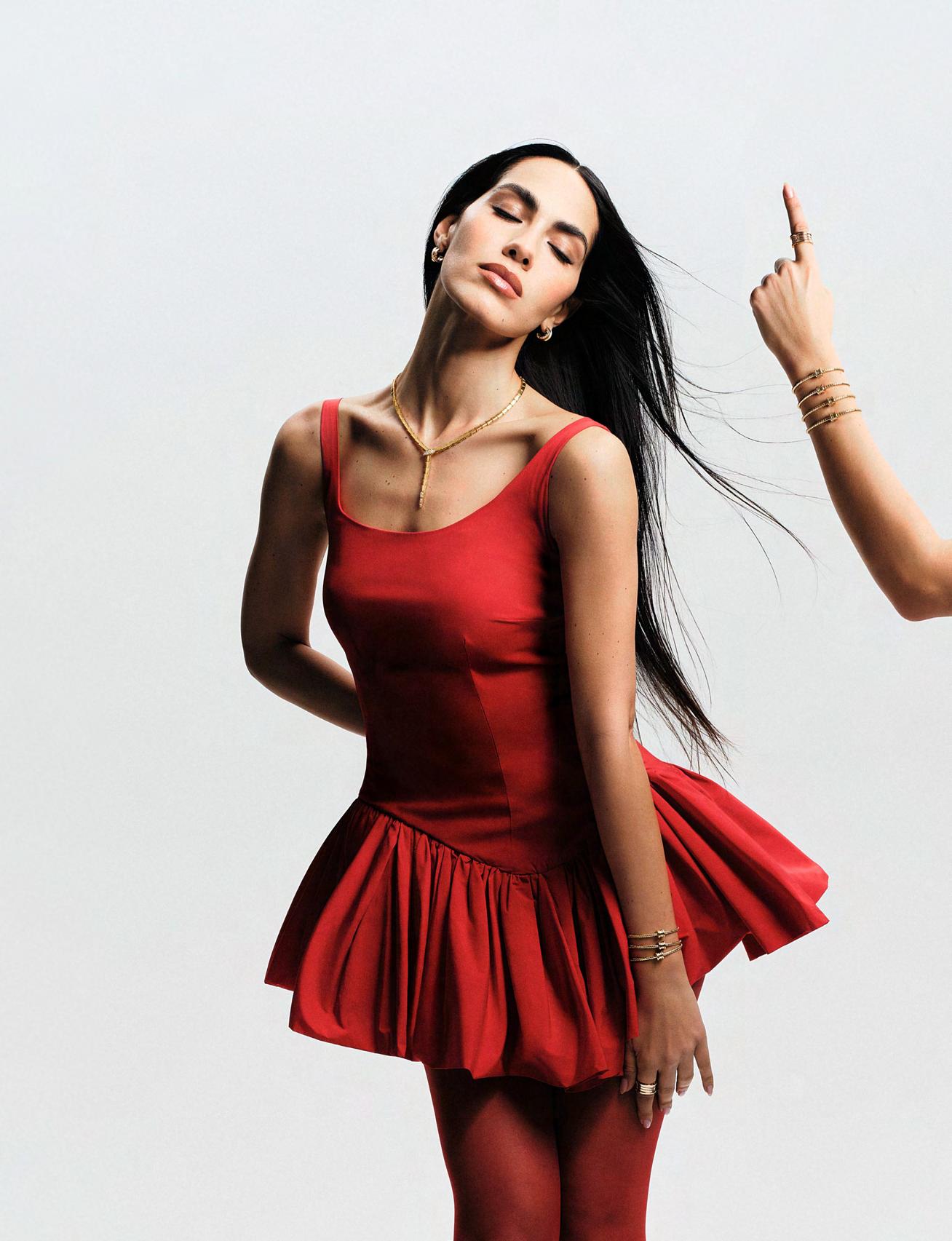
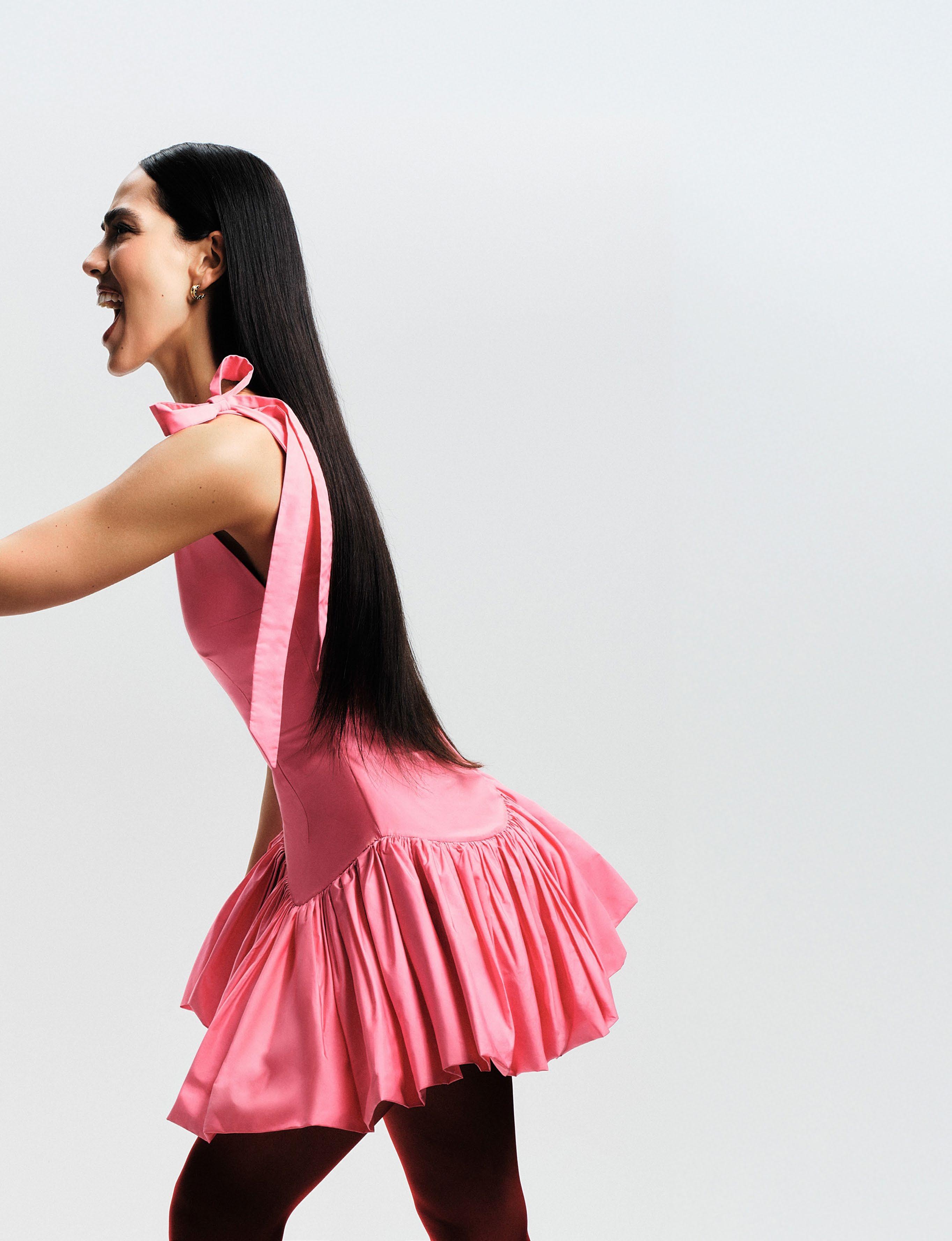
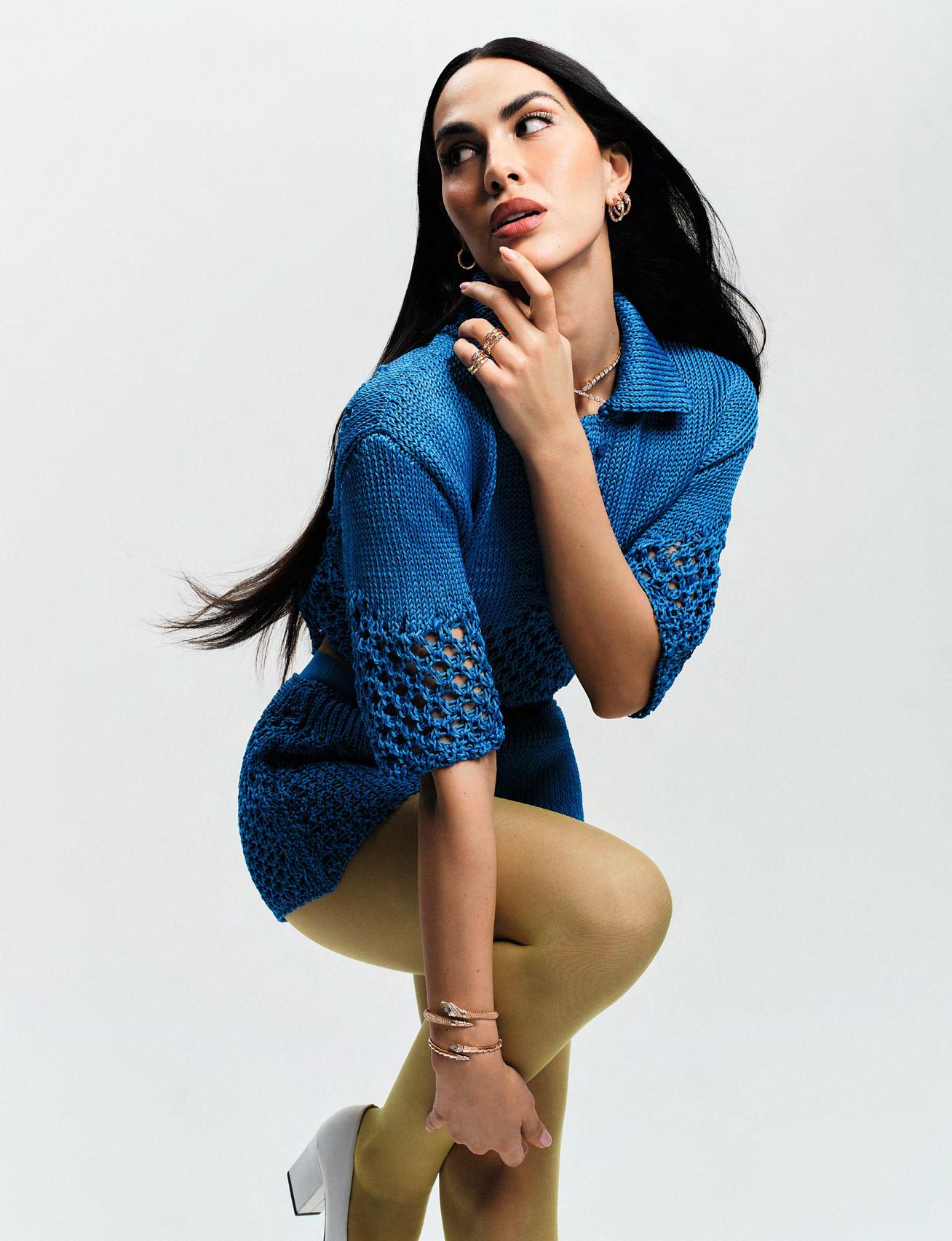
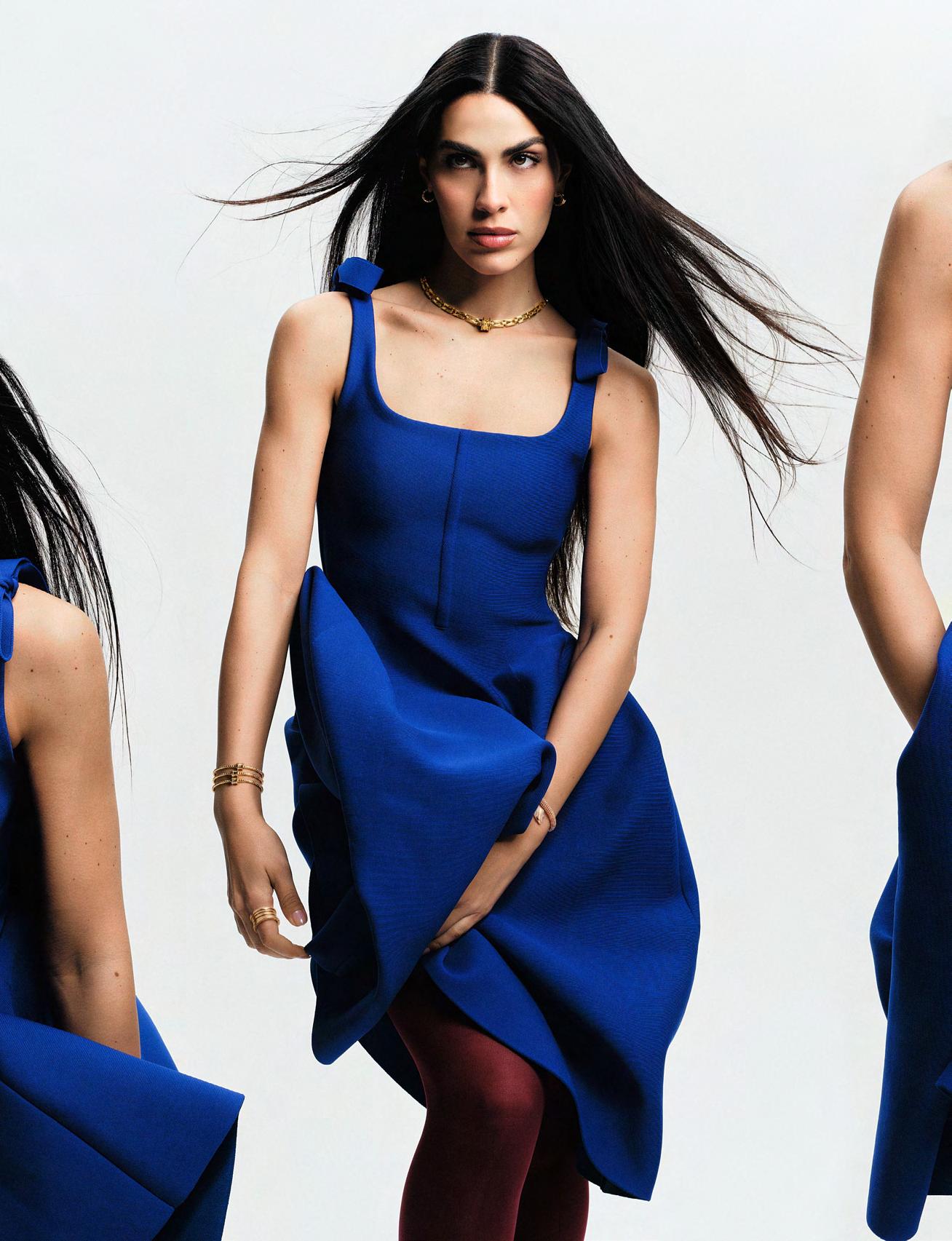
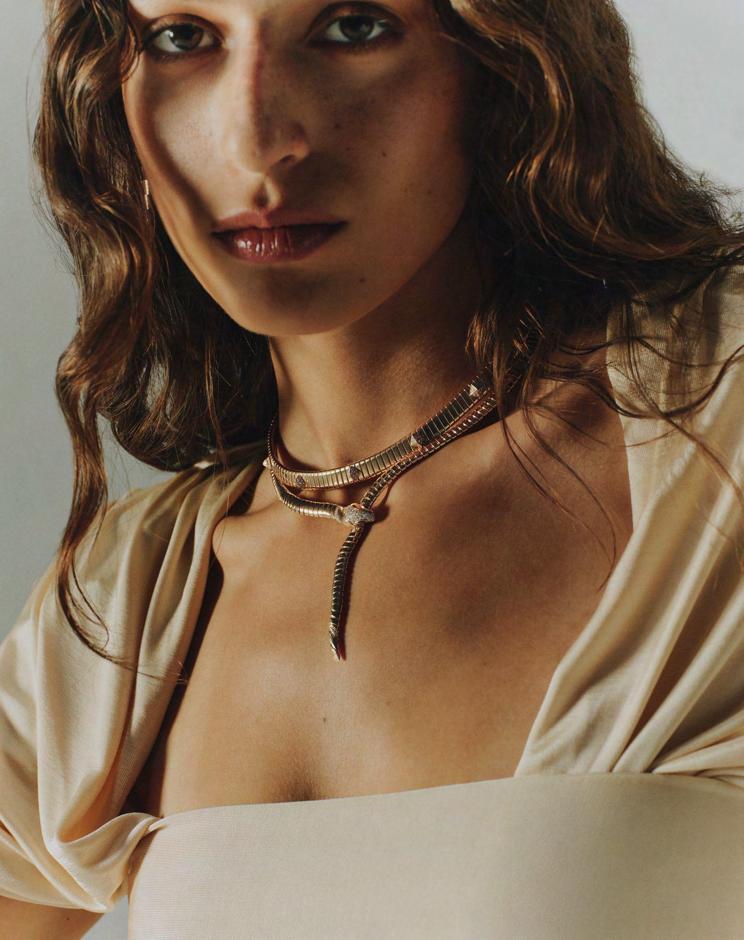
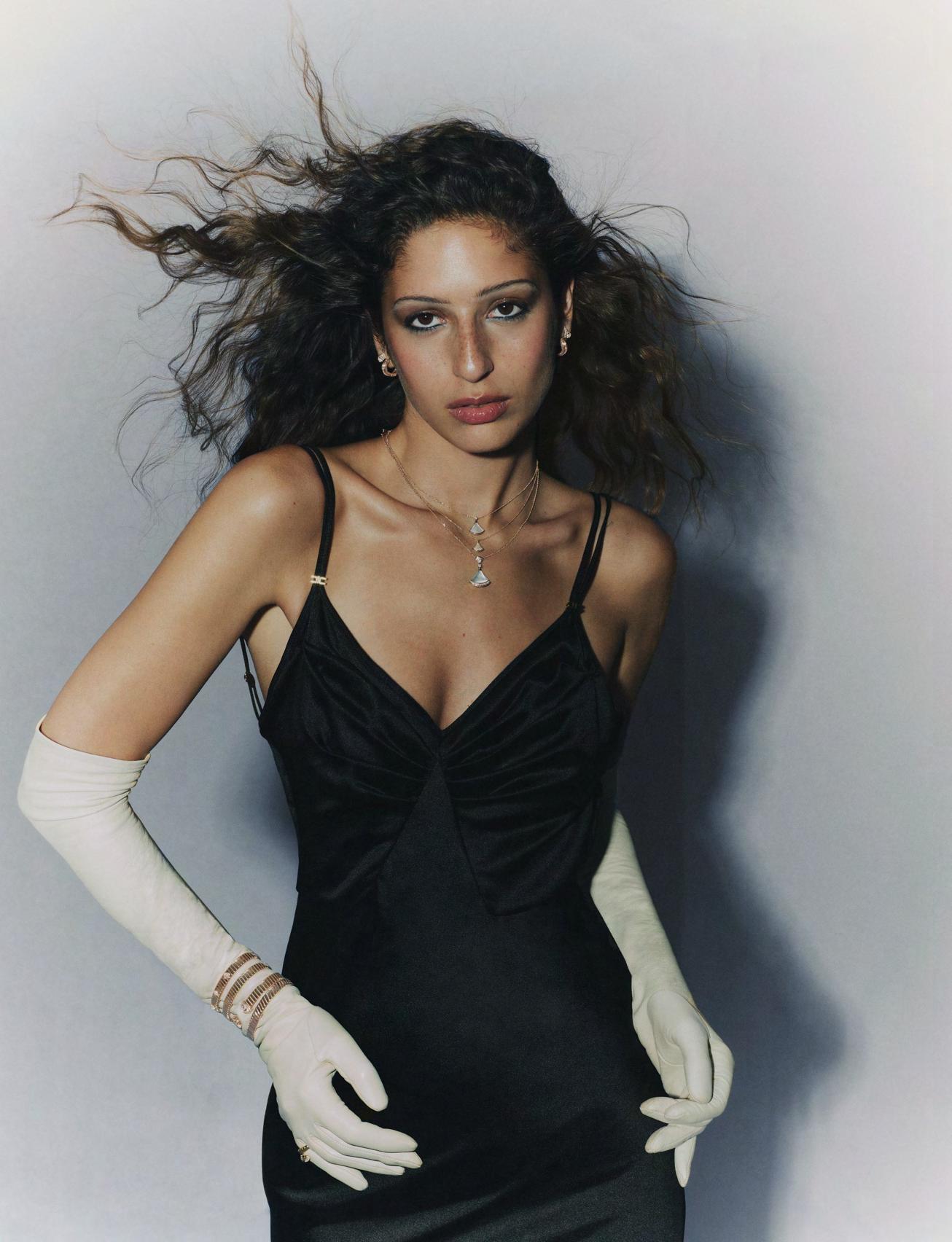
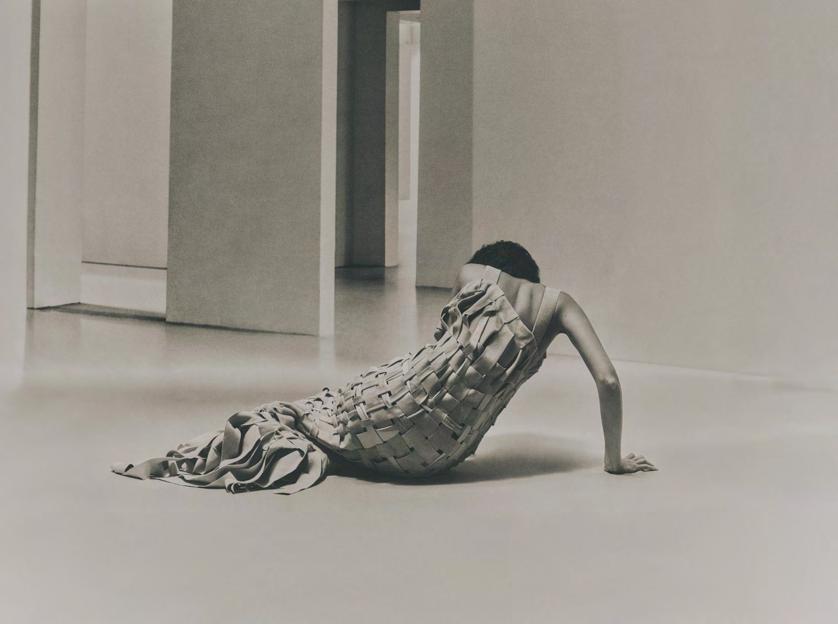
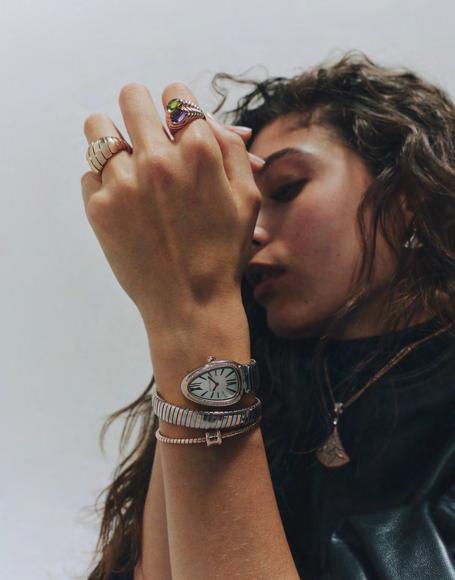
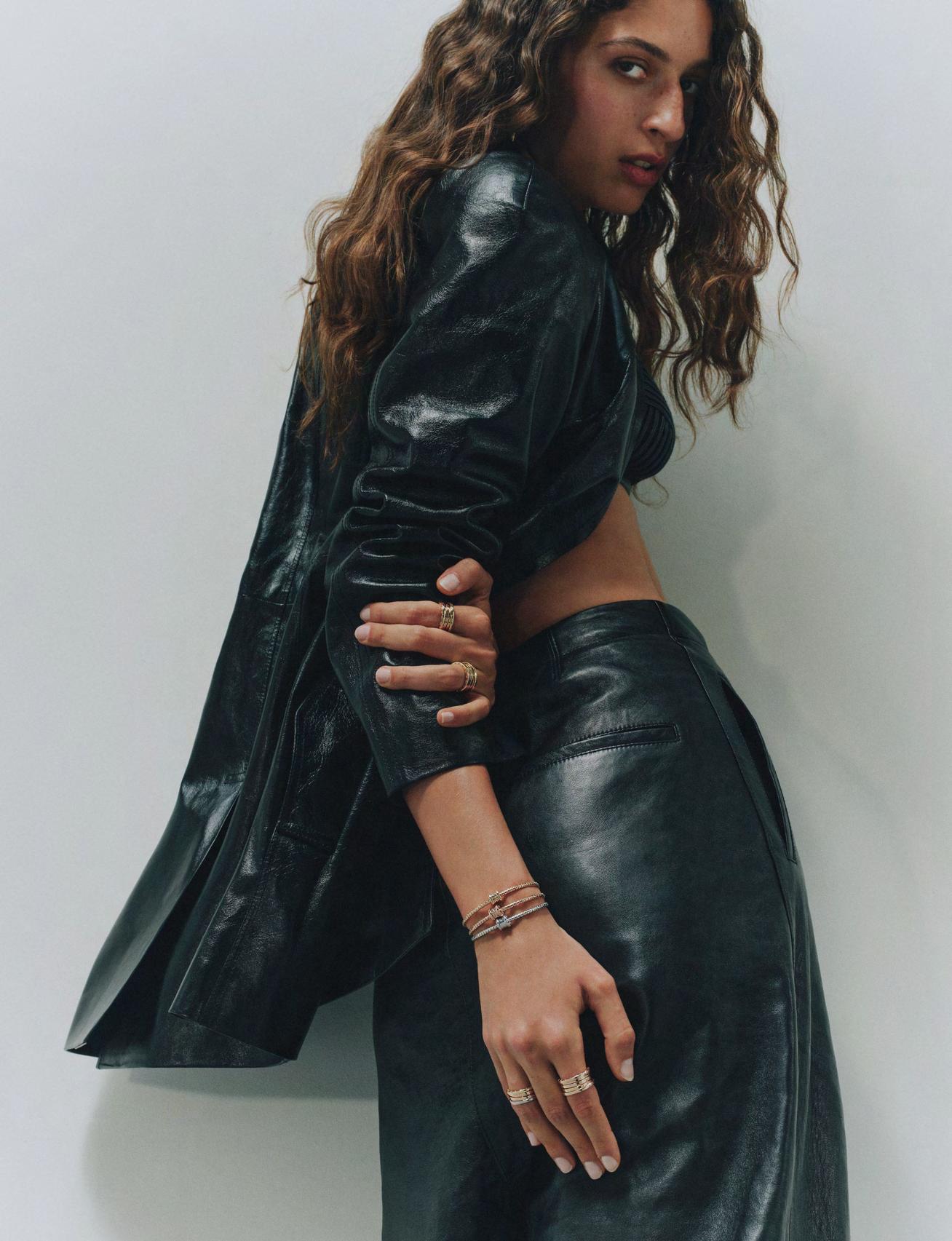
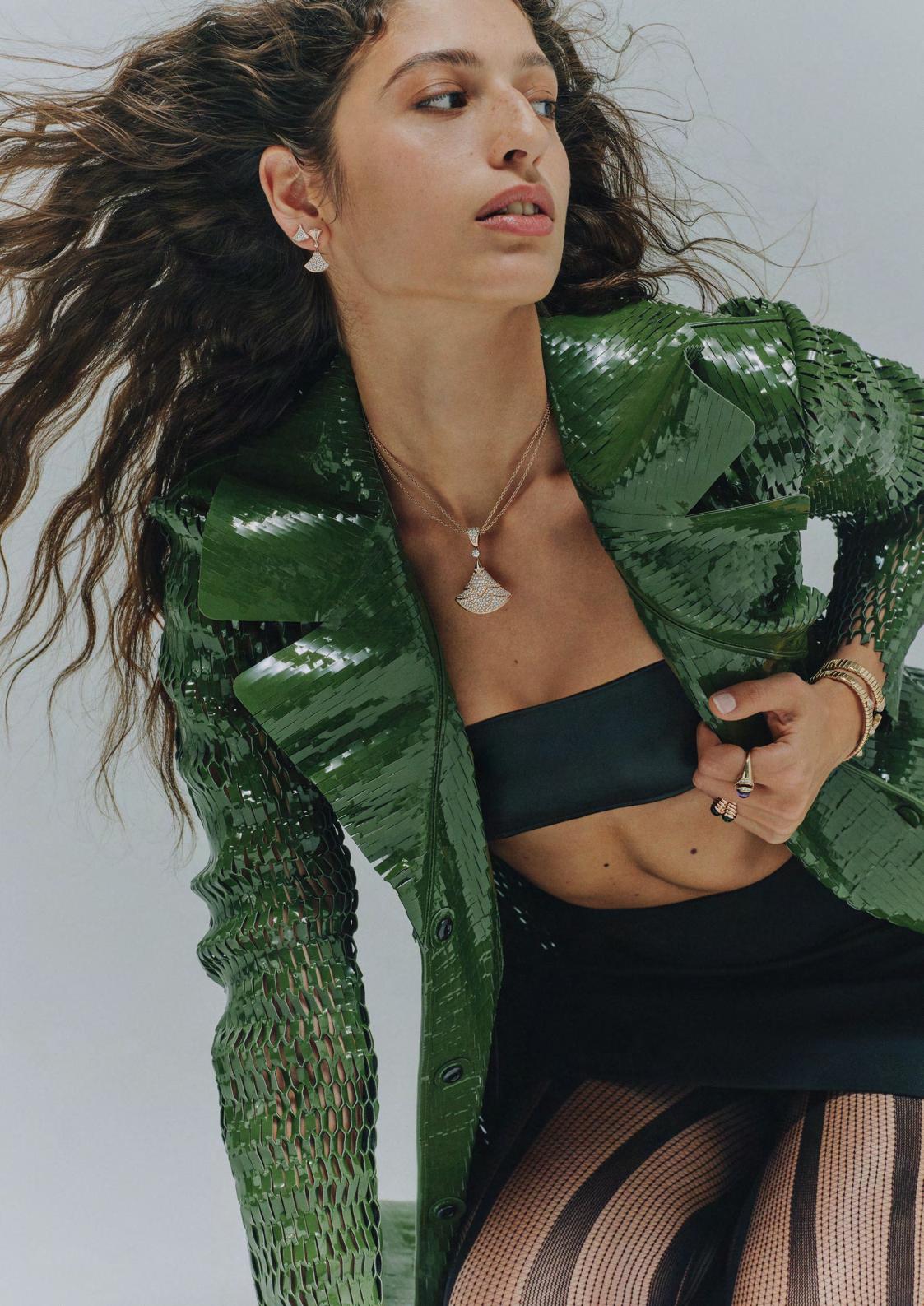
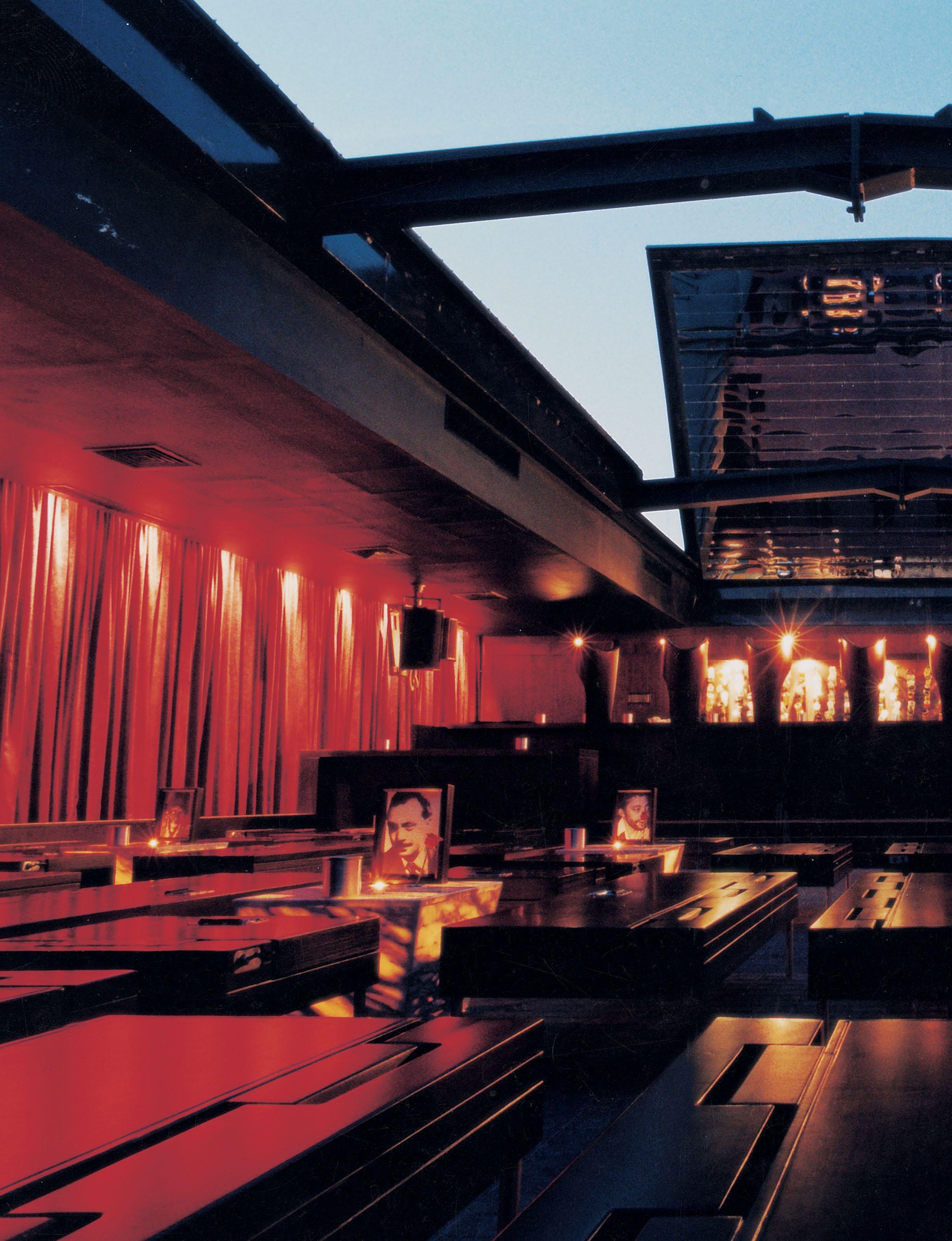
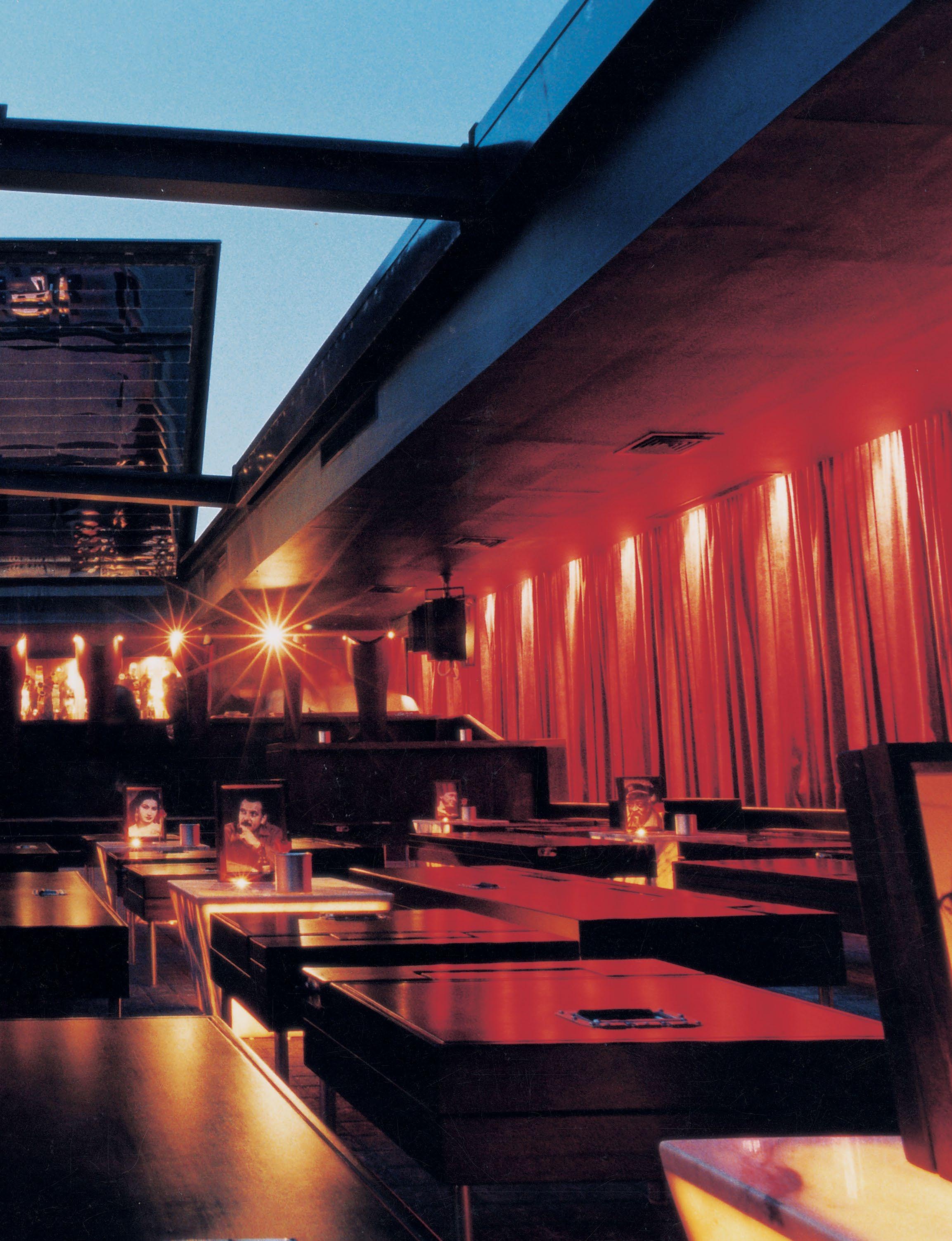
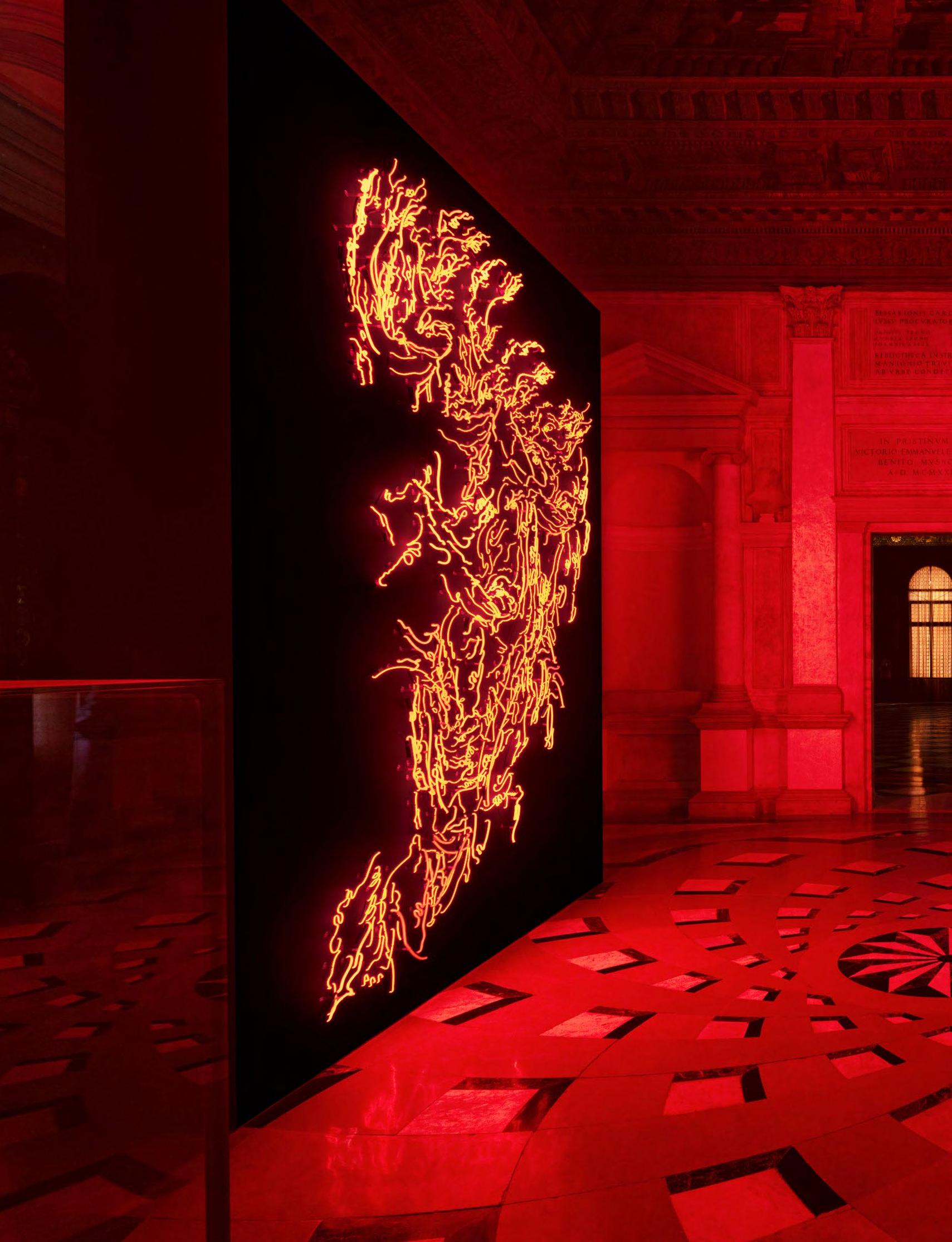
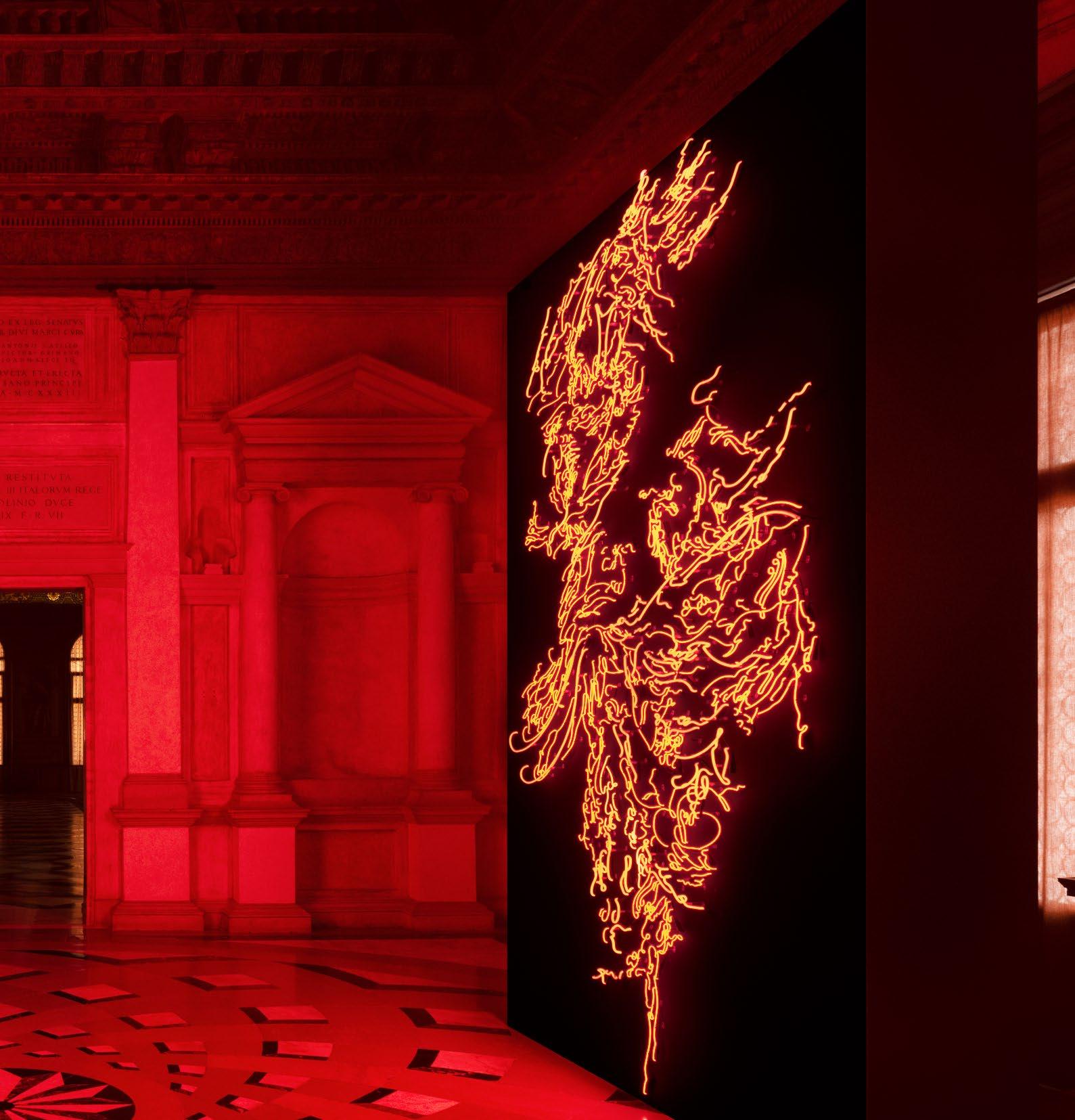
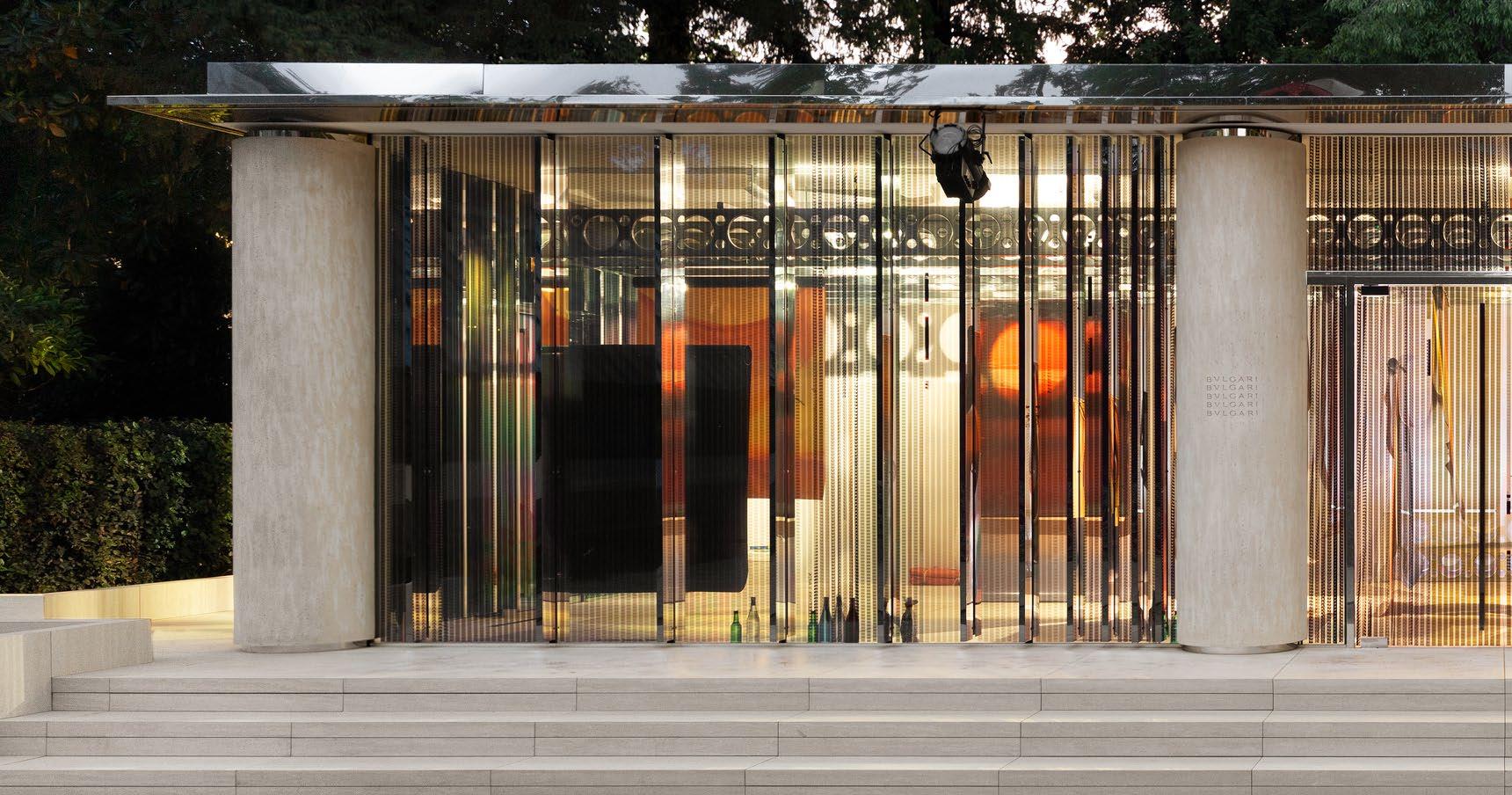
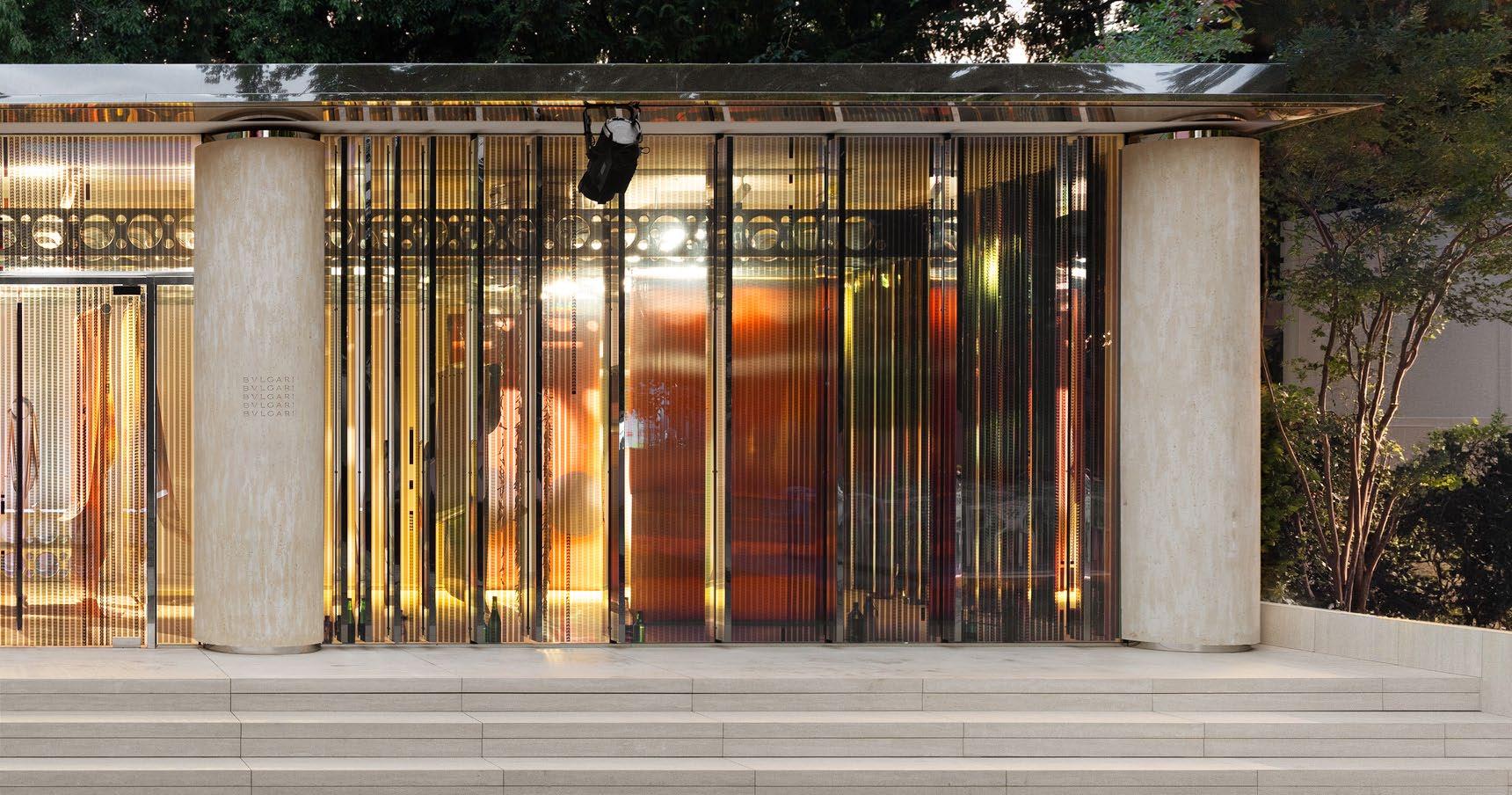
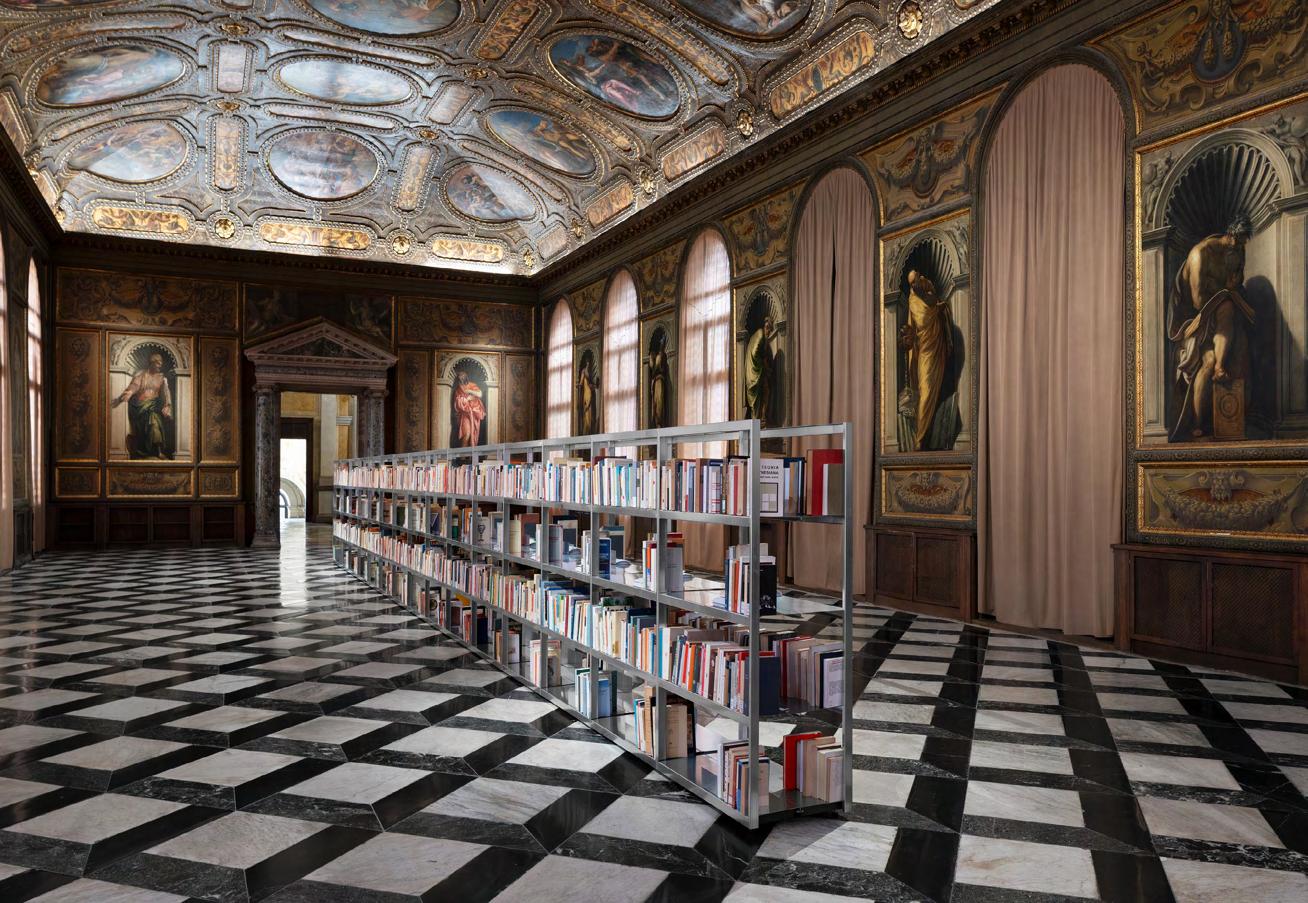
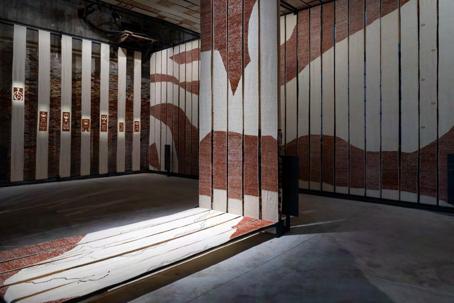
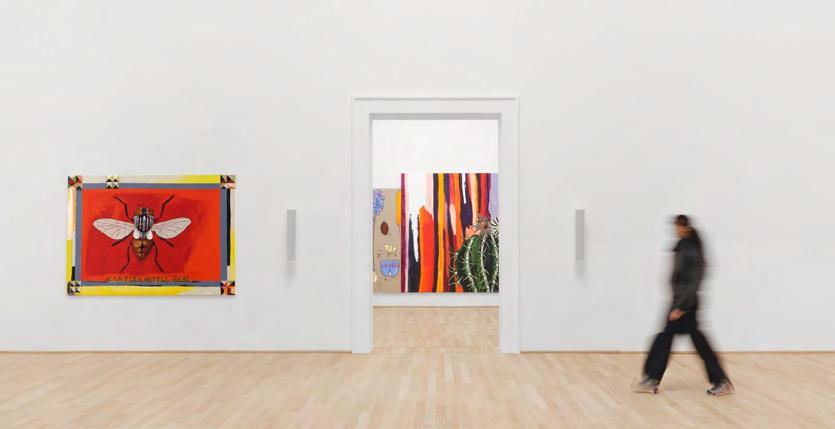
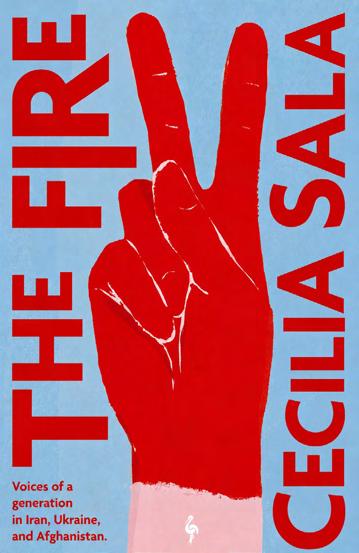
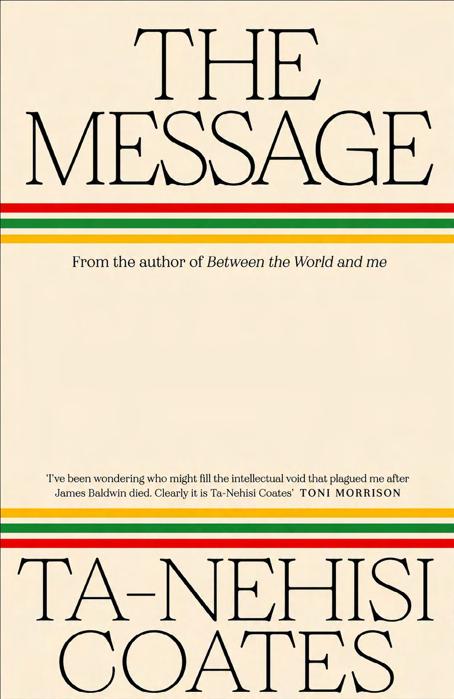
↘ BVLGARI ENTERS THE BIENNALE WITH BOOKS, FIRE & PATRONAGE 148-153
↘ THE SUMMER OF SECOND STARTS 154-161
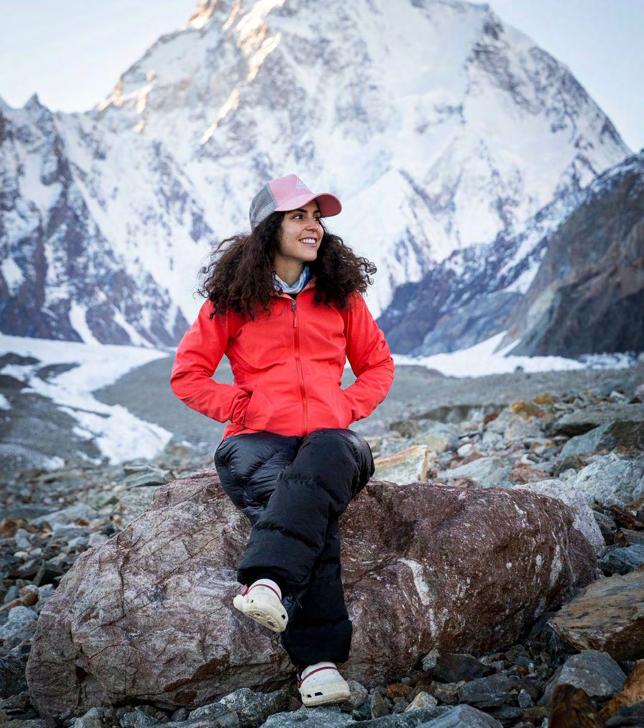
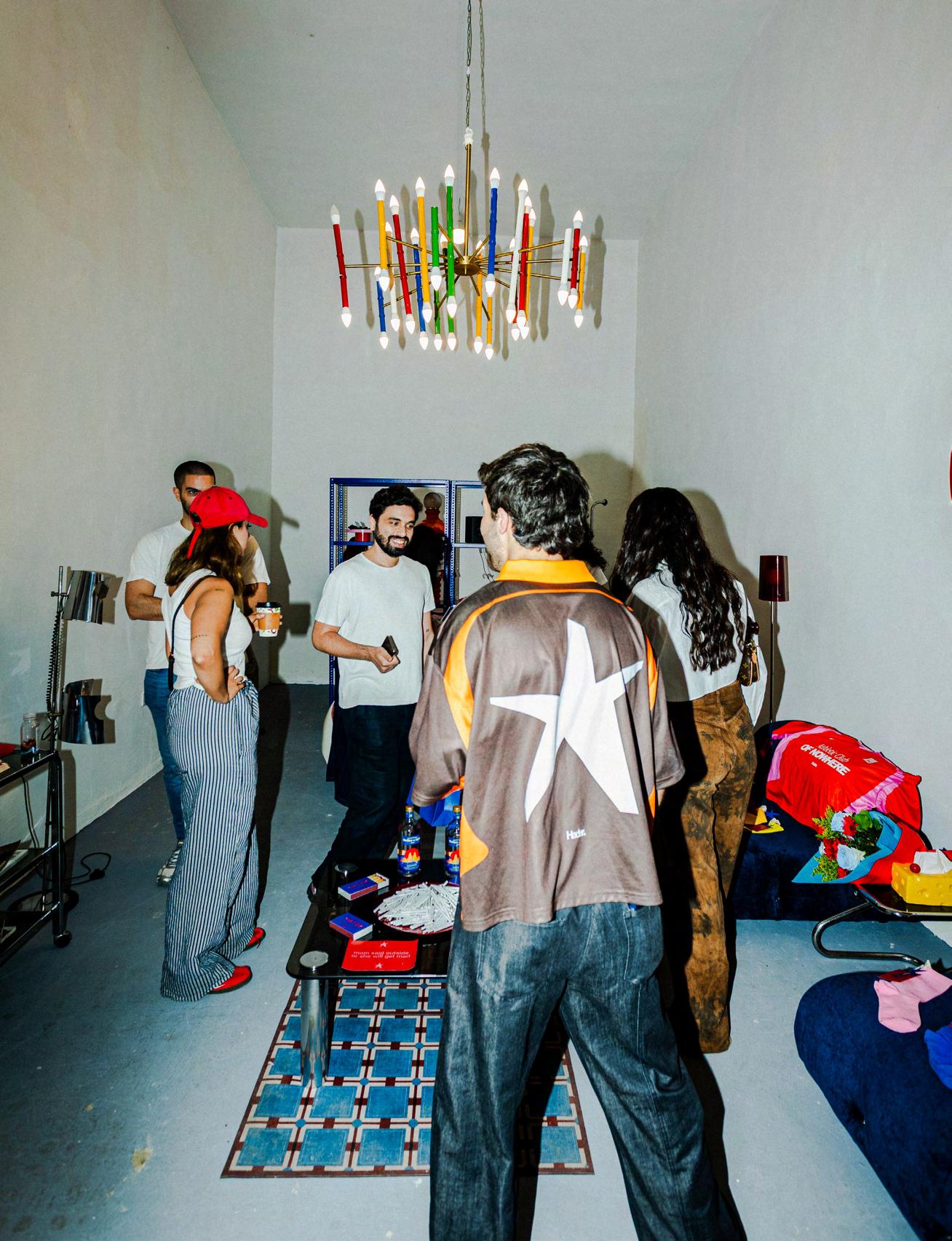
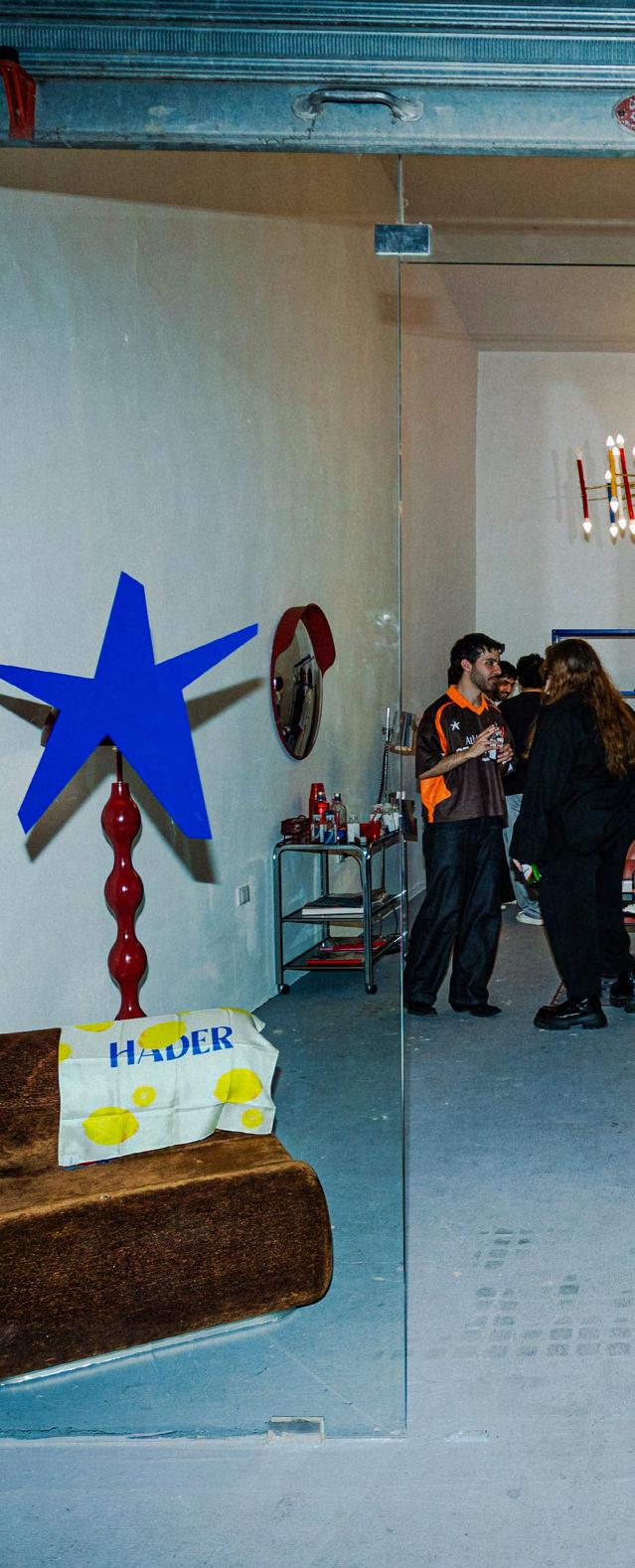
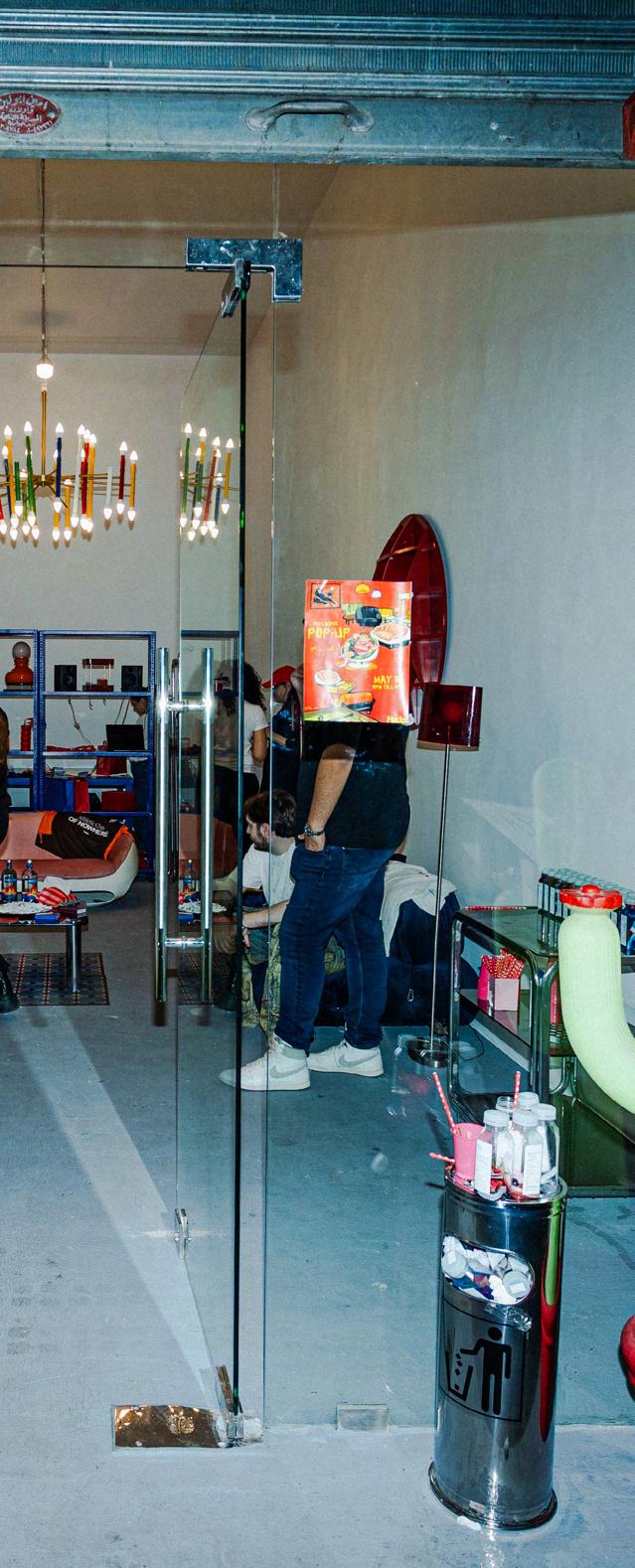
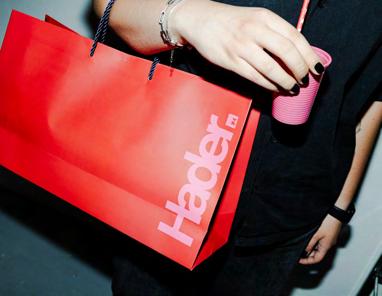
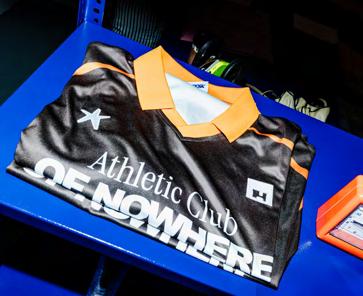
↘ WELCOME TO HOUSE OF HADER 162-165
↘ THE STUDIO IN THE SUITCASE 166-171
↘ RIDING THE UNEXPECTED 172-177
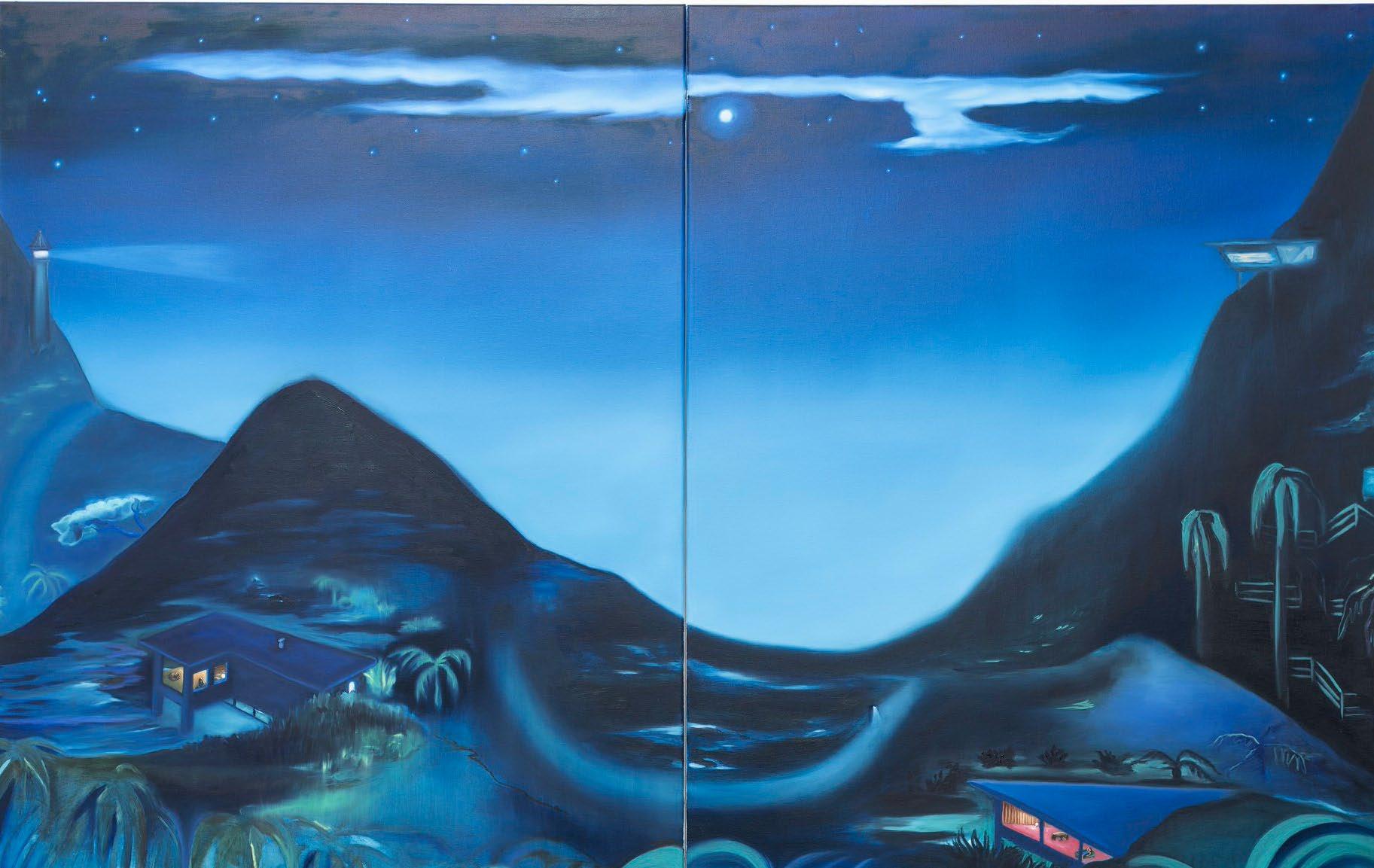
↘ THE VENICE BIENNALE OPENS IN KOYO KOUOH’S KEY 178-183
↘ SUMMER READS THAT REFUSE ESCAPISM 184-187
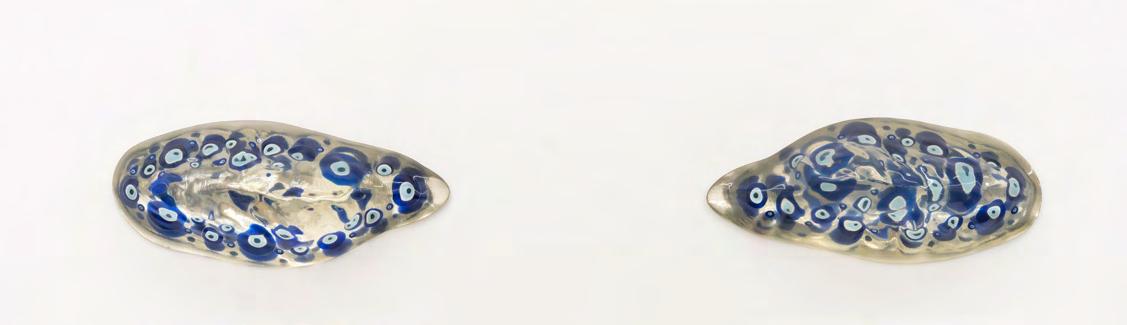
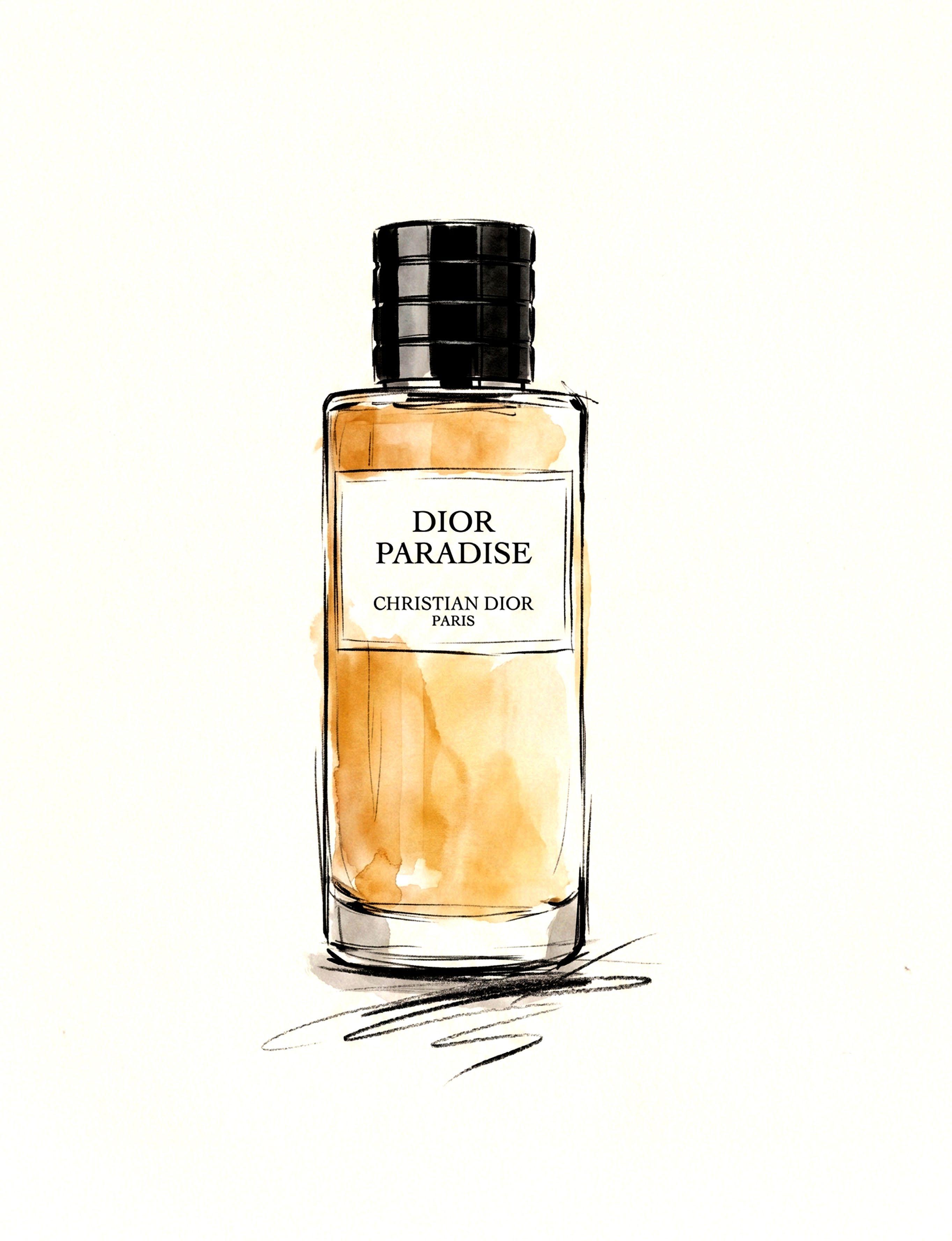
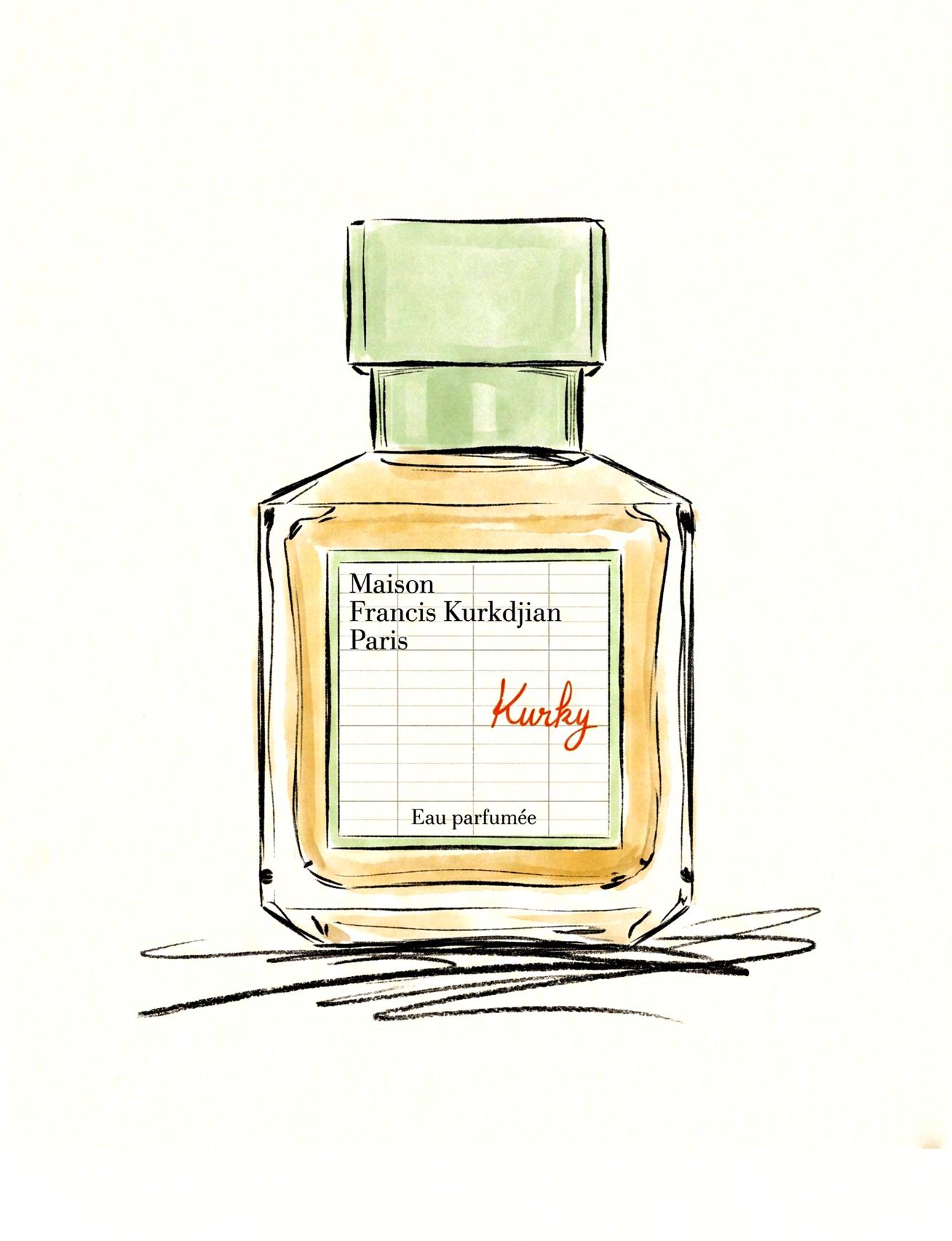
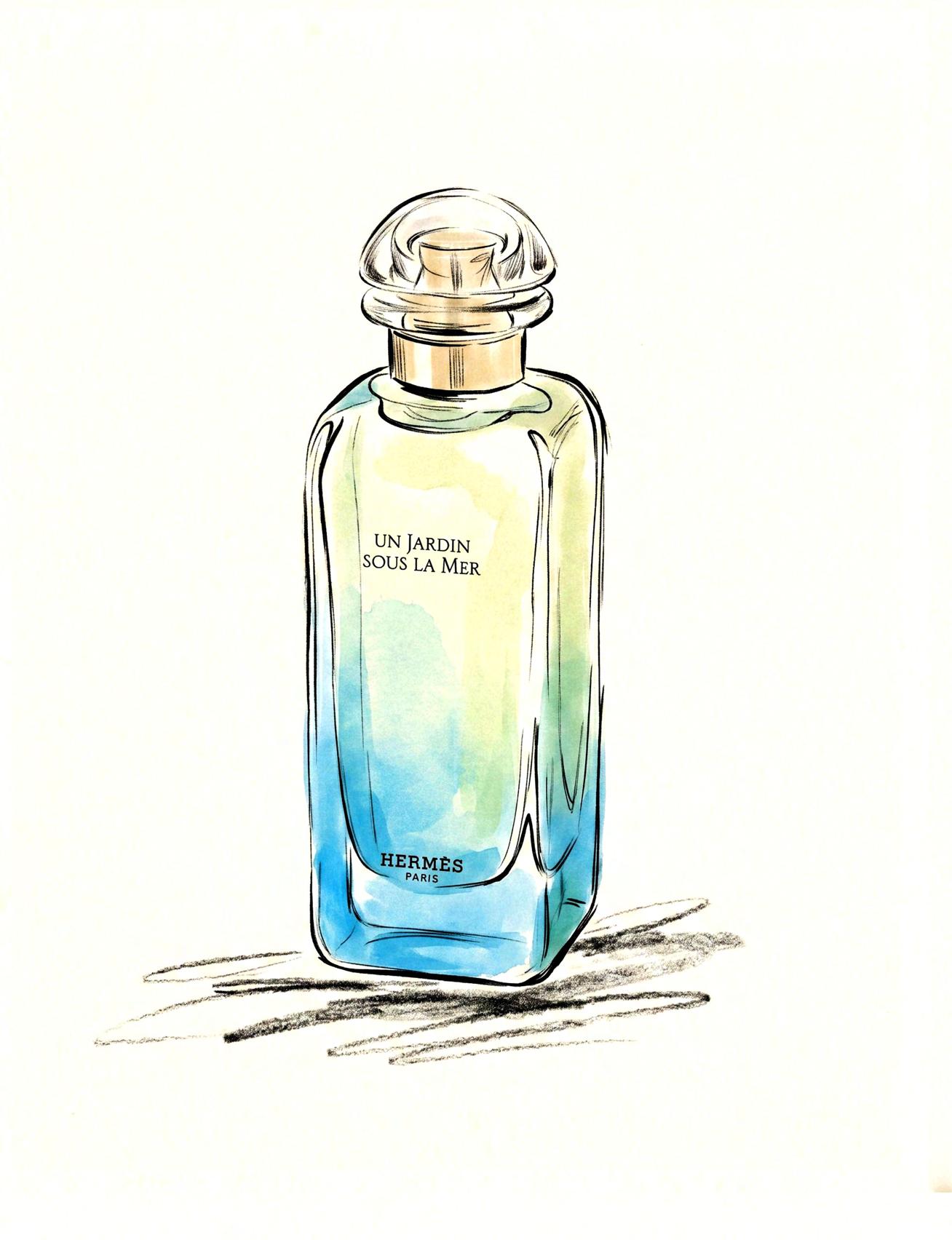
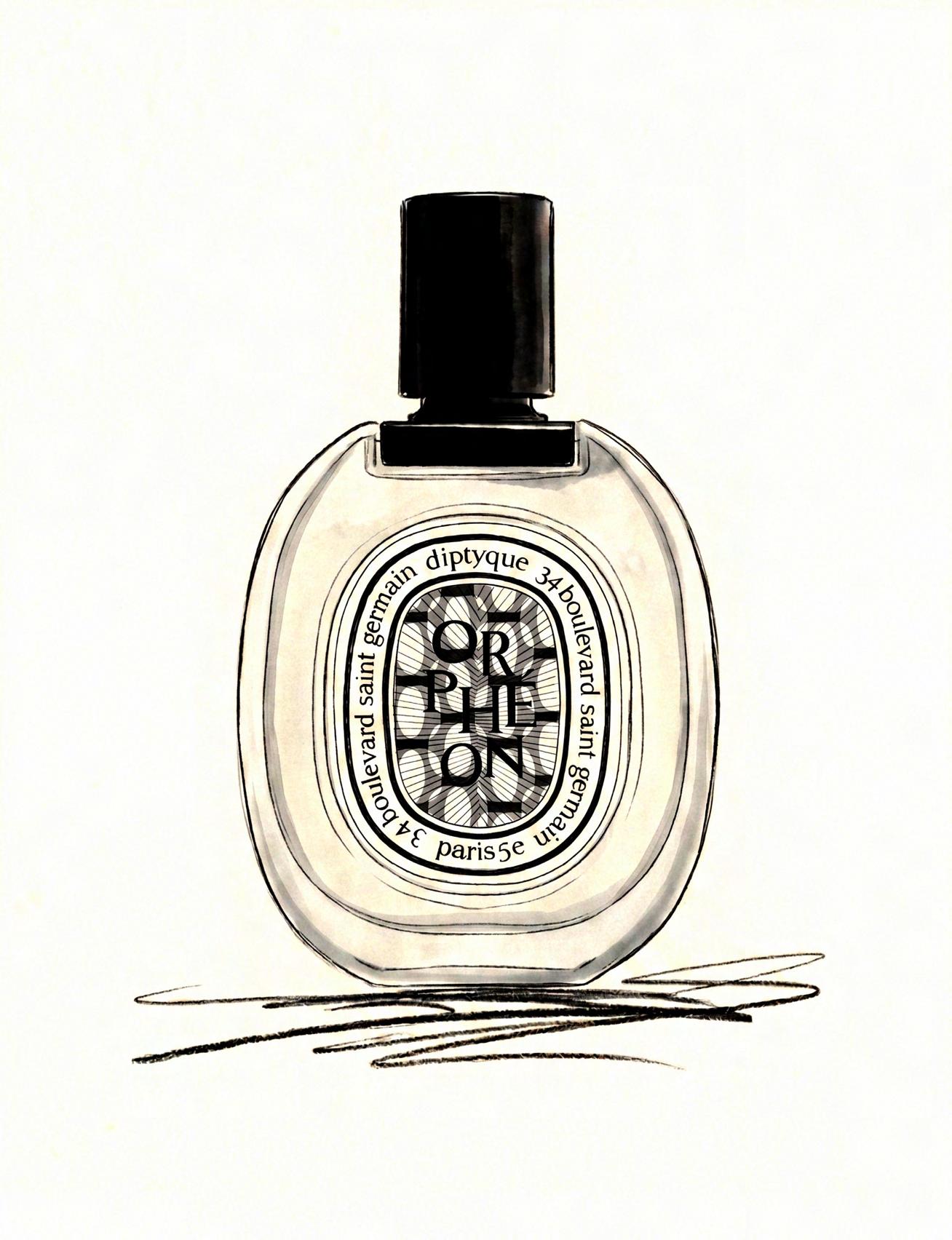
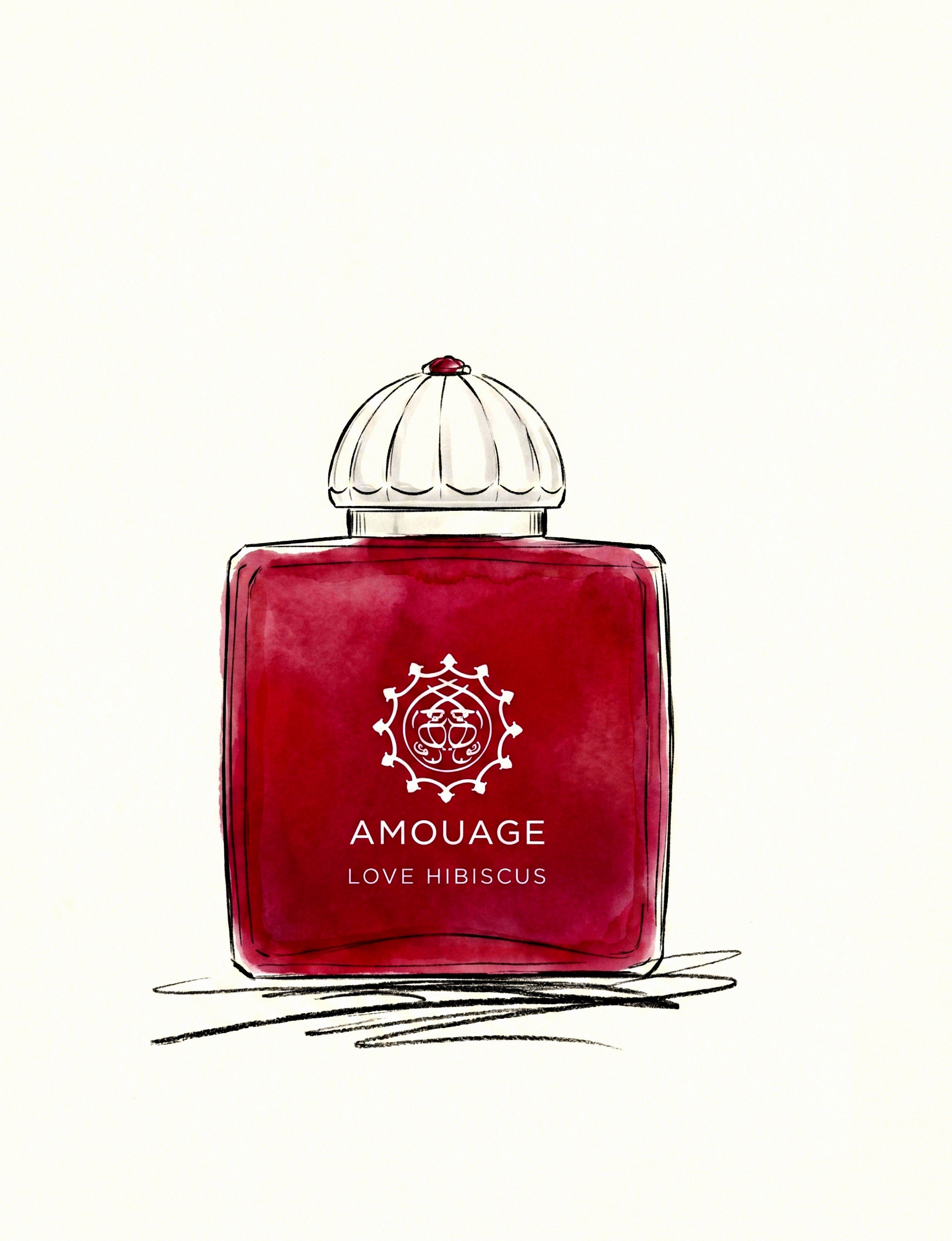
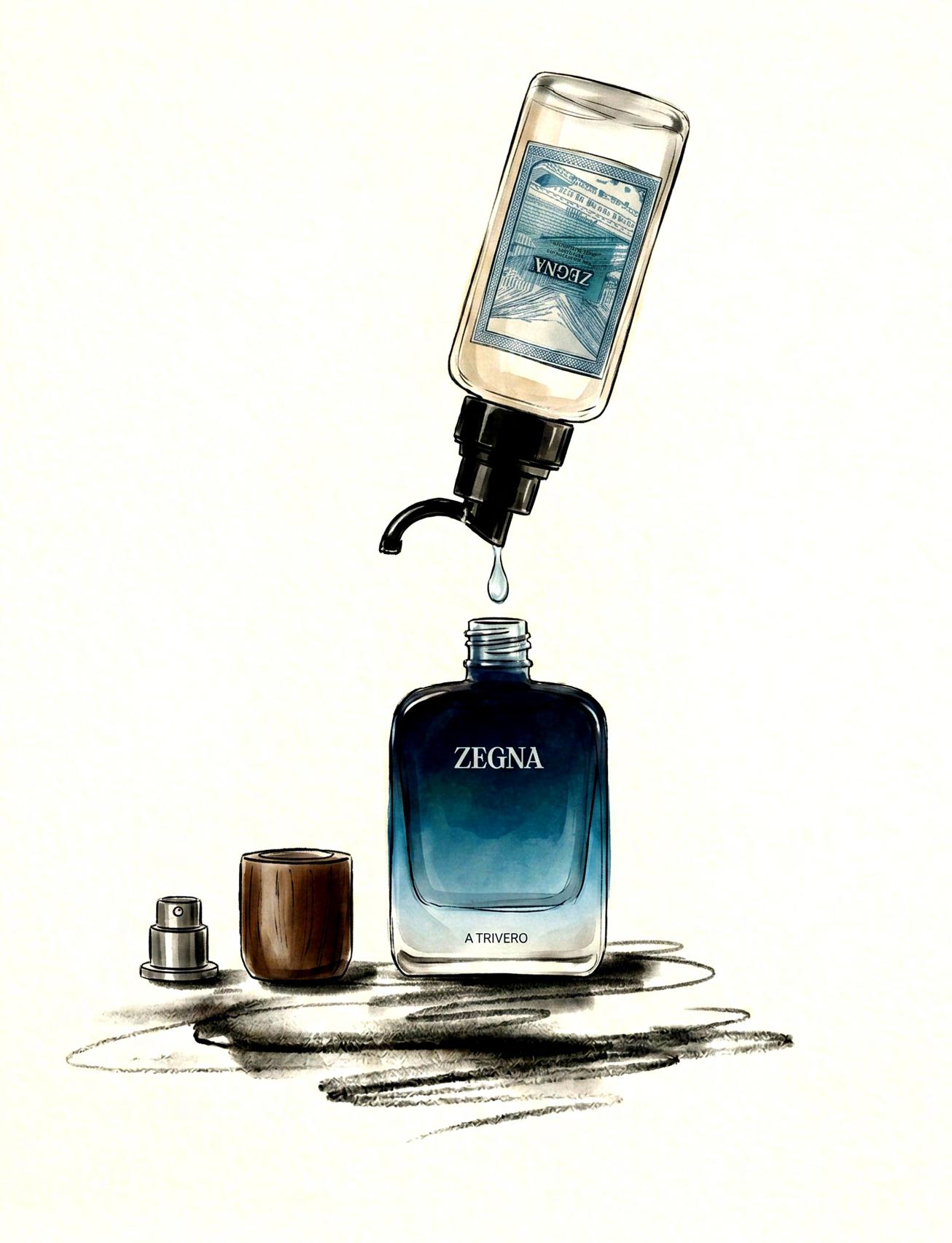
↘ BOTTLED DESIRE 188-195
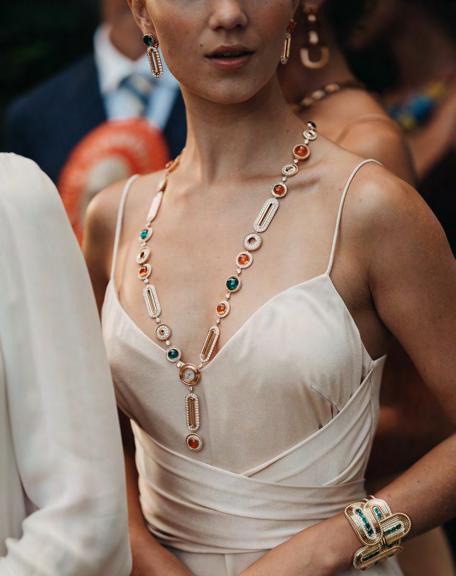
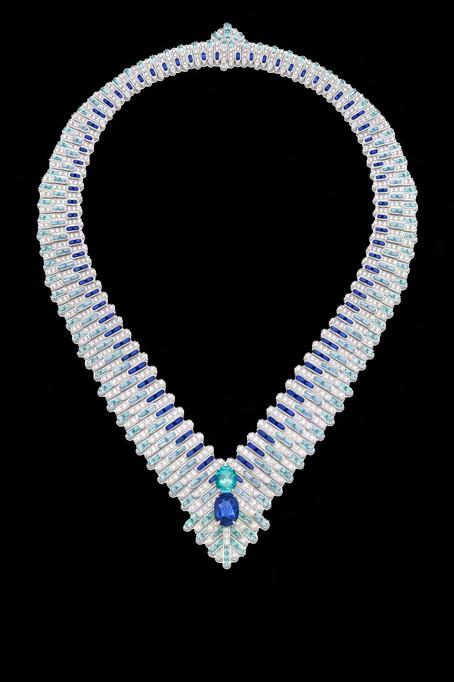
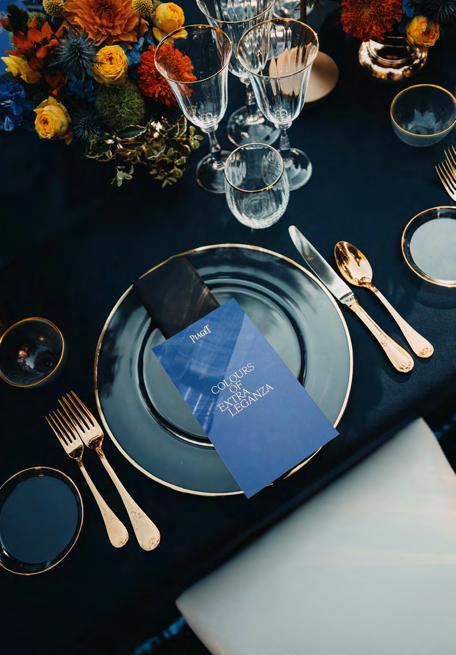
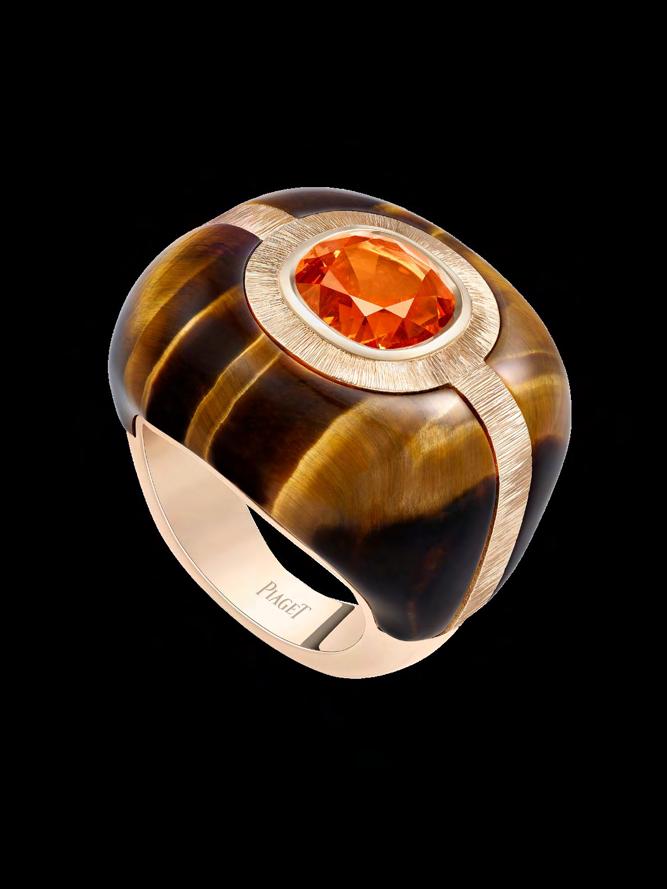
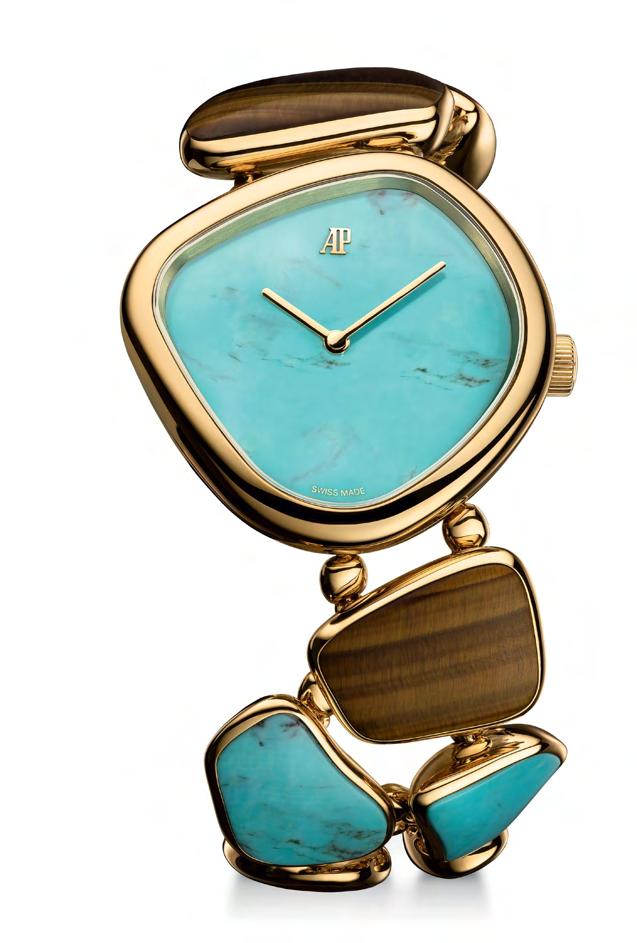
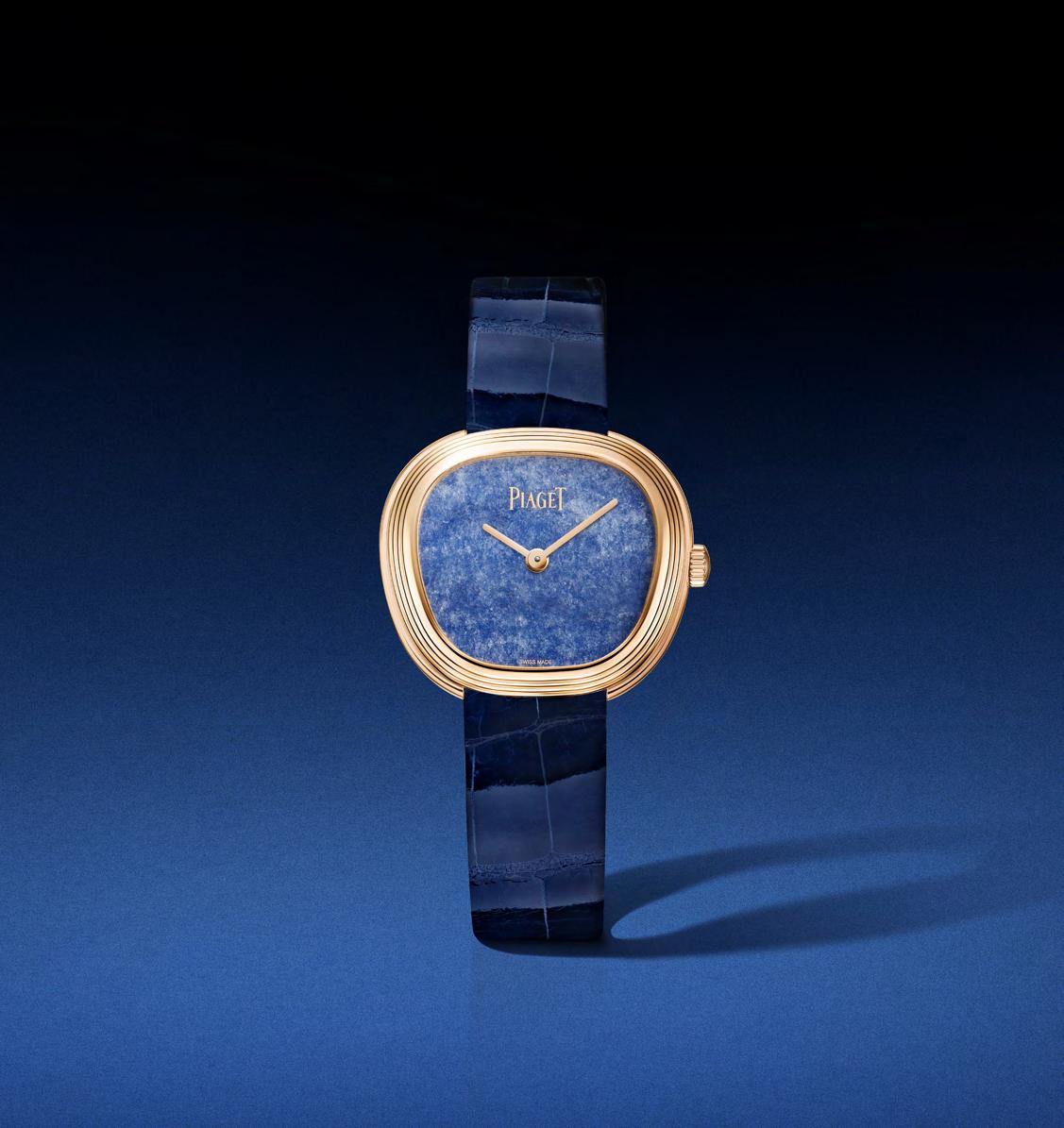
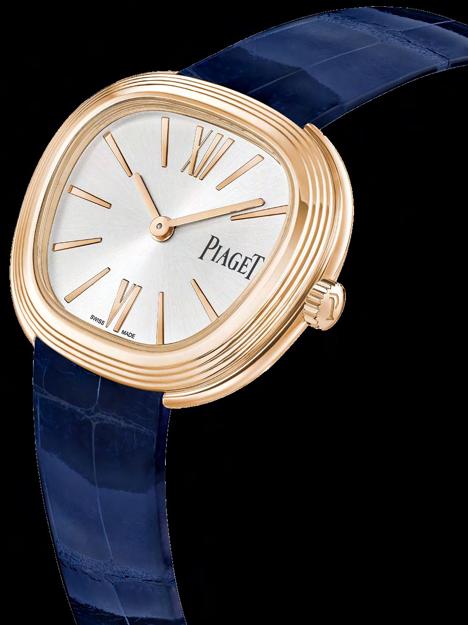
↘ PIAGET’S STUNNING FINAL CHAPTER OF EXTRALEGANZA 196-201
↘ THE GOLDEN HOUR 202 - 213
↘ BETWEEN WORLDS 214 - 217
[15]
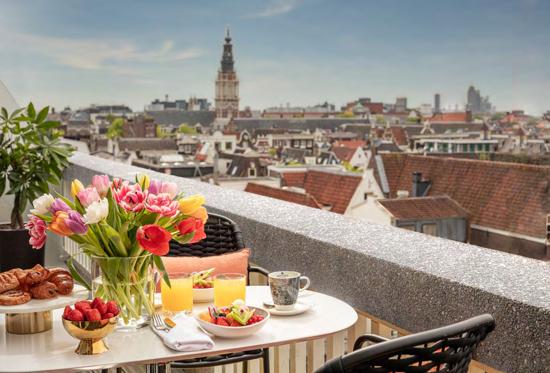
↘ AMSTERDAM RE-IMAGINED THROUGH ANANTARA
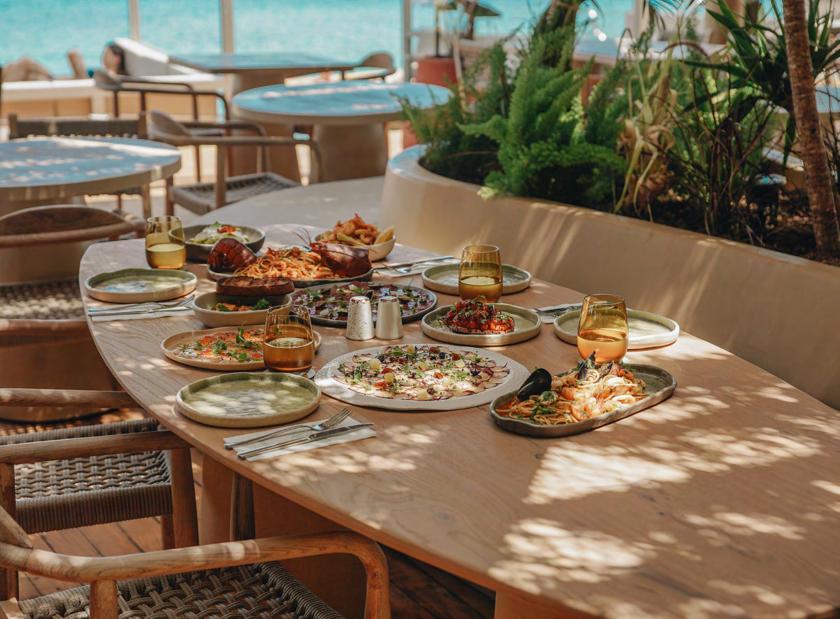
↘ MARIOLINO: MEMORIES OF THE SEA
[16] ISSUE INDEX SOLUTION 232
- 227
- 231
The Last Chapter Before September
Every summer has a way of feeling like the final chapter of a book you never want to end. The pages turn slower. The days stretch longer. The colours become brighter, richer, louder. And somewhere between departure and arrival, between one city and the next, you find yourself reflecting on everything that brought you here.
As I write this le er, I am on a flight home from Monte Carlo, still carrying with me the energy of Piaget’s Colours of Extraleganza. A celebration of colour, elegance, boldness and creativity that felt less like a jewellery presentation and more like a reminder that life is meant to be lived vividly. Meeting Stéphanie Sivrière, Piaget’s Creative Director, and hearing how she continues to draw inspiration from the Maison’s archives, reinforced something I have always believed: the future belongs to those who never stop looking back with curiosity.
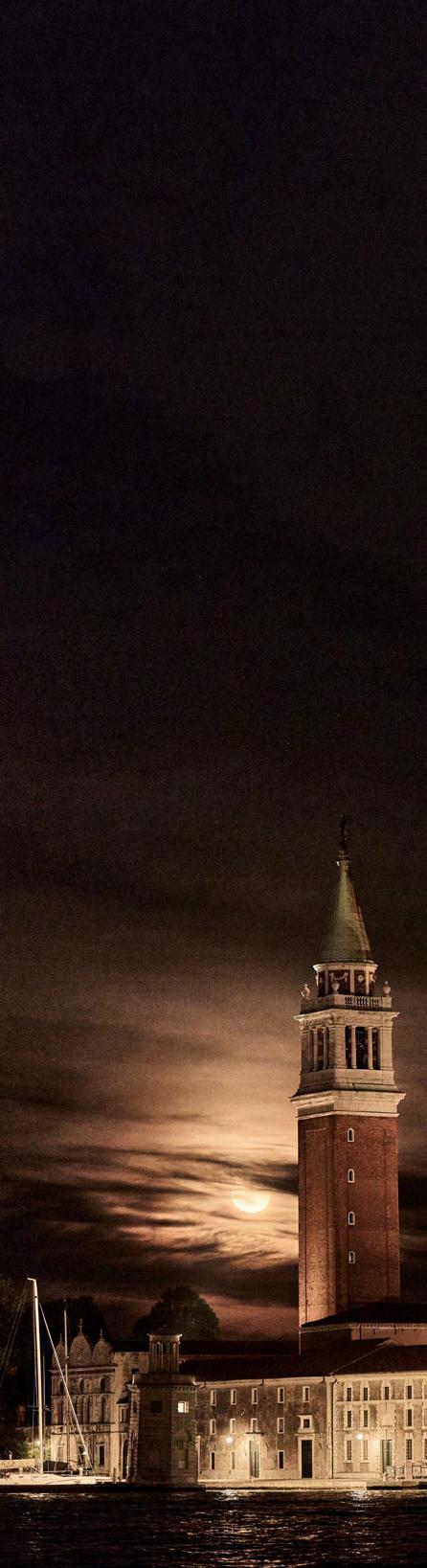
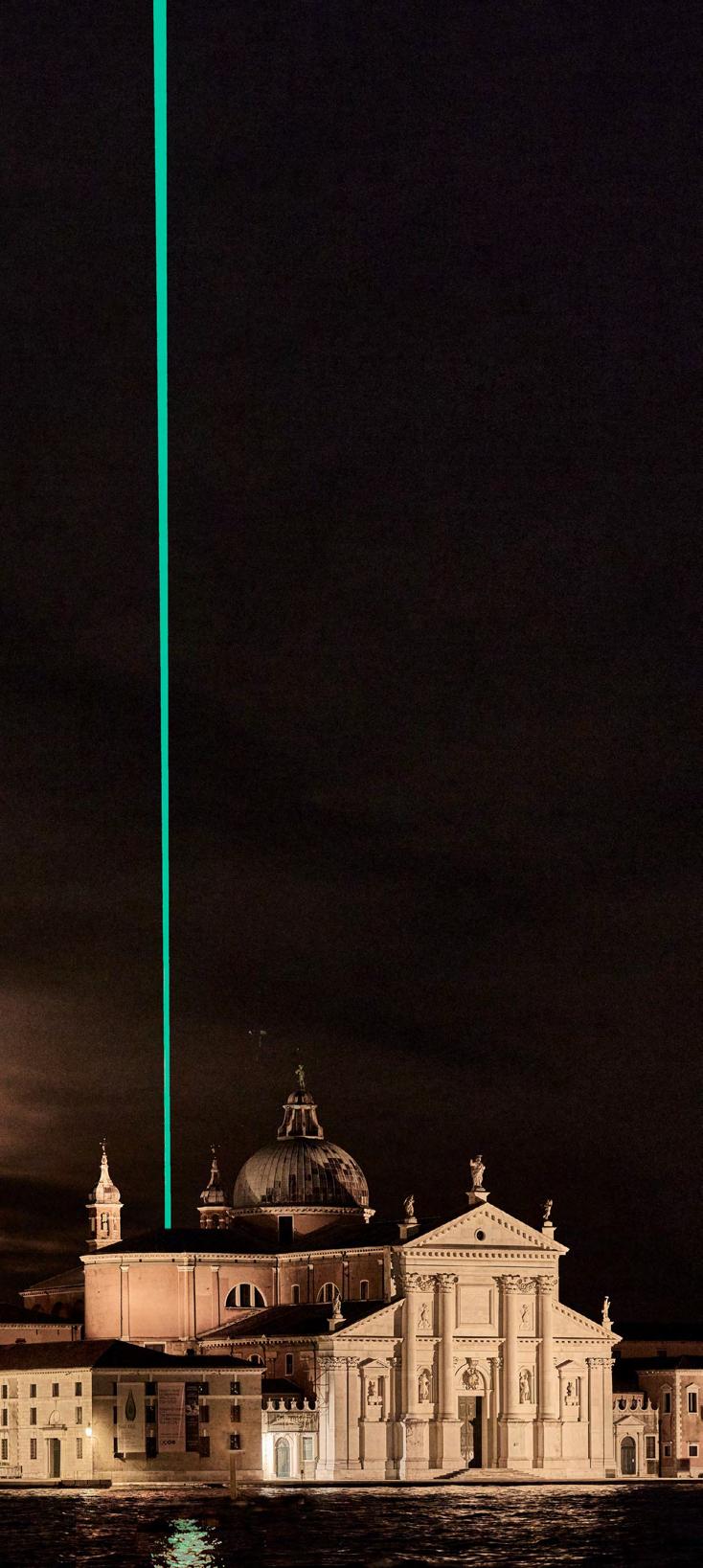
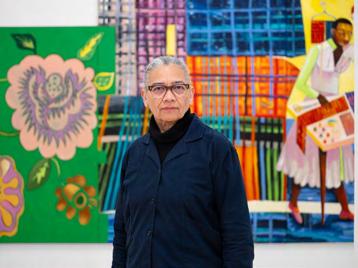
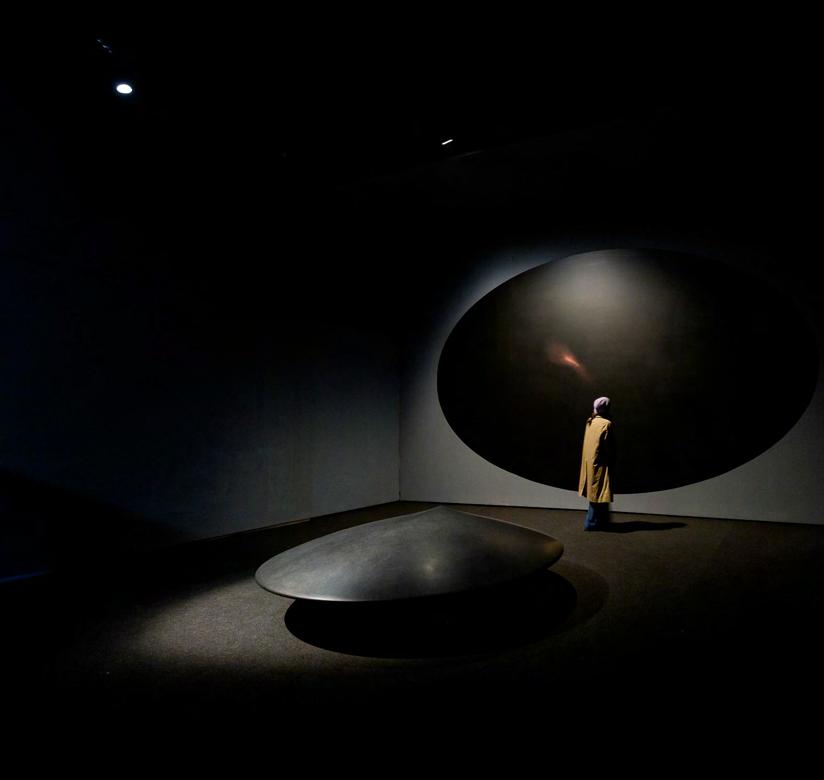
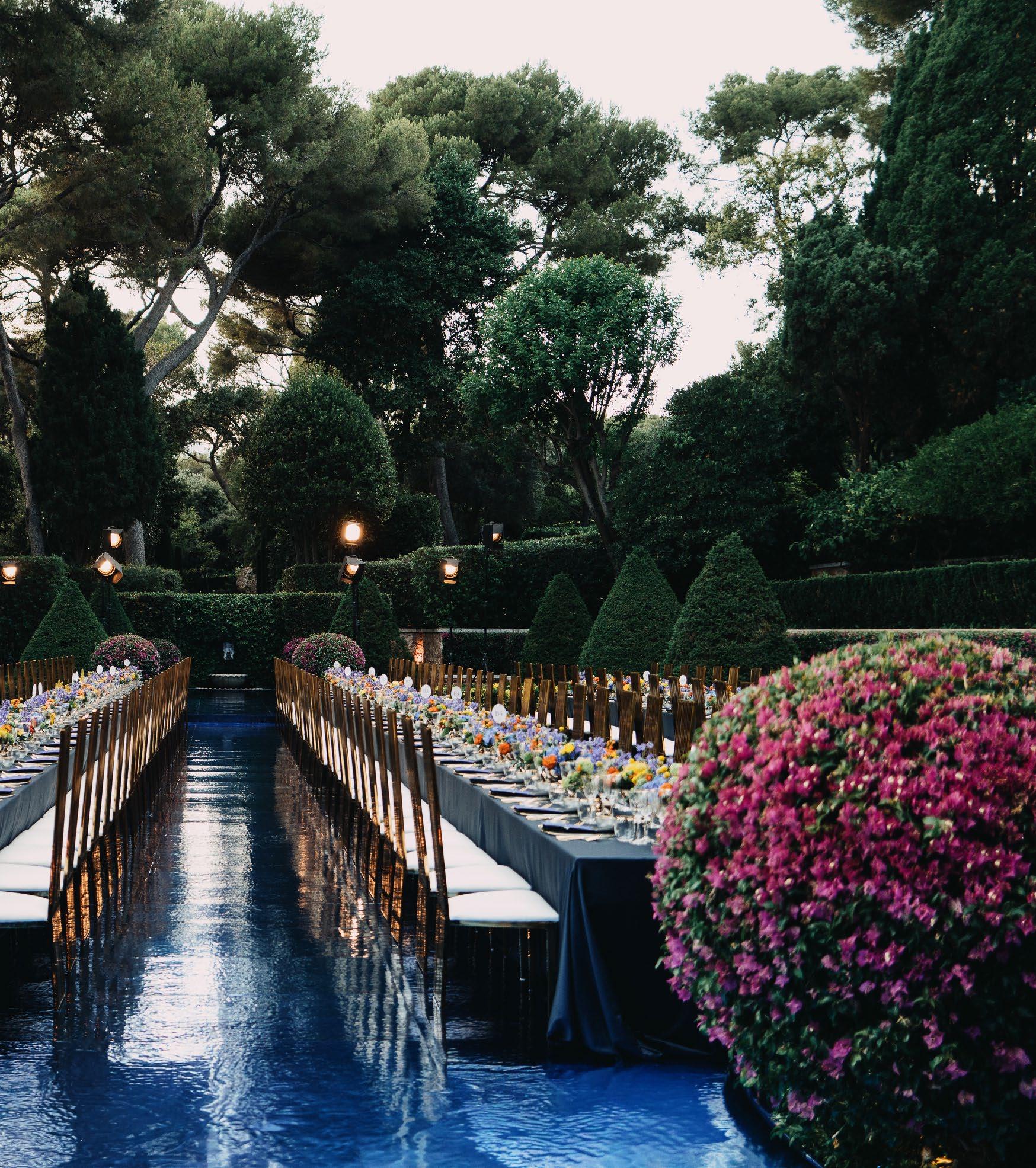
Just a few weeks earlier, Bvlgari brought us to the Venice Biennale as the exhibition's exclusive partner. This year’s edition, In Minor Keys, curated by the late Koyo Kouoh, stood as a powerful tribute to her vision and legacy. We sat down with Ma eo Morbidi, Managing Director of Fondazione Bvlgari, and explored the foundation’s first collateral event at the Biblioteca Nazionale Marciana, where the works of Lara Favare o and Monia Ben Hamouda brought new conversations into one of Venice’s most historic spaces. Walking through Venice, surrounded by ideas, stories and creativity from every corner of the world, I was reminded that art remains one of the few truly universal languages. Perhaps that is why this issue feels particularly special.
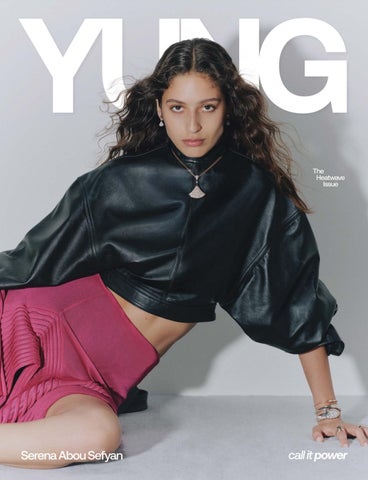
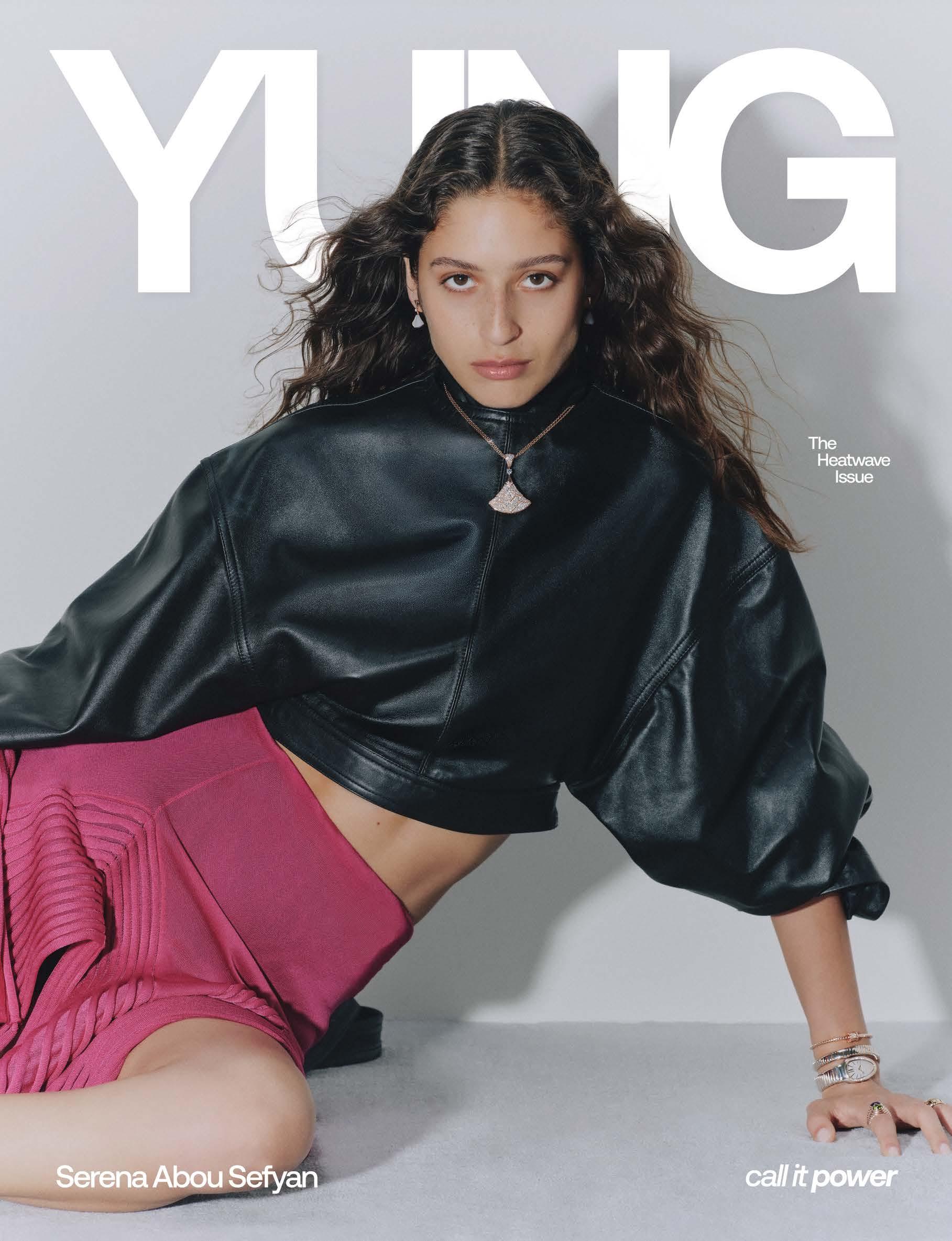
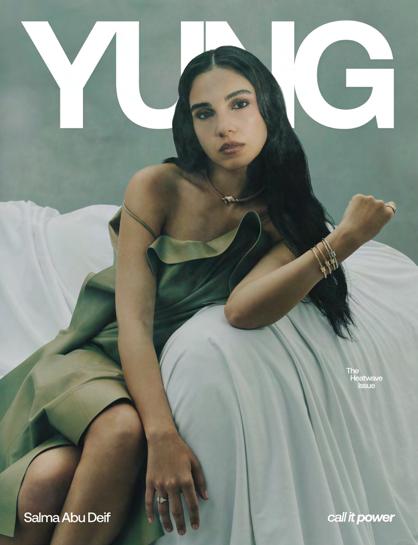
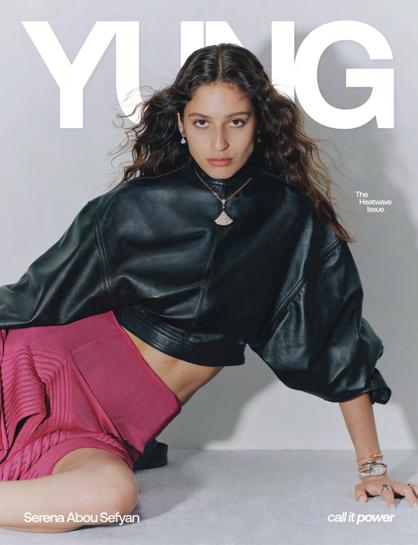
On our covers, we celebrate three women who are each shaping their own path. Salma Abu Deif opens up about motherhood, acting and learning to protect what ma ers most while navigating life in the spotlight. Sandy Bella reflects on growth, ambition and her starring role in 7 Dogs, a film that arrives at a defining moment in her career and signals the beginning of an exciting new chapter. And Serena Abou Sefyan makes history as the first Lebanese-Armenian model to open an international fashion show, representing a new generation of talent carrying our region onto the global stage.
Elsewhere in the issue, Lina Makoul reflects on identity, freedom and finding her voice on her own terms. We step inside the world of House of Hader, where Lebanese creative Ghady Hader thrives in a grey area where fashion label, emotional universe, installation art, and archive collide. Cherien Dabis reminds us that growth rarely follows a perfect timeline, while artists, musicians and creatives from across the region continue to redefine culture through their work, their stories and their perspective.
What connects all of them isn’t fame, success or recognition. It’s movement.
The willingness to evolve. To take risks. To begin again. To trust that the next chapter might be even be er than the last.
And maybe that’s the feeling I keep coming back to this summer.
The world feels heavy at times, uncertain at others. Yet everywhere I look, I see a generation creating, building, dreaming and pushing forward anyway. They’re launching brands, making films, creating music, opening doors and refusing to be defined by geography, expectations or tradition.
For YUNG, this issue is a celebration of that energy.
Of colour. Of creativity. Of possibility. September is already on the horizon, bringing new ideas, new voices and new stories waiting to be told. But before we turn the page, I hope this issue reminds you to stay curious, stay ambitious and stay open to wherever life takes you next.
A er all, the best stories are never really endings.
They’re simply the beginning of a new chapter.
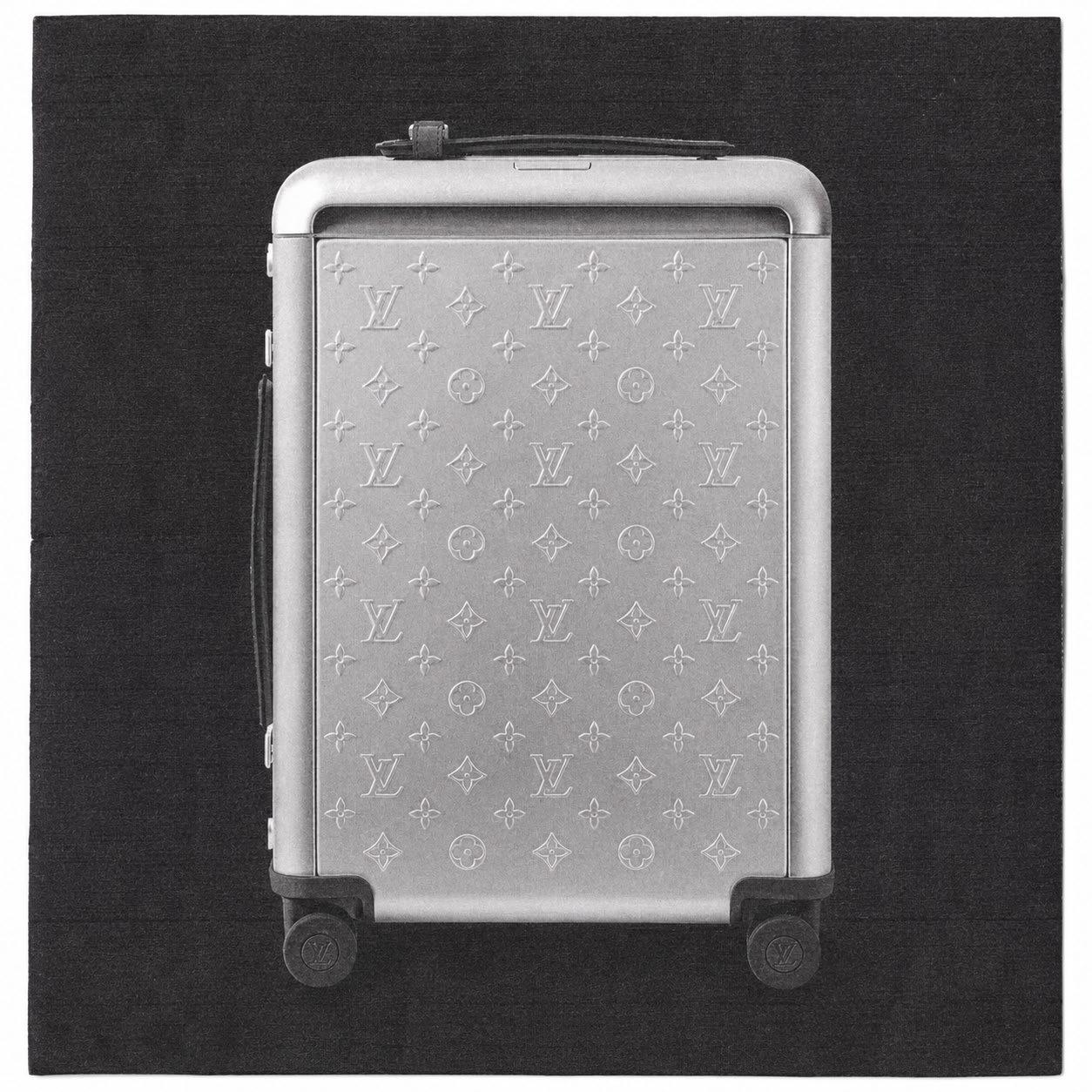
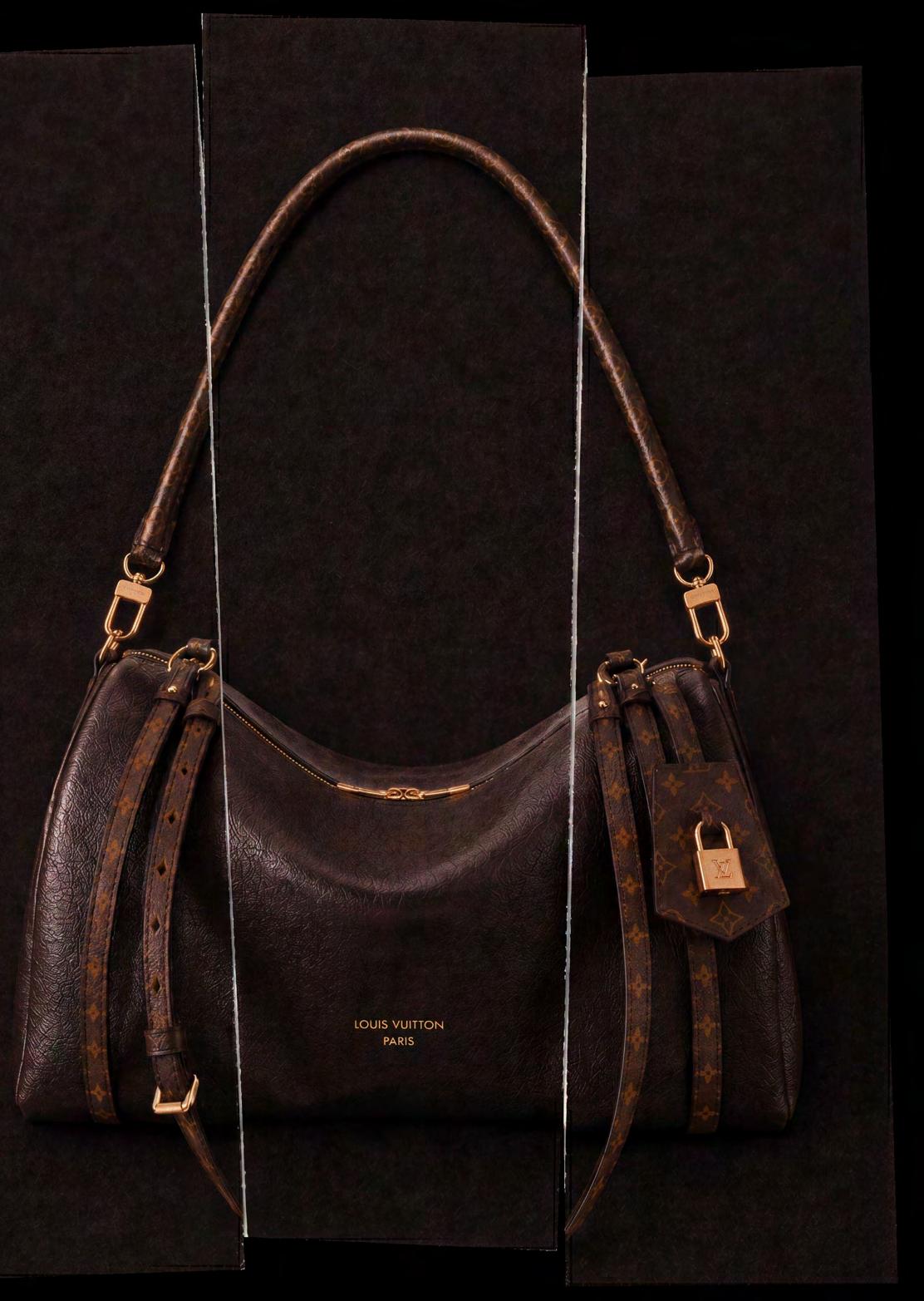
suitcase, horizon aluminum, LOUIS VUITTON
founder and editor in chief SANDRA YEGHIAZARIAN
creative director
SAIF HIDAYAH
managing editor
NADINE KAHIL
senior editor
LOUIS PARKS
creative content manager
MAYA MAGED
senior producer LAMIS JOUDAH
junior art director MALAK AYMAN HOSSNY
SUBMISSIONS AND INQUIRIES hello@thisisyung.com
PRINTING
AL GHURAIR PRINTING AND PUBLISHING LLC
PUBLISHED BY THIS IS YUNG LLC
Sharjah Media City hello@thisisyung.com www.thisisyung.com
All rights reserved. No part of this publication may be reproduced in whole or part without permission from the publishers. YUNG Magazine welcomes new contributors but can assume no responsibility for unsolicited photographs or illustrations. Every effort has been made to contact the copyright owners of the images and text in this issue.
photography JACK CHIPPER
styling IGNACIO DE TIEDRA
photography GREG ADAMSKI
styling AHMED RASHWAN
Sandy Bella call it power
photography GREG ADAMSKI
styling POLINA SHABELNIKOVA
IGNACIO DE TIEDRA / IVAN
MASKALL / JOHN MOURATIS
ADAMSKI / LILLY GOUMET
MARIANA BAIÃO SANTOS
YENGO
WOLANSKA / CHARLIE HALL
THE MOOD
words OMAIA JALLAD
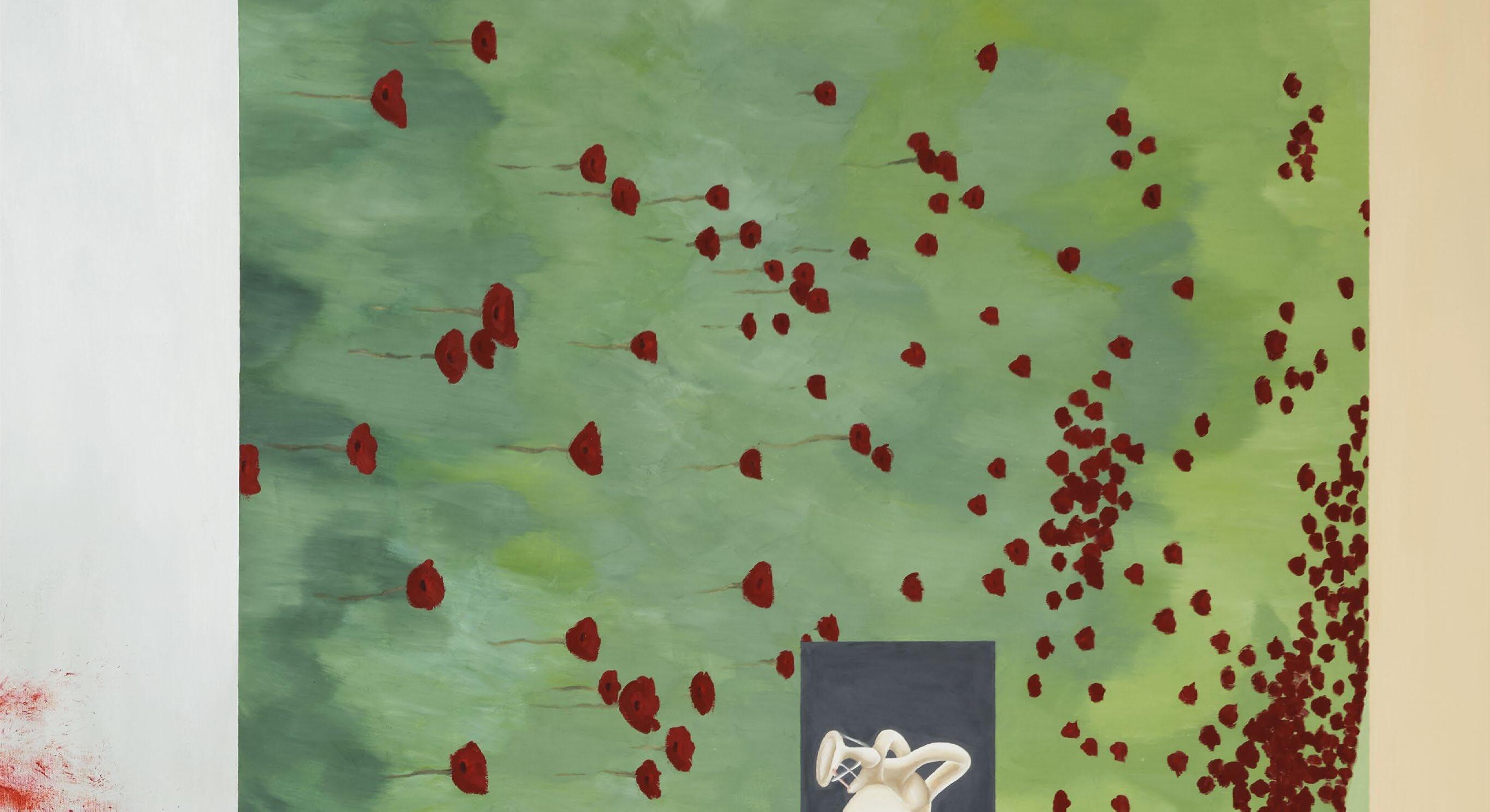
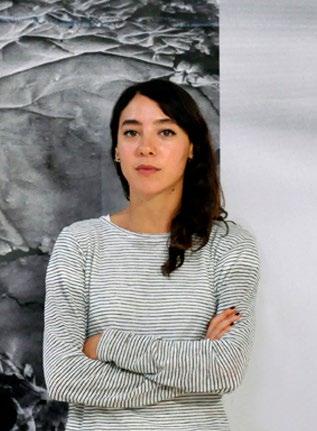
THE SYRIAN ARTIST GLITCHING REALITIES
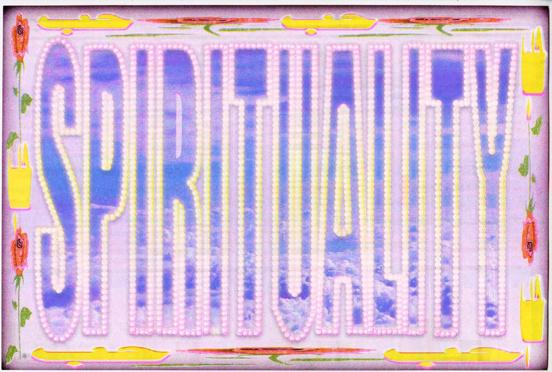
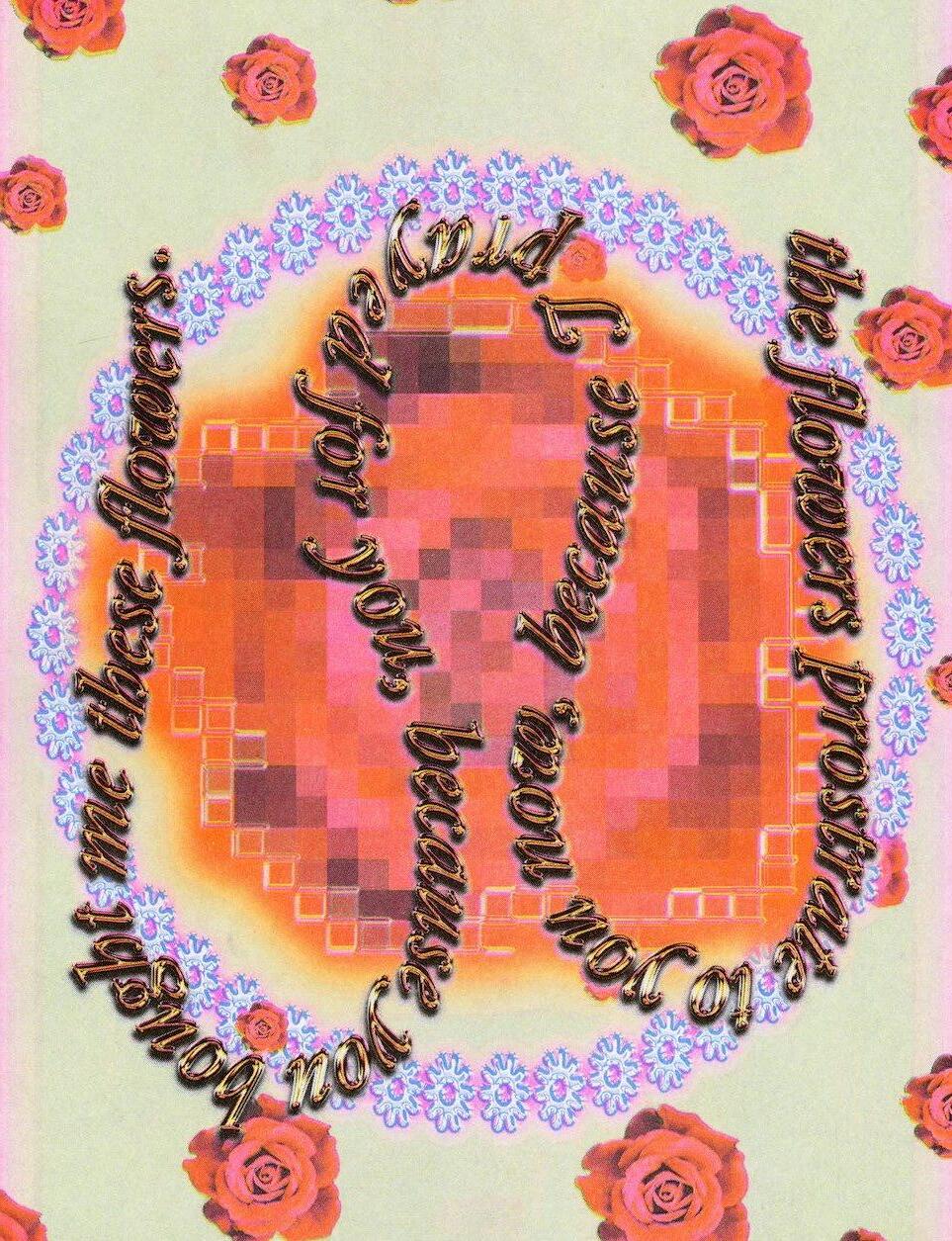
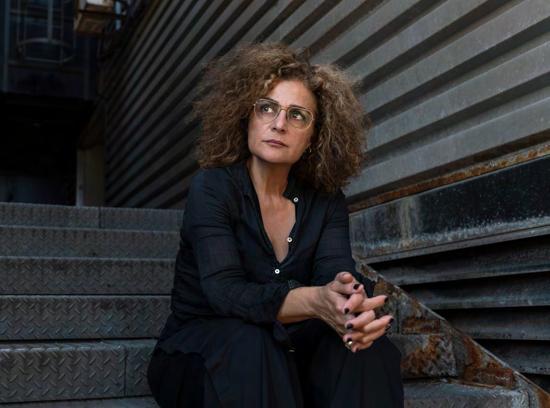
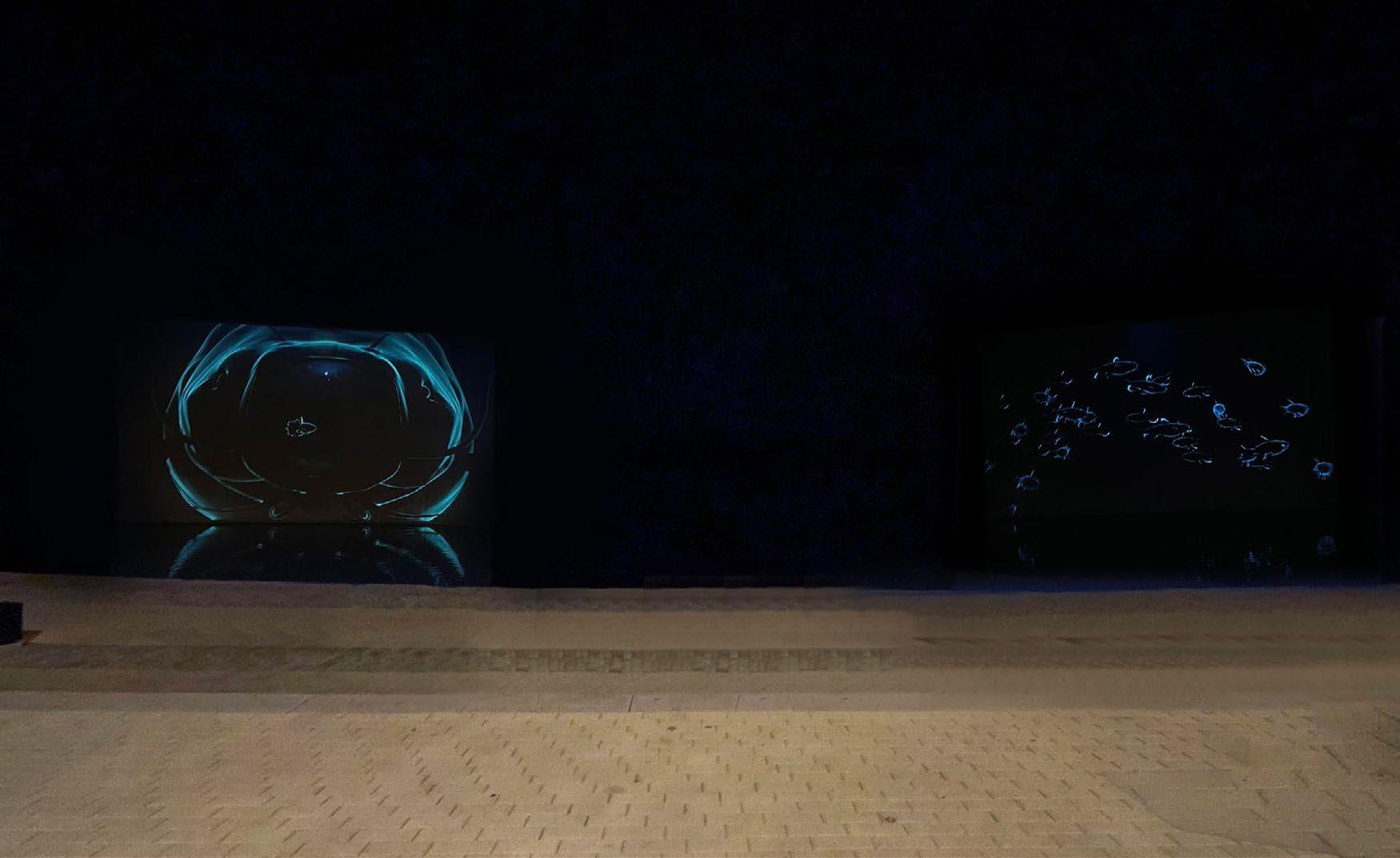
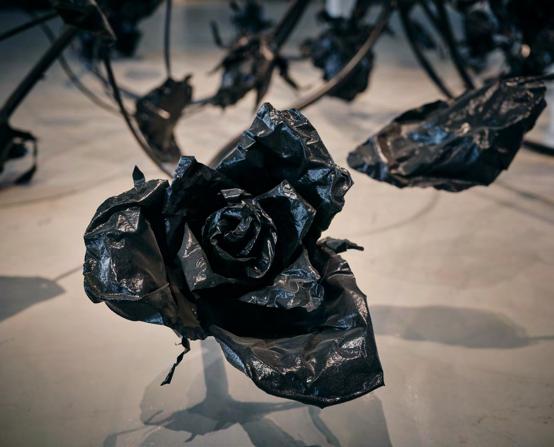
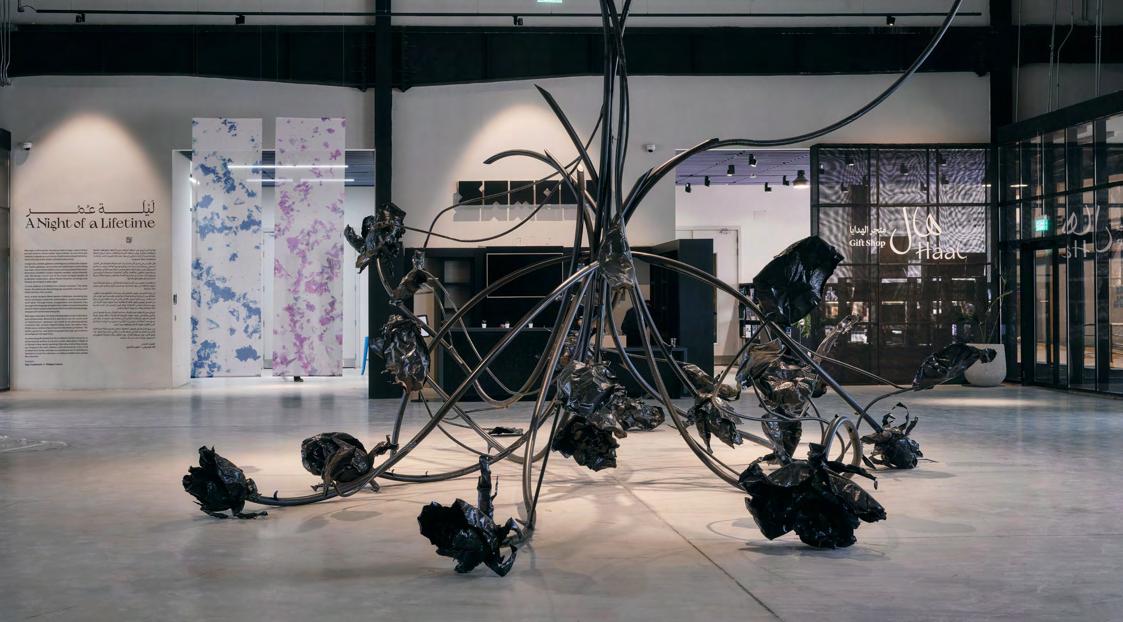
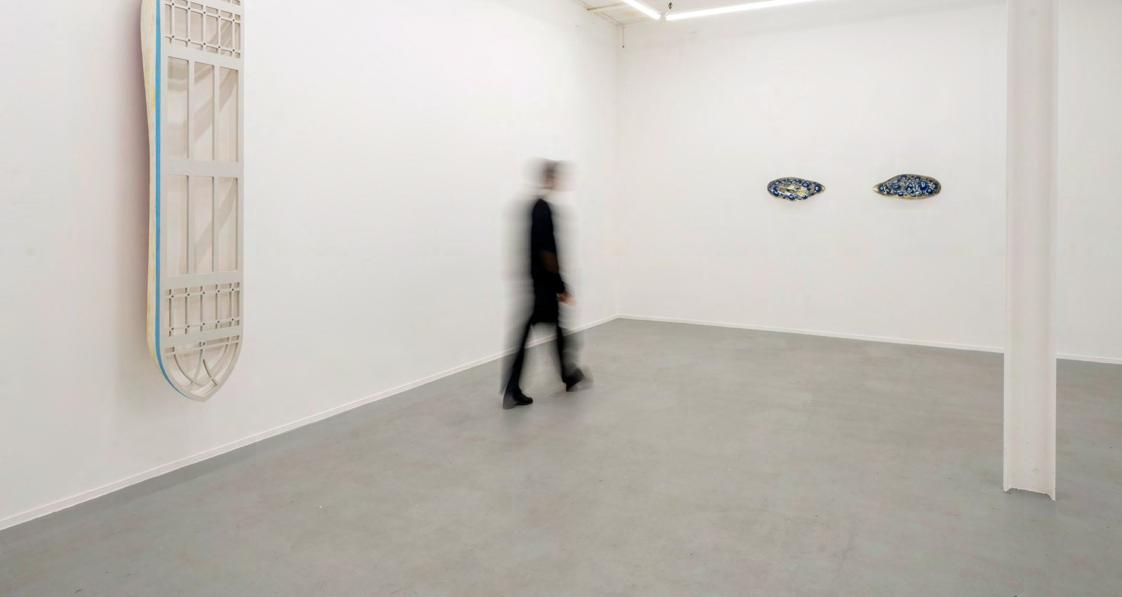
Based between London and Dubai, Syrian artist Sara Naim works across photography, sculpture, painting, and video. Her practice examines how language, symbols, and ideology shape our sense of self and our understanding of the world. Through technological glitches, magnification, and shi s in scale, she explores the limits of representation and the ways intuition exceeds language. Informed by her long separation from Syria, her work investigates tensions between distance and intimacy, o en through pixilation and abstraction. Natural forms, particularly flowers, connect personal ancestry to wider geopolitical conditions, challenging notions of fixed political and bodily boundaries.
Your work constantly shi s between photography, painting, sculpture, and video, almost refusing to stay in one form. Have you always been interested in breaking boundaries creatively?
I’m a bit of a medium monkey. I don’t feel restrained by using one particular medium to say something. They all have their own language, and I enjoy adapting them to mine.
A lot of your work explores the idea that the closer we get to something, the less clearly we actually see it. What first drew you to that tension between intimacy and abstraction?
I wasn’t able to go back to Syria for the last 15 years, so during that absence I romanticised Damascus - the smell of jasmine in the streets, its dry summer heat, the flavour of watermelon and peach. I realised these idealised memories were probably far from reality, in the same way images and thoughts can slowly replace lived experience until we get lost in their abstraction.
How has this distance shaped the emotional language of your work?
I’m a bit contradictory because although I’m very sentimental about Syria, I also try to describe division as a construct. The exclusivity that comes from belonging is the same mechanism that excludes others from entering it. As the distance from Syria increases, so does its sentimental value. Sentimentality, culture, and identity are all wrapped up in division - I’m still trying to understand that negotiation.
Glitches, distortion, pixilation; things normally seen as flaws, become strangely emotional in your practice. What attracts you to visual “errors” as a form of communication?
Initially, I wanted to talk about our relationship to the body as something strangely foreign, despite carrying it with us everywhere. The glitch began as a technical error while photographing my skin through a scanning electron microscope, but it soon became an analogy for the fractured communication between the internal and external world. I’m interested in emotional manifestations penetrating the skin - blushing when embarrassed or sweating when nervous. These feel like brief slips where the body involuntarily reveals something internal, which I explored in earlier works.
Flowers and organic forms appear repeatedly throughout your work, but they never feel decorative. What do those natural motifs represent for you?
Biological forms like flora and skin constantly transgress borders through pollination and shedding. I use plants to imagine a more collective way of existing, where movement across borders is natural rather than controlled. They shi the perspective away from individuality and toward cohabitation. We’re born into inherited frameworks for understanding ourselves and the world, and my work tries to deconstruct them. Di erent ways of seeing are always available to us, but we o en solidify the structures around ourselves and forget that we were the ones who built them in the first place.
Photo courtesy of talent.
Sara Farha
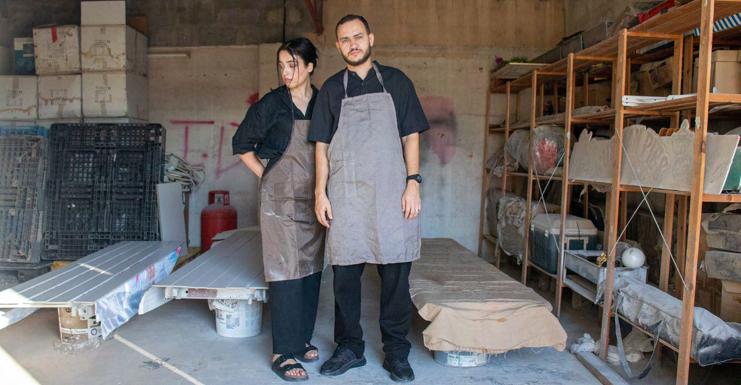
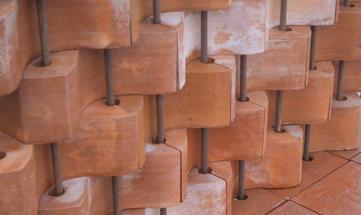
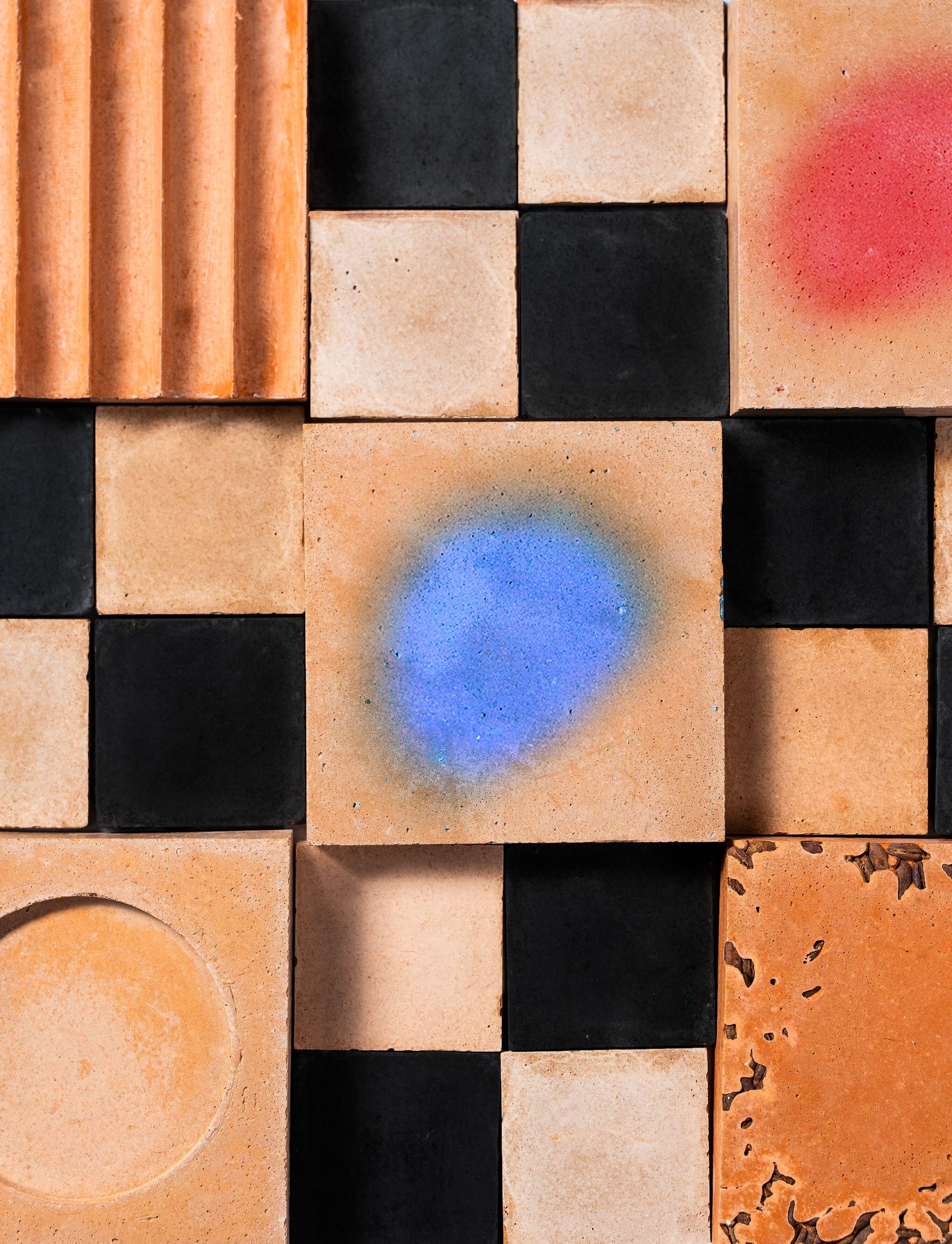
Datecrete Studio & Lab is rethinking what buildings can be made from, starting with something as overlooked as a date pit. Co-founded by Sara Farha and Khaled Shalkha, the interdisciplinary studio merges material science, design, and environmental research to create sustainable construction materials rooted in the MENA region. Their signature innovation transforms discarded date seeds into a high-performance cementitious composite, bridging ancient building knowledge with contemporary experimentation.
How do your di erent backgrounds in urban planning, material research, and chemical engineering complement one another creatively?
We’ve always believed that meaningful work usually happens at the overlap between seemingly unrelated fields. Beyond our formal backgrounds, we’re also deeply influenced by art, film, music, and visual culture. This is foundational to who we are as people.
A lot of ideas come from reconnecting things that have become unnecessarily siloed. In our case, food systems and construction had stopped speaking to one another; a separation reinforced by how academia is structured. Datecrete really began through intuition first, through educated guesses and connecting distant points of research that didn’t initially seem related, followed by the scientific validation.
How important was it for Datecrete to feel regionally rooted?
It was important, but not in a nostalgic or performative way. We weren’t interested in creating the optics of rootedness or romanticizing the past. What interested us was understanding the region’s broader cementitious history critically: Why were certain historical binder systems abandoned so quickly a er industrialization? Why couldn’t they compete with Portland cement at scale? Those questions became more interesting to us than simply reproducing old techniques. Datecrete is less about returning backward and more about reconnecting interrupted lines of material knowledge, while allowing industries like food and construction to speak to each other again.
&Khaled Shalkha
Innovating From Fruit to Foundation
What conversations are you hoping Datecrete sparks around value, waste, and materiality?
Probably the importance of interdisciplinary thinking and what we’d call pragmatic idealism. We try to balance optimism with critical analysis and we’re not interested in romanticizing waste or the past for aesthetic reasons alone. We’re more interested in studying systems carefully, understanding their failures and successes, and extracting usable lessons to balance imagination and practicality, which is where we feel our real strength lies.
What did your journey teach you about patience and innovation?
Our process may begin experimentally, but there’s always equal emphasis on validation, on making and on implementation. Experimentation without testing eventually becomes a temporary project. What the research taught us most is that innovation o en comes from stepping outside your disciplinary comfort zone. A lot of answers remain invisible if you ignore the overlap between di erent fields of study. Patience is necessary because meaningful material development is rarely linear, you test, fail, recalibrate, and slowly begin understanding the logic of the material rather than imposing assumptions onto it.
Datecrete challenges the idea that high-performance materials must feel industrial or detached from nature. Do you believe the future of design lies in reconnecting technology with organic materials?
We do, but carefully. Organic materials alone are not automatically sustainable, and technology alone is not inherently harmful. A healthy future probably lies in dissolving this false separation between technological advancement and ecological intelligence. For us, the question is about building material systems that are regionally intelligent, resource-conscious, and scientifically rigorous while retaining warmth, an aromatic dimension, tactility, and emotional resonance.
Photography by Abrar Kebaili.
How has your relationship to Sudanese culture evolved through your work over time?
Creating Archives of Love & Memories
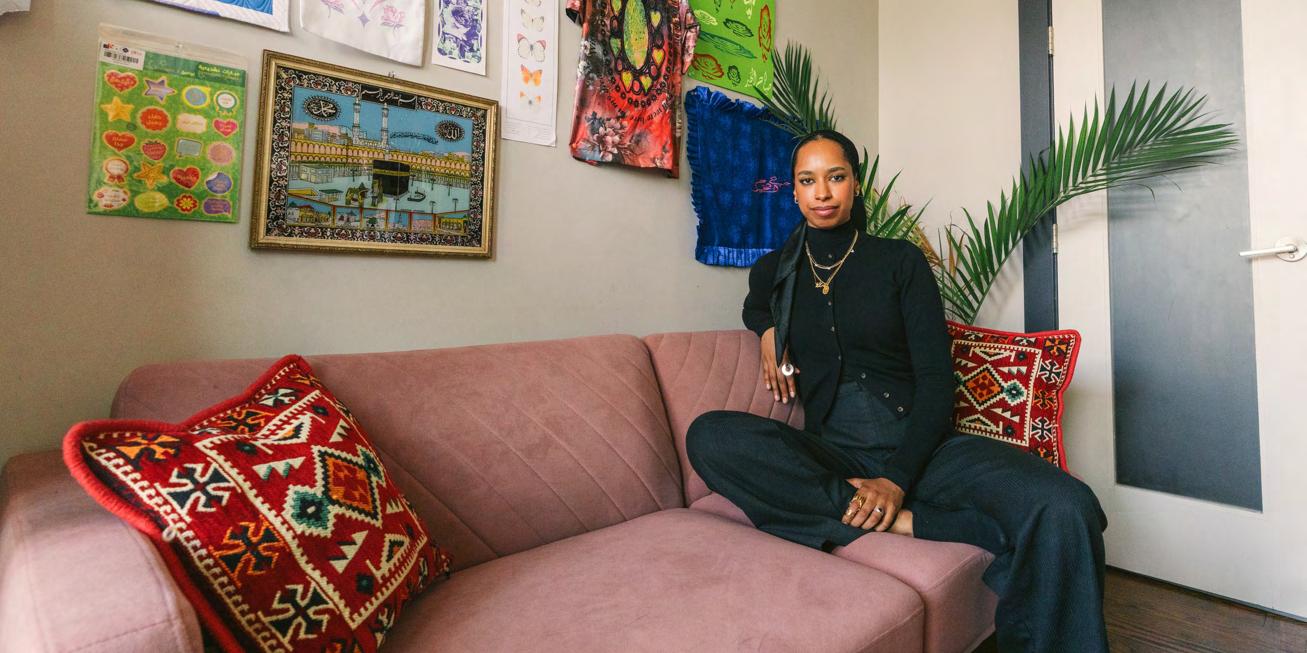
Sarah Elawad’s art feels like flipping through treasured memories; intimate, colourful, and emotionally charged. Working across collage, textiles, garments, printmaking, publishing, video, and installation, she builds visual worlds where so ness and storytelling become forms of resistance. Elawad gained international recognition through exhibitions in New York, Doha, Amsterdam, and Shanghai. She also co-manages the experimental publishing project Water With Water, with artist books held in collections at The Metropolitan Museum of Art Watson Library, The British Library, and Asia Art Archive.
You work in print, textiles, garments, installations, video, and collage. What a racts you to working across so many mediums instead of limiting yourself to one form?
I think form is important but it is not the most important part of an artwork, what it's trying to say is much more important. I am so intrigued by the concept that there are many di erent ways you can say the same or similar things. All of my artwork is connected by the throughline that I made and they are based on reactions or experiences that led me to make them, but the way that comes across can be di erent whilst being very much the same.
How do you balance personal vulnerability with storytelling in your practice?
I strongly believe that deeply personal work will always be relevant to larger audiences. None of our experiences happen in a vacuum. In the beginning a lot of my work was just based on my own experiences and I slowly began to find that as people interacted with the work a lot of them also related to it.
For a while, I shied away from directly referencing my Sudanese identity in my work. Not because I was embarrassed but rather because I was afraid of having my work put in a box or my identity overshadowing my actual artwork and practice. This changed dramatically when the current war first broke out in Sudan in 2023. I felt a sense of urgency to represent this part of my identity in my artwork because I felt like if I didn’t it would continue to go ignored and worse, erased. My art practice was one of the few ways I could say to the world that we are Sudanese and we are here. We exist.
Your work is in collections like the Watson Library at The MET and the British Library through your experimental publishing practice. What does this mean to you?
I am so grateful to have my work in these places and appreciated by these institutions but I think it’s important to note that that is less relevant to me than someone who relates directly with the work and feels seen or like they have found a sense of hope or like someone is giving them a hug. If my work being in these institutions means it reaches more people and has the chance to make them feel anything at all, then that is what I would be most grateful to them for.
Photography by Ali Imam.
Hayfa Algwaiz
The
Multi-Hyphenate
Creating Spaces That Remember
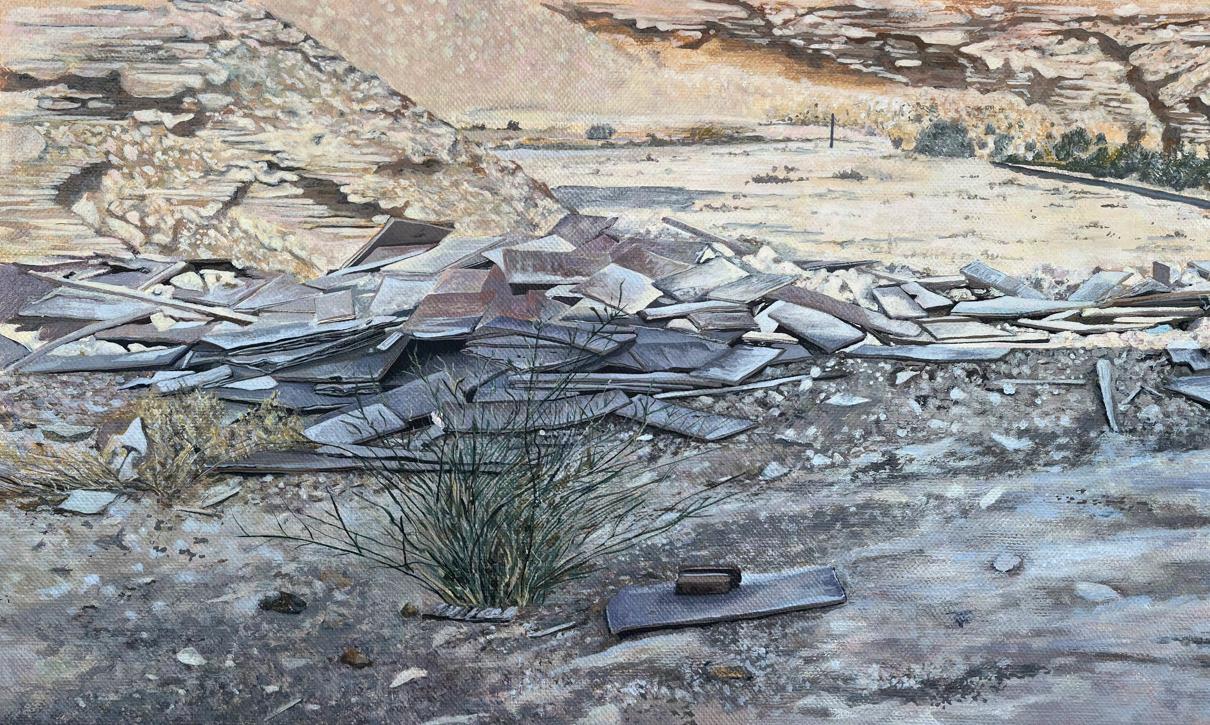
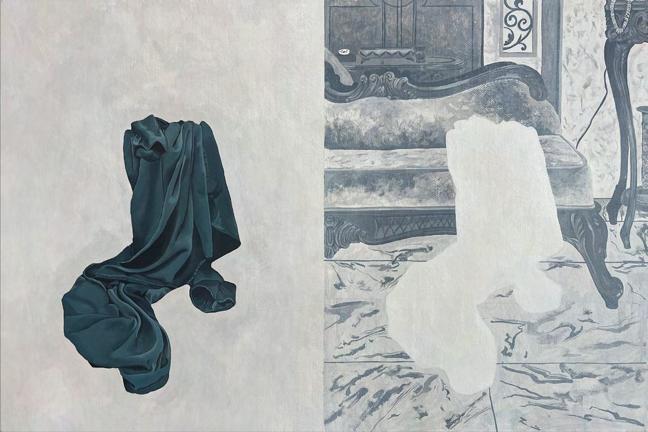
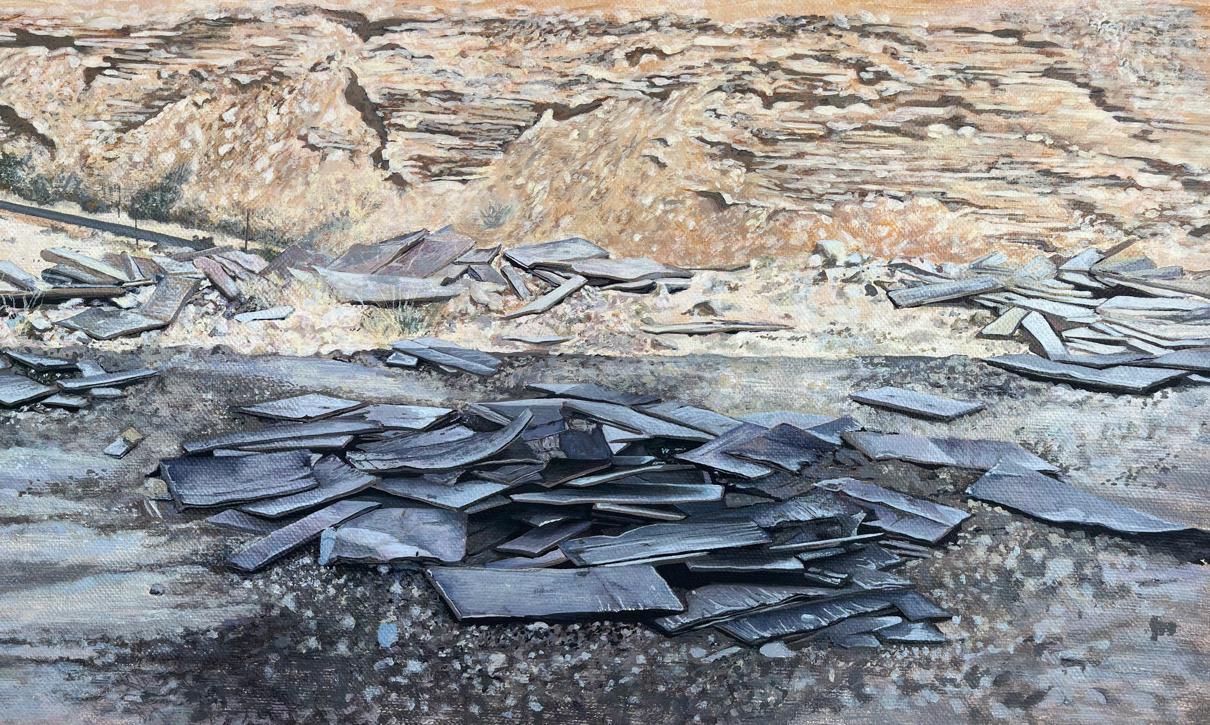
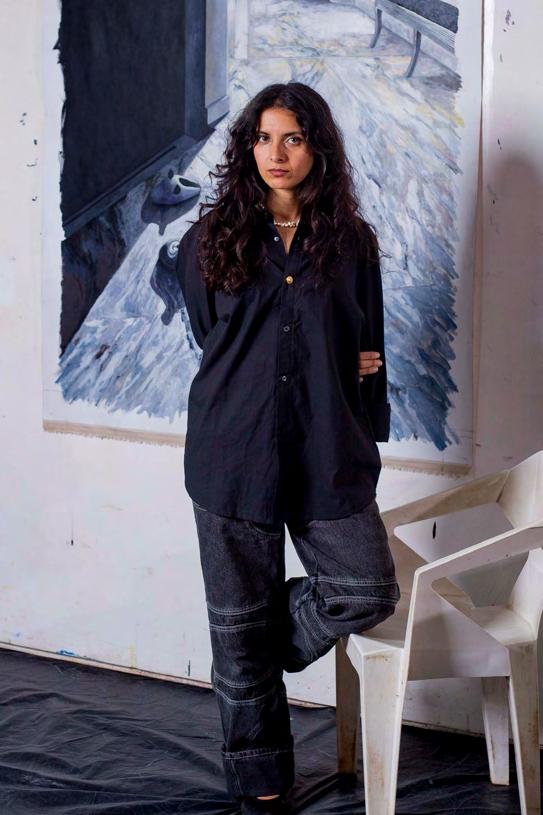
Saudi artist and architect Hayfa Algwaiz creates paintings that feel like suspended memories; intimate, atmospheric, and deeply rooted in the psychology of space. Based in Riyadh, her work blurs the line between architecture and painting, transforming domestic interiors, draped fabrics, and ornamental details into quiet studies of identity, womanhood, and belonging. Algwaiz captures moments that feel both deeply personal and universally familiar; paused conversations, empty rooms, traces of presence rather than direct portraits.
What first drew you toward painting, and when did you realise it was something you wanted to pursue seriously?
My entry point into architecture was drawing – the way it forces you to dra ideas in 2D and then translate them into 3D. I was always drawn to the render's immediacy as a way to communicate complex forms and ideas through a flat image. A er graduating and working at di erent architecture studios, I found myself feeling like an avatar for someone else’s thoughts and ideas. Naturally, I felt the need to render my own story with my own hands at a much slower pace.
What usually sparks a painting for you; a place, an emotion, a visual moment, or something else entirely?
Time and place are everything in my practice. I have to be physically present and immersed in a space for a prolonged period of time for inspiration to hit. It’s an intuitive process that requires paying a ention to things like repetition, pa erns, colours and activities. There’s always an element of searching for what creates context.
Much of your work focuses on interiors and domestic Saudi spaces. What fascinates you about the quiet psychology of the home?
I used to work at a couple of residential architectural firms in San Francisco. You learn so much about a person through their house. So every time I came home to visit my family in Riyadh, I started noticing the details that informed the di erences in the way we lived – our relationship to one another, where we gather or create space for ourselves and how the space itself facilitates our interactions.
Your paintings o en feel suspended between presence and absence — spaces without figures, draped fabrics without bodies, traces of people rather than people themselves. What draws you to that tension?
The absence of people in my work is a way of navigating privacy in the public eye. I’m o en sharing very intimate moments and stories, and I would hate to strip my subjects of their right to privacy. So things like redaction, absence, scale, partial visibility and abstraction become tools for limiting access to the inner world. Here, access is granted and not always a given.
Your paintings capture Saudi in a way that feels both deeply personal and subtly transformative; documenting spaces that are changing culturally and architecturally. Do you see your work as a form of archiving?
I used to think of my work as archiving, but I recently came across a distinction between archiving, documenting and historicizing – and I'm not sure my work fits neatly into any of those. For now, it feels more like a practice of noticing and making connections. Whether it becomes an archive or something else entirely, time will tell.
Photography by Nana Ampofo.
Lara Khoury
Healing Through Fashion
Lara Khoury has never designed clothes simply to dress the body; she designs to liberate it. Since launching LARAKHOURY in Beirut, the multidisciplinary creative has built a world where fashion becomes emotional architecture: fluid, sculptural, imperfect, and deeply human. Trained between Beirut and Paris at ESMOD, and shaped by early experiences with Rabih Keyrouz and Elie Saab, Khoury developed a visual language rooted in movement, soness, and rebellion against restrictive ideas of beauty, femininity, and identity. Following the Lebanese revolution, the Beirut explosion, and her personal journey through cancer, her work evolved into something even more intimate; exploring healing, resilience, memory, and survival.
Photography by Les Indisciplines.
You founded LARAKHOURY with a vision rooted in freedom, identity, and self-expression. What first pushed you toward creating your own world through fashion?
From my very first years as a designer, and almost without realising it, I always carried a rebellious spirit. It was present in the way I created, in the way I approached tailoring, and in the way I refused to follow rules simply because they existed. I also carried that rebellion into my personal life. When I shaved my head at 18, I did it purely for the joy of it, for the freedom and the style. But the reactions around me were intense. Some people thought I was sick, while others believed that a woman’s beauty exists in her hair, which suddenly made me “ugly” according to societal standards. Since then, my work has always been about breaking these norms and empowering people to exist as they choose to be — freely, comfortably, unapologetically.
The Aala Daou El Baher collection feels deeply personal, rooted in ideas of healing, memory, and the sea as a space of refuge. What first sparked the emotional foundation behind it?
The emotional foundation of this work began during my journey through cancer. During that period, the sea quietly became my refuge. I would leave the hospital and go directly to the shore, simply to sit facing the horizon. It became a place where I could breathe again, where I could release fear, grief, and uncertainty. The sea gave me a sense of continuity at a moment when life suddenly felt fragile. Looking at something so vast and eternal reminded me that there was still beauty, movement, and life beyond what I was experiencing physically.
The project carries an invisible yet profound connection with Aimee Daou, a Lebanese woman who died of cancer, and someone you never met. How did that emotional connection shape the direction of the collection?
Aimee lived in a beautiful family house built directly by the sea in Batroun. The presence of the sea there is overwhelming — you feel it from every corner of the house. It is part of the rhythm of daily life, almost like another living presence within the space. The moment I entered her home, I immediately understood that the sea must have been part of her healing journey too. I felt, instinctively, that it must have held her the same way it held me throughout my own experience.
What moved me deeply was also her presence within the house itself. Her photographs were everywhere, looking back at me, smiling. Even though we had never met, I felt an undeniable emotional connection to her.
That feeling slowly began shaping the collection. It transformed the work into something beyond fashion, into a dialogue between two stories connected by the same horizon, the same water, and the same search for light.
Photography by Omar Gabriel.
Jewellery Built Like Armour
Dina Kamal
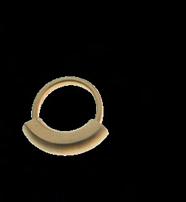
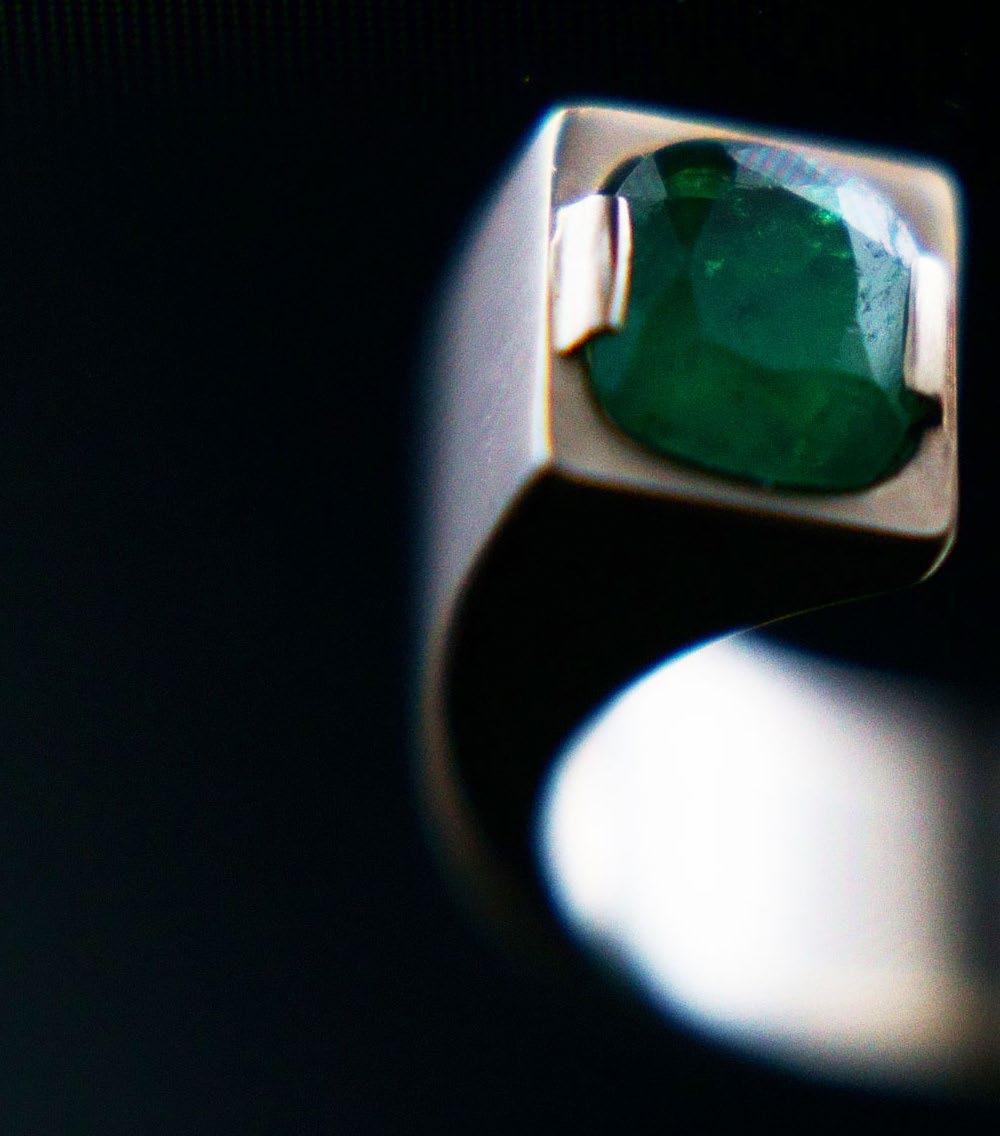
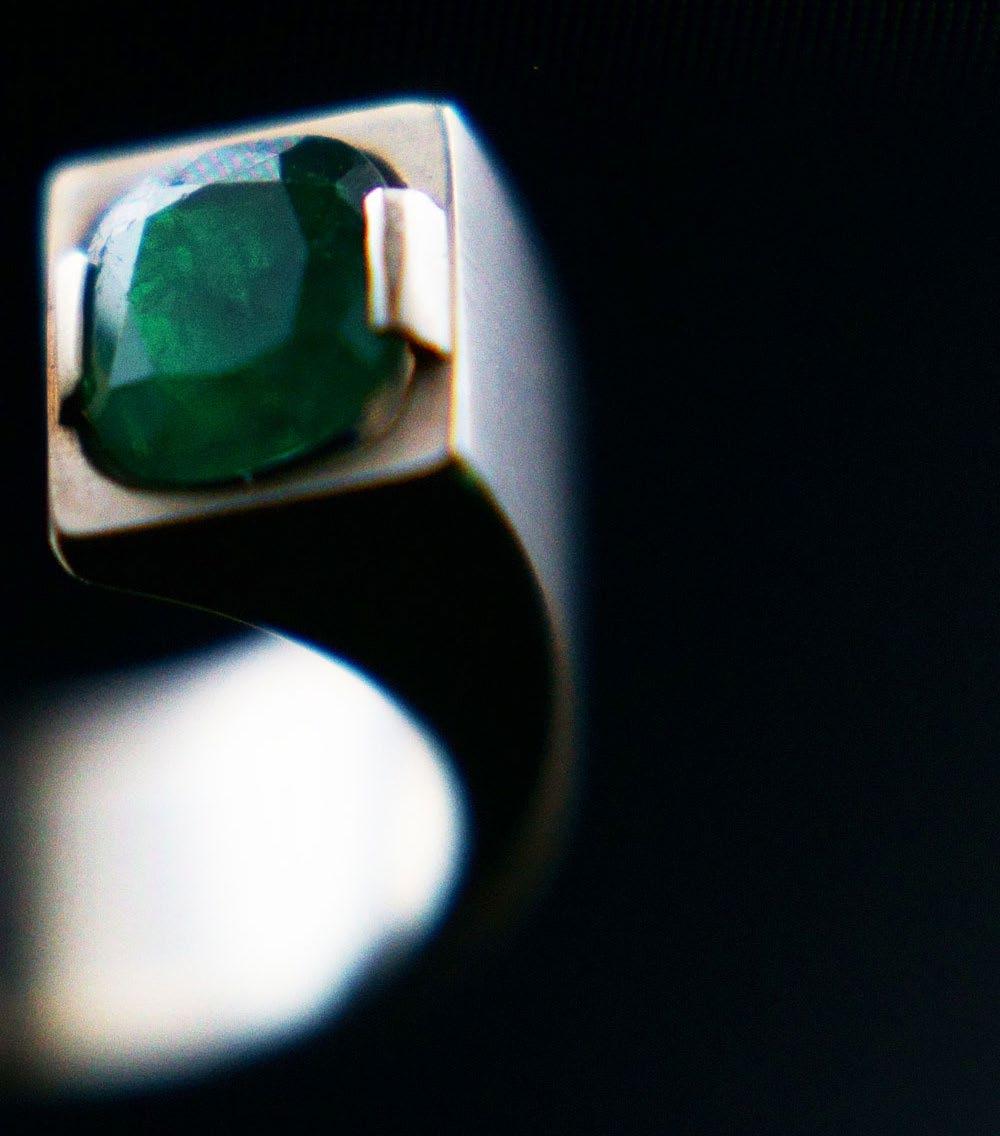
Founded by architect Dina Kamal, DINAKAMAL exists in the space between architecture, jewellery, and emotional design. Defined by dualities; so ness and strength, masculinity and femininity, sensuality and restraint; the brand transforms minimal forms into powerful objects of presence. Drawing from brutalism, mythology, ancient armour, and architectural structures, Kamal approaches jewellery with the precision of an architect, where proportion, balance, and emotional impact carry equal weight. Her signature “beige gold,” a muted raw 18K white gold, reflects the quiet confidence at the core of the brand: subtle yet deeply intentional.
You were an architect before launching DINAKAMAL, did jewellery feel like a new language or architecture on a smaller scale?
Jewellery never felt separate from architecture to me. It was always an extension of the same way of thinking; proportion, structure, emotion, and how design can transform us. Architecture shapes how we move and transform through space, while jewellery shapes how we carry ourselves within it. The scale changed, but the core question remained the same: how can form alter presence, feeling, and perception?
You’ve spoken about being fascinated by construction pits, grids, and excavated spaces. What is it about those raw architectural moments that emotionally inspires you?
I’ve always been drawn to moments where the familiar ground opens up and reveals another layer beneath it. Construction pits, foundations, grids, manholes, they all disrupt our usual sense of scale and context. They create a brief moment where proportion shi s, and something ordinary becomes fascinating again. I think I’m deeply inspired by anything that changes how we perceive ourselves in relation to space.
Your work o en references modernism and brutalism, but the pieces still feel sensual and deeply personal rather than rigid. How do you balance structure with emotion?
For me, structure without emotion can feel cold, and emotion without structure can feel unresolved. I’m always searching for tension and balance, between so ness and strength, sensuality and restraint, ancient and futuristic. I’m less interested in over-designing and more interested in finding the precise point where a form feels emotionally charged, yet e ortless.
Jewellery is usually thought of as decorative, but your pieces o en feel closer to objects of protection or even armour. What interests you about that relationship between jewellery and power?
Jewellery has historically never been purely decorative. It has signified protection, identity, status, ritual, power. That psychological role really interests me. I love the idea that a piece can feel like something to ground yourself, protect yourself, or shi your state of mind. Almost like a modern form of armour; subtle, personal, but powerful.
A lot of your designs seem to alter the wearer’s awareness of their own body; posture, movement, presence. Is designing for the body psychologically di erent from designing for a building?
Designing for the body is more intimate because even the smallest shi can a ect posture, movement, and self-awareness immediately. But in essence, architecture and jewellery are asking me the same thing: how does form a ect emotion? They both shape our experiences externally and internally. Both have the power to transform us.
ALTurk Twins
Duaa &
Nedaa
ALTurk Twin Frequencies from Saudi
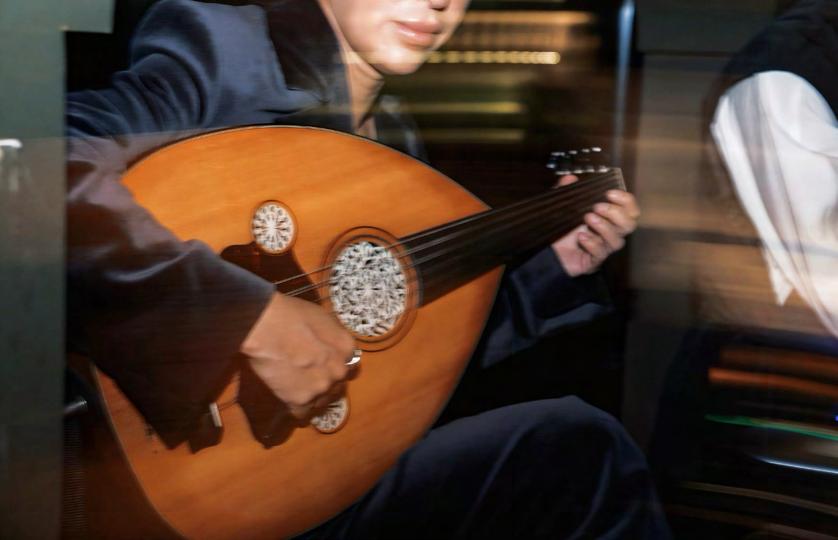
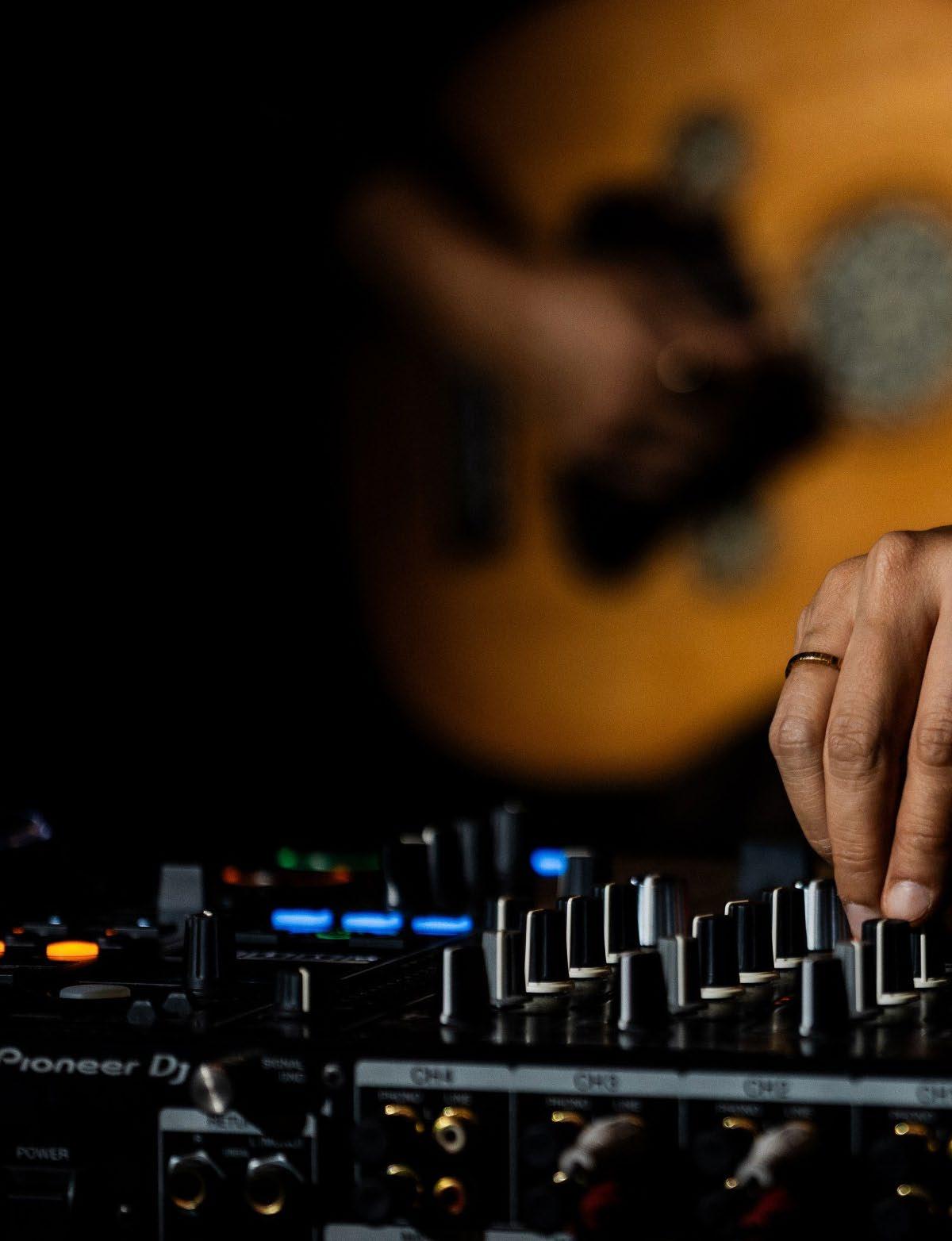
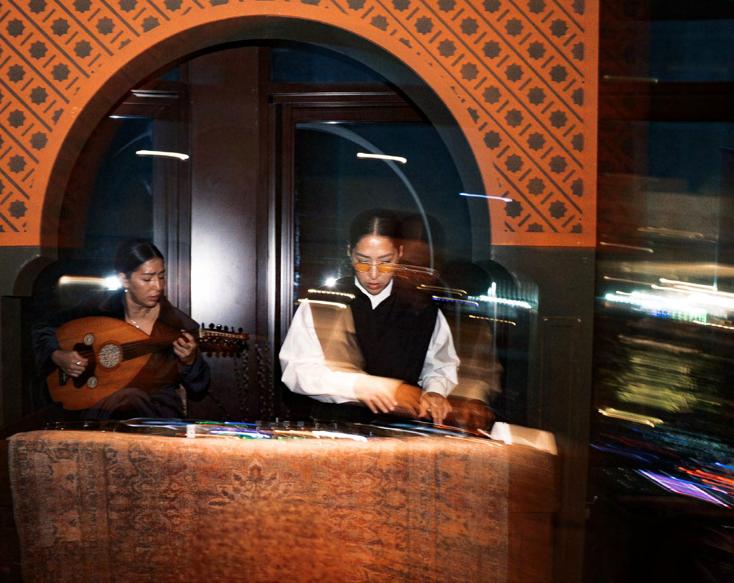
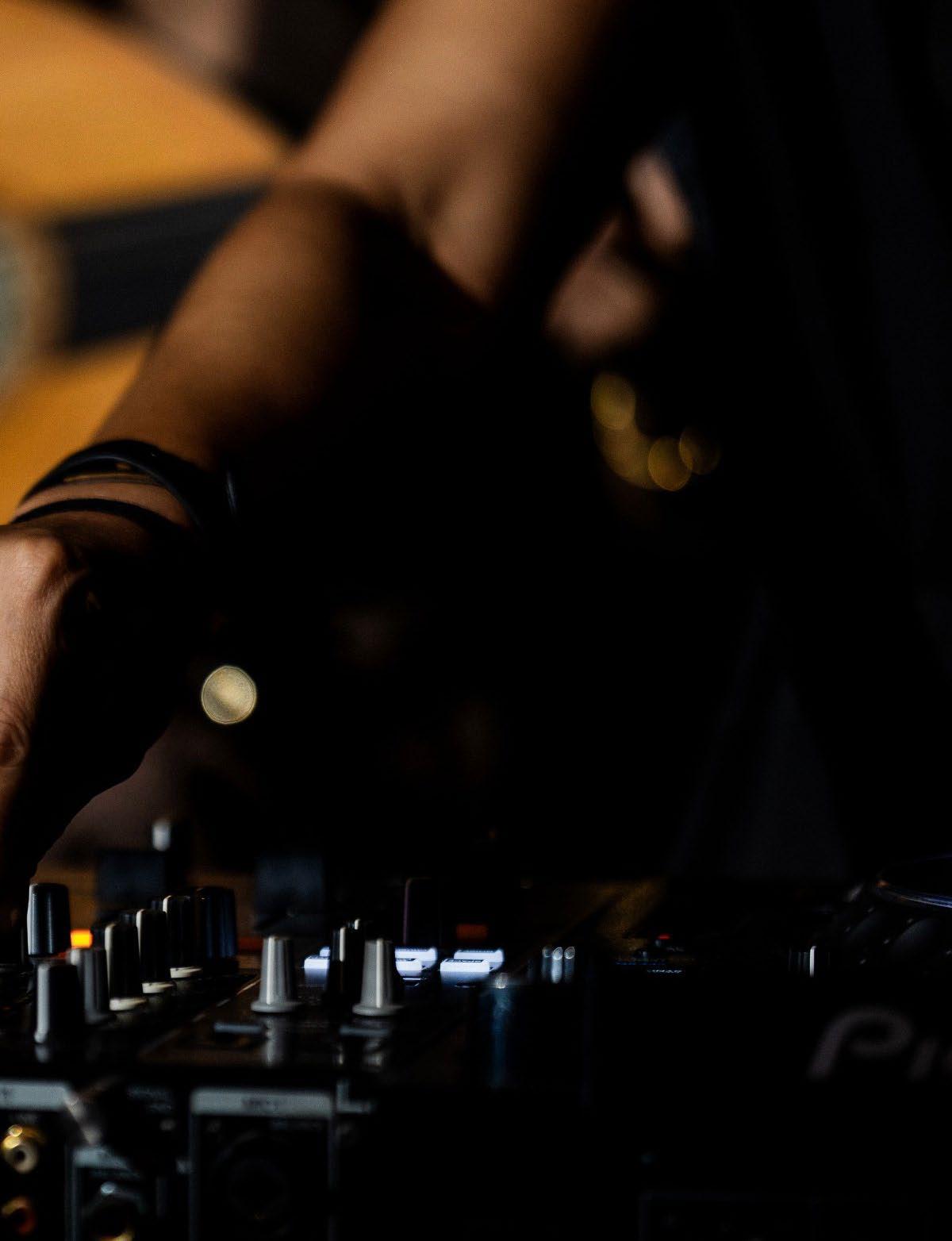
ALTurkTwins, Duaa and Nedaa ALTurk, have built a distinctive sonic world where deep house, electronic production, and traditional Arabic instrumentation collide. What began as spontaneous jam sessions between Duaa’s DJ sets and Nedaa’s oud improvisations has evolved into one of the Kingdom’s most exciting emerging musical projects. Their breakthrough sound bridges heritage and futurism, transforming the oud from a traditional instrument into something entirely contemporary. The sisters grew up immersed in music, drawing inspiration not from one genre or artist but from emotion itself. Today, their hypnotic productions and live performances have positioned them at the forefront of Saudi Arabia’s rapidly evolving music scene.
Photography by Zeyad Medhat.
What first pulled both of you toward electronic music, and do you remember the moment you realised this could become something serious?
We were naturally drawn toward electronic music because we have always been inspired by sounds that feel modern, immersive, and emotionally evolving with the time we live in. We love genres that feel creative, unique, and slightly unexpected, and electronic music has this freedom to explore that space naturally. The moment it started to feel serious was when we created our first track, “Signs From God.” That was the moment we both felt that this was more than an experiment - it felt like the beginning of the world of sound we wanted to build through ALTurkTwins.
Before ALTurkTwins, what was your relationship to music growing up?
We grew up in Taif for around 17 years, and music was always a huge part of our daily life. We spent most of our time listening to a lot of di erent kinds of music. For us, it was never about one specific artist or genre. It was always about the feeling that guides us creatively. Blending traditional instruments like the oud with electronic music feels like creating a new magical world where heritage and modern energy exist together naturally.
Your music blends house and electronic production with subtle Middle Eastern influences. Was that something you intended from the start, or did it happen over time?
In the beginning, Duaa was practicing DJing on her own, while I walked into the room holding the oud and wanted to practice with her, playing over di erent beats, keys, and rhythms. We started improvising together over a few tracks, and everything felt surprisingly natural from the first moment. There was already a strong understanding and harmony between us creatively, so the fusion happened very organically over time. At the same time, it also became intentional because we realised how emotionally unique that sound felt to us.
If you had to describe the world of ALTurkTwins in one perfect scene, what would it look like?
Hidden magical frequencies and deep vibrations moving through people with light and power, hearts and minds sparked, while the oud leads the entire journey emotionally - creating a space where everyone feels hypnotised by the moment, free, deeply connected, and emotionally awakened without needing to say anything. Music that feeds the soul.
Sarah Ben Romdane
KAÏA & A Taste of Home
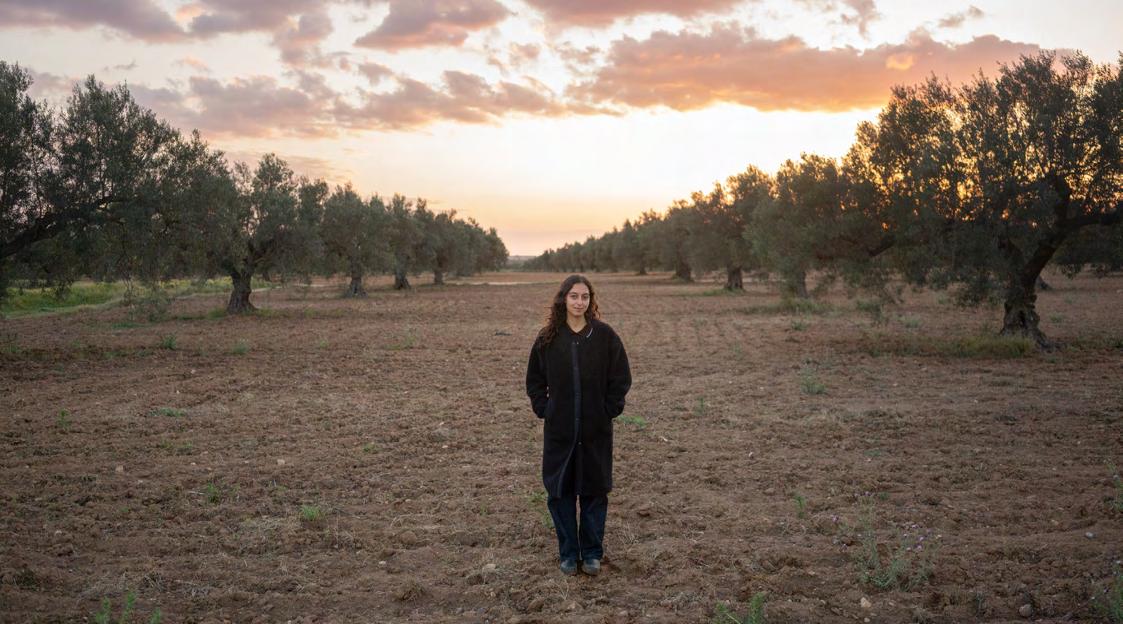
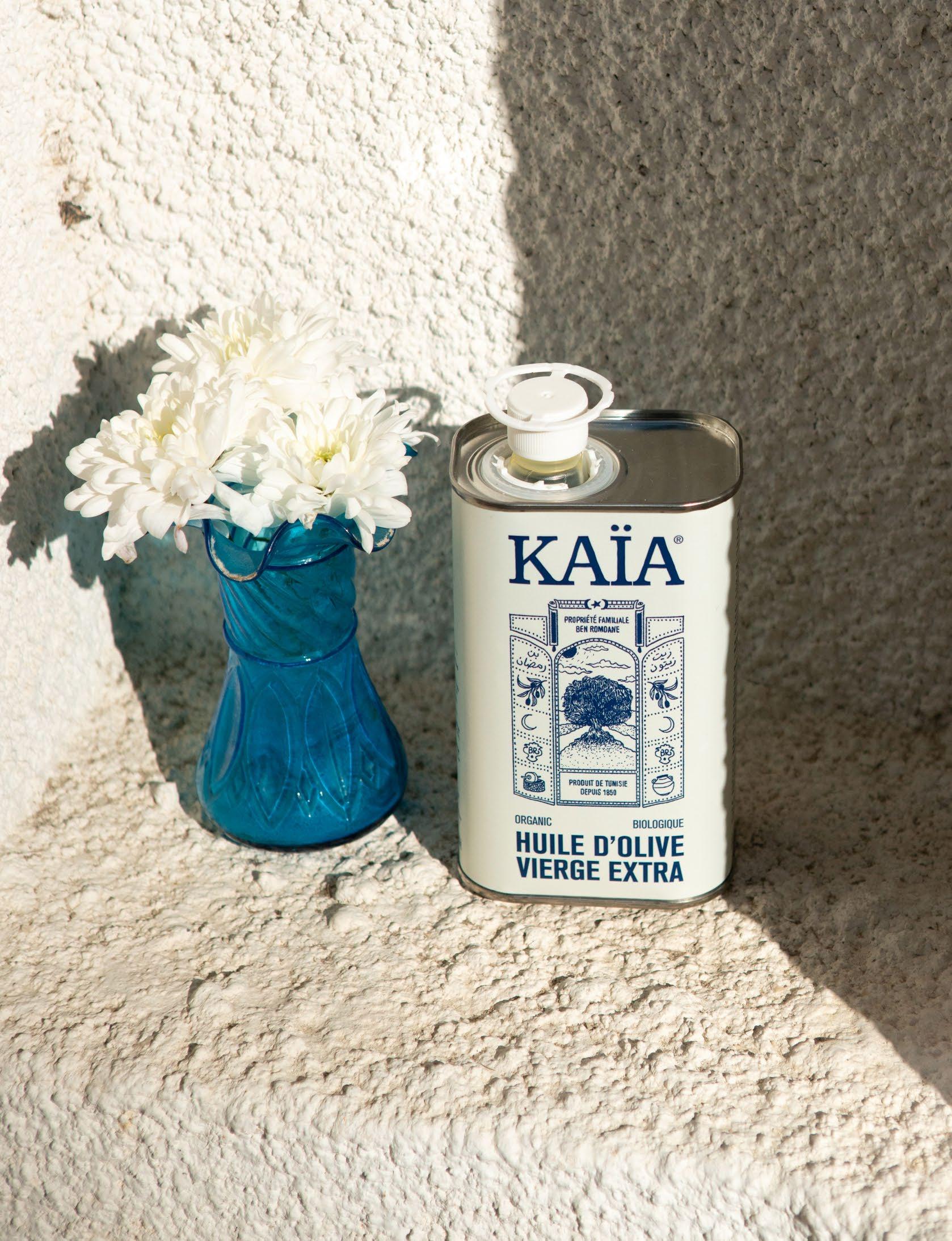
Sarah Ben Romdane isn’t just building an olive oil brand; she’s rebuilding a relationship to land, memory, and identity. Born in Paris to a Tunisian father and Syrian mother, and raised between France and London, the founder of KAÏA returned to her family’s fi h-generation olive estate in Mahdia during the pandemic; a decision that completely reshaped the course of her life. What began as a personal reconnection soon evolved into a larger mission: creating a new narrative around Tunisian olive oil, one rooted in visibility, heritage, and political intention.
You've described the summer of 2020 as a turning point in your relationship to Tunisia and to yourself. What shifted for you during that period?
I had spent months of lockdown alone in Paris feeling genuinely low, disoriented, disconnected. As soon as borders opened, I booked a ticket to Tunisia and what was meant to be three weeks turned into six months. Growing up in Europe, you're conditioned to orient yourself outward: Europe, the USA, maybe the Gulf. Tunisia is the place you're from, not the place you're going. But being in Mahdia, where I've spent every summer since I was born, did something unexpected. I realised I'd been carrying a deep, almost spiritual connection to that place my whole life, that this is a place that heals me, brings me joy and creativity, and is the heart of my politics.
Before founding KAÏA, you worked in journalism. Did storytelling naturally evolve into building a brand, or did launching KAÏA feel like a complete leap into the unknown?
Both. The storytelling part felt completely natural. I've always been driven by a desire to tell stories about my people and our multiple identities, and KAÏA gave me a subject I was completely obsessed with. Coming from politics and journalism, I knew my real skills lived in communication and cultural translation, not finance. There's such a hunger for this kind of representation. But I always wanted to make sure the storytelling was never divorced from the actual politics of the place. I'm very conscious of not wanting to exploit the very thing I'm trying to protect.
What does reviving your family's legacy mean to you personally?
It gives me chills every time. My third great-grandfather was exporting olive oil from Mahdia to the United States in the 19th century, under a Tunisian family name, winning prizes. Then political shi s, emigration, life, the legacy went quiet. As the sixth generation, I've revived what they started, but with my own vision, my own tools, my own politics. It feels like both an act of love and an act of repair.
Do you think reconnecting with land and tradition has become a political act?
For me it always has been. We live in a world where everything is commodified, optimised, and we are all divorced from our roots and our authenticity. None of that inspires me, it's brutal, extractive, and creates real oppression. Going back to the land is about imagining another world.
Photography by Bechir Zayene.
Fadi Yachoui
Atelier L’inconnu translates to “The Unknown Workshop.” What inspired the name, and why was it important for you to create a collective identity?
The name came from an attraction toward the unknown as a creative condition — the idea that the most meaningful work o en emerges from uncertainty, experimentation, and discovery rather than certainty. “L’inconnu” represents a space of openness, where work can evolve freely without being confined by expectation or a predetermined identity. Creating a collective identity was also very important to me because I never saw design as an isolated act. Every project is shaped through exchanges, with artisans, collaborators, materials, places, and lived experiences.
The atelier describes design as something to be “experienced rather than signed.” What does that philosophy mean to you personally?
For me, design should first create a feeling before it communicates authorship.
We live in a time where visibility and recognition o en become central, but I have always been more interested in what remains emotionally with someone after encountering a piece or a space. The work should not exist simply to be recognized; it should exist to be experienced.
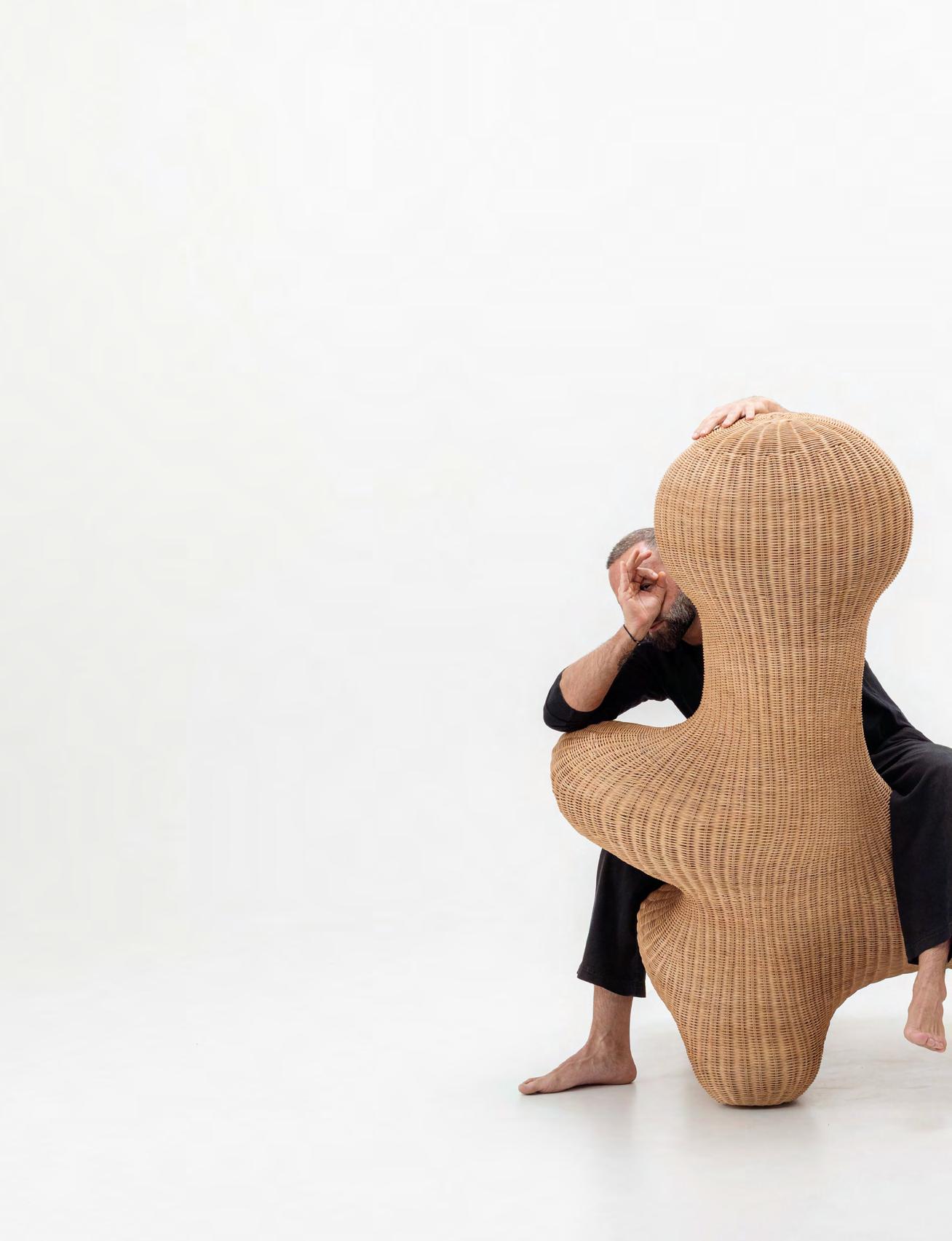
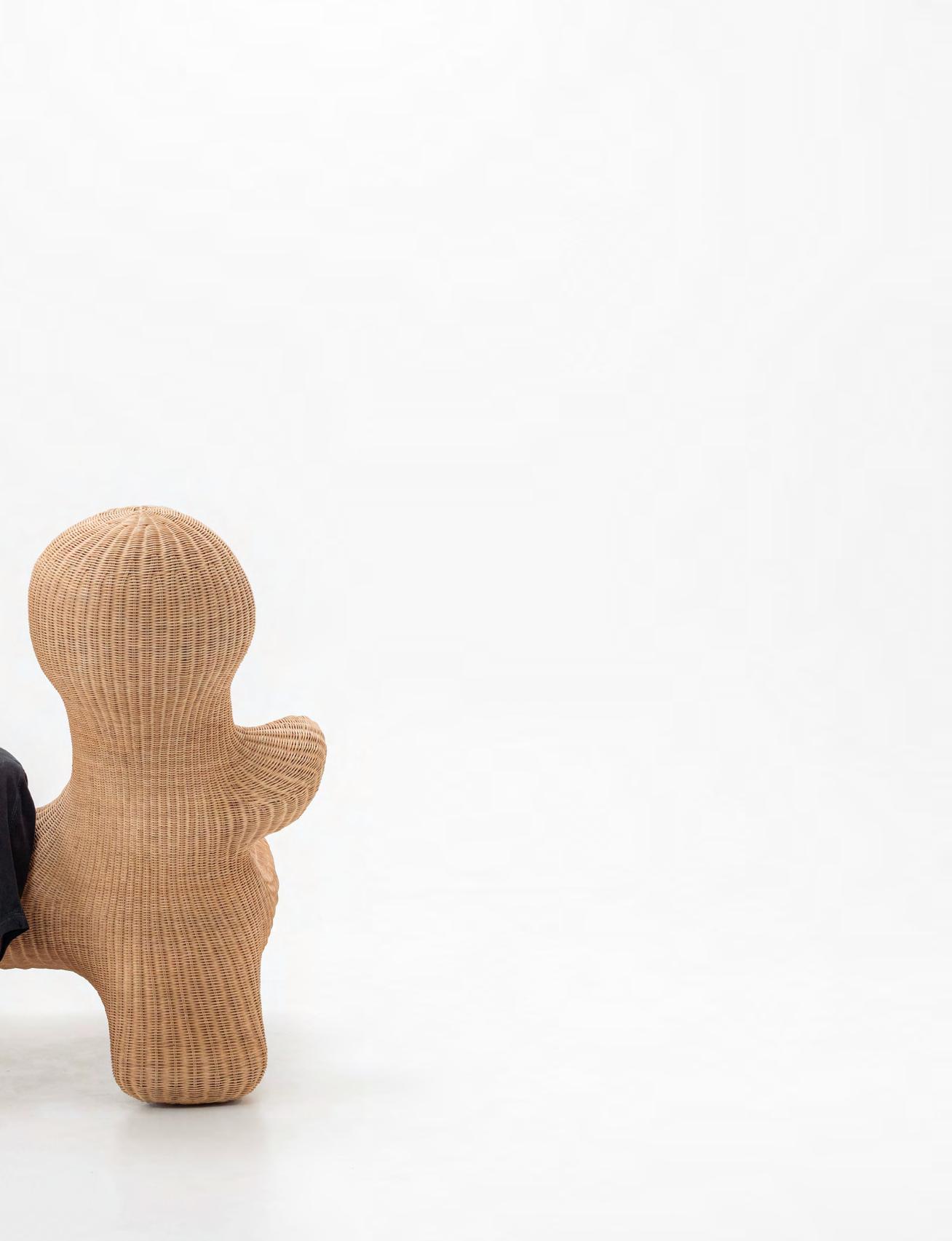
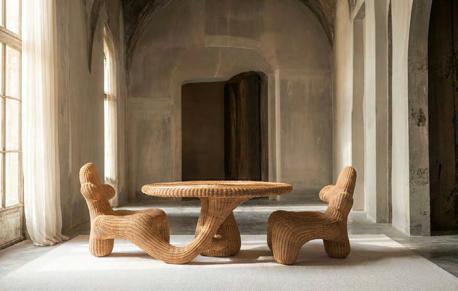
That philosophy also comes from the belief that design is relational. A piece only fully exists once someone engages with it, through touch, presence, memory, or interaction. In that sense, the experience becomes more important than the signature itself.
The Visionary Behind Atelier L’inconnu
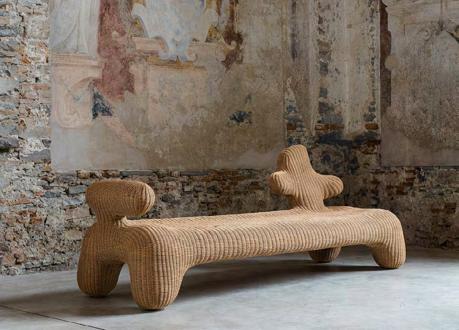
Architect and designer Fadi Yachoui creates objects that feel more like emotional landscapes than furniture. Shaped by Beirut, refined through Paris and Milan, and influenced by figures like Bernard Khoury and Piero Lissoni, his work exists between architecture, sculpture, and memory. Through Atelier L’inconnu “The Unknown Workshop” Yachoui approaches design as a collective, sensory experience rather than a signature style.
Photography by Walid Rashid.
Courtesy of talent.
Do you naturally approach furniture and objects as emotional experiences rather than simply practical forms?
Yes, very naturally. Function is essential, but it is never enough on its own.
I’m interested in how objects can hold emotion, memory, and presence. A chair, a bench, or a table can become more than a utilitarian object; it can become a space for waiting, intimacy, confrontation, or reflection.
Many of my works begin from an emotional impulse rather than from function itself. Form and material then become ways of giving that emotion a body.
I think this is why the pieces often sit somewhere between object and sculpture. They are functional and comfortable, but they also carry a narrative or psychological dimension.
In today’s increasingly digital and fast-paced world, why do you think preserving the human touch in design is so important? Because the human hand carries memory. There is a certain irregularity, warmth, and emotional presence in handcra ed work that cannot be replicated industrially. The trace of time, gesture, and labour becomes embedded within the object itself.
Working with artisans in Lebanon is also about preservation through evolution. Many traditional techniques are increasingly fragile, and I believe contemporary design has a responsibility not simply to preserve them nostalgically, but to reinterpret them in ways that allow them to continue living.
What I find particularly moving is when artisans themselves become challenged and excited by new possibilities. When someone who has woven for decades tells me they have never approached the material this way before, it becomes a meaningful exchange between heritage and experimentation.
Courtesy of talent.
Ahmed
Chrediy
Intimacy Through Photography
Photographer and director Ahmed Chrediy captures the kind of moments most people overlook; the pauses between conversations, the stillness a er movement, the quiet shi in someone’s expression when they stop performing. Based in London and Berlin, his work moves between photography and film with a deeply human sensitivity. Rooted in questions of belonging, memory, and identity, Chrediy’s visual language is less about perfection and more about feeling; faded tones, so light, grain, texture, and honesty.
What’s your earliest memory of holding a camera, and when did image-making stop feeling like documentation and start feeling personal?
It started with my mum. When we were younger, she would always record us on her VHS camera wherever we travelled. She’d sit my sisters and me down, and we’d watch the footage together on an old TV, the kind where you had to plug in the AV cables and sometimes hit the side just to get the image to work. Those recordings stayed with me. Over time, I realised I wasn’t just watching family memories, I was trying to understand my place within them. Somewhere along the way, documentation became something closer to confession, which I explored in my latest personal project, “Where Do I Belong”, a reflection on exploring my roots, family displacement, and living in the in-between.
In your work, the colours, tones, and textures feel immediately recognisable as yours. How did you develop that visual language?
I would say it came naturally over time through a lot of trial and error, especially by retouching my own images until I felt genuinely satisfied with the outcome. At a certain point, I stopped colour grading to please clients and started doing it to satisfy myself instead. That shi is di cult, being willing to lose clients because they don’t align with your look and feel, but it’s necessary. In the end, the work has to be for you. Since then, I’ve become more interested in how an image feels rather than how perfect it looks, and like everything in life, it’s still a work in progress.
You move between still imagery and directing films. What does motion allow you to express that a photograph can’t?
I feel that film allows me to tell a story in ways a single frame can’t. It adds time and depth, allowing the viewer to witness emotions evolve and shi within a short duration of time in a way stills can’t. Working with a composer to create an original score that fits the film one-to-one is also a unique part of the process; it becomes another layer of storytelling. Overall, film just feels more open and expansive in what it can hold through motion.
A lot of your images feel intimate without being overly staged. What draws you toward capturing people in a way that feels quiet, honest, and emotionally present?
I’m drawn to moments where people stop performing. For me, intimacy comes from trust rather than direction. It o en appears in quiet gestures and small pauses that feel more honest than anything staged. I’m less interested in appearance and more in what people carry internally, and how that gradually reveals itself in front of the camera over time. When working with models, you can o en see this shi , the first image of the day can feel guarded, but as trust builds, the expressions and energy naturally change.
Courtesy of talent.
ILLUSTRATED
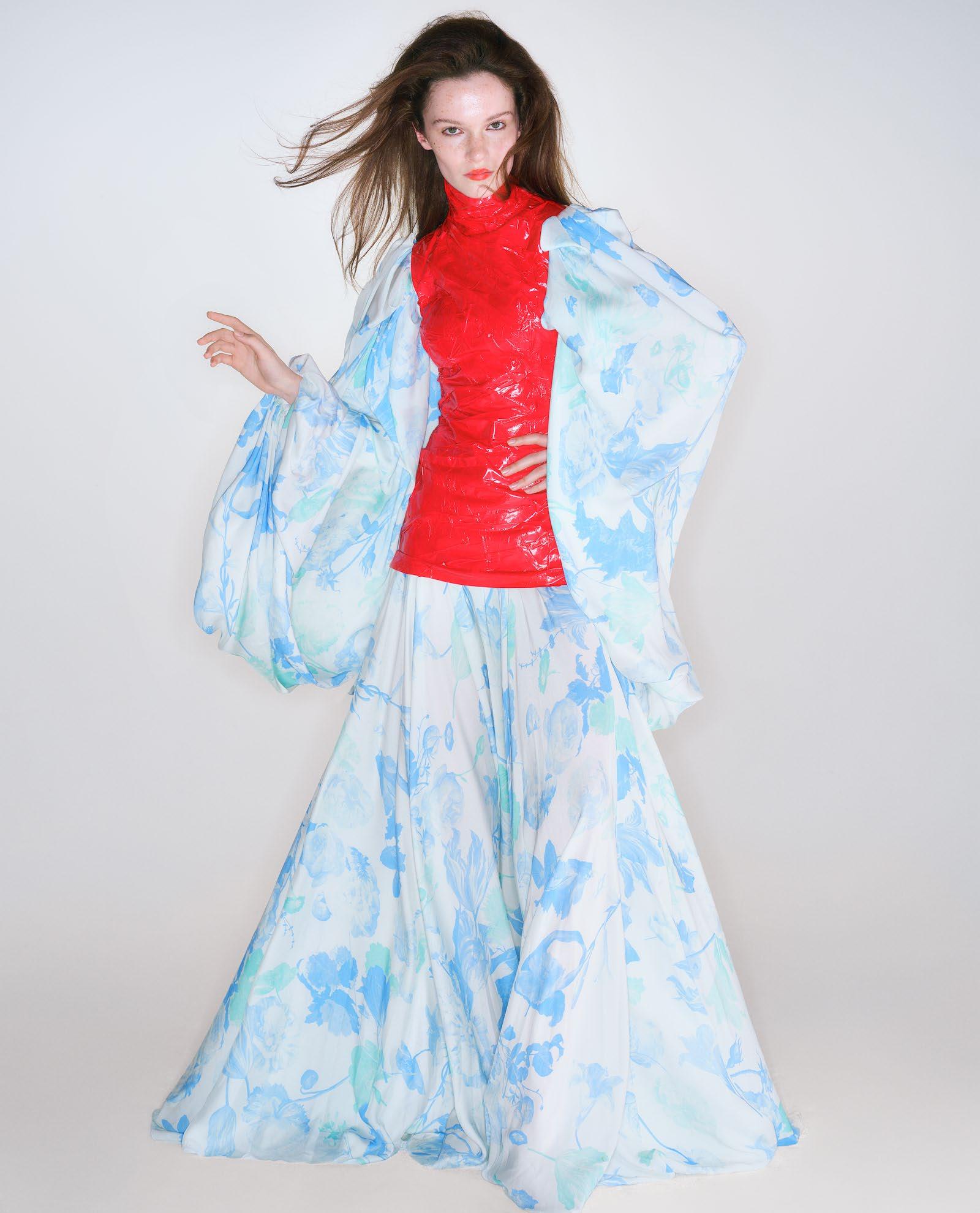
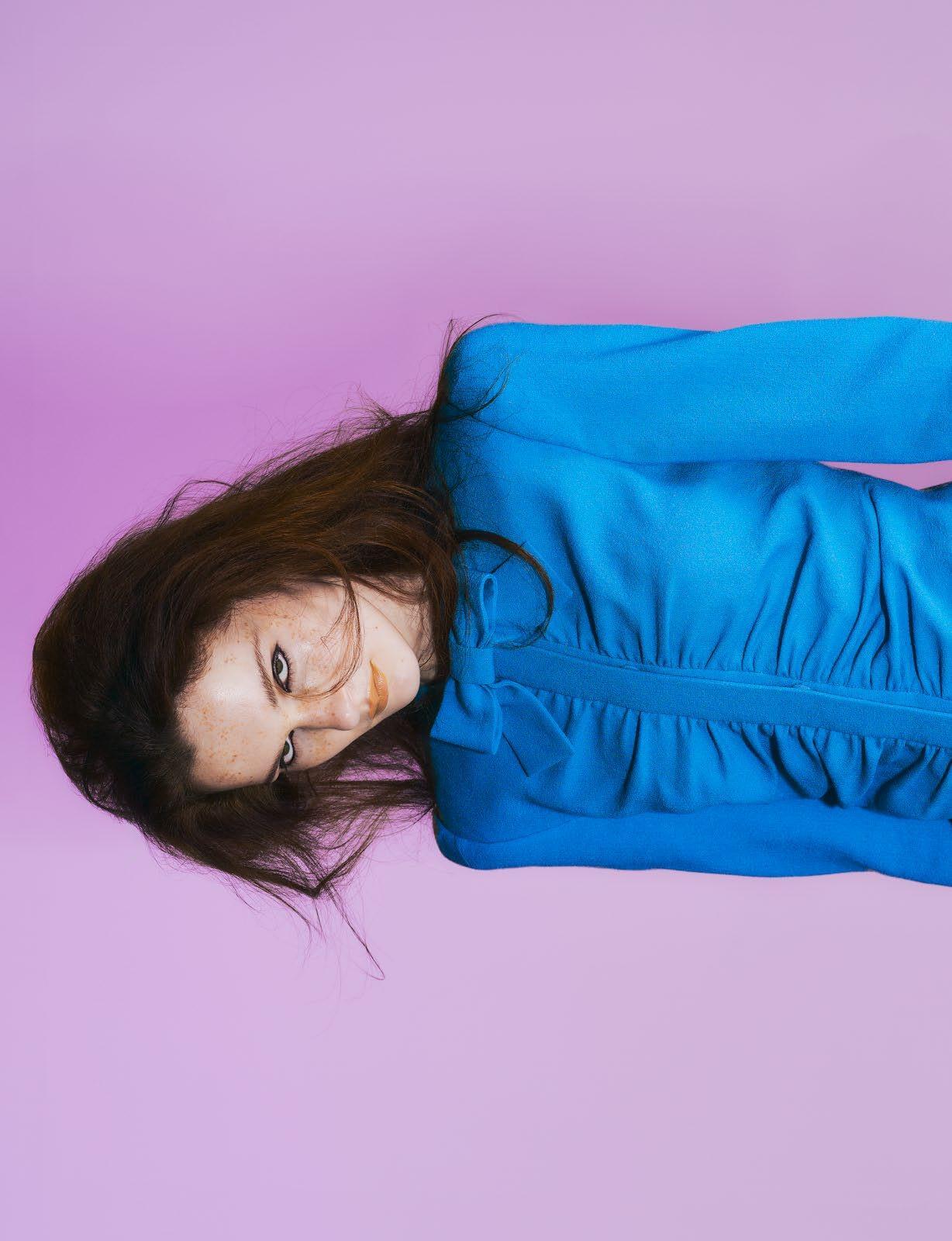
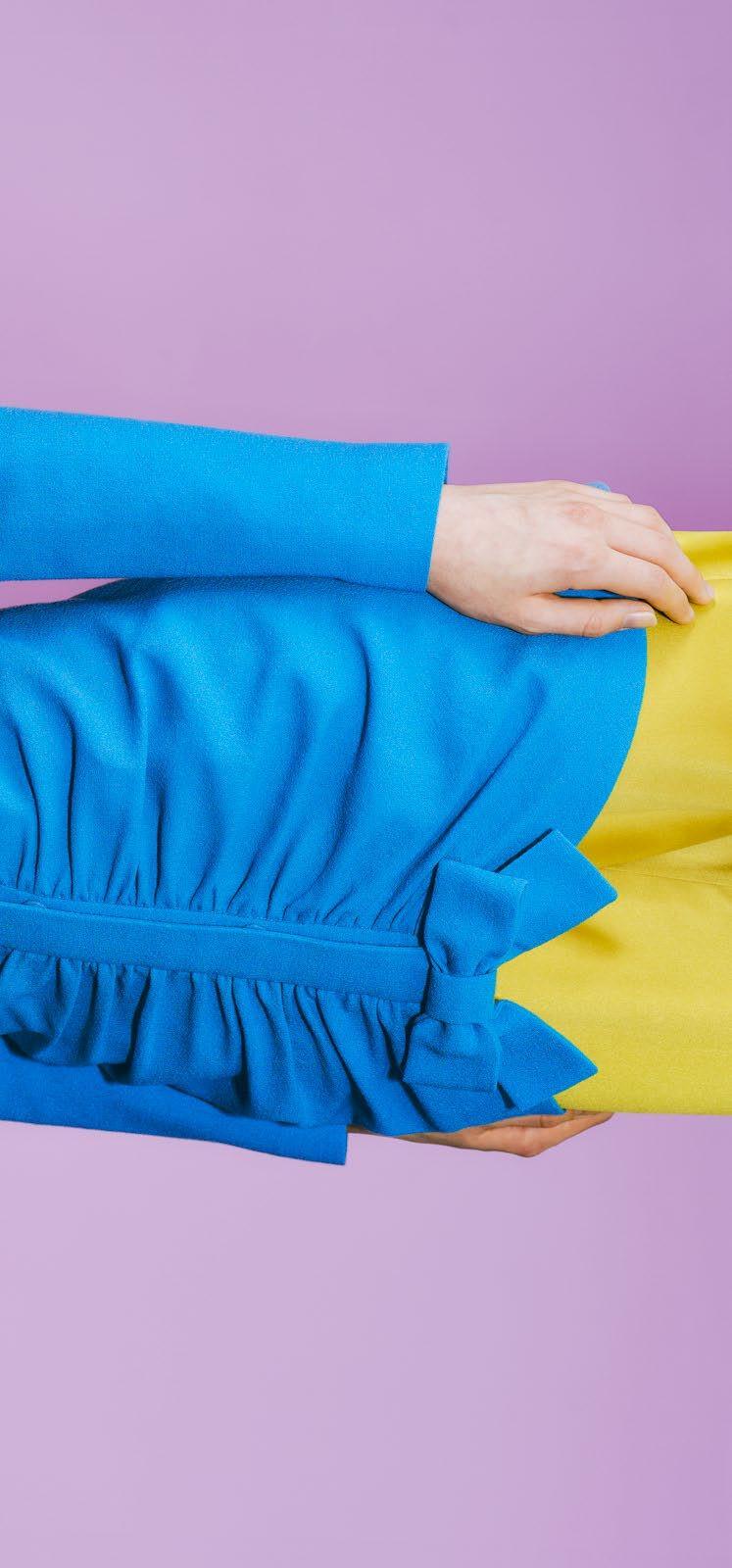
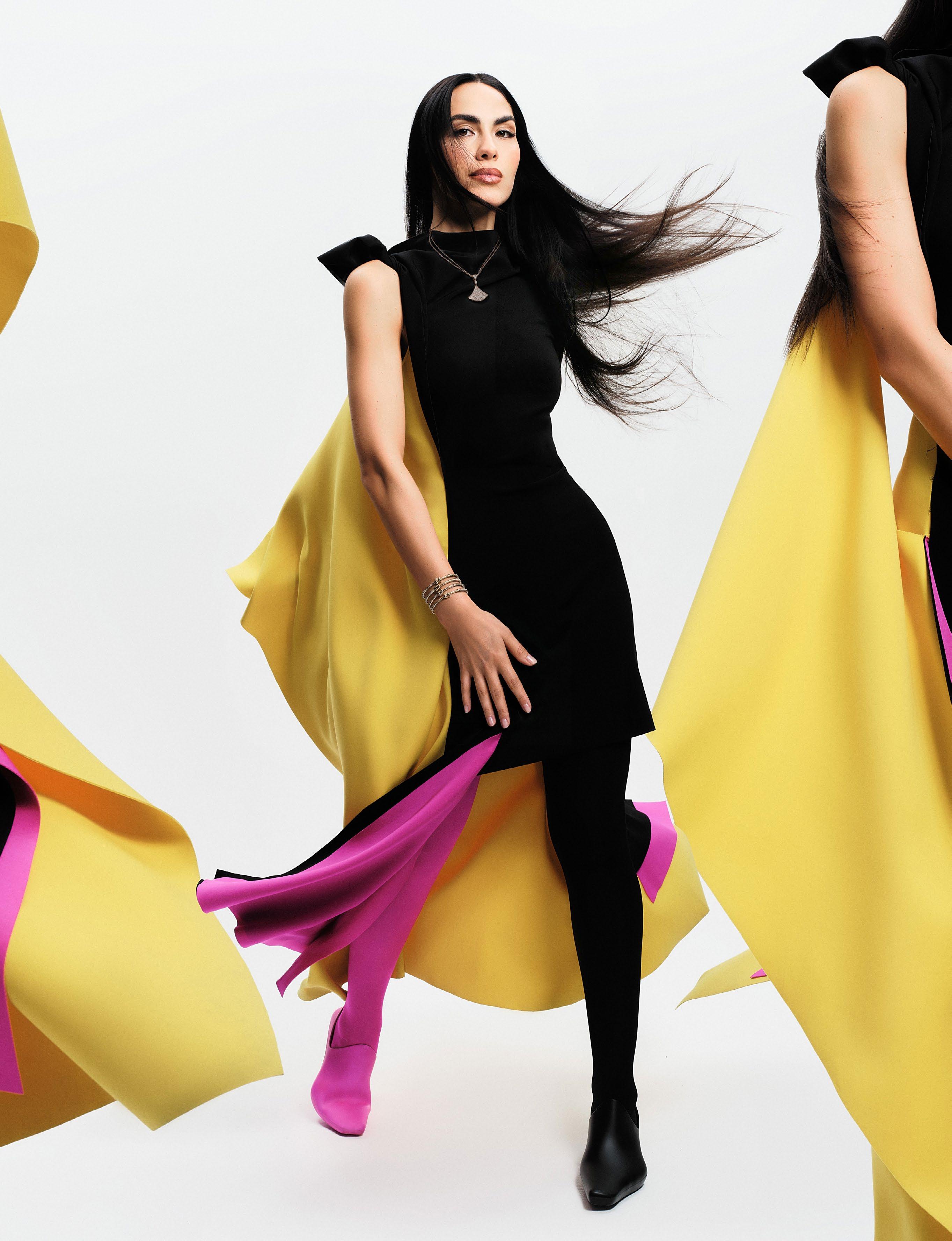
Before fashion was photographed, it was drawn. Illustrated taps into that history, pulling from the graphic confidence of vintage fashion illustration and filtering it through the exaggerated, sculptural silhoue es currently shaping the SS26 season. The result is something that feels suspended between image and object, where clothes stop behaving like clothes and begin to resemble bold, graphic forms.
Here, colour, texture, and shape take centre stage. Unexpected pairings create visual tension, while sharp lines, dramatic proportions, and moments of negative space transform each look into a composition of its own. Less about dressing and more about construction, Illustrated explores what happens when fashion is reduced to its purest elements and is rebuilt as something altogether more striking.
full look, SAINT LAURENT
full look, DIOR
full look, GIVENCHY
full look, DIOR
dress, MAISON MARGIELA
blouse, trousers, VALENTINO
MARI KUNO ; hair HIROSHI MATSUSHITA ; producer
makeup
SVEA GREICHGAUER ; movement director
JOHN MOURATIS ; casting director
MAXIMILIAN MCKAY ; digi op CHLOE YATES ; models
ANGELICA WOLANSKA ; dop
LILLY GOUMET , NYARACH AYUEL ; lighting assistant ALI MOHAMED ; styling assistant HARRY LANGFORD ; hair assistant NATSU TOMONAGA
COVER STORIES
SALMA ABU DEIF ON FIGURING OUT WHO SHE IS
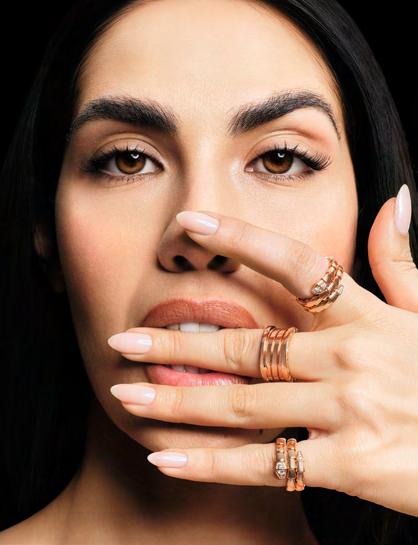
Wearing BVLGARI, the Egyptian actress sits with YUNG to discuss presence, perception, and why she has no desire to perform.
photography GREG ADAMSKI
styling AHMED RASHWAN
words MAI EL MOKADEM
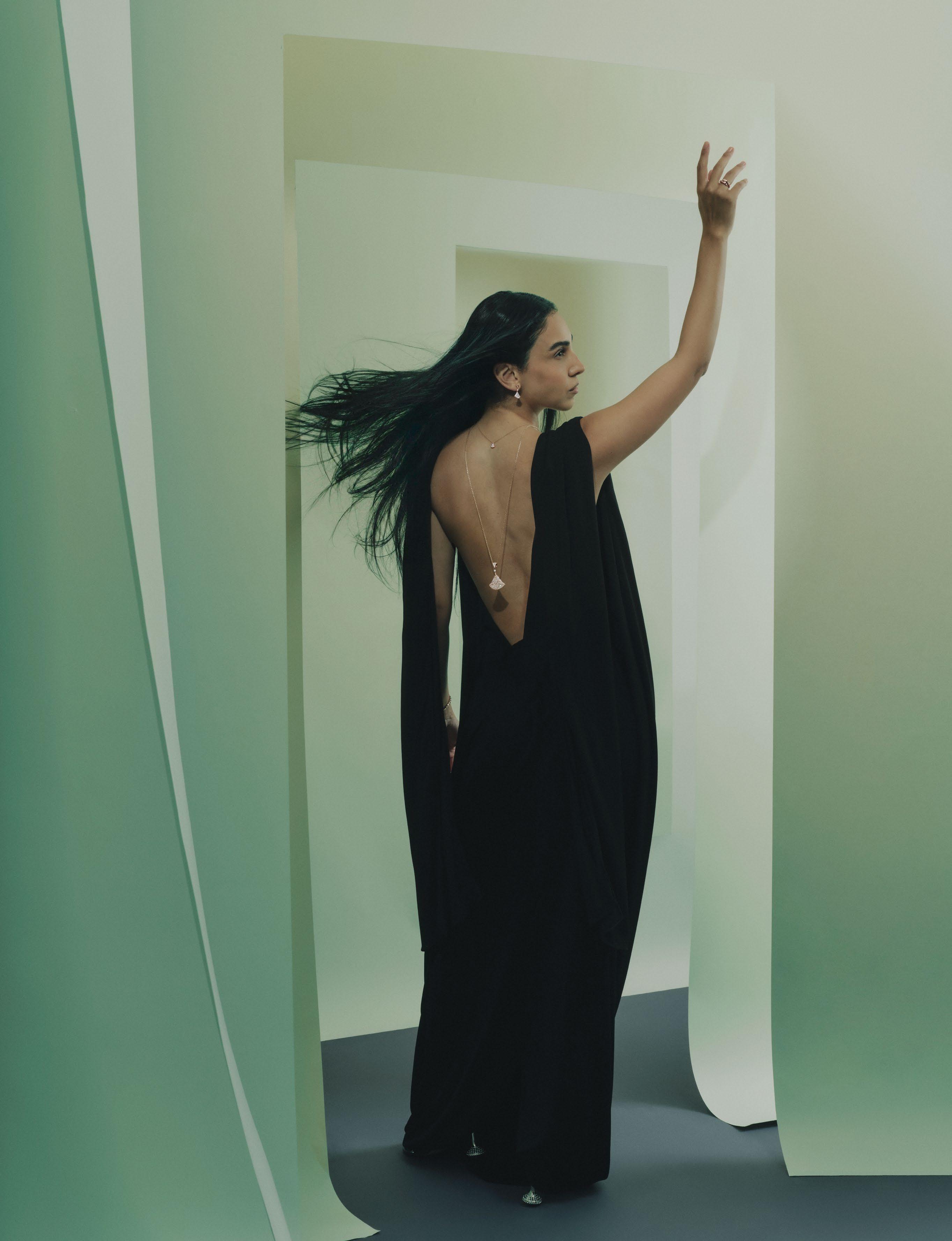
dress, LOEWE
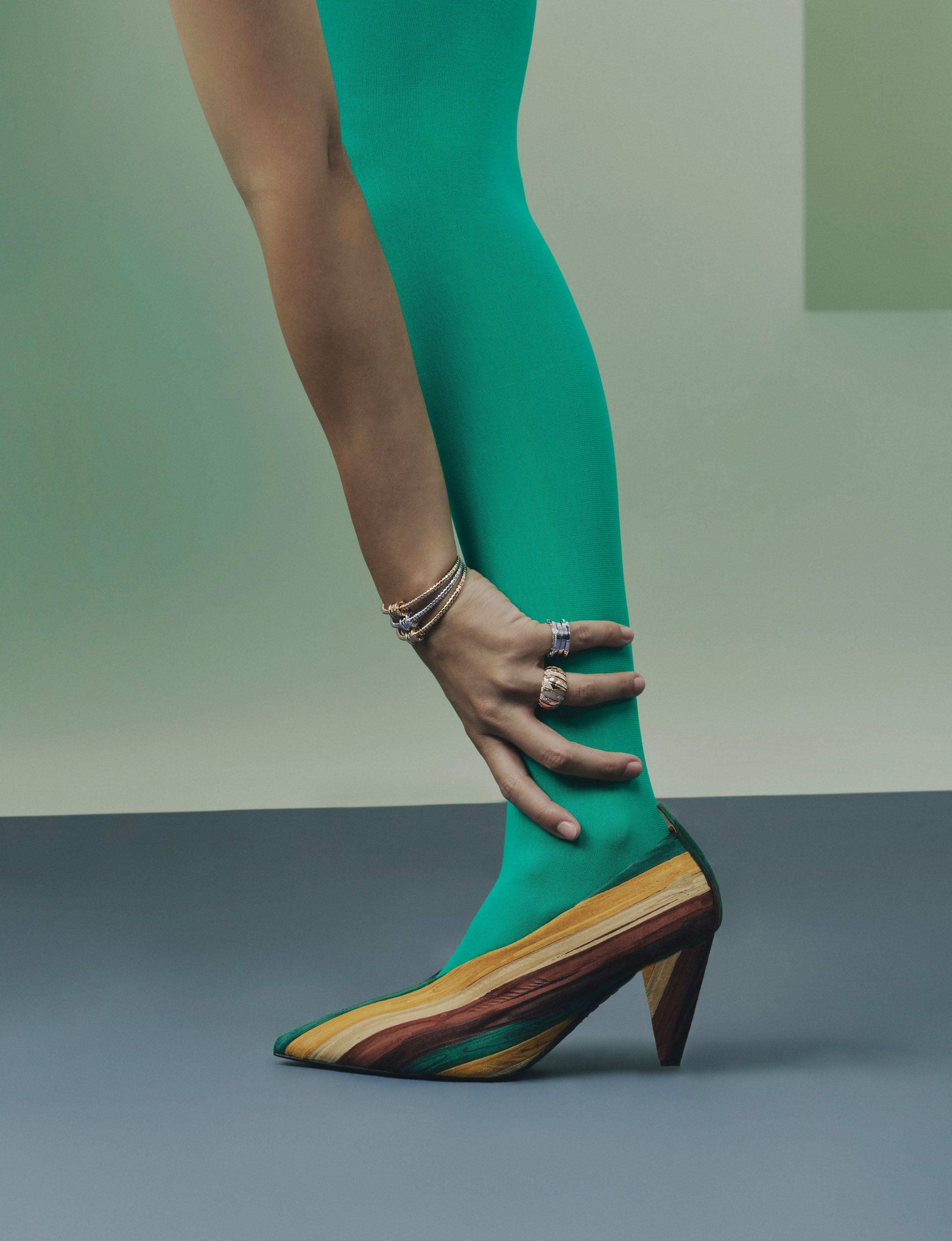
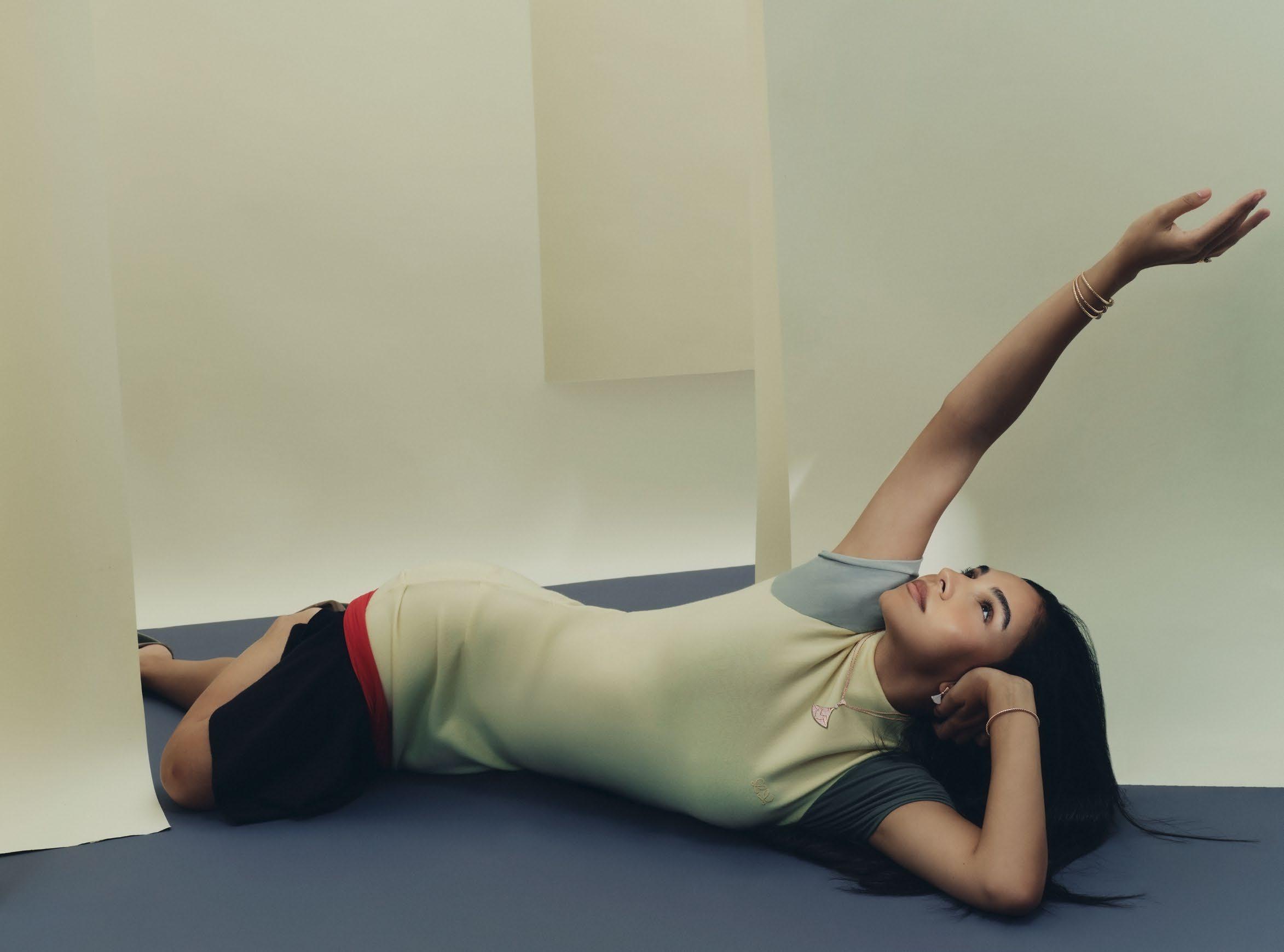
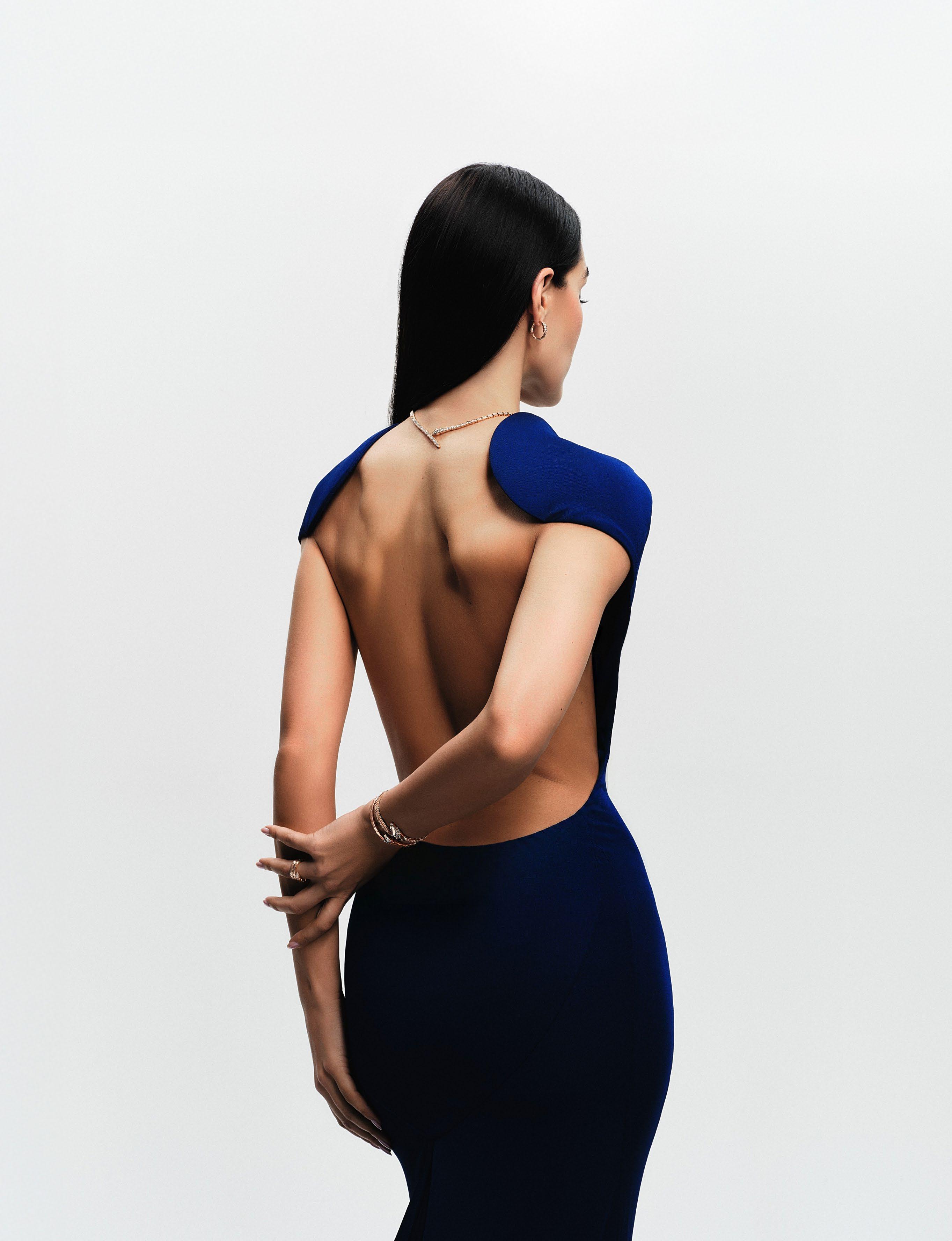
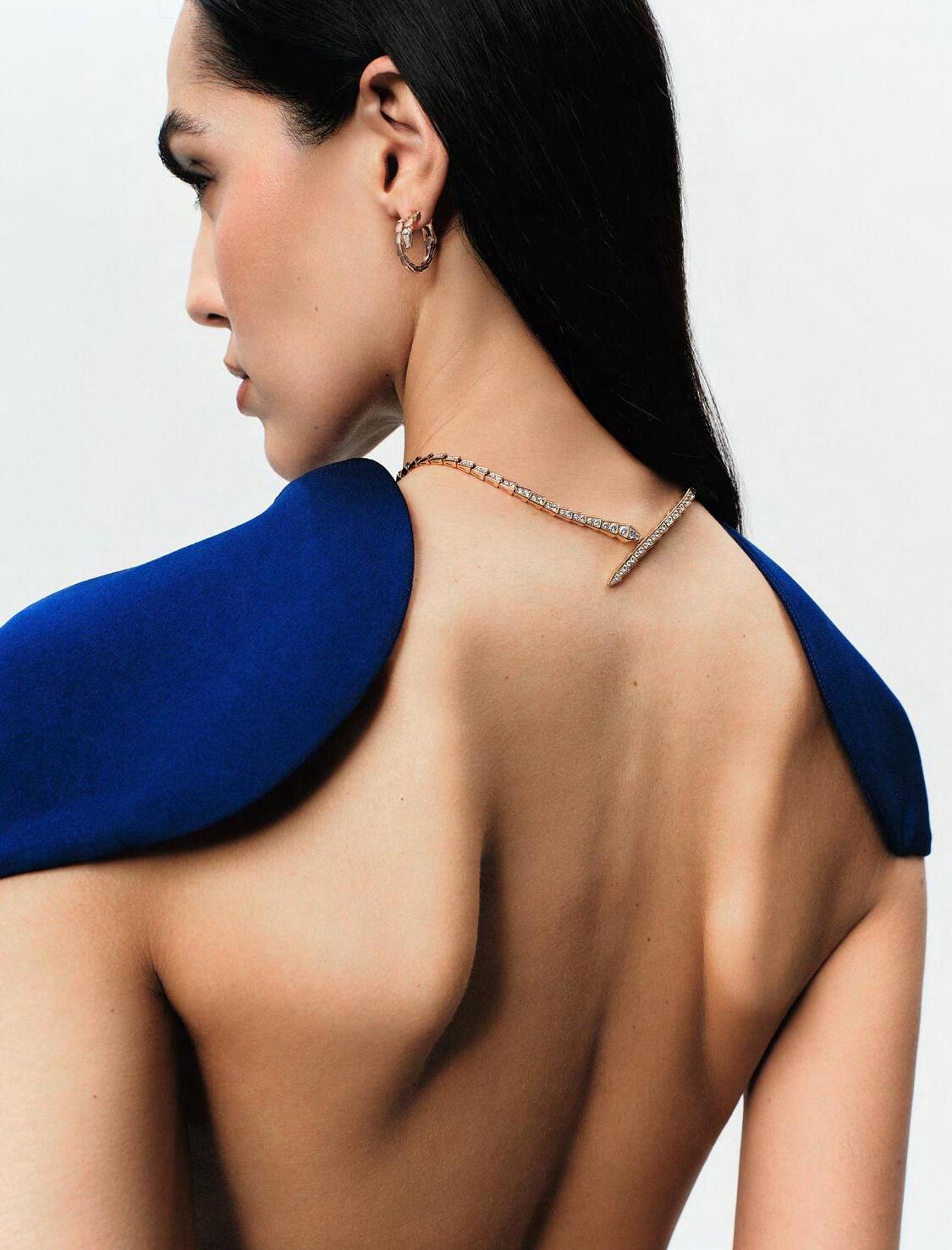
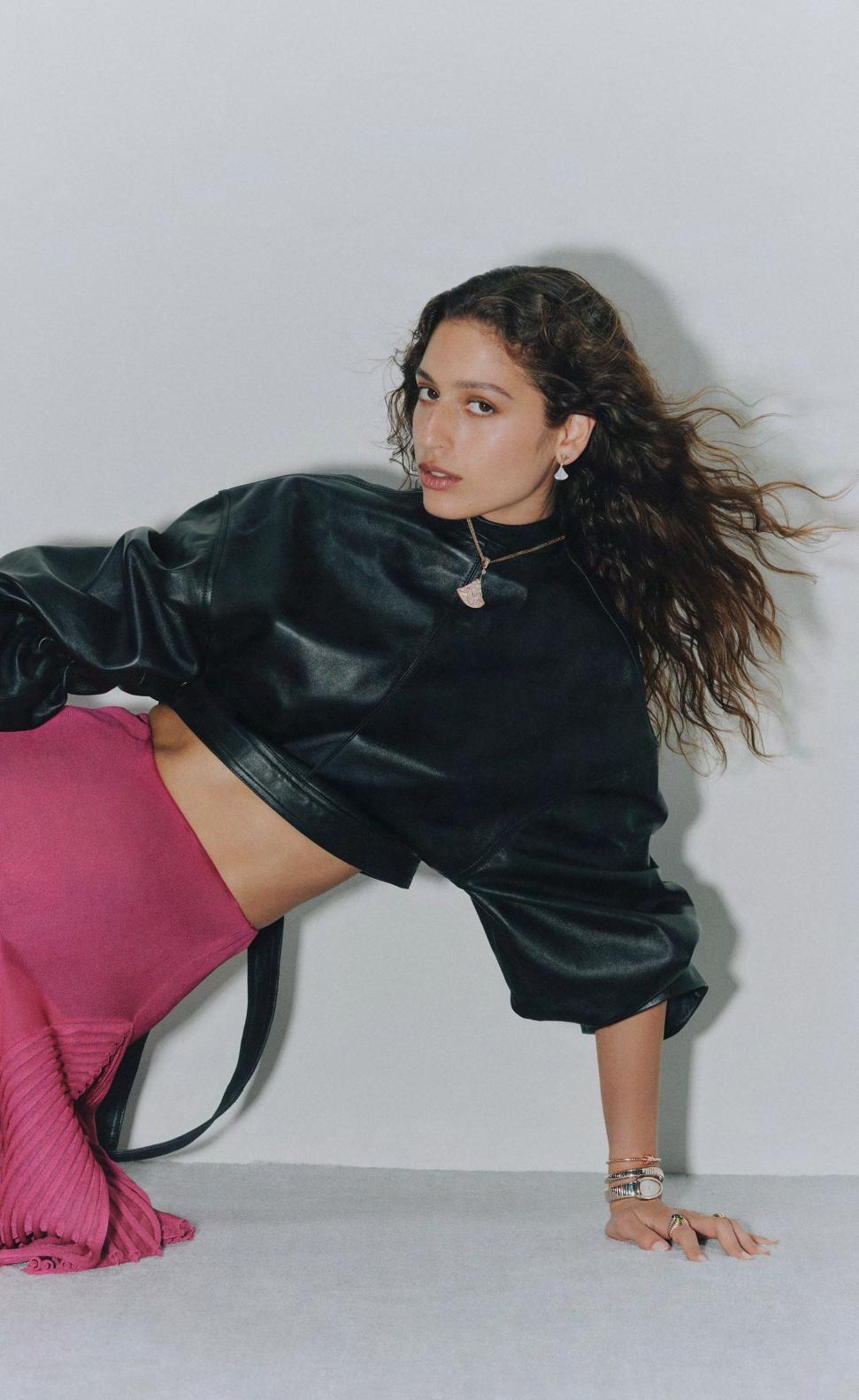
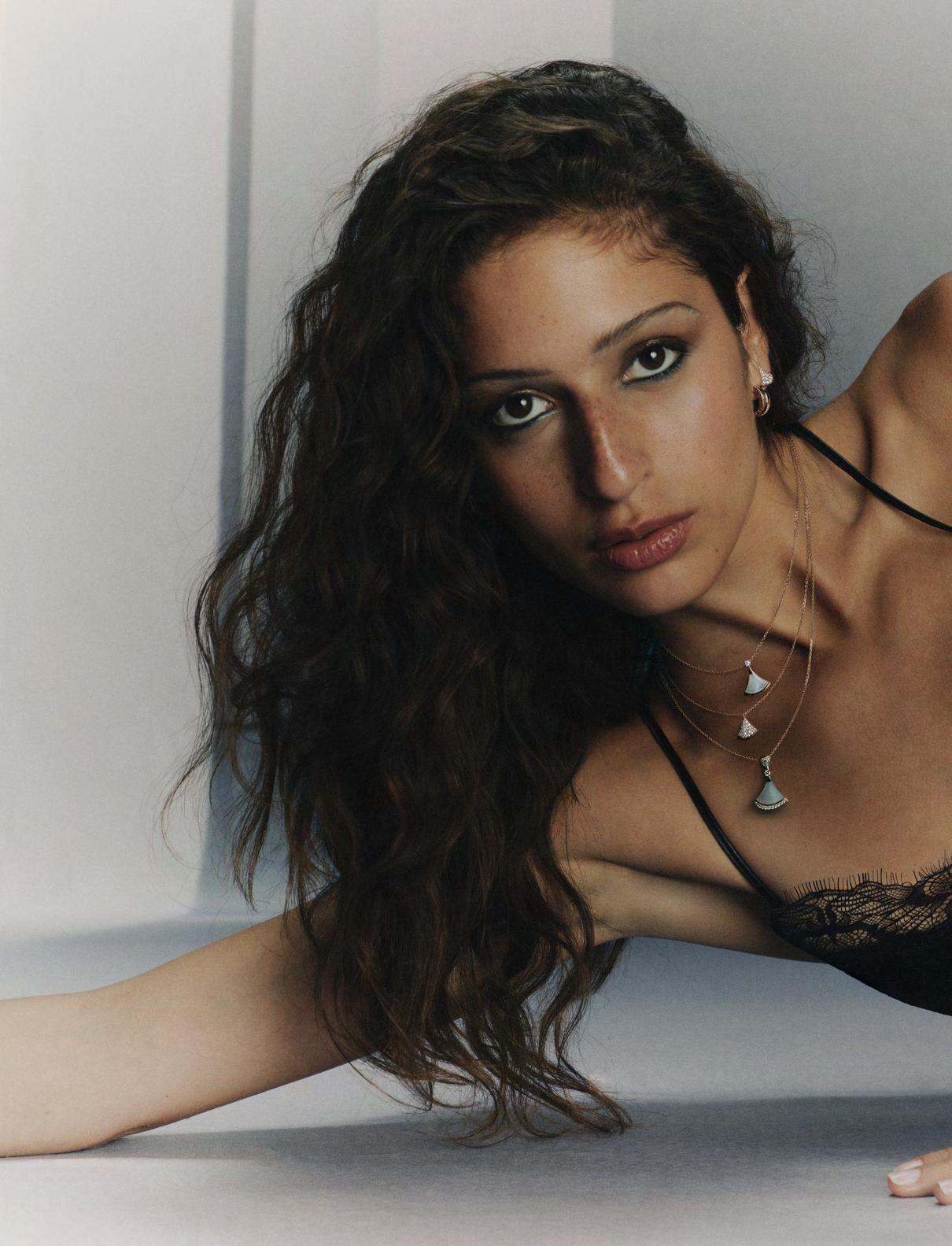
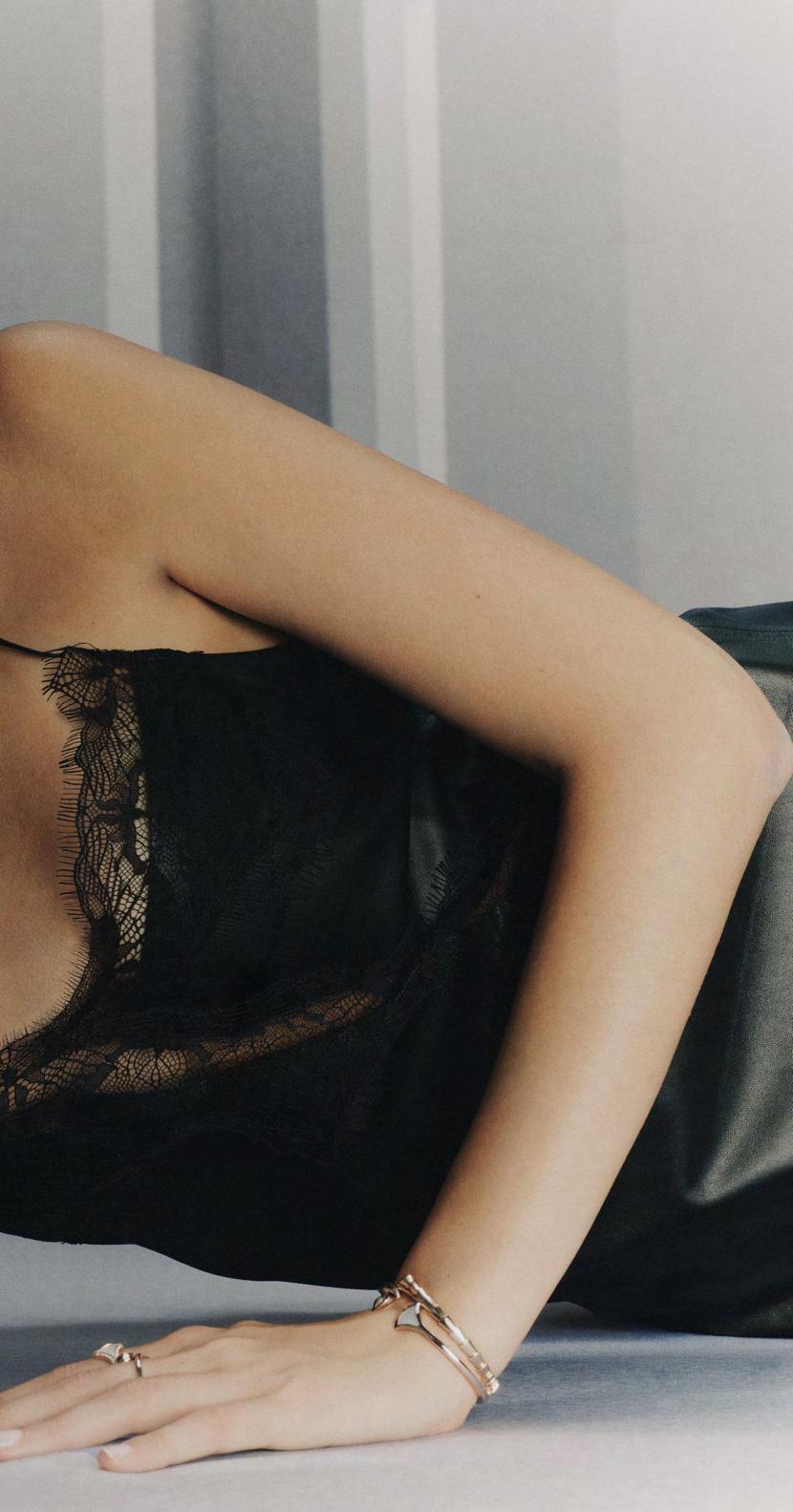
necklace, Divas' Dream, rose gold and diamonds necklace, Divas' Dream, rose gold with diamonds earrings, Divas' Dream, rose gold with mother-of-pearl and diamonds ring, Serpenti Viper ring, rose gold with diamonds BVLGARI
Salma Abu Deif is opting out in a landscape where celebrity is usually measured by how much you’re willing to leak. To the public, she is a constant: the face of Loewe in the region, a clear voice for social causes, and the lead of heavy-hitting dramas like A’la Nesbet Moshahda, and films like Ezma, Egybest and Sheikh Jackson. But to her, the "Salma" we see is merely the art she chooses to lend us. Everything else is sacred.
"I would rather be on the news for my work," she says, her voice carrying a steadiness that seems to have solidified as she transitioned from her 20s into her 30s. "If I share more, I feel like it’s stolen from me." This boundary is a survival mechanism for a woman who has spent years being a vessel for other people’s stories, not a PR strategy. “This is why I prefer to do very limited interviews,” she says.
Before accepting a role, she imagines herself fully inside the script, interrogating its emotional truth. "Does the story make sense to me? How true can it be to reality?" If that gut-check fails, she walks away without a second thought. There is a fatalism in her career choices—a belief that this is rizq. "I never regre ed turning down something. No ma er what, it just wasn't mine."
When she does say yes, the process is almost meditative. To "disappear" into roles like the one in 2026 Ramadan’s 15-episode series Ard Wa Talab, Abu Deif relies on a cocktail of instinct and physical discipline, working closely with directors on breathing and grounding techniques. It’s a delicate balance of bringing her own beliefs and emotions to a role while ensuring the character doesn't consume her. "You separate from who you are and the character you’re playing, just to be in the moment," she explains.
Abu Deif recalls the intense, contained environment of Ard Wa Talab, where the emotional weight of playing a morally complex character like Heba, became so heavy, she had to physically separate herself from the role. "I was telling myself: This is not real. I’m Salma and this will be over. I take a moment away from everybody and stabilize."
In Abu Deif’s eyes, acting, in a way, is a projection of a mindset. "Every artist—actor, director, writer—brings their emotions, thoughts, and beliefs onto the story." By rejecting roles that don’t speak her mind and seeking out the rare "gi " of a good script, she is levelling up her game by staying picky. In her world, if it doesn't speak to her, she doesn't want to do it. Period.
Abu Deif’s career trajectory has been a lesson in learning to trust her gut—a lesson she admits she had to learn the hard way. "Every time I didn’t trust my gut feeling, I regre ed it. Until I learned the hard way: I need to listen to it." That intuition now dictates her refusal to be typecast or to accept roles that frame women as secondary ornaments.
Ironically, it took a blunt encounter with a famous international actor at a fashion event years ago to crystallize her self-belief. When she told him she didn’t think she was a good actress, his response was a sharp wake-up call. “If you think of yourself like that, I don’t know what to tell you.” He didn’t sugar coat things to her, and it turned out to be exactly what she needed. “The encounter upset me at first, but when I humbled myself and reflected on it, I realized that if I keep seeing myself that way, then that becomes my reality,” she shares with YUNG. “It’s the Law of A raction. You have to believe in something before you can become it.”
While acting requires her to disappear—"The character wears me," she notes—fashion o ers her the rare chance to regain her own image. As Loewe’s first regional ambassador, she doesn't see the brand as a costume, but as a medium. "When I do fashion, I can go crazy, classic, elegant, whatever my mood is. Usually, with fashion, I do more me."
It’s a full-circle moment for the girl who used to dream of wearing the designer dresses she now commands on red carpets. Yet, even in the turbo-charged world of fashion weeks and flashing bulbs, her mind is o en elsewhere—specifically, on the legacy she is building for her daughter.
“THE CHARACTER WEARS ME."
dress, LOEWE
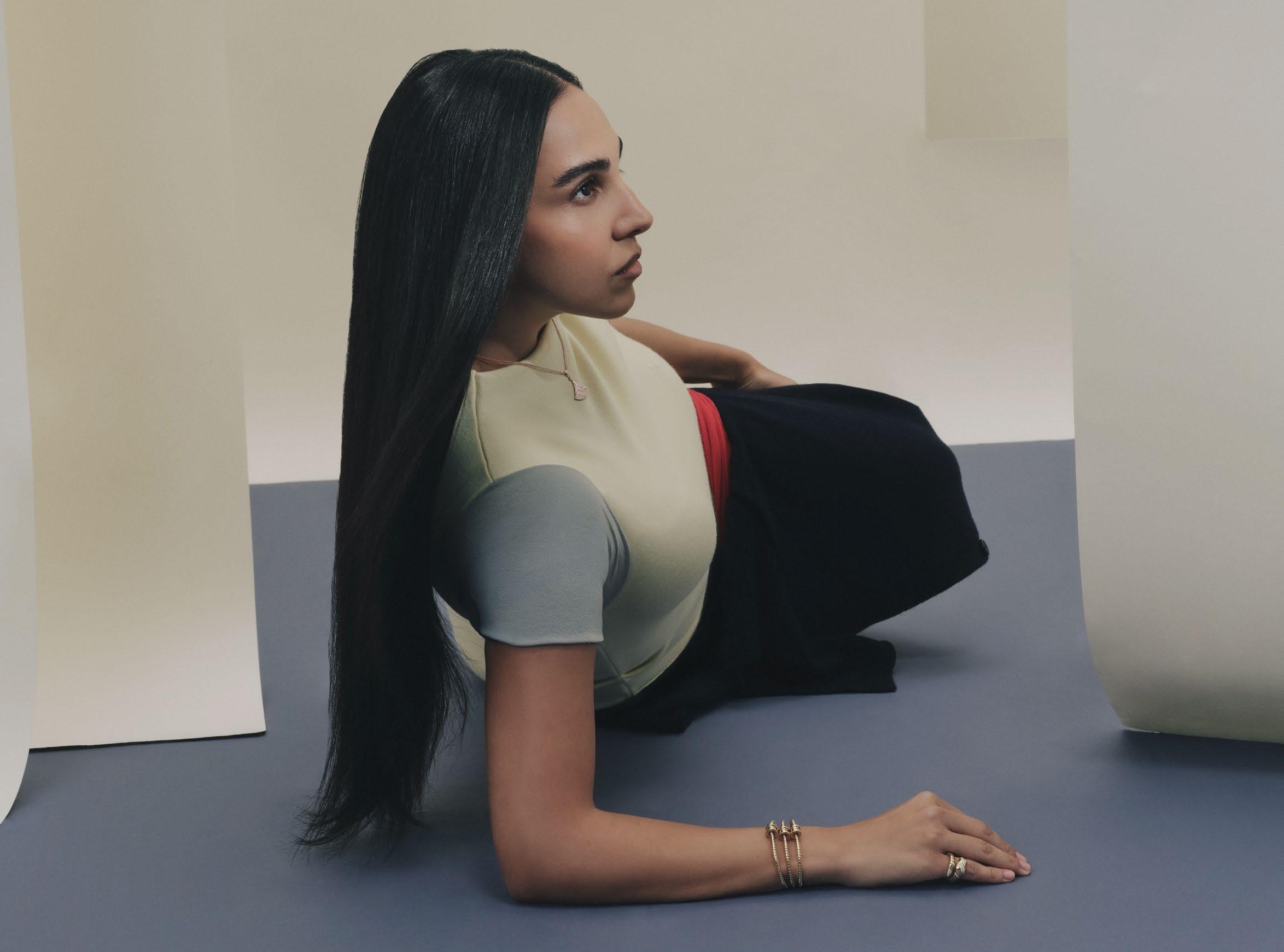
necklace, Serpenti, rose gold with diamonds and black onyx bracelets, B.zero1, yellow, rose and white gold ring, Divas' Dream, rose gold with mother-of-pearl and diamonds ring, Serpenti Viper, yellow gold with diamonds BVLGARI
top, skirt, heels, ALAÏA
necklace, Serpenti Tubogas, yellow gold with diamonds and black onyx BVLGARI
Motherhood, o en framed by the industry as a point of "stagnation," has had the opposite e ect on Abu Deif. It hasn't so ened her ambition. "Now I want to do work that my daughter would be proud of. Motherhood gave my ambition a bonus."
Abu Deif is not interested in roles that require her to be a "statement" for the Middle East. She is, however, advocating for a type of regional auteurism—stories that are local yet universally felt. "I want to play a human being, without any di erentiation in colour or religion," she explains. For her, the goal isn't just to be an Arab actor in a foreign film; it’s to export the Arab experience on its own terms. "I want to do something that speaks our voice, our mind, our language, and take it outside the region." It is a move away from
performative representation and toward a "blood and flesh" reality where her characters aren't shown through stereotypical rose-coloured-sunglasses.
This insistence on authenticity extends to the Egyptian industry itself. The actress is vocal about the conversations the industry has historically avoided—domestic violence, harassment, and the voices that haven't been heard yet. While she acknowledges the progress made in recent years, she views her work as a continuous push toward these un-told stories. For Abu Deif, the international stage isn't a destination to reach; it’s a by-product of being herself in her own language.
She admits a preference for working
“I enjoy working with women directors because I feel there’s usually a deeper emotional understanding there,” she explains. “But honestly, for me, it’s more about empathy. An empathetic, well-read, emotionally intelligent director or writer — someone who really understands people— that’s the perfect combination.” top, skirt, ALAÏA necklace, Serpenti Tubogas, yellow gold with diamonds and black onyx bracelet, B.zero1, yellow gold bracelet, Tubogas, yellow gold with diamonds watch, Serpenti Sedu ori (33mm), stainless steel, yellow gold with white silver opaline dial, quartz movement, waterproof 30m ring, Serpenti Tubogas, yellow gold with diamonds and black onyx ring, B.zero1 three-band, yellow gold BVLGARI
with emotionally intelligent directors who understand the nuances of human behaviour without a "misogynistic lens”, highlighting the depth that comes when a director can truly put themselves in another person’s shoes. It’s this discipline—the ability to disappear into a role while maintaining the mental fortitude to tell herself this is not real—that has allowed her to navigate the most intense scripts without burning out.
"NOW I WANT TO DO WORK THAT MY DAUGHTER WOULD BE PROUD OF. MOTHERHOOD GAVE MY AMBITION A BONUS."
dresses, NOON by NOOR
necklace, Divas' Dream, rose gold and diamonds necklace, Divas' Dream, rose gold with diamonds ring, Divas' Dream, rose gold with mother-of-pearl and diamonds bracelets, Serpenti Viper, rose and white gold with diamonds BVLGARI
stockings, STYLIST'S OWN shoes, LOEWE
bracelets, B.zero1 in yellow, rose, and white gold ring, B.zero1 in white gold with pavé diamonds ring, Tubogas, yellow gold with diamonds BVLGARI
"I DON’T WANT VALIDATION FOR WHO I AM,
JUST MY ACTING OR WORK. "
dress, LOEWE earrings, Divas' Dream, rose gold with mother-of-pearl and diamonds bracelets, B.zero1, rose, yellow and white gold ring, Serpenti Tubogas, yellow gold with diamonds and black onyx
BVLGARI
IS YUNG 62-63
jumpsuit, ALAÏA
earrings, Serpenti Viper, yellow gold with diamonds necklace, Serpenti Tubogas, yellow gold with diamonds and black onyx BVLGARI
She pauses before adding that female writers and directors sometimes bring a particular sensitivity to emotional nuance and inner worlds. “Women o en understand emotions differently,” she says. “When you’re writing a female character especially, it takes someone who genuinely understands feelings and emotional complexity to make that feel truthful.”
There is a kind of clarity that arrives with one’s thirties. While her twenties were a "phase of discovering and going with the flow," her current decade has demanded a more substantiated, sometimes uncomfortable, introspection. "In my thirties, I’m more grounded," she says, before adding with striking candour, "some parts I met in my twenties, I didn't like."
It is a rare admission in an industry constructed on the curation of perfection. Just as she learned in acting school never to judge a character—to seek the motives behind even the most morally uncomfortable roles—she is now applying that same non-judgmental lens to herself. By refusing to distance herself from her own shadow sides, she has found a deeper sense of internal peace. "I don’t like to present anything to anybody... I like to be myself, for me, and still stick to myself."
This internal foundation is what allows her to navigate the strenuous world of global fashion and celebrity without losing her axis. She has stopped seeking validation for who she is, and redirected that need toward her work. "I don’t want validation for who I am," she insists, "just my acting or work." It’s a distinction that protects her spirit; by keeping her "private and sacred" parts off-limits, she ensures that even when the spotlight is at its brightest, the most authentic version of Salma Abu Deif remains entirely her own.
Validation is the industry’s primary currency, but she refuses to be spent by it. She doesn’t subscribe to the celebrity myth of not reading the comments. Abu Deif, instead, approaches her audience with a mix of genuine intimacy and ironclad discipline. While her peers claim total digital abstinence to stay sane, she admits to looking for feedback —she just does it from behind a psychological shield.
"I think fans and people who watch are very smart," she observes. "They’re well-read, watch a ton, and get alive from art itself."
This respect for the viewer’s intellect is why she values constructive criticism; she knows that a truly engaged audience can spot the authenticity of a "human behaviour" in a scene. She even recognizes the handles of long-time followers who have been with her since the start, acknowledging the time they give her with a sense of genuine gratitude.
However, she has also mastered the art of the emotional filter. She recognizes that the vitriol found in comment sections is rarely about her work and more about the person behind the screen. "Some people write stu if they had a bad day," she reflects. By categorizing certain negative noise as a "projection" rather than a personal failing, Abu Deif maintains her equilibrium. She seeks validation for the work, not for her existence. This highlevel emotional intelligence allows her to stay connected to her community without being consumed by it. For her, the audience is a partner in the storytelling process, but they aren't the authors of her self-worth.
These days, she’s proving to herself—and to the daughter watching her grow—that you can be a good person and a powerhouse at the same time. As she looks toward her upcoming cinema releases and new TV roles, she does so with the confidence of someone who knows that even if the spotlight disappeared tomorrow, the woman standing in the centre of it would remain unchanged.
While Abu Deif presents as a picture of composure, there is an internal storm that she has learned to harness rather than suppress. "I get addicted to performing under pressure," she admits, a revealing look into the psychological engine that drives her most intense roles. This isn’t the celebrity "I love my job" platitude; it’s a raw acknowledgement of the physiological toll of the cra
She describes a nervous system that thrives on the edge—where the stress of a major scene or the chaos of a set becomes a form of fuel. “I can’t control my impulses or emotions,” she admits. “What I feel, I say.” It’s perhaps this exact openness — this resistance to over-curating herself — that makes Abu Deif feel compelling both on-screen and o . It is in these moments that she finds her "truth," even if it means losing her temper or feeling stressed to an extreme.
"Your mind is here and there, and here and there," she exclaims, describing the frantic mental state right before a major moment. But for Abu Deif, that sca ered energy ends up being the catalyst. It’s the di erence between a performance that is strictly "correct" and one that is electrically alive. By leaning into the pressure, not running from it, she has turned her anxiety into an understanding of exactly how to navigate the eye of the storm.
Behind the "sneaky questions of journalists" and the cha er of public opinion, Abu Deif remains a woman who is still discovering her own layers. She is comfortable being in between—neither overexposed nor out of the picture. Success, she concludes, isn't found in the headlines she avoids, but in the healthy, stable life she returns to once the cameras are o . It’s the fact that a er the cameras stop and the Loewe dress is tucked away, she is still exactly who she intended to be.
If everything she’s built were to disappear tomorrow, Abu Deif is confident that the core of her—that inner child who remains unshaped by the industry—would stay perfectly intact.
"I WANT TO DO SOMETHING THAT SPEAKS OUR VOICE, OUR MIND, OUR LANGUAGE, AND TAKE IT OUTSIDE THE REGION.”
jacket, LOEWE earrings, Serpenti Viper, yellow gold with diamonds
dress, shoes, LOEWE
bracelets, B.zero1, yellow, rose and white gold necklace, Divas' Dream, rose gold with diamonds earrings, Divas' Dream, rose gold with mother-of-pearl and diamonds ring, Serpenti Tubogas, yellow gold with diamonds and black onyx BVLGARI
hair; SEBASTIAN ISKANDER; makeup JULIA RADA; styling assistant AGNES ROSENBECH; lighting assistant MOHAMMED JAZIM
SANDY BELLA ON BECOMING HER OWN MEASURE
Beyond perception and into process, the actress and model, wearing BVLGARI, steps into a sharper, more intentional version of herself.
photography JACK CHIPPER
styling IGNACIO DE TIEDRA
words NADINE KAHIL
full look, LOEWE necklace, Divas' Dream, rose gold with diamonds bracelets, B.zero1, rose, white and yellow gold BVLGARI
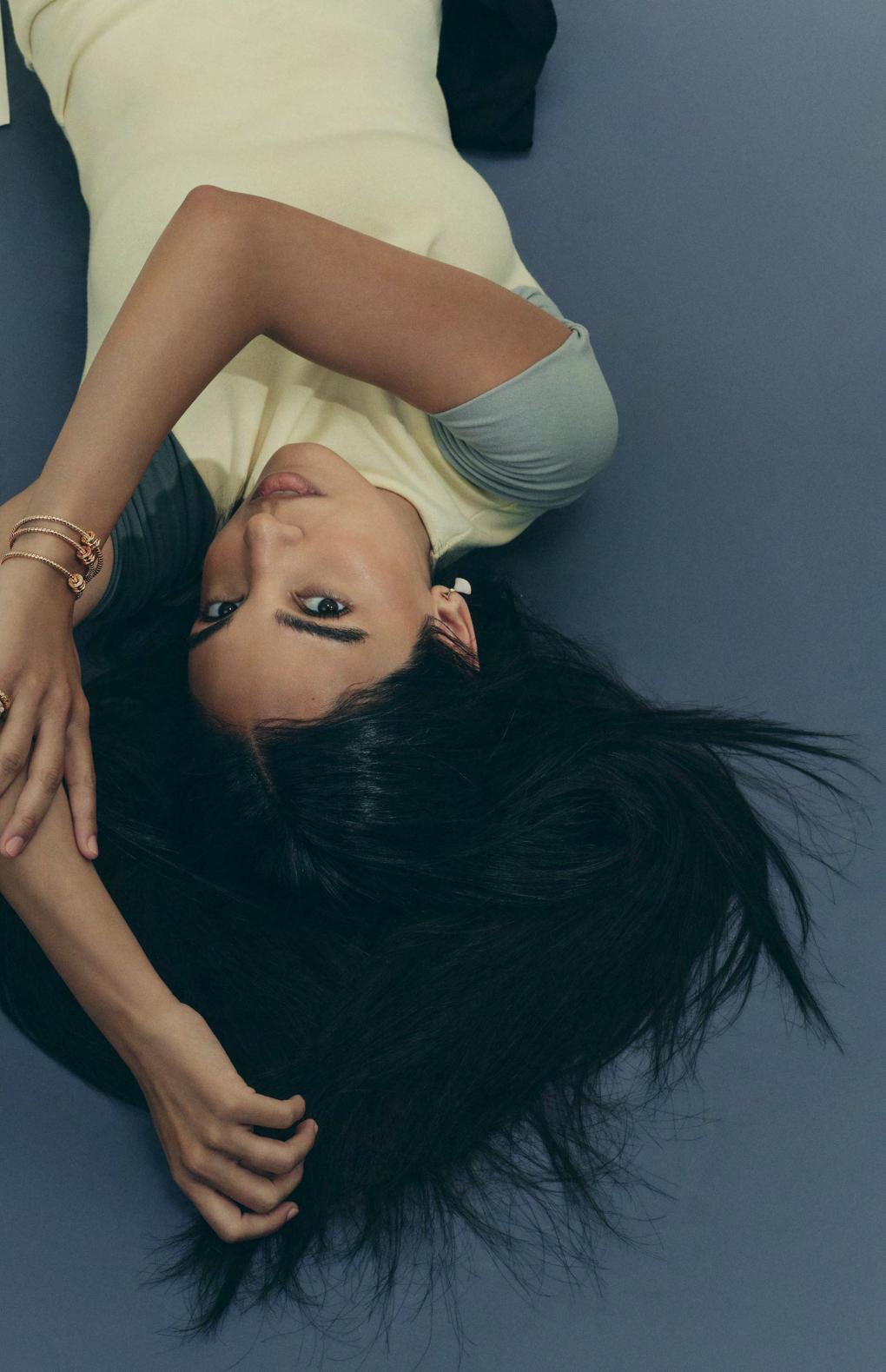
ring, Serpenti Viper two-coil, rose gold with diamonds bracelet, Serpenti, rose gold with diamonds and black onyx bracelet, Serpenti Viper, rose gold with diamonds bracelets, B.zero1, rose and yellow gold BVLGARI
“I’M
NOT INTERESTED IN BEING REDUCED TO A SINGLE IMAGE, I’M BUILDING SOMETHING DEEPER,
SOMETHING THAT REFLECTS WHO I TRULY AM.”
Known for her role in Franklin, and the recently launched 7 Dogs, there is a version of Sandy Bella that people think they understand. It lives on the surface, in images, in quick impressions, in the quiet assumptions made before she has even spoken. But that version, the Lebanese actress makes clear, is incomplete. What exists behind the surface is something far more deliberate, built over time through discipline, repetition, and a refusal to be reduced to a single frame. “I’m someone very disciplined and focused,” she says. “People see the surface, but behind it there’s a lot of work, consistency and intention in everything I do.”
It is this insistence on depth, on process over perception, that defines where she stands today. She’s no longer reacting to an industry, she’s slowly shaping her place within it.
Sandy Bella moves between modelling and acting, but the distinction between the two is becoming clearer. Modelling introduced her to visibility, to presence, to the language of the image. Acting, however, is where she feels something shi internally, where expression moves beyond aesthetics and into something more layered. “Modelling is part of me, it’s how I got here,” she explains, “but right now acting feels more real and allows me to express myself more.”
That sense of “more real” is not about abandoning one world for another. It is about evolution. Modelling remains part of her identity, but acting o ers a di erent kind of honesty, one that requires her to confront herself, to understand emotion, to hold space for complexity. It is not about being seen, but about being understood.
And understanding, for Bella, is tied to intention. There is a clarity in the way she approaches her career now, one that resists urgency in favour of direction. She is not chasing visibility for its own sake. She is building something, piece by piece. “I’m focusing on building my career step by step,” she says. “I also never stop working on myself, I want to be good at everything.”
It is a statement that could sound simple, but it speaks to a deeper philosophy. Growth, for her, is not passive. It is active, continuous, and o en unseen. It happens in the quiet moments, in preparation, in the decisions that never make it to the final image or the final scene. “I’m thinking long term, not just quick moments,” she continues. “I don’t want to be seen just for the sake of being seen.”
That resistance to immediacy, to the fast pace of visibility that defines much of the industry, is what sets her apart. She is not interested in fleeting recognition. She is interested in permanence, in building a body of work that reflects who she is becoming, not just who she appears to be.
dresses, FLORENTINA LEITNER
earrings, B.zero1, yellow gold with diamonds necklace, Serpenti Viper, in yellow gold with diamonds bracelets, B.zero1, rose, yellow and white gold ring, B.zero1 four-band, rose gold BVLGARI
Her role in Franklin marked an important point in that journey. Not because of what audiences saw, but because of what it demanded from her behind the scenes. “Honestly, it’s the work behind it,” she says when reflecting on the experience. “It made me respect the process even more and understand how much work goes into every scene.”
It is a shi that many actors describe, but for Bella, it became a kind of foundation. A realization that performance is only a fraction of the story. That what shapes a role happens long before the camera starts rolling.
That awareness has changed the way she sees herself on screen. Not just in terms of confidence alone, but in also possibility. “Yes, it made me more aware of my potential and also more critical, in a good way,” she explains. “I see where I can push more now.”
There is something important in that phrasing, “critical in a good way.” It speaks to a kind of self-awareness that does not paralyze, but propels. A willingness to question, to refine, to demand more from herself without losing sight of what she has already achieved.
If Franklin was about understanding the process, 7 Dogs was about testing her limits. From the moment she encountered the project, there was an instinctive pull. Not toward comfort, but toward challenge. “The energy of the project,” she says when asked what drew her in. “It felt bigger, more intense, with real responsibility, and aligned with the kind of roles I want.”
That sense of scale, of weight, is something she actively seeks. Not because it is easy, but because it forces growth. And growth, for Bella, seems to come most clearly when she is pushed beyond what feels familiar. “Proving myself on this project was no joke,” she adds.
There is no a empt to so en the experience. 7 Dogs demanded more from her, not just as an actress, but as a person navigating an environment where expectations were high and the margin for hesitation was small. “Being the only ‘new girl’ alongside such big names felt like a challenge in itself,” she says of starring alongside the likes of Karim Abdel Aziz, Ahmed Ezz and Monica Bellucci. “Like people were counting on me, and I had to rise to it.”
That pressure, rather than intimidating her, became a catalyst. A moment where discipline met opportunity, where preparation had to translate into presence. It is in these spaces, where comfort disappears, that her approach reveals itself most clearly. She does not retreat. She adapts.
“I’M THINKING LONG TERM, NOT JUST QUICK MOMENTS. I DON’T WANT TO BE SEEN JUST FOR THE SAKE OF BEING SEEN, I WANT TO BUILD A CAREER THAT HOLDS MEANING, SOMETHING THAT LASTS BEYOND THE SURFACE AND REFLECTS REAL GROWTH.”
And in adapting, she redefines what she is capable of. “I’ve always seen myself as disciplined and hard-working, but this project pushed me to unlock a whole new level.”
That “new level” is not something she treats as a destination. It is part of an ongoing process, one that continues to evolve as she becomes more selective about the roles she chooses. “I’m going a er strong, impactful roles,” she says. “I’m not interested in anything that feels superficial or doesn’t add value to my growth.”
It is a clear line, one that defines both what she wants and what she refuses. In an industry that o en rewards visibility over substance, saying no becomes a form of control. A way of protecting the direction she has set for herself. “I’ve been working day and night to become the woman I
am today, and I’m still pushing myself to grow,” she continues. “So I’m very clear on what I want.”
Clarity, in this sense, is not rigid. It is responsive, shaped by experience, by instinct, by the quiet decisions that accumulate over time. And some of those decisions are not always visible to others. “Choosing to be more selective,” she says when asked how her outlook is evolving. “Saying no to opportunities my instincts told me to turn down because something better suited me was coming, and it did.”
There is a kind of faith embedded in that approach. Not passive optimism, but an active trust in her own judgment, a belief that opportunities are not singular, that being available and positive are key. “I’ve never believed that opportunities come once in a lifetime,” she explains. “What’s meant for you will find its way back in di erent forms,” she says.
It is a perspective that allows her to move without fear of missing out, to make decisions based on alignment rather than urgency. And in doing so, she creates space for something more intentional to emerge.
But while her internal world is grounded in clarity, the external perception of her remains something she continues to navigate. “People often assume I’m mean or unapproachable because of my fierce look,” she says.
It is a familiar narrative, one that many women in the public eye encounter. The reduction of presence into personality, of expression into assumption. “I might come across as intimidating at first,” she adds, “but once you get to know me, you’ll realize I’m actually one of the kindest people you can meet and work with.”
top, skirt, FENDI heels, EDELINE LEE
earrings, Serpenti Viper, rose gold with diamonds necklace, Serpenti Viper, rose gold with diamonds bracelet, Serpenti Viper, rose gold with diamonds bracelet, Serpenti, rose gold with diamonds and black onyx rings, Serpenti Viper two-coil, rose gold with diamonds BVLGARI
“BEING
THE ONLY ‘NEW GIRL’ ALONGSIDE SUCH BIG NAMES FELT LIKE A CHALLENGE, LIKE PEOPLE WERE COUNTING ON ME.
BUT INSTEAD OF STEPPING BACK, IT PUSHED ME TO RISE, TO PROVE TO MYSELF THAT I BELONG IN THOSE SPACES.”
dress, GIVENCHY
earrings, B.zero1, yellow gold with diamonds
necklace, B.zero1 Rock Chain, yellow gold with studded pendant set with black ceramic bracelet (L), Serpenti, rose gold with diamonds and black onyx bracelets (R), B.zero1, rose, yellow, and white gold ring, B.zero1 four-band, rose gold BVLGARI
rings, Serpenti Viper two-coil, rose gold with diamonds ring, B.zero1 four-band, rose gold
BVLGARI
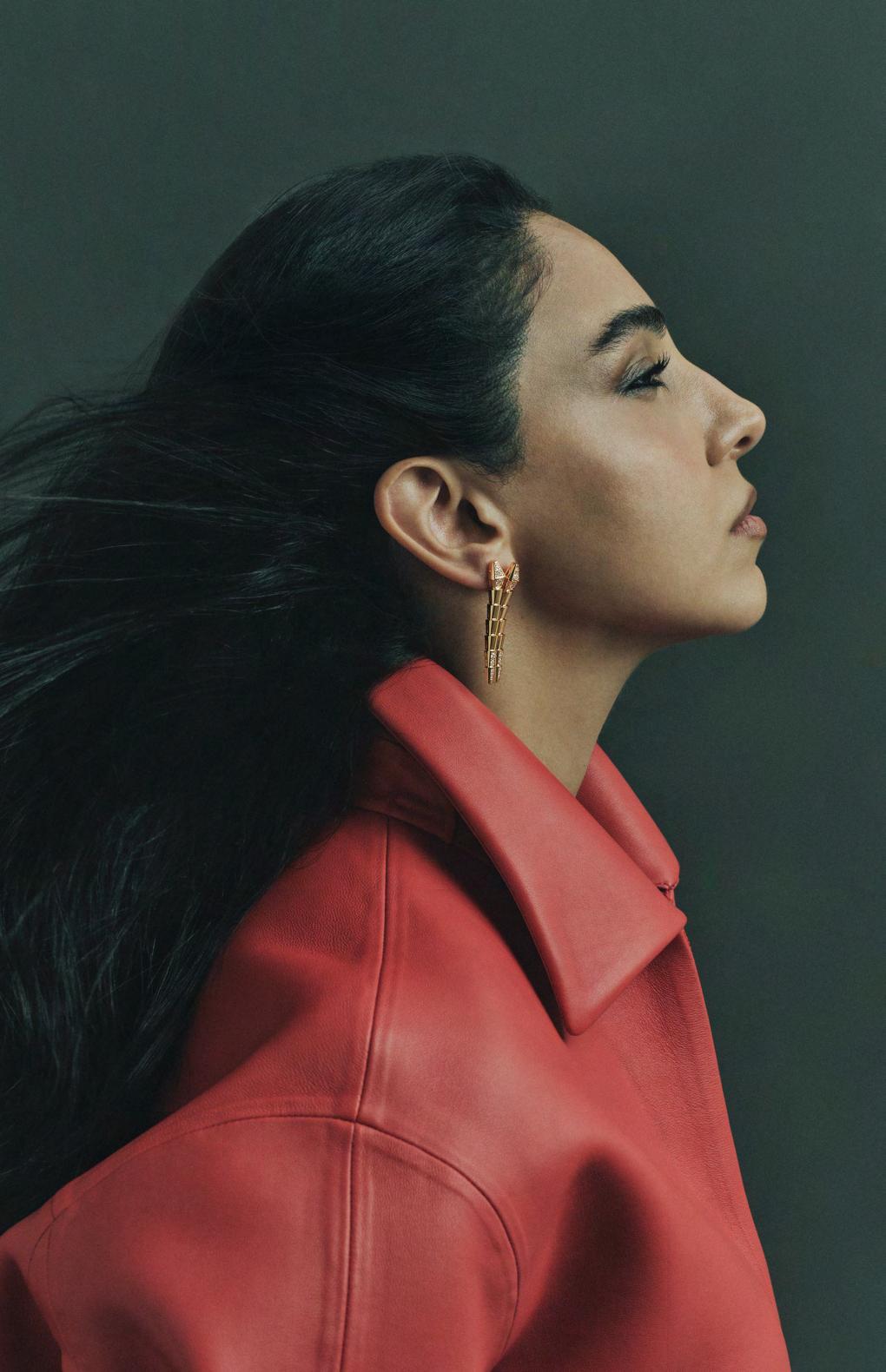
coat, BURBERRY earrings, Serpenti Viper, white gold with diamonds BVLGARI
“I’VE NEVER BELIEVED THAT OPPORTUNITIES COME ONCE IN A LIFETIME. WHAT’S MEANT FOR YOU WILL FIND ITS WAY BACK IN DIFFERENT FORMS.”
There is a lightness in the way she says it, but also a quiet acknowledgment of the gap between perception and reality. It is a gap she does not seem intent on correcting aggressively. Instead, she focuses on what she can control. Her work. Her choices. Her direction.
“I feel most in control of my narrative when I’m focused, grounded, and in line with my goals,” she says.
Control, for Bella, is not about managing every external opinion. It is about alignment. About staying connected to what she is building, even when things do not move as quickly as she would like. “It feels like it’s slipping when things don’t move as fast as I want them to,” she admits. “It overwhelms me.”
That honesty, that willingness to acknowledge the tension between patience and ambition, adds another layer to her story. She is not detached from the pressures of the industry. She feels them. She responds to them. But she does not allow them to dictate her direction.
Instead, she returns to process. To discipline. To the quiet work that continues regardless of pace.
And right now, that work is focused on two things at once. “Building and evolving at the same time,” she says.
It is a simple statement, but it captures the essence of where she stands. Not at a fixed point, but in motion. Not defined by what she has done, but by what she is actively becoming.
Sandy Bella is not trying to fit into an existing narrative. She is constructing her own, one decision at a time. One role at a time. One step further away from perception and closer to intention.
What people see is a work in progress. Beneath it, something entirely precise and driven is taking shape.
dress, TOM FORD
earrings, Serpenti Viper, rose gold with diamonds necklace, Serpenti Viper, rose gold with diamonds bracelet, Serpenti Viper, rose gold with diamonds bracelet, Serpenti, rose gold with diamonds and black onyx ring, Serpenti Viper two-coil, rose gold with diamonds BVLGARI
hair TARIK BENNAFLA; makeup GEORGIA HOPE; digital technician SHAN STEWART; lighting assistant CHARLIE HALL; styling assistant MALAK AYMAN HOSSNY
SERENA ABOU SEFYAN OPENS MORE THAN A SHOW
Wearing BVLGARI, Serena Abou Sefyan on confidence, community, and carrying Lebanon and Armenia onto the global fashion stage.
photography GREG ADAMSKI
styling POLINA SHABELNIKOVA
words NADINE KAHIL
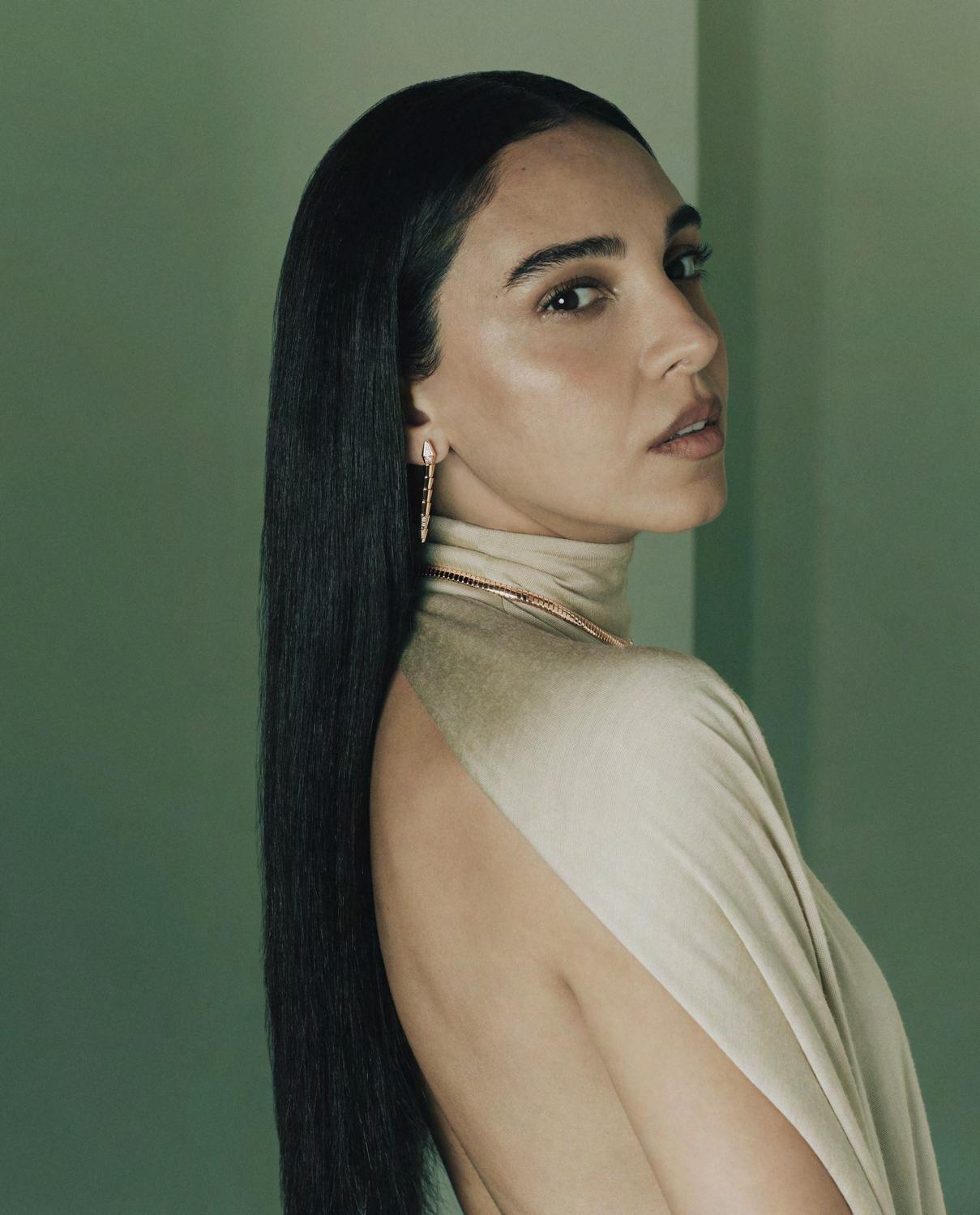
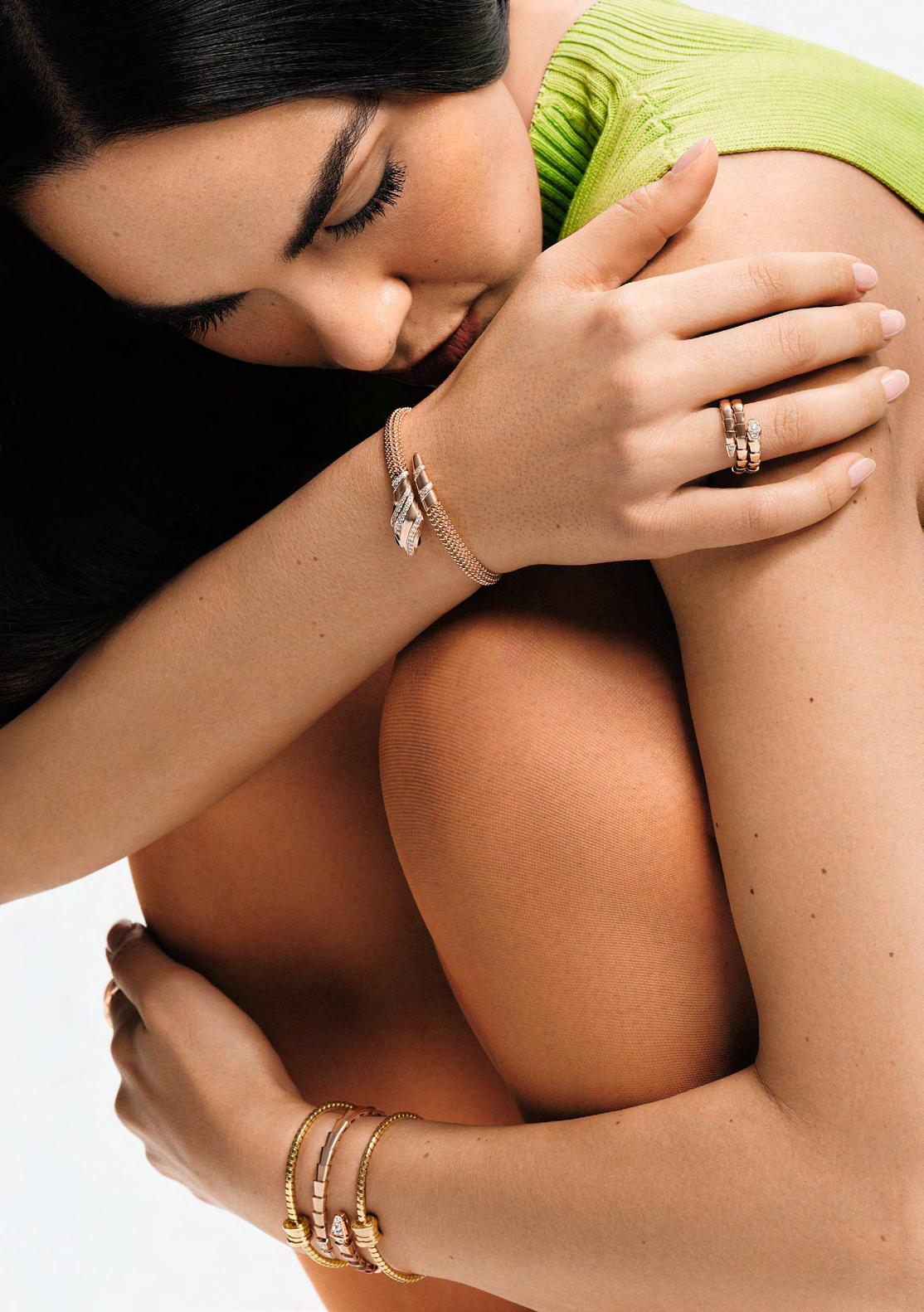
dress, FERRAGAMO stockings, STYLIST’S OWN shoes, VALENTINO earrings, Tubogas, yellow gold with diamonds necklace, Divas' Dream, rose gold with diamonds bracelet, B.zero1, rose gold bracelet, Divas' Dream, rose gold with mother-of-pearl and diamonds bracelet, Serpenti Viper, rose gold ring, Serpenti Tubogas, yellow gold with onyx and diamonds ring, Tubogas ring, yellow gold ring, Doppio Baccellato, rose gold with peridot and amethyst BVLGARI
top, ILAI SARAI shorts, MANGO stockings, CALZEDONIA shoes, GIUSEPPE ZANOTTI necklaces, Tubogas Serpenti, yellow gold with onyx and diamonds necklace, Tubogas, yellow gold with diamonds bracelets, Serpenti, yellow gold bracelet, Tubogas, yellow gold ring, B.zero1, yellow gold ring, Tubogas Serpenti, yellow gold with onyx and diamonds BVLGARI
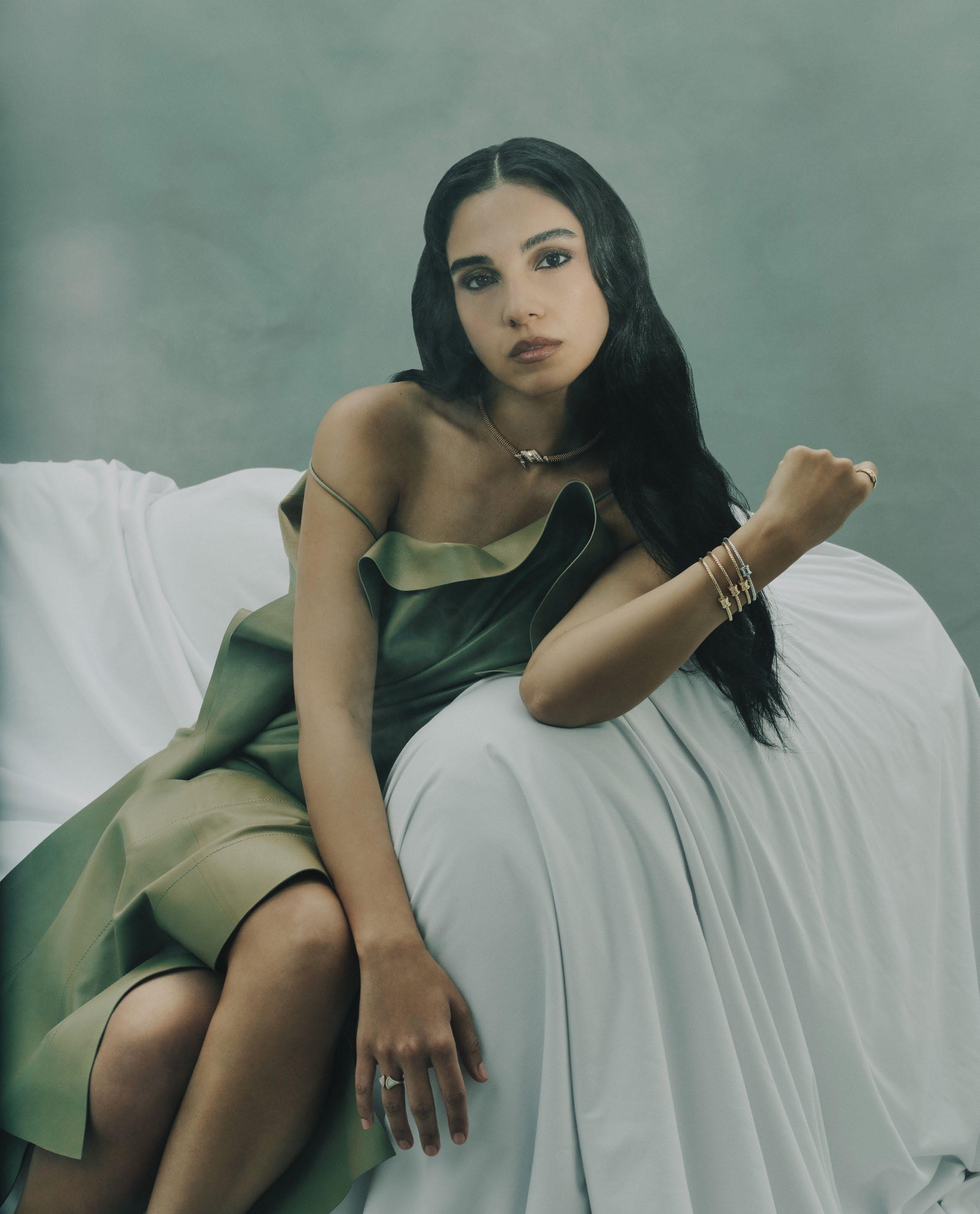
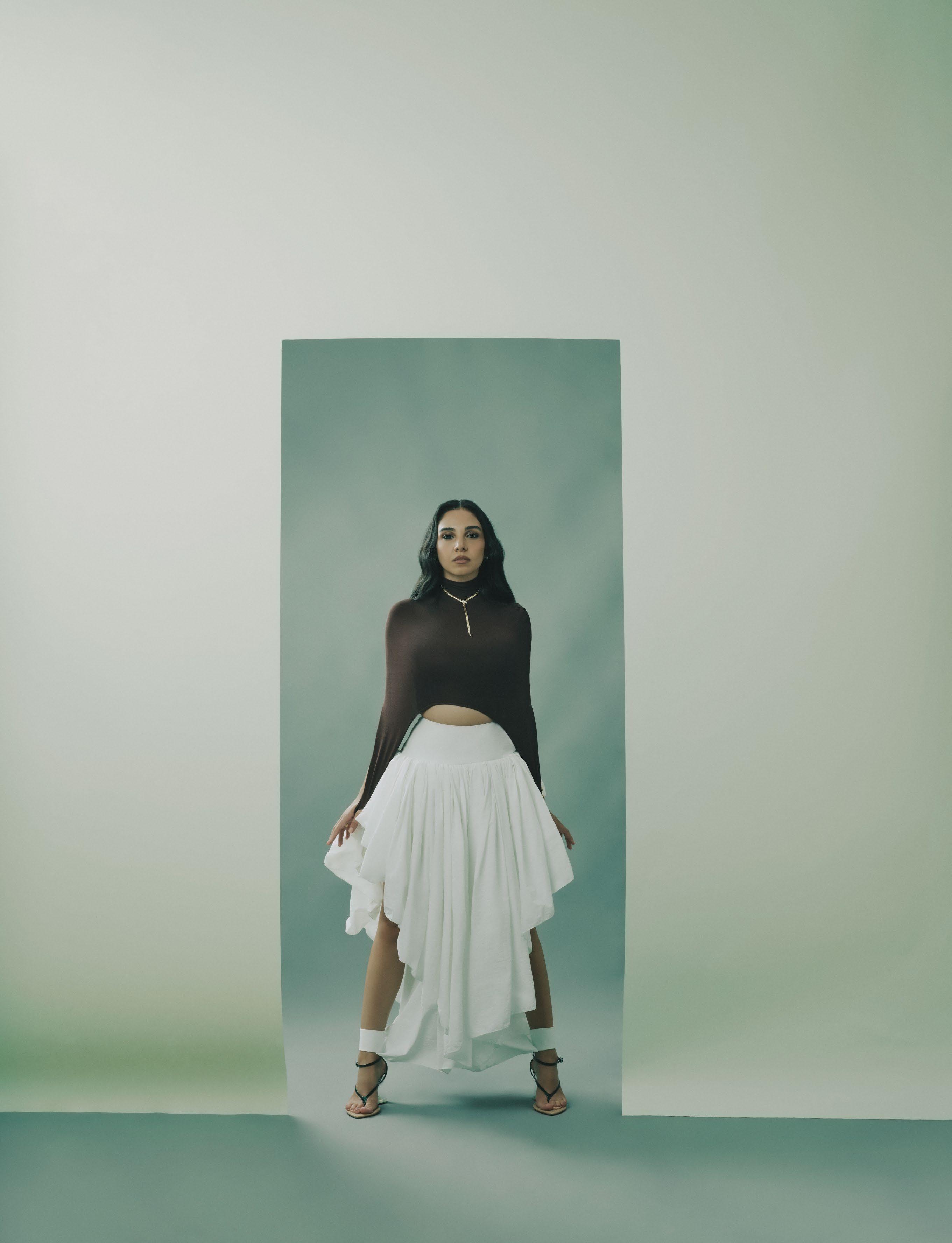
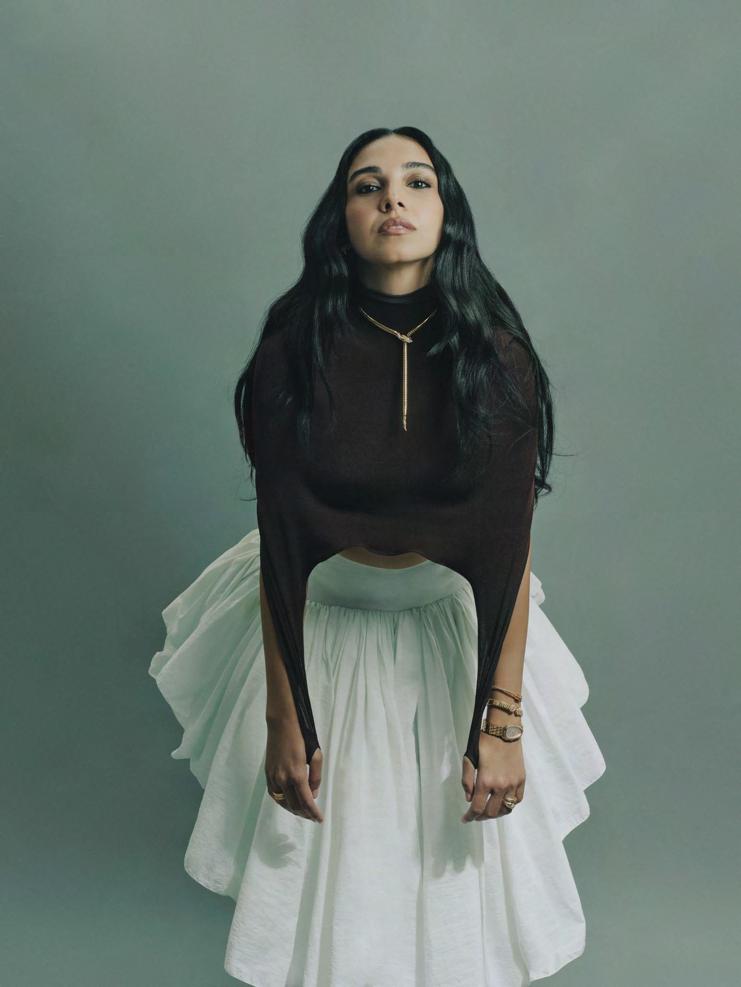
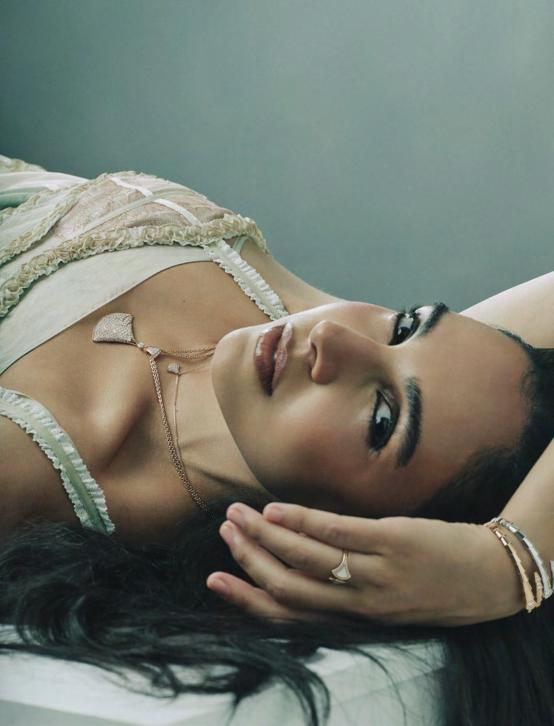
At just 20 years old, Serena Abou Sefyan has become one of the fashion industry's most exciting emerging names. Raised in Bourj Hammoud, Beirut, and proudly carrying both her Lebanese and Armenian heritage, the model recently made history by opening Fendi's Spring/Summer 2026 show in Milan before signing an exclusive contract with the Italian luxury house. What followed was a defining moment not only for her career, but also for a new generation of young talents looking for representation on the global stage.
In conversation with YUNG, Abou Sefyan reflects on the surreal experience of opening one of fashion's most prestigious runways, the challenges of navigating an industry built on resilience, and the responsibility she feels in representing her communities around the world.
Opening a Fendi show is an incredible opportunity for a model. What was going through your mind in the moments before you stepped onto that runway? It all happened so fast that I barely had time to process it. Between airports, the casting, and the show itself, it didn’t really sink in until a few days later when I was at the Fendi headquarters in Milan and saw all the articles coming out. Seeing my face and name on pages I’d followed for years was a surreal moment.
Right before the show, I was incredibly nervous and genuinely wondered if I had stage fright. The second I stepped onto the runway, I got my answer. It felt completely natural, like I was exactly where I was supposed to be.
dress, ELISABETTA FRANCHI gloves, BALENCIAGA
earrings, Divas' Dream, rose gold with diamonds earrings, B.zero1, rose gold with diamonds necklace, Divas' Dream, rose gold with mother-of-pearl and diamonds necklace, Divas' Dream, rose gold with diamonds necklace, Divas' Dream necklace, rose gold with mother-of-pearl and diamonds bracelets, Tubogas, yellow gold with diamonds bracelet, Tubogas, yellow gold bracelet, Tubogas rose, white and yellow gold ring, Serpenti Tubogas, yellow gold with diamonds and black onyx BVLGARI
You described your reaction as pure shock and excitement. Has the significance of that moment fully sunk in yet, and what did it mean to you personally?
Honestly, I still ask myself that sometimes. Why me? Why was I lucky enough to be chosen not only to walk the show, but to open it and sign an exclusive?
What made it so meaningful was the timing. It happened during a period when I was feeling pre y low and questioning whether this was really the path I was meant to be on. In this industry, there’s only so much you can control, and I was doing everything I could on my end. The rest was out of my hands.
So when that opportunity came, I took it as a sign to keep going. It gave me a lot of confidence in myself and in the process.
As a Lebanese-Armenian woman, how important was it for you to represent both communities on one of fashion’s biggest stages?
Honestly, this question answers itself. Seeing the support from both communities afterward was enough to show me how much it meant. I received messages from complete strangers telling me to keep going and saying I was making them proud, which was really special.
If that comes with the responsibility of representing my Lebanese and Armenian roots, it’s one I’d carry with honour.
You mentioned never having an Armenian model to look up to while growing up. How does it feel knowing you may now become that reference point for a younger generation?
I still forget that I’m 20 until someone asks me how old I am and I have to stop and think about it for a second. So it’s a li le surreal to think of myself as a reference point for anyone.
If I had someone to look up to as a point of reference, it would’ve made me relax a bit more knowing that someone had done it before. It would’ve made the dream feel less impossible. If a younger person can look at my journey and think, “If she did it, why can’t I?” then that’s really meaningful to me.
As easy as it is to be put in a box, it’s just as easy to get out of it.
Coming from Bourj Hammoud and growing up in Lebanon, did your upbringing shape the way you approach fashion, beauty, and self-expression today?
Growing up in Bourj Hammoud is very nostalgic for me. It’s filled with memories of my childhood and my grandparents’ house, where I spent most of my time while my parents were working. I never felt di erent. It always felt like there was no other world outside of the one I was in.
I think my upbringing made me very observant. When it comes to self-expression, I don’t like to overcomplicate it. I take it quite literally. Whatever I’m feeling is reflected in the way I dress or carry myself. I don’t really fit into a single category, and I don’t think I need to.
dress, BOTTEGA VENETA
earrings, Divas's Dream, rose gold with mother-of-pearl and diamonds ring, Tubogas, yellow gold ring, Doppio Baccellato, yellow gold with peridot and amethyst necklace, Divas' Dream, rose gold with diamonds watch, Serpenti Tubogas watch (35mm), steel and rose gold with diamonds bracelet, B.zero1, rose gold BVLGARI
“THE SECOND I STEPPED ONTO THE RUNWAY, IT FELT COMPLETELY NATURAL, LIKE I WAS EXACTLY WHERE I WAS SUPPOSED TO BE.”
You have spoken openly about how modelling was not always understood within the Lebanese-Armenian community. What were some of the biggest misconceptions you encountered, and how did you overcome them?
The reactions were usually a snarky smirk, or comments like, “Okay, but what about when it’s over?” or “What are you going to do when this fails?”
I understand those remarks o en come from a place of concern for stability, but at the same time, no one, including them or myself, can really predict the future. It’s not definite that it will end. It will end when it’s meant to, and right now that doesn’t feel like the case at all.
I think there’s also this misconception that anything creative, whether it’s studying English literature, art, or modelling, is just a side hobby rather than something that can be a full-time career.
I usually handled it with a smile and a simple “let’s see,” and le it at that. I’ve never really been a ected by social pressure in that way.
At just 20 years old, you've already worked across Paris, London, Milan, Madrid, and Barcelona. Which city has challenged you the most creatively and professionally?
Paris is my favourite city to this day, which makes it ironic that it’s also the one that challenged me the most.
It was the first city I ever travelled to for modelling, and I went alone. Navigating life with other models and, to be honest, strangers at the time, was a level of independence I hadn’t really experienced before. It was scary, but we made it through.
Paris has very high standards. It can be hard to hold onto your confidence and discipline when you feel like, no ma er how much you try, you’ll never be like “them.” Those thoughts creep in when you’re already vulnerable, but part of the job is knowing yourself well enough to snap out of it.
What have the past two years taught you about resilience, especially in an industry that is o en defined by rejection and uncertainty?
At the beginning, I actually had a healthier mindset than I did in the middle of it all. I understood that rejection had nothing to do with me personally. It was just about not being the direction a brand needed at that time.
But I’ve faced so many rejections I’ve honestly lost count. Each one is bound to a ect your morale at some point, and I would be lying if I said it didn’t make me second-guess myself like any normal person would.
Still, somehow I always went back and gave even more than I did the first time. Having a strong support system is what really helped me get through it.
blazer, trousers, MAISON MARGIELA top, STYLIST'S OWN
bracelets, B.zero1, yellow, rose and white gold rings, B.zero1, yellow gold ring, B.zero1, rose and white gold BVLGARI
“IF
THAT COMES
WITH THE RESPONSIBILITY OF REPRESENTING MY LEBANESE AND ARMENIAN ROOTS, IT’S ONE I’D CARRY WITH HONOUR.”
coat, TOM FORD
top, STYLIST’S OWN skirt, WEEKEND MAX MARA stockings, CALZEDONIA
earrings, Divas' Dream, rose gold with diamonds
earrings, Divas' Dream, rose gold with diamonds
necklace, Divas' Dream, rose gold with diamonds
ring, Cabochon yellow gold with amethyst and diamonds
ring, Doppio Baccellato, yellow gold with peridot and amethyst
bracelets, Tubogas, yellow gold with diamonds
BVLGARI
THIS IS YUNG 94-95
coat, TOM FORD top, STYLIST’S OWN skirt, WEEKEND MAX MARA stockings, CALZEDONIA
earrings, Divas' Dream, rose gold with diamonds earrings, Divas' Dream, rose gold with diamonds necklace, Divas' Dream, rose gold with diamonds ring, Cabochon yellow gold with amethyst and diamonds ring, Doppio Baccellato, yellow gold with peridot and amethyst bracelets, Tubogas, yellow gold with diamonds BVLGARI
COVER
Fendi has now signed you as an exclusive model. What was your experience like working with the house, and what makes the brand special from a model's perspective?
In this job, you usually move from set to set and rarely see the same people twice. But with Fendi, it felt different. The team became like a family.
I wasn’t just jumping between jobs. I could walk onto set, greet everyone, and actually know them, ask about their lives, and have that connection be mutual. Even outside of work, a lot of the team reached out when Lebanon wasn’t in a safe situation just to make sure my family and I were okay. That kind of care stays with you.
"IF A YOUNGER PERSON CAN LOOK AT MY JOURNEY AND THINK, ‘IF SHE DID IT, WHY CAN’T I?’ THEN THAT’S REALLY MEANINGFUL TO ME.”
Looking back at the younger Serena who may have felt like the “troublemaker” compared to her academically driven sister, what would you tell her today?
I wouldn’t tell her anything, because she’s the one who got us to where we are now and she clearly knew what she was doing.
I never felt like I was less than my sister just because I wasn’t as academically strong as she was. We always knew we were good at completely di erent things, and my parents never made it into something negative.
I remember being happy and celebrating even if I just passed with half a grade, while for her a 96 would raise the question of why it wasn’t 100. She has always had that perfectionist mindset, and she delivers on it. And I do too, just in a di erent way.
full look,
earrings,
ALAÏA
Divas' Dream, rose gold with diamonds necklace, Divas' Dream, rose gold with diamonds bracelet, B.zero1, rose gold ring, Tubogas, yellow gold ring, Doppio Baccellato, yellow gold with peridot and amethyst watch, Serpenti Tubogas (35mm) in steel, rose gold with diamonds
dress, STYLIST'S OWN
earrings, Divas' Dream, rose gold with diamonds earrings, B.zero1, rose gold with diamonds necklace, Divas' Dream, rose gold with mother-of-pearl and diamonds necklace, Divas' Dream, rose gold with diamonds necklace, Divas' Dream, rose gold with mother-of-pearl and diamonds bracelet, Serpenti Viper, rose gold bracelet, Divas' Dream, rose gold with mother of pearl ring, Divas' Dream, rose gold with mother-of-pearl ring, Divas' Dream, rose gold with mother-of-pearl and diamonds BVLGARI
SAFIYAH CASSIM
MOHAMMED JAZIM
CARRIED AWAY
Inside the handbags defining this season’s mood.
curation NADINE KAHIL
collages MALAK AYMAN HOSSNY
hazelnut minaudière, CHANEL
arcadie, MIU MIU
birkin, HERMÈS
clicca, BALENCIAGA
manta, MCQUEEN
bonnie, PRADA
baby veneta, BOTTEGA VENETA
saddle, CHRISTIAN DIOR
Inside the Loewe atelier, Getafe, Madrid, Spring 2015, Luis Venegas.
Window designs by José Pérez de Rozas at the Loewe store, Gran Vía, 8, Madrid, 1956 – 1975.
Every Arab family has one. The grandmother who moved through rooms as though she'd already decided how they'd remember her, silk pressed, posture impeccable, a leather bag on her arm that she'd had for longer than anyone could recall. You didn’t know the name of it as a child. You just knew it was hers, that it was always the same one, that the leather had so ened in exactly the right places and the hardware still caught the light. Eventually it found its way to your mother, then to you. You never questioned it. That bag, in all likelihood, was a Loewe.
Few luxury houses understand longevity the way Loewe does. Founded in Madrid in 1846 as a collective of leather artisans, the Spanish house was never built around hype, celebrity, or fashion spectacle. It
was built around touch. Precision. Material. The idea that an object should become more beautiful the longer it exists. Today, Loewe stands as the second-oldest luxury fashion house in the world, a distinction that reflects not only its age but also its remarkable ability to evolve while remaining rooted in cra smanship.
Perhaps that is why the Amazona still resonates fi y years a er its introduction in 1975. So yet structured, polished without rigidity, the bag became symbolic of a certain kind of woman — elegant without needing to announce herself. Under Jonathan Anderson’s creative direction, the Amazona returned to the forefront a few years ago, reconnecting a new generation with the house’s heritage. Now, current Creative Directors Jack McCo -
llough and Lazaro Hernandez continue that conversation through the Amazona 180, a sharper reinterpretation of the original icon created to mark the house’s 180th anniversary.
Fashion has responded accordingly. Bella Hadid has carried it. Sarah Pidgeon too, fully immersed in her quietly devastating Carolyn Besse e-Kennedy era. But the fascination surrounding the Amazona 180 feels deeper than trend-driven obsession. Luxury itself is shi ing again. A er years of logos, spectacle, and algorithmic dressing, fashion is returning to permanence. To pieces with memory a ached to them. Loewe has always operated from that perspective.
Loewe Catalogue, FW 1979-1980, photography: Michel Malka.
Original Amazona Bag from the AnteOro Collection, 1975.
Loewe internal catalogue, Barcelona, 1960s.
By 1905, the house had become an o cial supplier to the Spanish royal family. In 1970, the now-iconic Anagram logo was introduced: four interlocking Ls that became instantly recognizable without ever needing overexposure. Then came the Flamenco in 1979, and decades later, the Puzzle bag, each design carrying the same underlying philosophy of cra smanship and material intelligence.
What often gets overlooked in conversations around Loewe is that its cra language was never confined to accessories
alone. The house’s ready-to-wear history includes influential creative voices who helped shape its evolution. During the 1970s, renowned designer Ken Sco collaborated with Loewe, creating vibrant womenswear and ready-to-wear collections that brought a fresh, modern spirit to the Spanish house. Around the same period, Karl Lagerfeld also contributed to Loewe's fashion direction, helping elevate its ready-to-wear ambitions as the brand expanded beyond leather cra smanship. Shortly a erward, Giorgio Armani worked with Loewe between 1977 and 1979,
overseeing the brand’s women's ready-to-wear collections as it expanded internationally. These collaborations quietly helped position Loewe as more than a leather goods specialist, broadening its fashion vocabulary while preserving its commitment to cra smanship.
Alongside Armani, whose collaboration with Loewe remains one of fashion’s quietest achievements, are names like Ken Sco . Thanks to Sco 's early work, the same sensitivity that defines
the bags exists in the tailoring, silhoue es, textures, and movement of the clothing itself.
That resonates deeply within Arab culture too. Across the region, material objects have long carried emotional continuity. Embroidery passed between generations. Gold kept for daughters. Leather so ened through decades of use. Long before “quiet luxury” became a trend cycle, the region already understood the value of objects designed to endure.
Salma Abu Deif for Loewe, photography: Talia Chetrit.
Now, 180 years a er its founding, Loewe continues under Jack McCollough and Lazaro Hernandez with that same philosophy intact.
Advertisement for the Loewe store on Calle Serrano, Madrid, mid 1920s.
Bella Hadid with the Amazona bag.
The words shaping this issue are hidden in plain sight.
ANANTARA
BIENNALE
CRAFTSMANSHIP
COUTURE
CURATOR
EXPLORATION
HABIBI
HEATWAVE
INTENTION
LEGACY
MARIOLINO
RITUAL
RUNWAY
RUPTURE
SERPENTI
SOULFUL
SWANA
TARAB
TOURBILLON
VENICE
WATAN
words YASMINA F. BITAR
SOLE SEARCHING: WHAT JADEN SMITH FOUND AT CHRISTIAN LOUBOUTIN
Christian Louboutin’s firstever men’s creative director on his debut collection, the cra behind it, and what he hopes outlasts the launch-day noise.
All images courtesy of Christian Louboutin.
“You just have to put your all into everything you make.”
Jaden Smith appeared for our interview as a black square. There was no outfit to decode, no face so ened by laptop light, no red sole angled into frame. Only a voice, still fizzing from Madison Square Garden.
The morning his debut Christian Louboutin collection reached stores worldwide, New York was talking about the Knicks. So was Smith.
“My good friend Karl plays for them,” he said, meaning Karl-Anthony Towns, whose team had taken Game 4 by a single point. For a figure so o en treated as an image — son, muse, polymath — Smith began with fandom. The shoes could wait; the box score could not.
“I feel really good,” he told me. “The collection is in stores all over the world.” He kept circling the scale of it. “Anyone, anywhere can go and see it for themselves,” he said, “try it on.” The thing from his head was now behind glass in Paris or Dubai, close enough for a stranger to press a nose to the window and want it. The shoes are everywhere and nowhere near everyone’s price; some four-figure tags make your chest tighten before you have even tried them on.
When Christian Louboutin named Smith its first-ever men’s creative director last autumn, the appointment arrived with the question that trails every famous name handed a creative title: what, exactly, is being bought — the taste, the following, the face? The cynical maths is easy enough. Famous name plus old house equals noise.
The courtship, at least, was slower than the announcement made it seem. Louboutin’s call reached him while he was making an album, running Misfits — his creative collective and production company — and posting his work on Instagram. “You just never know who’s watching,” he said. He told me he studies people every day who would never imagine he is looking at their work “very deeply.” His lesson was almost embarrassingly sincere. “You just have to put your all into everything you make.” For Smith, the operating faith of a generation — post into the void, whether that void is twenty people or 20 million, and pray the right person is scrolling — actually paid o .
“It’s like this red castle in my mind. Four generations of men live inside it.”
Louboutin, in any case, hardly needs visibility. The red sole is legible from across a room, even from under a crossed leg. The harder problem was quieter: how to make the men’s house feel newly lived-in without breaking the spell.
When Smith talks about the work, the creative director calculus falls away. Asked who he designs for, he does not name a customer or a demographic. He describes a building.
“It’s like this red castle in my mind,” he said. “Four generations of men live inside it. You have the patriarch, then the father, the son, then the youngest son.”
He lets that sit there — a red castle, four men, no apology — and you decide whether it is a design philosophy or the start of a fairy tale. “The wildest pieces,” he added, “belong to the youngest,” the one closest to himself.
The image is almost too available to psychoanalysis: a young man from one of America’s most watched families imagining masculinity as a house of fathers, sons and inheritance. For a sentence, I waited for it to curdle a bit. It didn’t. What held it up was where he said it began: Italy’s factories.
There, he noticed, “trade skills are passed down generation to generation within a single family,” with the grandfather, the father and the son all touching the same shoe at different stages of its life. The question he kept asking himself was whether he was making “something that every man in this family can a ach themselves to and get behind” — a dedication, as he put it, “to a specific cra , to humanity.” The fairy tale had a factory floor.
I told him the clothes I love most are my grandfather’s blazers, and he understood immediately. A blazer remembers the shoulders before yours: the trace of oud in the lining, a pocket square so ened by weddings and funerals, an old valet ticket le crumpled in the inside pocket. Smith had arrived at the same feeling by another route, through the factory floor and the imagined maison. The collection, he said, could be “passed hand to hand.” He pictured “all of those men in the family going into the store at the same time,” each recognising himself in a di erent corner of the room.
Depending on your age or algorithm, you might know Jaden Smith as The Karate Kid, the boy trading bars with Bieber, or the teenager who declared himself, with eerie accuracy, an “icon living.” For years, that range read as Smith sprawl. Fashion has since learned to take sprawl seriously. At Louis Vui on, Virgil Abloh made architecture, quotation marks and DJ logic feel like house codes; Pharrell Williams brought the producer’s ear, the instinct for a hook, the feel for cultural temperature. Smith arrives from the same weather system, where a creative career spreads sideways instead of climbing.
His way in is musical. “Hip hop is at the core of who I am,” he said. Then the answer turned synaesthetic. Fashion needed “a really strong rhythm,” he said; a collection could move in “a major scale” or “a minor scale.” A shoe could be tuned; a silhoue e could keep time. This first collection was pitched “really heavily” to faster rap music, the pulse under the leather.
He was fluent in all of it — the scales, the codes, the red castle in his head — until I mentioned that “Rainbow Bap,” one of his earlier songs, had appeared in my Spotify Wrapped. “No way.” The grin was audible. For a beat, the creative director cadence broke into something younger and unguarded. Then the precision returned, and so did the shop-talk, a cowboy boot bringing him into focus.
“The Louboutin codes work and have worked before. Now I’m looking for newer codes in the colour language, the photography, the direction.”
“In between the base leather and the fabric, there’s a li le Christian Louboutin canopy logo coming out of it,” he said. “The stitching is so detailed, the way it pops out, the le ers contrasting — I just love it.” The shoe changed repeatedly between sample and store. In footwear, the toe is temperament. Metal made the boot feel armoured; roundness softened it; the square-o gave the cowboy reference a cleaner authority. It was another way of tuning masculinity, this time by the millimetre.
He is careful with what he has inherited. “The Louboutin codes work and have worked before,” he said. “Now I’m looking for newer codes in the colour language, the photography, the direction.” Red, to him, is “a character in the stories that we tell,” powerful and luxurious and full of extreme passion. Stand on Brompton Road long enough and that character reveals its full social range: the Gulf prince fresh o the Harrods valet, the party girl visiting from Miami, the man who swears he hates logos and tilts his heel just enough for you to clock the red.
Display, though, was never quite Smith’s register, and his sincerity is easy to fla en from a distance. He has spent his public life being read by people sure they knew what he meant before he had said anything at all: Will Smith’s son, the heir to a family mythology that le li le room for his own.
Up close, or as close as one gets to a black square, the eccentricity read as method, not pose — a way of making sincerity survive the watching.
The announcement drew the expected noise; Smith was not interested in answering it. “I just want to let it speak for itself,” he said. “That’s the job — to create the stu .” Twenty years on, he hopes, a stranger who finds one of the shoes at the back of a father’s closet will understand the feeling he was trying to leave behind: that people had been adventurous then, and “willing to be wild.”
By then, perhaps, the creative director appointment will have faded, and the launch-day posts will have disappeared into the archive. What might last is harder to manufacture: a shoe that feels less bought than inherited.
The camera stayed o the whole time, so I never saw the shoes or the man. I was le instead with the image he had given me of an object moving from hand to hand, gathering meaning as it goes, until someone who does not know the whole story puts it on anyway.
SOUND
words MENNA SHANAB
A NOTTREE, A FRUIT: LINA MAKOUL
How Lina Makoul escaped becoming a symbol.
"I fully realized I am a tree rather than a fruit,” Lina Makoul writes.
For years, the world treated her like fruit. Something that can be consumed. Something to display. Useful.
She was for many a symbol of coexistence. A narrative. An answer to questions that were far bigger and heavier than any one artist could possibly carry.
This profile is not about a Palestinian artist navigating identity. There are plenty of those stories. And they are important, necessary stories. But this is not one of them.
This is a story about someone escaping being turned into a symbol.
First, Lina Makoul was turned into a symbol of coexistence. Then she was expected to become a symbol of resistance. And much of her life's work since has been an a empt to become simply a person again. To reclaim power over herself and her voice. Where it comes from, where it is going and how it lands when it arrives.
Most stories about Makoul begin with a handful of obvious markers: Arab Idol. Nationality. Coexistence. Controversy. Identity. The headlines feel like they almost write themselves. A Palestinian citizen of Israel. A singer with mobility between Arabic and Western musical realms. A young woman carrying the weight of multiple audiences and expectations.
At some point in her early career, Makoul had a realisation that she had become a story that other people were telling and she would come to spend the next decade of her life fighting to reclaim authorship over herself and her voice. So that made me reflect. Who gets to define an artist? The artist? The industry? The state? The audience? The algorithm? History itself?
“Once I understood what propaganda meant, I couldn't unsee that I was one in the making."
- Lina Makoul
she tells me. "I was playing classical piano and dancing ballet while also practicing Arab dancing, aweehas, and zaghareet at all my 30 cousins' weddings."
The answer, for Makoul, seems to have changed several times as the years have passed by.
To understand who she is today, it is worth tracing the arc that brought her here. She was a gi ed young singer from Acre who was raised between worlds that many outsiders most likely imagine as contradictory but that she experienced as entirely natural. "I grew up listening to Fairuz and Wadih El Safi with my parents, while also watching MTV, memorizing Western pop albums, and watching Argentinian telenovelas from a young age,"
"I guess that's how my personality and taste developed, so moving between these worlds feels super natural to me." Way before journalists, audiences, and institutions found her and became interested in categorizing her, Makoul was already living comfortably inside complexity. By nineteen, everybody already knew who she was. She had become visible on a scale most young artists can hardly imagine. Yet visibility did not necessarily bring clarity. If anything, it created a new kind of distortion. In a way, this visibility made her less visible as it produced an unexpected side e ect: the gradual disappearance of the person beneath the narrative.
People projected onto her. Media organizations, institutions did too. She was part of other people’s political fantasies. What emerged was not Lina Makoul the person, but Lina Makoul the narrative. “Once I understood what propaganda meant, I couldn't unsee that I was one in the making." That feels like the kind of sentence that only arrives a er years of reflection, carrying the weight of hard-
Image courtesy of the artist.
earned hindsight. "It was so strange to observe yourself being used as a whitewashing tool," she says. "It took some time to understand the whole thing and oppose it."
Looking back, Makoul can now identify the machinery around her. At the time, she was simply just living through it. "Thank God for being a free thinker," she says. Supported by family and by a loyal audience, she gradually fought to "win myself back and take the independent path and do things my way, even if it meant it would take 100 times the e ort, resources, and thicker skin."
This is the point where the tree metaphor begins to make sense. "I fully realized I am a tree rather than a fruit." A fruit is consumed but a tree survives. A fruit is a product, but a tree develops roots.
The distinction reveals the journey she would spend the next decade undertaking – learning to separate her existence from the narratives built around it. What followed was a struggle for self-possession. It was an a empt to become rooted enough to withstand the forces actively trying to define her.
Many artists respond to pressure by becoming louder, but Makoul appears to have moved inward. When I ask her about the emotional undercurrents in her work, she immediately reframes the premise. "I think the di erence is that to me this is not politics, it's my daily life." Politics is o en something discussed from a distance. Life is something lived.
The farther she moved from externally imposed narratives, the more inward her work became. Many people expect Palestinian artists to speak in direct political language. To issue statements and become interpreters of events. Makoul seems more interested in consequences. Not what people think, but what people feel. "We're in a phase where commercial artists are trying to create with more intention and purpose in their art," she says. "Because of the urgency that comes with the atrocities we're witnessing – and the helplessness and distance we feel from them – a lot of it comes out as political without the emotional level of it."
For her, proximity changes the equation. "When you live so physically close to what's happening, and you're not allowed to speak up, you turn inward because you have to find alternatives for expressing what you want to express."
The result is a di erent artistic project altogether. It is not “What do you think?” but “What does this do to a person?”
What does grief do to a person? Fear? Helplessness? What happens to tenderness under pressure?
"You have to be creative and actually break down and understand what it is you're feeling so you're able to express it in a more abstract way," she explains. The artist becomes a translator of emotional experience rather than a commentator on events. A vessel, companion and witness.
The distinction becomes clearest when she says something I keep returning to: "Making music for Palestinians and Arabs, rather than about them, makes a great di erence."
Music about people o en explains them. Music for people accompanies them. One seeks to represent and the other seeks to recognise.
Again and again, Makoul returns to the emotional rather than the ideological. At one point I ask her about the tension between so ness and resistance in her work. I felt as though she had been wanting to talk about it. She says, "Preserving our child-like heart, and that child-like tenderness and softness, is to me the biggest goal and the main form of resistance."
For Makoul, resistance is refusing to harden. It is protecting the part of yourself that remains capable of wonder, vulnerability, joy, and love. "That's really the only way to win," she says. "Everything else is a distraction."
Many Palestinian artists are asked to become symbols of something larger than themselves. Entire histories are projected onto individual lives. Makoul pushes back against the premise. "I think when you're an artist who lives in Palestine, your day-to-day life humbles you. We know the occupation in its actual size, not through imagination. If we could be something bigger than what we actually are, we would've been free from oppression generations ago."
This dismantles the fantasy of the artist as saviour. It is also a reminder that artists are human beings first.
The deepest transformation, however, seems to be her evolving understanding of freedom itself. When I ask her what she no longer believes at thirty that she believed at twenty, she says, "Ouf." Then comes the answer. "I used to think freedom means having financial and commercial success."
The answer feels important because it reframes everything that came before it. "I felt like I constantly needed to explain myself and prove that I walk the talk." She wanted to demonstrate that independence was possible. She wanted to know what artistic freedom actually felt like. "I wanted to know true independence in my art because, in real life, I'm already occupied."
Maybe art cannot replace freedom, but it is one of the few places where true freedom can still be practiced. Eventually, proving gave way to documenting. "I started to shi towards making art for the sake of documenting my own understandings, rather than pleasing a trend-trained ear." Today, she creates from a di erent place altogether. "If I die at any given time, I don't want to feel like I held anything back. I want my art to fully represent me, my abilities, my taste, and everything I was capable of expressing, even if it takes a while for people to get it."
She continues, “I believe we, as artists, have much more power than we're o en allowed to realise," she says. "That's exactly why we're faced with this amount of control and restriction in the form of contracts." This is how she now views the industry itself; as both a system of opportunity and a system of control.
"The freer I became in creating, the more I understood that nothing will fulfil you other than being your own master. My idea of identity, art, and freedom is being able to think independently and observe my thoughts rather than engaging with them. To find freedom in stillness no matter the chaos." And perhaps most beautifully: "To preserve the light in my eyes and those around me."
Perhaps this is the clearest way to understand Lina Makoul's evolution: her music documents a gradual refusal to perform certainty.
The public version of Makoul once required certainty. Be it about identity, coexistence, belonging, representation. Makoul as she stands today seems far less interested in certainty than in truth. And truth, unlike propaganda, rarely arrives in simple forms.
words YASMINA F. BITAR
THE ARABIC SOUND
As Arabic pop, regional samples, and diasporic memory move through global dance floors, a new electronic sound is taking shape — one that resists easy translation.
February in London. Grey sky, grey pavement, grey psychic weather. You’re on the Northern Line with wired headphones and a SoundCloud link acquired through someone’s cousin’s DJ boyfriend when an edit of “Nour El Ein,” stretched over a 4/4 beat, turns the commute into something embarrassingly close to longing.
Suddenly you’re sunburnt in Saint-Tropez. Then a Beirut basement: low ceiling, condensation on the walls, bass vibrating beneath the sternum. The DJ drops a warped Arabic sample and every Arab in the room starts shouting the lyrics while everyone else realises — a beat too late — that this was never their cue. Salt air, linen shirts still damp from the sea, the sacred annual migration south that your bank account has already declined on your behalf. You’ve missed your stop by three stations.
Arab house excels at one thing above all else: turning summer into a shared hallucination long before London does.
House music is o en framed as the gateway, the thing that made Arabic sound newly legible to Western audiences. Suddenly, Berlin DJs were layering dabke percussion over techno; Amr Diab edits were landing on dance floors that had never knowingly encountered a maqam scale. That’s the accepted chronology. Mine happened in reverse. Arabic pop led me to house.
At twelve, I used to make my mother turn o Amr Diab a block before school, petrified that someone might hear. I wanted Bruce Springsteen. The Beatles. Cultural anonymity, ideally. A single chorus could reveal more about me than I had intended to share.
Now I cross continents to stand in crowded rooms watching strangers lose their minds to the same songs I once tried to hide. A man in a linen shirt — the sort who, ten years ago, might have made his Arab classmate’s life hell over the smell of baba ghanoush in a lunchbox — is beside me yelling “Ahla Leila Ahla Nas” in deeply unwell Arabic. He is euphoric. So am I.
HOUSE
Image courtesy of the artist, Ahmed Spins, DHB.
Arab electronic music is everywhere now, though nobody involved seems especially eager to define it. The arguments are aesthetic, generational, occasionally territorial. How much of the original survives the translation? A scene calcifies the moment everyone agrees on what it should sound like. This one is alive because nobody does.
DJ Habibeats grew up watching his uncle DJ Arab at weddings. Palestinian-American, Bay Area-raised, wiry and kinetic behind the decks, he never saw why Arabic pop should remain separate from the sounds that raised him: house, hip hop, funk, rap. One of his earliest remixes took Nancy Ajram’s “Ya Tab Tab” and spliced it with Brazilian funk. “I thought nobody would get it,” he says. “I made it anyway because I thought it sounded dope.”
At a sold-out London show, he played Elissa’s “Aayshalak.” The original. No remix. No edit. The violins arrived and two thousand people disappeared at once. Beside me, a girl mouthed every lyric with her eyes closed, as though retrieving a memory rather than listening to a song. The guy next to her was Googling the words in real time. One remembering, one discovering — the song generous enough to hold both.
On his last European tour, DJ Habibeats noticed more non-Arabs than ever before. More people arriving without the language. They dance anyway.
Ahmed Spins, the Moroccan DJ and artistic director of Deep House Bible, smiling almost constantly, approaches the sound from a different direction. His ear was shaped by his sister’s disco records, his cousin’s house crates, and a Moroccan childhood saturated in Nass El Ghiwane and Hoba Hoba Spirit. By the time he started producing, the influences were too varied to let any single one dominate. He is wary of turning cultural identity into genre obligation. He admires Black Co ee, the South African house titan, for resisting
the expectation that African artists should be culturally legible in only one way. “You can’t just come to Brazil and play Brazilian music,” Ahmed says. “They already have it. They want something new.”
Ask him about remixing Nass El Ghiwane and he pauses. “The rule of thumb is you have to make it be er. And I don’t know how I can make the record be er, because it’s so good.” The Moroccan references remain in the DNA of the set rather than becoming its entire premise.
Image courtesy of the artist, Ahmed Spins, DHB.
Photo @FKNSTRADA, DJ Habibeats, Coachella.
Palestinian-Jordanian artist Keena has no interest in becoming ambience for somebody else’s set. In a scene hungry for Arabic vocals, that is a political position as much as an aesthetic one. Producers want the feeling of Arabic vocals, sometimes more than the meaning. She built her own production team accordingly. “I don’t want to just exist as a feature,” she says. “I want my voice to sit at the centre.”
Three di erent relationships to the same inheritance, and three di erent answers to what translation should cost.
A sound can carry almost any amount of meaning. What it cannot do, on its own, is sustain a scene. That requires rooms, repetition, infrastructure: people willing to care excessively about things most audiences will never notice.
Deep House Bible, the events platform Ahmed helped build from Boston college parties to stages at the Pyramids of Giza and Morocco’s Agafay Desert, began the way most enduring scenes do: as kids trying to impress their friends. Before hosting a single event in Morocco, his two non-Arab co-founders visited “like ten times,” travelling the country north to south, collecting friendships before they collected audiences. “They fell in love with the place first,” he says. “It’s not just a balance-sheet event. We feel extra pressure to get it right — even if we’re barely breaking even.” Crowds know when they’re being courted and when they’re being mined.
DJ Habibeats’ Habibi’s House nights are the diasporic version: temporary cities built from recognition. “Kids of immigrants just like me,” he says, “people who grew up with one foot in the culture and the other in whatever country their parents migrated to.”
Part of why this circuit keeps expanding is Arab hospitality, a competitive advantage nobody talks about. DJs come back to the region because the welcome lingers in the body. A er a sunrise set in Beirut, Ahmed walked into Zaatar w Zeit the next morning, the designated a ers spot, and the entire café erupted. Clapping. Shouting. Strangers replaying the night back to him over breakfast as though it belonged to all of them. “They’re just happy to be there,” he says. Then, more quietly: “You’re like, wow… this is why I’m doing this.”
Artists spend most of their lives in transit: airports, green rooms, hotel lobbies designed to feel interchangeable. Then a city like Beirut interrupts the anonymity. Arab nightlife operates on the assumption that if you shared the dance floor, you should probably stay for breakfast too.
Image courtesy of the artist, Keena.
Cities like Beirut, Cairo, and Casablanca function as testing grounds. Ahmed describes them as early-adopter markets: crowds raised around music, curious about where it can still go. “You can try things,” he says. “Go out of your comfort zone, test new music, see what works.”
A track gets refined in Morocco, tested again in Beirut, then played in a warehouse in Brooklyn. The circuit operates like an R&D pipeline disguised as a party calendar.
In Amman, the scene still feels socially close enough for individuals to change its direction. The same people DJing the parties are designing the flyers, organising the lineups. London and Berlin inherited decades of nightlife infrastructure. In Amman, much of it still exists in provisional form, held together by favours, instinct, and whoever answers the phone at 2AM.
The rooms are smaller, the crowds more literate. Someone near the booth identifies a track before the drop lands, quietly, almost absentmindedly, like muscle memory. “We’re all figuring it out together,” Keena says, “rather than trying to fit into something that already exists.”
She opened for Keinemusik in an Umayyad-era winter palace outside Amman, electronic music ricocheting off eighth-century stone. The se ing never tipped into gimmickry. The history altered the emotional temperature of the night itself. “Whether I like it or not, my sound is coming out of Amman because I am in Amman,” Keena says.
Spend long enough in Berlin, and eventually the city enters the drums. The same is true of Amman. The di erence is that Amman still feels unresolved — creatively
porous, unfinished in a way that lets artists leave fingerprints on it before the edges harden. For Keena, that unfinishedness is the reason to stay.
In scenes like this, questions of sound quickly become questions of representation. When I ask Keena about her influences, she cites Johannes Fabian, the anthropologist who argued that the further a culture sits from the West, the further back in time it tends to be placed. Denied contemporaneity, stripped of the present tense.
A DJ in Amman citing critical theory is a le turn in a list of influences. But if you grew up on Al Jazeera and your grandfather had Edward Said on his bookshelves, the logic feels immediate. Some people hear a beat and leave it there. Others hear the entire political architecture surrounding it.
Her debut track, “Aman,” made with Nandu & Radeckt, carries that conviction quietly inside it. The track has travelled through clubs and festivals whose audiences will likely never parse the lyrics, which describe the experience of trying to reach Palestine and being unable to. The vocals are processed, the language is Arabic, and the dance floor never pauses to translate. “People might be dancing without thinking about the meaning at all,” she says, “but the message still exists within the track.”
It moves through bodies, through rooms, through recommendation algorithms that have no idea what they’re carrying.
It’s May now. The headphones are the same but summer is no longer a hallucination. Somewhere, a man is ironing his linen shirt and warming up his pronunciation. The sound that found me in February on the Northern Line is transmi ing now from Amman, Los Angeles, and a stage on the Egyptian coast, carrying di erent memories in every direction. It finally has enough coordinates to call it home.
Image courtesy of the artist, Keena.
All images courtesy of Bernard Khoury.
THE RETURN
More than a nightclub, Bernard Khoury’s radical architectural landmark became a space where memory, music, resistance, and Beirut’s contradictions collided for countless generations.
OF A LEGEND: B018 IS BACK IN BEIRUT
Few spaces in the Middle East have shaped nightlife culture the way BO18 has. For Beirutis, the club was never simply a place to dance. It was ritual. Memory. Escape. Resistance. A place where architecture, music, and the city’s fractured identity collided under a retractable roof that opened to the sky just before sunrise.
Now, after years of closure, crisis, and uncertainty, BO18 is preparing to reopen once again, returning to Beirut at a time when the city continues to navigate political instability, economic collapse, and the long shadow of the 2020 port explosion. Yet BO18’s return feels larger than mere nostalgia. For many, it represents the revival of one of Beirut’s last true cultural landmarks — a space that never tried to imitate the city’s glamorous image, but instead confronted its scars directly.
Founded by Naji Gebran, and originally designed by Lebanese architect Bernard Khoury, it opened in Karantina in 1998. It emerged during Beirut’s post-war reconstruction era, when much of the city was being rebuilt through polished narratives of luxury and reinvention. Khoury rejected that language entirely.
“Back in the late 1980s, Beirut was represented in quite a sugar-coated manner, which was not necessarily to my taste,” Khoury explains. “BO18 is an a empt to acknowledge the dark chapters of our very complex recent past.”
The site itself carried enormous historical weight. Built on the site of a massacre that took place in Karantina in 1976, the project stood on land shaped by decades of displacement, violence, and political erasure. Before the Lebanese Civil War, Karantina had functioned as a quarantine zone near Beirut’s port before later becoming home to Armenian refugees, Palestinians, Lebanese displaced from the south, Syrians, and Kurds. For decades, it remained physically and socially separated from the rest of Beirut.
Khoury describes the district as a “black hole” within the city’s urban fabric — an absence that Beirut’s rapid development deliberately ignored.
“As Beirut was portrayed as the Switzerland of the Middle East, it did not necessarily want to show the very sour realities, the other side of the coin,” he says. “Karantina was sealed from the rest of the city by a wall that separated it.”
Rather than erase this history, BO18 was designed around it.
The club’s most radical gesture was not what Khoury built, but what he refused to build. Instead of constructing a visible monument along the highway, the architect preserved the void itself. From the outside, BO18 appears almost invisible — buried underground beneath a minimalist steel structure that feels more industrial intervention than nightclub.
“I certainly was not going to build a rhetorical mass visible on the highway negating this absence of building,” Khoury explains. “The absence of building, if anything, makes the club more visible than if there was a visible mass.”
That confrontation between absence and presence became central to BO18’s mythology. Descending into the club always felt cinematic, almost ritualistic. Inside, metallic tables resembled co ns, concrete surfaces felt deliberately raw, and the ceiling was capable of disappearing entirely.
The retractable roof eventually became one of the most iconic architectural gestures in Beirut nightlife history. Near sunrise, the ceiling would slowly open, revealing the sky above exhausted dancers emerging from hours of music, sweat, smoke, and collective release.
But even this theatrical moment carried deeper meaning.
“The level where you sit and dance is in fact the exact topographical level of where the camps used to be,” Khoury explains. “Opening the roof was an important gesture historically and conceptually. You are almost outside again, standing under the sky at the original level of the camp.”
For decades, BO18 became synonymous with Beirut’s underground spirit. Long before massive nightlife venues and international DJ circuits transformed the city in the 2000s and 2010s, the club cultivated something far more intimate and experimental. Music at BO18 resisted categorisation. Electronic sounds collided with obscure global genres, unexpected selections, and nights that felt more like sonic experiences than commercial parties.
“What was played at BO18 in the initial years was very unique, very pluralist,” Khoury recalls. “There were selections and types of music you wouldn’t hear in any club anywhere around the world.”
That radical openness shaped years of Beirut’s nightlife culture. BO18 became a rite of passage not only for club-goers, but for artists, musicians, designers, filmmakers, architects, and creatives who saw the venue as one of the few spaces in the city where experimentation still felt possible.
Yet Khoury insists BO18 was never designed to chase popularity. “BO18 is not a trendy place,” he says. “It should never have been a trendy place.”
As Beirut’s nightlife industry expanded into larger commercial venues inspired by Ibiza, Berlin, and international entertainment models, BO18 remained intentionally small. The club’s scale — roughly 200 square metres — became part of its identity.
“This is a place purely to experiment,” Khoury explains. “This is not a place that should play music everybody likes. We’re not a er that.”
That philosophy also explains why the club struggled during its later years under different management. According to Khoury, BO18 drifted away from its original spirit, a empting to compete with large-scale nightlife operations instead of preserving its niche identity.
Now, with the reopening led by a group including Naji Gebran’s son Amran, the goal is not reinvention, but restoration.
“We’re rebooting BO18,” Khoury says. “We’re hoping to bring back to the city, and hopefully to the world, the BO18 that we all loved when it started.”
The timing of its return feels especially emotional. A er the Beirut port explosion devastated nearby neighbourhoods in 2020, many residents
viewed the disappearance of spaces like BO18 as symbolic of Beirut losing fragments of itself. Entire cultural ecosystems collapsed under the weight of economic crisis, political paralysis, and mass emigration.
Yet BO18’s reopening arrives with a di erent energy. Less nostalgic revival, more act of resistance. “Your only way to survive here is to accept this complexity and resist,” Khoury says. “The mechanisms of survival that we all create are what make this place very interesting.”
That resistance has always defined Beirut’s nightlife scene. Through wars, assassinations, blackouts, financial collapse, and destruction, the city has continuously returned to music, gathering, and nightlife not as escapism alone, but as forms of survival. BO18 embodied that tension perhaps more than any other venue in the region.
It was never polished. Never easy. Never designed to flatter Beirut’s image. Instead, it reflected the city’s contradictions back onto itself.
“Interesting cities are cities that have their own contradictions,” Khoury says. “Cities that are di cult to frame.”
More than twenty-five years a er opening, BO18 remains one of the most radical architectural and cultural spaces Lebanon has produced. It challenged what nightlife could look like in
Bernard Khoury
“Your only way to survive here is to accept this complexity and resist.”
the Arab world long before concepts like experiential clubbing or underground culture became global branding tools. It transformed trauma into architecture without turning suffering into spectacle. And it proved that nightlife spaces could carry intellectual, emotional, and historical weight while still functioning as places of pleasure.
For younger generations who never experienced BO18 in its original era, the reopening o ers more than a flash of curiosity. It o ers access to a chapter of Beirut that shaped the city’s creative identity for decades.
For Khoury, however, the essence remains simple.
“It’s not designed to be a club,” he says. “It’s designed to be a space for celebrating music and sound.”
And in Beirut, few things have ever ma ered more.
CULTURE ARTS BEAUTY FASHION
THE HEATWAVE
BVLGARI ENTERS THE BIENNALE
WITH BOOKS, FIRE & PATRONAGE
At the 2026 Venice Biennale, Bvlgari enters the field with a proposition about luxury patronage: one that links jewellery, restoration, contemporary art, education, cra , knowledge, and the cultural responsibility of a Roman house.
At the 2026 Venice Biennale, Bvlgari arrives with a proposition about what luxury patronage can mean today. In conversation with Sandra Yeghiazarian, Founder and Editor-in-Chief of YUNG, Ma eo Morbidi, Managing Director of Fondazione Bvlgari, reflects on the Roman Maison’s new role as Exclusive Partner of the International Art Exhibition for the next three editions, beginning an association that will run through 2030. For its first chapter, Bvlgari is presenting a project by Lotus L. Kang in the Giardini, while Fondazione Bvlgari stages its first o cial collateral event at the Biblioteca Nazionale Marciana with Lara Favare o and Monia Ben Hamouda.
The 61st International Art Exhibition, titled In Minor Keys and curated by Koyo Kouoh, runs in Venice until 22 November. Against that backdrop, Bvlgari’s presence traces a line between jewellery, patronage, history, and artistic production. Founded in Rome in 1884, the Maison has long drawn from antiquity, architecture, colour, and cra . In Venice, that legacy enters a contemporary frame. The decision to stage Fondazione Bvlgari’s first exhibition at the Biblioteca Nazionale Marciana began before the Maison’s partnership with the Biennale had been formalised. Bvlgari
already knew it wanted to be present in Venice. “The Venice Biennale is the most important Biennale for art, and also for architecture, in the world,” says Ma eo Morbidi, Fondazione Bvlgari’s Managing Director. The foundation began scouting locations early, aware that in Venice, everything is claimed years in advance. The Marciana was the first place they visited. The search stopped there.
“When you enter that space, you cannot think of something else,” Morbidi says. The reaction was immediate. The beauty
of the library, he recalls, left the team stunned. That first encounter set the tone for the project. On the same day, he met Stefano Trovato, director of the Biblioteca Nazionale Marciana, a historian and academic whose support became central to the exhibition. Their conversation revealed a shared belief in the role of contemporary art within a historic institution. Trovato, he says, became “the fan number one of this project.” The choice of the Marciana gives the exhibition its intellectual frame. Founded on Cardinal Bessarione’s donation in 1469 and designed by Jacopo
Monia Ben Hamouda, Fragments of Fire Worship, photo by T-Space, courtesy of Bvlgari.
“What I would like to achieve is to concentrate on long-term projects with the goal to make things accessible and visible for future generations,”
- Ma eo Morbidi, Managing Director of the Fondazione
Sansovino, the library is one of Venice’s great monuments to memory, preservation, and the transmission of knowledge. Inside its Sale Monumentali, Fondazione Bvlgari brings together Lara Favare o and Monia Ben Hamouda, two artists whose practices engage with language, archives, material traces, and the physical life of knowledge.
Monia Ben Hamouda opens the exhibition with Fragments of Fire Worship, an installation of two neon sculptures placed in the Vestibolo. The works draw from the artist’s relationship to calligraphy, shaped by her background as the daughter of an Islamic calligrapher. Writing becomes fragmented, luminous, and difficult to read. Language appears as trace, gesture, and mark. Fire enters as a force of revelation and destruction, turning knowledge into unstable ma er.
Ben Hamouda’s presence grows out of an existing relationship with Bvlgari. She
won the most recent edition of the MAXXI Bvlgari Prize and has since become, in the words of Morbidi, “sort of part of the Bvlgari family.” The collaboration has extended beyond Venice: Bvlgari has worked with her on a fellowship at the American Academy in Rome, and her sculpture Ya’aburnee (Untranslated Fragment I) was installed in the garden of the Bvlgari Hotel Milano this April, remaining on view for the duration of the Biennale Arte 2026.
In the Salone Sansovino, Lara Favaretto presents the seventh and final chapter of Momentary Monument – The Library. The scale of the project is immense. According to Morbidi, Favare o began by contacting universities, libraries, institutions, academies, and collections across Italy, building an initial body of around 12,000 books. “She started her selection of books calling all the universities, all the libraries in Italy,” he says. “She did an
incredible job for seven, eight months.”
From that mass of material, Favaretto selected 2,700 volumes. “She examined each book,” Morbidi continues. “She selected each book one by one.” The level of a ention extended to the installation itself: every book’s exact position was decided by the artist. Displayed on a monolithic shelving structure in the Salone Sansovino, the work becomes an archive, a reading room, and an artwork arranged through months of contact, handling, looking, and choice.
Inside each volume, Favare o has placed an image from her personal archive, which she has been building since 1995. “In each book, there is an image,” Morbidi says. Those images create a second system within the library: an analogue hypertext made through association, friction, chance, and memory. A book becomes a meeting point between text, image, institution, and artist. Inside the
Marciana, Favare o turns the library into a living structure, placing preservation, circulation, access, and responsibility under pressure. The project will culminate in a publication by the artist.
The pairing of Favare o and Ben Hamouda came a er the location had been chosen. “First of all, we selected the place,” says Morbidi. “Then we started to think about which kind of artists we could bring to this special place.” That order ma ers. The exhibition begins with architecture, history, and atmosphere, then asks which artistic voices can enter such a charged room with enough force to meet it.
Together, the two artists give the project its strongest form. Ben Hamouda works with language as rupture, light, inheritance, and fire. Favare o works with the book as archive, system, and object in circulation. Both are concerned with how knowledge moves through ma er. In the Marciana, their works activate the library’s central questions: what survives, what is lost, what can be read again, and what happens when memory enters the present.
For Morbidi, the library’s role feels especially urgent now. “The library is really a place of memory, a place of culture, a place of history,” he says. Favare o’s use of real books became essential to the project for that reason. “It is so important, especially in this specific time, to rediscover the library as guardian of the memory and of the past and of the culture.”
At Spazio Esedra in the Giardini, Bvlgari’s Biennale presence continues with a new commission by Lotus L. Kang, the Toronto-born artist known for installations that sit between photography, sculpture, and living material. Kang works with unfixed photographic papers, sensitive films,
organic forms, and processes of change. Her practice is concerned with inheritance, memory, impermanence, and transformation; materials shi , surfaces respond, and the work remains open to time.
For the Biennale, Kang’s project continues her interest in unstable forms. Her installations grow out of ma er, light, exposure, and environment, treating material change as part of the work’s life. In the se ing of the Giardini, where national histories, institutional narratives, and artistic positions meet, Kang’s language feels especially precise. She makes space for ambiguity without losing structure.
All this sits within the broader context of Fondazione Bvlgari’s growing cultural role. Established in 2024, the foundation expands the Maison’s work across contemporary art, historical restoration, education, philanthropy, and the transmission of savoir-faire. “It’s not an art foundation, it’s a philanthropic foundation,” says Morbidi. Contemporary art is part of its programme, alongside historical art, restoration, education, and cra knowledge.
The creation of the foundation came from a sense of responsibility. “Of course, we feel more responsibility,” Morbidi says. “This is also the reason why we decided to establish the foundation, because the foundation puts together, under an ocial institution, a lot of activities that the Maison was doing in the past, and even before the family.” In Venice, that broader mission becomes visible through contemporary art, while its logic reaches towards preservation, cultural continuity, and the structures that allow knowledge to be carried forward.
For Fondazione Bvlgari, the Biennale partnership is part of a larger commitment to long-term cultural projects. Morbidi is clear about the foundation’s approach: “We want not to have a spot sponsorship of a small project, but really invest in longterm projects,” he says. “Like this, like the Biennale.” The same logic applies to the MAXXI Bvlgari Prize in Rome and the Maison’s support of the Whitney Biennial in New York.
That commitment also reaches back into history. Through the foundation, Bvlgari has been supporting the restoration of the Torlonia Collection, one of Rome’s most important private collections of ancient marble sculpture. The collection includes more than 600 works, and Bvlgari has so far supported the restoration of 150 sculptures. For the foundation, restoration and contemporary patronage belong to the same cultural project: preserving what already exists while creating conditions for new work to emerge.
“What I would like to achieve is to concentrate on long-term projects with the goal to make things accessible and visible for future generations,” the Managing Director says. “It is the same value if you do a restoration project, if you restore the collection, if you support young artists, if you invest in the education of young children. It is really investing in the future and future generations, and making things visible and accessible to everybody. This is the mission of the foundation.”
That idea also shapes his view of the role luxury brands should play today. “It is a responsibility for the luxury brand of today to support the cities where they are born, support the monuments, support the talents, the young talents,” Morbidi says.
Lotus L. Kang, Esedra, photo by T-Space, courtesy of Bvlgari.
For Fondazione Bvlgari, Venice is part of a larger cultural mission, ensuring visibility and
accessibility for future generations.
Momentary Monument – The Library by Lara Favare o, photo by T-Space, courtesy of Bvlgari.
“They have to support these kinds of cultural projects.”
It is a view that feels particularly relevant at a time when luxury houses are increasingly present across art fairs, museums, foundations, and biennials. For Bvlgari, that cultural weight is tied to Rome, heritage, restoration, cra smanship, and contemporary art. The Maison’s value extends beyond the object into the world that shaped it.
“I think only the brands that sell not only products, but values, history, heritage, craftsmanship, only the brands that give values to the customer can be the players of the future,” he says.
Asked who defines culture today - institutions, audiences, or artists - the Managing Director resists a single answer. “I think all of them,” he says. “It’s a mix, and the Biennale is a great example. The dialogue that the Biennale is able to create between the institution and the artists really makes culture today.”
That idea sits at the centre of Bvlgari’s Venice presence, the Maison enters the Biennale through sponsorship, commissions, restorations, a foundation, and artist-led projects, while the strongest gesture lies in the meeting between institution and artist. In the Marciana, books are handled, selected, placed, opened. Language is fractured into light. Archives are made public again. At the Giardini, Kang allows materials to change over time. Across these projects, culture appears as something made collectively: by those who preserve it, those who challenge it, and those willing to give it space.
The Face of Desire is Loss by Lotus L. Kang, photo by T-Space, courtesy of Bvlgari.
THE SUMMER
SECOND
OF STARTS
In full bloom, on your own time.
Every summer brings the same pressure: the feeling that this is the moment your life is supposed to truly start. The season of visible skin, visible lives, visible milestones. Everything feels heightened under the weight of the solstice: the electricity ofof youth, the desperate pursuit of beauty, and the shimmering promise that this year, your transformation, your glow up, your reinvention will be complete.
The season is synonymous with youth, freedom, possibility, and the idea that life should be unfolding in full colour. But somewhere along the way, many of us begin treating our ambitions the same way we treat summer itself—as something fleeting. A narrow window. A season that can somehow pass us by.
In between the golden, honeyed light of the day and long, languid evenings, the pressure to be somewhere, become someone, clamours more than ever; that urge to prove that life is moving exactly on time, and not one second later. We are taught to chase speed, to fear delay, to believe that ambition belongs to the young and that every dream comes with an invisible deadline.
Never before have our timelines been so public. Between ‘30 under 30’ lists, viral breakthroughs, and an endless stream of achievements displayed online, age has become one of the most misleading ways we measure achievement. We’ve become obsessed with the "right" timing—the idea that by a certain age, you should have already "made it." Between social media and constant comparisons, it’s easy to feel like you’re falling behind, racing against an invisible clock.
In this issue, we talked to artists, DJs, filmmakers, and creatives who prove that growth doesn't follow a schedule. Many of them didn’t find their rhythm until later in life, or they wholly reinvented their paths along the way. They’ve learned that the best things take time; much more time than we’re led to believe.
Let this be your reminder: life isn't a single, short season. There is no deadline for growth, no expiry date for success, and no age limit on ambition. And no such thing as missing your moment when you’re still willing to create one.
Your season hasn’t passed.
CHANTAL BROCCA RESEARCHER, STYLIST & ARTIST EGYPT, UNITED ARAB EMIRATES
Chantal Brocca refuses to play by the rules of a system she believes is fundamentally broken. To the Italian-Sri Lankan based between Dubai and Cairo, the modern obsession with timelines is a symptom of a culture that has replaced true substance with the frantic, weekly cycle of disposable consumption. "The world is flying at hyper-speed levels," she observes. "We are screaming for each other's a ention to sell more plastic garbage. We are rushing like maniacs, but for what? We don’t need more—we need redistribution. We have a massive perception problem."
For Brocca, the pressure to succeed is a trap—a carrot dangled by a society that values marketability over the soul. She challenges the very definition of the word, questioning why we so desperately chase the approval of "taste-makers" who care li le for inherent value. "It’s so important to stop and think," she urges, "before we get caught in the net of this frantic madness."
This refusal to conform extends to the modern myth of the expiration date, which she views as a dehumanizing by-product of a system that measures people like assets on a balance sheet. "We are alive as long as we are alive," she says, dismantling the concept of retirement. "Expiry dates belong on perishable food labels—don’t make the mistake of treating yourself like an empty commodity."
Courtesy of Chantal Brocca.
CHERIEN DABIS DIRECTOR, ACTOR & WRITER PALESTINE, UNITED STATES OF AMERICA
Instead, she advocates for a life built on the steady accumulation of depth. To Brocca, our worth isn't found in checking o boxes or reaching a final destination; it is found in the way our experiences, our relationships, and our unique understanding of the world compound over time. “Timeless works of great and enduring brilliance were produced in later stages of life, when creations could crystallise into their truest form."
To her, we are merely stewards of a larger, ongoing dialogue, carrying forward the torch of ideas that our ancestors spent entire lifetimes perfecting. These ideas are never truly "complete"— they are living, breathing things that we must sculpt, refine, and, when necessary, rescue from the modern impulse towards distortion.
To Brocca, the goal is to marvel, to wonder, and to enjoy life in ever-expanding orders of magnitude. The choice is yours, and she is clear about it: there is no time when you should decide to stop enjoying your own life. “We are inundated with technological innovations, scientific breakthroughs, data analytics from every pore from every species on the planet - what more could we possibly need for us all to be prosperous, cared for, happy and in peace?”
"What are you chasing?" she asks. "And if you’re not chasing, but discovering—exploring all of that infinite potential you hold inside, for the simple pleasure of truly ge ing to know who you are and what this great big beautiful universe is—then are you ever really 'done'?"
Cherien Dabis does not walk a straight line, and she never has — not even as a child. While others were busy imagining what they wanted to be, she was already preoccupied with a larger question: why. “I was reading books like What Color Is Your Parachute? at twelve, trying to understand what I was meant to do with my life", she shares. “Looking back, that was its own kind of timeline pressure. Not about success, but about finding direction early and commi ing to it.”
Her search for purpose has followed her through every chapter of her life, from dance studios and film sets to writers’ rooms and directing chairs. Along the way, she has learned to distrust the timelines society hands us — the invisible deadlines a ached to success, ambition, and self-discovery. “I think ambition is overrated. As I’ve go en older, I’ve realised it’s not about ambition for me — it’s about contribution.”
As the daughter of immigrants, achievement was never simply about recognition. It was tied to security, responsibility, and the desire to make sacrifice mean something. Yet the path she ultimately chose — one built through storytelling, filmmaking, and creative risk — o ered none of the guarantees she had been taught to seek. To her, the arts were not a so landing, but a disruption—a gamble on herself that transformed the sacrifices of her past into a language of her own.
She started in the arts with dance, and began ballet at twelve—a point that, in the rigid world of classical training, felt impossibly late. Watching girls who had been practicing since they were toddlers, she convinced herself she had already missed her window. That persistent, gnawing feeling of being "behind" fuelled her for
For years, she carried the heavy, external pressure to "arrive" on a schedule. However, as the seasons turned, that cold ambition gave way to something warmer, something more vital: the desire to contribute. "I don’t want to achieve for the sake of achievement," she says, her voice turning away from the noise of status and toward the subtlety of impact. "I want to keep deepening my cra . I want to feel inspired. I want to be part of a movement toward truth and justice."
It was this surrender to the process that allowed her to bloom in her mid-30s. She finally turned toward the camera as an actor—a territory she had once avoided because she was too scared, too guarded, too busy hiding her own reflection from herself. "In my teens and 20s, I avoided vulnerability like the plague," she reflects.
The worries of youth peeled away, leaving behind someone who no longer feared the discomfort of being seen. She learned that to truly grow, one must be willing to stumble. By embracing that vulnerability, she finally found the alignment between who she was and who she was meant to be. Her journey shows that we are not racing against a clock; we are, instead, unearthing the people we have been waiting for all along.
Photo by Stephanie Diani, courtesy of Cherien Dabis.
Courtesy of Chantal Brocca.
“I think ambition is overrated. As I’ve go en older, I’ve realised it’s not about ambition for me — it’s about contribution.”
- Cherien Dabis
Courtesy of Cherien Dabis.
“We’re always made to feel like our time is limited. That has never changed, and I believe it never will—at least not until the robots take over and none of us
ma er at all."
— Jess
JESS DJ & PRODUCER EGYPT
For Jess, the path to artistry was not a road she set out to travel, but one she eventually stumbled upon when the time was finally right. For years, her world was demarcated by the high-pressure, fastpaced rhythm of tech start-ups. Music, while always present, was relegated to the margins—a private sanctuary for her inner self. Success had a clear language there: lists, achievements, growth metrics, and the constant pursuit of what came next.
When she first began mixing in 2020, there was no grand plan behind it. “It came from sheer curiosity and a desire to express emotions through music,” Jess recalls. From the calculated metrics of the start-up world to the intuitive flow of the DJ booth, Jess found a lesson in patience. She found resonance in the words of Julia Cameron, who wrote that creativity o en waits with grace until we are finally ready to listen. "It helped me understand that some things take their time to emerge," she tells YUNG, "even when they fall outside the timelines we expect for ourselves."
Looking back, Jess sees that timing as a gift. Entering music later allowed her to approach it without the pressure of expectation. She wasn’t trying to build a career as much as she was following a feeling. "Music is endless," she says, her voice bright with the thrill of the hunt. "Every time I think I understand a genre or a certain sound, I discover another artist, another influence, another direction that opens up something new."
Having once chased—and achieved— the public validation of "25 under 25" lists, Jess knows first-hand how seductive and hollow those milestones can be. She watched as those public accolades slowly morphed into an invisible, ticking clock, threatening to turn success into a race against an expiration date. “At the time it felt like the biggest validation; I genuinely felt on top of the world,” she unveils. “But what I didn’t anticipate was how those kinds of markers can slowly create a sense of expiration around success.”
While DJing has become an integral part of her identity, she still speaks about herself as someone in motion. Much of her creative journey now revolves around discovering the producer and creator within her — the part that moves beyond interpreting other artists’ work and begins creating something entirely her own. “Creativity doesn't follow those timelines." Rather than rushing that process, she’s allowing it to unfold naturally, embracing experimentation, uncertainty, and the unfamiliar territory of being a beginner again.
“The poet Theodore Roethke once wrote, “We learn by going where we have to go.” I’ve always loved that line because it reflects how creativity actually unfolds,” she concludes. “It’s rarely one big breakthrough. It’s small discoveries that slowly reshape how you listen and create.”
Courtesy of Jess.
Courtesy of Jess.
MISTY DJ & RECORD LABEL FOUNDER EGYPT
For Misty, success has never been a finish line. It’s a series of milestones that keep moving forward, each one revealing another challenge, another idea, another version of himself still waiting to be discovered. "Success isn't a one-time achievement," he notes.
The Egyptian DJ, producer, and record label founder has been making music since 2011, but the sound people associate with him today didn’t arrive overnight. In fact, it took nearly a decade to find. While he spent years producing and experimenting, something always felt slightly out of reach. It wasn’t until the release of his Things EP in 2021 that everything finally clicked. The ten-year journey it took to find his "real" sound. “That’s the sound I still carry today,” he says.
Rather than viewing those years as time lost, Misty sees them as necessary groundwork. “It made me realize timing isn't late or early," he tells YUNG. "It just lands when it’s meant to." The countless hours spent refining his craft, testing ideas, and searching for authenticity ultimately gave him something far more valuable than early success: a creative identity.
Early on, ambition felt "loud"—a desperate, frantic need to prove something, to move fast, and to be seen. But over time, that noise has faded, replaced by something more focused, personal, and intent on impact. "It shi s," he explains. "It becomes less about the volume of your output and more about the meaning behind it."
Balancing the demands of a 9-to-5 job with the creative pulse of music has taught him to treat his time as a precious resource—something to be guarded, not spent. When Misty loses that discipline, the anxiety of "falling behind" creeps back in. But he’s learned that consistency is the antidote to that fear, and curiosity to stagnation. Curiosity, to him, is what keeps artists evolving long a er others become comfortable. It’s what pushes him to remain a student of music, constantly exploring sounds, ideas, and possibilities beyond his own boundaries.
Perhaps that’s why he remains sceptical of the timelines that dominate modern culture. Success, he believes, has little to do with age and everything to do with impact, consistency, and the work itself. "The minute you forget timelines, that’s when you finally become at peace."
Even now, a er years of building his career, he admits he still feels unfinished — in the best possible way. There are always more records to make, more ideas to bring to life, and more ground to explore. In many ways, that feeling is what keeps the music alive. By staying focused on his own rhythm, he’s learned that there’s no pressure to win the race if you’re the one se ing the pace.
Courtesy of Misty.
NELLY ATTAR MOUNTAINEER
SAUDI ARABIA / LEBANON
Nelly Attar knows better than most that growth rarely happens at the summit. Over the years, the Saudi-Lebanese athlete has built a reputation for accomplishing extraordinary physical feats (and being the first Arab woman to summit K2), but her relationship with success cannot be confined to mountains, records, or milestones.
A professional mountaineer who has spent her life conquering literal peaks, Attar views the societal pressure to "achieve by a certain age" as a form of artificial stress, amplified by a digital age that traps us in a loop of comparing our behind-thescenes to everyone else’s highlight reels. "We get to define what success is," she says. "And whether that’s financial, athletic, or project-based, it belongs to you."
A ar’s life has been a series of deliberate re-alignments. Before becoming one of the region’s most recognised endurance athletes and adventurers, Attar studied psychology, worked in mental health, taught dance, opened her own studio, and later watched that chapter come to an abrupt end during the pandemic. Each reset, she discovered, wasn't a return to zero. It was an accumulation. "It’s never really starting from zero or scratch," she explains. "I come from a place of experience."
That experience was forged in the fire of 2020—a year that brought the dual weight of closing her business and the grief of losing her father. It was her darkest rock bo om, yet it was the crucible that revealed her own reservoir of resilience. "It revealed to me how resourceful I can be," she reveals. "You will never be who you were before, but a new part of you emerges."
Today, A ar is in the midst of yet another transition. She is shi ing her focus from the solitary pursuit of her own summits to the broader mission of helping others navigate their own. She believes that in a world leaning towards convenience, the most revolutionary act is to seek out discomfort. "You stop evolving when you choose to stick to your comfort zone," she says. "If you stick to it too much, you don't just stay stagnant—you regress."
In fact, she resists the idea that success can be measured by age at all. Instead, she believes it is defined by impact: the lives we touch, the people we inspire, and the courage to keep evolving long a er we think we’ve found our path. "You have not missed your window," she insists. "You don't need a revelation or something drastic to change. You can choose to change right now, as you are reading this. Anything that was meant for you will come—but you have to be the one to start."
Courtesy of Nelly A ar.
WELCOME TO HOUSE OF HADER
Ghady Hader wants you to sit inside the ambiguity.
"I personally never really connected to brands that only sold products. I never wanted House of Hader to feel like, ‘here’s a shirt, buy it’. I wanted it to feel like entering my mind.”
- Ghady Hader
For most people, a brand is a product—a shirt to buy, a table to place in a room. For Lebanese creative Ghady Hader, though, a brand is an invitation into a private universe. The Beirut-based designer thrives in the grey area between fashion label, emotional universe, installation art, and archive. Although clothing exists within Hader’s world, he repeatedly resists reducing the project to fashion alone. To him, the clothes are simply one language within a much larger psychological environment.
Looking back, Hader views the inception of House of Hader as a subconscious pursuit that has been his life’s work. Before the project physically existed, Hader believes the world itself had already been forming unconsciously through years of visual experimentation, online presence, interiors, photography, music, styling, and internet documentation. At some point, he realised people were already associating a very specific emotional atmosphere with him online.
“That’s when it started feeling like a world I had already been living inside of privately for years.”
Hader turns his back on the standard, transactional model of retail. We’re bombarded by thousands of products daily, but he believes the ones that actually linger aren’t just the ‘best’. “I personally never really connected to brands that only sold products,” he adds. “I want you to look at a table and think, ‘this fits my world.’ I sell an atmosphere.”
The name ‘House’ functions as a literal translation of Hader’s own mind. It is a space intended to invite the audience to step into a perspective they didn’t know they were missing. This philosophy took physical form in his recent installation, a project that intentionally disrupted the viewer’s routine.
For the project, Hader threw away the idea of a traditional launch. The creative artist introduced House of Hader through a live installation in Beirut where he placed himself inside a fully furnished glass room on a public street for five hours. Passers-by watched
him in real-time, pulling out their phones to search his name and try to make sense of what was happening. “Beirut is a huge part of what shaped me creatively and personally,” he says. “I don’t think the installation would’ve carried the same emotional weight elsewhere.”
There was a point during the project’s first public installation where the audience itself became part of the artwork. Some stood silently observing. Others photographed every corner of the room. Some tried decoding the meaning behind specific objects, colours, or placements in real-time, while others simply looked confused, unsure whether they were witnessing a fashion launch, a performance piece, or something far more personal. “That range of reactions was the work,” he says.
For Hader, that uncertainty was intentional. “I wanted people to feel slightly unsure of what they were witnessing,” he tells YUNG. “Not in a shocking way, but more in a ‘what in the world is going on?’ kind of way. A way that interrupts routine.”
The next day, that tension gave way to an immersive pop-up. A recreation of his own bedroom, the pop-up sidestepped “buying products” toward experiencing a world, an invitation to step inside his mind. “Bedrooms are intimate spaces,” he says. “They hold versions of you no one has ever seen.”
By placing that intimacy into a public se ing, the project created a strange collision between comfort and exposure, one that echoes the way digital culture already operates. Followers observe fragments of people’s rooms, routines, aesthetics, thoughts, playlists, and identities through curated screens every day. House of Hader simply translated that online behaviour into physical space. “The audience behaviour became the second half of the installation,” Hader says. “I basically brought that entire digital behaviour into a physical space.”
images courtesy of House of Hader.
For the audience, the experience became a puzzle to be decoded in real-time, a physical manifestation of the digital behaviour we all engage in when we stalk a profile or analyse a creator’s life. That intention feels central to understanding why the project resonates so deeply with younger audiences. “It made the act of observation feel much more real,” he says. “Almost invasive at times, but also more honest.”
House of Hader repeatedly forces people to confront the strange dynamics modern internet culture has normalized: watching strangers build themselves publicly, emotionally a aching to curated fragments of identity, and a empting to decode people through aesthetics alone. The installation simply externalised a behaviour that already exists online every day. “We live in a time where being seen is almost its own form of existence,” he says.
Hader understands modern branding not as advertising, but as long-term atmosphere building. The recurring palettes, recurring textures, recurring emotional atmospheres — all of it operates almost subconsciously. Hader speaks repeatedly about aesthetics as psychological conditioning, slowly immersing audiences into a recognisable emotional environment over time. “I like the idea that by the time people encounter the brand physically, they’ve already emotionally entered its world.” Months before o cially announcing the brand, people were already sending him specific shades of blue and red saying they “felt like him.”
In many ways, House of Hader reflects a cultural shi happening across fashion and creative industries globally. Audiences no longer connect solely to products; they connect to people, emotional worlds, contradictions, and identities that feel lived-in. “I’m obsessed with making things feel intentional,” he says.
Looking at the broader creative scene, Hader sees both a wealth of talent in the Middle East and a significant gap. Too many projects, he observes, operate within safe visual formulas. He advocates for a shi toward the conceptual. “The global creative scene has become less about perfection and more about perspective,” Hader explains. “I want to see more conceptual thinking, more world-building, more commitment to ideas that might initially confuse people.”
When asked how he defines the brand, Hader o ers no rigid answer—and that is by design. “I’ve personally never fit into one lane creatively, so I wouldn’t want my brand to, either,” he says. “I’ve tapped into acting, music, podcasting, jewellery, graphic design, photography—all of it. As long as it’s engaging and people are connecting to it, that’s exactly where I want it to exist.”
“Some of the most impactful art pieces still can’t be fully explained, but they make people feel something specific that stays with them.”
- Ghady Hader
That commitment to ambiguity is what makes House of Hader feel like an ongoing emotional experiment. Hader himself resists clearly labelling what the project actually is, largely because he sees that categorization as limiting. “The point is that it doesn’t need to be defined,” he says.
As the project grows from a personal creative outlet into a business, Hader is careful to maintain the intimacy that birthed it. He acknowledges the irony: the brand was born in the solitude of his bedroom, yet it now relies on a public, shared experience. “I never wanted House of Hader to feel like, ‘here’s a shirt, buy it,’” he explains. “I wanted it to feel like entering my mind.”
In the end, House of Hader is a testament to the idea that if you build your own world with enough conviction, others will eventually want to walk through the door. While House of Hader appears visually meticulous, it is a world still actively becoming itself. Again and again, he returns to the idea that understanding is less important than feeling. “Some of the most impactful art pieces still can’t be fully explained,” Hader adds. “But they make people feel something specific that stays with them.”
It’s perhaps why House of Hader feels unusually personal even when it remains abstract. The project never fully explains itself, yet still manages to feel intimate. That contradiction — being both revealing and withholding at once — mirrors the internet identities many people construct for themselves now. “The brands that stay with us emotionally always felt like worlds you could step into,” he reveals. “People want meaning, tension, identity, community, and perspective.”
Because ultimately, the project isn’t really interested in clothing alone. It’s interested in what visibility does to people psychologically. What happens when personal identity becomes public consumption? What happens when audiences emotionally invest themselves into worlds they only partially understand? And how much intimacy can still exist once observation becomes constant?
Rather than answering those questions directly, House of Hader seems to intentionally live inside them. “As long as it’s fun, engaging, and people are connecting to it emotionally,” Hader reveals, “that’s exactly where I want it to exist.” He asks audiences to sit inside ambiguity, discomfort, curiosity, and tension without immediately resolving them. Not because they fully understand the world Ghady Hader is building — but because somewhere inside it, they recognize pieces of the way they already experience visibility, identity, and longing themselves.
THE STUDIO SUITCASE
IN THE
Myriame Dachraoui, Nostalgia for a place I have never been, 2026. Oil on canvas, 152x102 cm, photography courtesy of Gallery 44.
Across cities, languages, and individual routines, four artists navigate what it means to build a creative life far from home — while carrying fragments of it everywhere.
A studio key in one city, a family lunch in another, pigments packed into bo les, a farmhouse near Mahis, a sea-facing routine in Tunis, a laptop carrying a practice between Jeddah and Margate, a Beirut memory edited from London until it begins to fracture. For four artists working across London, Amman, Jeddah, Margate, Beirut and Tunis, the in-between enters through the things that structure a life before they structure the work. This is a creative life shaped by language, rent, land, ritual, inheritance, access, distance, and the question of what can travel with the body, what has to be re-made elsewhere, and what keeps pulling the work back towards home.
Basmah Felemban, The Eleventh View of Time, 2022. Video projection on floating screen , 7-22 minutes.
Raya Kassisieh, Courtesy of the Saudi Arabia Museum of Contemporary Art.
Ramzi Mallat, Billow and Behold, 2023. Glass and resin, dimensions variable, exhibited at Project Loop, London, 2025. Courtesy of the artist and Project Loop. Photography by Noah Da Costa.
Raya Kassisieh moves between London & Amman through language, land, inheritance and solitude —
building work shaped as much by distance as belonging.
Raya Kassisieh is learning how to make a room behave like land. A er years of making in relation to outdoor space, terrain, garden and site, she is now se ling into her first o cial studio in London. Four walls. A commute. A five-day working week. She finds the structure oppressive conceptually, but useful physically. It gets her to the studio. Once there, the day begins to loosen.
Kassisieh lives between London and Amman, though Amman carries a di erent weight. It is home, motherland, family, archive, language, garden, obligation, inheritance. It is where the work comes from, even when the work is made elsewhere. “Home is the source, the gear churner, the power,” she says. For an artist working through fibres, metals, natural forms and heritage objects, home is not simply a subject. It is pressure.
London gives her solitude, privacy and distance. Amman is denser: full of family,
friends, language, land and the demands of connection. Those demands can exhaust her, but they also feed the work. At the farmhouse in Mahis, surrounded by a garden, materials and another measure of time, the distance between making and resting almost disappears.
Language sits close to the centre of her practice. Arabic is not only a mother tongue, but something she is still learning how to inhabit critically. English, the language in which she o en writes, o ers fluency and access, but it also carries the discomfort of a colonised mind. She notices how her body changes between languages, where sound comes from, who she becomes in each tongue.
The body, in Kassisieh’s world, is never separate from territory. She speaks of land, rare earth, minerals, pigments, natural fibres: an entangled world of materials whose meanings shift across context. She does not feel pressured to represent
a place or culture. She calls it a privilege. The work carries where she is from because she carries it.
When asked whether the work belongs to a particular place, she corrects the premise. “I think my work comes from a particular place rather than belongs to one.” Belonging can become a trap, a demand for proof. Coming from somewhere is older, stranger, harder to shake. Kassisieh’s work emerges from that force: from Amman’s archives and London’s solitude, from a farmhouse in Mahis and a studio with four walls, from language as something spoken, inherited and worked through the body.
Courtesy of the Saudi Arabia Museum of Contemporary Art.
Ramzi Mallat approaches London and Beirut through fracture, mythology and mistranslation — where memory distorts, symbols destabilise, and distance reshapes the emotional logic of home.
Ramzi Mallat needs an idea to haunt him before it becomes a work. In London, where he currently lives, he treats the studio less as a site of output than a place to process. Reading is constant. Books, essays, poems, articles: references accumulate until an image, object or symbol begins to demand his a ention.
Sometimes, he says, he will spend days researching a single object or tracing the genealogy of a symbol before making anything at all. His practice is built around objects that carry too much history to behave cleanly: talismans, devotional signs, domestic rituals, oral traditions, folk symbols, food moulds, glass, metal, ceramic. In his hands, these materials refuse neat inheritance.
Mallat lives between London and Beirut, and that division has changed the emotional engine of the work. Moving to London and becoming a diasporic artist was, in his words, “deeply jarring”. It replaced proximity with analysis. From London, Lebanon becomes montage: fragments, ruptures, heightened images, missing pieces. Distance sharpens memory, but it can also produce fictions.
Beirut works di erently. When he returns, longing gives way to anxiety, grief and survival mode. The city makes abstraction di cult. Each flight in and out of Lebanon now marks a shrinking map, with parts of the country made less reachable by ongoing hostilities. That produces helplessness, and guilt.
What he carries from home is a distrust of permanence. Lebanon, he says, teaches you that institutions, borders, economies and memory are fragile constructions. That instability enters the work materially. Organic traces are preserved when they should decay. Glass and ceramic appear solid while remaining breakable. Metals suggest endurance while oxidising and eroding.
His short film Sobhiye, shot in Lebanon and edited in London, made this condition explicit. Thinking through Artavazd Peleshyan’s idea of distance montage, Mallat approached Lebanon’s social fabric through rupture and recurrence: inherited mythologies, sectarian performance, unresolved mourning. Displacement, for him, changes the tools of seeing.
London has also made him aware of how Middle Eastern identity circulates culturally: through conflict, trauma, resilience, simplification. He resists the expectation that an artist from the region must become an ethnographer of himself, translating Lebanon into a digestible cultural lesson. His work is rooted in Levantine lore, but refuses the burden of coherence. This is where mistranslation becomes central, Mallat is interested in opacity and interference, the point at which a viewer has to confront the limits of their own understanding. A talisman may read as protection, anxiety, envy or surveillance to someone who grew up around it. For Mallat, being “in between” is no longer temporary. It has become a method: a way of working from ambiguity, contradiction and unstable symbols, without forcing the work to resolve what history has le unresolved.
Ramzi Mallat, Aporia, Installation View, exhibited At Project Loop, London, 2025. Courtesy of the artist and Project Loop. Photography by Noah Da Costa.
Basmah Felemban
Basmah Felemban’s studio fits in a suitcase. Not metaphorically, though the metaphor is tempting. Her pigments travel in small bottles. Her brushes are edited down to the six or ten she reaches for most. Her heat-reactive pens, laptop and pen-plo ing machines allow drawings and paintings to be broken into parts, then reassembled into larger works. The point is practical, but it has become philosophical too. A life split between Jeddah and Margate has forced her to ask what a work needs in order to survive transit.
Born in Jeddah, Felemban has built a practice around systems: linguistic, spiritual, digital, ecological. Before art school, she was a self-taught graphic designer, and that training still shows. Her works o en feel designed before they become physical, as if image, code, language and object are stages in the same act of translation.
At the moment, her life is divided between Jeddah, where her career and family are based, and Margate, where domestic maintenance expands to fill the day. In both places, her geography is small. Co ee shop, corner shop, home. Jeddah is where she feels consequence. It is
works between Jeddah and Margate through portability, code and adaptation — where language, faith and digital systems become tools for survival, translation and return.
“real and grounded”, a place that makes her write, think and produce with internal intensity. Margate gives her painting, sea views and stranger dreams. London, she says, is the void. “We just don’t click, my wheels don’t turn there.”
For a while, the back and forth was a problem. Large works intended for exhibition in the Gulf o en had to be produced locally rather than shipped from Margate, which meant digital renders, sketches, producers, admin, compromise. By 2023, she had changed the scale and timing of what she accepted. The work became modular. Packing and unpacking became part of the thinking. The portable studio became a boundary, not a concession.
Home enters the work through faith and tribe. Language enters more deeply still. Felemban grew up with Qur’anic interpretation and the deconstruction of meaning running alongside memorisation. She speaks about language as code, ecology, force. Ibn Arabi’s “le ers tree”, the idea that le ers carry the order of the universe, sits close to the way she builds worlds. Text becomes a source system, translated into image, sculpture, puzzle, spell.
Distance, for her, does not make Jeddah abstract. When she misses it, she goes back. The city remains “dreamy, alive, and humid”. Its name, she notes, means grandmother, and the city lives up to it: changed, but somehow still itself. Like the catfish that appear in her work, morphing to meet their environments, Felemban imagines adaptation without invasion. Belonging becomes something active, something made again and again.
Her curatorial work extends that ethic outward. At Villa Hegra, she develops programmes for AlUla’s local community, building networks, databases and points of contact. In Saudi, the gesture ma ers, and so does who understands it. Some forms of subversion, she says, work through cultural telepathy: a nod, a metaphor, a message le hanging in the air for those who know how to read it.
Felemban’s practice belongs, finally, to the place that can keep up with her: the laptop. It travels, stores, translates, remembers. From there, the work can be plo ed, packed, unfolded and sent back into the world.
Basmah Felemban, 'Fantasies of the End' Print transfer, natural pigment gouache, ballpen on gessoed plywood 158 x 220 cm.
Myriame
Dachraoui’s life is split between speed and saltwater, between London’s meetings and introductions and the Tunis studio where sea, forest, pets and painting set the terms of the day.
In London, Tunisian painter is pulled into meetings, introductions, openings, conversations, the acceleration of a city where one person always seems to lead to another. This winter, during a residency with Gallery44 in Primrose Hill, London also gave her a temporary studio, a house in which to think about the emotional charge of interiors. The resulting exhibition, These Walls That Protect Us, moved through home as refuge, boundary and psychological space.
Tunis is di erent. Her studio is there, and so is the larger part of her production. She works and lives near the sea, close to the forest and a historic centre, in a neighbourhood that gives her access to a life she does not have to over-explain. Seven or eight hours painting. Close friends. Pets. A simpler, more hedonistic routine. For Dachraoui, that is enough.
Born in Tunisia and trained as an architect, Dachraoui makes paintings that o en carry the logic of built space without becoming literal architectural studies. Buildings, landscapes, rooms and fragments of place appear in her work as atmospheres with memory a ached to
them. Tunis enters as an old, layered city, full of history, culture, sea light and inherited stories.
She does not fully relate to the idea of diaspora. She grew up and studied in Tunis before life brought her to London. Her relationship to movement is practical, lucky, occasionally confusing, and increasingly productive. London gives her momentum. Tunis gives her ground.
Home enters Dachraoui’s work through colour, story and cultural memory. She speaks about Tunisian people carrying centuries of di erent cultures, myths, languages and religions without always realising it. At some weddings, she notes, brides still perform gestures linked to ancient Phoenician rituals associated with Tanit. That kind of survival interests her: a symbol moving through time inside a celebration, still present in the body before it is named as history.
Distance has made her more aware of what Tunis gives her. During her Gallery44 residency in February, she felt homesick, and the paintings she made carried the energy of Tunis back into the London studio. The colours, she says, may come
from that: the brightness of Tunisian landscapes, the visual temperature of a place missed before it is fully understood as missing.
Since being in London, she has also felt a stronger pride in North African culture. Maghrebi identity, she says, can be di cult to carry in certain geographies. London has made her more confident, more curious, more willing to share the values and narratives she comes from.
When asked what being in between means now, Dachraoui answers with gratitude before confusion. Mobility is a privilege, especially when coming from the Global South, where movement is never equally available. Her paintings do not depend on being made in one place. Still, they carry Tunis in their colour, heat, old symbols and rebuilt rooms.
Myriame Dachraoui, 'Big calm', 2024 Oil on canvas 110x110 cm, Photography courtesy of Selma Feriani Gallery.
RIDING THE UNEXPECTED
From Beirut to Dubai, the Middle East’s surf scene is no longer a secret, it is building momentum, community, and a new kind of cultural wave.
Courtesy of Lena Allam.
Surfing in the Middle East was never supposed to make sense. A region more associated with desert heat than rolling swells has quietly, and steadily, built a surf culture that stretches across coastlines, cities, and generations. What once felt like a hidden subculture is now finding rhythm, carried by a growing community that refuses to wait for perfect conditions.
Lebanon is o en where the story begins. “Surfing in Lebanon is not new to the 2000s,” explains Ali Elamine, founder of Surf Lebanon and President of the Lebanese Surfing Federation. “It’s been documented back in the 1960s and 1970s… the idea of managing waves has been part of our culture for hundreds of years.”
What has changed is not the presence of waves, but the people chasing them. From a handful of windsurfers transitioning into surfing in the early 2010s, Lebanon now fields international teams, competing across Asia and slowly creating for themselves a place on the global stage. The journey has not been easy, shaped by instability, funding challenges, and the realities of the region. Yet, the persistence of surfers continues to redefine what is possible.
On another coast, Dubai tells a di erent version of the same story. What began
as an experiment has turned into infrastructure, community, and identity. “The Surf House started with a simple idea — create a home for surfers in a place that didn’t really have a defined surf culture,” says Scott Chambers, founder of Surf House Dubai. “For us surfing is the best sport in the world… it’s the most fun you can have in nature.”
From Chambers’ Wearly days with three boards strapped to a borrowed car in 2005 to a full ecosystem of training, travel, and lifestyle, Dubai’s surf scene reflects how quickly the region can evolve when access meets curiosity. Today, surfing in the UAE is no longer niche. It is accessible, inclusive, and growing.
Across the Middle East, that growth is taking different forms. Oman’s raw coastlines, Saudi Arabia’s investment in wave technology, Kuwait’s emerging competitors, and Egypt’s Red Sea surfers all contribute to a fragmented but connected landscape. Wave pools, competitions, and government backing are accelerating the shi , turning what was once seasonal and uncertain into something more consistent.
LENA ALLAM, LEBANON & UAE
Lena Allam’s relationship with surfing began as an idea before it became a reality. Growing up in Lebanon, the sport wasn’t widely visible, but something about it stayed with her, “What started with watching Lilo & Stitch as a kid became my first glimpse into a sport that would later become a big part of my life.”
Finding her way into surfing required persistence. Chasing waves along the Lebanese coast, navigating inconsistent conditions, and learning through experience shaped her connection to the ocean. “You learn to wait for the right conditions… to make the most of short windows when everything finally comes together.”
That process built more than skill. It built resilience, “Surfing humbles you and builds patience, discipline, and a kind of commitment that stays with you,” she says.
For Allam, the sport also became personal. A way to process loss, reconnect with herself, and find grounding. “It o ered me a place where I feel the most grounded… and helped me find strength again.”
Today, based in Dubai, her relationship to surfing continues to evolve. With fewer natural waves, she turns to wave pools, part of a new reality shaping the region’s surf culture.
“The UAE is moving from being a fringe surf location to a legitimate hub for the sport in the Middle East,” Chambers adds.
And yet, the appeal of surfing here goes beyond infrastructure. It is about contradiction. Surfing in the Middle East is about chasing something that does not always exist, about waiting, adapting, and finding moments of stillness in environments that are constantly shi ing. It is about community as much as it is about sport.
The surfer in this region does not fit a single profile anymore. “It’s locals and long-term residents. It’s families and younger generations. It’s people discovering surfing here for the first time,” says Chambers. This is where the culture is changing fastest, in who gets to belong.
To understand that shi , we spoke to five surfers from across the region, each navigating their own version of the same wave. From Lebanon to Dubai, Saudi to Kuwait, their stories move between challenge and freedom, between limitation and possibility.
They answered the same questions, but no two journeys sound alike.
What connects them is simple: the pull of the ocean, and the belief that even in the most unexpected places, a wave is always worth chasing.
“The emergence of wave pools is a real game changer… opening access to waves where there was li le to none.”
From Lebanon’s raw coastline to Dubai’s engineered waves, Allam’s journey reflects a broader shi , one where surfing is no longer defined by geography alone, but by determination.
Courtesy of Lena Allam.
ALFRED BADR, LEBANON
Alfred Badr moves between worlds as a gra ti competitor, and one of the defining figures of Lebanon’s surf scene. Born in Beirut and raised in Côte d'Ivoire, his relationship with the ocean began early, long before surfing in Lebanon had structure or visibility. “I caught my first wave at nine, and that feeling never le me. I’ve been chasing it ever since.”
What started as curiosity quickly became something deeper. Surfing, for Badr, was never just about the image. “At first it looked cool, it felt like freedom… but once I caught my first wave, it became something else.” That shi from fascination to commitment still defines how he approaches both surfing and life.
In Lebanon, surfing comes with unpredictability. The swells are inconsistent, the system is still developing, and progress o en depends on individual e ort. Yet that is exactly what shaped the culture. “It’s a small scene, but it’s proud, competitive, and very self-driven. And that’s what makes it special,” he says.
For Badr, surfing today is less about chasing waves and more about what those moments represent, “It keeps me grounded, it keeps me sane. Surfing is a lot of work for very few moments, but those moments are so rewarding that they make everything worth it.”
That mindset extends into his ambitions. Competing at the Asian Surfing Championships, pushing his physical limits, and mentoring younger surfers are all part of the same goal: to raise the level of surfing in Lebanon and ensure it continues beyond his generation.
OMAR EL SOBKY, EGYPT
Omar El Sobky’s journey into surfing didn’t begin in Egypt, it began on the East Coast of the United States in 2007. But it is in Egypt where his story truly unfolds. “I fell in love with the sport instantly… I travelled back to Egypt with a board and started exploring our beaches.”
At the time, there was no roadmap. No surf schools, no forecasts, no clear idea of where to go. “It took us years to figure it out through trial and error.” That process of discovery shapes not only his approach to surfing, but his role in building the sport locally.
What drew him in was more than the lifestyle. It was something almost intangible. “Surfing is one of the few sports where you ride energy… each wave is unique and there are so many di erent waves that you cannot try in one lifetime.”
That idea of energy, of constant movement and change, became central to his identity. “Surfing is more than a sport for me, it’s who I am and what I want to be doing for the rest of my life.”
In 2010, El Sobky founded Egypt’s first surf school, turning a personal passion into collective growth. Today, the country’s surf culture is evolving, supported by a growing community and formal structures beginning to take shape.
His focus now is on the future. Building a generation of younger surfers, developing infrastructure, and introducing wave pools are all part of a long-term vision. “We need to attract younger surfers and develop them to international standards… this can take up to a decade, but we have the tools to do so,” he says.
Courtesy of Alfred Badr.
Courtesy of Omar El Sobky.
MOHAMMAD SULTAN BIN MEJREN, UAE
For Mohammad Sultan bin Mejren, surfing began far from home. A trip to San Diego in 2011 introduced him to the sport, and with it, a completely new way of engaging with the ocean. “From that moment, I was hooked, without even knowing that waves existed back home in Dubai.”
Raised in a family connected to the sea through fishing and freediving, surfing felt like a natural extension. “It gave me a new way to stay connected to the ocean,” he explains.
Today, that connection defines his relationship to the sport. “Surfing is not just a sport for me, it’s something I will carry with me for the rest of my life. It keeps me physically strong, mentally balanced, and genuinely happy.”
In the UAE, surfing is still developing, but the pace of growth is undeniable. Between Surf House Dubai, wave pools like Surf Abu Dhabi, and the formation of the UAE Surfing Commi ee, the sport is becoming more structured and visible.
Bin Mejren is part of that evolution, both as an athlete and as someone actively shaping the scene. “My goal is to promote surfing and grow the sport, especially among Arabs and Emiratis… if I can do it, others can too.”
Competing internationally and contributing to the national team, his role goes beyond personal progression. It is about representation, visibility, and building something that did not previously exist.
Courtesy of Mohammad Sultan bin Mejren.
Courtesy of Mohammad Sultan bin Mejren.
RMAS ALHAZMI, SAUDI ARABIA
Rmas Alhazmi belongs to a generation shaping surfing in Saudi Arabia as they guide the sport’s early steps. Discovering surfing at an early stage of its development in the region, her experience is defined by building something from the ground up rather than stepping into an established culture. “What existed was a small group of us forming a team… united by a shared love for the ocean,” she says. “At the time, it was di cult to see what the future would look like, but there was always a sense that it carried a deeper purpose.”
That early phase came with challenges, particularly around consistency. Without regular access to waves, progress required creativity and persistence. “I even found myself trying to replicate surf training in public gyms in Jeddah, o en ge ing very confused looks,” she explains. In order to improve she travelled, adapted, and stayed connected to the sport despite limited resources.
Today, that landscape is shifting. Wave pools and growing interest are slowly reshaping access across the region. “I receive messages almost daily from a younger generation who are curious and excited,” she says. “It’s real.” What was once niche is becoming visible, a racting surfers from di erent backgrounds and forming a community that feels open and collaborative.
As a female surfer, Alhazmi is conscious of the role she plays in that evolution. “There is a strong sense of responsibility to help shape the space early on… to make it feel accessible for more women and young girls.”
For her, surfing is also about perspective. “Being in the water is very cinematic… you think in moments, light, framing, and movement.” It is one of the few spaces where time slows, where connection happens naturally between waves, she says.
Looking ahead, her focus is simple. “As the scene grows, I hope we don’t lose the community… the openness that allows people to try, fail, and try again without judgment.”
Courtesy of Rmas Alhazmi.
Courtesy of Rmas Alhazmi.
THE VENICE
The 61st Venice Biennale opened with Koyo Kouoh everywhere and nowhere.
BIENNALE OPENS IN KOYO KOUOH’S KEY
Her name was on the walls, in the catalogue, in the press material, in the routes through the Arsenale and the Giardini. Her thinking moved through the exhibition in fragments: a threshold, a place to sit, a shrine, a school, an indigo banner, a procession of works gathered from artists she had known, studied, argued for and travelled towards. Yet her body was absent. No final walkthrough, no press conference, no last-minute decision made under the heat of Venetian panic, no moment of arrival a er the years of building that had brought her to the centre of the art world’s most powerful recurring exhibition.
Koyo Kouoh, photo by Mirjam Kluka.
"The exhibition carries the strange weight of a life interrupted in the middle of its most public chapter, while her choices remained."
One year after her death, In Minor Keys opened under her name. The exhibition carries the strange weight of a life interrupted in the middle of its most public chapter. What happens when the curator is gone, but her choices remain? What happens when the artists are waiting, the title exists, the team has been chosen, the architecture is taking shape, and the person who made the vision possible is no longer there to see it through?
For Venice, the story began in December 2024, when La Biennale di Venezia announced Kouoh as curator of the 2026 International Art Exhibition. The appointment made her the first African woman to lead the Biennale, and only the second African-born curator a er Okwui Enwezor. Venice had spent more than a century claiming the world while taking its time to hand its central exhibition to an African woman.
By then, Kouoh had built institutions, led museums, curated exhibitions across continents, and helped shape the way African and diasporic contemporary art was seen, wri en about, collected, and argued about. Venice was her dream, according to her husband, Philippe Mall, a Swiss saxophonist. She had always said that curating the Biennale’s central exhibition was the goal. “Do that, then I’m finished,” he recalled. The sentence now carries a charge no one could have wanted.
Kouoh was born in Douala, Cameroon, in 1967. As a teenager, she moved to Zurich, where her mother had se led years earlier. At first, her professional life was far from art. She studied economics, worked in banking, and entered a world built around profit and calculation. She le it for culture, writing, cinema, artists, and the political life of images.
In the mid-1990s, she travelled to Senegal as a cultural correspondent to interview filmmaker Ousmane Sembène. Dakar changed her life. It became one of her intellectual homes, and later the site of one of her most important contributions to contemporary art. In 2008, she founded RAW Material Company, a centre for art, knowledge, and society. RAW became an exhibition space, a residency, a school, a publishing platform, a place for gathering, and a model for artist-centred institution-making.
Many of the ideas that would later appear in Venice had already been tested there: learning as practice, conversation as structure, art as civic imagination, and an institution as something built through trust.
Then came May 2025. Kouoh had been travelling for work when she began feeling weak. During a trip to Senegal, she went to see a doctor and had an MRI scan. When she arrived back at the airport in Basel, she cried as she told her husband that she had good news and bad news. The good news was that she did not have lung cancer, as Kouoh was a heavy smoker. The bad news was liver cancer.
Within days, she was gone. She was 57, only a few months into the role she had wanted for years, and ten days away from presenting the title and theme of the Biennale to the world.
Her husband assumed the exhibition would be cancelled. Instead, Biennale president Pietrangelo Bu afuoco wrote to Mall and to Kouoh’s son, Djibril Schmed, explaining that he wanted to continue the project. They agreed. Mall later said he trusted her team.
The question became brutal in its simplicity. Who carries a Biennale when the curator dies before it opens?
Kouoh had already chosen the people who would have to answer. Her team was made up of five figures: Gabe Beckhurst Feijoo, Marie Hélène Pereira, Rasha Salti, Siddhartha Mi er, and Rory Tsapayi. They were spread across London, Dakar, Berlin, Beirut, Marseille, Cape Town, and New York. Each held a di erent part of the exhibition’s structure: advising, editing, research, institutional memory, artistic dialogue.
The decisive moment had taken place in Dakar in April 2025, one month before her death. Kouoh gathered the team at RAW Material Company for an intense week of work. Around a mango tree, they moved through the artists, the works, the references, the possible forms of the exhibition. They mapped a nities. They identified motifs. They clarified the rhythm of the show. Rasha Salti later compared the memory of that week to a rehearsal for a musical performance. Kouoh, she said, was “our conductor.”
On the final day, Kouoh gave each person a mission. After her death, that week became a compass. Every decision had to answer to what Kouoh had already set in motion. Every adjustment carried a question of fidelity. The team was not preserving a finished object, they were carrying a method. Kouoh’s own practice made that possible, she saw herself, in one of her mo os, as a midwife for artists: someone who helped bring the work forward while keeping the artist in front.
In Minor Keys brings together 110 participants: artists, duos, collectives and artist-led organisations. Among them are Wangechi Mutu, Alvaro Barrington, Nick Cave, Otobong Nkanga, Kader A ia, Godfried Donkor, Sammy Baloji, Alice Maher, Theo Eshetu, and many others whose practices move across sculpture, painting, film, installation, performance, textiles, archives, ritual and social space.
The title suggests a change in register. Kouoh’s own statement asked the viewer to shi to a slower gear and tune into the frequencies of minor keys. Her invitation was to reconnect with what she called art’s natural habitats: the emotional, the visual, the sensory.
The exhibition unfolds through recurring forms: shrines, oases, schools, processions, thresholds, enchantment. The shrines give space to guiding figures, the oases create pauses inside the exhibition, the schools point to artist-led models of learning, transmission and collective study, the processions bring movement and gathering into the structure of the show. Rest becomes part of the curatorial argument, a place to sit is a place to look.
Chris Levine, Higher Power, San Clemente Palace, photography by Pete Huggins.
Among the works to seek out, Otobong Nkanga’s presence near the entrance of the Central Pavilion sets a tone of material memory, land, o ering and mourning. Wangechi Mutu brings the hybrid body into a field of myth and survival. Nick Cave adds another register of performance, armour, sound and protection. Godfried Donkor draws histories of empire, boxing, saints and Black diasporic image-making into Venice. Sammy Baloji’s crystal-studded bronzes return historical forms through mineral memory and colonial extraction. Alice Maher’s sibyls and floating heads bring prophecy, humour and unease. Theo Eshetu’s olive tree turns heartbreak into a moving centre of gravity.
Beyond the central exhibition, the Biennale’s most talked-about moments stretch across the city. Chris Levine’s Higher Power, a green laser halo projected above San Clemente Island during opening week, gave Venice one of its most visible images: a beam of light cut-
ting through the lagoon night under the phrase “make light, not war.”
For Levine, Higher Power is part of a wider series, with Venice becoming its latest iteration. Its title points to a belief in higher realms, vibrations and dimensions of reality.
The beam is the result of decades of working with lasers. For Venice, Levine collaborated with engineers in Germany who modified high-power industrial infrared lasers to produce visible light. He sees the laser as a pure form of energy, tied to frequency, vibration and the idea that human beings are “beings of light.” Oscillated at 432Hz, a tone associated with healing, the work became a signal as much as an image.
Levine wanted his creation to be read as art, not as a technological stunt. The Biennale gave it an audience already tuned to contemporary art, but the timing changed its charge. He never met Kouoh, though he
says “somehow her spirit spoke.” In an exhibition shaped by listening, frequency, grief, hope and transcendence, Higher Power seemed to catch a signal already moving through Venice.
At the Austrian Pavilion, Florentina Holzinger’s Seaworld Venice has become the edition’s most divisive performance environment, full of water, bodies, opera, circus, absurdity and bodily risk. Lubaina Himid’s British Pavilion carries the weight of history, migration and translation through painting and sound. Chiara Camoni’s Italian Pavilion turns to ma er, nature, objects and shared making. India’s Geographies of Distance: remembering home brings together artists working through memory, architecture, thread, ecology and sculptural form. Estonia’s Merike Estna has filled her pavilion with glazed ceramic tiles and an evolving studio-like environment. Bvlgari’s presence, through Lotus L. Kang in the Giardini and a Fondazione Bvlgari collateral event with Lara Favare o and
"The Biennale she le behind carries the shape of a life spent preparing for something larger than personal legacy."
Lubaina Himid. The British Pavilion, courtesy of The British Council, photography by Eva Herzog.
Egyptian Pavilion, courtesy of La Biennale.
Monia Ben Hamouda at the Biblioteca Nazionale Marciana, marks one of the clearest signs of luxury patronage entering the Biennale’s public architecture.
The exhibition’s architecture carries Kouoh’s logic. Wolff Architects, from Cape Town, had been chosen by her to develop the scenography. Their collaboration began through reading. Kouoh gave them Toni Morrison’s Beloved and Gabriel García Márquez’s One Hundred Years of Solitude as references. Those books opened a route into ghosts, inheritance, time, memory, and worlds that exist beside the visible one.
Mourning is everywhere, but it does not swallow the exhibition. Enchantment is there, too. So are humour, ritual, sensuality, politics, fatigue, beauty, and the stubborn force of artists making work inside worlds under pressure. In Minor Keys asks for a ention to what is low, interrupted, unresolved, and still alive.
Outside the exhibition, the world was louder… The 2026 Biennale opened amid protests, withdrawals, and institutional strain. Russia and Israel’s participation drew public scrutiny and action. Iran withdrew. Several national pavilions shut in protest over Israel’s inclusion. The international jury resigned in the days leading up to the opening, leaving the Biennale without its usual Golden Lion structure. The political weather around Venice was charged by war, censorship, diplomacy, boyco , grief, and outrage.
That tension sharpened the stakes for Kouoh’s exhibition. In Minor Keys asks for a ention while the world demands reaction. It creates spaces of rest during a moment that o ers none. It turns towards mourning, spirituality and repair while the public conversation around the Biennale circles violence, accountability, representation and institutional power.
The most moving thing about In Minor Keys
may be that it does not make Venice feel like Kouoh’s final chapter. It makes Venice feel like evidence. Evidence of the institutions she built before the Biennale. Evidence of the artists she gathered across decades. Evidence of the friendships that became working structures. Evidence of a practice strong enough to continue a er its author had died. Evidence that her presence in Venice was never only about being first.
Her son, Djibril Schmed, said his mother liked to work with people she had a relationship with. Otobong Nkanga felt like family to him. He had spent holidays with artists who now appear in the exhibition. Kouoh’s Biennale grew from those ties. It was built from professional respect, yes, but also from intimacy, loyalty, humour, trust, and the kind of knowledge that comes from years of looking closely at another person’s work.
That may be why the exhibition could continue, the structure was already relational and the team could carry it because Kouoh had built it around people, before anything else.
Koyo Kouoh did not live to see In Minor Keys installed. She did not stand in the Arsenale as visitors entered the exhibition. She did not see the olive tree turn, the sibyls gather, the bronzes arrive, the banners hang, the benches fill, the rooms absorb praise, criticism, fatigue, recognition, protest and grief. Yet the Biennale she le behind carries the shape of a life spent preparing for something larger than personal legacy. Venice did not crown her, it revealed what she had already built.
The British Pavilion, courtesy of The British Council, photography by Eva Herzog.
Wangechi Mutu, courtesy of La Biennale.
SUMMER READS
THAT REFUSE ESCAPISM
Five books moving through conflict, memory, identity, technology, and the emotional contradictions shaping the now.
Summer reading lists usually promise escape. The strongest books this season do the opposite. Across fiction, reportage, essays, and poetry, these five titles ask readers to sit inside uncertainty rather than outrun it, moving through war zones and marriages, inherited grief and digital loneliness. Cecilia Sala’s The Fire turns political journalism into intimate human experience, while Hafsa Lodi’s Turbulence explores faith, feminism, and emotional contradiction. Ta-Nehisi Coates’s The Message interrogates storytelling itself, Leena Aboutaleb’s THALASSA approaches grief through myth and memory, and James Muldoon’s Love Machines examines what happens when intimacy becomes technological.
There is a growing category of nonfiction attempting to merge journalism with emotional immersion, but very li le of it avoids sentimentality or spectacle. Cecilia Sala’s The Fire succeeds because it resists both. Following people across Iran, Afghanistan, and Ukraine, the book approaches conflict not through geopolitical abstraction but through daily life, capturing fear, exhaustion, humour, and survival with remarkable restraint.
Sala’s reporting feels unusually intimate, shaped in part by her own arrest in Tehran in 2024 and subsequent imprisonment in Evin Prison. That proximity gives the book emotional authority without tipping into self-mythology. Rather than flattening resistance into heroism, Sala focuses on endurance: the act of continuing despite surveillance, violence, and instability.
The sections on Iran’s Woman, Life, Freedom movement are especially powerful, balancing political urgency with moments of tenderness and ordinary human interaction. Stylistically, Sala avoids the self-consciousness that weakens much contemporary narrative nonfiction. Her prose remains clean, observant, and quietly devastating.
At its core, The Fire is a portrait of generational consciousness, young people fully aware of the systems surrounding them, yet equally aware of how fragile hope can become. It stands out as one of the most emotionally intelligent works of reportage in recent years.
THE MESSAGE — TA-NEHISI COATES
Rapidly emerging as a classic, Ta-Nehisi Coates’s The Message explores storytelling as a political instrument, examining how nations construct narratives, how power shapes memory, and how histories become selectively preserved or erased. Structured
through a series of essays moving between Senegal, South Carolina, and the West Bank, the book interrogates displacement, censorship, identity, and inherited mythologies.
When Coates is at his strongest, particularly in the sections set in Senegal, the book produces moments of genuine intellectual and emotional clarity. His writing remains rhythmic, reflective, and deeply a entive to the relationship between narrative and power. The central argument, that stories are never neutral, feels especially urgent in the current political climate.
At the same time, The Message is noticeably looser and more fragmented than Coates’s earlier work. Some sections feel exploratory rather than fully realised, and the political urgency occasionally overwhelms the reporting itself. Readers expecting the concentrated precision of Between the World and Me may find this book more restless and unresolved.
Even so, there is real value in that uncertainty. Coates approaches storytelling not simply as craft, but as infrastructure: something capable of shaping empathy, legitimising violence, and determining whose histories survive. The Message may be imperfect, but it remains intellectually ambitious and emotionally provocative throughout.
LOVE MACHINES — JAMES MULDOON
James Muldoon’s Love Machines examines artificial intimacy with unusual nuance, focusing less on technological spectacle than emotional dependence. Exploring AI companionship platforms, emotional chatbots, and digital relationships, the book argues that artificial intimacy emerges from societies already struggling to sustain meaningful human connection.
Muldoon’s central insight is that loneliness has become infrastructural, shaped by economic challenges, fragmented communities, dating app fatigue, and the erosion of public social spaces. Rather than mocking people who form a achments to AI systems, he approaches them with empathy and sociological curiosity, treating these relationships as symptoms of broader social conditions rather than bizarre anomalies.
The book’s strongest sections focus on individual case studies, including users turning to AI a er heartbreak or grief, and the rise of “deathbots” designed to simulate deceased loved ones through archived messages and recordings. Muldoon treats these stories seriously without descending into dystopian panic.
At the same time, Love Machines remains sharply critical of the companies monetising emotional vulnerability. Muldoon argues that technology firms are not simply building tools but reshaping emotional expectations themselves. Ultimately, the book becomes less about artificial intelligence and more about loneliness: how societies produce it, commodify it, and increasingly a empt to automate relief from it.
TURBULENCE — HAFSA
LODI
Hafsa Lodi’s Turbulence examines marriage, faith, feminism, and identity through the life of Dunya Dawood, a woman reckoning with the emotional compromises shaping her adulthood. The novel opens aboard a flight to New York, where Dunya finds herself unexpectedly separated from her husband and son a er being upgraded to business class, a moment of physical and emotional suspension that gives the book its structure.
What could easily have become didactic instead feels emotionally grounded as Lodi prioritises contradiction over argument. Faith exists here not as static identity but as lived experience, negotiated daily through work, intimacy, ambition, and motherhood. The novel also explores how religion can become entangled with patriarchal expectation without reducing its characters into ideological symbols.
Lodi writes with clarity and restraint, allowing conversations around feminism, race, and belonging to emerge organically through relationships rather than exposition. The emotional pacing is strongest in quieter moments: lingering resentment, loneliness within marriage, and the invisible negotiations women perform to maintain stability.
Some readers may find Dunya frustrating, but her inconsistency is precisely what makes the novel convincing. Turbulence is less interested in resolution than emotional realism, presenting uncertainty not as temporary disruption but as a permanent condition of contemporary adulthood.
THALASSA —
LEENA ABOUTALEB
Leena Aboutaleb’s THALASSA approaches grief through water, mythology, memory, and Palestinian identity, creating a poetry collection that feels submerged in atmosphere rather than structured around narrative clarity. The poems move slowly and tide-like, allowing emotional meaning to accumulate through repetition, fragmentation, and sensory detail.
Water becomes the collection’s dominant language: seas, tides, drowning, salt, and submersion recur throughout, creating movement between exile and homeland, memory and forgetting, life and death. Aboutaleb’s imagery is intensely visual without becoming ornamental. Bodies dissolve into landscapes, domestic objects become haunted by absence, and mythology sits beside personal memory with dreamlike fluidity.
What makes THALASSA especially compelling is its refusal to present grief as linear. Loss does not move neatly toward healing. Instead, mourning becomes environmental, inhabiting rooms, coastlines, histories, and inherited trauma. Palestinian identity exists throughout the collection not as a direct declaration but as an emotional condition.
Formally, the book balances accessibility with experimentation. Some poems unfold in long lyrical lines while others fracture into whispered fragments where silence becomes as important as language itself. What lingers a er reading is less any single poem than the atmosphere the collection creates: haunted, submerged, and quietly sad.
BOTTLED DESIRE
Discover the perfumes turning emotion into obsession
Dior Paradise, CHRISTIAN DIOR
Un Jardin Sous la Mer, HERMÉS
Orphéon, DIPTYQUE
Love Hibiscus, AMOUAGE
A Trivero, ZEGNA
FINAL PIAGET'S STUNNING CHAPTER OF EXTRALEGANZA
As Piaget completes its three-year high jewellery trilogy, Stéphanie Sivrière reflects on colour, emotion, cra , and the creative spirit that keeps the Maison surprising.
Piaget’s Colours of Extraleganza arrives as the third and final chapter in a three-year high jewellery trilogy, following Essence of Extraleganza, released for the Maison’s 150th anniversary in 2024, and last year’s Shapes of Extraleganza. Comprising 65 pieces, the collection explores Piaget’s golden era of the 1960s and 1970s, when colour, boldness, and technical freedom helped define the Maison’s visual language. This time, the inspiration turns toward Piaget’s own timepieces. The ultra-thin 9P calibre, introduced in 1957, opened up space on the dial, allowing the Maison to experiment with hardstone, gems, and colour in ways that still echo through its jewellery today. In conversation with YUNG’s Editor in Chief Sandra Yeghiazarian, Creative Director Stéphanie Sivrière reflects on Extralaganza, emotion, craft, and why surprise remains essential to Piaget.
The collection plays with some incredible colour combinations. How do you know when a mix of colours and stones work?
When I work with colour, for me it is more di cult than designing a diamond necklace. It is not the same because creating a combination of colours is very challenging.
Sometimes, when I choose a stone, it feels like painting. I love painting, and I used to paint before designing for Piaget. When we work with colour, it is di cult to find the right harmony and the right balance of colours. It takes me much more time than working with diamonds.
I like contrast, I like gradients, and I like monochrome. It depends. But it takes time. For me, there is a parallel with painting.
When creating the collection what inspired you most from the Piaget archives of the 1960s and 1970s and how do you choose which pieces or collection to bring it to life?
For me, Piaget is a very solar brand. The Mediterranean is also very inspiring to me. I am French and I grew up in the mountains, but when I was young, I loved the Riviera, Greece, Tunisia and the Mediterranean in general. It has always inspired me.
For example, if I work on a necklace with emeralds, it creates a completely di erent emotion depending on the metal. An emerald set in white gold does not evoke the same feeling as an emerald set in yellow gold. It inspires a di erent kind of creativity and gives a di erent emotion.
How important is emotion while designing high jewellery? When I choose a stone, it is always about emotion. If I buy a watch, it is because of the movement inside. But with stones, it is always an emotional connection for me.
When I start a collection, I usually have a small selection of stones. It helps me begin the creative process. Of course, I do not have every stone, because that can become a constraint.
It is good to start with, but a erwards I have more freedom to find the stones that best fit the design. Sometimes, once I find a particular stone, I redesign the necklace or the ring around it.
You have been with the brand for over two decades now and now you are closing the page on Extraleganza, tell us more.
It is the last chapter, but a er working on Piaget’s 150th anniversary, I see it as a new chapter as well.
Of course, it is the final chapter of this collection, but for me it is also the beginning of something new because it allows people to recognise Piaget even more through these creations. I would say this is a new chapter for Piaget.
We continue the same spirit. That is why the pieces are not figurative. I like working with materials and contrasts. It gives much more character to a piece. When you combine the right colours and work them in the right way, the result is much stronger. And gold, at Piaget, is more than a material. Gold is a colour in itself.
We work with gold in a very specific way. When I work with stones, I always take the colour of the gold into account because it changes the emotion of the piece. If I choose a di erent gold colour with the same stone, it will not create the same emotion.
Many luxury brands are embracing minimalism today, yet Piaget continues to celebrate colour. Why do you think people are drawn to this right now?
I think it is a new trend for the younger generation. The new generation wants authenticity.
Ten or twenty years ago, people wanted to have the same brands and the same watches as everyone else. Today, the younger generation is looking more for authenticity, values and heritage, and they appreciate those things.
It is good for the brand because Piaget has always stood for that. Piaget has always been a niche brand, and today the new generation is increasingly drawn to brands like that.
And why do you think this new generation is drawn more to the brand?
It has a more vintage feel, which gives it a sense of authenticity. At the same time, because the pieces are not figurative, they feel more contemporary. For me, that balance between vintage inspiration and a contemporary approach is very important.
What’s the biggest lesson Piaget has taught you about creativity?
Piaget is a very challenging brand, and that is something I really enjoy. It is challenging because we are much smaller than many other brands. Within the Richemont Group, for example, we are a very small team. But we are a creative team.
Today, you have to be original and very creative. We are all influenced by the same things. On social media, we all see the same images and the same references. At Piaget, we push design as far as possible. That is how we di erentiate ourselves — through creativity.
We also have this incredible cra smanship with gold, which is something truly unique to Piaget. The way we work with gold is extraordinary and plays a very important role in our creations.
When you think of the future of Piaget, what excites you most?
Since I started at Piaget, what I have loved most are the stones — the diversity of the stones and the combination of ornamental stones with precious gemstones. I find that incredible.
I also love the collaborations with artisans. They are so important. Today, métiers d’art and artisans need luxury maisons because, without them, it becomes very di cult for many of these cra s to survive.
For me, the jeweller and the artisan are just as important, if not more important, than the designer. I really enjoy working with them because everyone brings their expertise, talent and cra smanship to the project. These collaborations are essential. When we create a piece, all these artisans bring their strengths and talents together with a shared vision. That is what makes the final creation so special. The métiers d’art need the maisons, and the maisons also need the métiers d’art.
You’ve been with the brand for over 20 years. How has Piaget shaped you personally and as a creative director?
Piaget is a Maison where I have grown professionally. I started in jewellery, and at the time jewellery was still relatively new for Piaget, which was primarily known as a watchmaker.
Developing the jewellery side of the business was challenging because it was something new for the Maison and it took time. Over the years, I have been able to see its evolution, and that is one of the reasons I stayed at Piaget.
I used to tell myself that I would never stay ten years at the same company. But I evolved with the Maison, and I grew alongside it. At every stage, I was o ered new leadership roles. Then I was asked to take on watchmaking, even though I knew nothing.
Today, I am proud to say that I have succeeded in doing watchmaking at Piaget, something that maybe fi een years ago I would never have imagined myself doing.
Now, I do not want to leave. I feel good in the Maison because I have also helped build many of its foundations. It feels like my home. Of course, I am not saying that I invented everything at Piaget — watchmaking was already there — but I am proud to have continued and strengthened this identity. Today, I feel that we have rediscovered an identity that, at one point, we had lost.
If you could describe Piaget in three words, what would they be and why?
Joyful, elegant and surprising.
I like “surprising” because, for example, when we create stone dials for the Andy Warhol collection, I always look for unusual stones. Today there is a trend around ornamental stones, and everyone tends to use the same ones — malachite, turquoise and other familiar stones. My goal is always to find stones that people do not know. We are now using stones such as thulite and other less familiar materials.
How do you find your stones?
I discover many of them by visiting gemstone fairs. I like to choose stones directly at the fairs.
For me, the best fair in the world is in Tucson, Arizona. There is a major gemstone fair and a large ornamental stone fair there. We do not necessarily buy a lot in Tucson, but for designers it is an incredible source of inspiration because there is so much freedom. You discover a huge variety of coloured stones, including stones you have never seen before.
What I love about this fair is the passion. You can feel it everywhere, and that is what makes it so special.
For me, buying coloured stones is completely di erent from buying diamonds. It is not the same process and not the same emotion. Coloured stones are subtle. They are about rarity and emotion. Diamonds, for me, are more of an investment and are perhaps easier to access and understand.
Geology is also very important. It is important to understand why you choose a particular emerald, for example. An emerald from Colombia and an emerald from Zambia do not have exactly the same colour, the di erences are subtle.
I love those subtleties within a stone. For example, if I choose an emerald for a jewellery piece, I will o en choose one with blue undertones. Some emeralds have more yellow undertones, but for me that creates a more traditional, more stately feeling. If I choose an emerald with blue tones, it feels fresher, more joyful and more modern. That is what I like.
THE
GOLDEN HOUR
From eye-catching dials to precious metals and bold new silhoue es, summer’s finest watches bring heat, colour and cra smanship to the wrist.
At Watches and Wonders 2026, watchmaking steps into the light. This was not a season defined by one grand breakthrough, but by a brighter, more expressive mood across the maisons. Dials shimmer, metals glow, colours deepen, and complications are more about the feeling than bold statements. These are watches made not only to measure time, but to catch it — in sunlight, in movement, in the long golden hours of summer.
From Audemars Piguet’s renewed spirit of collaboration to Cartier’s elegant illusions, from Hermès’ poetic mechanics to Vacheron Constantin’s ultra-thin precision, each creation o ers its own perspective, while Piaget and Van Cleef & Arpels continue to intertwine jewellery and watchmaking, bringing emotion, brilliance and cra together on the wrist.
What emerges is a season of radiance. Time is no longer simply read; it is worn, felt and lived. Through rare materials, bold colour and technical mastery, our favourites from Watches and Wonders 2026 capture heritage in full summer bloom.
Van Cleef & Arpels brought a ention back to the intimacy of cra smanship with the Ludo Secret, a timepiece where watchmaking unfolds as a sequence of precise, almost invisible gestures. Rather than focusing solely on the finished object, the Maison highlights the process behind it, where every detail is shaped by hand.
From the delicate placement of hands on the dial to the careful casing of the movement, each step requires controlled precision. Tools meet materials with
exacting care, transforming components into a cohesive whole.
The “secret” lies not only in the hidden dial but in the making itself. The closing of the case, the alignment of the module, and the final quality checks reveal a rhythm of gestures that define the piece beyond its appearance. The Ludo Secret becomes both a watch and a reflection of time measured through craft, where every movement leaves a trace.
Ludo Secret, VAN CLEEF & ARPELS
Chanel refined one of its most iconic silhouettes with the J12 Golden Black, a study in contrast where light meets depth. The watch plays on the tension between ma e black ceramic and flashes of yellow gold, creating a piece that feels both minimal and striking.
The 42 mm version is defined by its unidirectional rotating bezel and sleek ceramic construction, designed for durability while maintaining a polished, almost archi-
tectural presence. Gold-plated indexes punctuate the ma e dial, catching light with precision and adding warmth to the otherwise monochrome pale e.
At its core is the Caliber 12.1 automatic movement, chronometer-certified and developed in collaboration with Kenissi, offering both technical reliability and refinement. The oscillating weight, visible through the sapphire caseback, mirrors
the gold detailing on the dial, reinforcing the watch’s cohesive design.
With a 70-hour power reserve and water resistance up to 200 metres, the J12 Golden Black balances performance with understated elegance.
Leaning into the emotional, Hermès approached time with quiet complexity through the Slim d’Hermès Squele e Lune, a piece that balances precision with poetry. Defined by its clean lines and restrained silhouette, the watch opens up to reveal a layered mechanical world beneath its surface.
The openworked dial creates a dialogue between light and structure, exposing the skeletonised movement while maintaining a sense of clarity. At 6 o’clock, a double moon phase complication adds a dreamlike dimension, tracking lunar cycles across both hemispheres and reinforcing Hermès’ emotive approach to time.
Housed in a 39.5 mm case in titanium or platinum, the watch is powered by the ultra-thin Manufacture H1953 movement, combining technical precision with visual lightness. The bridges, visible through the sapphire caseback, echo the tones of the dial, creating a cohesive aesthetic. Finished with a refined leather strap, the piece reflects Hermès’ belief that time is not just measured, but experienced.
Slim d’Hermès Squele e Lune, HERMÈS
Jaeger-LeCoultre transformed its Reverso One into a canvas of nature with La Vallée des Merveilles, a new capsule series dedicated to Métiers Rares. Each piece moves beyond watchmaking into art, capturing landscapes from Hawaii to Japan through intricate cra smanship and storytelling.
On the reverse, the case becomes the focal point. Scenes of hibiscus flowers, birds, and cherry blossoms are rendered in Grand Feu champlevé enamel, layered and fired at high temperatures to achieve depth and intensity. Gold-leaf paillonnage and snow-set diamonds add texture and light, creating compositions that feel alive and in motion.
Each watch requires over a hundred hours of artisanal work, reflecting a meticulous dialogue between enamellers and gem-setters. The front remains deliberately restrained, with a mother-of-pearl dial balancing the richness of the reverse.
Produced in editions of 20, the Reverso One becomes a wearable narrative, where time and nature intertwine.
Reverso One, La Vallée Des Merveilles, JAEGER-LECOULTRE
For this year’s event, Chopard brought a so er, more playful energy to its iconic Happy Sport line with the Happy Hearts edition, a piece that balances emotion, movement, and contrast. Framed in Lucent Steel, the 33 mm case introduces a contemporary, sustainable edge, while the dial remains unmistakably poetic.
At its centre, a white mother-of-pearl dial becomes a stage for motion. Two hearts, one in matching mother-of-pearl and the other in a pink-purple gradient, move freely beneath the sapphire crystal, joined by three dancing diamonds. Together, they
create a sense of rhythm and lightness, where time is expressed through movement rather than structure.
The addition of a denim strap shi s the tone, grounding the piece in a more relaxed, everyday elegance while maintaining its refined identity. Powered by Chopard’s in-house 09.01-C automatic movement, the watch o ers both precision and fluidity.
This is a study in contrasts, where cra smanship meets spontaneity, and tradition feels e ortlessly alive.
Happy Sport Happy Hearts, CHOPARD
Audemars Piguet shifted the focus back to the essence of watchmaking with the Atelier des Établisseurs, a project rooted in collaboration, rare cra s, and the revival of an 18th-century system where independent artisans came together to create a single timepiece.
Within this vision, the Établisseurs Galets Soldat emerges as a quiet yet powerful expression of form and material. Inspired by the natural stones of the Vallée de Joux, the watch approaches time as something fluid rather than fixed. Its pebble-like silhoue e is so ened through an interplay of polished gold and natural stone, where each element feels shaped by time itself rather than by design alone. The dial is intentionally stripped back, allowing the stone to take the focus, interrupted only by delicate gold hands and the signature monogram.
Cartier presented the watch as an object of intrigue with Myst, a creation where time is intentionally concealed within jewellery. Rather than presenting the dial upfront, the piece unfolds through layers, inviting a slower, more deliberate interaction.
The bracelet takes on a sculptural form, composed of twisting gold, diamonds, and black accents that move fluidly around the wrist. The design plays with contrast and light, creating a sense of
motion even when still. The dial remains discreet, almost hidden within the composition, reinforcing Cartier’s long-standing fascination with mystery and transformation.
Cra ed through meticulous stone-se ing and gold work, every element is designed to reflect and capture light. Myst is not about telling time at a glance, focusing instead on the experience, where discovery, movement, and cra smanship define the piece.
Myst, CARTIER
Overseas Self-Winding Ultra-Thin (Calibre 2550), VACHERON CONSTANTIN
Vacheron Constantin refines the idea of performance through restraint with the Overseas Self-Winding Ultra-Thin, powered by the new Calibre 2550. Seven years in development, the movement measures just 2.4 mm thick while delivering an 80-hour power reserve, redefining what ultra-thin watchmaking can achieve.
The innovation lies in its architecture. A platinum micro-rotor is integrated directly into the mainplate, paired with a suspended double barrel and a compact gear train, creating a balance
between slimness and e ciency. Each component is carefully arranged to maximise space without compromising stability.
Encased in 950 platinum, the 39.5 mm watch maintains a refined, almost minimal presence, enhanced by a salmon-toned dial that nods to the Maison’s heritage. With a total thickness of just 7.35 mm, it becomes the thinnest Overseas model to date.
Produced in 255 pieces, it reflects precision reduced to its purest form.
Piaget continues its exploration of form and freedom with the Sixtie on Strap, a piece that blurs the line between watch and jewellery. Rooted in the Maison’s late 1960s design language, the trapeze-shaped case returns as a symbol of an era when timekeeping became expressive, fluid, and unapologetically bold.
This new iteration shi s the focus through contrast. A deep blue alligator strap grounds the piece, adding a contemporary edge to its otherwise sculptural silhoue e. Against it, the pink gold case is defined by delicate gadroons that curve
around the bezel, catching light with subtle movement.
Two dial variations extend the narrative: a silvered satin-brushed surface with gold Roman numerals, and a blue quartz stone dial, each naturally veined and entirely unique. The latter reinforces Piaget’s legacy in ornamental stone, where material becomes as expressive as design.
The Sixtie represents a combination of precision and presence, where time becomes something worn, shaped, and lived.
Sixtie on Strap, PIAGET
Marking the 100th anniversary of Rolex’s pioneering Oyster case in 2026, the Maison unveils a new Oyster Perpetual 36 distinguished by a vibrant multicoloured lacquer dial. Decorated with the iconic Jubilee motif first introduced in the 1970s, the design takes on added significance through the Rolex name, rendered across the dial in ten contrasting colours. Achieving the intricate pa ern required exceptional precision, with each colour applied individually to ensure perfect alignment of every shape and le er. lengthy and the new the brand
Cra ed from Oystersteel, Rolex’s corrosion-resistant 904L alloy, the 36mm case o ers water resistance to 100 metres and is paired with an Oyster bracelet featuring the Easylink comfort extension. Powering the watch is the manufacture Calibre 3230, delivering a 70-hour power reserve, Chronergy escapement, and Paraflex shock absorbers, alongside Rolex’s enhanced Superlative Chronometer certification for performance and reliability.
Oyster, ROLEX
Bvlgari pushes the Octo Finissimo into a new era of precision, proportion, and ultra-thin innovation. Reimagined in a refined 37mm case, the latest Octo Finissimo introduces an entirely new in-house movement developed over three years, combining a 72-hour power reserve with a lighter, more ergonomic silhoue e. The collection continues Bvlgari’s obsession with radical elegance, balancing Roman architectural inspiration with con-
temporary wearability. Alongside titanium, yellow gold, and minute repeater versions, the Maison also unveils the Octo Finissimo Ultra Tourbillon Platinum, now the world’s thinnest flying tourbillon in platinum at just 1.85mm thick. More than technical achievement, the new Octo Finissimo reflects Bvlgari’s evolving vision of modern watchmaking: refined, architectural, and unmistakably Italian.
The Octo Finissimo Ultra Tourbillon Platinum, BVLGARI
BETWEEN
WORLDS
Magana’s Omar Chaoui on building a watch brand with soul.
Luxury watch brands usually begin with legacy. A founder references a Swiss grandfather, a centuries-old workshop, or a technical obsession polished over generations. Magana begins somewhere else entirely: with a passion for its home and a desire for a life well lived.
“When it comes to luxury, I think we have to be humble and admit that the world doesn’t really need another brand or another watch,” says founder Omar Chaoui. “What the world does need however is more kindness, more soul.”
That perspective sits at the centre of Tanja, Magana’s limited-production collection: an 8mm ultra-thin, 37mm watch with natural stone dials inspired by Tangier, the Moroccan city where the Atlantic meets the Mediterranean, and where cultures, languages, and histories seem to overlap endlessly. The stunning pieces were designed by Iman Coccellato, a young fashion designer celebrated for his understated aesthetic and instinctive sense of balance.
Founded in the UAE in 2021, Magana exists somewhere between lifestyle brand and watchmaker. Chaoui, who is Moroccan but has spent most of his life in Dubai, speaks about identity the same way he speaks about design, fluidly, without borders or absolutes.
“As far as I am concerned, Magana is equally Moroccan and Emirati,” he says. “And like Dubai itself, it is meant to feel relevant to anyone, anywhere in the world — without ever apologizing for the Arabic, Islamic and Emirati culture that shapes it.”
Tanja Aventurine.
That duality defines Tanja. The word itself is the Arabic name for Tangier, a city that exists between worlds. During the early-to-mid twentieth century, Tangier became a cultural crossroads for Western artists, writers, musicians, and wanderers searching for reinvention. Paul Bowles, Henri Matisse, and Tennessee Williams all passed through it.
“I would gently insist that we don’t see ourselves as a watch brand in the traditional sense, but rather as a lifestyle brand that happens to make watches,” Chaoui says. “So, when we launch a new piece, like Tanja, the conversation we want to have is cultural and human, not technical.”
The watch itself reflects that mindset. Slim at just 8mm, gender-fluid in proportion, and available with dials made from materials including malachite, meteorite, aventurine, tiger’s eye, mother-of-pearl, and black onyx, Tanja feels less concerned with traditional horology codes than atmosphere.
“The meteorite stone we use, for example, is cut from a rock that formed more than four billion years ago and [that] travelled through the cosmos before falling to Earth,” Chaoui says. “Compared to that, what are the eighty or ninety years we get to live?”
Paul Bowles photographed in Tangier.
Tanja Tiger Eye.
Tanja Malachite.
That philosophical relationship with time is central to Magana’s identity. The brand’s guiding ethos, “Time That Matters”, emerged from Chaoui questioning what luxury brands actually communicate.
“What I realized is that very few brands talk about time itself, and what it means,” he says. “Time is the only thing all of us receive in equal measure. It cannot be accumulated, stored or transferred. No ma er what we do, it gets spent. The only question is how we choose to spend it.”
For Chaoui, the point is not aspiration in the traditional luxury sense. It is intention.
“When we are old grey and looking back at our lives, none of us will regret missing a promotion, an investment opportunity or a DJ set,” he says. “What we will regret is not having spent enough time with the people we love, on our health, and on building memories that meant something.”
In an industry still obsessed with heritage, Magana is doing something rarer: building emotional permanence in real time.
Inspiration, Villa Tangiers.
YUNG ESCAPES
words YASMINA F. BITAR
THE ANTIEURO SUMMER
GUIDE
Six destinations across the Arab world and its eastern Mediterranean orbit. Where to sleep, what to eat, where to stay out — and why the best of everything was always closer to home.
Scroll long enough and you’ll find it: sun-bleached terraces in Portofino, linen shirts in Provence, someone perpetually mid–pasta pomodoro. Euro summer is no longer a season so much as an algorithm.
Meanwhile, the places just east and south of Europe were never waiting to be discovered by a travel supplement. They were waiting for us to stop treating proximity like a consolation prize. From Tangier’s speakeasies to bonfires in Siwa, bass drops beneath the Pyramids, and Bodrum’s late-a ernoon Aegean glow, the best of everything is closer to home than you think.
Villa Mabrouka, photography by Andrew Montgomery.
TANGIER
Heaven forbid you’re ever struck by creative block, but if you are, Tangier has long been the place to outrun it. Saint Laurent arrived and never quite le ; Bourdain filmed Parts Unknown here and, for once, found somewhere that could keep up. Tangier has always been more projection than place. In the medina, the air catches — cedar, mint, leather, smoke — and underneath it all, something you can’t quite name.
Book Villa Mabrouka, where Jasper Conran has reinvigorated Yves Saint Laurent and Pierre Bergé’s former retreat as a 12-room hotel above the Strait of Gibraltar: like
your teta’s courtyard, if your teta collected Murano chandeliers and had a dangerous plant habit.
Walk the kasbah, then slip into Galerie Conil for raw and contemporary work by artists who actually live here. At Café Baba, pale blue and permanently smokefilled, the King of Spain once drank mint tea; Bourdain came for something stronger. Nearby, Fondouk Chejra is where the basket bags sold online at triple the mark-up are made.
At night, head to El Morocco Club. Dakhla oysters upstairs, then downstairs into the speakeasy. Tangier’s beautiful people are already there. They’ve been here all along.
BODRUM
Bodrum is not Europe, whatever the yachts would like you to believe. It sits in that familiar eastern Mediterranean register: sea-facing, late-eating, family-adjacent, glamour-literate, and just chaotic enough to feel human. Out on the Aegean, gulets idle beside superyachts; by late a ernoon, the water turns a flat, reflective silver. The light bleaches, so ens, fla ers everything in sight.
The Mandarin Oriental operates like a small, immaculately governed country. Navy golf carts move you between Hakkasan,
the hammam, and a private beach club where the döner — mustard-sharp, slowcooked, folded into warm pi a — sells out before noon. Sta outnumber guests. Your room opens onto the Aegean, framed by two laurel trees and a wall of sliding glass. There is no reason to leave, and everyone here behaves accordingly. Leave anyway. Scorpios, newly arrived from Mykonos, runs on a familiar rhythm: beach club by day, dance floor by night. In Bodrum Town, the sixteenth-century castle anchors a strip of seafood restau-
rants where mezze arrives one after another and the atmosphere remains resolutely unpolished.
For sunset, drive out to Limon Gümüşlük. Sit under the citrus trees with something cold and watch the horizon pull the coastline into silhouette. From here, Europe feels close enough to register, but far enough not to ma er
Courtesy of Mandarin Oriental Bodrum.
Villa Mabrouka, photography by Andrew Montgomery.
SIWA OASIS
Seven hours west of Alexandria, the signal drops, the road narrows, and Egypt exhales into something older. In a season of see-and-be-seen, Siwa is the destination that couldn’t care less if you came.
Adrère Amellal is entirely o -grid: no Wi-Fi, no lightbulbs, just cottages built from rock salt, clay, and straw. The whole place looks like a sandcastle that decided to hold its shape.
Come with friends. By the second day, you’re saying things you didn’t plan to. Mornings begin with swims in the salt lakes; evenings gather around long tables where slow-cooked tagines, fresh bread, and herbs picked hours earlier are served under an open sky.
After dark, bonfires burn low. Someone always says they’ll turn in early and never does. On the edge of a salt lake, your back against a white ridge, palm groves in the distance, a horse crossing the dunes, the sky widening as the light recedes.
It’s the kind of trip that turns into a story you keep telling, usually with the very people who were there.
AMMAN
Amman is built across seven hills, predominantly in beige, and almost aggressively modest — it’s a city that has never once thought to brag about itself. Check in to the Ritz-Carlton, where the rooms come with floor-to-ceiling windows, dark marble, and service that knows what you need before you do.
For lunch, falafel at Al Quds on Rainbow Street is shatteringly crisp, dripping with tahini, and best eaten standing up, because si ing down would suggest you had the patience to wait.
Then: Manara Arts and Culture, a café and cultural space in Jabal Weibdeh where exhibitions share the terrace with a strong Turkish co ee. Stay until the light goes. Walk through Weibdeh a erwards — the Arabic on the signs, the particular way a stranger nods at you like you might be a distant cousin.
For dinner, Fakhreldin, housed in a former prime minister’s residence, serves kibbeh nayeh that a friend with 724 restaurants logged on Beli still ranks among the best he’s ever eaten.
The next morning, drive south. Petra, a rose-red city carved into rock 2,000 years ago, is one of the seven wonders of the world. Sure. But nothing is as wondrous as Fakhreldin.
Courtesy of Manara Arts and Culture.
The Nabataean tombs at Hegra are less famous than Petra’s, astonishingly well preserved, and carved into sandstone cli s with total conviction. The rock formations around them have been shaping themselves for millennia, worn into shapes time invented.
Then Saudi Arabia opened a wellness resort in the middle of it. It sounds like a press release until you’re standing in the canyon and your inbox feels faintly ridiculous.
ALULA CAIRO
Check in to Our Habitas AlUla, where villas sit low against the valley and the landscape does most of the decorating. Mornings begin with yoga overlooking the escarpment; evenings close with sound baths as the light drops behind the cli s. The spa uses moringa oil from the nearby oasis, though the desert air does most of the work.
Eat at Tofareya for Bedouin cooking: slowcooked lamb, spiced rice, and dates threaded through both savoury and sweet dishes, served as if nothing was ever lost.
At night, the stars sharpen into view — dense, insistent. You leave lighter. The desert keeps whatever you leave behind.
Cairo exhales around 5pm. By 7pm, it pours back onto the streets with absolutely no intention of stopping.
Take your breather at Mazeej Balad, a boutique hotel downtown in the quarter they call Paris on the Nile, though the comparison fla ers Paris. Watch evening arrive from the rooftop. Cafés in Zamalek fill, neon signs flicker, shisha smoke thickens.
Fuel up at Café Riche, open since 1908, where Nobel laureate Naguib Mahfouz held court and Egypt’s writers, artists, and revolutionaries gathered over co ee
to argue about the future. His portrait still hangs centre stage, the walls lined with faces of Cairo’s intellectual aristocracy, watching you drink co ee in the same room — which is either humbling or a dare, depending on your evening’s ambitions.
Then the bass drops. At Giza Pyramids, Ahmed Spins and Keinemusik have played to thousands beneath the stones, ancient and electronic pulsing in the same air. Cairo’s revolutionaries once met in coffeehouses. Now, another generation gathers on the dance floor.
An Amr Diab remix cuts through, and suddenly it lands di erently. Here, it has weight. The melody that scored a thousand borrowed summers, finally heard where it was always meant to be.
If you’ve ever lived between cultures and wondered where the centre was, this is the moment it stops being a question.
Courtesy of AlUla.
Courtesy of Mazeej Balad.
AMSTERDAM RE-IMAGINED
THROUGH ANANTARA
Inside the rebirth of Anantara Grand Hotel Krasnapolsky Amsterdam, where 155 years of history meet a new era of experiential luxury on Dam Square.
In a city defined by history, canals, and layered cultural memory, few addresses hold the emotional weight of Amsterdam’s Dam Square. It is the beating heart of the Dutch capital, where a history of movement, trade, celebration, and reinvention continues to be wri en every day. And overlooking it all stands Anantara Grand Hotel Krasnapolsky Amsterdam, a property that has witnessed the city evolve since the 19th century.
Now, after an extensive transformation, the historic landmark enters a new
chapter under Anantara Hotels & Resorts, bringing the brand’s immersive approach to luxury hospitality to the Netherlands for the very first time.
Originally founded in 1866 by Polish tailor Adolph Wilhelm Krasnapolsky, the property began as a modest coffee house before evolving into one of Amsterdam’s most iconic grand hotels. Over decades, it became synonymous with glamour, innovation, and social life within the city. One of Amsterdam’s earliest luxury hotels, from o ering telephones and hot water
in every room to unveiling the dazzling Wintergarden illuminated by thousands of Edison bulbs, Krasnapolsky has long existed as both a cultural landmark and a symbol of modernity.
That layered heritage remains deeply embedded within the property today. Leaning into this rich history, Anantara’s vision carefully restores and reframes it for a contemporary audience. Following two years of renovations, the hotel reopened
with 402 redesigned rooms and suites, balancing Dutch modernism with warm residential touches. Neutral pale es, tactile textures, parquet floors, oversized windows, and sweeping Dam Square views create spaces that feel simultaneously intimate and grand.
What distinguishes the hotel, however, is not simply its architecture or scale, but the way it connects guests to Amsterdam itself. This philosophy sits at the centre of
Anantara’s global identity, which focuses on creating experiences rooted in local culture, history, and storytelling.
At Anantara Grand Hotel Krasnapolsky Amsterdam, those experiences unfold in a distinctly Dutch manner. Guests can step inside one of the city’s oldest distilleries to discover a private spirits and mixology experience, learn the art of diamond polishing at the renowned House of Gassan, or escape into tulip fields for
All images courtesy of Hotel Anantara.
champagne picnics surrounded by endless blooms. Rather than o ering tourism at a distance, the hotel immerses visitors directly into Amsterdam’s creative and cultural fabric.
Food also plays a defining role in shaping the hotel’s identity. At Michelin-starred The White Room, one of Amsterdam’s oldest restaurants, Chef Tristan de Boer blends Indonesian, Japanese, Thai, and Surinamese influences with local Dutch ingredients, reflecting the multicultural spirit of the city itself. Elsewhere, Grand Café Krasnapolsky overlooks Dam Square with an atmosphere that feels timelessly European, while The Tailor Bar pays homage to founder Adolph Krasnapolsky’s original profession through cocktails inspired by textiles, cra smanship, and trade routes across Europe and Asia.
Beyond gastronomy, wellness becomes another cornerstone of the experience. Designed as an urban sanctuary overlooking the hotel’s hidden Summer Garden, Anantara Spa merges Thai healing traditions with advanced European skincare science. Treatments combine techniques such as stretching, compression, and deep tissue therapies with scientifically advanced skincare from brands including Swissline and Bloomeffects, the la er drawing inspiration from Holland’s iconic tulip fields. The result feels deeply aligned with Amsterdam itself: restorative, calm, and quietly luxurious.
Yet perhaps the hotel’s most compelling quality lies in its emotional understanding of hospitality. Despite its grandeur, the property never feels distant or performative. Instead, it carries the warmth of a place that has always been part of the city’s social rhythm. Breakfasts unfold beneath the magnificent glass roof of the historic Wintergarden, cocktails spill onto the terrace of The Tailor Bar as locals gather into the evening, and hidden interior gardens o er moments of stillness in the middle of Amsterdam’s constant movement.
This balance between heritage and relevance is precisely what gives Anantara Grand Hotel Krasnapolsky Amsterdam its renewed significance. In an era where luxury increasingly shi s toward emotional connection and meaningful experiences, the hotel succeeds not by recreating the past, but by allowing history, culture, and contemporary hospitality to exist together naturally.
The hotel is nothing less than a lens through which to experience Amsterdam itself — layered, intimate, cosmopolitan, and endlessly alive.
MEMORIES OF THE
Inside Mariolino, Mario Jr. Haddad’s most personal project yet in Ramla, Sahel.
SEA
For Mario Jr. Haddad, hospitality has never been about formality. It has always been about people, emotion, and the feeling of being welcomed somewhere that already feels familiar. With Mariolino The Beach House in Ramla, Sahel, he transforms that instinct into something deeply personal, a space shaped by friendship, food, storytelling, and human connection. No mere guesthouse, Mariolino reflects the world Haddad naturally creates around him: warm, intimate, soulful, and entirely centred around bringing people together. In conversation with YUNG, he speaks
about hosting as a form of storytelling, the emotional energy behind Mariolino, and why creating memories ma ers more to him than creating a destination.
Mariolino already feels deeply personal, almost like an extension of your own world. At what point did you realise you wanted to create a space that reflected your lifestyle and way of hosting?
Nearly everything professional I’ve ever undertaken has been an extension of my
own world. Everything I’ve ever set out to do has come from a place of passion, and that’s always been my driving force.
I come from a cinema background; I’m the third generation of a family in film distribution. My childhood weekends were spent accompanying my father to the cinema on Saturday and Sunday mornings to watch upcoming releases he needed to assess and date. Being exposed to storytelling at such a young age played a huge role in shaping my curiosity and imagination. Combined with the influence my father had on my love of food, hospitality, and human connection, it ultimately shaped both the person I became and the career paths I chose.
As I grew older, though, I realised that some of my greatest pleasures in life come from simply being around the people I love, and even more so from hosting them. Creating moments, bringing people together, making them feel at home, that became something deeply fulfilling to me.
So in many ways, the shi from restaurateur to guesthouse host feels incredibly natural. It’s still storytelling. It’s still about emotion, atmosphere, and creating experiences people carry with them long a er they leave. At the end of the day, it’s really just another extension of what I’ve always done: doing what I love and loving what I do.
You’ve always been someone who naturally brings people together. How did that instinct shape the atmosphere and experience of Mariolino?
The idea behind Mariolino The Beach House is very much an extension of my lifestyle and my love of bringing people together. I’m a huge believer in energy, and to me, nothing creates that more than the interaction between like-minded people in a safe, warm, and happy environment.
From the beginning, I wanted the experience to feel natural and e ortless; a place where people could truly relax, connect, share stories, meals, music, and moments together. That sense of community and human connection is really the soul of Mariolino.
Mariolino doesn’t feel like a traditional hospitality project. Why was it important for you to create something more intimate and emotional rather than a classic guesthouse?
As you mentioned earlier, this project feels more like an extension of me than anything else I’ve done before, so intimacy and emotional connection were always essential to the experience we wanted to create.
Very early on, we realized that the best way to preserve that atmosphere was through a guest-list approach, allowing us to build the community organically from the ground up, starting with the people closest to me.
I never wanted Mariolino to feel transactional. I wanted it to feel personal, warm, familiar, almost like being welcomed into someone’s home rather than checking into a traditional hospitality concept.
Food seems to sit at the centre of everything you do. What kind of memories, emotions, or experiences do you hope people leave with a er spending time around your table?
Cooking for the people I love has always been my love language. It’s always been my way of bringing people together and creating moments tied to emotion, memory, and connection.
At Mariolino, everything revolves around sharing; the food, the conversations, the laughter, the atmosphere, the memories.
More than anything, I hope people leave carrying a feeling with them. That sense of warmth and togetherness you experience a er a beautiful meal surrounded by people you genuinely enjoy being with.
You’re personally cooking, hosting, and present within the experience itself. Why was it important for you not to separate yourself from the project?
Because if I had separated myself from it, then I’d simply be opening a boutique hotel, and that was never the intention.
I’m at a point in my life and career where I want to focus more on what genuinely brings me joy. And right now, what brings me the most pleasure is hosting people I love, my friends, their friends and families, and eventually the wonderful people I’ll meet through them.
Being personally present is what gives the project its soul.
Ramla has its own particular energy. What made this location feel right for Mariolino?
You’re absolutely right, Ramla has a very particular energy that immediately appealed to me. But what elevated that feeling tenfold was the incredible team behind the project: Marakez.
I’ve rarely witnessed such synergy within such a large group of people. Their enthusiasm, support, professionalism, and genuine belief in the project brought my team and me so much joy throughout the process. Honestly, that alone already feels like a measure of success.
How do you scout locations for your projects and visions? What do you instinctively look for when imagining a space before it even exists?
Oddly enough, I rarely actively scout for locations or new projects, yet I constantly find myself creating something new. I guess my enthusiasm somehow manifests them.
More than anything, I’m drawn to places that evoke a feeling, spaces with soul, warmth, character, and the potential to create human connection and beautiful memories.
Mariolino feels rooted in friendship, community, and warmth. How much of your personal circle and real-life relationships influenced the spirit of the house?
Completely. Mariolino is entirely rooted in friendship, community, warmth, and shared experiences; all things that naturally come from the people I love and surround myself with.
In many ways, the spirit of the house is simply an extension of those relationships and that energy. And honestly, when you think about it… how could that not be fun?
In a region where hospitality is o en becoming more commercial and polished, Mariolino feels intentionally relaxed and human. Was that contrast important to you?
Of course. Since the project is such a direct extension of who I am and what I believe in, it was very important to me that, despite the level of service and a ention to detail, the experience always remained unpretentious, relaxed, human, and soulful.
I never wanted perfection to come at the expense of warmth.
What do you hope Mariolino becomes over time — a destination, a community, or simply a feeling people keep returning to every summer?
Probably a combination of all three. But truthfully, I’m less consumed by the idea of people simply returning every summer than I am by the desire to create unforgettable moments of magic.
If people leave with memories, emotions, friendships, stories, and moments they carry with them long a er the summer ends, then I feel like we’ve succeeded.