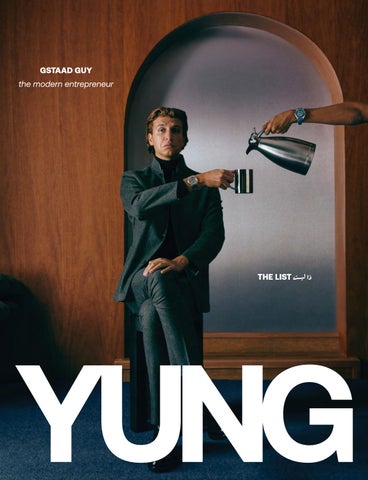
GSTAAD GUY
the modern entrepreneur
THE LIST
HardWear by Tiffany
Tiffany.com | © 2025 T&CO.
A design inspired by an iconic motif from 1962. A gift that celebrates love’s strength.
THIS IS YUNG
10-11
LETTER FROM THE EDITOR
Each year, the Middle East’s creative talent rises faster than ever. From established stars to emerging voices, the region continues to redefine expectations and take its place on the global stage. Not because of the headlines or the noise, but because of the people, our people, who insist on shaping the world in their own image. Creatives who refuse to wait for permission. Voices who choose courage over comfort. Stories that insist on being heard.
And then there’s Carlita, “The DJ of the Year”, whose sound has taken her from our region to stages across the world. I’ve watched her evolution closely, and what stands out most isn’t the scale of her sets, but the communities she builds. Wherever she performs, she brings people together. Her discipline, her instinct, her ability to transform energy into sound, all of it makes her global rise feel inevitable.
At YUNG, we witness this evolution up close. We feel it. We chase it. And THE LIST is where it all comes together, a record, yes, but also a pulse. A celebration of the region’s most brilliant minds across culture, art, music, fashion, sport, and the spaces in between. A tribute to those who work quietly until suddenly they are impossible to ignore.
Ahmed Malek, “The Actor of the Year,” brought power to the issue in a different way. On set, he moves with intention, focused, driven, endlessly curious. He’s not simply performing; he’s expanding. Each role, each risk, each shift in his craft feels like another step outward into the world. His presence is undeniable, his evolution unstoppable.
This year, the issue began with a shift of energy, unexpected, instinctive, almost cinematic. We were on set with Gstaad Guy, one of our cover stars, and from the moment he stepped in, the room changed. No forced poses, no performance, just someone fully at ease with who he is. Having him as “The Modern Entrepreneur of the Year” is a milestone for us. His first Middle Eastern cover, and a nod to the individuality and authenticity we’ve championed since day one.
And NAÏKA, “The Breakthrough Artist of the Year”, arrives in this moment stronger, more defined, more in command of her voice than ever. Watching her step into her own light this year has been a reminder of what it means to boldly choose yourself.
Then came “The Voice of the Year,” Saja Kilani, an artist who doesn’t just rise, she shifts the atmosphere. I’ve followed her journey for years, but 2025 marked something different. Her debut in the Golden Globes-nominated movie, “The Voice of Hind Rajab” didn’t just raise her profile as an actress; her role in a Golden Globesnominated film cements her position as a powerful voice and a creative to watch. Mounia Akl, our “Filmmaker of the Year,” brought another dimension to the issue. Her year has been transformative, House of Guinness on Netflix, global recognition, and a wave of stories told with her distinct emotional precision. There’s something unmistakably hers in every frame she touches: bold, vulnerable, and deeply human. 2025 didn’t just elevate her, it confirmed that her stories travel far, and land deeply.
Beyond the covers, THE LIST unfolds into 25 names across 25 categories, creatives from Egypt, Lebanon, Tunisia, and across the region. People like Zeyne, Mona Kattan, Osama Chabbi, Kareem Samy, Youssef Khayat, and many more, each reshaping their field in ways that feel both immediate and lasting. These are the names you’ll want to remember. The ones you’ll hear again. The ones who turned the region’s momentum into their own. Three years into YUNG, our mission has only grown sharper: to build, to uplift, to spotlight the identities and voices shaping the future. To celebrate the ones who rise with us, as we provide a platform to showcase their talent. To every talent featured, and to every person pushing culture forward, thank you. We see you. We honour you. We celebrate you. And we can’t wait to witness what comes next.
ek, e W ch s r at e n W n i i W uba a i D b a e r d tA Insi us r T e. r u t on i ul h c as F and t r a es , i r s to fashion r e h ot on +
Founder and Editor in Chief - YUNG
TODS.COM
founder and editor in chief SANDRA YEGHIAZARIAN
creative director SAIF HIDAYAH art director ATHINA SYMEONIDOU managing editor NADINE KAHIL senior editor LOUIS PARKS producer LANA SHASH LAMIS JOUDAH creative project manager OMAIA JALLAD editorial content assistant MAYA MAGED digital writers MENNA SHANAB MARIANA BAIÃO SANTOS MAI EL MOKADEM client manager and operations lead DARA HAMARNEH dara@thisisyung.com SUBMISSIONS AND INQUIRIES hello@thisisyung.com PRINTING AL GHURAIR PRINTING AND PUBLISHING LLC PUBLISHED BY THIS IS YUNG LLC Sharjah Media City hello@thisisyung.com www.thisisyung.com All rights reserved. No part of this publication may be reproduced in whole or part without permission from the publishers. YUNG Magazine welcomes new contributors but can assume no responsibility for unsolicited photographs or illustrations. Every effort has been made to contact the copyright owners of the images and text in this issue.
photography PER APPELGREN styling POLINA SHABELNIKOVA
photography CAROLINE GRZELAK styling MONTY COOKE
photography FOUAD TADROS styling QWAN ANTHONY
photography ESRA SAM styling QWAN ANTHONY
photography DOUGLAS IRVINE styling MONTY COOKE
photography FOUAD TADROS styling AHMED RASHWAN
THIS IS YUNG
14-15
Letter from the Founder Masthead Contents and Contributors The List Characters in Frame Gstaad Guy Saja Kilani Ahmed Malek Carlita Mounia Akl Naïka Colour Me Boucheron Portraits of Presence Moving with Dystinct Fashion Trust Arabia Fashion Trends Favourite Arab Films Girls, Ghosts, and Green Lawns Beauty Trends Alpha Orionis A Dialogue of Time and Story Dubai Watch Week Prada Mode London Threads of Memory and Resilience Design as a Social Connector We Design Beirut The Year the Gulf Became the Gallery Yung Escapes The Space
CONTENTS
10 12 14-15 16-41 42-59 62-75 76-89 90-105 106-119 120-131 132-147 148-159 160-165 166-169 170-177 178-185 186-191 192-195 196-203 204-213 214-217 218-237 238-243 244-249 250-253 254-259 260-265 266-273 274
CONTRIBUTORS
AHMED RASHWAN / AJAY VALSARAJ / ALYONA S / ANNIE ALVIN / AVA G / BETTY BEE / BRADELY / CAROLINE GRZELAK / CESAR S / CHLOE LOUSADA / DOUGLAS IRVINE / ELLIE KOSLOWSKY / ESRA SAM / EVAN C / FOUAD TADROS / HADEEL TAL / IGNACIO DE TIEDRA / INÊS SILVA FERREIRA / IVAN KUZ / JACK CHIPPER / JEAN KAIROUZ / KATE XA / LAURA C / LEKAN B / LOUI FERRY / LUKMAN / MAGGIE SEMAAN / MARTINA DEROSA / MICHEL KIWARKIS / MONTY COOKE / NATSU TOMONAGA / NICOLA SCLANO / PER APPELGREN / POLINA SHABELNIKOVA / QWAN ANTHONY / REBECCA CHANG / SAIKA HAYASHI / SASHA CHUDEEVA / SCAR SALARIO / SEREEN ZABEN / SHARBEL HASBANY / TARIK BENNAFLA / VALERIE NORMAN / YEHIA BEIDER
THIS IS YUNG
16-17
TIT LE The best examples of fine watchmaking and jewelry never cease to amaze and as the leaves turn orange, yellow and gold, we’ve curated a small collection of the very best for your pleasure.
photography XXXX styling XXXX words XXXX
THE LIST 2025
THE LIST 2025 spotlights the creatives across the MENA region and its diaspora who are defining a new cultural moment. From fashion to sports, from culinary arts to music, these are the names shaping the future of the Arab world - and beyond.
THIS IS YUNG
18-19
THE LIST 2025
AWDA, the Arabic for “return”, is the debut album from Palestinian-Jordanian singer Zeyne, and which marks a deeply personal milestone in her musical journey. Over the past four years, Zeyne has focused on building a sound that feels authentic and grounded, exploring themes of reclamation, identity, love, and the spaces in between. The album brings these elements together, blending traditional Arabic sounds; from dabkeh rhythms to the melodic textures of the mijwiz, with contemporary textures that reflect Zeyne’s present self. Each track carries a piece of her story, weaving past and present into a narrative about returning to one’s roots, embracing growth, and finding a true sense of self. Zeyne’s music is rooted in honesty and is designed to resonate across languages and cultures, inviting listeners to feel, connect, and reflect. Through AWDA, listeners get to experience Zeyne’s journey from start to finish as the story evolves across the tracks.
AWDA is Zeyne’s most intimate project to date, a record that celebrates self-discovery, cultural heritage, and the power of music to bridge personal and universal experiences.
photography LARA ZANKOUL
Alongside her debut album, 2025 has been a landmark year for Zeyne. She was selected as part of YouTube Foundry, accepted for Grammy consideration, and named Apple Up Next artist, amongst many other accomplishments. These milestones highlight her growing influence and the global recognition of her distinctive voice.
Based in Dubai since 2018, Tunisian-French fashion commentator Osama Chabbi is shaping the evolution of digital fashion commentary with a voice that blends wit, insight, and cultural nuance. He brings playful, thoughtful takes to the digital fashion world, teaming up with brands like Bottega Veneta, Chanel, Amina Muaddi, and Farfetch among other names. Known for his incisive storytelling and playful aesthetic, Chabbi has positioned himself at the forefront of contemporary fashion media. His content spans seasonal fashion reviews, in-depth interviews, and collaborative projects. All of it comes with a real understanding of cultural context. Through easy, honest conversations with names like Victoria Beckham, Willy Chavarria, Haider Ackermann, Simon Porte Jacquemus, and more, Chabbi gives audiences rare glimpses of the people and ideas driving fashion today in the most cinematic manner. 2025 has been a big year for Chabbi. He launched his voice-note interview series, ‘FRIENDS&VOICES,’ featuring standout figures like Imaan Hammam, Farida Khelfa, the Coperni duo, Imane Khelif, Stefano Pilati, Lucien Pagès, and Edward Buchanan. The 90-second standout digital format is a playful twist on voyeurism and celebrity culture, immersing viewers in a literal iMessage chat with their favorite insiders. His long-form interviews with Willy Chavarria, Simon Porte Jacquemus, and Victoria Beckham have now generated over 8 million cumulative views across platforms. This year also saw him collaborating with documentary filmmaker Loïc Prigent on his seasonal fashion reporting, consulting as the main creative for The Frankie Shop Abu Dhabi pop-up, and joining CR Fashion Book as a contributor.
photography AQIB ANWAR
Through his innovative approach, Osama Chabbi continues to expand the boundaries of fashion analysis, combining digital storytelling, cinematic interviews, and critical thinking. A fixture at Fashion Weeks worldwide, He captures the evolving spirit of a shifting industry while shaping the next generation of fashion discourse.
20-21
THE LIST 2025
Nour Jaouda is a Libyan artist based between London and Cairo, a duality that informs her practice. She holds an MA in Painting from The Royal College of Art, and works in different mediums spanning sculpture, textile and painting itself, exploring the intersections of memory, everyday life, and social history. Her large-scale dyed tapestries reference the shapes of Cairo’s prayer mats, while steel elements, both handcrafted and sourced from her surroundings, introduce a tactile, industrial dimension. Through these materials, her work bridges intimate narratives with broader cultural and historical dialogues. Jaouda has exhibited internationally, with solo presentations including Art Basel Statements (2024) and Where, If Not Faraway, Is My Place?, in London (2023). She has also participated in major international biennales, such as the 60th Venice Biennale (Foreigners Everywhere, curated by Adriano Pedrosa, 2024) and And All That Is In Between at the Islamic Arts Biennale, Jeddah (2025). Her works have been acquired by leading collections, including The Hepworth Wakefield (Dust That Never Settles, 2024) and the Arts Council Collection (The Light In Between, 2024). Through her practice, Jaouda continues to create immersive and poetic work that resonates across cultures, time, and memory, establishing herself as a distinct voice in contemporary art.
photography SUPPLIED BY TALENT
THIS IS YUNG
Based between London and Ramallah, Palestinian fashion designer Ayham Hassan creates work deeply influenced by his experiences of growing up in the West Bank. His designs combine critical reflection with creativity, drawing on the social customs, cultural heritage, and rich craftsmanship of his city. Focusing on tailoring, textiles, and draping, Hassan collaborates closely with local artisans, integrating traditional techniques into contemporary fashion. This approach not only preserves Palestinian craft traditions but also promotes sustainability and creative independence in the region’s emerging fashion industry. A graduate of Central Saint Martins, Hassan balances experimentation, innovation, and cultural exploration in his work. His aesthetic, raw, visceral, and earthy, reflects the realities of life under military occupation, where clothing serves as both self-expression and protection. Through his pieces, he tells stories of resilience, identity, and healing, aiming to elevate Palestinian fashion on a global stage. This year has been pivotal for Hassan. He received the BFC x NETA-PORTER & MR PORTER Education Fund Award, continued to gain recognition for his graduate collection, IM-MORTAL MAGENTA: The Colour That Doesn’t Exist, in international publications, and was shortlisted for Fashion Trust Arabia’s Franca Sozzani Debut Talent Award. He also strengthened collaborations with Palestinian artisans, exploring innovations in textiles and embroidery.
photography SUPPLIED BY TALENT
Looking ahead, Hassan plans to expand on the narrative of IM-MORTAL MAGENTA, deepen his engagement with Palestinian craft, and establish a stronger international presence for his work. Beyond design, he uses fashion as a platform for dialogue, amplifying underrepresented voices, challenging perceptions, and celebrating resilience through creativity.
THIS IS YUNG
22-23
THE LIST 2025
BUREAU BÉATRICE is a multimedia and creative technology company operating between Paris, Dubai and Shanghai. Co-founded by Jon S. Maloy, who also acts as the Chief Creative Officer and Creative Director, the studio is known for crafting large-scale brand universes and immersive worlds from concept to full execution. Their work spans ideation, scenography, storytelling, digital content creation, sound design, interactive installations, and meticulously curated guest journeys.
Known for transforming ideas into sensory, cinematic environments, BUREAU BÉATRICE continues to push creative boundaries and redefine how audiences connect with brands. Their work reflects a commitment to innovation, craft, and cultural storytelling; positioning the studio as a leading force in the future of experiential design.
photography STEPHANE AIT OUARAB
In just four years, BUREAU BÉATRICE has become one of the most forward-thinking studios in the industry. Their multidisciplinary approach has led to collaborations with global maisons such as Cartier, Dior, Richard Mille, Bvlgari, Huda Beauty, and others, shaping product launches, exhibitions, and cultural experiences across more than 60 markets. The studio’s ability to blend technology, emotion, and narrative has earned them international recognition, including being named one of Fast Company’s 50 Most Innovative Companies and Agency of the Year by Campaign Middle East.
Sarah Asmail is an Iraqi multidisciplinary production and set designer based in London whose work spans moving images, photography, advertising, music, and narrative. She studied Interior Architecture at university in London, but quickly realised her true passion lay in stage and set design. During her studies, she shifted her focus toward performance environments, developing conceptual spaces that explored atmosphere, storytelling, and movement. After graduating, Asmail interned with a renowned theatre designer, solidifying her desire to work hands-on in creating immersive visual worlds. She began collaborating with emerging photographers and directors, shaping ideas together from the ground up and refining her creative voice. Her journey naturally expanded into film and television, where she assisted several respected production designers. These formative years taught her how sets operate, how departments collaborate, and how to navigate the fast-paced, problem-solving nature of production.
photography SUPPLIED BY TALENT
Building on this foundation, Asmail continued designing her own projects, consistently experimenting across mediums and pushing her craft forward. Her recent work includes production design for A$AP Nast’s No Hammer directed by Dexter Navy, The Ordinary’s latest campaign directed by Olivia De Camps, and Little Simz’s Young directed by Dave Meyers. Today, she is recognised for crafting thoughtful, atmospheric, and visually compelling worlds that merge architectural precision with bold, contemporary storytelling.
THIS IS YUNG
24-25
THE LIST 2025
Souhail Guesmi - also known as Ratchopper - is a multifaceted Tunisian artist; he’s at once a pianist, composer, DJ, record producer, sound designer, experimental solo artist and founder of his record label BLOC C. Starting his journey at just 14 years old, Guesmi quickly found his passion in music: deconstructing tracks he admired and rebuilding them from scratch and eventually crafting his own instrumentals. His early online releases earned local acclaim and led to collaborations with prominent Tunisian artists, underlining his presence in the regional scene. As he grew as a producer, Guesmi taught himself piano, developing a distinct improvisational and compositional voice. Abandoning an academic path in economics, he pursued music full-time, a decision that has led to international recognition; including the 2023 Paris premiere of his chamber song cycle, Appel de l’Inconnu, at Salle Gaveau.
photography PAUL MESNAGER
In 2025, he released regionally charting music that fused Tunisian sounds with contemporary styles, toured globally with Saint Levant while producing on the road in makeshift studios, and contributed to Zeyne’s debut album AWDA. He also released his first solo EP in five years, began developing a computer game linked to upcoming BLOC C releases, and advanced projects with label artists Namiro and Koast. Collaborations with Noisediva, alongside sessions with both established and emerging musicians expanded his diverse and evolving catalogue of work.
photography MARCOS NÚÑEZ CID, ASSISTED BY ALEXANDRE FOLGOSO
Lebanese photographer and visual artist Yasmina Hilal began her creative journey while earning her BA in Visual Media Arts, with a minor in Photography, at Emerson College. There, she immersed herself in the darkroom, exploring alternative methods of scanning, printing, and manipulating images; a practice that would soon define her visual language. Her work invites viewers to pause, to dwell within each frame, and to navigate subtle layers of emotion and form. Like a line weaving through space, Hilal’s art flows across visual and emotional terrains that are at once fluid and still, prompting reflection and a deeper engagement with the image. Hilal has exhibited widely, with notable shows including I See Me In You at MENA Art Fair in Brussels (2023), The Age of Dystopia at Dalloul Art Foundation in Beirut (2024), The Material Woman at Soho Revue in London (2024), and Middle East Archive during Paris Photo (2025). 2025 marked a milestone in her career, and saw her being selected for a two-month residency with Dazed Global x Mason & Fifth, culminating in a London exhibition as one of only eight global artists; she also completed a two-week residency with Konvent Zero in Spain for Mediterrani Expandit; and collaborated on high-profile editorial projects. This year, Hilal also exhibited with Hayaty Diaries during Frieze Week London and participated in Middle East Archive showcases. Through her lens, Hilal transforms everyday moments into visual poetry; immersive, intimate, and unforgettable.
26-27
THE LIST 2025
Lebanese filmmaker Elie Fahed’s work is defined by emotional clarity and quietly powerful imagery. A filmmaker shaped by his education at the Lebanese University’s Fine Arts Institute, he first drew widespread attention through a series of acclaimed short films, including Sett El Donia, Fear of Fear, Starring Julia, and Fait Main, which have travelled across international festivals and led him to collaborate with some of the region’s biggest pop icons and also emerging, independent voices. Fahed’s cinema is anchored in themes of belonging, memory, and the fragile threads that connect people. His visual language is gentle yet resonant, often elevating small, unspoken moments into something universal. Deeply rooted in his Lebanese identity, he brings sincerity and emotional nuance to every project, whether he’s crafting narrative pieces, brand films, or lyrical visual essays. Beyond his own directing work, Fahed is an active presence in the Arab film community, regularly engaging in mentorships, workshops, and creative partnerships that help shape the next generation of storytellers. In 2025, he served on the shortlisting jury at Cannes Lions; the same year he received Gold, Silver, and Bronze awards for the campaign Recipe For Change. That year also saw him win Best Music Video at the Murex D’Or for Elissa’s Hobbak Metel Beirut.
photography SOHAD SCHMEIT
THIS IS YUNG
Youssef Khayat is a Lebanese basketball player, currently playing as a forward for Sagesse SC and a member of the Lebanese National Team. He first caught the eye on Beirut’s local courts, where his height, coordination, and early discipline set him apart. Through Lebanon’s youth system and later development in Europe, Khayat refined his game with professional-level training and competition. His performances abroad revealed his potential as a modern forward, versatile, long, and impactful on both ends of the floor. Today, Khayat stands among Lebanon’s most promising young athletes, carrying the ambition to represent his country at the highest levels and inspire a new generation of regional talent. In 2025, Khayat’s profile rose sharply. He played a key role in Sagesse’s run in the 2025–26 FIBA WASL - West Asia League campaign, earning recognition as a rising star in the club’s revitalized roster. His performances, combining scoring, rebounding, and two-way impact, affirmed his status as a core figure for both club and country.
photography SUPPLIED BY TALENT
As he continues to develop, Khayat remains a beacon of hope for Lebanese basketball, blending talent, work ethic, and a clear love for the game.
THIS IS YUNG
28-29
THE LIST 2025
Before leading MAD Celebrity, Samy honed his expertise across every facet of MAD Solutions, from marketing independent films to handling international distribution for Oscar-nominated titles. He played pivotal roles in campaigns showcased at top-tier festivals including Cannes, Venice, and TIFF, while also driving initiatives with the Arab Cinema Center, amplifying Arab stories to a global audience. In 2025, his influence was recognised when he was named one of the Arab Cinema Center’s 101 Industry Changers during the Cannes festival. Under Samy’s leadership, MAD Celebrity has grown into a full-scale talent powerhouse, with a team of over 80 professionals, including specialized managers, publicists, and agents. Looking ahead, his ambition is to scale the agency globally, forging high-impact brand partnerships, securing cross-border roles, and launching new verticals in music and sports, all while championing Arab talent on the international stage. For Samy, success isn’t just about representation, it’s about impact. He continues to create meaningful opportunities for artists on-screen and beyond, building bridges that allow Arab talent to thrive on the world stage.
photography GUEL SENER
Kareem Samy is a powerhouse in the Arab entertainment industry, serving as the Managing Director of MAD Celebrity, the Middle East’s leading talent management agency. Over the past decade, he has transformed the careers of some of the region’s most celebrated stars, from icons like Yousra, Ahmed Malek, Huda El Mufti, Tara Emad, and Razane Jammal to rising talents such as Nour Ehab and Youssef Omar. His keen instincts and vision for storytelling have positioned him as a key architect in shaping celebrity culture in the Arab world.
Farah Hourani is a multidisciplinary creative director and the co-founder of Scarab Records, where she designs entire worlds; visual, emotional, and narrative. At the heart of her work is the creative universe around Zeyne, a collaboration she has shaped since 2023 through music videos, campaigns, and the storytelling language that defines projects like Asli Ana, Kollo Lena, Hilwa, and Zeyne’s debut album AWDA. Under her vision, both Asli Ana and Hilwa earned Grammy consideration, marking a milestone for Arab-led visual direction. In 2025, Hourani’s creative reach widened dramatically. She crafted the complete identity of AWDA; the tracklist reveal, the album’s symbolic objects, the cover, and its photographic world. She also helmed the visual and conceptual narrative of Zeyne’s Golden Hour Run Gulf tour, designing everything from costume direction to tour visuals, with Ed Sheeran overseeing the music. Hourani’s influence extends beyond music, from fashion to philanthropy. She designed Saja Kilani’s red-carpet look for the Venice Film Festival premiere of The Voice of Hind Rajab, launched Scarab Creative Lab to accelerate emerging Arab artists, and built zeyne.co, Zeyne’s official digital home. She also created the Asli Ana charity merch line supporting Dr. Ghassan Abu Sittah’s Children’s Fund, and led the creative direction for Jordan’s 2025 World Cup anthem with Omar Al Abdullat.
photography SUPPLIED BY TALENT
A two-time TEDx speaker, Hourani stands at the forefront of a new wave of Arab creativity; one that merges heritage with futurism, intimacy with cultural vision, and artistry with purpose.
THIS IS YUNG
30-31
THE LIST 2025
In 2007, Kadry relocated to New York to specialize in mastering, building a reputation for precision and sonic clarity. Today, she operates from her custom-built Dumbo, Brooklyn studio, designed in collaboration with the acoustic specialists at Sondhus, where she continues to shape sound with meticulous expertise. Today, Kadry has established herself as a well-known audio engineer, working closely with iconic artists including Björk and Rosalia. She has also collaborated with Bon Iver, Anoushka Shankar, Sade, Gorillaz, Alex G, Daniel Caesar, TUL8TE, Blood Orange, Miguel, Fatima Al Qadiri, SANAM, and Djo, with several projects receiving 2026 Grammy nominations. A champion of artists’ rights, Kadry works with organizations like UMAW and No Music For Genocide, advocating fair compensation and ethical practices in the music industry. She continues to shape sound across cultures, genres, and generations.
photography JACKIE ROMAN
Heba Kadry is an Egyptian mastering engineer based in Brooklyn, New York. Kadry’s love for music began with the dreamy, reverb-soaked sounds of early ’90s indie and shoegaze, which she devoured whenever she could. After completing her studies at The American University in Cairo, she started her career crafting audio jingles for a local advertising agency. Driven by a passion for sound, she moved to the United States to study audio engineering at The Recording Workshop in Ohio. She then spent three years at SugarHill Recording Studios in Texas, honing her skills as a recording engineer and studio manager.
KAYALI, the global fragrance brand founded by Mona Kattan, launched in 2018 as a modern ode to Kattan’s Middle Eastern roots and the art of scent layering. The brand transforms fragrance into a personal ritual, allowing each wearer to craft moods and moments through scent. Collaborating with top perfumers worldwide, KAYALI selects the finest ingredients to produce distinctive, and unforgettable perfumes, all cruelty-free and thoughtfully crafted for a lasting impression. Today, Kattan is known as one of the most powerful women within the beauty industry, changing the game within fragrances, both regionally and globally. Building on her visionary approach, she has redefined contemporary perfumery by bridging heritage with innovation and elevating scent layering into a modern luxury ritual. Each of her releases has captivated fans all over the world; from her best-selling Vanilla | 28 to Yum Boujee Marshmallow | 81 and the latest Freedom collection, she has created iconic scents that are adored by women around the world.
photography VAUGHAN TREYVELLAN
Each luxurious scent is an ode to true craftsmanship and tells a special story, from addictive notes to the multi-faceted jewelled bottles. Thanks to Kattan being a global social media powerhouse and her obvious passion for fragrances, KAYALI has built an engaged community with more than 7 million combined followers.
THIS IS YUNG
32-33
THE LIST 2025
Born in Montreal and raised in Dubai, Joey Ghazal is the Restaurateur, Founder and Managing Partner of THE MAINE Group. His journey began with his passion for the restaurant industry which developed at a young age. He worked his way up from waiter to manager, eventually leading concept development and marketing at one of Canada’s largest restaurant development companies. In 2000, he spent two years in London studying film while working for the Soho House Group. In 2025, he founded THE MAINE; drawing inspiration from his childhood summers on the East Coast. Evoking the charm of a classic brasserie, it celebrates timeless Americana with a relaxed yet sophisticated approach. Designed like a modern clubhouse, The MAINE combines effortless elegance with warm hospitality; featuring attentive white-jacket service, live jazz, and expertly crafted cocktails served by bartenders in leather aprons and crisp ties.
photography NATALIE LINES FROM STUDIO LINES
With four locations across Dubai, The MAINE has grown into one of the UAE’s first home-grown brands to expand internationally, launching The MAINE Mayfair in 2021 and hosting seasonal pop-ups in Ibiza and Bodrum. Celebrated for his fearless creativity and entrepreneurial vision, Ghazal also launched the acclaimed BARBARY Deli + Cocktail Club in Barsha Heights and the popular Canary Club in JLT.
photography CHADY KAL
Dubai-born designer Omar Al Gurg, founder of MODU Method, is reshaping the landscape of contemporary design by merging creativity, functionality, and a deep sense of community. With a design philosophy rooted in the thoughtful solving of practical problems, Al Gurg’s work is as purposeful as it is visually compelling, earning recognition on regional and international stages. Al Gurg’s journey is shaped by personal experiences, architectural studies abroad, and his ongoing role within his family business. These influences have informed his approach to design around accessibility, storytelling, and craftsmanship. Through MODU Method, he has cultivated a studio that promotes functional yet meaningful design, bringing together a growing team dedicated to research, collaboration, and innovation. From relocating villas to launching a new community space - a modern majlis in the heart of Jumeirah - to creating bespoke furniture alongside architects and interior designers, Al Gurg demonstrates a commitment to design that resonates locally while appealing globally.
MODU Method is also expanding into home accessories tailored to the region, signalling the studio’s ambition to create versatile, market-ready solutions. Al Gurg’s work extends beyond production: Lawrie Shabibi in Alserkal Avenue is now representing him as an artist, and he has also presented his work in shows with organisations such as The Abu Dhabi Cultural Foundation. His designs are not only functional objects but stories in themselves, each piece carrying a unique character, reflecting both his heritage and his forward-thinking vision.
34-35
THE LIST 2025
At the centre of Cheb Moha’s practice is Shabab, the platform he founded to explore contemporary Arab identity through lifestyle, design, and shared experiences. What began as a brand has grown into a living ecosystem, uniting collaborators, musicians, designers, and communities who help shape its evolving language. This evolution took a new form with the opening of The Shabab Laboratory this year in Alserkal Avenue, an experimental space for making, listening, and gathering. The Laboratory serves as a playground for cultural exchange, hosting vinyl sessions, artist residencies, handson workshops, limited-edition drops, and community-driven programs. Moha has also expanded his universe globally, with pop-ups in London, Paris, and Los Angeles, bringing new communities into the Shabab world. Sound remains one of Moha’s most personal mediums. As a selector and deep digger of musical histories from across the Global South, he creates listening experiences that uncover unfamiliar rhythms and stories. Whether behind the decks or curating sonic environments, he uses music as a bridge, connecting people to place, memory, and the wider world.
photography SUPPLIED BY TALENT
THIS IS YUNG
Yasmin Zaher is a Palestinian author born in 1991 in Jerusalem. She earned her Bachelor’s degree in Biomedical Engineering from Yale University, but her love for literature and storytelling was a lifelong passion. Like many from traditional backgrounds, Zaher initially believed that pursuing a career in writing or the arts was too risky. However, in her mid-20s, she decided to follow her creative instincts and completed a Creative Writing program at The New School in New York, marking the start of her professional journey as a writer. Her debut novel, The Coin, was met with critical acclaim, earning her the 2025 Dylan Thomas Prize for young writers and quickly establishing her as a distinctive voice in contemporary literature. The novel has resonated with readers worldwide, leading to translations in French, Italian, German, Korean, and Turkish, and demonstrating the universal appeal of her storytelling.
photography WILLY SOMMA
Zaher’s work is celebrated for its lyrical prose, emotional depth, and the way it explores identity, memory, and cultural heritage. Drawing on her Palestinian roots, she crafts narratives that are both deeply personal and profoundly resonant across cultures. Currently based in Paris, Zaher continues to write and engage with the literary world, balancing her scientific background with a bold and compelling literary vision.
36-37
THE LIST 2025
Hailing from Palestine, Nöl Collective is a storytelling fashion label that collaborates with family-run workshops, artisan studios, and women’s cooperatives across the country. It is a collective that preserves and celebrates generational practices in weaving, embroidery, natural dyeing, knitting, and tailoring, co-creating garments and accessories that honour local craftsmanship and resilience. Rooted in ancestral knowledge, Nöl Collective’s practice centres on the artisan; their craft, their vision, and their well-being over mass production or profit, creating pieces that carry both meaning and intention. More than fashion, Nöl Collective is a platform for the human and political narratives behind each creation. By highlighting the stories of its makers, it shifts the focus from designers and brands, advocating for fair treatment, ethical wages, and cultural recognition. Each piece becomes a lens into life under occupation, carrying the histories, labour, and spirit of Palestinians. This Year, Nöl Collective advanced its storytelling mission with the capsule collection Roots & Threads 2025, fusing traditional weaving, embroidery, and natural-dye techniques with contemporary silhouettes, celebrating heritage and resilience. Throughout the year, the collective hosted workshops, documented artisans’ stories, and presented pop-up exhibitions in Amman and Ramallah, turning garments into living history. Committed to sustainability, they expanded their use of natural fibres and introduced a repair-and-refinish program. By year’s end, Nöl Collective had released heritage-inspired wearable art, strengthened artisan networks, and amplified often-overlooked voices through fashion as both craft and storytelling.
photography GREG C. HOLLAND
THIS IS YUNG
photography MARCO PINARELLI
Founded in 2024 by Mariana Wehbe, We Design Beirut has quickly become the heartbeat of Beirut’s creative scene. The city-wide platform transforms historic spaces into vibrant hubs where designers, artisans, students, and institutions come together to collaborate, experiment, and celebrate Lebanese creativity. Its second edition in October 2025 turned the city itself into a canvas, activating streets and landmarks with installations, workshops, and cultural programming that inspired conversation and connection, alongside Partner Samer AlAmeen. Before entering the world of culture and design, Wehbe spent over 15 years at DHL, where she developed the discipline, structure, and systems thinking that now shape her strategic approach. Born in Abu Dhabi and raised in Florida, she eventually returned to Beirut to explore and engage with the city’s creative landscape. From founding MWPR, a boutique PR and cultural strategy agency representing designers, studios, and institutions across the region, to leading a series of impactful projects, Wehbe has dedicated her career to promoting Lebanon’s creativity, resilience, and community on both regional and international stages. Today, We Design Beirut stands as a dynamic platform that champions Lebanese talent, fosters meaningful collaborations, and celebrates cultural heritage. By connecting local innovation with global audiences, it continues to spotlight Lebanon’s design scene while cultivating a dialogue around creativity, craft, and cultural identity.
THIS IS YUNG
38-39
THE LIST 2025
Her recent curatorial leadership includes serving as curator of Ghost 2568 (2025, Bangkok) and co-Artistic Director of the Busan Biennale (2025–2026, South Korea). From 2019–2025 she was Director of Programmes at Cubitt, and she co-curated Sharjah Biennial 16 (2023–2025, UAE). Between 2009 and 2023, as Civic Curator at Serpentine Galleries in London she developed over 50 long-term collaborative, community-focused art projects across the city. Across her career, Khalaf has commissioned and produced over thirty artist films that have been shown globally, curated international biennales and pavilion presentations, and co-directed influential forums such as the Global Art Forum at Art Dubai. Her work has appeared in major institutions around the world, reflecting her commitment to making contemporary art socially relevant, accessible and globally engaged. Alongside curating, she is a published writer and editor, co-editing books such as Vertical Atlas (2022), How We Hold (2023) and Radio Ballads: Songs for Change (2025). Through her multifaceted practice, Amal Khalaf continues to shape contemporary art by weaving together institutional vision, community engagement and critical discourse.
photography TOM TREVATT
Amal Khalaf works at the intersection of art and social justice, shaping institutions, communities, and global exhibitions through a collaborative, socially aware curatorial practice. With roles including curator, artistic director, and programme lead, she champions projects that foreground under-represented voices, identity, space, and collective memory.
AYA System are the creative duo shaping a new wave in global electronic music through their distinctive Afro-Khaleeji sound. They first rose to international attention with the viral hit “Ma Tnsani (Yalla Habibi)”, created in collaboration with South African producer Vanco, which became the most Shazam’ed song in 2025. Anchored by the unforgettable hook “Ahla Laila Ahla Nas,” the track became a cross-cultural anthem and The Track of the Year, bridging Gulf identity with global dance culture and introducing millions to a fresh sonic language rooted in Khaleeji melody, Arabic lyricism, and contemporary house and techno rhythms. AYA’s sound is built on emotional depth, cultural pride, and intentional storytelling. Their music blends heartfelt narrative with pulsating electronic production, resulting in tracks that feel both intimate and expansively global. The duo has gained support from top DJs including Black Coffee, Keinemusik, Desiree, Mahmut Orhan, Major Lazer, and more, while their tracks have been used organically by major celebrities such as Travis Scott, Will Smith, Naomi Campbell, Anthony Joshua, Lindsay Lohan, Jack Grealish, Erling Haaland, and Tottenham Hotspur, further cementing their cultural reach.
photography ELL EARL
Beyond the viral success, AYA are committed to reshaping perceptions of Middle Eastern creativity in contemporary music. Their artistic ethos focuses on elevating Arab narratives through voice, language, and rhythm, using frequency as a tool for joy, connection, and representation. With new releases on the horizon, AYA continue to carve out a powerful space defined by story, spirit, and sound.
THIS IS YUNG
40-41
THE LIST 2025
What started as casual gatherings quickly evolved into a full-fledged culinary practice. Halawa now crafts private dining experiences, pop-ups, and immersive catering events that transport guests on a journey through Levantine cuisine. From fresh, lively salads to rich, fragrant mains, each meal culminates in the live preparation of his signature Knafeh Nabelsiyeh, creating moments of shared joy and connection. In 2025, Halawa expanded his culinary world with a renewed focus on giving back. He curated “The Palestine Supper Club” in New York; a fundraising dining experience, created in collaboration with ANERA and Haven, to support Gaza. The event reflected his commitment to using food as a vehicle for community, solidarity, and meaningful impact. Through his work, Halawa turns food into storytelling. Every dish honours heritage, evokes memory, and fosters belonging, inviting diners not just to eat, but to experience the culture, warmth, and history of the Levant in every bite.
photography SAM RAWADI
Ahmad Halawa, also known as Chef Halawa, transformed a love of food into a bridge between cultures. Once immersed in the high-pressure world of advertising, he discovered that his true calling lay not in boardrooms but around a table. Drawn to the vibrant flavours of the Levant and the stories they carry, he began hosting informal dinners at his home, sharing meals that celebrated his Palestinian roots.
Yusur and Maryam Al-Khalidi are Iraqi-born sisters making waves in the digital world through beauty, fashion, and lifestyle content. Yusur Al-Khalidi, Iraqi-Finnish and based between Dubai, Milan, and Helsinki, has built a highly engaged following across Instagram, TikTok, and YouTube. Known for her bold, anime-inspired aesthetic, Yusur blends high-fashion with pop-culture influences, creating makeup, lifestyle, and cosplay content that is both visually striking and creatively innovative. Her fearless approach to style and storytelling has made her one of the region’s most expressive digital voices. Her sister, Maryam, also based in Dubai after growing up in Finland, has cultivated a strong presence across Instagram, TikTok, Snapchat, and YouTube. Celebrated for her signature eyeliner looks and engaging makeup tutorials, Maryam combines her Middle Eastern heritage with European lifestyle influences, giving her content a unique cross-cultural appeal. Her approachable personality and polished aesthetic have positioned her as an influential voice for brands across the beauty, fashion, and lifestyle sectors.
photography SUPPLIED BY TALENT
Together, the Al-Khalidi sisters represent a dynamic, creative force in the digital space. Through their distinct yet complementary styles, they inspire audiences worldwide with content that is innovative, relatable, and deeply personal.
THIS IS YUNG
42-43
CHARACTERS IN FRAME
PHOTOGRAPHY JACK CHIPPER STYLING IGNACIO DE TIEDRA
Zoom in on the faces we pass every day. The transit strangers, the café regulars, the overlooked and the unforgettable. Each portrait transforms a fleeting encounter into a moment of quiet magic, reimagining real people as muses and placing everyday characters firmly in the spotlight.
THIS IS YUNG
full look, GIVENCHY
44-45
CHARACTERS IN FRAME
full look, GIVENCHY
THIS IS YUNG
coat, FERRAGAMO shirt, COMME DES GARÇONS
46-47
CHARACTERS IN FRAME
coat, pants, FERRAGAMO shirt, COMME DES GARÇONS belt, shoes, GIVENCHY
THIS IS YUNG
full look, SAINT LAURENT
48-49
CHARACTERS IN FRAME
full look, SAINT LAURENT
THIS IS YUNG
jacket, skirt, FENDI heels, MAISON MARGIELA
50-51
CHARACTERS IN FRAME
full look, BALENCIAGA
THIS IS YUNG
full look, SAINT LAURENT
52-53
CHARACTERS IN FRAME
full look, DIOR
THIS IS YUNG
full look, McQUEEN
54-55
CHARACTERS IN FRAME
full look, McQUEEN
THIS IS YUNG
full look, McQUEEN
56-57
CHARACTERS IN FRAME
full look, TOD’S
THIS IS YUNG
full look, DAVID KOMA
58-59
CHARACTERS IN FRAME
full look, DIOR
makeup MARTINA DEROSA; hair REBECCA CHANG; casting director VALERIE NORMAN; set designer ANNIE ALVIN; models AVA G at PREMIER MODELS, ALYONA S at FLOW MANAGEMENT, LAURA C at PRM MODELS, LEKAN B & CESAR S at GENESIS MODELS, EVAN C at STORM MANAGEMENT, BRADELY at MODELS1; makeup assistant NATSU TOMONAGA; hair assistant SAIKA HAYASHI
THIS IS YUNG
COVER 60-61
COVER STORIES
STORIES
THIS IS YUNG
62-63
GSTAAD GUY
Wearing Audemars Piguet, Gstaad Guy talks parody, humour and how to not take yourself too seriously.
photography PER APPELGREN styling POLINA SHABELNIKOVA words MARIANA BAIÃO SANTOS
watch, CODE 11.59 BY AUDEMARS PIGUET SELFWINDING PERPETUAL CALENDAR, 41MM, 18-CARAT WHITE GOLD full look, LORO PIANA
THIS IS YUNG
64-65
GSTAAD GUY
watch, AUDEMARS PIGUET ROYAL OAK SELFWINDING PERPETUAL CALENDAR, 41MM, 18-CARAT SAND GOLD full look, LORO PIANA
We turn on the camera, a Dubai-London connection. He’s quite demure, disarmingly calm - composed, polite, friendly - with the ease of someone who knows exactly how they’re perceived, and how to play with that perception. For a few years now, Gstaad Guy has existed somewhere between satire and aspiration, the performance of modern wealth. Yet in conversation, the edges blur, he speaks with the same precision he performs with, careful, deliberate, premeditated in the way he builds a sentence. He speaks about luxury the way an architect might describe light, as a material, a vocabulary, a means of shaping experience. When Gstaad Guy first appeared online, he was a caricature of privilege: the exaggerated embodiment of an upper-crust archetype so absurd it could only have been invented by someone who understood its codes intimately. The satire was sharp, the accent impossible to place, and the humour layered with just enough self-awareness to make you laugh with him rather than at him. What began as a parody of abundance quickly became a mirror for it. “The growth was intentional,” he says later, “but the path was consequential.” What’s striking in retrospect is that there was always a clear north star - humour, excellence, and self-awareness - these three principles have been his engine, the reason a parody became a philosophy. The humour is absurd, yes, but never careless. The aesthetic, exacting but never self-serious. And the self-awareness? It’s the connective tissue that allows it all to hold. The comedy may have hooked viewers, but the precision - in tone, editing, and observation, revealed someone deeply serious about craft. “Luxury, taste and connoisseurship,” he says, “were always going to be part of the shtick and they still are.”
“People forget brands are run by people, and those people have a sense of humour.”
That consistency of values explains how a fictional character became a cultural platform. The Gstaad Guy universe evolved from 60-second skits into a podcast supported by legacy brands, a jewellery line built on inside jokes, and a global community fluent in irony and discernment. Seven years later, Gstaad Guy stands as a case study in how internet satire, when anchored in taste and intellect, can become both brand and mirror: a commentary on modern luxury, and an increasingly essential part of it. Gstaad Guy recently launched his own podcast, realizing that the short-form satire that once poked fun at modern privilege had become too small for the ideas and experiences he wanted to explore. “Sometimes I experience beautiful things,” he says, “and I feel guilty that I’m experiencing them alone.” The podcast was born from that “guilt”, from a desire to share the kinds of conversations that once stayed private, the moments of connection, intellect, and curiosity that don’t translate into 60-second bites.
THIS IS YUNG
66-67
There was always a clear north star - humour, excellence, and self-awareness. These three principles have been his engine, the reason a parody became a philosophy.
GSTAAD GUY
watch, AUDEMARS PIGUET ROYAL OAK SELFWINDING PERPETUAL CALENDAR, 41MM, 18-CARAT SAND GOLD full look, LORO PIANA
THIS IS YUNG
68-69
GSTAAD GUY
watch, CODE 11.59 BY AUDEMARS PIGUET SELFWINDING PERPETUAL CALENDAR, 38MM, 18-CARAT PINK GOLD full look, LORO PIANA
THIS IS YUNG
70-71
GSTAAD GUY
“Confidence and irony aren’t opposites, but allies.” As his audience expanded, so did the world he built. “Luxury is unnecessary,” he says. “But it can be beautiful.” His collaborations aren’t about mocking the system from the outside; they’re about exposing its human texture from within. “People forget brands are run by people,” he adds. “And those people have a sense of humour.” If his success, his humour, proves anything it’s that people are still moved by beauty. Gstaad Guy speaks of beauty the way he speaks of luxury: as something to be observed, contextualised, and shared. The podcast, in that sense, became his antidote to the solipsism of internet fame. Part of the appeal, he admits, was the resistance to scroll culture. “Every few months, people’s attention spans are nearly halving,” he says. “When they’re scrolling, they skip past almost everything.” Long-form audio, by contrast, demands presence. “If someone chooses to listen for an hour, they’re opting in. They’re invested.” The distinction matters to him. What’s striking is how much of himself he allows into this new format. Gone is the exaggerated accent, the ironic detachment. Friends had long told him to “break character,” but it wasn’t until he appeared as himself on Logan Paul’s ‘Impaulsive’ podcast that he realised people wanted to see that version of him “The real me isn’t actually very comedic,” he admits. “I’m just attentive. Curious.” And that curiosity has become the through-line. Whether he’s speaking to an influencer, a CEO, or an artist, what he’s really probing is the why and the how behind excellence. His best guests, he says, are those who can talk about “something greater than themselves,” who leave listeners with more questions than answers.
His partnership with Audemars Piguet is an extension of his central thesis, that taste and excess, beauty and absurdity, can coexist. Working with the brand deepened his fascination with technical mastery, watches so thin they seem impossible, “if-you-know-you-know” objects that whisper connoisseurship. “They take their craft seriously,” he says, “but not themselves.” What draws him in most is the brand’s ability to compress staggering complexity into something discreet. He speaks of their ultra-thin models - the Royal Oak “Jumbo” in particular - with reverence, calling them “understated but still with this shine.” His favourite, the Quantum Perpetual Ultra-Thin Jumbo, embodies everything he loves: restraint with depth, precision with personality. “It’s like a multifaceted person,” he says. “True to their values, but able to adapt, elegant at a gala, relaxed at a party, and still unmistakably themselves.” Then there’s Poubel - the inevitable next act in the Gstaad Guy universe. It began, like most things he does, as an inside joke. “À la poubel,” a phrase once thrown around in his skits to exile poor taste and bad manners, somehow became a motto, a form of cultural shorthand for his audience - a code that signalled irony and discernment in equal measure. “If two people both find humour in something absurd,” he says, “they become ten times closer.”
watch, AUDEMARS PIGUET ROYAL OAK OFFSHORE SELFWINDING CHRONOGRAPH, 42 MM, “BLEU NUIT, NUAGE 50”, CERAMIC full look, LORO PIANA
THIS IS YUNG
72-73
watch, CODE 11.59 BY AUDEMARS PIGUET SELFWINDING PERPETUAL CALENDAR, 38MM, 18-CARAT PINK GOLD full look, LORO PIANA
GSTAAD GUY
“Sometimes I experience beautiful things, and I feel guilty that I’m experiencing them alone. The podcast was born from that feeling, the urge to share what doesn’t fit into 60 seconds.”
74-75
From that connection, a brand emerged, jewellery that functioned as both object and language, made to be worn like punctuation - discreet, witty, exquisitely crafted. Silver charms engraved with phrases from his world, little relics of shared understanding. “It was about creating something you could hide under a sleeve or show to someone who gets it,” he says. “A conversation piece, literally.” “If saying something is good is meaningless, then the inverse should also be true,” he calls his brand “trash” to mock luxury’s obsession with self-importance. It’s Duchampian. “Every new luxury brand is trying to convince you how luxurious it is,” he says. “But that’s not for the brand to decide, it’s for the consumer.” So instead of proclaiming beauty, he chose the opposite: Poubel - French for trash. It was part provocation, part philosophy. The joke, as always, revealed the truth: that confidence and irony aren’t opposites, but allies. The pieces are finely made, hand-finished but they don’t need to insist on their worth. They exist in the same paradox as their creator: a blend of sincerity and self-awareness, beauty and wit, luxury and laughter. Like the character that birthed it, Poubel has outgrown its punch line. It’s no longer just a commentary on excess, it’s proof that the most intelligent kind of luxury is the one that doesn’t take itself too seriously. If there’s one thing Gstaad Guy understands, it’s how to evolve without missing the plot. Now, his focus is on keeping it that way. The projects ahead - more collaborations, a new chapter for Poubel, the continued expansion of his podcast - are not about scale for its own sake, but about preservation: of humour, of curiosity, of the sense that all of this still feels like play. “I think
GSTAAD GUY
“Every new luxury brand is trying to convince you how luxurious it is; but that’s not for the brand to decide.”
people sometimes assume there’s this big strategy,” he says, “but a lot of it is still just me having fun.” That fun, however, is built on discipline and attention to detail. He remains meticulous about tone and message, cautious not to let success flatten what made the whole thing magnetic to begin with: irony with heart. As he said before, “Luxury is unnecessary, but it can be beautiful.” The same could be said of the world he’s built: unnecessary, perhaps, but beautiful in its absurd precision. When asked about the future, he resists the temptation to over-intellectualise it. The mission, as he sees it, is to stay light. “It’s not that deep,” he says with a smile. “I’m just having fun.” And maybe that’s the secret, why, after seven years, the character, the creator, and the commentary still work. Because in a world desperate to define itself, Gstaad Guy reminds us that taste, like humour, only really lives when it breathes. ■
grooming JEAN KAIROUZ; set designer YEHIA BEIDER; photography assistant SCAR SALARIO; styling assistant SEREEN ZABEN
THIS IS YUNG
watch, CODE 11.59 BY AUDEMARS PIGUET SELFWINDING PERPETUAL CALENDAR, 41MM, 18-CARAT WHITE GOLD full look, LORO PIANA
THIS IS YUNG
76-77
SAJA KILANI
Saja Kilani’s voice carries across film, poetry and spoken word, telling stories that need to be heard. photography CAROLINE GRZELAK styling MONTY COOKE words LOUIS PARKS
full look, BOTTEGA VENETA
THIS IS YUNG
full look, BOTTEGA VENETA
78-79
SAJA KILANI
“NO MATTER WHERE I WAS PLACED, I FOUND BITS OF HOME EVERYWHERE I GO.”
Saja Kilani speaks with the kind of calm that only comes from conviction. Her words are thoughtful, deliberate, and often punctuated by a quick, disarming smile. “No matter where I was placed,” she says early in our conversation, “I found bits of home everywhere I go.” Born to Jordanian-Palestinian parents and raised in different worlds, she grew up tracing her identity through shifting skies, first in Aqaba, then Amman, and later Toronto. She’s an artist who moves between languages and landscapes, her work grounded by empathy and belonging rather than borders. “I spent my first eight years in Aqaba,” she remembers. “Then we moved to Amman for a few years before I went to Canada at fifteen… A lot of my poetry actually talks about not necessarily needing home to be in one place, there’s parts of it that remind you and trace back to it. But it’s really the people that you’re surrounded with, certain things that you stay in touch with culturally, traditionally, that makes home.” That sense of searching, for identity, for purpose, for a place that feels like home, threads through Kilani’s life and work. Whether she’s acting on a set, writing poetry, or performing on stage, her art is steeped in empathy. She’s one of those rare storytellers whose creative disciplines feed one another, a poet who acts and an actress who writes like she’s directing light onto a scene. “Film and cinema are general is not just entertainment, they’re educational. And I like to be part of that side of the world.” she says.
Her acclaimed role in The Voice of Hind Rajab brought that conviction into sharp focus. The film, which won the Silver Lion Grand Jury Prize at Venice, tells the true story of Hind Rajab, a young Palestinian girl killed in the Gaza war. Kilani plays Rana, the Red Crescent first responder who tried to guide Hind to safety over the phone, a part that required both restraint and vulnerability. “I received an audition, a self-tape, from my agent,” says Kilani of the audition process. “I sent it in, when you first audition for a film like this, they don’t necessarily share the details, it was kind of like an improv scene,” she says. “But I knew the director [Kaouther Ben Hania] and I’ve been a huge fan of her work, I knew that if she was behind it, it had to be powerful.” “And so I received a call back, that is when the story was revealed to me. And it was this immense responsibility. It made me want to do this even more because as an actor and as an artist myself, I’m always trying to find ways to tell stories that are based on true events,” Kilani says. Ben Hania, she says, “took a chance on me.” Before offering the role, the filmmaker confessed she couldn’t find any of Kilani’s work online. “I’d only done one feature and it was still in post-production,” Kilani recalls. “She said, ‘How can I trust that you’re good on camera?’ I sent her a small snippet of something I’d done, and she really took a chance.” It was a leap of faith that Kilani felt deeply: “That was also added pressure … I just wanted to make sure she didn’t regret that decision.”
THIS IS YUNG
80-81
SAJA KILANI
“FILM AND CINEMA […] ARE N OT J U ST E N T E RTA I N M E N T, T H E Y ’ R E E D U CAT I O N A L . A N D I L I K E TO B E PA R T O F T H AT SIDE OF THE WO R L D.”
Before shooting, Kilani spoke for hours with Rana, who she’d portray in the film. “We were on the phone for maybe three, four hours the first time. And she’s such a lovely person. I’m so lucky to call her my friend today. She was so generous, because it was hard at first, I didn’t want to open a wound that she spent a year trying to mend, but she was so generous with the whole story. She told me everything from her perspective,” says Kilani. “And then she said something that I really appreciated, ‘I don’t want you to copy me. I want you to just listen to her voice and that alone is enough’.” Kilani did exactly that. On set, the director kept Hind’s actual voice recording hidden until the cameras rolled. They shot the film chronologically, she explains. So each scene was the first time they heard her. “I thought I was ready for her voice because I knew exactly what she was going to say. But it’s a whole different thing when you hear her. Also, that innocence behind that voice. You really don’t need to be Palestinian to relate to the story. It’s human. It’s a child’s story. A child that’s been failed,” she says. She describes the atmosphere on set as one of collective care, “…everyone, from the director to the boom operator was there with so much love and respect for the story and everyone was so proud to be part of it. It felt like one community. Simultaneously, it was a very hard role, but at the same time, it was as smooth as it could be, trying to tell the story with so much love and understanding.”
Carrying that emotional weight was far from easy. “I don’t practice method acting,” she says. “But with this film, I think I did it unintentionally. My character deteriorates over time, and by the last few days of shooting, I think I did, physically. I got sick. I realised later it was my body reacting to everything. The director gave me the space to relax; but I had to remind myself that you’re serving this story for a reason, that’s why I was able to continue.” When The Voice of Hind Rajab premiered in Venice, where it received a 23-minute ovation, the response stunned her. “You know, it’s a contradicting emotion, because you want to be proud of the work that you’ve done and for letting out the story. But at the same time, you think about the story that you are delivering and the actual message behind it. The fact that a stadium filled with people from all over stood up and clapped for that long just made me realise that, yeah, this film has been able to tap into people. If cinema can change something internally, inside you, it is the biggest honour. It showed me that you don’t need to speak the same language. You don’t need to come from the same place.” Kilani’s relationship with Rana, the real-life first responder, didn’t end with filming. Rana, is still an active worker at the Red Crescent. It was an honour playing her,” she says. “When she watched the film, she told me, ‘You mirrored my emotions, you “physicalized” them.’ You know, such a beautiful statement that I think will forever be engraved in my head.”
full look, BOTTEGA VENETA
THIS IS YUNG
82-83
SAJA KILANI
full look, BOTTEGA VENETA
THIS IS YUNG
84-85
SAJA KILANI
“ON STAG E WAS THE O N LY TIME I WAS N ’ T CONSCIOUS OF M Y C O N D I T I O N . ACT I N G H AS S AV E D M E F R O M M Y D EST R U CT I V E S E L F- I M AG E .”
Her eyes soften when she speaks about it. “Every time I get a message from her, if a heart can smile, it was doing just that. I’m still in touch. I speak to her. I was just on the phone with her yesterday. She’s someone I really, really look up to.” If Hind Rajab cemented Kilani’s voice as an artist of conscience, Simsim marked the beginning of her cinematic journey. The film, her first in Arabic, earned her the Best First Time Lead Actress award at the Amman International Film Festival. “I got the role four days before shooting,” she laughs. “And it was in a dialect I wasn’t used to. It was a very big challenge, but it pushed me in the most positive way. It was more like a volunteer type of thing, everyone who was there chose to be there because of their love for cinema. So the environment was so motivating.” This sense of determination is personal as well as professional. Kilani is the first in her family to pursue an artistic career, a path that came with uncertainty as much as excitement. Coming from a background where traditional professions were the norm, she had no blueprint to follow, no relative to turn to for advice or reassurance. The decision was a risk, but one she felt compelled to take. With her family’s support and her own conviction, she stepped into uncharted territory and the rest is an evolving story. Outside of film, Kilani has built a following through her poetry, a medium she first treated as a private refuge. “With poetry, it’s always been like a private form of expression of mine that
I would just go on my notes app on my phone and write anything that interests me. It started off with liking quotes said by public figures. And then I would watch a lot of spoken word poetry, live poetry,” she says. She recorded herself performing one of her poems, posted it online, and watched people respond. The reaction was positive, people connected, and she took it from there. She did this through live performances, and then through music. Her debut single, TATA, combines poetry with traditional instrumentation composed by Lebanese qanun player Jihad Asaad. “We’ve been just friends on social media and he’s liked my poetry,” she says. Asaad composed the music, Kilani wrote a poem, an ode to her grandmother. “And that was the first thing I released on streaming platforms. And I liked this idea. So I posted another, I released another one called Dear Vitiligo about my skin condition. I think this is something that I would like to keep doing,” she says. Dear Vitiligo confronts her skin condition with unfiltered honesty, “On stage was the only time I wasn’t conscious of my condition. Acting has saved me from my destructive self-image, I think, because it’s where I can freely express myself,” she says. “And so I thought to myself, I want to feel how I feel on stage every day, without needing to cover up. And that’s when I realized that it’s all in my head. If I’m confident with who I am, with my skin condition, and if I’m being true to myself, that is because I think my message as an artist as a whole is to be as honest as possible.”
full look, BOTTEGA VENETA
THIS IS YUNG
full look, BOTTEGA VENETA
86-87
SAJA KILANI
full look, BOTTEGA VENETA
THIS IS YUNG
88-89
SAJA KILANI
When she talks about the Arab film scene, Kilani’s optimism is tempered by realism, “I think it’s been nice when we take ownership of our stories. And I would love to see more of that. I would also love to see more films that are creative, even fiction. We’re put in a position where we’re kind of raising awareness about issues that are happening, and we’re not able to really enjoy these types of stories. But I think it would be nice to see more of those.” In terms of recognition for Arab cinema, things are moving a little slowly, “I think the way the algorithm works is kind of crazy because it exposes me to my side of the region. But then I come to places like New York, and I’m talking to people from here that are not aware of the situation, it makes me take a step back and think, am I just exposed to my side because of the algorithm?” Regardless of the wider scene, Kilani “…wants recognition to come from the work itself, not from filling a category.” She’s careful to clarify that she isn’t dismissing the importance of
representation. “I would love to see more people getting appreciated for their work. Once you take on this role, you’re already representing your side, your country. I think this is how you bridge people from all over.” For Kilani, that focus on craft is inseparable from her empathy. When the camera starts rolling, all the outside noise fades. She’s alive in that moment, on stage, on set, wherever the story lives. Poetry, performance, and activism are all extensions of the same impulse: to connect. “I believe there’s so many stories yet to be told that can connect people. I would love to stay part of that world for as long as possible,” she says. Whether in film, poetry, or conversation, Saja Kilani, and the stories she helps tell, are a lesson in bearing witness, to pain, to beauty, to the fragile of being human. She builds bridges not through grand gestures, but through words and performances that insist on finding the light. In a time defined by division, her storytelling feels like an act of hope, a reminder that empathy still speaks. ■
makeup HADEEL TAL; hair TARIK BENNAFLA; set designer ELLIE KOSLOWSKY; photography assistant NICOLA SCLANO
“I BELIEVE THERE’S SO MANY STORIES YET TO BE TOLD THAT CAN CONNECT PEOPLE.”
full look, BOTTEGA VENETA
THIS IS YUNG
90-91
STEPS
AHMED MALEK
INTO
HIS
OWN
STORY
Egypt made him. Now the actor is determined to give something back.
photography FOUAD TADROS styling QWAN ANTHONY words MAI EL MOKADEM
necklace, bracelets, CARTIER top, AMIRI pants, shoes, CELINE
THIS IS YUNG
92-93
AHMED MALEK
watch, bracelet, CARTIER top, pants, shoes, LORO PIANA
“THE TRUEST ART IS THE KIND THAT REACHES EVERYONE, ANYONE CAN FEEL IT.”
longer the child he once was, not yet the legend he wants to become, but conscious that he’s part of a generational shift. A shift where Arab cinema has stopped orbiting Western expectations, but is turning inward; toward its own truths, its own cadences, its own unresolved questions. You’ve said before “acting chose me.” What do you think acting saw in you that you didn’t yet see in yourself back then? I say that because I really started so young I didn’t have the consciousness to “choose” anything. At eight or ten years old, no one knows what they want to do in life. It came as a coincidence, and once I entered, something inside me recognised it immediately. When I was 17 or 18, at a time when people start searching for their passion, mine was already there waiting. It felt like destiny picked for me before I had the vocabulary for it. Acting became everything for me, but if I wasn’t an actor, I’d probably still end up somewhere near writing or storytelling. They’re all forms of the same instinct. When you look at that young boy doing puppet shows for his family, what part of him still lives inside the man you are now? The playfulness. The chaos. The kid who flipped a table into a stage at family gatherings — he’s still here, and, as an actor, he has to be.
Acting didn’t come to Ahmed Malek as a career choice, it arrived long before he had the language to name it. Long before the festivals, the international scripts, the Gouna red carpets, there was a boy in Cairo flipping a dining-room table into a stage, putting on puppet shows for his family, insisting that stories were worth telling even when no one asked. At eight years old, he walked into the industry by coincidence. At 17, he chose it, fully aware this time. Somewhere between those years, acting stopped being something happening to him and became something he was building: frame by frame, instinct by instinct, with a hunger he still doesn’t fully understand. Now, with YUNG naming him Actor of the Year 2025, Malek stands at a rare crossroads: no
That child is the part of me with no limits, the one who lets emotions rise without embarrassment. As you grow, maturity shapes you, and you know your tools as an actor more, but that first layer, the child, stays. I always say Tyler the Creator’s quote: “Create like a child, edit like a scientist”. The child gives the freedom; the adult gives the clarity, the polish, and the editing. You differentiate between being a “child actor” and a “child star.” When you look back, which would you call yourself? A “child star” is someone famous very early. I wasn’t. I acted as a kid, yes, but people only really knew me when I was older, around 15 or 16 with El Gama’a, when I had already matured.
THIS IS YUNG
ring CARTIER coat, pants, TOM FORD
94-95
AHMED MALEK
ring, CARTIER coat, THOM BROWNE top, pants, LORO PIANA
THIS IS YUNG
96-97
AHMED MALEK
“MY JOB IS TO MAKE YOU BELIEVE, AND THE ONLY WAY IS TO BELIEVE IT MYSELF FIRST.” Egyptian cinema shaped you, and now you’re shaping it back. When did you first feel like you were part of a generational shift? Honestly… this year. 2025 is one of the most important years of my life, it’s the beginning. For years, I felt like I was watching the industry from inside it: working with giants like Marwan Hamed, Mohamed Diab, Tarek El Erian, seeing actors I grew up watching. I learned from all of them. But this year I felt something different; that I didn’t just want to be a witness. I wanted to be an active force. To search for ideas, build teams, find directors I connect with, and contribute to Egyptian cinema’s next era. Our cinema is historic. I want to be one of the names that carries that legacy forward. In twenty years, I want my name to stand beside the generation that raised me; Nour El Sherif, Karim Abdelaziz, Ahmed Zaki. I want the work to be real, to speak to our people, to reflect our taste as Egyptians. I want greatness, yes — but the grounded, grateful kind, the kind that earns its place. You’ve just been named YUNG’s Actor of the Year for 2025, and received similar recognition at Gouna Film Festival. What went through your head when you heard the news? Did it change how you see your own journey so far? It reassured me that I’m on the right path. Recognition doesn’t make me relax, though; it
makes me look forward. It pushes me to think about 2026 and 2027 and how I can do better. Robert De Niro once said that when everything feels incredible or everything feels awful, your only job is to stay steady and relaxed either way. That’s how I treat recognition — not an end point, not validation. Just a sign to keep moving. What matters most to me is telling stories from my region, stories that feel true, without serving any external agenda. I care about my region and Arab audiences more than anything else. Our region deserves representations that resist the politics we’re living under or being branded as. As someone whose career crosses borders, when did you realize your work could stand on its own, without looking to the West for a green light? It comes down to two things. First off, the types of roles offered abroad. Many of them force you into stereotypes, serving a certain foreign agenda. I’m not interested in that anymore. I can’t “dance on the staircase,” like we say in Egypt. I’m not a first-generation immigrant, I don’t have that lived insight into life abroad — that’s simply not my story.
full look, DIOR
THIS IS YUNG
full look, DIOR
98-99
AHMED MALEK
watch, bracelet, rings CARTIER top, shoes, CELINE pants, LORO PIANA belt, TOM FORD
THIS IS YUNG
100-101
Secondly, the politics we’re living through. The region is under pressure — politically, economically. That shifted my priorities. I want my core work to speak to us. If something international aligns with my truth, I’m open to that. But I’m not running after approval from a place that doesn’t carry our weight. Which role changed you more than you changed it? Truly, every role changes me, and I find aspects and qualities within myself that I never even knew I had. Shakespeare says in Hamlet that acting is about holding “as ‘twere the mirror up to nature”, and vulnerability is the only way to do that. To portray someone honestly, you have to dig into yourself; your fears, your insecurities, your joy. You can’t fake it, we, as actors, have to portray the human condition. That means accessing parts of yourself you don’t always want to touch. I’m entirely dedicated to my roles and the way I approach them, to the point that I don’t like separating who I am on-camera from who I am off it. I try to maintain those emotional qualities in both spaces, even when the camera isn’t rolling. When I’m playing a so-called ‘bad character,’ I keep in mind that no one sees themselves as inherently evil. Everyone has motives and reasons to what they do, and in their mind, it’s justified. My work is to understand those reasons deeply enough to make them real. My job is to make you believe, and the only way is to believe it myself first.
AHMED MALEK
You studied at RADA (England’s Royal Academy of Dramatic Arts), wrote and directed your own plays. How did that change your expectations of the industry, and of yourself? RADA changed my sense of what I’m capable of. I came back knowing I can generate work, pitch stories, develop projects, sit at a big table and contribute. When I returned from RADA, I lent a hand in developing projects like Welad El Shams, 6 Ayyam, and My Father’s Scent. I want to direct at some point. Maybe in five years… I’m tiptoeing my way in that direction. The biggest shift was this: my voice matters, not just as an actor, but also as a storyteller. I realised people were actually connecting with what I had to say, and that pushed me to create more. My audience is the real echo chamber; it goes all the way from the people in the ahwa to the living room compounds. I don’t want my voice to stay in one lane; rather, to reach all those different worlds. The truest art is the kind that reaches everyone, anyone can feel it. But to speak to both the masses and the niches, I have to keep a standard of honest work, and that balance is something I’m always working on. You’re quite intentional and particular about the stories and roles you choose. What’s the first red flag that tells you a script isn’t speaking from our reality? When it feels alienated from our reality, or has no real impact on the Arab social fabric. The great Mahmoud Hemida once said: some philosophies we imitate from the West simply don’t fit our culture, and they show… they feel fake. If it’s not grounded in an Arab reality — socially, emotionally, politically — I won’t do it. Another red flag is when a script slips into immaturity, shallow, surface-level, almost adolescent in its thinking.
bracelet, ring CARTIER top, CELINE pants, TOM FORD
THIS IS YUNG
102-103
AHMED MALEK
watch, bracelet, necklace, CARTIER jacket, AMIRI
THIS IS YUNG
bracelet, ring, CARTIER pants, TALENT’S OWN
104-105
AHMED MALEK
You’re drawn to stories many people look away from — the overlooked, the displaced, the lives in the margins. Why these shadows? When I choose a role, I’m always drawn to the most human side of any character. In The Swimmers, I insisted on showing the darker, more invisible side of the refugee experience. There were countless hardships and complications refugees faced, especially early on, before anyone saw the full picture. I wanted to reflect that through my character, to show another layer of the story.
grooming JEAN KAIROUZ; photography assistant LUKMAN; props FORMA
In Welad El Shams, I wanted the character to be real; strong, yes, but also flawed, sometimes insecure, sometimes harsh. The media loves to portray this fictional version of men — hyper-masculine, invincible, always tough, always ‘geda’an.’ I’m constantly trying to bring the real person instead. For my character, Wel3a, for example, I wanted to show both the shadow and the light; the contradictions, the inner fracture. A real human being. People usually see the confidence on screen, not the turbulence that comes before it. Anyone watching your process can tell you take the work seriously, sometimes even heavily. How do you keep doubt driving you instead of derailing you? I don’t think self-doubt ever disappears. I’m always questioning: did I really find this character’s soul? It feels like meeting someone new for the first time: what does their laugh sound like, how do they sit with their own skin? It’s part of the job to keep thinking there’s a better, truer version you can reach. For me, doubt is fuel, but only if it’s healthy. The kind that pushes you forward, not the kind that destroys you. Before a project, I doubt everything. Once I’m on set, wearing the skin of a character, hearing “action,” I let all of it go. I have to be completely present in the moment. Doubt exists before and after. Never during.
What’s the hardest truth about acting that no one prepares you for? One day the audience puts you on a throne. The next day they tear you down. One day they’re praising you, the next they’re throwing stones. You have to be mentally ready for both — the highs and the lows — without letting either one define you. It’s brutal, but public opinion is part of the job. After 15 years working across genres, languages, and continents, what do you think Egyptian cinema is becoming? I feel Egyptian cinema is in a much better place now than it was before. There’s fresh blood, new energy, real hunger. You can feel that actors have fire in them again. Right now, I genuinely feel we’re entering a new era for Arab cinema as a whole. With major markets opening in Saudi and the UAE, the competition has risen, and suddenly we’re standing next to American films and actually competing. We’re creating cinema that expresses real life — films people on the street can relate to. We’re finally moving away from the recycled formulas of the 2000s. ‘Siko Siko,’ ‘El Harifa,’ all these films proved loudly that we can make cinema that looks like us, speaks like us, carries our flavour, and still succeeds commercially and brings in money. That’s the direction we’re heading toward: films that feel authentically ours, and look like us. Egyptian cinema has always been historic. Now it’s becoming contemporary again. ■
UNCOMPOSED
106-107
CARLITA
DJ Carlita reimagines the dance floor as narrative architecture, instinctive, intimate, and endlessly cinematic.
COMPOSED
/
ARLIT
THIS IS YUNG
photography ESRA SAM styling QWAN ANTHONY words MENNA SHANAB
watch, AUDEMARS PIGUET shirt, QWAN OFFICE skirt, ADIDAS blazer, pants, heels, BALENCIAGA necklace, ALYX STUDIO hat, ANTHONY PETO
THIS IS YUNG
108-109
CARLITA
watch, AUDEMARS PIGUET top, AMIRI hat, HOOD BY AIR necklace, NOUS SOMMES (Spike Lee)
“THE C E L LO I N ST R U M E N T IS C LO S EST HUMAN
IS
THE T H AT TO THE VO I C E .”
“The cello is the instrument that is closest to the human voice,” Carlita tells me over Zoom. She says it simply, almost in passing, but the line stays with me for a bit. I replay it in my mind as she continues speaking, the warmth, the breath-like lift, the spiritual dimension she hears in each note. In a way, it sums up her whole approach. Even when she’s working with electronic textures, she’s always reaching for something that feels lived-in. It’s a revealing entry point into who she is as an artist. Beyond a nostalgic detail from childhood, the cello, the first instrument she ever learned, is the single most important tool that has shaped her instincts. The discipline, the emotional temperature, the way she listens for movement. When she speaks about DJing, set-building, or the “story” inside a mix, she speaks with the same tonal clarity she attributes to that instrument. Beneath her cool, reserved cadence, you can hear it – that slow, deliberate musicality has little to do with spectacle and everything to do with listening. Classical training is often cited in passing when talking about electronic music. With Carlita it’s foundational. She calls it a “really intense education” in theory and dynamics, as she puts it, and you can hear the practicality of it when she explains how sets come together. “When you’re classically trained,” she explains, “you automatically think in scale, know what key a track is in.” This discipline, she says, means her ear is always tuned to the underlying structure of sound, even in the chaos of a live set. In practical terms, it means her mixes never feel haphazard. Transitions are key changes and chord shifts, arranged almost unconsciously before she ever presses play. The impact of that schooling shows up everywhere. She talks about a DJ set like it’s a composed piece. “Before everything, it’s about the tracks and their scale,” she says, “and then you think of storytelling.” She doesn’t throw songs together for impact; she thinks in arcs, like a narrative that needs space to breathe. She really thinks of her sets like concertos, long-form pieces that grow and resolve. Back-to-back “bangers for ten songs in a row” don’t cut it for her. Instead she wants her sets to breathe, to have softer passages and heavier ones, the way a well-structured piece of music rises and resolves. The underlying lesson of her classical training is that a complete performance should surprise and move you, not just make you dance.
But becoming a DJ wasn’t the plan. “I never wanted it as my job. It was supposed to be just a hobby,” she says. But her path from conservatory graduate to travelling DJ was paved by that mastery of an instrument. She’s the first to admit her story sounds unlikely: a classically trained cellist with a master’s diploma at 16, suddenly drawn to clubs. Yet it turned out to fit. The study of music theory, she notes, was universal. It made learning piano or guitar or even the electronic tools of production almost second nature. “Because of the cello, I can play most instruments,” she says. That confidence in her technical skill freed her to explore new creative territory once she did step into the booth. She talks about “storytelling” repeatedly, not as a buzzword, but as the core of her performance philosophy. “You feel when a DJ wants to tell a story, going from beginning to end,” she says. She contrasts that with a forgettable sequence of hits. The difference, in her mind, is heart. Operating from this narrative mindset means planning, yes, but more often listening. Carlita downplays rigid setlists. Early on, she mapped out a storyline for important shows, but nowadays she trusts the crowd and the moment. She’ll have a roadmap, but rarely a GPS. “You can plan the sunrise set,” she says, “but 99% of the time it doesn’t go how you think.” Instead, intuition guides her through fluctuating energy in the room or under the dawn sky. She describes how reading the crowd is the “most important thing” – the litmus test of any musical arc. A tale might be composed, but it must fit the ears of those listening.
THIS IS YUNG
110-111
CARLITA
“If you asked 16-year-old me where I’d be,
I’d never say DJ.”
jacket, AXEL ARIGATO skirt, DIOR pants, MAISON MARGIELA sunglasses, GENTLE MONSTER hat, RAF SIMONS
THIS IS YUNG
112-113
CARLITA
That flexibility is part of what makes her sets feel personal rather than formulaic. She remains unfazed when things don’t go to plan. The mood of a set can shift a thousand ways. Even a carefully chosen opening track can be usurped by a surprise request from the floor, or a sudden electric moment of connection with the lights and dancers. “The story I want to tell has to fit the crowd,” she muses. If a certain tune resonates at 2 a.m., she’ll follow it, even if her original outline pointed elsewhere. The effect is a kind of co-creation: she lays down themes and moods, the crowd adds dance floor texture, and together it becomes something neither could have done alone. Yet the ambition is to guide a journey. She likes to hold back big moments for real impact. It’s a bit like a novelist withholding the climax until the right scene. “I always think every song has a home,” she explains. By that she means each track she selects is destined for a particular time and place in her set. In a way, her DNA as a musician demands it: she’s as much concerned with ‘where’ in the arc a song lands as ‘which’ song it is. That’s why a track that initially seems out of left field might become obvious in context. If narrative is the bones of her performance, surprise is the heartbeat. She grins recalling moments that shocked herself as much as her audiences. One infamous example happened in Brazil. The sky opened and rain fell at just the right time. On impulse, she dropped a psychedelic Brazilian groove, and everything clicked. The song felt like a predestined meeting of moment and mood. “It was the completely right song,” she says. Suddenly everyone was singing along under umbrellas. That’s the kind of unplanned magic she’s after. It’s why, when I ask about “wow” moments, she doesn’t describe elaborate effects or guest features (though she’s had those, too). Instead, she highlights the quiet intersections of timing, atmosphere, and instinct. Real artistry, to her, is the ability to lean into those swings. It’s telling that when discussing her performances, she uses almost reverent language: home, story, fit. A DJ set, in her view, is like a ritual. It demands respect for pacing and the unknown. She admits that planning these moments is impossible. “You can have ideas, but you need to let intuition take over,” she says. This is where her duet with classical training turns improvisational. Even after ten years of professional touring, she relies on an almost academic ear to sense the slightest change in pitch or crowd reaction. It’s disciplined spontaneity: a paradox she embodies. In practice, if she feels the audience needs a lift, she’ll inject that exact energy, rather than stick to a script of EDM peaks. The result is less predictable, but more alive.
Sometimes these surprises even happen in the booth itself. “Have you ever felt a moment you didn’t expect?” I ask. She pauses. “No, it’s more about unexpected moments for others,” she corrects. Exactly: it’s about what she can give them, not what she gets. She’d rather someone in the crowd suddenly leap out of their shoes than have her own set chart go exactly to plan. Come sunrise or dusk, her playlist pivot tells you where to look. Peak-time sets, she says, should hit like a flashbulb – intense, radiant, heart-pounding. But dawn sets are entirely different. “When you first see the sun, or transition from night, those are more dreamy, emotional moments,” she explains. Those hours invite hope and reflection, whereas midnight is for release and thrill. For Carlita, every hour has its soundtrack. Her own compositions follow suit. When she stepped out of the DJ booth into the studio, the same sensibility guided her. In 2024 she released her debut album Sentimental on Ninja Tune. It is a world away from a club-only single, yet deeply connected to everything she learned through her instruments. The piano, synth and, yes, the occasional cello threading through it, giving it an intimate, chamber-like dimension. Among its standouts are “Time,” featuring vocals by Tom Havelock, and “Forever Baby,” with Janet Planet of Confidence Man, collaborations that reveal her ear for pairing texture with voice. The album was, as she says, an attempt to “show a different side of me.” Aside from the album, her discography spans club-forward releases and wide-ranging collaborations. In 2022 she released the Bon Trip EP on Life and Death Records, a project that sharpened her psychedelic, slow-burn aesthetic. Her Fabric Presents LP, out on Fabric Records in 2025, showcased her curatorial precision and included two original tracks: “Raf,” made with long-time collaborator Andre Zimmer, and the propulsive “Stop Now.” In 2024 she delivered a high-profile remix of Disclosure’s mega tune “She’s Gone, Dance On,” reworking it with her signature cinematic tension. It’s all catalogued in her massive digital crates, which go from classic house records to obscure Turkish pop and West African grooves.
top, CLOUD ON skirt, LACOSTE scarf, TASH AND LEY earrings, MINX sunglasses, GENTLE MONSTER bag, LOUIS VUITTON jacket, MCM
THIS IS YUNG
114-115
CARLITA
shirt, VALENTINO jacket, PIECES UNIQUES hat, STYLIST’S OWN
shirt, VALENTINO jacket, PIECES UNIQUES shorts, AMIRI shoes, GUCCI hat, socks, STYLIST’S OWN
THIS IS YUNG
cardigan, AXEL ARIGATO coat, LACOSTE hat, VETEMENTS sunglasses, TALENT’S OWN
116-117
CARLITA
“I DON’T HAVE EXPECTATIONS. IT KILLS THE PASSION.”
makeup SHARBEL HASBANY; hair IVAN KUZ; photography assistant AJAY VALSARAJ; props FORMA
While the title “international DJ” might sound prosaic, it’s accurate. She splits time between New York and Paris, and her travel calendar is relentless. She shrugs off the question about touring exhaustion with gratitude. Indeed, it has become her dream reality: waking up in one city, building a set with inspiration from another, always on the move. Sometimes it means 24 hours of airport Wi-Fi and cheap coffee. “I love it,” she insists. “I’m really grateful that my job allows me to see the world.” It’s a strange luxury: few get paid to mix music and wander continents. She jokes she has no complaints. Still, it’s not all roses – no sleep between sets, missing friends and family. Outside the club, Carlita’s vision extends to art and fashion. A few years ago she co-founded Senza Fine (Italian for “Without End”), with the veteran DJ Tennis. It’s a multimedia performance concept – parties wrapped in scented air and staged like art installations. I ask about the most daring event they’ve produced. She brightens, recalling a story almost too crazy to be real. In New York Fashion Week, she and a friend behind a fashion brand decided to throw their own show. They had no idea what they were doing but they went for it. “We had zero idea how to do a fashion show,” she says, chuckling. They booked models (one was her own roommate), created a guest list, even choreographed the walk. After the catwalk, it became a club. The result was chaotic but euphoric. “It was the best party ever,” Carlita recalls. “It almost killed us,” she adds, smiling widely. But it worked. This story captures her restless creativity. If she’s as comfortable performing in a desert at Burning Man as she is serenely studying a stringed instrument in her home, it’s because she sees no boundary between art forms. Music, fashion, visual design: they all feed into the narrative. Senza Fine is an attempt to channel all your senses into one experience. Every event has a custom scent (so memory ties stronger), bespoke lighting and diverse musical genres, from ambient textures to disco highs. To Carlita, a perfume bottle on stage or a vintage dress on a model is just another instrument contributing to the mood.
Yet she’s philosophical, the old spirit in her accepting it. The constant jetlag and changing beds are footnotes to the bigger story. The ink of that story is in the music she collects on the road. In India next weekend, she’s curious to see how a new culture’s vibe will seep into her sound. “I don’t have expectations,” she says. “It kills the passion.” Some things do stick, though. Her favourites come from places and times: the 1970s Turkish psych-rock on a dusty vinyl found in Istanbul, or an Egyptian pop riff that reminds her of Cairo nights. She rarely plays modern Egyptian pop on her set, she laughs, but legendary voices like Amr Diab do occupy her digital library. We chuckle when she mentions Samira Saeed and Hamid Al-Shairi – a collection that sidesteps the current charts for classics our parents love. It’s not identity politics; it’s just what moves her. As a DJ, she’s less a DJ of “one scene” and more a curator of fragments from the global archive. Yet she refuses to be defined by origin. “If you asked 16-year-old me where I’d be, I’d never say “DJ”,” she says again. What matters is that her craft continues growing. Even now, as established as she is, she’s still practicing, collecting, mixing. She jokes that she’s a perfectionist: always wanting to discover a better record, refine a transition, or add one more instrument into the arrangement. The music never stops teaching her. There are infinite paths up those mountain scales she once studied. ■
SONG 118-119
HOME
watch, AUDEMARS PIGUET top, AMIRI hat, HOOD BY AIR necklace, NOUS SOMMES (Spike Lee)
EVERY THIS IS YUNG
CARLITA
HAS
A
Y
G
sunglasses, GENTLE MONSTER scarf, TASH AND LEY earrings, MINX
THIS IS YUNG
120-121
MOUNIA AKL
THE POWER OF CHARACTER From the silver screen to Netflix hits, the Lebanese director, dressed in PRADA, talks about character and the infinitely complex.
photography DOUGLAS IRVINE styling MONTY COOKE words NADINE KAHIL
full look, PRADA
THIS IS YUNG
full look, PRADA
122-123
MOUNIA AKL
Lebanese filmmaker Mounia Akl is quietly redefining what it means to be a director from the Arab world on the global stage. Known for her Cannes- and TIFF-premiering short film Submarine and Venice-premiering debut feature Costa Brava, Lebanon, which won the Audience Award at the London Film Festival, Akl has carved a unique path across international cinema and television, combining a deep understanding of character with an unwavering commitment to storytelling. In recent years, she has taken on projects that span continents and genres: from intimate, character-driven cinema to high-profile international television series such as the BBC’s The Responder and Netflix’s period drama House of Guinness. Now based in London, albeit with very frequent visits to Beirut, Akl has been navigating a rich schedule: the release on Netflix of House of Guinness, the premiere of a film in which she stepped into acting for the first time, A Sad and Beautiful World by Cyril Aris, and directing all six episodes of an upcoming television series produced by A24 and written by Leo Reich. It’s a balancing act that reflects both her versatility and her ambition. Akl’s acting debut came at the invitation of Lebanese director Aris, who wrote a role specifically for her in A Sad and Beautiful World. The film, which premiered in Venice and later at the London Film Festival, tells the story of two lovers with radically different perspectives on life and Lebanon. Akl plays a woman marked by melancholia, grappling with hope in a world that has fallen apart. “It was scary at first,” she recalls. “As a director, you’re used to being responsible for every decision, and here I had to completely let go and trust the process. But it became a cathartic experience. I learned to reconnect with my feelings and gained a new perspective on what it means to work with actors.” This lesson in relinquishing control has had a profound impact on Akl’s approach to directing. “Stepping in front of Cyril Aris’s camera - who I love and admire - allowed me to see the actor’s experience from the inside. It made me more generous, more patient, and more attentive to nuance. And I think that ultimately improves my work as a director.” For all her international success, Akl’s roots remain firmly planted in Lebanon, a country whose complexity has shaped her both personally and professionally. “Growing up in Lebanon, life has never been easy,” she reflects. “It’s where I’ve loved and suffered the most. Where I have my first memories, where my family fought to keep things alive, even in the midst of chaos. Lebanon has given me a sense of adaptability, of resilience, and a deep awareness of fragility and survival.” Her relationship with Lebanon, she says, is a paradoxical mix of love and discomfort. “It’s like an unhealthy love relationship. You don’t always feel safe, but it’s also where you feel safest. That has created in me a particular perspective on life, an ability to find structure in chaos. That perspective comes into my work, especially when I’m telling stories that involve trauma, love, or survival.”
THIS IS YUNG
124-125
MOUNIA AKL
This perspective was crucial when she took on House of Guinness, a sprawling 19th-century drama about the Guinness family, one of Ireland’s wealthiest and most influential dynasties. Written by Peaky Blinders creator Stephen Knight, the show begins with the death of Sir Benjamin Guinness, and follows his four children as they navigate the inheritance of a vast empire while dealing with their complicated interpersonal relationships. “It’s a period drama with a very large scale, but at its heart, it’s about intimacy and human connection,” Akl explains. Directing the last three episodes of the eight-episode series, Akl faced a unique set of challenges. “When you’re telling the story of so many people and a world that is so large, everyone needs to be a real person with shades of grey,” she says. “I didn’t want heroes or villains. I wanted to create a world where every character has a reason for being who they are. It was about capturing subtext, when a character smiles, but underneath, they’re feeling something entirely different. That’s the challenge of intimacy in a large-scale drama.” For Akl, this approach meant focusing on the “invisible” moments in the narrative, the subtle gestures, the unsaid thoughts, and the emotions that exist between characters. “If a woman smiles at the dinner table but scratches her fingers under it, the camera can tell the story that’s not spoken. That’s where the emotional depth lives,” she says. “And that’s what I find most exciting, the moments that aren’t grandiose but are infinitely complex.” Her process on House of Guinness involved collaboration, research, and careful planning. She worked closely with the director of the first five episodes, Tom Shankland, to ensure that their work maintained continuity while allowing for individual directorial expression. “We created a set of rules to maintain the world of the series, and as long as we adhered to them,
“MERGING PERSONAL EXPERIENCE WITH UNIVERSAL THEMES IS WHAT DRIVES ME.”
each of us could be specific in our approach,” Akl explains. “The production designer Richard Bullock and costume designer Edward Gibbon acted as a through line across all eight episodes. Respecting the world while finding our individual voices was key.” Akl’s sensitivity to cultural and historical authenticity also guided her work. “Whenever you tell a story about a country, your responsibility as a director is to do the research,” she says. “I spoke extensively with Irish actors and read deeply about Ireland, its history, and the Guinness family. You can’t create a world authentically without understanding the context. And that’s a principle I carry into every project, whether it’s TV or film.” Her journey into international television was unexpected. While her first love has always been cinema, she stumbled into TV after being approached by the creators of Netflix’s Adolescence, Stephen Graham, Hannah Walters and Phil Barantini, who had seen her debut feature Costa Brava, Lebanon in London. “It opened doors I didn’t anticipate. I did Boiling Point, which was my first TV experience, then The Responder, and then House of Guinness. I never planned on TV, but my film became a calling card.”
full look, PRADA
THIS IS YUNG
full look, PRADA
126-127
MOUNIA AKL
“IF A WOMAN SMILES AT THE DINNER TABLE BUT SCRATCHES HER FINGERS UNDER IT, THE CAMERA CAN TELL THE STORY THAT’S NOT SPOKEN. THAT’S WHERE THE EMOTIONAL DEPTH LIVES.”
THIS IS YUNG
128-129
This trajectory, from Lebanon to international sets, reflects Akl’s resilience and curiosity. Her foundation in architecture, a discipline she initially pursued before fully committing to film, plays a significant role in her filmmaking style. “Studying architecture taught me about space, form, and structure. Space is as important as a character’s face in my films. Architecture trained me to think about how space communicates emotion and narrative.” Indeed, Akl’s early life in Lebanon provided both inspiration and grounding. Alongside architecture, she immersed herself in filmmaking, often taking part in weekend acting and directing projects. A short film with Cyril Aris, Beirut I Love You, I Love You Not, gained popularity and led to a web series on Lebanese TV. “I learned filmmaking in the streets,” she says. “Then I went to Columbia University in New York to study it formally. Architecture gave me perspective, but film became my true calling.” Her personal experiences inform not only her stories but also her approach to directing actors. Akl describes herself as “generous, tender and direct” in her relationships with actors, emphasizing trust and safety to elicit authentic performances. “If you create an environment of trust, people can be their best selves. That’s central to everything I do.” Akl’s connection to Lebanon continues to shape her storytelling. Her second feature film, currently in development, will focus on a woman experiencing a psychotic break, exploring trauma, love, and the challenges of maintaining a ‘hyper-normal’ life in Lebanon’s turbulent social and political context. “Cinema is my first love,” she says. “Even as I work in television, film allows me to strip myself bare, to be raw and vulnerable. It’s terrifying, but it’s the only way I know to make sense of the world.” This dedication to authenticity extends to her creative process. She carefully selects projects that resonate with her personally, seeking links between her experience and the narratives she directs. “Even when I work on a period drama like House of Guinness, I find threads I can relate to: intimacy, family dynamics, resistance to oppression. It’s always about bringing a piece of myself into the work, even if the story is far removed from my own life.” Comedy, she notes, has also entered her repertoire. Her upcoming series with A24 involves elements of humour, providing new challenges in balancing dramatic and comedic tones. “Growing up in Lebanon, tragedy was always paired with comedy,” she explains. “Humour comes from the darkest places and becomes a survival tool. That duality is something I carry into my work.” Akl’s cinematic influences further reflect her global sensibilities and personal tastes. Films like Wim Wenders’ Paris, Texas, and Abbas Kiarostami’s Close-Up have shaped her approach to storytelling, particularly in the way they balance vulnerability with cinematic craft. “Paris, Texas taught me courage, to be vulnerable and brave as a filmmaker,” she says. “It’s about fatherhood, love, family, and being a fish out of water, something I know well as a Lebanese living abroad.” Despite her achievements abroad, Lebanon remains central to Akl’s identity. “Lebanon is where my roots are, where I’ve lived fear and joy simultaneously. It has shaped my creativity, my resilience, and my view of life. Our scars make us who we are, and they inform how we create, how we survive, and how we love.”
MOUNIA AKL
full look, PRADA
“LEBANON IS WHERE MY ROOTS ARE, WHERE I’VE LIVED FEAR AND JOY SIMULTANEOUSLY. IT HAS SHAPED MY CREATIVITY, MY RESILIENCE, AND MY VIEW OF LIFE.”
THIS IS YUNG
full look, PRADA
130-131
MOUNIA AKL
makeup SASHA CHUDEEVA; hair TARIK BENNAFLA; set designer ELLIE KOSLOWSKY; photography assistant CHLOE LOUSADA
“GROWING UP IN LEBANON, TRAGEDY WAS ALWAYS PAIRED WITH COMEDY. HUMOUR COMES FROM THE DARKEST PLACES AND BECOMES A SURVIVAL TOOL.”
In reflecting on her career, Akl emphasizes the interplay between challenge and growth. Directing large-scale productions, navigating complex historical narratives, and stepping into acting have all required letting go, trusting others, and embracing vulnerability. “Every project teaches me something new, about people, about process, about myself. You can’t make something great every time, but every time you try, you learn. That’s what matters.” Looking forward, Akl continues to navigate the line between television and cinema, global and local storytelling, comedy and drama. Yet her approach remains rooted in authenticity, empathy, and a profound understanding of human complexity. She seeks not just to entertain, but to illuminate and highlight emotional nuance, as well as to create worlds that are at once large in scope and deeply intimate. “Merging personal experience with universal themes is what drives me,” she reflects. “I want my work to explore the things that make life messy and beautiful. Even if I work in London, Paris, or New York, the place I come from is always with me, like a perspective that colours some of the things I make.” As she continues to build her career, Akl’s trajectory is both inspiring and emblematic of a new generation of Arab filmmakers making waves globally. Her voice is distinct, her vision precise, and her work uncompromisingly human. Mounia Akl is redefining storytelling, bridging cultures, and proving that cinema, in all its forms, is a way to understand the world, ourselves, and the spaces in between. ■
THIS IS YUNG
132-133
NAÏKA
T H E F R E E D O M
O F
B E L O N G I N G
E V E R Y W H E R E
Wearing Bvlgari, the Haitian-French singer talks of being many things at once, and letting them all exist.
photography FOUAD TADROS styling AHMED RASHWAN words MAI EL MOKADEM
B.zero1 Rock Chain earrings; Tubogas necklace, BVLGARI dress, AAVVA headpiece, STYLIST’S OWN
THIS IS YUNG
134-135
NAÏKA Divas’ Dream earrings; Divas’ Dream necklace; B.zero1 ring; Serpenti Viper bracelet; B.zero1 bangle bracelet, BVLGARI dress, MRS. KEEPA veil, STYLIST’S OWN
“HUMANSARETRIBALBYNATURE, WENEEDBELONGING.WHENWE DON’TFEELIT,IT’SALIENATING.” Naïka, YUNG’s “Breakthrough Artist of the Year” in THE LIST 2025, has spent most of her life moving, across countries, languages, rhythms, and expectations. Born in Miami, of Haitian-French heritage and raised between continents, she learned early that belonging wouldn’t come from one place, but from many. For years, that multiplicity felt like a source of confusion. Now, it feels like freedom. “I’ve always had a bit of a dilemma trying to find my place in the world,” she says. “There was confusion, but also so much privilege and expansion. Over time, I’ve come to peace with the fact that I belong to many different places.” That acceptance didn’t come easily. Growing up across cultures meant constantly adapting — learning how to read rooms, accents, rhythms, and emotional registers. It meant belonging everywhere and nowhere at once. It meant being split across places for so long that dislocation felt like a native tongue — until it didn’t. “It’s a huge blessing,” Naïka reflects. “I can go anywhere and connect. I can adapt.” In recent years, that sense of belonging has taken on new dimensions. Naïka has been reconnecting with parts of her ancestry she didn’t fully understand growing up, particularly her family’s Middle Eastern roots. “My mother’s ancestors were refugees from the Middle East in the 1800s,” she explains. “It feels like peeling back another layer of myself.” It wasn’t planned or pursued; it simply showed up, the way things that feel familiar often do. “It’s like the Middle East found me before I ever went looking for it,” she says, smiling. It wasn’t until Naïka encountered the term “third-culture kid” that her lived experience finally had a name. She was part of a community of people shaped by cultural ambiguity, layered identities, and a lifelong search for belonging. “When I found that term, it brought me so much peace,” she says. “It was really comforting to finally have language for who I am.” This multiplicity surfaces everywhere in her work: in the languages she weaves into her lyrics, the rhythms she gravitates toward, the visual worlds she builds. “It’s part of the fabric of who I am,” she explains. “Creatively, artistically — it’s inseparable.” Early on, she worried that complexity might be a barrier. “I used to think I was too complicated,” she admits. “Like, how do I present myself in a linear way? Sometimes I wished I was just from one place.” Instead, she did the opposite. She leaned in. “The more authentic I became, the more people actually related,” she says. For her, cultural ambiguity lent direction and purpose. Still, the question of belonging never really leaves her. “Humans are tribal by nature,” she reflects. “We need belonging. When we don’t feel it, it’s alienating.” Music, for Naïka, became a way to bridge that gap — not just for herself, but for others who live between definitions. “Being able to connect with people who feel the same way,” she says, “that’s really special. That’s community.” For her, melodies arrive first — loose, unfiltered, emotional — setting the tone before lyrics ever take shape. From there, she listens inward. What’s been sitting with her? What feeling needs space? What truth is asking to be said? “I’m a melody person,” she shares, laughing. “If you don’t tell me to shut up, I’ll just keep going.”
THIS IS YUNG
136-137
Serpenti Viper earrings; Serpenti necklace; Serpenti Viper bracelet, BVLGARI dress, hat, KRISTINA FIDELSKAYA; shoes, PRADA
NAÏKA
Serpenti Viper earrings; Serpenti necklace, BVLGARI dress, hat, KRISTINA FIDELSKAYA
THIS IS YUNG
Serpenti earrings; Tubogas necklace, BVLGARI
138-139
NAÏKA
Her phone is constantly filling up with fragments: unfinished lines, song titles, stray ideas caught mid-thought. There’s no fixed formula. “You can’t really predict the process,” she explains. “I usually start with melodies to see the vibe, the essence. How it’s making me feel — story-wise, lyrically. What’s been on my mind.” Rather than guarding her ideas, Naïka treats songwriting as a shared terrain of openness and collaboration. Working closely with producers and writers she trusts, she builds songs layer by layer, allowing them to evolve beyond what she could imagine alone. “It’s a blank canvas,” she says. “We co-create. They bring things I wouldn’t have thought of by myself.” Her sound, a melting pot of pop, R&B, and global influences, reflects that emotional openness. Pop forms the foundation, she explains, but it’s shaped by the rhythms and textures she grew up with. “World music is quite a broad term,” she notes, “it’s the category my sound often falls into, even though what I’m actually doing is pulling from the cultures that shaped me.” She keeps playlists not just of songs, but of sounds; percussion, synths, textures that spark something visceral. “Sometimes it’s like, why don’t we try this element? Or that rhythm?” she says. The process is experimental, intuitive, moving by feeling rather than the rigid grammar of genre. Trial and error is the point. There are a few references she keeps close, not as influences in the traditional sense, but as markers she checks in with. Bob Marley, for the way his music could hold joy and grief at the same time without ever forcing either. Cesária Évora, for the softness, for how longing could exist inside something almost bare. Somewhere between them sits the Haitian saying “konpa synth”, it surfaces instinctively. Together, they don’t point her in one direction so much as keep her oriented. And what anchors it all is trust. Trust in her instincts, in her collaborators, and in the idea that emotion, when followed honestly, will always find its form. However, that wasn’t always the case for the singer. When she first moved to Los Angeles in 2018, she entered an industry that spoke in numbers, formulas, and expectations. It was a world where success came pre-packaged, melodies engineered for virality, songs built to fit radio logic, creativity measured by outcome. “At the time, it felt very mathematical,” she recalls. “Everything was geared toward making hits, toward cookie-cutter success.” For someone whose process was rooted in instinct and emotion, the environment felt constricting. “I felt really caged,” she says. “What felt authentic to me didn’t feel like what was going to make money.” She tried to adapt. Like many young artists finding their footing, she questioned her instincts, wondering whether they were too personal, too risky, too untranslatable. “Back then, I didn’t trust myself,” she admits. “I didn’t know what I was doing on my own.” The doubt lingered; not because her vision lacked clarity, but because it hadn’t yet found support. “I also didn’t grow up in an environment that celebrated this kind of career.” What changed wasn’t a single breakthrough, but a slow recalibration. Naïka began paying closer attention to what felt real rather than what felt acceptable. She stopped chasing validation and started listening inward. “Over time, I learned to really rely on my authenticity,” she says. “To trust what feels honest and true to me.”
THIS IS YUNG
140-141
NAÏKA
“ETRCAVLELELISNGI;ADIFFFEEREELNSTLPIKLEACES, DIFFERENTTOPICS,DIFFERENT SOUNDS.THEALBUMFEELS LIKECOMING HOME.IT’SMY
ARRIVAL”.
dress, shoes, FERRAGAMO hat, LIA GUREEVA
THIS IS YUNG
142-143
Risk stopped feeling like a gamble and started feeling like honesty. The music she wanted to make was always capable of reaching people — it just didn’t arrive neatly pre-approved, wearing the right instructions. The EPs she released during that period became acts of exploration rather than destination points. They were spaces in which to experiment, to fail safely, to discover her sound in public. “That’s why I made EPs,” she explains. “I was figuring myself out — discovering who I was and how I wanted to present myself to the world.” When Naïka speaks about Eclesia, her debut album, she’s quick to correct one assumption. This isn’t a pivot. It isn’t a new era manufactured for momentum. “It’s funny you mention that,” she tells YUNG, when the idea of reinvention comes up. “It’s not a different era. It’s me finally being able to show people that I’m here.” The album’s foundation arrived early, long before the final tracklist took shape. It began with a single word. “The title came first,” she reveals. Eclesia. From the outset, she knew what the project needed to be: an introduction. Not just to her sound, but to her interior world. “I knew it was going to encapsulate all the different elements that make up who I am.” Releasing in February of 2026, the album unfolds like a journey, moving through textures, moods, and emotional registers without asking for cohesion in the traditional sense. “It feels like travelling,” she says. “Different places, different topics, different sounds.” For Naïka, Eclesia marks the moment where the pieces finally had room to coexist. After years of building without consistent infrastructure, the conditions shifted. “I didn’t start with support or resources,” she says. By 2023, she was starting again from zero. This time, intentionally. “It took time to build my foundation, and my team.” Among Eclesia’s most affecting moments is “What a Day,” a track that carries weight. It’s not the difficulty of writing it that lingers; it’s the reality of what it holds. “It wasn’t hard to write in terms of process,” Naïka says. “It was hard because it’s very real.” The song expands gradually, moving from the internal to the collective, from mental states to material consequences. “It starts in your head,” she explains. “Then it grows — immigration, illness, social injustice, political corruption. And it ends with the planet, and how we’re affecting it.” The challenge wasn’t expression, but restraint. “There’s so much injustice in the world,” she says. “So much to talk about. We had to choose what to include, and what to leave out.” That limitation frustrated her, even as it clarified the song’s purpose. The track doesn’t attempt to solve anything. It bears witness. The emotional weight of living — exhaustion, empathy, overwhelm — becomes inseparable from global realities. The song unfolds like a widening lens, proving that intimacy can be a political act in itself. “The album feels like coming home,” she says simply. “It’s my arrival.” That sense of arrival is less about arrival to an industry than arrival to herself. It holds complexity without apology, allows contrast without explanation, and trusts the listener to follow. In doing so, Eclesia becomes what its name suggests: a gathering. It’s not just Eclesia. Across everything she makes, Naïka’s visual world feels intimate before it feels styled. Flowers recur. Skin glows. Bodies soften into surreal forms. This sensuality is actually inherited. “My visual world comes directly from how I grew up,” she unveils. “I’m very much an island girl.”
NAÏKA
Divas’ Dream earrings; Serpenti ring; Cabochon ring; Tubogas bracelets; B.zero1 bracelet, BVLGARI dress, RASARIO bow, ZAID FAROUKI
THIS IS YUNG
Serpenti earrings; Tubogas necklace, BVLGARI dress, RAMI AL ALI shoes, MALONE SOULIERS hat, LIA GUREEVA
144-145
NAÏKA
Divas’ Dream earring, BVLGARI
THIS IS YUNG
146-147
NAÏKA
B.zero1 earring; B.zero1 Rock Chain necklace, BVLGARI headpiece, STYLIST’S OWN
hair MAGGIE SEMAAN; makeup MICHEL KIWARKIS; fashion assistants ROZETA ZATIKYAN, AGNES ROSENBECH
“MYDEBUTALBUMISN’TADIFFERENT ERA.IT’SMEFINALLYBEINGABLETO SHOWPEOPLETHATI’MHERE.” Much of that sensibility traces back to her mother, who shaped her understanding of beauty long before fashion entered the picture. “She’s incredibly original, very creative,” Naïka explains. “Wherever we lived, there were always flowers — on the table, around the house, everywhere.” In places like Vanuatu, flower crowns and necklaces were part of daily life. These memories still guide her visuals today — the warmth, the softness, the way nature and body intertwine. “That’s my main inspiration,” she says simply. Her relationship with fashion followed a similar path. Growing up, her mother sold clothes and ran stores across the countries they lived in, yet she remained uninterested in brands or labels. “She never cared about designers,” Naïka says. “She didn’t let me care about brands either.” High fashion came later, discovered on her own terms, approached with a sense of childlike curiosity. If there’s a throughline that carries Naïka across cultures, genres, and phases, it’s that very same curiosity. Not ambition. Not certainty. Curiosity. “I’m a big observer,” she says. Having lived across drastically different environments, she learned early that no place — and no person — can be reduced to a single story. “Everywhere has layers, duality, contrast,” she explains. “There’s always a spectrum.” That belief extends to faith. Naïka doesn’t follow a specific religion, but she maintains a strong spiritual grounding. “My biggest connection is with the universe, and with God,” she says. “I respect all religions, but I trust in energy, in a higher power. I can’t pretend to understand it — and that’s what grounds me.” It’s a way of seeing that leaves room for openness. She speaks often of pure wonder, an innocence shaped by exploration rather than naivety. As a child in Kenya, she spent hours learning about insects from a teacher obsessed with bugs and music. “I don’t remember my times tables,” she laughs, “but I know everything about praying mantises.” Today, this shapes how she navigates success, doubt, and visibility. “It comes in waves,” she says of confidence and imposter syndrome. “Some days you feel on top of the world. Other days you wonder what you’re doing.” She doesn’t cling to either. “I don’t take any of it at face value.” So she returns to the present. “All we really have is today,” she says. “Not yesterday. Not tomorrow.” It’s a way of thinking that filters through her music, her visuals, and how she moves through the world. Curious, open, unafraid of contradiction. In living comfortably within the grey, Naïka doesn’t seek to define herself once and for all. She allows herself to keep becoming. ■
THIS IS YUNG
148-149
COLOUR ME BOUCHERON
COLOUR ME BOU CHER ON
Inside her home, a quiet story unfolds, she moves through familiar rooms with an ease that’s entirely her own. The Boucheron pieces she wears feel lived-in, effortless; more rhythm than decoration. The Quatre collection catches the light as she moves, thinks, pauses. Its bold lines and layered textures reflect her duality, contemporary yet classic, effortless yet intentional. She dresses for herself, guided by instinct rather than expectation.
photography FOUAD TADROS styling POLINA SHABELNIKOVA
Quatre Classique Hoop Earrings, Quatre Classique Short Necklace, BOUCHERON bodysuit, VAARA dress, LIME tights, CALZEDONIA
THIS IS YUNG
Quatre Classique Hoop Earrings, Quatre Classique Short Necklace, BOUCHERON bodysuit, skirts, LIME tights, MANGO heels, GUCCI
150-151
COLOUR ME BOUCHERON
Two Finger Quatre Classique Ring, BOUCHERON top, MAISON MARGIELA
THIS IS YUNG
152-153
COLOUR ME BOUCHERON
Quatre Classique Ring, Quatre Classique Hoop Earrings, Quatre Classique Bracelets, BOUCHERON top, LIME tights, CALZEDONA skirt, VALENTINO heels, &OTHER STORIES
Quatre Classique Short Necklace, Quatre Classique Necklace, BOUCHERON dress, TOM FORD tights, MANGO heels, NEOUS
THIS IS YUNG
154-155
COLOUR ME BOUCHERON
Quatre Black Edition Pendant, S Motif, Quatre Black Edition Bracelet, Quatre Radiant Edition Small Ring, Quatre Radiant Edition Clou de Paris Wedding Band, Quatre Double White Edition Large Ring, BOUCHERON top, CALVIN KLEIN brown skirt, ETRO leather skirt, LIME cream skirt, STYLIST’S OWN tights, CALZEDONIA heels, NEOUS
THIS IS YUNG
156-157
COLOUR ME BOUCHERON
Quatre Black Edition Pendant, S Motif, Quatre Black Edition Bracelet, Quatre Radiant Edition Small Ring, Quatre Radiant Edition Clou de Paris Wedding Band, Quatre Double White Edition Large Ring, BOUCHERON top, CALVIN KLEIN
Quatre Classique Large Rings, Quatre Classique Articulated Bracelet, Quatre Classique Short Necklace, BOUCHERON white top, skirt, LIME grey bodysuit, VAARA tights, MANGO heels, LOEWE
THIS IS YUNG
Quatre Classique Bracelet, BOUCHERON dress, ILÁI SARÁI
158-159
COLOUR ME BOUCHERON
makeup SHARBEL HASBANY; hair BETTY BEE; model KATE XA; photography assistant SCAR SALARIO; styling assistant SEREEN ZABEN
Quatre Classique Tie Necklace, large model, Quatre Classique Small Ring, BOUCHERON jacket, top, LIME tights, CALZEDONIA heels, NEOUS
THIS IS YUNG
P
160-161
O
R
PORTRAITS OF PRESENCE
T
R
A
I
T
S
Photographer Rania Matar on womanhood, belonging, and the search for home.
O
F
words NADINE KAHIL
P
R
E
S
E
N
C
E
THIS IS YUNG
162-163
Across three decades, photographer Rania Matar has built a body of work that speaks to the quiet power of women’s lives. Her portraits are not mere observations but collaborations, shaped by trust and shared experience. Born and raised in Lebanon and now based in the United States, Matar has continually returned to themes of identity, belonging, and transformation. Her photographs offer a deeply personal yet universal narrative of what it means to live between worlds, to carry memories across borders, and to find beauty in resilience. “I was trained as an architect,” Matar begins. “While I had taken many art classes during college, I seriously got into photography when I was pregnant with my fourth child. I wanted to make better pictures of my children, so I started taking workshops and fell in love with the craft, the darkroom, and the ability to tell a story through photography.” Those first photographs of her children were both a creative experiment and an act of discovery. “I was a young mother with four kids, and life at home was very chaotic,” she recalls. “Photographing my kids taught me to see the beauty in the mundane, in the everyday.”
PORTRAITS OF PRESENCE
That early experience set the tone for her career. Her lens became a tool not just for composition, but for connection. After the attacks of September 11, 2001, Matar began taking photos in Lebanon. Living between the United States and the Middle East, she felt compelled to offer an alternative to the polarizing narratives dominating the news. “I wanted to tell a different story, to move away from the ‘them versus us’ rhetoric that was so prevalent,” she explains. “It felt important to portray our shared humanity. That moment was a turning point for me, and I am still working on that issue in different ways.” Her latest book, Where Do I Go?, continues that mission while also deepening it. The work was born in the aftermath of the Beirut Port explosion in 2020. Matar travelled to Lebanon intending to photograph the destruction, but what she encountered changed her course. “I found myself in awe of the women volunteering in so many powerful ways,” she says. “I found hope and inspiration in them and chose to focus on their majestic presence, creativity, strength, dignity, and resilience instead of on the destruction.”
This decision became the emotional foundation of Where Do I Go?, a project that honours women in Lebanon as symbols of endurance and grace. “I had always explored issues of personal and collective identity through images of female adolescence and womanhood, but this body of work became more personal,” Matar explains. “I saw my younger self in every one of these women. I left Lebanon at twenty, during the Civil War, to study in the United States. Many of these women are at that same juncture forty years later.” While her earlier book, SHE, placed women against vast natural backdrops, Where Do I Go? unfolds in Lebanon’s charged urban and emotional landscapes. Each image arises from dialogue. “Every photograph has a narrative,” she says. “Each woman and I brainstorm on choosing a location that best represents her relationship to Lebanon. Sometimes the conversation inspires [the choice of] a specific place. Other times, we select a site that carries collective memory from the Lebanese Civil War. Even the youngest women, who were not born then, carry its imprint.”
The collaboration is central to Matar’s practice. “The women have agency over the process and the selection of the location,” she says. “We make the pictures together, and we feed off each other’s energy. The photograph is about her, but it is also about me and my daughters. Something deeply personal emerges from every encounter.” In Where Do I Go?, women climb on rocks, trespass into abandoned buildings, or immerse themselves in water. The gestures feel at once spontaneous and symbolic. “Like living in Lebanon, the process involves risk-taking,” Matar reflects. “It is part of who we are. It’s in our DNA.” Throughout her work, the tension between vulnerability and defiance runs strong. “We are all both,” she says. “For women who have lived through wars, financial collapse, and disappointment, that duality becomes more visible. We love the country and want it to thrive, yet we live with the constant fear of another letdown. Still, there is always hope, pride, and the defiance of overcoming.”
THIS IS YUNG
164-165
PORTRAITS OF PRESENCE
“I wanted to tell a different story, to move away from the ‘them versus us’ rhetoric that was so prevalent.”
Matar’s earlier series, A Girl and Her Room, captured young women in the privacy of their bedrooms, intimate spaces that symbolized identity and self-discovery. In contrast SHE, and now Where Do I Go?, take women into open environments. “My work moved from the familial and domestic to the global,” she says. “In SHE, women were out in the world, confronting new spaces. In Lebanon, the landscape is layered with history, beauty, and scars. Women, land, and architecture are intertwined.” Her deep connection to Lebanon continues to shape her vision. “I live mainly in the U.S., but I go to Lebanon a few times a year and make most of my work there,” she explains. “It is in my bones and in my core. One never really leaves. Making work about Lebanon keeps me connected.” Living abroad has also sharpened her sense of representation. “Watching how the Middle East is depicted in the news, I feel it’s more important than ever to show the beauty, strength, and humanity of the women in my country of birth,” she says. Whether her subjects look directly into the lens or blend into the environment, Matar’s portraits ask viewers to see themselves in the women she photographs. “Sometimes they face me, defiant and strong,” she says. “Other times they merge with the landscape, becoming part of the space and the land itself. Both gestures reveal belonging.”
Now that Where Do I Go? is released, Matar is turning to a deeply personal project that honours her late father’s Palestinian roots. “He came to Lebanon as a twelve-year-old during the Nakba in 1948,” she says. “After his passing, I found family passports, photographs, and poems in an old suitcase, as if he had boxed all his trauma inside. I came to terms with my own hyphenated identity: Lebanese, Palestinian, American.” Her new work will explore archives, writings, and portraits of third-generation Palestinians rediscovering their heritage. “Like my children, a new sense of belonging has awakened in them,” she says. “It feels like a fight against erasure.” Through her photographs, Rania Matar continues to reclaim space for women’s stories, tender, fierce, and profoundly human. Her images remind us that identity is never fixed, that beauty persists amid uncertainty, and that belonging can be both a place and a state of being. Where Do I Go? is co-published with the Eskenazi Museum of Art to coincide with a solo exhibition at the museum in the spring of 2026. ■
THIS IS YUNG
166-167
MOVING WITH DYSTINCT
MOVING WITH DYS TINCT A global force in motion, Dystinct is making the world sing in Arabic, and reshaping pop as he goes.
photography MOÏSE DONKERS
words MENNA SHANAB
“I guess making Arabic music globally while people thought it was only good enough for weddings and shisha bars,” Dystinct says when asked about what he believes to be his most boundary-pushing achievement. The line lands flatly, half-defiant and half-matter-of-fact, as if he’s recalling a sceptic’s doubt rather than issuing a boast. The line is also loaded with a history of lowered expectations, a genre flattened into mood-board exotica, a language rotated through the global market as texture rather than a form of human expression. You get the feeling that he’s naming the coordinates he has refused to inherit. Dystinct, born Iliass Mansouri in Antwerp to Moroccan parents, has spent years discovering how to elevate perceptions. He insists he “never gave up on things” and always “stuck to [his] plan…to make Arabic music globally.” That tenacity paid off. His June album BABABA WORLD has already tallied hundreds of millions of Spotify streams, and its #2 global debut signals that a track in Darija (Moroccan Arabic) can slide onto world charts. In short, Dystinct has reframed what an Arabic-language hit can be, a complex bricolage of cultures, and not a mere novelty. He grew up in Antwerp but channels a distinctly Moroccan musical heritage, fusing it with everything from Latin dembow to Euro-club synths. In practice that means his songs pair colloquial Maghrebi vocals with cross-continental beats. For example, his latest single “YAMA” threads a bright reggaeton groove under a chant that owes more to Iraqi shaabi dance than Berlin’s clubland. The single escaped the studio long before it had the decency to wait for a release date. Dystinct previewed fragments on tour, barely 30 seconds of melody and gesture, and audiences responded as if the song had already entered permanent circulation. By the time the full track arrived, the dance was everywhere. The hook was everywhere. Influencers in cities with no linguistic proximity to Arabic were already in sync with the beat he had recorded in Barcelona. If older models of pop depend on a linear pipeline, write, record, market, release, YAMA behaved like an atmosphere: released in pieces, absorbed in parts, assembled by thousands before the final mix left the studio. Dystinct’s songs operate on phonetic logic. Off-axis vocal takes, varied proximities to the mic, shifts in tonal register. Consonants that hit like percussion. Vowels elongated into melodic anchors. The languages blend to create a field where comprehension is optional. The listener doesn’t need to understand to participate. While Moroccan pop was once confined to regional playlists, Dystinct’s hits have brought it into mainstream rotation. The 19-song BABABA WORLD is one of his top-streamed projects. This is the payoff for cultural daring.
Despite the studio sheen, Dystinct’s process is remarkably improvisational. He describes YAMA’s birth in almost offhand terms: a shared sample, a quick session, and spontaneity. “Within 30 minutes we created YAMA… We were just vibing and creating music,” he recalls of the Barcelona studio session. A simple melody and a few added percussion hits, courtesy of his collaborators YAM and Unleaded, became the track’s foundation. In that short window, the signature hook appeared: a single vocal line (his own) that he then multiplied in the mix to sound like a crowd’s chant. “I made a choir with one vocal,” Dystinct explains. By recording the chant from twenty different angles and pitches, he simulates a throng of singers. “It sounds like there are 30 people singing it, but it’s just me,” he says. This DIY chorale effect gives “YAMA” its immediacy and hooky frenzy. Musically, the track leans on a hybrid palette. Dystinct and his producers fused tropical reggaeton patterns with a lively Iraqi shaabi riff, bringing together Maghreb, Levantine, and Latin influences. The result is both danceable and inscrutable, at once propulsive and introspective, resisting any one market’s template. In “YAMA,” a heavy bass loop from reggaeton sits under a piping tarab-inspired melody; layered vocals evoke Middle Eastern chants over a Caribbean swing.
THIS IS YUNG
168-169
MOVING WITH DYSTINCT
“If I see people who are not Moroccan, not Arab and they sing my lyrics…that makes me more motivated…I want to make the whole world sing Arabic.” Crucially, Dystinct insists he sacrificed nothing essential to get here. Asked whether his Moroccan roots felt like a “sound” or a costume, he is adamant: “I actually never gave up on things…I always stuck to my plan and goal…and that is to make Arabic music globally.” In his telling, there was no compromise, only an expanding vision. Over time, he says, he and his crew “always did it together and grew together.” In practice this means the artist and his producers (YAM and Unleaded and a small team of collaborators) sweat every detail jointly. They describe themselves as “more like a family than a team,” and that trust shows. Beats, melodies, even visual style are brainstormed collectively. As Dystinct notes, many of the aesthetic touches (his trademark jewellery, video concepts, stage design) begin as his ideas, which the team then helps realize in flesh. Even minutes before a shoot or show, he’ll tweak an outfit or a shot. This cooperative ethos leaves no one in doubt that the music’s soul remains his. He still writes the lyrics in Moroccan Arabic, and he guards those roots. Yet he isn’t defensive about mixing them with pop culture DNA. Instead, he frames it as natural evolution. “Eventually you will create your own sound,” he says, and the proof is in songs like “YAMA”, that sound global yet unmistakably Maghrebi at heart. In other words, authenticity here comes from conviction rather than purity. Dystinct isn’t trying to graft Arabic onto pop because he’s already been steeped in it. He grew up with Darija lyrics in his headphones, but he wanted hip-hop and dance music, too. His catalogue spans several languages: Dutch and English verses pepper his early releases, later joined by French rap thanks to Bryan Mg on the World Cup anthem “Ghazali”, and Arabic hooks. Rather than presenting identity as fixed, he seems to treat it as a composite score, Belgian upbringing, Moroccan home, Western influences, yielding a voice that can slide from Eurorap swag to North African melancholy whenever he wants. It’s one thing to make this music but it’s another to find listeners outside the Moroccan community. Dystinct seems to measure success by how far his lyrics travel. He jokes that no single country floored him as a market, rather, the collective willingness of disparate audiences did. “If I see people who are not Moroccan, not Arab and they sing my lyrics… that makes me more motivated,” he says. He calls that the
most beautiful thing: hearing total strangers intone Darija verses. That aspiration is literal: “I want to make the whole world sing Arabic.” His current tour offers a data point. In Cologne, at a 4,000seat show, every fan already knew the preview of “YAMA” and jumped into the choreography from the first beat. The flags of Iraq, France, and Belgium waved alongside Moroccan banners. On TikTok and Instagram, users in London and Toronto are learning Dystinct’s words too, recreating the dance. Dystinct sees it as cultural osmosis. He attributes it to genuine connection rather than a gimmick. The songs themselves play with reality and story. Dystinct is candid about what’s drawn from life: he says the title chant of “YAMA” is “really about myself, about life, how everything has changed,” a sort of musical autobiography. But he also admits that some of his love songs are collective fictions. “I have some love songs that are not about me,” he explains. Perhaps they stem from friends’ heartbreaks or urban legends. “It’s not 100% a lie,” he shrugs, “but it’s not about me.” For him, the truth of a lyric is its resonance, not its source. If a line carries emotional charge, its origin matters less than its effect. That’s another mark of post-language composition: emotional intelligibility precedes narrative specificity. For Dystinct, then, boundary-pushing is a matter of perspective. He crossed one key boundary long ago, the unspoken rule that Arabic pop belonged at weddings or local TV, and now feels no regret in pushing further. “I don’t regret anything,” he notes. From the start, his project has been equal parts ambitious and innocuous: fusing what he loves into music without asking permission. The result is neither a cultural theory nor a simplistic flash-in-the-pan hit. It’s a confident but understated sound: polished yet earthy, repetitive but texturally rich, drawing on heritage without being trapped by it. In the end, Dystinct’s quiet authority is in the music itself. The venues fill, the streams climb, but the tone remains measured. ■
THIS IS YUNG
170-171
FASHION TRUST ARABIA 2025
HONOURING MENA’S EMERGING TALENT words NADINE KAHIL
FASHION TRUST ARABIA 2025
On November 22, 2025, Fashion Trust Arabia (FTA) hosted its seventh annual awards ceremony at the National Museum of Qatar in Doha, bringing together industry leaders and global celebrities to celebrate emerging MENA design talent under the patronage of Honorary Chair HH Sheikha Moza bint Nasser and Co-Chairs HE Sheikha Al Mayassa bint Hamad bin Khalifa Al Thani and Tania Fares. Hosted by Queen Latifah and Aiman Kaissouni, the event honoured seven exceptional winners selected by a prestigious jury: Youssef Drissi (Late for Work) won the Ready-to-Wear Award, Ziyad Albuainain took the Evening Wear Award, Leila Roukni (TALEL) secured the Accessories Award, and Farah Radwan (FYR Jewelry) was named the winning Jewellery Designer. Other major recognitions included Alaa Alaradi receiving the Franca Sozzani Debut Talent Award (presented in partnership with Kering), Fatema & Dalal Alkhaja (Touchless) winning the Fashion Tech Award, and Kartik Kumra (Kartik Research) taking home the Guest Country Award for India, alongside honorary tributes to Miuccia Prada for Lifetime Achievement and Zuhair Murad with the Trailblazer Award.
Ready-to-Wear
Youssef Drissi Brand: Late for Work
The 2025 Fashion Trust Arabia Ready-to-Wear Award was won by Moroccan designer Youssef Drissi, founder of the boundary-pushing label Late for Work. Known for its “explosive and subversive fusion of shapes and cuts,” the brand challenges corporate norms while celebrating expressive individualism. Drissi builds his aesthetic around Encounter & Paradox, using the uniform as a symbol of tension between individuality and collective identity. His Fall-Winter 2025 collection exemplifies this through deconstructed tailoring, layered fabrics, and hybrid silhouettes, such as blazers fused with trousers or skirts featuring trouser cut-outs, that encourage wearers to embrace contradiction with confidence. Beyond design, Late for Work emphasizes responsible production. All Drissi’s pieces are made in Morocco, using local craftsmanship and extensive dead-stock materials to align its rebellious spirit with sustainability. Drissi, previously named Best Young Designer in Africa at FIMA 2018, now gains international momentum through FTA’s grant and mentorship, strengthening his vision for a raw, unfiltered future of fashion.
THIS IS YUNG
172-173
Evening Wear
FASHION TRUST ARABIA 2025
Ziyad Albuainain Brand: Ziyad Buainain
Saudi designer Ziyad Albuainain, founder of the conscious luxury label Ziyad Buainain, won the 2025 Fashion Trust Arabia Evening Wear Award, affirming his refined approach to modern femininity and intentional design. Launched in 2021, the brand reflects the designer’s global upbringing across Al Khobar, Tokyo, Leysin, New York, Milan, and London, resulting in collections that merge art, culture, and emotional depth. His pieces balance strength and softness, and are crafted in London using deadstock, recycled, and responsibly sourced materials, setting a benchmark for mindful luxury. His winning collection, Daisies, draws inspiration from Věra Chytilová’s 1966 New Wave film of the same name, reinterpreting its rebellious protagonists for today. With playful silhouettes, vivid colours, and transformable designs, including dresses that shift into three styles, the collection challenges traditional evening wear and encourages women to take up space unapologetically. As an FTA winner, Albuainain receives funding, mentorship, and international retail placement at Harrods and Ounass, amplifying his global reach.
Accessories
Leila Roukni Brand: TALEL
Leila Roukni, the Moroccan-French designer behind the avant-garde label TALEL, won the 2025 Fashion Trust Arabia Accessories Award, reaffirming her position as one of the region’s most radical creative voices. Since its founding in 2019, TALEL has served as Roukni’s rebellion against conformity, treating accessories not as functional objects but as sculptural expressions of identity. Her philosophy embraces disruption, individuality, and storytelling, creating a design language rooted in ancestry, emotion, and futurism. The awarded collection, shown for Spring–Summer 2026 in Paris, embodies Roukni’s conceptual universe. It draws on Arab cultural memory through subtle elements like Oriental rugs and quilted motifs, while pieces crafted from human hair explore themes of identity and the body as an archive. Oversized triangular totes, bold rectangular clutches, and radical shifts in scale redefine accessory design as object-art. The FTA win marks a pivotal moment, elevating TALEL’s uncompromising vision onto the global stage and championing a new, fearless narrative for Arab creativity.
THIS IS YUNG
174-175
Jewellery
FASHION TRUST ARABIA 2025
Farah Radwan Brand: FYR Jewelry
Egyptian designer Farah Radwan, founder of FYR, won the 2025 Fashion Trust Arabia Jewellery Award, honouring a brand defined by cultural depth, social resistance, and exceptional craftsmanship. Based between Cairo and Paris, FYR is conceived as a “love letter” to ancestors and future thinkers, a form of wearable resilience that transforms cultural injustices into sources of strength. Radwan’s vision reclaims Egypt’s ancient jewellery traditions while embracing raw, contemporary aesthetics, creating pieces that function as both armour and connection across gender, age, and time. Crafted from 18K gold, 925 sterling silver, leather, and handpicked gemstones, FYR’s designs draw inspiration from Egypt’s landscapes, from Sinai’s canyons to the depths of the Red and Mediterranean Seas, translating regional complexities into universal symbols of beauty. Each piece is designed and prototyped in Paris, then handcrafted by artisans in Cairo, preserving local craftsmanship while achieving modern precision. The FTA award recognizes FYR as a leading force in mindful luxury, transforming heritage into meaningful contemporary art.
Debut Talent
Alaa Alaradi Brand: Alaa Alaradi
Bahraini designer Alaa Alaradi has emerged as one of the region’s most promising new creatives, earning the Franca Sozzani Debut Talent Award at the 2025 Fashion Trust Arabia Prize. The award recognizes an exceptional recent graduate preparing to launch a brand, marking Alaradi’s official arrival on the international fashion stage. Her design ethos blends sculpture and fluidity, shaped by her upbringing between the Gulf and Switzerland and refined through studies at HEAD–Geneva and internships at Saint Laurent and Acne Studios. Her graduate collection, Further Deeper Softer Closer, reflects this duality through silhouettes that feel both strong and weightless, expressing femininity with quiet power. Working instinctively through draping, she infuses each piece with distinctive sculptural “handwriting.” Crafted from silk, leather, silver, and clay, the collection uses deadstock and repurposed materials to underscore her commitment to sustainability. Supported by a Kering-backed mentorship and financial grant, Alaradi now prepares to build a brand spanning fashion, objects, jewellery, and sculpture, introducing a new, enduring design language to the MENA landscape.
THIS IS YUNG
176-177
Fashion Tech
FASHION TRUST ARABIA 2025
Fatema & Dalal Alkhaja Brand: Touchless
Bahraini sisters Fatema and Dalal Alkhaja, co-founders of Touchless, won the 2025 Fashion Trust Arabia Fashion Tech Award for their trailblazing approach to sustainable accessory design. Launched during the 2020 pandemic, the brand began with practical “touch-free” tools before evolving into luxury 3D-printed handbags, an evolution shaped by Dalal’s background in architectural interior design and Fatema’s expertise in finance. Touchless’s philosophy merges sculpture, innovation, and sustainability. Their bags are striking, symmetrical, and architectural, created as art objects rather than conventional accessories. The brand’s core innovation lies in its production method: high-precision 3D printing using a single material, flexible, recyclable TPU plastic. This technique reduces waste by up to 90% compared to traditional manufacturing, offering a truly eco-conscious alternative within luxury fashion. The brand’s forward-thinking designs have already gained international visibility, appearing at Selfridges, Level Shoes, Tryano, and Saks Fifth Avenue. The FTA award solidifies Touchless as a leading voice in future-focused, technology-driven luxury.
Guest Country: India
Kartik Kumra Brand: Kartik Research
Kartik Kumra, founder of the New Delhi-based menswear label Kartik Research, received the 2025 Fashion Trust Arabia Guest Country Award, recognizing India’s role as this year’s focus country. The award honours a brand committed to preserving and elevating India’s rich artisanal heritage while presenting it through a contemporary lens. Founded in 2021, Kartik Research is built on the principle of reintroducing “humanness” into clothing. Every garment carries a handmade imprint, from handloom-woven fabrics to embroideries executed by master artisans across India. Drawing inspiration from the country’s diverse subcultures, the brand explores how traditional craft can express modern cultural movements, aspirations, and identity. Kumra’s menswear blends meticulous research with refined textile work, creating pieces that function as cultural narratives, from 60s psychedelic influences to Indo-modernist aesthetics from the 80s. The FTA award strengthens Kartik Research’s mission to preserve endangered crafts, amplify artisan communities, and establish its place as a global leader in authentic, high-value, handcrafted luxury. ■
THIS IS YUNG
178-179
CARRY THE NOISE
CARRY THE
NOISE g ra p h
ics IN
ÊS SI
LVA F ER
R E I RA
Soft textures, structured silhouettes, and thoughtful design elements come together in bags that feel as good as they look. Effortless to carry, impossible to ignore.
small amber, CELINE
THIS IS YUNG
180-181
CARRY THE NOISE
925, DARA HAMARNEH
dad
a, P
RAD
A
THIS IS YUNG
182-183
CARRY THE NOISE
le click east west, ALAÏA
cycas, YASMIN MANSOUR
THIS IS YUNG
184-185
CARRY THE NOISE
m
am
a ab
gu
et
t
F e,
EN
DI
large kisslock frame bag, COACH
THIS IS YUNG
186-187
YUNG’S FAVOURITE ARAB FILMS OF 2025
ARAB FILMS Y U N G ’ S
F A V O U R I T E
0 F
2 0 2 5
The year Arab cinema looked inward, and shined outward. 2025 was the year Arab cinema stopped explaining itself. Across Jeddah, Tunis, and Ramallah, a new generation of filmmakers, many of them women, many making their first features, turned their cameras inward. Towards the unglamorous, the personal, the unfinished, and somehow, they became universal. From survival stories built on resilience, to social satires that hit too close to home, many of this year’s films showcased what a modern Arab story could sound like, look like, and dare to say. 2025 gave us a new cinematic vocabulary; tender, self-aware, and unafraid to blur the political with the personal. These are the Arab-made films that shaped the year. The ones that made us feel, think, argue, and maybe believe in the power of cinema again.
words MAI EL MOKADEM
All That’s Left of You Germany / Cyprus / Jordan Dir. Cherien Dabis A mother recounts her family’s long arc of resistance after her teenage son is swept into a West Bank protest. All That’s Left of You carries displacement within its very making; filmed across Cyprus, Greece, and Jordan after the Gaza conflict forced production to flee Palestine just two weeks before shooting began. The film premiered at the 2025 Sundance Film Festival, before being confirmed by the Royal Film Commission as Jordan’s official entry to the 98th Academy Awards. Its cast, Saleh Bakri, Adam Bakri, Mohammad Bakri, Maria Zreik, and Dabis herself, reads like a cross-generational map of Palestinian artistry. Dabis, known for directing episodes of Ozark, Ramy, and Only Murders in the Building, returns here to her roots, and to the terrain of exile she first explored in her debut Amreeka. Few works this year captured exile so literally. Dabis turns interruption into method, proving that Palestinian cinema, even when forced to flee, keeps finding light to project on to any wall that will take it.
THIS IS YUNG
188-189
YUNG’S FAVOURITE ARAB FILMS OF 2025
Calle Málaga Morocco Dir. Maryam Touzani An elderly Spanish woman living in Tangier, played by Spanish legend Carmen Maura, refuses to surrender her apartment (or her memories), when her daughter returns from Madrid to sell it. Through slow mornings, soft light, and an unexpected rediscovery of desire, Calle Málaga begins as a domestic story that unfolds into a meditation on belonging and the sensuality of aging. Maryam Touzani, the Moroccan filmmaker behind Adam and The Blue Caftan, both Oscar-submitted titles, saw her latest film drift gracefully through the 2025 festival circuit. Calle Málaga made its world debut at the Venice Film Festival, where it won the Audience Award in the Spotlight section before traveling to the Toronto International Film Festival for a Special Presentations screening. With this project, Touzani steps into new linguistic and emotional territory, directing her first Spanish-language feature as an ode to her late mother. Throughout the film, Touzani frames each room like a portrait, revealing the body as an archive of everything once loved, keeping her signature intimacy intact. The film’s cross-Mediterranean perspective mirrors how North African cinema keeps redefining womanhood, not through tragedy, but through persistence.
Palestine ’36 Palestine / Jordan Dir. Annemarie Jacir Palestine ’36 resurrected a chapter of history often overshadowed by its aftermath. Through the eyes of Yusuf, a young man wandering between his rural village and the revolt-stricken streets of Jerusalem, Palestinian director Annemarie Jacir stages the 1936 uprising with a cast that includes Jeremy Irons, Hiam Abbass, and Liam Cunningham. Every frame feels like unearthed footage, sepia, dust, and breath. The film had its premiere in the Gala Presentations section of the 2025 Toronto International Film Festival, before being officially confirmed by Palestine’s Ministry of Culture in August as the country’s submission to the 98th Academy Awards. It also won the Tokyo Grand Prix for best film at the 38th Tokyo International Film Festival. In a year where Palestinian cinema carried unbearable weight, Palestine ’36 dared to look backward without apology. It reclaimed history from the margins of textbooks and returned it to the screen in a manner that felt urgent, defiant, unfinished.
It Was Just an Accident Iran / France / Luxembourg Dir. Jafar Panahi Shot in secret and smuggled to Cannes, It Was Just an Accident marked Jafar Panahi’s first in-person return to the Croisette in over two decades — and his most unflinching confrontation yet with the machinery of repression. The film, which went on to win the Palme d’Or at the 78th Cannes Film Festival, unfolds like a moral thriller: a group of former Iranian political prisoners stumble upon the man who once tortured them, now living under a false name. What ensues is a tense, desert-set reckoning that questions whether justice, after so much violence, can ever truly exist. Every frame carries the ghost of censorship. Panahi shot the film without official permission, with actresses uncovered, under the constant threat of arrest. Between confession and denial, the film’s characters debate the morality of vengeance in a system that has erased accountability. Premiering in Cannes before traveling to Toronto, Busan, and the New York Film Festival, It Was Just an Accident has been hailed as Panahi’s “most bluntly political” film yet.
Where the Wind Comes From Tunisia Dir. Amel Guellaty Two young dreamers chase a contest that could free them from their small town. In Where the Wind Comes From, Alyssa, a restless high-schooler in Tunis, and Mehdi, a painter scraping by on odd jobs, set off on a road trip through southern Tunisia that turns into a map of yearning itself. Warm, funny, and tenderly shot, it’s a hymn to motion and youth — and to the uncertainty that defines a generation growing up after the Arab Spring. Premiering in the World Dramatic Competition at the 2025 Sundance Film Festival before traveling through Rotterdam, Istanbul, and El Gouna, where it won the Gouna Star for Best Arab Narrative Film, Guellaty’s feature film debut is both modest and monumental. This wonderful piece gives North Africa its own coming-of-age myth. Guellaty’s filmmaking drifts between realism and reverie: fantasy musical interludes burst through dusty roads, paintings come to life, and the soundtrack swells with old Arabic love songs. Yet beneath its charm lies a certain ache; of youth boxed in by economics, of women negotiating freedom in silence, of art becoming a form of resistance.
THIS IS YUNG
190-191
YUNG’S FAVOURITE ARAB FILMS OF 2025
Hijra Saudi Arabia Dir. Shahad Ameen A twelve-year-old girl, her iron-willed grandmother, and a missing sister turn the sacred journey of Hajj into a taut, interior road movie. Hijra begins as obligation and becomes revelation: a search that runs from the south of Saudi to its far northern borders, across old pilgrimage routes, desert plateaus, and snow-kissed Tabuk. As main characters Janna and Sitti chase Sarah’s disappearance, family secrets surface, grief changes shape, and the rituals of movement start to mirror an inner reckoning. Ameen stages this with devotional precision: the film breathes in long takes, trusting faces over exposition. Lead turns from Lamar Faden and Khairiah Nathmy are flint and ember, sparking an intergenerational dialogue about duty, freedom, and who gets to define both. Backed by the Red Sea Fund, Film AlUla, NEOM Media, Ithra, and a pan-regional producing corps, Hijra is as industrially significant as it is artistically assured. Premiering at the Venice International Film Festival (and winning the NETPAC Award for Best Asian Film), competing at the Stockholm Film Festival, and shot across holy cities and cinematic terrains (Taif, Jeddah, Madinah, AlUla, Tabuk, NEOM), it travelled like its characters; restless and purposeful.
The Voice of Hind Rajab Tunisia / France Dir. Kaouther Ben Hania When The Voice of Hind Rajab premiered at Venice, the ovation lasted twenty-five minutes. Kaouther Ben Hania, the Tunisian director behind The Man Who Sold His Skin and Four Daughters, returned with her most searing work yet: a docudrama that listens, in real time, to the final phone calls of a sixyear-old girl trapped in a car in Gaza, surrounded by the bodies of her family. Ben Hania interlaces actual Red Crescent audio with restrained re-enactments, keeping the camera locked inside the dispatch centre, forcing viewers to sit in the helplessness of those who could hear Hind but couldn’t reach her. There are no visuals of war, no spectacle of suffering; just a child’s voice, trembling, human, unforgettable. It’s a formal gamble that transforms the act of listening into an act of mourning. After its world premiere at Venice, where it won the Grand Jury Prize and six parallel awards, the film became Tunisia’s official Oscar submission and one of the year’s most urgent international contenders. U.S. distributors reportedly hesitated, wary of “optics,” before the independent arm Willa stepped in for a December qualifying run. That hesitation only underscored the film’s power, and the politics that surround it. The Voice of Hind Rajab isn’t an easy watch, but it’s an essential one. When the world debated neutrality, Ben Hania’s film chose to witness, and in doing so, gave Hind’s final words what her rescuers could not: permanence.
Honourable Mentions
Cotton Queen Sudan Dir. Suzannah Mirghani Shot in Egypt, Suzannah Mirghani’s Cotton Queen brings the radicalism of Sudanese women to the screen with tenderness and fury. Set in a cotton-farming village haunted by colonial legacy, the fictional feature film follows Nafisa, a teenage girl caught between progress and tradition, as genetically engineered cotton threatens both her land and identity. It’s a small film with a vast heart; a story about resistance that grows, quite literally, from the soil. Premiering at Venice Critics’ Week, winning the ArteKino Award at Cannes’ L’Atelier, and screened at the Chicago- and Doha Film Festivals, Cotton Queen is proof that even under hardship, stories still grow.
Sink Jordan / Saudi Arabia / Qatar / France Dir. Zain Duraie A mother fights to stay tethered to her teenage son as his mental health unravels. Sink is domestic, yet its lens drifts between chlorine pools and dimly-lit bedrooms. The film, which premiered at the Toronto International Film Festival before competing for the Sutherland Award at the BFI London Film Festival, marked Zain Duraie’s emergence as a fearless voice. Shot on a shoestring budget and inspired by a personal story, Sink refuses to exoticize Arab womanhood or mental illness. Instead, Duraie crafts something where a mother’s devotion becomes both a cure and a curse. An ode to mothers who love past reason and sons who are too fragile to hold that love, the film’s emotional precision expands what regional storytelling can say about care and stigma. ■
THIS IS YUNG
192-193
GIRLS, GHOSTS, AND GREEN LAWNS
GIRLS, GHOSTS, AND GREEN LAWNS In Miu Miu’s Holiday Campaign British photographer Angela Hill explores the first flicker of youth.
words MAI EL MOKADEM
In Angela Hill’s world, girlhood is not something you grow out of, rather it’s a ghost that you grow around. For Miu Miu’s Holiday 2025 campaign, the esteemed British photographer places that ghost inside an Elizabethan manor in the British countryside, letting the past breathe against the present as if both are inhabiting the same room. Taken entirely on film and Super 8, the images carry the warmth of something remembered; youth drifting through fire-lit rooms, satin catching the light like a secret, a group of girls wandering through ancient gardens as if discovering them for the first time. Hill created a world where Miu Miu’s contrasts feel completely at home: innocence beside edge, tradition beside subculture, softness beside sharpness. It’s a cinematic portrait of adolescence rendered in nostalgia, fragility, and that threshold moment where childhood slips into something else.
THIS IS YUNG
194-195
GIRLS, GHOSTS, AND GREEN LAWNS
The campaign feels like a meeting point between youth and heritage. What drew you to the idea of shooting in an Elizabethan manor, and how did that contrast shape your visual approach? I’m always drawn to atmospheric places. We knew we wanted both indoor and outdoor scenes, and this location offered history, mystery, and beautiful surroundings — old walls, vast lawns, trees that feel uniquely British. I love shooting in the UK because it’s home; the foliage, the light, even the specific shade of green in our grass feels familiar. I’m very influenced by colour and by being close to nature, and this place held all of that. You captured the campaign on film and Super 8, giving it a nostalgic texture. Why was that format essential here? I shoot everything on film or Super 8, it’s part of my photographic practice. Digital never made sense to me. Film feels real; it’s light meeting chemicals, nothing in between. With Super 8, it’s the closest thing to seeing moments with your own eyes. I want the viewer to believe I wasn’t “directing” anything, just witnessing these girls as they were. Digital turns a person into data and digital bits for a computer. Film keeps them human. There’s a haunting duality in the imagery; youth against weathered walls, fragility against grandeur. What story were you hoping to tell through that tension? All my work is about adolescence: that mix of emotions, intensity, highs and lows that happen when you’re going through it. At that age, your feelings sit right on the surface (embarrassment, desire, worry, excitement), you can’t hide them. When you’re embarrassed, you go red, and everyone can see. When you’re anxious, and you make little gestures, everyone can see. Even when you’re worried, and you try to cover it up, the feelings are just intense, exploding. Miu Miu often plays with contrast. How do you translate that sensibility into your own photographic language? I love contrasts; high and low, streetwear and high fashion. Miu Miu does that so well. The clothes feel wearable, not stiff or uncomfortable. On set, I want the model to feel comfortable, too. We talk, laugh, ask questions; I’m genuinely interested in people. And in those moments when they forget they’re being photographed, that’s when the real picture happens. The in-between gestures: rubbing their eyes, looking over their shoulder, exhaling — that’s where the real person is.
The campaign features a star-filled cast — Gigi Hadid, Dede Mansro, Viola Sharp, Ju Xiaowen — yet the images feel intimate rather than celebrity-driven. How did you build that atmosphere? I talk to them. That’s it. I don’t treat anyone differently because of their name. They’re all brilliant professionals. I have an interest in people — their lives, childhoods, little details. Some people open up quickly; others take time, are more defensive about getting their barriers down. I’ve had shoots where conversations got emotional. The intimacy in the photos comes from that trust. There’s a cinematic quality to your work, as if we’ve stumbled onto a scene rather than a shoot. Were there specific films or directors influencing you here? Always. Film has been my biggest influence since before I ever picked up a camera. I almost always shoot horizontal because I want images to feel like stills from a movie. I return often to British cinema: The Railway Children from Lionel Jeffries, Ken Loach’s Kes, Brief Encounter, Whistle Down the Wind. Also Picnic at Hanging Rock, Wim Wenders’ Alice in the Cities and Paris, Texas.
photography ANGELA HILL
They all capture innocence, longing, or the strangeness of growing up; themes I think about constantly. Adolescence sits right at the edge of childhood and adulthood, and that shift fascinates me. You often explore memory and time in your photography. Did that influence this project, especially with the “old world” setting seen through young eyes? Definitely. When you’re young, everything feels new, you see the world with wonder. My childhood was full of trips to castles and historic homes with huge gardens, so places like this manor trigger a lot of memory for me. Fashion shows did too — seeing them as a child is something I still relate to. Memory is a huge part of how I see and shoot. “Holiday spirit” means something different to everyone. What does it look like to you? For me, holidays are about warmth, family, laughter, lighting real fires in the house, and being playful, joking around. The world needs more of that; you should have as much fun as you can, shouldn’t you? ■
THIS IS YUNG
196-197
SCENTED STREETSCAPES
SCENTED STREETSCAPES Amid the hustle and bustle of the cityscape, a hint of perfume lingers... YUNG’s edit of scents that stop you in your tracks. graphics INÊS SILVA FERREIRA
j’adior solid perfume – l’or de j’adore, DIOR
l'exclusif, BLEU DE CHANEL
THIS IS YUNG
198-199
"le male" elixir absolu, JEAN PAUL GAULTIER
SCENTED STREETSCAPES
bois obscur, BYREDO
THIS IS YUNG
getaria, BALENCIAGA
200-201
SCENTED STREETSCAPES
valero, PARFUMS DE MARLY
THIS IS YUNG iris root, LOEWE roasted vanilla, LOEWE bittersweet oud, LOEWE
202-203
BEAUTY
le parfum, YVES SAINT LAURENT
THIS IS YUNG
204-205
ALPHA ORIONIS
A LPHA ORIO NIS Alpha Orionis lands like a whispered code, a name hinting at something rare and untouchable. Borrowed from Orion’s brightest star, it feels like a signal beamed in from the void, beauty lit from within, refusing to dim.
photography FOUAD TADROS makeup SHARBEL HASBANY
base: foundation: Luminous Silk Foundation sheer–medium; concealer: Luminous Silk Concealer; Contour/Structure: Neo Nude A-Contour; highlight: Fluid Sheer #7; powder: Luminous Silk Glow Setting Powder, ARMANI BEAUTY eyes: Tinted Smudge Proof Base; High Pigment Longwear Eyeliner – Via Veneto Afterglow Lip Balm – Clear, NARS
base: foundation: Luminous Silk Foundation sheer–medium; concealer: Luminous Silk Concealer: Contour/Structure: Neo Nude A-Contour; highlight: Fluid Sheer #7; powder: Luminous Silk Glow Setting Powder, ARMANI BEAUTY eyes: PermaGel Ultra Glide Eye Pencil – Xtreme Black; Mothership VII matte taupes, PAT MCGRATH LABS lips: MatteTrance Lipstick – 1995, PAT MCGRATH LABS
coat, BALENCIAGA
THIS IS YUNG 206-207 ALPHA ORIONIS
base: foundation: Luminous Silk Foundation sheer– medium; concealer: Luminous Silk Concealer Contour/ Structure: Neo Nude A-Contour; highlight: Fluid Sheer #7; powder: Luminous Silk Glow Setting Powder, ARMANI BEAUTY eyes: Kajal InkArtist – Black Onyx; Pop PowderGel Eyeshadow – Silent Snow, SHISEIDO lips: Moisturizing Lip Balm, SHISEIDO
top, skirt, LORO PIANA
THIS IS YUNG
208-209
Lip Pencil – Vino; Retro Matte Lipstick – Ruby Woo Dazzleglass – Love Alert, MAC COSMETICS
ALPHA ORIONIS
base: foundation: Luminous Silk Foundation sheer– medium; concealer: Luminous Silk; Concealer Contour/ Structure: Neo Nude A-Contour; highlight: Fluid Sheer #7; powder: Luminous Silk Glow Setting Powder, ARMANI BEAUTY eyes: Crayon Waterproof – Trinidad Black; Mono Couleur Couture – Greige, DIOR BEAUTY lips: Lip Glow Oil – Cherry, DIOR BEAUTY
top, LORO PIANA
THIS IS YUNG
Aqua Black Waterproof Cream Shadow; Smoky Lash Mascara, MAKE UP FOREVER
210-211
ALPHA ORIONIS
base: foundation: Luminous Silk Foundation sheer–medium; concealer: Luminous Silk Concealer; Contour/Structure: Neo Nude A-Contour; highlight: Fluid Sheer #7; powder: Luminous Silk Glow Setting Powder, ARMANI BEAUTY eyes: Microliner Ink – Black; Minimalist Whipped Powder Blush – Eiko, SHISEIDO lips: ModernMatte Lipstick – Whisper, SHISEIDO
top, skirt, LORO PIANA
212-213
ALPHA ORIONIS
top, skirt, LORO PIANA base: foundation: Luminous Silk Foundation sheer–medium; concealer: Luminous Silk Concealer; Contour/Structure: Neo Nude A-Contour; highlight: Fluid Sheer #7; powder: Luminous Silk Glow Setting Powder, ARMANI BEAUTY eyes: Eye Color Quad – 03 Body Heat; Emotionproof Eyeliner – Black, TOM FORD BEAUTY lips: Lip Color – 64 Hiro, TOM FORD BEAUTY
hair LOUI FERRY; styling POLINA SHABELNIKOV; model KATE XA at MMG MODELS; lighting assistant JP at ENSO STUDIOS; studio, equipment ENSO STUDIOS
THIS IS YUNG
base: foundation, Luminous Silk Foundation sheer–medium; concealer: Luminous Silk; Concealer Contour/Structure: Neo Nude A-Contour; highlight: Fluid Sheer #7; powder: Luminous Silk Glow Setting Powder, ARMANI BEAUTY eyes: Eye Pencil – Black; Cream Eyeshadow – Smoulder, KJAER WEIS lips: Lip Tint – Sensuous Plum, KJAER WEIS
THIS IS YUNG
214-215
A DIALOGUE OF TIME AND STORY
A DIA LOGUE OF TIME AND STORY words LOUIS PARKS
Webcomic designer Olivecoat and Jaeger-LeCoultre tell of Reverso’s origins through a lens of empathy, artistry, and Eastern quietude.
monsieur lecoultre has told me that we aim to "break the mould" with this watch..
so i would like to share some of my reasoning behind the design.
oui, monsieur.
please do.
very well.
since the dawn of time, from sundials to pocket watches..
timepieces have always been round in shape.
here we have the steel case, the black dial.. the designers in paris took it a step further..
in many parts of the world, rectangular watches are still unheard of..
not to mention, one that can flip in its case.
and incorporated some distinctive art deco motifs inspired by l'exposition des arts. for the case we used clean, sharp lines, and took inspiration from the proportions of the golden ratio.
there's a subtle stepped detailing on the edges of the cradle..
THIS IS YUNG
216-217
A DIALOGUE OF TIME AND STORY
“I created an archive-inspired fiction of the birth of the Reverso, a visual journey shaped by Eastern art and rooted in Western heritage.”
papa thought it would be good for me to come and meet all of his partners.
after many different configurations, i worked out the simplest and most elegant way to flip the watch.
just five years ago, they developed the duoplan..
it really stands out.
Every story begins with a turning point. For the Filipino webcomic creator Lily Catan, so now, we're in india.. known as Olivecoat, that moment came with an unexpected message from Switzerland. “It a watch movement just fell out of the sky,” she laughs. “I was wondering, ‘Who are these people? What does design that enabled much smaller, more the whole case must firstaslide watchmaker want with me?’” accurate watches to laterally along a guiding rail.
my father and his partners came up with something truly special that year.
be created.
After a little back and forth, what followed was a collaboration that bridges centuries and and as for disciplines to celebrate the origins of Jaeger-LeCoultre’s Reverso watch, the idea for which the reversing was born in 1931 on the polo fieldsmechanism.. of India. This tale of creation was retold as a digital narrative steeped in the pastel tenderness and reflective pacing that define Olivecoat’s world. when theyou Maison’s latest chapter in its Made of Makers initiative, a programme The project marks place it next to celebrating the dialogue between horology and a wide range of arts. the watches in today's market..
“When Jaeger-LeCoultre invited me to tell the tale of the Reverso,” Catan says, “I saw a unique opportunity to expand my craft, to reimagine a watchmaking icon through my own lens. I created an archive-inspired fiction of the birth of the Reverso, a visual journey shaped by Eastern art and rooted in Western heritage.”
once fully extended, the case can be pivoted in order to flip it to its reverse side..
That duality sits at the heart of Olivecoat’s creation, a webcomic told across vertical, scrollable pages, designed for mobile readers yet full of the classical unities of time, place, and by stacking emotion. Its characters are drawn not with mechanical precision, but channelled through components on top of one jean-pierre! the ache of human curiosity; the lens through which the tale is told is that of a newcomer another, they reduced the time for round 2! mechanism's footprint to the world of fine watches, it glides out a figure who acts as a guide for neophytes, “With stories you without sacrificing it really have to catch the and reader’s attention right away, get them engaged and invested and for me snaps in accuracy. stands out. the best way was perfectly. not to centre the two great historical figures in the story, César de Tre and Jacques-David LeCoultre. I wanted them to stay distant, great figures in history that we don’t fully understand. We can observe them, but we don’t know them. And instead, I had this main character, Jean-Pierre de Tre, who is César de Tre’s son, to sort of hold our and their latest last year, the hand and bring us into the world of watchmaking.” coming!
calibre 101..
thus, the glass face will be The result is a story that feels intimate, almost confessional, inviting readers to discover fully protected underneath.
the origins of this famed watch through emotion rather than exposition and that is, in Olivecoat’s words, “90 percent fact, 10 percent fiction”. Her style, soft, textured, deliberately “I like to put a noise filter on top of my work,” she says. imperfect, amplifies that intimacy.and as for remarkable!“It gives it a sense of nostalgia. I’ve readers tell me that my style reminds them of wathe had reversing tercolour almost, or like it was drawn on paper, probably because of the texture.” mechanism.. works like
today, the reverso stands as a design icon, a
Jaeger-LeCoultre’s Chief Marketing aOfficer, Voyer, says ofandOlivecoat and her of innovation, a charm! Matthieu Le symbol artifact..true emotion,” this work, “We felt that she was very sincere and that she wascultural designing made her a perfect fit for Made of Makers. For the brand, this partnership was less about spectacle and more about have you sincerity. “It gives a completely fresh eye,” he says, and it’s clear that he’s enthused with how decided what to “it’s a heritage inspired story, but instead of paying a lot of call the it, monsieur attention towards mechanism, patterns, Lily was asking a lot of questions about the a testament to the power.. lecoultre? characters and their personalities,” he says.
excellent work, monsieur chauvot!
In that transformation, Olivecoat found a sense of reflection, saying, “I didn’t know anything about watchmaking or being a businessman [...] But I did know a lot about feeling new in a world that was foreign to me. And that’s what I wrote.”
the world's smallest handwound mechanical movement
The Reverso webcomic online on November 1 and will later appear in print as a it glides debuted out snaps in collector’s edition.and For Olivecoat, the project is more than a collaboration, it’s a quiet study perfectly. thank you, of how heritage can evolve without losing its soul, “Does tradition mean you sit still and monsieur lecoultre dear boy. do nothing?” she muses. “You can, but then you never move forward.” Stories, like time, has busied himself with should always flow. ■ creating these and many other inventions in just the last five years.
i'm working on a patent as we speak.
works like a charm!
of a simple idea that changed the face of watchmaking forever.
these are magical times in the world of watchmaking, jean-pierre. you're about to enter a very special place indeed.
THIS IS YUNG
218-219
YUNG dives into the ideas, makers, and breakthrough moments shaping the next chapter of global watch culture. words NADINE KHALIL graphics MAYA MAGED
Dubai Watch Week 2025 delivered another unforgettable celebration of watch culture, bringing together the world’s most exciting brands and brightest minds. Over five dynamic days, Dubai became a playground of creativity and craftsmanship, from boundary-pushing launches to hands-on workshops and candid panel talks. YUNG was on the ground speaking with the creators, innovators, and leaders driving the momentum behind the watches, capturing perspectives straight from the source (in alphabetical order). This year was bigger, bolder, and more forward-thinking than ever.
DUBAI WATCH WEEK 2025
THIS IS YUNG
220-221
DUBAI WATCH WEEK 2025
Audemars Piguet Unveils the Royal Oak ‘Jumbo’ RD#5: A New Era of Ultra-Thin Innovation At Dubai Watch Week, Audemars Piguet reaffirmed its place at the forefront of horological innovation with the Royal Oak ‘Jumbo’ Extra-Thin Flying Tourbillon Chronograph RD#5, a breakthrough that marks the fifth chapter in the brand’s Research and Development series. Building on nearly a decade of technical experimentation, the RD#5 represents one of the most significant evolutions in ultra-thin watchmaking and complications.
in 2015, redefined the acoustic performance of chiming watches. RD#2, in 2018, revolutionized the perpetual calendar by compressing its mechanism into an ultra-thin single-plane construction. In 2022, RD#3 introduced the ultra-thin selfwinding flying tourbillon that would later serve as the foundation for the Code 11.59 Ultra-Complication Universelle RD#4, the most complex and ergonomic wristwatch the manufacture has ever produced.
Audemars Piguet’s R&D department approached the RD#5 by pushing two challenges simultaneously: creating an ultra-thin chronograph calibre and integrating it with the high-amplitude flying tourbillon unveiled in the RD#3 in 2022. The result is a double complication never before achieved at this scale.
With RD#5, the focus shifts to chronograph ergonomics, an area where little innovation has emerged in decades. By uniting cutting-edge chronograph architecture with a next-generation flying tourbillon, Audemars Piguet has reshaped expectations around function, wearability, and mechanical refinement in an ultra-thin form.
The tourbillon itself was entirely re-engineered to achieve a slimmer profile without compromising performance. Audemars Piguet’s engineers repositioned key components and developed a new escapement designed to drive the titanium tourbillon cage peripherally, a structural shift that improves energy distribution while reducing material thickness. This escapement works in tandem with a new oscillator capable of supporting higher amplitudes, significantly reducing the backlash effect while enhancing reliability, stability, and long-term precision.
Presented in a 39 mm Royal Oak Jumbo case, the RD#5 resonates aesthetically with the most iconic proportions of the Manufacturer while carrying forward its contemporary mechanical language. Seen alongside predecessors such as the 44 mm RD#1, the 41 mm RD#2, the 37/39 mm RD#3, and the 42 mm RD#4, the new RD#5 tells a story of five generations of boundary-breaking horology.
The RD series has become a blueprint for the Manufacturer’s most advanced breakthroughs. RD#1, launched
At Dubai Watch Week, Audemars Piguet didn’t just unveil a new timepiece, it showcased the evolution of a philosophy: one where tradition, engineering, and radical rethinking converge to define the future of high watchmaking.
THIS IS YUNG
222-223
DUBAI WATCH WEEK 2025
Breitling Debuts Its ‘House of Brands’ and Celebrates 140 Years of Heritage At Dubai Watch Week 2025, Breitling unveiled a major strategic shift with the introduction of its new House of Brands concept, bringing together Breitling, Gallet, and Universal Genève under one vision. For Gianfranco Gentile, Global Heritage Director, launching this evolution in Dubai made sense. “Dubai Watch Week has transformed from a regional gathering into a global platform,” he says. “For us, marking such a pivotal moment here shows how important this stage has become for the entire industry.” The announcement coincides with the brand’s 140th anniversary, an opportunity to reflect on the milestones that have shaped Breitling’s identity. Gentile highlighted the brand’s founding in 1884, when the Swiss watchmaking landscape itself was taking shape. But the landmark he considers most defining is Willy Breitling’s 1933 patent for the modern chronograph. “People forget that the chronograph as we know it today, the crown at three, two pushers at two and four, that was a Breitling invention,” he explains. “Ninety percent of chronographs still follow this architecture. It’s a Breitling idea that spread across the entire industry.” He continues with other turning points: the 1952 Navitimer, “the smartwatch of the 1950s,” as he describes it;
the 1957 Superocean, “the first dive chronograph in the history of watchmaking”; the 1962 Cosmonaute, the first Swiss wristwatch in space; and the 1969 Chrono-Matic, created through a top-secret consortium that made it the first automatic chronograph movement to reach the market. “In terms of heritage,” he says, “these are the dates that shaped who we are.” This deep history remains central to Breitling’s product philosophy. “Every contemporary collection except one is directly inspired by a historical model,” Gentile notes. “The design codes, the naming, the cultural meaning, there’s always a direct lineage.” While Breitling did not focus on new releases, the brand’s year was rich with novelties, including the Caliber B31, Breitling’s first in-house three-hand movement, and the new Lady Premier. “It’s a watch designed for women, not a downsized men’s watch,” he emphasizes. “Breitling had over 50 women’s references in the 1950s, and this reconnects us to that heritage.” He also points to a shift in audience. “Breitling used to be seen as very technical, very masculine,” Gentile says. “Since 2017, we’ve widened the range and returned to our roots as a generalist brand across air, land, and sea.”
THIS IS YUNG
224-225
DUBAI WATCH WEEK 2025
Bvlgari Shows Off a Cultural Masterpiece
At Dubai Watch Week 2025, Bvlgari introduced one of its most culturally resonant creations to date: a limited-edition Octo Finissimo developed in collaboration with renowned Emirati artist Mattar Bin Lahej. The piece, defined by sweeping Arabic calligraphy engraved directly into its titanium surfaces, emerged from a years-long fascination that Fabrizio Buonamassa Stigliani, Bvlgari’s Product Creation Executive Director, has had with the art form. “The idea was born several years ago,” he explains. “I was fascinated by the shape, the curves, the line, so romantic and strong at the same time.” His curiosity deepened during a previous Dubai Watch Week, when conversations with members of the Dubai Watch Club highlighted the cultural weight and complexity of calligraphy in the region. “They told me, ‘Fabrizio, you’re going to make a lot of mistakes… you cannot make it alone.’ That’s when I understood how deep it runs.” This led him to Mattar Bin Lahej, whose work adorns the Museum of the Future. The connection was instant. “We started talking about drawing, sketches, horses, art… we spoke about watches for maybe a few minutes,” he says. From that chemistry grew the Octo Finissimo special edition, engraved with a quote from H.H. Sheikh Mohammed bin Rashid Al Maktoum that says: “The future will be for those who can imagine, design, and implement it. The future does not wait but it can be designed and built today.”
“We are a contemporary brand with strong heritage, but always projected forward,” Stigliani notes. “It is an amazing phrase about the future, and it fits the design perfectly.” The watch embodies a dialogue between tradition and modernity. “Often the things that are very old are still very modern,” he says. “Arabic calligraphy is powerful, opulent, delicate, it’s timeless.” To translate it onto the ultra-thin titanium case, Bvlgari leaned fully into technology. “We had to use laser engraving. It’s centuries of history made with a super-modern technique. It reflects exactly who we are.” For Stigliani, the deeper achievement lies in moving beyond clichés. “It’s not another watch for Arabic collectors with a green dial or Indian numerals,” he says. “Collectors tell me, ‘It’s not for me, but I’ll take it, it’s unique.’ That’s when you know you’ve touched culture, not just design.” Dubai Watch Week, he adds, is the ideal platform for such work: “The energy is unique. There is no other watch event like this. And the reaction here gives you pleasure, it pushes you to think about the next idea.” And Stigliani already is. “I’m thinking of 2027,” he says with a laugh. “I’m already late.”
THIS IS YUNG
226-227
DUBAI WATCH WEEK 2025
CHANEL Showcases a New Era of Ceramic Artistry
Blending boundless creativity with technical brilliance, CHANEL once again reaffirmed its mastery of Haute Horlogerie at Dubai Watch Week 2025. The CHANEL Watch Creation Studio, renowned for its sophisticated Manufacture movements and unparalleled craftsmanship, brought forward a line-up that moved beyond the traditional function of timekeeping. Instead, the Maison presented timepieces as objects of art, precision, and emotion. The star of this year’s pieces was unmistakably the J12 BLEU, an exceptional reinterpretation of CHANEL’s most iconic watch. “It’s not black. It’s not white. It’s Bleu,” declared the House, unveiling its first-ever matte blue ceramic, a hue exclusive to CHANEL and the result of five years of research. Designed at Place Vendôme under the direction of Arnaud Chastaingt and entirely produced in CHANEL’s Swiss Manufacture, the J12 BLEU marks a bold new territory in the brand’s 25-year evolution of ceramic mastery. Deep, intense, and matte, the new blue elevates ceramic to the level of a precious material, an achievement CHANEL has consistently pursued since revolutionizing watchmaking with the J12 Black in 2000 and the J12 White in 2003. “I dreamt of giving a colour to black, of illuminating it with blue… a rigorously elegant blue that is nearly black,” Chastaingt shared. This singular hue reveals multiple facets in the light and anchors a collection of nine exceptional J12 BLEU creations.
At the pinnacle stands the J12 BLEU Diamond Tourbillon, a breathtaking expression of CHANEL Haute Horlogerie. A flying tourbillon crowned with a 65-facet solitaire diamond rotates hypnotically at its centre, framed by a bezel adorned with 34 baguette-cut blue sapphires. Powered by the Caliber 5, developed over three years and composed of 172 parts, this masterpiece celebrates CHANEL’s technical prowess and aesthetic precision. The ceramic case and bracelet, hand-polished for eight hours, embody the meticulous savoir-faire behind each detail. Alongside the J12 BLEU, CHANEL introduced a fresh interpretation of one of its most iconic feminine designs: the PREMIÈRE GALON. Revisiting the couture braid, an emblematic signature of the CHANEL wardrobe, the PREMIÈRE GALON features a twisted 18-carat yellow gold bangle that re-imagines how a watch can be worn. With its minimalist black lacquered dial and versions adorned with diamonds, it bridges watchmaking and jewellery with effortless elegance. From the avant-garde J12 BLEU Tourbillon to the couture-inspired PREMIÈRE GALON, CHANEL’s presence at Dubai Watch Week 2025 stood as a testament to the Maison’s unique fusion of innovation, heritage, and artistic expression.
THIS IS YUNG
228-229
DUBAI WATCH WEEK 2025
Chopard Unveils the L.U.C Grand Strike: The Sound of Eternity
At Dubai Watch Week, Chopard delivered one of the event’s defining moments with the reveal of the L.U.C Grand Strike, a masterpiece that celebrates the Manufacture’s 30-year legacy with its most complex chiming watch to date. A culmination of more than 11,000 hours of R&D and decades of refinement in the art of sonnerie, the L.U.C Grand Strike pushes the Maison into a new era of acoustic haute horlogerie.
for real-life wear, with two dedicated barrels ensuring a 70-hour timekeeping reserve and 12 hours of uninterrupted chiming in grande sonnerie mode. Five new technical patents, spanning shock protection, torque management, and energy efficiency, demonstrate Chopard’s pursuit of both performance and durability, critical for a mechanism capable of striking hundreds of thousands of times over its lifetime.
What makes this watch remarkable goes beyond its impressive complication count. Featuring grande sonnerie, petite sonnerie, and minute repeater functions, its beating heart is the calibre L.U.C 08.03-L, a 686-component movement that stands fully exposed beneath a dial-less architecture. Its chiming system, however, is where Chopard entirely rewrites the rules: the watch uses sapphire crystal gongs, machined in a single monobloc with the dial crystal, an innovation that produces unmatched clarity and resonance. When struck, the gongs deliver a C#–F harmony that Chopard calls the Sound of Eternity, a signature that distinguishes this sonnerie from every contemporary counterpart.
The 43 mm case, crafted in ethical 18k white gold, balances the watch’s mechanical intensity with refined, wearable proportions. German silver bridges, polished hammers at 10 o’clock, and a tourbillon at 6 o’clock create a visual symphony that mirrors the acoustic one. Despite its complexity, the watch remains intuitive to operate, with a sliding selector for chiming modes and a crown-integrated repeater pusher.
Certified by both the Poinçon de Genève and COSC, the L.U.C Grand Strike is not only precise but is engineered
At a fair built around innovation, culture, and dialogue, the L.U.C Grand Strike stood out as a statement of ambition, an embodiment of watchmaking that is both poetic and fiercely technical. It is more than a watch; it is Chopard’s definitive declaration that sound, time, and craftsmanship can coexist in perfect, resonant harmony.
THIS IS YUNG
230-231
DUBAI WATCH WEEK 2025
Hermès Shows the Slim d’Hermès Hippocampe
Hermès deepens its long-standing dialogue between time, craftsmanship, and imagination with the launch of the Slim d’Hermès Hippocampe, unveiled to collectors, press, and watch lovers during Dubai Watch Week 2025. The Maison chose the region’s most prestigious horological gathering to debut this new masterpiece, an ode to artistic savoir-faire, and to host a hands-on masterclass that allowed guests to experience the meticulous techniques behind the watch’s creation. Created in 2015, the Slim d’Hermès line has always embodied purity and restraint, a canvas for showcasing exceptional métiers d’art. The new Hippocampe edition takes this philosophy even further, combining engraving and leather marquetry to bring to life a seahorse designed by London-based illustrator Stuart Patience. Issued in two numbered limited series of 24 pieces each, the watches highlight the beauty of rare craftsmanship executed at an intimate scale. Housed in a 39.5 mm white gold case, the Hippocampe is powered by the ultra-thin Hermès H1950 self-winding movement, visible through a sapphire crystal caseback and decorated with the Manufacture’s signature H-shaped motifs. The dial is where the magic unfolds: first, an engraver meticulously traces the seahorse’s profile, sculpting its curves with precision. Then comes the intricate stage of leather marquetry, where pieces
of Swift calfskin, trimmed to an astonishing 0.5 mm thickness, are individually cut and assembled to form a vibrant mosaic. Fragment by fragment, the mythical creature emerges. To celebrate the launch, Hermès hosted an exclusive masterclass at Dubai Watch Week, where artisans offered guests a rare glimpse into these time-honoured techniques. Attendees observed the engraving process up close and experimented with assembling tiny leather fragments, gaining a new understanding of the complexity hidden behind every dial. The session emphasized the Maison’s commitment to keeping exceptional crafts alive by sharing them with a new generation of enthusiasts. Paired with béton or perle Swift calfskin straps, the Slim d’Hermès Hippocampe extends the Maison’s philosophy that time is not simply measured, but felt. It reflects Hermès’ approach to watchmaking: practical yet poetic, precise yet playful, rooted in expertise and elevated by imagination. By choosing Dubai Watch Week, a global meeting point for tradition and innovation, Hermès reinforced its belief that time should open doors, spark emotion, and create moments of wonder. The Hippocampe achieves exactly that.
THIS IS YUNG
232-233
DUBAI WATCH WEEK 2025
Hublot Introduces Two UAE-Exclusive Big Bang Editions
At the 7th edition of Dubai Watch Week, Hublot reaffirmed its deep connection with the region through a major launch: two exclusive UAE-only timepieces created in partnership with Ahmed Seddiqi & Sons, the Big Bang All Black Ahmed Seddiqi 75th Anniversary and the Big Bang Titanium Grey Ahmed Seddiqi 75th Anniversary. The releases celebrate two milestones: the 20th anniversary of the Big Bang and Seddiqi’s 75-year legacy. For Hublot, the Middle East has long been a space where innovation meets connoisseurship. “In the Arab culture, people like innovation,” says David Tedeschi, Hublot’s Managing Director for the region. “Our aficionados love what we’re doing in terms of materials, but also the innovation we put into our watches.” That relationship is reflected in the two special editions unveiled in Dubai. Limited to just 10 pieces, the Big Bang All Black is crafted in full microblasted black ceramic with a 22K gold oscillating weight engraved with Seddiqi’s 75th anniversary emblem. The Titanium Grey edition, limited to 25 pieces, blends polished titanium with King Gold details, pairing regional heritage with Hublot’s signature contemporary aesthetic. Both feature Arabic numerals, an intentional nod to the local collector base.
For Tedeschi, these pieces embody what makes Hublot’s presence in the Middle East so distinct. “Middle Eastern clients love special editions and limited editions that are dedicated to them, that you cannot find anywhere else in the world,” he explains. “But our philosophy is not to do an edition just to do an edition, the limited edition needs to mean something.” This year, meaning is embedded in every detail, from the materials to the anniversaries they celebrate. Dubai Watch Week itself is central to the brand’s narrative. Tedeschi describes it as “a great platform for us to communicate, not only to our Hublotistas but also to clients who don’t know the brand.” The Hublot booth this year functioned less as a retail space and more as an educational showcase, featuring a full retrospective of 20 years of the Big Bang. “Our booth is completely dedicated to the experience,” he notes. “We want to show our know-how, our craftsmanship.” With these UAE-exclusive launches, Hublot underscores exactly why the region remains one of its most influential markets, where innovation, culture, and craftsmanship converge, and where the Art of Fusion continues to evolve.
THIS IS YUNG
234-235
DUBAI WATCH WEEK 2025
TAG Heuer Balances Heritage and Innovation
At Dubai Watch Week 2025, TAG Heuer’s Heritage Director Nicholas Biebuyck sat down with YUNG to share how the Maison keeps its legacy alive while shaping the future of watchmaking. For him, storytelling isn’t an accessory to the brand, it’s the foundation of everything. “You need this red thread that connects everything,” he tells YUNG. “You can’t tell a story in isolation. It has to connect to the strategy of the brand today.” Biebuyck insists that for the next generation, authenticity is the only language that matters. “If you plant the seed at the beginning of the process, it grows into something amazing,” he explains. “If you try to add the story at the end, especially with younger collectors, they see straight through it.” Values such as resilience, entrepreneurship, and performance guide TAG Heuer’s narrative. “We have what I call an egalitarian spirit,” he tells us. “We’re open to everyone, no matter your background or age. We’re here to make you fall in love with who we are.” Younger collectors, he adds, are sharper and more engaged than ever. “They’ll fact-check you live on ChatGPT,” he laughs. “They’re your best auditors, which is why we always have to be honest.”
Reflecting on Dubai Watch Week itself, Biebuyck speaks with admiration. “Look at what’s been built here,” he says. “Something rises from the desert and becomes a global hub. It’s inspiring.” He also highlights the Siddiqui family’s legacy and progressive vision. “You feel this sense of purpose. It’s a values-driven culture, and we can all learn from it.” The brand’s major releases this year are the TAG Heuer Carrera Middle East Exclusive Editions, two limited editions with green dégradé dials and Eastern Arabic numerals. “The response has been incredible,” he tells YUNG. “Clients are falling over themselves to get one.” The men’s model is limited to 400 pieces; the diamond-accented women’s version to 200. TAG Heuer also unveiled a breakthrough: the Monaco Split-Second Chronograph AIR-1, created using selective laser melting to form an ultra-complex titanium case. “It lets us build shapes that traditional methods simply can’t,” he explains. Only 30 pieces exist. “We’ve got avant-garde in our name, we may as well lean into it.” Looking ahead, Biebuyck hints at major upcoming releases. “Next year, we’re launching things that will genuinely shift how people see the brand,” he tells YUNG. TAG Heuer’s message at Dubai Watch Week is clear: heritage doesn’t hold them back, it propels them forward.
THIS IS YUNG
236-237
DUBAI WATCH WEEK 2025
Van Cleef & Arpels and the Brassée de Lavande Automaton
Van Cleef & Arpels’ presentation of the Brassée de Lavande automaton emerged as one of the most poetic articulations of how creativity transforms nature into narrative. Unveiled as part of the Maison’s Extraordinary Objects collection, Brassée de Lavande extends Van Cleef & Arpels’ century-long commitment to enchanting, mechanical storytelling. The new, unique piece, assembled at the Mécanique d’Art atelier in Sainte-Croix, builds on the aesthetic language established with Rêveries de Berylline, translating the grace of flora and fauna into a kinetic sculpture that merges watchmaking precision with artistic devotion. Standing approximately 30 centimetres tall, the automaton reveals its secret only when activated: thirty-six lacquered rose-gold lavender sprigs gently unfurl, unveiling a butterfly engineered to flutter in a swirling motion. Its wings, crafted in orange plique-à-jour enamel framed by diamonds and opaque black enamel, capture light like miniature stained-glass windows, while its body integrates tiger’s eye and amethyst cabochons. The bouquet then closes, sheltering the butterfly once more.
The base, sculpted from verdite and howlite, grounds the composition with geological texture, while polished white-gold snails watch time pass on a rotating ring set with golden beads and diamond hour markers. The animation is accompanied by a carillon melody, reinforcing the Maison’s vision of the “Poetry of Time.” In a design ecosystem increasingly driven by digital craft, Brassée de Lavande offers a counterpoint rooted in a human touch. The lavender sprigs are entirely shaped and lacquered by hand, involving pigment mixing, airbrushing, sanding, and glazing. Meanwhile, the butterfly’s wings undergo multiple rounds of kiln-fired enamel work, demonstrating the rarity of métiers d’art preserved within the Maison’s workshops across Sainte-Croix, Geneva, and Paris. In the context of Dubai Design Week, where the dialogue between heritage and innovation is central, the automaton resonates as a sculptural manifesto. It celebrates time not as a measurement, but as an experience, and nature not as motif, but as muse. By bringing this level of craftsmanship to Dubai’s design stage, Van Cleef & Arpels reaffirms the role of poetic objects in a world increasingly defined by velocity. ■
THIS IS YUNG
238-239
PRADA MODE LONDON 2025
LEARNING HOW TO WATCH: PRADA MODE LONDON 2025
LEARN ING HOW words MARIANA BAIÃO SANTOS
TO WATCH
Elmgreen & Dragset transform King’s Cross Town Hall into a living cinema, where spectatorship, sculpture, and attention itself take centre stage.
THIS IS YUNG
240-241
It was Frieze Week - the city at its most caffeinated and overbooked - and, improbably, the sun was out. London in mid-October felt almost Mediterranean, the light bouncing off the pale stone of King’s Cross. Inside, however, the mood shifted: dim, deliberate, slow. A space made not for looking at art, but for learning how to look again.
LEARNING HOW TO WATCH: PRADA MODE LONDON 2025
their flat about creative practice, their dialogue muffled, their gestures familiar yet indistinct. “We might also feel a bit embarrassed on behalf of the guy doing the projection because it’s out of focus,” Elmgreen said of the deliberately blurred image. “You are watching something that isn’t really working.” The scene repeated endlessly, offering no climax, no clear narrative, only the echo of process and the rhythm of watching.
Town Hall in King’s Cross, freshly restored to its civic splendour, opened its doors not as a government building, but as a stage. Inside, Prada presented the thirteenth edition of Prada Mode, the itinerant social club that fuses art, culture, and conversation, in collaboration with the artist duo Elmgreen & Dragset. Since its inception in 2018, Prada Mode has travelled from Miami to Shanghai, from Tokyo to Paris, inviting artists such as Theaster Gates, Martine Syms, and Damien Hirst to reimagine what a cultural club can be. Each chapter proposes a different way of inhabiting art, less as spectators, more as participants.
In the seats among the visitors sat five hyperrealistic sculptures of cinemagoers, their silicone faces eerily attentive, their stillness at odds with the restless audience around them. The uncanny precision of their presence unsettled the gaze: at any moment, one could mistake art for life, or vice versa. The work turned the spectators into performers, implicating them in the same act of observation they came to witness, among the audience: filmmakers, writers, models, curators all folded into the same hush, each unsure who was watching whom.
Over five days, the historic hall transformed into The Audience, an installation that blurred the line between sculpture, cinema, and spectatorship itself. Elmgreen & Dragset, long fascinated by the choreography of looking, designed the space as a theatre of attention. Guests entered a dimly lit auditorium where an intentionally blurred film looped continuously: a painter and a writer talking in
Beyond the screening room, a lone sculpture titled The Conversation extended the narrative. A woman sat at a café table, FaceTiming one of the film’s unseen characters, a gesture so ordinary it felt almost private. Here, the artists folded the digital into the sculptural, revealing how screens mediate intimacy, how we live half-present in the glow of connection.
The Audience blurred the line between sculpture, cinema, and spectatorship itself.
THIS IS YUNG
242-243
As Elmgreen & Dragset put it, “The Audience is a work about spectatorship and redirecting the gaze of the visitors.” Their practice has long played with these reversals, from the faux luxury of Prada Marfa to the boy on a rocking horse atop Trafalgar Square’s Fourth Plinth, inviting us to reconsider where meaning resides: in the artwork, in the viewer, or somewhere in between. “Civic space is really important in this time,” Elmgreen noted. “We are on our phones so much - theatres, libraries, and museums are more important than ever, so that we can have the awareness of living in the city with other people.” At Prada Mode, this dynamic felt especially pointed. In an age of infinite scrolling and image fatigue, attention itself has become both precious and performative. During the members-only opening nights, guests moved between screenings, talks, and performances, the air humming with the strange intimacy of shared looking. Later, when the space opened to the public, The Audience became something else entirely: a collective portrait of how we watch, record, and remember. It was immersive without spectacle, conceptual without coldness, the rare kind of installation that made people linger longer than they intended. By the time visitors stepped back into the night, the distinction between film and feeling, sculpture and self, had quietly collapsed. The Audience was not about what you saw, but about how you saw, and perhaps, how much you still wanted to. ■
LEARNING HOW TO WATCH: PRADA MODE LONDON 2025
THIS IS YUNG
244-245
THR EADS OF
THREADS OF MEMORY AND RESILIENCE
Areen Hassan
ME MORY AND RESI LIENCE Discover SILA. All That Is Left to You, an intense exploration of the power of connection. words NADINE KAHIL
THIS IS YUNG
246-247
THREADS OF MEMORY AND RESILIENCE
SILA demonstrates that embroidery can be far from merely decorative; it can be narrative, protest, and testimony. Amer Shomali
Stepping into Maraya Art Centre in Sharjah, visitors are immediately struck by the textures, colours, and quiet intensity that fill the space. SILA. All That Is Left to You is both an exhibition of Palestinian embroidery and a conversation across generations, a visual archive, and a statement of resilience. The word sila, meaning “connection” in Arabic, resonates through the show, threading together heritage, memory, and contemporary art in ways that feel both intimate and expansive. Curated by Cima Azzam, Noor Suhail, and Rula Alami, the exhibition brings together twenty-five artists from Palestine, Lebanon, Jordan, and beyond, each reimagining tatreez, traditional Palestinian embroidery, as a living language. What emerges is an exhibition that stretches the definition of craft, transforming it into sculpture, sound, installation, and conceptual practice. Rather than presenting tatreez as a static cultural artefact, SILA explores it as a medium of endurance, creativity, and collective memory. Abdel Rahman Katanani’s work immediately commands attention. In Cypress Tree from Qa’ Finjan el-Qahweh, barbed wire twists into the form of the cypress tree, a motif recurring in Palestinian embroidery that symbolizes rootedness and continuity. The material, a symbol of division, is transformed into an emblem of resilience. Nearby, Our Mothers & Sisters depicts a woman embroidering, but the piece is assembled from debris such as soft drink bottle caps and corrugated zinc roofing. Katanani turns discarded materials into a testament to women’s strength and the endurance of cultural memory, reminding viewers that the act of making itself is a form of resistance. Areen Hassan’s Weaving the Land Back series unfolds across layered fabrics, where silk-screened patterns and embroidery trace fragments of memory and displacement. Works like Motif of Memory and The Long Weave transform textiles into maps of emotional and geographic terrain, testifying to rupture while stitching continuity back into a landscape of the imagination. Her practice demon-
strates how domestic arts can become instruments of conceptual and cultural exploration. Nada Debs offers a bridge between design and craft, past and present. Nakhla reinterprets the palm tree motif found in embroidery from Ramallah in marble, wood, and rattan, turning a familiar symbol into a sculptural monument. Meanwhile, The Treasure Chest, created in collaboration with Beirut’s Inaash Association, houses twelve embroidered thobes from different regions of Palestine, preserving tatreez as a tactile archive of memory, culture, and belonging. Debs’ work underscores the exhibition’s commitment to intergenerational dialogue, showing how heritage can be both preserved and transformed. Amer Shomali’s Broken Weddings I and II use embroidery spools mounted on wood to evoke an unworn wedding dress from the Nakba, transforming absence into visual poetry. Balls of yarn suggest gravestones, turning loss into a counter-memory. Meanwhile, Bokja’s Hands Off My Zaatar combines humour, colour, and symbolism, stitching everyday Palestinian life, falafel, roosters, watermelon, and Handala, into a vibrant tapestry that celebrates cultural continuity and resistance. The exhibition moves fluidly between materials and media. Dahouk Chamsi-Pasha translates tatreez motifs onto ceramic vessels, preserving ancestral patterns in fragile, enduring forms, while Katya Traboulsi encases mortar shells in embroidery, reimagining instruments of war as vessels of identity and resilience. Joanna Barakat’s animated embroidery juxtaposes Instagram’s “like” heart with motifs of graves, interrogating digital empathy in an era dominated by social media gestures. Farah Behbehani’s Remembrance series incorporates botanical imagery like sumac and zaatar into embroidered compositions, blending nature, memory, and ritual into works that feel both delicate and powerful.
Nour Haje
Bokja
Nada Debs
THIS IS YUNG
248-249
THREADS OF MEMORY AND RESILIENCE
There is poetry in the materials, barbed wire, fabric, marble, thread, sound, and in the gestures they preserve.
Joanna Barakat
The exhibition also foregrounds everyday gestures as acts of resilience. Aya Haidar’s Resistance series of handkerchiefs depicts olive groves, water rituals, cooking, and tatreez motifs, small-scale works that quietly honour the continuity of cultural practice through the domestic and personal. Similarly, Liane Al Ghusain’s Womb Amulets, made of hand-knotted clay and cotton forms, reinterpret tatreez through symbolic objects of protection and care, suspending the personal and the collective in a delicate balance. Across the pieces, the curators’ vision is clear: tatreez is a language that evolves. It bridges the personal and the political, the past and the future, craft and contemporary art. Hazem Harb’s collages map villages and generations through embroidery, framing the needlework as cartography, while Steve Sabella’s archival prints reassemble tatreez fragments into new landscapes, asserting continuity and transformation. Tala Hammoud Atrouni animates her work in interactive installations, with patterns emerging and dissolving like frogs in a pond, evoking cycles of cultural memory that are fragile yet persistent. SILA demonstrates that embroidery can be far from merely decorative; it can be narrative, protest, and testimony. Each work carries layers of meaning: memory stitched into thread, survival encoded in pattern, resistance woven into material. The exhibition refuses sentimentality or nostalgia, instead offering tatreez as a living, evolving form, capable of carrying stories across time and mediums. Walking through the Maraya Art Centre, one senses the exhibition’s emotional weight without it ever needing to announce itself. There is poetry in the materials, wire, fabric, marble, thread, sound, and in the gestures they preserve. From Abdel Rahman Katanani’s barbed wire cypress to Areen Hassan’s layered fabrics, from Nada Debs’ tactile archives to Amer Shomali’s emotive threads, SILA speaks across generations, media, and geographies. It is a space where memory becomes material, and material becomes a vessel of endurance. By the time visitors leave, it is clear why the show carries the subtitle All That Is Left to You. In exile, through displacement, and across time, what remains is connection, to ancestors, to community, to culture, and to oneself. In these threads, there is continuity, defiance, and hope. And through tatreez, a story once confined to cloth, needle, and home becomes a global conversation about identity, survival, and creativity. In SILA, every stitch counts. Every motif speaks. And together, they weave a tapestry that refuses erasure. ■
THIS IS YUNG
250-251
DESIGN AS A SOCIAL CONNECTOR
DE SIGN AS A SOCIAL CON NECTOR At Dubai Design Week, design became less about spectacle and more about social choreography; a living experiment in inclusion, dialogue, and civic imagination.
words MARIANA BAIÃO SANTOS
Abwab Stories of the Isle and the Inlet, Latifa Alkhayat & Maryam Aljomair
THIS IS YUNG
Editions Art & Design
252-253
DESIGN AS A SOCIAL CONNECTOR
“Under Natasha Carella’s curatorial steer, the festival shifted its centre of gravity: less spectacle, more civic choreography.” “Design as a social connector” might sound like a mission statement plucked from a cultural strategy deck, but at Dubai Design Week 2025 it read like a working hypothesis - one tested in wood, textile, cardboard and conversation. Under Natasha Carella’s curatorial steer, the festival shifted its centre of gravity to focus more on civic choreography. The language in the press wasn’t empty rhetoric; it described a programme that staged design as a way to bring people together, to translate lived histories into shared space, and to make inclusion a visible, inhabitable thing.
What unites these commissions is an insistence on process over product. Materials - cardboard, embroidered mesh, locally sourced stone, low-carbon DuneCrete - were not chosen for novelty, but for how they enable particular forms of sociality. The Forum’s redesign by Roula Salamoun similarly privileged tactility and circulation, nudging audiences away from passive consumption toward participation. Even Tom Dixon’s headline talk on material innovation felt less like a design masterclass and more like a conversation about how materials mediate our relationships with each other and the city.
Take the Urban Commissions winner, When Does a Threshold Become a Courtyard? by UAE studio Some Kind of Practice. The project doesn’t glamorise the courtyard as an architectural trope; it reconsiders it as adaptive infrastructure, an assemblage of thresholds, liwans and shifting walls that evolved from climate and necessity. Built with local logic and modest materials, it invited passers-by to reconsider where public life begins and private life spills out. In a city where many public rooms are implicitly commodified, the installation felt like a lesson in making room - literally - for everyday exchange.
There are cautionary edges to celebrate, too. The festival’s institutional muscle - sponsorship, brand activations and high-profile fairs such as Downtown Design - still signals that cultural production here must coexist with commerce. But this year the trade fairs and popups created contexts for dialogue: Editions Art & Design, the Urban Commissions and the d3 Architecture Exhibition layered collecting, research and public programming so that buying, learning and gathering were not separate acts but parts of one ecosystem.
That same civic impulse was visible in projects that foregrounded agency and accessibility. Dome of Inclusion, a collaborative build by Dubai Holding Entertainment, Canadian University Dubai and ImInclusive, used humble recycled cardboard to create a low-tech, high-empathy structure tiled with art by People of Determination. It was a small, obvious inversion: rather than a showcase of accessibility as an academic ideal, the dome made the work and authorship of people with disabilities central to the architecture itself. The result was both democratic and disarming, an object that demanded to be experienced, not merely observed. There is a fragile politics to this turn. Maraj’s Stories of the Isle and the Inlet (Abwab 2025) embroidered a vanished Bahraini ecology into a textile enclosure that worked as both shrine and archive. In rendering oral histories as patterned mesh, the project asked visitors to hold memory in their hands, an act of conservation that was performative as much as about preservation. Design in this context stops being decorative and starts functioning as testimony; the surface becomes a repository for ecological and cultural loss.
If Dubai Design Week’s 2025 claim is that design can be civic infrastructure, its real achievement is making that claim legible in everyday encounters. Children clay-building in Maker Space, local artisans selling in Marketplace, a visitor lingering in a courtyard-like installation, these small interactions are how inclusion becomes habitual, rather than aspirational. The festival, in other words, staged a proposition: design matters most when it is felt in the flow of social life, when it creates thresholds that invite participation instead of barriers that exclude it. For critics who equate Dubai’s cultural output with glossy spectacle, this edition offered a corrective. It didn’t abandon glamour - there is still a Buccellati pop-up and a Veuve Clicquot lounge - but it framed those gestures alongside projects that privilege empathy, history and craft. The result was less a festival of objects and more an experiment in civic imagination: small infrastructures that, cumulatively, suggest how design might stitch disparate publics into a more generous urban fabric. If design can be a social connector, this year Dubai Design Week showed, convincingly, how to make the connection visible. ■
THIS IS YUNG
254-255
WE DESIGN BEIRUT 2025: A CITY’S CREATIVE PULSE, UNFILTERED
WE DESIGN BEIRUT 2025 A CITY’S
Jeffery Meawad
CREATIVE PULSE, UNFI LTERED In a city where creation is a survival instinct, We Design Beirut 2025 was a living dialogue between people and place and a reclamation of memory, craft, and connection.
words NADINE KAHIL
THIS IS YUNG
256-257
WE DESIGN BEIRUT 2025: A CITY’S CREATIVE PULSE, UNFILTERED
Some cities inspire design. Beirut requires it. It demands it as proof of survival, a mark of continuity, a language spoken in texture, sound, stone, and memory. We Design Beirut 2025 wasn’t just another edition of a growing cultural event, it was a civic witness statement, offered through architecture, craft, music, and human presence. For founder Mariana Wehbe, the purpose was clear long before the first installation rose or the lights of the first exhibition turned on. This year was never about being louder, it was about being more honest. “There wasn’t one big moment, it was a collection of small, quiet ones,” she recalls when asked how she knew the event succeeded. “Watching people move through the spaces, seeing makers speak about their work with pride and hope, hearing laughter in places that have been silent for years. Kids engaging with design and culture… that’s when I felt it. The city felt connected again.” That word, connected, is the invisible architecture of We Design Beirut. Unlike global design weeks driven by spectacle, announcements, and trade, We Design Beirut is powered by presence. It lives in the spaces between objects: in conversations, in the footfall at heritage sites, the collective pause before something beautiful, the weight carried in silences that no press release ever covers. Last year, We Design Beirut had to prove it was possible, that an event of this scale, this vulnerable, and this ambitious could exist in a country exhausted by instability, grief, and political rupture. This year, it moved from legitimacy to legacy. “Last year we were proving that this event could exist; that Beirut could claim space for design, for craft, for story. This year, we moved deeper. We dedicated ourselves to healing… to acknowledging the past, its traumas, its memory, in order to imagine a future. The evolution wasn’t about scale so much as intention,” says Wehbe. The result was a cultural experience that felt less curated and more excavated, as though the city handed over its own blueprints. Every venue was a partner to conversation: the Roman Baths whispered history in water and stone, Burj El Murr confronted the politics of conflict, Abroyan Factory pulsed with fabric and memory, Villa Audi held reverence for design lineage, Immeuble de l’Union carried modernist optimism like an heirloom. “Beirut was our co-curator,” Wehbe says simply. “We didn’t design a narrative around the city. We allowed the city to tell its own.” Beirut is layered, wounded, unresolved, brilliant. And the works commissioned or placed within it carried the same multiplicity. Designer and sculptor Jeffrey Meawad captured that duality in stone. His installation, Stillae, set against the Roman Baths, carried the stillness of water, the patience of stone, and the emotional tempo of a heartbeat. “Through We Design Beirut, I felt part of a collective heartbeat that reminds us why we create: to connect, to heal, and to keep imagining this city’s future,” he says. “I’ve always believed in the quiet power of form… how something simple can carry emotion. Stillae, with its smooth marble curves and water-like stillness, spoke of Beirut’s duality, its fragility and resilience. Of how design can hold both.” For multidisciplinary artist Salim Azzam, creation was less about objects and more about origin, the lineage of women who stitched care into life. “Some ideas cannot really be put into words,” he explains, his voice carrying reverence. He recalls an aunt whose act of sewing defined his childhood understanding of love. “Early on in my creative journey, I lost my aunt, who inspired in me a love for craft as an act of care and devotion. She used to sew our bedsheets, and I loved sleeping at her house.” His piece unfolded like a moving family archive, with multiple generations participating, and his aunt’s sewing machine was present in the space. “During rehearsals, I looked around and saw two of her daughters and three of her nieces participating, alongside her sewing machine. In that moment I realized this performance was a tribute to all the women in my life.”
Khaled Mouzanar
“I didn’t want uniformity; I wanted dialogue. The connection came from intention, not similarity.” Mariana Wehbe
THIS IS YUNG
258-259
WE DESIGN BEIRUT 2025: A CITY’S CREATIVE PULSE, UNFILTERED
Salim Azzam
“Early on in my creative journey, I lost my aunt, who inspired in me a love for craft as an act of care and devotion.” Salim Azzam
Salim Azzam
None were performers by training. That was the point. “The team spanned generations, the oldest woman was 75. Our rehearsals were filled with warmth, laughter, and meaning… coming together to share stories and bring them to life is something we will always treasure.” Composer Khaled Mouzanar chose a different portal into Beirut’s psyche: sound, rupture, and remembrance. His work refused to aestheticize trauma, choosing instead to resonate with it. “As a musician, I listened to my eyes, to what they had witnessed and could never unsee,” he says. His installation was shaped around the 2020 port explosion, a wound that remains the city’s unclosed chapter. “It is not only about the moment of destruction, but how its echo still vibrates through our lives. Through music, light, sound, and suspended matter, I seek to transform pain into a poetic space of reflection.” He adds, with a quiet insistence, “WDB offers artists the chance to turn loss into creation, reminding us that beauty and resilience can rise even from the darkest debris.” The event’s unity didn’t come from aesthetic cohesion or visual sameness. Wehbe never wanted that. She wanted a shared emotional source code, nothing more. “I didn’t want uniformity; I wanted dialogue. The connection came from intention, not similarity. Everyone shared the same starting point, Beirut, and that gave the work an invisible thread. The differences made it richer.” Building something of this scale in Lebanon means designing through shortages, interruptions, fatigue, and heartbreak. But it also means designing with defiance. “The practical challenges are endless,” she admits. “Access, infrastructure, restoring fragile sites… but the emotional ones were harder. Carrying the weight of what this city has endured while trying to create something hopeful takes a toll. Beauty, though, can still be a form of resistance.” When asked to define success for an event so emotionally charged, she rejects metrics entirely, “Success is when something lingers. When a student leaves inspired, when a craftsman feels seen, when a visitor discovers something new about this city. It’s not about press or numbers. It’s about leaving a trace.” International attention did arrive, media, institutions, curators, design audiences. But what mattered more was how it made people feel. “The world looked at Lebanon again, but through the lens of creation, not crisis. It gave visibility to what is already here. It reminded the local community that what we do has value.” And if the entire edition were to be distilled into one word? She doesn’t hesitate. “‘Thank you’. That’s the word I kept hearing. It carried everything, gratitude, unity, connection. It reminded me why we do this in the first place.” As for 2026, there’s no rush toward bigger, louder, shinier. “We’re taking the time to listen,” she says. “To the city, to what this edition revealed. Maybe what comes next is not louder, maybe more quiet, but more rooted. There is still so much to discover here… in our materials, our makers, our histories. We’ll let Beirut lead us again.” Because in a place like this, design isn’t an industry. It’s a life force. A survival instinct. A love letter written in stone, thread, sound, and space. A remembrance. A reinvention. A reclaiming. And, above all, a collective pulse that refuses to stop. ■
THIS IS YUNG
260-261
THE YEAR THE GULF BECAME THE GALLERY
THE YEAR THE GULF
How museums, fairs, collectors, and institutions aligned to transform the Gulf into a self-sufficient cultural ecosystem.
Abdelkader Benchamma, Islamic Arts Biennale 2025, Photo by Marco Cappelletti
photography COURTESY OF THE DIRIYAH BIENNALE FOUNDATION
words MARIANA BAIÃO SANTOS
BE CAME THE GALLERY
262-263
In 2025, the Gulf’s cultural architecture quietly changed scale. Towering museums and glittering art districts still dominate the skyline, but what matters now is the quiet evaporation of distance between collectorship, production, patronage and display. In the region, art is ceasing to be a by-product of wealth and becoming a form of infrastructure: strategic, public and poised. Across Sharjah, Dubai, Abu Dhabi, Jeddah and Doha, investment in culture has formed something of an operational nervous system. The region now hosts the first IKT curators’ congress on its soil, the Gulf acting not just as an exhibitor but as a convener of intellectual capital. Auction houses, once distant from the peninsula, are arriving via major stakes and new outposts; steady flows of capital are no longer anonymous. The mechanics of the art world - galleries, fairs, biennials, curators - now operate in these cities as routinely as financial services, and that change is the signal: a shift from “art in the Gulf” to “Gulf art” proper. What that means for the scene on the ground becomes clear when you walk into a new gallery opening in Jeddah, pass a collector’s evening in Riyadh, or browse the fair circuit in Dubai: you’re not just witnessing a guest-list event, you’re witnessing a local ecosystem in full bloom. These places are building their own syntaxes of taste, not borrowing them. In the pages ahead, we map how power, money and meaning intersected in 2025 and what it means for the Gulf’s next act.
2025: Building the System The 2025 Islamic Arts Biennale opened in Jeddah’s Western Hajj Terminal, a space built for millions of pilgrims each year, now reimagined as a passage to a different kind of devotion. Designed by OMA, the vast structure unfolded across indoor galleries and open courtyards, divided into seven poetic chapters: AlBidayah (The Beginning), AlMadar (The Orbit), AlMidhallah (The Canopy), and more. Over 500 historical artefacts were shown alongside 29 new commissions, doubling the scale of the Biennale’s first edition. Loans from the Louvre, the Vatican, and the Victoria & Albert Museum anchored the exhibition in a broad, confident globalism of Islamic heritage.
THE YEAR THE GULF BECAME THE GALLERY
In Abu Dhabi, the year closed with a twin statement of intent. Abu Dhabi Art 2025, its largest edition yet, brought together 140 galleries from 35 countries, expanding the fair’s role from regional showcase to global hub. Alongside major international names, new commissions by emerging Emirati artists underscored the fair’s dual focus on scale and substance. Its visual campaign, led by Shaikha Al Mazrou, echoed that balance - an emblem of transformation and ambition. Soon after, Manar Abu Dhabi 2025 unfolded across the city and Al Ain under the theme The Light Compass, illuminating coastlines, islands, and oases with 19 light-based installations. From KAWS to DRIFT, artists reimagined the landscape as a constellation of reflection. Together, the two projects framed a city no longer staging art events but inhabiting them. A few hundred kilometres away, Sharjah Biennial 16, titled “to carry”, held the region’s cultural centre of gravity. Spread across 17 venues - from Al Dhaid to Kalba - the Biennial gathered nearly 200 artists and more than 650 works, including over 200 new commissions. Its curators invited meditations on migration, memory, and what we inherit. “By centring the act of carrying,” said Hoor Al Qasimi, president of the Sharjah Art Foundation, “we offer a space for imagining new collective futures while recognizing the weight of shared histories.” The result was a show about endurance, what art can shoulder and what it must pass on. In Dubai, design became the language of belonging. The 11th Dubai Design Week, held under the patronage of Her Highness Sheikha Latifa bint Mohammed bin Rashid Al Maktoum, turned its gaze inward with the theme Community. Exhibitions, installations, and workshops animated the city, treating design as civic infrastructure, an argument for how form can hold people together. And through it all, Art Dubai remained the Gulf’s magnetic field, less a marketplace than a mechanism, interlocking conversations from South Asia, North Africa, and the Middle East into one orbit. In 2025, the fair felt infrastructural: a reflection of how deeply the region has integrated art into its civic DNA.
photography COURTESY OF ART ABU DHABI
THIS IS YUNG
264-265
THE YEAR THE GULF BECAME THE GALLERY
In the region, art is ceasing to be a by-product of wealth and becoming a form of infrastructure: strategic, public and poised.
photography COURTESY OF SHARJAH BIENNIAL
THIS IS YUNG
Meanwhile, the Gulf’s art market took a decisive step toward maturity. Sotheby’s held its first major sale on Saudi soil in February, totalling $17.3 million with three lots surpassing $1 million - a confident debut. Around the same time, Abu Dhabi’s sovereign wealth fund, ADQ, invested $1 billion in Sotheby’s itself, cementing the link between cultural capital and financial power. Participation from Gulf collectors has surged by 40% over five years, a telling statistic. These shifts are not parallel tracks, they are convergent. In 2025, the infrastructure of art in the Gulf ceased being experimental in isolated pockets and became systemic. The operations of museum-level exhibitions, collector activity, design ambitions, and market entries now speak to one another across cities. Artists and curators no longer have to pontificate from the margins: they operate within a shared space that is increasingly not imported, but native.
2026: From Scale to Definition If 2025 built the system, 2026 will ask what it will do with it. The calendar makes that clear. Art Basel Qatar’s inaugural edition in Doha will place the country on the top-tier fair map; Frieze Abu Dhabi’s first edition (the rebranding of Abu Dhabi’s main fair) will bring international fair-brand grammar to the region’s flagship week; and Guggenheim Abu Dhabi - the Frank Gehry project long promised on Saadiyat Island - looms as the single largest institutional test of delivery and curatorial follow-through. Saudi projects - Diriyah’s evolving Biennale program and the King Salman Park Museum - promise deeper institutional programming in Riyadh and Diriyah, extending beyond ephemeral festivals into year-round scholarship and commissions. Dubai’s design and speculative-tech arms (the Museum of the Future of Design and allied programmes) will press at the edges of what design can be: service, policy and speculative research. The question for 2026 is not whether the Gulf can attract global attention - it can - but whether it can convert marquee openings into sustained cultural ecosystems: funded, staffed, critical and legible to local publics. The test will be retention, not just arrival, programming that outlives opening nights, markets that build collections for museums not just consumption, and institutions that make culture as civic infrastructure rather than only spectacle. ■
YUNG
THIS IS YUNG
266-267 244-245
YUNG ESCAPES
ESCAPES
THIS IS YUNG
268-269
YUNG ESCAPES
GSTAAD GUY’S WINTER ESCA PES top
Gstaad Guy swaps clichés for five destinations that feel as good as they look. words MARIANA BAIÃO SANTOS
For someone sharing a name with a ski resort, Gstaad Guy’s approach to winter is refreshingly unpredictable. “For winter, it’s actually not Gstaad,” he admits. “I prefer Gstaad in summer.” The internet’s favourite observer of privilege has built a following by dissecting the rituals and codes of high society, but his taste, as it turns out, is quietly discerning. His ideal winter isn’t about the loudest après-ski or the newest chalet; it’s about rhythm, atmosphere, and a sense of place. From Alpine classics to unlikely urban retreats, these are Gstaad Guy’s five favourite winter destinations, chosen for how they make him feel, not just how they look on Instagram.
“The number one winter resort is actually St. Moritz. I love St. Moritz.” It’s a fitting choice - timeless, immaculate, and steeped in history. Long before luxury became a lifestyle, St. Moritz perfected it. The air is thinner, the snow brighter, and the ritual of winter feels almost ceremonial: lunch at Badrutt’s, walks by the frozen lake, the quiet choreography of fur coats and sunglasses in mid-December. There’s no irony here, just a deep appreciation for a place that continues to set the standard. YUNG suggests: Stay at Badrutt’s Palace Hotel, a storied icon since 1896, overlooking the lake and slopes, blending Alpine heritage with refined luxury.
ST. MORITZ, SWITZERLAND
THIS IS YUNG
270-271
YUNG ESCAPES
ANDERMATT, SWITZERLAND About an hour outside Zurich, Andermatt offers what the rest of Switzerland often doesn’t: stillness. “It’s a little higher than Gstaad - very quiet and really beautiful,” he says. The village has been quietly reinventing itself over the past decade, balancing discreet development with a commitment to authenticity. It’s the kind of destination that attracts those who prefer solitude to spectacle, and whose idea of luxury is space, both physical and mental. YUNG suggests: The Chedi Andermatt, an ultra-luxurious Alpine retreat mixing Swiss and Asian design. The suites are vast, the service seamless, and the atmosphere one of hushed indulgence.
DUBAI, UAE Here comes the curveball. “Dubai in winter is really beautiful,” he says. “It’s becoming the fourth global capital.” For a man so associated with European restraint, his fondness for Dubai makes sense in its own way: the energy, the people passing through, the feeling that something is always happening. “There’s this spontaneity,” he explains, the sense that a city can surprise you. And in Dubai’s case, it does - through its mix of ambition, warmth, and a different type of charm. YUNG suggests: Jumeirah Marsa Al Arab, the newest icon on Dubai’s skyline, combining bold architecture, world-class dining, and a sense of effortless modern grandeur.
GSTAAD, SWITZERLAND Given that he built a persona around it, Gstaad still makes the list. “It’s number one in summer,” he insists. In winter, though, it can be unpredictable, a touch too crowded, a little too performative. Still, its appeal endures: the chalet façades dusted with snow, the small-town familiarity of seeing everyone you know within a ten-minute walk. Gstaad remains what it has always been, a microcosm of taste and tradition, caught between nostalgia and relevance. YUNG suggests: The Alpina Gstaad, a contemporary Alpine luxury at its best, with sleek design, exceptional privacy, and views that make it worth never leaving.
LONDON, UK “London between September and December is the best place on earth,” he says, but between January and March, don’t even think about it. “People complain about the weather - that it’s grey - but I think it’s so charming in winter.” It’s not the weather that defines its appeal, but the atmosphere: the lights strung across Georgian streets, the fireplaces in old townhouses, the quiet ceremony of everyone trying to stay warm. Around Christmas, the city feels particularly magnetic, the shop windows glowing, the evenings stretching just long enough to make every gathering feel earned. “It’s cosy and historic,” he says. “There’s something really special about London in winter.” YUNG suggests: Bvlgari Hotel London, understated yet unmistakably luxurious, with refined interiors, polished service, and suites made for design-minded travellers.
THIS IS YUNG
272-273
YUNG ESCAPES
An Homage to the Sea Discover Jumeirah Marsa Al Arab, a new Dubai landmark where superyacht glamour meets slow-living serenity. words LOUIS PARKS
On Dubai’s most coveted shoreline, a new silhouette rises, sleek, sculptural, and quietly theatrical. The Jumeirah Marsa Al Arab, sitting alongside the Jumeirah Beach Hotel and the Jumeirah Burj Al Arab, is both the completion of a trilogy and the moment when the city’s coastal imagination levels up. Designed by architect Shaun Killa, the resort borrows the serenity and grandeur of the world’s finest yachts, then folds it into a lifestyle destination that feels both indulgent and deeply intentional. Step inside and marble surfaces glow like they’ve been caught at golden hour. Soft silhouettes and organic textures meet handcrafted rugs and crystal lights that appear to move as if with the tide. The architecture plays cat-and-mouse with your gaze, revealing itself slowly, withholding just enough to keep you curious. Even the dramatic archway at the entrance feels like a portal, a cue that something immersive is about to begin. The resort is a manifesto for modern coastal living. 300 rooms and 86 suites take cues from the iconic Riva boats of Italy, 60s glamour, curved lines, and first class finishes with terraces large enough to entertain a sunset. Suites shift the mood, leaning into the sporty sculptural energy of a superyacht. Each space is designed not just to be occupied, but lived in: breezy, expansive, subtly cinematic. Guests enjoy access to the Iliana Pool Club, complete with cabanas, a calm private beach, and a butler service that appears exactly when you need it, never when you don’t. The resort’s crown jewels, its Presidential, Royal and Pearl Suites, serve up a range of options including vast terraces, private plunge pools, kitchens for hosting, and even event-ready spaces for 80 people, rewriting what it means to experience waterfront luxury. When you finally leave your room, Jumeirah Marsa Al Arab is designed as a gastronomic playground. Eleven dining destinations and four bars turn every moment of the day into a new mood. At The Fore, breakfast is treated as a ritual, overlooking a marina framed by morning light. Later, the space transforms into four different restaurants: Umi Kei, a Japanese restaurant celebrating the poetry of kintsugi; Madame Li, where Asian fusion storytelling unfolds; Mirabelle, a Mediterranean brasserie brimming with French-Italian ease; and The Bombay Club, a refined
tribute to Indian culinary heritage curated by Michelin-starred Chef Manav Tuli as Executive Consultant Chef and Chef Kumaran Balaji as head chef. Everything feels gathered, intimate, and connected by a shared design language that uplifts without intimidating. Beyond The Fore, Orizonta brings a breezy Eastern Mediterranean spirit, serving fresh, seasonal dishes made for golden-hour dining. Commodore Club reimagines comfort food with finesse, elevating familiar classics into all-day indulgences. Kira blends Japanese precision with Mediterranean warmth, creating a refined fusion menu. Lit Bar Club presents a sophisticated nightspot made for late hours and slow-burning conversations and The Cullinan delivers a polished steakhouse experience with an open kitchen and marina views. If you’re in need of a little TLC, Talise Spa offers private-terraced treatment suites, a 20-metre pool, and female-only spaces. Its philosophy revolves around three pillars: Performance, Intention, and Empower. Guests can benefit from technologies like Cryotherapy, Hyperbaric Oxygen Chambers and Triple Detox Infra-Red domes, or opt for holistic sessions influenced by renowned global wellness brands. Here, you feel part of a wider community, where children find their own world at the Family Club, a thoughtful space centred on creativity and connection. Along the promenade, marina life is a vibrant social hub of dining, retail, and yacht culture. Rotating artistic collaborations and intimate events turn the resort into a living cultural space. Whether through the artist-in-residence programmes or private gatherings in the Pearl Suite, this is a community defined by curiosity and conversation. Sustainability wasn’t an afterthought; it is engineered into the resort itself. Intelligent irrigation, NORDAQ water bottling systems that reduce plastic waste, terrace layouts that cool naturally, and thoughtful landscaping embody a cleaner, gentler form of luxury. This is coastal living where indulgence and responsibility coexist seamlessly. Ultimately, Jumeirah Marsa Al Arab redefines what life by the water can look like: elegant, intimate, culturally alive, and always anchored by Dubai’s instinct for reinvention. It is less a hotel, more a horizon, one that invites you to lean a little closer. ■
THIS IS YUNG
274
THE SPACE