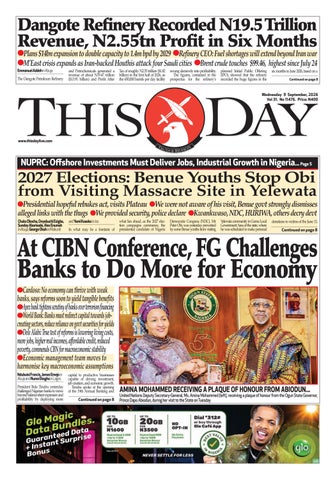
Dangote Refinery Recorded N19.5 Trillion Revenue, N2.55tn Profit in Six Months
Plans $14bn expansion to double capacity to 1.4m bpd by 2029 Refinery CEO: Fuel shortages will extend beyond Iran war M’East crisis expands as Iran-backed Houthis attack four Saudi cities Brent crude touches $99.46, highest since July 24
Emmanuel Addeh in Abuja The Dangote Petroleum Refinery
and Petrochemicals generated a revenue of about N19.47 trillion ($13.91 billion) and Profit After
Tax of roughly N2.55 trillion ($1.82 billion) in the first half of 2026, as the 650,000 barrels per day facility
swung decisively into profitability. The figures, contained in the prospectus for the refinery’s
planned Initial Public Offering (IPO), showed that the refinery recorded the huge figures in the
six months to June 2026, based on a Continued on page 8
Wednesday 9 September, 2026 Vol 31. No 11476. Price: N400
www.thisdaylive.com TR
UT H
& RE A S O
N
NUPRC: Offshore Investments Must Deliver Jobs, Industrial Growth in Nigeria... Page 5
2027 Elections: Benue Youths Stop Obi from Visiting Massacre Site in Yelewata Presidential hopeful rebukes act, visits Plateau We were not aware of his visit, Benue govt strongly dismisses alleged links with the thugs We provided security, police declare Kwankwaso, NDC, HURIWA, others decry devt Chuks Okocha, Onyebuchi Ezigbo, Sunday Aborisade, Alex Enumah in Abuja, George Okoh in Makurdi
and Yemi Kosoko in Jos In what may be a foretaste of
what lies ahead, as the 2027 election campaigns commence, the presidential candidate of Nigeria
Democratic Congress (NDC), Mr Peter Obi, was yesterday prevented by some Benue youths from visiting
Yelewata community in Guma Local Government Area of the state, where he was scheduled to make personal
donations to victims of the June 13, Continued on page 8
At CIBN Conference, FG Challenges Banks to Do More for Economy Cardoso: No economy can thrive with weak banks, says reforms soon to yield tangible benefits Apex bank tightens scrutiny of banks over terrorism financing World Bank: Banks must redirect capital towards jobcreating sectors, reduce reliance on govt securities for yields Dele Alabi: True test of reforms is lowering living costs, more jobs, higher real incomes, affordable credit, reduced poverty, commends CBN for macroeconomic stability Economic management team moves to harmonise key macroeconomic assumptions Ndubuisi Francis, James Emejo in Abuja and Nume Ekeghe in Lagos President Bola Tinubu yesterday challenged Nigerian banks to move beyond balance-sheet expansion and profitability by deploying more
capital to productive businesses capable of driving investment, job creation, and economic growth. Tinubu spoke at the opening of the 19th Annual Banking and Continued on page 8
AMINA MOHAMMED RECEIVING A PLAQUE OF HONOUR FROM ABIODUN...
United Nations Deputy Secretary-General, Ms. Amina Mohammed (left), receiving a plaque of honour from the Ogun State Governor, Prince Dapo Abiodun, during her visit to the State on Tuesday
2
WEDNESDAY SEPTEMBER 9, T H I S D AY
3
WEDNESDAY SEPTEMBER 9, T H I S D AY
Thinking of
Banking? Think ZENITH
*O UPEBZhT GBTU NPWJOH GBTU DIBOHJOH XPSME :PV OFFE B öOBODJBM QBSUOFS UIBU VOEFSTUBOET ZPVS VOJRVF FYQFDUBUJPOT " #BOL EJHJUBMMZ DPOOFDUFE BDSPTT "GSJDB BOE HMPCBM öOBODJBM DFOUFST XJUI FOBCMJOH QMBUGPSNT UP GBDJMJUBUF USBEF TFBNMFTTMZ XIFOFWFS XIFSFWFS IPXFWFS " #BOL XJUI TNBSU öOBODJBM TPMVUJPOT GSPN B TZTUFNJ[FE CMFOE PG UFDIOPMPHZ BOE IVNBO UPVDI 'PS FBTZ GBTU BOE TFDVSF CBOLJOH UIBU DSFBUFT SFBM WBMVF UVSOJOH ESFBNT JOUP SFBMJUZ JT OPX JO ZPVS IBOET
1&01-& 5&$)/0-0(: 4&37*$&
6O 6OJUFE ,JOHEPN H -POEPO .BODIFTUFS FSS 'SBODF $IJOB 6"& 6" 6 "& /JHFSJB /JHFS /JHF HFFFS H FSJB S 5IF (BNCJB 4JFSSB -FPOF $ÙUF Eh*WPJSF $ÙUF $Ù UF Eh* E *WP WPJS JSFF (IBO (IBOB (I BOBB ,FOZB ,FOZ ZB
4DBO UP 0QFO BO "DDPVOU
;FOJUI #BOL JO ZPVS CFTU JOUFSFTU
4JNQMZ DPOOFDU XJUI VT PO TPDJBM NFEJB 'BDFCPPL 9 *OTUBHSBN BOE -JOLFEJO DPOUBDU ;FOJUI %JSFDU PVS IS *OUFSBDUJWF $POUBDU $FOUFS PO PS WJTJU BOZ PG PVS CSBODIFT
;&/*5)#"/, [FOJUIEJSFDU![FOJUICBOL DPN
4
WEDNESDAY SEPTEMBER 9, T H I S D AY
5
THISDAY • WEDNESDAY, SEPTEMBER 9, 2026
NEWS
Group News Editor: Goddy Egene Email: Goddy.egene@thisdaylive.com, 0803 350 6821, 0807 401 0580
FAAN MD/CE INDUCTED INTO THE NIGERIA AVIATION HALL OF FAME...
L-R: Director of Public Affairs and Consumer Protection, Nigerian Airspace Management Agency (NAMA), Dr. Abdullahi Musa; Managing Director/CE, Federal Airports Authority of Nigeria (FAAN), Mrs. Olubunmi Onabanjo-Kuku; Director of Public Affairs and Consumer Protection, FAAN, Mr. Henry Agbebire; and former Director General of the Nigerian Safety Investigation Bureau (NSIB), Engr. Akin Olateru, during the induction of FAAN MD/CE into the Nigeria Aviation Hall of Fame, organised by NAHOF, with the theme: “The Next Generation of Aviation Leaders: Talent, Technology, and Global Competitiveness” held in Lagos...recently
NUPRC: Offshore Investments Must Deliver Jobs, Industrial Growth in Nigeria NLNG’s maritime unit trains 700 seafarers, produces 272 cadets MCOE to make international maritime certifications available locally Emmanuel Addeh in Abuja The Nigerian Upstream Petroleum Regulatory Commission (NUPRC) yesterday stressed that Nigeria must ensure its growing investments in offshore oil and gas translate into jobs, technology transfer, industrial capacity and broader economic prosperity for the country. The Commission Chief Executive, Mrs. Oritsemeyiwa Eyesan, made the while delivering a lecture at the Lagos International Maritime Week 2026 and the 11th International Maritime Business-to-Business Conference and Exhibition, themed: “From Policy to Practice: Powering Maritime Excellence in Africa.” Eyesan, who was represented by the Executive Commissioner, Health, Safety, Environment and Community, Captain John Tonlagha, said the development of Nigeria’s offshore petroleum resources must extend beyond hydrocarbon production to the creation of a globally competitive ecosystem of maritime services, infrastructure, technology and skills. “The pathway before us is clear. Policy to practice must mean moving from petroleum acreage to investment; from investment to offshore projects; from projects
to production; from production to maritime enterprise; and from maritime enterprise to Nigerian jobs, technology, industrial capability and sustainable economic prosperity. “Investments alone do not automatically translate into national value. Investments must be connected to domestic capability, competitive suppliers, skills development, infrastructure and measurable performance,” she said. Eyesan noted that deliberate policies and investments would be required to deepen the benefits of offshore activities and ensure that Nigerians and Nigerian businesses play stronger roles across the expand-
ing value chain. She called for increased investment in critical maritime infrastructure, including ports, ship repair facilities, fabrication yards, logistics bases, storage systems, waste management facilities and coastal transport infrastructure. The NUPRC chief also advocated stronger participation by Nigerian companies in vessel ownership and operations, marine logistics, subsea engineering, fabrication, equipment maintenance, inspection, certification, environmental services and marine surveying. According to her, the country must deliberately link offshore petroleum
investments to the development of domestic capabilities, competitive local suppliers and a highly skilled workforce capable of supporting the industry’s growing requirements. Eyesan further stressed the importance of environmental sustainability, warning that Nigeria’s ambition to expand its offshore petroleum activities must not come at the expense of the marine ecosystem. “The blue economy cannot be sustainable if the marine environment is treated as an afterthought,” she said. She noted that the Petroleum Industry Act (PIA) 2021 provides an enabling framework for offshore
Mary-Brenda Akoda becomes first woman, millennial individual winner Wale Igbintade An artificial intelligence-powered innovation capable of reducing Magnetic Resonance Imaging (MRI) acquisition time by up to 90 per cent has won the 2026 Nigeria Prize for Science and Innovation (NPSI). The innovation, GenScan AI, also
known as GenMRI/C-MORE, was developed by Mary-Brenda Akoda, a Nigerian artificial intelligence researcher and software engineer. Akoda’s emergence as the 2026 NPSI winner is historic, as she becomes the first woman and first millennial to win the prize as an individual recipient.
She emerged winner from a record 237 entries submitted for the 2026 competition; the highest number of entries received since the inception of the prize. The winner was announced yesterday in Lagos at the 2026 Press Conference for the Nigeria Prize for Science and Innovation
Kwara first lady says gender inequality obstacle to development NESG boss: Policies must benefit those they are made for Former Prime Minister and President of the National Assembly of Côte d’Ivoire, Patrick Achi, yesterday cautioned Nigeria and other African countries against building economies that become excessively dependent on grants, cash transfers and other forms of poverty alleviation, insisting that sustainable prosperity must be driven by productive employment and rising incomes. Achi, who spoke at the 2026 Gender and Inclusion Summit
Limited (NLNG) maritime subsidiary, Nigeria LNG Ship Management Limited (NSML), has trained hundreds of Nigerian seafarers and now employs more than 700 qualified seafarers, making it the largest employer of Nigerian seafarers, the company has said. The Managing Director, NSML, Abdulkadir Ahmed, disclosed this in Lagos while presenting a paper titled, “Overview of the NSML Maritime Centre of Excellence: Positive Disruption in Africa’s Maritime Manpower Development,” at the 2026 Maritime Training Institute organised by the Association of Maritime Journalists of Nigeria (AMJON).
Nigerian AI Innovation Cuts MRI Scan Time By 90%, Wins NPSI
Gender Summit: Ex-Ivorien PM Warns Against Grants-based Economy, Backs Women Inclusion Emmanuel Addeh in Abuja
development, including provisions aimed at ensuring responsible decommissioning and abandonment of petroleum facilities. Eyesan maintained that the ultimate measure of Nigeria’s success in developing its offshore resources should go beyond increased investment and crude oil production. According to her, the country must also seek stronger energy security, increased Nigerian participation in maritime activities, improved protection of the marine environment and the emergence of Nigeria as a competitive offshore energy and maritime services hub for Africa. Meanwhile, the Nigeria LNG
organised by the Policy Innovation Centre (PIC) in Abuja, also stressed that Africa’s economic transformation would remain incomplete if women, young people and other excluded groups were not placed at the centre of development and wealth creation. While acknowledging the importance of social protection, targeted cash transfers, development assistance and philanthropy, particularly in periods when economic growth was inadequate or its benefits were unevenly distributed, the former Ivorien prime minister warned
that such interventions should not become the foundation of Africa’s economic model. “We must be careful not to create what I would call a povertyalleviation industry, a system that becomes very good at managing poverty without building the mechanism that ends it. “Cash transfers and grants can be essential bridges. They can save lives and protect dignity. But if the bridge never leads to productive income, we remain vulnerable to the day the grant stops,” Achi argued.
He maintained that the lasting solution to poverty lay in creating productive economic opportunities, arguing that no country could sustainably lift millions of people out of poverty through redistribution alone. According to him, governments must create the right conditions for investment, enterprise and largescale job creation, while ensuring that the opportunities and benefits arising from economic growth were shared by a broader segment of the population.
following an independent evaluation by the Prize’s Panel of Judges and subsequent endorsement by the NPSI Advisory Board. GenScan AI is an AI-powered MRI reconstruction technology designed to significantly reduce the time required to acquire MRI scans while maintaining or improving image quality. Its C-MORE algorithm employs a one-step consistency-model framework to reconstruct MRI images. According to the organisers, the technology has the potential to reduce scan times by up to 90 per cent without requiring new MRI hardware. The judges said the innovation stood out among the three shortlisted entries because of its combination of scientific innovation, technical soundness, developmental impact and commercial scalability. They also noted that the technology could improve the utilisation of MRI scanners, reduce patient waiting times and potentially expand access to medical imaging, particularly in resource-constrained healthcare systems such as Nigeria’s. The development is significant for
a country where access to advanced medical imaging remains constrained by the cost and availability of equipment and the time required for examinations. Rather than requiring hospitals to replace existing MRI machines, the innovation is designed to work with existing hardware, potentially offering healthcare providers a way to improve the efficiency of their imaging services. Speaking at the event, General Manager, External Relations and Sustainable Development of the Nigeria LNG Limited (NLNG), Dr Sophia Horsfall, said the emergence of a winner in 2026, after the prize recorded a “no winner” verdict in 2025, demonstrated that the organisers had maintained the integrity and high standards of the competition. She said the 2026 competition, which retained the theme, “Innovations in Artificial Intelligence, ICT and Digital Technologies for Development,” attracted 237 entries, representing the highest number recorded since the prize began. Horsfall said the return of a winner should not be interpreted as a relaxation of the standards applied to the competition.
6
WEDNESDAY, SEPTEMBER 9, 2026 • THISDAY
NEWS
SANWO-OLU AS CHIEF HOST AT THE INTER-FAITH PRAYER FOR PRESIDENT TINUBU/KOH...
L-R: Chairman, Conference 57, Engr Sesan Olowa; APC Lagos Chairman, Pastor Cornelius Ojelabi; Governor of Lagos State, Mr. Babajide Sanwo-Olu; his Deputy and APC Governorship candidate, Dr. Obafemi Hamzat and his running mate, Princess Damilola Sonayon-James, during the Inter-Faith Prayer for President Bola Ahmed Tinubu & Dr. Kadri Obafemi Hamzat and all APC Candidates, organised by the APC Campaign Secretariat, at the Mobolaji Johnson Stadium, Onikan, yesterday
Stakeholders Push for Extension of DMS Implementation Timeline, Seek Clarification on Grey Areas Emma Okonji Industry stakeholders in the telecommunications de-vices manufacturing sector have called on the Nigerian Communications Commission (NCC) to consider ex-tending the implementation timeline for the deploy-ment of Device Management System (DMS) in Nigeria. The stakeholders, Original Equipment Manufacturers (OEMs) of
telecoms devices, also sought further clarifi-cations on grey areas in the DMS implementation pro-cess. The DMS functions as a central equipment register, checking the IMEI of every SIM-enabled device against records of stolen, cloned, counterfeit, or non-type-approved devices before allowing network activation. Once the DMS goes fully live, an importer must upload IMEI and
invoice data, pay a per-device fee, and obtain a DMS certificate before customs could clear a shipment. This step sits alongside the existing Form M, SONCAP, NRS VAT, and NCS customs steps. NCC had engaged with critical stakeholders, including OEMs, importers, dealers, and vendors to sensitise them on its intention to implement DMS in Nigeria as well as the onboarding of International
Mobile Equipment Identity (IMEI) numbers of devices current-ly held in stock in the DMS system. NCC had also informed stakeholders of the plan to charge approximately N670 per IMEI for future phones and over N3,700 for high-end devices, but it said exist-ing stock already in Nigerian warehouses would be eligible for free on-boarding to the DMS, with the upload window for importers
Nigeria Pledges Practical AfCFTA Implementation, Assumes Chair of Council of Ministers Bureau Kuni Tyessi in Abuja The federal government says its focus for the African Continental Free Trade Area (AfCFTA) is now shifting from policy commitments to measurable trade, investment, jobs and prosperity for Nigerians. Minister of Industry, Trade and Investment, Dr. Jumoke Oduwole, stated this yesterday at the third Quarter 2026 Meeting of AfCFTA Central Coordination Committee (CCC) held at Shehu Yar’Adua Centre, Abuja. Oduwole said Nigeria’s assumption of Chair of the Bureau of the AfCFTA Council of Ministers, alongside its role as Co-Champion of the Digital Trade Protocol, presented both responsibility and opportunity. She stated, “We meet at a particu-
larly important moment for Nigeria. This is an opportunity for Nigeria to demonstrate the kind of leadership, coordination and practical implementation that the AfCFTA requires.” Oduwole stressed that the objective must be to translate AfCFTA commitments into increased trade, investment, production, jobs and prosperity, in line with the Renewed Hope Agenda. The minister highlighted progress made in the last quarter, including Nigeria’s hosting of AfCFTA Week, which featured the HerAfCFTA Regional Conference with UNDP, the 18th Meeting of the AfCFTA Council of Ministers, and the second AfCFTA Digital Trade Forum. She said engagement with Afreximbank and the AfCFTA secretariat
on the Adjustment Fund had opened avenues for Nigerian enterprises to access financing and technical support. National Single Window was also being advanced to reduce trade friction. In August, FMITI in collaboration with NACO, NEPC and UNDP led a Nigeria–Botswana AfCFTA Trade Mission. A key outcome was OSC College of Fashion securing an order to supply 6,000 T-shirts in Botswana. Oduwole said, “AfCFTA must ultimately be experienced by businesses, not merely discussed by policymakers. These are platforms through which we can showcase Nigerian enterprise, attract investment, and connect our producers to continental buyers.” She added, “The opportunity before us is significant. We have the market,
the entrepreneurs, the productive capacity and now an increasingly stronger institutional platform. “What we must do is connect these assets to the opportunities created by the AfCFTA.” Similarly, Nigeria AfCFTA Coordination Office (NACO) said Nigeria was making measurable progress in connecting businesses to continental opportunities, resolving trade barriers, and digitising trade processes under AfCFTA. National Coordinator/CEO of NACO, Mrs. Patience Okalawhi, stated this during the meeting.
closing on September 7. The stakeholders were, however, worried that the duration of the grace period given for free onboarding of device IMEI to the DMS was too short, saying that they will need more time to complete the necessary registration on the portal and upload the IMEIs as requested. They also complained about the ambiguity in the implementation processes, and sought further clarifications on grey areas. According to them, there is no stated procedure in appealing in situations where a device is flagged due to a damaged IMEI that was damaged legally, especial-ly in a situation where a software or repair glitch caused the damage. They said the economic implication for importers, reporters, and possibly consumers, had not been addressed. The stakeholders, in a statement, said with the timeframe given, shipments that had been dis-patched would have to be subjected to the DMS, thereby creating unplanned financial burdens, when viewed from the procurement chain and from the importer to consumer. According to the statement, while
NCC has stated that it would train some technicians in line with the policy, details as to what this would entail, particularly the financial implications, have not been disclosed The statement said, “The initiative is commendable. However, the commission needs to ensure it is phased, timed and executed efficiently. “Right now, there are too many grey areas and a timeline that is impractical, and those are challenges that should be addressed.” During NCC’s engagement with stakeholders, the commission tried to provide answers to some ques-tions raised, but the stakeholders were yet to be con-vinced with some of the clarifications given by NCC during the engagement. For instance, the issue of what the DMS will mean for small and micro-importers who brought in only a few devices at a time, and whether the new require-ments could push some of them out of the formal market, was raised. In its response, NCC stated that micro-importers must meet the same licensing requirements regardless of import volume, but did not address whether this could push them out of the formal market.
MDGIF Denies Under-remittance of Gas Flare Penalties
Air Peace Apologises to Passengers Explains discrepancies flagged by AuGF report In a statement issued yesterday by remitted into the Federation Account, over Recent Flight Disruptions Emmanuel AddehinAbuja the Director of Public Affairs at the from which disbursements are made Chinedu Eze The Management of Air Peace Limited has apologized sincerely to all its passengers who have been affected by the delays and cancellations experienced in its operations in recent days. The airline said it understands the frustration and inconvenience these have caused them and deeply regret the disruptions to their travel plans. In a statement signed by the airline`s Chief Operating Officer (COO), Mrs. Oluwatoyin Olajide, Air Peace explained the disruptions resulted from a combination of unforeseen circumstances, including
an inadvertent false fire alarm that grounded one of its aircraft, adverse weather conditions that resulted in diversions, delays and, in some cases, outright cancellations. The airline disclosed that other factors that led to reduction of its operating aircraft include bird strike which grounded one aircraft for days; while another developed technical problem, requiring necessary mandatory checks and maintenance. There was also delay caused by the non-availability of aviation fuel. `While some of these circumstances were beyond our immediate control, we acknowledge the impact they have had on our passengers.
Our focus is on managing these challenges responsibly, minimising disruption and ensuring that our passengers are not left to bear the consequences of operational challenges. `At the same time, we wish to make one point unequivocally clear: Air Peace will never compromise safety in an attempt to keep to a schedule. In Air Peace, safety remains our highest priority. We will never compromise the safety of our passengers, crew and aircraft. “An aircraft will not be released for service until our technical teams and all relevant safety procedures are satisfied that it is safe to fly.”
The Midstream and Downstream Gas Infrastructure Fund (MDGIF) has refuted allegations of underremittance of gas flare penalties, saying the discrepancies identified in the Office of the Auditor-General of the Federation’s 2023/2024 annual report were neither unaccounted revenue nor funds collected directly by the Fund. The MDGIF, a directorate of the Nigerian Midstream and Downstream Petroleum Regulatory Authority (NMDPRA), explained that the Nigerian Upstream Petroleum Regulatory Commission (NUPRC) was solely responsible for collecting gas flare penalties under the existing statutory framework.
NMDPRA, Mr. George Ene-Ita, the Fund stated that the monies collected by the NUPRC were subsequently remitted into the Federation Account before allocations were made to its dedicated account with the Central Bank of Nigeria (CBN) through the Federation Account Allocation Committee (FAAC). According to the Fund, the variances flagged in the Auditor-General’s report were a reflection of timing differences and reconciliation issues arising from the multi-agency process through which the revenues passed, rather than evidence of missing or unaccounted funds. It stated: “These collections are then
to MDGIF’s dedicated account with the Central Bank of Nigeria through the Federation Account Allocation Committee at its monthly meetings, a process that is well documented with records readily available. “The variances flagged in gas flare penalty remittances reflect timing and reconciliation across the multi-agency Federation Account channel through which NUPRC collects and remits these funds, not unaccounted revenue.” The MDGIF said it had formally written to the Office of the AuditorGeneral of the Federation, providing supporting FAAC records and requesting a review of the position contained in the report.
7
THISDAY • WEDNESDAY, SEPTEMBER 9, 2026
NEWS
INAUGURATION OF THE 10TH NBA-SBL CHAIRMAN...
L-R: Founding Chair of the NBA-SBL, Mr. George Etomi; newly elected Chairman, NBA-SBL, Baba Alokolaro and immediate past Chair, NBA-SBL, Ozofu ‘Latunde Ogiemudia, at the SBL 2026 Annual General Meeting (AGM) and Inauguration of the 10th NBA-SBL Chairman in Port Harcourt ... recently
NAFDAC Seeks Life Imprisonment, Death Penalty for Fake Product Dealers, Mops Up 7,210 Fake Products Across Nigeria Arrest makers of counterfeit CWay, Oral-B, Colgate 64 counterfeiters convicted, sentenced to up to seven years in prison DG discards resignation calls, says she is here to remove shame from Nigeria Sunday Ehigiator Director-General of National Agency for Food and Drug Administration and Control (NAFDAC), Professor Mojisola Adeyeye, has called for life imprisonment or the death penalty for persons involved in the production and distribution of fake regulated products, describing counterfeiters as “merchants of death”. Adeyeye made the call while responding to concerns over the circulation of suspected fake and substandard food and other regulated products in the country. She disclosed that NAFDAC had mopped up 7,210 products during nationwide post-marketing surveillance operations between May and July 2026. Adeyeye also revealed that the agency had arrested persons allegedly involved in the counterfeiting of CWay water, as well as Oral-B and Colgate toothpastes, while 64 convictions had been secured against counterfeiters across the country, with offenders sentenced to between one and seven years’ imprisonment without an option of fine. The NAFDAC boss said the agency’s enforcement activities demonstrated
that it was actively confronting the proliferation of falsified, adulterated, substandard, and unregistered regulated products, despite the sophistication and scale of the activities of counterfeiters. Adeyeye stated, “Post-marketing surveillance is a critical component of NAFDAC’s regulatory mandate. “Its activities involve identifying products of regulatory concern, conducting inspections and surveillance visits, sampling products for appropriate assessment, investigating complaints and intelligence, removing non-compliant products from circulation and initiating appropriate regulatory action.” According to her, approximately 80 per cent of NAFDAC’s post-marketing surveillance activities are directed towards detecting and curbing fake, falsified, substandard, adulterated and otherwise non-compliant products. She said between May and July 2026, the agency’s Post-Marketing Surveillance Directorate undertook proactive surveillance across the 36 states and the Federal Capital Territory (FCT). “In the last three months, from May to July 2026, the PMS Directorate undertook routine proactive surveillance
nationwide across the 36 states and the FCT,” she said. Adeyeye said, “The monthly reports show a total of 5,738 facilities visited and 7,210 brands of products mopped up across food, water, drugs and herbals, medical devices, vaccines and biologics, cosmetics, healthcare products and chemicals.” She stated that food and water products accounted for the largest category, with 3,633 products mopped up, followed by drugs and herbals with 2,459. The director-general disclosed the agency had investigated complaints concerning counterfeit Oral-B and Colgate toothpastes and had arrested
The National Inland Waterways Authority (NIWA), Lagos State Waterways Authority (LASWA), SIFAX Logistics, and Dangote Transport are among major stakeholders that have confirmed their participation in the forthcoming 2026 Transportation Summit organised by the Transportation Correspondents Association of Nigeria (TCAN). The summit, scheduled for September 24, 2026, at the Radisson Hotel, Ikeja, Lagos, will bring together policymakers, regulators, industry leaders, transport operators, development partners, academics, and other stakeholders to discuss
the future of Nigeria’s transportation and logistics sector. The summit, with the theme: ‘Unlocking Nigeria’s Economic Growth Through Transportation Logistics’, according to TCAN Chairman, Tola Adenubi, “will focus on strategies for improving the country’s logistics infrastructure, strengthening policy implementation, enhancing safety and innovation, and promoting sustainable development across the transportation sector. “The summit will also examine the current state of Nigeria’s transportation logistics architecture, covering waterways, roads, rail and aviation. “Participants are expected to
another medium and we told them that we’ve already arrested the people that are behind the Colgate counterfeiting, they were quite pleased,” she said. The agency also uncovered the counterfeiting of CWay dispenser water bottles by three companies, according to Adeyeye. She said the operators collected empty 19-litre bottles bearing the identity and branding of the legitimate water company and used them to package water from unapproved production sources. “They collect the bottles from CWay and go and put whatever inside it,” she said. Adeyeye said the counterfeit
operators refilled the bottles with water from unapproved sources before selling and distributing them to major hotels and supermarkets. She stated, “They collected, refilled with water from unapproved production sources and subsequently introduced [the products] into the market for sale and distribution to big hotels and supermarkets. The operators were caught and they have been heavily sanctioned.” She warned that such practices created serious public health risks, including contamination, poor hygiene, product misrepresentation, and difficulty tracing the source of the water consumed by members of the public.
Abiodun: 100,000 Ogun Women Empowered to Fight Poverty, Strengthen Families James Sowole in Abeokuta Ogun State Governor Prince Dapo Abiodun has disclosed that about 100,000 women across the state have benefited from the World
Dangote Transport, NIWA, LASWA, SIFAX Logistics, Others Set for 2026 TCAN Summit Sunday Okobi
individuals, allegedly, behind the counterfeiting operations. she said, “The reported concerns involving regulated products with reference to Oral-B and Colgate toothpaste were investigated already by the agency.” She said NAFDAC had placed a public notice on its official website concerning the counterfeit Colgate products to alert consumers. Adeyeye added that the manufacturer of Colgate had subsequently contacted the agency after the discovery of the counterfeiting operation. “A few weeks ago, the manufacturer of Colgate, because they are counterfeiting their product, contacted us through
identify bottlenecks affecting the seamless movement of cargo and passengers and examine how multimodal transportation integration can contribute to economic expansion.” Adenubi added: “Other areas of discussion will include investment opportunities across logistics and supply chains, digital transformation of the logistics value chain, infrastructure financing and public-private partnership opportunities.” He also said that stakeholders would examine regulatory frameworks required to optimise the transportation sector and recommend policies capable of improving efficiency and Nigeria’s global competitiveness.
Bank-supported Nigeria for Women Programme (NFWP), describing women’s economic empowerment as a strategic tool for fighting poverty and strengthening families and communities. Abiodun made the disclosure when he received the United Nations Deputy Secretary-General, Ms. Amina Mohammed, who joined him in interacting with beneficiaries of the programme at the Governor’s Office, Oke-Mosan, Abeokuta. The governor said his administration deliberately embraced and took ownership of the programme because it provided an opportunity to reach women at the grassroots who might otherwise remain outside conventional structures of political and economic empowerment. According to him, empowering women should go beyond appointing them to political offices to providing them with the resources, skills and opportunities required to build sustainable livelihoods, support their families and live with dignity. “When the World Bank shared with us the Nigeria for Women
Project, we did not only key into it; we took ownership of it. “We saw in that programme the opportunity to empower women because not all women are able to contest elections or be appointed Commissioners or occupy political offices. We saw the opportunity to touch the lives of these women, empower them to support their households and themselves, and give them a sense of dignity,” he said. Abiodun said the programme’s impact had reinforced his administration’s conviction that investing in women was an investment in the wider economy and the future of families. He noted that economically empowered women were better positioned to provide for their households and contribute to community development. He said Ogun’s implementation of the programme had attracted delegations from more than 25 states seeking to study the state’s model, adding that political commitment remained critical to replicating its success. The governor expressed the
hope that the initiative would be expanded across the country so that more women could benefit from the intervention. “It is my prayer that this deepens across the length and breadth of the 36 states and the FCT. I am filled with so much joy today that you are here and that you can see first-hand what we have been able to do with women empowerment,” Abiodun said. The UN deputy secretarygeneral commended the governor for providing seed funding for the programme and, more importantly, for believing in the capacity of women to grow their businesses and transform their communities. Mohammed praised the beneficiaries for demonstrating resilience, creativity and enterprise, saying their progress showed what could be achieved when women were given the right support and opportunities. “You have shown that you started small and you are growing, and what we want is for every woman in Ogun State who can benefit to have that benefit,” she said.
8
WEDNESDAY, SEPTEMBER 9, 2026 • THISDAY
EIGHT
TCN Declares Force Majeure on Kainji-Birnin Kebbi Power Line Tower collapse disrupts bulk power transmission along corridor Emmanuel Addeh in Abuja The Transmission Company of Nigeria (TCN) has declared a force majeure event on the 330kV Kainji-Birnin Kebbi transmission line following the collapse of a transmission tower along the corridor. TCN, in a statement issued in Abuja yesterday, said the line tripped at 10:44 p.m. on Monday, September
7, 2026, while a trial reclosure attempted at 11:07 p.m. also failed. Following the second trip, linesmen from TCN’s Birnin Kebbi Sub-Region, a statement said, commenced a faultfinding patrol along the transmission corridor. The team subsequently discovered on Tuesday that Tower T367 had collapsed, it added. According to TCN, preliminary findings indicated that the tower was
brought down by heavy winds and rainstorms experienced in the area. The incident therefore affected the transmission of bulk electricity through the 330kV Kainji-Birnin Kebbi corridor, prompting the company to declare force majeure in view of the natural disaster that caused the damage. TCN said it had commenced arrangements to mobilise the
personnel, equipment and other resources required to the affected location to rehabilitate the collapsed tower and restore the transmission line to service within the shortest possible time. In the meantime, the company said it had maintained electricity transmission to Sokoto by enabling the Talata Mafara-Sokoto corridor to receive supply through an
alternative transmission route from the Kaduna-Mando axis via the 132kV Zaria-Funtua-Gusau transmission line. TCN expressed regret over the inconvenience the incident might cause electricity consumers and other stakeholders, assuring that every effort was being made to restore normal bulk power transmission as quickly as possible.
Engr. Sule Abdulaziz
AT CIBN CONFERENCE, FG CHALLENGES BANKS TO DO MORE FOR ECONOMY Finance Conference of the Chartered Institute of Bankers of Nigeria (CIBN) in Abuja. The conference had the theme, “Building a Resilient Economy in an Era of Disruptions: Strategic Imperatives for the Banking and Financial Services Industry.” Tinubu declared that the banking industry must shift from financial intermediation to economic transformation. Represented by Minister of Finance and Coordinating Minister of the Economy, Mr. Taiwo Oyedele, the president said the country’s improving macroeconomic stability should not be mistaken for prosperity, stressing that the
ultimate objective of the ongoing reforms is to translate stability into investment, production, jobs, and improved living standards. Governor of Central Bank of Nigeria (CBN), Mr. Olayemi Cardoso, said the country’s economic recovery could not be sustained without a strong and high-performing banking sector. Cardoso, who spoke at the CIBN conference, acknowledged the sacrifices made by banks and other stakeholders during the reform process, saying the reforms would soon yield concrete benefits. CBN stepped up its focus on terrorism financing risks across the financial sector, making it a
supervisory priority as it moves to strengthen safeguards against the misuse of the financial system. That was as the Economic Management Team (EMT), the federal government’s principal platform for economic management and coordination, approved the establishment of a dedicated inter-agency committee to harmonise the macroeconomic assumptions underpinning government’s budgeting and economic planning. At the CIBN event, also, World Bank Country Director for Nigeria, Mr. Mathew Verghis, challenged banks to redirect capital from government securities towards businesses capable of creating jobs.
Verghis warned that the current structure of bank profitability could come under pressure as interest rates declined. President/Chairman of Council of CIBN, Dr. Dele Alabi, said the ultimate test of economic reforms would be whether improved macroeconomic indicators translated into tangible improvements in the lives of citizens. Tinubu told the audience at the conference, “A resilient banking system cannot exist indefinitely where businesses cannot obtain affordable credit. Manufacturing that is struggling cannot expand, and millions of productive companies remain outside the formal financial
2027 ELECTIONS: BENUE YOUTHS STOP OBI FROM VISITING MASSACRE SITE IN YELEWATA 2025 armed herdsmen attack. Obi, who arrived in Makurdi in the morning, was on his way to Yelewata when the youths blocked the Makurdi-Gboko Road less than two kilometres from the airport, chanting “Obi go back, Obi go back.” Some of the youths were reportedly wielding sticks and throwing stones as security personnel deployed to the area watched the development. Following the confrontation, Obi and members of his team turned back and returned to the airport, where he boarded his aircraft and left the state. Speaking before leaving, Obi described the development as ridiculous and very worrisome. He said he had travelled to Benue to sympathise with families affected by the killings and support victims of the Yelewata attack. Obi said, “It is ridiculous and very, very worrisome, our experience this morning. We arrived Benue, Makurdi precisely, this morning at 9am, on our way to the Yelewata community to condole and show solidarity to the families affected by last year’s killings. “As you know, there have been killings of over 270 persons in that community and I felt as we were starting our campaign that I should go around and be able to visit and condole the families, show respect to the dead and the community, support them in any way I can. “Only to arrive Makurdi this morning and trying to drive out, I was blocked by teaming thugs, shouting ‘Obi go back, Obi go back.’ And I was wondering, are we still in Nigeria? Or am I in another country? “But we know that even the campaigns have started, so I should be able to move around freely. But I discontinued because I didn’t want to say we must go on, as we have our own teaming crowd, but not wanting to cause confusion and possibly endanger the lives of other people. I decided to remain as civil as possible.” He appealed to the security agencies, particularly the Inspector-General
of Police, Director-General of the Department of State Services, and other relevant authorities, to intervene and ensure that political campaigns were conducted peacefully across the country. Obi stated, “I am using this occasion to appeal to the security agencies, the Inspector-General of Police (IGP), the director of DSS, and other agencies to, please, intervene and be able to call various state governors to order. This rascality cannot be allowed. “We have a country and we, too, have followers. We have people who can confront these people on our own if the state and the government can no longer provide us security. We cannot go on this way. It is unacceptable.” He said the 2027 presidential campaign should be centred on issues affecting Nigerians, including insecurity, kidnapping, hunger, killings, and poverty, rather than violence and confrontation. He stated, “I participated yesterday in the commissioning of the office of the presidential candidate of APM, appealing that we need unity, love, justice, and let this campaign be concentrated on ideas, issues that concern Nigerians today – of insecurity, kidnapping, hunger, killing and everything and how we are going to pull our people out of poverty. That is what it should be. “I am not here to contest elections for office of the governor of Benue State. I have chosen as a presidential candidate that I want to visit every community, visit across Nigeria, which is what I’m urging other presidential candidates to do. “Go around Nigeria so you can feel the people, see their faces, ask them questions and they ask you questions about what you want to do for them, to be able to ameliorate the suffering Nigerians are going through today. That is why I am here today. Nothing else. “I call on the youths that are being used. The abuse you are allowing them to use you for today will take its revenge on you. I have a lesser
number of years to live in life. “People are using you. They are not using their children. They are not using their relations. They are using you to stop opportunity of building a better life for you. “All I want is to have a Nigeria where a child of nobody can be somebody without knowing anybody. Where no Nigerian will go to bed without having food in his stomach, without knowing where the next meal will come from. That’s all we want.” The NDC presidential candidate said Benue had the agricultural capacity to feed Nigeria but lamented that insecurity and lack of economic opportunities had deprived many youths of sustainable livelihoods. He said, “Look at Benue, the state can feed Nigeria. It has arable lands where you can farm yam and lots of food crops. But today it has become a place where thugs thrive because they have no means of livelihood. And that is what we want to change.”
Obi urged politicians and their supporters to avoid actions capable of plunging the country into anarchy, saying political contests should be determined by ideas and policies. He said, “We are not coming here fighting anybody because our elections will be run on ideas, on issues. And I urge people to, please, let’s concentrate on that. Let’s not allow a country to get into anarchy. Anarchy consumes everybody.” The former Anambra State governor said he found it difficult to believe that the incident could have occurred without the knowledge of the state government and security agencies. He said, “I have been governor myself. I know that this cannot happen without the government and security agencies in this state being fully aware that I am here. “I was governor for eight years and I know the system very well. And this couldn’t have happened Continued on page 35
system.” He said the current phase of the country’s reform journey was accelerating the conversion of stability into investment, investment into production, production into jobs, and growth into improved living standards. Tinubu said the banking and financial services industry was central to the current transformation process. “Therefore, we need to move from intermediation to transformation,” he stated. The president explained, “For years, we have measured financial institutions by balance sheet growth, profitability, and shareholder returns. These remain important, but we must increasingly ask: what is the financial system doing for the real economy? “A resilient banking system cannot exist indefinitely where businesses cannot obtain affordable credit. “Manufacturing that is struggling cannot expand, and millions of productive companies remain outside the formal financial system.” Tinubu urged banks to reassess how they allocated capital, stressing that the success of the recently concluded banking recapitalisation exercise should be measured by its impact on the real economy rather than merely by larger balance sheets. “A bigger bank that does not finance a more productive economy is a suboptimal outcome,” he said. The president said the federal government was strengthening guarantees, risk-sharing arrangements, blended finance and credit enhancement mechanisms, with the National Credit Guarantee Company at the centre of efforts to crowd private capital into productive
investments. He explained that the government’s measure of success should increasingly shift from the volume of public spending to the amount of productive private capital it could catalyse. Tinubu identified growth facilitation, financial inclusion, technology, long-term capital, and trust as five imperatives for building a resilient financial system. On inclusion, he said access to a bank account was not enough, stating that genuine financial inclusion should enable small businesses to obtain affordable working capital while allowing young entrepreneurs to borrow based on viable cash flows rather than collateral they might not possess. The president called for greater deployment of patient capital to infrastructure, industry, housing, and energy, stressing that long-term development cannot be financed predominantly with short-term funds. He said the government’s reforms were already producing stronger macroeconomic indicators, citing 4.43 per cent real GDP growth in the second quarter of 2026, headline inflation of 15.43 per cent, and foreign reserves of more than $54 billion. Tinubu also pointed to Nigeria’s removal from the Financial Action Task Force grey list, its exit from European Union’s AML/CFT deficiency list, the planned reclassification of the country by FTSE Russell as a Frontier Market, and improving investor confidence, as evidence of progress. However, he cautioned that the gains represented the foundation Continued on page 33
DANGOTE REFINERY RECORDED N19.5 TRILLION REVENUE, N2.55TN PROFIT IN SIX MONTHS THISDAY exchange rate conversion its residual fluid catalytic cracker industrial facility. during April and May. of N1,400 to the dollar. and a shift away from producing Besides, the Dangote Refinery Dangote, who is Africa’s richThe performance marked a lower-value reduced crude oil. plans to spend about $14.3 billion, est man, said at the IPO signing significant turnaround for the Its gross refining margin also equivalent to N20.02 trillion at ceremony in Lagos on Monday refinery, which recorded a $476 strengthened significantly, rising to N1,400 to the dollar, to expand its that although the refinery had million loss for the whole of 2025, $24.50 per barrel in the first half processing capacity to 1.4 million benefited from supply disruptions according to the IPO prospectus, of 2026, compared with $13.70 per bpd by 2029. linked to conflicts in the Middle from which Reuters and billionaires barrel in 2025 and $10.70 per barrel The expansion would effectively East and Ukraine, its investments Africa, a digital media company in 2024. The refinery’s EBITDA double the refinery’s current capacity were designed to be sustainable and news platform first extracted margin stood at 18.7 per cent and is expected to consolidate its over the long term. the report. during the period, underscoring position as a major supplier to both The refinery’s chief executive, The refinery also recorded earn- the improvement in its financial domestic and international markets. David Bird, said the IPO was ings before interest, tax, depreciation performance. The company said its strategy intended to broaden participation and amortisation (EBITDA) of $2.60 The results come as Dangote would allow it to direct products in the ownership of the facility and billion, equivalent to about N3.64 Refinery prepares to raise about to either the Nigerian market or enable Nigerians and other Africans trillion, during the period. N2.26 trillion through its IPO, based export destinations depending on to benefit from the wealth created The strong performance came on the approved offer price of N525 prevailing commercial returns. by the project. as the refinery ramped up produc- per share and an initial offering of Since commencing operations, the Dangote Refinery was built at a tion and improved its operating 4.1 billion ordinary shares. refinery has increasingly emerged cost of about $20 billion and began efficiency, with average utilisation The offer, which is expected as an exporter of refined petroleum operations in 2024. The planned reaching 83.6 per cent during the to run from September 14 to products, including jet fuel and expansion, once completed, would first half of the year. October 13, is being positioned diesel. raise its crude processing capacity The facility began the year operat- by the company as a “people’s The refinery exported jet fuel to from 700,000 bpd to 1.4 million bpd, ing at about 45 per cent utilisation IPO”, aimed at giving Nigerians, the United States for the first time according to the IPO prospectus. but reached full crude distillation members of the diaspora and this year and was identified by Meanwhile, fuel shortages are unit utilisation during the second other Africans an opportunity to S&P Global Energy as the world’s quarter following improvements to participate in the ownership of the largest single exporter of jet fuel Continued on page 31
9
WEDNESDAY SEPTEMBER 9, T H I S D AY
Ąˏʡ ¹ɉͻˠ̬̟ɉ́ Hͪͪɉι 7̬̘͓ʡͻˠͻˠ̬̟ ˠͪ č2 c̬·̟ʗɉͻˠ̬̟ͪ ɉ̟̟·ɉ́ education initiative, designed to promote a culture of reading and to encourage healthy intellectual competition amongst secondary school students in Nigeria and across Africa.
Stand a chance to win N15 Million towards your university education. Winner
N15,000,000
Ąoxø ĹH îø Høø Ĺ ĄÄêx7֙
No Nation can develop without food security. How can Nigeria deal with this problem?
2nd Position
N10,000,000 3rd Position
WHO CAN APPLY
N7,500,000
Nigerian senior secondary school students Complete contact details Scanned copy of your handwritten essay of 750 words maximum (not typed) Recent passport photograph Scanned copy of birth certificate or National ID ̬͘ x̟ͻʡ̟͘ɉͻˠ̬̟ɉ́ êɉ͓̬ͪͪ͘ͻ
4th Position
N5,000,000 5th Position
N3,500,000
ENTRIES CLOSE: Friday, October 23rd, 2026
Educational Grants to any African University
READY TO ENTER? SCAN TO APPLY
OR VISIT: https://www.ubagroup.com/nec/
Terms and Conditions Apply
10
WEDNESDAY, SEPTEMBER 9, 2026 • THISDAY
NEWS
HIGH-LEVEL LAUNCH DEBATE/BUSINESS ROUNDTABLE ON THE FUTURE OF AFRICAN FORESTRY...
L-R: Executive Secretary-CEO, Africa Forest Forum, Prof. Labode Popoola; Representative of the Governor of Lagos State and Commissioner for The Environment and Water Resources, Mr. Tokunbo Wahab; Former Vice President and Chairman Sustainable Forest Management for Africa, Prof. Yemi Osinbajo; Chairman Governing Council, Africa Forest Forum, Prof. Larwanou Mahamane and the Controller of Environment, Federal Ministry of Environment, Mrs. Olabimpe Adenaike, during the high-level launch debate/business roundtable on the future of African forestry, held in Ikeja, Lagos State, yesterday
One Million Out-of-school Children Returned to Class in 20 Months, Says Alausa Seeks deeper UNESCO support for education reforms Minster urges VCs to diversify funding, as FG demands stronger advancement offices Kuni Tyessi in Abuja The federal government said it had returned more than one million outof-school children to the classroom in the last 20 months. Minister of Education, Dr. Tunji Alausa, disclosed this in Abuja when he received the newly appointed United Nations Educational, Scientific and Cultural Organisation (UNESCO) Country Representative to Nigeria, Professor Isaiah Barreto Da Rosa, who was on a courtesy visit. Separately, Alausa charged Vice-Chancellors of Nigerian public universities to urgently diversify funding sources and strengthen advancement offices. He warned that government allocations alone could not sustain
tertiary institutions. Alausa gave the directive at the National Advancement Forum 2026 in Abuja. He expressed concern that only four out of 68 federal universities were currently making meaningful use of alternative funding, such as research grants, endowments, alumni giving, philanthropy, and industry partnerships. “Government funding is not enough. Universities live, function and excel on blended funding,” the minister said. While receiving the newly appointed UNESCO Country Representative to Nigeria, Alausa revealed that nearly 6.7 million girls had benefited from various government interventions designed
to improve access to education and keep them in school. He said the achievements were part of the federal government’s ongoing efforts to overhaul the education sector. He stressed that the government was determined to close gaps in access and improve the quality of learning. Alausa, however, said the government could not afford to concentrate its education interventions on only one gender. While acknowledging the progress made in promoting girl-child education, he also called for increased attention to the educational needs of boys. “We must sustain the gains we have made with the girl-child, but we also need to pay attention to the
boy-child,” he said. The minister said Nigeria’s human capital development would only be meaningful if no child was left behind, regardless of gender or background. He listed the Federal Ministry of Education’s six priority areas as Technical and Vocational Education and Training (TVET); Science, Technology, Engineering and Mathematics (STEM); reintegration of out-of-school children, data and digitalisation; girl-child education; and quality assurance. He said the federal government was also investing in skills development, technology and teacher training as part of efforts to produce graduates capable of competing in a rapidly changing economy. He stated that reliable education
Sources: Remediation Barge, Not Nembe Exploration Responsible for Bayelsa Oil Spill Fresh facts into the circa August 22 oil spill at the Nembe Creek facility emerged yesterday, indicating that Nembe Exploration and Production Limited may not have been responsible for the incident. Sources familiar with the development told THISDAY last night that the vessel involved was a contractor’s remediation barge not connected to the company’s operational activities. This is as environmental groups and some media reports linked the incident to crude-loading activities at the facility operated by Nembe Exploration and Production Limited, formerly Aiteo Eastern Exploration and Production Limited, within Oil Mining Lease (OML) 29. The Health of Mother Earth Foundation (HOMEF), following a field visit to the affected area, had called for urgent cleanup, compensation and full accountability over the incident, saying crude oil was observed in the water and along mangrove banks around Nembe Creek. The organisation said the spill had disrupted fishing activities and threatened the livelihoods of coastal communities, with residents reporting damage to fishing nets, declining catches and loss of access to fishing grounds.
But sources with knowledge of the incident told THISDAY that the vessel from which the spill occurred was not a Nembe Exploration-owned or operated crude-loading barge. According to the sources, the vessel was a contractor’s remediation barge deployed for activities separate from Aiteo’s crude production and evacuation operations. One source stated that attempts to associate the incident directly with the company’s crude-loading operations were therefore misleading, stressing that the oil firm should not be held responsible for an incident involving a third-party contractor’s vessel without establishing the contractual and operational circumstances surrounding the deployment of the barge. “ This is just very misleading. Nembe Exploration and Production Limited has no business with whatever happened to that barge or whether oil was spilled. Whoever made that assertion needs to check again,” one source pointed out. The sources further explained that the presence of a vessel around the Nembe Creek facility did not automatically mean that it was owned, operated or controlled by the oil producer. They urged regulators and
investigators to distinguish between the operator of the oilfield and thirdparty service providers engaged for specific activities before assigning liability for the spill. The clarification comes amid reports that a Joint Investigation Visit (JIV) had identified operational failure as the cause of the incident, although the precise volume of crude discharged and the full extent of the affected area had yet to be established. Earlier reports had stated that the incident occurred when a barge loading crude from a manifold reportedly ruptured or tilted, allowing crude to escape into the surrounding waterway. However, the sources insisted that the description of the vessel and its relationship with Aiteo’s operations required further clarification, arguing that the barge should not automatically be categorised as an Aiteo operational asset. HOMEF had earlier urged Nembe Exploration and Production Limited, the Bayelsa State Government and relevant regulatory agencies to publish the complete findings of the JIV, including the cause of the spill, the estimated volume of crude released, the geographical extent of the pollution and the communities
affected. The foundation also called for an independent environmental assessment of affected waterways, mangroves, fishing grounds and settlements, as well as comprehensive cleanup and ecological restoration.
data was increasingly being deployed to identify areas of need, target government interventions, and measure results. On teacher development, Alausa welcomed UNESCO’s technical support for the ministry’s Accelerated Teacher Professional Programme (ATPP) which had a target of training one million in-service teachers. He also acknowledged UNESCO’s support in TVET assessment, digital transformation, education for peace, and media and information literacy. The minister urged UNESCO to align its interventions with the reform priorities of the Nigerian government, saying stronger coordination would ensure that technical assistance translates into concrete results. “We want partnerships that complement what Nigeria is already doing and help us deliver faster and better results,” he said. Alausa assured the UNESCO delegation that the federal government would continue to combine domestic resources with strategic international partnerships to drive its education reforms. He said the administration’s focus was on expanding access, improving quality and equipping Nigerian children and young people with the knowledge and skills needed
to contribute to national development. Earlier, the UNESCO Country Representative, Da Rosa, pledged the organisation’s support for Nigeria’s education transformation programme. He described UNESCO as a technical partner willing to provide expertise in areas where the Nigerian government required assistance. Da Rosa recalled UNESCO’s longstanding presence in Nigeria dating back to the 1960s, stating that the organisation has supported the country in education, science, culture, communication and information. He commended the ministry’s progress in digitising education data, describing accurate data as essential for effective planning and policy implementation. The UNESCO representative said the organisation was ready to deepen cooperation with Nigeria in TVET, teacher development and efforts to bring out-of-school children back into the classroom. He disclosed that UNESCOsupported programmes had already trained more than 28,000 teachers across different states and reached over 1.7 million students. Da Rosa added that UNESCO’s specialised institutes remained available to provide further technical support to Nigeria.
Ondo Raises 2026 Budget to N769bn, Targets 90km Roads Fidelis David in Akure The Ondo State Government has raised its 2026 budget from N524.411 billion to N769.384 billion, with the additional N244.973 billion expected to strengthen infrastructure development, particularly roads, water and healthcare projects across the state. The Commissioner for Budget and Economic Planning, Mr. Olaolu Akindolire, disclosed this after the State Executive Council meeting, explaining that the budget review was driven by the administration’s intensified infrastructure programme and the need to respond to emerging development
priorities. Akindolire said the revised budget would provide the resources required to sustain ongoing projects while closing funding gaps and improving implementation across Ministries, Departments and Agencies (MDAs) in the remaining months of the year. According to him, the review followed a mid-year assessment of the implementation of the 2026 Appropriation Law, which was signed into law on December 29, 2025, and came into effect on January 1, 2026. He said the first and secondquarter budget implementation appraisal reports showed varying
levels of performance among MDAs, with some experiencing increased demands and approaching their approved provisions, while others recorded slower utilisation due to implementation challenges. “The review is aimed at realigning provisions, addressing funding gaps and improving implementation in the remaining months of the year,” Akindolire said. He disclosed that Governor Lucky Aiyedatiwa had directed that at least five kilometres of roads be constructed in each of the state’s 18 local government areas before the end of 2026, translating to a minimum of 90 kilometres of new roads across the state.
WEDNESDAY SEPTEMBER 9, T H I S D AY
11
12
WEDNESDAY SEPTEMBER 9, T H I S D AY
! " # ! $
+ + 5 2 + + + + + ! + + &
% & ' ( ) * + , ! - - .(% " + - ' ! / ++ + +" - 0 " + #1 2 3 ! / 4 ( " + ( + + 2 5 " 6 ( " + ) 2 7 + $ +! ! 2 89 / ! $ / : ) + 4; / 4' / -;-: < ) + 2 + 3 ! / + + + + " + + + = ) # > / /
? + + @ + + / 2 ! .(% #1 2 ( + + 2 ) 2 @ + + 2 # " *
%* ) % / / + ! ! - ! $ + / ,
! / + +
"+ % # 5 + + 3 8 + + + ! / + ( " + + ! + + 5 2
, ** -. "% % /0% 1 . /&1%+ . '&(%
+ % ) # ! +
#$"% "
"% &'( ) 89 % 1
8 + + + ! / + ! + / ! ! $ + 5
! "
WEDNESDAY SEPTEMBER 9, T H I S D AY
13
14
WEDNESDAY, SEPTEMBER 9, 2026 • THISDAY
TRIBUTE
Marwa: A General Who Ages Backwards At 73 By Femi Babafemi
L
et me start with a confession that has become something of a running joke among those of us who work closely with Chairman/Chief Executive of the National Drug Law Enforcement Agency (NDLEA), Brig Gen Mohamed Buba Marwa (Rtd), the man simply refuses to age like the rest of us. I witnessed this again, quite hilariously, in the last week of August, at an international conference at the University of Cambridge, United Kingdom, where he was one of the invited speakers before a distinguished gathering of global policy experts, academics, law enforcement chiefs, lawyers, and judges among others. A good number of notable Nigerians were also present. On Tuesday, 25th August, minutes to his scheduled presentation, some Nigerian delegates who had been eager to catch a glimpse of him and exchange pleasantries kept asking me, “Where is the General?” He was, at that point, standing right there among them in the waiting area, dressed in a fitted deep blue suit, and not one person recognised him. It was only when he began speaking with me, and his familiar soft voice gave him away, that the penny dropped. “Ah, see the General here” one of them exclaimed, almost in disbelief. The story did not end there. Later that evening, after I had sent out a press statement with a video clip of his presentation, a friend who works with the BBC reached out to me in some astonishment. “Is this Marwa?” she asked, watching the clip. “Of course,” I replied. Her response summed up the sentiment of the day: “This man is really young. He should stop wearing agbada, for God’s sake. Wow!” I share this not merely as an amusing anecdote, but because it says something deeper about the man himself. Marwa’s youthful bearing is not an accident of grooming or tailoring; it is the outward expression of an inward vigour, a mind and spirit that remain restlessly engaged with the work of nation-building. Men who carry the weight of purpose lightly tend to wear their years lightly too, and today, as he turns 73, that truth stands fully on display. Even though my relationship with him dates back three decades, it has been my privilege, in my capacity as Director, Media and Advocacy of the NDLEA, to work closely with General Marwa and to observe, at close range, the qualities that have made him one of Nigeria’s most consequential public servants across five decades of service. What strikes me most is not simply his academic qualifications from the University of Pittsburgh and Harvard University; his impressive résumé, distinguished
Gen. Marwa
military career, Military Governor of the old Borno state (which is present Borno and Yobe states combined), Military Administrator of Lagos State, his diplomatic assignments at the Nigeria embassy in Washington and the Nigerian Mission at the United Nations in New York, and now the personage who has redefined the war against illicit drugs, but the consistency of character that runs through all of it. It’s not in doubt that Marwa leads from the front. Since taking the helm of the NDLEA in January 2021, he has transformed an agency once known largely for the arrest of couriers into one that goes after the barons, financiers and cartels behind the drug trade, while simultaneously building one of the most ambitious demand-reduction and rehabilitation frameworks the country has seen. His War Against Drug Abuse (WADA) social advocacy initiative has taken the fight beyond arrests and interdictions into schools, communities, worship centres and
the quiet, unglamorous work of counselling and treatment, because he understands that true victory over drug abuse is won as much in the field of prevention as in the theatre of enforcement. He leads with discipline without losing his humanity, a soldier’s rigour tempered by a statesman’s patience. He is exacting with his officers, yet unfailingly warm with the public he serves. He listens. He builds coalitions, whether with the National Assembly, state governments, international partners, or ordinary community leaders, understanding that no single agency, however well-resourced, can defeat a challenge as vast as drug trafficking and abuse alone. And he serves with an urgency that belies his years, arriving early, staying late, showing up in the most remote parts of the country to coordinate operations, and travelling across continents, as I witnessed again at Cambridge, to represent Nigeria’s voice at the highest tables of global drug policy discourse.
That is perhaps the real secret behind the baby face that many have continued to ask for the secret behind it, and I can only guess that purpose is the finest cosmetic there is. A man who wakes up each day certain of why he serves rarely looks his age, because he has not yet finished the assignment. Sir, as you clock 73, permit me, on behalf of your colleagues at the NDLEA and Nigerians who have watched you serve with distinction, to say: congratulations and happy birthday to the Waziri Michika, the latest from your over 30 traditional titles from across Nigeria. May the strength that has carried you this far continue to renew itself, may your voice remain as clear and commanding as it was that afternoon in Cambridge, and may you keep confounding those who think they know what 73 is supposed to look like. •Femi Babafemi is Director, Media and Advocacy, National Drug Law Enforcement Agency (NDLEA).
WEDNESDAY SEPTEMBER 9, T H I S D AY
15
T H I S D AY ˾ WEDNESDAY SEPTEMBER 9, 2026
16
Acting Group Politics Editor DEJI ELUMOYE
POLITICS
Email: deji.elumoye@thisdaylive.com 08033025611 SMS ONLY
Interrogating Defence Minister’s Declaration of Victory over Terrorists, Bandits A new chapter may be unfolding in Nigeria’s fight against terrorism and banditry as Minister of Defence, General Christopher Musa’s declaration of victory signals growing confidence, renewed hope, and a potentially decisive turning point in the nation’s security efforts, writes Linus Aleke.
Tinubu
T
he declaration by the Minister of Defence, General Christopher Musa (rtd), that Nigeria has achieved victory over terrorists and bandits deserves to be examined not merely as a political statement, but against the operational realities and measurable gains recorded by the Nigerian security forces. Interestingly, this is not the first time the Federal Government has declared victory over the rampaging and bloodthirsty violent extremists operating in the country. In December 2015, the late President Muhammadu Buhari declared that Boko Haram had been “technically defeated”, following major territorial gains by Nigerian forces against the insurgents. In an interview with the BBC on 24 December 2015, Buhari said technically, the Nigerian military had won the war against Boko Haram, explaining that the insurgents could no longer mount conventional attacks against security forces or population centres and had been restricted largely to the use of improvised Explosive Devices (IEDs). The declaration followed a major military campaign that had recovered territories previously held by the insurgents. Contemporary reports therefore presented Buhari’s assessment as a claim of technical victory rather than an assertion that every Boko Haram fighter or attack had ceased. Still in December 2015, the then Minister of Information and Culture, Alhaji Lai Mohammed, similarly declared that the Federal Government had “largely won” the war against Boko Haram. Speaking after leading a team of 33 local and international journalists to areas at the centre of the insurgency in Borno State, including Maiduguri, Konduga, Kaoure and Bama, Mohammed said: “Today, I can report that the war against Boko Haram is largely won.” He explained that he could make the declaration based on what he had personally witnessed during the tour, adding that the entire 70-pluskilometre stretch from Maiduguri to Bama and onwards to Banki was in the hands of Nigerian troops. He further stated that the terrorists had been so degraded that they could no longer hold territory or carry out spectacular attacks. Four years later, on 21 October 2019, Mohammed reaffirmed the position during a working visit to the corporate headquarters of a newspaper house in Lagos. Asked about
Musa
his earlier assessment of the insurgency, he stood by it unequivocally, saying: “I stand by what I said that Boko Haram is technically defeated.” Mohammed explained, however, that Nigeria was then confronting a broader form of global terrorism involving groups and networks such as ISIS, ISWAP and Al-Qaeda. Fast-forward to Thursday, September 3, 2026, and barely 11 years after the previous administration declared technical victory over violent extremists, Minister of Defence, General Christopher Musa (rtd.), reiterated the Federal Government’s claim of victory in the ongoing fight against insurgency and other forms of violent extremism. Musa said attacks by terrorists and extremist groups were no longer as rampant or brazen as they had been in the past. Speaking during an interview on a national television programme, monitored by THISDAY, he observed that terrorist attacks had drastically reduced, giving way largely to kidnappings. Asked whether Nigeria had defeated terrorists or merely displaced them, Musa said: “Frankly speaking, we have defeated terrorists because now, like I said, the attacks are not as rampant and it is now kidnapping.” He said security had improved under
Oluyede
President Bola Tinubu, adding that reports of terrorist attacks were no longer as frequent as they once were. According to him, “I can tell you there is improved security. May be if you noticed, you don’t hear so much of Boko Haram attacks, ISWAP attacks and all these things here and there, maybe one-off.” Musa argued that the security situation was following a downward trajectory from criminality to kidnapping, terrorism and insurgency, noting that once security forces successfully hit such groups, they were forced down the scale of operations. He added that kidnappings had become an easier means for criminals to raise funds. The Minister also stressed that troops were now entering terrorists’ enclaves and recovering many abducted persons. Musa’s position appears to be supported, at least in part, by recent operational figures released by the Defence Headquarters in August 2026. Director of Defence Media Operations, Major General Michael Onoja, reported that Nigerian troops had killed more than 324 terrorists and criminals and apprehended 373 others in August, 2026 alone. Onoja said the August figures reflected a marked improvement in operational effectiveness, driven by intensified kinetic and non-kinetic operations, enhanced intelligence, inter-agency cooperation and increased pressure on criminal and terrorist networks. More significantly, surrendered terrorists rose from 11 in June to 57 in July and 201 in
Musa’s declaration should therefore be understood as a statement of strategic confidence. Nigeria may not yet have eliminated terrorism and banditry, but there is credible evidence that the state is increasingly capable of taking the fight to the perpetrators. The task now is not to retreat from that momentum, but to sustain it until victory becomes not merely a declaration, but an enduring reality for Nigerian communities.
August, suggesting increasing pressure on hostile elements and a possible willingness among some fighters to abandon terrorism. Civilian rescues also increased substantially in August, while arms and ammunition recoveries rebounded. These figures provide important context for Musa’s declaration. Yet acknowledging these gains does not require ignoring the continuing threat. The 2026 Global Terrorism Index reported that terrorism-related deaths in Nigeria increased from 513 in 2024 to 750 in 2025, representing a 46 per cent rise. Nigeria consequently ranked fourth globally in terrorism-related deaths. These figures suggest that victory should be understood as an ongoing process rather than the complete disappearance of every violent group. Indeed, this distinction may strengthen rather than weaken Musa’s position. A military can achieve strategic superiority while still confronting residual insurgent cells, criminal gangs and isolated attacks. The critical question is whether these groups are becoming increasingly incapable of challenging the authority of the state. Security experts, however, remain divided. Veteran Defence Correspondent, Madu Onuora questioned the basis of the declaration, asking: “victory over which terrorists?” He described the Minister’s declaration as premature and at variance with the reality on the ground, drawing parallels with previous declarations of victory, including Buhari’s 2015 “technical defeat” claim, former Chief of Army Staff, Lt. Gen. Tukur Buratai’s 2018 assertion that absolute victory was “inches away”, and his 2020 declaration that the military had “won the ground war”. According to Onuora, the situation remains complex. While the capabilities of terrorists may be degraded, he argued that the infrastructure sustaining terrorism remains largely intact. He said efforts should therefore focus on dismantling deeply entrenched terror networks while addressing the root causes of radicalisation and the governance failures that breed and sustain recruitment. NOTE: Interested readers should continue in the online edition on www.thisdaylive.com
17
T H I S D AY ˾ WEDNESDAY, SEPTEMBER 9, 2026
CITYSTRINGS
Group Features Editor: Chiemelie Ezeobi Email chiemelie.ezeobi@thisdaylive.com
2027 Elections: Army Charges Personnel to Remain Neutral, Professional Chiemelie Ezeobi
A
s Nigeria prepares for the 2027 General Elections, the Nigerian Army has charged its personnel to maintain strict political neutrality, professionalism and respect for the rule of law while supporting election security operations. The charge was issued at the 81 Division Nigerian Army Sensitisation Lecture on the Conduct of Armed Forces Personnel during the 2027 General Elections, held on September 1, 2026 in Apapa, Lagos. The lecture, organised by Headquarters 81 Division, brought together commanders, officers and soldiers, representatives of sister services and other security agencies, as well as resource persons, to deepen understanding of the legal and operational responsibilities associated with election security. In his welcome address, the General Officer Commanding (GOC) 81 Division, Major General AA Babalola, said the engagement reflected the Armed Forces of Nigeria’s commitment to professionalism and the responsible discharge of its constitutional duties. He explained that military participation in election security is a supporting responsibility undertaken only under lawful authority and prescribed conditions. Babalola reminded personnel that the Armed Forces remain subordinate to constitutionally established civil authority, noting that Sections 217(2)(c) and 218 of the Constitution provide the legal basis for deploying the
Participants and senior officers at the 81 Division Nigerian Army Sensitisation Lecture on the Conduct of Armed Forces Personnel during the 2027 General Elections
military in aid of civil authorities when directed by the President. He stressed that commanders and soldiers must understand the responsibilities and limitations governing such deployments and comply strictly with lawful directives, approved Rules of Engagement, the Code of Conduct and the chain of command. Personnel, he added, must also be conversant with the Constitution, Armed Forces Act, Electoral Act, INEC guidelines, service regulations and other directives governing election security. “Therefore, ignorance of the law cannot be given as an excuse,” he warned. The GOC also charged commanders to ensure deployed personnel understood the lawful thresholds governing searches, arrests, use of force, treatment of civilians and protection of fundamental human rights. While acknowledging the Armed Forces’ supporting role, he emphasised that the Nigeria Police Force remains the primary agency responsible for maintaining public
safety and order during elections. He said effective election security would depend on cooperation among participating agencies, stressing that tactical success must be guided by legality, proportionality, restraint and the preservation of public confidence. A major concern highlighted during the engagement was political neutrality. Babalola warned that the neutrality of service personnel must remain “absolute and evident”, noting that unprofessional conduct could undermine the credibility of security institutions. The lecture also reflected the Command Philosophy of the Chief of Army Staff, Lieutenant General Waidi Shaibu, which seeks to build a professional, adaptable, combat-ready and resilient force. In his opening remarks, the Special Guest of Honour, the Commander, Corps of Electrical and Mechanical Engineers, Major General AO Adereti, described the sensitisation as timely and strategically important. He said elections increasingly take
place in complex security environments marked by political polarisation, violent extremism, organised crime, cyber threats, misinformation and technology-enabled manipulation. He warned that hate speech, fake news and inflammatory narratives could heighten tensions and undermine public confidence. Adereti said the Armed Forces must remain a stabilising national institution and urged personnel to avoid partisan controversies or actions capable of suggesting political preference. “Neutrality must be absolute, visible and sustained before, during and after the elections,” he said. He reiterated that every deployment must be guided by lawful authority, approved Rules of Engagement and respect for fundamental human rights, while stressing the importance of inter-agency cooperation. Participants were also encouraged to seek clarification on the legal authorities and operational limitations surrounding military participation in election security to ensure no uncertainty remained unresolved before deployment.
AVM Suleh Charges NAF Personnel to Embrace Sportsmanship asVital Ingredient of National Security Chiemelie Ezeobi
T
he Air Officer Commanding (AOC), Logistics Command, Air Vice Marshal Abubakar Suleh, has urged Nigerian Air Force personnel to embrace sportsmanship as part of their professional responsibility, describing it as a vital ingredient for strengthening the nation’s security architecture. Air Vice Marshal Suleh made the call in Lagos at the closing ceremony of the 2026 Third Quarter Headquarters Intra-Command Sports Competition, organised for personnel of Logistics Command and co-located units in the Lagos area. Air Vice Marshal Suleh said the competition showcased teamwork, endurance and tactical excellence across football, volleyball, basketball and handball, reflecting the qualities required of a combat-ready force. According to him, the quarterly sporting event is more than a contest for medals and trophies; it is a true test of resilience, discipline and unity. He noted that the initiative aligns
The Air Officer Commanding, Logistics Command, Air Vice Marshal Abubakar Suleh with other senior officers and winners of the 2026 Third Quarter Headquarters Intra-Command Sports Competition in Lagos
with the Chief of the Air Staff’s command philosophy of promoting physical fitness, mental alertness and high morale among personnel. Air Vice Marshal Suleh added that a capable fighting force is built not only in classrooms and operational theatres but also on the sports field, where esprit de corps is developed and strengthened. The AOC congratulated all participating teams and athletes for their discipline, fair play and determination, while the captain of the winning Logistics football
team, Sergeant Idoko Emmanuel, thanked God for the team’s victory. Senior officers from various arms of the Nigerian Armed Forces attended the event. The week-long competition was held across three venues — the NAFOM Gym, AMAO Court and ATO Field — and featured four competing groups: Group A, comprising HQ Logistics Command, 641 Communications, AFSS Ikeja and 613 FPG; Group B, made up of 643 ESD, 661 NAFH, 081
PAG/DOP and AETSC; Group C, comprising 651 BSG, 057 PIG, 051 PMG and 015 SIG; and Group D, comprising 631 ACMD, NADC, 304 HAG and 355 RW. At the close of the tournament, organisers released an official medal table showing results across all four disciplines. In basketball, Group D won Gold, Group B took Silver, and Group A settled for Bronze. In volleyball, Group D again claimed Gold, with Group B taking Silver and Group A Bronze. In handball, Group B won Gold, Group A took Silver, and Group D settled for Bronze. In football, Group A emerged Gold medallists, Group B took Silver, and Group C claimed Bronze. Tallying medals across all four sports, Group D finished with 2 Gold and 1 Bronze to top the overall standings in 1st position. Group B followed in 2nd place with 1 Gold and 3 Silver medals. Group A placed 3rd overall with 1 Gold, 1 Silver and 2 Bronze medals. Group C finished 4th, with a single Bronze medal from the football event.
T H I S D AY ˾ WEDNESDAY, SEPTEMBER 9, 2026
18
FEATURES
Group Features Editor: Chiemelie Ezeobi Email chiemelie.ezeobi@thisdaylive.com,
Spotlight on Nigerian Army's Operational Gains in Rescue, Counter-terrorism The Nigerian Army has recorded significant operational successes from July to the first week of September, with troops involved in rescue operations, arrests, patrols, ambushes and weapons recovery across multiple theatres. The period includes the rescue of 11 kidnapped persons and arrest of 21 suspects in July; 308 people rescued in a joint operation around Kainji Lake National Park; 21 abducted persons rescued in Kogi on August 31; and 25 more victims rescued in Katsina and Zamfara. Troops also recovered an RPG launcher, an AK-47 rifle, ammunition and 793 rounds of ammunition intercepted in Kaduna, as operations against terrorism, banditry and kidnapping continued nationwide. Chiemelie Ezeobi writes that this is in tandem with the Chief of Army Staff, Lieutenant General Waidi Shaibu's P.R.O.S.E operational framework
S
ince taking over as Chief of Army Staff in October 2025, Lieutenant General Waidi Shaibu has made operational readiness, professionalism, innovation and joint operations central to his command philosophy. Months down the line, these key derivatives on intelligence, surveillance, target acquisition and reconnaissance, as well as cooperation with other security agencies, has played central figures in responding to Nigeria’s changing security environment. Which is why the operations carried out by the Nigerian Army, recorded specifically from July into the first week of September provide an early indication of how those priorities are being translated into activities by formations and units in the field. Taken in a wider context, the NA, alongside other security agencies, conducted 7,062 operations nationwide in July and August, neutralised 1,487 terrorists and insurgents, arrested 354 suspects and rescued 777 kidnapped victims. Rescue Operations Across Theatres Across different theatres of operations, the NA troops carried out rescues with the most notable being the rescue of 21 abducted persons in Kogi State on August 31, including 15 National Youth Service Corps members who were abducted while travelling from Abuja to Bayelsa State. The victims were rescued from the Egume and Ochaja forest areas of Dekina Local Government Area after troops of the Nigerian Army’s 12 Brigade joined other security agencies, hunters and vigilante groups in a search operation. In all, 21 victims, comprising eight males and 13 females, were rescued. The Kogi operation was one of several rescue and security operations conducted by the Army and other security actors during the period. Between July 21 and 22, operations under Operation HADIN KAI, Operation FANSAN YAMMA and Operation MESA led to the rescue of 11 kidnapped persons and the arrest of 21 suspected terrorists, collaborators, logistics suppliers and drug peddlers. Troops also discovered and destroyed improvised explosive devices during the operations, which covered Borno, Zamfara and Kogi states. By August, the scale of some rescue operations had increased as a joint security operation in the Kainji Lake National Park area resulted in the rescue of 308 people. The operation involved multiple security actors and therefore cannot be attributed to the Nigerian Army alone. The victims included 163 people abducted from Woro community in Kwara State and 145 others from Niger State. The operation highlighted the scale of kidnapping around forest and rural corridors linking parts of Kwara and Niger states, where security forces have had to conduct patrols over long distances and respond to intelligence on kidnapping gangs and other armed groups.
Recovered arms, ammunition and other items during ongoing clearance operations by troops of Joint Task Force North West Operation FANSAN YAMMA
COAS, Lieutenant General Waidi Shuiabu
weapons to criminal elements. Other recent operations in the NorthWest also resulted in the recovery of weapons, ammunition and motorcycles from terrorists. The seizures form part of efforts to restrict the movement of arms and ammunition to armed groups operating across the region.
Troops of Joint Task Force, Operation WHIRL STROKE after dislodging a suspected terrorist hideout and arresting five persons believed to be associated with a notorious bandit operating around Peva in Takum Local Government Area of Taraba State.
Notably, Kogi provided another test of rapid response as on September 2, two women were reportedly abducted from a farm in Ajodomodo Village in Dekina Local Government Area. Troops of the 21 Battalion Quick Reaction Force responded to a distress call and pursued the kidnappers towards Agbodakodo Forest. The pursuit forced the abductors to abandon the victims. The women—a 15-year-old girl and a 30-year-old woman—were subsequently rescued and taken to the 21 Battalion Medical Reception Station for medical attention. The two incidents within days of each other placed the response capabilities of troops in the area under pressure, with 12 Brigade and other Army units under 2 Division continuing to form part of the security response to kidnapping and other threats affecting Kogi and adjoining states. Sustained Operations In The North-West. The same operational priorities have been reflected in the NorthWest, where troops have continued operations against terrorists and bandits across Kaduna, Katsina and Zamfara states. On September 4, troops of Operation FANSAN YAMMA rescued 25 kidnapped persons during separate operations in
Katsina and Zamfara. Two victims were rescued during a night patrol along the Kwanar Kura axis of Sabuwa Local Government Area in Katsina State after troops engaged fleeing terrorists. In Zamfara, troops of Sector 2 rescued 23 civilians—three males and 20 females—during a fighting patrol on the outskirts of Wuya town in Anka Local Government Area. Preliminary information indicated that the victims had been abducted from Gummi Local Government Area and had spent about three weeks in captivity. They were evacuated for medical attention and further debriefing. The operations reflect the continued use of patrols, fighting patrols, engagements and intelligence-based responses against armed groups operating in the region. Weapons Recovery and Disruption The Nigerian Army’s recent operations have also focused on the weapons and logistics supporting terrorist and bandit activities. During an ambush along the Kwanar Jolof axis of Shinkafi-Zurmi in Zamfara, troops engaged terrorists and recovered an RPG launcher, an AK-47 rifle, magazines and ammunition. In another operation in Kaduna State, troops intercepted a vehicle carrying 793 rounds of ammunition concealed in a sack of grain. The operation was aimed at disrupting the movement of
The Wider Picture Army formations remain engaged in several major security theatres. In the North-East, troops continue counterinsurgency operations against Boko Haram and ISWAP. In the North-West and North-Central, formations are conducting operations against banditry and kidnapping, while other Army units remain involved in security operations in the South-East and other parts of the country. P.R.O.S.E and the Field Results The pattern of operations from July into the first week of September provides a basis for examining the application of the COAS' strategic framework. From the rescue of 21 people in Kogi on August 31, to the recovery of an RPG launcher, AK-47 rifle and ammunition in Zamfara, the interception of 793 rounds of ammunition in Kaduna, and the rescue of 25 kidnapped persons in Katsina and Zamfara on September 4, the operations have continued into the first week of September. In the North-West, Operation FANSAN YAMMA has combined patrols, ambushes, fighting patrols, intelligence-led operations and weapons recovery against terrorist and bandit groups. Essentially, these activities correspond with key elements of Lieutenant General Shaibu’s P.R.O.S.E framework- Professional Excellence, Operational Readiness and Strategic Cooperation and Exemplary Leadership. Taken together, the activities provide an early operational record against which the priorities set out in Shaibu’s command philosophy can be assessed, with troops continuing to conduct rescue operations, patrols, arrests, engagements and weapons recovery across multiple theatres.
19
T H I S D AY ˾ WEDNESDAY, SEPTEMBER 9, 2026
FEATURES
When Waste Becomes Wealth: The Emerging Green Economy in Lagos Lagos is beginning to rethink what it means to call something “waste.” Plastic, aluminium, textiles, organic materials and even electronic components are increasingly finding their way into recycling and reuse chains, creating jobs and new economic opportunities. As the city grapples with rising waste volumes, the emerging circular economy offers a different approach by turning discarded materials into valuable resources while reducing dependence on landfills. Victoria Ojiako writes
F
or decades, the Nigerian expression “pure waste” carried only one meaning. Something worthless. Something to be discarded. Something whose usefulness had ended. But in the emerging environmental economy of Lagos, that definition is increasingly becoming outdated. What one household throws away can become another person's raw material. Plastic bottles can return to manufacturing. Aluminium retains market value. Organic waste can become compost. Textiles can be reused or upcycled. Electronic components can be recovered. Even discarded materials floating along waterways can enter a collection and recycling chain. This is why the transition towards a circular economy may eventually prove to be one of the more important, if less immediately visible, elements of Lagos's environmental legacy. LAWMA has summarised the philosophy quite simply: rather than continuously disposing of waste, the city needs to reduce, reuse and recycle. The numbers suggest that an industry is already emerging. According to LAWMA, recycling companies operating within the state's ecosystem grew from just three to 78, with more than 6,000 jobs created. Another 590 marine-waste jobs were created around shoreline and canal cleaning activities. These may appear modest against Lagos's enormous population, but they tell an important story. Environmental management can generate economic activity. Until relatively recently, discussions about refuse revolved principally around the cost of removing it. How many trucks would government purchase? How much would collection cost? Where would another dumpsite be located? Who would evacuate the waste? Circularity introduces a different conversation. What is the commercial value of the material being thrown away? Who can process it? What products can be manufactured from it? How many livelihoods can be built around the value chain? And how much material can be prevented from entering landfills in the first place? One example is plastic waste. In April 2025, LAWMA announced a partnership with the United Nations Industrial Development Organisation and the Food and Beverage Recycling Alliance under a project intended to strengthen sustainable plastic-value chains. The programme envisaged four plastic-waste collection facilities and 30 designated collection points across Lekki and Lagos Mainland. The significance is not merely in providing more locations for people to drop plastic. A collection point is the beginning of an economic chain. Material collected in sufficient volume can be aggregated, sorted and sold to processors. Those processors, in turn, supply recovered materials to manufacturers. The rubbish bin gradually becomes part of an industrial supply chain. Textile waste offers another illustration. In 2025, LAWMA disclosed that textiles represented an estimated eight per cent of the city's waste stream and announced plans aimed at diverting textile waste from landfill while encouraging upcycling and recycling initiatives. Again, the principle is simple. Why bury material for which another use can
A Claude generated design on how waste can be turned to wealth
be found? The same logic is informing the more ambitious attempt to reconfigure landfill dependence. The state disclosed in late 2025 that a concession arrangement was expected to process about 4,000 tonnes of municipal waste each day, with much of the recovered stream intended for compost and recyclable materials. It has separately pursued waste-to-energy and electronic-waste initiatives. There will be questions. There should be. Waste-conversion projects must prove commercially viable. Environmental standards must be transparent. Private-sector concessions must deliver measurable outcomes rather than impressive announcements. Communities around treatment facilities deserve protection from pollution.
But those are arguments for proper execution, not for remaining trapped in an unsustainable model. Lagos does not have unlimited land on which to establish ever-expanding dumpsites. And landfill itself represents lost economic value when recyclable materials are buried alongside residual waste. The strategic destination should therefore be obvious: landfills should progressively receive only what cannot reasonably be recovered, recycled, reused, composted or converted. Getting there requires more than technology. Households have to separate waste. Businesses must participate. Manufacturers should assume greater responsibility for packaging entering the environment. Recyclers need reliable volumes. Collection systems have to distinguish recyclable material from general refuse. Consumers must begin to understand
that the item in their hand does not become valueless merely because they have finished using it. That cultural transformation may take longer than building any processing plant. But it is already starting. Across Lagos today, there are people whose livelihoods depend on materials somebody else considered worthless. They are collectors, aggregators, recyclers, processors and entrepreneurs. The next chapter of the Lagos waste story should be about dramatically expanding that economy. Because perhaps the most profound environmental shift will occur when Lagosians no longer see everything inside the refuse bag as rubbish. A cleaner Lagos may ultimately emerge not simply because people learn where to dump waste, but because they discover that much of what they are throwing away should never have been dumped at all.
1
T H I S D AY WEDNESDAY SEPTEMBER 9, 2026 20 TR
UT H
& RE A S O
Wednesday September 9, 2026 Vol 27. No 11467
N
opinion@thisdaylive.com
www.thisdaylive.com
AREPO AND CRISIS OF ELECTRICITY Electricity supply in Arepo and environs is increasingly becoming epileptic, writes AKINLOLU AKINPELUMI
See page 21
ABUJA FLOODS: NATURE’S RECKONING The Abuja Master Plan must not be subordinated to plotallocation pressures, writes PAT ONUKWULI
See page 21
EDITORIAL
LESSONS FROM NEPAL’S FLOOD DISASTER
See page 22
KALU OKORONKWO argues for a periodic review of the students’ upkeep allowance
OIL WEALTH, POOR STUDENTS AND THE NELFUND QUESTION
There is perhaps no more jarring illustration of Nigeria's confused understanding of educational opportunity and social investment than the widely criticised suggestion by Mrs. 2OXUHPL 7LQXEX WKDW EHQH¿FLDULHV RI the Nigerian Education Loan Fund (NELFUND) scheme, having received an opportunity to acquire education, could also "start small" by selling akara and kuli kuli to support themselves. On the surface, the remark may have been intended to emphasise the virtues of enterprise, resilience and self-reliance. Yet it exposes an uncomfortable irony: Nigerian students, born in a country that has earned hundreds of billions of dollars from oil and possesses vast deposits of gas and solid minerals, are being encouraged to borrow money to ¿QDQFH WKHLU HGXFDWLRQ DQG ZKHUH WKHLU upkeep allowance proves inadequate, supplement it through petty trading. The issue is not whether there is dignity in honest enterprise. There certainly is. Nor is entrepreneurship incompatible with education. The more fundamental question is whether, in an oil producing country with enormous natural resource wealth such as Nigeria, WKH EXUGHQ RI ¿QDQFLQJ KLJKHU HGXFDWLRQ should increasingly fall on students who are themselves expected to become the human capital upon which the country's economic transformation depends. NELFUND was established under the Student Loans (Access to Higher Education)Act, 2024, to address Nigeria's FKURQLF KLJKHU HGXFDWLRQ ¿QDQFLQJ JDS The scheme was conceived against the backdrop of a tertiary education system that has struggled for years with inadequate public funding, deteriorating infrastructure and rising costs, while millions of Nigerian families’ grapple with declining purchasing power. But its existence also raises a more profound policy question: should a student loan scheme be the principal DQVZHU WR DQ D൵RUGDELOLW\ FULVLV WKDW LV in part, the product of inadequate public investment in education? That question becomes even more compelling when Nigeria's resource wealth and educational outcomes are compared with those of other resource-rich countries. Nigeria's crude oil story began at Oloibiri in present-day Bayelsa State in 1958, when it was discovered in commercial quantity. What initially appeared to be another source of export earnings eventually became the dominant pillar of the national economy. Agriculture, which once dominated
Nigeria's exports and provided the principal source of livelihood for the majority of the population, gradually gave way to petroleum as the country's economic bloodstream. Government revenue, foreign exchange earnings and national development plans became increasingly tied to the fortunes from crude oil. The country is endowed with extensive deposits of natural gas, coal, iron ore, tin, limestone, gold, bitumen, lead, zinc, gypsum and other minerals. 1DWXUH LQ H൵HFW JDYH 1LJHULD VHYHUDO cards with which to build a prosperous DQG GLYHUVL¿HG HFRQRP\ 7KH WUDJHG\ LV that the country has struggled to convert those natural advantages into sustained human development and good living environment. Nigeria has spent decades extracting billions of dollars' worth of crude oil from beneath its soil, yet it is now asking young Nigerians to borrow money to acquire the education and skills needed to manage the country's resources, diversify its economy and compete in the global knowledge economy. NELFUND is undoubtedly an important intervention. Since its launch in 2024, the scheme has expanded rapidly. By August 2026, it had UHSRUWHGO\ GLVEXUVHG PRUH WKDQ ଂ billion to about 850,000 students, with institutional fees paid to hundreds of tertiary institutions and eligible students receiving a monthly upkeep allowance RI ଂ It would be unfair to dismiss the relief that NELFUND has provided to families who might otherwise have struggled to keep their children in school. But DFFHVV WR ¿QDQFLQJ DQG D൵RUGDELOLW\ DUH not synonymous. A loan can enable a student to pay a university charge that his RU KHU IDPLO\ FDQQRW D൵RUG ,W GRHV QRW QHFHVVDULO\ PDNH WKDW FKDUJH D൵RUGDEOH If tuition and other institutional charges continue to rise while the cost of accommodation, transportation, food, textbooks, internet access and other necessities also increases, a student-loan
VFKHPH PD\ VLPSO\ EH ¿QDQFLQJ DFFHVV to an increasingly expensive system. In other words, NELFUND may be both a solution and a symptom. It solves an immediate liquidity problem while H[SRVLQJ D GHHSHU IDLOXUH LQ WKH ¿QDQFLQJ of Nigeria's higher-education system. The government can rightly point to the hundreds of thousands of students ZKR KDYH UHFHLYHG VXSSRUW %HQH¿FLDULHV can equally acknowledge the assistance, but the larger policy question remains: Why should a Nigerian student need to borrow money to obtain the education that Nigeria itself desperately needs that student to acquire? :KR VKRXOG ¿QDQFH QDWLRQDO KXPDQ capital? Nigeria needs engineers to develop its energy sector. It needs geologists to explore and manage its mineral resources. It needs doctors and nurses to strengthen its healthcare system. It needs teachers to educate future generations. It needs scientists and researchers to create knowledge. It needs software developers, data scientists and technology entrepreneurs to participate in the global digital economy. It needs economists, lawyers, architects, agricultural scientists, technicians and countless other professionals to drive development. The educated Nigerian is WKHUHIRUH QRW PHUHO\ D SULYDWH EHQH¿FLDU\ of education. The educated Nigerian is part of the country's productive infrastructure. This is where the debate needs to move beyond the simplistic question of whether students’ loans are good or bad. Students’ loans are not inherently wrong. Many advanced education systems use combinations of loans, grants, scholarships and public subsidies. The real question is: who bears the risk, how much of the cost is borne collectively, and what protection exists for the graduate after leaving university? Okoronkwo is a communications strategist, a leadership and good governance advocate
T H I S D AY
321
WEDNESDAY SEPTEMBER 9, 2026
Electricity supply in Arepo and environs is increasingly becoming epileptic, writes AKINLOLU AKINPELUMI
AREPO AND CRISIS OF ELECTRICITY
For millions of Nigerians, electricity is not something they simply rely on. It is something they keep waiting for. The light comes. It goes. Residents ask when it will return. Engineers are called. A fault is identified. Repairs are made. Power returns— only for the cycle to begin again hours or days later. This has become familiar in Arepo, a fast-growing community along the Lagos–Ogun axis. In recent months, residents have experienced repeated outages involving transformers, feeders, transmission supply and other parts of the electricity network. The community has repeatedly engaged Ikeja Electric, sought technical explanations and followed efforts to restore supply. It would be easy to frame this as frustrated residents versus Ikeja Electric. But the bigger question is: What happens when a community grows faster than the infrastructure serving it? Arepo’s experience suggests that Nigeria’s electricity crisis is not simply about generating more power. It is also about whether transmission and distribution infrastructure can reliably deliver that power to consumers. Arepo has expanded rapidly, with new estates, homes, businesses and rising electricity demand. Every additional household, air conditioner, borehole, refrigerator and business adds pressure to the network. The repeated failures involving Balogun Distribution Transformer 2 illustrate the problem. Repairing a failed transformer is necessary, but repeated failure should trigger a deeper assessment of its capacity, loading, condition and the wider network. Otherwise, the cycle becomes predictable: failure, emergency repair, restoration, renewed stress and failure again. That is not infrastructure renewal. It is infrastructure survival. Not every outage originates in Arepo. Some disruptions have involved upstream transmission supply. Electricity pass-
es through a chain—generation, transmission, substations, feeders, transformers and low-voltage networks. A failure anywhere along that chain can leave consumers in darkness. Responsibility therefore cannot rest with one player alone. Generation, transmission, distribution, regulators and consumers all have roles to play. The Band B question also deserves attention. If customers are classified according to expected hours of supply, there must be a credible relationship between the service they pay for and what the network can deliver. But moving customers to a lower band should never become a substitute for fixing failing infrastructure. The cost of unreliable electricity goes far beyond lost hours. Businesses lose productivity and goods. Families spend more on petrol, diesel, inverters and batteries. Water supply and internet services can be disrupted. Nigerians effectively pay twice—once for grid electricity and again for backup power. Arepo’s organised engagement with Ikeja Electric offers one positive lesson. Communities can document recurring faults, improve communication and demand accountability. But engagement must produce information: What failed? Where? What is being repaired? What remains outstanding? And what is being done to prevent recurrence? Nigeria must move beyond endlessly repairing infrastructure after it fails. Arepo needs a proper technical assessment covering transformer capacity, feeder loading, peak demand, fault history, upstream constraints and future growth. That should form the basis of an infrastructure master plan. Arepo is ultimately a Nigerian story. The country does not only have a generation problem. It has a power infrastructure reliability problem. The goal should not simply be to restore the light. The goal should be to build a system strong enough to keep it on. Akinpelumi is Secretary, Arepo CDC Electricity Committee
The Abuja Master Plan must not be subordinated to plot-allocation pressures, writes PAT ONUKWULI
ABUJA FLOODS: NATURE’S RECKONING $EXMD ZDV FRQFHLYHG DV WKH WULXPSK RI SODQQLQJ RYHU GLVRUGHU <HW DIWHU UHFHQW GHOXJHV WXUQHG :XVH ,, 0DLWDPD *XGX /RNRJRPD :X\H DQG PDMRU DUWHULDO URDGV LQWR WHPSRUDU\ ULYHUV WKH FDSLWDO IDFHV D SDUDGR[ D FLW\ GHVLJQHG IRU RUGHU LV SURGXFLQJ K\GURORJLFDO FKDRV 7KLV LV QRW PHUHO\ D GUDLQDJH SUREOHP ,W LV D SKLORVRSK\ RI GHYHORSPHQW SUREOHP )UDQFLV %DFRQ¶V ROG DGPRQLWLRQ UHPDLQV SDLQIXOO\ UHOHYDQW ³1DWXUH WR EH FRPPDQGHG PXVW EH REH\HG ´ $EXMD LV H[SHULHQFLQJ WKH UHYHUVH :KHUH FRQFUHWH LV REH\HG ZDWHU UHVSRQGV ZKHUH DEVRUSWLYH ODQG EHFRPHV SUR¿WDEOH SORWV VWULS ZDWHUFRXUVH DQG ÀRRGSODLQ DV D GHUDLQIDOO WXUQV URDGV LQWR FKDQQHOV ,Q YHORSPHQW RSSRUWXQLW\ +LJKHU ODQG YDO*UHHN P\WKRORJ\ KXEULV ZDV LQYDULDEO\ XHV LQWHQVLI\ WKH WHPSWDWLRQ WR FRQYHUW IROORZHG E\ 1HPHVLV 8UEDQ SODQQLQJ HFRORJLFDO VSDFH LQWR FRPPHUFLDO DQG KDV LWV RZQ 1HPHVLV ZDWHU UHPHPEHUV UHVLGHQWLDO XVHV HYHU\ QDWXUDO SDWK IURP ZKLFK LW KDV EHHQ $W WKLV SRLQW $EXMD¶V ÀRRG SUREOHP LV D JRYHUQDQFH LVVXH $ SDUFHO RI ODQG H[SHOOHG $EXMD¶V ÀRRGLQJ PXVW EH GLVWLQJXLVKHG ZRUWK ELOOLRQV PD\ VHHP PRUH DSSHDOLQJ IURP /DJRV¶ /DJRV LV D ORZ O\LQJ FRDVW- WKDQ D ZHWODQG UHWHQWLRQ EDVLQ RU JUHHQ DO PHWURSROLV YXOQHUDEOH WR VHD OHYHO FRUULGRU WKDW JHQHUDWHV QR LPPHGLDWH UHYULVH ODQG VXEVLGHQFH VWRUP VXUJHV DQG HQXH %XW WKDW FDOFXODWLRQ LV GDQJHURXVH[WUHPH UDLQIDOO $EXMD VLWV LQODQG DPLG O\ QDUURZ $Q ³XQXVHG´ JUHHQ DUHD PD\ KLOOV DQG URFN\ IRUPDWLRQV ,WV ULVN GLI- SUHYHQW IDU JUHDWHU ORVVHV IURP GDPDJHG IHUV ,QWHQVH UDLQIDOO GHVFHQGV UDSLGO\ SURSHUW\ EURNHQ URDGV GLVUXSWHG EXVLIURP HOHYDWHG WHUUDLQ JDWKHUV VSHHG DQG QHVVHV DQG HQGDQJHUHG OLYHV /DQG KDV EHFRPHV GHVWUXFWLYH UXQR൵ :DWHU IURP PDUNHW YDOXH EXW LW DOVR KDV K\GURORJLFDO 0SDSH DQG WKH VXUURXQGLQJ KLOOV QDWXUDO- YDOXH O\ ÀRZV WRZDUGV ORZHU JURXQG WKURXJK ([WHQVLYH SDYLQJ ZRUVHQV WKH LPEDO0DLWDPD :XVH DQG DGMRLQLQJ GLVWULFWV DQFH &RPSRXQGV FDU SDUNV IRUHFRXUWV &OLPDWH FKDQJH H[DFHUEDWHV ERWK SURE- ZDONZD\V DQG FRPPHUFLDO SUHPLVHV DUH OHPV LQ GL൵HUHQW ZD\V $ ZDUPHU DWPR- LQFUHDVLQJO\ VHDOHG ZLWK FRQFUHWH DQG VSKHUH KROGV PRUH PRLVWXUH LQFUHDVLQJ LQWHUORFNLQJ VWRQHV 7KH UHVXOW LV D PRUH WKH OLNHOLKRRG RI LQWHQVH GRZQSRXUV H[SHQVLYH OHVV SHUPHDEOH FLW\ 5DLQZD/DJRV PXVW LQFUHDVLQJO\ GHIHQG LWVHOI WHU WKDW ZRXOG QRUPDOO\ VRDN LQWR WKH VRLO DJDLQVW ZDWHU IURP WKH VHD DQG WKH VN\ LV IRUFHG RQWR URDGV GUDLQV DQG DGMRLQLQJ $EXMD PXVW PDQDJH ZDWHU PRYLQJ IURP SURSHUWLHV $EXMD LV WKHUHIRUH FUHDWLQJ WKH VN\ WR WKH KLOO WKH KLOO WR WKH YDOOH\ SUHPLXP UHDO HVWDWH ZKLOH ZHDNHQLQJ WKH QDWXUDO V\VWHPV WKDW SURWHFW LW DQG WKH YDOOH\ WR WKH FLW\ 1DWXUH KDG DOUHDG\ SURYLGHG SDUW RI WKH 7KH UHPHG\ FDQQRW EH DQRWKHU VHDVRQVROXWLRQ /DQGVFDSHV FUHDWH ZHWODQGV DO ULWXDO RI FOHDULQJ GUDLQV DIWHU ÀRRGSRQGV GHSUHVVLRQV VWUHDPV ÀRRGSODLQV LQJ 7KH )&7 $GPLQLVWUDWLRQ UHTXLUHV D DQG QDWXUDO UHVHUYRLUV WKDW GHWDLQ ZDWHU ÀRRG UHVLOLHQFH SROLF\ JURXQGHG LQ ZDVORZ LWV ÀRZ DQG HQFRXUDJH SHUFRODWLRQ WHUVKHG VFLHQFH )LUVW ZDWHUZD\V ÀRRGSODLQV ZHW6XFK VSDFHV DUH RIWHQ GLVPLVVHG DV ³XQGHYHORSHG´ ODQG \HW WKH\ SHUIRUP YDOX- ODQGV UHWHQWLRQ EDVLQV DQG RYHUODQG ÀRZ SDWKV VKRXOG EH PDSSHG SURWHFWHG DEOH LQIUDVWUXFWXUH IXQFWLRQV 7KDW LV ZK\ WKH GUDLQLQJ DQG FRQYHU- DQG FORVHG WR GHYHORSPHQW SHQGLQJ K\VLRQ RI WKH ROG 0DLWDPD )LVKHULHV ODNH GURORJLFDO DVVHVVPHQW 0DMRU SURMHFWV DUHD IRU GHYHORSPHQW ZDUUDQWV SROLF\ VKRXOG DOVR FRPSO\ ZLWK PDQGDWRU\ UH H[DPLQDWLRQ :LWKLQ WKH 0SDSH 0DL- VWRUP ZDWHU UHWHQWLRQ VWDQGDUGV XVLQJ WDPD :XVH GUDLQDJH FRUULGRU DQ\ UHWHQ- GHWHQWLRQ SRQGV UHVWRUHG ZHWODQGV DQG WLRQ IXQFWLRQ LW SHUIRUPHG ZRXOG KDYH ODQGVFDSHG EDVLQV ZKHUH QDWXUDO UHVHUKHOSHG PRGHUDWH XSODQG UXQ R൵ 5HPRY- YRLUV KDYH EHHQ ORVW 7KLUG $EXMD QHHGV D GHOLEHUDWH LQJ VXFK VWRUDJH ZDV QRW PHUHO\ D ODQG XVH GHFLVLRQ LW FRXOG KDYH DOWHUHG WKH ³VSRQJH FLW\´ SROLF\ FHQWUHG RQ JUHHQ K\GURORJLFDO EDODQFH RI WKH GRZQVWUHDP VSDFHV XUEDQ IRUHVWV ELRVZDOHV UDLQ DUHD :DWHU GHQLHG D UHVHUYRLU GRHV QRW JDUGHQV SHUPHDEOH SDYHPHQWV DQG GLVDSSHDU ,W UHORFDWHV XVXDOO\ GRZQKLOO PLQLPXP VRIW ODQGVFDSH UHTXLUHPHQWV :XVH ,, VKRXOG WKHUHIRUH LQWHUSUHW UHFXU- ,I FRQFUHWH DFFHOHUDWHV UXQ R൵ JUHHQULQJ ÀRRGLQJ QRW DV DQ LVRODWHG LQFRQYH- HU\ PXVW DEVRUE LW )RXUWK GHYHORSPHQW QLHQFH EXW DV D ZDUQLQJ IURP DQ DOWHUHG FRQWURO PXVW EH XQFRPSURPLVLQJ +LJK SURSHUW\ YDOXHV FDQQRW RYHUULGH K\GURORZDWHUVKHG 7KH FRQWUDGLFWLRQ EHFRPHV VKDUSHU J\ D PDQVLRQ RQ D ÀRRGSODLQ UHPDLQV RQ ZKHQ $EXMD¶V H[WUDRUGLQDU\ UHDO HVWDWH D ÀRRGSODLQ DQG QR DSSURYDO FDQ UHSHDO YDOXHV DUH FRQVLGHUHG /DQG LQ 0DLWDPD JUDYLW\ :XVH ,, $VRNRUR DQG DGMRLQLQJ GLVWULFWV Dr. Onukwuli FRPPDQGV HQRUPRXV SUHPLXPV 7KDW LV D OHJDO VFKRODU DQG SXEOLF DৼDLUV YDOXH FUHDWHV D SRZHUIXO LQFHQWLYH WR UHJDUG HYHU\ RSHQ VSDFH GHSUHVVLRQ JUHHQ analyst. patonukwuli2003@yahoo.co.uk
4
T H I S D AY WEDNESDAY SEPTEMBER 9, 2026
EDITORIAL
Editor, Editorial Page PETER ISHAKA Email peter.ishaka@thisdaylive.com
LESSONS FROM NEPAL’S FLOOD DISASTER
T
Government should invest heavily in flood prevention
he people of Nepal are still counting their ORVVHV IURP WKH GHYDVWDWLQJ ÀDVK ÀRRG which ripped through their border with China, inundating towns, crushing roads and bridges and causing the death of more than a thousand people in its path. The last time 1LJHULD ZLWQHVVHG WKLV W\SH RI H[WUHPHO\ VKRFNLQJ ÀRRding was in 2012 which killed no fewer than 363 people, displaced about three million others and about 600,000 houses either damaged or destroyed. But following the tragedy in Nepal, the Nigerian Meteorological Agency (NiMET), Nigerian Hydrological Services Agency 1,+6$ DUH FRQFHUQHG WKDW WKH ÀRRGLQJ FRXOG happen again if their warnings continue to be ignored. The National Emergency Management Agency (NEMA) also enjoins Nigerians to remain vigilant because such a GHYDVWDWLQJ ÀRRGLQJ FDQ occur with little notice. 5HFXUULQJ ÀRRG GLVDVters in the country are no longer isolated seasonal incidents but a growing national crisis demanding urgent action on urban planning, drainage, early warning systems and public preparedness. But the most disturbing aspect of Nigeria’s ÀRRG FULVLV LV QRW WKDW ÀRRGLQJ RFFXUV ,W LV WKDW DXWKRrities and citizens largely know where the risks are located, but continue to allow development, particularly in highbrow estates. Yet government cannot simultaneously warn citizens against building on waterways and permit GHYHORSPHQWV WKDW REVWUXFW IUHH ÀRZ RI ZDWHU :KHUH SODQQLQJ DXWKRULWLHV DSSURYH FRQVWUXFWLRQ LQ ÀRRG SURQH areas, responsibility does not rest solely with the property owner. The approving authority must also answer for the consequences. This is why Nigeria’s physical planning system requires urgent reform. Land allocation and building approvals must no longer be treated primarily as administrative H[HUFLVHV (YHU\ SURSRVHG GHYHORSPHQW LQ D ÀRRG VHQVLtive area should be subjected to credible environmental assessments before approval. The government must also stop the practice of allowing development to precede infrastructure. No serious city can continue approving buildings without ensuring adequate drainage, storm-water channels, road network and waste-management systems.
Nigerians, too, must exercise greater responsibility by carrying out due diligence before purchasing land and EXLOGLQJ RQ LW :KDW WKH WUDJHG\ LQ 1HSDO DOVR WHDFKHV is that early warnings must be more than technical forecasts. A villager, trader, commuter or resident does not need complicated meteorological terminology. People need to know whether they are at risk, when the danger is expected, what action they should take, and where they can seek safety. Government at all levels should therefore establish clear standards for issuing and dissePLQDWLQJ ÀRRG DOHUWV LQFOXGLQJ WKH XVH RI WHOHFRPPXQLcations networks, radio, television, social media, community leaders and local emergency structures. More importantly, Nigeria needs to invest in prevention rather than continually spending heavily on response. Every naira spent clearing a blocked drainage channel before the rains is potentially money saved from emergency reconstruction after D ÀRRG (YHU\ LOOHJDO VWUXFWXUH prevented from obstructing a waterway may save lives and millions of naira in property losses. The federal and state JRYHUQPHQWV PXVW PDNH ÀRRG prevention a measurable component of urban governance. Governments must embark on sustained drainage rehabilitation and maintenance rather than seasonal deVLOWLQJ H[HUFLVHV FRQGXFWHG RQO\ DIWHU ÀRRGLQJ EHJLQV Development approvals must be linked to environmenWDO DQG ÀRRG ULVN DVVHVVPHQWV ZLWK QR H[FHSWLRQV IRU politically connected developers or property owners. Floods may be natural events, but the destruction they FDXVH LV RIWHQ DPSOL¿HG E\ KXPDQ GHFLVLRQV 1LJHULD cannot prevent every rainfall-induced disaster. It can, however, prevent people from building on waterways, stop drains from becoming refuse dumps, enforce planning regulations, improve warning systems and prepare communities before the water arrives. The choice is QR ORQJHU EHWZHHQ ÀRRGLQJ DQG ODFN RI ÀRRGLQJ ,W LV EHWZHHQ SUHSDUHGQHVV DQG FDWDVWURSKH :LWK WKH 1HSDO ÀRRGV 1LJHULD KDV EHHQ ZDUQHG ,W PXVW DFW QRZ E\ strengthening real-time hydrological monitoring and establishing binding information-sharing arrangements with neighbouring countries, particularly on major transboundary rivers and dams.
Every illegal structure prevented from obstructing a waterway may save lives and millions of naira in property losses T H I S D AY EDITOR SHAKA MOMODU DEPUTY EDITOR WALE OLALEYE MANAGING DIRECTOR ENIOLA BELLO DEPUTY MANAGING DIRECTOR ISRAEL IWEGBU CHAIRMAN EDITORIAL BOARD OLUSEGUN ADENIYI EDITOR NATION’S CAPITAL IYOBOSA UWUGIAREN THE OMBUDSMAN KAYODE KOMOLAFE
T H I S D AY N E W S PA P E R S L I M I T E D EDITOR-IN-CHIEF/CHAIRMAN NDUKA OBAIGBENA GROUP EXECUTIVE DIRECTORS ENIOLA BELLO, KAYODE KOMOLAFE, ISRAEL IWEGBU DIVISIONAL DIRECTORS SHAKA MOMODU, PETER IWEGBU, ANTHONY OGEDENGBE DEPUTY DIVISIONAL DIRECTOR OJOGUN VICTOR DANBOYI SNR. ASSOCIATE DIRECTOR ERIC OJEH ASSOCIATE DIRECTOR PATRICK EIMIUHI CONTROLLERS ABIMBOLA TAIWO, UCHENNA DIBIAGWU, NDUKA MOSERI DIRECTOR, PRINTING PRODUCTION CHUKS ONWUDINJO TO SEND EMAIL: first name.surname@thisdaylive.com
Letters to the Editor Letters in response to specific publications in THISDAY should be brief (150-300 words) and straight to the point. Interested readers may send such letters along with their contact details to opinion@thisdaylive.com. We also welcome comments and opinions on topical local, national and international issues provided they are well-written and should also not be longer than (750- 1000 words). They should be sent to opinion@thisdaylive.com along with photograph, email address and phone numbers of the writer.
LETTERS
THE CHALLENGE OF JIHADI DRUG CAPTAGON
There was something unusual about one of the recent drug interceptions at the Murtala Muhammed International Airport in Lagos. It was not just the quantity involved or the fact that the consignment had crossed an international border. It was the name of the drug itself. On August 22, the National Drug Law Enforcement Agency (NDLEA) announced the interception of 47,200 tablets of Captagon concealed inside locally made bathing soap, popularly known as Ghana soap. The consignment had arrived from Accra, Ghana, and according to theAgency, the suspect arrested in connection with it said the drugs were intended for northern Nigeria. In separate operations at the same airport, more than 3.9 million tablets of two opioid drugs, Tramaking and Tapentadol, were also recovered. The combined value of the seizures ZDV SXW DW PRUH WKDQ ଂ ELOOLRQ 7KH ¿JXUH LV FUD]\ EXW WKHUH LV DQRWKHU SDUW RI WKH VWRU\ that deserves our attention. How many Nigerians actual-
ly know what Captagon is? For many people, the names that immediately come to mind when drugs are mentioned are cannabis, cocaine, heroin, tramadol and codeine. These are substances that have featured prominently in conversations about drug DEXVH DQG WUD൶FNLQJ LQ 1LJHULD IRU \HDUV &DSWDJRQ however, is not a drug most Nigerians would recognise by name, and that unfamiliarity is precisely why its appearance should not be dismissed as just another seizure. Captagon is an amphetamine-type stimulant that has become prominent in illegal drug markets in parts of the Middle East. Nigeria previously recorded a major interception of the drug in 2021, when more than 451,000 tablets were seized at Apapa Port in Lagos. Its reappearance years later is a reminder that the drug trade is not static. The substances being moved, the routes being used and the methods of concealment can all change. Even the decision to hide the tablets inside bathing
VRDS LV LQVWUXFWLYH 7UD൶FNHUV GR QRW DOZD\V QHHG HODEorate hiding places. Sometimes, they only need to put something illegal inside something that looks completely ordinary. A box of soap does not attract the same attention as a suspicious-looking package, and that is preciseO\ WKH NLQG RI WKLQNLQJ WKDW PDNHV PRGHUQ GUXJ WUD൶FNLQJ GL൶FXOW WR WDFNOH There is a wider concern here for Nigeria. The country DOUHDG\ KDV D VLJQL¿FDQW VXEVWDQFH XVH SUREOHP ZLWK WKH National Drug Use Survey estimating that 14.3 million Nigerians aged 15 to 64 had used psychoactive substances other than alcohol and tobacco in the year preceding WKH VXUYH\ 7KDW PHDQV WKH FRXQWU\ FDQQRW D൵RUG WR ZDLW for every new drug to become popular before beginning to educate people about its dangers. Janet Udoh, Uyo, Akwa Ibom
˾ WEDNESDAY, SEPTEMBER 9, 2026
23
BUSINESSWORLD R A T E S MONEY MARKET
A S
A T
REPO
Group Business Editor Eromosele Abiodun Email oriarehu.eromosele@thisdaylive.com
08056356325
S E P T E M B E R
S & P INDEX
8 ,
2 0 2 6
S & P INDEX
EXCHANGE RATE
OPR
25.34%
CALL
23.25%
INDEX LEVEL
595.26
1/4 TO DATE
0.24%
N1,382/ 1 US DOLLAR*
OVERNIGHT
25.18%
1-MONTH
21.37%
1-DAY
0.10%
YEAR TO DATE
-10.99%
*AS AT TUES., SEPTEMBER 8, 2026
3-MONTH
22.41%
MONTH-TO-DATE
0.24%
Overnight Financing Market Fund Depreciated by 6.5% to N98.08tn in August
Kayode Tokede The Central Bank of Nigeria (CBN) has revealed that total overnight financing market Rate (NOFR) closed August 2026 at N98.08 trillion, representing about 6.5 per cent Month-on-Month (MoM) decline from N104.9 trillion total traded volume reported in July 2026. Analysts stated that the August 2026 decline in NOFR is best interpreted as a sign of easing pressure in the overnight money market as banks had less need to source funds overnight from the interbank market.
The NOFR is the benchmark measure of unsecured overnight borrowing costs in the domestic money market and serves as a key indicator of short-term liquidity conditions. As a robust and transactionbased benchmark, NOFR is aimed to support accurate pricing of financial instruments and promote standardization in financial contracts, deepen market development, and align Nigeria with global best practices in benchmark rate reforms. The reported N104.9 trillion in July 2026 makes it the highest overnight financing
market funds volume since it was launched in April 2026 by the Olayemi Cardoso-led CBN governor. Analysis of CBN numbers showed that total traded volume increased 32.6 per cent MoM to N96.36 trillion in May 2926 from N72.66 trillion in April 2926, reflecting a significant pickup in overnight market transactions. The CBN’s August 2026 data showed NOFR’s minimum rate stood around 20.50 per cent while the maximum rate closed the month under review at 27.00 per cent from 22.00 per cent it closed for July 2026.
The data also revealed further that April 13 and July 31, 2026, shows that the NOFR remained virtually unchanged at 22.00 per cent throughout the period under review. Amid weaker market activity, the benchmark overnight funding rate barely moved, closing lowest at exactly 22.00per cent maximum rate out of 31 days captured in the data published by the CBN at the close of business on August 31, 2026 The CBN data points to a notable increase in overnight market activity beginning in May 2026, with volumes
remaining elevated through July 2026 without triggering meaningful changes in funding costs, allowing banks and other market participants to execute larger volumes of overnight transactions without exerting upward pressure on borrowing rates. The CBN had officially introduced the NOFR on April 17, 2026, when it announced the new benchmark in collaboration with the Financial Markets Dealers Association (FMDA) as the formal public launch ceremony was held June 15, 2026 in Abuja. At the event, CBN Governor
Olayemi Cardoso described NOFR as a key reform aimed at enhancing transparency, improving monetary policy transmission, and aligning Nigeria’s money markets with global benchmark reforms such as SOFR (U.S.), SONIA (U.K.), €STR (Eurozone), and TONA (Japan). Cardoso had said, “The introduction of NOFR represents a significant reform that reinforces the Central Bank of Nigeria’s commitment to building a more resilient, efficient, and credible financial services sector.” The story continues online on www.thisdaylive.com
Cash Outside Banks Declines to N4.8tn, Now 89.2% of CIC Nume Ekeghe Cash outside Nigeria’s banking system fell for the second consecutive month in July to its lowest level in eight months, even as credit to the private sector continued to expand, pointing to a gradual shift in the composition of liquidity towards bank-intermediated activity. This is according to the latest monetary statistics from the Central Bank of Nigeria (CBN), which showed that
currency outside banks declined by N118.67 billion, or 2.41 per cent, to N4.80 trillion in July from N4.92 trillion in June. It followed a sharper 5.22 per cent month-on-month decline in June, when cash outside banks fell from N5.19 trillion in May. The two-month contraction has taken currency outside banks down by N389.64 billion, or 7.5 per cent, from the May level. A breakdown showed that total currency in circulation
also declined for the second consecutive month, falling 2.55 per cent to N5.38 trillion in July from N5.52 trillion in June, after a 2.93 per cent decline in the preceding month. Currency outside banks consequently represented 89.24 per cent of total currency in circulation in July, compared with 89.11 per cent in June and 91.27 per cent in May. While the annual position remains higher, the direction has moderated. Currency
outside banks was 8.65 per cent higher year-onyear, compared with N4.42 trillion in July 2025, while total currency in circulation increased 9.36 per cent from N4.92 trillion a year earlier. More significantly, the share of currency outside banks in CIC eased from 89.82 per cent in July 2025 to 89.24 per cent in July 2026, suggesting that the increase in the stock of cash has not translated into a corresponding increase in its share of total currency.
The decline in physical cash also came as liquidity within the banking system strengthened. Bank reserves rose by N2.73 trillion, or 8.04 per cent, month-on-month to N36.73 trillion in July, while broad money rose by 4.14 per cent to N138.78 trillion. Against that backdrop, credit to the private sector continued its upward trajectory, although the pace of expansion moderated considerably in July. CBN data showed that credit to the private sector
increased by N171.80 billion, or 0.21 per cent, to N83.43 trillion in July from N83.26 trillion in June. That extended the rise recorded in June, when private-sector credit increased by about N2.22 trillion. From April, the earliest monthly observation available in the current series, private-sector credit has risen by about N2.84 trillion, or 3.52 per cent, from N80.59 trillion to N83.43 trillion. The story continues online on www.thisdaylive.com
M A R K E T D ATA A S AT T U E S D AY, S E P T E M B E R 8 , 2 0 2 6 BONDS DESCRIPTION Price Yield Change Updated Time (%) September ^13.98 230.00 8, 2026 95.14 17.58 FEB-2028 ^21.00 20104.63 17.60 0.00 September MAR-2028 8, 2026 ^19.30 170.00 September 102.96 17.84 8, 2026 APR-2029 ^14.55 26September 92.93 17.87 0.00 APR-2029 8, 2026 ^18.50 21September 102.15 17.78 -0.20 FEB-2031 8, 2026
BILLS MATURITY NTB 6-Aug26 NTB 3-Sep26 NTB 8-Oct26 NTB 5-Nov26 NTB 3-Dec26
Discount Yield
CPS
Change (%) Updated Time
16.22
16.34
0,00 September 8, 2026
15.39
15.68
-0.33 September 8, 2026
15.80
16.36
-0.01 September 8, 2026
16.45
17.28
-0.01 September 8, 2026
17.66
-0.01 September 8, 2026
16.45
MATURITY HAAI CP X 7-SEP-26 PCLL CP V 25-SEP-26 AGRO CP IV 7-DEC-26 DAIL CP II 26-NOV-26 JVIL CP XXIV 29-DEC-26
Discount Yield 22.10
22.76
21.75
22.63
20.93
22.74
19.44
20.86
20.53
22.56
CLEARED NAIRA-SETTLED NDFS Change (%)
Updated Time
0.05 September 8, 2026 0.10 September 8, 2026 0.11 September 8, 2026 0.13 September 8, 2026 0.08 September 8, 2026
CONTRACT TENOR Contract (MONTH)
Current Rate ($/₦)
Updated Time
–
–
–
–
–
–
–
–
–
–
–
–
–
–
–
–
–
–
–
–
24
WEDNESDAY, SEPTEMBER 9, 2026 ˾ T H I S D AY
BUSINESSWORLD
NEWS
Minister of Marine and Blue Economy, Adegboyega Oyetola (right) with Denmark’s Minister for Business and Competitiveness, Martin Lidegaard, during a bilateral meeting in Copenhagen, Denmark… recently
Naira Strengthens 2% as NFEM Records $2.63bn Turnover in Five Sessions
Nume Ekeghe
The naira strengthened by about 2 per cent against the dollar between August 24 and September 4, while foreign exchange transactions on the Nigerian Foreign Exchange Market (NFEM) remained above
$2.6 billion in the latest five trading sessions, pointing to continued stability in the official market. Data from the NFEM showed that the naira closed at N1,322.50/$ on September 4, compared with N1,349.99/$ on August 24, representing an appreciation
Access Bank Launches Season 8 of Womenpreneur Pitch-A-Ton Nume Ekeghe and Jessica Erobomhan Access Bank Plc has launched the eighth season of its Womenpreneur Pitch-A-Ton programme, with 120 women entrepreneurs set to receive intensive business training and financial support as the bank deepens efforts to strengthen women-owned
Group Business Editor Eromosele Abiodun Deputy Business Editor Chinedu Eze Comms/e-Business Editor Emma Okonji Asst. Editor, Energy Emmanuel Addeh Asst. Editor, Money Market Nume Ekeghe Correspondents KayodeTokede(CapitalMarkets) James Emejo (Finance) Ebere Nwoji (Insurance) Reporter Peter Uzoho (Energy)
businesses across Africa. The latest edition, which is being implemented in partnership with the International Finance Corporation (IFC), is scheduled to commence in November 2026 and will provide participants with a three-week intensive programme structured as a mini-MBA. Speaking on the initiative, Head of Women Banking at Access Bank, Nene Kunle-Ogunlusi, said the programme had continued to grow in reach and impact since its launch, with more than 1,141 women across 10 African countries trained over the past seven seasons. According to her, the beneficiaries have received grants in excess of $200,000, while participants have also recorded notable successes in external competitions, including winning the Nigeria MSME Awards in consecutive years. One of the programme’s graduates also secured a $100,000 prize in another competition.
of N27.49 or 2.04 per cent. The sustained appreciation came as the market recorded $2.63 billion in total turnover between August 31 and
September 4, following $3.19 billion traded in the preceding four sessions from August 24 to 28. Although the latest period had one additional trading
session, activity remained substantial, with average daily turnover standing at $526.30 million. The stronger exchange rate was also reflected in the
market’s weighted average rate, which averaged N1,325.19/$ during the five sessions, compared with N1,341.61/$ in the August 24–28 period.
H1: Nigerian Breweries Strengthens Financial Position with Improved Cash Generation Kayode Tokede Nigerian Breweries Plc,has reported a strengthened financial position in the first half (H1) of 2026, emerging debt-free with improved cash generation, positive retained earnings, and a stronger balance sheet. This achievement follows a significant recovery from the challenges faced in previous
financial years. The Finance Director, Maria Karaseva, disclosed this during her presentation at the company’s investor call. According to Karaseva, the company recorded net revenue of over N1 trillion. It maintained an asset base of approximately N1 trillion over the last six months, reflecting continued business recovery and stronger financial
resilience. She noted that the company increased its cash performance by 264per cent, generating N73 billion in net free operating cash flow, compared with the corresponding period in 2025. This improvement enabled the full repayment of outstanding loans and closed the reporting period with zero borrowings. She further stated that the company’s productivity
programme contributed significantly to the improved performance, delivering N76 billion in productivity gains and expanding the gross profit margin by two percentage points. These operational improvements, according to her, helped cushion the impact of inflation and the Middle East crisis, supporting an 18per cent year-on-year increase in profit before tax.
Custodian Foundation Urges Young Nigerians to Build Lasting Impact Nume Ekeghe The Custodian Social Responsibility Foundation (CSRF) has challenged young Nigerians to leverage mentorship, continuous learning and personal discipline to build careers and ventures that create lasting impact.
The call was made at the eighth edition of the Custodian Mentors Conference in Lagos, which brought together mentors, mentees, professionals, entrepreneurs and participants from the Foundation’s mentorship cohorts between 2018 and 2026.
In a statement, the Chief Executive Officer, CSRF, Olubunmi Aderemi, said the Foundation remained focused on developing young people while driving sustainable social impact across Nigeria. She said the Foundation, established in 2016, had continued to invest in health, education,
community development and sustainability, with projects including a trauma centre donated to the Federal Medical Centre, Epe, a nursery and primary school in Benue State, and an ongoing collaboration with the University of Lagos towards the donation of a new building to the institution.
Union Bank Receive Accolades at WIMCA 2026
Union Bank of Nigeria has been recognised for its leadership in gender inclusion, emerging as Most Outstanding Bank in Gender Inclusion at the Women in Marketing and Communications Conference and Awards (WIMCA) 2026, held in Lagos. The award, the bank
said in a statement, was in affirmation of the it’s commitment to advancing gender diversity through an inclusive workplace and financial ecosystem that empowers women, female entrepreneurs, and professionals with tailored products, capacity building, mentorship, networking,
and broader economic opportunities. Dubbed the largest gathering of female marketing and communications professionals on the African continent, the event brought together various speakers including Union Bank’s Chief Brand and Marketing Officer, Mrs. Olufunmilola Aluko.
While reacting to her recognition and Union Bank’s award, Mrs. Aluko said: “Union Bank’s recognition at WIMCA 2026 is a strong validation of our sustained commitment to advancing gender inclusion as a driver of institutional excellence, innovation, and sustainable growth.”
25
WEDNESDAY, SEPTEMBER 9, 2026 ˾ T H I S D AY
BUSINESSWORLD
ECONOMY
Manufacturers Rising Confidence amidst Challenges Manufacturers Association of Nigeria’s report shows that the federal government’s productions focused reforms and policies are enhancing manufacturers’ confidence in the business environment, writes Dike Onwuamaeze
T
he chief executives of Nigerian manufacturing firms reported a renewed level of trust in doing business in Nigeria. They hinged their trust on the expectation that the federal government’s economic reforms and policies will engender better business environment. These reforms and policies include the recent tax law reforms, the presidential executive orders and other business-related policies like the Nigeria Industrial Policy, which was unveiled this year and the “Nigeria First” Policy. All these, according to the chief executives, cast a more positive outlook on manufacturing executives. Their views were expressed in the latest edition of the Manufacturers CEO Confidence Index (MCCI) for the second quarter (Q2) of 2026, which is published by the Manufacturers Association of Nigeria (MAN). The MCCI said: “The 52.1 aggregate MCCI in Q2 2026 was 3.4 points higher than in Q1 2026, signalling a return of confidence in manufacturing activities in Nigeria. “It also suggested that uncertainties around government reforms over the past three years have subsided, assuring manufacturers that production incentives have regained maturity. However, the most recent MCCI was driven more by expected conditions in Q3 2026 than by the actual conditions of Q2 2026.” It said that manufacturing executives arguably expected a push in operations due to emerging electioneering activities, the downplaying of inflationary pressures, the implementation of Executive Orders 003 and 005, and the mainstreaming of production-focused government policies such as the Nigeria Tax Act 2025, the Nigeria Industrial Policy 2025, and the “Nigeria First” Policy 2025.” The publication stated that the aggregate MCCI for Q2 2026 was 52.1. This was 3.4 points higher than that of Q1 2026 which stood at 48.7. However, manufacturing executives decried the employment and business conditions in the second quarter of 2026 as reflected in their indices that fall below the Q1 2026 record. The CEOs judgment of no confidence on the two factors was evident as the indices fall below 50 in Q1 and Q2 2026. The Director General of MAN, Mr. Segun AjayiKadri, said that it is noteworthy that the indices for other diffusion factors showed confidence and were above Q1 2026 levels, highlighting the start of a positive trend. “In general, manufacturing executives were optimistic about improved conditions, as the indices for Q3 2026 were all projected to cross 50 as business condition will hit 55.6, employment condition, 55.2 and production condition 63,” he said. A sectoral breakdown of the MCCI showed that manufacturers in the motor vehicle and miscellaneous assembly sectoral group reported high confidence in doing business of 69.4. This was followed by those in wood and wood products’ 66.7 and textile, apparel and footwear’s 58.3. Others that recorded moderate confidence are businesses in non-metallic and mineral products, 51.1; domestic/industrial plastic and rubber, 52; food, beverages and tobacco 44.5 and basic metals, iron and Steel (44.8)
By contrast, manufacturers with no confidence were in chemicals and pharmaceuticals 47.7; electrical and electronics 42.5 and pulp, paper, printing, publishing and packaging, 38.6. Six sectors recorded higher confidence in Q2 2026 when compared with their confidence scores in the previous quarter. These sectors were the Motor Vehicle and Miscellaneous Assembly, Wood and Wood Products, Basic Metals, Iron and Steel, Non-metallic and Mineral Products, Food, Beverages as well as Tobacco and Textile, Apparel and Footwear sectors. By contrast, the Chemical and Pharmaceuticals and the Pulp, Paper, Printing, Publishing and Packaging sectors slipped from confidence to no confidence. In contrast, the no-confidence in Electrical and Electronics sector became worse. It declined from 44.5 to 42.5. There was decreased confidence in the Domestic/Industrial Plastic and Rubber from 53.8 to 52.0. Confidence Across Industrial Zones High business confidence was reported by manufacturers in Edo and Delta, 66.7; Kano, 63.9; Kwara and Kogi, 63.0; Oyo, Ondo, Ekiti and Osun, 60.4 while Cross River and Akwa Ibom scored 60.4. However, moderate prospects were reported by manufacturing executives in Ogun, 50.6; Imo and Abia, 50.9; Kaduna, 51.7; Apapa, 57.6 and Abuja, 58.3. In addition, manufacturers with zero-bound confidence were those based in Anambra 41.7; Bauchi, Benue and Plateau, 40 and Ikeja with 47.7. Compared with the previous quarter, the Q2 2026 confidence indices showed that majority of the industrial zones, which aws nine out of 13, recorded improved confidence. Nevertheless, confidence fall from 55.3 to 51.7 in Kaduna. Worse still, while Ikeja slipped from confidence to no confidence, the absence of confidence among manufacturers in Anambra, Bauchi, Benue, and Plateau deepened. Manufacturing Productivity Two in every three CEOs cited commercial bank lending rates as a disincentive to manufacturing productivity. They, however, described the size of bank credit to manufacturers as insufficient. In a similar vein, about half of manufacturers objected to improvements in forex sourcing, despite the present government’s policy of flexible exchange rates, which it has been promoting. Only 27 per cent of manufacturing leaders saw government expenditure on infrastructure as encouraging to manufacturing activity. Importantly, the current high-interestrate regime was widely criticised by most CEOs for undermining manufacturing productivity. The interest rate is the cost of credit for manufacturers and directly influences production costs. Therefore, as the Central Bank of Nigeria (CBN) embarked on interest rate hikes to curb inflationary pressures, the
manufacturing sector felt the heat. Ajayi-Kadri said that although the Monetary Policy Rate (MPR) was recently slashed to 26.5 per cent and maintained there, it is still one of the highest in Africa. “Consequently, there was limited flow of finance from commercial banks to manufacturers. This calls for correction, recognising the manufacturing sector as a critical pillar towards achieving economic growth and employment generation,” he said. He added that even though manufacturers were aware of the present government’s stance on bridging the country’s infrastructure deficit, the spill-over effects of infrastructure expenditure had not been noticeable in the manufacturing sector. “Manufacturers still incurred substantial costs to provide their own transport and logistics. This self-provision also extended to foreign exchange, particularly for importing materials and equipment to maintain productivity. “The key issue was that self-provision was not only expensive but also a major hindrance to capacity utilisation in the manufacturing sector,” Ajayi-Kadri said. Operating Environment Since a supportive operating environment is essential for businesses to operate effectively, manufacturers voiced concerns about Nigeria’s numerous regulations in Q2 2026. “While the Nigeria Tax Act 2025 aimed to reduce overregulation, manufacturers reported ongoing visits from different tax authorities demanding various taxes and levies. This casts doubt on the successful implementation of the new tax reforms. “Furthermore, delays at ports and poor patronage of Nigerian-made products by Ministries, Departments and Agencies (MDAs) remained a bane to manufacturing performance in the Nigerian economy. The MCCI stated that the Executive Order 003 has remained a paper document and called for its credible enforcement. “ C o n s e q u e n t l y, manufacturers failed to report significant reductions in their inventories,” they said. The only aspect that received positive consideration from manufacturers was the local sourcing of raw materials. However, heightened insecurity in some parts of the country suggests that the development is unsustainable. “It follows that Nigeria’s operating environment is not particularly supportive of manufacturing productivity. Consequently, although there was a subtle increase in sales
volume during April–June 2026, manufacturers reported rising trends in production, distribution, and shipping costs. “They reported constancy in capacity utilisation, production volume, investment levels and labour employment,” the MCCI said. Challenges of Manufacturers In Q2 2026, manufacturers identified limited access to finance as their primary challenge. They reported that credit flows to the manufacturing sector have been slowing, partly because the CBN has not significantly cut the MPR and partly because the apex bank has not been proactive in directing banks to prioritise loanable funds for manufacturing activity. Similarly, limited electricity, signalled by frequent power outages, remained another major challenge for manufacturers. “Manufacturing executives expressed strong concern about the perennial inadequacy of power supply to factories. “Despite the stable Naira following government reforms in the foreign exchange market, manufacturers described an insufficient supply of foreign exchange as limiting their operations. “Similarly, while the government has enacted the Nigeria Tax Act 2025, which was in part aimed at forestalling multiple taxes and levies, manufacturers complained that they were still met with multiple tax collectors and regulators in Q2 2026. “It follows that the implementation of the Nigeria Tax Act 2025 is yet to achieve its objective of relieving manufacturers of the burden of taxes and levies. “Other challenges faced by manufacturers in Q2 2026 included inadequate government infrastructure support, high production costs, raw material shortages, and unfavourable trade policies,” MCCI said.
WEDNESDAY, SEPTEMBER 9, 2026 • THISDAY
26
SOStainabilityWeekly
with
Oke Epia
e-mail: sostainability01@gmail.com Whatsapp: +234 8034000706
Flakes and Flaks
Missing Cash Transfer Billions: Is the Nigerian Government Alleviating or Deepening Poverty?
S
ince reports of alleged misapplication or misappropriation of funds meant for poor people broke, there have been stringent calls for accountability from the federal government. Civil society, media organisations, and certain oversight bodies are demanding explanations. Even politicians and political parties have necessarily latched onto the trend to gain advantage. Eerily, the government has been silent as if N33.75 billion is a meaningless drop in the ocean. The 2024 Audit Report of the Office of the Auditor-General of the Federation (OAuGF) revealed disturbing discrepancies in the disbursement of monies for poor citizens in the 2023 financial year. According to the Punch newspaper, eight audit queries were raised regarding cash transfers amounting to N33.751bn to 3,295,207 households supposedly drawn from the National Social Register (NSR) across 35 states. According to the report quoted by the newspaper, “the paid vouchers for the payments above did not contain the full details of the beneficiaries. REMITA statement showing record of the beneficiaries paid as against those listed on the NSR was not presented for audit. This hindered the authentication of the payments and made it difficult to ascertain whether the beneficiaries who received the funds were genuine. All efforts to obtain access to the REMITA statement were obstructed and
•President Bola Tinubu
•Senate President Akpabio
denied by NCTO accounts staff, thereby frustrating the audit process.” In the same report, the OAUGF queried another N36.74bn worth of payments
made without prepayment audit. “None of the paid vouchers were pre-audited or checked by the Internal Audit as required by extant regulations,” the report said. In yet another query, NTCO reportedly made
Partnership for Development: Reviewing the Canada-Nigeria Relationship By Julius Atanawhemera
C
anada and Nigeria established diplomatic relations in 1962, shortly after Nigeria’s independence in 1960. Since then, the relationship has developed beyond diplomacy into trade, investment, development, mobility, education, security, and private-sector cooperation. A major institutional mechanism is the Canada–Nigeria Binational Commission (BNC), which provides a high-level forum for discussing commercial, political, development, security, mobility, and other bilateral matters. The two countries’ economic relationship has become increasingly significant. In 2024, bilateral merchandise trade between Canada and Nigeria totaled approximately C$2.9 billion, making Nigeria Canada’s second-largest trading partner in Africa. Canada’s exports to Nigeria were approximately C$534 million, while Canadian imports from Nigeria were approximately C$2.3 billion. Canada’s principal exports included cereals, motor vehicles and parts, and industrial machinery, while imports from Nigeria included petroleum oils, cocoa, and soybeans. The relationship also has an investment dimension. Canadian direct investment in Nigeria amounted to approximately C$32 million in 2024, while Canadian portfolio investment stood at approximately C$590 million. Trade and investment are also facilitated by a bilateral double-taxation agreement. These figures demonstrate that Canada– Nigeria economic relations are not merely diplomatic or symbolic. They represent a significant commercial relationship with considerable potential for expansion. The question, therefore, is whether both
countries are doing enough to translate that economic relationship into deeper investment, stronger commercial partnerships, technology transfer, job creation, and sustainable economic development. It was against this broader Canada– Nigeria economic relationship that the Nigeria Diaspora Economic Conference (NIDEC) 2026 was convened in Toronto, Canada, from August 13–15, 2026. Organized by the Nigerians in Diaspora Commission (NiDCOM), the conference was conceived as a high-level, outcomes-driven investment platform intended to mobilize Nigerian diaspora capital, expertise, and global networks toward sustainable investment, job creation, and economic growth in Nigeria. The program emphasized moving beyond dialogue toward practical deal facilitation, partnerships, and implementation. President Bola Ahmed Tinubu, represented at the opening by his Chief of Staff, Hon. Femi Gbajabiamila, urged Nigerians in the diaspora to move beyond sending money home and toward building productive stakes in Nigeria’s economy. This was an important message. Nigeria’s diaspora is not merely a source of remittances. It represents a significant reservoir of capital, professional expertise, international networks, technology, entrepreneurial experience, and access to global markets. The strategic question is therefore not whether Nigeria should engage its diaspora. It unquestionably should. The more important question is how effectively that engagement is structured, institutionalized, and converted into measurable economic outcomes. It is in this context that serious questions should be asked about the
• Julius Atanawhemera effectiveness and long-term impact of the conference. The objective of an international economic conference should not simply be to assemble government officials, political leaders, diaspora organizations, and businesspeople in one location. The test should be: What was achieved? How many meaningful Canadian–Nigerian business relationships were established? How much investment was actually committed? How many transactions were facilitated? How many partnerships were created? How many jobs are expected to result? How many memoranda of understanding will translate into completed projects? And, critically, what measurable economic outcomes will Nigerians ultimately see? These are legitimate questions of public accountability.
The story continues online on www.thisdaylive.com
•Auditor-General of the Federation, Mr. Shaakaa Kanyitor Chira 101 payments worth N4.616 billion for various expenditures and declined to present the paid vouchers for audit examination. That was not all. The auditor’s report also flagged N350.18m in unaccounted payments made to state coordinators of the NTCO for the enrolment of poor Nigerians into the scheme. The Punch reported that, “supporting documents, including beneficiary lists, photographs of activities, signed attendance registers, enrolment reports and acknowledgements from individuals who received payments, were also not attached to the vouchers.” The report further queried the whereabouts of N393.71m in unused enrolment funds claimed to have been returned by nine states but could not be verified by receipts into the Consolidated Revenue Fund. While the Auditor-General’s Office did not specifically establish any financial malfeasance, it recommended that officials of the National Cash Transfer Office (NCTO) appear before the National Assembly Committees on Public Accounts to clear the grey areas and that they be made to refund the billions in unaccounted funds to the treasury if satisfactory explanations could not be provided. The OAuGF has discharged its brief. And boldly so. The buck now rests with the National Assembly. But while Nigerians await the next step, it would be in the interest of the President Bola Tinubu administration to order a forensic investigation into this scandal and go the whole hog to bring culprits to book. It must seize this moment, unlike in 2023/2024 when it failed to bring to account those found wanting in a N585.2 million scandal involving the minister in charge of social safety net. Although the minister was suspended from office, the administration failed to send a strong signal that it would protect the poor at all costs. President Tinubu must wield the big stick on this deeply worrisome scandal. This is not just because of the widening trust deficit in government and its institutions, but because the administration has recently announced plans to spend $3.05 billion on social investments. If the government cannot account for what it spent in 2023, why should it be trusted to transparently deliver on another whopping sum of cash in the name of the same poor citizens whose lives and living conditions continue to nosedive by the day? For a country with extreme poverty running riot across the four corners, this is not how to alleviate poverty. For development partners like the World Bank that offer financial aid and loans to the government in the name of alleviating poverty, tougher accountability measures and stringent performance metrics must be put in place as conditions for providing support forthwith.
SOStainabilityWeekly
SOS Alert
THISDAY • WEDNESDAY, SEPTEMBER 9, 2026
“
27 “With approximately $744.61 million reportedly disbursed and only about 5.6 million households receiving at least one payment, the Federal Government has an obligation to clearly account for beneficiary transfers, administrative and transaction costs, verification expenditure and any outstanding or unaccounted funds”
–Auwal Musa Rafsanjani, Executive Director, CISLAC, on the scandal rocking social safety program of the federal government
Trends and Threads
Subsidy Savings: Governors and Nigeria’s Power Problems (2)
L
ast week, this page began a series on how Nigeria’s 36 states have been implementing the 2023 electricity law, which liberalised control of power generation, transmission, and distribution in the country. Before this law was enacted in June 2023, electricity was a solely federal affair, as power was on the exclusive legislative list of the 1999 Constitution (as amended). A key objective of the series is to shift the debate on subsidy removal to how state governors have applied the significantly increased revenues accruing
from the federation account to improve access to power in their jurisdictions. Judicious use of public resources can help solve Nigeria’s power problems and unlock productivity for industries, small and medium-scale businesses, households, and individuals who require regular, affordable, and cleaner supply of electricity to power production. The first edition featured six states – Abia, Ekiti, Kaduna, Taraba, Bayelsa, and Kogi – and used the easy metrics of legal, regulatory, and evidence of project pipelines to measure
their performance in the power sector. This edition profiles another six states: Zamfara, Oyo, Cross River, Benue, Ebonyi, and Yobe. Have these states applied public resources to move the needle on power in the last three years? The graphical illustrations provide summary answers. •Thislight-touchassessment precedes a more detailed reporting and documentation of power access, affordability, and clean energy in the states by SOStainability’s SDG7 industry report and success stories.
MARCHSEPTEMBER 11, 2026 ˾ T H 9, I S2026 D AY T H I S D AY ˾ WEDNESDAY,
28
BUSINESS/MONEYGUIDE
Oyetola Elated as APMTerminals Signs MoU to Develop Badagry Deep-seaport Eromosele Abiodun
APM Terminals has signed a Memorandum of Understanding (MoU) for the development of the proposed Badagry Deep-Seaport, as Nigeria’s Minister of Marine and Blue Economy, Adegboyega Oyetola, led a federal government delegation to Denmark to strengthen maritime cooperation and attract further investment into the country’s port infrastructure. The MoU, signed in Copenhagen, marks a significant step towards the development of the greenfield port project, which is expected to provide additional deepwater capacity, accommodate larger container vessels and create new transshipment opportunities for Nigeria and the wider West African market. The MoU was signed by the Group Chief Executive Officer of A.P. Moller–Maersk, Vincent Clerc, on behalf of APM Terminals, and Managing Director of Badagry Port Development Limited and Quinn McGrath Marine and Environmental Services Limited, Didi Ndiomu. The agreement commits the parties to exclusive
negotiations to explore the development of Badagry Port, with APM Terminals expressing its commitment to carrying forward the project. The development formed part of broader engagements during Oyetola’s visit to Denmark, where the minister and his delegation held discussions with senior representatives of the Danish government and the wider Danish maritime sector. Oyetola said the federal government remains committed to strengthening Nigeria’s maritime infrastructure and creating an enabling environment for longterm private-sector investment in the sector. “Our engagement in Denmark underscores the Federal Government’s commitment to modernizing Nigeria’s maritime infrastructure and unlocking the full potential of our blue economy. Partnering with global terminal operators like APM Terminals to explore strategic greenfield developments such as the Badagry Port is central to President Bola Ahmed Tinubu’s vision of positioning Nigeria as West Africa’s premier trade and logistics hub,” Oyetola said.
“APM Terminals is keen to contribute to Nigeria’s economic growth and position as a trade hub in West Africa. We believe further investing long-term in our concessions in Apapa and Onne helps doing that, and we were pleased to have a constructive dialogue about this today. Additionally, developing Badagry as a greenfield project will further ease congestions in city ports and further open new opportunities,” Managing Director, Africa & Europe, APM Terminals, part of the A.P. Moller–Maersk Group, Igor van den Essen, said. Managing Director of Badagry Port Development Limited, Didi Ndiomu, described the proposed investment as the beginning of a new phase in Nigeria’s maritime development. “Investing in maritime infrastructure and especially in Badagry as a greenfield port project together with APM Terminals is the beginning of Nigeria becoming the true maritime capital of sub-Saharan Africa in full alignment with the government of President Bola Ahmed Tinubu’s ambitious maritime growth strategy,” Ndiomu said.
ICTN’s Ex-President Tasks SMES on Embracing Digital Tax Compliance Dike Onwuamaeze
The immediate past President of the Chartered Institute of Taxation of Nigeria (CITN), Mr. Samuel Agbeluyi, has advised Small and Medium Enterprises (SMEs) to embrace digital compliance under the new tax regime by establishing automated invoicing, integrated ledgers, and reliable digital audit-ready evidentiary database that automatically demonstrate compliance to revenue authorities. Agbeluyi gave this advice in a paper titled, “Navigating the
Nigeria Tax Act 2025: Unlocking SME Growth, Digital Compliance and Incentivised Investments,” which he delivered recently in Lagos at the annual conference of the Institute of Change Management (ICM). He said that digital compliance is the new operating reality under Nigeria’s new tax regime because tax administration is becoming increasingly digital and necessitating a decisive compliance shift. Agbeluyi said: “The new digital tax infrastructure requires businesses to transition their evaluation thinking from ‘have we paid our tax?’ to ‘can our
tax position be digitally demonstrated?’ He, therefore, advised enterprises to register, record, invoice, reconcile, file, pay, retain evidence and defend. In his welcome address, the President of ICM, Mr. Nat Beifoh Osewele, said that an organisation that refused to change might survive for a while but will realise that the world has moved beyond it. Managing Director/ Chief Executive Officer of Sahara Group, Mr. Kola Adesina, stated that business excellence belonged to those who could navigate uncertainty with confidence and agility.
Agunkejoye Wins Highpoint Africa Woman of Impact Award
Nigerian HR professional, author, social entrepreneur and gender development strategist, Mrs Izehi Hannah Agunkejoye, has been recognised as a Highpoint Africa Woman of Impact Award by the Highpoint Africa Women’s Network as part of its inaugural recognition cohort for August 2026. According to Chief Executive of High Point Africa Women’s Network, Mrs Onajevwe Akakabota, “The award recognition celebrates African women whose work is creating meaningful pathways for women, girls and young people to develop skills,
pursue opportunities and contribute to their communities.” Akakabota stated, “Hannah Agunkejoye was recognised for her work across digital inclusion, girls’ leadership, literacy, entrepreneurship, career development and youth mentorship, particularly through initiatives designed to equip young people with practical skills and platforms for growth.” She noted, “Through African Girls in Tech, Agunkejoye has equipped more than 400 girls with digital skills, including ICT, coding and other technology-related
competencies.” Speaking about the award recognition, Agunkejoye expressed appreciation for the opportunity to have her work acknowledged, noting that her motivation has always been to create opportunities that enable people to discover and develop their potential. For Hannah, the recognition represents more than a personal achievement. It highlights a philosophy that has guided her work: empowerment becomes meaningful when it gives people practical tools, platforms and opportunities to take action.
MARKET INDICATORS MONEY AND CREDIT STATISTICS (MILLION NAIRA) October 2025
Month
Money Supply (M3)
119,037,577.07
-- CBN Bills Held by Money Holding Sectors
9,291.49
Money Supply (M2)
119,028,285.58
Quasi Money
79,681,419.97
-- Narrow Money (M1)
39,346,865.60
---- Currency Outside Banks
4,646,794.28
---- Demand Deposits
34,700,071.33
Net Foreign Assets (NFA)
34,804,442.84
Net Domestic Assets(NDA)
84,233,134.23
-- Net Domestic Credit (NDC)
99,199,655.08
---- Credit to Government (Net)
24,787,980.96
---- Memo: Credit to Govt. (Net) less FMA
0.00
---- Memo: Fed. and Mirror Accounts (FMA)
0.00
---- Credit to Private Sector (CPS)
74,411,674.12
--Other Assets Net
2,603,854.03
Reserve Money (Base Money)
36,641,142.21
--Currency in Circulation
5,057,881.01
--Banks Reserves
31,583,261.21
--Special Intervention Reserves
284,361.95
˾ ÙßÜÍÏ ̋
Money Market Indicators (in Percentage) Month
October 2025
Inter-Bank Call Rate
October 2025
Minimum Rediscount Rate (MRR) Monetary Policy Rate (MPR)
27.00
Treasury Bill Rate
15.07
Savings Deposit Rate
7.43
1 Month Deposit Rate
11.37
3 Months Deposit Rate
11.32
6 Months Deposit Rate
11.12
12 Months Deposit Rate
11.78
Prime Lending rate
18.89
Maximum Lending Rate
29.56
NSE MARKET INDEX CAP
0.75%(52%YoY)
Index
0.9% (29%Y/D) ˾ ÙØÏÞËÜã ÙÖÓÍã ËÞÏ ̋ Ͱ͵ϱ
OPEC DAILY BASKET PRICE AS AT 24TH NOVEMBER , 2025
The price of OPEC basket of twelve crudes stood at $63.14 a barrel on Monday, according to OPEC Secretariat calculations. The OPEC Reference Basket of Crudes (ORB) is made up of the following: Saharan Blend (Algeria), Djeno (Congo), Zafiro (Equatorial Guinea), Rabi Light (Gabon), Iran Heavy (Islamic Republic of Iran), Basrah Medium (Iraq), Kuwait Export (Kuwait), Es Sider (Libya), Bonny Light (Nigeria), Arab Light (Saudi Arabia), Murban (UAE) and Merey (Venezuela).
29
T H I S D AY ˾ WEDNESDAY, SEPTEMBER 9, 2026
MARKET NEWS
Stock Market Drops by N1.9tn to Halt Positive Momentum
Kayode Tokede
The Nigerian stock market reversed its prior days’ positive momentum as investors profit-taking in yesterday down market capitalisation by N1.9 trillion. The downturn was broad-based, with only four stocks recording gains for the session while selloffs dominated across other counters.
The loss halted the recent positive run and pushed overall market value lower, reflecting renewed caution among investors despite improved trading activity. The Nigerian Exchange Limited All-Share Index (NGX ASI) declined by 2,897.67 basis points or 1.17 per cent, to close at 244,802.11 basis points. Similarly, the overall market capitalisation value shed N1.9 trillion to close at
P R I C E S MAIN BOARD
F O R DEALS
N158.722 trillion. The market negative performance was driven by price depreciation in large and medium capitalised stocks which are; MTN Nigeria Communications, First Holdco, UACN, CAP and Zenith Bank. Analysts noted that yesterday’s sell-off coincides with the run-up to the Dangote Petroleum Refinery Initial Public Offer (IPO), which will open on
S E C U R I T I E S MARKET PRICE
QUANTITY TRADED
September 14, closes and to October 13, 2026. The pullback is attributed to investors raising funds ahead of the subscription. Looking ahead, Cowry Assets Management Limited said, “we expect market sentiment to remain cautious amid continued profit taking and broad-based selling pressure.” As measured by market breadth, market sentiment was negative, as four tickers
T R A D E D
VALUE TRADED ( N )
MAIN BOARD
A S
O F
gained relative to 63 losers. Ellah Lakes recorded the highest price gain of 7.07 per cent to close at N9.85, while Nigerian Exchange Group followed with a gain of 1.38 per cent to close at N131.90, per share. Learn Africa appreciated by 1.16 per cent to close at N8.75, while Wema Bank rose by 0.68 per cent to close at N29.70, per share. On the other hand, AVA Capital led the losers’ chart
S E P T E M B E R DEALS
MARKET PRICE
by 10 per cent to close at N5.40, per share. Fortis Global Insurance followed with a decline of 9.89 per cent to close at N1.64, while Abbey Bank declined by 9.74 per cent to close at N6.95, per share. Critical Minerals Financing Corporation (CMFC) down by 9.66 per cent to close at N2.15, while First Holdco declined by 9.30 per cent to close at N136.00, per share.
8 / 2 6 QUANTITY TRADED
VALUE TRADED ( N)
30
WEDNESDAY SEPTEMBER 9, T H I S D AY
MARKET NEWS A Mutual fund (Unit Trust) is an investment vehicle managed by a SEC (Securities and Exchange Commission) registered Fund Manager. Investors with similar objectives buy units of the Fund so that the Fund Manager can buy securities that willl generate their desired return. An ETF (Exchange Traded Fund) is a type of fund which owns the assets (shares of stock, bonds, oil futures, gold bars, foreign currency, etc.) and divides ownership of those assets into shares. Investors can buy these ‘shares’ on the
floor of the Nigerian Stock Exchange. A REIT (Real Estate Investment Trust) is an investment vehicle that allows both small and large investors to part-own real estate ventures (eg. Offices, Houses, Hospitals) in proportion to their investments. The assets are divided into shares that are traded on the Nigerian Stock Exchange. GUIDE TO DATA: Date: All fund prices are quoted in Naira as at 3rd September 2026, unless otherwise stated.
Offer price: The price at which units of a trust or ETF are bought by investors. Bid Price: The price at which Investors redeem (sell) units of a trust or ETF. Yield/Total Return: Denotes the total return an investor would have earned on his investment. Money Market Funds report Yield while others report Year- to-date Total Return. NAV: Is value per share of the real estate assets held by a REIT on a specific date.
DAILY PRICE LIST FOR MUTUAL FUNDS, REITS and ETFS MUTUAL FUNDS / UNIT TRUSTS AFRINVEST ASSET MANAGEMENT LTD aaml@afrinvest.com Web: www.afrinvest.com; Tel: +234 818 885 6757 Fund Name Bid Price Offer Price Yield / T-Rtn Afrinvest Equity Fund 895.59 900.12 44.70% Nigeria International Debt Fund 423.05 423.05 15.08% Afrinvest Plutus Fund 100.00 100.00 15.27% Afrinvest Dollar Fund 120.35 120.35 9.50% Afrinvest Halal Fund(AHF) 119.75 119.75 15.19% Web: www.alphamorgan.com, Tel: +2347018898523 Fund Name Bid Price Offer Price Yield / T-Rtn ALPHA MORGAN BALANCED FUND 3,239.35 3,263.79 47.51% AIICO CAPITAL LTD ammf@aiicocapital.com Web: www.aiicocapital.com, Tel: +234-1-2792974 Fund Name Bid Price Offer Price Yield / T-Rtn AIICO Money Market Fund 100.00 100.00 17.66% AIICO Balanced Fund 9.76 9.95 24.46% AIICO Eurobond Fund 108.90 8.90% 108.90 Web:www.anchoriaam.com, Tel: 08166830267; 08036814510; 08028419180 Fund Name Bid Price Offer Price Yield / T-Rtn Anchoria Money Market 100.00 100.00 18.37% Anchoria Equity Fund 1.87 1.87 14.97% Anchoria Fixed Income Fund 589.95 598.54 44.17% ARM INVESTMENT MANAGERS LTD enquiries@arminvestmentcenter.com Web: www.arm.com.ng; Tel: 0700 CALLARM (0700 225 5276) info@anchoriaam.com Fund Name Bid Price Offer Price Yield / T-Rtn ARM Aggressive Growth Fund 1.00 1.00 17.98% ARM Discovery Balanced Fund 1.25 1.25 5.24% ARM Ethical Fund 1.44 1.44 12.08% ARM Eurobond Fund 1.29 1.29 13.30% ARM Fixed Income Fund 1.22 1.22 13.44% ARM Short Term Bond Fund 1.07 1.07 5.03% ARM Shariah Fixed Income Fund 1.06 1.06 4.58% ARM Short Term Eurobond Fund 72.80 75.00 37.46% ARM Specialized Dollar Fund 1,422.68 1,465.58 34.84% ARM Money Market Fund 147.64 152.10 41.78% AVA GLOBAL ASSET MANAGERS LIMITED info@avacapitalgroup.com Web: www.avacapitalgroup.com; Tel 08069294653 Fund Name Bid Price Offer Price Yield / T-Rtn 122.89 122.89 9.40% AVA GAM Fixed Income Dollar Fund 1,411.31 1,411.31 22.74% AVA GAM Fixed Income (Naira) Fund 1.00 1.00 17.00% AVA GAM Money Market Fund AXA MANSARD INVESTMENTS LIMITED investmentcare@axamansard.com Web: www.axamansard.com; Tel: +2341-4488482 Fund Name Bid Price Offer Price Yield / T-Rtn 0.00 0.00 0.00 AXA Mansard Equity Income Fund 0.00 0.00 0.00 AXA Mansard Money Market Fund CAPITAL EXPRESS ASSET AND TRUST LIMITED info@capitalexpressassetandtrust.com Web: www.capitalexpressassetandtrust.com; Tel: +234 803 307 5048 Fund Name Bid Price Offer Price Yield / T-Rtn 2.99 2.99 13.73% CEAT Fixed Income Fund 8.99 9.21 72.81% Capital Express Balanced Fund(Formerly: Union Trustees Mixed Fund) CARDINALSTONE ASSET MANAGEMENT LIMITED mutualfunds@cardinalstone.com Web: www.cardinalstoneassetmanagement.com; Tel: +234 (1) 710 0433 4 Fund Name Bid Price Offer Price Yield / T-Rtn 1.14 1.14 11.93% CardinalStone Fixed Income Alpha Fund 1.31 1.31 7.57% CardinalStone Dollar Fund 2.91 2.95 62.83% CardinalStone Equity Fund 1.77 1.79 46.37% CardinalStone Balanced Fund 1.00 1.00 19.51% CardinalStone Money Market Fund CHAPELHILL DENHAM MANAGEMENT LTD investmentmanagement@chapelhilldenham.com Web: www.chapelhilldenham.com, Tel: +234 461 0691 Fund Name Bid Price Offer Price Yield / T-Rtn Chapel Hill Denham Money Market Fund 100.00 100.00 16.40% Nigeria Bond Fund 113.33 113.95 4.75% Nigeria Dollar Income Fund 1.09 1.10 1.31% Paramount Equity Fund 74.51 74.79 55.85% CORDROS ASSET MANAGEMENT LIMITED assetmgtteam@cordros.com Web: www.cordros.com, Tel: 019036947 Fund Name Bid Price Offer Price Yield / T-Rtn Cordros Money Market Fund 100.00 100.00 16.44% 116.70 116.70 11.90% Cordros Fixed Income Fund 129.72 129.72 14.13% Cordros Halal Fixed Income Fund Cordros Dollar Fund ($) 118.30 118.30 6.22% Cordros Milestone Fund 305.34 307.58 36.34% CORONATION ASSETS MANAGEMENT investment@coronationam.com Web:www.coronationam.com, Tel: 012366215 Fund Name Bid Price Offer Price Yield / T-Rtn Coronation Money Market Fund 1.00 1.00 20.23% Coronation Balanced Fund 2.77 2.82 40.14% Coronation Fixed Income Fund 1.61 1.61 9.94% Coronation Premium Fixed Income Fund 1.09 1.09 11.00% Coronation Dollar Fund 1.03 1.03 5.13% CFG Asset Management Limited Portfoliomanagers@cfgafrica.com Web:https://cfgafrica.com/cfg-am/ , Tel: 02018870020 Fund Name Bid Price Offer Price Yield / T-Rtn CFG Ethical Fund 1,271.74 1,271.74 20.54% CFG AM Naira Fixed Income Fund 1,101.73 1,101.73 15.01% CFG AM Fixed Income Dollar Fund 0.00 0.00 0.00% EDC FUNDS MANAGEMENT LIMITED mutualfundng@ecobank.com Web: www.ecobank.com Tel: 012265281 Fund Name Bid Price Offer Price Yield / T-Rtn EDC Nigeria Money Market Fund 0.00 0.00 0.00 EDC Nigeria Balanced Fund 0.00 0.00 0.00 EDC Nigeria Halal Fund 0.00 0.00 0.00 assetmanagement@emergingafricafroup. EMERGING AFRICA ASSET MANAGEMENT LIMITED com Web:www.emergingafricagroup.com/emerging-africa-asset-management-limited/, Tel: 08039492594 Fund Name Bid Price Offer Price Yield / T-Rtn Emerging Africa Money Market Fund 0.00 0.00 0.00 Emerging Africa Bond Fund 0.00 0.00 0.00 Emerging Africa Balanced Diversity Fund 0.00 0.00 0.00 Emerging Africa Eurobond Fund 0.00 0.00 0.00 Emerging Africa Halal Fund 0.00 0.00 0.00 FBNQUEST ASSETS MANAGEMENT LIMITED invest@fbnquest.com Web: www.fbnquest.com/asset-management; Tel: +234-81 0082 0082 Fund Name Bid Price Offer Price Yield / T-Rtn First Asset Money Market Fund 100.00 100.00 16.23% First Asset Bond Fund 1,781.49 1,781.49 10.26% First Asset Dollar Fund 134.75 134.77 7.93% First Asset Halal Fund 155.89 155.89 14.26% First Asset Specialised Dollar Fund 131.51 131.53 8.10% First Asset Balanced Fund 603.16 608.17 40.64% First Asset Smart Beta Equity Fund -00 -00 31.94% First Asset Blended Dollar Fund 113.52 113.52 1.55% FCMB ASSET MANAGEMENT LIMITED FCMBAMhelpdesk@fcmb.com Web: www.fcmbassetmanagement.com; Tel: +234 1 462 2596 Fund Name Bid Price Offer Price Yield / T-Rtn FCMBAM Money Market Fund 0.00 0.00 0.00 FCMBAM USD Bond Fund 0.00 0.00 0.00 FCMBAM Debt Fund 0.00 0.00 0.00 FCMBAM Equity Fund 0.00 0.00 0.00 FCMB-TLG Private Debt Fund 0.00 0.00 0.00 FSL ASSET MANAGEMENT LIMITED Adeniran.Daniel@fsl.ng Web: https://www.fsl.ng/asset-management ; Tel: +2348062727759 Fund Name Bid Price Offer Price Yield / T-Rtn FSL Money Market Fund 0.00 0.00 0.00 FSL Euro Bond 0.00 0.00 0.00 FIRST ALLY ASSET MANAGEMENT LIMITED blossom.omojughare@first-ally.com Web: https://first-allyasset.com/ ; Tel: +2348023217850 Fund Name Bid Price Offer Price Yield / T-Rtn FAAM Money Market Fund 1.00 1.00 18.26% FSDH ASSET MANAGEMENT LTD coralfunds@fsdhgroup.com Web: www.fsdhaml.com; Tel: 01-270 4884-5; 01-280 9740-1
Fund Name Bid Price Offer Price Yield / T-Rtn Coral income fund 5,077.05 5,077.05 9.97% Coral money market fund 100.00 100.00 16.58% FSDH HALAL FUND 1,441.28 1,441.28 12.83% FSDH dollar fund 1.40 1.40 7.01% Coral Balanced Fund 14,479.96 14,590.11 43.29% HILLCREST CAPITAL MANAGEMENT dabbey@hillcrestcapmgt.com Web: https://hillcrestcapmgt.com/; Tel: +2348075144540, 0214540094 Fund Name Bid Price Offer Price Yield / T-Rtn Hillcrest Balanced Fund 0.00 0.00 0.00 LOTUS CAPITAL LTD fincon@lotuscapitallimited.com Web: www.lotuscapitallimited.com; Tel: +234 1-291 4626 / +234 1-291 4624 Fund Name Bid Price Offer Price Yield / T-Rtn LOTUS HALAL FIXED INCOME FUND 1,319.66 1,319.66 10.91% 3.87 LOTUS HALAL INVESTMENT FUND 3.94 39.58% 97.08 LOTUS HALAL EQUITY EXCHANGE TRADED FUND 107.30 65.57% LOTUS WAQF ENDOWMENT FUND MERISTEM WEALTH MANAGEMENT LTD info@meristemwealth.com Web: www.meristemwealth.com/funds/; Tel: +2348028496012 Fund Name Bid Price Offer Price Yield / T-Rtn Meristem Equity Market Fund 0.00 0.00 0.00 Meristem Value ETF 0.00 0.00 0.00 Meristem Growth ETF 0.00 0.00 0.00 Meristem Fixed Income Fund 0.00 0.00 0.00 Meristem Dollar Income Fund 0.00 0.00 0.00 Meristem Money Market Mutual Fund 0.00 0.00 0.00 MANGO ASSET MANAGEMENT jetadafe@mangoam.com Web:https://mangoam.com/; Tel: +234 7030839517 Fund Name Bid Price Offer Price Yield / T-Rtn Mango Naira Money Market Fund 1.00 1.00 16.84% NORRENBERGER INVESTMENT AND CAPITAL MANAGEMENT LIMITED enquiries@norrenberger.com Web: www.norrenberger.com, Tel: +234 (0) 908 781 2026 Fund Name Bid Price Offer Price Yield / T-Rtn Norrenberger Money Market Fund (NMMF) 100.00 100.00 18% Norrenberger Islamic Fund (NIF) 108.84 108.84 18% NORRENBERGER DOLLAR FUND (NDF)-----($) 107.13 107.13 14% NORRENBERGER TURBO FUND (NTF)-----(N) 108.39 108.39 14% PAC ASSET MANAGEMENT LTD info@pacassetmanagement.com Web: www.pacassetmanagement.com/mutualfunds; Tel: +234 1 271 8632 Fund Name Bid Price Offer Price Yield / T-Rtn PACAM Balanced Fund 10.00 10.00 13.79 PACAM Fixed Income Fund 13.83 14.03 65.65% PACAM Money Market Fund 4.39 4.42 24.00% PACAM Equity Fund 2.94 2.98 2.00% PACAM EuroBond Fund 159.24 165.38 0.00% SCM CAPITAL ASSET MANAGEMENT LIMITED info@scmcapitalng.com Web: www.scmcapitalng.com; Tel: +234 1-280 2226,+234 1- 280 2227 Fund Name Bid Price Offer Price Yield / T-Rtn The Frontier Fund 303.22 313.09 81.70% SFS CAPITAL NIGERIA LTD investments@sfsnigeria.com Web: www.sfsnigeria.com, Tel: +234 (01) 2801400 Fund Name Bid Price Offer Price Yield / T-Rtn SFS Fixed Income Fund 1.10 1.10 1.28% SFS REIT 334.23 334.23 1.30 UH REIT/SFS 152.03 152.03 5.40 UPDC REIT 14.50 14.50 0.00 STANBIC IBTC ASSET MANAGEMENT LTD assetmanagement@stanbicibtc.com Web: www.stanbicibtcassetmanagement.com; Tel: +234 1 280 1266; 0700 MUTUALFUNDS Fund Name Bid Price Offer Price Yield / T-Rtn Stanbic IBTC Money Market Fund Stanbic IBTC Guaranteed Investment Fund Stanbic IBTC Bond Fund Stanbic IBTC Dollar Fund (USD) Stanbic IBTC Shariah Fixed Income Fund Stanbic IBTC Enhanced Short-Term Fixed Income Fund Stanbic IBTC Balanced Fund Stanbic IBTC ETF 30 Fund Stanbic IBTC Ethical Fund Stanbic IBTC Imaan Fund Stanbic IBTC Nigerian Equity Fund SIAML Pension ETF 40 Stanbic IBTC Aggressive Fund Stanbic IBTC Conservative Fund
STL ASSET MANAGEMENT LIMITED Web: WWW.STLASSETMGT.COM; Tel: 8136115170 Fund Name STL MONEY MARKET FUND STL BALANCED FUND STL DOLLAR FUND
UNITED CAPITAL ASSET MANAGEMENT LTD Web: www.unitedcapitalplcgroup.com; Tel: +234 01-6317876 Fund Name United Capital Money Market Fund United Capital Sukuk Fund United Capital Fixed Income Fund United Capital Nigerian Eurobond Fund United Capital Global Fixed Income Fund United Capital Stable Income Fund United Capital Equity Fund United Capital Balanced Fund United Capital Wealth for Women Fund United Capital Children Investment Fund VETIVA FUND MANAGERS LTD Web: www.vetiva.com; Tel: +234 1 453 0697 Fund Name Vetiva Banking Exchange Traded Fund Vetiva Consumer Goods Exchange Traded Fund Vetiva Griffin 30 Exchange Traded Fund Vetiva Money Market Fund Vetiva Industrial Goods Exchange Traded Fund Vetiva S&P Nigeria Sovereign Bond Exchange Traded Fund Vetiva USD Fixed Income Fund QUANTUM ZENITH ASSET MANAGEMENT & INVESTMENTS LTD Web: www.quantumzenith.com.ng; Tel: +234 1-2784219 Fund Name Zenith Balanced Strategy Fund Zenith Income Fund Zenith Income Fund Zenith Money Market Fund ZEDCREST INVESTMENT MANAGER LIMITED Web: www.zedcrestwealth.com; Tel: +2348075881240 Fund Name Zedcrest Money Market Fund Zedcrest Fixed Inocme Fund Zedcrest Dollar Fund Zedcrest Equity Fund
REITS Fund Name SFS REIT UPDC REIT EXCHANGE TRADED FUNDS Fund Name Chapel Hill Denham Nigeria Infrastructure Debt Fund
1.00 401.88 261.88 1.7162 160.88 180.65 13,656.76 505.62 6.88 1,462.14 60,141.77 737.40 17,101.02 11,110.62
1.00 401.88 261.88 1.7162 160.88 180.65 13,792.87 513.98 6.99 1,481.99 60,947.34 750.12 17,358.18 11,163.84
15..99% 6.45% 1.49% 2.76% 12.76% 12.63% 41.66% 62.65% 54.11% 3162.83% -28.25% 78.84% 34.83% 18.40%
jemenike@stlassetmgt.com Bid Price 0.00 0.00 0.00
Offer Price Yield / T-Rtn 0.00 0.00 0.00 0.00 0.00 0.00 unitedcapitalplcgroup.com
Bid Price 0.00 0.00 0.00 0.00 0.00 0.00 0.00 0.00 0.00 0.00
Offer Price Yield / T-Rtn 0.00 0.00 0.00 0.00 0.00 0.00 0.00 0.00 0.00 0.00 0.00 0.00 0.00 0.00 0.00 0.00 0.00 0.00 0.00 0.00 funds@vetiva.com
Bid Price Offer Price Yield / T-Rtn 90.16 90.36 46.94% 26.31 26.41 61.92% 41.49 41.59 6.12% 103.32 103.52 61.43% 146.73 148.73 1.56% 1.00 1.00 17.97% 1.18 1.18 2.34% service@quantumzenithasset.com.ng Bid Price Offer Price Yield / T-Rtn 0.00 0.00 0.00 0.00 0.00 0.00 0.00 0.00 0.00 0.00 0.00 0.00 investmentoperations@zedcrest.com Bid Price 1.00 1.53 1.58
Offer Price 1.00 1.53 1.58
Yield / T-Rtn 19.38% 16.49% 8.93%
1.92
1.95
89.11%
NAV Per Share
Yield / T-Rtn
14.40 0.00
0.00% 0.00%
Bid Price
Offer Price
Yield / T-Rtn
0.00
0.00
0.00
The value of investments and the income from them may fall as well as rise. Past performance is a guide and not an indication of future returns. Fund prices published in this edition are also available on each fund manager’s website and FMAN’s website at www.fman.com.ng. Fund prices are supplied by the operator of the relevant fund and are published for information purposes only.
31
THISDAY • WEDNESDAY, SEPTEMBER 9, 2026
NEWS
NEPL/SEPLAT JV’S STEAM LABS FOR 2 DELTA SCHOOLS...
L-R: Esther Icha, the General Manager, Corporate Social Investment & Social Performance, Seplat Energy Plc; Hon. Bridget Anyafulu, Member Representing Oshimili South Constituency, Delta State House of Assembly, and Dr. Kingsley Ashibuogwu, Delta State Commissioner for Secondary Education at the Inauguration/handover of the fully equipped state-of-the-art STEAM Laboratories in Asaba Mixed Secondary School, Asaba to the Delta State Government, ... recently
Enugu’s Palm Plantations Come Alive as Firm Commences Commercial Production of Palm Oil, Commits $2.2m for Expansion To launch vegetable oil, olein, stearin, palm kernel oil, and satchet palm oil Mbah lauds revitalisation of dormant assets, reaffirms support for investors Emmanuel Ugwu-Nwogo in Umuahia As Enugu State pushes ahead with its agenda of reviving its abandoned palm plantations, the Enugu United Palm Products Limited (UPPL), has commenced commercial production of palm oil for the Nigerian market. The firm which is a public-private partnership between Pragmatic Palms Limited and the Enugu State Government, said it would also spend additional $2.2 million on refinery plant and building of a new industrial complex. Managing Director of UPPL, Prof George Nwangwu made known the progress report Monday when he led a team of the company’s directors to brief Governor Mbah on the progress the firm has made after two years of commencing operations. He said the company has now restored to productive use the palm tree plantations at Ibite-Olo, Umulokpa and Ugwu-Oba, located in Ezeagu, Uzo-Uwani and Oji River Local Governments, respectively. Nwangwu narrated the sordid state of the plantations, saying that “when we took over, the place was thick forest and nothing but a dead place.”, adding that “we came in and turned the place from being
a forest into a plantation”. “We have cleared the whole place, pruned the trees that were there and started replanting. The trees we met were very old, over 50 years old, and so they needed to be replaced. Gradually, we are replacing them. “So far, we’ve replanted over 1,000 hectares. The idea is to keep planting until we replant the entire plantation and renew all the trees that are there,” he said. The UPPL boss said the company was moving beyond primary agricultural production by investing in processing and value addition, noting that it had installed mills and improved the quality and volume of palm oil production. The UPPL boss said that the company’s management team was very much aware that “this is a business and not just planting (of palm tree) to make the plantations look nice, hence the need for more investment. “Agriculture has moved beyond planting alone. We need to process (palm produce) because value addition is important. So, we’re milling our oil now. We’ve improved the quality and quantity of the oil that we’re producing. “We have installed mills and also invested heavily in refining
the products further down the line. We’re investing about $2.2 million to install a refinery. The refinery will not only refine our Crude Palm Oil (CPO) into olein and stearin, it will also refine our palm kernel oil,” Nwangwu said. He added that the company was developing a new industrial complex to consolidate its production and processing operations. Nwangwu said that the company’s palm oil had already been launched into the market with the brand name “EVOP”, adding that it is available
in open markets and supermarkets across Nigeria. He stated that sachet packaging of the product has commenced and within the next two weeks, satchet EVOP palm oil would hit the market. Explaining the choice of brand name, the MD said that EVOP was chosen to connect the product with the region’s agricultural and industrial heritage, particularly the former AVOP vegetable oil brand produced in Nachi, Udi LG. He said: “We chose the name EVOP to make sure that we keep in
agricultural export operations. Sunbeth, one of Nigeria’s leading cocoa exporters, secured regulatory approval in March 2026 for the N200 billion CP Programme. Under the programme, the company issued Series 1, Series 2 and Series 3 papers in March, attracting total subscriptions of N165.73 billion against an initial target of N100 billion. Sunbeth accepted N150.4 billion across the three series, reflecting what it described as strong investor appetite for its securities.
Nwangwu said that UPPL has a set objective of making its products readily available to households across Nigeria while maintaining strict standards of quality, natural production and traceability. “The important takeaway about this palm oil is that it’s natural. Our plantations are in Ibite-Olo, Umulokpa and Ugwu-Oba. You can see the trees there. If you go there, you can see where we harvest the fruit bunches, how we mill the fresh fruit bunches and how we package them.
DANGOTE REFINERY RECORDED N19.5 TRILLION REVENUE, N2.55TN PROFIT IN SIX MONTHS expected to persist long after the are talking about supply security fundamentally changed the funding launched their war against Iran in U.S. war with Iran due to the and increasing stocks,” Bird stated. premise of this Vision 2030,” Bird February, a Reuters report said. damage inflicted on refineries and Nigeria’s Dangote refinery has said, referring to its expansion plan. After a month of calm in August, the need to replenish stocks, the emerged as a winner this year as It aims to double capacity to 1.4 fighting in the Gulf has resumed, Chief Executive Officer of Nigeria’s wars involving the United States million bpd by 2029 as part of the with Iran and the U.S. exchanging Dangote oil refinery, David Bird, and Iran and Russia with Ukraine $14.3 billion expansion, Bird said. fire, sending global oil prices back told Reuters. have damaged refining capacity That will include the construction towards the $100 a barrel level Dangote is set to double its capac- and disrupted exports, creating of petrochemical and oil refining passed at the war’s peak. Brent ity to equal the world’s largest, the global shortages of fuels such as units that will enhance the plant’s crude touched $99.46 on Tuesday, Jamnagar Refinery in India, and gasoline and diesel. import substitution of some petro- the highest since July 24, and U.S. plans a second refinery in Kenya. The refinery posted a first-half chemical products, and enable it West Texas Intermediate crude hit “We went in (to the Iran war) at after-tax profit of $1.82 billion after to produce different specifications its highest level since June 8. Both high refinery utilisation (rates), and a $476 million loss for the previous of diesel, Bird said. benchmarks later eased but were there’s been deferred maintenance full year, its IPO prospectus showed Also yesterday, Yemen’s Tehran- still up on the day. and damages to Middle East refin- on Monday. backed Houthis attacked four cities Houthi attacks on southwestern eries - that’s just to meet current “We’re at full capacity, 700,000 in the south of U.S. ally Saudi Saudi Arabia have the potential to demand. Plus inventories have to barrels per day, we are enjoying Arabia, wounding more than 70 worsen the war’s global economic be rebuilt, plus a lot of countries those upswings, and yes it has people and setting oil installations impact by disrupting Middle East ablaze in what appeared to be a energy supplies beyond the major expansion of the six-month- blockaded Strait of Hormuz. old Middle East war. Saudi Arabia has led an Arab The Houthis, who control most of coalition battling against the Houthis Speaking on the redemption, the ful redemption demonstrated the Yemen’s populated areas including in Yemen for more than a decade. company’s Chief Executive Officer, company’s disciplined approach to the capital, said they had launched That war had calmed in recent Olasunkanmi Owoyemi, said capital and liquidity management. a broad operation deep into Saudi years, but a ceasefire there has fulfilling the Series 1 obligation “Our focus remains on territory. They used drones and broken down, with the Houthis on schedule reflected the strength deploying capital efficiently, missiles to strike a Saudi airbase in threatening shipping at the mouth of its business fundamentals and maintaining strong financial the southern city of Khamis Mushait of the Red Sea. In recent days, Saudi-backed prudent financial management. controls and ensuring that our as well as Saudi state oil company assets in the cities of Abha, Najran Yemeni forces of a government “Credibility is earned through growth is supported by a funding based in the south have launched a consistent performance, trans- structure that enables us to meet and Jazan. Saudi authorities described blazes multipronged offensive on Houthiparency and honouring our our obligations as they fall due,” at the sites and said women and held areas, after the Houthis tried commitments. As we continue Aduwo said. Within less than 10 years of children were among the 73 people to advance on government-held to scale our participation across the agricultural value chain, operation, Sunbeth said it had hurt. The reports of such large positions. The government, which maintaining that discipline remains exported more than 200,000 metric numbers of wounded suggested was driven by the Houthis from central to how we grow,” he said. tonnes of cocoa beans and 60,000 the attacks were among the biggest the capital 12 years ago, says it now The Chief Financial Officer, metric tonnes of cashew nuts to carried out against Saudi Arabia aims to recapture all Houthi-held since the United States and Israel territory. Adeyemi Aduwo, said the success- international markets.
Firm Redeems N25.1bn CP, Boosts Investor Confidence Sunbeth Global Concepts Limited, an agro-commodities sourcing and trading company, has redeemed its N25.1 billion Series 1 Commercial Paper (CP), reinforcing its liquidity position and commitment to meeting obligations to investors. The company completed the redemption on the notes’ maturity date of September 4, 2026, under its N200 billion Commercial Paper Programme. The development, according to Sunbeth, demonstrates its financial discipline and ability to manage liquidity while supporting the continued expansion of its
touch with our historical foundation. Some of us who are old enough would remember AVOP vegetable oil being bottled in Nachi, Udi. “We feel that this is the product of our people and we had to connect with our historical beginnings. That’s why we called it EVOP, to connect with and remind people of our historical AVOP”. Indeed AVOP vegetable oil was among the popular brands in the Nigerian market before the company owned by the old Anambra State went under, decades ago.
32
WEDNESDAY, SEPTEMBER 9, 2026 • THISDAY
NEWS
LATEEF JAKANDE LEADERSHIP ACADEMY...
Lagos State Permanent Secretary, Ministry of Tourism, Arts and Culture, Mrs. Bopo Oyekan-Ismaila (left) with Awardee, Lateef Jakande Leadership Academy (LJLA), Mr. Kehinde Lawal, during presentation of his exceptional recognition award as Best Digital Representation to Permanent Secretary, in her office at Alausa, Ikeja, Lagos... recently
Atiku: Foreign Capital Flight Exposes Crisis of Confidence in Tinubu’s Economy Claims N266bn net outflow signals investors’ loss of confidence Accuses FG of crowding out private sector as domestic borrowing rises Emmanuel Addeh in Abuja Former Vice President, Atiku Abubakar, has described the N266.07 billion net outflow of foreign portfolio investment from the Nigerian equities market between January and July 2026 as evidence of a growing crisis of confidence in the economic management of President Bola Tinubu. Atiku, in a statement issued
yesterday by his Senior Special Assistant on Public Communication, Mr. Phrank Shaibu, argued that the movement of capital out of the country contradicted the federal government’s claims that its economic reforms were restoring investor confidence and strengthening the economy. According to data from the Nigerian Exchange (NGX) cited in the statement, foreign investors
brought N513.36 billion into the Nigerian equities market during the seven-month period but withdrew N779.43 billion, resulting in a net outflow of N266.07 billion. The presidential candidate of the African Democratic Congress (ADC) stated that foreign outflows exceeded inflows in every month between January and July, noting that the figure was about 11.7 times higher than the N22.68 billion net
outflow recorded in the corresponding period of 2023. “This is not merely an investment statistic. It is a confidence verdict on the Tinubu economy. Capital does not listen to government propaganda. Capital votes with its feet,” Atiku stated. He accused the Tinubu administration of presiding over an economy in which foreign investors were withdrawing capital while local
Uber Exit: SimpliRide Urges Rethink of Nigeria’s Ride-Hailing Business Model Says driver economics must shape industry’s future James Emejo in Abuja Nigerian mobility technology company, SimpliRide, has called for a fundamental rethink of the business model underpinning Nigeria’s ride-hailing industry. The firm noted that escalating fuel, vehicle maintenance, insurance and financing costs are placing mounting pressure on drivers. The company made the call against the backdrop of Uber’s decision to discontinue its ride-hailing operations in Nigeria after 12 years. However, Country Manager, SimpliRide, Alero Fregene, described the development as an opportunity for stakeholders to reassess the economics and long-term sustainability of the sector. He said the sustainability of the ride-hailing ecosystem was ultimately tied to the economic viability of the driver. According to SimpliRide, the central question confronting the industry is whether drivers, who bear much of the cost and operational burden of providing mobility services, can generate sufficient income to sustain their businesses. Drivers, she noted, are typically responsible for acquiring or financing their vehicles, purchasing fuel, servicing and maintaining them,
as well as meeting insurance and other operating expenses. Fregene said the industry therefore needed business models that reflected the realities of those carrying the largest share of operating costs. In a statement, she said, “Uber was a pioneer of modern appbased mobility in Nigeria, and its contribution to the development of this industry cannot simply be erased because the company has decided to leave.” She added that the changing economic environment required mobility platforms to continuously reassess their models. “Markets evolve. Economic realities evolve. And business models must evolve with them,” Fregene said. SimpliRide operates a subscriptionbased model under which drivers pay a fixed platform fee rather than surrendering a percentage of each fare as commission. The company said the approach was designed to provide greater predictability for drivers and limit the effect of rising commission deductions as trip volumes increase. Fregene said the model was developed around the economics of drivers, whom she described as the “economic engine” of the ride-hailing industry. She said, “We asked a very basic
question: if the person providing the vehicle, purchasing the fuel, maintaining the vehicle and physically delivering the service cannot build sustainable economics, how sustainable can the ecosystem around that driver ultimately be?” She argued that Nigeria’s ridehailing market could not simply replicate models developed for other economies without considering the peculiar cost structure of operating vehicles in the country. According to her, vehicle owner-
ship and financing costs, fuel prices, maintenance expenses and insurance obligations in Nigeria create a different operating environment for mobility companies and their drivers. Fregene said this provided an opportunity for indigenous operators to develop business models more responsive to local market conditions. However, she cautioned that being a Nigerian company would not, by itself, guarantee success in an increasingly competitive mobility market.
businesses were increasingly being shut out of the domestic credit market by the government’s rising borrowing. Atiku also referred to reports that the federal government’s domestic borrowing had risen by 90.5 per cent to N24.7 trillion within eight months, while credit to government was growing substantially faster than lending to the private sector. “So the picture is now painfully clear: Tinubu’s government is crowding Nigerian businesses out of the domestic credit market while foreign investors are taking their money and heading for the exit. “Local businesses are suffocating. Foreign capital is fleeing. Government borrowing is exploding. Food prices have skyrocketed. Transportation costs are crushing families. Yet, the same administration continues to congratulate itself on economic reforms,” he said. The former presidential candidate maintained that an economy could not be described as recovering when businesses struggled to access affordable credit, manufacturers faced rising operating costs and households continued to experience declining purchasing power. He argued that investors were more concerned with the underlying fundamentals of the economy, including policy consistency, inflation, predictable regulation, purchasing
power and the ability to earn sustainable real returns. According to Atiku, the federal government must focus on restoring confidence and creating conditions that would allow private businesses to drive growth rather than relying excessively on borrowing. “Nigeria requires an economic policy that restores confidence, lowers the cost of doing business, makes energy and transportation affordable, encourages production and allows the private sector, rather than government borrowing, to drive growth. “You cannot borrow the private sector dry, impoverish consumers and then advertise yourself to the world as an investment destination,” he added. Atiku said the difference between the economic approach he advocates and that of the current administration was the emphasis on private-sector production and household affordability rather than what he described as excessive government consumption. He insisted that the continued withdrawal of foreign portfolio investors from the Nigerian market represented a clear response to the country’s economic fundamentals, maintaining that government pronouncements alone would not be sufficient to attract and retain investment.
Deji Adesanya Showcases Rich Heritage, Personalities of Sagamu in New Book A 584-page book chronicling the history, politics, economy, culture, education, traditional institutions and notable personalities of Sagamu, Ogun State, has been launched in the town, with its author, Omoba Deji Adesanya, saying the publication was inspired by the need to properly document the community’s rich history and make it accessible to present and future generations. Titled ‘A Handbook of Sagamu’, the book was launched and publicly presented on Thursday, August 27, 2026, at the Centenary Hall, Ewusi Street, Sagamu, at an event attended by traditional rulers, com-
munity leaders, business personalities, professionals and other distinguished guests. The book, which explores different aspects of Sagamu’s development and heritage, was described by the Chairman and Father of the Day, Asiwaju S.K. Onafowokan, OON, as an important contribution to preserving the history and identity of the community. Speaking at the occasion, Onafowokan said the publication was particularly important because “a city or town that does not know its history is like a town without direction.”
He commended Adesanya for undertaking what he described as a painstaking research project, noting the author had interviewed several leaders and engaged in extensive documentation in putting the book together. According to him, the publication “captures where we came from, the sacrifices of our forebearers, the inevitable wars, our peace bridges and our festivals, heroes and heroines, and how we finally landed where we are as Sagamu indigenes that we are proud of today.” Onafowokan said the book would be particularly valuable to
young people, Sagamu indigenes in the diaspora, researchers and investors seeking to understand the community’s roots, cultural landscape and social development. He also praised Adesanya for achieving the feat despite not being a professional historian. “Despite not being a historian, he was able to achieve this milestone, which our historians ought to have preached,” Onafowokan said. He added the book would provide younger generations with an opportunity to learn about a part of their history that might otherwise have been lost.
33
THISDAY • WEDNESDAY, SEPTEMBER 9, 2026
NEWS
OPENING OF PROPAK WEST AFRICAN 2026 EXHIBITION CENTRE...
L-R: CEO Betta Glass Plc, Mr. Alex Gendis; Portfolio Director, Montgomery group West Africa, Mr. Mark Anderson; Director Sectorial and Regulatory Affairs division MAN, Mrs. Oluchi Odimuko, and President African Packaging Organisation (APO), Mr. Alex Omar, during the official opening ceremony of PROPAK West Africa 2026 Exhibition at Landmark Centre, Oniru Lekki, Lagos, yesterday
At Interfaith Prayer, Sanwo-Olu Vows to Campaign for Tinubu Across 36 States, FCT Hamzat seeks violence-free election as Obanikoro urges APC unity Wale Igbintade Lagos State Governor, Mr. Babajide Sanwo-Olu, yesterday, at an interfaith prayer session, pledged to take the campaign for President Bola Tinubu’s re-election beyond Lagos, promising to make himself available to campaign for the president across the 36 states of the federation and the Federal Capital Territory (FCT). The interfaith prayer session was organised by All Progressives Congress (APC), with Christian, Muslim and traditional religious leaders offering prayers for the victory of the party’s
candidates and a peaceful electoral process. The gathering marked a spiritual launch of the APC mobilisation for the 2027 elections. Party leaders called for unity, divine guidance, and victory for APC candidates at both the national and state levels. Sanwo-Olu said he would actively participate in the campaign for Tinubu’s re-election, stressing that the president’s victory is important to both Lagos State and Nigeria. He said he would make himself available to participate in the presidential campaign for the president and other
party candidates. The governor stated, “I will make myself available to ensure that I go on the presidential campaign for Mr. President and all of us that are in that. That is what the wish of Lagos is. That is what the wish of Nigeria is. And that is what the wish of God is.” Sanwo-Olu said he would remain committed to the presidential campaign throughout the electioneering period, stressing that it should not receive less attention. He said the prayer session was designed to commit APC’s campaign and electoral activities to God, adding
that the party is not taking voters, stakeholders, or the forthcoming elections for granted. The governor also expressed confidence in APC’s prospects in Lagos, particularly the candidacy of his deputy, Dr. Obafemi Hamzat, who is seeking to succeed him as governor. He said the party would work across the state to secure victory for Hamzat and its candidates for the National Assembly and state House of Assembly. Sanwo-Olu said by the grace of God and with the support of party members and Lagosians, God Almighty
would make it possible for Hamzat to be elected governor. He stressed that prayers must be matched with hard work, urging party members to complement their faith with effective mobilisation. In his remarks, Hamzat acknowledged the prayers offered by the different religious groups, stating that Christian, Muslim and traditional leaders have all sought divine intervention ahead of the elections. He thanked those who attended, saying the Christian leaders have prayed and the Lord has answered their prayers, while the Muslim faithful prayed and
Almighty Allah has answered. He added that the traditional leaders had also prayed and expressed the hope that God would answer those prayers. Hamzat said the gathering was convened to place Nigeria, Lagos State, APC, its leaders and candidates in the hands of God ahead of the elections. He prayed for Tinubu, First Lady, Senator Oluremi Tinubu, Sanwo-Olu, and his wife, Dr Ibijoke Sanwo-Olu, as well as other APC candidates. Hamzat specifically prayed for a violence-free electoral process, saying no party member or voter should lose his or her life during the elections.
AT CIBN CONFERENCE, FG CHALLENGES BANKS TO DO MORE FOR ECONOMY rather than the final objective. Tinubu said, “Stability is the foundation; prosperity is the destination,” adding that the next phase of reforms must accelerate the conversion of “stability into investment, investment into production, production into jobs, and growth into improved living standards”. The president urged banks to move away from excessive reliance on government securities, which he said had made lending to productive businesses comparatively less attractive. He envisaged a cycle in which stronger fiscal discipline would reduce government borrowing pressure; lower inflation; support lower interest rates and affordable capital; stimulate investment and production; and generate jobs, incomes, and tax revenues. Tinubu also challenged banks to see Nigerian businesses as potential regional champions, particularly with access to the African Continental Free Trade Area market of more than 1.4 billion people. He said the next chapter of Nigeria’s development should not merely produce larger financial institutions but “a bigger and more productive economy where capital reaches and gets”.
Cardoso: No Economy Can Thrive with Weak Banks Speaking at the conference,
Cardoso said the country’s economic recovery could not be sustained without a strong and highperforming banking sector, while acknowledging the sacrifices made by banks and other stakeholders during the reform process. Represented by CBN Deputy Governor, Economic Policy Directorate, Mr. Philip Ikeazor, Cardoso said the macroeconomic stability achieved by the central bank was the product of unprecedented collaboration between the monetary and fiscal authorities. He credited Tinubu for granting CBN the independence to focus on its mandate, while commending the fiscal authorities, led by the Coordinating Minister of the Economy, for their cooperation. According to him, the major question now should be when ordinary Nigerians would begin to feel the full benefits of the reforms. “That is on its way,” he said, explaining that some of the fiscal reforms underway, alongside monetary policy measures, would soon begin to translate into tangible benefits. Cardoso said banks deserved recognition for their role in supporting the economy and for successfully completing the recapitalisation exercise. He said the exercise demonstrated both the depth of Nigeria’s domestic capital market and investors’ confidence in the economy. He
disclosed that banks raised about N4.65 trillion from the domestic market. Cardoso stated, “Charity began at home. Our people put their money down — N4.65 trillion. So, when you see the confidence outside, it was also driven by that.” The CBN governor also acknowledged the cost of the monetary adjustment undertaken to contain inflation, saying the central bank has deployed substantial liquidity management measures while returning to orthodox monetary policy. He added that the fiscal authorities also bore significant financing costs during the adjustment period. Cardoso said the country was now moving towards disinflation, adding that the CBN is working with the fiscal authorities and state governments to bring inflation under control and, ultimately, push it towards single digits.
World Bank: Banks Must Redirect Capital Towards Job-creating Sectors World Bank Country Director for Nigeria, Mr. Mathew Verghis, challenged banks to redirect capital from government securities towards businesses capable of creating jobs, warning that the current structure of bank profitability could come under pressure as interest rates decline. Verghis said Nigeria’s financial system faced three critical challenges:
creating an enabling business environment, meeting the demand for finance, and improving the supply of finance. Represented by Senior Private Sector Specialist, World Bank, Bertine Kamphuis, the country director said while there was no shortage of businesses seeking capital, there was a shortage of bankable businesses, particularly among micro, small and medium enterprises (MSMEs). According to him, fewer than one in 20 MSMEs can access bank credit, while about nine out of 10 operate informally. He described this segment as the “missing middle” — businesses too large for microfinance institutions but still considered too small or risky by commercial banks. The World Bank official said the segment was particularly important because it contained many of the businesses with the potential to grow and create jobs. He also highlighted Nigeria’s infrastructure financing gap, putting annual financing needs at about $100 billion, with energy and transport alone accounting for almost 60 per cent of the requirement. Verghis called for greater use of blended finance, guarantees, credit enhancement, and risk-sharing facilities to make private-sector investments more attractive. He said development finance institutions, sovereign wealth funds,
pension funds, and insurers could play catalytic roles by absorbing part of the risks and helping commercial investors enter underserved markets. But he warned that banks could no longer depend heavily on government securities for yields. Verghis said, “Banks can no longer rely solely on government securities for yields. You have to start redirecting the capital towards job-creating firms.” He stated that declining interest rates would eventually test the sustainability of bank profitability derived from government securities and wide interest margins. He said, “Stability was the platform that we had to aspire for, but in the end, jobs are the destination.”
Dele Alabi: True Test of Reforms is Lower Living Costs, More Jobs President/Chairman of Council of CIBN, Dr. Dele Alabi, said the ultimate test of Nigeria’s economic reforms would be whether improved macroeconomic indicators translated into tangible improvements in the lives of citizens. Alabi said the country’s stronger economic fundamentals, recapitalised banks, and improving investor confidence were important milestones, but not the destination. He stated, “The true test is whether stronger fundamentals
translate into lower living costs, more jobs, higher real incomes, affordable credit, reliable public services and reduced poverty.” He urged policymakers and industry stakeholders to ensure that macroeconomic progress was felt at the level of households, small businesses, and communities. Alabi also commended Cardoso for what he described as visionary leadership of CBN, particularly in driving the banking recapitalisation programme. He stated that 33 banks had met the revised minimum capital requirements, with N4.65 trillion raised in fresh capital. According to him, recent improvements in economic indicators, including the positive outlook assigned by Moody’s, the forthcoming FTSE Russell Frontier Market reclassification, and 4.43 per cent Q2 GDP growth, offer evidence of improving stability and investor confidence. He stressed that the next phase of reform must focus on “transmission” — moving the benefits of macroeconomic stability from national balance sheets to business balance sheets and household budgets. As part of that effort, Alabi said CIBN was advocating the establishment of scalable SME hubs nationwide to provide Continued on page 34
34
WEDNESDAY, SEPTEMBER 9, 2026 • THISDAY
NEWS
NYSC ORIENTATION CAMP SITE RELOCATION FROM IPAJA...
L-R: Lagos State Permanent Secretary, Ministry of Youth and Social Development, Mrs. Toyin Oke-Osanyintolu; Otta of Otta Kingdom, HRM Elias Adedapo; Lagos State Permanent Secretary, Lands Bureau, Mr. Kamar Olowoshago; Lagos State Commissioner for Youth and Social Development, Mr. Mobolaji Ogunlende; and Alayeluwa of Ayandelu Kingdom, HRM Aderibigbe Asunmo, at the Payment Compensation to Protect Affected persons (PAPs) of the Proposed NYSC Orientation Camp Site Relocation from Ipaja to Odo Ayandelu/Otta-Ikosi Agbowa in Epe area of Lagos State, held at Lands Bureau, Ikeja, yesterday
NSCIA Warns FG, Judiciary Against Religious Prosecution of Ex-Governor Nasir El-Rufai Olawale Ajimotokan in Abuja Nigerian Supreme Council for Islamic Affairs (NSCIA) has warned the federal government and the judiciary to ensure that individuals with vested religious interests were not allowed to weaponise public institutions or the legal system to execute a religious prosecution against former Governor of Kaduna State, Malam Nasir El-Rufai. NSCIA issued the warning yesterday in a statement by its Secretary-General, Professor Is-haq Oloyede. It added that its restraint from commenting on the controversy sur-
rounding the ongoing prosecutions of El-Rufai or any political figure was because the council, hitherto, considered the prosecution as a standard judicial process and the judiciary had inherent capacity to uphold justice. NSCIA, however, expressed worry that recent developments in the public domain had raised serious concerns that strongly suggested an extraneous involvement of an underlying religious bias against the former governor. It stated, “Consequently, the council calls upon the Federal Government of Nigeria and the judiciary to ensure that individuals
with vested religious interests are strictly prevented from weaponising public institutions or the legal
system to execute a sectarian agenda against him. “Furthermore, the council
appeals to the general public to refrain from incendiary comments that could prejudice the
Insecurity: Ex-Senator Gobir Backs Army Offensive, Vows No Sanctuary for Bandits Onuminya Innocent in Sokoto Former senator for Sokoto East, Abdullahi Gobir, declared full support for the ongoing military and security offensive against terrorists and bandits in Sokoto State, saying the time has come to reclaim communities from criminal control. Gobir, also a member of the Niger
Delta Development Commission (NDDC), said in a statement that the persistent attacks on rural areas constituted an unacceptable assault on human lives, agriculture, and the socio-economic fabric of the state. According to him, the escalating insecurity in Sokoto East and other vulnerable parts of the state could
no longer be tolerated, and must be met with sustained, coordinated, and intelligence-driven operations by security agencies. He stated, “The people of Sokoto have endured enough. Terrorists and bandits must not be allowed to dictate the future of our communities or hold innocent citizens hostage through fear
AT CIBN CONFERENCE, FG CHALLENGES BANKS TO DO MORE FOR ECONOMY shared infrastructure, business advisory services, skills development, technology support, market linkages, and improved access to finance. He said the proposed hubs would help reduce operating costs, improve the bankability of MSMEs, and connect recapitalised financial institutions more effectively to the real sector. Alabi said the initiative formed part of the institute’s IMPACT Vision, introduced after he assumed office as the 24th President/Chairman of Council in May 2026, with the objective of moving CIBN from identifying industry challenges to developing practical solutions. Alabi urged participants at the conference to translate their deliberations into concrete measures capable of strengthening the financial system and advancing inclusive economic growth.
CBN Tightens the Noose on Terrorism Financing CBN stepped up its focus on terrorism financing risks across the financial sector, making it a supervisory priority as it moves to strengthen safeguards against the misuse of the financial system. The apex bank said its increased supervisory attention would cover how financial institutions identified and managed terrorism financing risks, monitored transactions, implemented targeted financial sanctions, and reported suspicious transactions linked to terrorism
financing. In a statement signed by CBN’s Acting Director, Corporate Communications and Investor Relations Department, Hakama Sidi-Alli, the central bank stated that the move was part of its broader efforts to ensure that banks and other regulated financial institutions maintained effective anti-money laundering, counter-terrorist financing, and counter-proliferation financing controls. The statement said, “The CBN has elevated terrorism financing supervision to a current supervisory priority, as part of its ongoing commitment to protecting the Nigerian financial system from abuse by illicit actors. “This supervisory priority covers, at a high level, terrorism financing risk management, terrorism financing transaction monitoring, targeted financial sanctions implementation, and terrorism financing-related suspicious transaction reporting. “The bank will continue to apply a risk-based supervisory approach, including on-site and off-site engagement, to support effective AML/CFT/CPF controls across the financial sector in line with existing legal and regulatory obligations.” CBN added that the supervisory priority would support the country’s ongoing cooperation on counter-terrorism financing, counter-proliferation financing,
fair trial of Mallam El-Rufai or exacerbate the security situation in our nation.”
and the broader protection of the financial system. It stated, “This supervisory focus also supports Nigeria’s ongoing domestic and international cooperation on counter-terrorism financing, counter-proliferation financing, financial integrity, and the protection of the financial system.”
Economic Team Harmonises Key Macroeconomic Assumptions The Economic Management Team (EMT) approved the establishment of a dedicated interagency committee to harmonise the macroeconomic assumptions underpinning government’s budgeting and economic planning. It also reviewed progress across the economy, agriculture, trade, and investment, manufacturing, and Nigeria’s preparations to host two major continental trade events. The team, which met in Abuja, approved the setting up of a committee to harmonise macroeconomic assumptions, including crude oil price and production volumes, exchange rate, inflation, and non-oil revenue projections used by fiscal and monetary authorities across government ministries, departments and agencies (MDAs). The decision followed a joint budget retreat and technical validation workshop, which traced budget under-performance,
in part, to inconsistent assumptions used by different agencies, and to occasional divergence between key projections by various authorities responsible for economic policies. The committee would also work to resolve inconsistencies in how key indicators were reported within government, to external parties and the public. A statement issued by the Federal Ministry of Finance, the secretariat of EMT, said the team reviewed the state of the economy. It stated that real gross domestic product (GDP) growth reached 4.43 per cent year-on-year in the second quarter of 2026, its strongest quarterly outturn since Q3 2024. It added, “This translates to about 17 percent growth rate for half-year 2026 in US$ terms. External reserves rose to over $54 billion in early September 2026, the highest level in nearly 18 years according to Central Bank of Nigeria (CBN) data, comfortably above 2026 official projections. “The naira has strengthened to its firmest levels in about two years, trading in the N1,300s per US dollar range in early September 2026, alongside the reserve build-up. “FTSE Russell has reclassified Nigeria from ‘Unclassified’ to ‘Frontier Market’ status, effective from the market open on Monday, 21 September 2026 — the country’s return to the index after roughly three years, expected to improve visibility for Nigerian equities
among international investors.” At the meeting, EMT was told public debt remained below 40 per cent of GDP and Nigeria’s sovereign credit outlook by Moody’s had moved from stable to positive. The team stated that Nigeria’s economy, measured in purchasingpower-parity (PPP) terms at over $2.2 trillion, was substantially larger than its nominal dollar GDP, and indicative of the growth potential of the economy towards the $1 trillion nominal GDP mark by 2030. The team agreed to a revised Terms of Reference, expanding its remit to include macroeconomic performance review, stronger fiscal–monetary coordination, monitoring of Renewed Hope Agenda priorities, and periodic review of federal government financing needs, alongside a move to a monthly meeting cadence with at least two strategic sector reviews per sitting. To improve the reliability of official statistics, the Ministry of Finance was designated as the coordinating custodian for national economic data, with line agencies responsible for their respective datasets as inputs into coordinated public releases. EMT reviewed a strategy to grow agriculture’s contribution toward Nigeria’s $1 trillion economy ambition by 2030, including measures to reduce post-harvest losses, expand processing and mechanisation,
and violence.” Gobir commended the Nigerian Army, Nigeria Police, Department of State Services (DSS), Nigeria Security and Civil Defence Corps (NSCDC), and the Community Guards Corps for intensifying operations aimed at flushing criminal elements out of their strongholds.
strengthen export compliance and improve the timing of capital releases ahead of planting seasons. The team also reviewed financing measures for the sector, including a planned recapitalisation of the Bank of Agriculture and a new smallholder credit window, alongside a target to raise agriculture’s share of private-sector credit toward 10 per cent by 2030. It reviewed Nigeria’s readiness to host the Creative Africa Nexus (CANEX) in November 2026 and the Intra-African Trade Fair (IATF) in November 2027 in Lagos, both expected to draw large numbers of exhibitors, international buyers and, for IATF, African heads of state, with organisers projecting substantial trade and investment deal flow. The Ministry of Finance was tasked with coordinating funding and customs facilitation, working with the Ministry of Industry, Trade and Investment on a consolidated action plan with named ministerial owners. Speaking on the meeting, Minister of Finance and Coordinating Minister of the Economy, Mr. Taiwo Oyedele said, “Today’s decisions tighten the link between the numbers we plan with and the actual outturns. A single, harmonised set of assumptions across the fiscal and monetary authorities means fewer surprises in the budget and more credible planning for investors and all Nigerians.”
35
THISDAY • WEDNESDAY, SEPTEMBER 9, 2026
NEWS
MEGASTAR MAN OF THE DECADE AWARD 2026 NOMINEE...
Nominee “Sustainable Energy Development Personality of Decade”, GMD/CEO UTM FLNG, Dr. Julius Rone (left) and CEO Megastar Media Communications/Convener Megastar Man of the Decade Awards, Dr. Adeniyi Ifetayo, during presentation of nominations letter ahead of the award ceremony
2027 ELECTIONS: BENUE YOUTHS STOP OBI FROM VISITING MASSACRE SITE IN YELEWATA while I was there. Even if it happens I will intervene.” Obi also stated that there was no justification for preventing him from moving around the state because campaigns had commenced. He said he was not visiting Benue on election day. According to him, “This is a campaign period. I did not come here on election day, so you cannot say I came disturbing the election. I did not come here when there was no campaign. “Remember last time I wanted to come, the governor said he did not want to see me. I turned back. But now is the election period where as a presidential candidate I am free to move around because elections campaigns have started. “So what they would have been doing is urging other presidential candidates to come and see things for themselves. I came to Benue to see things for myself.” The NDC governorship candidate in Benue State, Professor Terhemba Shija, who was at the scene, condemned the action of the youths and praised Obi for refusing to escalate the confrontation. Shija said Obi’s response demonstrated the kind of leadership he believed the former governor would provide if elected president. He said, “His sagacious approach to what has happened now means that he’s ready to take this country forward. And, secondly, I will talk about our state. Our state has not known peace for a long time and it appears somebody who wants to do things differently is being stopped.” Shija said those who blocked Obi were in the minority, insisting that many politicians and residents in the state have now aligned with the NDC presidential candidate. He stated, “You remember when Peter Obi contested for the presidency three or four years ago, in spite of all the rigging, he was marginally defeated by 2,000 votes. “Then a lot of us were not with him. Most of the politicians in Benue State have seen the light and we have teamed up behind him. There’s no way a group in the minority is going to defeat us. “Now that we have seen how they want to approach it, we want to assure them that we are ready for them. We are going to launch a campaign in a week’s time and nobody will stop us. This is our state.” We were not aware of his visit,
Benue state govt strongly dismisses alleged links with the thugs
Benue State Government claimed it was not informed about Obi’s visit to the state. Commissioner for Information, Solomon Iorpev, while reacting to the Makurdi development, said, “A high profile person, who has been former governor of a state, is coming into the state, he should have written a letter to the state government. “We are supposed to guarantee his safety and protection but an instance where no letter was written, we could not guarantee his safety. This is not the first time he is doing this. He is just looking for our trouble. We are peace loving and hospitable people. “When you are coming to the state you are supposed to inform the chief security officer of the state who is the governor and that was not done. So, we were not aware of his coming and we are not aware of the youths responsible.” In another statement by the state government, titled, “Mr. Peter Obi Must Stop Lies Against Governor Alia and Benue State Government,” the government rejected claims by Obi that he was blocked by thugs working for the state government from accessing Yelewata to console families of 2025 attacks. It said, “The allegations are unfounded and desperate attempt to drag Governor @HyacinthAlia and the Benue people into what may be an internal political matter within the Nigeria Democratic Congress (NDC). “We wish to emphatically deny that the government of Rev. Fr. Hyacinth Alia has an idea of what Mr. Obi is talking about. “Based on his antecedents of making untrue statements against the state, we have every reason to doubt whether he visited Makurdi, the state capital today. “Let it be known that Mr. Peter Obi is not a threat to Governor Alia in any way. Even if he actually visited the state, and we realised that he is a threat to anyone, the security agencies are there to handle the issue, not thugs. “Governor Alia is a peace-loving Reverend gentleman. He is averse to the promotion of thuggery. In fact, his administration does not engage, patronise, or deploy thugs as instruments of governance or security. “He is consistently committed to the rule of law and relies on
recognised security agencies to maintain peace and order across the state. “It is therefore, curious that an individual presenting himself as a presidential candidate could arrive in a state without the relevant security authorities being formally informed of his movement.” The Benue government claimed further, “Ordinarily, such a visit would attract the attention and necessary security coordination involving the Commissioner of Police and other relevant security agencies. “We really find it difficult to understand the basis for Mr. Obi’s attempt to connect every fabrication with the Benue State government, and Governor Hyacinth Alia in the first instance. “If Mr. Obi is confronted with disagreements or internal political challenges within his party structure in Benue State, those issues should be resolved within the party rather than being conveniently transferred to the state government. “The Alia administration will not be distracted by attempts to manufacture political controversies where none exists. “Its attention remains firmly focused on delivering good governance, strengthening security and improving the welfare of the people of Benue State. “We, therefore, urge the public to disregard the allegations linking the state government to any incident that happened around the NDC presidential candidate, Mr. Peter Obi. “Benue remains open to legitimate visitors, political actors, and all Nigerians who come in peace.”
Police: Obi Informed Us About His Visit, We Provided Security for Him and His Team Quite the reverse, Benue State Commissioner of Police, Mr Cletus Nwadiogbu, in his account, said the police command was informed about Obi’s planned visit on Monday night. Nwadiogbu said the command deployed personnel to provide security for the presidential candidate on his journey to Yelewata. He stated, “I also asked the AC Operations to personally lead the men. But unfortunately on his arrival we heard that youth blocked the roads, saying they did not want to see him. We tactically managed the situation but we are investigating why they took that decision.”
According to the police commissioner, Obi’s decision to turn back helped prevent the situation from escalating. “The man is very responsible. When that happened, he went back and boarded his plane and left,” he said. A statement from Obi’s Media Office confirmed that armed thugs blocked the former governor’s movement into the community and ordered him to “go back”. The statement alleged that the group was led by an aide to Benue State Governor, Rev. Fr. Hyacinth Alia, and was armed with dangerous weapons. The NDC candidate, in a statement posted on his X handle and reproduced by his media office, said he had travelled to Yelwata “not for politics but to mourn with our people, to listen to families who have lost loved ones, and to offer our solidarity during a moment of unimaginable pain. “It is most worrisome that a visit meant solely to show solidarity, support, and compassion, and to hear from the victims and their families about how we can prevent such tragedies in future, could be obstructed in this manner. “At a time when our nation should be united in grief and committed to preventing further loss of life, we must avoid actions that deepen divisions. “Benue and the Nigerian people deserve to sleep peacefully, travel safely, and farm their lands without fear. “Above all, they deserve to live in a country where the government prioritises the protection of human life above every political consideration. “Although we could not reach the community today, our hearts and prayers remain with the victims, their families, and the entire Yelwata community.”
Peter Obi Visits Mangu, Condoles with Victims of Deadly Attacks, Calls for Stronger Security In spite of the drama in Benue State, Obi, yesterday, visited Mangu Local Government Area of Plateau State to commiserate with families and survivors of the recent violent attack that claimed more than 26 lives in the Bin-Per community. Obi, who arrived at the Yakubu Gowon Airport, Heipang, was received by Plateau State NDC executives and party chieftains
before proceeding to the affected communities. He was accompanied by members of his campaign team. During the visit, Obi met with bereaved families, community leaders, and survivors, offering words of comfort and urging residents to remain united in the face of the tragedy. He stressed that the protection of citizens must remain a top priority for government at all levels, stating that communities repeatedly targeted by violence require not only security reinforcement but also sustained support to rebuild their lives. He expressed concern over the recurring attacks in parts of Plateau State, calling for decisive and coordinated security action to prevent further loss of lives and restore confidence among residents. Obi also listened to first-hand accounts from victims and community leaders on the circumstances surrounding the attack and the broader security challenges confronting the area. The traditional ruler, Mishkaham Mwagavul, represented at the gathering, along with other community members, appreciated Obi for identifying with them during a difficult moment. They prayed for God’s protection over him and expressed hope that his visit would draw renewed national attention to the plight of vulnerable communities in Mangu and beyond.
Kwankwaso Condemns Attack on Obi’s Convoy in Benue, Demands Prosecution The vice presidential candidate of NDC, Rabiu Kwankwaso, condemned the attack on the convoy of Obi in Benue State, describing the incident as “another dark day” for Nigeria’s democracy. Kwankwaso, who spoke yesterday at the Rebuild Nigeria Summit organised by OKAY A NEW NIGERIA in partnership with NDC in Abuja, called for the immediate identification and prosecution of those responsible for the attack. Obi’s convoy was prevented from entering Makurdi on Tuesday by a group of persons alleged to have blocked and attacked the convoy as the former Anambra State governor travelled to the state. Reacting to the development, Kwankwaso said he was “deeply disturbed” by what he described as the deliberate mobilisation of
unruly elements to prevent the NDC presidential candidate from entering the Benue State capital. “The deliberate mobilisation of unruly elements to block and attack his convoy and prevent him from entering Makurdi marks another dark day for our democracy,” Kwankwaso said. According to him, the right to freedom of movement guaranteed by the constitution applies to every Nigerian, irrespective of political status. Kwankwaso said, “Authorities must remember that the constitution guarantees every citizen the right to freedom of movement. This right applies even more strongly to Mr Obi, a former governor and leading opposition figure.” He specifically charged the Benue State government to urgently investigate the incident, identify those responsible, and prosecute them. “The Benue State government must, as a matter of urgency, ensure that those responsible are swiftly identified and prosecuted. It must also guarantee the safety and free movement of our candidate and his entourage,” he said.
Benue NDC: Attack on Obi by Suspected APC Thugs is Early Surrender to Defeat Benue State Chapter of NDC described the attack on Obi, during his visit to Makurdi, as an early surrender to defeat by All Progressives Congress (APC). NDC condemned the incident in the strongest terms, describing the attack as senseless, unacceptable, and a disturbing indication of the growing intolerance towards opposition voices in the state. The party stated that the incident further underscored its concerns over the failure of the government to adequately respond to security challenges confronting the people of Benue, particularly the persistent attacks on communities by armed groups suspected to be Fulani militias. “A handful of thugs attacked his convoy, throwing stones and chanting slogans including, ‘Obi should go back’, ‘Tinubu must stay’, and ‘No Alia, No Benue’,” NDC stated.
Ameh: Public Office is a Responsibility, not a Licence to Intimidate Citizens Former Chairman of Inter Party Continued on page 36
36
WEDNESDAY, SEPTEMBER 9, 2026 • THISDAY
NEWS
LEADWAY LIFESTYLE FAIR PRE-EVENT STAKEHOLDERS ENGAGEMENT...
L-R: Brand Influencer, Sulaiman “Pooja” Adebayo; President, Association of Small Business Owners of Nigeria (ASBON), Dr. Femi Egbesola; Media Personality, Simisanya Dapson; Head, Private Trust, Leadway Trustees, Adedoyin Aiyeola, and Brand and Communications Manager, Leadway, Niyi Abiola, at Leadway Lifestyle Fair pre-event stakeholders engagement held in Lagos...recently
2027 Election: Four Years Enough to Transform Nigeria, SDP’s Adebayo Says Explains how he will slash fuel price to N200 per Litre Gombe: SDP’ll defeat insecurity, build productive economy Nigeria’s problem is leadership, not citizens, Bugaje stresses Sunday Aborisade in Abuja The presidential candidate of the Social Democratic Party (SDP) for the 2027 general elections, Adewole Adebayo, yesterday challenged Nigerians to reject what he described as the country’s “politics of comedy and clowning”, declaring that four years is enough for a determined leader to transform the nation. Adebayo, who spoke in Abuja at the unveiling of his 2027–2031 presidential policy document titled “Farewell to Poverty and Insecurity,” said Nigeria’s problems were largely man-made and could be resolved through purposeful leadership, competent governance and policies anchored on productivity. He also challenged President Bola Tinubu to a public debate, asking him to account for the administration’s performance since assuming office. The SDP candidate said the country could no longer afford to wait for leaders
who, in his assessment, had failed to provide clear solutions to worsening insecurity, economic hardship, unemployment and infrastructure deficits. “Four years is enough for a determined leader to help his people,” Adebayo declared, stressing that his administration would use its first term to fundamentally change the country’s economic and security fortunes. According to him, the SDP manifesto was not merely a collection of campaign promises but a policy blueprint designed to provide Nigerians with a roadmap out of poverty and insecurity. He said, “We are trying to tell Nigerians that we are beyond sloganeering. We are saying to you: here is our farewell to poverty and insecurity. “We have submitted our thesis to Nigerians. Mark us. Evaluate us. Contradict us.” Adebayo said the manifesto was deliberately presented as an open document to allow Nigerians to interrogate,
improve and contribute to its proposals. He said the party’s approach was anchored on the conviction that Nigeria’s problems could not be solved by rhetoric, tribalism or ethnic politics, but through “competing ideas”. The presidential candidate also took aim at the Tinubu administration, challenging the President to explain the use of government resources and the benefits Nigerians had derived from the removal of fuel subsidy. He said, “The first challenge is thrown to President Bola Ahmed Tinubu: come out of hiding. Come and debate. Anyone who wants to keep his job should be able to answer his bosses. Where have you been in the past four years? What have you been doing? Where is the money? “Where is the money you saved from subsidies that never existed? Where are the trillions for security? Where is the CNG? Where is the electricity?” Adebayo further criticised the nation’s
monetary management, accusing the Central Bank of Nigeria (CBN) of failing to adequately protect the naira, stimulate productivity and create employment. “The Central Bank of Nigeria is not protecting our currency. It is not creating productivity and employment. It has become a warehouse for thieves. We must kick the thieves out of the team,” he said. He also accused those in government of mismanaging the nation’s resources, alleging that revenue from petroleum, solid minerals and taxes was being “stolen in broad daylight”. The SDP candidate promised that an administration led by him would tackle insecurity through a combination of political, economic and social measures, rather than relying solely on military force. He said the first step towards defeating insecurity would be to change the government, arguing that what he described as government failure was responsible for a substantial proportion
of the insecurity confronting the country. “Since the majority of insecurity is caused by government failure, when you use your vote in 2027 to change the government, you have already gone 60 per cent of the way towards chasing away the bandits,” he said. He also promised to unite Nigerians and tackle what he called “internal colonialism”, which he said had encouraged Nigerians to fight one another along ethnic, religious and regional lines. On the economy, Adebayo promised a massive expansion of electricity generation, saying his administration would target 75,000 megawatts of electricity using Nigeria’s own resources. He also promised to establish four functioning public refineries and 36 modular refineries, while creating an enabling environment for private investors to establish refineries and export petroleum products. He said the SDP would also review the pricing of petrol, arguing that
Nigerians should not be subjected to international fuel prices without earning internationally competitive wages. “That is why we calculated it and concluded that N200, at the current rate, is the price at which petrol can be sold without pushing the people further into poverty,” he said. Adebayo said the manifesto would focus on human development, the dignity of citizenship and affordable infrastructure that could be funded from the country’s resources. He said Nigeria’s deteriorating standard of living was reflected in the declining purchasing power of workers, recalling that previous generations of Nigerians had been able to build houses and educate their children on significantly lower incomes. “We are 26 years late. We need to be in government now,” he said. The SDP candidate urged Nigerians to scrutinise the manifesto and challenge the party to defend its proposals.
2027 ELECTIONS: BENUE YOUTHS STOP OBI FROM VISITING MASSACRE SITE IN YELEWATA Advisory Council (IPAC), Chief Peter Ameh, deplored the attack on the convoy of Obi in Benue State, saying public office is a responsibility, not a licence to intimidate. A statement by Ameh said it was ridiculous and unacceptable that such an attack was made against the opposition. He stated, “I strongly condemn the roadblock and intimidation reportedly carried out by individuals in Benue, allegedly with the backing of those in power. No citizen should be subjected to harassment, threats, or unnecessary obstruction on a public road. “Our roads belong to the people, and political influence must never be used to create fear, inconvenience, or a sense of lawlessness. “These actions violate the fundamental rights guaranteed under the 1999 Constitution of the Federal Republic of Nigeria (as amended). Section 41(1) provides that ‘Every citizen of Nigeria is entitled to move freely throughout Nigeria and to reside in any part thereof…’” Ameh, who is the Kogi East senatorial candidate for NDC, added, “Section 40 further guarantees that ‘Every person shall be entitled to assemble freely and associate with
other persons, and in particular he may form or belong to any political party, trade union or any other association for the protection of his interests.’ “Public office is a responsibility, not a licence to intimidate citizens or empower thugs. The Benue State government must openly condemn this incident and ensure that Mr. Peter Obi’s visit to Benue proceeds without any distractions or further interference.” Ameh added, “We must continue to speak up for peace, accountability, and the rule of law. Benue deserves leadership that protects its people and respect our constitutional rights, not actions that harass, intimidate, or humiliate our citizens. “I call on the relevant authorities to investigate this incident transparently and ensure that those responsible are held accountable, regardless of their APC connections.”
HURIWA: It’s Lawless, Reckless, Misdirected Human Rights Writers Association of Nigeria (HURIWA) condemned the attack on Obi in Benue State, describing it as lawless, reckless,
and misdirected. In a statement by National Coordinator of HURIWA, Emmanuel Onwubiko, the group said, “We view this lawless, reckless and misdirected angst of these sponsored unruly youngsters suspected to have been procured by the agents of the Benue State administration, as vexatious, irrational, irresponsible and provocative actions. “We think there was actually a plot to physically harm the presidential candidate of the NDC and one of the most illustrious Nigerian statesmen running for the high profile office of the president of the Federal Republic of Nigeria. “We blame the Benue State governor, Mr. Hyacinth Alia, for allowing this lawless act of violence to happen in the first place given that in a previous occasion in which Peter Obi wanted to visit the state to see victims of the unrelenting terrorists attacks, the government said the opposition couldn’t be allowed even when the president, Bola Ahmed Tinubu, had visited Benue State after one of the most brutal attacks by Fulani terrorists in which over 200 civilians including women, children and old people
were massacred in an unprovoked genocide. “We condemn the Benue State Government for permitting this lawlessness and we also blame the federal government for not deploying sufficient armed security forces to facilitate the passage of Peter Obi into Benue State even when President Tinubu, who shortly before jetting out to unknown places in Europe for a three weeks’ vacation, had reportedly directed that the security agencies beef up security for the presidential candidate.” Onwubiko stated, “We view this act of depravity as an attempt to spark off violence and by that way try to physically harm Peter obi to create a national state of anomie and anarchy. This sort of provocation must never be allowed. “There is no known law allowing any government in the subnational or national level to prevent a Nigerian citizen from enjoying the constitutionally guaranteed rights to freedoms of movement, association and information. “Does the Benue State governor thinks that he is a military dictator so much so that he thinks he has the powers to dictate who enters
Benue and who does not? This tendency is unconstitutional and unconscionable.”
Election Monitoring Groups Seek Protection of Political Participation National Electoral Accountability Consortium (NEAC) and Tap Initiative for Citizens’ Development condemned the reported attack and obstruction of the convoy of Obi in Benue State. NEAC and Tap Initiative, in a statement, called for a prompt and independent investigation of “the full circumstances of the incident, including the identity and motivation of those responsible”. The two groups described the incident as deeply troubling, irrespective of the political identity of those involved, adding that no Nigerian should be prevented through intimidation, threats, or violence from exercising a lawful political or civic right. The statement read, “Freedom of political participation is grounded in Nigeria’s constitutional and human rights framework. Section 14(2)(c) of the Constitution of the
Federal Republic of Nigeria 1999 (as amended) provides that the participation by the people in their government shall be ensured in accordance with the provisions of this constitution. “This constitutional commitment is reinforced by the fundamental rights guaranteed under Chapter IV, including the rights to freedom of expression under Section 39, peaceful assembly and association under Section 40, freedom of movement under Section 41, and freedom from discrimination on the basis of political opinion under Section 42.” According to NEAC and Tap Initiative, the attack on a political convoy should not be viewed simply as an isolated incident involving one candidate. They said where political actors or citizens were prevented from freely moving, organising, expressing political views, or engaging with communities through intimidation or violence, the wider democratic space was affected. While stating that political participation could not be meaningful where participation was accompanied by fear, they warned that political competition must not become a licence for violence.
37
WEDNESDAY SEPTEMBER 9, 2026 ˾ T H I S D AY
NEWS
PEOPLES DEMOCRATIC PARTY CHIEFTAINS IN STRATEGIC MEETING…
L-R: Abia State Chairman and Deputy Governorship candidate of Peoples Democratic Party (PDP), Elder Amah Abraham; National Secretary of PDP/Governorship Candidate, Imo State, Senator Sam Anyanwu, and the Abia PDP Governorship Candidate, Dr. Kelechi Anosike, during an event in Owerri…recently
Osun CSOs Raise the Alarm over Adeleke’s Vacation, Demand 48-hour Clarification on Power Transfer Yinka Kolawole in Osogbo
A fresh constitutional storm may be brewing in Osun State as the Civil Society Coalition has demanded an urgent clarification over who is currently exercising executive authority in the state following the state Governor Ademola Adeleke’s departure for Europe on vacation. The coalition, in a strongly worded statement issued in Osogbo yesterday, put the state government on the spot, asking it to disclose whether Adeleke formally transmitted the powers and functions of his office to his deputy governor before leaving the country.
The group warned that the formal declaration transmitting governor’s absence must not the functions of the governor’s create a constitutional vacuum office made before his or leave residents guessing departure?’ about who is legally in charge The coalition anchored its of the affairs of the state. demand on Section 190(1) The statement was signed by the coalition’s Chairman, Dr. Waheed Lawal, and Secretary, Olowu Emmanuel. Ibrahim Oyewale in Lokoka The intervention followed the governor’s announcement Ahead of the 2027 general that he had travelled to election, the Kogi State Police Europe for a vacation, during Command has assured all which he would also undergo political parties of adequate security and peaceful conduct medical examinations. While acknowledging of the elections, stressing that Adeleke’s right to take a the Command will not tolerate vacation, the CSOs said any act of violence. The State Commissioner the development raised a fundamental constitutional of Police, Naziru Kankafori, question: ‘Was the required disclosed this while speaking
of the 1999 Constitution, as amended, which provides for a governor proceeding on vacation or otherwise unable to discharge the functions of office to transmit a written
declaration to the Speaker of the State House of Assembly, Rt. Hon Adewale Olumide Egbedun. Consequently, the group demanded that
the government publicly confirm whether Adeleke had transmitted such a declaration to the Speaker of the Osun State House of Assembly.
Police Warn against Violence as Parties Sign Peace Accord in Kogi at the signing of a Peace Accord with 19 out 22of political parties, to enable them to play the game by the rules. The signing of the Peace Accord become imperatives to ensure the peaceful conduct of the general elections, which was performed during the engagement of the Inter Consultative Committee on Election Security with Political
Parties, held at the Kogi State Police Command headquarters in Lokoja yesterday. The 19 political parties agreed and committed themselves as follows: “That all political parties, candidates, and their supporters shall commit themselves to peaceful participation in the 2027 general elections and shall refrain from any conduct capable of causing violence,
disorder or disruption of the electoral process. “That political parties and candidates shall conduct campaigns based on policies, programmes, manifestos and issues affecting the people of Kogi State. “No candidate or political party shall use campaign platforms to promote hatred, ethnic or religious division, personal attacks or incitement.
Crisis Hits Ondo APC over Alleged Control of 2027 Election Funds PDP Inaugurates 2027 Fresh national secretariat in Abuja and Banjo Ayodele. party candidates, particularly Fidelis David in Akure for the 2027 general election. However, the governor’s contesting the senatorial Campaign in Abia Fresh tension is brewing within The alleged committee Senior Special Assistant on those and House of Representatives Boniface Okoro inUmuahia
The Abia State chapter of the Peoples Democratic Party (PDP) yesterday inaugurated the management team of its Campaign Council for the 2027 governorship election. The Campaign Council Management Team, which has former Nigerian Ambassador to Argentina, Empire Kanu, as chairman and Chief Obinna Nwachukwu as director-general, was inaugurated by the team’s Secretary, Ukpai Ukairo, at the campaign office of the party’s flag bearer, Dr. Kelechi Anosike, on Aba Road, Umuahia. The brief ceremony set the tone for what PDP leaders described as a grassroots-driven and issue-based campaign to “reclaim the soul and future of Abia State.” The Chairman of the Campaign Council, Kanu, declared that Abia remains a PDP state and that the current Labour Party administration is holding power temporarily. Kanu said: “PDP is not a new party. PDP is Abia State; Abia State is PDP. Labour is just holding that position temporarily.
“We knew what happened (in 2023) and that mistake will never happen again. You have a very serious candidate in the person of this young man, Dr. Anosike. He is very, very ready.” He commended Anosike for setting up a befitting campaign structure within weeks, saying it was a sign of the seriousness and organisation he would bring to governance. “When he takes over, Abia State will move to a different level. He has a deputy, Elder Amah Abraham, who is experienced politically, administratively, and also very, very ready to move to the State House,” he said. The campaign council chairman charged members to focus their energy at the ward level. “You know where we normally get our votes? It’s at the ward level. So that is where we should work. Once you deliver at the ward, we have won. You have been appointed to make sure that every ward in this state is delivered to PDP. We don’t want any excuse at all. By His grace, we are moving to Government House,” he stated.
the Ondo State chapter of the All Progressives Congress (APC), as some National Assembly candidates recently kicked against an alleged committee said to have been constituted by the state Governor, Lucky Aiyedatiwa, to manage funds expected from the party’s
is said to comprise the state Commissioner for Finance, Omowunmi Isaac; Commissioner for Infrastructure, Lands and Housing, Ayorinde Olawoye; the governor’s younger brother, William Aiyedatiwa; his Chief of Protocol, Abayomi Olasanya;
Public Engagement, Steve Bayode Otaloro, has dismissed the existence of such a committee, describing the report as a rumour allegedly being propagated by individuals seeking to create divisions in the state APC. Despite the denial, some
seats, have expressed reservations over the alleged arrangement, citing what they described as a lack of confidence in the governor’s commitment to the success of the APC, especially its National Assembly candidates, in the forthcoming elections.
Kwara APC’s Senator Ashiru Collapses Structure into PDP Hammed Shittu inIlorin
The political realignment in Kwara State ahead of the 2027 elections intensified yesterday as all the political structures of the Deputy Senate Leader, Lola Ashiru, in Offa Local Government Area of the state have been collapsed into the Peoples Democratic Party (PDP).
This, according to THISDAY checks, might not be unconnected with the offshoot of the last governorship primaries of the All Progressives Congress (APC) where the serving Speaker of the state House of Assembly, Rt. Hon. Yakubu Danladi-Salihu, emerged. The situation, it was learnt, led to the formation of G15
among the APC leaders, with Deputy Senate Majority Leader, Senator Ashiru, as a member of the group. In view of this, a reconciliation committee was set up by the APC leadership, led by Colonel Abdulwahab Ademola Lawal, so as to resolve the issue, but in the end, it yielded no positive results. The crisis, it was gathered,
led to the defection of Senator Saliu Mustapha from the APC to the PDP, and he was later picked for the Kwara Central senatorial district ticket of the PDP ahead of the 2027 elections. Also, a former leader of the APC in Patigi LGA of the state, Hon. Jiya Kolo, dumped the party and picked the Kwara North senatorial ticket of the PDP ahead of the 2027 polls.
Moniepoint Founder, Eniolorunda, to Chair Pan-African AI Programme Nume Ekeghe
The Founder and Group Chief Executive Officer of Moniepoint, Tosin Eniolorunda, has been appointed honorary chair of the inaugural cohort of the Askya AI Growth Platform, a pan-African programme that will invest up to $2 million in
10 African Artificial Intelligence (AI) startups. The programme, launched by Askya Investment Partners, will provide selected startups with up to $200,000 each to support their growth, with the investment coming without equity dilution for participating founders.
Beyond funding, the platform is designed to help the startups achieve product-market fit, strengthen their businesses and gain access to customers and markets needed to scale across Africa. The initiative comes as the continent’s artificial intelligence ecosystem attracts growing
attention over its potential to drive economic growth and create new technology businesses. The African Development Bank (AfDB) has estimated that inclusive deployment of AI could add as much as $1 trillion to Africa’s gross domestic product by 2035.
38
WEDNESDAY, SEPTEMBER 9, 2026 • THISDAY
WEDNESDAYSPORTS
Group Sports Editor: Duro Ikhazuagbe
Following the sacking of Justin Madugu after Nigeria failed to qualify for next year’s Women’s World Cup, former Super Eagles Head Coach, Augustine Eguavoen, has been selected to lead Super Falcons in their 2028 Olympic Games qualifying fixtures against Comoros next month. Eguavoen is to be in charge on Interim basis as search for substantive
for the Remo Stars Stadium in IkenneRemo on October 9 and 13, 2026, respectively. The Super Falcons received a bye into the second round as one of the three highest-ranked teams in the qualifying competition, while Comoros advanced after defeating Sudan 30-0 on aggregate. Nigeria will navigate four rounds of two-legged knockout ties to secure one of Africa’s two available places at the Los Angeles 2028 Olympic Games. If they overcome Comoros, the Super Falcons will advance to the
Email: duro.ikhazuagbe@thisdaylive.com
0811 181 3083 SMS ONLY
Eguavoen to Lead Super Falcons Against Free-scoring Comoros LA 2028 QUALIFIERS head coach continues. ‘Cerezo’ brings a wealth of experience to the assignment, having managed at the highest international level, including leading Nigeria’s Super Eagles to bronze medal finish at the 2006 Africa Cup of Nations in Egypt.
Mbappe Now All-time Joint Fifth as Madrid Beat Inter Kylian Mbappe moved joint-fifth in the list of all-time Champions League and European Cup goalscorers as Real Madrid overcame Inter Milan. The France captain, 27, opened the scoring for Jose Mourinho’s side with a clinical 14th-minute finish from just inside the box - his 71st goal in 99 appearances in the competition. Only Karim Benzema (90), Robert Lewandowski (109), Lionel Messi (129) and Cristiano Ronaldo (140) have scored more. Three-time Real Madrid Champions League winner Raul scored 71 times in 142 appearances. It was Real’s first attempt on target and their next one brought a second goal in the 23rd minute
RESULTS CHAMPIONS LEAGUE AEK Athens 1-0 LASK C’Brugge 2-3 Aston Villa Dortmund 3-2 Villarreal FC Porto 0-2 Man City Lille 2-3 Real Betis R’Madrid 2-1 Inter
TODAY Barcelona v Feyenoord Stuttgart v Viking Liverpool v Atletico Napoli v Arsenal PSG v S’ Bratislavia Sporting v Galatasaray
Eagles, CHAN Eagles, Flying Eagles and Golden Eaglets. Former Super Falcons defender and now coach, Ayisat Yusuf will also serve as one of the assistant coaches. Yusuf earned 68 international caps for Nigeria and represented the country at four Women’s Africa Cup of Nations tournaments, three FIFA Women’s World Cups and the 2008 Olympic Games in Beijing. The 10-time African Champions will open their Olympic qualifying campaign in the second round against Comoros, with both legs scheduled
third round, scheduled for February 23 to March 6, 2027, where they will face either the Democratic Republic of Congo or Morocco. A place in the fourth round will see Nigeria face either Tunisia, Senegal, Benin Republic or Mali between October 4 and 12, 2027. The final round of the qualifying race is scheduled for November 23 to December 4, 2027, with the Super Falcons potentially facing one of Guinea, Cameroon, Democratic Republic of Congo, Côte d’Ivoire, Central African Republic, Algeria or Burkina Faso
CHAMPIONS LEAGUE
Kylian Mbappe
after a horrible mistake by Inter’s Spanish goalkeeper Josep Martinez. Martinez lost possession after a back pass by Benjamin Pavard, with captain Federico Valverde dispossessing the keeper before tapping over the line. Martinez made amends at the end of the first half with a double save to keep out Mbappe and Jude Bellingham before the post came to Inter’s rescue. Italian champions Inter had started well with Thibaut Courtois, making his 100th Champions League appearance, keeping out attempts by Hakan Calhanoglu and Lautaro Martinez. Inter also hit the top of the bar through former Liverpool midfielder Curtis Jones, while they sent on John Stones - a Champions League winner with Manchester City in 2023.
FIFA, CAF Yet to Take Decision on Nigeria Football Crisis FIFA and the Confederation of African Football (CAF) have said that they are yet to reach a conclusion on the crisis in Nigeria Football Federation (NFF), insisting that ongoing assessment of the situation will determine the direction to follow. Both bodies however confirmed the immediate suspension of the NFF electoral process and announced plans for a joint assessment mission to Nigeria amid the deepening leadership and governance crisis in Nigerian football. In a FIFA letter dated September 7, 2026, and signed by its Member Association Officer, Elkhan Mammadov, it said both FIFA and CAF were examining
Eguavoen will be assisted by Christopher Danjuma, the current head coach of Nigeria Women’s Football League side Nasarawa Amazons. Danjuma embodies vast experience with Nigeria’s women’s national teams, including leading the Falconets at the 2024 FIFA U-20 Women’s World Cup in Costa Rica. Former Super Eagles goalkeeper trainer Olatunji Baruwa will serve as goalkeeper trainer. Baruwa has worked with several of Nigeria’s national teams, including the Super
the legal, governance, administrative and electoral implications of the rcent sacking of the Ibrahim Gusau led board of the NFF. The two international football governing bodies specifically directed that no further steps or decisions connected with the NFF electoral process should be taken until further notice, effectively putting the proposed September 27 election on hold. FIFA said the suspension is intended to preserve the status quo while the assessment is being conducted, stressing that it has not yet reached a conclusion on the validity or otherwise of the various actions taken by stakeholders in the unfolding crisis.
President of the Nigeria Cricket Federation (NCF) displaying the trophy won by the country’s Junior YellowGreens at the ICC U19 Women’s T20 World Cup African Qualifiers in Tanzania...at the weekend
Osimhen, Iwobi, Bassey, Others Emerge Winners of 12th Nigeria Pitch Awards Duro Ikhazuagbe
Super Eagles stars Victor Osimhen, Alex Iwobi, Calvin Bassey and Stanley Nwabali were among top award winners at the 12th Nigeria Pitch Awards ceremony which held in Lagos yesterday. The awards were for performances in the 2025 football season. The Galatasaray frontman, Osimhen, won two of the top honours, including the prized Rashidi Yekini Award for Best Striker of the Year. The 2023 African Player of the Year was also adjudged winner of the King of the Pitch award at the well-attended ceremony that held at the Ibis Hotel on Toyin Street, Ikeja Lagos. Fulham’s Alex Iwobi was named Midfielder of the Year, while his teammate in the London club, Calvin Bassey won Defender of the Year. Super Eagles Number 1 goalkeeper, Stanley Nwabali emerged the Goalkeeper of the Year award in the category that also featured Udinese’s shot-stopper, Maduka Okoye and Remo Stars safe
Victor Osimhen...wins the Rashidi Yekini Award for Top Strikers at the 2025 Nigeria Pitch Awards in Lagos... yesterday
hands, Kayode Bankole. In other categories, Super Falcons Captain, Rasheedat Ajibade was named Queen of the Pitch, while Justine Madugu won Coach of the Year for his work that fetched the Super Falcons their 10th WAFCON title in Morocco
last year. Remo Stars were recognised as Team of the Year. Speaking at the ceremony, President of the Nigeria Pitch Awards, Dr Shina Phillips, emphasised that the delayed 2025 awards ceremony came at an important time in Nigeria’s football when reforms have started with the administration of the game and its governance structures. Dr Phillips praised President Bola Tinubu for his bold steps in calling for the reforms following spate of failures across board in the national teams. “The ongoing reforms within the relevant regulatory institutions present both opportunities and responsibilities. Reform, by its very nature, demands courage, transparency, accountability, and a willingness to embrace better ways of doing things,” he said. The Pitch Awards founder specifically called on the Nigerian sporting media, which he described as the “powerful Fourth Estate of the Realm”, to support the presidential initiative. Dr Phillips stressed that the reforms
should strengthen football administration, improve professionalism and transparency, protect stakeholders’ interests and create an environment where talent can flourish. While commending the College of Voters made up primarily of Sports Editors and managers of the nation’s vibrant sports media industry, he appreciated the National Sports Commission, Nigeria Football Federation, and the awards auditors, SIAO Partners for conferring credibility on the awards over the past 13 years. He said that despite the challenges, the organisers of the awards remained committed to celebrating those contributing to Nigerian football. Dr Phillips announced that the Nigeria Pitch Awards will introduce an Emerging Star Award from its next edition. The category will recognise Nigeria’s most promising football starlet under 18 years and is intended to encourage competition and talent development at the grassroots level.
NCF Honours World Cup-bound Junior Female Yellow Greens with University Scholarships Duro Ikhazuagbe Nigeria’s junior Female Yellow Greens cricket team that secured their place at next year’s ICC U19 Women’s T20 World Cup in Japan have been granted scholarships up to university levels by the Nigeria Cricket Federation (NCF). This is the second time that Nigeria will be playing at the U19 Women’s T20 World Cup following the Yellow Greens debut in Malaysia fews back.
At an elaborate ceremony at the Cricket Oval in TBS Lagos on Monday, after the players returned from the African qualifiers in Tanzania where they had a flawless outing, President of the Nigeria Cricket Federation, Dr Uyi Akpata, announced the reward for the cricket players. In one of the most significant moments of the reception, the NCF President announced that every member of the team would receive
educational support through university. “On behalf of the Nigerian Cricket Federation, I want to say that you are all on full scholarship until you finish your university education.” The announcement was met with excitement from the players and those present. Dr Akpata explained that the commitment extends beyond immediate rewards, stressing that the Federation wants the players
to continue excelling academically while developing as athletes. “We must also continue to do our best when it comes to schooling… it’s those intelligence, those things you do and, more importantly, the family that separates you from others.” It was a message that captured the bigger vision behind the success of the Junior Female Yellow Greens: build athletes, but also build young women equipped for life beyond the
boundary. He praised the players for setting new standards in the junior cricket in Africa. The NCF President however challenged the team to keep raising the bar. Nigeria finished sixth at their previous U19 World Cup in Malaysia. This time, with experience, preparation and a talented group of players, expectations are naturally higher.
“The first time when we went, we did not have any experience. We didn’t know what to expect, and we came sixth. So what do we expect this time? We know what to expect, we are better prepared, and we have a group of talented young stars.” The NCF has promised greater preparation, improved support and a renewed commitment to ensuring that the team arrives at the World Cup ready.
T H I S D AY • WEDNESDAY, SEPTEMBER 9, 2026
39
BACK PAGE CONTINUATION EFCC SHOULD RECOVER N33.75 BILLION AND PROSECUTE THE OFFICIALS WHO STOLE IT now, the EFCC ought to have concluded its investigation into the scandal to enable Betta Edu and Halima Shehu Shema to know their fate. In response to the scandals and pressure from international backers like the World Bank (which funds the National Social Safety Net Programme), the federal government enacted strict tracking measures. It is now mandatory for all beneficiaries to sync their profiles with their Bank Verification Numbers (BVN) and National Identification Numbers (NIN) to weed out ghost recipients However, the Auditor-General for the Federation, Mr. Shaakaa Kanyitor Chira has revealed that the Federal Government could not provide sufficient evidence to auditors that N33.75bn in cash transfers meant for more than 3.29 million vulnerable households reached genuine beneficiaries. The disclosure is contained in the Auditor-General for the Federation’s 2024 Annual Report on NonCompliance/Internal Control Weaknesses in Ministries, Departments and Agencies of the Federal Government. The Economic and Financial Crimes Commission should liaise with the Auditor-General of the Federation with a view to recovering the missing N33. 75 billion. Furthermore, the EFCC should embark on immediate investigation of the serious allegation of the criminal diversion of the sum of N33.75 billion in cash transfers earmarked for poor and vulnerable people in the country. All the characters involved in the shameful conduct should be arrested and prosecuted without any delay. Meanwhile, in July 2026, President Bola Tinubu unveiled a $3.05 billion package of development programmes aimed at deepening poverty reduction, strengthening human capital and expanding economic opportunities across the country. The initiatives supported by the World Bank are aimed at ensuring
Ola Olukoyede the gains of its economic reforms translate into tangible improvements in the lives of ordinary Nigerians. Instead of allowing public officers to feast on the huge funds for poverty reduction in
the land, the Federal Government should set up a body constituted by representatives of credible civil society organizations to disburse the 3.05 billion package of development programmes to the poor and vulnerable
people in the country. We have confirmed that the World Bank has concluded arrangement to withdraw the fund if the Federal Government cannot prevent its officials from feeding fat on it.
WHY YOU ARE DOING YOURSELF AND YOUR GENERATION A SERVICE BY INVESTING IN THE DANGOTE IPO Every geopolitical zone is represented at the refinery. And they are there based on merit, not a quota system. The facility has its own port and jetty, with the capacity to load products onto ships on the continental shelf without them needing to berth. Their grades are of the highest standard. In Europe, the highest grade of Premium Motor Spirit (petrol) is Euro 6. This specification complies with European emissions standards, which require diesel to have a maximum sulfur content of 10 parts per million, while petrol must be below 10 ppm. The Dangote Refinery delivers the Euro 6 standard for both petrol and diesel. You have to see it to believe it, because words alone cannot convey the marvel my eyes were made to see. You just have to see it to believe it, because words alone cannot convey the marvel my eyes were made to see. I am perhaps one of the most well-travelled Nigerians, but nothing prepared me for the awe and reverent wonder that greeted me when I toured that facility. The Dangote Refinery is the most effective and efficient place in West Africa and probably in Africa. Nothing, including the Ajaokuta Steel Complex or Nigeria LNG Limited, has come close to making Nigeria a medium to major power as this refinery does: it marks the beginning of Nigeria’s true Industrial Revolution. As I said when Alhaji Aliko Dangote and I addressed the media last year, Nigeria has two Independence Days. October 1, 1960 is the first. The second is when the Dangote Refinery came on stream. Thanks largely to this industrial marvel, Nigeria’s GDP has grown by $67 billion in just two years, and we have moved from being Africa’s top petrol importer in 2023 to the number one fuel exporter in West Africa in
Alhaji Aliko Dangote 2026. This has enabled us to overtake South Africa and become Africa’s second-largest manufacturing economy, with Egypt only slightly ahead. As a result of these economic strides, the IMF listed Nigeria as the sixth-largest
contributor to global GDP growth in 2025, a fact celebrated by Elon Musk, the world’s richest man. This refinery has already helped Nigeria become the second-largest manufacturing base in Africa. Before this administration, we
were struggling between third and fourth place. Now, only Egypt, with a manufacturing capacity of $59.6 billion, is above Nigeria’s, with $55.7 billion. I also urge all envoys of the Federal Republic of Nigeria to consider promoting this Initial Public Offering. Nigeria’s Stock Exchange has multiplied by over 500% since President Bola Ahmed Tinubu assumed office. The NGX is already the place to be. According to Bloomberg, the Nigerian Stock Exchange is the most profitable on Earth, bar none. The NGX returned a 68% yearon-year profit, overtaking South Korea’s KOSPI index. Additionally, the Naira emerged as Africa’s second-best-performing currency in the first quarter of 2026, trailing only the Zambian kwacha, according to FXTM. Our economy grew 4.43% year-on-year in the first quarter of 2026, and the Tinubu reforms are stabilising the economy, with the Dangote Refinery playing a major role in that economic miracle. And with its entrance to the stock market, your finances can experience a contagious effect of that miracle. If you don’t know how to invest in this IPO, that is not a problem. Just say so in the comments section of any of my social media platforms. It is my duty to help you make this connection. Every Nigerian should stand up and be counted. Put your money where your mouth is. Sell unneeded items to raise money, because you will make money. But don’t just do it for that. Do it because you want to be financially invested in Nigeria’s second Independence Day, which has the potential to move Nigeria from a consumer nation to a prosumer country. •Reno Omokri Ambassador Designate of the Federal Republic of Nigeria to Mexico, Honduras, Guatemala and Nicaragua.
THISDAY • WEDNESDAY, SEPTEMBER 9, 2026
Price: N400
BACK PAGE LEAD PHOTOGRAPH
PRESENTATION OF WINNERS OF THE INTRA AND INTER AGENCY INNOVATION AND AWARD COMPETITIONS TO SGF...
Secretary to the Government of the Federation (SGF), Sen. George Akume (4th from right); Executive Vice Chairman/CEO of NASENI, Mr. Khalil Suleiman Halilu (4th from left), with the winners of the Intra and Inter Agency Innovation and Award Competitions during their presentation to the SGF in his office in Abuja, yesterday
FEMIFALANA GUEST COLUMNIST
EFCC Should Recover N33.75 Billion And Prosecute The Officials Who Stole It
T
he Mohammmadu Buhari administration enacted the National Social Investment Programme Agency Act 2022 which transformed the NSIPA into a statutory agency. The Act provides National Social Investment Programme Agency (NSIPA) “with powers and legal framework to design programmes, manage beneficiaries database, strengthen payment and accountability systems, and collaborate with states and development partners to ensure coherent national implementation.” The Act mandates the NSIPA to carry out the following programmes: N-Power,
Ola Olukoyede, EFCC Chairman National Home-Grown School Feeding Programme, National Cash Transfer, National
Social Safety-Net, Government Enterprise and Empowerment Programme and Grant Vulnerable Group. However, the agency has been turned into a cesspit of corruption by certain public officers. The pioneer Minister of Humanitarian Affairs, Disaster Management, and Social Development, Mrs Sadiya Umar Farouq was investigated by Economic and Financial Crimes Commission for money laundering of over N37.1 billion. A charge was filed against her. In April 2026, the Federal Capital Territory (FCT) High Court issued an arrest warrant against Farouq and
her former Permanent Secretary, Bashir Nura Alkali, after they repeatedly failed to appear for arraignment. Mrs Farouq’s immediate predecessor, Dr. Betta Edu was suspended following a leaked December 2023 memo. The memo instructed the Accountant-General of the Federation to transfer N585 million of public intervention funds into a private bank account. Halima Shehu, the CEO of the National Social Investment Programme Agency (NSIPA), was also suspended and questioned over alleged suspicious movement of funds. By Continued on page 39
RENOOMOKRI GUEST COLUMNIST
Why You Are Doing Yourself and Your Generation a Service By Investing In The Dangote IPO
A
s an individual named the most influential investor on the African continent by Business Insider, one of the world’s preeminent business and investing journals, I encourage every Nigerian, and those wishing to make their money work best for them, to invest in the Dangote Refinery IPO. Not only will you circulate your money in Nigeria, but you will also enrich yourself and add value to the Naira, increasing your purchasing power. I have been at the Dangote Refinery. Nothing on Earth is quite like it, making it out of this. World: By putting your money into this IPO, you are not helping Alhaji Aliko Dangote and his family. Rather, the opposite is true.
Alhaji Aliko Dangote Beginning this year, the Dangote Refinery became the world’s single largest exporter
of jet fuel. As we speak, Europe relies on the Dangote Refinery for vital aviation services. And that is just the beginning. There is a massive expansion going on as you read this to make the refinery, which is currently the biggest single-train refinery on Earth, the biggest refinery bar none. With my own eyes, I saw ships loading products to go from Nigeria to Europe, the Americas and Asia. The place is like a mega city. Fifty thousand people work there. The facility has perhaps the most modern laboratory in Africa. From crude, Dangote produces twelve other products for local consumption and export. This does not include the urea fertiliser. Nowhere in Nigeria did I see the youth,
ethnic, and gender balance I saw there. Every geopolitical zone is represented at the refinery. And they are there based on merit, not quota system. The place is like a megacity. Fifty thousand people work there. The facility has perhaps Africa’s most modern laboratory. Before building this laboratory, Nigeria and other West African nations had to send crude samples to South Africa for chemical analysis. From crude, Dangote produces twelve other products for local consumption and export. This does not include the urea fertiliser. Nowhere in Nigeria did I see the youth, ethnic, and gender balance I saw there. Continued on page 39
Printed and Published in Lagos by THISDAY Newspapers Limited. Lagos: 35 Creek Road, Apapa, Lagos. Abuja: Plot 1, Sector Centre B, Jabi Business District, Solomon Lar Way, Jabi North East, Abuja . All Correspondence to POBox 54749, Ikoyi, Lagos. EMAIL: editor@thisdaylive.com, info@thisdaylive.com. TELEPHONE Lagos: 0802 2924721-2, 08022924485. Abuja: Tel: 08155555292, 08155555929 24/7 ADVERTISING HOT LINES: 0811 181 3085, 0811 181 3086, 0811 181 3087, 0811 181 3088, 0811 181 3089, 0811 181 3090. ENQUIRIES & BOOKING: adsbooking@thisdaylive.com (ISSN 1117-871X)