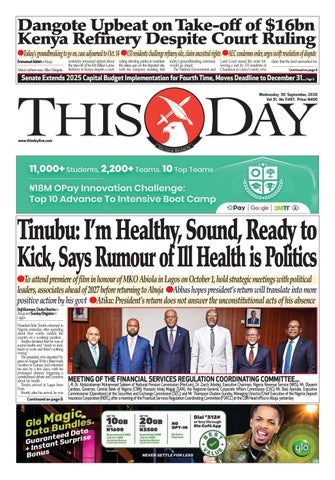
Dangote Upbeat on Take-off of $16bn Kenya Refinery Despite Court Ruling Today’s groundbreaking to go on, case adjourned to Oct. 14 133 residents challenge refinery site, claim ancestral rights AEC condemns order, urges swift resolution of dispute Emmanuel Addeh in Abuja Africa’s richest man, Aliko Dangote,
yesterday remained upbeat about the take-off of his $16 billion Lamu Refinery in Kenya despite a court
ruling directing parties to maintain the status quo on the disputed site, with the company insisting that
today’s groundbreaking ceremony would go ahead. The Malindi Environment and
Land Court issued the order following a suit by 133 residents of Chandavai in Lamu County, who
claim that the land earmarked for Continued on page 8
Senate Extends 2025 Capital Budget Implementation for Fourth Time, Moves Deadline to December 31... Page 5 Wednesday 30 September, 2026 Vol 31. No 11497. Price: N400
www.thisdaylive.com TR
UT H
& RE A S O
N
Tinubu: I’m Healthy, Sound, Ready to Kick, Says Rumour of Ill Health is Politics To attend premiere of film in honour of MKO Abiola in Lagos on October 1, hold strategic meetings with political leaders, associates ahead of 2027 before returning to Abuja Abbas hopes president’s return will translate into more positive action by his govt Atiku: President’s return does not answer the unconstitutional acts of his absence Deji Elumoye, Chuks Okocha in Abuja and Sunday Ehigiator in Lagos President Bola Tinubu returned to Nigeria yesterday after spending about four weeks outside the country on a working vacation. Tinubu declared that he was of sound health and “ready to kick, ready to work and there’s nothing wrong”. The president, who departed Nigeria on August 30 for a three-week vacation in Europe, had extended his stay by a few days, with his prolonged absence triggering a constitutional debate and concerns about his health. Tinubu arrived in Lagos from Paris. Shortly after his arrival, he was Continued on page 8
MEETING OF THE FINANCIAL SERVICES REGULATION COORDINATING COMMITTEE...
L-R: Dr. Abdulrahaman Muhammad Saleem of National Pension Commission (PenCom), Dr. Zacch Adedeji, Executive Chairman, Nigeria Revenue Service (NRS); Mr. Olayemi Cardoso, Governor, Central Bank of Nigeria (CBN); Hussaini Ishaq Magaji (SAN), the Registrar-General, Corporate Affairs Commission (CAC); Mr. Bola Ajomale, Executive Commissioner (Operations) at the Securities and Exchange Commission (SEC); and Mr. Thompson Oludare Sunday, Managing Director/Chief Executive of the Nigeria Deposit Insurance Corporation (NDIC), after a meeting of the Financial Services Regulation Coordinating Committee (FSRCC) at the CBN Head office in Abuja, yesterday
2
WEDNESDAY SEPTEMBER 30, T H I S D AY
WEDNESDAY SEPTEMBER 30, T H I S D AY
3
4
WEDNESDAY SEPTEMBER 30, T H I S D AY
5
THISDAY • WEDNESDAY, SEPTEMBER 30, 2026
Group News Editor: Goddy Egene Email: Goddy.egene@thisdaylive.com, 0803 350 6821, 0807 401 0580
NEWS
NDLEA SIGNS MOU WITH UAE COUNTERPART...
R-L: Chairman, National Drug Enforcement Agency (NDEA) of the United Arab Emirates, His Excellency Sheikh Zayed bin Hamad Al Nahyan, receiving a plague from Chairman/Chief Executive Officer of the National Drug Law Enforcement Agency (NDLEA), Brig. Gen. Mohamed Buba Marwa (Rtd), during the signing of a Memorandum of Understanding (MoU) between Nigeria’s NDLEA and UAE’s NDEA on the sidelines of 15th United Nations Congress on Crime Prevention and Criminal Justice holding in Abu Dhabi, UAE... recently
Senate Extends 2025 Capital Budget Implementation for Fourth Time, Moves Deadline to December 31 Senator blames centralised payment system for slow execution Says policy now ‘cork in the wheel’ of budget implementation Tinubu seeks passage of NDDC’s 2026 appropriation bill
Sunday Aborisade in Abuja For the fourth time, the Senate yesterday extended the implementation period of the capital component of the 2025 Appropriation Act from September 30 to December 31, 2026, citing the need to prevent the abandonment of ongoing projects and ensure effective utilisation of funds already appropriated and released. The extension followed the passage of the Appropriations Repeal and Enactment Act 2025 Amendment Bill 2026, which was considered and passed through second and third readings on the same day. The measure effectively gives ministries, departments and agencies (MDAs) an additional three months to complete eligible capital projects, process outstanding payments and utilise funds already provided under the 2025 budget, subject to existing financial regulations, procurement laws and legislative oversight. Presenting the bill, the Senate Leader, Senator Opeyemi Bamidele, said the extension was necessary because several capital projects across the country remained at various stages
of implementation, while a significant amount of released capital funds had yet to be utilised. He explained that capital budget implementation involved several stages, including procurement, contract execution, mobilisation, certification of completed works and payment, stressing that the processes needed to be properly coordinated to ensure successful completion of projects. According to him, allowing the existing September 30 deadline to lapse without an extension could create avoidable difficulties for MDAs seeking to complete projects already at advanced stages. “Mr. President, the essence of this proposed extension is to provide the necessary legal and administrative window for ministries, departments and agencies of the federal government to fully implement capital projects for which appropriations have been made and funds released,” Bamidele said. He stressed that the legislation did not constitute a fresh appropriation but merely created additional time within the existing legal framework for implementation. “The bill does not seek to introduce
a new appropriation. Rather, it seeks to provide additional time within the existing legislative framework for the implementation of the capital component of the 2025 appropriation, thereby ensuring that appropriated funds are utilised effectively, transparently and for the intended purposes,” he said. Bamidele, however, cautioned MDAs against treating the extension as a relaxation of accountability requirements,
insisting that all expenditure during the extended period must comply with applicable laws and regulations. “I wish to emphasise that the extension should not be interpreted as a relaxation of the principles of accountability, fiscal responsibility or legislative oversight,” he said. The Senate Leader added that the measure was intended to protect public investments, facilitate the completion
A petroleum trading dispute involving Petrichor Energy FZCO and Ultimate Oil & Gas FZCO has extended to Nigeria, with enforcement proceedings initiated over outstanding obligations arising from transactions between the companies. The transactions, involving supplies of gasoil and Jet-A1 aviation fuel, took place between 2022 and 2023 as part of commercial dealings between the two companies.
However, the parties later differed over outstanding obligations connected to the transactions, leading to legal proceedings in several jurisdictions over the amounts involved and efforts to establish a framework for their settlement. The matter subsequently reached Nigeria following a judgment obtained by Petrichor in England. Records of the proceedings show that the High Court of Justice of England and Wales issued judgment in favour of Petrichor on February 14, 2025, over outstanding amounts
to review the policy, warning that its continued operation could result in repeated requests to extend budget implementation periods. “So long as that system is not consigned to the dustbin of history, so long shall we continue to have this ugly scenario of non-implementation of the budget, necessitating the National Assembly to extend the lifespan of the budget,” he argued.
Tinubu Felicitates Blue Economy Minister, Adegboyega Oyetola, At 72 Rejoices with ex-defence minister, Badaru Abubakar and presidential aide on SDGs, Orelope-Adefulire, on their birthdays Deji Elumoye in Abuja President Bola Tinubu has felicitated Minister of Marine and Blue Economy, Alhaji Adegboyega Isiaka Oyetola, on his 72nd birthday. The President, in a statement issued on Tuesday by his Adviser on Information and Strategy, Bayo Onanuga, commended Oyetola’s commitment
to advancing the administration’s Renewed Hope Agenda through his stewardship of the ministry, where he continues to implement the Federal Government’s policies to unlock the enormous economic potential of the nation’s maritime sector. Tinubu noted that under Oyetola’s leadership, the ministry has pursued initiatives that have helped improve
How Petroleum Debt Dispute Led to Enforcement Proceedings in Nigeria Alex Enumah in Abuja
of critical infrastructure, prevent waste and maximise value from already appropriated resources. But the Chief Whip, Senator Tahir Mongunno, identified the centralised payment system domiciled in the Office of the Accountant-General of the Federation as one of the factors contributing to delays in budget implementation. Mongunno urged the Executive
arising from the transactions. Under the judgment, Ultimate Oil & Gas was ordered to pay AED22.85 million relating to an outstanding amount connected to a new spot cargo, together with interest and costs. Separate proceedings concerning a personal guarantee resulted in an order requiring the chairman and owner of Ultimate Oil & Gas, Alhaji Abdulrahman Musa Bashar to pay AED122.19 million,(United Arab Emirate Dirham) alongside interest and costs.
Following the judgment, the parties entered into a payment agreement intended to provide a structured approach to settling the outstanding obligations. Subsequent efforts to implement the agreement and address the outstanding amounts resulted in further proceedings in other jurisdictions. In March 2026, the English High Court granted a worldwide freezing order concerning Bashar and Ultimate Oil & Gas in connection with the outstanding judgment debt.
efficiency in the maritime sector, attract investment, create jobs, and enhance the nation’s competitiveness in the global maritime industry. The President also extolled the celebrant’s wealth of experience in public administration and governance, describing him as a renowned technocrat, shrewd administrator and committed patriot. Oyetola has had a remarkable career in the insurance industry before entering the public service as Chief of Staff to the governor of Osun State. He was later elected governor of the state. Tinubu said: “Your years of service to our country as an insurance icon, public servant and political leader demonstrate your commitment to the development and prosperity of Nigeria. “As Minister of Marine and Blue Economy, you brought experience and dedication to the task of transforming our maritime sector into a major driver of economic growth, investment and employment. “I commend your contributions to the Renewed Hope Agenda, and I encourage you to remain steadfast in the service of our nation.”
The President prayed that Almighty God will grant Oyetola good health, wisdom, and many more years of service to Nigeria and humanity. Also on Tuesday, Tinubu congratulated Princess Adejoke Orelope-Adefulire, his Senior Special Assistant on Sustainable Development Goals (SDGs) and former Deputy Governor of Lagos State, on her birthday on September 29, 2026. The President described Princess Orelope-Adefulire as a dedicated public servant and development advocate whose contributions continue to support Nigeria’s inclusive and sustainable development efforts. He lauded her commitment to advancing the implementation of the United Nations Sustainable Development Goals in Nigeria, particularly initiatives targeted at improving the welfare and living conditions of vulnerable citizens and communities. “I commend Princess OrelopeAdefulire’s efforts in the creation of the Presidential Council on SDGs and other advocacy groups to accelerate Nigeria’s progress towards the achievement of the SDGs and the 2030 Agenda with a focus on ‘Leaving No One Behind.’
6
WEDNESDAY, SEPTEMBER 30, 2026 • THISDAY
NEWS
TINUBU ENDS VACATION, LANDS IN LAGOS...
L-R: Deputy President of the Nigerian Senate, Barau Jibrin; Governor of Kwara State, AbdulRahman AbdulRazaq; President Bola Ahmed Tinubu; and Governor of Lagos State, Babajide Sanwo-Olu, when the president was speaking to journalists in Lagos after his return from vacation, yesterday
Babachir Lawal: How I Dragged Obi into ADC, Convinced Kwankwaso to Join Coalition Reveals both politicians feared Atiku’s influence, preferred consensus Says he quit ADC after manipulation of its presidential primary Claims he drove Tinubu’s 2022 campaign strategy that delivered APC ticket Reiterates Buhari had suspicions about Tinubu in 2023 Emmanuel Addeh in Abuja Former Secretary to the Government of the Federation, Babachir Lawal, has disclosed how he persuaded Peter Obi and Rabiu Kwankwaso to join the African Democratic Congress (ADC), revealing that both politicians had reservations about former Vice President Atiku Abubakar’s presence in the coalition and preferred a consensus arrangement for choosing its presidential candidate. Lawal, who is now a chieftain of the Nigeria Democratic Congress (NDC), said he played a central role
in assembling the opposition coalition, including personally persuading Obi to commit to the ADC and using his longstanding relationship with Kwankwaso to convince him to join. Speaking in an interview with Arise Television, Lawal said Obi had initially been moving in and out of discussions about the ADC before he intervened. “At one time, Peter was playing in, out, in, out. I was the one that finally dragged Peter into the ADC. Committed him to join the ADC,” he said. Lawal said he was also appointed to lead discussions with the New Nigeria Peoples Party (NNPP) when
the party was considering joining the ADC coalition. Although the formal discussions did not produce a merger at the committee level, he said his longstanding relationship with Kwankwaso eventually helped him convince the former Kano State governor to join the ADC. Lawal said the major problem within the coalition later centred on Atiku’s presence and the question of who would emerge as its presidential candidate. He claimed that Kwankwaso was apprehensive about Atiku’s involvement, while Obi was opposed to a
primary that would pit him against the former vice president. He said another aspirant, Mohammed Hayatu-Deen, also preferred a consensus arrangement, but that the various contenders ultimately wanted the consensus to produce them. “Eventually, the chairman could not work out the consensus. They all agreed that they wanted consensus, provided it is me,” Lawal said. According to him, the inability to reach a consensus left the coalition facing a presidential primary, but concerns soon emerged over whether the party had the logistics and finances to conduct
Food Security: Olam Seeks Partnership with NYSC to Boost Aquaculture Oghenevwede Ohwovoriole in Abuja Olam Nigerian Limited is seeking a partnership with National Youth Service Corps (NYSC) to boost aquaculture development and promote youth empowerment in the country. NYSC’s Director of Information and Public Relations, Caroline Embu, on Tuesday stated that Olam’s General Manager, Mrs. Morenike Alayerogun, made the request when she led a delegation of the company on a courtesy visit to the NYSC National Directorate
Headquarters in Maitama, Abuja. Alayerogun disclosed that about 200 corps members were currently serving with the organisation in various fields, adding that Olam is committed to supporting the federal government’s efforts in nation-building, youth development, and corps members’ mentorship. According to the statement, Alayerogun requested the deployment of more corps members to strengthen Olam’s farm operations, particularly in Kwara State. “We will accommodate and feed
them, and after one year, we will attach them to our farmers all over the nation,” the statement quoted Alayerogun to have said. The Olam general manager further proposed a partnership with NYSC to train more corps members who could subsequently be supported by Bank of Industry (BoI) to establish their own businesses. In his remarks, Director-General of NYSC Brig. Gen. Olakunle Nafiu, said unemployment was a global challenge affecting young people.
Nafiu stated that agribusiness was a major component of the Nigerian economy, saying this underscores the relevance of Olam’s agricultural activities. He commended Olam for its contributions to the Nigerian economy, particularly its efforts to empower corps members. He said the NYSC management frowned on the misuse and underutilisation of corps members, and urged corpers’ employers to continue to add value to members deployed to their organisations.
a credible exercise. Lawal said Obi and Kwankwaso had already paired up by that stage, hoping to work together within the ADC, and eventually decided to leave the party. He said he remained with the ADC for some time, supporting the chairman and attempting to address problems arising from the congresses. According to him, he took steps to ensure that people of integrity were appointed to positions in the congress committees in his zone, but alleged that those efforts were unsuccessful. “All of them succumbed. Everywhere it was like that,” he said. Lawal said the experience eventually convinced him that he could no longer remain in the party. Lawal said he had known Obi since the 2023 election and regarded him as someone who would approach the government differently. He also said his longstanding knowledge of Kwankwaso had influenced his decision to support the two politicians. “First of all, Peter is there. I had known that he’s a man of integrity and who tried to do things differently, even from our relationship in 2023. I know Kwankwaso. I’ve known Kwankwaso for years,” he said. He said he had followed Kwankwaso’s career as minister of defence, governor of Kano State and head of the Kano water agency, adding that he had also observed programmes involving the education of children
from poor backgrounds. Lawal also revisited his role in the emergence of President Bola Tinubu as the presidential candidate of the All Progressives Congress (APC) in 2022, claiming that he drove the campaign strategy that eventually delivered the party’s ticket to Tinubu. He said Tinubu, whom he described as a longtime friend, approached him in 2022 to seek his support for his presidential ambition. Lawal also provided fresh insight into his relationship with former President Muhammadu Buhari and the political calculations surrounding Tinubu’s emergence as the APC candidate. He said he had known Buhari for most of his life and had worked with him through several unsuccessful presidential campaigns before the formation of the APC. Even after Buhari removed him as SGF, Lawal said their relationship continued, with the former president still seeking his views on political matters. According to Lawal, Buhari had reservations about Tinubu and had expressed those suspicions to him on more than one occasion, but explained that his argument was that Buhari had benefited from Tinubu’s support during his own presidential campaigns and therefore could not subsequently use the same political relationship against him.
OPay Names Top 10 Teams in N18m National Innovation Challenge Sunday Ehigiator OPay, in partnership with Google and the Federal Government’s 3 Million Technical Talent (3MTT) programme, has announced the 10 teams advancing to the next stage of its National Innovation Challenge under the expanded OPay Scholars Programme. The challenge attracted more than 11,000 students and 2,200 teams, reflecting growing interest among young Nigerians in developing innovative solutions to real-world
challenges across various sectors. Following a selection process, 48 teams were shortlisted for a six-week employability webinar designed to strengthen their knowledge, develop workplace-relevant skills and prepare them for the next stage. At the end of the webinar, 10 teams emerged as the top teams and will proceed to an intensive Boot Camp, where they will work with experienced mentors and industry professionals to further develop, test and refine their solutions ahead of the final stage.
Speaking on the initiative, CSR Manager, OPay, Itoro Udoh, said the programme was designed to create practical opportunities for young Nigerians to turn their ideas and skills into solutions. “Beyond the challenge, our goal is to equip young Nigerians with practical skills, mentorship and pathways to opportunities that can create lasting impact,” Udoh said. The National Innovation Challenge has a total prize pool of N18 million. Beyond rewarding innova-
tive ideas, the initiative provides participants with opportunities to gain practical experience, strengthen their solutions and engage with professionals within the innovation and technology ecosystem. The programme also provides opportunities beyond the competition, with students who perform exceptionally well during the webinar stage to be considered for the OPay Futures pipeline. Those selected for the pipeline may gain access to potential threemonth internship opportunities
with OPay and other partner organisations. The 10 teams advancing to the Boot Camp are Lyrclip from Miva Open University; ResearchFlow from Olabisi Onabanjo University; CampusCheck from the Federal University, Oye-Ekiti; Veripay from MOAUM, Benue State University; CoursePass from Lagos State University of Science and Technology; Teamcobuild from Nnamdi Azikiwe University, Awka; Verified Hands from Ahmadu Bello University; SkoolConnectNG from Yaba College
of Technology; Thrifty from Ahmadu Bello University; and Team Paye from Adeleke University. OPay said the initiative was part of its broader commitment to supporting education, skills development, innovation and employability among young Nigerians. “As the top 10 teams advance to the Boot Camp, they move one step closer to transforming their ideas into solutions that can address real-world challenges and create a meaningful impact,” the company said.
7
THISDAY • WEDNESDAY, SEPTEMBER 30, 2026
NEWS
IMC 2.0 CONFERENCE AND EXHIBITION...
L-R: Program Director, Ilorin Innovation Hub, Zumah Yahaya; Managing Partner, CcHUB, Nissi Madu; Partner, Antler, Anil Almaramani; Managing Director, Endeavor, Ireayo Oladunjoye; and CEO, Hydrogen, Fiyinoluwa Olorunsola, during the panel session at IMC 2.0 Conference and Exhibition organised by the Telecommunication and Technology Sustainability Working Group (TTSWG), in Lagos...recently
Oduwole Reaffirms FG’s Commitment to Unlock Finance to Small Businesses ACCI seeks relief on multiple taxation, infrastructure, affordable credit Nigeria-India bilateral trade hits $9.2 billion
James Emejo and Aminat Hassan in Abuja Minister of Industry, Trade and Investment, Dr. Jumoke Oduwole, yesterday, reaffirmed the federal government’s commitment to expanding access to finance, markets, technology, and other critical support for small businesses, as part of efforts to move enterprises from survival to sustainable growth. Oduwole spoke at the opening of the 21st Abuja International Trade Fair (AITF), organised by Abuja Chamber of Commerce and Industry (ACCI). She said government was particularly focused on helping Micro, Small and Medium Enterprises (MSMEs) scale their operations, access wider markets, and compete beyond Nigeria. The minister said the objective was to help businesses move “from survival to sustainability and from small-scale production to scale, from serving local markets to competing across borders”. She said the government could not build the productive economy required to achieve the country’s $1 trillion economic ambition without stronger collaboration with the private sector and development partners. “We cannot build the one
trillion-dollar economy, a productive economy that Nigeria needs, from government offices alone,” she said. The minister said government’s role was to create an enabling environment in which businesses could invest, expand, and create jobs, while the private sector remained the engine of economic growth. She said this required continued improvements in the business environment, infrastructure, trade facilitation, and government processes, as well as reducing unnecessary barriers to investment and production. According to Oduwole, the federal government would continue to improve businesses’ access to finance, standards, technology,
information, and markets, stressing that the market available to Nigerian enterprises could no longer be restricted by national borders. The minister said the theme of the fair, “Resilience: Trade, Taxation and the Economy,” was particularly relevant to businesses facing changing operating conditions. She explained that business resilience should go beyond merely surviving difficult periods to include the capacity to adapt, invest, expand, compete, and create jobs. Oduwole also challenged the organisers and participants to ensure that the trade fair generated actual commercial opportunities rather than becoming merely an exhibition of
As Nigeria is moving towards greater national ownership of healthfinancing research as declining global development assistance, economic pressures and geopolitical shifts reshape the global health landscape. The move signals a transition from a largely donor-driven research model towards research sovereignty, where Nigeria defines its policy questions, commissions context-specific studies, manages health economics data and integrates research findings directly into policy implementation. The development was a key focus of the inaugural Nigeria
taxation, infrastructure deficits, access to affordable finance, port procedures, local manufacturing, and export-oriented businesses as areas requiring sustained engagement between government and the organised private sector. According to him, Nigerian entrepreneurs, manufacturers, farmers, service providers and innovators have continued to adapt to high operating costs and evolving tax and regulatory requirements. But he stressed that such resilience needed to be backed by policies that encouraged production, rewarded innovation, and simplified compliance. Obegolu said AITF, which at-
tracted more than 500 exhibitors, was designed to create the commercial linkages required for businesses to grow through business-to-business and business-to-government engagements, investment networking, and market access. He urged exhibitors to use the fair to secure customers, build partnerships, and attract investors rather than merely display their products. The ACCI president also called on international partners and the diplomatic community to view Nigeria not only as a large consumer market but also as a destination for production, investment, and regional trade.
Johnvents Processes 19,806MT Cocoa in Six Months, Eyes Expansion Fidelis David in Akure Johnvents Group, an Africa-based multinational agribusiness and food manufacturing company, on Tuesday disclosed that its combined cocoaprocessing facilities in Akure and Ile-Oluji, all in Ondo State, operated at 82 per cent capacity in the first half of 2026, up from 66 per cent recorded in 2025. The company also revealed that it processed 31,621 metric tonnes (MT) of cocoa in 2025, representing a 50
per cent increase over the previous year, while a further 19,806 MT was processed in the first six months of 2026. The development came as the company hosted institutional investors and capital-market stakeholders on a tour of its operating facilities, where it showcased its cocoa processing, agricultural commodity aggregation, and downstream food manufacturing operations. Johnvents currently has a combined annual cocoa-processing
Nigeria Moves to Strengthen Health Research Sovereignty Amid Global Aid Decline Ayodeji Ake
products. She said, “A trade fair must ultimately be about transactions. It must connect businesses to buyers, it must connect manufacturers to markets, it must connect entrepreneurs to finance and investors, and it must give Nigerian businesses greater visibility and stronger pathways into domestic, regional and global value chains.” President of ACCI, Chief Emeka Obegolu, called for policies that would make businesses more competitive, saying resilience should not translate into businesses being left to absorb the full weight of a difficult operating environment. Obegolu identified multiple
Health Financing Research and Learning Forum, organised by the National Health Insurance Authority (NHIA) in collaboration with the Federal Ministry of Health and Social Welfare, Health Strategy and Delivery Foundation, Nigeria Health Watch and the Alliance for Health Policy and Systems Research. The forum brought together policymakers, development partners, State Social Health Insurance Agencies, researchers and other stakeholders to examine how evidence and learning can strengthen Nigeria’s health-financing system. The initiative builds on the momentum of the 2025 National Health Financing Policy Dialogue
and the broader global shift in development support often described as the Accra Reset. Stakeholders stressed that research sovereignty does not mean Nigeria withdrawing from international partnerships or funding. Rather, international support should complement domestic investment while Nigeria remains in the driver’s seat of its health-financing research agenda. Speaking at the forum, NHIA Director-General, Dr. Kelechi Ohiri, said the gathering was not merely an academic exercise but was directly connected to the operational and policy reforms underway at the authority.
capacity of 48,000 MT across its Akure and Ile-Oluji facilities. The investor tour provided stakeholders with first-hand insight into the company’s production capacity, procurement operations, capacity utilisation, and expansion plans. Beyond cocoa, the group said its operations covered several agricultural commodity value chains, including food manufacturing, diversified agro-processing, farming, and logistics, with its downstream businesses producing consumer foods, edible oils, animal feed, seasoning, and water. According to the company, about 75 per cent of its group revenue is linked to export markets, under-
scoring the role of its operations in connecting Nigerian agricultural commodities and value-added products to international markets. Speaking on the investor engagement, Group Managing Director, John Adedamola Alamu, said the tour was designed to give investors direct visibility into the scale and performance of the company’s operations. “We are strengthening the connection between agricultural supply, processing, manufacturing, and markets, with a clear focus on increasing value addition and building globally competitive businesses from Africa,” Alamu said. Group Head, Treasury, Samuel
Olaifa, explained that agricultural commodities were procured during specific crop windows before passing through inventory, processing, sales, exports, and cash collection, making liquidity management critical to the company’s operations. “Cocoa represents a significant component of this seasonal requirement, reflecting the scale of our processing operations and the concentration of procurement during the cocoa season,” Olaifa said. He added that the company’s cash-conversion cycle could reach approximately 150 days at the seasonal peak, while typical customer collections occurred within 25 to 40 days.
63 Lagos MDAs Receive Certificates for Compliance with Mandatory Health Insurance Ayodeji Ake Sixty-three Ministries, Departments and Agencies (MDAs) of the Lagos State Government have received Certificates of Compliance for meeting requirements under the state’s Executive Order on mandatory subscription to social health insurance. The certificates were presented yesterday, by the Head of Service, Mr. Bode Agoro, during the event organised by the Lagos State Health Management Agency (LASHMA).
The Executive Order, signed by Governor Babajide Sanwo-Olu on July 16, 2024, makes enrolment in the Lagos State Social Health Insurance Scheme mandatory for residents. It is aimed at accelerating Universal Health Coverage and reducing financial barriers to accessing healthcare. Speaking at the event, LASHMA Permanent Secretary, Dr. Emmanuella Zamba, said Lagos was beginning enforcement from its own public institutions by ensuring that MDAs
complied with the provisions of the Executive Order. She identified four key requirements for compliance: presentation of proof of ILERA EKO enrolment by residents accessing government services; enrolment of all staff, including non-Oracle and nonpensionable workers; inclusion of LASHMA’s official website URL on MDA websites; and provision of dedicated spaces for LASHMA personnel to verify enrolment and provide support.
8
WEDNESDAY, SEPTEMBER 30, 2026 • THISDAY
EIGHT
Amid Stronger Buffers, CBN Mandates Banks to Observe Sound Risk Controls Warns against profit-driven regulatory breaches Declares recapitalisation must drive lending, support $1 trillion economy Ndubisi Francis, Eromosele Abiodun, James Emejo and Nume Ekeghe in Abuja Central Bank of Nigeria (CBN), yesterday, said the banking industry – now with stronger balance sheets – must implement tighter risk management, sound governance, and responsible lending in the post-recapitalisation era. CBN stated that bigger bank balance sheets alone will not guarantee resilience, which is key for stability. CBN Deputy Governor, Corporate Services Department, Dr. Muhammad Sani Abdullahi, gave the charge in Abuja at the opening of the central bank’s 38th Annual
Seminar for Finance Correspondents and Business Editors, with the theme, “Towards a Robust and Resilient Financial System in the Post-Banking Sector Recapitalisation Era.” Abdullahi said CBN would continue to deepen its risk-based supervisory approach, macroprudential surveillance, and stress testing to safeguard the stability of the financial system. CBN’s Director, Banking Supervision Department, Dr. Olubukola Akinwunmi, for his part, made it clear that in the post-recapitalisation era, banks must follow the rules. Akinwunmi said profit-chasing will not excuse cutting corners, as enforcement tightens to keep the
financial system strong. He stressed that the regulator would insist on strict compliance with prudential requirements, adding that stronger capital buffers would be meaningless if banks continue to take excessive risks. Still addressing the theme of the forum, Abdullahi said, “Our supervisory approach will continue to emphasise risk-based supervision, macroprudential surveillance and enhanced stress testing.” He said financial sector coordination, consumer protection, fintech regulation, and support for responsible innovation would remain important, alongside crisis preparedness and resolution plan-
ning. Abdullahi said, “As the governor has consistently emphasised, preserving monetary and financial stability requires continued vigilance. “We must remain forwardlooking, data-driven and responsive to developments at home and abroad.” The CBN deputy governor said the recent recapitalisation had provided the banking industry with stronger capital to support a growing economy, but stressed that capital alone would not guarantee resilience. According to him, “Capital, however, is a starting point. Boards and management must maintain
sound controls, recognise risks early and lend on the strength of viable projects.” By the end of the two-year recapitalisation programme announced in March 2024, Abdullahi disclosed that 33 banks had met the revised minimum capital requirements and raised N4.65 trillion. He said Nigeria’s ambition of building a $1 trillion economy by 2030 required banks capable of mobilising and allocating capital on a much larger scale. He stated, “Stronger capital buffers should enable banks to finance long-term infrastructure, support industrial expansion, facilitate international trade and compete
Dr. Muhammad Abdullahi more effectively in regional and global markets. “They also provide greater Continued on page 36
TINUBU: I’M HEALTHY, SOUND, READY TO KICK, SAYS RUMOUR OF ILL HEALTH IS POLITICS asked by journalists about his vacation and concerns raised by some Nigerians and his well-wishers over his health. “I enjoyed myself. Fantastic!” he said, smiling, when asked how the vacation went. He was subsequently asked how sound he was and whether he was ready for the next line of action, particularly against the backdrop of concerns about his health. Tinubu responded, “Ready to kick, ready to work. There’s nothing wrong.”
The president dismissed the concerns about his health as political rumour, insisting that he is in good health and ready to resume his official responsibilities. He said, “Rumor will always be emanating from politics, but the facts remain, I’m here. Healthy, sound, and ready to go.” Commenting on the president’s arrival, Speaker of the House of Representatives, Hon Tajudeen Abbas, who was among top government officials and political leaders, who received the president at the airport,
said he expected Tinubu’s period of rest to translate into increased activity by the administration. Abbas said, “It is incredibly nice to have him after one month away, and we believe that the days he has spent resting will translate into more action this time around. “We believe that he will come with renewed vigour, a renewed hope, to continue serving the good people of Nigeria.” Tinubu’s return followed a four-week stay in Europe, which began with his departure for
London on August 30, before he proceeded to Paris, where he held engagements with French President Emmanuel Macron and businessman Vincent Bolloré, whose media and digital interests include Canal+, MultiChoice, and Universal Music Group. On Monday, Tinubu met with Chairman of FirstHoldco Plc, Mr Femi Otedola, in Paris. Last week, he witnessed the signing of a Memorandum of Understanding between Ogun State Government and DP World
Nigeria Hosts Creative Africa Nexus in Nov, Targets Global Markets With Creative Economy Lagos to deploy health, traffic, emergency measures for 10,000 participants All 36 states to showcase culture, products, investment opportunities Deji Elumoye in Abuja Minister of Industry, Trade and Investment, Dr Jumoke Oduwole, has disclosed that Nigeria will use its hosting of the forthcoming Creative Africa Nexus (CANEX) Weekend 2026 as a major platform to transform the country’s creative economy into a stronger engine of trade, investment, exports, and job creation. The four-day event is expected to feature programmes spanning music, film, fashion, gastronomy, literature, visual arts, sports and technology, alongside investment, financing, enterprise and marketaccess engagements. The Federal Ministry of Industry, Trade and Investment is collaborating with the Federal Ministry of Arts, Culture, Tourism and the Creative Economy, as well as institutions responsible for foreign affairs, finance, customs, immigration, Central Bank of Nigeria, National Theatre, and Lagos State Government. Security, health, transportation, immigration and hospitality agencies are also involved in the preparations. Briefing newsmen at State House, Abuja, on Tuesday, Oduwole stated that the event billed to hold in Lagos from November 5 to 8, would go beyond celebrating African creativity by connecting creators and creative enterprises with investors, financiers, technology providers, distributors, and international markets. According to her, Nigeria’s strength in music, film, fashion, literature, visual arts, gastronomy, sports and other creative fields presents an opportunity to capture greater economic value from the country’s talent and contribute to the federal
government’s broader ambition of building a $1 trillion economy. She stated, “For the Government of the Federal Republic of Nigeria and all states of the federation, CANEX is much more than a celebration of African creativity. It is a platform for trade, investment, enterprise and market access. “We want to see partnerships formed, financing mobilised, intellectual property commercialised, businesses entering new markets and Nigerian creative enterprises scaling beyond our borders.” She explained that the global economy was increasingly creating value through services, technology, content, intellectual property, and culture, stressing that Nigeria must position its creative industries to compete more effectively in that space. She said, “Nigeria is already a major source of African music, film, fashion and creative content. The opportunity before us is to capture more of the economic value generated by that creativity.” Oduwole said achieving that would require stronger connections between creators and the financial system, investors, distributors, technology companies, and international markets. She said CANEX had been designed as a meeting point for the various components of the creative economy, rather than simply an exhibition or cultural showcase. The minister said the scale of CANEX had necessitated a whole-ofgovernment approach, given that the creative economy cut across several ministries, agencies and levels of government. According to her, “It is literally like
hosting the Olympics or the World Cup. The creative economy does not sit within one ministry or one institution. For creators and creative businesses to compete globally, the entire ecosystem must work.” She said the participation of the Nigerian Governors’ Forum, National Economic Council, and the 36 states would give the event a broad national character.
Each state, Oduwole said, would have a pavilion at CANEX, alongside private-sector exhibitors, creating an opportunity to showcase products, enterprises, culture and investment opportunities from across the country. “We want creators, investors, businesses, young people and partners from across Nigeria to participate and take advantage of the opportunities that CANEX presents,” she said.
to build a Gateway deep seaport in Ogun Waterside and create a Blue Marine Economic Zone in the area. DP World, one of the world’s leading ports and logistics operators, plans to invest $7 billion for the seaport and the economic zone. The presidency had initially announced that Tinubu would spend three weeks on vacation. On September 21, however, his Special Adviser on Information and Strategy, Bayo Onanuga, announced that the president had extended his working vacation by a few days and would return to Nigeria at the weekend. He eventually returned yesterday, September 29, bringing to an end his extended stay outside the country. The prolonged absence generated debate over Section 145 of the 1999 Constitution, particularly regarding the procedure for presidential absence from the country. The controversy was partly fuelled by the fact that the president’s initial three-week vacation had elapsed, while his return was subsequently postponed. However, the constitutional provision does not expressly state that a President can only remain outside Nigeria for 21 days. Section 145 provides that when the president proceeds on vacation or is otherwise unable to discharge his functions, he is to transmit a
written declaration to President of the Senate and Speaker of the House of Representatives, after which the vice president performs the functions of President as Acting President. The provision further states that where the president fails to transmit the declaration within 21 days, the National Assembly may, by resolution, empower the vice president to perform the functions of President as Acting President. The issue became whether the constitutional procedure had been followed during Tinubu’s extended stay and whether Vice President Kashim Shettima should have assumed presidential functions under the provision. The controversy intensified after Shettima travelled to New York on September 20 to represent Nigeria at the 81st United Nations General Assembly while Tinubu remained in Europe. The presidency subsequently said Secretary to the Government of the Federation, George Akume, would continue to represent the president at some official engagements. Opposition figures and some legal commentators questioned the constitutional implications of the president’s prolonged absence and sought clarification on whether the required declaration had been transmitted to the National AsContinued on page 35
DANGOTE UPBEAT ON TAKE-OFF OF $16BN KENYA REFINERY DESPITE COURT RULING the refinery forms part of their ancestral heritage and that their families have lived and farmed there for generations. The court directed that the prevailing status quo be maintained on the disputed land until October 14, when the matter comes up for hearing. The order temporarily bars activities including clearing, excavation, fencing, demolition and construction on the affected portions. However, the court declined the residents’ request to stop the planned September 30 groundbreaking ceremony. Dangote Group said yesterday that the ruling had not halted the ceremony, although activities at the project site could be affected by the order. “The court has not halted the groundbreaking ceremony of the refinery at this stage. However, activities at the site may be affected by the ruling as both parties are required not to carry activities until the case is heard on 14th October,” the company said. Speaking at an investor event in Nairobi, Dangote also expressed
confidence that the refinery project would proceed despite the legal challenge. “I’m sure some of you must have seen one court (has) given an order that we shouldn’t do any construction? I said no, no. This is normal for us in Africa. ... In fact, this is even small,” he said. “Anyone who wants to cause trouble, we are ready for them,” he added. Dangote subsequently told the investors: “If you want to go to court to stop the Lamu Refinery, go ahead; we are ready for you.” The proposed refinery, estimated to cost of about$16 billion, is expected to have a processing capacity of 700,000 barrels per day and is targeted for completion by 2030. The facility is planned to process crude from Kenya’s Turkana oilfields as well as supplies from other parts of Africa and is expected to reduce the region’s dependence on imported petroleum products. The residents challenging the project are seeking recognition of their rights over the land and compensation, while also raising concerns about the potential impact of the refinery on their property
and livelihoods. The legal challenge has consequently introduced uncertainty over activities at the project site, even as the planned groundbreaking remains intact. Meanwhile, the African Energy Chamber (AEC), yesterday condemned the court order and urged the parties to resolve the land dispute swiftly without allowing prolonged litigation to derail the project. AEC Executive Chairman, NJ Ayuk, said legitimate questions around land rights, compensation and environmental compliance should be addressed in accordance with Kenyan law, but argued that they should not indefinitely delay the refinery. “Africa cannot continue exporting its energy security and then acting surprised when conflicts thousands of kilometres away determine what our people pay for fuel. The communities of Lamu must have their rights respected, and legitimate questions around land and compensation should be resolved quickly and fairly,” he said. “But those issues cannot become
an excuse to indefinitely delay one of the most important downstream investments East Africa has seen in decades,” Ayuk added. The chamber said the refinery could strengthen East Africa’s fuel security, noting that the region had been without an operating refinery since Kenya Petroleum Refineries shut down in 2013 and relies heavily on imported petroleum products. It cited the Dangote refinery in Nigeria as an example of the potential impact of increased African refining capacity, saying the facility had helped reduce petroleum imports and increase refined-product exports. Ayuk said Dangote had demonstrated what African capital and entrepreneurship could achieve in refining and urged the parties to resolve the Lamu dispute while allowing the project to proceed. “Aliko Dangote has already demonstrated what African capital and African entrepreneurship can achieve in refining. Kenya now has an opportunity to build that same resilience in East Africa. Resolve the dispute, protect the communities and build the refinery,” he said.
9
THISDAY • WEDNESDAY, SEPTEMBER 30, 2026
NEWS
NIGERIANS AT 81ST UNGA...
L-R: A US-based Nigerian, Chukwujekwu Onwughalu; Vice President Kashim Shettima; Chief Executive Officer of Winhomes Global Services Limited, Stella Ifeoma Okengwu; and her husband, Ogheneovo Gbejewoh, at the 81st United Nations General Assembly (UNGA 81) in New York, United States of America…recently
Atiku to Tinubu: Publish Details of Nigeria’s $5bn Health Deal with US Ex-VP raises concerns over medical records, pathogen samples Urges Tinubu to follow President Mahama’s example Emmanuel Addeh in Abuja Former Vice President and presidential candidate of the African Democratic Congress (ADC), Atiku Abubakar, yesterday challenged the federal government to publish the full text of Nigeria’s recent $5 billion health agreement with the United States. This, he emphasised, followed Ghana’s rejection of a similar US
health compact over concerns about medical records, pathogen information, funding obligations and the inspection of imported medicines. President John Mahama disclosed that Ghana rejected the proposed compact after its Ministry of Health reviewed the document and flagged provisions relating to health data, counterpart funding and the regulatory authority of the country’s Food
and Drugs Authority (FDA). Reacting in a statement issued by his Director of Strategic Communication, Phrank Shaibu, Atiku said the disclosure raises questions about whether similar provisions were contained in the agreement signed by Nigeria. “At this point, Nigerians do not know whether the provisions Ghana rejected are in the agreement Tinubu signed,” Atiku said. “That
is precisely why the government must publish the full text. Nigerians should not have to guess what has been agreed in their name,” he added. Nigeria signed a five-year health Memorandum of Understanding (MoU) with the United States on December 19, 2025. According to the Federal Ministry of Health, the agreement covers disease surveillance, health data systems
Stakeholders Seek Stronger FG-Private Sector Synergy on Cancer Prevention in Nigeria 17 million girls receive vaccination Onyebuchi Ezigbo in Abuja Stakeholders have advocated stronger collaboration between the federal government and the private sector to accelerate cancer prevention and expand equitable access to care in Nigeria. That was as the federal government said the number of girls that had received vaccination against cervical cancer as at September was over 18 million. The call for more private sector collaboration was made at a high-level policy roundtable organised by MSD (Merck & Co.), in partnership with Africa Health Business (AHB), in Abuja.
The meeting had the theme, “Accelerating Cervical Cancer Elimination in Nigeria: Uniting Public and Private Sectors for Equitable Access.” The roundtable focused on strengthening institutional alignment, expanding HPV vaccination, and exploring innovative financing for cervical cancer elimination. MSD said private sector engagement was crucial to sustaining progress across prevention, screening, treatment, and financing. The organisation stated that Nigeria had made cervical cancer elimination a national priority, with a dedicated strategic plan, aligning with WHO 90-70-90 targets. Cervical cancer is also among
the top three cancers covered by the Cancer Health Fund. Since the national HPV vaccination programme was launched in October 2023, over 18 million girls aged between nine and 14 years have been vaccinated, making it one of the largest single-country efforts globally. Speaking to journalists after the meeting, MSD External Affairs Director for sub-Saharan Africa, Vuyo Mjekula said, “Despite the significant burden of cervical cancer in Nigeria, the country continues to make meaningful progress towards elimination.” Mjekula added, “The opportunity now is to build on this momentum
through stronger collaboration among government, private sector, healthcare providers, civil society and patient advocates. “Greater private sector participation can complement government efforts, support sustainable access, and help extend reach of prevention initiatives to eligible populations beyond those covered by the national programme.” Mjekula added, “MSD continues to play a key role in cervical cancer elimination in Nigeria through ensuring vaccine access to young adolescents and creating enlightenment.”
and procedures involving pathogen samples. The United States is expected to provide nearly $2 billion in grants, while Nigeria has made health spending commitments projected to mobilise nearly $3 billion over five years, Atiku said. Atiku argued that the commitments should be considered against the country’s health challenges, citing estimates that put Nigeria’s maternal deaths at 75,000 in 2023. “Every one of those deaths represents a woman whose family expected her to come home,” he said. “This crisis did not begin under Tinubu, but he has had more than three years to show Nigerians how his government is making childbirth safer. Where are the results?,” Atiku asked. Atiku also questioned the government’s ability to meet its domestic funding commitments, citing remarks by the Minister of Health, Ali Pate, during a budget defence that only N36 million had been released from the N218 billion appropriated for capital projects and programmes at the ministry’s headquarters in 2025. “A government that cannot release funds for approved health projects must explain how it intends
to honour a multibillion-dollar commitment,” he said. “A signed partnership cannot staff a maternity ward, supply a hospital or save a woman in labour. Nigerians need to see the funding and the care,” he stressed. The former vice president called for the publication of the complete agreement, including related protocols, annexes, data-sharing arrangements, specimen-sharing agreements and financial undertakings. “Can Nigerians’ medical information or pathogen samples leave the country? Who may access them? What safeguards protect patients? Does NAFDAC retain full authority to inspect medicines and medical products? What exactly have the federal government and the states promised to spend? Tinubu should put the documents before Nigerians and answer these questions plainly,” he said. Mahama had said Ghana rejected the proposed US compact after its cabinet flagged provisions requiring the country to provide its pathogen profile and medical records, commit counterpart funding and relinquish inspection powers over medicines and medical products brought into the country under the programme.
CBN Warns Kano Traders Against Naira Abuse, Says Naira Remains Symbol of National Pride
Dr. Adetona Adedeji, said the naira Market, and Yan Lemo Market. Sorondinki in Kano In his remarks, Chairman of was a symbol of sovereignty and UBEC: Only 35.6% of Children Aged 36-59 Ahmad Central Bank of Nigeria (CBN) has national pride that must be handled Galadima Market Association, Mustapha Shuaibu Sulaiman, thanked traders in Kano against with dignity. Months Attend Early Childhood Education warned According to Yahaya, CBN and CBN for taking the campaign to the abuse of Naira notes, saying Kuni Tyessi in Abuja
Only 35.6 per cent of Nigerian children aged 36 to 59 months are currently enrolled in any form of Early Childhood Care, Development and Education (ECCDE), leaving millions outside the system. The Universal Basic Education Commission (UBEC) disclosed this yesterday in Abuja. UBEC warned that the low enrolment was responsible for poor learning outcomes and high dropouts in basic education.
UBEC Executive Secretary, Dr. Aisha Garba, who spoke at a three-day workshop on ECCDE Minimum Standards and Implementation Guidelines, said the figure meant about 10 million of Nigeria’s youngest children were not captured in early learning. Represented by Deputy Executive Secretary (Technical), Rasaq Olajuwon Akinyemi, Garba said the 2021 Multiple Indicator Cluster Survey (MICS) showed that 46 per cent of children aged 24 to 59 months were developmentally off-track.
She stated, “Only 35.6 per cent of Nigerian children aged 36 to 59 months attend any form of early childhood education. That leaves roughly 10 million of our youngest children outside ECCDE altogether.” She linked the poor foundation to learning crisis at higher levels, stating that 70 per cent of Nigerian 10-yearolds could not read and understand a simple text, and of 5.9 million children who enter primary one each year, only about 2.4 million remain in school by the end of Junior Secondary School.
the currency remains a symbol of national pride and must be treated with respect. The apex bank gave the warning on Tuesday during a sensitisation exercise and roadshow at major markets in the state, led by Currency Operations and Branch Management Department of CBN. Speaking at Galadima Market, Deputy Director, Planning and Development Division, CBN, Ibrahim Yahaya, who represented Director of Currency Operations,
the federal government spend huge sums replacing dirty, soiled, and mutilated notes, a cost that could be avoided if Nigerians handle the currency properly. He said, “The naira is our national pride. When it is dirty, soiled or torn, we have to replace it and it costs a lot of money. By handling it well, we extend its lifespan and save money for the country.” The roadshow covered Galadima Market, Sabon Gari Market, Abattoir Market, Yankaba Market, Tarauni
people in the markets and pledged to sensitise his members. Sulaiman stated, “We will carry this message to our members, but we want the CBN to warn commercial banks. They should stop issuing dilapidated currency to us. Most times when we collect money from banks, we have to remove the damaged ones ourselves.” He also called on the apex bank to stop commercial banks from pushing dirty and torn notes into circulation.
10
WEDNESDAY, SEPTEMBER 30, 2026 • THISDAY
NEWS
A PLAQUE OF RECOGNITION PRESENTED TO FIRST LADY...
L-R: President of the Court of Appeal of Nigeria and Chairperson Board of Trustees IBB International Golf and Country Club Hon Justice Monica Mensem; First Lady of Nigeria and Grand Patron of the All Africa Challenge Trophy (AACT), Nigeria 2026, Senator Oluremi Tinubu; President of Lady Golfers Association of Nigeria Dr. Lani Onayi Ahmed; and the immediate Past President of the LGAN, Mrs. Evelyn Oyome, after the association presented the First Lady with a plaque of recognition as the Grand Patron of the AACT at the Presidential Villa, Abuja, yesterday PHOTO: GODWIN OMOIGUI
Akpabio Preaches Against Violence as 2027 Campaigns Gather Momentum Urges Candidates to Reject Violence, Intimidation Says No Electoral Prize Is Worth a Nigerian Life Upper Chamber fixes security summit for October 12, adjourns plenary to October 13 Sunday Aborisade in Abuja President of the Senate, Senator Godswill Akpabio, yesterday warned political parties and candidates ahead of the 2027 general elections against violence and intimidation, declaring that no electoral victory was worth the life of any Nigerian. Akpabio gave the warning in his welcome address as the Senate resumed plenary after its two-month recess, urging politicians to conduct their campaigns with honour and ensure that the contest for political offices did not divide the country. He said the commencement of campaigns for the 2027 elections placed a responsibility on political actors to present their competing visions to Nigerians while recognising that the country would remain after the elections. “Let the contest be vigorous; let it be open; and let every participant remember the country that must live together when the contest is over,” he said. According to him, candidates seeking elective offices did not have to agree on every issue, but they should avoid actions capable of setting communities against one another on the basis of ethnicity, religion or regional identity. “Those who seek office need not see eye to eye in order to walk hand
in hand as Nigerians,” he said. He added, “We can contend without setting community against community, faith against faith or one part of our Republic against another. “Let every candidate make a case and answer hard questions. Let every citizen be free to decide. We must reject violence and intimidation, and resist the falsehoods that travel swiftly and leave distrust in their wake. “No electoral prize is worth a Nigerian life. No victory deserves celebration if it leaves the nation wounded.” Akpabio also charged senators to maintain the dignity of the National Assembly throughout the campaign season, stressing that lawmakers had a constitutional responsibility to continue serving Nigerians irrespective of their political affiliations. He said the Senate, comprising lawmakers from different political parties, regions and backgrounds, should demonstrate that political differences could coexist with national unity. He said, “This Senate must show the way. Within these walls sit men and women of different parties, regions and convictions, entrusted with the representation of one Republic. “We shall continue to disagree, as a free Parliament must. Yet we must hear one another, conduct our affairs
with dignity and fulfil our duties throughout the campaign season.” The Senate President also expressed concern over the security situation in the country, particularly the abduction of Nigerians during the legislative recess. He said families had continued to wait anxiously for loved ones taken by armed men in Marisa, Dekera Mosque and other parts of the country, while several communities had remained
under the threat of violence. “To those who mourn, to those who wait and to those who have been driven from their homes, we offer our sympathy. But sympathy alone cannot discharge our duty,” Akpabio said. He called on security agencies to intensify efforts to rescue captives and protect vulnerable communities, promising that the Senate would examine through legislation, appropriation and
Former Cross River State governor and presidential candidate of the Peoples Redemption Party (PRP), Donald Duke, has called for the establishment of police formations at the state and local government levels, saying Nigeria’s centralised security architecture has failed to effectively confront terrorism, kidnapping, banditry and other crimes. Duke said the country must decentralise policing and make intelligence gathering the primary responsibility of local security forma-
tions, arguing that communities were better positioned to identify suspicious movements and emerging threats within their environments. Speaking on Nigeria’s security challenges, the former governor said the country had not substantially redesigned its security architecture since the end of the Civil War in 1970. “You really have not updated your security architecture since 1970. It is only recently that more military divisions were created, but anything that is essential must be local. You have to localise it,” he said. Duke said the establishment of
also through their effects on ordinary citizens. “When a farmer loses a harvest, our country loses food it can ill afford to spare. When a family loses its home, the nation has a stake in helping that family rise again,” he said. He urged the relevant authorities to ensure that early warnings about floods translated into timely preparation, protection and relief for affected communities.
Retiring Supreme Court Justice, Saulawa, Advises Judges against Receiving Gifts from Politicians CJN: Saulawa is a man of integrity, principle Alex Enumah in Abuja Newly retired Justice of the Supreme Court, Ibrahim Musa Saulawa, has advised judges in the country against receiving what he described as “Greek gifts” from politicians and litigants. Saulawa said judicial officers must imbibe a culture of contentment, integrity, morality, and honesty to be able to discharge their functions without fear or favour. He spoke at a special valedictory court session held to mark his retirement as a judicial officer, upon
attaining the mandatory retirement age of 70 years. According to the outgoing justice, gifts from politicians could be tempting and irresistible, but judges must be firm in rejecting such offers because they are associated with dangers that can make one to fall into traps in the discharge of their duties. Saulawa cited the gifts to include cows and rams usually distributed during festive periods. He lamented that politicians were also in the habit of inflating the prices of a ram bought at N200,000 to N2,000,000.
Donald Duke Canvasses State, Local Govt Police, Says Centralised System Has Failed Sunday Ehigiator
oversight what more could be done to tackle insecurity. “So long as a single Nigerian languishes in captivity, a part of Nigeria is held captive; and this Chamber cannot call itself free of the burden,” he said. Akpabio also raised concerns about the impact of flooding and the costof-living crisis on Nigerians, saying the Senate must assess government policies not only through statistics but
state police, and where necessary, local government police, was appropriate, provided that clear guidelines and safeguards were established to prevent abuse. “You have got to decentralise your policing. The idea of state police, even local government police, is right. “Have it and set the guidelines, but you must strengthen the judiciary because there must be an institution everyone reports to when things go wrong,” he said. He dismissed concerns that state governors could use state police for political intimidation, arguing that the
federal police could also be abused by powerful political officeholders. “If you say state police will be abused, the national police will also be abused by the president. It is not only governors who can abuse the police. Set it up and put stringent guidelines in place.” The PRP presidential candidate said intelligence gathering should account for the bulk of policing activities, stressing that security agencies operating far from communities could not easily obtain the kind of information available to residents.
He stated, “Why will a politician send gifts to judges? It is unheard of in other countries, it is only in Nigeria such things happen. “We need to do something about this.” The retired justice recalled his days on the Magistrate’s Court Bench in Katsina, when a prominent fuel and motor dealer, Alhaji Ali Bagobiri, donated a Peugeot 504 car to him, which he said, was bluntly rejected. Saulawa said the motor dealer went to the extent of seeking the intervention of the Emir, Alhaji Muhammadu Kabir Usman, and prominent indigenes with a view to persuading and influencing him to accept the car gift but he flatly refused. In the later days, Saulawa said, the same fuel and motor dealer in Katsina ran afoul of the law when he and his servants beat one of his workers, Ahmad, into a comatose state simply because the worker begged to be lent money to eat. Saulawa said the fuel and motor dealer, along with those who beat the labourer, were arraigned before him at the Magistrate Court, and they were found guilty and fined N7, 000 fine each as punishment. Besides, he revealed the victim of the beating, who was placed in the Intensive Care Unit of the General Hospital for two weeks, was awarded N10, 000 as damages. Saulawa recalled that the victim later became a proud house owner and a trader while the principal culprit, Ali
Bagobiri, ended his life as a wretched person. He said N7, 000 fine was a huge amount at the time. He charged judicial officers not to succumb to accepting any form of gift in the course of performing their duties so as not to compromise or derail in the course of adjudication. Saulawa praised his brother Justices on the Supreme Court bench for the love, affection, and experience shared in the discharge of their duties. He encouraged them to continue to protect the integrity of the judiciary. Earlier, Chief Justice of Nigeria (CJN), Justice Kudirat Kekere-Ekun, congratulated Saulawa for his contributions to the development of the judiciary, from the High Court in Katsina to Court of Appeal, and later to the Supreme Court. Kekere-Ekun stated, “We celebrate a judicial career that has spanned more than four decades and has traversed virtually every level of the Nigerian Judiciary. “We celebrate, too, the values that have characterised that journey and the example which his years of service have provided to generations of judicial officers and members of the legal profession.” The CJN, while recalling her first encounter with Saulawa at the Court of Appeal, disclosed that she was endeared to him because of his integrity and principle. Kekere-Ekun stated, “We each took the position that the integrity of the judicial office admits of no compromise and that even the appearance of impropriety must be guarded against.
WEDNESDAY SEPTEMBER 30, T H I S D AY
11
12
WEDNESDAY SEPTEMBER 30, T H I S D AY
WEDNESDAY SEPTEMBER 30, T H I S D AY
13
14
WEDNESDAY SEPTEMBER 30, T H I S D AY
WEDNESDAY SEPTEMBER 30, T H I S D AY
15
16
T H I S D AY ˾ WEDNESDAY SEPTEMBER 30, 2026
PROPERTY & ENVIRONMENT Lagos Building Collapse: Stakeholders Demand Synergy, Skilled Artisans, Early Warning System Bennett Oghifo Stakeholders in Nigeria’s built environment have called for stronger collaboration among government agencies, professionals, developers, communities and residents to curb building collapse and make Lagos a more resilient city. The call was made at a conference organised by the Building Collapse Prevention
Guild (BCPG), Amuwo Odofin Local Government Cell, where participants stressed that preventing structural failures requires collective responsibility rather than isolated interventions. Chairman of the conference, an architect and safety practitioner, Dr Austin Otuoke, said the theme, “Building Lagos by Synergy,” was designed to highlight the need for all
stakeholders to work together to address the persistent challenges confronting the state’s built environment. Otuoke said the government, regulatory agencies, architects, engineers, quantity surveyors, land surveyors, builders, developers and communities all had clearly defined responsibilities in ensuring that buildings were properly designed, constructed and maintained.
He identified the shortage of skilled artisans as one of the challenges threatening construction quality, warning that the industry no longer had enough artisans with the requisite skills to deliver projects to acceptable standards. According to him, the rapid pace of urbanisation and development in Lagos makes collaboration more urgent, adding that whistleblowers,
community leaders and residents must also be integrated into efforts to safeguard the built environment. He said the objective was to reduce the risks associated with building failure and ultimately make building collapse a thing of the past in Lagos. The Coordinator of the BCPG Local Government Cell and host of the conference, Builder Chubike Okafor, said
the programme had been two years in the making and was conceived to develop practical strategies for making Lagos a resilient state. Okafor said the initiative was partly prompted by the building collapse at Alakija, which resulted in deaths and property losses, lamenting what he described as the lack of cohesion among responders during the incident.
Food Waste Poses Bigger Health Risk Than Plastic in Lagos Neighbourhoods, Says Study Fadekemi Ajakaiye A community-led study by the African Cities Research Consortium (ACRC) has identified food waste, rather than plastic, as the biggest health risk in Lagos neighbour-
hoods without formal waste collection. The study, conducted by Rethinking Cities under the ACRC Lagos programme, domiciled at the Centre for Housing and Sustainable Development (CHSD), University
of Lagos, was presented to government, community and industry stakeholders during a World Cleanup Day event organised by the Lagos State Ministry of the Environment in collaboration with ACRC. The event, themed “From
City Manager, African Cities Research Consortium (ACRC) Lagos, Dr. Temilade Sesan (left); Permanent Secretary, Drainage Services and Water Resources, Lagos State Ministry of Environment (MOE), Mahamood Adegbite; Permanent Secretary, Office of Environmental Services, MOE, Gaji Tajudeen and Mr Raheem Fagbolade, representing Director of Sanitation Services during the 2026 World Clean-Up Day organised by the Lagos State Ministry of the Environment and Water Resources, in collaboration with ACRC in Lagos… recently
Clean Plates to Clean Cities,” also highlighted the state’s efforts to develop communitybased waste management solutions. Between April and June 2026, researchers and trained community scientists collected and hand-sorted waste from different locations in AjegunleIkorodu into six material categories. Although PET plastic accounted for the largest share by weight, the study found that organic and food waste posed a significantly higher operational health risk because of its rapid decomposition, tendency to block drainage and potential to create conditions for disease transmission. The research combined a household survey across three community development associations, focus group discussions with landlords, tenants, women, youths and informal waste pickers, key informant interviews and physical waste quantification.
The study found that most households in the settlement lacked formal waste collection. Narrow streets prevent access by compactor trucks, while an earlier attempt to introduce a collection fee collapsed after residents found the proposed household charge unaffordable, particularly because several households often occupy a single building. It also found that many households experience flooding during the rainy season, with waste-blocked drainage identified as a major contributing factor. Residents in affected areas reported a high incidence of waterborne diseases. Speaking at the forum, ACRC Lagos City Manager, Dr Temilade Sesan, said the findings showed the links between waste, flooding, health and climate risks. “Two of our four action research projects in Lagos are in the same settlement. One
arrived asking about climate, the other about waste, and they met at the same canal,” she said. According to Sesan, waste blocks drainage, blocked drainage contributes to flooding, while flooding exposes communities to climate and health risks, making the challenges interconnected rather than isolated sectoral problems. In response, the project converted an open plot that was becoming an illegal dumpsite into an integrated community hub combining plastic recovery, food-waste composting and urban farming. Residents bring recyclable materials to the hub and receive cash payments, while food waste is processed through a three-chamber composting system. The resulting compost is used on farming beds at the site, while recovered plastic is used for farm structures and irrigation.
COREN, NIBRRI Partner Forensic Institute to Curb Engineering Failures Bennett Oghifo The Council for the Regulation of Engineering in Nigeria (COREN) and Nigeria Building and Road Research Institute (NBRRI) are partnering with the Chartered Institute of Forensics and Certified Fraud Investigators of Nigeria (CIFCFIN) to tackle the menace
of engineering failure in the country. Speaking in Abuja on Wednesday during the induction of the inaugural cohort of Certified Forensic Engineering Failure Investigators (CEFFI), the President and Chairman, Governing Council of CIFCIN, Dr. Iliyasu Gashinbaki said that when engineering fails,
the consequences do not end with the failure of a structure, machine or project. “They can become a failure of lives, public resources, safety and institutional trust. Such failures may arise from defective design, substandard materials, negligent workmanship, inadequate supervision or compromised safety standards.
What appears to be technical failure may have deeper roots in fraud, procurement abuse, falsification, conflict of interest or deliberate circumvention of engineering controls.” Reeling out statistics to buttress his point, he said the scale of the challenge is huge. “A 2026 engineering study identified 111 validated
building-collapse in Nigeria between 2015 and 2025, resulting in 321 deaths and 344 injuries, an average of approximately 32 deaths and 34 injuries every year within that dataset. Fire-related losses are equally sobering: a recent analysis of documented incidents between 2022 and 2025 estimated at least 4.6
trillion in destroyed goods, property and business assets, equivalent to roughly 1.15 trillion annually across that dataset. The verified evidence is already sufficiently grave: the economic and human cost of engineering and infrastructure failure is too substantial for Nigeria to rely on reactive investigation.”
Zealand Properties Marks 6th Anniversary with Handover of Amiya Estate in Lagos Bennett Oghifo Zealand Properties has marked its sixth anniversary with the official handover of Amiya Estate, a residential development in Opebi, Ikeja, Lagos, reaffirming the company’s commitment to delivering quality housing projects to homeowners. The anniversary celebration and handover ceremony, held
on Saturday, September 26, 2026, brought together company executives, homeowners, stakeholders and guests to commemorate the milestone and witness the formal transfer of completed properties to their owners. A major highlight of the event was the presentation of the keys and property documents for a four-bedroom
semi-detached duplex with a Boys’ Quarters (BQ) to its new owners, marking the completion of the development and the beginning of a new chapter for the beneficiaries. Speaking at the ceremony, the Managing Director and Chief Executive Officer of Zealand Properties, Dr Adedeji Agarawu, described the occasion as a significant
milestone in the company’s six-year journey in Nigeria’s real estate sector. Agarawu said the successful completion and handover of Amiya Estate demonstrated the company’s commitment to transforming property investments into quality, completed homes while responding to the evolving needs and expectations of modern homeowners.
According to the company, the delivery of the estate reflects its focus on developing residential properties that combine quality construction, functionality and strategic locations. Located in Opebi, one of Lagos’ established residential and commercial districts, Amiya Estate provides residents with access to major road networks,
business centres and essential amenities within Ikeja and surrounding communities. The anniversary celebration also provided an opportunity for Zealand Properties to reflect on its growth and achievements since its establishment six years ago, while reaffirming its plans to expand its presence in Nigeria’s property development sector.
FG Unveils Fresh Housing Drive as 430 NMDPRA Staff Become Homeowners Bennett Oghifo The Federal Government has renewed its drive to expand access to affordable housing, with about 430 staff members of the Nigerian Midstream
and Downstream Petroleum Regulatory Authority (NMDPRA) becoming beneficiaries of a housing initiative under the Renewed Hope Housing Programme. The Minister of Housing
and Urban Development, Engr. Dr. Muttaqha Rabe Darma, disclosed this on Wednesday in Abuja at the presentation of houses to the beneficiaries, saying the government was working to ensure that Nige-
rian workers no longer spend between 40 and 60 per cent of their incomes on house rent. Darma said the high cost of housing had placed considerable financial pressure on Nigerian families and could indirectly
create incentives for corruption. According to him, reducing the proportion of workers’ income spent on accommodation would ease the financial burden on families and enable them to meet other basic needs.
“We are going to assure that in this country workers don’t spend 40 to 60 per cent of their income on rent. At least, if we do that, we are reducing one dimension that needs to be addressed,” Darma said.
T H I S D AY ˾ WEDNESDAY SEPTEMBER 30, 2026
17 Acting Group Politics Editor DEJI ELUMOYE
POLITICS
Email: deji.elumoye@thisdaylive.com 08033025611 SMS ONLY
Much Ado About Obi-Soludo’s Political Feud
The last appears not to have been heard of the political battle between Anambra State Governor, Prof Chukwuma Soludo and one of his predecessors, Mr Peter Obi. David-Chyddy Eleke reports.
Obi
S
ome well meaning indigenes of Anambra State are of the view that if elders in the state fail to wade into the battle between the governor of Anambra State, Prof Chukwuma Soludo and the presidential candidate of Nigeria Democratic Congress (NDC), Mr Peter Obi, the crisis between them may degenerate to a full blown battle. This is coming as the families of both men have now been smuggled into the battle, showing an interwoven family ties that were hitherto hidden from the public. What started as a small challenge where Obi insisted that he left Anambra State debt-free and also a savings of N75billion, with a call for anyone who can to prove the fact wrong had made the state governor, Soludo to dig through the files of the state and present what he stated were liabilities left by Obi, which included unpaid debts and outstanding salaries, pension and gratuity. Obi had in his response stuck to his gun that he owed no one before leaving, a response that prompted further clarification by the Soludo administration through the commissioner for information, Dr Law Mefor. In the statement, Anambra State Commissioner for Information, Dr Law Mefor, expressed surprise why Obi and his supporters were attacking Soludo after the governor merely heeded a challenge by Obi for anyone to show proof that he left any debt when he left office. It also insisted that the state government would have allowed Obi’s lies to slide if he didn’t challenge them to show proof of his borrowing or owing anyone as at March 17, 2014 when he left office. It insisted that Obi’s saintly posturing was all media packaging and nothing more, while acknowledging that such media packaging has really worked for him, as many people are swayed about his personality. Part of the lengthy text read: “We watched the interview by Mr. Peter Obi, on Arise TV on 24th September, 2026, where he tried to equivocate about the settled matter of his legacy of debts in Anambra, with intent to obfuscate and change the subject. You cannot attack first and then end up as the victim at the same time. For us, it is only a matter of record. Since Mr. Obi himself initiated this self-imposed challenge — daring anyone to prove that he left debts — it is only a matter of integrity and character that he owns up to the outcome. “There is this dangerous trend in our public discourse whereby there are two sets of standards: one for everyone else and another for Peter Obi. This is one former governor
Soludo
of Anambra who is not on record to have ever complimented any of his predecessors or successors in office. He is the only next big thing after God. And indeed, to his credit, the media packaging has worked. Only Peter Obi has the right to lie about and against any and everyone, and if you dare to expose his lies, you must be the “sinner”, the “saboteur”, etc. “In 2022, when this administration assumed office, he as usual publicly lied that his investment of about $14 million in the brewery in which he has interest was worth “over $100 million”. When our governor exposed the lie in an interview in November 2022 that the investment was worth “next to nothing”, hell was let loose. Even till date, that same investment of $14 million is still worth less than $3 million. For his supporters, Peter Obi has the right to choose who to support and campaign for, even when he was not on the ballot, but for our governor to dare to exercise the same right and support anyone else but Peter Obi, he must be crucified. “We have definitively and conclusively provided evidence that Peter Obi’s administration signed eight loans from the IDA-World Bank over his eight-year tenure, totalling US$123,771,179.30, and even disbursed some of it before leaving office but deceptively concealed these from his handover notes. We have provided the dates and the amounts that his administration signed the loans, and this can be verified from the Debt Management Office (DMO), Abuja. As of 30th June, 2026, the DMO report showed the outstanding balance of those same eight loans was $92.35 million, equivalent to N127.37 billion, which successive administrations, including the current one, have continued to service through
monthly FAAC deductions. “Till date, neither Peter Obi nor anyone else has disputed these facts at the DMO. So, what is the issue again? We do not want to comment on his laughable argument: “I did not go to the World Bank or DMO to borrow the money”. Peter Obi, you do not have to “go to a bank or DMO” before your borrowing can be perfected. All that is required is for you to sign the loan agreements and your government did. Many Ndi Anambra were actually scandalized to see their former governor, whose government signed Subsidiary Loan Agreements (SLAs), but who did not seem to know the difference between an IDA-World Bank loan, which the Anambra State Government is still paying billions to repay and service, and grants. “No state government is forced to take any IDA-World Bank loan: you must express interest and sign for the loan before you can access it. It was a pitiable sight seeing our respected former governor showing a lack of understanding and almost insinuating that he did not know that he borrowed even after signing for the loan. Our current government rejected a similar World Bank loan — NG-CARES 1 — principally because the terms were considered too expensive due to exchange rate risks. But if future IDA-World Bank loans are on favourable terms, we would consider them. “The fact again is that Peter Obi borrowed and left a debt of over US$123 million contrary to all his lies about it for 13 years, and the current government is paying billions of Naira in repayment. Don’t change the subject. No matter how you disingenuously invent the “account net-offs”, the facts won’t go away. Peter Obi did not just owe one worker, he owed over 700 workers and thousands of pensioners. The records show that he owed over 700 staff of the Anambra State Water Corporation their salaries, pensions and gratuities. An Arbitration Panel in 2009 as well as the National Industrial Court judgment of 2019 confirmed that the State Government owed the workers.” The state government described it as jaundiced logic for Obi to borrow and keep in the
There are bigger challenges confronting Anambra State, the South-East and Nigeria. The elders should urgently intervene, not to silence legitimate debate or scrutiny, but to encourage civility, restraint and reconciliation.
bank, hoping to reap interest, while several state projects were waiting to be tackled. It said: “But let’s interrogate your jaundiced logic. Yes, we don’t dispute that you saved $150 million, and if it had not been spent by your immediate successor, it would have been earning interest. But did it, and does it make any sense at all? Many may argue that the so-called savings were a default setting for a government bereft of any long-term transformational agenda. The issue was never whether the assets you left behind were more than enough to repay the debt. That is what you are saying now. But your initial challenge was that you never left any debt. Yet, Peter Obi, every accounting balance sheet has sections on Assets and Liabilities. No matter how huge the assets or how miniscule the liabilities, you are obliged to disclose both sides. It is Accountancy 101. In this case, you exaggerated the asset side but concealed and lied about the liabilities.” Obi had always insisted that there was no problem between him and Soludo. Speaking at the Nigerian Guild of Editors’ recent conference, the Nigerian Democratic Congress presidential candidate while buttressing his relationship with the Soludos, declared that he and his wife were the godparents of their children. Obi said: “People think I have problem with Soludo, but they do not know that our families are very close. People do not know that I and my wife are godparents of Soludo’s children.” Soludo’s wife did not take this kindly as she entered the fray, aiming to correct the impression created by Obi. Though a quiet and humble First Lady, she felt there was need to correct the record, lest it stuck. In a press release by her media aide, Mr Dan Ezeigwe, Mrs Soludo stated that: “Following the widespread circulation of the video, we have received several calls and enquiries seeking clarification on the claim. We hereby state clearly that the claim, as presented, is false. For the avoidance of doubt, Mr. Peter Obi is not a godfather to any of the children of Professor Chukwuma and Dr. Nonye Soludo. The facts concerning the godparent relationship between the two families are as follows; Dr. Nonye Soludo, First Lady of Anambra State, is the confirmation godmother to Peter Obi’s daughter; Mrs. Margaret Obi, wife of Mr. Peter Obi, is the baptismal godmother to one of Professor Chukwuma Soludo’s daughters. Neither Mr. Obi nor Professor Soludo has served as a godparent to the other’s children.” NOTE: Interested readers should continue in the online edition on www.thisdaylive.com
18
T H I S D AY ˾ WEDNESDAY, SEPTEMBER 30, 2026
FEATURES
Group Features Editor: Chiemelie Ezeobi Email chiemelie.ezeobi@thisdaylive.com,
The Lagos Environment Story: Seven Years of Rethinking How a Megacity is Living
Seven years into Babajide Sanwo-Olu’s administration, Lagos’ environmental story is less about whether the city’s long-standing challenges have disappeared and more about how the state has changed its approach to managing them. From drainage and waste management to climate resilience, urban greening and environmental enforcement, the focus has increasingly shifted towards building systems designed to cope with the pressures of a growing megacity. Victoria Ojiako writes Again, the important number five years from now will not be 13,401. It will be how many survived. That distinction captures what environmental legacy should mean. It cannot merely record activity. It must measure durability.
W
hen Babajide Sanwo-Olu took the oath of office as Governor of Lagos State on May 29, 2019, he inherited more than Africa's most celebrated commercial city. He inherited its contradictions. Lagos was expanding economically while becoming increasingly difficult environmentally. Its population continued to grow. Developments pressed harder against wetlands and waterways. Thousands of tonnes of refuse entered the waste stream daily. Roads and concrete replaced permeable land. Climate change complicated rainfall patterns. Coastal geography ensured that the Atlantic, lagoons, rivers, creeks and tides would remain permanent participants in the city's development story. A Shift in How Lagos Manages Its Environment Seven years later, perhaps the fairest way to assess the environmental record is not to ask whether those problems have disappeared. They have not. Lagos still floods. Waste collection still occasionally breaks down — badly enough that Commissioner for the Environment and Water Resources, Tokunbo Wahab, publicly apologised in June 2026 for recent evacuation failures and acknowledged that performance during the preceding months had been poor. Pollution remains a concern. Development continues to create tension around drainage corridors and wetlands. And a city producing between 13,000 and 14,000 tonnes of waste every day cannot plausibly declare victory over sanitation. The more serious question is different: Has Lagos changed the way it thinks about these problems? Increasingly, the evidence suggests that it has. What used to be treated largely as sanitation has expanded into something approaching a broader philosophy of urban environmental resilience. Drainage is no longer merely about clearing roadside gutters shortly before the rains. Waste is increasingly discussed not simply in terms of evacuation but in the language of recycling, recovery, circular economy and conversion. Trees are not simply ceremonial objects planted on an environmental day but are being geo-tagged and monitored. Climate change has migrated from conferences into planning documents, financing mechanisms and infrastructure discussions. Wetlands, floodplains and drainage rights of way have become matters over which government is prepared to make politically difficult decisions. The Numbers Behind The Change The numbers tell part of the story. At the 2025 ministerial briefing, the state reported that 12 primary drainage channels covering 32.5 kilometres had been restored from 2023, while 84 secondary channels totalling 96 kilometres were restored in 2024. Government also reported the removal of 1,141 contraventions affecting drainage rights of way. When another period of unusually intense rainfall produced
The Difficult Question Of Enforcement Perhaps nowhere has that distinction been more controversial than environmental enforcement. Properties have been affected. Structures have come down. Drainage setbacks have been recovered. Businesses have been sealed for noise and pollution violations. Illegal development has been confronted along watercourses and floodplains. To those affected, enforcement can feel harsh. And government has an obligation to ensure that every intervention is technically justified, procedurally fair and blind to status. But Lagos also faces a physical reality no political argument can repeal. Water needs somewhere to go. A wetland performs a function whether or not a developer considers the land valuable. A drainage corridor remains a drainage corridor even after somebody erects a building over it. The long-term environmental question is therefore whether government is prepared to protect the city from today's politically convenient decisions that become tomorrow's disasters.
Governor Sanwo-Olu
widespread flash flooding in June 2026, Sanwo-Olu approved dredging and maintenance of an additional 28 primary drainage channels. None of those figures means Lagos can no longer flood. What they demonstrate is that the state increasingly regards drainage as permanent urban infrastructure rather than seasonal housekeeping. Waste management tells another part of the story. From Waste Evacuation To Circularity For decades, Lagos effectively operated a linear model: collect waste and take it somewhere else. But “somewhere else” eventually fills up. The Lagos Climate Adaptation and Resilience Plan itself identifies inadequate waste collection, uncontrolled dumping and pressure on ageing landfill infrastructure as serious environmental challenges, while proposing waste conversion and treatment as part of the longer-term response. That shift towards a circular economy may eventually become one of the more consequential environmental changes of the period. Because the real transformation occurs when plastic ceases to be merely rubbish, organic material becomes compost, recovered
materials return to manufacturing and landfill is progressively reserved for what genuinely has no further productive use. Climate policy has similarly become more structured. The Lagos Climate Adaptation and Resilience Plan identifies sea-level rise, extreme rainfall and extreme heat as the three major climate-impact drivers confronting the state and lays out 33 adaptation projects around infrastructure, communities and crisis response. More recently, in August 2026, Lagos introduced a Climate Defence and Catalytic Fund intended to attract private investment into climateresilient and low-carbon projects. That movement—from climate advocacy towards climate finance—is important. Adaptation costs money. Drainage costs money. Coastal protection costs money. Wastewater treatment costs money. Green infrastructure costs money. A city facing climate risks measured in decades cannot depend solely upon annual government appropriations. Greening A Growing City Then there is urban greening. By June 30, 2026, LASPARK said 13,401 trees had been planted towards an annual target of 20,000, with the trees geo-tagged and local councils involved in their subsequent care.
What Still Needs To Change There are still shortcomings. Primary waste collection needs improvement. Environmental data should become far more accessible. Planning and environmental approvals need tighter integration. Wastewater infrastructure requires enormous expansion. Air-quality monitoring needs wider coverage. Flood-risk communication should become increasingly scientific and measurable. Enforcement must be consistent enough that no one suspects there are different environmental laws for different classes of Lagosians. But a legacy need not mean perfection. Sometimes legacy is a change in direction. Seven years after 2019, there is a discernible attempt to move Lagos from reactive environmental sanitation towards integrated environmental management. From evacuation to circularity. From clearing drains to protecting drainage systems. From planting seedlings to monitoring green infrastructure. From talking about climate change to financing resilience. From accepting environmental abuse as the inevitable price of urban growth to insisting that development itself must recognise environmental limits. That change in thinking may ultimately matter more than any individual project. Because Lagos will continue growing. Another administration will come. Commissioners will change. Population pressures will intensify. Rain will fall. Waste will be generated. The Atlantic will remain where it is. The environmental legacy, therefore, cannot be that somebody finally conquered nature. It must be that Lagos became better organised to live with it.
19
T H I S D AY ˾ WEDNESDAY, SEPTEMBER 30, 2026
PERSPECTIVE
Ajube: A Pathfinder’s Enduring Legacy In Arogbo-Ijaw Kingdom CTMS Bypass at Omoku in Rivers State, and substantial works on the Ajaokuta-KadunaKano Gas Pipeline Project in Niger and Kogi States. An indigenous enterprise with roots connected to Arogbo-Ibe had developed the capacity to participate in strategic national infrastructure hundreds of kilometres from home. The margins, it appears, are perfectly capable of building for the centre. The message to the young person in Arogbo-Ibe is therefore larger than Bradama itself: Origin need not determine destination. A young person from the creeks can acquire sophisticated technical skills. An indigenous entrepreneur can build a nationally competitive company. Arogbo-Ibe should not merely produce people who seek opportunities. It must increasingly produce people who create them.
Anthony Onyeisue
T
he 2026 Arogbo-Ibe Day is more than a festive occasion. It is a moment for sons and daughters of Arogbo-Ijaw Kingdom to celebrate their heritage, reflect on their collective journey and recognize those whose actions have helped enlarge the possibilities of the clan. In the pantheon of the kingdom’s greats, Senior High Chief Bibopere Ajube, the Beleukoriwei (Pathfinder), stands out. His journey spans from the creeks of the Niger Delta to enterprise and major infrastructure engagements across Nigeria. Yet its significance is not simply in how far he has travelled or the businesses he has built. A more enduring measure is found in what his progress has meant for his people. Ajube has not only created jobs for his people, he has equally paved a path for the youths to acquire technical skills, develop indigenous enterprises and guaranteed the security of his community. He has further supported infrastructure development and assisted the vulnerable while peace, reconciliation and community development have characterised his public interventions. In light of this year’s Arogbo-Ibe Day, Ajube’s philanthropy is of striking significance: how does individual success become community progress? From the Creeks Arogbo-Ibe is an integral Niger Delta riverine community; rich in history, culture and human capacity, yet has been challenged over the years by difficult geography, inadequate infrastructure, environmental degradation and limited economic opportunities. Its waterways sustain livelihoods and connect communities, but the same geography can complicate transportation, healthcare, education and commerce. While environmental consequences can quickly navigate the creeks, development has not always shown the same navigational skill. It was from this environment that Senior High Chief Bibopere Ajube emerged. Born into the family of Joseph and Sukeh Ajube, he was shaped in his early life by enterprise, water, labour, community and faith. His father, Joseph Ajube, was a businessman, while his mother, Sukeh Ajube, was a fisherwoman. His formal education began in Bolowou, while fishing, lumbering and hardwood trading provided another education - one in logistics, negotiation, relationships, resilience and the value of trust. Those experiences would later prove useful in a much larger arena. Yet as his world expanded beyond the creeks, one constant remained: Arogbo-Ibe remained home.
From Struggle to Construction Ajube's journey was not linear. His life passed through a turbulent period, during which the identity “Shoot at Sight” became associated with him. But the enduring significance of that chapter is not the name itself. It is what came afterwards. Experience increasingly demonstrated that confrontation alone could not create the future his people required. A stronger Arogbo-Ibe needed opportunity, institutions, skills, infrastructure, security and peace. The decisiveness remained but its direction changed. The fire remained while its purpose changed. Through businesses associated with the Bibopere Group, he gradually developed interests across security, pipeline construction, engineering, oil and gas services, and construction and infrastructure development. But the greater story was not simply the emergence of a successful businessman. Enterprise became a way to create opportunity for the community he came from. The lesson is simple: It is not enough to become successful. It is important to make success useful.
Bringing Success Back Home
Senior High Chief Ajube
Building People, Not Just Businesses Perhaps the clearest evidence of this philosophy is found in employment and skills development. Through Gallery Security Services Limited, more than 2,000 youths from Arogbo-Ijaw Kingdom have been engaged over the years. Behind those numbers are households supported by legitimate income, children educated, responsibilities met, and wages circulating through local communities. Through an earlier partnership involving Bradama Skill Works and the Presidential Amnesty Programme, more than 1,000 young men and women from the kingdom have also received technical and vocational training, particularly in oil-and-gas-related skills, with some subsequently moving into pipeline construction and related technical employment. The important lesson is that empowerment should not end with certificates. Skills become transformative when they become livelihoods. For Arogbo-Ibe, this represents a development philosophy worthy of wider adoption - not spectatorship, but participation. Not dependency, but capacity. Not merely receiving development, but building it. If successful sons and daughters of the kingdom increasingly create businesses, train people, mentor younger generations and open opportunities for others, individual progress can become collective advancement. Security Through Community Participation The same philosophy is visible in security. Gallery Security Services Limited developed from the
understanding that effective security in the riverine environment requires more than physical deployment. It requires local knowledge, professional organisation, community trust, intelligence, and cooperation with statutory security institutions. From this emerged a simple proposition: Those who know the terrain can help protect the terrain. There is also an economic dimension. Unemployment does not automatically lead to crime, but prolonged exclusion can create vulnerabilities that criminal networks exploit. A community cannot arrest its way out of every social problem. When young people have legitimate employment and a stake in protecting their environment, security and economic inclusion begin to reinforce one another. These practical experiences underpin what may be described as the Bibopere Security Framework, a community-integrated approach built on local knowledge, trust, youth engagement, intelligence, inter-agency cooperation and prevention. The framework does not seek to replace statutory security agencies. Rather, it demonstrates how organized community knowledge can complement them. For Arogbo-Ibe, there is a larger significance: An idea developed from experience in the creeks may have relevance beyond the creeks. Taking Arogbo Capacity Beyond the Creeks The same principle of indigenous participation became visible on a larger technical scale through Bradama. Having invested in human-capacity development, the company progressively built up its manpower, equipment and projectmanagement capability to undertake demanding pipeline works across Nigeria. Its experience includes gas-pipeline works associated with the Escravos-Lagos Pipeline System, Dangote Fertilizer Ltd, the OB3
National accomplishment acquires deeper meaning when it remains connected to home. Through Bibopere International Services Limited and associated enterprises, projects including the New Ajapa Road and infrastructure works in Bolowou and Agadagba-Obon have improved connectivity and local economic activity. In a riverine environment, infrastructure is not merely convenience. A road can open markets, improve access to healthcare and education and reduce isolation. There are only so many decades a community can be described as having “enormous potential” before somebody reasonably asks when that potential will become infrastructure. The government retains primary responsibility for public infrastructure. But successful citizens can complement public action through investment, advocacy and responsible community intervention. The principle is not that every successful person must build a road. It is that every successful son and daughter should ask what his or her success is contributing to Arogbo-Ibe. Influence, Peace and Responsibility Bibopere Ajube's relationships and influence extend beyond Arogbo-Ibe into the wider Ijaw, Niger Delta and Nigerian environment. For the kingdom, however, influence acquires its greatest value when it opens doors for the community. Access should serve a purposes. That responsibility also extends to peace. Political interests will differ. Leadership disputes will arise. Personal disagreements are inevitable. But no community can sustainably develop while continuously fighting itself. Peace is not passive. It is constructed. Governments change. Alliances shift. Political seasons pass. Yet, after the posters have faded and the microphones have gone quiet: Arogbo-Ibe remains home. This is why peace, truth, justice and reconciliation must remain central to the kingdom's progress. Arogbo-Ibe does not require everybody to agree on everything. It requires its people to disagree without destroying the community they all inherit. Culture, Faith and Transformation As the Beleukoriwei of Arogbo-Ijaw Kingdom, Ajube remains a committed supporter of the traditional stool and institutions that preserve the history and identity of the kingdom. Modernization does not require cultural amnesia. Arogbo-Ibe can produce engineers, academics, doctors, entrepreneurs and nationally competitive enterprises without ceasing to be what it is. t0OZFJTVF JT B -BHPT CBTFE BVUIPS IVNBO SFTPVSDF BOE NBOBHFNFOU DPOTVMUBOU UPOZ POZFJTVF!HNBJM DPN NOTE: Interested readers should continue in the online edition on www.thisdaylive.com
T H I S D AY WEDNESDAY SEPTEMBER 30, 2026 20 TR
UT H
& RE A S O
N
opinion@thisdaylive.com
www.thisdaylive.com
NIGERIA AT 66: PROMISE AND PARADOX
Nigeria should fix the holes in the vessel, urges PAT ONUKWULI
See page 21
TINUBU’S PATH TO AFFORDABLE TRANSPORTATION ADEOLU AGBARANBE argues that the President is committed to lessening economic pressures on the citizenry
See page 21
EDITORIAL
YET ANOTHER FLOOD WARNING
See page 22
1 Wednesday September 30, 2026 Vol 27. No 11489
The concern is not simply how much the government owes, but whether that debt is helping to build an economy capable of sustaining its future, contends FELIX OLADEJI
NIGERIA’S BURGEONING PUBLIC DEBT Nigeria’s public debt has reached DQRWKHU VLJQL¿FDQW PLOHVWRQH ZLWK WKH country’s total obligations rising to DSSUR[LPDWHO\ ଂ WULOOLRQ DV RI -XQH DQ LQFUHDVH RI DERXW ଂ WULOOLRQ LQ WKUHH PRQWKV 7KH ODWHVW ¿JXUHV UHSRUWHG E\ WKH 'HEW 0DQDJHPHQW 2൶FH '02 KDYH UHQHZHG DWWHQWLRQ WR WKH FRXQWU\¶V ERUURZLQJ WUDMHFWRU\ DQG WKH ¿VFDO SUHVVXUHV FRQIURQWLQJ WKH JRYHUQPHQW <HW WKH VLJQL¿FDQFH RI WKH LQFUHDVH H[WHQGV EH\RQG WKH VL]H RI WKH GHEW VWRFN 3XEOLF ERUURZLQJ LV QRW LQKHUHQWO\ D VLJQ RI HFRQRPLF IDLOXUH *RYHUQPHQWV ERUURZ WR ¿QDQFH LQIUDVWUXFWXUH VXSSRUW GHYHORSPHQW PDQDJH ¿VFDO SUHVVXUHV DQG UHVSRQG WR HFRQRPLF VKRFNV )RU D FRXQWU\ ZLWK VXEVWDQWLDO LQIUDVWUXFWXUH GH¿FLWV DQG SUHVVLQJ GHYHORSPHQW QHHGV ERUURZLQJ FDQ VHUYH D OHJLWLPDWH HFRQRPLF SXUSRVH 7KH PRUH GL൶FXOW TXHVWLRQ KRZHYHU LV ZKHWKHU 1LJHULD LV building the productive capacity required WR VXVWDLQ LWV JURZLQJ REOLJDWLRQV RU ZKHWKHU GHEW DFFXPXODWLRQ LV EHFRPLQJ D VXEVWLWXWH IRU WKH GHHSHU HFRQRPLF DQG LQVWLWXWLRQDO UHIRUPV QHHGHG WR VWUHQJWKHQ SXEOLF ¿QDQFHV 7KH GHEDWH RYHU 1LJHULD¶V SXEOLF GHEW LV RIWHQ IUDPHG DURXQG WKH VL]H RI WKH FRXQWU\ V REOLJDWLRQV DQG ZKHWKHU WKH UDWH RI DFFXPXODWLRQ LV EHFRPLQJ H[FHVVLYH %XW WKH KHDGOLQH ¿JXUH provides only a partial understanding RI WKH ¿VFDO FKDOOHQJH 3XEOLF GHEW PXVW EH DVVHVVHG DORQJVLGH WKH JRYHUQPHQW V UHYHQXH EDVH WKH FRVW RI VHUYLFLQJ LWV REOLJDWLRQV WKH VWUXFWXUH RI LWV ERUURZLQJ DQG WKH HFRQRPLF UHWXUQV JHQHUDWHG E\ SXEOLF H[SHQGLWXUH $ FRXQWU\ ZLWK D UHODWLYHO\ ODUJH GHEW VWRFN PD\ EH DEOH WR PDQDJH LWV REOLJDWLRQV LI LW KDV VWURQJ UHYHQXH JHQHUDWLQJ FDSDFLW\ SURGXFWLYH LQYHVWPHQWV DQG FUHGLEOH ¿VFDO LQVWLWXWLRQV &RQYHUVHO\ D FRXQWU\ ZLWK D ORZHU GHEW VWRFN PD\ IDFH VLJQL¿FDQW GL൶FXOWLHV LI LWV UHYHQXH LV ZHDN DQG LWV ¿QDQFLQJ FRVWV DUH KLJK )RU 1LJHULD WKH FHQWUDO FRQFHUQ LV WKHUHIRUH QRW VLPSO\ KRZ PXFK WKH JRYHUQPHQW RZHV EXW ZKHWKHU LWV FDSDFLW\ WR JHQHUDWH WKH resources needed to service that debt is H[SDQGLQJ DW D VX൶FLHQW SDFH 7KLV GLVWLQFWLRQ PDWWHUV EHFDXVH GHEW DFFXPXODWLRQ DQG GHEW VXVWDLQDELOLW\ DUH QRW LQWHUFKDQJHDEOH 7KH LQFUHDVH LQ 1LJHULD V SXEOLF GHEW GRHV QRW E\ LWVHOI HVWDEOLVK WKDW WKH FRXQWU\ LV DSSURDFKLQJ D GHEW FULVLV 1RU GRHV WKH H[LVWHQFH RI VXEVWDQWLDO ERUURZLQJ QHFHVVDULO\ PHDQ WKDW WKH JRYHUQPHQW LV SXUVXLQJ DQ HFRQRPLFDOO\ XQVRXQG VWUDWHJ\ %RUURZLQJ FDQ KHOS ¿QDQFH LQYHVWPHQWV ZKRVH EHQH¿WV H[WHQG DFURVV JHQHUDWLRQV 5RDGV HOHFWULFLW\
LQIUDVWUXFWXUH SRUWV LUULJDWLRQ V\VWHPV DQG RWKHU SURGXFWLYH DVVHWV FDQ LPSURYH HFRQRPLF H൶FLHQF\ VXSSRUW SULYDWH LQYHVWPHQW DQG VWUHQJWKHQ WKH UHYHQXH EDVH RYHU WLPH %XW WKHVH EHQH¿WV GHSHQG RQ KRZ ERUURZLQJ LV VWUXFWXUHG ZKDW LW ¿QDQFHV DQG ZKHWKHU WKH SURMHFWV GHOLYHU WKH RXWFRPHV XVHG WR MXVWLI\ WKHLU FRVWV :KHQ SXEOLF GHEW H[SDQGV ZLWKRXW D FRUUHVSRQGLQJ LPSURYHPHQW LQ SURGXFWLYH FDSDFLW\ WKH JRYHUQPHQW PD\ DVVXPH JUHDWHU ¿QDQFLDO REOLJDWLRQV ZLWKRXW FUHDWLQJ WKH HFRQRPLF IRXQGDWLRQV QHHGHG WR VXVWDLQ WKHP 7KH WLPLQJ RI 1LJHULD V ODWHVW GHEW ¿JXUHV LV WKHUHIRUH VLJQL¿FDQW 7KH FRXQWU\ LV DWWHPSWLQJ WR VWDELOLVH LWV PDFURHFRQRPLF HQYLURQPHQW ZKLOH DGGUHVVLQJ ORQJ VWDQGLQJ ZHDNQHVVHV LQ SXEOLF UHYHQXH LQIUDVWUXFWXUH DQG HFRQRPLF SURGXFWLYLW\ 7KH JRYHUQPHQW PXVW ¿QDQFH HVVHQWLDO SXEOLF VHUYLFHV PDLQWDLQ LQIUDVWUXFWXUH VXSSRUW VHFXULW\ RSHUDWLRQV DQG PHHW RWKHU VSHQGLQJ FRPPLWPHQWV $W WKH VDPH WLPH LW IDFHV WKH FKDOOHQJH RI H[SDQGLQJ WKH HFRQRP\ V SURGXFWLYH EDVH DQG LPSURYLQJ WKH ¿VFDO FDSDFLW\ RI WKH VWDWH %RUURZLQJ FDQ KHOS EULGJH WKH JDS EHWZHHQ LPPHGLDWH H[SHQGLWXUH QHHGV DQG DYDLODEOH UHYHQXH EXW LW FDQQRW LQGH¿QLWHO\ FRPSHQVDWH IRU D ¿VFDO V\VWHP WKDW VWUXJJOHV WR JHQHUDWH VX൶FLHQW UHVRXUFHV 7KH TXHVWLRQ LV ZKHWKHU 1LJHULD V ERUURZLQJ VWUDWHJ\ is helping to resolve that structural LPEDODQFH RU PHUHO\ ¿QDQFLQJ LWV FRQWLQXDWLRQ 2QH RI WKH PRVW LPSRUWDQW GLPHQVLRQV RI WKLV FKDOOHQJH LV WKH UHODWLRQVKLS EHWZHHQ SXEOLF GHEW DQG JRYHUQPHQW UHYHQXH $ GHEW VWRFN RI ଂ WULOOLRQ PD\ DSSHDU DEVWUDFW EXW LWV LPSOLFDWLRQV EHFRPH FOHDUHU ZKHQ H[DPLQHG DJDLQVW WKH UHVRXUFHV DYDLODEOH WR VHUYLFH LW *RYHUQPHQWV GR QRW UHSD\ GHEW ZLWK WKH VL]H RI WKHLU HFRQRPLHV DORQH 7KH\ UHO\ RQ UHYHQXH IURP WD[DWLRQ RLO DQG JDV UHFHLSWV RWKHU SXEOLF LQFRPH DQG ZKHUH
QHFHVVDU\ DGGLWLRQDO ¿QDQFLQJ :KHQ UHYHQXH JURZWK UHPDLQV ZHDN UHODWLYH WR H[SHQGLWXUH DQG GHEW VHUYLFH REOLJDWLRQV ¿VFDO ÀH[LELOLW\ EHFRPHV LQFUHDVLQJO\ FRQVWUDLQHG $ JRYHUQPHQW PD\ FRQWLQXH WR PHHW LWV REOLJDWLRQV ZKLOH KDYLQJ OHVV URRP WR ¿QDQFH LQIUDVWUXFWXUH KHDOWKFDUH HGXFDWLRQ VRFLDO SURWHFWLRQ DQG RWKHU SXEOLF SULRULWLHV 7KH SUHVVXUH LV WKHUHIRUH QRW OLPLWHG WR ZKHWKHU WKH JRYHUQPHQW FDQ UHSD\ LWV FUHGLWRUV ,W DOVR FRQFHUQV ZKDW WKH VWDWH FDQ D൵RUG WR GR ZKLOH PHHWLQJ WKRVH REOLJDWLRQV 7KLV LV SDUWLFXODUO\ LPSRUWDQW LQ 1LJHULD ZKHUH SXEOLF UHYHQXH KDV KLVWRULFDOO\ UHPDLQHG OLPLWHG UHODWLYH WR WKH VFDOH RI WKH HFRQRP\ DQG LWV GHYHORSPHQW QHHGV :HDN UHYHQXH PRELOLVDWLRQ GHSHQGHQFH RQ YRODWLOH RLO UHFHLSWV DQG WKH GL൶FXOW\ RI WUDQVODWLQJ HFRQRPLF DFWLYLW\ LQWR SXEOLF UHVRXUFHV KDYH FRQVWUDLQHG WKH JRYHUQPHQW V ¿VFDO FDSDFLW\ 7KHVH VWUXFWXUDO OLPLWDWLRQV PDNH WKH FRXQWU\ PRUH VHQVLWLYH WR FKDQJHV LQ ERUURZLQJ FRVWV H[FKDQJH UDWHV DQG HFRQRPLF FRQGLWLRQV :KHQ UHYHQXH XQGHUSHUIRUPV WKH JRYHUQPHQW PD\ IDFH SUHVVXUH WR ERUURZ PRUH GHOD\ H[SHQGLWXUH RU DGMXVW LWV VSHQGLQJ SULRULWLHV ,I VXFK SUHVVXUHV SHUVLVW GHEW PDQDJHPHQW EHFRPHV LQFUHDVLQJO\ WLHG WR WKH EURDGHU FKDOOHQJH RI EXLOGLQJ D PRUH UHOLDEOH DQG GLYHUVL¿HG UHYHQXH EDVH <HW WKH UHODWLRQVKLS EHWZHHQ GHEW DQG UHYHQXH LV RQO\ SDUW RI WKH SUREOHP 7KH RWKHU LV ZKDW ERUURZLQJ DFWXDOO\ ¿QDQFHV 3XEOLF GHEW FDQ VXSSRUW HFRQRPLF WUDQVIRUPDWLRQ ZKHQ LW LV GLUHFWHG WRZDUGV LQYHVWPHQWV WKDW LPSURYH SURGXFWLYLW\ H[SDQG HFRQRPLF opportunity and strengthen the country's ORQJ WHUP FDSDFLW\ WR JHQHUDWH LQFRPH ,QIUDVWUXFWXUH WKDW UHGXFHV WUDQVSRUWDWLRQ FRVWV UHOLDEOH HOHFWULFLW\ WKDW VXSSRUWV PDQXIDFWXULQJ DJULFXOWXUDO LQYHVWPHQW WKDW LPSURYHV RXWSXW DQG KXPDQ FDSLWDO GHYHORSPHQW WKDW UDLVHV SURGXFWLYLW\ FDQ DOO FRQWULEXWH WR D VWURQJHU HFRQRPLF EDVH 6XFK LQYHVWPHQWV PD\ QRW JHQHUDWH LPPHGLDWH ¿QDQFLDO UHWXUQV EXW WKH\ FDQ SURGXFH ZLGHU HFRQRPLF EHQH¿WV WKDW LPSURYH WKH JRYHUQPHQW V DELOLW\ WR VXVWDLQ LWV REOLJDWLRQV RYHU WLPH 7KH GL൶FXOW\ LV WKDW WKH GHYHORSPHQWDO YDOXH RI ERUURZLQJ FDQQRW EH DVVXPHG ,QIUDVWUXFWXUH SURMHFWV PD\ EH SRRUO\ VHOHFWHG GHOD\HG RU LQDGHTXDWHO\ PDLQWDLQHG Oladeji is an incoming PhD student in the Department of English at Texas A&M University, researching African literature and security governance
T H I S D AY
321
WEDNESDAY SEPTEMBER 30, 2026
Nigeria should fix the holes in the vessel, urges PAT ONUKWULI
NIGERIA AT 66: PROMISE AND PARADOX On 1 October 1960, Nigeria stepped into independence, carrying extraordinary promise. Sixty-six years later, the flag rises, the anthem is sung, and congratulations are shared nationwide. Yet beneath the ceremonies lies an uncomfortable question: what exactly are Nigerians celebrating? Greek mythology offers an intriguing story of the Danaïdes, fifty sisters condemned to spend eternity carrying water into a vessel riddled with holes. They laboured continuously, but the vessel never filled. Their tragedy was not a lack of effort; something fundamental prevented effort from accumulating into achievement. Nigeria sometimes resembles a leaking vessel. This is a country richly endowed with oil, gas, fertile land, minerals, waterways and entrepreneurial energy. Its greatest resource, however, is human talent, yet converting this endowment into shared prosperity remains elusive. Nigerians distinguish themselves internationally in medicine, technology, finance, literature and enterprise. Yet the nation that produces such extraordinary individuals struggles to build equally extraordinary institutions. Here lies the paradox: abundance beside scarcity; brilliance beside dysfunction; private achievement beside public failure; immense wealth beside widespread poverty. Leadership remains perhaps the most consequential deficit. For too long, Nigeria has suffered from leadership that has fallen short of the scale of its challenges and possibilities, strong on promises but uneven in delivery, ambitious in rhetoric yet often lacking accountability and long-term thinking. Nations rise when leadership converts resources into institutions, opportunities and measurable improvements in citizens’ lives. Poverty remains pervasive, while millions of young Nigerians face a labour market that cannot provide enough productive opportunities. The deeper question is not simply whether Nigerians work, but whether work provides dignity, security and a reasonable livelihood. Then there is electricity, the perennial metaphor for Nigeria’s development paradox. Yet a nation aspiring to industrial leadership struggles to provide reliable power. Every generator humming behind a shop, factory, hospital or home is more than noise; it is effectively a private tax imposed by public inadequacy. Insecurity compounds the problem. Insurgency, banditry, kidnapping and communal violence have devastated communities and disrupted agriculture and commerce. A farmer afraid to enter his farm today represents tomorrow’s reduced food supply, higher
prices and another family pushed towards poverty. Healthcare remains painfully unequal. Education struggles with inadequate infrastructure and quality disparities. Roads constrain productivity, and housing shortages deepen urban exclusion. Corruption and impunity weaken confidence in institutions, while the departure of doctors, academics and other professionals drains the skills Nigeria invested scarce resources in developing. Meanwhile, inflation and the cost of living have made household budgeting an exhausting exercise in subtraction. Yesterday’s necessities have become today’s luxuries. The gap between official optimism and the market woman’s purse remains painfully wide. Yet Nigeria is not without progress. Democratic rule has endured. Telecommunications, banking, technology, music and film demonstrate Nigerian ingenuity. A fair reflection must acknowledge both progress and the distance travelled. Nigeria has achieved much since independence. The disappointment is that, after sixty-six years, its achievements remain disproportionately small compared with its enormous possibilities. Should Nigerians therefore celebrate independence? Perhaps celebration need not amount to self-congratulation. An anniversary can hold thanksgiving and interrogation, pride and disappointment, remembrance and reckoning. Independence Day should not hide uncomfortable realities beneath flags and speeches. Equally, disappointment must not harden into fatalism. Nigeria’s next frontier must be to build a genuinely egalitarian society, not equality in the impossible sense of everyone possessing the same things, but equality of citizenship. A child’s ethnicity, religion, parents, connections or birthplace should not determine the quality of education, healthcare, security, justice or opportunity available to that child. Dr. Onukwuli is a legal scholar and public affairs analyst. patonukwuli2003@yahoo.co.uk
ADEOLU AGBARANBE argues that the President is committed to lessening economic pressures on the citizenry
TINUBU’S PATH TO AFFORDABLE TRANSPORTATION For millions of Nigerians, the price of transportation is not an abstract economic statistic. It determines whether a worker can afford to get to work, whether a student can attend school, whether a trader can reach a market and whether a family can stretch an already pressured household budget to the end of the month. That is why President Bola Ahmed Tinubu’s latest intervention on transportation deserves attention beyond the familiar political arguments surrounding his administration. In his September 19 update on the National Affordable CNG Transit Programme, the President asked Nigerians to expect measurable reductions in transportation costs from October 1. More importantly, he directed state governments to ensure that savings generated by cheaper energy actually reach commuters through lower fares. That instruction captures an important dimension of leadership: listening to the economic pressures people experience every day and looking for structural ways of reducing them. Tinubu's message was not simply that the government was purchasing buses or subsidising fares. It was that Nigeria should build a transportation system capable of becoming cheaper because the energy powering it is cheaper. That is a fundamentally different proposition. Nigeria's transportation crisis cannot be separated from the country's energy challenge. For decades, road transportation has been heavily dependent on petrol and diesel, leaving commuters and transport operators vulnerable to changes in fuel prices. The President's CNG strategy seeks to alter that equation by exploiting an energy resource Nigeria possesses in abundance: natural gas. The Federal Government says more than 120,000 vehicles have been converted to CNG during the past three years, while the country now has more than 400 certified conversion centres and more than 90 CNG refuelling stations. Those figures do not mean the transportation problem has been solved. They do, however, illustrate an attempt to move beyond temporary relief towards infrastructure that could support lower transport costs over time. That distinction matters. A government can reduce fares temporarily through subsidies, but when the underlying cost structure remains high, the relief may become increasingly expensive to sustain. A transportation system that uses a less costly domestic energy source, supported by conversion facilities, refuelling infrastructure and financing mechanisms, offers the possibility of addressing part of the problem at its source. That appears to be the strategic thinking behind the administration's
CNG programme. Perhaps the most revealing part of Tinubu's latest statement is his instruction that the savings must reach ordinary Nigerians. The President cited examples from several states. In Borno, he said CNG-powered and electric public transport services are carrying passengers for between N50 and N100 on routes where commercial operators charge N300 to N600. In Kaduna, he said 100 CNG buses provided free transportation on major routes and carried approximately 3.2 million passengers during their first year, with reported savings of more than N3.5 billion for commuters. In Oyo, according to the President, the Lagos-Ibadan fare fell from approximately N8,000 to N3,200 following the initial deployment of CNG buses. Adamawa reportedly recorded reductions of up to 50 percent, while the Enugu-Nsukka fare fell from N2,500 to N1,500 after the deployment of 100 CNG buses. Plateau, Tinubu said, is carrying about 13,000 commuters daily on government-supported buses at N200, compared with more than N500 commercially. The same principle is evident in Abuja. Through a partnership with the National Union of Road Transport Workers, the President said passengers using CNG-converted commercial vehicles on selected routes are receiving a 40 percent fare reduction. Area 1-Gwagwalada, for example, reportedly fell from N1,500 to N900, while Nyanya and Wuse routes fell from N700 to N420 and N400 to N240 respectively. For a worker making two trips every day, even a modest reduction can become significant over a month. Leadership is sometimes described in grand terms, vision, courage, transformation and reform. But there is another, quieter dimension: paying attention to the things that determine how ordinary citizens experience the economy. Transportation is one of those things. A worker does not experience macroeconomic reform in the language of fiscal consolidation. Agbaranbe writes from Abuja
22 4
T H I S D AY WEDNESDAY SEPTEMBER 30, 2026
EDITORIAL
Editor, Editorial Page PETER ISHAKA Email peter.ishaka@thisdaylive.com
YET ANOTHER FLOOD WARNING
T
The authorities can still do more to minimise the impact of floods
he rainy season has peaked, creating an unfortunate potential of avoidable deaths and destruction of property due to a lack of mitigation planning. But more concerning is the latest warning that residents of 24 states and the Federal Capital 7HUULWRU\ )&7 VWDQG D KLJK ULVN RI KHDY\ ÀRRGLQJ between September 27 and October 10. The warning ZDV FRQWDLQHG LQ D ÀRRG SUHGLFWLRQ LVVXHG E\ WKH 1Dtional Flood Early Warning Systems Centre under the Erosion, Flood, and Coastal Zone Management Department. In an advisory signed by its Director, Usman Abdullahi Bokani, the department attributed the heightened risk to heavy rainfall, rising river leYHOV VDWXUDWHG VRLO LQFUHDVHG VXUIDFH UXQR൵ GUDLQDJH surcharge, and elevated soil moisture. States with FRPPXQLWLHV FODVVL¿HG under the critical-risk category cut across the six geopolitical zones in the country. $FURVV 1LJHULD WRGD\ there are unending stories of anguish thrown up by submerged homes and vehicles in communities and settlements. The real challenge is that the authoULWLHV UHVSRQVLEOH IRU PLWLJDWLQJ WKH LPSDFW RI ÀRRGV seem to have no actionable plans for these unforWXQDWH 1LJHULDQV <HW RQ -XQH 9LFH 3UHVLGHQW Kashim Shettima directed a shift from reactive response to proactive preparedness, saying the direction of the administration leaves no room for ambiguity in FRPEDWLQJ ÀRRG DQG RWKHU FOLPDWH UHODWHG GLVDVWHUV According to Shettima, preparedness, coordination, and early action must become the standard practice of how risk is governed in the country. But words are cheap. :LWK LWV XUEDQLVDWLRQ UDWH SXW DW SHU FHQW \HDUO\ and considered one of the highest in the world, the QXPEHU RI 1LJHULDQV DW ULVN RU YXOQHUDEOH WR ÀRRG KDzards is high. It therefore came as no surprise that a recent heavy rainfall extended to many parts of the 6RXWKZHVW ÀRRGLQJ WKH /DJRV ,EDGDQ ([SUHVVZD\ from Ogere to the Sagamu inter change. This was
GHVSLWH UHSHDWHG 1LJHULDQ 0HWHRURORJLFDO $JHQF\ 1L0HW ZDUQLQJV RQ UHVLGHQWV RI FRDVWDO VWDWHV WR SUHSDUH IRU D KHLJKWHQHG ULVN RI ÀDVK ÀRRGLQJ DV LW forecasts sustained and widespread rainfall across VRXWKHUQ 1LJHULD $QG ZLWKRXW LPPHGLDWH DGDSWDWLRQ PHDVXUHV PDQ\ 1LJHULDQV DUH QRZ EHLQJ SOXQJHG LQWR IXUWKHU PLVHU\ GXH WR ÀRRGLQJ $V ZH KDYH UHSHDWHGO\ KLJKOLJKWHG ÀRRGLQJ GRHV enormous damage to the ecosystem and destroys public utilities. It also elevates the risk of hunger and malnutrition because of disruption of farmlands and commercial losses for farmers engaged in subsisWHQFH IDUPLQJ %XW SHUKDSV PRVW VLJQL¿FDQW LV WKDW ZH KDYH ORVW WKRXVDQGV RI SHRSOH WR ÀRRGLQJ LQ WKH past decade while millions remain displaced. One QHHGV WR TXLFNO\ UHFDOO WKH GHYDVWDWLQJ H൵HFW RI ÀRRding in various parts of the country in times past. In the ÀRRG RI DFFRUGLQJ WR WKH 1DWLRQDO (PHUJHQF\ 0DQDJHPHQW $JHQF\ 1(0$ QR IHZHU WKDQ SHRSOH died while the World Bank estimated losses at about $6.7 billion. More than three million people were displaced across the country. Meanwhile, the Ecological Fund was established in 1981 to pool resources that would help mitigate QDWXUDO GLVDVWHUV OLNH ÀRRGLQJ )URP LQFHSWLRQ WKH fund originally constituted one per cent of the Federation Account but was later reviewed upward to three per cent. Unfortunately, the management of the fund has been marred with controversy, essentially due to the discretionary powers given to the president in the disbursement. Such is the abuse of WKH )XQG WKDW R൶FLDOV RI ERWK WKH IHGHUDO DQG VWDWH governments now see it essentially as a slush fund to be deployed for all manner of things. However, at a period when the forces of nature are UDJLQJ 1LJHULD VHHPV WR EH DW WKH PHUF\ RI WKH HQvironment. By ignoring early warnings in the past, several farms, roads, bridges, and homes have been submerged, and several lives have been lost. We should do everything to avert these serial tragedies.
We have lost thousands of people to flooding in the past decade while millions remain displaced T H I S D AY EDITOR SHAKA MOMODU DEPUTY EDITOR WALE OLALEYE MANAGING DIRECTOR ENIOLA BELLO DEPUTY MANAGING DIRECTOR ISRAEL IWEGBU CHAIRMAN EDITORIAL BOARD OLUSEGUN ADENIYI EDITOR NATION’S CAPITAL IYOBOSA UWUGIAREN THE OMBUDSMAN KAYODE KOMOLAFE
T H I S D AY N E W S PA P E R S L I M I T E D EDITOR-IN-CHIEF/CHAIRMAN NDUKA OBAIGBENA GROUP EXECUTIVE DIRECTORS ENIOLA BELLO, KAYODE KOMOLAFE, ISRAEL IWEGBU DIVISIONAL DIRECTORS SHAKA MOMODU, PETER IWEGBU, ANTHONY OGEDENGBE DEPUTY DIVISIONAL DIRECTOR OJOGUN VICTOR DANBOYI SNR. ASSOCIATE DIRECTOR ERIC OJEH ASSOCIATE DIRECTOR PATRICK EIMIUHI CONTROLLERS ABIMBOLA TAIWO, UCHENNA DIBIAGWU, NDUKA MOSERI DIRECTOR, PRINTING PRODUCTION CHUKS ONWUDINJO TO SEND EMAIL: first name.surname@thisdaylive.com
Letters to the Editor Letters in response to specific publications in THISDAY should be brief (150-300 words) and straight to the point. Interested readers may send such letters along with their contact details to opinion@thisdaylive.com. We also welcome comments and opinions on topical local, national and international issues provided they are well-written and should also not be longer than (750- 1000 words). They should be sent to opinion@thisdaylive.com along with photograph, email address and phone numbers of the writer.
LETTERS
UBOMI: FAITH IN WORK CLOTHES , ¿UVW PHW 0UV 6RZDUL $NRVLRQX RYHU \HDUV DJR when I began reporting to her as my line manager. She was warm, approachable, and easy to work with from the start, and as our working relationship grew, we became like family. Over the years, I have watched her compassion, dedication, tenacity, and sharp sagacity in dealing with people and challenges. So when I learned she was VHUYLQJ DV &KDLUSHUVRQ RI WKH 3DUWQHUVKLSV DQG &RPPXnications Sub-Committee for UBOMI 2026, I didn't need much convincing about the initiative. I instinctively knew her presence meant it was tied to a greater cause. "Chieche, people are living with treatable conditions that become terminal because they have no money to go hospital," she told me when I probed further about what UBOMI does. I have seen people defer treatment and watch manageable conditions deteriorate simply because WKH\ FRXOG QRW D൵RUG WKH FRVW ,Q 1LJHULD IDOOLQJ LOO FDQ be frightening, not just because of the illness itself, but because of the cost. Without an HMO or some form of KHDOWK LQVXUDQFH D KRVSLWDO YLVLW FDQ EHFRPH D ¿QDQFLDO
QLJKWPDUH <RX DUH VXGGHQO\ WKLQNLQJ DERXW KRZ WR SD\ while wondering what happens to the other needs at home. Derived from a Xhosa word meaning "life," UBOMI is WKH 3LVWLV )RXQGDWLRQ V IUHH PHGLFDO DQG VXUJLFDO RXWUHDFK Since its inception in 2019, it has provided more than 48,700 medical interventions -general and complex surgeries, eye care, dental procedures, laboratory screenings, medication, and other essential treatments. But beyond the numbers are thousands of individual stories of people who lived with pain, poor eyesight, or XQWUHDWHG LOOQHVV VLPSO\ EHFDXVH WKH\ FRXOG QRW D൵RUG WKH cost of care. For many, UBOMI is a lease of life. A chance to live, to get treatment, to regain their health and dignity. 7KH LQLWLDWLYH KDV DOVR H[SDQGHG EH\RQG /DJRV UHDFKing Abuja and Ibadan, and extending medical interventions to inmates at the Kirikiri Correctional Facility. That kind of reach speaks to an understanding that healthcare should meet people wherever the need exists, including in the places society is most tempted to forget. $QG WKLV LV ZKHUH *RGPDQ $NLQODEL *OREDO /HDG
3DVWRU RI 7KH (OHYDWLRQ &KXUFK DQG %RDUG &KDLU RI WKH 3LVWLV )RXQGDWLRQ GHVHUYHV FRPPHQGDWLRQ )HZ OHDGHUV manage to translate conviction into infrastructure the way he has. Under his stewardship, UBOMI has grown from a well-meaning gesture into a disciplined, replicable system - one that mobilises medical professionals, volunteers, partners, and resources with some vigor. That takes vision, organisation, and the humility to build something bigger than any one pulpit. It is one thing to preach compassion; it is another to build a system that turns compassion into measurable imSDFW 7KDW GLVWLQFWLRQ PDWWHUV D ORW 1LJHULD V KHDOWKFDUH challenges are enormous, and no single church, foundation, or individual can solve them alone. But initiatives like UBOMI remind us that government does not have to be the only actor in addressing the problems around us. Churches, corporations, wealthy individuals, and other institutions can all play a meaningful role. Chiechefulam Ikebuiro, chiechefulamikebuiro@gmail.com
23
˾ WEDNESDAY, SEPTEMBER 30, 2026
BUSINESSWORLD R A T E S MONEY MARKET
A S
A T
REPO
Group Business Editor Eromosele Abiodun Email oriarehu.eromosele@thisdaylive.com
08056356325
S E P T E M B E R S & P INDEX
2 9 ,
2 0 2 6
S & P INDEX
EXCHANGE RATE
OPR
25.34%
CALL
23.25%
INDEX LEVEL
595.26
1/4 TO DATE
0.24%
N1,382/ 1 US DOLLAR*
OVERNIGHT
25.18%
1-MONTH
21.37%
1-DAY
0.10%
YEAR TO DATE
-10.99%
*AS AT TUES., SEPTEMBER 229 2026
3-MONTH
22.41%
MONTH-TO-DATE
0.24%
PFAs Exposure to Stocks, FGN Papers Cross N24trn on Lucrative Returns
Kayode Tokede Driven by the quest for lucrative returns on investment, Pension Fund Administrators (PFAs) exposure to stock market and federal government securities crossed the N24 trillion mark to N24.12 trillion as of August 2026. This represents about 18.88 per cent or N3.83 billion Yeartill-Date (YtD) increase when compared to N20.29 trillion reported December 2025. Data released by the National Pension Commission (PenCom), revealed that the N24.12 trillion PFAs exposure
represents about 75.8 per cent of the N31.80 trillion current net asset value as of August 2026. The PenCom data highlighted a significant increase in pension investments in both the stock market and government securities this year, reflecting the dual attraction of strong market returns and the safety of sovereign debt instruments. Federal government securities comprises; FGN Bonds held-to-maturity and available-for-sale, Treasury Bills, Agency Bonds issued by the Nigeria Mortgage Refinance Company (NMRC),
Sukuk instruments, Green Bonds, and state government securities. In the seven months of 2026, PFAs exposure in the stock market moved from N3.96 trillion reported in December 2025 to N6.32 trillion, representing an increase of 59.8per cent or N2.37 trillion. For the FGN Securities, it moved to N17.8 trillion as of August 2026, about 8.98 per cent or N1.47 trillion inicrase from N16.33 trillion reported by PenCom December 2025. The sharp appreciation this year underscores pension managers’ growing
confidence in the Nigerian stock market amid improved corporate earnings and favorable macroeconomic conditions. It further reinforced the role of government debt instruments as a cornerstone of pension portfolio allocation. Market analysts attributed the growing exposure to equities to the remarkable performance of the Nigerian stock market this year. They noted that improved corporate fundamentals, stronger earnings growth, and renewed investor confidence encouraged PFAs to increase their market participation.
At the same time, attractive yields on government securities continued to offer pension managers opportunities to secure stable, predictable returns. Treasury Bills and government bonds have remained particularly attractive to institutional investors. As of early 2026, Treasury Bill yields ranged between 16 per cent and 18 per cent depending on tenor and prevailing market conditions.Currently, the yield on Treasury Bills is around 16 per cent. The sustained appetite for government securities
has also been supported by strong investor confidence in the monetary authorities’ efforts to manage inflationary pressures and maintain foreign exchange stability. The impact of pension funds on the equities market has become increasingly visible. Their participation contributed significantly to the bullish momentum on the Nigerian Exchange Limited (NGX), with investors gaining approximately N64.6 trillion in market value during the eight months of 2026. The story continues online on www.thisdaylive.com
NTBs, FGN Bond Trading Surge 90%, 83% as Fixed-income Turnover Hits N8.9tn Nume Ekeghe
Trading in Nigeria’s fixedincome market strengthened last week, with activity in Treasury Bills and federal government bonds surging by 90.3 per cent and 83.1 per cent respectively, pushing total market turnover above N8.9 trillion. The market recorded N8.903 trillion in traded face value in the five trading
days to September 28, up about 10 per cent from the N8.07 trillion recorded in the preceding week. The increase was accompanied by a sharp rise in transactions, with the number of trades climbing to 2,812 from 2,097, representing a 34.1 per cent week-on-week increase. Participants also increased to 28 from 27. Treasury Bills recorded the strongest growth among
the major instruments, with traded value rising to N1.67 trillion from N877.76 billion in the previous week, representing a 90.3 per cent increase. FGN bonds also recorded a significant jump, with turnover rising 83.1 per cent to N2.18 trillion, from about N1.19 trillion in the preceding week. Combined trading in Treasury Bills and FGN
bonds therefore rose to about N3.85 trillion, from N2.07 trillion previously, an increase of approximately 86 per cent. The surge in activity in the two instruments came as trading in OMO bills, which had dominated the market in the previous week, moderated. OMO bills recorded N5.03 trillion in traded value last week, down 16.1 per cent
from N5.99 trillion in the preceding week. Their share of total market turnover consequently fell to about 56.5 per cent, from more than 74 per cent previously. Despite the decline, OMO bills remained the largest segment of the market, accounting for more than half of total turnover. The increase in Treasury Bill and bond activity was also reflected in the
number of trades. FGN bonds accounted for 1,195 transactions, up from 687 in the previous week, while Treasury Bills recorded 580 trades, compared with 354 previously. OMO bills, in contrast, recorded 1,020 trades, slightly lower than the 1,045 transactions recorded in the preceding week. The story continues online on www.thisdaylive.com
M A R K E T D ATA A S AT T U E S D AY, S E P T E M B E R 2 9 , 2 0 2 6 BONDS DESCRIPTION Price Yield Change Updated Time (%) ^13.98 2395.14 17.58 0.00 September FEB-2028 29, 2026 ^21.00 20104.63 17.60 0.00 September MAR-2028 29, 2026 ^19.30 17September 102.96 17.84 0.00 APR-2029 29, 2026 ^14.55 26September 92.93 17.87 0.00 APR-2029 29, 2026 ^18.50 21-0.20 September 102.15 17.78 29, 2026 FEB-2031
BILLS MATURITY NTB 6-Aug26 NTB 3-Sep26 NTB 8-Oct26 NTB 5-Nov26 NTB 3-Dec26
Discount Yield 16.22
16.34
15.39
15.68
15.80
16.36
16.45
17.28
16.45
17.66
CPS
Change (%) Updated Time
MATURITY
0,00 September 29, 2026 -0.33 September 29, 2026 -0.01 September 29, 2026 -0.01 September 29, 2026 -0.01 September 29, 2026
HAAI CP X 7-SEP-26 PCLL CP V 25-SEP-26 AGRO CP IV 7-DEC-26 DAIL CP II 26-NOV-26 JVIL CP XXIV 29-DEC-26
Discount Yield 22.10
22.76
21.75
22.63
20.93
22.74
19.44
20.86
20.53
22.56
CLEARED NAIRA-SETTLED NDFS Change (%)
Updated Time
0.05 September 29, 2026 0.10 September 29, 2026 0.11 September 29, 2026 0.13 September 29, 2026 0.08 September 29, 2026
CONTRACT TENOR Contract (MONTH)
Current Rate ($/₦)
Updated Time
–
–
–
–
–
–
–
–
–
–
–
–
–
–
–
–
–
–
–
–
24
˾ WEDNESDAY, SEPTEMBER 30, 2026
BUSINESSWORLD
NEWS
Head, Maritime Anti-Corruption Network (MACN) Helpdesk/Technical Adviser; Mr. Moses Fadipe; Chief Executive Officer of MACN; Cecelia Torbrand, Executive Director, Operations, Nigerian Maritime Administration and Safety Agency (NIMASA), Fatai Taiye Adeyemi; Director, Reforms Coordination and Strategic Management/Blue Economy, NIMASA, Mrs. Nneka Obianyor and a member of MACN and Chief Executive Officer of the Convention on Business Integrity (CBI), Mr. Olusoji Apampa when MACN paid a courtesy visit to the Executive Management of NIMASA in Lagos… recently
NCC: Telecoms Revolution Has Enabled Connectivity as Way of Life Emma Okonji The Executive Vice Chairman of the Nigerian Communications Commission
(NCC), Dr. Aminu Maida, has said the 25 years of telecoms revolution in Nigeria has enabled connectivity as a way of life for many Nigerians.
Maida who spoke in Lagos at the 2026 eWorld Forum, held under the theme: ‘The GSM Digital Milestones: 25 Years On’, said the liberalisation of the communications sector was set in motion by the National Telecommunications Policy of 2000, a development, he further said, ushered in
GSM services in 2001, when the number of connected telephone lines was less than 400,000, with a teledensity, which stood at 0.4 per cent. Maida who was represented by a senior manager at NCC, Ololade Saraki, said 25 years after, teledensity now stood at 90 per cent, with over 195 million active subscribers
across the country. “The milestone development is a success of our telecoms sector, which moved Nigeria from a nation where a phone line was a luxury to one where connectivity is now assumed as a basic way of life,” Maida said. Former President, Institute
of Software Practitioners of Nigeria (ISPON), and Board Member, Telecommunications and Technology Sustainability Working Group, Mr. Chris Uwaje, discussed telecoms revolution before the advent of GSM in 2001, stressing that the telecoms has revolutionised individuals and businesses in Nigeria.
Nume Ekeghe
recover quickly from system failures is critical as the fintech industry continues to scale. Augustus made the call at Nigeria Fintech Week 2026 in Lagos recently where he moderated a panel session titled “When Systems Fail: Connectivity and Service Continuity.” He said: “Every system fails eventually. What separates
a mature ecosystem from a fragile one is how quickly and honestly it recovers,” Augustus said during the session. The conversation came against the backdrop of recent service disruptions experienced by some digital investment platforms following the opening of the Dangote Petroleum Refinery
& Petrochemicals FZE Initial Public Offering (IPO) on September 14, 2026. According to Augustus, however, the conversation around system failures should extend beyond individual platforms to the broader ecosystem of interconnected technology, telecommunications and infrastructure providers.
Continental Re Explains Reasons for On Going Public Offer Augustus: System Failures Inevitable, Speedy Recovery Matters Most
Ebere Nwoji
Continental Reinsurance Holdings Limited, has said that its on going public offer was targeted at giving both retail and institutional investors the opportunity to participate in growing African insurance markets. Meanwhile the Pan African Reinsurance firm’s public offer has continued to build momentum as investors take a closer look at it as one of the Africa’s leading reinsurers and long-term growth opportunity presented by the continent’s
insurance sector. According to the group’s Managing Director, Lawrence Mutsunge Nazare, the public offer gives investors an opportunity to understand the company’s business, markets and future growth plans. He said Continental Re has spent more than 40 years helping insurers across Africa absorb risk, build resilience and support economic growth. He said through the public offer, the reinsurance giant was inviting investors to participate in the next phase of its journey.
The Group Chief Technology Officer of Parthian Financial Services, Arthur Augustus, has called for stronger infrastructure, greater transparency and deeper collaboration across Nigeria’s technology and telecommunications ecosystem, stressing that the ability to
ASKY Welcomes Aircraft Involved in Niamey Incident Back to Service Chinedu Eze
regional airline, ASKY SAHCO Launches Pilot Major has announced the return to of Boeing 737 aircraft Programme with Acquisition service with registration mark, ETfollowing an extensive o f N e w E q u i p m e n t BBB, heavy maintenance and Chinedu Eze Skyway Aviation Handling Company (SAHCO) Plc has announced the acquisition of a new handling equipment, the EVAC+CHAIR emergency evacuation chairs. The company said that with this latest investment, it has become the first and only aviation ground handling company in Nigeria to deploy this specialized mobility equipment, further enhancing its ability to provide safe, dignified, and efficient assistance to passengers with reduced mobility.
SAHCO explained that the EVAC+CHAIR, recognized globally as the world’s leading stairway evacuation chair since 1982, is specially designed to provide a safe and comfortable means of moving passengers with reduced mobility during emergencies or when navigating stairways. Using an advanced gravity and friction control system, the chair safely ascends and descends stairs without the need for heavy lifting, reducing physical strain on operators while ensuring maximum safety and comfort for passengers.
structural repair programme successfully completed by Ethiopian MRO.
The aircraft, which sustained some structural damage during the incidents at Niamey International Airport, Niger Republic, on 29 January 2026, has undergone several months of specialized repair and maintenance. Its return to Lomé marks a significant milestone for ASKY and reflects the
successful completion of a demanding technical recovery programme. ASKY in a statement extended its sincere appreciation to Ethiopian MRO and its highly skilled maintenance teams for their professionalism, technical expertise, and unwavering commitment throughout the
repair process. According to the airline, the restoration of ET-BBB required extensive heavy maintenance and structural repair work, demanding the highest levels of engineering precision, coordination, and adherence to all applicable aviation safety and maintenance standards and regulations.
Tango Fuel App Expands to Five African Countries Emma Okonji Tango Brook Technologies Limited, Nigeria’s fastemerging energy technology and intelligence company, has expanded its footprints into five African countries within one year of its operations, with plans to deepen expansion to 15 African countries by 2027. The technology company said this in Lagos, while
celebrating its first anniversary of revolutionary digital fuel payment solution, that has given businesses accountability over energy spend, while blocking leakages through the Tango App. Speaking at the anniversary celebration, Managing Director, Africa, Tango Brook Technologies, Obiajulu Wemambu, said Tango has moved beyond Nigeria.
“Today, our ambition extends beyond Nigeria. We are actively positioning Tango Brook for a truly pan-African future, with further expansion into other African countries like The Gambia, South Africa and a few other prospective African markets in the next one year. By the time we’re coming back to this type of forum next year, we should have close to 15 African countries, with at least
10 of them fully activated,” Wemambu said. Citing a recent report from the African Development Bank, Wemambu said the African continent suffered severe energy losses of about 30 per cent annually, due to fraud around the pump deliveries, ranging from ghost deliveries to tampering of the meters, to smuggling across various borders, including siphoning.
25
WEDNESDAY, SEPTEMBER 30, 2026 ˾ T H I S D AY
BUSINESSWORLD
NEWS
AG Mortgage Bank Grows Assets by 48% to N33bn Nume Ekeghe AG Mortgage Bank Plc has said that it grew its total assets by 48 per cent to N33.04 billion in 2025, up from N22.37 billion recorded a year earlier, reflecting the lender’s continued expansion of its mortgage and funding operations. The growth came as the mortgage bank expanded its loan portfolio and strengthened its funding capacity amid rising demand for housing
finance. The Chairman of the Board of Directors, AG Mortgage Bank, Dr. Abel Amadi, said the bank would sustain its growth trajectory while maintaining strong governance and risk management. He said: “The quality and sustainability of the Bank’s growth are as important as the growth itself,” Dr. Amadi said in his address to shareholders at the bank’s 2026 annual general meeting. According to the bank’s
2025 annual report, loans and advances rose 44 percent to N22.71 billion from N15.82 billion, while cash and cash equivalents surged 195 per cent to N6.96 billion from N2.36 billion. Customer deposits increased 14 percent to N9.48 billion from N8.31 billion, while shareholders’ funds rose 17 per cent to N7.16 billion from N6.10 billion. Total liabilities, however, increased 59 percent to N25.88 billion from N16.26 billion.
Uwajeh Honoured as 2026 Outstanding Strategic Communications Personality The 2026 Marketing Edge Awards has recognised excellence in strategic communications with the presentation of the Outstanding Strategic Communications Personality of the Year award to Ugochukwu Uwajeh. The recognition honours Uwajeh’s contribution to strategic communications and public relations, as well as his leadership in developing communications
strategies that help organisations strengthen reputation, engage stakeholders and connect more effectively with their audiences. The award was presented at the 2026 Marketing Edge Awards, which brought together leading professionals, brands and organisations across Nigeria’s marketing, advertising, media and communications industry. Reacting to the recognition, Uwajeh
expressed appreciation to Marketing Edge and the colleagues, clients, mentors and partners who have been part of his professional journey. “I am deeply honoured to receive this recognition from Marketing Edge. Strategic communications has always been about more than putting a message out. It is about understanding the business, understanding people and finding the right way to connect the two.
HBM Nigeria Commences FemaleTilers, Block-laying Training HBM Nigeria Plc, a leading provider of innovative building solutions and manufacturer of cement, ready-mix, mortar and Plaster of Paris products, has commenced its 2026 Female Tilers and Block-Laying Training initiative, equipping 120 women across Lagos and Ogun States with practical construction skills to expand their participation and economic opportunities
in the building and construction sector. Speaking on the initiative, the Director, Communications, Public Affairs and Sustainable Development, HBM Nigeria Plc, Viola Graham-Douglas, explained that the programme reflects the company’s commitment to creating practical pathways for women to build sustainable livelihoods while addressing the
gender gap in skilled construction trades. Graham-Douglas added that the programme provides participants with exposure to entrepreneurship, financial literacy, business registration, digital skills and professional associations, helping them understand how to turn their technical skills into viable businesses and build sustainable careers.
Nigerian Breweries Plants 340,000 Trees, Restores over 350 Hectares In line with its ‘Brew a Better World’ sustainability agenda, Nigerian Breweries Plc, Nigeria’s foremost brewing company, in collaboration with the Ogun State Ministry of Forestry, has planted more than 340,000 indigenous trees and restored over 350 hectares of degraded forest landscape at the Olokemeji forest in 5
years. The Olokemeji Forest Reforestation Project, implemented in partnership with the International Institute of Tropical Agriculture (IITA), aims to advance environmental stewardship and contribute to biodiversity conservation, climate resilience, watershed protection, and sustainable ecosystem
management. Speaking during the engagement, the Corporate Affairs Director, Nigerian Breweries Plc, Uzodinma Odenigbo, disclosed that the initiative is part of ongoing efforts to strengthen ecosystem restoration and environmental sustainability in the communities where the company operates.
WEDNESDAY, SEPTEMBER 30, 2026 • THISDAY
26
SOStainabilityWeekly
with
Oke Epia
e-mail: sostainability01@gmail.com Whatsapp: +234 8034000706
Washing and Hushing
Minna 37 and the Nigeria-US Mining Deal: Is the Devil in the Details?
T
wo recent events have put Nigeria’s mining sector in the global spotlight. One for good reason, the other for bad. Presumably. Because both can potentially be for the latter. The details need to fully unfold before it can be said that the good news cancels out the bad. And as is typical of the Nigerian state, where transparency, public accountability, social justice, fairness, and equity remain mostly aspirational after 66 years of independence, citizens and the world may never get to know the full details of both presumably unrelated events. On September 17, 2026, 37 alleged illegal miners, mostly teenagers, died in the custody of the Nigeria Security and Civil Defence Corps (NSCDC) in Niger State. One week later, at Nigeria’s Mission House in New York, Nigeria and the United States of America (USA) signed a mining agreement. As expected, the gruesome death of the 37 miners drew spontaneous and widespread public outrage and a flurry of reactions from both the federal and Niger State governments, including suspension of NSCDC officials and empanelling of an investigation. As expected, Abuja has framed the Nigeria-US deal as a foreign investment manoeuvre that will significantly improve the value of the country’s minerals and increase revenue earnings for the world’s biggest population of black people. Minister of Solid Minerals Development, Mr. Dele Alake, said the “framework agreement” gives America access to Nigeria’s $700 billion critical mineral resources. On its part, the US is expected to support Nigeria with technical capacity-building, infrastructure development, in-country processing of raw materials, job creation, and improved geological data. “Some agreements manage the present, and some agreements shape the future. The framework we sign today belongs to the second kind. In signing this framework, Nigeria and the United States affirm a shared conviction: that the supply chains for these critical minerals must be secure, resilient and built on responsible investment,” the minister said at the signing ceremony. According to him, “Nigeria cannot remain a source of raw materials while others capture most of the value. We want more local processing, quality jobs, stronger skills and greater opportunities for Nigerian businesses.” It is noteworthy that the signing ceremony featured a handful of government officials from both sides, with no reported participation from private sector actors. On the Nigerian side, Alake was joined by the Permanent Secretary of the Ministry of Solid Minerals Development, Yusuf Yabo; Director-General, Nigerian Mining Cadastre Office (MCO), Simon Nkom; Executive Secretary, Solid Minerals Development Fund (SMDF), Hajiya Fatima Shinkafi; and Chief Executive Officer, Nigeria Solid Minerals Company (NSMC), Martin Imonitie. The Lagos State Governor, Babajide Sanwo-Olu,
•Minister of Solid Minerals Development, Dele Alake and US Deputy Secretary of State, Christopher Landau. Photo: X/@AlakeDele
was also in attendance. The US Deputy Secretary of State, Christopher Landau, signed on behalf of the Donald Trump administration. He was accompanied by the Deputy Assistant Secretary for West African Affairs, Rich Michaels; Acting Deputy Assistant Secretary for Southern Africa, Foreign Assistance and Critical Minerals,
Chris Kulukundis; and Senior Policy Adviser to the Deputy Secretary, Wyatt Toehlkeke. Mr. Landau said nothing beyond the usual cryptic diplomatic niceties which raised questions on the real motives behind the deal. “The signal we are sending is that the United States and Nigeria are partners,” he said, adding: “Under President Trump and President Tinubu’s leadership, the United States and Nigeria have done many things together in the last one and a half years that we’ve never done before. I think we would like to keep building on that momentum.” No hint of when, what, and how the US would bring the anticipated value to Nigeria’s critical minerals sector. No mention of how US companies and official state support would be looped in to extract the value and benefits Mr. Alake spoke about. It is worth noting that there has been no official US government statement on the deal, let alone the agreement being made public. Apart from the hype, Abuja has been mute on details as well. What Nigerian companies and businesses are in the loop to engage with US counterparts? What communities and localities would bear the brunt of extraction, processing, and other downstream activities? What plans are in place to engage and secure the necessary social licence to operate? Is the National Assembly aware of the details of this agreement? Many questions require answers. Perhaps this is why foreign media has framed the deal mostly through a
geopolitical prism and the transactional character of the Trump administration. According to Reuters, “the deal follows Washington’s push to strengthen ties with mineral-producing countries and diversify supply chains for critical minerals used in technologies such as electric vehicle batteries and renewable energy infrastructure. Nigeria hopes the partnership will help attract investment into its largely underdeveloped mining industry, including the emerging lithium sector, where Chinese companies have been among the most active foreign investors.” Australia-based niche medium, Mining.com.au, was even more cynical in its reportage: “Nigeria says it intends to use government cooperation as a foundation for transactions between US and Nigerian businesses. Its government estimates the country’s undeveloped mineral resources are worth approximately US$700 billion ($995.8 billion), although it has not published the methodology underpinning that valuation. No individual projects, participating companies, financing commitments, or implementation timetable were announced. Nigeria hosts deposits of lithium, gold, tin, gemstones, iron ore, and phosphate. The country is seeking to expand mining as part of efforts to diversify its economy beyond oil and gas. However, the agreement does not itself commit either government or private companies to fund or develop a mining project.” US-based Business Insider reported the event along the same lines. “This move comes amid strategic competition between the US and China for Africa’s critical mineral resources, especially for technologies like electric vehicles,” it reported, adding: “Chinese companies have been among the most active foreign investors in Nigeria’s emerging lithium industry. Nigeria’s lithium, tin, tantalum, niobium and other mineral resources are increasingly important to global supply chains for batteries, electronics, renewable energy and defence. For the US, Nigeria offers a potential new source of critical minerals as Washington seeks to diversify supply chains and reduce reliance on China.” It is also noteworthy that the mineral deal was struck during the state visit of China’s President, Xi Jinping, to Washington. Whether this was a coincidence or not, the message could not have been lost on China. Although America is late to the party, landing a bilateral advantage is a move the Chinese will be watching with keen interest. Would Nigeria’s rich mineral resources become the frontline for the never-ending US-China power game? It is in Abuja’s interest to disclose the deal in the spirit of transparency and accountability. That is how to silence the swirling conspiracy theories surrounding what should otherwise be a noble development. Or is the devil in the details?
SOStainabilityWeekly Trends and Threads
SOS Alert
THISDAY • WEDNESDAY, SEPTEMBER 30, 2026
“
27 Fragmentation is the quiet tax every undercoordinated sector pays: in duplicated effort, missed investment opportunities, and slower delivery of power to the Nigerians who need it most.” –Minister of Power, Joseph Tegbe on the governance of the power sector.
Subsidy Savings: Governors and Nigeria’s Power Problems (5)
T
he series on governors and subsidy savings continues with Enugu, Rivers, Adamawa, Nassarawa, Sokoto, and Ondo states. While there are several other areas of governance and service delivery that savings from the removal of petrol subsidies can be deployed, this page focuses on the power sector and aligns efforts with the implementation of the United Nations Sustainable Development Goal 7 at the subnational level. Access to and affordability of electricity has remained a perennial challenge in Nigeria and the deregulation of the power sector via a constitutional amendment in 2023 levels the
ground for government at the national and state levels to generate, transmit and distribute electricity to citizens. Last week, this page focused on Kwara, Edo, Borno, Osun, Kebbi, and Anambra states. States that have been previously profiled are Abia, Ekiti, Kaduna, Taraba, Bayelsa, and Kogi. Others are Zamfara, Oyo, Cross River, Benue, Ebonyi, and Yobe. Last week, the focus was on Ogun, Niger, Enugu, Gombe, Delta, and Kano States. The Judicious use of public resources can help solve Nigeria’s power problems and unlock productivity for industries, small and medium-scale businesses, households, and individuals who
require regular, affordable, and cleaner supply of electricity to power production. This series uses key metrics including legal framework, regulatory readiness, and evidence of project pipelines to measure performance in the power sector. The graphical illustrations provide summary answers to the same questions for the six states under review this week. •This light-touch assessment precedes a more detailed reporting and documentation of power access, affordability, and clean energy in the states by SOStainability’s SDG7 industry report and success stories.
28
T H I S D AY ˾ WEDNESDAY, SEPTEMBER 30, 2026
BUSINESS/MONEYGUIDE
NBCC, NEXIM Predicate Food Security on Fostering Integrated Food Ecosystem Dike Onwuamaeze The President of NigerianBritish Chamber of Commerce (NBCC), Mr. Abimbola Olashore, has declared that Nigeria needs an integrated food ecosystem to attain food security. Olashore made this declaration yesterday during the NBCC advocacy roundtable on Unlocking Nigeria’s Agriculture Supply Chain for a Resilient Domestic Production System.” He said: “Agriculture remains central to our economy, our livelihoods, and, most importantly, our food security. It employs a significant share of our
workforce, sustains millions of households across the country, and remains one of the most viable pathways to economic diversification and inclusive growth. “However, achieving a truly resilient domestic production system requires us to look beyond agricultural production alone and consider the strength, coherence, and efficiency of the entire supply chain that carries food from farm to table.” He said that “from access to agricultural inputs and finance to transportation, storage, processing, distribution, and market access,” challenges across the value chain have continued to reduce productivity, raise costs, increase post-harvest losses, and ultimately
affect the availability and affordability of food for millions of Nigerians.” The Chief Executive Officer/Managing Director of Nigeria Export and Import Bank (NEXIM), Mr. Abubakar A. Bello, in his presentation during the roundtable identified three areas that required coordinated actions in terms strategic priorities. Bello, who was represented by Head, Lagos Regional Office, NEXIM, Ms.Daniella Jarikre-Ikazoboh, said: “First, government and investors should develop special agro-industrial processing zones, home storage hubs and rural neighbourhoods through effective public-private partnerships.
L-R: Government Relations Manager, APM Terminals Apapa, Adeyinka Akinlade; scholarship beneficiary, Blessing Okwudiri and Managing Director, APM Terminals Apapa, Kamal Alhraishat, at the 2026 Scholarship Award Ceremony in Lagos...recently
MARKET INDICATORS MONEY AND CREDIT STATISTICS (MILLION NAIRA) October 2025
Month
APM Terminals Expands Investment in Education, Awards Scholarships to Undergraduates APM Terminals Apapa, Nigeria’s largest container terminal operator, has awarded scholarships to 50 undergraduate students from its host community in Apapa, Lagos, reinforcing its long-term commitment to education, youth empowerment, and sustainable community development. The scholarships were presented during the third edition of the company’s scholarship programme and are open to students enrolled in public universities and other accredited higher institutions across Nigeria. Speaking at the presentation ceremony held in Apapa on Friday, the Chief Executive Officer of APM Terminals Nigeria, Koen De Backker, emphasized the importance of investing in young people as a means of shaping future leaders. De Backker expressed pride in the company’s growth and the positive impact it continues to create within its host communities. He encouraged the scholarship recipients to embrace the
opportunity before them, remain focused on their goals, and commit themselves to continuous learning and self-development. “Today’s scholars are tomorrow’s leaders. While equipment and infrastructure can be acquired, building people requires deliberate investment, commitment, and time. At APM Terminals, we choose to invest in young people because you represent the future. The success of our business is not measured only by operational performance, but also by the positive impact we create in the communities where we operate,” he said. The Terminal Managing Director of APM Terminals Apapa, Kamal Alhraishat, said the scholarship program reflects the company’s belief that meaningful and lasting progress begins with investing in people. According to Alhraishat, APM Terminals’ CSR strategy is anchored on three key pillars: education, healthcare, and environmental sustainability. He reaffirmed the company’s commitment to
supporting young Nigerians and creating opportunities that enable them to achieve their full potential. The Head of People Function at APM Terminals Nigeria, Uzoma Ben-Ude, noted that the scholarship programme extends beyond financial assistance. She explained that beneficiaries remain on the programme until graduation, provided they maintain the required academic standards, ensuring sustained support throughout their educational journey. The Chairman of ApapaIganmu Local Council Development Area (LCDA), Jimoh Olawale, commended APM Terminals for its consistent investment in the development of the host community. He recalled the company’s partnership with the local council in renovating a health centre that was reopened in February 2026 and described the scholarship initiative as a transformative opportunity for young people.
Stakeholders to Set Local Content Agenda as NigeriaTargets 70% Mark With Nigeria achieving 61 per cent local content against the 70 per cent target set for 2027, stakeholders in the oil and gas industry will meet in Yenagoa, Bayelsa State, to set priorities for the next decade of local content implementation. The 15th Practical Nigerian Content (PNC) Forum, organised by dmg Nigeria Events in partnership with the Nigerian Content Development and Monitoring Board (NCDMB), will focus on sustaining progress, addressing capacity gaps and strengthening indigenous participation in the industry beyond the current 2017–2027 Nigerian Content Strategic
Roadmap. The discussions come amid rising investment in the upstream sector, including Shell’s $2 billion HI Field and the $5 billion Bonga North project, as well as the growing role of indigenous operators following the divestment of assets by international oil companies. The Portfolio and Country Director of dmg Nigeria Events, Wemimo Oyelana, said the forum would shift attention from measuring progress to identifying priorities for the next phase of local content development. “PNC 2026 provides a platform for stakeholders to collectively shape those priorities, from
funding and project delivery to the policy frameworks needed to sustain and deepen this progress,” Oyelana said. Discussions on financing will examine ways to improve access to capital and enable indigenous companies to undertake complex projects. Participants will also explore procurement opportunities, supplier development and measures to strengthen local capacity. Policy sessions will consider regulatory reforms needed to respond to market changes, technological developments and investor expectations while improving compliance.
Money Supply (M3)
119,037,577.07
-- CBN Bills Held by Money Holding Sectors
9,291.49
Money Supply (M2)
119,028,285.58
Quasi Money
79,681,419.97
-- Narrow Money (M1)
39,346,865.60
---- Currency Outside Banks
4,646,794.28
---- Demand Deposits
34,700,071.33
Net Foreign Assets (NFA)
34,804,442.84
Net Domestic Assets(NDA)
84,233,134.23
-- Net Domestic Credit (NDC)
99,199,655.08
---- Credit to Government (Net)
24,787,980.96
---- Memo: Credit to Govt. (Net) less FMA
0.00
---- Memo: Fed. and Mirror Accounts (FMA)
0.00
---- Credit to Private Sector (CPS)
74,411,674.12
--Other Assets Net
2,603,854.03
Reserve Money (Base Money)
36,641,142.21
--Currency in Circulation
5,057,881.01
--Banks Reserves
31,583,261.21
--Special Intervention Reserves
284,361.95
˾ ÙßÜÍÏ ̋
Money Market Indicators (in Percentage) Month
October 2025
Inter-Bank Call Rate
October 2025
Minimum Rediscount Rate (MRR) Monetary Policy Rate (MPR)
27.00
Treasury Bill Rate
15.07
Savings Deposit Rate
7.43
1 Month Deposit Rate
11.37
3 Months Deposit Rate
11.32
6 Months Deposit Rate
11.12
12 Months Deposit Rate
11.78
Prime Lending rate
18.89
Maximum Lending Rate
29.56
NSE MARKET INDEX CAP
0.75%(52%YoY)
Index
0.9% (29%Y/D) ˾ ÙØÏÞËÜã ÙÖÓÍã ËÞÏ ̋ Ͱ͵ϱ
OPEC DAILY BASKET PRICE AS AT 24TH NOVEMBER , 2025
The price of OPEC basket of twelve crudes stood at $63.14 a barrel on Monday, according to OPEC Secretariat calculations. The OPEC Reference Basket of Crudes (ORB) is made up of the following: Saharan Blend (Algeria), Djeno (Congo), Zafiro (Equatorial Guinea), Rabi Light (Gabon), Iran Heavy (Islamic Republic of Iran), Basrah Medium (Iraq), Kuwait Export (Kuwait), Es Sider (Libya), Bonny Light (Nigeria), Arab Light (Saudi Arabia), Murban (UAE) and Merey (Venezuela).
29
T H I S D AY ˾ WEDNESDAY, SEPTEMBER 30, 2026
MARKET NEWS
NGX Group, Nairobi Exchange Chart Path to Deeper Cross-border Ties Kayode Tokede Nigerian Exchange Group (NGX Group) and the Nairobi Securities Exchange (NSE) have advanced efforts to deepen cross-border collaboration, as Nigerian and Kenyan market stakeholders met in Nairobi on Tuesday to explore opportunities to strengthen connections
between the two markets and across Africa. Speaking at Dangote Petroleum Refinery IPO HighLevel Investor Engagement hosted by the NSE, Aliko Dangote, President and Chief Executive of Dangote Industries Limited, lauded Umaru Kwairanga, Group Chairman of NGX Group, and Temi Popoola, Group Managing Director/Chief Executive Officer, for
P R I C E S MAIN BOARD
F O R DEALS
their role in advancing collaboration among African capital-market institutions. Dangote said stronger collaboration among African exchanges could create opportunities for companies to access capital across multiple African markets, rather than limiting their capital-market presence to their home countries. He cited the planned Dangote refinery in Mokowe
S E C U R I T I E S MARKET PRICE
QUANTITY TRADED
- Lamu as an example of the opportunities that could emerge from stronger integration, suggesting that companies with operations across the continent should be able to consider listings in more than one African market. The Nairobi engagement builds on a strategic meeting convened by NGX Group in Lagos in April, which brought together leaders
T R A D E D
VALUE TRADED ( N )
A S
MAIN BOARD
O F
of major African exchanges to discuss cross-border market connectivity and opportunities to strengthen collaboration among African capital markets. For Popoola, the significance of the engagement extends beyond any single transaction. “When we began this engagement, our objective was continental: to bring African exchanges together
S E P T E M B E R DEALS
MARKET PRICE
and explore how we can create stronger connections between African capital markets,” Popoola said. “Kenya represents an important first step in translating that ambition into practical collaboration. We see this engagement with the Nairobi Securities Exchange as a model that can be strengthened and potentially replicated across other markets on the continent.”
2 9 / 2 6 QUANTITY TRADED
VALUE TRADED ( N)
30
T H I S D AY ˾ WEDNESDAY SEPTEMBER 30, 2026
EDUCATION HarnessingYouths’ Strength through Quality Education, Skills Development for Economic Growth Since 1981, the Finlab Group has been a leading supplier of educational, scientific, and laboratory equipment, serving secondary schools, universities, hospitals, and research centres across Nigeria and Africa. The Managing Director, Uzo Nwaije, says it aligns with the organisation’s vision of boosting science and technology and empowering the next generation through access to quality learning tools and laboratory equipment, contributing directly to economic development. Uchechukwu Nnaike reports
A
s an engineer and Managing Director of Finlab Group, Uzo Nwaije is innovative and technology-driven, with a knack for quality science education and research. He has spent over four decades delivering laboratory solutions, infrastructure and technology across Nigeria and several African countries. Under his leadership, Finlab has grown from a respected manufacturer of laboratory furniture and equipment into a diversified group with interests in turnkey laboratory construction, engineering services, agricultural technology and international investment. With over 200 employees across six locations in Nigeria, he said that the group combines manufacturing, engineering, technology and human capital development to deliver end-toend solutions. He believes Nigeria has all the requirements to build a strong economy: the population, the resources, the talent, and hardworking, entrepreneurial people. Therefore, the country needs to shift from being largely a consuming economy to a productive one. “We import too many things that we should be producing ourselves,” he said. Nwaije believes education and skills development are major contributors to economic growth, saying that if Nigeria’s youthful population is properly trained in engineering, technology, manufacturing, agriculture, construction, and other technical areas, it will become an economic asset. He said the science and technology sector also plays a huge role in growing the economy, adding that quality education and skills acquisition depend largely on the availability of modern equipment in schools for impactful teaching and learning. Reacting to the severe shortage of science laboratories, relative to the number of secondary schools in Nigeria, Nwaije said, “This is an area I am very passionate about because science and technology have been at the centre of what we do at Finlab for many years. You cannot teach a child chemistry, physics or biology only from a textbook and expect that child to become a great scientist or innovator. Our schools need proper laboratories. The laboratories need the right equipment, and the teachers need to know how to use them. “The same thing applies to our universities and research institutions. We have very intelligent researchers in Nigeria, but they need the infrastructure and funding to turn their ideas into solutions.” He called for stronger collaboration among universities, government, and the private sector, saying research should not end as a paper sitting on a shelf. “We should be asking: Can this research solve a problem? Can we develop a product from it? Can we manufacture it? Can we commercialise it? That is where science begins to contribute directly to economic development,” Nwaije said. He lauded the steps the World Bank has taken over the years to advance education and skills in Nigeria through its Innovation Development and Effectiveness in the Acquisition of Skills (IDEAS), Adolescent Girls Initiative for Learning and Empowerment (AGILE), and other initiatives. On the company’s part, he said for over four decades, Finlab has been dedicated to scientific excellence, adding that the group has equipped science laboratories in many higher institutions and secondary schools, helping to improve Science, Technology, Engineering, and Mathematics (STEM) learning and prepare the next generation of African scientists. He said a notable project is the Institute of Lassa Fever Research and Control (ILFRC) Laboratory, at the Irrua Specialist Teaching Hospital in Edo State, delivered in partnership with international stakeholders.
Nwaije
“We listen, adapt and deliver tailored solutions that match each institution’s unique needs and budget,” he said. In addition to providing world-class laboratory and educational equipment, he said that the company also trains lab technicians, researchers, educators, and anyone who uses or manages laboratory equipment. It also offers customisable training modules to meet specific organisational needs and equipment types, along with post-training support to ensure continued proficiency and address follow-up queries. According to him, the training includes hands-on workshops that provide practical experience with laboratory equipment; modules focused on safety standards and compliance in the laboratory environment; guidance on identifying and resolving common equipment issues; and certification upon completion, validating the skills and knowledge acquired. He disclosed that the company is exploring a large-scale industrial skills acquisition partnership to train one million Nigerian youths over three years, focused on practical, job-ready skills in
manufacturing and related industries. Beyond quality education and skills training, Nwaije highlighted other factors needed for economic development. He called for more government investment in power, better infrastructure, easier access to finance, improved security, and a stable business environment. “Government policies should encourage people to invest for the long term rather than constantly trying to adjust to changes in policy. When our companies grow, they employ more people, pay more taxes and reinvest in the economy,” Nwaije explained. He also stressed the need to encourage local content, saying that government is probably one of the biggest buyers of goods and services in Nigeria. So government institutions should deliberately patronise Nigerian manufacturers where the required products can be produced locally and meet the necessary standards. “Manufacturing creates jobs at different levels,” noted Nwaije. “One factory supports engineers, technicians, accountants, drivers, distributors, suppliers and many other businesses around it. So when you support manufacturing, you are supporting an entire ecosystem.” The Finlab boss argued that the next phase of Nigeria’s development must focus on producing,
innovating, and exporting what the country can produce. He urged Nigerian manufacturers to start thinking about other African countries. “If we manufacture something locally that we previously imported, we are already reducing the pressure on foreign exchange. If we then export that same product, we are bringing foreign exchange into the country. “My thinking is very simple: produce in Nigeria, satisfy the Nigerian market and then export to Africa and the rest of the world. I also believe Nigeria should gradually move away from simply importing technology. We should learn from global technology companies, partner with them where necessary, transfer knowledge to our people and eventually develop our own capabilities. This is part of the bigger vision we have for Finlab Group across science, technology, education and healthcare. We want to contribute to building an Africa that does not only consume technology but increasingly develops and manufactures its own solutions,” Nwaije stated. He highlighted the importance of strategic partnerships, both local and international, saying that Finlab is expanding its global reach, attracting investment and building technology partnerships that support Africa’s development. On his long-term vision for the company, he said: “When I look at Finlab 10 years from now, I see a much larger African company operating across science, technology, education and healthcare. I see us manufacturing more sophisticated scientific equipment locally, delivering major laboratories and research facilities across Africa, developing technology, training thousands of young Africans and building partnerships with some of the world’s leading science and technology companies. “I also want Finlab to become a company that invests significantly in research and development. Africa cannot continue to be only a market where other people’s technologies are sold. We must participate in developing those technologies. So the next ten years are really about scale, technology and African expansion. “The first 40 years gave us experience. The next phase is about using that experience to build something much bigger. Our ambition is simple: when people think about science infrastructure in Africa, we want Finlab to be one of the companies they think about.” Nwajie envisions a self-reliant Africa with the capacity to meet its own scientific, healthcare and industrial needs, saying, “Africa’s potential is huge. With the right infrastructure, the right skills and the right partnerships, we can achieve extraordinary things. Our goal is to be part of that journey one laboratory, one school, one innovation at a time.”
Dean of the Faculty of Communication and Media Studies, Lagos State University, Prof. Jide Jimoh (seventh from left) and the tenth substantive Vice-Chancello of LASU, Prof. Ayodeji Olawunmi Badejo (ninth from right), when members of the faculty paid a coutesy visit to the new VC...recently
31
T H I S D AY ˾ WEDNESDAY, SEPTEMBER 30, 2026
CITYSTRINGS The Farmer in a Suit and the Governor Who Refused Geography
Group Features Editor: Chiemelie Ezeobi Email chiemelie.ezeobi@thisdaylive.com
Abdullahi O Haruna Haruspice
N
igeria’s tragedy is not a shortage of talent. It is the persistent habit of imprisoning talent within geography. For decades, the country’s development discourse has been distorted by a quiet but costly prejudice: the assumption that competence should arrive wearing familiar ethnic colours. Across the federation, opportunities have too often been distributed according to origin rather than merit, affinity rather than ability. The result is a nation that routinely underutilises its most abundant resource—its people. Yet every so often, a public official demonstrates that progress begins where prejudice ends. Governor Francis Ogbonna Nwifuru of Ebonyi State may be doing precisely that. At first glance, the story appears to be about agriculture. Ebonyi, after all, is one of Nigeria’s most important food-producing states. Its vast stretches of arable land, particularly in rice cultivation, have earned it the reputation of the country’s “Salt of the Nation” and one of its agricultural powerhouses. Since assuming office, Governor Nwifuru has made agriculture a central pillar of his administration’s People’s Charter of Needs, investing heavily in mechanisation, agro-processing, input distribution and food security. The statistics tell part of the story-A once-dormant fertilizer company has been revived and upgraded. Tractors have been procured to ease cultivation and improve productivity. Poultry facilities and hatcheries have been restored to life. Investments in rice Haruspice with Governor Francis Ogbonna Nwifuru of Ebonyi State production continue to expand. Thousands Agriculture must not only be another region, another language group or of farmers have received improved seedlings, profitable. another faith, embraces it without hesitation. herbicides and fertilizers. Young people are It must also be desirable. Nigeria’s founding generation understood increasingly being encouraged to see agriculture This may explain why Governor this principle well. The country’s early not merely as subsistence but as enterprise. Nwifuru saw value in engaging him. institutions were built by men and women These interventions matter. The decision is notable not because whose influence frequently transcended In a country where food inflation continues Ebonyi sought agricultural expertise. regional identities. Universities recruited to torment households and where agricultural Every government seeks expertise. It scholars regardless of origin. Public productivity remains constrained by outdated is notable because the governor chose institutions sought expertise across the methods, poor infrastructure and limited to look beyond regional boundaries federation. Development was often viewed access to capital, such investments are both to find it. as a collective enterprise. economically sensible and politically necessary. That may sound unremarkable in Over time, however, this confidence Yet what distinguishes Ebonyi’s agricultural more cohesive societies. It is not in weakened. The politics of inclusion strategy is not merely the hardware of Nigeria. gradually became confused with the politics development. Contemporary Nigeria is of exclusion. Diversity became something It is the software. experiencing one of its most polarised to be managed rather than celebrated. Merit It is the willingness to rethink who should periods since the return to democratic increasingly found itself negotiating with lead transformation. rule. Political debates are increasingly suspicion. And that is where a young man from filtered through ethnic lenses. Regional The consequences have been expensive. Northern Nigeria enters the picture. distrust has deepened. Social media A nation cannot maximise its potential Dr. Usman Ali Lawan, widely known as “The has amplified old grievances while when its best minds are confined within Farmer in Suit”, hardly fits the traditional image creating new ones. Public discourse regional borders. of a Nigerian farmer. Armed with advanced often suggests that the nation’s Nor can it achieve rapid development academic credentials, global exposure and a differences are greater than its shared when every appointment is viewed primarily flair for modern branding, he has become one interests. through the prism of identity. of the country’s most recognisable advocates Against this backdrop, a governor The partnership between Governor for agricultural entrepreneurship. from the South-East deliberately Nwifuru and Usman Ali Lawan offers His signature appearance is more than a drawing upon the ingenuity of a an alternative template. fashion statement. northern agricultural innovator carries It suggests that progress occurs when It is a deliberate challenge to a stubborn significance beyond agriculture. leaders focus less on where ideas originate stereotype. It sends a message. The message is and more on whether they work. For generations, agriculture has suffered from that excellence remains portable. The Agriculture provides a particularly fitting a branding crisis. To many young Nigerians, message is that competence should arena for such collaboration because farming farming has represented hardship rather than not require ethnic certification. itself ignores human boundaries. Soil does not opportunity, survival rather than ambition. The message is that the future recognise ethnicity. Seeds have no religion. Parents encouraged their children to escape belongs to those prepared to harvest Rainfall carries no political affiliation. A the farm, not innovate within it. The most talent wherever it grows. successful harvest depends not on identity educated sought careers in banking, consulting, This is nationalism in its most but on knowledge, discipline and innovation. oil and gas or government. Agriculture became practical form. Not the nationalism Perhaps that is why agriculture has associated with what one left behind rather of slogans. historically served as a powerful instrument than what one pursued. Not the nationalism of ceremonial of nation-building across the world. Mr Lawan has spent years attempting to speeches. Not the nationalism of Countries that transformed their reverse that perception. symbolic declarations issued during agricultural sectors often transformed their By appearing in tailored suits while discussing public holidays. societies alongside them. Rural prosperity agribusiness, technology, mechanisation and But the nationalism of governance. reduced social tensions. Food security food systems, he presents farming not as a relic The nationalism that asks a simple strengthened stability. Shared economic of the past but as an industry of the future. question: who can help solve a interests created broader national cohesion. He understands something policymakers often problem? Nigeria requires a similar transformation. overlook: young people do not merely respond And when the answer emerges from It requires governors willing to pursue to incentives; they respond to aspiration.
excellence regardless of geography. It requires innovators willing to deploy their talents wherever opportunities exist. It requires young people who see agriculture not as punishment but as possibility. Most importantly, it requires a renewed belief that the country’s greatest strength lies not in its diversity alone but in its ability to convert diversity into productive collaboration. That is why the image emerging from Ebonyi deserves attention. A governor from the South-East. A young agricultural reform advocate from the North. A shared mission rooted in food production, youth empowerment and economic development. The symbolism is difficult to miss. At a time when many political actors continue to profit from division, this partnership demonstrates the practical advantages of unity. The fields of Ebonyi may ultimately produce more rice, more poultry and more agricultural wealth. But they may also produce something rarer in contemporary Nigeria. Evidence that merit can still defeat prejudice. Evidence that talent can still travel. Evidence that nationalism remains possible. And in a country where cynicism increasingly competes with hope, that may prove to be the most valuable harvest of all. As Nigeria approaches another Independence Day anniversary, the significance of Governor Francis Ogbonna Nwifuru’s approach extends beyond the boundaries of Ebonyi State. At a time when conversations about national unity are often confined to speeches, commemorative events and official declarations, the governor has offered something far more compelling: a practical demonstration of patriotism in action. His willingness to look beyond regional boundaries in search of talent, to embrace competence irrespective of ethnicity, and to integrate a young northern agricultural innovator into Ebonyi’s development agenda represents a form of nationalism that is both refreshing and necessary. It is the kind of patriotism that does not merely preach unity but practises it. Nigeria’s diversity has long been described as its greatest strength. Yet diversity becomes meaningful only when it is actively harnessed for collective progress. Governor Nwifuru’s example suggests that the path to a stronger federation lies not in celebrating differences from a distance, but in creating opportunities for collaboration across those differences. As the nation reflects on its journey since independence, Ebonyi offers a fascinating template for what a more integrated Nigeria could look like—a country where merit travels freely across regions, where opportunities are determined by ability rather than ancestry, and where public leaders are confident enough to recruit excellence wherever it may be found. The lesson is simple but profound: nationbuilding is not achieved through rhetoric alone. It is achieved when leaders deliberately build bridges where others see boundaries. In that regard, Governor Francis Ogbonna Nwifuru has provided an example worthy of reflection and, indeed, worthy of emulation by governors and public officials across the federation. For if more leaders chose talent over tribe, competence over convenience, and national interest over narrow affiliations, Nigeria’s enduring aspiration for unity in diversity would cease to be merely an ideal. It would become a lived reality. t)BSVTQJDF JT %FBO .VTJOH 4DIPPM PG 5IPVHIUT 1VCMJD "GGBJST &OUIVTJBTU
32
WEDNESDAY, SEPTEMBER 30, 2026 • THISDAY
PERSPECTIVE
Zamfara @30: A State Reborn Under Governor Dauda Lawal By Oladapo Sofowora
O
n October 1, 1996, a profound historic journey birthed across the vast expanses of the Northwest region when Zamfara State was carved out of the old Sokoto State as a standalone state. Despite the state being created by the military administration of the late General Sani Abacha, the birth of the state was greeted with overflowing euphoria from many who believed its a welcoming development to ensure more stability in governance. The founding fathers of Zamfara envisioned a self-sustaining agricultural giant, proudly flying the banner “Farming is Our Pride” as its motto but also marked with action and not mere words on paper. With the vast arable agrarian lands and rich mineral deposits the state is blessed with, they imagined a haven of communal peace, where vibrant markets flourished, schools molded brilliant minds, basic amenities were standard and civic dignity was guaranteed to every indigene which would, in turn generate meaningfully development and place the state among the very best in the state and also the region. Yet, for nearly three decades, that noble vision drifted into a tragic narrative of what could have been a dream come true. Sequential political administrations took the helm, but systemic governance deficits slowly starved the state of its promise also preventing it from reaching its full potential. Instead of transforming into an economic lighthouse, Zamfara became synonymous with institutional decay, bedridden with insecurity, banditry, kidnapping and illiteracy. Basic infrastructure withered like a flower with no water supply; state-owned schools were reduced to crumbling dilapidated structures; general hospitals and Primary health centres lacked essential diagnostic tools and basic medications and a chronic backlog of unpaid civil service gratuities spanning over a decade left retired public servants in severe hardship. Worse still, an escalating rural security crisis took root, driving hundreds of thousands of farmers from their ancestral fields, paralysing interstate commerce and suffocating the state’s economic soul. For millions of residents, the proud dream of 1996 had morphed into a quiet, painful struggle for survival affecting the survival of the state. History, however, rarely remains static when decisive leadership intervenes. As Zamfara State approaches its landmark 30th anniversary, the long-standing story of stagnation is undergoing a historic shift. The turning point arrived with the election of Governor Dauda Lawal in 2023 who defeated an incumbent against all odds; whose “Rescue Mission” agenda did not merely offer political promises but launched a systematic engineering of state affairs. Governor Lawal took office with a clear diagnostic view of the state’s wounds, He moved away from cosmetic fixes to confront the structural defects that had held Zamfara back for twenty-seven years. Recognizing that development cannot take root where fear reigns, the governor prioritized security of lives and property above all else. Through the operationalization of the Homegrown Community Protection Guards and strategic collaboration with federal security agencies, the state moved from defense to active deterrence. Modern operational capabilities, ranging from advanced longendurance surveillance drones for real-time intelligence gathering to fleets of armored personnel carriers and specialized tactical
Zamfara State Governor Dauda Lawal Dare
vehicles, were deployed into high-risk rural corridors. Critical transport routes like the 108-kilometer Gusau to Dansadau road, once notorious for security risks, were awarded for total reconstruction, allowing agrarian communities to safely reconnect with major markets and reclaim their farming livelihoods. What distinguished Governor Lawal’s programme from the capital-centric spending that has historically defined Nigerian state governance is its geographic spread. In Bukkuyum Local Government Area, a region more often associated in national conversation with insecurity than with infrastructure investment, N4 billion has been committed to the 23-kilometre Mallamawa–Zarummai– Bukkuyum road with a spur to Zarummai Masama Road, alongside N1.5 billion for the Bukkuyum–Birnin Zuama–Gummi road. That the government has chosen to route capital there is itself a statement of intent. In Maradun, N5 billion is allocated to the Maradun–Magami–Faru road and N1 billion
to the Maradun–Makera road. In Bungudu, N10 billion is going into the Daza–Gidan Dawa link to the Sokoto Road dual carriageway and N500 million for the 21-kilometre Tasha Babba–Lambar Kyambarawa Road in Nahuche Ward. In Birnin Magaji, N10 billion is earmarked for the 53-kilometre Gusau–Jauri–Dogon Kade–Nasarawa Mailayi–Nasarawar Godal roads. The administration has also awarded what is now the longest road project in Zamfara’s history: a 95-kilometre stretch in Tsafe Local Government Area running from Yandoton Daji through Chediya, Doka, Yan Waren Daji, Hayin Alhaji, Bedi, Unguwar Joji, Yankuzo to Tsafe with an allocation of N10 billion. The Governor has also set aside N5 billion for emergency roads across the three senatorial zones, ensuring that even the most remote communities are not left behind in the infrastructure drive. Simultaneously, a massive urban and regional renewal initiative was rolled out.
Gusau, long criticized for looking more like a neglected outpost than a state capital, was turned into a bustling site of civil infrastructure. Inner-city arterial roads were expanded and dualized, comprehensive underground drainage networks were engineered to end perennial flooding and modern solar streetlighting systems illuminated major commercial avenues. Across all fourteen local government areas, legacy projects began taking shape, most notably the Gusau International Airport and its network of connecting transport corridors, designed to position Zamfara as a future hub for regional agricultural export and interstate commerce. In May 2026, Zamfara made history when the first-ever Hajj flight departed from Gusau International Airport, carrying 415 intending pilgrims aboard a Max Air flight directly to Saudi Arabia. Governor Lawal described the airport’s construction, which began on June 18, 2024, as a “legacy project of great importance” to his administration, noting that pilgrims who previously had to travel to Sokoto or Kano could now fly directly from Gusau in “less than 4 hours.” The human capital landscape has experienced an equally dramatic rebirth. In basic and secondary education, the administration addressed fundamental decay by renovating and equipping more than 500 public schools, recruiting and training thousands of new teachers and clearing multi-year backlogs of WAEC and NECO examination fees to ensure that no child’s academic progression was halted by state neglect. In healthcare, general hospitals across local government areas underwent complete structural overhauls, bringing functional surgical theaters, diagnostic capacity, and reliable maternal care directly to rural populations. Furthermore, by liquidating over 16 billion Naira in accumulated civil service gratuities, the administration restored basic financial dignity to thousands of senior citizens who had dedicated their working lives to the state. Governance is ultimately judged by measurable impact, a reality underscored by the broad national recognition conferred upon the administration, including multiple “Governor of the Year” honors for exceptional project execution and public service reform. Thirty years after its creation, Zamfara State is actively shedding the burdens of its past and rewriting its history. Through fiscal discipline, physical development and a focus on human dignity, Governor Dauda Lawal is demonstrating that the vision of the founding fathers was never out of reach; it simply required an architect capable of turning the promise of 1996 into enduring reality. The state is set to launch its commercial daily flight from Abuja to Gusau, a service to be run by Caliphate Air and XeJet which signifies a significant development that will change the commercial trajectory of the state and also increase trade activities for development. As Zamfara saunters into its fourth decade, the anniversary committee inaugurated in September 2026, chaired by Deputy Governor Mani Mumuni, has been tasked with delivering a celebration that reflects the state’s journey from creation to resounding transformation from grass to grace. For Governor Lawal, the message is simple: the Rescue Mission is not a slogan but a delivery framework and as Zamfara marks 30 years since its creation, the concrete and asphalt spreading across the state suggest that the aspirations of 1996, development, peace, identity and prosperity, are finally being given a foundation to stand on.
33
THISDAY • WEDNESDAY, SEPTEMBER 30, 2026
NEWS
APC NATIONAL CHAIRMAN WELCOME ADC DEFECTORS...
L-R: Former member of African Democratic Congress (ADC), Zamfara State House of Assembly, Hon. Mohammed Hassan; Leader of the Delegation (former ADC Candidate), Aslan Aliyu; National Chairman, All Progressives Congress (APC), Prof. Nentawe Yilwatda; National Financial Secretary, APC, Amb. Haruna Ginsau; and Chairman, Candidate Forum, Zamfara State, Hon. Jafar Aliyu, during the visit of former ADC members/ defectors official visit of the APC National Chairman at the party’s national secretariat in Abuja on Monday PHOTO: ENOCK REUBEN
After $7bn Ogun Port Deal, DP World Partners TGI on Logistics Business TGI subsidiary acquires 43% stake in UAC Governor Abiodun hails partnership, says deal signals deepening Nigeria-UAE economic ties Emmanuel Addeh in Abuja Global ports and logistics giant, DP World, has announced that it is expanding its footprint in Nigeria’s trade and supplychain market, with Tropical General Investments (TGI) Group moving to take a 43 per cent stake in its Nigerian logistics business. The deal is coming days after the company unveiled plans for a $7 billion-plus deep-sea port and special economic zone in Ogun state. The proposed transaction will see 22 Plus Invest Limited, a subsidiary of TGI, acquire UAC of Nigeria Plc’s entire 43 per cent shareholding in DP World Logistics Limited, formerly MDS Logistics Limited, subject to regulatory approval. The deal will leave DP World as the majority shareholder in the logistics business, while UAC will exit the company, the firm said in a statement. The transaction is expected to combine DP World’s international logistics and supply-chain capabilities with TGI’s knowledge of the Nigerian market and extensive distribution network, strengthening the logistics company’s capacity to serve businesses in Nigeria
and connect them to regional and international markets. DP World Logistics will continue to provide road freight and contract logistics services across Nigeria, while expanding into new areas, including fourth-party logistics (4PL) solutions. The company could also use DP World’s international network to deepen connections between Nigerian businesses and markets across Africa and beyond, while the partnership provides scope for expansion into other West African markets. The proposed acquisition comes shortly after DP World moved to expand its presence in Nigeria’s maritime infrastructure. In Paris, the Ogun State Government and DP World MEA FZE signed Memoranda of Understanding (MoU) for the development of the Gateway Deep Sea Port and Ogun State Blue Marine Special Economic Zone. The proposed projects are expected to strengthen maritime connectivity while integrating port infrastructure with logistics, manufacturing and access to regional markets. Speaking on the logistics transaction, UAC Group Managing Director, Fola Aiyesimoju, said the company had
worked closely with DP World’s management to support the growth and expansion of the logistics business. He described TGI as a strong long-term partner for DP World, citing its deep market knowledge and track record of building businesses in Nigeria. “We look forward to seeing the Company continue to grow and strengthen its contribution to Nigeria’s logistics sector,” Aiyesimoju said. TGI Group Vice Chairman, Farouk Gumel, said the proposed acquisition reflected a shared ambition with DP World to reshape trade and logistics in Africa. “By combining DP World’s global expertise with TGI Group’s deep market knowledge and extensive distribution network, we are building resilient supply chains that will unlock growth, strengthen regional connectivity and support economic prosperity for generations to come,” Gumel said. DP World Africa Chief Executive Officer and Managing Director, Mohammed Akoojee, described Nigeria as “one of Africa’s most important economies and a critical market for the future of trade on the continent.” Akoojee said the partnership would strengthen supply chains, improve the
Makinde Clueless, Embarrassment to Oyo, Says Alli Campaign Organisation Sunday Ehigiator The Senator Sharafadeen Alli Campaign Organisation has described Oyo State Governor and Allied Peoples Movement (APM) presidential candidate, Seyi Makinde, as “clueless” and “a total embarrassment” to the people of the state over his comments on increased allocations from the Federation Account and persistent hunger. The organisation made the assertion in a statement yesterday by its Director of Media and Publicity, Bisi Oladele, following Makinde’s remarks in Lafia, Nasarawa State, where he acknowledged that Oyo State had been receiving more money from the Federation Account but said the increase had not translated into a reduction in hunger. Oladele said Makinde’s admission of increased federal allocation to Oyo
State was an indication of the impact of the economic reform policies of the federal government under President Bola Ahmed Tinubu. The statement said: “The Senator Sharafadeen Alli Campaign Organisation has described the Oyo State Governor and Allied Peoples Movement (APM) Presidential Candidate, Seyi Makinde, as clueless and a total embarrassment to the people of the State, saying ‘for failing to address hunger in Oyo State despite increased funds from the federation account, Makinde has shown that he is more than clueless.’” According to the organisation, Makinde’s statement was a reflection of what it described as shortcomings in governance in Oyo State. It said: “The Senator Sharafadeen Alli Campaign Organisation, in a statement on Tuesday, said Makinde’s statement, though a function
of his level of intellectual capacity, is a sad and clear reality of what Oyo State has been going through in terms of purposeful governance in the last seven years.” The campaign organisation questioned why the federal government should be held responsible for how funds allocated to the state were utilised.
movement of goods and create new opportunities for growth in Nigeria and beyond. TGI has operated in Nigeria and the wider West African region for more than four decades, with interests spanning agriculture, food processing, FMCG manufacturing, distribution, chemicals, poultry farming, real estate and financial services. The group also has operations in India and the United Arab Emirates and employs more than 25,000 people. DP World, which operates across six continents, has more than 125,000 employees and interests spanning ports and terminals, marine services, logistics and technology. The logistics transaction, together with the planned Ogun investments, marks a broader expansion of DP World’s Nigerian operations from port infrastructure into logistics, distribution and integrated supply-chain services. Meanwhile, the Ogun State Governor, Prince Dapo Abiodun, has described the emerging partnership between global logistics giant, DP World, and TGI Group as a significant development capable of strengthening Nigeria’s trade, logistics and industrial value chains. Abiodun, who spoke following the signing of agreements involving DP World, the Ogun State Government and TGI Group, said the partnership demonstrated the transformative impact of collaboration between government, indigenous private-sector leaders, global logistics operators and international financiers. The Ogun State Government and DP World recently signed Memoranda of Understanding in Paris for the development of the Gateway Deep Seaport and the Ogun State Blue Marine Special Economic Zone. The projects are expected to attract more than $7 billion in investment and create over 50,000 direct jobs. In a parallel development, TGI Group,
through its subsidiary, 22 Plus Invest Limited, entered into an agreement to acquire UAC of Nigeria Plc’s 43 per cent stake in DP World Logistics Limited, subject to regulatory approvals. The governor said the combination of the coastal infrastructure projects in Ogun and TGI’s inland logistics investments would create stronger connections between production centres, transportation networks, ports and international markets. According to him, the developments would help unlock critical value chains, address longstanding logistics bottlenecks and inefficiencies, and create new opportunities for economic growth and industrial development. “The DP World partnerships, both along the Ogun State coastline and through TGI’s inland investments, clearly illustrate the transformative impact of collaboration between government, indigenous private-sector leaders, global logistics partners and international financiers,” Abiodun said. “By strengthening the links between production, transportation and export infrastructure, these partnerships are helping to unlock critical value chains, remove longstanding bottlenecks and inefficiencies, and create new opportunities for economic growth, industrial development, job creation and shared prosperity across Nigeria.” Abiodun congratulated the Chairman and Board of TGI Group and the Chairman and Board of DP World for the partnership, describing it as a major development in Nigeria’s evolving trade and investment landscape. He also commended the leadership of the United Arab Emirates, particularly Sheikh Mohammed bin Rashid Al Maktoum, and President Bola Ahmed Tinubu,, for what he described as a significant signal of the deepening relationship between Nigeria and the UAE. The governor said the significance of the partnership extended beyond individual investments, noting that the
integration of maritime infrastructure, special economic zones, manufacturing and inland logistics could provide a more efficient platform for moving goods from production centres to domestic and international markets. He said Ogun State’s emerging coastal infrastructure, particularly the Gateway Deep Seaport and Blue Marine Special Economic Zone, would complement the State’s established industrial base and strengthen its capacity to serve as a major gateway for trade and exports. Abiodun added that strategic partnerships of this nature could accelerate economic diversification by connecting infrastructure development with manufacturing, processing, logistics and international trade. President Bola Tinubu, speaking at the Paris signing ceremony, had underscored the need to address infrastructure constraints that have historically affected Nigeria’s competitiveness, particularly port congestion, inadequate draft capacity and logistics bottlenecks. The President said the Ogun projects would form an integrated ecosystem for manufacturing, logistics, processing and exports, creating opportunities for investment and industrial growth. For DP World, the development further strengthens its presence in Nigeria, while the TGI partnership brings together DP World’s global logistics expertise and TGI’s extensive knowledge of the Nigerian and West African markets. The combined investments are expected to enhance connectivity between Nigeria’s coastal and inland trade infrastructure, strengthen supply chains and support the movement of goods across the country and the wider West African region. Abiodun expressed optimism that the emerging Nigeria-UAE economic partnership would translate into increased investment, job creation, industrial development and stronger regional trade connectivity.
$1.5bn: Don’t Grant Fresh Loan to Tinubu, APM Tells World Bank, Others
Chuks Okocha in Abuja
The Allied Peoples Movement (APM) has urged the World Bank and other international lenders to protect the interests of over 200 million Nigerians by withholding fresh loans from the ‘squandermaniac’ All Progressives Congress (APC) administration led by President Bola Ahmed Tinubu.
The APM strongly condemned the attempt by President Tinubu to embark on what it described as further mortgaging of the future of millions of Nigerians with a fresh $1.5 billion credit from the World Bank, “even when his administration does not have any clear-cut strategy to repay the over N166.7 trillion debt accumulated under his watch.” In a statement by the National
Publicity Secretary, Abubakar Yusuf, the opposition party stated: “It is unacceptable that, even with the trillions of naira derived from the removal of the subsidy on petrol, the Tinubu administration is engaged in its morbid appetite for borrowing, with nothing to show apart from weakening the value of the naira, thereby crippling our productive sector and reducing the purchasing
power of the average Nigerian. “It is distressing that, whereas the APC administration always claims that the loans are for plausible causes, most of the funds are diverted to the private pockets of a corrupt cabal while Nigerians continue to struggle with collapsed infrastructure and unemployment, with over 140 million citizens unable to afford their daily meals.”
34
WEDNESDAY, SEPTEMBER 30, 2026 • THISDAY
NEWS
APC STAKEHOLDERS MEETING IN SAGAMU...
L-R: The Senatorial Chairman, All Progressives Congress (APC), Dr. Adeleke Adedoyin; State Chairman, APC, Chief Yemi Sanusi; Ogun State Governor, Prince Dapo Abiodun; and the Director-General, APC Campaign Council, Senator Lekan Mustapha, during the APC stakeholders’ meeting held in Sagamu on Tuesday
INEC’s Guidelines, Timetable Meant to Ensure Transparent Conduct of Party Primary, Supreme Court Holds Says new laws excludes party which fails to submit register 21 days to pry Sets aside judgment striking down Section 77(5)(6)(7) , 84(2) of the Electoral Act Alex Enumah in Abuja The Supreme Court has held that contrary to the position of political parties and the Court of Appeal, the Guidelines and Timetable of the Independent National Electoral Commission (INEC) for the 2027 general elections did not in any way contravene the 1999 Constitution, but rather aimed at strengthening the internal democracy of political parties in the country. The apex court’s position was contained in the Certified True Copy (CTC) of its recent judgment in an appeal filed by the electoral commission challenging the striking down of Sections 77(5)(6)(7) and 84(2) of the Electoral Act. Specifically Sections 77(5)(6)(7) requires all political parties contesting the 2027 general elections to make available to the Commission a digital register of their members not later than 21 days before the date fixed for the party primaries, congresses or conventions. The sections stressed that only members whose names are contained in the register shall be eligible to vote and be voted for in party primaries, congresses and conventions, and that a political party shall not use any other register for party primaries, congresses and conventions except the register submitted to the Commission and that a party that fails to submit the membership register within the stipulated time shall not be eligible to field a candidate for
that election. Recall that a three-member panel of the appellate court had in a judgment on July 16, set aside the judgment of a Federal High Court which dismissed the suit brought by the Zenith Labour Party (ZLP), for lacking in merit, on the grounds that the INEC guidelines and timetable for the 2027 election, was unconstitutional. Dissatisfied with the judgment of the Court of Appeal, INEC had on July 28, approached the apex court for an order reversing the decision of the appellate court. Delivering judgment last week, a five-member panel of the apex court however disagreed with the lower court and subsequently set aside the judgment nullifying the affected sections of the electoral laws. The apex court in the lead judgment delivered by Justice Emmanuel Agim, noted that Section 77(5-7) of the Electoral Act, did not disqualify any candidate from contesting the general elections, but only excluded parties from fielding candidates whose names were not in the register submitted to the commission 21 days before the conduct of party primaries. “It Is glaring that there is no provision in Section 77 of the Electoral Act 2026 that personally disqualify an individual member of a political party from contesting a general election on the ground that the political party failed to submit its digital membership register to INEC 21 days before its
primary. S.77 of the Electoral Act 2026 has not disqualified from a general election a member of a political party for any reason. “The statutory consequence in subsection 7 is directed at the political party’s eligibility to field candidates for a general election, not an express personal disqualification of every individual member of that political party from the general election. “The notion that there is a resulting disqualification from the political party’s ineligibility to field the candidate for a general election under Subsection 7 of Section 77 of the Electoral Act 2026 is as attractive as it might appear sound. But there is a distinction between a political party being unable or ineligible to field its members as candidates and each member as an individual being disqualified or not qualified as a candidate. “The qualification or non-qualification can only arise after the person has been presented or fielded by the political party as its candidate at the general election. The political party’s ineligibility to field candidates for a general election excludes the members from being presented as candidates at a general election. So section 77(7) does not in any way disqualify the individual member of a political party personally from being a candidate in an election. “The practical legal effect of Section 77(7) of the Electoral Act 2026 Is the exclusion of the members of
a political party from being fielded as candidates in the general election by their political party because of its failure to submit to INEC the digital register of its members within 21 days before the primary election”, Agim held. The apex court went further to explain that since Section 77(5) -{7) of the Electoral Act has not disqualified any member of a political party from contesting any general election, the question of whether it is in conflict with Ss. Ss. 65,66, 106,107, 131, 137, 142, 177 and 182 of the 1999 Constitution on the grounds for disqualification cannot arise. “Therefore, the judgment of the Court of Appeal that S.77(5) -(7) of the Electoral Act is in conflict with Ss106,107, 131, 137, 142, 177 and 182 of the 1999 Constitution and is therefore void is wrong. “Clearly the Court of Appeal wrongly nullified Ss. 77(5)-(7) of the Electoral Act. Its decision nullifying Ss. 77(S)-(7) of the Electoral Act 2026 is set aside”, the apex court held. Agim stated further the said sections were clearly meant to ensure a fair and transparent conduct of party primaries, party congresses and party conventions. “I agree with Learned SAN for the appellant that the objective of S.77 of the Electoral Act 2026 is to ensure that political parties observe the practices of internal democracy, including the fair and transparent conduct of party primaries, party congresses and party conventions
Senate Mourns Ibrahim Idris, Hails Legacy in Kogi Akpoti-Uduaghan, Oshiomhole, Tambuwal, others pay tribute to former governor Sunday Aborisade in Abuja The Senate on Tuesday mourned the former Governor of Kogi State, Alhaji Ibrahim Idris, popularly known as Ibro, who died in the United Kingdom on September 20, 2026, at the age of 77. The lawmakers paid tribute to the former governor as the Senate resumed plenary, with senators recalling his contributions to public service, business and the development of Kogi State. The motion was moved by Senator Jibrin Isah, representing Kogi East, who described Idris as a prominent political figure and urged the Senate to honour his memory.
Isah said Idris, who governed Kogi from 2003 to 2012, played a significant role in the political and developmental history of the state. He noted that the deceased had also established himself as a successful businessman before entering politics. According to him, Idris built the Ibro business empire, with interests in construction, furniture manufacturing and hospitality, including the establishment of a furniture factory in Sokoto and Ibro Hotel. Isah also highlighted some projects associated with Idris’s administration, including housing for civil servants, school infrastructure, the Lokoja International Market, the State Specialist
Hospital and the expansion of the Greater Lokoja Water Scheme. The former governor remains the longest-serving elected civilian governor in Kogi’s history, having spent nearly nine years in office, according to reports on his political career. Contributing to the debate, former Governor of Sokoto State and Senator representing Sokoto South, Aminu Tambuwal, recalled Idris’s years in Sokoto, describing his transition from business activities to the hotel industry and his deep roots in the state. Senator Adams Oshiomhole, representing Edo North, also paid tribute to the late governor, recalling his interaction with Idris during his
tenure as governor. Oshiomhole said Idris had demonstrated concern for workers’ welfare, recalling discussions over the payment of minimum wage when he was President of the Nigeria Labour Congress. Senators Natasha Akpoti-Uduaghan, representing Kogi Central, and Abba Moro, representing Benue South, also joined colleagues in commiserating with the Idris family and the people of Kogi State. Akpoti-Uduaghan described the deceased as an important figure in Kogi’s political history and extended her condolences to his family and the people of the state.
“The requirements that each political party shall make such register available to the Commission not later than 21 days before the date fixed for the party primaries, congresses or conventions, that only members whose names are contained in the register shall be eligible to vote and be voted for in party primaries, congresses and conventions, that a political party shall not use any other register for party primaries, congresses and conventions except the register submitted to the Commission and that a party that fails to submit the membership register within the stipulated time shail for party primaries, congresses and conventions except the register submitted to the Commission and that a party that fails to submit the membership register within the stipulated time shall not be eligible to field a candidate for that election are clearly meant to ensure a fair and transparent conduct of party primaries, party congresses and party conventions”, he held. While pointing that the sections were in line with Section 228 of the 1999 Constitution, Agim observed that the respondent as plaintiff did not allege or show that Ss.77(5)(7) of the Electoral Act 2026 would not promote, but work against the observance of its practice of internal democracy, including the fair and transparent conduct of its party primaries, party congresses and party conventions. He added that the INEC guidelines appeared to be in response to the past experience of political parties refusing to strictly abide with Section 77(3) of 2022 Electoral Act that required political parties to submit the register of their members within 30 days before the date of a primary election, without prescribing the legal consequences or sanctions for the failure of any political party to so submit the register of their members. “The experience was that because $.77(3) of the 2022 Electoral Act did not prescribe the legal consequences or sanctions for the failure of any political party to submit the register of their members within 30 days before the date of a primary election, non-compliance with it was not treated as having any effect on the validity of primary elections held in such circumstance or excluding a person elected by the party in such primary from being fielded as the party candidate in the general election. According to the apex court Section
77(3) of the 2022 Electoral Act created an environment that enabled political parties avoid the observance of the practices of internal democracy, including the fair and transparent conduct of party primaries. On the issue of Section 84(2), which directs for direct primary or consensus, the apex court disagreed with the lower court judgment that the provisions robs political parties the right to choose their candidates, as the political parties already submitted themselves to the Constitution and Electoral Act. “The fact that the Political Party Constitution has made provision for how the party shall nominate its candidate for general election would not curtail the scope of the exercise of legislative power vested on the National Assembly by Section 228 of the 1999 Constitution. “The respondent’s constitution having made itself subject to the Electoral Act, the respondent cannot resile from its subjection of the party constitution to the Electoral Act and try to avoid the overriding effect of the Electoral Act over its party constitution, unless it can show that the said provision of the Electoral Act would work against internal democracy in the party and would not help a fair and transparent primary processes. “For the above reasons the part of the judgment of the Court of Appeal nullifying Section.84(2) of the Electoral Act 2026 is set aside. “On the whole, this appeal succeeds on issues 2,3,4 and 5. The judgment of the Court of Appeal delivered on 16-7-2026 in Appeal No. CA/ ABJ/CV/750/2026 declaring as unconstitutional and void S.77(5) to (7) and S. 84(2) of the Electoral Act 2026 and Activity Serial Number Two of the INEC Revised Timetable and Schedule of Activities for 2027 General Election is hereby set aside. “I also hereby set aside the order of the Court of Appeal nullifying S.77(S) to (7) and S. 84(2) of the Electoral Act 2026 and Activity Serial Number Two of the INEC Revised Timetable and Schedule and Schedule of Activities for 2027 General Election as unconstitutional. “The judgment of the trial court delivered on 5-5-2026 dismissing Suit No FHC/ABJ/CS/509/2026 is hereby restored. “The respondent shall pay costs of two million naira to the appellant”, he held.
35
THISDAY • WEDNESDAY, SEPTEMBER 30, 2026
NEWS
AFRIMA GLOBAL CALENDAR UNVEILING AND STAKEHOLDERS CONFERENCE IN LOS ANGELES...
L-R: Darryl Vega, Narendra Reddy, Rashad Todd, Bayo Akinfemi, Mike Dada, President and Executive Producer of the All Africa Music Awards (AFRIMA), Septimius The Great, Victoria Nkong, AFRIMA Associate Producer, Toyin Lufadeju, Yung Muusik and Seyi Brown during the AFRIMA Global Calendar Unveiling and Stakeholders Conference at Sofitel Los Angeles in Los Angeles, California... recently
Niger Police Confirms Kidnap of 20 Women Groundnut Harvesters, LG Chair Says 47 Laleye Dipo in Minna The Niger State Police Command, has confirmed the kidnap of 20
women working on a groundnut farm in Mukura village, KasuwanGarba District of Mariga local government of the state
Police Public Relations Officer PPRO Superintendent of Police, Wasiu Wasiu Abiodun, who confirmed the incident, said it
occured on Saturday evening. “On 28th Sept 2026, report received indicated that on 27th Sept 2026 at about 3pm, suspected ban-
dits abducted over twenty persons at Mukura village, Kasuwan-Garba District of Mariga LGA,” he said. Abiodun, however, said Joint
Kwara PDP Raises the Alarm over Alleged Importation of Foreign Nationals for Polls Urges INEC to investigate Hammed Shittu in Ilorin Opposition Peoples Democratic Party (PDP) in Kwara State yesterday raised the alarm over the alleged importation of foreign nationals by some politicians in the state with intention to use them for electoral malpractices in the forthcoming general election. The party, therefore, called on the Independent National Electoral Commission (INEC) to urgently commence full investigations into the allegation so as to ensure free, fair and credible elections in the state. The state chairman of the PDP, Hon. Issa Adamu Bawa, raised the
alarm in Ilorin during a one-day pre-election training workshop in Ilorin, organised for over 3,000 PDP women across the three senatorial districts of the state. Speaking at the workshop titled: “Our vote, our power – Standing Together for Our Future,” Bawa, said the foreigners had allegedly been issued voter’s cards to enable them vote in the next general election. The PDP chairman, who identified Baruten Local Government Area in the Kwara North district of the state as one of the areas involved, charged INEC to be good umpire by bringing the perpetrators of the act to book. He also called on the INEC
to look into alleged activities of agency of government, charged with regulating pasting of posters and erection of billboards, which he said had pulled down billboards of PDP candidates in the 2027 general election. PDP chairman wanted the INEC to check campaign of calumny among politicians as campaign had started, advising the electoral body to organise dialogue/debate among candidates to enable them talk with Kwara people on their plans for the state and its people. He assured PDP women that the opposition party would make a difference when it returns to power, tracing recent electoral victory in Osun state to women involvement
and participation, charged them to take 2027 general elections more seriously and prepare to defend their votes. Kwara State PDP Women Leader, Hajia Aminat Isola, said women constituted voting power in any free, fair, peaceful and credible elections in every
democracy. She, therefore, tasked women in the state to master the voting process from accreditation, to voting, counting and declaration of results at the polling units and collation at the ward level during the 2027 general elections in the country.
2027: Uzodimma Takes Renewed Hope Message to Grassroots, Unveils Media Plan Adedayo Akinwale in Abuja Imo State Governor, Senator Hope Uzodimma has intensified efforts to take the message of President Bola Tinubu’s Renewed Hope Agenda to the local communities across the
country. In his fresh push, the initiative provided for citizen engagements and feedback, with the organisation’s structures extended from the national level to states, local governments, wards and polling units.
TINUBU: I’M HEALTHY, SOUND, READY TO KICK, SAYS RUMOUR OF ILL HEALTH IS POLITICS sembly. On the other hand, constitutional lawyer, Dr Ehiogie West-Idahosa, stated that the constitution did not expressly prohibit a president from combining vacation with official duties, describing the arrangement as a “workation.” West-Idahosa acknowledged the relevance of Section 145 and its 21-day provision concerning presidential absence and the possible assumption of functions by the vice president. The presidency had also maintained throughout Tinubu’s absence that the president remained in touch with developments in Nigeria and continued to direct the affairs of government from abroad. With his return yesterday, Tinubu is expected to resume his physical presence at official engagements, including activities surrounding Nigeria’s 66th Independence Anniversary on October 1, where he is scheduled to premiere a film in commemoration of the
independence celebrations. Tinubu chose to fly to Lagos first to honour the memory of the martyr of Nigeria’s democratic struggle, Chief MKO Abiola According to a statement by Onanuga, the president will on Independence Day attend the premiere of a movie honouring Abiola, the winner of the June 1993 election, at the Wole Soyinka National Theatre, Iganmu, Lagos. While in Lagos, Tinubu will also hold strategic meetings with political leaders and associates over several days in preparation for the 2027 elections. The president will return to Abuja after his political engagements in Lagos.
Atiku: Tinubu’s Return Does Not Answer the Unconstitutional Acts of His Absence Meanwhile, the presidential candidate of African Democratic Congress (ADC), Atiku Abubakar,
said the return of Tinubu to the country after more than a month of his absence did not answer the constitutional questions raised by his absence. In a statement by his media aide, Paul Ibe, Atiku said, “President Bola Tinubu’s return to Nigeria after approximately one month abroad does not answer the questions raised by his prolonged absence. “On August 30, the presidency announced that he was proceeding to Europe for a three-week vacation as part of his annual leave. “Section 145 of the constitution speaks plainly about a president ‘proceeding on vacation’ and provides for a written declaration to the Senate President and Speaker so that the Vice President may perform the functions of Acting President. “If that declaration is not transmitted within 21 days, the constitution provides a role for the National Assembly.” Atiku stated, “Calling the trip a ‘working vacation’ does not change
security rescue efforts were ongoing. But Chairman of the local government, Alhaji Aliyu Bagga Muhamadu, told reporters that 47 farmers – all women – working on a groundnut farm were kidnapped. “47 people were abducted and report reaching me indicated that one of the women has given birth in their custody,” he said. Muhamadu also added that the kidnappers had made contacts with the families of the women demanding ransom of N2 million for each of them before they would be released. According to him the military and vigilant groups had been mobilised and were already trailing them to ensure the safe release of the victims
the wording of the constitution. It is a deliberate attempt to distract from Tinubu’s breach of the constitution. “These questions matter because Nigeria was confronting serious security and economic pressures while the president was away. Between September 5 and 11 alone, police figures reported 22 banditry incidents, five terrorism incidents, 27 kidnapping incidents, and 50 homicide incidents nationwide.” The statement added, “Our country also continues to face a severe food-security challenge. FAO and WFP projections put roughly 34.8 million Nigerians at risk of crisis-level or worse acute food insecurity during the 2026 lean season. “The residency has pointed to meetings and engagements abroad as evidence that the president continued working. Nigerians can reasonably ask what measurable outcomes resulted: which agreements were concluded? What investments were secured? What
specific deliverables required the President’s prolonged presence abroad?” Atiku further said, “Photographs and press statements document that meetings occurred; they do not, by themselves, demonstrate their outcomes. “The presidency has also repeatedly said President Tinubu is ‘hale and hearty’. That assurance should be reported as the presidency’s position. Photographs, however, are not medical evidence. “The larger question is one of accountability: what did the extended stay abroad achieve, what constitutional steps were taken during the vacation, and what are the measurable results of the engagements cited by the Presidency?”, he said. Atiku insisted, “The constitutional question remains. The security challenges remain. The cost-of-living pressures remain. Nigerians deserve clear facts and demonstrable outcomes.”
At a national mobilisation retreat in Abuja in June 2026, Uzodimma warned that inadequate communication could create a distorted public perception of government policies and achievements, urging supporters to take the administration’s message directly to the grassroots. Speaking on the initiative, the RHA Director of Logistics, Shehu Usman noted that the latest phase of the strategy involved a wider media and public enlightenment campaign, with a weekly media outreach to be featured on Television channels, which was set to commence in the days ahead. The RHA Director said the development represented an expansion of Uzodimma’s broader strategy of using media communication as a mobilisation tool ahead of the 2027 election. He added: “It’s an effective use of digital and new media platforms to enlighten the general public of the federal government’s policies, counter misinformation, and connect the administration’s reforms narrative with the voters at the grassroots.” Usman noted that a mobilisation architecture covering the country’s 176,846 polling units, with appointed 25 canvassers at each polling unit — a structure he said would amount to 4,421,150 grassroots mobilisers.
36
WEDNESDAY, SEPTEMBER 30, 2026 • THISDAY
NEWS
LSSTF DONATES PROTECTIVE GEAR TO MARITIME POLICE COMMAND...
L-R: Deputy Commissioner of Police, DC Admin, Maritime Police Command, DCP Udu Moses Ogechi; Executive Secretary/CEO, Lagos State Security Trust Fund, LSSTF, Dr. Ayodele Ogunsan; Assistant Inspector General of Police, AIG Maritime Police Command, AIG Ronke Nurat Okunade; and ACP Adegbite Oyin Frances, during the donation of bulletproof vests, ballistic helmets, operational boots and raincoats by LSSTF to Maritime Police Command at the Force Headquarters Annex, Obalende, Lagos
NSCDC Deploys 3,000 Personnel Across Abuja for Independence Anniversary Michael Olugbode in Abuja The Nigeria Security and Civil Defence Corps (NSCDC), Federal Capital Territory Command, has deployed 3,000 personnel across the Federal Capital Territory (FCT) as part of intensified security arrangements for Nigeria’s 66th Independence Anniversary celebrations. The deployment, ordered by the FCT Commandant, Dr. Olusola Odumosu, was designed to strengthen security, maintain law and order, protect lives and property before, during and after the anniversary celebrations. The command said the operation would cover strategic locations and areas considered vulnerable
to security breaches, including shopping malls, markets, motor parks, amusement and recreational centres, as well as Critical National Assets and Infrastructure (CNAI) across the nation’s capital. Personnel drawn from specialised units of the Corps—including the Arms Squad, Female Strike Force, Crack Squad, Agro Rangers, Chemical, Biological, Radiological and Nuclear Explosives (CBRNE) Unit and Counter-Terrorism Unit—are participating in the operation. The Commandant has also activated the Corps’ undercover operatives for covert surveillance and intelligence-gathering, with particular attention being paid to locations regarded as potential
Defence Headquarters Signs Partnership Deal with Konga Group Emma Okonji Konga, Nigeria’s leading composite e-commerce giant, in a landmark demonstration of corporate patriotism and commitment to national service, has partnered the Defence Headquarters to launch the Defence Discount Scheme (DDS). The technology-enabled initiative is designed to cater to the welfare of serving and retired personnel of the Nigerian Armed Forces. The scheme, set to go live on October 1, 2026, will provide military personnel and their families with exclusive access to a wide range of products including FMCG, smartphones, computing, home and kitchen appliances, automobiles, and much more, at discounted rates through Konga’s online platform. The launch event, held in Abuja, was a gathering of the nation’s most senior military leadership. It was attended by the Chief of Defense Staff, General Olufemi Oluyede; Chief of Naval Staff, Vice Admiral Idi Abbas; Chief of Air Staff, Air Marshal Sunday Kelvin Aneke; and Chief of Army
Staff, Lieutenant General Waidi Shaibu, alongside other senior principal officers of the army, navy and airforce. Also present were representatives of Konga and Zinox Group. The Secretary to the Government of the Federation, Senator George Akume, who was the special guest of honour, lent significant weight to the initiative’s importance in his keynote address. He described the scheme as a welcome contribution to the federal government’s comprehensive welfare framework and particularly commended the innovative nature of the project. “This platform demonstrates how technology and strategic partnerships can be harnessed to deliver practical benefits to citizens who have dedicated themselves to the service and security of the nation,” Akume stated. He went on to praise Zinox Group for its decades of impact and commitment to technological growth in Nigeria, acknowledging the group’s consistent role in advancing the nation’s digital economy.
hideouts for criminals. According to the Command, uncompleted buildings and other identified black spots across the FCT were also being monitored
as part of measures to prevent criminal activities and possible security breaches. Odumosu has directed Area Commanders and Divisional
Officers to maintain a strong operational presence in their respective Area Councils and ensure that personnel remain alert throughout the celebration period.
“As usual, I will not tolerate any form of security breach. All hands must be on deck. Ensure your personnel comply wholesomely,” the Commandant warned.
AMID STRONGER BUFFERS, CBN MANDATES BANKS TO OBSERVE SOUND RISK CONTROLS He said the country’s $1 trillion are required to maintain capital capacity to absorb losses during their funds and transact securely. “Innovation brings opportuni- economy ambition would require commensurate with their individual economic stress and sustain investment in innovation and digital ties, but public trust depends on significantly greater mobilisation and risk profiles and business models, customers being able to transact allocation of capital, particularly rather than relying solely on uniform transformation.” Abdullahi stressed that the securely and access their funds towards infrastructure, industry, minimum capital thresholds. Akinwunmi also highlighted the stronger capital base must be reliably, including when systems trade and other productive sectors. He also stated that the environ- regulator’s withdrawal of pandemicunderpinned by sound corporate come under pressure,” he said. governance. Abdullahi said the benefits of ment in which banks operated was era regulatory forbearance. He said He explained, “Sound corporate recapitalisation should ultimately becoming increasingly interconnected, the measure was necessary during governance must underpin that be assessed by its impact on the with geopolitical uncertainty, climate- the period of severe economic stress, work. Boards and management wider economy, not merely by the related risks, cyber threats, and rapid but it could no longer be allowed to teams must demonstrate integrity, amount of capital raised by banks. technological change capable of obscure the true financial condition accountability and transparency, “The wider economy should transmitting shocks across financial, of banks. He said the exit from forbearance strengthen internal controls and see the benefit over time,” he said. trade, and technology channels. guard against excessive risk-taking. According to him, agriculture, “Resilience therefore requires was particularly timely because “Their decisions must protect the manufacturing, services, and institutions to anticipate emerging it coincided with the recapitalisainterests of depositors, investors and infrastructure need finance suited risks, absorb shocks, adapt and tion exercise, allowing banks to other stakeholders.” to their cash flows and investment recover,” he said. strengthen their balance sheets He said risk management must horizons, while smaller firms and Meanwhile, Akinwunmi, in while recognising and addressing also extend beyond traditional credit households require dependable his paper, titled, “Consolidating underlying risks. risk as banks contend with a more payments, appropriate products, Reform and Recapitalisation Gains The CBN director disclosed that complex operating environment. and fair treatment. to Strengthen Financial System enforcement of existing regulations “Risk management must extend “We should assess recapitalisation Resilience: Strategic Imperatives had been significantly intensified, beyond credit risk to market, by the quality of banking services for Sustainable Growth (CBN citing rules on insider credits, liquidity and operational risks, as and productive lending it supports, Perspective),” said the successful corporate governance and offshore well as cybersecurity, third-party as well as by the amount of capital recapitalisation of the banking sector investments. dependencies and climate-related raised,” he said. should be regarded as a foundation He said banks could no longer financial risks.” He further stressed that the rather than the destination of reform. expect regulatory accommodation Abdullahi added, “Banks need benefits of a stronger banking That is as the focus now shifts to for breaches that had previously frameworks that identify these expo- system must reach underserved building resilience through stronger been tolerated, adding that the governance, risk management, asset regulator is determined to prevent sures early and allow management segments of the economy. “That benefit must reach rural quality, liquidity, and operational risky practices from undermining to respond before they threaten the communities, women and young controls, he said. the gains of recapitalisation. institution’s resilience.” He stated, “There will be no room, Akinwunmi also pointed to According to him, CBN would entrepreneurs, as well as customers continue to pay close attention to already served by the formal financial as might have been used in the past, CBN’s Structured Examination to sidestep our rules and regulations System, which enables supervisors governance, asset quality, liquidity, system,” he said. Abdullahi described consumer for the sake of profitability.” to conduct and track examinations and large exposures. According to him, capital digitally, improving transparency, Abdullahi said, “We will also protection and financial inclusion as expect banks to protect customer integral to financial system resilience. adequacy alone cannot guarantee quality assurance, and data-driven He stated, “Consumer protection stability, as poor governance, weak supervision. data, maintain reliable payment He said the post-recapitalisation services, and recover quickly from and financial inclusion are integral underwriting, deteriorating asset disruptions. A stronger balance to resilience: a system that people quality, liquidity pressures, cyber phase was ultimately about ensuring sheet must be matched by stronger can access, understand and trust is threats and excessive risk-taking that banks could withstand future better able to support lasting growth. could quickly erode banks’ capital shocks while continuing to provide management of risk.” “Stronger bank balance sheets positions. essential financial services and He also stressed the importance Akinwunmi said CBN was support economic growth. of public trust as financial services should translate into wider access and better service.” consequently moving towards more Akinwunmi stressed that the became increasingly digital. Abdullahi stated that the banking proactive and risk-sensitive supervi- success of recapitalisation would, The CBN deputy governor said banks must continuously invest in sector’s stronger capital base should sion, including the implementation therefore, be measured not merely cybersecurity, data protection, disaster position it to play a greater role of risk-based capital requirements by the volume of capital raised, but by the resilience and sustainability recovery, and business continuity to in financing Nigeria’s economic introduced in March 2026. ensure that customers could access transformation. Under the framework, banks of the banking system.
37
WEDNESDAY SEPTEMBER 30, 2026 ˾ T H I S D AY
NEWS
IFC SIGNS $50M SUBORDINATED DEBT FACILITY WITH INFRACREDIT…
Regional Director for Infrastructure, International Finance Corporation (IFC), Marieme Travaly (left), and Managing Director/CEO, InfraCredit, Chinua Azubike, at the official signing ceremony for IFC’s US$50 million subordinated debt facility with InfraCredit in Lagos… yesterday
Flood Ravages Communities in Rivers, Benue, Delta, Hundreds Forced Out of Homes Blessing Ibunge, Port Harcourt, George Okoh in Makurdi and Sylvester Idowu in Warri
Hundreds of residents across several communities in Rivers State have been forced to flee their homes as torrential rainfall triggered widespread flooding, submerging houses, vehicles and other property as well as disrupting movement in some parts of Port Harcourt
and neighbouring local The rising floodwaters have government areas in the left some residents stranded state. and heightened concerns The worst-hit areas about public safety and included Eneka, Rukpokwu, the spread of water-borne the East-West Road axis diseases. In some affected around Choba, Peter Odili Road, parts of Aba Expressway, NTA Road, Uzuoba and Rumukwachi, Felix Omoh-Asun in Benin as well as communities in City Obio/Akpor, Ikwerre, Etche, Oyigbo and Eleme Local The Edo State Special Criminal Government Areas of the Court yesterday sentenced a state. woman and three men to death for their role in a kidnapping case in Benin City, the state capital. They are the first set convicted by the court since it was established earlier in the 2027 election. The workshop, with the the year. theme: ‘Elections, Security, the Law, Stakeholders, and the Media’, drew participants David-Chyddy ElekeinAwka from various stakeholders, including police officers, The Rule of Law and media professionals, lawyers, Accountability Advocacy Centre Independent National (RULAAC) has raised the alarm Electoral Commission (INEC) over the disappearance of Ms. officers, Department of State Jennifer Chikamso Nwosu, Services (DSS) officers, men who was previously arrested of Ogun State Security by operatives of the Rapid Network (Amotekun), among Response Squad (RRS), formerly others. known as SARS, in Awkuzu, The police boss maintained Anambra State. that elections are not war, urging all political actors to understand the legal boundaries governing all Yemi Kosoko inJos election activities. The All Progressives Congress (APC) candidate for the Plateau State House of Assembly, Kanke constituency, Kevin Nedim material across different parts Pankshin, has pledged to champion legislative reforms of Nigeria. They said the festival would aimed at strengthening public explore the relevance of institutions and improving traditional building methods governance if elected. and cultural practices to contemporary society, particularly amid growing The Nigerian Communications environmental concerns in Commission (NCC), Nigeria Data the construction sector. Protection Commission(NDPC), The experience will begin at Food and Beverage Recycling the Zaure, a traditional space Alliance (FBRA) and MTN Nigeria associated with hospitality have confirmed their participation and welcome, and lead in the Africa Sustainability Forum, visitors through cultural scheduled to hold on October environments, including the 20, 2026, in Lagos. The Forum, themed Grove of Ancestors, Durbar “Sustainable Futures: Driving Just Court and Court of Masks.
2027: Police Admonish Stakeholders on Roles in Election James Sowole in Abeokuta The Ogun State Police Command has warned political actors and stakeholders to discharge their responsibilities in line with the Electoral Act and the Nigerian Constitution. The Command warned that it would not allow criminal elements to exploit the electoral process and foment trouble during next year’s general election. The warning was issued by the Ogun State Commissioner of Police, Mr. Bode Ojajuni, in his address delivered at a workshop organised by the Command in Abeokuta on
Carnival of Stories to showcase Nigeria’s Cultural Heritage in Abuja A new cultural festival, Carnival of Stories, will showcase Nigeria’s diverse cultural heritage through architecture, history, art and traditional practices in Abuja from December 1 to December 5, 2026. The festival, organised by JT Agency, is themed, “This Is Nigeria: Chapter By Chapter” and will feature a hand-built clay city designed to provide visitors with an immersive experience of Nigeria’s cultural heritage. The organisers said the clay city was inspired by the use of earth as a traditional building
communities, residents were seen evacuating their homes as floodwaters continued to rise. Residents described the situation as one of the
worst flooding incidents experienced in parts of Port Harcourt in recent years, appealing to the state government to urgently intervene.
The situation has also raised concerns over the safety of residents following reports that fish, crocodiles and other reptiles had entered some flooded areas.
Kidnapping: Edo Criminal Court Sentences Three Men, Woman to Death The Special Criminal Court 1, which was presided over by Justice Terry Momodu Aigbona, convicted Marvellous Isaac (32), Wisdom Michael (36), Rufus Emete Michael (30), and Gift Raphael (27). The convicts faced an 11-count charge of kidnapping, conspiracy, armed robbery, cultism, and unlawful possession of firearms. They were prosecuted over
the June 14, 2026, abduction of a woman at the Vegetable Market on Airport Road, Benin City. The woman was abducted in broad daylight by gunmen who reportedly used an SUV in the operation. She was later released unharmed, while police investigations led to the arrest of the defendants and recovery of a Lexus RX 350, a pump-action firearm, and other exhibits allegedly
linked to the offences. One of the condemned men, Isaac, was arrested on June 18 during an alleged gun duel with operatives of the Police Intelligence Response Team, while another suspected member of the gang, identified as Precious, was reportedly killed during the operation. Further investigations subsequently led to the arrest of the other defendants.
RULAAC Raises the Alarm as Lady Arrested to Replace Fleeing Brother Disappears Ms. Nwosu was said to have been arrested after her brother fled to avoid arrest on charges of a crime. She later alleged that she was granted bail to the tune of N600,000, and a promise to return to the station on a later date to regain her freedom. Though the Anambra State Police Command had denied admitting her to bail for that sum, Mr. Okechukwu Nwanguma, the
executive director of RULAAC, a human rights group, insisted that he had written evidence of Nwosu stating she made the payment before she was freed But in a fresh turn of events, the rights group, in a statement signed by Nwanguma, is alleging that the lady has disappeared after speaking with its executive director to report that she planned to return to the
police station as requested by the investigating police officer. RULAAC, in the statement, said: “She (Nwosu) informed RULAAC that she had been directed to report back to RRS Awkuzu on September 7, 2026. She expressed fear that she might be detained again or subjected to further demands for money, and, therefore, requested RULAAC’s intervention.
Plateau Assembly Hopeful Advocates Institutional Reforms, Community-based Security Speaking during an interactive session with journalists in Jos, Pankshin said his aspiration to serve in the Assembly was driven by a desire to make a meaningful impact through law-making and oversight functions. According to him, public office remains the most effective platform for creating lasting
impact, while legislative service provides a unique opportunity to influence governance through legislative functions. Pankshin, the former personal assistant to the APC National Chairman, Professor Nentawe Yilwatda, noted that he first contested the House of Assembly primaries in 2014 ahead of the 2015 elections and
returned to the race following the zoning arrangement in the constituency. On insecurity in Plateau State, he called for a deeper understanding of the root causes of the crisis before implementing solutions, arguing that effective responses must be based on proper diagnosis rather than assumptions.
NCC, NDPC, FBRA, MTN to Participate in Africa Sustainability Forum Transitions, Green Growth and Shared Prosperity,” will convene leaders and practitioners across government, business, regulation, development, finance, sustainability and civil society to examine practical pathways for advancing sustainable development across Africa. The NCC’s role in regulating and supporting the
communications sector intersects with conversations around sustainable digital infrastructure, connectivity and the digital economy. The NDPC brings a data governance and privacy perspective, with the Commission describing data privacy as a cornerstone of Nigeria’s sustainable digital economy. FBRA, an industry collaboration
platform focused on post-consumer packaging waste collection, recovery and recycling, adds a strong circular economy and responsible waste management dimension to the forum. Its work includes promoting sustainable packaging waste management and supporting the implementation of extended producer responsibility in Nigeria.
38
WEDNESDAY, SEPTEMBER 30, 2026 • THISDAY
WEDNESDAYSPORTS
Group Sports Editor: Duro Ikhazuagbe Email: duro.ikhazuagbe@thisdaylive.com
0811 181 3083 SMS ONLY
Guinea-Bissau’s Wild Dogs Inflict Embarrassing 3-0 Defeat on Super Eagles Nigeria slip three points behind Group L leaders Guinea-Bissau on six Duro Ikhazuagbe Super Eagles have returned to their now familiar path of getting easily beaten by lowly teams in the continent as Guinea-Bissau, ranked 132nd in latest FIFA ranking defeated 26th ranked
2027 AFCON QUALIFIERS Nigeria 3-0 yesterday evening in Bissau. The Wild Dogs’ Franculino Djú struck in the 15th minute, Mama Baldé doubled the lead in the 65th
Makinde Makes History, Wins Third Nigeria Cup Title The 29th edition of the annual Nigeria Cup Golf Tournament came to a thrilling end at the golf section of Ikoyi Club 1938 over the weekend with Mike Makinde emerging as the winner. The victory was the third for the 7-handicap golfer and thus became the first golfer ever to win three Nigeria Cup title. His first victory in the tournament was recorded in 2022 and successfully defended it a year later. Over the weekend Makinde capped a successful run with another scintillating score of 65 net to win the tournament by 4-shots, leaving his closest rival, Anscy Okoebor in the second position, while Abiola Johnson was further down in the third position. Makinde, who stole the show for the third time recorded his first victory in 2022, successfully defended it in 2023, missed out for Tayo Babalakin in 2024 and Paul Tijani in 2025 before returning to winning ways again in 2026. Happy with the victory, Makinde thanked members of the organising committee for a job well-done while
describing his victory as a product of hard work. “I consider wining again as an important part of my golfing career. I’m excited and happy with the outcome of this tournament,” he said, adding that he expects more victories in the years to come. While Makinde relishes his victory, Akeem Lawal thumped others in the Gross Category for Men winning with 75-gross while Calli Udalor with a score of 76 came second. Peter Eben-Spiff completed the top three in the gross category. Other winners in the keenly contested tournament include, Adeyosola Ayodele with 71-net won the Ladies Net Category while Evelyn Oyome won in the Gross Category for Ladies. Satisfied with the outcome of the week-long competition, Chairman, Organising Committee of 2026 Nigeria Cup, Mohammed Oyibo, thanked “sponsors, members of the organising committee and golfers for their participations and commitment to keeping the tournament alive.”
while Álvaro Djaló completed the damage in stoppage time. Apart from a few tepid attempts at goal that were saved by Guinea-Bissau goalkeeper, Fernando Embadjé, Eagles were clearly poor yesterday in Bissau. Ademola Lookman attempt just before half-time and another from George Ilenikhena in the 85th minute, were the only visible opportunity by Nigeria to go anywhere close to scoring, The win has now placed GuineaBissau firmly on the driver’s seat of Group L of the 2027 AFCON on maximum six points from two matches. Super Eagles are three points behind
Guinea-Bissau’s Wild Dogs who similarly won their opening match against Tanzania last Friday. Eagles came from one goal down to beat Madagascar 2-1 to earn their first three points. Both Tanzania and Madagascar that played a 1-1 draw yesterday are third and fourth on one point each. However, Tanzania as one of the three host countries of the 2027 AFCON have booked their automatic passage. They are only in the campaign to fine-tune their squad ahead of the tournament proper next year. Only one team will qualify from Group L. The Super Eagles will have to respond in November, when they play Tanzania home and away in continu-
RESULTS AFCON 2027 Comoros 1-0 Namibia Burundi 2-2 Algeria Ethiopia 0-1 Senegal Lesotho 0-2 Morocco Madagascar 1-1 Tanzania Mozambique 4-1 Sudan S’Sudan 0-5 Egypt Cape Verde 1-2 Rwanda Ghana 2-4 Gambia G’Bissau 3-0 Nigeria Uganda 1-0 Libya Zambia 2-0 Togo Benin 2-1Mauritania Congo 1-1 Cameroon Gabon 2-0 Niger Liberia 0-1 Mali Somalia 0-2 I’Coast
UEFA NATIONS LEAGUE Czech 0-2 England Spain 4-1 Croatia Scotland 0-3 Switzerland Slovenia 2-0 N’Macedonia Finland 0-0 Belarus Bulgaria 0-0 Estonia
Elephant Ladies Win Opening Game of Zenith Bank League Final 8 Showdown
Super Eagles Taiwo Awoniyi (in front) trying to get past two Guinea-Bissau defenders yesterday. The hosts won 3-0
L-R: Mohamed Oyibo, Chairman, 2026 Nigeria Cup Organising Committee Vice Chairman, Ikoyi Club 1938, Bolaji Martins, Obinna Okoli, Co-Chairman, 2026 Nigeria Cup Organising Committee and winner, Mike Makinde receiving his trophy at the prize presentation ceremony in Lagos at the weekend
ation of the qualifying tournament. On a day that so much was expected from the Super Eagles after their not too convincing 2-1 win against Madagascar last Friday, Head Coach, Eric Chelle, gave Nigerian football aficionados a scare with his starting line up. The Franco-Malian gaffer opted to play Taiwo Awoniyi with Akor Adams in the frontline with no wide players either side to feed the striker. The combination of Tolu Arokodare, Ademola Lookman and new boy Moses Usor would perhaps have unsettled the Guinea-Bissau defence line. It is now very clear that without injured Victor Osimhen in Nigeria’s line up, winning any game now appears a huge problem. Madagascar were naïve not to have a share of the points at stake last Friday! Now, Guniea-Bissau have further exposed the inadequacy in Chelle’s credential as a capable coach for the Super Eagles. Yesterday’s 3-0 loss marked a significant first in Chelle’s Super Eagles tenure. Since taking charge, the coach had avoided defeat in regulation time across Nigeria’s competitive matches,
Record winners, First Bank Women Basketball Club (Elephant Ladies) recorded a winning start to the Final 8 of the 2026 NBBF/Zenith Bank Women’s Basketball League, defeating newcomers Victoria Queens 68-57 on Tuesday at the Indoor Sports Hall of the National Stadium, Surulere, Lagos. The two sides, who both competed in the Atlantic Conference, had won one game apiece during the first and second phases of the league, making the encounter one of the most anticipated opening fixtures. First Bank dominated the early exchanges, winning the first three
quarters 19-14, 16-7 and 21-11 respectively. However, Victoria Queens produced a spirited fight-back in the final quarter, winning it 25-12, but their efforts were not enough to deny the experienced First Bank side, who held on for a 68-57 victory. The result gives First Bank an early advantage in their quest to reclaim the title, while Victoria Queens will need to bounce back quickly to remain in contention. As of press time, other matches were still ongoing, with the race to dethrone defending champions Dolphins set to continue today.
First Lady Seeks Enhanced Mentorship for Girls in Game of Golf Decorated as grand patron of Golf All African Challenge Trophy, Nigeria 2026 The First Lady, who was decorated by
Mensem, commended the Mrs Tinubu
then decorated the First Lady as the
Earlier in her remarks, President of the Court of Appeal of Nigeria who is also the Chairperson Board of Trustees of the IBB International Golf and Country Club, hosts of the AACT, Justice Monica
the endorsement of the tournament by the First Lady, and her performing the opening ceremony and ceremonial Tee-off for the AACT. Dr Ahmed with Justice Mensem
Mrs Tinubu thereafter kick-started her new role with a symbolic tee off with the golf practice kit in her office. Having won the hosting rights in Morocco through a tough competitive
Elumoye in Abuja the Ladies Golf Association of Nigeria, for all that she has been doing for girls Grand Patron of the All Africa Challenge Chaos in the Ring: Press Conference Deji Trophy, Nigeria 2026, a premier women Wife of the President, Senator Oluremi commended the group especially for and women in the country. their proposed Girls in Golf Legacy Also, President of the Association, amateur golf championship slated to Tinubu, has canvassed for enhanced Turns Chaotic as Hall Goes up in Flames mentorship for girls in the game of golf. Project. Dr Lami Onayi Ahmed, requested hold in Abuja from November 2 to 7.
Promoter says he never anticipated it could go this far
Kunle Adewale Boxing fans were given a dress rehearsal of what to expect at the much-publicised “Chaos in the Ring” on Independence Day. Raw eggs were thrown, a birthday cake was smashed, and the Balmoral Convention Centre at the Sheraton Hotel, Ikeja, was set on fire during yesterday’s press conference to herald the boxing event. The air inside the centre was thick with tension yesterday. Media cameras flickered like lightning, capturing the explosive prelude to the Independence edition of “Chaos in the Ring.” True to the event’s name, the press conference was absolute mayhem.
The trouble started the moment the star-studded fight card took the stage. Standing on the platform were some of Nigeria’s most volatile personalities: Carter Efe, Speed Darlington, Phyna, and Nkechi Blessing. At first, the event proceeded smoothly under the banner of Balmoral Group Promotions. But peace was shattered when the microphones opened. Speed Darlington and Carter Efe exchanged heated barbs. Speed, pacing aggressively, jabbed a finger at Carter’s face, screaming that a comedian had no business stepping into a professional square. Carter Efe fired back, rising from his chair so fast that it flipped backward, crashing onto the stage.
The First Lady, who made the call on Tuesday, while being decorated as Grand Patron of the All Africa Challenge Trophy, Nigeria 2026, at the State House, Abuja, commended the group especially for their proposed Girls in Golf Legacy Project where the lady golfers intend to mentor and nurture 300 girls in the game. According to Mrs Tinubu, these girls could someday become world champions in the sport, describing the process of being a renowned golfer as one requiring discipline, commitment and dedication, which are all characters that enhance a formidable future. She congratulated the lady golfers for being able to get the hosting rights of the tournament noting the tourism and economic enhancement potentials it will provide for the country.
NPFL Coaches, Officials Risk Sanctions Over Disparaging Interviews All EuroMatch-NPFL clubs have been reminded of acceptable standards of conveying grievances in match officiating, and particularly told to desist from making disparaging public comments on the NPFL. Dr. Ayo Abdulrahman, the Chief Operating Officer of the league said the advisory has become necessary to protect the brand and avoid acts that are capable of driving away partnership interests. Titled, “warning against disparaging
statements by club coaches and officials, the memo drew the attention of all clubs’ leadership to extant provisions of the Frameworks and Rules on incendiary public statements capable of bringing the league to disrepute. “This has become necessary as the 2026/27 season progresses and with particular reference to a trending video interview featuring the Sporting Lagos FC Coach, Jeffery Buter, which questioned the integrity of the centre referee at the end of Match-day 6 encounter in Lagos
against Barau FC”, the memo referenced. Abdulrahaman also reminded club officials that there exists official channels of communicating grievances about officiating issues to the Secretariat. It continued, “All Clubs are hereby reminded of Appendix B, Rule 7 and Section A, Rule 5.5.2 of the NPFL Framework and Rules 2026/2027, which prohibit public criticism and disparaging statements against the League and its officials by players, club coaches and officials”.
T H I S D AY • WEDNESDAY, SEPTEMBER 30, 2026
39
BACK PAGE CONTINUATION THE MAN WHO KEEPS ASO ROCK HUMMING AND SURULERE ROLLING extend to them on comparable terms. The programme also leans towards the future. He said electric cars had been provided for e-hailing businesses, tied the effort to the administration’s environmental commitments, and promised electric vehicle charging stations in Surulere. An electric tricycle in a Lagos neighbourhood is a small piece of the energy transition, delivered directly to the people who will use it. It was also built to be fair, which in Nigeria’s history of empowerment schemes is no small matter. Lists are too often padded and benefits too often diverted. The event was originally scheduled for June and postponed so that beneficiaries nominated through wards, community associations and trade groups could be verified. He said he did not want anyone to collect what was meant for another person. Delaying a crowd-pleasing event for the sake of integrity was more admirable than a rushed and impressive-looking rollout would have been. There is a human dimension too. Reflecting on his two decades in the House, he told the audience, “Everything I have become in public life, I owe to you.” Politicians often say such things. Fewer return with N1.15 billion’s worth of proof, and the event reminds us that a national office-holder is still, in the truest sense, accountable to a home constituency. Anyone who has watched Nigerian public life for long knows that prominence has a price. Only the tree heavy with ripe fruit draws stones; nobody wastes a pebble on a barren one. Gbajabiamila has stood at the centre of power for three years, so he has been a constant target of rumour, insinuation and the kind of fake news that spreads faster than any correction can follow. The sharpest test came with the controversy over the so-called Presidential Foreign Intervention Promotion Council, an organisation whose legitimacy
Rt Hon. Femi Gbajabiamila was widely questioned. A House of Representatives ad hoc committee said it found no evidence that he approved, established or participated in its activities. At Saturday’s event, he said the Police, the DSS and the ICPC had cleared him and that their reports are in the public domain. He described the season as one in which stories were written, strange accusations
were made, and lies were told. Readers are free to weigh the findings for themselves, but his response speaks for itself. He did not retaliate or retreat. He said due process was followed despite pressure to reach conclusions before the investigations were finished, and then he went back to work and back to his people. Pressure has a way of revealing what
a public servant is made of, and in his case it has hardened rather than broken him. The stones have not shaken the tree. If anything, its roots have gone deeper, its trunk is thicker, and its fruit is still ripening in the open for all to see. That offers a quiet lesson for anyone tempted to mistake noise for substance. The honest verdict is a favourable one. The Chief of Staff’s office is defined by discretion, reach and trust, and Gbajabiamila has all three in unusual measure. He brings legislative experience that few in Abuja can match, and a personal history with the President long enough that the two men can disagree privately and still move together in public. As last Saturday showed, he has not let the gravity of high office pull him away from the streets that made him. Critics will note, as they always do, that generosity in an election season has political value. They are right, and nothing is shameful about it. Politics is the business of earning consent, and doing so with cars, laptops and working capital is a good deal better than doing it with rhetoric alone. The true measure of the programme will be whether those minibuses are still running and those small businesses still trading a year from now, and the care taken over its design suggests he expects them to be. Renewed Hope needs a President with a vision and a Chief of Staff who can turn it into daily work. Nigeria has both, and the second is too easily forgotten. •Hon. Tosin Olayinka, LL.B (Hons), B.L., LL.M (London) Programme Director, Renewed Hope Global WhatsApp: +234 704 117 6329. © Renewed Hope Global #RenewedHope
THE MAN WHO KEEPS ASO ROCK HUMMING AND SURULERE ROLLING ambition. Tinubu’s ECOWAS leadership coincided with military coups and the subsequent withdrawal of Niger, Mali and Burkina Faso, demonstrating both the responsibilities and limitations of regional leadership. Tinubu’s 2025 visit to Saint Lucia strengthened Nigeria’s bridge to the Caribbean and the Organisation of Eastern Caribbean States. Cooperation extended across education, tourism, culture, investment, health, trade and technology, including Nigerian scholarships for OECS students. In January 2025, the Tinubu administration formally accepted Nigeria’s admission into BRICS as a partner country, opening another channel for South-South cooperation, trade, investment and engagement with major emerging economies. Together with expanding relationships with China, India, Brazil, Türkiye and the Gulf, this reflects strategic diversification—not abandonment of longstanding Western relationships. As the Hausa proverb teaches, “Hannu daya ba ya daukar jinka”—one hand alone cannot lift a heavy load.
FOOD FOR THOUGHT “National leadership is measured not only by the country it inherits, but by the place it earns for that country among the nations of the world.” — Princess Gloria Adebajo-Fraser, MFR
THE NATIONAL PATRIOTS’ POSITION The National Patriots supports President Tinubu’s determination to reposition Nigeria internationally. Presidential travel should be judged by outcomes when it opens markets, attracts investment, repairs relationships, strengthens security cooperation and raises Nigeria’s influence. Every major agreement should be transparently followed through, showing which pledges materialise and what projects and opportunities result. We support strategic autonomy: strong Western relationships alongside deeper partnerships across Africa, China, India, Brazil, Türkiye, the Gulf and emerging economies. Following the U.S. CPC designation, National Patriots addressed representations to President Donald Trump and the leadership or governments of Britain, the European Union and Canada, urging independent verification rather than automatic adoption of Washington’s position. Our letter to President Trump bears the U.S. Embassy Abuja receipt stamp and registry acknowledgement. We do not claim National Patriots alone determined subsequent positions; we maintain that patriotic civil society should act when Nigeria’s international interests are threatened.
NIGERIA’S SECURITY COUNCIL AMBITION Nigeria supports Africa’s longstanding demand for permanent representation on the United Nations Security Council and has presented its population, economic weight, regional leadership and longstanding contribution to peacekeeping as part of its credentials. At the 80th UN General Assembly, Vice-President Kashim Shettima again advanced Nigeria’s case for permanent membership. A Security Council created in 1945 cannot indefinitely ignore the under-representation of Africa. Achieving reform requires more than a strong argument. It requires coalitions and international support.
THE UNGA QUESTION: MUST THE PRESIDENT BE THERE? President Tinubu’s absence from three consecutive UN General Assemblies has generated political and public criticism. The criticism deserves consideration because UN representation rules are not widely understood. The UN Charter does not require the President of every member country to attend personally. Article 9 provides for Member States to have representatives in the General Assembly. At UNGA 81, the United Nations expected only 71 Heads of State among its 193 Member States, alongside 45 Heads of Government, 11 Vice-Presidents, 50 Ministers and one Crown Prince. Four countries illustrate the point clearly: Nigeria: President Bola Ahmed Tinubu did not attend and was represented by Vice-President Kashim Shettima. Egypt: President Abdel Fattah el-Sisi did not attend and was represented by Prime Minister Mostafa Madbouly. South Africa: President Cyril Ramaphosa did not attend and was represented by Foreign Minister
President Bola Tinubu
Ronald Lamola. Malaysia: Prime Minister Anwar Ibrahim, the country’s Head of Government, did not attend; Foreign Minister Mohamad Hasan led Malaysia’s delegation. Former Nigerian diplomat Ambassador Joe Keshi argues that the substantive question is not simply whether the President is physically present. With the Vice-President leading the delegation and national statement, Nigeria remains represented. Keshi also questions what repeated presidential attendance in previous administrations necessarily produced and cautions against unnecessarily large delegations and turning UNGA into a “jamboree.” Presidential attendance unquestionably offers visibility and leader-to-leader access. But attendance is a choice, not a UN requirement. Where circumstances require presidential attention at home, representation by the Vice-President can be a rational allocation of executive responsibility. The better test is what Nigeria’s delegation accomplishes.
THE CPC CRISIS: DIPLOMACY UNDER PRESSURE The United States’ October 2025 designation of Nigeria as a Country of Particular Concern over religious freedom created another diplomatic challenge. Christians and Muslims have been murdered amid terrorism, banditry, kidnapping, communal conflict and extremism. These overlapping
causes cannot responsibly be reduced to one explanation.
OPPOSITION VIEW Opposition figures question whether the frequency and cost of presidential foreign engagements have produced sufficient benefits for Nigerians. Peter Obi has argued that diplomacy should translate into measurable investment, factories, jobs and economic growth, while Atiku Abubakar has questioned Tinubu’s repeated absence from UNGA. The appropriate measure is conversion: agreements into projects, diplomatic access into influence, investment commitments into productive capital and international relationships into measurable benefits for Nigeria.
LESSONS FROM REFORMING NATIONS India demonstrates how strategic autonomy can maintain relationships with competing global powers. Türkiye combines Western alliances with active engagement across Africa, Asia, Russia and the Middle East. Brazil combines BRICS and South-South diplomacy with Western economic relationships. Nigeria’s lesson is similar: avoid dependence on any single bloc while using diverse relationships to advance trade, technology, investment, security and national influence.
FINAL WORD Tinubu has widened Nigeria’s international reach. The next test is conversion—turning visibility into investment, agreements into implementation, relationships into influence and diplomacy into tangible benefits at home. The Great Reset cannot stop at Nigeria’s borders. A nation seeking renewal at home must also redefine its place abroad.
CHAPTER IN FOCUS Nigeria’s foreign policy under President Tinubu combines the 4D doctrine with economic diplomacy, African leadership, strategic diversification and a campaign for greater influence in global institutions. The enduring measure is whether Nigeria converts diplomatic access into investment, jobs, markets, technology, security cooperation and greater international influence. Principal Sources: State House; Ministry of Foreign Affairs; United Nations; UN General Assembly Rules of Procedure; ECOWAS; African Union;yyy Organisation of Eastern Caribbean States. •Princess Gloria Adebajo-Fraser, MFR President, The National Patriots. Special Adviser to Former President Goodluck Jonathan GCFR. Vice-Chairman Strategic Communications Committee Buhari PCC 2019. Member, Strategy Committee, Presidency 2023.
THISDAY • WEDNESDAY, SEPTEMBER 30, 2026
Price: N400
BACK PAGE LEAD PHOTOGRAPH
PRESENTATION OF THE JUDICIAL COMMISSION REPORT ON KIDNAPPING TO GOVERNOR MAKINDE...
L-R: Chairman of the Judicial Commission of Inquiry on Abduction of Students and Teachers at Esinele and Yawota Communities in Oriire Local Government Area of Oyo State, Hon Justice Professor Mojeed Owoade; Oyo State Governor and Allied Peoples Movement Presidential Candidate (APM), Seyi Makinde; member of the Commission, Mrs Ayo Obe and Speaker, Oyo State House of Assembly, Hon Debo Ogundoyin, during the presentation of the Judicial Commission report to the Governor, held at the Executive Chamber, Governor’s Office, Secretariat, Ibadan. PHOTO: Oyo Gov’s Media Unit.
TOSINOLAYINKA GUEST COLUMNIST
The Man Who Keeps Aso Rock Humming and Surulere Rolling
P
olitical scientists who study presidencies have long drawn a distinction that ordinary citizens rarely notice. Alexander George’s classic work separated the “custodian-manager” from the “honest broker.” Bradley Patterson’s studies of the American White House staff describe the chief of staff as the person who turns a leader’s ambition into a working calendar. The consensus across that literature is that presidents are remembered for their vision, but they succeed or fail on the machinery beneath it. Nigeria’s machinery sits in the hands of Rt Hon. Femi Gbajabiamila, CFR, and it is worth asking why he is so well suited to the job. Few figures arrive at the Chief of Staff’s office with a résumé so precisely fitted to it. He served in the House of Representatives from 2003 to 2023 for Surulere I, was Minority Leader from 2007 to 2015 and Majority Leader from 2015 to 2019, and then became the 14th Speaker, serving until 2023. Consider what those roles teach. As Minority Leader for eight years, he learned to build coalitions without holding power. As Majority Leader, he learned to deliver a governing agenda through a chamber of competing egos. As Speaker, he learned to keep a national institution steady through a full electoral
Rt Hon. Femi Gbajabiamila cycle. Those are the skills the Presidency demands: reconciling ministers who compete for attention, moving
decisions to a busy principal, and keeping the executive on speaking terms with the legislature. He took office as Chief of Staff on 14 June 2023, and those tasks were already second nature to him. The Renewed Hope Agenda is an ambitious programme. It covers subsidy removal, exchange-rate reform, tax overhaul, infrastructure financing and social investment, and none of it can be delivered by declaration. Each item must be sequenced, defended in the National Assembly, explained to the states, and reconciled with the party’s demands. A President sets priorities, and a Chief of Staff makes sure they do not stall between the desk and the field. This is where Gbajabiamila’s value is easiest to overlook, because good coordination is invisible when it works. His relationships across both chambers, built over two decades, shorten the distance between an executive proposal and a legislative outcome. His long loyalty to the President, which goes back to their Lagos days, lets him carry difficult messages into difficult rooms and be heard. In the language of organisational theory, he lowers the transaction costs of governing. In plain English, he helps get things done. The Renewed Hope vision also rests on a social
contract. Citizens who bear the cost of reform want to see the state answer them, and any Presidency that asks for patience must also find ways to put something in people’s hands. That thread links the Chief of Staff’s office in Abuja to a stadium in Lagos. This past Saturday, the 2026 Gbaja Mega Empowerment Programme filled the National Stadium in Surulere, and the scale was considerable. He said 3,905 beneficiaries received N250,000 each and 348 others received N500,000 each, while 61 beneficiaries received electric vehicles, 40 received minibuses, and 100 received laptops. The package as a whole comprised N1.15 billion in cash support and 279 vehicles, including minibuses, electric cars and electric tricycles. Security patrol vehicles, an ambulance, Toyota 18-seater buses and vocational tools for young entrepreneurs completed the offering, and about 5,000 residents of the Surulere constituencies benefited. Look past the headline figure, and the design shows careful thinking. Much of it backs livelihoods rather than mere consumption. A minibus is a daily income, an e-hailing car is a small business, and a laptop is an entry ticket to the digital economy. The cash grants give traders working capital that no commercial bank would Continued on page 39
GLORIAFRASER GUEST COLUMNIST
N I G E R I A’ S G R E AT R E S E T: C h a p t e r 2 1
Nigeria In The World: Tinubu’s Foreign Policy And The Return of Diplomatic Influence From regional leadership to global partnerships, economic diplomacy and Nigeria’s renewed international voice “Nigeria affirms its rightful place among the world’s great democracies.” — President Bola Ahmed Tinubu inaugural address, 29 May 2023
F
oreign policy is the bridge between national ambition and international opportunity. But a bridge is valuable not because of how often a leader crosses it, but because of what travels across it—investment, trade, technology, security cooperation, influence and opportunity.
THE 4D DOCTRINE: DIPLOMACY WITH PURPOSE Tinubu’s foreign policy is organised around Demography, Development, Diaspora and Democracy. Foreign policy must serve development.
THE WORLD AS NIGERIA’S MARKETPLACE Tinubu has pursued investment diplomacy
across India, China, the Gulf, Europe, Africa and Latin America. India produced announced investment commitments; China elevated relations to a Comprehensive Strategic Partnership; Qatar, Türkiye and Brazil produced agreements across several sectors. These are not all completed investments. An announcement is not a factory, an MoU is not employment and a pledge is not productive capital. Their value depends upon implementation. The March 2026 UK State Visit—the first by a
Nigerian leader in 37 years—produced agreements covering trade, investment, defence and culture, alongside a £746 million financing arrangement for refurbishment of the Apapa Quays and Tin Can Island port complexes.
AFRICA, THE CARIBBEAN AND STRATEGIC AUTONOMY Africa remains the foundation of Nigeria’s global Continued on page 39
Printed and Published in Lagos by THISDAY Newspapers Limited. Lagos: 35 Creek Road, Apapa, Lagos. Abuja: Plot 1, Sector Centre B, Jabi Business District, Solomon Lar Way, Jabi North East, Abuja . All Correspondence to POBox 54749, Ikoyi, Lagos. EMAIL: editor@thisdaylive.com, info@thisdaylive.com. TELEPHONE Lagos: 0802 2924721-2, 08022924485. Abuja: Tel: 08155555292, 08155555929 24/7 ADVERTISING HOT LINES: 0811 181 3085, 0811 181 3086, 0811 181 3087, 0811 181 3088, 0811 181 3089, 0811 181 3090. ENQUIRIES & BOOKING: adsbooking@thisdaylive.com (ISSN 1117-871X)