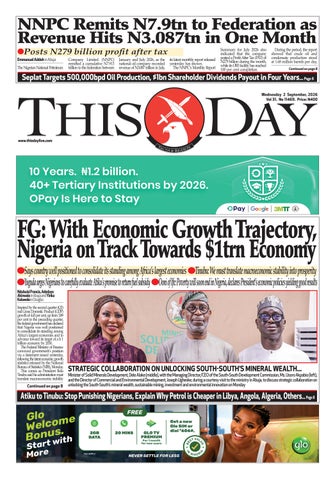
NNPC Remits N7.9tn to Federation as Revenue Hits N3.087tn in One Month Posts N279 billion profit after tax
Emmanuel Addeh in Abuja
The Nigerian National Petroleum
Company Limited (NNPC) remitted a cumulative N7.913 trillion to the federation between
January and July 2026, as the national oil company recorded revenue of N3.087 trillion in July,
its latest monthly report released yesterday has shown. The NNPC’s Monthly Report
Summary for July 2026 also indicated that the company posted a Profit After Tax (PAT) of N279 billion during the month, while its OB3 facility has reached 100 per cent completion.
During the period, the report showed that crude oil and condensate production stood at 1.68 million barrels per day, Continued on page 8
Seplat Targets 500,000bpd Oil Production, $1bn Shareholder Dividends Payout in Four Years... Page 6 Wednesday 2 September, 2026 Vol 31. No 11469. Price: N400
www.thisdaylive.com TR
UT H
& RE A S O
N
FG: With Economic Growth Trajectory, Nigeria on Track Towards $1trn Economy
Says country well positioned to consolidate its standing among Africa’s largest economies Tinubu: We must translate macroeconomic stability into prosperity Yuguda urges Nigerians to carefully evaluate Atiku’s promise to return fuel subsidy Ooni of Ife: Poverty will soon end in Nigeria, declares President’s economic policies yielding good results
Ndubuisi Francis, Adedayo Akinwale in Abuja and Yinka Kolawole in Osogbo Inspired by the second quarter (Q2) real Gross Domestic Product (GDP) growth of 4.43 per cent, up from 3.89 per cent in the preceding quarter, the federal government has declared that Nigeria was well positioned to consolidate its standing among Africa’s largest economies and to advance toward its target of a $ 1 trillion economy by 2030. The Federal Ministry of Finance conveyed government’s position via a statement issued yesterday, following the latest economic growth statistics released by the National Bureau of Statistics (NBS), Monday. This comes as President Bola Tinubu said his administration must translate macroeconomic stability Continued on page 8
STRATEGIC COLLABORATION ON UNLOCKING SOUTH-SOUTH’S MINERAL WEALTH...
Minister of Solid Minerals Development, Dele Alake (middle), with the Managing Director/CEO of the South-South Development Commission, Ms. Usoro Akpabio (left), and the Director of Commercial and Environmental Development, Joseph Ugheoke, during a courtesy visit to the ministry in Abuja, to discuss strategic collaboration on unlocking the South-South’s mineral wealth, sustainable mining, investment and environmental innovation on Monday
Atiku to Tinubu: Stop Punishing Nigerians, Explain Why Petrol is Cheaper in Libya, Angola, Algeria, Others... Page 8
2
WEDNESDAY, SEPTEMBER 2, 2026 • T H I S D AY
WEDNESDAY, SEPTEMBER 2, 2026 • T H I S D AY
3
4
WEDNESDAY, SEPTEMBER 2, 2026 • T H I S D AY
5
THISDAY • WEDNESDAY, SEPTEMBER 2, 2026
Group News Editor: Goddy Egene Email: Goddy.egene@thisdaylive.com, 0803 350 6821, 0807 401 0580
NEWS
FUBARA, ARMY DEEPEN PARTNERSHIP TO PROTECT CRITICAL INFRASTRUCTURE IN RIVERS...
L-R: The General Officer Commanding (GOC), 6 Division, Nigerian Army, Major General Everest Ifeanyi Okoro, receiving a plaque from the Governor of Rivers State, Sir Siminalayi Fubara, during a courtesy visit to Government House, Port Harcourt, yesterday
MTN Chairman: Africa Risks Losing Critical Minerals Leverage Through Fragmented Deals Says continent’s mineral wealth, young population biggest global bargaining chips
Sunday Ehigiator Africa risks losing its strategic advantage in the global economy by allowing individual countries to negotiate separate deals for critical minerals instead of bargaining collectively as a bloc, MTN Group Chairman, Mcebisi Jonas, has warned. Jonas gave the warning while addressing Fellows of the fifth cohort of the MTN Media Innovation Programme (MTN MIP), who are currently on a study trip to South Africa, during a session focused on Africa’s geopolitical position amid intensifying global competition for strategic resources. According to him, Africa possesses two major sources of leverage in the global economy: its vast deposits of critical minerals and its rapidly growing youthful population. “We have the highest concentration of minerals in the world, particularly critical minerals, and we have a very growing young population,” Jonas said. He noted that the increasing global demand for electric vehicles, battery manufacturing, semiconductors and renewable
energy infrastructure had made Africa’s critical mineral resources strategically important, as major economies seek to secure long-term access to the minerals required to power their industries and energy transitions. Jonas, however, cautioned that the continent’s mineral wealth alone would not guarantee economic benefits for Africans, stressing that how the resources are negotiated and managed would determine the extent of Africa’s influence. “Negotiating individually could weaken Africa’s influence and bargaining power,” he said. He argued that countries negotiating separately risk surrendering the collective advantage that Africa should be using to secure better economic and strategic outcomes from its natural resources. “If we can use that collective strength effectively, it will take us somewhere,” he added. The MTN chairman’s position challenges the long-standing pattern of critical minerals agreements being negotiated largely on a country-bycountry basis across the continent. With global powers increasingly competing for access to minerals
critical to the production of advanced technologies and clean-energy infrastructure, Jonas suggested that Africa needed to rethink how it approaches such agreements if it is to maximise the value of its resources. Beyond minerals, he identified Africa’s youthful population as another significant strategic as-
The National Laureate Committee has extended the deadline for the submission of institutional entries for the 2026 National Laureate Programme from August 31 to September 15, following requests by tertiary institutions for additional time to complete their internal selection processes. The committee said the extension would allow participating universities, polytechnics, monotechnics, colleges of education, military institutions and other eligible tertiary institutions to conclude their selection processes and submit approved research entries for the
maiden edition of the programme. In a statement issued in Abuja by its spokesperson, Ita Ekpenyong, the committee explained that the additional window would also enable institutions to firm up their respective Institutional Laureate Selection Committees before forwarding their entries. The National Laureate Programme was inaugurated by the federal government under the leadership of the Minister of Education, Dr Tunji Alausa, as part of efforts to strengthen the recognition and reward system for academic research and innovation in Nigeria. The programme is designed as a national platform for identifying,
Africa’s development. “MTN cannot thrive if Africa doesn’t thrive,” he said. His comments come amid growing international interest in Africa’s strategic minerals, with the continent possessing significant deposits of resources considered essential to the global energy transition and the development of emerging
technologies. Jonas therefore called for greater continental coordination, suggesting that a collective approach could strengthen Africa’s negotiating position and enable its countries to derive greater economic and strategic benefits from resources that are becoming increasingly indispensable to the global economy.
Abu Dhabi Firm Acquires 90% Stake in Nigeria’s Azura Power Deal still subject to regulatory approvals
Emmanuel Addeh in Abuja
An Abu Dhabi-based specialised energy infrastructure platform, ePointZero, a subsidiary of 2PointZero Group, has announced plans to acquire a 90 per cent stake in pan-African independent power producer, Azura Power Holdings Limited, in a transaction that will bring Nigeria’s 461MW Azura-Edo power plant under new majority ownership.
National Laureate C’ttee Extends Deadline for 2026 Research Entries Emmanuel Addeh in Abuja
set, arguing that the continent’s demographic strength could play an increasingly important role in determining its position in the global economy. Jonas also linked the fortunes of MTN Group to the broader economic prosperity of the continent, stressing that the company’s longterm success was inseparable from
evaluating, celebrating and rewarding exceptional undergraduate dissertations, master’s theses and doctoral research produced in accredited Nigerian tertiary institutions. According to the committee, the initiative is supported by an annual research prize fund of N365 million and is expected to promote research excellence while strengthening Nigeria’s knowledge and innovation ecosystem. Under the framework approved for the 2026 edition, each eligible institution is permitted to submit up to 18 outstanding research works, comprising six undergraduate dissertations, six master’s theses and six doctoral or PhD theses.
The transaction, which is subject to customary regulatory approvals and other closing conditions, will see ePointZero acquire the respective ownership interests of Actis and Africa50 through an acquisition vehicle established in partnership with Amaya Capital. Amaya Capital, which founded Azura Power in 2010, will retain a minority interest of 10 per cent in the power generation platform, a statement seen by THISDAY yesterday indicated. Azura Power currently operates 752MW of generation capacity across three African countries, comprising the 461MW Azura-Edo plant in Nigeria, the 116MW Tobene facility in Senegal and the 175MW CTRG plant in Mozambique. The company also has a development pipeline of more than 1.5GW, comprising gas, renewable energy and Battery Energy Storage System (BESS) projects, which could more than double its existing operational capacity in the coming years. The acquiring company said the transaction marked ePointZero’s entry into African power generation through an established operating platform with immediate scale, resilient cash flows and an experienced management team. It added that Azura’s operating assets generate around 10 per cent of grid baseload power in each of Nigeria, Senegal and Mozambique,
highlighting the strategic importance of the facilities to electricity supply in the three countries. Chairman of 2PointZero, Sheikh Zayed bin Hamdan bin Zayed Al Nahyan, said the deal reflects the company’s commitment to deploying long-term capital into critical infrastructure. “Reliable power is fundamental to economic growth, industrial development and long-term prosperity. This investment through ePointZero reflects our commitment to deploying long-term capital into critical infrastructure that can support that growth in key markets across Africa,” Al Nahyan stated. In her remarks, Vice Chair and Managing Director of 2PointZero, Mariam Almheiri, said the acquisition of Azura Power strengthens the company’s presence in a region where energy demand, economic growth, and long-term opportunity are closely aligned. “At 2PointZero, we are building platforms that create long-term value by investing in the infrastructure shaping tomorrow’s economies. As ePointZero continues to expand its global energy platform, the acquisition of Azura Power strengthens our presence in a region where energy demand, economic growth, and long-term opportunity are closely aligned. “It reflects our disciplined approach to investing in businesses
with strong fundamentals, local expertise, and long-term value,” Almheiri stressed. Also, the Chief Executive Officer of ePointZero, Mohamed Hesham, said Azura possessed many of the attributes the company sought in an energy investment platform. He said: “Azura Power brings together many of the qualities we look for in an energy platform: critical operating assets, an experienced management team and a strong position in markets with significant long-term power needs. “We are acquiring a business built on nearly a decade of disciplined execution, with significant opportunity to support its continued growth as demand for reliable power infrastructure across the continent accelerates. “Together with our strategic investment in Elsewedy Electric and its established industrial and EPC presence across Africa, our acquisition of Azura Power deepens ePointZero’s capabilities in energy and infrastructure and positions us to pursue new opportunities across Africa’s evolving energy markets.” Group Chief Executive Officer of Azura Power, Dave Peacock, described the transaction as a significant milestone for the company, saying the proposed acquisition represented a strong endorsement of the business built by its management and shareholders over the past decade.
6
WEDNESDAY, SEPTEMBER 2, 2026 • THISDAY
NEWS
SANWO-OLU ATTENDS INAUGURATION OF FRC HEADQUARTERS...
L-R: Chairman, Senate Committee on Trade and Investment, Senator Sadiq Umar; the Executive Secretary/CEO, Financial Reporting Council, FRC of Nigeria, Dr. Rabiu Olowo; Governor of Lagos State, Mr. Babajide Sanwo-Olu; Minister of Industry, Trade & Investment, Dr. Jumoke Oduwole and Special Adviser to the President on Economic Affairs, Dr. Tope Fasua, during the inauguration of the FRC Headquarters, at Ikeja in Lagos, yesterday
Seplat Targets 500,000bpd Oil Production, $1bn Shareholder Dividends Payout in Four Years PIA clarity driving new capital into Nigeria’s petroleum sector, says NUPRC
Peter Uzoho Seplat Energy has unveiled an aggressive growth plan that targets 500,000 barrels of oil per day (bpd) and a $1 billion dividends payout to shareholders over the next four to five years, as it positions to become Nigeria’s largest indigenous integrated energy company. Chief Executive Officer of Seplat Energy, Mr Effiong Okon, announced
the targets during a fireside chat at the ongoing Africa Oil Week (AOW) 2026 in Accra, Ghana, with the theme: “Investing in African Natural Resources.” Reflecting on Seplat’s trajectory in Nigeria’s complex upstream landscape, Okon described the company’s journey as one driven by resilience and disciplined capital allocation. “We have committed ourselves
to deliver a billion U.S. dollars in terms of dividends over the next four or five years. And we’re well on track”, Okon said. On production, he reeled out the scale of ambition for the company going forward., saying: “We are targeting 500,000 barrels of oil per day through our joint venture operations, restoring asset integrity across our portfolio, and launching new seismic campaigns to unlock
fresh exploration upside.” He noted that Seplat borrowed $530 million in its early years and has already returned $835 million in dividends to investors. The company’s market capitalisation stood at $3.93 billion as of late August 2026, with its share price driving a 170.10 per cent surge in market cap over the past 12 months. Dual listings on the Nigerian Exchange Limited (NGC) and the
Shettima Tasks FRC on Regulatory Innovation, Integrity, Inaugurates New Headquarters’ Building Dike Onwuamaeze
Vice President Kashim Shettima has charged the Financial Reporting Council of Nigeria (FRC) to transform its new headquarters into a centre of regulatory innovation, integrity and excellence that will enhance Nigeria’s financial reporting standards and make the country proud. Shettima said this yesterday, during the official inauguration of the FRC’s headquarters in Allen Avenue, Ikeja, Lagos State. He said: “Today, we are commissioning a building, but our task is to commission confidence, accountability, professional excellence, a stronger institutional foundation for the Nigerian economy. “To the governing board of FRC, management and staff, this building belongs to you, but its purpose belongs to Nigeria. “Use it wisely, fill it with excellence, make it a center of regulatory innovation, make it a home of integrity, and make Nigeria proud.” Shettima said the unveiling of the building should serve as the very foundation upon which trust is build on the Nigerian economy. “A nation may have oil, gas, fertile land, talented people and abundant capital, but without trust, capital becomes costless, investment becomes hesitant, and prosperity becomes fragile. “As the Nigerian saying goes,
when the roots are deep, there is no reason to fear the wind,” he said. The vice president said the inauguration of the headquarters was, therefore, consistent with the President Tinubu’s larger vision of building a Nigerian state whose institutions can stand confidently in a marketplace of nations, “and I must commend the leadership and staff of the FRC for understanding that institutional building is not an event, it is a journey. “This beautiful building is more than concrete, glass and steel, it is an investment in institutional memory, it is an investment in professional excellence, it is an investment in regulatory independence and effectiveness, and it is a physical expression of something more important, the confidence that Nigeria places in the work of the FRC.” In her keynote address during the ceremony, the Minister of Industry, Trade and Investment, Dr. Jumoke Oduwole, said “this headquarters is an important physical asset.” Oduwole said: “Yet, for a regulator, perhaps the most valuable asset is trust. “The building we commission today should, therefore, represent much more than permanence. “It should represent credibility, competence, responsiveness and confidence in the rules and institutions that govern our markets.”
She said achieving that would require more than incentives. “It requires certainty. Investors understand commercial risk. They assess it, price it and make decisions accordingly. What is much harder to price is regulatory uncertainty. “This is why predictability, transparency and efficient administration are not simply conveniences for business. They are fundamental components of national competitiveness,” she said. The Governor of Lagos State, Mr.
Babajide Sanwo-Olu, in his address during the event said “we are not just commissioning a building but to celebrate the strengthening of an institution whose work has direct impact on confidence, investment and the growth of our economic opportunity in our country. “There is no modern economy that runs without trust. You can see that capital will be enhanced, enterprise innovation, they will all come together but it can only happen in an environment where trust has been earned.
London Stock Exchange, he said, continue to provide access to deep global capital pools. “Don’t get me wrong, it has never been a smooth ride. But the feat we have recorded has been monumental”, Okon enthused He attributed the aggressive targets to disciplined capital allocation and a highly liquid balance sheet. Beyond crude, Seplat is pushing hard on Nigeria’s domestic gas agenda. Its shallow water assets hold an estimated 12 trillion cubic feet (tcf) of gas, and the company plans to accelerate monetisation through expanded pipeline infrastructure. The company is also scaling its footprint in the Liquefied Petroleum Gas (LPG) market to displace biomass cooking fuels in Nigerian homes, a move Okon said will directly cut carbon intensity and address household air pollution. The expansion comes as Seplat consolidates its position as a leading indigenous operator following years of divestments by the international oil companies (IOCs). With proven returns to shareholders, clear governance structures, and a dual-pronged oil and gas strategy, Okon said the company is well placed to dominate the West African energy landscape. Also speaking at the forum, Chief
Executive of the Nigerian Upstream Petroleum Regulatory Commission (NUPRC), Mrs. Oritsemeyiwa Eyesan, said the Petroleum Industry Act (PIA) has moved Nigeria, “from policy to projects” and was already unlocking fresh investment.” Eyesan told global investors and government delegates that fiscal and regulatory clarity was now driving investments into the oil and gas sector today. She acknowledged initial post-PIA challenges linked to COVID-19, which slowed investment between 2014 and 2020/2021 when Nigeria’s upstream portfolio fell from about $26 billion to $2 billion. However, she said policy clarity from the PIA has since redefined business decisions and restored confidence. “The PIA was a turning point for us in Nigeria, the petroleum industry act is where we consolidated our regulations for the oil and gas industry to ensure that the institutions that we created them from where fit for purpose”, Eyesan state. She highlighted the PIA’s host community provisions as a key dividend, noting that the creation of intervention funds has significantly reduced agitations and pipeline vandalism in the Niger Delta.
Akpabio: Akwa Ibom Sets Pace in Unity, Devt, Progress Sunday Aborisade in Abuja The President of the Senate, Godswill Akpabio, has described Akwa Ibom State as a model of unity, development and progress, pledging to work closely with Governor Umo Eno to sustain the state’s growth and prevent the political conflicts that have previously undermined relationships between state governors and presiding officers of the National Assembly. Akpabio, a former two-term governor of the state, spoke on Tuesday as Special Guest of Honour at the commissioning of a newly acquired Airbus A220-300 aircraft by Ibom Air at the Victor Attah International Airport, Uyo. The Senate President, according
to a statement issued by his Special Assistant on Media, Jackson Udom, said the commissioning of the aircraft had further demonstrated the progress being recorded in the state. “With the commissioning of today, Akwa Ibom State has become the ‘shining example of unity, development and progress in Nigeria’,” Akpabio declared. He commended Governor Eno for his commitment to infrastructural and human capital development, particularly the training of Akwa Ibom youths for careers in the aviation industry. “Let me thank Governor Eno for what I have seen here today, particularly the number of Akwa Ibom children you are training to join the aviation industry. I am
seeing Eno in me. He is also seeing himself in me,” he said. Akpabio also assured the people of the state that his relationship with the governor would remain cordial, stressing that he had deliberately chosen cooperation over confrontation in the interest of Akwa Ibom. He said, “I salute the chairman of Ibom Air, Captain Mfon Udom, and its management team for this feat. Nothing is as gratifying as my presence here today. “I am assuring us all that this state will never experience what other states experienced in the past between their governor and the President of the Senate. “As a good student of history, I have made up my mind that rather than fight with my governor, I will
join hands with him to develop our state,” Akpabio said. The former governor further praised Eno for sustaining projects inherited from previous administrations, describing the decision as an indication of responsible leadership and commitment to the interests of the people. “Thank you, Governor Eno, for not abandoning the money of Akwa Ibom people. You have decided to complete all projects initiated by previous administrations. This shows that you are truly a man of God,” he stated. Akpabio also commended the people and leadership of Akwa Ibom for maintaining unity, stressing that the state’s collective interest must remain paramount.
7
THISDAY • WEDNESDAY, SEPTEMBER 2, 2026
NEWS
CELEBRATING BIMBO OLOYEDE’S CONTRIBUTION TO COMMUNICATION AND MEDIA IN NIGERIA...
L-R: Former Ecobank Chairman, Chief John Odeyemi; Former Minister of Education, Dr. Oby Ezekwesili; Author of the Book, Bimbo Oloyede; Book Reveal, Chief Sonny Kuku; and Engr Vincent Maduka, during the book presentation titled Communication and Media in Nigeria Celebrating Bimbo Oloyede’s Contribution to Five Decades of Theory, Practice and Transformation held in Lagos, yesterday
FG Recommits to Cheaper, Cleaner Transportation Amid $2bn CNG Investment Says 120,000 vehicles converted, 7,700 technicians trained Ekpo: Vehicle owners, fleet managers reporting significant fuel cost savings Emmanuel Addeh in Abuja The Minister of State Petroleum Resources (Gas), Ekperikpe Ekpo, yesterday reaffirmed the federal government’s commitment to expanding the use of Compressed Natural Gas (CNG) as a cheaper, cleaner and more sustainable alternative to conventional transport fuels, with the aim of reducing transportation costs for Nigerians. Since the launch of the Presidential Initiative on Compressed Natural Gas (Pi-CNG) in 2023, a statement from the minister’s office said the federal government, working with relevant stakeholders, has facilitated significant privatesector investment in the CNG value chain, with more than $2 billion secured for CNG infrastructure and value-chain development. According to the release signed by the minister’s spokesman, Louis Ibah, the investment has supported the rapid expansion of refuelling infrastructure, vehicle conversion centres, technical capacity and the wider ecosystem required for nationwide adoption. Besides, it stated that more than 120,000 vehicles have been converted to CNG through a
network of over 400 certified conversion centres and more than 90 refuelling stations. In the same vein, the programme, Ekpo stressed, has also trained over 7,700 automotive technicians, created more than 10,000 direct and indirect jobs, as well as procured and deployed 655 CNG buses and 5,123 CNG tricycles. These assets, he emphasised, complement the thousands of privately converted vehicles now operating across Nigeria’s public and commercial transport networks. According to the minister, the developments show that CNG is no longer merely a future alternative, but an increasingly viable fuel already in use across the country and an important part of the federal government’s response to the transportation and cost-of-living pressures that followed the removal of the petrol subsidy. The minister stated that the growing number of Nigerians adopting CNG provides strong validation of the programme, as commercial transport operators, private vehicle owners and fleet managers are reporting significant fuel cost savings and improved profitability, while commuters
using CNG-powered buses are benefiting from lower fares. He noted that the federal government’s investment in CNG infrastructure and vehicle conversion is already delivering practical benefits. As more vehicles and fleets
Retailers of alcoholic beverages in Lagos State have intensified opposition to the federal government’s ban on sachet and small-volume alcoholic drinks, accusing the National Agency for Food and Drug Administration and Control (NAFDAC) of destroying their businesses and livelihoods through aggressive enforcement. Members of the Lagos State chapter of Concerned Drink Sellers and Traders Across Nigeria, who took their protest to the streets of Lagos, said sweeping raids, confiscation of merchandise and the seizure of unsold inventory had wiped out their working capital
and plunged thousands of petty traders and their dependants into financial distress. The retailers appealed to President Bola Ahmed Tinubu, the National Assembly and NAFDAC to suspend the current enforcement regime and adopt alternative regulatory measures that would protect public health without destroying the livelihoods of small-scale traders. They said the ban and subsequent enforcement had left many retailers with goods they could neither return to suppliers nor recover their investments from, worsening the financial pressures already confronting households amid the country’s cost-of-living crisis.
stations, but to translate fuel savings into lower transportation and logistics costs, ease the cost of living and improve economic productivity. “To sustain this momentum, the ministry is working with Pi-CNG, the Midstream and Downstream
Gas Infrastructure Fund (MDGIF), state governments, transport unions, operators, investors and other stakeholders to expand refuelling and conversion infrastructure, develop dedicated CNG corridors and extend access to underserved communities,” he pointed out.
US Embassy: Selected Visa Classes Still Processed in Abuja Says foreign media, diplomats, official travellers covered
Michael Olugbode in Abuja The United States Embassy in Abuja has clarified that the recent overhaul of routine visa services in Nigeria has not shut the door on all visa processing in the Federal Capital, confirming that applications for foreign media representatives, diplomats and other official travellers remain covered under separate arrangements. The new arrangement, which took effect on August 1, 2026, moved routine visa processing
Sachet Alcohol Ban: Lagos Retailers Protest NAFDAC Clampdown, Demand Halt to Enforcement Bennett Oghifo
migrate to CNG, lower operating costs, Ekpo explained, are increasingly benefiting commuters, businesses, farmers, traders and other productive sectors. He stressed that the objective is not simply to increase the number of CNG vehicles and refuelling
“On many occasions, the enforcers go on aggressive operations confiscating goods and putting these petty traders in a state of hopelessness. Over 90 per cent of the retailers you see here today are on bank loans that they have no idea of how to pay back. “Where does the government want them to run to now? We are calling on President Tinubu and NAFDAC to help us,” the protesters said. The association argued that sachet alcoholic beverages, although subject to regulation, remained an important source of daily income for thousands of Nigerians operating small shops and neighbourhood outlets.
away from Abuja as part of a wider United States effort to strengthen security screening, improve efficiency and align overseas consular operations with its national interests. However, the United States Mission in Nigeria stressed that the Abuja Embassy remains operational and that the realignment does not amount to the closure of the diplomatic mission. Under the clarification, the Abuja Embassy said it will continue processing A, G and C visa categories, covering diplomatic and official travel. The distinction is important because the I visa is specifically designed for representatives of the foreign media, including journalists
and other members of the foreign press who require entry to the United States for professional assignments. The development means that applicants should not interpret the suspension of routine visa services in Abuja as a blanket termination of consular activities at the embassy. Instead, the United States has separated routine visa processing from categories considered essential to diplomatic, official and other specialised international engagements. The US government’s decision has affected a number of American diplomatic posts across Africa, with routine applicants redirected to designated regional visa hubs. Nigeria’s designated regional hub
is Lagos, meaning applicants for routine visa services may have to make arrangements to process their applications there rather than at the Abuja Embassy. The United States government said the realignment was designed to strengthen national security, improve the consistency of screening and adjudication, and make more efficient use of consular resources. For Nigerian media practitioners, however, the continued availability of the I-visa category is particularly noteworthy. The I visa is the principal non-immigrant visa category for foreign journalists, members of the foreign press and certain media professionals travelling to the United States for work-related purposes.
CS-SUNN: 92% of Pregnant Women Accept Multiple Micronutrient Supplements Survey indicates high ANC attendance
Onyebuchi Ezigbo in Abuja
The Civil Society Scaling Up Nutrition in Nigeria (CS-SSUNN) has unveiled a study indicating major progress in the federal government’s efforts to improve maternal and child’s health indices across the country. Speaking on Tuesday in Abuja at the presentation of the CS-SUNN report on the Anaemia situation in Nigeria,
a member of the research team, Prof. Kola Matthews Anigo said there is a key progress in sensitizing pregnant women to accept Multiple Nutrient Supplements (MMS) to boost their health and that of their children. He said the report showed that 92 percent of these pregnant women in 21 states that participated in the study indicated their willingness to take the multiple micronutrient supplements.
According to Anigo, the report was the outcome of the formative study on Anaemia Funding Commitment through the Child Nutrition Fund and MMS Uptake to address the issue of anemia, especially children and pregnant women in Nigeria. According to the health expert, the reports also indicated that 90 percent of our mothers actually attend antenatal care.
8
WEDNESDAY, SEPTEMBER 2, 2026 • THISDAY
EIGHT
IPPG: Over 150 African Oil, Gas Projects Stalled as Funding Retreat Threatens 125bn Barrels Reserves Says region faces $150bn annual energy investment deficit Continent attracts only 3% of global energy capital Calls for capacity building to develop next generation of industry talent
Peter Uzoho
More than 150 essential oil and gas projects across Africa have stalled due to an energy transition-induced retreat by international capital markets and development finance institutions, the Independent Petroleum Producers Group (IPPG) has revealed. Chairman of IPPG and Chief Executive Officer of Aradel Holdings Plc, Mr. Adegbite Falade, stated this while delivering the industry keynote at the opening of the ongoing Africa Oil Week (AOW) 2026 in Accra, Ghana, calling for urgent continent-wide action to unlock the region’s stranded hydrocarbon resources. Falade said the funding gap comes at a time when Africa holds enormous hydrocarbon potential yet remains the most energy-poor continent. He described the capital retreat as a direct threat to development and industrialisation.
“Even as global energy demand continues to expand, international capital markets and traditional development finance institutions are steadily retreating from African oil and gas projects under the agenda of accelerated global decarbonisation — a retreat that has left, by industry estimates, over 150 essential projects stalled across our continent. “This capital retreat comes at a precarious moment for a continent faced with energy poverty despite accounting for less than three per cent of global greenhouse gas emissions,” he said. According to him, Africa today stands at an unprecedented crossroad as the continent is endowed with extraordinary hydrocarbon potential, much of it still undiscovered, undeveloped, or stranded. He cited the underexplored basins stretching from the Gulf of Guinea and the MSGBC Basin in the west, to the deepwater frontiers off Namibia, and the
emerging acreages of the East African Rift and the Congo Basin. With all those, Falade said Africa holds more than 125 billion barrels of proven crude oil reserves and upward of 620 trillion cubic feet of proven natural gas reserves. Despite that endowment, he noted that Africa attracts only about six per cent of global upstream capital, describing the gap as the continent’s single largest opportunity. “Yet, despite this geological abundance, our share of global exploration spending and upstream capital deployment remains disproportionately low at ~six per cent. This gap between endowment and investment is the single largest opportunity before us at this conference,” he stated. He said Africa produces about eight million barrels of crude daily but refines barely half, spending over $60 billion annually on fuel imports, while close to 600 million citizens of the region live
without electricity and nearly a billion still cook with wood and charcoal. Falade framed Nigeria’s experience as proof that indigenous-led growth can fill part of the gap. He admitted that following divestments by the international oil companies (IOCs), Nigerian independents now contribute more than 50 per cent of national crude and gas output, up from less than three per cent three decades ago. Specifically, he pointed out that about 200,000 bpd have been added to national production by just three operators in the last 12 months. He credited that to the Petroleum Industry Act (PIA) 2021, local content enforcement, and President Bola Tinubu’s executive orders. He added that indigenous firms also now account for over 60 per cent of domestic gas utilisation, supported by expanded refining including the 650,000 bpd Dangote Refinery.
“This is a clear demonstration of what happens when we finally refine what we produce: fuel imports fall, foreign exchange is preserved, jobs are created, and Nigeria is steadily moving from being a net importer of refined products toward becoming a net exporter”, Falade stated. However, he cautioned that ownership comes with responsibility, saying every barrel and every molecule of gas now under IPPG members’ control comes with an obligation — to invest for the long term, to operate at the highest level of social and environmental responsibility and good governance, and to prove we can deliver lasting value. To counter the financing deficit, Falade put forward five urgent actions, among which, he said, was to back the Africa Energy Bank, which is a joint initiative by the African Petroleum Producers Group (APPO) and Afreximbank. Headquartered in Abuja with $5
Adegbite Falade billion initial capital, the energy bank aims for $10 billion in phase one and $15 billion by 2030. “The AEB is purpose-built to bridge the upstream and midstream financing gap left by traditional global financiers. This is Africa’s clearest statement yet that we intend to finance our own hydrocarbon future”, the IPPG chair said.
Atiku to Tinubu: Stop Punishing Nigerians, Explain Why Petrol is Cheaper in Libya, Angola, Algeria, Others
Says Nigerians on minimum wage spend 80% of income on 40 litres of fuel Questions use of N15.8tn subsidy removal proceeds Demands transparency over N34tn import duty exemptions Emmanuel Addeh in Abuja The presidential candidate of the African Democratic Congress (ADC), Atiku Abubakar, has again accused President Bola Tinubu of presiding over an economic system that has made life increasingly unaffordable
for Nigerians. He challenged the federal government to explain why petrol remains cheaper in several oil-producing countries despite Nigeria’s status as one of Africa’s leading crude producers. In a statement issued yesterday
by his Senior Special Assistant on Public Communication, Mr Phrank Shaibu, Atiku said the real issue confronting Nigerians was not a political disagreement between him and the president, but the crushing cost-of-living crisis facing millions of households.
The former vice president was responding to a recent statement by Tinubu in which, according to him, the president criticised his economic position without mentioning his name, saying the president devoted substantial attention to attacking his proposals while claiming he would
FG: WITH ECONOMIC GROWTH TRAJECTORY, NIGERIA ON TRACK TOWARDS $1TRN ECONOMY
into microeconomic prosperity in the next phase of Renewed Hope. The President stressed that the country’s macroeconomic stability must translate to more food, more jobs, lower inflation, affordable credit, reliable power, more manufacturing, greater exports and stronger purchasing power. Also yesterday, the Ooni of Ife, Oba Enitan Adeyeye Ogunwusi, declared that the intention of President Tinubu to end poverty in the country would soon be materialised with the various programmes and policies put in place by the federal government to alleviate poverty. The ministry, in its statement noted that Nigeria’s economy continued to demonstrate resilience and accelerating growth with the second quarter 2026 real GDP expanding by 4.43 per cent year-on-year, up from 4.23 per cent in Q2 2025 and 3.89 per cent in Q1 2026. It added: “The strong Q2 2026 outturn lifted real GDP growth for the first half of 2026 to 4.16 per cent, up from 3.68 per cent in the corresponding period of 2025, a clear signal of sustained strengthening across the economy. “Growth is also becoming more broad-based. In Q2 2026, 27 economic subsectors recorded real growth above 3.0 per cent, up from 23 subsectors in Q2 2025, showing that expansion is no longer concentrated in a handful of industries. “The productive sectors led the way. Manufacturing grew by 3.24 per cent, more than double the 1.60 per cent recorded in Q2 2025, reflecting improved industrial
output. Agriculture expanded by 4.39 per cent, up from 2.82 per cent, underscoring stronger production and value-chain performance. Services, the largest driver of growth, expanded by 4.60 per cent, up from 3.94 per cent.” It added that the relative stability and steady appreciation of the exchange rate further amplified the gains in dollar terms, adding that the naira appreciated by over 12 per cent between half-year 2025 and half-year 2026, resulting in an expansion of the economy by approximately 17 per cent in U.S. dollar terms over the period. According to the statement, if sustained alongside the various social programmes of the government, the pace would meaningfully strengthen dollar incomes, improve purchasing power and lift millions of Nigerians out of poverty. “Given this momentum, Nigeria is well positioned to consolidate its standing among Africa’s largest economies and to advance toward the government’s target of a $1 trillion economy by 2030. “The International Monetary Fund has already ranked Nigeria among the top 10 contributors to global real GDP growth in 2026, projecting the country to account for roughly 1.5 per cent of world growth this year, ahead of several advanced and emerging economies,” the ministry stated. It further explained that the continued macroeconomic stability, sustained growth across productive sectors, and improving investor confidence would accelerate Nigeria’s progression toward becoming
Africa’s largest economy by 2028. These results, the government added, underscored the importance of sustaining ongoing reforms and ensuring policy consistency, as their benefits begin to reach households across the country. “The government remains focused on accelerating inclusive growth and translating these macroeconomic gains into shared prosperity for every Nigerian family,” it said.
Tinubu: We Must Translate Macroeconomic Stability into Prosperity Meanwhile, President Tinubu has said his administration must
translate macroeconomic stability into microeconomic prosperity in the next phase of Renewed Hope. Tinubu who was represented by the National Chairman of the APC, Prof. Nentawe Yilwatda, disclosed this at the Second edition of the Asiwaju Scorecard Series/Asiwaju Policy Roundtable held yesterday, in Abuja. He recalled that when he assumed office on 29 May 2023, Nigeria faced a difficult economic inheritance, especially with fuel subsidy distortions, multiple exchange-rate windows, weak revenue mobilisation, foreignexchange shortages, rising debtContinued on page 34
not “dignify” opposition leaders by naming them. Atiku maintained that in an oilproducing country, petrol should not become a luxury product and that the ultimate test of economic policy is whether ordinary Nigerians can afford transportation, food, education, healthcare and a decent life. He argued that there was a contradiction in the federal government’s position, noting that while his proposal to reduce energy costs had been criticised, Tinubu had also promised cheaper transportation, increased food production and relief for vulnerable Nigerians in the coming weeks. Atiku particularly questioned why Nigerians were paying about N1,400 per litre for petrol while citizens of several other oil-producing countries paid considerably less. He listed petrol prices of about N778 per litre in Saudi Arabia, N872 in Kuwait, N475 in Algeria and N441 in Angola, while noting that prices in the United Arab Emirates (UAE) remained below Nigeria’s despite significantly higher average incomes.
“These countries did not conclude that oil production requires punishing citizens at the pump. In different ways, they have used their natural-resource advantage to moderate the energy burden on their people. Nigeria has turned that advantage upside down. Our people earn less, live under greater pressure and yet pay more for the fuel that drives transportation, farming, food distribution, manufacturing and virtually every aspect of daily life. “...Bola, Atiku is particularly ashamed on your behalf when he looks at Libya. A country battered by years of political instability still sells petrol at roughly N34 per litre and ranks around 115th globally in human development. Nigeria sells petrol at roughly N1,400 per litre and ranks around 164th,” the statement pointed out. It maintained that a Nigerian earning the N70,000 statutory minimum wage requires N56,000 merely to buy 40 litres of petrol at N1,400 per litre, representing Continued on page 35
NNPC REMITS N7.9TN TO FEDERATION AS REVENUE HITS N3.087TN IN ONE MONTH reflecting the company’s continued efforts to sustain output from its upstream operations. Besides, natural gas production during the month was put at 7,489 million standard cubic feet per day (mmscfd), while gas sales stood at 4,581 mmscfd. In recent times, Nigeria has sought to expand domestic gas utilisation, support electricity generation and industrial activities, while also increasing exports. On crude oil and condensate sales, the report showed that significant volumes were recorded across its operations, with the July performance following fluctuations in sales volumes recorded in the preceding months. The monthly performance summary further showed that the availability of NNPC retail
stations for the sale of Premium Motor Spirit (PMS), otherwise known as petrol, stood at 52 per cent in July. The report also provided updates on some of the company’s strategic infrastructure projects, indicating 100 per cent progress for the Obiafu-Obrikom-Oben (OB3) gas pipeline project, while the Ajaokuta-Kaduna-Kano (AKK) gas pipeline was put at 95 per cent. Upstream pipeline availability stood at 100 per cent during the period, according to the report. On its strategic initiatives to sustain output, NNPC said: “Production improvement efforts will focus on sustaining high facility uptime through effective preventive maintenance programmes and minimising
unplanned downtime. “Key initiatives include optimising export operations at FEPL and Nembe EP, maturing and delivering incremental production opportunities across the portfolio, and strengthening operational reliability across key facilities. “Additional measures include the activation of tandem offloading operations at Akpo and Erha to enhance export flexibility and the restoration of barging operations at Obodo to improve production evacuation and sustain output.” NNPC also highlighted efforts aimed at improving production performance, including sustaining high facility uptime through maintenance programmes and reducing unplanned downtime across its operations.
The July report comes amid continued efforts to increase Nigeria’s oil and gas production, improve operational efficiency and boost revenues available to the federation. The cumulative N7.913 trillion statutory payment recorded between January and July therefore represented NNPC’s contribution to government revenues during the seven-month period, while the N3.087 trillion revenue and N279 billion profit after tax reflected its financial performance for the month under consideration. The report noted that all production, sales and financial figures contained in the monthly summary were provisional and subject to reconciliation with relevant stakeholders.
WEDNESDAY, SEPTEMBER 2, 2026 • T H I S D AY
9
WEDNESday September 2, 2026 • T H i s d ay
10
NEWS
BEHOLD THE MADDTIMES POWER LIST COFFEE TABLE BOOK…
Former President of Nigeria, Chief Olusegun Obasanjo(right), receiving the 538 paged Maddtimes Power List Coffee table book from its Publisher and Curator, Joseph Edgar, in Abeokuta…recently
Court Orders Service of Suit against Oyo LG Elections on INEC, OYSIEC Alex Enumah in Abuja
Justice Obiora Egwuatu of a Federal High Court in Abuja has ordered a service of the suit challenging the planned local government election in Oyo State on the Independent National Electoral Commission (INEC) and the Oyo State Independent Electoral Commission (OYSIEC). Justice Egwuatu gave the directive to the plaintiff, Akinloye Olusegun Oyeniyi, yesterday shortly after the mention of the case. Oyeniyi had dragged the OYSIEC and INEC, 1st and 2nd respondents in the matter respectively, to court seeking an order to halt the conduct of the LG polls. The plaintiff in the suit filed by his lawyer, Ayo Omoleaupen, is praying the court to determine among others, “Whether by virtue of Sections 1(1), 7(1), Paragraph 4 (a) of Part
II of the third Schedule of candidates of his choice the 1999 Constitution of the in the 2026/2027 local Federal Republic of Nigeria government election in (As Amended) and Section Oyo State. 153(1) of the Electoral Act, As part of reliefs the 2026, the power of the 1st defendant is not limited to the “Verification of the Documents of Nominated Francis Sardauna inKatsina Candidates” and does not extend to “Verification/ The Katsina State Government, Screening of Candidates?” in partnership with the United He also wants the court Nations Children’s Fund to determine whether (UNICEF), has stepped up Items 6 and 9 of the 1st efforts to curb diphtheria and Defendant’s Revised Time promote better nutrition among Table and Schedule of residents, especially women and Activities for 2026/2027 children. Local Government The initiative was revealed Election in Oyo State yesterday during a media issued on March 4, 2026, dialogue organised by the State are not inconsistent with the provisions of Section 1(1), 7(1) and Paragraph 4(a) of Part II of Third Ibrahim Oyewale in Lokoja Schedule and of the 1999 Constitution of the Federal The Kogi State Resident Republic of Nigeria (As Electoral Commissioner (REC), Amended) and Section Shehu Wahab, has assured 153(1) of the Electoral At, Nigerians that the Independent 2026, and thereby infringes National Electoral Commission the plaintiff’s right to (INEC) will conduct free, fair contest and or vote for and credible elections in 2027. Wahab disclosed this while speaking at the Inter-
plaintiff is seeking is a declaration that the 1st defendant lacks the power of “Verification/Screening of Councillorship and
Chairmanship candidates” or “Screening of Substituted Candidates” by virtue of paragraph 4(a) Part II of the Third Schedule of the
Constitution of the Federal Republic of Nigeria (As Amended) and Section 153(1) of the Electoral Act, 2026.
Katsina, UNICEF Intensify Campaign against Diphtheria, Malnutrition Primary Health Care Agency (SPHCA) in collaboration with UNICEF and other development partners held in Katsina. The engagement, christened: ‘Media Dialogue on the Promotion of Nutrition Behaviours and Sensitisation on Diphtheria Outbreak’, equipped journalists with information to raise public awareness on healthy nutrition and the prevention and control of diphtheria.
Addressing the participants, the acting Executive Secretary of SPHCA, Dr Shaima’u Kabir Abba, stressed the importance of adequate and balanced nutrition in improving the health and overall well-being of women and children. Represented by the state Health Educator, Dr Mukhtar Mahmud, Abba said good nutrition is important during the first 1,000 days of life, covering
pregnancy through a child’s second birthday, describing the period as fundamental to physical growth and development. She identified insecurity in parts of Katsina as one of the factors contributing to malnutrition among vulnerable groups, and stressed the need for sustained interventions to improve maternal and child health.
‘INEC Will Conduct Free, Fair, Credible Elections in 2027’ Consultative Committee on Election Security (ICCES in Lokoja in preparation for the 2027 general election in Kogi State, held in Lokoja yesterday. He explained that the meeting is basically to showcase the level of preparedness of the Independent National Electoral Commission ahead of the 2027 general election.
Wahab explained that the Inter-Consultative Committee on Election Security (ICCES) was designed to handle election matters in the state. The committee is expected to have the INEC assurance that the election will be conducted in a peaceful atmosphere to enable all Nigerians to participate in free, fair and
credible elections. He noted that INEC has already commenced the engagement of the critical stakeholders to ensure the success of the commission. The REC pointed out that for a successful election, INEC is seeking cooperation from the security agencies to ensure free, fair and credible elections.
Rotary Club of Okota Installs 40th President, Launches Fundraising Rotary Club of Okota, Rotary International District 9111 is set to usher in a new chapter of purposeful leadership, service and community transformation as it hosts the fund raising and investiture ceremony of its 40th President, Rotarian Abidemi Ibrahim Sogunle, on Sunday, September 13, 2026. The ceremony, scheduled
for 12 noon at Zion Events Center, Okota-Isolo, Lagos, will also feature fundraising and induction of the Club’s Board of Directors for the 2026–2027 Rotary Year. According to a statement, at the heart of the celebration is Rotarian Sogunle, a distinguished audit professional, fraud examiner and forensic
investigation expert whose career and Rotary journey have been defined by integrity, accountability, leadership and service. Currently serving as Deputy Director (Audit), Office of the Auditor-General for Local Governments, Lagos State, Sogunle brings to Rotary a wealth of professional experience in audit, risk
management, compliance, fraud examination and financial accountability. His accomplishments include receiving the Lagos State Public Service Productivity Award and being recognised as Best Outstanding Officer (Senior Category) in 2021, a recognition of his professionalism, diligence and ethical standards.
Yahaya Bello Honoured as National Patron of TPAND Tinubu Presidential Ambassadors of Nigeria and Diaspora (TPAND) has honoured the former Governor of Kogi State, Alhaji Yahaya Bello as the national patron of the organisation. The investiture and presentation of the official letter of appointment marked a significant moment for TPAND as the organisation
recognised the former governor’s leadership experience, contributions to public service and commitment to national development. Presenting the honour, Director General of TPAND, Dr. Yusuf Hussain, an APC chieftain, described the appointment as a call upon the experience, influence
and statesmanship of the former governor in advancing the vision of a united, peaceful, prosperous and globally respected Nigeria. According to Hussain, the investiture celebrates not only Bello’s journey from the grassroots to the highest levels of leadership in Kogi State, but also his broader contribution to national discourse
and development. The DG TPAND stated that Bello’s wealth of experience and understanding of governance would be valuable to efforts to mobilise Nigerians at home and in the Diaspora in support of progressive democratic leadership and the Renewed Hope Agenda of President Bola Ahmed Tinubu.
WEDNESDAY, SEPTEMBER 2, 2026 • T H I S D AY
11
12
WEDNESDAY, SEPTEMBER 2, 2026 • T H I S D AY
WEDNESDAY, SEPTEMBER 2, 2026 • T H I S D AY
13
15
WEDNESDAY, SEPTEMBER 2, 2026 • T H I S D AY
Any serious conversation about Nigeria's states should begin with the development indices. The National Bureau of Statistics' Multidimensional Poverty Index found 133 million Nigerians, 63 percent of the population, poor across health, education, living standards and work. The crucial finding is the spread. Poverty ranges from 27 percent in Ondo to 91 percent in Sokoto. Rural poverty, at 72 percent, is nearly double the urban rate of 42 percent. Roughly 86 million of the poor live in the North. Every dimension the index measures is, in Nigeria's constitutional design, substantially a state and local government responsibility. Development is a subnational variable. The index is a scorecard of subnational government. That scorecard makes the new fiscal numbers hard to ignore. According to the monthly disbursement reports of the Office of the Accountant-General of the Federation, combined state and local government allocations rose from ₦5.14 trillion in 2022, the last full year before the reforms, to ₦13.22 trillion in 2025, an increase of 157 percent. Lagos moved from ₦307 billion to ₦996 billion, Kano from ₦204 billion to ₦561 billion, Katsina from ₦148 billion to ₦406 billion, Jigawa from ₦132 billion to ₦352 billion, and Enugu from ₦105 billion to ₦275 billion. No state's 2025 allocation was less than roughly double its 2022 level. The money to confront development has arrived where development is decided. The question is what states should do with it. The scale of that question becomes clearer in the cumulative figures. States and local governments received ₦29.04 trillion between 2023 and 2025, against ₦17.01 trillion in the four years before an extra ₦12.03 trillion, averaging ₦334 billion per state. History, however, counsels sobriety. Past oil booms also swelled transfers. The Excess Crude Account was drawn down rather than saved. When prices collapsed, a majority of states fell into salary arrears by 2015 and needed federal bailouts. 2020 repeated the lesson. Allocation booms are not new in Nigeria. Converting one into development would be. What states are doing with the present boom is therefore the place to start, because the prevailing pattern is the problem. Payrolls and appointments have expanded toward the new revenue. Overheads have grown with income rather than need. Capital budgets announced in January are only partly executed by December, and much of what is built is chosen for visibility rather than effect. Local government allocations, which reached ₦11.45 trillion over the three years, still pass through state-controlled structures despite the Supreme Court's July 2024 judgment granting the 774 councils financial autonomy. The tier responsible for the services the poverty index measures remains starved. Clearing arrears, paying the ₦70,000 minimum wage and retiring expensive debt are defensible. They are stabilisation, not development. Bayelsa is the standing warning: among the highest per capita recipients for two decades, and still among the highest poverty rates. Money can reach a treasury for twenty years without reaching the deprivations.
If that is the trap, the way out is to treat the surge as investment in two things that reinforce each other: the deprivations the index measures, and the assets that generate income and jobs at home. A state receiving ₦400 billion a year that published a capital floor of at least 30 percent, and spent it against a ward-by-ward map of missing clinics, classrooms, water and roads, would be putting ₦120 billion a year where the scorecard is actually compiled. Enugu is already building smart schools and primary healthcare centres that way, a drive UNICEF has called a turning point. Buildings alone, though, do not teach or treat. The same money has to recruit and train teachers, put health workers and drugs in the new centres, feed children as nutrition policy, and run enrolment campaigns where millions remain out of school. The useful distinction is not capital versus recurrent. It is productive spending versus administrative expansion. The states that understood this earliest did not stop at social infrastructure. They put money into what their territory could produce. Lagos built the Imota rice mill, the largest in Africa, with capacity for 2.5 million 50kg bags a year, and tied a food economy to Nigerian farms; on NBS figures its internally generated revenue nearly doubled from ₦647 billion in 2019 to ₦1.26 trillion in 2024. Kebbi built around its paddy advantage, including the partnership that put jointly branded rice on Lagos shelves, and its own revenue more than doubled from about ₦7 billion to ₦17 billion. Ogun cultivated the industrial corridors along the Lagos border, and revenue rose from ₦81 billion to ₦195 billion. Jigawa's rural feeder roads underpin commercial agriculture, and revenue grew almost fivefold, from ₦13 billion to ₦63 billion. None of this required a coastline or oil. Each state funded what private producers needed mills, roads, irrigation, power, market access and was paid twice: first in jobs and incomes, later in the tax base from which every state finances itself. Even that local economy will stall if the forgotten tier stays empty. Roughly 40 percent of Federation Account flows belong to local governments, and the services that determine the poverty index are constitutionally theirs. Direct crediting and published council-level reporting, as the Supreme Court required, is therefore not a legal footnote. A state that keeps sitting on council money is hollowing out its own scorecard. And none of the spending on wards, mills, roads or councils will survive contact with the old machinery unless the machinery itself changes. Delivery units with published pipelines, competitive procurement, maintenance budgets attached to every asset, and quarterly public reporting of receipts, spending and project status are how a capital floor becomes clinics that function. Payroll should not grow as fast as revenue. A buffer should be built, because the Federation Account is volatile and 2015 and 2020 have already taught that lesson. The failure mode of past booms was prestige capital airports without airlines. The test for every project is the same: does it expand the state's economy or the capabilities of its people, or merely decorate the state?
Those tests are no longer theoretical. The examples are already on the ground: schools and clinics in Enugu, a food economy in Lagos and Kebbi, industrial corridors in Ogun, rural roads in Jigawa. The surge will not last forever. Part of it rides on an exchange rate and an oil price no governor controls. What each governor controls is what the money becomes. In 2030, the question in every state capital will not be how much came in. It will be whether the indices moved: how many children entered and stayed in school, how many clinics functioned, and how far It fails for a reason that is now familiar. When 70 to 80 percent of a poverty fell from 91 percent in the states where it stood highest.
budget is already committed to salaries, overheads and debt service, a doubled allocation disappears into a larger government without a single new clinic. Withheld council funds leave primary services unfunded. And clinics and roads only work if a state has a delivery system capable of building them, staffing them and keeping them open. The fast variables that predict development; capital execution, enrolment, health staffing, are visible now. In most states they are not moving.
Intellect Plus Advisory Ltd is an Abuja-based consultancy firm that leverages deep expertise in economics and public policy to provide comprehensive insights into complex economic landscapes, market trends, and vital policy frameworks. All FAAC revenue and disbursement figures are drawn from the monthly reports of the Office of the Accountant-General of the Federation (OAGF); poverty figures from the National Bureau of Statistics' Multidimensional Poverty Index; and international comparisons from the IMF and the World Bank. Website: www.intellectplusadvisory.com Email: info@intellectplusadvisory.com
16
T H I S D AY • WEDNESday SEPTEMBER 2, 2026
Politics
Acting Group Politics Editor DEJI ELUMOYE Email: deji.elumoye@thisdaylive.com 08033025611 sms only
G100 Summit: Can Opposition Turn Arithmetic into Victory in 2027?
Former Vice President, Atiku Abubakar; Ex-Anambra State Governor, Peter Obi, and other presidential candidates currently face a daunting task of subordinating their ambitions and ideological differences to a common platform against incumbent President, Bola Tinubu, who is seeking re-election at the January, 2027 poll. Sunday Aborisade examines the hurdles before them.
Obi
T
he opposition’s latest attempt to forge a common front against President Bola Tinubu has revived memories of the historic 2015 election, when disparate political forces buried their differences, formed the All Progressives Congress and ended the Peoples Democratic Party’s 16-year grip on power. But while the arithmetic of opposition unity appears compelling, the politics of achieving it may prove far more difficult. At the G100 Summit in Abuja on Monday, six opposition parties which include the African Democratic Congress (ADC), Nigeria Democratic Congress (NDC), Peoples Democratic Party (PDP), Peoples Redemption Party (PRP), Allied Peoples Movement (APM) and Social Democratic Party (SDP), agreed to begin structured negotiations aimed at building a common platform ahead of the 2027 presidential election. The summit, however, stopped deliberately short of the most contentious question: who will fly the opposition’s presidential flag? That omission was not accidental. It may well be the most difficult issue confronting the coalition project. Convener of the G100 Summit, Salihu Mohammed Lukman, framed the argument in brutally simple terms: arithmetic. According to him, the opposition’s failure to coordinate in 2023 produced a situation in which the eventual winner secured less than nine million votes, while two major opposition candidates collectively attracted about 13 million votes. His argument is that nobody needed to “steal” opposition votes for the ruling party to win. The opposition divided them itself. That is the central logic behind the emerging coalition: if the votes of the major opposition blocs can be consolidated behind one candidate, President Tinubu could face a fundamentally different electoral contest in 2027. But Nigerian politics has repeatedly demonstrated that votes do not automatically add up simply because political leaders decide to cooperate. The real question is whether the coalition can transform numerical strength into
Atiku
organisational unity, ideological coherence and, most importantly, a mutually acceptable presidential ticket. The 2015 experience remains the opposition’s most powerful political reference point. Then, the opposition understood that defeating an incumbent president required more than individual popularity. It required political consolidation. The merger that produced the APC brought together the Action Congress of Nigeria, Congress for Progressive Change, All Nigeria Peoples Party and a faction of the PDP. It also attracted influential political actors who had previously operated from opposing camps. The result was historic: Muhammadu Buhari defeated the incumbent Goodluck Jonathan, marking Nigeria’s first peaceful transfer of presidential power from a ruling party to an opposition party. Lukman’s message at the G100 Summit was that the lesson was not sentiment but structure. “They negotiated. They wrote things down. They agreed on the candidate before they knew who the candidate would be,” he said. The emerging coalition has wisely avoided beginning with the question of who becomes president. Instead, it has proposed committees to work out a national covenant, a single-term transition charter, a national reform programme and a
Makinde
roadmap to a common presidential candidate. This sequencing could prove one of the initiative’s greatest strengths. The opposition understands, at least theoretically, that personal ambition must not precede the rules of engagement. The strongest argument for the coalition is simple: fragmentation may hand Tinubu a second term even if the combined opposition commands a substantial share of the electorate. Atiku Abubakar, Peter Obi and other opposition figures demonstrated in 2023 that Nigeria has a large electorate willing to vote against the ruling party. What was lacking was a sufficiently broad political alignment. The proposed coalition also has geographical and political advantages. Atiku brings enormous experience, a national political network and a substantial constituency built over several presidential contests. Obi commands considerable support, particularly among younger voters and sections of the urban electorate, and demonstrated remarkable electoral strength in 2023. Other opposition figures bring their own regional, organisational and ideological constituencies. If these blocs can be placed behind one candidate, the resulting electoral coalition could be formidable. There is also the possibility of combining political structures. A presidential candidate with strong national recognition could benefit from the organisational machinery of several parties, while the parties themselves could negotiate legislative and state-level arrangements designed to maximise the coalition’s chances. The coalition’s proposed committees could provide the institutional framework needed
The 2027 election may therefore be decided long before Nigerians enter the polling booth. It may be decided in the negotiation rooms where opposition leaders must choose between ambition and arithmetic.
to prevent the arrangement from becoming another personality-driven alliance. But the Presidential Question Remains And therein lies the coalition’s greatest weakness. The opposition has personalities with presidential ambitions, not merely political parties looking for a candidate. Atiku is associated with the ADC and remains one of Nigeria’s most experienced presidential contenders while Obi has a powerful political identity and a movement that transcends conventional party structures. Other presidential hopefuls, including figures linked to the SDP, PRP and other opposition platforms, also have ambitions of their own. The question is therefore not whether the opposition can identify a popular candidate. It is whether the other aspirants will accept losing to that candidate. This was one of the central lessons of 2023. Opposition leaders agreed on the need for change but failed to agree on the vehicle through which that change should occur. A coalition can survive ideological differences. It can even survive personal distrust. What is considerably harder is convincing a presidential aspirant who believes he can win to surrender his ambition for another politician. The ADC has already offered an important indication of the difficulty ahead. Its National Publicity Secretary, Bolaji Abdullahi, said the party could defeat Tinubu independently but believed cooperation could make the task easier. It means coalition participation may not necessarily be conditional on the emergence of a single presidential candidate. Yet a coalition without a single presidential candidate may simply reproduce the fragmentation it is designed to eliminate. Perhaps nowhere is the ideological challenge more visible than in the question of fuel subsidy. The subsidy issue is not merely an economic policy disagreement. It goes to the heart of what different opposition politicians believe the Nigerian state should do in response to hardship. NOTE: Interested readers should continue in the online edition on www.thisdaylive.com
17
T H I S D AY • WEDNESay, SEPTEMBER 2, 2026
FEatures
Group Features Editor: Chiemelie Ezeobi Email chiemelie.ezeobi@thisdaylive.com,
How Aisha Adamu Augie’s Yale Cultural Fellowship Opened New Global Path for CBAAC The selection of the Director General of the Centre for Black and African Arts and Civilisation (CBAAC), Aisha Adamu Augie, for the 2026 Yale Directors Forum marks a significant step in Nigeria’s efforts to deepen global engagement in cultural heritage preservation. As one of 12 cultural leaders chosen for the prestigious fellowship, her participation offers CBAAC an opportunity to expand its international networks, strengthen institutional capacity and further project Nigeria and Africa’s rich cultural legacy on the global stage. Chiemelie Ezeobi writes
T
he Centre for Black and African Arts and Civilisation (CBAAC) is taking another significant step in positioning Nigeria’s cultural heritage on the global stage, with its Director General, Aisha Adamu Augie, selected among 12 cultural leaders for the 2026 Yale Directors Forum (YDF), an international fellowship convened by Yale University’s Institute for the Preservation of Cultural Heritage (IPCH). Augie is one of two Nigerians and one of six African women selected for the second cohort of the 12-month fellowship, which brings together cultural heritage leaders from Africa, Latin America and the Caribbean. Her selection places CBAAC, the institution entrusted with preserving and promoting Africa’s arts, history and civilisation, within an international network of practitioners working to protect both tangible and intangible heritage. For CBAAC, the significance goes beyond an individual leadership recognition. It provides an opportunity for the Nigerian institution to deepen its engagement with global heritage networks, exchange knowledge with institutions across the Global South and strengthen its capacity for innovation, conservation and cultural exchange. Why Aisha Adamu Augie Made The List Yale describes the 12 fellows as accomplished leaders working to preserve, protect and share cultural heritage in both tangible and intangible forms. The range of expertise represented in the cohort is broad. It covers artworks, photographs, archives and other cultural collections, while also extending to living traditions such as cuisine, music, textiles and practices passed from one generation to another. Augie’s inclusion reflects the role of CBAAC as an institution dedicated to preserving the arts, history and culture of Africa and the Diaspora. Under her leadership, the institution’s mandate intersects directly with the central objectives of the Yale Directors Forum: strengthening cultural institutions, expanding professional networks, improving approaches to preservation and creating opportunities for international knowledge exchange. Her selection also gives CBAAC a seat at a table that includes leaders of museums, archives, libraries, community-based heritage sites and practitioners preserving cultural traditions across different regions. Yale’s Director of International Programs, Charlotte Ashamu, said the cohort reflected “the breadth and depth of leadership shaping the cultural heritage sector globally.” According to her, the fellows represent institutions ranging from community-based heritage sites and cultural centres to leading museums, as well as practitioners sustaining traditions in areas such as cuisine and textile design. The diversity, she noted, would enrich the exchange between Yale and cultural leaders worldwide. Carrying The FESTAC Legacy Forward For Augie, the fellowship is also an opportunity to reconnect contemporary cultural preservation with one of Nigeria’s most significant contributions to global cultural diplomacy: the 1977 Festival of Arts and Culture, popularly known as FESTAC ’77.
institutional capacity. Through convenings, workshops and engagement with Yale faculty and fellow participants, the fellows are expected to deepen their knowledge of cultural heritage leadership while expanding their professional networks. For CBAAC, this presents an opportunity to bring new ideas and approaches into an institution responsible for safeguarding important cultural collections and advancing understanding of Africa’s arts and civilisation. The programme also places emphasis on strengthening institutions’ capacity to care for collections including photographs, artworks and historical documents. This is particularly significant at a time when cultural preservation increasingly requires institutions to combine traditional conservation approaches with innovation, digital access and wider international collaboration.
DG CBAAC, Aisha Adamu Augie
In her statement following the selection, she placed CBAAC’s work within the context of preserving the historical and cultural identity of Nigeria and Africa. “Every artefact, photograph, and recording in CBAAC’s care tells the story of who we are as Nigerians and as Africans,” Augie said. She explained that through the Yale Directors Forum, she intends to strengthen CBAAC’s capacity for innovation, conservation and cultural exchange. “Our goal is to ensure that the torch lit by Nigeria through FESTAC ’77 a Pan-African festival of global significance continues to burn brightly as we carry its legacy forward into the next fifty years,” she said. That objective gives the fellowship particular relevance to CBAAC, whose institutional mandate is closely connected to the preservation and promotion of African arts and civilisation. FESTAC ’77 remains an important reference point in Africa’s cultural history, bringing together artists, intellectuals and cultural representatives and placing African and Black culture at the centre of an international cultural conversation. With CBAAC continuing to steward that legacy, the Yale fellowship creates another avenue for the institution to engage with international cultural heritage leaders and explore how historical collections and living traditions can be preserved for future generations. A Global Network of Cultural Leaders The 2026 Yale Directors Forum brings together 12 leaders from
nine countries spanning Africa, Latin America and the Caribbean. From Nigeria, Augie joins Fu’ad Lawal, founder of Archivi.ng, which develops digital archives preserving Nigerian newspapers and historical records for public access. Other African fellows include Ghana’s Sylvia Arthur, founder of the Library of Africa and the African Diaspora; Kenya’s Iona McCreath, Director of Special Projects at KikoRomeo; Democratic Republic of Congo’s Jess Kilubukila, founder of Kilubukila Cultural Projects; South Africa’s Batana Vundla, Executive Director of Eyethu Heritage Hall; and Wandile Mabaso, founder of Les Créatifs. Togo is represented by Silvia Rosi, archivist at the Dans les Yeux de Chantal Kponton Lawson Association, where she preserves the photographic archive of Togo’s first female photographer. The Caribbean cohort includes Jamaica’s Kirt Henry, Director of the African Caribbean Institute of Jamaica/ Jamaica Memory Bank, and Faith Anderson, Director of Liberty Hall: The Legacy of Marcus Garvey. Latin America is represented by Brazil’s Raquel Barreto, Chief Curator of the Museum of Modern Art of Rio de Janeiro, and Panama’s Ana Elizabeth González, Executive Director of the Museo del Canal Interoceánico de Panamá. The breadth of institutions represented means that Augie will be engaging with professionals dealing with different dimensions of cultural preservation, from national collections and museums to photographic archives, textiles, culinary traditions and community heritage. Building Institutional Capacity The Yale Directors Forum is not structured simply as an honorary recognition. It is a 12-month fellowship designed to build expertise and
Yale’s Expanding African Partnerships Augie’s selection comes as Yale continues to expand its engagement with cultural heritage institutions and practitioners across the Global South. The second cycle of the Yale Directors Forum builds on Yale’s broader Africa initiative and its commitment to strengthening long-term partnerships, knowledge exchange and collaboration across Africa. The fellowship also strengthens links between Africa and the African Diaspora in Latin America and the Caribbean. That emphasis creates a wider context for CBAAC’s participation. As an institution concerned with African arts and civilisation and their connections with the Diaspora, its participation allows Nigeria’s cultural heritage perspectives to become part of a wider conversation involving countries and communities linked by shared histories and cultural traditions. Yale IPCH was established in 2011 at Yale University and is dedicated to advancing cultural heritage preservation through art, science and human connection. Its mission is to preserve and promote cultural heritage through interdisciplinary research, conservation and educational opportunities across Yale’s campus and around the globe. From Fellowship to Cultural Legacy The Yale selection also adds to the growing international network of cultural heritage professionals connected to the programme. To date, the programme has had 16 fellows, trained more than 80 professionals and supported the establishment of eight conservation centres across Africa. The second cohort therefore represents more than the addition of 12 names to a fellowship programme. It is an expansion of a network intended to encourage sustained relationships between cultural institutions and practitioners across regions. For CBAAC, Augie’s participation offers the prospect of translating that network into institutional value. Her challenge, ultimately, will be to convert the knowledge, partnerships and exposure gained through the 12-month programme into stronger conservation practices, greater cultural exchange and renewed approaches to keeping Nigeria and Africa’s heritage relevant to future generations.
18
WEDNESDAY, SEPTEMBER 2, 2026 • THISDAY
PERSPECTIVE
President Bola Tinubu
Hon. Olubunmi Tunji-Ojo
2027: Tunji-Ojo’s Massive Mobilization for President Tinubu R By Femi Salako
ecently, when the Minister of Interior, Hon. Olubunmi Tunji-Ojo, put a lie to the border-reopening falsehood of former Vice President and 2027 presidential candidate of the African Democratic Congress (ADC), Atiku Abubakar, he was doing the very best thing a government should do to silence critics: marshal logic, science, data, and a history of verifiable achievements. Playing on the intelligence of Nigerians, Atiku had promised to reopen closed land borders with Benin Republic, Niger, Chad, and Cameroon, arguing that restrictions had damaged cross-border trade, businesses, and employment. Atiku was playing politics as usual. But as the Interior Minister indicated, Nigeria’s borders are not closed and therefore cannot be “reopened.” He pointed to the reopening of Seme, Illela, Maigatari, and Mfum in December 2020; Idiroko and Ikom in April 2022; and Kamba and Tsamiya in Kebbi State in February 2026, and debunked the idea that the Banki and Amchidé crossings were part of the 2019 trade-policy border closures. As he noted, they were closed in 2014 because of Boko Haram-related security threats and later reopened, while Fotokol and Gambaru followed in 2021. The ex-president and perpetual presidential candidate had no comeback: he was thoroughly deflated with facts. Nearly all Nigerians, regardless of political persuasion, are agreed on Tunji-Ojo’s sterling credentials as a minister under the Renewed Hope administration of President Bola Tinubu, and when he speaks it carries considerable authority. It is a no-brainer that a minister who delivers visible results can strengthen the perception that the administration is competent and capable of solving problems. He provides concrete achievements to campaign on, significantly improves the president’s credibility, creates a positive narrative around the administration, and strengthens support among affected constituencies. When a minister delivers benefits to particular groups such as workers, businesses, students, communities, or security personnel, those groups tend to become more favourably disposed toward the administration. Besides, he generates grassroots goodwill and helps
the government to defend its record. We all know that during an election, opposition parties will do their very best — and their worst — to highlight present challenges. But demonstrable ministerial achievements give the governing party specific counterarguments, and that’s where Tunji-Ojo’s rebuttal to Atiku acquires so much power. As a minister with a record of performance, Tunji-Ojo can explain government policies and achievements with greater authority because he can point to what his ministry has actually delivered. Tunji-Ojo has been credited with reforms in Nigeria’s Ministry of Interior, including the digitization of passport services and efforts to reduce processing delays. He has also overseen initiatives aimed at improving correctional facilities, immigration services, and the efficiency of government processes. These are unique selling points for the administration. Without doubt, President Tinubu has steered Nigeria in the right direction since assuming office, but as a candidate seeking re-election he is duty-bound to sell himself to the electorate, again and again; enter into strategic alliances; and reshape the texture of his electoral messaging as the need arises. In this regard, the Interior Minister’s mobilization efforts in Ondo State, kicked off long before now, add a strong layer to the president’s campaign. Tunji-Ojo is on record as sponsoring or supporting groups such as the Asiwaju Mandate Group (AMG), BTO4PBAT, and BTO–Unit to Unit for Tinubu’s Re-election, giving them an organizational vehicle for sustained mobilization rather than relying solely on the formal APC structure. Crucially, he has shifted mobilization toward the grassroots, mandating supporters to work at the polling-unit, ward, and local-government levels. At the April inauguration of BTO–Unit to Unit, his representatives specifically called for mobilization at unit, ward, and LGA levels. Tunji-Ojo has built a ward-byward mobilization operation across the Sunshine State. The BTO4PBAT movement has undertaken ward-to-ward tours, including a mobilization tour through Akoko North-West LGA, with the stated objective of consolidating support for Tinubu. The minister’s political network has been mobilizing across Ondo’s 18 local government areas, with support groups holding meetings and sensitization activities in individual councils such
as Odigbo and Owo. BTO4PBAT has commenced massive grassroots mobilization across all 18 LGAs, 203 wards, and 3,933 polling units in Ondo. The target is to translate Tunji-Ojo’s local political network into votes for Tinubu and other APC candidates. Significantly, the minister has made women a specific mobilization constituency. It is a fact that in their own way, women drive political mobilization far more than men can do. In March, the women’s wing of the Asiwaju Mandate Group announced a target of securing 95 per cent support among women in Ondo State for Tinubu. In the same vein, Tunji-Ojo has mobilized students and young people. Student leaders from tertiary institutions in Ondo were brought into the mobilization effort, with the stated purpose of taking the campaign to the grassroots and helping secure Tinubu’s victory. In August 2026, the BTO Vanguard for Tinubu/Shettima 2027 opened a strategic office in Akure. The office is intended to function as a coordination centre for political planning, stakeholder engagement, communication, community outreach, and grassroots mobilization, particularly in Ondo Central. The Akure operation received a campaign bus, alongside financial empowerment for some members. Organisers explicitly linked the resources to facilitating community visits, movement, and grassroots outreach. Tactically, rather than relying on occasional political rallies, the groups backed by Tunji-Ojo have been instructed to maintain contact with communities, listen to residents’ concerns, and explain the Tinubu administration’s policies and programmes. Tunji-Ojo’s BTO4PBAT movement has publicly urged APC members to put internal differences aside and unite behind Tinubu ahead of 2027. The argument is that a stronger, less divided state party structure will improve the president’s electoral prospects. As early as August 2025, Tunji-Ojo called for a stronger relationship between the government, the APC, and independent support groups, arguing that these groups should complement the formal party machinery in delivering Tinubu’s message to the grassroots. At the April 2026 inauguration of the BTO–Unit to Unit organization, Tunji-Ojo declared Tinubu’s 2027 re-election “non-negotiable” and argued that the administration’s performance would justify
another term. His support groups have been instructed to communicate the administration’s achievements in the economy, education, and infrastructure, using the government’s record as the central argument for re-election. BTO4PBAT has publicly targeted 90% of Ondo’s votes for Tinubu in 2027, while also saying it intends to deliver victories for APC candidates across the state. Again, the emerging structure involves several support groups and local chapters, including the Asiwaju Mandate Group and BTO-branded organizations, with activities being coordinated across different LGAs and communities. An APC elder in Ondo has described Tunji-Ojo’s various support groups as helping bridge divisions within the party ahead of 2027. Time and again, Tunji-Ojo has engaged in media promotions targeted at the President’s re-election. The BTO Renewed Media Team has also coordinated promotions of Tinubu media jobs. Taken together, then, Tunji-Ojo’s strategy is about building an electoral machine. The tactics are to identify constituencies (women, students, youths, and community leaders), establish organizations around them, take mobilization down to wards and polling units, provide transport/logistical support, maintain community contact, and simultaneously push for greater unity within the APC. He has made a strategic move toward permanent organizational infrastructure, particularly the Akure campaign office and the stated 18-LGA/203-ward/3,933polling-unit mobilization network. According to the philosopher John Locke, political power must be directed toward the “common good” and the peace, safety, and public good of the people. Ghana’s Kwame Nkrumah frames the argument this way: politicians must use that opportunity to serve the people through “honest and efficient service.” That is what the Tinubu Presidency represents, and that is the message Tunji-Ojo has purveyed for years now. As things stand, the Ondo people are fully mobilized to reaffirm Tinubu’s mandate and prevent desperate power mongers from halting the march toward progress and prosperity that he has already unleashed. •By Femi Salako Triangle International Media publisher
19
T H I S D AY • WEDNESday SEPTEMBER 2, 2026
Education
Jos to Harvard: 7UP Ishk Tolaram Foundation Urges TVET Picks Angbazo as 16th Investment, AI Skills, as 500Youths Graduate Nigerian for Full MBA Scholarship Funmi Ogundare
Mary Nnah
Seven-Up Bottling Company (SBC) has unveiled Jochebed Angbazo from Jos, Plateau State, as the 16th recipient of the 7UP Harvard Business School Scholarship (7UP-HBSS), reinforcing its 16-year commitment to developing Nigerian leaders. The announcement was made in Lagos, with SBC executives describing the programme as one of the company’s longest-running social investments. “We are very proud of the profound impact the 7UP-HBSS initiative has made on recipients and in Nigeria. We remain committed to the programme despite the challenging business environment because we have seen the value it continues to create for individuals and for the country,” said Muhammed Ahmad, Chief Finance Officer, SBC, representing the MD, Sari El-Khalil. According to SBC’s Head of People and Culture, Olayinka Olufade, SBC Chairman Faysal El-Khalil established the scholarship 16 years ago. She said the selection process was deliberately rigorous. “We assess candidates not only on professional achievements and academic potential, but also on their commitment to creating meaningful impact in Nigeria.
We look for individuals who are passionate about Nigeria and ready to return to apply what they learn,” Olufade stated. The first recipient, Misan Rewane in 2010, has since founded West Africa Vocational Education (WAVE), which strengthens employability skills for young people across the region. Angbazo brings over eight years of experience across real estate, financial services, digital media and hospitality. Expressing gratitude for the opportunity to pursue her longheld ambition of studying at Harvard Business School, she urged Nigerian parents to keep investing in girls’ education. “I believe in the potential of this country and its people,” Angbazo said. Head of Legal and Corporate Affairs, Nkemdirim Agboti, stated that SBC’s success goes beyond its brands, adding, “Our responsibility to the communities around us, the opportunities we create and the lives we touch is what defines us. 7UP-HBSS is a strong expression of that belief.” Since 2010, the 7UP-HBSS has awarded 16 full MBA scholarships to exceptional Nigerian professionals, building a growing community of leaders in business, entrepreneurship, public policy, and social development.
The Ishk Tolaram Foundation has called for stronger collaboration among government, the private sector, schools and development partners to build a technical and vocational education and training (TVET) ecosystem capable of addressing youth unemployment and preparing young Nigerians for the changing world of work. The programme equipped participants with hands-on skills in fashion, carpentry, masonry, plumbing, heating, ventilation and air conditioning (HVAC), and solar installation. The graduation, themed ‘TVET in the Age of AI: Skills, Jobs, and Youth Livelihoods’, highlighted the need for young people to combine technical competencies with soft skills, practical work experience and entrepreneurship
support to remain competitive in the changing labour market. As part of the ceremony, 15 graduates received business grants after participating in the foundation’s accelerator programme and winning its business pitch competition. The beneficiaries received cash prizes ranging from N100,000 to N1.5 million to support their businesses. The foundation also presented awards of excellence to outstanding participants who distinguished themselves in various skill areas during the training. Speaking at the ceremony, Programme Director in Nigeria, Oje Ivagba, explained that AI’s growing influence on jobs made it imperative to equip young people with practical, adaptable skills that would enable them
to work alongside emerging technologies. He said that while AI and machines would continue to automate aspects of work, many practical trades would still require human skills, creativity, and problem-solving abilities. “AI is changing how we work. Machines will automate. But while machines are powerful, they cannot weld. They cannot tailor. They cannot cook. They cannot repair. And they cannot design with a human touch,” he said. According to him, the future would favour individuals who could effectively combine technology with practical skills, adaptability and problem-solving capabilities. Ivagba said the foundation has trained more than 2,000 young people through its skills
development programmes, with over 70 per cent of its graduates already employed or running their own businesses. He said that through its alumni business support grant, more than N20 million has been invested in tools to help some of its outstanding graduates establish and expand their businesses. He explained that the organisation’s approach went beyond teaching trades, as beneficiaries were also exposed to soft skills, technical knowledge, real workplace experience and certification, while successful graduates received support to launch or grow businesses. Ivagba urged the graduating class to regard their certificates as a foundation for continuous learning rather than an end in themselves.
Josiah Olu Foundation Disburses N20m Scholarship to Rivers Undergraduates Blessing Ibunge in Port Harcourt The Josiah Olu Foundation has awarded scholarships worth N20 million to 200 undergraduates of Eleme extraction in Rivers State, as part of its 2026 educational support programme. Each beneficiary received N100,000 at a scholarship presentation ceremony held at Akpajo, Eleme Local Government Area. Speaking at the event, the founder and former member representing Eleme Constituency in the Rivers State House of Assembly, Dr Josiah Olu, said that the annual scholarship
scheme was established to support intelligent but financially disadvantaged students in pursuing their tertiary education. Olu said his personal experience of struggling financially to complete his education motivated him to provide opportunities for students facing similar challenges. According to him, the foundation selected the 200 beneficiaries through a transparent process from more than 500 applications received for this year’s programme. He announced that the foundation would increase the number of beneficiaries from 200 to 300 next year, and extend the
scholarship to students in senior and junior secondary schools across Eleme. Olu said the foundation has, over the years, assisted thousands of students from Eleme and other ethnic nationalities through scholarships and other educational interventions. He also announced plans to construct a new Econometrics Laboratory at the University of Port Harcourt, describing the initiative as part of his commitment to human capital development and giving back to society. He urged the beneficiaries to justify the investment by remaining focused on their
studies, pursuing academic excellence and contributing positively to society. The founder added that the foundation’s educational interventions included support for students of the Nigerian Law School. He recalled that Eleme indigenes studying at the Law School received more than N500,000 each from the foundation last year. He said the foundation also runs an entrepreneurship programme focused on empowering Eleme women, as well as initiatives covering JAMB support, skills training, and medical outreach.
25, 2026, combines classroom instruction with practical trading simulations and exposure to financial markets. Prof. Oke Michael Ojo of the Department of Finance described the programme as part of the institution’s efforts to bridge the gap between theoretical knowledge and the practical demands of the financial industry. He said that the programme is anchored on the EKSU trading room, a state-of-the-art facility
established through the vision of its Chancellor, Dr Tunji Olowolafe, with financial support from the Tunji Olowolafe Foundation (TOF). Ojo said the trading room was deliberately designed to give students hands-on experience in risk management, investment strategies and trading in global financial markets. “We combined theoretical instruction with practical simulations so students gain a full, hands-on understanding of
risk management, investment strategies, and live trading in global markets,” he said. The initiative aligns with the growing emphasis on financial literacy and investment education as tools for strengthening Nigeria’s economy. The chancellor stated that the programme was conceived to address what he described as a major gap between conventional university education and the practical skills required in modern capital markets.
Fed Poly Bauchi Appoints Dutse Deputy Rector, As Two Directors EKSU Financial Markets Programme: Pioneer Get New Roles Cohort Set to Graduate in 2026 Segun Awofadeji in Bauchi
The Governing Council of the Federal Polytechnic, Bauchi (FPTB), has approved the appointment of Dr Usman Dutse as the new Deputy Rector, effective September 1, 2026. The council also approved the appointment of two directors to head key directorates of the polytechnic. According to a statement issued over the weekend by the Director of Information and Public Relations, Alhaji Mohammed Wada, the governing council approved Dutse’s appointment at its 112th sitting. The development brought to a close the process that began with Dutse’s election by the polytechnic’s Academic Board. Dutse emerged as the deputy rector-elect after an election held during a meeting of the Academic Board at the 510 Hall. The election was conducted through an open secret ballot, in line with the institution’s established procedures. The statement said that Dutse secured the majority of votes cast by members of the Academic Board, emerging as the deputy rector-elect, subject to the final approval of the governing council. His election was held ahead of the expiration of the outgo-
ing Deputy Rector, Dr Dalhatu Abubakar’s tenure at the end of August 2026, ensuring a smooth transition and continuity in the polytechnic’s administration. Wada added that Dutse brings extensive experience in academic administration, institutional governance and staff leadership to his new position. Before his appointment, Dutse served as Director of Academic Planning and Quality Assurance. He also served as Dean of the School of Business Studies and Head of the Department of Business Administration and Management. He is a former chapter chairman and former National President of the Academic Staff Union of Polytechnics (ASUP). Meanwhile, the institution’s management has approved the appointment of Dr Hamisu Idi as Director of Academic Planning and Quality Assurance. Idi, a statistician, was, until his new appointment, the Director of the Students Industrial Work Experience Scheme (SIWES). Similarly, Dr Dauda Ali has been appointed Director of SIWES. Ali, an architect and experienced academic, was formerly Head of the Department of Architectural Technology and Deputy Director of Academic Planning and Quality Assurance.
Funmi Ogundare
The pioneer cohort of Ekiti State University (EKSU) professional diploma programme in Securities Trading and Financial Markets is set to graduate before the end of 2026, marking a major step in the institution’s efforts to equip students with practical skills for careers in the financial markets. The eight-month EKSU Financial Markets Training Programme (E-FMTP), approved by the university senate on February
L-R: Secretary to the Lagos State Government, Abimbola Salu-Hundeyin; Ooni of Ife, Oba Adeyeye Ogunwusi; Dr. Stephen Fasawe; and Halima Dangote, at the recent convocation ceremony of Lagos State University, where Fasawe bagged a Ph.D in Business Administration
T H I S D AY WEDNESDAY SEPTEMBER 2, 2026 20 TR
UT H
& RE A S O
N
Wednesday September 2, 2026 Vol 27. No 11459
1
opinion@thisdaylive.com
www.thisdaylive.com
RESTORING PETROL SUBSIDY
Veterans’ welfare is an investment in present and future national security, writes K BOLANLE ATI-JOHN
SEUN AWOGBENLE argues that Atiku’s proposal will be difficult to implement
A NATION NEGLECTS ITS VETERANS AT ITS PERIL
See page 21
THE RACE TO BRIDGE THE DIGITAL DIVIDE The optic fibre network project will deepen broadband penetration across the country, argues SONNY ARAGBAAKPORE
See page 21
EDITORIAL
DEATH FROM CASSAVA FLOUR MEALS
See page 22
On 19 August 2026, Nigeria witnessed an encounter that should never be dismissed as an ordinary pension protest. Military veterans seeking the implementation of consequential adjustments to their pensions attempted to reach the Ministry of Defence in Abuja. Media reports and available footage show serving military personnel, police officers and other security operatives forming a security cordon that prevented the veterans from assembling directly before the ministry. The symbolism was deeply troubling. Today’s soldiers were positioned between yesterday’s soldiers and the institution responsible for honouring their service. The veterans were not an invading force approaching a military objective. They were former servicemen peacefully seeking pension adjustments which they say arise from recent increases in the remuneration of serving personnel. Yet men who had once defended the state found themselves confronting the security architecture of that same state merely to have their grievances heard. The more direct service basis for the veterans’ claim lies in the Harmonised Terms and Conditions of Service for the Armed Forces of Nigeria. Chapter 22 places military pensions and gratuities under the Armed Forces Pensions Act and provides that their computation should be based on the full Consolidated Armed Forces Salary Structure. The protesting veterans therefore argue that an upward revision of the salary structure for serving personnel should carry a corresponding adjustment to existing military pensions. Otherwise, earlier retirees would remain tied to an obsolete salary structure while personnel retiring after the increase receive substantially higher pensions for equivalent ranks and years of service. Their demand is therefore not for a discretionary favour, but for the consistent application of the military’s own conditions of service across serving and retired generations. Following the protest, the defence authorities said the veterans’ concerns were receiving attention. The Chief of Defence Staff reportedly stated that the pension exercise was intended to be inclusive and that implementation was ongoing, while the Ministry of Defence promised continued engagement towards a fair and sustainable resolution. Those assurances are welcome. They do not, however, answer the question the incident actually raises: why must
veterans repeatedly resort to public protest before established welfare concerns receive visible urgency? Veterans’ welfare is commonly discussed as a pension, humanitarian or ceremonial matter. That understanding is dangerously incomplete. The treatment of veterans affects military morale, institutional loyalty, recruitment, retention, force cohesion and operational readiness. It can also determine whether a country retains the strategic value of its former personnel or permits economic hardship and institutional alienation to create vulnerabilities that hostile actors may exploit. Veterans’ welfare is therefore not merely an obligation arising from the past. It is an investment in present and future national security. Military service is not an ordinary employment relationship. The state requires military personnel to surrender freedoms enjoyed by other citizens, obey lawful commands, endure repeated separation from their families and accept the possibility of injury, disability or death. In return, an enduring covenant is created. The serviceman undertakes to defend the nation, while the nation undertakes not to abandon him when his active usefulness has ended. Pensions and other retirement benefits are not charity. They are deferred compensation for service already rendered and risks already carried. A veteran asking for an entitlement arising from applicable pension provisions is not seeking political patronage. He is asking the state to honour its side of an established covenant. The human consequences are immediate. Many veterans live with chronic injuries, illnesses and psychological wounds, including
post-traumatic stress disorder, often arising from prolonged deployments and exposure to combat. Veterans’ representatives say that some can no longer afford essential medicines, specialist consultations or sustained mental-health care, and that colleagues continue to die prematurely while their welfare claims remain unresolved. To the bureaucracy, this may appear to be a delayed calculation. To the veteran, it may mean the difference between filling a prescription and going without treatment. Where a veteran’s income determines access to medication and care, delayed adjustment is no longer merely a financial matter. It can become a matter of survival. When that covenant is broken, the effects do not remain confined to the retired community. Every serving soldier, rating and airman observes how those who came before them are treated. They understand that retirement is not an abstract condition. It is their own approaching future, and every person who stood behind that security cordon on 19 August was looking at a possible version of himself in ten, twenty or thirty years. Military effectiveness rests on more than weapons, platforms and numerical strength. It also depends upon confidence: that personnel believe in their commanders, their institutions and the country whose interests they are ordered to defend, and that sacrifice will not be forgotten once the uniform is removed. The strategic chain is straightforward: veterans’ welfare shapes institutional trust; trust influences morale and cohesion; morale and cohesion affect operational effectiveness; operational effectiveness determines national security. A country that weakens confidence in the future welfare of its military personnel may eventually struggle to attract and retain capable people, and families will become reluctant to encourage their children into a profession that demands extraordinary sacrifice without credible protection afterwards. Poor veterans’ welfare can therefore degrade the quality of the future force long before the consequences become visible on the battlefield. Rear Admiral Ati-John (Rtd) is a Distinguished Fellow of the National Defence College, Abuja, and writes from Lagos.
T H I S D AY
321
WEDNESDAY SEPTEMBER 2, 2026
The optic fibre network project will deepen broadband penetration across the country, argues SONNY ARAGBA-AKPORE
THE RACE TO BRIDGE THE DIGITAL DIVIDE An ambitious 90,000 km optic fiber network is in the offing by the government of Nigeria. When actualized, it’s expected to boost coverage and expand network connectivity, taking services to unserved and underserved areas of the 774 council areas in the country. With necessary funding secured and Special Purpose Vehicle in place, Bosun Tijani, Nigeria’s Communications, Innovation and Digital Economy Minister is optimistic that the race to Bridge the digital divide has begun. The 90,000 km optic fiber ring being proposed will augment the existing 35,000 network infrastructure. The funding which was secured by different sources will build the new infrastructure round the country and take services to underserved and unserved areas of the six geopolitical zones of Nigeria. The Minister is quoted as saying that “by the time we are done, it’s going to be either the third or second longest fibre-optic network on the African continent, somewhere between what we have in South Africa and Egypt. And this is a project that is starting implementation in October. We have raised the funding for it,” the Minister said. To ensure comprehensive coverage he explained that “the infrastructure strategy combines terrestrial fiber, mobile towers, and satellite technology. While presidential approval includes installing telecom towers in underserved locations, the government will deploy satellite connectivity in hard-to-reach or terrain-impracticable areas to guarantee network access for over 20 million currently unserved citizens.” The government has incorporated Bridge Open Access (Bridge OA), an independent Special Purpose Vehicle established under Project BRIDGE to execute and manage the infrastructure backbone. Confirming that necessary funding has been secured, the Minister noted that President Bola Tinubu approved the project to aggressively deepen broadband penetration across the country. The scheduled roll out is in October 2026 at an estimated cost of $2 billion, funded via public-private partnership (PPP), combining debt from development finance institution equity from private companies. The Federal Government holds a minority stake between 25% and 49%. It extends Nigeria’s total fiber backbone from roughly 35,000 km to 125,000 km, making it one of the longest networks in Africa. It aims to connect every state, local government area, ward, and over 200,000 social, educational, and healthcare institutions. The advisory, structural, and funding partnerships driving the Project BRIDGE SPV include several major technical and development entities. These include Strategic Advisory and Procurement Partners like Blue-chip Technologies Limited that was appointed as the Lead Partner in
the consortium awarded the ₦451.8 million advisory contract by the Ministry of Communications, Innovation and Digital Economy (FMCIDE). They are tasked with designing the implementation-ready supply chain and procurement strategy for the entire network rollout. Blue-chip Communications Limited is acting as the Member Partner alongside Blue-chip Technologies within the Joint Venture while Infrastructure Concession Regulatory Commission (ICRC) is providing the standardized Model Public-Private Partnership (PPP) Agreement framework to align legal, structural, and risk allocations with global best practices. Core Funding & Technical Design Partners are in charge of the project design, technical studies, and financial structures closely tied to a working group of global development financial institutions (DFIs) co-led by the Nigerian government while African Development Bank Group (AfDB) Co-leads the working group and approved $200 million for the Digital Value Chain Infrastructure project under Project BRIDGE. The World Bank Group is backing the initiative with a foundational $500 million financing agreement. The European Bank for Reconstruction and Development (EBRD) has also committed a $100 million investment while European Union (EU) is providing a €22 million direct grant. Operational Delivery & Deployment Partners will handle the Project Implementation Unit (PIU) composed of experienced telecom and legal experts from both the private and government sectors managing the preliminary activities. Government also formed the National Broadband Alliance for Nigeria (NBAN) to unify local telecom infrastructure providers, civil society, and state agencies to handle the local, middle-mile distribution once the main backbone is laid. The core procurement strategy designed by Bluechip Technologies will harness local internet service providers (ISPs) to hook into this open-access wholesale network. Aragba-Akpore is a member of THISDAY Editorial Board
SEUN AWOGBENLE argues that Atiku’s proposal will be difficult to implement
RESTORING PETROL SUBSIDY On the day President Bola Tinubu was inaugurated in May 2023, I was fortunate to join the Arise News marathon coverage in a segment that followed the inaugural address. I described the policy announcements that followed as important quick fixes for an economy that was already flat on its knees. President Tinubu was inheriting a fragile economy with mounting debts, low revenue, and multiple subsidies that created a big hole in our public finances. States were struggling to pay salaries, and fuel subsidies were taking up all our earnings. It got so bad that we began to pledge away the oil we had yet to produce to creditors just to get some quick reprieve. That the petrol subsidy, which constituted a major drag on our finances, must go was the refrain of almost all the presidential candidates in 2023, including former vice president Atiku Abubakar. More than three years after President Tinubu’s decisive move, I had quietly hoped that the subsidy removal would no longer be a tool for political opportunism. And that if there was any debate at all, it would be on how to better manage the attendant fallout, and on that basis we might diverge. But look, to bring back fuel subsidy is to take Nigerians back to the biblical Egypt. Whatever Atiku is trying to do, I believe it is just political opportunism, but even as mere political rhetoric, it is a dangerous proposition that sets Nigeria back by a mile. There are three layers to the pro-subsidy removal argument: the first is that the fuel subsidy was creating a major hole in our public finance and, in essence, created distortion in our economy; the second one is that in retaining that line item, we were crowding out investments in other key sectors of the economy, which had made allocation of resources inefficient; the last argument is that removing the subsidy gives government the fiscal headroom to make investments in the sectors that support growth. And I say fiscal headroom because a lot has been said about some phantom fuel subsidy savings. But how do you save what you never had? Nigeria was essentially borrowing to pay fuel subsidy; it was a net negative. Removing fuel subsidies only helped to stop the economic bleed. The increase in government revenue is partly driven by foreign exchange devaluation, where every dollar translates to more in naira compared to what it was when we operated a hard peg. But the real danger is not just in what Atiku is proposing; it is in how he would achieve it based on the current realities of the oil sector. Atiku is proposing a producer-based subsidy, which would be provided directly to local refiners at a discount. With most of our share of oil already pledged to creditors under a previous subsidy arrangement, it is unlikely that we would have enough to meet the demand of local refiners. Assuming without conceding that Nigeria has enough domestic allocation after accounting for export, who is going to
pay for the difference between the market price and the discounted price? What is going to happen to the states and local governments whose obligations have ballooned with a higher minimum wage and capital projects? And in any case, the federal oil includes the state and local governments; Atiku’s proposal would require the buy-in of sub-nationals, who are not likely to voluntarily agree to a pay cut. I would understand if Atiku were speaking about relief in light of the tensions in the Middle East leading to the blockade of the Hormuz Strait, pushing up energy prices globally to astronomical levels, but no, Atiku is saying he wants Nigeria to bring back a blanket subsidy that is reminiscent of Nigeria's dark days. I believe that if there was any debate at all, it must be on how to manage the attendant fallout and channel part of the fiscal headroom into sectors that provide some cushioning and direct relief to the most vulnerable. The increase in the cost of food items and transportation are the two major issues that have impacted household income the most. These are the areas we must look to accelerate intervention by ensuring that food items are not priced out of the reach of the ordinary people and encourage states to implement mass transit schemes. With that said, a lot has been said about the gains of the reform in the form of higher revenue to states, competitive exports, stronger foreign reserves, foreign exchange stability, and a generally much improved macroeconomic climate. However, I believe that the most important gain from the reform is that it has helped to rebuild our economic foundations, which is a condition that is necessary for the jobs, direct investments, businesses, and growth we want to see in the economy. I am in no doubt that people must be at the centre of the government agenda, but there is almost nothing we can achieve as a nation when the assumptions and fundamentals that underpin our economy are contrived. We have lived a lie for too long, and this is the closest chance we have had for a reset. Awogbenle, a development economist and founder of Policraft, writes from the United Kingdom. He can be reached via seunawogbenle@gmail.com.
22 4
T H I S D AY WEDNESDAY SEPTEMBER 2, 2026
EDITORIAL
Editor, Editorial Page PETER ISHAKA Email peter.ishaka@thisdaylive.com
DEATH FROM CASSAVA FLOUR MEALS Health authorities should do well to investigate the cause of death
T
he death of four members of the same family in Okehi Local Government Area of Kogi State after allegedly consuming a local delicacy identified as Amala (cassava flour), deserves a thorough investigation by health authorities. Following the death of the family’s dog that also consumed the same food, concerns over possible contamination or poisoning have heightened. Although Governor Usman Ododo has reportedly ordered an investigation, similar incidents in the past have yielded no results, as many Nigerians increasingly die from what ought to sustain and indeed, keep them alive. Cassava-based dishes are widely consumed in Nigeria, and indeed in many places in Africa, as in South America, where it is a major source of carbohydrates. They are by far the commonest meals, with popular appeal to the poor. But, according to experts, cassava has one major drawback: the roots and leaves of poorly processed cassava plants contain a substance named Linamarin which when eaten is converted to cyanide, a poisonous gas which could be fatal when inhaled or ingested. Across the country, there are growing incidents of deaths resulting from eating some cassava-based meals. The processing of cassava often employed by the traditional methods and rural women (by crushing, soaking in water to ferment and baking) is said to be good enough to effectively contain the toxic content found in cassava, whether of the sweet or bitter variety. But these days, many producers adopt short-cut processing techniques, which turn out to endanger many lives. In some cases, particularly those with high cyanide level, mere exposure to the volatile substances while being processed can cause some health disorders. The poor preparation of cassava meals, experts have repeatedly warned, can leave enough of Linamarin to cause acute intoxica-
tion, goiter and in some cases death. The most endangered are people already malnourished as they lack the proper mix of amino acids which are vital ingredients in detoxifying the poison. In recent times, there have been calls on the need to set standards for tolerable levels of cyanide in cassava-related foods. But there are also counterarguments that such a measure is needless because it will be difficult to enforce. Cassava has been a staple food in Nigeria for a long time. To that extent, experts agree that the present mode of processing cassava for any of its varieties- gari, amala, fufu, tapioca, etc., are good enough to reduce the harmful cyanide content to a below toxic level. What the authorities can do, perhaps, is a campaign to sensitise the producers to take more time in processing their cassava meals. The issue of food safety has for several years posed a daunting challenge in Nigeria hence an urgent need for strict compliance with laws on food preservation. For instance, experts have identified improper use of agro chemicals and pesticides on grains as one of the causes of the rising cases of food poisoning. The consumption of food grains that have been laced with pesticides by vendors to preserve their shelf life and protect them from destruction by pests puts many people at risk of gastro-intestinal disorders and some types of cancers. Over the years, hundreds of families have perished after the consumption of contaminated food items either at home or at parties. Since the causes of many of these deaths were never accurately determined, it is becoming increasingly clear that some of them could have been caused by food poisoning. It is therefore important to ensure that the food we put on the table meets certain minimum standards. Given the alarming rate at which people, including sometimes a whole family, eat cassava-related food and die, there is an urgent need for a proper investigation of the tragedy in Kogi State.
Over the years, hundreds of families have perished after the consumption of contaminated food items either at home or at parties T H I S D AY
EDITOR SHAKA MOMODU DEPUTY EDITOR WALE OLALEYE MANAGING DIRECTOR ENIOLA BELLO DEPUTY MANAGING DIRECTOR ISRAEL IWEGBU CHAIRMAN EDITORIAL BOARD OLUSEGUN ADENIYI EDITOR NATION’S CAPITAL IYOBOSA UWUGIAREN THE OMBUDSMAN KAYODE KOMOLAFE
T H I S D AY N E W S PA P E R S L I M I T E D
EDITOR-IN-CHIEF/CHAIRMAN NDUKA OBAIGBENA GROUP EXECUTIVE DIRECTORS ENIOLA BELLO, KAYODE KOMOLAFE, ISRAEL IWEGBU DIVISIONAL DIRECTORS SHAKA MOMODU, PETER IWEGBU, ANTHONY OGEDENGBE DEPUTY DIVISIONAL DIRECTOR OJOGUN VICTOR DANBOYI SNR. ASSOCIATE DIRECTOR ERIC OJEH ASSOCIATE DIRECTOR PATRICK EIMIUHI CONTROLLERS ABIMBOLA TAIWO, UCHENNA DIBIAGWU, NDUKA MOSERI DIRECTOR, PRINTING PRODUCTION CHUKS ONWUDINJO TO SEND EMAIL: first name.surname@thisdaylive.com
Letters to the Editor Letters in response to specific publications in THISDAY should be brief (150-300 words) and straight to the point. Interested readers may send such letters along with their contact details to opinion@thisdaylive.com. We also welcome comments and opinions on topical local, national and international issues provided they are well-written and should also not be longer than (750- 1000 words). They should be sent to opinion@thisdaylive.com along with photograph, email address and phone numbers of the writer.
LETTERS
2027 ELECTIONS AND UNGUARDED STATEMENTS
Nigeria’s political environment is gradually heating up as preparations for the 2027 general elections gather momentum. While political competition is an essential component of democracy, the recent spate of inflammatory and threatening statements by some political actors is deeply disturbing. Statements suggesting that citizens could be punished, intimidated or forced to support a particular political party represent a dangerous departure from the principles of democratic participation. If left unchecked, such rhetoric could create an atmosphere of fear ahead of an election in which every Nigerian must be free to exercise his or her franchise without intimidation. Of particular concern are the recent comments attributed to the Chairman of Kuje Area Council in the Federal Capital Territory, Samuel Danjuma Shekwolo. In a widely circulated video, the council chairman appeared to tell residents that they should support the All Progressives Congress or leave the area council. He
linked his position to development projects attributed to the Federal Government and the FCT administration. Although Shekwolo subsequently denied that he intended to threaten or disenfranchise residents and argued that his comments had been taken out of context, the controversy itself should not be dismissed. Even more disturbing are the recent comments attributed to Borno State Commissioner for Youth and Sports Development, Sainna Buba. Speaking at a political event in Maiduguri, Buba reportedly warned that those who refused to support the APC would be flogged and used language suggesting that opponents could have their fingers broken. Coming from a serving government official, such language is unacceptable in a democracy. Political persuasion is legitimate; threats of physical punishment are not. The comments have already attracted condemnation and calls for an investigation. These incidents must also be viewed against the backdrop of the recent controversy involving Senator Francis
Fadahunsi of Osun East. Fadahunsi was criticised over comments concerning members of the Accord Party ahead of the August 15 Osun governorship election. The remarks were interpreted by some as an incitement to violence, although the senator subsequently denied advocating physical violence, insisting that he meant his supporters should politically defeat the opposition through their votes. The Osun State Police Command subsequently invited him for questioning. The pattern should concern every Nigerian, regardless of political affiliation. At a time when the National Peace Committee is making deliberate efforts to prevent violence and encourage issue based campaigns, some politicians and public officials appear determined to undermine that effort through reckless utterances. Tochukwu Jimo Obi, Obosi Anambra State.
23
T H I S D AY • Wednesday, September 2, 2026
BUSINESSWORLD R A T E S MONEY MARKET
A S
A T
REPO
Group Business Editor Eromosele Abiodun Email oriarehu.eromosele@thisdaylive.com
08056356325
S e p te m b er
S & P INDEX
1 ,
2 0 2 6
S & P INDEX
EXCHANGE RATE
OPR
25.34%
CALL
23.25%
INDEX LEVEL
595.26
1/4 to daTE
0.24%
N1,382/ 1 US DOLLAR*
OVERNIGHT
25.18%
1-MONTH
21.37%
1-DAY
0.10%
YEAR TO DATE
-10.99%
*AS AT Tues., September 1, 2026
3-MONTH
22.41%
MONTH-TO-DATE
0.24%
NGX ASI Up 56.93% YtD, Ranks Among Africa’s Top Four Best-performing Exchanges
Kayode Tokede The Nigerian Exchange Limited All-Share Index (NGX ASI) has appreciated by 56.93 per cent year-to-date (YtD), placing it among the four best-performing stock market indices in Africa as of August 31, 2026. THISDAY analysis of trading numbers across African Exchanges showed that the Ghana Stock Exchange Composite Index (GSE-CI), which gained 71.90 per cent YtD as of August 31, 2026, led the continent’s equity markets. The GSE-CI was followed by the Zimbabwe Stock
Exchange All Share Index (ZSE-ASI) and the Dar es Salaam Stock Exchange (DSE), which appreciated by 71.81 per cent and 60.77 per cent respectively during the period. The strong performance of the GSE-CI has been largely driven by the GSE Financial Stocks Index (GSE-FSI), which rose 70.09 per cent YtD by the end of August. Strong corporate earnings, particularly among banking stocks, have supported investor sentiment. GCB Bank, for instance, recorded significant growth in firsthalf profit, while Ecobank Ghana also reported an
increase in earnings. MTN Ghana has also emerged as one of the key drivers of liquidity and investor attention on the Ghanaian bourse, with movements in the highly traded stock having a meaningful impact on overall market performance. The rally reflects growing investor expectations of stronger earnings from leading Ghanaian companies. The performance of major counters such as MTN Ghana and GCB Bank has reinforced the view that the market’s advance is being supported by underlying corporate
fundamentals rather than speculative activity alone. Ghana’s improving macroeconomic conditions have also contributed to the positive sentiment. As confidence in the economy strengthens, investors are increasingly willing to allocate capital to equities, particularly companies positioned to benefit from improved domestic economic conditions. However, trading activity remains concentrated in a relatively small number of stocks. On August 31, MTN Ghana alone accounted for about GH¢1.76 million, representing roughly 34
per cent of total market traded value. CAL Bank dominated share volume, while Kasapreko and other major counters also attracted significant investor interest. In contrast, the Malawi Stock Exchange All Share Index (MASI) was the worstperforming market among those reviewed, declining by 16.48 per cent YtD. It was followed by the Stock Exchange of Mauritius All Share Index (SEM All Share), which fell 3.70 per cent, while Morocco’s All Shares Index declined by 1.03 per cent during the period. For the Nigerian market,
analysts have attributed the strong YtD performance to factors including anticipated foreign investor inflows following the planned FTSE Russell reclassification, improved corporate earnings, particularly among listed banks, and strengthening macroeconomic conditions ahead of the 2027 general elections. Despite a 0.44 per cent decline in August, the NGX ASI’s substantial gains for the year remained intact, following a strong rally in the first seven months of 2026. The story continues online on www.thisdaylive.com
Amidst Reforms, Financial Sector Contribution to GDP Slumps to N1.57tn Kayode Tokede
Despite ongoing reforms in Nigeria’s financial sector, the contribution of financial institutions to the country’s real Gross Domestic Product (GDP) declined by 10 per cent quarter-on-quarter (QoQ) to N1.57 trillion in the second quarter (Q2) of 2026, from N1.75 trillion recorded in Q1.
This was disclosed by the National Bureau of Statistics (NBS) in its latest Nigerian Gross Domestic Product Report for Q2 2026. The decline came despite a series of reforms undertaken by the Central Bank of Nigeria (CBN) to strengthen the financial system, improve banks’ capacity to finance the economy and support the Federal Government’s
ambition of building a $1 trillion economy by 2031. The banking sector concluded its recapitalisation exercise in March 2026, following the CBN’s directive mandating banks to raise fresh capital. The exercise was designed to position Nigerian banks to provide long-term financing for large-scale infrastructure and industrial projects, while also
strengthening their capacity to support economic growth. The recapitalisation exercise also attracted significant capital inflows into the financial sector, while banks continued to support developments in the real sector and the expansion of digital payment services. However, the CBN’s continued monetary tightening to strengthen
the naira, contain inflation and maintain macroeconomic stability has placed pressure on financial institutions’ lending and transaction volumes. According to the NBS report, the insurance sector recorded a stronger performance during the quarter, with its contribution to real GDP rising to N230.64 billion in Q2 2026,
representing a 27.5 per cent QoQ increase from N180.9 billion in Q1. In real terms, financial institutions accounted for 87.22 per cent of the combined contribution of the Finance and Insurance sector in Q2, while the insurance industry accounted for 12.78 per cent. The story continues online on www.thisdaylive.com
M a r k e t d ata A s at T u e s d ay, S e p t e m b e r 1 , 2 0 2 6 BONDS Description Price Yield Change Updated Time (%) ^13.98 23September 95.14 17.58 0.00 1, 2026 FEB-2028 September ^21.00 20104.63 17.60 0.00 1, 2026 MAR-2028 ^19.30 17September 102.96 17.84 0.00 APR-2029 1, 2026 ^14.55 26September 92.93 17.87 0.00 APR-2029 1, 2026 ^18.50 21September 102.15 17.78 -0.20 1, FEB-2031 2026
BILLS Maturity NTB 6-Aug26 NTB 3-Sep26 NTB 8-Oct26 NTB 5-Nov26 NTB 3-Dec26
Discount Yield
CPs
Change (%) Updated Time
16.22
16.34
September 0,00 1, 2026
15.39
15.68
September -0.33 1, 2026
15.80
16.36
September -0.01 1, 2026
16.45
17.28
September -0.01 1, 2026
17.66
September -0.01 1, 2026
16.45
Maturity HAAI CP X 7-SEP-26 PCLL CP V 25-SEP-26 AGRO CP IV 7-DEC-26 DAIL CP II 26-NOV-26 JVIL CP XXIV 29-DEC-26
Discount Yield 22.10
22.76
21.75
22.63
20.93
22.74
19.44
20.86
20.53
22.56
CLEARED NAIRA-SETTLED NDFS Change (%)
Updated Time
September 0.05 1, 2026 September 0.10 1, 2026 September 0.11 1, 2026 September 0.13 1, 2026 September 0.08 1, 2026
Contract Tenor Contract (Month)
Current Rate ($/₦)
Updated Time
–
–
–
–
–
–
–
–
–
–
–
–
–
–
–
–
–
–
–
–
24
Wednesday, September 2, 2026 • T H ISD AY
BUSINESSWORLD
NEWS
A m i d st R e f o r m s , F i n a n c i a l S e c to r C o n t r i b u t i o n to G D P S l u m p s to N 1 . 5 7 t n
NFEM Turnover Up 13.8% to $14.45bn as Naira Strengthens to N1, 335.50/$ Nume Ekeghe Trading activity at the Nigerian Foreign Exchange Market (NFEM) increased in August, with total turnover rising to $14.45 billion from $12.69 billion recorded in July, according to market data. The August figure, however,
covers the 19 trading days for which total NFEM turnover was available. The total turnover for August 31 had not been posted at the time of filing and was therefore not included in the monthly aggregation. On the available data, NFEM turnover increased
by $1.76 billion, representing a 13.8 per cent rise from the $12.69 billion recorded across 23 trading days in July. Average daily turnover also increased substantially, rising to $760.43 million in August from $551.77 million in July. This represents an increase of about $208.66 million in average daily trading activity.
The strongest trading session in August was recorded on August 17, when NFEM turnover stood at $1.41 billion. This was followed by $1.25 billion on August 7, $1.11 billion on August 19, $1.08 billion on August 18 and $1.06 billion on August 27. Other days with turnover above $900 million included
August 20, with $920.46 million, and August 26, with $913.76 million. The market also recorded several relatively low-turnover sessions during the month. Turnover stood at $184.997 million on August 11, the lowest available daily figure for the month, while August 14 recorded $352.34 million
and August 13 recorded $387.09 million. The increase in overall market activity was accompanied by higher interbank trading. Total interbank turnover rose to $3.99 billion in August from $3.39 billion in July, representing a 17.7 per cent increase.
Open Market Operation (OMO) bills took the lion’s share of activity in Nigeria’s fixed-income market in August, accounting for about 72 per cent of the N36.52 billion face value traded across the market during the month. The latest Fixed Income
website showed that 9,187 trades were recorded between August 1 and 31, involving 29 participants across OMO bills, Treasury bills, FGN Bonds and Sukuk. OMO bills led the market by a wide margin, recording 4,032 trades with a face value
the total N36.52 billion traded during the period. Treasury bills came next with 2,666 trades valued at N5.69 billion, while FGN Bonds recorded 2,471 trades worth N4.59 billion. Sukuk, meanwhile, accounted for only 18 trades valued at N40.11
shows the extent to which OMO bills drove the market in August. Their N26.19 billion face value was more than four times the N5.69 billion recorded in Treasury bills and about 5.7 times the N4.59 billion traded in FGN Bonds.
Continental Re Gets License to OMO Bills Account for 72% of N36.5bn Fixed-income Trades in August Dashboard on the Central of N26.19 billion. The figure million. Open Office in Kigali, Rwanda Nume Ekeghe Bank of Nigeria (CBN) represented 71.7 per cent of The distribution of activity Stories by Ebere Nwoji
Reinsurance giant, Continental Reinsurance, said it has been granted a licence by the National Bank of Rwanda to establish a Representative Office in Kigali, Rwanda. The office, operating under the name Continental Reinsurance Limited, became effective on August 10, 2026 and deepens the company’s presence in the East African market. Managing Director of the reinsurance firm Kevin Mworia, said the Representative Office would act as a local liaison and market-development presence, strengthening Continental Re’s engagement with insurers, reinsurance
brokers, and industry stakeholders in Rwanda. He said it complements the underwriting and technical capacity delivered through the company’s East Africa operations, bringing its teams closer to clients and enabling more responsive local support. “Rwanda is one of the most dynamic and well-governed insurance markets in the region, and establishing a presence here reflects our longterm commitment to East Africa “Our Representative Office allows us to work more closely with our partners on the ground, understand their needs in real time, and continue delivering the responsive service and technical expertise that define Continental Re,” Mworia stated
Firm Launches Digital Insurance Campaign SanlamAllianz Nigeria, comprising SanlamAllianz Life Insurance Nigeria and its subsidiary, SanlamAllianz General Insurance Nigeria, has announced the launch of a digital insurance campaign. The company said this is an initiative designed to celebrate personal journeys, milestones, achievements, and everything that makes a person proud. The underwriting giant said the campaign marked a refreshing shift from the traditional fear-based approach or uncertainty to insurance,
reframing the narrative through positivity and the recognition of life’s hard-earned achievements. Speaking on the campaign, Group Head, Strategy, Marketing and Customer Relations, SanlamAllianz Nigeria, Chris Ekwonwa, said “This is why we are launching our Proud Moments 2.0 campaign, to remind the market that we are not just in the business of providing insurance solutions; but also recognise that every achievement, big or little, is a proud moment worth celebrating,” he stated.
PenCom Assures LASG Retirees of Plans to Address Pension Increase Concerns
The National Pension Commission (PenCom) said it would address the concerns expressed by pensioners under the Contributory Pension Scheme (CPS) in Lagos State regarding the implementation of pension increases and wage awards.
PenCom said it recognised the importance of ensuring that retirees receive all benefits legitimately due to them and appreciated the concerns arising from delays in the implementation of any approved pension adjustments. The commission in a
recent statement to the media, said it has engaged with the Lagos State Government and the Lagos State Pension Commission (LASPEC) on matters related to administering pensions under the CPS, including the need to extend appropriate pension adjustments to
eligible CPS retirees. According to the commission, implementing pension enhancements involves determining eligibility, applicable adjustments, actuarial liability, funding, and providing relevant data and instructions to the pension operators.
Nigerian National Bureau ChairmanVisits ECOWAS Brown Card Permanent Secretariat
The Chairman of the Nigerian National Bureau, and Managing Director Sovereign Trust Insurance Plc, Dr. Lucas Durojaiye, recently paid a three-day working visit to the Permanent Secretariat of the ECOWAS Brown Card Insurance Scheme
in Lomé Togo. The visit was targeted at providing an opportunity for high-level discussions on strengthening the Scheme and advancing its role in regional integration. The visit included a courtesy engagement with the Permanent
Secretariat and constructive discussions on matters of mutual interest concerning the effective functioning, development and strengthening of the ECOWAS Brown Card Insurance Scheme. Key areas discussed during the visit included
institutional cooperation, operational effectiveness, stronger relations between the National Bureaux and the Permanent Secretariat, digital transformation, claims management, and the continued advancement of the scheme in support of regional integration.
Shareholders Commend SUNU Assurance for Crossing Recapitalisation Huddle
Shareholders of Sunu Assurance Company Plc, have commended the board and management of the company for successfully navigating the capitalraising process amid the industry’s transition to higher minimum capital requirements. The shareholders gave the commendation at the
company’s 2025 annual general meeting held in Lagos recently. The successful recapitalisation followed the introduction of new minimum capital requirements under the Nigerian Insurance Industry Reform Act (NIIRA) 2025. Chairman of SUNU Assurances Nigeria Plc,
Mr. Kyari Bukar said the board and management had acted proactively by developing a comprehensive recapitalisation strategy and obtaining shareholders’ approval for the necessary resolutions. He said the successful exercise had strengthened the company’s ability to pursue its long-term strategic objectives
and placed it in a stronger position to take advantage of emerging opportunities in the insurance market. He said having met the Minimum Capital Requirement, SUNU is now well positioned to pursue sustainable growth while maintaining a strong capital base and proactive regulatory readiness.
25
THISDAY • WEDNESDAY, SEPTEMBER 2, 2026
ANALYSIS
From Rhetoric to Metrics: Gauging Sokoto’s SMART Agenda T By Louis Achi
here is a fundamental difference between a government that announces an ambitious development agenda and one that builds the institutional machinery to measure whether that agenda is actually changing the lives of citizens. And this why a proactive state’s development-planning architecture shouldn’t be cast in stone. For Sokoto State, the more consequential question surrounding its 9-Point SMART Innovative Agenda is therefore no longer simply what the administration of Governor Ahmed Aliyu intends to achieve. It is whether the blueprint can be translated into measurable outcomes, subjected to independent scrutiny and ultimately experienced by citizens in their communities. That question acquired fresh relevance with a recent transition meeting between the Technical Working Committee on the 9-Point SMART Innovative Agenda and the new leadership of the State Ministry of Budget and Economic Planning. At one level, the meeting was an administrative handover. At another, it represented something more important: an attempt to preserve institutional memory and prevent a change of personnel from becoming a rupture in the state’s developmentplanning template. The meeting, held at the conference room of the Ministry and presided over by the new Commissioner, Dr. Bashir Muhammad Achida, provided an opportunity for the immediate past Commissioner and former chairman of the Technical Working Committee, Dr. Abubakar Mohammed Zayyana, to brief the new leadership on the committee’s work, achievements, outstanding challenges and the road ahead. Zayyana’s intervention was notable because it went beyond the conventional ritual of handing over files and wishing a successor well. He effectively placed before the new commissioner a larger proposition: development planning must survive the personalities who initiate it. His counsel included the completion of the State Development Plan initiated during his tenure, greater use of the state’s recently launched Multidimensional Poverty Index (MPI), sustained attention to the 9-Point SMART Agenda framework and stronger reliance on measurable Key Performance Indicators. And this is where the real philosophy of development governance begins - from political promises to measurable outcomes. Modern governance increasingly demands a shift from rhetoric to metrics. A development agenda may contain attractive promises about education, healthcare, infrastructure, economic empowerment, agriculture, human capital development, digital transformation or poverty reduction. But without measurable benchmarks, such promises remain vulnerable to the oldest weakness of public administration: confusing activity with achievement. A government can commission schools without demonstrating improved learning outcomes. It can construct health facilities without proving that maternal and infant mortality are falling. It can distribute empowerment materials without establishing whether beneficiaries have moved permanently out of poverty. The logic of the SMART framework - specific, measurable, achievable, relevant and time-bound should therefore be more than an attractive acronym. It should become the operating philosophy of government. This explains the significance of the proposed scientific assessment of the 9-Point Agenda, with UNICEF agreeing to partner the Ministry in evaluating performance across its thematic areas. Such external assessment could provide a useful layer of objectivity. It can help answer questions that political administrations sometimes find uncomfortable but development planners cannot afford to avoid: What has changed? By how much? For whom? Where? At what cost?
Governor Ahmed Aliyu
And within what timeframe? The answers to these questions constitute the difference between a development narrative and a development record. The State Ministry of Budget and Economic Planning occupies an unusually strategic position in this architecture and, for good measure, must think beyond the budget. A budget is often treated as an annual ritual of allocating money. In serious developmental states, however, the budget is much more than an accounting document. It is the financial expression of government priorities. The real test is whether resources follow priorities - and whether expenditure subsequently produces the outcomes for which those resources were allocated. This makes the ministry’s coordinating role particularly important. Its task should not end with preparing budget estimates. It must connect planning, financing, implementation, monitoring and evaluation into one coherent governance chain. This is why Zayyana’s emphasis on State Key Performance Indicators deserves particular attention. KPIs can help turn the administration’s development agenda into a scorecard. They can provide the governor, ministries, departments and agencies with a common language for assessing performance and allow citizens to judge government not merely by the volume of projects announced but by their actual impact. In a democracy, this is ultimately a question of accountability. Perhaps the most consequential instrument mentioned at the meeting is the Multidimensional Poverty Index. Poverty is not simply the absence of income. It can manifest through inadequate education, poor healthcare, substandard living conditions, unemployment, insecurity, lack of access to basic services and other forms of deprivation. A multidimensional approach therefore offers policymakers a more sophisticated map of deprivation. For a state like Sokoto, where development challenges are complex and unevenly distributed, such data can be particularly valuable.
It can help government identify precisely where deprivation is concentrated and which interventions are likely to produce the greatest social returns. The political value of such a document is obvious. Its administrative value is even greater. If properly deployed, the MPI can help government move from generalized statements about poverty to evidence-based interventions targeted at identifiable forms of deprivation. The danger, however, is that such documents become ceremonial publications - launched with speeches and photographs and then forgotten on government shelves. The real test begins after the launch - taking the town hall to the ward – which is another key element of the meeting. The emphasis on sustaining zonal town-hall meetings through which citizens contribute to the budget process is significant. This may appear modest beside major infrastructure projects, but it touches the philosophical heart of democratic governance in Sokoto State. A budget prepared exclusively from government offices can reflect official assumptions about what citizens need. A participatory budget can reveal what citizens actually consider urgent. The proposed extension of this process to wards and local government areas could therefore deepen the democratic content of development planning. The closer the budget process gets to the citizen, the less likely it is that development priorities will be determined entirely by bureaucratic intuition. But then, participation must also be meaningful. Citizens should not merely be invited to meetings to legitimise decisions already taken. Their inputs must demonstrably influence priorities, allocations and implementation. Otherwise, consultation becomes theatre. The transition from Zayyana to Achida offers another important lesson – and this is that continuity is the test of institutional maturity. Zayyana voluntarily resigned his appointment to pursue his political ambition for the Gwadabawa/ Illela Federal Constituency under the All Progressives
Congress. Yet his engagement with the ministry’s institutional agenda demonstrates that public policy should not become hostage to individual political careers. Achida’s pledge to consolidate the existing foundation while introducing new ideas is therefore reassuring. His willingness to continue receiving advice from his predecessor, civil society organisations and other stakeholders also points towards a healthier conception of public administration - one in which institutional knowledge is valued above personal ego. This is remarkable The Permanent Secretary, Alhaji Buhari Umar Musheshi, was equally right to acknowledge the contribution of the Technical Working Committee. Development planning is rarely the product of one political office-holder. It is ordinarily the cumulative work of commissioners, permanent secretaries, statisticians, planners, technical experts, development partners, civil society organisations and citizens. The committee’s composition, bringing together officials from works, innovation and digital economy, statistics and other institutions, alongside civil society representation, recognises this reality. Yet there is an obvious danger and this is the danger of blueprint fatigue. Nigeria has no shortage of development plans, policy documents, strategic frameworks and grand initiatives. The country’s recurring weakness has often been the distance between policy conception and implementation. Sokoto must therefore guard against what may be called blueprint fatigue - the tendency to produce one impressive development document after another without establishing the institutional discipline required to execute and evaluate them. The 9-Point SMART Agenda should not become another document competing for space on government bookshelves. It should become a living management instrument. Every thematic area should ideally have clearly defined targets, baseline data, responsible institutions, timelines, financing arrangements, verification mechanisms and publicly understandable indicators of progress. The same principle should apply to the State Development Plan and the MPI. The Roman statesman Cicero understood that the greatness of a republic is ultimately measured not merely by the intentions of its leaders but by the institutions they leave behind. That is the deeper question now confronting Sokoto’s development architecture. Governments change. Commissioners come and go. Political ambitions rise and fall. But institutions endure - or fail to endure. The significance of the Technical Working Committee’s engagement with the new Budget and Economic Planning leadership lies precisely here. It is an opportunity to institutionalise development rather than personalise it. If the 9-Point SMART Agenda is anchored in reliable data, credible KPIs, participatory budgeting, rigorous monitoring and independent evaluation, it could become more than an administrative blueprint. It could provide Sokoto with a disciplined framework for measuring the distance between aspiration and achievement. And if the Multidimensional Poverty Index is continuously updated and used to guide resource allocation, it could help government answer the most important question of all: whether the poor are actually becoming less poor. The ultimate judgment on any government is not the elegance of its policy documents. It is fundamentally the condition of its people. For Governor Ahmed Aliyu’s administration, the challenge is therefore to ensure that the 9-Point SMART Agenda moves decisively from the conference room to the classroom, from the policy document to the health centre, from the budget to the farm, from the statistical table to the household - and, ultimately, from governmental intention to measurable human progress. That is where the credibility of any development agenda is finally tested. From current governance metrics, the Aliyu administration is towing this path. But he cannot or must not rest on his oars.
26
SOStainabilityWeekly
WEDNESDAY, SEPTEMBER 2, 2026 • THISDAY
with
Oke Epia
e-mail: sostainability01@gmail.com Whatsapp: +234 8034000706
Trends and Threads
Subsidy Savings: Governors and Nigeria’s Power Problems (1)
T
he ongoing debate over fuel subsidy removal has invariably raised persistent accountability questions about trillions of naira supposedly saved since 2023, when the Bola Tinubu administration abruptly introduced the controversial policy. The
federal government says N15.8 trillion was generated between June 2023 and December 2025 and that a significant proportion of this money went to the sub-nationals. Official figures indicate the 36 state governors now receive up to N3 trillion in monthly allocation
compared to a few hundred billion some years back. Questions over how these sums of money were spent have led to buck-passing and finger-pointing between the presidency and state governors. The former would want Nigerians to hold the latter accountable
for the significant increase in monthly federal receipts. On the other hand, the governors say they should not be held to blame for the lack of sufficient evidence of how the subsidy savings have been used. But while politicians and political parties weaponize the debate to their advantage, SOStainability has chosen to steer the conversation into the policy and governance arena. Specifically, the key concern of this article is about how the humongous sums of money have been spent or misspent towards a most essential item of life and living – energy that powers households, businesses and communities. To make for a more productive interrogation, the focus is further streamlined to efforts by the sub-nationals to provide power to the people they serve. (There is another day for what the federal government and specialised national institutions, including oversight bodies like the national assembly, have done in this regard. The series will also spotlight important contributions by the private sector, especially in renewable energy projects and initiatives. It will also highlight significant efforts and contributions of development partners to support energy access.) The stark question that arises is: what have the 36 state governors done to increase electricity generation, transmission, and distribution in their domains? Put in another way, what have they done to expand the net of electricity coverage and make the vital product more affordable to urban, semi-urban and rural areas? This question would have been inchoate and misplaced before June 2023. But there was a major seismic shift in Nigeria’s power provision equation when electricity was moved from the exclusive to the concurrent legislative list in the 1999 Constitution. On June 8, 2023, President Tinubu signed the electricity bill into Continues next page
THISDAY • WEDNESDAY, SEPTEMBER 2, 2026
Trends and Threads law, thereby decentralising the generation, transmission, and distribution of electricity from being a hitherto federal affair. This law also elevates renewable energy in the country’s efforts to solve the energy challenge while aiding the transition from fossil fuels. This landmark event permanently discarded the hitherto valid excuse given by states that they could not provide power to citizens because it was an exclusive domain of the central government. That legislation, which replaced the Electric Power Sector Reform Act of 2005, opened what should be a floodgate to energy access
in a country where only 62.5 percent of the population (according to 2024 World Bank data) has electricity, albeit unstable, inefficient, and ineffective. The significant financial flows to the states due to the removal of fuel subsidy also serve as a counter to any excuse of lack of funds to embark on meaningful electricity projects by willing state governors. Thus, two key macro-economic policies initiated and sustained by the Tinubu government since 2023 provide the platform and incentive for states to tackle the perennial problem of electricity. That is, if they
SOS Alert
SOStainabilityWeekly
27
“
We have lost fishes in our waters and plants in our farms. The crude oil spill has covered our water and even spread to our roads. This can ignite a fire” –Representative of Odidi community, host to OML 42, Warri, bemoaning an oil spill in their locality
choose to. To steer the subsidy savings debate further into the policy arena, SOStainability will serialise a peer-to-peer review of how the 36 states have engaged the 2023 Electricity Act to move the needle in the provision of power in their respective jurisdictions. This light-touch series forms the incipient foundations of the SDG7 success stories publication, which will potentially feed into a comprehensive and concise documentation purpose-fit for the global climate finance ecosystem. For context, the United
Nations (UN) Sustainable Development Goal (SDG) 7 targets a 2030 timeline for the world to achieve affordable and clean energy for all. Given the current state of affairs regarding the SDGs generally, it is arguably more important to assess the readiness and positioning of states like Nigeria to work towards the lofty development aspirations than achieving them. This makes this series all the more consequential. In terms of the current political context and overall civic mobilisation, it provides an objective performance assessment of incumbent governors, especially those seeking reelection. So what have Nigeria’s state governors done to power their states? This question will be answered in terms of legislation, policies, and regulations put in place to align with the 2023 Electricity Act. Answers will also be in terms of institutions, offices, and relevant bureaucracies set up to enable policy implementation. And then the answers will also be vis-à-vis the infrastructure and projects undertaken (or being undertaken). What is important at this stage is whether there has been any motion or movement that can measurably and reasonably contribute to increased access to electricity and efficient use of energy resources, including renewable energy (solar, wind, hydro, or thermal). This series builds on a previous piece published on this page about six months ago, titled, ‘Power to the states but where is the light? It stated inter alia: “Policy is only as meaningful as its implementation. Under the (Electricity) Act, a state must pass its own electricity law, set up an electricity regulator, and then formally request NERC to transfer intrastate regulatory authority. Once that happens, the state regulator takes full control of intrastate licensing and enforcement. States that have taken the leap include Enugu, Ondo, Ekiti, Imo, Oyo, Edo, and Kogi. These states have passed enabling legislation, established regulators, and received transfer orders from NERC. The decentralization of power is historic. Whether it becomes transformative depends entirely on execution. Now the real test begins: which governors will truly light up their state? The states will be reviewed in no particular order.
28
MARCHSEPTEMBER 11, 2026 • T H 2, I S2026 D AY T H I SWEDNESDAY, D AY • WEDNESday,
business/MOnEYGUIDE
Sunbeth Makes Nigerian Agribusiness History with IFRS-Aligned Sustainability Report Sunbeth Global Concepts (SGC), Nigeria’s leading agro-commodities exporter, has launched its inaugural 2025 Sustainability Report, becoming the first agricultural company in Nigeria, across both the public and private sectors, to voluntarily adopt the IFRS S1 and S2 Sustainability Disclosure Standards. IFRS S1 and IFRS S2 are international sustainability reporting standards issued by the International Sustainability Standards Board (ISSB). They provide a global framework for companies to disclose information about sustainability risks and opportunities. The launch followed a pre-launch event, bringing together key stakeholders and partners to highlight the significance of the report and Sunbeth’s broader sustainability efforts. The report, “Responsible Sourcing, Pioneering Action,” documents a year of measurable advancements in ethical sourcing, community resilience, and traceability.
Sunbeth is committing to give investors, capital providers, and international markets the same thorough, actionable sustainability and climate disclosures required of the biggest companies in the world by aligning with the ISSB criteria in its very first reporting cycle. “Responsible sourcing is not a buzzword for us; it is fundamental to how we operate, manage risk, and create sustainable long-term value,” said Managing Director of Sunbeth Global Concepts, Olasunkanmi Owoyemi. “Our adoption of IFRS S1 and S2 reflects our commitment to meeting global sustainability and disclosure standards because Nigerian agriculture deserves to compete at the highest level. While building the systems required for this transition has demanded significant investment, it is a necessary step to strengthen the resilience of our business and ensure we can continue supporting the thousands of farmers whose
livelihoods depend on access to international markets,”Owoyemi added. The IFRS S1 and S2 standards represent the most comprehensive global framework for sustainability and climate-related financial disclosures. For Sunbeth, adoption means integrating sustainability considerations directly into strategic decisionmaking, connecting climate and social data to financial performance, and demonstrating the long-term resilience of its business model to investors and financiers. “This is about integration, not just disclosure,” said Oyinkansola Owoyemi, Sustainability Director. “Adopting these standards forces us to demonstrate that responsible business practices are not at odds with commercial success, they are foundational to it. For a sector that sits at the intersection of climate risk, community livelihoods, and global supply chains, this level of accountability is overdue.”
Kayvee Microfinance Bank Delivers Remarkable Performance Kayvee Microfinance Bank reported in 2024, and customer The Chairman of the
L-R: Chief Financial Officer Saroafrica Nigeria Limited,Jesutosin Mobolade; Group Head, Agriculture Finance and Solid Minerals, Sterling Bank, Dr. Olushola Obikanye; Director of Programmes and Coordination, Lagos State Employment Trust Fund, Oyindamola Egbeyemi; Group Executive, Corporate and Investment Banking, Sterling Bank, Dele Faseemo and Head of Growth and Strategy, Arila Group, Omozele Okojie at the Agriculture Summit Africa 2026 press conference held in Lagos... recently
MARKET INDICATORS MONEY AND CREDIT STATISTICS (MILLION NAIRA) October 2025
Month
Money Supply (M3)
119,037,577.07
-- CBN Bills Held by Money Holding Sectors
9,291.49
Money Supply (M2)
119,028,285.58
Quasi Money
79,681,419.97
-- Narrow Money (M1)
39,346,865.60
---- Currency Outside Banks
4,646,794.28
---- Demand Deposits
34,700,071.33
Net Foreign Assets (NFA)
34,804,442.84
Bank, Mr. Adebayo Ibileke, remarked that the relocation of the Banks Head Office to the former Ecobank building in Arena Market, Oshodi, Lagos, was one of the highlights of the financial period. He explained that this decision reflects the Banks commitment to accommodating more customers and its dedication to serving them in a befitting environment, while ensuring customer transaction needs are fully met. Commenting on the Banks performance, a Non-Executive Director, Mr. Ayoku Liadi, emphasised the institutions growth trajectory under the leadership of the management team appointed in 2023.
Net Domestic Assets(NDA)
84,233,134.23
-- Net Domestic Credit (NDC)
99,199,655.08
---- Credit to Government (Net)
24,787,980.96
‘NSDP Designed to Build Indigenous Seafaring Capacity’
Monetary Policy Rate (MPR)
27.00
Treasury Bill Rate
15.07
Savings Deposit Rate
7.43
1 Month Deposit Rate
11.37
3 Months Deposit Rate
11.32
6 Months Deposit Rate
11.12
12 Months Deposit Rate
11.78
Prime Lending rate
18.89
Maximum Lending Rate
29.56
Limited has announced its financial statement for the year ended December 31, 2025, reporting profit before tax (PBT) of N1.01 billion, up from N371 million in 2024. This profitability growth reflects the Banks expanding business operations and improved efficiency. Interest income increased to N3.10 billion, from N954.8 million in the prior year, while profit after tax (PAT) climbed to N687.8 million, compared to N227.9 million in 2024, underscoring the banks strengthened profitability. The Banks balance sheet expanded significantly during the period. The total assets increased to N12.45 billion in 2025, from N6.65 billion
Former Director of Cabotage at the Nigerian Maritime Administration and Safety Agency (NIMASA), Onwuka Igwe, has explained that the Nigerian Seafarers Development Programme (NSDP) was introduced as a strategic initiative to develop indigenous manpower and strengthen Nigeria’s capacity to effectively take over coastal shipping within the Nigeria’s maritime space. Igwe explained that the programme was conceived to build sufficient indigenous manpower to eventually eliminate the need for waivers granted to foreign operators in Nigeria’s coastal waters. He said the expectation was that once adequate
deposits rose from N5.25 billion in 2024 to N10.01 billion at the close of the 2025 financial year, underscoring growing customer confidence in the institutions stability and services. Loans to customers expanded to N5.87 billion, up from N3.27 billion in 2024, highlighting the banks commitment to its microfinance mandate. The Managing Director of the bank, Mrs. Olatoun Ogunnaike, noted that the Banks 2025 results reflect sustained growth in profitability, with both PBT and PAT exceeding 160% growth. She emphasized that the growth in interest income reflects loan expansion and improved performance, adding that the Bank is well positioned to consolidate its gains in 2026.
local capacity has been developed, reliance on foreign personnel in the country’s Cabotage trade would cease. In his forthcoming book, “Nigerian Cabotage Law and Practice,” Igwe, said the Nigerian Seafarers Development Programme (NSDP) was conceived by NIMASA as a strategic response to the shortage of skilled indigenous manpower in the maritime sector. He noted that the programme was designed to train Nigerian seafarers across various areas of shipping and maritime trade, while addressing the growing challenge posed by an ageing seafaring workforce in the country. Igwe disclosed that the NSDP has so far
produced nearly 2,500 young Nigerians trained in various disciplines of maritime trade and shipping at leading maritime academies across the world. According to him, the beneficiaries are expected to provide the critical manpower needed to operate vessels engaged in Nigeria’s Cabotage trade, thereby strengthening indigenous participation and reducing reliance on foreign seafarers. He said: “The Nigerian Seafarers Development Programme is a project strategically designed by the Nigerian Maritime Administration and Safety Agency to train seafarers in various departments of shipping and maritime trade.”
---- Memo: Credit to Govt. (Net) less FMA
0.00
---- Memo: Fed. and Mirror Accounts (FMA)
0.00
---- Credit to Private Sector (CPS)
74,411,674.12
--Other Assets Net
2,603,854.03
Reserve Money (Base Money)
36,641,142.21
--Currency in Circulation
5,057,881.01
--Banks Reserves
31,583,261.21
--Special Intervention Reserves
284,361.95 • Source - CBN
Money Market Indicators (in Percentage) Month
October 2025
Inter-Bank Call Rate
October 2025
Minimum Rediscount Rate (MRR)
NSE MARKET INDEX CAP
0.75%(52%YoY)
Index
0.9% (29%Y/D) • Monetary Policy Rate - 27%
OPEC DAILY BASKET PRICE As At 24TH NOVEMBER , 2025
The price of OPEC basket of twelve crudes stood at $63.14 a barrel on Monday, according to OPEC Secretariat calculations. The OPEC Reference Basket of Crudes (ORB) is made up of the following: Saharan Blend (Algeria), Djeno (Congo), Zafiro (Equatorial Guinea), Rabi Light (Gabon), Iran Heavy (Islamic Republic of Iran), Basrah Medium (Iraq), Kuwait Export (Kuwait), Es Sider (Libya), Bonny Light (Nigeria), Arab Light (Saudi Arabia), Murban (UAE) and Merey (Venezuela).
29
T H I S D AY • WEDNESday, SEPTEMBER 2, 2026
mARKET NEWS
Stock Market Gains N1.22trn to Commence September on Positive Note Kayode Tokede The Nigerian stock market sustained its positive momentum to commence trading activities for the month of September 2026 with a gain of N1.22 trillion. The Nigerian Exchange Limited All-Share Index (NGX ASI) gained by 1,883.24 basis points or 0.77 per cent to close at 246,082.63 basis points from 244,199.39 basis points
as the Month-to-Date and Year-to-Date returns settled at +0.8per cent and +58.1per cent, respectively. Similarly, the market capitalisation value rose by N1.22 trillion to close at N158.956 trillion against N157.739 trillion it closed for trading the previous day. Sectoral performance was positive, as the Oil & Gas (+3.9per cent), Insurance (+3.3per cent), Banking (+0.9per cent), Consumer
P R I C E S MaiN Board
F O R DEALS
Goods (+0.9per cent), and Industrial Goods (+0.7per cent indices advanced. The market positive performance was driven by price appreciation in large and medium capitalised stocks which are; Nestle Nigeria, Aradel Holdings, HBM Nigeria, May & Baker Nigeria and Nigerian Exchange Group. Investor sentiment was strongly positive as 40 advancers outpaced 19 decliners. FTN Cocoa
S E C U R I T I E S Market Price
quantity traded
Processors and McNichols recorded the highest price gain of 10 per cent each to close at N8.25 and N4.95 respectively, while Sunu Assurance followed with a gain of 9.94 per cent to close at N3.43, per share. Sovereign Trust Insurance up by 9.57 per cent to close at N2.06, while Caverton Offshore Support Group rose by 9.52 per cent to close at N4.60, per share. On the other hand, Tripple
T R A D E D
value traded ( N )
MaiN Board
A S
O F
Gee & Company led the losers’ chart by 9.72 per cent to close at N2.60, per share. ABC Transports followed with a decline of 9.52 per cent to close at N4.75, while Nigerian Aviation Handling Company (NAHCO) declined by 9.22 per cent to close at N136.35, per share. R.T. Briscoe lost 9.21 per cent to close at N10.35, while Unilever Nigeria depreciated by 3.51 per cent to close at N110.00, per share.
Total traded volume rose by 7.4 per cent to 651.32 million units, valued at N651.322 billion, and exchanged in 43,760 deals. Transactions in the shares of Access Holdings topped the activity chart with 129.893 million shares valued at N4.155 billion. Critical Minerals Financing Corporation (CMFC) followed with 58.025 million shares worth N162.726 million, while Linkage Assurance traded 36.321 million shares valued at N70.053 million.
S E P T E M B E R
1 / 2 6
DEALS
Market Price
quantity traded
value traded ( N)
30
T H I S D AY • WEDNESDAY, SEPTEMBER 2, 2026
MARKET NEWS A Mutual fund (Unit Trust) is an investment vehicle managed by a SEC (Securities and Exchange Commission) registered Fund Manager. Investors with similar objectives buy units of the Fund so that the Fund Manager can buy securities that willl generate their desired return. An ETF (Exchange Traded Fund) is a type of fund which owns the assets (shares of stock, bonds, oil futures, gold bars, foreign currency, etc.) and divides ownership of those assets into shares. Investors can buy these ‘shares’ on the
floor of the Nigerian Stock Exchange. A REIT (Real Estate Investment Trust) is an investment vehicle that allows both small and large investors to part-own real estate ventures (eg. Offices, Houses, Hospitals) in proportion to their investments. The assets are divided into shares that are traded on the Nigerian Stock Exchange. GUIDE TO DATA: Date: All fund prices are quoted in Naira as at 1st September 2026, unless otherwise stated.
Offer price: The price at which units of a trust or ETF are bought by investors. Bid Price: The price at which Investors redeem (sell) units of a trust or ETF. Yield/Total Return: Denotes the total return an investor would have earned on his investment. Money Market Funds report Yield while others report Year- to-date Total Return. NAV: Is value per share of the real estate assets held by a REIT on a specific date.
DAILY PRICE LIST FOR MUTUAL FUNDS, REITS and ETFS MUTUAL FUNDS / UNIT TRUSTS
AFRINVEST ASSET MANAGEMENT LTD aaml@afrinvest.com Web: www.afrinvest.com; Tel: +234 818 885 6757 Fund Name Bid Price Offer Price Yield / T-Rtn Afrinvest Equity Fund 860.98 873.67 39.10% Nigeria International Debt Fund 420.61 420.61 31.63% Afrinvest Plutus Fund 100.00 100.00 16.75% Afrinvest Dollar Fund 120.05 120.05 8.32% Afrinvest Halal Fund(AHF) 117.99 117.99 13.52% Web: www.alphamorgan.com, Tel: +2347018898523 Fund Name Bid Price Offer Price Yield / T-Rtn ALPHA MORGAN BALANCED FUND 3,193.36 3,217.14 45.44% AIICO CAPITAL LTD ammf@aiicocapital.com Web: www.aiicocapital.com, Tel: +234-1-2792974 Fund Name Bid Price Offer Price Yield / T-Rtn AIICO Money Market Fund 100.00 100.00 0.00% AIICO Balanced Fund 9.56 9.74 21.89% AIICO Eurobond Fund 108.98 8.98% 108.98 Web:www.anchoriaam.com, Tel: 08166830267; 08036814510; 08028419180 Fund Name Bid Price Offer Price Yield / T-Rtn Anchoria Money Market 100.00 100.00 0.00% Anchoria Equity Fund 1.84 1.84 13.17% Anchoria Fixed Income Fund 582.70 591.27 42.40% ARM INVESTMENT MANAGERS LTD enquiries@arminvestmentcenter.com Web: www.arm.com.ng; Tel: 0700 CALLARM (0700 225 5276) info@anchoriaam.com Fund Name Bid Price Offer Price Yield / T-Rtn ARM Aggressive Growth Fund 1.00 1.00 16.90% ARM Discovery Balanced Fund 1.25 1.25 5.23% ARM Ethical Fund 1.44 1.44 12.06% ARM Eurobond Fund 1.29 1.29 13.24% ARM Fixed Income Fund 1.22 1.22 13.39% ARM Short Term Bond Fund 1.07 1.07 5.04% ARM Shariah Fixed Income Fund 1.06 1.06 4.63% ARM Short Term Eurobond Fund 71.33 73.48 34.68% ARM Specialized Dollar Fund 1,405.58 1,447.96 33.22% ARM Money Market Fund 145.40 149.79 39.63% AVA GLOBAL ASSET MANAGERS LIMITED info@avacapitalgroup.com Web: www.avacapitalgroup.com; Tel 08069294653 Fund Name Bid Price Offer Price Yield / T-Rtn 122.75 122.75 9.52% AVA GAM Fixed Income Dollar Fund 1,366.59 1,366.59 17.73% AVA GAM Fixed Income (Naira) Fund 1.00 1.00 17.00% AVA GAM Money Market Fund AXA MANSARD INVESTMENTS LIMITED investmentcare@axamansard.com Web: www.axamansard.com; Tel: +2341-4488482 Fund Name Bid Price Offer Price Yield / T-Rtn 0.00 0.00 0.00 AXA Mansard Equity Income Fund 0.00 0.00 0.00 AXA Mansard Money Market Fund CAPITAL EXPRESS ASSET AND TRUST LIMITED info@capitalexpressassetandtrust.com Web: www.capitalexpressassetandtrust.com; Tel: +234 803 307 5048 Fund Name Bid Price Offer Price Yield / T-Rtn 2.99 2.99 13.63% CEAT Fixed Income Fund 8.72 8.94 70.34% Capital Express Balanced Fund(Formerly: Union Trustees Mixed Fund) CARDINALSTONE ASSET MANAGEMENT LIMITED mutualfunds@cardinalstone.com Web: www.cardinalstoneassetmanagement.com; Tel: +234 (1) 710 0433 4 Fund Name Bid Price Offer Price Yield / T-Rtn 1.12 1.12 11.04% CardinalStone Fixed Income Alpha Fund 1.30 1.30 7.34% CardinalStone Dollar Fund 2.84 2.88 58.72% CardinalStone Equity Fund 1.74 1.75 43.31% CardinalStone Balanced Fund 1.00 1.00 19.09% CardinalStone Money Market Fund CHAPELHILL DENHAM MANAGEMENT LTD investmentmanagement@chapelhilldenham.com Web: www.chapelhilldenham.com, Tel: +234 461 0691 Fund Name Bid Price Offer Price Yield / T-Rtn Chapel Hill Denham Money Market Fund 0.00 0.00 0.00 Nigeria Bond Fund 0.00 0.00 0.00 Nigeria Dollar Income Fund 0.00 0.00 0.00 Paramount Equity Fund 0.00 0.00 0.00 CORDROS ASSET MANAGEMENT LIMITED assetmgtteam@cordros.com Web: www.cordros.com, Tel: 019036947 Fund Name Bid Price Offer Price Yield / T-Rtn Cordros Money Market Fund 100.00 100.00 16.64% 116.45 116.45 11.91% Cordros Fixed Income Fund 129.34 129.34 14.07% Cordros Halal Fixed Income Fund Cordros Dollar Fund ($) 118.16 118.16 6.22% Cordros Milestone Fund 302.51 304.68 35.10% CORONATION ASSETS MANAGEMENT investment@coronationam.com Web:www.coronationam.com, Tel: 012366215 Fund Name Bid Price Offer Price Yield / T-Rtn Coronation Money Market Fund 1.00 1.00 20.55% Coronation Balanced Fund 2.72 2.77 38.07% Coronation Fixed Income Fund 1.60 1.60 8.97% Coronation Premium Fixed Income Fund 1.08 1.08 10.09% Coronation Dollar Fund 1.03 1.03 5.08% CFG Asset Management Limited Portfoliomanagers@cfgafrica.com Web:https://cfgafrica.com/cfg-am/ , Tel: 02018870020 Fund Name Bid Price Offer Price Yield / T-Rtn CFG Ethical Fund 1,267.19 1,267.19 20.54% CFG AM Naira Fixed Income Fund 1,098.63 1,098.63 14.99% CFG AM Fixed Income Dollar Fund 0.00 0.00 0.00% EDC FUNDS MANAGEMENT LIMITED mutualfundng@ecobank.com Web: www.ecobank.com Tel: 012265281 Fund Name Bid Price Offer Price Yield / T-Rtn EDC Nigeria Money Market Fund 0.00 0.00 0.00 EDC Nigeria Balanced Fund 0.00 0.00 0.00 EDC Nigeria Halal Fund 0.00 0.00 0.00 assetmanagement@emergingafricafroup. EMERGING AFRICA ASSET MANAGEMENT LIMITED com Web:www.emergingafricagroup.com/emerging-africa-asset-management-limited/, Tel: 08039492594 Fund Name Bid Price Offer Price Yield / T-Rtn Emerging Africa Money Market Fund 0.00 0.00 0.00 Emerging Africa Bond Fund 0.00 0.00 0.00 Emerging Africa Balanced Diversity Fund 0.00 0.00 0.00 Emerging Africa Eurobond Fund 0.00 0.00 0.00 Emerging Africa Halal Fund 0.00 0.00 0.00 FBNQUEST ASSETS MANAGEMENT LIMITED invest@fbnquest.com Web: www.fbnquest.com/asset-management; Tel: +234-81 0082 0082 Fund Name Bid Price Offer Price Yield / T-Rtn First Asset Money Market Fund 100.00 100.00 15.82% First Asset Bond Fund 1,777.57 1,777.57 10.20% First Asset Dollar Fund 134.60 134.63 7.98% First Asset Halal Fund 155.50 155.50 8.12% First Asset Specialised Dollar Fund 131.33 131.35 8.12% First Asset Balanced Fund 592.88 597.77 38.23% First Asset Smart Beta Equity Fund 595.48 603.99 31.36% First Asset Blended Dollar Fund 113.49 113.49 1.52% FCMB ASSET MANAGEMENT LIMITED FCMBAMhelpdesk@fcmb.com Web: www.fcmbassetmanagement.com; Tel: +234 1 462 2596 Fund Name Bid Price Offer Price Yield / T-Rtn FCMBAM Money Market Fund 0.00 0.00 0.00 FCMBAM USD Bond Fund 0.00 0.00 0.00 FCMBAM Debt Fund 0.00 0.00 0.00 FCMBAM Equity Fund 0.00 0.00 0.00 FCMB-TLG Private Debt Fund 0.00 0.00 0.00 FSL ASSET MANAGEMENT LIMITED Adeniran.Daniel@fsl.ng Web: https://www.fsl.ng/asset-management ; Tel: +2348062727759 Fund Name Bid Price Offer Price Yield / T-Rtn FSL Money Market Fund 0.00 0.00 0.00 FSL Euro Bond 0.00 0.00 0.00 FIRST ALLY ASSET MANAGEMENT LIMITED blossom.omojughare@first-ally.com Web: https://first-allyasset.com/ ; Tel: +2348023217850 Fund Name Bid Price Offer Price Yield / T-Rtn FAAM Money Market Fund 1.00 1.00 18.24% FSDH ASSET MANAGEMENT LTD coralfunds@fsdhgroup.com Web: www.fsdhaml.com; Tel: 01-270 4884-5; 01-280 9740-1
Fund Name Bid Price Offer Price Yield / T-Rtn Coral income fund 5,012.00 5,012.00 9.44% Coral money market fund 100.00 100.00 15.66% FSDH HALAL FUND 1,421.71 1,421.71 12.65% FSDH dollar fund 1.39 1.39 7.11% Coral Balanced Fund 14,325.20 14,426.88 49.04% HILLCREST CAPITAL MANAGEMENT dabbey@hillcrestcapmgt.com Web: https://hillcrestcapmgt.com/; Tel: +2348075144540, 0214540094 Fund Name Bid Price Offer Price Yield / T-Rtn Hillcrest Balanced Fund 0.00 0.00 0.00 LOTUS CAPITAL LTD fincon@lotuscapitallimited.com Web: www.lotuscapitallimited.com; Tel: +234 1-291 4626 / +234 1-291 4624 Fund Name Bid Price Offer Price Yield / T-Rtn LOTUS HALAL FIXED INCOME FUND 1,317.70 1,317.70 10.55% 3.78 LOTUS HALAL INVESTMENT FUND 3.85 36.70% 94.60 LOTUS HALAL EQUITY EXCHANGE TRADED FUND 104.56 61.34% LOTUS WAQF ENDOWMENT FUND 1,573.50 1,573.50 26.08% MERISTEM WEALTH MANAGEMENT LTD info@meristemwealth.com Web: www.meristemwealth.com/funds/; Tel: +2348028496012 Fund Name Bid Price Offer Price Yield / T-Rtn Meristem Equity Market Fund 46.14 46.30 42.51% Meristem Value ETF 131.56 132.18 57.86% Meristem Growth ETF 61.28 61.59 51.28% Meristem Fixed Income Fund 10.00 10.00 17.95% Meristem Dollar Income Fund 112.23 112.23 16.67% Meristem Money Market Mutual Fund 10.82 10.82 7.83% MANGO ASSET MANAGEMENT jetadafe@mangoam.com Web:https://mangoam.com/; Tel: +234 7030839517 Fund Name Bid Price Offer Price Yield / T-Rtn Mango Naira Money Market Fund 1.00 1.00 16.68% NORRENBERGER INVESTMENT AND CAPITAL MANAGEMENT LIMITED enquiries@norrenberger.com Web: www.norrenberger.com, Tel: +234 (0) 908 781 2026 Fund Name Bid Price Offer Price Yield / T-Rtn Norrenberger Money Market Fund (NMMF) 100.00 100.00 18% Norrenberger Islamic Fund (NIF) 107.98 107.98 18% NORRENBERGER DOLLAR FUND (NDF)-----($) 106.75 106.75 15% NORRENBERGER TURBO FUND (NTF)-----(N) 107.23 107.23 13% PAC ASSET MANAGEMENT LTD info@pacassetmanagement.com Web: www.pacassetmanagement.com/mutualfunds; Tel: +234 1 271 8632 Fund Name Bid Price Offer Price Yield / T-Rtn PACAM Balanced Fund 10.00 10.00 #ERROR! PACAM Fixed Income Fund 13.00 13.18 65.65% PACAM Money Market Fund 4.28 4.31 20.81% PACAM Equity Fund 2.86 2.90 44.65% PACAM EuroBond Fund 159.13 165.17 -4.37% SCM CAPITAL ASSET MANAGEMENT LIMITED info@scmcapitalng.com Web: www.scmcapitalng.com; Tel: +234 1-280 2226,+234 1- 280 2227 Fund Name Bid Price Offer Price Yield / T-Rtn The Frontier Fund 303.22 313.09 81.70% SFS CAPITAL NIGERIA LTD investments@sfsnigeria.com Web: www.sfsnigeria.com, Tel: +234 (01) 2801400 Fund Name Bid Price Offer Price Yield / T-Rtn SFS Fixed Income Fund 1.10 1.10 16.01% SFS REIT 0.00 334.96 1.30% UH REIT/SFS 0.00 152.25 5.41% UPDC REIT 0.00 14.20 0.00% STANBIC IBTC ASSET MANAGEMENT LTD assetmanagement@stanbicibtc.com Web: www.stanbicibtcassetmanagement.com; Tel: +234 1 280 1266; 0700 MUTUALFUNDS Fund Name Bid Price Offer Price Yield / T-Rtn Stanbic IBTC Money Market Fund Stanbic IBTC Guaranteed Investment Fund Stanbic IBTC Bond Fund Stanbic IBTC Dollar Fund (USD) Stanbic IBTC Shariah Fixed Income Fund Stanbic IBTC Enhanced Short-Term Fixed Income Fund Stanbic IBTC Balanced Fund Stanbic IBTC ETF 30 Fund Stanbic IBTC Ethical Fund Stanbic IBTC Imaan Fund Stanbic IBTC Nigerian Equity Fund SIAML Pension ETF 40 Stanbic IBTC Aggressive Fund Stanbic IBTC Conservative Fund
STL ASSET MANAGEMENT LIMITED Web: WWW.STLASSETMGT.COM; Tel: 8136115170 Fund Name STL MONEY MARKET FUND STL BALANCED FUND STL DOLLAR FUND
UNITED CAPITAL ASSET MANAGEMENT LTD Web: www.unitedcapitalplcgroup.com; Tel: +234 01-6317876 Fund Name United Capital Money Market Fund United Capital Sukuk Fund United Capital Fixed Income Fund United Capital Nigerian Eurobond Fund United Capital Global Fixed Income Fund United Capital Stable Income Fund United Capital Equity Fund United Capital Balanced Fund United Capital Wealth for Women Fund United Capital Children Investment Fund VETIVA FUND MANAGERS LTD Web: www.vetiva.com; Tel: +234 1 453 0697 Fund Name Vetiva Banking Exchange Traded Fund Vetiva Consumer Goods Exchange Traded Fund Vetiva Griffin 30 Exchange Traded Fund Vetiva Money Market Fund Vetiva Industrial Goods Exchange Traded Fund Vetiva S&P Nigeria Sovereign Bond Exchange Traded Fund Vetiva USD Fixed Income Fund QUANTUM ZENITH ASSET MANAGEMENT & INVESTMENTS LTD Web: www.quantumzenith.com.ng; Tel: +234 1-2784219 Fund Name Zenith Balanced Strategy Fund Zenith Income Fund Zenith Income Fund Zenith Money Market Fund ZEDCREST INVESTMENT MANAGER LIMITED Web: www.zedcrestwealth.com; Tel: +2348075881240 Fund Name Zedcrest Money Market Fund Zedcrest Fixed Inocme Fund Zedcrest Dollar Fund Zedcrest Equity Fund
REITS Fund Name SFS REIT UPDC REIT EXCHANGE TRADED FUNDS Fund Name Chapel Hill Denham Nigeria Infrastructure Debt Fund
1.00 400.06 260.67 1.71 159.46 179.70 13,421.51 497.48 6.75 1,453.54 60,801.62 723.69 17,260.00 11,096.16
1.00 400.06 260.67 1.71 159.46 179.70 13,553.80 505.98 6.85 1,473.58 61,615.80 736.15 17,518.02 11,150.19
16.29% 6.27% 1.11% 2.72% 11.82% 12.08% 39.21% 60.07% 51.11% 3197.32% -27.49% 75.51% 36.07% 18.25%
jemenike@stlassetmgt.com Bid Price 0.00 0.00 0.00
Offer Price Yield / T-Rtn 0.00 0.00 0.00 0.00 0.00 0.00 unitedcapitalplcgroup.com
Bid Price 0.00 0.00 0.00 0.00 0.00 0.00 0.00 0.00 0.00 0.00
Offer Price Yield / T-Rtn 0.00 0.00 0.00 0.00 0.00 0.00 0.00 0.00 0.00 0.00 0.00 0.00 0.00 0.00 0.00 0.00 0.00 0.00 0.00 0.00 funds@vetiva.com
Bid Price Offer Price Yield / T-Rtn 18.94 19.04 68.00% 43.86 43.96 43.59% 70.68 70.88 37.01% 1.00 1.00 16.56% 74.99 75.19 90.00% 145.69 147.69 93.53% 1.00 1.00 16.56% service@quantumzenithasset.com.ng Bid Price Offer Price Yield / T-Rtn 0.00 0.00 0.00 0.00 0.00 0.00 0.00 0.00 0.00 0.00 0.00 0.00 investmentoperations@zedcrest.com Bid Price 1.00 1.50 1.55
Offer Price 1.00 1.50 1.55
Yield / T-Rtn 19.23% 14.46% 6.41%
1.89
1.91
85.53%
NAV Per Share
Yield / T-Rtn
14.20 0.00
0.00% 0.00%
Bid Price
Offer Price
Yield / T-Rtn
0.00
0.00
0.00
The value of investments and the income from them may fall as well as rise. Past performance is a guide and not an indication of future returns. Fund prices published in this edition are also available on each fund manager’s website and FMAN’s website at www.fman.com.ng. Fund prices are supplied by the operator of the relevant fund and are published for information purposes only.
31
THISDAY • WEDNESDAY, SEPTEMBER 2, 2026
NEWS
SECOND EDITION APF POLICY ROUNDTABLE, TAGGED: ‘THE ASIWAJU SCORECARD’...
National Chairman, All Progressives Congress (APC), Prof. Nentawe Yilwatda (left) in tete a-tete with former Governor of Buachi State/ Chairman, Board of Trustees, APC Professional Forum (APF), Mallam Isa Yuguda, during the second edition of APF policy roundtable, tagged: “The Asiwaju Scorecard” held in Abuja, yesterday PHOTO: ENOCK REUBEN
FG Unveils Major Rail, Data, Terminal Projects to Reshape Nigeria’s Transport Sector Kasim Sumaina in Abuja
The federal government on Monday in Abuja announced a series of landmark projects aimed at reducing Nigeria’s over-reliance on roads and building a more integrated transport system. The updates were shared by Permanent Secretary, Federal Ministry of Transportation, Engr. Olufunso Adebiyi, at the opening of the 19th
National Council on Transportation. The forum has the theme, “Developing an Effective Transport System for Nigeria: The Role of Integrated Transportation.” Adebiyi called his presentation a “summary of summaries” of the administration’s work so far, stating that the focus is now on rail, water and air as viable alternatives to road transport.
The permanent secretary described the ongoing railway expansion as a rebirth of the sector, recalling when Nigerian Railway Corporation (NRC) was one of the country’s strongest institutions. Adebiyi outlined the completed and operational corridors to include Port Harcourt–Aba, Warri–Itakpe, Lagos–Ibadan, and Abuja–Kaduna, stating that work was also advancing
on new routes. He stated, “The Kaduna–Zaria– Kano line is nearing completion and should open by December. The Kaduna–Daura–Katsina line is progressing, the Katsina–Jibia–Maradi link is targeted for next year, and work continues on Kano–Dutse.” He explained that beyond passengers, the government was pushing rail freight to take pressure off highways,
Eight Years On, OPay Deepens Commitment to Nigeria, Expands N1.2bn Scholarship Scheme Sunday Ehigiator Eight years after establishing its presence in Nigeria, fintech company, OPay, has reaffirmed its long-term commitment to the country with the expansion of its B1.2 billion 10-year scholarship programme to additional tertiary institutions. The company, through the initiative, which is part of its broader OPay Scholars Programme, has now partnered with 25 tertiary institutions, following the signing of a Memorandum of Understanding (MoU) with Miva Open University. OPay also disclosed plans to extend the scholarship programme to 16 additional tertiary institutions by the end of 2026, which would bring the total number of institutions covered to 41. The development, according to the company, underscores its commitment to sustained investment in Nigerian youths and human capital development, rather than relying solely on short-term or one-off in-terventions. The N1.2 billion scholarship programme was structured as a 10-year commitment to provide sustained educational support to Nigerian students, particularly those pursuing tertiary education. The latest partnership with Miva Open University expands the reach of the initiative to students en-rolled in a technology-driven institution offering a flexible and technology-enabled approach to higher education. Miva’s inclusion in the programme, OPay said, would provide
additional opportunities for students to benefit from scholarship support while pursuing their academic programmes through a different model of tertiary education. The expansion also forms part of OPay’s wider youth-focused initiatives, which include the OPay Na-tional Innovation Challenge, in partnership with Google and 3MTT, as well as OPay Futures. According to the company, its investment in education reflects a broader belief that the development of young Nigerians is critical to the country’s long-term economic and social progress.
The beneficiaries of the scholarship programme, it noted, represent potential future professionals, entrepreneurs, innovators, engineers, technology experts, healthcare workers and leaders whose contri-butions could shape Nigeria’s development. For many students and their families, sustained scholarship support can help reduce the financial pres-sure associated with tertiary education, enabling beneficiaries to remain in school and focus on their studies. OPay’s decision to structure the initiative over a 10-year period also reflects a shift from short-term
cor-porate social responsibility interventions towards longer-term investments in human capital. With the planned addition of 16 institutions by the end of 2026, the programme is expected to reach 41 tertiary institutions, further widening access to educational support for young Nigerians. Eight years after commencing operations in Nigeria, the company said the continued expansion of its education initiatives reflects its intention to maintain a long-term stake in the country’s development by investing in the next generation of Nigerians.
citing a recent case where a single train moved 33 forty-foot containers from the port to Ibadan Dry Port. “Technically, you have removed 33 trailers from the Lagos-Ibadan Road,” he said. Adebiyi added that more dry ports will help move containers closer to final destinations, cutting congestion, accidents, and damage to roads. He explained that the Federal Executive Council (FEC) had approved a Smart National Transport Data Bank under a Design-Build-Finance-Operateand-Transfer model. The platform, Adebiyi disclosed, will create a central database of drivers, vehicles, plate numbers and operators nationwide. “It will also introduce standardised manifests at motor parks to record vehicle, driver, passenger and destination details,” he said. According to him, that simply means that anytime a vehicle has an accident anywhere, “you can pick the manifest and know who is inside and for what purpose and computerised plate numbers will also make it easier to track traffic violations.” He also revealed that the government had approved six standardised bus terminals nationwide as a pilot. The terminals, Adebiyi stated, will have uniform standards, including waiting areas, passenger information systems, police posts, vehicle
inspection bays, mechanic workshops, restaurants, and restrooms. Operators will need to meet safety and regulatory requirements and violations will attract sanctions. He further said plans were underway for a high-speed rail line from Lagos to Maiduguri with trains running up to 360km/h. He said the goal was to give Nigerians real choices between road, rail, air and water. Adebiyi explained, “Light rail projects have also been approved for Lagos and Kano with plans to extend similar systems to other state capitals. “In maritime, ongoing reconstruction and automation at the ports are expected to speed up cargo handling, reduce congestion and cut costs. “The investments are also creating jobs. About 9,000 youths are currently engaged across two major projects, with roughly 4,000 on one and 5,000 on another.” He also cited the new Federal University of Transportation as a move to build specialised manpower for the sector. He said the administration’s longterm aim was seamless movement across road, rail, air and water, for both people and cargo. He said this will lower logistics costs, improve safety, reduce environmental impact and boost productivity.
Hamzat Urges Nigerian Youths to Uphold Faith, Integrity, Responsibility Bennett Oghifo
Lagos State Deputy Governor and governorship candidate of the All Progressives Congress (APC), Dr. Kadri Obafemi Hamzat, has urged Nigerian youths to combine faith with integrity, discipline and responsibility, stressing that character must remain central to the pursuit of success. Hamzat gave the charge at the 2026 Youth Programme of The Lord’s Chosen Charismatic Revival Ministries held at Odofin Park Estate, Ijesha, Lagos. The programme which attracted a large gathering of youths and members of the church, was themed, “The Youth That Knows The Lord.” The deputy governor, received by the leadership and members of the church, said Nigeria needed a new
generation of young people who would not only pursue personal success but also deploy their talents, knowledge and values towards improving their communities and contributing to national development. According to him, genuine faith must influence the conduct and decisions of young people, including their attitude towards work, relationships, public resources and their responsibilities to society. “Knowing the Lord goes beyond merely knowing His name. Genuine knowledge of God should influence the choices young people make, how they treat others, their work ethic and their conduct, especially when no one is watching,” he said. Hamzat stressed that a generation anchored on strong moral values and sound character was essential
to building a peaceful, prosperous and just society. He noted that greater opportunities came with greater responsibility, urging youths to see their personal achievements as a platform for creating positive change. “Nigeria needs young people who will not only succeed personally, but will also make their communities better. Young people who will tell the truth, reject violence, refuse to cheat and respect public resources,” he said. He added: “Young people who insist that leadership is about service, not privilege. And your faith must shape the way you participate in society.” Hamzat also challenged youths to become active agents of positive change, rather than remaining passive observers of the challenges confronting the country.
He said young Nigerians who genuinely understood the values of faith should be prepared to bring truth where there was deception, peace where there was conflict, compassion where there was suffering and integrity where there was temptation. While acknowledging the importance of talent, education, connections and ambition in achieving success, the deputy governor warned that these advantages could become liabilities when they were not supported by strong character. He urged the youths to pay as much attention to who they become as to what they eventually achieve, cautioning against compromising their values in the pursuit of wealth, popularity, political influence or social status. On the role of government in youth
development, Hamzat described Lagos as a city of opportunities where young people could transform ideas into businesses, skills into livelihoods and talent into measurable impact. He assured the youths that the Lagos State Government remained committed to expanding access to education, skills development, employment pathways and other opportunities that would enable young people to fulfil their potential. However, he emphasised that government could not single-handedly produce a responsible and morally upright generation. “Government can create opportunities; it cannot create character. That responsibility belongs to all of us — families, schools, communities, faith institutions and ultimately, the young people themselves,” he said.
32
WEDNESDAY, SEPTEMBER 2, 2026 • THISDAY
NEWS
MASTERCLASS FOR NIGERIAN SCHOOL LEADERS AND COUNSELLORS...
L-R: Deputy General Manager, External Communication, Total Energies, Mr. Senan Murray; Senior Manager, Global Engagement, Sub-Saharan Africa, Franki Hunt; Leader of Nigerian Teachers Community, Dr. Peter Ogudoro; and Dean, Henley Africa, University of Reading, United Kingdom (UK), Prof. Jon Foster-Pedley, at the Masterclass for Nigerian school leaders and counsellors in Lagos... recently
Omokri: Opposition Coalition, Formed Ahead of 2027 Poll, Dead on Arrival Says ambitions and egos of Atiku, Obi will frustrate the alliance Defends Tinubu, says he has no criminal record with FBI Explains that alleged FBI letter of 2003 shows no arrest record, warrant against President
Deji Elumoye in Abuja Nigeria’s Ambassador-designate to Mexico, Reno Omokri, has described as dead on arrival the coalition being put together by opposition political parties ahead of the January 2027 presidential election. Omokri said the coalition would not get off the ground because the leading presidential contenders in the opposition will not be willing to subordinate their individual ambitions at this advanced stage of politicking. Speaking on Tuesday in Abuja at the City Boy Movement Media One-on-One with Otega Ogra, Omokri stated that former Vice President Atiku Abubakar and ex-Anambra State Governor Peter Obi will not agree on who should surrender his presidential ambition for the other, saying the anticipated opposition alliance would ultimately unravel over leadership and candidacy. To Omokri, the individuals involved in the opposition coalition possessed strong political ambitions and egos that would make the compromises required for a viable coalition difficult. He said, “It’s not going to happen because the people in the opposition,
they have very big egos. “Peter Obi has actually even a larger ego than Waziri Atiku Abubakar. It’s just that Peter Obi has self-esteem issues, so because he has self-esteem issues, he is able to hide the big ego. “Peter Obi is not going to step down for Waziri Atiku Abubakar. Waziri Atiku Abubakar is not going to step down for Peter Obi. None of those people are going to step down for the other. So it’s dead on arrival.” Omokri predicted that although discussions around an alliance could continue, the principal actors might eventually keep their distance from negotiations once the difficult question of who becomes the presidential candidate arises. He said, “In fact, let me tell you what is going to happen. They will have that meeting. They will send representatives. The big fish themselves will not even go.” On what might happen if the opposition eventually succeeded in forming the coalition, Omokri maintained that he did not consider the possibility realistic, saying, “I’m not going to spend my intellectual prowess discussing what’s not going to happen.”
He was, however, quick to predict that President Bola Tinubu would be re-elected in 2027, basing his projection partly on the president’s expanding political support among governors. Omokri claimed Tinubu won in 2023 under considerably more difficult circumstances than he was likely to face in the next election. He stated, “You know, the best predictor of future events is past events. If this man won an election when he had, I think, just 19 governors, maybe probably 20 governors, the central bank moved against him, and then he had a lot of things going against him, and he won, how much so now that he has probably over 30 governors? I mean, he is going
Governor Bassey Edet Out of Cross River State has felicitated Vice President Kashim Shettima on the occasion of his 60th birthday, describing the milestone as a celebration of “a life consecrated to excellence, service and nation-building.” In a goodwill message issued by his Chief Press Secretary and Special Adviser on Media and Publicity, Mr. Linus Obogo, to commemorate the Vice President’s 60th birthday, Governor Otu extended his “profound felicitations” on behalf of the government and the good people of Cross River State, saying the occasion offered Nigerians an opportunity to reflect on a life marked
by “remarkable accomplishments, uncommon courage and enduring patriotic service.” Otu said Shettima’s journey into national leadership was particularly inspiring because it was built upon a foundation of professional excellence, intellectual depth and public-spiritedness. He described the Vice President’s transition from the banking profession into public service and, ultimately, the nation’s second-highest office as “a remarkable odyssey defined by discipline, astuteness, enterprise and an abiding commitment to the greater good.” According to the governor, Shettima’s years in the banking sector provided him with a formidable
On security, Omokri said Nigeria had recorded progress under Tinubu, contrasting the current situation with major attacks recorded during the Muhammadu Buhari administration, including the 2022 Kuje prison attack, the Abuja-Kaduna train attack, and assaults on military facilities. He said several wanted terrorist and bandit commanders had either been killed, arrested, or prosecuted under the present administration, while improvements had also been recorded in measures against terrorism financing. He stated, “There is progress in Nigeria. There’s a lot of progress, but it’s just because our people are very emotional, and they don’t have a very long memory. If you focus on what
cannot lie, the facts, you’re going to see that security has improved.” Omokri also defended government’s economic reforms, saying easier access to foreign exchange and improvements in the business environment are encouraging privatesector activity. He stated that government should principally create the environment for employment rather than serve as the direct provider of jobs, urging young Nigerians to exploit opportunities in manufacturing, tourism, transportation, and small businesses. Omokri also rose in stout defence of Tinubu’s past personal records, saying emphatically that he has no criminal record with the United States Federal Bureau of Investigation (FBI).
Ogun Issues Fresh Flood Alert, Urges Residents in Vulnerable Areas to Relocate James Sowole in Abeokuta
The Ogun State Government has issued a fresh flood alert ahead of the second phase of the 2026
Gov Otu Honours Shettima at 60, Salutes His Enduring Legacy of Service Chinedu Eze
to win the election.” He also cited improving macroeconomic indicators, including economic expansion and GDP growth outpacing population growth, as factors that could strengthen Tinubu’s re-election prospects. Omokri said, “The economy has added $67 billion in two years. Our GDP is now growing faster than our population.” He stated that some critics of the administration were already acknowledging improvements in macroeconomic stability, predicting that opposition figures should prepare for another four years outside government. “What they are preparing for right now is four more years of opposition, of activism,” he said.
grounding in financial management, strategic thinking and institutional leadership, attributes which he said have remained evident throughout the Vice President’s public career. “From the banking profession to the highest echelons of national leadership, Your Excellency has demonstrated that excellence in one sphere can be transformed into uncommon value in another,” Otu stated. The governor further celebrated Shettima’s record of service in Borno State and at the national level, noting that his leadership has consistently reflected “intellectual sophistication, courage of conviction and a profound understanding of the complexities of governance.”
rainy season, advising residents in vulnerable communities to remain vigilant and relocate to safer locations where necessary. The warning followed a forecast by the Nigeria Meteorological Agency (NiMet) identifying Ogun among states expected to experience heavy rainfall during the year. In a statement signed by the Commissioner for Environment, Mr. Ola Oresanya, the state government said the first phase of the rainy season, which ran from mid-March to July, witnessed intense rainfall and isolated flash floods in some parts of the state, but with comparatively minimal impact. Oresanya attributed the modest impact to the proactive measures adopted by the government, including sustained public awareness and education, regular maintenance of rivers, streams and drainage channels, as well as improvements in waste management services. He said particular attention had been given to major river channels and waterways, including Sokori River and its tributaries, Opa-Aro, Adiyan, Eruwuru, Yemule, Gbogidi
Canal and Ijamido rivers and streams, among others. According to him, NiMet’s Seasonal Climate Prediction indicates that the second phase of the 2026 rainy season is expected to commence in September, with the state projected to experience intense rainfall averaging about 360mm during the month. He added that rainfall in inland parts of the state was expected to decline from October into early November. The Commissioner however warned that the period could bring river and coastal flooding to some parts of the state due to prolonged rainfall, controlled overflow from Oyan Dam and tidal fluctuations, which could impede the flow velocity of the Ogun River. He explained that the combined effect could result in temporary oversaturation of wetlands and floodplains, increasing the risk of flooding in vulnerable communities. Oresanya therefore advised residents in Isheri, Arepo, Mawere, Magboro, Akute and Warewa, as well as parts of Abeokuta, to remain vigilant and relocate to safer locations
where necessary. The advisory also covers coastal communities including Makun-Omi, Iwopin, Oni, Ifaara and Igele in Ogun Waterside Local Government Area; Ebute-Imobi in Ijebu East Local Government Area; Tungeji Island and Agosasa in Ipokia Local Government Area; and communities located along the floodplains of the Ilo and Iju Rivers. The Commissioner also urged fish farmers operating within floodplains and river corridors to harvest their stocks promptly to minimise potential losses arising from flooding. He specifically advised fish farmers in Eriwe, Yemule, Ilase and Ayegbami, as well as those in other vulnerable communities, to heed the warning without delay. Oresanya called on relevant Ministries, Departments and Agencies (MDAs), Local Government Authorities, emergency response organisations, community leaders and other stakeholders to intensify flood-response activities, maintain regular monitoring of vulnerable locations and ensure that drainage channels remain free of obstructions.
33
THISDAY • WEDNESDAY, SEPTEMBER 2, 2026
NEWS
INTERACTIVE ACTIVATION PROMOTING CREATIVITY AND SELF-EXPRESSION...
L-R: Business Development Manager, BIC Nigeria, Mr. Chinedu Obosi; Marketing Manager, Foluke Femi-Sanda; General Manager, BIC Africa, Mr. Abderrahmane Fall; and General Manager, BIC Nigeria, Mr. Anthony Amahwe, at the BIC Back-to-School Experience Centre, an interactive activation promoting creativity and selfexpression as families prepared for the new school year, held in Lagos ... recently
Massive Passport Intervention Launched for Nigerians in UK Michael Olugbode in Abuja In a major effort to alleviate long-standing delays and streamline consular services for
citizens living abroad, the federal government has deployed a special Passport Intervention Team to four major regions across the United Kingdom.
The initiative, directed by Minister of Interior, Dr. Olubunmi Tunji-Ojo, followed strategic consultations between Nigeria Immigration Service, High Com-
mission of Nigeria, and local UK diaspora representatives. The mobile team aims to make passport acquisition and renewal significantly easier for thousands
of resident Nigerians, bringing official processing operations directly to regional hubs. Under the scheduled arrangement, operations will kick off
Adeleke University Commissions 200kWp Solar System, Targets Reliable Power Supply Yinka Kolawole in Osogbo
Adeleke University, Ede, Osun State, has commissioned a 200-kilowatt peak (200kWp) commercial and industrial solar power system installed by DVS Reliable Energy for the university’s Senate Building. The Managing Director and Chief Executive Officer of DVS Reliable Energy, Mr. David Adewuyi, said the project would provide uninterrupted, reliable and sustainable electricity to the university, while reducing its dependence on the national grid and diesel-powered generators. Adewuyi, who spoke during the commissioning of the 200kWp C&I solar power system, said the installation was designed to operate effectively with or without electricity from the national grid. He explained that the solar panels had an expected lifespan of up to
25 years, while the batteries came with a 10-year warranty and the inverters were covered by a five-year warranty. According to him, “DVS Reliable Energy would also provide free maintenance services for the entire solar system for the first year. He said, “DVS Reliable Energy has been operating for almost 10 years, and this is just one of our several solutions that we have provided that is reliable and sustainable. “As you can see, even for the past seven days of testing, they have been using it without electricity at all. This system works perfectly with or without electricity. So, we can say it is an off-grid installation. “So aside from relief from generator, this can also standalone without depending on grid supply at all.” The DVS Reliable Energy boss described the project as the first
of its kind for Adeleke University and the beginning of what could become a complete transition to clean and reliable solar energy across the institution. He commended the university authorities for taking what he described as a bold and wise decision to embrace renewable energy, saying the investment would stand the test of time. Also speaking at the event, Chief, Mrs. Modupe Sanni Adeleke, who represented the chairman of the university, Dr. Deji Adeleke, commended DVS Reliable Energy for delivering the solar project to the university community. She stressed the importance of reliable electricity to the development and smooth running of the institution, noting that the rising cost of diesel had made alternative sources of energy increasingly necessary.
According to her, “We want to thank them for taking our money and giving us what we requested for. Light is very important for the lives of everybody. Everybody knows we like light here in Osun State, and it is the same light that we have that was given to them in Osun State.” She also commended the ViceChancellor, Prof. Solomon Ajayi, the Pro-Chancellor and other principal officers of the university for their efforts towards building a conducive and sustainable university community. Chief Adeleke recalled that she initially considered the cost of the solar project expensive but later became convinced that the investment would be worthwhile, particularly in view of the increasing cost of diesel and the need to reduce expenditure on power generation. She said, “Because when the VC
and my brother first told me, when I checked the thing, I said, ‘Ah, this thing is expensive o.’ But I said, I know we are going to recover the money because even in Nigeria today, diesel goes up every day. “So, I told the both of them that if it’s going to work well, I think it’s worth doing, especially when they told me that there is a school that is off the electricity grid, that all they use is solar. I said, well, we can try it, and I’m sure it’s going to work for us.” The Vice-Chancellor, Prof. Solomon Ajayi, described the project as a major relief for the university, particularly in reducing the institution’s expenditure on diesel and addressing interruptions associated with conventional electricity supply. Ajayi expressed appreciation to DVS Reliable Energy for delivering what he described as a noiseless, clean and reliable source of power.
simultaneously in London and Manchester, running from September 7 to September 19. London applicants will be served at Layali Lounge along Bramley Road, while those in Manchester can access services at Nigerian House on Platt Lane. The intervention will then shift to Scotland and Wales from September 21 to September 26, with venues established at the Hilton Convention Centre on Smithfield Road in Aberdeen and Sophia Gardens in Cardiff. Officials emphasised that while the physical venues will handle biometric capture and application resolutions, all prospective applicants must first complete their registrations and financial transactions online through the official portal at passport.immigration.gov.ng. The service confirmed that no physical cash payments or unregistered walk-ins will be permitted at any of the intervention centres. The UK outreach comes as part of a broader reform strategy by the Ministry of Interior aimed at modernising passport issuance, reducing processing backlogs, and ending the frustration often faced by Nigerians in the diaspora when attempting to renew critical travel documents.
Abuja Hospital Denies Alleged Organ Harvesting as Police Launch Probe
Onyebuchi Ezigbo in Abuja
Wellington Clinics in Abuja has denied any involvement in illegal transactional organ harvesting involving a kidney donor, Mr. Abubakar Hassan. The hospital was alleged to have engaged in illegal harvesting and transplant of kidney that involved one Mr. Abubakar Hassan for which the Nigerian Police has launched an investigation. THISDAY gathered that the Nigeria Police Force is currently investigating the matter and will soon make its finding public. The development comes amid growing concerns over alleged unethi-
cal practices in organ transplantation and the need for stronger safeguards to protect vulnerable donors and recipients Regarding the allegation, Wellington hospital said the donor nephrectomy was performed at the facility under the supervision of a licensed senior consultant nephrologist. It said that all its activities are guided strictly by professional ethics including compliance with the National Health Act 2014 and guidelines of the Medical and Dental Council of Nigeria (MDCN. It explained the real name of the kidney donor is Mr. Samuel Ezekiel who went to depose to an affidavit
before FCT High Court to hide his identity and falsely changed his name to Mr. Hassan Abubakar. In a statement signed by its Director of Administration, Mr. Yemi Olatunbosun, and made available to journalists on Tuesday, Wellington said it is cooperating fully with the relevant investigative authorities probing the circumstances surrounding the kidney transplant. ”It is instructive to note that the real name of the kidney donor is Mr. Samuel Ezekiel who went to depose to an affidavit before FCT High Court to hide his identity and falsely changed his name to Mr. Hassan Abubakar. ”The Nigeria Police Force is
currently investigating the matter and will soon make its finding public,” it said. The hospital denied any participation in facilitating, negotiating or benefiting from any alleged financial transaction relating to the organ transplant on the grounds that it was strictly to save the life of a patient from a willing donor. “Wellington Clinics did not participate, facilitate, negotiate, or benefit from any transactional arrangements,” the statement said, adding the facility had relied on the documents and attestations presented by the donor and the medical team. The management maintained that it had no independent means,
or legal duty, to conduct forensic investigations into the relationship between the donor and recipient beyond the identification documents and declarations presented. It said there was no indication at the time of admission that the documents submitted were false or that the donor had misrepresented his identity. “Since the records department of the Wellington relied on the above documents submitted on admission, as per the current level of practice, we were not aware or suspicious of any misrepresentation or manipulation of identity at the time,” the clinic stated. The hospital also said it was unaware of any financial or other
transactional relationship between the nephrology team, the donor or any other person connected to the case. It added the donor was recorded in its records simply as a consenting adult donor. According to the management of the clinic, Hassan was admitted on April 24, 2026, as a scheduled kidney donor with the observation of relevant procedures and underwent a left donor nephrectomy on the same day. It said the surgery was performed by a team led by Dr. Benjamin Friday Oyimeh, a Senior Consultant Nephrologist and Chief Executive Officer of Crown Medical and Kidney Centre.
34
WEDNESDAY, SEPTEMBER 2, 2026 • THISDAY
NEWS
INAUGURATION OF CMG MOTHER STATION AT MFAMOSING CROSS RIVER...
L-R: Village Head, Mfamosing, Ntufam Paul Ntui; Procurement Director, HBM Nigeria Plc, Gabriel Ibiyemi; Member, Cross River State House of Assembly, Honourable Linus Bassey; Commissioner for Information and Orientation, Cross River State, Pastor Ekpeyong Cobhams; Group Chief Executive Officer, HBM Nigeria Plc, Lolu Alade-Akinyemi; Commissioner for Solid Minerals, Cross River State, Hon. Effiong Ekara, and Logistics Director, HBM Nigeria Plc, Osaze Aghatise, during the inauguration of CNG Mother Station at Mfamosing, Cross River State, yesterday
Yilwatda: APC to Profile Tinubu Support Groups for Coordinated Campaign in 2027
SWMG urges party to review Sheriff’s inclusion in campaign council
Ahmad Sorondinki in Kano
National Chairman of All Progressives Congress (APC), Professor Nentawe Yilwatda, has announced plans by the party to profile and harmonise all proPresident Bola Tinubu support groups nationwide ahead of the 2027 general election to ensure proper campaign coordination and avoid duplication of efforts. The disclosure was made by Yilwatda’s special adviser, Alhaji Yusuf Dingyadi, during a town hall meeting in Kano, where he represented Yilwatda.
He said the party had observed the proliferation of hundreds of support groups bearing the president’s name, many of which operated independently without synergy with the official party structure. He stated, “We cannot approach 2027 with fragmented structures. Mr. President deserves a well-coordinated, messagedisciplined campaign. “That is why the APC, through the Support Groups Council, is set to profile all Tinubu support groups across Nigeria.”
According to him, the profiling exercise would involve verification of membership, leadership structure, areas of operation, and capacity of each group, adding that only the groups that meet the party’s criteria would be recognised and issued official identity cards. He further explained that a technical committee had been set up to create a central database for all Tinubu support groups in the 36 states and the FCT. The database would be used to track activities, training, and resource allocation ahead of the
elections. Yilwatda said the goal was to prevent a repeat of the 2023 experience where some groups worked at cross purposes and sometimes sent conflicting messages to the public. “We need unity of purpose and one voice for the Renewed Hope Agenda,” he said.
SWMG Urges APC to Review Sheriff’s Membership of 2027 Campaign Council South West Mandate Group for Asiwaju (SWMG) urged the
leadership of APC to reconsider the appointment of Senator Ali Modu Sheriff as North-East Zonal Coordinator of the party’s 2027 Presidential Campaign Council. SWMG acknowledged that Sheriff had denied allegations linked to aspects of his political history and stressed that allegations should not be presented as established facts in the absence of a conviction. In a statement by SWMG Chairman, Adebayo Johnson, the group said its position was based on strategic, reputational,
and political-communication considerations rather than any determination of criminal guilt against Sheriff. SWMG stated that senior campaign officials inevitably become part of the public face of a presidential candidate and that their histories, reputations, and public standing could consequently affect the campaign they represent. Johnson said the group’s position was not a determination of criminal guilt against Sheriff, who had denied the allegations made against him over the years.
FG: WITH ECONOMIC GROWTH TRAJECTORY, NIGERIA ON TRACK TOWARDS $1TRN ECONOMY
service pressures and years of inadequate investment in critical infrastructure. The President said he understood that Nigeria could not continue on that trajectory and therefore took difficult decisions, including the removal of the fuel subsidy and the reform of the foreign-exchange market. Tinubu added that the evidence increasingly shows that the foundation was strengthening, with Nigeria’s gross external reserves at about $52.7 billion by August 2026. He emphasised that consolidated non-oil revenue increased from approximately N13.63 trillion in 2023 to N16.4 trillion in the first two quarters of 2026, demonstrating the growing contribution of non-oil sources to government revenue. Tinubu stated: “Our trade position has also improved dramatically: from a merchandise trade surplus of only about N44.8 billion for the whole of 2023 to approximately N7.54 trillion in the first quarter of 2026 alone. “Real GDP grew by 4.43 percent in Q2 2026, while inflation has fallen significantly from its earlier peak to about 15.4 percent. “These figures do not mean that our economic challenges have disappeared, but they demonstrate that the direction of travel has changed. And let me emphasise: macroeconomic stability is not the destination; it is the foundation. “The ultimate test is when
stability translates into cheaper food, more jobs, affordable credit, reliable electricity and greater purchasing power for Nigerians. “Most Nigerians have asked, why the ambitious $1 trillion economy by Mr. President? The $1 trillion economy is not merely a number, but a national mission: a Nigeria that produces more, exports more, attracts more investment, creates more jobs and gives its young people a greater stake in the future. “You cannot build a $1 trillion economy on inadequate infrastructure. That is why the Renewed Hope Agenda places major emphasis on strategic highways, railways, ports, energy infrastructure and digital connectivity. But we must think beyond individual projects.” Tinubu said Nigeria must now take full advantage of its enormous maritime opportunity by developing an integrated five-port maritime and logistics corridor. According to him, “Our strategic ambition should be to develop and connect five major deep-sea ports at Lagos, Ondo, Ibom, Port Harcourt and Calabar, linking them by modern rail and road infrastructure, with the Lagos-Calabar Coastal Super Highway serving as the principal coastal road spine.” The President stressed that vision does not stop at the coastline, saying the Western Corridor would connect the maritime gateways to the interior through the Lagos–Abuja–Kaduna– Kano rail corridor, complemented
by the Sokoto–Badagry Super Highway, thereby opening a direct trade route from the Atlantic coast to the markets of the Northwest and the Sahel. He explained that the Eastern Corridor would connect the eastern maritime gateways through the Port Harcourt–Abuja–Kaduna–Kano rail corridor, complemented by the proposed Calabar–Maiduguri Trans-Sahara Super Highway, creating a second major east-to-north trade route. “In this way, Nigeria can create an integrated national transport system in which our five deep-sea ports are connected to one another, connected to our major cities and production centres, and connected ultimately to the landlocked markets of Niger, Chad, Burkina Faso, Sudan and the Central African Republic. “This is how Nigeria can move beyond being simply a coastal trading nation to becoming the maritime gateway and logistics hub of West and Central Africa, capturing a much larger share of the continent’s trade, logistics, manufacturing and distribution value chain. “That is more than transportation infrastructure, but a trade architecture. It would generate opportunities in logistics, warehousing, freight forwarding, customs, banking, insurance, manufacturing, distribution and agro-processing.” The President said it would create jobs, generate foreign exchange and
strengthen Nigeria’s position as a regional commercial hub. Tinubu noted that his administration would develop industrial parks, export-processing zones, logistics parks, agro-processing clusters and manufacturing centres along these corridors. He said: “Where rail reaches an agricultural region, processing industries should follow. Where it reaches mineral resources, processing and manufacturing should follow. “Where dry ports are established, logistics and distribution businesses should develop around them. This is how infrastructure becomes an engine of economic growth. “Our ambition must extend beyond individual ports to a genuinely integrated maritime economy covering port operations, shipping, maritime logistics, ship repair, marine services, maritime finance, insurance, fisheries, aquaculture, offshore energy, coastal tourism and marine technology.” The president pointed out that a good GDP number does not automatically put food on a family’s table, while stronger reserves do not pay school fees and a stronger stock market does not automatically put money into the pocket of a market woman. He added: “Therefore, we are in the next phase of Renewed Hope which must translate macroeconomic stability into microeconomic prosperity: more food, more jobs, lower inflation, affordable credit, reliable
power, more manufacturing, greater exports and stronger purchasing power. “As we approach 2027, Nigerians will hear many promises. Some will promise to reverse the reforms; others will promise prosperity without confronting the structural problems that brought us here. “The question is whether we go backwards or consolidate and improve the progress we have begun. “Do we abandon infrastructure investment or accelerate it? Do we discourage investors or make Nigeria one of Africa’s preferred investment destinations? Do we allow our ports to serve primarily our domestic economy or position Nigeria as a maritime gateway to the wider African hinterland? “For the APC, the answer is clear. We choose progress, productivity, investment, infrastructure, innovation, Nigerian enterprise, exports, human capital, and we choose President Bola Ahmed Tinubu. And we choose the ambition of a $1 trillion Nigerian economy by 2030 by Mr. President for our common prosperity.” Earlier, the Chairman, Board of Trustees (BOT), APC Professional Forum, Dr. Isa Yuguda, said the 2027 presidential election should be about issues, achievements, and realistic solutions. He stressed that one of the most significant reforms of the Tinubu administration was the removal of
fuel subsidy. The former Governor of Bauchi State said to understand this decision, Nigerians must appreciate its historical context. According to him, “as Chairman of the Fuel Subsidy Task Force in 2009, I led a committee that examined the subsidy regime and uncovered serious irregularities, fraudulent practices, and financial leakages that placed a huge burden on the Nigerian economy.” Yuguda explained that the subsidy system had become inefficient and consumed enormous public resources that could have been invested in education, security, agriculture, healthcare, infrastructure, and other productive sectors. Its removal, he added, was therefore a difficult but necessary reform intended to redirect national resources towards long-term development. Yuguda noted that President Tinubu demonstrated the political courage to implement a reform that previous administrations had acknowledged as necessary but could not fully execute. He said: “The additional fiscal space created by the subsidy reform has strengthened the capacity of the federal, state, and local governments to address critical national priorities, with over N15 trillion reportedly saved following the removal of fuel subsidy. Continued on page 35
35
THISDAY • WEDNESDAY, SEPTEMBER 2, 2026
NEWS
PRESENTATION OF CONSTITUENCY NEEDS ASSESSMENT SURVEY REPORT TO DONKEMEZUO...
L-R: Chief Rufus Abaribote Loveday Rufus, PDP National South-South Zonal Auditor; Hon. Engr. Elvis Donkemezuo, PDP candidate for the 2027 Federal House of Representatives election for Yenagoa–Kolokuma/Opokuma Federal Constituency; Nicholas Eferebo, PDP Youth Leader, Bayelsa State; Dr. Victor Ikem, Research Consultant and Coordinator of the Constituency Needs Assessment Survey; and Douye Abadani, PDP candidate for Kolokuma Constituency II in the Bayelsa State House of Assembly, during the official presentation of the Constituency Needs Assessment Survey Report to Hon. Donkemezuo at King George’s Court Hotel, Yenagoa, Bayelsa State... recently PHOTO: EBD Campaign Organisation
Atiku’s Personal Service Condition Stalls Suit Seeking Tinubu, APC’s Disqualification Case postponed till September 28
Alex Enumah in Abuja Hearing in the suit seeking the disqualification of President Bola Tinubu and his party, All Progressives Congress (APC), from participating in the 2027 general election was yesterday stalled following the plaintiffs’ insistence on personally serving the court documents on the president. The presidential candidate of African Democratic Congress (ADC), Atiku Abubakar, and ADC had last month initiated legal proceedings
at the Federal High Court against Tinubu, APC, and Independent National Electoral Commission (INEC), challenging the eligibility of Tinubu and APC in next year’s general election. They predicated the suit marked FHC/ ABJ/ CS/1888/2026, on the grounds that Tinubu presented forged certificate to the electoral umpire in 1999, when he first contested for the office of Governor of Lagos State. When the matter was mentioned yesterday, Joseph Onu Silas announced appearance for Atiku and
ADC, Omosanya Popoola, SAN, announced appearance for Tinubu and APC, while Dr Alex Izinyon, SAN, led the INEC team. Silas, however, informed the court that the plaintiffs had not been able to serve the court documents on Tinubu and would be asking for the court’s order to do so through substituted means. Despite claims by Popoola, that he had been mandated by Tinubu to represent him and was ready to accept service on his client’s behalf, the plaintiffs turned down the offer,
FG: WITH ECONOMIC GROWTH TRAJECTORY, NIGERIA ON TRACK TOWARDS $1TRN ECONOMY
“In the education sector, the Nigerian Education Loan Fund (NELFUND) is expanding access to higher education and reducing financial barriers for students. In the security sector, increased funding, improved operational support, and substantial investment in modern equipment are strengthening the capacity of the armed forces and other security agencies to protect lives, property, and strategic national assets. “Nevertheless, Nigeria continues to confront serious security challenges arising partly from instability in some neighbouring countries, porous borders, and the cross-border movement of armed groups and criminal networks into Nigerian territory. “These external pressures have complicated the federal government’s security efforts and, in some instances, enabled terrorist and criminal elements to infiltrate communities and perpetrate violence. “The administration must therefore continue strengthening border security, intelligence gathering, regional security cooperation, surveillance capabilities, and the operational capacity of security agencies to consolidate the progress already being recorded. “As we approach the 2027 elections, Nigerians must carefully evaluate political promises, particularly those relating to the return of fuel subsidy. The proposal by former Vice President Alhaji Atiku Abubakar to restore subsidy may appear attractive to citizens seeking immediate relief, but it must be examined against our national experience.
“The old subsidy regime was associated with massive leakages, fraudulent claims, inefficiency, and a significant drain on public finances. “Presenting a return to that system without clearly addressing these problems risks misleading Nigerians for short-term political gain and could reverse the fiscal space now supporting critical national investments. “Every Nigerian has the democratic right to present alternative policies, but economic choices must be guided by facts, experience, sustainability, and the long-term interest of the country. “Having chaired the 2009 Fuel Subsidy Task Force and witnessed the weaknesses of that system firsthand, I believe Nigerians deserve an honest conversation about what subsidy truly cost the nation and what can now be achieved when those resources are directed towards education, security, agriculture, infrastructure, and other areas that improve citizens’ lives.”
Ooni of Ife: Poverty Will Soon End in Nigeria, Declares Tinubu’s Economic Policies Yielding Good Results In the meantime, the Ooni of Ife, Oba Enitan Adeyeye Ogunwusi, yesterday declared that the intention of President Tinubu to end poverty in the country would soon be materialised with the various programmes and policies put in place by the Federal Government to alleviate poverty. The monarch who spoke at
the empowerment industrialisation programme organised by the Nigerian Consumer Credit Corporation (CREDICORP) held at his palace in Ile-Ife, said the economic policies of the Tinubu’s administration were already yielding good results. He disclosed that the intention of President Tinubu was to put an end to poverty among Nigerians, adding that the steps taken so far by the President has revitalised the nation’s economy. Oba Ogunwusi therefore called on Nigerians to support the President’s drive to improve the economy and strengthen the nation’s industrialization. He assured that the policies and programmes initiated by the current administration are aimed at boosting the nation’s economy, adding that Nigeria will soon grow in all areas especially economy as a result of the government’s policies. Also, the first-class monarch said President Tinubu was determined to improve the nation’s micro- economy by encouraging SMEs through various policies and programmes. Earlier in his remarks, the Managing Director and Chief Executive Officer of CREDICORP, Mr. Uzoma Nwagba, disclosed that over 300,000 people have benefited from the various empowerment programmes of the agency within its two years of establishment. He hinted that arrangements were underway to empower more Nigerians through soft and revolving loans and provision of working tools among other initiatives.
stating that they want to avoid the issue of technicalities in the future of the proceedings. In a short ruling, trial judge, Justice Inyang Ekwo, adjourned till September 28, for hearing. The plaintiffs were asking the court to disqualify Tinubu and APC from the 2027 presidential election on grounds of constitutional breaches. In a 25-paragraph affidavit deposed in support of the suit, Atiku stated that Section 137 (1) (j) of the 1999 Constitution provided that “a person shall not be qualified for election to the office of President if – he has presented a forged certificate to the independent National Electoral
Commission.” According to the plaintiffs, INEC could not disqualify Tinubu and APC without an order of the court. Atiku stated, “I know that it is very important to have the submitted FORM CF 001 of 1999 as it raised serious issues of forgery against the 1st Defendant. “I know that in the said FORM CF 001 submitted by the 1st Defendant to the 3rd Defendant for the 2023 and 2027 Presidential Elections, the 1st Defendant declared under oath that he participated in the compulsory National Youth Service Corps (NYSC). “I know that the 1st Defendant
also submitted to the 3rd Defendant a National Youth Service Corps (NYSC) Discharge Certificate bearing the name ‘Tinubu Bola Adekunle’ along with the Form CF001 for the 2023 Presidential Elections, and I know that the name on the submitted NYSC certificate is not the same as Bola Ahmed Tinubu.” The deponent added, “I know that the said NYSC certificate is still in existence and in custody of the 3rd Defendant and that same is a forgery, as the 1st Defendant’s name is not Adekunle and yet he submitted same to the 3rd Defendant to be acted upon as genuine. “I know that the 3rd Defendant cannot disqualify the 1st Defendant without an order of this Honourable Court directing so.”
ATIKU TO TINUBU: STOP PUNISHING NIGERIANS, EXPLAIN WHY PETROL IS CHEAPER IN LIBYA, ANGOLA, ALGERIA, OTHERS 80 per cent of an entire month’s minimum wage. “Before that worker buys food, pays rent, electricity, school fees or medical bills, four-fifths of his monthly wage can disappear into just 40 litres of petrol,” the statement said. According to Atiku, expensive petrol was driving inflation across the economy because transportation and energy costs were embedded repeatedly in the prices of agricultural produce and manufactured goods. He said the Atiku Economic Recovery Plan (AERP) would instead seek to reduce costs at source through targeted support for Nigerian crude supplied to domestic refineries under a capped, transparently budgeted and independently audited framework. Under the proposal, he said, crude and refined products would be tracked, while the intervention would include a consumer pass-through obligation to ensure that benefits reached Nigerians at the pump. “The economics is straightforward. Reduce fuel costs and you reduce pressure on transportation. Reduce transportation costs and you reduce the cost of moving tomatoes, rice, yam, livestock and manufactured goods. “Reduce those costs and more of a worker’s income remains available for food, rent, education and healthcare. That is structural relief,” Atiku stated. He also dismissed suggestions
that a targeted intervention to reduce fuel costs could threaten the Nigerian Education Loan Fund (NELFUND), workers’ salaries or the minimum wage, describing the argument as “fearmongering dressed up as economics,” and insisted that student loans could not be presented as proof that education had become affordable. “Celebrating NELFUND as proof that education has become affordable under your government is like setting school fees on fire and then boasting that you lent students a bucket of water. “A student loan is not a scholarship. It is a liability. The proper test of an education policy is whether ordinary families can educate their children without being pushed into debt merely to keep them in school,” he said. Atiku further said his proposed approach would focus on reducing the underlying costs confronting students and families, while reviewing existing student debt arrangements. The former vice president also challenged Tinubu’s administration to provide a comprehensive account of revenues and savings associated with the removal of petrol subsidy. According to the statement, the federal government had said subsidy removal mobilised about N15.8 trillion between June 2023 and December 2025, while Nigerians had endured higher transportation and food costs and a sharp decline in the purchasing power of wages. Atiku also renewed calls for
a comprehensive reconciliation of nearly N30 trillion identified across Federation Account revenues, deductions, savings, transfers and related entries. In addition, Atiku demanded greater transparency over Import Duty Exemption Certificate approvals covering about N34 trillion worth of imports in 2025. “Nigerians deserve to know who benefited, the values attached to those exemptions, their legal basis and the measurable public benefit they delivered,” the statement said. Atiku suggested that the federal government’s latest promise of relief was coming after years of hardship and at a time when political activities ahead of the 2027 general election were beginning to gather momentum. “After more than three years of hardship, Nigerians are now being offered a temporary dose of political anaesthesia as 2027 approaches. God forbid that Nigerians should mistake election-season relief for economic recovery,” the statement added. The ADC presidential candidate maintained that his focus was on restoring affordability and improving the purchasing power of Nigerians, rather than engaging in personal exchanges with the president. He stressed that Nigerians deserved clear answers on what had been achieved with the trillions of naira reportedly mobilised from subsidy removal, the reconciliation of Federation Account figures and the beneficiaries of the import duty exemptions.
36
WEDNESDAY, SEPTEMBER 2, 2026 • THISDAY
NEWS
UI HONOURS OLAOSEBIKAN...
L-R: Professor Nureni Adewole, Member, UI Sports Academy; Professor Olufemi Adegbesan, Chairman, UI Sports Academy; Hon. Kehinde Olaosebikan, the awardee and Founder PBAT-KO Grassroots Movement and Dr. Ajijola Oluchi Mullie, Secretary, UI Sports Academy, yesterday
Wike, Obaseki, PDP Mourn Dan Orbih Chuks Okocha, Olawale Ajimotokan in Abuja and Felix Omoh-Asun in Benin
Minister of the Federal Capital Territory (FCT), Nyesom Wike, former governor of Edo State, Godwin Obaseki, and the leadership of Peoples Democratic Party (PP) have mourned the passing of PDP National Vice Chairman (South-south), Chief Daniel Osi Orbih. Orbih, who passed away on Monday, August 31, at 64, is survived by his wife, Mrs. Florence Orbih, children, Miss Winifred Anwosiobor Orbih and Dr. Mildred Omonemi Orbih; his brothers and sisters as well as other members of the extended family. Wike described Orbih’s death as painful, saying he lost a true friend and political associate. Wike, who reacted to the death through his Senior Special Assistant
on Public Communications and Social Media, Lere Olayinka, said the deceased was “a friend indeed”. He described Orbih’s death as the “fall of one of the biggest trees in the political forest of Edo State”, adding that he would be missed by all. Wike stated, “I have lost a friend and a committed political ally. Dan Osi Orbih was everything anyone could desire in friendship and political associate. But we can’t question God, He gives and He takes.” Obaseki said for many years Orbih provided leadership to PDP in Edo State as its state Chairman and subsequently served as PDP National Vice Chairman, South South. Obaseki said, “Through these roles, he contributed significantly to the development of the party in Edo State and Nigeria. “Chief Orbih’s long years of engagement in public affairs earned him a place in the political history of
Edo State, and his passing represents a significant loss to the state and the nation. “I extend my deepest condolences to the family of Chief Dan Osi Orbih, his friends, political associates, colleagues and numerous well-wishers.
A Senior Advocate of Nigeria (SAN) and National President of Zenith Environmental and Social Protection Network (ZESPRONET), George Ukaegbu, has called for comprehensive reforms of Nigeria’s judicial system, warning the institution can no longer be confidently described as the “last hope of the common man.” Ukaegbu made the call in Port Harcourt, Rivers State, while speaking with journalists on the sidelines of ZESPRONET’s 2026 Dinner and Award Night. He said the need for judicial reform was part of a broader challenge confronting the country, stressing that virtually every segment of the Nigerian system required urgent attention. “It is not only the country’s judicial system that needs to be reformed; the other systems need to be attended to as well,” he said. According to him, the judiciary cannot be reformed in isolation because it is an integral part of the wider Nigerian system, which, he noted, had suffered significant degradation in societal values. “The judicial system and every
other segment of our system needs reformation. The judicial system is not isolated. It is part of the Nigerian system and there seems to have been so much degradation in our value system. So, that has impacted every segment of our society,” Ukaegbu stated. The SAN said he agreed with concerns raised by the keynote speaker at the event about the decline in the quality and public perception of the judiciary. He said the keynote address provided a historical perspective on the judiciary and highlighted the changes that had taken place over the years. “Of course, it is there for everybody to see that we can no longer proudly say, like we used to say, that judiciary is the last hope of the common man,” he added. Ukaegbu also explained that ZESPRONET, a non-governmental organisation, focuses on environmental protection and social intervention, with initiatives aimed at making positive contributions to communities. “It is a non-governmental association with a bias in environmental and social interventions. We have an environmental protection mindset
democracy and the advancement of the party. PDP, in a statement by factional National Publicity Secretary, Jungudo Mohammed, said Orbih’s dedication, wisdom, and contributions to the growth and stability of PDP would
continue to be appreciated and fondly remembered by the party and its members. “His death is a great loss, not only to his family and loved ones, but also to the entire PDP family,” the party stated.
Stakeholders Brainstorm on Achieving Justice in Nigeria’s Energy Transition Want impacted persons at centre of discourse
Emmanuel Addeh in Abuja
Stakeholders in Nigeria’s climate, energy, civil society and media sectors yesterday called for justice to be placed at the centre of the country’s energy transition, insisting that the move towards
Nigeria’s Judiciary No Longer ‘Last Hope of Common Man’, Says SAN
Blessing Ibunge in Port Harcourt
I particularly sympathise with his wife, children and loved ones at this difficult time.” The PDP leadership described Orbih as a loyal, committed, and dependable party member, who devoted himself to the ideals of
and a drive to intervene positively in society,” he said. He disclosed that the organisation also provides pro bono legal assistance to indigent members of society as part of its social intervention programmes. “Yes, under our social intervention programmes, we handle matters that are brought to our attention and that we consider deserving of such intervention. It includes pro bono services to members of society,” he said. Ukaegbu, however, noted that ZESPRONET’s environmental interventions had largely focused on practical community-based projects rather than legal advocacy. Earlier in his keynote address titled, “As the Court Pleases: The Role of the Judiciary in Safeguarding or Truncating Democracy in Nigeria,” legal practitioner Obum Nwoye described the judiciary as a critical pillar of constitutional democracy. Nwoye said that under the doctrine of separation of powers, the judiciary occupies a structural position as the third arm of government and serves as an arbiter between citizens and between the state and individuals.
a lower-carbon economy must not come at the expense of energy access, jobs, economic growth and development. The stakeholders spoke at the Justice and Energy Transition Roundtable in Abuja, organised by the Shehu Musa Yar’Adua Foundation with support from the Ford Foundation. In her remarks, the Director General of the National Council on Climate Change (NCCC), Dr Tenioye Majekodunmi, said while Nigeria remained committed to the objectives of the Paris Agreement and its ambition to achieve net-zero emissions by 2060, the country’s transition must reflect its peculiar development realities. Majekodunmi said Nigeria could not approach the transition by merely asking how quickly it could move away from carbonintensive energy sources, but must also interrogate what it was transitioning from and to, who would pay for it and who would benefit. “For Nigeria, climate action must enable development, not constrain it. It must help us expand energy access, create jobs, strengthen industries, improve productivity and raise living standards. “Nigeria should not have to choose between development and decarbonisation, between energy security and climate ambition, or between economic growth and environmental responsibility. Our task is to bring these imperatives together,” she stated. The NCCC boss noted that Nigeria was a rapidly growing country with significant energyaccess needs, rising infrastructure demand and a young population
requiring millions of economic opportunities. She said the country’s energy transition could therefore not be separated from its broader development transition, stressing that government resources alone would be insufficient to finance the scale of transformation required. According to her, Nigeria would require concessional climate finance, development finance, private capital, blended-finance instruments, technology transfer, capacity-building and stronger institutions. Also, the Director General of the Shehu Musa Yar’Adua Foundation, Amara Nwakpa, in his welcome remarks, said justice should be treated not merely as an outcome, but as a principle for designing and measuring the entire energy transition process. Using the analogy of a plumb line, Nwakpa said justice should guide the transition from its beginning and help identify and correct mistakes as policies and projects were being developed. He said the roundtable was intended to equip journalists with a justice lens for assessing Nigeria’s energy transition and reporting on whether policies and projects were serving affected communities. Nwakpa added that Nigeria had an opportunity to deliberately incorporate justice into the emerging transition and avoid repeating mistakes associated with the fossil fuel industry, where justice was often treated as an afterthought. Founder of the Women Environmental Protection Programme, Priscilla Achapka, said every energy policy, project and investment should be subjected to questions about who gained,
who lost, who made decisions and who had access to revenues. She said those questions would move justice from an appealing slogan to a practical standard for assessing budgets, tariffs, land, ownership, employment, safeguards, data and accountability. Achapka stressed that the energy transition was fundamentally about people and not technology alone, identifying power, household, fiscal, industrial and community transitions as major transformations confronting Nigeria. She argued that Nigeria was beginning its transition from a position of energy poverty, warning that the deployment of cleaner infrastructure did not automatically guarantee fair outcomes. According to her, justice would only be experienced when energy was reliable, affordable and useful for cooking, studying, earning incomes, running clinics, preserving food and improving public safety. In his presentation, the Publisher and Editor-in-Chief of Prime Business Africa, Dr Marcel Mbamalu, urged journalists covering the energy transition to interrogate official claims, scrutinise data and follow the money behind climate and energy projects. Mbamalu said journalists should question the source of data, the assumptions behind emission-reduction claims and the baseline against which progress was measured. He also urged reporters to look beyond government announcements and climate finance pledges, stressing that a pledge was not the same as a disbursement, while a disbursement did not automatically translate into a completed project.
37
THISDAY • WEDNESDAY, SEPTEMBER 2, 2026
NEWS
AT THE WEDDING CEREMONY OF GOVERNOR OBOREVWORI’S SON, INNOCENT...
Imo State Governor, Senator Hope Uzodimma (right) exchanging pleasantries with former Delta State Governor, Chief James Ibori at the wedding ceremony of Miss Tobore Arigbodi and husband, Mr. Innocent Oborevwori, son of Delta State Governor, Rt Hon Sheriff Oborevwori, in Asaba, Delta State, last Saturday
DHQ: Military Does Not Negotiate with Terrorists or Support Payment of Ransom
Vows to take down all insurgents in Nigeria Musa wants conditions breeding insecurity addressed NSA not behind alleged importation of illicit arms intercepted in Lagos, says Kokumo Borno lauds troops’ efforts as Zulum leads resettlement of refugees in communities
Linus Aleke in Abuja The Defence Headquarters (DHQ) has reiterated its stance against negotiating with terrorists, bandits, and other criminal elements, as well as payment of ransom to them. The military also stressed that its major responsibility was kinetic operations, explaining, “As much as possible, we want to take down all the terrorists in Nigeria, or anybody who takes up arms against citizens in Nigeria.” The iteration came as the military hierarchy clarified that the planned withdrawal of 200 US military personnel did not in any way affect the ongoing
collaboration to rout insurgents and deny them the oxygen to operate in Nigeria, the Lake Chad Basin, and the Sahel region. Fielding questions during the Joint Security Press Briefing by the spokespersons of the security, defence, and law enforcement agencies in Abuja yesterday, spokesperson for the Nigerian military, Major-General Samaila Uba, stated, “Now, I want to make some categorical statements so that we are very clear. “The Nigerian armed forces do not negotiate with terrorists. We also do not support the payment of any ransom. These are very categorical statements that I want us to take home.
“Now, on the issue of kinetic and non-kinetic operations, the major responsibility of the military is kinetic operations. As much as possible, we want to take down all the terrorists in Nigeria, or anybody who takes up arms against citizens in Nigeria. That is our major responsibility. “But this whole-of-society, whole-ofnation approach to resolving security issues is also part of what the armed forces are doing. It is an important pillar of the command philosophy of the Chief of Defence Staff. “So, where we need to support other stakeholders in conducting non-kinetic actions, we participate fully, without compromising the points I mentioned
earlier about not supporting dialogue with terrorists or the payment of ransom.” Uba said, “Then again, let it be clear that there are state initiatives. Some of them are state initiatives, and I think the one in Birnin Gwari, in particular, is the Kaduna State model. “So, let it be clear, and let us remember that the major responsibility of the military is kinetic operations. That is why, in internal security operations, the police are the lead agency, and we come in support of the Nigerian Police.” Responding to a question on the planned US withdrawal of troops, Uba said, “The armed forces of Nigeria clarify that the reported withdrawal of about
Duke: Split Opposition Can’t Defeat Tinubu ADC: Atiku’s Absence Won’t Affect Talks Adedayo Akinwale and Chuks Okocha in Abuja The presidential candidate of Peoples Redemption Party (PRP), Donald Duke, warned that fragmented opposition parties could not defeat President Bola Tinubu in the 2027 elections. Duke made the statement on Monday in Abuja during a media interaction. Opposition parties and their presidential candidates had on Monday in Abuja opened fresh negotiations on the possibility of presenting a common front against APC in the 2027 presidential election. The summit was convened by the G-100 political pressure group and brought together representatives of six opposition parties, including Africa Democratic Congress (ADC), Allied Peoples Movement (APM), Nigeria Democratic Congress (NDC), Peoples Democratic Party (PDP), Social Democratic Party (SDP), and PRP. Duke stressed that there was a need for a common vision that all
opposition members could identify with, rather than just focusing on replacing the president. He also emphasised the importance of articulating the vision and identifying the best leaders to articulate it. Duke was of the opinion that if the objective was to take Tinubu out of office without any strategy or blueprint on how to set the country on a path of progress, he would not be part of the opposition arrangement. He stated, “Well, if that were the common objective, just taking the president out of office, I won’t be part of it. The objective must be a vision that all of us can key and identify with. “Then if all of us, the so-called opposition, key into this vision, then the next step is, how do we articulate the vision? And who is best suited to lead the team, lead the team to articulate the vision, because whether you like it or not, there will be a president come 29th of May. “Someone will get elected, and if the only thing is to replace Bola Tinubu with X Y Z, we’re not moving anywhere. So I think for the opposi-
tion, the first thing we need to do is agree on the commonality of a vision. This is where we’re going. Who is best suited to articulate that vision? “In my opinion, I don’t think there’s any way the opposition today, as chequered and fragmented as it is, can win an incumbent. The system of government that we run — which is a presidential system — allows for what I will call a constitutional monarchy, and it also has to have a major opposition to check it, because a monarchy is absolute, and the power of a president or a governor in the state or the nation is absolute.” Duke stated that Tinubu won the 2023 presidential election because the opposition was divided, adding that if Abubakar Atiku’s 6.9 million votes and Peter Obi’s 6.2 million votes were combined, they would have had over 13 million votes against Tinubu’s eight million votes.
ADC: Atiku’s Absence Won’t Affect Talks African Democratic Congress (ADC) said the absence of its
presidential candidate, Atiku Abubakar, at the G100 opposition summit in Abuja would not affect ongoing efforts by opposition parties to forge a common platform ahead of the 2027 general election. ADC National Publicity Secretary, Bolaji Abdullahi, explained that the meeting was designed primarily for political parties to discuss possible areas of cooperation, rather than for presidential candidates to negotiate among themselves. Abdullahi spoke yesterday during an interview on Arise Television’s Daybreak. He said ADC was fully represented at the meeting, despite Atiku’s absence. He stated, “The summit—the way we understand it—is more about conversation between political parties, rather than conversation among candidates. “It’s more about exploring cooperation opportunities among political parties. So, it’s not consequential that Alhaji Atiku Abubakar was not present.” Abdullahi explained that he attended the summit alongside four vice chairmen of ADC, stressing that the party actively participated in the discussions.
200 United States personnel should not be interpreted as a breakdown or termination of the Nigeria–United States security partnership. The relationship between Nigeria and the United States remains strong, enduring and mutually beneficial.” He said the deployment of US personnel was tied to specific operational and counter-terrorism objectives, and the decision to draw down personnel was part of the evolving nature of that engagement. He added, “Elements of the US security partnership, particularly intelligence cooperation, training and information sharing, will continue.”
Musa: We Must Address Conditions Breeding Insecurity in Nigeria Minister of Defence, General Christopher Musa, said the conditions that allowed insecurity to take root and persist must be addressed alongside coordinated efforts to counter terrorism and dismantle criminal syndicates and their network of informants. Musa also stressed that lasting stability required timely intelligence, effective coordination, conflict prevention, meaningful engagement with communities, responsible governance, and economic opportunities. Speaking at the 2026 North Central Regional Security Summit in Makurdi, the minister said the armed forces and other security agencies had an important role to play in protecting lives, restoring security, and creating the conditions for normal life to return. He stated, “Our objective must, therefore, go beyond responding to threats as they arise. We must also address the conditions that allow insecurity to take root and persist. “This is consistent with the Renewed Hope Agenda of President Bola Ahmed Tinubu, which places the security and wellbeing of Nigerians at the centre of national development.” Musa said, “Under the president’s leadership, the federal government remains committed to strengthening the capacity and welfare of our security personnel, improving intelligence and
inter-agency cooperation, and addressing the wider conditions that undermine peace and development. Security and development are inseparable. “A farmer cannot cultivate with confidence when access to his farmland is threatened; a trader cannot sustain a business where movement is unsafe; and communities cannot prosper when their people live in constant fear. “Our ultimate measure of success must therefore be the restoration of confidence, the return of legitimate economic activity and the ability of citizens to live their lives without fear.” He said the summit was an important step in the collective effort to strengthen security through closer cooperation among the government, security agencies, traditional institutions, communities, and the people whom security agencies were committed to protecting. Musa said, “The North-central occupies a strategic place in the life of our nation. It connects different parts of the country and remains critical to our agriculture, food security, commerce and national cohesion. “When the region is peaceful, the benefits extend well beyond its geographical boundaries; when insecurity persists, its consequences are felt across the country. “Unfortunately, recurring communal conflicts, farmer-herder disputes, banditry, kidnapping, the proliferation of illicit arms and other forms of criminality continue to threaten lives and livelihoods in parts of the region. These challenges are complex, and they cannot be resolved by military action alone.”
NSA Not Behind Alleged Importation of Illicit Arms Intercepted in Lagos, Says Kokumo Director-General of National Centre for the Control of Small Arms and Light Weapons (NCCSALW), DIG Johnson Kokumo, dismissed as false viral allegations that persons arrested over the seizure of illegal arms at the Tin Can Island Port in Lagos were sponsored by National Security Adviser (NSA), Mallam Nuhu Ribadu.
C WEDNESdayseptember 2, 2026 • T H i s d ay
38
NEWSxtra
NIGERIAN INSTITUTION OF PETROELUM ENGINEERS GET NEW CHAIRMAN…
L-R: National Chairman of the Nigerian Institution of Petroleum Engineers (NIPetE), Dr. Yetunde Aladeitan(left), and the Vice-Chancellor of University of Abuja, Prof. Hakeem Fawehinmi, during the inauguration of Aladeitan as chairman of NIPetE in Abuja... recently
Nwifuru Threatens to Sack New Council Chairmen Where APC Fails in Ebonyi Benjamin Nworie in Abakaliki
Ebonyi State Governor, Chief Francis Nwifuru, has threatened to sack any council chairman who fails to deliver his or her council area to the All Progressives Congress (APC) in the 2027 general election. Governor Nwifuru gave the warning during the swearing-in of the 13 newly elected council chairmen in the state. He also charged the
chairmen to deal decisively with anyone who talks negatively about the APC in their respective areas. The new council chairmen included the son of the Minister of Works, Osborn Umahi, for Ohaozara Local Government Area, and the younger brother of the Ebonyi First Lady, Hon. Chidi Nwode, for Ikwo council area. Others were: Ishielu LGA (Mrs. Peace Agwu); Ohaukwu LGA (Hon. Paul Ituma); Ezza North
2027: Akwa lbom Police Stages Show of Force Okon Bassey in Uyo
In a show of strength and part of proactive security measures ahead of the 2027 general elections, the Akwa Ibom State Police Command yesterday staged a major show of force and confidencebuilding operation across Uyo, the state capital. The command said the exercise was to reassure residents of the Command’s preparedness, operational capacity and determination to maintain peace throughout the electioneering period. The demonstration
witnessed the deployment of Police personnel, patrol vehicles and other operational assets across major roads, strategic locations and identified areas within the Uyo metropolis. The operation forms part of the Command’s deliberate strategy to enhance Police visibility, strengthen public confidence, deter criminal activities and send a clear warning to individuals or groups contemplating political violence, thuggery or any act capable of undermining the peace and security of Akwa Ibom State.
(Friday Nwuhuo); Ezza South (Chinedu Mkpuma); Afikpo (Timothy Nwachi); Ivo (Michael Kalu Anyim); Edda (Chief Simeon Onuoha); Izzi LGA (Mrs. Helen Aduga);
Igbadiwe-led executive in Warri, Delta State, outside the traditional Ijaw House in Yenagoa, generated controversy that threatened the fabric of the foremost Ijaw nation’s socio-cultural organisation until the Bayelsa governor intervened and constituted a reconciliation committee chaired by former Director-General of the Department of State Services (DSS), Dr. Mathew Seiyefa. At the unity reception, Governor Diri implored stakeholders to bury the hatchet in the interest of the unity and cohesion of the ethnic group.
the state during the general election. According to him, “We cannot leave one position to any other political party. We will win 100 per cent in the
general election. Go and tell our opposition that nobody is threatening them. We have now started campaigning. We are not threatening you; we will defeat you at the polls.
NDC Guber Candidate Condemns Bandit Attacks in Four Kano LGAs, Demands Urgent Security Action
Ahmad Sorondinki inKano
The Nigeria Democratic Congress (NDC) governorship candidate in Kano State, Comrade Aminu Abdussalam Gwarzo, has condemned the recent wave of bandit attacks reported in parts of the state, calling for urgent and coordinated security action to
protect vulnerable communities. Gwarzo, in a statement issued by his spokesperson, Ibrahim Garba Shuaibu, yesterday, expressed deep sympathy with victims of the attacks and their families, particularly residents of Chiromawa in Garun Mallam Local Government Area, Beli in Rogo LGA, Bebeji and communities around Gwarzo
affected by the violence. He described the attacks as a disturbing threat to lives, livelihoods and economic activities, warning that residents must not be forced to abandon their homes, farms and businesses because of the activities of criminal elements. The NDC candidate commiserated with families
who lost loved ones and sympathised with those injured, displaced or otherwise affected by the attacks. He called on security agencies to intensify intelligence gathering, surveillance and targeted operations in vulnerable communities, stressing the need for rapid intervention whenever credible threats are identified.
Delta New CP Unveils Intelligence-led Policing Agenda, Vows Tougher Crime Fight
Sylvester Idowu in Warri
The newly deployed Commissioner of Police in Delta State, Samuel Etaifo Erale, has unveiled an intelligence-driven policing strategy aimed at tackling kidnapping, cultism, armed robbery, cybercrime, oil-related crimes and other emerging security threats in
the state. Eralée, who assumed office as the 25th Commissioner of Police in the state, made this known yesterday during his inaugural press briefing in Asaba. He said the safety of lives and property would remain the Command’s priority, assuring residents and visitors that the police would deploy
every lawful means to make them feel safe in their homes, workplaces, communities, and places of interest. According to him, Delta, as one of Nigeria’s economic hubs and a critical component of the Niger Delta, requires a strong and effective security architecture capable of supporting economic growth, development and
stability. The CP said his administration would be anchored on six key areas: discipline, community policing, improved synergy with sister security agencies, an aggressive crime-fighting strategy, restoration of public confidence and a comprehensive review of the Command’s crime-fighting methodology.
Fubara, Army Deepen Partnership to Protect Critical Infrastructure in Rivers Blessing Ibunge in Port Harcourt
State Governor, Diri Sues for Ijaw Unity, Rivers Siminalayi Fubara, has to strengthen the state Recognises Igbadiwe-led INC pledged government’s partnership with Governor of Bayelsa State, Senator Douye Diri, yesterday formally brought a closure to his reconciliation effort in the Ijaw National Congress (INC) with the hosting of a mega unity reception at the Ijaw House in Yenagoa, the state capital. The well-attended event brought together leaders of the Ijaw ethnic nationality, stakeholders and contestants in the disputed April 2026 INC election that produced the High Chief MacDonald Igbadiwe leadership. The inauguration of the
Abakaliki (Hon. Chidiebere Alo), and Ebonyi LGA (Hon. Chibueze Odigwe). The governor noted that he was optimistic that APC would win all the positions in
the Nigerian Army to protect critical national assets and address security challenges affecting economic activities
in the state. Fubara gave the assurance yesterday when he received the General Officer Commanding (GOC), 6 Division, Nigerian Army, Major General Everest Ifeanyi Okoro, who paid him a courtesy visit in Port Harcourt. Okoro was accompanied by senior officers and other security personnel from the 6
Division, which has operational jurisdiction over Rivers, Bayelsa, Delta and Akwa Ibom States. Welcoming the newly deployed GOC to Rivers, which he described as the “Treasure Base of the Nation,” Fubara said the partnership between the state government and the Nigerian Army predated his administration and had
remained important in addressing security concerns. “The Rivers State Government didn’t start this partnership today. It is a system that has been existing. As a matter of fact, I know the wonderful relationship that the immediate past administration enjoyed with the Nigerian Army,” the governor said.
SWMG Urges APC to Review Sheriff’s 2027 Campaign Appointment The South West Mandate Group for Asiwaju (SWMG) has urged the leadership of the All Progressives Congress (APC) to reconsider the appointment of Senator Ali Modu Sheriff as the North-East Zonal Coordinator of the party’s 2027 Presidential Campaign Council.
SWMG acknowledged that Sheriff has denied allegations linked to aspects of his political history and stressed that allegations should not be presented as established facts in the absence of a conviction. In a statement by its Chairman, Adebayo Johnson, the group said
its position was based on strategic, reputational and political-communication considerations rather than any determination of criminal guilt against Sheriff. SWMG noted that senior campaign officials inevitably become part of the public face of a presidential
candidate and that their histories, reputations and public standing can consequently affect the campaign they represent. Johnson said its position is not a determination of criminal guilt against Senator Sheriff, who has denied the allegations made against him over the years.
39
THISDAY • WEDNESDAY, SEPTEMBER 2, 2026
WEDNESDAYSPORTS
Group Sports Editor: Duro Ikhazuagbe Email: duro.ikhazuagbe@thisdaylive.com
0811 181 3083 SMS ONLY
Infantino Ready to Align with Nigeria’s Vision for Football, Accepts Mass Resignations at NFF FIFA to set up Normalisation Committee this week
Duro Ikhazuagbe
Nigeria’s move to reform the country’s football administration has received the seal of FIFA after the National Sports Commission (NSC) leadership as well as the interim officials of the Nigeria Football Federation (NFF) met with the Gianni Infantino, president of the world body in Zurich, Switzerland on Tuesday. In a post on Instagram yesterday, Infantino said he was happy to receive the Nigerian delegation and was ready to align with the country’s vision for football. “I was pleased to sit down with a delegation from Nigeria, led by National Sports Commission (NSC) Chairman, Shehu Dikko, at the Home of FIFA in Zürich to hold important
discussions and align on our vision for football in the country. “We had a detailed talk on institutional, governance and developmental topics, as well as our ongoing collaborations. While stressing the need to create stronger structures and pathways to provide even more opportunities for the youth, we explored areas where FIFA can further support the growth of our beautiful game in this football-passionate country,” observed the FIFA President. While wishing Nigeria luck at the FIFA U-20 Women’s World Cup and the FIFA U-17 Women’s World Cup, Infantino thanked the delegation for their time, ideas and positive intent to work together in taking Nigerian football forward. NFF also confirmed in a statement
yesterday that FIFA has accepted the resignations of principal officers of the Nigeria Football Federation, and pledged to continue the engagement with the Government of Nigeria, the NFF administration and the Confederation of African Football (CAF) on a new roadmap for comprehensive reforms of Nigeria football. “At a meeting inside FIFA House in Zurich, Switzerland attended by FIFA, CAF, CAF advisors, NSC and NFF Administration, it was agreed to proceed with engagements and interactions to fine-tune a roadmap that will ensure the delivery of the expected reforms both in the short, medium and long term, and to ensure that an inclusive new NFF emerges going forward and with the enabling environment, peaceful and stable to
be in position to deliver success both on and off the pitch for the benefit and growth of Nigeria Football,’ the NFF statement emphasised. Earlier on Tuesday, Chairman of the National Sports Commission, Mallam Shehu Dikko led the Nigeria delegation, which also included the DG of the NSC, Hon. Bukola Olopade; former NFF President and ex-FIFA Council Member Amaju Pinnick OFR (who attended the meeting in his official capacity as Special Advisor to the CAF President and Deputy Chairman of the FIFA Men’s National Teams’ Competitions Committee; NFF Ag. General Secretary, Dr Emmanuel Ikpeme and; NFF’s Director of Legal Services, Okey Obi Esq. CAF 2nd Vice President Kurt-Okraku and FIFA’s Director of Member Associations
(Africa), Gelson Fernandes. Dikko was quoted to have said that “Mutual engagement among the National Sports Commission, the NFF administration and the Confederation of African Football is ongoing with FIFA on the comprehensive reforms of
Nigeria football, including agreeing a roadmap going forward in accordance with the relevant rules, regulations and Statutes, and indeed there is no doubt Nigeria Football will emerge much better and properly-structured after the conclusion of this process.”
TRANSFER NEWS
Super Eagles Forward, Femi Azeez, Seals Record £15m Move to Brighton Premier League club Brighton & Hove Albion have agreed a deal to sign Super Eagles forward Femi Azeez from EFL Championship side Millwall. According to BBC Sport, Brighton have reached an agreement with Millwall to sign Femi Azeez for £15 million (approximately N27 billion) in a remarkable transfer deadline-day move. The fee is made up of an initial £12.5 million, with a further £2.5 million in add-ons and the deal represents a record sale for Millwall, surpassing the fee Crystal Palace paid for young winger Romain Esse in the summer of 2024.
Millwall have also made a massive profit from the transfer, having signed Azeez from Reading for just £1 million in 2024 The Seagulls stepped up their efforts to sign the Nigerian star ahead of transfer deadline day as they looked to prise him away from the Championship club and strengthen their attack ahead of the new season. The 25-year-old winger had previously expressed his ambition to play in the English top flight and Hull City and Aston Villa had been leading the race to sign him earlier in the summer before Brighton stepped up their interest with a late bid for him.
Jesus Joins Barcelona L-R: NFF’s Director of Legal, Okey Obi; DG, National Sports Commission, Hon. Bukola Olopade; Former NFF President and ex FIFA Council Member, Amaju Melvin Pinnick; FIFA President, Gianni Infantino; NSC Chairman, Malam Shehu Dikko; CAF’s 2nd Vice President, Kurt Okraku; and Ag General Secretary of NFF, Dr Emmanuel Ikpeme during the Nigerian delegation to the Football House in Zurich, Switzerland...yesterday
…Former NFF President, Pinnick, Not Interested in Heading Normalisation Committee Against speculations in a section of the sporting media that former FIFA Council Member, Amaju Melvin Pinnick OFR,ROI may be selected to head the proposed Normalisation Committee to midwife reforms in the governance structures of the country’s football, a top official of the country’s sports yesterday dismissed the reports as untrue. “There is no truth in former NFF President, Amaju Pinnick coming back to head the Normalisation Committee. We were with him in Zurich yesterday and he was very specific in telling FIFA that he wants to be left alone to run his private business and enjoy his roles in global football circles ” observed the top official on telephone from Europe last night. Although the official declined to name the persons proposed for the committee to create the roadmap for Nigeria’s football to return to where it belongs globally, he was pained that despite all the good work Pinnick did for Nigerian football, some stakeholders continue to speak negative of him. “Pinnick deserves praises and not the toxic atmosphere that some persons have created around him. His record of massive sponsorship that he attracted to the NFF under his watch remains unmatched by any past president.
The top official also confirmed that Pinnick’s high-level contacts in CAF and FIFA remains beneficial for Nigeria. “While other countries pray to have someone with Pinnick’s high-networth in world football as their ambassadors, it is unfortunate that the opposite is the case in Nigeria. All that we do is pull such persons down. As the Advisor to CAF President as well as the Deputy Chairman of the FIFA Men’s National Teams’ Competitions’ Committee, Pinnick has so much influence in the corridors of world
football and is an asset to Nigeria because he knows which door to knock or which stakeholder to take the country’s matter to for result. At this period of crisis in Nigeria’s football following the resignation of the Ibrahim Gusau led NFF board, Pinnick is on Nigeria’s delegation to Zurich. He played a key role yesterday as Chairman of the National Sports Commission, Mallam Shehu Dikko led the Nigeria delegation, which also included the DG of the NSC, Hon. Bukola Olopade; Interim General Secretary of the NFF, Dr Emmanuel
Ikpeme amongst other stakeholders . FIFA is expected to name a Normalization Committee for Nigeria football before the end of the week. Primary amongst the responsibilities of the committee is to create a roadmap for a sustainable growth in the country’s football administration. The Statutes of the NFF faces serious rejig to ensure that all interests are to be accommodated instead of the present selfish Congress dominated by state FA chairmen and a handful of ‘yes-men’ of the NFF executive committee.
LOC to Use EKO 2026 to Drive School Sports Devt The maiden National Intermediate Games, tagged EKO 2026, will go beyond the competition arena by fostering the development of school sports and creating a sustainable pathway for identifying and nurturing young talents. Scheduled to hold in Lagos from October 1 to 15, 2026, the Games is expected to attract about 15,000 athletes from the 36 states of the federation and the Federal Capital Territory (FCT). The Local Organising Committee (LOC), chaired by the Deputy Chief of Staff to Governor Babajide SanwoOlu, Sam Egube, with Lekan Fatodu (Director General, Lagos State Sports
Commission) and Mobolaji Ogunlende (Commissioner for Youth and Social Development) as co-chairmen, emphasised that EKO 2026 will not be treated as a one-off sporting event. Instead, the Games will serve as a sustainable platform for talent identification, monitoring, and development, while strengthening the link between school sports, grassroots participation, and elite competition. “This is a commitment to human development and to encouraging our sporting system,” Egube said. “Immediately after the event, athletes will benefit from tangible incentives, opportunities for support, and training.
As we build new schools, modern sporting facilities are integrated, ensuring that talents are nurtured within school programmes.” He added: “The initiative complements the Lagos State Government’s ongoing investment in sporting infrastructure, particularly at the school and grassroots levels, by creating better environments for young athletes to discover and develop their abilities. “Governor Babajide Sanwo-Olu noted that EKO 2026 will give young athletes the chance to showcase and refine their talents while establishing a system capable of retaining promising athletes in Nigeria,” Egube said.
Gabriel Jesus said he took a pay cut to ensure he landed his “dream” transfer after signing for Barcelona from Arsenal on Tuesday. Jesus has joined Barça on a three-year contract after the two clubs agreed a deal worth up to €15 million (£12.85m) with a sell-on fee included. “I took a significant salary drop, but it’s a dream to be here,” Jesus confirmed at his presentation. “But it wasn’t just me who had to make an effort to get the transfer over line, Barça also played their part. “If you had asked me one month ago, I would have said it was unlikely this would happen. At 29, I didn’t
Gabriel Jesus
think I would have the chance to come to Barça.”
Man City Agree £125m Fee for Chelsea’s Fernandez
Manchester City have agreed to pay a joint-British transfer record fee of £125m for Chelsea midfielder Enzo Fernandez. Fernandez joined Chelsea from Benfica in 2023 for a then-British record fee of £107m, with his latest switch matching the £125m that Liverpool paid for Alexander Isak also on transfer deadline day last summer. The clubs have been negotiating over the past 24 hours and have now reached an agreement. Fernandez, 25, will now undergo a medical ahead of signing a long-term
deal at City. Personal terms will not be an issue. Argentina international Fernandez worked with City manager Enzo Maresca during the Italian’s reign at Chelsea. Maresca is keen to work with him again after losing a host of midfielders this summer. Fernandez was not involved in Chelsea’s 4-3 Premier League win over Brighton on Sunday or their 2-0 Carabao Cup victory against Luton three days earlier, as reports in Argentina suggested he asked to be left out of the squad.
Korea Republic Force Falconets to 1-1 Draw
Nigeria and South Korea ended it 1-1 in the two teams’ final friendly game ahead of the FIFA U20 Women’s World Cup finals starting on Saturday. Forward Mary Mamudu was again on song to steer Nigeria’s U20 women national team, Falconets in front on Tuesday afternoon, but the Asians drew level in from the penalty spot
with 12 minutes left on the clock. The draw came on the back of a 1-0 defeat of host nation Poland on Friday in Brzeg, and sets the 2010 and 2014 World Cup silver medal-lists in good mode ahead of their first match of the competition, against tenacious Spain in Sosnowiec on Monday evening.
THISDAY • WEDNESDAY, SEPTEMBER 2, 2026
Price: N400
BACK PAGE LEAD PHOTOGRAPH
INC MEGA UNITY RECEPTION...
L-R: Chairman, Tantita Security Services Limited, High Chief Government Ekpemupolo, Bayelsa State Deputy Governor, Dr. Peter Akpe, Governor Douye Diri, former Delta State Deputy Governor, Deacon Kingsley Otuaro, the new President, Ijaw National Congress, High Chief McDonald Igbadiwei, and former Rivers State Deputy Governor, Sir Gabriel Toby, during the INC Mega Unity Reception at the Ijaw House in Yenagoa ... yesterday
CHIDIANSELM ODINKALU GUEST COLUMNIST
In Anambra State, the Fox Now Guards the Chicken Coop “The first method for estimating the intelligence of a ruler is to look at the men he has around him.” Niccolo Machiavelli, The
Prince, Chapter XXII (1513)
I
n April 2006, the Hamas-led new government of the Palestinian National Authority in Gaza appointed a new director-general to head the para-military “Executive Force” in charge of security in the Strip. The new director-general, Jamal Abu Samhadana, was no ordinary militant. He had lived for a majority of the preceding quarter century in exile, spent 19 months as a detainee of the Palestinian Authority, and was reportedly the second name on Israel’s “most wanted” list. Gideon Meir, spokesperson at the time for Israel’s Foreign Ministry, likened his appointment to “allowing the fox to guard the chicken coop.” Anambra State in south-east Nigeria is an unlikely theatre for a re-enactment of this plot of the fox guarding the chicken coop. Unlike the story of Jamal Abu Samhadana, the fox in the Anambra re-make cannot be accused of a cause. The story begins a quarter of a century ago. Nigeria had returned to elective government after 15 years of unbroken military rule. In many states of the federation, the transition threw up grave security challenges. Few states struggled with this like Anambra State. The governor of the State was Chinwoke Mbadinuju. To address rampant insecurity in 2000, he assented to the Anambra Vigilante Services (AVS) Law. Into this new legal space, the governor invited the Bakassi Boys, a murderous gang described by Human Rights Watch at the time as a “legitimization of murder and torture.” According to the Nigeria Police Force, a standard practice of the Bakassi Boys was “hacking suspected criminals with machetes and then setting their bodies ablaze.” They were known to be “completely unaccountable.” The fear of the Bakassi Boys created a chilling effect conducive to keeping a lid on public criticism of the prevailing misgovernance. For long stretches from 2001, workers in the public sector in the state were routinely unpaid. In 2002, unpaid teachers declared industrial action for the full school year. State civil servants were similarly on strike for many months as were judiciary staff. The prolonged strike action by judiciary workers in the state resonated on the kitchen tables of lawyers in one of the most litigious states in the country. Onitsha, the leading centre of commerce in southern Nigeria, is also the site of the largest collection of lawyers in the state. In 2002, Barnabas Igwe, a senior lawyer, led the Onitsha Branch of
Governor Soludo the Nigerian Bar Association (NBA). His wife, Amaka, was also a lawyer. As the leader of the foremost branch of the bar in the state, Mr. Igwe was under pressure from the evident stress on the livelihoods of his members. In August 2002, he called an emergency meeting of the senior leadership of the NBA in Onitsha. Invited to the meeting were all former chairmen of the branch; all Senior Advocates of Nigeria (SANs) and lawyers with over 30 years of practice experience in the city; and the elected leadership of the branch. Rising from the meeting, the Onitsha Branch of the NBA issued a 21-day ultimatum to the state government to discharge the backlog of salaries owed to judiciary workers and public service workers in the state or face an escalation. If the State governor could not do so, Mr. Igwe declaimed, then he should resign. Very quickly, Mr. Igwe’s leadership galvanized
hitherto quiet voices around the state. The governor had a problem. This was the situation when Barnabas and Amaka Igwe departed Onitsha in the last week of August 2002 to Ibadan, Oyo State, for the 42nd Annual General Conference of the NBA. Amaka Igwe was pregnant with what would have been her fourth child. She was already the mother of one daughter and two sons. On the last day of August 2002, they returned from Ibadan to Onitsha. It was their last trip out of the city. Two days later, both Mr. Igwe and his wife were dead, hacked in a gruesome attack involving guns and matchetes on Oraifite Road on the outskirts of Onitsha. The attackers were elements from the Bakassi Boys. The double murder of the Chairman of a leading branch of the NBA and his pregnant wife drew swift and widespread outrage. Inspector-General of Police, Tafa Balogun, was in his fifth month in office. In Charge no. O/60C/2003, The State v. Francis Nzekwe (alias Francis Nzewe Ibekwe), and 10 others, the government of Anambra State initiated criminal proceedings to bring to account 11 suspects in connection with the double murder. One of the suspects was one Ken Emeakayi. At the time, he was the Commissioner for Works in the cabinet of Governor Mbadinuju. His reputation around the state was settled. Witnesses appeared to have identified him as the man in command of the gang that liquidated Barnabas and Amaka Igwe. The Onitsha Branch of the NBA secured permission (fiat) from the Ministry of Justice enabling its ablest lawyers to lead the prosecution. The case began before Kalajine Anigbogu, a judge of the High Court of Anambra State. In short order, he recused himself citing determined interference from un-named “high places” in the state. It was thereafter reassigned to another judge in Onitsha, Peter Umeadi, before being transferred to Cecilia Uzoewulu then sitting at the High Court in Ekwulobia. In 2005, the High Court inexplicably decided to grant bail to Ken Emeakayi in the double murder
It is possible that the current Governor of Anambra State has lost the capacity to be affronted by the murder of a pregnant woman. If so, he should stop complaining about insecurity. But he cannot put the security of the state in the hands of a man like Ken Emeakayi and still pretend that insecurity worries him.
trial. This was most implausible because murder cases are notoriously not bailable. Around 22 February 2006, a prison break freed the remainder of the suspects from pre-trial detention in the Onitsha prison. In this engineered confusion, the records were disappeared from both the courts and the Ministry of Justice. So, the case was never brought to a conclusion. I know because I went looking. In 2022, the Governor of Anambra State asked me to lead a Truth, Justice, and Peace Commission (TJPC) into the unrest in south-east Nigeria. Membership of the Commission included the then Attorney-General of the State, Professor Sylvia Ifemeje. Nigeria’s current Minister of Foreign Affairs, Bianca Odumegwu-Ojukwu, served as the secretary. The TJPC had a mandate going back to 1999, which brought the double murder of Barnabas and Amaka Igwe within its purview. When it reported in March 2024, the commission called attention to the especially heinous character of the double murder of Barnabas and Amaka Igwe. It specifically referred to the unfinished prosecution of Mr. Emeakayi and asked the state government to review the case with a view to ensuring effective accountability. It also recommended an official apology and symbolic compensation to their children. The governor promised “swift action based on the Commission’s recommendations.” Six months later, instead of accountability, the same governor appointed the same Ken Emeakayi as his Special Adviser for Community Security. At the beginning of 2025, the State Government created a new vigilante militia called “Agunechemba” ultimately under the command of Mr. Emeakayi. Anambra State’s road to enthroning the fox as the king of the chicken coop was complete. With Mr. Emeakayi now safely ensconced in his new role, those with opinions about the brutal cynicism of his rehabilitation by the governor who promised different turned mute. Such is the palpable fear around the state of his long service in the enterprise of gratuitous violence with impunity. How a man credibly suspected of involvement in the murder of a pregnant woman and in orphaning her children can be enabled by a former Governor of Nigeria’s Central Bank is one of the many miracles of Nigerian politics. In normal society, that is sacrilege. This week marks 24 years since Barnabas and Amaka Igwe were liquidated. It is possible that the current Governor of Anambra State has lost the capacity to be affronted by the murder of a pregnant woman. If so, he should stop complaining about insecurity. But he cannot put the security of the state in the hands of a man like Ken Emeakayi and still pretend that insecurity worries him. •A lawyer and a teacher, Odinkalu can be reached at chidi.odinkalu@tufts.edu
Printed and Published in Lagos by THISDAY Newspapers Limited. Lagos: 35 Creek Road, Apapa, Lagos. Abuja: Plot 1, Sector Centre B, Jabi Business District, Solomon Lar Way, Jabi North East, Abuja . All Correspondence to POBox 54749, Ikoyi, Lagos. EMAIL: editor@thisdaylive.com, info@thisdaylive.com. TELEPHONE Lagos: 0802 2924721-2, 08022924485. Abuja: Tel: 08155555292, 08155555929 24/7 ADVERTISING HOT LINES: 0811 181 3085, 0811 181 3086, 0811 181 3087, 0811 181 3088, 0811 181 3089, 0811 181 3090. ENQUIRIES & BOOKING: adsbooking@thisdaylive.com (ISSN 1117-871X)