IPO: Dangote Refinery Sets Record with Interest from 119 Nations, Faces Allocation Dilemma Landmark offer achieves 100% African participation, reaches all six continents Aliko: Africa has shown it can finance, build and own its industrial future Refinery to reap over $60m in annual gross operational benefits from AI deployment Emmanuel Addeh in Abuja The Initial Public Offering (IPO) of the Dangote Petroleum Refinery and
Petrochemicals has attracted investors from 119 countries, setting up a potential allocation squeeze as demand from Nigerian, African and international
investors may likely exceed the shares available for sale. The offer has secured between $1.5 billion and $1.6 billion in fully funded
commitments from domestic and retail investors alone, effectively meeting its fundraising target before accounting for additional demand from overseas
investors, according to a Bloomberg report citing people familiar with the transaction. The development underscores the
scale of international interest in the equity offering by Africa’s largest Continued on page 10
Wednesday 28 October, 2026 Vol 31. No 11525. Price: N400
www.thisdaylive.com TR
UT H
& REASO
N
Leadership Names Obaigbena, Rabiu Persons of Year 2026 Cites businessmen’s contributions to innovation, job creation, others
Emmanuel Addeh in Abuja Leadership Newspapers has named
the Chairman of THISDAY Group and founder of Arise News, Prince Nduka Obaigbena, and the Chairman
of BUA Group, Abdul Samad Rabiu, as its Persons of the Year 2026. The newspaper announced
the recognition, while citing the businessmen’s contributions to institution-building, talent develop-
ment, innovation, investment, job creation and philanthropy. According to Leadership, the duo
are being honoured for “building influential institutions, nurturing talent, challenging convention, Continued on page 10
Tinubu Seeks $20.5bn, €1.04bn Loans, Atiku, ADC Raise the Alarm President cites infrastructure deficit, economic growth, security, agriculture, healthcare, education as priorities Requests NASS approval for N269.4bn promissory notes to clear FG’s debts Atiku alleges proposed borrowing may serve as campaign slush fund, demands project-by-project disclosure ADC PCC says president mortgaging Nigeria’s future, warns of economic recolonisation Senate refers supplementary borrowing plan to debt committee, gives one week to report
Story on page 10
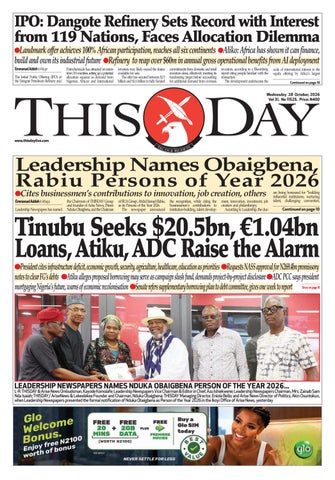
LEADERSHIP NEWSPAPERS NAMES NDUKA OBAIGBENA PERSON OF THE YEAR 2026...
L-R: THISDAY & Arise News Ombudsman, Kayode Komolafe; Leadership Newspapers Vice Chairman & Editor in Chief, Azu Ishiekwene; Leadership Newspapers Chairman, Mrs. Zainab Sam Nda Isaiah; THISDAY/ AriseNews & Lekeelekee Founder and Chairman, Nduka Obaigbena; THISDAY Managing Director, Eniola Bello; and Arise News Director of Politics, Akin Osuntokun, when Leadership Newspapers presented the formal notification of Nduka Obaigbena as Person of the Year 2026 in the Ikoyi Office of Arise News, yesterday
2
WEDNESDAY, OCTOBER 28 t T H I S D AY
WEDNESDAY, OCTOBER 28 t T H I S D AY
3
4
WEDNESDAY, OCTOBER 28 t T H I S D AY
WEDNESDAY, OCTOBER 28 t T H I S D AY
5
6
WEDNESDAY, OCTOBER 28, 2026 • THISDAY
Group News Editor: Goddy Egene Email: Goddy.egene@thisdaylive.com, 0803 350 6821, 0807 401 0580
NEWS
OLAGUNJU OF JP MORGAN MERCHANT BANK NIGERIA’S VISIT TO NRS CHAIRMAN...
L-R: The newly appointed Managing Director of JP Morgan Merchant Bank Nigeria Ltd, Mr. Adedapo Olagunju and the Executive Chairman, Nigeria Revenue Service (NRS), Zacch Adedeji, PHOTO: NRS MEDIA UNIT during Olagunju’s visit to Adedeji at the Revenue House in Abuja, on Monday
Presidency: Tinubu Receives Regular Briefings on People’s Living Conditions Says president knows price of bread, eggs, essential foods, and wants grassroots development Highlights LG autonomy, infrastructure investments across six zones Deji Elumoye in Abuja The Presidency on Tuesday declared that President Bola Tinubu is aware of the status of an average Nigerian saying he receives regular briefings from aides on people’s living conditions. It also disclosed that the President knows the current price of essential foodstuffs like egg, bread while pushing for grassroots development across the 774 local government councils in the country. Senior Special Assistant to the President on Community Engagement (North-Central), Dr Abiodun Essiet, made this disclosure while speaking to newsmen at the the State House, Abuja, alongside her counterparts from the five other geo-political zones. Asked if the government at the centre sufficiently understood the economic pressures confronting citizens nationwide, Essiet explained that President Tinubu gets regular information about developments in communities, including the rising cost of essential commodities like food stuffs. Her words: “I don’t feel it’s only media people that understand what the people are facing. Some of the reality of what our people are facing is what we are communicating to Mr President. “I usually tell people, you think Mr President doesn’t know the price of egg or bread in the market? He does, because we brief him regularly, and so do members of the Federal Executive Council”.
According to the presidential aide, government’s community engagement structure was designed to provide direct feedback from citizens, enabling the President to identify pressing needs and respond through appropriate government institutions. Essiet further explained that the President’s determination to secure financial autonomy for local governments demonstrated his recognition that meaningful development could not be achieved without strengthening the third tier of government which is the closest to the people. “You see him taking government to court because of local government autonomy. There’s no president that has done that because he believes the masses need to benefit”. She emphasised that effective local governments would accelerate development, expand economic opportunities and ensure that empowerment programmes reached communities beyond state capitals. “When our local government is strengthened, then you’ll see the same level of empowerment and development that you’re seeing at the federal level up to the state level”. The SSA disclosed that her office had established a citizens’ assembly comprising more than 700 representatives across the North-Central zone to gather complaints, assess community needs and communicate development priorities to the Presidency. The exercise, she stated, indicated that approximately 70 per cent of the challenges reported by residents fell
within the constitutional responsibilities of local governments. Her words: “I must tell you, 70 per cent of the things they reported are responsibilities of local government”. Commenting on poor service delivery at the grassroots, Essiet observed that some local government employees hardly reported for duty, while communities continued to struggle with basic infrastructure and social services. She therefore called for greater accountability in the management of local council resources and improved collaboration among the three tiers of government. On infrastructure, the presidential aide said the Tinubu government was executing about 1,200 projects across
the North-Central zone, reflecting its commitment to addressing longstanding development deficits. According to her, no than 167 kilometres of roads had been completed, while another 1,207 kilometres were under construction. Essiet highlighted the 401-kilometre Bida-Lambata-Mokwa Road project in Niger State, valued at N1.8 trillion, which she said had remained a source of hardship and fatal accidents for decades. Also speaking, Senior Special Assistant to the President on Community Engagement, (North West), Abdullahi Tanko Yakasai, said government was transforming major transportation corridors to improve trade, agricultural productivity and regional connectivity.
The federal government has launched the Federal Mortgage Bank of Nigeria’s (FMBN) non-interest mortgage product, Ijarah Muntahia Bittamleek Lease-to-Own, in Kano, pledging that no Nigerian should have to choose between homeownership and deeply held financial convictions. The product was formally launched yesterday by the Minister of Housing and Urban Development, Dr. Muttaqhah Darma, alongside the Managing Director of FMBN, Shehu Osidi.
Under the arrangement, an eligible Nigerian occupies a home through a lease agreement, makes agreed rental payments over a defined period and becomes the owner at the end of the term. Both speakers described the product as asset-backed, transparent, regulated and open to every eligible contributor to the National Housing Fund (NHF), irrespective of religion. Darma said more than six million Nigerians contribute to the NHF, yet FMBN has historically booked fewer than 500 individual mortgages annually,
to the President on Community Engagement (South East), Chioma Nweze said federal infrastructure investments were changing perceptions of neglect in a region that had long complained about inadequate attention from the Federal Government. According to her, over 1,000 kilometres of road projects were being executed simultaneously across the zone, identifying the Enugu-Onitsha, Onitsha-Owerri, Enugu-Port Harcourt and Enugu-Abakaliki highways among major beneficiaries. Nweze also mentioned interventions on the Niger bridges, bypasses and the rehabilitation of a collapsed bridge in Enugu as part of efforts to improve transportation and commercial activities.
Utomi Decries Hardship as Oyedele Says Poor Nigerians Spend 120% of Income on Food Chuks Okocha in Abuja Renowned political economist, Pat Utomi, has called for an improved standard of living for Nigerians following a recent remark by Taiwo Oyedele, Minister of Finance and Coordinating Minister of the Economy, that poor households in the country spend as much as 120 per cent of their income on food. Speaking during an engagement at Chatham House in London, Oyedele had said a government
survey showed that poor households spend as much as 120 per cent of their income on food. The minister was responding to a question about the federal government’s investment in data to understand the micro-level effects of its policies on underserved communities. In a video of the over one-hour engagement, which he shared on his X page on Sunday, Oyedele did not disclose when the survey was conducted but said it was carried
FG Launches Non-interest Mortgage in Kano, Opens Door to All NHF Contributors Ahmad Sorondinki in Kano
He listed the Abuja-Kaduna-Kano highway, Zaria-Funtua-Gusau-Sokoto road, Kaduna-Jos road and KanoMaiduguri highway among critical interventions. Yakasai also highlighted the 1,068-kilometre Sokoto-Badagry Superhighway, which he said is a strategic economic corridor capable of linking agricultural communities to major commercial centres and expanding interstate trade. He said the Kaduna-Kano railway project was approaching completion, while investments in renewable energy, irrigation, agricultural mechanisation and ecological infrastructure were expected to improve livelihoods across the region. On her part, Senior Special Assistant
with many contributors staying away from interest-bearing loans. “Those Nigerians have contributed and they have aspirations. From today they have a credible pathway,” he said. The launch marks the first public product under the National Mortgage Industry Policy issued in July 2026. The policy directs FMBN to disburse at least 40 per cent of each year’s NHF collections as mortgages, raise its loan ceiling from N50 million to N85 million, decide applications within 30 working days through an eight-document process, book 2,000
mortgages this year and 5,000 annually by 2028, and publish mortgage data quarterly. The FMBN Managing Director said the initiative was not designed for one religious community or one part of the country, but offered an additional option compliant with ethical finance principles. He cited global Islamic finance assets of $5.98 trillion in 2024 and Nigeria’s Islamic finance industry, valued at over N4.4 trillion in 2024, up from N2.5 trillion in 2023, as evidence of a substantial opportunity to deepen inclusion in housing finance.
out by the current administration. “The guys who are middle class and rich don’t even think about food. Because how much do you spend on food? Maybe one or two per cent of their income,” he said. “For the poor people, that is 100 per cent. In fact, there was a survey we did that shows that up to 120 per cent of household income is spent on food. “Like, how do you spend 120 per cent of your income? You borrow food before the end of the month?” Reacting in a terse post on X yesterday, Utomi said: “So sad, our people deserve better.” Meanwhile, Oyedele said credible data was essential to effective policymaking, warning that decisions made without reliable information could fail to reflect the realities facing Nigerians. “If data is missing, or credible data is not at the table, you are not doing policy; you are having a communion,” he said. The minister said the National Bureau of Statistics (NBS), which conducts living standards surveys and produces the Multidimensional Poverty Index, had struggled to secure funding for surveys needed to guide government policies.
He said he took an interest in the bureau’s work shortly after assuming office as finance minister because he relied heavily on its data. “I called them, and one of the things they told me was that they were not being funded. They struggle to find the money to conduct the surveys we need,” he said. “Imagine that inflation is one of our biggest problems in Nigeria. To tackle inflation, you need data. You have the Consumer Price Index, which tells you price levels, but it does not tell you much about why those prices are going up.” Oyedele said some countries use the Producer Price Index to determine the extent to which inflation is driven by rising production costs. He added that such data could help prevent policymakers from repeatedly raising interest rates in ways that worsen existing economic challenges. He said he was encouraged by the Central Bank of Nigeria’s (CBN) move from monetary targeting to inflation targeting. Oyedele added that the CBN and the Finance Ministry were working together to tackle inflation and understand its effects on underserved communities.
7
THISDAY • WEDNESDAY, OCTOBER 28, 2026
NEWS
NATIONAL CREDIT GUARANTEE’S MEDIA BRIEFING...
L-R: Chief Information Officer, (NCGC), Emmanuel Adegoke; Executive Director Risk Management, Professor Ezekiel Oseni; Special Adviser to the President on Information and Strategy, Bayo Onanuga; Managing Director/Chief Executive Officer, National Credit Guarantee Company (NCGC), Dr. Bonaventure Okhaimo; and Executive Director, Strategic and Operations NCGC, Mrs. Tinuola Aigwedo, at the ‘meet the Press’ briefing held at the Presidential Villa, Abuja, yesterday PHOTO: GODWIN OMOIGUI.
Abdul Samad Rabiu: Tinubu’s Reform Boosting Investor Confidence Seeks long-term capital to drive manufacturing, job creation, expand production capacity by 2027 As BUA Foods, Cement market capitalisation exceeds $17bn Sunday Ehigiator Founder and Executive Chairman of BUA Group, Abdul Samad Rabiu, has said President Bola Tinubu’s economic reforms are improving investor confidence in Nigeria. Rabiu urged the government and private sector to create at least 100 more indigenous industrial enterprises to accelerate production, create jobs, and strengthen the economy. The comments were contained in
the keynote address he delivered at the 32nd Nigerian Economic Summit on Tuesday in Abuja. He said reforms in foreign exchange management, fuel subsidy removal, taxation, banking, and infrastructure were beginning to address longstanding challenges facing businesses. Speaking on the theme, “Growth That Works: Building a New Economic Accord for Nigeria,” Rabiu said the progress achieved
through the reforms must translate into increased industrial production, employment opportunities, and improved living standards. He commended the improved access to foreign exchange, recalling the difficulties businesses previously encountered in obtaining dollars for machinery, equipment, and raw materials, even when they had sufficient naira to finance their investments. He stated, “Legitimate businesses
can now access foreign exchange through the market at prevailing exchange rates, rather than depending on direct allocations from the Central Bank.” Rabiu stated that the improved foreign exchange environment had brought greater predictability to investment planning, particularly for manufacturers undertaking large-scale projects. He said since Olayemi Cardoso assumed office as Governor of the
FG, Labour Agree on N70,000 Transport Palliative, Immediate Minimum Wage Talks Onyebuchi Ezigbo in Abuja The Federal Government and the Nigeria Labour Congress (NLC) have agreed on payment of N70,000 transport palliative to workers across all levels and immediate commencement of negotiations on new national minimum wage. The resolutions were reached at a conciliation meeting held at the Federal Ministry of Labour and Employment in Abuja on Tuesday, October 27, 2026, between Federal Government and leadership of NLC. The meeting was sequel to a communique issued at the end of joint meeting of Central Working Committee (CWC) and National Executive Council (NEC) of NLC, and was a follow-up to an earlier
conciliation convened on October 22, 2026 to address demands for commencement of minimum wage discussion, reduction in petroleum pump price and palliatives to cushion effect of economic challenges on workers. The meeting also addressed demands of Joint National Public Service Negotiating Council (JNPSNC) on public service welfare, Joint Health Sector Unions (JOHESU) on implementation of CONHESS adjustment, tax relief for workers and hazard allowance for agricultural workers. According to resolutions signed at end of meeting, NLC leadership expressed concern over Federal Government’s attitude towards the issues, while Federal Government stated it fully respects right of Congress
to advocate for improved working conditions and is genuinely working to address them through structured intervention. On commencement of discussion and implementation date of national minimum wage, it was agreed that Minimum Wage Negotiation Committee would be constituted and commence meeting immediately. However, parties noted there is disagreement on effective date of implementation. On reduction in petrol pump price and demand for palliative, it was agreed that transport intervention of Seventy Thousand Naira (N70,000) commencing from November 2026 would be paid across all levels for period of six months. Both parties agreed that peculiar
allowance, parties agreed that payment of arrears would commence in November 2026 in three equal monthly instalments. On the demand for the payment of 19 months arrears of allowances for health workers, it was agreed that arrears would be redeemed within three months with effect from December 2026. On tax relief for workers, it was resolved that since tax is statutory matter, issue will be taken to National Executive Council (NEC) for consideration.
CJN to Judges: Be Vigilant, Cautious Healthcare professionals, cancer caregivers, policymakers in Your Handling of Political Cases survivors, and advocates have sought stronger policies and support systems to Chief Justice of Nigeria (CJN), Justice Kudirat Kekere-Ekun, has again stressed the need for judicial officers, particularly Heads of Courts, to be mindful of their handling of political matters, as the 2027 general election draws closer. Kekere-Ekun cautioned that practices, such as forum shopping, concealment of related proceedings, and attempts to obtain conflicting
orders from courts of coordinate jurisdiction should be discouraged by the courts. The CJN, gave the charge on Monday during the opening session of the 2026 roundtable for Heads of Courts, organised by the National Judicial Institute (NJI). She stated that the issues required particular attention as the country approached another election season, adding that election-related disputes often attract intense public interest
and considerable pressure on the courts. Kekere-Ekun stated, “The judiciary must be prepared to discharge its constitutional responsibilities with impartiality, courage and fidelity to the law. “Political sensitivity, public sentiment or the urgency with which a matter is presented must never displace the careful application of the constitution, the Electoral Act and the applicable rules of court.”
create jobs, support farmers and suppliers, and expand our capacity to serve markets across Africa. “Our ambition is not simply to become bigger. It is to make Nigeria stronger.” Rabiu challenged Nigeria to develop at least 100 additional major indigenous industrial enterprises capable of investing across manufacturing, agriculture, mining, technology, and other productive sectors. “But the question we must ask ourselves is not simply how BUA can continue to grow. It is how Nigeria can create another one hundred BUAs,” he said. He identified access to affordable, long-term financing as one of the major constraints to industrial expansion, explaining that large manufacturing investments often require between 10 and 20 years to realise their full potential. According to him, banks, pension funds, insurance companies, development finance institutions, and capital markets must play greater roles in mobilising funds for productive investments. He also stressed the importance of policy stability and infrastructure development in encouraging businesses to commit capital to long-term industrial projects.
Stakeholders Advocate Stronger Support Systems for Cancer Survivors, Caregivers Onyebuchi Ezigbo in Abuja
Alex Enumah in Abuja
Central Bank of Nigeria (CBN), he had met him only a handful of times, unlike the previous situation when businesses frequently approached the apex bank to seek foreign exchange allocations. While acknowledging the difficulties households and businesses faced, Rabiu urged the government to sustain the reforms and prioritise the expansion of Nigeria’s productive capacity. “We must move from reform to results, from stabilisation to expansion, and from economic adjustment to shared prosperity,” he stated. Highlighting BUA Group’s growth, Rabiu disclosed that BUA Foods and BUA Cement, both listed on the Nigerian Exchange, had a combined market capitalisation exceeding $17 billion. He said BUA Foods was valued at more than $10 billion, while BUA Cement had a market capitalisation of approximately $7 billion. The chairman also disclosed that BUA Group was investing in flour milling, pasta, noodles, edible oils, rice milling, and feed mills, with projects expected to be completed in 2027 and double production capacity across the relevant operations. he stated, “These investments will strengthen Nigeria’s food security,
improve the quality of life for people living beyond a cancer diagnosis. The case was made at a cancer survivorship forum, titled, “Beyond the Diagnosis: The Untold Realities of Cancer Survivorship and Caregiving,” organised by African Medical Centre of Excellence (AMCE), in partnership with Project PINK BLUE, in Abuja, as part of its Cancer Survivorship Initiative. The event brought together
diverse stakeholders to examine the often-overlooked realities faced by cancer survivors and caregivers, including the physical, emotional, social and financial challenges that frequently persist long after treatment has ended. Speaking at the event, Chief Medical Officer, AMCE, Dr. Aisha Umar, said cancer care must extend beyond diagnosis and treatment to include survivorship and long-term wellbeing. Umar stated, “As advances in medicine continue to improve cancer outcomes, we must ensure that survivors are not left to navigate the next chapter of their journey alone.
“Comprehensive cancer care must address not only treatment, but also rehabilitation, mental health, social reintegration and long-term quality of life. “Survivorship is an essential part of the cancer care continuum, and it is our collective responsibility to ensure that patients and their families receive the support they need to thrive.” Throughout the forum, participants shared personal experiences and professional insights on the realities of living with and beyond cancer, highlighting the resilience of survivors and the critical role caregivers play in supporting treatment and recovery.
8
WEDNESDAY, OCTOBER 28, 2026 • THISDAY
NEWS
RECEPTION AND ICONIC CULTURAL DINNER...
L-R: Chief of the Naval Staff of the Nigerian Navy, Vice Admiral Idi Abbas; Chief of Defence Staff, General Olufemi Oluyede; Minister of state for Defence, Dr. Bello Matawalle; Representative of Governor of Lagos State and Secretary to the State Government (SSG), Barr. ‘Bimbola Salu-Hundeyin; Chief of Army Staff, Lieutenant General Waidi Shaibu; Chief of Air Staff, Air Marshal Sunday Aneke; and Chief of Defence Intelligence of Nigeria, Lieutenant General Emmanuel Undiandeye, during a reception and iconic cultural dinner in honour of VIP delegates and guests attending the Africa International Defence Exhibition at the Pool Terrace, Eko Hotels and Suites, Victoria Island, Lagos, on Monday
NCGC: We’ve Unlocked N64.13bn Loans, Support 914,791 Jobs Says women account for 42.7% of 22,616 Nigerians accessing bank loans for first time Justifies high loan interest rates, stresses no bank has filed default claim Deji Elumoye in Abuja National Credit Guarantee Company (NCGC) disclosed that it had facilitated N64.13 billion in loans to Nigerian businesses and individuals, and supported about 914,791 direct and indirect jobs in its less than one and half years of operation. NCGC’s Chief Executive Officer (CEO), Dr Bonaventure Okhaimo, made that known on Tuesday at a media parley at State House, Abuja. Okhaimo stated that 22,616 Nigerians who had never have access to formal bank credit had secured loans through its intervention, with women accounting for 42.7 per cent of such beneficiaries. Okhaimo added that the company had also deployed N30.19 billion in credit guarantees to unlock the N64.13 billion in loans as at October 21, 2026. He said the intervention within 14 months of its operation had enabled participating financial institutions to extend loans to previously excluded businesses and individuals, particularly those unable to meet conventional collateral requirements. The initiative, Okhaimo explained, had already reached more than 170,000 beneficiaries through 19 participating financial institutions, including commercial and microfinance banks. He stated, “For every one naira that we give as a credit guarantee to a bank, it creates two naira in loans. That’s the additionality.” The CEOs stressed that President Bola Tinubu established the company to address a fundamental weakness in Nigeria’s financial system, where otherwise viable businesses were routinely denied credit because they lacked acceptable collateral. He stated, “The President has said, don’t let a viable Nigerian business suffer because it doesn’t have collateral. He has taken the collateral and given it to the bank. So that’s what we are doing.” Okhaimo also explained that NCGC did not lend directly to
businesses or individuals but provided guarantees that encouraged financial institutions to extend credit to borrowers they would ordinarily consider too risky. According to him, the company currently assumes up to 60 per cent of the credit risk on eligible loans, allowing lenders to relax collateral requirements while retaining responsibility for credit assessment, loan monitoring and recovery. Some banks, he stated, traditionally demanded collateral worth more than 150 per cent of the amount being borrowed, a practice that excludes many small businesses, despite their commercial viability. He stated, “What we are saying is, forget about collateral. Do the other due diligence. As long as the customer’s business is viable and the customer has good character, we are willing to support by giving you a credit guarantee that will enable you to give loans to your customers.” The NCGC boss also disclosed that the company’s interventions had supported 914,791 jobs, comprising direct employment reported by participating banks and indirect employment estimated through recognised development finance multipliers. The indirect employment calculations, he emphasised, were based on sector-specific multipliers, including those used by African Development Bank, with NCGC attributing employment impact according to its share of guaranteed credit risk. Okhaimo described the inclusion of 22,616 first-time borrowers in the formal financial system as particularly significant, stating that many previously depended entirely on family members, friends and informal financing arrangements. He also disclosed that 7,731 young Nigerians had benefited from guaranteed loans but expressed dissatisfaction with the relatively low level of youth participation. The CEO said the company was developing strategies to increase the proportion of young beneficiaries to
at least 40 per cent, considering the country’s predominantly youthful population. “We need to encourage them. We need to engage them. We need to do much more around youth empowerment”. On the company’s womenfocused interventions, Okhaimo announced plans to unlock more than N100 billion in financing for over 20,000 women-owned enter-
prises within five years through its GuaranteeHer initiative. The scheme, launched on July 29, 2026, and formally unveiled to financial institutions in Lagos on September 3, raises credit guarantee coverage to 70 per cent for eligible women-owned businesses, compared with the standard 60 per cent. He said the framework, which provided guarantees for loans of
up to N50 million per borrower, was designed to strengthen existing women-focused lending programmes operated by financial institutions. On the high interest rates charged by commercial banks despite government credit guarantees, Okhaimo acknowledged that access to finance and affordability remained two separate challenges. He explained that NCGC was
primarily established to improve access, although its risk-sharing model could progressively reduce borrowing costs. According to him, banks determine lending rates by considering the Central Bank of Nigeria’s Monetary Policy Rate, inflation, funding costs and additional premiums reflecting the perceived risks associated with individual borrowers.
In Bid to Boost Food Security, Curb Insecurity in Farming Areas, MOFI Partners DAPCO, Military-linked Institutions Ndubuisi Francis in Abuja Ministry of Finance Incorporated (MOFI), the investment arm of the federal government, has signed a Memorandum of Understanding (MoU) with Defence Agricultural Assets and Projects Development Company (DAPCO) and other military-linked investment institutions to provide security for large-scale agricultural investments as part of overall efforts to restore investor confidence in farming parts of the country affected by insecurity. The MoU, which involves MOFI, Integranium Holdings, and DAPCO, supported by Defence Holding Company Limited, seeks to create a framework that combines investment mobilisation with security and project management. It is expected to help unlock, among other agriculture projects, multi-billion-dollar soybean and sugarcane projects in Yobe and Jigawa states, where security concerns has made it difficult to attract the capital needed to develop them. On the side-lines of the agreement signing ceremony in Abuja, Tuesday, MOFI’s Executive Director, Investments, who is responsible for the Integranium investment framework, Dr. Femi Ogunseinde, said the partnership would allow the institutions to return to prospective investors with a security arrangement that is fashioned to protect
their investments. According to Ogunseinde, security has constituted one of the major obstacles preventing domestic and international investors from committing funds to large-scale agricultural projects in Nigeria. He said, “We have a soybean initiative in Yobe, we have a sugarcane initiative in Jigawa—all large-scale, all multi-billion-dollar projects. “Without having that security anchor to ensure that whatever comes from wherever to invest, the investments are safe, it becomes very difficult for us to do anything.” He submitted that attracting investors had been difficult without assurances that their money and agricultural operations would be secured. He stated that the new partnership would provide a platform through which the government and its partners could approach prospective investors and demonstrate that arrangements were being developed to address their security concerns. Ogunseinde disclosed that the initiative was intended to attract substantial private sector and international financing into agricultural production, rather than depend solely on public funds. He said an estimated 30 million to 35 million hectares of farming land could be available, providing considerable scope for expanding
large-scale agricultural production. He explained that the partnership would help create a platform for investors interested in developing that potential, including offshore companies and financiers. According to him, the intention is to achieve economies of scale by bringing together land, capital, agricultural expertise and the security arrangements needed to support commercial farming. Ogunseinde hinted at the possibility of attracting investments worth between $1 billion and $2 billion from the initiative. The agreement is expected to cover risk management, security planning, and project management, with DAPCO working alongside MOFI and its investment partners to develop and implement agricultural projects. Although he made no reference to a particular project or provided any clue on the commencement date, Ogunseinde said the partners had already identified several opportunities and expected at least one project for ground breaking before the end of the year. Group Managing Director of Defence Holding Company Limited, Air Vice Marshal (AVM) Anthony Victor Ndache, disclosed that the MoU signed by the institutions was a broad agreement covering agriculture, hospitality and other investment areas. Ndache added that more detailed
agreements would be developed for the individual projects as the partnership progresses. He said the initiative was intended to benefit Nigeria by improving national productivity, stating that the President Bola Tinubu administration prioritises food security. In his remarks, Chairman and Chief Executive Officer of DAPCO, Aliyu Abdulhameed, said the defence establishment’s role was to ensure that financing reached agricultural opportunities in rural areas under secure and properly structured arrangements. Abdulhameed stated that agricultural investments often took place far from major urban centres, making security a critical factor for investors’ consideration. He said the partnership would enable the institutions to combine their respective strengths to develop agricultural projects across the country. Managing Director of MOFI, Dr. Armstrong Takang, said Nigeria needed to make better use of its land, water resources and people to produce sufficient food for households and industries, while generating additional supplies for export. Takang said the agricultural initiative was also expected to help address food inflation by increasing the volume of food produced locally.
9
WEDNESDAY, OCTOBER 28 t T H I S D AY
C E L E B R AT I O N O F A B E L OV E D PAT R I ARC H
ĐS©{³ © ĐQb o v co©vĐ%b©vĐĪ ī pUÍ A`qAmyÍ ÍÎæÎÍ `LÍ.NjpN_INmÍ Beloved Husband, Father, Grandfather, Brother, Uncle and Friend
VeĐ'me ĐkW}n{¢Đa cnW{{¢Đn n e Đ¢ Đ Đae{e` W eĐmn Đ{nkeĐW Đ meĐk e W{Đae e} ne Ĕ “Blessed are the dead who die in the Lord … they will rest from their labour, for their deeds will follow them.” R E V E L AT I O N : S U RV I V E D B Y
b`LAyÖÍ pUÍ"JpbINm
WIFE
.NmvVJNÍbSÍ.b`TnÍüÍ VTUpÍbSÍ/mVIqpNn V E N U E StÎSaviour’sÎSchool, AlexanderÎAvenue,ÎIkoyi TIME 4pm ÎService of Songs 6pm ÎNight of Tributes COLOUR A touch of blue
Barr Mrs Ogugua “OG” Ohen CHILDREN
Geo rey Ohen III Carmen Ohen Frederick Ohen II GRANDCHILD
Alaïa OhenߝKazeem
/qNnLAyÖÍ pUÍ"JpbINm
LAGOS
LAGOS
b__N`LApVb`Í.NmvVJN V E N U E Our Saviour’s Church, TBS TIME 9am
/UqmnLAyÖÍ pUÍ"JpbINm
D E LTA
.NmvVJNÍbSÍ.b`Tn V E N U E StÎJamesÎAnglicanÎChurch, Agbor TIME 4pm COLOUR Green
mVLAyÖÍ pUÍ"JpbINm yV`TÍV`Í.pApN V E N U E Family home, Owa TIME 9am
q`NmA^Í.NmvVJN V E N U E Anglican Cathedral Church ofÎAscension, Lagos/AsabaÎRoad, BojiߝBojiÎOwa TIME 11am COLOUR Cream on cream Fabric available on request
Interment: private, at Owa Alizomor
-NJNjpVb` V E N U E Ika Grammar School
.q`LAyÖÍ npÍ bvN_INm /UA`]nTVvV`TÍüÍ"qpV`TÍ.NmvVJN
Fabric available on request
TA P H E R E TO R S V P ࡆ bmÍvVnVpÍTNbSSmNyäbUN`Õ^bvAI^NÕAjjâmnvj ENQUIRIES
D E LTA
0803 324 1670 ηΠfrederick@geo ohenltd.com
D E LTA
10
WEDNESDAY, OCTOBER 28, 2026 • THISDAY
TEN
NRS, BPP Move to Reform Procurement System, Seek Better Value for Public Spending Adedeji aims to replicate tax reform success in procurement to cut waste, boost confidence in tax spending James Emejo in Abuja The Nigeria Revenue Service (NRS) and the Bureau of Public Procurement (BPP), yesterday strengthened their collaboration to reform the country’s public procurement framework, with a focus on improving value for money, reducing administrative bottlenecks and strengthening the economic returns on government expenditure. Executive Chairman of NRS, Dr. Zacch Adedeji, said the engagement with the procurement regulator would help align the ongoing review of the Public Procurement Act with the operational realities of government institutions, ensuring that reforms deliver tangible benefits to the economy. Speaking when he hosted the Director General of BPP, Dr. Adebowale
Adedokun, and their respective technical teams at the Revenue House in Abuja, Adedeji stressed the importance of making public spending more effective, noting that visible results from government expenditure could strengthen citizens’ confidence in the tax system and encourage voluntary compliance. He said the engagement provided an opportunity for both institutions to exchange ideas on proposed amendments to the procurement law and identify practical challenges that should be addressed in the reform process. Adedeji, who acknowledged the BPP’s support for the NRS team in navigating procurement procedures, said closer collaboration would help the revenue service avoid administrative pitfalls while ensuring that projects were
executed efficiently and in accordance with the law. He also invited the procurement regulator to consider the specific operational challenges confronting the NRS in the ongoing review of the legal framework, emphasising that the outcome should benefit public institutions across the country. Technical team lead/Group Director, Support Services, NRS, Mr. Kunle Ogidi, while briefing the meeting, said the BPP had provided guidance and capacity-building support to the service, helping officials understand procurement requirements and manage the complexities associated with project execution. The team lead said the engagement was particularly important as the BPP worked towards reforming the Public
Procurement Act, adding that closer consultations would enable the proposed changes to accommodate the practical needs of institutions responsible for delivering public services. He said the NRS considered the meeting an opportunity to contribute operational insights to the review process and strengthen cooperation between both agencies. Adedeji however, stated that the connection between tax collection and public procurement was critical to building confidence in government. According to him, citizens are more likely to appreciate their tax obligations when they can see that public funds are being deployed effectively to deliver infrastructure and other essential services. He maintained that demonstrating the benefits of public expenditure could
serve as an important incentive for taxpayers to comply with their obligations, thereby supporting revenue generation and the government’s capacity to finance development. The NRS chairman Adedeji, reiterated the need for both agencies to sustain their partnership, stressing that efficient public spending could reinforce public confidence in government and its revenue mobilisation efforts. He said the visible impact of expenditure was important to encouraging taxpayers to recognise the benefits of paying taxes, adding that improved collaboration between revenue collection and procurement institutions would support better economic outcomes. In his remarks, Adedokun said the BPP was seeking a fundamental shift from a uniform procurement model to a
Dr. Zacch Adedeji sector-based approach that would reflect the different requirements of projects and services. He explained that applying identical procurement criteria to dissimilar sectors could undermine efficiency, adding that construction, healthcare and other specialised activities required approaches tailored to their distinct operational demands.
TINUBU SEEKS $20.5BN, €1.04BN LOANS, ATIKU, ADC RAISE THE ALARM Chuks Okocha, Sunday Aborisade and Juliet Akoje in Abuja
President Bola Tinubu yesterday asked the National Assembly to approve a supplementary external borrowing plan of $20.52 billion and €1.045 billion to finance projects and programmes across critical sectors of the economy, a move that has drawn criticism from former Vice President Atiku Abubakar and the African Democratic Congress Presidential Campaign Council (ADC-PCC). While the President said the proposed facilities would address Nigeria’s infrastructure deficit, accelerate economic growth, generate employment and improve the living conditions of Nigerians, Atiku alleged that the borrowing request vindicated his earlier warning about a loan plan of up to $20 billion and raised concerns about the possible use of public funds for political purposes. The ADC-PCC, in a separate reaction, condemned the proposed borrowing, describing it as reckless, warning that excessive dependence on foreign loans could mortgage Nigeria’s future and set the stage for economic recolonisation.
The controversy comes as President Tinubu has also sought the National Assembly’s approval for the establishment and expansion of the federal government’s Promissory Note Programme to settle outstanding verified liabilities amounting to N269.44 billon. Tinubu Seeks Approval for $20.5bn, €1.04bn External Loans Tinubu, in a letter read by Senate President Godswill Akpabio at plenary yesterday, urged the National Assembly to approve the supplementary external borrowing plan for 2026–2027 to enable the federal government to implement its projects and programmes without delay. He said the proposed borrowing plan covered infrastructure, agriculture, healthcare, education, water supply, security, employment generation and financial management reforms, among other sectors. Tinubu said, “The 2026–2027 Supplementary External Borrowing Plan cuts across all sectors, with specific emphasis on infrastructure, agriculture, health, education, water supply, growth, security and employment generation, as well as financial management reforms, amongst others.”
Explaining the rationale for the request, the President said the need to sustain economic growth following the implementation of his administration’s reforms had made additional external financing necessary. “In light of the critical reforms of my administration, the need to accelerate growth of the national economy provides support for the External Borrowing Plan, which amounts to $20,517,755,901 and €1,045,083,643,” he said. He added that the projects and programmes covered by the plan had undergone technical and economic assessments to establish their potential contributions to national development. “I want to emphasise that the projects and programmes included in the Borrowing Plan were selected based on thorough technical and economic evaluation, as well as their anticipated contribution to the socio-economic development of the country,” Tinubu said. According to him, the proposed interventions are expected to stimulate economic activities, create jobs, promote skills acquisition, encourage entrepreneurship, reduce poverty and
strengthen food security. “These initiatives aim to generate employment, promote skills acquisition, foster entrepreneurship, reduce poverty and enhance food security, all of which improve the livelihood of the Nigerian child,” he said. The President disclosed that most of the projects and programmes would be implemented across the 36 states of the federation and the Federal Capital Territory, underscoring the nationwide scope of the proposed investments. “The majority of these projects and programmes will be implemented across all the 36 states and the Federal Capital Territory,” he said. Tinubu added that the scale of Nigeria’s infrastructure needs and the financial resources required to address them had made broader external borrowing necessary to bridge the funding gap. “In light of the need for significant infrastructure investment in the country and the vast financial resources needed to address this gap, it has become essential to pursue broader external borrowings to close the financing shortfall,” he said. He said the funds would be
LEADERSHIP NAMES OBAIGBENA, RABIU PERSONS OF YEAR 2026 and breaking new ground” in their respective fields. Also yesterday, Leadership Newspapers presented the formal notification of Obaigbena as Person of the Year 2026 at the Ikoyi Offices of Arise News Channel in Lagos. Present at the event were: Ombudsman, Kayode Komolafe; Leadership Newspapers Vice Chairman & Editor in Chief, Azu Ishiekwene; Leadership Newspapers Chairman, Mrs Zainab Sam Nda Isaiah; THISDAY Managing Director, Eniola Bello and Arise News Director of Politics, Akin Osuntokun. Obaigbena was recognised for his contributions to Nigeria’s media industry, particularly his role in expanding the country’s media landscape and launching the Leekelee social media platform in February 2026. Rabiu, on his part, was recognised for BUA Group’s investments in manufacturing and local production, as well as its contributions to job creation, infrastructure development and shareholder value. The newspaper also highlighted the philanthropic activities of both businessmen, noting their contributions to strengthening confidence in Nigeria’s future. It described the recognition as an acknowledgement of their influence and impact on the country’s economic and social development. Earlier, the newspaper said Obaigbena had built influential media organisations, nurtured generations of
journalists and expanded the reach of Nigerian and African media through investments spanning newspapers, magazines, television, fashion and digital platforms. It cited his founding of ThisWeek magazine in 1986 and THISDAY newspaper in 1995 as defining milestones in his career, noting that both publications introduced new approaches to journalism and newspaper production in Nigeria. Obaigbena founded ThisWeek at the age of 27, establishing a publication that covered politics, economics, international affairs, art and culture. The magazine also became a platform for talented journalists, many of whom went on to occupy prominent positions in the media industry and public life. His entry into newspaper publishing with THISDAY further expanded his influence, with the publication introducing innovations in presentation, editorial content and the commercial positioning of Nigerian newspapers. Leadership noted that THISDAY began operations without Obaigbena owning a printing press, while highlighting its adoption of colour production, the elevation of the back page as a platform for prominent columnists and the publication of the full table of daily transactions at the Nigerian Stock Exchange. Beyond newspaper publishing, Obaigbena, it said, extended his entrepreneurial interests into broad-
casting, fashion and entertainment, establishing platforms designed to promote African talent and connect the continent’s creative industry with international audiences. These included ARISE Magazine, the THISDAY Music and Fashion Festivals, and ARISE Fashion Week, which provided platforms for Nigerian and other African creatives to showcase their work to wider audiences. In 2013, he launched ARISE News, an international television news platform with an African focus and global outlook, aimed at strengthening African perspectives in international news coverage. Leadership described the launch of LekeeLekee, a social media platform developed by ARISE Broadcast and THISDAY Media Group in February 2026, as another significant step in Obaigbena’s efforts to expand Africa’s presence in the digital media landscape. The newspaper said the platform had recorded more than 100,000 downloads within about six months, describing its launch as evidence of his continued interest in exploring new frontiers in media and technology. It added that Obaigbena’s career had been marked by a willingness to take risks, assemble exceptional talent and build institutions despite economic constraints, technological disruption and the challenges confronting traditional journalism. It noted that his media organisa-
tions had navigated changing governments, economic recessions and the pressures of digital transformation, while continuing to seek new ways of remaining commercially viable and relevant to society. Born on July 14, 1959, in Ibadan, Oyo State, Obaigbena attended Edo College, Benin City, before obtaining an honours degree in Creative Arts from the University of Benin. He began his media career in 1978 at the Nigerian Observer, where he developed his skills in writing, Continued on page 34
channeled primarily into critical infrastructure, particularly power, transportation and healthcare, while other sectors would also benefit from the proposed financing arrangement. “These funds will primarily be directed towards critical infrastructure projects in various sectors, including power, transportation and healthcare, amongst others,” the President said. Tinubu urged the Senate and the House of Representatives to give the proposal urgent consideration, arguing that prompt approval would facilitate timely disbursement and effective implementation of the projects. The President said, “Given the urgent nature of these needs and the importance of stabilising the country, it is crucial to seek the consideration and approval of the National Assembly leadership and the entire National Assembly for the 2026–2027 Supplementary External Borrowing Plan. “This will enable the government to fulfil its obligations to the Nigerian people through timely disbursements and effective project implementation.” He maintained that the proposed financing would support the implementation of development programmes and help address the country’s infrastructure funding shortfall. The letter, however, did not provide, in the material presented to the Senate, a project-by-project breakdown of the proposed facilities, the individual financing terms or the allocation of the funds among the beneficiary sectors. The proposed borrowing plan comes as the federal government seeks additional resources to finance infrastructure and development programmes amid competing demands on public finances. Its implementation will depend on the National Assembly’s consideration of the proposal and the details of the projects to be financed under the plan. Following the presentation of the
letter, Akpabio referred the request to the Senate Committee on Local and Foreign Debts for consideration and directed it to report back to the chamber within one week. The committee is expected to undertake the initial legislative review of the proposal, with possible collaboration with the Senate Committee on Appropriations and other relevant committees. The request will require legislative scrutiny before the proposed external financing can proceed. Tinubu Seeks Approval for N269.4bn Promissory Notes to Clear FG Debts In a separate legislative request, Tinubu sought the National Assembly’s approval for the establishment and expansion of the federal government’s Promissory Note Programme to settle outstanding verified liabilities amounting to N269.44 billion. The request was conveyed in a letter from the Secretary to the Government of the Federation (SGF), Senator George Akume, which was read during plenary at the House of Representatives in Abuja yesterday. The proposed programme is intended to address outstanding contractual commitments, project-related debts and other financial obligations owed by the Federal Government to various categories of creditors. In the letter dated August 18, 2026, and received by the Office of the Speaker on October 21, Akume disclosed that the outstanding liabilities totaled N269,446,402,822.56, following a comprehensive review conducted by relevant ministries, departments and agencies of the Federal Government. He stated that Tinubu had approved the proposal to establish and expand the programme as a mechanism for settling the verified obligations. According to the letter, the initiative is intended to provide “a structured, Continued on page 35
IPO: DANGOTE REFINERY SETS RECORD WITH INTEREST FROM 119 NATIONS, FACES ALLOCATION DILEMMA refinery, valued at nearly $50 billion, and raises the prospect that some investors may not receive the allocations they seek. The company is expected to exercise an additional 30 per cent overallotment option, which could increase the total amount raised to approximately $2.1 billion and create room for more international investors. However, demand could still exceed the available shares even if the option is fully exercised, the report said. The IPO attracted applications from investors in all 54 African countries for the first time, while the total number of countries represented in the offering had reached 119 at the time of the report. The breadth of participation reflects efforts by Aliko Dangote, Africa’s richest man, to widen ownership of the refinery beyond Nigeria and encourage greater
participation by African investors in the continent’s industrial assets. Dangote extended the closing date for applications by two weeks to October 27, allowing his team to engage investors across Africa and put structures in place to broaden participation beyond the Nigerian market. “We have more than reached our target,” Dangote said in Gaborone, Botswana, on October 14, adding that the refinery had attracted interest of “more than three times or four times what we are looking for.” The offer includes nominee structures involving Standard Bank Group for investors in Egypt and Ethiopia, as well as global depository receipts being sold through stock exchanges in Kenya and Botswana. The transaction is being closely
watched as a test of the capacity of African capital markets to mobilise substantial domestic and regional funds for large-scale industrial projects without relying primarily on international financial centres such as London and New York. If demand significantly exceeds the shares available, Dangote could consider selling part of his personal stake to investors who fail to secure sufficient allocations through the IPO. However, people familiar with the process said no decision had been made on a secondary sale, which would depend on the final order book. The offering provides investors with an opportunity to take stakes in one of Africa’s most strategically significant Continued on page 34
WEDNESDAY, OCTOBER 28 t T H I S D AY
11
12
WEDNESDAY, OCTOBER 28 t T H I S D AY
WEDNESDAY, OCTOBER 28 t T H I S D AY
13
14
WEDNESDAY, OCTOBER 28 t T H I S D AY
/(*$/ 35$&7,7,21(56· 35,9,/(*(6 &200,77(( 6835(0( &2857 2) 1,*(5,$
7+5(( $506 =21( 6835(0( &2857 &203/(; 3 0 % $%8-$ ± 1,*(5,$7(/
ƖLjƖƀƉ ~%Ɖj8Ɖ B)Ɖ~ bUƉj8Ɖ )bFj~Ɖ % j )Ɖj8ƉbF:)~F
XXƉ8j~Ɖ zzXF Fjb
%\ WKH FRPELQHG SURYLVLRQV RI 6HFWLRQ RI WKH /HJDO 3UDFWLWLRQHUV $FW &DS / /DZV RI WKH )HGHUDWLRQ RI 1LJHULD DQG 3DUDJUDSK RI WKH *XLGHOLQHV IRU WKH &RQIHUPHQW RI WKH 5DQN RI 6HQLRU $GYRFDWH RI 1LJHULD WKH *XLGHOLQHV WKH /HJDO 3UDFWLWLRQHUV 3ULYLOHJHV &RPPLWWHH WKH /33& RU WKH &RPPLWWHH KHUHE\ PDNHV D IRUPDO FDOO IRU DSSOLFDWLRQV SUHSDUDWRU\ WR WKH DZDUG RI WKH UDQN IRU WKH \HDU ,Q FRPPHQFLQJ WKH \HDU H[HUFLVH DSSOLFDWLRQ VKDOO RQO\ EH PDGH RQOLQH DQG SURVSHFWLYH $SSOLFDQWV DUH GLUHFWHG WR YLVLW ZZZ OSSFRQOLQH FRP
',5(&7,9(6 72 35263(&7,9( $33/,&$176 21 68%0,66,21 2) 7+(,5 5(63(&7,9( $33/,&$7,216
͑
7KH DSSOLFDWLRQ SRUWDO ZZZ OSSFRQOLQH FRP ZLOO EH RSHQ WR WKH JHQHUDO SXEOLF DW DP RQ 1RYHPEHU VW
͑ x͑ x͑
$SSOLFDQWV DUH UHTXLUHG WR SD\ D QRQ UHIXQGDEOH SURFHVVLQJ IHH DV IROORZV ଂ )LYH 0LOOLRQ 1DLUD IRU /HJDO 3UDFWLWLRQHUV LQ SULYDWH SUDFWLFH ଂ 7ZR 0LOOLRQ )LYH +XQGUHG 7KRXVDQG 1DLUD IRU /HJDO 3UDFWLWLRQHUV HPSOR\HG LQ JRYHUQPHQW VHUYLFH
3D\PHQWV VKRXOG EH PDGH WR DQ\ RI WKH IROORZLQJ DFFRXQWV LQ IDYRXU RI WKH /HJDO 3UDFWLWLRQHUV 3ULYLOHJHV &RPPLWWHH 6$1 =HQLWK %DQN 3/& ² $FFRXQW 1XPEHU *7 %DQN 3/& ² $FFRXQW 1XPEHU
x͑ x͑ ͑
8SRQ FRQFOXVLRQ RI SD\PHQW $SSOLFDQWV VKRXOG XSORDG D FRS\ RI WKH HYLGHQFH RI SD\PHQW RQ WKH DSSOLFDWLRQ SRUWDO $SSOLFDQWV ZLOO UHFHLYH D FRQILUPDWRU\ HPDLO IURP WKH /33& 6HFUHWDULDW DQG VKDOO WKHQ SURFHHG ZLWK WKH DSSOLFDWLRQ SURFHVV RQOLQH
͑
$OO DSSOLFDQWV ZKHWKHU $GYRFDWHV RU $FDGHPLFV PXVW XSORDG FOHDU DQG OHJLEOH FRSLHV RI DOO PDQGDWRU\ DQG VXSSRUWLQJ GRFXPHQWV DV VSHFLILHG LQ WKH *XLGHOLQHV YLD WKH DSSOLFDWLRQ SRUWDO ,Q DFFRUGDQFH ZLWK 3DUDJUDSK RI WKH *XLGHOLQHV RQO\ FOHDU FRSLHV ZLOO EH DFFHSWHG E\ WKH 6HFUHWDULDW $FDGHPLF DSSOLFDQWV LQ DGGLWLRQ WR XSORDGLQJ VFDQQHG FRSLHV RI WKHLU SXEOLVKHG ZRUNV RQOLQH DUH UHTXLUHG WR VXEPLW VHYHQ SKRWRFRSLHV HDFK RI WKHLU &XUULFXOXP 9LWDH DQG ,PSDFW 6WDWHPHQW 7KHVH PXVW EH VXEPLWWHG DORQJVLGH WKH IODVK GULYHV UHIHUHQFHG LQ &ODXVH EHORZ
͑
$IWHU XSORDGLQJ FRSLHV RI DOO PDQGDWRU\ RU VXSSRUWLQJ GRFXPHQWV RQOLQH DOO DSSOLFDQWV VKDOO DOVR VXEPLW ILYH IODVK GULYHV FRQWDLQLQJ D FRS\ RI WKHLU FRPSOHWHG DSSOLFDWLRQ IRUP GRZQORDGHG IURP WKH RQOLQH SRUWDO DV ZHOO DV FRSLHV RI DOO WKH PDQGDWRU\ DQG VXSSRUWLQJ GRFXPHQWV XSORDGHG RQ WKH RQOLQH SODWIRUP WR WKH /33& 6HFUHWDULDW
͑ ͑
$Q\ DSSOLFDWLRQ DQG VXSSRUWLQJ GRFXPHQWV VXEPLWWHG LQ D PDQQHU FRQWUDU\ WR WKH GLUHFWLYHV RI WKH /33& DV HQXPHUDWHG DERYH ZLOO EH UHMHFWHG E\ WKH 6HFUHWDULDW
͑
$OO DSSOLFDWLRQV DQG WKHLU PDQGDWRU\ RU VXSSRUWLQJ GRFXPHQWV VKDOO EH VXEPLWWHG RQOLQH DW ZZZ OSSFRQOLQH FRP EHIRUH DP PLGQLJKW RQ WKH VW -DQXDU\ ZKLOVW WKH IODVK GULYHV UHIHUUHG WR LQ FODXVH DERYH PXVW EH GHOLYHUHG WR WKH /33& 6HFUHWDULDW EHIRUH SP RQ WKH VW )HEUXDU\ ͘
͑
$Q\ VXEPLVVLRQ PDGH DIWHU WKH GHDGOLQHV VWLSXODWHG LQ FODXVH DERYH VKDOO EH WUHDWHG DV D QRQ VXEPLVVLRQ͘
)RU IXUWKHU HQTXLUHV $SSOLFDQWV VKRXOG VHQG DQ HOHFWURQLF PDLO WR WKH 6HFUHWDULDW /HJDO 3UDFWLWLRQHUV 3ULYLOHJHV &RPPLWWHH YLD OSSFVHFUHWDULDW#FRXUWV JRY QJ
.$%,5 (1,2/$ $.$1%, (64 &+,() 5(*,675$5 2) 7+( 6835(0( &2857 2) 1,*(5,$ 6(&5(7$5< /(*$/ 35$&7,7,21(56 35,9,/(*(6 &200,77((
WEDNESDAY, OCTOBER 28 t T H I S D AY
15
T H I S D AY ˾ WEDNESDAY OCTOBER 28, 2026
16
POLITICS
Acting Group Politics Editor DEJI ELUMOYE Email: deji.elumoye@thisdaylive.com 08033025611 SMS ONLY
2027: Hamzat and Need to Sustain Lagos’ Development Map As the All Progressives Congress prepares to unveil the manifesto of its governorship candidate, Dr. Kadri Obafemi Hamzat, the contest presents an opportunity to consolidate Lagos’ development gains, deepen inclusive growth and respond to the aspirations of its rapidly expanding population, writes Wale Igbintade.
L
agos has never been a state content to stand still. Its crowded roads, expanding neighbourhoods, bustling commercial districts and ambitious infrastructure projects tell the story of a city-state constantly negotiating the demands of growth. Yet beneath its reputation as Nigeria’s commercial powerhouse lies a continuing challenge: translating economic expansion into better living conditions for the millions who call it home. That challenge will occupy a central place in the political conversation ahead of the 2027 governorship election. For the All Progressives Congress (APC), which has governed the state since May, 1999, the election represents an opportunity to retain public confidence while responding to changing expectations. At the centre of the contest is the party’s governorship candidate, Dr. Kadri Obafemi Hamzat, popularly known as KOH. His candidacy offers the APC an opportunity to build on its development record while presenting a renewed vision for a state whose economic importance continues to attract residents, investors and businesses from across Nigeria and beyond. The planned unveiling of Hamzat’s manifesto on Friday, October 30, is therefore more than a campaign milestone. It provides an opportunity to explain how the next administration intends to sustain Lagos’s development momentum, confront persistent urban challenges and ensure that economic growth benefits a broader section of the population. For Hamzat, the task is to demonstrate that experience can inspire fresh solutions and that the next phase of Lagos’ development can be more inclusive, responsive and sustainable. His experience within the state’s political and administrative structure provides a foundation for the APC’s case. However, its value will ultimately be judged by how effectively it translates into policies and programmes that improve residents’ daily lives. The next administration must preserve what has worked, address shortcomings and adapt government priorities to the pressures accompanying Lagos’ growth. This requires more than maintaining existing projects; it demands a clear understanding of the state’s changing needs and the determination to respond to them. Infrastructure will inevitably occupy a prominent place in that conversation. Roads, bridges, drainage systems and public facilities remain critical to economic productivity and residents’ quality of life. Improvements can reduce travel time, facilitate commerce, strengthen neighbourhood connections and support business expansion. Yet infrastructure must increasingly be measured by its practical impact. Residents want roads that remain usable, drainage systems that reduce flooding, public facilities that function efficiently and transport networks that make commuting less exhausting. In a city where congestion consumes working hours and imposes substantial costs on businesses, integrating road development with efficient public transportation will remain a major test of governance. Hamzat, if elected, would have an opportunity to advance a coordinated approach connecting transport planning with housing, commercial activity and urban development. Such integration would ensure that infrastructure projects serve a broader strategy for improving mobility, productivity and residents’ welfare rather than operating as isolated interventions. Housing presents an equally pressing challenge. Lagos continues to attract people seeking employment, education and business
Hamzat
opportunities, placing considerable pressure on the availability and affordability of accommodation, particularly for low-and middleincome earners. For many residents, the challenge is not simply finding a home but securing accommodation within reasonable reach of workplaces and essential services. When affordable housing is concentrated far from employment centres, residents spend a disproportionate share of their incomes on transportation and lose valuable time commuting. Addressing this problem requires sustained investment, effective urban planning, collaboration with private developers and policies that recognise different income groups. It also demands adequate infrastructure in residential areas, including roads, drainage, water supply, schools and healthcare facilities. Placing affordable housing alongside transportation and social infrastructure would help make Lagos more accessible to the workers and families who sustain its economic life. The broader question is whether government policies can convert Lagos’ commercial dynamism into opportunities that extend beyond established businesses and better-
positioned households. Sustainable economic growth requires residents to have a realistic chance of participating in its benefits. For the next administration, this means looking beyond aggregate economic indicators to consider household incomes, the cost of living, access to essential services and the prospects available to young people. Security is equally inseparable from development. Businesses require a safe environment to operate, investors need confidence that their assets will be protected, and residents must be able to work, travel and conduct their daily activities without undue fear. Effective security depends on cooperation among government institutions, lawenforcement agencies, communities and other stakeholders. It also requires attention to the social and economic conditions that can leave vulnerable communities susceptible to criminal activity. A comprehensive strategy would combine effective policing and intelligence with improved street lighting, responsible urban planning, community engagement and opportunities for young people. The objective should be to create an environment where security supports economic activity and strengthens public confidence in government. Beyond infrastructure, employment and security lies the broader question of inclusion. Lagos’ diversity is one of its greatest strengths, but the benefits of development are not always experienced equally across
Lagos has demonstrated considerable capacity for growth and reinvention. Its next chapter will require the same ambition, reinforced by responsive planning, wider participation and a sustained commitment to improving everyday life.
its communities. An inclusive agenda under Hamzat would require public services to reach communities according to their needs, vulnerable residents to receive adequate consideration in urban planning, and economic opportunities to extend beyond a narrow segment of society. Such an approach would strengthen the social foundations of development and build confidence in the state’s long-term direction. Environmental sustainability presents another major challenge. Lagos’ coastal geography, intense rainfall, dense population and rapid urbanisation make drainage, waste management, flood prevention and climate resilience essential components of effective governance. Environmental interventions are most effective when infrastructure is supported by public education, enforcement and responsible urban planning. Drainage channels must be maintained, waste collection systems must function efficiently, and construction and land use must account for their environmental consequences. The next administration would have an opportunity to integrate environmental protection with transport, housing and infrastructure policies, reducing the longterm costs of environmental damage while protecting communities and supporting economic activity. The APC’s manifesto will provide an important platform for explaining how it intends to address these interconnected challenges. Its value, however, will depend on the clarity of its priorities and the credibility of its proposed solutions. A strong manifesto should identify the problems the government intends to solve, explain the policies through which it will pursue those objectives and demonstrate how the necessary resources will be mobilised. It should also establish a realistic basis for assessing progress after the election. For voters, the essential questions concern feasibility and delivery. Which projects will receive priority? How will the administration finance its commitments? What role will the private sector play? How will public spending translate into measurable improvements in living conditions? These questions do not diminish the importance of an ambitious vision. Rather, they underline the need to connect that vision with sound planning, responsible resource management and effective implementation. Public confidence will also depend on how the next administration engages with residents. A city as diverse and complex as Lagos cannot be governed effectively through a one-size-fits-all approach. Consultation with communities, businesses, professional groups, labour organisations, young people and civil society can help the government understand the practical consequences of its policies and identify solutions that might otherwise be overlooked. Such engagement should continue beyond the campaign period. Regular communication about policy decisions, project implementation and public expenditure would enable residents to understand government priorities and assess whether commitments are being fulfilled. For Hamzat, this presents an opportunity to make accountability a defining feature of his proposed administration. It would mean retaining successful policies, improving those that have fallen short and remaining open to new ideas that deliver better results. NOTE: Interested readers should continue in the online edition on www.thisdaylive.com
17
T H I S D AY ˾ WEDNESDAY, OCTOBER 28, 2026
FEATURES
Group Features Editor: Chiemelie Ezeobi Email chiemelie.ezeobi@thisdaylive.com,
Beyond Convenience: What Will Drive the Next Phase of Food Delivery in Nigeria? Demola Adesina
L
agos is a city that understands convenience. From the office worker ordering lunch between meetings to the family trying to sort out dinner after a long day, there is no shortage of people who would appreciate having a good meal delivered to their doorstep. The appeal is obvious. Less time in traffic, less time in queues and more time for everything else life demands. Yet for all its convenience, food delivery remains a relatively small part of how Nigerians buy prepared meals. Our estimates at Swoop suggest that delivery platforms account for just 1% of Nigerians' spending on food prepared outside the home. In comparable African markets, that figure is closer to 5-7%, rising to 10-15% in comparable markets across South Asia and South America. That gap raises an interesting question. If Nigerians value convenience, why hasn't food delivery become a bigger part of everyday life? The answer may have less to do with the appeal of convenience than with the economics of accessing it. Understanding the Real Competition Consider the choices available to someone deciding what to eat for lunch in Lagos. They could order through a delivery platform, walk to a nearby restaurant, buy from a local food seller or contact their favourite restaurant directly. Each option comes with a different combination of cost, convenience and reliability. For a delivery platform, winning that decision requires more than having an attractive app or an extensive restaurant selection. The customer must believe the overall experience offers sufficient value to justify the final bill. This matters particularly in Nigeria, where consumers are navigating rising living costs and increasingly deliberate spending decisions. Convenience remains attractive, but it must compete with other demands on household income. A customer may appreciate the ease of having lunch delivered without necessarily being willing to pay a significant premium for it every day. The challenge for the industry, therefore, is not simply persuading more people to download an app. It is making food delivery an option they can comfortably choose again and again. From First Orders to Lasting Habits The obvious response to price sensitivity is to make delivery cheaper. Promotional offers certainly have their place. A compelling discount can encourage someone to try a platform for the first time. It can introduce customers to restaurants they might otherwise overlook and help build familiarity with the service. But there is a difference between encouraging someone to place their first order and giving them a reason to place their tenth. If the value of food delivery depends entirely on a promotional code, the underlying economics have not fundamentally changed. For delivery to become a regular habit,
Demola Adesina
customers need to feel comfortable with what they are paying even when there is no special offer available. That requires platforms to think carefully about pricing, efficiency and the overall experience, rather than relying on discounts as the primary driver of demand. It also requires looking beyond the customer. Three groups, one business model Every food delivery order brings together three parties: the person ordering, the restaurant preparing the meal and the rider delivering it. Each has a different definition of value. The customer wants a convenient, reliable service at a reasonable price. The restaurant wants additional sales without sacrificing too much of its margin. The rider needs earnings that cover the cost of doing the job and make the work worthwhile. A delivery platform cannot build a sustainable business by solving the problem for one group while creating another for everyone else. Lower prices may attract customers, but restaurants still need healthy
margins. Competitive delivery fees matter, but riders must also be able to earn a decent living. Getting that balance right is one of the industry's most important challenges. Finding that balance also presents an important opportunity for innovation. At Swoop, we have built our approach around this principle. Customers can see applicable delivery and service charges before confirming an order, giving them greater clarity over the final cost. For restaurants, our focus is on lower platform costs and creating additional opportunities to reach customers. For riders, our model allows them to retain 100% of their delivery fees. These decisions are connected. We believe that making food delivery more accessible requires a model that works commercially for everyone involved. The objective is not simply to offer the lowest possible price. It is to create a service that customers can afford to use regularly, restaurants can benefit from and riders can earn a living through.
The biggest opportunity is the customer who isn't ordering yet When we think about competition in food delivery, it is natural to focus on the platforms already operating in the market. Yet the industry's greatest opportunity may lie beyond the customers those platforms currently serve. It lies with the person who orders occasionally but would happily order more often if the economics made sense. The restaurant that has a loyal customer base but has yet to make delivery a meaningful part of its business. It also lies with the customer who has never considered using a delivery platform because buying food nearby has always seemed the more practical option. These are not necessarily people who need to be convinced that convenience has value. They need a delivery experience that fits their expectations and spending power. This is why the gap between Nigeria and other emerging markets is so interesting. If delivery platforms currently account for approximately 1% of spending on food prepared outside the home, even a modest increase in adoption could represent a meaningful expansion of the market. But that growth will not come simply from competing more aggressively for the same customers. It will require platforms to understand how Nigerians make everyday purchasing decisions and build services that reflect those realities. Making convenience an everyday choice Nigeria's food delivery industry has made significant progress, but the market remains at an early stage of its potential development. Technology has already made ordering easier. Customers have more choice, better visibility and greater access to restaurants than they did a few years ago. The next challenge is making those benefits accessible to more people, more often. Speed and restaurant selection will remain important, but affordability will play an equally significant role in determining how widely food delivery is adopted. Affordability should not be confused with offering the lowest price. A service represents good value when customers are comfortable paying for it, restaurants can earn healthy margins and riders can make a decent living. For an industry with considerable room to grow, that distinction matters. The real opportunity is not simply to persuade Nigerians to order more food online. It is to make food delivery such a practical and worthwhile choice that more people naturally incorporate it into their everyday lives. That is the future we are working to build at Swoop. rDemola Adesina is Country Manager at Swoop Limited, a technology company building a more accessible and transparent digital commerce experience for consumers, merchants and riders across Africa. Launched in Nigeria with food delivery, Swoop connects customers with restaurants and local businesses through a platform designed around transparent pricing, convenient ordering and reliable delivery.
18
WEDNESDAY, OCTOBER 28, 2026 • THISDAY
PERSPECTIVE
El-Rufai’s Alleged 12 Questions to Tinubu: The Facts, The Reforms And The Answers Nigerians Deserve
By Gloria Fraser
7. Industrialisation: How Many Industries Have You Built Or Revived In The North-West, And What Is The Status Of The Akk Gas Pipeline?
T
welve questions circulating publicly have been attributed to former Kaduna Governor Nasir El-Rufai, although authorship remains unverified. The National Patriots welcomes scrutiny grounded in facts, figures and the responsibilities of every tier of government.
Initiatives include Kaduna’s Kakuri textile revitalisation, Kano leather and garment activity, Bank of Industry financing and a proposed textile board. The inherited 614km Ajaokuta–Kaduna–Kano pipeline could power factories and create jobs. A $50 billion gas-sector investment initiative seeks private and other investment, not government subvention. Insecurity, worker fatalities, floods, difficult terrain, River Niger engineering and failed Chinese financing delayed AKK; NNPC funded continuation. Oilserv Chairman Emeka Okwuosa cited shorter workdays and rising costs. NNPC reported approximately 95% completion in August 2026.
1. Fuel Subsidy: Where Are The Trillions Saved From Subsidy Removal, And What Tangible Benefits Have Nigerians Received? An August 2026 assessment estimated N15.8 trillion in savings: Federal Government N5.43 trillion, states N6.52 trillion and local governments N3.88 trillion. Fiscal space supports infrastructure, N223.8 billion student financing, N150 billion mortgage support, N50 billion consumer credit, healthcare, education, wages and social protection. These are estimated fiscal resources, not a separate bank account. States and councils must turn increased FAAC into schools, clinics, roads and jobs. Citizens deserve transparent accounting.
8. Abductions: Why Does The Government’s Response To School Abductions Appear Different Across Regions? Does Every Nigerian Life Matter Equally?
2. Insecurity: Why Negotiate With Bandits In The North While Taking A Different Approach To Security Issues In The South-West? Defence Minister General Christopher Musa opposes bandit negotiations and ransom payments. Such negotiations predated Tinubu, including during El-Rufai’s governorship. Northern operations face forests and remote settlements; cross-border arms; compromised intelligence; hostage risks; overlapping terrorism, kidnapping, illegal mining and communal violence; and ambushes. Oriire in Oyo and operations in Kwara demonstrate intelligence-led approaches. The National Patriots advocates stronger military operations, border surveillance and community cooperation. Different tactics do not mean different values for Nigerian lives.
3. Electricity: You Promised Nigerians Should Not Re-Elect You In 2027 If You Failed To Fix Electricity. Where Is The Light? Tinubu’s 2022 declaration was rhetorical emphasis—a figure of speech expressing determination, rather than a literal instruction to voters. The Electricity Act of June 2023 empowered state electricity markets. By May 2026, 15 states had assumed regulatory responsibilities: Abia, Anambra, Bayelsa, Edo, Ekiti, Enugu, Imo, Kogi, Lagos, Nasarawa, Niger, Ogun, Ondo, Oyo and Plateau. Gombe subsequently transitioned; Akwa Ibom received a transfer order. Other states are advancing investments. Abia’s 188MW Geometric plant serves nine Aba-area councils. Lagos has 26MW Akute, 21MW Island Power and 40MW Victoria Island projects; some target December 2026 operations. Edo’s 100MW CCETC project targets December commissioning, with 46MW reportedly installed. Regulatory reform is not electricity already supplied. President Tinubu has delivered the fundamental legislative reform he promised in order to address Nigeria’s persistent electricity outages. With the legal and policy framework firmly established through the exercise of his presidential powers, implementation now rests with state governments and their private-sector partners. The President has fulfilled his commitment within his constitutional authority, laying the foundation for sustainable and reliable electricity supply nationwide.
4. Poverty: With Millions Struggling To Survive, What Concrete Steps Has Your Government Taken To Reduce Poverty, Especially In Northern Nigeria? More than N600 billion in transfers reportedly
President Bola Tinubu
reached over 10 million vulnerable households. Five new development commissions—NorthWest, North-Central, South-East, South-South and South-West—complement the North-East Commission through infrastructure and empowerment. The National Social Protection Plan, proposed 90-Day Cost-of-Living Reduction Plan, $1 billion social protection initiative, NG-CARES, SOLID and HOPE address hardship, health and livelihoods. Seven North-West states received approximately N749.7 billion net FAAC in H1 2026. EFCC oversight should ensure local results; immediate relief must accompany sustainable employment. State-by-state analysis appears in Nigeria’s Great Reset: Rebuilding Today for a Prosperous Tomorrow, by Princess Gloria Adebajo-Fraser, MFR.
5. Agriculture: Where Are The Promised Marketing Boards, Guaranteed Prices And Investments To Make Food Affordable? The N200 billion Bank of Agriculture Guaranteed Minimum Price Programme, announced September 8, 2026, targets 500,000 farmers and 11.5 million households. The $500 million World Bank-supported SPIN programme supports a 500,000-hectare irrigation ambition by 2030. A Cotton, Textile and Garment Development Board is proposed. Guaranteed prices protect farmers; irrigation, mechanisation, credit and processing enable multiple harvests, improve supply and ease food costs. Nigeria cannot rely on seasonal rainfall alone.
6. Digital Jobs: Where Are The One Million Digital Jobs Promised To Nigerian Youths? The 3MTT programme reports 135,000 trainees, 300,000 resource users, 1.8 million registrations and approximately 15,000 facilitated career opportunities nationwide. Software, cybersecurity, artificial intelligence and data skills can support internships, entrepreneurship and employment. Facilitated opportunities are not necessarily permanent jobs; training must convert into paid work.
Absolutely. Rescue decisions reflect intelligence, terrain, hostage safety, coordination, community information, operational flexibility and demographics—including population density, settlement patterns, languages, population movement and school locations. Oriire illustrated intelligence-led operations; Kwara and Niger reportedly saw 308 abductees rescued in August 2026. Headlinenews.News examined Oriire. Government should be judged by its lawful efforts to protect citizens and secure their release, not by whether every operation follows identical procedures. Every Nigerian life matters equally, irrespective of ethnicity, religion, geographical location or demographic circumstances.
9. Sunday Igboho Versus El-Rufai: Why Act On The Pleas Of Yoruba Monarchs Regarding Sunday Igboho But Seemingly Ignore Northern Traditional Rulers On Comparable Security And Justice Concerns Involving El-Rufai? Igboho’s case concerned separatist agitation and security allegations; El-Rufai’s concerns statements about alleged interception of the National Security Adviser’s communications. DSS proceedings followed a February 2026 interview. El-Rufai deserves presumption of innocence and due process. Monarchs can seek reconciliation, but cannot override courts; equality requires lawful procedures, not identical outcomes.
10. Governors’ Accountability: You Asked Nigerians To Hold Governors Accountable. What Practical Mechanisms Will You Provide To Make That Possible? On October 1, 2026, EFCC Chairman Ola Olukoyede announced presidential approval to monitor state and local FAAC. Citizens should demand budgets, project records and measurable outcomes. Education, healthcare, agriculture, roads, drainage, water and community jobs are subnational responsibilities. Increased allocations must improve daily life.
11. Kaduna Promises: You Made Promises About Jobs, Agriculture, Security And The Akk Pipeline In Kaduna In 2022. Which Have You Fulfilled? Tinubu commissioned the 300-bed Bola Ahmed Tinubu Specialist Hospital in June 2025, with cancer and nuclear-medicine ambitions.
Barau Dikko Teaching Hospital announced relocation of 14 clinics on October 26, 2026: gastroenterology, cardiology, rheumatology, dermatology, endocrinology, nephrology, pulmonology, neurology, psychiatry, general surgery, orthopaedic surgery, urology, neurosurgery and oncology. One hundred CNG buses reportedly carried 3.2 million passengers, saving N3.5 billion. Projects include Kafanchan and Kauru–Kubau roads, Abuja–Kaduna–Kano highway, N178 billion Mando–Birnin Gwari road, 203km Kaduna–Kano railway and proposed 50km Kaduna Light Rail across two corridors, estimated at N1 trillion, with June 2026 mobilisation. AKK, textile initiatives and Governor Uba Sani’s agricultural and vocational programmes support jobs. Some projects remain ongoing.
12. Trust: If You Were A Nigerian Struggling Under Your Administration, Would You Trust Your Promises A Second Time? My personal answer is YES. I rate Tinubu 85%; the remaining 15% reflects bureaucracy and states and councils failing to translate FAAC into visible improvements. Nine considerations support my assessment: subsidy, currency and revenue reforms; over $15 billion in NNPC remittances to the CBN over three years, as examined in Nigeria’s Great Reset; increased FAAC; social protection; NELFUND and vocational education; youth programmes—3MTT, NATEP, iDICE, NiYA, YEIDEP and NYSP; roads, rail and electricity; the $50 billion gas initiative; and irrigation-led agriculture. Tinubu is a humanitarian who does not want Nigerians to suffer. His reforms are difficult, but his social interventions show compassion and his determination deserves recognition. Good intentions must still produce household benefits. As the Hausa proverb says: “Jumma’a mai kyau tun daga Laraba ake gane ta.” The Friday that will be good can already be recognised from Wednesday. My answer remains an unequivocal YES. I would vote for President Bola Ahmed Tinubu again in 2027, and I encourage Nigerians across the country to do the same. We know his determination and achievements. The twelve questions have been answered with facts, figures, policies and evidence of implementation. There is no compelling reason to deny him a second term. Absolutely none. He deserves the opportunity to consolidate reforms and turn stabilisation into prosperity.
THE NATIONAL PATRIOTS POSITION We welcome scrutiny and distinguish completed, ongoing and proposed initiatives. We can document at least 100 reforms, achievements and development initiatives across the economy, infrastructure, electricity, agriculture, healthcare, education, youth, security, social protection and industry. State and local governments must account for FAAC. The ultimate test of Nigeria’s Great Reset is not merely how much government collects, but how much Nigerians benefit. Imagine what Nigeria would become in another 3 years with the electricity decentralisation in full swing nationwide, industries sprouting up, irrigated farms producing food crops all year round, gas ecosystem opened up, education system repositioned with more youths engaged through the various free programmes to learn skills, social protection plan in full steam, National security architecture plan in full operation, what a lovely country Nigeria would become. That is President Tinubu’s vision and mission from our evaluation with objective analysis of credible evidence and facts. Further analysis appears in Nigeria’s Great Reset: Rebuilding Today for a Prosperous Tomorrow, by Princess Gloria Adebajo-Fraser, MFR. •Princess Gloria Adebajo-Fraser, MFR President, The National Patriots
19
T H I S D AY ˾ WEDNESDAY OCTOBER 28, 2026
EDUCATION FG Urged to Restore FUTO Unveils TETFund-funded Geography to National SciDial Platform to Bridge Science Curriculum Hammed Shittu ÓØ ÖÙÜÓØ
A professor of Geography at the University of Lagos, Mayowa Fasona, has called on the federal government to restore Geography as an elective subject for both Science and Humanities students in Nigerian secondary schools to promote national development. He argued that restricting Geography to science students under the revised Senior Secondary School Curriculum has contributed to declining enrolment in the subject at the Senior School Certificate Examination (SSCE) level and has subsequently affected admission into Geography programmes in Nigerian universities. Fasona, who said this in an article, ‘Bring Back Geography for National Development’, highlighted the subject’s importance in addressing Nigeria’s development challenges. According to him, the declining number of secondary school students taking Geography poses a serious threat to the discipline’s future, as many university Geography departments are seeing a drop in undergraduate enrolment. He explained that excluding Humanities and Business students from Geography has significantly reduced the pool of candidates eligible to study the subject at university, where a credit pass in Geography is traditionally required for
admission to B.Sc. Geography programmes. Fasona also identified the introduction of additional compulsory subjects under the revised curriculum as another factor contributing to the decline, noting that science students now have limited room to select Geography among their electives. He argued that the curriculum changes failed to adequately consider Geography’s interdisciplinary nature, which cuts across the sciences, social sciences, environmental studies and economic planning. The professor warned that the declining interest in Geography could have farreaching consequences for national development, given the subject’s contributions to land management, environmental protection, national security, urban planning, transportation, agriculture, public health and disaster management. He noted that Geography provides essential tools and analytical methods, including Geographic Information Systems (GIS), remote sensing and spatial analysis, for understanding and addressing complex national challenges. Fasona also identified poor teaching capacity, a shortage of qualified Geography teachers in some schools, and inadequate practical instruction in map reading and other technical aspects of the subject as additional challenges affecting students’ interest in Geography.
University of Ibadan to Inaugurate Olapegba As VC Nov 2 The new Vice-Chancellor of the University of Ibadan, Prof. Peter Olamakinde Olapegba, will be inaugurated on November 2, 2026, at the University’s famous Trenchard Hall, where Emeritus Prof. Akin Akande will preside, while the outgoing VC, Prof. K.O. Adebowale, will be the chief host. The inauguration lecture titled ‘The African University in a New World Order, The Imperative of Knowledge Sovereignty and Relevance’ would be delivered by Prof. Akin Ogundiran of Northwestern University, Everyton, Illinois, USA. Until his appointment, Olapegba was the Deputy Vice-Chancellor, Administration. His research has led to the development of culturally relevant and globally accepted scales to measure constructs in social psychology, contributing to both theoretical foundations and practical applications. He has published extensively, with over 130 scholarly works, including books, chapters, monographs, journal articles, and creative pieces. His work has addressed critical issues like HIV/AIDS, sexual behaviour, domestic violence, and quality of life, providing models for behavioural change and attitudinal improvement.
The professor of Applied Social Psychology is a fellow of the Nigerian Psychological Association, the Society for Peace Studies and Practice, and the Centre for Peace and Conflict Studies. Meanwhile, Ilutitun Osoro Community in Ondo, where Olapegba had part of his early primary education, has sent its felicitation and congratulations to the new VC. The paramount Ruler of the community, Oba Ernest Adeoye Idepefo, said in a statement that the community was delighted that the then small boy who accompanied his father to the community as a teacher is now the new vice-chancellor of the prestigious University of Ibadan. He prayed for a successful tenure full of landmark achievements for the new VC.
Olapegba
Communication Gaps Amby Uneze ÓØ áÏÜÜÓ
The Federal University of Technology, Owerri (FUTO) has presented findings from a multi-state study on science communication in Nigeria and launched SciDial, a digital platform designed to make research findings more accessible and to connect researchers with industry, government and the public. The Science Communication research model study, funded by the Tertiary Education Trust Fund (TETFund) under its National Research Fund, examined barriers to effective science communication.
The project, titled ‘Strategies to Overcome the Challenges of Science Communication in Nigeria: Towards Domesticating Science for Societal Benefits (SciComm FUTO)’, was anchored at the Africa Centre of Excellence in Future Energies and Electrochemical Systems (ACE-FUELS) of FUTO. The presentation held at Rockview Hotels in Owerri and drew more than 200 participants from academia, industry, government, research organisations, the media, civil society and the general public. Principal investigator, Dr. Kanayo Lucy Oguzie highlighted a fundamental
disconnect between how researchers share their findings and how potential users seek information. Fieldwork surveyed 2,208 people across four states and eight local government areas, comprising 1,266 members of the public and 942 academics. Key patterns emerged: researchers are willing to communicate but rely heavily on academic channels such as journal publications and scientific conferences; the public is willing to use research but rarely seeks it out in those venues; and industry engages with research, though not widely enough to close the gap.
Specific figures showed that 75-91 per cent of respondents were willing to use research findings, while 77-99 per cent considered outreach to the public, industry and government important. Yet 21-49 per cent never or rarely look for research findings. Regular contact with fellow academics ranged from 44-76 per cent, dropping to 32-61 per cent with industry and 23-53 per cent with government. Researchers preferred social media (40-61 per cent) and video (34-62 per cent), while 65-91 per cent relied on journals and 60-72 per cent on conferences; only 16-23 per cent used television.
From left: Mrs. Obianuju Nnedu, co-investigator; Dr. Kanayo Lucy Oguzie, principal investigator; and Dr. Ikechukwu Ayogu, co-investigator, at the launch of SciDial at the Federal University of Technology, Owerri... recently
RISS Rewards Winning Public School with N1m in STEM Contest Funmi Ogundare
Community Senior High School, Wasimi, has emerged overall champion in an interschool Science, Technology, Engineering and Mathematics (STEM) competition, organised by Redeemer’s International Secondary School (RISS), Maryland, Lagos, with a N1 million grant to upgrade its facilities. The winning school’s student representatives will also receive N250,000 each, while Mende Senior High School, which came second, will receive N150,000 per student. Army Cantonment Senior Secondary School,
which finished third, will receive N100,000 per student. The competition was organised as part of activities marking RISS’s 30th anniversary to promote educational development and support public schools across the state. Speaking at the grand finale recently, the Principal of RISS, Mrs Feyisara Osinupebi, noted that the initiative was designed to celebrate the school’s three decades of academic excellence by contributing to the development of under-resourced learning environments within its host community. Osinupebi explained that the school would assess the needs
of Community Senior High School, Wasimi, before committing the grant to upgrading its facilities. She added that the students from the top three schools would receive their respective cash prizes, while teachers who prepared them for the competition would also receive tokens of appreciation. The Lagos State Commissioner for Basic and Secondary Education, Mr Tolani AlliBalogun, who was represented at the event, commended RISS for extending its corporate social responsibility efforts to pupils in public schools. He urged other private
educational institutions to adopt similar initiatives to strengthen collaboration between public and private schools and improve educational outcomes. The Head of the Organising Committee and Head of Science Department at RISS, Mr Francis Victor, said the competition was organised in collaboration with the Lagos State Ministry of Education to ensure academic rigour, transparency and fairness. According to him, the competition was conducted through a digital, paperless platform, eliminating the use of pen and paper.
BAOSA Commits Resources to Rehabilitate Labs, Install Solar Lighting Oluchi Chibuzor
The Baptist Academy Old Students’ Association (BAOSA) has unveiled seven legacy projects at its alma mater, committing resources to rehabilitate laboratories, improve campus security and restore the school’s green environment as the institution marked its 171st Founder’s Day. The projects, undertaken by different sets of old students, include the renovation of the Physics and Chemistry
laboratories, rehabilitation of the Home Economics and Agricultural Science laboratories, installation of solar lighting across the school premises and inauguration of the BAOSA Garden. The association also unveiled a redesigned school badge and performed the groundbreaking ceremony for a proposed lecture theatre, medical clinic and preparation room. BAOSA Global President, Olumide Ajomale, said “the interventions were aimed
at addressing infrastructure deficiencies, improving the learning environment and preserving the institution’s heritage. The renovation of the laboratories was necessary after years of inadequate maintenance, as the installation of solar lights will improve security and visibility within the premises, particularly during power outages.” Ajomale said the landscaping and tree-planting initiative was also designed to restore the greenery that
once characterised the school and promote environmental consciousness among students. “When we were in school, this was a massive green land,” he said, urging students to appreciate nature and understand the importance of protecting the environment. He stressed that the association’s commitment to the school extends beyond physical infrastructure to include scholarships, mentoring, skills development and character formation.
1
T H I S D AY WEDNESDAY OCTOBER 28, 2026 20 TR
UT H
& RE A S O
Wednesday October 28, 2026 Vol 27. No 11518
N
opinion@thisdaylive.com
www.thisdaylive.com
TALES BY MOONLIGHT
Atiku's fate will be decided by voters, argues PAUL IBE
See page 21
THE BURDEN OF BREAST CANCER
Every person affected deserves timely assessment, and appropriate treatment, write CHIMEZIE ANYAKORA and UJUNWA PRINCESS ONYEKABA
See page 21
EDITORIAL
THE CARNAGE ON OTEDOLA BRIDGE
See page 22
The Kaduna rally is the north's referendum on Tinubu, reckons ABDULAZIZ ABDULAZIZ
A FRIEND OF THE NORTH
Through Kaduna, its old political capital, the North spoke on Saturday. And the echo will haunt those who have spent months marketing the lie that the North has abandoned President Bola Ahmed Tinubu. The Kaduna Township Stadium was full beyond capacity, and the PDPPRWK FURZG RYHUÀRZHG LQWR the well-adorned streets. It was a FRQIHWWL RI FRORXUV ÀDJV UDLVHG KLJK and proudly: a sea of red caps, white babban riga, green wrappers, placards of _Sai Asiwaju_. It was a cacophony of languages — Hausa, Fulfulde, Tiv, Idoma, Gbagyi, Yoruba, Nupe, Kanuri, and English. Entire APC governors from the North, supported by their southern counterparts, sat shoulder to shoulder with former governors, legislators, imams, pastors, women leaders, and artisans who trekked kilometres to see the man they still call Jagaba, the leader. The gathering was beyond a rented crowd; it was organic, massive, and emotional. A few photos from the event displayed that spectacularly: the excited trio waving so happily at their president who wound down the window to greet them; the many people who kept vigil at the venue so they could get a good spot to witness history; and the excited young men and women who spent the ZKROH GD\ XQGHU WKH VXQ ZDYLQJ ÀDJV and chanting praises. It was Arewa saying, without apology: we still stand with our friend. As I wrote in February 2023, at the heat of the last campaign when the same suspects tried to whip up ethnic sentiments against him, Asiwaju Tinubu and the North have always been friends. This friendship is not transactional. It is historic. Tinubu's consequential political journey did not begin in Lagos. It began with the North. In 1991, at the beginning of the aborted Third Republic, when General Ibrahim Babangida midwifed two parties, a young Tinubu had a choice. His kinsman, the great Chief Lateef -DNDQGH ZDV LQ WKH ¿HOG <HW KH FKRVH to pitch his tent with General Shehu Musa Yar'Adua's Peoples Front (PF) — the most organised, most progressive political machine of that era. On the SDP platform under that PF, Tinubu became Senator for Lagos West in 1992. When MKO Abiola emerged as SDP candidate, Tinubu was instrumental in pushing Ambassador Babagana Kingibe, a son of Borno, as the running mate. He chose North, DJDLQ 7KDW FKRLFH LQ KDV GH¿QHG
with hard facts. Kaduna provided a ground to further GHÀDWH WKH YDFXRXV QRLVH RI WKH opposition. The North came together in one powerful voice. Eighteen out of 19 governors, an array of former governors from the class of 1999 to date, a horde of Young Turks, an armada of party faithful. It was a spectacle. For months, a small but loud echo chamber in Abuja and on social media KDG EHHQ ZRUNLQJ KDUG WR VHOO D ¿FWLRQ — that the North regrets 2023, that the President and his campaigners can no his politics ever since. longer enter Arewa, that 2027 is already When President Obasanjo wanted GHFLGHG .DGXQD EXULHG WKDW ¿FWLRQ to skin Atiku Abubakar alive in 2007, with one picture. Bola Tinubu was his saviour. In 2011, As the Campaign Director-General he propped up Nuhu Ribadu, and of the APC Presidential Campaign, Muhammadu Buhari in 2015 and 2019. Senator Abdulaziz Yari, said from the In 2011, he supported Aminu Tambuwal podium, everyone that mattered in the for Speaker at a time Tambuwal's own North was at the stadium yesterday. party, the PDP, was against him. No Most of them were there in person, a other Southern politician has invested lot more in spirit. The few and scattered that much political capital in the North. GLVVHQWHUV DUH WRR LQVLJQL¿FDQW WR FDXVH Indeed, the North doesn't forget. any political upheaval. This is why Arewa for Asiwaju, Vice President Kashim Shettima and a political movement of the crème Yari did not come to Kaduna to speak de la crème of the Northern political grammar. They came with history and establishment, is a commendable and with receipts. timely intervention. At a time when VP Shettima was as sharp and straight WKH RSSRVLWLRQ R൵HUV RQO\ UHF\FOHG as always. He used a clincher to remind fuel subsidy — illegal under the PIA voters from the North of the options — and AI-generated falsehoods which before them. "We won in 2023 not Governor Uba Sani rightly warned about because we were the wisest or richest, in Kaduna, A4A provides what Arewa but because you saw the options before needs most: honest conversation, the you and knew the alternative was a voice of truth, in Hausa, Fulfulde, Tiv, calamity. We have come to ask you to Nupe, Gbagyi, Kanuri, in every market, renew a second term for the APC from motor park, mosque and church. top to bottom." A4A is not just a campaign apparatus. Senator Yari, who was evidently It is a reminder that friendship is a two- pleased by the turnout across all walks way street and that the North is faithful of life, assured: "By God's grace, to its values of fairness, justice, peaceful Northern Nigeria is 101 per cent behind coexistence and national unity. As a you, Asiwaju Bola Ahmed Tinubu, political movement, its raison d'être and we are determined to deliver our is consensus-building and evidence- promise on 16 January 2027." Speaking based campaigning. The purpose is further in Hausa, Senator Yari said the to counter with evidence the lies that President should as well go to sleep and as president, Asiwaju Tinubu has wait for victory. abandoned his old friend, the North. Yet, President Tinubu did not just go How? With the Ministry of Livestock to Kaduna to excite the crowd or display Development the North craved for supporters. He went with deliveries. In 60 years? With the North Central D ¿UVW IRU FDPSDLJQ UDOOLHV 3UHVLGHQW Development Commission and North Tinubu used the occasion to inaugurate West Development Commission? the 81-kilometre section of the KadunaWith the new Federal Universities in Abuja highway with a symbolic ribbonMubi, Kachia and Kabo? Would the cutting. person who abandoned the North rush the completion of the Kano-Maradi Abdulaziz UDLO RU WKH $NZDQJD /D¿D 0DNXUGL is Senior Special Assistant to the road? Would he have established President on Print Media and Director cancer centres and upgraded dozens of of Media and Communication, Arewa hospitals and schools? Well, Arewa for for Asiwaju Asiwaju is throwing those questions
T H I S D AY
321
WEDNESDAY OCTOBER 28, 2026
Every person affected deserves timely assessment, and appropriate treatment, write CHIMEZIE ANYAKORA and UJUNWA PRINCESS ONYEKABA
THE BURDEN OF BREAST CANCER Every October, breast cancer awareness campaigns bring the disease into public conversation. Communities organize health talks, organizations share educational materials, healthcare professionals encourage people to pay attention to their breast health, and survivors share experiences that help others feel less alone. These efforts matter. But an important question remains: what happens after someone notices a change in their breast? For Bloom Public Health, that question is deeply personal. We have experienced the pain of losing a staff member to breast cancer. Our colleague’s absence is a reminder that this disease is not merely a statistic or an annual campaign topic; it affects real people, families, workplaces and communities. We cannot undo that loss, but we can let it strengthen our commitment to sharing reliable information and encouraging people to seek care without avoidable delay. Awareness can make a difference only when it is connected to timely medical assessment, accurate diagnosis and appropriate treatment. Where these services are difficult to reach, unaffordable or poorly coordinated, awareness alone cannot bridge the gap. The challenge is not simply to tell people that breast cancer exists, but to help ensure that those who need care can obtain it. The World Health Organization (WHO) estimates that approximately 2.4 million women were diagnosed with breast cancer worldwide in 2024, and about 694,000 people died from the disease that year. Breast cancer occurs in countries at every income level, yet inequalities in early diagnosis and access to treatment contribute to very different outcomes. In many settings, substantial barriers remain between noticing a symptom and receiving appropriate care. The burden of breast cancer is also evident at the country level. In Nigeria, the International Agency for Research on Cancer (IARC) estimated 44,196 new breast cancer cases in 2024, making it the most frequently diagnosed cancer among women in the country. In Zambia, an estimated 1,555 new cases occurred in the same year, with breast cancer ranking second among cancers affecting women, after cervical cancer. These figures highlight the importance of country-specific responses that reflect local health needs and the capacity of healthcare systems to provide timely diagnosis and appropriate treatment. Breast cancer does not always cause pain in its early stages. A new lump or thickening in the breast or underarm, a change in breast size or shape, dimpling of the skin, a change in the nipple, or unusual nipple discharge may require medical assessment. Not every breast lump is cancerous, but anyone who
notices a new or unusual change should consult a qualified healthcare professional rather than assume it is harmless or wait for pain to develop. Recognizing a symptom is only the beginning. The next steps may depend on the availability and cost of healthcare, distance to a suitable facility, access to diagnostic services and the effectiveness of referral systems. Fear and stigma can also discourage people from seeking care. Some worry about what a diagnosis could mean for their families, livelihoods or finances; others do not know where to go or what to expect. These barriers should not be seen simply as failures of individual awareness. They also reflect the conditions in which people seek care. An effective public health response must do two things: help people recognize when to seek medical attention and ensure that health services can respond when they do. Primary healthcare facilities often provide the first point of contact for people concerned about breast changes. Frontline health workers need the training and support to assess symptoms, explain next steps and refer patients promptly for further investigation. Depending on the findings, diagnostic assessment may involve imaging, tissue sampling and pathological examination. Together, these steps help establish whether cancer is present and inform treatment decisions. When essential services are unavailable, unaffordable or poorly coordinated, patients may face repeated visits, extra expenses and prolonged uncertainty. Delays can also occur when referral arrangements are unclear or patients receive little support in completing the next steps. Stronger links between primary healthcare, diagnostic services and specialist care can make the journey from first concern to diagnosis more reliable. Evidence from Nigeria illustrates the importance of strengthening access to diagnostic services. Prof. Anyakora is the CEO Bloom Public Health, while Ms Onyekaba is the Special Assistant on Media to the CEO Bloom Public Health
Atiku's fate will be decided by voters, argues PAUL IBE
TALES BY MOONLIGHT Akin Osuntokun's latest intervention, titled “Atiku Abubakar Cannot Heckle His Way to the Presidency,” published in THISDAY on October 16, 2026, is a curious mixture of selective history, political prejudice and recycled allegations masquerading as informed commentary. It is remarkable that at a time when Nigerians are grappling with unprecedented economic hardship, insecurity and growing uncertainty about their future, Osuntokun considers it more important to excavate alleged private conversations from over two decades ago in an attempt to disqualify former Vice President Atiku Abubakar from seeking the presidency. Of particular interest is his resurrection of a story attributed to former Cross River State Governor Donald Duke, who claimed that former military President Ibrahim Babangida once told President Olusegun Obasanjo that Atiku could not rule Nigeria. This is precisely the sort of tale by moonlight that should have no place in serious political analysis. According to the account, Babangida allegedly pretended to have forgotten his keys, returned to Obasanjo's private study and whispered a warning about Atiku. We are then invited to treat this extraordinary recollection of a supposed private exchange as a definitive assessment of Atiku's presidential suitability. But where is the independent corroboration? Has Babangida publicly authenticated those precise words? Even assuming, without conceding, that the conversation occurred exactly as narrated, since when did an alleged private judgment made over twenty years ago become a permanent disqualification from democratic leadership? The irony is that Osuntokun chooses to dwell on what Babangida allegedly said in private while conveniently sidestepping what Obasanjo subsequently declared in public. On October 11, 2018, Obasanjo openly endorsed Atiku for the presidency. He acknowledged their past disagreements, reconciled with his former deputy and offered an unambiguous assessment of his leadership credentials. His words deserve to be recalled: “You surely understand the economy better.” Obasanjo went further, praising Atiku's business experience, national and international reach, accessibility and capacity to provide leadership superior to that of the incumbent administration. These were not anonymous whispers behind closed doors. They were public declarations made before political leaders, religious figures and the Nigerian media. Indeed, Obasanjo acknowledged that there had once been an understanding for Atiku to succeed him. That documented admission is considerably more relevant than Osuntokun's speculative reconstruction of conversations from another political era. One would have expected a commentator concerned with historical accuracy to reconcile these facts rather than cherry-pick episodes that reinforce his preferred conclusion.
As for Babangida, any serious examination of his assessment of Atiku must account for the full history of their political relationship, including subsequent engagements, rather than elevate an uncorroborated remark into an eternal verdict. Neither Obasanjo nor Babangida holds a hereditary franchise to determine who may govern Nigeria. Whatever they may have thought about Atiku at different points in their political lives, the final authority belongs to the Nigerian electorate. Osuntokun also suggests that Atiku's age and repeated presidential contests should persuade him to surrender his ambition and become a mentor to younger politicians. This argument is as selective as it is unpersuasive. If age, experience and repeated electoral contests are legitimate subjects of political scrutiny, they must apply equally to all candidates, including President Bola Ahmed Tinubu. They cannot suddenly become disqualifying considerations simply because the candidate under examination is Atiku Abubakar. Age does not confer competence, but neither does it automatically extinguish it. The appropriate questions concern judgment, capacity, policy, integrity and the ability to assemble a credible governing team. Atiku has offered Nigerians his experience in public administration, economic management, enterprise development and national leadership. These credentials are open to legitimate scrutiny, just as Tinubu's performance after more than three years in office must be subjected to rigorous examination. On zoning, Osuntokun advances the argument that another northern presidency would violate an expectation that power should remain in the South for eight years. Regional balance is important to national cohesion. But zoning is a political arrangement, not a constitutional prohibition against qualified Nigerians seeking elective office. More importantly, it cannot become an instrument for shielding an incumbent from accountability. Ibe, Media Adviser to Atiku Abubakar, writes from Abuja
22 4
T H I S D AY WEDNESDAY OCTOBER 28, 2026
EDITORIAL
Editor, Editorial Page PETER ISHAKA Email peter.ishaka@thisdaylive.com
THE CARNAGE ON OTEDOLA BRIDGE
W
The authorities must do more to curb the deadly crashes
hile questions are being asked about the frequency of accidents on the Otedola Bridge, the Lagos State government insists that structural assessments conducted with federal authorities show no core engineering defects, attributing the recurring crashes to reckless driving, indiscipline, and overloaded heavy-duty trucks. But in the latest accident on the bridge located at the Lagos end of the expressway to Ibadan, a diesel tanker carrying 33,000 litres SOXQJHG R൵ WKH EULGJH DQG EXUVW LQWR ÀDPHV EHQHDWK the structure. The Lagos State Fire and Rescue Service and others were able to contain the blaze which left two men with severe degree-burns. There are arguments that repeated mishaps on Otedola Bridge may be due to severe structural engineering defects. Indeed, some safety and structural experts contend that the bridge has two major engineering defects. One, the road is too slippery hence the need for resurfacing with more coarse asphalt materials in order for vehicles not to lose tyre grip. Two, the approach to the bridge is downward sloppy which means vehicles descend into a valley and start climbing up almost at the same time, on a very slippery surface. Built in 1978 and named after a former governor of Lagos State, Sir Michael Otedola, the bridge has, over the years, become notorious for deadly tanker explosions, fallen containers and trucks as well as multiple vehicle collisions. In the last three years alone, it has recorded about 15 accidents, many of them fatal. On 6HSWHPEHU D ZKHDW ODGHQ WUXFN IHOO R൵ WKH bridge, killing one occupant while on 7 January 2025, four trucks were involved in catastrophic crashes, killing one person and injuring three others. On 29 March 2025, newly wedded Chidozie and Joan Okoye were burnt alive along with others on the bridge when a tanNHU ODGHQ ZLWK JDV FDXJKW ¿UH Barely a month ago on 16 September, a containerised truck lost control and rammed into multiple
vehicles, trapping passengers and causing severe damage on the busiest transport corridor in the country. %XW SHUKDSV WKH GH¿QLQJ WUDJHG\ RQ WKH /DJRV EULGJH occurred on 28 June 2018, when a petroleum tanker lost control, spilled its contents and exploded. The body count was 12 dead, while 54 vehicles went up LQ ÀDPHV ([SHFWHGO\ WKH FUDVKHV ZHUH DFFRPSDQLHG E\ WUD൶F FKDRV DQG PDVVLYH JULGORFN VRPH ODVWLQJ the entire day. 7R EH VXUH WUD൶F DFFLGHQWV DUH FRPPRQSODFH LQ Nigeria due mainly to bad roads, poor vehicle mainWHQDQFH GLVUHJDUG IRU WUD൶F UXOHV LQ DGGLWLRQ WR UHJXlatory failure. But drivers of petroleum tankers, heavy trucks and other articulated vehicles constitute a special risk to other road users across Nigeria as they are a law unto themselves. The manner in which they go about terrorising other road users had always left the impression whether the drivers were under some instruction to break the rules of civilised conduct. The disturbing history of crashes on the Otedola Bridge bears these familiar streaks. The serial fatal incidents are attributed largely to the lawlessness of heavy-duty drivers, speeding, and poor state of the vehicles, including brake failures. The Federal Road 6DIHW\ &RUSV )56& KDV UHSRUWHG URDG WUD൶F crashes on Otedola Bridge, the nearby Kara Bridge and the OPIC corridor between January 2018 and June 2020. According to the report, 39 crashes occurred on Otedola Bridge, representing 15 per cent, with speed violations as the chief culprit, in addition to brake and mechanical failures, and tyre bursts. Heavy-duty truck drivers in particular lose control while descending the bridge and negotiating the bends at unsafe speed. While the Lagos State Commissioner for Transportation, Oluwaseun Osiyemi insists that integrity tests jointly conducted with federal authorities have proved conclusively that there are no structural defects with the bridge, there is an urgent need to put an end to these catastrophic crashes.
In the last three years alone, it has recorded about 15 accidents, many of them fatal T H I S D AY EDITOR SHAKA MOMODU DEPUTY EDITOR WALE OLALEYE MANAGING DIRECTOR ENIOLA BELLO DEPUTY MANAGING DIRECTOR ISRAEL IWEGBU CHAIRMAN EDITORIAL BOARD OLUSEGUN ADENIYI EDITOR NATION’S CAPITAL IYOBOSA UWUGIAREN THE OMBUDSMAN KAYODE KOMOLAFE
T H I S D AY N E W S PA P E R S L I M I T E D EDITOR-IN-CHIEF/CHAIRMAN NDUKA OBAIGBENA GROUP EXECUTIVE DIRECTORS ENIOLA BELLO, KAYODE KOMOLAFE, ISRAEL IWEGBU DIVISIONAL DIRECTORS SHAKA MOMODU, PETER IWEGBU, ANTHONY OGEDENGBE DEPUTY DIVISIONAL DIRECTOR OJOGUN VICTOR DANBOYI SNR. ASSOCIATE DIRECTOR ERIC OJEH ASSOCIATE DIRECTOR PATRICK EIMIUHI CONTROLLERS ABIMBOLA TAIWO, UCHENNA DIBIAGWU, NDUKA MOSERI DIRECTOR, PRINTING PRODUCTION CHUKS ONWUDINJO TO SEND EMAIL: first name.surname@thisdaylive.com
Letters to the Editor Letters in response to specific publications in THISDAY should be brief (150-300 words) and straight to the point. Interested readers may send such letters along with their contact details to opinion@thisdaylive.com. We also welcome comments and opinions on topical local, national and international issues provided they are well-written and should also not be longer than (750- 1000 words). They should be sent to opinion@thisdaylive.com along with photograph, email address and phone numbers of the writer.
LETTERS
POLICE EXTORTION ON OLD AVIELE–AUCHI ROAD 5HSRUWV RI DOOHJHG H[WRUWLRQ E\ VRPH SROLFH R൶FHUV DQG local vigilantes along the old Aviele–Auchi Road have raised serious concerns. Motorists and motorcyclists reportedly face demands for money, prompting public reactions and confrontations. While such allegations deserve proper investigation, another question deserves attention: Have we become so eager to demand accountability that we have forgotten the importance of maturity and respect? In today's Nigeria, it appears that a smartphone camera can turn anyone into a judge, prosecutor, and commander. ImagLQH D FLYLOLDQ RUGHULQJ D VHUYLQJ R൶FHU WR VLW RQ WKH ÀRRU LQ the name of accountability. Is that the proper way to address alleged misconduct? Let us be clear: wearing a uniform does QRW SODFH DQ\RQH DERYH WKH ODZ $Q\ R൶FHU IRXQG JXLOW\ RI extortion should face appropriate disciplinary action. HowHYHU GHPDQGLQJ DFFRXQWDELOLW\ LV GL൵HUHQW IURP GHOLEHUDWHO\ KXPLOLDWLQJ DQ R൶FHU LQ SXEOLF
What if such a confrontation escalates into violence? What LI DQ R൶FHU ORVHV FRQWURO DQG RSHQV ¿UH" 7KH FRQVHTXHQFHV could be tragic, leaving innocent people dead and families GHYDVWDWHG 2൶FHUV PXVW H[HUFLVH UHVWUDLQW ZKLOH FLYLOLDQV must understand that challenging authority does not require provoking a dangerous confrontation. Social media has also turned serious incidents into public entertainment. A video appears on Facebook, and before the full circumstances are established, people become judges and deliver their verdicts. Recording misconduct can serve the public interest, but a video clip may not tell the whole story. Respect, however, must never become an excuse for extortion. Citizens should not be forced to pay unlawful demands, DQG R൶FHUV PXVW QRW DEXVH WKHLU DXWKRULW\ 9ROXQWDU\ DSSUHFLDWLRQ IRU DQ R൶FHU V VHUYLFH LV HQWLUHO\ GL൵HUHQW IURP PRQH\ obtained through intimidation. Idris Rufai, idrisrufai744@gmail.com
WHO SUCKS? President Trump has stated that ‘Norway Sucks’ after he wasn't awarded the Nobel Peace Prize, for a second time! +LV JUDVS RI WKH (QJOLVK ODQJXDJH DQG LWV ability to express complex ideas seem to be at odds, given the 'sucks' lacks the grandeur a Presidential statement should carry. There is also a lack of understanding that insulting someone that you want something from doesn't increase the likelihood. Fortunately the committee is honest and will recommend the most deserving person. Donald Trump will be awarded his trophy shortly after 'hell freezes over', if not slightly later. The FIFA peace prize doesn't set a precedent. Dennis Fitzgerald, 28 Landale St., Box Hill, Vic, Australia
23
˾ WEDNESDAY, OCTOBER 28, 2026
BUSINESSWORLD R A T E S MONEY MARKET
A S
A T
REPO
Group Business Editor Eromosele Abiodun Email oriarehu.eromosele@thisdaylive.com
08056356325
O C T O B E R
S & P INDEX
2 7 ,
2 0 2 6
S & P INDEX
EXCHANGE RATE
OPR
25.34%
CALL
23.25%
INDEX LEVEL
595.26
1/4 TO DATE
0.24%
N1,382/ 1 US DOLLAR*
OVERNIGHT
25.18%
1-MONTH
21.37%
1-DAY
0.10%
YEAR TO DATE
-10.99%
*AS AT TUES., OCTOBER 27, 2026
3-MONTH
22.41%
MONTH-TO-DATE
0.24%
Amid Attractive Yields, CBN Mops Up N95.7tn via OMO in 10 Months
Kayode Tokede On the back of attractive yields, the Central Bank of Nigeria (CBN) raised N95.7 trillion through Open Market Operations (OMO) instruments in 10 months of 2026. This represents about 295.36 per cent increase when compared to N242 trillion in 10 months of 2025. Aside from the attractive yields, which attracted N121.51 trillion in total subscription from N47.34 trillion in 2025, the CBN revised policy on OMO also boosted individual investors participation this year.
According to CBN data, N17.5 trillion total successful amount mopped up in September 2026 was the highest this year, influenced by a framework that allows individuals, corporates and non-bank financial institutions to participate in the OMO instrument. The total amount offered by CBN in 10 months of 2026 stood at N30.3 trillion, which is 119.01 per cent growth when compared to N13.84 trillion total amount offered in 10 months of 2025. Capital market analysts believe the surge reflects both liquidity pressures and
broader monetary policy objectives, with implications for investor behaviour and financial stability. Managing Director, Highcap Securities Limited,, Mr. David Adonri explained that the surge in OMO issuance reflects periods of excess liquidity, prompting the CBN to intensify its mop-up operations. “OMO is used to stabilise liquidity. When there is too much money in the system, the CBN withdraws it. When liquidity tightens, it allows funds to flow back,” he said. He also highlighted a
policy tension between growth ambitions and monetary tightening. “A $1 trillion economy requires liquidity, but too much liquidity fuels inflation and exchange rate instability. The CBN is balancing these competing priorities,” he added. The CBN conducts OMO to manage day-to-day liquidity in the banking system. OMO involves the CBN selling or buying short-term securities to either reduce excess liquidity or inject cash as needed. The CBN issues its own OMO bills to banks/
individuals or buys back previously issued securities. The CBN’s decision to widen access to its OMO market, potentially increasing competition between stock market and high-yielding fixed-income instruments for investors’. Since the policy was announced on August 12, 2026, the OMO instrument has seen an uptick in subscriptions as investors take positions in risk free instruments that offer yields over 19 to 20 per cent. Analysts at Cordros Securities Limited said the core target of the CBN
decisions is the sterilisation of domestic naira liquidity. “As a result, the reopening of the OMO market to domestic investors is a market liberalization policy on its face, but a liquidity sterilisation measure in practice. In summary, we expect these decisions to result in systemic reconfiguration of Nigeria’s financial markets, including helping the CBN achieve its monetary policy objectives through more efficient transmission,” the firm added in a report. The story continues online on www.thisdaylive.com
N2.81tn Liquidity Expected as DMO Tests Investors’ Appetite with N800bn TBs Nume Ekeghe Nigeria’s money market is expected to receive N2.81 trillion in liquidity inflows this week as the Debt Management Office (DMO) offers N800 billion in Treasury bills today, with the balance between maturing securities and fresh government borrowing expected to shape liquidity conditions and yields. The Financial Markets Dealers Association (FMDA),
in its weekly market report said the N2.813 trillion in inflows this week will be driven largely by N2.408 trillion in Open Market Operations (OMO) maturities, alongside N263.58 billion in federal government bond coupons, N130.72 billion in Treasury bills maturities and N10.923 billion in corporate bond coupons. The DMO is scheduled to offer N800 billion in Treasury bills today, comprising N100 billion each in 91-day and
182-day instruments and N600 billion in 364-day bills. Settlement is scheduled for October 29. The FMDA report stated: “Inflows are projected at N2.813trn this week, led again by N2.408trn of OMO maturities, alongside N263.58bn of FGN Bond coupons, N130.72bn of T-bill maturities and N10.92bn of Corporate Bond coupons. “The DMO returns to the primary T-bill market on 28 October with an N800bn offer
(N100bn 91-day, N100bn 182-day, N600bn 364-day, settling 29 October), while its next FGN Bond auction isn’t due until 16 November, leaving the NTB sale as the main scheduled drain this week, alongside any further OMO absorption.” The expected inflows come after liquidity growth in the financial system moderated last week, as the impact of maturing securities and other inflows was partly offset by government borrowing and
monetary operations. According to the report, “System liquidity rose a modest 10.39per cent w/w last week to N6.936trn from N6.283trn, a sharp deceleration from the prior week’s 69.39per cent surge, as strong inflows, N2.067trn of OMO maturities, N392.79bn of T-bill maturities, FGN Bond coupons and a confirmed N2.43trn FAAC disbursement (full transmission not yet certain), were largely offset by two
absorption operations: the 19 October FGN Bond auction, which settled N2.024trn on 21 October, and the 22 October OMO auction, which sold N2.629trn across the 138-day (17.63per cent) and 180-day (17.14 per cent) tenors.” Despite the slowdown in liquidity growth, Treasury bills yields declined last week, with the average yield falling by 59 basis points to 17.64 per cent. The story continues online on www.thisdaylive.com
M A R K E T D ATA A S AT T U E S D AY, O C T O B E R 2 7 , 2 0 2 6 BONDS DESCRIPTION Price Yield Change Updated Time (%) ^13.98 2395.14 17.58 0.00 October FEB-2028 27, 2026 ^21.00 20104.63 17.60 0.00 October MAR-2028 27, 2026 ^19.30 17October 102.96 17.84 0.00 APR-2029 27, 2026 ^14.55 26October 92.93 17.87 0.00 APR-2029 27, 2026 ^18.50 21-0.20 October 102.15 17.78 27, 2026 FEB-2031
BILLS MATURITY NTB 6-Aug26 NTB 3-Sep26 NTB 8-Oct26 NTB 5-Nov26 NTB 3-Dec26
Discount Yield 16.22
16.34
15.39
15.68
15.80
16.36
16.45
17.28
16.45
17.66
CPS
Change (%) Updated Time
MATURITY
0,00 October 27, 2026 -0.33 October 27, 2026 -0.01 October 27, 2026 -0.01 October 27, 2026 -0.01 October 27, 2026
HAAI CP X 7-SEP-26 PCLL CP V 25-SEP-26 AGRO CP IV 7-DEC-26 DAIL CP II 26-NOV-26 JVIL CP XXIV 29-DEC-26
Discount Yield 22.10
22.76
21.75
22.63
20.93
22.74
19.44
20.86
20.53
22.56
CLEARED NAIRA-SETTLED NDFS Change (%)
Updated Time
0.05 October 27, 2026 0.10 October 27, 2026 0.11 October 27, 2026 0.13 October 27, 2026 0.08 October 27, 2026
CONTRACT TENOR Contract (MONTH)
Current Rate ($/₦)
Updated Time
–
–
–
–
–
–
–
–
–
–
–
–
–
–
–
–
–
–
–
–
24
WEDNESDAY, OCTOBER 28, 2026 ˾ T H I S D AY
BUSINESSWORLD
PERSPECTIVE
L–R: Senior Manager, Financial Literacy Technical Committee, Securities and Exchange Commission (SEC), Kelechi Azubuike-Luke; Student , King’s College Lagos, Ezekoye Ifenna; Executive Secretary, Association of Securities Dealing Houses of Nigeria (ASHON), Athan Ogbozor; Head of Operations, Lagos Commodities and Futures Exchange (LCFE), Nkechi Obi-Chidi; student of the Lagoon School, Nwigbo Chimbusomma and Divisional Head, Business Services and Client Experience, Central Securities Clearing System (CSCS), Onome Komolafe, during the LCFE’s Financial Literacy and Awards Day in Lagos…recently
ASIS Spotlights NSIA’s $300m Renewable Energy Fund to Expand Power Access
Deborah Ndinorouba
and businesses. The fund, launched commercially by the Nigeria Sovereign Investment Authority (NSIA), Africa50 and Sustainable Energy for All (SEforALL), is designed to scale up distributed renewable energy projects, including mini-grids and standalone solar systems. The initiative was spotlighted at the inaugural
ASIS Global Action Forum in New York, held on the sidelines of the 81st United Nations General Assembly, where policymakers, investors, development institutions and private-sector leaders examined ways to mobilise capital for Africa’s development priorities. The forum, convened by
Customers against Phishing Scams
The Managing Director/ Chief Executive Officer of Mutual Benefits Assurance Plc, Mr. Olufemi Asenuga, has said that Nigeria must integrate risk management and insurance more deliberately into its sustainable development agenda in order to protect households, businesses, public institutions and critical infrastructure against shocks.
The Africa Social Impact Summit (ASIS) has highlighted the $300 million Nigeria Distributed Renewable Energy (DRE) Fund as a major step towards addressing Nigeria’s electricity access gap, with the initiative expected to channel investment into renewable energy solutions for underserved communities
Sterling One Foundation in partnership with NSIA, the United Nations Population Fund (UNFPA), RALLY and other partners, built on discussions at the fifth Africa Social Impact Summit held in Lagos in July. Co-managed by NSIA and Africa50, with SEforALL providing energy-access
leadership, the fund is expected to support the deployment of renewable energy solutions across Nigeria, helping to extend electricity supply to communities and businesses underserved by conventional power infrastructure. Speaking on the initiative, Managing Director and
Chief Executive Officer of the Renewables Investment Platform for Limitless Energy (RIPLE), established by NSIA, Yusuf Umar, said closing Nigeria’s energy access gap required financing structures that could deliver viable solutions to the people and businesses that needed them most.
Insurer Advocates for Wealth Protection ACAMB Warns Bank through Integration of Risk Management Deborah Ndinorouba The Association of Corporate Communication and Marketing Professionals in Banks (ACAMB) has cautioned bank customers against phishing scams, warning that fraudsters are increasingly impersonating financial institutions through fake text messages, cloned websites and fraudulent social media accounts to steal sensitive banking information. The warning follows
Group Business Editor Eromosele Abiodun Deputy Business Editor Chinedu Eze Comms/e-Business Editor Emma Okonji Asst. Editor, Energy Emmanuel Addeh Asst. Editor, Money Market Nume Ekeghe Correspondents KayodeTokede(CapitalMarkets) James Emejo (Finance) Ebere Nwoji (Insurance) Reporter Peter Uzoho (Energy)
a fraudulent text message impersonating several banks, which FactCheckAfrica debunked after finding that the link contained in the message directed users to a cloned internet banking website designed to harvest login credentials, Bank Verification Numbers (BVNs), card details and transaction PINs. The incident highlights growing concerns over digital banking fraud as more Nigerians rely on online platforms for financial transactions. In June, Wema Bank suspended its engagements on X following reports of more than 70 fake accounts impersonating the bank and its ALAT platform. Similarly, Zenith Bank Plc disclosed in August that it was investigating unauthorised access to customer data linked to a global cyberattack. ACAMB President, Jide Sipe, said fraudsters were becoming increasingly sophisticated in their attempts to exploit customers’ trust in established banking brands, making it more difficult to distinguish fraudulent messages from legitimate communications.
Asenuga, stated this while delivering a plenary paper on behalf of the Group Chairman of Mutual Benefits, Dr. Akin Ogunbiyi, at the 19th Annual Research Conference & Fair of the University of Lagos recently. Speaking on the theme, “Risk Management and Insurance as Catalysts for Sustainable Development: Protecting Lives, Livelihoods
and Critical Infrastructure,” Asenuga examined how insurance could help individuals, businesses and governments withstand financial shocks, preserve development gains and recover from unexpected losses. “Development is not what a nation builds. Development is what survives,” he declared, emphasising the
importance of protecting investments and livelihoods against preventable and unforeseen risks. Aligning his arguments with the conference’s focus on food security, health, housing and humanity, Asenuga described insurance as an essential component of national development, rather than a peripheral financial service.
Axxela Hosts Customers, Reaffirms Commitment to Quality Service Axxela Limited, a leading gas and power portfolio company in Sub-Saharan Africa, has reaffirmed its commitment to service excellence and strong customer relationships. The company gave the pledge at its 2026 Customer Appreciation Forum, themed, ‘Energy for Progress, Partnerships for Growth’, held in Lagos. Axxela’s annual Customer
Appreciation Forum forms part of the company’s broader commitment to fostering open communication, strengthening customer relationships, and creating value across its markets. Speaking at the event, the Group Chief Executive Officer of Axxela, Moshood Olajide, expressed appreciation to the customers for their continued confidence and partnership, emphasising their importance
to Axxela’s growth and long-term ambitions. “This forum is more than an opportunity to express our appreciation; it is also an avenue to reaffirm our commitment to building enduring partnerships, delivering value, and providing energy solutions that cater to your evolving needs. Our evolution into an integrated energy solutions provider reflects
our understanding that our customers’ needs are dynamic and will continue to evolve,” Olajide said. In his goodwill message, the Managing Director/CEO of Emmalesson Enterprises Limited, Emmanuel Evue, commended Axxela for their unwavering support, encouragement and reassurance during a challenging period in the company’s journey.
Moniepoint Restructures, Introduces Platform Architects firm, Moniepoint said financial services businesses technology, developed in-
Deborah Ndinorouba
Moniepoint is restructuring its engineering and product functions to improve operational efficiency, accelerate product development and support its next phase of growth, with the changes expected to make some existing roles redundant. In a statement from the
the restructuring would introduce a new operating model built around platform groups comprising small, focused product-area teams with end-to-end responsibility for the products they develop. The company said the move was part of its regular strategic review of operations as it expands its
and strengthens the technology infrastructure supporting its growing customer base. “Over the past decade, Moniepoint has grown from a single product into a group of financial services businesses serving businesses and their customers. That growth has been built on proprietary
house and designed for the scale and realities of African commerce. As the company continues to expand, the way it builds and operates must evolve with it. The new structure is designed for a business of our size and ambition, giving teams greater autonomy and clearer accountability,” the statement said.
25
WEDNESDAY, OCTOBER 28 t T H I S D AY
MARKET NEWS A Mutual fund (Unit Trust) is an investment vehicle managed by a SEC (Securities and Exchange Commission) registered Fund Manager. Investors with similar objectives buy units of the Fund so that the Fund Manager can buy securities that willl generate their desired return. An ETF (Exchange Traded Fund) is a type of fund which owns the assets (shares of stock, bonds, oil futures, gold bars, foreign currency, etc.) and divides ownership of those assets into shares. Investors can buy these ‘shares’ on the
floor of the Nigerian Stock Exchange. A REIT (Real Estate Investment Trust) is an investment vehicle that allows both small and large investors to part-own real estate ventures (eg. Offices, Houses, Hospitals) in proportion to their investments. The assets are divided into shares that are traded on the Nigerian Stock Exchange. GUIDE TO DATA: Date: All fund prices are quoted in Naira as at 20th October 2026, unless otherwise stated.
Offer price: The price at which units of a trust or ETF are bought by investors. Bid Price: The price at which Investors redeem (sell) units of a trust or ETF. Yield/Total Return: Denotes the total return an investor would have earned on his investment. Money Market Funds report Yield while others report Year- to-date Total Return. NAV: Is value per share of the real estate assets held by a REIT on a specific date.
DAILY PRICE LIST FOR MUTUAL FUNDS, REITS and ETFS MUTUAL FUNDS / UNIT TRUSTS AFRINVEST ASSET MANAGEMENT LTD aaml@afrinvest.com Web: www.afrinvest.com; Tel: +234 818 885 6757 Fund Name Bid Price Offer Price Yield / T-Rtn Afrinvest Equity Fund 899.38 906.53 45.31% Nigeria International Debt Fund 429.86 429.86 4.18% Afrinvest Plutus Fund 100.00 100.00 14.16% Afrinvest Dollar Fund 120.03 120.03 6.41% Afrinvest Halal Fund(AHF) 118.69 118.69 14.19% Web: www.alphamorgan.com, Tel: +2347018898523 Fund Name Bid Price Offer Price Yield / T-Rtn ALPHA MORGAN BALANCED FUND 3,299.30 3,320.17 50.14% AIICO CAPITAL LTD ammf@aiicocapital.com Web: www.aiicocapital.com, Tel: +234-1-2792974 Fund Name Bid Price Offer Price Yield / T-Rtn AIICO Money Market Fund 100.00 100.00 16.55% AIICO Balanced Fund 9.88 10.07 25.93% AIICO Eurobond Fund 110.15 110.15 10.15% Web:www.anchoriaam.com, Tel: 08166830267; 08036814510; 08028419180 Fund Name Bid Price Offer Price Yield / T-Rtn Anchoria Money Market 100.00 100.00 18.21% Anchoria Equity Fund 1.90 1.90 14.10% Anchoria Fixed Income Fund 593.57 602.17 45.06% ARM INVESTMENT MANAGERS LTD enquiries@arminvestmentcenter.com info@anchoriaam.com Web: www.arm.com.ng; Tel: 0700 CALLARM (0700 225 5276) Fund Name Bid Price Offer Price Yield / T-Rtn ARM Aggressive Growth Fund 1.00 1.00 16.51% ARM Discovery Balanced Fund 1.25 1.25 4.71% ARM Ethical Fund 1.47 1.47 12.64% ARM Eurobond Fund 1.31 1.31 13.37% ARM Fixed Income Fund 1.25 1.25 13.73% ARM Short Term Bond Fund 1.08 1.08 4.99% ARM Shariah Fixed Income Fund 1.07 1.07 4.30% ARM Short Term Eurobond Fund 74.00 76.23 39.73% ARM Specialized Dollar Fund 1,444.06 1,487.60 36.87% ARM Money Market Fund 149.05 153.54 43.13% AVA GLOBAL ASSET MANAGERS LIMITED info@avacapitalgroup.com Web: www.avacapitalgroup.com; Tel 08069294653 Fund Name Bid Price Offer Price Yield / T-Rtn 122.54 122.54 7.42% AVA GAM Fixed Income Dollar Fund 1,434.14 1434.14 21.15% AVA GAM Fixed Income (Naira) Fund 1.00 1.00 16.60% AVA GAM Money Market Fund AXA MANSARD INVESTMENTS LIMITED investmentcare@axamansard.com Web: www.axamansard.com; Tel: +2341-4488482 Fund Name Bid Price Offer Price Yield / T-Rtn 0.00 0.00 0.00 AXA Mansard Equity Income Fund 0.00 0.00 0.00 AXA Mansard Money Market Fund CAPITAL EXPRESS ASSET AND TRUST LIMITED info@capitalexpressassetandtrust.com Web: www.capitalexpressassetandtrust.com; Tel: +234 803 307 5048 Fund Name Bid Price Offer Price Yield / T-Rtn 3.08 3.08 15.17% CEAT Fixed Income Fund 9.12 9.33 65.24% Capital Express Balanced Fund(Formerly: Union Trustees Mixed Fund) CARDINALSTONE ASSET MANAGEMENT LIMITED mutualfunds@cardinalstone.com Web: www.cardinalstoneassetmanagement.com; Tel: +234 (1) 710 0433 4 Fund Name Bid Price Offer Price Yield / T-Rtn 1.15 1.15 13.51% CardinalStone Fixed Income Alpha Fund 1.23 1.23 4.77% CardinalStone Dollar Fund 2.91 2.95 62.48% CardinalStone Equity Fund 1.80 1.81 48.40% CardinalStone Balanced Fund 1.00 1.00 19.53% CardinalStone Money Market Fund CHAPELHILL DENHAM MANAGEMENT LTD investmentmanagement@chapelhilldenham.com Web: www.chapelhilldenham.com, Tel: +234 461 0691 Fund Name Bid Price Offer Price Yield / T-Rtn Chapel Hill Denham Money Market Fund 100.00 100.00 18.21% Nigeria Bond Fund 116.01 117.00 6.96% Nigeria Dollar Income Fund 1.08 1.09 -0.71% 72.68 72.80 51.49% Paramount Equity Fund CORDROS ASSET MANAGEMENT LIMITED assetmgtteam@cordros.com Web: www.cordros.com, Tel: 019036947 Fund Name Bid Price Offer Price Yield / T-Rtn Cordros Money Market Fund 100.00 100.00 16.15% 118.51 118.51 11.92% Cordros Fixed Income Fund 132.21 132.21 14.29% Cordros Halal Fixed Income Fund Cordros Dollar Fund ($) 119.20 119.20 6.12% Cordros Milestone Fund 306.62 308.75 36.87% CORONATION ASSETS MANAGEMENT investment@coronationam.com Web:www.coronationam.com, Tel: 012366215 Fund Name Bid Price Offer Price Yield / T-Rtn Coronation Money Market Fund 1.00 1.00 20.18% Coronation Balanced Fund 2.79 2.84 41.21% Coronation Fixed Income Fund 1.64 1.64 11.92% Coronation Dollar Fund 1.11 1.11 13.01% Coronation Premium Fixed Income Fund 1.02 1.02 3.48% CFG Asset Management Limited Portfoliomanagers@cfgafrica.com Web:https://cfgafrica.com/cfg-am/ , Tel: 02018870020 Fund Name Bid Price Offer Price Yield / T-Rtn CFG Ethical Fund 1,305.19 1,305.19 20.66% CFG AM Naira Fixed Income Fund 1,122.26 1,122.26 14.96% CFG AM Fixed Income Dollar Fund 107.94 107.94 6.40% mutualfundng@ecobank.com EDC FUNDS MANAGEMENT LIMITED Web: www.ecobank.com Tel: 012265281 Fund Name Bid Price Offer Price Yield / T-Rtn EDC Nigeria Money Market Fund 0.00 0.00 0.00 EDC Nigeria Balanced Fund 0.00 0.00 0.00 EDC Nigeria Halal Fund 0.00 0.00 0.00 EMERGING AFRICA ASSET MANAGEMENT LIMITED assetmanagement@emergingafricafroup.com Web:www.emergingafricagroup.com/emerging-africa-asset-management-limited/, Tel: 08039492594 Fund Name Bid Price Offer Price Yield / T-Rtn Emerging Africa Money Market Fund 0.00 0.00 0.00 Emerging Africa Bond Fund 0.00 0.00 0.00 Emerging Africa Balanced Diversity Fund 0.00 0.00 0.00 Emerging Africa Eurobond Fund 0.00 0.00 0.00 Emerging Africa Halal Fund 0.00 0.00 0.00 FBNQUEST ASSETS MANAGEMENT LIMITED invest@fbnquest.com Web: www.fbnquest.com/asset-management; Tel: +234-81 0082 0082 Fund Name Bid Price Offer Price Yield / T-Rtn First Asset Money Market Fund 100 100 15.99% First Asset Bond Fund 1809.66 1809.66 14.53% First Asset Dollar Fund 135.97 135.97 7.77% First Asset Halal Fund 158.63 158.63 14.24% First Asset Specialised Dollar Fund 132.82 132.83 8.05% First Asset Balanced Fund 610.69 615.83 42.58% First Asset Smart Beta Equity Fund 591.39 599.39 30.46% First Asset Blended Dollar Fund 0 0 3.72% FCMB ASSET MANAGEMENT LIMITED FCMBAMhelpdesk@fcmb.com Web: www.fcmbassetmanagement.com; Tel: +234 1 462 2596 Fund Name Bid Price Offer Price Yield / T-Rtn FCMBAM Money Market Fund 0.00 0.00 0.00 FCMBAM USD Bond Fund 0.00 0.00 0.00 FCMBAM Debt Fund 0.00 0.00 0.00 FCMBAM Equity Fund 0.00 0.00 0.00 FCMB-TLG Private Debt Fund 0.00 0.00 0.00 FSL ASSET MANAGEMENT LIMITED Adeniran.Daniel@fsl.ng Web: https://www.fsl.ng/asset-management ; Tel: +2348062727759 Fund Name Bid Price Offer Price Yield / T-Rtn FSL Money Market Fund 0.00 0.00 0.00 FSL Euro Bond 0.00 0.00 0.00 FIRST ALLY ASSET MANAGEMENT LIMITED blossom.omojughare@first-ally.com Web: https://first-allyasset.com/ ; Tel: +2348023217850 Fund Name Bid Price Offer Price Yield / T-Rtn FAAM Money Market Fund 1.00 1.00 17.80%
FSDH ASSET MANAGEMENT LTD coralfunds@fsdhgroup.com Web: www.fsdhaml.com; Tel: 01-270 4884-5; 01-280 9740-1 Fund Name Bid Price Offer Price Yield / T-Rtn Coral income fund 5,180.57 5,180.57 10.99% Coral money market fund 100.00 100.00 16.58% FSDH HALAL FUND 1,470.72 1,470.72 13.44% FSDH dollar fund 1.42 1.42 7.04% Coral Balanced Fund 14,509.99 14,616.01 36.53% HILLCREST CAPITAL MANAGEMENT dabbey@hillcrestcapmgt.com Web: https://hillcrestcapmgt.com/; Tel: +2348075144540, 0214540094 Fund Name Bid Price Offer Price Yield / T-Rtn Hillcrest Balanced Fund 0.00 0.00 0.00 LOTUS CAPITAL LTD fincon@lotuscapitallimited.com Web: www.lotuscapitallimited.com; Tel: +234 1-291 4626 / +234 1-291 4624 Fund Name Bid Price Offer Price Yield / T-Rtn LOTUS HALAL FIXED INCOME FUND 1,307.79 1,307.79 13.25% LOTUS HALAL INVESTMENT FUND 3.90 3.97 40.54% LOTUS HALAL EQUITY EXCHANGE TRADED FUND 97.96 108.27 67.06% LOTUS WAQF ENDOWMENT FUND 1,494.13 1,494.13 35.58% MERISTEM WEALTH MANAGEMENT LTD info@meristemwealth.com Web: www.meristemwealth.com/funds/; Tel: +2348028496012 Fund Name Bid Price Offer Price Yield / T-Rtn Meristem Equity Market Fund 0.00 0.00 0.00 Meristem Value ETF 0.00 0.00 0.00 Meristem Growth ETF 0.00 0.00 0.00 Meristem Fixed Income Fund 0.00 0.00 0.00 Meristem Dollar Income Fund 0.00 0.00 0.00 Meristem Money Market Mutual Fund 0.00 0.00 0.00 MANGO ASSET MANAGEMENT jetadafe@mangoam.com Web:https://mangoam.com/; Tel: +234 7030839517 Fund Name Bid Price Offer Price Yield / T-Rtn Mango Naira Money Market Fund 1.00 1.00 16.42% NORRENBERGER INVESTMENT AND CAPITAL MANAGEMENT LIMITED
enquiries@norrenberger.com
Web: www.norrenberger.com, Tel: +234 (0) 908 781 2026 Fund Name Bid Price Offer Price Yield / T-Rtn Norrenberger Money Market Fund (NMMF) 0.00 0.00 0.00 Norrenberger Islamic Fund (NIF) 0.00 0.00 0.00 NORRENBERGER DOLLAR FUND (NDF)-----($) 0.00 0.00 0.00 NORRENBERGER TURBO FUND (NTF)-----(N) 0.00 0.00 0.00 PAC ASSET MANAGEMENT LTD info@pacassetmanagement.com Web: www.pacassetmanagement.com/mutualfunds; Tel: +234 1 271 8632 Fund Name Bid Price Offer Price Yield / T-Rtn PACAM Balanced Fund 0.00 0.00 0.00 PACAM Fixed Income Fund 0.00 0.00 0.00 PACAM Money Market Fund 0.00 0.00 0.00 PACAM Equity Fund 0.00 0.00 0.00 PACAM EuroBond Fund 0.00 0.00 0.00 SCM CAPITAL ASSET MANAGEMENT LIMITED info@scmcapitalng.com Web: www.scmcapitalng.com; Tel: +234 1-280 2226,+234 1- 280 2227 Fund Name Bid Price Offer Price Yield / T-Rtn The Frontier Fund 297.39 304.89 77.6% SFS CAPITAL NIGERIA LTD investments@sfsnigeria.com Web: www.sfsnigeria.com, Tel: +234 (01) 2801400 Fund Name Bid Price Offer Price Yield / T-Rtn SFS Fixed Income Fund 0.00 0.00 0.00 SFS REIT 0.00 0.00 0.00 UH REIT/SFS 0.00 0.00 0.00 UPDC REIT 0.00 0.00 0.00 STANBIC IBTC ASSET MANAGEMENT LTD assetmanagement@stanbicibtc.com Web: www.stanbicibtcassetmanagement.com; Tel: +234 1 280 1266; 0700 MUTUALFUNDS Fund Name Bid Price Offer Price Yield / T-Rtn Stanbic IBTC Money Market Fund Stanbic IBTC Guaranteed Investment Fund Stanbic IBTC Bond Fund Stanbic IBTC Dollar Fund (USD) Stanbic IBTC Shariah Fixed Income Fund Stanbic IBTC Enhanced Short-Term Fixed Income Fund Stanbic IBTC Balanced Fund Stanbic IBTC ETF 30 Fund Stanbic IBTC Ethical Fund Stanbic IBTC Imaan Fund Stanbic IBTC Nigerian Equity Fund SIAML Pension ETF 40 Stanbic IBTC Aggressive Fund Stanbic IBTC Conservative Fund
STL ASSET MANAGEMENT LIMITED Web: WWW.STLASSETMGT.COM; Tel: 8136115170 Fund Name STL MONEY MARKET FUND STL BALANCED FUND STL DOLLAR FUND
UNITED CAPITAL ASSET MANAGEMENT LTD Web: www.unitedcapitalplcgroup.com; Tel: +234 01-6317876 Fund Name United Capital Money Market Fund United Capital Sukuk Fund United Capital Fixed Income Fund United Capital Nigerian Eurobond Fund United Capital Global Fixed Income Fund United Capital Stable Income Fund United Capital Equity Fund United Capital Balanced Fund United Capital Wealth for Women Fund United Capital Children Investment Fund VETIVA FUND MANAGERS LTD Web: www.vetiva.com; Tel: +234 1 453 0697 Fund Name Vetiva Banking Exchange Traded Fund Vetiva Consumer Goods Exchange Traded Fund Vetiva Griffin 30 Exchange Traded Fund Vetiva Money Market Fund Vetiva Industrial Goods Exchange Traded Fund Vetiva S&P Nigeria Sovereign Bond Exchange Traded Fund Vetiva USD Fixed Income Fund QUANTUM ZENITH ASSET MANAGEMENT & INVESTMENTS LTD Web: www.quantumzenith.com.ng; Tel: +234 1-2784219 Fund Name Zenith Balanced Strategy Fund Zenith Income Fund Zenith Income Fund Zenith Money Market Fund ZEDCREST INVESTMENT MANAGER LIMITED Web: www.zedcrestwealth.com; Tel: +2348075881240 Fund Name Zedcrest Money Market Fund Zedcrest Fixed Inocme Fund Zedcrest Dollar Fund Zedcrest Equity Fund REITS Fund Name SFS REIT UPDC REIT
1.00 406.58 265.25 1.77 163.46 185.06 13,691.40 516.46 6.79 1,487.94 61,190.84 738.43 17,468.26 11,307.01
1.00 406.58 265.25 1.77 163.46 185.06 13,812.12 525.21 6.89 1,507.96 61,995.76 751.13 17,666.75 11,358.85
16.51% 6.88% 2.83% 6.10% 12.80% 13.80% 41.93% 66.17% 52.00% 3219.75% -27.03% 79.09% 37.47% 20.48%
jemenike@stlassetmgt.com Bid Price 0.00 0.00 0.00
Offer Price Yield / T-Rtn 0.00 0.00 0.00 0.00 0.00 0.00 unitedcapitalplcgroup.com
Bid Price 1.00 1.20 1.93 123.21 1.24 133.75 2.53 2.91 2.27 1.52
Offer Price Yield / T-Rtn 1.00 15.38% 1.20 9.80% 1.93 8.23% 123.21 5.95% 1.24 7.71% 133.75 15.24% 2.56 47.21% 2.94 41.46% 2.28 40.81% 1.52 39.29% funds@vetiva.com
Bid Price Offer Price Yield / T-Rtn N91.99 N92.19 49.92% N25.69 N25.79 58.11% N40.07 N40.17 2.49% N112.08 N112.28 75.10% N150.06 N152.06 3.85% N1.00 N1.00 17.70% 1.16 1.16 0.68% service@quantumzenithasset.com.ng Bid Price Offer Price Yield / T-Rtn 46.46 47.01 36.92% 53.50 54.02 33.80% 33.83 33.83 11.63% 1.00 1.00 15.67% investmentoperations@zedcrest.com Bid Price N1.00 N1.52 1.56 2.06
Offer Price N1.00 N1.52 1.56 2.08
NAV Per Share
Yield / T-Rtn 19.15% 12.94% 5.98% 101.92% Yield / T-Rtn
17.50
0.00%
0.00
0.00%
The value of investments and the income from them may fall as well as rise. Past performance is a guide and not an indication of future returns. Fund prices published in this edition are also available on each fund manager’s website and FMAN’s website at www.fman.com.ng. Fund prices are supplied by the operator of the relevant fund and are published for information purposes only.
26
T H I S D AY ˾ WEDNESDAY, OCTOBER 28, 2026
BUSINESS/MONEYGUIDE
NECA, SON, Others Reject Proposed NAFDAC Bill, Warn Against Regulatory Duplication Oluchi Chibuzor
The Nigeria Employers’ Consultative Association (NECA) has rejected provisions of the proposed Food, Medical Products and Related Products (Registration, Etc.) Bill, 2026, which seek to bring tobacco products under an additional regulatory framework, warning that the legislation could create institutional conflicts, duplicate existing regulations and undermine Nigeria’s business environment. In its formal submission to the Senate Committee on Health, NECAcautioned that the proposed legislation, sponsored by Senator Umar Sadiq Suleiman, could add unnecessary regulatory complexity to an industry already governed by comprehensive laws and multiple regulatory institutions. The Bill, which passed second reading in the Senate on July 21, 2026, seeks to repeal the Food, Drugs and Related Products Act,
2004, and establish a new regulatory framework for food, medical and related products. However, NECA maintains that extending its provisions to tobacco products would conflict with the existing National Tobacco Control Act, 2015, National Tobacco Control Regulations, 2019, and the Standards Organisation of Nigeria Act, 2015. The employers’ association argued that the proposed framework would create overlapping responsibilities among the National Agency for Food and Drug Administration and Control (NAFDAC), the Federal Ministry of Health and Social Welfare, the Standards Organisation of Nigeria (SON), and the Nigeria Customs Service. According to NECA, the consequences would include multiple product registration requirements, duplicative approvals, conflicting enforcement decisions, additional compliance costs, and uncertainty for legitimate businesses.
The association maintained that tobacco products constitute a distinct regulatory category and should not be treated as food or medicines under the proposed legislation. It further argued that NAFDAC’s existing statutory mandate does not expressly include tobacco products and that their inclusion in the new Bill would effectively extend the agency’s authority into an area already governed by dedicated legislation. NECA also raised concerns about provisions granting additional powers over product registration, suspension, seizure, factory operations and enforcement, warning that such powers could conflict with existing institutional responsibilities. Of particular concern is the proposed ceilinglist mechanism, which NECA believes could give NAFDAC excessive administrative discretion to restrict products without adequate statutory safeguards and oversight.
Glovo,Verve Partner to Deliver GreaterValue to Nigerian Customers Glovo, a leading multicategory technology company, has announced a strategic partnership with Verve International, a subsidiary of Interswitch Group and Africa’s leading domestic payment cards and digital tokens brand, to deliver greater value, convenience, and savings to customers across Nigeria. The dynamic collaboration combines Glovo’s multicategory platform with Verve’s secure, convenient, and accessible digital payment solutions to make everyday purchases more rewarding for customers while supporting the adoption of digital payments. Under the partnership, new and existing Glovo customers can enjoy a 15 per cent discount on eligible orders paid with any valid Verve card under
the Verve Goodlife Promo, for a limited time starting August 17. The offer provides customers with an opportunity to save on everyday purchases across Glovo’s platform while enjoying the convenience of paying with their Verve cards. According to Country Managing Director, Glovo Nigeria, Reni Onafeko, the partnership reflects Glovo’s focus on delivering greater value across the entire customer experience. “At Glovo, we are constantly looking for ways to improve the everyday experience for our customers, and our partnership with Verve allows us to do just that, thereby making it easier for Nigerians to embrace seamless cashless payments as they order the products and services they need,” she said. Beyond the immediate 15%
savings, the partnership is already delivering massive value through the broader Verve Goodlife Promotion. The campaign recently celebrated its first wave of top 10 transacting Glovo customers, with one high-frequency user walking away with a grand prize of 1 million naira at yesterday’s award ceremony. As the promotion continues, users who frequently transact on the Glovo app using their Verve cards remain eligible to win further high-value prizes and lifestyle experiences. Also speaking, Executive Vice President, Group Marketing and Corporate Communications, Cherry Eromosele, Interswitch, said the partnership reinforces Verve’s commitment to creating greater value for cardholders through everyday payment experiences that go beyond the transaction itself.
BIF, ALTFIN Select Five Nigerian Businesses for Asset Support Programme Oluchi Chibuzor The Biodun and Ibikunle Foundation (BIF), in partnership with ALTFINANCE, has selected five Nigerian businesses to receive asset grant support worth N5,000,000 shared across five businesses through the 2026 SEEDINVEST Acceleration Programme. Speaking at the 2026 SEEDINVEST Top 5 Finalists’ Breakfast Meeting held recently in Lagos, President of BIF, Elizabeth Oladepo stressed the determination and resourcefulness of the selected entrepreneurs after five weeks of business training,
pitching, and review, to support and strengthen their operations and pursue sustainable growth. Oladapo said that the asset support marks the next phase of their entrepreneurial journeys with a continued emphasis on learning, resilience and business improvement. However, Oladapo explained that through these grants, SEEDINVEST continues to empower entrepreneurs, strengthen small businesses and promote sustainable economic growth. Speaking also at the event, MD/CEO of ALTFINANCE, Genevieve Njoku, said the partnership reflects a shared commitment to helping SMEs
build stronger and more sustainable businesses through technology, financing solutions and practical support. “At ALTFINANCE, our mission is to unlock financial freedom for SMEs by leveraging technology and smart financing solutions. Our partnership with the Biodun and Ibikunle Foundation reflects our shared commitment to helping SMEs build stronger, more sustainable businesses. “We are pleased to support these entrepreneurs and look forward to seeing the impact of this intervention on their businesses and the communities around them,” Njoku said.
MARKET INDICATORS MONEY AND CREDIT STATISTICS (MILLION NAIRA) October 2025
Month
Money Supply (M3)
119,037,577.07
-- CBN Bills Held by Money Holding Sectors
9,291.49
Money Supply (M2)
119,028,285.58
Quasi Money
79,681,419.97
-- Narrow Money (M1)
39,346,865.60
---- Currency Outside Banks
4,646,794.28
---- Demand Deposits
34,700,071.33
Net Foreign Assets (NFA)
34,804,442.84
Net Domestic Assets(NDA)
84,233,134.23
-- Net Domestic Credit (NDC)
99,199,655.08
---- Credit to Government (Net)
24,787,980.96
---- Memo: Credit to Govt. (Net) less FMA
0.00
---- Memo: Fed. and Mirror Accounts (FMA)
0.00
---- Credit to Private Sector (CPS)
74,411,674.12
--Other Assets Net
2,603,854.03
Reserve Money (Base Money)
36,641,142.21
--Currency in Circulation
5,057,881.01
--Banks Reserves
31,583,261.21
--Special Intervention Reserves
284,361.95
˾ ÙßÜÍÏ ̋
Money Market Indicators (in Percentage) Month
October 2025
Inter-Bank Call Rate
October 2025
Minimum Rediscount Rate (MRR) Monetary Policy Rate (MPR)
27.00
Treasury Bill Rate
15.07
Savings Deposit Rate
7.43
1 Month Deposit Rate
11.37
3 Months Deposit Rate
11.32
6 Months Deposit Rate
11.12
12 Months Deposit Rate
11.78
Prime Lending rate
18.89
Maximum Lending Rate
29.56
NSE MARKET INDEX CAP
0.75%(52%YoY)
Index
0.9% (29%Y/D) ˾ ÙØÏÞËÜã ÙÖÓÍã ËÞÏ ̋ Ͱ͵ϱ
OPEC DAILY BASKET PRICE AS AT 24TH NOVEMBER , 2025
The price of OPEC basket of twelve crudes stood at $63.14 a barrel on Monday, according to OPEC Secretariat calculations. The OPEC Reference Basket of Crudes (ORB) is made up of the following: Saharan Blend (Algeria), Djeno (Congo), Zafiro (Equatorial Guinea), Rabi Light (Gabon), Iran Heavy (Islamic Republic of Iran), Basrah Medium (Iraq), Kuwait Export (Kuwait), Es Sider (Libya), Bonny Light (Nigeria), Arab Light (Saudi Arabia), Murban (UAE) and Merey (Venezuela).
27
T H I S D AY ˾ WEDNESDAY, OCTOBER 28, 2026
MARKET NEWS
Transcorp Group Delivers N111.4bn PBT in Nine Months of 2026 Kaode Tokede
Transnational Corporation Plc, yesterday announced its unaudited nine months ended September 30, 2026 result and accounts with profit before tax at N111.4 billion from N124.5 billion reported in nine months ended September 30, 2025. The Group declared revenue of N357.4 billion
from N412.4 billion in corresponding period amid lower power evacuation at Transcorp Power Plc, as industry-wide transmission and gas supply constraints limited output during the period. The nine months 2026 performance across the portfolio underscored the quality of the group’s operating businesses. Transcorp Power Plc grew
P R I C E S MAIN BOARD
F O R DEALS
shareholders’ funds by 8.9per cent to N199.8 billion and increased cash and cash equivalents more than four-fold to N10.3 billion. Transcorp Hotels Plc grew Profit After Tax by five per cent to N15.5 billion, expanded its net profit margin to 22.3 per cent and reduced net finance cost by 36 per cent, while its total assets rose by 29 per cent to N206.8 billion.
S E C U R I T I E S MARKET PRICE
QUANTITY TRADED
The group’s hospitality portfolio, Transcorp Hotels Plc, maintained its position as Nigeria’s foremost hospitality destination, attracting business leaders, dignitaries and international visitors through its iconic 670-room Transcorp Hilton Abuja and the 5,000-capacity Transcorp Centre, the country’s largest multipurpose event venue. Commenting, the President/GCEO,
T R A D E D
VALUE TRADED ( N )
MAIN BOARD
A S
O F
Transnational Corporation, Owen Omogiafo, in a statement said “Our performance reflects the strength of our diversified portfolio and our ability to sustain strong profitability and expand margins in a challenging operating environment. “We continue to work closely with stakeholders to address industry-wide constraints and improve
O CTO B E R DEALS
electricity delivery, while leveraging our hospitality investments to strengthen Nigeria’s position as a destination for business, tourism and major events. “Across our businesses, we remain focused on unlocking opportunities for growth, deepening our contribution to Nigeria’s economy and delivering on our purpose to improve lives and transform Africa.”
2 7 / 2 6
MARKET PRICE
QUANTITY TRADED
VALUE TRADED ( N)
WEDNESDAY, OCTOBER 28, 2026 • THISDAY
28
SOStainabilityWeekly
with
Oke Epia
e-mail: sostainability01@gmail.com Whatsapp: +234 8034000706
Washing and Hushing
Ogoni: Between N400billion Audit Queries and the Haste To Drill By Oke Epia
O
goni land has long symbolised the Niger Delta struggle for social, economic and environmental justice. 70 years after the Oloibiri discovery of crude oil in commercial quantities, the Nigerian government is on the verge of restarting drilling in Ogoni after production was abruptly halted just over 30 years ago. While Oloibiri (in present-day Bayelsa State) and Ogoni (in Rivers State) represent two different eras in the chronology of the black gold, both places, however, bear the same brunt of the corporatist jackboot. As the story of the Ogoni 9 - the scoured conscience of a prebendal state which gleefully inflicted fossil-induced violence on a community scorched by internal contradictions inflamed by the dialectics of divide-and-rule - is well documented, this piece will focus on recent developments that reinforce each other – one regarding audit queries from the House of Representatives to the Hydrocarbon Pollution Remediation Project (HYPREP); and the other relates to the strong push to resume oil production in Ogoni. It is assumed that a government desperate to resume drilling would prioritise, and indeed, elevate redress of past wrongs (especially environmental remediation) to the highest possible standard of transparency and accountability. Unfortunately, unfolding developments with HYPREP appear to paint a different picture. Following the recommendations of the United Nations Environmental Programme (UNEP), the Federal Government of Nigeria officially launched the Ogoni clean-up in June 2016. To institutionalise and sustain the exercise,it set up HYPREP to ensure coordination. Ten years later, and with hundreds of millions of US Dollars sunk into the cleanup, stakeholders are sharply divided on the gains recorded. While officials thump their chests out of satisfaction with the work done to reclaim the polluted land and water bodies, critics describe the environment as remaining in dire state, in spite of humongous funds expended. While the Coordinator of HYPREP, Prof. Nenibarini Zabbey, had, in 2023, disclosed that the project received about $360,000,000 in funding, Chairman of the Board of Trustees, Mike Nwielaghi, recently passed a vote of confidence in the coordinating body, saying: “Remediation work is an intangible activity. If you look
• Prof. Nenibarini Zabbey, HYPREP Administrator
• Nuhu Ribadu, NSA
at the fact that hundreds of dollars have been put underground, there could be no appreciation, because what we are seeing is the same grass that is growing. I can say without fear of equivocation that there has been value for money spent on the remediation projects.” But a group, Ogoni Business Owners in America, has sharply disagreed. A statement by its president, Anthony Waadaah, claimed that “over $1bn has been spent in the name of the Ogoni cleanup project under HYPREP. Yet, if you walk through Ogoniland today, it does not look like a place where such a humongous amount of money has been spent. The water remains polluted, the soil is poisoned, the air is toxic, and our people continue to die of preventable diseases.” According to him, HYPREP has been hijacked by politicians and their cronies and used it as “a platform for enrichment instead of a mission of restoration. HYPREP, which was meant to heal our land, has been turned into a mortgage instrument trading the hope of our people for contracts and kickbacks. Instead of cleaning Ogoniland, it now harasses and intimidates those who expose corruption.” Between HYPREP and its critics, the truth cannot be far-fetched. This is why observers should pay close attention to unfolding developments involving the project and the Public Accounts Committee (PAC) of the House of Representatives. Earlier this month, the Committee issued a seven-day ultimatum to HYPREP to appear before it over allegations of financial misconduct contained in the 2021 and 2024 audit reports of the
Office of the Auditor-General for the Federation (AuGF). The PAC resorted to the ultimatum following repeated failure of HYPREP officials to honour invitations. The queries amounted to a whopping N400 billion. Chairman of the committee, Hon. Bamidele Salam, said HYPREP officials must appear before the committee by Monday, October 12, 2026, saying failure to do so would leave the House with no choice but to invoke its constitutional powers to compel appearance. Among other things, the PAC is probing HYPREP for failing to submit its audited accounts to the OAuGF between 2017 and 2021; an alleged irregular award of contracts and non-deduction of statutory taxes amounting to $2.1 million; payment of N986 million for consultancy services without evidence of execution; irregular payment of N315 million for training; and N7.2 billion paid for poorly executed contracts. The project was also asked to explain the payment of N268 million without a prepayment audit, non-deduction of N32 million in statutory taxes, and the engagement of external solicitors for N31.8 million without approval from the Attorney-General of the Federation. The parliamentarians are demanding answers to the audit queries on crude oil recovery from remediation sites without proper documentation, the adoption of a progressive salary scale for contract staff, and extra-budgetary expenditure of N931 million. There was also alleged duplication of services through contracts worth N182
•Hon. Bamidele Salam
million, duplication of monitoring and evaluation functions valued at N507 million, and alleged irregular payment of N43 million for advertisements without evidence of performance. According to the lawmakers, the 2024 Audit Report also raised questions over an unverified N1.5 billion payment said to have been made as compensation by HYPREP, non-retirement of N14 million in cash advances, irregular payment of N229.1 million, and the payment of N260 million for a training programme without evidence that the programme was executed. Worse still, the AuGF report also alleged that access was denied to documents and records of projects worth N27.5 billion. As the 7-day ultimatum passed without any update from the House PAC, the issues raised are grave enough for concerned stakeholders to pause and reflect on the state of affairs in Ogoniland. If the government is accelerating consultations, why can’t it ensure that HYPREP is subject to legislative scrutiny? Transparency and accountability serve as a necessary foundation for mutual understanding, peace, and lasting resolution of the Ogoni crisis. There is no need to put the cart before the horse. As advocated by Waadaah’s group, the government should not be in “a hurry to reopen oil operations in Ogoniland. First, clean the land. Second, account for how the $1bn and the missing $300m were spent. Third, rebuild the trust that has been destroyed for decades.” While the Office of the National Security Adviser (ONSA) is unrelenting in pushing for an amicable resumption of oil production, it would boost the confidence of stakeholders in an organic resumption of drilling.
SOStainabilityWeekly
SOS Alert
THISDAY • WEDNESDAY, OCTOBER 28, 2026
“
29 The detention conditions were found to be grossly inadequate and inconsistent with constitutional safeguards, the Administration of Criminal Justice Act, the Child Rights Act, and accepted international standards”
-Investigative panel on the death of 37 miners in custody
AGENDA
Makinde & Radda: Performance Versus Promise By Mmachi Okafor
A
s Nigeria approaches the 2027 general elections, the country’s persistent electricity shortages, environmental challenges, and growing vulnerability to climate change are bringing renewed attention to the development agendas of political candidates. The 2027 Green Agenda Series by SOStainability and AfriClime focuses on the policies candidates are proposing or reinforcing (for incumbents seeking reelection) to address climate change and harness the numerous opportunities of the emergent green economy. Today’s edition focuses on a presidential candidate and a governor seeking reelection: Oyo State Governor Seyi Makinde, who is seeking the presidency under the Allied Peoples Movement (APM); and Katsina State Governor Dikko Umar Radda, who is pursuing a second term. For the duo, the challenge goes beyond outlining ambitious energy, environmental, and green economic policies. They must demonstrate how their antecedence, policies, and current performance have translated into sustainable development and improved living conditions for Nigerians. This assessment will focus on power, climate policies, and waste management. Seyi Makinde: Makinde’s presidential campaign, built around his “Reset Agenda,” places electricity reform, infrastructure development and economic productivity at the centre of his proposed national transformation. SDG7: His campaign promises to stabilise Nigeria’s electricity grid, modernise transmission and distribution infrastructure, encourage private-sector investment and expand decentralised electricity generation. Of particular relevance to Sustainable Development Goal 7 (SDG 7) on affordable, reliable, sustainable and modern energy for all, Makinde proposes greater investment in renewable energy technologies, including solar and hydropower, alongside state-level electricity generation and mini-grid development. The proposals reflect an attempt to reduce Nigeria’s dependence on its unstable national grid while expanding electricity access to underserved communities. Makinde is also promising improvements in electricity metering, stronger regulation of power operators and reforms aimed at addressing the financial challenges affecting the electricity sector. These commitments have some connection with his record as governor of Oyo State. Under his administration, Oyo State commissioned the first phase of an 11-megawatt hybrid independent power project in December 2024. The initial five-megawatt phase combines four megawatts of gas-fired electricity generation with one megawatt of solar power. The project was designed to improve electricity supply to government facilities, healthcare institutions and public schools. His administration has also supported solar mini-grid projects in rural communities and the installation of solar lighting systems in primary healthcare centres. Furthermore, the establishment of the Oyo State Electricity Regulatory Commission represents a high point of his administration’s efforts to implement the 2023 electricity law, which decentralised power from being a solely federal affair. While these initiatives provide a
• Governor Seyi Makinde… seeking to become President practical connection between Makinde’s experience in subnational electricity development and his presidential promise to improve Nigeria’s power sector, the empirical value of his efforts remains to be independently evaluated. This proof gap is a fundamental goal of SOStainability’s RENEW SDG7 multi-pronged project, which would reach a critical high point at the peak of the electioneering to support informed electoral choices. Climate Policy: On climate policy and the green economy, Makinde’s administration introduced the Oyo State Climate Action Plan 2026–2040, which seeks to strengthen climate resilience, encourage renewable energy investment and promote environmentally sustainable economic activities. His presidential economic proposals similarly emphasise infrastructure, industrial productivity, private investment and reduced operating costs for businesses. Although these commitments could support green economic growth, his published presidential campaign materials provide less detail on specific national carbon reduction targets, climate financing arrangements and green employment projections. Waste management: This presents another area requiring clarification. While Makinde’s administration in Oyo State has pursued waste sorting,recycling partnerships and improvements in environmental sanitation, the available presidential policy documents do not yet establish a detailed nationwide waste management programme with measurable recycling or waste-to-energy targets. Consequently, a major question for his presidential campaign is whether the environmental policies introduced in Oyo State will become part of a comprehensive national climate and waste management strategy. Or they would form a cluster of afterthoughts like his 2007 campaign manifesto tends to suggest. Dikko Radda: In Katsina State, Governor Dikko Umar Radda is also seeking to build on his administration’s development record as he campaigns for re-election in 2027. Radda, who secured the All Progressives Congress (APC) governorship ticket in May 2026, has indicated that his re-election campaign
•Governor Dikko Umar Radda… seeking re-election for second term
will emphasise projects and programmes already undertaken rather than rely primarily on new political promises. This approach places his existing Katsina Green Growth Agenda (KAGGA), launched in April 2025, at the centre of any assessment of his environmental commitments. The initiative seeks to address climate vulnerability while creating economic opportunities through renewable energy development, sustainable agriculture, ecosystem restoration and green industrialisation. SDG 7: Radda’s administration has set a target of providing electricity to 500 rural communities through solar mini-grids by 2030. The programme also proposes integrating solar technology with Katsina’s 10-megawatt wind farm to strengthen renewable electricity generation.Because these targets extend beyond the 2027 election, they provide a basis for assessing the continuity of Radda’s environmental agenda if he secures a second term. The empirical deliverables of his interventions on power and energy will face independent and objective evaluation, including by SOStainability’s RENEW SDG7 project, to be published in time to help with informed electoral choices by the people of Katsina State. Climate Policy: Radda’s administration has outlined commitments to tree planting, reforestation, climate-resilient agriculture and the development of environmentally sustainable businesses. The programme also targets the creation of 100,000 green jobs by 2035, supported by a proposed 50 billion Green Investment Fund intended to encourage climate adaptation and green enterprise. Waste management: This is another significant component of Radda’s environmental programme. Through plastic recycling, waste-to-energy projects and the conversion of discarded materials into commercially useful products, the administration hopes to reduce pollution while generating employment and investment opportunities. The Katsina Green Growth Agenda projects annual recycling revenue of 3.5 billion, although this remains a target rather than a verified economic outcome. These commitments suggest that Radda’s environmental priorities could continue beyond his first
term, particularly because several of the programme’s targets extend to 2030 and 2035. Nevertheless, the publicly available information reviewed does not establish a separate, comprehensive 2027 re-election manifesto containing new and specific commitments on renewable energy, climate financing and waste management. His campaign’s emphasis on continuity therefore makes the implementation of existing programmes particularly important.The central question is whether a second term for Governor Radda would accelerate the delivery of solar mini-grids, expand recycling infrastructure, attract green investment and demonstrate measurable progress towards the state’s environmental targets.
The Verdict For both Makinde and Radda, the 2027 elections present an opportunity to demonstrate that environmental sustainability can become an integral part of economic development rather than remain a collection of policy announcements. While the former seeks to translate his experience in electricity reform and climate governance in Oyo State into a national development strategy, the latter eyes a renewed mandate to consolidate the environmental and economic programmes introduced during his first term. Ultimately, the credibility of their green agendas will depend not only on what they promise ahead of the elections, but also on how effectively they connect those promises with measurable achievements, realistic financing and transparent implementation. For Nigerians facing unreliable electricity, rising environmental risks and inadequate waste management systems, the real measure of political commitment will be whether these policies deliver cleaner communities, affordable energy, sustainable employment and lasting economic opportunities.
•The 2027 Green Agenda welcomes constructive engagement from electoral candidates (executive and legislative) at the national and gubernatorial levels. Contact: hello@sostainability.co.uk & africlime@gmail.com / +234 703 456 0393, +234 9121429589
30
WEDNESDAY, OCTOBER 28, 2026 • THISDAY
NEWS
EIGHT-DAY FIDAU PRAYER FOR ALHAJA MOTHER OF HON. RAZAQ DADDAH...
L-R: The All Progressives Congress (APC) House of Representatives candidate for Ijebu-Ode/Odogbolu/Ijebu North-East Federal Constituency, Hon. Razaq Daddah; Ogun State Governor, Prince Dapo Abiodun; and the APC gubernatorial candidate, Senator Solomon Olamilekan Adeola, during the eighth-day Fidau prayer for Alhaja Sherifat Daddah, mother of Hon. Razaq Daddah, in Ijebu-Ode on Monday
Tinubu Seeks Law to Bring Nigerians Convicted Abroad Home to Serve Jail Terms Transmits amendment bill to Senate, seeks framework for prisoner transfers under bilateral agreements Senate orders probe of travel agencies over suspected human trafficking networks in Libya Sunday Aborisade in Abuja President Bola Tinubu has asked the senate to amend the law governing the transfer of convicted offenders, seeking to empower Nigeria to enter into agreements with foreign governments to enable eligible Nigerians convicted abroad to serve their prison sentences at home. The proposed legislation, known as Transfer of Convicted Offenders Enactment and Enforcement Amend-
ment Bill 2026, seeks to amend the Transfer of Convicted Offenders Enactment and Enforcement Act, Cap 216, Laws of the Federation of Nigeria, 2004. Tinubu transmitted the bill to Senate in a letter read by Senate President Godswill Akpabio during plenary on Tuesday. The president explained the proposed amendment would provide a legal framework for Nigeria to enter into agreements with other countries
for the transfer of convicted offenders, while also enabling the country to honour similar requests from foreign governments under mutually agreed conditions. In the letter, Tinubu said the bill sought to give effect to agreements between Nigeria and other countries on the transfer of convicted persons. He stated, “The Transfer of Convicted Offenders Enactment and Enforcement Amendment Bill 2026 seeks to amend the Transfer of
Convicted Offenders Enactment and Enforcement Act, Act Cap 216, Laws of the Federal Republic of Nigeria, 2004, to give effect to the provisions of any scheme or agreement for the transfer of convicted offenders between the Federal Government of Nigeria and the government of any other country.” The president explained that the proposed amendment would empower him to extend the application of the law to countries with which Nigeria
PTDF Extends Partnership with 24 UK Varsities, Seeks Fee Cut, End to Visa Rejections Nearly 15,000 Nigerians sponsored for studies at home, abroad Emmanuel Addeh in Abuja The Petroleum Technology Development Fund (PTDF) has expanded its academic collaboration with universities in the UK to 24, including Robert Gordon, Strathclyde, Portsmouth, Aberdeen, Newcastle, Birmingham, Glasgow, Leicester, Liverpool and Manchester. Also, the organisation has called on the British government to reduce tuition fees for Nigerian scholarship beneficiaries and address visa rejections affecting students seeking postgraduate education in the UK. Executive Secretary of PTDF, Prof. Shehu Aliyu, made the disclosure yesterday during a high-level strategic bilateral meeting with the British High Commissioner to Nigeria, Pete Vowles, at the General Shehu Musa Yar’Adua University of Geological Sciences and Engineering Technology (UGSET) in Kaduna. Aliyu said the cost of education in Britain, compared with other European countries, and difficulties encountered by some scholars in securing visas were among the challenges confronting the Fund’s overseas scholarship programme. The PTDF chief also called for a framework to monitor Nigerian scholars studying in Britain, with support from the British government and their host universities, to strengthen oversight and cooperation throughout their academic programmes.
He said the concerns needed to be addressed even as the Fund sought to deepen its longstanding educational relationship with the UK and expand opportunities for Nigerian students to acquire advanced technical knowledge. He explained that PTDF’s mandate rested on three integrated pillars: human capital development, institutional capacity building, and research and development. The Fund’s strategic priorities, he said, included employment-oriented programmes, the development of a knowledge-driven economy, reducing capital flight by expanding training within Nigeria, positioning the country as an exporter of skilled energy professionals, and integrating digital technologies and artificial intelligence into its programmes. “The strategic bond between Nigeria and the United Kingdom has yielded immense results in human capital development over the decades. Today, by breathing full life into the General Shehu Musa Yaradua University of Geological Sciences and Engineering Technology in Kaduna, we have an unprecedented opportunity to leave a lasting legacy for future generations of energy professionals across Africa. “I would like to take this opportunity to highlight several challenges we are facing with our UK partners for the High Commissioner’s attention. These include high tuition fees compared
British High Commissioner promises collaboration
to other European countries and visa rejections. We also hope to develop a plan to monitor our scholars in the UK, with support from the UK government and the hosting university,” he stressed. He disclosed that the Fund had sponsored nearly 15,000 Nigerians for undergraduate and postgraduate education in Nigeria and abroad through its Overseas Scholarship Scheme and In-Country Scholarship Scheme. As of July 2026, the organisation stated that 1,571 scholars were studying across 15 countries and
more than 120 partner institutions, while demand for PTDF scholarships continued to increase significantly. Aliyu said the growing demand made it necessary for the Fund to explore ways of expanding access to internationally recognised qualifications without relying excessively on expensive overseas training. To achieve this, Aliyu pointed out that PTDF introduced the split-site PhD programme, which allows scholars to undertake part of their doctoral studies in Nigeria and the remainder at partner universities in the United Kingdom.
had entered into relevant agreements through an order published in the Federal Gazette. According to him, the provision would facilitate the implementation of prisoner-transfer arrangements, particularly with countries outside the Commonwealth. After reading the president’s letter, Akpabio referred the bill to Senate Committee on Rules and Business for further legislative consideration. The proposed amendment comes amid several high-profile cases involving Nigerians convicted by foreign courts, including former public officials and political figures. Among them is former Delta State Governor James Ibori, who was sentenced to 13 years’ imprisonment in the United Kingdom in 2012 after pleading guilty to money-laundering offences. He was released in 2016. Former Deputy Senate President Ike Ekweremadu was sentenced to nine years and eight months’ imprisonment in the UK in 2023 over his role in an organ-trafficking conspiracy involving a young man. Similarly, Abidemi Rufai, a former aide to Ogun State Governor Dapo Abiodun, was sentenced to five years’ imprisonment in the United States in 2022 for wire fraud and aggravated identity theft. Nigeria and the United Kingdom already have a prisoner-transfer arrangement that allows eligible
prisoners to serve their sentences in their home countries, subject to applicable legal requirements and the agreement of both governments. The proposed amendment seeks to strengthen the domestic legal framework for implementing similar arrangements with countries outside the Commonwealth. However, the proposed legislation would not automatically entitle every Nigerian convicted abroad to return home to serve a sentence. Any transfer would depend on the terms of the relevant agreement, the eligibility of the prisoner and the applicable legal conditions. Meanwhile, Senate directed a comprehensive investigation into suspected human-trafficking networks and travel agencies allegedly connected to the trafficking, exploitation and abuse of Nigerians in Libya. The resolution followed the adoption of a report on the urgent need to protect Nigerians from trafficking, slavery and other human rights abuses in the North African country. Presenting the report on behalf of the joint committees on Diaspora, Judiciary, Foreign Affairs and Special Duties, Senator Anthony Yaro, representing Gombe South, said the committees had consulted relevant stakeholders, received memoranda, and examined the circumstances surrounding the abuses before making their recommendations.
N61.45bn Debt: UBA Seeks Jail for Nine Over WEMPCO Factory Bank alleges respondents used thugs to prevent receiver from taking control of Ogun factory Wale Igbintade United Bank for Africa (UBA) Plc has asked the Federal High Court in Lagos to commit nine individuals linked to Western Metal Products Company (WEMPCO) to prison for allegedly disobeying a court order appointing a receiver-manager over assets of the industrial conglomerate. The application is the latest development in the bank’s efforts to recover N61.45 billion allegedly owed by WEMPCO and its associated companies, amid claims that the respondents prevented the court-appointed receiver from taking
control of the group’s factory in Magboro/Ibafo, Ogun State. In a committal notice published on Tuesday, October 27, pursuant to a court order permitting service by newspaper, UBA accused the respondents of “wilful, deliberate and orchestrated disobedience” of an April 2 order. The bank is asking the court to commit them to prison until they comply with the order. Those named in the application are Lewis Shui Noor Tung, Phillip Shui Che Tung, Alhaji M.A. Ola Yusuf, Tung Lawrence Blake, Alli Aare Hadji Tokunbo, Paul Shui Po
Tung, Robert Tung, CL Ip and Taiwo Alli. Their addresses are listed as 18 Wempco Road, Ogba, Ikeja, Lagos. Alli is the managing director of Nigerian Enamelware Company Plc, which is listed on the Nigerian Exchange and is among the 17 defendant companies in the proceedings. Robert Tung also sits on the company’s board. The allegations have yet to be tested in court, while WEMPCO’s response was not immediately available. The dispute stems from an April 2 order by Justice Akintayo Aluko of the Federal High Court, Lagos,
freezing up to N61,445,695,993.76 in funds linked to WEMPCO and associated defendants across 27 banks and fintech platforms. The judge also appointed Romeo Ese Michael as receiver-manager over assets not already pledged under a 2019 credit agreement. Under the order, banks and fintech operators, including Moniepoint, OPay and Kuda, were directed to disclose and preserve balances belonging to the defendants. The receiver-manager’s powers also extend to two Wärtsilä power generators belonging to the defendants, wherever they may be found.
31
THISDAY • WEDNESDAY, OCTOBER 28, 2026
NEWS
CANARY POINT HOLDINGS OPEN HEADQUARTERS...
L-R: Front row- Director-General, Lagos State APC Governorship Campaign Council, Senator Musiliu Obanikoro; Chairperson, Nigeria Diaspora Commission, Hon. Abike Dabiri; Senator representing Adamawa Central, Senator Abass Aminu Iya; Senator Wasiu Eshinlokun, Lagos State Deputy Governor, Dr. Kadiri Obafemi Hamzat; Mrs. Curbie Ibrahim; Lagos APC Deputy governorship candidate, Princess Damilola Sonayon-James; and Mrs. Yemisi Ibrahim. Backrow- Chairman, Canary Point Holdings, Mr. Kayode Lambo; Group Managing Director, Canary Point Holdings, Mr. Ibrahim Idris; and Managing Director, Stretford Hill Ltd, Mr. Olakunle Runsewe, at the opening of Canary Point Holding headquarters in Lagos, yesterday
PANDEF Demands 50% Oil Derivation, Rejects 13% Allocation Forum sets up technical committee to work with works ministry on Lagos-Calabar Coastal Highway Seeks abolition of onshore/offshore dichotomy Sunday Aborisade in Abuja Pan Niger Delta Forum (PANDEF) has demanded an increase in the minimum derivation allocation to oil-producing states from 13 per cent to 50 per cent, insisting the current arrangement is inadequate to address the environmental devastation and development challenges confronting communities in the Niger Delta. The socio-political organisation also called on the federal government; Revenue Mobilisation, Allocation and Fiscal Commission (RMAFC); and the National Assembly to urgently abolish the onshore/offshore dichotomy in revenue allocation. It said coastal communities suffered the consequences of offshore petroleum operations, irrespective of where the oil and gas resources were located. The demands were contained in a communiqué issued yesterday in Abuja at the end of a meeting of PANDEF’s Board of Trustees and National Executive Committee, attended by former governors, former ministers, traditional rulers, political leaders, and other stakeholders representing the six South-south states of Akwa Ibom, Bayelsa, Cross River, Delta, Edo, and
Rivers. The communiqué, read by PANDEF’s National Chairman, Ambassador Godknows Igali, said the existing derivation arrangement had remained unchanged for more than two decades, despite the enormous environmental, ecological and developmental burdens borne by oil-producing communities. Citing Section 162(2) of the 1999 Constitution, as amended, the forum said the provision for a minimum of 13 per cent derivation had failed to adequately address the consequences of oil and gas exploration and production in the region. The communique said, “The meeting calls for an increase in the derivation allocation from the current minimum of 13 per cent to a minimum of 50 per cent, to enable oil-producing communities and states to address the longstanding developmental deficits, environmental damage, health hazards and social and economic consequences of oil and gas exploration and production.” PANDEF maintained that the increased allocation was necessary to enable the oil-producing states to confront the cumulative effects of decades of petroleum explora-
tion, including pollution, damaged ecosystems, deteriorating livelihoods and inadequate infrastructure. The forum also urged the National Assembly, in collaboration with the federal government and RMAFC, to initiate the necessary legislative and constitutional measures to end the onshore/offshore dichotomy. It stated that offshore oil and gas operations were conducted within the maritime environment and fishing grounds upon which coastal communities depended for their livelihoods. It said, “Consequently, oil spills and other incidents arising from offshore petroleum activities can have devastating effects on marine ecosystems, fishing activities and
Former Cross River State governor and presidential candidate of the Peoples Redemption Party (PRP), Donald Duke, has said that floating the naira without strengthening local industries and domestic production is worsening the economic hardship faced by Nigerians. Duke, who spoke with journalists in Abuja on Tuesday, attributed Nigeria’s economic difficulties to excessive dependence on imported goods, rising fuel costs, high interest rates and government spending. He argued that the country needed deliberate policies to manage the value of the naira while developing local industries, creating jobs and reducing dependence on foreign goods. “No country floats its currency. The currency is your economic worth. It is like floating your value. As a
human being, what is your worth? Are you going to float your worth? You manage your worth. You manage your currency,” he said. The former governor maintained that Nigeria should determine a realistic exchange rate and implement policies to achieve it, rather than allow currency depreciation to worsen the cost of living. He said strengthening domestic production would reduce demand for foreign exchange, create employment and improve economic stability. “As long as you continue importing, you’re creating jobs overseas,” Duke said, urging the government to identify goods that could be manufactured locally. He also expressed concern over Nigeria’s balance of trade, stressing the need to improve exports, reduce unnecessary imports and attract foreign investment.
into the East-West Road. It said the coastal highway had a long historical background predating Nigeria’s independence and had featured prominently in national discussions on connectivity and economic development across the Niger Delta. According to the communiqué, previous design work undertaken by the Oil Minerals Producing Areas Development Commission (OMPADEC) and the Niger Delta Development Commission (NDDC), alongside the expertise of professionals from the region, could assist the works ministry in advancing the project. The communique stated, “The meeting also noted that relevant design work had since been undertaken by
OMPADEC and the NDDC, which, along with relevant professionals from the area, could assist the Federal Ministry of Works in advancing the project alongside the East-West Road and the other dilapidated roads in the area. “PANDEF therefore decided to set up a high-level technical committee to assist the Federal Ministry of Works for the road project.” The organisation insisted that the accelerated and successful completion of the highway was non-negotiable, citing its potential to improve connectivity among coastal states, stimulate trade and investment, strengthen national integration, and unlock opportunities in the blue and marine economy.
Nasarawa Guber: Ex-IG, Adamu Pledges to Prioritise Security as Ethnic Group Endorses Him Igbawase Ukumba in Lafia Former Inspector General of Police and gubernatorial candidate of the Social Democratic Party (SDP) in
Duke: Floating Naira Without Local Production is Impoverishing Nigerians Ayodeji Ake
the economic well-being of coastal populations, irrespective of whether the affected resources are located onshore or offshore.” On infrastructure, PANDEF announced the establishment of a high-level technical committee to work with the Federal Ministry of Works on the Lagos-Calabar Coastal Highway, which it described as a strategic project with far-reaching implications for the economic integration and development of Nigeria’s coastal communities. The forum welcomed the federal government’s decision to retain the original broad alignment of the 750-kilometre highway as a distinct legacy infrastructure project following the reported reconsideration of an earlier proposal to integrate the route
Duke criticised the Central Bank of Nigeria’s high interest rate regime, arguing that expensive borrowing was discouraging businesses from accessing funds for investment and expansion. He said monetary and fiscal policies needed better coordination to address inflation and support productive activities. According to him, fuel prices significantly influence inflation because transportation costs affect the prices of goods and services across the country. “But interest rates don’t cause inflation. The price of your fuel causes inflation. The high cost of your fuel causes inflation because everything moves through transportation,” he said. Duke added that prevailing interest rates made borrowing difficult for businesses, potentially limiting their ability to expand operations and create jobs.
Nasarawa State, Mohammed Abubakar Adamu, has said his aspiration to govern Nasarawa State in 2027 is driven by the desire to uplift the common man. Adamu stated this Yesterday in Doma, while responding to his endorsement as the preferred governorship candidate by the Alago ethnic nationality for the 2027 election. The endorsement was announced during a rally organised by the Alago Support Group for IGP Adamu. The former police boss first thanked God for the success recorded so far in his political journey, saying no success would have been possible without divine intervention. He expressed appreciation to the Alago Support Group for the support and for agreeing to include them in his campaign, noting that the people have shown they will vote for him and, God willing, he will win the election. “Because yesterday, the people gathered and the progressives as a whole came out and endorsed our candidate for governor. Also, the major tribe that is prominent here endorsed our candidate. We are grateful for the strong assurance they gave us that we will not face any
hardship on election day,” he said. Adamu said his decision to contest is for the common people who are suffering under the present situation, where mothers, children and youths are neglected while government focuses on things that do not concern their lives. “Our coming out for this election is for the common people. We came out for the common man, to see that the common man does not suffer the way they are suffering now,” he stated. He promised to prioritize the lives of the people if elected, with focus on quality education, quality healthcare and security. “We will put people’s lives first, to see that education with quality is given to our people, health with quality our people have obtained, and the issue of security, we will see that everyone will find peace, so that people can return to their homes to sleep without any fear,” Adamu said. He also raised alarm over alleged vote-buying and collection of Permanent Voter Cards, PVCs, from women to stop them from voting. “Those who don’t have people following them are collecting cards in the hands of women, they are buying so as to stop them from
coming out to vote. Therefore, anyone who collected a card, let them go and collect their card. Everyone should not agree to sell their card, and everyone should come out on election day with their card,” he urged. Earlier in his address, the Leader of the Conveners, Danjuma Joseph, said the historic movement was conceived when they resolved that Alago could not remain on the sidelines while the future of Nasarawa State is being shaped. Joseph said after thorough political and moral interrogation, they found in him a man of proven integrity, impeccable track record and uncommon patriotism who served Nigeria meritoriously to the pinnacle of his career. He noted that Adamu is not a stranger to Alago land, as he shares deep historical and blood affinity with the people, having schooled with many prominent sons and daughters of Alago in Obi, and having maternal ties with Alago. “We have resolved that we will no longer be onlookers or fencesitters while the political destiny of our dear state is being decided. The time to participate, to take a stand and to take our destiny in our own hands is now,” Joseph declared.
32
WEDNESDAY, OCTOBER 28, 2026 • THISDAY
NEWS
LAUNCH OF NEW DSTV AD CAMPAIGN...
L-R: Tope Oshunkeye, Senior VP, Communications; Caroline Oghuma, Executive Head, Corporate Affairs; Kemi Omotosho, Chief Executive Officer; and Onyinye Ezenwa, Executive Head, Customer Value Management, all of MultiChoice Nigeria, a CANAL+ company, at the press briefing announcing the launch of new DStv ad campaign at the MultiChoice HQ in Lagos, yesterday
Panel Recommends N1.4bn Compensation over 37 Miners Suffocated in NSCDC Custody Michael Olugbode in Abuja A federal government investigative panel has found that 37 suspected illegal miners who died in the custody of the Nigeria Security and Civil Defence Corps (NSCDC) in Niger State died from asphyxiation, recommending N1.4 billion in compensation for affected families and survivors. The panel also recommended the summary dismissal of the Niger State NSCDC Commandant and other officers found to have been directly involved in the incident, describing the deaths as avoidable and calling for measures to prevent
recurrence. The chairman of the 10-member independent investigative committee, Jonathan Kure, a retired Deputy Director-General of the Department of State Services, disclosed the findings on Tuesday while presenting the panel’s report to the Minister of Interior, Olubunmi Tunji-Ojo, in Abuja. The recommendations followed investigations into the deaths of 37 suspected illegal miners who died on September 17, 2026, while being detained by the NSCDC in Minna, the Niger State capital. The victims were among dozens of people arrested during
anti-illegal mining operations in the M.I. Wushishi and Lukoto areas of the state. According to reports on the panel’s findings, the committee recommended N1.4 billion in compensation for the families of 33 deceased victims and 44 survivors affected by the incident. The panel also called for the dismissal of the state commandant and officers whose involvement in the arrests, detention and circumstances surrounding the deaths was established. Fourteen of the deceased were reportedly minors, raising further concerns about the treatment of
young people detained during the operation. The federal government constituted the independent committee following public outrage over the deaths and President Bola Tinubu’s directive for a comprehensive, transparent and unhindered investigation. The committee was mandated to establish the circumstances surrounding the arrests and detention, determine the cause of death, identify possible negligence or misconduct and recommend appropriate sanctions and compensation. The incident had earlier triggered protests in Minna, with residents and relatives of the deceased
N152m Oak Homes Trial: Prosecution Renews Bid for Virtual Testimony Court admits offer letter, rejects three other documents
Wale Igbintade The prosecution has renewed its bid to have the nominal complainant in the alleged N152 million property fraud case involving property developer Olukayode Olusanya and his company, Oak Homes Limited, testify virtually, despite an earlier ruling rejecting a similar request. Justice Musa Kakaki of the Federal High Court in Lagos has adjourned the case until December 3, 2026, for a ruling on the fresh application, which the prosecution said was necessitated by the complainant’s health condition. At yesterday’s proceedings, the judge admitted a February 5, 2024, offer letter into evidence but rejected three other documents dated January 10, January 11 and December 15, 2024, because the prosecution witness had failed to explain the whereabouts of their original copies. The case arose from allegations that Olusanya and Oak Homes defrauded the complainant, Anthony Ugbebor, of N152 million paid towards the purchase of two flats in a development scheduled for completion in February 2019. The fresh application for virtual testimony triggered a disagreement between the prosecution and the defence, with the defendants’ lawyers arguing that the court had already rejected a similar request and that the prosecution should close its case if the complainant could not testify physically.
Prosecuting counsel, Chief Superintendent of Police Monday Omo-Osagie, informed the court that he had an application ready for hearing, adding that the defendants had been served and had filed responses. However, counsel to the first defendant, Adeleke Agboola, SAN, questioned the prosecutor’s status, saying he had received information that Omo-Osagie had retired from the police. Agboola asked the prosecutor to clarify whether he was appearing under a fiat, adding that he had not been served with the application. He also argued that the application was not ripe for hearing and amounted to an attempt to reopen an issue already determined by the court. “The case before the court today was a ruling and continuation of trial. He should call his witness or close his case, so that the defendant can open his case,” he said. Counsel to the second defendant, Jude Ehiedu, also questioned whether Omo-Osagie was appearing under a fiat. In response, Omo-Osagie maintained that he remained a serving police officer until he was issued a certificate of discharge. He said the application was filed on September 21, 2026, and that the first defendant was served on September 30. The prosecutor explained that the fresh application was based on
the complainant’s health condition, distinguishing it from the earlier request, which sought permission for virtual testimony because the witness was not resident in Nigeria. Justice Kakaki, however, said he had not seen the application in the court file and directed the prosecution to check with the registry to establish whether it had been properly filed. When proceedings resumed, Omo-Osagie informed the court that a search at the registry confirmed that the application had been sent to the court and signed for by one of its registrars. Expressing frustration, the prosecutor said the incident was not the first of its kind. “My lord, this is not the first time this will be happening; this is the second time in a series. I will really like something to be done,” he said before presenting another copy of the application. Omo-Osagie subsequently moved the motion on notice, dated September 18 and filed on September 21, 2026. He told the court that the application was supported by a 12-paragraph affidavit and a written address, which he adopted in urging the judge to grant the reliefs sought. Ehiedu objected to the prosecution’s response to the defendants’ counter-affidavits, arguing that the prosecutor had not filed a reply on points of law. Omo-Osagie explained that he had received the second defendant’s
response electronically only on Monday. Benson Nwosu, who appeared for the first defendant in place of Agboola, argued that the earlier application, dismissed by the court on June 23, 2026, had sought virtual testimony because the complainant was outside Nigeria. He contended that the prosecution should appeal the earlier ruling rather than file another application seeking substantially the same relief.
demanding answers over how so many detainees could die while in government custody. Initial accounts from the authorities suggested a possible disease outbreak, while survivors subsequently described overcrowded and poorly ventilated detention conditions. Some survivors also alleged that an unidentified substance was sprayed into the cell before detainees began experiencing breathing difficulties and other unusual symptoms. Those accounts raised questions about the conditions in which the suspects were held and whether security personnel responded adequately to their distress. The allegations, however, required independent verification, including forensic examinations, before responsibility for the deaths could be conclusively established. In September, the Minister of Interior announced the suspension of the Niger State NSCDC Commandant and 20 other officers pending the outcome of the investigation. The committee subsequently inspected the detention facility, visited relevant locations, conducted autopsies and obtained statements from NSCDC personnel, survivors, relatives of the deceased and other witnesses. It also reviewed documentary and forensic evidence as part of efforts to reconstruct the events leading to the deaths.
Before the submission of its final report, the panel had identified institutional weaknesses, alleged overzealousness among personnel and inadequate training as issues requiring attention. The committee had sought additional time to complete its work, citing the volume of evidence and the need to obtain and review medical and forensic reports while allowing persons implicated in the incident to respond. The latest findings and recommendations now place the responsibility on the relevant authorities to determine and implement appropriate disciplinary measures, address compensation for affected families and survivors, and strengthen safeguards against deaths in custody. Receiving the report, Tunji-Ojo pledged that the federal government would implement the committee’s recommendations to ensure justice for the victims and prevent a recurrence. The minister also directed the NSCDC leadership to suspend officers allegedly involved in cleaning the detention facility in an attempt to destroy evidence, according to reports on the presentation of the panel’s findings. The circumstances surrounding the deaths have renewed concerns about accountability within Nigeria’s security agencies and the protection of the rights of people held in detention.
300 Owners of Demolished Property in Asaba Send S.O.S to Gov Oborevwori Say about a dozen affected persons have died
Omon-Julius Onabu in Asaba More than 300 people whose buildings were reportedly demolished in Asaba within the Delta State Capital Territory, have appealed to Governor Sheriff Oborevwori to intervene in a protracted land dispute between Parkview Estates and Dennis Osadebay University (DOU). The property owners, under the aegis of Parkview Estates, Anwai, claimed their buildings were demolished on May 14, 2024, allegedly by the Delta State Taskforce on Recovery of Government Lands while legal proceedings were pending, and as well an alleged court injunction restraining further action on the land.
Speaking with newsmen after proceedings at the High Court, Asaba, the Chairman of Parkview Estates, Chief Charles Ogbobe, described the demolition as “simply devastating.” He lamented that the demolition exercise destroyed “valuable investments worth millions of naira, rendered families homeless and caused severe emotional and financial hardship.” Ogbobe said the disputed land, located in Musa Camp in Anwai, later renamed Ugbomanta by the Asagba of Asaba - was legitimately acquired from the Isieke community, which he said possesses documents establishing ownership. He underscored the point that the dispute stemmed from competing
claims between the community and the state-owned university, noting that the land was originally leased to one Reverend Prior, a colonial administrator, in 1953 for a period of 50 years, a lease which expired in 2003. “We never disputed the government’s right to own land, but we asked them to provide evidence of ownership,” Ogbobe noted. He lamented that between 12 and 13 persons affected by the demolition have died since the exercise due to untold hardship and emotional distress. According to Ogbobe, the High Court has directed both parties to produce survey plans delineating the boundaries of the disputed property.
33
THISDAY • WEDNESDAY, OCTOBER 28, 2026
NEWS
PHOTOGRAPHY EXHIBITION FOR ‘DESSERTS TO DESERT...
L-R: Executive Director, Chief Executive Officer, Wole Soyinka Centre for Investigative Journalism, Mrs. Motunrayo Alaka; Curator, Mr. Jahman Anikulapo; Founder, Foundation for Investigative Journalism, Fisayo Soyombo; Lagos State governorship candidate for the Nigeria Democratic Congress, Funso Doherty; Tolani Animashaun; and Kate Henshaw, during Fisayo Soyombo and the Foundation for Investigative Journalism Desserts from the Desert: A photography exhibition in Lagos, on Monday
Atiku, Makinde, HURIWA Seek Probe of Bribe-for-Appointment Allegation Demand Tinubu’s response, urge EFCC, ICPC to investigate Rights group warns against selective anti-corruption enforcement Chuks Okocha and Emmanuel Addeh in Abuja The African Democratic Congress (ADC) Presidential Campaign Council (PCC) and the Makinde-Daura Presidential Campaign Organisation have demanded explanations and investigations into allegations that some ministers in President Bola Ahmed Tinubu’s administration paid billions of naira to secure their appointments. Also, the Human Rights Writers Association of Nigeria (HURIWA) yesterday challenged President Bola Tinubu and anti-corruption agencies to establish the facts of the matter which has trended in the media in recent days. The demands followed reported remarks by Alwan Hassan, a spokesperson for the All Progressives Congress (APC) PCC that some ministers allegedly paid to secure their positions and were subsequently seeking to recover their investments. But the ADC campaign urged Tinubu to address the allegation, while the Makinde-Daura campaign called for an independent investigation by the Economic and Financial Crimes Commission (EFCC). For its part, HURIWA, in a separate statement, demanded a far-reaching investigation to establish who allegedly sold the positions, who collected the money and whether public resources were being used to recoup the supposed investments. The ADC-PCC said the allega-
tion made during a live television programme, raised fundamental questions about the integrity of ministerial appointments and the circumstances surrounding the selection of members of the Federal Executive Council (FEC). In a statement signed by its Director of Media and Publicity, Kola Ologbondiyan, the campaign council said Nigerians deserved an unequivocal response from the president. “An allegation of this magnitude cannot simply be ignored or dismissed without a transparent explanation,” it said. The council argued that, if established, the allegation would suggest that ministerial appointments had been treated as commercial transactions rather than positions of public trust. “It would also raise concerns about whether decisions affecting millions of Nigerians are being influenced by the personal financial interests of those entrusted with public responsibility,” it added. The ADC-PCC noted that Nigerians were already grappling with rising living costs, insecurity, pressure on household incomes and persistent economic difficulties, insisting that the country could not afford uncertainty over the integrity and priorities of its highest public officials. “Public office is a responsibility, not a commercial transaction. Ministerial appointments must be guided by competence, integrity and a commitment to national service—not by financial inducements or expectations
of private returns,” the council said. It outlined four demands, including an immediate response from Tinubu on whether he was aware of the allegation and whether any investigation had commenced. It also asked Hassan to substantiate his reported claims by identifying the ministers allegedly involved, stating the amounts purportedly paid and naming those who allegedly received the money. The campaign council called on the EFCC and the Independent Corrupt Practices and Other Related Offences Commission (ICPC) to investigate any evidence of financial inducements connected with ministerial appointments, insisting that anyone found culpable should face the law. It further urged the National Assembly to consider a transparent public inquiry into the allegation,
including inviting Hassan to explain his remarks and provide any supporting evidence. The ADC-PCC stressed that its demands were not a substitute for evidence or due process but necessary steps to establish the facts and protect public institutions. “Nigerians deserve a government in which public appointments are made in the national interest and public resources are managed for the benefit of citizens, not to facilitate the recovery of private investments,” it said. The council added that Tinubu must respond to the allegation, warning that silence or an evasive answer would deepen public concern and leave critical questions unanswered. Similarly, the Makinde-Daura Presidential Campaign Organisation of the Allied Peoples Movement
An investigator with the Independent Corrupt Practices and Other Related Offences Commission (ICPC), Yakubu Ibrahim, on Monday, told a Federal High Court in Abuja that both the University of Nigeria (UNN) and the National Youth Service Corps (NYSC) disowned the degree and discharge certificates presented by former Minister of Innovation, Science and Technology, Uche Nnaji, to the
Senate for his ministerial screening in 2023. The witness, Superintendent of Police, Yakubu Ibrahim, testified as the first prosecution witness in the trial of Nnaji, who is facing a six-count charge marked FHC/ ABJ/CR/389/2026, bordering on alleged corruption, fraud, conferring corrupt advantage and providing false information through the alleged
Fubara declares FCT minister political leader Chinda promises inclusive government Minister of the Federal Capital Territory (FCT), Nyesom Wike, has accused former Rivers State governor, Chibuike Amaechi, of presiding over questionable expenditures involving billions of naira. Wike declared that Nigerians would not entrust the country’s leadership to “political gamblers” ahead of the 2027 general election. Wike, who cited alleged expenditures and transactions involving
approximately N486 billion at the exchange-rate equivalents he announced, challenged Amaechi to account for $10 million allegedly spent on mosquito fumigation, $39 million reportedly allocated to an uncompleted 1,000-bed Justice Karibi-Whyte Specialist Hospital, and $308 million from the sale of the Omoku gas turbine. The FCT minister made the allegations yesterday in Port Harcourt during the unveiling of candidates of the Rainbow Coalition, a political alliance of six parties backing
fighting corruption. “Mr President’s silence validates public apprehension that either he is not in control or he sits in approval of a corrupt and fraudulent system where public offices are reduced to commodities sold to highest bidders with devastating consequences on governance, the welfare of Nigerians and image of our nation,” it said. The campaign organisation also questioned whether the reported payments, if established, could have created incentives for appointees to use their positions to recover money allegedly spent to secure public office. It alleged that the appointment process had come under the influence of powerful political interests, including senior members of the ruling party and presidential aides, but provided no evidence in its statement to substantiate those claims.
NYSC, UNN Disowned Ex-minister Uche Nnaji’s Certificates, ICPC Witness Tells Court
Wike: Amaechi Unfit for National Leadership over N486bn Allegations Blessing Ibunge in Port Harcourt
(APM) called on anti-corruption agencies to begin an independent investigation, expressing concern that the Presidency had not publicly addressed the reported allegation. In a statement by its Director of Strategic Communications, Richard Ihediuwa, the organisation said the absence of a response five days after the allegation was reportedly made on television had heightened public concern. “Our demand for an EFCC probe is predicated on growing concerns of high-level complicity following the disquieting silence of the Tinubu Presidency, five days after the revelation was made on national TV,” it said. The organisation argued that the president’s silence was raising questions about the integrity of the appointment process and the administration’s commitment to
President Bola Tinubu’s re-election and supporting candidates of All Progressives Congress (APC) in Rivers State. Wike stated that the allegations against Amaechi, whom he accused of failing to account for public funds during his tenure as governor from 2007 to 2015, allegedly raised serious questions about his suitability for higher political office. He also criticised the prospect of Amaechi serving as vice presidential candidate to former Vice President Atiku Abubakar under African
Democratic Congress (ADC), insisting that the combination would be unacceptable to Nigerians. “As bad as the Atiku ticket is, attaching Rotimi Amaechi as a vice president worsens it. It is important to show your report card,” Wike said. Recalling Amaechi’s administration, the minister alleged that $10 million, which he valued at N14 billion, was spent on mosquito fumigation in Rivers State despite the continued prevalence of mosquito bites and malaria.
presentation of forged university degree and national service certificates. The investigator, who was led in evidence by the prosecution counsel, J. A. Mumini (SAN), said he was part of the ICPC team that investigated two petitions against the defendant. The witness said his team was assigned to investigate the matter after the commission received two separate petitions alleging certificate forgery against Nnaji. He said the Chairman of the Special Task Force directed an investigation, prompting the commission to request relevant documents from the National Assembly, the Office of the Secretary to the Government of the Federation (SGF), University of Nigeria, Nsukka and the National Youth Service Corps (NYSC). He told the court that the team wrote to UNN to authenticate the Bachelor of Science certificate in Microbiology/Biochemistry allegedly submitted by Nnaji to the Senate. According to him, the university responded that it did not issue the certificate to the governorship candidate of the Peoples Democratic Party (PDP) in Enugu for the 2027 election.
The witness added that the team also contacted the National Youth Service Corps (NYSC) over a discharge certificate 15th May 1986, but the NYSC equally disowned it, maintaining that it did not issue any such certificate to the ex-minister. Ibrahim further told the court that UNN supplied the investigators with the defendant’s academic records, including a notice of withdrawal issued over his failure to obtain the required grade in a course. When shown copies of the correspondence between the ICPC and the two institutions, the witness identified the documents, following which the prosecution sought to tender them in evidence. Defence counsel, Wole Olanipekun (SAN), said he would allow the documents to be admitted at that stage but reserve his objection until later. On the steps taken to interview the defendant, Ibrahim said the head of his section issued an invitation, but investigators could not locate his address. He said a copy of the invitation, dated May 5, 2026, was subsequently sent to the defendant’s email address and WhatsApp number.
34
WEDNESDAY, OCTOBER 28, 2026 • THISDAY
NEWS
ONGOING OTL AFRICA DOWNSTREAM WEEK 2026...
L–R: Head, Strategy and Business Development, Pinnacle Oil and Gas Limited, Mr. Ojeaga Esechie; Compliance Manager, Deborah Ajala; Executive Director/Chief Finance Officer, Dr. Sunday Anyaogu; Director/Head, Internal Audit, Mr. Austin Omoyibo; Head, Sales and Marketing, Chiagozie Ubani; Audit Head II, Duncan Alogeh; and Engineering Project Manager, all of Pinnacle Oil and Gas Limited, at the ongoing OTL Africa Downstream Week 2026 in Lagos on Monday
Obi Vows to Wage War on Corruption, Promises Nigerians Results from Day One Pledges emergency measures on security, agriculture, education, healthcare, electricity Cleopas warns candidates against unfulfilled promis-es, says voters should reject party if it fails to deliver Dickson describes new Abuja secretariat as party’s ‘Noah’s Ark’ NDC appoints Soludo’s former ally to lead campaign in Anambra Sunday Aborisade in Abuja and David-Chyddy Eleke in Awka Presidential candidate of Nigeria Democratic Congress (NDC), Mr Peter Obi, has vowed to wage an uncompromising war against corruption and ensure trans-parent management of public resources. Obi declared that Nigerians would begin to see meas-urable improvements in governance from the first day of an NDC administration. Obi, who is contesting the January 16, 2027 presiden-tial election with former Kano State Governor, Senator Rabiu Kwankwaso, as his running mate, also
promised emergency interventions in security, agriculture, edu-cation, healthcare, and electricity, insisting that Nige-ria can no longer afford leadership that blames previ-ous administrations for its failures. He made the commitments in Abuja at a dinner organ-ised to inaugurate the party’s National Presidential Campaign Council, present certificates of return to its candidates, and unveil its new national secretariat at 393 Etang Obuli Crescent, Jabi, Abuja. The former Anambra State governor said his admin-istration would prioritise problem-solving, accounta-bility, and measurable outcomes rather than
political excuses. He said public officeholders must demonstrate how the country’s resources translated into improved living conditions. He declared, “The purpose of governance is to solve problems, not to blame people. Kwankwaso and I will not blame anybody. We will create that new Nigeria that is possible.” Obi accused President Bola Tinubu’s administration of failing to translate increased government revenues and borrowing into commensurate improvements in Nigerians’ living conditions. He said the country needed leadership that would re-spond directly to the chal-
lenges confronting citizens, particularly insecurity, hunger, unemployment, pov-erty, and the rising cost of living. He said, “From my engagements all over Nigeria, Nige-rians are looking for new leadership. And we assure you that we will create that new leadership.” Obi made the fight against corruption a central pillar of his campaign, promising to ensure that public funds served the interests of Nigerians rather than being di-verted for private benefit. He stated that corruption had weakened public insti-tutions, undermined development spending, discour-aged productive investment, and contributed to the country’s persistent economic
IPO: DANGOTE REFINERY SETS RECORD WITH INTEREST FROM 119 NATIONS, FACES ALLOCATION DILEMMA industrial assets, whose scale has the potential to reshape petroleum product supply across Nigeria and the wider region. Beyond the equity offering, the refinery is also deploying advanced digital technology in an effort to improve operating efficiency and profitability, with industrial technology company Honeywell announcing the introduction of an artificial intelligence platform projected to generate more than $60 million in annual gross operational benefits at full capacity. The platform, known as Forge Plant Cognition, combines Honeywell’s industrial expertise with artificial intelligence and accelerated computing capabilities from NVIDIA and AI infrastructure from Dell Technologies. According to Honeywell, preliminary estimates indicate that the technology could deliver operational benefits exceeding $0.29 per barrel processed at the refinery. The company cautioned, however, that the projections are based on preliminary data and are not guaranteed. The system is designed to combine real-time operating data, engineering knowledge and physics-based models to help operators identify constraints, anticipate potential problems and improve plant performance. Unlike conventional AI applications that primarily analyse data and generate recommendations, Honeywell said the platform integrates industrial automation and process technology expertise with AI-driven analysis to support operational decisions. “Industrial plants are among the
most complex operating environments in the world, with enormous potential to realise greater performance and value using digital technologies and connected solutions,” said President of Honeywell Technologies, Rajesh Gattupalli. The deployment is also expected to strengthen the capabilities of the refinery’s local engineering and operations teams, as Dangote Industries pursues a major expansion of its refining operations in Nigeria and elsewhere in Africa. In November 2025, Dangote Industries partnered with Honeywell to support plans to increase the Lagos refinery’s nameplate capacity from 650,000 barrels per day to 1.4 million barrels per day by 2028. The proposed expansion would more than double the facility’s original design capacity and increase its potential to supply petroleum products to Nigeria and international markets. The refinery’s processing capacity reached 700,000 barrels per day in June 2026, marking a further step towards the expansion target. Dangote’s engagement with Honeywell also extends beyond Nigeria. In September 2026, the industrial group selected the technology company to provide engineering services, licensing and equipment for its proposed 700,000-barrel-per-day refinery in Lamu County, Kenya. Separately, the refinery yesterday said that the IPO achieved 100 per cent geographical coverage of Africa, stressing that more than a conventional fundraising exercise, the offer has emerged as a landmark in financial inclusion,
demonstrating how digital technology, coordinated financial institutions and innovative distribution channels can connect millions of potential investors to opportunities previously dominated by institutional and high-net-worth participants. It said the transaction was supported by an extensive network of commercial banks, stockbroking firms, fintech platforms, capital market institutions and distribution partners, whose collaboration expanded access to the offer across national boundaries and created new pathways for retail participation. President and Chief Executive of Dangote Industries Limited, Aliko Dangote, described the outcome as a powerful affirmation of African confidence, enterprise and the continent’s ability to mobilise its own resources for development. “When we set out to build this refinery, many doubted that a project of this scale could be delivered by Africans. We proved that Africa could build it. Today, through this historic IPO, we have demonstrated something equally important: Africans are ready to own and participate in the prosperity created by their own industries. “To have investor applications from all 54 African countries is deeply significant to me. It tells us that our people do not simply want to consume what Africa produces; they want to invest in it, own it and share in its future. This is the Africa we have always believed in,” he said. “We did not undertake this IPO simply because we needed to raise
capital. We wanted to open the doors of ownership, give ordinary Africans an opportunity to participate in an enterprise of global significance and establish a new culture of shared prosperity. The refinery was built in Africa, by African determination, and its future must create opportunities for Africans. Today, we have made history together. “But the greater achievement will be the generation of African investors, entrepreneurs and industrialists that this transaction inspires. Our ambition is not merely to build successful businesses. It is to help build a prosperous, self-reliant Africa whose people are participants in its economic destiny. “As we advance our expansion programme and Vision 2030 strategy, we remain committed to strengthening our operational performance, deepening our contribution to Africa’s energy security and building an enterprise that rewards the confidence placed in it,” he stated. Managing Director and Chief Executive Officer of Dangote Petroleum Refinery and Petrochemicals, David Bird, said the international response reflected confidence in the refinery’s operating capabilities, industrial scale and long-term growth prospects. “The successful conclusion of this IPO is a remarkable milestone for Dangote Petroleum Refinery and Petrochemicals. Investor applications spanning 120 countries demonstrate the extraordinary international interest in our business and the confidence that investors are placing in the future of this refinery.
difficulties. Questioning the management of government revenues and borrowed funds under the Tinubu administration, he demanded greater transparency in public expendi-ture and challenged the federal government to ac-count for its spending and development projects. He said, “We must stop people from stealing public money. We must use public money for the public good. And that will be seen, it will be shown.” The NDC candidate insisted that public officials found culpable of corruption must be held accountable in accordance with the law. He also questioned the implementation of the 2023, 2024 and 2025 budgets, alleging that capital expendi-ture remains below 20 per cent and contractors are experiencing difficulties receiving payments for com-pleted projects. Obi challenged the federal government to provide Ni-gerians with a detailed account of its expenditure, pro-jects and achievements, stating that citizens deserve tangible improvements rather than repeated explana-tions of the country’s problems.
He stated, “We don’t want you to hire us to tell you about our problem. It’s only in Nigeria that you hire people, and they start reminding you of what hap-pened in the past. “No, we don’t want you to hire us to tell you about our problem. We want you to hire us to improve from to-day.” On security, Obi promised a more direct presidential response to kidnapping, violent attacks, and other threats to life and property, insisting that the presi-dent must demonstrate leadership by visiting commu-nities affected by emergencies. He stated that the country’s security challenges re-quired urgent action and a leadership willing to en-gage directly with affected communities rather than remain distant from the realities confronting victims. “If they say there is a problem in Jos, he will go to Jos,” he said. Obi pledged to visit communities affected by insecurity in Plateau, Benue, Zamfara, Sokoto and Borno states, among others, and criticised what he described as ex-cessive foreign travel by the president.
LEADERSHIP NAMES OBAIGBENA, RABIU PERSONS OF YEAR 2026 satire and cartooning. He subsequently became coordinating editor of The Dawn magazine and worked as a Special Section Representative for Newsweek. His professional experience also included work with Time magazine on special surveys and country sections covering Nigeria, Kenya, Morocco and Zimbabwe. Obaigbena also participated in public affairs, serving on a sub-committee of the Technical Committee on Privatisation and Commercialisation in 1990. He contested for a seat in the Senate in 1991 and became a member of the 1994 Constitutional Conference. His contributions to the media profession have earned him several honours and leadership responsibilities. He received the Fellowship of the Nigerian Guild of Editors in 1998 and served two terms as president of the Newspaper Proprietors’ Association of Nigeria (NPAN). He also chaired the Nigerian Press Organisation (NPO). In 2022, the federal government
conferred on him the national honour of Commander of the Order of the Niger (CON). The following year, he received the Lifetime Achievement Award from the Diamond Awards for Media Excellence (DAME) in recognition of his contributions to journalism and society. Leadership said Obaigbena’s enduring significance lay in the institutions he had established, the conventions he had challenged and the opportunities he had created for successive generations of media professionals. It described him as an institutionbuilder whose career demonstrated that African media organisations could pursue global ambitions while retaining their roots and perspectives. The newspaper said his recognition reflected a career built on the conviction that ambitious ideas, supported by talent, execution and perseverance, could overcome the constraints often associated with operating in Nigeria’s media environment.
35
THISDAY • WEDNESDAY, OCTOBER 28, 2026
NEWS
2026 ELEVATE AFRICA CONFERENCE/ WOMEN ALLYING WOMEN IN ACCRA...
L-R: Member of Parliament, Awutu Senya East, Ghana, Phyllis Naa-Koryoo; Former President of the Republic of Mauritius, Dr. Ameenah Gurib-Fakim; Queen Consort of Warri Kingdom, Olori Ivie Atuwatse III; Former President of Malawi, Dr. Joyce Banda; and panel moderator, Stephanie Busari, during the Women’s Leadership Breakfast, at the 2026 Elevate Africa Conference/ Women Allying Women, in Accra, Ghana, yesterday
Tinubu Decries Murder of Katsina Cleric, Sheikh Yahaya Masussuka, Instructs Probe African Centre seeks thorough investigation Six killed in Gero attack as Mutfwang vows to track down perpetrators Deji Elumoye, Michael Olugbode in Abuja and Yemi Kosoko in Jos President Bola Tinubu has condemned the murder of a prominent Islamic preacher, Sheikh Yahaya Ibrahim Masussuka, and his friend, Adamu Abubakar, in Dutsin-Ma, Katsina State. Unknown gunmen killed the duo in a drive-by shooting incident Monday evening. The president, who said he was “deeply saddened” by the news of
the killing, in a release by his Adviser on Information and Strategy, Bayo Onanuga, described the act as heinous and an assault on the values of peace and sanctity of human life. Tinubu extended his heartfelt condolences to the families of the deceased, their followers, as well as the government and people of Katsina State, over the tragic loss. He directed the Nigeria Police and other security agencies to move swiftly, intensify efforts already underway by
the Katsina State Police Command, and ensure that the perpetrators were tracked down, apprehended, and brought to justice. Tinubu prayed for the repose of the souls of the departed and for comfort for all those who mourn their death. African Centre for Security, Governance and Development called for an impartial investigation into the killing, warning that failure to bring the perpetrators to justice could heighten public fear and undermine confidence
in the security agencies. The centre, in a statement issued in Abuja, condemned the killings, which reportedly occurred on Monday, October 26, and urged security agencies to establish the circumstances surrounding the incident, identify those responsible, and ensure their prosecution. It specifically called on the InspectorGeneral of Police, Katsina State Police Command, Department of State Services (DSS), and other relevant authorities to conduct a thorough and transparent
investigation into the attack. The organisation described the killing as an unlawful act of violence, expressing condolences to the bereaved families and the people of Katsina State. It warned that attacks on religious leaders could threaten peaceful coexistence and deepen public anxiety, particularly if investigations failed to produce credible answers. The centre cautioned against speculation about the identities of the perpetrators or their motives, insisting
that conclusions must be based on credible evidence and established through due process. It cited the killings of prominent Islamic scholars, including Sheikh Ja’afar Mahmud Adam in Kano in April 2007, Sheikh Umar Hamza Dan-Maishiyya in Sokoto in July 2007, and Sheikh Muhammad Auwal Albani Zaria in Kaduna State in February 2014, as reminders of the need to protect religious leaders and ensure accountability for violent crimes.
TINUBU SEEKS $20.5BN, €1.04BN LOANS, ATIKU, ADC RAISE THE ALARM transparent and fiscally responsible framework” for clearing the outstanding debts while ensuring that only claims that have been properly verified and validated are accommodated under the arrangement. The request also seeks legislative approval for the inclusion of the identified categories of liabilities and beneficiaries in the programme, subject to final verification, reconciliation and certification by the appropriate government agencies. Tinubu further requested that the National Assembly empower the Minister of Finance and Coordinating Minister of the Economy, working with the Debt Management Office and other relevant agencies, to take the necessary steps to implement the programme. Akume explained that the proposal was designed to reduce the continued accumulation of interest, penalties and other financial charges arising from the unpaid obligations. He added that the arrangement would provide relief to affected creditors and reinforce confidence in the federal government’s commitment to honouring legitimate contractual agreements and other financial responsibilities. The SGF noted that the Federal Government had previously deployed the Promissory Note Programme to settle inherited domestic debts and contractual obligations, following approval by the Federal Executive Council and subsequent authorisation by the National Assembly. He said the proposed arrangement was expected to enable the government settle the outstanding liabilities in an orderly manner without creating an immediate and disproportionate demand on its cash flow. According to the letter, the programme would also improve fiscal planning by allowing repayment obligations to be spread over an appropriate period, consistent with prudent debt management principles. Akume appealed to the House of
Representatives to give the request urgent consideration, citing the substantial size of the outstanding liabilities, the length of time some of the debts had remained unpaid and the risk of further increases in interest and related costs. He said prompt legislative approval would allow the Federal Government to begin the necessary procedures for issuing the promissory notes and bringing the affected liabilities to a close. The detailed schedule of the outstanding obligations, containing the relevant categories, beneficiaries, amounts and supporting documents, was also forwarded to the National Assembly for consideration. Atiku Says Loan Request Vindicates His Warning Former Vice President and ADC presidential candidate, Atiku, said Tinubu’s request for approval to borrow $20.52 billion and €1.045 billion vindicates his October 12 warning about a loan plan of up to $20 billion. Atiku said the President’s failure to identify the specific projects the loans would fund raises serious concerns that borrowed public money could be channeled through the Lagos–Calabar Coastal Highway, now rerouted inland, to political campaigners and favoured contractors. In a statement issued by Phrank Shaibu, Director of Strategic Communication of the ADC Presidential Campaign Council, Atiku was quoted to have said: “On October 12, I warned Nigerians that President Tinubu was reportedly preparing to borrow up to $20 billion in connection with the Lagos–Calabar Coastal Highway. I asked him to confirm or deny the plan and publish the accounts. “He did neither. Today, he has asked the Senate to approve $20.52 billion and €1.045 billion in external loans. My warning has been vindicated. “The President has listed broad sectors but has not provided a project-by-project account of what
this enormous borrowing will fund. Nigerians have not been given clear project details, costs, locations or contractors to scrutinise. “That silence is especially troubling given the highway’s inland rerouting. Nigerians have every right to ask whether it is becoming a pipeline for borrowed money to reach Tinubu’s campaigners and favoured contractors. “Barely 12 weeks before an election, how can the President ask lawmakers to saddle Nigerians with more than $20 billion and €1 billion in debt without identifying the projects and their costs? Is this a development plan for Nigerians or a campaign financing scheme dressed up as infrastructure? “You cannot continue taking frivolous loans on the eve of your departure from office. Let it be on record that one of the first responsibilities I will undertake as President is to scrutinise and investigate every kobo borrowed, especially loans taken in the final year of your tenure. Nigerians will ask questions, and we will find the answers by every lawful means. “I put local and international lenders on notice: any loan granted to this winding down administration must meet all constitutional, statutory and due process requirements. Upon assumption of office, I will scrutinise every such loan. Any borrowing found to have been obtained without proper authorisation or process will be challenged and will not be allowed to stand. “The National Assembly must not approve a single dollar until the President publishes every project, contract, cost, contractor, loan term and repayment obligation. No public money should be borrowed in the dark, and no lawmaker should sign a blank cheque against Nigeria’s future.” Atiku said the burden was on Tinubu to prove that the borrowing would serve the country, not his political interests. He urged lawmakers to publish the proposal and supporting documents and subject them to rigorous scrutiny
before any decision. He added that families already struggling with a cost-of-living crisis should not be made to carry debts they did not approve. “The woman fighting to keep her business alive and the worker spending their income just to feed deserve to know where the money is going, who will benefit and who will pay,” he said. Atiku further said that Nigerians would have the opportunity at the ballot box to reject a government that borrows against their future while taking their sacrifices for granted. ADC-PCC Warns of Economic Recolonisation The ADC-PCC also condemned Tinubu’s request to the National Assembly for approval to borrow an additional $20 billion and £1 billion, describing the move as reckless, unconscionable and a dangerous step towards Nigeria’s economic recolonisation. In a statement by the Director of Media and Publicity of the ADC-PCC, Kola Ologbondiyan, the council expressed concern that the administration continued to pursue aggressive borrowing without providing Nigerians with a transparent and convincing account of how previous loans and savings from subsidy removal had been utilised. The ADC-PCC said the fresh borrowing request came at a time when Nigerians were still struggling with the devastating consequences of the administration’s economic policies, including soaring living costs, increased taxation and the removal of fuel subsidies, with millions of citizens facing worsening economic hardship. Ologbondiyan said it was alarming that the Tinubu administration was seeking additional foreign loans despite the enormous economic burden already imposed on Nigerians. “What exactly is President Tinubu borrowing all this money for?” he asked. He further queried: “Where are the roads, the electricity, the hospitals, the
jobs and the critical infrastructure that should justify this relentless accumulation of debt? Nigerians deserve answers. “Where is the money saved from fuel subsidy removal? What happened to the previous loans? And why must the government return to the international credit market with another $20 billion and £1 billion when millions of Nigerians are struggling to survive?” Ologbondiyan said the development raised serious questions about the administration’s fiscal priorities, economic direction and commitment to accountability. According to him, “This is not a sustainable path to national development. It is a dangerous attempt to mortgage the future of Nigeria and generations yet unborn. A country cannot continue to accumulate foreign debt without a clear, measurable and transparent account of the benefits accruing to its citizens. “President Tinubu cannot continue to impose painful economic sacrifices on Nigerians, claim the benefits of subsidy removal and, at the same time, seek enormous additional loans without adequately explaining how the resources already available to his government have been spent.” The ADC-PCC argued that an economic strategy built primarily on borrowing and increased taxation, without corresponding improvements in productivity, infrastructure, employment and citizens’ welfare, risked pushing the country deeper into a debt trap. It warned that excessive dependence on foreign creditors could expose Nigeria to mounting debt-servicing obligations, constrain future governments’ policy choices and undermine the country’s economic sovereignty. The council further observed that the administration must demonstrate how the proposed borrowing would contribute to productive investment, economic growth and improved living standards rather than impose additional
liabilities on future generations. “The sovereignty of Nigeria must not be compromised by fiscal recklessness. Our national assets, economic independence and the welfare of future generations must not become casualties of an endless borrowing spree,” Ologbondiyan said. The ADC-PCC therefore called on the National Assembly to subject the proposed borrowing to rigorous scrutiny and reject it unless the Federal Government provided compelling evidence of its necessity, sustainability and tangible benefits to the Nigerian people. It also demanded that Tinubu publish a comprehensive account of all domestic and foreign borrowing undertaken since May 29, 2023, alongside a detailed breakdown of the revenue realised from subsidy removal and how the funds had been applied. The council further called for full disclosure of the proposed loans’ purposes, interest rates, repayment periods, associated fees, conditionalities and any collateral or guarantees attached to the facilities. It insisted that Nigerians had a constitutional and democratic right to know the obligations being incurred in their name and the implications for the country’s fiscal future. “Nigeria cannot borrow its way out of poor economic management. Borrowing must be tied to clearly defined national priorities, transparent expenditure and measurable outcomes. Anything less is an injustice to the Nigerian people. “The National Assembly must not abdicate its oversight responsibilities. It must insist on accountability and ensure that no borrowing arrangement places the country’s future at unacceptable risk. “Nigerians must not be compelled to pay indefinitely for loans whose purposes, terms and benefits remain unclear. Our country must not mortgage its future through opaque and unsustainable borrowing,” the ADC-PCC stated.
36
WEDNESDAY, OCTOBER 28, 2026 • THISDAY
NEWS
STRENGTHENING PARTNERSHIP...
L-R: Team Lead, Agribusiness Channels & Liability, First City Monument Bank (FCMB), Mr. Gregory Ekanem; Vice President, Markets and Partnerships Execution, Mastercard, Mr. Daniel Huba; Senior Vice President, Product Management, Marie-Rose Mukahirwa; Senior Vice President, Market Development, Ricardo Pareja; Executive Director, Wholesale Banking, FCMB, Mr. Obaro Odeghe; Executive Vice President, Public-Private Partnerships, Mastercard, Tara Nathan; Divisional Head, Agribusiness & Non-oil Exports of the Bank, Mr. Kudzai Gumunyu and Director, Account Management, Mastercard, Mrs. Sola Okeowo, at the launch of the FCMB-Mastercard AgroPass Partnership In Lagos...recently
2027: Bafarawa Gives Tinubu Condition for Northern Votes, Says Peace Key to Support Declares one month enough to change the security narrative in north Chuks Okocha in Abuja Former Governor of Sokoto State, Attahiru Bafarawa, has said he would vote for President Bola Tinubu in the 2027 general election if the president restores peace to the north. Bafarawa, who spoke with FRI, an online Hausa medium, said his only condition for voting Tinubu was for him to ensure peace and restore normalcy to Sokoto State and other parts of the north. “My only condition for allowing my vote to go to President Tinubu is for him to ensure peace and allow full normalcy to return to my area and other northern parts,” he said. He said time was no longer on Tinubu’s side, adding that the president has the resources and security apparatus needed to address insecurity in the region. “As a leader, who has power, money and security, three months or even one month is enough for him to change the insecurity narrative in the northern region,” he said. Bafarawa said he was not interested in campaign money but wanted the president to restore peace so that residents could return to their normal activities. He stated, “Look, as far as I am concerned, I don’t want anything
in the name of campaign money. What I want is for President Tinubu to do everything he can to ensure peace and allow markets, schools, farming and other livelihood activities to return to our communities. I assure him that I will vote for him.” The former governor also stated that he had met Tinubu only once since he became president, adding that the encounter took place at a mosque. He alleged that a person whom Tinubu had asked to bring him to the presidency later refused to do so and blocked his phone numbers. Bafarawa, who said he was not a member of the ruling All Progressives Congress (APC), insisted that he would vote for anyone, including Tinubu, who restored peace to the north. He stated, “But it is unacceptable that today, our children cannot go to school. Doesn’t anybody who denies you education deny you life? Villagers cannot go to farms, and so many towns have been completely sacked. That is why, at this juncture, if Tinubu ensures peace, he is simply my candidate.” Commenting on the appointment of former Zamfara State Governor Abdulaziz Yari as Director-General of Tinubu’s campaign, despite persistent
bandit attacks in his home state, Bafarawa defended the decision. He said Yari as an APC member was expected to respect his party’s decision, adding that the president
who appointed him is someone he could not easily turn down. “So I don’t see anything wrong with Abdulaziz Yari accepting to be DG of the campaign for President
Tinubu because he is doing a job he has been appointed to do. And don’t forget, it would be disrespectful for him to say no,” he said. Bafarawa added that Yari had
consulted several people for advice before accepting the appointment and returned to seek further advice afterwards, saying this demonstrated Yari’s integrity.
Opposition Parties Demand Punishment for Electoral Offenders to Deter Malpractices Felix Omoh-Asun in Benin City Opposition political parties in Edo State have asked concerned authorities to punish electoral offenders to discourage repeated violations. They said if offenders were left unpunished, they would be tempted to repeat the offences due to the lack of consequences. They also called on security agencies to end alleged intimidation, destruction of campaign materials and other acts capable of undermining peaceful participation in the state. Speaking at a stakeholders’ forum convened by the Independent National Electoral Commission (INEC) in Benin City, opposition parties urged security agencies to remain impartial and ensure equal protection for all political parties before, during and after the elections.
Chairman of Labour Party (LP) in the state, Ms Helen Uwangue, said the absence of consequences for electoral offences had encouraged repeated violations. On intimidation of opposition parties in the state, Uwangue urged security agencies to protect them. She stated, “Opposition parties have suffered intimidation in the past. So, we want assurance that all parties will be protected equally. No party should use security to oppress others.” Similarly, Deputy State Chairman of African Democratic Congress (ADC), Mr Sylvester Ewanehi, expressed concern over what he described as increasing intimidation of opposition parties. Ewanehi urged political leaders and security agencies to address alleged acts of political violence and ensure that electoral competition was conducted peacefully. State Legal Adviser of Nigeria Democratic Congress (NDC), Mr
Mathew Edaghese, alleged that his party’s supporters had been victims of violence. Edaghese called for the prosecution of perpetrators, irrespective of their political affiliations. “When you create an exception for bad behaviour, you are creating an incentive for more bad behaviour,” he said, stressing that electoral offences should attract consequences rather than repeated appeals for peace. State Chairman of Peoples Democratic Party (PDP), Mr Noshagare Ogiebor, also alleged that campaign materials belonging to his party had been destroyed. Ogiebor urged the police to investigate such incidents and ensure that those responsible were held accountable, while appealing to political parties to avoid intimidation and conduct peaceful campaigns. State Chairman of BOOT Party, Mr Osiriame Edeipo, called for equal application of the law, stating that political parties should enjoy the
same protection regardless of their size or status. Edo State Assistant Secretary of All Progressives Congress (APC), Mr Samuel Obuoh, defended his party against allegations of involvement in political violence. Obuoh urged political parties to focus on issue-based campaigns and presenting their candidates and manifestoes to voters. Responding, Resident Electoral Commissioner (REC) in Edo, Mr Obbo Effanga, said INEC was committed to providing a level playing field for all parties but expected them to conduct their activities in accordance with the law. “Violence and threats of violence should not be part of politics and campaigns,” Effiang said, warning against attacks on opponents, disruption of political meetings, intimidation of electoral officials, destruction of campaign materials, and cyberbullying.
INEC: Preliminary Voters Register Not Final, Suspicious Photos Under Review CAN Blows Hot over Video Threatening to
Adedayo Akinwale in Abuja
Independent National Electoral Commission (INEC) clarified that alleged AI-generated photographs found in the Preliminary Register of Voters were part of questionable records already flagged during the physical display exercise and were under review. INEC National Commissioner and Chairman Information and Voter Education Committee (IVEC), Mohammed Haruna, in a statement, yesterday, said the commission had noted public concerns circulating on social media about suspected AI-generated photos in the register published online. Haruna explained that the register published online on October 26, 2026 was the same preliminary register that was physically displayed at Registra-
tion Areas nationwide from October 9 to 15, 2026 as part of the Display, Claims and Objections exercise. Haruna said, “During the physical display, a number of questionable registration records were identified and flagged for further examination. “The commission commenced the process of reviewing these records and taking appropriate corrective action in accordance with established procedures.” He said the online publication represented the original preliminary register and does not reflect all ongoing data-cleanup activities. Haruna stressed that the preliminary register was not the final certified register. He stated that the Display, Claims and Objections exercise was specifically intended to facilitate public scrutiny, identify inaccuracies and irregularities, and
enable corrections before certification. He added, “The commission is also examining the circumstances surrounding the suspicious photographs, including possible technical or procedural lapses, and will take appropriate action based on verified findings.” The electoral body said it appreciated citizens and stakeholders for their vigilance, saying such scrutiny helped improve the accuracy and integrity of the register. Haruna assured that INEC remained committed to completing verification, adjudication and data-cleanup processes ahead of the scheduled certification of the final Register of Voters on December 15, 2026. He said verified irregularities would be addressed through applicable procedures.
Attack Christians in Enugu, Jos on Sunday
Kuni Tyessi in Abuja Christian Association of Nigeria (CAN) has petitioned the Department of State Services (DSS) and the Nigeria Police to immediately probe a viral video threatening coordinated attacks on Christians during Sunday worship in Enugu and Jos. In the disturbing footage, a young man is seen leading a group of boys in chants, vowing to attack Christian worshippers. Condemning the video, in a statement, CAN President, Archbishop Daniel Okoh, said the threat must not be treated as empty chant. Okoh warned that every Nigerian had the right to worship without
fear of attack. CAN said it was particularly alarmed that children and young persons were deployed to issue the threats. “The possibility that young people are being exposed to or encouraged to embrace such hatred raises serious concerns that must not be ignored,” Okoh said. The apex Christian body tasked security agencies to establish the exact time and location where the video was recorded, unmask all those involved, and uncover who organised and bankrolled it. It demanded a security risk assessment and immediate protection for churches and Christian communities in Enugu, Jos, and
other flashpoints. CAN acknowledged the reported disavowal of the video by the leadership of Jama’atu Izalatil Bid’ah Wa Iqamatis Sunnah, JIBWIS, but insisted a disclaimer was not enough. “The denial of responsibility by any organisation cannot replace an independent investigation into the identities of those involved, the origin of the video, and the circumstances surrounding the chants,” CAN stated. The association demanded that investigators determine whether the threats were sponsored or facilitated by any individual or group, and anyone found culpable must be prosecuted without favour.
WEDNESDAY OCTOBER 28, 2026 ˾ T H I S D AY
37
NEWS
CORONATION MERCHANT BANK WINS EUROMONEY MARKETS AWARD…
L-R: BAFTA Winner & TV Presenter, Claudia Winkleman; Divisional Head, Global Market, Treasury and Financial Institutions, Coronation Merchant Bank, Ronald Nwaezeapu; Managing Director /Chief Executive Officer, Coronation Merchant Bank, Obeahon Ohiwerei, and Head of Capital Markets, Euromoney, Laurie McAughtry, when Coronation Merchant Bank receiving an award at the Euromoney Markets Awards in United Kingdom...recently
Five Suspected Bandits Invade Kwara Community, Abduct Father, Son Hammed Shittu in Ilorin
About five suspected bandits have reportedly invaded an Oke Esi compound in Kajola community in Oke-Ero Local Government Area of Kwara State, and abducted a father and son. The affected victims, according to THISDAY checks, are Elder Bamidele Mathem and his son,
Bamidele Ibukun Already, palpable tension has gripped the residents of Kajola town in the local government area due to the kidnapping of their residents. The two victims, it was gathered, were kidnapped on their way to the farm at Idofin Igbana, Iloffa, headquarters of the local government area. Sources close to the town
NEDO Plans 4,000 Observers, AI Monitoring for 2027 General Election
Folalumi Alaran in Abuja
With public confidence in Nigeria’s electoral process under pressure and shaky, five civil society organisations have unveiled plans to deploy more than 4,000 observers and use artificial intelligence to scrutinise results and document irregularities during the 2027 general election. The initiative, under the Nigeria Election Data Observatory (NEDO) Consortium, is designed to strengthen independent monitoring of voting, result collation and transmission, while enabling participating
organisations to cross-check electoral information and expose discrepancies. The consortium, comprising Dataphyte Foundation, Yiaga Africa, BudgIT Foundation, the Centre for Journalism Innovation and Development (CJID), and DEAN Initiative, was launched in Abuja yesterday. At the heart of the initiative is a shared data platform that will combine information from election observers, media organisations and technology systems to build an independent evidence base against which official election information can be examined.
told journalists in Ilorin yesterday that vigilantes, police and other security agencies in the area have been deployed into the bush to rescue the victims.
Although no positive results have yet to manifest, sources close to the town said the residents have embarked on fervent prayers and fasting to ensure the safe
return of the two victims. One of the residents of Kajola town, who spoke on the condition of anonymity with journalists yesterday, expressed deep concern
over the continued attacks by suspected bandits in the area despite the recent establishment of a military formation at Omu-Aran in Irepodun LGA of the state.
Forum of PDP State Chairmen Condemns Escalating Political Violence in Ebonyi Benjamin Nworie in Abakaliki The Forum of State Chairmen of the Peoples Democratic Party (PDP) has demanded urgent action on the alleged escalating political violence in Ebonyi State. Briefing journalists in Abakaliki, the Chairman of the forum, Hon. Austin Nwachukwu, alleged that democracy is under siege in
the state and therefore called for national and international scrutiny. The Forum expressed profound outrage over reports of escalating threats, attacks, abductions, killings, unlawful detention, and destruction of property targeting PDP leaders, candidates, executives, and supporters in the state. According to Nwachukwu, “The reported incidents,
combined with restrictions on PDP activities and concerns about the impartiality of security agencies, raise serious questions about citizens’ safety, freedom of association, and the integrity of the political environment ahead of the 2027 general elections. “Political disagreement must never become a justification for violence, and no Nigerian should suffer intimidation for
belonging to a political party. “The Forum is concerned by reports that on May 25, 2026, Governor Francis Nwifuru ordered the closure of the PDP state secretariat, which was reportedly cordoned off by more than 150 security personnel. The facility has allegedly remained sealed, preventing the PDP State Working Committee from accessing its offices.”
‘Nigeria to Begin Mass Production of Military Munitions within One Year’ Linus Aleke inAbuja The Minister of Defence, General Christopher Musa (rtd), has disclosed that Nigeria will commence large-scale local production of defence hardware next year for domestic use and export, particularly to other African countries. Speaking at the inaugural Africa International Defence
Exhibition (AFRIDEX) in Lagos yesterday, the minister urged participants to seize the opportunity presented by the exhibition to invest in Nigeria’s defence sector. According to a statement issued by the Chief Information Officer of the Ministry of Defence, Dr. Queenet Iheoma-Hart, the minister said the side events scheduled to take place during
the exhibition would strengthen bilateral and multilateral relations among defence establishments, government representatives, industry stakeholders, and other strategic partners. In his remarks, the Minister of State for Defence, Dr Bello Muhammad Matawalle, described AFRIDEX as a dynamic platform capable of achieving the objectives for
which it was established. In their goodwill messages, the Lagos State Governor, represented by his Deputy, Dr Obafemi Hamzat, and the representative of the ECOWAS Commission, Mr. Birame Diop, expressed optimism that the gathering would provide an inclusive platform for African countries to expand and revitalise their defence sectors.
Lagos Deputy Gov, Hamzat, Inaugurates Canary Point Headquarters The Deputy Governor of
its expanding portfolio of
economies, noting the importance
and the protection of financial
headquarters of Canary Point Holding Limited in Lagos, marking a significant milestone in the group’s evolution into a diversified financial services ecosystem. At the ceremony yesterday, Hamzat lauded the tremendous growth of the company and
development as a testament to entrepreneurial vision, strategic expansion and the capacity of indigenous businesses to contribute meaningfully to economic growth. He acknowledged Canary Point Holding’s contributions to the Lagos State and national
creating opportunities and strengthening the country’s financial services sector. The deputy governor urged the group to sustain its impressive growth trajectory by deepening investments in technology and cybersecurity, stressing that innovation, digital resilience
and sustainability of modern financial institutions. He also expressed the Lagos State Government’s readiness to explore a partnership with Canary Point Holding in the mortgage and real estate sectors to facilitate access to affordable housing for residents of the state.
State, Dr. Kadri Hamzat, investments across multiple of private-sector investments in transactions were increasingly CAP Plc Champions Lead-Safe Paint Lagos has inaugurated the new business chains, describing its stimulating economic activities, critical to the competitiveness
Yusuf Ebiti
Chemical and Allied Products (CAP) Plc, one of Nigeria’s leading paints and coatings manufacturers, has urged Nigerians to prioritise product safety when choosing paint for their homes, schools and workplaces. CAP Plc also stressed the importance of responsible manufacturing, informed consumer choices and professional training in preventing lead exposure. The call coincides with International Lead Poisoning Prevention Week (ILPPW) 2026, observed from 18 to 24 October under the theme
“From Detection to Prevention”. The global campaign highlights the importance of identifying sources of lead exposure and strengthening preventive measures to protect public health, particularly that of children. Through its “Look Beyond the Colour” message, CAP Plc is encouraging consumers to consider more than a paint’s colour, finish and price when making purchasing decisions. The company advised buyers to seek reliable product information, understand the safety considerations associated with their choices and select products suitable for their intended applications.
Sultan of Sokoto to Honour Peter Igho as Kakakin Daular Usmaniyya The Palace of His Eminence, the Sultan of Sokoto, has announced that the formal turbaning ceremony of Chief Peter Igho as Kakakin Daular Usmaniyya will take place on November 1, 2026. The prestigious traditional title was conferred on Chief
Igho by His Eminence, Alhaji Muhammad Sa’ad Abubakar III, on September 10, 2025, in recognition of his invaluable contributions to the development of the Sultanate Council, Sokoto State, and Nigeria in general. The ceremony is expected
to be witnessed by prominent Nigerians from all walks of life, and across the country, serving to further cement cordial relations and national unity among the diverse peoples of Nigeria. Chief P Igho is a legendary Nigerian broadcaster, television
producer and media icon. A former Executive Director at the Nigerian Television Authority (NTA), he is best known as the Producer/Director of timeless classics such as Cock Crow at Dawn and other pioneering programmes that defined Nigerian television.
38
WEDNESDAY, OCTOBER 28, 2026 • THISDAY
WEDNESDAYSPORTS
Group Sports Editor: Duro Ikhazuagbe Email: duro.ikhazuagbe@thisdaylive.com
0811 181 3083 SMS ONLY
FG Dangles $3,000 Reward for Gold as Team Nigeria Set to Depart for Youth Olympics in Dakar Duro Ikhazuagbe As Team Nigeria athletes and officials brace up to depart for the 2026 Summer Youth Olympic Games in Dakar, Senegal, the Federal Government has announced cash rewards of $3,000 for every gold medallist. Speaking at the send forth ceremony for the team in Abuja yesterday, the Director General of the National Sports Commission (NSC), Hon. Bukola Olopade, announced the incentives for the Dakar-bound athletes. According to the NSC DG, any Nigerian athlete who also wins a silver medal will receive $2,500, while bronze medallist will earn $2,000. Beyond the financial incentives, Olopade charged the young athletes to represent Nigeria with pride, discipline and patriotism at the historic competition, which will be the first Olympic event hosted on African soil. He described the opportunity to compete in Dakar as an important milestone in the athletes’ careers, urging them to maximise the experience as they begins their journeys toward senior international competitions, including the 2028 Olympic Games in Los Angeles. Olopade said he believes in the athletes going to represent Nigeria at the Youth Olympiad. The Youth Olympics in Dakar is very historic, and you are making history by being part of the first Olympic Games to be held in Africa. This is why I am very confident that this Youth Olympics will mark the beginning of greatness for all of you,” Olopade stressed He also assured the athletes of
President Bola Ahmed Tinubu’s commitment to their development, particularly in balancing their sporting ambitions with education. Olopade noted that the Commission’s renewed emphasis on grassroots sports development was designed to identify and nurture young talents capable of represent-
ing Nigeria at major international competitions. The NSC DG specifically highlighted the Invited Junior Athletes (IJA) programme as part of the Commission’s talent development strategy, adding that the Youth Olympics would provide valuable international exposure for some of
the programme’s beneficiaries. The ceremony also featured the formal handover of Team Nigeria from the NSC to the Nigeria Olympic Committee (NOC), with the athletes appearing in their national green-andwhite kits ahead of their scheduled departure for Senegal tomorrow (Thursday).
return home without compromising the principles of integrity and sportsmanship. The 2026 Youth Olympic Games will take place in Dakar from October 31 to November 13, bringing together more than 2,700 young athletes from 205 countries to compete for medals and national honours.
Golf: Nigeria’s Okoko Claims Maiden Sunshine Devt Tour Title in Kenya
Godwin Okoko yesterday claimed his maiden professional title after winning the Rift Valley Championship, the eighth leg of the Sunshine Development Tour – East Africa Swing, which concluded at Nakuru Golf Club, Nairobi, Kenya
MultiChoice Introduces Simplified DStv, GOtv Packages for Customers in Nigeria From Nov. 5, brand-new Sports package including every PL and UCL match MultiChoice Group, a Canal+ Company, introduces its most significant product update in years, bringing more of Africa’s greatest sports and entertainment live to subscribers, live from 5 November 2026. Under the new structure, DStv packages will comprise Starter, Select, Sportsand Premium, while GOtv customers can choose from Easy, Starter, Selectand Sports. The new package line-up is designed around how customers watch today, with clearer choices, more accessible content and greater value across the portfolio. “Our focus is on giving subscribers better value and access to the entertainment they love,” said Kemi Omotosho, CEO of MultiChoice Nigeria announced at the unveiling of the packages. MultiChoice Nigeria Chief Executive, stressed further: “The strength of our platform is the combination of African entertainment, leading international content and unrivalled live sports in one place. We’ve reimagined our packages to better reflect how customers watch today, with tailored options specifically for general entertainment and sports fans.” For the first time, some of DStv’s biggest channels will be available at significantly more accessible price points for its subscribers. “Starteris the entry-level entertainment package featuring two brand-new channels: SuperSport KICKOFF, which
Receiving the contingent, NOC President, Engr Habu Gumel, assured the Commission that the athletes would receive the necessary care and support throughout the competition. Gumel also emphasised the importance of clean sport, expressing confidence that the Nigerian contingent would compete fairly and
brings the Premier League Match of the Week and selected football from the UEFA Champions League; and Africa Magic+, which offers premium local and international series plus more at only 6,000 Naira. “Select offers a wide variety of entertainment for the whole family at 11,000 Naira. Subscribers will enjoy all movie channels, local and international series, a selection of top football and other sports, as well as the complete kids’ channel offering. “Sports is the first package built specifically for football fans, covering
every Premier League and UEFA Champions League match, WWE and UFC. Alongside this extensive sports offering, Sports package includes all the general entertainment channels available on Selectfor only 21,000 Naira. “Premium remains DStv’s most comprehensive package, combining everything available on Sportswith additional premium sporting titles, including Formula 1, MotoGP, Grand Slam tennis and Golf majors, as well as the best international series on M-Net. DStv’s movie line-up has also been refreshed with M-Net Movies+, M-Net
Stars and M-Net Legends, bringing more blockbuster movies, faster access to new releases and fewer repeats. MultiChoice also announced that GOtv customers will also benefit from Its refreshed package line-up, with new GOtv packages launching alongside the new DStv offering on 5 November. “Built around the same principles of greater value, simpler choice and access to more of the entertainment customers love, the new GOtv packages will provide an enhanced viewing experience tailored to local audiences,” she concluded.
L-R: Tope Oshunkeye, Senior VP, Communications; Caroline Oghuma, Executive Head, Corporate Affairs; Kemi Omotosho, Chief Executive Officer; and Onyinye Ezenwa, Executive Head, Customer Value Management, all of MultiChoice Nigeria, a CANAL+ company, at the press briefing announcing the launch of new DStv and GOtv packages at the MultiChoice HQ in Lagos... on Tuesday
Nigeria’s prodigy, Godwin Okoko, claimed his maiden professional title after winning the Rift Valley Championship, the eighth leg of the Sunshine Development Tour – East Africa Swing, which concluded at Nakuru Golf Club yesterday. Okoko, who has been in fine form this season, closed with a five-underpar 68 to secure the title, finishing on a tournament total of 209. His final-round scorecard featured six birdies on holes 3, 4, 6, 10, 11 and 17, alongside a spectacular eagle on the 16th. He dropped shots on holes 5, 8 and 12 but maintained his advantage to seal the win. Speaking after his round, an elated Okoko said, “I’m very happy to win my first title on the Sunshine Development Tour. I’ve been working hard throughout the season, and it feels good to see that effort pay off. The course tested us, but I stayed focused, took my opportunities and kept pushing until the end. This win gives me a lot of confidence as I prepare for the next event back home in Nigeria.” The victory earned Okoko Ksh 400,000 (about N4million) from the Ksh 2 million prize purse, alongside 210 Sunshine Development Tour Order of Merit points. Simon Njogu of Golf Park Golf Club finished second on nine-
under-par 210 after another strong performance. His final-round card featured birdies on holes 5, 8, 10, 11 and 16, with his only dropped shots coming on holes 4 and 17. Okoko will now return to Nigeria for the next Sunshine Development Tour event, the Alpha Bravo Golf Classic, scheduled for 18 – 21 November 2026 at Lakowe Lakes Golf Estate. Having secured his first title, he will be looking to carry his momentum into the home event and challenge for another victory. Njogu took home Ksh 214,000 and 172 Order of Merit points. Edwin Mudanyi, who began the final round as the overnight leader, finished third on six-under-par 213 after a challenging start. Dismas Indiza finished fourth on four-under-par 214, while Greg Snow of Muthaiga Golf Club took fifth place on four-under-par 215. John Kagiri finished sixth on oneunder-par 218. Sponsored by NCBA Bank, the championship formed part of the Sunshine Development Tour – East Africa Swing, bringing together professional golfers and elite amateurs from across the region to compete for prize money, world ranking points and opportunities to advance their careers.
Edo Queens in Cairo for Rescheduled WAFU-B Final with Ghana’s Ampem Darkoa Nigeria’s Edo Queens and Ghana’s Ampem Darkoa will tomorrow in Cairo, Egypt compete for the West African Football Union (WAFU B) representative’s slot following the disputed regional final last month. At the WAFU B final in Burkina Faso, Edo Queens defeated the Ghanaian Ladies 4-1 in penalty shootouts. Regulation time had ended 2-2 before the penalty shootouts. However, the Ghanaians filed a protest against the penalty shootouts, insisting that the rule of the competition provided 30 minutes extra time which the match officials ignored and went into the spot kicks. CAF ruled in favour of the Ghanaians and ordered for the extra 30 minutes be played on a neutral ground. Edo’s objection not to replay after winning the final failed. CAF’s Disciplinary and Appeals Board upheld Ampe Darkoa’s protest. Edo Queens left Nigeria since Monday to prepare ahead of Thursday’s clash with the Ghanaian top women’s team. In the schedule for the 2026 CAF Women’s Champions League released yesterday by the continental body, the
winner will join seven other qualified teams, including defending champions AS FAR of Morocco, South Africa’s Mamelodi Sundowns, Uganda’s Kawempe Muslim Ladies, Mali’s USFAS Bamako, Morocco’s FUS Rabat, Cameroon’s Lekie Football Girls and Egypt’s FC Masar. The group-stage matches will take place from November 1 to 8, with the semi-finals scheduled for November 11, the third-place match on November 14 and the final on November 15. The fixture list confirms that all kick-off times are in Cairo local time, with Suez Canal Stadium in Ismailia and Ismailia Stadium hosting matches during the tournament. The tournament will also carry significant global implications, as the African champions will face North Korean side Naegohyang in the second round of the FIFA Women’s Champions Cup in December. For Edo Queens, securing the WAFU B ticket would provide another opportunity to represent Nigeria on the continental stage and pursue Africa’s top women’s club honour.
39
THISDAY • WEDNESDAY, OCTOBER 28, 2026
POLITY
Enitan on Mission to Build Civil Service That Works for Nigerians Iyobosa Uwugiaren writes that the Head of the Civil Service of the Federation, Abel Olumuyiwa Enitan, may have embarked on a tough mission to build a federal civil service that works for Nigerians.
F
or the Head of the Civil Service of the Federation, Mr. Abel Olumuyiwa Enitan, who was appointed in August by President Bola Ahmed Tinubu, the true measure of leadership lies not in the office he occupies, but in the institution he leaves behind: a productive, professional and citizen-focused civil service capable of earning public trust. When the easygoing Head of the Civil Service of the Federation assumed office on August 27, 2026, he took charge of an institution crucial to the machinery of government. Indeed, through the federal civil service, policies are translated into programmes, projects and public services that affect more than 250 million Nigerians. For Enitan, the assignment goes beyond occupying the highest administrative position in the federal civil service; it presents an opportunity to strengthen an institution whose usefulness ultimately depends on its ability to deliver results for the people it serves. His message at the start of his tenure was clear: no individual can transform the civil service alone. According to him, meaningful progress requires the commitment of permanent secretaries, directors, heads of agencies and civil servants across all cadres. This emphasis on collective responsibility offers an insight into the legacy he has promised to build. Rather than make transformation synonymous with one officeholder, Enitan wants public servants to share ownership of an institution that must remain effective long after its leaders have moved on. Following his swearing-in by President Tinubu, Enitan succeeded Mrs. Didi Esther Walson-Jack, who retired at the age of 60. He described his appointment as a call to service, expressed gratitude to the President for the confidence reposed in him, and pledged to discharge his responsibilities with “humility, dedication and integrity.” But rather than pursue sweeping changes simply to distinguish his tenure, Enitan promised to consolidate existing initiatives and improve the systems through which they are implemented. “I am not going to reinvent the wheel. I will rather lubricate the wheel so that it can deliver efficiently and more productively so that I can fulfil the aspirations and expectations of Nigerians,” he stated after his swearing-in. According to one of his aides, the statement reflected a preference for continuity with improvement. In a large bureaucracy, reforms require time to take root, administrative processes must be strengthened, and institutional gains must survive changes in leadership. A system person, Enitan acknowledged his predecessor’s contributions to the transformation of the federal civil service, noting that her tenure advanced key initiatives and established a foundation for further progress. His pledge to continue from where Walson-Jack stopped, according to an insider, signalled an intention to treat these initiatives as institutional responsibilities rather than the personal projects of individual leaders. Going by his stated intentions, the challenge is to turn continuity into measurable improvement. Preserving existing frameworks matters only if they become more effective, weaknesses are addressed, and public servants can demonstrate tangible progress in their work. For the Head of the Civil Service of the Federation, the opportunity is to strengthen the foundations already laid while ensuring that the civil service becomes better equipped to meet the expectations of President Tinubu and, by extension, Nigerians. As he stated at the beginning of his tenure, at the centre of his agenda is the EPIC Culture, built around Efficiency, Productivity, Incorruptibility and Citizen-Centredness. These principles define the standards he wants embedded across ministries, departments and agencies. They also provide a practical framework for assessing whether the civil service is fulfilling its responsibilities. In Enitan’s thinking, efficiency requires the responsible use of public resources and the reduction of unnecessary delays. Productivity demands results rather than routine activity alone. Incorruptibility places integrity at the heart of official conduct, while citizen-centredness requires public institutions to respond to the needs and experiences of the people
Enitan
they serve. For many public administration experts, the quality of public administration is often reflected in everyday encounters: how quickly an application is processed, how fairly an administrative decision is made, how reliably a public programme operates, or how respectfully an official treats a service user. These experiences shape public confidence in government. The EPIC Culture, in line with its design, is expected to have lasting value only if it moves beyond official declarations to influence workplace behaviour, management decisions and service delivery. That will require leadership by example, clear performance expectations, effective supervision and consistent adherence to ethical standards. It will also demand that public servants recognise that completing a procedure is not necessarily the same as achieving a useful result. If these values become part of the civil service’s institutional identity, they could outlast the tenure of Enitan, who is currently promoting them. Enitan has identified the effective implementation of government policies, programmes and projects as a central priority. “My task is very simple, and it is just to make the Federal Civil Service more innovative, more productive and more professional, as well as to be more responsive to the yearnings of Nigerians, where the civil service as a body translates government policies, programmes and projects into concrete results,” he promised. To be sure, the statement identifies a critical responsibility of public administration: bridging the gap between government intentions and outcomes experienced by citizens. As experts would argue, policies and public announcements do not automatically improve living conditions; their impact depends on planning, coordination, resource management, execution and monitoring. The civil service occupies a pivotal position in this process, providing professional advice, coordinating institutions and supporting implementation. Enitan’s task is to strengthen this capacity while supporting the federal government’s reform objectives and the Renewed Hope Agenda of his principal, President Tinubu. Permanent secretaries, directors and other senior officials have a particularly important role in ensuring that responsibilities are clearly assigned, implementation is monitored, and administrative
obstacles are addressed. Yet the responsibility extends throughout the workforce, because the daily decisions of officers at every level influence the speed and quality of government services. In the long run, the success of public policy must be judged not merely by its announcement or approval, but by whether it achieves its intended purpose. A civil service that consistently delivers on this responsibility would provide one of the clearest measures of Enitan’s contribution. Perhaps that is why Enitan urged civil servants across the federal establishment to embrace professionalism, innovation, accountability and results-oriented service delivery. Those familiar with his policies and programmes said his focus on officers on Grade Levels 8 to 14 underscores the importance of engaging employees who carry out many of the operational and administrative tasks of government. His thinking may be that reform cannot be sustained if it remains the concern of senior officials alone; officers who process applications, maintain records, prepare correspondence and attend to citizens must understand how their work contributes to institutional performance. By encouraging ownership across the hierarchy, Enitan may be seeking to make improvement part of everyday working life rather than an initiative connected exclusively to the Head of Service’s office. This will require clear communication, appropriate professional development and a culture that recognises diligence while addressing misconduct and persistent underperformance. It also calls for openness to innovation as technology and changing public expectations reshape administrative work. In line with Enitan’s statement from day one, collective responsibility is not simply a message of solidarity; it is a practical requirement for improving the performance of a complex institution. Some observers of the federal civil service have argued that Enitan’s leadership will be tested by his ability to turn that principle into coordinated action across the federal civil service. Nevertheless, records show that Enitan brings experience from several important institutions of the federal government. Born on December 12, 1966, and hailing from Osun State, he attended Ajibode Grammar School, Ibadan, and the College of Arts and Science, Ile-Ife. He then obtained a Bachelor of
Science degree in Finance and Banking from the University of Lagos in 1988 and a Master of Science degree in Public Policy Analysis from Nasarawa State University, Keffi, in 2015. He had wanted to enrol for a doctorate after his retirement, but his current appointment came along. His academic background combines financial training with public policy analysis, disciplines relevant to resource management, institutional administration and policy implementation. Before his appointment as HCSF, he served as permanent secretary in the Ministry of Police Affairs, the Ministry of Humanitarian Affairs, the Ministry of Education, the Ministry of Aviation and the Office of the Vice President. These postings exposed him to different dimensions of government administration, coordination and policy delivery. As the most senior permanent secretary, he emerged to lead the federal civil service, a role that demands coordination across numerous ministries, departments and agencies, as well as the ability to promote common professional standards. His experience may have provided a foundation for the assignment. But its ultimate value will be determined by how effectively he applies it to strengthening institutional performance and improving the delivery of public services. Enitan has pledged to help restore public confidence in the civil service, but that confidence cannot be secured through declarations alone; it must be earned through fairness, transparency, competence and consistent performance. Observers have argued that administrative delays, unclear procedures, weak coordination and unethical conduct can undermine trust. Conversely, reliable services, transparent processes and timely decisions can help rebuild it. The practical implications of Enitan’s agenda are therefore clear: public institutions must become more dependable, responsibilities must be taken seriously, and performance must be assessed against results. Progress will require cooperation among the Head of Service’s office, ministry leadership, administrative officers and other stakeholders. It will also demand sustained attention to implementation rather than treating policy statements as evidence of achievement. The extent to which Enitan restores public confidence will ultimately be determined by what Nigerians experience when they interact with government—not simply by what the civil service promises to deliver. What legacy will Enitan leave behind? For a public servant entrusted with leading the federal civil service, legacy is not necessarily defined by the number of initiatives launched or the changes announced at the beginning of a tenure. It is measured by what remains when the officeholder departs: stronger institutions, enduring professional standards and a workforce better equipped to serve the public. Enitan may have set out a clear direction. He wants to strengthen existing administrative frameworks, embed the EPIC Culture and ensure that public servants at every level take responsibility for results. The test is whether these commitments become established practices rather than aspirations associated with his tenure. Will official processes become more efficient? Will integrity guide administrative decisions? Will policies produce measurable benefits? Will citizens encounter a civil service that treats their needs as a central responsibility? The answers will determine the significance of his leadership. Yet the most distinctive measure of Enitan’s legacy may be what happens after his watch has ended. If the systems he strengthens continue to function, if the values he promotes remain part of official conduct, and if public servants sustain improvements without depending on the presence of one individual, his contribution will have acquired lasting significance. That is the subterranean meaning of his insistence that no individual can transform the civil service alone. The leader may provide direction, but the institution must carry the work forward. For Enitan, success will, at the end of the day, mean leaving behind more than a record of policies and initiatives. It will mean helping to build a civil service that works because its people understand their responsibilities, its systems support effective performance, and its commitment to Nigerians endures beyond any single tenure.
THISDAY • WEDNESDAY, OCTOBER 28, 2026
Price: N400
BACK PAGE LEAD PHOTOGRAPH
OPENING OF 26TH ANNUAL NATIONAL WOMEN’S CONFERENCE, ORGANISED BY COWLSO...
L-R: APC Lagos State Deputy Governorship candidate, Princess Damilola Sonayon-James; her running mate and Deputy Governor of Lagos State, Dr. Obafemi Hamzat; his wife, Mrs Oluremi Hamzat; Chief Host, Governor Babajide Sanwo-Olu; Chairman, Committee of Wives of Lagos State Officials (COWLSO), Dr (Mrs) Ibijoke Sanwo-Olu, wives of Ogun and Osun States Governors, Mrs. Bamidele Abiodun and Mrs. Titilola Adeleke, respectively, during the opening of the 26th Annual National Women’s Conference, organised by COWLSO, themed “Anchored in Purpose: Be The Blueprint” at the Eko Hotels and Suites, Victoria Island, Lagos, ... yesterday
KAYODEKOMOLAFE THE HORIZON
kayode.komolafe@thisdaylive.com
0805 500 1974
Economic Summits and Developmental State
W
ith the 2027 general elections in view, perhaps no political party or candidate would deny the urgency of the theme of the 32nd Nigerian Economic Summit: “Growth That Works: Delivering Jobs, Productivity and Shared Prosperity.” The differences, if any, would probably arise over the strategies and tactics required to achieve these central economic objectives. At the risk of sounding repetitive on this page, the Nigerian Economic Summit Group (NESG), an eminent think tank and ad-vocacy forum, deserves lavish commendation. It has sustained for over three decades, an important platform for public-private sector dialogue on the Nigerian economy. Indeed, the NESG remains one of the enduring examples of how sections of the Nigerian elite can forge a consensus around the imperative of harvesting ideas for national development. In a sense, the theme of the 32nd Summit of NESG is a derivative of the economic objectives already enshrined in the Chapter II of the 1999 Constitution of the Federal Republic of Nigeria. Paradoxically, this is hardly acknowledged by our economic experts and pundits. Some of the participants at the summit which ended yesterday might even contest this assertion. Specifically, Section 16 of the constitution provides a foundation for the management of the economy in the interest of the wel-fare, prosperity and socio-economic justice especially for the people. Inexplicably, in more than a quarter of a century of experimentation with liberal democracy, political parties and candidates have hardly drawn sufficient inspiration from this constitutional provision in formulating their manifestos, programmes and development strategies. However, whenever electoral disputes arise, or controversies emerge over intergovernmental relations, politicians and their lawyers are quick to invoke the constitution as the fundamental law of the land. Yet remarkably little attention is paid to the fact that the constitution is not merely a charter of formal political freedoms. It also embodies a vision of socio-economic justice. Indeed, the constitution provides a broad framework for economic management. The Fundamental Objectives and Directive Principles of State Policy, contained in Chapter II, are particularly relevant in this regard. The constitution has as an objective an economy managed in such a manner as to secure the maximum welfare, free-dom and happiness of every citizen based on social justice and equality of status and opportunity. It also stipulates the state to direct its policy towards ensuring the planned and balanced economic development of the country. In particular, Chapter II of the Constitution puts the matter in Section 16 like this: “(1) The State shall, within the context of the ideals and objectives for which provisions are made in this Constitution. “(a) harness the resources of the nation and promote national prosperity and an efficient, a dynamic and self-reliant economy. “(b) control the national economy in suck manner as to secure the maximum welfare, freedom and happiness of every citizen based on social justice and equality of status and opportunity. “(c) without prejudice to its right to operate or participate in areas of the economy, other than the major sectors of the economy, manage and operate the major sectors of the economy. “(d) without prejudice to the right of any person to participate in areas of the economy within the major sector of the economy, protect the right of every citizen to engage in any economic activities outside the major sectors of the economy.” In the same Section 16, the Constitution also stipulates as follows: “(2) The State shall direct its policy towards ensuring: “(a) the promotion of a planned and balanced economic development. “(b) that the material resources of the nation are harnessed
Budget and Economic Planning Minister Abubakar Atiku Bagudu and distributed as best as possible to serve the common good. “(c) that the economic system is not operated in such a manner as to permit the concentration of wealth or the means of produc-tion and exchange in the hands of few individuals or of a group; an “(d) that suitable and adequate shelter, suitable and adequate food, reasonable national minimum living wage, old age care and pensions, and unemployment, sick benefits and welfare of the disable are provided for all citizens.” These are not empty constitutional declarations. They represent a conception of the responsibility of the state for economic development and social progress. As for the question of justiciability, specific laws have been subsequently made to make as-pects of Chapter II enforceable in areas of access to primary healthcare, basic education and social welfare. So, Chapter II is not dormant. In essence, the constitutional provisions offer a solid basis for the emergence of a developmental state in Nigeria. Think tanks such as the NESG should devote greater intellectual and policy attention to this constitutional question.. Perhaps the relative neglect of this constitutional dimension of economic management can be explained by the dominance of neoliberal ideas in the Nigerian policy arena over the last few decades. Under this ideological influence, the assumption has often been that development would follow almost automatically once the role of the state was sufficiently diminished and market forces were allowed to operate with minimal interference. Planning was consequently treated as an obsolete idea, while the state was increasingly conceived primarily as a provider of “an enabling environment for private enterprise.” The underlying illusion is that the market, left substantially to its own devices, would deliver the structural transformation necessary for national development. Yet, the limitations of this neoliberal orthodoxy have become increasingly evident, not only in neo-colonial states, but also in advanced capitalist economies. Across the world, governments are rediscovering the importance of industrial policy, strategic public investment, economic planning and purposeful state intervention in shaping development outcomes. The debate is no longer simply about whether the state should play a role in economic development. The more pertinent questions concern the nature, quality, capacity and strategic direction of that role.
This changing global ideological climate should provide an opportunity for a more fundamental interrogation of the philosophical assumptions underlying economic policy in Nigeria. One striking weakness of the Nigerian political economy is the relative absence of clearly articulated schools of economic thought in the formulation of public policy. Elsewhere, competing development strategies are often rooted in identifiable philosophical underpinnings, whether liberal, conservative, Keynesian, social democratic, developmentalist or otherwise. The influence of economists such as Friedrich Hay-ek and Milton Friedman on the neoliberal turn in Western economic policy is a familiar example of the relationship between economic thought and political choices. There is a story that at any time you would likely find a copy of Hayek’s book in Mar-garet Thatcher’s handbag as she studiously demolished the British welfare state. Equally, the new British prime minister, Andy Burnham, who wants to repair the cumulative socio-economic damage done to the political economy of the UK since the days of Thatcherism, is also advancing from a clear ideological vantage. Similarly, the postwar experience of several East Asian economies demonstrates the importance of strategic state capacity, in-dustrial policy and long-term developmental planning. In Nigeria, however, economic policies are too often presented as technical prescriptions detached from their philosophical and ideological foundations. Reforms are announced, defended or criticised without sufficient interrogation of the economic theories, assumptions and historical experiences informing them. Consequently, public debate frequently revolves around isolated policy instruments rather than competing conceptions of development. This huge intellectual deficit should concern organisations such as the NESG. To achieve the much-discussed elite consensus necessary for national transformation, Nigeria needs a more rigorous debate about the character of its political economy and the role of the state in development. Such a consensus need not imply unanimity on every economic policy. Nor should it eliminate legitimate political differences. Rather, it should establish what may be described as the irreducible minimum conditions for national development. These would include a shared commitment to economic diversification, productive employment, industrialisation, infrastruc-ture, education, healthcare, technological advancement and the reduction of poverty and inequality. The constitutional basis for such a consensus already exists. But politicians and experts alike have strangely ignored this reali-ty. Section 16 of the Constitution should, in this respect, become something of a battle cry for development. Its provisions should inform the manifestos and programmes of political parties, irrespective of their political differences. Ordinarily, this should not be a Herculean task, especially given the limited ideological differentiation among the political par-ties in Nigeria. What is lacking is not necessarily agreement on the desirability of development. Virtually every political actor professes a commitment to growth, employment generation and poverty reduction. What
“It is time the idea of a developmental state was squarely placed on the agenda of the nation’s political economy”
is missing is a sufficiently serious engagement with the economic ideas, institutional arrangements and strategic choices necessary to translate these aspirations into reality. If the constitutional objectives became the common foundation of party programmes, political competition could then be ele-vated to a more rigorous level. Parties and candidates would be challenged to explain their preferred strategies, policy in-struments, institutional reforms and implementation mechanisms for achieving broadly agreed developmental goals. The debate would move beyond rhetorical promises to the comparative merits of alternative development pathways. For example, what should be the relationship between public investment and private capital in industrialisation? How should the state promote domestic productive capacity? What institutional mechanisms are required to coordinate economic transformation? How should economic growth be linked deliberately to employment creation and social inclusion? These are questions that cannot be answered adequately by the ritual invocation of “an enabling environment for the private sector.” Certainly, in Nigeria’s context a vibrant private sector is indispensable to economic development. Private investment, entrepreneurship, innovation and enterprise are essential components of any successful development strategy. But the historical experience of development does not support the proposition that private enterprise, operating without strategic public coor-dination, will necessarily deliver structural transformation. A developmental state is not synonymous with an overbearing state or an indiscriminate expansion of government bureaucra-cy. Nor does it necessarily entail hostility to markets or private capital. Rather, it is a state equipped with a nationalist vision, institutional capacity, policy coherence, developmental vision and po-litical commitment to mobilise public and private resources towards clearly defined national objectives. Such a state does not merely react to market outcomes. It consciously shapes the conditions under which productive invest-ment, technological learning, industrial upgrading and social development can occur. It is precisely this strategic capacity that Nigeria must build if the economy is to make the developmental leap that has re-mained elusive for decades. However, the next stage of this dialogue should go beyond the familiar repertoire of policy prescriptions. It should be enriched by a conscious effort to locate the provenance of the economic ideas informing policy proposals. The philosophical foundations of competing approaches to development should be made explicit and subjected to rigorous de-bate. This would deepen the intellectual quality of economic policymaking and help to move political discourse beyond the superfi-cial contest of personalities, slogans and promises. More importantly, it would enable Nigerians to evaluate the development strategies of political parties and candidates based on coherent economic visions rather than disconnected policy announcements. The challenge is, therefore, not simply to persuade politicians to endorse the worthy objectives of growth, jobs, productivity and shared prosperity. No politician would openly reject those objectives. Ultimately, Nigeria’s developmental challenge cannot be resolved merely by improving the environment in which market forces operate. It requires a purposeful, capable and accountable state working in productive partnership with the private sector. Such a state could be described as developmental. All told, it is time the idea of a developmental state was squarely placed on the agenda of the nation’s s political economy.
Printed and Published in Lagos by THISDAY Newspapers Limited. Lagos: 35 Creek Road, Apapa, Lagos. Abuja: Plot 1, Sector Centre B, Jabi Business District, Solomon Lar Way, Jabi North East, Abuja . All Correspondence to POBox 54749, Ikoyi, Lagos. EMAIL: editor@thisdaylive.com, info@thisdaylive.com. TELEPHONE Lagos: 0802 2924721-2, 08022924485. Abuja: Tel: 08155555292, 08155555929 24/7 ADVERTISING HOT LINES: 0811 181 3085, 0811 181 3086, 0811 181 3087, 0811 181 3088, 0811 181 3089, 0811 181 3090. ENQUIRIES & BOOKING: adsbooking@thisdaylive.com (ISSN 1117-871X)