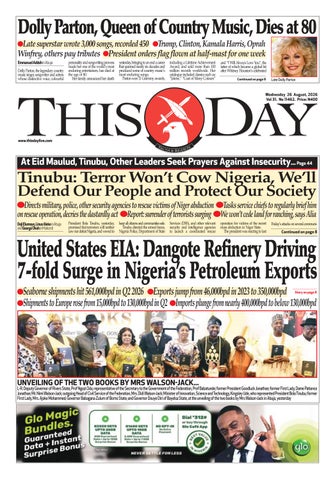
Dolly Parton, Queen of Country Music, Dies at 80
Late superstar wrote 3,000 songs, recorded 450 Trump, Clinton, Kamala Harris, Oprah Winfrey, others pay tributes President orders flag flown at half-mast for one week Emmanuel Addeh in Abuja Dolly Parton, the legendary country music singer, songwriter and actress whose distinctive voice, colourful
personality and songwriting prowess made her one of the world’s most enduring entertainers, has died at the age of 80. Her family announced her death
yesterday, bringing to an end a career that spanned nearly six decades and produced some of country music’s most enduring songs. Parton won 11 Grammy awards,
including a Lifetime Achievement Award, and sold more than 100 million records worldwide. Her catalogue included classics such as: “Jolene,” “Coat of Many Colours”
and “I Will Always Love You”, the latter of which became a global hit after Whitney Houston’s celebrated Continued on page 8
Late Dolly Parton
Wednesday 26 August, 2026 Vol 31. No 11462. Price: N400
www.thisdaylive.com TR
UT H
& RE A S O
N
At Eid Maulud, Tinubu, Other Leaders Seek Prayers Against Insecurity... Page 44
Tinubu: Terror Won’t Cow Nigeria, We’ll Defend Our People and Protect Our Society
Directs military, police, other security agencies to rescue victims of Niger abduction Tasks service chiefs to regularly brief him on rescue operation, decries the dastardly act Report: surrender of terrorists surging We won’t cede land for ranching, says Alia Deji Elumoye, Linus Aleke in Abuja and George Okoh in Makordi
President Bola Tinubu, yesterday, promised that terrorism will neither cow nor defeat Nigeria, and vowed to
keep all citizens and communities safe. Tinubu directed the armed forces, Nigeria Police, Department of State
Services (DSS), and other relevant security and intelligence agencies to launch a coordinated rescue
operation for victims of the recent mass abduction in Niger State. The president was reacting to last
Friday’s attacks on several communiContinued on page 8
United States EIA: Dangote Refinery Driving 7-fold Surge in Nigeria’s Petroleum Exports Seaborne shipments hit 561,000bpd in Q2 2026 Exports jump from 46,000bpd in 2023 to 350,000bpd Shipments to Europe rose from 15,000bpd to 130,000bpd in Q2 Imports plunge from nearly 400,000bpd to below 130,000bpd
Story on page 8
UNVEILING OF THE TWO BOOKS BY MRS WALSON-JACK...
L-R: Deputy Governor of Rivers State, Prof Ngozi Odu; representative of the Secretary to the Government of the Federation, Prof Babatunde; former President Goodluck Jonathan; former First Lady, Dame Patience Jonathan; Mr. Nimi Walson-Jack; outgoing Head of Civil Service of the Federation, Mrs. Didi Walson-Jack; Minister of Innovation, Science and Technology, Kingsley Ude, who represented President Bola Tinubu; former First Lady, Mrs. Ajoke Mohammed; Governor Babagana Zulum of Borno State; and Governor Douye Diri of Bayelsa State, at the unveiling of the two books by Mrs Walson-Jack in Abuja, yesterday
2
WEDNESDAY, AUGUST 26, 2026 • T H I S D AY
3
WEDNESDAY, AUGUST 26, 2026 • T H I S D AY
Are you involved or interested in
NON-OIL EXPORT BUSINESS?
Connect with our non-oil export team via email at exportdeskdepartment@zenithbank.com OR Visit any Zenith Bank branch nationwide and let us support you to grow your business.
4
WEDNESDAY, AUGUST 26, 2026 • T H I S D AY
5
THISDAY • WEDNESDAY, AUGUST 26, 2026
Group News Editor: Goddy Egene Email: Goddy.egene@thisdaylive.com, 0803 350 6821, 0807 401 0580
NEWS
SENATE COMMITTEE ON TERTIARY INSTITUTIONS AND TETFUND/NELFUND VISITS AKPABIO...
L-R: Senators Pam Mwadkon Dachungyang, Amos Yohana, Diket Plang and Shuaibu Salisu; Chairman, Senate Committee on Tertiary Institutions and TETFund/NELFund, Mohammed Muntari Dandutse; President of the Senate, Godswill Akpabio; Senators Anthony Ani, Kelvin Chukwu and Ekong Sampson, during a courtesy visit of the committee members to Akpabio in Uyo, yesterday PHOTO: SENATE PRESIDENT’S OFFICE
BudgIT Report: Despite States’ N15.5tn Revenue Windfall, Development Gains Remain Scanty Aggregate FAAC revenue increased to 73.3% in 2025, from 68.7% in 2022, as IGR’s contribution fell to 26.7%, from 31.4% Salaries, cost of governance, debt repayment exert huge toll on actual development Lagos remains largest IGR generator at N1.85 trillion, Enugu, Abia, Niger lead revenue growth as Ebonyi, Sokoto, Jigawa trail Report seeks stronger focus on public resource utilisation for tangible improvements in citizens’ welfare, others Onigbinde: states must build IGR to cover operating
James Emejo in Abuja, Nume Ekeghe and Jessica Erobomhan In spite of significant expansion in fiscal resources at the subnational level, following petrol subsidy removal, actual development remained unimpressive, according a report by the civic-tech organisation, BudgIT. That was despite aggregate revenue tripling to N15.53 trillion in 2025, from N4.84 trillion in 2022. BudgIT in its latest report, “Nigeria’s Economic Reforms: What Has Changed Across Nigeria’s States? An Analysis of State Finances in the Post-Subsidy Years,” said notwithstanding massive increase in funds available to the subnational governments, higher revenues had not sufficiently translated into improved welfare, better public services, or measurable development outcomes for citizens. Speaking on the report during an interview on Arise TV, Co-founder and Director of BudgIT, Oluseun Onigbinde, said the figures showed the extent to which states remained dependent on federal transfers and stressed the need for them to build stronger IGR bases. According to the report, states recorded a 220.76 per cent nominal increase in revenue within the three years under review, representing a compound annual growth rate (CAGR) of 47.48 per cent. However, much of the revenue windfall came from federal transfers rather than a fundamental transformation in states’ capacity to raise resources independently, the report stated.
The report indicated that aggregate Federation Account Allocation Committee (FAAC) receipts increased by 232.06 per cent, from N3.43 trillion in 2022 to N11.38 trillion in 2025, with a CAGR of 50.2 per cent. Meanwhile, Internally Generated Revenue (IGR) rose by 165.01 per cent, from N1.57 trillion to N4.15 trillion, representing a CAGR of 38.38 per cent. FAAC accounted for 68.7 per cent of aggregate state revenue in 2022 but increased to 73.3 per cent in 2025, while IGR’s contribution fell from 31.4 per cent to 26.7 per cent. The analysis also showed that though states spent more on capital projects, salaries and cost of government took a fortune while debt repayments continued to take a sizeable chunk of the resources. BudgIT pointed out that there had been expansion in fiscal capacity without a corresponding deepening of fiscal independence. The report stated that the revenue surge followed major fiscal and macroeconomic changes, particularly the removal of the petrol subsidy in 2023 and the unification of the foreign exchange market, which increased revenues accruing to the Federation Account and subsequently expanded allocations to states. However, it stressed that the critical issue was no longer simply how much money states received, but how effectively the additional resources were converted into development. According to the findings, aggregate actual expenditure also increased substantially, climbing from N6.22
trillion in 2022 to N17.88 trillion in 2025, representing a 187.53 per cent nominal increase and a CAGR of 42.20 per cent. Capital expenditure recorded a particularly significant expansion, rising from N2.79 trillion to N10.85 trillion over the period, it stated. Infrastructure spending also surged, increasing from N1.44 trillion in 2022 to N5.64 trillion in 2025 — an increase of 292.12 per cent and a CAGR of 57.69 per cent. Infrastructure consequently absorbed a larger proportion of aggregate state expenditure, rising from 23.1 per cent in 2022 to 31.6 per cent in 2025. Nonetheless, the findings suggested that the increase in development-related expenditure should not be interpreted simply as evidence of commensurate improvements in citizens’ welfare. Education expenditure, for instance, rose from N923.66 billion in 2022 to N2.18 trillion in 2025, representing a
There is big relief for retirees in Abia State as the government of Governor Alex Otti has commenced payment of outstanding N61.8 billion gratuities owed to retired state and local government workers. Commissioner for Information, Prince Okey Kanu, announced this during a post-State Executive Council media briefing Monday in Umuahia, describing the move as part of the administration’s commitment to
workers’ welfare and responsible governance. According to Prince Kanu, the government is beginning a structured process to address an inherited liability of N61.8 billion accumulated in the last 24 years. The Commissioner said that a comprehensive review by the Gratuity Committee set up by the present administration established the breakdown: N7.2 billion accrued between 2001 and 2010, N43.6 billion between 2011 and May 29, 2023, and
BudgIT stated that the trend underscored the continuing tension between the cost of running government and the need to channel scarce resources towards productive investment. The report further established an increasing dependence on FAAC by state governments. It stated that despite the 165.01 per cent increase in aggregate IGR, the growth was too insufficient to keep pace with expenditure as IGR’s contribution to total actual expenditure consequently declined from 25.17 per cent in 2022 to 23.20 per cent in 2025. Although states were generating more revenue internally, their own resources financed a smaller proportion of their rapidly expanding expenditure. BudgIT, therefore, warned that the apparent improvement in state finances could mask continuing structural dependence on federal transfers and, where necessary, other financing sources.
Enugu recorded the fastest overall revenue growth, with actual revenue rising from N102.68 billion in 2022 to N665.85 billion in 2025, representing a CAGR of 86.48 per cent. Abia followed with 66.05 per cent, Niger with 60.47 per cent, Taraba with 54.33 per cent and Bauchi with 53.87 per cent. Edo, Imo, Katsina, Anambra and Osun also recorded CAGRs above 50 per cent. Lagos remained the largest revenuegenerating state in absolute terms, with revenue rising from N889.45 billion in 2022 to N2.63 trillion in 2025. Its 43.49 per cent CAGR, however, ranked 22nd among the reporting states. On the other hand, Nasarawa recorded the slowest revenue growth at 27.94 per cent, followed by Kebbi at 32.59 per cent, Zamfara at 32.69 per cent, Ogun at 32.71 per cent, and Kaduna at 33.55 per cent.
Rising Global Cancer Burden Exposes Gaps in Cancer Prevention, Care Ayodeji Ake
The global cancer burden is continuing to rise, with 20.6 million new cases and 9.8 million cancer deaths estimated to have occurred worldwide in 2024, according to the latest figures released by the
Big Relief as Abia Govt Commences N61bn Pension Arrears Payment Boniface Okoro in Umuahia
135.48 per cent nominal increase and a CAGR of 33.04 per cent. Health spending also increased from N485.08 billion to N1.19 trillion, a 144.95 per cent increase and a CAGR of 34.80 per cent. However, the report stated that the expenditure share on development priorities, such as education, declined amid the much larger expansion in overall state resources. The report also found that personnel expenditure remained a major component of state spending, with increases in wage and salary obligations accounting for a substantial part of expenditure growth in many states. Administrative spending also varied significantly, with some states recording substantial increases in spending on government houses, offices of the Secretary to the State Government, legislatures, and other administrative structures.
another N10.9 billion from May 30, 2023, to date. The government said a 24-year accumulation of unpaid gratuities cannot realistically be cleared in the first three years of one administration, but Governor Otti has taken the “responsible and compassionate decision to confront the challenge rather than ignore it.” To ensure sustainability, gratuity payments from 2026 to 2031 will be incorporated into the state’s MediumTerm Expenditure Framework and captured in annual budgets.
International Agency for Research on Cancer (IARC). The new GLOBOCAN 2024 estimates, released yesterday through IARC’s Global Cancer Observatory, provide an updated picture of cancer incidence and mortality across countries, regions, age groups and sexes. The figures show that about one in five people worldwide is expected to develop cancer during their lifetime. Without significant improvements in prevention and treatment, the number of new cases is projected to reach 34 million annually by 2050, while cancer deaths could rise to 17.5 million. IARC’s Head of the Cancer Surveillance Branch, Freddie Bray, said the scale of the challenge required urgent action. “One in nine men and one in 13 women die from cancer,” Bray said, stating that differences in cancer types and the generally poorer prognosis of cancers affecting men contribute to the disparity.
The 2024 estimates also reveal significant geographical inequalities in the cancer burden. China alone accounts for approximately one in four cancer cases and one in four cancer deaths globally. Europe, despite accounting for only 9.2 per cent of the world’s population, contributes more than 20 per cent of global cancer incidence. Cancer incidence rates vary by as much as three-fold between countries, while mortality rates can differ by up to five-fold. The highest incidence rates are recorded in countries including Australia and Denmark, while some of the lowest occur in parts of sub-Saharan Africa. Mortality rates are particularly high in Eastern Europe and Melanesia, with some countries facing heavy burdens from specific cancers. Liver cancer, for instance, remains a major concern in Mongolia, while cervical cancer contributes significantly to mortality in Zimbabwe. According to Bray, the disparities
reflect not only differences in cancer risk but also inequalities in prevention, early detection, diagnosis and access to effective treatment. Lung cancer remains the leading cause of cancer incidence and mortality globally. It is the leading cause of cancer death in 89 countries, particularly among men. Breast cancer remains the most commonly diagnosed cancer among women, ranking first in 164 countries and serving as the leading cause of cancer death among women in 122 countries. Excluding China, breast cancer is the most commonly diagnosed cancer across all levels of the Human Development Index. Prostate cancer, meanwhile, is the most commonly diagnosed cancer among men in 123 countries, partly reflecting increased diagnostic testing. The burden is particularly concerning in sub-Saharan Africa, where breast and cervical cancers together account for more than half of cancers among women.
6
WEDNESDAY, AUGUST 26, 2026 • THISDAY
NEWS
ADESINA RECEIVING THE DAILY TIMES @ 100 GLOBAL IMPACT AWARD PACKAGE...
Dr. Akinwunmi Adesina (right) receiving the Daily Times @ 100 Global Impact Award package from Mr. Fidelis Anosike, Chairman, Folio Group/Publisher, Daily Times, as he confirms attendance as keynote speaker for the event
Indorama Unveils Expansion Plan as Nigeria Targets Petrochemical Industrialisation NLNG: Nigeria must build local industrial capabilities Gas infrastructure critical to petrochemical expansion, NGIC Blessing Ibunge in Port Harcourt Indorama Eleme Petrochemicals Limited has unveiled a fresh wave of investments aimed at expanding Nigeria’s petrochemical and fertiliser production capacity, as industry stakeholders call for stronger gas infrastructure, local manufacturing capabilities, and policies that will turn the country’s hydrocarbon resources
into long-term industrial wealth. The company’s Managing Director, Mr. Manish Mundra, represented by Head of Fertiliser Manufacturing, Upendra Singh, disclosed the expansion plans on Tuesday, at the 7th International Midstream and Downstream Oil and Gas Conference. The conference was organised by Centre for Gas Refining and Petro-
chemical Engineering, University of Port Harcourt, in conjunction with Nigerian Society of Chemical Engineers. Under the plan, Indorama is scheduled to commence a Gas Terminal 3 and gas treatment unit project in the fourth quarter of 2026, with completion targeted for 2029. The company will also begin a cracker debottlenecking and new
polymer project in the first quarter of 2027, expected to be completed by 2030. Another major component is a 1.75 million-tonnes-per-year methanol plant, marking Indorama’s diversification from petrochemicals and fertiliser into methanol production. The project is scheduled to commence in the third quarter of
Proposed N302.3bn National Cancer Institute to Curb Medical Tourism, Says NICRAT DG Onyebuchi Ezigbo in Abuja
The Director General of the National Institute for Cancer Research and Treatment (NICRAT), Prof. Usman Malami Aliyu, has said the construction of a National Cancer Institute will no doubt enhance treatment of cancer and save Nigeria huge foreign exchange spent on treatment abroad. The DG commended President Bola Ahmed Tinubu, for giving approval for the construction of a flagship National Cancer Institute at the cost of about N302.3 billion.
The approval for the building of the cancer institute was conveyed by the Coordinating Minister of Health and Social Welfare, Prof. Muhammad Ali Pate, at the last week’s Federal Executive Council (FEC) meeting in Abuja. According to Pate, the institute will be completed within 36 months. A statement signed by the Head, Media and Public Relations at NICRAT, Mr. Hassan Zaggi quoted Prof. Malami as having said that the approval is a clear “demonstration of care and concern for the
health and general well-being of all Nigerians by the President Bola Ahmed Tinubu-led government.” He further described the move as a bold intervention meant to better the living standard of Nigerians at all levels. “This project, will no doubt, make Nigeria the centre of attraction in terms of sophisticated cancer care and research in Africa and the world at large. “The facility will strengthen cancer research, treatment, innovation, capacity building and also provide world-class cancer
services in Nigeria. “This approval and many other steps taken by the President Tinubu-led government like the recent upgrading of more cancer centres, with three facilities in Kastina, Benin, and Enugu already completed, shows commitment, capacity and willingness to give Nigerians a better life,” Prof. Malami said.
2027, with additional capacity to be developed through 2031. Mundra said the investments reflected Indorama’s strategy of expanding domestic conversion of Nigeria’s gas resources into higher-value products rather than relying primarily on raw hydrocarbon exports. He said Nigeria should aspire to become a “hydrocarbon powerhouse for its industrialisation, not just its exports”, stressing that petrochemicals would remain indispensable to modern life through products, such as fertilisers, polymers, packaging materials, and chemicals. According to him, “Indorama currently produces 33.8 million tonnes of products globally, including 10.3 million tonnes in Africa.” The group is also a leading global producer of PET, synthetic gloves, and fertilisers. Mundra added that Indorama, currently the world’s fifth-largest fertiliser producer, expected to become the third-largest globally by 2029 or early 2030. Mundra urged Nigeria to move
from an extraction-based economy to one built around industrial ecosystems and local capabilities, stating that the country’s greatest long-term asset is its people rather than its finite oil and gas reserves. Managing Director of NLNG, Adeleye Falade, represented by Manager, Future Opportunities, Olufemi Lawal, said Nigeria’s localcontent policy must evolve beyond the use of local intermediaries to genuine domestic manufacturing. Falade challenged the industry to develop Nigerian-made valves, compressors, cables and other equipment currently imported from overseas. He said the country needed infrastructure, appropriate financing, and long-term business thinking to develop local manufacturing capabilities that could eventually serve export markets. He also advocated an ecosystem approach, citing Singapore’s Jurong Island, where companies shared infrastructure, utilities, and other services to lower costs and attract new investment.
Chevron Commits to Raising Domestic Market Gas Utilisation
Journalism.” ning the GMoU, including participaSanwo-Olu to Receive 2026 Global Transformation, Sylvester IdowuinWarri Represented by the manager, com- tion, transparency, accountability, Nigeria Limited (CNL) munications (CNL), Dr. Anyaegbudike sustainability and capacity building, Good Governance Prize in Washington DC Chevron said it had spent about $1 billion Victor, he highlighted Chevron’s were subsequently reflected in the annually in the past 10 years on partnership with communities in the Host Community Development Trust Governor Babajide Sanwo-Olu of Lagos State has been named recipient of the 2026 Global Transformation and Good Governance Prize by the Millennium Excellence Award USA. In a letter delivered by the Board of Directors of the Millennium Excellence Foundation, MEF, the award was conferred on Governor Sanwo-Olu following a rigorous selection process that considered the extraordinary achievements and developmental trajectory of
Lagos State under his leadership. The letter stated: “The Board has unanimously resolved to confer upon His Excellency Babajide Sanwo-Olu one of the most prestigious honours bestowed under the auspices of the Foundation – the Global Transformation and Good Governance Prize by the Millennium Excellence Award USA.” The award is conferred under the Royal Patronage of His Majesty Otumfuo Osei Tutu
II, Asantehene of Kumasi. The Asantehene, regarded as one of Africa’s most respected monarchs, will personally confer the honour alongside Her Royal Highness Lady Julia, Queen Consort, at the ceremony. The Millennium Excellence Awards USA recognizes outstanding individuals of African heritage and global contributors who have made significant impact in business, science, arts, philanthropy, and public service.
developing Nigerian content, adding the company was committed to increasing the utilisation of gas in the domestic market The general manager, Corporate Affairs, Oduselu Olusoga, stated this on Monday during a one-day Oil and Gas Reporting Workshop in Asaba, organised by the Nigeria Union of Journalists (NUJ), Delta State Council, in partnership with Chevron Nigeria Limited, with the theme, “Enhancing Professional Skills and Ethical Standards in Oil & Gas
Niger Delta, particularly through the Global Memorandum of Understanding (GMoU) model, which he said gave communities greater ownership of their development process. According to him, under the GMoU model, communities determine their development priorities and prepare five-year development plans, while Chevron provides funding and engages non-governmental organisations to support and monitor implementation. He said the principles underpin-
(HCDT) provisions of the Petroleum Industry Act (PIA). On Nigerian content development, Okusoga said the company’s activities had also contributed to the growth and capacity development of indigenous contractors in the Niger Delta. Speaking on gas and energy transition, he described gas as Nigeria’s primary transition fuel towards cleaner energy, saying Chevron was committed to increasing the utilisation of gas in the domestic market.
7
THISDAY • WEDNESDAY, AUGUST 26, 2026
NEWS
JIMOH IBRAHIM VISITS DAPO ABIODUN...
The Nigerian Ambassador to the United Nations, Senator Jimoh Ibrahim (left) and the Ogun State Governor, Prince Dapo Abiodun at the Ogun State Governor’s office, Oke-Mosan, Abeokuta on Monday
Umahi Visits Benin-Agbor-Asaba Road after Commuters’ Gruelling Experiences Says rehabilitation works will go beyond temporary fixes 56.5km Ibadan-Ijebu Ode dualisation flagged off
Emmanuel Addeh in Abuja The Minister of Works, David Umahi, yesterday visited the Benin-AgborAsaba road following the gruelling experiences of motorists and commuters on the strategic corridor, as the federal government moved to implement urgent measures to restore movement and address the worsening condition of the road. The visit, he said, followed a directive by President Bola Tinubu for the Federal Ministry of Works to urgently intervene in critical sections of the road network where deteriorating conditions had left commuters stranded for several days, a statement by his spokesman, Francis Nwaze said. Umahi, who expressed concern over the hardship being experienced by road users, said the federal government was determined to provide immediate relief while pursuing permanent solutions to the problems affecting the corridor. “President Tinubu has directed the Federal Ministry of Works to urgently intervene and ensure that necessary corrective actions are taken to restore movement on the affected roads as quickly as possible,” he said. The minister, who travelled to
Benin, Edo State, alongside members of the National Assembly Works Committees, was expected to meet representatives of the Edo and Delta State Governments, the Niger Delta Development Commission (NDDC) and other stakeholders to work out measures to address the crisis. He also apologised to motorists and commuters affected by the deteriorating road, saying the government recognised the severe hardship caused by the situation. The intervention on the BeninAgbor-Asaba corridor came as the ministry simultaneously commenced action on the Ifaki-Kabba-Ado Ekiti Road in Ekiti and Kogi states. Besides, Umahi directed the Minister of State for Works, Bello Goronyo, to lead a team of ministry officials to the Ifaki-Kabba-Ado Ekiti axis to assess the situation and commence urgent remedial works. The minister said the federal government’s approach would not be limited to temporary repairs, stressing that the immediate interventions would be accompanied by efforts to deliver lasting solutions. This comes after the formal flag-off of the 56.5-kilometre Ibadan-Ijebu Ode Road dualisation project in Oyo
State on Monday, where the minister declared that the era of temporary fixes on strategic federal highways was over. “Today marks the end of an era of temporary fixes on this vital corridor. Under the visionary leadership of President Bola Ahmed Tinubu, we are building roads that will outlive generations,” Umahi said. The Ibadan-Ijebu Ode project, approved by the Federal Executive
Nigeria’s Ambassador to the Kingdom of Saudi Arabia, Dr. Yakubu N. Gambo, with concurrent accreditation to Oman and Yemen, and Permanent Representative to the Organisation of Islamic Cooperation (OIC), has formally presented his Letters of Credence to the OIC Secretary-General, Mr. Hissein Brahim Taha, at the OIC Headquarters in Jeddah. The ceremony marks a renewed chapter in Nigeria’s engagement with the 57-member organisation. In a statement signed by the media aide, Idris Sarauta, the Secretary-General who received
Gambo underscored the longstanding fraternal ties between the OIC and the Federal Republic of Nigeria. In his remarks, Mr. Taha welcomed the resumption of Nigeria’s Permanent Representation and described it as a timely step toward deepening mutual understanding and solidarity among member states. Gambo conveyed the goodwill and greetings of President Bola Tinubu and the Government of Nigeria to the OIC leadership while reaffirming Nigeria’s unwavering commitment to the principles and objectives of the OIC Charter, and to working in close partnership to advance the collective interests of the Ummah. In a demonstration of strength-
and commercial potential of the LagosOgun-Oyo axis, reducing travel times drastically, and eliminating security vulnerabilities like kidnapping that thrived on dilapidated sections,” he said. Umahi said the project was one of the clear indications of the government’s commitment to transforming the country’s infrastructure landscape, particularly through the construction of durable roads capable of supporting
growing economic activities. Representing Tinubu at the ceremony, Ogun State Governor, Dapo Abiodun, described the project as an important economic connection between the two neighbouring states. “The Ibadan-Ibadan-Ijebu-Ode corridor is simply too important for the federal government to neglect. This administration is committed to delivering infrastructure that outlives generations,” he stated.
Private Sector Moves to Tackle Nigeria’s 20m Housing Deficit with New 50-Hectares in Abuja Kuni Tyessi in Abuja Real estate stakeholders are pushing for deeper private-sector collaboration to close Nigeria’s growing housing gap, as they flagged off work on a new 50-hectare residential project in the Federal Capital Territory. The call was made during the groundbreaking of Amani Estate in Kansas, Abuja, a development being driven jointly by Kopitar, OMEC Properties and Gynosure
Nigeria, OIC Pledge Deeper Partnership on Security, Trade, Humanitarian Issues Kuni Tyessi in Abuja
Council (FEC) and awarded to JRB Construction Limited, is expected to strengthen one of the major economic links between Oyo and Ogun states. Umahi described the 56.5-kilometre dualisation as an economic intervention capable of unlocking agricultural and commercial opportunities along the Lagos-Ogun-Oyo axis, reducing travel time and improving security. “By expanding this corridor, we are unlocking the massive agricultural
ened diplomatic engagement, the Secretary-General reaffirmed the OIC’s solidarity with Nigeria, particularly in addressing the security challenges confronting the country and other African Member States. He stressed that the Organisation stands ready to support Nigeria through enhanced cooperation in counter-terrorism, peacebuilding, and regional stability. Gambo expressed appreciation for the warm reception accorded to him and the Nigerian delegation, while noting that Nigeria values the OIC as a vital platform for dialogue, multilateral diplomacy, and the promotion of shared values of peace, tolerance, and development.
Realty Ltd. With the Federal Ministry of Housing and Urban Development estimating Nigeria’s housing deficit at over 20 million units, developers say private capital and partnerships will be critical to bridging the shortfall. Chairman of Kopitar, Mr. Anderson Idoko, said the project is a direct response to surging demand in Abuja and linked the pressure in the FCT to migration, the cycle of political appointments every four years, influx from other states, and returning members of the diaspora. “There are a lot of projects being launched because people are moving
into the private sector to see how we can help bridge Nigeria’s housing deficit. “There is, therefore, a pressing demand for housing from these groups, including newly married couples and people who are finally ready to own their own homes. We are trying to help bridge that gap,” he said. Managing Director of OMEC Properties, Mr. Michael Ofiwe, said joint efforts among developers can speed up delivery and open doors for different classes of investors. He disclosed that Amani Abuja will feature 1, 2 and 3-bedroom apartments, 3- and 4-bedroom terrace duplexes, semi-detached
and standalone homes. Ofiwe noted that the estate will include green spaces, recreational and commercial facilities to encourage community living and reduce residents’ need to travel for basic services. “Collaboration gives birth to miracles and magnificent project execution like this. What this means is that all categories of investors are accommodated. It does not matter whether you are just starting out or you are an experienced investor; there is a place for you here,” he said. Chief Executive Officer of Gynosure Realty, Mr. Michael Okuboye, said the developers’ goal goes beyond construction.
NSCDC Honours Commander of Mining Marshals, Onoja, for Outstanding Service to Nigeria Linus Aleke in Abuja The Nigeria Security and Civil Defence Corps (NSCDC) has honoured the Commander of the Mining Marshals, Assistant Commandant of Corps (ACC) Attah John Onoja, with a meritorious award for his outstanding service to the nation. The Commandant General of the NSCDC, Prof. Ahmed Abubakar Audi, presented
the meritorious award to the workaholic commander during the National Armourers’ Retreat and Symposium of the NSCDC in Abuja. Speaking during the award ceremony, the Commandant General of the NSCDC, Prof. Audi, said the award was presented in recognition of ACC Onoja’s exceptional dedication, discipline, professionalism, and unwavering commitment to national service.
He stressed that the recognition reflected the core values that ACC Onoja had consistently promoted in his efforts to strengthen the Corps and enhance operational excellence across all formations. The award, he said, also underscored the remarkable contributions of the Mining Marshals to the ongoing fight against illegal mining, mineral theft, and other economic crimes that threaten Nigeria’s solid minerals sector.
8
WEDNESDAY, AUGUST 26, 2026 • THISDAY
EIGHT
Akpabio: Tinubu Inherited Economy in Shambles, Nigeria Improving
Says APC will showcase achievements during campaigns Hails Sultan at 70, lauds his role in uniting the nation
Sunday Aborisade in Abuja
President of the Senate, Godswill Akpabio, yesterday declared that President Bola Tinubu inherited an economy in shambles but has transformed the situation through what he described as innovative thinking and economic reengineering. Akpabio said the All Progressives Congress (APC) would have enough achievements to present to Nigerians when it begins its nationwide campaign for the 2027 general elections, expressing confidence that Tinubu would secure a second term in office. The Senate President spoke yesterday in Uyo, Akwa Ibom State, while receiving members of the Senate Committee on Tertiary Institutions, Tertiary Education Trust Fund (TETFund) and Nigerian Education Loan Fund (NELFUND), led by its Chairman, Senator Mohammed
Dandutse, who paid him a visit. In a statement issued by his Special Assistant on Media, Jackson Udom, Akpabio was quoted to have said the Tinubu’s administration has recorded significant progress since assuming office, despite the difficult economic situation it inherited. “The current President has done a lot for Nigerians. He met an economy in shambles. When he came in, 27 states could not pay salaries and pensions, but today, the story has changed because of his reengineering and thinking out of the box,” he said. Akpabio said the achievements of the administration would become major campaign issues ahead of the 2027 elections, adding that Nigerians would ultimately judge the Tinubu government based on its record. “In 2027, Nigerians will separate the shafts from the grains and re-elect President Tinubu for a second term
in office,” he added. According to him, Tinubu has demonstrated an ability to introduce innovative solutions to Nigeria’s economic and developmental challenges. “We have a President who thinks outside the box, bringing about innovation. We will have something to tell Nigerians about the unprecedented achievements of Mr President at the campaign grounds,” Akpabio said. He challenged opposition politicians seeking to defeat Tinubu in 2027 to present their own records in public office for comparison with the achievements of the present administration. “Someone who is challenging him cannot even tell us what he did when he was governor. I can tell you what I did when I was the governor of my state. We will tell them a lot,” he said. Akpabio maintained that opposition politicians were aware of the achievements of the Tinubu administration
but were unwilling to acknowledge them because of their political interests. “Those in the opposition know too well the achievements of this government in the area of the economy, agriculture, security, education and fiscal policy, but because they are in the opposition, they won’t say it,” he said. The Senate President also defended the performance of the 10th National Assembly, saying the Senate under his leadership had made significant contributions to national development. “The 10th Senate under my leadership has made giant strides and we are very proud of it. We will continue to collaborate with the Executive arm of government to achieve more for Nigerians,” he said. Earlier, Dandutse said the committee’s visit was part of its constitutional responsibility and an opportunity to pay homage to Akpabio as a leader.
The senator commended the 10th National Assembly for legislation that he said had produced tangible benefits for Nigerians, particularly in the education sector. Dandutse described education as critical to Nigeria’s development, stressing that sustained investment in the sector was necessary for national progress. Meanwhile, Akpabio has congratulated the Sultan of Sokoto and President-General of the Nigeria Supreme Council for Islamic Affairs (NSCIA), Alhaji Muhammad Sa’ad Abubakar III, on his 70th birthday. Akpabio described his reign as a model of peace, statesmanship and national unity. Akpabio, in a congratulatory message issued by his Special Adviser on Media and Publicity, Hon. Eseme Eyiboh, on Tuesday, commended the Sultan for dedicating his life to service,
Akpabio wisdom, faith and the promotion of Nigeria’s peace and cohesion. The Senate President described Sultan Abubakar as an exemplary statesman whose leadership had consistently demonstrated grace, courage and a strong sense of responsibility to the nation.
UNITED STATES EIA: DANGOTE REFINERY DRIVING 7-FOLD SURGE IN NIGERIA’S PETROLEUM EXPORTS
Emmanuel Addeh in Abuja and Peter Uzoho in Lagos
Nigeria’s seaborne petroleum product exports have increased more than seven-fold since 2023, with the commissioning and expansion of the Dangote Petroleum Refinery driving a dramatic shift in the country’s refined products trade, the United States Energy Information Administration (EIA) has said. According to a new analysis by the EIA, Nigeria’s seaborne petroleum product shipments averaged 561,000 barrels per day (bpd) in the second quarter of 2026, compared with an annual average of just 79,000 bpd in 2023. Of the 561,000 bpd shipped in the second quarter, 350,000 bpd was exported to international markets, compared with only 46,000 bpd in 2023, the report added. The EIA said the surge was underpinned by the commencement of operations at the Dangote refinery in January 2024, which has substantially increased the availability of refined petroleum products in the Nigerian market. “With the increased supply of petroleum products in Nigeria from
the country’s largest refinery, imports fell, exports increased, and Nigeria became more self-sufficient in refined petroleum products,” the EIA stated. The development represents a major change from the situation before the Dangote refinery came on stream, when Nigeria’s existing state-owned refineries shipped less than 100,000 bpd of petroleum products by sea to various parts of the country and international destinations. The EIA analysis, based on data from Vortexa Analytics, showed that the increase in product shipments occurred in two major phases: first following the start of Dangote refinery operations and subsequently after maintenance and expansion work at the facility was completed in February 2026. The refinery’s crude distillation capacity increased from 650,000 bpd to 700,000 bpd following the maintenance and expansion programme. At the same time, disruptions to petroleum product trade through the Strait of Hormuz tightened global supplies, creating additional international demand for refined products from alternative suppliers, including Nigeria. The growth in domestic refining
has also been accompanied by a steep decline in Nigeria’s seaborne imports of petroleum products. The EIA said Nigeria imported nearly 400,000 bpd of petroleum products in 2023, but seaborne imports had fallen to less than 130,000 bpd by the second quarter of 2026, representing a reduction of more than 270,000 bpd, or at least 67.5 per cent, over the period. At the same time, intra-Nigerian shipments of petroleum products rose substantially, suggesting that a larger proportion of refined products is now being moved from domestic refining and distribution hubs to other parts of the country. According to the EIA, intraNigerian shipments averaged 211,000 bpd in the second quarter of 2026, compared with 81,000 bpd in 2025 and only 33,000 bpd in 2023. The 211,000 bpd recorded in Q2 2026 therefore represented a 160,000 bpd increase, or about 485 per cent, from the 2023 level. The EIA specifically linked the development to the Dangote refinery, noting that by shipping petroleum products to other parts of Nigeria, the facility had reduced the country’s dependence on imports.
DOLLY PARTON, QUEEN OF COUNTRY MUSIC, DIES AT 80
rendition. Born Dolly Rebecca Parton on January 19, 1946, in Pittman Center, Tennessee, she grew up in a oneroom cabin in nearby Locust Ridge as one of 12 children of tobacco farmer, Robert Lee Parton. Her impoverished upbringing became a recurring theme in her music, giving emotional weight to songs that spoke about family, hardship, ambition and working-class life, a Reuters report said yesterday. Her mother, Avie Lee, she once said, was a constant source of musical inspiration, singing songs from England, Ireland and Wales. She received her first real guitar at eight and was singing on a local radio station by 11. At 13, she appeared at the Grand Ole Opry, the celebrated country music venue in Nashville. After high school, she moved to Nashville to pursue music professionally and established a successful partnership with country singer Porter Wagoner. Their collaboration produced 14 top-10 duets and included a long-running stint on Wagoner’s television show.
When Parton decided to pursue a solo career, she wrote “I Will Always Love You” as a farewell to Wagoner. The song later became one of the most recognisable compositions in popular music. Her songwriting became one of the defining features of her career. Parton was estimated to have written about 3,000 songs during her lifetime, although she recorded only about 450. “I love to write poetic songs and sing flowery words,” she wrote. “I like to make you see something visually, so I want to paint a picture. And I love to come up with clever lines, not just like a songwriter, but like a poet,” she added. Her songs were repeatedly embraced by artists outside country music. “Jolene”, for instance, was covered by artists including Beyoncé and The White Stripes, while “I Will Always Love You” became a worldwide phenomenon through Houston’s recording. She made her film debut in 1980 in “9 to 5”, starring alongside Jane Fonda and Lily Tomlin. The title song earned her an Academy Award
nomination for songwriting. She received another Oscar nomination in 2006 for “Travelin’ Thru”, written for “Transamerica”. Her other acting credits included “The Best Little Whorehouse in Texas”, “Steel Magnolias”, “Rhinestone” and “Straight Talk”. Twenty-five of her songs reached No. 1 on the Billboard country charts. She was inducted into the Songwriters Hall of Fame and received its Johnny Mercer Award in 2007. In 2022, she was inducted into the Rock & Roll Hall of Fame. Away from entertainment, Parton became known for her philanthropy and business ventures. She founded Dollywood, a major theme park in her home state of Tennessee, which became a significant tourist attraction. Her literacy programme for young children expanded beyond the United States to Canada, the United Kingdom, Australia and Ireland, while she also supported scholarships for students in the Tennessee county where she was born. Continued on page 43
According to the US organisation, Nigeria’s growing refining capacity has also changed its position in international petroleum product markets, with Europe emerging as a major destination for its refined products. The EIA said Nigeria’s seaborne petroleum product exports to Europe averaged 130,000 bpd in the second quarter of 2026, up from 40,000 bpd in 2025 and only 15,000 bpd in 2023, representing an increase of 115,000 bpd, or about 767 per cent, compared with 2023.
In the same vein, exports to other African countries also increased, reaching nearly 120,000 bpd in Q2 2026, compared with 89,000 bpd in 2025. The figures indicated that Nigeria has moved beyond its traditional role as a major crude oil exporter and importer of refined petroleum products, increasingly becoming a supplier of refined fuels to both regional and international markets. The EIA said the growth in Nigeria’s exports was occurring at a time when petroleum product supplies from other regions had
been constrained, increasing the importance of Nigerian refined products in international markets. The expansion of Nigeria’s refining capacity could accelerate further, with Dangote Group planning to double the refinery’s capacity through the addition of a second 750,000 bpd crude oil distillation unit by 2028. If implemented, the planned expansion would take the refinery’s crude distillation capacity to about 1.45 million bpd and significantly increase Nigeria’s potential refining surplus.
TINUBU: TERROR WON’T COW NIGERIA, WE’LL DEFEND OUR PEOPLE AND PROTECT OUR SOCIETY ties in Borgu Local Government Area of Niger State. That was as the Joint Task Force North-East, Operation Hadin Kai (OPHK) reported an unprecedented increase in terrorist surrenders. Acting Military Information Officer of Joint Task Force North-East, Operation Hadin Kai, Captain Mohammed Goni, said, in a statement, that the development was a significant indicator of growing pressure within terrorist camps. Meanwhile, Benue State Governor, Hyacinth Alia, vowed that his administration will not cede any portion of the state to pastoralists for ranching without the consent of the people, despite the new security challenges. Alia spoke yesterday in Katsina-Ala during the commencement of a statewide tour of federal constituencies. Tinubu, in a release by his spokesperson, Bayo Onanuga, expressed outrage over the abduction and killing of innocent citizens by criminal elements in the state and directed the service chiefs to give him regular briefings on the rescue operation until all those abducted had been accounted for. Sounding optimistic, Tinubu declared, “Terror will not cow Nigeria. We will defend our people, protect our communities, and uphold the sanctity of human life. “Those who carried out this cowardly attack on defenceless Nigerians are enemies of peace and enemies of humanity, who will not go scot-free. “I extend my deepest condolences to the families of those who were killed in this barbaric assault and pray that Almighty God grant them eternal rest, and grant their loved ones the fortitude to bear this painful loss.”
Tinubu told the people, “You are not alone. The entire nation shares your anguish. We will not rest until your sons, daughters, mothers and fathers are brought back safely to you “My prayers are with the people of Niger State at this difficult time. The Federal Government stands firmly with the State Government and will provide all necessary support to aid recovery, relief, and security reinforcement.”
Report: Surrender of Terrorists Surging The Joint Task Force North-East, Operation Hadin Kai (OPHK), recorded an unprecedented increase in terrorist surrenders week-on-week, rising from more than 50 terrorist commanders, fighters and affiliates in the previous week to more than 150 in the current week, the military said. The military stated that the significant increase reflected the cumulative effect of sustained intelligence-led operations, intensified military pressure, and coordinated kinetic and non-kinetic efforts aimed at degrading terrorist capabilities and encouraging voluntary disengagement from terrorism. According to a statement by Acting Military Information Officer of Joint Task Force North-East, Operation Hadin Kai, Captain Mohammed Goni, the development is a significant indicator of growing pressure within terrorist formations, particularly on their freedom of movement, logistics, sustainment, and ability to retain personnel within their enclaves. Goni stated that the recovery of weapons and ammunition from some of the surrendering elements further highlighted the operational impact of sustained pressure on terrorist
networks. He said, “The surge in surrenders also demonstrates the growing effectiveness of Operation Hadin Kai’s comprehensive counter-insurgency approach, which combines intelligenceled operations with strategic communication, civil-military engagement, and other non-kinetic lines of effort. “Collectively, these measures are disrupting terrorist activities and support networks, weakening hostile narratives, and encouraging further disengagement. “Strategic communication remains central to this effort by conveying credible messages to those willing to abandon terrorism while exposing the consequences of continued association with terrorist groups.” Goni stated, “All persons who surrender are profiled, documented, and handled in accordance with established procedures and applicable laws. “The theatre will continue to exploit the current momentum to encourage further disengagement and weaken terrorist recruitment and sustainment mechanisms.” The military high command commended the troops for their resilience, discipline, and operational effectiveness, urging them to sustain the momentum and continue denying terrorist elements freedom of action across the theatre. Goni said Operation Hadin Kai remained resolute in its mission to sustain pressure on terrorist networks, disrupt their capabilities and support structures, protect civilians, and create the conditions necessary for the restoration of lasting peace, security, and normalcy across the North-east region. Continued on page 45
9
THISDAY • WEDNESDAY, AUGUST 26, 2026
NEWS
PRESENTATION OF THE INTERNATIONAL SCHOOL AWARD TO GRACE SCHOOLS...
L-R: Deputy Country Director, Nigeria, British Council, Mr. Chilufya Besa; International School Award Coordinator, Grace Schools, Mr. Jude Ashiedu; Deputy Head of School, Grace Children School, Mr. Paul Ibe; Finance Director, Grace Schools, Mr. Ademola Edun; and Supervisor, Upper Primary, Mrs. Chika Erondu, during the presentation of the International School Award to Grace Schools for the fourth consecutive time, in Lagos... recently
NAC Okays Framework to Build Nigeria’s Digitised Modern Addressing System Shettima: we’re building institutions that match energy, mobility of Nigerians under Renewed Hope Agenda
Deji Elumoye in Abuja National Addressing Council (NAC) has ratified the preliminary framework for the realisation of Nigeria’s vision to build a digitised and modern addressing system for the country. Under the new arrangement, the Federal Ministry of Science, Technology and Innovation will serve as secretariat for greater efficiency and coordination, while other agencies will synergize efforts to achieve set objectives. The decision was taken at State House in Abuja at a meeting of the council chaired by Vice President
Kashim Shetima, with key members and stakeholders in the public and private sectors in attendance. Addressing the council, Shettima stated, “Under the Renewed Hope Agenda, our duty is to build institutions that match the energy and mobility of our people. We must build a system that locates every community, support enterprise without barriers and strengthens government without compromising privacy. “Our objective should be simple: for Nigerians to understand, wherever a citizen lives, wherever a business operates, wherever help is required,
Nigeria should find the address. This is the standard before us and I am confident that the council will deliver.” He explained the task before the council was to build a national addressing system worthy of the scale and ambition of the country. He maintained that the addressing system must serve the village as effectively as the metropolis. According to the vice president, “Address is more than just a description of where a person lives or where a business operates. It is a point of connection between the citizen and the state; between the enterprise and
opportunity; between identity and service. “A country that cannot consistently locate its people and businesses carries an avoidable weakness into planning, commerce, security and social protection.” Shettima warned that while geography must never become a sentence of invisibility, every Nigerian household and every legitimate enterprise should be located within a trusted national framework. He stated, “And the strength of a modern addressing system lies in its ability to speak to other public systems.
Yoruba Tennis Club Centenary Week: Fatomilola Advocates Responsibility, Character in Pursuit of Destiny Funmi Ogundare Nigerian dramatist, film actor and poet, Prof. Peter Fatomilola, yesterday urged Nigerians to take responsibility for their choices and actions, saying destiny should not be used as an excuse for failure, indolence or lack of preparation. Fatomilola, who made this call at Yoruba Tennis Club (YTC) centenary cultural colloquium said while individuals might be born into circumstances they did not choose, they still had the power to influence their lives through knowledge, hard work, character and perseverance. Speaking on the theme, ‘Ayanmo: Destiny and Understanding the Journey of Life’, he explained that the Yoruba understanding of destiny was more complex than the belief that human beings were merely controlled by predetermined forces. He stressed that destiny should be understood in relation to what people inherit, encounter, choose and ultimately become. According to him, people do not choose their parents, place of birth, childhood, period of history, or natural talents, but they can decide whether to acquire knowledge, work hard, remain honest, forgive,
persevere and use opportunities responsibly. “Destiny should not become an excuse for business,” he said, urging people to avoid attributing failure or lack of progress entirely to fate. Fatomilola explained that in Yoruba philosophy, Ayanmo is closely associated with the purpose of life a person is believed to be born to fulfil, while the concept of ‘ori ‘ is central to understanding an individual’s destiny, spiritual identity and personal guiding principle. He however stressed that having potential was not the same as fulfilling it, using the example of a seed which, despite containing the potential to become a tree, still requires soil, water, sunlight, protection and time to grow. “A person may come into the world with certain potential, but circumstances and choices determine how those potentials are expressed,” he stated. The actor and scholar warned against the tendency to invoke destiny after failure, saying people who refuse to work, prepare or develop themselves cannot justify their actions by claiming that whatever is meant for them would eventually happen. “Destiny is not a scheme for
failure. Destiny should inspire responsibility and not irresponsibility,” he said. Fatomilola also called for a balance between destiny and free will, noting that although people could not control every circumstance or the behaviour of others, they could control their responses, decisions and character. He said the more important question people should ask was not only what destiny had given
them, but what they were doing with what they had been given. “That is where responsibility begins,” he added. The professor further emphasised the importance of preparation, faith, knowledge, effort and character in achieving one’s purpose, noting that prayer without preparation could lead to disappointment, while preparation without wisdom could result in frustration.
Our digital addressing framework must connect intelligently with other digital identity, government databases and wider digital public infrastructure. “When a verified identity can be linked securely to a verified address, the gains extend across financial inclusion, social interventions, logistics, planning and emergency response.” On the mandate of members of the council, the vice president said the ambition required institutional discipline. He appointed the Federal Ministry of Science, Technology and Innovation to serve as secretariat of the NAC. According to the vice president, “The Federal Ministry of Science, Technology and Innovation is to serve as secretariat of the council. It must guide technical implementation, systems integration, interoperability and standards. “NIMC has an essential responsibility in addressing individual verification and authentication, while CAC must support verification of business addresses. NIPOST remains indispensable for postcode administration and postal infrastructure. “The success of this undertaking will also be decided, where Nigerians live. States and LGAs working through the NGF and ALGON must drive implementation at the community level through the local addressing and proof of address. “NITDA, NDPC, ONSA, CBN,
NCC and the OPS must bring their mandates to bear. No institution can own a system whose usefulness depends on participation across our federation.” Earlier, Minister of Interior, Dr. Olubunmi Tunji-Ojo, said with the vice president, who is also Chairman of National Economic Council, serving as Chairman of NAC, the addressing process was fundamental and quite foundational to Nigeria’s economic revolution. Stating that it was about the foundation of harnessing the talent of the average Nigerian entrepreneur, he expressed confidence that news of the addressing process will restore confidence of foreign investors in Nigeria. Tunji-Ojo added, “I think also that if the news of this initiative goes out, there will be a lot of incidents in terms of investors, knowing fully well that it’s no more business as usual but business unusual. I want to encourage all members of Council; let’s give our best to this.” Minister of Science, Technology and Innovation, Dr. Kingsley Tochukwu Udeh (SAN), thanked the vice president for the leadership he had demonstrated in steering the ship of the council from the point of crisis management to the point of synergy, collaboration, and harmonious coordination among relevant agencies.
N21.5bn Lekki Peninsula Property: CASER Writes OSGOF, Demands Details on Intervention
Alex Enumah in Abuja
The Citizens Advocacy for Social and Economic Rights (CASER), in compliance with the Freedom of Information (FoI) Act, has formally, through digital/electronic PDF format, requested, through its letter to the Office of the Surveyor General of the Federation (OSGOF), to provide the public-interest organisation with details and information concerning its intervention in a Lagos property of approximately 13.067 hectares. The property comprises Plots 5,
6, 7 and 8, Maiyegun Tourism Zone, Lekki Peninsula Scheme II, in Lagos. According to CASER’s Executive Director, Mr. Frank Tietie, the property is covered by a Lagos State Certificate of Occupancy dated July 15, 1988 and is claimed by BraveMatt Property and Investment Limited. Meanwhile, speaking with journalists on Tuesday in Abuja, the rights activist stated that Section 4 of the Freedom of Information Act (FOIA) requires a public institution to provide the requested information or communicate a reasoned refusal
within seven days of receiving the application. He said: “Failure to respond within the statutory period may be treated as a deemed refusal, whereupon CASER reserves the right to apply to the Federal High Court for judicial review and appropriate consequential orders. “This request is intended to ascertain whether OSGOF acted within its lawful authority and with proper regard for the pending proceedings and subsisting order. “CASER has not reached any
conclusion regarding contempt, misconduct or criminal liability and the alleged acts amount to corrupt abuse of office on the part of any person”. He stated that Bravett, a Property and Investment Company, bought the property from Industrial and General Insurance (IGI) PLC and 4H Nigeria Ltd. As a public-interest organisation, he said CASER is committed to transparency, accountability, due process, respect for property rights and obedience to court orders.
10
WEDNESDAY, AUGUST 26, 2026 • T H I S D AY
U N D E R T H E PAT R O N AG E O F H I S E XC E L L E N C Y P R E S I D E N T B O L A A H M E D T I N U B U, G C F R
D N O Y E B TY I V I T C CONNE DGE TO I R B E H T N G I E R E SOV n
o i t a v o Inn
Be There SUPPORTING PARTNER
STRATEGIC PARTNER
ENDORSED BY
SPACETECH PARTNER
GOLD SPONSOR
SUPPORTING SPONSOR
GITEXNIGERIA.NG #GITEXNIGERIA
WEDNESDAY, AUGUST 26, 2026 • T H I S D AY
11
12
WEDNESDAY, AUGUST 26, 2026 • THISDAY
NEWS
AFRICAN BORDERLANDS RESEARCH NETWORK CONFERENCE...
Comptroller General of the Nigeria Immigration Service (NIS), Kemi Nandap (ninth left); Senior Advisor on Policy Research, Kareem Olajoku, representing the Minister of Interior, Dr. Olubunmi Tunji-Ojo (eighth left); Lagos State Commissioner for Tertiary Education, Hon. Tolani Sule Akibu, representing Governor of Lagos State, Babajide Sanwo-Olu of Lagos State (seventh left); Vice-Chancellor, Lagos State University, Prof. Ibiyemi Olatunji Bello (sixth left), top officials of African Borderlands Research Network (ABORNE), and other invited guests at the opening ceremony of the 2026 ABORNE conference in Lagos on Monday
Nigeria, Thailand Move to Deepen Economic Ties, Sign Technical Cooperation MoU Michael Olugbode in Abuja Nigeria and Thailand have taken steps towards a stronger economic partnership, with both countries signing a Memorandum of Understanding (MoU) on technical cooperation and expressing readiness to expand trade, investment, technology transfer and development collaboration. The agreement, signed in Abuja on Tuesday, is expected to provide a framework for closer cooperation in skills development, agriculture, technology, innovation and other areas capable of strengthening the economies of both countries. Nigeria’s Minister of Foreign Affairs, Ambassador Bianca Odumegwu-Ojukwu, signed the agreement on behalf of the Federal Government, while Thailand’s Deputy Prime Minister and Minister of Foreign Affairs, Sihasak Phuangketkeow, signed for his country. Speaking at the ceremony, Odumegwu-Ojukwu said Nigeria was seeking to move its relationship with Thailand beyond traditional areas of engagement and establish a more comprehensive economic partnership capable of delivering tangible benefits to citizens of both countries. She said Nigeria welcomed Thailand’s Thailand-Africa Initiative and called for stronger collaboration between the Nigerian Technical Aid Corps (NTAC) and the
Thailand International Cooperation Agency (TICA), particularly in skills acquisition, technology transfer and sustainable development. The minister also highlighted the Thailand-Nigeria Sustainable Agricultural Technology Development Project, urging its expansion to additional parts of Nigeria. According to her, deeper cooperation in agricultural research, technology and innovation could help Nigeria improve productivity, strengthen food security and create new opportunities for farmers and businesses. Odumegwu-Ojukwu said Nigeria was prepared to elevate its relationship with Thailand to a strategic partnership, with economic cooperation serving as one of its major pillars. She urged Thai investors to take advantage of Nigeria’s large consumer market and investment opportunities, calling for the diversification of bilateral trade beyond crude oil, rice and agricultural machinery. The minister identified agroprocessing, manufacturing, energy, information and communications technology, mining and renewable energy as some of the sectors where increased Thai investment and joint ventures could generate significant economic value. She also proposed the establishment of a Joint or Bi-National Commission to provide an institutional mechanism for regular economic
dialogue, track the implementation of bilateral agreements and fasttrack negotiations on outstanding agreements. Among the pending instruments are the Investment Promotion and Protection Agreement, Trade Agreement, and Agreement on Economic, Scientific, Technical and Cultural Cooperation. Odumegwu-Ojukwu further called for closer engagement between the Association of Southeast
Asian Nations (ASEAN) and the Economic Community of West African States (ECOWAS), saying stronger links between the two regional blocs could open new avenues for trade, investment and development. For Thailand, Phuangketkeow described Nigeria as a key economy in Africa and said a strategic economic partnership between the two countries would help boost investment and trade while
creating positive outcomes for their populations. The signing comes as Nigeria continues efforts to attract foreign investment, diversify its economy and strengthen international economic partnerships amid the push to reduce dependence on crude oil revenues. For Thailand, deeper engagement with Nigeria offers access to one of Africa’s largest consumer markets and a strategic gateway into the
wider West African market, while Nigeria stands to benefit from Thailand’s experience in manufacturing, agriculture, technology and industrial development. The new technical cooperation framework could therefore serve as a foundation for broader economic engagement, provided both governments translate the commitments into concrete projects, investment agreements and sustained privatesector partnerships.
Nigerian Agribusiness Firm Raises N10bn, Builds Four Factories to End Raw Export Era Targets stock exchange listing, says value-addition can increase revenue by 200%
Mary Nnah
Nigerian agribusiness firm, Cardinal Torch Company Limited, has raised N10 billion from the capital market and is building four processing plants in Ogun and Lagos states as it moves away from raw commodity exports to value-added manufacturing. The announcement was made at an exclusive media parley hosted by the company in Victoria Island, Lagos, recently. The meeting was attended by members of the company’s management board, including Managing Director/Chief Executive Officer, Mr. David Oladunjoye Olurin; Executive Director, Operations and Logistics, Mr. Bamitale Akindele; Chief Technical Officer, Emmanuel
Mshelia; and Head of Business Development and Commercial, Ndutimobong Sunday. Speaking at the event, Olurin said the company, founded in 2020, had spent six years exporting cocoa, cashew, sesame, and soya in raw form, but was now entering a new phase of processing. He said the company already had ready-to-eat cashews in supermarkets and was exporting to the UK, UAE and the Arab Gulf. Olurin stated, “We are creating a legacy organisation that will live after us. Listing makes the interest of the company public and protects it.” He disclosed that the company had successfully issued a N10 billion Commercial Paper, Series 1, which
was fully subscribed and was now listed on the Nigerian Exchange Group. He said the company deliberately did not take more than it asked for, despite being oversubscribed, and that Series 2 will follow once a clear roadmap was in place. He added that the long-term goal was to list Cardinal Torch on the Nigerian, London or New York Stock Exchanges to ensure sustainability beyond the founders. Giving details of the projects, Mshelia said the company was building a 10-ton per day cashew processing plant in Shagamu with a daily output of 2.5 tons of white kernels. The plant will also extract cashew
nut shell liquid for industrial use and use cashew shells to power boilers. He said the next phase was a 250-ton per day soybean plant to produce crude and refined soya oil, meal and lecithin in order to bridge Nigeria’s supply gap, followed by a 40-ton per day cocoa plant in Ogun to process cocoa into powder, liquor, butter, cake, and, later, chocolate bars. He said the company was also setting up an FMCG plant in the Lagos Free Trade Zone for pasta, spaghetti, noodles, flour, semolina and carbonated drinks. Mshelia stated that Nigeria produced between 280,000 and 350,000 metric tons of cashew annually, but more than 80 per cent was exported raw to India and Vietnam.
Court Faults Bank for Blocking Employee’s CBN Appointment, Declares Her Constructively Dismissed Wale Igbintade The National Industrial Court of Nigeria (NICN), Lagos Judicial Division, has held that Union Bank of Nigeria Plc constructively dismissed a former employee, Mrs. Edafetite Usin, after subjecting her to career stagnation, unfair administrative treatment and professional isolation. Justice Joyce Damachi, in her judgment, faulted the bank for reversing Usin’s confirmation as Head of General Services eight days after it was communicated to her and subsequently writing to the Central Bank of Nigeria (CBN) to demand the reversal of her appointment as Chairperson
of the Financial Inclusion Special Interventions Working Group (FISIWG). The court also found that the bank failed to adequately justify Usin’s redeployment to Abuja in October 2021, particularly its failure to resolve her concerns over accommodation and an existing mortgage in Lagos. Justice Damachi held the cumulative effect of the bank’s actions created a hostile work environment that made continued employment intolerable and forced her to resign. The court consequently declared that Usin was constructively dismissed and ordered Union Bank to pay her N854,632 as one month’s salary in lieu of notice, N5,127,920
as general damages and N500,000 as costs. The judgment followed a suit marked NICN/LA/239/2022, instituted by Usin against the bank over her employment and eventual resignation. She joined Union Bank on August 14, 2009, as a Deputy Manager and was confirmed in November 2010. She was promoted to Manager in October 2012 but claimed that, despite consistently strong performance appraisals and significant contributions to the bank, she was not promoted again during the remainder of her employment. Usin had sought, among other reliefs, a declaration of constructive
dismissal, N854,632 as salary in lieu of notice, N86 million representing salaries she claimed she would have earned as Senior Manager, N50 million for salaries allegedly lost as Principal Manager, N120 million in exemplary damages and N5 million as costs. Union Bank opposed the claims, maintaining that Usin voluntarily resigned after giving one month’s notice in accordance with her contract. The bank argued that promotion was a matter of managerial discretion and not a contractual entitlement, while her redeployment to Abuja was a lawful administrative decision accompanied by relocation
allowances. Justice Damachi acknowledged that promotion was generally a managerial prerogative and that Usin’s contract did not guarantee automatic promotion. However, the court found the circumstances surrounding the reversal of her confirmation as Head of General Services significant. According to the judgment, Usin’s confirmation was communicated on January 25, 2017, but reversed eight days later. Although the bank attributed the reversal to the absence of the Managing Director’s signature, the court found that it failed to explain why the confirmation had been
communicated in the first place or why it was reversed despite her strong performance record. The court also attached significant weight to Union Bank’s intervention in Usin’s CBN appointment. She had been appointed Chairperson of the FISIWG in April 2021, but the bank subsequently wrote to the CBN demanding an immediate reversal of the appointment. Justice Damachi held that the bank’s action was inconsistent with its implied duty of mutual trust, confidence and support towards its employee, noting that the bank failed to show that the CBN appointment conflicted with Usin’s duties or involved any misconduct.
WEDNESDAY, AUGUST 26, 2026 • T H I S D AY
13
14
WEDNESDAY, AUGUST 26, 2026 • T H I S D AY
COMMUNIQUÉ
ISSUED AT THE END OF THE 2026 CONFERENCE OF THE CATHOLIC MEN’S GUILD OF THE CATHOLIC CHURCH OF THE ASSUMPTION, FALOMO, IKOYI, LAGOS.
THEME: “Politics and Governance:
PREAMBLE.
WHERE DO WE DRAW THE LINE?”
The Catholic Men’s Guild of the Catholic Church of the Assumption, Falomo, Ikoyi, Lagos, successfully held its 2026 Annual Conference on Saturday, 27 June 2026, at The Colonnades Hotel, Ikoyi, Lagos, under the theme “Politics and Governance: Where Do We Draw the Line?” The Conference assembled eminent religious leaders, statesmen, public office holders, academics, professionals, policymakers, members of civil society and the Catholic faithful to reflect on the state of governance in Nigeria and to propose practical pathways towards national renewal. Following the keynote address, panel presentations, extensive deliberations and an engaging interactive session, participants adopted the following communiqué.
KEY OBSERVATIONS
The Conference observed that: 1. Politics and governance are inseparable and should always be directed towards the promotion of the common good. Politics loses its legitimacy when it becomes merely an instrument for acquiring power, wealth or personal advantage. 2. Nigeria continues to grapple with serious governance challenges, including weak institutions, corruption, insecurity, economic hardship, unemployment, declining public confidence in leadership and inadequate adherence to the rule of law. 3. Sustainable democracy requires strong, independent and accountable institutions that operate above the interests of individuals. Accordingly, Nigeria must deliberately strengthen institutions that promote transparency, accountability, participation, justice and shared prosperity. 4. Ethical leadership remains indispensable for national development. Public office should be regarded as a sacred trust demanding integrity, competence, transparency, accountability and selfless service. 5. The rule of law is the bedrock of democracy and national stability. No society can achieve lasting peace or development where the rule of men supersedes the rule of law. 6. Electoral integrity remains central to democratic governance. The credibility of elections must be strengthened through transparent electoral processes, credible collation and transmission of results, and public confidence that every lawful vote counts. 7. The Conference expressed concern over the increasing incidence of elected public officials changing political parties in circumstances that weaken electoral accountability and diminish public confidence in representative democracy, and called for greater anti-defection laws to discourage such tendencies. 8. Constitutional, political and institutional reforms remain necessary to strengthen federalism, deepen democratic participation, improve governance structures and promote national cohesion. 9. Fiscal responsibility, economic diversification, enterprise, employment creation and prudent management of national resources are essential for sustainable national development. 10. Discussions on restructuring, fiscal federalism and resource management should be conducted through inclusive national dialogue in a manner that promotes justice, equity, national unity and the overall interest of the Nigerian people. 11. Responsible population planning, quality education, accessible healthcare and sustained investment in human capital are indispensable for Nigeria’s future development, while respecting the dignity of the human person and the moral values cherished by society. 12. Nigerian youths remain critical stakeholders in national development and should actively participate in governance. However, meaningful national renewal requires not only generational change but also integrity, competence and a commitment to ethical leadership. 13.
Democratic governance is a shared responsibility. Citizens must remain
actively engaged beyond elections by demanding transparency, accountability and responsible leadership from those entrusted with public office.
RESOLUTIONS. Having carefully considered the issues affecting governance in Nigeria, the Conference resolved to: 1. Continue to promote ethical politics as the indispensable foundation for good governance and national development. 2. Intensify civic education aimed at promoting responsible citizenship, democratic participation, integrity and accountability. 3. Support initiatives that strengthen democratic institutions, judicial independence, constitutional governance and the rule of law. 4. Advocate comprehensive electoral reforms that safeguard the sanctity of the ballot and ensure that election outcomes truly reflect the sovereign will of the electorate. 5. Encourage political parties and candidates to conduct campaigns based on issues, civility, honesty and respect for democratic principles. 6. Encourage competent, credible and service-oriented Nigerians, particularly young people, to participate actively in public leadership. 7. Support constructive national dialogue on constitutional reform, restructuring, fiscal federalism and equitable resource management in the overall interest of national unity and sustainable development. 8. Encourage governments at all levels to pursue economic policies that promote productivity, enterprise, innovation, employment generation and fiscal responsibility. 9. Continue to provide a non-partisan platform through which faith communities, policymakers, professionals and civil society may engage constructively on issues affecting Nigeria’s future. 10. Call upon all Nigerians to reject corruption, electoral malpractice, political violence, hate speech and every conduct capable of undermining democracy, national unity and peaceful coexistence.
APPRECIATION. The Conference expressed profound appreciation to His Grace, Most Rev. (Dr.) Alfred Adewale Martins, Archbishop of the Metropolitan See of Lagos, for his exemplary spiritual leadership and unwavering commitment to justice, ethical leadership and national development. The Conference also expressed gratitude to the keynote speaker, distinguished panellists, moderator, Chairman of the Occasion, the President of the Catholic Men’s Guild, the Planning Committee, sponsors, volunteers and all participants whose invaluable contributions ensured the success of the Conference.
CONCLUSION. The Conference reaffirmed its conviction that Nigeria’s future depends on the strengthening of democratic institutions, faithful adherence to the rule of law, ethical leadership, active citizenship and governance founded on justice, equity, transparency, accountability and service to the common good. The Catholic Men’s Guild of the Catholic Church of the Assumption, Falomo, Ikoyi, Lagos, hereby reaffirms its commitment to promoting constructive dialogue, responsible citizenship and collaborative action in support of a peaceful, united, prosperous and well-governed Nigeria. Dated 27th June, 2026.
SIGNED:
Bro. Andy IsIcheI
Bro. FrAncIs shAIdA
President
Secretary
15
WEDNESDAY, AUGUST 26, 2026 • T H I S D AY
PETITION FOR URGENT PRESIDENTIAL INTERVENTION TO GIVE EFFECT TO SUBSTANTIVE SENATE RESOLUTIONS ON THE FULL INTEGRATION OF EGBERIPAPA CAMP (NIGER DELTA LIBERATION FORCE) INTO THE PRESIDENTIAL AMNESTY PROGRAMME, AND FOR TRANSPARENCY, ACCOUNTABILITY AND PROBITY IN THE MANAGEMENT OF PRESIDENTIAL AMNESTY PROGRAMME FUNDS His Excellency, Asiwaju Bola Ahmed Tinubu, GCFR President and Commander-in-Chief of the Armed Forces Federal Republic of Nigeria State House, Aso Rock Abuja, Nigeria. Your Excellency, Sir, PETITION FOR URGENT PRESIDENTIAL INTERVENTION TO END THE PROLONGED EXCLUSION OF EGBERIPAPA CAMP FROM THE PRESIDENTIAL AMNESTY PROGRAMME, IMPLEMENT THE RESOLUTIONS OF THE DISTINGUISHED SENATE, AND COMMENCE AN INDEPENDENT REVIEW OF THE MANAGEMENT AND ALLOCATION OF PRESIDENTIAL AMNESTY PROGRAMME FUNDS AND SLOTS 1. INTRODUCTION I, High Chief Sobomabo Jackrich, a.k.a. Egberipapa, Leader of the Niger Delta Liberation Force (NDLF), respectfully submit this petition to Your Excellency in your capacity as President and Commander-in-Chief of the Federal Republic of Nigeria and as the ultimate authority responsible for the direction and effectiveness of the Presidential Amnesty Programme (PAP). The Niger Delta Liberation Force was among the former agitation groups in the Niger Delta that embraced the Federal Government's Presidential Amnesty initiative established under the administration of the late President Umaru Musa Yar'Adua, GCFR. I respectfully seek Your Excellency's urgent intervention in a matter which has remained unresolved for many years despite repeated representations, legislative proceedings, public hearings and resolutions of the National Assembly. The central grievance is the continued exclusion of Egberipapa Camp/Niger Delta Liberation Force Camp from the appropriate integration and allocation framework of the Presidential Amnesty Programme, notwithstanding the resolutions and recommendations arising from proceedings of the Senate. This petition also respectfully requests that Your Excellency direct an appropriate, independent and transparent review of the financial management of the Presidential Amnesty Programme, including the allocation and utilisation of slots and the expenditure of public funds appropriated to the Programme. 2. COMMENDATION OF YOUR EXCELLENCY'S EFFORTS Your Excellency, permit me to commend your administration for its continued efforts towards improving crude oil production, strengthening peace and security in the Niger Delta, and sustaining the Federal Government's intervention programmes in the region. I particularly acknowledge the substantial provision made for the Presidential Amnesty Programme in the 2026 Appropriation Act. The continued funding of the Programme demonstrates the importance which the Federal Government attaches to peace, stability, human capital development and economic productivity in the Niger Delta. It is precisely because of the importance of the Programme to national stability that I respectfully submit that unresolved historical grievances concerning its implementation should receive the urgent attention of Your Excellency. 3. HISTORY OF THE GRIEVANCE Your Excellency, on 13 April 2021, I submitted a petition through the then 9th Senate, particularly through the Senate Committee on Ethics, Privileges and Public Petitions, concerning the alleged exclusion and marginalisation of more than 4,000 former members and beneficiaries associated with Egberipapa Camp/Niger Delta Liberation Force. The petition requested legislative intervention into the failure of the Presidential Amnesty Programme to appropriately integrate the Camp and its members into the Programme. The matter was subsequently subjected to legislative consideration and public hearings. The Petitioner's position is that the proceedings resulted in substantive recommendations and resolutions concerning the integration of Egberipapa Camp and the allocation of slots to the Camp. Copies of the relevant Senate documents, correspondence and resolutions are attached to this petition for Your Excellency's consideration. 4. SENATE PROCEEDINGS AND RESOLUTIONS Your Excellency, following legislative consideration of the matter, the Senate Committee on Ethics, Privileges and Public Petitions made recommendations and resolutions concerning the integration of Egberipapa Camp into the Presidential Amnesty Programme. Among the resolutions relied upon by the Petitioner is the direction concerning the allocation of 2,000 slots to Egberipapa Camp/Niger Delta Liberation Force Camp. The Petitioner respectfully relies on the certified or official copies of the relevant Senate proceedings and resolutions annexed to this petition. Furthermore, in correspondence dated 8 June 2021, the Senate Committee requested the then Interim Administrator of the Presidential Amnesty Programme, among other matters, to explain how funds provided for the Programme, including funds relating to the approved annual allocation framework, had been utilised and to provide documentary evidence of allotments. These documents are particularly relevant because they demonstrate that the issues raised by the Petitioner were not merely informal complaints but matters which had received legislative attention. 5. ALLEGED FAILURE TO IMPLEMENT THE RESOLUTIONS Your Excellency, despite the passage of time and repeated representations, the Petitioner respectfully states that the substantive relief sought by Egberipapa Camp has not, to date, been implemented to his satisfaction. The Petitioner's position is that the continued non-resolution of the matter has created a profound sense of injustice among the affected former agitators and their families. The situation has also placed an extraordinary burden upon the undersigned, who states that he has personally carried substantial welfare responsibilities for members of the affected group for many years while awaiting resolution of the Federal Government's intervention. The resulting frustration has become increasingly difficult to manage. This petition is therefore not intended merely to revisit an old grievance. It is an urgent appeal for Your Excellency to resolve a matter which has remained outstanding despite years of peaceful engagement with government institutions. 6. THE RISK OF FURTHER ESCALATION Your Excellency, I respectfully wish to emphasise the seriousness of the present situation. For many years, the affected persons have been encouraged to pursue their grievances through lawful and peaceful channels. They have waited for legislative intervention, administrative review and executive action. However, the prolonged delay has caused considerable frustration. I respectfully state that I am increasingly concerned that, if the matter remains unresolved, some aggrieved persons may become tempted to resort to self-help or other unlawful means of expressing their grievances. I make this statement not as a threat to Your Excellency or to the Federal Government, but as a sincere warning about the consequences of allowing a longstanding grievance involving a large number of young people in an oil-producing region to remain unresolved indefinitely. I therefore respectfully urge Your Excellency to treat this petition as an opportunity for preventive intervention. A timely presidential intervention can restore confidence in the Amnesty process, prevent avoidable escalation, strengthen peace in the Niger Delta and demonstrate that legitimate grievances can be resolved through lawful institutions of the Nigerian State. 7. THE NEED FOR TRANSPARENCY IN THE ALLOCATION OF PAP SLOTS A further issue requiring clarification is the basis upon which slots under the Presidential Amnesty Programme have historically been allocated among the various camps and groups. The Petitioner respectfully requests that the Federal Government establish, through an appropriate independent process: 1. The original criteria used for identifying and integrating beneficiaries and camps under the Programme; 2. The number of slots approved annually since inception; 3. The number of slots allocated to each recognised camp or group; 4. The names and categories of beneficiaries attached to such allocations, subject to applicable privacy and dataprotection requirements; 5. The financial obligations associated with such allocations; 6. The basis upon which some groups were integrated while others, including Egberipapa Camp as alleged, were excluded or inadequately represented; and 7. Whether the allocation of slots over the years complied with applicable government directives, approved policies, legislative resolutions and public-finance requirements. Such a review would not only address the Petitioner's grievance but could strengthen public confidence in the Programme. 8. ACCOUNTABILITY AND PROBITY IN PAP FINANCIAL MANAGEMENT Your Excellency, the Presidential Amnesty Programme is funded from public resources appropriated by the National
Assembly. Accordingly, the Programme must remain subject to the principles of accountability, transparency, probity and proper stewardship of public funds. The Petitioner has reviewed publicly available government expenditure information, including information available through open-data platforms, and understands that very substantial sums have been appropriated to the Programme since its establishment. The Petitioner further understands that significant funding has been provided for the Programme under the 2026 Appropriation Act. Rather than making an unsupported allegation of financial impropriety, the Petitioner respectfully requests that the relevant authorities undertake an independent forensic and performance audit covering the Programme from inception to date. Such an audit should establish, among other things: - the total funds appropriated and released to PAP; - actual expenditure against approved appropriations; - expenditure on administration, training, education, empowerment and other programme components; - procurement and contractual expenditure; - beneficiary and camp allocations; - slot allocation records; - outstanding liabilities and commitments; and - compliance with applicable public-finance, procurement and audit requirements. If the Programme has been properly managed, such an audit would provide an opportunity to establish that fact conclusively. If deficiencies are identified, the appropriate authorities can take corrective action. 9. WHY PRESIDENTIAL INTERVENTION IS NOW NECESSARY Your Excellency, the Petitioner's central request is simple. A matter which has remained unresolved since 2009, and which has subsequently been the subject of Senate proceedings and resolutions, should not be allowed to remain indefinitely in administrative limbo. The Presidential Amnesty Programme was established as an instrument of peace, reconciliation, rehabilitation, reintegration and development. Where beneficiaries or former agitators believe that they have been excluded from the Programme contrary to government decisions or legislative resolutions, their grievances should be conclusively examined and determined. Your Excellency's intervention would therefore serve three important national objectives: First, it would restore confidence in the Federal Government's commitment to justice and fairness. Second, it would help prevent the frustration of former agitators from developing into a broader security challenge in the Niger Delta. Third, it would strengthen accountability and public confidence in the administration of the Presidential Amnesty Programme. 10. PRAYERS In the circumstances, I most respectfully pray Your Excellency to: 1. Direct the Presidential Amnesty Programme to urgently review and implement, subject to verification and applicable law, the relevant resolutions of the Distinguished Senate concerning the integration of Egberipapa Camp/Niger Delta Liberation Force Camp and the proposed allocation of 2,000 slots to the Camp. 2. Direct the appropriate authorities to verify the status of the affected former agitators and determine the lawful and appropriate basis for their integration into the Programme. 3. Direct the Presidential Amnesty Programme to produce the relevant records showing the historical allocation of slots among the various camps and beneficiary groups. 4. Direct an independent review, audit or forensic examination, as appropriate, of the financial management of the Presidential Amnesty Programme from inception to date, including appropriations, releases, expenditure, procurement and beneficiary-related expenditure. 5. Direct the appropriate authorities to examine the implementation status of previous Senate resolutions and determine why the resolutions concerning Egberipapa Camp have allegedly remained outstanding. 6. Direct the National Security Adviser and other relevant security and peacebuilding institutions to engage with the affected stakeholders with a view to preventing escalation and maintaining peace in the Niger Delta while the substantive issues are being resolved. 7. Direct the relevant authorities to establish a clear and time-bound mechanism for resolving the outstanding grievance, rather than allowing the matter to remain in indefinite administrative correspondence. 8. Take such further steps as Your Excellency may deem appropriate to ensure that legitimate grievances arising from the Presidential Amnesty Programme are resolved fairly, transparently and in accordance with the Constitution and applicable laws of the Federal Republic of Nigeria. 11. CONCLUSION Your Excellency, I have pursued this matter through peaceful and institutional channels for many years. I have approached the National Assembly and other relevant government institutions because I remain committed to the peace, stability and development of the Niger Delta and to the continued success of the Federal Government's Amnesty initiative. I respectfully submit that the present situation has reached a point where further delay may have serious consequences. I therefore appeal to Your Excellency, as President and Commander-in-Chief, to personally cause this matter to be examined and resolved through the appropriate governmental mechanisms. I respectfully assure Your Excellency that the purpose of this petition is not confrontation but justice, reconciliation, accountability and the preservation of peace. The Petitioner's earnest desire is that the affected former agitators continue to believe in the Nigerian State and that their grievances can be resolved through lawful and constitutional processes rather than through frustration or self-help. Your Excellency's intervention at this moment would therefore send a powerful message that the Federal Government listens to legitimate grievances, respects the resolutions of its institutions and remains committed to peace and justice in the Niger Delta. I respectfully request an opportunity to appear before Your Excellency or any committee or panel that Your Excellency may designate to present the original documents, Senate resolutions, correspondence and other supporting evidence relied upon in this petition. I thank Your Excellency for your kind attention and respectfully look forward to urgent intervention in the national interest. Yours faithfully, HIGH CHIEF SOBOMABO JACKRICH A.K.A. EGBERIPAPA Leader, Niger Delta Liberation Force (NDLF) Date: __________________ ANNEXURES 1. Copy of the Petition dated 13 April 2021. 2. Copies of relevant Senate Committee correspondence. 3. Copies of relevant Senate resolutions and proceedings. 4. Letter of the Senate Committee dated 8 June 2021. 5. Documentary evidence concerning the historical status of Egberipapa Camp/NDLF. 6. Available records concerning previous PAP representations and engagements. 7. Relevant publicly available information concerning PAP appropriations and expenditure. 8. Any other document supporting the Petitioner's claims and prayers.
16
WEDNESDAY, AUGUST 26, 2026 • THISDAY
FOCUS FG’s Diaspora Mortgage Loan Signals New Era in Nigeria’s Housing Market
Nigeria’s housing sector may be on the cusp of a major transformation as the federal government’s Diaspora Mortgage Loan scheme opens a new financing channel for Nigerians living abroad, potentially unlocking billions of dollars in remittances for home ownership and injecting fresh capital into the country’s housing market, Emmanuel Addeh writes.
T
he Federal Mortgage Bank of Nigeria (FMBN) recently opened a new chapter in Nigeria’s housing finance story with the successful launch of its Diaspora Mortgage Loan in London, United Kingdom. The landmark event marked the formal introduction of a housing finance solution designed specifically to enable eligible Nigerians living abroad to access mortgage financing for residential properties in Nigeria. More importantly, it demonstrated the Bank’s determination to expand the reach of formal housing finance beyond conventional geographical and customer boundaries. The launch, undertaken in collaboration with the Nigerians in Diaspora Commission (NiDCOM) and with the technical and regulatory assistance of the Central Bank of Nigeria (CBN), is now the latest move by FMBN to expand access to homeownership for Nigerians. The product was conceived to provide Nigerians in the diaspora with a safe, transparent and sustainable pathway to homeownership in Nigeria, while strengthening their economic and emotional connection with the country. For FMBN, the launch demonstrated how the National Housing Fund (NHF) can evolve to meet the changing circumstances of Nigerians and how technology, partnerships and product innovation can be deployed to make housing finance more accessible. The launch also comes at a defining moment in the Bank’s transformation, with FMBN simultaneously strengthening its existing housing finance products, advancing digital service delivery, preparing the National Mortgage Registry for deployment and developing new products aimed at meeting the needs of underserved segments of the population.
Bringing NHF Closer to Nigerians Abroad For millions of Nigerians living outside the country, owning a home in Nigeria has remained an important personal and financial aspiration. However, the process of purchasing or building property from abroad can be challenging. Distance, documentation, property verification, financing constraints and concerns about transparency have historically made the process difficult for many prospective homeowners. The Diaspora NHF Mortgage Loan, an initiative of FMBN is designed to address some of these barriers by creating a formal financing channel through which eligible Nigerians abroad can participate in the NHF Scheme and access mortgage financing remotely. The product provides financing of up to N100 million, subject to affordability and fulfilment of the prescribed requirements. It carries an interest rate of 9 per cent per annum, with a maximum repayment tenor of 10 years. The Bank says that its digital orientation is equally significant. Eligible Nigerians in the diaspora can register for the NHF Scheme by visiting diaspora. fmbn.gov.ng and make contributions remotely through FMBN’s digital platforms, reducing the need for physical presence in Nigeria to initiate participation. The product is structured around three contribution categories: Basic, Classic and Premium, providing a framework that takes differences in income and contribution capacity into consideration. This approach represents an important shift in the traditional perception of the NHF as a predominantly domestic housing finance mechanism. With the Diaspora Mortgage Loan, the Fund is being positioned to serve Nigerians wherever they live, provided they meet the eligibility and affordability requirements.
New Channel for Diaspora Investment According to the Bank, the significance of the Diaspora Mortgage Loan initiative extends beyond individual homeownership. With over 17 million Nigerians in the Diaspora, these individuals have long played an important role in the Nigerian economy through remittances, investments and support for
of Nigerians into the formal housing finance system, it said.
From Products to Robust Finance Ecosystem
FMBN Chief Executive, Shehu Osidi
families and communities. Housing is one of the major areas in which diaspora resources are deployed, but a formal mortgage channel provides an opportunity to convert more of these resources into structured, long-term investments in the housing sector. A diaspora mortgage market can therefore stimulate demand for professionally developed housing, increase activity across the construction value chain and create opportunities for developers, Primary Mortgage Banks, financial institutions and other housing-sector professionals. For FMBN, this creates a potentially important additional channel for mobilising resources for housing while providing Nigerians abroad with greater confidence in the process of financing property in Nigeria. The initiative is therefore not simply about taking a product to Nigerians in the Diaspora. It is about expanding the architecture of housing finance in Nigeria for Nigerians globally, and that is where the significance of the launch becomes clearer.
Wider Transformation The FMBN Diaspora Mortgage Loan has been introduced against the backdrop of a broader transformation taking place within the Bank. Under the leadership of the Bank’s Managing Director/Chief Executive, Shehu Osidi, FMBN announced that it has been pursuing a strategic agenda focused on improving efficiency, strengthening the NHF Scheme, expanding housing finance, enhancing customer experience, deepening partnerships and embracing digital technology. “The Bank’s current direction is increasingly reflected in the diversity of its products and interventions. “The NHF Mortgage Loan remains at the centre of FMBN’s housing finance mandate. Through accredited Primary Mortgage Banks, eligible contributors living in Nigeria can access up to N50 million to build or purchase homes, following the required period of continuous NHF contributions. The facility is structured for long-term affordability, with a maximum tenor of 30 years,” FMBN stated. The Bank has also continued to develop other pathways to homeownership, including Rent-to-Own, Home Renovation Loan, Cooperative Housing Development Loan and Individual Construction Loan. These products, it emphasised, reflect a recognition that Nigerians do not experience the housing challenge in exactly the same way. It explained that while some need financing to buy a completed home, others need funds to build gradually, renovate an existing property or access a home through a structured
rent-to-own arrangement. “FMBN’s Rent-to-Own scheme, for instance, provides another route to ownership for eligible Nigerians. The Bank’s Home Renovation Loan has similarly become an important intervention for existing homeowners. As of April 2026, FMBN’s Managing Director, Osidi reported that N2.6 billion had been disbursed in Home Renovation Loans to 3,051 federal civil servants through the Federal Government Staff Housing Loans Board. “The message is becoming increasingly clear that FMBN is building a housing finance ecosystem rather than relying on a single mortgage product,” the company stressed.
More Underway The Diaspora Mortgage launch therefore provided a window into what may be the next phase of FMBN’s product expansion. The Bank stated that it is preparing additional housing finance solutions designed to respond to emerging customer needs, including the Rent Assistance Loan and Non-Interest Mortgage Loan window. The Rent Assistance Loan, according to FMBN represents a significant broadening of the housing finance conversation. “Homeownership remains the ultimate aspiration for many Nigerians, but affordability pressures mean that millions of households are still renters. For these households, the immediate challenge may not be accessing a mortgage to purchase a house but meeting rental obligations without placing unsustainable pressure on household income. “A structured rent assistance product can therefore provide another intervention point within the housing continuum, supporting households at the rental stage while creating a pathway towards longer-term housing stability and eventual ownership,” it pointed out. The Bank’s proposed Non-Interest Mortgage Loan window similarly reflects FMBN’s effort to expand financial inclusion by creating an alternative financing model for customers seeking housing finance outside conventional interest-based structures. Together, these emerging products point to an important principle in FMBN’s evolving strategy: there should be more than one pathway to accessing decent housing. The Bank’s product development is increasingly responding to differences in income, employment status, housing needs, financial preferences and stages of the homeownership journey. The forthcoming products will therefore be significant not only because they add to the FMBN portfolio, but because they could bring new categories
FMBN said that its current direction also recognises that housing cannot be solved by finance alone. The Bank has increasingly emphasised partnerships with developers, Primary Mortgage Banks, labour organisations, government institutions and other stakeholders across the housing value chain. At FMBN Day 2026 recently celebrated during the 20th Africa International Housing Show (AIHS), stakeholders emphasised the importance of partnerships in expanding affordable housing delivery, particularly for low-income and informalsector workers. Osidi noted at the event that no single institution could address Nigeria’s housing deficit alone. This philosophy is evident in FMBN’s housing development interventions. In July 2026, the Bank took possession of recovered land in Kaba District, Abuja, earmarked for the development of 962 housing units, describing the project as an opportunity to unlock the value of previously committed resources while advancing affordable homeownership. Across the country, FMBN-funded projects continue to provide the physical supply that must accompany housing finance. In Nasarawa State, for instance, the Bank inspected an affordable housing workers’ scheme expected to deliver about 4,000 housing units across the state, beginning with a 100-unit project in Lafia. This combination of finance, housing delivery, partnerships and digital infrastructure is critical. Mortgage finance is only meaningful when there are quality homes to finance. Similarly, housing developments require accessible financing and credible off-take arrangements to remain sustainable.
New Era and Work Ahead The successful launch of the FMBN Diaspora Mortgage Loan in London, according to FMBN, is an important milestone, but it should ultimately be judged by what happens after the launch. “The real success will be measured in the number of Nigerians abroad who are able to move from aspiration to actual homeownership; the quality and transparency of the properties financed; the efficiency of the application process; and the confidence customers develop in the system. The same applies to the products coming next. “The Rent Assistance and Non-Interest Mortgage Loans will need to translate their promise into practical solutions for Nigerians who have historically found conventional mortgage finance difficult to access. This represents both an opportunity and a responsibility for FMBN. “The Bank is increasingly moving from a model in which housing finance is viewed principally as a loan transaction to one in which the customer’s entire housing journey matters. “From saving and contributing to the NHF, to renting, renovating, constructing, purchasing or eventually owning a home, the objective is to create multiple, connected pathways. That is what makes the Diaspora Mortgage Loan launch significant,” it stated. According to the Bank, it is not an isolated product launch, but a part of a wider effort to modernise Nigeria’s housing finance architecture, extend the reach of the NHF, deepen financial inclusion and make homeownership more attainable for Nigerians in different circumstances. With the Diaspora Mortgage Loan now taking its place within FMBN’s expanding product ecosystem, and with additional housing finance solutions on the horizon, FMBN said it is signalling that the future of housing finance in Nigeria will be defined not by a one-size-fits-all approach, but by greater choice, wider access, stronger partnerships and smarter ways of connecting Nigerians to the homes they aspire to own.
17
T H I S D AY • WEDNESday AUGUST 26, 2026
Politics
Acting Group Politics Editor DEJI ELUMOYE Email: deji.elumoye@thisdaylive.com 08033025611 sms only
Roads, Promises and South-South: Has Umahi Failed Tinubu?
For a government that has made infrastructure one of the defining pillars of President BolaTinubu’s Renewed Hope Agenda, the condition of some of the most important highways in South-South geo-political zone presents an uncomfortable political and administrative question: has the Minister of Works, David Umahi, failed to deliver the road transformation expected of him in the region? Iyobosa Uwugiaren writes.
A
baby cried through the night as exhausted passengers waited helplessly on a failed section of the Benin-Warri Highway. Pregnant women sat in vehicles that could not move. Families travelling from Benin City to Asaba—for what should have been an ordinary journey—found themselves trapped for hours and, in some cases, days, as mud, potholes, broken pavement and stranded heavy-duty trucks turned the highway into a nightmare. For passengers, there was no political theory in that moment. No argument about whether “Edo is shining” or not. No argument about contracts, budgets or procurement could explain why a journey between major cities in the South-South had become a test of endurance. There was only the road—and the inability of the President Bola Tinubu-led government to make it passable. The ordeal of these passengers in recent days provides a powerful human face to a widening infrastructure crisis across some of the most important highways linking Edo, Delta and neighbouring states. The BeninWarri Road, Benin-Asaba Road, Benin-Auchi Road, Agbor-Urhonigbe-Abraka Road, and Benin-Agbor Bypass have become symbols of a problem that is increasingly difficult for the federal government to explain away. At the centre of the controversy is the Minister of Works, David Umahi, who is said to have inherited a road network badly damaged by years of underinvestment. But more than three years into the Tinubu administration, the question confronting the minister is no longer simply whether he inherited a difficult portfolio. It is whether Umahi’s response has been adequate and whether the visible condition of strategic highways, especially in the South-South, represents a failure of delivery that ultimately reflects on President Tinubu. The answer, increasingly, appears difficult to avoid. The stories coming from the Benin-Warri corridor are particularly disturbing because they demonstrate that road failure is not an abstract infrastructure statistic. When passengers are trapped for days, the consequences can include missed medical appointments, food and water shortages, lost business, vehicle breakdowns and severe psychological distress. For pregnant women, babies, elderly passengers and people travelling for medical emergencies, a gridlocked and impassable highway can become a matter of personal safety. Witnesses have described the MosogarOghara section of the Benin-Warri Highway as being in an extremely poor state, with motorists experiencing prolonged delays and vehicles becoming trapped in failed portions of the road. Delta State Governor, Hon. Sheriff Oborevwori was said to have been compelled to approve emergency repairs on the section in July after the crisis worsened. Development experts said intervention may have provided temporary relief, but it raises an uncomfortable question for the federal government: why should a strategic federal highway deteriorate so badly that a state government has to step in with emergency measures? The question is especially relevant because the road is not an obscure rural route. The Benin-Warri Highway is a major economic artery linking Edo and Delta and carrying commercial traffic across the South-South. It therefore suggests that a government that wants to lower the cost of doing business cannot afford to allow one of its major transport corridors to become a parking lot. There is a tendency among government information officers to describe bad roads as an inconvenience. That description is no longer sufficient. A family trapped overnight on a
Umahi
Deplorable state of federal roads in Edo and Delta states
highway is not merely experiencing inconvenience. A pregnant woman unable to reach her destination is not merely delayed. A baby spending hours inside a stationary vehicle in the middle of a road crisis is not a statistic. These are failures with
human consequences. The horrific accounts of passengers spending days on failed sections should therefore change the way the road crisis is discussed. It should no longer be treated simply as a dispute between government officials and contractors. It is a public welfare issue. It has
This is where Umahi’s problem becomes President Tinubu’s problem. The President campaigned on renewed hope and has repeatedly emphasised infrastructure development as a pathway to economic growth. But if passengers are spending days stranded on federal highways, the public will inevitably ask what happened to that promise.
also exposed the gap between Abuja and the experience of ordinary citizens. Go to Abuja, and road projects are discussed in kilometres, contract sums, certificates and completion percentages. On the road, citizens measure government performance differently: How long did it take me to get home? Did my vehicle break down? Did my pregnant wife reach the hospital? That is the real report card. To be fair, some public commentators said it would be wrong to suggest that Umahi has ignored the South-South completely. According to them, the federal government has commenced or supported major reconstruction projects in the region. They point to the 125-kilometre Benin-Asaba Expressway, which was formally flagged off for reconstruction in March, 2025. The Works Ministry has also repeatedly inspected projects, summoned contractors and threatened sanctions where work has been considered unsatisfactory. The minister has also argued on several occasions that some projects are complicated by funding arrangements, concession agreements, inherited contractual obligations and technical challenges. Those explanations may have merit. But they become less convincing when road users continue to suffer for prolonged periods without seeing a decisive improvement. President Tinubu and his minister cannot be judged only by the number of projects they inherited or launched. They must ultimately be judged by whether citizens can use those roads safely and efficiently. The Benin-Asaba Highway illustrates this contradiction. On paper, it is a road under reconstruction. In reality, motorists continue to encounter difficult stretches, construction-related congestion and flooding. And this creates a dangerous communication gap for the Tinubu administration. Government officials can legitimately say: “The road is being reconstructed.” The motorist can respond: “But I am still trapped on it.” To be sure, both statements can be true. Yet only one describes the immediate experience of the citizen. The problem is that infrastructure projects have political value only when they produce tangible improvement. A construction site cannot permanently substitute for a functioning highway. The Benin-Auchi Road tells a similar story. The federal government has recognised the importance of the route and has previously directed contractors to accelerate work. Umahi has even threatened contract revocation on some problematic projects. But warnings are not roads. Contractors can be summoned. Deadlines can be announced. Inspections can be conducted. Photographs can be taken. But at the end of the process, motorists still need a road they can drive on. That is the point at which President Tinubu and his minister’s performance must ultimately be measured. The Benin-Agbor Bypass has added another layer to the controversy. Recent protests by residents and motorists over the state of the bypass demonstrate that public frustration is becoming more organised. People who might previously have complained individually are now demanding visible government intervention. This is politically important. A pothole can be ignored. A complaint can be dismissed. But a crowd of motorists and residents protesting the condition of a major highway is much harder to ignore. It suggests that the road has become a symbol of a wider feeling: that the South-South is not receiving the urgency that its economic importance deserves. For many analysts, the strongest argument against Umahi is not that he has done nothing. It is that what has been done has not yet translated into sufficient relief for road users on several critical South-South corridors. NOTE: Interested readers should continue in the online edition on www.thisdaylive.com
T H I S D AY • WEDNESday, AUGUST 26, 2026
18
FEatures
Group Features Editor: Chiemelie Ezeobi Email chiemelie.ezeobi@thisdaylive.com,
How RMAC is Changing Nigeria’s Fight Against Maritime Crime as an Early Warning System Nigeria’s vast maritime space has long given criminals room to operate beyond the reach of conventional patrols. But with Maritime Domain Awareness technology and specially trained personnel, the Nigerian Navy is changing how it watches and secures the nation’s waters. At the graduation of 27 officers and ratings from the Regional Maritime Awareness Capability Training School in Apapa, the message was clear: the future of maritime security will depend as much on seeing threats early as it does on responding to them. Chiemelie Ezeobi reports
F
or years, the Nigerian Navy had to patrol a maritime space of more than 84,000 square nautical miles largely by putting ships to sea and hoping they would find the criminals they were looking for. Today, that search is changing. With Maritime Domain Awareness (MDA), the Navy can increasingly see what is happening across the waters in real time, identify suspicious activity and Writing Nigeria’s vast maritime space has long given criminals room to operate beyond the reach of conventional patrols. But with Maritime Domain Awareness technology and specially trained personnel, the Nigerian Navy is changing how it watches and secures the nation’s waters. At the graduation of 27 officers and ratings from the Regional Maritime Awareness Capability Training School in Apapa, the message was clear: the future of maritime security will depend as much on seeing threats early as it does on responding to them and deploying its assets to where they are needed. That transformation was at the heart of the graduation ceremony of the Regional Maritime Awareness Capability (RMAC) Training School, Apapa, where the Flag Officer Commanding (FOC), Western Naval Command, Rear Admiral Abubakar Mustapha, described the newly trained personnel as “the nation’s early warning system” in the fight against maritime crimes. The ceremony, held on Friday, August 7, 2026, at the NNS Beecroft Officers’ Mess, Apapa, Lagos, was not simply a celebration of 27 officers and ratings completing a three-month course. It was also a reminder that technology can only deliver its full value when there are trained personnel capable of interpreting information and turning it into action. Represented by the Command Operations Officer, Commodore BM Sule, Rear Admiral Mustapha urged the graduands to remain vigilant and professionally alert, warning that criminal activity in Nigeria’s maritime domain is becoming increasingly complex and sophisticated. Among the threats he identified were crude oil theft, illegal, unreported and unregulated (IUU) fishing, arms trafficking and drug trafficking. “You must also evolve with the threats,” he therefore told the graduands. From Searching To Seeing Rear Admiral Mustapha used the graduation to illustrate just how far the Nigerian Navy’s maritime surveillance capabilities have come. Before the deployment of modern MDA infrastructure and the establishment of dedicated facilities, naval personnel depended heavily on surface vessels to physically patrol the waters and search for suspicious ships. Given the size of Nigeria’s maritime territory, this approach was both costly and inefficient. “These vessels would hide in our waters, which spans over 84,000 square nautical miles and requires what amounted to random patrols to be able to detect and arrest,” the FOC said. He explained that criminals understood the limitations of the old system and used mobility to remain elusive. “The search for them resulted in a significant waste of oil, manpower, and time, with minimal returns as our ship searched for a needle in the vast moving maritime instar,” he said. The introduction of MDA technology, however, has fundamentally altered that equation. The FOC described the capability as a “gamechanger”, explaining that commanders can
The recent graduands of the Nigerian Navy Regional Maritime Awareness Capability (RMAC) Training School, Apapa, Lagos
Representative of the Flag Officer Commanding (FOC), Western Naval Command, Rear Admiral Abubakar Mustapha, Command Operations Officer, Commodore BM Sule, Rear Admiral Mustapha with the Commandant of the RMAC Training School, Commander Eddy Edeghoghon Omokhodion and other senior officers as well as the NIMASA representative
now monitor the maritime environment from their offices rather than relying solely on physical patrols. “Real-time data streams from radar, optical sensors, and automatic identification systems are fused into a common operational picture that reveals exactly what is happening in our waters at any moment, day and night,” he said. That common operational picture gives commanders a clearer understanding of movements at sea and allows them to identify anomalies, track vessels and coordinate responses more precisely. “The mobile maritime criminal is no longer invisible because they are tracked, monitored, and arrested with surgical precision,” Mustapha said. According to him, the capability has contributed significantly to the Nigerian Navy’s efforts to suppress piracy in Nigerian waters since 2022. The People Behind The Technology But the technology itself is only part of the story. At the graduation, the FOC repeatedly emphasised that MDA is a force multiplier, not a replacement for professional judgment. The information generated by radar, optical sensors, automatic identification systems and intelligence sources must still be interpreted by trained personnel before it can become meaningful operational action. “Let us declare, ARMA is a force multiplier, not a replacement. It provides the picture where it is you, the operators who have graduated today, who interpreted and turned it into a decisive action information.” It is this human element that the RMAC Training School seeks to strengthen. Nigerian Navy's Commitment to Maritime Security In his welcome remarks, the Commandant of the RMAC Training School, Commander Eddy Edeghoghon Omokhodion, said the
graduation demonstrated the Nigerian Navy’s continued commitment to maritime security through manpower development and capacity building. He commended the graduands for their dedication and resilience, noting that they had acquired the knowledge, analytical competencies and practical skills required for deployment at Maritime Domain Awareness Centres and other operational establishments. ut Omokhodion also reminded them that graduation was the beginning of a greater responsibility. He urged them to apply their knowledge with diligence, discipline, integrity and professionalism, while embracing continuous learning and adaptability as threats in the maritime environment evolve. He also expressed appreciation to the Chief of the Naval Staff (CNS), Vice Admiral Idi Abbas, for his leadership and support for the course, particularly his emphasis on operationally focused training priorities. Three Ways MDA Changes The Fight Rear Admiral Mustapha identified three major operational advantages provided by maritime domain awareness. The first is improved operational effectiveness. By combining information from different sensors and intelligence sources into one common operational picture, commanders can understand what is happening at sea with greater accuracy. The second is speed. “With real-time monitoring and anomaly detection, suspicious activities can be identified quickly, allowing the Nigerian Navy to respond within minutes rather than hours and increasing the chances of successful interception,” he said. The third is the more efficient deployment of naval assets.
Ships, aircraft and special forces can be directed to specific locations based on intelligence rather than being deployed randomly. This, according to the FOC, reduces waste, lowers risks to personnel and ensures that limited resources achieve maximum operational impact. The significance goes beyond piracy. As Nigeria looks to its maritime space and blue economy for greater economic opportunities, the ability to protect those waters becomes increasingly important. That was why Mustapha urged the graduands to understand the wider national responsibility attached to their new skills. “Do not be complacent because you are the nation's early warning system,” he said. “As you leave this world today, remember that you are the ambassadors of the ARMA training school and Nigerian Navy. You represent the hope of a nation that looks to sea and the blue economy for a major part of its prosperity and security.” Training For An Evolving Battlefield For the Nigerian Navy, the graduation therefore represented more than the completion of another training programme. It marked another step in the transition from a force that primarily searched the waters to one increasingly capable of seeing, analysing and responding to activity across its maritime domain. The challenge now is to keep that advantage ahead of the criminals. Thus, it was a plus when the course commenced on May 18, 2026, with an initial strength of 30 students. Twenty-seven successfully graduated, comprising eight officers and 19 ratings. The graduands were drawn from Course 14 and Batch 14 of the RMAC Basic and Intermediate Course for 2026. In his course analysis, the Chief Instructor, Lieutenant Commander David Daniel, reaffirmed the strategic importance of the training school in developing personnel capable of monitoring Nigeria’s maritime domain, strengthening maritime security and supporting Nigerian Navy operations. The Course Senior, Lieutenant Sani, in his vote of thanks, appreciated the Chief of the Naval Staff for providing the opportunity and resources for the training. He also commended Commander Omokhodion and the instructors for the quality of instruction delivered during the three-month programme. The ceremony also featured the presentation of certificates and awards to participants who distinguished themselves in the theoretical and practical aspects of the training. Lieutenant Emilian Oluchi Ohadiwe emerged as the Best Graduating Officer, while Rating Falana Stephen Olawale was recognised as the Best Graduating Rating. The event was attended by Commanding Officers of NNS Centenary, NNS Thunder and NNS Kada, representatives of the Nigerian Maritime Administration and Safety Agency (NIMASA), the Fleet Support Group, NNS Quorra, families of the graduands, senior officers, instructors, facilitators and members of the press. As Rear Admiral Mustapha reminded the new operators, their task is not simply to watch the sea. It is to understand what they see, recognise the threat early and help turn information into decisive action. “You must contribute your quota to Nigerian Navy operations, which will eventually translate into your contribution to national security.” And that is the responsibility that comes with becoming the Navy’s eyes at sea.
WEDNESDAY, AUGUST 26, 2026 • T H I S D AY
19
T H I S D AY WEDNESDAY AUGUST 26, 2026 20 TR
UT H
& RE A S O
Wednesday August 26, 2026 Vol 27. No 11452
N
opinion@thisdaylive.com
www.thisdaylive.com
RENEWED HOPE IN CRUDE OIL PRODUCTION
Tantita Security is living up to its obligations, reckons JACK OKUDE
See page 21
WHAT HAS CHANGED IN OSUN?
Adeleke has the right to preserve his political independence while maintaining a working relationship with the president, contends ABIDEMI ADEBAMIWA
See page 21
EDITORIAL
ISSUES IN THE APC CAMPAIGN COUNCIL
See page 22
1
Communities must cease to be regarded as beneficiaries of reform, but co-creators, writes HAMZAT LAWAL
COMMUNITIES AND PUBLIC SECTOR REFORM Every community has a story government files rarely tell. It is the story of the mother who knows why the newly built primary healthcare centre remains deserted despite millions spent on its construction. It is the story of the farmer who can predict flooding long before official forecasts arrive because he has watched the river change its temperament over decades. It is the story of young people who understand why an expensive skill acquisition programme attracted applause during commissioning but silence afterwards. I know this story from personal experience. In 2016, Follow The Money tracked a Federal Government intervention under the World Banksupported Saving One Million Lives programme after the government of Kogi, my home state, confirmed receipt of $1.5 million. Among the projects was the rehabilitation of Okengwe PHC, one of several primary healthcare facilities in Okengwe, Okene Local Government Area. Yet it quickly became clear that what was being delivered did not necessarily reflect what the community needed most. The people who would ultimately use the facility had not been meaningfully involved in identifying the priorities or shaping the intervention. Most community members were not even aware that the project was taking place. Without their voices to help guide implementation, a well-intentioned government intervention risked solving a problem on paper rather than addressing the needs that mattered most to the people it was designed to serve. These are not isolated anecdotes, they are repositories of knowledge. Yet, in far too many instances, the people who understand local realities best are invited into governance only after the important decisions have already been made. Their role is reduced to receiving projects instead of shaping them. That approach is no longer sustainable. If there is one lesson Africa's governance journey has taught us, it is that development cannot be delivered to people as though it were a parcel. It must be built with them. Public sector reform succeeds not because governments possess all the answers, but because they are willing to ask the right questions, and humble enough to listen to the people who live with the consequences of every policy. This is why communities must cease to be regarded as beneficiaries of reform. They must become their co-creators. This will not only curb waste and infrastructure deficit. It is indeed a veritable channel to
check corruption. The other day I was on national television and was asked about the budgeting coordination of the present Nigerian government. One of the concerns I raised was that, sadly, budgets are passed in our clime without proper needs assessment. Certainly, community ownership of public sector reform is the fastest way to close the needs assessment gap in our budgeting system. For decades, reform has often followed a familiar script. Experts gather in airconditioned boardrooms. Consultants produce elegant reports. Policies are launched with ambitious targets and carefully crafted speeches. Months later, implementation falters, public confidence declines, and another reform joins the growing archive of unrealised promise. The government loses immense social capital and public trust. What went wrong? Often, it is not the policy itself. It is the absence of the people. When citizens are excluded from identifying problems, designing solutions and monitoring implementation, even the most technically sound reforms struggle to take root. Public policy is not simply about institutions; it is about people. It is not merely an administrative exercise but a living relationship between the state and society. Communities understand the everyday realities that statistics cannot fully capture. Women know why maternal health programmes fail to reach vulnerable families. Teachers understand why children abandon classrooms. Youths know the barriers that keep them outside government opportunities. Traditional institutions recognise local dynamics that no policy memo can adequately explain. Ignoring such knowledge is not merely inefficient; it is expensive. It leads to abandoned projects, wasted public resources and growing distrust between citizens and institutions. The evidence is difficult to ignore. A 2025 national study, Scope of Citizen Engagement in Public Policy Making, Implementation, and Reforms in Nigeria: A Non-State Actors' Perspective, by the Aig-Imoukhuede Foundation, a non-profit organisation focused on strengthening public sector leadership and institutions in Africa, found that
76 per cent of respondents believe government institutions do not make adequate efforts to involve civil society in policy formulation. More than 72 per cent say citizens are not sufficiently involved in reform processes. Nearly two-thirds describe public trust in government officials as low or very low, while only one in five believes public officials place high value on citizens' contributions. Behind those percentages lies something more profound than statistics. They reveal a trust deficit. And trust is the invisible infrastructure upon which every successful reform rests. Governments cannot command trust; they cultivate it. Transparency builds it. Accountability protects it. Citizen participation strengthens it. The Organisation for Economic Cooperation and Development observes that countries with stronger citizen engagement consistently build more effective and responsive public institutions. The African Union goes further, warning that without citizen participation, efforts to sustain positive changes in governance, peace and security are unlikely to endure. Nigeria need not look far for proof. My experience and work in Connected Development through our award-winning flagship social accountability project, Follow the Money, has opened my eyes to the enormous latent resources lying untapped in our body polity. Across our communities, ordinary citizens have repeatedly demonstrated extraordinary capacity to improve governance when given meaningful opportunities. Community monitors have helped expose abandoned projects. Citizens have tracked budgets and ensured public resources reached intended beneficiaries. Technology has enabled young Nigerians to report failing public services in real time. Local dialogues have influenced decisions on education, healthcare and water infrastructure in ways no centralised planning process could achieve alone. Lawal (Hamzy!) is a campaigner, scholar and founder of Africa’s leading civic organisations, Connected Development (CODE) and Follow The Money
T H I S D AY
321
WEDNESDAY AUGUST 26, 2026
Tantita Security is living up to its obligations, reckons JACK OKUDE
RENEWED HOPE IN CRUDE OIL PRODUCTION Nigeria’s crude oil output is climbing. And for the first time in as many years, it has edged past the OPEC quota of 1.5 million barrels per day. Analysts point to the efforts of Tantita Security Services as chief reason for the rising volume in crude production including condensates. Tantita is a private security outfit promoted by ex-militant leader, Chief Government Ekpemupolo, popularly known as Tompolo. Whereas oil production in Nigeria in the past had crested over two million barrels per day, that number dipped to as low as below one million barrels per day. This was due to a multiplicity of reasons. They are pipeline vandalism, force majeure by oil majors on account of restiveness in the oil-bearing region, and oil theft in small and ship-load volumes. All of this were driven by poor surveillance and general insecurity of the oil facilities and oil workers. Then entered Tantita in August, 2022, when it was appointed by the government of President Muhammadu Buhari through the Nigerian National Petroleum Company Limited (NNPCL). The advantage Tantita has over any other private security outfit is that it is 100 percent home-grown. Its nativity is the Niger Delta and its staffers and operatives are mostly people from the region who understand the dynamics and topography of the area. This keeps them ahead of the oil crooks. They have also been well-skilled up in the art and science of oil infrastructure surveillance in extremely treacherous terrains like the swampy, creepy Niger Delta region. Its brief is simple: Secure oil infrastructure, keep oil thieves away and ensure peace in the Niger Delta. It has more than fulfilled its obligations. This may have encouraged President Bola Tinubu not to terminate the security contract. Instead, Tinubu renewed it. Obviously, a smart decision by a President who dreams to grow Nigeria’s economy to a $1 trillion status by 2030. By hindsight, it’s safe to say that Tinubu was right in revalidating the contract. Since 2022, oil production has crawled out of the old order when it struggled but failed to meet Nigeria’s OPEC quota. It now exceeds the same quota pegged at 1.5 million barrels per day (mbpd). By June 2026, Nigeria crude output had hit 1.555 mbpd, the highest monthly level since April 2020. If you add condensates production output it comes to a total daily production of about 1.67 million bpd in July. That was even a downward spiral from 1.735 million bpd in June. A major indigenous investor in the oil and gas sector, Tony Elumelu, attests to the remarkable leap forward in the containment of oil theft. Elumelu should know. As the promoter of Heirs Energies and its subsidiary TNOG Oil and Gas which operates the oil block
OML 17, he is eminently qualified to pass a verdict on the state of crude oil production under President Tinubu compared to the situation before the Tinubu era. Elumelu said that until 2023, his company was losing 97 percent of its crude production to theft. Today in 2026, the same company retains 98 percent of produced crude while losing just two percent. Experts versed on Niger Delta and crude oil production attribute this to increased surveillance on oil facilities bolstered by the NNPCL-Tantita partnership. In October 2022, barely three months after Tantita was contracted by NNPCL to watch over oil infrastructure in the creeks, there was a major breakthrough in the push against oil theft. A vessel laden with Nigeria’s crude was intercepted in the Nigerian waters, a landmark anti-oil theft achievement made possible by effective intelligence gathering of Tantita and synergy with the joint military teams like Operation Delta Sanity. The vessel was subsequently destroyed by the military as a deterrent to other oil thieves. Since 2022 when Tantita was appointed, oil production has nosed up while crude oil theft has dipped south. This spike in oil production translates to more revenue earnings for Nigeria. It was therefore no surprise that Tantita was honoured recently with the Outstanding Security Surveillance Award for protecting critical national assets in the oil and gas sector by Blueprint newspapers. The award, according to the organisers, attests to Tantita’s peerless role in the protection of critical infrastructure in the oil and gas sector. Cognition of what was before Tantita’s appointment and what is currently was taken. The award more than anything else is a demonstrable appreciation of how Nigeria’s challenges can only be surmounted by home-grown remedies. Nigeria government realises that oil theft is a major mountain standing between it and the vision of harnessing the God-given natural endowment for the prosperity of all. It did not import security operatives from anywhere. It sought for a home-bred solution to what is clearly a national problem perpetrated by a few unscrupulous Nigerians in evil liaison with foreigners. Okude, a public policy analyst, writes from Abuja
Adeleke has the right to preserve his political independence while maintaining a working relationship with the president, contends ABIDEMI ADEBAMIWA
WHAT HAS CHANGED IN OSUN? Governor Ademola Adeleke’s growing enthusiasm for President Bola Tinubu deserves more than a passing political shrug. Something has changed, and the people of Osun are entitled to know what it is. The economic hardship Adeleke once acknowledged has not disappeared; the controversies over federal actions affecting Osun have not been erased; and only recently did he accuse APC chieftains of perpetrating political violence. At the same time, Tinubu “looked the other way.” Yet today, his language about the president is increasingly warm and accommodating. For those of us from Osun, that shift deserves serious scrutiny. I have followed these disputes closely and worked alongside attorneys and others concerned about the state to explain to our readers the consequences of the local government fund crisis. We did so because the issue affected workers, pensioners, local administration, and communities across Osun. It was never merely an argument between Abuja and Osogbo; real people were living with the consequences. If those grievances were serious enough to demand public outrage, then they should not quietly disappear now that the political temperature has changed. Adeleke’s own words make that contradiction difficult to ignore. On May 1, 2025, Adeleke acknowledged that “the economic situation has not been easy for the citizenry.” He was describing what ordinary Osun families already knew from the marketplace, the filling station, and their monthly household bills. Food prices were rising, transportation was becoming more expensive, purchasing power was shrinking, and businesses were struggling with operating costs. Yet by June 2026, Adeleke was describing Tinubu as “our son, father, and leader” and declaring his support for the president's 2027 re-election “unshaken and total.” The hardship had not suddenly disappeared between those two moments, and what he said as the Osun election approached made the contrast even harder to miss. On August 3, Adeleke accused APC chieftains of perpetrating political violence while Tinubu “looked the other way,” warned against a repeat of the political crisis of 1983, and appealed directly to the President to act. Those were not casual campaign remarks; they placed responsibility before a president whom Adeleke clearly believed had the power to restrain members of his political family. At that moment, Tinubu was not treated as some distant figure unconnected to the conduct of the APC. Adeleke clearly believed that political responsibility traveled upward to the president. That same standard should apply when the circumstances are more comfortable. Tinubu is the president produced by the APC and arguably its most influential political figure. Shortly before the Osun election, he brought leading Osun APC figures to Abuja to close ranks behind their candidate, showing how personally
invested he was in his party's fortunes in the state. Adeleke, therefore, cannot plausibly hold Tinubu responsible enough to intervene when APC actions threaten him but detached enough to escape political responsibility when those same actions become inconvenient to discuss. Tinubu cannot be separated from the APC whenever doing so becomes politically useful. The controversy over Osun’s local government funds makes that point even more difficult to avoid. Adeleke’s government said more than ₦130 billion belonging to Osun councils had been withheld and described the consequences in grave terms. Those of us who argued the legal, constitutional, and democratic implications to our readers did not do so because we wanted another political fight. We did so because local workers, pensioners, and communities were caught in the middle and because the dispute raised fundamental questions about federal power and grassroots democracy. If Adeleke believed the matter was serious enough to mobilize public sympathy, he should tell us whether it has now been resolved or merely pushed aside. That question became even more pressing this week. On August 22, Newspot Nigeria reported that the EFCC had lifted restrictions on Osun State government accounts after President Tinubu had earlier directed the commission to return to court and seek to vacate the freezing order. The accounts were frozen on August 5, just days before the governorship election, and Adeleke’s administration argued that the move could cripple government activity during a politically sensitive period. Tinubu later said he was “deeply embarrassed” by the timing and intervened, while the eventual lifting of the restriction restored access to the funds without ending the underlying investigation. That intervention may explain some of Adeleke’s gratitude, but it also raises another question. If the president could direct the EFCC to seek the lifting of the restriction, how persuasive is the argument that Tinubu should be treated as entirely separate from federal actions that affect Osun? The same episode that may have brought Adeleke closer to Tinubu also demonstrates just how much political weight presidential intervention can carry. Adebamiwa is the Managing Editor @ Newspot Nigeria and an Osun citizen
22 4
T H I S D AY WEDNESDAY AUGUST 26, 2026
EDITORIAL
Editor, Editorial Page PETER ISHAKA Email peter.ishaka@thisdaylive.com
ISSUES IN THE APC CAMPAIGN COUNCIL
It’s not healthy for head of critical state institutions to be in campaign councils remain supreme and without doubt. n line with the timetable released by the Considering that the campaign season in Nigeria Independent National Electoral Commission is usually riddled with unwholesome practices, a (INEC), major political parties are already government financial or security manager who also rolling out their 2027 campaign councils. has to serve the ruling party in the same capacity Understandably, these organizations are may be tempted to mix his/her obligations to both sprawling assemblies of influential party entities. Even if such a person doesn’t compromise people, technocrats, and political jobbers. But in their office, there should be no room for suspicion. a few cases, especially in the ruling All ProgresThe issue here may be more moral than legal, but sives Congress (APC), the choice of personnel has it is nonetheless important for the preservation of breached public decency. Even when no constitucritical state institutions. tional breaches can be imputed, questions are being We understand that most of these so-called counraised about propriety. cils hardly meet and may just be to project the Ordinarily, a party is free to summon its most in‘strength’ of a political party during campaigns. fluential members to serve on its campaign commitBut even at that, there are certain sensitivities that tee to ensure victory and continuity in power. In this should not be breached. When a ruling party begins regard, governors, mito feel entitled to enlist and nisters, board members, commandeer key state offispecial assistants and While the sympathy of such officials for the party that controls cials to do its partisan bidinfluential party faithful dings, it may be clearing the are good quarry. Howethe government they serve may be assumed, their obligation to way to a situation in which ver, there is a clear diffethe ruler, the party and the rence between normal the state as a non-partisan entity must remain supreme state fuse into one indistinpolitical appointees and guishable mass of power strategic technocrats on abuse. For these institutions to be seen as credible whom every government depends to maintain the by the public they serve, coopting their heads into integrity of the state and non-partisan common inteT H I S D AY partisan campaign roles is unhealthy. Since there rest. These are usually heads of agencies who often EDITOR SHAKA MOMODU are reports that President Bola Tinubu has asked DEPUTY EDITOR WALE OLALEYE owe positions held to their credentials as experts, MANAGING DIRECTOR ENIOLA BELLO for a reconstitution of the council, we hope that even if they are members of the party in power. DEPUTY MANAGING DIRECTOR ISRAEL IWEGBU anything that suggests a conflict of interest would Therefore, in coming up with the list of camCHAIRMAN EDITORIAL BOARD OLUSEGUN ADENIYI be avoided in the new list. EDITOR NATION’S CAPITAL IYOBOSA UWUGIAREN paign council members, the ruling APC may have Meanwhile, as we inch towards the 2027 general THE OMBUDSMAN KAYODE KOMOLAFE breached this code by accommodating heads of seelection, our political campaign culture is in urcurity/economic agencies for clearly partisan roles. gent need of enlightenment. If our democracy is For instance, institutions like the National Revenue to make any meaning, campaigns for public offices Service (NRS) responsible for assessing, collecting, T H I S D AY N E W S PA P E R S L I M I T E D should be about ideas and programmes, not about accounting for, and enforcing federal taxes and NaEDITOR-IN-CHIEF/CHAIRMAN NDUKA OBAIGBENA sabre rattling. A fact-based knowledge of natioGROUP EXECUTIVE DIRECTORS ENIOLA BELLO, KAYODE KOMOLAFE, tional Identity Management Commission (NIMC) ISRAEL IWEGBU nal issues should inform the policies that political that enroll, manage and access the National IdenDIVISIONAL DIRECTORS SHAKA MOMODU, PETER IWEGBU, combatants advance to help their cause. While we tification Number (NIN) of citizens ought to be inANTHONY OGEDENGBE wish all parties luck and success in this campaign sulated from campaign assignments. And so should DEPUTY DIVISIONAL DIRECTOR OJOGUN VICTOR DANBOYI season, it is in the interest of the public and our deSNR. ASSOCIATE DIRECTOR ERIC OJEH officials that are responsible for national defence/ ASSOCIATE DIRECTOR PATRICK EIMIUHI mocracy that the party in power, both at the natiosecurity, especially at a period like this. While the CONTROLLERS ABIMBOLA TAIWO, UCHENNA DIBIAGWU, NDUKA MOSERI nal level and in the states, respect the boundaries sympathy of such officials for the party that controls DIRECTOR, PRINTING PRODUCTION CHUKS ONWUDINJO that guard the public interest and protect it from the government they serve may be assumed, their TO SEND EMAIL: first name.surname@thisdaylive.com partisan trespasses. obligation to the state as a non-partisan entity must
I
Letters to the Editor
Letters in response to specific publications in THISDAY should be brief (150-300 words) and straight to the point. Interested readers may send such letters along with their contact details to opinion@thisdaylive.com. We also welcome comments and opinions on topical local, national and international issues provided they are well-written and should also not be longer than (750- 1000 words). They should be sent to opinion@thisdaylive.com along with photograph, email address and phone numbers of the writer.
LETTERS
NIGERIAN WOMEN: TIME TO RESET
Nigerian women have carried this nation on our backs for generations. We teach the children, heal the sick, run the markets, and hold families together when nothing else is holding. In politics we’ve also shown up. From the Senate to council chambers, we have proven leadership is about service, not gender. For every step taken, we say thank you. But thank you is not enough. Nigeria 2027 cannot afford to govern with half its brainpower benched. Women are almost half of all registered voters. We fund campaigns, we mobilize wards, we guard votes till midnight. Yet after elections, our names are still too few on the winner’s list. Appreciation is good. Representation is power. Let’s name the barrier. In many communities, religion and tradition still say politics is “for men.” That a woman should be seen, not heard. Those walls are real. But Nigerian women have climbed walls before. From queens and activists to senators and commissioners, we did not wait for permission. We walked in. 2027 must be the reset. Not another year of
token wins. It must be the year a girl in Kano sees a woman on the ballot for governor. The year a trader in Onitsha votes a woman councilor. The year Abuja, Port Harcourt, Ibadan and Maiduguri send more women to the House, to the Senate, and to the Executive. This is the shift. To every Nigerian woman: start now. The noise will be loud. The money will be tight. Some will quote culture to stop you. Let them. Join a party. Run for ward. Run for Assembly. Run and let the people vote for you. Fund each other. Mentor each other. Vote for each other. This is not rebellion. This is responsibility. The work starts in our homes and communities. Talk to your sister, your neighbor, your church group, your market association. Identify women of integrity and encourage them to contest. Become delegates. Become party executives. Become the structure. When women organize, we win. Benedicta Christopher, christopherbenedicta02@gmail.com
A HOUSE OF STRAW?
There are Data Centres in about 179 countries (thanks Google), but do we need them? They are massive, consume electricity, and use millions of gallons of water every day. They also consume the data that we generate, books, music and anything they can scape off the internet in order to 'learn'. My usage of the Internet is low level and I find the AI answers are often based on search replies from the first page rather than detailed analysis. I am sure that others make better use of AI and Data Centres but I am a normal citizen. I don't want more expensive energy charges, less available water especially given the world is getting hotter and the land they consume could be park land. Dennis Fitzgerald, 28 Landale St,Box Hill, Vic, Australia
23
T H I S D AY • Wednesday, August 26, 2026
BUSINESSWORLD R A T E S MONEY MARKET
A S
REPO
A T
Group Business Editor Eromosele Abiodun Email oriarehu.eromosele@thisdaylive.com
08056356325
A u g u st
S & P INDEX
2 5 ,
2 0 2 6
S & P INDEX
EXCHANGE RATE
OPR
25.34%
CALL
23.25%
INDEX LEVEL
595.26
1/4 to daTE
0.24%
N1,382/ 1 US DOLLAR*
OVERNIGHT
25.18%
1-MONTH
21.37%
1-DAY
0.10%
YEAR TO DATE
-10.99%
*AS AT Tues., August 25, 2026
3-MONTH
22.41%
MONTH-TO-DATE
0.24%
Amid N36.2tn Subscription, CBN Raises N14.5tn via TBs as 364-day Bills Dominate
Kayode Tokede Boosted by investors desire for 364-day bills in search of yield certainty, the Central Bank of Nigeria (CBN) raised an estimated N14.5 trillion via the Nigerian Treasury Bills (NTB) in the seven months of 2026. The total amount raised during the period is about 61.08 per cent increase over N8.99 trillion raised in seven months of 2025. Primary market data showed massive interest by investors with subscriptions reaching N36.21 trillion in seven months of 2026, a 46.7 per cent increase over N24.7 trillion above the amount subscribed by investors in
the corresponding period of 2025. The data showed that the CBN, which planned to raise N11.53 trillion in the period under review, eventually settled for N14.5 trillion. The CBN uses NTB as a primary open market operations tool to regulate liquidity in the banking system. By issuing NTBs, the apex bank absorbs excess cash from banks and investors, tightening money supply and controlling inflationary pressures. Amid massive subscription, the spot rates on 91-Day NTB increased to 16.3 per cent as of the July 2026 auction from 15.80 per cent in the first NTB auction in January 2026.
The stop rate on 182-Day moved from 18.6 per cent January 2026 to 16.50 per cent as of July, 2026, while 364-Day was at 17.35per cent as of July 2026 from 15.8per cent January 2026. The CBN has been scaling back on elevated discount rates offered on the NTB due to strong demand and the fact that the benchmark interest rate has raced ahead of the country’s headline inflation that has seen decline in recent months. By tightening its monetary policy through higher interest rates and large NTB auctions, the CBN aims to curb rising inflation and stabilise the foreign exchange
rate, thereby fostering a more balanced economic environment. This has reflected in the dwindling inflation rate, currently at 15.06 per cent as of February 2026, to mark a decrease from previous months. Investors’ diversified demand across the different maturities of NTB reflects strategic positioning for various investment horizons and signals a healthy trading environment in the Nigerian debt market. The CBN had planned to auction N3.95 trillion in NTBs in the beginning from April 8, 2026. The projected net issuance amounts to N750 billion
after settling N3.2 trillion in maturing bills by the end of June. The programme highlights a strong preference for longer-dated instruments, reflecting prevailing investor demand and the apex bank’s liquidity management strategy. The breakdown of the programme showed a strong bias toward longer-dated instruments, with N2.85 trillion—representing the bulk of the issuance—allocated to 364-day Treasury Bills. In comparison, the CBN plans to issue N700 billion in 91-day bills and N400 billion in 182day bills, reflecting relatively lower emphasis on short- and medium-term tenors. The issuances are expected to be conducted in six
sessions over three months, with the first two sessions of N700 billion and N750 billion on April 8 and 22 respectively. The calendar scheduled another two auctions of N700 billion and N650 billion on May 6 and 20 respectively. The final auctions of the quarter are scheduled to hold on June 3 and 17 where the sums of N700 billion and N450 billion will be auctioned respectively. The skew toward longer maturities aligns with investor’s preference for locking in higher yields in a high-interest-rate environment. The story continues online on www.thisdaylive.com
NFEM Turnover Rises by $3.1bn to $5.28bn, Interbank Activity Up 179% Nume Ekeghe
Trading activity at the Nigerian Foreign Exchange Market (NFEM) rose sharply in the latest five working days, with total turnover increasing by $3.1 billion compared with the preceding five-day period, while interbank transactions rose by 179 per cent. Market data showed that total NFEM turnover stood at $5.28 billion between August
17 and 21, 2026, compared with $2.18 billion recorded between August 10 and 14. The latest figure represents a 142.3 per cent increase, with average daily turnover rising to $1.06 billion from $435.7 million in the preceding five working days. Further analysis showed that interbank turnover also recorded a significant increase, rising to $1.70 billion in the latest five-day
period from $610.36 million previously. This represents an increase of about $1.09 billion or 179.3 per cent. Average daily interbank turnover consequently rose to $340.9 million from $122.1 million. It recorded its highest daily total turnover of $1.41 billion on August 17, followed by $1.11 billion on August 19, $1.08 billion on August 18, $920.46 million
on August 20 and $755.87 million on August 21. Interbank activity also peaked on August 17 at $437.53 million. This was followed by $371.78 million on August 20, $370.98 million on August 19, $364.71 million on August 18 and $159.73 million on August 21. In comparison, total NFEM turnover in the previous five working days, August 10 to 14, stood at $2.18 billion, with
daily turnover ranging from $184.99 million on August 11 to $646.51 million on August 10. Interbank turnover during the period stood at $610.36 million, with daily transactions ranging from $29.06 million on August 11 to $213.85 million on August 10. The data suggests a broadbased increase in foreign exchange market activity
during the latest week, with interbank transactions growing at a faster pace than overall NFEM turnover. Interbank transactions accounted for about 32.3 per cent of total NFEM turnover in the latest five-day period, compared with 28 per cent in the preceding five days, indicating a stronger contribution from interbank trading to overall market activity.
M a r k e t d ata A s at T u e s d ay, A u g u s t 2 5 , 2 0 2 6 BONDS Description Price Yield Change Updated Time (%) ^13.98 23August 95.14 17.58 0.00 2026 25, FEB-2028 August 25, ^21.00 20104.63 17.60 0.00 2026 MAR-2028 ^19.30 17August 25, 102.96 17.84 0.00 2026 APR-2029 ^14.55 26August 25, 92.93 17.87 0.00 2026 APR-2029 ^18.50 21August 25, 102.15 17.78 -0.20 2026 FEB-2031
BILLS Maturity NTB 6-Aug26 NTB 3-Sep26 NTB 8-Oct26 NTB 5-Nov26 NTB 3-Dec26
Discount Yield
CPs
Change (%) Updated Time
Maturity
16.22
16.34
August 25, 0,00 2026
15.39
15.68
August 25, -0.33 2026
15.80
16.36
August 25, -0.01 2026
16.45
17.28
August 25, -0.01 2026
17.66
August 25, -0.01 2026
HAAI CP X 7-SEP-26 PCLL CP V 25-SEP-26 AGRO CP IV 7-DEC-26 DAIL CP II 26-NOV-26 JVIL CP XXIV 29-DEC-26
16.45
Discount Yield 22.10
22.76
21.75
22.63
20.93
22.74
19.44
20.86
20.53
22.56
CLEARED NAIRA-SETTLED NDFS Change (%)
Updated Time
August 25, 0.05 2026 August 25, 0.10 2026 August 25, 0.11 2026 August 25, 0.13 2026 August 25, 0.08 2026
Contract Tenor Contract (Month)
Current Rate ($/₦)
Updated Time
–
–
–
–
–
–
–
–
–
–
–
–
–
–
–
–
–
–
–
–
24
Wednesday, August 26, 2026 • T H IS D AY
BUSINESSWORLD
NEWS
N F E M T u r n ov e r R i s e s b y $ 3 . 1 b n to $ 5 . 2 8 b n , Inte r b a n k Act i v i t y U p 1 7 9 %
Fixed-income Market Records N10.51tn Turnover as OMO Bills Lead Trading Nume Ekeghe
Trading at Nigeria’s fixedincome market recorded N10.51 trillion in turnover in the week ended August 23, 2026, with OMO bills accounting for more than two-thirds of the activity during the period. The market recorded 2,512 trades across OMO bills, Treasury bills, FGN Bonds and Sukuk, according to data from the fixed-income dashboard. OMO bills remained the most actively traded instrument, with 1,064 deals valued at N7.63 trillion. This accounted for about 73 per cent of the total turnover recorded during the week. FGN Bonds followed
in terms of the number of transactions, recording 800 trades valued at N1.41 trillion, while Treasury bills recorded 642 trades worth N1.46 trillion. Sukuk, which had the least activity during the period, recorded six trades valued at N8.03 billion. The figures point to continued investor interest in short-term government securities, particularly OMO bills, which dominated both trading activity and turnover during the week. The market attracted 29 participants in total. OMO bills and Treasury bills each had 26 participants, while FGN Bonds attracted 22 participants. Sukuk had three participants.
On yields, the OMO market closed at 21.76 per cent, compared with a weighted average yield of 19.87 per cent. FGN Bond yields were relatively spread across the
different maturities. Closing yields ranged from 15.80 per cent on the two-year tenor to 17.82 per cent on the eight-year tenor. The one-year bond closed
at 17.10 per cent, while the three-year, five-year, six-year and seven-year maturities closed at 17.08 per cent, 17.20 per cent, 17.05 per cent and 17.15 per cent respectively.
Overall, the N10.51 trillion turnover reflects a busy week for the fixedincome market, even as activity remained heavily tilted towards OMO bills.
Recapitalisation: Insurers Association Congratulates Newly Licensed Insurance Firms Ebere Nwoji
The Governing Council of the Nigerian Insurers Association (NIA), has commended the seven additional companies recently issued with operational licenses by the National Insurance Commission (NAICOM) due to successful completion of their recapitalisation requirements. NIA said this marked the successful conclusion of the
industry-wide recapitalisation exercise. In an statement issued by the Chairman of NIA, Mrs. Ebelechukwu Nwachukwu, she noted that this milestone reflected the sector’s collective progress towards building a robust, competitive, and trusted market designed to boost public confidence and deepen insurance penetration nationwide. “Having successfully
navigated the rigorous final verification process, these companies, alongside the earlier approved 41 insurance companies and 2 reinsurance companies have demonstrated exceptional resilience, corporate fortitude, and financial discipline. They have also emerged stronger, healthier, and fully capitalised to deliver value to the Nigerian public, Nwachukwu stated. According to her, achieving
full compliance amid prevailing macroeconomic and operational challenges underscores the sound leadership, agility, and fundamental stability of our member companies,” she added. Commending the regulatory oversight during the exercise, she expressed profound appreciation to NAICOM for its clear vision, fairness, and commitment to market integrity.
I n s u r a n c e , Te c h n o l o g y Conference Reschedules for Nov NAICOM Expresses Commitment to Unlocking
Organisers of Insurance Meets Tech (IMT), a platform for conversations on meeting point between insurance and technology, has announced that its fifth edition, IMT 5.0, would hold in Lagos. According to the organisers rather than compromise the experience
Group Business Editor Eromosele Abiodun Deputy Business Editor Chinedu Eze Comms/e-Business Editor Emma Okonji Asst. Editor, Energy Emmanuel Addeh Asst. Editor, Money Market Nume Ekeghe Correspondents KayodeTokede(CapitalMarkets) James Emejo (Finance) Ebere Nwoji (Insurance) Reporter Peter Uzoho (Energy)
its stakeholders have come to expect, the organising team has moved the date to protect the standard IMT has built over five years. Convener of Insurance Meets Tech, Odion Aleobua, said the decision was intentionally taken to safeguard the platform’s integrity rather than rush delivery. “We do not take this lightly, “IMT has earned its place by holding a high bar, and we would rather move our date than move that bar. Five years in, our stakeholders do not just attend IMT, they build on it. Every partnership struck and every deal closed on this platform carries forward into the industry long after the conference ends. That is a responsibility we take seriously, and it is the same responsibility guiding this decision,” he said. Aleobua added that the additional weeks would allow the team to address all the moving parts to ensure another successful event.
Takaful Insurance Potential in Nigeria
Ebere Nwoji
The Commissioner for Insurance, Mr. Olusegun Ayo Omosehin, has said that the National Insurance Commission (NAICOM), is committed to unlocking the immense potential of Takaful as one of the strategic vehicle for expanding insurance penetration, promoting financial inclusion, and supporting sustainable economic development across Nigeria.
Omosehin, stated this while receiving a delegation of experts from the Islamic Financial Services Board (IFSB), following the successful completion of a Diagnostic Assessment Mission on Nigeria’s Takaful sector. He encouraged the delegation to provide frank, practical, and data-driven recommendations that would support ongoing regulatory reforms and market development initiatives.
The delegation, led by Dr. Hamim Syahrum Ahmad Mokhtar, briefed the commission on the preliminary outcomes of its mission, which concluded a five-day engagement with key stakeholders, including regulators, Takaful operators, industry associations, and development partners. Omosehin, further reiterated that Takaful was an alternative insurance model, rather than a subset
of conventional insurance, and has the capacity to serve a broad spectrum of consumers while operating within established Shariah governance principles. He emphasised the importance of strengthening risk-based capital and supervisory frameworks, enhancing data transparency, and adopting prudent surplus management practices that protect participants while ensuring the sustainable growth of the sector.
the N15 billion minimum capital requirement for non-life insurers, following the conclusion of the verification process by NAICOM, this marks a defining moment in the company’s transformation process and positions the company with the financial strength, underwriting capacity and strategic platform to compete more
aggressively, pursue larger opportunities and play a leading role in Nigeria’s insurance market. “For Guinea Insurance, recapitalisation is not the destination. It is the platform for growth. The company is now focused on converting its enhanced capital position into greater underwriting capacity, stronger customer propositions, improved
service delivery, strategic partnerships and sustainable market growth, the Managing Director/Chief Executive Officer, Mr. Ademola Abidogun stated. According to him, recapitalisation has given Guinea Insurance the strength to think bigger, compete harder and pursue opportunities with greater confidence.
Operating License: Guinea Insurance Positions for Market Leadership
Ebere Nwoji
Guinea Insurance is one of the seven companies issued with new operating license by the National Insurance Commission (NAICOM). This follows successful completion of its recapitalisation exercise. The company in a statement said with its capital position now above
25
T H I S D AY • Wednesday, August 26, 2026
BUSINESSWORLD
News L-R: President, National Association of Proprietors of Private Schools (NAPPS) and Founder/CEO of Lagooz Schools, Yomi Otubela; Corporate Communications Manager, Rite Foods Limited, Temilade Adu; President, Experiential Marketers Association of Nigeria (EXMAN), Tolulope Medebem and Editor-in-Chief/ Publisher, The Industry Newspaper, Goddie Ofose at firm’s Top 50 Companies of Impact award ceremony in Lagos... recently
Coronation Projects Naira to Trade at N1,400/$ in H2 2026
Kayode Tokede
Analysts at Coronation Research has projected the Naira to trade at N1,400 against the dollar in the second half (H2) of 2026, stressing that the local currency will witness gradual depreciation by year-end. The Head, Coronation Research, Macrorearch, Adeyemi Temilola made the projection in a presentation at the first half (H1) 2026 Capital Market Review and Outlook for H2 2026 held in Lagos. In her presentation, she revealed that the naira in the H1 2026 beats the company’s N1,382 against the dollar forecast to eventually close at an average N1,365 against the dollar. She revealed that global
economy growth, inflation and crude oil prices are external backdrop shaping H2 2026. “The principal deviations — a more cautious MPC and a stronger naira — both stemmed from the same source: Nigeria’s improved yield differential attracted record portfolio inflows ($10.37billion in Q1, +83.8per cent y/y), giving the CBN room to prioritise credibility over speed while still delivering currency stability,” she explained. She stated that the naira outperformed in H1 2026 over sustained foreign portfolio inflows into Open Market Operation (OMO) bills and fixed-income securities on attractive real yields, improved foreign exchange liquidity and continued Central lBank of
Nigeria (CBN) interventions and elevated crude prices from the Hormuz shock offset weaker production volumes. She noted that the 96 per cent growth in the non-oil sector’s fiscal and foreign exchange position still leans on oil prices.
“Our base case assumes Brent stabilises below $80/ bbl as the peace memorandum holds. If that normalises the price windfall while domestic crude output stays soft, the combined effect would pressure fiscal and foreign exchange suffers
even as headline GDP keeps expanding,”she said. Temilola highlighted six swing factors that will shape H2 2026 in which part of them include: full reopening vs. renewed escalation — the single biggest swing factor for oil revenue, foreign exchange
and reserve; S&P upgraded Nigeria to B in May; whether Fitch/Moody’s follow hinges on fiscal and FAB/TRS transparency and 26.50 per cent Monetary Policy Rate (MPR) balances carry-trade inflows against mounting real-sector credit strain.
Rite Foods Joins Muslim Faithful in Celebrating Eid-el-Maulud Rite Foods Limited, a proudly Nigerian and truly world-class trailblazer in the food and beverage industry, felicitates Muslim faithful across the country on this year’s Eid-el-Maulud, which commemorates the birth of Prophet Muhammad, the leader of the Islamic faith. The award-winning company wishes them a peaceful celebration and
encourages them to reflect on the values of peaceful coexistence, unity, tolerance, and love for one another that the season represents. Speaking on the occasion, Managing Director and Chief Executive Officer of Rite Foods Limited, Mr. Seleem Adegunwa, urged Muslims to show exemplary conduct and live in harmony as they reflect on the life
and teachings of Prophet Muhammad. He also urged believers to pray for the country’s growth in all spheres as they celebrate. “As a company that shares in the joy of our consumers, we stand with our Muslim brothers and sisters as they mark this important moment in their faith,” Adegunwa said. “We hope this season brings renewed unity and
progress for all Nigerians.” Also speaking, Head of Corporate Affairs and Sustainability at Rite Foods Limited, Ekuma Eze, said the company takes pride in celebrating significant moments alongside its consumers and encouraged Muslims to mark the season with Rite Foods’ range of brands, which are produced for every occasion.
Ebere Nwoji
insurance industry award is organised by Almond Productions Limited. According to Osoka, this year’s edition produced a total of 796 valid nominations, a sharp contrast to last year’s result which produced 914 total nominations with only 183 of them valid. Unveiling the Nominees, Osoka said: “On behalf of the awards Panel of Judges, I sincerely appreciate the
media and our industry stakeholders for the overwhelming support given to this year’s nomination exercise. Over the past month, Nominations were received from insurance and broking firms, corporate organisations, individual clients and other stakeholders, all in accordance with the established awards criteria.” He said winners in the various categories would
be determined through a combination of public votes, which takes 10 percent, the Judges’ assessment which equally takes 10 per cent and Industry Data, which accounts for 80 per cent. He said the purpose of the awards remained unchanged which is recognising and rewarding the outstanding efforts of the men and women across the different arms of the industry.
Heirs Insurance Announces N115bn Insurance Industry Award Nominees Unveiled Premium, Pays N19.4bn Claims
Ebere Nwoji
Heirs Insurance Group (HIG), has announced a gross written premium of N115 billion. The group announced this in its audited financial results for the year ended December 31, 2025. The N115 billion written premium achieved during the year under review represents 88.5 per cent increase from N61 billion recorded in 2024. The group said its combined earned insurance revenue rose by 70 percent from N29.43billion in 2024 to N53.4 billion in 2025. The company said its combined total assets grew by 83 percent from N89bn in 2024 to N169.7in 2025, underscoring its sustained momentum. The group profit before tax (PBT) dipped slightly in response to macroeconomic headwinds, particularly foreign exchange volatility, recording N9.53 billion in 2025, compared to N11.2 billion. The heirs Insurance Group said it paid a combined N19.4 billion in claims in
2025, showing 87 percent increase from N10.4 billion paid in 2024. According to the group, the results came on the heels of a landmark international recognition as both Heirs Life Assurance and Heirs General Insurance were named among the Financial Times’ Africa’s Fastest-Growing Companies 2026. Among the 130 companies recognised across all sectors, Heirs Life Assurance ranked 7th, while Heirs General Insurance ranked 41st, reinforcing the group’s position as one of Africa’s most dynamic insurance businesses. Giving a breakdown of the performance, the group said Heirs Life Assurance (HLA), delivered exceptional results across all key indicators. It’s gross written premium doubled from N44.22 billion in 2024 to N88.59 billion in 2025, representing 100 percent growth. Insurance revenue grew by 80 from N15.1 billion in 2024 to N27.2 billion in 2025.
Insurance industry sage, Oglala Osoka, has unveiled nominees for the 2026 Insurance Industry Award with a declaration that this year’s nomination reflected a more refined process and a stricter adherence to the award’s criteria. Osoka is the Chairman Panel of Judges at the 2026 Insurance Industry Award. The annual
AIICO Insurance Warns Public against Deals With Former Agent AIICO Insurance Plc, said it has taken notice of a sustained campaign of false and misleading allegations being circulated by its former agent, Mr. Obinna Adolphus Nwosu, to various stakeholders, including regulatory authorities, law enforcement agencies, media organisations, bloggers, employees and other members of the public. AIICO, said Nwosu’s appointment as it’s agent has been terminated. It said following the termination of his
appointment, the company had published a public notice in national newspapers on 26 June 2025, expressly warning customers and members of the public against continuing to transact or maintain any business relationship with him on behalf of, or in connection with, AIICO Insurance Plc. AIICO said notwithstanding this, Nwosu had continued to circulate false and misleading narratives about the company through various channels, including digital platforms and direct communications
with stakeholders. AIICO said his persistent and increasingly aggressive efforts to disseminate these claims have the potential to cause unwarranted damage to the company’s reputation and create unnecessary concern among its employees, customers and other stakeholders. It said: “AIICO Insurance wishes to state unequivocally that these allegations are false and should be treated with the utmost caution. Rather than engage in a media
exchange or submit to a trial in the court of public opinion, the company has elected to pursue the matter through the appropriate legal channels and has consequently commenced a defamation action against Nwosu at the Lagos State High Court. AIICO said it would not be drawn into a public exchange with a former agent who has chosen to continue making unsubstantiated allegations while the matter was being pursued through the courts.”
26
Wednesday, August 26, 2026 • T H I S D AY
BUSINESSWORLD
NEWS
Lawyers Rally Support for Ombud’s Drive to Increase Tax Compliance
Oluchi Chibuzor
Nigerian lawyers have reaffirmed the pivotal role of taxation as a major source of government revenue for infrastructure development and the provision of social services, throwing their weight behind the voluntary tax compliance drive being championed by the Office of the Tax Ombud. This was a central theme of a panel discussion titled, “Pay Now, Prosper Later,” at the ongoing 66th Annual General Conference of the
Nigerian Bar Association (NBA) in Port Harcourt, Rivers State. The panel, which featured the Tax Ombud/ Chief Executive, Dr. John Nwabueze, and other legal luminaries, including Ahmed Raji, SAN, emphasised the importance of strengthening taxpayer trust in tax authorities as a means of fostering voluntary compliance and increasing tax revenue in the country. Speaking at the event, Nwabueze reassured the lawyers of the Office’s
commitment to providing Nigerian taxpayers with an independent and impartial platform to lodge tax-related complaints and have them resolved in a timely and equitable manner. According to Nwabueze, the Office of the Tax Ombud will, “Alleviate the burden of administrative and procedural issues for taxpayers, helping to foster trust between citizens and tax authorities.” He said: “It is our belief that the Office will contribute significantly towards bridging the gap
between taxpayers and tax administration, making the tax system more accessible and trusted. We strive to ensure that tax grievances are resolved in an open and accountable manner, ultimately strengthening Nigeria’s tax system. “Since opening its doors to the public in January, the Office has already received 22 complaints, with 14 resolved efficiently. Continuous efforts in stakeholder engagement and public awareness are underway to ensure
Rite Foods Bring Soundcity OnTour to Zaria Ahmadu Bello University, Zaria, is set to become the latest stop in a nationwide search for Nigeria’s next music stars as Soundcity OnTour arrives on campus from August 18 to 20, with BIGI and Fearless Energy Drink bringing music, entertainment and talent discovery to Kaduna. The Zaria activation is the 15th stop on the 20-campus tour, which is taking a free, high-production concert experience to universities across Nigeria from June to October. But beyond the
excitement of a major concert, the tour is creating a more direct route for student artistes to move from performing before their peers to competing for national recognition. That opportunity comes through BIGI Music, the talent discovery platform embedded in Soundcity OnTour. On Day One, campus activities and buildup will set the stage for the experience. Day Two will see student artistes take part in live BIGI Music auditions,
with the Top Five earning a place on the concert stage. One winner will then emerge with a ₦1 million prize. The competition does not end with the campus prize. Winners across the tour will advance to regional battles, where judges and social engagement will determine the acts that make it to the national stage. Two eventual national winners will receive full studio production, A&R mentorship led by Bankulli, guaranteed Soundcity Radio rotation, and professionally
produced music videos. This gives the BIGI Music story a dimension beyond a conventional campus competition: every university produces a winner, but the strongest talents have a chance to keep going. For students at ABU, the other half of the attraction comes on Day Three, when the campus opens its stage to the full Soundcity OnTour concert, featuring leading Nigerian artistes including Falz, Magnito, Firstklaz, Hypeman Best, and DJ Dewik.
broader access to the Office’s services,” the Tax Ombud told the participants.” While acknowledging that the Office is nonjudicial, Nwabueze said it serves as a crucial mechanism for early dispute resolution, with the potential to reduce pressure on the courts and other
tax adjudication bodies. For more information or to submit a complaint, Nigerians are encouraged to contact the Office of the Tax Ombud. As public awareness grows, the Office remains confident that it will play an increasingly significant role in promoting a fairer, more transparent and trusted tax environment in Nigeria.
27
T H I S D AY • WEDNESday AUGUST 26, 2026
Education
From Lagos Classrooms to AI Research: How Nigerian Scholar is Shaping Future of Human-centred AI in Education
Long before artificial intelligence became a major topic in classrooms and universities, Yetunde Fawehinmi was already asking questions about how students learn, how teachers can be better supported and how schools can respond more effectively to the needs of the people they serve. Those questions first took shape in Lagos, where she founded and led LeavesGreen School and worked across curriculum development, teacher supervision, student assessment, parent engagement, quality assurance and school operations. Today, Fawehinmi is a PhD candidate in Higher Education Administration at Texas A&M University in the United States, where her research has increasingly focused on the role of artificial intelligence in education. Fawehinmi spoke with THISDAY about her research. Excerpts:
W
hat does human-centred AI mean to you in the context of education? Human-centred AI means using artificial intelligence in ways that support people rather than push them out of the process. In education, AI can help teachers to identify learning gaps, provide feedback, organise information and understand patterns in student performance. It can also help students access learning resources in ways that are more responsive to their needs. But there are things that technology cannot replace. Teachers bring judgement, care, context and an understanding of the individual student. They understand what is happening in a classroom in ways that cannot always be captured by data. So for me, the question is not whether AI is powerful. We already know that it is. The question is whether we are using that power in ways that actually help teachers and students. Why do you think this conversation is particularly important now? Because AI is moving very quickly, and education is being forced to respond just as quickly. Students are already using these tools. Faculty members are already encountering them in assignments. Institutions are trying to develop policies around them. The challenge is that technology can move faster than the systems that are responsible for deciding how it should be used. That can create uncertainty. Some people respond by saying AI should simply be banned. Others become excited about the possibilities and want to use it everywhere. I think we need a more thoughtful conversation. We need to ask what works, what does not work, what risks exist and what responsibilities institutions have to both students and educators. Why is this conversation important for schools and universities today? Students are being prepared for a world in which artificial intelligence will influence many different professions, so schools and universities cannot treat AI as something that exists outside education. At the same time, preparing students for that world is about more than teaching them how to use an AI tool. Students need to understand how to evaluate information, question AI-generated outputs, recognise limitations and use these systems responsibly. Educators also need guidance and support. You cannot simply introduce a new technology and assume that teachers will automatically know the best way to integrate it into teaching and learning. That is why AI literacy matters for both students and educators. How did your experience leading a school in Nigeria shape the way you think about technology in education? It made me very practical. When you are working in a school, you realise very quickly that an idea can sound excellent in theory and still not work in practice. Teachers have limited time. Students have different learning needs. Parents have expectations. Administrators must think about training, resources, assessment and implementation. So whenever I think about technology, I ask practical questions. Can a teacher use this? Does it help the student? Does it make the learning process clearer or more complicated? What happens when something goes wrong? Who is responsible for the decision? My school leadership experience taught me that implementation matters just as much as innovation.
learning resources based on the student’s needs. It can also provide immediate feedback in situations where a teacher cannot respond individually to every student at every moment. But that should support the teacher, not remove the teacher. A system does not know a student in the same way a teacher does. Teachers understand emotions, motivation, background, classroom dynamics and many other things that may never appear in a dataset. Personalised learning should mean giving educators more ways to understand and support students, not handing the relationship over to an algorithm.
Fawehinmi
How does that connect with what you are studying now? For me, there is a strong connection. Technology is different, but the fundamental question is still about how we help students learn. If a student is struggling, how do we recognise that early? How do we provide appropriate support? How do we help teachers to understand what a student needs? Artificial intelligence creates new possibilities for answering some of those questions because it can process information quickly and identify patterns. But technology should not become the goal. The goal is still student development. That is something I learned very clearly from working directly in education. What aspects of AI in education interest you the most? I am particularly interested in personalised learning, assessment, educator decision-making and student support. I want to understand how AI can be used in practical ways to help educators respond to individual learning needs, improve feedback and make better-informed decisions. I am also interested in how institutions develop policies around AI. There are important questions about privacy, fairness, access and transparency. If an AI system influences a decision about a student, educators should understand what role that system is playing and whether the decision is fair. Those questions are just as important as technology itself. You have studied grading, authorship and generative AI. Why has assessment become such an important issue?
Because assessment is supposed to tell us something about what a student knows or can do. Generative AI complicates that. Students can now use AI to brainstorm, organise ideas, edit writing, summarise information or generate entire responses. That means educators must think more carefully about what an assignment is measuring. If a student uses AI, does that automatically mean learning did not happen? Not necessarily. But if the technology completes the intellectual work that the assignment was designed to assess, then we have a problem. So, the conversation needs to go beyond simply asking whether AI was used. We need to ask what the student was expected to learn, what role technology played and whether the assessment still gives the educator meaningful information about the student’s understanding. Do you think traditional assignments will have to change? I think many of them are already changing. Educators are experimenting with more reflective work, oral discussions, project-based assessments, staged assignments and activities that require students to explain how they arrived at an answer. I think that is healthy. AI may force us to become more deliberate about why we assess students in particular ways. Sometimes we have used the same kinds of assignments for years simply because they are familiar. Now we are being forced to ask whether those assignments still measure what we think they measure. How can AI support personalised learning without replacing teachers? AI can help educators to see patterns. For example, it may help identify areas where a student repeatedly struggles or provide additional
But there are things that technology cannot replace. Teachers bring judgement, care, context and an understanding of the individual student. They understand what is happening in a classroom in Your earlier work focused heavily on students, literacy and school development. ways that cannot always be captured by data
What role should teachers have as AI becomes more advanced? A central role. Education is not only about information. Teachers help students develop judgement, confidence, curiosity and the ability to think critically. They also recognise things that are difficult for a machine to recognise. A student may technically complete an assignment but still be struggling. Another student may understand the material but lack confidence. Those things matter. AI can provide information and support, but educators provide interpretation and human understanding. I do not see the future of education as AI replacing teachers. I see the possibility of AI helping teachers become more effective, provided that the technology is used responsibly. What concerns you most about the rapid adoption of AI in education? One concern is that institutions may adopt technologies before fully understanding their limitations. Another is unequal access. If some students have access to advanced AI tools and others do not, that can create new inequalities. Privacy is also important because educational systems often contain sensitive information about students. Then there is the question of trust. Students and educators need to understand how these systems are being used and what happens to the information they provide. I think responsible adoption requires us to ask those questions early rather than waiting until problems arise. You often speak about AI literacy. What does that mean beyond simply knowing how to use a tool? AI literacy means understanding enough about these systems to use them thoughtfully. That includes knowing that AI can produce inaccurate information. It means understanding that output may reflect biases or limitations in the data and systems behind them. It means being able to verify information rather than accepting an answer simply because it was generated quickly and confidently. For students, that kind of literacy is becoming part of critical thinking. For educators, it also means understanding when AI is useful and when professional judgement should take priority. Do you see a connection between your experience in Nigeria and your work in the United States? Absolutely. Educational systems are different, but many of the fundamental questions are shared. How do we help students learn? How do we support teachers? How do we make education more responsive? How do we introduce new ideas without losing sight of the people they are supposed to serve? My experience in Nigeria gave me one perspective on those questions. My work in the United States is giving me another. I think moving between those contexts has helped me see that technology may change, but the human purpose of education remains remarkably consistent.
28
T H I S D AY • WEDNESday AUGUST 26, 2026
Property & environment
Mixta Africa Welcomes FG Housing Reforms, Calls for Independent Verification, Sustainable Construction Finance
Bennett Oghifo Mixta Africa has welcomed the Federal Government’s proposed reforms to strengthen regulation, improve buyer protection and increase confidence in Nigeria’s housing sector, while calling for clear mechanisms for independent milestone verification and ac-
cess to appropriately structured construction finance. The pan-African real estate developer believes two questions will be critical to the successful implementation of the proposed framework: who independently verifies that a construction milestone has been achieved before funds are released from escrow, and
how will credible developers finance construction where buyers’ funds are more tightly controlled? The proposed National Housing and Built Environment Regulation Policy includes mandatory licensing for developers and estate agents, escrow protection for buyers’ funds, stronger
professional standards and construction quality assurance, improved land administration, urban renewal and a National Housing Data Observatory. It also provides for a National Housing Industry Regulatory Commission to strengthen oversight of the sector. Mixta Africa’s Chief Commercial Officer, Tola Akinsulire,
said: “Licensing and escrow protection are important interventions in a market where consumers have too often carried significant risk. We welcome the direction of the Federal Government and believe it can materially strengthen confidence in the housing sector.”
Chief Commercial Officer Mixta Africa, Tola Akinsulire
EPRON, E-Terra Sign MoU to Tackle Nigeria’s Growing E-Waste Challenge Bennett Oghifo The E-waste Producers Responsibility Organization Nigeria (EPRON) and E-Terra Technologies Ltd have entered into a collaborative agreement aimed at finding practical and sustainable solutions to Nigeria’s growing electronic waste (e-waste) challenge. The agreement was officially
signed on August 12, 2026, bringing together two organisations committed to promoting responsible management of electronic waste and protecting the environment. The partnership is expected to strengthen efforts in the collection, recycling, refurbishment and responsible disposal of obsolete electronic equipment, while also encouraging
greater public awareness of the environmental and economic consequences of improper ewaste disposal. As the use of mobile phones, computers, household appliances and other electronic devices continues to increase, the volume of discarded electronics is also rising. When these materials are poorly handled, they can create serious environmental
concerns and lead to the loss of valuable recyclable resources. Mrs. Ibukun Faluyi, Executive Director, EPRON, said the collaboration between EPRON and E-Terra is therefore intended to move beyond discussions and focus on practical action. It will encourage stronger cooperation among producers, recyclers, government institutions, businesses and members of the public in
developing a more organised e-waste management system. The partnership will also promote awareness of responsible disposal and the importance of ensuring that end-of-life electronic equipment gets to appropriate recycling and treatment facilities. According to Dr. Ifeanyi Ochonogor, CEO, E-Terra Technologies Ltd, as part of
E-Terra Technologies Ltd’s efforts to further engage and inform stakeholders about practical solutions to the e-waste challenge, the E-Terra Data Destruction Exposition 2026, scheduled for October 8, 2026, will provide another important platform for stakeholder engagement. The exposition will create an avenue to showcase E-Terra’s responsible efforts in data de-
E-Terra Technologies Reaffirms Commitment to Environmental Sustainability Fadekemi Ajakaiye E-Terra Technologies Limited, a leading Nigerian electronic waste management and environmental sustainability company, joins Nigerians at home and in the diaspora in celebrating Isese Day 2026. The occasion provides an opportunity to reflect on the importance of protecting the environment, preserving the resources inherited from previous generations, and building a cleaner and safer environment
for generations yet unborn. Speaking on the occasion, Managing Director and CEO, E-Terra Technologies Limited, Chief Dr. Ifeanyi Ochonogor, emphasised the need for Nigerians to recognise environmental protection as a collective responsibility. “As technology continues to advance, the volume of discarded electronic equipment is increasing rapidly. We must therefore ensure that obsolete electronic devices are properly collected, responsibly recycled
and safely managed. Protecting our environment today is an investment in the wellbeing of generations yet unborn,” Ochonogor said. ...Continues to Promote Responsible Management of Electronic Waste The company promotes structured collection and responsible recycling of obsolete and unwanted electronic equipment, helping to prevent e-waste from being dumped indiscriminately or handled through unsafe informal practices.
Permanent Data Destruction E-Terra provides secure data destruction solutions designed to help individuals, businesses, institutions and government organisations safely retire electronic devices while protecting sensitive information from unauthorized access. Public Awareness and Environmental Education The company continues to educate households, schools, businesses and institutions about the environmental
consequences of improper e-waste disposal and the importance of responsible end-of-life management of electronic equipment. Corporate E-Waste TakeBack Programmes E-Terra works with organizations to facilitate the responsible collection and retirement of obsolete computers, servers, mobile devices, office equipment and other electronic assets. Community Engagement The company supports greater community partici-
pation in responsible e-waste management by promoting awareness, collection initiatives and environmentally responsible practices. Green Innovation and Circular Economy E-Terra advocates for the development of a stronger circular economy in Nigeria, where valuable materials contained in discarded electronics can be recovered, recycled and returned to productive use instead of being lost through irresponsible disposal.
Lagos Technicians Call for Skills Development, Stronger Govt-Industry Collaboration to Support Energy Transition Fadekemi Ajakaiye Generator and solar energy technicians in Lagos have called for a coordinated framework to support the transition from the
traditional genset economy into the rapidly growing solar energy sector. The call was made at a Solar Technicians Town Hall held at the Lagos Chamber of Commerce
and Industry (LCCI) in Lagos as part of a four-month action research project examining the transition from genset-based livelihoods to solar employment in the state.
Dr Adeola Balogun of the Electrical & Electronics, Engineering Department, University of Lagos; Dr Eghosa Igudia of De Montfort University and Acting Director, National Centre for Energy Efficiency and Conservation; UNILAG’s Dr. Manasseh Shitta, during the Solar Technicians Town Hall held in Lagos... recently
The initiative is being undertaken by researchers from ODI Global/African Cities Research Consortium (ACRC) and De Montfort University (DMU), with support from the University of Lagos (UNILAG) and the Federation of Informal Workers Organisations of Nigeria (FIWON). The town hall brought together informal energy workers, solar technicians, and researchers to discuss the opportunities and challenges facing workers in Nigeria’s energy landscape, as it increasingly shifts towards renewable energy. Discussions at the forum highlighted the critical role already being played by informal technicians in the energy sector and the need to ensure that
they are not excluded from the emerging solar economy. The researchers noted that many technicians who have built their careers repairing and maintaining generators already possess practical electrical, mechanical and customer-service experience that could provide a foundation for acquiring solar installation and maintenance skills. However, participants identified fragmented training pathways, inadequate access to recognised certification, financing constraints, limited opportunities for structured retraining and regulatory challenges as some of the barriers that could slow the transition. The town hall is part of a wider research process designed to generate evidence on how
technicians acquire solar skills and the extent to which existing training systems are meeting the needs of the rapidly changing energy market. As part of the study, the research team has undertaken a rapid labour-market assessment involving technicians operating in major informal technical clusters across Lagos. Over 300 technicians were surveyed, including generator repairers, solar installers and workers operating across both sectors. The rapid survey examined the occupational backgrounds, routes into solar work, apprenticeship and informal learning experiences, access to formal training and certification, and work experiences of genset and solar energy technicians.
Building Africa’s AI Future on Trust Akua Gyekye The conversation about AI in Africa has changed. The question is no longer whether the continent will adopt AI, but whether it can create the conditions to use it responsibly, confidently and at scale. That question is becoming more important as AI systems
grow more capable and become increasingly embedded in how organisations work. At the heart of that shift is a defining question of trust: can an organisation benefit from AI without surrendering control of the data, intellectual property and institutional intelligence that make it distinctive?
That challenge is already visible in adoption patterns. Microsoft’s Global AI Diffusion Report for the first quarter of 2026 found generative AI usage among working-age populations at 27.5% in the global north compared with 15.4% in what the report categorises as the global south, with the gap continuing to
widen. For Africa and other countries across the global majority, closing that gap is both an economic imperative and a chance to shape how the next phase of AI develops. The opportunity remains extraordinary. The African Development Bank estimates that, if developed and deployed inclusively, AI could
contribute as much as US$1 trillion in additional GDP across Africa by 2035. Realising that opportunity will depend on whether Africa can build AI ecosystems that people and institutions trust. -Akua Gyekye, Head of Government Affairs for Africa at Microsoft
Akua Gyekye
WEDNESDAY, AUGUST 26, 2026 • T H I S D AY
29
30
WEDNESDAY, AUGUST 26, 2026 • T H I S D AY
WEDNESDAY, AUGUST 26, 2026 • T H I S D AY
31
32
WEDNESDAY, AUGUST 26, 2026 • T H I S D AY
WEDNESDAY, AUGUST 26, 2026 • T H I S D AY
33
34
WEDNESDAY, AUGUST 26, 2026 • T H I S D AY
WEDNESDAY, AUGUST 26, 2026 • T H I S D AY
35
36
WEDNESDAY, AUGUST 26, 2026 • T H I S D AY
WEDNESDAY, AUGUST 26, 2026 • T H I S D AY
37
38
WEDNESDAY, AUGUST 26, 2026 • T H I S D AY
WEDNESDAY, AUGUST 26, 2026 • T H I S D AY
39
40
WEDNESDAY, AUGUST 26, 2026 • THISDAY
SOStainabilityWeekly
with
Oke Epia
e-mail: sostainability01@gmail.com Whatsapp: +234 8034000706
Trends and Threads
Geregu: The Metaphor and Mirage of Nigeria’s Energy Crisis By Oke Epia
T
he unfolding debt controversy involving Geregu Power has raised some germane issues. While financial, energy, and corporate governance pundits are exploring various dimensions of the company’s N40 billion bond default, it is important to ponder the broader implications for energy access and the knock-on effect on productivity and economic growth. This makes it imperative to consider Geregu as symptomatic and metaphorical of Nigeria’s energy crisis. A crisis magnified by the comparative statistics on energy access: World Bank 2024 data says 62.5 percent of Nigeria’s population has access to energy. It is 99.9 percent for India and Indonesia, while Bangladesh has 99.5 percent. It is 100 per cent for Morocco and Algeria, 72 per cent for Rwanda and Cameroon, and 90.2 per cent for South Africa. While Nigeria is making efforts to close this uncomfortable gap, Geregu is yet another ugly manifestation of Nigeria’s power conundrum. Acquired in 2013 by a firm owned by billionaire businessman, Femi Otedola, the company has three gas-fired turbines with an installed capacity of 435MW and, on its website (which, by the way, contains obsolete information), describes itself as “one of Nigeria’s leading GENCOs that uses gas turbine as a clean energy source to generate power.” The website further says, “we are fascinated by the idea that a nation can thrive simply through the efficient supply of electricity through the development of improved power infrastructures and sustainable power generation.” In December 2025, Otedola sold his interest in the company to AbdulAzeez Yari, a former member of the House of Representatives, former two-term governor of Zamfara State, and incumbent senator. The deal was worth USD 750 million. Otedola exited as chairman of the board, and Yari stepped in as replacement alongside a new management. Recently, Geregu became a headline news item for defaulting on debt secured before the change of guard. This led to immediate consequences, not just for the company and its present and past owners, but also for the federal government’s commitment to tackling the country’s energy challenges. Agusto & Co withdrew its ‘A’ credit rating assigned to the company. This will have consequences for Nigeria’s drive to attract foreign investment, especially in the power sector that has witnessed a string of structural, institutional, and governance failures over the years. Since the Geregu debt bubble burst, Yari and his team have promptly pointed
OKE EPIA oepia@sostainability.co.uk I 08034000706 COMFORT ADAORA OKAFOR cokafor@sostainability.co.uk | 080670983738 AUGUSTINA AUGUSTINE aaugustine@sostainability.co.uk | 08174522218 OKHAI AKHIGBE oakhigbe@sostainability.co.uk | 09121425989 DANIEL EKIYE ekiye@sostainability.co.uk | 08033110470
•President Bola Tinubu, GCFR
• Joseph Tegbe, Minister of Power
fingers at Otedola. Yari reportedly coughed up six billion naira to pay the bond as a gesture of reassurance to investors that the company can discharge its obligations. The question of Yari’s stupendous wealth and humongous acquisitions is not a subject for this page. But he and his team have unleashed a string of accusations on Otedola and the previous management of Geregu Power. His decision to pay the bond “does not close the underlying matter, and it does not absolve the former owners of a disappointing legacy.” He was quoted as saying: “I want to be precise about
• Femi Otedola, former chairman of Geregu Power
what this means and what it does not mean. This is not an admission that the obligation is personally mine, nor is it a judgment that the current board or management created this problem. It is a decision made in the interest of the institution I am privileged to chair. Our objective, ultimately, is a final, mutually acceptable resolution: fair treatment or reimbursement of the funds I am advancing now to protect the company, and clear, dependable arrangements for the company’s future obligations to bondholders.” In all of these, not much was heard from
• Sen. AbdulAzeez Yari, Incumbent chairman of Geregu Power
Otedola until a few days ago when he posted a picture of himself and Yari after a meeting in Monaco on Instagram. The post had this cryptic message: “Such a lovely afternoon today, 23 August 2026, with His Excellency Senator AbdulAzeez Yari at Hotel de Paris in Monaco, Southern France. Congratulations on your appointment as DG of the Presidential Campaign Council.” The irony of this post is lost on no one, except those either too naïve to read between the lines or those who have become numbed by the unrelenting assault on decency, civility, and the hapless Nigerian citizenry by a rampaging elite class. Yari was announced as head of the presidential campaign council of the ruling All Progressives Congress (APC), a development that has itself become so controversial that President Bola Tinubu had to order a rejigging of the council in response to public backlash over the inclusion of persons facing high-profile corruption allegations. The choice of Yari as director-general of Tinubu’s reelection campaign at a time when Geregu has become a metaphor for much of the malfeasance in Nigeria’s energy sector does not bode well for the president’s comeback bid. Especially against the backdrop of his first-term campaign promise to fix the country’s power crisis – in fact, Tinubu’s viral “if I don’t give you constant electricity in four years, don’t vote for me when I come back for second term” comment has become a weapon self-fashioned against him in the current circumstance. Never mind that a media aide has tried to spin it by saying Tinubu was quoted out of context. By the way, Otedola’s social post has since become a feed for the unfolding media war on Geregu, as a section of mainstream media has been reporting on a ‘reconciliation’ between himself and Yari – members of the same elite class, albeit adorned in different garbs. The strings of Nigeria’s politico-economy are pulled by politicians and their collaborators in boardrooms, who are doubling down together to protect their class interests over national interest. There is no better way to understand this than the message and optics Otedola released from Monaco. Water is finding its level at their pedestal. But not so for the 86 million Nigerians who lack access to electricity in the year 2026. It is not so for a failing power grid that has collapsed 105 times in 10 years. It is not so for millions of citizens in rural areas who must continue to cut trees and burn wood to cook food at the cost of deforestation, global warming, escalating environmental pollution, and constant exposure to health risks. The Geregu story and what it represents is precisely the kind of context and content fit for SOStainability’s RENEW Nigeria Reports and the SDG7 Snapshot cooking in the crucibles of research and documentation. More on this later.
41
T H I S D AY • WEDNESDAY, AUGUST 26, 2026
Flakes and Flaks
SOS Alert
SOStainabilityWeekly
Any house that falls on the water channel will go down… We will demolish all those houses found on the water channel. Some of them are owned by Senators and ‘big men” –Minister of FCT, Nyesom Wike, on the flooding in Abuja
“
NERC and the Unfinished Kaduna DISCO Dance
T
he recent sack of the board of Kaduna Electricity Distribution (KAEDC) Plc by the Nigerian Electricity Regulatory Commission (NERC) has sent ripples through Nigeria’s chequered energy sector. But questions remain about deeper consequences and accountability. Earlier this month, the power regulator wielded the big stick on the company over a N456.5bn black hole and prolonged operational challenges. This figure comprised N415.5bn owed to the Nigerian Bulk Electricity Trading Plc and N41bn to the Nigerian Independent System Operator. Non-market statutory and third-party obligations amounted to N14.26bn. By Order No. NERC/2026/086, titled “Order on the Regulatory Intervention in Kaduna Electricity Distribution Plc Pursuant to the Electricity Act 2023,” the agency listed several reasons why it took the
• Dr. Musiliu Olalekan Oseni, NERC Chairman
• Ola Olukoyede, EFCC Chairman
action. These included prolonged regulatory and market defaults, inadequate investment, and weak operational and commercial
performance. “The commission, following its inquiry and consultation undertaken with key industry
stakeholders including the Bureau of Public Enterprises, finds that Kaduna Electricity Distribution Plc is in a grave situation characterised by prolonged regulatory and market default, inadequate investment, weak operational and commercial performance, insufficient assets relative to liabilities, and inability to present a credible pathway to sustainable recovery,” the regulator said. It noted that the financial difficulties continued in spite of some N6.58bn regulatory derogations granted between January 2024 and May 2026 and Federal Government intervention support of N53.79bn since July 2018. The question of accountability should now be answered. Who are those directly or indirectly responsible for these losses and operational failures? What is being done to recover investors’ funds? Can Nigeria afford a slap on the wrist on this matter? What is the EFCC doing on this matter?
Taraba State Unveils Climate Change Policy and Action Plan 2026
T
he Taraba State Government has officially launched the Taraba State Climate Change Policy and Action Plan 2026,
marking a significant milestone in the state’s commitment to environmental sustainability, climate resilience, and inclusive green development.
• His Excellency Dr. Agbu Kefas, Executive Governor of Taraba State, presenting a Certificate of Appreciation to Dr. Eugene Itua, CEO of Natural Eco Capital, for leading the development of the Taraba State Climate Change Policy and Action Plan 2026
• His Excellency Dr. Agbu Kefas, Executive Governor of Taraba State (middle), alongside the Hon. Commissioner for Environment and Climate Change (to his left) and Dr. Eugene Itua, CEO of Natural Eco Capital and Lead Expert for the development of the Taraba State Climate Change Policy and Action Plan 2026, at the official launch held in Jalingo on August 21, 2026.
The launch event, held in Jalingo on August 21, 2026, was graced by His Excellency Dr. Agbu Kefas, Executive Governor of Taraba State accompanied by the Hon. Commissioner for Environment and Climate Change, Prof. Emmanuel Oladipo, and Dr. Eugene Itua, CEO of Natural Eco Capital and Lead Expert for the development of the Policy and Action Plan. The ceremony also drew the participation of distinguished guests, community representatives, investors, and
government functionaries. The event underscored the administration’s dedication to implementing strategic climate actions that safeguard vulnerable communities, strengthen environmental governance, and promote sustainable economic growth across the state. The newly launched Policy and Action Plan provides a comprehensive framework for climate adaptation, mitigation, and green economic transformation—positioning Taraba State as a forward-looking leader in climate governance within Nigeria.
42
WEDNESDAY, AUGUST 26, 2026 • THISDAY
NEWS
AT FAG-OFF OF THE CONSTRUCTION OF 2.38KM FLYOVER...
L-R: Chief of Staff to Ondo State Governor, Prince Segun Omojuwa; Secretary to the state government, Dr. Taiwo Fasoranti; Commissioner for Finance, Mrs. Omowumi Isaac; Commissioner for Infrastructure, Lands and Housing, Engr Abiola Olawoye; Governor Lucky Aiyedatiwa; Deputy Governor, Dr. Olaide Adelami and Deji of Akure, Oba Aladetoyinbo Ogunlade, at the flag off of the construction of a 2.38km flyover along the Oyemekun–Oba Adesida Road in Akure on Monday
Marwa: Drug Barons Must Lose Their Wealth to Be Truly Defeated Michael Olugbode in Abuja
Chairman and Chief Executive Officer of the National Drug Law Enforcement Agency (NDLEA), Brig. Gen. Buba Marwa (retd), has declared that the fight against drug trafficking can only succeed when criminal networks are stripped of the financial gains that sustain their operations.
Marwa made the assertion while delivering a presentation at the 43rd Cambridge International Symposium on Economic Crime, organised by the Centre for Geopolitics at the University of Cambridge, United Kingdom, where judges, law enforcement chiefs, financial crime experts and academics from across the world gathered to discuss strategies for
combating organised crime. Speaking on the theme, “Criminal Property and the Criminal Process: How Can We Make It More Effective?”, the NDLEA boss argued that the success of anti-drug efforts should not be measured solely by arrests and convictions, but by the extent to which criminal enterprises are deprived of their illicit wealth.
“The effectiveness of the criminal process should not be measured only by the number of convictions secured. It should also be measured by whether crime is made unprofitable,” Marwa said, stressing that traffickers who retain their fortunes after serving prison terms can easily finance fresh criminal activities. He likened the arrest of drug traffickers without confiscating
Northern Senators Celebrate Sultan at 70, Hail His Role in National Unity Sunday Aborisade in Abuja
The Northern Senators Forum (NSF) has congratulated the Sultan of Sokoto and President-General of the Nigerian Supreme Council for Islamic Affairs (NSCIA), Alhaji Muhammadu Sa’ad Abubakar III, on his 70th birthday, describing his life as a testament to service, sacrifice, leadership and national unity. In a statement issued in Abuja on Tuesday by the Chairman of the forum, Senator Abdulaziz Musa Yar’Adua, the northern senators said the Sultan’s contributions to peace, religious tolerance and national cohesion had earned him immense respect across Nigeria and beyond. The forum said the milestone
provided an opportunity for Nigerians to celebrate the Sultan’s decades of service to the country, particularly his efforts to promote peaceful coexistence across religious, ethnic and political divides. According to the senators, the Sultan’s distinguished career in the Nigerian Army, where he rose to the rank of Brigadier-General, prepared him for the enormous responsibilities he assumed as the traditional and spiritual leader of millions of Nigerians. They noted that his military career included participation in peacekeeping operations in Africa, military command, presidential security and diplomatic service, describing the experiences as evidence of his
“courage, discipline and commitment to duty.” The statement said, “This milestone is a celebration of a life dedicated to service, sacrifice, leadership and the unity of our great nation. “His Eminence’s distinguished journey from the Nigerian Army, where he rose to the rank of Brigadier-General, through peacekeeping operations in Africa, military command, presidential security and diplomatic service, is a testament to his courage, discipline and commitment to duty.” The senators also recalled that Abubakar became the 20th Sultan of Sokoto in 2006, describing his emergence as the beginning of
another phase of national service through traditional and spiritual leadership. The NSF said that over the past two decades, the Sultan had consistently used his position to advocate peace, tolerance, interfaith dialogue and national cohesion. It added that his engagement with leaders and stakeholders across religious and ethnic divides had strengthened the cause of peaceful coexistence and reinforced the importance of unity in a diverse country such as Nigeria.
their assets to “pruning a weed at the stem while leaving its roots undisturbed,” warning that illicit wealth often resurfaces through front companies and operations spread across multiple jurisdictions. Marwa outlined six strategies adopted by the NDLEA to strengthen asset recovery, drawing legal backing from the NDLEA Act 2004, the Proceeds of Crime (Recovery and Management) Act 2022 and the Money Laundering (Prevention and Prohibition) Act 2022. As evidence of the agency’s approach, he cited the recovery and sale of the Hook Hotel, a property linked to a fugitive drug suspect, through a non-conviction-based forfeiture process. The property was sold for $4.2 million, with proceeds remitted into the Federal Government’s forfeited assets account at the Central Bank of Nigeria. He also disclosed that the agency has integrated investigators and prosecutors from the onset of cases to accelerate restraint orders on suspected assets. According to him, NDLEA froze bank accounts holding more than $7 million last month and secured
interim forfeiture orders on assets worth billions of naira, including filling stations, multi-storey buildings and luxury vehicles linked to a fugitive methamphetamine cartel. Marwa further highlighted the case of suspected drug baron Amadi Simon, arrested in Switzerland through collaboration involving NDLEA, the United States Drug Enforcement Administration (DEA), and authorities in Switzerland, Greece and France. He said hotels linked to the suspect were placed under professional asset managers to preserve their commercial value pending the conclusion of legal proceedings. The NDLEA chairman noted that provisions relating to unexplained wealth and lifestyles beyond legitimate income have become critical tools in tracing illicit assets, while interlocutory sales are now used to prevent the depreciation of seized properties. He said these measures have been incorporated into Nigeria’s National Drug Control Master Plan 2026–2030, ensuring that the disruption of drug cartels’ financial structures remains a sustained national priority.
Abuja Community Protest Against Unlawful Takeover of Their Land by Private Developers
They alleged that developers tions are unlawful because they Akinwale in Abuja Guinea-Bissau Moves to Pilot ECOWAS Adedayo destroyed existing fences, founda- lack official revocation letters or of Jikoko Community, tions, and structures without prior informed communication. Okorie stated: “One of the Mpape in Bwari Area Council, notification or revocation letters. Community Health Policy in Gabú, Oio Residents The victims further alleged developers that I confronted told Abuja, on Tuesday took to the street
Michael Olugbode in Abuja
Guinea-Bissau has moved from policy discussions to implementation of the new ECOWAS Regional Community Health Policy, with the Gabú and Oio regions selected as pilot areas in a major push to take essential healthcare services closer to underserved and hard-to-reach communities. The decision was reached at a three-day National Engagement Workshop on the implementation of the regional policy held in Bissau from August 19 to 21, 2026, by the West African Health Organisation
(WAHO) in collaboration with Guinea-Bissau’s Ministry of Public Health. The development marked a significant step in ECOWAS’ attempt to translate its regional community health policy into practical programmes at the grassroots, with community health workers, national institutions, local authorities and communities expected to assume clearly defined roles. Reports from the workshop indicated that participants agreed on the need for stronger national ownership, multisectoral coordina-
tion and community participation as the foundation for successful implementation. The workshop brought together about 60 representatives from public and private institutions, civil society, community organisations and other stakeholders to examine how the new regional framework could be adapted to Guinea-Bissau’s health system. The country’s national news agency, ANG, reported that participants also called for sustained advocacy with relevant authorities to ensure implementation of the policy.
to protest the unlawful takeover of their land and demolition of their property by private developers. The protesters were armed with placards with inscriptions like, “What we want is justice! We want our land back, Abuja land grabbers, allow the poor to breathe, Minister Wike please help us to secure our land”, among others. The landowners claimed they hold valid titles allocated by the Bwari Area Council between 1999 and 2003, predating recent Supreme Court rulings regarding council allocation authority.
suspicious speed in the developers’ building approvals and are appealing to the Minister of Federal Capital Territory, Nyesom Wike, President Bola Tinubu, and the Federal Capital Development Authority (FCDA) to intervene, restore their lands, and investigate potential corruption or administrative irregularities. Addressing journalists on behalf of the protesters, Mr. Emma Okorie, estimated that between 50 and 100 hectares of land are being taken from various owners. He argued the current revoca-
me that there are 45 companies, and to his own estate alone, he was given about six hectares of land. And here we are looking at maybe approximately 50, 60, or even 100 hectares of land being taken. “This thing that is going on here goes contrary to the government policy of making housing affordable to Nigerians. The president has a Renewed Hope estate that he’s doing to make sure housing is made available to people. But it’s not everybody that can key into it. Some of us have gotten land here.
43
THISDAY • WEDNESDAY, AUGUST 26, 2026
NEWS
LAUNCHING OF A BOOK, NIGERIA CUSTOM SERVICE ACT 2023...
L-R: Author of the Book, Abdullahi Bello Gusau; Special Guest of honor/Representative of the Governor of Zamfara State, Alh. Usman Balarabe; Representative of Comptroller General of Nigeria Customs Service, DCG Suleiman Chiroma; Representative of the Emir of Gusau/Danmasanin Gusau, Alh. Shehu Umar Sambo; Sada Abubakar Dikkon Gande; Representative of the Sultan of Sokoto, Alh. Aliyu Garba and Representative of the Chief Launcher/Former Governor of Zamfara State, Alh. Mahmud Aliyu Shinkaffi, during the public presentation and Launching of the Book, “Nigeria Customs Service Act 2023: Historical Context Service Reforms and Predicament of Application”, written by Abdullahi Bello Gusau, held at Nigeria Customs Command and Staff College, Gwagwalada in Abuja, yesterday PHOTO: ENOCK REUBEN
Atiku: I Shunned National Peace Accord Because It’s One-sided Disowns spokesman’s remarks on fuel subsidy removal Chuks Okocha in Abuja Presidential candidate of the African Democratic Congress (ADC), Atiku Abubakar, has said he refused to attend the recent signing of the National Peace Accord organised for presidential candidates because attendance at the event has always been one-sided. Atiku spoke when the ‘Council of the Wise’ of the Savannah Centre for Democracy, Diplomacy and Development (SCDDD), led by a former Chief Justice of Nigeria, Justice Olukayode Ariwoola, visited him in Abuja as part of its engagement with political stakeholders ahead of the 2027 general elections. The organisation said it was at Atiku’s residence to plead with him and other presidential contenders to promote peaceful, issue-based and credible campaigns ahead of the elections. Atiku referred to the National Peace Accord signed in Abuja on August 18 by presidential candidates and political parties ahead of the commencement of campaigns for the 2027 general election. The peace accord, convened by the National Peace Committee (NPC) in partnership with the Kukah Centre, committed political parties, candidates and their supporters to peaceful campaigns, respect for electoral institutions
and issue-based engagement. THISDAY reports that apart from Atiku, President Bola Tinubu did not attend the ceremony in person but was represented by the Secretary to the Government of the Federation, George Akume. Among those who signed were: Peter Obi of the Nigeria Democratic Congress (NDC), Omoyele Sowore of the African Action Congress (AAC), Adewole Adebayo of the Social Democratic Party (SDP). APC Chairman, Yilwatda Nentawe signed for President Bola Tinubu, candidate of the All Progressives Congress (APC). Atiku told the Ariwoola-led council that he had been involved in the peace accord process in previous elections but became dissatisfied because opposition parties were usually the ones participating while the ruling party stayed away. “I used to be a signatory to what is this peace committee. I started boycotting it last election until our former Head of State, General Abdulsalami, had to plead with me. I said, but it is one-sided. It is always the opposition parties that attend. The ruling party is never, never a participatory signatory to this peace committee. And if they are not, what is the point of my coming to sign? “That is why even the last one (held last week), I refused to attend because it is one-sided. This is one
challenge I think that we need to correct,” he said. Earlier, Ariwoola congratulated Atiku on his emergence as the ADC presidential candidate and urged him to ensure that his campaign was free of hate speech, inflammatory statements and other conduct capable of provoking violence. Ariwoola said the Council of the Wise was reconstituted in June 2026 to continue its intervention and mediation efforts before, during and
1966 after meeting him when she arrived in Nashville. Dean largely avoided the spotlight and did not tour with her, although their relationship inspired some of her music, including “Jolene”. Despite her fame, Parton maintained an appeal that crossed political and cultural divides in the United States. Her self-described “dirt-poor” upbringing, philanthropy, humour and refusal to become heavily partisan helped make her popular across conservative and liberal audiences. She also resisted efforts to place her on a pedestal. In 2021, she declined a proposal for a statue of her in Nashville, saying: “Given all that’s going on in the world, I don’t think putting me on a pedestal is appropriate at this time.” Despite decades of awards, com-
is not a return to Nigeria’s discredited import-subsidy regime, but targeted support for domestic production designed to reduce the cost of living. In a statement issued by his Senior Special Assistant on Public Communication, Phrank Shaibu, Atiku said the clarification became necessary following comments credited to his spokesman, Paul Ibe, suggesting that an Atiku administration would “restore fuel subsidy and remove it later.” Shaibu described the comments
House Members Fault APC Campaign Council List, Worry About Certain Names Say inclusion of defence ministers, tax, budget chiefs dangerous
Adedayo Akinwale in Abuja
Concerned lawmakers under the auspices of Save Democracy Group, have expressed grave concern over the composition of the recently announced All Progressives Congress (APC) Presidential Campaign Council for the 2027 presidential election. The concerned lawmakers, a bipartisan platform of members of the 10th House of Representatives, in a statement Tuesday, by their leaders, Hon. Awaji-Inombek Abiante (NDC, Rivers), Hon. Abubakar
DOLLY PARTON, QUEEN OF COUNTRY MUSIC, DIES AT 80
During the COVID-19 pandemic, Parton donated $1 million to vaccine research at Vanderbilt University in 2020, becoming an early supporter of research that contributed to Moderna’s vaccine development. Her philanthropy reflected the image she cultivated throughout her career: glamorous and flamboyant, but deeply connected to her humble roots. Besides, her appearance, marked by towering blonde hairstyles, colourful clothing, red nails and red lipstick, became part of her public identity. Yet Parton often made a distinction between the celebrity persona and the woman behind it. “I look one way and am another,” she told Ladies’ Home Journal in 1982. “It makes for a good combination,” she stressed. Parton married Carl Dean in
after elections, having engaged political and other stakeholders ahead of the 2015, 2019 and 2023 elections. He said the council considered it necessary to engage the presidential candidates ahead of the 2027 elections and remind them of their responsibility to ensure that campaigns were devoid of hate speech, inflammatory statements and utterances capable of provoking violence. Meanwhile, Atiku has clarified that his proposed petroleum intervention
as, “an unauthorised, imprecise and materially misleading characterisation of Atiku’s policy position,” stressing that no spokesperson has the latitude to redefine, embellish or improvise on a policy already clearly articulated by the candidate. He stated: “For avoidance of the doubt, policy belongs to the candidate, not the spokesperson. Our responsibility as communicators is to explain Atiku’s position accurately, not create formulations capable of confusing Nigerians or handing opponents convenient talking points.
mercial success and international fame, she identified her songs as the most important part of her legacy. “At the end of the day, I hope that I will be remembered as a good songwriter,” she wrote. “The songs are my legacy,” she stated once.
Tributes Pour in for Legendary Singer
Meanwhile, tributes poured in yesterday from the US President, Donald Trump as well as some of the biggest names in music, entertainment and public life, with Paul McCartney, Elton John, Oprah Winfrey, Bill Clinton, Kamala Harris and Mick Jagger among those mourning the country music legend. Trump ordered American flags lowered across the US for one week, telling the legendary singer, “The World loves you.”
Kusada (APC, Katsina) and Hon. Mansur Jega (ADC, Kebbi) decried the involvement of the two senior political heads of the Ministry of Defence in the APC Presidential Campaign Council. The group said while it recognised the constitutional and democratic right of every political party and citizen to participate in political activities and campaigns, there must be a clear and unmistakable distinction between the machinery of government and the machinery of a political party. It noted that this created an obvious institutional conflict and raised concerns about the perceived political neutrality of the national defence establishment. The lawmakers maintained that the composition of the campaign council raised questions about the politicisation of public institutions that are constitutionally and administratively expected to serve the Nigerian state impartially. They noted: “The Minister of Defence and the Minister of State for Defence occupy offices with direct responsibility for national defence and the Armed Forces of Nigeria. “Their participation in the campaign machinery creates a serious and unacceptable appearance that the nation’s defence establishment is being drawn into partisan political activity. “The issue is not whether Ministers have political rights. They
do. The issue is whether officials responsible for the nation’s defence architecture should simultaneously occupy senior positions in a campaign structure. “The Nigerian military belongs to the Nigerian state, not to the ruling political party.” The group pointed out that Nigeria was confronting persistent terrorism, banditry, kidnapping and other serious security threats, arguing that the nation’s defence leadership should remain focused on its constitutional and national responsibilities of protecting the lives and property of Nigerians. “The defence establishment must not only remain politically neutral; it must be seen to remain politically neutral,” it stated. The lawmakers further demanded that the President and the Ministers of Defence ensure that partisan political activities did not compromise or create the perception of compromising the neutrality and professionalism of the Armed Forces. The group also raised concerns over the inclusion of the country’s chief tax authority, Zacch Adedeji in the campaign structure, particularly in the fundraising architecture of the campaign council. It stressed that his inclusion raised a fundamental question of conflict of interest. It insisted that the nation’s tax administration must operate impartially and professionally and
“must never be perceived as an instrument for financing, facilitating or advancing the electoral interests of the governing party.” It said Nigerian taxpayers, irrespective of political affiliation, were entitled to confidence that the tax system was administered fairly and without political discrimination. The group said the concern was particularly significant at a time when Nigeria was implementing a new and complex tax framework. “The Tax Chief should be focused on ensuring the effective implementation of the country’s tax administration reforms, improving compliance, strengthening revenue mobilisation and maintaining public confidence in the tax system,” it said. It added that the involvement of the nation’s chief tax administrator in partisan fundraising created “an avoidable perception that must be addressed.” The group expressed concern about the potential for public resources, official influence, institutional access or government machinery to become indirectly connected with partisan political fundraising. “Public revenue must never become campaign funds,” it said. The Save Democracy Group further expressed concern over the inclusion of the Director-General of the Budget Office of the Federation in the campaign structure, serving as Secretary Finance/Treasurer of the Campaign Council.
44
WEDNESDAY, AUGUST 26, 2026 • THISDAY
NEWS
CORONATION AND PRESENTATION OF STAFF OF OFFICE TO THE OWÁ OF ÒKÈ-ÀKÒ, OBA BAMIDELE OLAREWAJU ONI...
L-R: The Deputy Governor of Ekiti State, HE Chief (Mrs.) Monisola Afuye; the newly installed traditional ruler of Òkè-Àkò Ekiti, Oba Bamidele Olarewaju Oni; the Olorì Oba, Mrs. Bamidele Omotayo Theresa; the Chairman Ekiti State Local Government Service Commission, Chief Samuel Abejide; the Onise of Odò-Oro Ekiti, Oba Babatunde Jemilehin; the Alààyè of Oke Ayedun, HRM Oba Olufemi Aribisala, during the Coronation and Presentation of Staff of Office to the Owá of Òkè-Àkò, Oba Bamidele Olarewaju Oni on Monday
At Eid Maulud, Tinubu, Other Leaders Seek Prayers Against Insecurity President tasks Muslims to imbibe good teachings of Prophet Muhammad Shettima prays for lasting peace, prosperity
Deji Elumoye, Chuks Okocha, Michael Olugbode, Sunday Aborisade, Kuni Tyessi in Abuja, Yinka Kolawole in Osogbo, Segun Awofadeji in Bauchi and David-Chyddy Eleke in Awka
President Bola Tinubu, Vice President Kashim Shettima, and other leaders of note congratulated Muslims on the occasion of this year’s Eid-el-Maulud celebration. In separate messages, the two leaders tasked Nigerian Muslims to imbibe the virtues of Prophet Muhammad. The president, in a release by his Adviser on Information and Strategy, Bayo Onanuga, called for prayers against insecurity and other afflictions bedevilling some parts of the country. While charging Nigerian Muslims to imbibe the good teachings of Prophet Muhammad (Peace Be Upon Him), Tinubu said beyond celebrating the birthday of the Holy Prophet, the faithful should use the occasion for introspection, prayer, and learning from the Prophet’s “exceptional virtues”. According to him, “The Muslim faithful should make deliberate effort to adhere to the teachings of Prophet Muhammad. There are great lessons of devotion, perseverance, tolerance, humility and selflessness that we can all learn from the life of the Prophet.” The president urged religious leaders to use the period to pray for the country and admonish their followers to translate the lessons from Prophet Muhammad’s life in their commitment to the country. Tinubu also urged those celebrating the Maulud festival to extend a hand of fellowship to the needy and vulnerable
in the spirit of the season. For his part, Shettima prayed Almighty Allah “to accept our prayers, grant our nation lasting peace and prosperity, and guide us all on the path of righteousness”. In a six-paragraph release, titled, “Eid-el-Maulud: Let us renew our commitment to peace, compassion and service,” which he personally signed, Shettima stated, “As Muslims across Nigeria and around the world commemorate the birth of the Holy Prophet Muhammad (Peace Be Upon Him), I extend warm greetings to the Muslim Ummah and all Nigerians on this blessed occasion of Eid-el-Maulud. “The life of the Prophet remains an enduring lesson in mercy, humility, justice, patience and service to humanity. He taught us that true strength is found in compassion, that leadership must be guided by fairness, and that our faith is best expressed in the way we treat one another.” The vice president said, “At a time when our nation continues to experience sustained economic growth under the Renewed Hope Agenda of President Bola Ahmed Tinubu, these values should inspire us to strengthen the bonds that unite us, care for the vulnerable and reject every form of hatred, division and intolerance. “Our diversity remains one of Nigeria’s greatest strengths. We must continue to build a country where people of every faith and background can live together in peace, dignity and mutual respect. “As we celebrate, I urge Nigerians to remember those in need and to extend
kindness to our neighbours and communities. The true spirit of this occasion lies not only in remembrance, but in reflecting the Prophet’s example in our daily lives.”
considerations and conduct their activities with decorum and respect for democratic values.
Deputy President of the Senate, Senator Jibrin Barau, urged political leaders, supporters and other Nigerians to prioritise national unity, peace and democratic values as the country approached the 2027 general election. Barau made the appeal in his message to Muslims across Nigeria and beyond to mark Eid-El-Maulud 1448 AH, commemorating the birth of the Prophet Muhammad (Peace Be Upon Him). In the message issued through his Special Adviser on Media and Publicity, Alhaji Ismail Mudashir, the deputy senate president urged Muslims to draw lessons from the life and teachings of the prophet. He particularly cited the prophet’s virtues of compassion, patience, justice, honesty, forgiveness and peaceful coexistence. Shettima said the best way to honour the prophet was to emulate his exemplary character and apply his teachings in daily life, families, communities, and responsibilities as citizens. As political activities gathered momentum ahead of the 2027 elections, he urged political actors to place the interest of Nigeria above partisan
Anambra State and across Nigeria on the occasion of Eid-el-Maulud. In his goodwill message, Soludo described the observance of the Eid el Maulud holiday as a moment of profound spiritual reflection, He stated that the life and teachings of the Holy Prophet remained an enduring wellspring of guidance for society, anchored on compassion, honesty, humility, justice, and service to one’s fellow man. “Eid-el-Maulud is not only a commemoration of a birth; it is an invitation to imbibe the timeless values that the Prophet lived and taught, such as mercy, truthfulness, tolerance, and love for one another,” the governor stated. A press release on his behalf by his Chief Press Secretary, Mr Christian Aburime, read, “As we join our Muslim brothers and sisters in this celebration, I urge all Ndi Anambra, irrespective of faith, to draw inspiration from these virtues in our daily conduct, in our homes, our workplaces, and in the public domain, as we collectively build a more peaceful, just, and prosperous society for all.” The governor commended the peaceful coexistence and mutual respect that Muslims and Christians in Anambra
Soludo Felicitates Muslim Adeleke Seeks Forgiveness Barau Urges Political Actors to Faithful Anambra State Governor, Professor of Persecutors Protect Nigeria’s Unity Ahead Chukwuma Soludo, expressed warm Osun State Governor, Senator felicitations to the Muslim Ummah in Ademola Adeleke, felicitated with of 2027 General Polls
Nigeria Takes Devt, Security Agenda to OIC Ministerial Meeting in Saudi Nigeria has resolved to take a broad development and security agenda to the Organisation of Islamic Cooperation (OIC) Council of Foreign Ministers meeting in Jeddah, Saudi Arabia, seeking stronger partnerships on humanitarian response, youth empowerment, investment and regional security. The Nigerian delegation, led by the Minister of State for Foreign Affairs, Ambassador Sola Enikanolaiye, is scheduled to participate in the ministerial meeting on Thursday, August 27, as the federal government seeks to leverage Nigeria’s membership of the 57-nation organisation to advance
national interests. Enikanolaiye said Nigeria’s participation would be anchored on President Bola Tinubu’s Renewed Hope Agenda and the administration’s four-D foreign policy doctrine of Demography, Development, Diaspora and Democracy. Speaking to journalists before the delegation departed the Mallam Aminu Kano International Airport, Kano, the minister said Nigeria was approaching the meeting as an opportunity to secure practical partnerships capable of producing measurable benefits for Nigerians. “This is a journey of strategic partner-
State continued to demonstrate towards one another, describing it as a model of unity in diversity for the rest of the country.
ship and purpose devoid of ideological or religious fixation. Nigeria goes to Jeddah to advance cooperation that delivers real benefits to our people,” he said. A major component of Nigeria’s agenda is the proposed operationalisation of a Nigeria-OIC Working Group on Humanitarian Affairs, which the government believed could strengthen cooperation in responding to insecurity and humanitarian emergencies in the Lake Chad Basin and the Sahel. The proposed cooperation is expected to cover the rehabilitation of displaced and affected communities, interfaith
dialogue and efforts to counter terrorism and violent extremism. The initiative came against the backdrop of persistent security and humanitarian pressures confronting parts of the Sahel and Lake Chad Basin, where conflict, displacement and violent extremism continue to place pressure on communities and governments. Nigeria is also expected to use the meeting to intensify its economic diplomacy, with the delegation presenting investment opportunities arising from the country’s ongoing economic reforms.
Muslims in the state on Eid-ul-Mawlid, appreciating their support and prayers during the just-concluded governorship election. In a goodwill message, Adeleke urged residents to reflect Prophet Muhammad’s virtues of peace, forgiveness, compassion, and tolerance. He called on political actors and citizens to move beyond the election and work together for Osun’s progress. He reaffirmed his commitment to religious harmony, freedom of worship, and equitable governance. Adeleke stated, “As I celebrate with my Muslim brothers and sisters, I appreciate your support and prayers throughout the electoral journey. I am Nurudeen, and I am the light of Osun. Let the light of peace, forgiveness and unity shine across our dear state. “Let us forgive our persecutors, heal our wounds, reject division and resuscitate the Osun state where we live peacefully, worship freely and prosper together.”
Mohammed Urges Citizens to Embrace Peace, Unity and Values of Muhammad
Bauchi State Governor, Senator Bala Mohammed, felicitated with the Muslim Ummah in the state and across Nigeria on the occasion of the 2026 Eid-el-Maulud celebration. The governor called on citizens to reflect on the virtues of peace, love, honesty, patience, humility, and selflessness exemplified by the Holy Prophet Muhammad (Peace Be Upon Him). In a goodwill message by his Special Adviser, Media and Publicity, Comrade Mukhtar Gidado, the governor expressed gratitude to Almighty Allah (SWT) for granting the people the opportunity to witness another Eid-el-Maulud, which commemorates the birth of the Holy Prophet Muhammad (PBUH). He described the occasion as a period of spiritual reflection, urging Muslims and all citizens to evaluate their relationship with Allah and one another while striving to promote righteousness, compassion, and peaceful coexistence. He emphasised that the life and teachings of Prophet Muhammad
(PBUH) remained a guide for humanity, particularly through his commitment to peace, kindness, generosity, truthfulness, and service to others. The governor called on the people of Bauchi State to continue to strengthen the bonds of unity and brotherhood, stressing that the state’s diversity in ethnicity, culture, and religion remains its greatest strength rather than a source of division.
Gov Yahaya Urges Reflection, Emulation of Prophet Muhammad’s Exemplary Life
Gombe State Governor and Chairman of Northern Nigeria Governors’ Forum, Alhaji Muhammadu Inuwa Yahaya, felicitated with Muslims in Gombe State and across the world on the occasion of this year’s Eid-el-Maulud celebration. Yahaya urged Muslims to reflect on and emulate the timeless virtues and teachings of Prophet Muhammad (SAW). In a goodwill message, Yahaya called on the Muslim Ummah to draw inspiration from the life and teachings of the Holy Prophet, particularly his virtues of peaceful coexistence, compassion, humility, tolerance, modesty, generosity, selflessness and exemplary leadership. He urged Muslims to translate these noble values into their daily actions, interactions, and relationships, stressing that the essence of the Maulud celebration should go beyond commemoration to a renewed commitment to living by the teachings and exemplary character of the Prophet. Yahaya stated, “As we commemorate this great day, let us continue to emulate the noble Messenger of Allah in our actions, interactions and relationships for the betterment of our society. “The celebration of Maulud should strengthen our faith and unite us as a people, bringing us together to pray for unity, peace, progress and stability in our beloved state and nation, as we strive for growth and development.”
Amaechi: We Must All Reflect on Nigeria
Former Minister of Transportation, Chibuike Amaechi, called on all Nigerians to seize the moment to reflect on the state of the nation. In a statement personally signed, Amaechi said, “On this sacred occasion of Eid el Maulud, I extend warm felicitations to our Muslim brothers and sisters, as you honour the birth of the Holy Prophet Muhammad, whose life remains a beacon of compassion, justice, humility, and service to humanity.
45
THISDAY • WEDNESDAY, AUGUST 26, 2026
NEWS
UNVEILING OF THE 7TH VERDICT...
L-R: Borno State Governor, Babagana Umara Zulum; Head of Service, Dr. Muhammad Aminu Ghuluze; Acting Chief of Staff, Dr. Babagana Mallumbe; and Commissioner of Information, Professor Usman Tar, flanked by members of the governor’s media team at the unveiling of the 7th Verdict in Maiduguri
Tinubu: Nigeria Requires Civil Service Capable of Sustaining National Devt Jonathan makes case for integrity in leadership Olawale Ajimotokan in Abuja President Bola Tinubu has said that for Nigeria to progress and build an inclusive and prosperous country, it needs a civil service that is not only capable of administering government but capable of delivering results, enabling reform, and sustaining national development. He stated this yesterday in Abuja at the presentation of two books by the retiring Head of Civil Service of the Federation, Mrs. Didi Esther Walson-Jack, titled: “I planted: A Memoir of Purposeful Service” and “Beyond the Mandate: A Memoir on Leadership, Legacy and Labour of Public Service”. Tinubu, represented by the Minister of Innovation, Science and Technology, Kingsley Ude, said he held the Nigerian civil service in high regard because of its enduring principles of permanence, continuity, professionalism, and institutional stability. “We need public servants who understand that competence is a duty, integrity is non-negotiable, innovation is a necessity, and service to the Nigerian people is the ultimate
purpose of public office. “The story contained in the two books being launched today is therefore not only the story of one woman. It is also a reminder to the 1000s of men and women across Nigeria public service that their work matters. “Every policy implemented properly matters. Every public institution strengthened matters. Every young officer mentored, matters. Every process made more efficient matters. Every public resource protected, matters. Every citizen whose experience of government is improved matters,” Tinubu said. He described Walson-Jack as a reformer, who understood the responsibility of the office of the head of the civil service of the federation and as someone who assumed the office with a clear understanding that the civil service must continuously evolve if it were to meet the demands of a rapidly changing Nigeria and an increasingly complex world. “I have watched with admiration her efforts to reposition the Federal Civil Service as a more responsive and result-oriented institution.
Working with ministers and other stakeholders, she has helped strengthen institutional continuity, technical expertise, coordination, and administrative machinery required to translate government policies into implementable action. “This is particularly important because the Renewed Hope Agenda is not simply a political declaration. It is a programme of transformation that requires institutions capable of delivering results.“ The president added that the reforms initiated in governance and the public service were designed to change the way government works, from processes that merely consume time to systems that produce measurable value for citizens, and to creating future-ready talent that would fit into the fast-evolving technological age. He lauded the implementation of the Federal Civil Service Strategy and Implementation Plan 2020 to 2025 and its successor, the 2020-2026-2030 Civil Service Strategy and Implementation Plan in addition to advances in digital transformation of the service and the continuing integration of the
2026 NBA Conference: Osinbajo Urges People-Centred Justice Reform Blessing Ibunge in Port Harcourt
Former Vice President, Prof. Yemi Osinbajo, has called for a people-centred approach to justice reform. He urged stakeholders to redesign Nigeria’s justice system around the needs and experiences of citizens. Osinbajo made the call on Tuesday, during a panel session at the ongoing 66th Annual General Conference of the Nigerian Bar Association (NBA) in Port Harcourt, Rivers State. The former vice president who was represented by a former Attorney-General and Commissioner for Justice of Lagos State, Mr. Ade Ipaye, said justice reform should be driven by data, clear prioritisation and local ownership. He urged stakeholders to begin
by collecting data on justice needs, case resolution and outcomes, stressing that “what is measured is what gets funded and fixed.” Osinbajo identified pre-trial detention, small claims, first-response mechanisms and legal assistance as areas requiring priority attention, saying early successes in these areas could build momentum for more complex reforms. He also called for justice reforms to be domesticated and adopted by state governments and embedded in institutions, rather than treated solely as government initiatives. Osinbajo charged the legal profession, particularly the NBA, to take a leading role in policy development, professional training and reforms aimed at expanding access to justice while upholding quality and ethical standards. He urged the NBA to promote
continuous professional development in mediation, legal aid, legal technology and community justice, while helping to collect data on citizens’ justice needs and advocating improved funding for the justice sector. The former vice president further identified pro bono legal services as a critical instrument for widening access to justice. He said that the Nigeria’s large legal profession, if it takes its pro bono obligations seriously, could establish a significant national legal aid mechanism for citizens unable to afford legal representation. According to him, the central question was no longer whether Nigeria needed justice reform, but whether stakeholders were prepared to redesign the system from the perspective of those who needed it most.
Integrated Payroll and Personnel Information System (the IPs) with the Human Resource Management Systems. He noted they formed the bedrock of the plan to eliminate leakages, and ensure accountability in the management of public resources. “Documenting her experiences, reflections, and lessons for present and future generations of public servants. I also commend her for reminding us that leadership is not merely about occupying an office,
it is about purpose, stewardship, sacrifice, and legacy.“ Tinubu also lauded the outgoing Head of Service for documenting her experiences, reflections, and lessons for present and future generations of public servants and for reminding all that leadership is not merely about occupying an office, it is about purpose, stewardship, sacrifice, and legacy. Also, speaking at the occasion, former President Goodluck Jonathan urged leaders to prioritise competence and character when appointing people into positions of responsibility. “Every nation, every state, even
institutions like the civil service, if integrity and merit are not considered, especially in leadership, then you cannot go anywhere. You must use the right people for the right thing,” Jonathan said. Using an analogy from biology, he said assigning responsibilities without considering competence would undermine performance. “A cat feeds on other animals, a dog also feeds on other animals, and a lion also feeds on other animals. But if you give the job of a lion to a cat, it cannot perform. You must give the job of a lion to a lion and the job of a cat to a cat,” he said.
NHRC: State Police Must Not Become Tool for Political Repression Michael Olugbode in Abuja
Executive Secretary of the National Human Rights Commission (NHRC), Chief Anthony Ojukwu, has thrown his weight behind the establishment of state police, but warned that the reform could worsen Nigeria’s security and human rights problems if statecontrolled forces were allowed to operate without stringent safeguards and independent oversight. Ojukwu said decentralising the country’s policing system had become an urgent necessity because the existing centralised structure was overstretched, slow to respond to emergencies and increasingly incapable of matching the security demands of a vast and populous
country. He spoke yesterday at the 66th Annual General Conference of the Nigerian Bar Association (NBA) in Port Harcourt, Rivers State, where he challenged lawyers and policymakers to ensure that any state policing framework places citizens’ rights at its core. “If you don’t have State Police, you can never have adequate security,” Ojukwu said, stressing that Nigeria could not continue relying on a policing structure in which a relatively limited number of officers were expected to protect a population of more than 200 million people. According to him, the consequence is a security system in which response to emergencies can
take too long, leaving vulnerable communities exposed. “The response time is so long that we only live by God’s grace,” he said. Ojukwu’s intervention came against the backdrop of a persistent security crisis that has placed extraordinary pressure on Nigeria’s law-enforcement agencies. “With State Police, the governors will have the wherewithal to respond quickly. The police will be more effective because they know the terrain; they know the people,” he said. While advocating state police, the NHRC chief drew a clear line between decentralising policing and handing governors unchecked security powers.
TINUBU: TERROR WON’T COW NIGERIA, WE’LL DEFEND OUR PEOPLE AND PROTECT OUR SOCIETY Alia: We Won’t Cede Land for Ranching Benue State Governor, Hyacinth Alia, vowed that his administration will not cede any portion of the state’s land to pastoralists for ranching without the consent of the people, even in the wake of the new security challenges. Alia spoke yesterday in Katsina-Ala during a tour of the state’s 11 federal constituencies. The governor was reacting to the federal government’s proposed
National Ranching Policy, which required states to provide land for ranches equipped with facilities, such as schools and hospitals. Alia said no ranch would be established in Benue against the wishes of the people, insisting that nobody would force the state to surrender its land for the purpose. “Nobody will force us to cede even an inch of our land to pastoralists for any purpose,” he said. The governor also announced plans to deploy three military units to the Sankera axis, comprising
Katsina-Ala, Ukum and Logo, to strengthen security. He said the units would be stationed in Agu, Katsina-Ala; Anyiin, Logo; and Azendeshi, Ukum. Alia further announced the donation of 30 motorcycles to security agencies to enhance patrols and rapid response operations across the area. On infrastructure, the governor disclosed plans to construct a new dam with a projected capacity of 460 megawatts, which he said would support water supply and electricity generation in the state.
WEDNESday August 26, 2026 • T H i s d ay
46
NEWS
LAOLU-ADEWALE COMPLETES TENURE AS CEBIH CHAIRMAN…
Head, Digital Channels, FirstBank of Nigeria/ Vice Chairman, Committee of e-Business Industry Heads (CeBIH) Abednego Ugwueke; Chairman, CeBIH/Group Head e-Business, Premium Trust Bank, Abidemi Asunmo; immediate past Chairman, CeBIH/Chief Partnership Officer, Wema Bank Plc, Ajibade Laolu-Adewale; Deputy Head, e-Business Operations, United Bank for Africa, Olapeju Ikutiminu, and Head, E-Settlement Operations, Zenith Bank, Daniel Ivagba, during the election of new CeBIH executives in Lagos… recently
Two Civilians Killed, Policemen Injured as Patrol Team is Attacked in Osun Yinka Kolawole in Osogbo
Two civilians were reportedly killed while two police officers sustained serious injuries when suspected political thugs attacked a police patrol team on the Ibadan-Ife expressway in Osun State. The incident occurred at about 11 a.m. on August 24, 2026, when the patrol team attached to the Ikire Division, accompanied by the Divisional Police Officer, was responding to a distress call over the alleged abduction of a man identified simply as Sunkanmi.
According to the Osun State Police Command, the officers came under sudden attack shortly after arriving at the location. The assailants reportedly opened fire on the police officers while they were in their operational vehicle and succeeded in snatching one of the officers’ AK-47 service rifles. The Command said the attackers subsequently used the stolen rifle to fire indiscriminately, killing two civilians in the process. The deceased were identified as 49-year-old Nurení Sobowale of Odeda
Area, Abeokuta, and 43-yearold Saheed Akinrole of Adeagbo Compound, Ikire. The two injured police officers were initially
rushed to a nearby hospital for emergency treatment before being referred to the University College Hospital (UCH), Ibadan, for further
medical attention. The police patrol vehicle was also reportedly taken away by the assailants during the attack.
The vehicle was later abandoned and recovered by the police, with multiple bullet holes and a shattered windscreen.
Security Agencies Accused of Shielding ‘Unknown Gunmen’
Blessing Ibunge in Port Harcourt
Social media activist, Martins Otse, popularly known as VeryDarkMan (VDM), yesterday accused Nigeria’s security agencies of knowing the identities and whereabouts of perpetrators of kidnappings and violent attacks but fail
to move against them. Otse made the allegation while speaking at the 2026 Annual General Conference of the Nigerian Bar Association (NBA) in Port Harcourt, Rivers State, where he appeared on a panel that included the InspectorGeneral of Police and other security chiefs.
Speaking on the topic, ‘Known Gun Men,’ the activist declared: “You people know where these people are. You people know these ‘unknown gunmen’. But nothing is happening.” He further challenged the description of attackers as “unknown gunmen”, arguing that personnel of
security agencies, including the military, Immigration and Customs, were among those responsible for insecurity. “There are no unknown gunmen anywhere. The military men are the unknown gunmen, the Immigration, the Customs they are the unknown gunmen. Nobody else,” he said.
Bauchi Condemns DSS Assault, Threat against Journalists ‘Current Challenges Require NUJ reportedly occurred during Garba Gadau, state chairman State Government House Segun Awofadeji inBauchi unveiling of a 500KVA and secretary respectively, Press Crew. Responsible Citizenship’ The Nigeria Union of the solar power station at the game yesterday, the Council is “The NUJ Bauchi State Okon Bassey in Uyo
The Diocesan Bishop of Akwa Ibom State has challenged guardians to raise their children as responsible citizens committed to God, communities, and the nation, rather than as personal possessions. The cleric, Bishop David Udonnsek, made the call while delivering a sermon titled: ‘Victory and Peace Over Our Land and Territories’, at the City of King David Cathedral, Christ Army Church (GBC), Ikot Ebidang Archdeacong in Onna Local Government Area, Akwa Ibom State. Speaking on the sub-theme: ‘Keys to Bringing Healing Upon Our Land’, the bishop said the challenges confronting families, communities, institutions and the nation required responsible citizenship, godly leadership, unity of purpose and divine intervention. He identified responsible citizenship and family upbringing, recognition of genuine men and women of God, and unity of purpose as three major keys to bringing healing upon the land. Udonsek urged parents to
desist from raising children solely with the ambition of acquiring wealth and achieving personal success. He said although wealth was desirable, children must also be taught to understand their responsibilities to God, their communities, and the nation. According to him, raising children merely to become wealthy could produce individuals who pursue personal comfort without developing a sense of responsibility towards society. The bishop called on parents to raise “citizens, not merely successful individuals; patriots, not merely wealthy people; and servants of society, not owners of society.” He stressed that Nigeria needs patriotic men and women who would be prepared to confront societal challenges and regard leadership as a call to service rather than an avenue for personal enrichment. Udonsek also urged leaders to surround themselves with people who shared their vision, values and commitment, rather than appointing individuals based on compensation, sentiment, favouritism or personal connections.
Journalists (NUJ), Bauchi State Council, has strongly condemned the assault, intimidation and threat against journalists covering an official engagement at the Yankari Game Reserve in the state yesterday. The incident, which
reserve, involved a Department of State Services (DSS) officer attached to a visiting delegation of the Revenue Mobilisation, Allocation and Fiscal Commission (RMAFC). According to a statement issued by the union and signed by Umar Sa’idu and Isah
particularly disturbed by reports that the officer allegedly slapped Bashir Adamu of Bauchi Radio Corporation (BRC) three times while he was performing his legitimate journalistic duties despite being properly identified as a member of the Bauchi
Council considers the actions of the DSS officer as unacceptable, particularly as the journalists reportedly neither retaliated nor engaged the officer in any physical confrontation; instead referred the matter to their leadership for appropriate action,” it said.
Otti’s Scorecard, Not Alliance, ‘ll Lead to Victory, LP Chieftain Tells Abia APC Boniface Okoro in Umuahia
A chieftain of the Labour Party (LP) in Abia State, Nwabueze Onwuneme, has said Governor Alex Otti’s performance in office remains the party’s strongest campaign tool ahead of 2027, insisting the LP does not need any alliance with the All Progressives Congress (APC) to retain power.
Onwuneme was reacting to comments by the Abia State Chairman of the APC, Hon. Chijioke Chukwu, on an alleged alliance between the APC and the LP ahead of the next general election. In a statement issued to newsmen, the youth advocate and LP leader said Abians will judge the Otti administration by its record and not by political
permutations or pacts. “Neither Governor Alex Otti nor the LP needs an alliance with the APC to win the forthcoming elections. The scorecard of the Governor is there for all Abians to see, and ultimately, it is the people who will judge his performance,” he stated. He commended some APC leaders and members in the
state who, he said, have openly acknowledged the achievements of the Otti administration despite belonging to a different party. According to him, that shows good governance should be appreciated beyond party lines. The LP chieftain, however, faulted the tone of the APC chairman’s criticism, particularly the description of Governor Otti as a “tyrant.”
APC Petitions IG, Demands Arrest, Prosecution of Hunye for Impersonation Adedayo Akinwale in Abuja
The All Progressives Congress (APC) has petitioned the Inspector General of Police (IG), Tunji Disu, to investigate, arrest and prosecute Mr. Abayomi Hunye, a self-declared governorship candidate in Ogun State, for impersonation.
The ruling party had last Monday disowned Hunye, describing his self-declaration as the candidate of the party in the 2027 elections as mischievous. The party, in a petition dated August 24, which was addressed to the police IG, and signed by the Director of Administration, Áyoola Olajolo,
urged the police to restrain him from further parading himself as a candidate, to prevent a total breakdown of law and order in Ogun State. The petition read: “I write to bring to your urgent attention a grave threat to public peace and electoral integrity involving one Mr. Abayomi Hunye
(hereinafter referred to as ‘the Subject’). “The Subject has notoriously and unlawfully taken to the public domain, including print and social media, parading himself as the governorship candidate of our party in Ogun State for the forthcoming January 2027 elections.
47
THISDAY • WEDNESDAY, AUGUST 26, 2026
WEDNESDAYSPORTS
Group Sports Editor: Duro Ikhazuagbe Email: duro.ikhazuagbe@thisdaylive.com
0811 181 3083 SMS ONLY
Awoniyi Scores, Adds An Assist on Full Coventry Debut in Carabao Cup Super Eagles striker Taiwo Awoniyi yesterday opened his goals account as Coventry defeated Plymouth Argyle 4-2 in the second round of the Carabao Cup. The former Nottingham Forest forward who completed his switch to Coventry last week, impressed on his first full debut for the Sky Blues,
scoring a goal and also contributing as assist for his new team. Awoniyi opened the scoring in the third minute, finding the back of the net with a right-footed shot from the left side of the box into the bottom-right corner. Few minutes later, Awoniyi turned provider, laying off a brilliant assist
for Jack Rudoni, who finished with a left-footed shot from the right side of the box into the bottom-right corner
to double Coventry’s advantage. The Sky Blues completed the victory with second-half goals from
Ephron Mason-Clark and Victor Torpe as they secured their place in the next round of the competition.
Runsewe Excited as Dignitaries Arrive Abuja for Nigeria Golf Summit Top dignitaries from African countries and some parts of Europe are expected to arrive the country today for the 2nd Nigeria Golf Summit taking place at the NICON Luxury Hotel in Abuja. A World Handicap System official from Ghana, A. Solomon, has arrived Abuja for the event ahead of other dignitaries. The President of the Nigeria Golf Federation, Otunba Olusegun Runsewe, on Tuesday expressed delight about the prospect of the expected guests. Runsewe said the event would be an in-house summit at the NICON Summit between Wednesday and Friday. “Tuesday is the arrival day for the participants and more will be in Abuja on Wednesday as the Conference holds Thursday while the participants are expected to depart Friday,” he noted. Runsewe added that a total of 50 golf clubs are expected to attend the summit with a captain and handicap
secretary of each club. It is anticipated that about 250 golfers and stakeholders from African countries and some parts of Europe will attend the NGS in Abuja. “I am really excited with the number of dignitaries who have confirmed to be in Abuja. It will be held in accordance with global best practices in the sport. “We have worked so hard on logistics and I can categorically say we are ready for this big event with many people coming from all parts of the world,” Runsewe stressed. His Royal Highness, Oba Saheed Ademola Elegushi is the Royal Father of the event which is expected to attract top personalities. Chairman of Trobel Nigeria Limited, Mr. Lawal Garba, is the Chairman of the summit while Olagunsoye Oyinlola, a former governor of Osun State, and former Plateau State Governor, Sen. Simon Bako Lalong, are Special Guests of Honour at the event to be hosted by Otunba Runsewe.
Wawrinka Rues Missed Wildcard for Farewell Outing at US Open Stan Wawrinka says his US Open triumph will “forever be one of the greatest moments of my life” after missing out on a wildcard for a farewell appearance in New York. The 41-year-old will retire at the end of year and was given a wildcard for this year’s Australian Open and Wimbledon, while reaching the French Open main-draw on ranking. The US Open will get under way on Sunday, 30 August at Flushing Meadows. Wawrinka reached the third round in Melbourne and lost a pair of entertaining first-round matches in Paris and Wimbledon respectively. The US Open has received some criticism for its decision not to award a wildcard to 2016 champion Wawrinka, who did not enter qualifying despite being inside the cut-off. The United States Tennis Association (USTA) says it does not comment on
wildcard decisions. Despite not receiving a wildcard, Wawrinka thanked the US Open and the city of New York in a social media post. “When I first arrived in New York from a small farming village in Switzerland, everything felt too big. The city. The noise. The energy. The crowds. The lights,” the Swiss wrote. “But, year after year, New York slowly became one of my favourite places in the world. “This city challenged me. It pushed me. It brought something out of me that few places ever could. “I experienced some of the strongest emotions of my career here. The battles, the late nights, the incredible atmosphere, the love from the crowd… memories that will stay with me forever. “Winning the US Open, in the city that never sleeps, will forever be one of the greatest moments of my life.”
Taiwo Awoniyi scored and also contributed an assist in his first full debut for Coventry in Carabao Cup clash with Plymouth...on Tuesday evening
Lagos Ready to Host 14,000 Youths in Inaugural National Intermediate Games Oluchi Chibuzor
Lagos State has announced its readiness to host no fewer than 14,000 Nigerian youths who will converge on the state for the inaugural National Intermediate Games scheduled to hold between October 1 and 15th, 2026. The 15-day sports fiesta tagged ‘Eko 2026’ was introduced for youths between 15 to 18 years as a way to bridge the gap between teenage com-
petitions and the senior level National Sports Festival. All the 36 states and the Federal Capital Territory (FTC) are expected to compete for honours in 31 sporting events in 28 sports. Speaking at a media parley in Lagos yesterday, the Lagos State Commissioner for Information and Strategy, Mr. Gbenga Omotoso, said Lagos would always be at the forefront of sports development in the country. Mr Omotosho who also doubles as
the Chairman of the Media Committee of ‘Eko 2026’ stressed that Lagos State was committed to delivering an excellent first edition. He emphasised that the initiative was aimed at bridging the gap between young sporting talents and professional athletes by identifying and developing future stars. The Media committee chairman disclosed that various subcommittees had been established to coordinate
R-L: Lagos State Commissioner for Information and Strategy and Chairman Media Committee, EKO 2026, Mr Gbenga Omotoso; Deputy Chief of Staff to Lagos State Governor and Chairman of the LOC, EKO 2026, Mr Sam Egube; and the Lagos State Commissioner for Youth and Social Development, Mobolaji Ogunlende at the Media Parley on the Games in Lagos...yesterday
Ethiopia Submits Official Bid to Host AFCON 2028
Ethiopia has submitted an official bid to host the 2028 Africa Cup of Nations (AFCON). The country’s football federation (EFF) says its government-backed proposal affirms “the nation’s full readiness to host Africa’s biggest footballing event”. Ethiopia has staged AFCON three
times, in 1962, 1968 and 1976, but its footballing infrastructure lags well behind others on the continent. The nation had just one stadium approved for use by the Confederation of African Football (CAF) last season but is in the process of inaugurating a new international stadium and sports complex in
However, Awoniyi was replaced with 20 minutes remaining, with fellow new signing Sidiki Cherif coming on to take his position. The Nigerian joined Coventry City during the current summer window and made his debut as a second-half substitute in the 3-0 defeat to Arsenal at the Emirates Stadium. The former Union Berlin striker came on with 20 minutes remaining, replacing former Everton forward Ellis Reco Simms. Awoniyi will now be keen to build on his impressive performance and continue finding his best form as Coventry City look to maintain their Premier League status during the 2026/2027 campaign. Elsewhere, English-Nigerian forward Josh Ajala also marked his full debut for West Ham United in impressive fashion, scoring twice as the Hammers cruised to a 4-1 Carabao Cup victory over Southampton at St Mary’s Stadium on Tuesday night. West Ham boss Nuno Espírito Santo named a youthful starting XI, with Ajala one of five teenagers handed a place in the lineup. The 19-year-old had made his senior debut earlier this month, coming off the bench in stoppage time as West Ham secured a 3-1 victory over Portsmouth. After Léo Scienza opened the scoring inside ten minutes, Ajala restored parity four minutes before half-time, heading Lewis Orford’s delivery into the net to bring the visitors level.
Addis Ababa. That venue in the capital could provide one location for the tournament, but whether Ethiopia has enough compliant venues to host a 24-team AFCON across multiple locations remains a major question. A number of existing regional facilities are understood not to meet
FIFA or CAF standards in terms of infrastructure, facilities and overall match-day requirements. Ethiopia played its home qualifiers for the 2026 FIFA World Cup at neutral venues in Morocco and Rwanda but did host matches in Dire Dawa earlier this year. Last month, CAF President Patrice
Motsepe said his organisation had received “exciting bids” for the 2028, 2032 and 2036 AFCONs - with the tournament set to move to a four-year cycle after 2028. Botswana, Namibia, South Africa and Zimbabwe announced a joint Southern African bid for the 2028 finals earlier this year.
critical aspects of the Games, including security, transportation and athletes’ welfare. Omotoso stressed that in order to have a hitch-free Games was the reason that Governor Babajide Sanwo-Olu recently personally inspected some of the sporting facilities earmarked for the Games. Chairman of Eko 2026 LOC, Dr. Sam Egube, the National Youth Games remains a platform to promote national unity and glory through sports. He described the event as a major platform for youth development, talent discovery and national unity. Egube who is the Deputy Chief of Staff to Governor Sanwo-Olu, said the competition would provide opportunities to identify and nurture athletes capable of progressing to the National Sports Festival, continental competitions and eventually the global sporting stage. He said Lagos was leveraging its experience in hosting major international sporting events to deliver a world-class competition and further consolidate its position as Nigeria’s sports hub. According to him, the games would also provide an economic boost by creating opportunities for small businesses, while giving visitors the opportunity to experience Lagos’ culture, hospitality and tourist attractions. While the University of Lagos has been earmarked to host all the expected 14,000 young athletes, 10 venues to host the games include; the Teslim Balogun Stadium, Rowe Park, Mobolaji Johnson Arena, Yaba College of Technology Sports Centre, Tafawa Balewa Cricket Oval, the Lagos Lawn Tennis Club, Elegbata Sports Centre and University of Lagos Sports Centre.
THISDAY • WEDNESDAY, AUGUST 26, 2026
Price: N400
BACK PAGE LEAD PHOTOGRAPH
AGREEMENTS SIGNING EVENT ON ADVANCING THE BONGA SOUTH-WEST/APARO PROJECT...
L-R: Managing Director, Esso, Jagir Baxi; Executive Vice President/Country Chair, Shell Companies in Nigeria, Elohor Aiboni; Group Chief Executive, Nigerian National Petroleum Company Limited (NNPC Ltd), Bayo Ojulari; MD SNEPCO, Ronald Adams and MD NAE, Maurizio Pinna, at the agreements signing event on advancing the Bonga South-west/ Aparo Project (BSWAP) at the NNPC Towers in Abuja, on Monday
BENMURRAY-BRUCE GUEST COLUMNIST
The 3 Musketeers and The Lone Ranger Starring Gilbert, Ronald, Jack and Aliko
T
moguls and men of very considerable means. It has produced, by my count, exactly two forces of nature. The Lone Ranger — Aliko Dangote. One man, one conviction, no driver, no committee, and a continent’s industrial base rearranged around his stubbornness. The Three Musketeers — Gilbert, Ronald and Jack Chagoury. Three brothers, one shared nerve, and a habit of building the things other people call impossible until the day they open. That is the club. It is not a long list and it will not be getting longer soon.
here is a scene I return to more often than I should. Gilbert’s house in Beverly Hills. One of those evenings where the guest list is the story. Standing in front of my host, waiting patiently for a word, is a mayor of a city. And pressed to my host’s ear is a telephone, and on the other end of that telephone is the president of a country, calling not to exchange pleasantries but to ask a question. War was no longer theoretical. He wanted to know what Gilbert thought. I remember watching this and understanding, with some force, that I was in the room with something rare. Gilbert Chagoury was born in Lagos. So were his brothers, Ronald and Jack. They were educated in Nigeria, among us, alongside us, in the same classrooms and the same climate and the same country that produced ten million other boys with ambitions. That is the first thing anyone writing about them has to sit with. Nothing in the inputs explains the output.
Five, globally.
It begins with Gilbert.
Suave, exact, and unbothered. Where Ronald sees the piece, Gilbert sees the puzzle, and, more importantly, sees how the pieces lock. He is the assembler. The one who understands that capital is the easy part, that the hard part is people, and sequence, and timing, and the patience to hold a thing together long enough for it to become inevitable. He is also the reason the telephone rings. Presidents, prime ministers, cardinals and ministers of state have called that man for counsel on domestic policy, foreign policy and war. Not because he sought the access. Because over fifty years he became a person whose judgment was worth the call.
Then Ronald.
Ronald is the nerve. A businessman of ferocious intelligence and zero patience for decoration, the sort of mind that sees a balance sheet the way a chess master sees a board, several moves ahead and already bored with your opening. He is, and I mean this as the highest compliment available to me, a gambler. He rolls the dice. He commits. He has the temperament to contemplate numbers that would put most men off their dinner, and to put those numbers behind a piece of ground. Bel Air. Beverly Hills. Eko Atlantic. Paris. Brazil. China. He does not invest in countries; he takes positions in futures. And in the four decades I have watched him do it, his instinct for what a place will become has been so reliably correct that it has stopped feeling like luck and started feeling like a sense the rest of us simply were not issued. I have never met anyone like him. I do not expect to again.
Then Jack.
Handsome in the effortless way that cannot be bought, charming without effort, and the detail everyone who knows him reaches for first, possessed of an almost structural inability to see badness in a person. He loves people. Not in the abstract, philanthropic, tax-deductible way that wealthy men often love people, but individually, one at a time, with
L-R: Gilbert, Ronald, Aliko and Jack attention. He gives you the benefit of a doubt you did not ask for and frequently do not deserve. A heart of gold is a cliché because there are so few of them; when you meet one, the phrase stops being lazy and becomes precise. You can go to school. You can learn a profession, master it, rise through it, and retire from it with honour. Every one of those things can be taught, and the world has built a magnificent industry around teaching them.
Passion cannot be taught.
That is the whole of it. That is the one word that separates the Chagourys from the several billion decent, capable, hardworking people who will never build a city out of the Atlantic Ocean. It is not intelligence, intelligence is abundant and cheap. It is not education, half the world is better credentialed than the men who reshaped it. It is not even capital, which follows conviction rather than leading it. It is the thing that makes a man unable to stop. On chairs, and blue trousers.
Here is what nobody expects.
Ronald has not changed a chair in his living room in fifty years. Fifty. The same room, the same furniture, the same arrangement, while entire skylines he financed went up outside the window. Gilbert’s living room has looked essentially the same since 1975. I was flying to Abuja with Ronald and Aliko some years ago, and Ronald was wearing a pair of blue trousers I had first seen on him many years earlier. Not a similar pair. The pair. And Aliko Dangote, the richest man on a continent of one and a half billion people, will not redecorate his house and will not employ a driver. This is not eccentricity and it is not performance. It is
a tell. Men at this altitude are not motivated by comfort, because comfort is the first thing money solves and therefore the first thing that stops being interesting. They are not motivated by luxury, because luxury is a consumer good and they are not consumers. They are motivated by history, by the question of what will still be standing, and still be working, and still be employing people, in a hundred years. Ask them about a handbag and watch the light go out of their eyes. Ask them about the most audacious project on earth and you will not get away for three hours. They hate small talk the way a surgeon hates a dull blade.
The one I got wrong
I should confess something, because a portrait without a flaw is an advertisement. One afternoon at Gilbert’s home in Beverly Hills, he offered me tickets to the Democratic National Convention, the one that would nominate Barack Obama. I declined. Politely, and with total confidence. I did not believe the man could win.
Gilbert did.
I have thought about that afternoon many times since, and what strikes me is not that he was right about an election. It is that the same faculty was operating there that operates on a shoreline in Lagos or a parcel in Bel Air: the ability to see a thing before it has finished becoming itself, and to be entirely unembarrassed about saying so out loud while sensible people smile at you. I was sensible. I was also wrong. It is, I promise you, an instructive combination.
An exclusive club, membership of two
Nigeria has produced traders, industrialists, tycoons,
Put five names on the table, the ones the world genuinely admires rather than merely recognises, and the family resemblance is immediate. Steve Jobs, who had no patent on the technology and no monopoly on the talent, only an intolerance for things being worse than they could be. Elon Musk, who does not appear to have a functioning sense of what constitutes a reasonable target. Bill Gates, who won the century and then spent the next quarter of it on malaria. Warren Buffett, still in the house in Omaha he bought in 1958, because the house was never the point. Ratan Tata, who drove himself, lived plainly, bought Jaguar Land Rover, and was mourned by a nation that understood exactly what it had lost. Five men. Different industries, different continents, different centuries of formation. Identical wiring. Every one of them obsessive, every one of them indifferent to the trappings, every one of them oriented not toward the quarter but toward the century. Add the Lone Ranger. Add the Musketeers. The set is coherent. Why the business schools should be paying attention. Harvard teaches Ford. INSEAD teaches LVMH. Wharton teaches Amazon. Lagos Business School, Stanford, Saïd, IESE, all of them run cases on men who inherited stable institutions in stable economies and grew them competently.
Nobody is teaching the harder case.
How does a family from Lagos build across Nigeria, France, Brazil, China and California, in currencies that collapse and jurisdictions that change their minds, and remain solvent, and remain relevant, and end up on the phone with heads of state during a war scare? What is the actual, transferable mechanism? Where does risk appetite of that magnitude come from, and how is it disciplined so that it compounds instead of detonating? Those are not flattering questions. They are real ones, and they have answers, and the answers would be worth more to a twenty-four-year-old in Nairobi or Jakarta or São Paulo than another semester on the Toyota Production System. Those who criticise them, in the main, have not met them. I have. For most of my life. I would wish the acquaintance on the critics, not as a rebuke but as an education.
Printed and Published in Lagos by THISDAY Newspapers Limited. Lagos: 35 Creek Road, Apapa, Lagos. Abuja: Plot 1, Sector Centre B, Jabi Business District, Solomon Lar Way, Jabi North East, Abuja . All Correspondence to POBox 54749, Ikoyi, Lagos. EMAIL: editor@thisdaylive.com, info@thisdaylive.com. TELEPHONE Lagos: 0802 2924721-2, 08022924485. Abuja: Tel: 08155555292, 08155555929 24/7 ADVERTISING HOT LINES: 0811 181 3085, 0811 181 3086, 0811 181 3087, 0811 181 3088, 0811 181 3089, 0811 181 3090. ENQUIRIES & BOOKING: adsbooking@thisdaylive.com (ISSN 1117-871X)