Jonathan: There’s Global Apprehension About Likelihood of Crises After 2027 Polls Warns against rising political intolerance, violence, says parties are run like cult groups Insists concerns are that next elections may degenerate into destructive ethnic rivalry
Chuks Okocha in Abuja Former President Goodluck Jonathan has alleged global apprehension
about the possibility of trouble following next year’s general election. Jonathan said, “People are worried all over the world. Rather
than the confidence and optimism we should be inspiring, there is growing apprehension about the likelihood of crises that may follow
our elections.” He warned Nigerian politicians against rising political intolerance ahead of the 2027 elections, caution-
ing that political parties should not be run like rival cult groups. Jonathan gave the warning yesterday in Abuja at the third
edition of the National Peace and Awareness Conference, organised Continued on page 8
ADC Files 17 Appeal Grounds to Set Aside Justice Lifu’s Verdict on Party Leadership... Page 8 Wednesday 18 November, 2026 Vol 31. No 11546. Price: N400
www.thisdaylive.com TR
UT H
& REASO
N
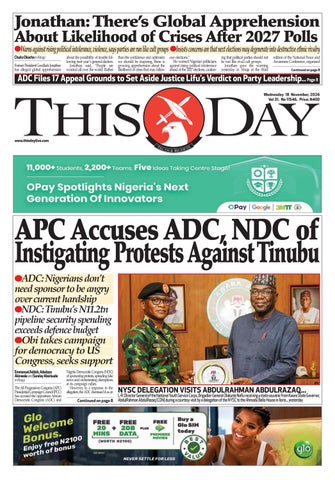
APC Accuses ADC, NDC of Instigating Protests Against Tinubu ADC: Nigerians don’t need sponsor to be angry over current hardship NDC: Tinubu’s N11.2tn pipeline security spending exceeds defence budget Obi takes campaign for democracy to US Congress, seeks support Emmanuel Addeh, Adedayo Akinwale and Sunday Aborisade in Abuja The All Progressives Congress (APC) Presidential Campaign Council (PCC) has accused the opposition African Democratic Congress (ADC) and
Nigeria Democratic Congress (NDC) of sponsoring protests, spreading fake news and orchestrating disruptions at its campaign rallies. However, in a response to the allegation, the ADC dismissed it as an Continued on page 8
NYSC DELEGATION VISITS ABDULRAHMAN ABDULRAZAQ...
L-R: DIrector General of the National Youth Service Corps, Brigadier-General Olakunle Nafiu receiving a state souvenir from Kwara State Governor, AbdulRahman AbdulRazaq (CON) during a courtesy visit by a delegation of the NYSC to the Ahmadu Bello House in Ilorin... yesterday
2
WEDNESDAY, NOVEMBER 18 T H I S D AY
WEDNESDAY, NOVEMBER 18 T H I S D AY
3
4
WEDNESDAY, NOVEMBER 18 T H I S D AY
5
THISDAY • WEDNESDAY, NOVEMBER 18, 2026
Group News Editor: Goddy Egene Email: Goddy.egene@thisdaylive.com, 0803 350 6821, 0807 401 0580
NEWS
LEEMON IKPEA’S COURTESY VISIT TO ITALIAN EMBASSY...
Group Chairman/CEO, Lee Engineering Group and Allied Companies Limited, Chief Leemon Ikpea (CON) (L) in a handshake with Italian Consul General in Nigeria, Dr. Ivo Michele Polacco, during Chief Ikpea’s courtesy visit to the Italian Embassy, yesterday
Oyedele: Trust Is Nigeria’s Most Valuable Currency, Government Must Match Words with Performance Bianca Ojukwu: Fake reports can disrupt diplomatic relations, threaten border communities Customs clearance time drops from 168 hours to 41 hours under AEO programme, says Adeniyi
Sunday Aborisade in Abuja Minister of Finance and Coordinating Minister of the Economy, Mr. Taiwo Oyedele, has identified public trust as Nigeria’s most valuable economic currency, warning that government policies and economic reforms cannot succeed without credible communication, institutional accountability, and demonstrable improvements in citizens’ living conditions. Oyedele spoke at the ongoing 2026 World Public Relations Forum (WPRF) in Abuja. He stated that although economic discussions often centred on currencies, revenues, investments, and fiscal management, trust remained the fundamental ingredient determining the effectiveness of economic policies and the willingness of citizens and investors to embrace reforms. He cautioned that government could not communicate its way out of poor performance, stressing that public relations, no matter how sophisticated, cannot compensate for broken promises, ineffective institutions, or policies that fail to produce tangible benefits. The minister also warned that misinformation, negative narratives, and
the growing influence of social media algorithms were imposing significant economic costs on Nigeria through reduced investor confidence, delayed reforms, capital flight, and rising prices driven by public expectations. He spoke on the theme of the forum, “Responsible Communication: The Voice of the World.” Oyedele said, “As Minister of Finance, I spend much of my time thinking about currencies, how we earn them, how we manage them, and what gives them value. “But today, I want to speak to you about the one that sits beneath all the other currencies. And that currency is trust.” He explained that when public trust was strong, citizens cooperated with government, investors committed capital, businesses planned for the long term. and difficult economic reforms received greater understanding. However, he warned that when trust weakened, even well-intentioned policies were received with suspicion, while government explanations were easily dismissed as excuses. Oyedele stated, “When trust weakens, every sound policy meets suspicion.
Every misstep becomes evidence of bad faith. And every explanation sounds like an excuse.” According to him, trust determines the cost of capital, citizens’ willingness to pay taxes, and the confidence with which individuals and businesses plan their economic futures. The minister insisted that communication must be supported by
measurable performance, stating that government cannot rely on publicity campaigns to convince Nigerians that their circumstances are improving when their everyday experiences suggested otherwise. He said, “We cannot communicate our way out of conflicts, and we cannot communicate our way out of conduct that destroys confidence.
Set to lead Africa’s largest association of petroleum geoscientists Oando says emergence reflects depth of indigenous technical expertise
Emmanuel Addeh in Abuja A geologist with Oando Energy Resources Nigeria Limited (OERNL), Ehimwenma Bazuaye, has been elected President-elect of the Nigerian Association of Petroleum Explorationists (NAPE) for the 2026/2027 term. Bazuaye’s election positions him to lead one of Africa’s foremost professional bodies in petroleum
geosciences, drawing on years of technical and leadership experience within the association and the wider oil and gas industry. He is a fellow of NAPE and a former vice president of the association. He is also a Visiting Geologist with the American Association of Petroleum Geologists (AAPG). His emergence, a statement from the organisation said, reflects the con-
Fakolade: Platform processed 169,000 import permits, licences in eight months NEPC: Nigeria’s non-oil exports hit record $6.1bn in 2025, up 11.5% The National Single Window (NSW) platform has processed more than N17 billion in payments belonging to government agencies since its launch, while also facilitating the processing of over 169,000 import licences, permits and certificates in eight months, its Director, Tola Fakolade, disclosed yesterday. Fakolade, who spoke at the National
Single Window Stakeholders Engagement in Abuja, said the platform had also registered over 12,000 importers and agents, alongside 27 airlines, 26 shipping lines and 56 shipping agents, as the federal government prepares to commence the export component of the initiative on December 14, 2026. He explained that the N17 billion represented payments collected on behalf of participating government agencies
for October 2026, which he said stood at 14.06 per cent, the lowest level in six years. He attributed the improvement to the economic reforms of President Bola Tinubu’s administration but acknowledged that many Nigerians remained unconvinced because the prices of essential commodities, including bread and milk, remained high.
Oando’s Ehimwenma Bazuaye Elected NAPE President-elect
NSW Processes N17bn in Agency Payments, Targets December Launch of Export Phase Emmanuel Addeh in Abuja
“A courteous spokesperson cannot compensate for an institution that treats customers badly. A policy speech cannot substitute for a promise not kept. “Communication can explain performance and make it visible. But performance must come first.” Oyedele illustrated the communication challenge surrounding economic reforms with Nigeria’s inflation figures
through the platform, stressing that the national single window did not retain any portion of the funds, which were transferred directly into the agencies’ Treasury Single Accounts (TSAs) at the Central Bank of Nigeria (CBN). According to him, the payments were integrated into the platform to make it a genuine one-stop shop for traders, rather than requiring importers and exporters to navigate different
systems for documentation, approvals and payments. “Single Window is supposed to be a one-stop shop. If I am applying for my permits on the National Single Window, while the objective of the Single Window is not so much about charging the revenue, it does make sense that the associated payment that comes with that permit is also processed on the National Single Window.
fidence of members in his professional credentials and capacity to advance the association’s work in promoting petroleum exploration and developing geoscientific expertise. Founded about five decades ago, NAPE has grown into a major knowledge and advocacy platform for Nigeria’s upstream petroleum industry. Through research, technical engagements, education and collaboration, the association promotes the advancement of petroleum geosciences and contributes to industry policy discussions through technical communiqués, workshops and direct engagement with policymakers. At Oando, the company stated that Bazuaye plays a key role in strengthening the company’s exploration portfolio through basin and play analysis, prospect generation and well-planning inputs. Working with the company’s geology team, he helps assess and reduce exploration risks, identify viable drilling opportunities and mature targets across its assets, including the portfolio expanded by Oando’s 2024 acquisition of the Nigerian Agip Oil Company (NAOC). Commenting on his election, the Managing Director of Oando Energy
Resources, Ainojie ‘Alex’ Irune, said the development demonstrated the depth of technical expertise within the company and the growing influence of African professionals in shaping the continent’s energy industry. “Ehimwenma’s election reflects the depth of technical expertise within Oando and the calibre of African talent shaping the future of our industry. We believe Africa’s energy future must be built on the knowledge, ingenuity and capabilities of its own people,” Irune said. He added that developing indigenous capabilities remained central to unlocking Africa’s energy potential, describing Bazuaye’s emergence as evidence of the contribution local professionals could make to the industry both within the continent and internationally. “As we work to unlock the continent’s energy potential, investing in indigenous expertise and developing the next generation of industry leaders remain critical priorities. Ehimwenma’s achievement is a testament to what our people can accomplish and the influence they can have in advancing our industry, both at home and internationally,” he said.
6
WEDNESDAY, NOVEMBER 18, 2026 • THISDAY
NEWS
APC PRESIDENTIAL CAMPAIGN IN KEBBI...
L-R: APC National Chairman, Prof Nentawe Yilwatda; Vice President Kashim Shettima; President Bola Tinubu; Director-General, All Progressives Congress Presidential Campaign Council for the 2027 general elections, Sen Abdulaziz Yari; Kebbi State Governor, Dr. Nasir Idris; Speaker, House of Representatives, Tajudeen Abbas; Deputy Senate President, Barau Jibrin; Jigawa State Governor, Umar Namadi; and Zamfara State Governor, Dauda Lawal, during the APC presidential campaign in Kebbi State, yesterday PHOTO: STATE HOUSE
Shell Exits Nigeria, Ghana Solar Business as Elektron Acquires Daystar Power NGX Group buys 10% stake in Kenya’s Nairobi Securities Exchange Emmanuel Addeh in Abuja Shell has agreed to sell its entire 100 per cent stake in Daystar Power Group, a provider of solar and hybrid energy solutions operating in five West African countries, to Elektron Renewables Limited, as the energy giant continues to streamline its global portfolio. The transaction, announced yesterday, will see Elektron Renewables, a subsidiary of Elektron Energy Development Strategies Limited, take over Daystar Power, which provides electricity solutions to commercial
and industrial customers in Nigeria, Ghana, Côte d’Ivoire, Senegal and Togo. Also, the Nigerian Exchange Group Plc (NGX Group) has acquired a 10 per cent equity stake in Kenya’s Nairobi Securities Exchange (NSE), extending its investment footprint into East Africa as it pursues a broader pan-African capital market expansion strategy. Shell Overseas Investments B.V. said the divestment was consistent with its strategy of concentrating on segments of the energy value chain where it has differentiated capabilities,
particularly asset-backed power trading and associated energy solutions. Daystar Power provides solar and hybrid energy systems to businesses across the region, helping commercial and industrial customers secure more reliable electricity supplies. The Chief Executive Officer of Daystar Power, Yischai Beinisch, said the company had established a strong regional platform and expressed confidence that the new ownership would support its next phase of expansion. “We believe Elektron is well positioned to support the company’s
next phase of development,” he said. Shell said completion of the transaction was subject to regulatory conditions and necessary approvals, adding that Daystar Power’s daily operations would continue unchanged until the deal was concluded. In a separate statement, Elektron Renewables said Daystar Power’s operations, regional reach and renewable energy capabilities would complement its existing energy infrastructure and clean energy portfolio. The acquisition, it added, would bring together its experience in devel-
IFC: Closing Gender Gap, Investing in Childcare Will Add $22.9bn to Nigeria’s GDP Raises Nigeria’s total factor productivity by 2% Dike Onwuamaeze International Financial Corporation (IFC) has stated that investment in quality early childhood care programmes and closing the gender gap in key sectors of Nigeria’s economy can contribute $22.9 billion to the country’s Gross Domestic Product (GDP) and raise the GDP by two per cent. Head of Office, IFC, Nigeria, Mr. Christian Mulamula, stated this in Lagos, yesterday, during the “National Care Forum”, with the theme, “Advancing Nigeria’s Care Economy: Jobs, Growth and Productivity.” Mulamula said majority of working parents, particularly women, believed that they would be more productive at work if they were provided with better access to quality child care. According to him, the question before the forum was how to build a care economy that works for children, families, businesses, and for Nigeria’s growth? He said, “Closing the gender gap in key sectors of Nigeria’s economy could contribute up to $22.9 billion, to the annual GDP. “Investment in quality early childhood programmes yields returns up to 13 per cent a year and could raise Nigeria’s total factor productivity by up to two per cent. “So, for businesses, the message is equally important, which is that 67 per
cent of working parents say that they would be more productive at work if they had better access to quality child care. “So, investing in child care is about freeing talent and productivity into the economy while giving children a strong start in life, and that is why it is important.” According to him, child care is a business and economic activity and care givers should be trained and seen as rendering professional service. Mulamula stated, “They need technology. They need training. They need finance and banks and investors have an opportunity to finance a valuable business, a viable business that is serving a real and growing need.” He added that governments had a critical role in establishing the right policies. In her special address during the forum, Minister of Women Affairs and Social Development, Ms. Imaan Sulaiman-Ibrahim, said the task was to move beyond recognising care as a social responsibility to establishing it as an organised, productive, and investable component of Nigeria’s economy. Sulaiman-Ibrahim, who was represented by Director, Child Development Department, Federal Ministry of Women Affairs and Social Development, Mr. Ali Andrew Madugu, said the economic case was compelling because women globally performed more than three
times as much unpaid care and domestic work as men. She said National Bureau of Statistics’ labour data indicated that caregiving responsibilities accounted for women’s withdrawal from the labour force at 20.16 per cent, compared with just 0.6 per cent of men. She pointed out that the labour data exposed a structural economic imbalance that “we cannot unlock the productive potential of Nigerian women while leaving the care burden largely on their shoulders”. According to her, “UN Women’s 2026 West and Central Africa Care Economic Modelling estimated that closing Nigeria’s unpaid care gaps and expanding universal childcare could contribute at least $9.3 billion to Nigeria’s GDP, generate between 9.4 million and 17 million jobs, with women accounting for 57–67 per cent of these opportunities, and deliver an estimated $3 return for every $1 invested in quality childcare. “This is not simply a social intervention; it is a compelling economic investment.” She stated, “Our ambition is clear: a Nigeria where care is recognised as essential economic infrastructure, caregiving is dignified as decent work, families are supported, women are economically empowered, and every child, older person and person with a disability who needs
care can access it with dignity. “This is how we build a stronger care ecosystem, advance gender equality, unlock our human capital and secure inclusive national prosperity.” Speaking in the same vein, Governor of Lagos State, Mr. Babajide Sanwo-Olu, emphasised that achieving quality childcare system would require more than government’s budgeted expenditure.
oping complex energy infrastructure with Daystar Power’s established customer base and expertise in solar and hybrid power solutions. The Co-Chief Executive Officer of Elektron Energy, Deen Solebo, said the acquisition would accelerate the company’s ambition to develop a diversified cleaner energy platform focused on the electricity requirements of businesses. He said Elektron had remained committed to building commercially viable energy infrastructure tailored to the needs of mission-critical businesses. Solebo added that Daystar Power’s complementary capabilities would strengthen its capacity to provide reliable and scalable energy solutions across West Africa. Meanwhile, the Nigerian Exchange Group Plc (NGX Group) has acquired a 10 per cent equity stake in Kenya’s Nairobi Securities Exchange (NSE), extending its investment footprint into East Africa as it pursues a broader pan-African capital market expansion strategy. The investment gives the Nigerian exchange operator exposure to one of East Africa’s established capital markets and is expected to strengthen institutional ties between the two regions, creating opportunities for cross-border investments, listings,
financial product development and knowledge sharing. The acquisition also builds on NGX Group’s earlier strategic investment in the Ethiopian Securities Exchange (ESX), reflecting its growing interest in African capital market infrastructure beyond Nigeria. The Group Chairman, Umaru Kwairanga, said the investment was a long-term commitment to strengthening financial connections across the continent and positioning African exchanges to facilitate greater capital flows. “African capital markets are at an inflexion point, where integration is moving from aspiration to architecture. Exchange groups that commit patient capital to market infrastructure will help shape how capital flows across the continent,” he said. Kwairanga added that the investment in the Nairobi bourse was intended to deepen financial linkages between West and East Africa while creating opportunities for sustainable returns to shareholders. “Our investment in the Nairobi Securities Exchange is a disciplined, long-term step in that direction, strengthening the financial linkages between West and East Africa while creating opportunities for sustainable shareholder value,” he said.
Nigeria, Ireland to Strengthen Aviation Ties as Keyamo Proposes Direct Flights Kasim Sumaina in Abuja The Minister of Aviation and Aerospace Development, Festus Keyamo, has expressed Nigeria’s readiness to deepen aviation cooperation with Ireland, including the establishment of direct flight operations between both countries, as part of efforts to strengthen bilateral relations, trade, tourism and people-to-people connectivity. The minister made this known when he received the Irish Ambassador to Nigeria, Her Excellency, Ms. Lesley Ní Bhriain, who paid him a courtesy visit to discuss areas of mutual interest and opportunities for enhanced cooperation in the aviation sector. During the meeting, Ambassador
Ní Bhriain identified improved visa services as a critical requirement for expanding bilateral engagements, particularly in aviation, trade and tourism. In her remarks, Ambassador Ní Bhriain disclosed that the Irish Government had recently hosted a Doing Business in Sub-Saharan Africa Summit, which attracted about 200 Irish companies interested in exploring business opportunities across the continent. She emphasised that improved air connectivity would be fundamental to unlocking these opportunities, noting that while digital technology had transformed business engagements, physical interaction and direct access
to markets remained indispensable. She disclosed that since assuming office in September, she had recognised the need to improve Ireland’s visa processing capacity and had engaged her Ministry of Justice on the deployment of additional personnel to visa offices. The Ambassador explained that improving visa services would be essential to facilitating discussions around direct flights, business partnerships and other areas of cooperation between Nigeria and Ireland. Responding, Keyamo welcomed the Ambassador and commended her decision to make aviation one of the priority areas of her diplomatic engagement with Nigeria.
7
THISDAY • WEDNESDAY, NOVEMBER 18, 2026
NEWS
UNVEILING OF RETI BAZAAR AN INNOVATIVE MEDIA MARKETPLACE...
L- R: Department of Outdoor Advertisement and Signage (DOAS), Abuja, Engr. Babadiya Akintunde; Chairman, Retinaad Limited, Abiodun Iderawumi; Director Regulations, ARCON, Dr. Mrs. Emme Akande; President, Media Independent Practitioner Association of Nigeria (MIPAN), Brenda Nwagwu; and MD/CEO, Viado Technologies Ltd, Engr. Prince Adedamola Docemo at the unveiling of Retibazaar, an innovative OOH media marketplace designed to bring greater transparency efficiency and certainty to media buying and selling in Nigeria held in Lagos, yesterday PHOTO: SUNDAY ADIGUN
NRS: Data Gaps Hamper Fight Against Illicit Financial Flows Seeks to track trillions in import, trade-related exposures Idris Abdullahi: new enforcement initiative targets crypto transactions, profit shifting, hidden ownership, urges media to track illicit money Adedayo Kayode: commercial tax abuses account for 60% of global illicit flows James Emejo in Abuja Nigeria Revenue Service (NRS), yesterday, declared that the country’s efforts to track and combat Illicit Financial Flows (IFFs) were being undermined by inadequate access to data and poorly organised financial records across government institutions. Head of Anti-Graft and Law Enforcement Liaison at NRS, Mr. Idris Abdullahi, also identified data availability and the capacity to organise information for meaningful analysis as major obstacles to estimating and combating IFFs. Abdullahi said the absence of reliable data could undermine efforts to identify revenue leakages and develop targeted interventions. He spoke at a training workshop for journalists on evidence-based reporting of IFFs in Nigeria, held in Abuja. While declaring the engagement open, Abdullahi said although relevant government agencies had been engaged to improve data collection, significant work remained in building institutional capacity to identify, measure, and address the problem. He said the fight against illicit financial flows was fundamentally data-driven, requiring relevant institutions to generate,
maintain and present information in formats that could be analysed to establish the scale, patterns and channels of illicit financial activities. He said, “First and foremost, the fight against illicit financial flows is data-driven. Therefore, the availability of data from the relevant agencies responsible for generating it has been one of the major challenges.” Abdullahi said another challenge was ensuring that available information was properly organised and presented in a format that could be analysed and translated into meaningful intelligence. He said engagements with relevant agencies had improved their understanding of the data requirements for national IFF estimation. The NRS official said Nigeria’s response also required sustained public sensitisation, particularly as many citizens remained unfamiliar with the various forms of illicit financial flows, their economic consequences, and the activities that could facilitate them. He identified capacity development among responsible institutions, public awareness, and stronger media engagement as critical to addressing the problem. On private sector involvement, Abdullahi disclosed that NRS had commenced
engagements with businesses, including sensitisation programmes conducted with Manufacturers Association of Nigeria (MAN) last year and this year. He said the engagements were intended to improve understanding of illicit financial flows and encourage compliance among private sector operators He explained that the workshop was another component of the broader strategy to mobilise public understanding and strengthen the country’s institutional response. Abdullahi, who also heads the antimoney laundering and counter-terrorist
Nigerian women entrepreneurs have been given a fresh opportunity to build and scale their businesses as applications open for the IgniteHer Bootcamp Cohort 3. The programme, organised by the National Information Technology Development Agency (NITDA) in partnership with the Japan International Cooperation Agency (JICA), targets female founders and co-founders with innovative, tech-enabled business ideas or startups. Speaking on the programme, the Director, Corporate Communications and Media Relations, NITDA, Hadiza Umar, said IgniteHer was designed to
close the gap for women in Nigeria’s growing innovation ecosystem. “IgniteHer is more than a bootcamp. It is a deliberate effort to ensure that Nigerian women are not left behind in the digital economy,” Umar said. She explained the programme would equip participants with the skills, mentorship, networks and opportunities they need to turn their ideas into thriving businesses. “Many women have brilliant ideas but lack access to mentorship, funding and the right networks. IgniteHer is here to bridge that gap and give them the confidence to scale,” she said. Umar said the programme is open to Nigerian women who are founders or co-founders of a tech-enabled
their respective responsibilities in data collection, financial intelligence, law enforcement and public procurement oversight.
Trillions in Potential Trade-related Exposure Abdullahi disclosed that Nigeria’s application of the United Nations Conference on Trade and Development (UNCTAD) Price-Filter Method+ to Nigeria Customs Service transactionlevel import data covering 2020 to 2024 had identified trillions of naira in potential trade-related illicit financial
flow exposure. The preliminary analysis identified potential import under-invoicing and over-invoicing, as well as customs duty and Value Added Tax (VAT) revenue at risk. He said the 2024 assessment alone indicated substantial potential traderelated IFF exposure, underscoring the scale of vulnerabilities within the country’s import transactions. However, he cautioned against interpreting the statistical estimates as confirmed fraud, established criminal proceeds, or actual government revenue losses.
Fiscal Responsibility Commission Seeks Stronger Enforcement Powers, More Funding, Act Amendment Michael Olugbode in Abuja The Fiscal Responsibility Commission (FRC) has called on the federal government to strengthen its enforcement powers, increase its funding and amend the Fiscal Responsibility Act (FRA), 2007, to enhance accountability and transparency in the management of
NITDA Opens IgniteHer Cohort 3 to Empower Nigerian Women Entrepreneurs Kuni Tyessi in Abuja
financing unit at NRS and serves as secretary of the Technical Working Group on IFF Estimation, said the group brought together key institutions responsible for generating and managing information needed to tackle illicit financial activities. Members of the group include NRS, Economic and Financial Crimes Commission (EFCC), Independent Corrupt Practices and Other Related Offences Commission (ICPC), National Bureau of Statistics (NBS), Nigerian Financial Intelligence Unit (NFIU), and Bureau of Public Procurement (BPP). Abdullahi said the involvement of the agencies was essential because of
business or have a strong, innovative business idea. Applicants must be willing to participate fully in the bootcamp and be committed to growing their business. According to Umar, this year’s cohort is expanding to four geopolitical zones North-East, North-West, SouthEast and South-South to give more women across the country a chance to participate. “We want to reach women wherever they are. Innovation should not be limited to Lagos or Abuja. Every woman with a good idea deserves a chance. They will also stand a chance to qualify for a paid innovation exposure trip to Japan,” Umar said.
public resources. The Acting Chairman of the Commission, Charles Abana, made the appeal in Abuja on Monday at the public presentation of the 2026 Fiscal Responsibility Index (FRI) Report, covering the 2023–2025 financial years. Abana said the Commission had continued to discharge its statutory responsibilities despite challenges, including limited enforcement powers, inadequate funding, staff shortages and insufficient office accommodation, more than 16 years after its establishment. He stressed that strengthening the Commission was necessary to improve fiscal discipline, ensure accountability in government institutions and promote the prudent management of public funds. According to him, the Commission’s internally generated revenue has grown significantly through the monitoring and payment of operating surpluses and other independent revenue sources, rising from about N300 million in 2010 to more than N2 trillion annually. He urged the government to deliberately address the institutional challenges confronting the Commission, particularly by strengthening its enforcement capacity and providing adequate financial and operational support. The Acting Chairman described
the Fiscal Responsibility Index as an evidence-based instrument for measuring and ranking the compliance of Federal Ministries, Departments and Agencies (MDAs) with statutory public financial management obligations. He said the Index goes beyond administrative assessments and rankings, providing a mechanism for identifying compliance gaps, encouraging institutional competition and promoting transparency and accountability in the utilisation of public resources. Specifically, the assessment examines MDAs’ compliance with requirements relating to public financial management practices, budgeting thresholds, procurement transparency and revenue remittance under the Fiscal Responsibility Act and other applicable public financial management frameworks. Abana said the fundamental objective was to establish a credible basis for measuring institutional performance, identifying areas requiring improvement and strengthening accountability across the federal government. He noted that the 2026 edition, the second of its kind, assessed the performance of Federal MDAs over three consecutive financial years - 2023, 2024 and 2025 - offering a broader picture of their compliance and institutional performance.
He explained the assessment was conducted through a rigorous and participatory process designed to ensure transparency, fairness and the credibility of the final findings. According to him, the Commission organised technical peer-review and methodology validation sessions on June 2 and 11, 2026, involving more than 80 representatives of Federal MDAs. The sessions provided stakeholders with opportunities to examine the assessment methodology, review questionnaires and make technical contributions to ensure that the indicators were clear, measurable and consistent with the statutory responsibilities of the institutions. He further disclosed the Commission held two-day score reconciliation and evidence review meetings at its headquarters in Abuja on September 1 and 2, 2026. During the meetings, participating MDAs were engaged in two batches and given opportunities to review their preliminary scores, clarify issues and reconcile discrepancies between submitted information and available documentary evidence. Abana said the process was important in ensuring that the final assessment was based on verifiable evidence rather than assumptions or subjective judgments.
8
WEDNESDAY, NOVEMBER 18, 2026 • THISDAY
EIGHT
Nvidia: I’d Be Honoured to Return to My Job, Says Embattled Ex-CEO Admits serious personal mistakes, creating problems for board Crisis wipes over $700bn off company’s market value Emmanuel Addeh in Abuja Embattled former Chief Executive Officer of Nvidia, Jensen Huang, has said he would be honoured to return to his job if the company’s board considers his reinstatement to be in the best interest of shareholders, employees and the United States. Huang, who resigned last week following revelations about his alleged extramarital affairs, made the appeal in his first public statement since leaving the world’s most valuable artificial intelligence chipmaker, admitting that he had made serious mistakes in his personal life and created problems for the board. “I did not live up to the standards expected of everyone at Nvidia, and I have made serious mistakes in my personal life. I created problems for the Board that I deeply regret. I own
my mistakes completely, and I am committed to cooperating with the Board’s independent investigation,” he said. He also disclosed that he had received numerous calls from the company’s employees, investors, business partners and customers urging him to return, insisting that Nvidia needed his leadership as it navigated increasingly complicated technology, market and geopolitical challenges. “Since my departure, I’ve seen an outpouring of calls from Nvidia’s employees, investors, business partners, and customers for me to return as CEO. Many continue to reach out to me directly as the company navigates complex technology, market, competitive, and geopolitical dynamics. “NVIDIA is a once-in-a-generation company. If the Board of Directors
decides that my return is in the best interest of our shareholders, our employees, the company, and America, I would be honoured to answer these calls and return as CEO,” he emphasised. But Reuters had earlier reported that three people familiar with the matter said Nvidia’s board was not considering reinstating Huang, despite the public calls for his return. The controversy has taken a heavy toll on the company, wiping more than $700 billion off its market value and unsettling investors in the artificial intelligence industry, where Nvidia occupies a central position as a supplier of advanced processors. The crisis followed revelations about Huang’s alleged relationships outside marriage, including one involving Chinese businesswoman Alice Huang, whose reported connections to China’s
Ministry of State Security have drawn the attention of US intelligence agencies. Alice Huang was a former senior executive and controlling shareholder of Singapore-based cloud computing firm Megaspeed, which has been investigated over the possible diversion of restricted Nvidia chips to China and alleged export-control violations. The company has denied wrongdoing. In his statement, Huang also recalled his journey to the United States, saying his American citizenship and the opportunity to build Nvidia had been among the greatest privileges of his life. “I came to the United States 53 years ago, and becoming an American citizen is one of the greatest gifts and proudest moments of my life. NVIDIA has been my life’s work. Building it into the company it is today alongside my colleagues has been a privilege and an honour,” he said.
“Nowhere but in America could a company like Nvidia be possible. I love our country, and I love Nvidia,” he stressed. He thanked friends, industry colleagues and people he had never met for their support during the controversy, saying their kindness to him and his family had meant a great deal. “Over the past week, I’ve been overwhelmed by the love and support of friends, industry colleagues, and people I’ve never met. Thank you to everyone who has shown kindness to my family and me. It means the world to me,” he said. Meanwhile, Nvidia has established a board committee to oversee national security and export-control compliance, in what represents its first major governance response since Huang’s departure. The committee, chaired by board
APC ACCUSES ADC, NDC OF INSTIGATING PROTESTS AGAINST TINUBU attempt to deflect public anger over the economic hardship in the country, stressing that Nigerians needed no political sponsors to express their dissatisfaction with the Bola Tinubu’s administration. The two parties traded accusations yesterday, with the APC alleging that opposition elements were mobilising hoodlums to create tension and violence ahead of next year’s general election. In the statement issued by the APC-PCC spokesperson, Dele Alake, the ADC alleged that the opposition had perfected plans to sow disharmony and introduce
violence into the campaigns. Alake recalled that hours before the flag-off of the APC presidential campaign rally in Kaduna on October 24, 2026, the party had alerted Nigerians to an alleged plot involving deepfakes, artificial intelligence-generated images, fake news, sponsored protests and other forms of propaganda. He said the intention was to manipulate public opinion and spread falsehoods about the country, Tinubu, the APC and the processes leading to the elections. “These unpatriotic and disingenuous plots by opposition elements
have started unfolding. Their major objective is to deceive Nigerians and the international community by driving a narrative of discontent against President Tinubu,” he stated. The APC cited the alleged desecration of an Abuja mosque last Friday, claiming that thugs were mobilised to pelt the presidential motorcade with stones. The council commended security personnel attached to the presidential convoy for exercising restraint, as well as Tinubu for directing the police in Abuja to release those detained over the incident. It also expressed concern over
alleged attacks on APC members and supporters in the South-east, where it claimed some were being threatened and labelled saboteurs for refusing to support the NDC presidential candidate, Peter Obi. The council further alleged that opposition-sponsored agents were destroying APC campaign billboards under the cover of darkness. “This is unacceptable and antithetical to democratic ideals,” Alake said, urging the ADC and NDC leadership to stop what he described as the dangerous recruitment of young Nigerians into activities that could put their lives at risk, while their
own children enjoyed comfortable lives abroad.
Nigerians Don’t Need Sponsor to be Angry, Says ADC However, the ADC-PCC, in a response, rejected the allegations, accusing the ruling party of attempting to blame the opposition for the anger of Nigerians over the government’s economic policies. In a statement signed by its Director of Strategic Communication, Phrank Shaibu, the ADC said the APC could not attribute public dissatisfaction to an opposition plot
ADC Files 17 Appeal Grounds to Set Aside Justice Lifu’s Verdict on Party Leadership Nafiu Gombe writes INEC, claims assumption as party chair as per Nov 5 ruling Chuks Okocha in Abuja The African Democratic Congress (ADC), has taken its leadership’s legal challenge to the Court of Appeal, presenting 17 grounds to set aside Justice Peter Lifu’s judgment of November 5, 2026. The party is also challenging the earlier ruling that allowed Hon. Nafiu Bala Gombe to amend his suit despite ADC’s unresolved objection to the trial court’s jurisdiction. ADC said it would not accept a judgment whose contents were built on a case the court had no authority to hear. This was as the factional national chairman of ADC, Nafiu Bala Gombe, has written to the INEC, claiming to assume office as national chairman following the November 5 court order by Justice Peter Lifu. In a statement issued by the Director of Strategic Communication of the ADC Presidential Campaign Council, Phrank Shaibu, the party said its Notice of Appeal challenged the trial court’s jurisdiction to decide what the ADC maintained was an internal party leadership dispute. It also questioned the court’s treatment of an earlier Federal High Court judgment on the leadership transition, delivered on 2 July 2026, which the party said had not been set aside. “The 17 grounds challenge the foundation, findings and orders of Justice Lifu’s judgment. The ADC has asked the Court of Appeal to examine whether the trial court had jurisdiction, whether the claimant had standing, whether disputed evidence was properly assessed, and whether the sweeping orders made against the party can stand in law,” Shaibu said.
In its separate appellant’s brief challenging the ruling of 24 July 2026, the ADC argued that the court granted Gombe leave to amend his originating summons while deferring its decision on the party’s preliminary objection to jurisdiction. The brief, the ADC said, contended that the motion seeking amendment had altered the description of parties and the capacity in which a defendant was sued without prior leave of court. ‘’That brief was settled by Chief J. S. Okutepa, SAN, lead counsel for the ADC in the appeal against the amendment ruling. It asks the Court of Appeal to set aside the order granting amendment and consider the outstanding jurisdictional objection,” Shuaib stressed. The ADC has also asked the Court of Appeal for an injunction to prevent the Independent National Electoral Commission (INEC) from changing the party’s leadership records or interfering with the names and nomination particulars of its presidential and governorship candidates while the appeal is heard. The party argued that Lifu’s judgment rested on an amended court process that was already under appeal, yet the trial court proceeded to judgment before that appeal was resolved. It said, If INEC acted on the judgment now, the resulting changes could be difficult to undo and could render a successful appeal meaningless. The party has therefore asked the appellate court to preserve the position that existed before the November 5 judgment. “These are serious questions before the Court of Appeal. INEC must not make changes that could preempt the court’s decision or put the party’s candidates in jeopardy while our applications are
pending. “We are asking the court to protect the subject of the appeal so that its eventual decision has practical effect,” Shaibu said, adding that it was making its legal challenge public so Nigerians could understand precisely what was before the Court of Appeal. Shaibu said the party would defend its rights, its leadership and the lawful decisions of its members through the courts. Accordingly, he maintained that, ‘’No one should use a contested judgment to alter the party’s records or disturb its candidates before the appellate court has had the opportunity to decide the issues placed before it.’’
Gombe Writes INEC, Says He’s ADC Chair Factional national chairman of the ADC, Nafiu Bala Gombe, has written
to INEC claiming to assume office as national chairman of the party. This, he said, followed the November 5, 2026, court order by Justice Peter Lifu of the Federal High Court. A letter to INEC with reference number ADC/NHQ/CH/2026/001, dated November 16, and stamped received by INEC same day, was anchored on a Federal High Court judgment delivered November 5 by Justice Peter Lifu of the Abuja Division in Suit No. FHC/ABJ/ CS/1819/2025. “In obedience to the said valid and subsisting judgment of the Honourable Court, I have resumed duty as the National Chairman of the African Democratic Congress with immediate effect,” Bala declared. He asked INEC to acknowledge him as the authentic chairman for all official correspondence, filings and portal updates, attaching a Certified True Copy (CTC)
of the judgment. “Accordingly, I respectfully request the Commission to: Take formal notice of this resumption; recognise me as the National Chairman of the African Democratic Congress for all official purposes, correspondence, and filings. “Update the Commission’s portal accordingly. A Certified True Copy of the judgement/Declaration of the Honourable Court is attached hereto for the Commission’s record and necessary action. “I assure the Commission of my continued commitment to constitutional order, due process, and a harmonious working relationship in the interest of our democracy.” While there was no response from INEC as at press time, the National Publicity Secretary of the ADC, Mallam Bolaji Abdullahi, told THISDAY that he had no comment when contacted.
Jensen Huang director and former Goldman Sachs Vice Chairman, Suzanne Nora Johnson, will supervise the company’s national security and trade compliance teams, while interim CEO Colette Kress oversees daily operations.
when the hardship confronting Nigerians was a consequence of the administration’s policies. “For three and a half years, President Bola Tinubu has plucked the feathers from the Nigerian people with policies that have made food, fuel and basic survival painfully expensive. Now he scatters a little campaign grain and expects the wounded to follow him singing his praises,” the opposition party stated. The ADC challenged the APC to provide evidence linking it to the alleged sponsorship of protests and violence, arguing that a ruling party controlling the federal government should not make such serious allegations without substantiation. It also questioned the circumstances surrounding the alleged attack on Tinubu’s motorcade, pointing to what it described as conflicting accounts from the presidency and the APC campaign council. “The Presidency earlier denied that the President’s motorcade had been pelted. Now the APC campaign council says people were detained for pelting the convoy with stones and that President Tinubu directed their release. Which account should Nigerians believe?” the ADC asked. It further questioned why those detained over the incident were released if there was evidence of their involvement, and why the alleged sponsors had not been identified and prosecuted. “If the APC has evidence that the ADC armed or sponsored those people, why were those detained released? Why have the alleged sponsors not been identified and prosecuted? A government with evidence of such a serious offence should hand it to investigators, not fling accusations at its opponents,” the statement added. Continued on page 34
JONATHAN: THERE’S GLOBAL APPREHENSION ABOUT LIKELIHOOD OF CRISES AFTER 2027 POLLS by Goodluck Jonathan Foundation (GJF). The 2026 edition of the conference was themed, “Safeguarding Trust and Strengthening Social Cohesion in a Politically Competitive Environment.” Jonathan, who is Founder of the foundation, decried what he described as an unbearable level of political intolerance, thuggery, and the exploitation of young people as instruments of violence across the country. He said as a former president, he had received calls from Nigerians
and friends of the country across the world expressing concern over the direction Nigeria was heading. According to him, “We must not ignore these concerns by the people, and we must do everything to prevent it as a nation and as a people. “Among the issues demanding urgent attention is the growing pulse of political intolerance. It is becoming unbearable. We are running political organisations and campaign teams as cult groups. “Cult groups are always rivals; you see the other cult group as an
enemy, so you must attack, kill, and maim. That is not politics. We must not manage our political systems as cult groups.” Jonathan also expressed concern over an increasing unwillingness among political actors to accommodate opposing views or recognise the legitimate right of others to compete for political power. He stated, “All of us have the right to compete for any level of election, from councillorship and state assembly to the presidency. “This is compounded by political thuggery. The exploitation of our
very young people as instruments of violence and acts of political brigandage is happening across the country, and it is very worrisome.” The former president expressed concern over controversies surrounding conflicting judicial pronouncements and “window shopping” for favourable courts by politicians. He warned that eroding public confidence in the judiciary could push citizens towards self-help and anarchy. Continued on page 35
9
THISDAY • WEDNESDAY, NOVEMBER 18, 2026
NEWS
RECEPTION FOR BUSINESS TRAVELLER’S GLOBAL PRODUCTION TEAM...
L-R: Consultant to LWIL, Prince Dapo Adelegan; Digital Growth Director, Business Travellers, Ibukun Onitiju; Media Director, Business Travellers, Sheyi Oyelowo; Head, Project, LWIL, Deji Oyedele; Editor, Business Traveller Africa, Chloe Greenbank; MD, LWIL, Adeola Olusodo; Global Head of Video. Business Travellers, Jonathan James Dixon; Head, Marketing, LWIL, Dayo Yusuf; Head, Business Strategy, Banji Oguntoye; and Director of Photography Business Travellers, Edouard Fousset, at a reception for Business Traveller’s Global Production Team’s Working Visit to Lekki Economic Zone, recently
World Bank: MSMEs in Developing Countries Face $4trn Finance Gap Insists addressing financing constraints stifling MSMES’ ability to create jobs critical Ndubuisi Francis in Abuja Micro, small, and medium enterprises (MSMEs) across developing countries face a $4 trillion finance gap that limits their ability to grow, trade, compete, and create jobs at scale, a new World Bank Group report has said. The Finance and Prosperity 2026 report, which was released on Tuesday, revealed that MSMEs account for 90 per cent of businesses and employ
75 per cent of workers, yet encounter significant barriers to accessing credit and equity financing. Between 2019 and 2023, the MSME finance gap reached $4 trillion. The report tracked country-level finance gaps over time showing where shortfalls are concentrated, while also identifying constraints that limit providers’ ability to assess and serve MSMEs, especially in International Development Association (IDA) countries as well as fragile and
conflict-affected settings. According to the MSME Finance Gap report also released on Tuesday, with 1.2 billion young people in developing countries reaching working age over the next 10–15 years, closing these gaps will be critical to accelerating job creation and opportunities for a rapidly growing workforce. Financial systems in EMDEs have largely proved resilient to a broad range of global challenges, includ-
ing trade and investment policy uncertainty, geopolitical tensions, elevated interest rates, and conflict and fragility. The World Bank noted that despite growing concerns over sovereign and corporate debt burdens around the world, financial systems had remained relatively stable to date. However, it stated that this resilience was uneven across countries, and at risk of fraying in some parts of the world.
Tinubu Moves to Decriminalise Attempted Suicide, Seeks Senate’s Approval President submits Mental Health Amendment Bill 2026, urges expeditious passage Akpabio welcomes proposal, says mentally challenged survivors need support, not punishment Senate confirms six NMDPRA executive directors Sunday Aborisade in Abuja President Bola Tinubu has asked the Senate to remove criminal penalties for attempted suicide and provide support for survivors, submitting a proposed amendment to the National Mental Health Act 2021 for legislative consideration. The President’s proposal marks a significant intervention in the debate over whether Nigerians who survive suicide attempts should face criminal prosecution or receive medical and psychological assistance. The National Mental Health Amendment Bill 2026 was conveyed to the Senate in a presidential letter read by Senate President Godswill Akpabio during plenary on Tuesday. In the letter, Tinubu invoked Section 58(2) of the 1999 Constitution, as amended, to formally transmit the proposed legislation to the National Assembly, expressing hope that lawmakers would give it expeditious consideration. “Pursuant to Section 58, subsection 2 of the 1999 Constitution of the Federal Republic of Nigeria, as amended, I forward herewith the National Mental Health Amendment Bill 2026 for the kind consideration of the Nigerian Senate,” the President stated. The proposed legislation seeks to amend the existing National Mental Health Act by removing criminal sanctions for attempted suicide and establishing a more supportive
framework for people who survive suicide attempts. The President’s intervention comes against the backdrop of growing legislative debate over the continued criminalisation of attempted suicide under Nigeria’s existing criminal laws, despite provisions recognising mental health emergencies. It also follows the Senate’s passage of a separate bill seeking to decriminalise attempted suicide for second reading, sponsored by Senator Asuquo Ekpenyong, representing Cross River South. Presenting the bill, Ekpenyong had drawn attention to what he described as an inconsistency in Nigeria’s legal framework. He had argued that while the National Mental Health Act recognises attempted suicide as a psychiatric emergency requiring immediate intervention, the Criminal Code and Penal Code continue to treat it as a criminal offence. He had challenged lawmakers to reconsider the appropriate response of the state to individuals who survive suicide attempts, stressing the need to choose between prosecution and protection. The debate had attracted considerable attention following Akpabio’s earlier opposition to decriminalising attempted suicide. During deliberations on the separate bill, the Senate President had insisted that attempted suicide should remain a criminal offence, arguing that survivors
should face imprisonment. “As far as we are concerned, we are saying that suicide is a crime for now. Therefore, if you attempt it, you better succeed. If you don’t succeed, we will send you to prison,” Akpabio had declared. However, reacting to Tinubu’s proposed amendment on Tuesday, the Senate President welcomed the initiative, explaining that his earlier position distinguished between individuals who were mentally sound and those experiencing mental health challenges. Akpabio maintained that people suffering from mental health conditions should not be treated in the same manner as those considered mentally capable of understanding their actions. “I did not include people who are mentally disturbed because they don’t have a mental balance to know what they are doing,” he said. He added that criminalising the actions of people experiencing mental health challenges would amount to insensitivity rather than addressing the circumstances responsible for their actions. His remarks appeared to underscore the importance of distinguishing between criminal responsibility and mental health emergencies in determining the appropriate treatment of suicide attempt survivors. The Senate subsequently referred the National Mental Health Amendment Bill 2026 to its Committee on Rules and Business for further legislative action.
The proposed amendment is expected to provide an opportunity for lawmakers to harmonise the country’s mental health framework with existing criminal laws and reconsider the treatment of people who survive suicide attempts. Meanwhile, the Senate on Tuesday confirmed six nominees for appointment as executive directors of the Nigerian Midstream and Downstream Petroleum Regulatory Authority (NMDPRA).
According to the report, this was notably in the Middle East and North Africa, Afghanistan, Pakistan and Sub-Saharan Africa regions—where the youth employment crisis is most acute, and weak financial institutions are especially vulnerable. “In this context, policymakers and regulators in developing countries would do well to carefully monitor their financial systems and build resilience to shocks. Digital money, payment innovations, and artificial intelligence (AI) applications in financial services and supervision are rapidly expanding across EMDEs. They can be drivers of financial sector efficiency and inclusion promoting inclusive growth and jobs. At the same time, policy makers need to manage new risks such as rising digital fraud, illicit activity, and cyber vulnerabilities “Deeper domestic capital markets can mobilize private capital for investment, growth, and jobs in EMDEs, but many markets remain shallow, with limited liquidity and narrow investor bases. “To unlock this potential, policy makers should promote strong policy, legal, regulatory, and institutional frameworks; stronger domestic institutional investors; and a broader range of financing instruments to crowd in private capital.
“Over the next 10 to 15 years, around 1.2 billion young people in developing countries will reach working age, yet current trends suggest a major shortfall in the availability of jobs. Micro, small- and medium-sized enterprises (MSMEs) will be critical to meeting this jobs challenge. “Globally, MSMEs account for approximately 70% of all jobs; in low-income and lower-middle-income economies, the share is even higher, reaching 80% to 90%,” the report said. It stated that developing countries must address the financing constraints that stifle the ability of MSMEs to grow and create more and betterpaid jobs. “It is estimated that formal MSMEs in EMDEs need $4 trillion worth of credit to reach their full productive potential, equivalent to 11% of GDP. Meanwhile, there is an estimated shortfall of $1.4 trillion in equity investment – equivalent to 3.3% of GDP – for early-stage and growth financing of formal MSMEs. “Narrowing these gaps is possible, but it requires deliberate action: implementing the reforms that allow countries to harness the transformative potential of financial technology and data-driven finance, while also addressing the distinct challenges of longer term and equity financing, which are critical for firms seeking to grow and scale,” the report added.
EU Maintains Aviation Safety Restrictions on 12 African Countries 89 Individual African airlines shortlisted under country-wide ban Chinedu Eze The European Union, EU, has maintained its safety restrictions on 12 African countries and reiterated its country-wide ban on 87 individual airlines from the continent, which appeared on its latest safety blacklist. These airlines are barred due to concerns over aviation safety oversight and they cannot have access to European airspace. Countries affected by these restrictions include Angola, Congo (Brazzaville), the Democratic Republic of the Congo, Djibouti, Equatorial Guinea, Eritrea, Liberia, Libya, São Tomé and Príncipe, Sierra Leone, Sudan, and Tanzania.
Airlines certified by these countries cannot operate in the EU, except TAAG Angola Airlines and Heli Malongo from Angola, which are permitted. According to the European Commission, airlines can be removed from the list if they demonstrate compliance with international safety standards. According to Business Insider Africa, the European Commission’s update to its EU Air Safety List covers airlines certified in countries whose aviation authorities have been deemed unable to provide adequate safety oversight. The restrictions affect Angola, Congo (Brazzaville), the Democratic Republic of the Congo, Djibouti, Equatorial Guinea, Eritrea, Liberia, Libya, São Tomé and Príncipe, Sierra Leone,
Sudan and Tanzania. The list contains 87 individually named airlines across 10 of these countries, including 34 Tanzanian carriers, 13 from the Democratic Republic of the Congo, 12 from Sudan and 10 from Libya. Liberia and Sierra Leone are also subject toblanket restrictions, although the document does not identify individual airlines from either country. The restrictions mean airlines certified by the affected countries cannot operate in the EU, regardless of whether their individual names appear in the document. Angola has two exceptions: TAAG Angola Airlines and Heli Malongo, which are permitted to operate in European airspace.
10
WEDNESDAY, NOVEMBER 18, 2026 • THISDAY
NEWS
10TH CONVOCATION CEREMONY OF FEDERAL UNIVERSITY, LOKOJA...
L-R: Chairman Bridge Credit Limited, Gabriel Adetun Owope, with the Provost, College of Post Graduate Studies, Federal University, Lokoja, Professor Matthew OlaRotimi Ajayi, during the conferment of Doctoral Degree in Leadership & Development Studies on Owope at the 10th convocation ceremony of the university held at the Felele Campus, Lokoja, at the weekend
Senate Threatens Disqualification of Candidates Linked to Electoral Violence
Demands probe of attacks on Tinubu, Obi, Atiku’s convoys Directs police to expose sponsors, prosecute perpetrators Warns governors against denying opposition access to public facilities
Sunday Aborisade in Abuja The Senate on Tuesday warned that political candidates whose supporters instigate or participate in electoral violence risk disqualification, irrespective of party affiliation, as it moved to check escalating attacks on political leaders and supporters ahead of the 2027 general elections. The upper chamber urged the Independent National Electoral Commission (INEC) to enforce the relevant provisions of the 2026 Electoral Act against electoral offenders, stressing that political violence must attract appropriate sanctions. It also called on the Nigeria Police Force and other security agencies to investigate reported attacks on the convoys of President Bola Tinubu, presidential candidate of the Nigeria Democratic Congress (NDC), Peter Obi, and former Vice-President Atiku Abubakar, identify their perpetrators and sponsors, and ensure their prosecution. The resolutions followed a motion sponsored by Senator Abdul Ningi (ADC, Bauchi Central), titled: “The Urgent Need to Check the Rising Incidence of Political Violence, Intolerance and Attacks on Political
Leaders and Supporters in Nigeria.” Leading the debate, Ningi expressed concern that the growing wave of political violence posed serious threats to national security, democratic participation and the peaceful conduct of the January 16, 2027 presidential and National Assembly elections. He recalled the reported attack on Tinubu’s convoy shortly after the president observed Jumu’ah prayers at the Shehu Shagari Central Mosque, Garki, Abuja, on Friday, November 13, when the departing convoy was allegedly pelted with stones and other dangerous objects, damaging vehicles and injuring security operatives. The senator also cited the reported attack on Obi and other political stakeholders during a political gathering in Edo State, the violent disruption of an NDC and Obidient Movement procession in Asaba, Delta State, on November 7, which reportedly left one person dead and five others injured, and the reported attack on Atiku’s convoy in Sokoto State. He warned that failure to investigate and prosecute those responsible could embolden further attacks, deepen political divisions and undermine public confidence in the electoral process. Seconding the motion, Senator
Ali Ndume (Borno North) described the attack on Tinubu’s convoy as an embarrassment to the country rather than the president. “What happened to Mr. President is not an embarrassment against the president; it is an embarrassment to Nigerians. On a Friday, in a mosque, it is wrong,” he said. Ndume warned that political violence could escalate if decisive measures were not taken, urging the police to prohibit dangerous weapons during campaigns and prosecute anyone caught carrying knives and
other harmful objects. He also proposed special courts to ensure speedy prosecution of electoral offenders. However, Senator Kawu Sumaila (Kano South) argued that political candidates should equally be held accountable when their supporters are found carrying dangerous weapons. “It is across all parties. You see candidates with police escorts and thugs. Let the candidates be prosecuted if their supporters are found with dangerous weapons,” he said. Sumaila also proposed reducing the
Sunday Okobi QuickFuel Nigeria Limited, in partnership with MRS Holdings, has unveiled an innovative selfservice fuel dispensing system, which they said is designed to transform Nigeria’s petroleum retail sector by giving motorists greater control, convenience and flexibility in purchasing petrol.
The initiative, which was launched yesterday at the MRS Filling Station on Ahmadu Bello Way, Victoria Island in Lagos introduces a new approach to fuel retailing, allowing customers at designated MRS filling stations to select their desired fuel quantity, make payments through available approved channels and dispense fuel themselves under established
As Adamawa deputy gov writes professional qualifying exam The Teachers Registration Council of Nigeria (TRCN) has declared that all teachers in the country must obtain professional certification and licences to practise, saying the end of 2027 is the deadline for full compliance. The Registrar/Chief Executive of TRCN, Dr. (Mrs.) Ronke Soyombo, said the council was intensifying efforts to professionalise teaching through compulsory registration, licensing and professional qualifying examinations, warning that teaching without the required certification would
no longer be tolerated. Soyombo, who disclosed this during an interaction with journalists in Abuja said the council had made significant progress in enforcing professional standards, adding that even senior public office holders were not exempted from its qualifying examination. She revealed that the Deputy Governor of Adamawa State recently sat for the TRCN professional qualifying examination, demonstrating that the council’s certification requirements applied to everyone, irrespective of status. “In Adamawa State, for the first time,
“If this is not nipped in the bud, then certainly, our election and electoral process will be in danger. It will cause voter disenfranchisement; voters will be so scared even to vote. What then will become of our democracy?” he asked. Senator Babangida Hussaini (Jigawa North-west) urged INEC to disqualify candidates linked to political violence, while Senator Binos Yaroe (Adamawa South) called on state governors to guarantee opposition parties access to public facilities for political activities, including campaign rallies.
QuickFuel, MRS Unveil Self-Service Fuel Technology, Empower Nigerians with 24-Hour Fuelling
All Nigerian Teachers must be Registered, Licensed by 2027, says TRCN Registrar Kuni Tyessi in Abuja
reporting period given to the relevant Senate committees from four weeks to one week. Senator Abba Moro (Benue South) maintained that existing provisions of the Electoral Act were sufficient to address electoral violence if properly enforced. “We have various sections in the Electoral Act to tackle election violence. We need to urge the security agencies to prosecute,” he said. Moro warned that unchecked violence could discourage citizens from participating in the elections.
we actually saw the deputy governor of Adamawa State coming to sit for our exam,” she said. “She sat for the exam on Friday. And that’s to tell you that everybody that owns schools or those that are putting in effort into education are coming to sit for the exam,” she said. The Registrar however, disclosed that the council recorded a disturbing case of examination impersonation in Taraba State during its latest professional qualifying examination, where an invigilator reportedly identified more than 47 individuals attempting to write the examination on behalf of registered
candidates. “One of my girls actually went to lead in Taraba to be the invigilator. She actually said she got over 47 impersonators,” Soyombo disclosed. She explained the council had strengthened its examination security through the introduction of candidates’ photographs, surveillance cameras and other technological measures to identify examination offenders. According to her, the use of candidates’ photographs in the examination process has helped the council identify individuals attempting to sit for examinations on behalf of other people.
safety procedures. Speaking at the launch, the Executive Director, Technology and Digital Services, QuickFuel, Oluwadare Owolabi, described the initiative as the beginning of a new era in Nigerian fuel retailing, stressing that the innovation was designed to challenge traditional methods of fuel dispensing and improve the overall customer experience. Owolabi said the initiative was not merely about introducing another fuel pump but about changing the way Nigerians purchase fuel by addressing avoidable delays, improving transparency and strengthening accountability in petroleum retail operations. According to him, the traditional process of driving into a filling station, “joining queues and waiting for attendants to dispense fuel has often resulted in unnecessary delays and concerns among customers about the accuracy of fuel purchases. “Nigerians deserved convenience, confidence and better service, while filling station dealers required stronger operational controls to effectively monitor fuel stocks, sales and revenue. “Your time matters. Your money matters. Your experience matters,” Owolabi declared, emphasising that QuickFuel’s self-service technology was developed to place customers at
the centre of the fueling experience. He explained the system would enable motorists to purchase fuel at any time of the day at participating stations equipped for round-the-clock operations, offering greater flexibility to commuters, commercial drivers, business owners and other motorists. Owolabi particularly highlighted the potential benefits for Nigerians who need to buy fuel during latenight hours or early mornings, noting that the innovation would eliminate the conventional time restrictions at enabled stations. According to him, “The inconvenience of buying fuel between 7 a.m. and 7 p.m. is over. You can buy fuel unrestricted, seven days a week, 24 hours,” referring to the round-the-clock service available at participating locations. He however clarified the objective was not to suggest that all fuel queues would disappear immediately but to introduce a better operating model capable of reducing avoidable delays and improving customer convenience. Beyond convenience, Owolabi identified transparency and accountability as major advantages of the QuickFuel technology, explaining that the system was designed to strengthen the monitoring of fuel dispensing, payments, and inventory records.
11
THISDAY • WEDNESDAY, NOVEMBER 18, 2026
NEWS
SPECIAL DINNER RECEPTION FOR WINNERS OF FIFA WOMEN’S U-17 WORLD CUP...
Members of the Nigeria’s U-17 Women’s National Team - The Flamingos, presenting the FIFA World Cup Trophy to Governor of Lagos State, Mr. Babajide Sanwo-Olu, during a special dinner reception for them as winners of the just concluded FIFA Women’s U-17 World Cup, held at the Lagos House, Marina, on Sunday evening
At COP31, Tinubu Says $1.3 Trillion Climate Finance Goal Must Deliver Accessible, Affordable Resources for Developing Countries Says climate action must act as catalyst for sustainable development and align with Nigeria’s national priorities Chiemelie Ezeobi in Antalya, Turkiye President Bola Tinubu has called for increased concessional financing and reduced cost of capital for developing economies, urging the international community to ensure that climate finance commitments translate into accessible and affordable resources for vulnerable countries. Tinubu made the call in Nige-
ria’s national statement at the 31st Conference of the Parties (COP31) to the United Nations Framework Convention on Climate Change (UNFCCC) in Antalya, Türkiye, on Tuesday. Represented by the Minister of Environment, Balarabe Abbas Lawal, during plenary in COP31, he stressed the need for stronger international cooperation to accelerate climate action
and support developing countries in addressing the effects of climate change. The president said the global ambition to mobilise at least $1.3 trillion annually in climate finance by 2035 must translate into accessible and affordable resources, particularly for developing countries. He said: “We call for increased concessional financing and reduced
costs of capital confronting developing economies. We must ensure that the Fund for responding to Loss and Damage delivers timely and meaningful assistance to affected countries.” Tinubu said Nigeria approached COP31 with the conviction that climate action must support sustainable development and align with national priorities, including expanding access
NDLEA Busts Transnational Cocaine Cartel, Arrests Eight Suspects in Lagos, Kano Seizes 634 cocaine pellets weighing 13.8kg from drug mules bound for Europe through Niger, Libya Marwa warns traffickers: No safe route out of Nigeria, whether by air, road or desert Michael Olugbode in Abuja The National Drug Law Enforcement Agency (NDLEA) has dismantled a transnational cocaine trafficking network operating between Lagos and Kano, arresting eight suspected members accused of moving illicit drugs from Nigeria through Niger Republic and Libya to Europe. The suspects, who allegedly operated as drug couriers, were arrested during intelligence-led operations in Lagos and Kano after swallowing hundreds of cocaine pellets intended for transportation across international borders. The eight suspects collectively excreted 634 wraps of cocaine weighing 13.795 kilogrammes while under observation in NDLEA custody, exposing what the
agency described as an organised trafficking route linking Nigeria’s commercial capital to the country’s northern borders and onward to Europe. According to the spokesman of the anti-narcotics agency, Femi Babafemi, the operation which took place between October 30 and 31, 2026, involved operatives of the NDLEA Special Operations Unit and officers of the agency’s command at the Mallam Aminu Kano International Airport, Kano. The first suspect, 57-year-old Okwudiba Damian, was arrested on Friday, October 30, at Nice Touch Hotel, Ago Palace, Okota, Lagos. He subsequently excreted 74 wraps of cocaine weighing 1.650 kilogrammes. The following day, NDLEA operatives intercepted four other suspected
couriers at the domestic terminal of the Murtala Muhammed Airport Terminal 2 (MM2), Lagos, as they prepared to board a flight to Kano. They were identified as 43-year-old Jackson Ahamefule, who excreted 90 wraps weighing 1.950 kilogrammes; 47-year-old Nwafor Emmanuel, who excreted 85 wraps weighing 1.750 kilogrammes; 38-year-old Marcel Nnabuike, who expelled 75 wraps weighing 1.655 kilogrammes; and 44-year-old Onyenwuba Ignatius, who excreted another 75 wraps weighing 1.650 kilogrammes. The five suspects arrested in Lagos collectively excreted 399 wraps of cocaine weighing 8.655 kilogrammes. Babafemi said further intelligence gathered from the Lagos operation
revealed that other members of the trafficking network had already travelled to Kano, prompting the NDLEA to mobilise officers at the Mallam Aminu Kano International Airport to intercept them. He further noted that three additional suspects were subsequently identified and arrested at the arrival hall of the airport’s domestic terminal. They were 48-year-old Chinweike Ephraim Ifechukwu, 45-year-old Edezuno John Nwaorji and 31-year-old Chukwudi Chinaka.
to affordable energy, strengthening food security, promoting industrialisation, creating employment and improving livelihoods. “For Nigeria, the energy transition must be just, inclusive and responsive to national circumstances,” he said. He reaffirmed Nigeria’s commitment to expanding renewable energy deployment while safeguarding energy security and improving access to affordable and reliable electricity. “Natural gas will continue to serve as an important transition fuel within our energy mix,” he added. On adaptation and resilience, the President disclosed that Nigeria submitted its National Adaptation Plan in September 2026, outlining interventions in climate-resilient agriculture, early-warning systems and disaster preparedness for vulnerable communities. He said the plan combined climate risk analysis, economic appraisal, sector strategies and financing approaches to strengthen the country’s capacity to respond to climate challenges. Tinubu also highlighted Nigeria’s efforts to mobilise climate finance and investment through innovative mechanisms, including the commercial launch of a $300 million Distributed Renewable Energy Fund in September 2026 to mobilise capital for expanding access to clean and reliable energy. He said Nigeria was equally
strengthening its national carbonmarket framework and advancing opportunities under Article 6 of the Paris Agreement to mobilise additional resources for domestic climate action. Emphasising the limitations of national efforts without international support, the President said: “National initiatives alone cannot deliver the scale of transformation required.” He urged world leaders to ensure that climate ambition was matched with adequate financing and effective implementation, with investments delivering tangible benefits to communities. “Excellencies, COP31 must mark a decisive turning point in the global climate response, we must strengthen the alignment between climate ambition, financing and implementation, ensure that investments translate into tangible benefits for communities and foster partnerships that deliver lasting and meaningful outcomes,” he said. Tinubu reaffirmed Nigeria’s commitment to an effective multilateral climate system founded on partnerships, calling on world leaders to move beyond commitments to concrete action. “Let Antalya be remembered as the moment the world moved decisively from commitment to implementation, and from investment to resilience, prosperity and shared development,” he said.
Hamzat Urges Shift from CertificateBased to Skills-Driven Education
convocation lecture of Yaba College to national transformation. Ogundare Court Refuses to Hear Motion against Funmi of Technology (YABATECH), titled, Hamzat who was represented by The Deputy Governor of Lagos ‘From Silos to Synergy: Reimagining the Lagos State Commissioner for Dr. Kadri Obafemi Hamzat, the Nigerian Tertiary Education Tertiary Education, Hon. Tolani Sule, Conduct of PCRC National Election State, yesterday called for stronger col- System for National Transformation’. noted that while industries needed Alex Enumah in Abuja
The Abuja division of the National Industrial Court, has refused to hear a motion against the conduct of the national election of the Police Community Relations Committee (PCRC) slated for November 24. Two members of the Committee Muawyya Hassan and Usman Garo had through their counsel, A.F Obainoke approached the court praying it stop the forthcoming election among others.
Listed as the sole respondent in the suit marked: NICN/ABJ/351/2026 is the national chairman of the association, Alhaji Ibrahim Olaniyan. The Claimants are seeking an interlocutory injunction restraining respondent from conducting any election into the national offices of the PCRC pending the determination of the matter. The Claimants are also praying the court to grant an order freezing all the bank accounts of PCRC until the final determination of the matter.
They further want the court to grant an order directing the inauguration of an interim body to manage the affairs of the PCRC at the expiration of the current terms of all the national officers from persons other than the respondent. The Claimants grouse among others was that the respondent has abused his office, removed them (Claimants) from the committee’s WhatsApp group and not allowing the committee’s financial account to be audited.
laboration among tertiary institutions, industries, research organisations and government to bridge skills gaps, promote innovation and reposition Nigeria’s education system for national development. He said the country must move away from an education system driven largely by certificates to one that prioritises practical competence, creativity, problem-solving and the ability of graduates to translate knowledge into economic value. Hamzat made the call at the 38th
He said Nigeria could not achieve meaningful national development if its educational institutions, industries and government continued to operate independently despite having interconnected responsibilities. According to him, the disconnect between academia and industry, universities and polytechnics, research and commercial application, as well as government policies and institutional implementation, has limited the capacity of tertiary education to contribute effectively
skilled manpower, research-driven solutions and technological innovation, academic institutions required practical exposure, industry intelligence, investment and opportunities for students and researchers to apply their knowledge. “Industry should not be a distant observer of tertiary education. It must become an active stakeholder in shaping the competencies, research priorities and practical experiences that our institutions provide,” he stated.
12
WEDNESDAY, NOVEMBER 18 T H I S D AY
WEDNESDAY, NOVEMBER 18 T H I S D AY
13
14
WEDNESDAY, NOVEMBER 18 T H I S D AY
WEDNESDAY, NOVEMBER 18 T H I S D AY
15
16
WEDNESDAY, NOVEMBER 18 T H I S D AY
WEDNESDAY, NOVEMBER 18 T H I S D AY
17
THISDAY • WEDNESDAY, NOVEMBER 18, 2026
19
TRIBUTE Wole Olanipekun: An Odyssey Of Law, Philanthropy And Impeccable Character By Kolawole Igandan
I
f you have ever met Chief Wole Olanipekun, SAN, in chambers, you met Jurisprudence in a perfectly tailored suit. If you have ever met him in Ikere, his native abode in Ekiti State, on a Sunday morning after service, you met something even rarer — a humble village boy who never left home, even when he left to conquer the world. Today, we celebrate not just a Senior Advocate of Nigeria, not just a former President of the Nigerian Bar Association, former Chairman of the Body of Benchers, Life Bencher, Pro-Chancellor and Chairman of Council of the University of Lagos — his alma mater — and Chancellor of BOUESTI, Ikere, but a complete man whose life has become a textbook of how to be great and still be good. The law knows him as the Colossus. For 50 years since his Call to Bar in 1976, and 34 years since he took silk in July 1991, he has been the advocate judges stay awake to listen to. His briefs are epic. His oral advocacy is orchestral. It is why President Bola Ahmed Tinubu will on November 19 unveil his six-volume compendium, “Wole Olanipekun: Through The Cases”, with forewords by the Chief Justice of Nigeria, Hon. Justice Kudirat Kekere-Ekun, and the Attorney-General, Prince Lateef Fagbemi, SAN. The book distils Inakoju v. Adeleke, presidential election petitions from 2007 till date, and hundreds of landmark cases where his arguments became law. It is a celebration of a mind that has literally written Nigerian law through the cases. But beyond law, there is a mystique that court records do not capture. First, his style. Chief Olanipekun dresses like law itself should dress — immaculate, authoritative, timeless. His colleagues whisper about his epicurean taste: the shoes, always hand-finished, gleaming even after a 12-hour day; the wristwatches, not for show but for precision — a man who respects time because time respects industry. He is a sartorial statement that elegance is discipline. Second, his work ethic. He is a delightful workaholic. He wakes when most men still negotiate with sleep, his table already littered with files. He works late into the night, and no draft, no address, no legal opinion leaves Wole Olanipekun & Co. until he has approved it with his own eyes and his pen. Those who have worked closely with him know the legend: a junior may have passed a brief as “perfect”, only for Oga to pick a misplaced comma on page 73, a wrong citation on page 41, and ask, “My dear, is this our best?” He pays attention to the ridiculous detail because he believes excellence is not an act, but a habit. It is no wonder his sons are taking after him. Dr. Oladapo Olanipekun, SAN, scholarly and cerebral, and Olabode Olanipekun, SAN, whom the Bar already hails as “the next big thing to happen to law,” are not just inheriting a name; they are inheriting a standard. Third, and most important, is his heart. This is the part no one sees — his generosity that is silent, surgical, and often anonymous. Chief does not empower for applause; he empowers because he cannot sleep if his neighbour is hungry. Ask the
Wole Olanipekun
market women of Ikere whose shops were recapitalized without a press release. Ask the young lawyers across Nigeria whose NBA dues and law school fees were quietly paid from his pocket. Ask the families of his drivers, his secretaries, his staff, whose children he sends to school as his own. Ikere-Ekiti adores him not because he is Asiwaju of Ikere Kingdom, but because he made Ikere his personal corporate social responsibility. He did not just build a mansion there; he built an economy of hope. He established Newcruse 92.7 FM, the first private radio station outside Ado-Ekiti, which commenced full broadcast on April 14, 2020, not as a business, but as a solution to youth unemployment and to put Ikere on the world map. Today the station’s signal reaches Ondo, Osun, Kwara, Kogi, Edo, Oyo, and Lagos — Ikere’s voice to the world. And then, the crown: the Newcruse Mother and Child Maternity Complex, a 35-bed state-of-the-art facility built within the State Specialist Hospital, Ikere-Ekiti,
commissioned in May 2026 by Governor Biodun Oyebanji to the applause of President Tinubu, the Ooni of Ife, Oba Enitan Ogunwusi, former Governor Bisi Akande, Governor Lucky Aiyedatiwa, and the Coordinating Minister of Health. It is today adjudged the best in the South-West, with cutting-edge delivery suites, neonatal care, and — typical of Chief — a fully furnished, fully stocked Pharmacy to ensure no mother has to run to town to buy drugs while in labour. He thought of everything. That is Olanipekun: thorough even in charity. His philanthropy is indeed global in reckoning — over 3,019 students on scholarship since 1996 through the Wole Olanipekun Scholarship Scheme, over 800 widows and elderly on direct support through the Wole Olanipekun Foundation, law auditoriums donated to University of Lagos, University of Ibadan, Babcock University, Ajayi Crowther University; courtrooms and NBA Bar Centres built; and most recently the Chief Wole Olanipekun
Digital Centre at Amoye Grammar School, his alma mater. Yet for all this, his private life is worthy of emulation. Humble to a fault, deeply Anglican, devoted to Erelu Princess Omolara Olanipekun — whom he adores openly and honours in every fora — he has proven that a man can conquer the Supreme Court and still be conquered by love at home. All four children — Dapo, Tope, Bukola, and Bode — are lawyers because he modelled, not mandated, excellence. At 75, Chief Wole Olanipekun teaches us that the wig and gown are temporary, but character is permanent. “Wole Olanipekun: Through The Cases” will sit in law libraries for centuries. But the man — personable, impeccably dressed, watchful, kind, exacting, ever-present — will sit in our hearts even longer. Happy 75th birthday to the Asiwaju, the Oracle, the Colossus who still corrects the comma. •Kolawole Igandan is a media consultant based in Lagos State.
20
WEDNESDAY, NOVEMBER 18 T H I S D AY
WEDNESDAY, NOVEMBER 18 T H I S D AY
21
T H I S D AY ˾ WEDNESDAY NOVEMBER 18, 2026
22
POLITICS
Acting Group Politics Editor DEJI ELUMOYE Email: deji.elumoye@thisdaylive.com 08033025611 SMS ONLY
Benue: Can Gov Alia Survive Gang-up against His Re-election in 2027?
George Okoh, in this report, examines the political intrigues, shifting alliances and emerging threats confronting Governor Hyacinth Alia of Benue State as he walks an increasingly precarious political tightrope ahead of the February, 2027 gubernatorial poll in the state.
T
he road to the 2027 governorship election in Benue State is becoming increasingly complicated for Governor Hyacinth Alia. Over three and half years after his historic emergence as governor on the platform of the All Progressives Congress (APC), the Catholic priest-turned-politician is facing a political environment considerably different from the one that brought him to power in May, 2023. Although Alia remains the incumbent governor, his journey towards securing another four years in Government House, Makurdi, is surrounded by political uncertainties, internal party disagreements, strained relationships with influential stakeholders and an increasingly competitive opposition. The question confronting political observers is no longer simply whether Alia wants a second term. It is whether he can successfully navigate the complicated political terrain between now and the 2027 poll. Akume factor: A political marriage under strain Perhaps the greatest political challenge confronting Governor Alia is his troubled relationship with the Secretary to the Government of the Federation, Senator George Akume The political alliance between the two men was instrumental in APC’s remarkable victory in Benue State in 2023. Akume brought his extensive political network, established grassroots structures and years of political experience, while Alia brought enormous popularity among ordinary people and the attraction of a relatively new political
Alia
personality. Together, they dismantled the People’s Democratic Party’s longstanding dominance of Benue politics. However, the relationship sub-
sequently deteriorated over disagreements concerning appointments, political influence, party leadership and control of the APC structure in the state. What initially appeared to be a disagreement
between political allies has developed into a major struggle for supremacy within the ruling party. Reconciliation efforts between the two camps have stalled, with parallel party structures and disagreements over leadership continuing to threaten party cohesion. This is a serious problem for Alia. In politics, an incumbent governor may control the machinery of government, but controlling government is not necessarily the same as controlling the political party that produced him. The governor therefore faces a delicate balancing act: maintaining his political independence while avoiding a complete breakdown of relationships with influential APC stakeholders. Absence of influential stakeholders Another troubling development was the inauguration of Alia’s 2027 re-election campaign council on November 6, 2026. A source said several influential APC stakeholders, including Akume, serving senators and members of the House of Representatives from Benue State, were conspicuously absent. The development raises questions about the level of political cohesion within the ruling party. A campaign council is expected to demonstrate unity, organisation and collective commitment. When prominent political figures are absent from such an important event, it inevitably generates questions about the depth of support for the candidate. NOTE: Interested readers should continue in the online edition on www.thisdaylive.com
Oloko: I’ll Lobby to Get Lagos’ 37 LCDAs Listed in the Constitution Peoples Redemption Party’s candidate for Lagos Central in the 2027 general election, Afolabi Lookman Oloko, in this interview, speaks on his agenda for the senatorial district and how he would ensure quality and effective representation if elected in January, 2027, among other issues.
Y
ou’re running for Lagos Central under the PRP. What specifically about the current representation in the Senate made you decide to step up at this time? Generally and as we all can see, Nigeria calls and as compatriots, some of us have answered...so, I have only chosen to heed the call of fatherland in what I call an over-riding public interest. “A new dawn.A high-flying Lagos!”That’s your tagline. In practical terms, what does a high-flying Lagos Central will look like to you in your first four years in the Senate? Chief of such dreams is to get the 37 LCDAs constitutionally recognised. You see, the job of the legislature is sub-divided into three...one, to make laws for peace and good governance... two, to play oversight roles on the MDAs and ministries and in so doing, acting as a check on the executive and lastly and of course most widely known, to represent the people of their various Districts and Constituencies at the centre. To that extent, I hold up the Constitutional recognition of the 37 LCDAs in Lagos State as my joker. It’s so central to us - we, the people at the Lagos Central District...I remember a Comrade who made similar case for the same argument in 2019- Tosin Akande- his name, a Barrister at Law...his bid, though, unsuccessful, his courage cannot be wished-away. It is worthy of emulation and here, I am on the same path. As a perfect example, the rise of Barrack Obama in the US White House cannot be isolated from the efforts of previous Afro-American civil rights leaders like Rosa Parks, Martin Luther King (MLK, Jnr), Rev. Jesse Jackson, Muhammed Ali, Marcus
Oloko
Garvey, Malcolm X etc...Obama was just a culmination of the aggregate contributions of these erstwhile leaders of Black consciousness. In the same vein, we won’t stop the fight for the people at the grassroots until we get there - to the Promised
Land. Ironically, it was the President who started the good fight as the Governor of Lagos State in 2001/2002, Akande leveraged on it in the build-up to the 2019 National Assembly elections and now- 2026, I am here to make my attempt on the same subject...God willing, we will get there. This time, the attempt will count if God
wants it so. You said “I will put citizens of Lagos Central District first and at the every Legislative decision.”Can you give us two specific bills or motions you’d sponsor in your first year that will directly reflect that “People First” promise? Motions, to the lawmaker, are like what business ideas are to an entrepreneur or what patents are to inventors, you don’t put them up in the public without recourse to time. When we get there, we will put up much more promises. My campaign promise on the 37 LCDAs and plans for the youths and women, suffice for now. Your pact includes making it a legislative action plan to get the 37 LCDAs recognized as LGAs. What’s your actual legislative strategy to get that constitutional amendment through the National Assembly, considering it’s failed multiple times before? Lobbying! That’s the only strategy...or do you want us to include wailing and cheap blackmail as some are wont? (Laughs)...we have to reach out to friendly lawmakers to make them see reason- devoid of ethnic or tribal bigotry because of the Constitutional provision in Section 8 where-upon we will need the Constitutional ratification of two-thirds support of the 36 States of the federation...so, you can see that it’s enormous task...quite herculean but I’m confident, we will get there. We will have to do several handshakes across the Niger. Intense lobbying! NOTE: Interested readers should continue in the online edition on www.thisdaylive.com
25
˾ WEDNESDAY, NOVEMBER 18, 2026
BUSINESSWORLD R A T E S MONEY MARKET
A S
A T
REPO
Group Business Editor Eromosele Abiodun Email oriarehu.eromosele@thisdaylive.com
08056356325
N O V E M B E R
S & P INDEX
1 0 ,
2 0 2 6
S & P INDEX
EXCHANGE RATE
OPR
25.34%
CALL
23.25%
INDEX LEVEL
595.26
1/4 TO DATE
0.24%
N1,382/ 1 US DOLLAR*
OVERNIGHT
25.18%
1-MONTH
21.37%
1-DAY
0.10%
YEAR TO DATE
-10.99%
*AS AT TUES., NOVEMBER 10, 2026
3-MONTH
22.41%
MONTH-TO-DATE
0.24%
D e s p i t e M o d e s t Y i e l d s , F G N Bonds Subscription Surges to N17.1tn in 11 Months
Kayode Tokede Despite reduced yields, the total subscriptions to FGN Bonds in 11 months of 2026 surged to N17.1 trillion, bond auction results by the Debt Management Office (DMO) has shown. The high subscriptions for FGN bonds, according to THISDAY findings, is on the backdrop of large institutional investors demand. Also, attractive high interest rates encouraged pension funds, banks, insurance companies among others to lock in returns. The FGN Bond auction was boosted by sustained government reliance on the
domestic debt market to fund fiscal obligations amid constrained external financing conditions. According to the FGN bond auction results obtained by THISDAY, the government through the DMO in 11 months of 2026 offered to raise N12.1 trillion through the bond market with the intention of bridging the budget deficit. The debt office, according to its monthly FGN auction results, however, raised an estimated N9.8 trillion in 11 months 2026, returning an estimated N7.32 trillion to inventors. In its November 2026 FGN bond auction, DMO allotted
N1.42 trillion to investors, with stop rates settling below the N1.21 trillion recorded at the October auction. The DMO reopened four FGN bonds worth N2 trillion, attracting total bids of N1.81 trillion, representing 90.51per cent of the amount offered. According to the DMO’s November auction results, stop rates ranged from 16.89% to 16.99%, compared with marginal rates of 16.99% to 17.29% in October. At the FGN bond auction for the month of October 2026, the DMO reopened the FEB 2034, SEP-2036 and JUN-2038 bonds, offering a total of N1.75 trillion.
Total demand settled at N1.75 trillion (bid-to-offer: 1.0x), with the DMO eventually allotting N1.21 trillion (bid-to-cover: 1.4x). The stop rates on the SEP2036 and JUN-2038 bonds, which were on-the-run at the previous auction, expanded by 50basis points and 34 basis points to settle at 17.29per cent and 17.19per cent, respectively. The FEB-2034 bond settled at 16.99per cent. The amount offered by DMO increased from N1trillion in September 2026 to N1.75 trillion reported in October 2026, about 75 per cent which is part of a N5.75 trillion fourth quarter (Q4) 2026 bond programme. DMO planned offers will be
conducted across three auction dates in October, November and December, with the largest monthly amount scheduled for November and December at N2 trillion each. The widespread bid rates, ranging from 15.00per cent to 22.60per cent, also point to divergent investor expectations around inflation, monetary policy direction, and future interest rate movements. The N17.1 trillion total subscription in the 11 months of 2026 by investors is a reflection that investors, most especially the Pension Fund Administrators (PFAs) tend to invest in risk-free instruments, of which FGN Bond and
Nigerian Treasury Bills (NTB) offer to the investing public. As gathered by THISDAY, PFAs have played a critical role in partaking in the FGN bond market. THISDAY also gathered that the DMO, since the beginning of the year, has continually re-opened some FGN Bonds amid modest interest rates in its moves to attract investors. Analysts attributed the strong demand for FGN bonds to modest yields, stressing that the over-subscription also revealed that investors have confidence in the federal government’s ability to meet its debt obligations. The story continues online on www.thisdaylive.com
NFEM Turnover Up 90% to N3.65bn as Interbank Activity Jumps 199% Nume Ekeghe Turnover in the Nigerian Foreign Exchange Market (NFEM) increased by 90.04 per cent week-on-week to N3.65 billion in the five trading days ended November 13, 2026, from N1.92 billion recorded in the preceding week, while interbank turnover surged by 198.72 per cent to N1.66 billion from N556.79 million. Data from the NFEM rates dataset showed that both market segments recorded
higher turnover during the week, although the interbank market recorded a significantly faster increase. A breakdown of daily transactions showed that NFEM turnover opened the week ended November 6 at N227.18 million on Monday, November 2, before increasing by 77.88 per cent to N404.11 million on Tuesday, November 3. The upward movement continued the previous week with turnover rising by 7.53 per cent to N434.54
million. However, activity moderated the following day, declining by 12.42 per cent to N380.57 million on Thursday, November 5. The market regained momentum on Friday, November 6, as turnover increased by 24.85 per cent to N475.12 million, bringing transactions for the week to N1.92 billion. In the following week, NFEM turnover opened lower at N368.80 million on Monday, November 9, representing a 22.38
per cent decline from the preceding Friday. However, activity strengthened considerably on Tuesday, November 10, when turnover jumped by 120.59 per cent to N813.54 million. The increase was shortlived, as transactions declined by 51.13 per cent to N397.54 million on Wednesday, November 11. Turnover subsequently recorded its strongest daily performance during the review period on Thursday,
November 12, surging by 204 per cent to N1.21 billion. On Friday, November 13, NFEM turnover moderated by 28.57 per cent to N863.25 million. Despite the decline, the market closed the week with N3.65 billion in transactions, representing a 90.04 per cent increase from the preceding week’s N1.92 billion. Similarly, interbank turnover recorded a stronger week-on-week expansion, rising by 198.72 per cent to N1.66 billion in the week
ended November 13, from N556.79 million in the preceding week. Daily transactions showed that interbank turnover started at N21.77 million on Monday, November 2, before surging by 446.55 per cent to N118.96 million. Activity subsequently declined by 15.16 per cent to N100.93 million and fell further by 18.59 per cent to N82.16 million on Thursday, November 5. The story continues online on www.thisdaylive.com
M A R K E T D ATA A S AT T U E S D AY, N O V E M B E R 1 0 , 2 0 2 6 BONDS DESCRIPTION Price Yield Change Updated Time (%) ^13.98 2397.68 16.01 0.00 November FEB-2028 10, 2026 ^21.00 20104.66 16.89 0.69 November MAR-2028 10, 2026 ^19.30 17November 104.95 16.70 0.20 APR-2029 10, 2026 ^14.55 26November 97.90 15.60 0.00 APR-2029 10, 2026 ^18.50 210.20 November 105.09 16.75 10, 2026 FEB-2031
BILLS MATURITY NTB 3-Dec26 NTB 7-Jan27 NTB 4-Feb27 NTB 4-Mar27 NTB 8-Apr27
Discount Yield 16.22
17.14
16.90
17.31
16.79
17.42
16.60
17.45
16.48
17.60
CPS
Change (%) Updated Time
MATURITY
-0.01 November 10, 2026 -0.01 November 10, 2026 -0.01 November 10, 2026 -0.01 November 10, 2026 -0.01 November 10, 2026
AGRO CP IV7-DEC-26 DAIL CP II 26-NOV-26 JVIL CP XXIV 29-DEC-26 EMZO CP II 14-JAN-27 SKIS CP II 1-APR-27
Discount Yield 22.70
22.99
21.00
21.11
22.22
22.80
21.75
22.52
20.93
22.68
CLEARED NAIRA-SETTLED NDFS Change (%)
Updated Time
-0.06 November 10, 2026 -0.13 November 10, 2026 0.06 November 10, 2026 0.15 November 10, 2026 0.17 November 10, 2026
CONTRACT TENOR Contract (MONTH)
Current Rate ($/₦)
Updated Time
–
–
–
–
–
–
–
–
–
–
–
–
–
–
–
–
–
–
–
–
26
WEDNESDAY, NOVEMBER 18, 2026 ˾ T H I S D AY
BUSINESSWORLD
NEWS
L–R: Spokesman of the Nigerian Maritime Administration and Safety Agency (NIMASA), Osagie Edward; Economic and Financial Crimes Commission (EFCC), Spokesman, Dele Oyewole; Spokesman of the Nigerian Defence headquarters, Major General Samaila Mohammed Uba and former Force Public Relations Officer, FPRO Deputy Commissioner of Police Muyiwa Odejobi at the ongoing world Public Relations Forum in Abuja Nigeria
PMAWCA: Dantsoho Seeks Regional Port Cooperation to Cut Cargo Costs, Delays Eromosele Abiodun The Port Management Association of West and Central Africa (PMAWCA) has called for stronger cooperation among ports in the region to reduce cargo clearance delays, lower logistics costs and improve the competitiveness of West and Central African economies. The President of PMAWCA, Dr Abubakar Dantsoho, disclosed this while speaking at the opening ceremony of the association’s 46th Annual Council and Joint
Gulf of Guinea CommissionPMAWCA Forum in Sipopo, Malabo, Equatorial Guinea. Dantsoho who is also the Managing Director of the Nigerian Ports Authority (NPA), said regional ports must prioritise strategic collaboration over destructive competition to address common challenges confronting the maritime industry. He said closer cooperation among ports would improve operational efficiency, strengthen logistics resilience and ensure that the benefits
Polaris Bank, Evolve Charity Trust Support 640 Students Nume Ekeghe Polaris Bank, in partnership with Evolve Charity Trust, has distributed learning materials to 640 students across 10 public secondary schools in Nigeria as part of efforts to improve access to education, particularly for the girl child. Now in its sixth year, the initiative forms part of the bank’s Corporate
Group Business Editor Eromosele Abiodun Deputy Business Editor Chinedu Eze Comms/e-Business Editor Emma Okonji Asst. Editor, Energy Emmanuel Addeh Asst. Editor, Money Market Nume Ekeghe Correspondents KayodeTokede(CapitalMarkets) James Emejo (Finance) Ebere Nwoji (Insurance) Reporter Peter Uzoho (Energy)
Social Responsibility (CSR) programme aimed at easing the financial burden of education on families, encouraging school attendance and reducing the number of out-of-school children. Speaking on the initiative, the Managing Director/Chief Executive Officer of Polaris Bank, Mr. Kayode Lawal, said the intervention underscored the bank’s commitment to expanding educational opportunities for underserved children. “The initiative is designed to support 50,000 students by 2028, building on its current reach of 24,000 students across 49 locations. Our goal working with our CSR Partners, is to help more children, particularly girls, access education and develop the required academic, functional skills and confidence to realise their potential,” he said. Similarly, Head, Brand Management and Corporate Communications, Polaris Bank, Rasheed Bolarinwa, said sustained partnerships remained critical to delivering meaningful community impact.
of maritime trade extend beyond coastal countries to landlocked nations whose economies depend on efficient ports and transport corridors. According to him, the region’s Atlantic coastline, stretching from Mauritania
to Angola, serves about 20 coastal countries, while five landlocked countries, including Mali, Burkina Faso, Niger, Chad and the Central African Republic, depend directly on the efficiency of its ports and transport networks. “When a single port along
our coast suffers congestion, it is a household or a market in Bamako, Niamey, N’Djamena, or Bangui that bears the cost,” he said. He noted that although West and Central African ports had undergone significant transformation
over the past decade through the construction of deep-water terminals, public-private concessions and the deployment of modern port infrastructure, structural challenges continued to undermine their efficiency and competitiveness.
FG Prepares Kano Exporters for NSW Second Phase Take-off Ahmad Sorondinki in Kano The federal government has stepped up preparations for the rollout of the second phase of the National Single Window Project with a sensitisation exercise for exporters in Kano State. Speaking at the event,
the Director of the National Single Window Project, Tola Fakolade, explained that the initiative was introduced to address the challenges exporters face in documentation and regulatory compliance. He said the second phase of the project which focuses on exports, is scheduled to
commence on December 14, 2026. According to him, the Single Window will serve as a centralised digital platform where exporters can submit their documents once, with relevant government agencies accessing the same portal to process approvals. He added that “the system
is expected to reduce delays, cut down multiple physical visits to government offices and make Nigeria’s export process more competitive.” Also speaking, the Regional Coordinator of the NEPC, North-West, Ajayi Nnamdi Malik, said the platform would eliminate duplication and simplify trade procedures.
Stanbic IBTC Empowers Women Entrepreneurs Nume Ekeghe Stanbic IBTC has reinforced its commitment to women’s economic empowerment and enterprise development, bringing together women entrepreneurs, professionals and business leaders at Bloom Weekend 2026, a two-day event designed to equip women with the knowledge, connections and resources to build and scale sustainable businesses. Anchored on the theme,
‘Bloom into Growth: From Business Owner to CEO’, this year’s edition focused on the transition from running a business to building a structured, professionally managed enterprise capable of achieving sustainable growth. The conversations centred on the realities of business expansion, with participants exploring the importance of effective leadership, financial discipline, sound business structures and strategic planning in moving
enterprises beyond their early stages. The first day featured the Ladies at the Table Empowerment Series (LATTES), alongside a series of practical masterclasses designed to provide participants with actionable insights for their entrepreneurial and professional journeys. Speaking on the initiative in Lagos, Executive Director, Business Development, Stanbic IBTC Pension Managers,
Nike Bajomo, said: “Many businesses begin with an idea, a skill or a passion, but sustainable growth requires more than determination. It requires structure, sound financial management, access to the right capital, a trusted brand and effective leadership. Bloom Weekend is about equipping women entrepreneurs to make that shift, to think beyond where their businesses are today and build for where they want to be tomorrow.”
UBA Deepens Fight Against Phishing, Scam Nume Ekeghe United Bank for Africa (UBA) Plc, has stepped up its fight against fraud, advising customers and the public to stay alert to phishing scams where criminals increasingly use fake bank messages, cloned websites and impersonation accounts to steal account details and money.
The bank in a statement noted it is slated to hold the 2026 edition of its Fraud Awareness Week, from Monday, November 16 to Friday, November 20, 2026, with the theme “Fraud Dynamics: Staying One Step Ahead.” UBA’s Group Chief Internal Auditor, Eugene Inotu, who spoke ahead of the campaign, said the bank wants every
customer to recognise a phishing or fraud attempt before it causes harm. “Fraudsters are counting on panic. They want you to click before you think, so the strongest defence is to pause,” Inotu said. “UBA will never ask for your PIN, password, OTP or BVN through a link, a text message, an email or a phone call. If a message
asks for any of these, it is not from us, no matter how genuine it looks.” Continuing, Inotu said, “Fraud keeps changing shape, and our customers need to keep pace with it. This year’s Fraud Awareness Week is about staying one step ahead, so that every customer knows how to spot a scam, verify a request and report it quickly.”
WEDNESDAY, NOVEMBER 18 T H I S D AY
27
28
T H I S D AY ˾ WEDNESDAY, NOVEMBER 18, 2026
BUSINESS/MONEYGUIDE
Afreximbank Commits $75M SME Finance Facility to Development Bank Emma Okonji The African ExportImport Bank (Afreximbank) has committed a $75 million finance facility to the Development Bank of Nigeria (DBN) to expand access to finance for Nigerian small and mediumsized enterprises (SMEs), including eligible businesses in the creative economy. Announced during CANEX WKND 2026 in Lagos, the facility reflects the event’s focus on connecting creative enterprises with finance, investment and markets. Executive Vice President, Intra-African Trade and Export Development, Afreximbank, Mrs.
Kanayo Awani, and Managing Director/ Chief Executive Officer, DBN, Dr. Tony Okpanachi, led the ceremonial signing on behalf of their institutions. “Our partnership with DBN goes beyond providing capital. We are taking an integrated approach that combines finance with capacity building, export-readiness support and access to markets. Our objective is to help Nigerian SMEs build productive capacity, strengthen their competitiveness and make the transition from promising local businesses to sustainable exporters. At the same time, we will work with participating financial institutions to strengthen
their capacity to better understand, finance and support SMEs throughout their growth journey,” Awani said. “This partnership with Afreximbank represents another important step in DBN’s commitment to expanding access to finance for Nigerian MSMEs and enabling them to build resilient, competitive and sustainable businesses. The $75 million facility will provide muchneeded financing through our Participating Financial Institutions, while creating greater opportunities for businesses, particularly those in the creative and export-oriented sectors, to strengthen their productive capacity and access new markets,” Okpanachi said.
Optimus Bank’s H1 Profit Before Tax Rises 104% to N24.55bn Nume Ekeghe
Optimus Bank Limited grew its profit before tax (PBT) by 103.9 per cent to N24.55 billion in the first half of 2026, up from N12.04 billion recorded in the corresponding period of 2025, as stronger interest income and an expanded balance sheet supported its earnings. The bank’s improved financial performance, captured in its audited results for the half year ended June 30, 2026, coincided with an upgrade of its credit rating by Agusto & Co. to A- Long-Term and A1 Short-Term, with a Stable
Outlook. Interest income, one of the key drivers of the performance, more than doubled to N42.42 billion, representing a 101.9 per cent increase from N21.01 billion recorded in the same period last year. Profit after tax (PAT) also rose by 84.3 per cent to N15.96 billion, compared with N8.66 billion in H1 2025, reflecting the bank’s stronger earnings during the period. The growth in profitability was accompanied by an expansion in the bank’s balance sheet, with total assets rising by 65.3 per cent to N472.69 billion as of June 2026, from N286.02 billion at the end of December 2025.
Commenting on the performance, the Managing Director of Optimus Bank, Dr. Ademola Odeyemi, said the results reflected the progress made in building a resilient institution with the capacity to sustain growth and deliver value to customers. “Our H1 performance reflects the progress we are making in building a strong, resilient, and growthfocused institution. The significant improvement in profitability, strengthened capital position, and rating upgrade by Agusto & Co. reinforce our commitment to building a bank that customers and businesses can rely on,” he said.
NIA Charges Technical Committee on Proactive Engagement Ebere Nwoji The Nigerian Insurers Association (NIA), has charged its Technical Committees to strengthen their contributions to industry development through proactive engagement, strategic recommendations and effective collaboration in addressing emerging challenges in the insurance sector. NIA Chairman, Mrs. Ebelechukwu Nwachukwu, gave the charge recently during a breakfast meeting with Chairmen and Secretaries of the Association’s Technical Committees. The meeting provided an interactive platform for the NIA leadership and representatives of the Technical Committees to assess their activities, identify areas for improvement and explore
strategies for enhancing their effectiveness and contributions to the growth of the association and the Nigerian insurance industry. Addressing the committees, Nwachukwu commended the them for their invaluable contributions to the association’s activities and the development of the insurance industry over the years. She, however, challenged them to demonstrate greater commitment, innovation and responsiveness in discharging their responsibilities, stressing that their expertise and recommendations remained critical to the association’s strategic direction and industry advocacy initiatives. According to her, the NIA Governing Council places significant expectations on the technical committees,
particularly in providing informed recommendations that serve as the foundation for counncil decisions on market conduct guidelines, regulatory policies and other critical industry matters. In her welcome address, the DirectorGeneral of NIA, Mrs. Bola Odukale, expressed appreciation to the leadership and members of the Technical Committees for their unwavering commitment, professional contributions and continued support to the NIA Secretariat and the insurance industry. She reiterated the secretariat’s commitment to strengthening its working relationship with the committees and providing the necessary institutional support to enhance their operational effectiveness and delivery of their mandates.
MARKET INDICATORS MONEY AND CREDIT STATISTICS (MILLION NAIRA) October 2025
Month
Money Supply (M3)
119,037,577.07
-- CBN Bills Held by Money Holding Sectors
9,291.49
Money Supply (M2)
119,028,285.58
Quasi Money
79,681,419.97
-- Narrow Money (M1)
39,346,865.60
---- Currency Outside Banks
4,646,794.28
---- Demand Deposits
34,700,071.33
Net Foreign Assets (NFA)
34,804,442.84
Net Domestic Assets(NDA)
84,233,134.23
-- Net Domestic Credit (NDC)
99,199,655.08
---- Credit to Government (Net)
24,787,980.96
---- Memo: Credit to Govt. (Net) less FMA
0.00
---- Memo: Fed. and Mirror Accounts (FMA)
0.00
---- Credit to Private Sector (CPS)
74,411,674.12
--Other Assets Net
2,603,854.03
Reserve Money (Base Money)
36,641,142.21
--Currency in Circulation
5,057,881.01
--Banks Reserves
31,583,261.21
--Special Intervention Reserves
284,361.95
˾ ÙßÜÍÏ ̋
Money Market Indicators (in Percentage) Month
October 2025
Inter-Bank Call Rate
October 2025
Minimum Rediscount Rate (MRR) Monetary Policy Rate (MPR)
27.00
Treasury Bill Rate
15.07
Savings Deposit Rate
7.43
1 Month Deposit Rate
11.37
3 Months Deposit Rate
11.32
6 Months Deposit Rate
11.12
12 Months Deposit Rate
11.78
Prime Lending rate
18.89
Maximum Lending Rate
29.56
NSE MARKET INDEX CAP
0.75%(52%YoY)
Index
0.9% (29%Y/D) ˾ ÙØÏÞËÜã ÙÖÓÍã ËÞÏ ̋ Ͱ͵ϱ
OPEC DAILY BASKET PRICE AS AT 24TH NOVEMBER , 2025
The price of OPEC basket of twelve crudes stood at $63.14 a barrel on Monday, according to OPEC Secretariat calculations. The OPEC Reference Basket of Crudes (ORB) is made up of the following: Saharan Blend (Algeria), Djeno (Congo), Zafiro (Equatorial Guinea), Rabi Light (Gabon), Iran Heavy (Islamic Republic of Iran), Basrah Medium (Iraq), Kuwait Export (Kuwait), Es Sider (Libya), Bonny Light (Nigeria), Arab Light (Saudi Arabia), Murban (UAE) and Merey (Venezuela).
29
T H I S D AY ˾ WEDNESDAY, NOVEMBER 18, 2026
MARKET NEWS
Stock Market Down N2.3tn on Profit-taking in Dangote Cement Kaode Tokede The Nigerian stock market yesterday recorded a sharp reversal, closing lower, as the market capitalisation dropped by N2.3 trillion to N161.880 trillion on profit-taking in Dangote Cement Plc, and 23 others. As Dangote Cement dropped by 9.99 per cent,
the Nigerian Exchange Limited All-Share Index (NGX ASI) declined by 3,491.13 basis points, or 1.38 per cent to close at 249,318.65 basis points. Also, market capitalisation lost N2.3 trillion to close at N161.88 trillion. The downturn was driven by price depreciation in large and medium capitalised stocks amongst which are; Dangote Cement, Nigerian
P R I C E S MAIN BOARD
F O R DEALS
Exchange Group, Red Star Express, John Holt and Guaranty Trust Holding Company (GTCO). Despite the overall market decline, investor sentiment remained positive, with 26 stocks advancing against 24 decliners. Cadbury Nigeria emerged the highest price gainer of 10 per cent to close at N62.70, per share. Livestock Feeds followed
S E C U R I T I E S MARKET PRICE
QUANTITY TRADED
with a gain of 9.87 per cent to close at N12.80, while Africa Prudential up by 9.80 per cent to close at N11.20, per share. International Breweries rose by 9.78 per cent to close at N10.10, while eTranzact International appreciated by 7.81 per cent to close at N17.25, per share. On the other side, Dangote Cement led others
T R A D E D
VALUE TRADED ( N )
MAIN BOARD
A S
O F
on the losers’ chart with 9.99 per cent to close at N1,323.00, per share. John Holt followed with a decline of 9.71 per cent to close at N7.90, while Red Star Express shed 9.60 per cent to close at N11.30, per share. R.T. Briscoe went down by 6.67 per cent to close at N7.70, while Caverton Offshore Support Group depreciated by 4.17 per
N OV E M B E R DEALS
cent to close at N4.60, per share. Meanwhile, trading activity weakened across all key indicators, as the number of deals, trading volume, and market turnover declined by 19.01 per cent, 16.27 per cent, and 12.93 per cent to 31,041 transactions, 564.06 million shares, and N22.77 billion, respectively.
1 7 / 2 6
MARKET PRICE
QUANTITY TRADED
VALUE TRADED ( N)
30
T H I S D AY ˾ WEDNESDAY NOVEMBER 18, 2026
EDUCATION NUC Accreditation Teams Universities Urged to Develop Homegrown Commend LASU Library, AI Solutions as Experts Seek $200bn Power Facilities Funmi Ogundare
Lagos State University (LASU) has received commendation from the National Universities Commission (NUC) accreditation teams for its library and other infrastructure following an assessment of three academic programmes at its Epe campus. The programmes assessed were Bachelor of Science in Building, Environmental Management and Quantity Surveying. The accreditation exercise, which took place from November 9 to 10, involved evaluating the university’s academic facilities and resources to determine compliance with national standards. Speaking at the opening meeting, Vice-Chancellor Prof. Ayodeji Badejo described accreditation as more than a routine evaluation, noting that it is an important quality assurance process that promotes institutional self-assessment, reflection, and continuous improvement. She said the exercise allowed universities to review their academic processes and ensure their programmes met required national and international standards. Badejo emphasised the university’s investment in technology-enabled teaching
and learning, explaining that its facilities supported both physical classroom instruction and virtual participation, enabling students to access lectures from different locations. She also underscored the importance of the university library in providing academic resources to strengthen teaching, learning and research. The VC said management had made the necessary arrangements to ensure the three programmes met NUC-approved standards. She expressed optimism that the programmes would secure full accreditation, while acknowledging the commission’s role in maintaining academic standards and promoting continuous improvement in the Nigerian university system. Badejo assured the visiting teams of the university’s full cooperation, adding that the management and relevant faculties were committed to providing the necessary support for the successful completion of the exercise. The first accreditation team, which assessed Building and Environmental Management, comprised Prof. Ishaya Samaila of Nasarawa State University, Prof. Abdulazeez Umar Raji of Bayero University, Kano, and the NUC representative, Aderibigbe Ogundeji.
Sector Investment Funmi Ogundare
Economists, business leaders and academics have called on Nigerian universities to prioritise research, innovation and the development of homegrown artificial intelligence (AI) solutions to accelerate national development and address the country’s socio-economic challenges. They also seek over $200 billion in long-term investment over the next two decades and the full privatisation of Nigeria’s electricity value chain to address persistent power supply challenges undermining productivity, education and technological advancement. They stated this recently at the Lagos Business School (LBS) alumni conference, themed ‘Driving Nigeria’s Economic Transformation’, where speakers identified poor infrastructure, weak leadership values, and structural bottlenecks as major obstacles to national development. Speaking at a panel discussion on capital mobilisation, Africa Economist Dr Rafiq Raji noted that Nigeria’s four per
cent economic growth rate is insufficient to lift millions of citizens out of poverty. He said the country needs to achieve at least seven per cent growth. While acknowledging that the removal of fuel subsidy and foreign exchange reforms boosted capital inflows, pushing capital importation to $23 billion, Raji noted that less than five per cent of the inflows represented long-term foreign direct investment. He said Nigeria needs over $200 billion, or approximately $12 billion annually, to address its electricity infrastructure deficit over the next 20 years, noting that “although domestic sources, including banks and pension fund administrators, had more than $50 billion in available funds, the resources remained inadequate to meet the sector’s investment requirements”. He argued that, following the liberalisation of the telecommunications and downstream petroleum sectors, full privatisation of the power sector, supported by willing-buyer, willing-seller pricing and the removal of price controls, had
become imperative. The Managing Director of United Capital Asset Management, Dr Odiri Oginni, said domestic investors remained more inclined towards shortterm money market funds because of inflation and exchange rate volatility. She disclosed that fewer than 10 of the 238 mutual funds available in the country were dedicated to long-term projects, calling for the development of bankable projects and specialised investment vehicles to channel pension and insurance funds into critical sectors. Oginni cited the MOFI Real Estate Investment Trust, which offers mortgages at 9.75 per cent, as an example of initiatives that could help mobilise long-term capital for infrastructure, housing and agriculture. The Chief Executive Officer of the Mortgage Banking Association of Nigeria, Dr Adedeji Ajadi, identified cumbersome land titling processes and weak foreclosure laws as major constraints to private investment in the housing sector.
He lamented that obtaining land titles could take more than 10 years, making housing investments risky for private capital and driving up borrowing costs. Earlier in his remarks, the conference chairman and political economist, Prof. Pat Utomi, attributed Nigeria’s slow development to declining societal values and the inability of the country’s elite to build consensus around national priorities. Citing Ethiopia’s infrastructure transformation within a decade, Utomi contrasted the commitment and self-sacrifice of Nigeria’s First Republic leaders with contemporary political leadership, arguing that strong values and institutions remained essential to national development. In his keynote, the Group Chief Executive Officer of PanAfrican Capital Holdings, Mr Chris Oshiafi, urged business leaders to address the country’s development challenges by strengthening corporate governance, deploying capital strategically and preparing their workforce for technological disruption.
CTYEEF Launched, Seeks Partners to Equip 10m Children with Entrepreneurship Skills by 2040
Foundation Restates the future we desire must be She urged them to make early teacher training institutions, Mary Nnah today. entrepreneurship education part and other education-focused Commitment to Educational The Catch Them Young nurtured That was the defining mo- of their corporate social respon- organisations. She said, “Bring your schools, Entrepreneurship Education ment at the official launch in sibility by adopting a school, Growth of Kwara School Foundation (CTYEEF) was Ikeja, Lagos, on November 13, schools in a local government your expertise and your platforms, and let us reach these recently launched with a where Programme Coordinator area, or an entire state. Children To successful entrepreneurs, children together.” national appeal to government, Mrs Nkolika Unachukwu told Hammed Shittu ÓØ ÖÙÜÓØ
As part of efforts to boost education in Kwara State, the Oyeleke Foundation, based in Offa Local Government Area of the state, has reiterated its commitment to advancing the education of young children to enable them to achieve their future careers. The matriarch of the Oyeleke family, Alhaja Adama Oyeleke, stated this in Offa during the grand finale of the 4th annual Pinnacles Resource Centre, Offa school debates and scholarship awards for indigent students in the community. Offa Grammar School (OGS) emerged champion after defeating Nawair-Ud-Deen Grammar School, Offa, which has held the championship twice. Eight secondary schools across Offa participated in the 2026 event: Hamdalat International School, St. Clare’s Grammar School, St. Mark’s Secondary School, Bulala International School, Greatland College, Mustapha Standard College, Offa Grammar School and Nawair-Ud-Deen Grammar School. Oyeleke described education as a tool to advance society and help students attain better status. She said providing quality education to young people would help them attain their goals in life and prevent them
from engaging in social and moral vices. She stated that the foundation will award full educational scholarships to four indigent students, two each from both the winning school and the runners-up and added that the respective schools will be given the responsibility of selecting the deserving beneficiaries. Oyeleke expressed delight at the growth and impact of the annual competition organised by the Pinnacles Resource Centre. She reaffirmed the centre’s commitment to supporting education in Offa and Kwara State, noting that the initiative will continue to build a lasting legacy, nurture young minds, and support educational and livelihood development in all ramifications. The coordinator of the annual debate competition, Mrs Ololade Victor, described the event as a celebration of young minds daring to think, speak, and stand for their beliefs. She said the students demonstrated remarkable courage and research across preliminary, quarter-final, and semi-final rounds, debating critical themes spanning education, politics, finance, artificial intelligence, vocational training, and agriculture. “At Pinnacles Resource Centre, we delight in minds being nourished and community empowered,” Victor said.
corporates, entrepreneurs, and individuals to join its mission to equip 10 million children across Nigeria and Africa with entrepreneurship, vocational, and digital skills by 2040. It called on the government to fund implementation through education budgets; on corporates to adopt schools through CSR; on entrepreneurs to mentor; and on individuals to sponsor one child, one class, or the school they once attended. With a pledge that every naira will be accounted for, every school, every pupil, every book tracked, the foundation closed with its rallying cry: Catch Them Young! Because
a packed hall that the foundation’s ambitious goal will only be possible if the whole nation joins in. To the federal government, state governments and their agencies, she said the inclusion of entrepreneurship and digital literacy in the new curriculum is appreciated, but continued support is needed. She urged them to open the doors of public schools to the programme, support it through education budgets and intervention funds, and measure the results together. She told corporate bodies that the children in classrooms are their future employees, customers, suppliers and co-builders.
she asked, “Beyond the businesses you have built, what about the businesses these children could build tomorrow?” She urged them to share their story, their time and their resources. To well-meaning Nigerians at home and in the diaspora, she said, “You do not need to be wealthy to change a child’s future.” She also invited development partners and philanthropic foundations to help scale a model benchmarked against proven international programmes, and partners in the education space, including school owners, publishers, edtech companies,
She explained that support can sponsor a child with a full set of textbooks, workbooks and digital resources, adopt a whole school, fund digital access and equip a classroom, train and support teachers, and provide mentorship and expose pupils to real businesses, adding that every contribution counts, every partnership matters, and every child reached is a seed planted for a better future. The appeal was driven by a stark reality: millions of Nigerian children leave school with certificates but without the skills to create value, manage money or solve problems.
L-R: Project Partner, Anthony Anenechukwu; CEO/Director of Education, Glowfield International School, Blessing Anenechukwu; Project Coordinator, CTYEEF, Nkolika Unachukwu; trustee member, CTYEEF, Godswill Ideh; and Executive Chairman, BMI Publishers, Dr. Nnamdi Unachukwu, at the official launch of the CTYEE Foundation in Lagos recently
31
T H I S D AY ˾ WEDNESDAY NOVEMBER 18, 2026
FEATURES
Group Features Editor: Chiemelie Ezeobi Email chiemelie.ezeobi@thisdaylive.com,
When the Next Outbreak Comes, the Site Gate is a Frontline Too
Princewill Osuchukwu
O
n 20 October, Nigeria confirmed its first case of Ebola Bundibugyo virus disease, an imported infection diagnosed at a private hospital in Abuja. Publichealth authorities moved quickly to identify and monitor contacts, and the World Health Organization was right to caution that one imported case does not amount to an outbreak. For anyone who runs a mine, a factory or a construction site, however, the case should prompt a sharper question than whether the virus will spread. If an official health alert landed on your desk tomorrow morning, would it set a rehearsed response in motion, or begin a meeting to decide who is in charge? Hospitals carry the clinical burden of an epidemic. The economic and social burden is carried wherever people must still gather to work. Every industrial operation in Nigeria will face the same decisions in the next emergency: which activities can continue safely, which must change and when work should stop. Those choices shape transmission and livelihoods at the same time, and they cannot be made well for the first time under pressure. I learned this building a gold mine through COVID-19. At Segilola Resources Operating Limited, Nigeria's first legal large-scale gold mine, we began contingency planning with our engineering, procurement and construction contractor, Norinco, in January 2020, when Wuhan still looked a long way from Osun State. Construction continued through the pandemic and the mine poured its first gold on 30 July 2021. That milestone is not a claim that we escaped disruption. We recorded COVID-19 cases on site, which required isolation and tighter controls, and commissioning was delayed, chiefly by global supplychain disruptions. The lasting lesson was less about avoiding shocks than about how an organisation adjusts when its assumptions meet reality. Rules are not habits Our hardest problem was not procurement or logistics. It was persuading people to keep doing a simple thing every day. Workers would put on masks at the gate and remove them once the supervisor moved on. A rule had been issued, but a habit had not been formed. What changed behaviour was explaining the purpose in terms people recognised: the measures existed so that everyone went home safely at the end of the shift, to families who depended on them. A precaution tied to a colleague's health or a child at home carried a weight that an instruction alone never did. For leaders, the point is that repeated lapses are information. They signal that an instruction is not understood, not practical or not modelled by the supervisors who enforce it. Workers need a way to say what makes compliance difficult, because a procedure can be technically sound and still fail on an ordinary shift if
Dr Princewill Osuchukwu, SROL Medical Services Manager, SROL
its authors never hear how it works there. Trust is tested again at the moment a worker feels unwell. Asking for early disclosure is easy; making it rational is harder. If declaring symptoms means lost wages, a contract that is not renewed or a reputation for being difficult, people will stay quiet, and no awareness campaign will change that calculation. This bites hardest for contractors and casual workers, who often sit outside most employer's sick-pay arrangements yet work alongside permanent staff every day. Preparedness therefore reaches into pay policy and contractor terms. If the incentives punish honesty, the health plan will fail at the point it matters most.
Ebola is not COVID-19 The next emergency will also expose the limits of past experience. WHO identifies direct contact with the blood or body fluids of an infected person, and with contaminated materials, as the routes of Ebola transmission, and there is no licensed vaccine for the Bundibugyo strain. The controls that matter are therefore different: how site clinics and first-aiders handle a sick colleague, how soiled materials and clinical waste are managed, and how a suspected case is isolated and referred. A company that retrieves its COVID-19 handbook and calls it an Ebola plan is underprepared. It needs qualified medical advice, an established line to the Nigeria Centre for Disease Control and Prevention and state health authorities, and the discipline to revise controls as evidence changes. But effective surveillance must begin well before a suspected case reaches the clinic. Workers across every service unit need accurate, practical information about the symptoms to recognize, the risks associated with exposure and the procedures for reporting concerns. That knowledge should
extend beyond the workplace. An informed worker is better equipped to recognize warning signs at home, encourage family members to seek timely medical advice and take appropriate precautions to reduce the risk of infection in the community and its subsequent introduction to the site. Within the workplace, employees become an important first line of surveillance, helping to identify and report potential cases early rather than relying exclusively on formal medical screening. Equally important is the vigilance of site medical personnel, who must maintain a high index of suspicion and know when to escalate a potential case for further assessment. Early detection depends on both: a workforce equipped to recognizes and report warnings signs, and a clinical team prepared to act on them.
Decide who decides Early preparation should create room for decisions rather than pretend to predict every event. Before any alert, management should settle who has authority to restrict site access, change shift patterns or suspend an activity, and what evidence will trigger each step. The plan should also define a minimum safe operation: the smallest competent team that can keep critical processes under control if key people fall ill or cannot travel. On a mine, water management, tailings and security do not pause because production does. A production target cannot answer whether there are enough competent people on site to run a process responsibly. Only a plan made in advance can. The most valuable innovation in a crisis is often organisational. Which specialist advice can be delivered remotely? Which critical roles depend on a single person? Which inputs depend on a single supplier or a single route? Each answer carries a cost. Extra stock
ties up capital, a second supplier needs technical qualification and cross-training takes people away from productive work. Working through those trade-offs in calm conditions buys options that cannot be created once roads, borders or rosters are disrupted. Plans then need to be tested against uncomfortable scenarios. Imagine several essential workers are unavailable, a critical delivery is stuck and a rumour is circulating in the host community. Who decides? How does accurate information reach contractors, families and community leaders, and how quickly? The value of such an exercise lies in finding unanswered questions while there is still time to answer them. Boards should ask to see that work with the same seriousness they bring to financial and operational reporting. Responsibility is shared. Publichealth authorities lead surveillance, testing and clinical guidance; employers determine whether that guidance reaches the people and decisions inside their gates. Nigeria's containment of Ebola in 2014 showed what rapid tracing and coordination can achieve, and industry should be a reliable partner in that system rather than a gap in it. Relationships between companies, local health services and regulators work best when they are built before they are needed. A mine's fence does not separate the health of its workforce from the health of the communities where those workers live, shop and worship.
The questions investors should ask For Nigeria, industrial ambition should include the capacity to manage a health emergency without an improvised choice between unsafe work and an unmanaged shutdown. Investors, lenders and policymakers can test that capacity with a few direct questions. Who has authority to act on an official alert? What does a minimum safe operation look like? Can a contract worker report symptoms without losing income? How will information reach the host community? Are workers equipped to recognize and report potential cases, and are site medical teams prepared to identify and escalate them? An operator that cannot answer them has a gap in its risk profile, whatever its production forecast says. Segilola's experience is a case for starting early and for continuing to learn once a plan exists. Preparing for a distant threat mattered. So did the patient, daily work of explaining why a simple precaution deserved to be taken seriously. Every industrial leader in Nigeria should be able to explain, today, how their organisation will act on a health warning and how its people will be supported through the response. Telling workers that everyone goes home safely is a promise. Preparedness is the operating plan that keeps it. t%S 1SJODFXJMM0TVDIVLXV .FEJDBM 4FSWJDFT .BOBHFS 4FHJMPMB 3FTPVSDFT 0QFSBUJOH -JNJUFE 430-
32
WEDNESDAY, NOVEMBER 18, 2026 • THISDAY
NEWS
5TH BOARD OF DIRECTORS MEETING IN DUBAI...
L-R: Chief Operating Officer, Ikenna Oguike; Directors, Ambassador Usman Sarki; Mr. Kpopo Idudu; President and Co-CEO, Dr. Israel Ovirih; Chairman, Mr. Lamon Rutten; and Directors, Mr. Paul Andrew; Mr. Francis Ekeng; Mr. Tope Oduseso; and Chief Edmund Ani, all of Critical Minerals Financing Corp (CMFC) Plc, at the 5th Board of Directors meeting in Dubai, United Arab Emirates (UAE)...recently
At APC Presidential Rally In Birnin Kebbi, Tinubu Approves Inland Dry Port For Kebbi Says it’s strategic towards boosting the state’s economy Pledges improved security and completion of landmark projects Former govs Aliero, Bagudu and Dankingari back his re-election Deji Elumoye in Abuja President Bola Tinubu on Tuesday approved the full operationalisation of the Tsamiya Inland Dry Port in Kebbi state, describing the facility as strategic towards boosting the state’s economy. He also thanked the people of the state for their massive turnout and warm reception during the All Progressives Congress (APC) presidential campaign rally at the Haliru Abdu Multi Purpose Stadium in Birnin Kebbi adding that he would not take their support and confidence for granted. One of the campaign’s highlights was former governors declaring they would work for President Tinubu’s re-election because he supported the state in times of need. The former governors are Senator Adamu Aleiro, Sai’du Usman Nasamu Dankingari and Minister of Budget and Economic Planning Senator Atiku Bagudu. The President reaffirmed his administration’s commitment to complete ongoing landmark infrastructure projects, especially the Illela-Badagry Superhighway, which passes through Kebbi, as well as other federal road networks within Kebbi State.
He commended Kebbi State Governor, Comrade Nasir Idris for complementing the federal government’s road-construction efforts and promised to expand the state’s agricultural programmes. “We will expand the existing agricultural programmes. We will support rice mills in Birnin Kebbi, Argungu, Bagudo and Yauri. “We will ensure that the Zuru–Rijau Road is actualised, while the Koko– Dabai road will soon be completed through the Kebbi State Government platform. We will rehabilitate the Goronyo–Argungu irrigation scheme and the Zauro Polder Project so that your farmers can farm year-round,” the President said. On security, Tinubu pledged to strengthen further the national security architecture and support sub-nationals’ capacity to fight crime by signing the state police bill into law. “We are mindful of the challenges in Zuru, Danko/Wasagu, Sakaba, Bagudo, Arewa, Shanga and some parts of Maiyama. We shall work together to end insecurity. “In the meantime, we have deployed more troops to the state. We have provided more equipment to the military and police. We have
approved new operating bases in Zuru, Bagudo and Yauri. “By the grace of God, the days of bandits terrorising our innocent farmers are numbered, as we step up efforts to ensure that no farmer in Kebbi will be afraid to go to his farm again”, the President assured. He further stated his administration’s determination to ensure peaceful elections while thanking APC leadership, supporters, and residents of Birnin Kebbi for their solidarity and impressive turnout.
Adedayo Akinwale in Abuja
The National Chairman of the All Progressives Congress (APC), Prof. Nentawe Yilwatda, has commended the 36 state governors and all 36 State Houses of Assembly for their historic support and unanimous endorsement of the proposed constitutional amendment to establish State Police Services in Nigeria.
Hosts maiden assembly of AARP-F The federal government has reiterated its commitment towards the eradication of corruption and illicit financial flows from the African continent. Attorney-General of the Federation (AGF) and Minister of Justice, Prince Lateef Fagbemi, SAN, gave the reassurance yesterday at the opening of the maiden General Assembly of African Assets Recovery Practitioners’ Forum (AARP-F), being hosted by Nigeria in Abuja. Welcoming the 55 member states of African Union, and other international partners, to the pivotal event, the AGF pointed out, “Hosting this gathering in Abuja reaffirms Nigeria’s commitment to
regional and continental efforts that uphold the rule of law, promote accountability, and combat corruption and illicit financial flows across Africa.” The minister challenged participants to see the conference beyond recovery of stolen assets discussion, but proceed to confront the question of justice, wondering how a continent so richly endowed continues to be deprived of resources that should educate its children, equip its hospitals, build its infrastructure and secure its future. He stated, “There is an African saying that when the roots of a tree are being eaten away, its leaves cannot remain green for long. Illicit financial flows eat away at the roots of our development. “Asset recovery is therefore not
the President 60.2% of the votes that gave the APC victory in 2023. “The North repaid that kindness, and we are even more grateful that you are prepared to do the same in the coming election in January because you have rejected the lies, the distortions, the half-truths. Earlier, the host Governor, Nasir Idris, commended the President for graciously approving his request to fully operationalise the Kebbi Inland Dry Port and other critical road projects in the state.
Idris assured the President of their support towards his re-election bid as a mark of appreciation for his support for the state’s socio-economic development. On his part, APC National Chairman, Prof. Nentawe Yilwatda, commended some guests’ testimonies on President Tinubu’s commitment to infrastructure development in the country, especially in education, health, and security. He assured the President that the North has resolved to support his re-election in 2027.
Yilwatda Hails Governors as 36 State Assemblies Back State Police
Nigeria Reaffirms Commitment to Africa’s Fight Against Corruption, Illicit Financial Flows Alex Enumah in Abuja
Also speaking, Vice President Kashim Shettima reminded the audience of the support President Tinubu gave to late former President Muhammadu Buhari, enabling him to consolidate and win the 2015 presidential election. He urged the northern voters to reciprocate the gesture. Shettima told the gathering that the President sacrificed his resources and comfort to give the North what it wished in 2015. He also thanked the North for giving
simply a technical exercise in tracing bank accounts or securing forfeiture orders. It is a struggle for accountability, economic sovereignty and the restoration of public trust.” According to Fagbemi, effective asset recovery goes far beyond the identification, seizure, and forfeiture of the proceeds of crime, it equally encompasses the preservation, management, disposal, and transparent utilization of recovered assets. He stated, “Indeed, the success of our asset recovery efforts must not be measured solely by the monetary value of assets recovered, but by the transparency of the process, effective asset management, accountability, and the ultimate developmental benefit to our citizens.
The National Chairman described the development as a landmark achievement in Nigeria’s democratic evolution and a significant demonstration of political maturity, national consensus and constructive cooperation among the different tiers of government. Yilwatda in a statement issued yesterday, by his Special Adviser on Media and Information Strategy, Abimbola Tooki, said this during a meeting with some party’s stakeholders in Abuja. He stressed that the unanimous endorsement by all 36 State Houses of Assembly represented an unprecedented expression of collective commitment to addressing one of the country’s most pressing challenges: the security of lives and property. Yilwatda particularly applauded the governors for their positive disposition, constructive engagement and support throughout the process, as well as the Speakers and members of the various State Houses of Assembly for recognising the urgency and importance of this far-reaching security reform. The chairman pointed out that the willingness of all the states, irrespective of their political affiliations and differences, to support the constitutional amendment demonstrates that national security transcends partisan considerations and remains a collective responsibility. He added: “This development is a powerful affirmation that when
the national interest is placed above political differences, our democratic institutions can work together to deliver meaningful solutions to the challenges confronting our country.” Yilwatda emphasised that the proposed establishment of State Police Services is an important component of President Bola Tinubu’s broader reform agenda aimed at building a more responsive, effective, reliable and practical security architecture for Nigeria. The chairman added: “For too long, the country’s security challenges have demonstrated the limitations of an overly centralised policing structure in responding adequately to the peculiar security realities of different communities and geographical locations. “The establishment of state police will provide an additional layer of policing, bringing security administration closer to the people and enabling authorities to respond more promptly to threats within their respective jurisdictions. “Under the proposed framework, state governments will have greater institutional capacity to complement the Federal Police Service in preventing crime, gathering intelligence, maintaining law and order and protecting communities. “Among the anticipated benefits of this reform are improved grassroots intelligence gathering, faster response to security emergencies, more effective community policing, better understanding of local security threats and stronger
collaboration between federal and state security institutions.” Yilwatda said it would also strengthen efforts to tackle kidnapping, banditry, communal violence, armed robbery, terrorism and other criminal activities that threaten the safety and economic wellbeing of Nigerians. Most importantly, he said state police would enhance the capacity of government to identify emerging security threats before they escalate into major security emergencies. The National Chairman, however, emphasised that the success of this initiative must be anchored on professionalism, adequate training, accountability, respect for fundamental human rights and strict adherence to constitutional provisions. He noted: “State Police Services must remain institutions established to protect citizens and enforce the law, not instruments for political intimidation or the pursuit of partisan interests.” Yilwatda commended President Bola Tinubu for his courage, determination and commitment to confronting the country’s security challenges through institutional reforms and practical solutions. He observed that the President’s approach is driven by the understanding that the primary responsibility of government is the protection of lives and property and that every Nigerian deserves to live in safety, dignity and peace, irrespective of geographical location, ethnic background, religious affiliation or political persuasion.
33
THISDAY • WEDNESDAY, NOVEMBER 18, 2026
NEWS
KINGDOM LIFE WORLD CONFERENCE...
L-R: Creative Team, Kingdom Life World Conference (KLWC), Olamide Adenuoye; Chairman, Skill Acquisition and Big League Sub –Committee (KLWC), Sam Chika; 2026 Planning Committee Chairman /Director of Media and Digital Church, TREM, Ugochukwu Ezeagwula; Head of Corporate Services (KLWC), Ijeoma Ezeagwula; and Web Team Lead (KLWC), Nomso Asugha, at the 2026 Kingdom Life World Conference held in Lagos on Wednesday PHOTO: SUNDAY AADIGUN
Your Policies Are Anti-people, MakindeDaura Campaign Council Slams Tinubu Chuks Okocha in Abuja The Makinde-Daura Presidential Campaign Organization (MDPCO), has berated President Bola Tinubu’s imposition of embargo on federal employments, describing it as the height of insensitivity to the plights of Nigerians particularly the youths. In a statement by the Director of Strategic Communications of the campaign, Richard Ihediuwa, it said the employment embargo was a damning indictment of Tinubu’s
economic policies and a glaring contradiction of the All Progressives Congress (APC)’s much publicised promises on job creation with a wide gap between policy rhetoric and real intensions of government. The APM-PCC described the employment ban as ill-conceived, stating that the recruitment freeze offered a glimpse into the inner workings of the Tinubu “administration’s faltering economic policies”, the more alarming prospect being a likely precursor to a possible mass
retrenchment in the public service under the guise of fiscal discipline, should Tinubu secure re-election in 2027. According to APM-PCC, ‘’The gravity of this situation becomes significant when considered against the country’s labour-market realities. The World Bank estimates that approximately 3.5 million Nigerians enter the labour market annually. ‘’It is unpardonable that while leaders in other climes are growing their economies by transparently and
effectively harnessing their natural and human capital resources and creating employment opportunities for their citizens, President Tinubu is abandoning millions of Nigerians hard working youths in the labour market because of his manifest lack of ideas and capacity to lead.” The MDPCO however rejected the ban as it was “outrageous and indefensible, the claim by the Tinubu Presidency that the recruitment embargo is to consolidate on the gains of its public service reforms
OPay Names Five Finalist Teams for N18m National Innovation Challenge Winning team to receive N10m, second and third place teams get N5m, N3m respectively Sunday Ehigiator OPay, in partnership with Google and the federal government’s 3 Million Technical Talent (3MTT) Programme, has unveiled five finalist teams for its 2026 National Innovation Challenge, following a selection and mentorship process that attracted more than 11,000 students across Nigeria. The five teams emerged from over 2,200 student teams that participated in the competition, which is designed to promote innovation, digital skills development and practical solutions to everyday challenges. The finalists are Lyrclip from Miva Open University; Team Paye from Adeleke University; CoursePass from Lagos State University of Science and Technology (LASUSTECH); CampusCheck from Federal University, Oye-Ekiti (FUOYE); and ResearchFlow from Olabisi Onabanjo University (OOU). According to a statement yesterday, the competition is part of the broader OPay Scholars Programme 2026, which also features a N1.2 billion, 10-year scholarship initiative and OPay Futures. The selection process began with more than 2,200 student teams, out of which 48 were shortlisted for a six-week employability webinar aimed at strengthening their knowledge, developing workplace-relevant skills and preparing them for subsequent stages of the competition.
At the end of the webinar, 10 teams advanced to an intensive boot camp, where they worked with experienced mentors and industry professionals to develop, test and improve their innovative solutions. Although four teams were initially expected to progress to the final stage, the organisers selected an additional wildcard finalist following the exceptional performance demonstrated during the boot camp, bringing the total number of finalists to five. The finalist teams will present their refined solutions to technology industry experts and angel investors at the grand finale, where the top three teams will share a prize pool of N18 million. The first-place winner will receive N10 million, while the second and third-place winners will receive N5 million and N3 million respectively. Beyond the cash rewards, the finalists are expected to benefit from industry exposure, professional connections and feedback to help advance their innovations. Speaking on the initiative, OPay’s Corporate Social Responsibility Manager, Itoro Udo, said the programme was designed to provide young Nigerians with opportunities to translate their potential into tangible achievements. “We believe young Nigerians should have the opportunity to turn their potential into progress. Through this programme, we are investing in their skills, ideas and future, while supporting
solutions that can make a real difference in Nigerian communities,” Udo said. Also speaking, Google’s Head, SubSaharan Africa Android Partnerships and Ecosystem, Ngozi Madueke Dozie, said the finalists demonstrated how young innovators could leverage technology to develop practical solutions.
“Africa’s next wave of innovation will be built by young people whose tools match their ambition. These finalists are a wonderful example, using Gemini to move from idea to working product and to create solutions that serve Nigerians every day,” she said.
and enable government properly capture personnel requirements in the 2027 budget. ‘’If indeed President Tinubu knows his onions as a leader, he would have used his position to create a governance system that would have effectively harnessed our vast national and human resources, maximised our productive capacity, expand the economy and create millions of new jobs instead of placing embargo on employment. ‘’It is obvious that this administration has no intentions of making life better for Nigerians hence the declaration by the Director General of the APC Presidential Campaign Council, Senator Abdul-aziz Yari that Nigerians complaining of hunger and hardship are lazy. ‘’We caution Nigerians that an administration which came to power promising economic renewal and job creation but now responds to the country’s unemployment crisis by further restricting recruitment opportunities has driven itself into an economic cul-de-sac and must be helped out of office before it completely ruins the future of the nation. ‘’Instead of denying Nigerians
opportunities and right to federal government employments, President Tinubu should take a cue from the Oyo State success story under the leadership of the Presidential candidate of the Allied Peoples Movement (APM), Engr Seyi Makinde whose policies and programmes resulted in unprecedented wealth creation, economic revolution and mass employment in various sectors of the state’s economy. ‘’While President Tinubu is shutting the doors of employment, Engr Makinde has widened the doors in Oyo State where the state has recorded millions of direct and indirect employments through public and private sectors initiatives in critical sectors across the state. ‘’Governor Makinde expansion of the economy of Oyo State through among others, the creation of the Oyo State Agribusiness Development Agency (OYSADA) with which he converted traditional farm settlements into modern agro-industrial hubs; the strategic infrastructure development in critical areas of power generation, aviation, education, roads, transportation, water resources revenue reforms and highly efficient public workforce is unprecedented.’’
AbdulRazaq Vows to Continue to Advance the Socio-Economic Developments of Kwara Supports young entrepreneurs with N50m, equipment Hammed Shittu in Ilorin Kwara State Governor, Alhaji AbdulRahman AbdulRazaq, yesterday, reiterated the commitment of his administration to nurture student entrepreneurship and economic self-reliance in order to advance the socio economic development and creating employment opportunities for all residents of the state. AbdulRazaq stated this in in Ilorin while presenting equipment and financial grants worth N50m to outstanding young entrepreneurs at the 2026 Kwara Students Entrepreneurship Expo. The gesture was part of activities marking this year’s International Students Day celebration in the state and organised by the Office of
Senior Special Assistant on Students Affairs to the state governor. “Beyond academic qualifications, we want our young people to become innovators, entrepreneurs and employers of labour. “Today’s business presentations, equipment support and business expansion grants are practical expressions of our commitment to nurturing student entrepreneurship and economic self-reliance. “For our administration, youth development is a strategic investment in Kwara’s future. With young people constituting a significant proportion of our population, we remain committed to providing them with quality education, relevant skills, and opportunities for economic advancement.
“This commitment is reflected in our sustained investment in stateowned tertiary institutions through infrastructure development, improved learning facilities, expanded academic programmes and efforts to secure full accreditation for programmes across our institutions. “Our colleges of education have equally witnessed improved staff welfare and infrastructural development. Notably, Kwara State University recorded 100 per cent accreditation for the 25 programmes presented to the National Universities Commission in 2025.” The governor said his administration also prioritised affordable and sustainable tuition fees, expanded access to tertiary education, and increased bursary and scholarship
support to ease the financial burden on students and their families. In his keynote address, Director Technical and Entrepreneurship Centre, University of Ilorin, Professor Adewale Adeniyi who spoke through Dr Sa’adat Yusuf, urged the government to make support transparent, inclusive and evidence-led as well as properly coordinate the programme to enable the beneficiaries progress from basic skills to tools, incubation, finance and market access without being lost between agencies. Commissioner for Education and Human Capital Development, Dr.Lawal Olohungbebe, appreciated student leaders and the entire student population for their cooperation, maturity and constructive approach to engagement with government.
34
WEDNESDAY, NOVEMBER 18, 2026 • THISDAY
NEWS
FLAG-OFF CEREMONY FOR THE EXPANSION COMMENCEMENT TRAINING OF GOMBE–EIDU...
L–R: Full-Time Member I, Gombe State Universal Basic Education Board (Gombe SUBEB), Dr. Gambo Adamu Aliyu; Chairman, Gombe SUBEB, Prof. Hassan Bello; Gombe State Commissioner for Education, Prof. Aisha Umar Maigar; EIDU Government Relations Officer, North-East Nigeria, Hajara Aliyu; and Representative of the Deputy Governor of Gombe State and Permanent Secretary, Deputy Governor’s Office, Kassim Umar, at the flag-off ceremony for the expansion commencement training of the Gombe–EIDU Basic Education Reform Programme held in Gombe State recently
Courts Cannot Award Victory to Candidate Not Elected, Justice Adefope-Okojie Warns Says democracy suffers when courts confer mandates voters never gave Falana seeks overhaul of electoral litigation Wale Igbintade A retired Justice of the Court of Appeal, Justice Oludotun AdefopeOkojie, has cautioned Nigerian courts against declaring candidates winners of elections when the lawful votes cast did not establish that they were chosen by the electorate. She, however, insisted that judicial intervention must protect rather than undermine the people’s mandate.
Adefope-Okojie maintained that courts should prioritise popular sovereignty in resolving electoral disputes, stressing that the ballot box, not the courtroom, must remain the ultimate source of political authority. Adefope-Okojie stated this yesterday while delivering the 2026 Gavel International Annual Lecture titled, “Electoral Process in Nigeria: Managing the Boundaries of Judicial Intervention”, at the OPTS Hall of
the Lagos Chamber of Commerce and Industry (LCCI), Ikeja, Lagos. The retired appellate court judge argued that courts should not award electoral victories to candidates, who were not elected by voters, maintaining that sound electoral adjudication should either affirm the candidate whose victory is established by lawful votes or return the decision to the electorate. She said where electoral irregularities
made it impossible to determine the voters’ actual choice, the appropriate remedy should be a fresh election or rerun rather than a judicial declaration of a winner whose mandate was not established by the votes. According to her, courts should declare a candidate victorious only where the available lawful votes “clearly” established the outcome. Where that was not possible, the judiciary should adopt remedies that
allow the electorate to determine, who represents them. On the interpretation of electoral laws, Adefope-Okojie advocated an approach that prioritises substance over form, urging courts to apply procedural rules proportionately and avoid allowing technical defects that occasion no injustice to defeat otherwise meritorious election petitions. She also called for greater transparency, integrity and impartiality in
electoral adjudication, insisting that judgments should be comprehensive, properly reasoned and devoid of political considerations. To strengthen public confidence in election tribunals, the retired judge urged the Chief Justice of Nigeria, the President of the Court of Appeal and Heads of Court to ensure that prospective tribunal members undergo rigorous integrity screening to establish their impartiality and political neutrality.
APC ACCUSES ADC, NDC OF INSTIGATING PROTESTS AGAINST TINUBU The ADC denied sponsoring violence or recruiting young people to confront political opponents, condemning attacks on campaigners, supporters, places of worship and public property, irrespective of political affiliation. The opposition party also challenged the APC to answer questions about reports and images of money allegedly being distributed at its campaign events, arguing that the ruling party could not dismiss every crowd that refused to cheer the President as being sponsored by the ADC. “Nigerians are entitled to judge this government by the cost of living and by their own daily experience. Calling their anger an opposition plot will not make it disappear,” Shaibu said. The ADC urged the APC to produce evidence for its allegations or withdraw them, insisting that Nigerians were capable of assessing the administration’s performance and making their own political choices.
NDC: Tinubu’s N11.2tn Pipeline Spending Doubles Defence Budget Also, the NDC has questioned the transparency of the federal government’s management of pipeline security expenditure, alleging that the Nigerian National Petroleum Company Limited (NNPC) has an opaque N11.2 trillion balance linked to energy security costs and other deductions from oil revenues. The opposition party, which expressed concern over what it described as questionable financial disclosures in NNPC’s audited accounts, said the amount was more than twice the N4.91 trillion allocated to all defence and security agencies in the 2025 budget.
It also claimed that the disputed sum was more than three times the N3.10 trillion allocated to the Ministry of Defence for the Army, Navy and Air Force combined. The NDC, therefore, demanded an immediate forensic audit of the N11.2 trillion balance, insisting that the government must account for every naira spent on protecting the country’s oil infrastructure while the Armed Forces continue to grapple with inadequate funding for military equipment. In a statement issued yesterday by the spokesperson of its National Campaign Council, Dr. Constance Ikokwu, the party said the financial disclosures raised serious questions about the government’s spending priorities, particularly against the backdrop of escalating insecurity across the country. The statement, titled, ‘How Tinubu’s Administration Presides Over an Opaque N11.2 Trillion Pipeline Security Bill That Doubles the Entire Military Budget While Starving Our Armed Forces and Insecurity Continues to Escalate’, alleged that the amount recorded as ‘other receivables from the federation’ was tied to energy security costs and unverified off-budget deductions. According to the NDC, the disparity between the alleged pipeline security expenditure and allocations to the country’s military establishment demands urgent public scrutiny. “While insecurity continues to escalate across Nigeria, with citizens abducted, slaughtered on farmlands and forced to pay crippling ransoms, this administration presides over books showing trillions tied to protecting oil conduits, even as our Armed Forces remain starved of modern weaponry,” the party said. It added: “Strip away the accounting jargon, and this N11.2 trillion expenditure looks like nothing more
than a massive political patronage slush fund disguised as ‘energy security’. Are patronage payouts to political allies now worth more than Nigerian lives?” The opposition party, however, acknowledged that protecting the country’s oil pipelines and other critical petroleum infrastructure was essential to national economic security. It argued that the government should adopt modern surveillance technologies and transparent expenditure mechanisms, rather than allow huge sums to accumulate under what it described as poorly explained financial arrangements. The NDC cited fibre-optic sensors, surveillance drones, satellite radar and transparent Host Community Development Trusts as some of the technologies and institutional mechanisms that could strengthen pipeline protection while reducing security costs. It maintained that the government should prioritise investments in modern equipment for the Armed Forces instead of allowing substantial oil-related security expenditures to remain outside transparent public scrutiny. The party also questioned the structure of military spending, citing figures which it said showed that 75.9 per cent of the 2026 core defence budget of N3.15 trillion was devoted to personnel costs, while only 14.7 per cent, representing N464 billion, was allocated to capital expenditure on military equipment. It further alleged that only seven per cent of the 2025 Defence Capital Budget had been released, describing the situation as evidence of the funding challenges confronting the country’s security establishment. The NDC argued that the alleged funding imbalance could undermine the operational capacity of the military at a time when troops were confront-
ing multiple security threats across different parts of the country. It said: “Instead of 21st-century technology and empowering our Armed Forces, where 75.9 per cent of the 2026 core N3.15 trillion budget goes to personnel and only 14.7 per cent (N464 billion) to capital weapons, after just seven per cent of the 2025 Defence Capital Budget was released, this government chose opaque patronage.” The party outlined three demands which it said were necessary to restore public confidence in the management of the country’s petroleum revenues and security expenditure. First, it demanded an immediate forensic audit of the N11.2 trillion NNPCL energy security balance, with full disclosure of payments made to private contractors and a clear breakdown of legacy deductions. Second, it called for comprehensive disclosure of funds released for military capital equipment and troop welfare in 2025 and 2026. Third, it demanded an end to what it described as off-budget deductions, insisting that all oil revenues should be paid into the Federation Account and subjected to appropriation by the National Assembly. The NDC maintained that Nigerians were entitled to know how much the government spent on protecting oil infrastructure, the identities of contractors involved, the services rendered and the extent to which the expenditure had improved security in oil-producing communities. It also argued that transparency in the management of petroleum revenues was particularly important because of the country’s persistent security challenges and the competing demands on scarce public resources. “A government that prioritises opaque political patronage over human life while insecurity continues to escalate has lost its moral legitimacy,”
the party declared. The opposition party subsequently urged Nigerians to support its presidential ticket of Peter Obi and Rabiu Musa Kwankwaso, saying the candidates were committed to changing the country’s political and economic governance structure. “The Obi/Kwankwaso ticket believes that Nigeria must work for all, and not a few,” it said. The statement did not, however, provide a breakdown of the individual transactions making up the 11.2 trillion balance or identify the private contractors allegedly involved.
Obi Takes Campaign for Democracy to US Congress, Seeks Support Meanwhile, the presidential candidate of the NDC in the 2027 general election, Mr. Peter Obi, has taken his campaign for Nigeria’s democratic development and institutional reforms to the United States Congress, urging stronger international cooperation and support for the country. Obi, who arrived in Washington DC on Monday, November 16, according to his post on X, Tuesday, disclosed that he held a series of meetings with members of the United States House of Representatives and Senate, alongside other influential American figures, to discuss Nigeria’s development, security, economic prosperity and the future of its democracy. The former Anambra State governor also used the engagements to canvass international support for strengthening Nigeria’s democratic institutions and ensuring that future elections are free, fair, transparent and credible. In his statement announcing his engagements, Obi said his discussions with American lawmakers and other
stakeholders focused on critical issues affecting Nigeria and the urgent need for accountable leadership. He said, “These discussions focused on vital matters affecting Nigeria’s development, the well-being of our people, and the future of our democracy.” Obi began his engagements with an interview with prominent American television commentator, Glenn Beck, during which he discussed Nigeria’s development challenges, responsible management of the country’s human and natural resources, and the need for accountable leadership. He also met with several American political figures and stakeholders, including Congressman Marlin Stutzman, Congresswoman Beth Van Duyne, Congressman Todd Tiahrt, Suzanne Bock Grisham and retired United States Army Colonel Albert V. Short. A major highlight of the visit, according to Obi, was his address on Capitol Hill, where he emphasised the importance of international cooperation in addressing Nigeria’s security challenges, strengthening national unity and promoting economic prosperity. He also drew attention to the need to protect Nigeria’s democracy and strengthen institutions responsible for guaranteeing credible electoral outcomes. The NDC presidential candidate maintained that the country’s democratic future must be determined by Nigerians through a process that respects the votes and fundamental rights of citizens. “Our conversations also addressed the protection of Nigeria’s emerging democracy and the strengthening of democratic institutions to ensure elections are free, fair, transparent, and credible, accurately reflecting the will of the Nigerian people,” he stated.
35
THISDAY • WEDNESDAY, NOVEMBER 18, 2026
NEWS
ONE DAY CAPACITY BUILDING PROGRAMME FOR SELECTED SANITATION WORKERS...
L-R: Director, Waste Management, Office of Environmental Services, Mr. Babajide Adeoye; Representative of the Permanent Secretary, Office of Environmental Services and Director Sanitation Services, Office of Environmental Services, Dr. Hassan Sanuth and the guest Lecturer, Mr. Adeyinka Adebiyi, during the one day Capacity Building programme for Selected Sanitation Workers across MDA(s) in Lagos State, held at Lagos Chamber of Commerce and Industry (LCCI) building, Ikeja Lagos on Monday
FG: Geospatial Data Critical to Urban Planning, Disaster Risk Reduction, Security AFRIGIST trains over 4,000 professionals from 29 African countries Adebomehin urges member states to demonstrate greater commitment Emmanuel Addeh in Abuja The federal government has underscored the importance of accurate and timely geospatial data to effective urban planning, disaster risk reduction, national security, infrastructure development and sustainable economic growth, urging African countries to strengthen their capacity to generate and utilise the information. The government said geospatial information had become indispensable
to modern governance, particularly as countries grappled with rapid urbanisation, climate change, environmental challenges, insecurity and the need for more efficient management of natural resources. Secretary to the Government of the Federation (SGF), George Akume, stated this in Abuja at the opening of the 57th Governing Council Meeting of the African Regional Institute for Geospatial Information Science and Technology (AFRIGIST).
Represented by the Permanent Secretary, General Services Office, Office of the SGF, Dr. Ibrahim Kana, Akume said reliable geospatial data, skilled professionals and strong institutions were essential to achieving Africa’s development aspirations. “Accurate and timely geospatial data now serves as a critical foundation for effective governance and sustainable development,” he said. He listed land administration, urban planning, agriculture, environmental
management, infrastructure development, disaster risk reduction, security and climate resilience as areas where geospatial information was increasingly critical. Akume described AFRIGIST as a strategic continental institution for developing the human and institutional capacity required to harness geospatial information for national and regional development. He noted that Nigeria also relied on geospatial information for national
House of Representatives Expresses Worry over Non-payment of Pension in 22 States Adedayo Akinwale in Abuja The House of Representatives, has expressed worry over the non-payment of pension benefits across 22 states of the federation. The House has therefore mandated its Committee on Pension to work with the National Pension Commission to identify the defaulting subnational government and report back within four weeks for further legislative action. The resolution of the House followed the adoption of a motion of urgent national importance to investigate the failure of 22 States of the federation to pay pensions regularly and to protect the lives and dignity of retired elderly citizens. Moving the motion at plenary, Hon. Adesola Adedayo, expressed concern over the scandalous media report, which revealed that only 14 out of the 36 States of the Federation, excluding the Federal Capital Territory, paid pensions regularly to their retired workers. The media report added that the remaining 22 States owed pensioners several months and, in some cases, several years of arrears. Adedayo, who argued that pension was not a privilege, favour or charity, but a deferred wage, maintained that pension was a constitutional right and a moral debt owed to citizens, who spent their productive Iives — 30 to 35 years — serving their fatherland as teachers, nurses, civil servants, police officer, soldiers, and other public servants. He cited the provisions of Sec-
tion 173(1) and Section 210(1) (as amended) which provided that a person who has held office in the public service of the federation or a state shall be entitled to pension and gratuity as prescribed by the National Assembly or the House of Assembly of the State, and that such pension shall not be withheld or altered to the disadvantage of the pensioner. “The House is aware that the Pension Reform Act, 2014 mandates Contributory Pension Scheme for all States, yet many States have failed to
remit both employer and employee contributions, failed to fund accrued rights, failed to domesticate the Act, and have left thousands of retirees without access to their Retirement Savings Accounts. “The House is disturbed that as a result of this failure, many elderly pensioners, some aged 70, 80 and 90 years, are now dying in penury, unable to afford food, medication, rent and medical care, while others are forced to queue for days under the sun and rain at pension verification centres, with some collapsing
and dying in the process. “The House is concerned that the non-payment of pensions constitutes a breach of the Constitution, a violation of human dignity, a threat to national security and a discouragement to serving workers who now see retirement as a death sentence rather than a period of rest. “The House is convinced that this House, as the representatives of the people, cannot fold its arms while elderly citizens who built this nation are abandoned to die in hunger and neglect,” Adedayo noted.
planning, infrastructure development, natural resource management, revenue generation, security and the implementation of government policies and programmes. The SGF said the institute’s meeting was taking place at a critical period as African countries pursued the African Union’s Agenda 2063, the Sustainable Development Goals and other regional development frameworks. “These aspirations cannot be effectively realised without reliable geospatial data, skilled professionals, and strong institutions to generate, manage, analyse and disseminate such information,” he stated. He urged the Governing Council to use the meeting to review the institute’s programmes, strengthen partnerships, explore innovative funding mechanisms and develop a strategic direction that would keep it relevant amid rapid technological changes. Earlier, the Executive Director of AFRIGIST, Prof. Lazarus Ojigi, disclosed that the institute had trained more than 4,000 professionals from over 29 African countries since its establishment in 1972, with Nigeria accounting for more than 1,800 of the beneficiaries. He said the beneficiaries included civil and public servants, military personnel and paramilitary officers who had received specialised training
in aerospace surveys and geospatial information science and technology. “In responding to this mandate, the institute from inception has trained over 4,000 persons (comprising civil/ public servants, military, paramilitary, etc.) from over 29 countries of Africa. Nigeria has the highest number of trainees of over 1,800,” he said. Ojigi explained that AFRIGIST’s academic and professional programmes covered different levels of expertise, ranging from technician and technologist training to Master of Science, professional master’s and doctoral qualifications. He said the institution, formerly known as the Regional Centre for Training in Aerospace Surveys (RECTAS), was a bilingual pan-African organisation operating under the auspices of the United Nations Economic Commission for Africa (UNECA). The executive director said AFRIGIST was funded through a biennial recurrent budget contributed by its eight member states: Benin, Burkina Faso, Cameroon, Ghana, Mali, Niger, Nigeria and Senegal. He commended the federal government for sustaining the institution since its establishment, particularly through the provision of infrastructure in fulfilment of Nigeria’s obligations under the hosting agreement.
JONATHAN: THERE’S GLOBAL APPREHENSION ABOUT LIKELIHOOD OF CRISES AFTER 2027 POLLS “There is nothing as bad as leaders capable of uniting our eter survey released last week on “When citizens begin to lose Jonathan stated that it was worrisome to see courts of coordinate faith in the courts and resort to when ethnicity or religion is people and advancing our collective Nov. 11 reveals a troubling deficit of public trust in Nigeria’s electoral jurisdiction giving conflicting self-help, the consequences can be brought into elections and becomes development.” confrontational; you can no longer In her remarks, Executive Director process, with fewer than four in pronouncements on the same very disastrous.” Jonathan compared politics to solve the problem. of GJF, Ms Ann Iyonu, called for 10 Nigerians expressing confidence matter, and sometimes lower “Nothing could be more danger- urgent measures to rebuild public that the 2027 general elections will courts sitting as appellate courts a football match, explaining that while politicians and parties are the ous to our national existence than trust in Nigeria’s democratic institu- be free and fair. over superior courts. “A majority anticipate electoral He said, “A growing concern in players, the Independent National the deliberate encouragement of tions and strengthen social cohesion abuses, including vote buying, Nigeria again is like, I wanted to Electoral Commission (INEC) serves ethnic rivalry. ahead of the 2027 polls. say window shopping of courts, as the referee. “We must never allow political Iyonu warned that political political violence, disregard for He equally likened the courts ambition to undermine the bonds realignments, persistent insecurity, electoral laws, failure to count valid but that is not a correct description. “People will go to courts where to the Video Assistant Referee that hold us together as one nation economic pressures, and declining votes, and the announcement of they think those who operate those (VAR), and the general public to and one country, both at the national public confidence in institutions inaccurate results. courts are their friends, and they the supporters, urging citizens, and state levels.” “At the same time, the findings were converging to create a fragile can carry something from Sokoto traditional rulers, and religious Jonathan reiterated his call to pre-election environment capable show that Nigerians remain comto Yenagoa, and from Yenagoa to leaders in mosques and churches overhaul the country’s political of deepening national divisions if mitted to democracy, with a clear to actively reject political excesses recruitment process ahead of 2027 not responsibly managed. Kano. majority indicating their intention to “They are making those of us rather than remain silent. by prioritising competence and She stated that recent public vote and expressing a preference for He stated, “There are growing national interest over primordial opinion data, including the candidates whose policies address who are not lawyers start asking what is happening in the country. concerns that our coming elections sentiments. pre-election fact-finding mission the nation’s pressing challenges. “The National Judicial Council may degenerate into destructive He said, “Let us choose compe- of the Economic Community of “These findings serve as a stark (NJC) needs to look into some of ethnic rivalry at both the national tence over prejudice, service over West African States (ECOWAS) to reminder that strengthening trust in these and streamline approaches to and state levels, because the pattern personal ambition, and national Nigeria, underscored the urgency democratic institutions and processes litigation in Nigeria so that people of emerging issues could now ignite interest over narrow considerations. of the dialogue. is not merely a political imperative, will have confidence in the courts. ethnic rivalry. Iyonu stated, “A 2026 Afrobarom- but a peace and security necessity.” “Our democracy must produce
36
WEDNESDAY, NOVEMBER 18, 2026 • THISDAY
NEWS
2026 BOI SUSTAINABILITY CONFERENCE...
L-R: Chief Sustainability Officer, Bank of Industry (BOI), Mrs. Eniola Akinsete; Executive Director, Corporate Finance, Sustainability and Investments (BOI), Mr. Rotimi Akinde; Managing Director/ Chief Executive Officer, BOI, Dr. Olasupo Olusi; Dean, Lagos Business School, Prof. Olayinka David-West; Executive Director, Micro, Small and Medium Enterprises (MSMEs), BOI, Mr. Oluwatoyin Ahmed Edu; Executive Director, Large Enterprises (BOI), Mr. Shekarau D. Omar and Group Head, Strategy, Policy and Research (BOI), Prof. Mutiu Oyinlola, during the unveiling of the 2026 State of ESG Adoption by Nigerian MSMEs report at the 2026 BOI Sustainability Conference, held at the Civic Centre, Victoria Island, Lagos, yesterday
2027: Namadi Flags Off APC Campaign in Jigawa, Seeks Support for Tinubu’s Election President will get 80 per cent votes in Ebonyi, Governor Nwifuru boasts Soludo holds rally in Anambra Thursday We’ll give Tinubu 75% of Abia’s votes, deputy speaker vows Presidential poll is Tinubu versus Tinubu, too late for opposition to Unite, says ex-Abia gov Sunday Aborisade in Abuja, DavidChyddy Eleke in Awka, Benjamin Nworie in Abakaliki, Ibrahim Shuaibu in Dutseand Boniface Okoro in Umuahia
governments would consolidate existing achievements and introduce additional development programmes if returned to office in 2027.
Jigawa State Governor, Umar Namadi, has launched the All Progressives Congress (APC) 2027 election campaign in Jigawa North-East Senatorial District, calling on voters to support the re-election of President Bola Tinubu and other APC candidates. The campaign flag-off, held in Hadejia, attracted party supporters and political stakeholders from the seven local government areas that make up the senatorial district. At the rally, Namadi presented the APC campaign flag to the party’s senatorial candidate, Senator Ahmed Abdulhamid Malam Madori, alongside candidates contesting seats in the House of Representatives and Jigawa State House of Assembly. The governor described the event as an important step in the party’s mobilisation efforts ahead of the 2027 general election, urging residents to sustain their support for APC-led administrations at the federal and state levels. He highlighted employment generation, education, economic empowerment, infrastructure, healthcare, agriculture, and energy as key areas where his administration had made progress. Namadi assured residents that APC
Nwifuru: Tinubu’ll Get 80% Vote in Ebonyi Ebonyi State Governor, Francis Nwifuru, has boasted that President Bola Tinubu would get 80% votes of the state in the 2027 presidential election. Nwifuru, who stated this in Abakaliki, the state capital, during the inauguration of President Bola Ahmed Tinubu (PBAT) 2027 door-to-door campaign in the state, added that the President has done what no other presidents had done for the state. He urged the people of the state to cast their votes for the President and other APC candidates during the general election to pay Tinubu back for what he has done for the state. “Mr. President has been a very exceptional person and extra- ordinary human being in supporting our youths, in supporting our brothers. “I want to assured Mr. President and Nigerians who are watching this programme today that Ebonyi is APC. We are not known for talking, we talk little and do more. We believe in our resilience and we believe in our commitment. “We trust our President because he has shown us love. Mr President has done
for us what no other President has done. Most importantly is the appointment of our son, our brother, our father, our ally Senator David Umahi as the Minister of Works.”
Soludo to Hold Mega Rally in Anambra on Thursday for Tinubu’s Re-election in 2027 The Anambra State Presidential Campaign Council for President Bola Tinubu’s re-election, headed by Governor Chukwuma Soludo is set to host a mega rally for the president. A message being circulated in the state
stated that all was set for the campaign rally, tagged “SoluTinubu 2027”. The event is expected to take place on Thursday, November 19, 2026, at Dr. Alex Ekwueme Square, Awka. The rally which is tagged SoluTinubu, meaning “follow Tinubu”, is designed to drive votes in Anambra for Tinubu, with Soludo leading the charge. The campaign is anchored on the mantra that both APC and APGA were progressive parties. Kalu to Tinubu: Don’t Beg for 25 Per Cent, We Will Give You 75 Per Cent of Abia Votes Deputy Speaker, House of Representa-
tives, Hon. Benjamin Okezie Kalu, has advised President Bola Tinubu to shun those who want him to beg for 25 per cent of Abia votes in the 2027 presidential election. Rather, the leader of the Abia chapter of the All Progressives Congress (APC), assured Tinubu that the party has the capacity to deliver about 75 per cent of the 2.3 million Abia votes to him in the January 16, 2027 presidential poll. Kalu gave the assurance during a rally to flag off the presidential campaign for the re-election of President Tinubu in Abia, just as he boosted the campaign with the donation of 100 branded buses.
Addressing the rally held at the Umuahia Township Stadium, the Deputy Speaker, who is also the leader of the party in the state, said Abia has about 2.3 million voters and 162,000 APC members. Each member, he disclosed, has been charged to bring 10 voters, which would deliver 1,620,000 votes, about 75 per cent of the registered voters. “Nobody should convert you to a beggar of 25%. Your sons and your daughters in Abia, we will give you 75%. The numbers you have in Abia will give you the votes you are looking for. Nobody should convert you to a beggar of 25%,” Kalu reiterated.
NDC Raises the Alarm over Voter Register, Demands Nationwide Audit by INEC Sunday Aborisade in Abuja The Nigeria Democratic Congress (NDC) National Campaign Council, has raised concerns over the integrity of the Independent National Electoral Commission’s (INEC) Preliminary Register of Voters ahead of the January 16, 2027 general election, demanding an immediate nationwide audit of polling units recording unusual increases in registered voters.
If You Won’t Let Us Campaign in Stadium, We’ll Rally in Streets, ADC Warns Kaduna
The campaign council, which expressed concern over what it described as patterns of unexplained growth in voter registration figures in certain locations, warned that failure to investigate the discrepancies could undermine public confidence in the electoral process and create opportunities for manipulation during the forthcoming elections. In a statement issued yesterday, the Director-General of the NDC Presidential Campaign Council, Ibrahim Hussain Abdulkarim, disclosed that a joint analysis conducted by the Data and Intelligence Directorate of
Governance Index for the Coalition for Protection of Democracy (COPDEM) and the Diaspora Affairs Directorate of the NDC National Campaign Council had identified significant and unexplained increases in voter numbers across several polling units in Ebonyi State. The council said the scale of the reported increases was considerably higher than the historical growth rates recorded between previous election cycles, raising concerns about the possibility of similar discrepancies in other parts of the country. It stressed that the findings
represented anomalies requiring investigation rather than conclusive evidence of electoral malpractice. According to the statement, the developments demanded urgent attention because the credibility of the 2027 general election would depend substantially on the integrity, transparency and verifiability of the voters’ register. “The integrity of Nigeria’s Preliminary Voter Register ahead of the 2027 general election is coming under serious scrutiny following patterns of unusual growth in registered voters in certain locations.
2027: Political Competition Must Never Responding to this development in a that have attended our rallies across Threaten National Unity, Say Musa, Sambo statement, National Publicity Secretary the North, they don’t want to give
Campaign council tells ruling party not to blame it for rejection by Nigerians Chuks Okocha in Abuja The African Democratic Congress (ADC), has condemned refusal by the Kaduna State Government to grant it access to the Ranchers Bees Stadium for its scheduled rally on 17 and 18 November 2026, describing the decision as deeply troubling for democratic participation. The opposition party had earlier applied to the state government for use of the stadium. However, in a letter dated November 12, the state’s Ministry of Local Government, refused approval for the use of the facility, claiming that it was undergoing repairs.
of the ADC, Mallam Bolaji Abdullahi, questioned the government’s explanation that the stadium was unavailable due to ongoing repairs. He recalled that the ruling All Progressives Congress (APC) flagged off its campaign in the same stadium only about three weeks ago. “We find the excuse quite ridiculous. This was the same stadium where the APC flagged off its presidential campaign on October 24. But we know what they are afraid of. “Having seen the overwhelming support and the mammoth crowds
people the opportunity to compare those crowds with the poorly attended and easily forgotten APC flag-off,” the party said. The party insisted that it would hold its rally in the state, even if it meant taking to the streets. “If the Kaduna State Government will not allow us to campaign peacefully in the stadium, we will exercise our constitutional right to assemble peacefully in the streets. You may deny us a venue, but you cannot deny Nigerians their constitutional right to peaceful assembly.”
Chuks Okocha in Abuja
Minister of Defence, Gen. Christopher Musa (Rtd), has urged political actors to prioritise national peace and unity over personal ambitions, warning that political competition must never become a source of national disunity or insecurity. Also, a former Vice-President, Mohammed Namadi Sambo, said while democracy thrives on competition, political differences should serve as avenues for constructive engagement rather than sources of national division.
However, Musa stated this yesterday in Abuja at the 2026 Goodluck Jonathan Foundation (GJF) Peace and Security Conference, themed “Safeguarding Trust and Social Cohesion in a Competitive Political Environment.” The minister, represented by his Senior Special Assistant on Strategic Communication, Ms Mercy Ndi Bala, said democracy should provide a platform for healthy competition and constructive disagreement, not an avenue for violence, intimidation or the breakdown of mutual respect.
He emphasised that no political ambition was worth the loss of innocent lives, the destruction of property or the destabilisation of our country. “Political competition is a fundamental feature of democracy. It provides citizens with the opportunity to make choices, express their opinions and hold those entrusted with public responsibilities accountable. “However, political competition must never be allowed to become a source of national disunity or insecurity.
37
WEDNESDAY NOVEMBER 18, 2026 ˾ T H I S D AY
NEWS
AFRICA GROWTH ON THEIR MINDS…
L-R: Minister of Public Service and Administration, South Africa, Inkosi Mzamo Buthelezi; Director-General, Administrative Staff College of Nigeria (ASCON), Mrs.Funke Adepoju Olayomi; Minister of Public Service, Uganda, General Edward Katumba Wamala(rtd), and Director-General, South Africa School of Government, Ms. Phindile Mkwanazi, during the Economic Governance School Executive Education for Ministers, Commissioners, Director Generals of School of Government and Administration across Africa in Kenya...recently.
Donald Duke Challenges Presidential Candidates to Present their Governance Records Ayodeji Ake
The presidential candidate of the People’s Redemption Party (PRP) in the 2027 general election, Donald Duke, has challenged Nigerians seeking the presidency to present evidence of their past performance in public office, insisting that voters should assess candidates
based on their governance records rather than campaign promises. Duke, who spoke yesterday, said his eight-year tenure as governor of Cross River State between 1999 and 2007 offered Nigerians a basis to evaluate his leadership credentials and commitment to institutional development, merit and accountability. He argued that political
campaigns often produce attractive promises that are abandoned after elections, urging voters to demand verifiable records of achievements from those
Abuja-based lawyer and activist, Mr. Deji Adeyanju, has expressed sadness over the demise of the Online Editor of the Vanguard Newspaper, Mr. Femi Ajasa. Adeyanju described as “devastating and heartbreaking,” the news of Ajasa’s death, whom he had a closed relation with for over two decades. “I am deeply saddened by the devastating news of the passing of my longtime friend and brother, Femi Ajasa, the Online Editor at the Vanguard Newspaper. We shared a close friendship for nearly two
decades, and losing such a trusted ally to the cold hands of death is truly heartbreaking,” Adeyanju said. Meanwhile, the Abujabased lawyer has extended his heartfelt condolences to Ajasa’s family and the entire Vanguard Newspaper team on the irreparable loss. Adeyanju added that he would always hold onto the wonderful memories of their travels together and the countless ideas they exchanged. “The kindhearted never truly die—they live on in our hearts forever. May God comfort his loved ones, and may his gentle soul rest in peace,” he said.
presidential election. “Political campaigns often produce attractive promises that disappear after elections, but my record offered Nigerians
something more concrete to evaluate. Voters should ask candidates what they had previously accomplished when entrusted with public responsibility.
Abia PDP Guber Candidate, Anosike Promises to Tackle Water-Borne Diseases Boniface Okoro in Umuahia
governorship candidate Adeyanju Mourns Vanguard The of the Peoples Democratic (PDP) in Abia State, Dr. Newspaper Online Editor, Femi Ajasa Party Kelechi Anosike, has promised to build 552 solar-powered
Alex Enumah inAbuja
seeking public office. “Voters had every right to examine my performance as governor before deciding whether I deserve their support in the 2027
boreholes — three in each of the 184 political wards in the state — within his first 100
days in office, to eliminate water-borne diseases. This is just as Ohafia monarchs have collectively endorsed Dr. Anosike for 2027 Abia governorship election, promising to take the message to all the nooks and crannies within the council. Anosike made the promise
during a meeting with the Council of Ohafia Monarchs at Elu Ohafia, as the PDP campaign trail hit Ohafia, saying no community should still be drinking untreated water from streams. The PDP governorship candidate,: who described himself as a welfarist, said:
“If there is still a community that is drinking water from the stream, that will stop when we come in because that is the genesis of many water-borne diseases. At this age and time, nobody should take bucket and go to the stream to fetch untreated water to drink.”
NSCDC Promotes 59 Senior Officers, Tasks Them on Tackling Security Threats Michael Olugbode in Abuja The Nigeria Security and Civil Defence Corps (NSCDC) has decorated 59 senior officers elevated to the rank of Commandants of Corps, with the Minister of Interior, Olubunmi Tunji-Ojo, charging them to demonstrate courage, firmness and decisive leadership in tackling Nigeria’s
security challenges. The minister gave the charge yesterday in Abuja during the decoration ceremony at the NSCDC national headquarters, where he urged the newly promoted officers to regard their elevation as a call to greater responsibility rather than merely an advancement in rank. Tunji-Ojo, represented by
the Permanent Secretary of the Ministry of Interior, Magdalene Ajani, said the officers must place national interest above personal considerations and make the security and safety of Nigerians their overriding priority. He challenged them to be bold, strong and proactive in confronting security threats, developing practical solutions
to emerging challenges and ensuring that security policies and strategies translate into measurable results. The minister emphasised that their new positions came with increased managerial responsibilities and expectations, requiring them to demonstrate professionalism, courage and an unwavering commitment to protecting lives and property.
Pentecostal Fellowship Assists 48 Patients at Wuse General Hospital
the management and cash donations to many pray for them; we are here Rotary District 9111to Celebrate Onyebuchi Ezigbo in Abuja pastors, of the hospital sought the patients and their families, to show them love in action. Humanitarian Champions Members of the Pentecostal government’s assistance to some of whom have been Many people are going The Rotary International District 9111 is set to celebrate outstanding humanitarian contributions and promote the power of impactful storytelling at the 2026 Humanitarian Reporting and Awards (HRA) ceremony, scheduled for Thursday, December 3, 2026 in Lagos. The prestigious ceremony, which will commence at 10:00 a.m, is themed, “Getting Better Mileage for Rotary’s Humanitarian Activities.” It is designed to recognise individuals whose contributions have made meaningful differences in the lives of others, while highlighting the crucial role of the media and public communication in amplifying
humanitarian efforts. The distinguished Publisher of Ovation International Magazine, Chief Dele Momodu, will chair the occasion, while Publisher of TheCable, Mr. Simon Kolawole, will deliver the keynote address as guest speaker. The event will also feature an impressive array of distinguished personalities as special guests of Honour. They include: Chief Femi Adesina, former Special Adviser on Media and Publicity to the President of the Federal Republic of Nigeria and former Managing Director of The Sun Newspapers; Mrs. Funke Egbemode, former Commissioner for Information.
Fellowship of Nigeria (PFN), Abuja Municipal Area Council, yesterday visited Wuse General Hospital in Abuja, where they made cash donations to support 48 patients receiving treatment at the facility. During the visit by the
recruit more staff and to also increase drug supply to cater for patients’ needs. The team led by the AMAC Chairman of PFN and Senior Pastor, RCCG City of David, Abuja, Gbolade Okenla, brought prayers, words of encouragement
struggling to pay for medical bills and drugs. Speaking during the visit, Pastor Okenla said the gesture was part of the Fellowship’s commitment to showing love beyond the church walls. “We are not just here to
through difficult times, and as a Fellowship, we believe it is our duty to stand with them,” he said. Some of the beneficiaries, who could not hide their joy, thanked the Fellowship for the support, describing it as timely and life-saving.
LegalTech: Nigerian Network Unveils Plans for Major Innovation Confab in Lagos Sunday Okobi The Nigerian LegalTech Network (NLTN) has announced plans to host the Nigeria Legal Innovation Conference and Expo in May 2027 in Lagos to promote technological innovation and digital transformation
in Nigeria’s legal profession. The conference, according to the organisers, in a statement, yesterday, is expected to bring together lawyers, technology experts, academics, regulators, policymakers and other stakeholders to examine the growing influence of
artificial intelligence (AI) and emerging technologies on legal service delivery. The initiative is spearheaded by NLTN Founder, Chioma WilsonDike, a legal innovation and regulatory compliance professional recognised internationally for her
contributions to the LegalTech industry. Wilson-Dike was named among the International Legal Technology Association’s (ILTA) 2026 Influential Women in Legal Tech honourees and featured in TechRound’s Top 10 Women in LegalTech in 2026.
38
WEDNESDAY, NOVEMBER 18, 2026 • THISDAY
WEDNESDAYSPORTS
Group Sports Editor: Duro Ikhazuagbe Email: duro.ikhazuagbe@thisdaylive.com
0811 181 3083 SMS ONLY
Eagles Walk Tight Ropes Again After Lacklustre Draw in Zanzibar Guinea-Bissau return to top of Group L after win against Madagascar
Duro Ikhazuagbe
only Coach Eric Chelle and his wards were alive to their responsibilities. Match statistics clearly gave Nigeria the edge. But only the final score counts in football. After snatching a 3-1 victory in Uyo last Friday, football loving Nigerians looked forward to Eagles consolidating in Zanzibar. It turned out mere wishful thinking as the Taifa Stars were no easy prey for the clueless Nigerians. Both sides approached the return-leg fixture with determination, producing a lively opening spell characterised by intensity, physical challenges and attacking intent. Eagles came close to breaking the deadlock as early as the ninth minute when a promising combination between Abdullahi Bewene and Moses Usor threatened the Tanzanian defence. However, the hosts stood firm to deny the Eagles an early breakthrough. Tanzania responded in the 12th minute, with Kokola Charles unable
Super Eagles failed to beat Taifa Stars of Tanzania in a 2027 Africa Cup of Nations (AFCON) qualifying fixture inside the Amaan Stadium in Zanzibar yesterday after. Now, the goalless encounter has returned Eagles to the precarious state of uncertainty in the race for the lone AFCON 2027 ticket on offer in Group L. Guinea-Bissau’s comfortable 2-0 win against Madagascar in the other game of the Group has moved the Wild Dogs back to the top of the group on 10 points. Super Eagles are second on seven points with two games left to play. As things stand now, the reality of Super Eagles missing next year’s AFCON to be hosted in East Africa by Kenya, Tanzania and Uganda is steering Nigerians in the face! The game in Zanzibar was there for Eagles to take all three points if
A F C O N 2 0 2 7 Q UA L I F I E R to convert after a dangerous run and delivery from Alphonce Mabula. The Super Eagles continued to create
opportunities, with Dele Bashiru firing narrowly wide in the 17th minute. Taiwo Awoniyi subsequently
released Moses Usor, whose effort from the edge of the box also missed the target narrowly. Usor remained Nigeria’s most influential attacking outlet, setting up Tolu Arokodare in the 29th
RESULTS
GROUP L TABLE TEAM G’Bissau Nigeria. Tanzania. Madagascar.
P 4. 4. 4. 4.
W 3. 2. 0. 0.
D 1. 1. 2. 2.
L 0. 1. 2. 2.
GF 8. 5. 2. 3.
GA 1. 5. 6. 6.
GD +7. 0. -4. -3.
Pts 10 7 2 2
minute, only for the latter’s attempt to be blocked. Three minutes later, Arokodare struck the woodwork following another inviting delivery from Usor. Goalkeeper Salum Manula was again called into action to deny Usor, while Calvin Bassey missed a great opportunity from the resulting corner in the 37th minute. The hosts resumed the second half brightly, with Bernard Kamungo coming close to scoring as his effort struck the woodwork. Nigeria introduced fresh attacking impetus through substitute Akor, who went close in the 62nd minute with an effort from the edge of the area before seeing another opportunity saved by Manula six minutes later.
MISSION IMPOSSIBLE?.....
Super Eagles Captain, Wilfred Ndidi, getting close up marking from a Tanzanian Taifa Stars defender during their AFCON 2027 qualifier in Zanzibar...on Tuesday afternoon
Burundi 1-1 Zambia Ethiopia 0-1 Mozambique Lesotho 2-1 Gabon Malawi 0-0 Egypt S’Sudan 0-1 Angola Tanzania 0-0 Nigeria Gambia 2-2 Ivory Coast G’Bissau 2-0 Madagascar Kenya 1-2 S’Africa Libya 1-1 Tunisia S’Leone 1-1 DR Congo Togo 3-0 Algeria Botswana 1-1 Uganda Congo 0-1 Comoros Liberia 2-0 C’Verde Mauritania 1-3 B’Faso Rwanda 0-2 Mali Niger 0-1 Morocco
Senegal Become First Team to Book AFCON 2027 Spot Nigeria Crush DR Congo 4-0 in Senegal became the first side to qualify for the 2027 Africa Cup of Nations (AFCON) before Egypt and Ivory Coast were among five sides who missed out on the chance to join them. Led by new Head Coach Patrick Vieira, Senegal had moved to the brink of a place at the finals by beating Sudan 4-2 on Monday,and the Teranga Lions had their ticket confirmed with two games to spare in Group J when Mozambique secured a 1-0 victory away against Ethiopia. Algeria, DR Congo, Egypt and the Ivorians could have progressed with away wins, but all four sides
failed to pick up three points. Brighton forward Yankuba Minteh was on target as The Gambia came from behind to lead Ivory Coast 2-1 in Group C, but Christ Inao Oulai grabbed a stoppage-time equaliser after Scorpions striker Muhammed Badamosi was sent off in the 90th minute. Egypt were held to a goalless draw in Malawi, Sierra Leone claimed a late point against the Congolese and Algeria suffered a 3-0 defeat in Togo. Angola beat South Sudan 1-0 in Juba and would have qualified had Egypt claimed all three points in the other match in Group B.
Guinness Set to Excite Consumers with Biggest Matchday Experience Guinness is set to raise the bar for football and entertainment experiences in Lagos this month, starting with its biggest Matchday experience yet. Bringing the best of football, live music, celebrity appearances, and fan culture together under one roof for a festive celebration built around the excitement of the game. Scheduled to begin on November 29 with the Premier League clash between Arsenal and Manchester City, fans can also look forward to free tickets to the Matchday. The experience will also bring the excitement of match viewing together with the energy of live entertainment, creating an unmissable setting where fans can be closer to the action, share the thrill of the game and enjoy the festive season with friends. As part of its seasonal campaign theme, “A Lovely Season for a Guinness,” fans can expect large-screen match viewing, interactive games, football challenges and a stadiuminspired setting designed to bring
supporters closer to the action. Surprise guest artistes and renowned international football personalities are expected in Lagos for the occasion will add to the experience, with live performances and opportunities for guests to connect with familiar faces across football and entertainment. Speaking ahead of the event, Ramanathan Solayappan, Marketing & Innovation Director, Guinness Nigeria, said the experience reflects the power of football and the role shared moments play in bringing people together. “Football has a unique way of bringing people together, and at Guinness Nigeria, we love to always create more opportunities for people to share these moments and make lasting memories. Matchday gives us an exciting way to bring that spirit to life, especially during a season when people are looking for more reasons to come together,” Solayappan said.
Ikenne, Set up Date with Zambia Nigeria’s U23 boys, Olympic Eagles, made few mistakes on a crucial day as they dismantled their counterparts from the Democratic Republic of Congo 4-0 to reach the final round of the qualification series for next year’s U23 CAF Cup of Nations finals. It was always going to be a mountain to climb, after the 1996 Olympic champions lost the first leg by two controversial goals in Lubumbashi four days earlier. However, after listening to the inspirational and motivational words of the Director General of the National Sports Commission, Hon. Bukola Olopade in the dressing room before kick-off, the Eagles knew they
L A 2 0 2 8 O LY M P I C Q UA L I F I E R just had to climb that mountain. They started like a house on fire at the Remo Stars Stadium in Ikenne-Remo, and even before Alex Oweilayefa jabbed in the first goal in the 8th minute, after the visiting goalkeeper dropped a fierce close-range shot by Umar Abubakar, Nigeria had missed a couple of chances to open the floodgates. Onslaught after onslaught followed, with the Congolese largely pegged back in their own half, as Oweilayefa, Abubakar, Peter Osayande, Saleh Sadiq, Aderemi Adeoye and Wilfred George kept the intensity on the high.
Sadiq nearly got the second in the 38th minute but the visitors cleared right on the line, and four minutes later, Abubakar missed from close range as the heat became unbearable for DR Congo. Nigeria began the second period with even more intensity, as Osayande, George and substitutes Abdulmuiz Adeleke and Lucky Oraro kept the fire burning in the Congolese final third. Only two minutes into the half, Osayande lashed into the net from close range after good work on the left by Oweilayefa and Adeoye. That tied the fixture on aggregate, and the job remained getting the goal that
would torpedo the visitors on aggregate. From this point, Osayande switched to the left flank and started to torment the visitors with his pace, cutting past their defence at will. In one of such moves, substitute Victor Samuel was in the right place to stab the ball into the net with the entire Congolese defence flummoxed. Not done, the Olympic Eagles kept the pressure on, and in the third minute of added time, substitute Abdulmuiz Adeleke rifled home from the penalty spot to make it 4-0 and send Nigeria comfortably into the final round of the qualification series, where they will square up to the Zambia U23 side.
Gunners Celebrate as HFM Facilitates Arsenal Trophy Tour of Lagos HFM, Official Partner of Arsenal FC, brought the iconic Premier League Trophy to Lagos yesterday to kick off the highly anticipated HFM x Arsenal FC Africa Trophy Tour 2026. Thousands of fans of the North London club and the English Premier League were in jubilant mood as the iconic trophy was on display at the event held inside the Landmark Events Centre in Victoria Island. Many supporters had opportunities to pose alongside the iconic trophy, capturing memorable moments and celebrating their shared passion for the game. Beyond the trophy experience, attendees enjoyed a range of interactive football activations, engaging games and live entertainment, creating a lively atmosphere that reflected Lagos’ vibrant spirit and love for football The red and white colours dominated
the venue, with chants, drums and Afrobeats turning the trophy showcase into a full carnival.
While fielding questions from sports journalists at the event, Managing Director, HF Markets Nigeria Limited, Opeoluwa
Managing Director of HF Markets Nigeria Limited, Ope Abiola (left) and Andreas Alambritis, Head of Commercial Operations ROW at the HFM x Arsenal FC Africa Trophy Tour 2026 held at the Landmarks Event Centre in Lagos...on Tuesday
Abiola, stressed that given the passion of Nigerians for the Premier League and Arsenal FC huge fan base in the country, it was fitting for the trophy to have its first stop in Lagos during this trip to Africa. “The passion for football here in Nigeria is incredible, and seeing so many Arsenal supporters and football fans come together in Lagos has been truly special,” began the HF Markets CEO. Abiola insisted that the tour was more than just displaying silverware. “Through our partnership with Arsenal FC, we want to go beyond traditional sponsorship and create experiences that bring fans closer to the game they love. “Lagos has been a fantastic start to our Africa Trophy Tour, and we’re proud to share this moment with the local football community,” he enthused.
39
THISDAY • WEDNESDAY, NOVEMBER 18, 2026
PERSPECTIVE
Tinubu’s Education Reset: N372.62bn Student Loans, Technical Skills And Wider School Access PCC reports 156,446 verified vocational trainees, as NESRI links educational opportunity with national productivity By Gloria Adebajo-Fraser
F
or a Nigerian student facing withdrawal over unpaid fees, an education loan can preserve a future. For a young person seeking a trade, practical training can open a route to earning a living. For a child excluded from school, returning to learning can restore opportunity. These are the everyday stakes behind President Bola Tinubu’s education reforms. The APC Presidential Campaign Council reports N372.62 billion in student loan disbursements and 156,446 verified vocational trainees under an agenda spanning school access, teacher development and university stability. Presented through the Nigeria Education Sector Renewal Initiative, NESRI, these interventions address a central national challenge: turning educational opportunity into productive livelihoods. Led by Education Minister Dr Maruf Tunji Alausa and Minister of State for Education Professor Suwaiba Sa’id Ahmad, NESRI brings these priorities together to strengthen access, quality and relevant skills. President Tinubu expressed that connection when he received student leaders at the State House on June 13, 2023: “If we all believe that education is the greatest weapon against poverty then we have to invest in it.”
STUDENT LOANS: KEEPING AMBITION WITHIN REACH The Council places student financing among the administration’s principal education interventions, reporting N372.62 billion disbursed through the Nigerian Education Loan Fund. Education Minister Alausa also cited this total in an account of the government’s workforce agenda, identifying September 29, 2026, as the reporting date. It represents a dated milestone rather than a live total. For households balancing food, accommodation, transport and school expenses, educational financing can help students remain enrolled and complete their courses. The benefits extend beyond individual recipients. Graduates entering healthcare, engineering, teaching or enterprise contribute to household welfare and Nigeria’s productive capacity. Accessible applications, timely payments and clear eligibility information strengthen the programme’s usefulness.
TECHNICAL EDUCATION: CONNECTING SKILLS WITH WORK The Council reports that the Technical and Vocational Education and Training programme attracted more than 2.8 million applications, with 156,446 trainees verified and enrolled for free training, stipends and start-up support. Enrolment should be distinguished from graduation or employment. Tracking progress through those stages will establish how training improves livelihoods. The brochure also reports rehabilitation of 38 federal and state technical colleges. Students in federal and selected state colleges receive support covering tuition, boarding, textbooks, uniforms and other requirements. Electricians, welders, mechanics, construction technicians, agricultural processors and digital specialists provide services essential to competitive businesses. Functioning workshops, qualified instructors, recognised assessments and employer partnerships can help translate instruction into marketable competence.
AN AFRICAN EXPERIENCE: MEASURING EMPLOYMENT OUTCOMES Rwanda provides a useful comparison. According to the World Bank, its Priority Skills for Growth programme expanded training to nearly 24,000 young people and workers. Eighty-two per cent of graduates from short-term training and skills upgrading were employed or self-employed within nine months. Nigeria’s scale differs considerably, but the lesson is relevant: training delivers greater value when it responds to employer demand and supports beneficiaries into work. Graduate employment, enterprise survival and earnings offer useful measures of lasting impact.
BRINGING OUT-OF-SCHOOL CHILDREN BACK INTO LEARNING Addressing exclusion from education is a central
President Bola Tinubu
federal NESRI priority. The Ministry of Education’s official platform reports approximately one million out-of-school children reintegrated into learning under the wider reform effort. This is the ministry’s reported achievement; it does not independently establish an equivalent reduction in the national out-of-school population. Sustained attendance, retention and learning remain essential measures. The federal effort includes Better Education Service Delivery for All, BESDA, an established programme that became effective in 2018. Its 17 focus states include Ebonyi, Oyo and Rivers alongside northern states. Kaduna offers a complementary state example. Reports dated November 10, 2026, describe more than 15,000 learners transitioning into formal schools across 14 local government areas after completing a three-month Catch-Up Club programme, through the state government’s partnership with Save the Children International. The wider Kaduna ROOSC project targets 100,000 out-of-school children over four years. Its figures are separate from federal NESRI totals. The Hausa saying “Ilimi haske ne”—“Knowledge is light”—captures the purpose: helping children acquire the understanding and skills to navigate life with greater opportunity. The relationship between federal ambition and local delivery is particularly important. States, school managers, teachers, families and development partners share responsibility for turning funding and policy into dependable services. New enrolment creates demand for classrooms, furniture, trained instructors and learning materials. Planning for these needs alongside access programmes can help protect the quality of education as participation expands. The objective is lasting inclusion: children entering school, remaining there and acquiring knowledge they can use throughout their lives and within their communities.
GIRL-CHILD EDUCATION AND FOUNDATIONAL LEARNING Through interventions including the Adolescent Girls Initiative for Learning and Empowerment, the brochure reports 7.19 million girls reached and 3.7 million enrolled in junior and senior secondary education across 21 states.
It also records more than 422,720 girls completing life-skills programmes and improvements benefiting over 10,000 schools. These are separate indicators, with potentially overlapping beneficiaries. Improved classrooms, sanitation, learning materials and household support can help girls attend consistently and progress through education. HOPE-EDU adds approximately $552.18 million in financing: $500 million from the World Bank’s International Development Association and $52.18 million from the Global Partnership for Education. The programme targets about 29 million children, 500,000 teachers and more than 65,000 public primary schools. These figures describe intended coverage across basic education, rather than completed delivery or the number of out-of-school children returned to classrooms.
TEACHERS, UNIVERSITY STABILITY AND KNOWLEDGE TRANSFER Teacher development features through EduRevamp and the Accelerated Teacher Professionalisation Pathway. The brochure records 53,553 EduRevamp registrations, 51,794 first-cohort ATPP registrations and a N2 billion investment, targeting 250,000 teachers by 2027. Registration, completion and certification are different indicators. Tracking each will help establish how professional development improves classroom practice. John Dewey captured the sustained nature of learning in Democracy and Education: “Education is thus a fostering, a nurturing, a cultivating, process.” At university level, the National Universities Commission confirms a renegotiated Federal Government–ASUU agreement reached in December 2025, effective from January 2026, including a 40 per cent remuneration increase. Reliable implementation can strengthen institutional confidence and support predictable academic calendars, helping students plan their journey from admission to graduation. Diaspora BRIDGE complements these efforts through expertise and knowledge exchange. The brochure reports 1,141 registered experts, 107 tertiary institutions and 16,675 student beneficiaries. The ministry describes the initiative as supporting research, innovation and institutional partnerships in collaboration with TETFund.
FROM OPPORTUNITY TO NATIONAL PRODUCTIVITY For parents and prospective beneficiaries, clear information about eligibility, applications and participating institutions connects policy with practical opportunity. Communities also need accessible progress reports showing who receives support and what changes follow. The Yoruba proverb “Omo tí a kò ko ni yóò gbé ilé tí a ko tà”—“The child who is not taught will sell the house that was built”—reminds us that nurturing children safeguards the future being constructed. As Nelson Mandela stated: “Education is the most powerful weapon which you can use to change the world.” The ultimate measure of Nigeria’s education reset will be found in classrooms, workplaces and households: children who read with understanding, students who complete their courses, and young people whose skills earn them a living. Sustained delivery can make education a stronger bridge between ambition and opportunity—and help ensure that the circumstances into which a Nigerian child is born do not determine how far that child can go.
NATIONAL PATRIOTS POSITION National Patriots commends President Tinubu’s performance in advancing education through university reforms, teacher development, technical training and support for girls. These efforts deserve recognition and a second term to sustain continuity and consolidate progress. NESRI provides a framework for wider opportunity. Effective implementation, backed by sustained funding and transparent reporting, is expected to deliver lasting benefits for learners and families. Wider access to learning and practical skills can help more Nigerians improve their livelihoods and contribute meaningfully to national development. •Princess Gloria Adebajo-Fraser, MFR, MBA, MIoD, FIPMD President, National Patriots Member, APC-PCC Strategic Communications Team 2027 Recipient, Icon of Leadership Award — Institute of Policy, Management and Development
THISDAY • WEDNESDAY, NOVEMBER 18, 2026
Price: N400
BACK PAGE LEAD PHOTOGRAPH
COURTESY VISIT BY THE SUDANESE MINISTER OF CULTURE, INFORMATION, ANTIQUITIES AND TOURISM...
L–R: Registrar, Nigerian Institute of Public Relations (NIPR), Chief Uzoma Onyegbadue; Deputy Head of Mission, Sudanese Embassy, Ambassador Ahmed Tabuul; Minister of Culture, Information, Antiquities and Tourism of Sudan, Khalid Ali Al-Aiser; the Honourable Minister of Information and National Orientation, Mohammed Idris, fnipr; Under Secretary, Sudanese Ministry of Information, Sumaya Elhadi Ahmed; Ambassador of Sudan to Nigeria, Mohammed Abdelaal; and Special Assistant on Media to the Honourable Minister of Information and National Orientation, Rabiu Ibrahim, during a courtesy visit by the Sudanese delegation to the Honourable Minister in Abuja... yesterday PHOTO: KHALID AHMED/FMINO.
ADVERTISEMENT
THE KOH MANIFESTO SERIES RENEWAL
Sponsor: Tokunbo Wahab
Hamzat’s PROMISE: Rebuilding the Foundations of Greater Lagos
B
manifesto proposes, through the Pledge of the Tap, expanding treatment capacity using Adiyan Phase II and rehabilitating existing waterworks, with the stated objective of providing six million additional residents with clean water every day. The Pledge of the Regulator seeks to strengthen oversight of water quality, tariffs and service delivery, while the Pledge of the Water Tariff addresses affordability through a proposed Water and Sanitation financing arrangement. These pledges address a critical problem that does not always receive the political attention accorded to roads or bridges. In many Lagos communities, households depend on privately drilled boreholes, commercial water vendors and other alternatives to reliable public supply. The consequences extend beyond convenience. Families incur recurring costs in obtaining water, while inadequately regulated sources can create serious public-health concerns. Completing Adiyan Phase II would represent an important infrastructure milestone. Yet, expanded treatment capacity would not automatically guarantee access unless transmission mains, distribution networks and household connections function effectively. This is why the proposed rehabilitation of existing waterworks must be considered alongside the expansion programme. There is also a delicate policy balance between financial sustainability and affordability. Water infrastructure requires substantial capital and recurring maintenance expenditure. At the same time, pricing arrangements must protect households whose incomes cannot support high service charges. A credible implementation programme would therefore need to show how expanded supply, tariff regulation and support for vulnerable households would operate together.
eyond roads, bridges and rail lines, the Renewal agenda proposes a new relationship between infrastructure investment, economic productivity and the quality of everyday life. Infrastructure has become one of the defining questions of governance in Lagos. Not necessarily because the state has failed to invest in it, but because the scale and speed of its growth continually place fresh demands on facilities that are already under pressure. A road constructed today may struggle with traffic volumes in a few years. A drainage channel designed for an existing community may become inadequate as new estates emerge. Water infrastructure installed decades ago must contend with changing population patterns, while electricity supply remains an expensive uncertainty for households and businesses. This is the context in which Dr. Kadri Obafemi Hamzat, has situated the second pillar of his 2027 governorship manifesto, The Lagos PROMISE. Known simply as Renewal, the agenda contains 12 pledges distributed across four areas: roads and transport infrastructure, electricity, water supply, and waste management and flood resilience. Taken together, they raise a larger question about the future of Lagos: can infrastructure development move beyond the construction of new facilities to the creation of systems that are dependable, properly maintained and capable of supporting a growing megacity?
Roads and Bridges: The Importance of What Already Exists The first three pledges, contained under Building Greater Lagos, address roads and bridges, traffic junctions and rail development. The Pledge of Roads and Bridges proposes rehabilitating the state road network and restoring bridges to publicly defined standards. Its significance lies partly in its recognition that maintenance should be treated as an essential component of infrastructure policy rather than an occasional intervention. Lagos has invested in major roads, bridges and transport corridors under successive administrations. Yet, the experience of commuters demonstrates that the condition of smaller connecting roads can be just as consequential as the existence of major highways. A journey shortened by a new expressway may still be frustrated by badly maintained feeder roads, damaged intersections or inadequate drainage. The challenge, therefore, is not only how many kilometres of road are constructed, but how effectively the entire network operates. The Pledge of the Junction addresses a particularly familiar Lagos experience: traffic congestion at critical intersections. Hamzat proposes a continuous junction-improvement programme beginning with ten identified priority locations, alongside the restoration of traffic signals across the state within the first year. The importance of this proposal is that congestion is not always caused by an absolute shortage of roads. Inefficient junction designs, poor signal coordination, roadside trading, indiscriminate parking and weak enforcement can reduce the capacity of existing infrastructure. A comparatively modest junction intervention can sometimes improve traffic flow without the financial and environmental implications of constructing an entirely new road. But the effectiveness of such measures must be tested through average travel times, traffic speeds and commuter experience, rather than the mere commissioning of redesigned intersections.
Rail Development and the Question of Connectivity The Pledge of Rail commits to completing the Blue Line extension
Dr. Kadri Obafemi Hamzat (KOH) to Okokomaiko and linking the Red and Blue lines at the National Theatre, Iganmu. This is an important distinction in the development of Lagos mass transit. A rail line does not derive its full value simply from the distance it covers. Its wider significance emerges when passengers can transfer conveniently between services and complete journeys without unnecessary delays or additional costs. The proposed connection between the two lines would therefore represent more than a construction milestone. It would address a fundamental problem in urban mobility: fragmentation. For Lagos to realise the potential of its rail investments, stations must connect effectively with buses, ferries, taxis and other transport services. The manifesto also discusses the Fourth Mainland Bridge and major federal transport corridors. These, however, involve approvals, financing and institutional arrangements beyond the direct authority of the state government. The distinction matters because a state administration may control the maintenance of its roads while having a more limited ability to determine the completion of federally controlled or jointly financed infrastructure.
Electricity: The Search for Reliable Power The second component of Renewal, named IMOLE, addresses electricity through three pledges. Its most ambitious target is the Pledge of Light, an aspiration to increase grid electricity reaching households from approximately 1,000 megawatts to 3,500 megawatts by 2031. The manifesto acknowledges that Lagos requires substantially more electricity than it currently receives. The proposed increase is therefore a contribution towards addressing an identified deficit, rather than a guarantee that the state’s entire electricity requirement
would be met. The distinction between an aspiration and a firm commitment is particularly relevant here. Electricity delivery depends on generation, transmission, distribution, financing and regulation. Although the Electricity Act 2023 and subsequent state legislation have expanded the opportunities for subnational electricity markets, the state cannot independently guarantee every part of the supply chain. The Pledge of the Market proposes strengthening the Lagos State Electricity Regulatory Commission and establishing a phased state electricity market in partnership with the major distribution companies. The Pledge of the Renewable Pathway complements this with embedded generation for industrial parks and wider deployment of renewable energy and mini-grid solutions. For businesses, reliable electricity is not merely a matter of convenience. It affects production costs, competitiveness, employment and the price eventually paid by consumers. A workshop that spends substantial sums on diesel or petrol generation must recover those costs somehow. A hospital without dependable electricity faces operational risks. A waterworks without reliable power cannot guarantee continuous supply. Electricity reform therefore connects directly with the other components of Renewal. Its success would need to be measured not only in megawatts added but in actual hours of supply, affordability, metering, network reliability and reductions in dependence on private generators.
Water: The Infrastructure That Enters Every Home Water supply forms the third component of Renewal. The
Waste Management and Flood Resilience The final three Renewal pledges fall under the ILE MIMO programme, covering waste collection, drainage and environmental resilience. Through the Pledge of Collection, Dr. Hamzat proposes achieving 95 per cent waste-collection coverage by 2030, supported by community collection arrangements, four transfer stations, a material recovery facility and a waste-to-energy facility. The manifesto also proposes incorporating informal waste pickers into a more organised system through training, equipment and improved working conditions. The policy significance extends beyond environmental cleanliness. Waste management is increasingly a question of public health, employment, resource recovery and climate resilience. Improperly disposed refuse can obstruct drainage channels, contribute to flooding and expose communities to disease. The Pledge of Clear Drains consequently proposes sustaining primary and secondary drainage maintenance and the Emergency Flood Abatement Gang. The Pledge of Resilience addresses coastal and low-lying communities through climate adaptation and early-warning arrangements. These undertakings are interconnected. A drainage channel cannot function effectively when it is filled with refuse, just as improved waste collection cannot eliminate flood risks arising from inadequate drainage capacity, unregulated development or coastal exposure. For a low-lying coastal state, flood management must increasingly be treated as continuous risk reduction rather than an emergency response whenever heavy rainfall occurs. The proposed 95 per cent waste-collection target offers a measurable benchmark. But its implementation would have to address collection frequency, equitable coverage, the treatment of collected waste and the long-term financial viability of the system.
Printed and Published in Lagos by THISDAY Newspapers Limited. Lagos: 35 Creek Road, Apapa, Lagos. Abuja: Plot 1, Sector Centre B, Jabi Business District, Solomon Lar Way, Jabi North East, Abuja . All Correspondence to POBox 54749, Ikoyi, Lagos. EMAIL: editor@thisdaylive.com, info@thisdaylive.com. TELEPHONE Lagos: 0802 2924721-2, 08022924485. Abuja: Tel: 08155555292, 08155555929 24/7 ADVERTISING HOT LINES: 0811 181 3085, 0811 181 3086, 0811 181 3087, 0811 181 3088, 0811 181 3089, 0811 181 3090. ENQUIRIES & BOOKING: adsbooking@thisdaylive.com (ISSN 1117-871X)