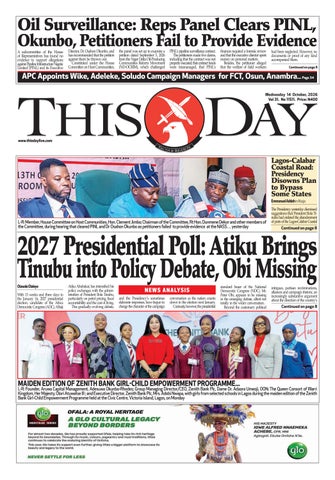
Oil Surveillance: Reps Panel Clears PINL, Okunbo, Petitioners Fail to Provide Evidence A subcommittee of the House of Representatives has found no evidence to support allegations against Pipeline Infrastructure Nigeria Limited (PINL) and its Executive
Director, Dr. Osahon Okunbo, and has recommended that the petition against them be thrown out. Constituted under the House Committee on Host Communities,
the panel was set up to examine a petition dated September 5, 2026 from the Niger Delta Oil-Producing Communities Reform Movement (ND-OCRIM), which challenged
PINL’s pipeline surveillance contract. The petitioners made five claims, including that the contract was not properly executed; that contract funds were mismanaged, that PINL’s
finances required a forensic review and that the executive director spent money on personal matters. Besides, the petitioner alleged that the welfare of field workers
had been neglected. However, no documents or proof of any kind accompanied them. Continued on page 8
APC Appoints Wike, Adeleke, Soludo Campaign Managers for FCT, Osun, Anambra... Page 34 Wednesday 14 October, 2026 Vol 31. No 11511. Price: N400
www.thisdaylive.com TR
UT H
& RE A S O
N
Lagos-Calabar Coastal Road: Presidency Disowns Plan to Bypass Some States Emmanuel Addeh in Abuja
L-R: Member, House Committee on Host Communities, Hon. Clement Jimbo; Chairman of the Committee, Rt Hon. Dunmene Dekor and other members of the Committee, during hearing that cleared PINL and Dr Osahon Okunbo as petitioners failed to provide evidence at the NASS… yesterday
The Presidency yesterday dismissed suggestions that President Bola Tinubu had ordered the abandonment of parts of the Lagos-Calabar Coastal Continued on page 8
2027 Presidential Poll: Atiku Brings Tinubu into Policy Debate, Obi Missing Olawale Olaleye With 13 weeks and three days to the January 16, 2027 presidential election, candidate of the Africa Democratic Congress (ADC), Alhaji
Atiku Abubakar, has intensified his policy exchanges with the administration of President Bola Tinubu, particularly on petrol pricing, fiscal accountability and the cost of living. This gradually evolving debate,
N E W S A N A LYS I S and the Presidency’s sometimes elaborate responses, have begun to change the character of the campaign
conversation as the nation counts down to the election next January. Curiously, however, the presidential
standard beaer of the National Democratic Congress (NDC), Mr. Peter Obi, appears to be missing in the emerging debate, albeit not totally in the wider conversation. Beyond the customary political
MAIDEN EDITION OF ZENITH BANK GIRL-CHILD EMPOWERMENT PROGRAMME...
intrigues, partisan recriminations, alliances and campaign rhetoric, an increasingly substantive argument about the direction of the country’s Continued on page 8
L-R: Founder, Aruwa Capital Management, Adesuwa Okunbo-Rhodes; Group Managing Director/CEO, Zenith Bank Plc, Dame Dr. Adaora Umeoji, OON; The Queen Consort of Warri Kingdom, Her Majesty, Olori Atuwatse III ; and Executive Director, Zenith Bank Plc, Mrs. Adobi Nwapa, with girls from selected schools in Lagos during the maiden edition of the Zenith Bank Girl-Child Empowerment Programme held at the Civic Centre, Victoria Island, Lagos, on Monday
2
WEDNESDAY, OCTOBER 14 t T H I S D AY
3
WEDNESDAY, OCTOBER 14 t T H I S D AY
"SF ZPV JOWPMWFE PS JOUFSFTUFE JO
/0/ 0*- &91035 #64*/&44
$POOFDU XJUI PVS OPO PJM FYQPSU UFBN WJB FNBJM BU $POOFDU XJUI PVS OPO PJM FYQPSU UFBN WJB FNBJM BU FYQPSUEFTLEFQBSUNFOU![FOJUICBOL DPN 03 FYQPSUEFTLEFQBSUNFOU![FOJUICBOL DPN 03 7JTJU BOZ ;FOJUI #BOL CSBODI OBUJPOXJEF BOE MFU VT TVQQPSU ZPV UP HSPX ZPVS CVTJOFTT
4
WEDNESDAY, OCTOBER 14 t T H I S D AY
5
THISDAY • WEDNESDAY, OCTOBER 14, 2026
Group News Editor: Goddy Egene Email: Goddy.egene@thisdaylive.com, 0803 350 6821, 0807 401 0580
NEWS
G-24 MEETING PRESS BRIEFING...
L-R: Governor, Central Bank of Nigeria (CBN), Mr. Olayemi Cardoso; Minister of Finance and Coordinating Minister of the Economy, Mr. Taiwo Oyedele; and Director, G-24 Secretariat, Iyabo Masha, at the G-24 press briefing at the ongoing Annual Meetings of the International Monetary Fund and the World Bank in Bangkok, Thailand, yesterday
Shell Exits Nigeria’s Domestic Gas Distribution, Sells SNG to Vaaris Energy Sale to simplify portfolio as IOC focuses on deepwater, LNG Firm acquires 170km pipeline network serving 130+ customers Peter Uzoho Shell Petroleum B.V. has signed an agreement to sell its full interest in the Shell Nigeria Gas Group to Nigerian energy company, Vaaris Energy Limited. Shell Nigeria Gas operates Nigeria’s domestic gas distribution business and has served industrial and commercial customers for more than 25 years. Shell’s Country Chair in Nigeria, Elohor Aiboni, announced the transaction yesterday, saying the deal provides a stronger platform for the business under new ownership, while allowing Shell to focus on its strategic deepwater and integrated gas positions in Nigeria. “Shell Nigeria Gas has served industrial and commercial customers in Nigeria for more than 25 years, supported by the commitment and expertise of its people,” Aiboni said in a statement signed by Shell’s Country Communications Manager, Gladys Afam-Anadu. “We believe this agreement provides a much stronger platform for the business’ next chapter under new ownership. Shell continues to
focus on strategic Deepwater and Integrated Gas positions in Nigeria,” Aiboni added. The transaction is subject to regulatory conditions and approvals. Until completion, the Shell Nigeria Gas Group will remain part of Shell and will continue to serve customers
and operate as usual. Shell Nigeria Gas Limited was established in 1998 and supplies natural gas to industrial and commercial customers. It operates around 170 kilometres of pipeline infrastructure across Ogun, Abia and Rivers states, serving more than 130
connected commercial and industrial customers. SNG does not operate in upstream gas production, liquefied natural gas or international gas trading. The transaction includes Shell Nigeria Gas Holding B.V., established in 2019, which holds all the shares
except one in Shell Nigeria Gas Limited. Vaaris Energy Limited is a Nigerian energy company with interests across the oil and gas value chain and an existing operational footprint in the country. Shell said the sale is consistent with
its strategy to simplify its portfolio and concentrate investment in areas where it has competitive strengths. “In Nigeria, our continued focus on Deepwater and Integrated Gas, including our interest in Nigeria LNG, exemplifies our strategy,” the company said.
FG, AfDB to Review Bank’s Projects in Nigeria as Country Confirms Bid to Remain Largest Shareholder Ndubuisi Francis in Abuja Nigeria and African Development Bank (AfDB) have agreed to a joint technical review of the bank’s portfolio (investments) in Nigeria and the preparation of an official visit to Nigeria by AfDB President, Dr. Sidi Ould Tah. The portfolio review will identify implementation bottlenecks, speed up project delivery, and align ongoing operations with the federal government’s development priorities. Minister of Finance and Coor-
dinating Minister of the Economy, Taiwo Oyedele, and Tah agreed on impending portfolio review and Tah’s proposed visit when they met on the side-lines of the ongoing IMF/World Bank Group Annual Meetings in Bangkok, Thailand. Oyedele confirmed that Nigeria intended to remain the bank’s largest shareholder and to meet its capital subscription obligations. He added that the long relationship between Nigeria and AfDB should now deliver more development finance and practical economic gains.
The minister expressed Nigeria’s support for the “Four Cardinal Points”, the bank’s strategic agenda under Tah. They are: to bridge Africa’s financing gap, secure the continent’s financial sovereignty, harness its demographic dividend, and build resilient infrastructure through the local transformation of natural resources. Oyedele said the agenda aligned closely with Nigeria’s own development priorities. Tah’s proposed visit is expected to include engagement with President Bola Tinubu, senior government officials, and other stakeholders on
Nigeria’s development priorities and its strategic cooperation with the bank, the Ministry of Finance said in a statement issued by its Head of Media, Efe Ovuakporie. The two sides also discussed the high cost of borrowing faced by African countries, with Oyedele saying international credit ratings did not always reflect improvements in economic fundamentals and reform performance, which raised financing costs for countries like Nigeria. Tah disclosed that AfDB was developing a facility to give African governments technical and analytical support in their engagement
with credit rating agencies. He said the facility would help countries present credible economic data and challenge assessments where necessary. Other areas discussed included African financial integration, local currency transactions, trade insurance, and credit enhancement to reduce investment risk and attract private capital. Both sides also stressed the need to retain skilled professionals on the continent. Technical work on financing and portfolio performance will continue alongside preparations for the AfDB president’s visit.
Adedayo Akinwale in Abuja
said the group was put together to mobilise the teeming population in the north, which has the largest voting bloc in the country. He added that the group was not about north-south division but about the progress of Nigeria and success of the APC, with specific focus on ensuring that northern votes were not only repeated but more than tripled compared to previous elections. “We have itemised the successes and places of successes in previous elections. We have identified our weak areas and target flashpoints that led to low turnout. The apathy is across the country, from 1999 to date turnout has been going down,” he said.
Shekarau explained that the group, has established 20 directorates with specific tasks, compiled a catalogue of President Tinubu’s achievements, projects and programmes across the north which are largely unknown, and intends to expose them to change the narrative that Tinubu has neglected the north. He disclosed that the group has appointed coordinators at state, local government and ward levels, established a functional secretariat as its engine room, and that the secretariat would be commissioned on Saturday with Vice President Kashim Shettima expected as special guest.
Newswatch to Present ‘Dele Giwa’s Granite Journalism,’ Mark 40th Anniversary of Assassination 2027: Northern Group Meets Yilwatda, would give “the Dele Giwa media and friends. Dike Onwuamaeze Editor-in-Chief of Newswatch Plus, family an opportunity to remember Pledges to Triple Northern Votes for Tinubu The Newswatch family will on Mr. Soji Akinrinade, disclosed the the murdered journalism icon, October 19 present a book, titled, “Dele Giwa’s Granite Journalism,” at the Nigerian Institute of Journalism (NIJ), Ogba, Lagos State. The book presentation, according to a statement, will “mark the 40th anniversary of the assassination of our dear brother, and founding Editor-in-Chief of Newswatch magazine, Dele Giwa, by a parcel bomb, at his house on Talabi Street, Ikeja, Lagos State”. The book, edited by Mr. Ray Ekpu, one of the founding editors of Newswatch magazine, also features tributes from many eminent journalists, particularly, Giwa’s peers
book launch in the statement, titled, “Remembering Dele Giwa.” Akinrinade said, “To mark this occasion, Newswatch Plus Limited and the entire Newswatch family would be presenting a book, ‘Dele Giwa’s Granite Journalism,’ to the public. “The book presentation would hold at the Kessington Adebutu Auditorium, Nigerian Institute of Journalism (NIJ), at Ogba, Ikeja, Lagos, at 12 noon and would be chaired by Founder and Publisher of Vanguard Newspapers, Uncle Sam Amuka.” He said the book presentation
showcasing his works and writings from Daily Times, Sunday Concord, and Newswatch magazine”. According to him, “Dele Giwa’s assassination on October 19, 1986 remains an unsolved case till date.” Akinrinade said, “The celebrated journalist, in partnership with Ekpu, Yakubu Mohammed and Dan Agbese, brought the lively and history-making Newswatch to life in early 1985, with Giwa as the Editor-in-Chief and Ekpu as his deputy. “From the magazine’s inception and under Giwa’s editorship, it breathed a new life into investigative journalism in Nigeria.”
The Arewa For Asiwaju (A4A) Group, has stated its resolve to mobilise voters across the 19 northern states and the Federal Capital Territory (FCT) to deliver massive votes for President Bola Ahmed Tinubu in the 2027 presidential election. The group made the declaration yesterday during a courtesy visit to the National Chairman of the All Progressives Congress (APC), Prof. Nentawe Yilwatda, at the party’s national secretariat in Abuja. Leader of the delegation and Chairman, Board of Trustees of the group, Senator Ibrahim Shekarau,
6
WEDNESDAY, OCTOBER 14, 2026 • THISDAY
NEWS
NNPCL EXECUTIVES VISIT TO MR PRESIDENT...
L-R: The Group Chief Executive Officer (GCEO) of the Nigerian National Petroleum Company Limited (NNPC Ltd), Bayo Ojulari; President Bola Ahmed Tinubu; and Chief Financial Officer of (NNNPC Ltd), Adedapo, Segun, during an audience at the Presidential Villa Abuja on Monday PHOTO: GODWIN OMOIGUI
Nigeria’s Single Window Platform Processes over 156,000 Import Permits in 7 Months Targets export operations by Q1 2027, records 99.98% uptime 12,112 importers, agents registered Phase one automates payments, eliminates manual workarounds NPA, NIMASA integration scheduled for November 16 Emmanuel Addeh and Aminat Hassan in Abuja Nigeria’s National Single Window (NSW) project has processed 156,026 import licences and permits since its launch in March, with more than 12,000 importers and agents registered on the platform, as the government moves to extend the digital trade system to export operations and other critical processes. Speaking at a media engagement
on the Phase One of the initiative in Abuja yesterday, the Director of the NSW Project and Head of Project Secretariat, Tola Fakolade, disclosed that 12,112 importers and agents have so far registered on the platform, while five government agencies have been fully onboarded for the first phase of implementation. The platform, launched on March 27, 2026 was designed to streamline trade documentation and regulatory processes by providing a central digital
interface for importers, exporters, shipping lines, airlines, freight forwarders and government agencies involved in international trade. Besides, the project team said the platform had maintained an overall uptime of 99.98 per cent, while more than 8,000 users had received training since its launch, stressing that the initial phase has automated the submission, processing and approval of import licences, permits and certificates for some government organisations.
These, it said, include: The National Agency for Food and Drug Administration and Control (NAFDAC), Standards Organisation of Nigeria (SON), National Environmental Standards and Regulations Enforcement Agency (NESREA) and the Nigeria Agricultural Quarantine Service (NAQS). The development represents a shift from the previous system, under which businesses had to navigate separate procedures and documenta-
Tinubu Pays Glowing Tribute To Lagos GAC Chairman, Prince Tajudeen Olusi, at 90 Deji Elumoye in Abuja President Bola Tinubu has paid glowing tribute to elder statesman and Chairman of Lagos Governance Advisory Council (GAC), Prince Tajudeen Olusi, as he clocks 90. Tinubu described Pa Olusi, who he said had for decades been his leader, mentor, ally, guide, and counsellor, as a true icon of Lagos, stabilising force in the progressive family, and a father figure whose wisdom had been a compass for generations of leaders.
The president, in a 14-paragraph tribute issued on Tuesday, stated, “Today, I celebrate not just the remarkable 90th birthday of Prince Tajudeen Oluyole Olusi, elder statesman and chairman of the Lagos Governance Advisory Council, but also a life of honour, service and uncommon loyalty. “Prince Olusi is a true icon of Lagos, a custodian of our progressive heritage, and a father figure whose wisdom has been a compass for generations of leaders. “Baba is not just a politician; he is
an institution. From his early days as a Councillor in the Lagos Town Council in 1962, to his service in the House of Representatives in the Second Republic, to his role as Commissioner for Commerce in Lagos, and now as Chairman of our GAC, his life is a masterclass in selfless public service, loyalty, and unwavering principle. “Prince Olusi bridges our progressive movement of yesterday and today’s Renewed Hope. “His influence transcends Lagos. As a prince of Lagos by paternity and
a prince of Ado-Ekiti by maternity, Baba Olusi embodies the unity and oneness of Yorubaland. “His recent installation as the Baba Adini of Yorubaland is a well-deserved recognition of Baba’s deep faith, moral uprightness, and contributions to Islam and community building.” Tinubu added, “What he has given Lagos and Nigeria - love, support, guidance and direction - Baba has given to me personally. For decades, he has been my leader, my mentor, my ally, my guide and my counsellor.
tion requirements across regulatory agencies before completing import transactions. Under the new arrangement, applications and related payments for the licences, permits and certificates issued by the four agencies are processed through the central platform. Fakolade disclosed that SON accounted for 104,956 documents processed, while NAFDAC accounted for 50,622. In the same vein, NESREA recorded 398 documents, while NAQS processed 50. According to a presentation made by Fakolade, air and sea cargo manifests have also been incorporated into the system, with airlines, air cargo operators and shipping lines expected to submit their documentation through the platform. Similarly, Fakolade said 3,596 air cargo manifests had been transmitted through the platform by 27 airlines, representing full participation among the airlines onboarded. Fifty-six shipping lines transmitted 368 sea cargo manifests, although this represented only 63.6 per cent of the 88 shipping lines listed in the project’s compliance figures. Also, the Nigeria Ports Authority (NPA) and the Nigerian Maritime Administration and Safety Agency (NIMASA) have completed their
readiness requirements but are still in the process of becoming operational on the platform. Their integration for Ships Entry Notice submission is now scheduled to go live on November 16, the NSW director said. He pointed out that the harmonisation of Harmonised System (HS) codes was also on track, following workshops involving regulatory agencies, including the Nigeria Customs Service (NCS). Fakolade hinted that with the first phase focused largely on import documentation and cargo manifests, the project is now moving into its second phase, which will introduce export-related processes and additional government agencies. The second phase is scheduled for phased delivery between the Q4 of 2026 and the Q1 of 2027. According to NSW, the first batch of agencies and organisations expected to go live in the Q4 of this year includes the Nigerian Export Promotion Council (NEPC), the Federal Ministry of Industry, Trade and Investment through the Federal Produce Inspection Service and the Registered Exporter System, SON, NAFDAC and the Nigerian Association of Chambers of Commerce, Industry, Mines and Agriculture (NACCIMA).
DICON Gray Lauds Army for Promoting Local Defence Manufacturing Seeks sustained military-industry collaboration Emmanuel Addeh in Abuja DICON Gray Insignia (DGI), a Nigerian defence manufacturing company, has hailed the Nigerian Army for opening up opportunities for indigenous defence manufacturers to test and demonstrate their products under practical field conditions. The organisation, in a statement in Abuja, described the initiative as a
significant step towards building the country’s domestic defence industry, calling for sustained military-industry collaboration and greater opportunities for local manufacturers to supply equipment to the armed forces. Managing Director and Chief Executive Officer of DGI, Bem Garba, specifically noted the role played by the Chief of Army Staff, Lt. Gen. Waidi Shaibu, and the military leadership in providing Nigerian
technology companies with the opportunity to demonstrate their capabilities and receive feedback from military end users. Garba said the exercise provided a practical platform for manufacturers to understand operational requirements, assess their technologies and identify areas for improvement, stressing that closer engagement between the military and local industry was essential to develop-
ing a sustainable domestic defence manufacturing sector. “We sincerely commend the Chief of Army Staff and the Nigerian Army leadership for this important initiative. At Jaji, we experienced a genuine willingness to engage Nigerian companies, understand their capabilities, and provide an opportunity for practical evaluation,” he said. During the Nigerian Army’s field
evaluation of military equipment prototypes in Kaduna, DGI presented its tactical shotgun platforms and DGI100 portable intelligent live-fire target system for assessment. Other participating indigenous companies included Proforce, PRIMETEK and Tera Haptic Industries. The company also acknowledged the contribution of Terra Industries, which provided its KAMA drone for a counter-unmanned aerial vehicle demonstration involving DGI’s tactical shotgun platforms. Garba said field evaluations
went beyond assessing individual products, providing an opportunity for the armed forces to help local manufacturers develop technologies that respond to Nigeria’s security needs. “A defence manufacturing industry cannot develop in isolation from the institutions it is established to serve. Manufacturers need access to end users, an understanding of operational requirements, opportunities to test their products, and professional feedback to help them improve.
7
THISDAY • WEDNESDAY, OCTOBER 14, 2026
NEWS
U.S MISSION HONOURS NIGERIAN CREATIVES BUILDING THE HOLLYWOOD-NOLLYWOOD PIPELINE...
L-R: Emmy award-winning visual development artist, Uzoma Dunkwu; Award-winning Producer and Global Media Makers alumnus, Josh Olaoluwa; celebrated Actor and International Visitor Leadership Program (IVLP) alumnus Richard Mofe-Damijo; U.S. Consul General Brandon Hudspeth; Chioma Ude, Founder and Executive Director of the Africa International Film Festival (AFRIFF); Award-winning Filmmaker, Kunle Afolayan; and Olugbenga Jacobs and Olusoji Jacobs-sons of the late veteran actor Olu Jacobs, during the “Reel Connections from Hollywood to Nollywood” creative industries reception in Lagos
Nigeria Ramps Up Crude Output, Meets OPEC Quota for Five Straight Months Oil, condensate production rise 2.34% to 1.72 million bpd Forcados, Bonny lead terminal output Emmanuel Addeh in Abuja and Peter Uzoho in Lagos Nigeria sustained its recovery in crude oil production in September, meeting its Organisation of Petroleum Exporting Countries (OPEC) quota for the fifth consecutive month. A statement in Abuja by the spokesman of the Nigerian Upstream Petroleum Regulatory Commission (NUPRC), Eniola Akinkuotu, said daily output also peaked at 1.84 million barrels, including condensates. The country recorded an average daily production of 1,717,030 barrels of crude oil and condensate during the month, representing a 2.34 per cent increase over August, according to the data released by the NUPRC. The September performance further consolidated Nigeria’s position as Africa’s largest crude oil producer, with production reaching 1.84 million barrels on the highest-output day and falling to a low of 1.68 million barrels during the period. Excluding condensates, Nigeria produced an average of 1.53
million barrels of crude oil per day, exceeding its OPEC-assigned quota of 1.5 million barrels per day by approximately 2 per cent. The latest figures mean Nigeria has now met its crude oil production quota for five consecutive months, sustaining output above or at the assigned threshold despite the operational challenges that have historically constrained production in the country. Crude oil production stood at 1.53 million barrels per day in May before rising to 1.55 million barrels per day in June. Output subsequently moderated to 1.51 million barrels per day in July and 1.5 million barrels per day in August before recovering to 1.53 million barrels per day in September. The improvement in September was attributed to stable operations across most producing assets and the absence of major pipeline outages during the month. According to the commission, the relative stability enhanced production uptime and improved the efficiency of crude oil evacuation, helping operators sustain output across the upstream petroleum
sector. The commission said the sustained growth reflected the commitment of operators and other industry stakeholders to improving operational efficiency, maintaining asset integrity and strengthening production reliability. Nigeria has faced persistent difficulties in achieving its production potential, including crude oil theft, pipeline vandalism, ageing infrastructure and
disruptions to production and evacuation. Sustaining output above the OPEC quota could therefore help strengthen crude oil export volumes and government revenue, provided the improved performance is maintained. A breakdown of production by terminals and streams showed that Forcados Terminal recorded the highest average daily output in September, accounting for 320,320 barrels per day. Bonny Terminal followed with 303,270
Felix Omoh-Asun in Benin City The Benin monarch, His Royal Majesty Oba Ewuare II, has pledged to walk in the footsteps of his father, Oba Erediauwa, who was widely acclaimed as a philosopher king whose legacies remain indelible, and his wisdom and role in the cultural re-awakening of the Benin people are etched in their memory. Oba Ewuare gave the assurance at
the first pre-inaugural lecture of the Oba Erediauwa Memorial Lecture Series, held at the University of Benin Auditorium in Benin City as part of activities marking his 10th coronation anniversary. The monarch was represented at the event by a delegation of palace chiefs led by Chief Enorense OzigboEsere, the Eghaevbonore of Benin. His address was delivered by Professor (Chief) Victor Igbineweka, Deputy
President transmits NDLEA, NSIB amendment bills to Senate, seeks expeditious passage President Bola Tinubu has asked Senate to consider two bills seeking to overhaul Nigeria’s legal frameworks for combating illicit drugs and investigating transportation accidents, including proposals to strengthen the powers of the National Drug Law Enforcement Agency (NDLEA) and expand the mandate of the Nigerian Safety Investigation Bureau (NSIB) beyond aviation. Tinubu transmitted NDLEA Bill 2026 and NSIB Amendment Bill 2026 to Senate in separate letters addressed to Senate President God-
swill Akpabio, pursuant to Section 58(2) of the 1999 Constitution, as amended. While the proposed NDLEA legislation seeks to repeal the existing National Drug Law Enforcement Agency Act and the Indian Hemp Act and replace them with a consolidated legal framework for tackling drug-related offences, the NSIB amendment seeks to reposition the bureau as an independent, multimodal safety investigation authority. In his letter transmitting the NDLEA Bill, Tinubu said the proposed legislation would establish a consolidated framework
boost foreign exchange earnings and strengthen government revenue. Despite the recent improvement, achieving the targets will require a significant increase in production capacity. September’s average crude oil output of 1.53 million barrels per day, excluding condensates, remains about 470,000 barrels short of the two million-barrel target and 1.47 million barrels below the 3 million barrel ambition.
Oba Ewuare II Pledges to Uphold Legacies of Oba Erediauwa at Memorial Lecture
Tinubu Seeks Sweeping Reforms of Drug Enforcement, Safety Investigation Laws Sunday Aborisade in Abuja
barrels per day, according to the NUPRC data. The September figures highlighted the steady return of operational stability and uninterrupted evacuation infrastructure in sustaining Nigeria’s recent production gains. Nigeria has set an ambitious target of raising crude oil production to 2 million barrels per day by 2027 and 3 million barrels per day by 2030 as part of efforts to maximise its petroleum resources,
to strengthen enforcement against the cultivation, processing, sale, trafficking and use of illicit drugs. The president explained that the bill sought to repeal the National Drug Law Enforcement Agency Act, Cap. N30, and the Indian Hemp Act, Cap. I16, Laws of the Federation of Nigeria 2004, in favour of a unified legislative framework. He stated, “The National Drug Law Enforcement Agency Bill 2026 seeks to repeal the National Drug Law Enforcement Agency Act, Cap. N30, and the Indian Hemp Act, Cap. I16, Laws of the Federation of Nigeria 2004, and to enact a consolidated framework to enforce
the law against the cultivation, processing, sale, trafficking and use of hard drugs.” The proposed legislation also seeks to empower the agency to investigate persons suspected of involvement in drug-related activities, strengthening its capacity to tackle offences associated with illicit substances. Urging the senate to give the bill prompt consideration, Tinubu said, “While looking forward to the usual expeditious consideration of this submission, please accept, Distinguished Senate President and Distinguished Senators, the assurances of my highest consideration.”
Vice-Chancellor (Academic) of the University of Benin. Oba Ewuare stated that Oba Erediauwa ranked among the first generation of African monarchs whose voices resonated beyond nation’s boundaries. He described his father as a cerebral, versatile traditional ruler, and a strong advocate for balancing tradition with modernity. “We pledge our commitment once again to walk in his footsteps of progress and meaningful impact,” Oba Ewuare stated at the lecture, themed, “Oba Erediauwa’s Voice in Discourse: Defining His Intellectual Legacy.” The monarch stated, “As a former ambassador to many countries, these values cherished and instilled in us by our father of blessed memory, remind us constantly of our heritage within our spheres to be committed as one of the shakers and movers of modern African history and civilisation.” Ahead of the inaugural edition of the Oba Erediauwa Memorial Lecture scheduled for March 23, 2027- marking the exact date month of Oba Erediauwa’s coronation held in 1979 - Oba Ewuare announced the dissolution of the planning committee set up nine years ago, led by Prof. Sam Guobadia and Prince Aghatise Erediauwa, citing lethargy in discharging their royal assignments. Consequently, Oba Ewuare announced the immediate appointment
of Professor Osarhiemen Benson Osadolor, a professor of history at the University of Benin and keynote speaker at the event, as the new chairman of the Oba Erediauwa Memorial Lecture Series Committee. Earlier, in his welcome address, Vice Chancellor of the University of Benin, Prof. Edoba Omoregie, SAN, described Oba Erediauwa as an erudite scholar, a moral compass, and a monarch who combined intellectual depth and integrity that brought prestige to the Benin monarchy. He listed key milestones of his reign, commending him for his fatherly leadership and acknowledging his support for the university’s endowment, research, arts, technology, and environmental conservation initiatives. In his keynote presentation, Osadolor described Oba Erediauwa as a monarch with an outstanding reputation. He recalled scholarly works conveyed through the Oba’s books and articles that shaped government policies even before his reign in Benin, citing publications, such as, I Remain, Sir, Your Obedient Servant, and The Cradle of Ideas. Earlier, Mr. Lucky Imasuen, a former deputy governor of Edo State and chairman of the 10th Coronation Anniversary Committee, outlined activities planned for the anniversary. Imasuen commended the management of the University of Benin for its support.
8
WEDNESDAY, OCTOBER 14, 2026 • THISDAY
EIGHT
Unaudited Results: Dangote Refinery Posts $22.5bn Revenue, $4.7bn Profit in 9 Months Revenue surges 144%, EBITDA jumps to $5.5bn as refining margins rise Cash reserves hit $6.7bn, facility moves from $1.7bn net debt to $651m net cash Emmanuel Addeh in Abuja and Peter Uzoho in Lagos Dangote Petroleum Refinery and Petrochemicals has posted a net profit of $4.73 billion on revenue of $22.48 billion in the nine months ended September 30, 2026, marking a dramatic turnaround from a $117.2 million loss recorded in the corresponding period of 2025. The unaudited results, released yesterday, showed that revenue surged 144 per cent from $9.2 billion in the first nine months of last year, while earnings before interest, taxes, depreciation and amortisation (EBITDA) climbed nearly ninefold to $5.52 billion from $627.6
million. The performance, according to the company, reflected higher refining throughput, improved operational reliability and stronger refining margins, as the 700,000 barrels per day facility transitions from commissioning and production ramp-up to sustained commercial operations. Beyond the sharp increase in earnings, the refinery strengthened its financial position, with cash balances rising to $6.69 billion from $809.5 million a year earlier. Its balance sheet also swung from a net debt position of $1.73 billion in September 2025 to net cash of $650.8 million by September 2026.
The figures represent a significant shift for the multibillion-dollar industrial complex as it pursues a landmark Initial Public Offering (IPO) intended to broaden African participation in its ownership and advance its expansion plans. Besides, the refinery’s EBITDA margin expanded to 24.56 per cent from 6.83 per cent in the corresponding period of 2025, indicating a substantial improvement in operating profitability. Operating cash flow also increased more than tenfold to $3.68 billion from $364.7 million, underscoring its growing capacity to generate cash from its core operations. The movement into a net cash position means the company’s cash holdings
exceeded its reported debt obligations on a net basis, providing greater financial flexibility as it implements its expansion programme. The results also showed that the refinery’s financial performance accelerated in the third quarter, with substantial increases in revenue, operating earnings and net profit between June and September. According to the unaudited results, eevenue rose from $13.91 billion at the end of June to $22.48 billion by September, implying third-quarter revenue of approximately $8.57 billion. Similarly, EBITDA increased from $2.60 billion at the half-year mark to
$5.52 billion at the end of September, suggesting that the refinery generated approximately $2.92 billion during the third quarter alone. In the same vein, net profit climbed from $1.82 billion in the first half of the year to $4.73 billion by September, representing an additional $2.90 billion in earnings in the three months to September. The figures highlighted the pace of the facility’s commercial expansion following its commissioning and initial production ramp-up. Managing Director and Chief Executive Officer of Dangote Petroleum Refinery and Petrochemicals, David Bird,
Alhaji Aliko Dangote attributed the strong results to increased throughput, greater operational stability and improved refining margins. Our third-quarter performance demonstrates the successful transition from commissioning and ramp-up activities to sustainable commercial operations.
2027 PRESIDENTIAL POLL: ATIKU BRINGS TINUBU INTO POLICY DEBATE, OBI MISSING economy is beginning to take shape with the duo constantly sparring. The recurring disagreement between APC’s Bola Ahmed Tinubu and ADC’s Atiku Abubakar, is neither new nor particularly surprising. What is noteworthy, however, is the increasing specificity of the questions and policy alternatives being advanced by Atiku, and the detailed responses these have elicited from the Presidency. And, coming from Tinubu, who is naturally not disposed to a debate as evident during the 2023 presidential election, Atiku might have subtly forced the president and his government into interesting policy debate, and inadvertently changing the tenor of campaigns, based on issues. From the removal of petrol subsidy to the management of the exchange rate, public borrowing, taxation,
government expenditure and the affordability of basic necessities, Atiku has repeatedly challenged the administration to explain not merely why its economic reforms were necessary, but how their benefits are reaching ordinary Nigerians. In doing so, the former vicepresident has sought to shift the political conversation from personalities and partisan loyalties to the actual consequences of public policy. The government, on its part, has not allowed the arguments to go unanswered. Its statements, campaign interventions and direct responses have defended the logic of Tinubu’s reforms, challenged the financial sustainability of Atiku’s alternatives and questioned whether his proposals are compatible with existing legislation. This exchange has produced an
interesting feature of the emerging presidential contest: a government defending the economic decisions it has already taken and an opposition candidate being pressed to explain the practical implications of the decisions he proposes to take. Yet, amid this increasingly sustained encounter, another major presidential candidate, Peter Obi of the NDC, has not occupied the same place in the particular exchange between Atiku and the Presidency. Obi has certainly not been silent on national issues. He has articulated positions on economic production, petroleum subsidy, corruption, electricity and public accountability. Indeed, his party recently criticised the government’s petrol discount. The distinction is that the recent sequence of proposals, presidential responses, counterproposals and fiscal
arguments has developed principally around Atiku’s intervention. That development offers a useful window into the changing character of the 2027 contest.
From Political Rhetoric to Policy Alternatives For much of Nigeria’s Fourth Republic, presidential campaigns have frequently been shaped by questions of ethnicity, religion, zoning, personalities and political alignments. Although economic policy has never been entirely absent, the technical details of proposed reforms have not always received the sustained public interrogation that a country facing serious structural economic challenges requires. The present circumstances make
such an interrogation particularly relevant. When President Tinubu assumed office on May 29, 2023, he announced the removal of petrol subsidy, setting in motion one of the most consequential economic decisions of his administration. Changes in the foreign exchange system followed, while the government subsequently introduced far-reaching tax and fiscal reforms. The administration has maintained that these decisions were necessary to correct distortions, improve government finances, encourage investment and place Nigeria on a more sustainable economic footing. Atiku’s central objection is solely about the implementation of those reforms, the social protection available to vulnerable citizens and the accountability mechanisms governing
LAGOS-CALABAR COASTAL ROAD: PRESIDENCY DISOWNS PLAN TO BYPASS SOME STATES Highway to route the project through the existing East-West Road, insisting that the entire 750-kilometre coastal highway would be constructed as originally planned. The clarification followed public controversy over the proposed use of the East-West Road corridor in parts of the Niger Delta, with concerns that the decision could leave some states and coastal communities outside the original alignment of the flagship infrastructure project. In a statement posted on the Presidency’s official X handle, the government declared that at no time did the President direct that the 750km dualised Lagos-Calabar Coastal Highway be discontinued to East-West Road from Edo State. Instead, it said the proposed reconstruction of 400 kilometres of the East-West Road, from Edo State to Cross River State, was an additional project to be executed alongside the coastal highway. “This additional project, which is the reconstruction of East-West Road, is presently below flood level due to climate change and whose pavement is badly damaged, will not affect the complete construction of the entire 750km dualised LagosCalabar Coastal Highway as initially proposed,” the statement said. The statement, issued following a directive by the Minister of Works, David Umahi, sought to clarify the government’s position amid mounting questions over the route of the coastal highway and the implications of the proposed changes for states along the corridor. Umahi had earlier said Tinubu directed that the continuation of
the coastal highway should use the existing East-West Road in parts of the Niger Delta rather than create an entirely new alignment. The comments generated controversy, with critics demanding clarification on whether the original route had been altered and which communities would benefit from the project. The latest statement, however, maintained that the original alignment remained intact and that work was progressing on several sections of the highway. It identified five sections where work was ongoing in the Niger Delta and adjoining areas, including Sections 3A and 3B in Cross River and Akwa Ibom states, covering 75 kilometres of dual carriageway; Sections 4A and 4B in Ogun and Ondo states, covering 65 kilometres; and Section Five in Akwa Ibom State, covering 62 kilometres. The government said surveying and design work was continuing on the outstanding portions of the highway, extending from the end of the Ondo section through Edo, Delta, Bayelsa and Rivers states before connecting with Section Five in Akwa Ibom. It added that procurement and construction of the remaining sections would commence after the survey and design work had been completed. “As soon as the survey and design of the remaining sections of the 750km of the Lagos-Calabar Coastal Highway are completed, procurement and construction will commence starting from the end of Ondo axis,” the statement said.
The Presidency also cited the additional route approved for the Akwanga-Jos-Bauchi-Gombe-BiuMaiduguri highway to explain why the East-West Road reconstruction would not mean the abandonment or alteration of the coastal highway. According to the statement, Tinubu approved an additional 410-kilometre Wukari-Langtang route under the fourth legacy road project, expanding the planned dual carriageway from 700 kilometres to 1,100 kilometres. It said the additional route had not affected the original alignment of the project, adding that the same
principle applied to the coastal highway and the East-West Road reconstruction. “All sections of the legacy projects are ongoing as proposed, and the additional projects will not affect the performance of the original alignment nor will it change it,” the statement added. The Lagos-Calabar Coastal Highway is one of the federal government’s major infrastructure projects, designed to link Lagos with Calabar through Ogun, Ondo, Edo, Delta, Bayelsa, Rivers and Akwa Ibom states.
The controversy over its alignment intensified after Umahi’s comments that the existing East-West Road would be incorporated into the route in parts of the Niger Delta. The minister cited flooding, climate change and the condition of the existing road as reasons for the proposed reconstruction. However, the reported changes prompted questions about the project’s original objectives, particularly its promise of improved connectivity for coastal communities and economic centres across the southern corridor.
the resources released. The argument became particularly pronounced in August 2026, when the ADC presidential candidate publicly pledged to restore petrol subsidy if elected. His declaration attracted immediate criticism, partly because Atiku had previously supported subsidy removal and downstream petroleum deregulation. But as the debate developed, his campaign clarified that the proposed arrangement would not simply revive the old system of subsidising imported petrol. Instead, Atiku advocated a capped, budgeted production subsidy directed at petroleum products refined within Nigeria, including those produced by modular refineries. According to his campaign, the proposed programme would be linked to verified domestic production, monitored independently and designed to ensure that the benefits reached consumers through lower pump prices. The distinction is consequential. Under the former arrangement, public resources were used extensively to compensate for differences between regulated domestic petrol prices and the cost of supply, much of which involved imported products. Under Atiku’s proposal, government support would be tied principally to domestic refining, potentially through crude oil supplied to qualifying refineries at preferential Continued on page 35
OIL SURVEILLANCE: REPS PANEL CLEARS PINL, OKUNBO, PETITIONERS FAIL TO PROVIDE EVIDENCE The Committee nonetheless referred the petition for a proper hearing. Proceedings followed the rules of the House and the principle of fair hearing, with the Committee’s Deputy Clerk serving as secretary. ND-OCRIM was invited three times, on September 14; September 22 and October 5, 2026, and failed to turn up on each occasion. It sent no one in its place, gave no reason and brought no evidence. No other stakeholder appeared. However, PINL did appear. Its representative submitted a written document: “The Impact of PINL Operations on Oil Production and Stability of the Niger Delta,” supported by location-tagged photographs. Nobody challenged it. Hearings closed on October 7, 2026. The submission set out the conditions PINL met on arrival. By May 2022, according to the company, 97 of every 100 barrels of crude pumped into the Trans Niger Pipeline (TNP)
were being lost. Force majeure had been declared, and national output had fallen below 900,000 barrels per day. PINL, engaged in August 2022, said it now works across all 215 host communities and engages more than 35,600 community members. Its operations are supported by 28 forward bases, 130 boats, 175 vehicles, 25 drones and 454 personnel from government security agencies. The company reported that the share of crude reaching the Bonny Terminal through the TNP rose from 3 per cent in May 2022 to 98 per cent in September 2026. It said the OML 11 field was restarted within 90 days after an 18-month shut-in, that 2,049 illegal connections were repaired and that 1,010 illegal refinery clusters were destroyed. It also pointed to its work in host communities, citing more than 5,000 scholarships, skills training for over 4,000 women and girls, and flood relief for more than 10 communities
in Rivers State. In its findings, the panel said PINL’s submission directly answered the claims about how the work was done. It also admitted a gap: the submission did not address the claims about contract funds or personal spending. On those two matters, its findings rest on the petitioners’ failure to bring any evidence. On welfare, members noted PINL’s palliative and food bank support and found no sign of neglect. They described PINL as a well-organised company with a strong structure, well regarded in its host communities, and said no evidence backs any claim against Okunbo. Twelve recommendations followed. The panel asked the full Committee to dismiss the petition, end any further investigation, and record the claims against PINL and Dr. Okunbo as unproven, while noting that affected parties keep their legal rights. Also, it asked the Committee
to acknowledge PINL’s work in protecting pipelines and its programmes in host communities, urged the company to sustain that work and look after its field staff, and recommended that the federal government extend PINL’s contract. Commendation was also sought for President Bola Tinubu, for sustaining security reforms in the oil and gas industry; the National Security Adviser (NSA), for coordinating the protection of pipelines as well as the management of NNPC Limited. They also lauded the pipeline security firms including PINL and Tantita Security Services Nigeria Limited and further asked the Committee to pass a vote of confidence in all of them. But the report is not yet final. Dated October 7, 2026, it has been submitted to the full Committee for consideration and adoption, and the signature lines for the Chairman, four members and the Secretary were blank in the copy seen.
9
THISDAY • WEDNESDAY, OCTOBER 14, 2026
NEWS
SINGING OF STANDARD OPERATING PROCEDURE FOR GOVT SECURITY AND INTELLIGENCE AGENCIES...
L-R: Representative of the Group Chief Executive Officer, Nigeria National Petroleum Company Ltd, Dahiru Sani Gwarzo; Director, Security Energy, Office of the National Security Adviser, Goodluck Ebelo; Representative of the Minister of Defence, Olufemi Akinjobi; National Security Adviser(NSA), Nuhu Ribadu; Representatives of the Chief of Defence Staff, AVM Emeka Ashiegbu; OS Obai and AC Uko, during the singing of the Standard Operating Procedure(SOP) for Government Security and Intelligence Agencies and Other Stakeholders under the Nigeria Oil and Gas Industry-Wide Security Architecture held at the Office of National Security Adviser in Abuja on Monday
Tinubu: Corruption Can’t Be Uprooted in Nigeria Without Independent, Reform-minded Bench Tasks judiciary to probe prosecution strategies, seal procedural gaps exploited by criminals Deji Elumoye in Abuja President Bola Ahmed Tinubu has declared that corruption in Nigeria cannot be eradicated without an independent and reform-minded bench. Speaking on Tuesday in Abuja during the annual EFCC/NJI Capacity Building Workshop for Judges and Justices, Tinubu maintained that there would be no meaningful progress in efforts to tackle graft “without an independent, progressive, and
reform-minded Bench”. While commending the Economic and Financial Crimes Commission (EFCC) for convening the 8th edition of the Judges and Justices Workshop, the president, who was represented by Vice President Kashim Shettima, said the workshop was timely and necessary in “fostering the institutional cohesion required to confront corruption’s ever-changing architecture in Nigeria”. At the workshop, themed, “Investigation and Prosecution of
Economic and Financial Crimes in a Digital Age,” Tinubu stated, “My Lords, we confront a rapidly shifting criminal landscape. Technology has amplified the audacity and reach of illicit actors, ushering in sophisticated crimes driven by destructive ingenuity. “The rise of blockchain technology and artificial intelligence has introduced unprecedented layers of complexity to traditional illicit activities. “Because these modern crimes
constantly mutate, law enforcement and judicial authorities must continuously build capacity to adapt and respond effectively.” Tinubu also tasked the judiciary to dismantle the procedural loopholes and flawed prosecution tactics that allowed criminals to escape justice. He demanded an aggressive overhaul of the justice system to ensure that no well-connected individual could manipulate technicalities to evade the full, crushing weight of the law.
NMT Rebrands Training School as Academy, Begins One-Year Programme for 60 Nigerians Three best-performing trainees to get employment opportunities after programme Sunday Ehigiator Nigeria Machine Tools Limited (NMT) has rebranded its Training School as NMT Academy and commenced a one-year technical training programme for 60 Nigerians, aimed at strengthening indigenous capacity in the oil and gas, manufacturing, and engineering sectors. The programme, which commenced on October 7, 2026 at the academy in Osogbo, is being delivered under the EPU Phase 2 Development Project Package 2 Facilities, with participation from Nigerian Content Development and Monitoring Board (NCDMB), Renaissance Africa Energy Company, and Seflam SGL. The initiative is designed to equip participants with practical technical skills, industrial experience, and workplace competencies required to support Nigeria’s growing energy and manufacturing industries. Speaking at the commencement ceremony, Chief Operating Officer of NMT, Obehi Ojeaga, said human capacity development must translate local content commitments into measurable Nigerian capabilities. Ojeaga said, “Nigeria’s oil and gas industry requires more than investment and infrastructure. It needs competent technical professionals who can work safely, maintain critical equipment, and deliver consistently to industry
standards. “Human Capacity Development must move beyond compliance. It must create employable people, strengthen indigenous companies and support sustainable Nigerian participation across the energy value chain.” Ojeaga added that the academy’s objective was not merely to award certificates but to produce disciplined, confident, and employable professionals capable of supporting real industrial projects. She said the programme would combine classroom instruction, supervised workshop practice, practical assessments, workplacereadiness training, and exposure to a live manufacturing environment over 12 months. The trainees are expected to acquire competencies relevant to machining, welding, fabrication, pattern-making, and industrial maintenance, alongside training in occupational health and safety, quality assurance, teamwork, problem-solving and professional conduct. The initiative is expected to help address the shortage of skilled technical personnel required for Nigeria’s expanding upstream, gas, liquefied natural gas and associated infrastructure projects. The participants will receive instruction from experienced engineers, technicians, facilitators
and industry practitioners, with their progress assessed through practical projects, demonstrations and continuous technical evaluations. A major feature of the programme is its delivery within NMT’s 110-hectare integrated engineering and manufacturing complex in Osogbo, where participants will have access to industrial workshops and relevant production facilities. The academy also operates a residential training model designed to accommodate up to 100 trainees and participants at a time. Its facilities include modern classrooms, a dedicated training auditorium, machining and fabrication workshops, furnished accommodation, a canteen, an on-site medical clinic, sporting and recreational facilities, security arrangements, and essential utilities. According to the company, the residential arrangement is intended to integrate technical learning with the development of discipline, teamwork, leadership, personal responsibility, and professional conduct. Addressing the trainees, Ojeaga said their participation placed them within an institution with a longstanding record of technical training and industrial development. She stated, “You are joining an institution with a strong and respected brand. You are now becoming part of NMT’s proud
training heritage. “Some of you may become master technicians, engineers, project leaders or chief executives. The discipline and commitment you demonstrate during this programme will determine how far you go.” As part of efforts to connect training with employment, NMT announced that it would offer employment to the three bestperforming trainees upon successful completion of the programme.
The president urged the judiciary to interrogate existing statutory frameworks against the backdrop of emerging financial crimes. “Probe prosecution strategies, dismantle outdated precedents, and seal procedural gaps that politically exposed persons and organised crime actors exploit to delay or frustrate trial,” he stated. Tinubu warned that while financial and economic crimes posed an existential threat to Nigeria, corruption had no respect for status and spared no arm of government. According to him, framing the anti-corruption campaign as purely an executive agenda is a fundamental error because compromised public services equally affect the executive, legislature, judiciary, and ordinary citizens. Stating that corruption was a battle against the nation’s collective survival, the president said, “We must no longer permit legal pyrotechnics and procedural pedantry to shelter criminality. The Bench is not merely a mechanical arbiter of rules, but an active guardian of moral order and social equity. “Law is, by design, an instrument of social engineering; it must invariably prioritise the public good over narrow, selfish interests shielded by technical manoeuvres. Our courts must embody the spirit, and not just
the arid letter, of the law.” Tinubu urged the judiciary to adapt to the shifting dynamics of financial crime, stressing that realigning the country’s investigative and prosecutorial strategies is critical to preventing institutional obsolescence. He explained, “We are already on the right trajectory. The EFCC’s recent momentum in tackling cryptocurrency fraud and its commendable strides in recovering virtual assets are highly reassuring. The agency has recovered billions of naira in cryptocurrency investment-related fraud cases. “In 2025, the agency secured the forfeiture of $22,417.91 (Twenty-Two Thousand, Four Hundred and Seventeen Dollars, Ninety-One Cents) worth of Bitcoin; 1,001,301.87 USDT (One Million, One Thousand, Three Hundred and One USDT and Eighty-Seven Cents) in digital assets; and US$5.6 million linked to the CBEX scheme, while 192 foreigners arrested for cyber-terrorism and cryptocurrency fraud were successfully prosecuted and deported afterwards.” Tinubu said while EFCC’s actions showed an agency that was proactive, forward-looking and resolved not to be outpaced by technological innovation, the judiciary “must complement law enforcement by rapidly upscaling its capacity.”
Catholic Church Challenges Lagos Govt Over Island Property Wale Igbintade The Catholic Archdiocese of Lagos has approached the Court of Appeal, Lagos Division, seeking to overturn a judgment of the Lagos State High Court declaring the state government the owner of a disputed property at No. 17/19 Okoya Street, Idumagbo, Lagos Island. The archdiocese, through the Sole Trustee of the Catholic Archdiocese of Lagos, is challenging the judgment delivered by Justice I. O. Kasali on January 10, 2018, arguing that the government’s takeover of St. Patrick’s Catholic Primary School did not automatically confer ownership of the entire property on the state.
In its proposed amended notice of appeal, filed in Appeal No. CA/L/W/644/2019, arising from Suit No. LD/120/2000, the church maintained that it acquired the property from the Lagos Executive Development Board through a conveyance dated September 15, 1938. The conveyance, according to the archdiocese, was registered as No. 27 at page 27 in Volume 483 at the Lands Registry, Alausa, and constitutes documentary evidence of its title to the land. The appellant argued that there was no evidence that its proprietary interest in the property had been lawfully acquired or revoked by
the Lagos State Government. It described the disputed property as a large expanse of land comprising Block 1, Plots 1, 2, 3, 16, 17 and 18, on which St. Patrick’s Catholic Church and the primary school are situated. The church contended that the government’s claim related to the school and did not extend to the church premises or the entire property. It faulted the trial court for failing to distinguish between the school premises and other facilities on the land, including a dilapidated building that previously served as a school building and church hall before the construction of a new school.
10
WEDNESDAY, OCTOBER 14, 2026 • THISDAY
NEWS
AREWA FOR ASIWAJU GROUP VISIT APC HEADQUARTERS...
L-R: Members of Arewa for Asiwaju (A4A), and former Governor of Katsina State, Barrister Ibrahim Shema; Former Plateau State Gov/ Senator Simon Lalong; Former Kano State Senator, Mallam Ibrahim Shekarau; Former Jigawa State Governor, Muhammadu Badaru; and Senator Abdulrahman Kawu Sumaíla, briefing journalists during A4A visit to APC national headquarters in Abuja, on Tuesday PHOTO: ENOCK REUBEN
INEC: Political Parties Have 14 Days to Notify Us Over Omission of Candidates From Final List of Governorship Election Adedayo Akinwale in Abuja The Independent National Electoral Commission (INEC) has said that under Section 32(2) of the Electoral Act, 2026, political parties that believe their candidates were wrongly left off the list have 14 days from the date of publication to notify the Commission. INEC National Commissioner and Chairman, Information and Voter Education Committee, Mohammed Haruna in a statement issued Tuesday said said affected political parties have until 24th October, 2026 to make their complaints known. Recall that following the publication of the finalist list of Governorship candidates for the 2027 general election, opposition parties have accused the commission of bias. In Ogun State, Ladi Adebutu, the governorship candidate of the Peoples Democratic Party (PDP) was left out of the final list, ditto to the former Minister of Communication and Digital Economy and governorship candidate of PDP in Gombe state, Isa Pantami. Haruna noted: “The general public is aware of the recent decision of the Supreme Court in INEC v. Zenith Labour Party, Appeal No. SC/ CV/495/2026 delivered on 24th September, 2026. “The decision arose from INEC’s
appeal against the judgement of the Court of Appeal, which nullified the provisions of Section 77(5)-(7) of the Electoral Act, 2026 requiring the submission of membership registers as a prerequisite for the conduct of valid party primaries.” The National Commissioner recalled that the Supreme Court, in the aforementioned judgement, held that the provisions of Section
77(5)-(7) of the Electoral Act, 2026 are constitutional and mandatory for all political parties. He said in particular, the Court upheld the constitutionality of Item No. 2 of INEC’s Timetable and Schedule of Activities, which mandated political parties to submit their membership registers between 21st April and 10th May, 2026. Haruna further recalled that the
Akpabio gives upper chamber’s committee one month to report Sunday Aborisade and Juliet Akoje in Abuja President Bola Tinubu yesterday sought the approval of the Senate and the House of Representatives for a N100.5 billion promissory note programme to compensate the Yobe State Government for transferring ownership of the Muhammadu Buhari International Airport, Damaturu, to the federal government In the Senate, the request, which forms part of the federal government’s 70th Promissory Notes Programme, was referred to the Senate Committee on
Local and Foreign Debts for scrutiny, with Senate President Godswill Akpabio directing the committee to submit its report within one month. In a letter read by Akpabio, the proposed reimbursement followed the Federal Executive Council’s approval of the takeover of the airport and repayment of the project cost incurred by the Yobe State Government. According to the President, the council approved the arrangement at its second extraordinary meeting held on May 23, 2023, under which the Federal Government would reimburse the state through the promissory notes
Calls for stronger digital safety practices as Lagos joins global Cybersecurity Awareness Month Governor Babajide Sanwo-Olu of Lagos State has urged residents to remain vigilant against cybercrime and adopt basic digital safety practices as the state joins the global community to mark the 2026 Cybersecurity Awareness Month. Sanwo-Olu, in a statement yesterday, signed by the state Commissioner for Information and Strategy, Gbenga Omotoso, described cybersecurity as a shared responsibility, urging citizens to take proactive measures to protect themselves from cybercriminals. “Cybersecurity is a shared responsibility. Citizens must remain vigilant,
the above decision of the Supreme Court and excluded political parties that failed to comply with Section 77(5)-(7) of the Electoral Act, 2026, in relation to fielding of candidates. “Meanwhile, the final list of Presidential and National Assembly candidates had already been published on 12th September, 2026, thirteen days before the Supreme Court delivered its judgement.
“Under Section 32(2) of the Electoral Act, 2026, political parties that believe their candidates were wrongly left off the list have 14 days from the date of publication to notify the Commission. The deadline is 24th October, 2026.” The Commission assured the public of its commitment to transparency, the rule of law and the credibility of the electoral process.
Senate, House Begin Consideration of Tinubu’s N100.5bn Yobe Airport Reimbursement Request
Sanwo-Olu Urges Lagosians to Stay Vigilant Against Cybercrime Sunday Ehigiator
Court held that failure to comply with the provisions of Section 77 (5)-(7), renders the defaulting political parties ineligible to sponsor any candidate for the election. He added: “In accordance with Section 287(1) of the Constitution of the Federal Republic of Nigeria, 1999 (as amended), the Commission, while finalising the list of candidates for the Governorship election applied
understand common cyber risks, and take proactive steps to protect themselves from cybercriminals,” the governor said. He added that many cybercrime victims were vulnerable because they lacked knowledge of basic digital safety practices, stressing the importance of public education in preventing online fraud and other cyber threats. “Most victims of cybercrime are those who are unaware of basic digital safety practices, making public education essential.” The state’s participation in the annual campaign aligns with the global initiative led by the United States Cybersecurity and Infrastructure Security Agency,
which promotes safer digital practices, improved cyber hygiene and stronger protection of digital systems. According to the statement, the Sanwo-Olu administration has, over the past three years, pursued cybersecurity initiatives aimed at strengthening digital trust and improving the security of businesses, government institutions and residents. Through the state’s Cybersecurity Advisory Board and the Ministry of Innovation, Science and Technology, the government has implemented programmes designed to improve cybersecurity awareness and strengthen the state’s digital security infrastructure.
programme. Tinubu told the Senate that the Bureau of Public Procurement (BPP) had completed its review of the project and recommended N100,509,017,234.55 as the amount payable to the state. “In the light of the foregoing, I urge the Senate to consider and approve the establishment and issuance by the Debt Management Office of a promissory note programme in the sum of N100,509,017,234.55,” the President stated in the letter. He also urged the lawmakers to expedite consideration of the request, expressing confidence that the Senate would act promptly on the proposal. “While looking forward to the expeditious action on this submission, please accept, Distinguished Senate President, the assurances of my highest esteem,”
Tinubu added. The referral to the Committee on Local and Foreign Debts marks the next stage of legislative consideration before the Senate determines whether to approve the proposed programme. If approved, the arrangement would provide the mechanism for the Federal Government to settle its financial obligation to Yobe State for the construction of the airport, following the FEC-approved takeover. The committee is expected to examine the request and report its findings to the Senate within the one-month period stipulated by Akpabio. The proposed N100.5 billion reimbursement underscores the financial implications of the Federal Government’s decision to take over infrastructure projects initially financed by state governments, with the promissory notes programme serving as the proposed
repayment mechanism in this case. In the House of Representatives, the request was conveyed in a letter read by the Speaker of the House, Tajudeen Abbas, when lawmakers resumed plenary after their annual recess yesterday. In the letter, the President requested the lawmakers’ authorisation for the establishment of the programme to facilitate the payment to the state government following the airport’s takeover. The President also appealed to the lawmakers to expedite consideration of the request. In a separate legislative communication, Tinubu forwarded the National Research Development Fund Bill to the House for consideration, alongside two proposed laws aimed at incorporating international humanitarian and criminal justice instruments into Nigeria’s domestic legal system.
Oborevwori Tasks African Youths on Leadership, Innovation As SILB Africa 2026 Bootcamp opens in Asaba Sylvester Idowu in Warri Governor Sheriff Oborevwori of Delta State has urged African youths to take active interest in leadership and politics, saying their participation is critical to shaping the continent’s future. He urged young people to move beyond complaints about governance and become actively involved in the political process to drive meaningful change in their communities and countries. Oborevwori spoke yesterday while declaring open the fifth edition of the
Social Innovation and Leadership Bootcamp (SILB) Africa 2026, with the theme, “Architects of Change,” at Unity Hall, Government House, Asaba. Represented by the Commissioner for Transport, Onoriode Agofure, the governor said leadership demanded courage, service, commitment and the ability to translate ideas into practical solutions to societal challenges. He noted that Africa needed young people capable of innovating, creating opportunities, building sustainable enterprises and contributing to com-
munity development. The governor said the initiative aligned with his administration’s MORE Agenda, particularly its commitment to youth empowerment through skills acquisition, entrepreneurship and technological innovation. He cited the contributions of the Delta State Job and Wealth Creation Bureau, skills acquisition and entrepreneurship programmes, and the Delta State Innovation Hub in equipping young people with practical skills and opportunities for economic independence.
WEDNESDAY, OCTOBER 14 t T H I S D AY
11
12
WEDNESDAY, OCTOBER 14 t T H I S D AY
WEDNESDAY, OCTOBER 14 t T H I S D AY
13
14
WEDNESDAY, OCTOBER 13 t T H I S D AY
ADDENDUM NO. 1 TO BIDDING DOCUMENT FOR THE SUPPLY AND INSTALLATION OF ANTI-PLAGIARISM SOFTWARE FOR THE BLUEPRINT-ICT-DEV PROJECT This is Addendum No. 1 to the issued Bidding Document with IFB No. NG-NUC-ICT-Dev-NC-002-2026 for the Supply and Installation of Anti-plagiarism Software issued on the 14th of September 2026. This Addendum is issued to amend item No. 4 in the Specific Procurement Notice issued to prospective bidders along with the Bidding Document on the 14th of September 2026. An additional clause is added to ease the process of payment for the bidding document by foreign bidders. Item No. 4 of the Specific Procurement Notice shall now read as follows: 4A. A complete set of Bidding Documents may be purchased by interested bidders on the submission of a written application to the addresses indicated below and upon payment of a non-refundable fee of One hundred thousand Naira (N100,000.00) via Remita by generating a Remita Retrieval Reference (RRR) in favour of National Universities Commission.
ADDENDUM NO. 1 TO BIDDING DOCUMENT FOR
PROCUREMENT OF LEARNING MANAGEMENT SYSTEM (MODDLE) This is Addendum No. 1 to the issued Bidding Document with IFB No. NG-NUC-ICT-Dev-NC-RFB-001-2026 for the Supply and Installation of Learning management System Software (MODDLE) issued on the 18th of September 2026. This Addendum is issued to amend item No. 4 in the Specific Procurement Notice issued to prospective bidders along with the Bidding Document on the 18th of September 2026. An additional clause is added to ease the process of payment for the bidding document by foreign bidders. Item No. 4 of the Specific Procurement Notice shall now read as follows: 4A. A complete set of Bidding Documents may be purchased by interested bidders on the submission of a written application to the addresses indicated below and upon payment of a non-refundable fee of One hundred thousand Naira (N100,000.00) via Remita by generating a Remita Retrieval Reference (RRR) in favour of National Universities Commission.
Kindly follow these steps: (i) Enter Remita platform (ii) Pay Government (iii) Select Federal Government of Nigeria (iv) Under ‘Who do you want to pay’, Select National Universities Commission ICT Dev. (v) Complete the form and submit. Access will be provided to enable bidders to download the Bidding document on confirmation of payment via the provided email by the bidder.
Kindly follow these steps: (i) Enter Remita platform (ii) Pay Government (iii) Select Federal Government of Nigeria (iv) Under ‘Who do you want to pay’, Select National Universities Commission ICT Dev. (v) Complete the form and submit. Access will be provided to enable bidders to download the Bidding document on confirmation of payment via the provided email by the bidder.
4B. A complete set of Bidding Documents may be purchased by interested foreign bidders upon submission of a written application to the addresses indicated below and upon payment of a nonrefundable fee of One hundred United States Dollars (US$100.00) in favour of the National Universities Commission: Address:26, Aguiyi Ironsi Street, Maitama, Abuja Iban Account No.: Nil Swift Number: CBNINGLAXXX Bank and banker’s address: CENTRAL BANK OF NIGERIA, TINUBU SQUARE, LAGOS ACCOUNT No.:3000152282 Correspondent Bank: Standard Chartered Bank; 1 BASINGHALL AVENUE, London SWIFT: SCBLGB2LXXX
4B. A complete set of Bidding Documents may be purchased by interested foreign bidders upon submission of a written application to the addresses indicated below and upon payment of a nonrefundable fee of One hundred United States Dollars (US$100.00) in favour of the National Universities Commission: Address:26, Aguiyi Ironsi Street, Maitama, Abuja Iban Account No.: Nil Swift Number: CBNINGLAXXX Bank and banker’s address: CENTRAL BANK OF NIGERIA, TINUBU SQUARE, LAGOS ACCOUNT No.:3000152282 Correspondent Bank: Standard Chartered Bank; 1 BASINGHALL AVENUE, London SWIFT: SCBLGB2LXXX
SECTION II: BID DATA SHEET: SECTION II - BID DATA SHEET (BDS) Bid data Sheet, pages 25 - 26
1.0 1.1 1.1.1 Date: Time: 1.1. 2 Date: Time: 1.1.3 Date:
1.0 1.1
The provision in item ITB 22.1: Deadline for bid Submission: Shall now be amended to read 23rd November 2026 12:00pm
1.1.1
The provision in item ITB 22.15 The bid Opening: Shall now be amended to read Time for bid opening 23rd November 2026 12:01pm The provision in ITB 32.1 The date for the exchange rate shall be amended to read 23rd November 2026
1.1. 2
All other Provisions of the bidding document remain the same. Further information may be requested at the address below. The Project Coordinator (Blueprint-ICT-Dev Project) National Universities Commission, Peter Okebukola Building 26, Aguiyi Ironsi Street, Maitama 900288, Abuja; Nigeria Tel: + 234 802 122 5843 E-mail: ictdev@nuc.edu.ng; E-mail: jaatah@nuc.edu.ng
Date: Time:
Date: Time: 1.1.3 Date:
SECTION II: BID DATA SHEET: SECTION II - BID DATA SHEET (BDS) Bid data Sheet, pages 25 & 26 The provision in item ITB 22.1: Deadline for bid Submission: Shall now be amended to read 27th November 2026 12:00pm The provision in item ITB 25.1 The bid Opening: Shall now be amended to read Time for bid opening 27th November 2026 12:01pm The provision in ITB 32.1 The date for the exchange rate shall be amended to read 27th November 2026
All other Provisions of the bidding document remain the same. Further information may be requested at the address below. Further information may be requested at the address below. The Project Coordinator (Blueprint-ICT-Dev Project) National Universities Commission, Peter Okebukola Building 26, Aguiyi Ironsi Street, Maitama 900288, Abuja; Nigeria Tel: + 234 802 122 5843 E-mail: ictdev@nuc.edu.ng; E-mail: jaatah@nuc.edu.ng
15
WEDNESDAY, OCTOBER 14 t T H I S D AY
ADDENDUM NO. 1 TO BIDDING DOCUMENT FOR PROCUREMENT OF ICT HARDWARE, SOFTWARE, PERIPHERALS AND OFFICE FURNITURE FOR THE BLUEPRINT-ICT-DEVELOPMENT PROJECT
This is Addendum No. 1 to the issued Bidding Document with IFB No. NG-NUC-ICT-Dev-NC-003-2026 for the Supply and Installation of Anti-plagiarism Software issued on the 22nd of September 2026. This Addendum is issued to amend item No. 4 in the Specific Procurement Notice issued to prospective bidders along with the Bidding Document on the 22nd of September 2026. An additional clause is added to ease the process of payment for the bidding document by foreign bidders. Item No. 4 of the Specific Procurement Notice shall now read as follows: 4A. A complete set of Bidding Documents may be purchased by interested bidders on the submission of a written application to the addresses indicated below and upon payment of a non-refundable fee of One hundred thousand Naira (N100,000.00) via Remita by generating a Remita Retrieval Reference (RRR) in favour of National Universities Commission. Kindly follow these steps: (i) Enter Remita platform (ii) Pay Government (iii) Select Federal Government of Nigeria (iv) Under ‘Who do you want to pay’, Select National Universities Commission ICT Dev. (v) Complete the form and submit. Access will be provided to enable bidders to download the Bidding document on confirmation of payment via the provided email by the bidder. 4B. A complete set of Bidding Documents may be purchased by interested foreign bidders upon submission of a written application to the addresses indicated below and upon payment of a non-refundable fee of One hundred United States Dollars (US$100.00) in favour of the National Universities Commission: Address:26, Aguiyi Ironsi Street, Maitama, Abuja Iban Account No.: Nil Swift Number: CBNINGLAXXX Bank and banker’s address: CENTRAL BANK OF NIGERIA, TINUBU SQUARE, LAGOS ACCOUNT No.:3000152282 Correspondent Bank: Standard Chartered Bank; 1 BASINGHALL AVENUE, London SWIFT: SCBLGB2LXXX
1.0 1.1 1.1.1 Date: Time: 1.1. 2 Date: Time: 1.1.3 Date:
SECTION II: BID DATA SHEET: SECTION II - BID DATA SHEET (BDS) Bid data Sheet, page 27 The provision in item ITB 22.1: Deadline for bid Submission: Shall now be amended to read 1st December 2026 12:00pm The provision in item ITB 25.1 The bid Opening: Shall now be amended to read Time for bid opening 23rd December 2026 12:01pm The provision in ITB 32.1 The date for the exchange rate shall be amended to read 1st December 2026
All other Provisions of the bidding document remain the same. Further information may be requested at the address below. The Project Coordinator (Blueprint-ICT-Dev Project) National Universities Commission, Peter Okebukola Building 26, Aguiyi Ironsi Street, Maitama 900288, Abuja; Nigeria Tel: + 234 802 122 5843 E-mail: ictdev@nuc.edu.ng; E-mail: jaatah@nuc.edu.ng
127,&( 5H &RQJUDWXODWRU\ $GYHUWLVHPHQW 3XEOLVKHG RQ 3DJH 0RQGD\ 2FWREHU
:
H UHIHU WR WKH FRQJUDWXODWRU\ DGYHUWLVHPHQW SXEOLVKHG RQ 3DJH RI 7KLV'D\ 1HZVSDSHU HGLWLRQ RI 0RQGD\ 2FWREHU SODFHG E\ 3)/ (QJLQHHULQJ 6HUYLFHV FRQJUDWXODWLQJ 2QRPH 2NRGL\D 6$1 RQ KLV HOHYDWLRQ WR WKH 3UHVWLJLRXV 5DQN RI 6HQLRU $GYRFDWH RI 1LJHULD 6$1 :H ZLVK WR FODULI\ WKDW WKLV SXEOLFDWLRQ ZDV PDGH ZLWKRXW WKH NQRZOHGJH DXWKRUL]DWLRQ RU FRQVHQW RI 2QRPH 2NRGL\D 6$1 :H DFNQRZOHGJH WKDW WKH SXEOLFDWLRQ RI WKLV DGYHUWLVHPHQW ZLWKRXW KLV H[SUHVV DSSURYDO PD\ KDYH FDXVHG KLP LQFRQYHQLHQFH RU XQZDUUDQWHG SXEOLF DWWHQWLRQ :H KHUHE\ UHWUDFW WKH SXEOLFDWLRQ DQG VLQFHUHO\ DSRORJL]H WR 2QRPH 2NRGL\D 6$1 DQG KLV SURIHVVLRQDO FROOHDJXHV IRU DQ\ LQFRQYHQLHQFH WKLV XQDXWKRUL]HG SXEOLFDWLRQ PD\ KDYH FDXVHG 6LJQHG 0DQDJHPHQW 3)/ (QJLQHHULQJ 6HUYLFHV
T H I S D AY ˾ WEDNESDAY OCTOBER 14, 2026
16
Acting Group Politics Editor DEJI ELUMOYE
POLITICS
Email: deji.elumoye@thisdaylive.com 08033025611 SMS ONLY
INEC in the Eye of the Storm The Independent National Electoral Commission has the authority to enforce electoral rules, but that authority carries an obligation to explain consequential decisions and demonstrate consistency. What precisely disqualified the affected candidates, and have the relevant legal provisions been applied uniformly? Who, ultimately, should be held accountable when the right to appear on the ballot becomes a matter of dispute. Jonathan Eze writes.
Amupitan
D
emocracy begins long before voters approach the ballot box. It begins with the rules governing who may contest, the institutions entrusted with enforcing those rules and the confidence citizens place in the fairness of the process. Against this backdrop, the omission of Ladi Adebutu, Isa Ali Pantami and other candidates from INEC’s published lists for the 2027 governorship elections raises questions that reach beyond party politics into the foundations of electoral legitimacy. While no candidate is above the law, no electoral institution should be beyond scrutiny when its decisions determine who can participate in a democratic contest. Are the omissions the necessary consequences of statutory violations, or do they reveal procedural weaknesses requiring urgent redress? And can an election command enduring legitimacy if the process determining access to the ballot is itself a subject of controversy? That is the controversy confronting the Independent National Electoral Commission (INEC) following the publication of its governorship candidates’ lists for the February 6, 2027 elections. Among the prominent omissions are Ladi Adebutu, the Peoples Democratic Party (PDP) candidate in Ogun State, and Professor Isa Ali Pantami, the party’s candidate in Gombe State. Aminu Abdussalam Gwarzo, the Nigeria Democratic Congress (NDC) candidate in Kano State, is also reportedly missing from the list. In Bauchi State, candidates of the Social Democratic Party (SDP), New Nigeria Peoples Party (NNPP), Action Alliance (AA) and Accord Party were reportedly omitted. The development raises questions that extend beyond the fortunes of individual politicians. Was INEC enforcing the Electoral Act, responding to specific legal impediments or correcting nomination irregularities? Were the same standards applied consistently across parties? And has the commission adequately explained its decisions? These are questions of electoral accountability that demand evidence-based answers rather than partisan conjecture. The law behind the omissions The legal context is central to understanding the controversy. On September 24, 2026, the Supreme Court restored Sections 77(5), 77(6), 77(7) and 84(2) of the Electoral Act 2026,
Patami
provisions concerning political party membership registers and participation in party primaries, congresses and conventions. Section 77(5) restricts participation in party primaries to members whose names appear in the membership register submitted to INEC within the prescribed period. Section 77(6) requires parties to use the relevant register for their primaries, while Section 77(7) stipulates consequences for failure to submit the register within the statutory timeframe. The ruling provides a legal basis for enforcing membership and nomination requirements. It would therefore be premature to conclude that every omission reflects political interference. Equally, citing the law does not, by itself, establish that every individual decision was correctly made. In Adebutu’s case, questions have arisen over whether his name appeared in the PDP membership register submitted to INEC. The Ogun PDP has rejected allegations of non-compliance, maintaining that Adebutu registered within the stipulated period and that the relevant documentation was submitted. Adebutu has similarly maintained that he remains a duly registered member of the party. Pantami’s case presents a different complication. A Federal High Court in Gombe nullified his initial emergence as the PDP candidate and ordered a fresh primary. He subsequently won another primary on September 29, 2026. His camp maintains that the exercise complied with the court’s
Adebutu
directive and that the omission is being addressed through legal and administrative channels. These cases should not be conflated. A dispute over membership registration is distinct from one concerning compliance with a court-ordered primary. INEC must explain the specific legal and factual grounds applicable to each candidate. Political intrigue or administrative failure? The omissions have inevitably generated suspicion. The Ogun PDP has alleged that pressure from the ruling All Progressives Congress (APC) contributed to Adebutu’s exclusion. Such allegations are serious, but they remain claims by an interested political party and should not be treated as established evidence of interference. Nevertheless, unexplained decisions involving prominent candidates create fertile ground for speculation. The appropriate response is neither to presume a conspiracy nor to grant INEC unquestioning immunity from scrutiny. Did the commission identify specific statutory violations in each case? Were the affected parties notified of deficiencies? Were comparable cases treated consistently? Were relevant court orders properly considered? If the omissions resulted from administrative errors, what lawful mechanism exists to correct them? These questions are essential to determining whether the commission’s decisions rest on verifiable facts and applicable law. The scrutiny must also extend to the political parties. Parties cannot demand strict compliance from INEC while treating membership registers, nomination procedures and statutory deadlines casually. Where a party fails to meet legal requirements, its candidates may suffer the consequences regardless of their popularity or political standing.
The commission must resist political pressure to reverse lawful decisions, but it must equally demonstrate that its authority is exercised consistently and transparently. Ultimately, the controversy is larger than the political fortunes of Adebutu, Pantami, Gwarzo or the affected Bauchi candidates.
Conversely, a party’s insistence that it complied with the law cannot substitute for documentary verification. Accountability must apply to both the electoral regulator and the organisations it regulates. Is INEC truly independent? The controversy also raises a broader question about the meaning of electoral independence. Under Section 153 of the 1999 Constitution, INEC is established as an independent electoral commission. But institutional independence is demonstrated not merely by constitutional provisions; it is sustained through impartial decisions, consistent procedures and transparent explanations. An unpopular decision does not automatically establish political compromise, just as an institution’s claim to independence does not place its decisions beyond scrutiny. The controversy surrounding Kingsley Chinda, listed as the APC governorship candidate in Rivers State, further illustrates the importance of consistency. Reports have raised questions about the timing of his party registration relative to the APC primary. The Rivers APC has defended his candidacy. Whether the circumstances amount to a violation must be determined by the applicable law and verified facts. The public is entitled to understand how membership and nomination requirements are applied across comparable cases. This is not a demand that INEC exclude additional candidates; it is a demand for equal treatment under the law. Parties’ responses and narrowing window The PDP has said it is engaging INEC to resolve the omissions in accordance with the law and established electoral guidelines. Its spokesperson, Jungudo Mohammed, urged affected candidates and supporters to remain calm while discussions continue. Pantami’s camp has expressed confidence that its legal and liaison teams can address the matter. The NDC has maintained that Gwarzo remains its candidate, while the Kwankwasiyya Movement has called on INEC to explain the exclusion. In Bauchi, the reported omission of candidates from four parties raises additional concerns about smaller political organisations’ ability to secure representation on the ballot. NOTE: Interested readers should continue in the online edition on www.thisdaylive.com
17
T H I S D AY ˾ WEDNESDAY, OCTOBER 14, 2026
FEATURES
Group Features Editor: Chiemelie Ezeobi Email chiemelie.ezeobi@thisdaylive.com,
SPTIA: How Sahara Group is Preparing Young Engineers to Power Nigeria’s Energy Future As Nigeria seeks to address persistent challenges in its electricity sector, developing a skilled workforce capable of improving power generation, embracing technology and driving innovation remains critical. Through the Sahara Power Technical and Innovation Academy (SPTIA), Sahara Group, in collaboration with Egbin Power and First Independent Power Limited (FIPL), is investing in young Nigerian engineers through a ten-month programme that combines classroom instruction, hands-on training and industry mentorship. The initiative is designed to bridge technical skills gaps, prepare engineers for the demands of the evolving energy sector and build the human capacity needed to support more reliable and efficient power generation in Nigeria. Victoria Ojiako reports
A
s Nigeria's electricity sector pushes toward sustainable power generation and adoption of innovative solutions for energy security, empowering a new generation of skilled engineers to lead that charge has never been more essential. This vision drives the Sahara Power Technical and Innovation Academy (SPTIA), a flagship programme by Sahara Group aimed at empowering young engineers to translate this ambition into reliable power on the grid. SPTIA, delivered in collaboration with Egbin Power and First Independent Power Limited (FIPL), is a ten-month, hands-on training designed to equip young Nigerian engineers with the technical depth and real-world exposure urgently needed in the power sector. It is not merely a theoretical classroom exercise. Rather, it is a training that immerses participants in a live operational environment, where they work alongside seasoned professionals across generation, maintenance, and operations. Through this exposure, trainees will be equipped to understand real-world challenges and develop innovative solutions that will enable reliable and efficient power generation, thereby strengthening the sector.
L-R: Group Head, Talent Management, Sahara Power Group, Henry Ajibola; Sahara Power Technical & Innovation Academy (SPTIA) Trainee, Harrison Egbudu; Managing Director, Sahara Power Group, Anthony Youdeowei; SPTIA Trainee, Margaret Adebayo and Group Managing Director of Sahara Power Group, Kola Adesina, MFR, during the launch of SPTIA at Egbin Power Plant, Ikorodu, Lagos
Hands-On Training for Industry Readiness The CEO of Egbin Power with employees and SPTIA trainees The curriculum combines intensive classroom and practical instruction with on-the-job training provides a befitting living environment, Beyond Technical Skills: Lessons in across Egbin Power, Ikeja Electric and FIPL's including comfortable accommodation Professional Growth critical power generation and distribution assets, The programme's teachings extend beyond with recreational facilities, uninterrupted giving trainees direct exposure to real-time power supply, and access to free technical instruction to include essential operations, maintenance systems, and industry healthcare — ensuring trainees can life and personal development skills for best practices. dedicate their full attention to the growth. Mandatory safety modules, reinforced During an interactive session with Mokhtar rigorous demands of the Academy. through scenario-based practical sessions, instil Bounour, Chief Executive Officer of Egbin the safety-first discipline that the industry Power, the trainees had the opportunity to Investing in the Next demands. explore questions that went beyond power Generation of Engineers At the end of the programme, the trainees During the launch of SPTIA, Kola generation and industry dynamics — delving will be absorbed into various entities under Adesina, Group Managing Director into professional growth and the mindset Sahara Group and the broader electricity of Sahara Power Group, emphasised required to build a lasting career in a industry, enhancing capacity across the sector the philosophy behind the Academy: demanding industry. as a whole. It is a model built not just to Bounour's charge to the trainees was a deliberate, strategic investment serve Sahara Power Group, but to advance in Nigeria's human capital. "We are direct and practical, prodding them to the nation's power ambitions at large. committed to powering Nigeria not make continuous improvement a personal just through infrastructure, but through discipline rather than an abstract ideal: Building Skills for a Changing "In any situation in your life, personal or people. Energy Sector This Academy reflects our belief professional, keep asking yourself: 'What Beyond deepening investment in the sector, that the future of sustainable energy can I do to change it, to do it better, to closing these skill gaps will help address some delivery must be driven by skilled, improve?' And then act on it. Don't stop of the challenges in the sector, which include young professionals who understand at theory and tell yourself you're too tired ageing infrastructure, grid instability, and a to follow through. If you can identify one the local operating environment." widening gap between installed capacity and He identified Egbin Power and small action, take it. Never underestimate reliable delivery. FIPL as the ideal foundation for the the small steps; over time, they are what This requires a new generation of engineers initiative, highlighting their track record carry you the furthest. That mindset, more capable of adopting innovative solutions of operational excellence and technical than any single technical skill, is what will and artificial intelligence tools that are now expertise. "By leveraging these assets, define the engineers who go on to shape reshaping how energy systems are monitored, we are creating a pipeline of engineers this sector." maintained, and optimised globally. who are not only technically sound but Predictive maintenance, real-time diagnostics, also industry-ready from the outset." Trainees’ Experiences and data-driven plant management are no Adesina encouraged the trainees to and Career Aspirations longer optional extras; they are fast becoming For the trainees, the programme's impact approach the programme collaboratively, the baseline for operational excellence. as a means to sharpen the problem- is already reshaping how they see their The programme is designed with this solving skills that will define profession and their place within it. future in mind, equipping young engineers their contributions to the sector’s Osapkolor Igbinakenzua reflected on how the to think beyond conventional operations and experience has deepened his understanding advancement. to view technology and innovation as essential "We are here to truly and responsibly of engineering itself: "The Academy has tools for addressing Nigeria's energy security make a difference. We are here to look exposed me to a lot. Coming here has truly challenges directly. around our environment, and we are made me appreciate what engineering means, Each participant is equipped with a high-end, curious enough to see how we can particularly in power generation. I've seen personalised digital device to support their make things better. We believe you the practical application of concepts I only technology-driven training and provide access are here to make things better and add knew in theory, and beyond the power plant to learning resources. The programme also and the classroom, I've had the privilege of value to the sector," he said.
learning directly from industry professionals and a strong team of colleagues. I believe the future of power generation in Nigeria is in safe hands, because by the end of this training, we'll be among the engineers driving the country's power industry forward." Blessing Adumekwe described the programme as both intense and clarifying: "It has been an inspiring blend of practical and theoretical training. We now understand how departments, such as Chemistry, Operations, Electrical, Instrumentation & Control, Mechanical and others, all work together to make power generation possible. By the end of this programme, I believe we'll have the insight not only to advance our own careers, but to inspire other young engineers and help move the sector forward.". According to Philips Aka, "The training has shown me how power generation works, from generation through to distribution. It's exciting because you get both the classroom experience and the practical exposure. What I've learned is that we are all surrounded by opportunity. The key is knowing how to maximise it. After this programme, I want to contribute meaningfully to the power system and help build a better, greener energy future for Nigeria." Esene Osamudiame called the experience an eye-opener: "It has been exciting, challenging, and genuinely eye-opening. I now have far greater insight into the power sector value chain, and I intend to put everything I've learned to work in the plant. The mentoring session with the CEO of Egbin Power left a lasting impression on me. I learned that discipline could take you even further than technical knowledge alone." While describing the training as a personal turning point, Kehinde Owoeye said: "My experience so far has been transformative, a genuine knowledge-transfer journey. I've gained deep insight into power generation from the ground up, and the training has helped me understand exactly how I can become a solution-provider within the sector, not just an observer of it." Another trainee, Margaret Adebayo, summed up the journey as both educational and motivating: "The experience has been educative and truly amazing. Moving from theory to hands-on learning in the power plant has given me a deep appreciation for the power generation process. I'm looking forward to making a real difference in the sector once this intensive programme is complete." Preparing Engineers for Nigeria’s Energy Future SPTIA is more than a training initiative. It is a statement of intent. By channelling skilled engineers directly into the national talent pool, Sahara Power Group is investing in the longterm resilience of Nigeria's electricity sector, extending its impact well beyond its own workforce and into the broader architecture of the country's energy future. It is a vision built on a simple but powerful premise: that Nigeria's energy security will not be won by infrastructure alone, but by the ingenuity, discipline, and innovative thinking of the people who run it. Through SPTIA, Sahara Group, Egbin Power, and FIPL, engineers are being equipped as problem-solvers and innovators — the future leaders who will power Nigeria for the next 30 years and beyond.
18
T H I S D AY ˾ WEDNESDAY OCTOBER 14, 2026
EDUCATION Beyond Compliance: How Chrisland is Building a Culture of Safety, Safeguarding For children facing bullying, abuse or situations that make them feel unsafe, speaking up can be difficult. Some members of Chrisland Schools’ management team and its Designated Safeguarding Officers told journalists, including Funmi Ogundare, how the school is working to create an environment where learners feel safe reporting concerns and seeking help. They explained how initiatives such as its Safeguarding Week, confidential reporting channels, staff training and regular risk assessments are helping to make safety and child protection a shared responsibility among learners, parents and staff across the school’s campuses
F
or a child who is being bullied, feels unsafe or is struggling with a situation that they do not know how to handle, the hardest step can often be finding the courage to speak. At Chrisland Schools, the message during Safeguarding Week is simple: speak up, and someone will listen. Across its 16 schools, the management is seeking to make safety and safeguarding more than rules contained in a handbook or instructions delivered during an assembly. It wants them to become part of how learners think, behave, and relate to others. For the Head of Risk, Compliance, Safeguarding and Child Protection, Kemi Fajemirokun, the objective goes beyond satisfying regulatory requirements. “Our focus is beyond compliance, embedding the whole school safety culture and safeguarding culture for positive character development in every learner,” she stated. That philosophy is reflected in the school’s approach to safeguarding, which places learners, parents and staff at the centre of what Fajemirokun described as a ‘triangle of responsibility’. “The children are focused on what they should do; the parents are focused on what they should do; and the teaching and non-teaching staff are also focused on what they should do,” she explained. The approach is particularly important in a school environment where children spend a significant part of their formative years interacting with peers and adults. Rather than waiting for an incident to occur before responding, Fajemirokun said the school has deliberately built safety awareness into the everyday school experience. For about seven years, the school has held a dedicated safety and safeguarding awareness week, using different themes each term to address emerging concerns and remind the entire school community of their responsibilities. This year’s theme, ‘Beyond Compliance:
Mrs. Kemi Fajemirokun, the Divisional Head, Risks, Compliance, Safeguarding and Child Protection, with some Designed Safeguarding Officers (DSO) of the school during its safety and safeguarding awareness week in Lagos... recently
Embedding the Whole School Safety Culture and Safeguarding Culture for Positive Character Development in Every Learner’, she noted, captures the school’s attempt to make safety instinctive. Fajemirokun wants learners and staff to develop what she described as a safety mindset, an internal awareness of when an action could place them or another person at risk. “We want it to become a culture where every learner, every staff member and every child has a mindset of safety and safeguarding in their DNA, that I cannot do this thing because I am going to be vulnerable; I cannot do this thing because it is going to expose me to danger,” she said. Every planned activity, Fajemirokun noted, must undergo a risk assessment
before it receives clearance. “We do risk management of all our processes every time. Before we do anything, we must assess the risks. Only after you have completed the risk assessment can you clear a school to proceed with whatever you have planned. This means safety considerations are expected to precede activities rather than being introduced after something goes wrong,” she explained. One of the most significant elements of the safeguarding programme is creating safe channels for children to raise concerns. At schools in Ikeja, Idimu and Festac, Victoria Island, Designated Safeguarding Officers (DSOs) said learners are encouraged to report bullying, abuse or anything that makes them uncomfortable. They, however, noted that reporting is not always easy. Some children may be afraid of being labelled a ‘snitch’. Others may fear retaliation from the person they have reported
or worry that their peers will discover that they raised the alarm. The schools therefore assured learners that confidentiality is central to the reporting process. A designated safeguarding officer at Chrisland School, Opebi, Ikeja, Abimbola Taylor, explained that where a child was uncomfortable being identified, the matter could be treated as a general observation rather than attributed directly to the child. The objective, she said, was to ensure that “nobody will even trace it to whoever has reported”. The system also recognises that not every child will be comfortable standing before an adult and narrating what happened. For such learners, safeguarding boxes have been provided where they can write down their concerns and submit them. The designated safeguarding officers then review the reports and take appropriate action. “It is a small but significant shift: giving children not just instructions about staying safe, but different avenues through which they can ask for help,” Taylor said, adding that bullying is not acceptable, and every child has the right to express discomfort and seek protection. The school’s safeguarding system does not end with awareness campaigns. Another DSO said incidents and concerns should be reported promptly, with a 24-hour window for escalation. “Dedicated incident-reporting email channels operate around the clock, allowing staff to report concerns no matter how minor they may initially appear. Don’t take anything too small or too big. No matter what, within 24 hours,” she stated. The Executive Head of School (Academics), Olusegun Ogunsola, said he believes that effective safeguarding must begin with a clear understanding of who the school exists to protect. NOTE: Interested readers should continue in the online edition on www.thisdaylive.com
Stakeholders Canvass Public-Private Partnership to Reduce Out-of-school Population Oluchi Chibuzor
Stakeholders in the country’s education sector have called for public-private partnership to reduce the over 10 million out-of-school population. They also sought an upgrade of existing education models to meet modern world demands, to close the gap between learning and workplace realities. These were some of the recommendations made at the maiden edition of the Education that Works Summit, organised by Auctus Social Transformation Initiative, in collaboration with Khadijat Okonnu Leadership Foundation and One Million Teachers, which opened at the University of Lagos, recently. Convener of the summit and founder, Auctus
Social Transformation Initiative, Prof. Akin Akinpelu, explained that with education in Nigeria, practitioners often talk about the problem without proffering solutions to them. Akinpelu, who was represented by the Programmes Manager, Dr. Omam Agboro, stated that the goal of the summit was to bring together stakeholders in the education space to proffer solutions towards strengthening education in Africa. “We discovered that many education stakeholders have been working in silos. For this pilot project, we thought about letting the teachers share their own perspective on how things can work in the sector. “That is why in the room we have
students, teachers, policy makers, edtech founders and students to talk about education that works. The goal is to be able to change the trajectory of education in Nigeria and in Africa, so that education must really work,” she said. Speaking during the panel session, Education Systems and Policy Leader, Olarenrewaju Oniyitan, said that public-private partnerships in education need to move beyond takeovers of public schools by private practitioners to addressing the problem of affordable and accessible basic education. She noted that Nigeria’s education system cannot be understood simply as a choice between public and private schools. She opined that “public-private partnerships in education should direct public funding and support to affordable non-state schools already
serving low-income communities, rather than transfer public schools to private operators. “In many communities, low-cost private, faith-based and community schools, as well as alternative learning centres, provide places for children who might otherwise be unable to attend school.” Delivering his paper, Finnish Education Service Consultant and Chief Executive Officer, Polar Partners, Kimmo Kumpulainen, explained that the environment also plays a critical role in education outcomes. According to him, “integrating digital tools which support learning diversity and encouraging digital learning and grading models can support students and teachers in delivering education that is inclusive for students and their teachers.”
Anambra Philanthropist Launches Universities’ Debate to Deepen National Discourse David-Chyddy Eleke ÓØ áÕË
Universities in Anambra State have been invited to participate in the South East Campus Debate, Anambra edition, which offers participating institutions and their students the opportunity to brainstorm on topical issues. The competition is sponsored by businessman and philanthropist, Chief Ikenna Okafor, through his company, Afrirootz Foods, a food processing industry, and Idi Ezeani Nzekwuabuo Foundation, a charity organisation in memory of his late father, Chief Paulinus Okafor.
Ikenna, the Chairman and Chief Executive Officer of Keves Global Leasing Limited, who briefed journalists on Sunday, said the competition is part of his company corporate social responsibility, while the involvement of his foundation is in fulfillment of his father’s love for education. “This initiative is designed to encourage students to devote more attention to issues affecting their future and contribute meaningfully to national development. “These days, entertainment events
attract considerable attention, and there is need to create more platforms for students to engage in informed discussions and develop their reasoning abilities. “Participants will come together, select a topic of their choice and be given the opportunity to brainstorm on them and make their presentation. People argue better on issues they have interest in, and that is why we are making it so,” he said. Okafor disclosed that nine universities will participate in the maiden edition. The universities are: Nnamdi Azikiwe University,
Awka; Chukwuemeka Odumegwu Ojukwu University, Igbariam; Paul University, Awka; Madonna University, Okija; Tansian University, Umunya; Peter University, Achina-Onneh; University on the Niger, Umunya; Shanahan University, Onitsha; and Legacy University, Okija. He said the preliminary rounds would hold on October 17 and 18, 2026, while the grand finale is scheduled for October 31. The debate is being packaged by MacClems Marketing, a brand marketing company founded by ace broadcaster and master of ceremonies, Mr. Chido Obidiegwu.
WEDNESDAY, OCTOBER 14 t T H I S D AY
19
L-R: Former Chairman, All 3rogressives Congress A3C , Lagos ,sland +on Ganiyu 6odiT; 9ice Chairman, Lagos ,sland Local Government Area, +on Arulai Folami; programme convener, +on Biodun CoNer; A3C chieftain, Chief BabaMide Dama]io; A3C Leader, Lagos 6tate, +on Lanre Ope; and one of the beneÀciaries, AlhaMa Muinat .oNo, during the symbolic distribution of Dangote ReÀnery share certiÀcates to over members of the A3C at the Drivers ,nstitute on Lagos ,sland by CoNer, a chieftain of the party in Lagos«recently
L-R: Financial 6ecretary, .aMola Foundation, +on Ayoade Adegbite; former Governor/Chairman, Board of 7rustees Bo7 , .aMola Foundation, 7ope ANande; current Governor, Femi Adeyeye; Facilitator/Legal Adviser, Mrs 7itilope Raheem; General 6ecretary, +on Gbolahan Alade; and the 6ocial 6ecretary, Ayo Olaofe, during the bootcamp training of beneÀciaries of the .aMola Foundation Entrepreneurship 6upport programme poZered by the 7CCchursday Business Group 7BG held in Lagos«recently
L-R: Executive Director, Retail Business and Expansion, Fatgbems Group, Adebayo Gbemisola; customer of the company, Olalere Adebisi; another customer, Usman Adeola; Managing Director/CEO, Fatgbems Group, .abir Gbemisola; another customer, Amuda Bosede; and Chief Operating OͿcer, Fatgbems Group, Ayodele OdulaMa, during the Customer 6ervice :eeN engagement at Opic Mega 6tation, Lagos«recently
L-R: Chief of Staff to the Osun State Governor, Alhaji Kazeem Akinleye (left), and state Commissioner for Commerce and Industry, Revd. Bunmi Jenyo, during the 57th birthday celebration of Akinleye held in Ede, Osun State...recently
L-R: Ogun State deputy governorship candidate of the All Progressives Congress (APC), Mrs. Kudirat Adegunwa-Balogun; Spoken Word artist and media personality, Tofarati Ige (Grand Tycoon); and Ogun State governorship candidate of the APC, Senator Solomon Adeola (Yayi), at the Gbenga Adeyinka Laffmatazz concert held at the Olusegun Obasanjo Presidential Library in Abeokuta, Ogun State...recently
1
T H I S D AY WEDNESDAY OCTOBER 14, 2026 20 TR
UT H
& RE A S O
Wednesday October 14, 2026 Vol 27. No 11503
N
opinion@thisdaylive.com
www.thisdaylive.com
NOBODY ASKED ME, BUT… Detribalised does not mean what most Nigerians think It means, writes TEMITOPE LAKISOKUN
See page 21
THE FINLAND HAPPINESS BADGE PATRICK TOLANI writes why a nation with long, dark winters and an emotionally subdued populace are world's happiest people
See page 21
EDITORIAL
THE CASE FOR UNDERUTILISED SEAPORTS
See page 22
Nigeria's ࠨ3.4 quadrillion economy runs on telecom networks, argues JOHN EMENIKE
NIGERIA AND THE INVISIBLE RAILS In 2025, electronic payment WUDQVDFWLRQV LQ 1LJHULD UHDFKHG ଂ quadrillion, according to the Central Bank of Nigeria's Annual Report, PRUH WKDQ WULSOH WKH ଂ TXDGULOOLRQ UHFRUGHG MXVW D \HDU HDUOLHU 7UDQVDFWLRQ YROXPH URVH WR ELOOLRQ IURP ELOOLRQ %\ WKH ¿UVW KDOI RI 3RLQW RI 6DOH WHUPLQDOV DORQH KDG SURFHVVHG ଂ WULOOLRQ D SHU FHQW LQFUHDVH over the same period in 2025, across D QHWZRUN RI PLOOLRQ UHJLVWHUHG 326 GHYLFHV RI ZKLFK PLOOLRQ ZHUH DFWLYHO\ GHSOR\HG $IULFD1HQGD V 6WDWH RI ,QFOXVLYH ,QVWDQW 3D\PHQW 6\VWHPV UHSRUW UDWHG 1LJHULD V 1,%66 ,QVWDQW 3D\PHQW SODWIRUP DV WKH ¿UVW $IULFDQ LQVWDQW payment system to achieve "mature" VWDWXV RQ LWV ,QFOXVLYLW\ 6SHFWUXP ZLWK PLOOLRQ XQLTXH XVHUV UHSUHVHQWLQJ SHU FHQW RI WKH DGXOW SRSXODWLRQ 7KH practical question that maturity raises is: what physical infrastructure carries that YROXPH DQG ZKR EXLOW LW" 7KH DQVZHU IRU DQ\RQH ZKR SDXVHV WR WUDFH WKH FKDLQ LV WHOHFRPV (YHU\ 326 WHUPLQDO HYHU\ EDQN WUDQVIHU LQLWLDWHG YLD D PRELOH DSS HYHU\ 866' session dialled on a feature phone, and HYHU\ PHUFKDQW SD\PHQW FRQ¿UPHG YLD D ¿QWHFK SODWIRUP UHTXLUHV DW VRPH SRLQW LQ LWV H[HFXWLRQ D ZRUNLQJ PRELOH QHWZRUN FRQQHFWLRQ 7KH WHUPLQDOV connect to their payment processors DOPRVW H[FOXVLYHO\ YLD PRELOH 6,0V :KHQ D ULGHU KDLOLQJ GULYHU LQ 6XUXOHUH DFFHSWV D GLJLWDO IDUH ZKHQ D SKDUPDFLVW LQ $ED FRQ¿UPV D WUDQVIHU ZKHQ D IUXLW VHOOHU DW 'DPDWXUX FKHFNV KHU 326 EDODQFH DW WKH HQG RI WKH GD\ each of those moments depends on a VLJQDO WUDYHOOLQJ IURP D EDVH VWDWLRQ WR D VZLWFK DQG EDFN DJDLQ (EHQH]HU 2Q\HDJZX IRUPHU *URXS 0DQDJLQJ 'LUHFWRU RI =HQLWK %DQN captured the relationship plainly when KH REVHUYHG WKDW LQWURGXFLQJ 866' FKDQJHG HYHU\WKLQJ IRU EDQNLQJ "Without telecoms infrastructure," KH VDLG WKHUH LV QR 866' FRGH +LV REVHUYDWLRQ PDGH EHIRUH WKH FXUUHQW ZDYH RI DSS EDVHG EDQNLQJ JDWKHUHG SDFH LV WUXHU QRZ WKDQ ZKHQ KH PDGH LW 866' V VKDUH RI WRWDO SD\PHQW YDOXH KDV GHFOLQHG WR SHU FHQW DV VPDUWSKRQH XVHUV PLJUDWH WR EDQNLQJ DSSV DQG *7&2 V SODWIRUP VDZ YROXPHV IDOO IURP ଂ ELOOLRQ LQ WKH ¿UVW KDOI RI WR ଂ ELOOLRQ D \HDU ODWHU %XW WKH PLJUDWLRQ IURP 866' WR DSSV deepens the economy's dependence on telecoms infrastructure rather than UHGXFLQJ LW $ 866' VHVVLRQ XVHV WKH VLJQDOOLQJ OD\HU RI WKH PRELOH QHWZRUN
ZKLOH D EDQNLQJ DSS XVHV WKH GDWD OD\HU FRQVXPLQJ PRUH EDQGZLGWK PRUH consistently, across more hours of the GD\ 7KH GHSHQGHQF\ KDV RQO\ WKLFNHQHG 7KH LQIUDVWUXFWXUH VXVWDLQLQJ that dependency is the product of sustained capital deployment across WKH VHFWRU $FFRUGLQJ WR WKH 1LJHULDQ &RPPXQLFDWLRQV &RPPLVVLRQ PRELOH network operators invested more than ଂ WULOOLRQ LQ FDSLWDO H[SHQGLWXUH RQ network infrastructure and upgrades in 2025, while tower companies FRPPLWWHG DQ DGGLWLRQDO ଂ ELOOLRQ EULQJLQJ WKH VHFWRU V WRWDO LQYHVWPHQW WR DSSUR[LPDWHO\ ଂ WULOOLRQ IRU WKH \HDU :LWKLQ WKDW WRWDO 071 1LJHULD V ଂ WULOOLRQ IXOO \HDU VSHQG PRUH WKDQ GRXEOH LWV ଂ ELOOLRQ RXWOD\ LQ represented the single largest operator FRPPLWPHQW DQG ¿QDQFHG DQ H[SDQVLRQ WR NLORPHWUHV RI ¿EUH EDFNERQH and a population coverage footprint of SHU FHQW ,Q WKH ¿UVW KDOI RI DORQH 071 GHSOR\HG D IXUWKHU ଂ ELOOLRQ LQ FDSLWDO H[SHQGLWXUH ZKLOH WKH 1&& FRQ¿UPHG WKDW RSHUDWRUV collectively committed to more than VLWH DGGLWLRQV DQG XSJUDGHV DFURVV WKH \HDU ZLWK QHDUO\ GHOLYHUHG E\ PLG \HDU DQG RYHU QHZ * VLWHV GHSOR\HG DFURVV VWDWHV $LUWHO 1LJHULD *OREDFRP DQG WKH EURDGHU WRZHU DQG ¿EUH LQIUDVWUXFWXUH companies that serve all four operators KDYH HDFK FRQWULEXWHG WR D VKDUHG physical layer that now underpins the GDLO\ ÀRZV RI $IULFD V ODUJHVW GLJLWDO SD\PHQWV HFRQRP\ What has changed in the past decade LV WKH QXPEHU RI LQVWLWXWLRQV ZKRVH EXVLQHVV PRGHOV UHVW RQ WKDW VKDUHG OD\HU $ GHFDGH DJR WKH UHODWLRQVKLS ZDV ELODWHUDO EDQNV XVHG PRELOH FKDQQHOV DQG WHOFRV SURYLGHG WKHP 7RGD\ WKH HFRV\VWHP LQFOXGHV SD\PHQW VHUYLFH EDQNV PRELOH PRQH\ RSHUDWRUV merchant aggregators, and lending platforms, all of which route their
VHUYLFHV WKURXJK WKH VDPH EDVH VWDWLRQV DQG ¿EUH OLQHV WKDW FDUU\ YRLFH FDOOV DQG :KDWV$SS PHVVDJHV 0RQLHSRLQW ZKLFK UHSRUWHG SURFHVVLQJ ଂ WULOOLRQ DFURVV PRUH WKDQ ELOOLRQ WUDQVDFWLRQV LQ LWV review, claims to power eight out of HYHU\ WHQ LQ SHUVRQ SD\PHQWV PDGH DFURVV WKH FRXQWU\ 23D\ 3DOP3D\ DQG .XGD VHUYH PLOOLRQV PRUH 1RQH RI WKHP RZQ D VLQJOH EDVH VWDWLRQ RU D PHWUH RI ¿EUH 7KHLU LQIUDVWUXFWXUH LV ERUURZHG IURP WHOHFRPV RSHUDWRUV whose investment decisions determine ZKHWKHU LW FDQ EHDU WKH ZHLJKW WKDW Nigeria's digital economy now places RQ LW 7KH UHJXODWRU\ V\VWHP KDV EHJXQ WR UHFRJQLVH WKLV LQWHUGHSHQGHQFH 7KH Central Bank of Nigeria now requires DOO 326 WUDQVDFWLRQV WR FRQQHFW WR ERWK OLFHQVHG 3D\PHQW 7HUPLQDO 6HUYLFH $JJUHJDWRUV 1,%66 DQG 836/ ZLWK DXWRPDWLF IDLORYHU EHWZHHQ WKHP D PDQGDWH WKDW H[LVWV SUHFLVHO\ EHFDXVH D single point of failure in the connectivity chain can cascade into settlement IDLOXUHV DFURVV WKRXVDQGV RI WHUPLQDOV 7KH MRLQW &%1 DQG 1&& FLUFXODU RI 'HFHPEHU ZKLFK GLUHFWHG EDQNV and telecoms companies to resolve the ଂ ELOOLRQ 866' GHEW GLVSXWH WKDW KDG DFFXPXODWHG VLQFH ZDV LWVHOI DQ acknowledgement that the two sectors KDG EHFRPH VR VWUXFWXUDOO\ LQWHUWZLQHG that a commercial disagreement EHWZHHQ WKHP SRVHG D V\VWHPLF ULVN WR WKH QDWLRQDO SD\PHQWV V\VWHP 7KH IUDJLOLW\ RI WKH DUUDQJHPHQW VXUIDFHV SHULRGLFDOO\ :KHQ QHWZRUN GLVUXSWLRQV RFFXU DQG D൵HFW RSHUDWRUV DW GL൵HUHQW WLPHV 326 RSHUDWRUV UHSRUW failed settlements, merchants revert WR FDVK ZKHUH WKH\ FDQ ¿QG LW DQG WKH digital commerce layer that Nigeria increasingly depends upon contracts XQWLO WKH VLJQDO UHWXUQV 7KH &HQWUDO Bank's own data shows that currency RXWVLGH EDQNV VWRRG DW ଂ WULOOLRQ LQ -XQH HQRXJK WR VXVWDLQ EDUHO\ WZR days of normal transaction volume if the GLJLWDO UDLOV ZHQW GDUN $Q HFRQRP\ WKDW KDV PRYHG WKLV IDU RQOLQH KDV QR R൷LQH PRGH 7KH WHOHFRPV VHFWRU FRQWULEXWHG ଂ WULOOLRQ DQG SHU FHQW RI UHDO *'3 LQ WKH VHFRQG TXDUWHU RI XS SHU FHQW \HDU RQ \HDU FRPSDUHG ZLWK SHU FHQW IRU WKH RYHUDOO HFRQRP\ %XW WKHVH ¿JXUHV FDSWXUH RQO\ WKH VHFWRU V GLUHFW RXWSXW Emenike is a Social Commentator and Policy Analyst
T H I S D AY
321
WEDNESDAY OCTOBER 14, 2026
Detribalised does not mean what most Nigerians think It means, writes TEMITOPE LAKISOKUN
NOBODY ASKED ME, BUT… “Ah, that man is very detribalised.” In Nigeria, this is almost always a compliment. It is what we say about the politician who has friends from every part of the country, the businessman whose boardroom is a miniature Nigeria, the public servant who does not appoint only people from her village, or the man who married a woman from another ethnic group. He eats everybody’s food, speaks a few Nigerian languages and feels at home anywhere in the country. He is, we say approvingly, so detribalised. Except that detribalised does not mean any of those things. The Cambridge Dictionary defines detribalise as “to make members of a tribe stop following their traditional customs or social structure.” (I checked. No dictionary records the meaning Nigerians give it.) In other words, it describes a process by which a person or community becomes detached from the customs, social structures, and institutions associated with the group to which they belong. In colonial Africa, European officials and scholars used “detribalisation” particularly in discussions of Western education and Africans who no longer fitted neatly into the social structures through which colonial authorities sought to govern them. In Nigeria, the British described educated Nigerians, including descendants of Africans who had been enslaved and later liberated, and people who emerged from early Christian missionary activity, as “detribalised natives.” Even when a Nigerian had become sufficiently educated and Westernised to escape the category of “tribal”, he was still, apparently, a native! At some point in Nigeria, we turned the word into a compliment. Recently, Senate President, Godswill Akpabio, mourning the late Alhaji Bamanga Tukur, reached for it. In a statement, he described Tukur as “a detribalised Nigerian, great patriot and towering national figure whose contributions to the country transcended ethnic and political boundaries.” It was meant as praise. Another thing we ought to be careful with is the word tribe itself. We use it constantly in Nigeria to describe Yoruba, Igbo, Hausa, Tiv, Ijaw, Efik, Kanuri and hundreds of other peoples. But tribe is a very imprecise word for what we are trying to describe. These are peoples and ethnic communities, with their own languages, histories, political traditions, religions, social institutions and internal differences. Many also contain numerous subgroups with identities of their own. “Ethnicity” is the more useful term, in my opinion. And there is also the incongruity of
singing “Though tribe and tongue may differ, / In brotherhood, we stand” as part of our national anthem. I know the colonial anthem is making a point about national unity despite differences of language and ethnic identity. The incongruity is that we are using “tribe” as a shorthand for ethnicity in 2026. A closer examination of the word makes our Nigerian usage of detribalised rather peculiar. British indirect rule relied heavily on chiefs, customary authorities and institutions that colonial officials classified as “traditional”. At the same time, urbanisation and Western education were producing Africans who did not fit neatly into those structures. Detribalised belonged to a world in which Europeans were deciding what counted as “tribal”, what counted as “modern”, and how Africans who moved between those worlds should be understood. We have carried the word on our heads long after the colonisers left. To most of us, even the very educated, a Nigerian is “detribalised” because he has demonstrated that he can relate to those beyond his ethnic group. But notice what the word actually means: The admirable Nigerian is one who is detached from his particular identity! The underlying assumption is stranger still. Knowing less about your own history does not make you more enlightened. Familiarity with another culture does not require estrangement from your own. Nor should our former colonisers remain the final arbiters of sophistication or morality. The last bit is a Nobody Asked Me, But… for another day. For now, let’s talk about detribalisation. We have taken tolerance and called it detribalisation. We have taken broadmindedness and called it detribalisation. We have taken the simple ability to see another Nigerian as an equal and given it a word that suggests the shedding of one's own identity. Lakisokun, a political consultant, historian, and Chair of Trustees of The Tarihi Trust Foundation, writes from Lagos
PATRICK TOLANI writes why a nation with long, dark winters and an emotionally subdued populace are world's happiest people
THE FINLAND HAPPINESS BADGE Spending one month in Turku, Finland, under the auspices of the European Union’s Catalyse Project, provides more than just a profound scientific immersion; it offers an unintentional mirror to the Nigerian condition. The Catalyse Project deals with an advanced frontier of green technology: Direct Air Capture (DAC) of Carbon Dioxide, where toxic, ambient CO2 is extracted from the atmosphere and combined with chemical catalysts to convert it into Dimethyl Ether (DME)—a clean, highly efficient synthetic fuel. It is an exercise in taking industrial waste, a harmful pollutant that threatens planetary survival, and utilizing a precise catalyst to transform it into productive, usable energy. As I walked through the quiet, functional streets of Turku, watching a society engineered to minimize human friction, I could not help but view the current state of Nigeria through the lens of this chemical equation. Today, Nigeria is choked by a different kind of toxic atmosphere. The country is breathing in the heavy, suffocating emissions of historic economic mismanagement, structural decay, and political brokenness. Yet, unlike the scientific processes in the lab, our societal response to this toxicity has been docile. We have absorbed the poison without transforming it. The raw material of our national suffering is immense, but we lack the civic catalyst required to convert this profound hardship into a clean, burning energy for systemic political change. To truly understand how to bridge this gap, we must first interrogate the global metrics of human well-being, starting with the mythos surrounding the Nordic paradise - a way to describe what could be observed in Finland. For seven consecutive years, the United Nations World Happiness Report has crowned Finland as the happiest country on earth. To the average Nigerian, navigating an environment defined by intense sensory engagement, emotional exuberance, and expressive community life, this ranking seems profoundly paradoxical. Outwardly, Finnish society does not present itself as a carnival of joy. There are no raucous celebrations in the streets of Turku; there is no performative, loud ecstasy. Instead, one encounters a deeply reserved population, a quietude that borders on social isolation, and a cultural commitment to understated modesty. How then does a nation with long, dark winters and an emotionally guarded populace repeatedly secure the badge of the world's happiest people? The answer lies in the structural mechanics of the World Happiness Report itself. The survey does not measure 'happiness' in the emotional sense of fleeting joy, laughter, or high-spirited excitement. Rather, it measures life evaluation and institutional contentment. It evaluates societies based on six rigorous macro-vari-
ables: Gross Domestic Product (GDP) per capita, robust social support networks, healthy life expectancy, the freedom to make vital life choices, widespread social generosity, and the absolute absence of systemic corruption. What Finland has perfected is not an emotional state, but an institutional safety net. It is a nation where the state functions with such boring, clockwork predictability that the baseline anxieties of human survival are completely neutralized. Universal healthcare means a medical diagnosis is not a death sentence or a financial ruin. Free, world-class education means a child's future is not dependent on the depth of their parents' pockets. High institutional trust means that citizens view the police, largely invisible ( I possibly saw less than five policemen in one month), the judiciary, and political authorities not as predatory entities to be feared, but as public servants designed to safeguard the collective interest of all the citizen. Finnish happiness is, at its core, the luxury of structural peace of mind. It is a society where the government works so efficiently that its citizens are liberated from the exhausting, daily hustle for basic survival. This institutional reality stands in stark contrast to the historical narrative surrounding Nigeria. Decades ago, global surveys made waves by claiming that Nigerians were among the happiest people on earth. This metrics-driven assertion was widely celebrated by the political elite, who used it as a psychological shield to justify the status quo. It fostered a dangerous exceptionalism—the myth of the inherently happy, unshakeable Nigerian who could smile through any adversity. However, a deeper cross-examination reveals that this was a profound mislabeling. The data never proved that Nigerians were the happiest people on earth; rather, it proved that Nigerians were the most optimistic people on earth. There is a vast, dangerous chasm between Finnish contentment and Nigerian optimism. Dr Tolani, CEO of Community Energy Social Enterprise Limited (CESEL), writes from Oxford.
22 4
T H I S D AY WEDNESDAY OCTOBER 14, 2026
EDITORIAL
Editor, Editorial Page PETER ISHAKA Email peter.ishaka@thisdaylive.com
THE CASE FOR UNDERUTILISED SEAPORTS
O
More functional seaports will enhance the economy
n 24 September in Paris, the French capital, a Memorandum of Understanding between DP World, a private port operator, and the Ogun State Government was signed to develop the Gateway Deep Seaport and the Ogun State Blue MaULQH 6SHFLDO (FRQRPLF =RQH 3URPLQHQW ¿JXUHV ZKR attended the event included President Bola Tinubu, Minister of Marine and Blue Economy, Adegboyega Oyetola, and the Managing Director of the Nigerian Ports Authority (NPA), Abubakar Dantsoho. Details of the deal indicated that it would attract an initial investment of over $7 billion and create more than 50,000 direct jobs when fully developed. The Gateway Deep Sea Port will have a four-kilometre berth and an 18-metre draft, which would enable it handle very large vessels. On its part, the Ogun State Blue Marine Special Economic Zone is estimated to span over 10,000 hectares, hosting numerous multi-sector businesses involved in manufacturing, processing and export-oriented operations. However, as many stakeholders have argued, the deal would mean a concentration of maritime infrastructure and operations in the South-West, with Lagos alone boasting of major ports located at Apapa, Tin Can Island, LekNL ZKLOH SODQV DUH DÀRDW WR GHYHORS %DGDJU\ 6HDSRUW A pillar of their grouse is that the natural ports in Calabar, Port Harcourt, Onne, Sapele and Warri have largely EHHQ LJQRUHG ZKLOH FRQFHUWHG H൵RUWV DUH FRQFHQWUDWHG RQ WKH /DJRV SRUWV ZLWK WKH DWWHQGDQW WUD൶F JULGORFN DQG high cost of haulage to other parts of the country. The backlash seemingly triggered a response from Minister of Marine and Blue Economy, Adegboyega OyetoOD ZKR DQQRXQFHG WKURXJK KLV R൶FLDO ; DFFRXQW WKDW four ports outside Lagos have received approval to be upgraded while six new deep seaports would be deveORSHG DFURVV WKH FRXQWU\ +H LGHQWL¿HG WKH VHDSRUWV DV Onne, Port Harcourt and Calabar. The six proposed deep seaports are Ibom in Akwa Ibom State, Bakassi in Cross River State, Agge in Bayelsa State, Gateway in Ogun State, Ondo in Ondo State and Bonny in Rivers State. Indeed, over the years, the chronic congestion in the /DJRV SRUWV KDV LQÀDWHG SURKLELWLYH ORJLVWLFV FRVWV DQG dimmed Nigeria’s competitiveness in the maritime sec-
WRU $ UHSRUW E\ '\QDQPDU D 'XWFK FRQVXOWDQF\ ¿UP revealed that Nigeria loses a staggering N20 billion GDLO\ DW WKH SRUWV GXH WR SRRU LQIUDVWUXFWXUH DQG LQH൶ciencies. Benin Republic is reaping from Nigeria’s misfortune. Its port in Cotonou has remained a haven for most importers. Huge trade cargoes are also lost to Togo and other neighbouring countries from where they are R൷RDGHG DQG WUDQVVKLSSHG WR 1LJHULD GXH WR SRRU VKLSping connectivity and shallow draft of the port channels. “In the West and Central Africa region, 80 per cent of containers are destined for Nigeria, but less than 20 per cent actually arrive because of the decayed infrastructure, whether at Lagos, Port Harcourt, or other ports,” said maritime and commercial lawyer, Olisa Agbakoba, SAN. Despite the ease of doing business initiative by the federal government, Nigeria ports have been rated as among the worst in sub-Saharan Africa. With bad policies, maritime authorities have failed to position the ports among the best on the continent as a result of a series of failed policies. Years of excessive reliance on Apapa and Tin Can ports have led to crippling JULGORFN FRUUXSWLRQ LQH൶FLHQF\ DQG WKH FROODSVH RI WUD൶F PDQDJHment systems. The problem persists despite the recent introduction of the electronic call-up system to manage WKH FKDRWLF WUD൶F ,Q WKH DIWHUPDWK PRVW VKLSV EULQJLQJ goods to Nigeria prefer to go to other neighbouring ports, particularly Cotonou, Tema and Lome. But after decades of missed opportunities measured in trillions of naira, the federal government seems to be taking seriously the need to decentralise the country’s seaports and unlock dormant economic potential. The NPA has indicated its determination to build a maritime nation where every shoreline counts by transforming several waterways into corridors of commerce. The Lekki Deep Seaport in Lagos is a model for port moGHUQLVDWLRQ ,W LV H[SHFWHGO\ PDNLQJ D KXJH GL൵HUHQFH attracting more than $20 billion in investment. It is a model worthy of replication. The country needs more VHDSRUWV WR WUDGH H൵HFWLYHO\ DQG LQGHHG WR VWRS WKH FXUrent hemorrhage. The underutilised seaports have the FDSDFLW\ WR VLJQL¿FDQWO\ LQFUHDVH RXU QDWLRQDO UHYHQXH and indeed our Gross Domestic Product.
The chronic congestion in the Lagos ports has inflated prohibitive logistics costs and dimmed Nigeria’s competitiveness in the maritime sector T H I S D AY EDITOR SHAKA MOMODU DEPUTY EDITOR WALE OLALEYE MANAGING DIRECTOR ENIOLA BELLO DEPUTY MANAGING DIRECTOR ISRAEL IWEGBU CHAIRMAN EDITORIAL BOARD OLUSEGUN ADENIYI EDITOR NATION’S CAPITAL IYOBOSA UWUGIAREN THE OMBUDSMAN KAYODE KOMOLAFE
T H I S D AY N E W S PA P E R S L I M I T E D EDITOR-IN-CHIEF/CHAIRMAN NDUKA OBAIGBENA GROUP EXECUTIVE DIRECTORS ENIOLA BELLO, KAYODE KOMOLAFE, ISRAEL IWEGBU DIVISIONAL DIRECTORS SHAKA MOMODU, PETER IWEGBU, ANTHONY OGEDENGBE DEPUTY DIVISIONAL DIRECTOR OJOGUN VICTOR DANBOYI SNR. ASSOCIATE DIRECTOR ERIC OJEH ASSOCIATE DIRECTOR PATRICK EIMIUHI CONTROLLERS ABIMBOLA TAIWO, UCHENNA DIBIAGWU, NDUKA MOSERI DIRECTOR, PRINTING PRODUCTION CHUKS ONWUDINJO TO SEND EMAIL: first name.surname@thisdaylive.com
Letters to the Editor Letters in response to specific publications in THISDAY should be brief (150-300 words) and straight to the point. Interested readers may send such letters along with their contact details to opinion@thisdaylive.com. We also welcome comments and opinions on topical local, national and international issues provided they are well-written and should also not be longer than (750- 1000 words). They should be sent to opinion@thisdaylive.com along with photograph, email address and phone numbers of the writer.
LETTERS NIN CORRECTIONS AS BARRIER TO OPPORTUNITIES 1LJHULD¶V 1DWLRQDO ,GHQWL¿FDWLRQ 1XPEHU 1,1 ZDV introduced to improve identity management, strengthen QDWLRQDO SODQQLQJ DQG PDNH FLWL]HQV¶ LGHQWL¿FDWLRQ HDVLHU +RZHYHU WKH GL൶FXOWLHV PDQ\ 1LJHULDQV IDFH ZKHQ FRUrecting errors in their NIN records are becoming a growing concern that deserves urgent attention. )RU FLWL]HQV D൵HFWHG E\ VSHOOLQJ PLVWDNHV LQ WKHLU names, incorrect dates of birth and other discrepancies in their personal information, correcting these errors can be ERWK ¿QDQFLDOO\ GHPDQGLQJ DQG WLPH FRQVXPLQJ :KDW should ordinarily be a straightforward administrative proFHVV KDV EHFRPH D FKDOOHQJH IRU SHRSOH ZKR FDQQRW D൵RUG the required charges. The question is simple: why should a Nigerian citizen VWUXJJOH ¿QDQFLDOO\ WR FRUUHFW DQ HUURU LQ DQ R൶FLDO LGHQWL¿FDWLRQ UHFRUG WKDW LV QHFHVVDU\ IRU DFFHVVLQJ HVVHQWLDO services and opportunities?
Government exists to serve the people, and public institutions should operate in ways that promote citizens’ welfare. Although identity management requires proper SURFHGXUHV YHUL¿FDWLRQ DQG DGPLQLVWUDWLYH UHVRXUFHV these processes should not impose unnecessary hardship on ordinary Nigerians. One major concern is the impact of incorrect NIN information on employment opportunities. Many young Nigerians are searching for jobs in an increasingly competitive environment. Unfortunately, discrepancies between NIN UHFRUGV DQG RWKHU R൶FLDO GRFXPHQWV FDQ FUHDWH FRPSOLFDtions during job applications, recruitment screening and LGHQWLW\ YHUL¿FDWLRQ ,PDJLQH D TXDOL¿HG MRE VHHNHU ZKR KDV VSHQW \HDUV DFquiring an education and developing professional skills EXW HQFRXQWHUV GL൶FXOWLHV EHFDXVH RI D VSHOOLQJ HUURU RU an incorrect date of birth on their NIN record. For some-
RQH DOUHDG\ VWUXJJOLQJ ¿QDQFLDOO\ WKH FRVW RI FRUUHFWLQJ the error may become another obstacle standing between them and a potential opportunity. This is not merely an administrative concern; it is an LVVXH WKDW D൵HFWV DFFHVV WR RSSRUWXQLWLHV VRFLDO LQFOXVLRQ DQG WKH HDVH RI GRLQJ EXVLQHVV $ QDWLRQDO LGHQWL¿FDWLRQ V\VWHP GHVLJQHG WR PDNH LGHQWL¿FDWLRQ HDVLHU VKRXOG QRW become a source of frustration for the very citizens it is intended to serve. The federal government and the National Identity Management Commission (NIMC) therefore need to reconsider the current challenges surrounding NIN corrections. There should be a clear distinction between genuine administrative errors attributable to the registration process DQG RWKHU FKDQJHV WKDW UHTXLUH DGGLWLRQDO YHUL¿FDWLRQ Idris Rufai, idrisrufai744@gmail.com
23
˾ WEDNESDAY, OCTOBER 14, 2026
BUSINESSWORLD R A T E S MONEY MARKET
A S
A T
REPO
Group Business Editor Eromosele Abiodun Email oriarehu.eromosele@thisdaylive.com
08056356325
O C T O B E R
S & P INDEX
1 3 ,
2 0 2 6
S & P INDEX
EXCHANGE RATE
OPR
25.34%
CALL
23.25%
INDEX LEVEL
595.26
1/4 TO DATE
0.24%
N1,382/ 1 US DOLLAR*
OVERNIGHT
25.18%
1-MONTH
21.37%
1-DAY
0.10%
YEAR TO DATE
-10.99%
*AS AT TUES., OCTOBER 13, 2026
3-MONTH
22.41%
MONTH-TO-DATE
0.24%
Nine Banks Report N2.99tn Operating Expenses on Inflation, Regulatory Charges
Kayode Tokede On the bank of sustained inflation, Ecobank Transnational Incorporated (ETI), Zenith Bank Plc and seven other financial institutions operating in Nigeria and other Sub-Saharan Africa (SSA) countries declared N2.99 trillion operating expenses (OPEX) in the half year ended June 30, 2026. Analysis of the banks audited/unaudited H1 2026 result and accounts showed that the N2.99 trillion OPEX is about 7.8 per cent increase over N2.78 trillion reported in H1 2025.
Despite the increase in OPEX, the banks posted N3.2 trillion profit before tax in H1 2026, about 19.2 per cent increase over N2.69 trillion reported in H 2025. Inflation across SSA remained relatively contained during H1 2026 despite renewed global price pressures, supported by prudent monetary policy, easing food prices, and improving exchange rate stability in several economies. While inflation accelerated in Ghana to 5.2 per cent and edged higher in Nigeria to 15.91per cent, reflecting lingering domestic cost
pressures, Côte d’Ivoire maintained low inflation at 1.8 per cent, while Kenya (4.5 per cent) and Tanzania (4.0 per cent) continued to record moderate price growth. Nigeria’s inflation remained on a broad disinflation path during H1 2026 despite a temporary uptick driven by higher global energy prices following geopolitical tensions in the Middle East. Headline inflation eased early in the year before rising to 15.93per cent in May and moderating slightly to 15.91per cent in June 2026. In response, the Central
Bank of Nigeria (CBN), adopted a cautious monetary policy stance, reducing the MPR from 26.50 per cent in February to 23 per cent at the last Monetary Policy Committee meeting (MPC) to contain inflationary pressures, preserve exchange rate stability, and anchor inflation expectations. Further analysis of the banks’ results and accounts, showed that ETI, Zenith Bank and First HoldCo Plc declared the highest OPEX by value, while Jaiz Bank posted the highest by percentage difference. As of H1 2026, ETI
reported N856.5 billion OPEX, a 0.34 per cent increase from N853.65 billion reported in H1 2025. Zenith Bank declared N633.76 billion OPEX, up by 9 per cent from N581.43 billion in H1 2025. On its part, First Holdco posted N608.09 billion OPEX, representing an increase of nearly 10 per cent from N552.83billion in H1 2025. This was closely followed by GTCO that announced N277.39 billion OPEX in H1 2026, a growth of 7.3 per cent from N258.5billion in H1 2025. GTCO in a presentation stated that its OPEX’s 7.3 per
cent increase is with noncontrollable costs accounting for 26.6% of total OPEX. “The increase was driven largely by higher regulatory charges, depreciation and infrastructure-related costs, as well as continued investment in people and customer service. These pressures were partly mitigated by reductions across technology, marketing and other discretionary expense lines, reflecting continued focus on cost efficiency,” GTCO said in a presentation to analysts and investors The story continues online on www.thisdaylive.com
Financial Trust Accuses NDIC of Withholding Liquidation Surpluses for 30 Years Demands release of audited accounts Sunday Ehigiator Financial Trust Group has accused the Nigeria Deposit Insurance Corporation (NDIC) of withholding liquidation surpluses and dividends due to the estate of its late founder, William Olufemi Olateju Ajayi, for more than 30 years following the liquidation of Financial Merchant Bank Limited and Republic Bank Limited in 1994 and 1995, respectively. The group, in a statement
yesterday, condemned what it described as the NDIC’s “prolonged and unwarranted refusal” to account for and release the funds, demanding an immediate settlement of all outstanding entitlements due to the late founder’s estate. It said the corporation had continued to withhold the funds despite statutory provisions requiring the distribution of residual assets to shareholders and contributories after
Says funds owed to estate of late founder
depositors and creditors had been fully paid. “For over three decades, the NDIC has withheld funds rightfully belonging to the Ajayi family and associated legacy entities, despite statutory mandates requiring the distribution of residual assets to shareholders and contributories once depositors and creditors have been fully settled,” the statement said. Financial Trust Group
further alleged that the corporation had failed to provide a transparent, audited account of the assets realised from the liquidation of the two banks, despite reports indicating that depositors and creditors had long been settled. “Despite NDIC annual reports confirming that depositors and creditors of the defunct banks have long been fully satisfied, the NDIC has maintained a posture of opacity, refusing
to provide a transparent, audited accounting of the asset realizations or to distribute the resulting liquidation surpluses,” it said. The group traced the dispute to the military era, alleging that the business interests of its late founder were severely affected under the administrations of Generals Ibrahim Babangida and Sani Abacha. It described Ajayi as a prominent pro-democracy
advocate and publisher of The Republic, a newspaper that supported the presidential ambition of the late Chief Moshood Abiola under the Hope ’93 mandate. According to the group, the military regimes repeatedly proscribed Ajayi’s publications, targeted his businesses and eventually revoked the operating licences of the two banks. The story continues online on www.thisdaylive.com
M A R K E T D ATA A S AT T U E S D AY, O C T O B E R 1 3 , 2 0 2 6 BONDS DESCRIPTION Price Yield Change Updated Time (%) ^13.98 2395.14 17.58 0.00 October FEB-2028 13, 2026 ^21.00 20104.63 17.60 0.00 October MAR-2028 13, 2026 ^19.30 17October 102.96 17.84 0.00 APR-2029 13, 2026 ^14.55 26October 92.93 17.87 0.00 APR-2029 13, 2026 ^18.50 21-0.20 October 102.15 17.78 13, 2026 FEB-2031
BILLS MATURITY NTB 6-Aug26 NTB 3-Sep26 NTB 8-Oct26 NTB 5-Nov26 NTB 3-Dec26
Discount Yield 16.22
16.34
15.39
15.68
15.80
16.36
16.45
17.28
16.45
17.66
CPS
Change (%) Updated Time
MATURITY
0,00 October 13, 2026 -0.33 October 13, 2026 -0.01 October 13, 2026 -0.01 October 13, 2026 -0.01 October 13, 2026
HAAI CP X 7-SEP-26 PCLL CP V 25-SEP-26 AGRO CP IV 7-DEC-26 DAIL CP II 26-NOV-26 JVIL CP XXIV 29-DEC-26
Discount Yield 22.10
22.76
21.75
22.63
20.93
22.74
19.44
20.86
20.53
22.56
CLEARED NAIRA-SETTLED NDFS Change (%)
Updated Time
0.05 October 13, 2026 0.10 October 13, 2026 0.11 October 13, 2026 0.13 October 13, 2026 0.08 October 13, 2026
CONTRACT TENOR Contract (MONTH)
Current Rate ($/₦)
Updated Time
–
–
–
–
–
–
–
–
–
–
–
–
–
–
–
–
–
–
–
–
24
BUSINESSWORLD
˾ WEDNESDAY, OCTOBER 14, 2026
ECONOMY
How Afreximbank’s $50m Lifeline Lit Up Aba Again Aba, South-east Nigeria’s commercial and industrial heartbeat, is experiencing an unprecedented power renaissance. Businesses that once choked on diesel fumes are now running 24 hours, hospitals are cutting energy costs by 40 per cent, schools are improving research and learning, and families are preserving food and planning their lives with confidence. The funding partnership between the African Export-Import Bank and Geometric Power made all these possible. Peter Uzoho reports.
A
t the centre of the above-mentioned turnaround is the Aba Integrated Power Project promoted by Geometric Power Limited and a decisive $50 million completion funding by the African ExportImport Bank (Afreximbank), which rescued a $900 million investment delayed for nearly 20 years by politics and double-sale of its ring-fence. A recent tour of the Geometric Power plant at Osisioma and customers of Aba Power Limited by THISDAY, reveal a consistent story: reliable power is driving production, cutting costs, creating jobs and restoring faith in private-led power reform in Nigeria. For manufacturers in Osisioma Industrial Layout and Ariaria axis, the difference is stark. Miss Vivian Aneke, Manager of Fineporter Nigeria Ltd, producers of POP for ceilings and interior decorations, said supply has been constant, resulting to growth in output. “It has enabled us grow our production from 40 to 75 per cent,” she said. At Damson Industries, makers of shoe components, Chairman, Mr. David Mmadueke said the company has never used diesel since it started operation with electricity supply from Aba Power. “We have light here morning and night. The only time we don’t have light is when they have shortage of gas,” he said. He compared the service favourably to when the area was under Enugu Electricity Distribution Company (EEDC), and appealed for tariff review. The President of Aba North Shoe Plaza, where all kinds of men’s shoes are made, which houses over 2,000 shops, Mr. Obioma Onyebuchi, said the plaza switched to Aba Power on January 14 and has since enjoyed steady supply. “We no longer use petrol or diesel generators in this plaza. They made sure everyone here is metered,” he said. Mr. Janson Eke, who runs Indiana Lounge at Enyimba City Plaza, said reliability has allowed businesses to plan. “There is no comparison between using electricity from Aba Power and diesel or petrol generators,” he said. “It enables us to plan our businesses and operate uninterruptedly.” Eight different businesses, including lounge, spa and boutique, run 24 hours from the facility. He noted that other businesses are switching to Aba Power because prepaid meters ensure transparency. For Director of Commercial Operations at Aba Power Limited, Mr. Emeka Ngwok, the metering success is a deliberate strategy to end estimated billing, a major source of dispute elsewhere. Aba Power says it has metered 98 per cent of its customers, with 20 per cent through Meter Asset Provider, (MAP) and 80 per cent through the National Mass Metering Programme. “We have active customer base of about 250,000,” Ngwoke said. Residential and small commercial users take 75 per cent of energy, while corporate organizations take 25 per cent. The company has also deployed advanced metering infrastructure, (AMI), with smart meters that can be monitored remotely, and runs day and night monitoring teams to curb energy theft. Last month alone, the commercial department recorded 275 established cases of infractions, including night hooking on grey conductors. The Power Dividend The impact extends beyond factories to social institutions and households. The Administrator of Living World Mission Hospital, one of Aba Power’s major customers, Mr. Charles Mazi, said stable supply has cut energy cost by 40 per cent. “With that, all our equipment and personnel are busy 24 hours, ensuring that we provide
One of the shops where bags are being made at the Aba North Industrial Paza maximum care to our patients,” he said. At Ogbonnaya Onu Polytechnic, formerly Abia State Polytechnic, Provost, Dr. Kalu Okoro said the institution got connected within 48 hours of a phone call to Prof. Barth Nnaji, the visioner of the project. “The reliable electricity supply from Aba Power has significantly impacted on our research works. It has helped to improve teaching and learning,” he said. He added that the school’s energy cost has dropped by 80 per cent and that reduced generator use is improving life expectancy by cutting carbon monoxide inhalation in the neighbourhood. For residents like Mrs. Ada Ngozi Greg-Ilobinso, the change is personal. She described how steady power has transformed food management, house chores and health. “I can now buy foodstuff in bulk and save a lot because there is no wastage,” she said. “I can use my air fryer for my plantain, less oil.” She said her household energy cost dropped from about N600,000 on diesel monthly to N75,000 on Aba Power. “We’ve been using Aba Power since last year and this year it has really become more regular,” she said. The sentiment was echoed across Aba: when supply dipped for three to four days recently due to gas shortage, customers who had abandoned generators were forced back to diesel, a jolt that showed how much lifestyle had changed. Afreximbank’s $50m Intervention The Geometric story is one of resilience. Conceived after a March 2003 visit to Aba by then Finance Minister Dr. Ngozi Okonjo-Iweala and former World Bank President, James Wolfensohn, where small and micro enterprises (SMEs) in Ariaria said their greatest challenge was power, the Aba Integrated Power Project was granted a lease agreement in 2004 and amended in 2005 to align with power sector reform. Chairman of Geometric Power Group, Prof. Barth Nnaji, said the idea was to provide reliable, affordable and environmentally friendly power to drive economic and social development. But privatisation in 2013 led to double-sale of the Aba ring-fence despite over $700 million already invested. The project stalled for seven years, with staff retained to
maintain facilities. Group Managing Director of Geometric Power Group, Mrs. Agatha Nnaji, said Afreximbank provided the funding that enabled completion and commissioning. “At that time, we needed $50 million, and they provided that,” she said. She explained that most banks would have run from a project with such governmentrelated challenges, but Afreximbank saw the vision and impact. Its team brought technical advisors, financial experts and commissioned an independent survey of industrialists’ willingness to pay. “They saw the potential of Aba as an industrial city in Africa,” she said. “That gave them comfort.” Nnaji put total investment in excess of $900 million, making it the biggest single private sector investment in the South-east. He praised Afreximbank’s role as turning point after years of maintaining assets without income. “Politics got in the way, human error got into the project, and it got delayed when we were just about to commission,” Mrs. Nnaji said. Today, the intervention is validated by customer testimonies calling on Afreximbank to increase funding to enable expansion to more customers and businesses. Reliability and Future Expansion Geometric Power operates Nigeria’s first indigenous, independent and integrated power company handling both generation and distribution through Geometric Power Aba Limited and Aba Power Limited Electric. It holds a NERC license to generate 188MW and has installed 141MW in first phase, three GE LM6000 turbines of 47MW each. It can meet demand with two turbines. Average consumption in Aba is now about 50 to 60MW, down from 90MW pre-metering when wastage was high, because customers now switch off when leaving home knowing light will be available on return. Installed gas pipeline capacity is 12-inch, sufficient for 500MW. “We have built the foundation for the fourth turbine, which will make it up to 188 megawatts,” Mrs. Nnaji said. The company also built eight 15MVA transmission substations and installed steel tubular poles buried 10 metres deep with compact bases costing N1.5 million per foundation as of 2013. The design allows poles to absorb impact and
withstand storms, unlike 40-feet wooden high tension poles where birds or snakes cause tripping. “The distance from one another is also very high. So chances of having issues is not there,” Ngwoke said. Gas is supplied by Heirs Energies through a dedicated 27km pipeline from Owaza to Osisioma, averaging 9 million standard cubic feet per day. Aged production infrastructure remains a challenge, with spare parts flown in from the US during recent emergency. As backup, Geometric has arrangement with Niger Delta Power Holding Company (NDPHC) to buy emergency power, though reconciliation delays affected response recently. On green transition, Geometric’s GMD said the plant is open to solar, waste-to-power and other options, but natural gas remains major fuel for next 20 years, given Nigeria’s 215 trillion standard cubic feet reserves. Steam from turbines was initially planned for Guinness, which has left. Lessons for Nigeria’s Power Sector Nnaji described the Aba IPP as a model that should make difference if done right, proving Nigerians can have affordable, sustainable 24/7 supply when sponsors are driven by impact, not just money. “We’ve been the guinea pig for the power sector,” she said. “Anybody else coming to replicate this model would never go through one-tenth of what we have gone through”, she said. Nnaji said the primary goal remains providing reliable and affordable electricity that is environmentally friendly, guided by its INSPIRED vision: Integrity, Social Responsibility, Professionalism, Innovation, Reliability, Dynamic. Over 90 per cent of plant operations are managed by Nigerians, with local content including Innoson and Peugeot vehicles and Cutix and Coleman cables. The company has over 253,000 metered customers, about 96 per cent metering penetration, highest among 12 Distribution companies (Discos), achieved at about N43 billion through vendor finance, showing partner confidence as a creditworthy Disco without federal subsidy, unlike other Discos where only Band A is cost-reflective. “It costs $1million to $1.3 million to generate one megawatt from gas,” Prof. Nnaji said, noting gas remains cheapest abundant fuel in SoutheastE/Southsouth.
The story continues online on www.thisdaylive.com
25
WEDNESDAY, OCTOBER 14, 2026 ˾ T H I S D AY
BUSINESSWORLD
NEWS
Expert Warns Pension Fund Managers of Post Recapitalisation Pitfalls Stories by Ebere Nwoji As pension sector operators continue to race towards meeting the regulator’s recapitalisation requirements with June 30th, 2027 as deadline, their attention has been drawn to issues that lie ahead after recapitalisation. These issues have been summarised in an acronym titled SCOPE, which the expert described as scale, compliance and regulatory awareness; organisational adoption of technology, people strategy and culture, external engagement and differentiation. Former Chief Executive officer of Pension Operators Association of Nigeria
(PenOp), Mr Oguche Aguda, stated this while delivering a paper titled, “Post Recapitalisation and Market Dynamics in Nigerian Pension Industry,” at the 11th Annual National conference of Nigerian Association of Insurance and Pension Editors( NAIPE). He said the need for scale manifested in business combination witnessed in pension sector some of which are the combination between Trust- fund Pensions and Premium Pension and the combination between Leadway and Pal pension. He highlighted the advantages of these as gaining economics of scale by the various firms involved,
increasing complexity of operations , streamlining costs and competing effectively in the market place. On compliance and
regulatory awareness, Aguda noted that pension was the most rejected sector and this has made the regulator to be at the centre of the industry
ensuring that operators have sound compliance and culture. On adoption of technology, he said operators must ask
themselves the question on how to leverage technology to make their operations quicker, simble and help them to scale.
ICSAN: Sound Corporate Governance Strengthens Investor Confidence
Kayode Tokede
The Institute of Chartered Secretaries and Administrators of Nigeria (ICSAN) has stressed the critical role of sound corporate governance in strengthening investor confidence, attracting investment and supporting Nigeria’s economic development. The Institute said this at
the Closing Gong Ceremony of an event to mark its 60th anniversary. Speaking at the event,President and Chairman of the Governing Council of ICSAN, Mrs. Uto Ukpanah traced the Institute’s origins to the public sector. She noted that its founding principles of integrity, transparency and professionalism. She described the milestone
as an opportunity to celebrate the Institute’s legacy while preparing the next generation of governance professionals for emerging challenges. “60 years is not just a milestone to celebrate; it is a call to prepare for the future. We must continue to strengthen a community of governance professionals who can promote accountability, reinforce investor confidence
and support Nigeria’s development,” Ukpanah said. In his welcome remarks,Chief Executive Officer of NGX, Jude Chiemeka underscored the link between sound corporate governance and investor confidence, noting that effective governance is fundamental to the credibility and integrity of market institutions.
economic development, sustaining livelihoods, contributing significantly to food production, and creating business opportunities nationwide. He said the availability of tailored agricultural insurance products
through reputable financial institutions plays a crucial role in meeting the risk management needs of farmers, agribusinesses, and other sector participants. She expressed confidence that this approval would
substantially boost the company’s revenue going forward. She emphasised that it presented a valuable opportunity for Lasaco Assurance to contribute meaningfully to the protection and growth of this niche market.
Firm Unveils Customer Service Lasaco Assurance Secures Approval to Underwrite Agric Insurance Business Week Marketing Campaign Ebere Nwoji CHI Life Assurance Limited, a subsidiary of Consolidated Hallmark Holdings Plc, has unveiled a new brand marketing campaign titled The Legacy: Golden Key of Assurance”. The company said this is part of activities marking this year’s Customer Service Week. CHI said the campaign, built around the promise “Always There. When Legacy Matters,” positioned CHI Life as the golden key to protecting what matters today while helping individuals and families secure a more confident future. Managing Director/CEO, CHI Life Assurance Limited,
Mr Tope Ilesanmi , said the campaign highlighted CHI Life’s assurance and wealth preservation solutions, including its Rent Secure Plan and Value Plus Plan, designed to help customers protect their financial aspirations and plan for the future. Ilesanmi, said CHI Life placed its own people at the centre of the creative execution, adding that ahead of the launch, employees were invited to submit their photographs and videos for possible inclusion in the campaign. He said the response exceeded expectations, with staff members contributing enthusiastically to the
Lasaco Assurance Plc, has secured approval of the National Insurance Commission (NAICOM) to underwrite agricultural insurance for farmers, marking a pivotal advancement in the company’s strategic expansion and its commitment to Nigeria’s agricultural sector. Speaking on the development, Lasaco Assurance Managing Director, Mr Ademoye Shobo, said as part of its agricultural insurance offerings, Lasaco Assurance would provide a comprehensive range of products designed to support farmers and stakeholders across the sector. According to him, agriculture continues to be a vital driver of Nigeria’s
Stakeholders Urge Insurance, Pension Operators to Prioritise CustomerValue Stakeholders in the insurance and pension sectors have urged operators of the two sectors to deploy funds raised through recapitalisation to improve services, develop innovative products and strengthen customer confidence. Speaking on the insurance sector, Managing Director, SanlamAllianz General Insurance, Mrs Jacqueline Agweh, said the post-recapitalisation era had given insurers an opportunity to develop products that would address customers’ specific needs. She said that insurers must work closely with customers to understand those needs and provide tailor-made products and services. Also speaking, Executive Director, NLPC Pensions, Mr Babalola Rufus urged operators to ensure that policyholders and Retirement Savings Account (RSA) holders
had their funds secured, properly invested and paid when due. Rufus noted that shareholders and
contributors had committed funds to the insurance and pension sectors expecting value from their investments and contributions.
9$&$1&< 9$&$1&< 9$&$1&< 7KH IROORZLQJ 3RVLWLRQV DUH DYDLODEOH IRU TXDOL¿HG FDQGLGDWHV 2FH $VVLVWDQW 6HFUHWDU\ )HPDOH $ QHDW H[SHULHQFHG DQG ZHOO RUJDQL]HG IHPDOH WKDW KDV D PDVWHU\ RI XVDJH RI &RPSXWHU ÀXHQW LQ (QJOLVK DQG H[SHULHQFHG LQ KDQGOLQJ RI RFH WDVNV DQG KDV D PLQLPXP RI 21' +LJKHU HGXFDWLRQ TXDOL¿FDWLRQ ZLOO EH DQ DGGHG DGYDQWDJH 'ULYHUV 9DOLG GULYHU V OLFHQVH YHU\ JRRG NQRZOHGJH RI $EXMD URDGV DQG PLQLPXP RI VFKRRO FHUWL¿FDWH %DVLF NQRZOHGJH RI YHKLFOH PDLQWHQDQFH ZLOO EH DQ DGYDQWDJH $SSOLFDWLRQ VKRXOG EH VHQW WR WKH ( PDLO DGGUHVV EHORZ RU VHQG D PHVVDJH WR *NNVUHFUXLWPHQW #JPDLO FRP 1RWHV L 7KDW WKH FRPSDQ\ LV LQ $EXMD DQG LV WKHUHIRUH LQWHUHVWHG LQ RQO\ FDQGLGDWHV WKDW KDYH UHVLGHQFH RU SUHVHQFH LQ $EXMD LL $SSOLFDWLRQV DUH WR EH VXEPLWWHG RQ RU EHIRUH WK 2FWREHU LLL 3OHDVH VWDWH FOHDUO\ WKH 3RVLWLRQ \RX DUH DSSO\LQJ IRU
26
WEDNESDAY, OCTOBER 14 ˾ T H I S D AY
BUSINESS/MONEYGUIDE
Nigerian AI Scientist to Roll Out Software That Cuts MRI Time By 90% Peter Uzoho A United Kingdom-based Nigerian artificial intelligence (AI) research scientist and Founder of GenScan AI, Mary-Brenda Akoda, has disclosed plans to roll out her AI medical imaging solution in Nigeria and the UK by the second half of 2027 to help fast-track scan results and reduce patient backlogs globally. Akoda, a Google DeepMind Scholar, exMicrosoft engineer and Imperial College Londontrained researcher, said her flagship innovation, GenMRI, is a first-of-its-kind AI imaging software that makes MRI scans up to 90 per cent faster on existing scanners without hospitals spending millions on new machines. Speaking during an interactive session between 2026 NLNG Nigeria Prize Winners and journalists in Lagos, she explained that the software can reduce a 20-minute scan to as little as two minutes and an hour-long scan to six minutes, allowing hospitals and imaging centres to scan substantially more patients per day, cut waiting lists,
reduce repeat scans and sedation costs, particularly for elderly patients, children and infants. According to her, the technology was built and validated on over 8,800 Magnetic Resonance Imaging (MRI) images and later subjected to an early blinded assessment with a consultant radiologist at Buckinghamshire Healthcare NHS Trust in the UK. She said the radiologist was not told which images were conventional and which were GenMRI-enhanced. “The results came back scoring the GenMRI images as diagnostically equivalent to the conventional MRI images in all the cases assessed,” she said. She noted that technical evaluation before the blinded assessment had shown up to 99.7 per cent similarity to conventional MRI images, with speed-ups ranging from four times to ten times. Akoda said the system was developed on over 15,000 cardiac MRI images and validated on a separate set of over 7,700 images, with an additional out-of-distribution test on 1,125 knee MRI images it had never seen before, where it achieved up to 75
per cent shorter scans and outperformed state-of-the-art models in speed and image quality. She said the inspiration for the innovation came from personal loss and lived experience of an overburdened health system, noting that delays in diagnosis can be fatal in time-critical conditions such as stroke and cancer. She recounted how about three years ago, an elderly loved one suffered a stroke and could not get timely imaging due to long queues, leading to deterioration and death, an experience compounded by her own encounter with slow hospital processes. “Every second counts and the difference between life and death can be how quickly a patient gets diagnosed,” she said. She said stroke kills over 6.5 million people yearly worldwide and cancer over 10 million, with medical imaging often the first step to diagnosis, yet MRI scans take 15 minutes to over an hour, require patients to lie still in noisy enclosed spaces, and any movement leads to blurry images, repeat scans and sedation risks.
STL Trustees Emerges With Two Wins at BAFI Awards STL Trustees Limited, one of Nigeria’s leading trustee firms, has reinforced its position in the financial services industry after emerging as the only trustee company to receive two awards at the 2026 BusinessDay Banks and Other Financial Institutions (BAFI) Awards. The awards recognise the company’s longstanding contributions to the trusteeship industry, its commitment to service excellence, and the leadership that continues to shape its growth and
impact within Nigeria’s capital market and financial services sector. Commenting on the recognition, the Managing Director/ Chief Executive Officer, Mrs. Funmi Ekundayo, expressed appreciation to BusinessDay Media Limited for the honours, noting that the awards were particularly significant as STL Trustees marks 30 years of operations in Nigeria’s financial services industry. “We are deeply honoured by this recognition from
BusinessDay Media Limited, particularly as STL Trustees celebrates 30 years of building trust, delivering value and contributing to the growth of the Nigerian capital market and financial ecosystem. Being named Trustee Company of the Decade, alongside the Lifetime Achievement Award in Trusteeship, is a significant milestone that reflects our longstanding commitment to professionalism, innovation and excellence, “she said
itel Energy Launches PowerTank Hybrid Inverter itel Energy launched the PowerTank 1000 all-in-one backup power unit and the IP54 11kW Hybrid Inverter, the latest additions to a portfolio spanning residential energy storage, commercial and industrial energy storage, solar and integrated energy solutions proof of a mission that has always been simple: bring the energy every Nigerian needs, and back it with service that shows up. Every launch comes with a 48-hour Aftersale Service resolution commitment, door-to-door service that comes to your home or shop, 5 flagship service centers, and over 150 service centers across more than 60 cities. Anyone can sell you a product. Very
few will show up at your gate when it fails. Nigerians know the sound of the problem too well the generator that coughs to life at 7pm, the fuel money that disappears faster than it arrives, the freezer defrosting during a long outage, the shop that closes early because the light didn’t come. That reality is what itel Energy builds for, at every scale. When Mrs. Zainab Shogbesan, 42, moved to a neighborhood with unreliable power, daily family life became challenging. She chose an itel Energy 6kW inverter, 5kWh battery and solar panels, giving her control over her power.
Meanwhile, Sinomart, Ogun State, installed four 8kW inverters with a 16kWh battery to keep essential retail operations running. Different needs, same promise: reliable power and dependable support. “Reliable energy should not be a luxury in Nigeria,” said Global Marketing Lead at itel Energy, Farah Huang,. “With PowerTank 1000 and the IPV IP54 11KW Hybrid Inverter, we are giving people more power, longer runtime and more control over their own electricity and behind every unit is a service network that treats a fault as our problem, not the customer’s. That is the difference we are willing to be judged on.”
L-R: Headmistress, Ijaye Primary School, Mrs. Uche Okoro; Principal, Ijaye Secondary School, Mrs. Omolara Agberotimi; Director of Administration and Operations, Bethesda, Mrs. Olanrewaju Abu; Head of Brands and Corporate Communications, Tenece Holdings Limited, Yetunde Johnson; and Director of Legal, Bethesda, Mrs. Patricia Ezechi,at the commissioning of the Tenece Tech Lab at Bethesda Secondary School, Suberu Oje, Alagbado, Lagos.. recently
MARKET INDICATORS MONEY AND CREDIT STATISTICS (MILLION NAIRA) October 2025
Month
Money Supply (M3)
119,037,577.07
-- CBN Bills Held by Money Holding Sectors
9,291.49
Money Supply (M2)
119,028,285.58
Quasi Money
79,681,419.97
-- Narrow Money (M1)
39,346,865.60
---- Currency Outside Banks
4,646,794.28
---- Demand Deposits
34,700,071.33
Net Foreign Assets (NFA)
34,804,442.84
Net Domestic Assets(NDA)
84,233,134.23
-- Net Domestic Credit (NDC)
99,199,655.08
---- Credit to Government (Net)
24,787,980.96
---- Memo: Credit to Govt. (Net) less FMA
0.00
---- Memo: Fed. and Mirror Accounts (FMA)
0.00
---- Credit to Private Sector (CPS)
74,411,674.12
--Other Assets Net
2,603,854.03
Reserve Money (Base Money)
36,641,142.21
--Currency in Circulation
5,057,881.01
--Banks Reserves
31,583,261.21
--Special Intervention Reserves
284,361.95
˾ ÙßÜÍÏ ̋
Money Market Indicators (in Percentage) Month
October 2025
Inter-Bank Call Rate
October 2025
Minimum Rediscount Rate (MRR) Monetary Policy Rate (MPR)
27.00
Treasury Bill Rate
15.07
Savings Deposit Rate
7.43
1 Month Deposit Rate
11.37
3 Months Deposit Rate
11.32
6 Months Deposit Rate
11.12
12 Months Deposit Rate
11.78
Prime Lending rate
18.89
Maximum Lending Rate
29.56
NSE MARKET INDEX CAP
0.75%(52%YoY)
Index
0.9% (29%Y/D) ˾ ÙØÏÞËÜã ÙÖÓÍã ËÞÏ ̋ Ͱ͵ϱ
OPEC DAILY BASKET PRICE AS AT 24TH NOVEMBER , 2025
The price of OPEC basket of twelve crudes stood at $63.14 a barrel on Monday, according to OPEC Secretariat calculations. The OPEC Reference Basket of Crudes (ORB) is made up of the following: Saharan Blend (Algeria), Djeno (Congo), Zafiro (Equatorial Guinea), Rabi Light (Gabon), Iran Heavy (Islamic Republic of Iran), Basrah Medium (Iraq), Kuwait Export (Kuwait), Es Sider (Libya), Bonny Light (Nigeria), Arab Light (Saudi Arabia), Murban (UAE) and Merey (Venezuela).
27
WEDNESDAY, OCTOBER 14 ˾ T H I S D AY
MARKET NEWS
Stock Market Drops by 0.09% to Sustain Negstive Trend Kayode Tokede
The domestic stock market closed lower yesterday, as the Nigerian Exchange Limited All-Share Index (NGX ASI) dropped by 0.09 per cent to maintain downward momentum. The stock market key indicator, the NGX ASI
declined by 222.61 basis points, or 0.09 per cent, to close at 247,513.63 basis points, down from 247,736.24 basis points the stock market opened for trading this week. On this , the NGX ASI in its Year-to-Date return erased to 59.06 per cent. Similarly, market capitalisation fell by N144 billion, or 0.09 per cent, to
P R I C E S MAIN BOARD
F O R DEALS
close at N160.708 trillion, compared with N160.852 trillion. However, the market breadth closed positively with 24 gainers and 21 losers. On the gainers’ table, Etranzact rose by 9.96 per cent, settling at N14.35, WAPIC trailed by 7.83 per cent, finishing at N2.48 and Daar Communications grew
S E C U R I T I E S MARKET PRICE
QUANTITY TRADED
by 7.25 per cent, closing at N1.48 per share. Livestock Feeds gained by 6.92 per cent, ending the session at N15.45 and Chams advanced by 5.88 per cent, finishing at N3.60 per share. Conversely, Legend Internet led the losers’ table by 6.85 per cent, closing at N3.40, Omatek Ventures followed by 6.43 per cent, settling at
T R A D E D
VALUE TRADED ( N )
MAIN BOARD
A S
O F
N1.31 while Secure Electronic Technology lost by 5.71 per cent, ending the session at 66k per share. Also, Mutual Benefits Assurance shed by 5.49 per cent, finishing at N3.10 and AIICO Insurance dipped by 4.39 per cent, closing at N3.92 per share. Market activity declined, with total traded volume falling by 2.76 per
O CTO B E R DEALS
cent to 394.20 million shares, valued at N21.38 billion in 38,707 deals. Access Corporation led in volume, with 57.02 million shares traded, accounting for 14.46 per cent of the total volume. GTCO recorded the highest value at N3.13 billion, representing 14.63 per cent of the day’s total value.
1 3 / 2 6
MARKET PRICE
QUANTITY TRADED
VALUE TRADED ( N)
28
WEDNESDAY, OCTOBER 13 t T H I S D AY
MARKET NEWS A Mutual fund (Unit Trust) is an investment vehicle managed by a SEC (Securities and Exchange Commission) registered Fund Manager. Investors with similar objectives buy units of the Fund so that the Fund Manager can buy securities that willl generate their desired return. An ETF (Exchange Traded Fund) is a type of fund which owns the assets (shares of stock, bonds, oil futures, gold bars, foreign currency, etc.) and divides ownership of those assets into shares. Investors can buy these ‘shares’ on the
floor of the Nigerian Stock Exchange. A REIT (Real Estate Investment Trust) is an investment vehicle that allows both small and large investors to part-own real estate ventures (eg. Offices, Houses, Hospitals) in proportion to their investments. The assets are divided into shares that are traded on the Nigerian Stock Exchange. GUIDE TO DATA: Date: All fund prices are quoted in Naira as at 8th October 2026, unless otherwise stated.
Offer price: The price at which units of a trust or ETF are bought by investors. Bid Price: The price at which Investors redeem (sell) units of a trust or ETF. Yield/Total Return: Denotes the total return an investor would have earned on his investment. Money Market Funds report Yield while others report Year- to-date Total Return. NAV: Is value per share of the real estate assets held by a REIT on a specific date.
DAILY PRICE LIST FOR MUTUAL FUNDS, REITS and ETFS MUTUAL FUNDS / UNIT TRUSTS AFRINVEST ASSET MANAGEMENT LTD aaml@afrinvest.com Web: www.afrinvest.com; Tel: +234 818 885 6757 Fund Name Bid Price Offer Price Yield / T-Rtn Afrinvest Equity Fund 900.13 906.73 45.43% Nigeria International Debt Fund 427.95 427.95 11.07% Afrinvest Plutus Fund 100.00 100.00 15.63% Afrinvest Dollar Fund 119.46 119.46 6.18% Afrinvest Halal Fund(AHF) 117.64 117.64 13.19% Web: www.alphamorgan.com, Tel: +2347018898523 Fund Name Bid Price Offer Price Yield / T-Rtn ALPHA MORGAN BALANCED FUND 3,316.83 3,339.63 50.98% AIICO CAPITAL LTD ammf@aiicocapital.com Web: www.aiicocapital.com, Tel: +234-1-2792974 Fund Name Bid Price Offer Price Yield / T-Rtn AIICO Money Market Fund 100.00 0.00 17.49% AIICO Balanced Fund 0.00 7.56 19.77% AIICO Eurobond Fund 0.00 6.78% Web:www.anchoriaam.com, Tel: 08166830267; 08036814510; 08028419180 Fund Name Bid Price Offer Price Yield / T-Rtn Anchoria Money Market 100.00 100.00 17.80% Anchoria Equity Fund 1.92 1.92 14.99% Anchoria Fixed Income Fund 589.42 598.08 44.06% ARM INVESTMENT MANAGERS LTD enquiries@arminvestmentcenter.com info@anchoriaam.com Web: www.arm.com.ng; Tel: 0700 CALLARM (0700 225 5276) Fund Name Bid Price Offer Price Yield / T-Rtn ARM Aggressive Growth Fund 1.00 1.00 16.72% ARM Discovery Balanced Fund 1.25 1.25 4.36% ARM Ethical Fund 1.46 1.46 12.74% ARM Eurobond Fund 1.30 1.30 13.41% ARM Fixed Income Fund 1.24 1.24 13.77% ARM Short Term Bond Fund 1.08 1.08 4.89% ARM Shariah Fixed Income Fund 1.06 1.06 3.97% ARM Short Term Eurobond Fund 72.98 75.18 37.80% ARM Specialized Dollar Fund 1,435.21 1,478.48 36.03% ARM Money Market Fund 146.48 150.89 40.66% AVA GLOBAL ASSET MANAGERS LIMITED info@avacapitalgroup.com Web: www.avacapitalgroup.com; Tel 08069294653 Fund Name Bid Price Offer Price Yield / T-Rtn 121.88 121.88 7.16% AVA GAM Fixed Income Dollar Fund 1,441.10 1441.1 23.30% AVA GAM Fixed Income (Naira) Fund 1.00 1.00 18.00% AVA GAM Money Market Fund AXA MANSARD INVESTMENTS LIMITED investmentcare@axamansard.com Web: www.axamansard.com; Tel: +2341-4488482 Fund Name Bid Price Offer Price Yield / T-Rtn 0.00 0.00 0.00 AXA Mansard Equity Income Fund 0.00 0.00 0.00 AXA Mansard Money Market Fund CAPITAL EXPRESS ASSET AND TRUST LIMITED info@capitalexpressassetandtrust.com Web: www.capitalexpressassetandtrust.com; Tel: +234 803 307 5048 Fund Name Bid Price Offer Price Yield / T-Rtn 3.06 3.06 15.33% CEAT Fixed Income Fund 9.13 9.34 67.85% Capital Express Balanced Fund(Formerly: Union Trustees Mixed Fund) CARDINALSTONE ASSET MANAGEMENT LIMITED mutualfunds@cardinalstone.com Web: www.cardinalstoneassetmanagement.com; Tel: +234 (1) 710 0433 4 Fund Name Bid Price Offer Price Yield / T-Rtn 1.16 1.16 13.72% CardinalStone Fixed Income Alpha Fund 1.22 1.22 3.70% CardinalStone Dollar Fund 2.90 2.93 61.81% CardinalStone Equity Fund 1.79 1.80 47.77% CardinalStone Balanced Fund 1.00 1.00 19.23% CardinalStone Money Market Fund CHAPELHILL DENHAM MANAGEMENT LTD investmentmanagement@chapelhilldenham.com Web: www.chapelhilldenham.com, Tel: +234 461 0691 Fund Name Bid Price Offer Price Yield / T-Rtn Chapel Hill Denham Money Market Fund 100.00 100.00 18.21% Nigeria Bond Fund 116.56 117.42 8.11% Nigeria Dollar Income Fund 1.08 1.08 -1.04% 75.46 75.86 58.81% Paramount Equity Fund CORDROS ASSET MANAGEMENT LIMITED assetmgtteam@cordros.com Web: www.cordros.com, Tel: 019036947 Fund Name Bid Price Offer Price Yield / T-Rtn Cordros Money Market Fund 100.00 100.00 15.71% 117.83 117.83 11.90% Cordros Fixed Income Fund 131.31 131.31 14.25% Cordros Halal Fixed Income Fund Cordros Dollar Fund ($) 118.83 118.83 6.11% Cordros Milestone Fund 309.37 311.56 38.07% CORONATION ASSETS MANAGEMENT investment@coronationam.com Web:www.coronationam.com, Tel: 012366215 Fund Name Bid Price Offer Price Yield / T-Rtn Coronation Money Market Fund 1.00 1.00 20.10% Coronation Balanced Fund 2.79 2.85 41.38% Coronation Fixed Income Fund 1.65 1.65 12.31% Coronation Dollar Fund 1.11 1.11 13.30% Coronation Premium Fixed Income Fund 1.00 1.00 1.57% CFG Asset Management Limited Portfoliomanagers@cfgafrica.com Web:https://cfgafrica.com/cfg-am/ , Tel: 02018870020 Fund Name Bid Price Offer Price Yield / T-Rtn CFG Ethical Fund 1,295.88 1,295.88 20.99% CFG AM Naira Fixed Income Fund 1,115.37 1,115.37 15.07% CFG AM Fixed Income Dollar Fund 107.56 107.56 6.34% mutualfundng@ecobank.com EDC FUNDS MANAGEMENT LIMITED Web: www.ecobank.com Tel: 012265281 Fund Name Bid Price Offer Price Yield / T-Rtn EDC Nigeria Money Market Fund 0.00 0.00 0.00 EDC Nigeria Balanced Fund 0.00 0.00 0.00 EDC Nigeria Halal Fund 0.00 0.00 0.00 EMERGING AFRICA ASSET MANAGEMENT LIMITED assetmanagement@emergingafricafroup.com Web:www.emergingafricagroup.com/emerging-africa-asset-management-limited/, Tel: 08039492594 Fund Name Bid Price Offer Price Yield / T-Rtn Emerging Africa Money Market Fund 0.00 0.00 0.00 Emerging Africa Bond Fund 0.00 0.00 0.00 Emerging Africa Balanced Diversity Fund 0.00 0.00 0.00 Emerging Africa Eurobond Fund 0.00 0.00 0.00 Emerging Africa Halal Fund 0.00 0.00 0.00 FBNQUEST ASSETS MANAGEMENT LIMITED invest@fbnquest.com Web: www.fbnquest.com/asset-management; Tel: +234-81 0082 0082 Fund Name Bid Price Offer Price Yield / T-Rtn First Asset Money Market Fund 100 100 14.78% First Asset Bond Fund 1802.74 1802.74 10.77% First Asset Dollar Fund 135.49 135.51 7.79% First Asset Halal Fund 157.62 157.62 14.21% First Asset Specialised Dollar Fund 132.36 132.38 8.07% First Asset Balanced Fund 617.86 612.66 43.04% First Asset Smart Beta Equity Fund 591.73 599.51 30.53% First Asset Blended Dollar Fund 113.38 113.38 1.42% FCMB ASSET MANAGEMENT LIMITED FCMBAMhelpdesk@fcmb.com Web: www.fcmbassetmanagement.com; Tel: +234 1 462 2596 Fund Name Bid Price Offer Price Yield / T-Rtn FCMBAM Money Market Fund 0.00 0.00 0.00 FCMBAM USD Bond Fund 0.00 0.00 0.00 FCMBAM Debt Fund 0.00 0.00 0.00 FCMBAM Equity Fund 0.00 0.00 0.00 FCMB-TLG Private Debt Fund 0.00 0.00 0.00 FSL ASSET MANAGEMENT LIMITED Adeniran.Daniel@fsl.ng Web: https://www.fsl.ng/asset-management ; Tel: +2348062727759 Fund Name Bid Price Offer Price Yield / T-Rtn FSL Money Market Fund 0.00 0.00 0.00 FSL Euro Bond 0.00 0.00 0.00 FIRST ALLY ASSET MANAGEMENT LIMITED blossom.omojughare@first-ally.com Web: https://first-allyasset.com/ ; Tel: +2348023217850 Fund Name Bid Price Offer Price Yield / T-Rtn FAAM Money Market Fund 1.00 1.00 17.81%
FSDH ASSET MANAGEMENT LTD coralfunds@fsdhgroup.com Web: www.fsdhaml.com; Tel: 01-270 4884-5; 01-280 9740-1 Fund Name Bid Price Offer Price Yield / T-Rtn Coral income fund 5,140.94 5,140.94 10.61% Coral money market fund 100.00 100.00 16.27% FSDH HALAL FUND 1,460.22 1,460.22 13.27% FSDH dollar fund 1.41 1.41 6.47% Coral Balanced Fund 14,622.24 14,729.47 40.17% HILLCREST CAPITAL MANAGEMENT dabbey@hillcrestcapmgt.com Web: https://hillcrestcapmgt.com/; Tel: +2348075144540, 0214540094 Fund Name Bid Price Offer Price Yield / T-Rtn Hillcrest Balanced Fund 0.00 0.00 0.00 LOTUS CAPITAL LTD fincon@lotuscapitallimited.com Web: www.lotuscapitallimited.com; Tel: +234 1-291 4626 / +234 1-291 4624 Fund Name Bid Price Offer Price Yield / T-Rtn LOTUS HALAL FIXED INCOME FUND 1,342.11 1,342.11 12.43% LOTUS HALAL INVESTMENT FUND 3.88 3.95 40.11% LOTUS HALAL EQUITY EXCHANGE TRADED FUND 95.33 105.37 62.58% LOTUS WAQF ENDOWMENT FUND 1,490.17 1,490.17 23.31% MERISTEM WEALTH MANAGEMENT LTD info@meristemwealth.com Web: www.meristemwealth.com/funds/; Tel: +2348028496012 Fund Name Bid Price Offer Price Yield / T-Rtn Meristem Equity Market Fund 0.00 0.00 0.00 Meristem Value ETF 0.00 0.00 0.00 Meristem Growth ETF 0.00 0.00 0.00 Meristem Fixed Income Fund 0.00 0.00 0.00 Meristem Dollar Income Fund 0.00 0.00 0.00 Meristem Money Market Mutual Fund 0.00 0.00 0.00 MANGO ASSET MANAGEMENT jetadafe@mangoam.com Web:https://mangoam.com/; Tel: +234 7030839517 Fund Name Bid Price Offer Price Yield / T-Rtn Mango Naira Money Market Fund 1.00 1.00 16.46% NORRENBERGER INVESTMENT AND CAPITAL MANAGEMENT LIMITED
enquiries@norrenberger.com
Web: www.norrenberger.com, Tel: +234 (0) 908 781 2026 Fund Name Bid Price Offer Price Yield / T-Rtn Norrenberger Money Market Fund (NMMF) 100.00 100.00 18% Norrenberger Islamic Fund (NIF) 107.29 107.29 18% NORRENBERGER DOLLAR FUND (NDF)-----($) 103.81 103.81 11% NORRENBERGER TURBO FUND (NTF)-----(N) 109.21 109.21 15% PAC ASSET MANAGEMENT LTD info@pacassetmanagement.com Web: www.pacassetmanagement.com/mutualfunds; Tel: +234 1 271 8632 Fund Name Bid Price Offer Price Yield / T-Rtn PACAM Balanced Fund 0.00 0.00 0.00 PACAM Fixed Income Fund 0.00 0.00 0.00 PACAM Money Market Fund 0.00 0.00 0.00 PACAM Equity Fund 0.00 0.00 0.00 PACAM EuroBond Fund 0.00 0.00 0.00 SCM CAPITAL ASSET MANAGEMENT LIMITED info@scmcapitalng.com Web: www.scmcapitalng.com; Tel: +234 1-280 2226,+234 1- 280 2227 Fund Name Bid Price Offer Price Yield / T-Rtn The Frontier Fund 342.52 351.31 104.6% SFS CAPITAL NIGERIA LTD investments@sfsnigeria.com Web: www.sfsnigeria.com, Tel: +234 (01) 2801400 Fund Name Bid Price Offer Price Yield / T-Rtn SFS Fixed Income Fund 0.00 0.00 0.00 SFS REIT 0.00 0.00 0.00 UH REIT/SFS 0.00 0.00 0.00 UPDC REIT 0.00 0.00 0.00 STANBIC IBTC ASSET MANAGEMENT LTD assetmanagement@stanbicibtc.com Web: www.stanbicibtcassetmanagement.com; Tel: +234 1 280 1266; 0700 MUTUALFUNDS Fund Name Bid Price Offer Price Yield / T-Rtn Stanbic IBTC Money Market Fund Stanbic IBTC Guaranteed Investment Fund Stanbic IBTC Bond Fund Stanbic IBTC Dollar Fund (USD) Stanbic IBTC Shariah Fixed Income Fund Stanbic IBTC Enhanced Short-Term Fixed Income Fund Stanbic IBTC Balanced Fund Stanbic IBTC ETF 30 Fund Stanbic IBTC Ethical Fund Stanbic IBTC Imaan Fund Stanbic IBTC Nigerian Equity Fund SIAML Pension ETF 40 Stanbic IBTC Aggressive Fund Stanbic IBTC Conservative Fund
STL ASSET MANAGEMENT LIMITED Web: WWW.STLASSETMGT.COM; Tel: 8136115170 Fund Name STL MONEY MARKET FUND STL BALANCED FUND STL DOLLAR FUND
UNITED CAPITAL ASSET MANAGEMENT LTD Web: www.unitedcapitalplcgroup.com; Tel: +234 01-6317876 Fund Name United Capital Money Market Fund United Capital Sukuk Fund United Capital Fixed Income Fund United Capital Nigerian Eurobond Fund United Capital Global Fixed Income Fund United Capital Stable Income Fund United Capital Equity Fund United Capital Balanced Fund United Capital Wealth for Women Fund United Capital Children Investment Fund VETIVA FUND MANAGERS LTD Web: www.vetiva.com; Tel: +234 1 453 0697 Fund Name Vetiva Banking Exchange Traded Fund Vetiva Consumer Goods Exchange Traded Fund Vetiva Griffin 30 Exchange Traded Fund Vetiva Money Market Fund Vetiva Industrial Goods Exchange Traded Fund Vetiva S&P Nigeria Sovereign Bond Exchange Traded Fund Vetiva USD Fixed Income Fund QUANTUM ZENITH ASSET MANAGEMENT & INVESTMENTS LTD Web: www.quantumzenith.com.ng; Tel: +234 1-2784219 Fund Name Zenith Balanced Strategy Fund Zenith Income Fund Zenith Income Fund Zenith Money Market Fund ZEDCREST INVESTMENT MANAGER LIMITED Web: www.zedcrestwealth.com; Tel: +2348075881240 Fund Name Zedcrest Money Market Fund Zedcrest Fixed Inocme Fund Zedcrest Dollar Fund Zedcrest Equity Fund REITS Fund Name SFS REIT UPDC REIT
1.00 405.03 264.46 1.72 163.58 183.79 13,860.90 511.83 6.97 1,483.38 61,926.03 748.62 17,687.65 11,365.93
1.00 405.03 264.46 1.72 163.58 183.79 13,988.20 520.56 7.08 1,503.22 62,774.01 761.54 17,930.65 11,420.53
16.61% 6.83% 2.63% 2.90% 13.77% 13.74% 43.72% 64.69% 56.11% 3258.43% -26.11% 81.56% 39.36% 21.13%
jemenike@stlassetmgt.com Bid Price 0.00 0.00 0.00
Offer Price Yield / T-Rtn 0.00 0.00 0.00 0.00 0.00 0.00 unitedcapitalplcgroup.com
Bid Price 0.00 0.00 0.00 0.00 0.00 0.00 0.00 0.00 0.00 0.00
Offer Price Yield / T-Rtn 0.00 0.00 0.00 0.00 0.00 0.00 0.00 0.00 0.00 0.00 0.00 0.00 0.00 0.00 0.00 0.00 0.00 0.00 0.00 0.00 funds@vetiva.com
Bid Price Offer Price Yield / T-Rtn N90.64 N90.84 47.72% N26.35 N26.45 62.16% N40.22 N40.32 2.87% N104.30 N104.50 62.96% N150.05 N152.05 3.84% N1.00 N1.00 17.12% 1.16 1.16 -0.30% service@quantumzenithasset.com.ng Bid Price Offer Price Yield / T-Rtn 46.55 47.10 37.18% 54.57 55.09 36.47% 33.35 33.35 10.02% 1.00 1.00 15.80% investmentoperations@zedcrest.com Bid Price N1.00 N1.52 1.56 2.03
Offer Price N1.00 N1.52 1.56 2.06
NAV Per Share
Yield / T-Rtn 18.49% 14.03% 6.61% 99.67% Yield / T-Rtn
20.65
0.00%
0.00
0.00%
The value of investments and the income from them may fall as well as rise. Past performance is a guide and not an indication of future returns. Fund prices published in this edition are also available on each fund manager’s website and FMAN’s website at www.fman.com.ng. Fund prices are supplied by the operator of the relevant fund and are published for information purposes only.
29
WEDNESDAY, OCTOBER 14 t T H I S D AY
PERSPECTIVE
66 Years Later, Democracy in Nigeria
By Rev. Fr. John Segun Odeyemi
O
ctober 1, 2026, Nigeria celebrated her 66th anniversary of independence from her colonial master, the British Empire. A dear friend asked me what I was doing to celebrate the day. Against my decision coming on two years to stay away from talking, writing or discussing Nigeria, my levy broke and the storm waters of frustration surged. I have never ceased to be amazed at the soporific and cathartic approach to life of Nigerians. Perhaps this is why we are labelled as “the happiest people on earth”? The optimism of Nigerians in the face of the direst situation is beyond rational comprehension, at least from my point of view. That zest for life, positivity, and unquestionable belief that “it is well… and it will be well” is a mantra born out of religious practices which apparently holds realism in abhorrence. I have religious belief, at the same time, I am an incurable realist. I am still trying to understand what I was supposed to be celebrating on the 1st of October in the name of Independence Day. Our season of anomie continues because we cannot claim that we are truly independent as a nation since we are still tied to the aprons of the West, where we go for vacation, medical treatments, education and when there’s the need to borrow more money. Nigeria is not a sovereign state since it has been run over dry shod by insurgents of all shades and character. You know it is over when your government funnel billions into the hands of killers in our nation’s forests. I am too tired and fatigued psychologically and physically to see right before my own eyes things that ought to be done to redirect and reposition the trajectory of a bedraggled nation. They seem to be the exact things people in government, and the citizens ignore the most. At this point in the history of our nation, I am befuddled by the idea of committing to building a coastal road instead of facing head on the invasion, pillorying and land grabbing by foreigners who maim and kill at will. I am completely at a loss when I see the preparations for next year’s elections, which is always a game of having to make a choice between several bad choices! These are immediate issues glaring at us, but we love to play the ostrich. We have become a nation in comatose, we have grown an apathy to our situation, and the moral courage to step away from the numbness which makes people succumb to being oppressed by others. We have fundamental issues which the nation must face, confront, and resolve before any meaningful progress can be made; are we seriously questioning why we have agitations for parts of the nation seeking their autonomy and separation from Nigeria? Are we courageous enough to accept that modern democracies necessarily must make a distinction between religion and the state, each standing separate from the other but also playing their much-
President Bola Tinubu
needed roles independently. When are we, as a nation going to come clean that we have at best, a defective document, which we falsely claim is a constitution? A constitution created and brought to life by whose fiat? This then raises the question of the rule of law. It is apparent that there are persons, agencies and bodies in Nigeria who operate outside the laws of the country simply because they believe they are above the law. Fundamentally, where there is no law, there is no justice, where there is no justice, anarchy rules and the nation is doomed. We constantly hear of the ‘cabal’, some amorphous but unconquerable vestige of curators of power. The so-called cabal controls who get into power and who does not. They have for years held the nation, its people and resources in a vice grip turning the country to an “unlimited liability company.” When are we going to bring to justice the criminals who have consistently stolen from our commonwealth? Why are we satisfied with mediocrity, complacent to the point
of living only for today without a care for the future of our children? If we must survive as a nation, we must question seriously our inability to tweak the idea of democracy, borrowing from the wealth of our forebears, to craft a democracy that works for our nation. Our inability to form a political class with the will and desires of the founding fathers and mothers of independence to serve, live, and work for the common good. Our inability to punish graft, hold corrupt persons accountable, and to totally eradicate the weaponization of religion and ethnic affinities. But the more serious damage, something less visible, is when the citizens lose faith that the system can work to their benefit... when leaders normalize falsehoods, rig elections, pay off election officials, and excuse political violence, they weaken the very guardrails that have held what we call our nation together. Troy Anthony Carter Sr., an American politician serving as the U.S. representative for Louisiana’s 2nd congressional district, states, “History teaches
us that democracies rarely collapse all at once. They erode when the rule of law is treated as optional and when power is pursued without regard for truth or consequence... Defending democracy requires more than remembrance. It demands courage from those in power, honesty from those who lead, and vigilance from all of us. We owe it to future generations to protect free and fair elections, reject political violence in all forms, and reaffirm that no individual is above the Constitution. Our democracy is only as strong as our willingness to defend it, especially when it is tested.” I refuse to celebrate a nation where illogicalities are considered logical, wrong is right, sycophancy and graft is celebrated, and any means to win an election is fair. Perhaps, I am not as optimistic as the next person, but I am clear minded that without fundamentals, the building blocks at foundation are faulty and so the edifice will not stand and endure time. We need to wake up and question our foundation. We need to recreate a new nation.
WEDNESDAY, OCTOBER 14, 2026 • T H I S D AY
30
SOStainabilityWeekly
with
Oke Epia
e-mail: sostainability01@gmail.com Whatsapp: +234 8034000706
Trends and Threads
Nigeria’s 2027 Transition and the Green Agenda: Exploring Bola Tinubu’s Scorecard and Promises U ntil recently, conversations on global warming and climate action were considered irrelevant to the everyday challenges of emerging economies like Nigeria. The retort was always: “What has climate action got to do with the price of garri?” But this has changed with increasing awareness and the inevitable realisation that while climate action addresses weather-related challenges such as flooding, desertification, etc., it can also be the lever through which key developmental
challenges can be addressed. For instance, through renewables, especially with specific reference to off-grid and mini-grids, Nigeria can generate enough power to address its energy issues, power homes and hospitals, support small businesses, and generally push towards industrialisation. Climate-smart agricultural practices can also help address issues of food insecurity. It is therefore important that while politicians push for an electoral mandate in 2027, citizens must interrogate their green agenda in order to ensure that they have
clear visions of how to leverage climate action to advance Nigeria’s growth and economic development. This is why this green agenda series will not just be about the presidential candidates, but will also extend to legislative and governorship hopefuls, since they must all work in alignment to guarantee climate action delivers beyond mitigation and adaptation to innovation and growth. This non-partisan series will be asking questions of the climate commitments of candidates, their agenda for net zero, plans for the SDGs, and development models
anchored on green growth. This is important as in a recent survey by AfriClime, it was found that energy access, efficiency, and sustainability are key to Nigeria’s growth. Considering that crude oil is a finite resource, with Nigeria having about forty years of reserves left, contenders for political office must enshrine plans for green industrialization through renewables in their agenda. The series commenced last week with the petrol subsidy debate, focusing on the policy stance of leading presidential candidates on either removing and retaining the subsidy on fuel. The argument centred on the economic case of the policy rather than the transition element of the debate. It is however, important to bear in mind that the subsidy debate also provides solutions to green growth as can be in the Tinubu’s administration’s Presidential Initiative on Compressed Natural Gas and Electric Vehicles (PiCNG & EV). With subsidy removal raising the cost of PMS, other cleaner options would necessarily emerge as alternatives. We continue the series this week with a focus on the transportation policy of political office contenders. Beyond the economics of lower and affordable transport costs, this edition highlights specific transition policies on electric vehicles and Compressed Natural Gas (CNG)-powered vehicles. This page acknowledges that the candidates may still be unfolding and articulating their green policies and welcomes updates that can help the electorate make informed decisions on how they vote vis-à-vis these issues. The Realities of Tinubu’s Green Transportation Policies The Pi-CNG supported the conversion of the costing vehicles to CNG-powered vehicles; building of CNG refuelling stations and gas distribution infrastructure across the country; promoting usage; improving access to conversion kits; finance support for conversion; private sector investment; etc. In terms of Electric Vehicles, the Tinubu administration approved of tax waivers, supporting investment in EV production; supporting the development of EV charging stations. Leveraging the CNG and EV policies, the federal government has supported the procurement and use of buses that use these alternative fuels and energy. This has resulted in reduced costs on certain routes and further reduced emissions from the transport sector. While the green transportation policies of incumbent President Tinubu are available in the public domain, Nigerians are eager for the other presidential candidates to outline their proposed Green Transportation Policy Plans so that Nigerians can review and interrogate. What are Abubakar Atiku’s Green • Transportation Policies? What are Peter Obi’s Green • Transportation Policies? • What are Adebayo Adewole’s Green Transportation Policies? • What are Donald Duke’s Green Transportation Policies? • What are Seyi Makinde’s Green Transportation Policies? This series will also examine the green transportation policies of gubernatorial candidates, including incumbents seeking re-election. •This light-touch series is powered by SOStainability in partnership with AfriClime
THISDAY • WEDNESDAY, OCTOBER 14, 2026
“
Graduates with commanding degrees-and professional qualifications are employed as contract and casual staff with no pension, no health cover, no jobs security, no collective bargaining rights, and sometimes the worker is compelled to sign-off his freedom of association entitlement before or during employment. This is not only indecent work, but modern-day slavery.” – The Association of Senior Staff of Banks, Insurance and Financial Institutions (ASSBIFI)
SOS Alert
SOStainabilityWeekly
31
COP 31: Parliament, Stakeholders Partner SOStainability on SDG 7 Project A head of the Conference of the Parties (COP) billed to be held in Turkey next month, stakeholders have commended and endorsed SOStainability’s sustained focus on the United Nations (UN) Sustainable Development Goal (SDG) 7 in Nigeria. The UK-based sustainability firm recently announced the RENEW Nigeria project as a suite of intersectional intelligence and knowledge products on governance and service delivery in Nigeria’s clean energy landscape. The House of Representatives Committee on Renewable Energy has signed up as a parliamentary partner, saying the project’s objectives are in “direct alignment with Nigeria’s energy transition agenda and our national climate commitments.” In a letter of endorsement signed by the chairman, Hon. Victor Ogene, the committee expressed confidence that the project’s outputs and outcomes will “significantly contribute to policy development, sector accountability and the achievement of SDG 7 in Nigeria,” adding that it recognises “the role of strategic partnerships in improving service delivery, strengthening legislative oversight, and accelerating access to sustainable energy across Nigeria.”
The project scope covers research, documentation, and various stakeholder engagement programmes beginning at COP 31. Over the coming weeks, the project aims to spotlight authentic SDG7 success stories, identify gaps, and promote opportunities in energy access, affordability, and efficiency in Nigeria. Oke Epia, CEO of SOStainability, said RENEW Nigeria is designed as a “response to the demand for tangible,
measurable, and verifiable value from climate finance flows into Nigeria. The project targets public entities, companies, and civil society across Nigeria’s energy ecosystem, especially in renewable energy and clean cooking.” According to him, the project will be implemented through distinct but intersecting products and activities, including publication of the Nigeria Renewable Energy Industry Annual
Washing and Hushing
ESG: Banking on the Sweat of Casual Labour
L
ast week, the conscience of Nigeria’s banking and financial services sector was scoured by a shrill call to end modern-day slavery. The Association of Senior Staff of Banks, Insurances and Financial Institutions (ASSBIFI) demanded an immediate end to the casualisation and outsourcing of jobs. Acting National President of the apex union of workers in the sector, Mr. Fanimokun Adesina, used the 2026 World Day for Decent Work to restate what Nigeria already knows but shamelessly glosses over. “Today in the banks, insurance and financial institutions, we have witnessed significant displacement of permanent decent work with casual, contract employees, and third-party outsourcing,” he said, adding: “Graduates with commanding degrees and professional qualifications are employed as contract and casual staff with no pension, no health cover, no job security, no collective bargaining rights, and sometimes the worker is compelled to sign-off his freedom of association entitlement before or during employment. This is not only
• Yemi Cardoso, CBN governor
• Muhammad-Maigari-Dingyadi, Minister
indecent work, but modern-day slavery.” Nigeria’s banking sector is one of the most boisterous and prosperous on the continent. The banks love to showcase their ESG credentials and trumpet every laurel from national and global assessments. However, the demand by ASSBIFI exposes the
dirty underbelly of institutions that presumably thrive on trust and rectitude. Hopefully, relevant regulatory authorities, especially the federal ministry of labour and employment, are awakened to do something about this unwholesome practice quickly. This page will delve more into this in subsequent editions.
of Labour and Employment
Status Report and associated digital dashboard billed to be launched in London next year, the SDG7 Success Story Series published in ThisDay newspaper, and the RENEW Nigeria Events and Awards to be convened on the sidelines of the COP 31, IRENA Assembly held at the Abu Dhabi Sustainability Summit in January 2027; and the upcoming Lagos Climate Action Week. “We will soon be announcing our series of engagements at COP 31, including country-level and industry-focused bilaterals that have been designed to elevate investment and partnership conversations around renewables and clean cooking in Nigeria,” the CEO stated. SOStainability is already engaging with partners and potential collaborators, including United Nations entities, US-based Local Power/ Community Choice Aggregation, which is authorised to serve half of the US energy market and reaches over 50 million Americans; and GLOBE Legislators, Focal Point of the UNFCCC Parliamentary Group. “The RENEW Nigeria SDG7 project offers long-term, end-to-end, and distinctly beneficial engagement that elevates thought leadership, market access and expansion, global visibility and partnership opportunities, and credible and bankable industry recognition,” Epia stated. As part of the build-up to the industry status report, SOStainability serialised a light-touch assessment of the state of electricity across Nigeria’s 36 states, highlighting power access, affordability, and clean energy. The series focused on the 2023 decentralisation of electricity and removal of petrol subsidy, raising pertinent conversations on how the use of public resources can help solve Nigeria’s power problems and unlock productivity for industries, small and medium-scale businesses, households, and individuals who require regular, affordable, and cleaner supply of electricity to power production. The series used key metrics including legal framework, regulatory readiness, and evidence of project pipelines to measure performance in the power sector. SOStainability is a global enterprise dedicated to promoting sustainability and responsible climate action across businesses, communities, governments, and non-governmental entities. Based in the United Kingdom, the firm offers sustainability consulting in line with the triple bottom line of people, planet, and profit. Significantly, SOStainability creates credible bridges between African institutions and global climate investment ecosystems by leveraging its extensive experience working with African institutions, communities, businesses, and government in climate governance, especially on policy, communications, and stakeholder engagement. SOStainability is the co-convener of the Nigeria Climate Investment Summit (NCIS) held in London and produces this page every week for THISDAY Newspaper to create awareness, engage stakeholders, and publicise the sustainability initiatives of public and private entities.
32
WEDNESDAY, OCTOBER 14, 2026 • THISDAY
NEWS
AFTER PLENARY...
L-R: Deputy Senate Leader, Lola Ashiru; Chairman, Senate Committee on Appropriations and APC Ogun State Governorship candidate, Adeola Olamilekan; President of the Senate, Godswill Akpabio; Senate Leader, Opeyemi Bamidele and Senate Whip, Tahir Mungonu, after Plenary, yesterday PHOTO: SENATE PRESIDENT’S OFFICE
NDLEA at UNGA: Nigeria Demands Global War on Drug Cartels, Illicit Finance Agency reports 38,242 arrests, 5.8mkg drug seizures, 6,232 convictions in 21 months Michael Olugbode in Abuja Nigeria has called for stronger international intelligence-sharing, intensified action against illicit financial networks and increased investment in drug-control institutions in developing countries, warning that criminal organisations are exploiting gaps between jurisdictions to expand the global drug trade. The National Drug Law Enforcement Agency (NDLEA) made the
call at the ongoing 81st Session of the United Nations General Assembly in New York, where it presented Nigeria’s evolving drug-control system as an example of how institutions can adapt to increasingly sophisticated criminal threats. The agency’s position formed part of Nigeria’s statement under the theme, “Restoring Trust, Managing Transformation: A United Nations that Delivers for All.” The statement was delivered on
Monday by the NDLEA Chairman and Chief Executive Officer, Brig. Gen. Buba Marwa (rtd.), who was represented by the agency’s Secretary, Shadrach Haruna. Marwa told the Assembly that the NDLEA had moved beyond a predominantly enforcement-driven model to become an integrated, intelligence-led and people-centred institution combining law enforcement, public health, technology, financial investigation, alternative livelihoods
and international cooperation. He said the transformation was necessary because the nature of the drug threat had changed dramatically. “Trafficking networks have become more sophisticated, technology has opened new channels for illicit activity, criminal proceeds move rapidly across borders, and drug dependence continues to affect individuals, families and communities,” he said. “Nigeria therefore broadened its
focus from drugs and offenders alone to the criminal networks, illicit profits and vulnerabilities that sustain the drug economy.” The agency said the new approach had produced significant results in both drug supply reduction and demand reduction. Between January 2025 and September 2026, the NDLEA recorded 38,242 arrests, seized more than 5.8 million kilogrammes of illicit drugs valued at over N2.5 trillion and
Vatican: Pope Leo Diagnosed with Lung Cancer, Undergoes Surgery Doctors remove lower lobe of his right lung Emmanuel Addeh in Abuja Pope Leo XIV has been diagnosed with lung cancer and has undergone surgery to remove the lower lobe of his right lung, the Vatican confirmed yesterday, raising fresh questions about the health of the 71-year-old pontiff. The Vatican disclosed that tests conducted during the operation confirmed a diagnosis of lung adenocarcinoma, a common form of lung cancer. The diagnosis had been suspected before the surgery, according to a medical bulletin issued after the procedure. The surgery, performed at Rome’s Gemelli Hospital, lasted approximately 90 minutes, while the pontiff spent about three hours in the operating room. The Vatican said the operation was successful and there were no complications. “To ensure a radical resection, the lower lobe of the right lung was removed using a video-assisted technique,” the Vatican said in a statement. “Intraoperative histological examination confirmed the diagnosis of pulmonary adenocarcinoma, as suspected from pre-operative tests,” it added. According to the Vatican, Leo regained consciousness normally after the procedure and was returned to his room on the hospital’s 10th floor.
However, the Vatican did not disclose the stage of the cancer, whether it had spread beyond the affected portion of the lung or whether the pope would require additional treatment. The development comes after the Vatican announced on Sunday that Leo would undergo surgery following the discovery of a nodular lesion in his lung. Speaking during his Sunday noon blessing, the pontiff said he had accepted his doctors’ recommendation to remove the abnormal growth. “The doctors believe it’s best to take action, so, following their advice, I’ve decided to have surgery to remove it,” Leo said. “Thank you for your spiritual support, and I entrust myself to your prayers,” he stressed. The Vatican subsequently cancelled all the pope’s scheduled audiences through October 20, although it has yet to announce whether the disruption will affect his planned South American trip, scheduled to begin on November 6. Medical recommendations following procedures of this kind typically include avoiding air travel for approximately three weeks, potentially leaving the pontiff with little time to recover before the planned journey. CBS News, which reported the development, quoted Candida Moss, the Edward Cadbury professor
Vatican cancels pontiff’s engagements
of theology at the University of Birmingham in England, as saying the Vatican’s limited disclosures could make it difficult to determine the full extent of the pope’s condition. “The Vatican tends to keep these things under wraps, so there’ll be a lot of reading between the lines to try and detect what is the state of the pope’s health,” Moss told CBS News. Moss added that Vatican protocol provides for cardinals and aides to assume many of the pontiff’s responsibilities when necessary. “We should also expect that, in as much as is possible, Pope Leo is going to continue to work,” Moss said. “We have a long tradition of popes — not just Pope Francis, but also Pope John Paul II, who had Parkinson’s for 10 years — who continued to remain as active as they could, and as active in Catholic liturgies as they could, right up until the end of their tenures,” Miss explained. Leo is known for maintaining an active lifestyle, including swimming and playing tennis, factors that may have helped him prepare for the operation. Earlier on Tuesday, the pope walked through the main entrance of Gemelli Hospital and waved to dozens of well-wishers gathered to greet him before the procedure. The Vatican said the operation
was conducted by a medical team led by the hospital’s chief thoracic surgeon, Dr Stefano Margaritora. Although Gemelli Hospital has a dedicated papal apartment used by previous pontiffs, complete with a private chapel on the 10th floor, Leo is staying in a nearby hospital room because the apartment is undergoing renovations, the Vatican press office said. Lung adenocarcinoma is the most common type of lung cancer in the United States, accounting for approximately 40 per cent of diagnosed cases, according to the Lung Cancer Foundation of America. The disease develops in glandular
cells, often in the outer regions of the lungs. It can be detected at an earlier stage than some other forms of lung cancer because it may progress more slowly, although its behaviour varies from patient to patient. Possible symptoms include fatigue, shortness of breath, and pain in the chest or upper back. Treatment options depend on the stage and extent of the disease and may include surgery, chemotherapy, immunotherapy and radiation. The Vatican has not disclosed whether Leo will require any of these additional treatments following the removal of the affected lung lobe, the CBS report said.
secured 6,232 convictions. During the same period, more than 16,303 people received counselling, treatment or rehabilitation, while prevention and sensitisation campaigns reached millions of Nigerians. Marwa, however, stressed that the agency’s performance could no longer be measured solely by the number of arrests made or drug consignments seized. He said the NDLEA was increasingly focused on dismantling major trafficking organisations, disrupting organised criminal structures and tracing the financial networks that sustain the illicit drug economy. “The real measure of success is not only the volume of drugs seized or the number of arrests made, but the extent to which we dismantle the structures, profits and vulnerabilities that sustain the trade,” he said. The NDLEA chairman also highlighted Nigeria’s Alternative Development initiative, which is being piloted in three communities in Ondo State. The programme is designed to help residents move away from illicit cannabis cultivation and adopt legitimate agricultural production. Marwa said the initiative reflected the agency’s recognition that drug control could not succeed through enforcement alone. “Sustainable drug control requires more than removing an illicit crop. It requires credible economic alternatives that strengthen food security, community resilience and national security,” he said.
Nigeria Records 1134 Confirmed Cases of Lassa Fever, 267 Deaths Onyebuchi Ezigbo in Abuja The Nigeria Centre for Disease Control and Prevention (NCDC) said Nigeria has recorded a total: of 1,134 confirmed cases of Lassa Fever with 267 deaths since January this year. In its latest update on Lassa Fever epidemic published last night NCDC said Situation
Report for Week 39 (21st - 27th September 2026) and week 40 (28th September - 4th October 2026) showed a total: 1134 confirmed cases, 267 deaths have been recorded. It said the report also showed a case fatality rate CFR 23.6 percent (higher than 18.5 percent same period in 2025). According to NCDC, 24 states
recorded at least one confirmed case across 119 Local Government Areas. The report said that 88 percent of confirmed cases were from Bauchi, Ondo, Taraba, Benue and Edo State. It said the predominant age group affected is 21- 30 years with no new healthcare worker affected in the reporting Week 39.
33
THISDAY • WEDNESDAY, OCTOBER 14, 2026
NEWS
BOOK LAUNCH...
L-R: Inspector General of Police, IGP Olatunji Rilwan Disu; APC Deputy Governorship Candidate, Lagos State, Princess Damilola Sonayon James; Wife of the Celebrant/Managing Director, Executive Hotel and Suites, Dr. Ajoke Ogunsan; Executive Secretary/CEO, Lagos State Security Trust Fund, LSSTF, Dr. Ayodele Ogunsan; and CEO/MD, JB Farms Ltd, Mr. Ajibola Bankole Adebutu, MON during the launch of the new book; Dr. Ayodele Ogunsan: ‘The Civilian General’ and 50th Birthday Celebration of LSSTF’s CEO, Dr. Ogunsan at the Civic Center, V/I, Lagos on Monday
Senate Moves to Decriminalise Attempted Suicide, Provide Treatment for Survivors Seeks urgent ecological funds as erosion, landslides ravage Cross River communities Declares Kebbi insecurity, mass displacement national emergency Passes bill to establish legal framework for Yusuf Maitama Sule University of Education
Sunday Aborisade in Abuja The Senate on Tuesday advanced a bill seeking to decriminalise attempted suicide in Nigeria and provide medical treatment and continuing support for survivors, while calling for urgent federal intervention over deadly erosion and landslides in Cross River State and declaring worsening insecurity and mass displacement in Kebbi State a national emergency. The upper chamber also passed a bill sponsored by the Deputy President of the Senate, Senator Jibrin Barau, to provide a statutory framework for the Yusuf Maitama Sule Federal University of Education, Kano. The four developments highlighted the Senate’s legislative and oversight interventions on public health, environmental disasters, national security, humanitarian relief and education. Leading debate on the bill to decriminalise attempted suicide, its sponsor, Senator Asuquo Ekpenyong, said the proposed legislation sought to resolve the contradiction between existing criminal laws and the National Mental Health Act, which recognises the need for medical intervention during mental health emergencies. He said the bill would replace punitive responses to suicide attempts with appropriate medical assessment, treatment and continuing support for survivors. “At the heart of this bill is a simple question. When a Nigerian survives a suicide attempt, should the first response of the state be persecution or protection?” Ekpenyong asked. The senator noted that while the National Mental Health Act recognised attempted suicide as a psychiatric emergency requiring immediate intervention, Section 327 of the Criminal Code and Section 231 of the Penal Code continued to expose survivors to criminal punishment. “Our law presently speaks with
two voices,” he said, insisting that the contradiction needed to be resolved to ensure that people experiencing mental health crises received appropriate care rather than prosecution. Ekpenyong warned that criminalising attempted suicide could discourage people from seeking help, encourage families to conceal incidents and prevent health workers from reporting cases promptly. He also argued that treating suicide attempts as criminal offences could deepen the stigma surrounding mental health conditions and undermine efforts to obtain reliable data for national suicide prevention programmes. “The police station or correctional facility should not be the default destination for a person who requires urgent clinical care,” he said. The proposed legislation would establish a coordinated framework for suicide prevention, crisis response, referrals and continuing support for survivors. It would also promote public education and training for health workers, teachers, law enforcement personnel and emergency responders to help them identify warning signs and connect vulnerable people with appropriate services. Supporting the bill, Senator Adedayo Faduyile, representing Ondo South, drew on his medical experience to argue that attempted suicide should be treated as a medical emergency rather than a criminal offence. He said depression and other mental health conditions could impair a person’s judgment, making treatment and recovery more appropriate responses than punishment. “The best way to treat anybody who did not succumb to a suicide attempt is actually not to criminalise it. They need help,” Faduyile declared. He argued that placing survivors in police stations or
correctional facilities would not address the underlying medical conditions responsible for their distress, stressing the need for professional care. Senator Abdul Ningi, representing Bauchi Central, commended Ekpenyong for bringing the issue before the Senate, describing it as an important legal and public health debate that deserved broader professional and public consultation. He said the bill should proceed to further scrutiny to enable psychologists, medical practitioners and other stakeholders to contribute to a more effective national response. However, the debate raised questions about the proposed amendment’s application across states operating under different criminal justice frameworks. Senate Leader Opeyemi
Bamidele cautioned that provisions of the Administration of Criminal Justice Act were not automatically applicable in every state, depending on the legal framework adopted by the respective Houses of Assembly. He said the Senate needed to clarify the extent to which the proposed amendment would apply nationally before proceeding further. The bill advanced through second reading for further legislative scrutiny. In a separate intervention, the Senate urged the Federal Government to approve and urgently release adequate resources from the Ecological Fund to tackle gully erosion and landslides threatening communities in Cross River South Senatorial District. The resolution followed a motion of urgent national importance
moved by Ekpenyong, who identified Atakpa, Edim Otop, Ikot Effangha Mkpa, Nyaghasang, Ikot Anwatim, Nasarawa/Bacoco, Akai Effa, Bayside and Summit Hills as among the affected communities. He also warned that landslides threatened Anansa. The senator recalled that a landslide at Ikot Anwatim in July 2026 killed five people, including four siblings from the same family, destroyed two houses and injured two residents. Another landslide at Edim Otop claimed the life of an eight-year-old girl. Ekpenyong said the disasters had caused deaths, destroyed property and displaced residents, leaving affected families traumatised and struggling to rebuild their lives. He attributed the recurring incidents to poorly designed
drainage systems, rapid urbanisation, blocked drains, indiscriminate waste disposal, unregulated sand mining, vegetation removal and poor land-use practices. Warning that isolated remedial projects could transfer erosion risks to neighbouring communities, he called for coordinated watershed planning and comprehensive environmental interventions. “Further delay risks additional deaths, deeper displacement and greater destruction. This emergency demands immediate mobilisation of federal resources, including the Ecological Fund,” he said. The Senate urged the Federal Ministry of Environment to work with the Cross River State Government and relevant agencies to assess dangerous locations and commence emergency protective works.
2027: Tompolo Mobilises Lagos for Tinubu, Pleads Against Repeat of 2023 Election Outcome Sunday Ehigiator Leader of the PBAT Door-to-Door Movement, Government Ekpemupolo, has urged the people of Lagos State to ensure that the outcome of the 2023 presidential election in the state was not repeated in 2027. He called on residents to take advantage of the ongoing Continuous Voter Registration exercise by the Independent National Electoral Commission (INEC) and obtain their Permanent Voter Cards (PVCs) to enable them to vote massively for President Bola Ahmed Tinubu, whom he described as one of their own. Ekpemupolo, popularly known as Tompolo, who was represented by Kestin Pondi, made the call in Lagos yesterday, during a campaign rally for Tinubu’s re-election. At the event, he also presented 57 campaign vehicles to the movement’s state
coordinators. “What happened in 2023 must not be repeated. He must win convincingly in 2027,” he said. He described Tinubu as a selfless and courageous leader who was committed to implementing bold reforms, regardless of their implications for his re-election. He added that the reforms were already yielding results and benefiting many Nigerians. Ekpemupolo noted that Lagos had become a city for Nigerians from across the country because of the foundation laid by Tinubu, which successive governors had built upon. He said that, given Tinubu’s current national responsibilities, the people of Lagos needed to stand firmly behind him. “Lagos is the city for all Nigerians because someone stood firm to restructure and reform it. From the time he came into office in
1999 until he left in 2007, Lagos was the envy of other states. “Today, he has a higher responsibility and an opportunity to replicate the Lagos success story across Nigeria through reforms. There is massive development across the states today because reforms are working,” he said. Ekpemupolo urged the people of Lagos and Nigerians at large to take the campaign message to every community and household, insisting that Tinubu was the right candidate for the country. Also speaking, Lagos State Governor, Babajide Sanwo-Olu, said Nigeria was moving towards economic stability under the Tinubuled administration. He urged residents to disregard opposition politicians whom he accused of lacking clear plans for the country and being more interested in winning elections. He also criticised
politicians who had moved from one political party to another, describing such inconsistency as an undesirable quality in a leader. Sanwo-Olu said Tinubu had constructed more roads than previous administrations within three years, provided support for students, increased the minimum wage and made funds available for the payment of pensions. “Why won’t we vote for him? The entire Lagos is for Tinubu. All our votes are for Tinubu. You’ve done it before; you’ll do it again. We will touch every corner of Lagos with our message to re-elect Tinubu. Go out and convince everyone that Tinubu is the candidate to vote for,” the governor said. Earlier, the National Coordinator of the movement, Sunday Asuku, urged Lagos residents to obtain their PVCs and use them to vote massively for Tinubu.
34
WEDNESDAY, OCTOBER 14, 2026 • THISDAY
NEWS
98TH BIRTHDAY OF MICHAEL OMOLAYOLE...
Prof. Kunle Iyanda, Dr. Michael Omolayole, Mr. Bayo Adenubi; Dr. Ogunkelu, Chief Ajibola & Mrs. Iyabo Ogunshola at 98th birthday of Dr. Michael Omolayole at his residence... recently
APC Appoints Wike, Adeleke, Soludo Campaign Managers for FCT, Osun, Anambra Ruling party publishes revised presidential campaign council list Umahi: why Tinubu deserves a second term Yinka Kolawole in Osogbo, Adedayo Akinwale in Abuja and Laleye Dipo in Minna All Progressives Congress (APC) has appointed Minister of the Federal Capital Territory (FCT), Nyesom Wike, Governor of Osun State, Senator Ademola Adeleke, and his Anambra State counterpart, Professor Chukwuma Soludo, as campaign coordinators for the FCT, Osun, and Anambra states in the revised Presidential Campaign Council (PCC) list. According to a notice by National Secretary of APC, Senator Ajibola Basiru, the inauguration of the council is scheduled for tomorrow, Wednesday, at the Banquet Hall, Presidential Villa, Abuja by 11am. Adeleke, a member of Accord Party in Osun State, was preferred to the president’s cousin and Minister of Marine and Blue Economy, Gboyega Oyetola, who is the leader of APC
in the state. Soludo, also a member of the opposition All Progressives Grand Alliance (APGA), had never hidden his desire to work for the re-election of President Bola Tinubu in the January 16, 2027 presidential election. Even before the ruling party released the revised campaign list, Wike, a member of Peoples Democratic Party (PDP), had named himself the field operations commander for the FCT. Vice President Kashim Shettima would serve as Vice Chairman I, while National Chairman of APC, Professor Nentawe Yilwatda, is Vice Chairman II. Senate President Godswill Akpabio, House Speaker Tajudeen Abbas, and Kwara Governor AbdulRahman AbdulRazaq are Deputy Vice Chairmen of the presidential campaign council. Former Zamfara State Governor, Senator Abdulaziz Yari, remains Director-General of the campaign
council. Deputy Director-Generals of the PCC are: Yobe State Governor, Mai Mala Buni (North I), Senator Opeyemi Bamidele (South I), Deputy Senate President Barau Jibrin (North II), Deputy Speaker Benjamin Kalu (South II), while Senator Adams Oshiomhole will head mobilisation. Equally on the list is Chief of Staff to the President, Hon. Femi Gbajabiamila, who will serve as Head of Administration, while Hon. James Faleke is Deputy Director-General in charge of Election Planning. Hon. Ibrahim Masari is in charge of Logistics and Operations, Hon. Aminu Masari heads Parliamentary Mobilisation, and Minister of Works, David Umahi, heads Infrastructure Mobilisation and Sensitisation. Imo State Governor, Hope Uzodimma, is Secretary of the Council, while Basiru is Deputy Secretary, and Hadiza Bala Usman is Assistant Secretary.
Zonal Campaign Coordinators include Governor Babajide Sanwo-Olu for South-west, Governor Peter Mbah for South-east, Senator Bassey Otu for South-south, Governor Umar Bago for North-central, Governor Uba Sani for North-west, and Senator Ali Modu Sheriff for North-east. The list also shows state coordinators, comprising serving APC governors, past governors, National and State Assembly members, and other critical stakeholders. Key directorates in the council are: Finance/Treasury to be led by Delta State Governor Sheriff Oborevwori; Fund Raising by Ogun State Governor, Dapo Abiodun; Policy and Manifesto by Minister of Budget and Economic Planning, Atiku Bagudu; and Legal Directorate by Dr. Muiz Banire, SAN. Directorate of Media and Strategic Communications has Minister of Information, Idris Malagi as Coordinating Director I, while Dele
Alleged Forgery: Court to Decide If Atiku Can Amend His Suit against Tinubu Nov 20 Alex Enumah in Abuja Justice Inyang Ekwo of the Federal High Court, Abuja, yesterday, adjourned till November 20 for ruling in a motion by former Vice President Atiku Abubakar requesting to amend his suit challenging the eligibility of President Bola Tinubu for the 2027 presidential election. Ekwo adjourned to the said date after listening to Atiku and Tinubu’s lawyers argue for and against the granting of the motion. At yesterday’s proceedings, Joseph Onu, who stood for Atiku, adopted his application, praying for permission of the court to amend the originating summons against Tinubu and his party, All Progressives Congress (APC), to accommodate more allegations. Onu explained that the amendment being sought was to allow the plaintiff to produce more evidence
against Tinubu and his party in the certificate forgery allegations. Atiku and his party, African Democratic Congress (ADC), had on September 10 brought an application seeking leave to amend their originating summons and have the proposed amended process deemed properly filed. They said they discovered errors in the original suit, including referring to a form of the Independent National Electoral Commission (INEC) as Form CF001 instead of Form EC9A. The plaintiffs added that the amendment was necessary to set out the particulars of the alleged fraud, include a written deposition by Atiku, and attach clearer copies of exhibits that were unavailable when the suit was filed. However, Chief Wole Olanipekun, SAN, who represented Tinubu, opposed the request for amendment, arguing that since both
parties have joined issues in the matter, Atiku cannot shift the goal post in the middle of the game. Similarly, APC, represented by former Attorney General of the Federation (AGF) and Minister of Justice, Akin Olujimi, SAN, opposed Atiku on the same ground and urged the judge to reject the bid. Counsel to INEC, Dr Alex Izinyon, SAN, also urged the court to reject the amendment request and proceed to the substantive matter. Ekwo after listening to all sides announced November 20, to rule on the application. The plaintiffs in the main suit are seeking the disqualification of Tinubu and APC from the 2027 presidential election, over the president’s National Youth Service Corps (NYSC) discharge certificate submitted to INEC for purposes of the presidential poll. They alleged that APC submitted a forged NYSC discharge certificate
to INEC and asked the court to order the electoral commission to remove Tinubu and APC from the list of candidates and parties for the election. The main grouse of Atiku and ADC was that the NYSC discharge certificate presented by Tinubu bore Bola Adekunle as against the well-known name Bola Tinubu. Tinubu and APC denied the allegation and asked the court to dismiss the suit. Tinubu opposed the application, arguing that the proposed amendments went beyond correcting errors and would introduce new reliefs, documents, and facts into the case. The president’s legal team also argued that the substantive suit was statute-barred, contending that the cause of action arose when Tinubu’s name was submitted to INEC on July 11, while the suit was filed on August 14.
Alake is Presidential Campaign Spokesperson I. Other spokespersons include Bayo Onanuga, Lere Olayinka, Ajuri Ngelale, Ayobami Oyalowo, Kemi Asekun-Shitu, Bala Ibrahim, Hon. Adamu Fanda, and Mohammed Garba. Directorate of Security and Intelligence would be headed by Gen. Sarki Yaki, Data Management by Dr. Bisoye Coker, while Directorate of Support Groups is headed by H.E. Silas Agara. The party said all members were expected to be present at the inauguration. In the same vein, Deputy Speaker of the House of Representatives, Hon. Benjamin Kalu; Minister of Aviation and Aerospace Development, Festus Keyamo; and Dr. Maryam Shetty have also been included in the revised list. The inclusion of Kalu who represents Bende Federal Constituency in Abia State, is viewed as an effort to shore up the party’s support base in the South-east, a region where the APC has historically struggled to gain traction. For Shetty, her appointment, according to party insiders, was a well-deserved recognition of years of quiet but substantial investment in the party and the Tinubu administration. A medical doctor by training and a politician of considerable grassroots influence in Kano State, Shetty has long been regarded within APC circles as one of the party’s most committed loyalists, a lady who has consistently put her resources, time, and network at the disposal of the party, often without seeking the spotlight.
Umahi: Why Tinubu Deserves a Second Term Minister of Works, Senator David Umahi, said President Bola Tinubu deserved a second term because of the tremendous work he had to do all over Nigeria, which would further improve the condition of living of the ordinary person. Umahi said Tinubu had commenced the construction of 5,100
kilometres of road across the country, which would be completed in his second term in office Speaking at the flag-off of the reconstruction and dualisation of the Lambata-Bida-Mokwa-MakeraKontagora Federal Highway in Bida, Niger State, yesterday, Umahi said the administration was committed to improving road infrastructure in all the geopolitical zones. He said the president had constructed several kilometres of roads in Adamawa and Anambra states, which the ADC presidential candidate, Alhaji Atiku Abubakar, and the NDC candidate, Mr Peter Obi, could not construct when they were Vice President of Nigeria and Governor of Anambra State, respectively. Umahi said the president needed another four years to complete the numerous road projects initiated across the country, adding that the administration is committed to improving road infrastructure in all geopolitical zones. He described the Niger highway project as a potential fifth legacy road project of the Tinubu administration, citing its scale, the use of reinforced concrete pavement, and the involvement of Dangote Group under the federal government’s infrastructure tax-credit scheme, which will make funding of the project seamless. According to the minister, the president’s ongoing infrastructure programme covers several states, with Niger benefiting from a substantial share of the road construction projects. He added that so far 162 kilometres of roads and 115 metres of bridges had been completed in the North-central region of the country alone. Umahi commended Governor Mohammed Bago for his investments in infrastructure, pointing out that the governor has constructed more than 300 kilometres of roads, and over five flyovers and underpasses. He said Bago’s approach to road construction demonstrated his commitment to development, regardless of whether a road fell under federal or state government jurisdiction.
35
THISDAY • WEDNESDAY, OCTOBER 14, 2026
NEWS
NIGERIAN BREWERIES CLEAN UP...
-R: Sustainability/CSR Manager, Nigerian Breweries Plc, Oluseye Olokun; Youth President, Ijora-Oloye Community, Adam Owolabi Aremu; Executive Director, Food and Beverage Recycling Alliance (FBRA), Agharese Onaghise; Regional Coordinator, Street Sweeping Sanitation, Lagos Central 2, Lagos Waste Management Authority (LAWMA), Temitope Adeleye; and Corporate Affairs Manager, Nigerian Breweries Plc, Lagos, Tayo Adelaja, during the NB@80 Cleanup Exercise held in commemoration of World Cleanup Day at Ijora-Oloye, Lagos...recently
Appeal Court Quashes Free Speech Case Against Saraki Hammed Shittu in Ilorin The Court of Appeal sitting in Ilorin, the Kwara State capital, yesterday, dismissed the criminal defamation and cyberbullying case filed by Kwara State Government against former Senate President, Dr. Bukola Saraki. The court, in its unanimous decision, also declared that the charge and the evidence produced disclosed no offence committed by Saraki.
In a judgement read by Hon. Justice Ridwan Maiwada Abdullahi on behalf of two other judges, Hon. Justice Gabriel Omoniyi Kolawole and Hon. Justice Abdu Dogo, the appellate court held that there was nothing in the statement by Saraki being complained of by Mr. Abdulrahman Abdulrazaq, Governor of Kwara State, capable of inciting violence in any part of Kwara State or moving anybody to resort to the breakdown of law and order
The judge stated that all the evidence and witnesses’ statements supplied in support of the charge did not disclose that Saraki’s statement led to any breach of the peace in the state; rather, they merely showed that those who testified felt dissatisfied with the statement. He added that the Administration of Criminal Justice Act, the Penal Code Law of Kwara State, and the Cybercrime and Cyberbullying law were not enacted for the purpose of
protecting individuals against statements that they were uncomfortable with. He added that while the attorney general of a state and that of the federation had wide powers to institute criminal cases, such powers could not be exercised in a manner prejudicial and oppressive of any individual or to violate the fundamental human rights of citizens. The judge, therefore, ordered that
the case instituted at the Kwara State High Court against Saraki over his statement in which he alleged that Abdulrazaq did not complete secondary education and that his level of education was affecting his judgment, could not be sustained, having not disclosed any offence or included any statutory ingredient of the offence he was being charged for. In his reaction to the judgement, Saraki’s Press Officer on Local Matters,
Abdulganiyu Abdulqadir, quoted his principal as stating that he had once again been vindicated in his unflinching belief that nobody, no matter how powerful, can successfully muffle the voice of dissent, particularly, when those in government fail in their responsibility to the people. Saraki also expressed his gratitude to the judiciary for once again standing for the truth and defending the cause of justice.
2027 PRESIDENTIAL POLL: ATIKU BRINGS TINUBU INTO POLICY DEBATE, OBI MISSING prices. The argument, therefore, concerns whether public intervention in the petroleum market should be eliminated, temporarily permitted or deliberately redesigned to support domestic production and consumer affordability. It is a question with substantial consequences for government revenue, investment, industrial development and household expenditure.
How Tinubu Entered the Argument However, the government’s responses have demonstrated how closely the issue has become associated with the presidential campaign. On August 2, 2026, the Presidency published a detailed response to Atiku’s criticisms of the administration’s economic management. The statement addressed his concerns about public borrowing, the 2024 budget, subsidy removal, tax reforms and the utilisation of oil revenue. It argued that Atiku’s criticisms placed insufficient emphasis on the economy’s subsequent performance, pointing to improvements in macroeconomic conditions, government revenue and investment confidence. The government also defended the removal of subsidy as a structural correction that had improved allocations to states and local governments. The debate intensified the following month. On September 20, the APC Presidential Campaign Council publicly challenged Atiku to explain the legal, financial and operational implications of his proposed production subsidy.
Among the questions raised were the subsidy rate, annual expenditure ceiling, eligible crude volumes, funding sources, pricing arrangements, safeguards against diversion and possible amendments to the Petroleum Industry Act. The council estimated that the proposal could cost between 17 trillion and N21 trillion annually, depending on its design and implementation. Importantly, those figures were APC’s projections, not an independently established cost of Atiku’s programme. The detailed assumptions necessary to reproduce the estimates have not been fully published. Nevertheless, the questions themselves were substantial. They required the opposition candidate to move beyond the broad promise of cheaper petrol and explain how the intended intervention would be financed, regulated and monitored. Atiku’s campaign subsequently maintained that the proposal would be capped, budgeted and independently audited. It also indicated that amendments to existing petroleum legislation could be pursued if necessary. However, the actual proposed discount rate, annual funding requirement and complete mechanism for passing savings to consumers remain outstanding. This is precisely the kind of practical policy interrogation that should accompany presidential proposals involving potentially significant public resources. The presidency’s engagement has not been confined to technical arguments. Some responses have included strong personal and political
criticisms of Atiku. Yet, underneath the political language, questions of subsidy design, market pricing, public expenditure and the legal authority of government intervention have remained central.
October 1: A Clash of Economic Narratives The exchange acquired additional significance during Nigeria’s 66th Independence anniversary. In his October 1 national address, President Tinubu declared that the country was transitioning from economic stabilisation towards what he described as an era of shared prosperity. The President defended the removal of subsidy and foreign exchange reforms, insisting that they had helped repair structural weaknesses inherited by his administration. He cited improved economic growth, rising foreign reserves, stronger non-oil exports and moderating inflation. According to Tinubu, the economy had expanded by more than four per cent during the year, while non-oil exports exceeded $6 billion in 2025. He also outlined priorities involving agricultural mechanisation, industrial production, transportation infrastructure, power supply, employment and access to finance. Significantly, the president criticised those advocating a return to subsidies, arguing that the country should not abandon reforms simply because their initial effects had been painful. Although the statement did not expressly identify Atiku, the timing and substance placed the issue of subsidy at the centre of the president’s
economic argument. Atiku responded that same day with an extensive address disputing the administration’s assessment of national conditions. His criticism revolved around the difference between improvements in macroeconomic indicators and the purchasing power of ordinary households. He questioned whether economic growth, higher government revenue and reduced inflation could legitimately be described as prosperity when many citizens continued to struggle with food, transport, electricity, education and healthcare costs. He also offered specific illustrations. For instance, Atiku argued that the N30,000 minimum wage in April 2023 could purchase approximately 118 litres of petrol, whereas the current N70,000 minimum wage would purchase only about 50 litres at prevailing prices. The comparison is instructive, though it depends on the petrol prices and locations used. It illustrates how a nominal increase in wages can coexist with a decline in purchasing power. The statutory minimum wage has risen by approximately 133 per cent, from N30,000 to N70,000. But if petrol costs approximately N1,400 per litre, the newer wage purchases substantially less fuel than the older wage did at prices prevailing before subsidy removal. Atiku also raised questions about the administration’s budgeting arrangements, public debt, social intervention programmes and the extent to which increased government resources had translated into tangible improvements in living standards. In effect, the exchange highlighted two
different measurements of economic progress. Tinubu’s emphasis was on macroeconomic stabilisation, structural reforms and the conditions necessary for future growth. Atiku’s emphasis was on immediate affordability, household welfare and the distribution of the gains arising from those reforms. These are not mutually exclusive economic objectives. Indeed, a sustainable recovery ultimately requires both. The disagreement concerns the pace, sequencing and effectiveness of the policies intended to achieve them.
The Petrol Discount That Reopened the Controversy Perhaps the most revealing chapter of the argument emerged between October 8 and 11. Against the backdrop of higher international oil prices, the federal government announced measures intended to moderate petrol costs. The Nigerian National Petroleum Company Limited extended a N66-per-litre discount introduced on October 1 at its retail stations, with the arrangement scheduled to continue until October 31. The Minister of Finance, Taiwo Oyedele, explained that NNPC Retail would forgo part of its profit margin and sell petrol at cost to provide temporary relief to consumers. The government also outlined a proposed framework involving a negotiated ceiling of approximately N1,350 per litre on petrol supply costs, with provisions for smoothing temporary price increases. The N1,350 figure was not a uniform nationwide pump price.
It related to proposed supply-cost arrangements, with the eventual price paid by motorists still affected by distribution and retail costs. NNPC subsequently insisted that the discount did not constitute a restoration of the former petroleum subsidy regime. But Atiku disagreed with the political and economic presentation of the policy. His campaign questioned why the administration, having consistently defended subsidy removal and criticised government intervention in petrol pricing, was now supporting a temporary discount. At the October 9 inauguration of the ADC Presidential Campaign Council in Abuja, Atiku accused Tinubu of borrowing from his production-subsidy proposal without adopting its essential features. The former vice-president, who constantly referred to the president as “Bola” in his speech, a disposition the presidency considers disrespectful, argued that a short-term retail discount could not substitute for a properly structured arrangement intended to lower the cost of domestically refined petroleum products. He went on to challenge the government to explain what would happen when the discount expires.
The Presidency answered. On October 11, presidential adviser, Sunday Dare, issued a detailed rebuttal defending the discount as a temporary market intervention rather than an abandonment of deregulation. The statement argued that Continued on page 37
36
WEDNESDAY, OCTOBER 14, 2026 • THISDAY
NEWS
UBA COMMISERATES WITH AIRFORCE OVER CRASH OF NAF 931...
L-R: Chief of Air Staff, Air Marshal, Sunday Aneke; Group Managing Director/CEO, United Bank for Africa (UBA) Plc, Oliver Alawuba, during UBA GMD’s visit to the NAF Headquarters, Abuja, to commiserate with the Air Force over the NAF 931 crash... on Monday
IMF Warns Poverty Remains High in Nigeria Despite Economic Growth Raises 2026 growth forecast to 4.2%, retains 4.3% for 2027 Backs CBN’s data-driven inflation fight, urges stronger banking sector safeguards Oyedele cautions against higher taxes on vulnerable households, calls for policy alignment to unlock AfCFTA Nume Ekeghe in Bangkok,Thailand The International Monetary Fund (IMF) yesterday warned that poverty remains high in Nigeria despite resilient economic growth, urging the federal government to provide targeted, temporary support to vulnerable households as rising food and energy costs continue to undermine living standards. The Fund, however, raised Nigeria’s economic growth forecast for 2026 by 0.1 percentage point to 4.2 per cent, while retaining its projection of 4.3 per cent for 2027, reflecting expectations of continued economic expansion despite persistent domestic and external challenges. The IMF’s assessment came as the Group of 24 (G-24), chaired by Nigeria’s Minister of Finance and Coordinating Minister of the Economy, Taiwo Oyedele, called on the IMF and the World Bank to make development financing more affordable, warning that developing countries pay an estimated $500 billion more in borrowing costs than developed economies. At the ongoing IMF/World Bank Annual Meetings in Bangkok, Thailand, Oyedele urged African countries to improve policy coordination, remove barriers to intra-African trade and mobilise private capital to accelerate economic transformation through the African Continental Free Trade Area (AfCFTA). The Fund also acknowledged improvements in Nigeria’s inflation outlook, supporting a data-driven approach by the Central Bank of Nigeria (CBN), while emphasising the need for stronger capital and liquidity buffers, effective banking supervision and timely recognition of bad loans.
IMF: Poverty Remains High Despite Growth The IMF’s projections were presented in its 2026 World Economic Outlook, titled Resilience Under Strain, Urgent Choices, released during the Annual Meetings. Speaking on fiscal policy responses to rising living costs in Africa, the Fund’s Research
Department Division Chief, Deniz Igan, said policymakers needed to balance immediate household needs with medium-term fiscal stability. She explained that the disproportionate rise in food and energy prices had intensified the cost-of-living crisis, making it necessary for governments to protect vulnerable citizens without undermining the sustainability of public finances. “What we are advocating for is for policymakers to balance the near-term needs of the population, and that involves food security. “That involves energy security. Given that the prices of food and energy are increasing disproportionately, while also keeping in mind medium-term stability, how to do that is, of course, a great question,” she said. Igan noted that the IMF had examined fiscal policy responses capable of addressing situations in which essential goods become more expensive faster than the broader consumption basket. Using Nigeria as an example, she said the economy had demonstrated resilience, partly reflecting its position as an energy exporter, but the benefits of growth had yet to sufficiently address widespread poverty and household hardship. “While growth held up in Nigeria, given that it is an energy exporter, poverty rates are still very high, and we are very mindful that the population is suffering, especially when it comes to food security, with risks also arising from El Niño,” she said. The IMF therefore recommended targeted and temporary income support, including cash transfers, to cushion the effects of higher living costs on the most vulnerable households. According to Igan, such interventions could alleviate poverty and improve food security, provided they were consistent with a credible medium-term fiscal framework. She said governments also needed to improve the quality of public expenditure and strengthen revenue collection to ensure that social protection measures remained sustainable.
IMF Backs CBN’s Inflation Fight, Urges Banking Sector Vigilance Separately, the IMF acknowledged improvements in Nigeria’s inflation outlook, suggesting that a less restrictive monetary policy stance could eventually become appropriate, provided incoming economic data continued to support such a decision. The Fund’s Assistant Director in the Monetary and Capital Markets Department, Jason Wu, made the assessment at the launch of the Global Financial Stability Report, titled Resilience, Risk, and Transformation, during the Annual Meetings. Wu stressed that the progress recorded on inflation made monetary policy credibility, data dependence and transparent communication particularly important as the CBN assessed the appropriate direction of policy. “We have seen improvements on the inflation front, which suggests that a perhaps not as tight monetary policy stance would be appropriate,” he said. He cautioned, however, that central banks needed to remain responsive to changing economic conditions and clearly explain the rationale behind their decisions, particularly as renewed inflationary pressures and uncertainty continued to shape the global outlook. “I think what’s important is credibility. In other words, the central bank has to be data-driven and has to be able to explain the decisions clearly. And so far, based on what we have seen, it seems like the news is on the good front,” he added. According to him, continued reliance on economic data and clear policy communication would be essential to containing further inflationary shocks. Beyond monetary policy, the IMF urged regulators to strengthen banking sector oversight, noting that recapitalisation alone would not guarantee financial stability without effective supervision and appropriate prudential safeguards. Wu said emerging economies needed to ensure that stronger
capital positions were accompanied by adequate liquidity requirements and timely recognition of credit losses and non-performing loans. “On strengthening the banking sector, I think often what we see in emerging economies is, after recapitalisation, starting to impose appropriate regulations to prevent risks from building up in the future,” he said. He also identified the relationship between sovereign and banking sector risks as a critical concern for African economies, urging regulators to understand financial institutions’ exposure to government debt and related vulnerabilities. The IMF official said these measures would help strengthen banks’ resilience and reduce the likelihood that emerging risks would undermine financial stability. His comments come amid efforts by Nigeria’s banking industry to strengthen capital positions following the CBN’s recapitalisation exercise. Meanwhile, the IMF’s Deputy Director in the Monetary and Capital Markets Department, Athanasios Vamvakidis, said emerging markets had remained resilient despite elevated global bond yields, supported by stronger domestic fundamentals, sound policies and investor appetite for risk. However, he warned that the combination of high yields and historically narrow credit spreads could leave developing economies exposed if global financial conditions deteriorated. He said developments in advanced economies and renewed energy price shocks could widen spreads, raising borrowing costs even for countries with relatively strong economic fundamentals. Vamvakidis urged emerging economies to strengthen financial buffers in anticipation of adverse scenarios, adding that transparency was essential to sustaining investor confidence and access to international capital markets. He said clear information about countries’ financial obligations could reassure investors and preserve financing opportunities, particularly for African economies that depend on international borrowing.
G-24 Seeks Cheaper Financing for Developing Countries The G-24 called on the IMF and the World Bank to expand access to affordable concessional financing and accelerate sovereign debt restructuring, warning that high borrowing costs are constraining developing countries’ ability to finance infrastructure, social services and job creation. Oyedele, who chairs the group, made the appeal at its press briefing during the Annual Meetings, arguing that developing economies faced a disproportionate financing burden estimated at about $500 billion compared with developed countries. He said borrowing remained necessary to finance development and stimulate investment, but the cost of debt was increasingly limiting governments’ capacity to deliver inclusive growth. “What we have seen by members of the G-24 and across, particularly the developing countries, such as those in Africa, is the increasing burden of not just high debts or high costs of debts. To the extent that we have some estimates indicating that these developing countries are paying in the region of about $500 billion more than they should be paying compared to developed countries,” he said. The group urged the Bretton Woods institutions to make short-term concessional borrowing more affordable, particularly for vulnerable countries facing mounting fiscal pressures, while developing frameworks that would attract more private investment over the longer term. Oyedele said greater access to affordable financing would help governments direct limited public resources towards areas where they were most needed, including healthcare, education and social protection. The G-24’s intervention comes as developing economies contend with debt vulnerabilities and competing expenditure demands, with debtservicing obligations threatening to crowd out investments that
could support economic growth and improve living standards. The group also called for more predictable, timely, orderly and coordinated sovereign debt treatment, alongside greater transparency and improvements in credit-rating assessments. The Director of the G-24 Secretariat, Iyabo Masha, said progress had been made in strengthening the international debt-resolution architecture, including updates to debt sustainability assessments and restructuring procedures. She cited improvements to the IMF’s debt sustainability framework and developments under the Global Sovereign Debt Roundtable and the Common Framework, which are intended to facilitate more effective responses when countries face unsustainable debt burdens. However, Masha said further reforms were necessary, particularly to ensure that private creditors participated more effectively in debt-resolution initiatives. Countries with substantial exposure to privately held bonds, she noted, might not benefit fully from existing arrangements. She also called on advanced economies to support improvements in credit-rating methodologies, arguing that developing countries should not be unfairly penalised when their debt sustainability and financing risks are assessed. Masha cited the experience of countries such as Sri Lanka as evidence of the weaknesses exposed by previous debt crises, adding that the Borrowers’ Platform, spearheaded by the United Nations Conference on Trade and Development (UNCTAD), could strengthen cooperation among debtor countries and improve knowledge-sharing on sustainable borrowing.
Oyedele Warns Against Taxing Vulnerable Households Beyond the cost of borrowing, Oyedele cautioned governments against responding to fiscal pressures by imposing additional taxes on vulnerable households and productive sectors of their economies.
37
THISDAY • WEDNESDAY, OCTOBER 14, 2026
NEWS
SEYI TINUBU COLLOQUIUM...
L-R: Deputy Governor of Lagos State and APC 2027 Governorship candidate, Dr. Obafemi Hamzat; First Lady of Lagos State, Dr. Ibijoke Sanwo-Olu; Governor Babajide Sanwo-Olu; former President of the African Development Bank Group, Dr. Akinwumi Adesina and Colloquium Convener, Seyi Tinubu, during the Seyi Tinubu Colloquium themed: “Shaping The Future Together” at Eko Convention Centre, Victoria Island, Lagos, on Monday
2027 PRESIDENTIAL POLL: ATIKU BRINGS TINUBU INTO POLICY DEBATE, OBI MISSING Atiku’s production-subsidy proposal underestimated the commercial and contractual complexities of Nigeria’s petroleum industry. It maintained that the government could not simply distribute crude oil at discounted prices without considering production-sharing contracts, joint ventures, contractual obligations and the revenue implications for the Federation. The Presidency also pointed to compressed natural gas, domestic refining arrangements and alternative transportation initiatives as components of its broader response to the cost-of-living crisis. This was a clear example of the debate moving beyond generic campaign accusations. Atiku had questioned the adequacy, duration and financial transparency of the government’s relief arrangement. The administration, on its part, challenged the legality, affordability and sustainability of Atiku’s proposed alternative. Unfortunately, neither argument can be resolved by political rhetoric alone as they both require published figures, transparent implementation arrangements and evidence of benefits to consumers.
The Arithmetic Behind the Argument A closer examination of the numbers demonstrates why the ongoing debate matters. According to the National Bureau of Statistics, Nigeria’s economy expanded by 4.43 per cent in real terms in the second quarter of 2026, compared with 3.89 per cent in the first quarter. This is evidence of economic expansion and provides a factual basis for the administration’s argument that macroeconomic conditions have improved. Inflation has also moderated considerably from the exceptionally high levels experienced during the earlier stages of the reform programme. The NBS reported headline inflation of 15.39 per cent in August 2026, slightly below the 15.43 per cent recorded in July and substantially below the 23.14 per cent recorded in August 2025. But a decline in inflation does not ordinarily mean that prices have returned to earlier levels. It means that the general price level is increasing more slowly. Indeed, the consumer price index rose from 145.3 in July to 146.3 in August, confirming that prices continued to increase despite the moderation in the annual inflation rate. This distinction explains an impor-
tant part of the disagreement between the government and its critics. The administration can point to lower inflation and faster growth but the households continue to experience pressure from accumulated price increases. The International Monetary Fund acknowledged both sides of this reality in its June 2026 assessment of Nigeria. The Fund credited reforms with improving macroeconomic conditions and strengthening resilience. However, it also estimated that poverty had reached 63 per cent of the population, measured against the national poverty line, while approximately 27 million Nigerians faced food insecurity in the latter part of 2025. Those estimates described specific earlier periods and should not be presented as fresh October 2026 measurements. Nevertheless, they demonstrate that improvements in macroeconomic indicators had not eliminated widespread economic vulnerability. Yet, government finances present another area requiring scrutiny. The Debt Management Office reported that Nigeria’s total public debt reached N166.79 trillion at the end of June 2026, compared with N159.35 trillion at the end of March. That represented an increase of approximately N7.44 trillion, or 4.7 per cent, within three months. Domestic debt accounted for approximately N91.59 trillion, while external obligations stood at about N75.20 trillion. The administration argued that borrowing should be assessed against economic output, government revenue, debt-servicing obligations and the purposes for which the borrowed funds are used. Atiku’s criticism focuses more directly on fiscal discipline, expenditure accountability and the measurable benefits of public borrowing. Both considerations are however relevant. Debt stock alone does not establish whether an economy faces an unsustainable fiscal position. Equally, an improving debt-to-GDP ratio does not remove the need to account for the cost, utilisation and returns on borrowed resources. The same scrutiny applies to petrol subsidy. Regulatory data for August 2026 indicated average daily petrol receipts of approximately 50.5 million litres, of which around 35.9 million litres came from domestic sources and 14.6 million litres from imports. Dangote Refinery accounted for approximately 35.87 million litres of the daily domestic receipts. This means the refinery supplied roughly 71 per cent of the total daily petrol receipts recorded during that period. The figure raises important questions about competition, market
concentration and the effectiveness of any production-linked subsidy. If the government supplies discounted crude to domestic refiners, how much of the financial benefit will reach consumers? What arrangements would prevent the benefits from being retained entirely within the refining and distribution chain? Conversely, the current government’s temporary discount also requires scrutiny. Oyedele disclosed that NNPC Retail sells approximately 70 million litres of petrol monthly. At a discount of N66 per litre, applying the reduction to that entire volume would amount to approximately N4.62 billion in reduced gross sales revenue over one month. That is an illustrative calculation, not an established fiscal cost or profit loss. Actual figures would depend on the volume qualifying for the discount and the company’s sales margins. The government says the discount is financed through NNPC’s retail margin rather than direct budgetary expenditure. But the wider implications for company earnings, the number of beneficiaries and the actual effect on transport fares remain important matters for public disclosure. These figures demonstrate why subsidy policy cannot be reduced to a simple argument between compassion and deregulation. The relevant questions concern the fiscal cost, commercial incentives, distribution of benefits and long-term sustainability of whichever arrangement is adopted.
Beyond Petrol: Budgets, Taxes and Accountability Although petrol pricing has attracted considerable attention, the Atiku–Tinubu exchange has further expanded into other areas of economic governance. Atiku has questioned the administration’s budget implementation, including the continued operation of earlier appropriations alongside newer budgets. His October 1 address specifically criticised the extension of the 2025 budget’s implementation period towards the end of 2026. His broader concern was that overlapping budget arrangements complicated public scrutiny of expenditure, completed projects and outstanding obligations. The administration, meanwhile, defended its broader fiscal reform programme as part of efforts to improve efficiency and government revenue. Taxation has produced another disagreement.
The Presidency argued that its reforms were intended to protect lower-income earners and small businesses while strengthening compliance among those with greater taxable capacity. In an August response to Atiku, the government highlighted protections for individuals earning no more than N1 million annually and smaller businesses with turnover not exceeding N100 million. Atiku’s criticism has concentrated on the wider effects of government economic policy on household finances and private enterprise. The substantive public-policy question is whether higher government revenue is accompanied by more equitable taxation, transparent spending and sufficiently visible improvements in public services. Similarly, the two camps have disagreed over the assessment of social intervention programmes, infrastructure investment and the benefits of subsidy savings. These questions are especially important in a federation where increased allocations to states and local governments can create additional opportunities for development, but where actual outcomes depend substantially on spending decisions and institutional accountability at different levels of government. Consequently, the responsibility for translating fiscal improvements into public welfare cannot be examined solely at the federal level. Governors, local governments, spending agencies and public institutions also have responsibilities that should form part of the broader debate.
Where Is Peter Obi in This Exchange? The growing prominence of the Atiku–Tinubu policy exchanges inevitably raises questions about Peter Obi’s place in the presidential conversation. Obi emerged from the 2023 presidential election with considerable electoral support. According to the Independent National Electoral Commission, Tinubu received 8,794,726 votes, Atiku secured 6,984,520, while Obi obtained 6,101,533 votes on the Labour Party platform. Those figures explain why the three politicians remain central to discussions about the forthcoming presidential election. However, their approaches to the current policy conversation are not identical. Obi has consistently emphasised the need to transform Nigeria from an economy heavily dependent on consumption and imports into one that prioritises domestic produc-
tion, agriculture, manufacturing, investment and human capital development. His 2027 campaign programme includes proposals to improve agricultural productivity, strengthen industrial capacity, expand infrastructure and address insecurity. He has also pledged to increase electricity generation and distribution by at least 10,000 megawatts within four years and to improve healthcare financing and access. On petroleum policy, Obi recently entered the subsidy discussion more directly. In a BBC interview on October 6, he said he would retain a form of subsidy while removing the corruption associated with the previous arrangement. That position attracted attention because he had earlier supported subsidy removal, arguing that resources committed to the programme could instead be invested in education, healthcare and other productive sectors. This was after his running matter, Rabiu Kwankwaso has held a different view on the subject. His supporters subsequently maintained that the proposal did not amount to a return to the former subsidy system. Furthermore, on October 9, the NDC publicly criticised the federal government’s 30-day petrol discount, describing the intervention as inadequate to resolve the underlying affordability crisis. Therefore, while it may not be entirely accurate to suggest that Obi has offered no policy alternatives or has been entirely absent from the conversation, the fact that he never really offers clear thought on issues remains concerning. But the more precise observation is that he is not seriously sold on any idea in particular, often lacking the kind of depth required of a presidential hopeful on issues and policies. Not only is he shifty on policies as if on default mode, he hardly sounds convincing about his own propositions, largely superficial and often citing quite unrelated instances drawn from other parts of the world. This is why the sustained sequence of direct challenges and detailed presidential rebuttals have been from Atiku’s proposals. That difference is relevant to understanding the changing public conversation, establishing the relative merit of either opposition candidate’s programme. Many a time, Obi’s proposals present their own questions requiring clarification, which he hardly explains with lucidity. Take for instance, his idea on fighting corruption. When asked how he planned to tackle the scourge,
his submission that once his family refuses to indulge in corruption, the scourge is half-defeated is disappointing to many. That response is not only considered shallow in many quarters, it shows his limitation in the understanding of issues and evident inability to sell them, even when they emanate from him. In another example, Obi was asked how he intended to achieve his proposed 10 megawatts of electricity generation and his response to such a critical question that’s central to many things, the economy especially is: “We are gonna do it”. This seemingly elusive disposition to leadership, seeking perhaps automatic coronation, is deemed the reason Obi might have consciously elected to be absent in the serious debate on issues and policies in the countdown to 2027, counting strongly on his arguably organic and obviously fanatical support base. Taken together, if a future administration intends to retain petrol subsidy while eliminating corruption, what specific form would the subsidy take? Who would receive it? How would eligibility be determined, what would it cost annually, and how would the government ensure that consumers actually received the intended benefit? His electricity target equally invites examination of the generation capacity, transmission infrastructure, distribution investment and financing required to achieve it. These are questions of policy implementation rather than campaign personality. They, too, deserve the same scrutiny being applied to Atiku’s proposed production subsidy and Tinubu’s existing economic reforms. Yet, Obi never gives clarity about the workings.
A Different Conversation Ahead of 2027 The emerging policy argument reflects a broader development in the presidential campaign. Nigeria’s major political actors are increasingly being required to distinguish between announcing desirable outcomes and explaining the practical arrangements for achieving them. For Tinubu, the challenge is to demonstrate how the fiscal and macroeconomic gains recorded under his administration are translating into improvements in purchasing power, employment, public services and household welfare. For Atiku, the challenge is to establish that his proposed alternatives are legally workable, financially sustainable and capable of producing the benefits he promises.
38
WEDNESDAY OCTOBER 14, 2026 ˾ T H I S D AY
NEWS
AWARDS WELL DESERVED…
Legal Manager, BIC Nigeria, Chinelo Anosike; Vice Chairman, Lagos Ningerian Institute of Public Relations(NIPR) & Managing Partner, StepCraft Communications, Eniola Mayowa, and Marketing Manager, BIC Nigeria, Foluke Femi-Sanda, at the the 2026 Marketing Edge Awards, where BIC won the Edge Outstanding Legacy Brand Award of the Decade (Corporate) and the Edge Outstanding Legacy Brand Award (Shaving Razor) in Lagos… recently
Asaba Massacre: Only Apology from a Sitting President Can Assuage Our Pain, Says Asagba Omon-Julius Onabu in Asaba
The Asagba of Asaba, HRM Obi Prof. Epiphany Azinge (SAN), has reiterated that no force under the sun would sweep away the mindless and baseless massacre of hundreds of innocent Asaba people by the federal troops in early October 1967 during the Nigerian Civil War. Asagba Azinge underscored
the point that only a formal The monarch was speaking apology from a sitting in Asaba, Delta State, at the Nigerian president could 59th anniversary of the tragic assuage the deep pain incident, when the Convener and sense of monumental of the Asaba Massacre injustice against the people Memorial, Chief Chuck and kingdom of Asaba, saying that it was a matter of regret that his people have received nothing but The presidential candidate of the a deafening silence from African Action Congress (AAC), successive governments in Omoyele Sowore, has instituted Nigeria several decades after a N5 billion fundamental rights the bloodletting in Asaba. enforcement suit against the Department of State Services (DSS), its Director-General, Tosin Ajayi, the Attorney-General of unhealthy attachments to the Federation (AGF), and a irrelevant cultural practices Deputy Director of the DSS, for the purposes of sustenance, Benjamin Bulus, over an alleged security and success. violent attack and abduction He noted that these immoral carried out by armed, hooded practices constitute auxiliary DSS operatives within the gods against the Biblical injunctions to have no other god except God Almighty and trust Ahmad Sorondinki inKano in Divine Providence and ethical business conduct, through The Kano Independent Research observance of established Centre Trust (KIRCT) has norms and work ethics. disclosed that it will continue The programme further to provide high-impact services enjoined all Christians and and cutting-edge research especially Catholics faithful outcomes capable of addressing to be agents of change against existing and emerging health prosperity obsession and newchallenges in Kano, Nigeria, age idolatry, irresponsible use and beyond. of social media, noting that The Chairman, Board of without proper teaching, innocent people tend to believe that “every loud. James Sowole in Abeokuta
Nigerians have been advised to uphold the dignity of work and good labour against the fastgrowing get-rich-quick syndrome acts like kidnapping, human trafficking, ritual practices and other illegal acts against human rights and societal development. In his message for the 2026 Catechetical Week programme held nationwide, the Chairman of the National Association Directors of Religious Education (NADRE), of the Catholic Church, Rev. Fr. Albert Ebosele, observed that most Nigerians, especially Christians, have engaged in excessive pursuit of power and wealth, occultism and syncretism (mixing Christianity with occultism),
Memorial Centre or complex. The occasion also featured the presentation of a special audio-visual message from Nigeria’s former President, Chief Olusegun Obasanjo,
who appealed for forgiveness and reconciliation while regretting the unfortunate massacre of Asaba indigenes, who were mainly men, in 1967.
Alleged Attack: Sowore Files N5bn Damages Suit against AGF, DSS
Clergy Warns against New Age Excesses Becky Uba Umenyili
Nduka-Eze, unfolded to stakeholders the preparations for the 60th anniversary of the massacre and plans towards the actualisation of the proposed Asaba Massacre
premises of the Federal High Court in Abuja on 22 June 2026. The suit, filed on October 13, 2026 and marked: FHC/ABJ/ CS/2480/2026, challenges the legality of the DSS operation and seeks judicial redress for violations of Sowore’s constitutionally guaranteed rights to human dignity and personal liberty. The legal action was based on the plaintiff’s claim that DSS operatives, acting outside the
scope of a judicial remand order, violently attacked him within the Federal High Court complex and forcibly transported him in elevators reserved for Federal High Court judges to the basement of the building against his will, injuring him in the process of the violent attack. According to a statement by Sowore’s lawyer, Mr Peter Femi Joseph, following an order by Justice Mohammed Umar
of the Federal High Court, on June 22, 2026, directing Sowore’s remand at the Kuje Correctional Centre pending the hearing and determination of his application seeking a stay of the order revoking his bail and the bench warrant issued against him, operatives of the agency including armed men and women wearing hoods, stormed the fourth floor of the Federal High Court building in a bid to arrest him.
Kano Committed to High-impact Health Research, Says KIRCT Trustees (BoT) of the Centre, Prof. Aliyu Abdu, disclosed this at the opening ceremony of the Advanced Bioinformatics Workshop organised by KIRCT in Kano yesterday. He said KIRCT is equipped with state-of-the-art facilities to enable scientists to conduct advanced research locally without travelling abroad, adding that its researchers are
currently working on several health areas, including genomics, breast cancer, antimicrobial resistance, vaccines and others. Prof. Abdu noted that the Centre has also established mutually beneficial collaborations with research institutions within and outside the region, with plans to expand globally. According to him, the training
covered young scientists to conduct impactful research,s which is one of the mandates of the Centre. He commended the diversity of the workshop participants, especially with regard to gender distribution, and urged the participants to apply the knowledge to be gained from the workshop for the benefit of humanity.
Daniel’s GFF Sponsors 754 Patients for Free Surgeries representing Ogun East in the
minor surgeries of the eye,
commencement
organised in conjunction with Sharing Hope Medical Mission, USA; Redeemed Medical Village (RMV), and Eye Foundation Hospital. While the surgical aspects, which cover major and
Village in the Redeemed Christian Church of God (RCCG) City, Ogun State, other medical services will take place in other 12 centres within the Ogun East senatorial district. Speaking at the
foundation had conducted prescreening exercises at 12 centres to identify patients requiring surgical procedures, adding that the exercise was still ongoing and the number of beneficiaries could increase.
of
the
Otunba Gbenga Daniel, orthopedics, gynaecological programme at the RMV, the AG Mortgage Bank Appoints Chieduzie No fewer than 754 patients Senate, covering nine local government surgeries, plastic surgeries and Chief Medical Consultant to of Ogun State. medical treatment, will take the Gateway Front Foundation, Ogbuehi as Company Secretary have been scheduled to benefit areas The programme was place at the Redeemed Medical Dr Bankole Osisanya, said the
AG Mortgage Bank Plc has announced the appointment of Chieduzie Ogbuehi, as its substantive Company Secretary, effective from September 24, 2026. Chieduzie is a corporate services executive and legal professional with over 15 years of experience advising Boards and executive management on personnel management, legal, regulatory and dispute resolution matters. According to a statement, his appointment further strengthens AG Mortgage Bank Plc’s commitment to sound corporate governance, regulatory
compliance and effective institutional management as the Bank continues to advance its position in Nigeria’s mortgage and housing finance sector. Prior to joining AG Mortgage Bank Plc, Chieduzie held leadership roles including Head of Corporate Services at James Cubitt, where he headed the Human Resources, Legal and Company Secretariat functions. Before then, he served as the Head of Corporate and Commercial Transactions at Canaan Partners. He began his mortgage Banking journey as a Legal Officer at Haggai Mortgage Bank Limited.
from free surgeries and medical treatments from October 9 to October 24, 2026, and are sponsored by Gateway Front Foundation (GFF). The GFF, which is celebrating its 25th anniversary, is being sponsored by the Senator
Prospera Finance Wins ‘Fastest Growing Finance Company’ Award Prospera Finance Limited has been awarded the ‘Fastest Growing Finance Company of the Year’ at the BusinessDay Banks and Other Financial Institutions (BAFI) Awards in recognition of the company’s impressive market trajectory, financial innovation, and
commitment to excellence. According to a statement, the award highlights Prospera Finance’s rapid expansion, robust operational performance, and customer-centric financial solutions in an evolving macroeconomic landscape. Under the leadership of its
Managing Director and Chief Executive Officer, Joshua Obinna Umesegha, Prospera Finance Limited has built a reputation for delivering tailored, accessible financial products that empower individuals, small and medium scale enterprises (SMEs), and corporate organisations across
Nigeria. Receiving the award on behalf of the company, the leadership team expressed gratitude to its clients, partners, and employees, noting that the recognition serves as validation of the firm’s strategic vision and execution over the past year.
39
THISDAY • WEDNESDAY, OCTOBER 14, 2026
WEDNESDAYSPORTS
Group Sports Editor: Duro Ikhazuagbe Email: duro.ikhazuagbe@thisdaylive.com
0811 181 3083 SMS ONLY
Ademola Lookman Ends Goals Drought against Man Utd Osimhen fires blanks as Barcelona hammer Galatasaray 4-1 in Istanbul Marvelous David Ademola Lookman came off the bench against Manchester United last night and ended his goals drought this season as he sealed Atlético Madrid’s 2-0 win In the UEFA Champions League league phase action. The former Atlanta man profited from Manchester United’s goalkeeper’s blunder. Senne Lammens had parried Jonathan David’s initial effort into Lookman’s way only for the Nigerian international to tapped into net in the 79th minute. It was his first goal this season. Before that goal came, Diego Simeone’s men had raced into the lead in the very first minute of the UEFA Champions League league
U E FA C H A M P I O N S L E AG U E phase clash at the Metropolitano in the Spanish capital city. Alex Baena raced beyond Diogo Dalot on to a routine ball over the United defence, before squaring for the excellent Pablo Barrios, whose shot squirmed under Ayden Heaven and into the net. United’s final hope of an equaliser disappeared when Leny Yoro was sent off for tangling with substitute Jonathan David when the France defender was the last man. Head Coach, Michael Carrick made five changes to his starting line-up against United, yet the Red Devils have now gone five games without a win.
The Nigerian forward made an immediate impact after coming on, providing the attacking spark Atletico needed to strengthen their position in the competition and give their supporters a reason to celebrate.
Lookman’s goal underlined his importance to Diego Simeone’s side, with the forward demonstrating his ability to influence a match even when he does not start in the first eleven. His introduction gave Atletico an additional attacking option, and he took his opportunity by finding the back of the net at a crucial moment
in the contest. The goal also highlighted Lookman’s growing role in the team as Atletico seek to build momentum in Europe and compete strongly against some of the continent’s top clubs. For the Nigerian international, the performance was another opportunity to prove his value on the biggest
RESULTS Lens 0-2 Sporting CP Sa’Baku 2-0 Sl’Prague Arsenal 3-0 Lille Atlético 2-0 Man Utd Galatasaray 1-4 Barca Inter 3-4 C’Brugge RB Leipzig 1-0 PSV Viking 3-3 B’Munich Villarreal 3-1 Napoli
Enrique Hopes City Avoid Sanctions as PSG Hit Etihad Paris St-Germain boss Luis Enrique has said that he was surprised to learn Manchester City had been found guilty of breaching Premier League financial rules and hopes the club can avoid sanctions. City host European champions PSG in the Champions League this evening at 8pm- their first home match since being found guilty of the majority of 115 charges. “There is a lot of noise around Manchester City and there is often noise around big clubs,” said Enrique when asked about City’s guilty verdict at a news conference at Etihad Stadium on Tuesday. “We just have to wait and see what the final decision will be. I hope everything works out well for Manchester City because I think what they have done on the pitch has been incredible over the last few years and they certainly deserved
to win on the pitch all the trophies they have won. “Now we have to wait to see what the authorities decide or the judge is going to say.” An independent commission found City had broken rules over a nine-year period between 2009 and 2018 by creating “sham” contracts with commercial partners to secretly funnel more than £830m into their football operations. City insist they are innocent and have appealed. Luis Enrique added: “The first thing that you hear, it is a surprise, but we need to respect the process and wait for the final decision. “The authorities are responsible for making these decisions. But speaking only about football, they deserved those trophies. I love their football. Beyond that, we have to wait for the decision.
Nigeria Eyes Rugby League World Cup Hosting After IRL Boost The Nigeria Rugby League Association has achieved a major milestone in its development after becoming the fourth country to join the International Rugby League accelerator programme. The IRL Accelerator Nation project is designed to increase the value of the Rugby League World Cup by growing the number of competitive countries through activities. France, Wales and Papua New Guinea were the initial cohort of Accelerator Nations in 2025, with the group subsequently extended to include one nation from each of the Americas and Middle East Africa regions.
IRL’s Strategy Committee managed a month-long application process which produced Nigeria from four invited MEA applicants. No decision has been made on the Americas nation. Subsequently, Nigeria Rugby League Association Vice President, Ade Adebisi, joined senior officials from France and Wales as an embed on the IRL Rugby League World Cup 2026 operations team to gain experience and insights into the management of the biggest event in global rugby league. The three-week deployment is the first output of the Accelerator Nation initiative announced by IRL last year.
stage, while Atletico will hope the victory provides a foundation for a stronger group-phase campaign. Lookman decisive contribution ensured that the spotlight remained firmly on the Super Eagles star as Atletico Madrid celebrated a significant European victory. Elsewhere on the night, Lookman’s Super Eagles teammate, Victor Osimhen and his Galatasaray were hammered 1-4 by Barcelona in Turkey. Osimhen fired blank in the match played at the Rams Park in Istanbul.
TODAY
UCL: Lookman scores as Atletico Madrid beat Man Utd 2-0 – The Sun ...
Feyenoord v Como LASK v Liverpool AS Roma v R’Madrid Aston Villa v Fenerbahce Betis v FC Porto Bodo/Glimt v Dortmund Man City v PSG Shakhtar v AEK Athens Sl’Bratislava v Stuttgart
Super Falcons Crush Comoros 5-0, Set up Clash with Morocco Marvelous David Nigeria’s Super Falcons yesterday secured a commanding 5-0 victory over Comoros in the second leg of their 2028 Los Angeles Olympic Games qualifiers at the Remo Stars Stadium in Ikenne, Ogun State. The Super Falcons will now face Morocco in the third round of the African qualifiers as they continue their pursuit of a place at the 2028 Los Angeles Olympic Games. Uchenna Kanu and Toni Payne scored twice each, while Christy Ucheibe added another goal as Nigeria completed a 7-0 aggregate victory to advance to the next round of the African qualifying series. The Super Falcons broke the deadlock in the 41st minute when Uchenna Kanu took advantage of a defensive error before setting up Toni Payne, who finished confidently to give Nigeria the lead before the
L A 2 0 2 8 O l y m p i c Q UA L I F I E R break. Nigeria returned for the second
half with greater attacking intensity, and Uchenna Kanu doubled the
Super Falcons Captain, Rasheedat Ajibade (left) was in action yesterday as Nigeria defeated Comoros 5-0 to set up clash with Morocco in the race to LA2028
advantage in the 58th minute, heading home a cross from Folashade Ijamilusi. Toni Payne extended Nigeria’s lead in the 63rd minute after Blessing Okpe created the opportunity with an impressive run past two Comoros defenders before setting up the midfielder to score a brace in the match. Three minutes later, Uchenna Kanu completed her brace, connecting with another delivery from Folashade Ijamilusi to make it 4-0 as the Super Falcons continued to dominate proceedings. Nigeria added a fifth goal in the 71st minute after Blessing Okpe won a penalty, which Christy Ucheibe calmly converted to complete an emphatic victory for the home side. The result confirmed Nigeria’s progression to the next round with a 7-0 aggregate win, following their 2-0 victory in the first leg.
Dangote Cement Hosts 2026 Football Tourney to Promote Inter-Community Unity Dangote Cement Plc, Obajana Plant, is set to host the 2026 Unity Football Tournament, an inter-community sporting competition designed to promote peace, unity, mutual understanding, healthy competition, youth development, and sustainable relationships among its host and catchment communities. Group Head, Social Performance,
Dangote Cement Plc, Mr. Wakeel Olayiwola, said the tournament represents another significant platform for strengthening relationships between Dangote Cement Plc and its host communities through sports, youth engagement, social inclusion, and active community participation. Mr. Olayiwola said the tournament shows the role of sports as a powerful
instrument for bridging social differences, fostering peaceful coexistence, and building a sense of belonging among the diverse communities. He said: “The competition will bring together participating communities, namely Oyo, Iwaa, Apata, Jakura, and Obajana, at the Dangote Academy, where football will serve as a unifying platform for friendship,
sportsmanship, constructive engagement, and collective development.” Plant Director, Dangote Cement Plc, Obajana Plant, Engr. Azad Nawabuddin, urged the Local Organising Committee to work closely with relevant stakeholders and participating communities to ensure effective coordination and the successful delivery of the tournament.
The Plant Director emphasised the importance of transparent administration, proper player accreditation, adequate security arrangements, medical and health support, effective logistics, and strict adherence to established competition rules. He said these measures are expected to ensure that the tournament is
conducted in a safe, organised, fair, and professional atmosphere that reflects the values and standards of Dangote Cement Plc. Speaking on the objectives of the tournament, Head of Social Performance at the Dangote Cement Plc, Obajana Plant, Prince Ademola Adeyemi, said the programme goes beyond winning trophies and medals.
THISDAY • WEDNESDAY, OCTOBER 14, 2026
Price: N400
BACK PAGE LEAD PHOTOGRAPH
CONFERMENT OF SENIOR ADVOCATE OF NIGERIA ON CHINEDUM UMECHE...
The Partners of Banwo & Ighodalo on the occasion of the conferment of the prestigious rank of Senior Advocate of Nigeria (SAN) on Chinedum Umeche, SAN.
TUNJIOLOWOLAFE GUEST COLUMNIST
The Challenge Before Ekiti State, My Snake Bite Story
A
fter the Kiriji War of 1877 to 1886, our forefathers chose these iconic hills, for their majestic beauty, strategic security and temperate climate. Perhaps that is why Ekiti people carry such unmistakable pride in our heritage, our value and our good looks. Some may even boldly argue that we are the best-looking people in Africa.Both my parents came from Are-Ekiti, the heart of Ekiti, making me – a true son of the soil. Perhaps that is my principal qualification. My father was just six years old when his parents passed away. Orphaned and destitute, he became an apprentice to a travelling babalawo, moving from town to town. My father shared that, they would contaminate the local streams ahead of their arrival in a village and enter the settlement offering herbal remedy. That was how a six-year-old child found food, a few coins and shelter. Then Christian missionaries spotted him in one of those villages and asked why such a bright boy was not in a classroom. They enrolled him in school, and that destitute boy went on to excel in his studies, becoming one of the indigenous corporate directors at Total Nigeria Limited. First, on governance – Ekiti has been blessed with successive leaders, who each contributed to building our State. We honour Otunba Niyi Adebayo, Ekiti’s first elected civilian governor, who established the foundation of our democratic governance, and his wife, Erelu Angela Adebayo, now Nigeria’s Ambassador to Portugal. We are equally grateful to every governor who has served since then: our current standing reflects their cumulative stewardship. Second, our education tradition. Education is the central priority in Ekiti homes. Our state hosts seven federal, state and private universities, alongside seven polytechnics and eight colleges of education, health, science and technology. Among them are Ekiti State University, today the best state-owned university in Nigeria, and Afe Babalola University, one of the top three private universities in the country. Per capita, we are an intellectual powerhouse. In an average Ekiti household, if you do not have a master’s degree by thirty, your family may begin organizing midnight prayer sessions for you. This year, the highest-scoring candidate in the national JAMB examination came from our State. I recall, forty-two years ago, when I informed my family that I would not pursue specialist clinical residency training after my MBBS – I kid you not, they wept openly! Third, our collective future. Artificial intelligence, robotics, biotechnology, automation and new energy systems are transforming how humanity learns, works, produces and trades at an unprecedented speed. Disruption is inevitable, what remains to be determined is who will lead and who will lag behind. AI will always be directed by people with knowledge, skill, imagination and integrity. Ekiti has comparative advantages to lead – a culture that values merit and ethics, strong tertiary institutions, and a disciplined work ethic. Our professionals excel naturally from Journalism, Medicine, Engineering to Law, where figures like chief Wole Olanipekun SAN, represents our tradition of excellence. The central question is, how do we translate – our academic knowledge – into social and economic transformation that eliminates poverty in communities and creates sustainable wealth. It requires emphasis on three fundamentals: reliable power, practical vocational skills and direct connections to industrial supply chains and global markets.
Governor Biodun Oyebanji of Ekiti State Ekiti State comprises 177 political wards. I propose an immediate, ward-by-ward technical audit to establish local microgrids powered by renewable energy in each ward. In many wards a solar microgrid of 300 to 500 kilowatts can power a school, a health Centre and a cluster of workshops and small businesses. These projects are bankable, and within the States execution capacity. Support from Rural Electrification Agency (REA) will accelerate this effort. The future economy will reward practical competence. Our primary investment as a state must be vocational education: solar installation, welding, fabrication, machinery repair, food processing and high-value technical trades. Ekiti has already established six government technical colleges equipped with modern workshops and apprenticeship pathways. However, six colleges cannot truly address the demand from the hundreds of thousands of youths across our sixteen local governments who want practical training. We must expand this capacity by modernizing the curriculum and directly hiring master vocational instructors from nations with elite technical education systems – such as Switzerland, Germany, Canada and South Africa – to train our faculty and connect our colleges digitally to clients and employers everywhere. We must elevate technical professions. Skilled trades are primary, high value career positions. Industry partnership is key to this transition. When major industrial firms participate in curriculum design, deploy engineers to teach, and recruit directly from technical workshops, youth participation will follow employment opportunities. We have seen this model succeed: EKSU civil engineering students have undergone practical training on the Lagos Calabar Coastal Highway for 6 months! When, and not if, industrial developments like Dangote Refinery routinely recruit certified welders, fitters and instrumentation technicians from our own Ekiti Technical Colleges, technical education will be recognized as a promising career path. Pathways must be flexible, allowing certified technicians to advance to academic leadership and University Engineers to master specialized practical trades.We must link power with skills, skills with enterprise, enterprise with physical and digital infrastructure.
On the digital side, the Ekiti Knowledge Zone is now under way. Conceived under former Governor Kayode Fayemi and being implemented by Governor Biodun Oyebanji. Once complete, it will give our young people a place to build technology ventures without leaving Ekiti, serving clients in Lagos, London and Singapore, and bringing that income home to Ekiti. That is how education becomes wealth. On the physical side, the Ekiti Agro-Allied International Cargo Airport perfectly illustrates what continuity in leadership can achieve. The former Governor Engineer Segun Oni conceived the idea. Former Governor Dr Ayodele Fayose, acquired and cleared the site. Dr Kayode Fayemi began construction and I congratulate Governor Biodun Oyebanji who brought this vital gateway to completion. Equally vital are our road networks. Few people understand this better than Aare Afe Babalola, SAN. He was one of the strongest voices in the struggle for Ekiti State. At an age when most people retire, he founded Afe Babalola University. A few months ago, Baba Afe expressed concern about the AdoIjan-Ilumoba-Ikole federal road, which leads to his university. Thanks to the advocacy of Senate Majority Leader, Senator Opeyemi Bamidele, the contract has been awarded and work has begun. For this, we are deeply grateful to the President, Bola Ahmed Tinubu, GCFR. Ekiti’s development requires a strong culture of empirical inquiry. When I was a young boy, I was bitten by a snake. My grandmother quickly prepared a traditional herbal remedy and applied it to the bite. She assured me with absolute conviction that it would neutralize the venom and permanently protect me from snakes in future. My childhood friends took that second promise very seriously. Whenever our football landed deep in the bush, they would send me in to fetch it. After all, I was the boy the snakes had officially agreed to leave alone! However, my late uncle, Professor Femi Elegbeleye, took me to Lagos University Teaching Hospital for a clinical antivenom treatment, years later, during my medical training, I understood lethal risks of untreated snake bites. My grandmother acted out of love, using the knowledge she trusted. My uncle also acted out of love, using empirical medical science. The lesson is not to disparage tradition, but to insist that when lives, health or livelihoods are at stake, we must seek the best evidence available. That is the culture I want for Ekiti: where a child can question an assumption without being accused of disrespect, and where our universities, workshops and artisans test ideas and put working solutions into people’s hands. In Are-Ekiti, the town where I am reliably informed that all Ekitis originated from, the Tunji Olowolafe Foundation, which Governor Oyebanji inspired me to set-up is investing in that future – where assumptions are tested and practical solutions verified. It began by listening to our community. The Are-Ekiti Progressive Union told us plainly what the community needed most. Are-Ekiti had no secondary school of its own. Together, we set out to implement to achieve this objective. The Gbemisola Olowolafe Memorial Community Secondary School, approved and managed by the State Government, opened in September 2025 with 100 students, and today it has over 170. Our ambition is to grow into a world-class school of 600 students grounded in science, technology, languages, arts, and
sports. Adjacent to the school, an ICT Centre – GOMTECH – offers courses in artificial intelligence, coding, graphic design, and Mandarin. People often ask me why I have not built myself a big country mansion in Are-Ekiti. Perhaps I will someday. But right now, I would much rather build a school where a child can discover what he or she is truly capable of. My hope is that one of its graduates will become so successful that he or she will build me a beautiful home in Are. That would be a return-on-investment worth waiting for! The same thinking drives our work at Ekiti State University, where the Governor appointed me Chancellor in 2024. Through Project Digi-Teach EKSU, we are bringing all 650 lecturers to full digital teaching proficiency, and our Trading Room has grown into a Senate-approved diploma programme in financial markets. We have also installed high-speed Starlink internet at twelve locations across the campus, from the library and the faculties to the ICT Experience Centre. Across board, the idea is the same: converting knowledge into application. The result is a graduate who leaves EKSU with practical, digital and industry-ready skills. None of this would be possible without a committed partner. The Vice-Chancellor of Ekiti State University, Professor Joseph Babatola Ayodele, together with his management team and faculty, has worked hand in hand with us on every one of these initiatives. Prof., please be upstanding, Sir. Ladies and gentlemen, let us give the Vice-Chancellor and his team a round of applause. This brings me back to my central question: how do we turn what we know into progress that lifts our communities out of poverty? I believe the answer lies in bringing knowledge and innovation together. When I was a boy travelling home for Christmas, I would see cocoa farmers drying their beans on tarpaulins beside the road. Then the ideregbes, our notorious local goats, would stroll by and eat the harvest as though it had been laid out as their afternoon snack. To a young child, it was a funny sight. Today, as an investor, it is no longer funny if our farmers still dry cocoa on open roadsides, where it is spoilt or eaten by livestock – ideregbes are eating dollars. So, I ask, with all our universities, engineers, scientists and skilled artisans, why have we not produced an affordable, solar-powered cocoa dryer for every cocoa-growing community in Ekiti? Cocoa is a major crop. According to the Ministry of Agriculture, Ekiti produced 4,500 tonnes in 2025, and that is not counting unrecorded production, or the share consumed by the goats! Let us set a clear state objective: cocoa must become chocolate at source. The same principle applies to our solid minerals. Honorable Minister Dele Alake has championed the policy that Africa must stop exporting raw minerals and build the capacity to process them at home. That work begins with knowing what lies beneath our soil. To support this, the Tunji Olowolafe Foundation is collaborating with Ekiti State University to modernize its Department of Geology with dedicated solar energy, high-speed Starlink connectivity, computer hardware and advanced field-testing equipment. EKSU geology students already rank among the top three in international academic competitions; within five years, our goal is to establish this department as the premier geology faculty in Africa. •Dr Tunji Olowolafe is the Chancellor of Ekiti State University
Printed and Published in Lagos by THISDAY Newspapers Limited. Lagos: 35 Creek Road, Apapa, Lagos. Abuja: Plot 1, Sector Centre B, Jabi Business District, Solomon Lar Way, Jabi North East, Abuja . All Correspondence to POBox 54749, Ikoyi, Lagos. EMAIL: editor@thisdaylive.com, info@thisdaylive.com. TELEPHONE Lagos: 0802 2924721-2, 08022924485. Abuja: Tel: 08155555292, 08155555929 24/7 ADVERTISING HOT LINES: 0811 181 3085, 0811 181 3086, 0811 181 3087, 0811 181 3088, 0811 181 3089, 0811 181 3090. ENQUIRIES & BOOKING: adsbooking@thisdaylive.com (ISSN 1117-871X)