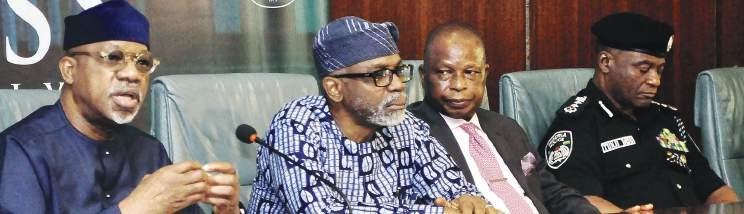
Delta Woos investors, Unveils $100m Fund to De-risk Investments in State
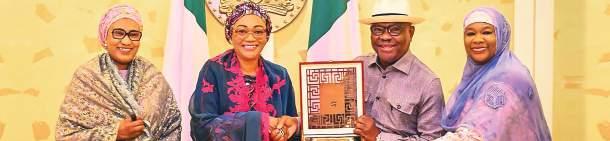
FIRST LADY PRESENTS CERTIFICATE OF COMMENDATION TO WIKE...
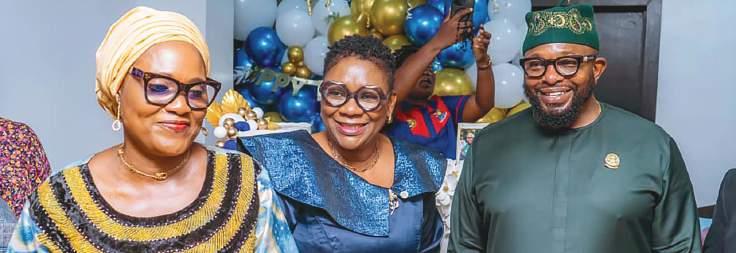
L-R: Wife of the Vice President and National Vice Chairman of Renewed Hope Initiative (RHI), Hajia Nana Shettima; First Lady of Nigeria, Senator Oluremi Tinubu; Minister of the FCT, Nyesom Wike; and Minister of state for the FCT, Dr. Mariya Mahmoud Bunkure, after the First Lady’s presentation of the Certificate of Commendation to the FCT Minister at the State House, Abuja, on Monday
Gbajabiamila: Tinubu Will Get Draft of State Policing Amendment Bill Sept. 3
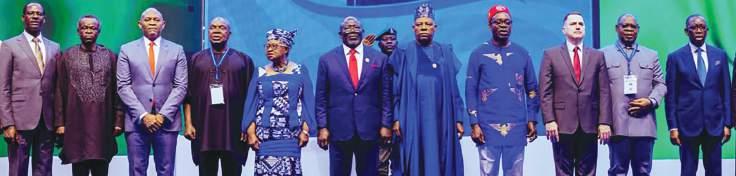
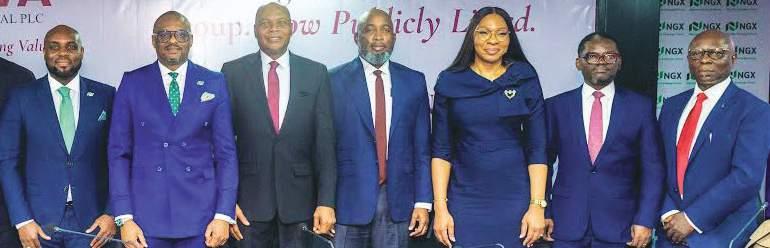
L-R: Minister of Finance and Coordinating Minister of the Economy, Mr. Taiwo Oyedele; Kenyan Pan-African legal scholar and guest speaker, Prof. Patrick Lumumba; Chairman of the Heirs Holdings Group, Mr. Tony Elumelu; Chairman of the Summit and renowned geologist, Engr. Austin Avuru; Director-General of the World Trade Organisation and keynote speaker, Dr. Ngozi Okonjo-Iweala; Delta State Governor, Rt. Hon. Sheriff Oborevwori; Vice President Kashim Shettima; Anambra State Governor, Prof. Charles Soludo; Brazilian Ambassador to Nigeria, Amb. Carlos Garcete; Delta State Deputy Governor, Sir Monday Onyeme;
Deji Elumoye in Abuja, Eromosele Abiodun, Omon-Julius Onabu in Asaba and Sylvester Idowu in Warri
expor tdeskdepar
DEDICATION TO PUBLIC’S GOOD...
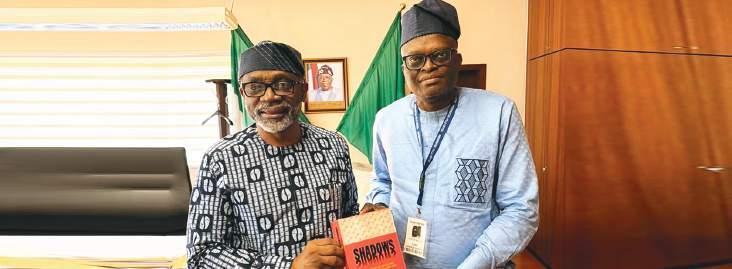
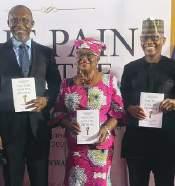
Chief of Staff to the President, Hon. Femi Gbajabiamila (L), with the Managing Director of THISDAY Newspapers, Mr. Eniola Bello, when the latter presented his new book, Shadows, to the former Speaker of the House of Representatives, at the Villa, yesterday
ADC to APC: Address Poverty, Insecurity, Instead of Focusing on Atiku
Says ruling party wants the 2027 election to be about personalities not policies Former VP dismisses Tinubu’s economic policies Alleges 767 factories shut, 335 in distress
Chuks Okocha in Abuja
African Democratic Congress (ADC) yesterday accused the ruling All Progressives Congress (APC) of being obsessed with the opposition party’s presidential candidate, Alhaji Atiku Abubakar, instead of addressing the country’s worsening poverty, insecurity, and cost-of-living crisis.
The allegation came as Atiku dismissed State House’s defence of President Bola Tinubu’s economic record as a desperate attempt to substitute propaganda for performance, insisting that no amount of statistical manipulation can erase the daily suffering of millions of Nigerians under his watch.
In a statement signed by ADC National Publicity Secretary, Mallam Bolaji Abdullahi, the opposition party said APC had, “shamelessly latched on” to former President Olusegun Obasanjo’s obviously biased comments on Atiku, while attacking Catholic Bishops for speaking truthfully about the country’s terrible condition under Tinubu.
ADC stated that the Tinubu-led ruling party was desperate to shift
attention from their “catastrophic” record on the economy, security, and well-being of Nigerians, “which is why they appear more comfortable discussing Atiku Abubakar than addressing the multidimensional crisis into which they have plunged the country”.
According to ADC, ‘’Unable to defend its catastrophic record after the Catholic Bishops laid bare the true state of the nation during their recent meeting with President Bola Ahmed Tinubu, the APC has shamelessly seized on comments by former President Olusegun Obasanjo in a desperate attempt to shift the national conversation and shift attention from their terrible performance in the last three years.’’ Abdullahi said rather than answer the Bishops’ concerns about worsening poverty, insecurity, and the cost of living, the ruling party had chosen, instead, “to attack the messengers, whose only offence was that they spoke truthfully and busted their bubble of propaganda and selfdeception.”
He said, ‘’This has become a familiar pattern. Whenever respected
Nigerians point to the deepening poverty, worsening insecurity, rising cost of living, or the collapse of public confidence under this administration, the APC never answers for its record. Instead, it looks for someone to attack.
‘’Yesterday, it was the Catholic Bishops. Today, it is Alhaji Atiku Abubakar. Tomorrow, it will be someone else.
‘’The result is a government that spends more time arguing with its critics than answering the concerns of ordinary Nigerians. What Nigerians have not heard is a convincing explanation for why life has become so much harder under Tinubu and his APC.
‘’Former President Olusegun Obasanjo is entitled to his personal opinion of Alhaji Atiku Abubakar. Every Nigerian, including former presidents, enjoys that democratic right.
‘’But opinions do not erase records. While President Obasanjo was in office, with Alhaji Atiku Abubakar serving as Vice President and Chairman of the National Economic Council, who also managed and coordinated economic planning between the States and the Federal Government, Nigeria
Tourism Professionals Honour
The Institute of Tourism Professionals of Nigeria (ITPN) has honoured the President of the Africa-International Tourism and Economic Council (AITEC World), Dine Bouraima, and the organisation’s Vice President for Communications and International Relations, Kazeem Balogun, for their contributions to tourism development and economic growth in Africa.
The awards were presented during the gala night of the 9th National Transportation Tourism Summit and Expo held at the NICON Luxury Hotel, Abuja, before an audience comprising government officials, tourism
stakeholders, transport experts, diplomats, captains of industry and development partners.
Bouraima received the ‘PanAfrican Tourism Leadership Impact Award’ in recognition of his leadership in promoting sustainable tourism, regional integration, investment and economic cooperation across the continent.
Balogun was presented with the ‘African Tourism Media Excellence Award’ for his contributions to tourism journalism, strategic communications and the promotion of Africa’s tourism, culture and investment opportunities through the media.
Speaking after receiving the award, Bouraima described the recognition as a tribute to the collective efforts of AITEC World and its partners across Africa.
“This honour recognises the collective efforts of AITEC World and our partners across Africa. We remain committed to working with governments, international organisations and the private sector to build a stronger, more competitive and more connected African tourism industry,” he said.
On his part, Balogun dedicated his award to tourism journalists and media professionals promoting Africa’s image on the global stage.
experienced stronger economic growth, greater macroeconomic stability, stronger investor confidence, and a far more affordable cost of living than Nigerians endure today under Tinubu’s chaotic economic policies. Whatever political differences may now exist between the two men, that record remains a matter of public history and cannot be erased.”
Abdullahi stated, ‘’If we are to compare opinion with performance, it would, indeed, be difficult for the APC to find any credible person, including former President Obasanjo, who would argue that this administration has achieved anything meaningful in improving the lives of citizens.
“It is time that the APC and their government took a break from attacking Atiku and the Bishops to answer a few important questions:
‘’Why has the prices of food and basic necessities continued to soar despite proclaimed economic growth?
Why have more Nigerians fallen into poverty under your watch than at any other period in Nigeria’s history? Why have you failed to translate your so-called economic growth into jobs? Why have you borrowed more money than any other government in the nation’s history with nothing to show for it?
‘’Why is your government spending 69 per cent of its revenue just
to service debts (whereas the World Bank describes any debt service-to revenue above 22.5 per cent as dangerously high). Can the APC explain why communities across the country continue to live under the constant threat of bandits, terrorists, and kidnappers while hundreds are still held in kidnappers’ den?
‘’These are the questions Nigerians expect the APC government to answer as we prepare for elections.
But the APC wants the 2027 election to be about personalities because it cannot defend its performance. They want this election to be about Obasanjo’s personal opinion of Atiku based on a distant past because they cannot defend Bola Ahmed Tinubu’s record based on current performance. Ultimately, the election will not be decided by the opinion of any one individual.
‘’It will be decided by the lived experience of more than 200 million Nigerians who are poorer, more insecure, and more uncertain about their future than they were before the Tinubu administration took office.’’
In a related development, Atiku dismissed State House’s defence of Tinubu’s economic record, saying it is a desperate attempt to substitute propaganda for performance.
Atiku said no amount of statistical manipulation could erase the daily
suffering of millions of Nigerians. In a statement issued by his Senior Special Assistant on Public Communication, Phrank Shaibu, Atiku said it was remarkable that the presidency devoted thousands of words to attacking the opposition “while failing to answer the one question every Nigerian is asking: if the economy is doing so well, why are Nigerians getting poorer?” He said it was even more ridiculous that the same Tinubu administration, simultaneously implementing the 2024, 2025 and 2026 budgets, was now asking Nigerians to forget the consequences of its economic decisions in earlier years.
According to Atiku’s aide, “As the Yoruba rightly say, the one who defecated yesterday may quickly forget, but the person who cleaned up the mess never does. Nigerians have not forgotten the pain this administration unleashed through the disastrous management of every fiscal year since 2024. Those wounds remain fresh, and no amount of revisionism, selective statistics or government propaganda can erase them.”
Atiku said the presidency’s response was remarkable not for the strength of its arguments but for the contradictions it inadvertently exposed.
NEPC Dismisses Alleged Strike Threat as Workers Reaffirm Industrial Harmony
James Emejo and Deborah Adekoya in Abuja
The Nigerian Export Promotion Council (NEPC) yesterday dismissed reports of an impending industrial action by its workers, describing the claims as false and insisting that operations at the council remained uninterrupted amid continued support from its staff union.
The council said the leadership of the Association of Senior Civil Servants of Nigeria (ASCSN), NEPC Unit, had distanced itself from online
reports to that effect, and reaffirmed its commitment to sustaining industrial peace within the organisation.
The clarification followed a joint meeting between NEPC management and the union leadership, where both parties jointly rejected online reports alleging that workers were planning to embark on strike.
In a statement, Head of Corporate Communications, NEPC, Mr. Aliu Seidu Sadiq, said there was no planned or contemplated industrial action in the council.
He described the reports as “false,
baseless and misleading,” urging exporters, stakeholders and members of the public to disregard them. According to the council, the Union Chairman, Mr. Moruf Ogunlana, confirmed that NEPC continues to enjoy industrial harmony, stressing that neither the union nor its members authorised or were consulted on any purported strike action.
The union also formally disassociated itself from the online publications and pledged continued cooperation with the management to advance the council’s mandate.
PHOTO: OFFICE OF THE CHIEF OF STAFF
COURTESY VISIT...
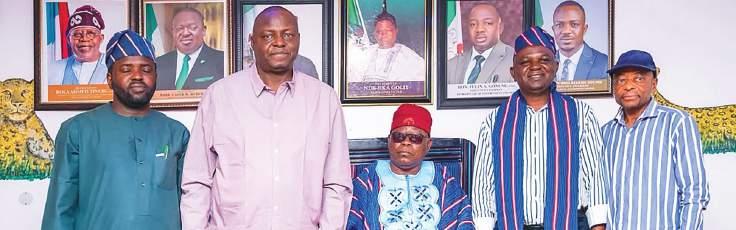
L-R: Hon. Lawandi Datti, Hon. Commissioner for Water Resources, Plateau State; Professor Nentawe Yilwatda, National Chairman of the All Progressives Congress (APC); HRH Nde Jika Golit;
Ngas and Chairman, Pankshin/Kanke Traditional Council; Engr. Prof. Joseph Terlumun Utsev, Minister of Water Resources and Sanitation; and Engr. Ali Ibrahim Dalah, acting Perm. Sec., Federal Ministry of Water Resources, paid a courtesy visit to the palace during the site inspection for the construction of a new dam approved by the federal government in Kanke Local Government Area of Plateau State
Otedola Eyes Over 50% Stake in First Holdco, Says He Has Invested Over N600 Billion in Bank
Says lender’s turnaround has reset its governance, profitability
Billionaire investor and Chairman of First HoldCo Plc, Mr. Femi Otedola, has disclosed plans to increase his stake in the financial services group beyond 50 per cent, declaring that he has no intention of exiting the institution in the near future as he did with some of his previous investments.
In an interview with Nairametrics, Otedola said he had already com-
mitted more than N600 billion of his personal wealth to First HoldCo and remained convinced that the institution was on course for sustained growth following an extensive cleanup of its balance sheet, recapitalisation and governance reforms.
Otedola said his investment philosophy has always been to acquire controlling stakes in companies to enable him execute far-reaching reforms capable of delivering longterm value to shareholders. Otedola
currently holds a 28.5 per cent stake in the group.
“I am sure that you can see from my antecedents that my investment threshold is always over and above 51 per cent. One of my key investment principles is that firm shareholder control with due regard for minority interest is a key ingredient to executing reforms and restructuring to deliver value to all stakeholders,” he said.
He cited his investments in
African Petroleum Plc, later renamed Forte Oil Plc, where he increased his shareholding from 28 per cent to 75 per cent before divesting in 2019, as well as Geregu Power Plc, where he built his stake from 51 per cent to 95 per cent before reducing it to 77 per cent after the company’s public listing.
“I am on the same trajectory with First Holdco Plc. To date, I have invested over N600 billion of my personal wealth in First Holdco Plc, a
Abubakar Kyari describes initiative as national investment, harvest Programme to support deployment of 2,000 tractors, create skilled jobs, raise farm productivity
The federal government yesterday commenced the training of 4,000 tractor operators, in a strategic intervention expected to improve farm productivity, create thousands of skilled jobs, strengthen food security, and maximise returns on the country’s expanding investment in mechanised farming.
The move also seeks to intensify the current administration’s drive to modernise the agricultural sector.
The nationwide programme is being coordinated by the Federal Ministry of Agriculture and Food Security (FMARD) through the National Agricultural Development Fund (NADF), in partnership with AGCOMS International Trading Limited and Industrial Training Fund (ITF).
It is designed to provide the technical manpower required to operate and maintain 2,000 modern tractors being deployed under the federal government’s agricultural mechanisation project.
Speaking at the commencement of the programme, Minister of Agriculture and Food Security, Senator Abubakar Kyari, described the training as a vital component of the government’s broader mechanisation strategy.
Kyari said, “This training programme is a direct expres-
sion of the federal government’s commitment to putting Nigerian farmers in charge of Nigerian food security. Two thousand tractors is a national investment. Four thousand well-trained operators is what turns that investment into a harvest.”
The first batch of 250 trainees has commenced a two-week residential programme at CSS Farms in Nasarawa State, marking the beginning of what government described as a critical human capital investment to support President Bola Tinubu’s Renewed Hope Agenda on food security, job creation, and economic diversification.
Managing Director/Chief Executive of AGCOMS International Trading Limited, Chijioke Okoli, said the success of mechanisation depended largely on the quality of personnel operating the equipment.
Okoli said, “At AGCOMS, we know that the value of a tractor is created by the person in the seat. Our training programme has been built to turn every new operator into a professional. We are honoured to deliver this alongside FMARD, NADF and the ITF.”
The partnership underscores the government’s strategy of leveraging private-sector expertise to accelerate agricultural transformation, with AGCOMS contributing global equipment knowledge and operational support, while ITF ensures compliance with nationally recognised
technical training standards.
In his remarks, Director-General of ITF, Dr. Afiz Oluwatoyin Ogun, said building a competitive agricultural economy required sustained investment in technical skills.
Ogun said certified operators would form the backbone of a modern mechanised farming system capable of delivering higher productivity and long-term sustainability.
Executive Secretary/Chief Executive of NADF, Mr. Mohammed Abu Ibrahim, described the programme as another milestone
in the implementation of the federal government’s agricultural transformation agenda.
Ibrahim said every graduate of the programme would possess the competence, safety, and discipline required to maximise the productivity of the equipment, while ensuring efficient operations in the field.
According to him, the collaboration between FMARD, NADF, AGCOMS and ITF provides the institutional framework needed to build a skilled workforce capable of supporting mechanisation service providers across the country.
figure that speaks not to speculation, but to unflinching confidence in the institution’s future, fundamentals and an unwavering personal commitment to its success,” he added.
Otedola also dismissed suggestions that he could eventually sell his investment after completing the turnaround of the lender, insisting that First HoldCo represented a fundamentally different proposition from his previous investments.
“The situation with my foray into and continuous investment in First Holdco Plc is completely different,” he stated, describing the lender as “a long-term generational commitment unlike my previous involvement(s).”
According to him, the bank’s 130-year history, systemic importance and position within Nigeria’s financial system make it an enduring investment capable of creating value for generations.
Otedola explained that he decided to invest in the institution after recognising its underlying franchise value despite the significant governance and asset quality challenges confronting it.
He recalled that before regulatory intervention by the Central Bank of Nigeria (CBN) in 2021, the bank was burdened by more than N2 trillion in non-performing loans, weak corporate governance and insider abuses that left it on the verge of regulatory takeover.
“First Holdco Plc was an institution on the brink,” he said, adding that the CBN eventually dissolved
the board over governance breaches, unresolved insider exposures and failures in leadership succession.
Rather than viewing the crisis as a deterrent, Otedola said he saw an opportunity to rebuild one of Africa’s oldest financial institutions, supported by sweeping governance reforms, stronger risk management, leadership renewal and aggressive recapitalisation.
According to him, the bank undertook a one-off N1.7 trillion impairment charge to clean up legacy exposures, while raising fresh capital through rights issues, private placements and strategic asset divestments to strengthen its balance sheet.
The reforms, he said, have already begun to yield results, disclosing that First HoldCo’s profit before tax rose by 83.5 per cent year-on-year to N653.4 billion in the first half of 2026, while return on average equity climbed to 30.4 per cent, which he described as the highest among Nigeria’s leading banking groups.
Otedola argued that Nigerian banking stocks have historically traded below their intrinsic values due to macroeconomic uncertainty, exchange rate volatility and gover- nance concerns rather than weak business fundamentals.
He noted that First HoldCo’s ongoing turnaround was beginning to change that perception, with the company’s share price appreciating sharply and its market capitalisation rising above N6 trillion.
Kasali Succeeds Ashiru as Odu’a Investment Company Chair
Odu’a Investment Company Limited (OICL) has formally inaugurated Dr. Tajudeen Kasali as its new Group Chairman, completing a seamless leadership transition that it said reinforces the conglomerate’s commitment to corporate governance and institutional continuity.
The inauguration of the new leadership took place during the Board of Directors’ (BoD) meeting at the weekend following the earlier announcement of his appointment at the company’s 44th Annual General Meeting (AGM) held on June 26, 2026 in Ibadan, Oyo State.
Kasali succeeds Bimbo Ashiru, whose four-year tenure as the OICL chairman has ended.
OICL stated that the change of baton was in line with the company’s governance policy of rotational chairmanship among the six shareholders’ South-west states.
“Otunba Ashiru remains a member of the board until 2028, when he will have completed his second and final term, thereby ensuring continuity, institutional memory and strategic stability,” the board disclosed to journalists.
The BoD stated that Kasali, who has served as a Director of Odu’a Investment Company Limited since 2020, is
a distinguished medical practitioner and accomplished public administrator.
He holds a medical degree from the State Medical Institute, Zaporizhzhia, Ukraine. His public service career includes serving as the chairman of Ibeju-Lekki Local Government Area of Lagos State and the state Commissioner for Rural Development, Health and Special Duties.
The board stated that he also championed the establishment of the Lagos State Emergency Management Agency (LASEMA) and the Lagos State Safety Commission.
“Under Otunba Ashiru’s stewardship, Odu’a Investment Company Limited underwent a remarkable
transformation from an asset-rich but cash-poor and underperforming enterprise into a strategy-driven regional investment conglomerate.
“Although the SRC 1.0 (Sweat, Revive and Create) Strategic Framework was initiated in 2021, its implementation was significantly accelerated under his chairmanship, culminating in its successful conclusion in 2025.
“During this period, the company strengthened corporate governance, rebalanced its investment portfolio, revitalised legacy assets, including the landmark redevelopment of Premier Hotel, Ibadan, and delivered a recordbreaking Profit Before Tax of N23.58 billion for the 2025 financial year.
Ngolong
Sunday Okobi
James Emejo and Deborah Adekoya in Abuja
Emmanuel Addeh in Abuja
PINNACLE OIL AND GAS 2026 VENDORS’ FORUM...
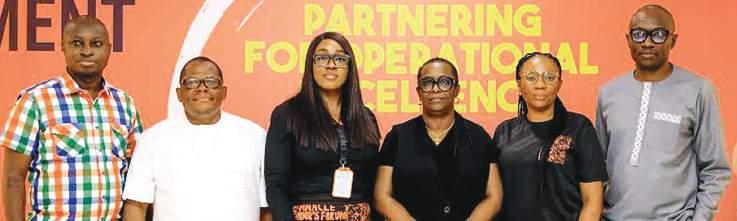
L-R: Financial Controller, Pinnacle Oil and Gas, Mr. Itoro Asuquo; Corporate HSE Manager, Mr. Jacob Echem; Head, Procurement and Administration, Oluseyi Ogunfowora; Managing Director/Chief Executive Officer, Adenike Labinjo; Compliance Manager, Deborah Ajala; and Head, Engineering and Special Projects, Mr. Elijah Elijah, during the Pinnacle Oil and Gas 2026 Vendors’ Forum held to strengthen partnerships and promote operational excellence held in Lagos ... recently
First Lady to Wike: Posterity Will Judge You Well for Transforming Abuja
Lauds him for turning around city gate as model for environmental renewal Tasks govs’ wives to mobilise youth for green initiatives Wike credits Mrs. Tinubu for project inspiration
Wife of the President, Senator Oluremi Tinubu on Monday praised Minister of the Federal Capital Territory (FCT), Nyesom Wike’s contributions to the development of Abuja, declaring that posterity will judge him well for giving the nation’s capital a major facelift.
Speaking at a ceremony at State House, Abuja, to honour the FCT Administration for its environmental initiatives under the Renewed Hope Initiative (RHI) Green Nigeria Challenge, the first lady, while hailing Wike for transforming Abuja’s City Gate into a major recreational and environmental landmark, said “posterity will judge you well”.
She described the remodelling of the City Gate as an outstanding example of how neglected public spaces could be converted into attractive recreational centres.
According to her, the project reflects the vision behind the recently concluded Community Category of the Green Nigeria Challenge, designed to encourage communities and youth groups to reclaim abandoned spaces, dumpsites, and other degraded areas.
Mrs. Tinubu said, “The remodelled Abuja City Gate is an excellent example of what abandoned public
areas can become: a transformed key national landmark that warmly welcomes all Nigerians and visitors to our nation’s capital.”
She added, “When I saw what he did with the City Gate, my God, unbelievable, unbelievable. I want to thank him. He’s done very well.”
She disclosed, however, that despite a N50 million prize earmarked under the Green Nigeria Challenge to encourage states to reclaim abandoned public spaces and dumpsites, no state participated in that category of the competition.
“It was a N50 million prize money and they didn’t enter. This
was supposed to get our youth involved,” she said.
The first lady said the initiative was conceived to complement government’s effort to beautify communities, while promoting healthier environments and improving the quality of life of Nigerians.
Mrs. Tinubu urged wives of state governors to take a more active role in mobilising young people to participate in environmental clubs and sustainability initiatives in schools and tertiary institutions. She stated, “I’m using this opportunity to appeal to our first ladies: get our young children
into the environmental clubs and environmental societies for our youth in tertiary institutions”.
Reminiscing her days as a student, she said, “I remember when I was in the College of Education, I was a member of the Youth Environmental Programme for West Africa. We travelled from Nigeria throughout West Africa by road. It was a memorable experience for us.”
The first lady stressed that environmental stewardship offered young Nigerians an opportunity to contribute meaningfully to national development.
Mrs. Tinubu said, “We have
to engage our young people and make sure that they can help build. Everybody has something to contribute to this country. It’s a great country and that’s why we are doing all we can.”
In his address, Wike disclosed that the transformation of Abuja’s City Gate was the initiative of Mrs. Tinubu, saying she challenged the FCT Administration to improve the appearance of the nation’s capital after observing city entrances in other countries.
According to him, “The first lady has to be commended for the FCT keying into the Renewed Hope Green
Initiative because she has always said we have to change our environment and create opportunities where people can gather and relax.”
The minister said the first lady had asked him, “why do we travel out and we do not learn anything when we travel? Look at the way our city looks, look at the way city gates in other countries look. Why not do something to change it?”
Wike said the FCT administration subsequently engaged the original designers of the City Gate to produce a new concept that had transformed the site into a vibrant recreational destination.
NSITF Seeks Alignment of AI Adoption with Workplace Protection
Onyebuchi Ezigbo in Abuja
Nigeria Social Insurance Trust Fund (NSITF) has advocated a deliberate link between digital transformation and social protection as African businesses embrace Artificial Intelligence.
Managing Director/Chief Executive of NSITF, Mr. Oluwaseun Faleye, made the call on Monday at the official launch of ESBC–InnoPower LLC (USA) Free MSMEs AI Master Training Programme, held at UN House, Abuja.
The programme, spearheaded by
ECOWAS Small Business Coalition, in partnership with InnoPower LLC (USA) and United Nations Development Programme, is designed to equip micro, small and medium enterprises (MSMEs) across the region with AI skills to compete in a digital economy.
Faleye, who was the special guest at the event, said MSMEs remain the foundation of Nigeria’s economy.
Citing data from Small and Medium Enterprises Development Agency of Nigeria (SMEDAN) and the National Bureau of Statistics (NBS),
he stated that approximately 96 per cent of businesses in Nigeria were MSMEs, employing millions and sustaining countless families.
He said, “When MSMEs grow, communities prosper. When they innovate, economies become more competitive. And when they become more resilient, nations become stronger.”
Faleye described the training as “far more than a training initiative”, but “an investment in the future competitiveness of West Africa”.
He, however, stressed that technology alone would not guarantee business resilience, and urged entrepreneurs to match AI adoption with employee welfare and safety.
“Digital transformation and
workplace protection are not separate conversations, they are the same conversation,” he told the gathering of government officials, development partners, and business leaders.
He stressed, “Technology enables businesses to work smarter.
“Social protection enables people to work with confidence. An enterprise that embraces Artificial Intelligence but neglects the welfare and safety of its workforce has merely modernized its operations without strengthening its resilience.”
He added that as businesses expanded across ECOWAS, they will require “equally responsive systems of occupational safety, workplace protection and social security”. Faleye said NSITF remained committed to
supporting that journey through stronger partnerships, awareness, and service delivery. He commended ESBC, InnoPower LLC, and UNDP for bringing together government, private sector, and development partners to equip entrepreneurs with knowledge and tools for the digital age.
Faleye charged participants to “learn continuously. Innovate boldly”, remember that “your greatest asset will always be your people. Protect them. Invest in them”.
He stated, “The enterprises that will define Africa’s future will not simply be those that adopt the latest technologies. They will be those that combine innovation with responsibility, ambition with resilience.”
Industry leaders in Nigeria’s commercial printing sector are unanimous in their call for greater technology adoption and innovation among industry players saying that technology and innovation will drive the next phase of growth and market access for the industry.
These submissions were echoed at the 2026 FLEXOEDGE Conference which held in Lagos, recently.
The event which brought together policy makers and stakeholders from Nigeria and across Europe and Asia, sought to unlock untapped opportunities for growth across the commercial printing value chain.
Convened by RandomSoft Limited in collaboration with VIP Systems GmbH, Germany, the event also looked to address how sustainability is shaping the conversation for manufacturers around the world.
Speaking at the event, Technical Director of RandomSoft Limited, Olakunle Ogunjobi, said that advancement in flexographic printing technology is enabling manufacturers to produce shorter print while maintaining high quality, making businesses more flexible and cost efficient.
“Nigeria is a market with enormous opportunities. The key is to develop globally competitive
skills and embrace collaboration. Those who invest in knowledge and technology today will remain relevant in the future,” Ogunjobi said.
He also stressed that sustainability is increasingly becoming central to packaging production, urging industry operators to embrace waste recovery, recycling and environmentally responsible production processes.
Speaking on the investment outlook, Chief Executive Officer of VIP Systems GmbH, Günter Franz, said Nigeria remains one of Africa’s most attractive packaging markets because of its rapidly growing population, expanding food industry and increasing consumer demand.
Govt Begins Assessment for New Dam in Plateau, Targets Food Security, Rural Devt
Yemi kosoko in Jos
The Minister of Water Resources and Sanitation, Prof. Joseph Terlumun Utsev, on Monday led a federal government delegation to Gyelle Community in Amper District, Kanke LGA of Plateau State, to inspect a proposed site for a new dam expected to boost food production, irrigation, power generation and rural development.
Speaking during the visit, Utsev said the project aligns with President
Bola Ahmed Tinubu’s directive to expand water infrastructure nationwide.
“We all know that water is life. That is a fact that is undisputable,” he said. “The mandate given to the Ministry of Water Resources and Sanitation is to boost food production in the country, to create jobs for our teaming population.”
The minister explained that the Gyelle dam is part of a broader national plan that includes rehabilitation of the Alua Dam in Borno and the
development of multiple dams along the Sokoto–Badagry Superhighway. “About 72 dams have been located, identified, some for rehabilitation and some for new construction,” he said. He added that technical teams would soon begin detailed studies to determine the dam’s size, cost and construction timeline.
APC National Chairman, Prof. Nentawe Yilwatda Goshwe, who accompanied the minister, described the project as transformational for rural communities.
Deji Elumoye and Olawale Ajimotokan in Abuja
Esther Oluku
FG to End Fixing of Gas Prices in Two Years, Migrate to Market-based Regime
NMDPRA: Transition tied to infrastructure, affordability safeguards Shell: Nigeria must enable local firms to unlock deepwater potential Seplat calls for gas-led industrialisation in Nigeria
Peter Uzoho
The Nigerian Midstream and Downstream Petroleum Regulatory Authority (NMDPRA) has said the federal government is targeting a full transition to a willing-buyer, willing-seller gas pricing regime within the next two years, ending years of delay over concerns about affordability and power costs.
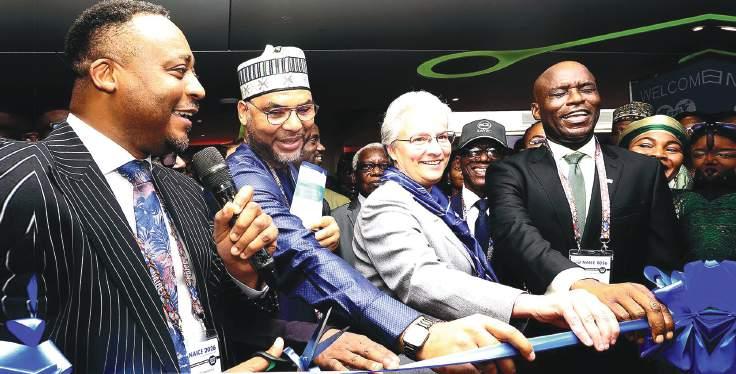
Chief Executive of NMDPRA, Mr. Rabiu Umar, announced the timeline yesterday in Lagos at the opening of the 49th Nigerian International Conference and Exhibition (NAICE), organised by the Society of Petroleum
Engineers (SPE) Nigeria Council.
During the event themed: “Thriving in the Evolving Global Energy Landscape: Collaborative Growth and Resilience,” Umar said the Petroleum Industry Act (PIA) already provides for the shift but implementation must be sequenced with infrastructure growth and consumer protection measures.
Current domestic gas pricing in Nigeria stands at $2.18/mcf for gas-to-power and below $2/ mcf for gas-based industries (GBI). But upstream gas producers have for a long time been calling for a non-regulated gas pricing
regime anchored on willing-buyer, willing-seller basis to incentivise the sector, attract investment and boost gas production and supply to local market.
They had recently pushed for the federal government to raise gas rates to between $2.60/mcf and $5/mcf.
The operators under the aegis the Independent Petroleum Producers Group (IPPG), Oil Producers Trade Section (OPTS), Association of Local Distributors of Gas (ALDG), Nigerian Gas Association (NGA) and the Nigerian Liquefied Petroleum Gas Association (NLPGA), among
others, had approached the Minister of State for Petroleum Resources (Gas), Ekperikpe Ekpo to increase the price of natural gas to reflect current business realities.
The NMDPRA boss explained that the issue is now being addressed through a phased approach, stressing that the authority will maintain the current gas-based price regime in the interim while working to guarantee open access to pipelines so that pricing reform does not become a bottleneck for new investment.
He noted that the goal of government was not to have gas regulated regime forever and that the PIA
was clear on the transition, with the target to be on a willing-buyer, willing-seller basis in the next one to two years.
He said: “And then on gas tariff, while we’re monitoring and consolidating on the gas-based price regime of the PIA, we’re guiding an orderly transition towards a willing buyer, willing seller framework as infrastructure expands and market access improves.
“I know this is a sore point for a lot of the gas producers. The goal of the government is not to have gas to be regulated forever. No. The PIA is very clear, black and white.
GBAJABIAMILA: TINUBU WILL GET DRAFT OF STATE POLICING AMENDMENT BILL SEPT. 3
Chairman of the Presidential Working Group on the National Policing Bill, Hon. Femi Gbajabiamila, yester-day, disclosed that the group would submit an execu-tive bill package on state police to President Bola Tinubu on September 3, as part of efforts to establish the legal and operational framework for the proposed system.
Gbajabiamila emphasised that state police would only become operational across the 36 states of the federa-tion after the conclusion of the ongoing constitutional amendment.
Speaking with newsmen after a meeting of the working group at State House, Abuja, Gbajabiamila, who is also Chief of Staff to the President, explained that no state would be permitted to commence policing operations until it had demonstrated
readiness in recruitment, training, equipment, pensions, complaints handling, financial sustainability, firearms control, and inde-pendent oversight.
“Operational commencement must be based on read-iness, not announcement,” he said, adding that alt-hough states could exceed national benchmarks, “No Nigerian should receive a lower standard of protection because of where they reside.”
He stressed that the federal government remained committed to ensuring that decentralised policing would not undermine national unity or the rule of law, saying, “State police cannot mean 36 state militias.”
The working group leader added that while states must have a legitimate role in public safety, “No politi-cal office holder should be able
to direct the arrest of an opponent, the suppression of lawful political activi-ty, or the selective enforcement of the law.”
He further explained that federal intervention would remain “exceptional, evidence-based, proportionate, time-limited and reviewable”, while officers would remain accountable to the constitution rather than political interests.
Gbajabiamila added that the executive bill package to be submitted to the president would go beyond draft legislation, to provide the implementation blueprint required to operationalise a dual federal-state policing architecture once the constitutional amendment cre-ating it came into force.
He said following the completion of the draft, a na-tionwide consultation would be held before the presi-dent
would grant final approval, after which the exec-utive bill would be transmitted to the National Assem-bly.
Gbajabiamila stated, “The resulting executive bill package is scheduled for presentation to the president on the 3rd of September. We have arranged the pro-cess so that the national consultation will come before the president’s final approval, after which the text and supporting materials will be revised and prepared for formal transmission to the National Assembly.”
Gbajabiamila described the exercise as one of the country’s most significant governance reforms, saying it is aimed at creating “a lawful, professional and sus-tainable federal and state policing system that placed greater capability closer to the people while preserv-ing national standards, national security and the rights of
DELTA WOOS INVESTORS, UNVEILS $100M FUND TO DE-RISK INVESTMENTS IN STATE
were executed without delay.
Speaking at the summit, Vice President Kashim Shettima welcomed what he termed a healthy cycle of competition among the federating units, saying it is necessary for the country’s economic development.
Shettima attributed the current economic drive by the states to President Bola Tinubu’s reform policies.
In her keynote address, DirectorGeneral of World Trade Organisation (WTO), Dr Ngozi Okonjo-Iweala, said Delta State had the potential to become Nigeria’s next great industrial hub, standing alongside Lagos, Kano, and Port Harcourt, as an engine of the national economy.
Oborevwori stated in his address at the opening of the summit, “This summit is not a talk show; we are matching words with action. It is my earnest expectation that this marks the beginning of enduring strategic partnerships that will galvanise the massive industrialisation of our state.”
The governor said, “With an estimated population of six million people, abundant mineral resources, rich vegetation, fertile soil for agriculture, multiple urban centres, an enlightened populace, improving infrastructure, and a business-friendly climate, Delta State remains an investor’s haven, with vast opportunities waiting to be explored and harnessed. The economy is approximately N17 trillion, or $12.34 billion; making the state a key driver of national economic growth and development.
“Delta State connects major markets across Nigeria, serving as a gateway to the south-east and linking directly to Lagos, the nation’s
business capital.
“With up to 15 urban centres, its greatest asset remains its vibrant, hardworking people, celebrated at home and abroad for their industry and ingenuity, like Dr Ngozi Okonjo-Iweala, Mr Jim Ovia, Mr Tony Elumelu, Engr. Austin Avuru, and so many others.”
The governor said the goal of the summit was to partner with prospective investors with the overriding objective of building a modern, strongly diversified economy that “can withstand external shocks in line with the policy imperatives of the MORE agenda of this administration”.
Oborevwori said his administration believed in a data-driven development model that was private-sector-led and created opportunities for the teeming youth population.
He stated, “Our primary goal is to partner with interested parties to maximise our state comparative advantages, develop the non-oil sectors of the economy, create jobs, accelerate economic development, and achieve sustainable development.
“In view of the foregoing, our ease of doing business incentives are top-notch, ensuring that prospective investors have the conducive atmosphere to operate seamlessly and profitably.
“The establishment of the Delta State Ease of Doing Business Council, chaired by me, is one of the major reforms we have undertaken to enhance the ease of doing business in the state. Also worthy of note is the granting of waivers of payment of tenement rates, fees, levies, and other charges to investors for up to five years after the commencement of business.”
Shettima praised the healthy competition among the 36 states of the federation, saying it is necessary for actualising Nigeria’s quest for prosperity, economic growth, human dignity, and job opportunities.
He said the current weather of economic competition was evident in the quality and ambition of the investment summits organised by states across the country.
Shettima emphasised that the country’s strength lied in the proactive economic awakening of its subnational governments rather than just the government at the centre.
According to him, “The cycle of competition among our states is now evident in the quality and
new $4.5 billion facility named ‘Project Gazelle 2’.
The approval allows NNPC to refinance the outstanding balance of approximately $1.5 billion under the original 2023 facility, while unlocking an additional $3 billion in liquidity to strengthen the country’s external reserves, support ongoing fiscal and infrastructure priorities of the government.
Essentially, refinancing involves replacing an existing debt with a new loan that offers different terms, lower interest rates, or a changed repayment period.
The development which formed the outcome of the 159th meeting of NEC) held virtually and followed a presentation by the Minister of Finance, Taiwo Oyedele. The meeting was chaired by Chairman of the Council, Vice President Kashim Shettima, underscoring the importance of the project.
NEC observed the significance
ambition of the investment summits convened across the federation. Every state possesses immense promise, but each must define a trajectory unique to its history, geography, people and comparative advantage.
“This is the race we must welcome: a race that proclaims growth rather than conflict, a race in which the prize is employment, prosperity and human dignity, a race for the future.”
The vice president stated that the cycle of competition among states as well as the attendant economic and investment summits stemmed from the strong economic foundation laid by Tinubu, which had increased federal allocations for
of unlocking additional liquidity to the federation, among other benefits, pledging its support for the actualisation of the initiative.
Addressing newsmen after the meeting at the State House, Abuja, the finance minister explained that the refinancing has been structured on more favourable terms than the original facility, including a reduction in the volume of pledged crude oil from 90,000 barrels of oil per day (bpd) to approximately 78,750 bpd - a 12.5 per cent reduction.
He noted that under the new arrangement, an additional 11,250 bpd for the federation will be released, while there will be reduction in the pledged crude volumes by NNPC.
Oyedele added that while accessing additional liquidity on improved terms, the arrangement is freeing up resources for strategic national priorities while strengthening the country’s financing structures.
every Nigerian”.
He stressed that despite the progress made by the Na-tional Assembly, no state police service existed in Ni-geria because the constitutional amendment had not yet secured the approval of the required number of state Houses of Assembly.
He explained, “The constitutional amendment is not yet in force. Until that process is concluded and the necessary implementing laws are enacted, there is no operational state police service anywhere in Nigeria, and the Nigeria Police Force remains the constitution-ally recognised police institution.”
According to him, while the constitutional amendment would create the legal authority for state policing, it would not by itself resolve critical operational issues, such as recruitment, training, funding, command struc-tures, jurisdiction, pensions, firearms regulation, data management, complaints mechanisms and inter-agency cooperation.
The chief of staff explained that those issues would be addressed in the National Policing Bill and other con-sequential legislations being prepared by the working group.
He stated, “Our mandate is to produce a technically robust, implementation-ready draft National Policing Bill and supporting legislative package. We are build-ing the legal and operational framework required to move from one federal police institution to a workable dual policing architecture.”
Gbajabiamila said the assignment also included a re-view of the Police Act 2020, the Police Service Commission framework, police regulations,
Earlier in his opening remarks, the vice president called for a responsive, scalable, and data-driven social protection policy to tackle multidimensional poverty in Nigeria.
According to Shettima, government policies are often heard before they are seen, through the price of food, condition of hospitals, records in schools, strain on families, the confidence of those who invest their labour in the nation’s future and the ambitions of state governments. He implored members of council to ensure that every decision they make assure the citizens “that their government is paying attention to the pulse of the nation and is resolved to respond with competence, compassion and purpose.” Meanwhile, Nigeria’s state-owned oil company, NNPC, has issued further tenders to sell a cargo of its newest crude oil grade Cawthorne in September, plus another to sell Bonny Light, according
and other laws af-fected by the reform, alongside provisions for mini-mum national policing standards, state certification, interstate cooperation, independent complaints insti-tutions, human rights safeguards, forensic systems, funding arrangements, and transition plans.
Gbajabiamila added that the president had also ap-proved a multidisciplinary Policy Advisory Committee, chaired by Justice Mohammed Abdullahi Liman, to provide technical oversight and validate the bill, fiscal framework, and implementation materials before ex-ecutive consideration.
He explained that the seven-week work programme, running from July 27 to September 14, would proceed through simultaneous legal drafting, policy research, data analysis, and implementation modelling.
The final submission, Gbajabiamila said, would include schedules, an explanatory memorandum, legal audit, consequential amendments matrix, clause-by-clause analysis, state readiness framework, fiscal and implementation notes, validation report, risk register and a digital archive.
The committee draws membership from the judiciary, academia, security agencies, the National Assembly, the Office of the National Security Adviser, Nigeria Po-lice, Nigerian Bar Association, Nigeria Governors’ Fo-rum, and state Attorneys-General representing the six geopolitical zones.
To encourage public participation, Gbajabiamila an-nounced an open call for memoranda and position papers from Nigerians, civil society
to tender documents seen by Reuters. The company began exporting Cawthorne in March, joining other recently launched grades such as Nembe and Utapate, as Nigeria seeks to boost production and diversify its export streams after years of underinvestment, oil theft and operational disruptions. According to the document, the Cawthorne cargo will load on September 21-22 and will comprise 950,000 barrels. NNPC is also offering a 950,000 barrel cargo of Bonny Light loading on September 30-October 1. NNPC did not immediately respond to Reuters’ request for comment. The cargoes are both sold on a free on board basis, and bids for the tenders are due by 8 p.m. West Africa Time (1900 GMT) on August 4. The Bonny Light production stream will load around 364,000 barrels per day of oil across 12 cargoes, a preliminary loading programme seen by Reuters shows.
There is a transition. We haven’t reached that level of maturity.
Rabiu Umar
Deji Elumoye in Abuja
SPE NIGERIA ANNUAL INTERNATIONAL CONFERENCE AND EXHIBITION 2026...
L-R: Chairman, Society of Petroleum Engineers Nigeria, Mr. Francis Nwaochei; Vice President, Development Wells and Technology Renaissance,
President,
International, Jennifa Miskimins; and CEO, Seplat Energy, Mr. Effiong Okon, during the opening of the SPE Nigeria
and
FG: Only 36% of Nigerian Mothers Practice Exclusive Breast Feeding
UNICEF: Two in three Nigerian babies suffer malnourishment ED, Niger State PHCDA: State yet to reach national average for breastfeeding Treat breast feeding as investment, Shettima, CS-SUNN tell mothers development.
The federal government has said that Nigeria is yet to attain optimal breastfeeding practices with only 36 percent of the mothers practicing strict exclusive breastfeeding.
While emphasizing the importance of exclusive breastfeeding to child’s development, Vice President, Kashim Shettima described it as a major invest-
ment in human capital development that must not be ignored.
He advised breast-feeding mothers to see exclusive breastfeeding as an investment in the future wellbeing of their children.
In a related development, the United Nations Children’s Fund (UNICEF) has raised serious concern over the low rate of exclusive breastfeeding in Nigeria, revealing that two out of every three Nigerian children are not exclusively breastfed and risk being malnourished
despite overwhelming scientific evidence the practice is critical to child survival, physical growth, cognitive reasoning, brain development and immune system strengthening.
Meanwhile, on his part, the Executive Director Niger State Primary Health Care Development Agency, Dr. Junaidu Inuwa has said that the state is yet to meet the national average for breastfeeding, adding that while the national average is 56% the state has been able to achieve 46%.
Dr. Junaidu Inuwa made this known on Monday at the flag-off of this year’s world breastfeeding week where he also said it is in a bid to meet the average that government organised the sensitisation of mothers on the need for exclusive breastfeeding of their children up to 6 months.
Similarly, the nutrition advocacy group, the Civil Society Scaling Up Nutrition in Nigeria, (CS-SUNN) also described exclusive breastfeeding as a foundation for human capital
FG Directs Tertiary Institutions to Set Up Selection C’ttees for N365m Laureate Prize
Initiative inaugurated under Alausa to reward outstanding research Govt fixes August 15 deadline
Emmanuel Addeh in Abuja
The federal government has directed universities, polytechnics, colleges of education, monotechnics, military institutions and other eligible tertiary institutions across the country to immediately constitute institutional laureate selection committees.
This is as it commenced the maiden edition of the National Laureate Programme, an initiative backed by an annual prize fund of N365 million.
In a statement issued on behalf of the committee by its spokesperson, Ita Ekpenyong, institutions were informed that every nominated research work must first be uploaded to the Nigeria Education Repository and Databank and assigned a valid National Document Number before it becomes eligible for consideration.
The directive was conveyed in a letter dated July 31, 2026, and signed by the Chairman of the National Laureate Committee, Emeritus Prof. Abubakar Sambo, to Vice Chancellors, Rectors, Provosts, Commandants and heads of tertiary institutions nationwide.
The programme, inaugurated under the leadership of the Minister of Education, Dr. Tunji Alausa, is designed to recognise and reward outstanding undergraduate dissertations, master’s theses and doctoral research from accredited tertiary institutions across Nigeria.
According to the committee, the initiative is intended to promote research excellence, innovation, commercialisation of research findings and national development, while raising the profile of academic scholarship in the country.
Under the approved operational guidelines, every participating institution is required to establish an Institutional Laureate Selection Committee comprising experienced academics with proven research credentials and high ethical standards.
Institutions are also expected to formally submit the names and designations of the chairman, secretary and members of the committee as part of the implementation process.
The committee added that professional associations across the six approved thematic areas would nominate subject matter experts to serve on Regional Laureate Selection Committees responsible for evaluating entries beyond the institutional level.
Following internal assessments, each university will nominate up
to 18 outstanding research works comprising six undergraduate dissertations, six master’s theses and six doctoral theses. Equivalent submissions will be accepted from polytechnics, monotechnics, colleges of education and other eligible tertiary institutions.
The research entries will cover six thematic areas, namely Agriculture, Teaching Innovation, Medicine and Health Sciences, Engineering, Science and Technology, as well as Law, Arts and Social Sciences.
The National Laureate Programme provides star prizes of N35 million for the undergraduate category, N50 million for the master’s category and N100 million for the doctoral category. In addition, 15 Thematic Laureate Awards valued at N12 million each will be presented to other outstanding researchers.
Speaking on Monday during the flagg-off of this year’s World Breastfeeding Week in Abuja, the Permanent Secretary of the Federal Ministry of Health and Social Welfare, Mrs. Daju Kachallom, said the report from National Demographic Health Survey (NDHS) showed that country is yet to meet the template set by the World Health Organization on exclusive breastfeeding.
She said that WHO, which is the World Health Organization and UNICEF, “have recommended any initiation of breastfeeding within the first hour of birth, exclusive breastfeeding for the first six months, and continued breastfeeding with appropriate complementary feeding for up to two years or beyond”.
“Breastfeeding remains one of the most effective interventions for improving child survival and development. Yet, optimal breastfeeding practices remain below the end level.
“According to the 2023 to 2024 NDHS, even though 95 percent of mothers breastfeed, but only 36 percent initiate breastfeeding within one hour.
Only 29 percent initiate exclusive breastfeed for six months, and only 23 percent continue breastfeeding to 24 months,” she said.
The Permanent Secretary also said that only 21 states in Nigeria have provided for six months of pre-maternity leave.
“Breastfeeding provides complete nutrition, protects against infections, strengthens immunity, supports brain development, and reduces infant mortality.
“These indicators have calculated since 2018, showing that more must be done to these national targets,” she said.
Vice President Kashim Shettima who was represented by the Senior Special Assistant to the President on Public Health, Mrs. Uju Rochas Onwuka, said that a breastfed child is a more productive citizen in waiting, adding the matter should be considered as a national investment.
The VP who spoke on the Theme: Breastfeeding for a Sustainable Start in Life: Strengthen What Works!” said: “Behind that gap sits a child whose immunity is weaker than it should be, a mother whose recovery is harder than it should be, and a nation whose human capital is smaller than it should be.
“This is why the vice president has directed that breastfeeding be treated not only as a maternal choice but as a national investment. A breastfed child is a healthier child,” he said. He said that under the leadership of His Excellency President Bola Ahmed Tinubu, the government has made human capital the centerpiece of governance.
“There is no more foundational human capital investment than the first 1,000 days of Nigeria’s child life,” he said.
In his presentation, the Executive Secretary of the Civil Society Scaling Up Nutrition in Nigeria, CS-SUNN, Mr. Sunday Okoronkwo, described exclusive breastfeeding as a foundation for human capital development, progressive communities and sustained national prosperity.
“This annual observance is a powerful reminder that breastfeeding is not only a maternal and child health intervention, but it is a foundation for human capital development, progressive communities and sustained national prosperity.
Abdulrahman Mijinyawa;
SPE
Annual International Conference
Exhibition 2026 in Lagos, yesterday
PHOTO: ABIODUN AJALA
Onyebuchi Ezigbo in Abuja, Amby Uneze in Owerri and Laleye Dipo in Minna
Acting Group Politics Editor DEJI ELUMOYE
Email: deji.elumoye@thisdaylive.com
08033025611 sms only
Sani’s Christian Running Mate and Kaduna’s Search for Political Healing
Iyobosa Uwugiaren argues that for Kaduna State whose political history has been shaped as much by religious identity as by public policy, Governor Uba Sani’s decision to pick a Christian as his running mate ahead of the 2027 gubernatorial poll carries enormous symbolic weight.
By the time Governor Uba Sani stood before the people of Kaduna to announce Mr. Jerry Adams as his running mate for the 2027 governorship election, the significance of the moment had already transcended politics. In many homes across Kaduna, from the bustling streets of Kaduna North to the rolling hills of Southern Kaduna, the conversation was unlikely to begin with Jerry Adams’ credentials as a tax administrator.
It would almost certainly begin with a simple observation: “This time, the deputy governorship candidate is a Christian.”
For a state whose political history has been shaped as much by religious identity as by public policy, that single fact carries enormous symbolic weight. Kaduna is no ordinary state. It is often described as a miniature Nigeria, where Muslims and Christians live side by side, where many ethnic nationalities share common aspirations, and where political decisions frequently resonate beyond state boundaries. It is also a state that has paid a heavy price for religious suspicion, ethnic polarization, and recurring communal violence. Against that backdrop, many political analysts said Governor Sani’s choice represents far more than the routine selection of a deputy. It is a deliberate political statement, one that quietly but unmistakably distances his administration from the muslim-muslim ticket that defined the final electoral outing of his predecessor, Mallam Nasir El-Rufai.
Although Governor Sani never mentioned El-Rufai by name, his message was clear. “This decision is far greater than the selection of a deputy governorship candidate,” he declared. Indeed, it is. The governor framed the nomination as a reaffirmation of “inclusion, justice, fairness, and equity.” Those words appeared repeatedly in his statement, as though he wanted every community in Kaduna to hear them directly.
Political speeches are often remembered for their promises. This one
may be remembered for what it attempted to repair.
No discussion of Kaduna politics can ignore recent history. When El-Rufai chose a fellow Muslim as running mate ahead of the 2023 election, the decision sparked one of the fiercest political debates in northern Nigeria. Supporters defended it as a triumph of competence over identity. Critics condemned it as politically insensitive in one of Nigeria’s most religiously diverse states. Although the All Progressives Congress won the election, the controversy never entirely disappeared.
For many Christians, particularly in Southern Kaduna, the muslim-muslim ticket became a symbol of exclusion rather than administrative efficiency. Even among some muslims, questions persisted about whether political competence and religious balance were mutually exclusive.
Governor Sani appears to have drawn a different lesson. Rather than reopening old arguments, he has quietly rewritten the political script. His nomination of Jerry Adams signals an acknowledgment that in deeply divided societies, governance is about more than roads, schools, and hospitals. It is also about recognition, belonging, and the confidence that every community has a seat at the table. There is a tendency in Nigerian
politics to dismiss symbolic gestures as mere optics. That would be a mistake in Kaduna.
In societies fractured by years of mistrust, symbols matter. They often become the first step toward rebuilding confidence before policy can consolidate it.
So when Governor Sani declared that Kaduna’s diversity “is not a burden; it is our greatest strength,” he was attempting to redefine a narrative that has haunted the state for decades.
His repeated emphasis on dialogue over discord, inclusion over alienation, and justice over prejudice reflects an understanding that peace cannot be sustained solely through military deployments or improved policing.
Peace also requires citizens to believe that government belongs equally to everyone. Whether that belief becomes reality is another question.
Competence and Representation
Yet reducing Jerry Adams’ nomination to religious balancing alone would be unfair.
The governor devoted considerable attention to Adams’ professional record.
As Executive Chairman of the Kaduna State Internal Revenue Service, Adams built a reputation as an efficient administrator whose reforms strengthened internally generated revenue through transparency, innovation, and institutional discipline.
Those achievements allow Governor Sani to argue that competence has not been sacrificed for symbolism. Instead, he presents Adams as someone whose professional excellence and Christian
For now, the symbolism is difficult to ignore. By choosing Adams, Governor s ani has done more than assemble an electoral ticket. He has reopened an important conversation about what leadership should look like in one of n igeria’s most diverse and politically sensitive states.
identity reinforce rather than contradict each other. That distinction is politically important.
Nigeria’s debates often force a false choice between merit and representation. One school insists competence alone should determine appointments. Another argues that in a plural society, representation is itself an essential component of effective governance.
Governor Sani attempts to occupy the middle ground. His message is simple: Kaduna deserves leaders who are both competent and representative. Politics is rarely driven by idealism alone. The announcement also carries electoral implications.
Kaduna’s voting patterns have long reflected its religious and regional diversity. Winning governorship elections requires building broad coalitions across faith and geography.
By selecting a respected Christian professional as running mate, Governor Sani potentially broadens his appeal among Christian voters while removing one of the opposition’s most potent lines of criticism.
Some observers will see the decision as electoral strategy. Others will regard it as genuine statesmanship. The truth may lie between the two. Political wisdom often consists of aligning moral principles with electoral realities. If inclusion also strengthens political support, that does not necessarily diminish the sincerity of the commitment.
Inclusive governance is harder to practice than to preach. Governor Sani’s statement asserts that his administration has invested equitably across Kaduna’s 23 local government areas, improved security, expanded economic opportunities, and restored confidence in government. These are substantial claims.
Ultimately, the credibility of the governor’s message will not rest on the eloquence of his announcement. It will rest on what follows.
sani Adams
LAWYER
The
Digital Supreme Court: A Defining Moment in Nigeria's Judicial Reform Journey
Whether Incorrect Statement in a Judgement is Sufficient to Upturn the Decision Page IV
CJN Bans ‘Barrister’ Prefix at Supreme Court
V
AWLA Unveils Plans for 2026 Conference
V
‘We cannot thank the President enough for the victory, because the people of Oyo State said: “are we going to become another Chibok?”…. It has now brought a turning point, to the issue of kidnapping in Nigeria….because people now know that we have a President, who will not negotiate from a position of weakness with any kidnappers' -HH Oba Rashidi Adewolu Ladoja, Arusa I, 44th Olubadan of Ibadanland
Gadzama Challenges LPDC Suspension at Supreme Court
The Correct, Professional, Legal Form of Address for a Nigerian Judge is "My Lord" or "Your Lordship" Page X
El-Rufai, Illegal Wiretapping and the Limits of Bail
Recording Telephone Conversations and Illegal Wiretapping
Gone are those days when the recording of telephone conversations, illegal wiretapping and bugging of physical environments such as bedrooms and offices, were mostly the exclusive preserve of State secret security agencies and government. I remember as a child, being fascinated by the ‘Watergate’ illegal wiretapping scandal, in which five men who were linked to US President, Richard Nixon. were arrested in the Democratic National Committee Headquarters in Washington DC in June 1972, while trying to plant new and replace old telephone wiretaps to gain political intelligence. In a cover up which was subsequently proven that Nixon was aware of, his administration tried to hide those links by paying hush-money, lying to investigators and destroying evidence. The scandal led to the conviction of some of Nixon’s aides, his near impeachment and eventual resignation as President in August 1974, the first President in American history to resign from office. By then, I was 9 years old, and I fully understood what they had done. Today, with the advent of technology, everybody is recording, particularly telephone conversations, In the UK and Nigeria, as long as the individual recording is a participant in the telephone conversation, such recording doesn’t appear to be an offence even without the consent of the other participants in the conversation. But, in 12 States in USA including California, Florida, Maryland and Washington, all-party consent is required to record conversations that the recorder is part of. Some people justify these recordings without consent, by saying it is necessary to keep an accurate record of conversations, particularly when it concerns work and business. Personally, I have never done such before; I align with States like Florida, because Section 37 of the 1999 Constitution of the Federal Republic of Nigeria (as amended) (the Constitution) guarantees citizens the right to their privacy, in their homes, telephone conversations and telegraphic communications, and recording someone in a conversation without their consent appears to violate this personal right to privacy. Recording can however prove useful in instances where a party to a conversation is a chronic liar, thereby necessitating a record of conversations as evidence, if the need arises. It could have its advantages.
Illegal Wiretapping
However, recording of conversations in which one is a participant in, can easily be distinguished from illegal wiretapping aka bugging of telephone lines without a court order or legal authority, and intercepting/recording the conversations of others. In USA, this is a federal felony governed by the Wiretap Act (Title III of the Omnibus Crime Control and Safe Streets Act of 1968, 18 U.S.C. § 2511) (Wiretap Act). The penalty for illegal wiretapping could be a fine usually not exceeding $250,000 or imprisonment not exceeding 5 years or both. In the UK, it is a criminal offence under Section 3(1) of the Investigatory Powers Act 2016 (IPA) punishable by Section 3(6) thereof with a fine, or imprisonment not exceeding two years on a conviction on indictment.
In Nigeria, Section 12 of the Cybercrimes (Prohibition, Prevention etc) Act 2015 (CA) criminalises unlawful interception and prescribes a punishment upon conviction of a fine not exceeding N5 million or two years imprisonment or both, while the Nigerian Communications Act 2003 (NCA) provides for lawful interception, outside of which the interception is unlawful.
Unlawful Interception Concerning National Security
It is against this legal backdrop, that the public admission by Malam Nasir El-Rufai on Arise TV becomes particularly significant. The unlawful interception of the communication of a national security agency or an official such as the National Security Adviser (NSA) is a more serious offence, and that is why one wonders why a person as knowledgeable as Malam Nasiru El Rufai would voluntarily give up information on an international television platform such as Arise TV, and inform the public that he participated in such illegal wiretapping, directly or indirectly. In USA, such activities come under the Computer Fraud and Abuse Act, amongst other laws, and gathering such classified information or having unauthorised access to computers to access such information attracts up to 10 years imprisonment, while in the UK, it is covered by the National Security Act 2023 and attracts up to 10 years imprisonment.
Similarly, in Nigeria, such unlawful interception of a security nature is a more serious offence, and may be governed by laws such as the CA (see Sections 12(1) & 27(1)(b)), NCA (see Section 131(2)) and the Official Secrets Act 1962 (OSA). Section 1(1)(b) of the OSA provides inter alia that, a person who obtains any classified information without authority commits an offence, while Section 8(1)(b) thereof makes those who aid, abet, and counsel others to do the crime or are accessories thereto, liable to be prosecuted as principal offenders, and can face up to 14 years imprisonment upon conviction (see Section 7(1)(a) of the OSA).
The fact that the illegal wiretapping involved the telephone line of the NSA, Nuhu Ribadu by Malam El Rufai’s own admission, elevates the offence from a misdemeanour to a felony, because of the NSA’s
onikepo braithwaite
onIkepo BraIThwaITe
onikepo.braithwaite@thisdaylive. com onikepob@yahoo.com
“The unlawful interception of the communication of…an official such as the NSA is a more serious offence, and that is why one wonders why a person as knowledgeable as Malam Nasiru El Rufai would voluntarily give up information on…. Arise TV, and inform the public that he participated in such illegal wiretapping, directly or indirectly…..he can face up to 14 years imprisonment upon conviction…..Whether he tapped the line himself or through others, the law describes such a person as a principal offender….Therefore, the attempt by some to reduce this issue to one of merely a political witch-hunt against Malam El Rufai, may be trivialising the matter. But…it is a bailable offence ….the grant of bail doesn’t translate into a verdict of innocence….unless of course it is viewed through the prism of several other high profile corruption cases of politicians, who after they were granted bail, their court cases faded into oblivion”
job description which obviously concerns secret and sensitive national security matters. Therefore, the attempt by some to reduce this issue to one of merely a political witch-hunt against Malam El Rufai, may be trivialising the matter. But, be that as it may, it is a bailable offence.
Bail for Malam El Rufai
However, the issue of bail is not as straightforward as people believe that it is. Indeed, Section 35(1) of the Constitution does provide that every person shall be entitled to their personal liberty, but bail is certainly not automatic. It lists circumstances in which that liberty may be curtailed. Section 35(1)(c) of the Constitution provides inter alia that an individual may be deprived of such liberty, where there is reasonable suspicion that they have committed a crime. In the case of Malam El Rufai, by his own admission on Arise TV, he engaged in unlawful activities. Whether he tapped the line himself or through others, the law describes such a person as a principal offender. Section 35(4) of the Constitution provides that, where a suspect in Section 35(1)(c) is arrested or detained they must be tried within two months of the date of their arrest or detention if they are not entitled to bail, or be released unconditionally or subject to conditions “as are reasonably necessary to ensure” appearance in court for trial.
Section 35(4) of the Constitution therefore, clearly evinces the fact that, not everyone is entitled to bail. But, Malam El Rufai doesn’t fit into this category, since he was granted bail. The Administration of Criminal Justice Act 2015 (ACJA) domesticated by the various States in their laws, particularly Section 158 thereof, more or less echoes Section
35(1) of the Constitution, entitling suspects or detainees to bail subject to certain conditions. For example, a suspect arrested, detained or charged with a capital offence, that is, an offence punishable by death, can only be admitted to bail by a High Court Judge in exceptional circumstances - such as ill health that cannot be managed by the prison’s health authority; where’s there’s a delay exceeding one year in investigation, arraignment and prosecution; or where the Judge considers the circumstances to be exceptional - see Section 161(2)(a)-(c) of ACJA. Again, Malam El Rufai hasn’t been charged with a capital offence.
Section 162 of ACJA mandates that where the punishment for the offence for which a Defendant is charged for exceeds three years imprisonment, the Defendant shall be released on bail, unless it can be proved that such Defendant will commit another offence while on bail; influence or intimidate witnesses or prejudice or interfere with the investigation if it’s still ongoing; conceal or destroy evidence or jump bail. Even where the offence is neither a capital offence nor is the punishment up to three years imprisonment, the Defendant is entitled to bail, unless the court sees reasons to the contrary (see Section 163 of ACJA).
The sum and substance of these provisions is that, for most offences, apart from simple offences that do not attract more than 6 months imprisonment and suspects shouldn’t be detained for - see Section 1(b) of the Minor Offences (Miscellaneous Provisions) Act 1989, the discretion of the Judge plays an important part in whether a bail application
will be granted or not. In Shoneye v State (2015) LPELR-25862(CA) per Yargata Byenchit Nimpar, JCA, the Court of Appeal held that: “Bail is a right to a person accused of a crime, but in seeking such a right, discretion of the Court is the fulcrum of the application….Just like any other exercise of discretion, there is no single crystallised form of exercising discretion. Every case is therefore, determined from the particular facts”. However, Section 165(1) of ACJA provides that where bail is granted, the conditions shall not be excessive. When the conditions are onerous it defeats the purpose, and amounts to a refusal of the bail. In Uduesegbe v FRN (2014) LPELR-23191(CA) per Joseph Eyo Ekanem, JCA, the Court of Appeal held that “Trial Courts are enjoined to be liberal in their approach to grant of bail and the conditions thereof in non-capital offences. They are thus, to grant bail on favourable and affordable conditions. It has held that it is against the spirit of the law to impose excessive and stringent conditions for bail, as that would amount to a refusal of bail”. The purport of this is that, if a person is entitled to bail and it is granted, they obviously suffer no impediments that would prevent the success of their bail application and right to personal liberty; and therefore, onerous bail conditions which are tantamount to the refusal of the bail application since they cannot be met, are a breach of that right to liberty.
I believe that this may be the argument of the wife of Malam Nasiru El Rufai, Mrs Asiya El Rufai, a Lawyer by profession, about her husband who has been in detention for several months, that the bail conditions are onerous.
In the Wiretapping case, bail was set at ₦100 million with one surety in the same amount. The key conditions include: The surety must reside in Maitama or Asokoro, Abuja. The surety must be a Federal civil servant not below Grade Level 17. The surety must deposit the original Certificate of Occupancy of a landed property with the court.The surety must provide evidence of salary payments for at least the last three months, authenticated by a bank manager within the court’s jurisdiction. The surety must swear an affidavit of means, enter into a bail bond, and submit a recent passport photograph. A verification letter from the surety’s department and a tax clearance certificate for the last six months are required. Malam El-Rufai must surrender all valid international passports to the court. He must report to the DSS headquarters every last Friday of the month by 10am to sign an attendance register.
In Malam El Rufai’s corruption related cases in the Federal High Court, Kaduna, the conditions: Bail in the sum of ₦200 million. Two sureties in the sum of ₦200 million each, landed property (reportedly in GRA Kaduna), and an attestation from the Kaduna State Traditional Council.
My dear readers, what is your view concerning Malam El Eufai’s bail conditions? Does the fact that an individual is unable to meet the bail conditions, necessarily make them excessive? Not automatically. It is also necessary to make the clarification that the N100 million and N200 million mentioned in both bail conditions, doesn’t require the cash deposit of the said sums; it is a recognisance that only becomes due if the Defendant absconds, or breaches the bail conditions. Grade Level 17 is the highest career grade of a civil servant, and residence in Maitama or Asokoro doesn’t mean the surety must own the property, it could be rented accommodation; nor does it stipulate that the certificate of occupancy submitted must cover a property in Maitama, Asokoro, or even Abuja.
While the conditions of bail of the Abuja Court appear reasonable enough, that of the Kaduna court which requires the attestation of Kaduna State Traditional Council raises some difficulty, seeing as traditional rulers operate within a statutory framework controlled by the State Government that appoints and grades them, and if the State Government isn’t favourably disposed to the bail, it is unlikely that the Traditional Council will sign off on it. However, the other side of the coin is that, it isn’t unreasonable for there to be a reluctance to stand surety for a Defendant who has already implicated themselves in a felony offence on international television. But, nonetheless, should the bail conditions be varied, particularly as the Traditional Council have refused to attest, as that refusal is tantamount to inability to meet the bail conditions?
Conclusion
The law draws a clear and necessary line between a participant recording a conversation, and the unauthorised interception of another person’s communications. The former may raise legitimate privacy concerns under Section 37 of the Constitution; the latter, particularly when it involves the telephone lines of the NSA, engages serious criminal prohibitions under the CA and potentially, the OSA. Public admission of such conduct, cannot be easily dismissed as ordinary political witch-hunting. Nonetheless, the rule of law is tested not only by how firmly it restrains unlawful interception, but by how carefully it protects the rights of those accused of it.
Nevertheless, the grant of bail doesn’t translate into a verdict of innocence, particularly when the Defendant may have voluntarily and publicly admitted to committing the offence, unless of course it is viewed through the prism of several other high profile corruption cases of politicians, who after they were granted bail, their court cases faded into oblivion.
Former kaduna State Governor, Malam nasiru el rufai
Whether Incorrect Statement in a Judgement is Sufficient to Upturn the Decision
Facts The Appellant was charged before the Federal High Court, Lagos, for money laundering via criminal breach of trust (a predicate offence with no force of law in Lagos State, but applicable under the Penal Code). At the end of the trial, the court convicted him and he was sentenced to seven (7) years imprisonment. His appeal to the Court of Appeal was dismissed, resulting into a concurrent decision of the courts below.
Displeased with the decision of the court below, the Appellant appealed to the Supreme Court.
Issues for Determination
The Appellant formulated four issues in his brief of argument, while the Respondent raised two issues for determination. The Supreme Court determined the appeal on the four issues of the Appellant, thus:
i. Whether the affirmation by the court below of the Appellant’s conviction for the offence of Money Laundering via Criminal Breach of Trust, a predicate offence under the Panel Code, with no force of law in Lagos State, constituted a violation of the Appellant’s Constitutional right, as enshrined under Section 36(8) & (12) of the 1999 Constitution (as amended)?
ii. Whether the application by the court below of the Ejusdem Generis Rule to interpret and construct the provisions of Section 15(6) of the Money Laundering Act, in affirming the conviction of the Appellant, did not amount to a violation of Section 4 of the 1999 Constitution (as amended), on the powers of each State of the Federation to make laws on what constitutes an offence in their respective States?
iii. Whether the court below having held that it had the power to evaluate the documentary evidence adduced at the trial court, properly exercised its power to evaluate the documentary evidence adduced by the Appellant in defence of the allegation of money laundering made against him in the 7- Count Amended Charge?
iv. Whether the affirmation of the Appellant’s conviction by the court below for the offences of conversion and money laundering, was not reached per incuriam, in view of the fact that the Appellant was never charged and/or convicted for the commission of the offence of money laundering via the predicate offence of conversion, affirmed by the court below?
Arguments
On issues one and two, the Appellant contended that the phrase “or any other criminal act specified in this Act or any other law in Nigeria” in Section 15(6) of the Money Laundering Act, 2011, refers to criminal acts specified in the law of the relevant State where the money laundering trial is taking place, and not the law of any other State. Counsel argued that the offence of criminal breach of trust, for which the Appellant was charged, is not an offence in Lagos State, where the trial at the Federal High Court took place, since criminal breach of trust is an offence established under the Penal Code, which is not applicable in Lagos. Counsel submitted that the Court of Appeal erred in convicting the Appellant for an offence unknown to Lagos State, thereby violating Sections 36(8) and 36(12) of the 1999 Constitution (as amended).
In response, the Respondent argued that the Money Laundering Act vests the trial court with power to try money laundering, even where the predicate offence was committed in any State and under any law in Nigeria, provided the money was derived from an act that constitutes an offence under
In the Supreme Court of Nigeria Holden at abuja
On Friday, the 12th day of december, 2025
Before their lordships uwani Musa abba aji emmanuel akomaye agim Chidiebere Nwaoma uwa Moore aseimo abraham adumein Mohammed Baba Idris Justices, Supreme Court SC/CR/1027/2021
Between
Capt. ezekiel Bala agaba appellant And Federal republic of Nigeria respondent
Lead Judgement delivered by Honourable Emmanuel Akomaye Agim, JSC)
any law in Nigeria. Having failed to show that criminal breach of trust is not an offence, or that the offence was not proved beyond reasonable doubt, Counsel urged the court to discountenance the arguments of the Appellant on the issues.
The Supreme Court invalidated the arguments of Counsel, on issue three.
Arguing issue four, the Appellant submitted that the findings of the Court of Appeal that the Respondent proved the two offences of conversion and money laundering at the trial court was at the crux of the decision of the Court of Appeal in affirming the conviction of the Appellant, as the entirety of the decision of the appellate court was tilted towards the position that the Appellant had committed the offence of money laundering via the
“Incorrect statements in a judgement, cannot result in the judgement being overturned. An incorrect description or nomenclature of the relief claimed for or granted should be corrected, and not relied on to upturn the judgement or the entire proceedings of the court”
Nigeria. There is nothing in Section 15(6) of the Money Laundering Act requiring that the criminal act must be specified in a law of the State where the trial is taking place, to qualify as an unlawful act under Sub-section (2). The Money Laundering Act is applicable throughout Nigeria. The offences created therein can be committed in any part of Nigeria, and can be tried by the Federal High Court sitting in any part of Nigeria, irrespective of the State in Nigeria where the offence or part of it was committed. The legal effect of Section 15(6) including “any other criminal act specified in any law in Nigeria” as an unlawful act under Sub-section (2) therein, is that it now incorporates that offence as created in that other law once the proceeds of that criminal act is the subject of money laundering. The court held that once the proceeds of a criminal act specified in the law of a State is laundered, the criminal act as created in the State law becomes a predicate offence for the prosecution of the offence of money laundering under Section 15(1) and (2) of the Money Laundering Act. And, that this does not offend Section 36(8) and (12) of the 1999 Constitution in any way. The court, accordingly, resolved issues one and two in favour of the Respondent and against the Appellant.
offence of conversion. He contended that since the Appellant was never charged with, tried for, or convicted of the offence of conversion, but rather for the offences of criminal breach of trust and money laundering, the affirmation by the Court of Appeal of a conviction for offences not contained in the charge amounts to a nullity.
The Respondent did not counter the submissions of the Appellant on this issue.
Court’s Judgement and Rationale
In resolving issues one and two, the Supreme Court construed the phrase “any other law in Nigeria” in Section 15(6) of the Money Laundering Act as not restricted to the law of the State where a Defendant is tried. In effect, a trial court is empowered to try a Defendant for a predicate offence to money laundering where that predicate offence is established under any law in any State in Nigeria, regardless of the State in which the Defendant is tried. It is not in dispute that the unlawful act from which proceeded the laundered money is a criminal act specified in the Penal Code (Northern States) Federal Provisions Act or Penal Code Law (Cap 89 Laws of Northern Nigeria, 1963), which is a law in
On issue three, the Supreme Court held the issue incompetent, on the ground that it did not arise from any of the Appellant’s grounds of appeal. The court held that an issue not derived from any ground of appeal is not valid for consideration, relying on MODUPE v STATE (1988) 9 SCNJ 1 and DIN v AFRICAN NEWSPAPERS OF NIG. LTD (1990) 5 SCNJ 209. Consequently, the court held that all arguments arising from issue three were equally invalid. In addressing issue four, the Supreme Court quoted the concluding statement of the Court of Appeal thus: “Flowing from the above judicial survey, the lower court did not defile the law when it found, ultimately, that the Respondent proved beyond reasonable doubt, the offences of conversion and money laundering laid against the Appellant.” The Supreme Court, however, found that the Appellant clearly understood that his conviction at the trial court was for money laundering via criminal breach of trust, which was the basis of the appeal to the Court of Appeal. Therefore, the statement in the conclusion of the Court of Appeal is an incorrect statement made in error, in the concluding part of the judgement. More so, the argument of Counsel for the Appellant show that the Appellant was not misled by the incorrect statement. Relying on its decision in OYOM AGBOR & ORS v CHARLES ADOM OBIA (delivered on 11-4-2025 in Appeal No. SC/ CV/778/2014), the Supreme Court held, in line with unending judicial decisions, that “incorrect statements in a judgement cannot result in the judgement being overturned. An incorrect description or nomenclature of the relief claimed for or granted should be corrected, and not relied on to upturn the judgement or the entire proceedings of the court - EZE & ORS. v OBIEFUNA & ORS. (1995) LPELR-1191 (SC) and UDEZE v CHIDEBE (1990) 1 NWLR (PT. 125) 141 (SC).
On the whole, the Supreme Court resolved all issues against the Appellant, and upheld the concurrent findings of the trial court and the Court of Appeal. Appeal Dismissed.
Representation
E.D. Onyeke for the Appellant. A.B.C. Ozioko for the Respondent. Reported by Optimum Publishers Limited, Publishers of the Nigerian Monthly Law Reports (NMLR)(An affiliate of Babalakin & Co.)
African Women Lawyers Association, Mandy Demechi-Asagba
CJN Bans ‘Barrister’ Prefix at Supreme Court
Stories by Steve Aya
Stories by Steve Aya
The Chief Justice of Nigeria (CJN), Hon. Justice Kudirat Kekere-Ekun, GCON, has directed Lawyers, court officials and other personnel conducting official business at the Supreme Court, to discontinue the use of the title "Barrister" as a prefix to their names, describing the practice as inconsistent with the standards of professionalism expected at the nation's Apex Court.
Lagos State Governor, Babajide Sanwo-Olu has said the State is investing heavily in forensic science and cybersecurity, to close the evidence gap that often hinders successful prosecution of criminal cases in Nigeria. The Governor made the disclosure while declaring open the 2026 Global Forensics Summit in Lagos, organised by the International Academy of Forensics in collaboration with The Guardian Newspaper Nigeria..
The directive was conveyed in a memorandum dated July 13, 2026, and signed by the Chief Registrar of the Supreme Court, Kabir Akanbi. Addressed to litigation staff, legal practitioners, Court Registrars and Lawyers, the circular stated that the directive takes immediate effect and forms part of ongoing efforts to promote professionalism and uniformity in official engagements before the Apex Court.
Represented by the Permanent Secretary in the Ministry of Justice, Mrs Aderinsola Olanrewaju, Mr Governor said many criminal cases fail in court, not because suspects are unavailable, but because investigators are unable to present credible scientific evidence capable of withstanding judicial scrutiny. He described the disconnect between investigations and successful prosecution, as one of the biggest challenges facing Nigeria’s criminal justice system.
the title "Barrister" before names in official correspondence and court-related documents is inappropriate. It consequently, directed all affected officers and legal practitioners to discontinue the practice in official correspondence, court records, documents, identity materials and every other official engagement with the Supreme Court.
To ensure effective implementation, the memorandum instructed
Heads of Departments and Unit Heads to enforce strict compliance among officers under their supervision. It urged all affected persons to adhere to the directive without exception, stressing that it reflects the professional standards expected within the country's highest court.
Although the circular did not specify any sanctions for non-compliance, legal observers say the directive is aimed at reinforcing established
conventions within the legal profession, where Lawyers are generally identified by their names, academic qualifications or professional rank, such as Senior Advocate of Nigeria (SAN), rather than by the title "Barrister" in formal judicial proceedings and official court documentation.
The latest directive comes amid renewed efforts by legal regulatory institutions, to uphold professional ethics and standards within
the legal profession. Only recently, the Council of Legal Education warned prospective Lawyerslawyers against wearing wigs and gowns or presenting themselves as qualified legal practitioners, before they are formally called to the Nigerian Bar, emphasising that only duly enrolled Lawyers are entitled to the privileges of legal practice.
The Supreme Court's directive is expected to standardise official communication and documentation within the Apex Court, while reinforcing the importance of professional decorum in judicial proceedings. It also underscores the Judiciary determination to preserve the traditions, ethics and institutional integrity of Nigeria's legal profession, as the Apex Court continues to set the benchmark for legal practice across the country.
AWLA Unveils Plans for 2026 Conference
strengthening collaboration and advancing women's leadership, access to justice and sustainable development across the continent.
According to the memorandum, the Chief Justice observed that the use of
Mr Governor said Lagos has
The African Women Lawyers Association (AWLA) International Inc. has announced plans for its 2026 International Conference, which will hold in Accra, Ghana, from November 18 to 22, with legal practitioners, Judges, policymakers, gender advocates and development partners from across Africa and the diaspora expected to attend. The Conference, to be held at Palms by Eagles, Airport, Accra, will focus on
The Conference is themed: "Better Together" and subthemed “AWLA Beaming Her Light On: Create, Empower, Prosper, Together in Africa”. According to the organisers, the five-day gathering is designed to serve as a platform for deliberations on legal reforms, gender equality, socio-economic development and strategic
partnerships aimed at improving the lives of women and vulnerable communities throughout Africa.
President of AWLA International Inc., Mandy Demechi-Asagba, will host the Conference, while the Founder of AWLA and Member of Ghana's Council of State, H.E. Betty Mould-Iddrisu, will serve as Co-Host. Retired Hon. Justice Nkemdilim Izuako of the United Nations Dispute Tribunal is the Chairperson of the International Conference
NBA Names AGC 2026 Local Committee
Planning Committee, with Kristine Lartey, serving as Chairperson of the Local Organising Committee and Country Representative for AWLA Ghana. Ziggy Mukosolu McJossy, is the Secretary of the International Planning Committee.
She described AWLA 2026 as a Pan-African solutionsoriented Summit, that would move beyond policy discussions to practical action. According to her, more than 500 participants, including Judges, Jurists, Lawyers, senior officers of the armed forces and law enforcement agencies, policymakers, chief executive officers, technology innovators, traditional rulers and civil society leaders, are expected to participate in the Conference.
The Nigerian Bar Association (NBA) has constituted the Local Organising Committee (LOC) for its 2026 Annual General Conference (AGC), with Senior Advocate of Nigeria, Tonye Krukrubo, appointed as Chairman, to lead preparations for the Association's flagship event scheduled to hold in Port Harcourt, Rivers State.
The Committee, constituted by the President of the NBA, Mazi Afam Osigwe, SAN, will work closely with the Annual General Conference Planning Committee (AGCPC), to ensure the successful planning, coordination and execution of all activities lined up for the Conference. Damian Okoro, SAN, will serve as Alternate Chairman, while Chioma Ogoegbu was named Secretary of the Committee.
Other members of the 40-member Committee include Prof Felix Amadi, Hilda Desmond-Ihekaire, Irene Pepple, Ugowchi Agala, Dr Nulera Duson, Godwin
The organisation made the call on Thursday in Abuja, to commemorate the International Day in Support of Victims of Torture, urging the authorities to ensure accountability for perpetrators and strengthen
Human rights organisation, Avocats Sans Frontières France (ASF France), has called on the Federal Government to expedite the implementation of the Anti-Torture Act, 2017, saying the continued delay has denied victims justice, protection and rehabilitation.
support for survivors across the country.
ASF France said although the Anti-Torture Act was enacted more than eight years ago, its Implementing Rules and Regulations (IRR) are yet to be fully
Godpower Ikechi Agbam, Simple I. Dioha, Izeoma Orlu-Akwu, Adokiye Tom Briggs, Friday Azubuike, Nnaa Money, Ibim DonBriggs, Chibuzor Gladys Chidubem, Belema Susan Orupabo, Victor Obinna,
operational, a development it said has hampered effective investigation, prosecution and victim support under the law.
Country Director of ASF France Nigeria, Angela Uwandu Uzoma-Iwuchukwu,
Lucky Wosu, Louisa Jackreece, Datom Alambo, Omenogor Joy Ifejika, Benjamin YoungArney, Levi Nsiririm, Alusi Success Bariledum, Ruth Chidinma Kenebor, Kenneth Olalekan Ogunjobi and Frank Chukwuka.
Speaking on the significance of the Conference, DemechiAsagba said Africa would be unable to achieve the aspirations of Agenda 2063, the Sustainable Development Goals (SDGs) and long-term prosperity if women continued to face discriminatory laws, unequal access to justice and systemic exclusion from leadership and economic opportunities. She said the Association remains committed to accelerating women's economic empowerment, political participation and financial independence across the continent.
Gadzama Challenges LPDC Suspension at Supreme Court
Senior Advocate of Nigeria (SAN) and Life Bencher, Chief Joe-Kyari Gadzama, SAN, has vowed to challenge before the Supreme Court, the decision of the Legal Practitioners Disciplinary Committee (LPDC) directing that he be suspended from legal practice for three years.
Gadzama maintained that the Committee’s findings were not supported by the documentary evidence before it, and expressed confidence that the Apex Court would overturn the decision.
In a statement issued following the LPDC's decision in Complaint No. BB/ LPDC/1314/2024, instituted by Mr Chris Alashi against Ocha P. Ulegede and himself, Gadzama said he had instructed his legal team to file an appeal immediately upon obtaining the Certified True Copy of the Committee’s direction. He noted that under Section 11(8)(a) of the Legal Practitioners Act, an appeal lodged
within the prescribed period, automatically suspends the implementation of the LPDC's direction pending the determination of the appeal by the Supreme Court.
While reiterating his respect for the institutions established to regulate the legal profession, Gadzama said he respectfully disagreed with the Committee’s findings, insisting that they were neither supported by the documentary evidence, nor by the applicable law. He maintained that he remained committed to the rule of law and had confidence that the judicial process would ultimately vindicate him.
The Senior Advocate further argued that the complaint fundamentally arose from a dispute over legal representation and professional fees, contending that the disciplinary process was not the appropriate forum for resolving such issues. He expressed optimism that the Supreme Court would carefully examine the
legal and factual questions raised in the appeal, and arrive at a fair and just determination.
Gadzama also reassured his clients, colleagues, friends and members of the public that his right to practise law remains unaffected, pending the outcome of the appeal.
He thanked them for their overwhelming support, goodwill and prayers, reaffirming his commitment to the legal profession, the administration of justice and the highest standards of professional integrity.
The Legal Practitioners Disciplinary Committee is the statutory body empowered under the Legal Practitioners Act, to investigate and determine allegations of professional misconduct against Lawyers in Nigeria. Depending on the gravity of the offence established, the Committee may direct sanctions ranging from admonition and suspension, to the striking off of a legal practitioner from the Roll.
The AWLA President said the Conference would provide a platform, for stakeholders to develop practical strategies for dismantling barriers limiting women's participation in governance, justice administration and economic development. She added that participants would explore ways of strengthening institutions, expanding access to capital and promoting partnerships capable of driving inclusive growth and social justice across Africa. She disclosed that the Conference would feature six action-oriented plenary sessions expected to produce key outcomes, including a Male Champion for Parity Pledge, a Tech-for-Justice Roadmap and a Pan-African Policy Communiqué to the African Union (AU), the Economic Community of West African States (ECOWAS) and the United Nations (UN). According to her, the resolutions from the Conference are expected to contribute significantly to the advancement of gender equality, justice and sustainable development across the African continent.
Chief Joe-Kyari Gadzama, SAN
The Digital Supreme Court: A Defining Moment in Nigeria's Judicial Reform Journey
For decades, Nigeria’s apex Court had been the envy of most judiciaries in the Commonwealth and the world. It is on record that, the Court had seconded some of its Justices to head the judiciaries of some african courts and the Caribbean. Today, the Supreme Court has continued to dispense justice as best as it can, despite enormous challenges. The current chief Justice of Nigeria, Hon, Justice Kudirat Motonmori olatokunbo Kekereekun, GcoN, has taken bold strides to ensure that the court is revolutionised, to meet up with present realities of the digital age. In pursuance of this vision, she has matched words with actions, by embarking on an aggressive transformation and reforms in the Supreme Court. She instituted a National case Management System (NcMS) and the Supreme court, (Mandatory Upload of electronic copies of Processes, record of Appeal and other Matters) Practice Directions, 2026 (effective from 1 July 2026). What exactly are these reforms? How will they help case management, reduce delays and improve the system in the Registry? Former Lagos State Attorney-General and commissioner for Justice, Adeniji Kazeem, SAN sheds light on these bold reforms, and explains the positive impact they will have in justice administration
Justice Beyond Judgements
The quality of any judicial system is measured not only by the soundness of its judgements, but also by the efficiency with which justice is administered. A brilliant judgement delivered after years of avoidable administrative delay, does little to inspire confidence in the rule of law. Justice, therefore, is not merely an intellectual exercise in adjudication; it is equally an exercise in effective institutional management.
For decades, the discourse on judicial reform in Nigeria has understandably focused on constitutional amendments, judicial appointments, financial autonomy, remuneration of
judicial officers, procedural rules and the independence of the Bench. These are undeniably important pillars of a credible justice system. Yet, one equally significant aspect of judicial reform has often received comparatively less attention - the administration of justice itself.
Every experienced litigation Lawyer understands that the journey of a case through the appellate process, is influenced not only by the quality of legal advocacy or the complexity of the issues before the court. Delays frequently arise from administrative inefficiencies:
“The quality of any judicial system is measured not only by the soundness of its judgements, but also by the efficiency with which justice is administered. A brilliant judgement delivered after years of avoidable administrative delay, does little to inspire confidence in the rule of law”
cumbersome paper records, delays in compiling and transmitting Records of Appeal, manual registry processes, misplaced files and the practical limitations of managing voluminous documents within an increasingly complex judicial environment.
As litigation has become more sophisticated, commercial disputes have grown in complexity, documentary evidence has expanded exponentially and the expectations of court users have evolved. The administration of justice can no longer rely solely on systems designed for an earlier era. Modern courts require modern tools.
Why Administrative Reform Matters
It is against this background that the introduction of the National Case Management System (NCMS) and the Supreme Court (Mandatory Upload of Electronic Copies of Processes, Record of Appeal and Other Matters) Practice Directions, 2026, which came into effect on 1 July, 2026, should be viewed. More than a technological innovation,
these reforms represent one of the most significant administrative developments in the recent history of Nigeria's Apex court. They also reflect one of the defining priorities of the administration of the Chief Justice of Nigeria, Hon. Justice Kudirat Motonmori Olatokunbo Kekere- Ekun, GCON, the deployment of technology to improve judicial efficiency, strengthen case management and modernise the administration of justice. In an era in which digital transformation is reshaping institutions across the world, it is both timely and commendable that the Supreme Court has embraced technology as a strategic instrument for institutional renewal.
The NCMS: More than Electronic Filing
The significance of these reforms, extends well beyond the introduction of electronic filing. Their real importance lies in the recognition that technology should not merely digitise existing processes; it should improve the manner in which justice is administered. The objective is not simply to replace paper with electronic documents, but to create a judicial environment in which informa-
The Digital Supreme court: A Defining Moment in Nigeria's Judicial reform Journey
tion moves more efficiently, judicial time is utilised more productively, and litigants benefit from a more responsive court system. This distinction is fundamental.
There is an important difference between digitisation and digital transformation. Digitisation involves converting information from paper into electronic form. Digital transformation goes much further. It reimagines institutional processes, redesigns workflows and deploys technology to achieve greater efficiency, accountability and service delivery. A court that merely scans documents has embraced digitisation. A court that redesigns how appeals are managed, records are transmitted, documents are searched and cases are monitored, has embarked upon genuine institutional transformation. The National Case Management System, belongs firmly within the latter category.
The celebrated legal futurist, Professor Richard Susskind, has consistently argued that the challenge confronting modern judiciaries is not whether technology should be introduced into the justice system, but how technology can fundamentally improve the delivery of justice. In his seminal work, Online Courts and the Future of Justice, he observes that courts should not simply automate yesterday's procedures. Rather, they should ask how justice can best be delivered in an increasingly digital society. That philosophy resonates strongly with the Supreme Court's current initiative.
The National Case Management System is not simply an electronic filing platform. It is an integrated case management framework designed to enable the Supreme Court to receive, organise, retrieve, monitor and manage appellate proceedings with greater efficiency. It seeks to reduce administrative bottlenecks, improve access to information, facilitate judicial workflow and enhance institutional productivity. Its importance therefore, lies not merely in technology, but in governance.
From Vision to Implementation Indeed, one of the most illuminating aspects of the unveiling ceremony was the acknowledgment by the Chief Registrar of the Supreme Court, Mr Kabir Akanbi, that the NCMS did not emerge overnight. Rather, it represented the culmination of a vision shared by successive Chief Justices of Nigeria to transition the Judiciary towards a more technology-driven system that would improve efficiency, transparency, accessibility and service delivery.
That acknowledgement deserves emphasis, because meaningful institutional reform is rarely the product of a single administration. Enduring reforms are usually built upon ideas developed over time, refined through experience and ultimately implemented through determined leadership. While the aspiration to digitise the Supreme Court predates the present administration, every institutional vision requires a defining moment when aspiration gives way to implementation. It is to the credit of the Honourable Chief Justice of Nigeria, that this long-standing vision has now crystallised into a functioning National Case Management System supported by comprehensive Practice Directions. Under her leadership, technology has become not merely an administrative convenience, but an integral component of judicial reform.
The Chief Registrar further explained that the NCMS forms part of a broader programme of judicial digitalisation, including the online application process for the conferment of the rank of Senior Advocate of Nigeria, the digital enrolment of newly called legal practitioners, the electronic registration of Notaries Public and the Supreme Court's Electronic Diary
System. These initiatives demonstrate that the digital transformation of the Nigerian Judiciary is not an isolated project, but a carefully evolving institutional strategy. This continuity is significant. Successful digital transformation is seldom achieved through a single technological intervention. It requires sustained leadership, careful planning, investment in infrastructure, capacity building and a willingness to rethink traditional methods of institutional administration. The Supreme Court has now taken a decisive step, in that direction. The next question is whether the legal profession, court administrators and indeed, the wider justice sector are prepared to embrace the opportunities and responsibilities that accompany this new era of digital justice.
Reimagining Judicial Operations
The true significance of the National Case Management System becomes clearer when one moves beyond the headlines announcing the mandatory uploading of electronic documents, and examines the philosophy underpinning the reform.
Public commentary has understandably focused on electronic filing, because it is the most visible aspect of the new Practice Directions. Yet, electronic filing is only the entry point. The real innovation lies in the transition from document management to case management, and from paper-based administration to digitally enabled judicial operations. This distinction is not merely semantic. Electronic filing changes how documents are submitted to the court. Digital
“A court that merely scans documents, has embraced digitisation. A court that redesigns how appeals are managed, records are transmitted, documents are searched and cases are monitored, has embarked upon genuine institutional transformation. The National Case Management System, belongs firmly within the latter category…. It seeks to reduce administrative bottlenecks, improve access to information, facilitate judicial workflow and enhance institutional productivity”
case management changes how the court itself functions. A modern case management system enables appeals to be electronically indexed, assigned, tracked, searched, monitored and archived throughout their lifecycle. It allows Judges, legal assistants and registry officials to access case materials more efficiently, retrieve information almost instantaneously, and manage workflow with greater precision. Properly implemented, such a system does not simply reduce the use of paper; it fundamentally improves institutional productivity.
The accompanying Practice Directions, demonstrate that this broader objective was clearly contemplated. Among their notable innovations are the mandatory uploading of electronic copies of court processes, the electronic transmission of Records of Appeal, searchable Optical Character Recognition (OCR)-enabled documents, standardised document naming conventions and electronic accessibility of appeal records. These requirements may appear technical to the casual observer, but each addresses a long- standing operational challenge within appellate litigation. To appreciate their practical significance, one needs only consider the traditional Record of Appeal.
In a complex commercial dispute, constitutional appeal or election petition, the Record of Appeal may consist of several bound volumes running into thousands of pages. Pleadings, documentary exhibits, witness testimonies, interlocutory applications, rulings and judgements are painstakingly compiled into paper volumes which must then be physically transported, received, stored, indexed and retrieved whenever required. Experienced appellate advocates know that locating a particular exhibit or witness statement within such records, can itself consume valuable judicial and professional time.
Under the National Case Management System, those same records become searchable electronic documents. A Justice of the Supreme Court or a Legal Assistant can locate a statutory provision, an exhibit, a paragraph of evidence or a previous ruling within seconds, rather than minutes or even hours. Hyperlinked tables of contents permit immediate navigation through lengthy records, without physically turning hundreds of pages. These improvements may appear modest when viewed individually. Collectively, however, they have profound institutional implications.
Minutes saved in one appeal become hours saved across dozens of appeals, and weeks saved over the course of a judicial year. More importantly, they allow Judges to devote a greater proportion of their time to the essential judicial function analysing evidence, considering legal arguments and writing judgements, rather than navigating administrative obstacles.
Technology, in this context, does not determine cases. It simply allows Judges to spend more time deciding them. This is precisely why I regard the National Case Management System, as an operations management reform. Outside the legal profession, operations management is widely recognised as the discipline concerned with designing, improving and controlling institutional processes to maximise efficiency, quality and service delivery. Modern banks, airlines, hospitals and universities no longer rely solely on manual systems because they understand that institutional excellence depends as much upon efficient operations as upon professional expertise. The Judiciary should be no different.
Courts are unique constitutional institutions entrusted with the administration of justice, but they are also complex organisations that process information, coordinate people, manage workflow and deliver essential public services. A modern court therefore, requires not only sound jurisprudence, but also efficient administrative systems capable of supporting the judicial function.
The Registry as the Engine of Justice Viewed from this perspective, the Registry occupies a far more significant role than is sometimes acknowledged. The Registry is the operational heart of every court. It receives filings, processes applications, compiles records, schedules hearings, manages correspondence, preserves judicial archives and facilitates communication between the Bench, the Bar and litigants. The effectiveness of any court is therefore, closely linked to the efficiency of its registry. Historically, registries have often been constrained by the limitations of manual processes. Paper files occupy physical space, require manual indexing and remain vulnerable to delays associated with physical movement, duplication and retrieval. As caseloads increase, these challenges inevitably become more pronounced.
Digital case management, addresses many of these structural limitations. Information
Adeniji Kazeem, SAN
The Digital Supreme Court: A Defining Moment in Nigeria's Judicial reform Journey
becomes searchable rather than merely stored. Workflow becomes measurable, rather than assumed. Case progression can be monitored more effectively, reducing opportunities for unnecessary delay and enabling court administrators to identify bottlenecks before they become systemic problems. The significance of these developments, extends beyond administrative convenience. They contribute directly to public confidence in the administration of justice.
For litigants, a modern judicial system should not merely produce fair outcomes; it should also provide predictability, transparency and reasonable expedition. For Lawyers, efficient case management promotes better preparation, reduces unnecessary procedural disputes and encourages greater compliance with court timelines. For Judges, improved access to organised information enhances judicial productivity, without compromising independence or decisional autonomy.
A User-Centred Digital Court
It is noteworthy that the Chief Registrar, in introducing the National Case Management System, emphasised that the platform was designed with its principal users firmly in mind - the Justices of the Supreme Court, their Legal Assistants, Litigation Registrars and legal practitioners. Comprehensive user manuals and implementation guidance were also developed, to facilitate adoption across the institution. That user-centred approach deserves commendation.
Technology succeeds not because it is sophisticated, but because it responds to genuine institutional needs. Some digital reforms fail because they seek to force users to adapt to technology. Successful reforms, by contrast, design technology around the practical realities of those who will use it every day. The National Case Management System appears to have embraced the latter philosophy. It recognises that the administration of justice is ultimately about people, Judges, Lawyers, litigants and court officials, and that technology is valuable only to the extent that it enables those people to perform their respective functions more effectively. This philosophy is consistent with international best practice.
Across the world, leading judicial systems have increasingly concluded that technology should enhance the administration of justice, without diminishing the essential human character of judicial decision-making. The challenge is not to create automated courts, but to build courts that are more efficient, more accessible and better equipped to serve the public in an increasingly digital age.
Lessons from Leading Jurisdictions
The Supreme Court's embrace of digital case management, is by no means occurring in isolation. Across the world, leading judicial systems have increasingly recognised that the administration of justice in the twenty-first century, demands more than legal scholarship and judicial independence. It also requires institutions that are capable of managing information efficiently, responding to the expectations of court users and leveraging technology to improve access to justice, without compromising due process.
Several jurisdictions provide useful examples. In England and Wales, the HM Courts & Tribunals Service Reform Programme has progressively transformed court administration through electronic filing, digital case management, online access to court records and virtual proceedings. The objective has not been to replace Judges with technology, but to remove unnecessary procedural burdens that consume judicial time and public resources.
Singapore has long been regarded, as one of the world's foremost examples of judicial digitalisation. Through its e-Litigation platform,
Supreme Court of Nigeria
virtually every stage of civil litigation from commencement of proceedings to the exchange of documents and case management is conducted within an integrated electronic environment. The result has been faster case processing, greater transparency and significantly improved administrative efficiency.
India presents another instructive example. Despite operating one of the largest and busiest judicial systems in the world, it has continued to expand its e-Courts Mission Mode Project through electronic filing, virtual hearings, digital record management and online case tracking. The scale of India's Judiciary demonstrates that digital transformation is not a luxury reserved for smaller jurisdictions, but a necessity for large and complex court systems.
These international experiences reveal a common principle. Technology is not introduced because it is fashionable. It is introduced because, effective judicial administration increasingly depends upon it.
The Organisation for Economic Cooperation and Development (OECD), makes an important distinction between digitisation and digital transformation. Digitisation converts existing information into electronic form. Digital transformation redesigns the institution itself by improving workflow, simplifying processes, encouraging interoperability and enhancing service delivery.That distinction provides perhaps the most useful framework for evaluating the National Case Management System.
If the Supreme Court merely required Lawyers to submit scanned copies of documents while retaining the same
“If the Supreme Court merely required Lawyers to submit scanned copies of documents while retaining the same administrative processes, the reform would amount to little more than digitisation. The Practice Directions, however, indicate a much broader ambition”
administrative processes, the reform would amount to little more than digitisation. The Practice Directions, however, indicate a much broader ambition. They contemplate searchable records, structured electronic document management, digital accessibility, standardised filing practices and improved information retrieval. These are the essential building blocks of institutional transformation. The challenge now, is to ensure that implementation remains faithful to that broader vision.
Leadership and Institutional Legacy Successful digital transformation depends not only upon software, but also upon leadership. History demonstrates that major institutional reforms, rarely occur spontaneously. They require leaders who are prepared to question long-established practices, inspire confidence among stakeholders and sustain momentum, even when change encounters understandable resistance. It is in this context that the leadership of the Chief Justice of Nigeria, Hon. Justice Kudirat Motonmori Olatokunbo Kekere-Ekun, GCON, deserves acknowledgement.
The Chief Registrar rightly observed that the aspiration to digitise the Supreme Court evolved over successive administrations. That continuity of institutional vision is important, and should be recognised. Equally important, however, is the reality that every long-conceived reform eventually requires an administration willing to translate aspiration into practical implementation. The introduction of the National Case Management System and the issuance of the accompanying Practice Directions, represent that defining moment. Since assuming office, the Chief Justice has consistently identified technology, judicial efficiency and improved service delivery, as central priorities of her administration.
The NCMS is the clearest institutional manifestation of those priorities. Rather than viewing technology as an optional administrative convenience, her administration has positioned it as an essential instrument for improving the quality of judicial administration.
This approach reflects an appreciation of an important reality. The authority of the Judiciary ultimately rests not only upon the quality of its decisions, but also upon public confidence in the efficiency, transparency and accessibility of its processes. Citizens
judge institutions not merely by outcomes, but also by the experience of engaging with those institutions.
Reducing avoidable administrative delays, improving the accessibility of court records and strengthening registry efficiency therefore, contribute directly to strengthening confidence in the administration of justice itself. Every Chief Justice leaves an institutional legacy. Some are remembered principally for landmark constitutional decisions. Others for strengthening judicial independence, improving judicial welfare or expanding access to justice. If successfully implemented, continuously refined and progressively extended throughout the Nigerian Judiciary, digital transformation may well become one of the defining institutional legacies of the present administration. Such a legacy would extend beyond technology. It would represent a fundamental improvement, in the way justice is administered.
The Digital Lawyer
The reforms also present an important challenge to the legal profession. For generations, professional excellence has largely been measured by advocacy, legal reasoning and mastery of substantive and procedural law. These qualities remain indispensable. The modern Lawyer, however, must now possess an additional competence. Digital literacy is becoming an essential component of professional practice. Preparing searchable electronic documents, organising digital evidence, ensuring compliance with electronic filing requirements, understanding cybersecurity obligations and effectively presenting electronic records, are increasingly becoming everyday responsibilities rather than specialist skills. Richard Susskind anticipated this development many years ago, when he argued that Lawyers who fail to embrace technology risk becoming progressively less effective in serving their clients. His observation is particularly relevant today. The digital transformation of the courts, necessarily requires a corresponding digital transformation of legal practice. This responsibility extends beyond private practitioners. Law faculties should increasingly expose students to legal technology and digital case management. Continuing professional development programmes should
The Digital Supreme court: A Defining Moment in Nigeria's Judicial reform Journey
strengthen technology training, alongside traditional legal subjects. Our Bar should actively encourage digital competence, as part of professional excellence. Court officials should receive continuous technical support and training, to ensure that new systems are utilised effectively and consistently. Digital transformation is ultimately about people. Technology may provide the tools, but people determine whether those tools achieve their intended objectives.
The implementation of the National Case Management System should therefore, be viewed not as the completion of reform, but as the beginning of a continuous process of institutional learning, adaptation and improvement. That process will inevitably present challenges. Infrastructure must remain reliable. Cybersecurity must be treated as an ongoing institutional priority, rather than a one-time investment. System upgrades will need to evolve, alongside technological developments. Most importantly, a culture of continuous improvement must replace the traditional assumption that administrative systems, once introduced, require little further refinement. Experience from other jurisdictions demonstrates that, successful judicial technology projects evolve incrementally. They are strengthened through user feedback, operational experience and periodic review. The National Case Management System, should be no exception. Indeed, its long-term success will depend less upon the sophistication of its software than upon the willingness of Judges, Registrars, Lawyers and policymakers to embrace a shared vision of a more efficient, more transparent and more responsive system of justice. That vision naturally raises an even broader question. If technology can fundamentally improve the administration of justice at the Supreme Court, what should the future digital architecture of the Nigerian Judiciary look like, and what additional reforms will be required to create a truly integrated national justice system?
Towards a National Judicial Technology Strategy
The National Case Management System should not be viewed as the destination of Nigeria's digital justice journey. It is, rather, the foundation upon which a more integrated and technologically enabled Judiciary can be built.
The logical progression from the present reforms, is the creation of a fully interconnected judicial ecosystem in which trial courts, appellate courts and the Supreme Court operate through interoperable digital platforms. In such a system, Records of Appeal would move electronically from one level of court to another, without unnecessary manual intervention. Registry workflows would become increasingly automated. Litigants and legal practitioners would be able to monitor the progress of their cases, through secure digital platforms. Court administrators would have access to performance dashboards capable of identifying delays, monitoring caseflow and allocating judicial resources more effectively.
These are no longer futuristic aspirations. They are increasingly, becoming the defining characteristics of modern judicial administration across the world. The National Case Management System has positioned the Supreme Court of Nigeria, to participate meaningfully in that global evolution. Looking further ahead, developments in artificial intelligence, are likely to influence judicial administration in carefully regulated ways. Across several jurisdictions, courts are already exploring AI-assisted transcription of proceedings, intelligent document search, automated citation verification, scheduling optimisation and digital evidence management. These innovations should be welcomed, with cautious optimism.
Artificial intelligence can enhance efficiency, improve research and reduce administrative burdens. However, it must never be permitted to intrude upon the core judicial function. The assessment of credibility, the evaluation of evidence, the interpretation of statutes and the exercise of judicial discretion are responsibilities that properly belong to Judges alone. Technology should support justice. It should never substitute for judicial judgement. As Nigeria continues its digital transformation, these principles must remain paramount.
The Supreme Court's initiative, should also stimulate broader institutional thinking within the Nigerian Judiciary. There is now a compelling case for the development of a new comprehensive National Judicial Technology Strategy, under the leadership of the National Judicial Council. Such a strategy would provide a coherent framework for digital transformation across all superior courts of record, ensuring that technological development proceeds in a coordinated, rather than fragmented manner.
Among other objectives, such a strategy could establish common technological standards for court administration, promote interoperability between judicial platforms, encourage uniform cybersecurity protocols, facilitate shared investment in digital infrastructure and strengthen training for Judges, court personnel and legal practitioners. Uniformity matters. A fragmented digital environment, in which individual courts adopt incompatible systems, risks creating new inefficiencies while attempting to eliminate old ones. By contrast, an integrated national framework would
“Since assuming office, the Chief Justice has consistently identified technology, judicial efficiency and improved service delivery, as central priorities of her administration. The NCMS is the clearest institutional manifestation of those priorities. Rather than viewing technology as an optional administrative convenience, her administration has positioned it as an essential instrument for improving the quality of judicial administration”
promote consistency, reduce duplication of efforts, and enhance public confidence in the administration of justice.
The experience already gained by the Lagos State Judiciary, the National Industrial Court and now, the Supreme Court, provides a strong institutional foundation upon which such a national strategy can be developed. Equally important, is the need for continuous investment in people.
No technology, however sophisticated, can succeed without users who understand it, trust it and employ it effectively. Digital transformation therefore, demands continuous professional development, structured change management and sustained institutional support. Judges, Legal Assistants, Registry Officials and members of the Bar must regard technological competence not as an optional advantage, but as an essential component of professional excellence.
This is particularly true for legal practitioners. The Practice Directions introduce obligations that require Lawyers to rethink how they prepare appellate records, organise documentary evidence and present legal arguments. Searchable electronic documents, standardised document naming conventions and digitally compliant filings, are no longer matters of administrative preference; they are increasingly becoming part of competent legal practice.
Law Schools, the Nigerian Law School, the Nigerian Bar Association and continuing legal education providers, all have an important role to play in preparing the next generation of Lawyers for a justice system in which technology is an integral component of professional practice.
The ultimate success of the National Case Management System will therefore, depend not only upon the quality of its software, but also upon the willingness of the legal profession and the Judiciary to embrace a culture of continuous innovation. Institutional reform is never a single event. It is an ongoing process of learning, adaptation and improvement.
Perhaps, the greatest lesson to emerge from the Supreme Court's initiative is that, judicial reform should no longer be understood solely in terms of constitutional amendments, legislative intervention or procedural changes. These remain indispensable, but they are only part of the picture. Equally important is the quality of judicial administration itself, the systems, processes and institutional capacity that enable Judges to perform their constitutional responsibilities efficiently and effectively.
The National Case Management System reminds us that justice is delivered not only in the courtroom, but also through the quiet efficiency of the registry, the integrity of court records, the speed with which information moves and the administrative systems that support judicial decision-making. Every generation inherits institutions, shaped by those who came before it. It also bears a responsibility, to leave those institutions stronger than it found them. The digital transformation of the Supreme Court, reflects that philosophy.
It acknowledges the vision of successive Chief Justices, who recognised the inevitability of technological change. It equally reflects the determination of the present Chief Justice of Nigeria, Hon. Justice Kudirat Motonmori Olatokunbo Kekere-Ekun, GCON, to translate that vision into practical institutional reform, through the implementation of the National Case Management System and the issuance of the accompanying Practice Directions.
If these reforms are sustained, continuously refined and progressively replicated across the Nigerian Judiciary, they may well come to be regarded as one of the defining institutional achievements of her administration. More importantly, they will represent a lasting contribution to the administration of justice in Nigeria.
Conclusion: Building the Judiciary of the Future
Richard Susskind once observed that the challenge facing modern justice is not simply to automate existing courts, but to design better ones.
The National Case Management System suggests that the Supreme Court of Nigeria has accepted that challenge. It has taken a bold step towards a more efficient, transparent and technologically responsive Judiciary.
The task before all stakeholders, the Bench, the Bar, court administrators, policymakers and indeed, every participant in the justice sector, is to ensure that this important beginning evolves into a fully integrated digital justice ecosystem, worthy of the confidence and expectations of the Nigerian people.
Adeniji Kazeem, SAN, former AttorneyGeneral & Commissioner for Justice of Lagos State; Author of the Nigerian Law of Electronic Transactions and other publications on Legal Technology
Supreme court of Nigeria
The Correct, Professional, Legal Form of Address for a Nigerian Judge is "My Lord" or "Your Lordship"
Background:
In a recent article titled "My Lord or My Lady?
The Correct Mode of Addressing Female Judges", Learned Silk, Dr Eyimofe Atake, SAN, argues that female Judges ought properly to be addressed as "My Lady" rather than "My Lord". His central thesis is that insisting on addressing female Judges as "My Lord" rests on an outdated legal fiction inherited from a bygone era, when women were excluded from the legal profession. He contends that the traditional notion that "all members of the Bar are gentlemen" became obsolete following the enactment of the United Kingdom's Sex Disqualification (Removal) Act 1919, which opened the legal profession to women. According to him, while the fiction that all Lawyers are "gentlemen" may survive as harmless ceremonial language at Bar dinners, it becomes linguistically inaccurate and conceptually contradictory when relied upon in court to justify addressing a female Judge as "My Lord". He maintains that ordinary English, historical developments in the common law, and modern judicial practice require that female Judges be addressed as "My Lady", just as male Judges are addressed as "My Lord". In essence, the article advocates aligning Nigerian courtroom etiquette with what the author considers the correct and contemporary common law practice, particularly that of England, where male and female Judges are traditionally addressed as "My Lord" and "My Lady" respectively.
My Reaction
Introduction
Learned Silk Atake's argument deserves commendation, for reopening an important conversation on legal etiquette and courtroom tradition. His article is scholarly, stimulating and well-intentioned. Yet, with the greatest respect, I take a different view on one central proposition: that a female Judge should necessarily be addressed as "My Lady" rather than "My Lord". My respectful position is that, within the Nigerian legal profession and the wider common law tradition from which our judicial practice derives, the professional and institutional expression applicable to every superior court Judge, irrespective of gender, remains "My Lord" or "Your Lordship". It is a professional designation attached to the judicial office, rather than a biological description of the individual occupying that office. This distinction is fundamental.
The Expression Describes the Office, Not the Gender
The first point to appreciate is that courtroom forms of address, are not ordinary conversational English. They belong to the specialised language of the law. Legal language frequently employs words that possess technical meanings, different from their everyday usage. Thus, consideration, issue, execution, service, charge, equity, possession and injunction all carry meanings in law, quite different from their ordinary dictionary meanings. The same applies to "My Lord".
Within the courtroom, the expression is not a declaration that the Judge is male. Rather, it is the institutional title by which the judicial office is respectfully addressed. Consequently, referring to a female Justice as "My Lord" does not transform her into a man, any more than referring to a female professor as "Professor" transforms her into a man simply because the title historically developed in masculine form. Professional titles, often transcend grammatical gender.
The Historical Origin of the Expression
The expression has deep roots in the English common law system from which Nigeria inherited its legal institutions. For centuries, Judges of the superior courts in England exercised the judicial authority of the Crown. Because of the exalted constitutional status of those courts, Judges were addressed by titles reflecting the dignity of judicial office. Over time, expressions such as "My Lord", "Your Lordship", and "Their Lordships" became recognised courtroom forms of address for superior court Judges. When women were later appointed to the Bench, English practice adapted by using "My Lady" or "Your Ladyship" for female High Court and appellate Judges, while retaining "My Lord" for male Judges. Today, the United Kingdom's official judicial guidance distinguishes between "My Lord" for male Judges and "My Lady" for female Judges in the senior courts. That, however, is the present English practice.
Nigerian Courtroom Practice has Developed Its Own Convention
The question for Nigeria is entirely different. Nigeria inherited English legal traditions, but has never regarded itself as bound to reproduce every subsequent procedural evolution occurring in England. Indeed, many English
In a recent article, Dr Eyimofe Atake, SAN, argued that female Judges in Nigeria ought properly to be addressed as “My Lady” rather than “My Lord”, contending that the continued use of the traditional form rests on an outdated legal fiction. While the contribution is scholarly and well-intentioned, this rejoinder by Sylvester Udemezue, respectfully advances a different view: that within the Nigerian legal tradition, “My Lord” and “your Lordship” remain professional designations attached to the judicial office itself, and may properly be used in addressing every superior court Judge irrespective of gender, unless and until the competent institutions of the profession prescribe otherwise
rules have either been modified or abandoned in Nigeria, while many others have been retained notwithstanding subsequent changes in England. Similarly, our courtroom culture has developed its own settled professional convention. Across virtually every superior court in Nigeria, including the Supreme Court, the Court of Appeal, the Federal High Court, State High Courts and other superior courts of record, both male and female Judges are commonly addressed as "My Lord", "Your Lordship", or "Their Lordships". This has remained the accepted courtroom convention for decades. Importantly, no Nigerian statute, constitutional provision, Rule of Court or binding Practice Direction prohibits this usage. Until such a rule is authoritatively altered, long-established professional practice deserves respect.
Legal Reforms or Judicial Etiquette in England
Don’t Automatically Apply In Nigeria
It is important to emphasise at this juncture to note that, the mere fact that England has altered its judicial practice does not, without more, automatically effect a corresponding change in Nigeria. Nigeria is a sovereign and independent nation with its own Constitution, legal system and institutions. While our legal system was historically derived from the English common law, and certain English statutes and legal principles became applicable in Nigeria through the applicable reception laws, subsequent developments, amendments or changes in English law, judicial practice or professional convention, do not automatically become part of Nigerian law or legal practice. Since Nigeria attained constitutional independence, the evolution of Nigerian law has been determined by the Constitution, legislation enacted by the appropriate Nigerian legislative authorities, decisions of Nigerian courts and regulations or practice directions issued by competent Nigerian institutions. Thus, the fact that England now
“My respectful position is that, within the Nigerian legal profession and the wider common law tradition from which our judicial practice derives, the professional and institutional expression applicable to every superior court Judge, irrespective of gender, remains "My Lord" or "Your Lordship". It is a professional designation attached to the judicial office, rather than a biological description of the individual occupying that office. This distinction is fundamental”
distinguishes between "My Lord" and "My Lady" as forms of judicial address does not, by itself, alter the long-established professional convention in Nigeria. Indeed, there are numerous rules of law, procedural practices and professional conventions inherited from England which have since been modified or abolished there, but continue to operate in Nigeria until they are expressly amended or replaced by the appropriate Nigerian constitutional, legislative, judicial or professional authorities. Accordingly, if the long-established Nigerian convention of addressing Judges as "My Lord" or "Your Lordship" is to be altered, such change ought to come through a deliberate and authoritative decision of the competent Nigerian institutions, not merely because England has adopted a different practice.
The Tradition that "All Members of the Bar are Gentlemen"
Much has been made of the old saying that, "all members of the Bar are gentlemen". This principle did not originate, as an attempt to exclude women. Historically, English legal etiquette regarded every barrister as belonging to a single honourable profession whose members related to one another as equals, despite differences in age, rank or status. When women entered the legal profession following the United Kingdom's Sex Disqualification (Removal) Act 1919, they were admitted into that same professional fraternity. The traditional language of the profession continued to function largely as institutional terminology, rather than a literal gender description. Accordingly, the maxim should not be understood today as denying the identity or dignity of female Lawyers. Rather, it reflects the historical unity of the Bar as one indivisible profession. Professional terminology often survives social change, without losing its technical significance.
Professional Usage Should Prevail Over Literal Interpretation
One danger in analysing courtroom language through ordinary grammatical rules, is that technical legal expressions may be misunderstood. Nobody supposes that calling a corporation a "person" means it is a human being. Likewise, nobody imagines that the "reasonable man" in the law of negligence excludes women. Again, even outside the legal profession, the Holy Bible's account that "man" was created by God on the sixth day, has never been understood to exclude the fact that both man and woman were created on that same day. Legal terminology frequently acquires specialised meanings. Similarly, "My Lord" has, within Nigerian courtroom practice, evolved into an institutional professional title rather than a gender-specific description. That evolution deserves recognition.
Respect for Established Courtroom Etiquette Courtroom etiquette exists primarily to preserve the dignity, impartiality and authority of the administration of justice. Its purpose is not to elevate Judges above society, but to maintain decorum within judicial proceedings. Whether one prefers "My Lord", "My Lady", "Your Honour", or simply "Judge" is ultimately less important than ensuring that every mode of address reflects due respect for judicial office. Indeed, several common-law jurisdictions have adopted different approaches. While the United Kingdom retains "My Lord" and "My Lady" for many senior Judges, jurisdictions such as Australia, Singapore and many courts in the United States generally prefer "Your Honour" or "Judge". India has witnessed continuing debate, with courts affirming that respectful alternatives are acceptable, while leaving the choice largely to professional practice. These differences demonstrate that forms of address are products of legal culture, rather than immutable legal doctrine.
Should Nigeria Change?
Certainly, the legal profession is free to reconsider its traditions. If the Supreme Court of Nigeria, the National Judicial Council, the Body of Benchers or any other competent regulatory authority, after broad consultation, formally adopts a new and uniform protocol, the profession should faithfully comply. Until then, however, there is wisdom in preserving the settled professional usage that has served the Bench and the Bar for generations. Besides, reforms relating to legal or judicial etiquette should proceed through institutional consensus and due process, not individual preference.
Conclusion
The present discussion is not, and should never become, or be perceived as, a contest between tradition and gender equality. Rather, it is a conversation about professional language, legal history and institutional continuity. My learned friend, Dr Eyimofe Atake, SAN, has rendered a valuable service by stimulating this debate. However, with profound respect, I remain persuaded that, within the Nigerian legal tradition as it presently stands, "My Lord" and "Your Lordship" are professional designations attached to the judicial office itself and may properly be used in addressing every superior court Judge, irrespective of gender, unless and until the competent institutions of the Nigerian legal profession prescribe otherwise. There is absolutely nothing legally or professionally wrong, with addressing a Judge as "My Lord" or "Your Lordship". The strength of the Judiciary has never depended on the particular words used in salutation. Rather, it depends upon the independence, integrity, learning and courage of those who wear the judicial robe. Those enduring virtues deserve our highest respect, irrespective of whatever form of respectful address the law may ultimately choose to preserve.
Sylvester Udemezue (Udems), Proctor, The Reality Ministry of Truth, Law and Justice (TRM)
Sylvester Udemezue
PRESIDENTIAL WORKING GROUP
ON THE NATIONAL POLICING BILL
PUBLIC CALL FOR MEMORANDA AND POSITION PAPERS
Background
The Presidential Working Group on the National Policing Bill has been convened to translate the constitutional amendment establishing a dual police structure, comprising the Federal Police Service and State Police Services, into a final, implementation-ready draft National Policing Bill for handover to the Federal Ministry of Justice. This Call for Memoranda and Position Papers is issued to:
• Solicit informed, evidence-based input on the policy choices underlying the draft National Policing Bill
• Solicit institutional, operational, fiscal and constitutional considerations that may not be fully captured in the Policy Outline;
Memoranda and position papers are invited from:
• State Governments, State Houses of Assembly and State Ministries of Justice;
• The Nigeria Police Force, Police Service Commission and other federal security and justice institutions;
• The Nigeria Bar Association and other professional legal and judicial bodies;
• Civil society organisations, human-rights bodies and academic and research institutions working on policing, security sector governance or constitutional law;
• Private-sector bodies with an interest in data protection, firearms regulation, private security regulation, or public finance;
• Individual subject-matter experts and members of the public with relevant technical or professional expertise.
Submission Guidelines and Deadline
All submissions must be made through the official portal at nationalpolicingbill.com, in PDF format and OSCOLA referencing style as set out below, on or before 13 August 2026 at 5:00 p.m. (WAT). Submissions received after the deadline may not be considered. Submissions made by any channel other than the official portal will not be accepted.
Memoranda and position papers should:
• Not exceed ten (10) pages, excluding annexes, and be submitted in English,
• Be submitted as a single PDF document, with any supporting annexes clearly labelled, paginated and merged into the same file;
• Use OSCOLA (Oxford University Standard for Citation of Legal Authorities) referencing throughout, including for citations to legislation, case law, official reports and secondary sources;
• State the submitting institution or individual, designation, and contact details;
• Disclose any institutional or professional interest relevant to the subject matter of the submission.
• Submissions are encouraged on any of the themes as outlined on the official portal, nationalpolicingbill.com.
• Respondents need not address every theme; focused, well-substantiated submissions on one or two themes are. preferred to broad but general commentary.
Enquiries
Further information on this Call, including guidance on the submission portal and referencing requirements, is available at nationalpolicingbill.com
Signed: Nnadubem Moghalu
Senior
Special Assistant
Secretary,
to the President (Planning and Research)
Presidential Working Group on the National Policing Bill
THE FOURTH
ESTATE: BETWEEN
SCRUTINY
AND STEREOTYPE PAT ONUKWULI urges the media to test competence, character and programmes of candidates
A WALK ON THE RIGHT PATH
The emergence of Abdulquawiy Olododo, Kwara State immediate past Commissioner for Works as APC Candidate is in order, writes ABDULWAHEED OLAMILEKAN
PAUL C NWABUIKWU, a public intellectual, presents his gripping collection, The Pain and the Promise
THE PAIN AND THE PROMISE: THREE MAGICAL HOURS
Last Wednesday, for three glorious hours, the 100-capacity hall of a major Abuja hospitality complex, was filled with magic. Within the space, joy jostled with laughter, clapping competed with cheering and the atmosphere was suffused with that sense of collective delight that comes from having a good time in great company.
No, the event wasn’t a lusty show by one of the big three musical giants of the moment - Davido, Wizkid or Burna Boy - or any of their other famous satellites in Nigeria’s star-rich entertainment firmament. These musical notables would have needed a bit more space than the comparatively modest one in which the event under discussion took place. And, of course, the decibel level would have been much louder if they were in the vicinity. This was a quieter, more thoughtful occasion.
Also, the event wasn’t one of the many political meetings and bazaars that are gradually taking over Abuja, six months to the next national presidential, governorship and legislative polls. This was clear from the absence of babanrigas, agbadas, Isi-agus and other popular cultural attires in the corridors and halls. That aura of frenetic corruption and furtive desperation that generally accompanies political gatherings in Nigeria was absent. The air was suffused with pleasantness and a certain joy with an underlying intellectual thoughtfulness.
In place of thumping music and the orchestrated cheers of political deception, the soothing sounds of a saxophone wafted through the corridors and staircases, and meandered into the hall as guests arrived and took their seats and the compere, Ohi Alegbe, the journalism, broadcasting and public relations icon called the proceedings to order. The guest of honour, DG, World Trade Organisation, Dr Ngozi Okonjo-Iweala, christened Iya Oloja Gburugburu by Alegbe was in the house. Also present was Osita Chidoka, former Aviation Minister and Chairman of the Athena Centre who chaired the occasion. Chidoka’s interventions in the public sphere are always rigorous and productive. Also in the front row was Professor Abiodun Adeniyi, Vice Chancellor of Baze University, Abuja, a brilliant academic and great human.
As you may have read in the media, the event was the public presentation of my new book, The Pain and the
Promise (Insights and Fragments on Nigeria and People, Public and Personal 1990-2025), a multi-year project that involved selecting, editing and publishing a collection of my writings from different stages of my personal, professional and creative journey over the past three decades plus. The book, like the writer, is eclectic and diverse in its focus and interests. Its thematic scope also reflects this diversity. It includes pieces written on various issues of public interest while serving as a contributing editor of Newswatch in the early 1990s; pioneer editorial board member of THISDAY from 1996 to 1999; editorial board member of The Guardian for the next four years; and more recently, as an external member of THISDAY Editorial Board.
It also includes many pieces that were not written in response to deadlines: musing and observations on Nigeria’s popular culture, Nollywood, the emerging comedy sector, the rising profile of herbal medicine and retrospectives on many Nigerians who have played prominent roles in our history over the past several decades.
Perhaps the best expression of the range and diversity of The Pain and the Promise is the list of the Nigerians, living and dead, who are embedded in the analyses, observations in the walk and run through its pages: Isaac Adaka Boro moments before he died in a hail of bullets during the civil war; Fela begging security men to grant him access into an international record company before his big break and subsequent global stardom; 2nd Republic Senate President, Joseph Wayas telling Dele Giwa why he enjoyed the social circuit more than the legislative chambers; Jimoh Ibrahim tearfully recalling his modest origins as the son of a fisherman during a trying moment;
Late Sultan Ibrahim Dasuki dominating Babangida’s Constitutional Conference a few years before Abacha rejected his horse gift and sent him into exile; Okonjo-Iweala hunting down the Italian finance minister for a critical meeting in the heat of the negotiations with the Paris Club before the historic debt deal; A policemen publicly ordering Chris Ngige to shut up after his abduction. There’s a lot more. Michael Jackson, Ojo Maduekwe, Oladipo Diya, Chinua Achebe, Burna Boy, my first child and many others also made cameo appearances. It’s quite a concoction -perspectives on policy, analytical features and socio-political commentary marinating in a stew of prose, poetry and even a short story about the immediate tragic circumstances that led to the murder of a rich young man by a policeman at a checkpoint in the pouring rain at Okokomaiko on the outskirts of Lagos. Eketi Edima Ette’s riveting performance of “Checkpoint’ was a major highlight of the event.
Happily, based on the feedback from the book presentation, many found the concoction not only nutritious but enjoyable in many respects.
My big sister and forever boss, Okonjo-Iweala was especially kind. Her words: “In stylish prose, leavened with a mischievous sense of humor, you bring to life events, big and small, and people, famous or otherwise, that encapsulate Nigeria's trajectory over the past 35 years. The transition from military rule to democracy. The legacy of our civil war. Technological changes – from the home video revolution that made Nollywood possible, to the advent of mobile phones. (I laughed out loud when reading the piece on SMS messaging.)”
Chidoka said he has been a longtime fan of my perspectives on public issues and style. Adeniyi, a professor of media epistemology, weighed in with a magisterial review of the book, describing it as “a chronicle of Nigeria's contemporary experience, assembled by one of the country's most thoughtful journalists. It is… a documentary record of a nation in perpetual conversation with itself, written by a man who has spent more than three decades observing, interrogating and interpreting the Nigerian state.”
Nwabuikwu is a member of THISDAY Editorial Board
PAT ONUKWULI urges the media to test competence, character and programmes of candidates
THE FOURTH ESTATE: BETWEEN SCRUTINY AND STEREOTYPE
In Greek mythology, the Trojan Horse entered Troy as a gift and revealed itself as a weapon. It looked like peace but carried destruction; it appeared innocent yet concealed danger. Public questions can do the same. Framed as inquiry, they may smuggle prejudice into debate; presented as scrutiny, they may revive stereotypes the press ought to dismantle.
This danger is greatest as Nigeria approaches the 2027 general elections, when media narratives can calm or inflame tensions, clarify or distort choices, and strengthen or erode public trust. The Fourth Estate is central to the credibility and inclusiveness of the process.
Television anchors occupy a privileged position within that estate. They question powerful people before millions. Access creates authority, and visibility creates celebrity. Yet the spotlight can also dazzle. Fame can strengthen confidence but encourage overreach; influence can serve the public but also seek applause.
Anchors are human, not infallible. They may prefer drama to necessity, virality to illumination, or validation to restraint. The ethical problem arises when provocation displaces investigation and a candidate is asked to defend not a policy, record or promise, but an inherited ethnic burden.
That concern arose during Seun Okinbaloye’s interview with Peter Obi on Channels Television’s Sunday Politics. Okinbaloye is an accomplished political journalist. Because his platform carries weight, questions about the January 1966 coup, the Civil War and whether Nigerians could trust an Igbo president required greater care.
The problem was not history itself. Nigeria cannot heal by pretending its wounds do not exist. The problem was that the questions seemed to cast a contemporary candidate under an ancestral cloud. Asking whether the country has moved beyond the so-called “Igbo coup” or whether northerners can trust an Igbo candidate risks turning ethnicity into evidence and memory into collective guilt.
No citizen should be held personally responsible for the actions of people who share their language, region or religion. An Igbo candidate did not plan the 1966 coup merely because they were Igbo. A northern candidate is not responsible for every military regime led by northerners. A Yoruba candidate should not inherit every grievance associated with Yoruba actors. Citizenship cannot become a courtroom where ancestry is permanently on trial.
The point extends beyond Peter Obi to every candidate and every community. Democracy weakens whenever politicians are reduced to ethnic representatives rather than leaders. The media should test competence, character,
judgement and programme. It should not suggest that some Nigerians belong naturally at the centre while others must first obtain national permission.
History demands nuance. General Yakubu Gowon remains central to debates about the Civil War, while General Ibrahim Babangida’s reflections have reignited arguments about the January 1966 coup.
Plateau State Governor Caleb Mutfwang’s recent intervention also sought reconciliation. These developments show that memory is contested, not settled; complex, not convenient; national, not one group’s burden.
Journalism should interrogate history without weaponising it. It may ask how a candidate intends to build trust across regions, but it should ask all candidates. It may examine fears within the electorate, but it should not validate them through careless framing. It may confront division, but it must not legitimise it.
There is a difference between a difficult question and a loaded one. “How will your government reassure Nigerians across all regions?” examines policy and leadership. “Why should Nigerians trust someone from your ethnic group?” frames identity as an offence. One opens democratic space; the other narrows it. One challenges the candidate; the other indicts the community.
Television does more than transmit words. Repetition can turn suspicion into common sense, and prominence can turn bias into apparent truth. A stereotype is not harmless merely because it is phrased politely. A prejudice is not professional purely because it is delivered from a studio.
None of this requires vilifying Okinbaloye or any other anchor. A distinguished career should not preclude criticism, but a single questionable exchange should not erase years of contribution. The proper response is neither silence nor character assassination. It is accountability without humiliation, correction without cancellation, and firmness without malice.
Dr. Onukwuli is a legal scholar and public affairs analyst. patonukwuli2003@yahoo.co.uk
The emergence of Abdulquawiy Olododo, Kwara State immediate past Commissioner for Works as APC Candidate is in order, writes ABDULWAHEED OLAMILEKAN
A WALK ON THE RIGHT PATH
Every election season introduces new faces, fresh promises, and familiar political rhetoric. Yet, every so often, a candidate emerges whose public story is defined less by campaign slogans than by years of consistent service and measurable impact. For the people of Ilorin East and Ilorin South Federal Constituency ahead of the 2027 general election, that candidate is Engr. Abdulquawiy Olododo of the All Progressives Congress (APC).
To many across Kwara State, Olododo is best known as the immediate past Commissioner for Works. Others remember him as the administrator who led the Kwara State Social Investment Programme (KWASSIP) or for his contributions to the state's agricultural reforms. But his journey in public service began long before he assumed formal government office.
As a young student, he distinguished himself in the Kwara State Children's Parliament, serving as Chairman of the House Committee on Ethics, Rules and Business before rising to become Vice Chairman of the Senate Committee on Information at the National Children's Parliament. Those positions were far more than ceremonial. They exposed him to leadership early and instilled in him the belief that public office should be used to solve real community problems.
His early advocacy contributed to the establishment of Kwara State's first Family Court and supported legislative efforts that prohibited child hawking during school hours while promoting free immunization for children under the age of five. Alongside another Kwara representative, he co-founded the Kiddies Sight-Saving Endowment Fund (KIDSEF), which sponsored corrective eye surgeries for more than 170 indigent children between 2010 and 2013.
Armed with a degree in Electrical and Computer Engineering from Kwara State University and a Master of Business Administration from the University of East London, United Kingdom, Olododo chose entrepreneurship as his first path to national development. He co-founded an agribusiness enterprise that trained more than 8,000 young people in agro-entrepreneurship while managing over 2,000 hectares of farmland. His contributions to the private sector earned him international recognition, including honours as a United Nations POLAC Peace Ambassador and an ECOWAS Youth Ambassador. Recognising his capacity for execution, Governor AbdulRahman AbdulRazaq appointed him Technical Assistant on Agriculture in 2020. Working with the Governor and relevant agencies, Olododo contributed to implementing the Kwara State 10-Year Agriculture Transformation Plan. Under the administration, access to subsidised
farm inputs was expanded to more than 20,000 farmers, mechanisation support reached over 10,000 smallholder farmers, and one of the state's most comprehensive agricultural databases was created through the capture, verification, and geo-mapping of more than 108,000 farmers. He also facilitated strategic partnerships, including a collaboration with FrieslandCampina WAMCO to strengthen Kwara's livestock value chain.
His performance earned him appointment as Acting General Manager of KWASSIP, where he coordinated the implementation of several flagship social intervention programmes under the AbdulRahman AbdulRazaq administration. Through initiatives such as Kwapreneur, Owo-Isowo, women's and widows' empowerment schemes, youth public workfare, artisan support programmes, MSME revitalisation initiatives, and agricultural support programmes, hundreds of thousands of Kwarans received direct government assistance.
His next assignment brought him to one of the most demanding portfolios in state government. As Commissioner for Works, Olododo joined the team implementing Governor AbdulRahman AbdulRazaq's ambitious infrastructure agenda. During this period, the administration delivered one of the most extensive road development programmes in Kwara's history, with more than 592 kilometres of roads completed or under construction.
Signature projects such as the Dr. Ibrahim Sulu-Gambari (Unity) Flyover, the General Tunde Idiagbon Flyover, Wahab Folawiyo Road, and the rehabilitation of the Ajase-Ipo–Oke-Iya Road improved connectivity and stimulated economic activity. Through the Rural Access and Agricultural Marketing Project (RAAMP), rural communities gained better access to markets and essential services, while investments in the Fire Service, Compressed Natural Gas (CNG) infrastructure, and other strategic projects reflected the administration's broader development agenda.
Olamilekan writes from Ilorin
Editor, Editorial Page PETER ISHAKA Email peter.ishaka@thisdaylive.com
THE ESSENCE OF EXCLUSIVE BREASTFEEDING Nigerian mothers should be supported to breastfeed their children
The 2026 edition of the World Breastfeeding Week (WBW) celebration kicked off last Saturday with the theme, ‘Breastfeeding for a Sustainable Start in Life: Strengthen What Works’. It is coming at a period when the United Nations Children’s Fund (UNICEF) has raised serious concerns over the low rate of exclusive breastfeeding in Nigeria. “Despite the overwhelming evidence supporting breastfeeding, many families continue to face barriers arising from misinformation, harmful social norms, inadequate workplace support and inconsistent public messaging,” said the Officer-in-Charge of UNICEF Field Office, Enugu, Dr. Hilary Ozoh. “Addressing these challenges requires collective action, and the media has a unique and indispensable role to play.”
The essence of the annual campaign is to promote Exclusive Breastfeeding (EBF) for babies in their first six months and continued breastfeeding for up to two years of age or beyond. With its EBF rate estimated at 29 per cent, Nigeria falls below the recommended minimum of 60 per cent by both UNICEF and World Health Organisation (WHO). Even when breast milk has been identified as being central to child survival and development, ignorance and misconceptions about EBF have been identified as factors that significantly hinder many mothers from breastfeeding practices in Nigeria.
bond between mother and child. Children that are breastfed have fewer infections and fewer chronic diseases. But despite these proven benefits, many mothers, according to the Nutrition Society of Nigeria (NSN), face significant challenges in initiating and maintaining breastfeeding, often due to a lack of support, misinformation, and social or economic barriers. To address these challenges, NSN has led a campaign for a six-month paid maternity leave for working mothers and establishment of workplace breastfeeding policies in all the 36 states.
By providing essential nutrients at their formative stage in life, breastfeeding is widely recognised as one of the most effective ways to ensure the health and survival of infants
Statistics also reveal that less than ten per cent of organisations in Nigeria have a workplace breastfeeding policy. “This means deliberately implementing breastfeeding-friendly policies, like extended paid maternity leave, flexible work hours, and provision of lactating rooms and creches,” according to the NSN that has been advocating that workplaces must create an enabling environment for women to thrive professionally. “By fostering such supportive measures, workplaces can embrace inclusivity and empower women to succeed in their careers, while ensuring the well-being and nourishment of the next generation.”
There are, of course, other factors. Although Nigeria Labour Law Act stipulates that pregnant female employees are entitled to 12 weeks of paid maternity leave, this is not what obtains in many workplaces across the country. It is also not what happens in many rural communities where mothers face cultural, social, and practical barriers that prevent them from breastfeeding their children exclusively for the first six months of their lives. Yet, by providing essential nutrients at their formative stage in life, breastfeeding is widely recognised as one of the most effective ways to ensure the health and survival of infants.
Indeed, science has established that breast milk strengthens the immune system and fosters a unique
T H I S D AY
EDITOR SHAKA MOMODU
DEPUTY EDITOR WALE OLALEYE
MANAGING DIRECTOR ENIOLA BELLO
DEPUTY MANAGING DIRECTOR ISRAEL IWEGBU
CHAIRMAN EDITORIAL BOARD OLUSEGUN ADENIYI
EDITOR NATION’S CAPITAL IYOBOSA UWUGIAREN
THE OMBUDSMAN KAYODE KOMOLAFE
T H I S D AY N E W S PA P E R S L I M I T E D
EDITOR-IN-CHIEF/CHAIRMAN NDUKA OBAIGBENA
GROUP EXECUTIVE DIRECTORS ENIOLA BELLO, KAYODE KOMOLAFE, ISRAEL IWEGBU
DIVISIONAL DIRECTORS SHAKA MOMODU, PETER IWEGBU, ANTHONY OGEDENGBE
DIRECTOR, PRINTING PRODUCTION CHUKS ONWUDINJO TO SEND EMAIL: first name.surname@thisdaylive.com
Meanwhile, some of the gaps identified in Nigeria include insufficient maternity leave policies, lack of workplace support, and inadequate access to breastfeeding education and services, particularly in rural areas. For instance, only seven states offer the recommended 24 weeks of paid maternity leave, and many women return to work without the necessary support to continue breastfeeding. This is an issue that should interest the lawmakers in the states.
In the early life of a child, according to health experts, the antibodies they receive from breastmilk serve as protection against illness and death. But breastfeeding is also important for mothers as it prevents the risk of certain types of cancers and noncommunicable diseases. To create sustainable support systems for breastfeeding by Nigerian mothers, all critical stakeholders, including policymakers, employers and healthcare providers, should work to close these gaps.
PANTAMI AND GOMBE STATE GOVERNORSHIP RACE
One of the gubernatorial ambitions generating the most intense debate and public interest ahead of the Gombe State 2027 governorship race is that of Professor Isa Ali Ibrahim Pantami.
From the outset, Isa Pantami’s reported interest in contesting for the governorship attracted attention far beyond the borders of Gombe State. This is largely because he is not regarded as a conventional politician. Rather, he is an accomplished academic, Islamic scholar, technocrat, and former Minister of Communications and Digital Economy whose tenure earned him national recognition for driving Nigeria’s digital transformation.
Pantami’s potential candidacy appears to enjoy support from three distinct constituencies. The first consists of those who genuinely believe he has something significant to offer the state. They draw inspiration from his
performance as minister, citing his reforms in the digital economy, the expansion of broadband infrastructure, the growth of digital identity enrolment, and his emphasis on innovation, transparency, and public sector efficiency. To this group, his administrative record demonstrates that he possesses the competence and vision required to govern Gombe State.
The second group is found within the opposition in Gombe state, particularly elements of the PDP, who view Pantami as one of the few personalities with the political profile, credibility, and public appeal capable of mounting a serious challenge against the APC’s candidate-Dr. Jamilu Isiyaku Gwamna. Whether they support him or not, many acknowledge that his entry into the race would significantly alter the political equation.
The third constituency comprises sections of the reli-
gious community who see his ambition as an opportunity for one of their own to demonstrate how religious scholarship, intellectual depth, and public service can translate into effective democratic governance. For many within this group, his candidacy represents more than a political contest; it is an opportunity to test whether the values he has consistently preached can be successfully applied in elective office. Like every major political figure, Pantami also faces opposition from different quarters. The first group consists mainly of career politicians who believe he is entering a political space traditionally occupied by established political actors. To them, he is an outsider attempting to disrupt existing political calculations, alliances, and structures that have been built over many years.
Zayyad I. Muhammad, Abuja
BUSINESS WORLD
RATES AS AT Augu ST 3, 2026
Despite Beating OPEC Quota, Nigeria Misses
H1 Budget Oil Target by 38.4m Barrels
Emmanuel Addeh in Abuja
Despite meeting its Organisation of Petroleum Exporting Countries (OPEC), Nigeria fell significantly below its budget crude oil production target in the first half of 2026, leaving the country with an estimated output deficit of 38.4 million barrels and a potential gross revenue gap of about $2.49 billion.
A THISDAY analysis of data released by the Nigerian Upstream Petroleum Regulatory Commission (NUPRC) during the period indicated that total liquids production, comprising crude oil and condensates, averaged
1.626 million barrels per day (bpd) between January and June, compared with the budget benchmark of 1.84 million bpd. The figures indicated that Nigeria underproduced its budget target by an average of 213,815 bpd during the sixmonth period, representing a shortfall of 11.6 per cent, despite slightly exceeding its 1.5 million bpd crude oil production quota approved by OPEC.
In cumulative terms, the review showed that Nigeria produced an estimated 294.6 million barrels of crude oil and condensates during the first half of the year, compared with the budget expectation
of about 333.0 million barrels, resulting in a production deficit of approximately 38.4 million barrels.
Based on the 2026 budget oil benchmark of $64.85 per barrel, the shortfall represents an estimated gross revenue opportunity of about $2.49 billion. Since Brent crude traded above the budget benchmark for much of the first half of the year, the actual notional value of the production deficit is likely much higher.
President Bola Tinubu signed the N68.32 trillion 2026 Appropriation Act after the National Assembly retained the fiscal assumptions of a $64.85 per barrel oil
benchmark and 1.84 million bpd production target, even as lawmakers increased the overall size of the budget during its consideration.
However, although production remained below the fiscal target, the NUPRC data indicated that Nigeria’s upstream sector maintained a steady recovery throughout the review period.
Total liquids production stood at 1.627 million bpd in January before declining to 1.484 million bpd in February, the weakest monthly performance recorded this year. Output recovered to 1.546 million bpd in March, rose to 1.663 million bpd in April, climbed
further to 1.701 million bpd in May and reached 1.735 million bpd in June.
The figures indicated that Nigeria increased total liquids production by 107,940 bpd, or 6.6 per cent, between January and June. Compared with the February low, production expanded by 251,450 bpd, representing growth of 16.9 per cent, underscoring the sustained recovery witnessed during the second quarter.
Nevertheless, June production still remained 104,600 bpd, or 5.7 per cent, below the budget benchmark of 1.84 million bpd, indicating that while the gap had narrowed
considerably, the fiscal target remained out of reach. Also, a breakdown of production by export streams indicated that Bonny Blend remained Nigeria’s largest producing stream throughout the first half of the year. Bonny Blend increased from 244,870 bpd in January to 276,050 bpd in February before moderating to 271,770 bpd in March. Production strengthened to 295,100 bpd in April, eased marginally to 293,880 bpd in May and climbed to 318,280 bpd in June, representing an overall increase of about 30 per cent during the six-month period.
Major cooking gas offtakers made an excess N1,600 markup on every kilogramme of Liquefied Petroleum Gas (LPG) bought from Nigeria LNG Limited (NLNG), buying at N800 per kg and selling to Nigerians at N2,400 per kg during the scarcity that occurred in recent months, NLNG Limited has revealed. It said that some of the offtakers were hoarding
product at terminals and creating artificial scarcity, a practice that pushed prices far above regulatory benchmarks and inflicted hardship on households across the country.
Managing Director and Chief Executive Officer, Mr. Adeleye Falade, disclosed this at the NLNG Facts & Figures Presentation in Lagos.
“What we found out is that a number of people who take products, they will put it in
their terminal, and they are part of those that have created the artificial scarcity that has led to the price increase. When the product was being sold at N2,400 per kg in the market, guess how much they were lifting it from us? It was between N800 and N900 per kg,” Falade stated.
The Nigerian Midstream and Downstream Petroleum Regulatory Authority (NMDPRA) had recommended that after
transportation costs, retail prices should not exceed N1,000 to N1,200 per kg.
“So there’s also some distortion that happened on the sales side, which I know the regulators are working on right now to get control of it,” Falade added.
NLNG supplies LPG to the Nigerian market through its vessel, Alfred Temile. More than 15 terminal owners offtake the product as middlemen before selling in
bulk to gas plant operators and independent petroleum marketers.
The hoarding at terminal level, according to NLNG’s assessment by one of the big four consulting firms, meant product was not getting to retailers fast enough, tightening supply and inflating prices.
In response, NLNG said it has changed its allocation strategy. “So preference for us is not for those kinds
of people, but those that can supply directly to the retailers,” Falade said. The new ranked order prioritises offtakers with storage capacity and a proven direct-to-retail network.
Despite the scarcity at retail level, Falade said NLNG did not have a problem around infrastructure or capability to move its product to the market.
The President of Lagos Chamber of Commerce and Industry (LCCI), Mr. Leye Kupoluyi, has cried out also that manufacturers, particularly Small and Medium-sized Enterprises, (SMEs) are facing excessive regulatory burdens arising from multiple registration requirements for products with identical formulations but different packaging sizes.
Kupoluyi raised this concern during a press conference on the state of the economy, where he also decried the declining patronage of indigenous printing press and the fiscal regime that waved duties for imported books while slamming duties on imported printing inputs.
He said: “Manufacturers, particularly small and
medium-sized enterprises, have continued to face excessive regulatory burdens arising from multiple registration requirements for products with identical formulations but different packaging sizes.
“This duplication increases compliance costs, delays market entry, and constrains business expansion. We call on relevant regulatory agencies to harmonize product registration requirements and adopt a risk-based approach that eliminates unnecessary duplication while maintaining product safety standards.”
He also declared that policy inconsistencies regarding exports of agricultural products is discouraging investments in the sector.
He said: “Frequent policy reversals and inconsistencies, particularly regarding
Drop
The Nigerian Midstream and Downstream Petroleum Regulatory Authority (NMDPRA) has announced a 30 per cent reduction in gas imbalance on the country’s Western Network following the conclusion of the first half of 2026 Nigerian Gas Network Reconciliation (NGNR) Workshop.
The biannual workshop
brought together gas transporters, suppliers, shippers and off takers to reconcile gas volumes traded between January and June 2026 as part of efforts to improve transparency, accountability and operational efficiency in the domestic gas market.
A major outcome of the exercise, a statement from the organisation said, was the introduction of a Network Entry and Exit Point Measurement Infrastructure Audit Template, which is expected to enhance metering accuracy, strengthen accountability and improve confidence in gas measurement across the national gas transmission network.
Speaking at the close of the workshop on behalf of the Authority Chief Executive, Rabiu Umar, the Director of Transportation Systems and Networks, Joseph Musa, underscored the importance of the reconciliation exercise in ensuring equitable commercial transactions, improving transparency, boosting investor confidence and enhancing the efficiency of gas network operations.
agricultural exports and monetary policy, have continued to discourage investment within the sector.
Uncertainty surrounding cocoa export policies, combined with high interest rates, is increasing production costs and reducing investor confidence.
“We urge the government to ensure greater policy consistency, maintain predictable export policies, and improve access to affordable financing to support agricultural productivity and export competitiveness.”
Kupoluyi said that Nigeria’s printing industry
has continued to face declining patronage despite possessing the capacity to execute largescale printing projects in the country.
According to him, “the current policy environment has encouraged the outsourcing of printing jobs and weakened the competitiveness of indigenous operators. We call on the federal government to prioritise local printing firms in public procurement, promote the use of locally produced printing services, and implement policies that strengthen domestic paper production and local value addition.”
Seplat Posts 498% H1 Profit Growth, Set to Sell 10% Stake to NNPC
Emmanuel Addeh in Abuja
Seplat Energy Plc has released its financial performance for the first half of 2026, with Profit After Tax (PAT) soaring by 498 per cent year-on-year to $164 million, buoyed by stronger crude oil prices, improved production and robust operational performance. Seplat also announced that
it had reached an agreement to sell a 10 per cent interest in the NNPCL-SEPNU Joint Venture (JV) to the Nigerian National Petroleum Company Limited (NNPC) in a transaction valued at $281.6 million.
According to the company, the NNPC deal, expected to close in the second half of the year, will significantly enhance shareholder returns, with total planned dividends for 2026 projected to rise to
to the utility firm.
Eko Electricity Distribution Plc (EKEDC) has reported N39.5 billion as its yearto-date revenue, with Aggregate Technical, Commercial and Collection (ATC&C) losses dropping to 19.71 percent, the company told the Senate Committee on Privatisation during an oversight visit
Chairman of the Senate Committee on Privatisation, Senator Shuaibu Isa Lau, led a nine-member delegation to EKEDP’s headquarters in Lagos, according to a statement signed by the General Manager, Corporate Communications, EKEDC, Abiola Aloba.
They reviewed the distribution company’s
68.3 cents per share, equivalent to about $410 million and representing a 173 per cent increase year-on-year.
The company attributed the improved output to stronger production from its West, East and Elcrest assets, continued success of its idle well restoration programme and higher natural gas liquids (NGLs) production.
Commenting on the results, outgoing Chief Executive
operational performance, achievements and sectorwide challenges affecting supply in its network area.
In a presentation to the Committee, EKEDC’s management led by the Managing Director and Chief Executive Officer, Mr. Wola Condotti, said the company has recorded a significant turnaround since privatization in 2013.
Officer, Roger Brown, said the company entered the second half of the year from a position of considerable strength.
“As I hand over leadership of Seplat, the company is stronger than ever. Production improved from the first quarter and remains on track to grow further in the second half of 2026 as temporary restrictions are lifted and planned activities are completed,” he said.
He said ATC&C losses have declined from 35.37 percent to 19.71 percent as of 2026 year to date. Condotti added that the company’s average monthly revenue billed has grown from under N2 billion in 2013 to N39.5 billion, while the number of metered customers rose from 183,808 to 584,193 over the same period.
FG Seeks Japanese Investment to Drive Nationwide Housing
The federal government has reaffirmed its commitment to creating an enabling environment for local and foreign investors as it seeks strategic partnerships to accelerate the delivery of affordable housing and critical infrastructure across Nigeria.
Minister of Housing and Urban Development, Muttaqha Darma, stated this during a meeting with officials of Japanese engineering and
infrastructure firm, Chodai Company Limited, whose visit to the ministry was facilitated by the Nigerian Investment Promotion Commission (NIPC).
Darma said partnerships with credible investors were critical to achieving the federal government’s housing objectives under President Bola Tinubu’s Renewed Hope Agenda, stressing that the ministry remained open to collaborations that would improve the quality of life of Nigerians through sustainable
housing and infrastructure development.
He disclosed that the ministry was preparing to roll out an ambitious Social Housing Programme across the country’s 774 local government areas to expand access to affordable housing, particularly for low and middle-income earners.
“We are ready for partnership. The ministry is embarking on an ambitious Social Housing Programme that will provide affordable homes for Nigerians across
the country. We welcome investors and development partners who share our vision of making decent housing accessible to every Nigerian,” he said.
According to the minister, the programme will incorporate a gender inclusion initiative under which a percentage of housing units will be reserved for vulnerable women and children. It will also provide housing support for victims of flooding, insecurity, banditry and insurgency.
Emmanuel Addeh in Abuja
Dike Onwuamaeze
Emmanuel Addeh in Abuja
Peter Uzoho
Beyond outreach: why Segilola Resources is Rethinking community Healthcare in Nigeria
Dr. Princewill Osuchukwu
Every year, for one week, our host communities of Imogbara, Odo Ijesha and Iperindo in Osun State turn into something resembling a small, determined hospital. Queues form before sunrise. Blood pressure cuffs tighten around arms that have never been tested before. Reading glasses are fitted. Medicines are dispensed. Minor surgeries are performed. And by the time the tents come down, thousands of people have received health care that would otherwise have remained out of reach.
This is the Segilola Resources Operating Limited (SROL) Medical Outreach.
Now in its fourth year, the initiative has provided free consultations, surgeries, diagnostic tests, medication, and corrective eyeglasses to more than 10,000 people. Yet perhaps the initiative’s greatest achievement is not the number of patients treated, but the lesson it has taught the company: A free clinic that opens once a year cannot fix a health crisis that never takes a year off.
Two EpidEMicS, oNE HEAlTHcARE SySTEM
Nigeria is fighting infectious diseases, but beneath this, another epidemic is quietly eroding the quality of life of citizens. Chronic non-communicable diseases (NCDs), including hypertension, diabetes, cardiovascular disease, cancer, and chronic respiratory illnesses, have become one of the country’s most insidious health burdens.
According to the World Health Organisation’s Global Health Observatory, NCDs killed over 43 million people in 2021, equivalent to roughly three-quarters of all non-COVID-19-related deaths globally. Even more concerning, about 82% of premature NCD deaths (those before age 70) occur in low- and middle-income countries like Nigeria.
Nigeria’s own numbers corroborate this estimate from the inside. A 2025 National Centre for Biotechnology Information study estimates the national hypertension prevalence at roughly 30%, diabetes at around 6%, and complications like stroke, chronic kidney disease, and heart failure affecting an estimated 75% of those diagnosed with hypertension. Even more alarming is that national awareness of hypertension remains low, with many Nigerians living with high blood pressure unaware, and relatively few receiving consistent treatment or successfully
managing their conditions.
These statistics are not abstract for communities surrounding SROL’s operations in Osun State. They are reflected in the company’s own outreach data year after year.
wHy AN ANNuAl MEdicAl ouTREAcH
The challenge is not simply diagnosis but continuity. For many rural communities, access to healthcare remains limited by a shortage of medical professionals, long travel distances to health facilities, and the high cost of treatment. Out-of-pocket spending accounts for nearly 75% of total health expenditure in Nigeria, among the highest rates in the world, leaving families to absorb costs that in better-resourced health systems would be pooled or subsidised.
As a result of these factors, a patient diagnosed with hypertension during a medical outreach may leave with medication and advice but struggle to access either a doctor or a refill just weeks later. A single annual outreach can diagnose that patient’s condition but cannot, by itself, manage that
illness for the remaining 364 days of the year. This realisation is what has led SROL to establish SegunCare, a chronic disease management programme named after the company’s CEO, Segun Lawson. Rather than one-off outreach, SegunCare provides continuous support for people living with chronic conditions through monthly medication supply, regular monitoring, and proactive disease management.
TREATiNG THE wHolE pERSoN, NoT JuST diAGNoSiS
Research has shown that chronic disease in under-resourced communities is rarely just a biological event. It is entangled with stress, stigma, poverty, and isolation in ways that a purely biomedical approach cannot reach.
Data from Nigeria increasingly supports this view as chronic conditions and mental health strain tend to show up together in the same stressed populations. Living with hypertension or diabetes is often accompanied by anxiety, financial strain, and the emotional burden of managing a lifelong condition. For many patients, these invisible challenges undermine treatment adherence as thoroughly as a stock-out of medication can.
For a company operating in a host community, this considerably reframes the task of providing healthcare. Distributing free insulin to a man who cannot afford transport to a clinic, who feels too ashamed to discuss his diagnosis with neighbours, and who has no support network to help him sustain dietary changes, is necessary but incomplete. Real, durable
impact requires addressing the social and psychological terrain in which the illness sits, not only the illness itself.
RETHiNkiNG
coMMuNiTy HEAlTHcARE
This understanding is shaping SROL’s next phase of community health investment. Beyond annual medical outreaches and ongoing chronic disease management, the company is working toward a more holistic approach that recognises health as more than clinical treatment alone. In practice, this means:
• Mental health support woven into chronic disease care, including counselling for patients coping with long-term diagnoses and rehabilitation support for those affected by substance use.
• Community health literacy and peer support networks, so that managing hypertension or diabetes is not something a patient does alone or in silence, and so that misconceptions that keep people from seeking treatment are directly confronted.
• Alignment with broader community development, recognising that clean water access, nutrition, and household economic stability are not separate from health outcomes but foundational to them. None of this replaces the outreach itself. If anything, it raises the stakes for it.
BuildiNG lASTiNG cARE
The annual medical outreach will remain a cornerstone of SROL’s community health efforts. For thousands of people, the outreach will continue to be the first opportunity they learn what is happening inside their bodies.
However, lasting impact begins after the diagnosis. The work SROL is now committing to is what happens after that door opens: making sure a diagnosis is the beginning of sustained care, not the end of a single good deed. Nigeria’s chronic disease burden was not built in a year, and it will not be solved through short-term annual interventions either. But a company that operates inside the communities it serves is uniquely positioned to see the specific, human shape of this crisis firsthand. SROL intends to keep looking closely, and to keep building the kind of care that lasts longer than two days.
• Dr. Princewill N. Osuchukwu is the Medical Services Manager, Segilola Resources Operating Limited (SROL).
Fidson Delivers N3.6bn Dividend, Reaffirms Path to Becoming Africa’s Largest pharma Manufacturer
Oriarehu Bonny
Shareholders of Fidson Healthcare Plc have approved a dividend of N1.50 per 50 kobo ordinary share, amounting to N3.6 billion, at the company’s 27th Annual General Meeting held virtually.
In a statement, it was noted that the approval comes against the backdrop of a year in which the Company achieved key milestones in its growth trajectory.
The statement remarked that the approval it also coincides with the one-year anniversary of the smooth
transition of leadership at both the Board and Management level, a transition shareholders acknowledged as a testament to Fidson’s strong corporate governance culture and succession planning.
It also reflects shareholders’ confidence in the company’s continued ability to deliver sustainable value despite a challenging operating environment.
The Founder and Chairman of Fidson, Dr. Fidelis Ayebae, in his address to shareholders, said 2025 marked a defining year in the history of the company.
“We recorded revenue of N119.06 billion, becoming the first pharmaceutical company in Nigeria to surpass the N100 billion annual revenue milestone. This achievement reflects the dedication of our
people, the confidence of our shareholders, and the effectiveness of our longterm growth strategy,” the statement noted.
Also recogniSing critical enablers of the business,
Ayebae expressed his profound gratitude to the Federal Government of Nigeria for improving the operating environment for local pharmaceutical manufacturers through
strategic policies that have strengthened the ability of industry players like Fidson to meet the high demand for pharmaceutical products at affordable prices for Nigerians.
Sterling Rallies against Market Tide, Ranks Among NGX’s Top Gainers
Shares of Sterling Financial Holdings Company Plc closed among the five bestperforming stocks on the Nigerian Exchange (NGX) on Thursday, gaining 7% even as the broader market extended a two-session sell-off that lowered total equities value by more than N1.65 trillion.
The benchmark NGX All-Share Index fell 0.66% to 245,362.26 points, with market capitalisation easing to N158.34 trillion. Decliners outnumbered advancers 45 to 17, and the NGX Banking Index shed 2.04% as investors continued to take profit following the market’s July rally. Analysts
at Cowry Asset Management said profit-taking was likely to persist across most sectors in the near term.
Against that backdrop, Sterling Financial was one of only 17 stocks to advance, ranking third among the day’s top gainers behind Legend Internet and Daar Communications. The
The move followed the Group’s release of its unaudited results for the first half of 2026. Sterling Financial reported profit after tax of N50.30 billion,
H1: Beta Glass Posts N79.7bn Revenue,
Sunday Ehigiator
Beta Glass Plc has reported a strong second-quarter performance for the 2026 financial year, posting a 13.8 per cent increase in revenue to N42.18 billion, driven by sustained customer demand in both domestic and export markets despite rising operating costs.
The company, in its unaudited interim financial statements for the six months ended June 30, 2026, said the Q2 performance helped deliver a resilient firsthalf result in what it described as a dynamic operating environment.
According to the financial results, second-quarter revenue rose from N37.07 billion recorded in the corresponding period of 2025 to N42.18 billion. For the first half of the year, revenue climbed by 1.9 per cent to N79.71 billion from N78.23 billion posted in the same period last year.
Gross profit for the second quarter increased by 7.4 per cent to N14.37 billion from N13.38 billion a year earlier, while operating profit rose by 8.5 per cent to N12.80 billion.
However, first-half profitability came under pressure. Gross profit declined by 4.5 per cent to N28.07 billion, while operating profit fell 4.9 per cent to N25.53 billion. Profit before tax dropped by 11.3 per cent to N24.48 billion, and profit after tax decreased by 13.6 per cent to N16.16 billion from N18.71 billion recorded in the corresponding period of 2025. Earnings per share for the six-month period stood at N26.93.
The company attributed the revenue growth to sustained customer demand, improved commercial execution and continued focus on operational excellence, noting that the firsthalf comparison was against a particularly strong base created by early customer stocking activities in 2025.
Commenting on the results, the Chief Executive Officer of Beta Glass Plc, Alex Gendis, said the company’s strong quarterly revenue growth was underpinned by robust demand across local and export markets.
He said, “Our 13.8% revenue growth in Q2 2026 was supported by sustained customer demand both locally and from export sales. Our underlying cost base remains well managed, but higher inbound logistics and input costs weighed on margins during Q2 2026.”
Gendis added that the company had introduced a dynamic pricing model to reflect rising costs, expressing confidence that the measure would support margin recovery in the second half of the year.
“Going forward, our dynamic pricing model will account for these factors; we expect this to progressively support margin recovery over the second half of the year.”
Stanbic IBTC,Anambra State Partner to Accelerate Growth Opportunities for MSMEs
As MSMEs across the South-East seek opportunities for growth, market expansion and cross-border trade, Stanbic IBTC, in partnership with the Anambra State Government, convened the Nigeria Business Summit Regional Tour in Onitsha to equip businesses with practical solutions for sustainable growth.
The summit, organised in collaboration with the Anambra State Ministry of Commerce, Industry and Trade, brought together government officials, business leaders, trade associations, development partners
and entrepreneurs to explore practical pathways for economic growth, business sustainability and increased participation in local and international trade.
Speaking at the event, which took place on Wednesday, 29 July 2026, Honourable Nonso Chukwuma Ebonwu, Commissioner for Commerce and Industry, Anambra State, highlighted the importance of stronger partnerships between government, financial institutions and the private sector in creating an environment where businesses can thrive and
contribute meaningfully to economic growth.
“Sustainable economic development requires strong partnerships between the public and private sectors. Financial institutions such as Stanbic IBTC have an important role to play by providing not only access to finance but also business advisory services, capacity building and the knowledge that enables businesses to grow sustainably,” he said.
Also commenting on Stanbic IBTC’s support for Nigerian businesses, Remy Osuagwu, Executive Director, Business and Commercial Banking, Stanbic IBTC Bank, said.
FLIP Announces Kaleidoscope African Experience Film
The organisers of Film In The Park (F.L.I.P) have announced the third edition of its annual outdoor film experience, F.L.I.P 3.0: A Night of Magic – The Kaleidoscope African Experience, scheduled to hold on Saturday, 19 September 2026, at 4:00 p.m. at Freedom Park, Lagos.
Following the remarkable success of F.L.I.P 2.0, the organisers have chosen to take the event in a bold new direction.
She stated that “Described as more than a film screening, F.L.I.P 3.0 will bring together filmmakers, film lovers, creatives, and culture enthusiasts for an unforgettable evening under the open sky”.
“Guests can expect a carefully curated selection of films, engaging conversations, networking opportunities,
According to FLIP Founder, Tomiwa Precious Otun, “While celebrating the achievements of previous editions, F.L.I.P 3.0 marks the beginning of a new chapter, one that promises a richer, more immersive celebration of African cinema, culture, music, and storytelling.”
music, food, games, and a vibrant atmosphere that celebrates the richness of African storytelling,” she said.
Additional details, including the official film lineup and programme schedule, will be announced in the coming weeks.
“Members of the public are encouraged to follow Film In The Park across its digital platforms - Website: www.filminthepark.com, for updates and purchase ticket online at flat rate of ten thousand Naira at https://www.gruve. events/FLIP3,” she stated.
following: Saharan Blend (Algeria), Djeno (Congo), Zafiro (Equatorial Guinea), Rabi Light (Gabon), Iran Heavy (Islamic Republic of Iran), Basrah Medium (Iraq), Kuwait Export (Kuwait), Es Sider (Libya), Bonny Light (Nigeria), Arab Light (Saudi Arabia), Murban (UAE) and Merey (Venezuela).
2026: HBM Nigeria Declares 57% Increase in Profit After Tax
Kayode Tokede
HBM Nigeria Plc, formerly Lafarge Africa Plc, has declared a Profit After Tax (PAT) of N208billion for the first half ended June 30, 2026, representing a 57per cent growth when compared to N132.6 billion for the first half ended June 30, 2025.
Net sales grew by 31per cent in H1 2026, driven
by an 11per cent volume growth, enhanced operational stability and improvement in distribution efficiency.
Operating profit during the period grew by 51per cent to close at N291billion and was supported by sustained efficiency gains across the business while operating margin soared to 43per cent from 37per cent in H1 2025.
In his remarks, the Group Managing Director and
Chief Executive Officer, HBM Nigeria, Lolu AladeAkinyemi said: “Our H1 2026 performance demonstrates the continued strength of our business and the successful execution of our strategic priorities.
“These results reflect disciplined cost management, operational excellence, and prudent financial stewardship. We are focused on further improving supply
reliability, advancing our cost leadership agenda, driving innovation, accelerating our sustainability initiatives, and maintaining the highest standards of health and safety”.’
He further stated that HBM Nigeria will remain focused on building on a strong operational momentum by leveraging the industrial and technical expertise of Huaxin Building Materials Ltd to
drive operational excellence and improve efficiency across the business.
In light of this, HBM Nigeria has commenced the engineering design for its third production line at Calabar, a state-of-the-art 3-million-ton integrated cement facility. The project is progressing through the requisite development processes, with completion expected within 12 months
following commencement of construction.
On HBM Nigeria’s business outlook for the rest of the year, Alade-Akinyemi continued: Nigeria’s demand outlook for cement remains positive, supported by ongoing infrastructure development, urbanization, and resilient activity across the construction sector, despite a dynamic global operating environment.
PRICES FOR SECURITIES TRADED AS OF AUGUST 3/26
A Mutual fund (Unit Trust) is an investment vehicle managed by a SEC (Securities and Exchange Commission) registered Fund Manager. Investors with similar objectives buy units of the Fund so that the Fund Manager can buy securities that willl generate their desired return.
An ETF (Exchange Traded Fund) is a type of fund which owns the assets (shares of stock, bonds, oil futures, gold bars, foreign currency, etc.) and divides ownership of those assets into shares. Investors can buy these ‘shares’ on the
floor of the Nigerian Stock Exchange.
A REIT (Real Estate Investment Trust) is an investment vehicle that allows both small and large investors to part-own real estate ventures (eg. Offices, Houses, Hospitals) in proportion to their investments. The assets are divided into shares that are traded on the Nigerian Stock Exchange.
GUIDE TO DATA:
Date: All fund prices are quoted in Naira as at 30th July 2026, unless otherwise stated.
The General Manager of the Lagos State Public Works Corporation (LSPWC), Engr. Tokunbo Ajanaku, has reaffirmed the Corporation’s commitment to maintaining Lagos roads despite the persistent rainfall that has continued to impact road infrastructure across the State.
Speaking on the Corporation’s ongoing road maintenance operations, Ajanaku said that although the intensity and frequency of this year’s rainfall have posed significant operational challenges, the Agency has remained fully engaged in ensuring that roads across Lagos remain as safe and motorable as possible.
According to him, the prolonged downpour has accelerated the deterioration of several road sections, while the
prevailing wet conditions have made it technically difficult to execute permanent asphalt repairs in many locations.
“The current weather conditions demand a different maintenance approach. Asphalt overlay and other permanent pavement works require dry conditions to guarantee durability and value for public investment. Consequently, while the rains persist, our intervention strategy has focused on emergency response, palliative repairs and other engineering solutions that keep roads serviceable pending the return of favourable weather,” he explained.
The General Manager noted that the situation is not unique to Lagos, as several cities around the world have experienced severe flooding and damage to public infrastructure arising from extreme
weather events.
He added that Lagos faces additional challenges because much of the State lies below sea level, making its road network particularly susceptible to groundwater pressure and prolonged flooding.
Engr. Ajanaku stressed that notwithstanding these challenges, LSPWC has maintained an active presence across the State.
Over the past four weeks, the Corporation intervened on roads in several locations across the 57 Local Government Areas and Local Council Development Areas of the State. These include sectional overlay works on Ozumba Mbadiwe Avenue in Eti-Osa and Ikorodu Road by Anthony Bus Stop, while sectional maintenance was also carried out on Funsho Williams Avenue in Surulere.
He further disclosed that interlocking paving stones were deployed on Akilo Road in Agege, Ikorodu Road in Shomolu and Kodesoh Road in Ikeja, while pallia-
tive repairs using boulders were undertaken on Capitol Road by Alfa Nla and Old Abeokuta Road by the Market in Agege, Alaba International Road in Ojo, Addo-Badore
Road and Ogombo Road in Eti-Osa. Routine maintenance activities were equally carried out along Ikorodu Road within the Kosofe and Mushin axis.
FG, Chad Discuss Implementation of Abidjan-Lagos Highway Project
Bennett Oghifo
The Minister of Works, David Umahi, recently held talks with a high-level delegation from the Republic of Chad, led by the Chadian Minister of Infrastructure and Road Maintenance, Mr. Amir Idriss Kourda, on the implementation of the Abidjan-Lagos highway project.
The discussion, specifically, was on the Fluvio Lacustrine
Connectivity Programme and a proposal for direct transportation link between Nigeria and Chad.
The minister assured his Chadian counterpart of Nigeria’s commitment to “activating partnerships and fostering collaborations to address common challenges and to aggregate, harness and project the shared strength of the Sahel region towards realising the full economic
potential of the continent of Africa.
“I am happy that you mentioned that your President is in touch with our President on this project. The two countries have a broad and brotherly relationship. We welcome you with open arms. The co-operation between the two countries has been there, especially on security and economy, and Chad is a very important partner to
Nigeria. We assure you that the project is key to the development of Nigeria and Chad. As a Ministry of Works, we are capable and ready to do our part as soon as we are given a nod by Mr. President.” He urged the delegation to make official communication on the nitty gritty of collaborations needed from the Nigerian government.”
The leader of the Chadian delegation and Chadian
minister of infrastructure said they were in the country to discuss the establishment of a direct transportation link between Chad and Nigeria, which majorly is the construction of a bridge over the Lake Chad, a total of 65km.
He highlighted the potential of the transportation corridor which, he said, would enhance regional connectivity and accessibility, economic development, social cohesion,
and political and diplomatic cooperation. He requested for a meeting between the two countries at technical and administrative levels in order to finetune modalities and mechanisms for realising the programme. He said the initiative could include port, transport, and fluvial infrastructure projects, as well as joint actions for the preservation of the Lake Chad ecosystem.
Kolomoni has officially kicked off its “Take Control with Kolomoni” campaign,
introducing the brand to new audiences while showcasing its expanded offerings to existing and prospective customers.
The launch event brought
together customers, partners, stakeholders, and members of the media to experience Kolomoni’s commitment to empowering individuals, busi-
nesses, and organizations with innovative financial solutions that make banking more accessible, secure, and rewarding. The campaign reinforces the brand’s mission of helping Nigerians take greater control of their financial future.
A major highlight of the event was the official unveiling of Kolomoni’s South-West Brand Ambassadors—Odunlade Adekola, Ayo Ajewole (Woli Agba), and Adeyemo Enoch (Baba Alariya).
The ambassadors will play a key role in strengthening Kolomoni’s presence across the South-West, driving awareness of the brand, and connecting more people with its products and services.
As part of its commitment to delivering greater value,
Kolomoni also announced free transfers for users aged 25 years and below (terms and conditions apply), reaffirming its focus on providing affordable and accessible financial services for young Nigerians.
Speaking at the launch, the Group Managing Director of CapitalSage Holdings, John Alamu, reflected on Kolomoni’s journey and the resilience that has shaped the brand over the years.
“Kolomoni’s journey has been defined by resilience, innovation, and a relentless commitment to serving our customers. As the financial landscape continues to evolve, so have we. Our commitment remains to build solutions that meet the changing needs of individuals, businesses, and
communities while driving greater financial inclusion.”
The Managing Director of Kolomoni, Samirah AdeAdebiyi, highlighted the platform’s offerings and how they are tailored to meet the financial needs of diverse customer segments.
“Kolomoni is designed to serve the financial needs of individuals, businesses, and organizations through innovative, secure, and accessible solutions. Every product and service we offer is built around making banking simpler, smarter, and more rewarding for our customers.”
Delivering the closing remarks, Nath Ude reaffirmed Kolomoni’s commitment to continuously creating value for its customers.
HR Talent Hub 2026 Beyond HR Conference to Focus on Leadership, AI Growth, Business Success
Fadekemi Ajakaiye
As organisations grapple with rapid advances in the world of work, artificial intelligence, shifting workforce expectations and growing pressure to deliver sustainable business results, HR Talent Hub and DAC Consulting have announced the 2026 edition of the Beyond HR Conference, a leadership convening, designed to equip today’s leaders for the realities of tomorrow.
Scheduled for 30 and 31 of October, 2026 at The Dome, Lekki, Lagos, this year’s edition is themed “Beyond HR: Leadership, Growth and Business Success.” The conference will bring together business executives, HR leaders, entrepreneurs, policymakers and emerging professionals for practical conversations on leadership, innovation, organizational transformation and the future of work.
Speaking on the conference, Founder and Lead Consultant
of the HR Talent Hub, Dr. Omotola Dayo-Adedapo, said organisations can no longer treat people strategy as separate from business strategy.
“The workplace is evolving faster than ever before. Technology is changing how we work, employees are redefining what they expect from organisations and business leaders are being challenged to make better decisions in increasingly complex environments.
Beyond HR Conference was created to help leaders stay ahead of that change.”
She explained that the conference continues to evolve alongside the changing world of work.
“Beyond HR is more than a conference. It is a convening for meaningful conversations on leadership, business performance and organizational growth. Every edition is built to challenge perspectives, share practical ideas and equip leaders with strategies
they can immediately apply within their organisations.”
This year’s Conference and HR Excellence Awards will feature keynote presentations, executive conversations, panel sessions and networking opportunities centred on leadership, performance and productivity, business growth, workforce transformation and organisational success and sustainability.
Participation is open to business leaders, HR professionals, entrepreneurs, students and
aspiring professionals, with both physical and virtual attendance available. Beyond HR Conference is the flagship annual conference of HR Talent Hub, organised in collaboration with DAC Consulting. Since its launch in 2024, the Global HR Conference and HR Excellence Awards, has brought together leaders across business, human resources and related industries to explore ideas shaping leadership, organisational performance and the future of work.
Lagos State Public Works Corporation rehabilitating a road
FEaturEs
When Climate-Health Crisis in Nigeria Can no Longer be Ignored
Climate change is no longer a distant environmental concern confined to scientific conferences and global summits. It has become a public health emergency unfolding daily across Nigeria, where rising temperatures, devastating floods, prolonged droughts, and worsening air pollution are placing millions of lives at risk. From increasing cases of malaria and cholera to malnutrition, respiratory illnesses and mental health disorders, the country's changing climate is reshaping the nation's health landscape in ways that demand urgent action. Ayodeji Ake writes
In an emotional 42-minute virtual conversation with THISDAY, Jide, a Lagos resident who commutes daily from the mainland to his workplace on the Island, recounted the devastating toll the recent flooding has taken on his family and finances.
Already burdened by the country's harsh economic realities, Jide said the disaster has pushed his household to the brink. Amid the crisis, one of his daughters fell ill and had to be admitted to a hospital, compounding the emotional and financial strain.
"The reality of Nigeria's economic hardship is no longer reflected only in rising prices or shrinking salaries," he said quietly. "For families like mine, it is now measured by the heartbreaking choices we are forced to make just to survive."
Despite paying nearly N3 million in annual rent, Jide said his family has been displaced after floodwaters submerged their home and rendered the surrounding roads impassable.
"I pay almost N3 million every year for my apartment, yet today my family has nowhere to sleep," he lamented. "Our house is flooded. The roads leading to it are completely underwater, and the entire neighbourhood is submerged. We simply cannot return home."
With no relatives to accommodate them, Jide said he had no choice but to move his wife and three children into a hotel so the children could continue attending school.
"My wife has to stay with them because there is nowhere else they can go," he said. "This is not a serviced apartment, so we still have to pay for food every day, in addition to the hotel bills, transportation and other expenses."
Fighting back emotion, he asked, "Where is the money supposed to come from?"
According to him, he was already struggling to keep up with school fees and other household expenses before the flood struck.
"I have three children in school. I have rent to pay. The schools are not waiting for anyone, and neither are the bills. Now, I have an unplanned hotel bill and a daughter in the hospital. Every day brings a new expense."
Responding to suggestions that he should simply find another apartment, Jide said such advice ignores the reality facing many Nigerians.
"People say, 'Get another place.' But how do I do that overnight? With what salary? With what savings? The cost of living keeps rising, but incomes have remained the same. One emergency is enough to throw an entire family into crisis."
He stressed that his experience is far from unique, describing it as the daily reality of many hardworking Nigerians.
"This is bigger than my story. There are countless families who pay their rent, work hard and meet their responsibilities, yet one flood or one unexpected emergency is enough to leave them homeless."
For now, Jide said he is not asking for comfort or luxury.
"All I want is a safe place where my children can sleep without worrying about the next flood or the next bill. I am exhausted. I am frustrated. More than anything, I am worried not just about today, but about what tomorrow will bring."
National Forecast
He is just one of the numerous victims of the abnormal rainfall forecast.
Recall that the Nigerian Meteorological Agency (NiMet) has forecast normal to above-normal rainfall across many parts
of Nigeria during the 2026 rainy season, with some states expected to experience a longer-than-usual wet season alongside generally warmer temperatures. According to the agency, these weather conditions are likely to heighten the risk of flooding, particularly in communities that are already vulnerable due to their geographical location or inadequate drainage infrastructure.
Similarly, the Nigeria Hydrological Services Agency (NIHSA), in its 2026 Annual Flood Outlook (AFO), has identified several communities and river basins that are at significant risk of flooding. The agency has urged residents, state governments and other stakeholders to implement proactive measures and strengthen disaster preparedness before the onset of peak rainfall to minimise the impact of potential flood disasters.
In Lagos State, the government has also projected above-normal rainfall for 2026. The rainy season is expected to commence earlier than usual and extend until early December, increasing the likelihood of flash floods, particularly in lowlying communities and areas with poor drainage systems. Authorities have therefore advised residents to remain vigilant and adhere to flood prevention and safety measures throughout the rainy season.
Experts warn that the greatest flood risk is expected during the peak rainy months of July through September. Areas most susceptible include floodplains along major rivers such as the Niger and Benue, as well as low-lying urban centres with inadequate drainage infrastructure. Cities such as Lagos, Port Harcourt and other coastal communities are among those considered especially vulnerable to severe flooding if preventive measures are not effectively implemented.
Health Risks
According to the World Health Organisation (WHO), climate change is expected to cause an estimated 250,000 additional deaths globally every year between 2030 and 2050 from malnutrition, malaria, diarrhoea and heat stress alone. For Nigeria, Africa's most populous nation and one of the countries most vulnerable to climate impacts, the implications are even
more severe.
Speaking during the NAS Media Roundtable in Lagos, Distinguished Emeritus Professor of Chemistry at the University of Lagos, Prof. Babajide Alo, described climate change as one of the greatest threats confronting humanity today, warning that its consequences extend far beyond environmental degradation.
"Climate change poses an existential challenge for Nigeria's sustainable development, threatening human lives, food security, public health, livelihoods, national security and economic stability," he said, noting that rising temperatures, coastal erosion, flooding and desertification continue to endanger communities across the country's six geopolitical zones.
Across Nigeria, the evidence is becoming impossible to ignore.
The devastating floods that have repeatedly displaced thousands of families in states such as Kogi, Bayelsa, Jigawa, Borno and Benue have also contaminated water sources, creating fertile conditions for outbreaks of cholera, typhoid fever and other waterborne diseases. In northern Nigeria, prolonged drought and desertification continue to reduce agricultural productivity, worsening food insecurity and malnutrition, particularly among children.
Health experts say rising temperatures are equally fuelling the spread of diseasecarrying mosquitoes into new locations, increasing the risk of malaria transmission while exposing vulnerable populations to heat exhaustion, dehydration and cardiovascular complications.
For elderly persons, pregnant women, children and people living with disabilities, the dangers are even greater.
Prof. Alo observed that climate change disproportionately affects society's most vulnerable populations, many of whom lack adequate housing, healthcare and emergency support.
"There are several vulnerable populations experiencing climate change events around the world that continue to threaten their health and well-being. It is truly a crisis within a crisis," he warned.
Beyond physical illness lies another silent emergency that receives far less attention—mental health.
Communities displaced by flooding, farmers who lose their harvests to drought, and families forced to abandon ancestral homes because of coastal erosion often experience anxiety, depression and posttraumatic stress disorder.
According to Prof. Alo, climate-related displacement and conflict have profound psychological consequences.
"The mental health effects include trauma among bereaved and displaced persons, while prolonged climate stress
contributes to aggression, violence and social instability," he explained.
Nigeria's climate-health challenge is further complicated by rapid urbanisation.
Cities such as Lagos, Port Harcourt and Kano continue to experience rising temperatures due to the urban heat island effect, while poor waste management, traffic emissions and industrial pollution reduce air quality, increasing cases of asthma, chronic respiratory diseases and other non-communicable illnesses.
Call for Decentralisation for Climate Action
Yet, despite these growing threats, experts argue that climate action in Nigeria remains heavily concentrated at the federal level, leaving states and local governments with limited capacity to respond effectively.
Prof. Alo noted that although Nigeria has developed important climate initiatives—including the National Climate Policy, Nationally Determined Contributions (NDCs), the Great Green Wall project and the Nigeria Erosion and Watershed Management Project (NEWMAP)—implementation at the subnational level remains weak.
"Most climate initiatives have focused at the federal level, while the impacts are borne mainly by states. This is a significant gap because climate resilience must be built from the grassroots," he said. Indeed, Nigeria's latest Nationally Determined Contribution (NDC 3.0), submitted to the United Nations Framework Convention on Climate Change (UNFCCC), outlines ambitious commitments to reduce greenhouse gas emissions, expand renewable energy, reduce gas flaring and integrate climate resilience into the health sector by delivering 2,000 climate-resilient primary healthcare facilities by 2030. However, achieving these targets will require significant investment, political commitment and stronger collaboration among federal, state and local governments. Climate scientists increasingly argue that adaptation—not merely mitigation—must become Nigeria's immediate priority.
Communities need access to early warning systems, clean water, resilient healthcare facilities, sustainable agriculture, improved drainage infrastructure and climate-sensitive disease surveillance.
Advocacy for Public Education
Prof. Alo advocates a shift from topdown climate interventions to locally led adaptation, where communities are empowered to design and implement solutions based on indigenous knowledge and local realities.
"Communities face the most direct impacts of climate change. Their knowledge, participation and leadership are essential for building effective and lasting resilience," he said.
He also recommends strengthening local governance, expanding climate education, increasing direct financing for community projects, promoting sustainable agriculture, restoring forests and wetlands, improving disaster preparedness and encouraging private-sector investment in climate resilience.
Experts believe the health sector itself must become climate-resilient. Hospitals should be designed to withstand floods and extreme heat. Health workers require specialised training on climate-related diseases, while surveillance systems must improve to detect outbreaks linked to changing weather conditions.
sweetcrudereports
NIGERIA’S
GREAT RESET – PART 2
The Nigeria Tinubu Inherited: Separating Myth from Reality
By Gloria Fraser
History has a way of simplifying complex realities into convenient political slogans. Governments inherit praise for successes they did not create and blame for failures that began long before they took office. Yet serious nations resist such simplifications because meaningful reform begins with an honest diagnosis.
No physician can prescribe the right treatment without first understanding the illness. Likewise, no fair assessment of President Bola Ahmed Tinubu’s reforms can ignore the condition of Nigeria on 29 May 2023.
Whether one supports or opposes the present administration, one fact is difficult to dispute: Nigeria was already confronting deep structural challenges that had accumulated over several decades. The debate, therefore, should not merely be whether Nigerians are experiencing hardship today—they undoubtedly are—but whether those hardships were created entirely after May 2023 or whether many were inherited from years of postponed reforms.
The distinction matters because history judges leaders not only by the problems they face but by the choices they make in confronting them.
Nigeria entered independence with enormous promise. Rich in natural resources, blessed with a youthful population and strategically positioned as Africa’s largest economy, the country possessed many of the ingredients for sustained prosperity. Yet decades of policy inconsistency, dependence on crude oil, inadequate infrastructure, weak institutions and recurring fiscal pressures steadily eroded that promise.
By the time the current administration assumed office, public finances had become severely constrained. A substantial share of government revenue was being devoted to servicing debt, leaving limited fiscal space for investment in roads, schools, healthcare, security and other public services. This imbalance had evolved over many years rather than within a single administration.
The petroleum subsidy had become another major fiscal burden. While originally designed to cushion consumers, it increasingly absorbed vast public resources, encouraged smuggling into neighbouring countries and disproportionately benefited higherincome consumers who used more fuel. Numerous studies by international financial institutions and Nigerian policy experts had, for years, questioned its sustainability.
The foreign exchange market also reflected years of accumulated pressure. Multiple exchange-rate windows created distortions, encouraged arbitrage and discouraged investment. Businesses often struggled to obtain foreign currency, manufacturers faced production disruptions, and investors became increasingly cautious about bringing capital into Nigeria.
Oil production, traditionally the backbone of public revenue, was also under strain. Pipeline vandalism, crude theft and years of underinvestment reduced production below Nigeria’s potential, limiting government earnings at a time when expenditure needs continued to rise.
Electricity supply remained another significant constraint. Millions of households and businesses relied heavily on private generators, increasing production costs and reducing competitiveness. Manufacturers frequently identified unreliable power as one of the greatest obstacles to expansion.
Insecurity compounded these economic challenges. Terrorism, banditry, kidnapping, oil theft and communal conflicts disrupted agricultural production, discouraged investment and imposed enormous costs on government and ordinary citizens alike. Farmers abandoned fertile lands, transport costs increased and food inflation accelerated.
Youth unemployment and underemployment added further pressure. Every year, hundreds of thousands of young Nigerians entered the labour market, yet economic growth often failed to generate sufficient quality jobs. The result was growing frustration among many talented young people seeking opportunities at home.
These structural weaknesses were not hidden.
Successive governments acknowledged many of them. International organisations repeatedly highlighted them. Nigerian economists wrote extensively about them. Business leaders warned about them. The challenge was rarely one of diagnosis; it was one of political execution.
Many reforms were widely recognised as necessary but repeatedly postponed because they carried immediate political costs.
President Tinubu chose a different path.
Within hours of assuming office, he announced the removal of the petrol subsidy. The decision immediately generated controversy because it exposed Nigerians to higher fuel prices and increased transportation costs. Yet it also addressed a policy that numerous experts had long described as fiscally unsustainable.
The administration subsequently moved toward exchange-rate liberalisation, another decision that generated significant short-term pain while aiming to reduce long-standing distortions in the foreign exchange market.
Reasonable people may disagree about the speed, sequencing or implementation of these reforms. Those debates are both legitimate and healthy in any democracy. However, it is more difficult to argue that the underlying structural problems did not exist before 2023.
Critics correctly point to persistent inflation, the rising cost of living and the hardship experienced by millions of households. These concerns deserve serious attention because economic reforms ultimately succeed only when they improve the lives of ordinary citizens.
At the same time, supporters argue that postponing difficult reforms would merely have delayed an even larger crisis. Countries that continually finance unsustainable subsidies, suppress market signals and postpone structural adjustments often face deeper fiscal instability in later years.
History offers numerous examples.
India’s economic liberalisation in 1991 followed a severe balance-of-payments crisis. Indonesia undertook painful subsidy reforms despite public resistance.
Ghana has repeatedly implemented difficult fiscal adjustments under economic pressure. Even advanced economies have periodically introduced unpopular measures during periods of financial stress.
None of these reforms delivered immediate comfort. Most involved painful transitions before producing broader gains.
Nigeria’s experience should therefore be viewed within this wider historical context.
This does not mean every government policy has been perfect. No administration is beyond criticism, and constructive scrutiny remains essential to democratic governance. Questions surrounding implementation, social protection, inflation management, public communication and institutional efficiency deserve continuous examination.
Good governance requires both courage to reform and humility to adjust when necessary.
The more fundamental question is whether Nigeria could continue indefinitely with the economic model it had followed for decades.
Could subsidies continue expanding while infrastructure deteriorated?
Could exchange-rate distortions persist without discouraging investment?
Could public finances remain healthy while debtservice obligations consumed increasing portions of government revenue?
Could insecurity continue unchecked without undermining agriculture, industry and commerce?
These are the questions history will ultimately ask.
Governments inherit circumstances they did not create, but they are judged by the decisions they make once responsibility becomes theirs.
Supporters of the administration believe today’s sacrifices are laying the foundation for tomorrow’s prosperity.
Critics remain unconvinced and argue that reforms must produce faster and broader improvements in living standards.
Both perspectives deserve respectful consideration.
Yet any balanced historical assessment must begin with intellectual honesty. Nigeria’s structural challenges did not suddenly emerge on inauguration
day in May 2023. They were the cumulative result of decades of policy choices, deferred reforms and institutional weaknesses.
Understanding that reality does not excuse present shortcomings.
Neither does it justify ignoring inherited constraints. It simply provides the factual foundation required for a fair national conversation.
Only by separating inherited problems from present responsibilities can Nigerians objectively evaluate whether the country’s current reform programme ultimately succeeds or fails.
History is rarely written in the language of political slogans.
It is written in evidence.
And evidence always demands context.
The Final Word
The easiest political argument is to blame today’s leaders for yesterday’s problems or yesterday’s leaders for today’s difficulties. Neither approach builds a nation. Nigeria’s future depends on something more demanding: the courage to distinguish between inheritance and responsibility. Only then can citizens fairly judge whether difficult reforms were necessary, whether they were wisely implemented and whether they ultimately delivered the stronger, more prosperous nation they promised. Great nations are built not on convenient narratives, but on uncomfortable truths honestly confronted.
NATIONAL PATRIOTS
Nigeria’s economic realities did not begin in 2023. Any fair assessment of today’s reforms must first acknowledge decades of accumulated fiscal, structural and institutional challenges. Separating inherited problems from present responsibilities is essential for informed national discourse. History demands evidence, context and objectivity—not political slogans. Nigeria deserves honest conversations that place national interest above partisan narratives.
•Princess Gloria Adebajo-Fraser MFR. Special Adviser to Former President Goodluck Jonathan. President, The National Patriots.
PresidentBolaTinubu
GLOBAL RECOGNITION FOR NIGERIA CUSTOMS...
L-R: Abdullahi Aliyu Maiwada (PhD), National PRO, Nigeria Customs Service; Mr. Timi Bomodi, Deputy Comptroller-General of Customs (DCG); Roger Wolens, President, Green Apple Awards; Mbiduffu Ibrahim, fsi, Comptroller in Charge of CSR; Prof. John Struthers, University of West Scotland; and Mr. Chris Adetayo, Consultant, CSR, at the Commonwealth CSR Awards held at the Bargeddie International Hub, Bargeddie, Scotland, United Kingdom, on Friday
Mixed reactions have trailed the recent announcement on the conclusion of the 12-month long recapitalisation exercise in insurance sector by the sector regulator, the National Insurance Commission (NAICOM), as operators, other stakeholders express diverse views on the concluded exercise.
While operators and other arms of the industry praised NAICOM the regulator congratulating it for a successful conclusion of the exercise, shareholders faulted the release of the names of successful 43 firms when eight firms were still undergoing verification exercise with NAICOM.
The commission had Sunday released list of 43 insurance firms that have successfully crossed the recapitalisation hurdle and informed that eight other insurance firms are still undergoing verification process.
Reacting to the development, the immediate past Chairman of the Nigeria Insurers Association (NIA), the umbrella body of all insurance underwriting companies, Mr. Kunle Ahmed, spoke about his own company AXA Mansard Insurance where he works as the Managing Director saying “Following the rigorous minimum capital verification process conducted by PricewaterhouseCoopers (PwC), the auditors appointed by NAICOM,
we are pleased to announce that we have successfully met the recapitalisation hurdle and satisfied the minimum capital requirement stipulated by the NIIRA Act.
He however said though his company AXA made the recapitalisation list, the company would not rest on its oars bearing in mind the fact that the Nigeria Insurance Industry Act (NIIRA 2025) which stipulated the recapitalisation process further required that each insurer held the higher of the minimum capital or the risk-based capital.
“We therefore look forward to the release of the risk-based capital
framework by NAICOM.
“Our commitment is to not only meet but exceed the risk-based capital requirements. This additional capital buffer will enable us to:
Strengthen our financial resilience, enhance our capacity to underwrite larger and more complex risks, maintain strong claims-paying ability, even under adverse market conditions.
Ahmed also said the new capital would accelerate the actualisation of his company’s digital transformation journey as well as position the company for sustainable growth and long-term value creation.
Speaking on the development, the Executive Secretary Nigerian Council of Registered Insurance Brokers (NCRIB), the umbrella body of all licensed insurance brokers in the country, Mr. Tope Daramola, said the entire insurance industry should be congratulated this time especially NAICOM which has successfully midwifed another capitalisation exercise in the industry.
“This recapitalisation is quite timely now more so to give the desired impetus to the NIIRA Act 2025 which gives larger provision for larger space to the insurance industry in Nigeria.
8 Under Verification
“With the recapitalisation of insurance companies, we are talking about enhanced capital base for the industry which will cure the challenge of image or reputation of the industry”, he said. He further said: “You will recall that one of the strongest albatross on the neck of insurance industry is actually that of capacity and on this note the industry has not been able to maximise fully its potential. But with this enhanced capacity now, the industry has what it takes to carry risks regardless of the magnitude. You must bear in mind that this is even the minimum
capital requirement so you have companies that are way way ahead in terms of their capitalisation”, he stated.
According to him, it is a good development and the insuring public are to take advantage of this. He said with higher capital, insurance companies also must broaden their mind so that the capital can be put into adequate use through their creative ingenuity in being able to provide products that Nigerians need so that we will not just be looking at capital using it for investment but for core underwriting.
Nigeria Customs Wins Commonwealth Gold Award for CSR Initiative
The Nigeria Customs Service (NCS) has earned international recognition after its flagship Corporate Social Responsibility (CSR) programme, ‘Customs Cares’, won the Commonwealth Environment and CSR Gold Award in Glasgow, Scotland. The award, recently presented to the security body, recognises organisations implementing measurable, sustainable and community-driven initiatives that advance the United Nations Sustainable Development Goals (SDGs).
According to the organisers, the NCS emerged as the winner for its innovative Hub-and-Spoke Community Activation Model, with Customs Cares distinguished for its impact in education, healthcare, food security and environmental sustainability across Nigeria.
Receiving the award on behalf of the Comptroller-General of Customs, Adewale Adeniyi, Deputy Comptroller-General of Customs in charge of Enforcement, Investigation and Inspection, Timi Bomodi, described the recognition as a significant milestone in the
Service’s ongoing transformation.
“This award is both humbling and inspiring. It affirms our belief that public institutions create their greatest value not only by fulfilling their statutory mandates, but by improving lives and strengthening the communities they serve,” Bomodi said.
Adeniyi attributed the achievement to the support of President Bola Tinubu’s Renewed Hope Agenda, noting the Customs Cares initiative has positively impacted more than 10 million Nigerians across 12 states and the Federal Capital Territory.
He said the programme has
delivered school renovation projects, healthcare interventions, clean water facilities, food support and the Green Borders Initiative aimed at promoting environmental sustainability.
“Beyond every classroom renovated, every borehole commissioned and every tree planted is something even more enduring; trust,” the Comptroller-General added.
Also speaking at the event, the Governor of Tharaka Nithi County in Kenya, Muthomi Njuki, stressed the importance of collaboration in tackling climate change.
He said no country could
FG Seeks Japan’s Investments
address the climate crisis in isolation, adding that accountability, partnerships, innovation and shared responsibility remained critical to building “a greener, safer and more prosperous world.”
The Comptroller in charge of Corporate Social Responsibility, Mbwiduffu Ibrahim, said the international honour would encourage the Service to deepen its community development efforts.
“For a long time, we worked believing that the impact in our communities was reward enough. Today, this international recognition tells us that those efforts have not gone unnoticed,” she said.
Sector
Blessing Ibunge in Port Harcourt Nigeria LNG Limited (NLNG) has reaffirmed its commitment to strengthening Nigeria’s literary ecosystem by providing platforms that promote reading, creative expression and engagement between writers and the public.
The company, in partnership with the Committee for Relevant Art (CORA), hosted the first 11 poets longlisted for the 2026 edition of The Nigeria Prize for Literature at the annual CORA Book Party in Lagos.
A statement by Anne-Marie Palmer-Ikuku, Manager, Corporate Communication and Public Affairs,
yesterday, said the event held shortly after the announcement of the 2026 longlist brought together the selected poets, readers, critics, journalists, publishers, students and other stakeholders in the literary community for readings, discus- sions and conversations around the nominated works.
The longlisted entries emerged from 223 submissions received for this year’s poetry cycle following the call for entries in February.
The longlist represents a major stage in the adjudication process ahead of the shortlist and the announcement of the winner in October.
Speaking at the event, NLNG’s
General Manager, External Relations and Sustainable Development, Sophia Horsfall, said the Book Party underscores the need to sustain platforms that take literature beyond the pages of books into the public sphere.
She said the Nigeria Prize for Literature was established not only to recognise outstanding writing but also to strengthen Nigeria’s reading culture, encourage critical engagement and promote creative expression.
According to her, the 2026 poetry category celebrates a genre that captures complex realities through powerful language while giving voice to diverse human experiences.
Olawale Ajimotokan in Abuja
The federal government has identified Nigeria’s solid minerals sector as a major investment destination for prospective Japanese businesses to invest in.
The Secretary to the Government of the Federation Senator George Akume, made a case for increased Japanese investment in key sectors of the Nigerian economy at a meeting with the Japanese Ambassador to Nigeria, Suzuki Hideo, yesterday in Abuja. He assured Japanese investors that reforms in the sector had provided a transparent and predictable legal framework capable of supporting long-term investments in strategic
minerals critical to the global economy.
“We want Japanese businesses to take advantage of the vast opportunities in Nigeria’s solid minerals sector. The legal framework has been strengthened, the investment environment is improving, and we are committed to supporting genuine investors within the ambit of our laws,” Akume said.
He reaffirmed Nigeria’s unwavering commitment to broadening its longstanding strategic partnership with Japan, noting the Bola Tinubu administration had implemented farreaching economic reforms aimed at improving the ease of doing business, ensuring macroeconomic stability, strengthening foreign exchange management, attracting foreign
direct investment and promoting private sector-led growth under the Renewed Hope Agenda.
The SGF said that 57 Japanese companies were currently operating in Nigeria and expressed optimism that the number would increase significantly in view of the favourable investment climate created by the present administration.
“We encourage greater participation of Japanese investors in Nigeria. With the ongoing reforms and improved investment environment, Nigeria offers enormous opportunities for mutually beneficial partnerships. We look forward to seeing many more Japanese companies establishing operations in our country,” Akume said.
Ebere Nwoji
Sunday Ehigiator
PRINCESS MAIYAKI INSTALLED NEW IYALODE OF ORIRETAN KINGDOM...
L-R: Retired Navy Commander Usman Y. Maiyaki; The Yasere of Oriretan Kingdom, HRH Oba Ademola Ogebe Akinbule and Princess Fatima Omonike Maiyaki shortly after the installation of Princess Maiyaki as the Iyalode of Oriretan Kingdom by the Oba in Igbokoda, Ondo State on Saturday
G100 Writes Atiku, Obi, Amaechi, Kwankwaso,
Others, Seek Common Front Against Tinubu
Set to hold meeting of opposition leaders in two weeks Says Nigeria not working, democracy facing exhaustion
A group of 100 prominent Nigerians under the aegis of G100 has formally appealed to leaders of the opposition across the country to close ranks ahead of the 2027 general election, urging them to subordinate personal ambition to national interest and rally behind a common front capable of challenging President Bola Tinubu and the ruling All Progressives Congress (APC).
In an open letter titled: “The Doctrine of a Necessary Democratic Opposition: An Open Letter to the Leaders of the Opposition, Leaders of Thought, Civil Society, and Nigerians of Good Conscience,” the group warned that Nigeria was facing a deep structural crisis, arguing that the country could not sustain a healthy democracy without a strong and united opposition.
The letter was addressed to key
opposition figures, including former Vice President and presidential candidate of the African Democratic Congress (ADC), Atiku Abubakar; presidential candidate of the Nigeria Democratic Congress (NDC), Peter Obi; former Governor of Rivers state and running mate to Atiku, Rotimi Amaechi; former Kano State Governor and running mate to Obi, Rabiu Kwankwaso and former Senate President and Chairman of the ADC,
David Mark.
Others included: Oyo State Governor and presidential candidate of the Allied Peoples Movement (APM), Seyi Makinde; Bauchi State Governor, Bala Mohammed; former Osun State Governor and ADC scribe, Rauf Aregbesola; former Bayelsa Governor and NDC national leader, Senator Seriake Dickson, former Cross River Governor and presidential candidate of the Peoples
90 Civil Society Groups Urge N’Assembly to Withdraw Foreign Aid Bill, Warn of Democratic Backslide
Sunday Aborisade in Abuja
A coalition of 90 Nigerian, African and international civil society and human rights organisations on Monday called on the National Assembly to immediately withdraw the proposed Foreign Aids (Regulation, Transparency and Disclosure) Bill, 2026 and other pending legislative proposals they described as repressive.
The group warned that their passage would accelerate democratic decline and erode constitutional freedoms ahead of the 2027 general elections.
Redemption Party (PRP), Donald Duke and several others.
The group maintained that the time had come for opposition leaders to place the country’s future above individual political aspirations.
The letter was signed by 100 prominent Nigerians, including former National Vice Chairman (North-west) of the APC, Salihu Lukman; former House of Representatives member, Hon. Nnenna Ukeje; former Deputy Governor of Kogi State, Elder Simon Achuba; Dr. Akilu Indabawa; former House of Representatives member, Hon. Annie Ekeh; Prof. Anthony Kila; Dr. Awalu Anwar; Dr. Emeka Ejikonye; Dr. Ibrahim Moddibo; Dr. Ladan Salihu, among others.
tion shall be summoned before the bar of patriotism and every man or woman shall be asked a single question: whether he or she seeks to contest the 2027 elections for himself or herself, or the salvation of Nigeria.”
The G100 explained that the proposed gathering would reaffirm the spirit of the Ibadan Declaration of April 2026 and lay the foundation for the emergence of a single presidential standard bearer for the democratic opposition.
According to the group, “No people can hope to defeat a united failure with a divided alternative.”
The bill proposes creating a Foreign Aid Regulatory Commission to register, monitor, audit, and oversee all foreign grants, donations, and technical assistance.
It mandates government agencies, NGOs, CSOs, and relevant private entities to register foreign aid within a stipulated period, integrate donorfunded projects into national and state budgets, requires public disclosure of funding and project details, and prescribes penalties for fund diversion,
The Foreign Aid (Regulation, Coordination, Transparency and Disclosure) Bill, 2026 (SB. 1034), sponsored by Senator Ibrahim Hassan Dankwambo, seeks to establish a comprehensive legal framework for regulating foreign aid in Nigeria.
false disclosures, and unauthorized projects.
The coalition, led by the Executive Director of the Civil Society Legislative Advocacy Centre (CISLAC), Mr. Musa Rafsanjani, made the demand at a joint press conference in Abuja, where it accused the federal government of shrinking civic space through restrictive laws, arbitrary arrests, judicial harassment and politically motivated prosecutions since President Bola Tinubu assumed office in May 2023.
The organisations argued that the pending bills, particularly Senate Bill 1034 seeking to regulate foreign aid and another proposal compelling social media companies to establish
Philanthropist Hails Journalists’ Role in Peacebuilding, Sustainable Devt
Onuminya Innocent in Sokoto
The newly turbaned Dallatun Sokoto, Alhaji Muhammad Abdulkadir Dan’iya, has charged journalists in Sokoto State to sustain their role as drivers of peace, unity and sustainable development, describing the media as critical partners in nation-building.
Dan’iya, an APC chieftain and business mogul, made the call when members of the Correspondents’
Chapel of the Nigeria Union of Journalists (NUJ), Sokoto State Council, paid him a congratulatory visit over his conferment with the revered traditional title by the Sultan of Sokoto, Alhaji Sa’ad Abubakar. The philanthropist commended members of the chapel and journalists across the state for their diligent, pious, patriotic and ethical discharge of duties, noting that responsible journalism remains vital to the progress of any society.
He acknowledged the invaluable role the chapel has played over the years in bolstering the socioeconomic development of Sokoto State, as well as in ensuring peace, unity and cohesion among diverse communities.
According to him, journalists have remained active partners with the administration of Governor Ahmed Aliyu Sokoto, providing platforms for policy communication and public accountability.
physical offices in Nigeria, would hand sweeping powers to the executive to monitor, regulate and potentially shut down civil society organisations, media organisations and digital platforms.
According to the coalition, the proposed laws would significantly undermine the constitutional rights to freedom of expression, peaceful assembly, association, media freedom, access to information and democratic participation.
The group also announced plans to convene a National Council of Opposition Leaders within the next two weeks, where leading opposition figures would be expected to negotiate the framework for presenting a united front in the 2027 presidential election.
“We therefore call upon every leader of the democratic opposition to assemble, not as rivals contending for personal distinction, but as citizens entrusted with a higher duty to the Federal Republic of Nigeria,” the group stated.
It added that at the proposed meeting, “every candidate’s ambi-
In the lengthy letter signed by the 100 Nigerians drawn from different backgrounds, the group painted a grim picture of the country’s current condition, insisting that the nation’s problems extended beyond the economy to the very structure of governance.
“Nigeria is not working. A nation endowed with abundance has become a nation accustomed to scarcity. Honest labour no longer guarantees a decent life. Families work harder yet possess less. The young inherit uncertainty instead of opportunity, while the old witness promises repeatedly exchanged for disappointment,” the group pointed out.
The Nigerian Postgraduate College of Optometrists (NPCO) has called for a shift from routine practice to research-driven specialist training as part of efforts to reduce avoidable blindness and strengthen eye care delivery in Nigeria.
The call was made at the College’s 18th Annual General Meeting and Scientific Conference held in Karu, Nasarawa State and Jabi, Abuja.
The event, themed “Redefining Specialist Eye Care Through Research and Innovation,” brought together optometrists, academics, researchers and health professionals
from across the country.
With the induction of 17 new Fellows into the College across seven specialist faculties, NPCO President, Prof. Franklin Ehigiator Koi, said the fellowship represents more than an academic qualification.
“It is a commitment to clinical excellence, ethical leadership, research and mentorship,” he said.
Koi noted that while the College has made progress in specialist training, its next focus will be on strengthening residency programmes, expanding research, improving specialist competence, and increasing the role of Fellows in university optometric education. He also announced that future
conferences will feature presentations of research proposals and projects by residents for peer review and mentorship.
Delivering the keynote address, Prof. Musa Dankyau, Deputy ViceChancellor of Bingham University, urged eye care professionals to embrace collaboration over competition.
Speaking on, “A Shared Vision for Transforming Eye Care in Nigeria,” he said research must go beyond publications to solving real healthcare problems.
“The future of eye care in Nigeria will not be written by one profession. It will be written by one health system,” Professor Dankyau stated.
Kuni Tyessi in Abuja
Emmanuel Addeh in Abuja
HEAD OF SERVICE’S BIRTHDAY CELEBRATION...
Adeleke to Tinubu: Do Not Allow Repeat of What Happened to Bola Ige in 1983 in Osun
Petitions NHRC over alleged police intimidation ahead guber poll Says he’s settled N80bn inherited salary, pension obligations, half salary debts Oyebamiji questions gov’s use of N16bn allocation, unveils 100-day agenda
Yinka Kolawole in Osogbo, Adedayo Akinwale, Sunday Aborisade in Abuja and Wale Igbintade in Lagos
Osun State Governor, Ademola Adeleke, last night, told President Bola Tinubu, not to allow what happened to Chief Bola Ige in the 1983 national election repeat itself after he was allegedly cheated at the polls.
Bola Ige’s 1983 re-election bid as governor of the old Oyo State ended in one of the most controversial elections of Nigeria’s Second Republic.
Ige had been elected governor in 1979 on the platform of the Unity Party of Nigeria (UPN).
However, in the governorship election held on 13 August 1983, he sought a second term against Dr. Victor Omololu Olunloyo of the federally ruling National Party of Nigeria (NPN).
The Federal Electoral Commission (FEDECO), would later declare Olunloyo winner with 1,603,267 votes, against Ige’s 1,095,877 votes, according to the figures recorded in the subsequent Supreme Court judgment.
Ige and the UPN rejected the declaration, alleging extensive electoral manipulation, inflated figures, improper collation and other irregularities.
The result was especially shocking because Oyo was regarded as one of the strongest centres of the UPN and of Chief Obafemi Awolowo’s political movement.
In 1979, the UPN had overwhelmingly dominated Oyo State. The dramatic reversal four years later—giving the NPN about 58 per cent and the UPN approximately 39 per cent—was regarded by many UPN supporters as politically implausible and evidence that federal institutions had been mobilised to remove Ige.
Scholarly accounts described the wider 1983 elections as deeply compromised and accompanied by violence, partisan security intervention and ineffective judicial remedies.
Ige had immedialy filed an election petition asking the court to declare that Olunloyo had not been validly elected and that he, Ige, should be returned as governor.
A five-member Oyo State High Court election panel considered the case. The decision was sharply divided: Three judges dismissed Ige’s petition. Two dissenting judges concluded
that the election was invalid and should be cancelled, with a fresh election conducted.
There was a legal complication. Ige’s original petition principally asked the court to declare him the rightful winner. His lawyers later sought to add an alternative request for the entire election to be annulled, but the panel ruled that the request came outside the legally permitted period.
The majority therefore dismissed the case, and his appeals ultimately failed at both the Federal Court of Appeal and the Supreme Court.
Olunloyo was sworn in on 1 October 1983, replacing Bola Ige. But his tenure lasted only three months. On 31 December 1983, the military overthrew President Shehu Shagari’s government, bringing the Second Republic—and Olunloyo’s governorship—to an abrupt end.
The balanced historical conclusion was that legally and officially, Ige lost the 1983 election to Olunloyo.
Politically, Ige and a substantial section of the public believed the election had been manipulated by the NPN-controlled federal establishment.
The courts did not overturn the result, although two members of the original five-judge panel believed the election was sufficiently defective to warrant a fresh poll.
The controversy over Ige’s election, alongside the even more violent dispute in Ondo State between Michael Ajasin and Akin Omoboriowo, helped destroy public confidence in the Second Republic and provided part of the justification subsequently advanced by the military for the December 1983 coup.
Speaking at the Accord Party campaign rally in Olorunda Local Government at Sabo junction, Osogbo, he told the president that, “something is happening in Osun State that you need to know. Our people are being killed, and as our father, we are appealing to you. We will not accept any attempt to rig this election.
“You will remember what happened in 1983. It started in Yorubaland, particularly in Ondo State, when Chief Bola Ige, was allegedly cheated. We do not want history to repeat itself. What we want is a free, fair, and credible election.
“Mr. President, I am passing this
message directly to you. We have publicly endorsed you for the 2027 presidential election. What more do you want from us? Why then are our people being killed? The police have been compromised.”
He asked Tinubu to direct police authority to concentrate on tackling the kidnappers and other criminals troubling his administration instead of intimidating innocent people.
“As the Chief Security Officer of Osun State, I am telling you that our people will come out en masse to vote, and we will protect our votes. Once again, I appeal to you: do not allow what happened in 1983 to happen again in Osun State.
“The Accord Party has also endorsed you as its presidential candidate. Why then are we being subjected to this hardship? Why is our money being withheld?
“Former Governor Gboyega Oyetola needs to be called to order. Mr. President, you fought for democracy. Do not allow your brother to undermine it. Oyetola is responsible for the crisis within the APC in Osun State because he is fighting everyone and making enemies daily. He is no longer the governor of this state.
“With God on my side, I am confident of victory. If this election is free and fair, I will win. I, therefore, call on President Tinubu to rise to his responsibility. Do not allow innocent people to be killed.
“Direct the police to act professionally and impartially. The international community is watching, and this election will be seen as a test ahead of the 2027 general election.
“You fought for democracy, and I urge you not to allow anyone to destroy it. Oyetola is disrupting governance in Osun State and targeting political leaders, including Senator Francis Fadahunsi and Hon. Oluwole Oke.
“I urged Accord supporters to come out on August 15 and vote for me, Stand by your votes until the results are declared. I am ready for this election, and on August 15, our revolution will be through the ballot box.”
Adeleke Campaign Petitions NHRC over Alleged Police Intimidation Ahead of Poll
The campaign organisation of
Governor Ademola Adeleke, yesterday, petitioned the National Human Rights Commission (NHRC), alleging widespread human rights abuses, politically motivated arrests and intimidation of its members ahead of the August 15 governorship election.
It, therefore, called on the InspectorGeneral of Police (IGP), Olatunji Disu, to guarantee a free, fair and credible poll.
The petition came as the national leadership of Accord declared that the Osun governorship election would serve as a major test of the Independent National Electoral Commission’s (INEC) preparedness for the 2027 general election, urging the electoral body and security agencies to remain neutral throughout the exercise.
Addressing journalists after submitting the petition at the NHRC headquarters in Abuja, the spokesperson of the Imole Campaign Council, Mr. Pelumi Olajengbesi, accused the Nigeria Police Force of being deployed as an instrument of political oppression against supporters of the governor.
He alleged that several members of the campaign organisation had been arbitrarily arrested and detained in different police formations across the country solely because of their political affiliation, insisting that the trend posed a threat to the credibility of the forthcoming election.
Olajengbesi said the petition became necessary because of what he described as “reckless abuse of human rights” allegedly taking place across Osun State in the build-up to the governorship poll.
“We have come to the National Human Rights Commission to place before the commission the reckless abuse of human rights that is happening currently in Osun State just because elections are approaching.
“We want the Inspector-General of Police to assure Nigerians and the people of Osun State that the coming election will be credible and that the police still have the capacity to provide security for the safety of the people of the state. We have every reason to be worried about the position of the Inspector-General of Police,” he said.
The campaign spokesperson claimed that following complaints over the arrests of its supporters, the Commissioner of Police in Osun State was initially transferred and about 26 detained members were released, but
APC: Our mission is to win the election
alleged that the police commissioner was later returned to the state after pressure from unnamed interests.
“We were informed that the Inspector-General of Police was threatened that the Commissioner of Police must be returned to Osun State and now he has been reinstated. This is actually very wrong.
“We want an Inspector-General of Police that has the capacity and integrity to stand by his decisions and ensure that the Nigeria Police is not used as an institution to abuse human rights during the coming election.”
In a related development, Accord Party hass said the Osun election presented an opportunity for INEC to restore public confidence in Nigeria’s electoral process ahead of the 2027 general election.
In a statement by its National Chairman, Maxwell Mgbudem, the party urged the electoral commission to ensure seamless deployment of electoral materials and eliminate operational failures that could undermine the credibility of the poll.
“The Osun governorship poll is a litmus test of INEC’s readiness for the 2027 general election. There should be no excuse for poor performance, including any form of glitches. The commission should adequately test-run its electoral materials because all eyes are on it to conduct a free, fair, credible, transparent and inclusive election,” Mgbudem said.
Accord also urged security agencies to remain politically neutral, warned against vote-buying, and insisted that every lawful vote must count.
He endorsed Adeleke’s re-election, citing what it described as achievements in infrastructure, education, healthcare, workers’ welfare and security, and urged Osun voters to return him to office to consolidate on ongoing development programmes.
Adeleke: I Have Settled N80bn Inherited Salary, Pension Obligations, Half Salaries
Governor Ademola Adeleke has said his administration has cleared over N80 billion in inherited salary and pension obligations including a substantial portion of the backlog of pension arrears and half salary debts.
Speaking at a town hall interactive
“Day out with Governor Ademola Adeleke and Osun State Workers” organised by the Osun joint Labour Movement, the governor also made it known that he had implemented the current minimum wage of N75,000, making Osun one of the very few states to do so.
He equally stressed that his administration has restored regular and prompt payment of salaries and pensions.
“We restored the office of Permanent Secretaries to strengthen professionalism. We funded outstanding promotions. We enrolled pensioners and traditional rulers into the Osun Health Insurance Scheme free of charge.
“We recruited teachers to strengthen our schools. We created opportunities for thousands of our young people through various empowerment and digital training programmes. These achievements were not done to seek applause. They were done because it was the right thing to do.”
Adeleke, however, reiterated again that his administration remained fully committed to the welfare of Osun workers, women and youth, saying they should rest assured that once the newly proposed minimum wage was agreed upon, he would be ready to give it immediate approval and implementation in Osun State.
“Your decision to stand firmly for truth and continuity despite intimidation demonstrates commitment to the future of our dear State. For this, I thank every worker and every pensioner across Osun State,” he said.
Oyebamiji Questions Adeleke’s Use of N16bn Allocation, Unveils 100-Day Agenda
The governorship candidate of the All Progressives Congress (APC) in Osun State, Asiwaju Munirudeen Bola Oyebamiji, has criticised Governor Ademola Adeleke’s administration over its management of the state’s federal allocation, alleging that the government has little to show despite receiving an average monthly allocation of about N16 billion from the Federation Account Allocation Committee (FAAC).
Speaking yesterday during a parley with media editors in Lagos, Oyebamiji
L-R: Permanent Secretary, Lagos State Ministry of Tourism, Arts and Culture, Mrs. Bopo Oyekan-Ismaila; Permanent Secretary, Lagos State Office of Head of Service, Mrs. Olasunkanmi Oyegbola; and Head of Service, Lagos State, Mr. Olabode Shuaheeb Agoro, during the Head of Service’s birthday celebration, held at his office, Alausa, yesterday
PRESS CONFERENCE ON THE KICK-OFF OF THE 2026 LAIF AWARDS...
L-R: Board Member, Lagos Advertising and Ideas Festival (LAIF) Management Board, Olusegun Akinyemiju; Vice-Chair, LAIF Management Board, Jumoke Akinyele; President, Association of Advertising Agencies of Nigeria (AAAN), Lanre Adisa; Chair, LAIF Management Board, Funke Adekola; and Board Member, LAIF Management Board, Ann Obaseki, during the press conference for the kick-off of the 2026 season of the Lagos Advertising & Ideas Festival (LAIF), held in Lagos ... recently
Fayose: I’ve No Regret Supporting Tinubu, Oyebanji
Former Ekiti State Governor, Mr Ayodele Fayose, yesterday, declared that he had no regrets supporting President Bola Tinubu and the incumbent governor, Biodun Oyebanji, despite remaining a member of Peoples Democratic Party (PDP).
Fayose described Oyebanji as a leader, who had united Ekiti across political divides.
He spoke shortly after commissioning the newly constructed Ayodele Fayose
local development.
He acknowledged that Nigeria was currently on the right path in its growth and development trajectory, citing the reports of international ratings agencies, like Fitch, S&P, and Moody’s as confirmation of the country’s “direction of travel”.
Shettima hailed Oborevwori’s “bold leap towards a greater Delta and for creating a platform that matches the ambition of his people”, stressing that the state has advantage that is larger than its oil wealth.
He said one of the state’s boldest advantages was its conviction “that the future of a people cannot be deposited in a single commodity”, the core motivation for the economic summit.
Shettima stated, “Diversification is an instinct of economic selfpreservation and a measure of the quality of leadership.
“A government that prepares for life beyond oil understands that resources may finance progress, but only ideas, institutions and enterprise can sustain it.”
He expressed confidence in Oborevwori’s ability to lead “Delta into a new era of productive expansion”.
The vice president assured investors, entrepreneurs, financiers, captains of industry, innovators, and development partners at the summit that the federal government “stands ready to support credible investments, strengthen enabling institutions and work with the state to remove obstacles to enterprise”.
Okonjo-Iweala, in a keynote address, said Delta State had the ingredients to become Nigeria’s next great industrial hub.
She stated, “This would be good for Nigeria as a whole. It would help decongest some of our economic hubs like Lagos and Kano that are
Lodge within Government House Complex in Ado Ekiti, a facility named in his honour by the Oyebanji administration.
The former governor said the recognition reflected the governor’s maturity, inclusiveness, and respect for leaders, irrespective of political affiliation.
He added that Oyebanji had succeeded in restoring peace and unity to the state’s political landscape.
Accompanied by PDP’s 2022 governorship candidate, Chief Bisi Kolawole, and other party leaders,
becoming overcrowded. Lagos alone accounts for about a quarter of Nigeria’s GDP and half of its non-oil GDP.
“Consider Delta’s natural, infrastructural, and human endowments. We’ve heard about them. Abundant natural gas, a coastline with seaports at Warri, Sapele, Burutu, and Asaba. The Itape-Ajaokuta-Wari rail line. The fertile land of Delta State, solid minerals, 49 tertiary institutions producing young people who want opportunities in the state where they grew up.”
Okonjo-Iweala said, “On the financial front, the state also has some fiscal space. Budget 2025 State of States report ranked Delta 6th of 35 states in overall fiscal performance and 2nd in debt sustainability. I was very happy about that. And when I heard one of the speakers say, you’re not going to borrow, I was smiling. Keep the fiscal prudence because without it, you’re not going to be able to build the Delta State we want.
“If you have to deploy resources, you have to deploy them in a manner that makes the state productive, not wasteful. The 2025 proposed budget of N1.66 trillion prioritises increased capital expenditure as part of the efforts to move Delta onto a higher growth path. A stable macro-economic environment at the federal level, exchange rate management, bringing down inflationary pressures, would improve state’s prospects for success.”
Minister of Finance and Coordinating Minister of the Economy, Taiwo Oyedele, declared that Tinubu had restored visionary monetary policy by ending excessive printing of money, as well as opaque and multiple foreign exchange windows.
Oyedele said the president had also ensured comprehensive tax reform, rewound the tax base, while lifting the heavy body off the shoulders of
Fayose said Oyebanji had distinguished himself through a leadership style that embraced all tendencies and promoted harmony rather than political bitterness. According to him, the governor’s friendly disposition and accommodating approach has created an atmosphere where former governors and political leaders now work together for the overall development of Ekiti State.
He stated that the present atmosphere contrasted sharply with periods when political rivalry among leading figures created tension and division in the state.
businesses, especially small businesses.
He said, “States and local government now receive unprecedented revenues, enabling them to pay salaries on time, settle pension arrears while investing in human development and building infrastructure. I share this milestone not to declare victory but to state a profound truth that macro-economic stability is the job of the federal government and that foundation has been laid.
“The centre secures economic stability; the states convert stability into shared prosperity and local government delivers it as a tangible higher standard of living for every family. That division of labour is where true fiscal restructuring takes place. Abuja can stabilise the currency but Abuja cannot operate a processing plant in Ugheli.
“Abuja cannot address land title matters in Warri, nor can it identify the so-called farmer who needs an off-taker today. Those decisions, the ones that turn abstract statistics into jobs, thriving factories and profiting market stocks happen right here. They are driven by leadership that knows this terrain, its people and its true potential.”
Equally speaking at the occasion, Governor Charles Soludo of Anambra State expressed solidarity with his Delta State counterpart, agreeing that from a macroeconomic standpoint, Nigeria has stabilised and is now on the rise.
Soludo, however, maintained that Nigeria will require foreign capital to thrive. He called for networking among stakeholders, adding that “deals are the real thing” at any economic summit.
Founder and Chairman of Heirs Holdings, Chief Tony Elumelu, congratulated Oborevwori on his efforts to develop the state, saying Delta State is safe and hospitable
Fayose said there was always a reward for good deeds, stressing that the overwhelming support currently enjoyed by Oyebanji from former governors and political stakeholders is a direct consequence of his humility and statesmanship.
While thanking the governor for immortalising him during his lifetime, Fayose advised Oyebanji not to relent in implementing people-oriented programmes, particularly the “stomach infrastructure” initiative aimed at improving the welfare of ordinary citizens.
for investment.
Elumelu promised to partner with the state government to make electricity distribution more accessible and affordable for the people.
The guest speaker, Professor P.L.O. Lumumba, urged stakeholders to recognise that oil and all of Africa’s assets must be fully utilised.
Lumumba called on Africans to move towards a “symbiotic relationship” with foreign jurisdictions rather than “parasitic relationships”, stressing that Africans should be seen as investors, while Brazilians, Chinese, Europeans, and Americans should be regarded as partners of goodwill.
Lumumba challenged African governments and investors to have greater confidence in the continent’s economic potential, insisting that Africa possesses the resources, talent, and entrepreneurial capacity to drive sustainable development.
He urged African investors to channel more investments into the continent, stating that increased intra-African investment would accelerate industrialisation, create jobs, and reduce dependence on foreignChiefcapital.Executive Officer of Mosra Energy, Ramos Olukayode, disclosed that Delta possessed over 200 million tonnes of coal deposits in Obomkpa, Ukunzu, and surrounding communities.
Similarly, Chief Executive Officer UTM Gas Limited, Julius Rone, revealed that Delta State’s N42 billion investment for an eight per cent equity stake in the company in 2022 was now valued about N200 billion.
Rone also announced that UTM Gas would establish its corporate headquarters in Warri when its operations commence fully in 2030, further strengthening Delta’s position as a major energy investment destination.
He also urged the administration to strengthen welfare packages for former governors, saying they deserve continued recognition for their contributions to the development of the state.
The former governor promised to deploy his new office as Chairman of the Rural Electrification Agency (REA) to attract electricity projects to rural communities in Ekiti State and across Nigeria.
Earlier, Oyebanji said the lodge was
named after Fayose in appreciation of his contributions to the development of Ekiti State.
He said the former governor had also honoured several eminent Ekiti personalities while in office, but never named any project after himself. Oyebanji said the state would continue to immortalise distinguished Ekiti sons and daughters through legacy projects, with former Governor Segun Oni next in line.
ADELEKE TO TINUBU: DO NOT ALLOW REPEAT OF WHAT HAPPENED TO BOLA IGE IN 1983 IN OSUN
contrasted the current allocation with the approximately N2.6 billion monthly received by the immediate past APC administration of former Governor Gboyega Oyetola, arguing that the significant increase in revenue had not translated into meaningful development for the people of Osun State.
“The last allocation received by the APC administration of Governor Gboyega Oyetola from the Federation Account Allocation Committee stood at approximately N2.6 billion. Today, the average monthly allocation to the state is about N16 billion, yet there is no commensurate value to the state and its citizens,” he said.
He further alleged that several infrastructure projects executed by the current administration were awarded secretly to incompetent contractors, adding that many of the projects had failed even before they were commissioned.
According to him, the situation underscored the need for a change in leadership, urging Osun residents to vote for the APC in the forthcoming governorship election.
Presenting himself as a credible alternative to the incumbent administration, Oyebamiji cited his experience as Commissioner for Finance under the administrations of former Governors Rauf Aregbesola and Oyetola, as well as his tenure as Managing Director of the Osun Investment Company Limited, now Omoluabi Holdings Limited.
He also unveiled his administration’s proposed “Prosperity Agenda,” a sevenpoint development blueprint focused on poverty alleviation, workers’ welfare, job creation, transparent governance, economic growth, youth and women empowerment, security, agriculture, education, healthcare, infrastructure, culture and tourism.
The APC flag bearer pledged that, if elected, his administration would,
within its first 100 days in office, review all outstanding entitlements owed to serving and retired workers and commence immediate payment. He also promised to make the Dagbolu Dry Port operational and provide ICT training and empowerment for at least 10,000 youths through strategic partnerships.
Other initiatives planned for the first 100 days include institutionalising monthly State Security Council meetings involving security agencies, traditional rulers and local government leaders; launching pilot off-grid renewable energy projects in selected public institutions and rural communities; conducting a comprehensive fiscal sustainability review of the state’s revenue, expenditure and debt profile; and carrying out a statewide infrastructure audit to identify priority economic roads and other critical infrastructure.
APC: Our Mission is to Win the Guber Poll
The National Campaign Council of the All Progressives Congress (APC) for the Osun governorship election has said its mission is to win the forthcoming Osun election in the state.
Chairman of the council and Governor of Imo State, Senator Hope Uzodimma, disclosed this yesterday in Abuja during a meeting of members of the council.
“The plan is to go and support our brothers and sisters in Osun State to win the forthcoming election. This meeting is not for merrymaking. It’s not for any jamboree.
“To officially mandate all the subcommittees to meet as soon as possible, between now and Thursday, and bring up ideas and services they think they can render to ensure that our task is made easier.
Gbenga Sodeinde in Ado Ekiti
DELTA WOOS INVESTORS, UNVEILS $100M FUND TO DE-RISK INVESTMENTS IN STATE
PRESS BRIEFING BY CIVIL SOCIETY NETWORKS ON DEMOCRACY, GOOD GOVERNANCE, ACCOUNTABILITY...
L-R: Chief Executive Officer, Capacity Catalyst Consultation, Lydia Odeh; Country Director, Amnesty International, Nigeria, Mr. Isa Sanusi; Executive Director, Civil Society Legislative Advocacy Centre (CISLAC), Auwal Musa Rafsanjani; Director, Centre for Democracy and Development (CDD), Dr. Dauda Garuba; and Country Manager, Global Rights, Ms.
on Democracy, Good Governance, Accountability and Human Rights in Nigeria,
Police: Aerial Surveillance, Bombardment, Game Changers in Counter-terrorism War
IGP
The Nigeria Police Force (NPF) has described the deployment of aerial surveillance and bombardment as game changers in the ongoing fight against terrorism, saying the enhanced use of air assets has significantly improved intelligence gathering, precision strikes and the disruption of terrorist activities.
This came as the Inspector-General of Police (IGP), Olatunji Disu, honoured 14 police officers for displaying exceptional bravery and gallantry during various operations across the country, recognising their courage, professionalism and dedication to duty in the face of grave danger.
Speaking at the decoration of
newly promoted officers and the presentation of letters of commendation to deserving officers and men of the Nigeria Police Air Wing, the Commissioner of Police, Department of Operations, Police Air Wing, Martin Nwogoh, revealed that some of the honoured officers, despite sustaining gunshot wounds, successfully manoeuvred their aircraft to safety.
Nwogoh said the Police Air Wing had become a critical component of Nigeria’s security architecture, with responsibilities ranging from aerial surveillance and intelligence gathering to search and rescue, medical evacuation, logistics support, election security and counter-insurgency operations.
Taraba State Governor, Dr Agbu Kefas, Signs Executive Orders to Combat Drug Abuse, Electoral Violence, Illegal Mining
Sunday Ehigiator
Taraba State Governor, Dr. Agbu Kefas, has signed three executive orders aimed at tackling drug abuse and mental health challenges, curbing electoral violence, and regulating mining activities across the state.
The orders, which took immediate effect after being signed over the weekend, are intended to protect lives, strengthen democratic processes, and ensure that the state’s mineral resources are exploited responsibly for the benefit of host communities.
The first executive order establishes a comprehensive framework for the prevention, early detection, treatment and rehabilitation of individuals affected by substance abuse and mental health conditions.
Under the order, relevant ministries, security agencies, healthcare institutions, schools, traditional rulers and religious organisations are mandated to work together to promote public awareness, improve data collection and provide targeted interventions, particularly for young people.
The state government said the initiative is designed to prioritise
support and rehabilitation rather than stigmatise affected persons, while intensifying efforts to dismantle drug production, trafficking and distribution networks.
The second executive order seeks to ensure peaceful political activities by outlawing political thuggery, hate speech, voter intimidation, and the possession or use of weapons at political rallies, campaigns and processions.
The order applies to all political parties, with enforcement expected to be impartial, intelligence-led and evidence-based. Security agencies have also been directed to identify flashpoints, prevent the movement of weapons and armed groups, and investigate individuals suspected of financing or sponsoring political violence.
Governor Kefas stressed that while every political candidate is free to campaign peacefully, no individual or group would be allowed to arm youths or threaten public safety.
The third executive order targets illegal, unsafe and unregulated mining by strengthening the documentation of mining operators, workers, equipment and mining sites across the state.
“Air power has transformed the way we respond to security threats. Through aerial surveillance and precision bombardment, we have strengthened intelligence gathering, supported ground operations and denied criminal elements the freedom to operate,” he said.
Highlighting the courage of the award recipients, the commissioner revealed that some of the officers continued with their missions despite coming under heavy attack.
“Our personnel demonstrated extraordinary courage in the face of hostile fire. Even after sustaining gunshot wounds, they safely manoeuvred their aircraft to secure locations, placing duty above personal safety. Their conduct reflects the highest traditions of the Nigeria Police Force,” he said.
He noted that the commendations recognised not only bravery in combat but also professionalism and technical competence, including the acquisition of aviation qualifications and licences approved by the Nigerian Civil Aviation Authority.
According to him, the promotion of professionally qualified officers reflected the commitment of the Inspector-General of Police to merit, personnel development and operational excellence.
“Promotion is more than a change of rank; it is a call to greater responsibility, leadership and accountability. We expect every officer honoured today to continue setting the standard for professionalism, discipline and selfless service,” Nwogoh added.
Speaking on behalf of the officers,
TINUBU WILL GET
organisations, pro-fessional bodies, security institutions, and other stakeholders.
He disclosed that a dedicated por-tal, nationalpolicingbill.com, had gone live to receive submissions, with plans for migration to a government domain.
He said, “The whole idea behind state policing is for you and I and everybody out there to take ownership. No matter your station in life, you have an opportunity to contribute meaningfully.”
Answering questions on the financial implications of the reform, Gbajabiamila said it was premature to es-timate costs, stating that expenditure would be de-termined through empirical research conducted on a state-by-state basis.
He stated, “There is no cost that will be too much to secure life and property. But giving you a figure now would be pulling something out of thin air. The cost will be evidence-based and based on thorough re-search.”
He also allayed fears that some states might lack the capacity to establish police services, insisting that eve-ry state possessed some level of capability.
Gbajabiamila explained that where a state was genu-inely unable to meet the prescribed standards, the Ni-geria Police would continue to
provide policing ser-vices until the state became operationally ready.
“The federal police remains in place until such a time when the state is able to come on board with the state police,” he said.
Nigeria Governors’ Forum (NGF) reaffirmed its support for the proposed National Policing Bill, describing the establishment of state police as one of the most con-sequential reforms of the Tinubu government.
NGF also dismissed concerns that the initiative was de-signed to retain federal control over state policing.
Speaking on behalf of his colleagues at the briefing, Governor Dapo Abiodun of Ogun State said the pro-posed legislation was intended to provide the legal and operational framework required for the effective implementation of state police rather than centralise policing powers.
On concerns over possible federal overreach, Abiodun said the working group was focused on translating the constitutional amendment into an implementable law that clearly defined the responsibilities of both federal and state police services.
He said, “That is not actually so. Someone has to be re-sponsible for ensuring that the amendment now re-flects in a bill that can be operated, and that’s what we’re working on.”
The governor explained that the
ACP Oyewuwo Tesleem described the recognition as a humbling tribute to the courage, discipline and teamwork that define policing, stressing that officers do not confront danger for recognition but to fulfil their oath to protect lives and maintain peace.
DSS, Vigilantes Eliminate Bandit Kingpin, Aiki, 60 Other Criminals in Katsina Raid
A coordinated intelligence-led operation by the Department of State Services (DSS), supported by Katsina State community vigilantes and specially trained hunters, has led to the elimination of notorious bandit kingpin Idi Abasu Aiki and more than 60 other suspected bandits during a raid in Bakori Local
proposed National Policing Bill would address key implementation issues, including consequential amendments to existing laws, delineation of the powers of the federal and state po-lice services, funding arrangements, and other opera-tional matters critical to the successful implementa-tion of state policing.
He stated, “This bill has to do with different conse-quential amendments... Where do the powers of the federal police stop? Where do the powers of the state police start?”
Abiodun also acknowledged disparity in the financial capacities of states, disclosing that the working group is considering recommending federal grants to support states in establishing their police services.
“Part of what we are doing also will recommend some form of grant from the federal to ensure a start-up,” he said.
On his part, Attorney-General of the Federation and Minister of Justice, Lateef Fagbemi, SAN, said the pri-mary objective of the proposed legislation was to strengthen the protection of life and property, while ensuring that state police could never become instru-ments of political persecution.
Fagbemi explained that where any state was not yet prepared to establish its own police service, the Nige-ria Police would continue to
Government Area of Katsina State. Security sources said Aiki, who was believed to have masterminded several attacks across Katsina and Zamfara States, was among those killed in the operation.
They, however, added that four members of the Katsina State Community Vigilantes and the specially trained hunters also lost their lives during the confrontation.
According to one of the sources, more than 200 heavily armed bandits led by Aiki had invaded Guga village in Bakori LGA.
“Assisted by several bandits from the Ado Aleru band in Zamfara State, the bandits were out to attack communities they believed had been supporting Community Watch Corps protecting the surrounding villages,” the source said.
provide policing until such capacity was developed.
“Law abhors a vacuum, so the federal presence will continue to dominate in that area,” Fagbemi said.
The AGF defended the proposed minimum national policing standards, saying they are essential to guarantee equal protection for Nigerians irrespective of where they reside. He stated, “The main thrust of this bill is to ensure se-curity of life and property, and it is also important that we do not make state policing a weapon of political persecution or oppression.
“There must be standards. There must be the mini-mum threshold to guarantee the continued existence and operation of society.”
The standards, he said, would be aligned with globally recognised policing practices and ensure that officers moving between the federal and state police services would not lose their benefits.
Fagbemi explained, “If you are on-boarding from the federal to the state police, it is important that the same benefit you derive must not be any less.
“The only difference will be that one is by the federal and the other by the state. If you leave the door open, then all sorts of situations will come in, and this will not be good enough for society.”
Linus Aleke in Abuja
Olubunmi Aweda, during the press briefing by the Civil Society Networks
held in Abuja, yesterday
PHOTO: ENOCK REUBEN
aVa CaPiTaL PLC LisTEd ON NiGERiaN EXCHaNGE…
L-R: Chief executive Officer, NgX Regulation Limited, Mr. Olufemi shobanjo; Chief executive Officer, NgX Limited, Mr. Jude Chiemeka; Chairman, aVa Capital Plc, dr. adedeji adeyinka; Managing director/CeO, aVa Capital Plc, Mr. Kayode Fadahunsi; Managing director, aVa trustees Limited, Mrs. Omobolanle ekanim; Non-executive director, aVa Capital Plc, Mr. samson adekunle, and Non-executive director, aVa Capital Plc, Mr. adebayo Odeyale, at the aVa Capital PLC Listing by Introduction on the NgX in Lagos…recently
Oyo Pensioners Threaten Protests over Nonimplementation of Makinde’s Directive
Kemi Olaitan in Ibadan
The Nigeria Union of Pensioners (NUP), Oyo State Council, yesterday berated the management of the Ladoke Akintola University of Technology Teaching Hospital, Ogbomoso, and Emmanuel Alayande University of Education, Oyo, over what it described as their alleged refusal to implement approved pension increases for retirees
by Governor Seyi Makinde.
This is just as it threatened to stage protests in the two institutions from August 18 if they failed to implement the governor’s directive, insisting that the action of the affected managements amounted to disobedience of constituted authority.
The state Secretary of the union, Olusegun Abatan, while addressing journalists at the union’s headquarters in Agbarigo,
Jigawa Gov: Merit, Integrity, Experience to Guide Appointments
Governor Umar Namadi of Jigawa State has reaffirmed that appointments into his administration will continue to be driven by merit, competence, integrity, knowledge and experience, insisting that only qualified individuals would be entrusted with responsibilities aimed at advancing the state’s development agenda.
The governor spoke yesterday in Dutse while administering the Oath of Office to one Technical Adviser and five Special Advisers, describing the appointments as part of ongoing efforts to strengthen the machinery of
government and accelerate the delivery of his administration’s vision of building a greater Jigawa.
According to him, the appointments reflected a deliberate policy of recruiting individuals with proven capacity and impeccable character to support effective governance.
“Today is another important day in our journey towards building a greater Jigawa. We have officially sworn in one Technical Adviser and five Special Advisers to further strengthen the machinery of government and ensure that our journey towards a Greater Jigawa remains on course,” he said.
‘PDP Roaring Back in Abia, Unsettling LP’
The Abia State chapter of the Peoples Democratic Party (PDP) has said its renewed push to return to power in 2027 is unsettling rival parties, particularly the ruling Labour Party (LP).
The PDP governorship candidate for 2027, Dr. Kelechi Anosike, stated this in Umuahia while unveiling the state party Chairman, Elder Amah Abraham, as his running mate.
Addressing the State Working Committee (SWC) at the state party secretariat,
Anosike described the ticket as one “made for victory.”
He said: “For us as a party, the only thing we see is victory; that’s all we see. And we are not making a mistake about it. Everything we have done is intentional and well thought through.
“One good thing about it is that our presence is already unsettling the system. The impact is felt, and we are just about to start. It’s already shaking, and PDP is suddenly back to the front burner. We are now being considered again as a major threat.”
Ibadan, disclosed that Governor Seyi Makinde had in January 2025 approved a review of pensions across the state, including a minimum monthly pension of N25,000
for the least-paid pensioners and the implementation of outstanding pension adjustments. According to him, “The governor directed that the
least-paid pensioner in Oyo State should earn N25,000 monthly. He also approved the implementation of the 33 per cent pension increase, the 2019 consequential
adjustment, the 20 per cent pension increase approved in January 2024 and the balance of N17,500 approved in August 2024 for qualified pensioners.”
Intervene in Osun Election Security Situation Now, Accord Party Urges AU, UN
segun James
The South-West Forum of the Accord Party has appealed to the international community to urgently intervene over the worsening political violence situation ahead of the August 15 Osun governorship election.
The forum said the appeal to the African Union (AU),
United Nations (UN), European Union (EU), the United States (US) Government, USAID and UKAID became necessary to safeguard democracy, protect lives and ensure a credible electoral process in the state.
The Secretary of the South-West Forum of the Accord Party and Lagos State
Nigerian-born Okafor
Blessing ibunge in Port Harcourt
Nigerian-born technology leader, Obiageli Obii Okafor, has made history by becoming the first African woman to win the prestigious Women in Telecoms Champion award at the Comms Council UK Awards 2026, a landmark recognition for outstanding contributions
Chairman of the party, Hon. Dele Oladeji, made the appeal in a statement made available to newsmen in Lagos.
Oladeji alleged that the state had witnessed increasing politically motivated attacks since the commencement of campaigns for the governorship election.
He claimed that members and leaders of the Accord
Party, officials of the Osun State Government and relatives of the governor had become targets of violence.
According to him, the attacks have resulted in several deaths and injuries, including that of a 14-yearold boy, with many of the incidents already reported by national print, broadcast and online media.
Wins UK Telecoms Champion Award
to the United Kingdom’s telecommunications industry.
The award celebrates women driving innovation, leadership, and lasting impact across the UK’s telecoms sector, and marks another milestone in Okafor’s remarkable journey from Nigeria to the global technology stage.
A Senior Product Manager at 8x8, Okafor
also founded PMHelp, a non-profit organisation that has empowered more than 52,000 professionals across over 70 countries through mentoring, education and career development initiatives aimed at helping people build successful careers in technology.
Speaking after receiving the award in London, Okafor said she was overwhelmed by the
recognition, having only known that she had been nominated by her colleagues. According to her, “I was genuinely shocked. My first thought wasn’t that I had won an award. It was gratitude.
“I thought about everyone who believed in me, from my family and close friends to my colleagues at 8x8 and the PMHelp community.”
Group Uses Telemedicine to Bridge Medical Gaps for Police
sunday Okobi
An organisation, HealthLink and Bridge Initiative (HBI), has deployed technologydriven healthcare to bridge gaps in medical personnel and infrastructure, and improve access to specialist healthcare for police officers serving in remote and security-sensitive
locations across Nigeria.
The programme, implemented by HBI, formed part of the ‘Know Your Numbers’ campaign for police officers, which was held at the State Criminal Investigation Department (SCID) in Port Harcourt, Rivers State.
According to a statement
issued by the organisers yesterday, and made available to THISDAY, the programme is designed to address healthcare challenges faced by police personnel who are frequently deployed to riverine, rural and other hard-to-reach areas where access to medical professionals and conventional healthcare
facilities may be limited.
The Founder and programme initiator of the HBI, Dr Sylvia Okoro, said the Nigerian Police Force was deliberately selected as the first pilot group for the organisation’s telemedicine technology because of the strategic role officers play as frontline responders.
Four PAP Offshore Scholarship Students Make Distinction
Four students under the scholarship scheme of the Presidential Amnesty Programme (PAP) have bagged distinction in their Master’s degrees from universities in the United Kingdom.
The students with distinction are: Nina Orubebe (Financial Management), Tonbra Tonlagha (International Hospitality and
Tourism), Kemien Egbekun (Law), and Simon Douye (Construction Engineering Management).
They were among the 16 offshore post-graduate scholarship students of the Presidential Amnesty Programme (PAP) who graduated with master’s degrees from their various universities.
The graduates majored in
programmes such as software engineering, oil and gas, data science and engineering, financial management, law, construction engineering management, global public health, among others. Already, the successful scholars have participated in the graduation ceremonies of their various institutions in the United States of America and the United Kingdom, including Carnegie Mellon University, Coventry University, Manchester Metropolitan University, University of Dundee, Anglia Ruskin University, University of Bedfordshire, Aston University, University of Cambridge, University of South Wales and Northumbria University, among others.
ibrahim shuaibu in dutse
Boniface Okoro in umuahia
Onwuzurike: Not Yet Where I want to Be Despite Ending Nigeria’s 32-year Medal Drought in 200m
After he emerged the first Nigerian sprinter to win a Commonwealth Games 200m medal at Glasgow 2026 that ended on Sunday, Udodi Onwuzurike, confirmed that Nigerians are yet to see his best.
On the final day of the track & field events, the 23-year-old sprinter, literally flew out of the block from a difficult Lane 8 to race down to a precious silver medal for Team Nigeria with a Season’s Best (SB) of 20.09secs (+1.7).
Onwuzurike before arriving in Glasgow had signaled what to expect here with his SB of 20.18secs that he ran at the Gyulai István Memorial in Budapest, Hungary. Although it was far below his PB of 19.76, he knew that if he was able to repeat his incredible form at the Games, he was capable of making it to the podium to end Nigeria’s long wait for a 200m medal in the event.
He dug deep into his reserve to power from a fifth position into the silver medal from the Lane 8.
Speaking with THISDAY after the race, an obviously excited Onwuzurike insisted that the race is not his best yet.
“I am not where I want to be right now. I don’t want to down play the silver medal here at the commonwealth Games. I will return home to Florida, (USA) rest for a while and kick off my preparations for the World Championship,” began the new Commonwealth Games silver medalist.
Onwuzurike who just came out of injury that slowed down his progression, remains happy that he has something to show for his outing here in Glasgow.
“It feels so good to win a medal here despite the injury that slowed me down. I really must admit that turning professional has not been easy for me, but its all good.”
On running from Lane 8 at the final, Onwuzurike emphasised that it was not really a problem for him, saying that
some other top sprinters have made marks from the lane considered very difficult by track & field aficionados.
“It was not a problem really for me. Wether you were running from a lane 2 or 5, it is all the same distance. The most important thing is to concentrate, focus on your race and literarily do your
own thing without allowing distractions from the rest of the field. I know some persons may be scared, not me.”
Despite running his season’s best time in the 200m in Glasgow, Onwuzurike stressed that it was not enough as he has not able to race well in the 100m that he considers the ultimate event.
“I don’t think I have been able to run at the speed that I want because of the injuries that I had. So I still have a lot of work to do for me to get to where I want to be.,” concludes Onwuzurike who finished behind South Africa’s Sinesipho Dambile who took the gold with 19.96secs while Jamaica’s Christopher Taylor (20.11) won the bronze.
Udodi Onwuzurike...aiming higher after ending Nigeria’s 32-year 200m medal draught at the Commonwealth Games. He won a silver medal in Glasgow, Scotland at the weekend
Nigeria Will Build on Positives of Glasgow 2026, Says Adeboye
Adeboye Adeyinka Anthony, Senior Special Assistant to the President on Grassroots Sports Development has hailed Team Nigeria’s commendable performance at the just concluded 2026 Commonwealth Games in Glasgow, describing the nation’s campaign as a solid foundation for greater sporting success in the years ahead.
Reacting to the conclusion of the Games, Adeboye praised the leadership of the National Sports Commission (NSC), led by Chairman Malam Shehu Dikko and Director General Bukola Olopade, for their vision, commitment and reforms, which he said were evident in Team Nigeria’s impressive outing.
He also expressed profound appreciation to President Bola Ahmed Tinubu for his unwavering support and Renewed Hope vision, which continues to drive the transformation of Nigerian sports through strategic investment, improved governance and athlete welfare.
According to him, the achievements recorded in Glasgow demonstrate that Nigeria sports is on the right path and that the country must remain focused on sustaining the momentum.
“The Glasgow 2026 Commonwealth Games have provided us with many
positives to build on. Beyond the medals, we witnessed resilience, discipline, unity and the emergence of new talents who have shown that Nigeria’s sporting future is bright. We will build on these positives and continue strengthening our sports ecosystem for even greater achievements.”
Adeboye further stated that the remarkable progress made under the current leadership of the National Sports Commission reflects a renewed commitment to excellence and ac-
countability.
“I commend the Chairman of the National Sports Commission, Malam Shehu Dikko, and the Director General, Bukola Olopade, for their purposeful leadership and dedication to repositioning Nigerian sports. Their efforts are yielding visible results, and Nigerians can look forward to even greater success.”
He added that President Tinubu’s Renewed Hope Agenda has provided the enabling environment for sports to flourish, assuring that stakeholders
would continue to support initiatives aimed at discovering, nurturing and empowering athletes across the country.
“We are deeply grateful to President Bola Ahmed Tinubu for his visionary leadership and unwavering commitment to the growth of Nigerian sports. His Renewed Hope Agenda has inspired a new era of confidence and progress, and we remain committed to ensuring that Nigeria becomes a dominant force on the global sporting stage,” he concluded.
SV Awards: Organisers Appoint Media Icons Africa as Marketing Consultants
Nigeria’s leading broadcast and production outfit, Sportsville Communication Services Limited and premium media & sales agency, Media Icons Africa Limited, have signed a Memorandum of Understanding (MoU) for the latter to market the annual sports award ceremony.
In a release jointly signed by the Chief Executive Officers of both organisations, Frank Ilaboya and John Upah, Media Icons Africa Limited will take charge of marketing the award ceremony starting from the 7th edition slated for the first quarter of 2027.
According to Mr Ilaboya, the appointment of Media Icons Africa Limited marks a significant step in “our quest to expand the scope of the award and also make it financially viable.
“For six years, we have taken pains to build the Sportsville Special Recognition Award brand and we believe time is now ripe to make it financially viable.
“All we have been doing from inception is to make the Sportsville Award brand a credible one that attracts the
confidence of both the general public and the awardees in particular.
“The feedback has been overwhelmingly encouraging and this appointment of Media Icons further reinforces our focus to make the Award the number one in Nigeria and sub Saharan Africa!
“So we are delighted to team up with one of Nigeria’s premium marketing agency to achieve this, starting from the 2027 edition.
The Chief Executive Officer of Media Icons Africa Limited, John Upah is also excited about the prospect of marketing Nigeria’s foremost sports award ceremony.
“Honestly speaking, we are extremely excited to be part of the annual Sportsville Special Recognition Awards brand. We have followed the award ceremony over the years and the field report we have received shows the award is credible and well respected by the sports community. And judging from the list of recipients for the past six years, one can see the credibility and creativity behind it.
Over 200 Participants Begin 2nd Wamufat/NSSF Sports Camp in Ogun State
The Wamufat Youth Community Development Foundation (WYCDF) is hosting the second edition of the Wamufat Sports Camp Run Ogun which began yesterday in Jega Orile, Abeokuta, Ogun State. The camp will come to an end on August 8.
Organised in partnership with the Nigeria School Sport Federation (NSSF), the United States–based Run Your City (RYC), and Agroterra Resort, the camp continues its mission of empowering young athletes through sport and values.
For six days, children ages 10 to 16 will receive free coaching across multiple sports, mentorship, and
character development, culminating in a vibrant community Race Day on Saturday, August 8. Built on the belief that every child deserves access to the transformative power of sport, the camp blends training in Athletics, Football, Chess, Netball, golf, Ayo, and Tennis with a daily curriculum of values: Gratitude, Respect, Excellence, Teamwork, Resilience, and Integrity.
Guided by a dedicated team of coaches and mentors, participants will spend the week learning discipline and self-belief before showcasing their growth at the public Race Day celebration.
English FA Set to Withdraw Support for Infantino
The English Football Association is set to write to FIFA President Gianni Infantino withdrawing its support for him amid the fallout from his scrapped plans to sell off stakes in FIFA competitions to private investors. It comes as UEFA threatens legal action over the proposals and Wales publicly withdraw backing for Infantino’s bid to continue as FIFA president.
Next March, Infantino is set to stand for re-election for a fourth and final term as president and would need 106 votes from FIFA’s 211 members
to win.
Sources have told BBC Sport the Scottish FA’s position on the future of Infantino remains aligned with UEFA’s lack of confidence in the 56-year-old.
Infantino’s leadership had already been publicly questioned by football’s governing bodies in Europe, North and Central America and the Caribbean, with UEFA and CONCACAF releasing statements criticising the plans.
FIFA and Infantino wanted to create a commercial subsidiary to run its main events, including its World Cups,
and external investors would have been able to buy stakes in it.
World football’s governing body said it would “invite third parties to make minority, non-controlling investments” in a new subsidiary called FIFA Forward Enterprise (FFE).
As first reported by The Telegraph, UEFA said in a letter to Infantino “it is actively considering legal action, arbitration, and/or regulatory complaints (together, the ‘proceedings’) arising out of and in connection with the FFE plan proposed by FIFA”.
UEFA added it wants “immediate
steps” to “preserve all documents and electronically stored information” in FIFA’s possession “independent” of their internal policies that may result in “routine document destruction or deletion”.
BBC Sport has approached FIFA for comment.
Infantino wrote to all 211 FIFA member associations saying they would receive $40m (£30m) if they backed his controversial proposal, setting a deadline of 19 September if they wanted to access an initial $20m (£15m).
Gianni Infantino... clock ticking for him to step down
PRESIDENTIAL WORKING GROUP ON POLICING BILL BRIEFS THE PRESS...
TUESDAY WITH REUBEN ABATI
abati1990@gmail.com
Obasanjo Vs. Atiku: Time For A Truce
There has been quite some drama out there in the lead up to Nigeria’s 2027 general elections and one of the most outstanding episodes would be the unending, protracted feud between former President Olusegun Obasanjo and his former running mate, former Vice-President, Waziri Atiku Abubakar. Both were in charge of Nigeria at the centre between 1999 and 2007. Theirs is a decades old fight, gladiators in the arena since the 2000s. More than twenty years later the two leaders are still at daggers drawn, obviously this is one of the longest, surviving feuds in Nigeria’s political history, re-enacted every political season since 2003, but the roots of the conflict are much older. Waziri Atiku Abubakar had been elected as Governor of Adamawa state in 1999, but President Olusegun Obasanjo took the decision to have him as his Vice President after the elections, and hence Atiku left Yola for Abuja, and the better-appointed precincts of Aso Rock Presidential Villa. It seemed like a brotherhood made in Heaven as the Obasanjo-Atiku, Yoruba-Fulani, Christian-Muslim combination looked like the right solution that Nigeria needed after the years of division and pain that was inflicted on the country by the prolonged abuse of military rule. Atiku was the perfect image of a Vice President. He had the trust of his principal. He was assigned the big task of overseeing the economy and the privatization process initiated by the Obasanjo administration. He chaired the administration’s economic management council. His principal allowed him to have voice, scope and influence. He loved it.
It was a period when Governors and their Deputies in the states soon began to behave like quarrelsome housewives – as in Lagos state where Governor Bola Ahmed Tinubu, as he then was, and his Deputy Kofoworola Bucknor-Akerele fought each other to a standstill. The latter had to resign in December 2002, and also in Abia State where then Governor Orji Uzor Kalu became a sworn enemy of his Deputy Governor, Enyinnaya Abaribe. Abaribe resigned as Deputy Governor of Abia state on March 7, 2003. He declared for the All-Nigeria Peoples Party (ANPP) on whose platform he sought to become Governor and challenge his principal. On March 15, 2003, he was formally impeached by the Abia State House of Assembly. By this time, there were cracks also, already at the Presidential level. Ahead of the April 2003 general elections, the relationship between President Olusegun Obasanjo and his Deputy had soured amidst speculations that Atiku Abubakar had become so powerful that he was plotting to displace his boss, Obasanjo as President. Obasanjo’s main opponent in the 2003 election was General Muhammadu Buhari, but the enemy within that he faced was his own Deputy, Atiku Abubakar, who had become so big under Obasanio’s watch that he threatened to take over the Presidential position during the primaries of the Peoples Democratic Party (PDP) to which both belonged. The narrative at the time was that Atiku had the support and the solidarity of the PDP Governors across the nation, 21 of them, and together they were going to switch the 2003 ticket from Obasanjo to Atiku and make Obasanjo a one-term President. There were reports that Obasanjo was in such a helpless situation, he had to beg his own Deputy to be allowed to hang on. He was said to have been so humiliated by the same man that he lifted up to become a national figure at the centre and gave so much influence. Those in the know claimed that Obasanjo was at Atiku’s mercy until the very last minute when by some magic, the
Governors switched again and Obasanjo got the ticket. He would then go on to win the 2003 Presidential election with 26 states plus the Federal Capital Territory (FCT), 61. 94% of the votes. Atiku remained his Deputy but there was no longer any love lost between them. Atiku had violated the first law of power: Never Outshine The Master. As soon as they assumed office in May 2003, for a second term, the Presidency was no longer the same. It became a divided house. It became a toxic Presidency. The then Vice President Atiku Abubakar was stripped of the powers and privileges that he had hitherto enjoyed. Presidential aides on both sides of the Villa fed into the feud and exploited every occasion for their own gains. The Villa practically became a rumour mill, with everyone working at cross purposes. The poisoned atmosphere went far beyond the Villa and determined relationships in the larger society. You were either for Obasanjo or Atiku. While the usual rivalry and animosity between Governors and their Deputies raged in the states, the Obasanjo Presidency had no right to occupy any moral high ground, because it was embroiled in a worse crisis of its own, with the President and the Vice President trading allegations of corrupt personal enrichment against each other. I was a witness to the history of that moment and in a series of articles titled “A Bolekaja Presidency”, I documented many aspects of how the Obasanjo Presidency lost its second term in office to the politics of division, hate and mutual suspicion. Politics is as much about events and personalities as it is about memory. Since 2003 till date, Obasanjo and Atiku have refused to allow the old wounds to heal. Every election cycle since 2007, Atiku has attempted to succeed his former boss, and at every turn, his main adversary, even when he was no longer on the ballot, has been this former boss. Atiku has moved from one party to the other, the Obasanjo obstacle continues to stand in his way. After the 2003 conflict and during the Bolekaja Presidency, it is a matter of public record that Obasanjo and Atiku worked at cross purposes. Someday, a researcher would do well to calculate the cost of that disruption at the highest level of the Nigerian government. It is known for example that the 2005 National Political Reform Conference, a national dialogue convened by President Olusegun Obasanjo, with 400 delegates who agreed on about 187 out of 189 issues on
the table, collapsed, not merely because of the argument over “resource control” but because a conversation about policy and governance got reduced to the sold idea that Obasanjo wanted to use the Conference to impose a third term on the country for himself. Obasanjo has forever insisted that this was blackmail, and that he never did anything to sit tight in office. It was the season of the Bolekaja fight, and many have identified Atiku as a spoiler in the game. The drama was re-enacted recently when President Obasanjo claimed that indeed Atiku had bribed the late Rt. Hon. Ghali Na’Abba, then Speaker of the House of Representatives, a sum of N5 million, to have him impeached as President. Atiku wasted no time firing back, giving additional fuel to an old war. He says: “Coming at a time when the political landscape ahead of the 2027 general election is taking shape, the obvious objective is to besmirch my person and reputation and confer an undeserved political advantage on the former President’s kinsman... Nigerians, however, know better. They are too discerning to be distracted by stale allegations resurrected for political convenience…My offence was that I stood firmly against the unconstitutional third-term agenda. As a democrat, I chose the path of constitutionalism and the rule of law. Rather than surrender democratic principles on the altar of personal ambition, I defended the Constitution and successfully asserted my rights through the courts in a series of landmark legal victories against a sitting President. Those battles are now part of Nigeria’s democratic history. It is evident that the bitterness arising from that defining period has failed to leave former President Olusegun Obasanjo.”
This was sometime around July 24, 2026. Obasanjo, not one to take a punch, without hitting back, saw an opportunity for a rebuttal at a book presentation organized by Charly Boy Oputa (the only 76-year-old man in Nigerian history who calls himself a boy, the only aging grandfather who prefers to remain a boy- when will Charly Man step up?). Charly Boy had asked President Obasanjo during an interactive session if he had any regrets in the course of his public career. Obasanjo said his biggest mistake was the man he chose as his running mate, his Deputy. He bluntly refused to mention his name, the highest level of contempt that could be reserved for any human being. He was of course referring to Waziri Atiku Abubakar who has also
since retorted telling Obasanjo: “I cleaned you up when you needed me; I stood against you when Nigeria needed me.” Atiku doubled down on his claim that Obasanjo wanted a third term in office and he was proud to have led a “rebellion” against him. He added: “History records that while Chief Obasanjo was in prison, I stood firmly by him. I supported his family, worked tirelessly with other patriots for his release… When he eventually regained his freedom, he had little to his name. I received him, clothed him, ensured he was properly cared for and extended every support necessary for him to regain his footing…” Thus, the “Bolekaja” war between both elders is back. This means a lot in the context of the race towards the 2027 Presidential election. Waziri Atiku Abubakar is in the race, as Presidential candidate of the African Democratic Congress (ADC), the seventh time he is seeking to be President (1993, 2007, 2011, 2015, 2019, 2023), and at 79 years of age, (he will be 80 in November 2026) this is most likely his last possible chance. If he loses this time around, he will be too old to be a sellable Presidential candidate in 2031.Obasanjo is not running. But he once said that God will be displeased with him if ever supports Atiku’s ambition to be President of Nigeria. His objection to Atiku therefore looks like a pact with God. It may not be true that he is supporting his kinsman, Tinubu for 2027 as Atiku claims, in fact if he endorsed anybody in recent memory, that would be Peter Obi in 2023. Atiku claims he fed and clothed him in the past, thus more or less calling him an ingrate. But Obasanjo considers Atiku a traitor, who is unfit for high office. As Atiku’s former boss, he has most recently just issued a testimonial and a reference that discredits Atiku in the public domain. Both men make their quarrel look like a fight-to-finish, a do-or-die conflict, with two elephants fighting, what Yorubas call “ija agba meji.”
In African societies, when two young persons are quarrelling, it is the responsibility of elders to step in and make peace. Now in the case of Obasanjo and Atiku, it is the other way round. We, therefore, call on both elder statesmen to sheathe their swords and allow peace to reign. They should leave whatever grievances that may exist between them to the judgement of history. Obasanjo is almost 90. Atiku is almost 80. What else can both men be fighting for like bitter rivals at such an advanced age? What kind of example are they setting for the younger generation? The hardest part of any relationship should be knowing when to let go. Obasanjo and Atiku can co-exist in Nigeria’s political space without crossing each other’s path. They can demonstrate a good example to the nation. Their fight, reenacted for the umpteenth time, as Nigeria prepares for the 2027 elections and the campaigns begin on August 19, is one distraction that the people can do without This is a season that should be dominated by ideas – the manifestoes of the political parties, the contract of the candidates with the people, and how to move this country forward. The politics of abuse, name-calling and unresolved hate, may provide entertainment for the audience, but it does not move the country forward. It is undesirable. Atiku’s spokespersons do him great injustice devoting their best efforts to gripping words of abuse to malign his perceived opponents. They would do a better job to tell Nigerians why Atiku should be considered a better man for the job. By fighting Obasanjo, they take their eyes off the ball, and it will be remembered that their candidate was distracted when it mattered most. Obasanjo in comparison, has nothing to lose.
Former President Olusegun Obasanjo
Former Vice President Atiku Abubakar
L-R: Ogun State Governor, Prince Dapo Abiodun; Chief of Staff to the President, Hon. Femi Gbajabiamila; Minister of Justice and Attorney General of the Federation, Lateef Fagbemi and Inspector General of Police , Tunji Disu at the briefing by the Presidential Working Group on National Policing Bill held at the Presidential Villa, Abuja….yesterday