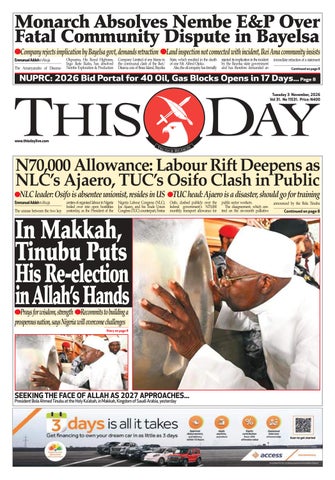
Monarch Absolves Nembe E&P Over Fatal Community Dispute in Bayelsa
Company rejects implication by Bayelsa govt, demands retraction Land inspection not connected with incident, Ikei Ama community insists
Emmanuel Addeh in Abuja The Amanyanabo of Dieama-
Okpoama, His Royal Highness, Ingo Ikele Ikaba, has absolved Nembe Exploration & Production
Company Limited of any blame in the communal clash at the Ikei/ Dieama axis of Brass Island, Bayelsa
State, which resulted in the death of one Mr. Alfred Ojoko. Also, the oil company has formally
rejected its implication in the incident by the Bayelsa state government and has therefore demanded an
immediate retraction of a statement Continued on page 8
NUPRC: 2026 Bid Portal for 40 Oil, Gas Blocks Opens in 17 Days... Page 8 Tuesday 3 November, 2026 Vol 31. No 11531. Price: N400
www.thisdaylive.com TR
UT H
& REASO
N
N70,000 Allowance: Labour Rift Deepens as NLC’s Ajaero, TUC’s Osifo Clash in Public NLC leader: Osifo is absentee unionist, resides in US TUC head: Ajaero is a disaster, should go for training
Emmanuel Addeh in Abuja
The unease between the two key
centres of organised labour in Nigeria boiled over into open hostilities yesterday, as the President of the
Nigeria Labour Congress (NLC), Joe Ajaero, and his Trade Union Congress (TUC) counterpart, Festus
Osifo, clashed publicly over the federal government’s N70,000 monthly transport allowance for
In Makkah, Tinubu Puts His Re-election in Allah’s Hands
Prays for wisdom, strength Recommits to building a prosperous nation, says Nigeria will overcome challenges Story on page 8
SEEKING THE FACE OF ALLAH AS 2027 APPROACHES... President Bola Ahmed Tinubu at the Holy Ka’abah, in Makkah, Kingdom of Saudi Arabia, yesterday
public sector workers. The disagreement, which centred on the six-month palliative
announced by the Bola Tinubu Continued on page 8
2
TUESDAY, NOVEMBER 3, 2026 • T H I S D AY
TUESDAY, NOVEMBER 3, 2026 • T H I S D AY
3
4
TUESDAY, NOVEMBER 3, 2026 • T H I S D AY
5
THISDAY • TUESDAY, NOVEMBER 3, 2026
NEWS
Group News Editor: Goddy Egene Email: Goddy.egene@thisdaylive.com, 0803 350 6821, 0807 401 0580
MAIDEN LAUNCH OF THE PLBO-WELF AND WOMEN EMPOWERMENT EVENT...
Front Row- L-R: Immediate past President of Lagos Chamber of Commerce and Industry (LCCI), Mr. Gabriel Idahosa; Past President of LCCI and 2nd Deputy President, NACCIMA, Asiwaju Dr. Michael Olawale-Cole; and his wife, Mrs. Adebola Olawale-cole; Founder, Princess Layo Bakare Okeowo Women Enterprise And Legacy Foundation (PLBO-WELF) and Deputy President, LCCI, Princess Layo Bakare-Okeowo; her husband, Otunba Biodun Okeowo; Chairman, MTN Foundation, Dr. Mosun Bello-Olusoga: and, Foremost industrialist/ Past Presidents NACCIMA, Chief (Dr.) John Agboola Odeyemi. with some of the women enterprise beneficiaries of PLBO-WELF grants, during the maiden launch of the PLBO-WELF and women empowerment event in Lagos... recently
Shettima: Hard Economic Times Over, Nigerians to Start Reaping Gains
Says with Lagos–Calabar Coastal Highway, other FG packages, C’River is a major beneficiary of Tinubu’s economic revolution Yilwatda urges Cross River to break voting record, Re-elect president, Otu Deji Elumoye and Adedayo Akinwale in Abuja Vice President Kashim Shettima yesterday said the toughest phases of Nigeria’s aggressive economic reset undertaken by the administration of President Bola Tinubu are officially over, clearing the runway for an era of pure harvest, nationwide growth and prosperity. He declared that the administration’s painful but necessary economic reforms have successfully laid the groundwork for prosperity, promising that the next phase will deliver the tangible fruits of these sacrifices to citizens. Equally, the National Chairman of the All Progressives Congress (APC), Prof. Nentawe Yilwatda, challenged the people of Cross River State to surpass their previous electoral records by delivering an overwhelming vote for President Tinubu in the January 2027 presidential election. Speaking in Calabar, Cross River State, during the APC presidential campaign rally, Shettima and Yilwatda, rallied support for the re-election of President Tinubu and the State Governor, Bassey Otu, as well as other APC candidates in the 2027 general election, describing them as trustworthy friends of the people. Stating that the government had successfully completed the hardest part of the economic reset, Shettima argued that no rival political party had the capacity to alter the nation’s economic trajectory.
The Vice President assured that the upcoming second term would focus entirely on delivering prosperity and tangible rewards for all citizens if President Tinubu’s mandate was renewed. According to him: “We are confident of this promise to deliver for this nation because we have already done the most difficult job of economic reset. None of the other options available has the capacity to move the needle of the economy. We have rescued the economy, and the road ahead is one of harvest. This second term is one of harvest, for you and all Nigerians. “I therefore stand before you today to ask you, once again, to renew the mandate of His Excellency, President Bola Tinubu, as President of the Federal Republic of Nigeria, and myself as Vice President. And another term for Senator Bassey Edet Otu and Hon. Peter Odey as Governor and Deputy Governor of Cross River State, respectively.” Shettima maintained that what had brought the APC and Nigerians together was an alliance for progress, prosperity, opportunity and dignity, stressing that the conviction that must govern every decision was that the people were the purpose. He noted that the Tinubu administration and the APC were seeking the opportunity to carry their work into a second term because authority belonged to the people, and those entrusted with authority must return with an account of stewardship and a programme worthy of further trust.
The Vice President commended the APC in the state for keeping its house in order and becoming a model of strength and vision, unity and discipline, courage and conviction, loyalty and service, sacrifice and solidarity, noting that the discipline within its ranks had produced diligence in government. He said when the administration took office in 2023, it had no doubt about the need to open up Cross River State to the world, which informed the Lagos-Calabar Coastal Highway. “This is the wisdom behind the Lagos–Calabar Coastal Highway. This transformative infrastructure project
will connect coastal communities. It will ease the movement of goods and people. It will expand tourism. It will attract investors and create thousands of direct and indirect jobs. Our vision is for Cross River to become a major beneficiary of this economic revolution,” he stated. Shettima also said the Bakassi Deep Sea Port had received Federal Government approval and support under President Tinubu, pledging to make the dream come true as an international maritime gateway. This gateway, according to him, would attract shipping companies, generate employment, stimulate
Support targets locally driven projects under China’s ‘Small but Beautiful’ initiative World’s second largest economy seeks longer-term trade pact as bilateral trade hits $18bn in H1 2026
James Emejo in Abuja
Nigeria and China have signed a $30 million grant agreement to finance grassroots development projects, as both countries seek to deepen economic cooperation and translate their longstanding diplomatic ties into tangible benefits for local communities. The agreement, valued at RMB 200 million, was signed by representatives of both countries under the NigeriaChina Development Cooperation framework. Minister of Budget and Economic
Planning, Senator Abubakar Atiku Bagudu, said the grant would support projects designed to address specific development needs at the community level, stressing the need to ensure that bilateral agreements deliver measurable improvements in the lives of Nigerians. The funding will be deployed under China’s “Small but Beautiful” initiative, which prioritises targeted development interventions with direct impact on livelihoods and local communities. Bagudu disclosed that the federal government, working with the Nigeria-
Osoba, Amuka-Pemu, Ogunbiyi to Chair DTN@100 Celebration
The Daily Times Newspapers is set to hold the DTN@100 Shaping the Future Town Hall and National Conversation on today, November 3, 2026, in Lagos, with prominent media personalities and former newspaper executives expected to lead discussions on Nigeria’s achievements and global percep-
tion. According to a press invitation dated October 30, 2026, the event will be superintended by Aremo Olusegun Osoba, former Ogun State governor and former Managing Director of Daily Times. Other co-chairpersons are the Publisher of Vanguard Newspapers, Oloye Sam Amuka-Pemu, and Dr. Yemi Ogunbiyi, a former Manag-
efforts towards resolving the dispute over 46 oil wells. He further stated that the government was prepared to ensure a resolution was reached to strengthen the state’s maritime identity and open prospects for greater participation in the blue economy, maritime investment, and potential derivation benefits. On education, Shettima said the state was well-represented in the disbursement of education funds through NELFUND, which drives human capital development, provides relief for parents, ensures continued schooling for young people, and widens access to higher education.
FG, China Sign $30m Grant for Grassroots Devt Projects
Daily Times to Hold Town Hall, National Conversation Today Sunday Ehigiator
industrial development, and open enormous economic opportunities for factories, businesses, and households sustained by trade. He added that proposing Calabar as the location for the Gulf of Guinea Commission Secretariat would strengthen the state’s international visibility, attract diplomatic and commercial activity, stimulate hospitality and tourism, create employment, and translate regional cooperation into economic opportunities. The Vice President assured that the Federal Government not only recognised Cross River’s littoral status but also acknowledged its
ing Director of Daily Times and Guardian Newspapers, who is currently the Executive Chairman of Tanus Communications. The event, scheduled to begin at 4 p.m., is expected to provide a platform for discussions on Nigeria’s national development, achievements and the contributions of individuals who have played significant roles in shaping the
country. The organisers said the Town Hall and National Conversation was designed to “deepen discussing on Nigeria’s attainments, honour the change-makers and change Nigerian’s global perception.” The event forms part of activities marking the centenary of the Daily Times, one of Nigeria’s historic newspaper institutions.
China Strategic Partnership Office, had been developing project proposals submitted by state governments to address identified grassroots needs. He linked the initiative to Nigeria’s Renewed Hope Ward Development Plan, which seeks to identify economic opportunities and map economically active individuals across the country’s 8,809 wards as part of efforts to promote inclusive growth and reduce poverty. According to him, Nigeria is interested in sharing the initiative with China and drawing on the Asian country’s experience in poverty reduction and community-level economic development. The minister said the grant represented a continuation of China’s development support to Nigeria, recalling an earlier $1 million contribution in 2026 towards strengthening the country’s technological and knowledge development capacity. He also called for stronger economic engagement between the two countries, particularly in leveraging China’s zero-tariff policy for Nigerian exports to expand market access and stimulate domestic production. Bagudu underscored the importance of technical cooperation
and institutional capacity building, including training opportunities for Nigerian officials in China, to strengthen the country’s ability to execute development programmes.
China Seeks Longer-term Trade Framework
Chinese Ambassador to Nigeria, Yu Dunhai, said the grant reflected Beijing’s commitment to supporting Nigeria’s development priorities and strengthening strategic partnership between both countries. Dunhai said the agreement was consistent with the understanding reached between President Bola Tinubu and Chinese President Xi Jinping during their meeting in China, as well as the outcomes of the Fourth China-Nigeria Cooperation Forum held in Beijing. He stated that 2026 marked 55 years of diplomatic relations between the two countries, adding that their cooperation has expanded across several sectors over the decades. Providing an update on economic relations, the ambassador said bilateral trade reached $18 billion in the first half of 2026, while Nigeria’s exports to China rose by 80 per cent.
6
TUESDAY, NOVEMBER 3, 2026 • THISDAY
NEWS
RENO OMOKRI READY FOR MEXICO...
Nigeria’s Ambassador to Mexico, Mr. Reno Omokri, presents his letter of appointment to Senate President, Chief Godswill Akpabio, in Abuja... recently
Kyari Faults Political Interpretation of Cadre Harmonisé Assessment FAO-backed report projects 6.7m increase in people facing acute food insecurity by 2027 lean season Minister cites climate shocks, insecurity, expands irrigation, mechanisation and farm input support
James Emejo in Abuja Minister of Agriculture and Food Security, Senator Abubakar Kyari, yesterday faulted the politicisation of the latest Cadre Harmonisé food security assessment. Kyari insisted that the report’s projection of 33.5 million Nigerians facing acute food insecurity in 2027 should be treated as an early-warning signal rather than an indictment of the federal government. The minister, who acknowledged the country’s persistent food and nutrition challenges, said the technical assessment was being misrepresented by opposition
voices for political purposes, warning against turning the food security situation into an electoral campaign issue. His position comes as the Food and Agriculture Organisation (FAO)-backed assessment projects that the number of Nigerians facing crisis-level food insecurity or worse could rise by 6.7 million, from 26.8 million between October and December 2026 to 33.5 million during the June-August 2027 lean season. The projected increase highlights the mounting pressure on vulnerable households, particularly as declining food stocks, elevated food prices, reduced purchasing power, and disruptions to
agricultural livelihoods, threaten access to food. However, in a statement, the minister said the 33.5 million projection was lower than the 34.8 million projected for the corresponding period in 2026, maintaining that the figures have been selectively interpreted to advance political narratives. He explained that the Cadre Harmonisé was developed by the Permanent Inter-State Committee for Drought Control in the Sahel (CILSS), with technical support from international organisations, including FAO, World Food Programme (WFP), FEWS NET, and UNICEF.
According to him, the framework provides an evidence-based mechanism for identifying populations vulnerable to food and nutrition insecurity and enabling governments and development partners to respond before conditions deteriorate. Kyari stressed that the assessment did not attribute the projected food insecurity to the continuation of any particular political administration, describing such interpretations as a distortion of its findings. However, the assessment points to significant vulnerabilities across the country, identifying conflict and insecurity, population displacement,
Nigeria Tasks WAHO on Integration of Digital Health, AI in Training Curricula Onyebuchi Ezigbo in Abuja
Nigeria has asked the West African Health Organisation (WAHO) to integrate research, digital health, artificial intelligence, and innovative learning approaches into the training curricula for health professionals in West Africa. Coordinating Minister of Health and Social Welfare, Professor Ali Pate, gave the charge in Abuja at the 11th Statutory Meeting of Regional Council for Health Professionals Education of WAHO. Pate said the increasing complexity of health challenges in the region, including emerging infectious diseases, non-communicable diseases, health emergencies, workforce shortages, and migration underscored the urgent need for competent, resilient, and adequately distributed health workforce. WAHO, the regional council for health professionals’ education, was created by ECOWAS Health Ministers in 2012 as the sole council for regional accreditation of health
professions training, with members including accredited professional colleges, deans of faculties, and national regulatory bodies. Pate was represented at the meeting by Director of Planning, Research and Statistics, Dr. Ovuoraye John. He said the quality of health systems depended fundamentally on competence and availability of health professionals, adding that investment in their education must remain strategic priority for achieving Universal Health Coverage. The minister stated, “WAHO’s leadership in harmonising health professionals’ education is critical. I encourage the council to strengthen competency-based curricula, accreditation and quality assurance, mutual recognition of professional qualifications, faculty development, and institutional collaboration.” He added, “We must also integrate research, digital health, artificial intelligence, and innovative learning approaches into professional education to ensure that
our graduates are equipped to respond to evolving healthcare needs.” Pate said Nigeria recognised human resources for health as a central pillar of the federal government’s Renewed Hope Agenda and ongoing health sector reforms, with commitment to strengthen training institutions, improve professional standards, address workforce shortages and maldistribution, and promote better working conditions, career development ,and retention strategies. He said the objective must go beyond producing more health professionals to ensuring right competencies were developed and qualified professionals were equitably deployed where most needed. He said health education systems must respond to emerging realities, including digital transformation, telemedicine, AI, climate-related health challenges, and public health emergencies, with greater emphasis on epidemiology, infection pre-
vention and control, emergency preparedness, and One Health approach. He urged the council to review progress, address challenges, and agree on practical, measurable and time-bound actions to accelerate regional harmonisation, stressing that success must be reflected in effective implementation and tangible improvements in quality of health professionals’ education. In his welcome remarks, Director-General of WAHO, Professor Palokinam Pitche, said human resources in health were at the heart of health systems, stating that without them there are neither health centres, nor clinics, or hospitals. Pitche referred to the regulatory frameworks guiding WAHO, including Article 3 of WAHO Creation Protocol - the Dakar Convention on recognition and equivalency of diplomas, and resolutions on harmonisation of training curricula adopted in Abuja in 2006.
high fuel prices, climate-related shocks, and persistent food inflation as major drivers of food insecurity. It covered 26 states and the Federal Capital Territory (FCT), with findings indicating that vulnerable communities would remain exposed to severe food consumption challenges. The report projected that 756,815 internally displaced persons (IDPs) in Borno, Sokoto and Zamfara states would face crisis-level food insecurity or worse between October and December 2026. The number is expected to increase to 891,228 during the June-August 2027 period. Borno, Yobe, Adamawa, Katsina, Zamfara and Sokoto were among the states identified as facing some of the most severe food consumption challenges. The assessment further highlighted the impact of insecurity and displacement on agricultural livelihoods, with farmers in affected communities facing restricted access to farmland and productive assets. Rising fuel, transportation, energy and fertiliser costs were also identified as factors increasing production expenses and weakening household purchasing power. The nutrition outlook was equally concerning, with the report warning that inadequate dietary intake, disease outbreaks, reduced household incomes, and limited access to healthcare, clean water, and sanitation could worsen acute malnutrition, particularly among children under five and pregnant and breastfeeding women. It recommended timely food assistance, targeted cash transfers, and livelihood support, alongside stronger nutrition surveillance and improved prevention and treatment of acute malnutrition. Responding to the challenges, Kyari identified climate change, inconsistent rainfall, and prolonged dry spells as major constraints to agricultural production, particularly for farmers dependent on rain-fed agriculture. He also cited the Super El Niño phenomenon as contributing to weather
disruptions across several regions, affecting planting seasons and crop yields. On interventions, the minister said the federal government was expanding fertiliser distribution and local blending, mechanisation, irrigation, and dry-season farming to boost domestic food production. He listed improved agricultural financing, access to farmland, storage and processing infrastructure, valuechain development and climate-resilient agricultural practices among measures being pursued to strengthen the country’s food system. Kyari also attributed some improvement in agricultural activities to better security in previously inaccessible farming communities, stating that farmers are gradually returning to their farmlands. He specifically cited Marte and Guzamala in Borno State, where improved stability had enabled data collectors to conduct the Cadre Harmonisé assessment in areas previously inaccessible to them. The minister highlighted support for smallholder farmers, mechanisation partnerships, and financing through the Bank of Agriculture (BoA) as part of efforts to improve productivity. He admitted that the interventions would not eliminate food insecurity overnight, describing it as a longstanding structural challenge that predated the current administration. Kyari said the government welcomed scrutiny and constructive criticism, but he urged political actors to exercise responsibility in interpreting food security statistics. He maintained that the priority should be translating the assessment’s early-warning signals into practical interventions to protect livelihoods, support farmers, and improve access to affordable and nutritious food. Meanwhile, Permanent Secretary, Ministry of Agriculture and Food Security, Dr. Marcus Ogunbiyi, disclosed during the presentation of the assessment that 10 states were yet to be fully integrated into the Cadre Harmonisé analysis process.
7
THISDAY • TUESDAY, NOVEMBER 3, 2026
NEWS
KINGDOM LIFESTYLE CONFERENCE SERIES IV, HOSTED BY JWCAN...
L-R: Convener/Senior Pastor, Jesus World Changers Apostolic Mission (JWCAM), Pastor Olubayode Awosika; Former member, House of Representatives, Albert Atiwurcha; Minister of Defence, General Christopher Gwabin Musa (rtd); his wife, Lilian Musa; Chairman, Conference Planning Committee, Dr. ‘Dere Awosika; Former Director/Head of Legal and Prosecution, Economic and Financial Crime Commission (EFCC), Elizabeth Ayodele; and Former Director General, Budget Office of the Federation, Pastor Ben Akabueze, during the Kingdom Lifestyle Conference Series IV hosted by JWCAN, in Lagos...recently
N10bn Emergency Health Fund Not for Ebola Intervention Alone, NCDC Declares
Onyebuchi Ezigbo in Abuja
Nigeria Centre for Disease Control and Prevention (NCDC) yesterday explained that the N10 billion emergency health fund released by the federal government was not limited to Ebola disease, but meant for broader health security interventions. The agency also said the money was not released to the Presidential Task Force (PTF) on Ebola Disease Virus (EVD). President Bola Tinubu had approved N10 billion for emergency health preparedness in the wake of the recent importation of the first index case of Ebola into Nigeria. However, NCDC said the money was released to it to strengthen prevention, preparedness, readiness, early detection, rapid response, and resilient recovery for diseases of public health importance. Director-General of NCDC, Dr. Jide Idris, had told journalists during a recent press conference that the agency was yet to receive the N10 billion intervention fund. A statement signed by Idris clarified issues relating to the money. It said the fund was not meant for Ebola alone but also other diseases that had historically caused significant illness and death in Nigeria, such as Lassa fever, cholera, cerebrospinal meningitis, diphtheria, measles, mpox, and antimicrobial resistance. In the statement, which sought to address controversies trailing the release, Idris said, “Was N10 billion released to NCDC? Yes. Was the money meant for Ebola? The request was not limited to Ebola Disease alone.”
The director-general said he sought additional funding to strengthen the health security architecture beyond a single outbreak. On whether the money was released to the Presidential Task Force chaired by Chief of Staff to the President, Idris said, “No. The PTF was established primarily to coordinate the national response. The N10 billion in question was released to NCDC to address broader health security needs.” The agency lamented that political actors sometimes failed to distinguish responsible opposition from calumny and outright mischief, stressing that health security is a matter of national security and should not be reduced to partisan contestation.
“Politicians and other public commentators must avoid fuelling infodemics, particularly during public health emergencies when accurate information and public trust are indispensable,” the statement said. On whether N10 billion was enough for Nigeria’s health security, NCDC said it was not, describing the allocation as inadequate. It said the funding requirements were not arbitrary but informed by national plans, identified gaps, and the cost of implementing agreed priorities. It stated that following the expiration of the first National Action Plan for Health Security (NAPHS), Nigeria developed NAPHS 2.0 (2025–2029) to guide health security investments
over the next five years. Idris added that although significant progress was made under the first plan, inadequate funding remained a major constraint. “One key lesson was the need for NCDC to pursue additional domestic and external funding,” the statement said. According to the centre, NAPHS 2.0 is a multi-sectoral, One Health, whole-of-government and whole-ofsociety plan bringing together relevant ministries, departments and agencies; development partners; multilateral and bilateral agencies; civil society organisations; and other stakeholders to strengthen capacity to prevent, detect, and respond to public health threats.
It said the estimated cost of implementing NAPHS 2.0 alone was approximately N522 billion over five years, translating to an average of about N104.4 billion annually. NCDC said, “Although not all the NAPHS activities are funded through NCDC, this figure illustrates the scale of investment required to protect Nigerians against public health threats. Also, the comparison is instructive: N10 billion represents about two per cent of the plan’s average annual cost. It should therefore not be presented as an excessive allocation.” The centre stated that the discussion should not be whether Nigeria could afford to invest adequately in health security, but whether it could afford
the human, social and economic consequences of failing to do so. It said effective preparedness reduced the likelihood that outbreaks will escalate into national emergencies, disrupt livelihoods, overwhelm health facilities, and impose far greater costs. “N10 billion should be understood within the broader context—not as excess funding, but as part of the investment required to protect Nigeria’s population and economy,” it added. The centre urged Nigerians, policymakers, the media, and development partners to direct greater attention towards advocating for sustainable, adequate, and accountable funding for NCDC and the wider health security system.
GTCO Fashion Weekend Moves Beyond Runway Glamour, Unveils Year-Round Collective Targeting Global Market Mary Nnah GTCO has unveiled a year-round Fashion Collective with a dedicated directory for Aso-oke weavers and Adire dyers to fix the broken link between Africa’s cel-ebrated runways and its invisible indigenous fabric makers. The financial institution announced the platform on Thursday at a press briefing ahead of its 9th Fashion Weekend slated for November 7 and 8 at Plot 1, Water Corporation Drive, Oniru, Lagos. Head of Corporate Communication, Oyinade Adegite, said the move shifted GTCO’s intervention from
a two-day spectacle to permanent infrastructure for the in-dustry. Adegite stated, “Over the past nine years, the GTCO Fashion Weekend has done what many thought unlikely - built Africa’s most exciting fashion experiences on the back of a financial institution’s commitment to promoting enterprise.” She added, “This year, we are introducing the GTCO Fashion Collective, a year-round platform that con-nects every part of our fashion ecosystem: designers, models, stylists, photographers, editors, buyers, con-tent creators and the broader creative community.” At the heart of the collective is a
Manufacturer and Textile Directory documenting artisans behind indigenous fabrics, a segment that has remained commer-cially invisible, despite powering African fashion’s global rise. The issue the platform tackles is long-standing: while African designers win international acclaim, the mak-ers of the textiles that define the aesthetic operate without structured market access, visibility or con-sistent commercial linkage. The result is a fragmented value chain where momen-tum dies after fashion week. GTCO’s 9th Fashion Weekend will still feature master-classes with
Renee Morris, Sherlina Nym and Rachel Ojuromi, presentations by designers, including Spec-trum by Aisha, MSO Lagos, Cisca Cecil, Sheye Oladejo, Meme Rocha and Mide World, alongside retail outlets, craft and fabric market and runway shows. But the bank says the real investment is beyond the weekend - building directories, networks and continu-ous market linkages that allow fashion enterprises to scale. The initiative positions GTCO not just as a sponsor of fashion, but as a builder of systems that connect the weaver to the designer to the international buyer, turning
seasonal excitement into sustained economic opportunity for Lagos’ creative economy. The collective aims to keep professionals linked 365 days, not just two days. To keep opportunities circulat-ing, collaborations alive, and indigenous production systems visible and viable. It is a move from sponsorship to institution-building - from funding a show to organising a value chain. For a city like Lagos that wants to be Africa’s true fashion capital, and for an industry where global brands are now hunting for authenticity and traceable craftsman-ship, that organisation is competitive advantage.
UBEC to Launch National Documentary, Publicity Bulletin to Showcase Achievements Kuni Tyessi in Abuja
The Universal Basic Education Commission, UBEC, has unveiled plans to launch a national documentary, a regular publicity bulletin and a coordinated digital campaign to showcase the impact of federal government interventions in basic education across Nigeria. The initiative is part of efforts to counter misinformation, correct negative public perceptions and make visible the huge investments in school infrastructure, teacher development and learning resources. Acting Head of Corporate
Communications, UBEC, Mrs. Kemi Abass, disclosed this on Monday in Keffi, Nasarawa State, at the 12th Annual Training Workshop for Public Relations and Information Officers of UBEC and State Universal Basic Education Boards, SUBEBs, from the 36 states and the Federal Capital Territory, FCT. The workshop, which drew image-makers of basic education from across the country, was declared open by the Chairman of Nasarawa State Universal Basic Education Board, Dr Kassim Mohamed. Abass said the Commission was
concerned that despite massive interventions by the federal and state governments, public discourse on basic education is still dominated by images of dilapidated structures and out-of-school children, while thousands of success stories remain untold. According to her, the responsibility of PR officers has evolved beyond issuing press releases, covering events and posting on social media. “We must move from routine publicity to proactive, strategic and impact-driven communication. Every classroom constructed,
every teacher trained, every child who can now read because of our interventions is a story of transformation that deserves public attention,” she said. She listed new communication tools officers must adopt to include short documentaries, human-interest stories, infographics, interviews and beneficiary testimonials. “The Commission is looking towards establishing a regular UBEC publicity bulletin that will chronicle interventions state by state, producing a national documentary that captures success stories across UBEC and SUBEBs, and launch-
ing a coordinated national digital campaign to improve awareness and visibility of basic education,” Abass said. She called for stronger synergy between UBEC and SUBEB communication units to ensure timely information sharing, coordinated messaging and consistent projection of achievements. In her keynote address, the Executive Secretary of UBEC, Dr Aisha Garba, charged PR officers to embrace innovation, professionalism and strategic communication as a core pillar of educational develop-
ment. Garba, represented by the Director, North Central Zone, Mr. Edward Ababalaka, said effective communication is essential to ensuring that government interventions are understood, appreciated and supported by communities. She noted that while substantial progress has been recorded in infrastructure development, teacher professional development, provision of instructional materials and digital learning initiatives, the sustainability and public ownership of those gains depend on how effectively they are communicated.
8
TUESDAY, NOVEMBER 3, 2026 • THISDAY
EIGHT
NUPRC: 2026 Bid Portal for 40 Oil, Gas Blocks Opens in 17 Days Eyesan woos fresh investors in Abu Dhabi
Emmanuel Addeh in Abuja
The Commission Chief Executive, Nigerian Upstream Petroleum Regulatory Commission (NUPRC), Mrs. Oritsemeyiwa Eyesan, yesterday told investors that Nigeria offers a stable climate amid the global energy tension. Eyesan therefore urged investors to look towards Nigeria by taking advantage of the 2026 Licensing Round which has 40 oil and gas blocks on offer. She also disclosed that the licensing round portal will officially open on November 20, 2026. The NUPRC boss said this during a roundtable discussion titled: ‘Energy Sovereignty in an
Interconnected World: Aligning National Priorities, Markets and Global Security’ at the 2026 ADIPEC Exhibition and Conference in Abu Dhabi on Monday, November 2, 2026. A statement by the NUPRC Head of Media and Corporate Communications, Eniola Akinkuotu, quoted Eyesan as saying that with a very attractive fiscal framework for investors, she was expecting to see even more interest in the new licensing round. She said: “We are expecting investors to turn to Nigeria. We are going in for another licensing round and we will be launching our bid portal on November 20. We expect to see interested investors
because the environment is a lot more competitive. “We have set a very attractive fiscal framework for investors. The entire environment is a lot more secure. We have been able to manage costs with a lot of incentives for investors and we expect to see investors take up the offer when we open the portal.” The NUPRC chief noted that since the passing of the Petroleum Industry Act (PIA) in 2021 as well as the executive orders signed by President Bola Tinubu, Nigeria has seen an improvement in its investment climate. Eyesan stated that between 2021 and 2026, the NUPRC had held at least four successful licensing
rounds which had brought in more investments into the country. This, she said, is a departure from the pre-PIA era where licensing rounds were not frequent. The NURPC chief executive said that Nigeria possesses huge energy potential as it sits on 215 Trillion Cubic Feet (TCF) of gas, but could barely produce 7 Billion Cubic Feet (BCF) daily. According to her, the situation presents an opportunity to investors, especially as key gas infrastructure projects are in the pipeline. She added: “The stars are already aligned. For gas infrastructure we just completed very major infrastructure projects that will unlock gas supply in the country
and the sub-region. “We talk about two major projects on the drawing board to move gas through the Nigeria-Morocco Atlantic Gas Pipeline and TransSahara Gas Pipeline. Again, this gas will go somewhere in Europe and will also meet regional demands. So, Nigeria is positioned to meet not just domestic supply,” the CCE stated. Eyesan maintained that with many countries discovering petroleum resources, the race for investments has become even more competitive. She said Nigeria was already ahead of the game as it had made certain modifications in order to attract the right capital.
IN MAKKAH, TINUBU PUTS HIS RE-ELECTION IN ALLAH’S HANDS
Deji Elumoye, Chuks Okocha in Abuja and Benjamin Nworie in Abakaliki
In supplication and total submission to the Almighty, President Bola Ahmed Tinubu, yesterday, at the Holy Ka’abah, Mecca, where he had gone to observe Umrah, the lesser hajj, handed his re-election challenges to Allah, in whom he trusted. With a tinge of drama, Tinubu, who held and kissed the Al-Hajar al-Aswad otherwise called the Black Stone, in a symbolic sunnah, often performed in emulation of the Prophet Mohammad, however, prayed for wisdom and strength. The Black Stone is one of the most sacred objects in Islam, embedded in the southeastern corner of the Holy
Ka’abah in Makkah, Saudi Arabia, surrounded by a silver frame. Muslims hold it in great reverence because Islamic tradition teaches that it came from paradise and that Prophet Mohammad kissed it. It is therefore an expression of faith and reverence, not an act of worshipping the stone. The president, who concluded his five-day visit to the Kingdom of Saudi Arabia, reflected on his spiritual journey to the Holy land, during which the Custodian of the Holy Mosques of Makkah and Madinah, King Salman bin Abdulaziz Al Saud, granted him a rare privilege of leading Nigeria’s delegation to pray inside the Holy Ka’abah. At the Holy Ka’abah, Tinubu offered prayers of gratitude to the Almighty Allah for the privilege of serving as Nigeria’s President and
Commander-in-Chief of the Armed Forces. Sheikh Dahlulah Muthawal of Masjid al-Haram led the president into the Ka’abah. Tinubu thanked the Custodian of the Two Holy Mosques, King Salman bin Abdulaziz Al Saud, and Crown Prince Mohammed bin Salman, for granting him and members of his delegation the opportunity to enter the Holy Ka’abah in Makkah and offer prayers to Almighty Allah. The president described the honour as a historic and deeply cherished spiritual experience, reflecting the longstanding bonds of friendship, mutual respect and cooperation between Nigeria and the Kingdom of Saudi Arabia. “I want to say a big thank you for the faith, for the recognition. I can’t
believe the fencing of the Ka’abah is in Green-White-Green, which reminds us of the Nigerian identity. “I thank the Crown Prince and all the administrators of the holy land. I thank them for the hospitality and recognition given to me as the leader of the delegation and the country. “We are all facing challenges and hostility around us. We will overcome them with faith in God Almighty. I’m grateful forever. I thank the King and the royal Crown Prince. “It is an honour that I enjoyed, and it is gracious of them to have allowed me to enter inside the Ka’abah. This is history.” Tinubu said he asked Allah for wisdom and resilience to continue serving Nigerians, and expressed confidence that his prayers have been answered.
N70,000 ALLOWANCE: LABOUR RIFT DEEPENS AS NLC’S AJAERO, TUC’S OSIFO CLASH IN PUBLIC
administration, played out on Channels Television’s breakfast programme, where both labour leaders took turns to attack each other’s credibility and negotiating capacity. Last Tuesday, the federal government had announced the transport allowance in a Memorandum of Understanding (MoU) issued after a meeting between government representatives and NLC leaders in Abuja. Barely 24 hours after the announcement, the TUC rejected the allowance, insisting that what Nigerian workers needed was a salary increase, not a temporary palliative. This set the tone for a clash between the two labour centres. Reacting to the TUC’s position, Ajaero said the trade union led by Osifo ought to have negotiated its own terms with government rather than disown the outcome of a negotiation it did not participate in. But Osifo countered that discussions on workers’ welfare and the allowance had begun long before Ajaero’s meeting with government, adding that government had separately engaged the TUC. However, speaking on the programme yesterday, Ajaero maintained that the N70,000 allowance was the product of collective bargaining triggered by an ultimatum issued by the NLC. “When he (Osifo) said I did not negotiate N70,000 transport allowance, I did not know what he meant. We (NLC) gave the government an ultimatum and the government asked for four days to meet with us. “At the resumed sitting after four
days, some agreements were reached. After every collective bargaining, the product is the agreement. It was in that agreement that the issue of N70,000 was reached,” he said. Ajaero went further to question Osifo’s stewardship of the TUC and the whereabouts of the 90 Compressed Natural Gas (CNG) buses donated to the TUC by the federal government. Describing Osifo as an “absentee president,” Ajaero alleged that the TUC leader does not reside in Nigeria and was only running the union from abroad. “He is an absentee president of the TUC. He does not live in Nigeria. He comes in from the US to attend meetings and rush back. He serves in the board of PENCOM. You cannot be living abroad and be holding a position in a central level organisation. I challenge him and the Nigeria Immigration Service to prove if he has been in this country for four to five months this year,” he added. But in a reply after Ajaero’s interview, Osifo fired back strongly, saying the labour movement deserved better leadership and that Ajaero deserved to be pitied. He described the NLC chief as a disaster. Besides, Osifo said the labour movement deserved some pity too after listening to the NLC president, noting that the movement once boasted great leaders. “I can boldly say that Joe Ajaero is a disaster to the trade union movement in Nigeria,” Osifo said. The TUC president insisted that the NLC could not negotiate on behalf of TUC members, as the congress remains a recognised
federation with its own affiliates and mandate. On the allegation that he lives outside the country, Osifo said it was a shame that such a claim would come from the NLC president. He disclosed that before handing over as President of the Petroleum and Natural Gas Senior Staff Association of Nigeria (PENGASSAN) in August, he shuttled from one shop floor to another negotiating salary increments for members. Osifo said he was currently in the United Kingdom for training
on advanced leadership and management and accused Ajaero of shortchanging Nigerian workers on account of poor negotiation skills. “Ajaero has never led any union in Nigeria that is why he does not understand the principles of negotiation,” Osifo said. “What I will recommend for him is training and retraining,” he added. For years, although the labour unions have had their differences, they have struggled to speak with one voice on major issues that affect workers.
According to him, “I asked for wisdom and resilience to continue to serve the people. I know that prayer has been granted. Before the 2023 election, I did the same thing. I asked Allah to bless my Umrah then, and He did. And I promised that I would come back to thank Him.” He reflected on the message from the Holy Qur’an in Surah Aal-Imran, Verse 26, which affirmed that Almighty Allah is the Owner of all sovereignty, granting power and authority to whom He wills and taking them away from whom He wills. The president said power is a trust that must be exercised responsibly, with humility and in the service of the people, recognising that no position of authority is permanent and that ultimate sovereignty belongs to Almighty Allah. “There is no other God but Almighty Allah. He is the giver and the taker. He owns power and authority. He says, ‘If I give you, use it well. If you don’t use it in accordance with my dictates, I can take it from you and give it to another person. I am the only One who has that authority,” the president said, quoting the Qur’an. Tinubu said faith in Allah had strengthened his conviction that his emergence as Nigeria’s leader was an extraordinary blessing that must be matched with dedicated service to the country. “I have faith in that, and I believe
Mrs. Oritsemeyiwa Eyesan She explained: “We understand that investors will price execution risk, cost, delays and also uncertainty and so what we have done in Nigeria is to ensure that we guard against these risks and then attract the investment required to enable us unlock the huge resources we sit on.”
extremely well that He has done me and my country a great favour. Out of many millions of people, to be the President and Commander-in-Chief is a favour that only Almighty God can do to a human being,” he stated. Tinubu reiterated his commitment to Project Nigeria and his determination to build a prosperous nation, invest in the future of young Nigerians, and pursue development in line with the will of Almighty Allah and the people’s aspirations. He emphasised that his commitment to Project Nigeria had become even stronger, assuring Nigerians of his resolve to pursue policies and programmes that would promote prosperity, national development and shared progress. “My commitment to Project Nigeria is higher. I am determined to usher in prosperity and fully develop the country, consistent with the wish of Allah and the support of the people. “It is important to put Allah first, then move on. Follow your conscience. Follow the right path that will lead Nigeria to that greatness,” Tinubu said. On the nation’s economic outlook, the president expressed optimism about the progress made under his watch, describing the economic foundation as solid and the country’s emergence from a difficult period as encouraging. Continued on page 29
MONARCH ABSOLVES NEMBE E&P OVER FATAL COMMUNITY DISPUTE IN BAYELSA
credited to the government. Similarly, lawyers to Ikei Ama community, the alleged second party in the dispute, have disclaimed any link to the October 19 violence, stressing that a land inspection carried out earlier had nothing to do with the eventual violence which led to the fatality. In a statement, the Amanyanabo of Dieama-Okpoama, who described the deceased Ojoko, also known as ‘heavyweight’ as his brother and personal assistant, said attempts to link the land acquisition/lease process being undertaken by Nembe to the death were inaccurate. According to him, the land acquisition/lease process commenced early last year and had been progressing without major incident, with both Dieama and Ikei communities cooperating to facilitate development. He disclosed that all visits by the company to the area have been without incident, noting that there was the need to distinguish the land process from the circumstances that
led to his brother’s death. Instead, he pointed to the longstanding tensions in the community over black sand mining and unresolved land-boundary disputes. He stated that this has nothing to do with the oil company. “I wish to state unequivocally that this narrative does not reflect the circumstances as I understand them. For the avoidance of doubt, the land acquisition/lease process commenced early last year and, until the events in question, had been progressing without any major incident. “Both the Dieama and Ikei communities had been cooperating in good faith with a common objective of facilitating the process and creating opportunities for meaningful development within our communities. It is also pertinent to note that the company had undertaken two previous visits to the area without any reported incident,” the monarch explained. He urged the public to refrain from promoting unsubstantiated
narratives that could misrepresent the facts, unfairly implicate the company, or further inflame tensions. “In view of the foregoing, I consider it necessary to correct any attempt to attribute the death of my late brother and personal assistant to the land acquisition/ lease process being undertaken by Nembe Crude Oil Export Terminal Limited (NCOETL) without a proper factual basis,” he said. Also, Nembe E&P has rejected its implication in the incident by the Bayelsa state government and demanded an immediate retraction. The government had directed the company to suspend all land acquisition activities and processes in the area, following the incident. In a statement, the company said the directive by the Bayelsa government portrayed it as an actor in the incident and has occasioned reputational damage of indescribable proportion. While extending condolences to the bereaved family, Nembe E&P insisted that it did not cause, instigate
or participate in the incident. It stated that whereas the state government has identified no act or omission by Nembe that may have even remotely contributed to or engendered the confrontation, a site visit aimed at a possible land acquisition through a proposal presented to by a third party did not even have a representative of the oil firm. The company said its inquiries indicated that the dispute concerned opposition to black sand mining activities attributed to a company known as Starant Mining Limited, further compounded by unresolved disagreements over community leadership and control of resources. Nembe also challenged what it described as a “blanket and indefinite suspension” of its land acquisition activities, noting that the government announcement identified no breach, specified no duration or review mechanism and set out no statutory basis. Continued on page 28
9
THISDAY • TUESDAY, NOVEMBER 3, 2026
NEWS
AT THE 32ND NIGERIAN ECONOMIC SUMMIT...
L-R: Olaniyi Yusuf, Chairman, Nigerian Economic Summit Group and Moderator of the Day 2 Plenary; Senator Shuaib Afolabi Salisu, Chairman, Senate Committee on ICT and Cybersecurity; Dapo Olagunju, Managing Director, JP Morgan Chase; Kendra Gaither, President, US-Africa Business Centre, US Chamber of Commerce; Jim Swartz, Chairman/Managing Director, Chevron Nigeria/Mid-Africa and Keynote Speaker; and Gbenga Adebayo, President, Association of Licensed Telecoms Operators of Nigeria (ALTON), during a plenary session themed “Innovation, Investment, and the Next Decade of Partnerships,” sponsored by IHS Nigeria, at the 32nd Nigerian Economic Summit at the Congress Hall, Transcorp Hilton, Abuja...recently
Bamidele: National Assembly Proposes 74 Special Seats for Women Says proposal allocates 37 seats each to Senate, House of Representatives Three additional seats proposed for women in each state assembly Sunday Ehigiator The National Assembly has proposed the creation of 74 additional seats exclusively reserved for women in Senate and House of Representatives as part of ongoing efforts to address gender imbalance in Nigeria’s political representation. The proposal, which also provides for three additional seats for women in each of the 36 state Houses of Assembly, is designed to expand women’s participation in legislative decision-making without displacing existing constituencies or elected lawmakers. Senate Leader, Senator Opeyemi Bamidele, disclosed the proposal on Monday while speaking at the 2026 Law Week organised by the International Federation of Women Lawyers (FIDA), Ekiti State Chapter. Bamidele, who is also Vice Chairman of Senate Committee on
the Review of the 1999 Constitution, said the proposal formed part of the ongoing constitution amendment exercise being undertaken by the 10th National Assembly. He explained that the proposed arrangement would provide 37 additional seats in Senate and another 37 in House of Representatives, ensuring that every state of the federation and the Federal Capital Territory would have one additional representative in each chamber. According to him, the proposed special seats are intended to provide women with greater access to elective positions and decision-making platforms, particularly against the background of their historically low representation in Nigeria’s legislative institutions. He stated, “A Bill for an Act to alter the provisions of the Constitution of the Federal Republic of Nigeria, 1999 to provide for special seats for
women in the National and State Houses of Assembly and for related matters is receiving our attention at the National Assembly.” Bamidele disclosed that the Constitution Review Committee had also recommended three additional seats for women in each State House of Assembly. He stressed that the proposed seats would be exclusively reserved for women and would not affect existing electoral constituencies or displace any serving lawmaker. The arrangement, he added, would operate for 16 years, covering four electoral cycles, after which it would undergo a comprehensive review. Bamidele explained, “This arrangement is proposed to run for a period of 16 years, four electoral cycles, before a comprehensive review. This is a sunset clause designed to ensure sustainability and to allow for the organic development of a more
inclusive political culture.” The senate leader expressed confidence that the proposal would secure the necessary legislative backing, particularly from the state Houses of Assembly, whose approval is constitutionally required to complete the amendment process. “We are actively and strategically engaging with the State Houses of Assembly, as their concurrence is a constitutional sine qua non for bringing this reform to fruition,” he said. Bamidele described the proposed special seats as a fundamental democratic reform rather than a partisan political initiative, stating that a representative democracy cannot function effectively while excluding a substantial proportion of the population from legislative decision-making. He said the initiative followed extensive consultations and consensusbuilding, adding that the National
Assembly deliberately commenced the constitutional review process early to allow sufficient time for scrutiny and wider stakeholder participation. He said the 10th National Assembly’s commitment to the initiative had also been strengthened by advocacy from prominent figures, including the First Lady, Senator Oluremi Tinubu. Bamidele stated that the underrepresentation of women in political institutions required deliberate legislative intervention. He said the proposed reform was intended to strengthen democratic inclusion and ensure that women’s interests received adequate attention in the formulation of public policies. He stated, “The special seat initiative is not a partisan endeavour. It is a historic imperative. “The rationale is anchored on a simple, yet profound, principle of constitutional law: the foundational precept of representative democracy.
20th Anniversary: Tinubu Pays Tribute to Sultan of Sokoto Describes him as leader, friend, interfaith bridge, steady counsellor to leaders nationwide
Deji Elumoye in Abuja
President Bola Tinubu has paid glowing tribute to the Sultan of Sokoto, His Eminence, Alhaji Muhammad Sa’ad Abubakar III, on his 20th anniversary on the throne. The president described the revered first-class monarch as a leader, friend, bridge between faiths, voice of moderation, and a steady counsellor to leaders nationwide. Tinubu, in the nine-paragraph tribute issued on Monday stated, inter alia: “My Dear Leader and Esteemed Brother, His Eminence, Alhaji Muhammad Sa’ad Abubakar III. “Today, I join millions of your subjects and friends in Nigeria and abroad to celebrate you as you mark 20 years on the exalted throne of your forebears as the 20th Sultan of Sokoto. “Twenty years ago, you ascended the throne with humility, courage, and a profound sense of duty. In the two decades since, you have not only preserved the glorious heritage of the Sokoto
Caliphate; you have enriched it, redefined it, and made it a formidable instrument for peace, unity, and national development. “Your uncommon wisdom, your calm in moments of tension, and your unwavering commitment to Nigeria have always struck me. You have been more than a traditional ruler. You have been a moral authority, a bridge between faiths, a voice of moderation, and a steady counsellor to leaders across the country. “As Sultan and as PresidentGeneral of the Nigerian Supreme Council for Islamic Affairs, you have consistently stood for religious harmony and tolerance. Under your leadership as Co-Chairman of the Nigeria Inter-Religious Council, Christians and Muslims have found common ground, and our diversity has become a source of strength rather than division. “Your advocacy for peace in the North and across the Sahel, your passion for education, especially for the girl-child, your support for our farmers and for public
health, and your quiet but effective interventions for the poor and vulnerable speak to a reign that is truly people-centred. “Personally, I value our friendship deeply. Your counsel has been honest, patriotic, and always in Nigeria’s best interest. Thank you for your support and your prayers for our nation.
“As you celebrate this historic milestone, I pray that Almighty Allah (SWT) will continue to grant you good health, long life, and renewed wisdom. May your reign continue to bring peace to Sokoto, unity to Nigeria, and honour to the Ummah. “Congratulations, Your Eminence.”
Alhaji Muhammad Sa’ad Abubakar III
“A democracy that systematically excludes over half of its population from the decision-making tables that determine their futures is, at best, a flawed democracy and, at worst, a veiled oligarchy.” The senate leader also highlighted the need for legislative interventions to protect women, children, and other vulnerable groups, particularly in the areas of healthcare, education, and social protection. He maintained that government had a responsibility to provide adequate safeguards where prevailing market conditions, cultural practices, and institutional weaknesses failed to protect vulnerable citizens. On access to justice, Bamidele insisted that the country’s legal framework must respond effectively to emerging threats against women and children, stressing that justice should not remain a constitutional promise or a provision in the statute books. “Rather, it must be accessible, affordable, timely, and effective,” he said. Bamidele added, “A woman who suffers domestic violence must be able to seek protection without intimidation or social condemnation. A child who experiences abuse must be heard, protected from further harm, and provided with appropriate support. “Victims must have access to legal assistance, medical care, and psychosocial services, while perpetrators must be held accountable in accordance with due process and the rule of law.”
Jibrin, Abbas Push Stronger Regulation to Transform Nigeria’s Real Estate Sector As minister assures of more government efforts to tackle sectoral challenges Juliet Akoje in Abuja Chairman of the House of Representatives Committee on Housing and Habitat, Hon. Abdulmumini Jibrin, has advocated stronger legislation and a comprehensive regulatory framework to tackle the numerous challenges hindering the growth of Nigeria’s housing and real estate sector. Jibrin said the introduction of
an effective regulatory structure would help maximise the vast opportunities in the housing industry, enhance transparency and accountability, encourage investments, safeguard homebuyers and ultimately expand access to affordable housing for Nigerians. He made the call on Monday in Abuja at the Stakeholder Conference on the Proposed National Real Estate Regulatory
Authority (NRERA), which was held under the theme, “One Vision, One Ecosystem, One National Housing and Real Estate Plan.” The lawmaker disclosed that since assuming leadership of the House Committee on Housing and Habitat, he had conducted a comprehensive review of the sector to identify its challenges, explore available opportunities and assess its potential contributions
to Nigeria’s economic growth. He explained the assessment showed the country is yet to take advantage of even a small portion of the opportunities in the housing industry, largely because of regulatory deficiencies, overlapping mandates among government institutions, weak consumer protection mechanisms and the absence of a unified national framework.
10
TUESDAY, NOVEMBER 3, 2026 • T H I S D AY
JAMES HOPE COLLEGE knowledge Character Truth
FUTURE LEADERS DO NOT JUST HAPPEN...THEY ARE FORMED AT JAMES HOPE COLLEGE, LEKKI, LAGOS NOVEMBER 2025 CAMBRIDGE
MAY/JUNE 2026 WAEC
IGCSE EXAMINATION RESULT
EXAMINATION RESULT
A*
A1 - B3 GRADES: 94%
GRADES: 67%
1
A* - A GRADES: 96%
6
A - C GRADES: 100%
A* - B GRADES: 99%
A* - C GRADES: 100% State of the art classrooms, laboratories, boarding and sporting facilities. Exceptional educators who challenge minds, nurture and bring out the best in every learner. Proud winners of prestigious international and national awards. Beautiful, serene and secure world-class campus where learning thrives. ENTRANCE EXAMINATION FOR YEAR 7 (JSS1) DAY AND BOARDING STUDENTS FOR THE 2027/2028 ACADEMIC SESSION IS SCHEDULED TO TAKE PLACE AS FOLLOWS:
LAGOS Dates:
Saturday, 30th January and 6th February, 2027
Location: Time:
James Hope College, Twin Lakes Estate, Lekki, Lagos. 10AM
ABUJA & PORT HARCOURT Date:
Saturday, 6th February, 2027
Locations: 71 Usuma Street, Opp. Transcorp Hilton, Maitama, Abuja. Time:
15 Nnamdi Azikiwe Road, Port Harcourt, Rivers State. 10AM
APPLICATION CLOSES: FRIDAY, 22ND JANUARY 2027 Application forms can be downloaded from www.jameshopecollege.edu.ng under the “admission” tab or can be collected from James Hope College, Twin Lakes Estate, Lekki, Lagos.
OPEN DAYS
DATE: SATURDAY 14TH NOVEMBER, 2026 & SATURDAY 9TH JANUARY, 2027 TIME: 9AM TO 12:30PM
Follow us on all our social media handles: @jameshopecollege
James Hope
Tel: +2347083662229, +2347018282065, @JHCLekki
+2347085369376, +2347015349257 Email: admission@jameshope.edu.ng Web: www.jameshopecollege.edu.ng
TUESDAY, NOVEMBER 3, 2026 • T H I S D AY
11
TUESDAY, NOVEMBER 2, 2026 • T H I S D AY
12
ABUBAKAR TAFAWA BALEWA
JOHNSON AGUIYI-IRONSI
YAKUBU GOWON
1966-1975
MURTALA MOHAMMED
OLUSEGUN OBASANJO
SHEHU SHAGARI
MUHAMMADU BUHARI
IBRAHIM BADAMASI BABANGIDA
1993 - 1998
ABDULSALAMI ABUBAKAR
OLUSEGUN OBASANJO
GOODLUCK JONATHAN
MUHAMMADU BUHARI
BOLA AHMED TINUBU
1960 -1966
1976-1979
ERNEST SHONEKAN
1993
UMARU MUSA YAR'ADUA
2007-2010
1966
1979-1983
SANI ABACHA
2010-2015
1983-1985
1998-1999
2015-2023
1975-1976
1985-1993
1999-2007
2023-Present
TUESDAY, NOVEMBER 3, 2026 • T H I S D AY
13
14
tuesday november 3, 2026 • T H i s d ay
NEWSxtra
Bandits Ambush, Kill 5 Policemen on Sokoto–Gusau Road, Abduct Others
Onuminya InnocentinSokoto
Suspected bandits yesterday ambushed police officers on the Sokoto–Gusau road, killing five police officers and abducting others. The attack occurred yesterday when the officers were travelling on a Zamfara State mass transit bus, popularly known as Bazamfara, en route to Gusau, the state capital. A source at the scene disclosed that some of the police officers aboard the bus lost their lives during the ambush. However, the exact number
of casualties could not be ascertained as of the time of filing this report. Sources within the police force indicated that the officers were on their way to provide security for the ongoing All Progressives Congress (APC) primary election for the Zamfara North senatorial district in Kaura Namoda Local Government Area of the state. The sources further disclosed that in addition to those reportedly killed during the ambush, some of the officers were abducted by the bandits. The circumstances
surrounding the attack and the identities of the victims remain unclear. When contacted, the Zamfara State Police Command’s Public Relations Officer said the Command was not authorised to comment on the matter, as it falls under the jurisdiction of the Zonal Command. The Zone 10 PPRO, Abdullahi Ambursa, who confirmed the incident, however, said he was currently in the hospital and would not be able to comment further, but promised to issue an official statement later.
Nigerians in Northern England Call for Regular Passport Services Sunday Okobi
The Nigerian Community in Greater Manchester (NCGM) has called on the Nigerian government to establish regular passport and consular services in Northern England following the remarkable response to a recent passport intervention exercise in Manchester, United Kingdom. According to a statement, the appeal was made
by NCGM Chairman, Otunba Abayomi BashiruKaka, at the organisation’s celebration of Nigeria’s 66th Independence anniversary, held in Manchester last month. In the statement signed by its Public Relations Officer, Joy Adetona, and made available to THISDAY yesterday, NCGM described the intervention as a welcome development that had eased the difficulties faced by
Nigerians accessing passport services outside London. The event attracted community members, civic leaders, representatives of Nigerian institutions and other distinguished guests. In the statement, BashiruKaka commended the Nigerian High Commission in London, the Nigeria Immigration Service (NIS), and the federal government for improving services for Nigerians in the Diaspora.
ECOWAS, Foreign Affairs Ministry, Kogi Organise Training on Trade Liberalisation Ibrahim Oyewale in Lokoja
As part of efforts to promote intra-community trade within the Economic Community of West African States (ECOWAS), the ECOWAS Commission and the Ministry of Internal Affairs, in collaboration with the Kogi State Government, have trained business associations, entrepreneurs and the Chamber of Commerce and Industry
on the several gains of the ECOWAS Trade Liberalisation Scheme and the advantages accrued if the state keys into the scheme. The Minister of State for Foreign Affairs, Sola Enikanolaye, disclosed this while speaking at the opening ceremony of the one-day ECOWAS Sensitisation workshop on the ECOWAS Trade Liberalisation Scheme for the North Central geopolitical
zone held at the Government House in Lokoja yesterday. Enikanolaye described the ECOWAS Trade Liberalization Scheme as a unique opportunity to strengthen intra-regional trade and economic growth. He explained that the scheme would afford the business associations the opportunity to process their products, package them and sell them elsewhere within the ECOWAS region.
GISG Inaugurates Coordinators, to Mobilise for Tinubu, Oborevwori The Global Initiative Support Group (GISG) for Sheriff 2027 has inaugurated its coordinators and canvassers across the 25 local government areas of Delta State, with a charge to intensify grassroots mobilisation for the re-election of President Bola Tinubu, Governor Sheriff Oborevwori and other candidates of the All Progressives Congress (APC) in the 2027 general election. The inauguration, held in
Ughelli, brought together members of the group from across the state, APC leaders, political stakeholders, women and youth leaders, as well as representatives of the group’s diaspora chapter. Performing the inauguration on behalf of the Delta State APC Chairman, Chief Solomon Arenyeka, the Delta South Senatorial Chairman, Chief Emmanuel Amgbaduba, commended the Convener, Olorogun Festus
Ahon, the Chairman, Chief Josiah Ntekume and other members of the group for establishing a support structure with presence across the state and among Deltans in the Diaspora. Amgbaduba, who described the group’s organisational spread as impressive, said its presence in the 25 local government areas demonstrated its capacity to mobilise support at the grassroots.
Legal Group Backs Chinda for Rivers Gov
Blessing Ibunge inPort Harcourt
A group of legal practitioners under the aegis of Vanguard of Lawyers has declared its support for the All Progressives Congress (APC) governorship candidate in Rivers State, Kingsley Chinda, and his running mate, Major Jack, ahead of the 2027 governorship election. The group, during a press conference led by its Chairman, Eberechi Adele, a Senior Advocate of Nigeria, and Coordinator, Osi Olisa, said its
endorsement was informed by Chinda’s legislative experience, record of public accountability, administrative background and constituency development initiatives. Although acknowledging that Chinda is a member of the group, Vanguard of Lawyers stressed that its endorsement was based on his public service record rather than personal or professional affiliation. “Membership, however, is no reason to ask a state to trust anyone with its treasury and its peace. A colleague is not
endorsed because he sits on the same roll. He is endorsed, if at all, because of what he has done with the trust placed in him,” the statement declared. The lawyers highlighted Chinda’s career spanning legal practice, environmental administration and legislative leadership, noting that he was called to the Nigerian Bar in 1995 and subsequently served as Rivers State Commissioner for Environment before representing Obio/Akpor federal constituency in the House of Representatives from 2011.
STATEMENT TO THE NIGERIAN EXCHANCE LIMITED AND SHAREHOLDERS ON THE EXTRACT OF UNAUDITED RESULTS For the Nine Months Ended 30th September, 2026
www.jaizbankplc.com
The Board of Directors of Jaiz Bank Plc is pleased to announce the Bank’s unaudited results for the nine months ended 30th September, 2026. STATEMENT OF FINANCIAL POSITION AS AT 30th SEPTEMBER, 2026.
SEPT 2026 N'000 343,141,296 509,902,300 337,477,961 56,751,289 305,252,189 92,452,650 36,960,371 717,092 753,708 8,006,066 2,805,150
DEC 2025 N'000 214,539,910 174,568,423 490,565,445 50,117,123 246,768,800 61,780,790 27,674,625 57,830 615,191 17,847,396 2,805,150
1,694,220,072
1,287,340,683
943,479,274 573,723,253 8,999,008 73,860,829 561,232
724,052,808 394,277,738 22,332,405 47,028,213 1,148,207
Assets Cash and balances with Central Bank of Nigeria Due from banks and Other financial institutions Investment in sukuk Interbank Investment Financing Assets(net) Inventory Financing Property and Equipment(net) Leasehold improvement(net) Intangible assets(net) Other assets Deferred tax asset Total Assets
Liabilities Customer current deposits Customer’s unrestricted investment account Other funding Other liabilities Tax Payable Total liabilities
1,600,623,596
1,188,839,372
Owners' Equity Share capital Share premium Retained earnings Risk regulatory reserve Statutory reserve Other reserves
22,294,705 6,372,565 23,899,474 11,975,872 24,804,326 4,249,534
22,294,705 6,372,565 28,804,309 11,975,872 24,804,326 4,249,534
Total Owners' Equity
93,596,476
98,501,311
1,694,220,072
1,287,340,683
110,477,785
81,794,259
SEP 2026 N'000
SEPT 2025 N'000
Gross Earnings Income Income from Financing contracts Income from Investment Activities
88,161,763
75,901,599
45,867,255 38,144,400
31,143,592 41,034,563
Gross Income from financing contracts and investment activities
Impairment (charge)
84,011,655 (1,275,457)
72,178,154 (1,053,503)
Net Income after provisions Return on Equity of Investment Account Holders
82,736,198 (23,735,512)
71,124,651 (19,242,971)
Bank's share as a Mudarib/Equity investor
59,000,685
51,881,680
Fees and Commission Fee and Commission revenue Fee and Commission expense
4,188,643 (528,311)
4,140,158 (1,344,869)
Net fees and commission
3,660,333
2,795,289
778,778 (289,003)
1,094,711 (166,555)
Total Income
63,150,793
55,605,125
Expenses: Staff costs Depreciation and Amortisation Other Operating Expense
17,200,429 2,389,173 19,868,730
12,608,843 1,794,824 17,909,716
Total Expenses
39,458,333
32,313,383
Profit Before Tax Income Tax Expenses
23,692,461
23,291,742
(409,756)
(414,593)
Profit for the period after Tax
23,282,704
22,877,149
Earnings Per Share Basic and Diluted Earnings per share (Kobo)
52.22 kobo
51.31 kobo
Total Liabilities and Owner’s Equity Commitments and Contingent Liabilities
STATEMENT OF PROFIT OR LOSS AND OTHER COMPREHENSIVE INCOME FOR THE PERIOD ENDED 30 SEPTEMBER, 2026.
Other Income Other Operating Income Unrealised exchange loss
These financial statements were approved by Board of Directors on 29th October, 2026 and signed on its behalf by:
BY ORDER OF THE BOARD
BY ORDER THE BOARD
HARUNA MUSA Ph.D
Managing Director/CEO FRC/2017/CIBN/000000016515
OSENI K, BELLO
Chief Financial Officer FRC/2013/ICAN/00000002476
TUESDAY, NOVEMBER 3, 2026 • T H I S D AY
15
TUESDAY, NOVEMBER 3, 2026 • T H I S D AY
16
POSTPONEMENT The Central Planning Commi ee
THE REFORM BOLA AHMED TINUBU GCFR
wishes to
ANNOUNCE THE POSTPONEMENT of the official unveiling of the book,
Title THE COURAGE TO
REFORM ARCHITECTURE OF PRESIDENT
BOLA AHMED TINUBU GCFR BEYOND 2027 IONAL RENEWAL
NAT STATECRAFT, VISION FOR
Architecture of President
BOLA AHMED TINUBU, GCFR Beyond 2027
Statecraft, Vision for National Renewal The book unveiling, earlier scheduled to hold on Thursday, November 5, 2026, at the Bola Ahmed Tinubu International Conference Centre, Abuja is postponed due to adjustments in the schedule of His Excellency, President Bola Ahmed Tinubu (GCFR) who is the Special Guest of Honour of the occasion.
A new date for the unveiling will be officially communicated in due course. Any inconvenience caused by this postponement is highly regretted.
Principal Contact for the Event Major General AT Jibrin (Rtd) Telephone: 08036290961 ANNOUNCER: HON. IMAAN SULAIMAN-IBRAHIM Honorable Minister of Women Affairs and social development and Chairperson, Central Planning Committee.
Powered by: High Chief Government Oweizide Ekpemupolo (Tompolo), Leader PBAT DOOR-TO-DOOR MOVEMENT FOR THE RE-ELECTION OF PRESIDENT BOLA AHMED TINUBU GCFR AND CHAIRMAN TANTITA SECURITY SERVICES
TUESDAY, NOVEMBER 3, 2026 • T H I S D AY
17
Exploration & Production Company Limited
PUBLIC ANNOUNCEMENT
DIEAMA–OKPOAMA INCIDENT: NEMBE REJECTS UNFOUNDED IMPLICATION, DEMANDS RETRACTION Nembe Exploration & Production Company Limited (“Nembe”) first became aware of the said confrontation involving members of the Dieama and Okpoama communities in Brass Local Government Area on 19 October 2026 through a public announcement by the Bayelsa State Government, which in the haste to implicate us, referred to us by our previous identity, "Aiteo", and extrajudicially/prejudicially directed us to suspend all land acquisition activities and processes. This has portrayed our organisation as a dramatis personae in the unfortunate incident and occasioned reputational damage of indescribable proportion. This is, to say the least, not only ultra vires but also in brazen conflict with the simplest rules of fair hearing and societal/governmental rules of equitable engagement. This is unacceptable and totally rejected. For the avoidance of doubt, Nembe views this as an orchestration, designed/crafted to back up a malicious, unspoken agenda. All said, however, we extend our sincere condolences to the bereaved family and our sympathy to those injured. This tragedy demands a thorough investigation and an accurate account of the circumstances that occasioned it. Neither the family nor the affected communities are served by diverting attention towards a company that did not cause, instigate or participate in the confrontation. Whereas the State Government has identified no act or omission by Nembe that may have even remotely contributed to or engendered the confrontation, Nembe hereby states unequivocally that our only involvement with the site visit/negotiation aimed at a possible land acquisition was through a proposal presented to us by a third party, with which we have some other ongoing transactions, and that, indeed, we had no representation on the team. Furthermore, we can confirm that the visit was incident-free! Our subsequent inquiries indicate that the dispute concerned opposition to black sand mining activities attributed to a company known as Starant Mining Limited, compounded by unresolved disagreements over community leadership and control of resources. Those inquiries also revealed that indeed, the said disagreements marked the polarisation lines between the feuding parties. The reported chronology is material. According to community accounts, a senior official of the Bayelsa State Government convened a meeting of representatives of Dieama and Okpoama on 8 October 2026, at which it was resolved that black sand mining should be suspended pending further government directives. Those accounts state that mining nevertheless continued in Dieama, prompting members of Okpoama to visit the location on 11 October and stop operations. The confrontation of 19 October followed against this background of unresolved tensions. These accounts require independent verification but raise questions the State Government ought to address directly. What steps followed its intervention on 8 October? If mining continued, under whose authority did it do so? What measures were taken to address the grievances already brought to the Government's attention? Most fundamentally, on what evidence did it consider it appropriate to direct action against Nembe? The Government cannot reasonably disregard its own prior intervention in the reported mining dispute while leaving unexplained its decision to associate our company with the resulting crisis. Its announcement identifies neither the conduct complained of against Nembe nor the connection between that conduct and the suspension. This substantive omission leaves the public with an implication of culpability that the Government has failed to establish. This is not the first occasion on which the State Government has associated our company with an incident disconnected from its operations. An earlier allegation concerned an incident more than 200 kilometres from our acreage. The recurrence requires an explanation. The Government should disclose the evidence underlying these associations and explain why Nembe continues to be drawn into incidents for which no connection to its operations has been established. We cannot be expected to accept repeated public statements that prejudice our reputation while leaving their factual foundation undisclosed. We firmly challenge the purported, blanket and indefinite suspension of our land acquisition activities and processes as ultra-vires especially as the announcement identifies no breach by Nembe, specifies no duration or review mechanism and sets out no statutory basis for the exercise of such powers. The seriousness of a community crisis does not relieve the Government of the obligation to justify singling out a company for adverse action even if it has such general powers. An unsupported official association with fatal violence, amplified through national and international reporting, can undermine confidence, disrupt commercial relationships and prejudice substantial public and private interests. The Government should recognise the gravity of those consequences. Accordingly, we hereby demand that the Bayelsa State Government unequivocally retract its announcement immediately, while we continue to reserve all our legal rights to protect our hard-earned reputation and pecuniary interests. The retraction and withdrawal must be communicated publicly with prominence and circulation commensurate with the said injurious publication. Finally, we call on the media to reflect our position accurately, distinguish verified facts from unsupported allegations and give this correction prominence commensurate with their reporting of the Government's announcement. We expressly reserve all rights and remedies, including the right to challenge the Government's actions and seek appropriate relief to protect our reputation, operations and commercial interests.
Management Nembe Exploration & Production Company Limited
18
FEatures
T H I S D AY • tuesday november 3, 2026
Group Features Editor: Chiemelie Ezeobi Email chiemelie.ezeobi@thisdaylive.com,
Beyond the Flight Line: Air Marshal Aneke Prioritises Personnel Welfare in Building a Stronger Nigerian Air Force building a workforce capable of adapting to emerging challenges, solving complex technical problems and maintaining the highest standards of professionalism. This investment in human capacity is essential to sustaining the benefits of modernisation and ensuring that technology is matched by the competence required to employ it effectively.
Air Commodore Ehimen Ejodame
B
ehind every successful Nigerian Air Force (NAF) mission is a dedicated team of personnel whose professionalism, courage, technical expertise and commitment to duty sustain the Service’s operational effectiveness. From pilots and engineers to intelligence specialists, technicians, administrative personnel and logistics teams, every individual plays a vital role in translating the NAF’s capabilities into mission success. Recognising this reality, the Chief of the Air Staff (CAS), Air Marshal Sunday Kelvin Aneke, has placed personnel welfare, professional development and improved living conditions at the heart of his leadership agenda as he marks his first year in office on 30 October 2026. For the NAF, investing in its personnel is both an institutional responsibility and an operational necessity. The demands of military service require sustained discipline, resilience and readiness, often under challenging conditions and prolonged separation from family. Accordingly, the CAS’s command philosophy recognises that a motivated, professionally competent and well-supported workforce is indispensable to achieving the Service’s operational objectives. This approach is reflected in initiatives aimed at improving welfare administration, strengthening career progression, expanding training opportunities and providing a more conducive environment for personnel and their families. WELFARE AS A FOUNDATION FOR OPERATIONAL EFFECTIVENESS The NAF recognises that personnel welfare goes beyond the provision of benefits; it encompasses the timely fulfilment of legitimate entitlements, dependable support systems and conditions that enable personnel to concentrate on their assigned responsibilities. In this regard, the CAS’s early leadership memorandum recorded the clearance of outstanding foreign-deployment and training allowances amounting to several millions of dollars for eligible personnel who had undertaken official deployments and training abroad. The intervention underscored the importance of meeting institutional obligations to personnel who represent the country and contribute to the Service’s operational and professional development. The NAF has also reactivated welfare courier flights to support personnel deployed across operational theatres, reinforcing the link between the Service’s headquarters and those serving in demanding environments. Additionally, the CAS directed measures to centralise the administration of duty travel and related allowances for official assignments outside personnel units, including the direct payment of approved posting-related entitlements into personnel accounts. These measures are intended to strengthen standardisation, accountability and timely access to legitimate benefits. The Service remains committed to ensuring that welfare administration is transparent, responsive and consistently implemented. PROMOTING FAIRNESS, RECOGNITION AND CAREER PROGRESSION The NAF’s commitment to personnel
Chief of the Air Staff, Air Marshal Sunday Kelvin Aneke during the commisioning of a newly built Airmen Accommodation in Abuja
welfare also encompasses recognition of service, professional competence and career progression. During the period covered by the CAS’s leadership memorandum, 57 senior officers were promoted to the ranks of Air Vice Marshal and Air Commodore. The same promotion cycle saw 1,534 senior non-commissioned officers and 1,936 non-commissioned officers advance to higher ranks. These promotions strengthen the Service’s leadership structure, deepen its pool of experienced personnel and provide opportunities for greater responsibility across the organisation. Beyond the advancement of individuals, credible promotion processes are essential to succession planning, institutional continuity and professional motivation. The CAS also directed a review of longstanding personnel grievances, particularly those relating to separation and promotion matters. The initiative reflects the importance of providing appropriate channels through which personnel concerns can be examined and resolved in accordance with established rules and procedures. The NAF remains committed to balancing fairness and compassion with merit, discipline and the professional standards required of a military institution. IMPROVING LIVING CONDITIONS AND SUPPORTING MILITARY FAMILIES The welfare of NAF personnel extends beyond the workplace to the homes, healthcare facilities, training institutions and recreational environments that support their daily lives. In recognition of this, the Service has continued to invest in infrastructure aimed at improving accommodation, institutional facilities and the general well-being of personnel and their families. Projects identified in the CAS’s leadership memorandum include accommodation developments in Abuja, student-pilot transit facilities at NAF Base Kaduna, hostels at the Air Force Institute of Technology and additional facilities at the Military Training Centre. Other initiatives include the remodelling of a sick bay at 553 Base Services Group, Enugu, improvements to sporting facilities
at NAF Legico Barracks, Lagos, and new Provost Squadron infrastructure at Kerang. The NAF’s first-anniversary update further recorded 284 approved infrastructure projects, comprising 145 completed projects and 139 ongoing projects at the time covered by the update. These investments support different aspects of the Service’s operations and personnel needs, from improved accommodation and healthcare to better conditions for training and recreation. For the NAF, such projects are part of a broader effort to create an environment in which personnel can live, learn, train and serve effectively. The Service recognises that functional facilities and dependable support systems contribute to personnel well-being while helping commanders sustain the professional standards required for operational effectiveness. DEVELOPING PROFESSIONALS FOR THE AIR FORCE OF THE FUTURE Personnel welfare must be matched by continuous professional development. As military aviation becomes increasingly dependent on advanced technologies, specialised technical knowledge and integrated operational systems, the NAF continues to emphasise training as a critical enabler of mission readiness. The Service has sustained professional military education, specialist training and technical capacity development across aviation, engineering, air traffic services, unmanned aerial vehicle operations and other professional fields. These programmes are intended to equip personnel with the knowledge and competencies required to operate, maintain and support increasingly sophisticated systems. The CAS’s emphasis on standardised training further underscores the need to align professional development with operational requirements and established standards. Through relevant training and continuous learning, young personnel can develop technical expertise and leadership potential, while experienced personnel can update their skills to meet evolving operational demands. The NAF remains focused on
WELFARE, DISCIPLINE AND THE RESPONSIBILITY TO SERVE The NAF’s people-first approach is firmly anchored in the understanding that welfare and accountability must reinforce each other. Providing appropriate support and a conducive working environment does not diminish the demands of military service; rather, it strengthens the basis for expecting discipline, integrity, dedication and professional excellence from personnel. Commanders and administrators have a responsibility to implement welfare initiatives fairly and efficiently, while personnel are expected to reciprocate institutional support through commitment to duty and adherence to established standards. Maintaining this balance is essential to building confidence, sustaining morale and preserving the discipline on which military effectiveness depends. Under the CAS’s leadership, the NAF continues to pursue an approach that places the needs of personnel alongside the demands of operational readiness. The objective is to create an institution in which welfare is administered responsibly, professional standards are upheld and every member of the Service understands their contribution to the collective mission. BUILDING A STRONGER AIR FORCE THROUGH ITS PEOPLE As Air Marshal Sunday Kelvin Aneke marks his first year as Chief of the Air Staff, the emphasis on personnel welfare, career progression, professional development and improved infrastructure reflects a central principle of effective military leadership: the strength of the institution depends substantially on the capacity and commitment of its people. The lasting impact of these initiatives will depend on consistent implementation, transparent administration and sustained attention to the legitimate needs of personnel. Timely payment of approved entitlements, credible promotion processes, relevant training and functional facilities must remain dependable features of the Service’s institutional culture. Ultimately, the NAF’s operational effectiveness rests on the combined efforts of its personnel, whether in the cockpit, the hangar, the intelligence environment, the training institution or a forward operational location. Their expertise, discipline and dedication transform aircraft, equipment and technology into effective airpower. For the Nigerian Air Force, therefore, building a stronger force means investing not only in platforms and infrastructure but also in the people who operate, maintain and sustain them. By strengthening personnel welfare while upholding professional standards, the Service is working to build a more capable, resilient and mission-ready Air Force in the service of Nigeria. •Air Commodore Ehimen Ejodame is the Director of Public Relations and Information, Nigerian Air Force
19
THISDAY • TUESDAY, NOVEMBER 3, 2026
POLITY
Okorocha’s Vendetta Gamble With Imo APC By Declan Emelumba
T
he frenzy with which Senator Rochas Okorocha has been celebrating his pyrrhic victory at the Federal High Court, Abuja, over the Imo West senatorial primary of the All Progressives Congress (APC) has more than confirmed that the judgment was premeditated. As loquacious as ever, Okorocha has gone to town to thank those who facilitated that travesty of justice. His mention of help from high places, and his speedy embrace of the so-called Rainbow Coalition without any contact with the APC at the grassroots, have given him and his co-conspirators away. But Nigerians are not fooled. Many have recalled the old saying: the witch cried in the night, and the child died at dawn. One sharp observation came from Sam Amadi, a lawyer, rights activist and politician from Imo State, who is no fan of Governor Hope Uzodimma. In a Facebook post the day after the judgment, Amadi wrote: “Hope Uzodimma may be guilty of many things. But it does not mean he is guilty of everything.” He pointed to the footage of Uzodimma voting on the primaries election day, with his wife by his side and a large crowd of APC members behind him. Then he threw down a simple challenge: “Let us see the evidence of Okorocha’s primary election.” That may sound academic in a courtroom, but it confirms what APC members in Ideato South, Okorocha’s home, and across Imo State have said all along: he was an absentee aspirant who neither campaigned nor took part in the primary. His son Amen, who swore to the affidavit used to procure this phantom judgment, is not even known to the party. As Jesus said of Judas, it was written that the Son of Man would be betrayed, but woe unto the man who betrays him. Chief Sam Mbakwe spoke in the same manner about the vexed abandoned property issue, under which Ndigbo were dispossessed of their property in Rivers State. He said that whenever that infamy was mentioned, the man who chaired the Abandoned Properties Implementation Committee, David Mark, would be remembered on the wrong side of history. In like manner, whenever controversial Federal High Court judgments are mentioned, the name of Justice Obiora Egwuatu will be remembered. That he set aside Supreme Court rulings duly cited before him to hand a questionable victory to Okorocha seals his place in the hall of infamy. What is baffling is the way Okorocha has been moving from one media house to another, gloating over this so-called victory, vilifying the governor and speaking as if the judgment were the final word. Unless he knows something that is not written in the Electoral Act or the Constitution, or unless those pulling his strings have given their puppet overwhelming assurances, Uzodimma retains the right to appeal this judgment all the way to the Supreme Court. Okorocha’s faith in a judgment that cannot stand the test of the law is curious, especially as the Imo APC has already disowned him. On Channels Television’s Politics Today on Thursday, the very day of the judgment, Okorocha declared: “Hope has never won an election in his life.” The record says otherwise. Uzodimma won the Imo West Senate seat twice and sat in the 7th and 8th Senates. In the 2023 governorship election, he polled 540,308 votes against 71,503 for the PDP and 64,081 for the Labour Party. INEC’s returning officer, Prof. Abayomi Fasina, declared him winner and returned him elected. Now contrast that with Okorocha’s own route to the Senate in 2019. Announcing the Imo West result, the returning officer, Prof. Innocent Ibeawuchi, told the nation: “I declared this thing before under duress; I’m still under duress declaring this one.” INEC initially refused Okorocha a certificate of return. So which of the two men has never truly won an election? On the same programme, Okorocha said: “There’s no single project initiated by Hope and finished by Hope.” He should ask his own people. The road Okorocha built to his village collapsed, cutting his community off from the rest of Imo and subjecting his people to untold hardship. Three governors, Okorocha included, could not fix the
Senator Rochas Okorocha
Orlu–Mgbee–Akokwa–Uga federal road, the only accessible route to his village. Uzodimma rebuilt it from end to end, together with the Umuchima Bridge linking Orlu and Ideato, which Okorocha failed to build in all his years as governor and senator. The Auxiliary Bishop of Orlu, Most Rev. Thomas Ifeanyichukwu Obiatuegwu, publicly praised the project and thanked the governor. The road and bridge Okorocha’s own people now use were delivered by the man he mocks. He went further: “He can’t beat my record. He can’t even get close to it. Not one, one hundredth of my record.” Every Imo person knows that Okorocha’s so-called projects fell into ruin even before he left office. The International Conference Centre, a stone’s throw from Government House, lost its roof, and its ceiling caved in. The Mother and Child Hospital on Douglas Road, Owerri, was left to mechanics, hoodlums and reptiles; it is not fit to be called a poultry farm, let alone a hospital. Chukwuma Nwoha Road, Dick Tiger Road and other urban roads had become swampy bush paths until Uzodimma rebuilt them. And in the name of urban renewal, Okorocha savagely destroyed the piped water system he inherited. It is hard to believe that the Imo of today is the same Imo that Okorocha spent eight years spoiling and pillaging. That old Imo was truly nothing to write home about. Acting like a bull in a china shop, Okorocha accuses Uzodimma of humiliation and intimidation. That bears the mark of envy and an outsized grudge, which only facts can heal. He has not told Nigerians why security agencies arrested his son-in-law, Uche Nwosu. He has not told Nigerians that the EFCC secured forfeiture orders on properties traced to him, his wife and his daughter. He has not explained the Royal Spring Palm Estate on Akachi Road, Owerri: government land developed and claimed as private property by his wife, Nkechi. He has not explained how Eastern Palm University, built with public funds, came to be claimed as his own until the Uzodimma government recovered it and renamed it K.O. Mbadiwe University. Nor has he mentioned the state panel that found he used soldiers and hoodlums to seize the land of Alvan Ikoku Federal College of Education and demolish 101
staff buildings. He speaks today as a free man only because Uzodimma, against wise counsel, refused to prosecute him and his family for widespread corruption. Okorocha ought to be answering for his record, not comparing it with Uzodimma’s. Indeed, he already has charges to answer. A Senior Magistrate Court in Abuja has issued a bench warrant against Okorocha and his son Amen, on charges of criminal conspiracy, forgery, perjury and false documents over the primary results he paraded. The police confirmed that they arrested him at the REIZ Continental Hotel in Abuja on 12 October and released him on bail. Yet on live television he insisted: “Never was I arrested.” A man who can obtain a dubious court order while facing forgery charges, and then deny an arrest the police have confirmed, is capable of anything. Is this the character the APC wants to fly its flag at next year’s senatorial election? Like the proverbial nza bird that eats its fill and then challenges its chi to a wrestling match, Okorocha has stepped back onto his familiar terrain of deceit. He now claims that his name on the ballot guarantees Tinubu’s victory in Imo, while “Hope cannot carry Imo. Cannot carry South East.” The figures tell a different story. In 2015, as a first-term governor seeking re-election and the de facto leader of the APC in Imo, Okorocha delivered Muhammadu Buhari 133,253 votes, about 19 per cent, well short of the 25 per cent he now brags about. Only in 2019, after Uzodimma joined the APC, did Buhari cross the mark, with 140,463 votes, or about 27 per cent. Instructively, most of the votes came from Oru East local government, Uzodimma’s home, where Buhari secured over 90% of the votes cast. In 2023, when an Igbo son was on the presidential ballot and Ndigbo were emotional about his candidacy, Tinubu polled 66,406 votes in Imo, about 14 per cent and his best result anywhere in the South-East. He got 8,914 votes in Abia, 5,111 in Anambra and 4,772 in Enugu. And where was Okorocha, the self-acclaimed founder of the party? By his own admission on Arise Television, he preferred Peter Obi. This self-righteous man, who claims to be a victim and prances around Abuja without touching
base at home, has labelled Uzodimma greedy. I will not dignify his beer-parlour gossip about what the governor wants. Let us instead examine the facts in the public domain. In December 2014, as a sitting governor, Okorocha contested the APC presidential primary and polled 624 votes. When he lost, he went back home and secured a second term as governor. In 2019, still a sitting governor, he ran for the Senate while sponsoring his son-in-law to succeed him. In 2022, as a senator, he contested the APC presidential primary against Tinubu and scored zero. If that is not greed, what is? When Uzodimma defeated his son-in-law for the APC governorship ticket, Okorocha moved Nwosu to another party and worked against the APC. Adams Oshiomhole, then national chairman of the APC, called him “an embarrassment to APC” and accused him of trying “to create a dynasty” in Imo. So why is Uzodimma’s senatorial ambition a mortal sin in Okorocha’s eyes? It is the case of the man with a log in his own eye shouting about the speck in another’s. Okorocha knows he cannot win a councillorship election in his hometown of Ogboko. In September, councillors from Ideato North and Ideato South held a special plenary on the Umuchima Bridge, endorsed Uzodimma for the Imo West Senate seat and barred Okorocha from using roads and bridges he never built. The man who calls himself the Abraham of the APC is today represented in the House of Representatives by an opposition lawmaker, Ikenga Ugochinyere. So much for his electoral value. These basic facts should guide those goading Okorocha into this political gamble, in which he has sold his soul to betrayal rather than repent of the atrocities of his eight-year imperial reign in Imo State. The APC and its leaders must not allow this perfidy to stand. The party’s fate in Orlu Zone hangs in the balance. Its fate in Imo State also hangs in the balance. Rochas Okorocha is deficient in honour and integrity, carries no electoral value in the state, and has lent himself to the destruction of the APC’s pillar in the South-East. •Emelumba is Imo state Commissioner for Information, Public Orientation and Strategy
24 20
TRIBUTE
T H I S D AYNOVEMBER • MONDAY, NOVEMBER 2, 2026 TUESDAY, 3, 2026 • THISDAY
Muhammad Sa’ad Abubakar @20: The Sultan Who Speaks and Nigeria Listens
Onuminya Innocent in Sokoto
S
okoto buried a Sultan in grief—and crowned another within days. That was two decades ago. From the wreckage of the 2006 ADC Airlines crash that killed Sultan Muhammadu Maccido and 95 others, Brigadier-General Muhammad Sa’ad Abubakar emerged as the 20th Sultan of Sokoto: a retired soldier, diplomat and prince who inherited one of Islam’s most revered thrones at a moment of national sorrow. Two decades on, he has turned that inheritance into quiet influence—mediating religious crises, confronting extremism, championing girls’ education and building rare bridges between Nigeria’s Muslims and Christians. This is the story of a modern monarch whose greatest power has never been loud, but enduring. Sokoto stood still in grief. On October 29, 2006, ADC Airlines Flight 53 crashed shortly after take-off from Abuja, killing Sultan Muhammadu Maccido, his son, Senator Badamasi Maccido, and 95 others. Three days later, on November 2, 2006, the Sokoto Caliphate turned to a soldier-diplomat, Brigadier-General Muhammad Sa’ad Abubakar, to fill the void. He became the 20th Sultan of Sokoto, the spiritual head of Muslims in Nigeria, and the President-General of the Nigerian Supreme Council for Islamic Affairs (NSCIA). Born on August 24, 1956, in Sokoto, Muhammad Sa’ad Abubakar was royalty by birth and soldier by choice. He was the fifth son of the 17th Sultan, Sir Siddiq Abubakar III, who reigned for 50 years (1938-1988) and built the modern Sokoto Sultanate. Raised in the palace, he watched power exercised with humility, patience and fear of God values that would later define his reign. He attended Barewa College, Zaria, proceeded to the Nigerian Defence Academy, Kaduna, and was commissioned into the Nigerian Army in 1977. He attended the Armed Forces Command and Staff College, Jaji, the National War College, and military courses in Pakistan and the United Kingdom. For 32 years, he served Nigeria in uniform with distinction. He rose to Brigadier-General, serving as Defence Attaché to Pakistan, Commanding Officer of the 241 Recce Battalion, and in peacekeeping operations in Chad. Colleagues described him as disciplined, unassuming and deeply religious — a soldier who prayed as faithfully as he drilled his men. He retired voluntarily in 2006, months before destiny called. The road to the throne was neither planned nor contested in the open. After the death of Sultan Maccido, four princes from the ruling houses were considered by the kingmakers, led by the Waziri of Sokoto. The choice fell on Sa’ad Abubakar not because he was the loudest, but because he was seen as the most prepared: educated, exposed, neutral in Sokoto politics, and a unifier. On November 2, 2006, he was turbaned as Sultan. The city that had buried a Sultan on Monday crowned a new one on Thursday.
Sultan Sa’ad Abubakar
His succession was seamless because he understood one truth: the Sultanate is not about power; it is about service. While his predecessor, Maccido, was known for his political dexterity and international exposure, Sa’ad brought a soldier’s order and a scholar’s calm. He did not attempt to copy Maccido. He built his own style — quiet, consultative, and firm when principles were at stake. In 20 years, Sultan Sa’ad Abubakar has redefined the throne. As President-General of the NSCIA, he has become the voice of Nigerian Muslims, announcing Ramadan and Eid moons, mediating between the Federal Government and religious leaders, and standing for peace when the country threatened to split along religious lines. During the Boko Haram insurgency, he was one of the earliest northern leaders to condemn extremism as un-Islamic, insisting that Islam is a religion of peace. During farmer-herder clashes, he preached coexistence. During elections, he warned politicians against using religion for votes. But it is in inter-religious peacebuilding that his legacy shines brightest. As co-chairman of the Nigeria Inter-Religious Council (NIREC), alongside the president of the Christian Association of Nigeria (CAN), the Sultan has built the most enduring bridge between Christians and Muslims in Nigeria’s
history. Under his leadership, NIREC moved from mere meetings to active mediation—intervening in Jos, Kaduna, Taraba, Benue and Plateau crises, sending joint Christian-Muslim delegations to troubled communities, and issuing joint statements condemning killings, whether of Christians or Muslims. “We cannot claim to love God if we kill His creatures,” he has repeatedly told his fellow Muslims. And to Christians, he has said, “Nigeria belongs to all of us.” Through NIREC, he championed the Inter-Faith Dialogue Forum for Peace, supported the training of Christian and Muslim youths as peace ambassadors, and worked with the United States Institute of Peace, the Kukah Centre, and international bodies to promote tolerance. When religious tension threatened to explode after blasphemy incidents, controversial sermons or election violence, it was the Sultan and the CAN president, speaking with one voice, who calmed the nation. He has hosted CAN leaders in his palace in Sokoto, attended Christian events, and insisted that NIREC meetings must not be ceremonial but must produce action on the ground. Beyond religion, he has become Nigeria’s moral compass. He chairs the National Council of Traditional Rulers, advises presidents from Obasanjo to Tinubu, and hosts
diplomats and world leaders in Sokoto. Yet, in Sokoto, he remains accessible—attending weddings, naming ceremonies, and visiting the sick. He has championed education for the girl-child, polio eradication, and the fight against out-of-school children, using his pulpit to change what politics could not. His reign has not been without challenges. Insecurity in Sokoto East, banditry, poverty, and the politicisation of traditional institutions have tested him. Critics have sometimes accused him of silence. His supporters answer that his silence is a strategy, for a sultan who speaks every day loses the weight of his words. When he speaks, Nigeria listens. At 70, with 20 years on the throne, Sultan Muhammad Sa’ad Abubakar stands as a bridge between tradition and modernity, between the Caliphate of 1804 and the Nigeria of 2026. He inherited a throne soaked in grief, and he has turned it into a throne of stability. Sokoto has not just had a Sultan for 20 years—it has had a father, a peacemaker, and a guardian of faith. As Sokoto celebrates his 20th anniversary, the prayer in the city is simple: May Allah grant him long life, good health, and wisdom to continue to lead. For in a country often divided by faith and tribe, the Sultan remains one of the few voices that still unite.
LAWYER TUeSday, NOVEMBER 3, 2026
A TR
UT H
& RE A SO
N
weekly pullout
TR
UT H
& RE A S O
N
Ch
The Edo State Kidnappers Convicted by the Special Criminal Court
Edo Special Criminal Court: 74 Days, from Arraignment to Judgement
II
T H I S D AY • TueSday, NOVEMBER 3, 2026
In this edition Limitation Law: Whether Negotiation or Discussion Between Parties Stops Time from Running Page IV
Justice Uwani Musa Abba Aji: An Advocate’s Tribute Page V
Quotable ‘#EndSARS….ended up becoming an antiestablishment movement…With those trying to memorialise - when we demonise them, when we attack them, when we make it difficult for them, it gains more prominence, as symbolism for anti-establishment sentiments….You are creating a bolder symbol, for people to want to associate with the dissent around what they are seeing…' -Vimbai Mutinhiri-Ekpenyong, Anchor, Arise TV
lawyer
Osun State High Court Vacates Federal High Court Order: Validating Forum Shopping through Abuse of Judicial Discretion Page VI
onikepo braithwaite: editor, jude igbanoI: deputy editor, peter taiwo, steve aya: reporters
III The advocate
T H I S D AY • TueSday, NOVEMBER 3, 2026
1999 Constitution: The Gulf Between Promise and Practice
L
ast week, two incidents caught my attention, along with a response to my article of 13/10/26 “The North, Sharia Applications and Investment Limitation” - 1) the arrest of 22 year old Umar Maradun, a member of Jama’atu Izalatil Bid’ah Wa Iqamatis Sunnah (JIBWIS) by Zamfara State Police subsequent upon a video of him which went viral, leading youths in some sort of match, singing a jingle asking for AK 47s for them to kill Christians in Enugu and Jos; and 2) Governor Uzodinma running for Senate. Umar Maradun’s Arrest Certainly, the actions of Umar Maradun fit hand in glove with counselling people to commit murder, which under the Penal Code Act (PCA) applicable in Northern Nigeria, would be the offence of abetment, inter alia, instigating a person, in this case, people, to commit the offence of culpable homicide (murder) - see Sections 83 & 84 of the PCA. Section 85 of the PCA provides that if the offence is committed consequent upon the abetment, the abettor will be punished with the same punishment prescribed for committing the actual offence - see Sections 220-221 of the PCA. Section 91 of the PCA also provides that, if the offence abetted isn’t committed, the abettor is still liable to up to seven year’s imprisonment upon conviction. See Suleiman v State (2022) LPELR-57577 (SC) per Mary Ukaego Peter-Odili, JSC on the ingredients to be proved by the prosecution, to secure a conviction for abetment under Section 85 of the PCA. Maradun’s actions, instigating, inciting, encouraging, promoting and procuring the youths to kill Christians, were direct and explicit enough in the video; there is however, no evidence that the third ingredient - a killing as a consequence of Maradun’s abetment, took place. However, the Apex Court stated that these ingredients need not be cumulative - see Suleiman v State (Supra). But, my concern is that, politicians whose actions bear a great deal of similarity to that of Maradun, such as Senators Fadahunsi and Omo-Agege, are walking the streets, free as birds! - see Sections 7 & 319 of the Criminal Code Act (CCA) applicable in Southern Nigeria. Again, even if no death can be linked to the Senators’ utterances, their statements still raise a prima facie case under Section 324 of the CCA, which prescribes a 14 year imprisonment upon conviction for an attempt to counsel or procure others to commit murder. Additionally, aside from the fact that what is good for the goose (Maradun) is good for the gander (the Senators and others who have been seen on video) (see the Preamble and Sections 15(2) & 42 of the 1999 Constitution of the Federal Republic of Nigeria (as amended) (the Constitution) on equality, equity, fairness and the prohibition of discrimination, it seems that in Nigeria, the value of life is diminishing with every passing day - life is regularly dispensable for politics, religion, illegal harnessing of mineral resources and even, livestock. Governor Uzodinma’s Senatorial Ambition Governor Uzodinma’s quest for the Imo West Senate seat in the 11th National Assembly (NASS) which will be inaugurated around June 2027, a good six months before his tenure as Governor of Imo State expires on January 15, 2028, isn’t different from that of his fellow Governors who jump from Governorship to Senate (or vice versa) like his main rival today, Senator Rochas Okorocha, except, of course, for the fact that, Imo State Gubernatorial election became an off-cycle election since Uzodinma wasn’t sworn in as Governor till January 15, 2020 after winning his court case at the Supreme Court, and consequently, there’s the slight issue with the timing. Uzodinma obviously cannot be a Governor and a Senator simultaneously - Section 183 of the Constitution prohibits a Governor from holding any other executive office or paid employment. Barring a negative final outcome of his case with Senator Rochas Okorocha, in which though Uzodinma lost Round 1 at the Federal High Court, there’s still Round 2 at the Court of Appeal & Round 3 at the Supreme Court, assuming that the Apex Court affirms him as the APC Candidate, the question is, when will Uzodinma resign as Governor - 30 days before the January 16, 2027 election as per Section 66(1)(f) of the Constitution? In Dada v Adeyeye 2005 6 N.W.L.R. Part 920 Page 1, the Court of Appeal held that the Governor, Deputy Governor, Speaker and other political office holders are not in the public service of the State, within the meaning of Section 318(1) of the Constitution. It appears that this 30 day rule is applied only to career public servants, not political appointees or elective office holders - see Modibbo v Usman & Ors (2019) LPELR-59096 (SC); Ogwuche v Agbo & Ors (2023) LPELR-60207(SC) per Emmanuel Akomaye Agim, JSC. In Adamu v Takori & Ors (2009) LPELR-3593(CA) per Abubakar Abdulkadir Jega, JCA, the Court of Appeal held that “….the sole determining factor in determining a public servant is the mode of his appointment….an officer like an Attorney-
onikepo Onikepo braithwaite Braithwaite onikepo.braithwaite@thisdaylive. com onikepob@yahoo.com
The
Advocate Maradun’s actions, instigating….and procuring the youths to kill Christians, were direct and explicit enough in the video….even if no death can be linked to the Senators’ utterances, their statements still raise a prima facie case….for an attempt to counsel or procure others to commit murder….When a young man is promptly arrested…while Senators and other public figures who have made comparably direct and recorded incitements remain untouched…When a Governor may be allowed to straddle two elective offices in disregard of Section 183, or when a Sharia Court is permitted to exercise jurisdiction and impose punishments that the Constitution itself prohibits, the same selective fidelity is at work…..The Constitution is not a menu General who does not owe his appointment to the Civil Service Commission of the State, but to the Governor of the State, cannot reasonably be regarded as being in the public service of the State….The 1st Respondent was indeed, a Public Officer as Attorney-General in the Government of Zamfara State, but one has to get down to the real nitty-gritty difference between a "public officer in the service of a State" and a public officer employed in the Service of a State". The two are definitely not the same though, the latter includes the former, but not the other way round. It must be understood and appreciated that only a public officer employed in the service of the Federation or a State, is caught by the provisions of Section 318(1) of the Constitution….”. If Uzodinma then wins the election, will he resign when INEC declares him winner, or just before he receives the certificate of return, or before they are sworn in, as Senators in the 11th NASS? If Uzodinma is fielded as the APC Candidate for Imo West and he wins the election, it will be yet another test for Nigeria’s democracy and upholding the rule of law. Any manipulation or arrangement that seeks to keep in him in his Governorship position till his tenure expires in January 2028, while the Senate seat waits for him, will clearly be a breach of Section
183 of the Constitution. Argument about “The North, Sharia Applications and Investment Limitation” One of my readers argued with me that Section 4(7) of the Constitution allows the State Houses of Assembly to make laws for the peace, order and good government of their States, which I guess he believes includes endowing their Sharia Courts which they have the authority to create, with criminal jurisdiction (also see Section 6(5)(k) of the Constitution). He also likened the Area and Sharia Court in the North, to the Magistrate Court. He said that if the Lagos State House of Assembly can endow the Magistrate Court with criminal jurisdiction, what stops Kano State from giving its Area and Sharia Court the same? Respectfully, I disagree. Firstly, the Magistrate Court isn’t a religious court like the Sharia Court, or a court guided by customs and traditions like the Customary Court. And, when the Constitution refers to the two superior courts in this cadre, the Sharia Court of Appeal and the Customary Court of Appeal, it only mentions civil proceedings and Islamic Personal Law. My reader also asked me, if I have heard of the Magistrate Court in the Northern States? Yes. I have, because they exist there. The Northern States have Magistrate Courts to exercise criminal jurisdiction at that lower
level, from which the appeals then lie to the State High Courts. I therefore submit that, the Sharia Court cannot be likened to a Magistrate Court, but only to the Customary Court, and they both lack criminal jurisdiction. For instance, when you watch classic Igbo traditional movies on Africa Magic, you will see where sometimes, a chronic thief or someone that commits a heinous crime, is banished from the village under Customary Law. Today, a thief in the Southeast would be charged before a Magistrate or High Court (whichever is applicable to the offence alleged to have been committed), and not a Customary Court, and the punishment would probably be imprisonment, and not banishment which is contrary to Section 41(1) of the Constitution which guarantees the right to freedom of movement. Similarly, a thief of any religion, who steals a cow in the North, should be charged before the Magistrate Court, and given the appropriate punishment - see Section 286-290 of the PCA on theft, with punishments ranging from fines to 14 years imprisonment. Taking such thief, even if he is a Muslim, before a Sharia Court, is unconstitutional, and cutting off that person’s right hand from the wrist for stealing, if it’s a first offence (‘Hadd’ punishment) isn’t just repugnant, but a breach of Section 34(1)(a) of the Constitution which entitles individuals to respect of their person, and prohibits torture and inhuman treatment. In Odiong v Asst. IGP (2013) LPELR-20698(CA) per Joseph Tine Tur, JCA, the Court of Appeal held that “Torture is the "infliction of intense pain to the body or mind to punish, to extract a confession or information or to obtain a sadistic pleasure….. Torture is forbidden under Section 34(1)(a) of the Constitution of the Federal of Nigeria, 1999 as altered. It is a violation of one of the fundamental rights of every individual in the universe or in Nigeria”. Obviously, amputation of body parts as punishment for stealing, is torture, degrading and inhuman treatment. Under Sharia Law, punishment for a second theft would be amputation of the left foot from the ankle; third, amputation of the left hand from the wrist; fourth, amputation of the right foot from the ankle; fifth, imprisonment not exceeding one year, no further amputation - see Section 144 of the Harmonised Sharia Penal Code Law 2002. It is even more bizarre that some seek forgiveness for so-called repentant criminals who may have stolen much more than a cow, demanded for ransoms in mind boggling amounts, killed, raped and maimed the innocent, including children, while sentencing someone like Sharif Yahaya Aminu to death for blasphemy instead of charging him for insult to religion at most, which is a misdemeanour, for whatever blasphemous song he was accused of singing; and Amina Lawal (2003) for adultery/ having a child outside marriage and pregnancy and Safiya Hussaini (2001) for pregnancy after divorce (both convictions overturned by the Katsina/Sokoto Sharia Court of Appeal, but not for reason that the Sharia court of first instance lacked jurisdiction), when they both enjoy the right to privacy, freedom of thought, conscience and association under Sections 37, 38(1) & 40 of the Constitution. Conclusion The three narratives examined in this piece, converge on a single, uncomfortable truth: the Constitution is too often treated as optional, rather than supreme. Section 1(1) is unambiguous - the Constitution is supreme, and its provisions are binding on all persons and authorities. That supremacy was suspended, in whole or in part, under military rule. It is no longer suspended. Citizens, State governments, and the courts, are therefore under a continuing obligation to observe it in full, not selectively. Elective and appointive office holders, and judicial officers, have each sworn the oaths prescribed in the Seventh Schedule of the Constitution, to uphold and defend it. Those oaths are not ceremonial. They require equal application of the law. When a young man is promptly arrested for counselling others to kill Christians, while Senators and other public figures who have made comparably direct and recorded incitements remain untouched, the equality guaranteed by Sections 15(2) and 42 is reduced to rhetoric. When a Governor may be allowed to straddle two elective offices in disregard of Section 183, or when a Sharia Court is permitted to exercise jurisdiction and impose punishments that the Constitution itself prohibits, the same selective fidelity is at work. We cannot continue to cherry pick the provisions of the Constitution we like, while we observe those which we do not care for, in their breach. The Constitution is not a menu. Until that elementary principle is restored - in the treatment of incitement, in the regulation of dual office-holding, and in the limits placed on every court that derives its existence from statute — the gap between constitutional promise and everyday practice will only widen.
IV law report
TueSday, NOVEMBER 3, 2026 • T H I S D AY
Limitation Law: Whether Negotiation or Discussion Between Parties Stops Time from Running
Facts Between May 1982 and January 1983, the Appellant, acting on the instruction of the Respondents, debited the 2nd Respondent’s account with the Naira equivalent of US$217,381.05, for remittance to their overseas business partners as payment for goods supplied. The remittance was to be made in accordance with the relevant foreign exchange regulations, which required all payments in foreign exchange to be made by the Central Bank of Nigeria upon an application by a domestic bank. Accordingly, the Central Bank of Nigeria would issue promissory notes in favour of the Respondents’ foreign business partners. However, the funds were not remitted, prompting the Respondents to make inquiries through letters and visits to the Appellant’s offices. The issue, however, remained unresolved. Consequently, the Respondents commenced an action at the trial court by a Writ of Summons filed on 20th August, 2008, seeking the recovery of the sum of US$217,381.05 or its Naira equivalent; interest at 19.5% per annum on the sum claimed, from January 1983 until final liquidation; ₦5 million in general damages for breach of contractual banking obligations; and the costs of the action. In its Amended Statement of Defence, the Appellant contended that the action was statute-barred as at 20th August, 2008, when the Writ of Summons was issued. The trial court, nevertheless, entered judgement in favour of the Respondents and granted the reliefs sought. Dissatisfied with the decision, the Appellant appealed to the Court of Appeal which court affirmed the decision of the trial court, and dismissed the appeal. Issues for Determination 1. Whether the Respondents’ action is statute-barred, having regard to when their cause of action arose, and when they became aware that the Appellant had failed to remit the debited funds. 2. Whether the Court of Appeal was right to hold that Exhibits D3 and D5 constituted documentary hearsay, and that the Appellant had failed to adduce credible evidence that the funds deducted from the Respondents’ account had been remitted to the Central Bank of Nigeria.
Arguments On issue one, the Appellant argued that the Respondents’ action is statute-barred because the cause of action arose in 1983 or, at the latest, in 1987, when the 1st Respondent became aware that the Appellant had failed to remit the debited funds to their foreign business partner. Counsel submitted that an action instituted outside the limitation period is invalid and deprives the court of jurisdiction to entertain it, relying on Abubakar v Michelin Motor Tyre Services Ltd (2020) LPELR-50832 (SC); Bello v Yusuf & Ors (2019) LPELR-47918 (SC). The Appellant contended further, that the lower courts erred in holding that the cause of action arose on 14th March, 2005, when the Respondents allegedly received a letter from the Central Bank of Nigeria (CBN), confirming that it had no evidence of the Appellant’s remittance. That the 1st Respondent had admitted under cross-examination that he knew as far back as 1983 or, at the latest, 1987, that the funds had not been remitted. The Appellant emphasised that the failure of the Respondents to demand a refund until 2004 demonstrated that they had slept on their rights, and that their action was statute-barred. Furthermore, Counsel submitted that the lower court had misapplied Union Bank of Nigeria Plc v Umeodeagu (2004) 13 NWLR (PT. 890), as the facts of that case were materially different from those of the present appeal. He argued that CBN’s letter of 14th March, 2005, provided no new information, as the Respondents had known since 1987 that the funds had not been remitted. He maintained that the cause of action therefore, accrued in 1987, and was statute-barred when the action commenced in 2008. He relied on the Union Bank case and Adejumo v Olawaiye (2014) 12 NWLR (PT. 1421) 252, to submit that the Respondents failed to discharge their burden under Section 131(1) of the Evidence Act 2011 to prove, through credible evidence, when their cause of action arose. Finally, Appellant argued that the transaction did not involve a cash deposit or credit transaction and therefore, did not create a debtor-creditor relationship between the Appellant and the Respondents. He submitted that a banker becomes a debtor to its customer only in respect of funds credited to the customer’s account, relying on Allied Bank of Nigeria Ltd v Akabueze (1997) LPELR-429 (SC). Arguing issue two, the Appellant submitted that the Court of Appeal erred in affirming the decision of the trial court to treat Exhibits D3 and D5 as documentary hearsay and deny them probative value. He submitted that DW1, although was neither the maker of the exhibits nor an officer of the Debt Management Office, could validly tender the documents in evidence. He contended Exhibit D3 was admissible under Section 82(2)(a) of the Evidence Act 2011, as the maker’s attendance could be dispensed with to avoid undue delay or expense, particularly since the document merely explained the contents of Exhibit D5. She argued that Exhibit D5, being part of the Appellant’s business records, could be tendered by any officer of the bank pursuant to Sections 41 and 51 of the Evidence Act 2011, relying on Jubril v FRN (2018) LPELR-43993 (CA). The Appellant posited further that Exhibit D5, being a certified public document, did not require the maker to tender it, relying on Section 105 of the Evidence Act 2011 and Onochie & Ors v Odogwu & Ors (2006) LPELR-2689 (SC). He maintained that the document enjoyed the presumption of regularity under Sections 146 and 168 of the Evidence Act 2011, relying on Okelola v Adeleke (2004) LPELR-2438 (SC). Accordingly, he urged that Exhibits D3 and D5 be admitted, and properly evaluated as evidence that the Appellant had remitted the Respondents’ funds to the Central Bank of Nigeria, and that promissory notes had been issued to their foreign business partners. The Respondents, on their part, submitted on issue one that their cause of action accrued in 2005, when they received confirmation from the Central Bank of Nigeria (CBN) that the Appellant had failed to remit the Naira equivalent of
Honourable Mohammed Lawal Garba, JSC In the Supreme Court of Nigeria Holden at Abuja On Friday, the 6th day of March, 2026 Before their Lordships Mohammed Lawal Garba Tijjani Abubakar Haruna Simon Tsammani Habeeb Adewale Olumuyiwa Abiru Jamilu Yammama Tukur Justices, Supreme Court SC/CV/50/2018 Between Union Bank of Nigeria PLC
Appellant And
1. Prince Nwokocha Ezikpe (Trading under the name and style of Felimex Mercantile Nigeria Alliance) 2. Felimex Nigeria Limited
Respondents
(Lead Judgement delivered by Honourable Mohammed Lawal Garba, JSC) US$217,381.05 deducted from the Respondent’s account. They submitted that, before receiving the CBN’s letter, they couldn’t ascertain who was responsible for the missing funds, as the Appellant had repeatedly informed them that the matter was under investigation. They contended that the 1st Respondent did not admit that the Appellant had failed to remit the funds in 1983 or 1985, but maintained that the Appellant’s responsibility was confirmed only in 2005. Counsel argued further that Union Bank of Nigeria Plc v Umeodeagu (Supra) is applicable to the circumstances of the case, and urged the Supreme Court to hold that the action commenced in 2008 was not statute-barred. The Respondents submitted further that a banker-customer relationship existed between the parties, and that the sum of US$217,381.05 constituted a debt repayable by the Appellant upon demand, relying on Sani Abacha Foundation v UBA (2010) 41 NSCQR 360. That the Respondents formally demanded repayment in 2005, but the Appellant continued to seek time to resolve the matter, necessitating the commencement
of the action in 2008. Accordingly, they maintained that the Respondents’ claim for recovery of the debt was not statute-barred. On issue two, the Respondents argued that the Appellant adduced no documentary or oral evidence to establish that it remitted the funds deducted from the 2nd Respondent’s account to the Central Bank of Nigeria (CBN), for payment to the Respondents’ foreign business partners. He submitted that Exhibit D3 was admitted in evidence, but rightly accorded no probative value because it constituted hearsay, as DW1 who tendered it was neither a staff member of the CBN nor the Debt Management Office, and could not establish the truth of its contents. The Respondents also argued that Exhibit D3 was produced during the pendency of the suit, contrary to Section 83(3) and (4) of the Evidence Act. Court’s Judgement and Rationale Deciding issue one, the Supreme Court held that a cause of action accrues when all the material facts necessary to establish the Claimant’s right
… in the consideration of whether an action is statute barred, negotiation by parties does not prevent or stop the time limited for filing an action from running. Even where there is exchange of correspondence and negotiation is on between parties, the time does not stop running from the date the cause of action accrued
to sue have occurred, and there is a competent party against whom the action may be brought. In contractual disputes, the cause of action arises when the breach occurs, and the Claimant becomes entitled to seek judicial relief - Egbe v Adefarasin (No. 2) (1987) 1 NWLR (PT. 47) 1; Savannah Bank (Nig.) Ltd. v Pan Atlantic Shipping & Transport Agencies Ltd (1987) 1 NWLR (PT. 49) 212. The Supreme Court reiterated that, the starting point for determining whether an action is statute-barred is the Claimant’s originating process, particularly the Writ of Summons and Statement of Claim. The court must identify when the cause of action arose, and compare that date with the date the action commenced. If the action was instituted outside the applicable statutory limitation period, it is statute-barred - Araka v Ejeagwu (2000) 15 NWLR (PT. 692) 684. On the applicable limitation period, Their Lordship held that Section 8(1)(a) of the Limitation Law of Lagos State provides that an action founded on a simple contract must be brought within six years from the date the cause of action accrued. His Lordship, Garba JSC, further explained that limitation laws serve the public interest in bringing litigation to an end, based on the principle of interest rei publicae ut sit finis litium. On the facts establishing the appeal, the Supreme Court pointed out that the Respondents’ pleadings and evidence admitted the following material facts, which revealed that the Respondents discovered the non-remittance in 1983, while the CBN confirmed it in 1987. Despite contacting the Appellant, they produced no documentary correspondence between 1983 and 1987, and only renewed their demand in 2004 and 2005. The law is that, in the consideration of whether an action is statute barred, negotiation by parties does not prevent or stop the time limited for filing an action from running. Even where there is exchange of correspondence and negotiation is on between parties, the time does not stop running from the date the cause of action accrued - A.G. Adamawa State v A.G. Federation (2014) 14 NWLR (PT. 1428) 515; Aba v Board of Directors, NIPOST (2023) 5 NWLR (PT. 1878) 475. The court reasoned further that, once the Respondents discovered that the Appellant had failed to remit the money and they had to make alternative arrangements to pay their overseas associates, all the material facts necessary to institute an action were present. Accordingly, the court rejected the contention that the cause of action arose in 2005, but in 1983, when their overseas associates reported non-payment, or, at the latest, in 1987, when the CBN issued its circular confirming that the money had not been remitted. Thus, since the Respondents commenced the action on 20th August, 2008, the court held that the action was instituted outside the six-year limitation period prescribed under Section 8(1)(a) of the Limitation Law of Lagos State. And having been commenced outside the prescribed limitation period, the suit is incompetent, as the Respondents’ right to enforce the cause of action through judicial proceedings is extinguished by operation of law. Consequently, the court lacks jurisdiction to entertain the action, in line with the decision in NPA Plc v Lotus Plastics Ltd (2005) 19 NWLR (PT. 959) 158. Regarding issue two, the court noted that Exhibit D3 was a letter issued by the Debt Management Office (DMO), signed by Hannatu Suleiman, and addressed to the Appellant. Exhibit D5 comprised certified copies of transaction sheets relating to the CBN’s trade refinancing exercise of 1984–1988, attached to Exhibit D3. Both exhibits were tendered through DW1, to establish that the Appellant had remitted the sums deducted from the Respondents’ account to the CBN and that promissory notes had been issued to the Respondents’ foreign business partner. However, the maker of Exhibit D3 was not called as a witness. Accordingly, the court held that the exhibits qualified as hearsay evidence and were, therefore, inadmissible and lacked probative value under Sections 37 and 38 of the Evidence Act - Buhari v Obasanjo (2005) 13 NWLR (PT. 941) 1. The rationale was that, as a general rule, a document should be tendered by its maker, who can authenticate its contents and be cross-examined on them. The court held further that the exceptions to the rule against hearsay under Section 39 of the Evidence Act had not been established. There was no evidence that Hannatu Suleiman was dead, could not be found, was incapable of giving evidence, or that calling her would occasion undue delay or expense. The court noted that DW1 could tender Exhibits D3 and D5 only to establish that the documents or statements existed, and not to prove the truth of their contents. Having held that the Respondents’ action was statutebarred under Section 8(1)(a) of the Limitation Law of Lagos State, and that their right of action had been permanently extinguished and couldn’t be revived through subsequent legal proceedings, the court ordered the dismissal of the Respondents’ action, relying on Drexel Energy and Natural Resources Ltd v Trans International Bank Ltd (2008) 18 NWLR (PT. 1119) 388. Appeal Allowed. Representation Dr Kolawole Mayomi and David Andy Essien for the Appellant. Chief Umeh Kalu, SAN with Chibuike Chima and Others for the Respondents. Reported by Optimum Publishers Limited, Publishers of the Nigerian Monthly Law Reports (NMLR) (An affiliate of Babalakin & Co.)
V
TueSday, NOVEMBER 3, 2026 • T H I S D AY
tribute
T
Introduction his week, the Honourable Justice Uwani Musa Abba Aji will take her final bow as a Justice of the Supreme Court, upon attaining the mandatory retirement age of 70. His Lordship’s exit from the Apex Court marks the high point of an eventful legal and judicial career, spanning more than five decades - from the lowest rung as a clerical assistant in an Area Court to the pinnacle of the Nigerian Judiciary as a Justice of the Supreme Court. A Proud Member of Nigerian Law School’s Class of 1981 A proud member of the famous 1981 Class of the Nigerian Law School, Justice Abba Aji belongs to a set that has consistently set the pace in Nigeria’s legal history. The Class has produced three Chief Justices of Nigeria: Hon. Justices Ibrahim Tanko Muhammad (2019), Olukayode Ariwoola (2022), and Kudirat Kekere-Ekun (2024), and seven Justices of the Supreme Court. It is also significant that both the current Chairman and the Vice-Chairman of the Body of Benchers, the body of legal practitioners of highest distinction, His Royal Majesty Albert Akpomudje, SAN and Hon. Justice Kudirat Kekere-Ekun, are members of this distinguished Class of ’81. The number of Senior Advocates of Nigeria produced by the same class, is legion. Although her formal professional legal career started after she was called to the Bar in 1981, Justice Abba Aji’s judicial career predates her call. She had been in the Judiciary since 1973, when she cut her teeth as a clerical assistant in Area Courts Division, and rose through the ranks to become a Higher Registrar. A Trailblazer Justice Abba Aji is in many ways a trailblazer. In December 1991, ten years after she was called to the Bar, she was appointed a Judge of the High Court of Yobe State. His Lordship was one of the pioneer Judges who laid the foundation of the Judiciary in the newly created Yobe State, carved out of the old Borno State. In fact, Justice Abba Aji holds the historic distinction of being the first female Judge, to sit on the Bench of the Yobe State High Court. Substance Over Technicality After thirteen years on the Bench as a trial court Judge, Justice Abba Aji was elevated to the Court of Appeal in 2004. At the Court of Appeal, His Lordship’s judicial philosophy fully entered the national consciousness. One singular thread that runs through her judgements at the penultimate appellate court, was her unyielding fidelity to substantive justice and her abhorrence for bare technicality. A Counsel who sought to take refuge in technical argument before a panel presided over by Justice Abba Aji would discover that, it is easier for a camel to pass through the proverbial eye of the needle, than for him to succeed in persuading the court. In the case of Garba v FRN (2014) LPELR24591(CA) (P. 13, paras. D-F), His Lordship was unequivocal when she held that: “All the arguments and submissions of the learned counsel are on mere technical justice which reign is over, and even if there is, it is now trite law that this Court would not allow technical justice to defeat substantial justice”. Justice Abba Aji’s judgements placed her in the company of Jurists who uphold the principles of the rule of law and the separation of powers, as bedrocks of our democracy. In Gov. Ekiti State & Anor v Akinyemi & Ors (2011) LPELR-4218 (CA), the issue was whether the State Government had the power to dissolve a Local Government Council. Justice Abba Aji did not mince words in invalidating the action of the State Government by holding that: “The 1st Appellant therefore, acted ultra vires his powers. The termination of the Respondents' appointment in the circumstances in which it was done is null and void and of no effect whatsoever, and the learned trial Judge was right in so holding”. At the Supreme Court With her track record as an appellate Justice of distinction, the news of her elevation to the Supreme Court as a Justice of the Apex Court in 2019, did not come as a surprise to stakeholders in the justice sector. In the Supreme Court, Justice Abba Aji’s reputation as an apostle of substantive justice was firmly cemented. She succeeded in carving out an enduring legacy as a Jurist who seamlessly combined intellect and integrity, standing tall as a champion of constitutionalism, federalism, and substantive justice. Appearing before a panel presided over by Justice Abba Aji was a challenging, yet delightful experience. Within minutes of a matter being
Hon. Justice Uwani Musa Abba Aji, JSC
Justice Uwani Musa Abba Aji: An Advocate’s Tribute Honourable Justice Uwani Musa Abba AjioftheSupremeCourtattainsthemandatoryretirementageof70 on 7 November, 2026, bringing to a close a remarkable judicial career that began more than five decades ago asaclericalassistantinanAreaCourt.Inthistribute, Olanrewaju Akinsola, SAN (The Onigegewura),reflects on Her Lordship’s journey from the lowest rungs of the Judiciary to the Apex Court, her pioneering role as the first female Judge of the Yobe State High Court, and her unwavering commitment to substantive justice over bare technicality. As a proud member of the distinguished Nigerian Law School Class of 1981, Justice Abba Aji’s legacy stands as a testament to excellence, integrity, and the enduring principles of the rule of law called, it would become apparent that His Lordship knew as much about the case as the Counsel on record. In her firm but quiet voice, His Lordship would ask penetrating questions that would go straight to the heart of the appeal. She is gifted with the ability, to separate the wheat from the chaff of legal submissions. In Fabunmi v University of Ibadan (2026) 11 NWLR (Pt. 2050) 61, where the Appellant who was dismissed for demanding sexual gratification from a student attempted to drag an employment dispute into the realm of constitutional rights, Justice Abba Aji refused to be swayed. In dismissing the appeal, His Lordship held that: “Although the Appellant herein attempted to connect this his appeal to breach and infraction of his fundamental rights, he is only trying to pull the wool over the
eyes of this court. By the grounds and their particulars in this appeal, none brushes or touches on the question of fundamental rights or fair hearing”. To Justice Abba Aji, what is always paramount is justice. This was demonstrated in Olugbemi v State (2023) 11 NWLR (Pt. 1895) 359, where it was argued that the lower court was wrong to allow the Respondent to reopen its case after the closure of the Appellant’s case. Justice Abba Aji rejected the rigid objection and held that “In the interest of justice however, it is sometimes considered. The reopening ought to be to enable the court take, in the interest of justice, important points of law and facts relating to the case. Each case ought to be dealt with on its own merit”. A Master Linguist
Justice Abba Aji holds the historic distinction of being the first female Judge, to sit on the Bench of the Yobe State High Court…One singular thread that runs through her judgements at the penultimate appellate court, was her unyielding fidelity to substantive justice and her abhorrence for bare technicality…In the Supreme Court…She succeeded in carving out an enduring legacy as a Jurist who seamlessly combined intellect and integrity, standing tall as a champion of constitutionalism, federalism….
As a writer myself, I am particularly fascinated by the fact that Justice Abba Aji is not only a Jurist; she is also a master linguist. Her mastery of language, is never in doubt. She wields words in a manner that paints vivid, indelible judicial pictures. Like a griot weaving oral tradition, Justice Abba Aji crafts her judgements with a tapestry of imagery, proverbs, and metaphors that could comfortably find a home in the literary texts of African Writers Series. In Okafor v Central Bank of Nigeria (2025) 7 NWLR (Pt. 1988) 109 she famously employed the imagery of futile effort: “You cannot flog a dead horse, or force the horse to drink water”. In Ajayi v Securities and Exchange Commission (2023) 6 NWLR (Pt. 1881) 533, His Lordship made reference to the proverbial obstinate fly, to drive home her judicial point. In her words: “It is often said that, it is only the stubborn fly that follows the corpse to the grave. All the journeys of the Appellant from the Federal High Court, Court of Appeal and to the Supreme Court is a wasted and futile one…”. And, in Olugbemi v State, her striking characterisation of the Appellant’s confessional statement as “a nail to his own coffin”, captured the finality of self-incrimination in a single phrase. A synoptic tribute such as this, cannot fully chronicle all her landmark judgements. Indeed, no catalogue of cases or litany of tributes, can do Justice Abba Aji full justice. As His Lordship attains the age of 70 on Saturday, 7 November, 2026, I have no doubt in my mind that as long as substantive justice remains the cornerstone of Nigerian jurisprudence, the judgements of Justice Uwani Musa Abba Aji will forever remain evergreen. Happy Birthday, my Noble Lord. The Bar wishes your Lordship a blissful and productive retirement. The Onigegewura is a Senior Advocate of Nigeria and a member of the Body of Benchers.
VI Article
TueSday, NOVEMBER 3, 2026 • T H I S D AY
T
Introduction he Nigerian judicial system, meant to maintain justice and the rule of law, battles with challenges that strain its integrity. The trend of forum shopping, is among the most controversial concerns undermining the justice system's fairness and effectiveness. Forum shopping uses perceived jurisdictional overlaps and procedural ambiguities, to let litigants deliberately select a court they believe to be more advantageous to their case. Recently, the Osun State High Court in Suit No. HOS/M.193/2026, The Attorney-General and Commissioner for Justice of Osun State v First Bank of Nigeria Limited & 29 Ors overturned/vacated an earlier ruling issued by the Federal High Court in Suit No. FHC/LAG/ CS/1233/2026, Gamji Nigeria Company Limited v Osun State Government (Acting in Concert with Osun State Ministry of Water Resources and Osun Water Corporation) v Re: Guaranty Trust Bank Limited & 32 Ors, providing an especially illuminating though upsetting example of this dynamic. This incident begs serious issues concerning the integrity of court processes, the possibility of misuse of judicial power, and the ongoing difficulty of preserving judicial comity among several levels of courts inside the Nigerian legal system. Within this setting, the Osun State High Court's ruling seems to be a major display of judicial discretion requiring extensive critical examination; thus, it may be seen not only as a corrective action, but also as a possible validation of forum shopping. The consequences of this decision will be examined in this article together with the underlying legal concepts, possible reasons for strategic litigation, ramifications for judicial precedent, and general influence on public confidence in the administration of the Nigerian justice system. This article hopes to demonstrate how apparent abuse of judicial process and arbitrary exercise of discretion, might promote behaviours that undermine the very pillars of a fair and just legal system, by means of an analysis of the subtleties of jurisdictional limits, the function of judicial discretion, and the ethical concerns underlying such judicial declarations. 2. Understanding Forum Shopping in the Nigerian Context Forum shopping is the act of selecting a court from among numerous courts (having jurisdiction), in which to submit a complaint. This decision is frequently motivated by the expectation that one court will provide more advantageous substantive law, procedural regulations, or judicial attitudes than another accessible venue. Judicially, in Mailantarki v Tongo & Ors (2017) LPELR-42467(SC), ‘Forum shopping occurs when a party attempts to have his action tried in a particular Court or jurisdiction, where he feels he will receive the most favourable decision or verdict’. The jurisdictional terrain in Nigeria is distinguished by a dual court system: the Federal High Court and the State High Courts, in addition to other specialist courts. The Federal High Court has sole authority over a limited list of issues in Section 251 of the Constitution of the Federal Republic of Nigeria, 1999, and any other issue the National Assembly may by statute allocate upon it. By contrast, State High Courts have extensive jurisdiction under Section 272 of the Constitution of the Federal Republic of Nigeria, 1999, with the caveat of the Federal High Court's or other superior courts of record's exclusive jurisdiction. The possibility for forum shopping comes from the points where the jurisdictions of the Federal High Court and State High Court could overlap or seem to do so, as rightly pointed out by (Wingate & Okoli, 2021). Affected parties, sometimes counselled by attorneys, could deliberately choose the venue they think would provide a quicker settlement, a more beneficial interpretation of the law, or even a more sympathetic Judge. This strategic decision is frequently regarded as an abuse of procedural rights; it is adopted by Lawyers and clients, as a litigation strategy. However, whenever it is used to evade unfavourable decisions, skew legal procedures, or take advantage of perceived flaws in the judicial system, it enters unethical ground. The recent events involving the Osun State High Court and the Federal High Court, therefore, serve as a clear illustration of how a strategic decision, such as forum shopping, results into an abuse of judicial process. 3. Background to the Decisions in Suit No. HOS/M.193/2026, The Attorney General and Commissioner for Justice of Osun State v First Bank of Nigeria Limited & 29 Ors and Suit No. FHC/LAG/CS/1233/2026, Gamji Nigeria Company Limited v Osun State Government (Acting in Concert with Osun State Ministry of Water Resources and Osun Water Corporation) v Re: Guaranty Trust Bank Limited & 32 Ors The dispute between the parties Gamji Nigeria Company Limited v Osun State Government, leading to the suits before the Federal High Court Lagos and the Osun State High Court, resulted from an arbitral award delivered on the 24th day of July, 2026. The arbitral award concerns a dispute arising from two water supply engineering contracts between Gamji Nigeria Company Limited, as the Claimant and Osun State Government, as the Respondent. Following the unsuccessful conciliation and mediation efforts by the parties to resolve their dispute amicably through the Federal Ministry of Finance, the Central Bank of Nigeria and the Funding Institution, the
Dr Amana Mohammed Yusuf
Osun State High Court Vacates Federal High Court Order: Validating Forum Shopping through Abuse of Judicial Discretion
Forum shopping continues to test the integrity of Nigeria’s judicial system. A recent example is the Osun State High Court’s decision in Suit No. HOS/M.193/2026, which effectively vacated an earlier order of the Federal High Court in Suit No. FHC/LAG/CS/1233/2026. The ruling raises serious questions about judicial comity, the limits of discretion, and the risk of abuse of process. This article by Dr Amana Mohammed Yusuf examines those issues, and their implications for public confidence in the administration of justice It is respectfully submitted that the jurisdictional conundrum is: whether Osun State High Court can arbitrarily and abusively set aside an order of the Federal High Court, a court of co-ordinate jurisdiction? Alternatively, did the Osun State High Court utilise its discretion arbitrarily and abusively, in a manner that, despite being legally aware of the order of the Federal High Court, granted by Hon. Justice D.E. Osiagor of 29th September, 2026, practically enabled forum shopping? Islamic Development Bank, the arbitration clause contained in the contractual document was activated and the parties proceeded to arbitration to resolve their dispute. The arbitration was conducted under the applicable provisions of the Arbitration and Mediation Act, 2023, subject to the parties’ arbitration agreement and the applicable contractual terms. The Tribunal after examining the evidence, contractual terms and controlling legal principles, entered an award substantially in favour of the Claimant, Gamji Nigeria Company Limited. The Tribunal made eight (8) specific orders involving various sums of money, ordered 20% post-judgement interest on the judgement sum, and directed
the reimbursement of Tribunal operational cost. The Claimant, Gamji Nigeria Company Limited, in Suit No. FHC/LAG/CS/1233/2026, Gamji Nigeria Company Limited v Osun State Government (Acting in Concert with Osun State Ministry of Water Resources and Osun Water Corporation) v Re: Guaranty Trust Bank Limited & 32 Ors, approached the Federal High Court Lagos via an application dated the 7th September, 2026, seeking, as stated in the Claimant’s application record, an interim preservatory order, directing the listed financial institutions in Nigeria to immediately place Post No Debit restrictions on the account of Osun State Government, the Respondent,
towards the liquidation of the Arbitral Award, which the Claimant stated has become due and enforceable, pending the hearing and determination of the motion on notice. The Court granted the relief on the 29th September, 2026 and adjourned the case to the 22nd October, 2026 for the hearing of the motion on notice. The Respondent, on 2nd October, 2026, filed an application before the Federal High Court Lagos, seeking to discharge/setting aside the preservatory order of interim injunction made by the court. While the application before the Federal High Court Lagos was pending, the Respondent on the 5th day of October, 2026, filed similar application before the Osun State High Court seeking: An Interim Order of the Honourable Court directing each and every one of the Defendants (Banks) to remove the restriction and/or the Post No debit that was placed on account of the Osun State Government, as well as restraining each and every one of the Defendants (Banks) from further continuing to place any restriction of any kind, be it Post No Debit and/or any other form of restriction on all and/or each of the accounts of Osun State Government, the Respondent which are domiciled with each of the Defendants (Banks). The Osun State High Court on the 13th October, 2026, granted the Respondent, Osun State Government reliefs, as recorded in the court's order, which specifically ordered that: 1) An Interim Order of this Court is directed each and every one of the Defendants to remove the restriction and/or the Post No Debit that was placed on more than one account of Osun State Government domiciled with each of the cont'd on page VII
VII
TueSday, NOVEMBER 3, 2026 • T H I S D AY
Article
Osun State High Court Vacates Federal High Court Order: Validating Forum Shopping through Abuse of Judicial Discretion cont'd from page VI
Defendants pending the hearing and determination of the Motion on Notice; and 2) I grant an Order of Interim Injunction restraining each and every one of the Defendants from further continuing to place restriction of any kind, be it Post No Debit and/or any other form of restriction, on all and/or each of the accounts of Osun State Government domiciled with each of the Defendants except one of the said accounts which the Defendants have discretion to place restriction on pursuant to the order of the Federal High Court, granted by Hon. Justice D.E. Osiagor of 29th September, 2026. 4. The Jurisdictional Conundrum Understanding the ramifications, requires a careful consideration of the particular events leading to the Osun State High Court overturning Federal High Court ruling. The broad outlines of the conflict and the courts' participation point to a scenario whereby a party, having faced an unfavourable outcome or anticipating one in one court, sought a different judicial path. Entrusted with its particular statutory powers, the Federal High Court most definitely issued an order based on its interpretation of the case before it. The Osun State High Court, on the other hand, issued an order overturning or contradicting the Federal High Court's directive, a court of coordinate jurisdiction. It is respectfully submitted that the jurisdictional conundrum is: whether Osun State High Court can arbitrarily and abusively set aside an order of the Federal High Court, a court of co-ordinate jurisdiction? Alternatively, did the Osun State High Court utilise its discretion arbitrarily and abusively, in a manner that, despite being legally aware of the order of the Federal High Court, granted by Hon. Justice D.E. Osiagor of 29th September, 2026, practically enabled forum shopping? It has been held by the Apex Court in plethora of cases that ‘except in cases of lack of jurisdiction, nullity, or fraud, a court of co-ordinate jurisdiction has no jurisdiction to set aside the decision of another court of co-ordinate jurisdiction. It cannot make an order completely in conflict with a subsisting order of another court of co-ordinate jurisdiction, over the same subject matter or on identical prayers’, A.-G., Fed. v Kashamu (No.2) (2020) 3 NWLR (Pt. 1711) 281; Customary Court of Appeal, Edo State v Aguele (2018) 3 NWLR (Pt. 1607) 369 at . 395, paras. D-E, SC; Orji v Chima & Ors (2023) LPELR-60345(SC). This is apparently so, because a court of coordinate jurisdiction cannot sit on appeal over the judgement or order of a court of coordinate jurisdiction, Eneh v NDIC & Ors (2018) LPELR-44902(SC) (Pp 23 - 25 Paras F - D); In Re: Alhaji Abdulhafiz Onigemo & Anor (2025) LPELR-82642(CA) (Pp 14 - 14 Paras C - D). Although, Wingate & Okoli have argued that the allocation of jurisdiction for court intervention in arbitration is contested, in the cases leading to this article, it is respectfully contended that the acceptable circumstances or conditions where a court of co-ordinate jurisdiction may set aside the order or proceedings of another court of co-ordinate jurisdiction were not present. Indeed, the proper cause of action open to the Osun State Government, the party dissatisfied with the order or the decision of the Federal High Court, was to apply before the same court to have the order set aside or to go on appeal, and not to file multiple applications seeking the same reliefs before different courts. The order of the Osun State High Court, the result of a multiple similar applications filed on different dates but pending concurrently is especially worrisome, since it demonstrates an intentional evasion of a prior court ruling by the tactical use of its discretionary powers. Such arbitrary and abusive exercise of discretion undermines the authority of the courts, by giving the impression of judicial disorder and encouraging the party in whose favour it was given, to view court rulings as only recommendations instead of binding statements. It is most respectfully contended that the capacity of one court to independently annul the order of another, especially when it seems to be a strategic move, points out a possible weakness in the judicial system that might be taken advantage of. 5. Arbitrary Use and Abuse of Judicial Discretion When a State High Court sets aside a Federal High Court order, particularly under circumstances indicative of forum shopping, this signals a possible misuse of judicial power. Within the limits of the law, judicial discretion is the authority of a judge to determine the particular facts and circumstances of a case. It enables Judges to customise justice to particular cases, and is essential to a flexible and fair legal system. But, discretion can be misused if it is used in an arbitrary, fickle manner or for grounds not intended by the law, Emueze & Ors v Governor of Delta State & Ors (2014) LPELR-23201(CA); Eye v F.R.N. (2018) 7 NWLR (Pt. 1619) 495 at P. 511, para. A; Galadima v State (2025) LPELR81256(CA); Ayih & Ors v Jatau & Ors (2024) LPELR-61775(CA). The exercise of the discretion by the Osun State High Court, it is most respectfully argued, enters the realm of abuse and arbitrariness, as the Federal High Court at the time of the ruling
Chief Judge of Osun State, Hon. Justice O. A. Ojo
was properly seised of the jurisdiction to make a preservatory order or seemed to be a direct reaction to a party, the Osun State Government, attempting to avoid the Federal High Court's ruling. It goes without saying that the urge by a court to arbitrarily and abusively use its discretion to hasten alleged justice or injustice or to favour a specific party is not judicial or judicious, and therefore, wrong. This undermines judicial processes and amounts to a display of judicial rascality, NBC Plc v Kaybrown (Nig) Ltd (2018) LPELR-46959(CA) (Pp 16 - 17 Paras A - E). This is contextually so, because the court was already aware even from the Osun State Government application that issues have been joined before the Federal High Court Lagos, or better still the Osun State High Court ought to enquire from the Learned Senior Counsel, whether similar application was pending before the court that made the order. It indicates and sends an erroneous message to the legal community and the public, that court orders are not always definitive and can be reversed by another court through the instrumentality of forum shopping. The consequences are grave, as this might create a chaotic legal scene whereby the stability and predictability of law are jeopardised. Particularly pernicious is the validation of forum shopping by such methods since it disguises itself as legal judicial conduct, so challenging is difficult and even harder to correct. It fosters a society of procedural gamesmanship, instead of one of substantive justice. 6. Implications of Arbitrary and Abusive Use of Judicial Discretion for Judicial Precedent and Public Trust There are broad consequences when a State High Court vacates a Federal High Court order, particularly when it seems to support forum shopping using judicial discretion improperly. First of all, it seriously erodes the nature of the sometimes-jurisdictional overlap of the two courts in the Nigerian court system hierarchy. In other words, it misrepresents the Osun State High Court as being superior to the Federal High Court, within the broader scope of jurisdiction of courts in Nigeria. When a State High Court overturns or invalidates a Federal High Court decision, there might be uncertainty as to which decision prevails. This contradiction undermines the authoritative power of judicial pronouncements and complicates legal professionals' and the public's dependence
on established precedents. Secondarily, arbitrary and abusive use of judicial discretion, damage public faith in the legal system. Justice is administered on the basis of impartiality, fairness, and predictability. Party’s confidence in the courts decreases when they think the system can be exploited by means of strategic forum selection and perhaps, prejudiced judicial /discretion. This might cause cynicism to grow, a resistance to interact with the legal system, and the belief that justice is prone to change rather than being blind. A judicial system that seems to be sporadically applying the law or let its procedures be compromised by procedural gamesmanship, runs the danger of losing its credibility in the public's perception. Additionally, arbitrary and abusive use of judicial discretion can promote more forum shopping. Potentially, a litigant who successfully uses one court to overturn an order from another encourages others to follow suit. This might result in a torrent of lawsuits meant to re-litigate resolved issues in several venues, therefore taxing the courts and diverting judicial resources from real conflicts. The legal profession itself may suffer negatively, as practitioners may feel driven to participate in tactical trickery rather than concentrate on the merits of their clients' cases. Therefore, the ruling of the Osun State High Court is not only an isolated legal conflict, but also a case study on how public trust and the integrity of the judicial system might be greatly impacted by judicial rulings, particularly those involving the misuse of discretion. 7. Addressing Forum Shopping: Towards a More Robust Judicial Framework The problem presented by forum shopping, as shown by the Osun State High Court's vacating of the Federal High Court's ruling, calls for a multi-pronged strategy to enhance the Nigerian judicial system. First, it is imperative to clearly define the boundaries of authority between State and Federal courts. Either by legislative change or by regular and authoritative interpretations by the higher courts, especially the Supreme Court, uncertainties in legislation conferring jurisdiction should be resolved. When jurisdictional limits are precisely defined, the chances for litigants to take advantage of apparent overlaps are greatly decreased. Second, Nigerian courts, with respect, should apply the alternative theory of forum non conveniens more often and vigorously. Forum non conveniens doctrine has its roots in English
Indeed, the proper cause of action open to the Osun State Government, the party dissatisfied with the order or the decision of the Federal High Court, was to apply before the same court to have the order set aside or to go on appeal, and not to file multiple applications seeking the same reliefs before different courts
common law and the United States case of Gulf Oil Corp. v Gilbert (330 US 501) [1947), to address the problems of jurisdiction and venue. The doctrine is a judicial instrument that enables courts to dismiss a case, when there is an easily accessible and more appropriate alternative forum to determine/resolve the dispute. Rooted in the court’s inherent ability to run its docket and guarantee the fair administration of justice, this equitable approach lets a court reject jurisdiction even when it formally has it. The current formulation of the doctrine tilt heavily in balancing and enforcing the parties chosen venue in resolving their contractual dispute, Atlantic marine Construction Co. v United States District Court (28 USC 1404(a) [2013). In the contractual agreement of the parties to the case leading to the arbitration, Lagos state was the preferred venue chosen by the parties. The hypothesis and application of the forum non conveniens doctrine in Nigeria being suggested by this article, is a key tool for courts to control their dockets and advance the fair and effective administration of justice. Although not a statutory right, it can be used by Judges to refuse jurisdiction in cases where an appropriate and more practical substitute venue is available. By so doing, courts can stop bothersome lawsuits, prevent unneeded strain on the court system, and guarantee that conflicts are settled in the most suitable location by balancing public and private interests. Although it does not give a court free licence to decline jurisdiction, it offers a crucial tool to guarantee that cases are heard in the venue where they may be most easily and fairly adjudicated. Courts should be allowed and urged to take into account variables like, the peculiarities of facts of the case and the agreements of parties. This would discourage forum shopping, as litigants would have less chance of moving their cases to a court that is not really more suitable. Thirdly, it is imperative to encourage judicial comity and inter-court communication. Although direct appeals are the conventional approach for contesting court rulings, encouraging a culture whereby courts of adjacent jurisdiction respect one another's judgements or orders and strive to prevent contradictory decisions, is absolutely critical. This may be attained through formal institutionally governed channels, for inter-court communication. If a court is thinking about challenging or overturning an order from another court, it should proceed with extreme care, making sure that its decisions are firmly based on established legal norms and not on tactical concerns. Lastly, judicial ethics and accountability have roles to play. Judges must resist the urge to use their discretion in a way that seems to help particular parties, or to make procedural manipulation easier. Continuous judicial education on jurisdictional issues, moral norms, and the repercussions of misusing judicial power might assist to support the ideals of justice and impartiality. Moreover, strong systems for handling arbitrary and abuse of judicial discretion, including choices that seem arbitrary or politically driven, can act as a deterrent and support public trust maintenance. The legal community also have a duty to reject and expose cases of flagrant forum shopping, and to maintain high ethical standards in their legal conduct. 8. Conclusion The Osun State High Court's overturning of a Federal High Court order is a major judicial event with major consequences for the Nigerian legal system. Although the precise merits of the matter need careful investigation, the larger background indicates a disturbing situation whereby the possible misuse of judicial discretion may have enabled forum shopping. This occurrence highlights the ongoing issues of jurisdictional ambiguity, the delicate interplay of judicial authority, and the critical need of judicial comity. The ramifications for judicial precedent are significant, probably undermining the legitimacy of court rulings and generating legal instability. More crucially, such events can significantly undermine public confidence in the Judiciary, a foundation of democratic government. Tackling forum shopping therefore, calls for a coordinated approach to improve jurisdictional clarity, reinforce the application of concepts like forum non conveniens, promote more judicial comity, and maintain the highest moral and accountability standards for the Judiciary. The ruling of the Osun State High Court reminds us critically that the integrity of the justice system rests, not only on the letter of the law, but also on the way judicial discretion is used, and the respect given to the decisions of other courts. Without these protections, the quest for justice runs the risk of being eclipsed by procedural gamesmanship, so eroding the rule of law and public trust in the judicial process. Dr Amana Mohammed Yusuf, Department of international Law and Jurisprudence, Faculty of Law, Bayero University Kano. Currently on Sabbatical Leave at Skyline University Nigeria, Kano as the Dean of the School of Legal Studies. 08033340192 myamana.ilj@ buk.edu.ng; amankg77@gmail.com; amana. yusuf@sun.edu.ng
VIII cover
TueSday, NOVEMBER 3, 2026 • T H I S D AY
Edo State Governor, Monday Okpebholo
Edo State Attorney-General and Commissioner for Justice, Prof Rowland Otaru, SAN
Edo Special Criminal Court: 74 Days, from Arraignment to Judgement
A wind of change is blowing through criminal justice delivery, in Edo State. Governor Monday Okpebholo met a troubling situation on ground which persisted - kidnappers and cultists operating freely and largely unrestrained. Determined to reverse the tide, he galvanised the State House of Assembly to enact a law establishing the Edo State Special Criminal Court. In its first case, Hon. Justice Aigbona Momodu convicted four suspects, sentencing them to death, and one additionally to life imprisonment. Remarkably, the entire process - from arraignment through trial to judgement - was concluded in 74 days. This development has drawn widespread commendation from residents of the State, many of whom had previously resigned themselves to the reign of kidnappers and cultists. The Edo State Attorney-General and Commissioner for Justice, Prof Rowland Otaru, SAN; Monday Eboigbe and Mack Ogbamosa, discuss the positive impact this case has brought to criminal justice delivery in Edo State The Edo Four Convicts at the Special Criminal Court From the Attorney-General’s Chambers Prof Rowland Otaru, SAN
I
personally prosecuted the case before the Edo State Special Criminal Court in Benin City, Edo State. The Defendants were Marvellous Isaac, Wisdom Michael, Rufus Emete Michael and Gift Raphael. Their pleas were taken on 17th July, 2026. Judgement was delivered on Tuesday, 29th September, 2026 by Hon.
Justice Aigbona Momodu. The Commission of the Offence It was the case of the prosecution that on 14th June, 2026, in broad daylight, armed men arrived at the Vegetable Market along Airport Road, Benin City, Edo State, in a red Lexus RX 350 SUV (Jeep). They
….the Special Criminal Court, constituted specifically to try kidnapping and cultism cases, delivered its first judgement since its establishment on 1st July, 2026…. The trial of the four Defendants for the kidnapping of 14th June, 2026 at the Vegetable Market, Airport Road, Benin City, ran for 74 days….Hon. Justice Aigbona Momodu convicted four suspects, sentencing them to death, and one additionally to life imprisonment
seized a woman in the presence of her husband and children, and carried her away by force. The abduction was recorded by private CCTV cameras, and the footage became a central part of the prosecution’s case. Four persons were subsequently arrested, and charged in connection with the incident: 1.Marvellous Isaac, aged 32 (1st Defendant) 2.Wisdom Michael, aged 36 (2nd Defendant) 3.Rufus Emete Michael, aged 30 (3rd Defendant) 4.Gift Raphael, aged 27 (4th Defendant)
and explained to each Defendant, and each of them pleaded not guilty to all counts. By those pleas, the Defendants put the prosecution to the strict proof of every element of every count, and the matter proceeded to full trial. The Duration of the Proceedings Pleas were taken on 17th July, 2026, and judgement was delivered on 29th September, 2026. The prosecution of the Defendants, from the day of plea to the day of judgment, therefore lasted: • In days: seventy-four (74) days; • In weeks: ten (10) weeks and four (4) days, or about 10.6 weeks; and • In months: approximately 2.4 months. The count excludes the day of plea itself.
The Court and the Taking of Pleas The Edo State Special Criminal Court came into being on 1st July 2026, during the administration of Governor Monday Okpebholo. It is a specially constituted court, set up for the sole purpose of prosecuting kidnapping and cultism-related offences, and expediting the trial of violent crime in the State. The Defendants were arraigned, and their plea was taken on 17th July, 2026, 16 days after the Court was established. The charge was read
The Charge The Defendants were tried on an eleven (11) count charge. In substance, the charge covered: • kidnapping; • conspiracy; • armed robbery; • cultism; and • unlawful possession of firearms. In addition, the 1st Defendant, Marvellous Isaac, was convicted of membership of the Eiye Confraternity, an unlawful cult group. The Trial
IX cover
T H I S D AY • TueSday, NOVEMBER 3, 2026
Edo Special Criminal Court: 74 Days, from Arraignment to Judgement
The Edo State Kidnappers Convicted by the Special Criminal Court cont'd from page VIII
In view of the pleas of not guilty entered by all four Defendants to all eleven counts, the burden lay on the prosecution to prove its case beyond reasonable doubt. A. The Case for the Prosecution The prosecution called seven (7) witnesses. Through them, it tendered the following exhibits: 1. The red Lexus RX 350 SUV (Jeep) used in the commission of the kidnapping; 2. A JoJef pump-action firearm (Exhibit M); 3. Two (2) un-expended and two (2) expended cartridges (Exhibits E and E1); 4. Cash recovered in the course of investigation; and 5. Private CCTV footage capturing the abduction at the Vegetable Market. 6. Confessional statements of the Defendants, video recorded. The prosecution relied on the oral evidence of its witnesses, the vehicle, the firearm and ammunition, the cash and the CCTV footage. By these, it sought to establish the identity of the Defendants, their participation in the abduction, and the use of arms and a vehicle in carrying it out. B. The Case for the Defence Having pleaded not guilty, the Defendants testified in their own defence. Each gave evidence on his own behalf, and no other witness was called for the defence. Having considered the evidence led by both sides and the submissions of Counsel, the Court found each Defendant guilty on the counts on which he was sentenced. The Judgement On Tuesday, 29th September, 2026, Hon. Justice Aigbona Momodu delivered judgement. It was the maiden judgement of the Edo State Special Criminal Court. The pleas of not guilty notwithstanding, the learned trial Judge found the prosecution had proved its case, and convicted the Defendants as follows. 1st Defendant: Marvellous Isaac • Count 1: seven (7) years’ imprisonment.
• Counts 2, 3, 4, 5, 6, 7, 8 and 9: death by hanging or by lethal injection. • Count 10: ten (10) years’ imprisonment. •Count 11: life imprisonment. 2nd Defendant: Wisdom Michael • Count 1: seven (7) years’ imprisonment. • Counts 2, 3, 4, 5, 6, 7, 8 and 9: death by hanging or by lethal injection. 3rd Defendant: Rufus Emete Michael • Count 1: seven (7) years’ imprisonment. • Counts 2, 3, 4, 6 and 7: death by hanging or by lethal injection. 4th Defendant: Gift Raphael • Count 1: seven (7) years’ imprisonment. • Counts 2, 4, 6 and 8: death by hanging or by lethal injection. In pronouncing each capital sentence, the Court directed that the Defendant “shall be hanged by the neck till you are dead”, and concluded with the words, “May the Lord have mercy on you”. Orders on the Exhibits The Court ordered that the JoJef pumpaction firearm (Exhibit M) and the expended and un-expended cartridges (Exhibits E and E1) be confiscated to the Federal Government of Nigeria. The Deputy Director of the Criminal Division was to hand them over to the Edo State Armourer of the Nigeria Police Force, State CID, Edo State Headquarters, for destruction within thirty (30) days of the judgement. Conclusion The trial of the four Defendants for the
kidnapping of 14th June, 2026 at the Vegetable Market, Airport Road, Benin City, ran for 74 days (approximately 2.4 months), from the taking of plea on 17th July, 2026 to judgement on 29th September 2026. All four Defendants pleaded not guilty to all counts. The prosecution called seven (7) witnesses and tendered, among other exhibits, the red Lexus jeep used in the offence, the pump-action firearm, the cartridges, cash and CCTV footage. The Defendants testified only for themselves and called no other witness. The Court convicted all four Defendants and imposed capital sentences on each, with an additional sentence of life imprisonment on the 1st Defendant. It ordered the firearm and cartridges to be confiscated and destroyed. In doing so, the Special Criminal Court, constituted specifically to try kidnapping and cultism cases, delivered its first judgement since its establishment on 1st July 2026. Prof Rowland Otaru, SAN, Edo State Attorney-General and Commissioner for Justice Edo State Special Court: A New Chapter in Fight Against Kidnapping and Cultism Monday O. Eboigbe The establishment of a Special Criminal Court for the speedy trial of kidnapping and cultism cases in Edo State, marks an important development in criminal justice administration. Beyond the recent convictions and sentences, the real significance lies in demonstrating that
Edo State’s experience sends an important message: strong laws are most effective when supported by efficient institutions, and a Judiciary that delivers timely and fair justice
serious criminal cases can be determined without unnecessary delays. For years, prolonged trials have weakened public confidence in the justice system, leaving victims waiting for justice, and Defendants facing prolonged uncertainty. Edo State’s new legal framework and the establishment of the Special Court, offer an opportunity to address this challenge. The court’s early judgements suggest that, with appropriate institutional support, effective case management and diligent prosecution, criminal cases can be concluded within a reasonable time. This is an encouraging development, in the fight against kidnapping and cultism. However, speedy justice must never become rushed justice. Every Defendant is entitled to a fair hearing, adequate legal representation, and the opportunity to challenge the evidence against them. The Judiciary must remain independent, ensuring that every judgement is based on evidence and the law. The Government must also sustain this progress by equipping investigative agencies, supporting prosecutors and providing the court with the resources required to function effectively. Reliable data on trial duration, convictions, appeals and kidnapping incidents will help establish whether the new approach is producing lasting results. Edo State’s experience sends an important message: strong laws are most effective when supported by efficient institutions, and a Judiciary that delivers timely and fair justice. The ultimate test is not merely how quickly offenders are convicted, but whether the process protects the innocent, serves victims and improves public security. Monday O. Eboigbe, Legal Practitioner, Edo State Speedy Trial of Cultism and Kidnapping Cases in Edo and the Effectiveness of the Law Mack Ogbamosa Introduction There is no doubt that before 2026, there have been rising cases of insecurity in cont'd on page X
X cover
TueSday, NOVEMBER 3, 2026 • T H I S D AY
Edo Special Criminal Court: 74 Days, from Arraignment to Judgement cont'd from page IX
Edo State. Between January, 2024 and August 2025, it was reported that the State recorded 237 violent incidents resulting in 212 deaths. A widespread kidnapping network operated in the State, using rented properties with complicit landlords to hide victims and arrange demands for ransoms. Both cultism and kidnapping were found to be interlinked in criminal enterprise, as cult structures were found to be primary breeding ground for kidnapping, armed robbery and other violent activities in the State. It was against this background, the State Government not only enacted new laws to take care of the situation, but also created a Special Criminal Court 1 to try cases arising from these activities. These new laws are the Secret Cult and Similar Activities (Prohibition) Law 2025 and Kidnapping Prohibition (Amendment) Law 2025. Unlike the old laws, the new laws make provisions for penalties, not only against the cultists and kidnappers, but also their funders and the owners of properties used for these activities. They also make provision for mandatory death sentence, for those found guilty of perpetrating violence leading to the killing of their victims, as well as immediate forfeiture and demolition of properties found to be used as hideouts for these nefarious activities. The Speedy Trial Creating a landmark in the Judiciary history of prosecution in Nigeria, the newly established Special Criminal Court concluded the trial of four suspects, who were found to have committed the crime of kidnapping at the Vegetable Market on Airport Road in Benin, to death by hanging within a period of two months. The Judge, Hon. Justice Aigbona Momodu, on September 29, 2026, sentenced the three men and a woman to death by hanging. They were said to have committed the crime on June 14. They were arrested on June 18, arraigned in July, and verdict was delivered on September 29. This has become a landmark judgement not only in terms of the penalties, but also the speed with which the trial was conducted. Reactions to the Speedy Trial There were mixed reactions to the trial. These reactions have hinged on not only the speedy nature of the trial, but also the right to fair hearing. While most of the reactions commended the speedy trial of the convicts, others have raised reservations about the constitutionality of the trial. There are concerns as to whether the speedy trial met constitutional and statutory requirements on fair hearing. Some have argued that the period between the arraignment and delivering of judgement was too short to have enabled the prosecution gather enough evidence to prove their guilt beyond reasonable doubt. There is also the question of whether the Governor of Edo State, Mr Monday Okpkebholo, who has recently vowed to sign the convicts death warrants if they did not appeal within 30 days is legally on the right track or not, given the fact that Section 24(2)(b) of the Court of Appeal Act (Cap C36, Laws of the Federation of Nigeria stipulates that an appeal against a final decision in both civil and criminal matters must be filed within three months (civil) or 90 days (criminal) from the date of decision of the court. Given the fact that we are operating a Federal Constitution, the constitutional provisions on fair hearing must be seen to to be observed. Preservation of Right of Appeal
Chief Judge of Edo State, Hon. Justice Daniel Iyobosa Okungbowa
It is also clear that as a Federal State, the right to appeal within 90 days as provided in the Court of Appeal Act overrides any other State law, and acts as a safety valve for the convicts. It is therefore clear that, while the Special Criminal Court operates under accelerated State rules, it cannot override the Federal Court system. Therefore, despite the Governor making statement on signing the warrants of execution, no such execution can take place when there is a pending appeal on the matter or when the 90 day period of appeal is yet to lapse. Effectiveness of the Speedy Trial and its Advantages However, it must be noted that the speedy trial of this case, has brought a high level of debate about the effectiveness and efficiency to our judicial system. To this writer, there is a lot to gain from this system. They include:Restoration of Public Confidence in the Judiciary Many Nigerians do not bother to report crimes because they do not believe in our justice system, owing to delays in prosecution of suspects. Speedy trials
of this nature, will help to re-establish public confidence in the Judiciary. Decrease in Number of Awaiting Trials The high number of awaiting trial cases in the country, demands the need to have special courts to accelerate the rate of trials, and prevent avoidable situations where awaiting trial inmates go through many challenges including death, in our detention facilities. Decongestion of Courts Our courts are general purpose courts, where Judges are overloaded and overburdened with cases. The system being implemented in Edo State, will certainly have the positive effect of decongesting our courts. Priority to Cases like Cultism and Kidnapping Prior to this period, serious cases of cultism and kidnapping which were not given priority attention, gave suspects enough time to have their cases buried. This can no longer happen. No More Missing of IPOs Speedy trial will reduce incidences of
The high number of awaiting trial cases in the country, demands the need to have special courts to accelerate the rate of trials….Our courts are general purpose courts, where Judges are overloaded and overburdened with cases….Delay in trials, allows criminal syndicates to resort to destruction of evidence, compromise witnesses, secure their bails, escape before trial judgement, and even escape from detention
missing Investigating Police Officers (IPOs), who usually had to be transferred to other States, while the matter they are handling in one State is yet to be decided. Avoidance of Criminal Impunity Speedy trial will help to avoid criminal impunity of cultists, kidnappers, as well as their funders. Delay in trials, allows criminal syndicates to resort to destruction of evidence, compromise witnesses, secure their bails, escape before trial judgement, and even escape from detention. Witnesses Challenges Reduced There have been cases where delayed trials have caused witnesses to lose memory of events, thereby distorting the trend of prosecution of such cases. This will be eliminated, or reduced under this dispensation. Restoration of Investment Confidence Speedy trials will restore investors’ confidence to Edo State, thereby protecting and boosting economic development of the State. Conclusion It is obvious to many Nigerians that, insecurity has become our major challenge in the country. In the case of Edo State, the rate of cultism and kidnapping had reached an alarming proportion and therefore, needed a drastic solution. But, given the fact that our judicial system which should have been useful in the sanitisation of the system had failed us, especially because of delays in the prosecution of criminal matters, the State Government had to find a way out. Therefore, the coming of the Special Criminal Court to accelerate trials is a welcome development. The advantages of a speedy trial as stated above, far outweigh the disadvantages, and therefore, it is necessary we embrace it, as justice delayed is justice denied. Mack Ogbamosa, Legal Practitioner; Communication Consultant
TUESDAY, NOVEMBER 3, 2026 • T H I S D AY
XI
XII
T H I S D AY • TUESDay, NOVEMBER 3, 2026
business/MOnEYGUIDE
Stakeholders Calls for Intentionality in AI Adoption, Ethical Considerations Oluchi Chibuzor , Famuyide Ajoke and Lawal Mariam The Country Director of StudyIn Nigeria, Mary Agbu, has stressed the need to be intentional and balanced in the adoption of AI with ethical considerations and the values of education. Speaking at StudyIn Global Study Conference 2026, the country director of StudyIn Nigeria, Mary Agbu, said the need to be intentional and balanced in the adoption of AI with ethical considerations and the values of education. Agbu urged education stakeholders to strive to align with evolving global education and career landscapes and help students make informed decisions about their studies and future careers. For her discussions on AI should involve parents, schools, and other stakeholders to ensure that students understand the opportunities and
challenges associated with the technology. “Education should continue to promote values and ethics as AI becomes more widely adopted. One of the things that we really push out in the college is values.” Speaking, Director at StudyIn Nigeria, Adiba Ofungwu, said that there was a significant gap between the realities of education in Nigeria and the demands of the changing global learning environment. Ofungwu said students needed adequate preparation to compete with their counterparts abroad, many of whom were already familiar with AI-driven learning environments. “StudyIn was seeking to bridge the gap by providing students with the information and guidance needed to navigate global higher education opportunities and prepare for changing educational demands. Students needed to understand their academic options, available scholarships, and the relationship between their chosen
courses and future career goals,” she said. The conference theme, ‘Future Ready: Succeeding in an AI-driven World’, brought together students, parents, education stakeholders and university representatives. Commenting also, Chief Artificial Intelligence Officer and founder of Bloom Academy for Artificial Intelligence, Dr Lola Olukuewu, said that Africans, especially Nigerian students, should be equipped to be future- ready, especially because of the AI evolution. “AI has come to stay, from the realities we are seeing, especially since we’ve seen it happen before, through the advent of the Internet. We’re having a sort of repeat of the Y2K advent, with AI. The educational system is being revamped as well, and so we need to let our learners know how to be future-ready, so that the changes in the world and career space don’t meet them unprepared,” she said.
MARKET INDICATORS MONEY AND CREDIT STATISTICS (MILLION NAIRA) October 2025
Month
Money Supply (M3)
119,037,577.07
-- CBN Bills Held by Money Holding Sectors
9,291.49
Money Supply (M2)
119,028,285.58
Quasi Money
79,681,419.97
-- Narrow Money (M1)
39,346,865.60
---- Currency Outside Banks
4,646,794.28
---- Demand Deposits
34,700,071.33
Net Foreign Assets (NFA)
34,804,442.84
Net Domestic Assets(NDA)
84,233,134.23
-- Net Domestic Credit (NDC)
99,199,655.08
---- Credit to Government (Net)
24,787,980.96
Rewane, First Bank CEO, SEC DG for ACTN’s Treasurers’ Conference
---- Memo: Credit to Govt. (Net) less FMA
Dike Onwuamaeze
---- Credit to Private Sector (CPS)
The Managing Director of Financial Derivatives Company Limited, Mr Bismarck J. Rewane; Managing Director/ CEO of First Bank of Nigeria Limited, Mr. Olusegun Alebiosu, and Director General of the Securities and Exchange Commission, Dr. Emomotimi Agama, will participate at the “Treasury360 Conference, Exhibition and Corporate Treasury Awards 2026.” The conference, whose theme is “The Intelligent Treasury: Evolving from Reactive to Proactive
Foresight Through AI, Automation and Predictive Decision-Making,” is being organised by the Association of Corporate Treasurers of Nigeria (ACTN.) This was announced by the President of ACTN, Mr. Adeyinka Ogunnubi, who said that for many years, treasury has been recognised for managing cash, executing payments, arranging funding and responding to financial risks. Ogunnubi, however, added that organisations now need their treasury teams to look further ahead to spot emerging
risks, test different scenarios and offer insight that supports sound business decisions. He said: “Artificial intelligence can help treasurers to examine information and identify patterns. Automation can take away repetitive manual work. Predictive tools can help finance teams assess possible outcomes and prepare their responses. Our theme, therefore, poses a practical question: How can treasury teams use innovation to move from simply responding to events towards anticipating them with confidence?”
ISACA Set to Host GRC Conference on Tech Warfare The ISACA Lagos Chapter is set to convene leading voices across governance, risk management, cybersecurity, information technology, financial services, audit and regulatory compliance at its 2026 Annual Governance, Risk and Compliance (GRC) Conference, scheduled for Thursday, and Friday this week in Lagos. With the compelling theme, “Tech Warfare: GRC Playbook for 2026 and Beyond,” the conference comes at a defining moment when organisations are confronting increasingly sophisticated cyberattacks, artificial intelligence-driven threats, data breaches, digital fraud, regulatory uncertainty and the growing
risks associated with rapid technological transformation. According to the President of ISACA Lagos Chapter, Mr. Justus Osuji, “As technology continues to reshape economies, institutions and the global business environment, the battle for digital resilience has become more than a technical challenge. It is a strategic leadership imperative. The conference will challenge business leaders, board members, technology professionals, risk practitioners and regulators to rethink conventional approaches to governance, strengthen organisational defences and build the capabilities required to navigate an increasingly volatile digital landscape”.
Among the notable speakers and industry experts expected to contribute to the conversations They will be joined by other notable experts and practitioners from the technology and financial sectors, creating a dynamic platform for sharing practical experience, challenging established assumptions and developing actionable responses to emerging risks. As cyber threats grow more sophisticated and technology continues to redefine business and society, the question confronting organisations is no longer whether they will encounter digital risks, but how prepared they are to anticipate, withstand and recover from them.
0.00
---- Memo: Fed. and Mirror Accounts (FMA)
0.00 74,411,674.12
--Other Assets Net
2,603,854.03
Reserve Money (Base Money)
36,641,142.21
--Currency in Circulation
5,057,881.01
--Banks Reserves
31,583,261.21
--Special Intervention Reserves
284,361.95 • Source - CBN
Money Market Indicators (in Percentage) Month
October 2025
Inter-Bank Call Rate
October 2025
Minimum Rediscount Rate (MRR) Monetary Policy Rate (MPR)
27.00
Treasury Bill Rate
15.07
Savings Deposit Rate
7.43
1 Month Deposit Rate
11.37
3 Months Deposit Rate
11.32
6 Months Deposit Rate
11.12
12 Months Deposit Rate
11.78
Prime Lending rate
18.89
Maximum Lending Rate
29.56
NSE MARKET INDEX CAP
0.75%(52%YoY)
Index
0.9% (29%Y/D) • Monetary Policy Rate - 27%
OPEC DAILY BASKET PRICE As At 24TH NOVEMBER , 2025
The price of OPEC basket of twelve crudes stood at $63.14 a barrel on Monday, according to OPEC Secretariat calculations. The OPEC Reference Basket of Crudes (ORB) is made up of the following: Saharan Blend (Algeria), Djeno (Congo), Zafiro (Equatorial Guinea), Rabi Light (Gabon), Iran Heavy (Islamic Republic of Iran), Basrah Medium (Iraq), Kuwait Export (Kuwait), Es Sider (Libya), Bonny Light (Nigeria), Arab Light (Saudi Arabia), Murban (UAE) and Merey (Venezuela).
XIII
T H I S D AY • TUESDay, NOVEMBER 3, 2026
mARKET NEWS
Stock Market Commences November on Profit-taking Note Kaode Tokede
The Nigerian stock market commenced the month of November 2026 on a negative note, subdued by buying interest in heavyweight stocks that led the major market indicator down by 0.02 per cent. The Nigerian Exchange Limited All-Share Index
(NGX ASI) declined by 0.02 per cent to close at 254,245.21 basis points, bringing yearto-date return remains strong at 63.38 per cent. The market capitalisation shed N35 billion to N165.08 trillion. The downturn was driven by price depreciation in large and medium capitalised stocks amongst which are; Aradel Holdings, Nestle
P R I C E S MaiN Board
F O R DEALS
Nigeria, Vitafoam Nigeria, Zenith Bank and Guaranty Trust Holding Company (GTCO). Market sentiment remained negative, with 41 decliners, outnumbering 21 advancers. Consolidated Hallmark Insurance led the gainers chart by 10 per cent to close at N7.15, per share. Livestock Feeds followed by a gain of 9.77 per cent to
S E C U R I T I E S Market Price
quantity traded
close at N14.60, while AXA Mansard Insurance rose by 9.30 per cent to close at N11.75, per share. UPDC up by 7.46 per cent to close at N3.60 and NPF Microfinance Bank increased by 7.14 per cent to close at N4.50, per share. On the other side, Champion Breweries and Uni Assurance led the loser’s chart by 10.00 per cent each
T R A D E D
value traded ( N)
MaiN Board
A S
O F
to close at N8.10 and N2.70 respectively, while Aradel Holdings followed with a loss of 9.99 per cent to close N1,296.00, per share. Vitafoam down by 9.97 per cent to N157.20 and Cornerstone Insurance down 9.89 per cent to close at N4.10, per share. The total volume traded declined by 48.2 per cent to 517.26 million units,
n o v e m b er DEALS
Market Price
valued at N47.48 billion, and exchanged in 54,015 deals. Transactions in the shares of Honeywell Flour Mill led the activity with 74.185 million shares worth N1.793 billion. Access Holdings followed with account of 41.602 million shares valued at N1.171 billion, while GTCO traded 41.065 million shares valued at N4.798 billion.
2 / 2 6 quantity traded
value traded ( N)
21
THI S DAY • Tuesday, November 3, 2026
BUSINESSWORLD R A T E S MONEY MARKET OPR OVERNIGHT
A S
A T
REPO 25.34% 25.18%
Group Business Editor Eromosele Abiodun Email oriarehu.eromosele@thisdaylive.com
08056356325
O c to b er
S & P INDEX
2 5 ,
S & P INDEX
CALL 1-MONTH
23.25% 21.37%
INDEX LEVEL 1-DAY
595.26 0.10%
3-MONTH
22.41%
MONTH-TO-DATE
0.24%
2 0 2 6 EXCHANGE RATE
1/4 to daTE YEAR TO DATE
0.24% -10.99%
N1,364/ 1 US DOLLAR* *AS AT MONDAY, Oct. 25, 2026
PMI Report: Manufacturing, Agriculture Lead Growth in Employment in October
Dike Onwuamaeze The Nigerian economy witnessed increased employment in the agriculture and manufacturing categories and a decline in the services and trade sectors in October 2026. This is contained in the Purchasing Managers’ Index (PMI) report of the Stanbic IBTC Bank Nigeria, which showed that the PMI recorded 55.7 reading in October. The PMI’s reported stated that the Nigerian economy
witnessed further rapid increases in output and new orders in the month under review despite sharper increases in price inflation that was ascribed to increases in fuel costs. It stated that manufacturing posted the fastest pace of selling price inflation, just ahead of wholesale and retail. According to the PMI, readings above 50.0 signal an improvement in business conditions on the previous month, while readings below 50.0 show a deterioration.
It said: “Although dipping from September’s reading of 56.4 to 55.7 in October, the headline PMI continued to signal a marked improvement in business conditions at the start of the final quarter of the year. The health of the private sector has now strengthened in nine consecutive months.” Commenting on the PMI’s report, Head of Equity Research West Africa, Stanbic IBTC Bank, Mr. Muyiwa Oni, said: “Business conditions as measured by the headline PMI has remained in the
expansionary territory for the ninth consecutive month, although it moderated to 55.7 points in October from 56.4 in September. According to Oni, “The breakdown shows output and new orders were slightly weaker than the levels seen in September. Nonetheless, panelists continue to cite improved customer demand and introduction of new products as key drivers driving improvement in business activities in recent months. Job creation was
also modest but improved in agriculture and manufacturing sectors with survey participants linking this to higher new orders.” He said that output prices maintained their uptrend in line with continuous increase in fuel and transportation costs, which are feeding into an increase in cost of production. Oni said that respondents to the PMI’s survey research, indicated that, “prices of building materials and food produce increased during
the month. Staff costs also increased modestly during the month, linked to the need to encourage employees to take on more work as well as help them deal with higher living costs.” According to the PMI, the rate of purchase price inflation quickened to a four-month high, but remained below the peak seen earlier in the year following the outbreak of war in the Middle East. The story continues online on www.thisdaylive.com
Omatseye Insists N52bn CVFF in Fixed Deposit as Shipowners Seek Probe Eromosele Abiodun Former Director-General of the Nigerian Maritime Administration and Safety Agency (NIMASA), Temisan Omatseye, has insisted that the dollar-denominated Cabotage Vessel Financing Fund (CVFF) was converted to naira during his tenure, adding that the agency had N52 billion in fixed deposit when he left office in December 2010. Omatseye said the N52 billion comprised both the CVFF and maritime fund, adding that the conversion of
the funds to naira was carried out on the directive of the Office of Accountant-General of the Federation (OAGF). He spoke on Sunday against the backdrop of his recent remarks during the annual summit of the Shipping Correspondents Association of Nigeria (SCAN) that the Accountant-General’s office had advised the conversion of the CVFF into naira. This is as the Nigeria Shipowners Association (NISA) has called on the Minister of Marine and Blue Economy, Adegboyega
Oyetola to clarify the reported conversion of the CVFF from dollars to naira, insisting that the fund should remain denominated in US dollars. NISA President, Sola Adewumi, said the Federal Ministry of Marine and Blue Economy and the Nigerian Maritime Administration and Safety Agency (NIMASA) should address claims by a former Director-General of the agency, Temisan Omatseye, that the CVFF and other maritime funds were converted to naira during his tenure.
Food name of commodity
Size
State
Rice
50kg
Abuja
50kg
LAGOS
50kg
Plateau
50kg
OYO
50kg
rivers
50kg
Sokoto
Price
₦53,000 – ₦60,000 ₦55,000 – ₦65,000
₦55,000– ₦68,000 ₦55,000– ₦65,000 ₦70,000– ₦82,000 ₦55,000– ₦70,000
Adewumi questioned the rationale behind converting the fund, arguing that the guidelines governing its administration did not provide for such a conversion. He noted that shipowners continued to make payments to the relevant authorities in US dollars for shippingrelated transactions and other obligations. According to him, the ministry and NIMASA should provide an official explanation, particularly as Omatseye, having previously headed the agency, was in a
Commodities name of commodity
Sorghum
Size
Price
State
100kg JIGAWA 100kg
Benue
100kg
Kaduna
50kg
Enugu
50kg
Lagos
100kg
Delta
100kg
Abia
position to understand how the fund was managed. “If you have heard from the former DG that the money has been converted to naira, it is left for the DG and the ministry to counter what the man has said because he was once in that position, so he should know better than people like us,” Adewumi said. According to Omatseye, the decision to convert the funds was based on the interest rates offered by commercial banks on naira and dollar deposits
at the time. Omatseye said the agency was directed to convert all foreign-denominated internally generated revenue, including the three per cent surcharge and the CVFF, into naira and place the funds in naira fixed deposits. He explained that when he assumed office as NIMASA Director-General in 2009, the agency’s funds, including the CVFF and the three per cent surcharge, were held in commercial banks. The story continues online on www.thisdaylive.com
T o d ay
Price
₦65,000– ₦85,000 ₦70,000– ₦90,000 ₦65,000– ₦85,000 ₦40,000– ₦50,000 ₦42,000– ₦55,000 ₦75,000– ₦95,000 ₦75,000– ₦95,000
name of commodity
Size
State
Price
B EAN S
50kg bag
Ibadan, Oyo
50kg
Lagos
₦65,000– ₦80,000 ₦65,000– ₦80,000
50kg
ABUJA
50kg
Enugu
₦60,000– ₦75,000 ₦65,000– ₦85,000
50kg
Delta
₦70,000– ₦85,000
22
Tuesday, November 3, 2026 • T H ISDAY
BUSINESSWORLD
News Food
name of commodity
Palm oiL
Size
State
Price
₦42,000 – 25cl Lagos ₦50,000
Commodities
name of commodity
Size
Groundnut
100KG Kano N75,000–₦95,000
State
Price
25cl
PH
₦40,000 – ₦50,000
100KG Benue ₦80,000–₦105,000
25cl
OYO
₦45,000 – ₦55,000
100KG Lagos ₦100,000–₦125,000
25cl
IMO
₦40,000 – ₦50,000
100KG Delta ₦105,000–₦130,000
25cl
EDO
₦40,000 – ₦50,000
100KG
25cl Abuja
₦48,000 – ₦60,000
100KG Enugu ₦90,000–₦115,000
Abia
₦95,000–₦120,000
Price
name of commodity
ONIONS
T o d ay
Size
State
Price
₦75,000– 100kg Ibadan ₦100,000 100kg KANO ₦55,000– ₦80,000 ₦80,000– 100kg BENUE ₦110,000 ₦80,000– 100kg Plateau ₦110,000 100kg DELTA ₦95,000– ₦125,000 ₦90,000– 100kg LAGOS ₦120,000 ₦90,000– 100kg ENUGU ₦120,000
name of commodity
Size
Location
Price
MAIZE
50kg
Oyo
₦80,000– ₦105,000
50kg Enugu
₦90,000 – ₦115,000
50kg
Abia
₦90,000– ₦115,000
50kg Lagos
₦95,000 – ₦115,000
50kg
Kano
₦70,000– ₦95,000
100kg Benue
₦65,000– ₦90,000
NCC to Curb Influx of Fake SIM-enabled Devices with Device Checker Emma Okonji
The Nigerian Communications Commission (NCC), has announced its intention to introduce Device Checker, a technology tool that allows mobile device merchants to verify if the model of devices they are importing into Nigeria has been type-approved by the NCC. According to NCC, the initiative will help reduce influx of fake and substandard mobile devices that are SIMenabled in Nigeria, with a view to addressing network distortion and frequency jam, often caused by substandard devices that were smuggled into the country. NCC therefore warned that henceforth, any existing SIM-enabled device that has not been type approved by NCC, would be blocked from
accessing any network in Nigeria, and advised device users, especially mobile phone users to verify if the device they are interested in purchasing, is type approved by the NCC. Speaking during a press conference in Lagos, the Executive Vice Chairman of NCC, Dr. Aminu Maida, said the purpose of the briefing was to update the public on the implementation of the NCC Device Checker Platform, an initiative designed to strengthen Type Approval compliance, protect consumers, and enhance the integrity of communications devices used on Nigerian networks. Maida, who was represented by the Director/Zonal Controller, Lagos Zonal Office of the
Eterna Grows Revenue by 71.7% to N365.56bn in Nine Months
Kayode Tokede
Eterna Plc has announced its unaudited consolidated financial results for nine months ended September 30, 2026, reporting strong growth in revenue, operating profit and earnings compared with the corresponding nine-month period in 2025. The Company reported revenue of N365.56 billion,
Group Business Editor Eromosele Abiodun Deputy Business Editor Chinedu Eze Comms/e-Business Editor Emma Okonji Asst. Editor, Energy Emmanuel Addeh Asst. Editor, Money Market Nume Ekeghe Correspondents KayodeTokede(CapitalMarkets) James Emejo (Finance) Ebere Nwoji (Insurance) Reporter Peter Uzoho (Energy)
representing a 71.7per cent increase from N212.84 billion in 2025. Gross profit rose to N23.33 billion from N9.94 billion, while operating profit increased to N11.19 billion from N3.19 billion. Profit before tax climbed to N10.28 billion, compared with N1.40 billion in 2025. Profit after tax reached N7.34 billion, up from N325.88 million, while basic earnings per share stood at N3.36, compared with N0.25 in the prior-year figures. Eterna’s consolidated total assets stood at N114.19 billion as at 30 September 2026, compared with N92.19 billion at 31 December 2025. Total equity rose to N32.99 billion from N7.77 billion over the same period, reflecting a stronger financial position. Commenting on the results, the Managing Director/ Chief Executive Officer, Dr. Jude Nwaulune, emphasised the Company’s focus on strengthening operational performance, maintaining financial discipline and delivering sustainable value. “Our Q3 YTD results reflect the progress we are making in building a stronger and more resilient Eterna. We remain committed to driving
NCC, Mr. Tunji Jimoh, said: “As Nigeria’s digital economy continues to expand, it is important that devices connected to our networks comply with established technical
and regulatory standards. The Device Checker Platform supports the verification of the Type Approval status of SIMenabled devices and helps address the circulation of
non-compliant, counterfeit, cloned, and unauthorised devices in the market.” According to Maida, to further simplify compliance processes, NCC has developed a user-friendly Device Checker
application that enables authorised stakeholders to quickly scan device IMEIs and upload information directly to the platform, improving efficiency and ease of compliance.
Adewunmi Identifies Strategic Priorities to Boost Sustainable Electricity Chinedu Eze The President of the Lagos Country Club, Seyi Adewunmi, has identified strategies priorities that must be achieved for Nigeria to have sustainable and affordable power accessible to over 230 million of its population. In his welcome address during the Business Forum 3.0 organized by the Club at
the weekend in Lagos, with the theme: “Energy Costs and Business Survival: Driving Profitability Amidst Nigeria’s Power Crisis.” Adewunmi said that for Nigeria to become industrialized, create jobs for its teaming youths, the country must solve the intractable problem of power supply. To solve this problem, Adewunmi identifies these priorities, which include the strengthening
of electricity generation. “This calls for reliable gas supply, adequate infrastructure, diligent maintenance of existing power plants, and investment in a prudent mix of gas-fired, hydroelectric and renewable sources. New capacity is important, but we must equally ensure that the facilities we already have deliver their full potential,” he said.
He said Nigeria must resolve the bottlenecks in transmission and distribution, noting that electricity generated means little if it cannot reach homes and businesses efficiently. “Investment in transmission lines, substations, transformers, distribution networks and modern grid management must be accelerated, even as technical and commercial losses are reduced,” he said.
CAFA Targets N500bn African Fashion Economy, Unveils Growth Roadmap Olawale Ajimotokan in Abuja The Confederation of African Fashion (CAFA) is targeting a major expansion of Africa’s fashion economy, with plans to drive investment, from an estimated $30 billion to $500 billion at CANEX WKND 2026 in Lagos, with Nigeria positioned as a key player in the proposed transformation. The unveiling of the roadmap, scheduled for
November 5, will coincide with CAFA’s first anniversary and feature a joint stand with the Federal Ministry of Art, Culture, Tourism and the Creative Economy at the Wole Soyinka Centre for Culture and the Creative Arts, formerly the National Arts Theatre. The exhibition will run until November 8. CAFA President, Prof. Lai Labode, said the organisation was working with African governments to align policies on sourcing, production, trade
and intellectual property to ensure that the continent derives greater economic value from its creative industries. He explained that the initiative seeks to move African fashion beyond creativity and design into a structured, commercially viable industry capable of generating employment, attracting investment and competing in international markets. Speaking ahead of the CANEX unveiling, Musawa
said the Afroliganza initiative was designed to establish a structured and values-driven fashion economy rooted in African heritage, led by African institutions and positioned for global impact. She stressed that investment in the fashion industry would create millions of jobs, particularly for women and young people, while opening new opportunities across manufacturing, textile processing, design and international trade.
Dangote Cement, Okpella Invests N32m in Education, Power Infrastructure
In further demonstration of its commitment to sustainable community development and inclusive growth, Dangote Cement Plc, Okpella Plant has awarded scholarships worth to 80 students and commissioned four 500KVA transformers in Okpella, Edo State, under its Community Development Agreement (CDA) with host communities. The scholarship award ceremony and transformer commissioning, held on Thursday, October 29, 2026, attracted traditional leaders, community representatives, youth groups, students, parents,
government officials and senior officials of Dangote Cement. The educational intervention worth over N32million saw a total of 80 students benefiting from the scholarship programme, comprising 60 undergraduate students from various tertiary institutions across Nigeria and 20 secondary school students drawn from the company’s host communities. Speaking at the event, the Social Performance Manager of Dangote Cement, Okpella plan, Mr. Daniel Obamina, described the initiative as part of the company’s deliberate effort to
invest in human capital development and create sustainable opportunities for young people in host communities. According to him, education remains one of the most effective tools for social transformation and community advancement. “Dangote Cement believes that education is a powerful catalyst for development. Through this scholarship programme, we are investing in the future of our young people and providing support that will enable them to pursue their academic ambitions without undue financial challenges. We want these students to become future
leaders, professionals and contributors to the development of their communities and Nigeria as a whole,” Obamina said. Chairman of the Executive Committee of Host Communities (ECHC), High Chief Peter Afiabor, commended Dangote Cement for consistently honoring its commitments under the Community Development Agreement. He described the scholarship awards and power infrastructure projects as impactful interventions that would positively affect thousands of residents across the host communities.
23
T H I S D AY • Tuesday, November 3, 2026
BUSINESSWORLD
PERSPECTIVE
Beyond Giving: How Companies Can Use Corporate Philanthropy to Build Stronger, Self-sustaining Communities
Sam Ogbemi Daibo
measured only by the projects it funds, but by its ability to govern resources responsibly, engage its stakeholders, track results and make increasingly strategic development investments. As the Bridges Project concludes, one question has become particularly important: what happens after the project ends? It is a question that should be asked of every corporate-community intervention in Nigeria.
F
or decades, the relationship between companies and their host communities in Nigeria has largely been defined by projects. A company builds a classroom, renovates a health centre, provides boreholes, awards scholarships or rehabilitates a road. These interventions can be valuable. They meet real needs and often improve lives. But after decades of Corporate Social Responsibility (CSR), we must ask a harder question: have these projects created communities that are economically stronger, institutionally capable and increasingly able to sustain their own development? Too often, the answer is no. Nigeria’s next development challenge is therefore not simply to do more CSR. It is to move beyond CSR—from delivering community projects to investing in community systems. The distinction matters. A project asks: What can we build for this community? Community investment asks: What can we build with this community that strengthens its institutions, expands economic opportunity and continues creating value long after the intervention ends? That shift changes everything.
From Beneficiaries to Development Partners The Petroleum Industry Act (PIA) presents an important opportunity to rethink this relationship in Nigeria’s oil- and gas-producing communities. Through Host Community Development Trusts (HCDTs), the PIA provides a framework for communities to participate more systematically in identifying and advancing their development priorities.
Build Economies, Not Just Infrastructure
But establishing HCDTs is only the beginning. Their long-term value will depend on whether they become credible, accountable and capable institutions for community development. That requires more than funding projects. It requires strong governance, participatory planning, accountability, evidence-based decisionmaking and sustained collaboration among communities, operators, regulators and other stakeholders. This lesson has been reinforced through PIND’s work with HCDTs under the Bridges Project. The experience points to a simple but important conclusion: the real value of an HCDT should not be
Community investment also requires us to rethink what successful development looks like. A vocational training centre is useful. But its value multiplies when training responds to market demand, employers participate, graduates can access finance and businesses have customers. A solar mini-grid provides electricity. But when that electricity powers enterprises, increases productivity and creates opportunities for local service providers, it becomes part of a local economic system. Agricultural support becomes more sustainable when farmers are connected to processors, finance, technology and reliable markets rather than receiving inputs year after year. The objective should not be for communities to permanently wait for the next corporate intervention. It should be communities with stronger institutions and local economies capable of attracting investment, creating livelihoods and sustaining development. That requires a fundamental change in mindset: from companies as providers and communities
as beneficiaries, to companies and communities as development partners.
New Compact for Corporatecommunity Relations This principle extends far beyond oil and gas. As investment expands across mining, agriculture, renewable energy, manufacturing and infrastructure, Nigeria needs a new compact between businesses and the communities in which they operate. For companies, this is not philanthropy dressed in new language. Strong local economies, trusted institutions and constructive community relationships can contribute to more stable and sustainable operating environments. For communities, it means moving beyond one-off benefits towards institutions, capabilities and economic opportunities that endure. For government and regulators, it means encouraging long-term community value rather than measuring success simply by the number of projects completed. And for development organisations, it requires recognising that our greatest legacy may not be the projects we leave behind, but the systems, capabilities and relationships that continue to function after we leave. At the Bridges Project Impact Summit, stakeholders are being challenged to answer three questions: What changed? What was learned? What happens next? That final question is perhaps the most important because sustainability begins when ownership outlives intervention. • Sam Daibo is the Executive Director of the Foundation for Partnership Initiatives in the Niger Delta (PIND). The story continues online on www.thisdaylive.com
Enugu Govt, Humatrix Partner to Create 100,000 Jobs via BPO
Blessing Ibunge in Port Harcourt
The Enugu State Government and Humatrix Limited have signed a partnership agreement to establish a Business Process Outsourcing (BPO) hub in the state. The long-term target is to create over 100,000 jobs for young people and positioning
Enugu as a leading destination for digital services in Nigeria and Africa. The agreement, signed at Government House, Enugu, marks the implementation phase of the initiative, which aligns with Governor Peter Mbah’s economic diversification agenda, human capital development policy and drive to attract private
investment. Speaking at the ceremony, Director of Humatrix Limited, Dr Dakuku Peterside, said the company chose Enugu after assessing its investment climate, policy consistency and the state government’s commitment to economic
The Chief Executive Officer of Luminate, Melanie Hui, yesterday praised Nigeria as a leading example of how African countries can shape the global artificial intelligence economy rather than simply consume it. She pointed to the country’s regulators, workers and innovators as proof that the continent is already setting its own terms. Hui gave the keynote address at the Build 2026 Conference in Abuja. The audience included the Honourable Minister of Communication, Innovation and Digital Economy, heads of government parastatals, members of the diplomatic community and members
of the Nigeria AI Collective. She said research Luminate commissioned this year on the continent’s AI landscape “found not only patterns of extraction and inequality. It found imagination and leadership.” “Here, there are important reasons for optimism,” she said. Hui cited the action Nigeria’s competition authority took against Meta over data exploitation and discriminatory practices. She said this showed that “global tech companies are not beyond the reach of national institutions.” She also praised app-based drivers in Nigeria for securing government recognition for Africa’s first e-hailing trade union.
scale.” Peterside disclosed that the company would commence operations with a 750-seat BPO centre, expand to over 2,000 seats within the first year and target 100,000 jobs within five years. Also speaking, the Special
Adviser to the Governor on MSME and Digital Economy, Mr Arinze Chilo-Offiah, said the partnership represented a significant step towards actualising the governor’s vision of growing Enugu’s economy from $4.4 billion to $30 billion.
How Self-management Deprives Landlords of Rental Yields Says Expert
Mary Nnah
Luminate: Nigeria Shows Global Experts have warn that informal tenancy management, prolonged and legal bottlenecks Tech Giants Not Beyond Reach vacancies, are cutting investment returns Kayode Tokede
transformation. He said, “It was very easy for us to choose Enugu. Enugu is investing, and there is consistency. Most importantly, we have a supportive environment. These are core things any business would request to
to below 5 per cent in major urban centers. Nigeria’s real estate sector is facing severe yield erosion, with landlords incurring millions of naira in lost revenue annually due to informal selfmanagement practices rather than broader macroeconomic
pressures. While strategic commercial and residential investors in Lagos and the Federal Capital Territory (FCT), Abuja, record rental returns exceeding 12 per cent, self-managing property owners remain constrained to yields between 3 and 5 per cent. Speaking on the operational deficits within the domestic rental market, estate surveyor and valuer Suleman Dimeji Bamgbose observed that
professional property management has evolved from an administrative convenience into a critical financial necessity for asset preservation. “In Nigeria today, your property is not truly an asset until it is professionally managed,” Bamgbose said. “Self-managed landlords typically collect between 60 and 85 per cent of their expected rent owing to structural legal gaps and inadequate tenant screening.
A structured management framework elevates collection efficiency above 95 per cent, transforming real estate assets into productive passive income streams.” According to ESV Suleman Bamgbose, investment efficiency in major urban centers relies heavily on proactive management strategies that mitigate local systemic risks, including high default rates, infrastructure deficits, and statutory eviction delays.
Babalakin Inspects MMA2 in Preparation for Regional Operations
Chinedu Eze
The Chairman of Bi-Courtney Aviation Services Limited, Dr. Wale Babalakin, has inspected the terminal at Murtala Muhammed Airport Terminal Two (MMA2), Lagos, as preparations intensify for the commencement of regional flight operations. A statement signed
by the Head, Corporate Communications, MMA2 Ajoke Yinka-Olawuyi, the inspection of the facility follows the recent signing of the settlement agreement concerning the terminal concession, thus marking a significant milestone in the resolution of the concession dispute and paving the way for the terminal to advance
preparations for regional operations. During the inspection, Babalakin visited key areas undergoing preparatory works, including the regional arrivals area, the apron extension and the staff and concessionaire access gate. The acting Chief Operating Officer and Head, Aeronautical and Cargo
Services, Mr. Remi Jibodu, led the team during the inspection and presented an update on the progress of the ongoing works and preparations. He congratulated the team on the progress recorded so far and commended their efforts towards delivering the required infrastructure within the stipulated timeline.
T H I S D AY • TUESday NOVEMBER 3, 2026
24
Politics
Acting Group Politics Editor DEJI ELUMOYE Email: deji.elumoye@thisdaylive.com 08033025611 sms only
INEC and Controversies Around Candidates’ Clearance for 2027 Polls
The dream of some candidates to participate in the 2027 governorship and state Houses of Assembly elections may be gradually slipping away following their inability to make the final list of candidates released by the Independent National Electoral Commission (INEC) and even with the subsequent review of cases of affected candidates. Adedayo Akinwale reports.
Amupitan
W
ith less than 100 days to the February 6, 2027 governorship and State Houses of Assembly elections, the controversies and uncertainty concerning the participation of some candidates in the elections continued following the refusal of the Independent National Electoral Commission (INEC) to clear some candidates to contest the elections. On September 24, 2026, a Supreme Court judgement restored Sections 77(5), (6), (7) and 84(2) of the Electoral Act 2026. The provisions bar parties from fielding candidates whose names were not in the membership register submitted to INEC within the stipulated time. In a unanimous judgement, a sevenmember panel of the apex court allowed the appeal filed by the INEC and set aside the July 16 judgement of the Court of Appeal which had voided the provisions. The apex court held that the provisions are not inconsistent with the 1999 Constitution, thereby restoring the May 5 decision of the Federal High Court, Abuja, which had dismissed the challenge brought by the Zenith Labour Party (ZLP) in suit FHC/ ABJ/509/2026. It also awarded N2 million costs against ZLP. Section 77(5) of the Electoral Act provides that only persons whose names appear in a party’s membership register submitted to INEC not later than 21 days before a primary, congress or convention are eligible to participate in that exercise. Also, Section 77(6) requires political parties to use the membership register submitted to INEC for their primaries, congresses and conventions; while Section 77(7) provides that a party that fails to submit its membership register within the stipulated period shall not be eligible to field a candidate for an election. While Section 84(2) provides that political parties shall nominate candi-
Pantami
dates through direct primaries or consensus. Though, the electoral body clarified that the judgement does not automatically disqualify individual candidates, but relates to the eligibility of political parties to participate where they fail to comply with statutory requirements on membership registers. However, on October 10, 2026, the electoral body dropped the names of some governorship, as well as State Houses of Assembly candidates when it released the final list of candidates for the 2027 governorship election 2027 in line with the Supreme Court ruling. Notable names that were dropped from the list by INEC included the former Minister of Communications and Digital Economy, Prof. Isa Pantami and Ladi Adebutu, both of the Peoples Democratic Party (PDP). Pantami emerged as the candidate of PDP after quitting the All Progressives Congress (APC) on May 19. But one of the aspirants who sought the PDP ticket, Ahmed Mailantarki challenged Pantami’s victory in court. A Federal High Court sitting in Gombe nullified the election and ordered a fresh primary, which
Adebutu
Pantami won again. In the case of Adebutu, he was the governorship candidate of the PDP in Ogun State. Also, the governorship candidate of the New Nigerian Peoples Party (NNPP) in Oyo state, Adebiyi Adedapo was also dropped from the INEC’s list. On October 29, INEC announced that it had reinstated 66 governorship and state Houses of Assembly candidates after the review of the final list for the 2027 general election. INEC National Commission and Chairman of Information and Voter Education Committee (IVEC), Mohammed Haruna, in a statement issued last Thursday said the commission received complaints bordering on omission of political parties, wrongful inclusion of candidates whose names were not in the membership registers submitted by their parties, and alleged multiple nominations. He explained that after reviewing the complaints in line with relevant records and legal provisions, it found merit in some petitions and approved the inclusion of the affected candidates and parties, while others were declined for lacking merit. Haruna confirmed that some names wrongfully published in the final list have been removed after verification showed they were not on their party registers, while other candidates were removed for non-compliance with legal requirements for nomination.
The development surrounding the candidates that are yet to be cleared by the electoral umpire has prevented some candidates from campaigning or scheduling their electoral activities despite the election coming up in less than 100 days.
Giving a breakdown, he revealed that a total of 69 petitions were received from 12 political parties across 26 states in respect of the Governorship election, out of which 41 succeeded and 28 failed. The National Commissioner noted that for the State Houses of Assembly, 61 petitions were received from 11 political parties across 11 states, with 25 succeeding and 36 failing. He stated: “Following a review of the complaints, relevant records and applicable legal provisions, the Commission found merit in some representations and approved the inclusion of affected candidates and their political parties, while complaints found to be without merit were declined.” The commission assured that the affected candidates, political parties and states would be reflected in the updated list on the Commission’s website. While INEC did not give names of the candidates reinstated in its statement, there were indications that Pantami eventually scaled the hurdle, while Adebutu’s fate remains unknown. In the case of NNPP’s Adebiyi, he was sold out by the Chairman and Secretary of the party who allegedly wrote a letter withdrawing from the race and having him replaced by another candidate. Adebiyi told THISDAY that his signature was allegedly forged, an affidavit written in his name without his consent. The development surrounding the candidates that are yet to be cleared by the electoral umpire has prevented some candidates from campaigning or scheduling their electoral activities despite the election coming up in less than 100 days. This has put the ambition of some of the candidates in jeopardy. With the recent review of the final list of candidates, the political ambition of some of the candidates as far as 2927 general election is concerned is all but over.
25
THISDAY • TUESDAY, NOVEMBER 3, 2026
NEWS
ZMEV AND YOYEI SIGN PARTNERSHIP AGREEMENT IN CHANGSHA...
L-R: Sales Manager, ZMEV, Eva Wang; Chairman of ZMEV, Kenny Li; Co-founder and Chief Executive Officer of Yoyei Technologies, Beril Bunuzigha; Co-founder and Chief Marketing Officer of Yoyei Technologies, Sunmisola Olorunnisola, during the signing ceremony of the Yoyei–ZMEV strategic partnership agreement in Changsha, China...recently
Report Finds Critical Gap in Nigeria’s $500bn Additional Investment Target, 277Gw Installed Power Capacity by 2060
Ndubuisi Francis in Abuja
A new national research report just published by Energy Transition Africa (ETA), has raised questions about the workforce and institutions needed to deliver Nigeria’s $500 billion energy transition ambition, as electricity investment expands and states assume greater regulatory powers. Nigeria mapped out an energy future requiring approximately $500 billion in additional investment, 277 gigawatts (gw) of installed power capacity by 2060 and 840,000 new jobs by 2050. The investment, capacity and employment projections come from Nigeria’s updated Energy Transition and Investment Plan, published in November 2024. The targets represent modelled ambitions, not investments already secured or jobs already created. But the new report identified a critical gap between the targets and the evidence needed to determine whether or not the country has the people and institutions to deliver them. The report, “Can Nigeria Deliver Its Energy Transition Plan? Nigeria Energy Transition Capability Baseline 2026,” found that the country cannot yet demonstrate from publicly available evidence whether its workforce and institutional capabilities are suf-
ficient to deliver the scale and pace of its planned energy transformation. “Nigeria has engineers, technicians, financiers, training institutions and electricity regulators already performing important functions. What remains missing from the public record is a consolidated national assessment showing how many professionals the transition requires, which occupations are needed, where they must be deployed and whether existing systems can supply them. “The findings raise questions for a country seeking to mobilise unprecedented energy investment, expand electricity access, develop new industries and create hundreds of thousands of jobs,” the report said. Executive Director of Energy Transition Africa and Research Lead, Vincent Egoro, said, “Nigeria has a plan for the megawatts and a projection for the jobs. But where is the workforce plan connecting the two? “We are not saying Nigeria lacks engineers, technicians or capable institutions. We are asking a more consequential question: do we know whether we have enough of them, in the right places, at the right time, to deliver what the country is planning? One of the report’s most revealing findings concerns the workforce required to operate and maintain mini-grids.
Nigeria is investing in decentralised electricity systems to bring power to underserved communities. Yet, ETA said it found that widely cited employment figures cannot reliably establish how many people are needed to operate and maintain these installations over time. The research tested whether available public data could support a defensible staffing estimate for a defined mini-grid operations function. It could not, the report said, adding
Worried by persistent building collapse in Lagos, the newly inaugurated Chairman of the Ikeja Chapter of the Nigerian Association of Technologists in Engineering (NATE), Engr. Sam Ekpo, has canvassed stronger government partnership and tech-driven reforms to dismantle bottlenecks in the building approval process. Ekpo said manual procedures, high costs, and opaque file handling, which he described as ‘Egunje’, continue to frustrate compliance, pushing many Nigerians to build without approval and endangering lives. The agenda was unveiled by the
Pioneer Chairman, Engr. Sam Ekpo, at the chartering and inauguration ceremony of the chapter held at NECA House, Ikeja, themed ‘Building a Stronger Professional Community Through Unity, Collaboration and Excellence.’ Engr. Ekpo, who received his certificate of service from the National President, Engr. Dominic Udoatan, said his leadership will be driven by directional leadership and not title, with a focus on harnessing the potential of members and mentoring the next generation of technologists. He said for building safety to improve, government and professionals must work together to make compliance easier for Nigerians, calling for tech-driven reforms
“These are practical questions that determine whether electricity investments continue delivering value long after commissioning.” Egoro said. However, the findings did not establish that mini-grid operators lack maintenance personnel. It exposed a gap in the public workforce information needed to plan for long-term operations. The research also raised questions about the rapid decentralisation of
electricity regulation. Following the Electricity Act 2023, states have begun assuming responsibilities previously concentrated at the federal level. By July 2026, 16 states had completed the regulatory transition. The report noted that these institutions must now perform specialist functions involving tariff determination, licensing, consumer protection, technical oversight and electricity-market regulation.
Tinubu to Unveil Olanipekun’s 50Year Legal Legacy in Six Volumes Publication chronicles landmark cases, including election disputes involving four successive presidents Wale Igbintade President Bola Tinubu will on November 19 unveil a six-volume legal compendium documenting landmark cases handled by renowned Senior Advocate of Nigeria (SAN), Chief Wole Olanipekun, during his 50-year career in legal practice, including his engagements as lead counsel to four successive Nigerian presidents in election disputes since 2007. Titled Wole Olanipekun Through the
Persistent Building Collapse: New NATE Ikeja Chair Seeks Govt Partnership to End Bottlenecks Mary Nnah
that existing employment measures combine construction, operations and central support jobs, making them unsuitable for estimating the personnel required for particular operating functions. “A mini-grid can be commissioned, photographed and counted. But who maintains it five years later? “How many technicians will be needed? Where will they come from? Who is measuring that demand before the infrastructure is installed?
that will make building approval processes affordable, transparent and accessible online. According to him, when Nigerians struggle to navigate manual processes and high costs for simple developments like a bungalow, compliance becomes a challenge, and he advocated for a system where applicants can pay online and track their applications without bottlenecks. He explained the adoption of technology would help eliminate practices referred to as Egunje, prevent file hiding and ensure that all professionals in the building value chain are properly captured, regulated and remunerated to work according to standard.
Cases, the publication examines some of the most significant cases handled by the senior lawyer since his call to the Nigerian Bar in 1976, highlighting his contributions to the development of Nigerian law and jurisprudence. The unveiling, scheduled to take place under the auspices of the WOC Justice Summit, will hold a day after Olanipekun’s 75th birthday. Born on November 18, 1951, Olanipekun was called to the Nigerian Bar in 1976 and attained the prestigious rank of Senior Advocate of Nigeria in July 1991, shortly before his 40th birthday. He was appointed Attorney-General of the old Ondo State in 1992 and
subsequently became President of the Nigerian Bar Association (NBA) in 2002. One of the notable aspects of his distinguished career to be examined in the publication is his successive engagements as lead counsel to four Nigerian presidents in defending legal challenges to their elections since 2007. These cases reflect his involvement in some of the country’s most consequential electoral and constitutional disputes, many of which have shaped the interpretation of electoral laws, constitutional provisions and the administration of electoral justice in Nigeria. The six-volume compendium
offers an extensive examination of Olanipekun’s legal career through commentaries on landmark cases, illustrating the breadth of his courtroom advocacy and professional engagements. The publication features forewords by the Chief Justice of Nigeria, Justice Kudirat Kekere-Ekun, and the AttorneyGeneral of the Federation and Minister of Justice, Prince Lateef Fagbemi, SAN. Its contributors include retired judicial officers, legal scholars, senior advocates and other distinguished legal practitioners from across the country, who examined the legal significance and broader implications of the cases handled by Olanipekun.
LIFE-ND Trains 200 Agribusiness Beneficiaries in Fourth Batch in Imo
Amby Uneze in Owerri
The Imo State Livelihood Improvement Family Enterprises – Niger Delta (LIFE-ND) Project has trained 200 new agribusiness beneficiaries in its fourth batch in the state as part of efforts to promote entrepreneurship, enhance food security and create sustainable livelihood opportunities for youths and women. The training commenced with an orientation programme held at Newton Hotel, Owerri, on Friday,
October 30, 2026. Addressing participants at the ceremony, the Imo State Project Coordinator, Chief (Mrs.) Victoria Igboanugo, described the programme as the beginning of an important journey towards acquiring practical agribusiness skills, promoting entrepreneurship and building sustainable livelihoods. She explained the orientation was designed to expose participants to critical aspects of agribusiness development, including climate change awareness, nutrition main-
streaming, record-keeping, gender inclusion and the application of technology in agricultural production and enterprise management. Igboanugo disclosed the project had previously trained and empowered 1,403 beneficiaries across its first three batches. She further revealed the 200 beneficiaries selected for the fourth batch emerged from a pool of 1,021 applicants through an electronic selection process, describing the exercise as a transparent approach to identifying qualified participants.
26
TUESDAY, NOVEMBER 3, 2026 • THISDAY
NEWS
NDLEA, AUSTRALIAN FEDERAL POLICE SIGN MOU ON PARTNERSHIP...
R-L: Chairman/Chief Executive Officer of NDLEA, Brig. Gen. Mohamed Buba Marwa (Rtd.) and the Head of delegation, Australian Federal Police, Ms Sandra Booth exchanging copies of the MoU after the signing of a Memorandum of Understanding between NDLEA and AFP at the agency’s national headquarters in Abuja, yesterday
NDLEA, Australian Police Seal Pact to Combat Drug Cartels, Trafficking Networks Marwa declares war on transnational syndicates; AFP vows to hunt traffickers as a pack
Michael Olugbode in Abuja
The National Drug Law Enforcement Agency (NDLEA) and the Australian Federal Police (AFP) have entered into a strategic partnership to dismantle transnational drug trafficking networks operating along the Nigeria-Australia route, with a focus on intelligence sharing, joint operations and coordinated investigations. The partnership was formalised
on Monday through the signing of a Memorandum of Understanding (MoU) at the NDLEA national headquarters in Abuja, with the agency’s Chairman, Brig. Gen. Buba Marwa (retd.), describing the agreement as a declaration of war against international drug cartels. Marwa said the agreement would strengthen the capacity of both countries to track, disrupt and prosecute criminal networks exploiting international borders to move illicit drugs, particularly
methamphetamine and cocaine. He expressed confidence that combining the AFP’s international reach with the NDLEA’s operational capacity would make the Nigeria-Australia drug corridor increasingly hostile and unprofitable for traffickers. Under the agreement, the two agencies will collaborate in four major areas: intelligence and information exchange, joint and coordinated operations, capacity building and professional development,
as well as controlled delivery of illicit consignments to facilitate investigations and arrests. Marwa said the agreement was particularly important as drug trafficking networks had become increasingly sophisticated and interconnected, with Nigerian organised crime groups developing links along the Australia-Pacific drug route. “ Nigeria is being exploited as a transit and sourcing hub, but no single country
388 States, FCT Officials Undergo Capacitybuilding Training on Effective Budget Planning Ndubuisi Francis in Abuja
The HOPE Governance Programme (HOPE-GOV), a World Bank-assisted initiative has so trained 388 officials from the 36 states of the federation and the Federal Capital Territory (FCT) to strengthen the capacity of state institutions to align their annual operational plans for primary healthcare and annual consolidated workplans for basic education with their respective budgets. The HOPE Governance Programme is a $500 million World Bank-supported programme designed to address critical governance, financing, transparency and accountability constraints affecting the delivery of basic education and primary healthcare services. Officials, who participated in the month-long capacity-building workshop which kicked off in October, were state permanent secretaries of budget and planning, executive chairmen of state universal basic education boards, executive secretaries of state primary health care development agencies, FCT Health and Environment Secretariat, state directors of budget, desk officers of the Sector-Wide Approach Coordination Office across the states and the HOPE-Governance Programme Focal Persons in the states and the FCT. The workshop was also designed to enhance the practical application of the National Chart of Accounts and programme-based budgetting in the basic education and primary
health care sectors. The training supported states to prioritise cost, map and geo-tagging of projects and reconcile their sector Workplans with available budget ceilings. It also identified and addressed state-specific planning and budgeting gaps through practical, hands-on exercises using actual state documents. Announcing the progress made so far at the training programme via a statement issued yesterday, HOPEGOV Program’s Communication Officer, Joe Mutah said the four-batch capacity-building workshop, will conclude on November 4, 2026. He said the National Coordinator, Dr. Assad Hassan disclosed in Abuja on Monday that the event was timed to match ongoing 2027 states’ budget preparations. According to Hassan, the strategic timing was to ensure that states budgets properly align with the National Chart of Accounts based on the Programme’s DisbursementLinked Indicator 2 (DLI 2). “This workshop is designed to strengthen the capacity of State institutions to align their Annual Operational Plans for Primary Healthcare and Annual Consolidated Workplans for Basic Education with their respective budgets. “Achieving the objectives of DLI 2 requires a coordinated, multisectoral approach. This is why the composition of participants in this room is
deliberate, bringing together key institutions and stakeholders from the budget, primary healthcare and basic education sectors. Effective collaboration among these institutions is essential to ensuring that planning, budgeting and implementation are properly aligned,” he said. According to Hassan, budget should reflect what government intends to achieve, not simply what government intends to spend, hence planning must drive budgeting, and budgeting must ultimately support service delivery.
“A good plan without a budget is an aspiration; a budget without a plan is an invitation to inefficiency,” he stated. Hassan said the task of the HOPE Governance Programme was to ensure that priorities are properly costed by the states, adequately funded and translated into tangible results for the citizens, adding that “every naira allocated should be linked to a clearly defined priority, and every priority should be supported by a realistic and actionable implementation plan.”
can fight this alone,” he said. He expressed hope that the partnership would translate into major drug seizures, the arrest of high-value targets and successful controlled delivery operations, adding that its implementation would begin immediately. The NDLEA chairman cited recent operations, including the seizure of 184.5 kilogrammes of cocaine intended for export and the dismantling of four methamphetamine laboratories in recent months, some of which allegedly had Mexican nationals embedded in their operations. He said one of the laboratory operations resulted in seizures valued at more than 360 million dollars. Marwa also highlighted the dismantling of a Switzerland-based drug cartel allegedly operated by a Nigerian, Simon Amadi, following more than a year of collaboration with the United States Drug Enforcement Administration and law enforcement agencies in France, Greece and Switzerland. He said the cartel’s assets in Nigeria had also been targeted as part of efforts to dismantle its criminal infrastructure. Earlier, the head of the AFP delegation, Ms Sandra Booth, said the fight against illicit drugs required a comprehensive, collective response, commending the NDLEA for combining enforcement operations with preventive interventions.
She described the NDLEA’s international partnerships as commendable, noting that the new agreement would serve as a force multiplier in the fight against organised drug trafficking. Booth warned that criminal organisations were increasingly using proceeds from drug trafficking to finance other serious offences through what she described as a “crime as a service” model. She said vulnerable young people were being recruited to deliver and transport drugs, while some were drawn into violent attacks against rival criminal groups. According to her, the consequences extended beyond addiction to the destruction of families, destabilisation of communities, gang violence and deaths in Australia. “Whilst Nigeria is a transit country, we are a destination country. And unfortunately for us, people will pay a lot of money for the commodity,” she said. Booth said Australia was committed to working with Nigeria to prevent illicit drugs from reaching its territory and protect young people and other vulnerable populations. Emphasising the need for a united front, she said both agencies must demonstrate commitment, integrity and determination in confronting the criminal networks.
Aiyedatiwa Tasks Alumni, Stakeholders to Rescue Public Schools from Infrastructure Deficit
Fidelis David in Akure
Governor Lucky Aiyedatiwa of Ondo State has urged financially capable alumni of public schools across the country to invest in the development of their alma maters, saying the responsibility of providing quality education and adequate infrastructure should not rest solely on government. The governor made the appeal at the 50th anniversary celebration of Omo’luorogbo Grammar School, Akure, where he challenged old students and other stakeholders to complement government’s efforts by addressing infrastructural gaps and improving the learning environment in public schools. Aiyedatiwa, who was represented
by the Commissioner for Physical Planning and Urban Development, Mr. Sunday Olajide, said meaningful contributions from alumni remained critical to sustaining educational institutions and ensuring that younger generations had access to quality learning facilities. He noted that government could not shoulder the enormous financial demands of the education sector alone, stressing that partnerships with former students, corporate organisations and other stakeholders would accelerate the development of public schools. According to him, the golden jubilee celebration offered the alumni an opportunity to demonstrate their appreciation to the institution that laid the foundation for their personal and
professional achievements. He said, “Government cannot do it alone. We need the support of old students and other stakeholders to complement our efforts in providing quality education and improving infrastructure in our public schools.” The governor added that collective investment in education would help bridge existing infrastructural deficits and create a more conducive atmosphere for teaching and learning. Speaking at the event, Chairman of the 50th Anniversary Planning Committee and former Ondo State Commissioner for Information, Mr. Kayode Akinmade, said the alumni had chosen to mark the school’s golden jubilee with tangible projects that would improve its facilities and
support the academic development of current students. Akinmade described giving back to the institution as a responsibility rather than an act of charity, noting that the school had provided the foundation upon which many of its former students built successful careers. He said the interventions were designed to ensure that present and future students enjoyed better learning conditions, adding that the alumni were determined to preserve the school’s legacy through sustainable investments. Among the projects executed was the construction and furnishing of a four-classroom block by Akinmade, who also provided a generator to address the school’s power needs.
27
THISDAY • TUESDAY, NOVEMBER 3, 2026
NEWS
2026 UK-WEST AND CENTRAL FRANCOPHONE AFRICA TRADE AND INVESTMENT FORUM...
L-R: Chief Executive Officer, VivaJets, Mr. Erika Achum; Head, Business Transformation and Strategy, Mr. Kayode Adebiyi; Chief Operating Officer, Tejumade Salami; Head, Growth and Innovation, Mr. Basil Agbor; and Business Development Executive, Serah Wills, all of VivaJets, at the 2026 UK-West and Central Francophone Africa Trade and Investment Forum V (WCAF V) held in Conakry, Guinea... recently
Dangote Eyes Egypt for Next Phase of African Industrial Expansion, as Country Explores Investment Opportunities Peter Uzoho Dangote Group is exploring opportunities to expand its industrial investments into Egypt, a move that could mark a significant milestone in its pan-African growth strategy and deepen economic ties between Nigeria and Egypt. The development follows a visit by a high-level Egyptian delegation led by that country’s Minister of Investment and Foreign Trade, Dr. Mohamed Farid Saleh, to the Dangote Industries complex in Lagos. A statement said the delegation engaged with senior executives of Dangote Group to identify areas for industrial collaboration, investment partnerships, and capacity expansion across key sectors. Accompanied by officials from Egypt’s Ministry of Petroleum and senior executives from the country’s oil and petrochemical industry, the delegation explored opportunities for Nigerian and Egyptian businesses to establish mutually beneficial ventures, leveraging the strengths of both economies. The visit underscores growing interest in extending Nigeria’s industrial expertise across the continent, with Egypt emerging as a potential destination for future Dangote investments as the group advances its Vision 2030 expansion agenda. President and Chief Executive of Dangote Industries Limited, Aliko Dangote, described the visit as a powerful symbol of African economic integration and a reflection of the
group’s commitment to driving industrialisation across the continent. Dangote stated, “This demonstrates true African integration. It reflects our belief that African businesses must invest across the continent to accelerate industrialisation and economic development. We are proud to be an African company building industries that create value for Africa.” He said the Egyptian delegation’s visit provided an opportunity to showcase the scale of industrial development achieved by the group while identifying avenues for collaboration that could strengthen industrial capacity in both countries. According to Dangote, the engagement represents a broader effort to foster partnerships among African businesses and unlock new opportunities for sustainable industrial growth. Speaking during the visit, Saleh said the mission was aimed at translating ongoing diplomatic and business engagements between Nigeria and Egypt into concrete investment opportunities and industrial partnerships. He explained that the visit followed previous interactions involving Dangote Group at the Alamein Economic Conference and other international investment forums hosted by Egypt. The minister said Egypt was particularly interested in understanding the industrial capabilities developed by Dangote Group in refining, petrochemicals, fertiliser production, and related manufacturing activities, with a view to exploring collaborative opportunities.
Saleh said, “We are impressed by the scale of operations we have seen here—from refining and petrochemicals to fertiliser production. Our objective is to identify areas where Egyptian and Nigerian businesses can collaborate, expand industrial capacities, and create long-term value for both economies.” He stressed that stronger privatesector collaboration would be critical to unlocking the full potential of economic relations between both countries. Saleh stated, “The private sector must be at the centre of this partnership. By learning from each other’s experiences and combining our strengths, we can expand industrial production, encourage investment flows, and create sustainable growth opportunities for our people.”
Saleh highlighted the enormous opportunities presented by the combined market of approximately 400 million people in Nigeria and Egypt, stating that both countries possess complementary strengths capable of driving industrial expansion across Africa. According to him, Nigeria’s vast energy resources and Egypt’s established industrial base provide a strong foundation for deeper cooperation in manufacturing, energy, petrochemicals, fertilisers, and other strategic sectors. He added that stronger collaboration could encourage Nigerian industrialists to expand into Egypt, while creating opportunities for Egyptian businesses to strengthen their presence in Nigeria, fostering a mutually beneficial invest-
its members. Zakari said the interventions included maintenance of the school’s solar power system, installation of a water tank at the boys’ hostel and extension of borehole water supply to the girls’ hostel. He added that the set provided tables and chairs for the robotics laboratory to encourage practical learning and expose students to technology and innovation. “We wanted our 25th anniversary to mean something. We wanted to return to the school that helped shape us and leave behind something that would benefit those coming after us,” he said.
2030 strategy, which seeks to expand the company’s industrial footprint across Africa, strengthen regional value chains, and position the continent as a globally competitive manufacturing hub. Beyond refining and petrochemicals, the evolving relationship between Nigerian and Egyptian industrial players is expected to open opportunities in fertiliser production, manufacturing, energy-related investments, and industrial services. As both countries pursue higher levels of industrialisation, private-sector growth and job creation, the emerging partnership could become a model for mobilising African capital, expertise, and industrial capacity in support of a more integrated and prosperous continent.
Femicide: NHRC, AU Rights Envoy Mount Pressure on Nigeria to Ratify Convention As envoy demands 15-country push to bring treaty into force, seeks reserved parliamentary seats for women ahead of 2027 elections
Michael Olugbode in Abuja The National Human Rights Commission (NHRC) and the African Commission on Human and Peoples’ Rights have stepped up pressure on Nigeria to ratify the African Union Convention on Ending Violence Against Women and Girls, amid growing concerns over femicide, sexual violence and the increasing use of digital
platforms to intimidate women. The push which comes ahead of the 2027 general elections also includes demands for affirmative action and reserved seats for women in parliament to address persistent barriers to their political representation. The Executive Secretary of the NHRC, Tony Ojukwu, gave the commitment during an advocacy meeting with the African Commis-
GSS Kuje Alumni Celebrate 25 Years, Donate Water Facilities, Lab Furniture
The 2001 set of Government Secondary School (GSS), Kuje, Abuja, yesterday donated water facilities, rehabilitated the school’s solar power system and provided furniture for its robotics laboratory to improve students’ welfare and promote technology education. The projects were commissioned during the set’s 25th anniversary celebration as part of efforts to give back to the institution and improve its teaching and learning environment. Chairman of the alumni set, Ahmed Zakari, said the initiative was designed to make a lasting contribution to the school that shaped the lives and careers of
ment ecosystem. The minister stated that the benefits of such cooperation would go beyond trade and investment, extending to job creation, technology transfer, skills development, and the emergence of supporting industries. Asked whether Egypt would welcome a Dangote refinery investment, Saleh indicated that the scope of potential collaboration was much broader. He stated, “It doesn’t have to be a refinery specifically. There are several sectors in which collaboration can happen. What is important is building a partnership that creates value for both countries and for Africa as a whole.” The engagement aligns with Dangote Group’s broader Vision
He explained that although the projects might not address all the challenges facing the school, they represented a significant step towards improving students’ welfare and educational experience. Zakari also disclosed that former teachers and administrative staff who served the institution were recognised with cash donations and bags of rice. He urged other alumni sets to emulate the initiative, stressing that collective contributions could transform the school. Similarly, a member of the set’s Fundraising Committee, Onyeka Ofodile, said the projects were inspired by the desire to give back
to an institution that contributed significantly to their personal and professional development. Ofodile said members had pursued different careers and attributed part of their achievements to the education and values acquired at GSS Kuje. He expressed satisfaction with the school’s development, noting improvements in its infrastructure and learning environment since their graduation. Also speaking, the set’s Head Boy, Abubakar Ibrahim, described the teachers as builders whose discipline, guidance and commitment had shaped the lives of the alumni.
sion’s Special Rapporteur on the Rights of Women in Africa, Hon. Janet Ramatoulie Sallah-Njie, at the commission’s headquarters. The proposed ratification would commit Nigeria to a stronger regional framework for preventing and addressing violence against women and girls, including femicide, while strengthening accountability and protection mechanisms. Ojukwu said the NHRC would mobilise civil society organisations and other stakeholders to intensify advocacy for Nigeria’s adoption and ratification of the instrument, assuring that the commission would pursue concrete actions rather than allow the engagement to end with expressions of commitment. He said observations by the African Commission on Nigeria’s human rights reports had highlighted troubling developments, particularly femicide and technology-facilitated violence against women, requiring stronger legislative, institutional and enforcement responses. The NHRC boss said the commission would also work with relevant institutions to improve access to justice for victims of gender-based violence and ensure that recommendations from the African Commission were implemented.
The urgency of the campaign was underscored by Sallah-Njie, who challenged Nigeria to use its continental influence to help secure the entry into force of the convention by becoming one of the 15 countries required to facilitate its implementation. She disclosed that the African Union adopted the convention in February 2025, describing it as a significant addition to existing continental human rights protections because of its response to emerging forms of violence against women and girls. According to her, Nigeria’s ratification would demonstrate its commitment to protecting women and girls while strengthening the continent’s collective response to gender-based violence. She expressed concern over femicide in Nigeria, alongside developments in Cameroon and South Africa, and called on the NHRC to champion the ratification campaign, prepare relevant national reports and monitor the implementation of laws protecting women and girls. Sallah-Njie particularly highlighted the importance of the convention’s explicit recognition and prohibition of femicide, arguing that stronger legal recognition was necessary to confront the killing of women because of their gender.
28
TUESDAY, NOVEMBER 3, 2026 • THISDAY
NEWS
2026 MOONSHOT SHOW...
L-R: Co-founder and Group Chief Executive Officer, FilmHouse Group, Kene Okwuosa; Co-founder/CEO, Grey, Idorenyin Obong; global Music Artist and Co-founder Livespot360, Darey Art Alade; Co-founder/CTO of Grey, Femi Aghedo; and CEO, Big Cabal Media, Tomiwa Aladekomo, at the Moonshot 2026 held at the National Theatre, Lagos…recently
Atiku Accuses Tinubu of Abandoning Retired Police Officers Presidential candidate of African Democratic Congress (ADC), Atiku Abubakar, has condemned President Bola Tinubu for allegedly abandoning retired police officers to a broken pension system and forcing them to fight for the dignity and security they earned through years of service.
In a statement issued by Director of Strategic Communication of ADC Presidential Campaign Council, Phrank Shaibu, Atiku said it was disgraceful that officers, who risked their lives protecting Nigerians had been reduced to staging daily protests at the National Pension Commission simply to make their
legitimate demands heard. Atiku said a government that could deploy police officers to protect the powerful but could not protect them in retirement had failed them utterly. He stated that the administration’s treatment of retired officers exposed the hollowness of its claims to be
tackling insecurity. According to the former vice president, “If police officers, who served this country must endure humiliation to demand a fair pension, what hope is there for other Nigerians, who had spent their working lives in public service?” Atiku said he was deeply troubled
by the protests and had instructed his team to meet with the officers and hear their concerns directly. He also faulted Tinubu for failing to act on the Police Exit Bill, which, according to the statement, had remained on his desk since March. The ADC candidate condemned the government’s “use and discard”
2027: Egba Group Rejects INEC’s Alleged Selective Enforcement of Supreme Court Decision
Yinka Kolawole in Osogbo
Egba Integrity Group (EIG) condemned what it called selective enforcement of the law by the Independent National Electoral Commission (INEC) following the commission’s meeting of Thursday,
October 29. The group said INEC enforced the Supreme Court’s decision on the timeline for submission of political parties’ membership registers in the case of governorship candidates, but refused to do same for the National
Assembly candidates in Ogun State. In a statement by Otunba Osikoya Thompson, EIG said the Supreme Court decision must be obeyed, stressing, “INEC must obey all laws of the land and not some.” It added, “The Supreme Court on
Mutfwang Launches APC Campaign, Seeks New Mandate for Tinubu, Others in Plateau Yemi Kosoko in Jos
Plateau State Governor, Caleb Mutfwang, yesterday, inaugurated the All Progressives Congress (APC) Campaign Council for the 2027 general election, urging members to conduct a peaceful, issue-based and disciplined campaign towards securing victory for President Bola Tinubu, Vice President Kashim Shettima and all APC candidates in the state. Speaking at the inauguration held at Government House, Rayfield, Jos, Mutfwang said his administration had recorded progress in key sectors and deserved another term to consolidate ongoing projects and programmes. The governor reaffirmed his commitment to tackling insecurity, disclosing plans to facilitate the return of internally displaced persons, deploy 800 trained forest guards and commission another batch of retrained Operation Rainbow personnel to strengthen security across vulnerable communities. He also defended the economic reforms of the Tinubu administration, saying the country required time to recover from longstanding
fiscal challenges, while highlighting state interventions such as Tin City Metro buses, revived rail services, reduced tuition fees and increased student allowances. Calling for party unity, Mutfwang urged campaign council members to intensify grassroots mobilisation, stressing that electoral victories were won at polling units and not in political centres. Earlier, the Director-General of the Mutfwang/Piyo 2027 Governorship Campaign Council, Sir Joseph Ari, pledged a disciplined, issue-based and inclusive campaign, revealing that 115 support groups had already indicated support for the project. Ari commended the administration’s “Time Is Now” policy direction, particularly its emphasis on unity, mutual respect and development, describing peaceful coexistence as indispensable to sustainable progress in Plateau State. Also, Plateau APC Chairman, Rufus Bature, described the inauguration as a major step towards building a formidable structure for the 2027 elections and charged council members
to work diligently to ensure the party’s success.
September 24, 2026 in INEC v ZLP SC/ CV/495/2026 held that Section 77(5) (6)(7) Electoral Act 2026 is mandatory. “No political party that fails to submit its authentic membership register to INEC between April 21 May 10, 2026 can validly sponsor any candidate – whether governorship, Senate, House of Representatives or state Assembly.” The group insisted that what INEC did on October 29 was selective enforcement. It stated, “For governorship: INEC enforced strictly - Isa Pantami (PDP Gombe) - cleared conditionally,
Abdulsalam Gwarzo (NDC Kano), cleared conditionally, and Ladi Adebutu (PDP Ogun Gov), rejected. “INEC said ‘The Ogun PDP candidate did not succeed. For National Assembly, INEC refused to enforce same. PDP Ogun defective register that disqualified Adebutu was used to retain Sen. Iyabo Obasanjo (PDP Ogun Central) and other National Assembly candidates. That is illegal discrimination. “Section 77 does not distinguish between Governor and Senate. The register is one. If register is invalid for governor, it is invalid for Senate.”
treatment of officers, who spent their careers protecting Nigerians, including political office holders, only to be abandoned when they needed support most. Atiku said his Police Dignity Guarantee Plan would put the welfare and retirement security of law enforcement officers at the centre of his approach to tackling insecurity. The plan included prompt action on the Police Exit Bill, restoring gratuity for police officers, and ensuring that officers were treated with dignity both during service and in retirement. He also pledged to implement the Police Pension Board Bill within 30 days of taking office. Atiku said, “Insecurity cannot be defeated while those who protect the country are denied security in retirement. “My Police Dignity Guarantee Plan will ensure that officers who serve Nigeria are properly supported throughout their careers and are not abandoned when they retire. “We will make Nigeria affordable again and restore dignity to those who have spent their lives serving it.”
MONARCH ABSOLVES NEMBE E&P OVER FATAL COMMUNITY DISPUTE IN BAYELSA
“Whereas the state government has identified no act or omission by Nembe that may have even remotely contributed to or engendered the confrontation, Nembe hereby states unequivocally that our only involvement with the site visit/negotiation aimed at a possible land acquisition was through a proposal presented to us by a third party, with which we have some other ongoing transactions, and that indeed,we had no representation on the team. “Furthermore, we can confirm that the visit was incident-free! Our subsequent inquiries indicate that the dispute concerned opposition to black sand mining activities attributed to a company known as Starant Mining Limited, compounded by unresolved disagreements over community leadership and control of resources,” it added. Nembe E&P argued that the government cannot reasonably disregard its own prior intervention in the reported mining dispute while leaving unexplained its decision to associate the company with the
resulting crisis. “This is not the first occasion on which the state government has associated our company with an incident disconnected from its operations. An earlier allegation concerned an incident more than 200 kilometres from our acreage. The recurrence requires an explanation. “The government should disclose the evidence underlying these associations and explain why Nembe continues to be drawn into incidents for which no connection to its operations has been established. We cannot be expected to accept repeated public statements that prejudice our reputation while leaving their factual foundation undisclosed,” it stressed. According to the firm, the seriousness of a community crisis does not relieve the government of the obligation to justify singling out a company for adverse action even if it has such general powers. It lamented that a unsupported official association with fatal violence, amplified through national and international reporting, can
undermine confidence, disrupt commercial relationships and prejudice substantial public and private interests. “The government should recognise the gravity of those consequences. Accordingly, we hereby demand that the Bayelsa state government unequivocally retract its announcement immediately, while we continue to reserve all our legal rights to protect our hard-earned reputation and pecuniary interests. “The retraction and withdrawal must be communicated publicly with prominence and circulation commensurate with the said injurious publication,” it pointed out. Similarly, solicitors to the Amanyanabo of Ikei Ama, Okpoama Kingdom, HRH Ebi Spencer-Tekenah, the Tiefienyo Furo Family and the people of Ikei Ama, have disclaimed any link to the violence. In a disclaimer, the lawyers said reports seeking to link their clients to the incident were false. “For the avoidance of doubt, our clients categorically disclaim any
involvement in, connection with, nor responsibility for the said incident,” the document signed by Chief Eric Tekena-Ayeba Tonye of TEE Legal said. It stated that the land inspection exercise conducted earlier by members of the Tiefienyo Furo family and representatives of an indigenous oil exploration company was peaceful and had concluded several hours before the incident. “No credible factual basis has been established linking that exercise to the incident,” it said. The solicitors said available preliminary information concerning alleged illegal black sand mining activities in the affected axis warranted proper investigation, and called on the public and media to desist from publishing unverified allegations. “Our clients unequivocally condemn the loss of life and every act of violence. They support a thorough, impartial and professional investigation by the Nigeria Police Force and other relevant authorities,” the statement added.
29
THISDAY • TUESDAY, NOVEMBER 3, 2026
NEWS
RHEMA WORLD CONVENTION 2026...
L-R: Rhema Owode Assembly, Bishop Sina Olufade; Chairman Rhema World Convention 2026, Pastor Yomi Akinyemi; Founding Rhema Christian Church, Archbishop, Dr. Taiwo Akinola; Vice President Rhema Christian Church and Towers, Bishop (Mrs.) Iretioluwa Akinola; and Provost of Rhema Christian Church and Towers Cathedral, Pst. Tofunmi Opaleye, at the Rhema World Convention 2026, marking 35th Anniversary of the church... recently
PDP Sets December 10 Deadline for Submission of Polling Unit Agents Chuks Okocha in Abuja
The Peoples Democratic Party (PDP) has fixed December 10, 2026, as the deadline for the submission of nominations for party agents ahead of the 2027 general elections. It urged its state chapters to ensure the timely registration and uploading of their agents on the Independent National Electoral Commission (INEC) portal. The party said the deadline was aimed at preventing lastminute challenges associated with the registration of agents and ensuring that only loyal, committed and properly vetted members were nominated to represent it at polling units across the country.
The National Organising Secretary of the PDP, Umar Bature, announced the deadline on Monday in Abuja during a one-day INEC portal capacity-building and training programme organised for state secretaries, state organising secretaries and state information and communication technology (ICT) officers. Bature said the training was designed to equip party officials with the technical knowledge required to upload agents’ details to the INEC portal, stressing that the process was critical to the party’s preparations for the forthcoming elections. He disclosed that the programme was attended by eight state secretaries, 21 state organising secretaries and 25
ICT officers. According to him, the successful registration of party agents was essential to
effective election monitoring, particularly as the party had recently faced challenges relating to the uploading of candidates
on the INEC portal. “We have just finished the battle with INEC over the uploading of candidates, and
2027: Olawepo-Hashim’s Mobilisers Take Campaign to Ungoverned Areas in N’West Chuks Okocha in Abuja
The grassroots campaign of Accord Party presidential candidate, Dr Gbenga Olawepo-Hashim, has extended into rural and underserved communities across Kano, Katsina, Kaduna, and Jigawa states, in a mobilisation drive linked to an ambitious six million vote target from the North-west. The campaign is moving beyond major towns and established political
centres to reach rural populations, taking Olawepo-Hashim’s message directly to communities often overlooked during conventional election campaigns. The initiative reflected an effort by the candidate’s mobilisers to build a wider grassroots network across the four states and connect with voters at the community level. By taking the campaign into remote settlements and areas described
by the organisers as ungoverned, the mobilisation sought to bring political engagement to communities that frequently experienced limited government presence and inadequate public services. The outreach was part of a broader North-west mobilisation strategy associated with a six-million-vote target announced by the Hashim Progressive Movement. The target covers all seven states
IN MAKKAH, TINUBU PUTS HIS RE-ELECTION IN ALLAH’S HANDS
“The foundation is solid, and the economy has come out of the dark tunnel. This is inspiring.” He maintained, however, that nation-building required sustained investment in young Nigerians’ future, noting that today’s leaders’ decisions would determine how future generations remember them. “We need to build a future for our youth. If we don’t invest in their future, how do we want to be remembered as leaders 50 years from now? That’s the main thing. So this is a rare privilege to lead the country,” he added. Tinubu reiterated that his administration would remain focused on strengthening the country’s economic foundations, expanding opportunities for young people and creating the conditions necessary for Nigerians to realise their potential. The president thanked Almighty Allah for the opportunity to lead Nigeria and reaffirmed his determination to justify the confidence the Nigerian people have placed in him through purposeful leadership and an enduring commitment to national progress. Earlier, the President, had disclosed on X @OfficialPBAT, that he had concluded his visit to Saudi, adding that he used the opportunity of the visit to pray for peace, unity and prosperity to reign supreme in Nigeria. Tinubu, according to the four-
paragraph post, stated: “I have concluded my visit to the Kingdom of Saudi Arabia, where, together with members of my delegation, I had the rare honour of entering the Holy Kaaba to pray, and of performing Umrah. “I am deeply grateful to the Custodian of the Two Holy Mosques, King Salman bin Abdulaziz Al Saud @KingSalman, and to Crown Prince and Prime Minister Mohammed bin Salman for extending this privilege to us, and for their gracious hospitality and brotherly care. “It reflects the enduring bonds of faith and friendship between Nigeria and Saudi Arabia. In those sacred moments, I prayed for peace, unity and prosperity for our dear nation and for all Nigerians.” Seized by emotions, Minister of Justice Lateef Fagbemi, his Health and Social Welfare counterpart, Prof Ali Pate, Governors of Borno, Sokoto, Jigawa, Kaduna, Yobe and Kwara States as well as captains of industry, including Chairman of BUA, Abdulsamad Rabiu and CEO of Oando, Wale Tinubu, expressed gratitude to Allah and the president for allowing them to enter and pray with him in the most holy mosque and sacred ground in Islam.
Makinde-Daura Campaigns Berates Tinubu over False Economy Claims in Mecca, Saudi
you can see that INEC is doing whatever it wants to do, particularly after the Supreme Court judgment,” he said.
The Makinde-Daura Presidential Campaign Organization (MDPCO) has berated President Bola Tinubu for allegedly falsely claiming in Mecca that Nigeria’s economy has “come out of the dark tunnel” when in reality the economy was worsening by the day. The Makinde/Daura presidential campaigns said it was profane that President Tinubu could stand before the Holy Ka’abah in Makkah to make such a spurious claim despite the damming indices showing that the nation was sinking deeper into poverty under him with over 140 million citizens (63% of the population) living in abject poverty. In a statement, the Director of Strategic Communication of the Makinde/Daura presidential campaign, Richard Ihediuwa, said, ‘’While President Tinubu made his false claims in Mecca, hundreds of businesses are closing on daily basis in Nigeria due to the adverse effect of his punishing economic policies and harsh taxes. “This is just as mass unemployment has become a new normal with over 60 million Nigerians facing acute food insecurity and going to bed on empty stomach with no hope in sight under the Tinubu administration.’’ The Director of Strategic Communication of the campaign, further said, ‘’Under President Tinubu’s rule, insecurity continues to fester to the
extent that citizens can no longer freely move around the nation to ply their trades, go to their farms and engage in other commercial activities, an ugly situation with attendant negative implication on the economy. ‘’Despite being an oil producing country, fuel price in Nigeria remains unaffordable at N1,500 to N2,000 per liter in various parts of the country, driving high costs of living, harsh business environment and eroded purchasing power of citizens. ‘’Today, under President Tinubu’s voodoo economy Nigeria’s infrastructure deficit has hit an estimated $2.3 trillion, with experts stating that the gap would require approximately $100 billion annually over the next 30 years to fix. ‘’It is ironic that President Tinubu claims that the economy has come out of the dark tunnel when he is mortgaging the future of the nation with reckless borrowing from foreign creditors with no verifiable investments in projects or programmes and no clear-cut plan to repay the N166.7 trillion debt accumulated under his watch,’’ the campaign council said. The APM presidential campaign said Nigerians expected President Tinubu to use the sacred precincts of the Holy Ka’abah, to seek genuine contrition before the Almighty Allah, shed the trappings of presidential power and confront the damn-
ing record of his administration against the crushing hardship and widespread misery its policies have inflicted on nation. ‘’The fact that President Tinubu can, in the face of the current economic quagmire, claim that the nation economy has come out of the dark tunnel, only goes to confirm that he has come to his wits end and has nothing more to offer as president. ‘’His affirmation in the Holy Land that the Almighty Allah gives power and can take from him to whom He wills, comes to Nigerians as an answered prayer given their earnest desire and supplication for a breath of fresh air under a new leadership,’’ the statement said.
2027: S’East CAN, Others Endorse Tinubu
The Christian Association of Nigeria (CAN), South East zone as well as the Hausa and Yoruba communities in Ebonyi State, have endorsed President Tinubu for reelection in the 2027 elections. The different bodies made the endorsement yesterday in Abakaliki during a Town Hall meeting powered by the Directorate of Infrastructure, Mobilisation and Sensitisation of All Progressives Congress (APC) Presidential Campaign Council (PCC). Addressing members of the
in the region: Kano, Katsina, Kaduna, Jigawa, Kebbi, Sokoto, and Zamfara. The focus on Kano, Katsina, Kaduna, and Jigawa gave the current rural initiative a strategic regional dimension. It placed particular emphasis on building support in states with substantial voting populations, while extending the campaign’s reach into communities beyond the main urban centres.
association, the President of the Christian Fellowship of Nigeria (CFN), South East zone, Rev. Fr. Abraham Nwali, appreciated the president for uplifting the zone through massive infrastructure. He urged the members of the association and the entire people of the zone to support Tinubu’s re-election as mark of appreciation for his love for the region. “We are owing our leader the president and Minister of Works, His Excellency, Senator David Umahi, appreciation, and the only way we can show the appreciation is to support the president in the 2027 general election,” Nwali stated. A former President of the Women Wing of the association, Mrs. Uche Charity Ujunwa, said Tinubu has brought reforms to the country which was impacting positively on the people and called for support of the President in the 2027 general election. Leader of the Youth Wing of CAN South East, Peter Onyeabor, assured the president that the entire Christian youths in the zone would deliver the president in the general election. On their parts, Kazeem Bankole, leader of Yoruba community in Ebonyi and Alhaji Danjuma Gambo, leader of Hausa community in the state, declared that they would mobilise the communities to deliver Tinubu and all the APC candidates in the general election.
30
TUESDAYSPORTS
TUESDAY, NOVEMBER 3, 2026 • THISDAY
Group Sports Editor: Duro Ikhazuagbe Email: duro.ikhazuagbe@thisdaylive.com
0811 181 3083 SMS ONLY
FG Redeems 2024 WAFCON $100,000 Largesse to Super Falcons Duro Ikhazuagbe Finally, the wait is over as Super Falcons have started to receive alerts for the $100,000 (about N140 million) promised each of the players by President Bola Tinubu after they won the 2024 WAFCON. Before the payments of the cash reward, players and officials had earlier been presented with 3-bedroom flats in Abuja in addition to Officer of the Order of the Niger (OON) National Honours. A press statement from the
apex sports body in the country, the National Sports Commission (NSC), and signed by Kola Daniel, the spokesman to the Director General of the commission, announced that the players have begun receiving payments of about N140 million, representing the Naira equivalent of the $100,000 reward promised by the President after the team staged a remarkable comeback to defeat hosts Morocco 3-2 in the final in July 2025. The Super Falcons, who were trailing 2-0, produced a spirited
second-half performance to stun the hosts and reclaim the African crown, further cementing their status as the continent’s most successful women’s national team. Team Officials were similarly each rewarded with $50,000, national honours and 3-bedroom flats in Abuja. Team Captain, Rasheedat Ajibade, was quoted to have expressed gratitude to President Tinubu on behalf of the players for fulfilling his promise, describing the gesture as a welcome recognition of the team’s achievement and contribution to
Nigerian sports. The payment is another demonstration of President Tinubu’s commitment to rewarding sporting excellence and motivating Nigerian athletes to achieve greater success on the international stage. The President had similarly promised and delivered $100,000 rewards to each member of the country’s senior women’s basketball team, D’Tigress following their triumph at the 2025 FIBA Women’s AfroBasket, where Nigeria secured a fifth consecutive continental title.
President Bola Tinubu receiving the 2024 WAFCON trophy from Super Falcons Captain, Rasheedat Ajibade on return from Morocco last year
Gov’s Special Adviser Hails Will Osimhen Be Able to Revive Edo Flamingos, Insists Brazil Will Fall Galatasaray’s League Phase Ambition? Olise, Neuer with Bayern in Madrid for Lookman’s Atletico Clash
Super Eagles stars, Victor Osimhen and Ademola Lookman will be in action for their respective teams in the UEFA Champions League as the league phase resumes from this evening. Osimhen who is just back from injury lay-off will be in action as Galatasaray with only one win in three previous games and 23rd on the log, will be hoping to return to winning ways as German side VfB Stuttgart visit The Rams Park in Istanbul. Stuttgart are sixth on the log with two wins and a draw from their previous three matches. Galatasaray will need an outright win today to stand any chance of making it to the group stage. The two clubs have never met in UEFA competition before, making this a genuinely fresh contest between two sides with contrasting European ambitions this season.
CHAMPIONS LEAGUE Galatasaray arrive off the back of a derby win, having beaten Fenerbahce 2-1 in the Super Lig last Sunday. Okan Buruk’s side have won four of their last five across all competitions, and their 4-2 Champions League victory over Lille last week showed they carry a real goal threat at this level. Stuttgart, managed by Sebastian Hoeness, have genuine momentum in Europe and the cushion to approach
this fixture with confidence rather than desperation. Stuttgart drew 1-1 with Atletico Madrid in their most recent Champions League outing and beat Slovan Bratislava 3-0 before that, demonstrating they can handle both elite opposition and must-win nights. Their Bundesliga form has been inconsistent, but in Europe they have been measured and effective. In Madrid this evening, Osimhen’s national teammate, Ademola Lookman will be hoping that he gets a starting
shirt as Atletico Madrid play hosts to Bayern Munich with fresh crowned Ballon d’Or winner, Harry Kane. The Three Lions Captain will not be the worry for Diego Simeone alone, he has in company Captain Manuel Neuer and Michael Olise as they are expected to be available for the clash in Metropolitano this evening. Both Neuer and Olise joined Bayern Munich’s team training session at Säbener Straße on Monday lunchtime before travelling to Madrid in the afternoon with the official squad.
Olawale Ajimotokan in Abuja
Victor Osimhen at last training yesterday before Galatasaray clash with Stuttgart in Istanbul...tonight
Lagos, Owerri, Calabar Set for Zonal Finals of Sam Okwaraji Memoir Cup After the conclusion of the Northern Zonal playoffs of the Samuel Okwaraji Foundation national secondary schools football competition, the Memoir Cup, all is now set for the Southern Zonal finals. The Maracana Stadium, Ajegunle in Lagos, the Dan Anyiam Stadium, Owerri as well as the UJ Esuene Stadium, Calabar have been picked, and are ready for the Zonal playoffs of the competition for the South West, South South and South East regions. These Zonal playoffs represent the second stage of the national championships after the State Finals were played across the country earlier in the year. According to the Chairman of the competition’s organising committee, Senator Osita Izunazo, the southern
U17 WOMEN’s World CUP
Gov Okpebholo for his foresight in creating a specialised department for grassroots sports, added that his responsibility is to change the narrative by going into the nook and cranny of the state to scout for talents that will make Edo State and the nation proud. “This opportunity created by His Excellency for grassroots sports department must be fully extended to the girl child by engaging them early through constructive sports activities,”the one time Chairman of the Edo State Football Association said. “We are putting together a comprehensive programme that will bring Edo State back to her dominance in age grade tournaments.” The Nigerian U-17 girls have had a great run in the tournament beating the defending Champions, North Korea, 3-1 in the group stage and their hard won victory against Venezuela on Sunday night is pointer that they have what it takes to be champions.
Wike Pledges Completion of Abandoned Gwagwalada Mini-Stadium
TODAY UCL Galatasaray v Stuttgart Atletico v B’Munich Shakhtar v Sporting CP Barcelona v Aston Villa Bodo/Glimt v Lille Feyenoord v Inter LASK v Sl’Bratislava Man Utd v AS Roma Villarreal v PSG
Hon Frank Ilaboya, the Special Adviser on Grassroots Sports Mobilization to the Edo State Governor, Senator Monday Okphebolo, has joined millions of Nigerians in congratulating the Flamingos over their victory against Venezuela in the quarterfinals of the ongoing FIFA Women’s U17 World Cup in Morocco. The Nigerian Girls edged Venezuela 1-0 in a tense fixture last night thus booking a place to face Brazil on Wednesday in the semi finals Hon Ilaboya said Flamingos’ performances so far in the tournament reinforces the need to get young talents from the grassroots, both in the boys and girls categories. According to Hon Ilaboya, the encouragement given by Governor Okphebolo to scout for raw talents at the grassroots in Edo State must be extended to the girl child, stressing that diverting girls away from societal vices could only be possible when they are engaged at younger age, especially through sports. Hon Ilaboya, while commending
Zonal playoffs will take place starting from today, Tuesday, November 3 and end on Saturday, November 7, 2026. Izunazo explained that the three Zonal champions that will emerge from the southern region will join the other three that had emerged from the Northern region earlier for the national finals in Lagos at a later date this month. The technical partners of the competition, the Nigeria School Sport Federation(NSSF) have also announced their readiness for the Zonal playoffs in the south while applauding the standard of the competition. Olabisi Joseph, President of the Nigeria School Sport Federation said the high standards, thorough and
transparent systems put in place for the competition will ensure that the main objective of the competition, which is to discover football talents in secondary schools, is achieved. “We have ensured that all the processes and systems in place for
this tournament are very thorough, efficient and transparent and these standards will not drop or be lowered. “We are ready for the Zonal playoffs in the south and they will be organised with the same standards used for the Northern region.
The Minister of the Federal Capital Territory (FCT), Ezenwo Nyesom Wike, has assured residents of Gwagwalada Area Council that the FCT Administration will complete the long-abandoned Gwagwalada Mini-Stadium to provide sporting opportunities for youths and promote grassroots sports development. Wike gave the assurance yesterday during an interactive town hall meeting with stakeholders of the Rainbow Coalition at the newly constructed Gwagwalada Civic Centre. He said the completion of the facility would provide young people in the area with a platform to engage in sporting activities, develop their talents and potentially produce athletes capable of representing Nigeria at national and international competitions.
The minister described the youths’ request for a functional sporting facility as modest but important, stressing that access to basic sports infrastructure could help discover future stars. “The youths have said here that they are not asking much. Where they can play sports morning, evening, weekend, play football. You never can tell, one day we will have somebody like Lionel Messi, we are talking about Mbappé. We may have him here. Give them the opportunity. You are not asking for money. You are not asking for too much,” he said. Wike subsequently assured the community that the administration would revisit the abandoned project and ensure its completion. “Let me assure you, that project (Gwagwalada mini-stadium) that was abandoned, we will make sure we come back and complete it,” the Minister stated.
Kuti, Ojo Exit Table Tennis Event at 2026 Youth Olympics Games Nigeria’s deputy captain, Matthew Kuti, and teammate Favour Ojo played their final matches in the table tennis event at the Dakar 2026 Youth Olympic Games in Senegal after losing their respective final preliminary-round fixtures. Earlier in the day, Ojo was defeated by her Hong Kong counterpart,
suffering her third loss in a group of four players. Only the top two players in each group advanced to the knockout stage. Kuti, who was one victory away from securing a place in the men’s singles knockout stage, lost 0-3 to Italy’s Francesco Travesan, joining the list of African players eliminated in
the opening round of the competition. Of the 15 African players who began their quest for podium finishes in the table tennis event, only Algeria’s Tania Morice and Egypt’s Abdelmalk Elsayed remain in contention. Both players will be aiming to match or surpass the quarter-final achievement recorded by Nigeria’s Ojo
Onaolapo at the 2010 Youth Olympic Games in Singapore. In the men’s singles, Algeria’s Aylan Goudjil, Benin Republic’s Ganiou Abdourahaman, Senegal’s Amador Ferrer, Tunisia’s Youssef Aidli, and Uganda’s Joseph Sebatindira were all eliminated in the preliminary round.
T H I S D AY • TUESDAY, NOVEMBER 3, 2026
31
BACK PAGE CONTINUATION FUTURE OF AMERICAN DEMOCRACY, TINUBU AND THE MACHETE THAT SPARED SOWORE
House renovation, the drama in Ohio about racism allegations concerning Amy Acton (D), an ad, and her mother, Michigan Congresswoman Haley Stevens, rejecting Abdul El-Sayed (D) and endorsing Republican rival, Mike Rogers, and Trump threatening that he will become Mr. Veto if Democrats take control of Congress.” “Whatever drama you may have seen in the US, it is still all very healthy compared to what we are seeing here in Nigeria. The American voters are not going about with machetes or AK 47, and shooting people because of elections. We didn’t see that also in Brazil and Israel. Here in Nigeria, threats everywhere. Reign of impunity. It is as if we are preparing for war. The rhetoric of war is getting louder.” “That is what happens during every election cycle in Nigeria. Don’t worry Nigeria will survive. Some people will die. Some will end up in hospitals, Nigeria will remain. No be we, we? Who wan die, make he die, carry go.” “No. It is the primary duty of government to protect and care for the people.” “Okay, dey there. Make your Folorunso or Godwin go dey sleep for train track. Come see, if train no go kpai am. Delete. Unalive. State. Citizen. Shey na him make Sowore dey go chop for roadside canteen for Ado Ekiti? Him wey wan be President of Nigeria dey go siddon for Mama Tawakalitu joint dey ask for amala and gbegiri. E siddon for roadside make street urchins or political thugs or what did he call them, to come and argue with him? Na so dem dey do politics?” “He can choose to eat anywhere, travel anywhere, campaign anywhere. He is an active citizen” “Very good. My point is that to join Nigerian politics, you must understand the grammar of Nigerian
President Tinubu politics. To be a politician in Nigeria, you must learn to protect yourself. This is a Do-It-Yourself country. People build their own boreholes in their homes, they install solar panels to give them electricity, they hire guards to protect their properties, but when it comes to politics, they say they want their opponents to protect them. Yes, in theory. But there
is no ideal situation here, Sowore should go and get his own bodyguards and able-bodied men. He was lucky the machete missed his head in Ekiti.” “You are saying the Nigerian state has failed.” “Don’t put words in my mouth. I am saying that heaven helps those who help themselves. The saying is not in the Bible as many people think.
But it is basic common sense. If you are looking for the source of the saying, go to Benjamin Franklin’s Poor Richard’s Almanac (1757) or Algernon Sydney’s Discourses Concerning Government” (1798).” “I am not looking for any sources. Must you quote this and that in a normal conversation.? It is beginning to look like some kind of sickness. Say what you want to say, don’t disturb me with what some dead persons said 100 years ago. I don’t care. I don’t want to have a headache” “I am saying Nigerian politicians ahead of the 2027 elections should also be security and safety conscious. Look at Peter Obi. He went to Bayelsa state to campaign in the company of Countryman, Chairman of the NDC, Seriake Dickson and others. He was inside a canoe, with an ill-fitted life jacket. He was even holding it with his hands. Does he know how to swim? If that canoe capsized, he would have been surprised that all the Ijaw guys on the canoe will swim ashore. People wey be say na fish appearing in human form. Peter Obi should not take such risks. If anything happened to him, we would have been told that it is because President Tinubu forgot to pray for his protection in Makkah.” “Is President Tinubu supposed to pray for those who want him out of power?” “Yes, including Sowore. Don’t be surprised that some people are already saying the President forgot to pray for him in Makka.” “Dey there. He probably did. But the heavens help those who help themselves, not so? You can’t refuse to wear a seat belt, you get into an accident and you complain about your step-mother having witchcraft.” “Let this election just come and go.” “INEC don ready so?” “INEC will be ready when it is ready”
NEWS
Stakeholders Seek Climate Policies in 2027 Election Campaigns Blessing Ibunge in Port Harcourt Environmental stakeholders in the Niger Delta have urged Nigerians to demand concrete climate change and energy transition policies from political candidates ahead of the 2027 general elections. They made the call at the 2026 annual meeting of the Africa Just Transition Network (AJTN), held in Port Harcourt, with the theme: “Building Collective Power for a Just Transition in Nigeria.” Executive Director of the Global Initiative for Food Security and Ecosystem Preservation (GIFSEP), Dr. Michael David, said Nigerians needed to unite to demand policies that addressed climate change, food insecurity and energy poverty. David said the 2027 election
campaigns should focus on candidates’ plans to build climate resilience and ensure access to affordable, clean energy rather than being dominated by ethnic, religious and regional considerations. He said vulnerable Nigerians struggling to meet basic needs often found it difficult to organise collectively, stressing that environmental protection and access to clean energy affected everyone. According to him, Nigeria risks accumulating stranded fossil fuel assets as the world transitions to cleaner energy, while communities continue to suffer pollution from oil and coal operations. David said the country already had policies, including the Climate Change Act and Just Transition Policy, but implementation remained
weak, particularly at state and local government levels. He urged state governments to utilise the Electricity Act, which empowers them to generate, transmit and distribute electricity, to expand access to clean energy. The GIFSEP executive director also called for increased investment in clean cooking solutions, noting that the high cost of gas forced many households to rely on firewood and charcoal, exposing women to harmful pollution. Coordinator of the Africa Just Transition Network, Mr. Friday Nbani, said the organisation was working with community groups and civil society organisations to address gas flaring, coal mining and other activities contributing to climate change. Nbani said the network, which had
Johnvents Redeems N28.64bn Debt, Records Oversubscription for N80bn Commercial Paper Fidelis David in Akure
Johnvents Industries Limited has fully redeemed its Series 21 Commercial Paper, with an aggregate face value of N28.64 billion, at maturity, while recording an oversubscription of its N80 billion Series 1 Commercial Paper issuance. The company disclosed this in a statement issued on Monday, explaining the redemption was completed in accordance with the terms of the instrument, while the fresh issuance, floated under its N250 billion Commercial Paper Programme, attracted subscriptions above the offer size. The twin developments, according to the company, demonstrate its commitment to meeting financial obligations, maintaining liquidity discipline and sustaining access to the domestic capital market to finance
its expanding operations. The successful issuance comes as Johnvents intensifies efforts to expand its operations, increase processing capacity and strengthen its position across Nigeria’s agricultural value chain. The proceeds from the N80 billion issuance will be deployed to support seasonal working capital requirements, particularly the procurement and processing of cocoa and other agricultural commodities during the current operating cycle. The company explained that the funding would enable it to secure raw materials within critical seasonal windows and sustain operations across its processing facilities, ensuring continuity in its commodity sourcing, processing and shipment activities. Speaking on the development, the Group Managing Director, John Alamu, described the oversubscription
as a strong vote of confidence in the company’s vision of connecting agriculture with industry, exports and consumer markets. He said, “The response to this issuance is an important vote of confidence in what Johnvents is building: a Nigerian business that connects agriculture to industry, exports and everyday consumer products. “Our ambition is to create more value locally and build a company capable of competing across markets. That confidence also places a responsibility on us to execute with discipline.” Alamu assured investors that the proceeds would be applied in accordance with the approved offer documents, while the company would sustain its focus on liquidity management and timely fulfilment of repayment obligations.
88 member organisations across 28 African countries, would develop a roadmap for engaging government on environmental protection and a
fair energy transition. He said community awareness and education were essential to ensuring that the transition did not
undermine livelihoods, adding that the network would advocate increased investment in renewable energy and climate finance.
UI 14th Vice Chancellor, Olapegba Assumes Office, Assures of Globally Competitive Institution Kemi Olaitan in Ibadan The 14th Vice Chancellor University of Ibadan, Prof. Peter Olapegba, yesterday assured of preserving what works and reforming the institution for the future and producing students who are critical thinkers and problem solvers. Olapegba who gave the assurance while speaking during the lecture to mark his inauguration, held at the Trenchard Hall of the university, said his administration will promote internationalisation of UI through collaboration, student exchange programs, and visiting scholarships. While noting that excellence costs money, the 14th Vice Chancellor
maintained that government funding remains essential, promising to explore knowledge commercialisation and industry partnership. He promised AI-literacy education at the institution through strengthening of a digital ecosystem in its operations. The Professor of African History and Black studies at Northwestern University, United States of America Akin Ogundiran, while delivering the inauguration lecture, said, “to be relevant, the university must become more African and more global; more rooted and more connected; more technologically capable and more humanistic; more entrepreneurial and more ethical; more independent in thought and more
accountable in service. “Knowledge sovereignty means meeting the world standing upright: collaborating without subordination, learning without surrendering agency, and partnering without becoming dependent. Africa must not merely be a place where other people’s theories are tested. It must be a place from which theories, technologies, and solutions originate.” The Chairman of the inauguration lecture, Emeritus Professor Oluwole Akande, stated that Olapegba is bringing to the office valuable institutional experience and an understanding of the responsibilities involved in managing a university of Ibadan stature.
Ogun 2027: Adeola Pledges Vibrant Creative Economy, Jobs for Ogun State Youths James Sowole in Abeokuta The 2027 governorship candidate of the All Progressives Congress (APC) in Ogun State, Senator Solomon Adeola, popularly known as Yayi, has pledged to develop a vibrant creative economy and create an enabling environment for young talents to thrive and secure employment within the state if elected governor. Adeola made the pledge in Abeokuta during an interactive session with a cross-section of Ogun youths. Speaking at the session themed
“Gen Z Asks, Yayi Listens,” Adeola noted that Ogun State is home to immense talent and promised to establish platforms that would help young people discover, develop and showcase their abilities. In her opening remarks, the convener of Gen Z for Yayi, Kira Taiwo, described the session as an opportunity for young people to contribute to conversations about their future and the development of Ogun State. She said the engagement was designed to give youths a platform to express the opportunities they would like to see under the
next administration. “I hope this translates to youth participation and opportunities to shape the future of Ogun State,” Taiwo said. Responding Adeola said his administration would strengthen the Ministry of Culture and Tourism to drive talent discovery, promotion and the growth of the state’s creative economy. He said, “Under the nine pillars of my administration, we are giving focus to cultural and tourism. We will empower the ministry of Culture and Tourism to create a platform that will detect and promote talents.
THISDAY • TUESDAY, NOVEMBER 3, 2026
Price: N400
BACK PAGE LEAD PHOTOGRAPH
APC CAMPAIGN TRAIN TOUCHES DOWN IN CALABAR...
L-R: Senator Abdul’Aziz Abubakar Yari, DG, APC’S Presidential Campaign Council, Professor Nentawe Yilwatda, National Chairman of APC; Vice President Kashim Shettima and Senator Bassey Edet Otu, Governor of Cross River State, during the APC’s Presidential Campaign rally in Calabar, Cross River State
TUESDAY WITH REUBENABATI abati1990@gmail.com
Future of American Democracy, Tinubu And The Machete That Spared Sowore
“M
y brother, is President Tinubu back from Umrah, in Saudi Arabia?” “I don’t know. How would I know? I am not one of those people who go to the Nnamdi Azikiwe Airport in Abuja to see him off, or travel ahead to his destination to receive him, and then make it back in time before him, to receive him when he gets back to the country?” “You know the way some faces tend to show up at every airport to receive the President, I am beginning to suspect that the Nigerian government may have acquired a transponder, and that airport protocol has also become the job of some Ministers and Governor who just want to be seen by the President no matter what it takes. The Rankadede crowd of Nigeria, the affliction of the Nigerian sycophant and the idle class.” “Name them. Mention them. Give us names.” “I can’t do that. My children are still young. They can’t afford to lose their father. Certainly not at this time when politicians are branding anyone who opposes them as an enemy that must be eliminated. There is too much talk about AK 47 in the country. Fire them. Kill them. Burn them. The last time I had a comprehensive medical check-up, my doctor didn’t find a trace of suicidal tendencies in my blood and he advised me to keep it that way.” “Who is that doctor testing for suicide in a normal medical check-up?” “In some countries, the doctors do, especially if you are Nigerian and it is a political season in your country. I will give you the contacts. No matter how tough things get in this country, just maintain your sanity.” “You are justifying cowardice. An active citizen must stand up to be counted. Courage is the name of the game.” “Go and say that to Comrade Omoyele Sowore. He almost lost his life over the weekend in Ado Ekiti when some hoodlums, wielding machetes attacked him and his supporters at a restaurant and descended on them with venom. They managed to survive and now Sowore and the Ekiti State Police Command are arguing over the details. But it could have been worse. I saw the CCTV video showing a Nigerian who was using a machete to cut into the flesh of another Nigerian as if he was cutting a helpless cow at an abattoir. Omo, the thing scare me! They are almost turning Nigeria into Kenya as in the electoral disorder in that country in 2007.” “No. I don’t think so. That was an ethnic blow-out they had in Kenya. I don’t think we are dealing with the same thing here. The problem we have in Nigeria is the greed of our politicians and the disappearance of the citizen, and along with it, the
President Bola Tinubu
Comrade Omoyele Sowore
Nigerian spirit. But I am optimistic, the President has gone to Saudi Arabia to pray for peace and stability. He prayed at the Grand Mosque in Makkah. He had the privilege of entering the Holy Kaaba, the Holy of Holies, the Makama Ibrahim, to pray. And that is a special privilege. Before Tinubu, only two other Nigerians have had the privilege of entering the Holy of Holies – Sir Ahmadu Bello and Sheik Abubakar Gumi, the father. You can’t get closer to God than that. And I believe God still answers prayers.” “I don’t know much about that. But you have not answered the question: is the President back?” “The Presidency has formally announced that he has completed his Umrah trip to Makkah, which has turned out to be both a resounding diplomatic and religious success. He even used the opportunity to sell Nigeria’s economy again to the Arabs. And the Crown Prince gave him a gift. But why is his return important to you?” “Good. Thank you for asking. You know when he announced that he was travelling for Umrah, the opposition parties led by the ADC and its Presidential candidate, Waziri Adamawa Atiku Abubakar started the propaganda that he was instead going on a medical trip because he lacks the capacity to campaign. They demanded for proof of his presence in Makkah and concrete evidence that he was going there for spiritual reasons.” “That is why we need the opposition. But he has shocked them, anyway, by providing every photo and every video evidence of his arrival
in Saudi Arabia, and his activities. He has been transparent. His spokespersons had announced that he will return this week, Nov. 2 – 8, so he should be on his way back” “Precisely my point. He should return and make the point clear that it is the opposition that is mischievous. Nobody should come up with any press statement that the President is going to stop by in London or France for two days before returning to Nigeria! No. No. He should head home right-away. You know this superstitious thing about prayers. When you go to the church or the mosque or wherever for prayers, and you have been blessed, you are obliged to carry the blessings straight to your home. The belief is that if you stop here and there, some of the blessings may drop elsewhere. Home, straight.” “You Nigerians and your superstitions, even when Section 10 of the Nigerian Constitution says there shall be no state religion in Nigeria. They have held elections in Brazil. Neither Lula nor Flavio Bolsonaro, his opponent went anywhere to pray. Israel has announced the results of its recent 120-seat Knesset elections. I don’t think any of the leaders of the parties in the election went to pray anywhere not even inside the same Israel where Christian Nigerian leaders say they must commune with Jesus before any election. America votes today, midterm, 435 seats in the House of Representatives, 35 seats in the Senate and 36 Governorship positions up for grabs across America. I have not heard that any of the contestants has been going around looking for prayers and blessings.”
“You cannot compare America with Nigeria when it comes to matters of faith. Every individual can choose to worship God the way he chooses. America proclaims “In God We Trust.” But is America a Godly country? Is Trump a Christian? This mid-term election in the United States is about the future of American democracy.” “Not quite. The core issues as America votes are: inflation and the cost of living, Trump’s tariffs which ended up putting pressure on the average American consumer, the affordability of things, the war in Iran, immigration. healthcare, government corruption, AI and data centres and social security.” “I think the key issue is Donald Trump himself, and the future of American democracy is tied to him, and where he has brought America. He had said “Pretend I’m on the Ballot” and clearly America has to decide whether they can put up hereafter with his authoritarian, isolationist, island style which has reduced America’s stature in the world, or they want back that old America, the land of dreams, the country that was once known as God’s own country. How American democracy turns out after these mid-term elections will have implications for global relations and the balance of power in that country.” “So, your predictions, then? The main battlegrounds are in Michigan, Texas, Kansa, Iowa, Ohio, Maine, North Carolina and Alaska and the rising blue wave. What do you predict?” “It is very difficult to predict. What we know is that the polls favour the Democrats 51. 5 % to 43.1% for the Republicans. But the Democrats must win 3 House seats extra and 4 more in the Senate to win the majority in Congress. The Republicans are working hard to stop that from happening. The question is: are the polls accurate? Out of 210 million registered voters, 53.14 million voted early, even before November 3, especially in Georgia. The polls also show that President Trump has the lowest approval rating mid-term since Harry Truman, with 33% on the eve of the midterm elections in November 1946. In 1994, Bill Clinton lost 54 seats in the House of Representatives. In 2010, President Obama lost 64. In 2018, Trump himself lost 42 seats. Will Trump defy history in 2026? Will he escape the mid-term penalty? The political party that controls Congress can redraw the shape of American politics. But anything can happen? I think we should watch. The voting must have started by now.” “I have enjoyed the drama though. Obama on the stumps pulling apart Trump at every opportunity on Middle East politics, White Continued on page 31
Printed and Published in Lagos by THISDAY Newspapers Limited. Lagos: 35 Creek Road, Apapa, Lagos. Abuja: Plot 1, Sector Centre B, Jabi Business District, Solomon Lar Way, Jabi North East, Abuja . All Correspondence to POBox 54749, Ikoyi, Lagos. EMAIL: editor@thisdaylive.com, info@thisdaylive.com. TELEPHONE Lagos: 0802 2924721-2, 08022924485. Abuja: Tel: 08155555292, 08155555929 24/7 ADVERTISING HOT LINES: 0811 181 3085, 0811 181 3086, 0811 181 3087, 0811 181 3088, 0811 181 3089, 0811 181 3090. ENQUIRIES & BOOKING: adsbooking@thisdaylive.com (ISSN 1117-871X)