S’Court Sets Aside Order Freezing Nestoil, Neconde’s Assets
www.thisdaylive.com
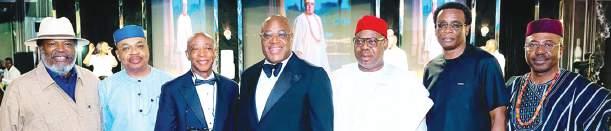
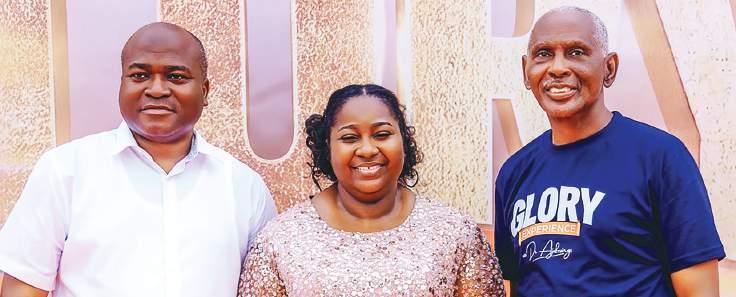
GABRIEL OGBECHIE’S 60TH BIRTHDAY CELEBRATION...
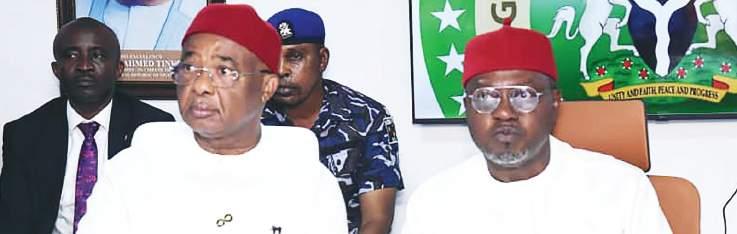
L-R: Publisher/ Chairman, THISDAY/ARISE News Channel, Nduka Obaigbena, former Governor of Akwa Ibom State, Udom Emmanuel, former Executive Secretary of PPPRA, Reginald Stanley; GMD, Rainoil Limited, Gabriel Ogbechie; Deputy Governor of Delta State, Sir Monday Onyeme; Executive Director /CFO of NNPC, Dapo Segun, MD Globus Bank, Mr Elias Igbin Akenzua, at the 60th birthday celebration of Gabriel Ogbechie
At Navy’s 70th Anniversary, Tinubu Pledges to Fortify Maritime Security, Counterinsurgency
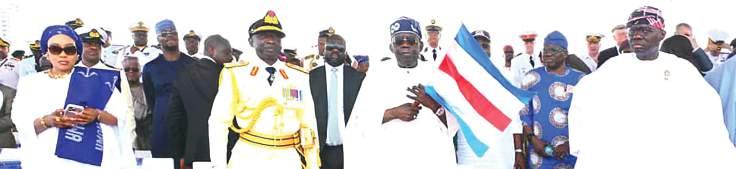
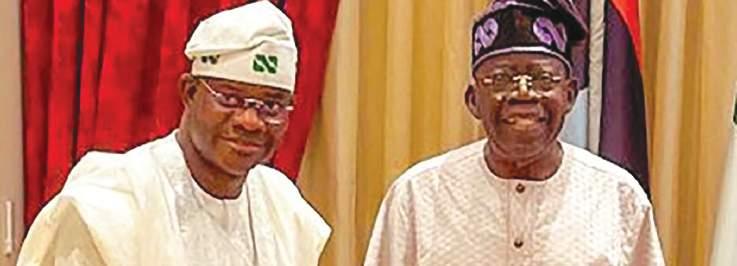
R-L: Lagos State Governor, Babajide Sanwo-Olu; President Bola Ahmed Tinubu; Chief of the Naval Staff, Vice Admiral Idi Abbas; and his wife, Hajiya Haisa Abbas, during the Nigerian Navy’s 70th anniversary held at Eko Atlantic, Lagos, yesterday
PHOTO: STATE HOUSE.
Continued on page 8
Chiemelie Ezeobi and Deji Elumoye
President Bola Tinubu, yesterday, vowed to strengthen Nigeria’s maritime security architecture with the inauguration of three new naval vessels – NNS Oloibiri, NNS Mambila, and NNS Gurara. Tinubu also inaugurated a Combined Maritime Task Force
Alex Enumah in Abuja The Supreme Court has set aside
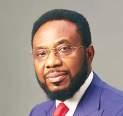
Group Chairman, Dr Ernest Azudialu-Obiejesi
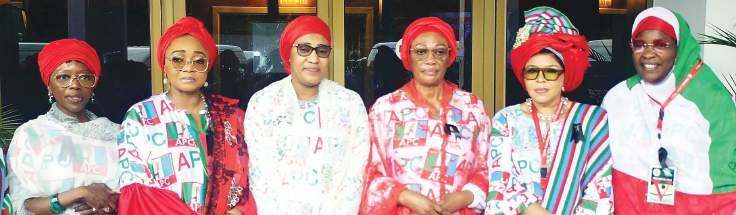
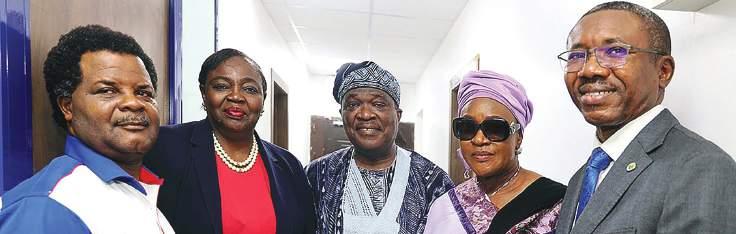
COURTESY VISIT BY APC WOMEN LEADERS FROM ACROSS THE NATION TO OLUREMI TINUBU...
Cardoso Unveils Payments System Vision
2028, Targets 95%
Financial Inclusion
Links payments infrastructure to GDP growth, initiative seeks to add 15 million Nigerians into formal financial system, curb electronic fraud, others New payments framework strengthens identity systems, AI-driven security, trust architecture
James Emejo in Abuja
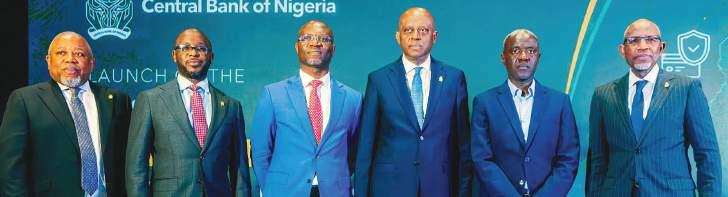
Governor of Central Bank of Nigeria (CBN), Mr. Olayemi Cardoso, yesterday launched the Payments System Vision 2028 (PSV 2028), a sweeping reform targeting 95 per cent financial inclusion, and “faster-than-a-blink” digital transactions.
Cardoso said the new framework aimed at drastic reduction in electronic fraud losses, and the emergence of globally competitive Nigerian fintech unicorns.
Speaking at the ceremony in Abuja, the apex bank governor, alongside other top CBN officials, explained that the document went beyond policy design, describing PSV 2028 as a blueprint for how Nigerians will transact, trade, save, and participate in an increasingly digital economy.
He described payment infrastructure as “invisible roads that move money,” stressing that efficient systems are now central to economic growth, competitiveness and poverty reduction.
Cardoso warned against the country’s long-standing “start-stop” policy cycle, insisting that execution, not documentation, will define success.
He said, “The success of this vision will not be measured by the document, but by execution.”
Cardoso was joined at the event by dignitaries, including Chief Executive, Sterling Bank Plc, Mr. Abubakar Suleiman; Managing Director/Chief Executive Officer, Nigeria Inter-Bank Settlement System (NIBSS) Plc, Mr.
Premier Oiwoh; Director-General, Securities and Exchange Commission (SEC), Dr. Emomotimi Agama; and Managing Director/Chief Executive, Remita Payment Services Limited (RPSL), Mr. Deremi Atanda, among others.
The central bank governor said PSV 2028 was built on Nigeria’s two decades of rapid payments transformation, driven by instant payments, fintech expansion and digital adoption.
He said the new framework will strengthen infrastructure, deepen inclusion, support innovation, enhance resilience, and improve the country’s integration into regional and global payment systems.
Cardoso emphasised implementation discipline, warning that reforms often lose impact due to inconsistent execution.
He said Nigeria must break from the pattern of policy disruption, insisting that continuity remains essential to unlocking long-term economic gains.
According to him, a central objective of PSV 2028 is to achieve 95 per cent financial inclusion by 2028, bringing about an additional 15 million Nigerians into the formal financial system.
Cardoso said financial inclusion was directly tied to poverty reduction and economic participation, stating that access to efficient payment systems determines whether citizens can fully engage in the economy.
He said cash should no longer define participation in economic activity, adding that digital financial access must become universal.
The CBN governor also drew a direct connection between payment system efficiency and economic output, stating that PSV 2028 will contribute to GDP growth by improving productivity, reducing transaction costs, and expanding trade flows.
He said modern payment infrastructure was now a core driver of macroeconomic performance, adding that efficient systems strengthen investor confidence and support external sector stability.
Cardoso said Nigeria’s ambition was to ensure that by 2028, financial transactions were completed “faster than a blink,” building on existing real-time systems that already process millions of transactions in seconds.
He said the next phase of the reform will eliminate the remaining inefficiencies, interoperability gaps, and settlement delays across financial platforms.
The CBN governor set a target to reduce fraud losses to below 0.001 per
cent of total transactions by 2028, adding that this will be achieved through stronger identity systems—NIN and BVN integration—combined with artificial intelligence-driven fraud detection tools.
He stressed that trust was central to digital finance, warning that without confidence in the system, adoption and inclusion gains can stall.
Cardoso said PSV 2028 was designed to position Nigeria as a global fintech hub, with explicit ambition to produce
internationally competitive fintech unicorns.
He stated that open banking reforms had unlocked over 100 Application Programming Interfaces (APIs), creating opportunities for innovation, new products, and financial services expansion.
According to him, Nigerian innovators should be able to build global fintech solutions from Lagos, Abuja, and Kano, using domestic data and infrastructure.
Buoyed by SPDC Acquisition, Renaissance Emerges Africa’s Top Oil, Gas Producing Company
Peter Uzoho
Nigerian independent energy firm, Renaissance Africa Energy Company Limited has been recognised by global energy intelligence firm, Wood Mackenzie, as Africa’s leading oil and gas producer among the top 10 on the continent.
Wood Mackenzie, in its upstreamfocused report in an edition of its market intelligence publication, The Edge, noted that eight Nigerian independents make the top 10 list, representing 75 per cent of the total value of Africa’s independent oil and gas companies, estimated at around
$12 billion.
Renaissance announced its latest recognition in a statement issued yesterday.
The report stated that Egypt’s Cheiron and Angola’s Etu Energies make up the list with Renaissance standing at the top.
According to the Wood Mackenzie report, “Nigeria’s independent oil and gas producers are helping to reinvigorate the country’s upstream sector and boost production after years of decline.”
These companies, the report added, contribute 27 per cent of the country’s overall production, more than double
their 12 percent contribution a decade ago.
Beyond the opportunities provided by the wave of divestments by the oil majors, the report attributed Nigeria’s industry growth to “supportive government policies and a strong domestic skills base with over 100 local players active across the upstream sector.”
Nigerian independents, the report added, have become critical to reversing years of production decline and supporting the country’s ambition to reach 3 million barrels per day by 2030.
Commenting on the recognition, Managing Director and Chief Executive
Officer of Renaissance, Tony Attah, said, “This acknowledgment by Wood Mackenzie reflects more than operational scale. It highlights the growing role of indigenous companies, particularly Renaissance, in shaping Africa’s energy future.
“At Renaissance, we see this as both a validation and a responsibility to continue delivering sustainable energy solutions while contributing meaningfully to national and continental development.”
Renaissance operates the largest upstream joint venture in Nigeria and produces 673,000 barrels of oil equivalent per day.
FG, 20 States Pay N7.1bn as Counterpart Obligation to Child Nutrition Fund
Onyebuchi Ezigbo in Abuja
The federal government and 20 states of the federation have so far contributed N7.1 billion as counterpart funds to the Child Nutrition Fund (CNF) meant for the procurement and distribution of life-saving commodities, and expanded treatment coverage for severe acute malnourished children in parts of the country.
However, 16 states failed to fulfil their own counterpart fund obligation to support the life-saving nutrition intervention programme being funded with assistance from UNICEF.
Executive Secretary of Civil Society-Scaling Up Nutrition in Nigeria (CS-SUNN), Sunday Okonkwo, gave the update on Monday in Abuja while speaking on the implementation of Child
Nutrition Fund (CNF) by CS-SUNN at a hybrid media roundtable on, “Child Nutrition Fund (CNF) – A Strategic Pathway for Preventing Anaemia and Scaling Access to Life-Saving Nutrition Commodities in Nigeria.”
Globally, World Health Organisation (WHO) reports that anaemia affects 37 per cent of pregnant women and 30 per cent of women aged 15-49 years, with Nigeria bearing
a disproportionately high share of the burden.
According to the Nigeria Demographic and Health Survey (NDHS) 2023, 67 per cent of children aged 6–59 months and 57 per cent of women aged 15–49 years are anaemic.
The condition significantly contributes to increased risks of maternal mortality, low birth weight, impaired cognitive development in children, and reduced economic productivity.
Nigeria’s maternal mortality ratio stands at a staggering 1,047 deaths per 100,000 live births, with widespread deficiencies in iron, folate, zinc, and Vitamin A among pregnant women perpetuating a vicious intergenerational cycle.
In a bid to address the health challenge, CNF, a catalytic 1:1 cofinancing mechanism facilitated by UNICEF, in partnership with donor partners, was established in 2020 as
a strategic and innovative pathway to address malnutrition.
Okonkwo said many states were yet to key into the initiative while those who had announced their participation were yet to release funds.
He commended the federal government and the pioneering states for demonstrating visionary leadership by approving and releasing counterpart funds to CNF.
L-R: Wife of the Chief of Staff to the President, Salamatu Gbajabiamila; Minister of Women Affairs, Imaan Sulaiman-Ibrahim; Wife of the Vice President, Hajiya Nana Shettima; First Lady of Nigeria, Senator Oluremi Tinubu; APC National Women Leader, Dr. Mary Alile Idele; and APC Deputy National Women Leader, Hajiya Zainab Abubakar Ibrahim, during the courtesy visit by APC women leaders from across the nation to the First Lady, Senator Oluremi Tinubu, at the Presidential Villa, Abuja, yesterday
PHOTO: GODWIN OMOIGUI
2026 INTER TERTIARY INSTITUTIONS’ ENVIRONMENTAL SUSTAINABILITY SUMMIT...
L-R: Finalists for the Grand Finale of the 2026 Inter Tertiary Institutions’ Environmental Sustainability Summit (Preliminary Debate), Fajana Olamide Mary; Ndukaire Onyenyechi; Aderinto Esther; Daniel Oluwatise Akinkuowo; General Manager, Lagos State Environmental Protection Agency (LASEPA), Dr. Babatunde Ajayi; Master Igbinosa Delight Nosa; Director, Partnership, Grants Management and Innovations, Mrs. Olabisi Shonibare; and Master Yakub Abdulah Eniola, at the 2026 Inter Tertiary Institutions’ Environmental Sustainability Summit (Preliminary Debate) on the topic, “Combating Transboundary Pollution in Lagos State: A City Level Intervention or National Effort?”, held at the LASEPA Headquarters, Alausa, Ikeja, yesterday
Report: Nigerian Economy Growing Twice Pre-reform Pace
Nume Ekeghe
A new report by ThinkBusiness Africa has stated that Nigeria’s economy was growing at roughly twice its pre-reform trajectory, noting that the challenge facing policymakers was no longer restoring growth momentum but ensuring that growth translates into stronger public revenues, fiscal strength, poverty reduction and job creation.
The report, titled “Nigeria’s Fiscal Transition: Growth, Debt
and the Revenue Reform Test,” obtained yesterday, stated that recent economic data showed a significant improvement in growth performance since the commencement of major macroeconomic reforms in 2023.
According to the report, real Gross Domestic Product (GDP) growth accelerated from 2.31 per cent in the first quarter of 2023 to 2.98 per cent in the first quarter of 2024, rising further to 3.13 per cent in the first quarter of 2025 and 3.89 per cent in the first quarter of 2026.
Highlighting the significance of the improvement, the report stated: “The Nigerian economy is growing at roughly twice its pre-reform trajectory. The challenge facing policymakers is no longer restoring growth momentum but ensuring that growth translates into sustainable public revenues and fiscal strength, reduction in poverty, and the creation of jobs in millions.”
It further noted that the trend becomes clearer when viewed against
Nigeria’s performance before the reforms.
“Between 2015 and 2022, the economy expanded at an average rate of roughly 2 per cent annually, barely keeping pace with population growth. Investment levels remained subdued; foreign exchange shortages constrained productive activity, and significant distortions reduced the economy’s capacity to attract capital and support expansion,” the report stated.
The report reiterated that the
acceleration recorded since 2023 was not accidental.
“The acceleration observed since 2023 did not occur in isolation. It has been driven by a combination of reforms that addressed longstanding structural constraints, including exchange-rate liberalisation, subsidy removal, improved fiscal transparency, monetary tightening, and measures aimed at restoring confidence in the foreign exchange market.”
“While no single reform can fully explain Nigeria’s growth recovery, the evidence increasingly suggests that the acceleration in economic activity is a direct consequence of the broader reform programme initiated in 2023,” it added.
The report argued that the debate has now moved beyond whether reforms have generated growth.
NLNG Subsidiary Awards Contracts for Three Newbuild
Emmanuel Addeh in Abuja and Peter Uzoho in Lagos
Bonny Gas Transport Limited (BGT), a subsidiary of Nigeria LNG Limited (NLNG), has awarded contracts for the construction of three newbuild LNG vessels to Hudong-Zhongua Shipbuilding (Group) Co. Limited and China Shipbuilding Trading Co. Limited.
The vessels are part of BGT’s fleet renewal and replacement plan programme, a statement by the organisation stated.
According to the statement, each vessel will have a cargo capacity of
174,000 cubic metres and will be fitted with advanced X-DF propulsion technology. The technology, it explained, improves fuel efficiency and reduces emissions compared to older vessel designs.
The vessels are expected to be delivered in 2029 and will be chartered by NLNG and managed by NLNG Shipping and Marine Services Limited (NSML), an integrated maritime services company with a strong reputation for providing top-notch maritime services.
“This is an important milestone in BGT’s plan to modernise its fleet and support cleaner, more efficient
LNG Vessels
and future-ready operations. The vessels will meet global and EU emissions regulations and help NLNG maintain its OGMP 2.0 Level 5 rating,” the statement noted.
Besides, the new vessels are expected to further strengthen NLNG’s ability to deliver cleaner energy to the world and support the company’s commitment to sustainability and operational excellence.
BGT was established in 1989, shortly after NLNG was incorporated, to provide dedicated shipping capacity for the transportation of liquefied natural gas (LNG) from
Bonny Island to customers around the world.
BGT’s core business is owning and chartering LNG carriers that transport NLNG’s LNG cargoes to international markets. The company is incorporated in Bermuda and serves as a critical link in NLNG’s value chain, ensuring that LNG produced in Nigeria reaches buyers in Europe, Asia, the Americas and other destinations.
The report noted that the reforms were initially accompanied by significant adjustment costs but also removed distortions that had constrained investment, reduced productivity and weakened economic competitiveness for more than a decade.
As a result, it said, there has been “a visible improvement in macroeconomic activity.”
It added that “Oil production has recovered from historic lows, services activity has expanded, foreign exchange liquidity has improved, and private-sector confidence has gradually strengthened.”
According to the report, the available evidence increasingly suggests that the improvement in economic activity is linked to the broader reform programme initiated in 2023.
“The more important policy question today is no longer whether reforms have generated growth. The question is whether that growth can now be translated into stronger fiscal capacity, poverty reduction, and creation of jobs for millions of Nigerians.
“This is where the next phase of reform begins.”
Despite the stronger economic activity, they warned that government revenues continue to trail expenditure needs.
“Despite stronger economic activity, government revenues continue to lag expenditure requirements. Consequently, fiscal conditions remain considerably tighter than macroeconomic indicators alone would suggest,” the report stated.
The report also examined Nigeria’s debt position, arguing that headline debt figures often fail to reflect the factors responsible for the increase in the country’s debt stock.
Blessing Ibunge in Port Harcourt
University of Port Harcourt (Uniport) says it would convoke 8,156 student graduands at the 36th combined convocation ceremony of the institution fixed for June 5 - 6. Briefing journalists yesterday on activities mapped out for the convocation, at the university premises, Vice Chancellor, Professor Owunari Georgewill, disclosed that the institution would also present awards to 120 students
who bagged first class degrees. Georgewill stated that the convocation ceremony was one of the most important academic traditions of the university. He announced that of the 8,156 graduands, 5,822 would receive first degree certificates, 510 would receive post graduate diplomas, 1,386 would receive Master’s degrees, and 438 would receive Doctor of Philosophy certificates. He disclosed that the event, which commenced with a media
briefing yesterday, will on Tuesday witness a tree planting ceremony by the best graduating student, and Class-day activities/Vice Chancellor dinner on Wednesday. Other activities lined up are Alumni day, Research fair/ exhibition, and fire side chat for Thursday. Academic procession, award of first degrees, PhDs, and Master’s degrees for Friday, and academic procession at the new convocation arena on Saturday, June 6.
A delegation of the Financial Reporting Council of Nigeria (FRC) has made a strong appeal to the students of CMS Grammar School, Bariga, Lagos State, to choose Actuarial Science as their course of choice in the university and professional examination.
The delegation, which was led by an Assistant Director/Head, Directorate of Actuarial Standards, FRC, Mr. Harris Oshojah, was in the school in furtherance of the advocacy outreach of the Nigerian Actuarial Development Programme (NADP) with the theme “Catch -Them Young Initiative (Building Capacity for Actuarial Excellence in Nigeria).
Oshojah said they were in the school to convince the students of the numerous benefits of studying Actuarial Science and encourage them to embrace the course in their academic and professional pursuits, adding that it would be a choice that they would live to enjoy without regrets.
He added: “What we are saying in essence is that there is value addition in studying Actuarial Science irrespective of your chosen field of endeavour.
“As a regulatory agency, we are identifying the need for Actuarial Science that is lacking in Nigeria.
“That is why we are telling you to try as much as possible to identify
with Actuarial Science.
“We are ensuring that the right skills that are required are available in Nigeria.
“So, we’re telling you to identify with this course and you will never regret it.”
In his keynote speech to the students, the Head of Department, Insurance and Actuarial Department, University of Lagos, Prof. Ismaila Adeleke, said, “we are here to promote a course that is highly rewarding but is rarely chosen by students in Nigeria.”
Adeleke noted that Actuarial Science remains the most rewarding course in the world, especially if you want to work in the financial industry.
PHOTO: ETOP UKUTT R
Dike Onwuamaeze
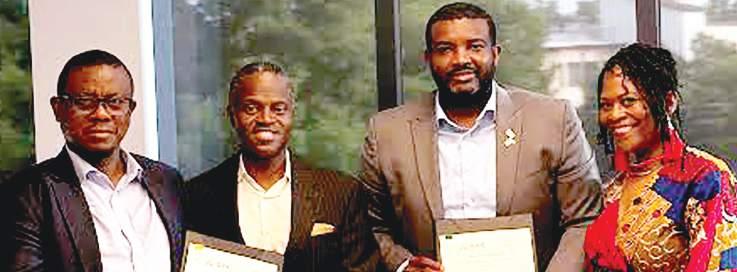
MOU SIGNING BETWEEN ESC AND GOC TO ADVANCE TRADE, INVESTMENT AND KNOWLEDGE...
L-R: Executive Director, Ernest Shonekan Centre (ESC) of the Nigerian Economic Summit Group, Mr. Dr. Uche Ogbonna; President / CEO, Atlanta Black Chambers, Mr. Melvin Coleman; Chair, Global Opportunities Committee (GOC), Ricardo Beris ; and Board Chair, Atlanta Black Chambers, Sherolyn Sellers, during the MOU signing between ESC and GOC to advance trade, investment and knowledge exchange between both parties in Atlanta, Georgia ... recently
Ex-NACCIMA Chief Faults FG’s Energy
Reform Claims Amid N2tn Diesel Bill
Says NNPC’s debt rose by 70% to over N30 trillion in one year
Declares figures brandished by government as illusion Insists success should be measured by citizen-centric metrics
Emmanuel Addeh in Abuja
Erstwhile President of the Nige- rian Association of Chambers of Commerce, Industry, Mines and Agriculture (NACCIMA), Dele Oye, has slammed the federal government’s celebration of recent energy sector reforms, noting that the figures brandished by the government was an illusion and that the average Nigerian continues to suffer from expensive fuel, unreliable electricity, and rising production costs.
Oye, who is the Chairman of the Alliance for Economic Research and Ethics LTD/GTE, was responding to a 13-page report by the office of the Special Adviser to the President on Energy released titled: “Nigeria’s Energy Sector Reforms: A Three-Year Review (2023–2026).” The report highlighted the progress in Nigeria’s energy sector under President Bola Tinubu.
But Oye maintained that the claims in the report failed to reflect the economic realities faced by households and the productive sector.
He drew attention to the continued dependence of businesses on self-generated power, stating that Nigerian companies spent an estimated N1.83 trillion on diesel within just two months. He said this reflects the persistent failure of the power sector to provide reliable electricity for industrial and commercial use.
“The reality on the ground does not match the optimism being projected,” Oye said. “If businesse are spending trillions on diesel in such a short period while debt within the energy system continues to balloon, then the effectiveness of these reforms must be questioned,” he insisted.
He added that rising operational costs are placing significant pressure on manufacturers, small businesses, and households, many of whom continue to rely heavily on generators due to unstable grid electricity supply.
Besides, he pointed to what he described as a sharp deterioration in the financial position of the Nigerian National Petroleum Company Limited (NNPC Ltd), noting that its internal debt has risen by about 70 per cent to approximately N30.3 trillion. According to him, this level of indebtedness raises serious concerns about efficiency, governance, and the sustainability of ongoing reforms in the energy value chain.
“Audited financial statements for NNPC Limited’s 2024 fiscal year, released in early 2026, revealed that intra-company debts among NNPC’s subsidiaries surged by 70.4 per cent in a single year, from N17.78 trillion in 2023 to N30.3 trillion as of December 31, 2024.
“The biggest debtors are the state’s own refineries: the Port Harcourt Refining Company owed N4.22 trillion; the Kaduna Refining and
Petrochemical Company owed N2.39 trillion; and the Warri Refining and Petrochemical Company owed N2.06 trillion. These are facilities that have absorbed billions of dollars in rehabilitation spending and remain, to this day, largely non-functional.
NNPC’s trading arm, NNPC Trading SA, owed the parent company N19.15 trillion, more than double the N8.57 trillion recorded the previous year. As Professor Wumi Iledare, Professor Emeritus of Petroleum Economics, observed: ‘A 70 per cent jump in
one year is a clear warning sign. It means inefficiencies are growing faster than reforms’.
“In late December 2025, President Tinubu approved the cancellation of $1.42 billion and N5.57 trillion in legacy debts owed by NNPC to the Federation Account. For a government that preaches fiscal discipline, writing off trillions of naira in state oil company debts while ordinary Nigerians face crippling energy costs is a profound contradiction.
“The World Bank has separately noted that NNPC remitted only
N600 billion out of N1.1 trillion in post-subsidy revenues to the Federation Account in 2024, a shortfall of N500 billion,” Oye emphasised.
The organisation called for a more transparent, data-driven assessment of energy sector performance, arguing that progress should be measured by real-world outcomes such as improved electricity supply, reduced reliance on diesel generation, and lower production costs for businesses.
He said: “The government’s report boasts of ‘$10 billion in Final
Investment Decisions (FIDs)’ and positions Nigeria as ‘Africa’s #1 destination for oil and gas investment,’ citing a rise in Nigeria’s share of African upstream FIDs from 4 per cent to 40 per cent in two years. “There is a kernel of truth here. Nigeria’s upstream investment environment has genuinely improved in recent years, and the 40 per cent FID share figure is corroborated by the Africa Energy Chamber ExxonMobil has indeed been moving toward a Final Investment Decision on approximately $10 billion in deep-water projects in Nigeria
Foreign Training: NUPRC Staff Embark on Nationwide Strike
Regulator says talks ongoing, oil and gas
Employees of the Nigerian Upstream Petroleum Regulatory Commission (NUPRC), under the aegis of the Petroleum and Natural Gas Senior Staff Association of Nigeria (PENGASSAN), yesterday embarked on an indefinite nationwide strike.
The aggrieved workers also shut down all commission offices across the country, mainly over a dispute with the management of the commission
concerning foreign training.
THISDAY learnt that the industrial action, which commenced on Monday, led to a total shutdown of regulatory activities at NUPRC headquarters in Abuja and all field offices nationwide, effectively grounding administrative and operational functions of the upstream petroleum regulator.
But in a reaction by the NUPRC, the organisation confirmed the strike action by its staff, but said that although some administrative activities were
impacted, oil and gas facilities were not affected.
Similarly, the upstream regulator stated that as of yesterday evening negotiations were still ongoing with the workers, with a view to resolving all the knotty issues.
“It is true that some administrative activities were affected today (yesterday) due to industrial action taken by the unions. However, this has not in any way impacted activities in oil and gas facilities or production
NDPC to Train Perm Secs, Heads of Parastatals on Data Protection
Oghenevwede Ohwovoriole in Abuja
The National Data Protection Commission, NDPC, is to train permanent secretaries and heads of parastatals on data protection.
NDPC National Commissioner, Dr. Vincent Olatunji, disclosed this at the opening of a three-day technical and organisational drill
on data protection measures for information technology administrators across Ministries, Department and Agencies (MDAs), on Monday in Abuja.
Olatunji disclosed that plans are underway for the commission to train permanent secretaries and heads of parastatals in the country.
“We’ve already opened conver-
sation with the head of the civil service of the federation, that’s the body that controls permanent secretaries and all civil servants, and we are discussing with them just to get the appropriate time to ensure that we have all the permanent secretaries in one group, to create awareness,
“Let them understand what data protection is all about,
because there are public servants, civil servants in all the ministries and parastatals. Whatever you want to; they are the ones that approve it.
“We believe in a bottom-up approach... we also complement that with the top-bottom approach. By the time the files from the subordinates get to them, it’s very easy for them
to approve and give them the right to participate in whatever we are doing,” he said.
He noted, “N”o matter how robust your plans and policies are, if you don’t have the qualified human capital, skilled personnel to drive whatever you are doing, you can’t achieve anything, and that is why this is really important to work.”
in general.
“The top management of the commission is meeting with the unions in order to put an end to the strike and ultimately restore normalcy,” a brief statement from the commission in Abuja stated. It was further learnt that the strike followed the breakdown of negotiations between the union and management over the handling of staff training programmes, particularly the commission’s position that capacity-building should be conducted locally rather than through overseas training. While management insisted that training programmes, particularly for factory acceptance tests for Positive Displacement (PD) meters should be domestically delivered within Nigeria to reduce cost and strengthen local institutional capacity, the workers reportedly rejected the commission’s stance.
A security source said that representatives of the parties were meeting at the office of the National Security Adviser (NSA) as of yesterday where a resolution will likely be reached.
Emmanuel Addeh in Abuja
Nigeria-UAE Non-Oil Trade Hits $5bn as First Abu Dhabi Bank Opens in Lagos
Michael Olugbode in Abuja
Economic relations between Nigeria and United Arab Emirates (UAE) have reached a new milestone, with bilateral non-oil trade rising to $5 billion in 2025 and plans underway for the opening of the First Abu Dhabi Bank (FAB) in Lagos, a development expected to deepen financial and investment ties between both countries.
The announcement came during a meeting between Nigeria’s Minister of Foreign Affairs, Bianca OdumegwuOjukwu, and UAE Ambassador to Nigeria, Salem Saeed Al-Shamsi, in Abuja.
The UAE envoy disclosed that the country’s largest financial institution, First Abu Dhabi Bank, was set to establish operations in Lagos, while
UAE’s national carrier, Etihad Airways, will commence flights to Abuja later this year.
The developments signal a significant strengthening of economic cooperation between both nations, which have maintained diplomatic relations since 1971.
Al-Shamsi revealed that non-oil trade between Nigeria and UAE grew from $4.3 billion in 2024 to $5 billion in 2025, reflecting expanding commercial engagement and growing investor confidence.
He projected that trade volume could rise further to approximately $8 billion by 2027.
He also announced a major breakthrough in travel relations, stating that visa restrictions on Nigerian travellers had been substantially eased.
“There are no longer visa rejections for Nigerian nationals travelling to the UAE,” he said, adding that more than 15,000 Nigerians visited the Gulf nation over the past year following the relaxation of restrictions.
The ambassador reaffirmed UAE’s support for Nigeria’s security efforts, stating that his government has consistently condemned terrorist attacks in Nigeria and issued at least eight official statements denouncing acts of terrorism in the country.
Odumegwu-Ojukwu welcomed the growing partnership, describing the progress made within the last year as evidence of both countries’ commitment to advancing bilateral relations.
She stated that many of the issues she had raised during her tenure as
Minister of State for Foreign Affairs had been resolved, particularly in the area of visa accessibility for Nigerians.
“I am happy to say that a lot of the issues raised when I was Minister of State for Foreign Affairs have been resolved in less than a year, especially regarding visas,” the minister said.
She praised UAE’s role in boosting economic exchanges, highlighting the increase in non-oil trade from $4.3 billion to more than $5 billion within a year.
Odumegwu-Ojukwu also reaffirmed Nigeria’s commitment to attracting foreign direct investment from UAE-based sovereign wealth funds and private investors, stressing that the federal government remains focused on creating an enabling business environment.
A key pillar of future economic cooperation, according to the minister, is the implementation of the Comprehensive Economic Partnership Agreement (CEPA) signed by both countries.
She expressed optimism that the agreement would significantly expand trade, investment opportunities, and professional exchanges between Nigeria and the UAE.
The meeting also served as an occasion for Al-Shamsi to deliver a congratulatory message from UAE Deputy Prime Minister and Minister of Foreign Affairs, Abdullah bin Zayed Al Nahyan, on Odumegwu-Ojukwu’s appointment as Nigeria’s foreign minister.
The minister disclosed that the UAE deputy prime minister was the
She described the gesture as a reflection of the strong relationship between the two countries.
BABACHIR: ADC PRESIDENTIAL PRIMARY DISGRACEFUL; ATIKU: YOU’RE A NOTORIOUS CONFLICT ENTREPRENEUR Chuks Okocha and Olawale Ajimotokan in Abuja
Former Secretary to the Government of the Federation (SGF), Babachir Lawal, and the presidential candidate of African Democratic Congress (ADC), Alhaji Atiku Abubakar, yesterday, squared off over the conduct of the presidential primaries that produced the latter.
Lawal announced his resignation from ADC yesterday, citing alleged rigging of the primary election by Atiku.
The former SGF said, in a statement, that the primaries were “massively rigged” in favour of Atiku and his allies.
Lawal said, “I am exiting the ADC because its just concluded primaries were at all levels massively rigged in favour of Kachalla Abubakar Atiku.
“I sense a conspiracy of silence of which I want no part of. Most members of the party are behaving as if this is the normal thing to do.
“Results were just written or rewritten to favour him and his coven.
“Even where they allowed some semblance of election to hold, the winners were simply replaced with members of his syndicate.
“In the real sense it was a disgraceful charade.”
Responding, Atiku described Lawal as a notorious conflict entrepreneur, who was entitled to his political views and decisions.
Atiku Media office, in a statement in Abuja, explained that while Lawal had the right to resign from ADC because political parties were voluntary associations of people, he was not entitled to cast aspersions on Atiku based on fabricated allegations.
According to the statement, accusing Atiku of religious bigotry or nepotism is one of the laziest and most ridiculous lies anyone can spread against the former vice president.
The statement explained that Atiku was one of the most liberal politicians in Nigeria and his record in this regard was there for anyone to verify.
The statement said, “As far as we are concerned, Babachir was perfectly describing his own character rather than Atiku’s. The former SGF seeks power on the altar of dividing the people based on primordial sentiments.
“All his altercations with people are caused by his selfishness. He opportunistically panders to sentiments to achieve his ambition. None of his struggles are influenced by the larger interests of his people
AT NAVY’S 70TH ANNIVERSARY, TINUBU PLEDGES TO FORTIFY MARITIME SECURITY,
for the Gulf of Guinea.
Speaking at the Eko Atlantic Waterfront in Lagos to mark the commencement of activities for the Platinum Jubilee of the Nigerian Navy, the president, who flagged off the 2026 Navy International Fleet Review, described the Navy’s 70th anniversary as a historic milestone. He said the event reflected the transformation of a modest maritime service into one of Africa’s most formidable naval forces.
Tinubu stated that the Nigerian Navy had evolved alongside the nation’s sovereignty, growing from its origins in 1956 into a modern and sophisticated force that serves as a critical pillar of national security, economic prosperity, and regional stability.
He congratulated the service for attaining a position of continental leadership, highlighting that its emergence as a leading naval force in Africa underscores seven decades of operational excellence, professionalism, and strategic growth.
As part of efforts to enhance the navy’s operational readiness, Tinubu inaugurated three newly acquired naval vessels. He said the move reflected his administration’s unwavering commitment to the recapitalisation of the Nigerian Navy, promotion of indigenous shipbuilding capacity, and provision of strategic support required for a responsive and capable maritime force.
The president said the impressive aerial combat displays and parade of naval assets by Nigeria and its foreign partners reflected the growing global recognition of the Nigerian Navy and its pivotal role in advancing maritime security within the Gulf of Guinea and beyond.
COUNTERINSURGENCY
Lauding the navy for safeguarding Nigeria’s maritime domain, Tinubu stated that the service had eradicated piracy in Nigerian waters and significantly curtailed crude oil theft and related maritime crimes through enhanced surveillance, rapid response mechanisms, and robust enforcement operations.
He said the achievements had not only improved the security of coastal communities but also contributed to increased oil production and broader economic growth.
The president charged officers and ratings to sustain the high standards of professionalism, discipline, and operational effectiveness that had distinguished the service, while continually adapting to emerging security threats.
Expressing confidence in the future of the Nigerian Navy, Tinubu said the anniversary theme, “Seven Decades of Operational Excellence,” was not merely a slogan but a reflection of the institution’s enduring contributions to national development and security.
He commended the navy’s role in counterterrorism and counterinsurgency operations across the country, particularly the exploits of the Special Boat Service and the recent deployment of the Nigerian Navy Marines in operational theatres.
“The Nigerian Navy has become an indispensable pillar of both national and regional security,” the president stated.
Tinubu also inaugurated the Gulf of Guinea Combined Maritime Task Force, describing the initiative as a demonstration of the collective resolve of regional partners to strengthen
multinational cooperation against piracy, crude oil theft, illegal fishing, and other transnational maritime crimes.
He appreciated international partners for their support towards security efforts in the Gulf of Guinea, describing the Combined Maritime Task Force as a major step towards
Continued on page 23
held that the three-member panel of the appellate court went beyond their powers in granting an exparte application against the appellants.
Recall that the Court of Appeal had on November 29, 2025, granted an interim restorative injunction returning the control of Nestoil’s assets and operations to the Receiver Manager appointed by the banks.
Besides, the appellate court further issued an order freezing the assets of the oil servicing firms, pending the hearing of the substantive suit, and a further stay of proceedings at the trial court.
The order was following an exparte application by the bankers seeking a takeover of the oil firms, over the alleged debt.
Dissatisfied, Neconde, Nestoil and their promoters (Dr Ernest Azudialu-Obiejesi OFR and Mrs Nnenna Azudialu-Obiejesi) had last year, approached the Apex court to reverse the order of the appellate court issued against their assets.
Delivering judgement in the appeal, the five-member panel of the apex court agreed with
or Nigeria.”
The statement said Lawal was not qualified to speak about what was good for Nigeria.
It stated, “When Babachir said he resigned from ADC because of the so-called rigging or manipulations during the primaries, he didn’t offer any proof of his allegations.
“And instead of offering evidence of his allegations, he went further to drag Atiku’s family into the issue which was irrelevant to the issue of primaries.
“It’s evident from the load of garbage published by the former SGF that he holds personal animosity against Atiku Abubakar.”
The statement advised Lawal to search his conscience and stop spreading division and bigotry among Nigerians for his own selfish interests.
The Atiku media office stated, “There is no such thing as a Muslim and Christian party in Nigeria. When the outcome of a competition doesn’t favour you, you should petition the party to show proof of manipulations or rigging. It’s however most irresponsible for a former SGF to turn himself into an agent of division.”
In another statement from Atiku’s camp, they further hit back at Lawal over his outburst against Atiku.
The statement condemned the former SGF over his criticism of ADC’s presidential primary, accusing
the submissions of Neconde and Nestoil that the lower court erred in law in “entertaining the matter in the manner it did” and their subsequent issuance of an exparte order without any justification.
According to Justice Stephen Adah who delivered the lead judgement, records before the Supreme Court showed that the process of transmitting an appeal was not yet completed as at the time the appellate court assumed jurisdiction.
While emphasizing that a Notice of Appeal does not amount to a stay of proceedings, the apex court wondered how the lower court could entertain an exparte in a matter that it was not seized of.
“If there was a Notice of Appeal what necessitated its withdrawal for an exparte”, the apex court queried, before warning that courts must be vigilant, circumspect and discreet in issuing exparte orders.
Besides, the apex court faulting the lower court further stated that, “no exception, cause existed nor urgency disclosed that would have warranted the withdrawal of the
him of making unsubstantiated allegations and attempting to discredit a democratic process he could not influence.
Lawal had, while announcing his resignation from the party yesterday, accused Atiku of influencing the outcome of the party’s primaries held across the country.
The former SGF, who questioned the credibility of the exercise, alleged that the process was compromised.
But Atiku’s camp, in a statement by his Senior Special Assistant on Public Communication, Phrank Shaibu, accused Lawal of attempting to malign both the party and its members without evidence.
“Having chosen to malign a democratic process, insult thousands of ADC members nationwide, and make grave allegations without presenting a shred of evidence, it has become necessary to set the record straight,” the statement said.
Shaibu rejected claims that the ADC presidential primary was manipulated, insisting that the exercise reflected the will of party members across the country.
According to him, Lawal failed to provide any proof to support his allegations of electoral manipulation.
Shaibu stated, “The truth is straightforward. The ADC presidential primaries were conducted across thousands of wards and produced a clear and decisive outcome. What Mr. Lawal has offered Nigerians
Notice of Appeal, adding that the exparte order was unwarranted, uncalled for, frivolous and vexatious.
Noting that abuse of exparte has become a thing of great concern to the judiciary, Justice Adah urged the appellate court against making itself available in such conducts that undermines judiciary.
According to him, the appellate court went ahead to make far reaching order into the substantive matter, while sitting in an interlocutory appeal.
“It was granted at a time when the appeal had not been entered....an appellate court can only be seized of a matter when the appeal has been fully entered.
“Mere filing of a Notice of Appeal does not apply as stay”, Supreme Court held, while pointing out that the substantive matter was still going on at the trial court.
He also warned litigants who use appeal as a tool to frustrate court proceedings and pursue endless litigations, wondering how the bankers who had dragged the oil firms to court can turn around at the appellate court to seek a stay
is not evidence.
“He has produced no documents, no verifiable facts, no credible witnesses, and no proof whatsoever to support his sensational allegations.”
Wike: Atiku, Obi Are Hypocrites Who Can’t Offer Better Democratic Alternatives
Minister of the Federal Capital Territory (FCT), Nyesom Wike, launched criticisms against the presidential candidates of ADC, Atiku, and Nigeria Democratic Congress (NDC), Peter Obi, describing them as hypocrites, who cannot offer Nigeria better democratic alternatives.
Wike delivered the verbal attack yesterday at his monthly media briefing in Abuja. He said the criticisms that arose over the recent primaries of the opposition parties exposed the contradictions between their public posturing and internal practices.
The former Rivers State governor said the controversies that trailed the congresses had undermined claims that the opposition parties offered a credible alternative to the country’s established political parties. He explained that parties and politicians, who had consistently accused the ruling party of undermining democracy were now facing similar allegations within
Continued on page 23
of proceedings at the trial court. On the first issue, the Supreme Court held, inter alia, that there was no basis or exceptional circumstance warranting the grant of the ex parte order. The Court further held that it was wrong for the Court of Appeal to entertain and grant the application when the records of appeal had neither been transmitted nor the appeal entered, as the trial court remained seized of jurisdiction.
“The first issue is resolved in favour of the appellants”, Justice Adah held.
On the second issue, the Supreme Court held, inter alia, that the application for stay of proceedings brought by the 1st and 2nd Respondents was not made in good faith. The Court observed that the order effectively paralysed proceedings before the trial court and that there was no basis upon which the stay could be sustained.
The apex court held that it found no “compelling justification for the order”, adding that the order
Continued on page 22
first foreign dignitary to personally congratulate her following her elevation by President Bola Tinubu.
Bianca Odumegwu-Ojukwu
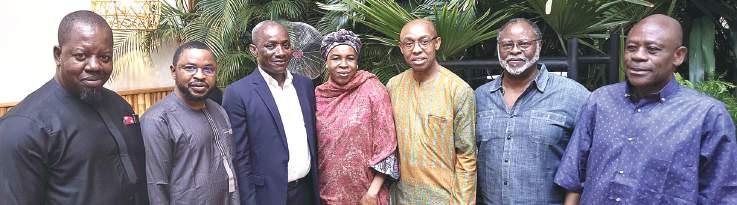
HOSTING A SCHOLAR FRIEND...
L-R: Journalist and Lecturer, Baze University, Abuja, Paul A. Obi; Columnist and Professor of Journalism and Emerging Media, Kennesaw State University, Georgia, USA, Prof. Farooq Kperogi; Legal Scholar and Director, The Abuja School of Social and Political Thought, Dr. Sam Amadi; Chair, Editorial Board, Blueprint Newspaper, Hajia Zainab Okino; Human Rights Activist and Professor of Practice, The Fletcher School, Tufts University, USA, Prof. Chidi Odinkalu; Political Activist and Distinguished Fellow, The Abuja School of Social and Political Thought, Prof. Udenta Udenta; and Researcher, University of the Witwatersrand, Johannesburg, South Africa, Dr. Adagbo Onoja, at an event to host Prof. Kperogi in Abuja, yesterday
FG, WIPO Deepen Collaboration to Turn Nigeria’s Intellectual Property Into Reasonable Financial Assets
Shettima:
Tinubu,
building a nation where intellectual assets are converted into wealth
Hails WIPO’s opening of first sub-saharan Africa office in Abuja
Nigeria and the World Intellectual Property Organization (WIPO) have agreed to actively deepen collaboration to turn the nation’s intellectual property (IP) into tangible financial assets.
The target is to commercialise research from Nigerian universities and support the creative economy through stronger technical cooperation, deeper institutional support, and expanded capacity-building, among others.
This formed the high point of a meeting on Monday between Vice President Kashim Shettima, a delegation from WIPO led by its
Director-General, Mr. Daren Tang, and top Nigerian government officials at the State House, Abuja.
The Vice President specifically drew the WIPO delegation’s attention to Nigeria’s unmistakable ambition, which is to build an “intellectual property system that serves the inventor and the investor, the researcher and the entrepreneur, the artiste and the industrialist, the farmer and the software engineer”.
He welcomed the decision by WIPO to open its first office in Abuja, the first in Sub-Saharan Africa and one of only seven worldwide.
He recalled that the Federal Executive Council had in November,
2025 approved the National Intellectual Property Policy and Strategy “to provide Nigeria with its first comprehensive framework for the development, protection, promotion, management, and commercialisation of intellectual property.”
According to Shettima, there couldn’t have been a better time to take a deeper view of a nation whose creative and innovative energies are already shaping Africa and speaking to the world.
“As we deepen our collaboration with WIPO, we do so with gratitude and with great expectation. We look forward to stronger technical cooperation, deeper institutional
support, expanded capacity-building, and practical pathways for the commercialisation of Nigerian creativity and research. We believe that the future belongs to nations that understand the dignity of the mind and the economy of ideas,” he declared.
The Vice President noted that the administration of President Bola Tinubu is building an economy where investors will feel satisfied that innovation is protected, disputes are resolved with confidence, and intellectual assets can be converted into wealth.
He said, “The foresight of President Bola Tinubu through the Renewed Hope Agenda, is anchored in unlock-
Tinubu Inaugurates Modern Infertility, Assisted Reproductive Technology Centre in Bauchi
President Bola Ahmed Tinubu has commissioned a modern Infertility and Assisted Reproductive Technology Centre at the Abubakar Tafawa Balewa University Teaching Hospital (ATBUTH), Bauchi, as part of efforts to strengthen reproductive healthcare and address infertility challenges in Nigeria, particularly in the North-East.
Speaking at the commissioning ceremony yesterday held at the Centre, President Tinubu, represented by the Chief Medical Director of ATBUTH, Prof. Yusuf Bara Jibrin, described the facility as a major milestone in Nigeria’s journey toward advanced medical innovation and improved reproductive health services.
The president highlighted that one of the centre’s key features is the Computer Assisted Semen Analysis (CASA) system, a rare and highly advanced technology in Nigeria.
He said the system uses automated imaging and software to assess sperm concentration, motility, and morphology within minutes, significantly reducing the errors associated with manual analysis.
He explained that the centre is
equipped with an Intracytoplasmic Sperm Injection (ICSI) workstation, which allows specialists to directly inject a single sperm into an egg in cases of severe male infertility, thereby improving fertilization success rates.
According to him, the facility also supports embryo screening for genetic conditions such as sickle cell disease, ensuring healthier pregnancies and improved family outcomes.
“This centre represents hope, innovation, and our commitment to delivering world-class healthcare services to Nigerians,” he said.
In his remarks, the Bauchi State Commissioner for Health and Social Welfare, Dr. Sani Mohammed Dambam, commended the federal government for the initiative, describing the centre as a significant boost to healthcare delivery not only in Bauchi State but across the country.
He noted the facility is equipped with some of the most advanced medical technologies currently available, many of which are among the latest in reproductive medicine.
“We sincerely commend the management of the hospital for this giant stride and visionary commitment. These innovations
will greatly improve healthcare delivery and the wellbeing of the people,” he said, adding the project aligns with Governor Bala Abdulkadir Mohammed’s health sector priorities.
Also speaking, the Director of the Centre, Prof. Sa’idu Kadas, described infertility as a growing public health concern, especially in developing countries, noting that infections and other medical conditions contribute significantly to its prevalence.
Also speaking, the Director of the Centre, Prof. Sa’idu Kadas, described infertility as a growing public health concern, especially in developing countries, noting that infections and other medical conditions contribute significantly to its prevalence.
He said hospital records show that a large proportion of gynaecological patients seek help for infertility-related issues.
“From clinical experience, out of every ten patients in the gynaecology clinic, about six present with infertility concerns,” he explained.
Prof. Kadas added the centre offers renewed hope to couples struggling to conceive, assuring them that solutions are now more accessible than ever.
“Many families who had lost hope now have a real chance of achieving parenthood,” he said.
Meanwhile, Biomedical Engineer Babangida Salihu described the facility’s equipment as world-class, noting that many of the machines were previously only encountered in textbooks and training manuals.
ing productivity, expanding economic opportunity, attracting investment, creating jobs, and positioning Nigeria for long-term prosperity.
“At the heart of this agenda is a clear recognition that value in today’s economy is increasingly created through ideas, technology, innovation, data, brands, culture, and knowledge. The countries that will lead this century are those able to create, protect, commercialise, and scale intellectual assets.”
Shettima also noted that with the right innovation, education and skills enhancement, Nigeria would make Africa great, even as he reaffirmed Nigeria’s commitment to innovation diplomacy and to WIPO’s mission to create a balanced and international ideal system.
While mandating the Ministers of Justice, Industry, Trade and Investment and Culture, Art and Creative Economy to work out a roadmap for a robust engagement with WIPO, he pledged more relationship between Nigeria and the organisation.
On his part, Director-General of WIPO, Mr. Tang, noted that he was visiting Nigeria for the first time, assuring that WIPO remains committed to being part of Nigeria’s growth and prosperity.
He stressed that his visit was based
on two milestones: the opening of the first WIPO office in Abuja—the first in Sub-Saharan Africa and one of only seven worldwide—and the launch of the National Intellectual Property Policy and Strategy (NIPPS) by the Tinubu administration. He said the inaugurated WIPO office demonstrates the importance the international body places on Nigeria, adding that Nigerian entrepreneurs, innovators, and creators are shaping the world and serving as role models in the IP revolution across the continent.
Tang congratulated the Tinubu administration on the National IP Strategy, expressing optimism that the nation’s IP ecosystem will continue to serve as a platform for economic empowerment and job creation.
He observed that over 3,000 Nigerian startups, including seven unicorns, are already attracting significant financial capital to the country, demonstrating that intellectual property is increasingly being driven by emerging economies.
Earlier, Attorney General of the Federation, Lateef Fagbemi (SAN), said the visit of the delegation reflects the growing partnership between Nigeria and WIPO, aimed at strengthening the country’s intellectual property ecosystem.
PSC Disowns Police Recruitment
Shortlist Circulating on Social Media
The Police Service Commission (PSC) has disowned a purported police recruitment shortlist circulating on social media, describing it as fake and urging applicants and members of the public to disregard it.
The commission clarified that no official shortlist of candidates for the next stage of the recruitment exercise has been released through any of its authorised channels.
It also cautioned against the dissemination of unverified recruitment information and advised applicants to rely solely on communications issued by the commission.
In a statement by the Head of
Protocol and Public Affairs of the Police Service Commission, Torty Njoku Kalu, the commission said its attention had been drawn to a fake list being circulated online, purportedly containing the names of candidates shortlisted for medical examination.
“The commission wishes to state categorically that no such shortlist has been released. The evaluation of the written examination is still at its concluding stage, and invitation for medical examination will be communicated to successful applicants in the coming days.
“This notification will be sent via email, SMS, the recruitment portal and the commission’s other official communication channels.”
The commission reiterated its commitment to a merit-based recruitment process, which it said it has consistently upheld, noting that the effectiveness of the Police Force depends largely on the quality of personnel recruited into the service.
It further warned applicants and members of the public to be vigilant and avoid falling victim to fraudsters exploiting the recruitment process.
“Applicants and members of the public are advised to be wary of fraudsters and fake news. All official communications regarding the ongoing recruitment process will be disseminated solely through the commission’s verified channels,” the statement noted.
Linus Aleke in Abuja
Segun Awofadeji in Bauchi
Deji Elumoye in Abuja
DAILY
TIMES NIGERIA AT 100 YEARS HONOURING THE PAST, SHAPING THE FUTRE
On September 3, 2004, The Daily Times of Nigeria had a rebirth. The enterprise was privatized by the Federal Government of Nigeria.
Folio Communications Ltd won the bid for ‘The Core-Investor’ of the Daily Times.
Folio Communications paid THE FEDERAL Government of Nigeria 1.250biillion Naira (12 billion NAIRA EQUIVALENT TODAY)
THE LARGEST SINGLE CAPITAL INVESTMENT INTO THE NIGERIA MEDIA SPACE
We have trudged on for 23 years walking through the valleys, wildernesses and vicissitudes of a Rebirth. We have survived and like the beetle refused to die.
The Dailytimes Nigeria Anchored Nigeria’s independence and was the catalyst of the capital market as we know it today and subsequently became the 1st indigenous quoted company on the Nigeria stock exchange, and contributed 60% equity to the building of the 23 story edifice known as the Nigeria stock exchange building in Tinubu Square Lagos
Sustaining the dream, ploughing new horizons of the business terrains. The spark of June 1st, 1926 remains a glow,burning with zeal and strength.
Come and celebrate our Resilience, Fortitude, stubborn grip to Survive
‘Newspapers still remains the First Draft of History’.
At 100, we are still the Scribe drafting The pages of the History of Nigeria.
We had remained Independent, taking unbiased notes and reporting on the emergence and changes that gave us Nigeria. We had remained consistent, fixated on the goals, pursuing the brilliant reality of the vAfrican giant nation, Nigeria.
We salute the FOUNDERS, the daily mirror group; Sir Adeyemo Alakija, (may his soul rest in peace)
THE TORCH BEARERS
Mr. Ernest Ikoli, Alh Babatunde Jose, Chief Tony Momoh, Chief Oparadike, Dr. Adinoyi-Ojo Onukaba (may their souls continue to Rest in perfect peace) and many more DTN soldiers
THE STEADFAST BUILDERS
AMB Dele Cole, Aremo Segun Osoba, Chief Sam Amuka, Dr Onyema Ugochukwu, Chief Tola Adeniyi, and Dr. Yemi Ogunbiyi
Folio communications led by MR Fidelis and Noel Anosike will sustain the labors of our hero’s past @ DTN 2.0 WE WILL SURPASS ANY EXPECTATIONS
AT 100, OUR VISION AND MISSION REMAINED
Our eloquent and sacred pursuit. JOIN US.
WE HAVE COME OF AGE. DAILY TIMES @ 100.
A year of strength, resolute and resilience. From June 1, 1926 to June 1, 2026; We have stood as the giant, given as the Phoenix, rising with strength, predictable Constance and Ruggedness. We are still running the race, steaming hot with enthusiasm.
Come and celebrate with us as we honor the past and shape the future with Times Hero’s Award September 3rd, 2026.
CALL FOR NOMINATIONS admin@timesheroesaward.com
TIMES aWARD HEROES
THE SEARCH FOR NIGERIA’S MOST INSPIRING HEROES
Nominate Outstanding Individuals, Institutions and Leaders for the Times Heroes Awards 2026
NOMINEE CATEGORIES
1. DTN@100 Daily Times Man of the Year Award
2. DTN@100 Daily Times Woman of the Year Award
3. DTN@100 Public Servant of the Year Award
4. DTN@100 Social Enterprise of the Year Award
5. DTN@100 Bank of the Decade Award
6. DTN@100 Banker of the Decade Award
7. DTN@100 Energy Company of the Decade Award
8. DTN@100 Manufacturing Company of the Year Award
9. DTN@100 Conglomerate of the Year Award
10. DTN@100 Digital Companyt of the Decade Award
11. DTN@100 Most Outstanding Governor Award (MOG) South West
12. DTN@100 Most Outstanding Governor Award (MOG) South East
13. DTN@100 Most Outstanding Governor Award (MOG) South South
14. DTN@100 Most Outstanding Governor Award (MOG) North West
15. DTN@100 Most Outstanding Governor Award (MOG) North East
16. DTN@100 Most Outstanding Governor Award (MOG) North Central
17. DTN@100 Governor of the Year Award
18. DTN@100 Politician of the Year Award
19. DTN@100 Project of the Year Award
20. DTN@100 Most Outstanding Legislator – Senate
21. DTN@100 Most Outstanding Legislator – House of Representatives
22. DTN@100 Most Outstanding Legislator – State Assembly
23. DTN@100 Most Outstanding Local Government Council
24. DTN@100 Community Development Award (Open Only to Traditional Rulers)
25. DTN @100 Award for Innovation
26. DTN@100 Journalist of the Year Award in conjunction with Nigeria Union of journalists
27. DTN@100 Future Award (Eligible to exceptional young nominees in any sector under the age of 25)
28. DTN@100 Democrat of the Year Award
29. DTN@100 Nigerian in the Diaspora Award
30. DTN @100 Global Impact Award (Open to Nigerians serving or have served in global organisations)
31. DTN@100 Most Impactful Minister of the Year
32. DTN @100 Most Impactful Minister of the Decade
Send your Nominees Name, Number, Category and Why he/she should be nominated in one sentence. Entries close 25th June, 2026. Entries should be sent to: admin@timesheroesaward.com WhatsApp: 091 55 878 155
SanlamAllianz Nigeria Multi Payment Plan
misrepresentation stands to cause significant damage to Mr. Etete’s reputation, as well as the integrity of our
1. Isong Annang Ethnic Forum is a convergence of leading nonprot, socio-cultural organisation in Annang ethnic nationality, Akwa Ibom State. The Forum is committed to promoting unity and cooperation among Annang people, promote, preserves and c e l e b ra t e s A n n a n g c
d encourage mutual understanding and peaceful co-existence between Annangs and other ethnic groups in Nigeria.
2. The Forum has noted with concern the viral controversy stirred against the person of our respected son and the President of the 10th Senate, Distinguished Senator Godswill Akpabio, by a controversial social commentator, Mr. Haruna Garba Gololo (known on social media as Garus Gololo), who reportedly hails from Gololo village in Gamawa Local Government Area of Bauchi State.
3. Sometime in the last week of May 2026, Gololo promoted a content on some social media platforms wherein hen sought to incite our brothers and sisters in Northern Nigeria, with whom we have coexisted peacefully and harmoniously, against our s o n , D i s t i n g u i s h e d S e n a
President, His Excellency Bola Tinubu, GCFR and his re-election bid which Distinguished Senator Akpabio is mobilising support across the country for.
4. The Ofce of the President of the Senate has ofcially refuted the inciteful, divisive and inammatory statement made by Gololo, stating emphatically that "Senator Akpabio never made such a statement". The rebuttal challenged the originator and purveyor of that malicious statement to show forth his proof
5. As a Forum, we have investigated the claims made by Gololo which he maliciously credited to our son. We found no proof agains t our s on It is the re fore e x pe die nt to s tate that Distinguished Senator Akpabio did not make any statement to undermine the support and role the people of Northern Nigeria would play in the re-election of President Bola Tinubu in the year 2027.
6. Distinguished Senator Akpabio is a well-known nationalist with a political leadership record that shows his deep respect for the cultural and religious diversities in our nation.
H e u n d e r s t a n d s t h e e x p e
o f f o
a w a r m , homogeneous bond of brotherhood with all Nigerians from every tribe, faith and region, despite their distinctive heterogeneity His respect for our nation's diversities predates his tenure as President of the Senate. This is obvious in major and basic lifestyle choices that our son made from when he served meritoriously as the Governor of Akwa Ibom State.
7. Distinguished Senator Akpabio holds with pride the revered traditional title of Dam Amana Azara (meaning "a trusted condant") conferred on him by the traditional rulers council in Nasarawa State and freely expresses his unfeigned love for our northern brothers and sisters, and their culture, often dressing in the signature Babbar-riga and Zanna-bukar As Governor of Akwa Ibom State between 2007 - 2015, Distinguished Senator Akpabio fostered inclusive programmes such as sponsoring both Christians and Muslims on pilgrimages. His outstanding s u p p o r t f o r t h e f o r m e r P r e s i d e n t , H i s E
Muhammadu Buhari, who was a respected Leader from Northern Nigeria, is yet a proof of his deep respect for our brothers and sisters from Northern Nigeria. Any attempt to paint him as anti-North is a political propaganda taken too far and should be condemned.
8. Isong Annang Ethnic Forum continues to appreciate the steadfast support the North and other regions of the country have given to our son, Distinguished Senator Akpabio, through their representatives in the National Assembly, and appeals for more.
8. The Forum calls on respected AREWA Leaders and groups to discountenance the inciteful and divisive campaign of calumny fabricated by rampaging anti-unity propagandists who intend to cause disaffection and disharmony among ethnic groups and regions in the country especially as the 2027 general elections draw nearer
9. For justice, fairness and for the purpose of preserving the long history of the shared political cooperation between the North and South, the Forum calls on Northern Nigeria elites to support the President, His Excellency Bola Tinubu's second term in 2027 to balance the power rotation between the North and South.
10. Isong Annang Ethnic Forum reiterates its unalloyed support and solidarity to President Bola Tinubu and Distinguished Senator Godswill Akpabio, and pledges to remain faithfully committed to encouraging mutual understanding and peaceful co-existence between Annang nation and other ethnic groups and regions in Nigeria.
Prince Mendy Archibong National President
Elder Mfon Ebong National Secretary
Hon. Emilia Udom National Women Leader.
LAWYER
TUeSday, j U ne 2, 2026
/Users/mac/Desktop/untitled folder/images.jpg
Executive Director of Yiaga Africa, Samson Itodo
LAWYER
‘Credible
Elections Can’t be Harvested from Rigged Primaries’
Quotable
‘There’s nowhere in the Holy teaching, that you should engage in banditry; nowhere, that you should kill another human being. The sacrifice they are talking about, even in the beginning of life where we take this from, a child was replaced with an animal. That is the value of life…. ..' - HE Bola Ahmed Tinubu, GCFR, President, Federal Republic of Nigeria
Executive Director of Yiaga Africa, Samson Itodo
Rescue as Leitmotif, Not Relitigation
Rescue the Children, Now
Imust join my voice to that of all the others, appealing to Government and all the security agencies to secure the release of every child in Nigeria who is in the hands of terrorist kidnappers. To date, about 91 Chibok girls and Leah Sharibu, the lone remaining Dapchi girl, are unaccounted for, and they appear to have been forgotten.
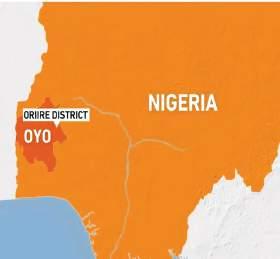
On May 15, 2026, 39 children ranging from age 2 to 18, and 7 teachers were kidnapped from 3 schools in Oriire Local Government Area of Oyo State. One of the teachers, Mr Michael Oyedokun was killed in an extremely gruesome manner by the kidnappers. May his soul rest in peace. And, may God comfort the family he left behind. Amen. About 40 children were also kidnapped from school, in Borno State.
It is more than heartbreaking and heart wrenching, to imagine little children, particularly such small ones, being left to the elements and harsh conditions in the forest for over 2 weeks. They are too small, to be put through such hardship and suffering. No innocent person, at any age, deserves to go through such hell. The dissemination of videos showing the brutal treatment of victims by these terrorists and the execution of Negotiators, is a way of spreading fear amongst Nigerians to gain more power and attention, to create distrust, discontent and possibly, to recruit followers taking advantage of the, “if you can’t beat them, join them” mentality.
The primary purpose of Government, is the security and welfare of the people - see Section 14(2)(b) of the 1999 Constitution of the Federal Republic of Nigeria (as amended)(the Constitution). While we pray for God to take control and protect these innocent children and teachers, and indeed, all those who have been taken into captivity by these kidnappers, we ask Government to do their job. If the same amount of time and energy that is spent by Politicians/Government Officials on plotting to stay or come into power by any means necessary, is devoted to strategising on how to secure the lives of our people, everyone would have been rescued by now.
Twiddledee and Twiddledum/Hassan and Hussein If there are any terms that can depict closeness/inseparable pairs even more than Twiddledee and Twiddledum, that’s what we should use to describe All Progressives Congress (APC) and African Democratic Congress (ADC)! They are two peas in a pod. Maybe Hassan and Hussein? Hickory Dickory? Molly Polly? Just as APC counters were jumping from 1 to 1,000 and so on, so did an ADC counter in the North, when counting for Alhaji Atiku Abubakar during the ADC Primaries! We saw the video clips. They all shamelessly worked to the answer. These two political parties are Siamese twins, birds of the same feather, and even if they may quarrel like Tom and Jerry, they are a pair! In fact, irrespective of which party they belong to, majority of Nigerian politicians, with very few exceptions, have rolled off the same assembly line, and they are all members of the Twiddle Family - many peas in one pod! Even in the brand new party, Nigeria Democratic Congress (NDC), there were complaints about how some candidates emerged, with allegations that some positions went to the highest bidders.
Then, the same people who defect from party to party with fluidity, recycle the same godfatherism, display a gross lack internal democracy in whichever party they belong to, and use the same cheating style to win elections (both internal and external), turn around to bring election petitions, crying foul when they are beaten at their own game and lose at the polls!
Non-Justiciability of Intra-Party Matters
However, it appears that nomination of candidates is an intra-party affair, so, unsuccessful aspirants can only cry disenfranchisement and rigged primaries; it appears that they cannot go to court. See Section 83(5) of the Electoral Act 2026 (EA). In Kabir v APC & Ors (2024) LPELR-61712(SC) per Ibrahim Mohammed Musa Saulawa, JSC, the Supreme Court held inter alia that: “….the question of membership of a political party and sponsorship of a candidate for an election, squarely falls within the purview and contemplation of domestic affairs of a political party, thus, not justiciable. This proposition of law has been settled and reiterated beyond per adventure by this court, in a plethora of authorities….it is….indeed, a No Go Area for courts, as they lack jurisdiction to delve into such affairs or matters”. See also Anyanwu v Emmanuel & Ors (2025) LPELR-8.0882(SC) per Jamilu Yammama Tukur, JSC.
The pronouncements of the Apex Court are as clear as crystal, on the justiciability of these two issues - membership of a political party and sponsorship of candidates for election; yet, Lawyers, experienced ones at that, and even Senior Advocates mostly, still take these issues to court repeatedly for adjudication, sometimes deliberately adding a twist to mask issues that are already well established and require no more litigation. To tell the truth, it appears that many of the adults in the room, whether politicians or Lawyers, are responsible for eroding Nigeria’s institutions for their own selfish gain.
Relitigation of Decided Cases
In the case of relitigating decided cases or issues in Nigerian political cases, at times, the doctrine of Res Judicata or Issue Estoppel may apply, as sometimes, the same/similar parties relitigate the same subject-matters already decided, and this is one of the elements that must exist to plead Res Judicata or Issue Estoppel. ‘Res Judicata’ means ‘a matter judged’; it concerns the legal principle of not relitigating a matter or issue that has already been judged by a court of competent jurisdiction, or settled by the Supreme Court. Even if the first element of same/similar parties isn’t fulfilled, the second and third elements usually obtain in political cases, that is, the matter has been decided on its merits, and the subject-matter of the subsequent case is the same as the one that has been decided upon - see Tiput v Dawamkat & Anor (2025) LPELR-81992 per Ibrahim Mohammed Musa Saulawa, JSC where
OnIkepO BraIThwaITe
onikepo.braithwaite@thisdaylive. com onikepob@yahoo.com
“It is more than heartbreaking and heart wrenching, to imagine little children, particularly such small ones, being left to the elements and harsh conditions in the forest for over 2 weeks…..we ask Government to do their job. If the same amount of time and energy that is spent by Politicians…on plotting to stay or come into power…is devoted to strategising on how to secure the lives of our people, everyone would have been rescued by now…. If there are any terms that can depict closeness/inseparable pairs even more than Twiddledee and Twiddledum, that’s what we should use to describe APC and ADC…Maybe Hassan and Hussein? Hickory Dickory? Molly Polly?…Lawyers relitigate settled Supreme Court issues which amounts to abuse of court process, only deepens institutional decay and erodes public trust”
the Supreme Court held inter alia in respect of Res Judicata that: “The three essential elements are: (1) an earlier decision on the issue; (2) a final judgement on the merits; and (3) the involvement of the same parties, or parties in privity with the original parties...”; also see Anchorage Leisures Ltd & Ors v Ecobank (Nig) Ltd (2023) LPELR-59978 (SC) on Issue Estoppel. And, even if fresh parties/strangers relitigate decided issues, this is an abuse of court process or violating the principle of ‘stare decisis’, that is, “to stand by things decided and not to disturb settled points” - see Edede v AGF & Anor (2025) LPELR-82109(SC) per Moore Aseimo Abraham Adumein, JSC. In Emenuwe v State (2024) LPELR-62735(SC) per Mohammed Lawal Garba, JSC, the Supreme Court held thus: “It is an abuse of the court’s process to bring an appeal on issues which have been firmly settled by several pronouncements of this Court over the years, merely for the purpose of re-statements of the established principles on the said issues”. So also, is it an abuse for a litigant to relitigate an identical matter that has been decided against him, even if it isn’t res judicata, or matters that are covered by issue estoppel - see Arubo v Aiyeleru & Ors (1993) LPELR-566 (SC) per Philip Nnaemaka-Agu. Unfortunately, we will still see a great deal of this vexatious type of abuse of court process, during this new electoral cycle. How do we classify election petitions vis-à-vis res judicata and issue estoppel? Some argue that election petitions are ‘sui generis’ that is, unique, and that repetition may arise because of evolving facts in each scenario. Possibly. But, even though the actual Petitioners/Respondents may be different, their political parties are recurring decimals in petitions, past and present, at least, PDP since 1999, APC since 2015, and along with INEC, they are usually joined as parties, while there are serial Petitioners who jump from party to party, and have been parties in some of
these decided cases under different political parties.
In Obi & Anor v INEC & Ors (2023) LPELR-61532(SC) per Tijjani Abubakar, JSC, on the issue of the nomination of Senator Kashim Shettima as APC’s Vice Presidential Candidate, the Supreme Court held that “….this issue has been dealt with by this Court in PDP v INEC & 3 Ors delivered on the 26th day of May, 2023. Appellants appeal on this point, amounts to an attempt to relitigate the point on nomination of Senator Shettima, this certainly offends the settled position of the law that there must be an end to litigation, this issue having been fully settled by this Court. The Appellant will not be allowed to relitigate this issue….”. This decision appears to establish the principle that, even if the parties are different, the same issue mustn’t be relitigated, particularly when the Supreme Court has decided on it.
For instance, in Nyesom Wike v Dr Dakuku Peterside, APC, INEC & PDP (2016) LPELR-40036 (SC) per Kudirat Kekere-Ekin, JSC (now CJN), the Apex Court held that a Petitioner complaining of non-compliance with the Electoral Act “must prove it polling unit by polling unit, ward by ward, and the standard of proof is on the balance of probabilities. He must show figures that the adverse party was credited with, as a result of the non-compliance”.
But, in Obi & Anor v INEC & Ors (Supra), the Petitioner had alleged non-compliance with the Electoral Act 2022 (EA 2022), questioning the results in over 18,000 polling units. But, instead of proving it “polling unit by polling, ward by ward”, the Petitioner had only 13 witnesses, out of which only 3 filed their witness statements on oath along with the Petition and testified, contrary to Paragraph 4(5)(b) 1st Schedule to the EA 2022. 3 witnesses, even if it was 13, testifying about 18,000
polling units where they weren’t physically present, based on third-party information amounts to relying on hearsay say evidence, which is inadmissible in court - see Sections 37 & 38 of the Evidence Act 2011; Okoro v State (1998) LPELR-2493(SC) on the inadmissibility of hearsay evidence. The Presidential Election Petition Tribunal had observed that specific polling units weren’t named, nor were alleged authentic results provided; the polling agents who were alleged to have complained about the results weren’t named or called as witnesses. In short, the standard of proof set in Nyesom Wike v Dr Dakuku Peterside, APC, INEC & PDP (Supra) was not met with regard to non-compliance in Obi’s case, as the Petitioner failed to adduce the requisite evidence; yet, the petition was still brought to court, with full prior knowledge that they hadn’t met the necessary threshold of proof. This is an abuse of court process.
In a jurisdiction such as UK, Counsel that attempts to relitigate issues that have already been settled by the Supreme Court, or bring only 5 items instead of the 500 items that may have been established by the Supreme Court to be required to maintain an action, apart from the fact the lower court must swiftly strike out such matters, Counsel that filed such a frivolous case may face disciplinary action from their professional body, and both Counsel and Client can face financial penalties, such as paying heavy costs to opponent’s Counsel, as such behaviour undermines the principle that there must be finality to litigation. It is also a waste of valuable judicial time.
The Jonathan Eligibility Case
Recently, in a case filed at the Federal High Court, Abuja, seeking to disqualify former President Goodluck Jonathan, GCFR from running in the 2027 Presidential election, Justice Lifu upheld President Jonathan’s eligibility to run and struck out the case, following the UK pattern by awarding N21 million costs against the Plaintiff, N20 million payable to President Jonathan and N1 million to the Attorney-General of the Federation. Justice Lifu cited the previous judgements of the Federal High Court, Yenagoa and the Court of Appeal, stating that the present case is an abuse of court process and that the Court of Appeal being a superior court, the Federal High Court is bound by the doctrine of stare decisis. This aligns with the principles against relitigating of settled issues, respecting judicial precedent and penalising abuse of court process.
Conclusion
The kidnapping and terrorist epidemic crisis in Nigeria, is a national shame. The recent Oyo incident shows how far this epidemic has spread, nationwide. There must be targeted forest clearance and combing, to fish out these criminals from their hideouts across the country’s forests, while a better school protection framework including perimeter fencing, CCTV, trained security, amongst others, must be deployed to schools, particularly soft targets in the rural areas. The welfare of the most vulnerable, children, must be a priority, over and above political machinations. There must be more preventive measures and effective rescue, as opposed to a recourse to regular ransom payments, that make this criminal enterprise more attractive to these wicked criminals. Though, the truth is that, out of desperation, any parent or person in such a position would do anything to secure the release of their loved ones, even paying ransoms. The incessant spectacle of politicians defecting from one political party to another like interchangeable twins, while Lawyers relitigate settled Supreme Court issues which amounts to abuse of court process, only deepens institutional decay and erodes public trust. It is time for the courts to discourage frivolous litigation through heavy costs and discipline, while the legal profession should endeavour to uphold higher standards like in UK and Canada, by coming down heavily on its erring members who engage in this unholy practice. Only then will the “go to court” taunt which has become a common joke, even for nonsensical cases and 1000 election petitions out of which only a few can be proved, will be curbed.
According to PLAC analysis, for the 2023 election petitions, almost 90% of them failed, and just over 70% failed because the requisite burden of proof couldn’t be discharged. It is against the Rules of Professional Conduct for Lawyers to pursue frivolous actions, particularly when they know they cannot discharge the evidentiary burdens. As Counsel, it is not enough to claim to be doing your client’s bidding, as such behaviour can amount to professional misconduct, which when punished accordingly, will serve as a much needed deterrent.
Oyo School Teacher, Michael Oyedokun, just before he was beheaded by the kidnappers
Effect of Oral Retraction of Confessional Statement during Trial
Facts
The Appellant was arraigned before the High Court of Ogun State, on a two-count charge of conspiracy to commit armed robbery and armed robbery, contrary to and punishable under Sections 6(b) and 1(2)(a) of the Robbery and Firearms (Special Provisions) Act. The Appellant and his co-accused persons were specifically alleged to have attacked one Raheem Lateef with a gun, led him into his house, and dispossessed him of the phones belonging to his wife and brother.
At the trial, the prosecution called four witnesses in proof of its case. The victim, Raheem Lateef, testified as PW1; Hon. Femi Arowora testified as PW2; while Corporal Muritala Buhari and Corporal Oseni Sulaimon testified as PW3 and PW4 respectively. The prosecution also tendered four exhibits, which included a locally made pistol and cartridge. At the conclusion of the trial, the Appellant was found guilty on both counts, convicted, and sentenced to death by hanging. The judgement of the trial court was delivered on the 24th day of May, 2017.
Aggrieved by the decision of the trial court, the Appellant lodged an appeal before the Court of Appeal, Ibadan Division. On 25th June, 2020, the Court of Appeal delivered its judgement, affirming the decision of the trial court. Dissatisfied with the concurrent findings of the two lower courts, the Appellant further appealed to the Supreme Court, seeking to set aside the decisions of the lower courts.
Issues for Determination
The Appellant and the Respondent formulated one issue each, for the determination of the appeal. Given that the issues submitted by both parties were substantially similar, the Supreme Court adopted the sole issue as formulated by the Appellant for determination, thus:
Whether having regard to the evidence adduced by the prosecution, the Justices of the Court of Appeal were right in affirming the conviction and sentencing of the Appellant for the Offences of conspiracy to commit armed robbery and armed robbery?
Arguments
The Appellant argued that he was not sufficiently identified as one of the persons who robbed PW1 and his family, and that the evidence adduced fell short of linking him to the armed robbery incident. He contended that the trial court relied solely on the testimony of an eyewitness - PW1, and the alleged confessional statement of the Appellant to conclude that the prosecution had proved all the ingredients of the offences of conspiracy to commit armed robbery and armed robbery. He submitted that for the prosecution to succeed in establishing the offences alleged, it must establish the identity of the accused and prove its case beyond reasonable doubt by credible evidence, and that where this is not done, the prosecution's case must fail, relying on STATE v ISIAKA (2013) 11 NWLR (PT. 1364) 162.
On the charge of armed robbery specifically, the Appellant conceded that the prosecution established the first two ingredients, namely that there was a robbery and that it was an armed robbery, but contended that the third ingredient - that the Appellant was one of the robbers - was not proved. He argued that the lower court found a contradiction in the evidence of PW4 regarding the gun allegedly recovered from him, and was wrong to have treated such contradiction as immaterial. He submitted that it was impossible for two trained Police officers to observe the same weapon and for one to describe it as a Dane gun while the other described it as a pistol, and that this contradiction was fatal to the prosecution's case as it went to the root of the second element of the offence. He urged the court to so hold, relying on ADEKUNLE v STATE (2006) LPELR-107 (SC), for the proposition that all ingredients of an offence must co-exist, and that where any one is absent or tainted with doubt, the charge cannot be said to have been proved. The Appellant argued further that the trial court erred in relying on the extra-judicial statement purportedly made by the Appellant, which the Appellant denied authoring. He submitted that where an accused person denies making a confessional statement, the statement, though admissible, must be tested for its veracity and probative value at the conclusion of trial, relying on HASSAN v STATE (2001) LPELR-1358 (SC). He contended
In the Supreme Court of nigeria Holden at abuja On Friday, the 4th day of july, 2025
Mohammed Baba Idris Justices, Supreme Court SC/537/2020
Between
ramoni animashaun appellant And the State respondent
(Lead Judgement delivered by Honourable Tijjani Abubakar, JSC)
that the Appellant denied ever robbing anyone, raised a defence of alibi, and denied making any confessional statement; that the trial court itself found the evidence of PW1 to PW3 on the identification of the Appellant unsatisfactory and discredited same; and that the trial court failed to consider the defence of alibi raised by the Appellant, yet, proceeded to convict and sentence the Appellant to death on the basis of his confessional statement, without testing its veracity. On the whole, he urged the court to resolve the sole issue in his favour, hold that the Respondent failed to prove its case beyond reasonable doubt, and allow the appeal.
On the part of the Respondent, it was submitted that in criminal trials, a court is under a legal duty to identify and be satisfied by evidence that all ingredients of the offences charged are proved to the required standard, before a convic-
“….retraction of confessional statement by an accused person in his oral testimony in court during trial, is of no moment. The most important thing is that, the court must be satisfied as to the truth of the confession and can therefore, rely on it alone to ground conviction. More so, where there are other facts pointing to the guilt of the Appellant”
a locally made pistol, as the requirement of the law is simply that a gun or firearm was used. With regard to the charge of conspiracy to commit armed robbery, it was submitted that conspiracy is a distinct offence from the predicate crime, and is consummated the moment two or more persons agree to do an unlawful act, whether immediately or at some future time. He argued that direct proof of the agreement is not always obtainable, given that such agreements are typically hatched in secrecy, but that the evidence on record, including eyewitness testimony, sufficiently pointed to the existence of an agreement among the accused persons to pursue a common illegal objective. The Respondent urged the court to hold that it proved all the ingredients of both offences beyond reasonable doubt, dismiss the appeal, and affirm the decision of the lower courts.
Court’s Judgement and Rationale
In resolving the issue, the Supreme Court emphasised that the standard of proof placed on the prosecution in criminal trials is a heavy one, requiring that the guilt of an accused be established beyond reasonable doubt. The court anchored this position on Section 135 of the Evidence Act, 2011 (as amended) and its earlier decision in NWATUROUCHA v THE STATE (2011) 6 NWLR (PT. 1242) 170 AT 193. On what constitutes proof beyond reasonable doubt, the court stated that “proof beyond reasonable doubt means proof to moral certainty, such proof as satisfies the judgement and conscience of a Judge as a reasonable man, and applying his reasons to the evidence before him as to leave no other reasonable conclusion possible” The court proceeded to itemise the ingredients which the prosecution must establish beyond reasonable doubt to secure a conviction for armed robbery, namely: (a) that there was a robbery or series of robberies; (b) that the robbery or each robbery was an armed robbery; and (c) that the accused was the armed robber or one of the armed robbers.
tion can be sustained. Counsel submitted that proof beyond reasonable doubt does not mean proof beyond all shadow of doubt, relying on AYINDE v STATE (2019) 12 NWLR (PT. 1687) 140, and that the burden of proof rests on the prosecution, which must also rebut the constitutional presumption of innocence in favour of the accused, relying on the decision in AGBI v OGBEH (2006) 11 NWLR (PT. 990) 65. Regarding the charge of armed robbery, it was submitted on behalf of the Respondent that all the ingredients of the offence were duly proved, and that the fact of the robbery was not in dispute, the Appellant having raised no denial on record. The Respondent contended that the prosecution proved the offence and linked the Appellant to it through the direct eyewitness testimony of PW1, who gave evidence that the Appellant was armed with a gun, threatened violence, and that the Appellant and his co-accused persons fired shots at their pursuers during the chase. It contended further that PW3 and PW4, as Investigating Police Officers, identified the gun recovered from the Appellant, and that the combined testimonies of PW1, PW3 and PW4 sufficiently established that the accused persons were armed at the time of the robbery. On the issue of contradiction in the description of the recovered weapon, the Respondent argued that no material contradiction existed, and that even if any existed, it was not sufficient to go to the root of the evidence. That it was immaterial whether the weapon used was a Dane gun or
In examining the evidence adduced in proof of these ingredients, the court referred to the testimony of PW1, who gave evidence of how the Appellant accosted him with a gun, dispossessed him of his Techno phone, and demanded money from him. The court noted further that, the Appellant had made a confessional statement in which he admitted his participation in the armed robbery incident, which he subsequently retracted at trial. On the weight and effect of a confessional statement as a mode of proof, the court held that “there can be no better proof of the commission of a crime than the words of the accused, voluntarily stating how the offence was committed and the role he played”. The court defined a confession as “an admission made at any time by a person charged with a criminal offence, stating or suggesting that he committed the crime”, relying on the decision in SAIDU v THE STATE (1982) 3 SC 41. On the legal effect of the Appellant’s retraction of his confessional statement, the court held that “retraction of confessional statement by an accused person in his oral testimony in court during trial, is of no moment. The most important thing is that, the court must be satisfied as to the truth of the confession and can therefore, rely on it alone to ground conviction. More so, where there are other facts pointing to the guilt of the Appellant”. Considering the totality of the evidence adduced, the court held that the confessional statement of the Appellant was direct, positive and unequivocal. Resting on the plank of the confessional statement, the court held further that the Appellant committed the offence in the company of, and with the cooperation of his co-accused. As such, the conviction of the Appellant for conspiracy to commit armed robbery was upheld. The court also touched on the issue of contradiction in the evidence of PW4, on the gun that was used to carry out the robbery. The court regarded the contradiction as minor and immaterial. The court held that “it is not every minor contradiction in the evidence of witnesses that matters, or has the effect of rendering the evidence unbelievable”. In the end, the Supreme Court resolved the sole issue against the Appellant. Accordingly, the appeal was dismissed and the decision of the trial court imposing a sentence of death by hanging on the Appellant, was affirmed.
Appeal Dismissed.
Representation
Gbenga Akinde-Peters for the Appellant. Mitchel A. Aribisala for the Respondent.
Honourable tijjani abubakar, JSC
ECNBA Releases Final List of Candidates
Stories by Steve Aya
The Electoral Committee of the Nigerian Bar Association (ECNBA) has released the final list of qualified candidates for the 2026 national elections, following the conclusion of all pending appeals.
This comes after the National Officers Election Appeals Committee (NOEAC) finally resolved appeals filed by disqualified aspirants, bringing an end to earlier delays that had raised concerns within the electoral process.
According to the ECNBA, the final list was issued after the completion of screening and determination of appeals in line with the NBA Constitution 2015 (as amended in 2025) and ECNBA Notice No. 2 of February 9, 2026.
The Committee confirmed that two appeals were upheld in favour of Bulus Yohanna Atsen (FSI) and Onimisi Friday Umar, both aspirants from the
Northern Zone contesting for NBA Representative to the General Council of the Bar.
In the notice signed by ECNBA Chairman, Mr Aham Ejelam, SAN, and Secretary, Mr Ibrahim Nassarawa, the Committee stated that the list is final and binding on all
aspirants.
It added that candidates whose names do not appear on the list have been individually notified, and had the opportunity to appeal through the established constitutional process.
An analysis of the final list shows that the contest
for major national offices remains largely unchanged, with three candidates each for the positions of NBA President and First Vice President.
Similarly, three candidates are expected to be returned unopposed for the positions of Second Vice President (Nuhu John
Egya), Third Vice President (Irene Iniobong Pepple), and Treasurer (Esther Ifeoma Jimoh), following uncontested nominations.
However, the race remains competitive for other positions, with six candidates vying for General Secretary, seven for Assistant General Secretary, five for Welfare Secretary, two for Publicity Secretary, and four for Assistant Publicity Secretary.
For the General Council of the Bar, eight candidates will contest in the Eastern Zone, while two candidates are set for the Western Zone, where they may be returned unopposed.
Babalakin & Co to Host ESG Governance Colloquium
Law firm, Babalakin and Co. is set to host a colloquium on strategies for integrating Environmental, Social and Governance (ESG) principles into corporate governance and regulatory frameworks on June 4, 2026, in Lagos.
The event, scheduled to hold at the firm's head office in Victoria Island, is expected to bring together regulators, corporate executives, policymakers, academics, industry experts and other stakeholders, to examine emerging trends and practical approaches to ESG implementation.
According to Dr Kubi Udofia, a Partner and Head of the firm's Regulatory Compliance Practice, the colloquium will provide a platform for high-level discussions on strengthening governance systems and aligning regulatory frameworks with evolving sustainability expectations.
Confirmed Speakers and Panelists include, Ejiro Gray of Sahara Group, Tony Edeh of Norrenberger, Ezinwanne Nnoruka of the Financial Reporting Council of Nigeria, Adekemi Adisa of mtn.ng, David Edet of
Eterna Plc and Omobolanle Onawumi of deloitte.com. Organisers said discussions will focus on practical and efficient strategies, for embedding
ESG considerations into corporate decision-making and regulatory compliance structures.
Attendance at the colloquium is strictly
by invitation, a measure organisers say is intended to ensure meaningful stakeholder engagement and robust policy-focused conversations.
Court Dismisses $19.6m Suit Against NNPCL
An Abuja Federal Capital Territory (FCT) High Court has dismissed a $19.6 million suit filed by Alternate Dimensions Ventures Limited against the Nigerian National Petroleum Company Limited, affirming the legal principle that written contracts cannot be expanded through oral
Federal High Court Opens Weekend Filing
The Federal High Court of Nigeria has directed all its divisional registries nationwide to open on weekends and public holidays, for the filing of pre-election matters ahead of the 2027 general elections.
The directive was contained in a Public Notice issued on Thursday and signed by the Chief Registrar of the Court, Yahaya Shafa.
According to the Notice, all Federal
High Court registries across the country will now operate between 10:00am and 2:00pm on weekends and public holidays, exclusively for pre-election filings.
The court said the decision became necessary to comply with strict constitutional and statutory timelines, governing the filing and determination of pre-election disputes. It explained that the move was aimed at ensuring
that litigants are not denied access to justice, due to time constraints associated with electoral processes.
“The Federal High Court of Nigeria formally notifies all legal practitioners that registries in all divisions of the court would be open between 10:00am and 2:00pm on weekends and public holidays for filing of preelection matters only”, the Notice stated.
The court added that
the arrangement had become “expedient”, in order to meet the limited timeframe for handling pre-election matters ahead of the 2027 general elections.
agreements or conduct.
The company had sought $19.6 million in professional fees, claiming that the scope of its Direct Sale, Direct Purchase (DSDP e-pro) contract with NNPCL was allegedly expanded through oral arrangements.
Represented by Counsel, Patrick Peter, Alternate Dimensions argued that it was entitled to the revised sum for services it claimed were rendered under the alleged expanded terms.
However, NNPCL, through its Lawyer, Ituah Imhanze, opposed the claim, insisting that parties are bound strictly
by the clear terms of their written agreement. The defence argued that no written amendment existed to support the alleged expansion, and the court agreed with this position.
Delivering judgement, Justice Hamza Mu’azu held that the contract terms were clear and unambiguous, adding that no evidence was presented to support the alleged oral variation. The court consequently dismissed the suit as lacking merit, reaffirming that any modification to a written contract must be expressly documented and cannot be implied or verbal.
NBA Calls for Urgent Legal Education Reform
The President of the Nigerian Bar Association, Mazi Afam Osigwe, SAN, has called for urgent reforms in Nigeria’s legal education system, warning that the
PRAWA, LACON Launch Paralegal Studies Programme
The Prisoners Rehabilitation and Welfare Action (PRAWA) has entered into a partnership with the Legal Aid Council of Nigeria (LACON) and Clifford University, to introduce a Paralegal Studies programme aimed at strengthening access to justice and legal capacity building.
The collaboration was formalised, through the
signing of a Memorandum of Understanding (MoU) by the three partner organisations.
Stakeholders said the initiative is designed to expand legal support services, and improve community-level access to justice through structured paralegal training.
During the signing ceremony, participants
were informed that Clifford University is part of a global network of 118 Universities operated by the Seventh-day Adventist Church.
Speaking at the event, the President of PRAWA, Assoc. Prof Uju Agomoh, described the partnership as a significant milestone in legal education and justice sector reform. She expressed optimism that
the programme could be replicated across other universities within the global Adventist education network, particularly in Central and West Africa. Agomoh also congratulated the Partners, describing the signing as a successful step towards advancing access to justice and legal empowerment initiatives.
profession risks irrelevance if it fails to adapt to modern realities. He made the call at the 2026 NBA Legal Education Summit, speaking on the theme “Accelerating Legal Education Reform in Nigeria: Progress, Problems & Prospects”.
Mazi Osigwe stressed the need for a more practical, technology-driven and competency-based legal training system, that can adequately prepare Lawyers for 21st-century legal practice. He advocated stronger mentorship structures, expanded legal clinics and moot court programmes, and a shift away from excessive reliance on rote learning in Law Faculties.
The NBA President also called for greater integration of innovation, technology and entrepreneurship into legal education, to better equip future Lawyers for evolving professional demands.
He further questioned whether the current duration required to obtain an LL.B degree remains necessary, arguing that emphasis should be placed more on practical skills and professional competence.
The Summit brought together legal academics, regulators, members of the Bench and Bar, law students and other stakeholders committed to shaping the future of legal education in Nigeria.
PRAWA President, Prof Uju Agomoh
NBA President, Mazi Afam Osigwe, SAN
Chief Jugde, Federal High Court, Hon Justice John Tsoho
Clearing the Fog on the Electoral Act 2026, INEC’s Timetable and Schedule of Activities for the 2027 Elections
This article by Festus Okoye examines several court cases brought by political parties, SdP, nnPP and youth Party, the pronouncements of the courts on the issues arising in these cases, such as the election Timetable and Schedule of activities for the 2027 general elections, the attempt by IneC to abridge the timeframe of certain activities in its Guidelines such as submission of political party membership registers, the controversies arising therefrom, the impact of the electoral act 2026 on these issues, and decisions of the Supreme Court related to some of these matters
Introduction
The controversy surrounding INEC’s Timetable and Schedule of Activities and its place in Nigeria’s hierarchy of laws, is unfortunate and unnecessary. It is unnecessary because, there is a precedent to guide all stakeholders in the electoral process. It is also unnecessary because the Supreme Court of Nigeria, the highest Court in the land, was called upon in 2023 to decide on a similar issue, and the electoral management body should have been guided by the Supreme Court’s decision when drafting the Timetable and Schedule of Activities for the 2027 general election. Doing so is not a sign of weakness, because the previous Commission faced the same challenge, insisted on the sanctity and inviolability of its Timetable and
Schedule of Activities, and ultimately bowed to the Supreme Court’s decision. Refusing to obey and abide by the judgement of the Supreme Court and the Federal High Court in suit No. FHC/ABJ/CS/517/2026 has political, financial, security, constitutional, and statutory implications. It is unfortunate because, it tends to distract the electoral management body from focusing on the conduct and management of the 2027 general elections and Nigeria’s off-cycle elections. Challenging the Federal High Court’s decision in the Court of Appeal, may not serve any useful purpose. While the Commission has the constitutional and statutory right to challenge the decision, it must comply with
“Following the repeal of the Electoral Act, 2022, and the re-enactment of the Electoral Act, 2026, the Commission adjusted its Timetable and Schedule of Activities and set the Presidential and National Assembly Elections for 16th January, 2027, and the Governorship and State Houses of Assembly Elections for Saturday, 6th February 2027”
the decision and work within its framework and parameters, so that if the Court of Appeal, and maybe the Supreme Court, affirms the decision, it can still manoeuvre and do little or no harm to the aspects of the Timetable and Schedule of Activities, ultimately to the due and constitutional conduct of the election.
Conversely, if it refuses to obey the Court’s orders, and one innocuous party insists on the sanctity and superiority of the Electoral Act, 2026, over the Timetable and Schedule of Activities, and the Commission refuses to collect its Membership Register and the candidates’ nomination form, an innocuous pre-election matter by such a party may create a constitutional crisis and throw the electoral process off balance.
It is also unfortunate because, the Judiciary will be dragged into a needless controversy, and social media manipulators, emergency Lawyers, and analysts will begin chasing clout and offering their own interpretations of the Courts’ judgements, thereby creating confusion and finding contradictions where none exist.
SDP v INEC
That is the fate of Suit No:/ABJ/CS/720/2026 between the Social Democratic Party and the Independent National Electoral Commission (INEC), delivered on Tuesday, 26th May, 2026, based on an Originating Summons filed on 9th April 2026. What are the issues in controversy? The first
concerns the constitutional and statutory powers of INEC, to issue the timetable and Schedule of Activities for the 2027 general election. The second concerns the hierarchy and place of the Timetable and Schedule of Activities, within Nigeria’s legal matrix. The third concerns whether there are precedents to guide the Commission and political parties on the issues in controversy, and the fourth concerns the likely impact of those issues on the 2027 general election.
Election Timetable
INEC waited for the National Assembly to pass the Electoral Act Repeal and Re-enactment Bill 2026. When it became clear that the delay might affect its constitutional and statutory powers to release the Timetable and Schedule of Activities 360 days before the election, it acted under Section 29 of the Electoral Act, 2022, and released them for the 2027 general election.
The Commission fixed Saturday, 20th February, 2027, for the Presidential and National Assembly elections, and Saturday, 6th March 2027, for the Governorship and State Houses of Assembly elections.
Following the repeal of the Electoral Act, 2022, and the re-enactment of the Electoral Act, 2026, the Commission adjusted its Timetable and Schedule of Activities and set the Presidential and National Assembly Elections for 16th January, 2027, and the Governorship and State Houses of Assembly Elections for Saturday, 6th February 2027.
Festus Okoye
The Commission fixed the Conduct of party Primaries and the resolution of disputes to commence on 23rd April 2026 and end on 30th May 2026, while Presidential and National Assembly Campaigns will commence on 19th August 2026. Governorship and State Assembly Campaigns will commence on 9th September 2026.
In the Timetable and Schedule of Activities, political parties must submit their register of membership to the Commission between 1 April 2026 and 21 April 2026. The submission of Nomination Forms for Presidential and National Assembly Elections will commence on 27 June, 2026 and end on 11 July, 2026, while that for Governorship and State Assembly Elections will commence on 18 July 2026 and end on 8 August 2026. Publication of Personal Particulars of candidates by the Commission for Presidential and National Assembly Elections will take place on 1st August, 2026, and that of Governorship and State Assembly Elections on 29th August, 2026.
The last day for Political Parties to withdraw candidates or replace withdrawn candidates is 22nd August, 2026 for the Presidential and National Assembly Elections, and 19th September 2026 for the Governorship and State Assembly Elections. The final list of nominated candidates will be published on 12th September, 2026 for the Presidential and National Assembly Elections, and on 10th October 2026 for the Governorship and State Assembly Elections.
The last day for Political Parties' campaigns for Presidential and National Assembly Elections is 14th January, 2027, and for Governorship and State Assembly Elections is 4th February, 2027.
However, on Friday, 27th March 2026, the Commission issued a statement that, at its meeting with political parties on Tuesday, 24th March, 2026, concerns were raised about the timeline for submitting the Political Parties Register of Members under the Revised Timetable and Schedule of Activities for the 2027 General Election, which had originally been set between 1st April, 2026 and 21st April, 2026.
At the meeting, the Commission agreed to adjust the submission period for political parties’ registers of members to align with the Electoral Act, 2026. It therefore informed political parties that they are free to set the dates for their primaries within the approved period from 23rd April, 2026 to 30th May, 2026. It also extended the submission deadline for political parties’ registers of members from 21st April, 2026 to 10th May, 2026, as originally set out in the revised Timetable.
What, then, is the challenge, given that the Commission stated that the Timetable and Schedule of Activities it released are in conformity with the Constitution of the Federal Republic of Nigeria, 1999 (as amended), and the Electoral Act, 2026?
In the First Alteration Act (2010), the National Assembly amended Section 228 of the Constitution of the Federal Republic of Nigeria, 1999 (as amended), and provided that the National Assembly may, by law, lay down guidelines and rules to ensure internal democracy within political parties, including making laws for the conduct of party primaries, party congresses and party conventions; and confer on INEC such powers as may appear to the National Assembly to be necessary or desirable for the purpose of enabling the Commission more effectively to ensure that political parties observe the practices of internal democracy, including the fair and transparent conduct of party primaries, party congresses and party conventions. Under the powers set out above, the National Assembly, in Section 148 of the Electoral Act 2022, empowered the Commission to issue regulations, guidelines, or manuals to give effect to the provisions of the Act and its Administration. The same provision is repeated in Section 151 of the Electoral Act 2026.
Youth Party Case
On the 11th day of March, 2026, the Youth Party filed an Originating Summons against INEC, seeking a cluster of Declarations and Orders and on Wednesday, the 20th day of May 2026, Hon. Justice M.G. Umar of the Federal High Court granted most of the declaratory reliefs and orders as follows:
1. A declaration is hereby made that upon consideration and interpretation of Sections 29, 82 and 84 (1) of the Electoral Act 2026, the powers of the Defendant to receive notice of primaries and the personal particulars of candidates, and its duty to attend, observe and monitor such primaries does not extend to fixing or prescribing the timetable which political parties may conduct their primaries for the purpose of nominating candidates for the 2027 general elections.
2. A declaration is hereby made that, having regard to Section 29 (1) of the Electoral Act 2026, which requires political parties to submit the personal particulars of their candidates not later than 120 days before an
election, the Defendant cannot lawfully abridge or shorten that statutory period by prescribing a shorter time frame in its 2027 election timetable.
3. A declaration is hereby made that, having regard to Section 31 of the Electoral Act, 2026, which permits political parties to withdraw and substitute candidates not later than 90 days before the conduct of an election, the Defendant cannot lawfully abridge or limit that statutory period by fixing an earlier deadline for the withdrawal and replacement of candidates in its 2027 election timetable.
4. A declaration is made that, having regard to Section 32 of the Electoral Act, 2026, the Defendant does not possess the statutory powers to publish the final list of candidates for the 2027 general election before the 60-day period prescribed by law.
5. A declaration is made that, upon a proper construction of Section 98 of the Electoral Act 2026, the Defendant does not possess the statutory authority to fix in its timetable for the 2027 general election, for the campaign to end 2 days before the election.
6. A declaration is made that, upon a proper interpretation of Section 33 of the Electoral Act, 2026, the time frame prescribed by the Defendant for the submission of membership registers for the conduct of primaries is NOT applicable to the primary election conducted for the purpose of replacing withdrawn candidates.
Hon. Justice M.G. Umar of the Federal High Court acknowledged the powers of INEC to issue regulations, guidelines, and Manuals. In the judgement he stated thus: ‘It is to be noted that it is within the power of the Defendant’s (INEC) statutory function to organise the 2027 general election, which gave rise to the Revised Timetable and Schedule of Activities for 2027 General Elections, to wit exhibit 1 attached to the plaintiff’s affidavit in support. The enabling Act of the Defendant confers on the Defendant discretion and administrative powers to issue the said Exhibit 1.’
In Suit No:/ABJ/CS/720/2026 between the Social Democratic Party and the Independent National Electoral Commission (INEC), delivered on Tuesday, 26th May 2026, based on an Originating Summons filed on 9th April, 2026, the Court also held that the ‘timetable for the conduct of the 2027 General Election issued by the Defendant is valid and legally issued, stating the timeframe within which political parties are to hold their primaries
“The Commission should act in the interests of Nigerian democracy and our electoral process, by reviewing past judgements on electoral timelines and the Timetable and Schedule of Activities, and by aligning them with the law. Doing so is not a sign of weakness, but an abiding faith in the electoral process and Nigerian democracy”
and the timeframe for the submission of membership registers of political parties’.
The key issue is not whether INEC has the constitutional or statutory powers or discretion to issue a timetable and schedule of activities. The question is whether it can, in its timetable and schedule of activities, abridge or violate the timelines provided in the Constitution and the Electoral Act, 2026.
NNPP Case
Unfortunately, the Commission has travelled this route up to the Supreme Court. Ahead of the 2023 general election, the New Nigeria Peoples Party (NNPP) filed an Originating Summons before the Federal High Court seeking various declaratory reliefs, including an order directing INEC to accept and publish the names of the NNPP candidates for the 2023 general elections, replacing the names of candidates already forwarded and submitted, in place of candidates who voluntarily withdrew their candidature and resigned their membership of the Party.
The Party communicated its voluntary withdrawal of some candidates to INEC and gave notice of its intention to hold a fresh primary election, as required by law. INEC refused, on the grounds that the time to hold a fresh election, as stipulated in the Timetable and Schedule of Activities for the 2023 general election, had expired, and that Section 33 of the Electoral Act, 2022, which provides 90 days for withdrawal and substitution, was no longer available to the Party.
On this basis, the Party approached the Federal High Court and sought a declaration that, under Sections 29(1), 31 and 33 of the Electoral Act, 2022, INEC lacks constitutional or statutory authority to prevent the NNPP from replacing its candidates who voluntarily withdrew their candidature for the 2023 general election. It also sought a declaration that INEC’s Timetable and Schedule of Activities for the 2023 General Election does not supersede the Electoral Act, 2022. Finally, it sought a declaration that, by virtue of Sections 65(2)(b), 106(d), 177(c) and 187(1) & (2) of the 1999 Constitution of the Federal Republic of Nigeria (as amended), INEC cannot recognise as NNPP candidates for the 2023 general election those who have withdrawn their membership of the NNPP.
Thereafter, the party sought an order directing the INEC to allow the NNPP to submit the names of all candidates it had replaced, as well as those who had voluntarily withdrawn their candidature, for the 2023 general election. It also sought an order directing the INEC to accept and publish the names of all candidates forwarded by the NNPP as replacements for NNPP candidates in the 2023 elections. The Federal High Court and the Court of Appeal agreed with the party’s contention and entered judgment in its favour. INEC appealed the judgment to the Supreme Court.
Supreme Court Decisions
The Supreme Court in Independent National Electoral Commission v. New Nigeria Peoples Party (2023) 12 NWLR, Part 189, 431 held that, under Sections 31 and 33 of the Electoral Act, 2022, and given that the application or notice for substitution of NNPP candidates was made to INEC on 31/8/2022, there were well over 90 days to the Presidential or Governorship election. For INEC to jettison or refuse to accede to the substitution request made to it by the NNPP in accordance with the Electoral Act, 2022, in favour of its timetable and schedule is to contemptuously undermine the law to which it is subject.
The Court noted that the Electoral Act binds both
INEC and the NNPP, and neither has the power to do whatever it wants. For as much as the Electoral Act or the Constitution has empowered INEC to make and schedule its own timetable for the general elections, it must be done subject to and in consonance with the Electoral Act, 2022, and not contrary to, different from, or in defiance of it.
The Supreme Court further held that INEC's directives or Guidelines on the submission of names of candidates sponsored by political parties in an election cannot override the provisions of the Electoral Act and the 1999 Constitution (as amended), and that there is nothing in Section 31 of the Act that makes its operation subject to any other statute or to any INEC guideline or timetable.
The Supreme Court conceded that INEC has the power under Section 148 of the Electoral Act, 2022, to issue Regulations or Guidelines to give effect to its provisions. “The Section provides: "The Commission may, subject to the provisions of this Act, issue regulations, guidelines or manuals for the purpose of giving effect to the provisions of this Act and for its administration." The above provision is unambiguous and clearly states that Guidelines, Regulations and Manuals to be issued by the Appellant are subject to the Electoral Act, and that the purpose of the Regulations, Guidelines and/or Manuals is to give effect to the Electoral Act. A Timetable and Schedule of Activities of the Appellant, which is made pursuant to the Electoral Act, must comply with the timelines contained in the Electoral Act, 2022. Being subordinate legislation, any inconsistency created by it must be resolved in favour of the substantive law.”
Therefore, in any conflict between a provision of substantive legislation and a provision of subordinate legislation, the provision of the substantive legislation prevails. This is because the Act is the principal law and the statute that authorises the Regulations. The Act is the pillar on which the Regulations lean and can never be superseded or overridden. If there is any inconsistency, the Regulations will give way to the Act.
A simple count of the relevant date relative to the general election date is required by the electoral management body and the political parties. The judgement obtained by the Youth Party may be set aside on jurisdictional grounds or on grounds of locus standi, but it does not prevent the electoral management body from complying with the law or the political parties from complying with the Electoral Act and the Constitution.
It is also axiomatic that the Timetable and Schedule of Activities issued by the Commission must comply with the Electoral Act and the Constitution. The Timetable, Regulations and manuals are issued pursuant to the powers conferred on the Commission and derivable from the statute and the Constitution. The Electoral Act, 2026, and the Constitution cannot bow to the Commission’s Timetable and Schedule of Activities.
Conclusion
The Commission should act in the interests of Nigerian democracy and our electoral process, by reviewing past judgements on electoral timelines and the Timetable and Schedule of Activities, and by aligning them with the law. Doing so is not a sign of weakness, but an abiding faith in the electoral process and Nigerian democracy.
Festus Okoye, Lawyer, former INEC National Commissioner
INec chairman, Prof Joash amupitan, SaN
‘Credible Elections Can’t be Harvested from Rigged Primaries’
again, nigerians are preparing to go to the polls early next year to elect candidates into various offices, at national and State levels. But, given the outcomes of the recently concluded primaries in the various political parties and the litigation likely to follow, the perception is that the polity is less than ready for free and fair elections, come 2027. With a chaotic opposition and fears of implosion by the various parties, some are of the opinion that 2027 elections will neither be free, fair nor contention free. The executive Director of Yiaga Africa, Samson Itodo, a civic organisation dedicated to promoting democracy across africa, had a lot to say in this engaging interview with onikepo Braithwaite and Jude Igbanoi last weekend, about the whole electoral process, pointing out its weaknesses, some of the positive electoral reforms that have been made so far, and what more must be done to make the process credible thereby earning the trust of the people
Yiaga Africa promotes democratic governance and civic engagement, and you were deeply involved in the ‘Not Too Young To Run’ campaign and in voter education. What steps must be taken to bring Nigerians to the realisation that
they become their own worst enemies when they sell their votes, particularly to clearly unsuitable candidates, and what are you doing in this regard? You have framed it correctly: a citizen who sells a vote is mortgaging four years of accountability for
“At Yiaga Africa, our entry point is to reframe the vote in citizens’ own minds. We tell people, in plain terms, that the few thousand Naira offered at the polling unit, is the price the politician puts on your silence for the next four years. It means you can’t demand for roads, schools, security, jobs, healthcare, and accountable leadership”
a single transaction. But, I am careful not to reduce vote-buying to a moral failing on the part of poor people. It is, first, a symptom of poverty, of broken trust in government, and of a transactional political culture in which parties treat citizens as customers to be settled, rather than constituents to be served. So, our strategy attacks both the symptom and the system. At Yiaga Africa, our entry point is to reframe the vote in citizens’ own minds. We tell people, in plain terms, that the few thousand Naira offered at the polling unit, is the price the politician puts on your silence for the next four years. It means you can’t demand for roads, schools, security, jobs, healthcare, and accountable leadership. That argument lands, and the data supports the optimism. In our recent National Voter Intentions
Survey, 76% of Nigerians say they believe their vote can influence the outcome. That latent conviction is the raw material we work with. Through our voter-education programming and election observation under Watching The Vote, we deter and document inducement at the polls, and we are investing heavily in the incoming Generation Z cohort, who are registering to vote and are far less willing to be bought. The Electoral Act 2026 also now provides stiffer penalties for vote trading, and both the buyer and the seller are culpable, but enforcement must follow the law for it to mean anything. Civic education changes the demand side; prosecution must discipline the supply side. There has been so much apprehension over the 2027 general elections. What are your topmost
executive Director of Yiaga Africa, Samson Itodo
‘credible
concerns?
Elections can’t be Harvested from rigged Primaries’
My concerns cluster around four things. The first, is insecurity and its effect on access, the risk that the Nigerians who want to vote will be unable to do so safely. The second, is the credibility of the legal framework, specifically, the ambiguity left in the Electoral Act 2026 around results transmission, which I will return to. The third, is the quality of candidate emergence: if the primaries are captured by money and imposition, the general election simply ratifies a flawed outcome of the primaries. And the fourth, is the trust deficit, only 45% of Nigerians currently express confidence in INEC’s ability to deliver a credible election, with the deepest scepticism in the South-East and South-South.
Layered over all of this, is the compressed timetable. INEC has moved the Presidential and National Assembly elections to 16th January, 2027, and the Governorship and State Assembly polls to 6th February, 2027. That earlier calendar is welcome for finishing disputes before inauguration, but it places enormous operational pressure on the Commission. And, I would add a fifth, newer concern: voter disillusionment. If citizens begin to believe elections are predetermined or meaningless, democracy loses its most important foundation: public trust.
The just-concluded primaries show that the perennial issue of lack of credibility and internal democracy persists across parties. How can these challenges be overcome? And, what effect has the deletion of indirect primaries had on the emergence of candidates?
This is the heart of the matter, because you cannot harvest a credible general election from rigged primaries. The credibility crisis at the polls begins in the party secretariat. Internal democracy is weak in Nigeria, because most of our parties are not membership institutions with ideology and rules; they are vehicles built around money and personalities. When there is no legitimate, rules-based way to choose candidates, the process defaults to the highest bidder.
Let me be clear that, the abolition of indirect primaries was sound in principle. The delegate system was the wholesale marketplace where candidacies were purchased, a few hundred delegates were far cheaper to capture than an entire membership. By restricting nomination to direct primaries or consensus, the law widens the franchise inside the party and dilutes the power of money.
But, I will not dress up what Nigerians actually witnessed in the just-concluded primaries. They were shambolic, and they betrayed both the letter and the spirit of the reform. Accreditation that never properly functioned; results disputed in the open by the very officials who organised them; aspirants resigning in protest or decamping over naked impositions; and contests that were settled not at the ballot but in courtrooms and, astonishingly, on the desk of the President. When the outcome of a party primary becomes a matter for presidential intervention, that is not internal democracy it is godfatherism with extra steps.
And, then there is the arithmetic, which frankly insults the intelligence of
Nigerians. We were asked to believe that a member-only primary, a closed exercise restricted to card-carrying members produced more votes than the same candidate secured in the 2023 general election, an open national contest involving more than 90 million registered voters. Numbers do not grow geometrically, out of thin air. Vote totals that balloon like that, are not evidence of mobilisation; they are evidence of phantom registers and manufactured tallies. This is the rot of geometric, abracadabra counting, and it must be condemned without equivocation.
So, my verdict is blunt: the reform was right, but it was implemented in bad faith. A direct primary conducted without a verified membership register does not abolish fraud, it simply relocates it from the delegate marketplace to the counting sheet.
Two safeguards are now nonnegotiable. First, the digital membership register that parties must submit to INEC, must be authentic and independently auditable; a primary anchored to a phantom list is theatre, not democracy. Second, consensus must mean the documented written consent of all cleared aspirants, not imposition wearing a borrowed word. And, INEC, which is statutorily mandated to monitor these primaries, must find the courage to state plainly when what it observed was not a credible process, and to apply the consequences the Act provides. How do you read the intra-
“When there is no legitimate, rules-based way to choose candidates, the process defaults to the highest bidder…. the abolition of indirect primaries was sound in principle…..By restricting nomination to direct primaries or consensus, the law widens the franchise inside the party and dilutes the power of money…. But, I will not dress up what Nigerians actually witnessed in the just-concluded primaries. They were shambolic, and they betrayed both the letter and the spirit of the reform”
party squabbling, with new factions springing up in various parties almost daily?
It is a symptom of the same disease: parties without internal democracy, and credible mechanisms to resolve disputes. When there is no legitimate, predictable process for settling who leads or who is nominated, every aggrieved member runs to court, and every faction claims to be the authentic party. The result is that candidate selection migrates from the membership to the Judiciary, which is destructive for democracy.
Healthy parties absorb disagreement through credible internal processes; weak ones export their disputes to the courts and tear themselves apart in public. The cure is institutional, not cosmetic. It requires real internal democracy, functioning disputeresolution organs, and transparency in party financing, so that control of the party is not simply a function of who funds it.
Scrutiny of the amended Electoral Act 2026 reveals gaps - electronic transmission and Form EC8A, over-voting checks, the counting of improperly marked ballots at returning officers’ discretion, grounds of petition, and more. What do you see as the most critical gaps, and what specific amendments would you recommend?
Let me be fair to the Act, before I am critical of it. It made real progress: it gives the IReV portal statutory recognition for the first time, it imposes a personal, mandatory duty on the presiding officer to transmit the Form EC8A, and it criminalises any officer who wilfully frustrates that transmission. These are not small gains.
The most critical gap, is the proviso that allows a fallback to manual collation in the event of ‘communication failure’. The flaw is not the existence of a fallback, but the absence of any clear standard for who determines that a failure has occurred, by what test, and how it must be documented. That discretion is exactly the loophole that produced the collation crisis of 2023. My first recommendation, therefore, is to tighten that section, so
that real-time electronic transmission is the binding legal record, and ‘communication failure’ is narrowly defined, independently verifiable, time-bound, and documented at the polling unit. Beyond transmission, three other fixes matter. INEC’s power to review election results declared under duress or violation of the electoral law, should not be limited to reports submitted by INEC officials only. It should extend to accredited party agents, election observers and citizens. The discretion currently left to returning officers over improperly marked ballots should be replaced with a clear statutory rule, because discretion at the point of counting is an invitation to manipulation. And, the framework for election petitions like the grounds and the timelines must be calibrated to deliver finality before inauguration, without shutting out legitimate complaints.
Some criticise the courts for interfering in parties’ internal affairs, others say the jurisprudence is unclear. Given the Supreme Court judgement in Sule Lamido v PDP, would you say the opposition has been obliterated, or has it selfdestructed?
The jurisprudence is genuinely unsettled, and the Supreme Court itself acknowledged as much by splitting in that case. The majority’s distinction is sound in principle: how a party chooses its leaders or its methods is its internal affair, but the denial of a member’s right to participate, in breach of the party’s own constitution, crosses into territory the courts can and should examine. The difficulty is the absence of a coherent, predictable test. That uncertainty leaves lower courts guessing and rewards forum-shopping, where litigants hunt for the ‘friendliest jurisdiction’. The Apex Court would do democracy a service, by laying down clear guidance that lower courts can follow.
On your sharper question, I would say self-destruction far more than obliteration. In a democracy, ruling parties are kept accountable by a credible opposition. But, opposition parties must earn public confidence by demonstrating internal discipline,
Executive Director of Yiaga Africa, Samson Itodo
‘credible elections can’t be Harvested from rigged Primaries’
ideological clarity, and capacity to govern. Self-destruction begins when parties abandon organisation and substitute strategy with litigation, factionalism, and personality politics. No court compelled the PDP to deny Lamido a nomination form, or to run parallel conventions, or to defy subsisting orders. Those were political choices. And, let me be candid about why this troubles us at Yiaga Africa even though we are strictly non-partisan: a fragmented, weakened opposition is bad for everyone, because competition is what disciplines those in power, and gives citizens a real choice. A drift toward one-party dominance lowers the stakes for accountability, and that should worry democrats across the spectrum..
Your National Voter Intentions
Survey found that over 40% of respondents cited fear of violence as an obstacle to voting. Where are the likely flashpoints, and what insecurity-related risks are Yiaga monitoring, particularly for the off-cycle Ekiti and Osun elections in June and August 2026?
The precise figure is 42%, and it sits beside an equally striking finding: 77% of Nigerians say they intend to vote. That juxtaposition, high democratic aspiration alongside high security apprehension, defines our current environment. The challenge for 2027 is ensuring that the 77% who want to vote, can actually do so safely.
In terms of geography, the flashpoints we monitor fall into recognisable clusters: the North-West, where banditry has uprooted communities across Zamfara, Katsina, Sokoto and parts of Kaduna and Niger; the North-East, where insurgency persists in Borno, Yobe and Adamawa; the North-Central belt, with its communal and farmer-herder conflicts in Benue, Plateau, Southern Kaduna and Niger; and pockets of the South-East, where election-day security and enforced sit-athomes can suppress turnout. Importantly, our survey shows the North recording the highest willingness to vote even as it faces the gravest insecurity, which is exactly why ensuring access to voting in that area is so consequential.
Ekiti and Osun present a different risk profile. These are not insurgency theatres; the threats are vote-buying, political thuggery, ballot-box snatching, voter intimidation around known flashpoint local governments, and the weaponisation of incumbency and State resources. For both elections, Yiaga Africa will deploy its Watching The Vote methodology for long-term and election-day observation, involving a statistically grounded parallel tabulation to independently verify the announced results. Additionally, we shall be deploying the second version of our Election Results Analysis Dashboard (ERAD) to independently audit the performance of the INEC Electoral Results Viewing Portal (IReV), and assess the integrity of results uploaded on the portal. Observation does not stop violence by itself, but credible, real-time documentation raises the cost of manipulation, and gives citizens an independent reference point.
How will insecurity affect the elections - beyond voter participation, polling-unit accessibility and logistics
- especially where insurgency and terrorism are highest? Can elections in those areas be free and fair, and what can be done in advance?
Insecurity contaminates every link in the chain. It depresses voter participation, it closes or relocates polling units, it endangers the officials and observers we need on the ground, it disrupts the movement of materials, and ultimately it casts a shadow over the legitimacy of the results declared in affected areas. I will be honest: in the worst-affected local governments with displaced populations, suspended units, and a coerced atmosphere, the phrase ‘free and fair’ is genuinely strained. Elections conducted in active conflict zones carry an integrity discount, and we should be candid about that, rather than pretend otherwise.
We need a serious, security-andelections framework working through the Inter-agency Consultative Committee on Election Security, that maps and mitigates risks local government by local government well before polling day, rather than on the day. That means early, transparent decisions on voting arrangements for displaced persons; protection that prioritises voters and officials, not only VIPs; clear contingency rules for suspended or relocated units, so that decisions are not improvised under pressure; and, above all, security agencies that act with neutrality and restraint. The objective is to shrink the no-go map deliberately and in good time, and to be transparent with citizens about where credible voting is and is not possible.
What is your assessment of public confidence in INEC and the
“Our data puts confidence in INEC at 45%, not a collapse, but well short of where it must be, with the sharpest distrust concentrated in the South-East and South-South….Trust of this kind is earned, not announced. INEC will rebuild it, only by demonstrating transparent, consistent results management, and by closing the gap between its written rules and its field practice”
Judiciary going into 2027, given Nigeria’s well-known bazaar of pre- and post-election litigation?
Confidence is fragile, and unevenly distributed. Our data puts confidence in INEC at 45%, not a collapse, but well short of where it must be, with the sharpest distrust concentrated in the South-East and South-South. For the Judiciary, the strain comes precisely from the bazaar you describe: when elections are effectively decided in courtrooms rather than at polling units, and when outcomes feel unpredictable, public faith in both the ballot and the Bench erodes together.
Trust of this kind is earned, not announced. INEC will rebuild it, only by demonstrating transparent, consistent results management, and by closing the gap between its written rules and its field practice. The Judiciary will rebuild it by developing coherent, predictable electoral jurisprudence, and by resisting the role of a default electoral college. The off-cycle elections this year are an early opportunity, for both institutions to show citizens something better. How prepared do you think INEC is, technically and logistically, for the elections, bearing in mind how close the Ekiti and Osun polls are?
The off-cycle elections are a stress test and, frankly, a credibility downpayment on 2027. Technically, the open questions are the reliability of the BVAS, and how the IReV portal performs under the new legal regime. Logistically, with Ekiti in June and Osun in August, and a compressed national calendar behind them, my concerns are timely funding, which the Act now requires to be released no later than six months before a general election; the recruitment and training of ad-hoc personnel; and the procurement and distribution of sensitive materials.
Readiness, though, is not merely a matter of hardware and money. It is whether INEC can execute consistently across thousands of units, communicate transparently when things go wrong, and apply its own rules uniformly. Ekiti and
Osun will tell us a great deal, about whether the Commission is ready for the far larger and more complex contests of 2027.
Kindly give us a few suggestions on what to do to improve the electoral process in Nigeria.
Let me offer a prioritised list. First, close the legal loopholes, make real-time electronic transmission the binding record and strip out the discretionary ambiguity around ‘communication failure’.
Second, strengthen INEC’s independence through a transparent process for appointing Commissioners and Resident Electoral Commissioners, and guarantee its funding on time.
Third, make internal party democracy real: enforce authentic membership registers and credible primaries, and insist that consensus means consent, not imposition.
Fourth, hold electoral offenders accountable. We have long argued for a dedicated Electoral Offences Commission to prosecute electoral crimes, including vote-buying, which are currently committed with near-total impunity.
Fifth, invest continuously in civic and voter education, with particular attention to the Generation Z voters now entering the register. Sixth, build a serious, neutral election-security architecture.
I will end by saying, Nigeria urgently needs a deeper national conversation about the future of its electoral process. When politics has no red lines, when impunity becomes institutionalised, when political actors continue to capture institutions like INEC, and when more voters choose to stay away from the polls, the warning signs are clear: with time, citizens may lose faith in elections as a credible pathway to change. That is a dangerous place, for any democracy to be.
The political class must rethink its attitude to politics, power, and governance. Elections cannot continue to be treated as a battlefield for conquest, rather than a process for expressing the will of the people. If political actors do not change course, they may destroy the very democratic system that gives them legitimacy.
Thank you Mr Itodo.
executive Director of Yiaga Africa, Samson Itodo
Gunmen Kill Several in Night Attack on Plateau Community
Attack Policemen in Anambra, kill two
Yemi Kosoko in Jos and David-Chyddy Eleke in Awka
At least eight people were reportedly killed and more than 10 others injured when gunmen opened fire on residents of Gwon‑Ajang village in Foron District, Barkin Ladi Local Government Area of Plateau State last Sunday night.
terrified villagers fleeing into the dark.
The attack occurred at about 10 p.m., according to community members, when the assailants stormed a birthday celebration and began shooting indiscriminately, sending
‘6,000 Manholes Exposed in Lagos’
segun James
Lagos State Government has raised the alarm that over 6,000 manholes, whose covers have been stolen, have been exposed across the state.
The government lamented that the stolen covers have exposed road users to danger.
The government, however, claimed that it has succeeded in covering 4,000 with fibres, even as it sought the cooperation of the public in safeguarding government property to prevent being stolen or damaged.
The Special Adviser to Governor Babajide Sanwo Olu on Infrastructure, Olufemi Daramola, and his Works counterpart,
Dr. Adekunle Olayinka, said this while briefing journalists in Ikeja yesterday. Daramola said that in order to safeguard public property, the government has had stakeholders’ meetings with members of the public on the need to see its property as their own and prevent it from being vandalised or stolen.
“We have 6,000 exposed manholes throughout the state, and we have been replacing them with fibre material; we have 2,000 left to replace. We also hold stakeholders’ meetings, which require a joint effort to prevent government property from being stolen. We will continue to work on security, as we are liaising with other ministries for enforcement,” he said.
A youth from the community, Bishop Iliya, said the victims had gathered for a birthday event when the attackers struck without warning.
“They arrived and started shooting at everything in sight. It is a painful and unfortunate situation for our community,” he said.
The Berom Youths Moulder‑Association (BYM‑A) also confirmed the incident, describing the attackers as “armed terrorists” and stating that at least eight people were killed, while more than 10 others sustained severe injuries and were rushed to nearby hospitals.
Its National Publicity Secretary, Rwang Tengwong, expressed concern over what he described as renewed violence in the area. He called on security agencies to take decisive action to halt the attacks and bring the perpetrators to justice.
The Plateau State Police Command, however, gave a slightly lower casualty figure, confirming five deaths from the attack.
The state Police Public Relations Officer, SP Alfred Alabo, said officers from the
Gindiri Division received a distress call at about 9:22 p.m. and immediately mobilised to the scene.
“When our men got there, they met some persons in pools of their blood. As I speak to you, five of them were confirmed dead,” he said.
Alabo noted that the location of the incident between Mangu and Barkin Ladi LGAs often leads to conflicting reports about the exact point of attack.
He added that the state Commissioner of Police had directed senior officers to relocate to the area to restore calm. Joint operations with Operation Enduring Peace were also underway, as security personnel were already deployed.
“We are looking forward to making some arrests because we have good intel,” he said.
Community sources alleged that the attack followed a period of relative calm in parts of Plateau State, claiming that killings had reduced until after the conclusion of political party primaries, an assertion not independently verified. Security agencies said investigations were ongoing, while patrols and surveillance have been intensified in the area.
THIS IS TO INFORM THE GENERAL PUBLIC THAT TWO (2) OUT OF THE FIVE (5) SINGLE-WING FIVE-BEDROOM HOUSES WITH SEPARATE BOYS’ QUARTERS SITUATE AT PLOT 2220 SUEZ CRESCENT, SANI ABACHA ESTATE, WUSE ZONE 4, FCT, ABUJA, CURRENTLY OCCUPIED BY PATHWAY COMMUNICATIONS LIMITED, ARE THE SUBJECT MATTER OF SUIT NO: FCT/HC/CV/3319/2025 BETWEEN PATHWAY COMMUNICATIONS LIMITED & ANOR V AFRICAN ALLIANCE INSURANCE PLC & ORS PENDING BEFORE THE HIGH COURT OF THE FEDERAL CAPITAL TERRITORY, ABUJA, AND ARE NOT FOR SALE.
MEMBERS OF THE PUBLIC ARE ADVISED TO AVOID ENTERING INTO ANY TRANSACTION IN RESPECT OF THE SAID PROPERTIES PENDING THE DETERMINATION OF THE SUIT.
SIGNED:
KELVIN EMONVUON IOLA LEGAL SERVICES COUNSEL TO THE CLAIMANTS
Email: info@iolalaw.com Tel: 0903 511 7862
UBA Reaffirms Role as Africa’s Premier Continental Bridge
Nume Ekeghe
Africa’s Global Bank, United Bank for Africa (UBA) Plc, marked Africa Day with a group-wide celebration across its offices in 20 African markets, bringing employees together in a shared observance of cultural and continental pride.
Speaking at the event, UBA Group Managing Director and Chief Executive Officer, Oliver Alawuba, drew a direct line between the Group’s pan-African footprint and the wider economic transformation underway across the continent.
Alawuba’s address came at a moment of notable momentum for African banking, as digital finance is reshaping how individuals and businesses transact, cross-border trade volumes are growing, and demand for locally owned, globally competitive institutions is intensifying.
“Africa’s story is changing,” Alawuba noted. “Young people are innovating, entrepreneurs are creating new businesses, women are leading boldly, creatives are taking our culture global, and institutions are beginning to reimagine the future of trade, finance, technology and development. At UBA, we must continue to see
“As a Group with presence in 20 African countries, UBA is more than a bank. We are a bridge across markets, cultures, people and opportunities,” Alawuba said. “Every day, through our people, our technology, our capital and our customer relationships, we connect Africa to itself and Africa to the world.”
ourselves as enablers of this transformation.”
Alawuba challenged staff to see the Group’s diversity of languages, cultures, and geographies as a structural advantage in serving African markets that no external institution can replicate.
He demanded that all UBA staff transfer the energy of the celebration into their client relationships and day-to-day execution, citing simplicity, responsiveness, and goal orientation as core standards the Group must hold passionately.
“Let us bring the same energy we display today into our work, with excellence, enterprise and execution,” Alawuba said. “Let us continue to prove that African institutions can be world-class, trusted, innovative and globally competitive.”
Okon Bags PSIN Award for Transformational Leadership
Olawale Ajimotokan in Abuja
The Administrator/ Chief Executive Officer of the Public Service Institute of Nigeria (PSIN), Imeh Okon has been honoured with the prestigious “Pillar of Struggle” Award by the Association of Senior Civil Servants of Nigeria (ASCSN), PSIN Unit, in recognition of her transformational leadership and unwavering
commitment to staff welfare.
The was award was presented as part of activities marking the 2026 Workers’ Day celebration.
It highlights Okon’s impactful leadership and her contributions to repositioning the Institute since assuming office on September 1, 2025. The ASCSN commended her for fostering a conducive work environment and implementing policies that have enhanced
staff productivity and strengthened institutional growth.
In her message, Okon congratulated staff of the Institute and acknowledged their critical role in driving its achievements.
She described workers as “the beacon and fulcrum of productivity, progress, innovation, creativity, and prosperity,” stressing the importance of a dedicated workforce in achieving sustainable national development.
Rite Foods Lights Up Ojude Oba 2026, Refreshes Thousands
Rite Foods Limited, Nigeria’s leading food and beverage company, brought excitement, refreshment, and memorable experiences to this year’s Ojude Oba Festival, reaffirming its commitment to preserving and promoting the rich cultural heritage of Ijebuland.
As one of Nigeria’s most celebrated cultural gatherings, the Ojude Oba Festival continues to unite generations of Ijebu sons and daughters, friends, and admirers of the culture from across Nigeria and beyond. With a history spanning more than a century, the festival remains a powerful expression of identity, tradition, unity, and communal pride.
Adding colour and vibrancy to the 2026 edition, Rite Foods delighted participants and visitors with its portfolio of award-winning brands, drawing large crowds to
its pavilion throughout the celebration. Guests enjoyed refreshing moments with their favourite beverages and snacks while soaking in the rich cultural displays that define the festival.
Speaking on the company’s continued support for the festival, the Managing Director of Rite Foods Limited, Seleem Adegunwa, said the sponsorship reflects the company’s enduring commitment to celebrating and preserving the cultural values of the Ijebu people.
“The Ojude Oba Festival represents unity, heritage, and community spirit. As a proudly Nigerian company with deep roots in Ijebu-land through our operations in Ososa, we remain committed to supporting initiatives that preserve our culture and strengthen the bonds that connect our people,” he said.
Themed “Ojude Oba 2026: Celebrating the Legacy of Oba Sikiru
Kayode Adetona,” this year’s festival honoured the late Awujale of Ijebuland, Oba Sikiru Kayode Adetona (GCON), whose remarkable leadership and transformative contributions left an enduring legacy in Ijebu-land and across Nigeria.
Also speaking, the Brand Manager, Fearless Energy Drink, Olaniyi Aderuku, noted that Rite Foods’ relationship with the people of Ijebu-land extends beyond business.
“Our connection with Ijebu-land is built on shared values and mutual growth. We believe in celebrating the identity of the people and contributing meaningfully to the preservation of their cultural heritage,” he said.
Aderuku added that Fearless Energy Drink’s brand values of courage, ambition, self-expression, and confidence resonate strongly with the spirit of the Ojude Oba Festival.
Djeno (Congo), Zafiro (Equatorial Guinea), Rabi Light (Gabon), Iran Heavy (Islamic Republic of Iran), Basrah Medium (Iraq), Kuwait Export (Kuwait), Es Sider (Libya), Bonny Light (Nigeria), Arab Light (Saudi Arabia), Murban (UAE) and Merey (Venezuela).
Nigerian Capital Market Leads Africa with Transition to T+1 Settlement Cycle
Kayode Tokede
The Nigerian capital market, yesterday joined the United States, others to achieve a historic milestone with the successful transition to a T+1 settlement cycle, becoming the first market in Africa to implement the shortened settlement framework designed to enhance efficiency, reduce risk, and improve global
competitiveness. The transition means that securities transactions executed on the Nigerian Exchange Limited (NGX) will now settle one business day after trading, allowing investors to receive cash or securities faster than under the previous T+2 framework.
Speaking at the T+1 Settlement Cycle Transition Ceremony in Lagos, DirectorGeneral of the Securities and Exchange Commission (SEC),
Dr. Emomotimi Agama, said the development places Nigeria among markets representing about 60 per cent of global market capitalisation that have already adopted the shorter settlement cycle.
According to him, the transition is part of a broader effort to align Nigeria’s capital market with international standards and improve its competitiveness in attracting global capital.
“The United States, Canada
and Mexico transitioned to T+1 settlement on the weekend of 25–27 May 2024. India had already implemented T+1 in a phased approach since 2022 and 2023. The European Union, the United Kingdom, and Switzerland have now announced plans to adopt T+1 in October 2027,” he said.
“ The financial world is embracing T+1 rapidly, and what was once considered advanced is quickly becoming the baseline expectation for
any market serious about competing for international capital.”
Agama said the shorter settlement cycle would reduce counterparty risks, improve liquidity and enable investors to access funds more quickly.
“What does that mean for a retail investor in Lagos, Kano, or Port Harcourt who sells shares today? It means their cash is available tomorrow.
Not in two days. Not in three. Tomorrow.”
He noted that Nigeria moved from a T+3 settlement cycle to T+2 in November 2025 and has now completed the next phase of the transition within six months.
“Today, we are here. In just six months, we have closed that gap again. And we have done so without disrupting market operations, without shaking investor confidence, and without leaving any category of market participant behind.”
PRICES FOR SECURITIES TRADED AS OF JUNE 1/26
ZARIA AS CONTINUITY REDEFINED
Zaria, jewel of Northern heritage, is being rebuilt, and repositioned, argues ZUBAIR ABDURRA'UF IDRIS
See page 21
WHY THE NGX FACES A VALUATION PARADOX
SOLA ONI contends that NGX offers a combination of low earnings multiples, high dividend yields, and strong corporate returns
LOUIS ODION argues that in spite of daunting challenges, Hamzat has what it takes to pilot Lagos to greater heights
KADIRI HAMZAT AND THE LAGOS CHALLENGE
First, we need to “set forth at dawn” (apologies Wole Soyinka, GCON) onto any of the arterial road abutting the main Lekki highway; or be at a typical crossroads in any of the derelict suburbs between closing hour and sunset to feel the tidal current — that sheer apocalyptic wave — of an apparition increasingly overshadowing Lagos.
One ungainly picture clearly stares you icily in the face: exploding human population choking every available social infrastructure to near breaking point — from roads to abstract concepts like waste management.
So, the prospects of someone like Kadiri Olufemi Hamzat (KOH) emerging the next Lagos governor cannot be more fortuitous. With the formidable Tinubu machine, nowhere does securing the APC ticket offer a more guaranteed path to electoral victory in the general election than Lagos.
With an estimated 25 million people literally crammed onto a space that is less than 4,000 square kilometres (a quarter of which is water anyway), Lagos arguably ranks as one of the densest in population per square meter on earth. That colossal demographic alone approximates the population of 13 African nations lumped together.
Of course, managing a human colony of such heft and complexities sustainably in the times ahead is certainly not for a rookie or a charlatan with sweet tongue. It surely requires a convergence of high IQ, acute presence of mind, mettle and scruple.
The strategic leverage of Lagos needs no further elaboration in the context of the Nigerian federation. Whereas Abuja may be the symbolic crown, Lagos is the ultimate jewel. Reason the question of who shepherds it is a matter of critical national importance.
Indeed, more than any other moment in history, data intelligence and application is increasingly becoming the new key to governance efficiency. Take Tokyo, for instance. With 37 million residents, it is bigger in population than Lagos by more than 50 percent, with a land mass of 13,500 square kilometers compared to Lagos’ roughly 3,600 square kilometers. In Japan’s most populous city, as well as capital,
authorities adopt integrated data platforms and IoT sensors to control and optimize operations in the metropolis. To manage basic daily necessities like transportation and energy consumption, the Tokyo Metropolitan Government (TMG) collates real-time data from traffic, environmental, and infrastructure networks as a tool.
Taken together, the point needs to be made that it is no longer enough to diagnose a problem, but just as important to perfect the data to respond, interrogate fallout, frame the follow-up and predict future outcome.
Incidentally, this is the specialty where KOH earned a PhD from one of UK’s best schools (Cranfield University) more than three decades ago. He studied System Process Engineering.
Originally headhunted from Morgan Stanley (a notable address in U.S. financial community) by then Governor Tinubu in 2004, KOH’s first meeting with Jagaban was quite dramatic. Locked in a boardroom filled with white faces, the single black stood out. Upon introducing himself, a curious Tinubu asked: “Which Hamzat are you?”
Lo, it is the scion of the legendary Oba Mufutau Hamzat who was Transport Commissioner under Lateef Jakande in the second republic.
There and then, Tinubu persuaded him to return home and lend his talent to help rebuild Lagos.
Upon arrival at Alausa, KOH immediately imprinted his signature of excellence on Lagos’ financial architecture. He oversaw the development and application of Oracle system that completely revolutionised the government’s
financial records. Ghosts were hounded off the payroll. Automation meant less vulnerability to stealing of government revenue. That, in part, helped Lagos weather the fiscal suffocation unleashed by Obasanjo through the withholding of Lagos council funds for more than two years.
When the hostile Obasanjo’s Federal Government later decided to carry out a “national census”, KOH, as the Commissioner for Science and Technology, led the counteroperation arranged by Tinubu to establish Lagos’ true number. As Works Commissioner under Raji Fashola, he directly supervised the conception and construction of the now iconic Ikoyi-Lekki link bridge. Overall, in the last two decades, he has applied himself to service in Lagos with unparalleled diligence. The fact that he has maintained a squeakily clean records despite being around Alausa for that long, even after being tested with plush offices and tough assignments, is a testimony to his spartan discipline and stability of character. As the Yoruba will say, “Bibi ire ko se f’owora” (good breeding is never a commodity to be purchased).
On a personal note, I have known KOH for ages and can attest to his impeccable character. A man whose word is his bond, whose smile is real and laughter deep.
That said, it bears restating that few facts are now beyond dispute in contemporary Lagos. One is the necessity and urgency to manage and conserve the physical resources. And one sure way to begin is ascribe primacy to data.
In a way, the identified widening infrastructural gaps are only symptoms of a bigger malaise. Lagos is a victim of its own relative success in contemporary Nigeria where most parts are blighted by dwindling economic opportunities, worsened by security challenges.
In search of better life, more folks are heading where the grass appears greener, with their attached baggage weighing excruciatingly on the “Centre of Excellence”, into which seven rivers famously empty from across Nigeria.
Odion is a Fellow of Nigerian Guild of Editors
Zaria, jewel of Northern heritage, is being rebuilt, and repositioned, argues ZUBAIR ABDURRA'UF IDRIS
ZARIA AS CONTINUITY REDEFINED
Every son and daughter of Zaria deserves more than promises etched on paper — they deserve progress they can see, touch, and live. For three remarkable years, that vision has walked the streets of Zaria under the steady, people-first leadership of Governor Senator Uba Sani. To declare “Zaria is forgotten” is not just inaccurate; it is to willfully close one’s eyes to a city that is being rebuilt, brick by brick, heart by heart.
Within the hallowed walls of Sir Kasim Ibrahim House, Kaduna’s seat of governance, the last three years have been defined by a relentless drive for renewal. Governor Uba Sani’s _Rural and Urban Transformation Agenda_ has been more than a slogan. It is a covenant. It earned him the revered title “Apostle of Rural and Urban Transformation” — _Limanin Karkara da Birane_ — and Zaria, the crown jewel of Northern heritage, stands as one of its grandest beneficiaries. This is governance that does not seek applause in headlines, but reverence in results.
For too long, Unguwar Magajiya bore the scars of neglect — roads that turned to rivers with every rainfall, paths that tested patience more than tires. Today, those stories belong to the past.
The entire Unguwar Magajiya township road network has been reconstructed from foundation to asphalt, crowned with functional drainage that now channels floodwaters away from homes and businesses.
But it did not stop there. Link roads radiating from Unguwar Magajiya through the historic corridors of Zaria City — Limanci down to Kasuwar Amarilu, stretching through Unfuwar Liman to Albatkawa — were graded, stabilized, and asphalted under the bold “Legacy Cities” program. Zaria was not pushed to the margins. Zaria was placed at the center of the map, where it belongs. This is not continuity abandoned. This is continuity redefined.
A hospital is not just mortar and paint; it is hope made visible. At *General Hospital Zaria*, also known as *Gambo Sawaba General Hospital*, wards once worn by time have been rehabilitated, equipped with modern medical tools, and staffed with more doctors, nurses, and technicians to meet the needs of a growing population.
Across Zaria LGA, Primary Health Centres — the first line of defense for every mother and child — were transformed. Solar power now keeps vaccines cold through the night. Boreholes now bring clean water to waiting patients. Drug revolving funds now ensure shelves are stocked when emergencies strike. This is access. This is dignity. This is government that meets people where they are.
Zaria has always been a city of scholars, and the last three years have honored that legacy. Public primary and secondary schools across the metropolis were
renovated with new classrooms, modern furniture, and water + sanitation facilities under the World Bank-backed AGILE and IDEAS programs. Children now learn in spaces that inspire, not depress.
At *KASU Zaria Campus*, the state government reinforced infrastructure and student welfare, ensuring our tertiary institutions remain engines of innovation. Beyond classrooms, National Assembly members complemented these efforts with constituency scholarships and ICT training hubs — planting seeds of knowledge that will outlive us all.
Zaria’s transformation extends beyond the obvious. Solar streetlights now glow along suburban roads, making nights safer. Rural electrification projects have brought power to communities long in darkness. Through KADSAP and IFAD, Zaria farmers received inputs, training, and market linkages — because an empowered farmer is a stronger economy. Water supply interventions are steadily easing the burden on households across the city. These are the quiet revolutions that change lives without making noise.
Let it be said plainly: those peddling the “Zaria Left Behind” narrative are economical with the truth. Their urgency appears driven more by data bundles and the mechanics of social media engagement than by facts on the ground. Meanwhile, Governor Uba Sani has administered with fairness, balance, and an inclusive spirit that reminds every community: your vote matters beyond election day. “Consolidation and Continuity” was never abandoned. It was sharpened — refocused on the basics that matter most: roads our people ply, clinics that save lives, and schools that shape futures.
Is Zaria where it should be? Not yet — and honesty demands we say so. The ancient city still yearns for the revival of its industrial giants: *Zarinject, the Ginnery, and other factories* that once gave it economic muscle. The much-touted “Zaria Water Project” under the previous El-Rufa’i administration remains, in the words of many citizens, “a sham rainbow rhetoric” — beautiful in promise, absent in delivery. Those are fights for tomorrow. Idris is a Public Affairs Analyst and Board Member Nigeria Electricity Management Services Agency (NEMSA)
SOLA ONI contends that NGX offers a combination of low earnings multiples, high dividend yields, and strong corporate returns
WHY THE NGX FACES A VALUATION PARADOX
Even before news emerged that billionaire investor Femi Otedola plans to commit $100 million to the upcoming Initial Public Offering (IPO) of Dangote’s $20 billion refinery, investors across various segments of the market had already begun positioning themselves. Once listed, the blockbuster IPO is expected to significantly boost the market capitalisation of the Nigerian Exchange Limited (NGX).
Recently, I came across an insightful analysis titled “Nigerian versus American Stocks: The Valuation Gap-Full Year Audited Results”. The report, written by the in-house Analyst of Lagos Commodities and Futures Exchange (LCFE), Oluwasogo Oguntade, presents a compelling compilation of data comparing the valuation metrics of leading Nigerian blue-chip companies with those of major foreign corporations. Its findings are both revealing and thought-provoking.
Nigeria’s equity market may be approaching a defining turning point, not merely because of the anticipated listing of Dangote Refinery, but also due to the growing pace at which foreign investors are acquiring significant stakes in Nigerian companies. It is obvious that the ongoing reforms of the federal government such as fuel subsidy removal, exchange rate liberalisation, fiscal restructuring among others have encouraged renewed confidence among indigenous and foreign investors, driving the NGX All-Share Index and market capitalisation to record high. The regular market rally can also be ascribed to improved to macroeconomic direction and policy clarity.
For years, many observers have maintained that several blue-chip companies listed on the NGX traded at valuations that appeared remarkably cheap by global standards, despite posting strong profitability, attractive dividend yields, and world-class returns on equity. The subdued participation of foreign portfolio investors may be linked to concerns over macroeconomic and currency risks, weak market liquidity, the preference for fixed-income securities, corporate governance issues, country risk premium, and the persistent disconnect between market perception and underlying fundamentals.
Recently, however, the sporadic bullish rally has led some us to worry that the market may be drifting toward bubble territory, especially if price movements are no longer supported by underlying fun-
damentals.
Yet, as foreign portfolio investors gradually return to Nigerian assets following foreign exchange reforms and improving macroeconomic sentiment, the market may be on the verge of a major rerating, one that could reshape both investor fortunes and the future of the NGX itself.
Oguntade’s analysis highlights that Zenith Bank Plc trades at approximately ₦130 per share, less than ten U.S. cents at current exchange rates, despite generating returns on equity above 23% and dividend yields approaching 8%. In contrast, JPMorgan Chase & Co. trades above $300 per share while posting comparatively lower ROE and dividend yield metrics, yet commands a far richer valuation multiple.
According to the report, a similar pattern can be observed across several NGX heavyweights. Guaranty Trust Holding Company Plc (GTCO) delivers profit margins and shareholder returns that outperform Citigroup Inc., while MTN Nigeria Communications Plc posts operating margins superior to AT&T Inc. Despite this, many Nigerian companies continue to trade at compressed price-to-earnings ratios that resemble distressed-market valuations rather than those of highly profitable institutions generating hundreds of millions of dollars annually.
This disconnect largely reflects the structural risk premium attached to Nigeria’s macroeconomic environment. Foreign investors remain cautious about currency volatility, inflation, liquidity constraints, policy uncertainty, and capital repatriation risks. In essence, the market is not simply pricing company fundamentals, it is pricing Nigeria itself.
However, should confidence in economic reforms continue to strengthen and foreign portfolio investors return in larger numbers, the implications for the NGX could be profound. As a frontier market, Nigeria’s equity market remains relatively shallow compared to developed exchanges. Consequently, even moderate foreign inflows could trigger a sharp upward repricing of fundamentally strong stocks.
Oni,
an Integrated Communications Strategist, Chartered Stockbroker, Commodities Broker and Capital Market Registrar, is the Chief Executive Officer, Sofunix Investment and Communications
Editor, Editorial Page PETER ISHAKA
Email peter.ishaka@thisdaylive.com
ON THE DRIVING SCHOOL KILLER...
Regulators should do more to curb reckless driving
In the past two weeks, the alarm clock of a mother of four, Amarachi Promise Esomonu, has been ringing needlessly. The alarm used to rouse her from sleep to prepare the children (aged three, four and 10) for school. But it is now of no use as there are no children going to school anymore. Esomonu recently lost her three children in an unfortunate accident in the Ogbunabali area of Port Harcourt, Rivers State. A lady on a driving lesson reportedly veered off the public road and rammed into the Esomonu family house, killing her three children instantly. A viral video of the distraught woman was seen sobbing uncontrollably and seeking help. The State Police Command has ordered an investigation into the tragedy, but that does not lessen the grief of family members and public outrage.
While we commiserate with the Esomonu family for this tragic loss, the incident has again brought to fore the needless waste of lives across the country through traffic accidents. But this also brings into sharp focus the regulatory environment. In societies where people live according to law, driving lessons are conducted by accredited driving schools in specified locations. Even here, the Federal Road Safety Corps (FRSC) has a list of accredited driving schools where learners are formally trained, certified before a driver’s license is issued. But many times, the law is observed in the breach. Across the country today, driving lessons are done anywhere, and licenses can be issued to anyone as long as the right “fees” are paid. According to reports, the Esomonu children were killed in front of their home, and curiously, after dark around 8.30pm. What was a learner doing on the wheel at such a time of the night?
casioned by excessive speeding, making calls or texting on cell phones while on the wheel, and drunk driving. In recent years, the FRSC has identified the behaviour of road users as one of the reasons for high fatalities in road crashes that are making Nigerian roads a theatre of blood. Vehicles that carry passengers beyond their capacity as well as trailers overloaded with people and livestock are vulnerable to high-impact accidents that occur almost daily. Sign-light and route violations, dangerous overtaking, and mechanical failures such as brake malfunctions have also significantly contributed to fatalities.
No driving learner should be on the wheel at night. Our roads should not be made available for potential killers
T H I S D AY
EDITOR SHAKA MOMODU
DEPUTY EDITOR WALE OLALEYE
MANAGING DIRECTOR ENIOLA BELLO
DEPUTY MANAGING DIRECTOR ISRAEL IWEGBU
CHAIRMAN EDITORIAL BOARD OLUSEGUN ADENIYI
EDITOR NATION’S CAPITAL IYOBOSA UWUGIAREN THE OMBUDSMAN KAYODE KOMOLAFE
T H I S D AY N E W S PA P E R S L I M I T E D
EDITOR-IN-CHIEF/CHAIRMAN NDUKA OBAIGBENA
GROUP EXECUTIVE DIRECTORS ENIOLA BELLO, KAYODE KOMOLAFE, ISRAEL IWEGBU
DIVISIONAL DIRECTORS SHAKA MOMODU, PETER IWEGBU, ANTHONY OGEDENGBE
DEPUTY DIVISIONAL DIRECTOR OJOGUN VICTOR DANBOYI
SNR. ASSOCIATE DIRECTOR ERIC OJEH
ASSOCIATE DIRECTOR PATRICK EIMIUHI
Meanwhile, beyond ensuring justice for the family of the deceased children, there is an urgent need to curb a reckless driving culture oc-
DIRECTOR, PRINTING PRODUCTION CHUKS ONWUDINJO TO SEND EMAIL: first name.surname@thisdaylive.com
There is also the issue of seat belts which many don’t use. Seat belts are not mere ornaments but are standard safety equipment of every modern car to cushion the impact of a car crash on the occupants, particularly the driver and the passenger in the front seat. Indeed, there’s hardly a day when some families are not thrown into mourning because of road accidents. According to the National Bureau of Statistics, 1,347 people were killed and thousands more were injured in 2,720 road crashes nationwide in just the first quarter of 2026. Within the same period last year some 1,593 Nigerians lost their lives in road traffic crashes. The FRSC notes that the country averages around 5,000 deaths and 30,000 injuries annually. This is tragic and undesirable.
While we commend initiatives like the Nigeria Road Safety Strategy (2021-2030) and the National Crash Reporting Information System (NACRIS) by the FRSC, more should be done to prevent the needless deaths on our roads. But the Esomonu tragedy should compel a searchlight on the operations of driving schools in the country. No driving learner should be on the wheel at night. If there are no guidelines to that effect, the FRSC should look into it. Our roads should not be made available for potential killers.
com along with photograph, email address and phone
HOW RENEWABLE ENERGY CAN BENEFIT AGRICULTURE
DID you know that how we produce and consume food can have a huge impact on the environment? Some of these environmental impacts can include: water pollution, carbon and other harmful greenhouse gas emissions, deforestation, pesticide toxicity, biodiversity loss, etc.
There is therefore an urgent need for us to reexamine the ways in which we produce and consume food, in an effort to reduce negative impacts on our environment, economy and health, as well as to build resilience against shocks like economic disruptions. This would require a great transformation in our food systems and supply chain management, which includes everything from agricultural production, processing, packaging and distribution, to marketing, consumption, and waste disposal.
So, how can we attempt to build a food system that has minimal negative impacts on the environment, and
that would be far more resilient to future economic shocks? One way we can do this is by shifting towards climate-smart agriculture - by using renewable energy sources in our agricultural production processes.
According to the United Nations website “Renewable Energy is energy derived from natural sources that are replenished at a higher rate than they are consumed. Sunlight and wind, for example, are such sources that are constantly being replenished. Renewable Energy Sources are plentiful and all around us. A few common sources of renewable energy include: Solar Energy; Wind Energy; Geothermal Energy; Hydropower; Ocean Energy; and Bioenergy (produced from a variety of organic materials, called biomass, such as wood, charcoal, dung and other manures for heat and power production, and agricultural crops for liquid biofuels).”
However, it is important to note that although Biofuels, such as ethanol and bio-diesel are often portrayed as sustainable alternatives to fuel, the crops used to produce these fuels (such as corn and rapeseed) can occupy a great expanse of land, which could otherwise be used for things like food production, re-wilding and carbon storage. Fossil fuels - coal, oil and gas - on the other hand, are non-renewable resources that take hundreds of millions of years to form. Fossil fuels, when burned to produce energy, cause harmful greenhouse gas emissions, such as carbon dioxide. On the other hand, generating renewable energy creates far lower emissions than burning fossil fuels.
FESTAC Town, Lagos State
Daniel Ighakpe,
BUSINESS WORLD
RATES AS AT Jun E 2, 2026
Emmanuel Addeh in Abuja
The Nigerian National Petroleum Company Limited (NNPC) recorded a total revenue of nearly N13 trillion trillion between January and April 2026, although the company continued to grapple with a relatively thin net profit margin of less than 10 per cent during the same period.
This is according to the company’s monthly report summaries for the first four months of the year.
THISDAY analysis of the
Climate
Dike Onwuamaeze
The Managing Director of National Agriculture Development Authority (NALDA), Mr. Cornelius Adebayo, has identified aggregation of farmers in mega farm estate as the necessary step toward attracting financing, investments and infrastructures that would
report showed a high-volume operational model where a significant portion of earnings is directed toward statutory obligations rather than net profitability.
The NNPC’s revenue trajectory across the fourmonth period showed significant volatility and growth, specifically reporting a total revenue of N12.996 trillion during the period under consideration.
Overall, the company reported revenue of N2.571 trillion in January. The figure moved to N2.680 trillion in February, rose to N2.774
trillion in March, and climbed to N4.971 trillion in April.
However, profitability remained modest in comparison to the scale of revenue. The national oil company recorded a Profit After Tax (PAT) of N385 billion in January, followed by N136 billion in February, N276 billion in March, and N481 billion in April.
In all, the total profit after tax for the four-month period reached N1.278 trillion. When measured against the total revenue of N12.996 trillion, the net profit accounted for roughly 9.8 per cent of the
total earnings, underscoring the substantial impact of operational costs, inefficiencies and perhaps, statutory payments on the company’s bottom line.
Also, statutory payments remained a primary driver of financial outflows for the state-owned energy firm.
The cumulative statutory payments recorded from January through April totalled N3.714 trillion, representing a significant portion of the total revenue.
Besides, a review of the four-month data indicated that operational performance in the
upstream sector demonstrated substantial volume when calculated across the 120 days of the period.
Operational performance in the upstream sector demonstrated substantial volume when calculated across the 120 days spanning the period. Total crude oil and condensate production, calculated by multiplying daily averages by the number of days in each month, reached approximately 191.88 million barrels.
A breakdown showed that the NNPC reported 1.64 million barrels per day
in January; 1.51 million bpd in February; 1.56 million bpd in March and 1.68 million bpd in April, the highest so far in 2026.
In the same vein, natural gas production remained consistently stable throughout the period, with a cumulative total of approximately 906.158 Billion Standard Cubic Feet (BSCF). Gas output in January was 7.283 BSCF per day in January; 7.454 BSCF per day in February; 7.731 BSCF per day in March and 7.730 BSCF per day in April.
checkmate the onslaught of climate change and improve agricultural productivity.
Adebayo stated this last week when he appeared as a panellist at Bank of Industry’s (BOI) Climate Resilience Knowledge Series themed, “Building Climate Resilient Enterprises in Nigeria for Sustainability, Livelihood and Inclusive Growth.”
He said: “Aggregation,
is as a word, comes from having farmers in clusters.
Clustering is the first step and other solutions will run on it. If we want to drive production in Nigeria, we must bring our farmers in clusters and investors will come and it will be easier to secure those farms with trenches that can be used to irrigate the farm.
“So, we have to aggregate
our farmers, provide strong investments in irrigations, give them extensive training and have extension workers to guide them. With that the issues we are having in production will come down. Once productivity is taken care of, prices will come under control and everything will become more stable,” Adebayo said.
He also said that government
is using the mega farm estate model that can host 2,000 farmers in a cluster to address issue of land title that has been denying smallholder farmers access to finance.
He explained that a farm estate could host 2,000 smallholder farmers in a 10,000 hectares of land.
He said: “I know the government is addressing the problem of access to
land. In Kwara, Benue and Bauchi States we are having large expanse of lands that are cleared with solar energy and space for processing.” Adebayo said: “Nigeria smallholder farmers have issues with land title. The solution we (government) have for this is mega farm estate.
AfDB: 70.7% of Nigerian Firms Depend on Generators to Run Businesses
public services.
The African Development Bank (AfDB) has revealed that 70.7 per cent of firms in Nigeria own or share generators due to persistent electricity shortages, with power outages causing businesses substantial losses in annual sales.
The disclosure was contained in the bank’s 2026 African Economic Outlook report, which examined fiscal policy, tax systems and public service delivery across the continent.
According to the report, the widespread reliance on generators underscores the severe infrastructure deficit facing Nigeria and highlights the hidden costs businesses incur as a result of inadequate
“...Because of this, generator reliance is widespread, with 70.7 per cent of firms in Nigeria, 63.3 per cent in South Africa, and 38.7 per cent in Tanzania owning or sharing generators,” the report stated.
The AfDB noted that unreliable electricity supply has compelled many businesses to provide their own power, significantly increasing operating costs, reducing profitability and weakening competitiveness.
It argued that households and businesses across Africa are increasingly forced to privately fund services that governments are expected to provide, including electricity, water, security and logistics, effectively creating what it described as “parallel levies”.
According to the bank, these
Oil Drops Nearly 20% from 2026 Peak in May
Global oil prices tumbled by around 20 per cent from 2026 highs in May as investors grew increasingly optimistic on prospects for a long-lasting ceasefire deal between the U.S. and Iran, which would unlock shipping through the Strait of Hormuz.
Brent crude was down 1.2 per cent on the final trading day of the month, at $92.56, as of 11:18 a.m. in London. The
international price benchmark plunged almost 19 per cent in May, having suffered its worst month since the Covid-19 pandemic. Meanwhile, the U.S. West Texas Intermediate (WTI) futures prices fell 16.5 per cent month-to-date, and were last seen almost 1.9 per cent lower at the weekend at $87.18.
additional expenses diminish household incomes and raise production costs, while also undermining confidence in government institutions and tax systems.
“Higher domestic resource mobilisation without corresponding improvements in public service delivery imposes large implicit tax burdens on households and
firms, which undermines the legitimacy and effectiveness of taxation and leads to a breakdown in the social contract,” the report said.
The AfDB stressed that improving the delivery of critical public services, including electricity, healthcare, education, water supply, sanitation and public administration, would reduce
the burden of self-provision and strengthen trust between citizens and governments.
“By reducing the need for households and firms to self-provide these services, strengthening performance in these priority areas can enhance taxpayer trust, improve voluntary compliance, broaden the formal tax base, and reinforce
the fiscal social contract,” the bank added.
The report further highlighted the scale of Africa’s revenue mobilisation challenge, noting that the continent loses an estimated $469 billion annually in potential revenue due to weak tax compliance, poor administration and ineffective policy frameworks.
FG Flags Off Tree-planting Initiative on 1,068km Sokoto–Badagry Highway
The federal government has begun a strategic treeplanting programme along the Illela–Sokoto axis of the Sokoto–Badagry super highway, with the the Minister of State for Works, Bello Goronyo, lauding the Bola Tinubu administration for delivering what he described as ‘transformative infrastructure projects’.
Speaking when he inspected ongoing construction works
and the take-off of the roadside tree-planting programme on behalf of the Minister of Works, David Umahi, Goronyo described the highway as a landmark national project that will drive economic growth, strengthen national unity, enhance connectivity, and create new opportunities for communities across Nigeria.
The minister disclosed that approximately 120 kilometres of the highway are
currently under construction along the Sokoto axis, with significant progress of 20 kilometres having already been recorded. According to him, solar lights are being installed on the continuous reinforced concrete pavement designed to ensure durability and lower maintenance costs.
He noted that the 1,068-kilometre highway, which will connect with the Lagos–Calabar Coastal
TCN Extends Work on
Highway, represents a strategic transportation corridor capable of transforming trade, mobility, security, and regional integration across the country. Goronyo, a statement by his media aide, Abdullahi Mohammed, also emphasised that the roadside tree-planting initiative forms a critical component of the federal government’s commitment to sustainable infrastructure development.
Group Business Editor
Eromosele Abiodun
Deputy Business Editor
Chinedu Eze
Comms/e-Business Editor
Emma Okonji
Asst. Editor, Energy
Emmanuel Addeh
Asst. Editor, Money Market
Nume Ekeghe
Correspondents
KayodeTokede(CapitalMarkets)
James Emejo (Finance)
Ebere Nwoji (Insurance)
Reporter
Peter Uzoho (Energy)
Energy prices have skyrocketed since the war began on February 28. Seaborne crude has largely been prevented from passing through the Hormuz Strait, the critical shipping lane between Iran and Oman, which accounted for about 20 per cent of global energy supply before the conflict.
The U.S. and Iran are understood to have “mostly agreed” on the terms of a 60-day memorandum of understanding to extend the ceasefire, though the deal still needs sign-off from President Donald Trump.
Despite renewed prospects for peace, strikes continued Thursday last week, with Iranian forces firing ballistic missiles at Kuwait and sending attack drones towards the Strait.
The Transmission Company of Nigeria (TCN) has extended the scheduled outage on the Jos-Bauchi-Gombe 330kV Single Circuit transmission line to allow contractors complete the installation of Optical Ground Wire (OPGW) along the corridor. In a statement in Abuja, the company said the maintenance exercise, which was initially conducted between April 9 and April 12,
NBC
Nigerian Bottling Company (NBC), a member of CocaCola HBC Group, has reinforced its commitment to youth empowerment and hospitality industry development through its participation as headline sponsor of the International Hospitality, Tourism and Eco-Sustainability Forum (IHTEF) 2026 in Abuja.
As part of its continued partnership with the annual forum, NBC and
2026, and resumed on May 23, would now continue until June 30, 2026.
TCN explained that the extension became necessary to enable the completion of OPGW stringing works along the 276-kilometre Jos-BauchiGombe transmission line axis.
According to the company, the outage will be observed from 9:00 a.m. to 6:00 p.m., Thursdays through Sundays,
Schweppes co-sponsored the Bartender Academy, a specialised training and talent development initiative designed to equip emerging hospitality professionals with practical industry skills, mentorship, and entrepreneurial opportunities.
The event featured a keynote address by Dr. Soromidayo George, Corporate Affairs and Sustainability Director at Nigerian Bottling Company,
during the period.
As a result, customers of the Yola Electricity Distribution Company (YEDC) and Jos Electricity Distribution Company (JEDC) in Bauchi, Gombe, Damaturu and Maiduguri will experience limited power supply during the maintenance window, while Yola, Jalingo and neighbouring communities will remain without electricity
titled, “Driving Sustainable Value Chains: Corporate Leadership in Africa’s Hospitality Future.”
In the address, Dr. George highlighted the growing importance of resilient value chains, local supplier development, and longterm business resilience in shaping the future of Africa’s hospitality industry.
Drawing on examples from global hospitality leaders, the keynote positioned
during the outage period. TCN, however, assured consumers that power supply would be fully restored at the end of each day’s work. The company expressed regret over the inconvenience the outage may cause electricity consumers, stressing that efforts were being intensified to complete the project within the revised schedule.
sustainability and ESG integration as increasingly important drivers of longterm business resilience, competitiveness, and economic growth across the sector.
According to the World Travel & Tourism Council, travel and tourism is a significant driver of employment and economic growth across Africa, particularly for young people and small businesses.
Stories by Emmanuel Addeh in Abuja
PARTY’S STAKEHOLDERS MEETING...
Imo State Governor, Hope Uzodimma (left) with the
CBN Reassigns Deputy Governors in Strategic Portfolio Shake-Up
Ikeazor takes over economic policy, Abdullahi corporate services, Usoro operations, Yuguda financial system stability
James Emejo in Abuja
Central Bank of Nigeria (CBN), yesterday, effected a major redeployment of its deputy governors, a move seen as part of efforts to strengthen policy coordination and regulatory oversight as the apex bank pursues ongoing reforms in monetary management, financial sector stability and institutional efficiency.
The board changes, which took effect on June 1, 2026, were reflected on the bank’s official website, with all four deputy governors assuming new responsibilities across key operational and policy directorates.
Under the new arrangement, Deputy Governor, Economic Policy, Dr. Muhammad Sani Abdullahi, was reassigned to head Corporate Services Directorate, while Mr. Philip Chukwuemeka Ikeazor took over responsibility for Economic Policy.
Deputy Governor, Corporate Services, Ms. Emem Nnana Usoro, was moved to oversee Operations Directorate, while Mr. Lamido Abubakar Yuguda, formerly in charge of Operations, will now coordinate Financial System Stability Directorate.
The redeployment comes at a time when the CBN is implementing wide-ranging reforms aimed at tackling inflationary pressures,
strengthening financial system resilience, advancing banking sector recapitalisation, and deepening confidence in the country’s financial markets.
Ikeazor’s appointment to Economic Policy Directorate places one of the bank’s most experienced banking professionals at the centre of monetary policy formulation and economic research.
Before the latest redeployment, Ikeazor served as Deputy Governor, Financial System Stability. He also held senior executive positions at Union Bank, United Bank for Africa (UBA), and Ecobank, and previously served as Managing Director and Chief Executive Officer of Keystone Bank.
With more than three decades
of banking experience spanning Nigeria and other African markets, including Kenya and Uganda, Ikeazor is expected to bring extensive industry knowledge to the apex bank’s economic policy framework.
He holds a degree in Economics from the University of Buckingham and completed the Wharton Executive Programme.
Abdullahi, who now assumes responsibility for Corporate Services, is widely regarded as one of the country’s leading development economists and public policy experts.
Prior to his appointment as Deputy Governor, Economic Policy, he served as Commissioner for Budget and Economic Planning
in Kaduna State and worked as a policy adviser with the United Nations as well as a consultant to the World Bank.
A graduate of Economics from Ahmadu Bello University, Zaria, Abdullahi also obtained advanced degrees from universities in the United Kingdom, including a doctorate from the University of Reading. His career spans more than two decades in development policy, governance and economic planning.
For Yuguda, the move to Financial System Stability returns him to a role closely aligned with his extensive experience in financial regulation and market oversight.
Appointed Deputy Governor, Operations, in 2025, Yuguda previ-
ously served as Director-General of the Securities and Exchange Commission (SEC) and was also a member of CBN’s Monetary Policy Committee. He has accumulated over 30 years of experience covering reserve management, capital market regulation and economic policy, including service with African Department of the International Monetary Fund (IMF).
Yuguda studied Accountancy at Ahmadu Bello University, obtained a Master’s degree from the University of Birmingham, and is a Chartered Financial Analyst.
Usoro, who now takes charge of Operations Directorate, brings extensive experience in commercial banking and financial services
management.
Before joining the CBN leadership team, she held senior management positions at United Bank for Africa, including Executive Director. Her professional experience covers branch operations, credit administration, marketing and banking operations.
A Fellow of the Chartered Institute of Bankers of Nigeria, Usoro is an alumnus of Lagos Business School and also attended Harvard Business School.
The latest redeployment underscores CBN’s efforts to reposition its leadership structure and deploy specialised expertise across critical functions as it navigates an increasingly complex macroeconomic and financial sector environment.
UN, AU, ECOWAS, Others Suffer Funding Gaps Amid 50% Drop in Multilateral Peacekeeping Operations
Concerns mount over possible spike in global conflict as UN-backed efforts face collapse
Ndubuisi Francis in Abuja
There are concerns over a possible spike in global conflict as geopolitical tensions, political pressure and funding crises put the viability of multilateral peacekeeping by the
United Nations (UN), and regional organisations like the African Union (AU), Economic Community of West African States (ECOWAS) and the Organisation for Security and Cooperation in Europe (OSCE) in peril. The concerns were raised in a fresh
Lagos Intensifies Fight Against GBV as Cases Hit
James
The Lagos State Government has disclosed that 6,753 cases of GenderBased Violence (GBV) were recorded in 2025, with 2,460 survivors obtaining justice through various intervention and support mechanisms put in place by the government.
This is as the government has intensified its poverty alleviation and economic empowerment drive, providing business tools and equipment to 5,339 residents while graduating 5,313 from its network of tuition-free skills acquisition centres.
Commissioner for Women Affairs and Poverty Alleviation, Mrs. Bolaji
Cecilia Dada, who disclosed this during the ministry’s ministerial press briefing commemorating the third year of the second term of Governor Babajide Sanwo-Olu’s administration, revealed that 116 offenders were prosecuted during the period, while 3,099 survivors received recovery and support services.
According to the commissioner, of the 6,753 reported GBV cases, 6,213 involved female victims, while 540 involved males.
She added that 2,263 female survivors and 197 male survivors secured
6,753
justice through legal and institutional interventions.
Dada said the ministry had continued to strengthen its response framework through mediation, counselling, awareness campaigns, emergency intervention services and partnerships with relevant agencies and development organisations.
She noted that 273 survivors were provided with livelihood support programmes aimed at helping them rebuild their lives and attain financial independence, while 3,099 victims benefitted from recovery, counselling and support services.
report by the Stockholm International Peace Research Institute (SIPRI), which revealed about 50 per cent decline in personnel deployed for multilateral peacekeeping operations in the last decade as regional organisations struggle with underfunding as well as deadlock in deciding the deployment of operations.
SIPRI, established in 1966, is an independent international institute dedicated to research into global conflict, armaments, arms control and disarmament.
According to the report, the number of personnel in peace operations at the end of 2025 dropped to its lowest point in at least 25 years.
As of December 31, 2025, no fewer than 78,633 international personnel were deployed for peace operations, 49 per cent fewer than in 2016 and the lowest level since at least the year 2000.
Although numbers have been in decline throughout the decade, 2025 saw the sharpest year-on-year drop in the period, by 17 per cent.
According to the report, a total of 58 multilateral peace operations were
active in 34 countries or territories around the world during 2025, three operations fewer than in 2024.
Sub-Saharan Africa and Europe both hosted 18 missions, the Middle East and North Africa (MENA) 14, the Americas five, and Asia and Oceania, three. Nearly three quarters (73 per cent) of personnel were deployed with just five missions, four of them in sub-Saharan Africa.
It noted that countries were unwilling to fund and unable to agree on UN peace operations in 2025, citing several examples.
It noted that there was a crisis in funding for UN peace operations as major donors failed to pay their commitments on time or in full, adding that in July 2025, UN peacekeeping operations faced a shortfall of $2 billion—more than 35 per cent of their total $5.6 billion budget for 2024–25—and several were forced to make deep cuts to personnel numbers as a result.
Also, in the UN Security Council, hardline demands and veto threats from permanent members complicated decisions on renewing operation mandates.
For example, despite frequent violations of the 2024 ceasefire agreement between Israel and Lebanon, the United States demanded the termination of the UN Interim Force in Lebanon (UNIFIL) during mandate renewal talks in August 2025. In a compromise move, the Security Council voted to renew the mission for a final time until December 2026.
The Security Council authorised the deployment of an expanded security force staffed by an ad hoc coalition, the Gang Suppression Force, in Haiti, along with the creation of a UN Support Office to provide logistical and operational support.
“This came after a US-backed initiative in 2024 to transform the Multinational Security Support Mission in Haiti (MSS) into a UN-led and UN-funded peacekeeping operation stalled mainly because of opposition from China and Russia in the UN Security Council,” the report said. It observed that there are no viable alternatives to UN-led conflict management.
Imo State All Progressives Congress (APC) Chairman, Chief Austin Onyedebelu, during the Party’s Stakeholders meeting at the Emmanuel Iwuanyanwu International Convention Centre Owerri... yesterday
Segun
SALLAH HOMAGE TO THE PRESIDENT...
President Bola Ahmed Tinubu (right) in audience with former Kogi State governor, Yahaya Bello, when the later paid him a Sallah visit... recently
Oil Price Jumps 5% to $95 as Iran Suspends Negotiations with US
Trump disagrees, says talks continuing at fast pace
Emmanuel Addeh in Abuja
Oil prices surged yesterday after Iran suspended all exchange of negotiation messages with the U.S. due to continued Israeli ceasefire violations in Lebanon, dashing hopes for an imminent peace deal between Washington and Tehran to end the war in the Middle East.
West Texas Intermediate (WTI)
crude contract for July delivery rose 5.8 per cent to $92.49 a barrel, on pace for its largest one-day gain since April 29, while Brent crude’s August contract was up 4.9 per cent to $95.60 a barrel, on track for its best day since May 4.
The moves followed reports from Iran’s state-affiliated media outlet Tasnim on Monday that Iranian negotiators will stop exchanging
messages with the U.S. through intermediaries and that Tehran will move to fully close the Strait of Hormuz in retaliation for ongoing ceasefire violations.
Reports say Israeli Prime Minister Benjamin Netanyahu overnight ordered strikes on the southern suburbs of Beirut, the capital Lebanon. U.S. Central Command also announced early
Monday morning that it launched “self-defense strikes” on drone sites in Iran’s southern region, close to the Strait of Hormuz.
CENTCOM said the “measured and deliberate strikes” were in retaliation for a U.S. drone being shot down by Iranian authorities over international waters, according to a post on X.
But the development prompted
NSCDC Commander Faults Police Report on Officer’s Death, Says Foreign Interests Behind Attacks on Mining Marshals
The Commander of the Mining Marshals of the Nigeria Security and Civil Defence Corps (NSCDC), John Onoja, has rejected a police report linking one of his officers to over N2 billion in suspicious transactions following the death of a mining marshal operative.
Onoja also alleged that foreign nationals involved in illegal mining activities are behind what he described as sustained attacks aimed at discrediting the mining marshals.
In a statement issued in response to a viral publication titled “Nigeria Police Arrest Three NSCDC Officers over colleague’s Death, Trace Over
N2 Billion To Suspect’s Bank Account”, Onoja described the report as false and misleading.
He said the account allegedly linked to the investigation recorded transactions amounting to less than N1 million within the last year.
“The Zenith Bank account number 1008392780 of Jibrin Labaran from the statement of account of the last year contains a total debit of N760,457.25 and total credit of N760,129.85, being his emolument as an officer, as against a N2 billion claim in the purported police investigation report that was published online,” he said.
Onoja accused officers of Team N of the Force Intelligence Department (FID), led by Abdulmajeed Abisoye
Oyewumi, of repeatedly interfering with lawful Mining Marshals’ operations in Nasarawa State.
“There is a history of consistent blackmail by Team N of the Force Intelligence Department of the Nigeria Police Force headed by one CSP Abdulmajeed Abisoye Oyewumi, over one year now on the same site as he has consistently disrupted Mining Marshals’ lawful operations on the site,” he said.
He alleged the same police team had previously arrested some mining marshals’ operatives and attempted to undermine ongoing prosecutions involving suspected illegal miners.
Onoja said he had written to the Inspector-General of Police
Anti-malaria Campaign: Over 34.7m Mosquito Nets Distributed in Nigeria in 2025
Nigeria’s malaria control efforts recorded a major milestone in 2025 with the successful distribution of more than 34.7 million insecticidetreated mosquito nets (ITNs) across 10 states through an extensive logistics operation coordinated by the Society for Family Health (SFH).
Project Director of the Supply Chain Initiative (SCI), Christopher Dangana, a pharmacist, said the exercise was implemented in partnership with the National Malaria Elimination Programme (NMEP), the Catholic Relief Services, and
supported by the Global Fund and other development partners.
He described the intervention as one of the most efficient public health logistics operations in recent years.
“The distribution of over 34.7 million nets is not just a logistical achievement; it is a direct protection for millions of Nigerians at risk of malaria,” Dangana said.
According to him, a total of 36.5 million mosquito nets were moved from state warehouses to local government stores, while 34.7 million were delivered to community distribution
points for household access.
“We achieved 100 per cent delivery to all targeted locations, with no recorded losses during transportation,” he added.
To improve transparency, the initiative said it deployed a digital Logistics Tracking Application that enabled real-time monitoring of consignments from dispatch to final delivery. The system, piloted in two states in 2024 and expanded to 10 states in 2025, tracked shipments through multiple stages and generated electronic proof of delivery.
requesting that the investigation into the death of Agada Levi, a Deputy Superintendent of Corps attached to the Mining Marshals, be transferred to the Department of State Services (DSS).
“Hence, my letter to the IGP requesting the matter be transferred to DSS for impartial review and handling. The modest thing to do was for the police to transfer the case to DSS,” he said.
The Mining Marshals’ Commander said the organisation supported Levi’s family after his death and sponsored his burial.
Iran to suspend all indirect talks with the US and announced it would pursue “complete closure of Strait of Hormuz,” accusing Israel of “continuing crimes” in Lebanon and stating that any ceasefire breach on one front breaks the truce in general.
IRGC-affiliated news agency Tasnim reported the news as the two sides remained apart on a deal to extend the ceasefire and end the war.
“Considering that Lebanon was one of the preconditions for the ceasefire and that this ceasefire has now been violated on all fronts,
including Lebanon, the Iranian negotiating team is suspending dialogues and exchange of texts through mediators,” Tasnim reported.
“Furthermore, Iran and the Axis of Resistance have resolved to pursue the complete closure of the Strait of Hormuz and activate other fronts, including the Bab al-Mandab Strait, as part of efforts to punish Israel and its supporters,” Tasnim said in a separate post on X.
Tehran has also demanded a full withdrawal of Israeli forces from Lebanon, according to the news agency.
However, in a reaction, the US
President Donald Trump said that talks were continuing with Iran, despite Iranian state media claiming earlier in the day that Tehran had suspended talks over Israel’s attacks in Lebanon.
“Talks are continuing, at a rapid pace, with the Islamic Republic of Iran,” Trump said on Truth Social. Previously, Trump and the administration have said they commonly receive conflicting messages from Iran publicly and privately.
Shortly before his promise that talks were continuing, Trump had also posted on Truth Social that he had a productive conversation with Benjamin Netanyahu, in which the Israeli prime minister said he would not be sending troops to Beirut. It is unclear if the pause on mediated exchanges has also temporarily closed the door to all talks, or if some channels of communication remain open at this stage.
With the move, the Islamic Republic has further escalated what some term as maximalist demands for a peace deal with the US, while also expanding its tactical front by dictating fresh terms for any agreement and projecting the posture of a party that believes it holds the upper hand in the conflict.
Lifted Life Unveils Multi-million Naira Addiction Rehabilitation Centre in Lagos
The Lifted Life Rehabilitation Centre has unveiled a multi-million naira rehabilitation centre building project in Lagos aimed at expanding access to substance addiction treatment and recovery services in Nigeria.
The founder of the rehabilitation centre, Mrs. Helen Nkwo, said the project became necessary to tackle the growing menace of drug and substance abuse and provide long-term support for people battling substance use disorders.
Speaking during a partnership drive in Lagos, Nkwo said tackling addiction requires collective efforts that encourage individuals trapped
in substance abuse to seek help and remain committed to recovery.
According to her, the proposed rehabilitation centre was inspired by the need to reduce relapse cases and strengthen long-term recovery outcomes among patients.
“We have successfully hosted six seasons of rehabilitation programs with every season producing heroes who have conquered their addictions and have been reintegrated, doing great things in society,” she said.
Nkwo added that a review of the centre’s rehabilitation efforts revealed the need for a dedicated facility to support patients over longer periods.
“A review has shown that our success rate would be way higher if we
could have a rehabilitation facility to accommodate these people for longer periods and continue with both the medical and spiritual therapy,” she stated.
She disclosed that the proposed facility would include male and female hostels, vocational centres, medical and clinical facilities, therapy and treatment spaces, multipurpose halls, private and VIP executive units, accommodation for support staff, as well as security and safety infrastructure.
Explaining the rationale behind the fundraising drive, Nkwo said donations would support not just physical infrastructure but also the rehabilitation and reintegration of patients.
Sunday Ehigiator
Folalumi Alaran in Abuja
UNVEILING NRM’S PRESIDENTIAL CANDIDATE AND FLAG PRESENTATION...
L-R: Deputy National Secretary, National Rescue Movement (NRM), Barr. Obidike Okolo; Presidential Candidate, NRM, Dr. Esther Nkem Okereke, receiving her Certificate of Return from the Chairman of the party, Dr. Chinedu Obi; and the Deputy National Chairman, Dr. Mustapha Umar Kumshe, during the unveiling of the NRM’s presidential candidate and flag presentation in Abuja, ... recently
Fayose: No President Can End Kidnapping Alone, Insecurity Now Embedded in Society
Says some incidents may be politicised Protest in Ibadan over attacks on schools
Former Ekiti State Governor, Mr. Ayo Fayose, has said no Nigerian president can single-handedly solve the country’s security problem, stressing that kidnapping has evolved into a complex social and criminal enterprise sustained by actors beyond those directly carrying out the crimes.
Speaking during a television interview yesterday, Fayose said the problem, which began years ago as isolated incidents, had grown into a nationwide menace affecting communities across the country.
He expressed sympathy for victims of kidnapping and their families, describing the situation as unfortunate and deeply troubling.
According to him, insecurity has become so entrenched that addressing it requires the collective efforts of governments at all levels, security agencies, communities, and citizens.
“This problem started quietly many years ago and has now taken over the fabric of our society. It has become a big business and, regrettably, a way of life for some people,” he said.
Fayose stated that successive administrations had struggled to contain the threat, adding that the challenge has become complicated by social, ethnic, and political considerations.
The former governor maintained that the country’s security crisis could not be resolved by the president or the federal security architecture alone because criminal networks often relied on support structures within society.
According to him, those involved in kidnapping are not limited to armed groups operating in forests and remote locations, but may also include financiers, collaborators, and informants, who benefit from the illicit enterprise.
He said, “The society the president is trying to protect is also part of the problem. You cannot win a battle when some elements within the society are aiding criminality.”
Drawing from his experience as governor, Fayose recalled measures taken by his administration to combat insecurity and violent crimes, including the enactment of laws banning
open grazing and the prosecution of criminal suspects.
He said strict enforcement of laws and the willingness to punish offenders, regardless of ethnic or religious identity, were necessary ingredients in the fight against crime.
Fayose defended President Bola Tinubu’s handling of national affairs, maintaining that the president inherited significant economic and security challenges.
While acknowledging that Nigerians continued to face hardship, he said Tinubu had demonstrated determination in pursuing reforms aimed at stabilising the economy.
The former governor insisted that state governments and local authorities must share responsibility for protecting citizens.
He criticised what he described as a tendency by some state governments to place the entire burden of security on the federal government, despite the existence of state security structures and local intelligence networks.
In one of the most controversial moments of the interview, Fayose suggested that some security incidents could be exploited for political purposes.
Referring to the recent abduction incident in Oyo State, he speculated that such events might sometimes be used to embarrass the federal government.
However, the programme anchor immediately challenged the assertion, describing it as a serious allegation for which no evidence had been presented.
Fayose subsequently acknowledged that he was expressing a personal belief and not making a definitive claim.
The former governor, nevertheless, maintained that politics had often intersected with security issues in Nigeria and urged the authorities to thoroughly investigate all incidents to establish the facts.
Fayose urged Nigerians to support efforts aimed at tackling insecurity, stressing that sustainable solutions would require cooperation among the federal government, states, local governments, and communities.
He warned that unless society
collectively rejected criminality and supported law enforcement efforts, insecurity would remain a major challenge regardless of who occupied the presidency.
Oyo Schools: Protest in Ibadan over Attacks
Tension escalated in Ibadan, the Oyo State capital, yesterday, as members of the Take-It-Back Movement staged a protest in the city over the worsening security situation in the state and the continued captivity of abducted pupils and teachers in Oriire Local Government Area of the state.
The protest came barely 24 hours after the Nigeria Union of Teachers (NUT), Oyo State, directed public primary and secondary school teachers across the state to embark on an indefinite strike over the abduction of their colleagues and pupils.
The demonstrators converged on Mokola Roundabout, one of the busiest junctions in Ibadan, carrying placards and chanting solidarity songs, demanding urgent action from government and security agencies to secure the release of the victims and curb rising cases of kidnapping in the state.
Some of the placards displayed during the protest bore inscriptions, such as, “Security for all, not for a few,” “Government must end kidnapping in Oyo State,” “We demand safer roads and communities,” “Protect farmers, traders and students,” and “Peace, security and justice.”
One of the protesters, who gave his name as Moshood, said residents were becoming increasingly frustrated by the persistent insecurity across the country.
He declared, “Let them know that the people of Nigeria are not
at peace. Let them know that the people of Oyo State are not smiling. Let them know that the Nigerian people are fed up with insecurity.”
The protest followed growing public outrage over the abduction of pupils, students and teachers during attacks on schools and surrounding communities in Ahoro-Esiele area of Oriire Local Government Area.
The victims were reportedly kidnapped after armed men invaded the schools and nearby communities, triggering widespread fear among residents, parents and education stakeholders.
Family members of the abductees had repeatedly appealed to the Oyo State government, the federal government, and security agencies to intensify rescue efforts and ensure the safe return of their loved ones.
Meanwhile, NUT, in a statement by its Oyo State Chairman, Hassan A.
Fatai, and Secretary, Comrade Salami Olukayode, directed all public primary and secondary school teachers in the state to withdraw their services beginning yesterday, June 1, 2026, until further notice.
The union said the directive became necessary due to the continued captivity of the abducted teachers and pupils as well as growing fears over the safety of teachers and learners across the state.
According to the statement, the prolonged detention of the victims has created anxiety among teachers, discouraged parents from sending their children to school, and heightened tension in affected communities.
NUT stated that the industrial action was intended to draw urgent attention to the need for government and the security agencies to intensify efforts towards securing the release of the abductees without delay.
First Lady to APC Women Leaders: Politics Is About Number Not Gender
Deji
Wife of the President, Senator Oluremi Tinubu on Monday told women leaders of the ruling All Progressives Congress (APC) that politics is a game of number and not gender based.
She has, therefore charged them to connect with the grassroots so as to earn the people’s trust.
According to her: “Politics is not about gender; it’s about number. If you don’t connect with the grassroots, you can’t win their trust.”
Speaking while playing host to APC women leaders from across the country at the State House, Abuja, Mrs Tinubu charged the women leaders to focus on numbers, trust and grassroots mobilisation as the party positions itself for future elections, saying political success depends on sustained engagement with the people.
The First Lady said politics is basically about building support at the grassroot, earning trust and staying connected to their constituents adding that women in politics must not lose touch with the people who put them in office.
She noted that consistent outreach and the town hall meetings she held for eight straight years as a Senator of the Federal Republic helped with grassroot engagements.
“I connect with the grassroots. I am still the only woman on record who has ever done town hall meeting every quarter. I did that consecutively for good eight years.”
Mrs Tinubu submitted that political office holders must go beyond winning elections and must continue to relate with their constituents even after victory.
She warned that many politicians lose relevance once they assume office
because they abandon the people who supported them.
“You have to connect with them.
If I find it difficult to reach out to you as an office holder, how do you want your constituents to reach out to you?”
She also emphasised the role of trust in political organisation, saying supporters must feel valued and included.
According to her, leaders should build relationships that last beyond campaigns, adding that people respond positively when they know they are remembered and respected.
“You have to build trust and connection. Once it’s not there, you can’t win.”
Mrs Tinubu told the women that political mobilisation must be deliberate and structured, especially at the grassroots.
She said the APC women’s wing
should continue to strengthen their base through local engagement, voter education and sensitization.
“Politics is very, very sensitive. People come to our home even when we do invite them, but when they come, we treat them well, they are not trash.”
She counselled women to balance public life and family saying “you can do both. I’ve played politics for 12 good years and I still have a husband. Take care of your children, train them well.
“All this restlessness we are seeing around stems from the home. We have to make sure that our home is solid.”
Earlier, the APC National Women Leader, Mary Alile Idele, praised the First Lady’s Renewed Hope Initiative and said APC women’s wing remains one of the strongest mobilisation networks in the country.
Sunday Aborisade in Abuja and Kemi Olaitan in Ibadan
Elumoye in Abuja
PHOTO: KINGSLEY ADEBOYE
GLANVILLS HOUSE INAUGURATION...
L-R: Managing Director/CEO, Glanvills Enthoven Insurance and Reinsurance Brokers Ltd., Dr. Supo Falana; Group Independent Director, Odua Investment Company Ltd., Mrs.
(OON); Group Chairman, Odua Investment Company Ltd., Otunba Bimbo Ashiru; Director, Glanvills, Hon. Olajumoke Okoya-Thomas; and Group Managing Director, Odua Investment Company Ltd., Mr. Abdulrahman Yinusa, at the Glanvills Insurance and Reinsurance Brokers House Commissioning in Lagos, yesterday
2027 Polls: NDC Plans Independent
Result Transmission, Says Utomi
ACF knocks Peter Obi’s one-term promise, Tinubu ‘shambolic’ performance
Chuks Okocha in Abuja Political economist, Prof. Pat Utomi has said that the Nigeria Democratic Congress (NDC) was preparing its own independent election result transmission system in the 2027 elections.
According to him, election results from polling units across Nigeria would be transmitted live and monitored globally through major international media platforms, including CNN, BBC, Al Jazeera, Fox News, and credible Nigerian news outlets.
Utomi also revealed that the party planned to deploy a strong network of polling unit agents nationwide to ensure votes were protected and election officials were not subjected to intimidation.
The Independent National Electoral Commission, INEC operated an election transmission centre, I-rev where all election results are collated and transmitted to the INEC offices.
In the 2023 general election, the I-rev was involved in several controversies that the election management body described as
election technical glitches.’’
Meanwhile, the Arewa Consultative Forum, AFC, has rejected the one-term promise by the presidential candidate of the NDC, Peter Obi.
The Forum also passed a poor performance verdict on President Bola Tinubu-led government after three years in office.
ACF said Obi’s promises to serve for one term not only undermined the nation’s democracy, but were also unconstitutional.
The ACF stance added to the growing debate over the NDC presidential candidate’s pledge
and what it meant for regional power dynamics ahead of the next general election.
Obi had vowed to serve only a single term of four years if elected in 2027, stating that four years were sufficient for a sincere leader to positively transform the country.
In an interview on national TV, the former governor of Anambra State insisted that he would serve only one-term in office and handover to the North, “even with a gun to my head.”
However, in an exclusive interview, the ACF National Secretary,
Hayatu-Deen Rules Out Legal Challenge After Meeting Atiku, Urges United Opposition
The reconciliation shuttle by Atiku Abubukar may have started yielding fruits as one of the presidential aspirants on the platform of the African Democratic Congress (ADC), Mohammed Hayatu-Deen, has announced that he would not challenge the outcome of the May 25, presidential primaries in court, despite initially expressing concerns over alleged irregularities and procedural lapses during the exercise.
Atiku on Sunday visited Hayatudeen in his Lagos residence in a closed door meeting.
In a reflective post-primary
statement titled “My Campaign, The Silent Majority, and the Future of Our Democracy,” Hayatu-Deen described his campaign as a movement inspired by what he called Nigeria’s “silent majority”, citizens, who still believed in competent, principled and visionary leadership.
While acknowledging disappointment with the conduct of the primary, he said the need for a strong and united opposition must remain greater than individual ambition.
He thanked supporters across the country and urged Nigerians not to accept dysfunction as normal, insisting that the larger struggle to build a fairer and more prosperous Nigeria continues.
“On Tuesday, 26 May, before the commencement of the collation of results for the African Democratic Congress (ADC) presidential primaries, I issued the following statement on my social media handles:
“I will not be attending the announcement of the ADC Presidential Election Results today. I am concerned by reports from across the country of widespread vote rigging, some of which I myself observed.
“How can the ADC criticise INEC for election interference and the falsification of results, and yet tolerate the same within its own house? I will therefore be taking advice on my next steps.
‘’History often changes quietly
S’COURT SETS ASIDE ORDER FREEZING NESTOIL, NECONDE’S ASSETS
only, “constitutes misuse of court processes”.
“This appeal is meritorious and it is accordingly allowed... the exparte order issued by the Court of Appeal on November 29, 2025, is accordingly set aside”, Adah declared.
Recall that Justice Dehinde Dipeolu of the Federal High Court in Lagos, had on October 22, 2025 granted an exparte order against Nestoil, Neconde Energy Limited, and the company’s principal promoters — Dr Ernest AzudialuObiejesi and Mrs Nnenna Obiejesi.
The court also barred the
defendants from accessing funds, shares, or assets held in banks and financial institutions.
In addition, Justice Dipeolu also authorised First Trustees Limited and FBNQuest Merchant Bank Limited, representing a consortium of creditor banks, to take possession of Nestoil’s Assets under receivership.
However, the case was subsequently transferred to Justice Daniel Osiagor, who on November 21, vacated the Mareva injunction on grounds among others that the 14 days days order has lapsed.
Dissatisfied, the bankers approached the appellate court to
set aside the lifting of the merava injunction.
Delivering ruling on November 29, 2025, the Appeal Court ruled in favour of FBNQuest Merchant Bank Limited and First Trustees Limited, and issued a restorative injunction reversing Justice Osiagor’s decision.
It should be stated that the Supreme Court few months ago, had also overturned the appellate court’s decision on legal representation and restored the Oil companies right to legal Counsel of their choice while challenging the validity of the receivership itself.
before it changes visibly. And every enduring national transformation begins with citizens who do not stop believing that a better future is possible.
‘’This campaign may have come to an end, but the larger task of building a stronger, fairer and more prosperous Nigeria continues. And that cause remains worthy of our collective effort.’’, he stated
Tukur Baba, said such pledges were very unnecessary.
“Such a promise is totally unnecessary, even as a campaign material, it is still very unnecessary. Firstly, such a power shift is not a constitutional provision. It is a matter for political parties to decide.
“Another leading presidential candidate had mentioned that and that is not correct. Secondly, it is very undemocratic, we cannot be practicing democracy and are putting all kinds of road blocks. That is not democracy.
“Thirdly, when you are rotating power from one geo-political zone to another, tomorrow, it may become a religious affair, they will come out and say it is time for so so religion.
“We have at least four hundred ethnic groups in this country and three major religious groups. The more we stick to the power shift, the more we embrace division among us.
“Why will Peter Obi make such a promise? Supposing he becomes the president of Nigeria and performs excellently well in his first tenure, would it be fair for Nigerians, North or South, men or women to say Obi will not go again because he made promises
even though he is good?
“By him promising one term means he is likely not going to do his best. He is being unfair to the electorate. All we need in this country is just good governance.
“We want accountability, fair representation and good welfare of the citizens. Welfare includes security, school, health and anticorruption drives.
“If Peter Obi comes to power and after two years we begin to see results, it will be unfair for him to say he only wants four years.
“Imagine if in two years Obi is able to tame banditry, Boko Haram and other terrorist groups across the country, then he said he wants to leave after four years, that will be unfair to those who elected him.
“If I’m to sit down with Peter Obi, I will tell him, ‘you promised one term and then return power to another region, that is being irresponsible’.
“Until we abolish tribalism and region-based politics, we may not go far as a country. We are marching backwards in reverse order.”
He, however, clarified that the group has no preferred policy candidate, stating that its duty was to analyse and allow the electorate to decide.
Oyebanji Rallies Security Agencies for Guber Poll, Says Ekiti Unsafe for Criminals
Gbenga Sodeinde in Ado Ekiti
With less than three weeks to the Ekiti State governorship election, Governor Biodun Oyebanji, has vowed that criminal elements would find the state too hostile for their activities as his administration stepped up security measures to safeguard lives, property and the electoral process.
The governor gave the assurance during a security meeting with the Commander of the 12 Brigade, Lokoja, Brigadier-General Kazeem Umar Sidi, in Ado-Ekiti.
Oyebanji said the state government, in collaboration with security agencies and the federal government, had activated strategies aimed at preventing
any threat to peace and stability before, during and after the June 20 governorship poll.
He stressed that while Ekiti remained one of the safest states in Nigeria, his administration would not relent in its efforts to strengthen security and protect residents from criminal activities.
The governor said discussions with the military commander centred on reviewing the security situation in the state and adopting proactive measures to address emerging threats.
According to him, the visit reflects the federal government’s commitment to ensuring adequate security across the country and guaranteeing that citizens go about their daily activities without fear.
Oyebanji warned criminal elements plotting to disrupt public peace to steer clear of the state, insisting that security agencies had been placed on alert to deal decisively with any attempt to undermine law and order.
“This government will leave no stone unturned to ensure citizens are protected, and this is a strong signal to all criminal elements in the state. Ekiti will be too hot for them, especially as we move toward elections in three weeks,” he declared.
The governor also cautioned against the spread of fake news and false security alarms, noting that misinformation could create unnecessary panic and undermine public confidence.
Folusho Olaniyan
PHOTO: SUNDAY ADIGUN
Chuks Okocha in Abuja
LIVE RECORDING OF ‘GLORY EXPERIENCE’ WITH MUSIC MINISTER, AJOKESINGS...
L-R: Executive Secretary/CEO, Lagos State Security Trust Fund, LSSTF, Dr. Ayodele Ogunsan; his wife/music minister, Dr. Ajokesings and Pastor, RCCG Promised Land Lekki, Pst.
during the Live Recording of ‘Glory Experience’ with Dr. Ajokesings at RCCG Promised Land in Lagos...recently.
AP: Abuja Out, Lagos In as US Slashes Number of Visa-processing Embassies in Africa from 50 to 20
The State Department plans to drastically slash the number of U.S. embassies and consulates in Africa that can process visas for foreigners seeking to come to the United States, a report said yesterday.
The almost 50 U.S. embassies and consulates that are processing visa applications will be reduced to 20 in the coming weeks, according to three U.S. officials and an internal memo obtained by The Associated
Press.
According to the memo, the 20 hubs to remain open for all processing are: Lagos, Nigeria; Abidjan, Ivory Coast; Accra, Ghana; Addis Ababa, Ethiopia; Cape Town, South Africa; Dakar, Senegal; Dar-Es-Salaam, Tanzania; Djibouti, Djibouti and Johannesburg, South Africa.
Liberia; Nairobi, Kenya; Port Louis, Mauritius; Praia, Cape Verde; and Yaounde, Cameroon.
This means that while the Lagos embassy in Nigeria may have survived the new development, the Abuja office may have to be shut against Nigerians who are seeking visas for the purpose of travelling to the US. Therefore, any Nigerian who intends to carry out such an activity may now have to travel to Nigeria’s commerical centre for the purpose
AT NAVY’S 70TH ANNIVERSARY, TINUBU PLEDGES TO FORTIFY MARITIME SECURITY, COUNTERINSURGENCY
strengthening collective maritime governance and operational cooperation.
Tinubu commended Côte d’Ivoire, The Gambia, Ghana, Liberia, and Sierra Leone for their pioneering contributions to the initiative, expressing optimism that deeper collaboration would further enhance safety, stability and prosperity across the region’s maritime domain.
Tinubu congratulated Chief of Naval Staff, Vice Admiral Idi Abbas, officers, ratings, veterans, and families of Nigerian Navy personnel on the historic milestone, urging them to remain steadfast in their commitment to duty, patriotism, and service to the nation.
The president stated, “Since its humble beginning in 1956 as a colonial marine, the Nigerian Navy has evolved in tandem with our nation’s sovereignty, growing from a fledgling service into a modern, sophisticated naval power and an anchor of stability for Nigeria’s economic prosperity.
“I must, therefore, extend my warmest congratulations to the Nigerian Navy for emerging as the most formidable naval force in Africa. That this historic achievement coincides with your 70th anniversary is no mere accident.
“Rather, it is a powerful and symbolic alignment which signifies that the Nigerian Navy has not only matured, but has reached a pinnacle of continental leadership.”
Highlighting the navy’s operational achievements, Tinubu stated, “Through
effective integration of surveillance systems, rapid response mechanisms and robust enforcement operations, you have successfully eradicated piracy in our waters and significantly curtailed crude oil theft and associated maritime crimes.”
He said the gains had supported increased oil production and national economic growth.
He charged the officers and ratings to sustain their high standards, saying, “Nigerian maritime domain, endowed with immense natural wealth, remains a vital pillar of our national economy, serving as a major source of foreign exchange and a critical artery for global trade.”
Earlier, Abbas said the navy’s successes in recent years were made possible by strategic investments, policy support, and strong leadership from the president.
He stated that the acquisition of modern platforms, enhanced surveillance capabilities, and sustained collaboration among security agencies had significantly strengthened Nigeria’s maritime security architecture.
The naval chief added that the interventions had enabled the Nigerian Navy to intensify efforts against piracy, crude oil theft, illegal fishing, sea robbery, and other transnational maritime crimes within the Gulf of Guinea.
Abbas reaffirmed the loyalty and commitment of officers and ratings to the constitution and the president, pledging that the service will remain vigilant and resolute in defending Nigeria’s maritime domain against
all threats. He also commended the sacrifices of naval personnel, past and present, whose dedication has shaped the Nigerian Navy into a formidable force.
Abbas assured Nigerians that the service would continue to leverage technology, innovation, and strategic partnerships to secure the country’s maritime environment and sustain the gains already made in combating maritime crime.
The event, which brought together naval forces from across the globe in a spectacular display of maritime power and international solidarity, also featured an aerial combat display, a fleet sail pass, and parade of a large array of Nigeria’s naval assets alongside those of foreign and regional partners.
At the event were Lagos Governor, Babajide Sanwo-Olu; Chairman, Senate Committee on Navy, Senator Gbenga Daniel, who represented Senator Godswill Akpabio; Minister of Defence, General Christopher Musa (rtd); and National Security Adviser (NSA), Mallam Nuhu Ribadu.
Others were Chief of Defence Staff (CDS), General Olufemi Oluyede; Chief of Army Staff (COAS), Lieutenant General Waidi Shaibu; and Chief of Air Staff (CAS), Air Marshal Sunday Aneke.
Present, too, were Inspector General of Police (IGP) Olatunji Disu; Nigeria’s Ambassador to the Philippines, Vice Admiral Ibok-Ete Ibas; and former Chief of the Naval Staff (CNS), Vice Admiral Awwal Gambo (rtd), among others.
of getting the document.
There is not yet a set date for the change, but it is expected in June, according to the officials, who were not authorised to comment to the media and spoke on condition of anonymity, AP reported.
The move is part of the Trump administration’s effort to crack down on issuing both immigrant and nonimmigrant visas as part of its broader aim to limit immigration to the U.S. and clamp down on those who travel on temporary visas but then overstay them. The administration also has scaled back personnel at embassies and consulates around the world.
On a conference call last Friday, U.S. diplomats, including consular chiefs, were told the U.S. would be scaling back its visa services
across Africa, according to one of the officials who was on the call.
Under a directive approved by Secretary of State Marco Rubio last week, the State Department will reduce consular operations in all but 20 “hubs” in Africa, according to the officials and the memo.
Visa processing in Africa has already been affected by a travel ban on certain countries as well as a requirement for applicants to post up to $15,000 bond in order to apply and more recently by restrictions caused by the Ebola outbreak.
The new rules mean that a citizen of a non-hub country will have to travel to one of the 20 approved sites, which could pose formidable travel challenges and costs, the report added.
Consular sections in non-hub
countries will stay open but be limited in the services they can offer. They will still be able to assist American citizens with passport renewals and emergency consular requests as well as special national interest cases and diplomatic visa applications.
The State Department did not address the specific issues in the memo but said it “is constantly evaluating its overseas operations in order to deploy taxpayer resources in a way that advances America’s priorities as efficiently and effectively as possible.”
It said this “includes a visa process that maintains rigorous standards of security screening and vetting and aligns resources and operational capacity with America’s national interests.”
Wike said, “They said they are the saviours, who will come and rescue Nigeria. What has happened now? They told Nigerians they were the new face of democracy and the alternative platform for change.
“But what we have seen is that even within their own structures, there are allegations of irregularities and protests over congresses and primaries.”
The minister said the developments had exposed attempts to deceive Nigerians with claims of moral superiority.
“Nigerians now know that they are all liars. They can’t continue deceiving the people,” he declared.
Wike reasoned that the developments should encourage Nigerians to critically assess political actors based on their conduct rather than campaign rhetoric.
He took a swipe at Obi, whom he accused of avoiding struggle and only preferring a food is ready politics.
“In Nigeria, you must have the capacity to face challenges
instead of running at the first sign of trouble. The worst kind of leader is someone who identifies a problem but cannot make decisions to solve it,” he said.
The minister, in response to an allegation by activist, Omoyele Sowore, insisted that no law barred him from owning a house in the United States.
Wike cautioned Sowore against peddling rumours against government officials.
He stated, “Sowore comes and sells all kinds of stories to you. Up till now why hasn’t he talked about the houses he claims I have in Florida? Where is it till today? Those are the kind of people you say are human rights activists.
“You can’t begin to peddle rumours against government officials, it’s not correct. There is no law that says I shouldn’t own a house anywhere. However, I don’t have a house there.”
Wike also dismissed the endorsement of former President Goodluck Jonathan by Peoples Democratic Party (PDP), maintaining that someone who has
not indicated he wants to run for an office or accepted the nomination cannot be picked.
Wike claimed Senator Sandy Onor was the party’s only recognised presidential candidate for the 2027 election. He urged the police to arrest those projecting the candidacy of Jonathan and causing problem in the polity.
Wike said, “In Nigerian politics, a candidate is not known by mere body language. A candidate is someone who has contested an election, won, and had results declared with a certificate of return issued.
“It is wrong to project Jonathan as a presidential candidate when he himself has not spoken on the matter. I will not allow any breach of peace in the FCT.”
Wike said the Independent National Electoral Commission (INEC) recognised only the PDP national secretariat at Wadata Plaza, Abuja, and not anybody’s private office or bedroom, saying the party’s official decisions can only emanate from its recognised organs and headquarters.
Emmanuel Addeh in Abuja
Niyi Ajibola
PHOTO: SUNDAY ADIGUN
LAUNCH OF NIGERIA PAYMENTS SYSTEM VISION (PSV) 2028...
L-R: Mr. Philip Ikeazor, Deputy Governor, Economic Policy, Central Bank of Nigeria (CBN); Dr. Muhammad Sani Abdullahi, Deputy Governor, Corporate Services, CBN; Dr. Emomotimi Agama, Director-General, Securities and Exchange Commission (SEC); Mr. Olayemi Cardoso, the Governor, Central Bank of Nigeria; Dr. Aminu Maida, Executive Vice Chairman/Chied Executive Officer, Nigerian Communications Commission (NCC); and Mr. Lamido Yuguda, Deputy Governor, Financial System Stability (FSS) at the CBN, shortly after the formal unveiling of the Nigeria Payments System Vision (PSV) 2028, in Abuja... yesterday
TUESDAY WITH REUBEN ABATI
abati1990@gmail.com
Beyond The Primaries: Uncertainty And Confusion
“Thank God it is over”
“Yes oh. Now, Arsenal players and their fans can now allow all of us to rest. They have their Premier League trophy. PSG have taken the Champions League. History made on both sides. Heroes made.”
“Who is talking about Arsenal or PSG? Why is it that you, Nigerians are always so unpatriotic? Before you think of your own country, you are more concerned about what is happening in other parts of the world. When I say it is over, I am referring to the party primaries that have just been concluded in Nigeria’s political space. The INEC deadline expired on May 30.”
“Oh, I see. But it is not correct to say it is over. The correct thing to say is that Nigeria is now on a path to a new beginning, a return to high-wire politics that could have serious implications for the future. The end of the primaries is merely the commencement of warfare which Nigerian politics is.”
“Yes. Yes. I know that there will be fall-outs. After all, there have been very loud complaints about the mode of the primaries, consensus arrangements that marginalized many eligible participants and direct primaries that were openly rigged, shamelessly too. And I dare say, no party is innocent.”
“Well, well, well, I have not heard of any complaints from the African Action Congress which chose Omoyele Sowore by popular acclamation, Accord Party which announced Gbenga Olawepo-Hashim, the People’s Redemption Party (PRP) that selected former Governor Donald Duke, Governor Seyi Makinde’s Allied People’s Movement, Action Democratic Party where you have Aliyu Bin Abbas, and of course the Nigeria Democratic Congress (NDC) which produced Peter Obi. In these parties, the choice of the flagbearers has been relatively peaceful. It is only in the APC, the PDP, and the ADC that we have had controversies.”
“Not true. There have been issues in all the parties. And this is the point that Minister Wike was making during his media chat on TV yesterday. He said those politicians in ADC and NDC who claim they know how to run Nigeria are all liars, because ordinary party primaries they could not even organize successfully.”
“Are you still taking that one serious?”
“But he has a point. No opposition party has been able to show that their party is better than the APC. We are faced with the same of the same. Wike is right to laugh at them.”
“Peter Obi, the ADC Presidential candidate has promised to generate 10, 000 MW of electricity in 4 years of the single term that he is proposing. He will also empower MSMEs and address youth unemployment. That is something different.”
‘I beg. Is power generation the problem? Electricity is a value chain. How about transmission and distribution? How about tariffs, liquidity? Leakages, wastages. And where were you when failed aspirants in the Democratic Leadership Alliance (DLA) and the Labour Party (LP) were asking for a refund of monies paid into the party’s coffers. In Imo State, one APC aspirant wept openly and on social media claiming that he had spent over N100 million to buy forms for the House of Representatives slot only for the party to impose a woman who never bought any form. He said it will never happen.”
“Did you say an APC aspirant?”
“Yes, from Owerri”
“If he knows what is good for him, he will keep quiet and sulk in silence. The ticket belongs to the party. Even the aspirant that challenged President Bola Ahmed Tinubu for the APC Presidential ticket is now singing his praise. And what does your Imo friend want the 14 lawmakers in the Lagos State House of Assembly who have been sent away to do, and all the Ministers who resigned their positions to run for one elective office or the other. Maybe only one of them succeeded. The Godfather system that they run in the APC simply means you have to obey and accept whatever you are given by the powers-that-be.”
“But that is not democracy. That is tyranny.”
“Who told you there is a universal model of democracy?”
“There are principles.”
“I know. Take the Nigeria Democratic Congress (NDC) founded by countryman Senator Seriake Dickson. The party is now the beautiful bride. That is why Peter Obi and Dr Kwankwaso left the ADC and ran there.”
“Wike says Peter Obi is a food-is-ready politician! He will run to any party that others have worked hard to build.”
“Don’t mind him. They are all the same. What I am saying is that for you to join the NDC, you have to go to Seriake Dickson’s house. To get an expression of interest form, you also have to go to his house. Major meetings are also held in his house, except may be the party’s convention and that must have been due to reasons of space. That too is democracy. And look at Wike. He gave a directive to events owners and hoteliers in Abuja not to allow any “illegal political groups” to use their premises, otherwise their licenses and land titles will be revoked. The David Mark faction of the ADC fought back but the Turaki faction of the PDP ended up holding their event at an open field. I guess that too is democracy.”
“No, that is against the principles of fair play and equal access. But what do you think will happen now?”
“To be honest, I see a lot of confusion. So much uncertainty. Out of 22 registered political parties, only 11 have announced their Presidential candidates. I doubt if anyone has made any submissions to INEC by the deadline of May 30. The deadline for moving from one political party to the other was set at May 10.
Long after that deadline, we have now seen politicians moving from one party to the other. Babachir Lawal for example has dumped the ADC. Senator Ovie Omo-Agege has moved out of the APC in protest to join the NDC.”
“I believe this is because of the two conflicting judgements in the Federal High Court. Abuja Division. Youth Party vs INEC by Justice Mohammed Umar and SDP vs INEC by Justice James Omotoso. INEC has since gone to the Court of Appeal and has applied for a stay of execution. Meanwhile, everything is in abeyance. Even the lawyers are taking one side or the other, offering conflicting interpretations.”
“Whether we like it or not, Nigeria’s 2027 general elections will be determined by the courts, not by the voters. Look at the confusion in the parties, especially the ADC which has three factions, three Presidential candidates – the Nafiu Bala Gombe faction with Chris Uba, the Kachikwu faction with Dumebi Kachikwu and the David Mark-led faction with Atiku Abubakar. Then the PDP with two factions, two Presidential candidates – the Wike faction with Senator Sandy Onor and the Kabiru Turaki faction with President Goodluck Jonathan.”
“I don’t even understand why President Jonathan will allow anybody to drag him into this state of confusion. He is an international statesman. He is a man of stature, widely respected locally and internationally. He should stay above partisan politics.”
“Wike says nobody drags anybody into politics. It is only when you show interest that people will come and offer you what they think you want.”
“The way you keep quoting Wike this, Wike that, I hope there is nothing. You better don’t waste your time. Wike no send anybody oh. But I agree with you on President Jonathan. He is legally eligible, constitutionally and by all means as recently decided by the Federal High Court of Justice Peter Lifu. But it is not advisable for him to get involved in the PDP crisis. There are two Federal High Court cases in contention: the Court of Justice Uche Agomoh in the Ibadan Division, and the court of Justice Joyce Abdulmalik at the Abuja Division on the basis of which INEC recognized the Wike faction. Wike served President Jonathan as Minister of State over 10 years ago. No. No. No. He cannot be seen to be dragging anything with his own subordinates. He is too distinguished for that.”
“But in the United States, President Trump left office and he still came back and was re-elected. In Ghana, President Mahama left and returned.”
“The situations are not so similar. President Tinubu vs President Jonathan. It will look too messy. It will be too complicated. There is also the constraint of time. We are just about seven months to the elections. Not enough time to mobilize.”
“I think that there is even more than enough time. With the right momentum, 24 hours is a long time in politics. I imagine that with the seven months gap ahead, many politicians will even run out of cash. Many will sell their grandparents homes to keep up with the unrelenting pressure of campaigns and politicking. I even hear that it is Tinubu sponsoring Jonathan. But if I were President Jonathan, and I want to dare everything, I will choose a man like Nasir El-Rufai as my running mate.”
“Stop making suggestions that will not work and do not make sense. Why would President Jonathan want to dare everything? He is not that kind of person. He will not
do anything to disorient the country because of personal ambition. He is a leader, not a food-is-ready politician.”
“Then let him issue a strongly worded statement to dissociate himself from partisan politics. No, thank you are three simple words in English. Let him come and say that he is not running for office in 2027.”
“Okay then, let us just sit down and look. But by the way, did you go to Ijebu Ode for the Ojude Oba after Sallah?”
“No. But I followed everything on social media. Very impressive as usual. The colour. The Equestrian displays, the pageantry and the paraphernalia, even in the absence of the Awujale. I like the fact that the festival is community-based and family-based as well and many families stood up to be counted: the Adesoyes, the Kukus, the Adeshiles, the Ashirus, and there was enough space for the traditional societies, the Regberegbes to promote Ijebu nationalism. The good thing is that other Ijebu communities are beginning to have similar celebrations: in Ososa, Ijebu Igbo, and Ago-Iwoye for example. Nigerians have a way of stealing laughter from the jaws of despair. Think of the Durbar in Ilorin and the Bariki Sallah celebration in Bida All good.”
“I also enjoyed the Ojude Oba, I liked seeing the King of Steeze, Farooq Oreagba and his son in action. But what I could not figure out was one woman who showed up this year, Toyin Olushile, whom they called the Queen of Steeze, all the way from New York City. She had a big tobacco pipe in her mouth and she was puffing smoke into the air like a locomotive train. I did not find that funny. The Ojude Oba should not be used to promote smoking of any type. There are children involved and they are watching.”
“Well, it was all part of the show. But talking about children, this past weekend was a sad one for me.”
“Me too. I watched the video of Mrs Alamu pleading for help, from captivity, and my heart sank. I saw her husband, a Professor, kneeling down and pleading with the Oyo State Government to do something to rescue all the 46 children and teachers in captivity, and I felt for him. In Borno state, Askira Uba Local Government, 45 students were also abducted. Same day, May 15, in the same coordinated fashion. Something sinister is happening.”
“Governor Seyi Makinde has tried. He went to the community to empathise with the people. The Federal Government has also sent a delegation. What I do not understand is why the state and the Federal Government had to respond separately. They could have co-ordinated their efforts. Nobody should play partisan politics with human lives. Governor Makinde went to the community on Saturday. The Federal Government delegation showed up on Sunday in a helicopter. The politics was too obvious.”
“Yes. Both the states and the Federal Government should always work together. Human lives are at stake in Oyo, in Borno and other parts of the country.”
“I really couldn’t enjoy the UCL Champions League final.”
“Forget about Champions League. The Super Eagles were playing in the Unity Cup finals against Jamaica at the Valley Stadium in London, the same day. They defeated Jamaica, 4 -0. You are here talking about Arsenal and PSG.”
“Congratulations to the Super Eagles. Gunners ForEver!”