Makinde: I’ll Reset Nigeria, Provide New Security Architecture in Four Years Chuks Okocha in Abuja Oyo State Governor and presidential candidate of the Allied Peoples Movement (APM), Seyi Makinde,
has said Nigeria can be reset within four years if elected president in 2027, promising to usher the country into an era of new security architecture.
Makinde spoke yesterday at the APM North-central Town Hall Meeting in Lafia, the Nasarawa State capital, where he thanked Governor Abdullahi Sule and
the people of Nasarawa State for hosting his team. Addressing supporters including women in agriculture, market women, physically challenged
women and widows, Makinde said his administration will create special programmes for vulnerable groups while resetting the entire economy for all Nigerians.
According to him, the reset will cover four critical areas – security, education, economy and the socioContinued on page 8
DSS Secures Death Sentence for Dan Iyali, the Suspect in Sokoto Kidnap, Murder Trial... Page 21 Tuesday 29 September, 2026 Vol 31. No 11496. Price: N400
www.thisdaylive.com TR
UT H
& RE A S O
N
NBA Raises the Alarm over Plateau Killings, Seeks State Police, Security Reforms Insecurity has hampered Christian population in Niger, says CAN Defence minister: security is fundamental foundation of national unity, shared prosperity COAS operationalises 28 armoured brigade in Kebbi, assures residents of enhanced security Linus Aleke in Abuja, Laleye Dipo in Minna and Yemi Kosoko in Jos
The four branches of the Nigerian Bar Association (NBA) in Plateau State have condemned the worsen-
ing wave of attacks across the state and called for urgent constitutional, security, and judicial reforms to
halt the persistent loss of life and property. Addressing a joint press
conference yesterday in Jos, the NBA branches in Jos, Bukuru, Pankshin, and Shendam described
the recent attacks in Mangu, Continued on page 8
Bagudu: Nigeria Must Scale Budget Size, Mobilise Resources for $1trn Economy Says Brazil’s 2025 budget is at least 25 times the size of Nigeria’s budget Attributes alleged illegal insertions to human errors during process Insists National Assembly’s appropriation powers must be respected Akpabio, Adaramodu, others seek stronger media scrutiny of budget Sunday Aborisade in Abuja The Minister of Budget and Economic Planning, Senator Abubakar Bagudu, has called for a fundamental scaling up of the size of Nigeria’s national budget, arguing that the country cannot achieve its ambition of becoming a
$1 trillion economy while operating one of the smallest budgets among the world’s most populous nations. Speaking yesterday in Abuja at the 2026 Capacity-building Workshop of the Senate Press Corps, Bagudu said Nigeria must Continued on page 8
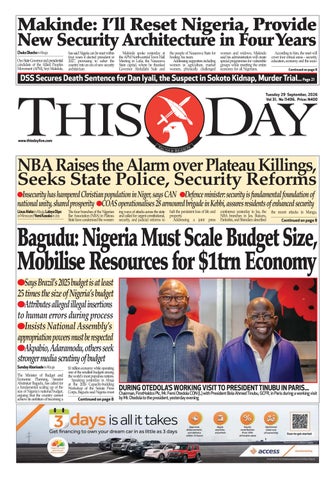
DURING OTEDOLA’S WORKING VISIT TO PRESIDENT TINUBU IN PARIS...
Chairman, FirstHoldco Plc, Mr. Femi Otedola CON (L) with President Bola Ahmed Tinubu, GCFR, in Paris during a working visit by Mr. Otedola to the president, yesterday evening
2
TUESDAY, SEPTEMBER 29, T H I S D AY
GUARANTY TRUST HOLDING COMPANY PLC STATEMENT TO THE NIGERIAN EXCHANGE GROUP AND THE SHAREHOLDERS ON THE EXTRACT OF AUDITED CONSOLIDATED AND SEPARATE FINANCIAL STATEMENTS FOR THE PERIOD ENDED 30 JUNE 2026 3GDÄ!N@QCÄNEÄ#HQDBSNQRÄNEÄ&T@Q@MSXÄ3QTRSÄ'NKCHMFÄ"NLO@MXÄ/KBÄHRÄOKD@RDCÄSNÄOQDRDMSÄSGDÄRTLL@QXÄBNMRNKHC@SDCÄ@MCÄRDO@Q@SDÄÆM@MBH@KÄRS@SDLDMSRÄNEÄ&T@Q@MSXÄ3QTRSÄ'NKCHMFÄ"NLO@MXÄ/KBÄ jSGDÄ"NLO@MXk Ä@MCÄHSRÄRTARHCH@QHDRÄ SNFDSGDQÄjSGDÄ&QNTOk ÄENQÄSGDÄODQHNCÄDMCDCÄ Ä)TMDÄ Ä3GDÄRTLL@QXÄBNMRNKHC@SDCÄ@MCÄRDO@Q@SDÄÆM@MBH@KÄRS@SDLDMSRÄVDQDÄCDQHUDCÄEQNLÄ SGDÄETKKÄBNMRNKHC@SDCÄ@MCÄRDO@Q@SDÄÆM@MBH@KÄRS@SDLDMSRÄNEÄSGDÄ"NLO@MXÄ@MCÄHSRÄRTARHCH@QHDRÄENQÄSGDÄODQHNCÄDMCDCÄ Ä)TMDÄ Ä@MCÄB@MMNSÄADÄDWODBSDCÄSNÄOQNUHCDÄ@ÄETKKÄTMCDQRS@MCHMFÄNEÄSGDÄÆM@MBH@KÄODQENQL@MBD ÄÆM@MBH@KÄONRHSHNMÄ@MCÄÆM@MBHMFÄ@MCÄHMUDRSHMFÄ@BSHUHSHDRÄNEÄSGDÄ"NLO@MXÄ@MCÄSGDÄ&QNTO ÄÄ3GDÄ"NLO@MXiRÄ@TCHSNQÄHRRTDCÄ@MÄTMLNCHÆDCÄNOHMHNMÄNMÄSGDÄETKKÄ BNMRNKHC@SDCÄ@MCÄRDO@Q@SDÄÆM@MBH@KÄRS@SDLDMSRÄENQÄSGDÄODQHNCÄDMCDCÄ Ä)TMDÄ ÄEQNLÄVGHBGÄSGDRDÄRTLL@QXÄBNMRNKHC@SDCÄ@MCÄRDO@Q@SDÄÆM@MBH@KÄRS@SDLDMSRÄVDQDÄCDQHUDC ÄÄ3GDÄ"NLO@MXiRÄ@TCHSNQÄL@CDÄ@ÄQDONQSÄTMCDQÄ2DBSHNMÄ ÄNEÄSGDÄ"NLO@MHDRÄ@MCÄ KKHDCÄ,@SSDQRÄ BSÄ ÄÄ3GDÄETKKÄBNMRNKHC@SDCÄ@MCÄRDO@Q@SDÄÆM@MBH@KÄRS@SDLDMSRÄEQNLÄVGHBGÄSGDRDÄRTLL@QXÄ BNMRNKHC@SDCÄ@MCÄRDO@Q@SDÄÆM@MBH@KÄRS@SDLDMSRÄVDQDÄCDQHUDCÄVNTKCÄADÄCDKHUDQDCÄSNÄSGDÄ"NQONQ@SDÄ EE@HQRÄ"NLLHRRHNMÄVHSGHMÄSGDÄQDPTHQDCÄCD@CKHMD Ä MÄDKDBSQNMHBÄBNOXÄNEÄSGDÄETKKÄBNMRNKHC@SDCÄ@MCÄRDO@Q@SDÄÆM@MBH@KÄRS@SDLDMSRÄB@MÄADÄNAS@HMDCÄ@SÄVVV FSBNOKB BNL Ä Ä Ä Ä Ä Ä Ä
Summary Consolidated and Separate Statements of Financial Position as at 30 June 2026
Group Jun 2026
Group Dec-2025
Company Jun 2026
Company Dec-2025
₦'million
₦'million
₦'million
₦'million
ASSETS "@RGÄ@MCÄA@MJÄA@K@MBDR
Summary Consolidated and Separate Income Statements for the period ended 30 June 2026 Interest income calculated using effective interest rate (MSDQDRSÄHMBNLDÄNMÄÆM@MBH@KÄ@RRDSRÄ@SÄE@HQÄU@KTDÄSGQNTFGÄOQNÆSÄ or loss
Group Jun-2026
Group Jun-2025
Company Jun-2026
Company Jun-2025
₦'million
₦'million
₦'million
₦'million
854,463
798,427
65
-
18,928
13,933
-
-
(223,787)
(180,122)
-
-
4,736,762
5,456,595
12,160
14,026
238,202
166,889
-
-
3,623
204
-
-
446,561
13,608
-
-
mÄ%@HQÄU@KTDÄSGQNTFGÄ.SGDQÄ"NLOQDGDMRHUDÄ(MBNLD
2,987,382
3,375,161
-
-
%DDÄ@MCÄBNLLHRRHNMÄDWODMRD
(19,406)
(16,287)
-
-
mÄ'DKCÄ@SÄ@LNQSHRDCÄBNRS
3,321,304
2,151,946
-
-
Net fee and commission income
123,033
135,174
3,432
1,656
109,520
119,009
-
-
55
84
-
-
-DSÄF@HMRÄNMÄÆM@MBH@KÄHMRSQTLDMSRÄGDKCÄ@SÄE@HQÄU@KTDÄSGQNTFGÄ OQNÆSÄNQÄKNRR
47,305
37,920
-
-
.SGDQÄHMBNLD
44,348
70,923
36,448
34,204
%HM@MBH@KÄ@RRDSRÄ@SÄE@HQÄU@KTDÄSGQNTFGÄOQNÆSÄNQÄKNRR #DQHU@SHUDÄÆM@MBH@KÄ@RRDSR Investment securities:
-
mÄ%@HQÄU@KTDÄSGQNTFGÄ/QNÆSÄNQÄ+NRR
RRDSRÄOKDCFDCÄ@RÄBNKK@SDQ@K +N@MRÄ@MCÄ@CU@MBDRÄSNÄA@MJR Loans and advances to customers
3,147,199
3,132,216
-
-
1DRSQHBSDCÄCDONRHSRÄ@MCÄNSGDQÄ@RRDSR
3,047,505
2,736,489
37,636
428,696
-
-
528,807
528,807
/QNODQSXÄ@MCÄDPTHOLDMSÄ@MCÄ1HFGSÄNEÄTRDÄ@RRDSR
435,983
465,569
886
969
(MS@MFHAKDÄ@RRDSR
119,469
110,696
-
-
Deferred tax assets
22,536
32,686
-
-
18,616,101
17,761,152
579,489
(MUDRSLDMSÄHMÄRTARHCH@QHDRÄ
TOTAL ASSETS
(MSDQDRSÄDWODMRD Net interest income
649,604
632,238
65
-
+N@MÄHLO@HQLDMSÄBG@QFDR
(18,724)
(54,971)
-
-
Net interest income after loan impairment charges
630,880
577,267
65
-
Fee and commission income
142,439
151,461
3,432
1,656
-DSÄHLO@HQLDMSÄQDUDQR@KÄNMÄNSGDQÄÆM@MBH@KÄ@RRDSR
34,855
38,107
-
-
/DQRNMMDKÄDWODMRDR
(56,969)
(54,399)
(873)
(785)
#DOQDBH@SHNMÄ@MCÄ@LNQSHR@SHNM
(54,306)
(38,292)
(83)
(83)
.SGDQÄNODQ@SHMFÄDWODMRDR
(166,112)
(165,799)
(1,881)
(209) 34,783
Profit before income tax expense
603,034
600,901
37,108
(MBNLDÄS@WÄDWODMRD
(188,848)
(151,890)
(238)
(271)
972,498
Profit for the period
414,186
449,011
36,870
34,512
408,541
441,295
36,870
34,512
5,645
7,716
-
-
414,186
449,011
36,870
34,512
LIABILITIES #DONRHSRÄEQNLÄA@MJR #DONRHSRÄEQNLÄBTRSNLDQR %HM@MBH@KÄKH@AHKHSHDRÄ@SÄE@HQÄU@KTDÄSGQNTFGÄOQNÆSÄNQÄKNRR #DQHU@SHUDÄÆM@MBH@KÄKH@AHKHSHDR
226,162
327,035
-
-
Profit attributable to:
13,967,544
12,547,005
-
-
$PTHSXÄGNKCDQRÄNEÄSGDÄO@QDMSÄDMSHSX
64,162
81,104
-
-
Non-controlling interests
499
1
-
-
.SGDQÄKH@AHKHSHDR
815,178
946,714
69
-
"TQQDMSÄHMBNLDÄS@WÄKH@AHKHSHDR
131,161
218,610
31
142
.SGDQÄANQQNVDCÄETMCR
15,606
82,236
-
-
– Basic
11.18
13.59
1.01
1.01
#DEDQQDCÄS@WÄKH@AHKHSHDR
80,518
147,067
130
136
– Diluted
11.18
13.59
1.01
1.01
15,300,830
14,349,772
230
278
2G@QDÄB@OHS@K
18,275
18,275
18,275
18,275
Group Jun-2026
Group Jun-2025
Company Jun-2026
Company Jun-2025
2G@QDÄOQDLHTL
500,605
500,605
500,605
500,605
₦'million
₦'million
₦'million
₦'million
(33,579)
-
-
414,186
449,011
36,870
34,512
1,718,424
60,379
453,340
2
50
-
-
TOTAL LIABILITIES CAPITAL AND RESERVES
3QD@RTQXÄRG@QDR Retained earnings
1,615,647
1DFTK@SNQXÄQHRJÄQDRDQUDR
85,424
74,876
-
-
2S@STSNQXÄQDRDQUDR
835,825
764,887
-
-
.SGDQÄBNLONMDMSRÄNEÄDPTHSX
229,432
334,156
-
-
3,285,208
3,377,644
579,259
972,220
30,063
33,736
-
-
Capital and reserves attributable to equity holders of the parent entity Non-controlling interests in equity TOTAL EQUITY
TOTAL LIABILITIES AND EQUITY
Earnings per share for the profit attributable to the equity holders of the company entity during the period (expressed in naira per share):
Summary Consolidated and Separate Statements of other comprehensive income for the period ended 30 June 2026
Profit for the period Other comprehensive income not to be reclassified to profit or loss in subsequent periods: -DSÄBG@MFDÄHMÄE@HQÄU@KTDÄNEÄDPTHSXÄHMUDRSLDMSRÄ%5."(
Other comprehensive income to be reclassified to profit or loss in subsequent periods: Ä%NQDHFMÄBTQQDMBXÄSQ@MRK@SHNMÄCHEEDQDMBDRÄENQÄENQDHFMÄNODQ@SHNMR
(131,847)
119,521
-
-
- Income tax relating to foreign currency translation differences ENQÄENQDHFMÄNODQ@SHNMR
39,554
(35,856)
-
-
3,315,271
3,411,380
579,259
972,220
Ä-DSÄBG@MFDÄHMÄE@HQÄU@KTDÄNEÄNSGDQÄÆM@MBH@KÄ@RRDSRÄ%5."(
(23,341)
10,897
-
-
18,616,101
17,761,152
579,489
972,498
Ä(MBNLDÄS@WÄQDK@SHMFÄSNÄBG@MFDÄHMÄE@HQÄU@KTDÄNEÄNSGDQÄÆM@MBH@KÄ @RRDSRÄ%5."(
7,003
(3,269)
-
-
Other comprehensive income for the period, net of tax
(108,629)
91,343
-
-
Total comprehensive income for the period
305,557
540,354
36,870
34,512
303,817
526,171
36,870
34,512
1,740
14,183
-
-
305,557
540,354
36,870
34,512
Jun-2026
Jun-2025
Jun-2026
Jun-2025
1,107,483
1,072,664
39,945
35,860
Jun-2026
Dec-2025
Jun-2026
Dec-2025
148,966
160,465
-
-
4.63%
4.97%
-
-
INDEPENDENT AUDITOR’S REPORT ON THE SUMMARY CONSOLIDATED AND SEPARATE FINANCIAL STATEMENTS
Total comprehensive income attributable to: $PTHSXÄGNKCDQRÄNEÄSGDÄO@QDMSÄDMSHSX Non-controlling interests Total comprehensive income for the period
To the members of Guaranty Trust Holding Company Plc Opinion 3GDÄ RTLL@QXÄ BNMRNKHC@SDCÄ @MCÄ RDO@Q@SDÄ ÆM@MBH@KÄ RS@SDLDMSRÄ NEÄ &T@Q@MSXÄ 3QTRSÄ 'NKCHMFÄ "NLO@MXÄ /KBÄ jSGDÄ "NLO@MXk Ä @MCÄ HSRÄ RTARHCH@QHDRÄ SNFDSGDQÄ jSGDÄ &QNTOk Ä VGHBGÄ BNLOQHRDÄ SGDÄ RTLL@QXÄ BNMRNKHC@SDCÄ@MCÄRDO@Q@SDÄRS@SDLDMSRÄNEÄÆM@MBH@KÄONRHSHNMÄ@RÄ@SÄ Ä )TMDÄ Ä Ä @MCÄ SGDÄ RTLL@QXÄ BNMRNKHC@SDCÄ @MCÄ RDO@Q@SDÄ HMBNLDÄ RS@SDLDMSR Ä @MCÄ RTLL@QXÄ BNMRNKHC@SDCÄ @MCÄ RDO@Q@SDÄ RS@SDLDMSRÄ NEÄ NSGDQÄBNLOQDGDMRHUDÄHMBNLDÄENQÄSGDÄODQHNCÄSGDMÄDMCDC Ä@QDÄCDQHUDCÄ EQNLÄ SGDÄ @TCHSDCÄ BNMRNKHC@SDCÄ @MCÄ RDO@Q@SDÄ ÆM@MBH@KÄ RS@SDLDMSRÄ NEÄ &T@Q@MSXÄ 3QTRSÄ 'NKCHMFÄ "NLO@MXÄ /KBÄ @MCÄ HSRÄ RTARHCH@QHDRÄ ENQÄ SGDÄ ODQHNCÄDMCDCÄ Ä)TMDÄ (MÄ NTQÄ NOHMHNM Ä SGDÄ @BBNLO@MXHMFÄ RTLL@QXÄ BNMRNKHC@SDCÄ @MCÄ RDO@Q@SDÄÆM@MBH@KÄRS@SDLDMSRÄ@QDÄBNMRHRSDMS ÄHMÄ@KKÄL@SDQH@KÄQDRODBSR Ä VHSGÄSGDÄ@TCHSDCÄBNMRNKHC@SDCÄ@MCÄRDO@Q@SDÄÆM@MBH@KÄRS@SDLDMSR ÄHMÄ @BBNQC@MBDÄVHSGÄSGDÄOQNUHRHNMRÄNEÄSGDÄ"NLO@MHDRÄ@MCÄ KKHDCÄ,@SSDQRÄ BSÄ Ä@MCÄSGDÄ!@MJRÄ@MCÄ.SGDQÄ%HM@MBH@KÄ(MRSHSTSHNMRÄ BSÄ !.%( Ä 2020. Summary Consolidated and Separate Financial Statements 3GDÄRTLL@QXÄBNMRNKHC@SDCÄ@MCÄRDO@Q@SDÄÆM@MBH@KÄRS@SDLDMSRÄCNÄMNSÄ BNMS@HMÄ@KKÄSGDÄCHRBKNRTQDRÄQDPTHQDCÄAXÄ(%12Ä BBNTMSHMFÄ2S@MC@QCRÄ@RÄ HRRTDCÄAXÄSGDÄ(MSDQM@SHNM@KÄ BBNTMSHMFÄ2S@MC@QCRÄ!N@QC ÄSGDÄOQNUHRHNMRÄ NEÄSGDÄ"NLO@MHDRÄ@MCÄ KKHDCÄ,@SSDQRÄ BSÄ ÄSGDÄ!@MJRÄ@MCÄ.SGDQÄ %HM@MBH@KÄ (MRSHSTSHNMRÄ BSÄ !.%( Ä Ä @MCÄ BHQBTK@QRÄ HRRTDCÄ AXÄ SGDÄ "DMSQ@KÄ!@MJÄNEÄ-HFDQH@Ä "!- Ä@MCÄHMÄBNLOKH@MBDÄVHSGÄSGDÄ%HM@MBH@KÄ 1DONQSHMFÄ"NTMBHKÄNEÄ-HFDQH@Ä LDMCLDMS Ä BS Ä Ä@OOKHDCÄHMÄSGDÄ OQDO@Q@SHNMÄ NEÄ SGDÄ BNMRNKHC@SDCÄ @MCÄ RDO@Q@SDÄ ÆM@MBH@KÄ RS@SDLDMSRÄ NEÄ SGDÄ &QNTOÄ @MCÄ SGDÄ "NLO@MX Ä 3GDÄ RTLL@QXÄ BNMRNKHC@SDCÄ @MCÄ RDO@Q@SDÄÆM@MBH@KÄRS@SDLDMSRÄRGNTKCÄADÄQD@CÄHMÄBNMITMBSHNMÄVHSGÄSGDÄ @TCHSDCÄBNMRNKHC@SDCÄ@MCÄRDO@Q@SDÄÆM@MBH@KÄRS@SDLDMSR Ä1D@CHMFÄSGDÄ RTLL@QXÄ BNMRNKHC@SDCÄ @MCÄ RDO@Q@SDÄ ÆM@MBH@KÄ RS@SDLDMSRÄ @MCÄ SGDÄ @TCHSNQiRÄ QDONQSÄ SGDQDNM Ä SGDQDENQD Ä HRÄ MNSÄ @Ä RTARSHSTSDÄ ENQÄ QD@CHMFÄ SGDÄ@TCHSDCÄBNMRNKHC@SDCÄ@MCÄRDO@Q@SDÄÆM@MBH@KÄRS@SDLDMSRÄ@MCÄSGDÄ @TCHSNQiRÄQDONQSÄSGDQDNM The Audited Consolidated and Separate Financial Statements and Our Report Thereon 6DÄ DWOQDRRDCÄ @MÄ TMLNCHÆDCÄ NOHMHNMÄ NMÄ SGDÄ @TCHSDCÄ BNMRNKHC@SDCÄ @MCÄRDO@Q@SDÄÆM@MBH@KÄRS@SDLDMSRÄHMÄNTQÄQDONQSÄC@SDCÄ Ä2DOSDLADQÄ 2026. .TQÄ QDONQSÄ @KRNÄ HMBKTCDRÄ SGDÄ BNLLTMHB@SHNMÄ NEÄ JDXÄ @TCHSÄ L@SSDQRÄ VGHBGÄCHRBTRRDCÄSGDÄHLO@HQLDMSÄNEÄKN@MRÄ@MCÄ@CU@MBDRÄSNÄBTRSNLDQR Ä *DXÄ @TCHSÄ L@SSDQRÄ @QDÄ SGNRDÄ L@SSDQRÄ SG@S Ä HMÄ NTQÄ OQNEDRRHNM@KÄ ITCFLDMS ÄVDQDÄNEÄLNRSÄRHFMHÆB@MBDÄHMÄNTQÄ@TCHSÄNEÄSGDÄBNMRNKHC@SDCÄ @MCÄRDO@Q@SDÄÆM@MBH@KÄRS@SDLDMSRÄENQÄSGDÄBTQQDMSÄODQHNC Directors’ Responsibility for the Summary Consolidated and Separate Financial Statements 3GDÄ#HQDBSNQRÄ@QDÄQDRONMRHAKDÄENQÄSGDÄOQDO@Q@SHNMÄ@MCÄE@HQÄOQDRDMS@SHNMÄ NEÄSGDRDÄRTLL@QXÄBNMRNKHC@SDCÄ@MCÄRDO@Q@SDÄÆM@MBH@KÄRS@SDLDMSRÄHMÄ @BBNQC@MBDÄVHSGÄSGDÄOQNUHRHNMRÄNEÄSGDÄ"NLO@MHDRÄ@MCÄ KKHDCÄ,@SSDQRÄ BSÄ Ä@MCÄSGDÄ!@MJRÄ@MCÄ.SGDQÄ%HM@MBH@KÄ(MRSHSTSHNMRÄ BSÄ !.%( Ä 2020. Auditor’s Responsibility for the Summary Consolidated and Separate Financial Statements .TQÄQDRONMRHAHKHSXÄHRÄSNÄDWOQDRRÄ@MÄNOHMHNMÄNMÄVGDSGDQÄSGDÄRTLL@QXÄ
BNMRNKHC@SDCÄ @MCÄ RDO@Q@SDÄ ÆM@MBH@KÄ RS@SDLDMSRÄ @QDÄ BNMRHRSDMS Ä HMÄ @KKÄ L@SDQH@KÄ QDRODBSR Ä VHSGÄ SGDÄ @TCHSDCÄ BNMRNKHC@SDCÄ @MCÄ RDO@Q@SDÄ ÆM@MBH@KÄRS@SDLDMSRÄA@RDCÄNMÄNTQÄOQNBDCTQDR ÄVGHBGÄVDQDÄBNMCTBSDCÄ HMÄ @BBNQC@MBDÄ VHSGÄ (MSDQM@SHNM@KÄ 2S@MC@QCRÄ NMÄ TCHSHMFÄ (2 Ä Ä 1DUHRDC Ä$MF@FDLDMSÄSNÄ1DONQSÄNMÄ2TLL@QXÄ%HM@MBH@KÄ2S@SDLDMSR Report on Other Legal and Regulatory Requirements "NLOKH@MBDÄVHSGÄSGDÄQDPTHQDLDMSÄNEÄSGDÄ%HESGÄ2BGDCTKDÄNEÄSGD "NLO@MHDRÄ@MCÄ KKHDCÄ,@SSDQRÄ BSÄ Ä Ä Ä
Ä
H Ä6DÄG@UDÄNAS@HMDCÄ@KKÄSGDÄHMENQL@SHNMÄ@MCÄDWOK@M@SHNMR ÄVGHBGÄ SNÄSGDÄADRSÄNEÄNTQÄJMNVKDCFDÄ@MCÄADKHDE ÄVDQDÄMDBDRR@QXÄENQÄSGDÄ OTQONRDÄNEÄNTQÄ@TCHS HH Ä (MÄ NTQÄ NOHMHNM Ä OQNODQÄ ANNJRÄ NEÄ @BBNTMSÄ G@UDÄ ADDMÄ JDOSÄ AXÄ SGDÄ &QNTOÄ @MCÄ SGDÄ "NLO@MX Ä HMÄ RNÄ E@QÄ @RÄ HSÄ @OOD@QRÄ EQNLÄ NTQÄ DW@LHM@SHNMÄNEÄSGNRDÄANNJR HHH Ä3GDÄBNMRNKHC@SDCÄ@MCÄRDO@Q@SDÄRS@SDLDMSRÄNEÄÆM@MBH@KÄONRHSHNMÄ @MCÄSGDÄBNMRNKHC@SDCÄ@MCÄRDO@Q@SDÄHMBNLDÄRS@SDLDMSR Ä@MCÄSGDÄ BNMRNKHC@SDCÄ @MCÄ RDO@Q@SDÄ RS@SDLDMSRÄ NEÄ NSGDQÄ BNLOQDGDMRHUDÄ HMBNLDÄ@QDÄHMÄ@FQDDLDMSÄVHSGÄSGDÄANNJRÄNEÄ@BBNTMS HU Ä (MÄ NTQÄ NOHMHNM Ä SGDÄ BNMRNKHC@SDCÄ @MCÄ RDO@Q@SDÄ ÆM@MBH@KÄ RS@SDLDMSRÄG@UDÄADDMÄOQDO@QDCÄHMÄ@BBNQC@MBDÄVHSGÄSGDÄOQNUHRHNMRÄ NEÄ SGDÄ "NLO@MHDRÄ @MCÄ KKHDCÄ ,@SSDQRÄ BSÄ " , Ä Ä RNÄ @RÄ SNÄFHUDÄ@ÄSQTDÄ@MCÄE@HQÄUHDVÄNEÄSGDÄRS@SDÄNEÄ@EE@HQRÄ@MCÄÆM@MBH@KÄ ODQENQL@MBDÄNEÄSGDÄ"NLO@MXÄ@MCÄHSRÄRTARHCH@QHDR
"NLOKH@MBDÄVHSGÄSGDÄ!@MJRÄ@MCÄ.SGDQÄ%HM@MBH@KÄ(MRSHSTSHNMRÄ BS Ä @MCÄBHQBTK@QRÄHRRTDCÄAXÄ"DMSQ@KÄ!@MJÄNEÄ-HFDQH@Ä Ä Ä
Ä
H Ä 1DK@SDCÄ O@QSXÄ SQ@MR@BSHNMRÄ @MCÄ A@K@MBDRÄ @QDÄ CHRBKNRDCÄ HMÄ -NSDÄ Ä SNÄ SGDÄ BNMRNKHC@SDCÄ @MCÄ RDO@Q@SDÄ ÆM@MBH@KÄ RS@SDLDMSRÄ HMÄ BNLOKH@MBDÄVHSGÄ"DMSQ@KÄ!@MJÄNEÄ-HFDQH@ÄBHQBTK@QÄ-N Ä!2# HH Ä 1DSTQMRÄ NMÄ BTRSNLDQRiÄ BNLOK@HMSRÄ @QDÄ CHRBKNRDCÄ TMCDQÄ "NLOK@HMSRÄ @MCÄ %DDCA@BJÄ @MCÄ TMCDQÄ .SGDQÄ (MENQL@SHNM Ä BSHUHSHDRÄ NEÄ "@QCÄ .ODQ@SHNMRÄ 2DBSHNMÄ Ä 3XODRÄ NEÄ "NLOK@HMSRÄ @MCÄ1DLDCH@KÄ,D@RTQDRÄ3@JDMÄHMÄBNLOKH@MBDÄVHSGÄ"DMSQ@KÄ!@MJÄ NEÄ-HFDQH@ÄBHQBTK@QÄ-N Ä/#1 #(1 "(1 HHH Ä RÄRS@SDCÄHMÄ-NSDÄ ÄSNÄSGDÄBNMRNKHC@SDCÄ@MCÄRDO@Q@SDÄÆM@MBH@KÄ RS@SDLDMSR Ä &T@Q@MSXÄ 3QTRSÄ !@MJÄ +HLHSDCÄ &QNTOÄ O@HCÄ ODM@KSHDRÄ HMÄSGDÄRTLÄNEÄ- ÄLHKKHNMÄNMKXÄHMÄQDRODBSÄNEÄBNMSQ@UDMSHNMRÄNEÄ BDQS@HMÄRDBSHNMÄNEÄSGDÄ!@MJRÄ@MCÄ.SGDQÄ%HM@MBH@KÄ(MRSHSTSHNMRÄ BSÄ ÄBHQBTK@QRÄHRRTDCÄAXÄSGDÄ"DMSQ@KÄ!@MJÄNEÄ-HFDQH@Ä@MCÄNSGDQÄ QDFTK@SNQXÄONKHBHDRÄCTQHMFÄSGDÄODQHNCÄDMCDCÄ Ä)TMDÄ
Olumide Oshikoya %1" /1. (" - ÄÄ For Ernst & Young Lagos, Nigeria Ä2DOSDLADQÄ
Gross Earnings
Total impaired Loans and Advances (N'million) Total impaired Loans and Advances to Gross Loans and Advances (%)
Reports on the Resolution of Customers’ Complaints !DKNVÄHRÄ@ÄAQD@JCNVMÄNEÄ"NLOK@HMSRÄQDBDHUDCÄ@MCÄQDRNKUDCÄAXÄ&T@Q@MSXÄ3QTRSÄ!@MJÄ+HLHSDCÄCTQHMFÄSGDÄODQHNCÄDMCDCÄÄ Ä)TMDÄ ÄOTQRT@MSÄSNÄ"!-ÄBHQBTK@QÄC@SDCÄ Ä TFTRSÄ Description
Number
Ä
Amount Claimed
Amount Refunded
(₦'000)
(₦i
489
18,547
-
1DBDHUDCÄ"NLOK@HMSR
159,696
4,210,067
-
1DRNKUDCÄ"NLOK@HMSR
159,868
4,217,756
79,850
317
10,858
-
/DMCHMFÄ"NLOK@HMSRÄAQNTFGSÄENQV@QCÄEQNLÄOQHNQÄODQHNC
Unresolved Complaints pending with the Bank carried forward
The breakdown of penalties paid by the GTBank Nigeria during the period ended 30 June 2026 are as follows:
Nigeria
Amount (₦i
/DM@KSXÄO@HCÄHMÄQDRODBSÄNEÄ Ä"!-iRÄ%NQDHFMÄ$WBG@MFDÄ$W@LHM@SHNMÄNMÄSGDÄ!@MJ
120,000
/DM@KSXÄO@HCÄHMÄQDRODBSÄNEÄ Ä"!-iRÄ1HRJÄ RRDSÄ$W@LHM@SHNMÄNMÄSGDÄ!@MJ
30,000
Total penalties paid during the period
150,000
THE FULL CONSOLIDATED AND SEPARATE FINANCIAL STATEMENTS WERE APPROVED BY THE BOARD OF DIRECTORS ON 28 JULY 2026 AND SIGNED ON ITS BEHALF BY:
FRC/2013/PRO/ICAN/004/00000004318
FRC/2013/PRO/DIR/003/00000001319
Banji Adeniyi
Cathy Echeozo
FRC/2013/PRO/DIR/003/00000001782
Segun Agbaje
%PMSN !FGCD $GL?LAG?J -DjACP
,ML #VCASRGTC "GPCARMP
%PMSN !FGCD #VCASRGTC -DjACP
TUESDAY, SEPTEMBER 29, T H I S D AY
3
4
TUESDAY, SEPTEMBER 29, T H I S D AY
5
THISDAY • TUESDAY, SEPTEMBER 29, 2026
Group News Editor: Goddy Egene Email: Goddy.egene@thisdaylive.com, 0803 350 6821, 0807 401 0580
NEWS
ENERGY SYMPOSIUM 2026 IN ABIDJAN...
L-R: Head, Reinsurance, Special Risk & Global Client Services, Leadway Assurance, Salewa Osakwe; Executive Director, Technical & Operations, Leadway Assurance, Olufunmilayo Amanwa; Managing Director/Chief Executive Officer, Leadway Assurance, Gboyega Lesi; Team Lead, Facultative Placement & Special Risks, Leadway Assurance, Mojisola Aladeojebi; and Head of West & Central Africa, Willis Towers Watson, N’Gnineman Coulibaly at the Willis West and Central Africa Energy Symposium 2026 in Abidjan, Cote d’Ivoire... last week
Dangote, Producers Task FG to Boost Oil Output, as Local Refining Surge Exposes Crude Supply Gap Nigeria must hit 3m bpd by 2030 or risk stranded refineries, operators warn CORAN demands Naira-for-Crude institutionalisation, 10-point plan to link upstream to downstream Peter Uzoho Billionaire investor and Africa’s richest man, Aliko Dangoe, oil producers, and domestic refinery owners in Nigeria have asked the federal government to urgently scale up crude oil production, enforce transparent crude supply rules, and fix pricing and logistics bottlenecks that threaten to stall the country’s refining boom. The stakeholders made the call yesterday in Lagos at the opening of the third Nigeria Oil Refining Summit (NORS) 2026, organised by Crude Oil Refinery Owners Association of Nigeria (CORAN), with the theme, “Refining for Value: Linking Upstream Supply to Downstream Demand.” The summit brought together the country’s largest refiner, indigenous and international producers, regulators, and financiers at a time when Nigeria had reversed a decades-long dependence on imported fuel but was now confronting a new constraint: finding enough crude to feed the refineries it had built. Speaking at the event, Dangote, who was represented by the group’s Chief Economist, Dr. Hassan Mahmud, said the group’s total
refining capacity will reach 2.1 million barrels per day (bpd) across Africa with the upcoming 650,000bpd refinery (scalable to 700,000bpd) in Lamu, Kenya, and the existing 700 bpd in Nigeria, being expanded to 1.4 million bpd. He stated, “We are going to Lamu in Kenya tomorrow to do the ground-breaking for the new refinery, which is also 650,000 barrels to be scaled to 700,000 barrels. So if you combine the existing 650,000 bpd refinery... with the extension, another 700,000 making it 1.4 and another 700,000 in the East African refinery, Dangote alone is doing 2.1 million barrels a day.” Dangote warned that the scale of that ambition had exposed a fundamental supply gap. He said at the current production, Nigeria’s crude supply alone could not feed the Dangote refinery alone. “So the need for expanding the exploration of upstream side of the industry is extremely critical,” he said. “The market is there and so we should explore the opportunities,” he added. Dangote said building a competitive refining industry was not just about building plants. He said it
required a full value chain from crude production to transportation, storage, refining, distribution and export. He warned that weakness in any link affected the competitiveness of the whole. Dangote identified five fundamentals, including reliable and competitive access to crude, a truly competitive downstream market, stable and predictable policy, shared logistics infrastructure, and an export-oriented vision. On crude access, Dangote acknowledged progress under the Domestic Crude Supply Obligation (DCSO) provided for in the Petroleum Industry Act (PIA).
A clean-energy company, Energy Ventures B.V., has secured the federal government’s support to convert gas currently being flared in the Niger Delta into electricity for about 80,000 homes and business units across the region. The company disclosed this yesterday in Abuja during a briefing attended by its Chief Executive Officer, Herbert Okibe; Chief Financial Officer, Govert Rietema; and Chief Commercial Officer, Yvonne Te Wierik-Chioke. In a statement made available to journalists in Port Harcourt yesterday, Okibe said the company had engaged
officials of the Bureau of Public Enterprises (BPE) and Ministry of Power, with both institutions expressing support for the proposed project. He said the initiative, which already had a pilot project in the Agbada oil field in Rivers State, could provide electricity to about 80,000 connections, potentially benefiting roughly 500,000 people. According to him, the project would also help address the environmental effect of more than six decades of gas flaring in the Niger Delta by converting wasted gas into electricity. Okibe said, “The project will utilise modularised ‘FlareOut’ units designed by FB Group in the Netherlands.
commercial terms can reliably obtain appropriate crude without unnecessary uncertainties. “This is not a call for subsidised crude. It is a call for predictability, transparency, and commercially workable arrangement between producers and refiners.” He added that competition must be on a level playing field where imported and locally refined products compete under equivalent regulatory, quality, tax, and commercial regimes. According to him, “No refinery should survive simply because government protects it. Equally, no domestic refinery should be disadvantaged by a market structure
that inadvertently makes import more attractive than local production.” Chairman of Oil Producers Trade Section (OPTS) and Managing Director of TotalEnergies EP Nigeria Ltd, Mr. Matthieu Bouyer, said Nigeria’s oil and gas industry was in a genuinely encouraging period driven by sustained reform. Represented by Executive Director of OPTS, Mr. Gwueke Ajaifia, Bouyer said PIA implementation, recent executive orders, and renewed licensing had revived offshore investment, unlocking over $10 billion in new upstream investment and a series of Final Investment Decisions (FIDs) over the past year.
At UNGA 81: NGX Woos Investors, Flaunts Nigeria’s Improving Risk Profile Ndubuisi Francis in Abuja The Nigerian Exchange Group (NGX) has stated that Nigeria’s country risk profile is considerably lower than it was three years ago while returns on investment available remain some of the highest in the
Energy Ventures Gets FG Backing to Convert Niger Delta Gas Flares to Power Blessing Ibunge in Port Harcourt
Referencing the Nigerian Upstream Petroleum Regulatory Commission (NUPRC) data, he said about 53.7 million barrels were supplied to domestic refineries in Q2 2026, representing 97.4 percent compliance, while total crude and condensate production reached about 1.7 million bpd as of June 2026, its highest in several years. He added that domestic refinery receipts rose to about 683,000 bpd in August 2026. Dangote said, “We must consolidate this progress. Nigeria should reach a point where a refinery located in Nigeria and ready to purchase crude on competitive
These units will be digitally connected to allow Original Equipment Manufacturers to perform remote diagnostics and root cause analysis on gas engines.” He added that the company planned to deploy smart meters designed to prevent tampering while providing customers with transparent electricity consumption data through a mobile application. Okibe said despite the history of insecurity in parts of the Niger Delta, the project had recorded strong community cooperation following extensive customer enumeration and engagements with traditional rulers, youths, and local electricity committees.
world and sustainable. The NGX Chairman, Dr. Umaru Kwairanga stated this while marketing the country’s enormous investment potential to the global audience at the Nigeria Investment Forum held on the sidelines of the 2026 United Nations General Assembly (UNGA 81) in New York, United States. Kwairanga said the theme of the event spoke directly to one of the defining questions for Nigeria and the wider continent - how to connect global capital more effectively with the opportunities emerging across economies. According to him, for Nigeria, the answer was beyond attracting capital, but requires creating the conditions that allow capital to enter efficiently, support productive enterprise, generate sustainable returns and contribute meaningfully to economic development. Kwairanga stated that Nigeria’s abundance of natural resources, whether in crude oil, solid minerals and fertile land and climate suitable for large scale agriculture combined with its large, young hardworking population make it one of the 21st century’s economic growth engines.
He noted that the reforms introduced by the federal government, including fuel subsidy removal, discontinuing parallel exchange rate regimes, sensible monetary policy and a reformed tax regime have had positive impact on the country’s macros economic growth and the business environment for companies, both big and small. “That has had a knock-on effect on the Nigerian capital market which has seen double digit growth every year since 2023,” Kwairanga said. He noted that the NGX sees itself as part of a broader national ecosystem for capital formation and economic growth, adding that its role extends beyond providing a marketplace where securities are traded. “ It is about helping to create an environment in which businesses can access long-term financing, investors can participate in credible opportunities and savings can be channeled towards productive sectors of the economy. “Achieving this depends fundamentally on investor confidence. Capital moves towards opportunity, but it remains where investors have confidence in the institutions and
systems supporting their investments. That confidence is built through sound regulation, credible governance, transparency, market integrity and infrastructure that allows transactions to take place efficiently. “In considering where to invest, investors must weigh risk and return. Nigeria’s country risk profile is considerably lower than it was three years ago while the returns available remain some of the highest in the world and they are sustainable. “Nigeria’s abundance of natural resources whether in crude oil, solid minerals and fertile land and climate suitable for large scale agriculture combined with its large, young hardworking population make it one of the twenty first century’s economic growth engines. “The story about Nigeria used to be one of immense potential with rudderless leadership but that is changing. The country’s potential remains huge but it is now underpinned by a stable democracy and a business-minded leadership that is committed to supporting the private sector and welcoming to foreign investment.
6
TUESDAY, SEPTEMBER 29, 2026 • THISDAY
NEWS
AT THE LIGHTHOUSE NETWORK’S LEADERSHIP CONVERSATIONS...
L–R: Ambassador Dr. Maureen Tamuno, Group Managing Director, Abuja Investments Limited; Dr. Nkiru Olumide-Ojo, Founder, The Lighthouse Network; and Mrs. Oyinkansola Badejo-Okusanya, SAN, President, Nigerian Bar Association, at The Lighthouse Network’s Leadership Conversations in Abuja … recently
Shettima: Nigeria’ll Ensure Justice, Fairness in Supporting Candidate for UN Sec. Gen Seat Justifies Tinubu’s reforms in bilateral talks with Queen of Netherlands on deepening ties Returns to Abuja Deji Elumoye in Abuja Vice President Kashim Shettima has assured the international community that Nigeria will stand for equity, justice, and fairness in its support for any candidate seeking the position of the Secretary-General of the United Nations (UN). Shettima, who returned to Abuja yesterday morning, after representing President Bola Tinubu at the 81st Session of the United Nations General Assembly in New York, United States, was quoted to have made
the remarks during an interaction in New York with the Costa Rican candidate for the position of the United Nations Secretary-General, Rebeca Grynspan. The Vice President said the country would also support a candidate who believes in Africa’s aspirations in global affairs, specifically securing positions in key decision-making bodies and promoting multilateralism. He promised to recommend the choice of the Costa Rican diplomat on the basis of Nigeria’s relationship with Latin America and gender inclusion,
among other factors. “Thank you for seeking Nigeria’s perspective for your candidature of the United Nations Secretary-General. Nigeria and Costa Rica share a common historical background connecting both countries and their regions. “We also have a cordial relationship with Latin America, and we do not wish to jeopardize it. Beyond our historical ties and relations rest our interest in conflict prevention, multilateralism, and the peace of our nations,” Shettima noted. He emphasised the need to reform
the global governance architecture, which has changed between 1945 and 2026 but has yet to reflect the integration of Africa, with its huge population estimated at over 1.3 billion people. Earlier in her remarks, Grynspan, who met with Shettima to seek Nigeria’s support for her candidature for the position of UN Secretary-General, said she was eager to lead the UN to implement the needed reforms and changes that most countries, particularly in the Global South, are advocating for.
$364m Start-up Boom: Nigeria Faces New Test Beyond Venture Capital FG, ECOWAS shift focus from funding to production, as 60 West African start-ups enter race for $65,000 award Michael Olugbode in Abuja Nigeria’s start-up ecosystem attracted an impressive $364.1 million in investment in August 2026, although the federal government warned that the bigger challenge was now how to convert the surge in venture capital into productive businesses capable of expanding markets, strengthening exports, and driving industrial growth. The disclosure came as the Economic Community of West African States (ECOWAS) shortlisted 60 start-ups from 1,499 qualified applications for its second Start-up Awards, signalling a regional push to move promising businesses beyond innovation and fundraising into commercial expansion and cross-border markets. The convergence of the two developments places a new question at the centre of Nigeria’s start-up debate: what happens after the money is raised? Minister of State for Industry, Trade and Investment, Senator John Enoh, said the $364.1 million raised by Nigerian start-ups in August demonstrated growing investor confidence in the country’s entrepreneurial ecosystem.
But Enoh stressed that long-term economic value would depend on what businesses did with the capital. Enoh, represented by Permanent Secretary in the ministry, Dr. Chris Isokpunwu, said start-ups must be able to build productive capacity, create quality employment, access new markets, meet applicable standards, and compete effectively over time. He said, “In August 2026 alone, Nigerian start-ups reportedly raised $364.1 million USD. This represents an encouraging indication of the growing interest and capacity of Nigerian entrepreneurs to develop enterprises with regional and global potential.” The government’s emphasis goes beyond the headline value of funding rounds to the capacity of start-ups to become commercially sustainable enterprises linked to manufacturing, value addition, exports, and wider economic activity. That objective is being tied to the federal government’s broader industrialisation programme. Under the Nigeria Industrial Policy 2025, the government is targeting an increase in manufacturing’s
contribution to Gross Domestic Product, from 8.9 per cent to 15 per cent by 2030. Enoh said the Ministry of Industry, Trade and Investment would support national finalists in areas, including agritech and food systems, cleantech and green innovation, as well as industrial skills and development. Through Small and Medium Enterprises Development Agency of Nigeria (SMEDAN) and the
new ECOWAS Academy for Trade and Competitiveness, the government plans to provide practical industrial coaching to businesses emerging from the competition. Commissioner for Economic Affairs and Agriculture at the ECOWAS Commission, Dehpue Yenpea Zuo, said the commission received 6,679 registrations from the 12 ECOWAS member states, with 1,499 applications eventually qualifying for consideration.
“Coming from the global south, I represent the interest and demands of the region. I also have a soft spot for Africa. I know the continent and its aspirations,” the Costa Rican candidate stated. She added that her candidature will promote an agenda that prioritiaes peace above other interests, assuring that Africa’s ambition of being a permanent member of the United Nations Security Council will be given urgent attention and actualised. In a related development, Nigeria and the Netherlands have agreed to deepen collaboration to improve financial inclusion across different levels of the Nigerian society. Under the arrangement, the Netherlands will leverage its expertise and experience in financial health to support programmes implemented by Nigeria on financial inclusion. This was part of resolutions reached during a bilateral meeting between Vice President Kashim Shettima and the Queen of the Netherlands, Queen Maxima, in New York, United States. In his remarks, the Vice President welcomed the offer of support from the government of the Netherlands on improving Nigeria’s drive for financial inclusion, targeting women and vulnerable persons in the society. Shettima said the Netherlands’s focus on financial health and inclusion is not only apt but timely, noting
that for Nigeria, the policy has a direct link to education, security, and poverty reduction. He listed some of the programmes already being implemented by government to boost the policy to include, the conditional cash transfer initiative and schemes in the agricultural sector, emphasising that the results were already yielding fruits across different sectors. The Vice President also disclosed that government policies have positioned some of Africa’s top fintech companies to play critical roles in Nigeria’s journey to achieving financial inclusion for most of its excluded population. While justifying the reforms undertaken by the administration of President Bola Ahmed Tinubu, the Vice President said the reforms are inevitable given the state of the economy at the onset of the administration in 2023. Also speaking on what the Tinubu administration has done to improve the fiscal space, Minister of Finance, Mr. Taiwo Oyedele, said in addition to existing policies on insurance and pensions, the recent announcement by the Central Bank of Nigeria (CBN) would boost access to and cost of credit in Nigeria. He added that financial inclusion is vigorously being pursued by the Tinubu administration to help poor Nigerians succeed and live better lives.
NBA President, Badejo-Okusanya, Tamuno Urge Professionals to Use Influence in Service of Others Sunday Ehigiator President of Nigerian Bar Association (NBA), Mrs. Oyinkansola BadejoOkusanya, SAN, and Group Managing Director of Abuja Investments Limited, Ambassador Dr. Maureen Tamuno, have urged professionals and entrepreneurs to deploy their influence in the service of others, saying lasting leadership is measured by the people it empowers. The two leaders made the call at the Abuja edition of Leadership
Conversations, organised by The Lighthouse Network, with the theme, “Insight, Influence and Impact.” Speaking before an invitationonly audience of professionals and entrepreneurs, Badejo-Okusanya, the 33rd President of NBA, said attaining a title or position should not be regarded as the culmination of a leader’s journey. She said influence was often built long before an individual attained a formal position, stressing that the
more important question is what a leader does with such influence once acquired. Badejo-Okusanya drew from her personal journey, stating that she initially obtained a degree in English before returning to the classroom to study law. Tamuno, in her remarks, said influence had its greatest reach when it was used to serve others. She said leaders were ultimately measured by the people they lifted along the way.
Founder of The Lighthouse Network, Dr. Nkiru OlumideOjo, who hosted the event, said knowledge and position had little value if they were not shared for the benefit of others. Olumide-Ojo stated, “We posed three questions. What is insight if you keep it to yourself? It is wisdom that dies with you. What is influence if it only serves you? It is power with no purpose. What is impact if it ends when you leave the room? It was never impact. It was applause.
7
THISDAY • TUESDAY, SEPTEMBER 29, 2026
NEWS
INTER-DENOMINATIONAL CHURCH SERVICE TO MARK THE 66TH NIGERIA’S INDEPENDENCE CELEBRATION...
L-R: Minister of Defence, Gen Christopher Musa; Secretary to the Government of the Federation, Senator George Akume; representative of the First Lady and wife of Minister of state for Trade and Industry, Mrs. Rachael Eno; President of the Senate, Godswill Akpabio; Wife of the Senate President, Mrs. Unoma Godswill Akpabio; and Senator Osita Izunaso, during the Inter- Denominational PHOTO: SENATE PRESIDENT’S OFFICE Church Service to mark the 66th Nigeria’s Independence Celebration at the National Worship Centre, Abuja on Sunday
Atiku to Tinubu: Account for Past Loans Before Seeking Fresh $1.5bn Says N166.79trn debt burden demands greater transparency Chuks Okocha in Abuja Former Vice President and African Democratic Congress (ADC) presidential candidate, Alhaji Atiku Abubakar, has urged President Bola Tinubu administration to account for previous borrowings before proceeding with the proposed fresh $1.5 billion World Bank financing. In a statement issued yesterday by Director of Strategic Communications of the ADC Presidential Campaign Council, Phrank Shaibu, Atiku questioned the need for additional borrowing amid Nigeria’s rising public debt, which stood at N166.79 trillion as of June 30, 2026, according to the latest figures from the Debt Management Office (DMO). The federal government is currently in discussions with the World Bank on three proposed $500 million facilities, totalling $1.5 billion, to finance programmes covering climate resilience, social protection, and early childhood development. The proposed facilities are at different stages of preparation and approval. Atiku accused the Tinubu administration of demanding continued sacrifices from Nigerians while pursuing additional borrowing. “With public debt at N166.79 trillion, Tinubu is now seeking another $1.5
billion from the World Bank,” he said, insisting that the president should first account for funds already borrowed. Atiku said the government’s economic stewardship had come under scrutiny as Nigerians continued to grapple with the effects of higher living costs. He stated, “Nigerians were promised that painful policies would free resources for development. They have felt the pain. Where is the development?” He also cited a rise in the estimated per-capita share of public debt, saying it has increased from N383,442 three years ago to N716,822 currently, representing an 87 per cent increase. “Tinubu has made today difficult and tomorrow more uncertain,” he said, quoting his own assessment of the administration’s borrowing record. “He cannot keep loading debt onto the country and expect Nigerians to applaud programme titles,” Atiku added. Atiku questioned the gap between the government’s borrowing and the benefits Nigerians were expected to derive from the programmes being financed. He said, “What has this government built? Who has benefited? Why should Nigerians trust him with another term in office?”
He acknowledged that the proposed $500 million facilities for climate resilience, social protection, and early childhood development addressed important national needs. But Atiku said the programme’s objectives should be accompanied by greater transparency on how borrowed funds would be used.
“Worthy programme names cannot stand in for a public account of how previous loans were spent or a clear plan for delivering measurable results,” he said. Atiku called on the federal government to publish details of the projects to be funded, the communities and citizens expected to benefit, targets
professionals in the sector. Balogun said procurement and supply chain management had moved beyond being a back-office function to becoming a strategic driver of value, transparency and accountability in both the public and private sectors. “Procurement and Supply Chain Management is no longer a back office function; rather, it is a strategic driver of value, transparency and accountability in both the public and private sectors of the Nigerian economy,” he said. He urged the inductees to combine technical competence
He also called for measurable outcomes from early childhood development programmes, particularly in nutrition, healthcare, and learning. Atiku challenged the government to reconcile its continued borrowing with its claims of increased revenues and savings arising from the removal of petrol subsidy.
NERC Report: Power Sector Lost N128.4 Billion in Uncollected Revenue in July Discos receive N205.53bn out of N333.94bn energy supplied Grid utilises 86% of available generation capacity Emmanuel Addeh in Abuja Nigeria’s Electricity Distribution Companies (Discos) failed to collect N128.41 billion from the value of energy supplied to their networks in July 2026, highlighting the depth of the liquidity crisis in the power sector, even as grid-connected plants utilised 86 per cent of total capacity in August. According to the latest commercial and operational performance
factsheets released by the Nigerian Electricity Regulatory Commission (NERC), the 11 Discos received energy worth N333.94 billion during the month but billed customers N250.79 billion and collected N205.53 billion. The figures translated to a billing efficiency of 75.10 per cent, a 1.14 percentage point decline from June, while collection efficiency stood at 81.95 per cent. NERC also reported that actual
CIPSMN Inducts 562 Members, Seeks Fight against Procurement Corruption The Chartered Institute of Procurement and Supply Management of Nigeria (CIPSMN) has inducted 562 new graduate professional members, charging them to uphold ethical standards and use their expertise to strengthen accountability, transparency and value for money in Nigeria’s procurement system. Speaking at the Batch ‘B’ 2026 induction ceremony held in Abuja, President of the institute, Sikiru Balogun, said the growing importance of procurement to governance and national development had placed greater responsibility on
for each programme, the terms of the proposed borrowing and disbursement schedules. He said climate resilience projects should have identifiable outcomes, including land restoration, irrigation and flood protection, while social protection programmes should clearly identify beneficiaries and timelines.
with integrity, sound judgment and good conduct, particularly when faced with pressures that could undermine professional standards. According to him, procurement professionals have a critical role to play in ensuring that public projects are delivered within stipulated timelines, while securing value for money and ensuring that goods and services procured are fit for purpose. “In Nigeria today, where procurement plays a critical role in governance and development owing to the huge investment made
by the governments at various levels, your responsibility carries greater weight,” Balogun said. He urged the new professionals to become part of a new generation of specialists committed to strengthening due process, preventing corruption, tackling inefficiency and contributing to national development. Balogun also called on the inductees to contribute to reducing procurement-related corruption through advocacy and strict adherence to the institute’s professional code of ethics, rules and regulations.
collections averaged N97.50 per kilowatt-hour (kWh), significantly below the approved average tariff of N130.15/kWh. Overall revenue recovery efficiency was therefore 74.91 per cent, although this represented a 0.67 percentage point improvement from the previous month. The commercial performance varied widely among the Discos, with Eko Electricity Distribution Company (EKEDC) recording the highest recovery efficiency at 94.67 per cent. EKEDC received energy valued at N43.45 billion, billed N34.17 billion and collected N34.78 billion. Its billing efficiency was 78.63 per cent, while collection efficiency stood at 101.78 per cent. The Disco’s actual collection averaged N133.29/kWh against an allowed tariff of N140.80/ kWh. Port Harcourt Electricity Distribution Company recorded the second-highest recovery efficiency at 84.95 per cent, collecting N18.03 billion from N21.29 billion billed on energy worth N25.86 billion received. Its billing efficiency was 82.34 per cent, collection efficiency 84.69 per cent, while actual collection averaged N105.16/kWh compared with an allowed tariff of N123.80/kWh. Abuja Electricity Distribution Company (AEDC) recorded the
highest billing volume, billing N43.96 billion from N56.77 billion worth of energy received. It collected N35.62 billion, translating to 77.45 per cent billing efficiency and 81.03 per cent collection efficiency. Ikeja Electric received N53.23 billion worth of energy, billed N39.54 billion and collected N34.73 billion. The figures represented billing and collection efficiencies of 74.28 per cent and 87.85 per cent respectively, while recovery efficiency stood at 76.60 per cent. Besides, Ibadan Disco billed N28.33 billion from N40.17 billion worth of energy received and collected N24.35 billion, recording 85.97 per cent collection efficiency and 74.59 per cent recovery efficiency. But the weaker commercial performance was concentrated among some northern Discos. Kaduna Electric recorded the lowest recovery efficiency, receiving N16.33 billion worth of energy but billing only N10.46 billion. It collected N5.22 billion, representing billing efficiency of 64.08 per cent, collection efficiency of 49.95 per cent and recovery efficiency of 39.71 per cent. Besides, Jos Disco received N15.65 billion, billed N10.72 billion and collected N5.65 billion, resulting in 52.70 per cent collection efficiency and 46.27 per cent recovery efficiency.
8
TUESDAY, SEPTEMBER 29, 2026 • THISDAY
EIGHT
IEA: Nigeria, Africa Need $150 Billion to Achieve Universal Electricity Access By 2035 Says only $2.5bn of $15bn currently committed to new connections annually Private finance accounts for just $640m Says 220m people unable to afford electricity service based on current income Emmanuel Addeh in Abuja Nigeria and other African countries need nearly $150 billion in cumulative investment, equivalent to about $15 billion annually, to achieve universal electricity access by 2035, the International Energy Agency (IEA) has said. The agency said almost half of the required annual investment, about $7 billion, would have to go into expanding electricity grids, while another $5 billion would be required annually for mini-grids and $3 billion for solar home systems. The scale of the requirement contrasts sharply with current financing levels, with the IEA’s tracking showing that less than $2.5 billion was committed to
new electricity-access connections in sub-Saharan Africa in 2023, the latest year for which complete data are available. Although the figure was about a quarter higher than the 2019 level, it remains substantially below what would be required to achieve universal access by 2035, according to the agency. The IEA said financing was also heavily dependent on public sources, with international public finance providing $1.8 billion in 2023, compared with just $640 million from private finance, representing less than 30 per cent of total commitments. It said the challenge was particularly acute because electricity-access projects often operate on tight profit margins, while low household
incomes constrain the ability of consumers to pay for connections and electricity services. The agency stated that its ACCESS scenario, designed to achieve universal electricity access by 2035, envisages private investment accounting for roughly 45 per cent of total spending, requiring a major increase from current levels. It also estimates that concessional finance would need to rise to about $6.2 billion annually, nearly six times the annual average recorded between 2019 and 2023. The IEA said limited concessional resources would have to be targeted strategically at areas that could not readily attract commercial capital, including low-income and vulnerable communities, early-stage projects
and companies, as well as technical assistance and capacity building. It noted that electricity-access financing was also geographically concentrated, with half of tracked finance flows going to just six countries: Angola, Kenya, Mozambique, Nigeria, Senegal and South Africa. According to the agency, 80 per cent of the population without electricity access lives in rural areas, while financing continues to favour urban projects. It also identified the availability of equity capital as a major constraint, noting that equity investment averaged only about $450 million annually between 2019 and 2023, with much of it concentrated in mature companies and established markets.
Under the universal-access pathway, the IEA projected equity financing to increase roughly tenfold to $5 billion annually, while debt financing would rise fivefold to $7 billion a year. Beyond the cost of building connections, the agency said affordability presented another major financing challenge. It estimated that an additional $2 billion annually would be required to ensure that basic electricity services remain affordable, particularly for low-income households. The IEA said about 220 million people would be unable to afford its defined basic electricity-service bundle based on current income and subsidy levels, underscoring the need for financing mechanisms that address both infrastructure invest-
Minister of Power, Joseph Tegbe ment and consumers’ ability to pay. The agency said Africa could attract more private capital through stronger regulatory frameworks, improved project bankability, riskmitigation instruments and greater use of domestic capital markets.
BAGUDU: NIGERIA MUST SCALE BUDGET SIZE, MOBILISE RESOURCES FOR $1TRN ECONOMY stop preparing budgets merely according to available resources and begin to consider what it would take to achieve its development aspirations. The workshop, themed: “Leveraging Legislative Oversight and Media Collaboration to Safeguard the National Budget from Unlawful Insertions”, brought together lawmakers, budget experts, civil society advocates and journalists. “Perhaps the starting point for this discussion should be: What should the national budget be? Because without starting from there,
maybe we will not reach the right conclusion,” he said. He added: “I don’t have one definitive answer, but I would say that of the 10 most populous countries in the world, Nigeria has the smallest national budget.” Bagudu tied the debate to President Bola Tinubu’s Renewed Hope Agenda and Agenda 2050, the long-term framework developed through a whole-of-society approach. “How can we, as a step towards that wider dream, generate a $1 trillion economy in the next four years? And not just a $1 trillion
economy, but a $1 trillion economy that includes everyone,” he said. Using the popular expression about cutting one’s coat according to one’s size, he warned against budgeting only on what the government can immediately afford. “If I decide to cut my coat according to my size, then I should remain in the same shape. Maybe I will not even have the spare capacity to sew a cloth for another person,” he said. He urged the media to help drive the conversation. “Should we continue with a budget that gives our
populace one of the smallest budgets among comparable countries? Or should we imagine how we can mobilise more resources?” he asked. Citing Brazil, another large federation, he said: “But Brazil’s 2025 budget is at least 25 times the size of Nigeria’s budget. So do I expect to achieve the same outcomes as Brazil? Is it that these needs do not exist in Nigeria? I believe they do.” He said the National Assembly was an appropriate forum for the debate, because lawmakers confront their constituents’ needs daily. “I
NBA RAISES THE ALARM OVER PLATEAU KILLINGS, SEEKS STATE POLICE, SECURITY REFORMS Barkin Ladi, Riyom, and Bokkos local government areas as a grave indictment on the state’s capacity to fulfil its constitutional responsibility of protecting citizens. The lawyers’ position came as a committee set up by Christian Association of Nigeria (CAN) found that the population of Christians in Niger State had been drastically hampered by insecurity. Submitting its report at a news conference in Minna on Sunday, head of Christian Statistics Committee, Evangelist Marcus Salka, said the essence of the data was to correct “inaccurate projections of the Christian population, particularly those circulating on social media”. Still on security, Minister of Defence, General Christopher Musa, said security was not merely an operational task but the fundamental foundation upon which national unity and shared prosperity were built. Musa said this at an inter-denominational church service in Abuja to mark Nigeria’s 66th Independence Anniversary. That was as Chief of Army Staff (COAS), Lieutenant General Waidi Shaibu, formally operationalised 28 Armoured Brigade and Garrison in Birnin Kebbi, alongside 281 Tank Battalion in Yauri and 381 Artillery Regiment in Kaoje, as part of strategic efforts to bolster security and protect vulnerable communities in the state. The development was revealed in a statement by Acting Deputy Director of Army Public Relations, 8 Division, Nigerian Army, Lieutenant Colonel Olaniyi Osoba. NBA in Plateau State lamented the continuing bloodshed despite security measures, stating that terrorists have in some instances attacked communities during
curfew hours, killing residents and vigilantes. It warned that the unchecked violence, displacement of communities, and occupation of ancestral lands by attackers posed a serious threat to public confidence, law, and order. While commending President Bola Tinubu for his recent visit to Plateau and his support for the creation of state police, NBA urged the federal government to go further by sponsoring constitutional amendments that would place security on the Concurrent Legislative List, thereby granting state governors greater operational control over security architecture within their states. The association also called for improved welfare and equipment for security personnel, enhanced border surveillance, and establishment of a military formation in the Pai River Game Reserve area, which it alleged had become a haven for bandits and terrorists operating around the borders of Plateau, Bauchi and Taraba states. NBA equally acknowledged efforts by Plateau State Government, including the strengthening of Operation Rainbow, training of neighbourhood watch personnel, procurement of security vehicles, and support for state policing initiatives. It urged the state government to further empower Operation Rainbow, enforce the state’s antiland grabbing law, and provide additional support for police formations and forward operating bases. The lawyers called on local government authorities, traditional rulers, and communities to deepen intelligence gathering and lawful
collaboration with security agencies, while cautioning citizens against spreading unverified information capable of escalating tensions. Expressing concern over recurring reports of delayed security responses to attacks, NBA urged security agencies to regain public trust through professionalism, patriotism, and accountability. It also demanded investigations into cases where security personnel allegedly arrived at attack scenes after the assailants had fled. On the judiciary, the association advocated expedited trials for terrorism-related offences, stiffer sanctions for lawyers who deliberately frustrated criminal proceedings, and greater transparency in the prosecution of terrorism suspects and their sponsors. NBA pledged to deploy the expertise of its members in criminal justice, human rights, and publicinterest litigation to support efforts aimed at securing justice for victims, preserving evidence of atrocities, and ensuring accountability for perpetrators. It maintained that lasting peace in Plateau State could only be achieved through the rule of law, accountability, and effective protection of the constitutional right to life. NBA warned that the continued devaluation of human life threatened national unity and public confidence in government institutions.
CAN: Insecurity Hampering Christian Population in Niger Christian Statistics Committee, set up by CAN and headed by Evangelist Marcus Salka, lamented that insecurity had made the Christian population in Niger State very vulnerable.
Most parts of Niger State with huge Christian populations had lost several members as a result of attacks by bandits and terrorists, or because of relocation to other parts of the country believed to be safe for them to live. The committee put the population of Christians across Niger State at 3,417,636 or 45.7 per cent of the 7,478,417 population of the state. The 2006 census population of 3,950,249 for Niger State has a distribution of 2,032,725 males and 1,917,524 females, without Continued on page 21
am sure the aggregate would approximate the kind of demand that exists in Brazil,” he said. On borrowing, Bagudu said public understanding was critical. “What the law allows you to borrow is both limited and a function of public confidence. If people do not support borrowing, the National Assembly will not allow borrowing,” he said. Defending the legislature’s role, he said criticism of its involvement in appropriation often stemmed from a misunderstanding of constitutional democracy. “We chose constitutional democracy, and under constitutional democracy, the National Assembly has a critical role,” he said. He urged greater understanding of constituency priorities that may look strange outside their local context, citing water projects in communities where residents still depend on animals and motorcycles to fetch water. “So you see something in the budget, and because it is not a priority in your own area, you wonder why it is in the budget. But to that member of the House of Representatives or Senate who was elected from that community, it represents what their constituents
consider a priority,” he said. He recalled that in 2020, freezers in the budget raised questions until officials found they were meant for a fishing community. “The women there needed freezers because they did not have a way of preserving their fish,” he said. On the controversy over alleged unlawful insertions, he said it was necessary to define clearly what constitutes one, rather than treating every amendment as an irregularity. He acknowledged, however, that errors can occur. “We are dealing with processes, human beings and human errors. Therefore, vigilance is important. The media and legislative oversight should continue to be vigilant,” he said. Bagudu also called for a balanced debate on transparency, saying legitimate strategic considerations can limit how much detail the government publishes. “I may be fighting a war in the area of security, but how much of my security policy should I make public? Not because I am doing something wrong, but because there are legitimate strategic considerations,” he said. He challenged the notion that Continued on page 20
MAKINDE: I’LL RESET NIGERIA, PROVIDE NEW SECURITY ARCHITECTURE IN FOUR YEARS political environment. “The reset agenda can be concluded in four years. We had someone who was head of state in this country for 10 months, and he was able to end military rule and usher in the democracy we now enjoy in Nigeria. “So we can reset Nigeria. Reset and give Nigeria a new security architecture. Reset and give Nigeria a new path for education. Reset our economy, utilising data science and logic, and reset our socio-political environment in four years. That is our agenda. “So as your president from May 29, 2027, we will run a transitional government of national unity that will culminate in new players and a new agenda for Nigeria’s sustainable development.” Makinde said the 2027 election will not be determined by pundits, pollsters, or the number of billionaires in any candidate’s corner, but by the people of Nigeria. He also argued that governance requires energy, recounting his
schedule in the last 24 hours – from Ibadan to Abuja, meetings in Abuja, a three-and-a-half-hour drive to Lafia at night, and meetings with candidates in the North Central Zone till 2:00 am. The governor criticised what he described as “voodoo economics” at the federal level, saying midway into 2026, insecurity remains a big issue especially in the North Central, yet he could not find budgetary provision for the newly announced army divisions in the 2026 budget. He also questioned whether increased money from the Federation Account to states has translated to fighting hunger. Speaking on Oyo State’s experience, Makinde said when he came in in 2019, dependence on federal allocation was over 80 per cent, which his administration worked to bring down to 65 per cent by 2022, before the “subsidy is gone” statement pushed it back to almost 80 percent. Also speaking at the event, the National Chairman of the party,
Yusuf Dantalle, declared that the party can no longer be taken for granted, as Nigerians are now joining in droves ahead of the 2027 general elections. Dantalle said the array of governorship hopefuls lined up with him was a sign of APM’s rebirth and growing national acceptance. According to him, the 2027 election will not be about party labels but about rescuing Nigeria from hunger and underdevelopment. Lamenting the hardship in the country, Dantalle said it was unacceptable for Nigerians to suffer amidst plenty. In a strong message against vote-buying, the APM Chairman warned voters in Nasarawa and across the North Central not to trade their future for 5,000 naira, a carton of Indomie or Maggi seasoning. He argued that such palliatives only translate to four more years of hunger, urging the electorate to choose truth and competence over token handouts.
9
THISDAY • TUESDAY, SEPTEMBER 29, 2026
NEWS
LAUNCH OF THE HIRE FROM NIGERIA CAMPAIGN...
L-R: EVC/CEO, National Agency for Science and Engineering Infrastructure (NASENI), Khalil Suleiman Halilu; DG/CEO, National Identity Management Commission (NIMC), Engr. Abisoye Coker-Odusote; DG/CEO, National Information Technology Development Agency (NITDA), Kashifu Inuwa Abdullahi; Hon Minister of Education, Dr Maruf Tunji Alausa; Deputy Chief of Staff to the President (representing Vice President Shettima), Senator Ibrahim Hassan Hadejia; Hon Minister of Industry, Trade and Investment, Dr Jumoke Oduwole; and DG, Securities and Exchange Commission (SEC), Dr Emomotimi Agama, at the global launch of the Hire from Nigeria campaign in New York, recently
We Have Crossed N1.5 Trillion in Projects, Says NEDC Managing Director Adedayo Akinwale in Abuja Managing Director of North East Development Commission (NEDC), Mohammed Goni, said the commission had crossed the N1.5 trillion mark in executed, ongoing, and upcoming projects. Goni disclosed this on Monday
in Abuja during 2026 ISO Executive Retreat, holding September 28–30. The training brought together senior management staff to strengthen leadership ownership of the commission’s Integrated Management System and its application to programme delivery.
Goni stated that the figure was evidence-based and not based on “imperial declarations” or assumptions. He stated, “The current value of delivered physical infrastructure, including roads and bridges, stands at about N800 billion, while the addition of projects to
be unveiled in the coming days will push the total portfolio to about N1.5 trillion. Goni stated, “I just noticed that we have already crossed the N1.5 trillion path. It is an ongoing and upcoming projects. “As of today, projects for roads, bridges and other physical
infrastructure were at about N800 billion, and by the time we add what we are having now in the next few days, we will be in the range of N1.5 trillion projects. I don’t think any other state government can boast of this kind of level of activities.” He revealed that the e-banking
Tinubu: NCGC Guarantees N46.95bn Loans For 67,512 Nigerian Borrowers Deji Elumoye in Abuja President Bola Tinubu has disclosed that the National Credit Guarantee Company (NCGC) has guaranteed N46.95 billion loans to Nigerian borrowers across the country. According to him, a total of 67,512 borrowers across 25 states and the Federal Capital Territory have so far accessed credit backed by the NCGC, including 11,374 women. The President who made this disclosure Monday on his verified X handle, @officialABAT, also noted that 33.5 per cent of the beneficiaries are first-time formal borrowers, bringing more than 22,000 Nigerians into the formal credit system for the first time. He explained that NCGC has issued N21.59 billion in guarantees, enabling participating financial institutions to extend N46.95 billion in loans to Nigerians.
The president said the figures mean that every N1 provided in guarantees has helped unlock about N2.17 in credit, describing the development as part of his administration’s efforts to move Nigeria towards a credit-based economy. Tinubu said: “They now have a credit record they can build. Each successful repayment strengthens that record and can make the next loan easier to secure. “Credit matters because of what people can do with it. A trader can restock before the festive season. When a manufacturer takes a bigger order and buys another machine to fill it, another Nigerian gets a job. NCGC estimates that the businesses it has supported account for 661,291 direct and indirect jobs.” He stressed the development provides the beneficiaries with credit records they can build upon,
adding that successful repayments could strengthen their records and improve their prospects of securing future loans. The president said access to credit gives individuals and businesses the capacity to meet immediate needs and invest in future growth, citing traders who require funds to restock and manufacturers seeking to expand production and create jobs. According to him, NCGC estimates that businesses supported through the scheme account for 661,291 direct and indirect jobs. Tinubu recalled that while seeking the mandate of Nigerians, he promised to move the country towards a credit-based economy and establish a loan guarantee scheme to help small businesses overcome barriers to accessing finance. He explained that the objective was to create a system where workers could access credit to meet
family needs and repay over time, while small businesses could invest against anticipated future income. The federal government, he said, has been building institutions to support that objective, including CREDICORP for consumer credit and NELFUND for student financing, while the Bank of Industry and Development Bank of Nigeria continue to provide financing to businesses. He described NCGC as an intervention designed to address one of the major obstacles confronting viable businesses seeking bank credit, particularly where entrepreneurs have limited collateral or no established credit history. “This is how we move from reforms to opportunities. Our reforms laid the foundation. Credit gives Nigerians the means to build on it. Tens of thousands who stood outside formal credit a year ago are
now inside, borrowing to grow.” Tinubu explained the company shares part of the lending risk with participating financial institutions, giving lenders greater confidence to extend credit to businesses and borrowers they might otherwise be reluctant to finance. He said NCGC currently works with 19 financial institutions comprising 13 commercial banks, three microfinance banks and three development finance institutions. “We will keep widening that road until the opportunities our reforms create reach homes and businesses in every part of Nigeria,” the president stressed. Reflecting on the company’s first year of operations, Tinubu said the results demonstrated how government reforms could translate into opportunities for Nigerians, particularly those previously excluded from formal credit.
project, which was scheduled for commissioning in the next few weeks in Adewole, will cost about N200 billion. The managing director stressed that the second major project was the deployment of 50 megawatts mini-grid, which he described as unprecedented at sub-national level. Goni added, “At the last board meeting, we made a very big pronouncement on deployment of mini-grids - 50 megawatts. It is a big one. I don’t think any state or any region has that kind of localized energy infrastructure. “The e-banking will consume about 200 billion naira, the mini-grid will also consume something very close to that.” Asked why the commission was holding another retreat in Abuja after the Maiduguri Excellence Forum retreat, Goni explained that the two events were part of the same institutional improvement process. According to him, Maiduguri focused on practical application among staff at Levels 6–13 while Abuja brings senior management together to focus on leadership ownership, accountability, governance, and sustainable programme delivery. The managing director stressed that the management training programme combined learning with practical problemsolving using real institutional and programme-delivery issues.
600 Students Face Uncertainty as Rivers Assembly Issues Arrest Warrant for PAMO VC Blessing Ibunge in Port Harcourt The escalating dispute between PAMO University of Medical Sciences (PUMS), Port Harcourt, and the Rivers State House of Assembly over the state’s scholarship programme has raised concerns over the academic future of about 600 current scholarship beneficiaries enrolled at the institution. The development followed the issuance of a warrant of arrest by the Assembly for the university’s Vice-Chancellor over his failure to
appear before its ad hoc committee investigating the disbursement and utilisation of scholarship funds to the institution. The warrant was issued on Friday, September 25, 2026, during the Assembly’s 53rd legislative sitting, following consideration of the committee’s report. The Assembly has also called for steps to recover funds it says remain unaccounted for under the scholarship arrangement. Meanwhile, the Assembly has maintained that its investigation
is focused on accountability for public funds. Its committee has raised questions over the amounts released under the scholarship arrangement and the corresponding student enrolment figures. However, PUMS, in a public notice signed by its Registrar, Peter I. Akubuiroh, said the university had sought to cooperate with the inquiry but disagreed with aspects of the process. According to the university, it sent a representative to the committee’s sitting on September 16, but the
representative was not recognised and documents he sought to submit were not accepted. The institution subsequently sought legal protection, saying the matter was before the courts when the arrest warrant was issued. PUMS also disputed the suggestion that the Rivers State Government directly appropriates funds to the private university. It said the scholarship scheme is administered through the Rivers State Ministry of Education, which serves as the supervising government agency
and holds the relevant records and agreements. “PAMO University of Medical Sciences is a private institution. Accordingly, neither the Rivers State Government nor the House of Assembly appropriates money directly to it. Any appropriation is made to the Ministry of Education or other government ministry, department, or agency to meet the state’s scholarship obligations.” The university maintained it has complied with its obligations under the scholarship agreement and said
it had continued to retain scholarship students on campus despite outstanding payments for about four months. The institution said the current beneficiaries are studying Medicine and Surgery, Nursing Science, Medical Laboratory Science, Radiography, Pharmacology, Physiology, Anatomy and Biochemistry, among other medical and health-related programmes. PUMS further disclosed that 1,166 Rivers State indigenes have benefited from the scholarship scheme since its inception, while 323 have graduated.
10
TUESDAY, SEPTEMBER 29, 2026 • THISDAY
NEWS
PETER OBI, RABIU KWANKWASO VISIT SULTAN OF SOKOTO...
L-R: Vice Presidential Candidate of National Democratic Congress (NDC), Rabiu Kwankwaso; Sultan of Sokoto, Muhammadu Sa’ad Abubakar; Presidential Candidate of NDC, Peter Obi; and NDC Sokoto Governorship Candidate, Shamsudeen Haido, during a visit to the sultan in Sokoto, yesterday
Guild of Editors Tours Mbah’s Projects, Says ‘There’s Solid Infrastructure on Ground’ Osoba: Other govs should emulate Mbah’s security architecture
The Nigerian Guild of Editors (NGE) has commended what it described as Governor Peter Mbah’s exceptional leadership in Enugu State, noting he had built solid infrastructure needed for growing the state’s economy. The Guild bared its mind at the weekend during an interactive session with Mbah at the Government House, Enugu, after a tour of several mega projects executed by the administration on the sidelines of the 2026 All Nigerian Editors Conference (ANEC), attended by over 300 editors, senior media executives and veterans. NGE’s President, Eze Anaba, noted that Mbah’s infrastructural revolution was a clear testament to what a sub-national government could achieve when its leadership was visionary, altruistic, and deliberate. “There’s a solid infrastructure on ground that will grow the economy, that will expand the state. If a subnational like Enugu can deploy resources effectively and can be this dedicated in terms of infrastructure, in terms of dedication to governance, then there is hope for Nigeria. “We were here last year for the NGE biennial convention. We saw Smart Schools. We saw the ultramodern Technical, Vocational Education and Training College at
GTC. We saw roads. We saw the modern transport terminals, the rehabilitated moribund industries and those nearing completion at the time. We saw pipe-borne water that people had not seen in years. We saw many projects. “Today, we saw the Enugu International Hospital completed. Today, we saw an incredible road network. That includes the 40km OwoUbahu-Amankanu-Umualor-Ikem dual carriageway that we were told would now serve as a new gateway to the North Central. “Today, we saw the fully resuscitated and functional state assets like the Hotel Presidential. Today, we saw one of the mega Smart Secondary Schools that it had almost completed. We saw the massive tourism complex at Ngwo Pines where they also built a zipline. “We saw the ongoing Integrated livestock hub, which the Secretary to the State Government, Prof. Chidiebere Onyia, said could take up to 40,000 cattle. Of course, we saw the ultra-modern Command and Control Centre that has helped the administration to drive down the crime rate significantly. “At the opening ceremony two days ago, you said that ‘Tomorrow is
here.’ And with what we saw today, I believe you.” Noting the decision of some state governments to send their officials to understudy some policies, projects and programmes of the Mbah Administration, Eze commended the prevailing peer-review mindset among some state governors. He said peer review would help states to develop faster, as governors learn from their colleagues’ areas of strength. “It is no mean feat for a governor to attract the respect, the regard of his
The Ekiti State Government has pledged to support communities across the state willing to develop their tourism potentials, saying tourism remains a priority of the Biodun Oyebanji administration. The Director-General, Ekiti State Bureau of Tourism Development, Mr. Wale Ojo-Lanre, who represented Governor Biodun Oyebanji at the 2026 World Tourism Day celebration on Sunday at Arinta Waterfall, Ipole-Iloro, said the government was ready to work with communities to turn their tourist attractions into economic opportunities.
The celebration, held with the theme, “Digital Agenda and Artificial Intelligence to Redesign Tourism,” was used to highlight the tourism potential of Arinta Waterfall and the need for greater investment in the sector. Ojo-Lanre said the government would support towns and communities that were prepared to develop their tourism assets, stressing that such support was part of the administration’s efforts to use tourism to drive economic development. He said tourism was no longer only about leisure or visiting hotels, but had become an economic sector capable of transforming
LGA, while also ensuring that the two hostages returned unharmed. “I was so confident that it can’t happen in Enugu and that the criminals would not go free. Thank you, Mr. Governor. You proved me right that there is no room for kidnappers in Enugu State. “Keep it up, Governor Mbah. I will keep reminding the President that other governors should do what you are doing in Enugu State in the area of security and other areas,” Osoba stated. Mbah, on his part, thanked the
media executives for taking out time to see some of the projects, noting that the projects were mutually reinforcing and deliberately designed to fulfil his campaign promise to grow Enugu State’s economy from $4.4bn to $30bn and make the state the preferred destination for investment, business, tourism, and living. “But for us, what you saw - the security, the transport, the investments, tourism, and all that - are all interconnected. They are mutually reinforcing. They’re all designed to achieve a common objective.
Court Rules NMDPRA’s Refusal to Issue Fuel Import Licences Unlawful Alex Enumah in Abuja A Federal High Court in Abuja has held that the refusal of the Nigerian Midstream and Downstream Petroleum Regulatory Authority (NMDPRA) to issue licenses to oil marketing companies for the importation of fuel is against the Petroleum Industry Act (PIA). The court subsequently ordered
World Tourism Day: Ekiti Govt Pledges Support for Communities Developing Tourism Assets Gbenga Sodeinde in Ado Ekiti
colleagues,” he stressed, commending Mbah’s leadership results. Meanwhile, speaking at the gala to mark the end of the conference, former governor of Ogun State and a media veteran, Chief Segun Oshoba, extolled Mbah’s infrastructural milestones, especially in the area of security, urging other states to emulate Enugu in building hi-tech statewide surveillance systems. Osoba cited the swift deployment of the state’s security assets to track down and capture kidnappers, who breached security at Affa in Udi
communities, creating jobs and generating income. According to him, the choice of Arinta Waterfall for the celebration was deliberate, as it would help draw attention to the attraction and its potential to visitors and investors. He said Arinta was among Nigeria’s notable waterfalls and was unique for having seven waterfalls within the site. Ojo-Lanre said Ekiti was open to tourism investment, adding that the state had a ready market for tourism businesses, particularly with the presence of seven universities and their large student populations.
the NMDPRA to “continue to grant” petroleum products import licences to three major oil marketers; Matrix Energy, AA Rano, and AYM Shafa, and in line with relevant laws. Delivering judgment in the suit filed by the three oil firms yesterday the trial judge held that the NMDPRA’s refusal to issue licences to the three oil marketers was in “direct non-compliance” with the PIA. In the suit filed by their team of lawyers led by Mr Ahmed Raji (SAN) the plaintiffs had sought a declaration that the regime of the PIA, 2021, does not outlaw or ban the importation of petroleum
products into Nigeria, nor does it preclude or prohibit the NMDPRA from granting licences to eligible importers or renewing such licences for the importation of petroleum products into Nigeria. The Executive Director of A.A. Rano Nigeria Limited, Saidu Mahuta, in an affidavit deposed to in support of the suit, stated that since July 2025 the NMDPRA had at best granted, issued, extended, renewed, or reissued petroleum products import licences, permits, or authorisations to the plaintiffs only sporadically, instead of regularly. He added that the authority’s action and/or inaction was en-
trenching market dominance and monopolisation of the downstream sector by local refineries. “Collectively, the Plaintiffs have invested more than $20,000,000 in infrastructure, logistics and retail networks for the smooth operations of their licensed petroleum products businesses,” he stated. Raji also urged the court to hold that the importation of petroleum products alongside local production of the same would engender competition, check monopoly and price-fixing, among other things, and lead to the overall improvement of the midstream and downstream sector of the petroleum industry.
UBEC Launches Digital Platform for Education Funds, Begins New 10-Year Roadmap Kuni Tyessi in Abuja The Universal Basic Education Commission (UBEC) has digitised the management of its intervention funds and started work on a new 10-year strategic roadmap for basic education in Nigeria. The Executive Secretary of UBEC, Dr. Aisha Garba, announced the reforms on Monday in Abuja at a consultative meeting on the Basic
Education Action Plan Management System (BEAPMS) and the 10-year UBE Roadmap 2026–2035. Garba said the new digital workflow will replace the manual process of accessing UBEC funds. States will now develop, submit, review and get approval for their action plans through an integrated online platform. She said the innovation builds on the unified framework and revised
guidelines introduced in 2025, which all 36 states and the FCT adopted. According to her, technical support from the Commission helped many states access their matching grants. “Building on this process, the Commission has now upgraded the process into an integrated digital workflow that improves efficiency, transparency, timeliness, traceability and consistency across the fund access cycle,” Garba said.
11
TUESDAY, SEPTEMBER 29, T H I S D AY
One Year Without You
BARRISTER SOMTOCHUKWU CHRISTELLE MADUAGWU
Deeply Missed And Remembered By. DAD, MUM, OSY, DIVINE, EFE, HAFIZ, AUNTIES, UNCLES, COUSINS, GOOD FRIENDS, GRANDMA AND ALL STAKEHOLDERS OF SHE TAKES UP SPACE FOUNDATION (FOUNDED BY SOMTOCHUKWU MADUAGWU ESQ.)
12
TUESDAY, SEPTEMBER 29, T H I S D AY
TUESDAY, SEPTEMBER 29, T H I S D AY
13
14
TUESDAY SEPTEMBER 29, 2026 ˾ T H I S D AY
NEWSXTRA
Ojukwu Varsity Lecturers Threaten Strike over Unmet Needs, Urge Intervention David-Chyddy Eleke in Awka The Academic Staff Union of Universities (ASUU), Chukwuemeka Odumegwu Ojukwu University chapter, has frowned at the continued delay in the implementation of the 2025 ASUU–FGN Agreement in the university. The leadership of the union, which rose from a meeting at the Igbariam campus of the university last weekend, lamented that the agreement has remained unimplemented in the university, despite the agreement of members to continue to engage and negotiate with management. The union in the university stated that, with
the unwillingness of the management of the university to fulfill its agreement, it may have no other alternative to resort to than to down tools. In a statement issued by the ASUU–COOU branch Chairman and Secretary, Bruno Ibekilo and Udoka Bernard Alajekwu respectively, the union called on the visitor of the university to quickly intervene, noting that even less revenue-generating states have complied with the agreement, while some were on strike. The statement read: “We hereby inform the public that our union has taken all necessary steps to draw the attention of the university management and Governing
Council to the need for full implementation of the 2025 ASUU–FGN Agreement. “The agreement, after protracted renegotiation, was concluded in December 2025 and became effective from January 1, 2026, and provides improved salary and service conditions for academic staff. “In July 2026, representatives of ASUU National and the Owerri Zone also paid an advocacy visit to the university administration as part of their visits to branches where implementation is yet to commence, which include state-owned universities, wherein the need to fully implement the agreement was reechoed.
Monarch Tasks Indigenes on Unity, Preaches Cultural Values in Adamawa Daji Sani in Yola
The Obong Ndito Akwa Ibom (II) for Adamawa and Taraba States, His Royal Highness Obong Sunday Phillip Okon, has given gratitude to God for bringing Akwa Ibom State this far since its creation 39 years ago, calling for unity and cultural values from the community. He expressed his gratitude at a thanksgiving service last Sunday at the EYN Church
in Adamawa State, which formed part of the activities to mark the 39th anniversary celebration of the creation of Akwa Ibom State by the Akwa Ibom community in Adamawa and Taraba States. Shortly after the service, a reception was held at the palace of the Obong Ndito Akwa Ibom (II) in Yola, where the monarch hosted guests and community members. At the event, Obong appreciated the Paramount
Ruler of Uyo, His Royal Majesty Edidem Sylvanus Effiong Okon, who graced the occasion last Saturday, by presenting him with an anniversary cake in honour of his presence. He described the Paramount Ruler of Uyo as a father figure with good virtues worthy of emulation, and called on other traditional rulers to emulate his exemplary leadership and humility.
Otu Presents N450m Victims of Calabar Mall Fire Incident
Cross River State Governor, Bassey Otu, yesterday presented cheques worth N25 million each to 18 business owners affected by the recent SPAR fire incident, describing the intervention as a critical lifeline to help the victims rebuild their businesses and restore their livelihoods. The money amounted to N450 million. While making the presentation in Calabar, the governor reaffirmed his administration’s commitment
to supporting small and medium-sised businesses across the state. The governor acknowledged that accidents were sometimes unavoidable, stressing that the most important consideration was how government responded to people affected by unfortunate circumstances. “I know that accidents happen, and there is sometimes little that anybody can do about them. But the important thing is how we respond to such unfortunate
situations,” Otu said. He explained that his administration placed strong emphasis on supporting small businesses because of their contribution to the economy and the livelihoods of residents. “This government believes principally in supporting small businesses, recognising their importance to the economy and the livelihoods of our people. That is why we are prepared to provide support in every way possible,” he stated.
IBB Golf Club Clarifies Composition of Board of Trustees The management of the IBB International Golf & Country Club, Abuja, has clarified the composition of its Board of Trustees(BoT), following what it described as inaccurate representations in some publications and online platforms. In a statement signed by the club’s General Manager, Kalip B. Jauwi, the management said the clarification had become necessary to correct what it termed a misrepresentation
of the membership of the board and place the authentic list in the public domain. According to the statement, the BoT is chaired by Hon. Justice Monica Dongban-Mensem, while other members include: Otunba Segun Runsewe; Sunday Ibrahim Ameh; Hamid Abbo, and Rear Admiral Victor Olugbemi Adedipe (rtd.). Other members are: Chief (Mrs.) Grace Ihonvbere; Benjamin E. Okoko; Senator
Chukwuka Utazi; Ike Eji Eje Mba; Suleiman H. Adamu and Galadiman Kazaure. The club stressed that the nine-member list represented the correct and official composition of its Board of Trustees. “The management wishes to emphasise that the above list represents the correct and official composition of the Board of Trustees of the IBB International Golf & Country Club,” the statement said.
Former NYSC DG, Col. Obasa, Dies at 88 Former Director General of the National Youth Service Corps, Colonel Peter Kolawole Obasa (rtd), has died at the age of 88. The Obasa family, in a statement announcing his passing, said he “peacefully answered the call to eternal rest” on Sunday. Obasa was born on January 20, 1938. The family described
his life as one of “honour, service and fulfilment,” saying he left behind a remarkable legacy of “service, sacrifice, discipline, integrity and devotion to his family.” The statement, titled “With Gratitude to God for a Life Well Spent,” said the family was mourning his departure while giving thanks to God “for the
privilege of sharing his life and for the indelible mark he left on all who knew him.” The deceased is survived by his family, including children, grandchildren and great-grandchildren. The family said further details regarding his funeral arrangements would be announced in due course.
PETROLEUM TECHNOLOGY DEVELOPMENT FUND (PTDF)
/PTDJ 2026 SUMMIT MAIDEN EDITION THEME:
“PRIVATE SECTOR PARTICIPATION IN NIGERIA’S MIDSTREAM AND DOWNSTREAM PETROLEUM SECTOR; PROSPECTS, CHALLENGES AND THE WAY FORWARD”
T
he Petroleum Technology Development Fund (PTDF), announces the forthcoming Maiden Edition of the PTDJ 2026 Summit.
The Summit is designed to provide a strategic platform for high-level dialogue, knowledge exchange, research dissemination and discussion of emerging issues and opportunities within Nigeria’s energy sector. The event will bring together policymakers, industry leaders, academics, researchers, energy professionals and other key stakeholders to deliberate on issues relevant to the development and future of Nigeria’s energy sector.
DATE: WEDNESDAY 30TH SEPTEMBER, 2026 VENUE: PTDF TOWERS, CENTRAL BUSINESS DISTRICT, ABUJA TIME: 9:00AM PTDJ 2026 SUMMIT Advancing Knowledge. Fostering Dialogue. Shaping the Energy Future. PETROLEUM TECHNOLOGY DEVELOPMENT FUND (PTDF) Building Human and Institutional Capacity for Nigeria’s Energy Sector
Signed:
Management
LAWYER TUESDAY, SEPTEMBER 29, 2026
A
TR
UT H
& RE A SO
N
WEEKLY PULLOUT
TR
UT H
& RE A S O
N
Ch
Death of ‘Minna 37’ in Custody: Accident or Foul Play?
II
T H I S D AY ˾ TUESDAY, SEPTEMBER 29, 2026
IN THIS EDITION
R E Y W LA TU ES DAY, SE
PT EM BE R 29
A
, 20 26
LLOUT WEEKLY PU
TRU
T H & RE A S
TRU
T H & RE A S
ON
ON
Conviction of an Accused Person on a Retracted Confessional Statement Page IV
Jonathan, NBA President, Awomolo, SAN, Others, Celebrate Agabi at 80
Ch
Page V
’ 7 3 a n n i M Death of ‘ Accident in Custody: Play? or Foul
AWLA Gives Breakaway Faction Seven-Day Ultimatum Page V
Afam Osigwe: Elections Must be Decided at the Polls Page V
QUOTABLE ‘I spent two weeks in Ikot Ekpene Prison, and two weeks in Uyo. I can confirm to you that…. the very inhumane and barbaric conditions of inmates in our custodial centres, is true. It is factual…The 37 deaths, couldn’t be of natural causes' -Inibehe Effiong, Human Rights Lawyer & Activist
Lagos Judiciary Summit Calls for Faster Justice as New Legal Year Begins Page V
LAWYER
ONIKEPO BRAITHWAITE: EDITOR, JUDE IGBANOI: DEPUTY EDITOR, PETER TAIWO, STEVE AYA: REPORTERS
III THE ADVOCATE
T H I S D AY ˾ TUESDAY, SEPTEMBER 29, 2026
Presidential Leave: Between Constitutional Debate and Compliance Introduction wonder whether there’s any country in the world, where they do as much constitutional debating as Nigerians do! Every week, it’s a new section of the 1999 Constitution of the Federal Republic of Nigeria (as amended) (the Constitution) that is considered; yet, beyond these debates, there are never any tangible outcomes. Instead, where it is obvious that there are vacuums in the Constitution that require filling, or provisions that should be amended or redrawn, they are left without being addressed, while the State and citizens in practical terms, observe the Constitution in the breach and sometimes run with the wrong interpretation of the grundnorm. Debate is not a substitute, for compliance or constitutional amendment. Many a time, we even rely on convention in constitutional matters, instead of the Constitution itself. But, Section 1(1) & (3) of the Constitution is clear that the Constitution is supreme and binding, and any law that is inconsistent with it, is void to the extent of its inconsistency. The decision of the Judicial Committee of the Privy Council in Adegbenro v Akintola [1963] AC 614 which overturned the majority decision of the Federal Supreme Court, also made it clear that where there is a written Constitution, its provisions override convention. This case concerned the interpretation of the Western Region Constitution, vis-à-vis the process of removal of the Premier of Western Region. Last week, in one way or the other, Section 145 of the Constitution, concerning the transmission of power to the Vice President during the temporary absence of the President, was a serious subject of debate.
I
Matters Arising 1) Debate Within the Debate: Simultaneous Travel of President and Vice President Within the Section 145 debate as to whether President Bola Tinubu, GCFR should have transmitted power to Vice President Kashim Shettima, GCON when he proceeded on vacation, is the argument as to whether both President and Vice President should travel out of the country at the same time. I will consider the debate within the debate first, because the response is straightforward. There is nothing in the Constitution, that prohibits the President and Vice President from being out of the country simultaneously. Could it simply be an informal practice, that may have developed during the military era? Whatever the reason for this informal practice, it was maintained during the Obasanjo, Yar’Adua and Jonathan administrations, and was broken under President Muhammadu Buhari, GCFR, when there were two overlaps in 2019 and 2022, when he and Vice President Yemi Osinbajo, GCON, SAN, were out of the country simultaneously. The two not travelling out of the country simultaneously, is an informal practice that doesn’t have the force of law. But, today, the opposition seems to be making a big deal, out of President Tinubu and Vice President Shettima’s simultaneous travels out of the country - in reality, it goes to no issue. 2) Section 145 of the Constitution Section 145(1) of the Constitution provides that when the President is 1) going on vacation or 2) is unable to perform the functions of his office, he shall transmit a written declaration to the National Assembly (NASS) to that effect, and until he transmits a written declaration to the contrary, the Vice President shall perform the functions of President as Acting President. This simply means that the President is bound to formally inform NASS when he is either going on vacation or unable to perform the functions of his office, whichever is applicable. See the case of Onochie & Ors v Odogwu & Ors (2006) LPELR-2689(SC) per Ikechi Francis Ogbuagu, JSC where the Supreme Court held inter alia that: “The word "Shall"….Its use in a statute or rules of court, makes it mandatory that the rule or provision must be observed”. It appears that people have misinterpreted Section 145(1) of the Constitution, to mean that the written declaration is one in which the President must state that he is transferring power to the Vice President to perform his functions as Acting President, in his absence. No. The words of Section 145(1) of the Constitution, are precise and unambiguous, and do not result in absurdity or doubt. The literal interpretation of the provision, which suffices, is that the President informs NASS that he’s going on holiday or is incapacitated. The role of the Vice President as Acting President that arises therefrom is self-executory, upon the issuance of the written declaration. See the case of Awolowo v Shagari (1979) LPELR-653(SC) per Andrews Otutu Obaseki, JSC on statutory interpretation. Section 145(2) thereof however, provides that if the President fails to write the written declaration within 21 days, by a resolution of a simple majority of votes of both Houses of NASS, the Vice President shall be mandated by the Legislature to act as President, until the President transmits a letter to NASS that he’s resuming. See Onochie & Ors
ONIKEPO ONIKEPO BRAITHWAITE BRAITHWAITE onikepo.braithwaite@thisdaylive. com onikepob@yahoo.com
The
Advocate Debate is not a substitute, for compliance or constitutional amendment…..There is nothing in the Constitution, that prohibits the President and Vice President from being out of the country simultaneously…. it is an informal practice that doesn't have the force of law....But, But, today, the opposition seems to be making a big deal, out of President Tinubu and Vice President Shettima’s simultaneous travels out of the country - in reality, it goes to no issue….. While Inibehe Effiong v President, Federal Republic of Nigeria & Anor (Supra) which hasn’t been set aside, may have given the President a reason not to write his written declaration of vacation until the 21st day, nothing excuses NASS for not taking action after 21 days v Odogwu & Ors (Supra). Our Columnist, Stephen Kola-Balogun - ‘My Brief by SKB’ and my humble self, had a hot argument on Section 145(2). He submitted that, it is arguable that Section 145(2) of the Constitution implies that the President and Vice President not be absent from Nigeria simultaneously for more than 21 days; that in the event that NASS had to exercise its Section 145(2) function, the Vice President should be present in Nigeria. He argued that, both being away simultaneously, defeats the essence and purpose of that sub-section. I disagree. Since nothing in the Constitution provides that the Presidential functions can only be exercised when the President or Vice President is physically in Nigeria, and Section 145(1) only requires the President to write a written declaration when he’s proceeding on vacation or unable to perform his Presidential functions, and not when he’s travelling out on an official trip, why will the absence of a Vice President if on an official assignment outside the country, bar such a Vice President from assuming the functions of Acting President by virtue of Section 145, should the need arise? The Presidency had announced that President Tinubu was going on a three week vacation, as part of his annual leave. In the same
President Bola Tinubu, GCFR
announcement, the trip was also referred to as a ‘working vacation’. Section 145 of the Constitution doesn’t recognise a working vacation; it recognises a vacation simpliciter, or a situation in which the President is unable to perform his official functions. In President Tinubu’s case, the duty to write the written declaration, arose when he proceeded on vacation. The 21 day window of Section 145(2) of the Constitution, arises only when there’s a failure to carry out the Section 145(1) duty within 21 days. But, Section 145(2) is now interpreted to mean that the President need not write the written declaration, if the trip is for less than 21 days. If this were so, why didn’t Section 145(1) state that unequivocally? However, the decision in Suit No. FHC/L/CS/763/2019 Inibehe Effiong v President, Federal Republic of Nigeria & Anor delivered on January 31, 2020 per A. O. Faji, J, supports the position that the President does not violate the Constitution, by travelling out of the country for a short vacation or private visit of less than 21 days, without formally writing a written declaration to that effect to NASS. Though the Constitution doesn’t provide that the President must be physically present
in Nigeria at all times to exercise his office, and there has been ample evidence in the media to show Nigerians that President Tinubu isn’t incapacitated, but, to the extent that he went on vacation, for over 21 days too, and didn’t write the written declaration, by virtue of Section 145(2) of the Constitution, the burden then shifted to NASS to do the needful, which they failed to do, leaving a vacuum of over a week. By virtue of Section 15(2) & (3) of the Interpretation Act 1964 (IA), President Tinubu who travelled on August 30th, should have transmitted the declaration immediately, but by September 21, 2026 this hadn’t been done - the count excludes the day he travelled and starts on Monday, August 31st (Section 15(2)(a) of the IA) and would have ended on a Sunday, September 20 which by virtue of Section 15(5) of the IA is a holiday and therefore, extended to the next day, Monday, September 21 (Section 15(3) of the IA), after which the buck appears to have left President Tinubu’s table (having failed or neglected to comply with Section 145(1) of the Constitution) to NASS’s table for compliance with Section 145(2) of the Constitution, to mandate Vice President Shettima to act as President. But, if the Presidency was acting based on the decision in Inibehe Effiong v President, Federal Republic of Nigeria & Anor (Supra), there would be no need to write the written declaration till Monday September 21st, 2026. While President Buhari wrote letters of transmission, sometimes even when he was embarking on short trips, such as a five day vacation in February 2016 and the London ear infection trip in June 2016, he didn’t always do so for other short vacation trips. President Buhari embarked on two long trips in 2017, in January for 50 days and in May for a record 103 days. President Buhari’s May 2017 letter, stated that Vice President Osinbajo “would coordinate the activities of government”. That was adequate. The present Section 145 is a 2010 alteration of the Constitution. The old Section 145 of the Constitution provided thus: “Whenever the President transmits to the President of the Senate and the Speaker of the House of Representatives a written declaration that he is proceeding on vacation or that he is otherwise unable to discharge the functions of his office, until he transmits to them a written declaration to the contrary such functions shall be discharged by the Vice-President as Acting President”. In NBA v President Umaru Musa Yar’Adua Judgement delivered on 29/1/2010 per Dan Abutu. CJ of the Federal High Court, the court held that the old Section 145 created no mandatory duty to submit a written declaration to NASS, that the power to transmit was discretionary not mandatory, and so the court couldn’t order Vice President Jonathan to act. President Yar’Adua had travelled to Saudi Arabia on November 23, 2009, a trip that lasted for 78 days. On February 9, 2010, NASS under David Mark and Dimeji Bankole as Senate President and Speaker, House of Representatives respectively, invoked the doctrine of necessity and recognised Vice President Jonathan as Acting President. They relied in part, on President Yar’Adua’s BBC short telephone interview of January 12, 2010, where he stated thus: “At the moment I am undergoing treatment, and I'm getting better from the treatment. I hope that very soon there will be tremendous progress, which will allow me to get back home... As soon as my doctors discharge me, I will return to Nigeria to resume my duties”. This statement clearly evinced the fact that, President Yar’Adua was off duty. President Yar’Adua returned to Nigeria on February 24, 2010 and subsequently, died on May 5, 2010, after which Jonathan became President under Section 146 of the Constitution. It appears that unlike the proactiveness shown by the David Mark/Dimeji Bankole-led NASS, NASS under the present leadership decided to breach Section 145(2) of the Constitution, which has given the Legislature the power to check and correct the inaction of the President in this regard. Conclusion Section 145 does not invite a debate; Section 145(1) of the Constitution imposes a duty on the President, the moment he proceeds on vacation. While Inibehe Effiong v President, Federal Republic of Nigeria & Anor (Supra) which hasn’t been set aside, may have given the President a reason not write his written declaration of vacation until the 21st day, nothing excuses NASS for not taking action after 21 days. Section 145(2) imposes a duty on NASS, when the President leaves his duty undone for 21 days. Neither was performed. Late President Yar’Adua, GCFR, fell into a hole that the Constitution then had. The 2010 alteration gave NASS, the tool to fill it. This Assembly left the tool unused. A court may declare the breach. It will not do for members, what Section 145(2) of the Constitution requires them to do themselves. Debate is easy. Compliance is what the grundnorm requires.
IV LAW REPORT
TUESDAY, SEPTEMBER 29, 2026 ˾ T H I S D AY
Conviction of an Accused Person on a Retracted Confessional Statement Facts The Appellant and two others at large were alleged to have killed one Monday Matthew and Owoidoho Monday Matthew, by pouring petrol on them and setting them ablaze on 6th June, 2009 at Ikpe Atai village of Etim Ekpo LGA of Akwa Ibom State. It was further alleged that on the same day and in the same vicinity, the Appellant and his cohorts set ablaze the Holy African Apostolic Church, as well as a Q-Link Motorcycle, both belonging to one Elder Ime Matthew. The Appellant was consequently arrested and arraigned before the High Court of Akwa Ibom State on a two-count information of murder and arson contrary to Section 323(a)–(d) and Section 464(a) of the Criminal Code, Laws of Akwa Ibom State After considering the case presented by both sides, the trial Court found the Appellant guilty as charged, convicted him, and sentenced him to death by hanging. Aggrieved, the Appellant appealed to the Court of Appeal. However, the Court of Appeal dismissed the appeal and affirmed the judgement of the trial Court. Consequently, the Appellant lodged a further appeal at the Supreme Court. Issues for Determination The Supreme Court adopted the issues formulated by the Appellant for the determination of the appeal, as follows: 1) Whether the learned Justices of the Court of Appeal were wrong, when they failed and/or neglected to consider and pronounce on all the issues submitted to the Court by the Appellant for determination of the appeal. 2) Whether the learned Justices of the Court of Appeal were wrong to have affirmed the trial court’s conviction and sentencing of the Appellant, based on the retracted extra-judicial statement. Arguments Arguing the 1st issue, Counsel for the Appellant contended that the Court of Appeal erred when it failed to consider and pronounce on the Appellant’s objection to the competence of the sole issue presented by the Respondent, and the Appellant’s complaint that the trial court failed to demonstrate how it applied the six-way test to assess the weight attached to his retracted extra-judicial statement. Counsel contended that this failure breached the Appellant’s right to a fair hearing. In response, Counsel for the Respondent submitted that the Court of Appeal was correct in its judgement because, in arriving at its decision, it substantially considered and pronounced on all the live issues necessary for the determination of the appeal. Counsel contended that as it was entitled to, the Court of Appeal had adopted the Appellant’s issues for determination in the resolution of the appeal and its failure to rule specifically on the Appellant’s objection to the Respondent’s Brief was inconsequential, as the issues for determination were identical in substance. Reliance was placed on UDEH KINGSLEY EMEKA v THE STATE (2014) LPELR-2300 (SC). On the 2nd issue, Counsel for the Appellant argued that the Court below was wrong to affirm the conviction and sentence of the Appellant which were based solely on his retracted extra-judicial statement. Counsel submitted that a retracted statement is not evidence of the truth of its contents, and that the prosecution failed to provide any independent evidence to corroborate the retracted statement. He also argued that the prosecution’s failure to call vital witnesses listed in its proof of evidence, such as the nominal complainant and the medical doctor who examined the corpse of the deceased, was fatal to its case. Responding, Counsel for the Respondent argued that the Appellant’s conviction was properly based on his confessional statement. Counsel maintained that a trial-within-trial was properly conducted and the statement was found to be voluntary. He argued further that the trial Court correctly applied the six-way test to assess the statement’s veracity, in addition to the fact that there was corroborative evidence, such as the timing of the Appellant’s mother’s death, which aligned with the motive stated in the confession. Counsel for the Respondent urged the Apex Court, to refuse the Appellant’s appeal. Court’s Judgement and Rationale Deciding the 1st issue, the Supreme Court held that it is good law that it is the duty of the Court, whether of first instance or appeal, to consider all fundamental and material issues submitted for determination before it. The Court however, held that, notwithstanding this, the general rule will not operate where the issue for determination in question is subsumed in another issue; or where its resolution is clearly obvious under another issue. The Apex Court relied on its decision in GARBA v MOHAMMED & ORS. (2016) LPELR-40612 (SC). The Apex Court held that from its review of the printed record of appeal, it was apparent that the Court of Appeal considered the Appellant’s objection on the competence of an issue framed in the Respondent’s Brief of Argument, and having done so, it elected to determine and resolve the appeal based only on the issues for determination as couched and raised by the Appellant. The Apex Court held that the Court of Appeal had in fact, pronounced that after examining the issues submitted by the parties, it found that the Respondent’s issue can be conveniently subsumed under the Appellant’s issues and decided thereunder. The Apex Court thus found that the said objection
Honourable Jummai Hannatu Sankey, JSC In the Supreme Court of Nigeria Holden at Abuja On Friday, the 12th day of December, 2025 Before their Lordships John Inyang Okoro Adamu Jauro Jummai Hannatu Sankey Stephen Jonah Adah Abubakar Sadiq Umar Justices, Supreme Court SC/CR/855/2020 Between Iniobong Matthew Etuk-Udo
And
The State
Appellant Respondent
(Lead Judgement delivered by Honourable Jummai Hannatu Sankey, JSC) to the issues for determination formulated by the Respondent in its Brief of Argument, had been rendered otiose and ineffective, the moment the Court of Appeal adopted the issues for determination of the appeal submitted by the Appellant, rather than those formulated by the Respondents, in the resolution of the appeal. On the Appellant’s complaint that the Court of Appeal failed to consider and make a pronouncement on issue 2 raised and argued in his Brief of Argument which raised a challenge to the trial court’s failure to show how it applied the six-way test enunciated in R v SKYES, the Court held that from a review of its records, it was evident that the said issue 2 submitted by the Appellant before the Court of Appeal, did
not in any way question whether or not the six-way test enunciated in R v SKYES had been applied. The Apex Court held further that Grounds 2 and 3 of the Appellant’s Further Amended Notice of Appeal and the particulars from which the issue in question was distilled, did not mention the supposed complaint as has been suggested by the Appellant. The Court also held that it was abundantly clear that the Appellant in his argument on the said issue, merely questioned the evaluation of the evidence as it relates to the burden of proof, which point was corroborated by the admission of the Appellant himself in his Brief of Argument. The Apex Court held that it was therefore surprising, that the Appellant was now arguing a different issue which he
….a Court can safely convict an accused person on his retracted confessional statement once the confession is voluntary, positive, direct and credible; and even though the retraction does not diminish the value of such a confession, it is desirable that some evidence should, even slightly, corroborate it
had failed to argue before the Court of Appeal. In admonition, the Apex Court held that parties are expected to maintain consistency in the presentation of their cases from the trial Court right through the process of appeal, and a party is not allowed to make a different case on appeal from what he argued before the trial court or the Court of Appeal. The Supreme Court referred to its pronouncement in this regard, in MOHAMMED v STATE (2024) LPELR-62544 (SC) and NIGERIAN ARMY v ABUO (2022) LPELR-57980 (SC). On the basis of the foregoing, the Supreme Court resolved the first issue against the Appellant, and proceeded to consider the second issue. On the 2nd issue, the Supreme Court held that a Defendant can be safely convicted on his retracted confessional statement, on the condition that the Court finds the confessional statement to be satisfactorily proved. Relying on its decision in the recently decided ADAMU v STATE (2025) LPELR-80561(SC) 9, D-F, the Apex Court held that a Court can safely convict an accused person on his retracted confessional statement once the confession is voluntary, positive, direct and credible; and even though the retraction does not diminish the value of such a confession, it is desirable that some evidence should, even slightly, corroborate it. The Apex Court held further that nevertheless, the desirability for some corroborative evidence outside the confessional statement, it is not mandatory or compulsory for the trial court to identify any corroborative evidence before convicting the Defendant, once the confessional statement is found to have been made voluntarily, and it is found to be direct, cogent and amounts to a clear admission of guilt, regardless of whether the Defendant subsequently resiles from it. The Court relied on AGU v STATE (2017) LPELR-41664(SC). The Court held that it had, over time, come up with some tests to verify the truthfulness, voluntariness and authenticity of a retracted confessional statement and these tests are: (i) Is there anything outside the confession to show that it his true? (ii) Is it corroborated in any way? (iii) Are the relevant statements of facts made in it most likely to be true, as far as they can be tested? (iv ) Did the accused person have the opportunity of committing the offence? (v) Is the confession possible? (vi) Is the confession consistent with other facts which have been ascertained or established? The Supreme Court held that in the instant case, the slight evidence outside the Appellant’s retracted confession which served as corroboration, was the fact that the Appellant’s mother had indeed, died, and the Appellant was infuriated and enraged, and this was the reason he gave in his confessional statement for leaving Lagos upon receiving the news, and going to the village to visit vengeance and wreak havoc on the deceased persons, whom he believed were responsible for her death and their properties. The Apex Court held that the Appellant made a confessional statement, wherein he voluntarily in very clear and detailed terms recounted how he and his cohorts poured acid on the two deceased persons who were sleeping in a church, and plainly owned up to being responsible for their death, as well as the burning of the Church and the motorcycle, and even gave his reason for so doing, as his belief that the victims were responsible for the death of his mother. The Court held that this fact alone, which was verifiable, being an event that happened outside the confession, satisfies each of the six tests set out above. On the Appellant’s contention that the Respondent’s failure to call vital witnesses it listed on its proof of evidence was fatal to its case, the Supreme Court held that the prosecution is not under any obligation to call a host of witnesses, but is only required to call enough material witnesses to prove its case against an accused person, and in so doing, it has a discretion in the matter on who or who not to call as witness(es). The Court held that in the instant case, apart from PW1 – the Investigating Police Officer, the Respondent had rightly elected to rely only on the confessional statement of the Appellant, which was detailed and found to be voluntary. The Apex Court held that it was thus, satisfied with the decision of the Court of Appeal, wherein it affirmed the judgement of the trial court. Appeal Dismissed. Representation Jimi Okodaso with U. U. Fingesi for the Appellant. Amaka Ezeno with the Fiat of the Attorney-General of Akwa Ibom State for the Respondent.. Reported by Optimum Publishers Limited, Publishers of the Nigerian Monthly Law Reports (NMLR)(An affiliate of Babalakin & Co.)
V
TUESDAY, SEPTEMBER 29, 2026 ˾ T H I S D AY
NEWS
Chief Kanu Agabi, SAN (Centre) cutting his cake with guests at his 80th birthday celebration
Former NBA President, Mazi Afam Osigwe, SAN
Jonathan, NBA President, Awomolo, SAN, Others, Celebrate Agabi at 80 Stories by Steve Aya Ex-President Goodluck Ebele Jonathan, the Nigerian Bar Association (NBA) President, Mrs Oyinkansola BadejoOkusanya, SAN, Asiwaju Adegboyega Awomolo, SAN, a host of Senior Advocates of Nigeria and prominent Nigerians from all walks of life celebrated Chief Kanu Agabi, SAN at a Public Lecture held at the Body of Benchers Building in Abuja. Renowned Journalist and Editor-in-Chief of The Cable, Mr Simon Kolawole, delivered the lecture titled: “Prioritising Ethical Conducts and Anti-Corruption Measures in Governance in Nigeria”. In his tribute to Chief Kanu Agabi SAN, Asiwaju Adegboyega Awomonlo, SAN stated: “ I am delighted at the opportunity to write this tribute in honour of Godwin Kanu Agabi, CON, SAN, FNIALS. “I concede that it is not an easy task writing a tribute
about the Honouree, a twotime Honourable AttorneyGeneral of the Federation and Minister of Justice of the Federal Republic of Nigeria. “The most significant aspect of this tribute, is the fact that Kanu is being celebrated while still alive. He read the opinions of his colleagues and friends, a rare opportunity many eminent men of means do not have. “My first encounter with Kanu was sometime between 2000/ 2001, when the legal juggernauts in Nigeria were debating whether the National Assembly had the power to legislate on corruption and abuse of office as an Act of National Assembly, the Independent Corrupt Practices and Other Related Offences Commission Act, particularly when it was not an item under the Executive Legislative List. The constitutionality debates were held in various fora, and in a group in which Kanu was a contributor, I was also invited
to give an opinion. “Kanu, in his usual joking manner, asked us to address the intent of Sections 4 and 15 of the Constitution of the Federal Republic of Nigeria, with the words "for the peace, order and good government of the Federation", because these words provided the solution. His interpretation of the Constitution was so deep on the matter, and it was adopted by the Supreme Court in its judgement in the Case No. SC 200/2001, Attorney-General of
as the “judicialisation of the electoral process”, arguing that courts were increasingly being drawn into questions that should primarily be settled through the ballot. He also questioned the independence of the Independent National Electoral Commission (INEC), particularly the process for appointing its members, saying public confidence in the Commission could be affected by perceptions about its autonomy. The former NBA President, raised concerns about the evidentiary requirements surrounding the Bimodal Voter Accreditation System (BVAS) and the INEC Result Viewing Portal (IREV), saying electoral technologies introduced to improve transparency, should not create additional difficulties for Petitioners seeking to establish alleged irregularities. He also criticised the growing “go to court” culture following
be crushed. Every Defendant, he says, deserves the mercy of God. “Kanu is always ready to sacrifice his comfort and resources for anyone, irrespective of the cost. He remains, to my knowledge, the only legal practitioner who provides free accommodation for Lawyers in Abuja, and his legendary charitable acts are noteworthy. “I have had the privilege of reading the tributes by Kanu's friends and colleagues,
but none of them has found any guile in him. They all unanimously agree that Kanu Agabi is one man who daily feeds the poor; he does not envy, parade himself, or become puffed up; does not behave rudely, does not seek his own, is not easily provoked, does not rejoice in iniquity, but rejoices in truth, bears all things, believes all things, hopes all things, endures all things, and is acknowledged nationally as a man of peace. He fears God, and it shows.”
AWLA Gives Breakaway Faction Seven-Day Ultimatum The African Women Lawyers Association (AWLA) has given a seven-day ultimatum to a breakaway faction in Nigeria to stop parading itself as officers of the Association and using its name, logo and official communication platforms. AWLA, in a position
Afam Osigwe: Elections Must be Decided at the Polls Immediate Past President of the Nigerian Bar Association, Afam Osigwe, SAN, has called for reforms to ensure that election outcomes are determined by voters at polling units, rather than prolonged litigation. Osigwe spoke at the 22nd All Nigeria Editors Conference in Enugu, where he presented a paper titled, “Election Petition in the Digital Age: Independence, Evidence, BVAS”. He said Nigeria had one of the highest numbers of election petitions, expressing concern over the increasing involvement of courts in determining electoral outcomes. According to him, difficulties in proving alleged electoral malpractice and non-compliance with electoral laws within the limited period for election petitions, had contributed to the growing dependence on litigation. Osigwe said the development had previously been described
Ondo State v Attorney General and Minister of Justice of the Federation & 35 Ors., delivered on 17th June, 2002. “He is one man who believes in critical analysis of the law's purpose, and in the need for Counsel to be professional and to observe the highest ethical standards. He is always humorous, and ensures that the Bar and Bench work together to advance justice. He does not believe any case is hopeless, and that the person assumed to be the guilty party must
disputed elections, and linked declining voter participation partly to perceptions that votes may not ultimately determine electoral outcomes. Osigwe urged stakeholders to strengthen electoral institutions, and improve the handling of electronic evidence ahead of the 2027 general elections.
statement issued on Thursday, also warned the faction to desist from what it described as defamatory and derogatory publications against the Association, its officials and members. The statement was signed by Sakinah Adepeju OduyeQuadri, Secretary General, AWLA International, on behalf of the Executive Council. The Association said the crisis followed the expiration of the tenure of the former AWLA Nigeria executive on October 22, 2023. According to AWLA, the executive failed to conduct elections before the expiration of its tenure, prompting the international body to constitute and inaugurate a Caretaker
Committee on November 24, 2023. AWLA alleged that instead of handing over, the expired executive convened an extraordinary meeting, selected an Electoral Committee and conducted an election which the international body described as unconstitutional. It further alleged that a group led by Caroline Ibharuneafe, proceeded to inaugurate an unauthorised executive on January 5, 2024, despite warnings from the Caretaker Committee and AWLA International. The Association said the Caretaker Committee later conducted elections on March 14, 2024, leading to the emergence of an
executive headed by Falilat Oluwatoyin Orire as Country Representative, and Toyin Ndidi Taiwo-Ojo as General Secretary. It also accused the breakaway faction of unlawfully taking over its Secretariat, and attempting to gain control of its bank accounts and official digital platforms. AWLA declared that the group had been suspended, and had no authority to represent the Association. It warned that continued use of AWLA’s identity and platforms after seven days would compel it to take “proper steps” to protect the Association’s integrity, insisting that its constitution, bye-laws and the rule of law must be respected.
Lagos Judiciary Summit Calls for Faster Justice as New Legal Year Begins The Lagos State Judiciary’s Legal Year Summit on Tuesday took centre stage, with stakeholders calling for greater judicial independence, integrity, technology-driven reforms and faster justice delivery. The Summit, held at Jewel Aeida, Lekki, had the theme, “Justice as an Economic Infrastructure: Strengthening the Judiciary for Africa’s Fifth Largest Economy”. Chief Justice of Nigeria, Hon. Justice Kudirat Kekere-Ekun, GCON; former Lagos State Governor, Babatunde Fashola, CON and other stakeholders called for a more efficient, accessible and technology-driven justice system,
capable of supporting economic development. Fashola, who delivered the Keynote Address, advocated a comprehensive survey of court users and the establishment of a judicial ombudsman, to obtain independent feedback on the performance of the justice system. Attorney-General and Commissioner for Justice, Lawal Pedro, SAN, said delays in the disposal of cases remained a major challenge, stressing that improving justice delivery required the collective responsibility of the Judiciary, Executive, Legislature, legal profession and the public. Speaker of the Lagos State
House of Assembly, Mudashiru Obasa, also called for greater public understanding of the law, including explaining legal processes in indigenous languages. The Summit followed activities on Monday marking the commencement of the 2026/2027 Legal Year, including simultaneous thanksgiving services at the Cathedral Church of Christ, Marina, and the Lagos Central Mosque, Nnamdi Azikiwe Street, Lagos. The services were attended by Judges, Magistrates, Lawyers, Government Officials and members of the public. Governor Babajide SanwoOlu, in a goodwill message
delivered by the Secretary to the State Government, Bimbola Salu-Hundeyin, urged Judges and Lawyers to protect the independence and integrity of the Judiciary, stressing that the institution must endure beyond individuals, governments and political cycles. The Chief Judge of Lagos State, Hon. Justice Kazeem Alogba, pledged that Judges and Magistrates would continue to uphold the rule of law, and discharge their responsibilities diligently. He also urged Lawyers and members of the public with complaints against judicial officers, to use established channels.
VI
TUESDAY, SEPTEMBER 29, 2026 ˾ T H I S D AY
COVER
Minister of Interior, Olubunmi Tunji-Ojo
Death of ‘Minna 37’ in Custody: Accident or Foul Play? The uproar caused by the death of 37 detained suspected illegal Miners in custody, is unlikely to die down soon. They were arrested on September 15 & 16, 2026, had not been charged, and were found dead in the early hours of September 17, 2026 while in the custody of Nigerian Security and Civil Defence Corps (NSCDC). Speculation as to what may have caused their death, is rife. Was it a suspected outbreak of disease, as the NSCDC has alluded to? Or was it intentional/foul play, a mistake or negligence? Was it as a result of overcrowding, poor ventilation and bad conditions? An Independent Investigation, is already underway. What duty does a Custodian owe a Detainee, and who answers when 37 such persons die in one night? Professor Uju Agomoh, Angela Nwandu-Uzoma Iwuchukwu and Okechukwu Nwanguma examine these questions, share their views on the vexed issue, and what must change to prevent a reoccurrence When 37 Lives Become a Question for the State: The Tragedy in NSCDC Custody Prof Uju Agomoh
T
hirty-seven people entered the custody of the Nigerian State alive. They did not leave it alive. That fact alone, should make every Nigerian pause. Many have written and spoken on this outrage, including the Nigerian Bar Association, several Civil Society organisations (CSOs), and Coalitions such as the CSO Forum on Detention and Corrections, which issued a statement signed by thirty-four (34) CSOs from across the country. The deaths of 37 persons detained by the Nigeria Security and Civil Defence Corps (NSCDC) in Minna, Niger State, following
arrests during operations against suspected illegal mining, are not merely another tragic news story. They raise fundamental questions about the meaning of State c u s t o d y, the limits of law-enforcement power, the dignity owed to persons deprived of their liberty and, ultimately, the value that Nigeria places on human life.
37 detainees were subsequently, found dead at an NSCDC Detention Facility on September 17. The NSCDC initially referred to a suspected disease outbreak, while subsequent accounts from survivors and others raised questions about overcrowding, ventilation and the possible spraying of an unidentified substance. The precise cause and mechanism of the deaths, remain subject to investigation
The victims were reportedly arrested on September 15 and 16, 2026, during NSCDC operations in the M.I. Wushishi and Lukoto areas of Niger State. 37 detainees were subsequently, found dead at an NSCDC Detention Facility on September 17. The NSCDC initially referred to a suspected disease outbreak, while subsequent accounts from survivors and others raised questions about overcrowding, ventilation and the possible spraying of an unidentified substance. The precise cause and mechanism of the deaths, remain subject to investigation. That distinction matters. In a society governed by law, allegations must not be converted into conclusions merely because they are emotionally compelling. The Government has established an independent Investigative Committee, and its medical team has begun work to determine the cause, mechanism and manner of the deaths. The Committee has also said it will interview survivors and others with relevant information, and examine the circumstances surrounding the incident. The investigation must therefore, be allowed to establish the facts. But, allowing an investigation to run its course does not mean that society should remain silent. On the contrary, this is precisely the moment when public attention must remain focused. Custody Creates Responsibility There is a profound legal and moral difference between a person dying in the
ordinary course of life, and a person dying while completely under the control of the State. When the State arrests an individual, it takes away, at least temporarily, that person’s ability to determine where they sleep, what they eat, how they obtain medical attention and, in many circumstances, whom they can immediately contact for assistance. With that power comes responsibility. The Constitution of the Federal Republic of Nigeria, protects the dignity of the human person and personal liberty. It recognises that deprivation of liberty must occur according to law, and provides important safeguards for persons who are arrested or detained. A detainee does not lose his humanity, because he is suspected of committing an offence. Nor does suspicion become conviction, merely because a person has been arrested. An allegation of illegal mining, does not extinguish the rights of the person arrested. Those rights remain until lawfully removed or restricted, in accordance with due process. Indeed, the very purpose of a justice system, is to ensure that the State does not punish people merely because it suspects them. The Question is Bigger than the Cause of Death Much of the public discussion has understandably focused on one question: What killed the 37 detainees? Was it disease? Was it suffocation? Was overcrowding a contributing factor? Was there inadequate ventilation? Was a substance introduced into the cell? Was there a failure to provide timely medical assistance? Were there other
VII
TUESDAY, SEPTEMBER 29, 2026 ˾ T H I S D AY
COVER
Death of ‘Minna 37’ in Custody: Accident or Foul Play? cont'd from page VI
contributing circumstances? These are critical questions. But they are not the only questions. The investigation should also establish: How many people were detained in the Facility? What was the lawful capacity of the cell? What were the conditions of detention? Were detainees medically examined upon arrival? Were there records of their names, ages, health conditions and time of admission? Were family members notified of their detention? Did detainees have access to Lawyers? Were minors among those detained? Who authorised the detention arrangements? Who was responsible for monitoring the cell? What happened when detainees began showing signs of distress? Were requests for medical assistance made, and if so, how were they handled? These questions are not attempts to prejudge the outcome of the investigation. They are the ordinary questions that arise, whenever people die in State custody. The United Nations Committee Against Torture has specifically emphasised, in relation to Nigeria, that deaths in custody should be promptly, thoroughly and impartially investigated, including through independent forensic examination. It has also called for adequate healthcare for detainees, and independent medical examination. International standards therefore, reinforce what basic humanity already tells us: detention must never become a place where people disappear from public concern. A Detainee Isn’t a Disposable Person There is a dangerous mentality that sometimes develops around people in detention: that once someone is described as a criminal, an illegal miner, a suspect, a terrorist or any other undesirable category, whatever happens to that person becomes less important. That mentality is fundamentally incompatible with the rule of law. The justice system does not exist, to protect only the innocent. It exists to ensure that guilt is determined lawfully, and that even those suspected or convicted of offences, are treated according to established legal standards. This is why the presumption of innocence matters. This is why due process matters. This is why access to Counsel matters. This is why medical care in detention matters. And, this is why independent oversight matters. The tragedy in Niger State should therefore, not be reduced to the question of whether the deceased were involved in illegal mining. Even if every allegation against every detainee was ultimately established in court, it would not answer the separate question of whether they were treated lawfully and humanely while detained. The State Must Investigate Itself - But, Independently The Federal Government has taken several steps, following the deaths. The Niger State NSCDC Commandant and other officers connected with the incident were suspended, and the Minister of Interior promptly constituted a 10-member independent Investigative Committee. The Committee was directed to investigate the circumstances of the deaths, and recommend measures to prevent a recurrence. These are important and commendable steps. But, the process's credibility will ultimately depend on what happens next. The investigation should preserve and examine all relevant records, including arrest registers, detention registers, duty rosters, CCTV or other recordings (where available), medical records, communications, incident reports and statements from officers and detainees. Survivors should be interviewed, in condi-
Commandant-General of the Nigeria Security & Civil Defence Corps (NSCDC), Dr Ahmed Abubakar Audi
tions that protect them from intimidation or retaliation. Families of the deceased should be treated as participants, with legitimate interests in knowing what happened to their loved ones. The forensic process must be transparent, and professionally conducted. Where appropriate, families should have access to relevant medical and autopsy findings. The public does not need speculation. It needs evidence. Accountability Mustn’t Stop at Suspension Suspension is an administrative measure; it is not accountability. If the investigation establishes criminal conduct, the law must take its course. If it establishes negligence or breaches of professional duty, appropriate disciplinary action should follow. If it reveals systemic failures rather than individual misconduct alone, the response must extend beyond punishing individuals. This distinction is crucial. If overcrowding contributed to the deaths, detention capacity must be addressed. If inadequate medical care contributed, authorities must strengthen medical screening and emergency response. If poor ventilation contributed, authorities must review detention infrastructure. If detainees were abused, accountability mechanisms must be strengthened. If the problem involved inadequate supervision, command structures and custodial protocols must be examined. Nigeria Must Confront the Culture of Custodial Impunity The deaths in Minna should also force a broader conversation, about detention in Nigeria. For years, human-rights advocates have drawn attention to overcrowding, prolonged detention, inadequate healthcare, torture, poor sanitation and limited access to legal assistance, across places of detention. These problems cannot be solved, one incident at a time.
Once the State takes away someone's liberty, it takes on responsibility for their life, their health and their physical integrity….international human rights law treats custody as a situation of heightened responsibility. The right to life carries a positive obligation: the State must not only refrain from arbitrary killing, but also take reasonable steps to protect life against foreseeable threats….
Nigeria needs a custodial system in which every person entering detention is accounted for, medically assessed, properly registered, informed of their rights, and monitored throughout their detention. This should be the case, in all Places of Deprivation of Liberty (PDLs) in Nigeria. All PDLs must be known and accessible to independent monitoring mechanisms, including via regular unannounced monitoring visits. Independent monitoring should not be treated, as an intrusion into the work of security agencies. It should be understood as an essential safeguard, for both detainees and responsible officers. The Nelson Mandela Rules and related international standards recognise that, persons deprived of liberty retain their inherent dignity. International guidance also emphasises that custodial deaths should be reported promptly to an authority independent of the detention administration, and subjected to effective investigation. Thirty-Seven Isn’t Just a Number Perhaps, the greatest danger now is that the 37 deaths become another statistic. They must not. Behind the number 37, are human beings. Whatever the allegations against them, each had a name and a family. Some reports have raised concerns that children or very young persons, may have been among those detained. The investigation must properly verify those reports. If minors were indeed, detained, that would raise additional and extremely serious questions about the legality and appropriateness of their detention and treatment. The families deserve answers; the surviving detainees deserve protection; the officers involved deserve a fair process; and the Nigerian public deserves the truth. These interests are not contradictory. Justice requires all of them. From Outrage to Reform Public outrage is understandable. But, outrage alone will not prevent another tragedy. The real test will be, whether this incident produces lasting institutional reform. Every law-enforcement and detention agency should have clear maximum occupancy limits for cells, mandatory medical screening on admission, emergency medical protocols, accurate custody registers, regular independent inspections, mechanisms for detainees to make confidential complaints, and clear procedures for notifying families, and immediately escalating cases when a detainee becomes seriously ill. Supervisors - not merely junior officers - should also be clearly accountable, when custodial standards are violated. Most importantly, Nigeria must build a culture in which the death of a person
in custody automatically triggers serious, independent scrutiny. The 37 deaths in NSCDC custody therefore, present Nigeria with a choice - not a political choice, but, a choice about institutions and the rule of law. When people die under State control, the State must account not only for the immediate cause of death, but also for the conditions, decisions and failures that may have made those deaths possible. We can allow the incident to become another disturbing headline, that gradually disappears from public memory. Or we can insist that the deaths lead to facts, accountability, institutional learning and reform. The investigation must determine exactly what happened in that cell. If wrongdoing occurred, those responsible must answer for it. If systemic failures contributed, those failures must be corrected. And, if the investigation finds that the deaths resulted from causes not involving misconduct, the public must still be given a credible explanation supported by evidence. Because, the central question is not simply how 37 people died. It is what Nigeria will do, with the responsibility that comes with holding them in its custody. The urgent question is therefore, larger than one Facility or group of detainees: what do these deaths reveal about Nigeria’s detention system, and how many more lives remain at risk, while its safeguards remain weak? Custody is a Responsibility, not a Licence The State controls where detainees sleep, what they eat, whether they receive medical care, whether they can contact family or Counsel, and whether they can obtain help when something goes wrong. That power creates a corresponding duty to protect their life, safety, health and dignity. When someone dies under State control, the central question is not simply whether they were suspected of an offence. It is: What happened to this person while the State had responsibility for them? The response to the Niger State deaths must therefore, examine the custodial environment, not only the immediate medical cause of death. A person arrested for an offence remains entitled to constitutional and legal protections, regardless of how serious or unpopular the alleged conduct may be. The concern is not whether people should be held accountable for offences. It is whether accountability is pursued lawfully, humanely and effectively. A functioning justice system, must be capable of doing both. Were these Deaths Preventable? The investigation should establish the medical and factual circumstances, surrounding cont'd on page VIII
VIII COVER
TUESDAY, SEPTEMBER 29, 2026 ˾ T H I S D AY
Death of ‘Minna 37’ in Custody: Accident or Foul Play? cont'd from page VII
FBDI EFBUI *U TIPVME EFUFSNJOF r XIFUIFS UIFSF XBT PWFSDSPXEJOH JOGFDUJPVT EJTFBTF PS FYQPTVSF UP B IBSNGVM TVCTUBODF r XIFUIFS EFUBJOFFT XFSF NFEJDBMMZ TDSFFOFE PO BSSJWBM BOE TJDL QFSTPOT JEFOUJàFE r XIFUIFS NFEJDBM BTTJTUBODF XBT SFRVFTUFE BOE QSPWJEFE QSPNQUMZ r XIFUIFS BEFRVBUF XBUFS TBOJUBUJPO WFOUJMBUJPO BOE GPPE XFSF BWBJMBCMF r XIFUIFS EFUBJOFFT XFSF TVCKFDU UP SFHVMBS XFMGBSF DIFDLT BOE r XIFUIFS UIF 'BDJMJUZ PQFSBUFE XJUIJO JUT BVUIPSJTFE DBQBDJUZ 5IFTF BSF IVNBO SJHIUT BOE JOTUJUVUJPOBM SFTQPOTJCJMJUZ RVFTUJPOT 5IF 6OJUFE /BUJPOT 4UBOEBSE .JOJNVN 3VMFT GPS UIF 5SFBUNFOU PG 1SJTPOFST UIF /FMTPO .BOEFMB 3VMFT TFU TUBOEBSET GPS BDDPNNPEBUJPO IFBMUIDBSF TBOJUBUJPO EJTDJQMJOF DPNQMBJOUT BOE JOEFQFOEFOU JOTQFDUJPO 5IFTF BSF TBGFHVBSET Nigeria Needs Stronger Independent Detention Monitoring /P JOTUJUVUJPO TIPVME CF UIF TPMF JOWFTUJHBUPS BOE FWBMVBUPS PG JUT PXO EFUFOUJPO QSBDUJDFT *OEFQFOEFOU NPOJUPSJOH QSPUFDUT EFUBJOFFT BOE DBO BMTP IFMQ SFTQPOTJCMF PGàDFST JEFOUJGZ VOTBGF DPOEJUJPOT CFGPSF UIFZ CFDPNF GBUBM /JHFSJB T /BUJPOBM 1SFWFOUJWF .FDIBOJTN VOEFS UIF 0QUJPOBM 1SPUPDPM UP UIF $POWFOUJPO BHBJOTU 5PSUVSF 01$"5 UP XIJDI /JHFSJB JT B TJHOBUPSZ QSPWJEFT BO JNQPSUBOU GSBNFXPSL GPS SFHVMBS WJTJUT UP QMBDFT PG EFUFOUJPO 4VDI NPOJUPSJOH JT QSFWFOUJWF OPU BEWFSTBSJBM *U DBO JEFOUJGZ PWFSDSPXEJOH QPPS TBOJUBUJPO JOBEFRVBUF IFBMUIDBSF BOE BCVTJWF QSBDUJDFT CFGPSF UIFZ CFDPNF FOUSFODIFE 5IF (PWFSONFOU TIPVME TUSFOHUIFO UIF DBQBDJUZ BOE BDDFTT PG *OEFQFOEFOU 0WFSTJHIU .FDIBOJTNT UP NPOJUPS BMM 1%-T 5IF (PWFSONFOU TIPVME FGGFDUJWFMZ JNQMFNFOU SFMFWBOU QSPWJTJPOT PO PWFSTJHIU PG EFUFOUJPO BOE DPSSFDUJPOBM GBDJMJUJFT JODMVEJOH 4FDUJPO PG UIF "ENJOJTUSBUJPO PG $SJNJOBM +VTUJDF "DU "$+" BOE 4FDUJPOT BOE PG UIF /JHFSJBO $PSSFDUJPOBM 4FSWJDF "DU Alternatives to Detention /PU FWFSZPOF XIP JT BSSFTUFE OFFET UP SFNBJO JO DVTUPEZ 8IFSF MBXGVM DPOTJEFS BMUFSOBUJWFT UP EFUFOUJPO BOE PUIFS OPO DVTUPEJBM NFBTVSFT XIFO DPOUJOVFE EFUFOUJPO JT VOOFDFTTBSZ EJTQSPQPSUJPOBUF PS VOTVQQPSUFE CZ B EFNPOTUSBUFE SJTL 3FEVDJOH VOOFDFTTBSZ EFUFOUJPO DBO FBTF QSFTTVSF PO PWFSDSPXEFE 'BDJMJUJFT BOE MJNJU FYQPTVSF UP DVTUPEJBM SJTLT 4VDI NFBTVSFT NVTU IPXFWFS CF BDDPNQBOJFE CZ EVF QSPDFTT KVEJDJBM PWFSTJHIU BOE BQQSPQSJBUF TBGFHVBSET Priority Actions: What Must Happen Now 1. NSCDC: Protect life and preserve evidence The NSCDC should: r TFDVSF BMM EFUFOUJPO GBDJMJUJFT SFHJTUFST NFEJDBM SFDPSET EVUZ SPTUFST DPNNVOJDBUJPOT $$57 GPPUBHF BOE JODJEFOU SFQPSUT SFMFWBOU UP UIF EFBUIT r TVTQFOE BOZ PGàDFS SFBTPOBCMZ TVTQFDUFE PG JOUFSGFSJOH XJUI FWJEFODF JOUJNJEBUJOH XJUOFTTFT PS WJPMBUJOH EFUBJOFFT SJHIUT XJUIPVU QSFKVEHJOH DSJNJOBM MJBCJMJUZ r NFEJDBMMZ TDSFFO FWFSZ EFUBJOFF BOE VSHFOUMZ SFGFS BOZPOF XIP JT JMM r FTUBCMJTI NBOEBUPSZ XFMGBSF DIFDLT FNFSHFODZ SFTQPOTF QSPDFEVSFT BOE JNNFEJBUF OPUJàDBUJPO PG TFOJPS DPNNBOE XIFO B EFUBJOFF CFDPNFT TFSJPVTMZ JMM PS EJFT r OPUJGZ GBNJMJFT QSPNQUMZ BOE QSPWJEF JOGPSNBUJPO BCPVU NFEJDBM DBSF EFBUI DFSUJàDBUJPO BOE UIF SFMFBTF PG SFNBJOT r FOTVSF BDDFTT UP $PVOTFM GBNJMZ DPOUBDU BOE DPOàEFOUJBM DPNQMBJOUT NFDIBOJTNT BOE r TVCNJU BMM /4$%$ EFUFOUJPO 'BDJMJUJFT UP VSHFOU JOTQFDUJPOT DPWFSJOH PDDVQBODZ TBOJUBUJPO WFOUJMBUJPO XBUFS GPPE IFBMUIDBSF BOE àSF TBGFUZ 2. Government: Establish enforceable
national standards The Federal Government should: r SFRVJSF FWFSZ DVTUPEJBM EFBUI UP CF SFQPSUFE JNNFEJBUFMZ UP BO JOEFQFOEFOU JOWFTUJHBUJWF BVUIPSJUZ BOE SFMFWBOU IVNBO SJHIUT JOTUJUVUJPOT r FTUBCMJTI VOJGPSN TUBOEBSET GPS EFUFOUJPO DBQBDJUZ NFEJDBM TDSFFOJOH IFBMUIDBSF EPDVNFOUBUJPO GBNJMZ OPUJàDBUJPO VTF PG GPSDF BOE FNFSHFODZ SFTQPOTF r GVOE CBTJD DVTUPEJBM IFBMUIDBSF TBOJUBUJPO TBGF XBUFS WFOUJMBUJPO BOE USBJOFE EFUFOUJPO QFSTPOOFM r DSFBUF B DFOUSBM SFHVMBSMZ VQEBUFE SFHJTUFS PG QFSTPOT IFME JO /4$%$ BOE PUIFS MBX FOGPSDFNFOU DVTUPEZ r SFRVJSF KVEJDJBM SFWJFX PG DPOUJOVFE EFUFOUJPO BOE FYQBOE OPO DVTUPEJBM NFBTVSFT r TUSFOHUIFO UIF /BUJPOBM 1SFWFOUJWF .FDIBOJTN BOE HVBSBOUFF SFHVMBS VOBOOPVODFE BDDFTT UP BMM QMBDFT PG EFUFOUJPO r QVCMJTI JOGPSNBUJPO PO DVTUPEJBM EFBUIT JOWFTUJHBUJPOT àOEJOHT BOE JNQMFNFOUBUJPO PG SFDPNNFOEBUJPOT BOE r FOTVSF UIBU GBNJMJFT DBO PCUBJO JOEFQFOEFOU BVUPQTJFT MFHBM BTTJTUBODF BOE FGGFDUJWF SFNFEJFT 3. Investigators: Conduct an independent inquiry 5IF JOWFTUJHBUJWF CPEZ TIPVME r QFSBUF JOEFQFOEFOUMZ PG UIF /4$%$ DIBJO PG DPNNBOE BOE EJTDMPTF JUT NFNCFSTIJQ UFSNT PG SFGFSFODF BOE UJNFUBCMF r QSFTFSWF BOE FYBNJOF BMM QIZTJDBM EPDVNFOUBSZ EJHJUBM BOE NFEJDBM FWJEFODF r DPOEVDU JOEFQFOEFOU BVUPQTJFT BOE UPYJDPMPHZ UFTUT XIFSF BQQSPQSJBUF r JOUFSWJFX TVSWJWJOH EFUBJOFFT GBNJMJFT PGàDFST NFEJDBM QFSTPOOFM BOE PUIFS XJUOFTTFT DPOàEFOUJBMMZ
The NSCDC's reported decision to investigate the deaths is necessary, but an internal investigation cannot be the final word. The institution whose officers exercised custody over the deceased, has an obvious institutional interest in the outcome….public confidence requires an additional mechanism, possessing demonstrable independence from the agency concerned
r FTUBCMJTI UIF UJNFMJOF GPS FBDI BSSFTU BENJTTJPO JMMOFTT SFRVFTU GPS BTTJTUBODF USFBUNFOU BOE EFBUI r EFUFSNJOF XIFUIFS PWFSDSPXEJOH OFHMFDU UPSUVSF BTTBVMU EJTFBTF VOTBGF DPOEJUJPOT PS EFMBZFE NFEJDBM DBSF DPOUSJCVUFE UP UIF EFBUIT r JEFOUJGZ JOEJWJEVBM TVQFSWJTPSZ BOE JOTUJUVUJPOBM SFTQPOTJCJMJUZ r QSPUFDU XJUOFTTFT BOE XIJTUMFCMPXFST GSPN SFUBMJBUJPO BOE r QVCMJTI B DMFBS SFQPSU XJUI àOEJOHT SFGFSSBMT GPS QSPTFDVUJPO PS EJTDJQMJOF BOE EFBEMJOFT GPS DPSSFDUJWF BDUJPO *O BEEJUJPO UP UIF BCPWF SFDPNNFOEBUJPOT JOEFQFOEFOU NPOJUPST BOE DJWJM TPDJFUZ NVTU NBJOUBJO TDSVUJOZ The Reform Conversation Must Include NSCDC Facilities 5IF JODJEFOU TIPVME QSPNQU B OBUJPOXJEF BVEJU PG /4$%$ EFUFOUJPO 'BDJMJUJFT GPDVTJOH PO MBXGVM BENJTTJPO BOE SFMFBTF PDDVQBODZ MJNJUT NFEJDBM TDSFFOJOH FNFSHFODZ IFBMUIDBSF TBOJUBUJPO EPDVNFOUBUJPO BDDFTT UP -BXZFST BOE GBNJMJFT QSPUFDUJPO PG WVMOFSBCMF QFSTPOT DPNQMBJOUT VTF PG GPSDF TUBGG USBJOJOH JOEFQFOEFOU NPOJUPSJOH BOE QSPDFEVSFT GPS SFQPSUJOH EFBUIT 5IF PCKFDUJWF JT OPU UP TUJHNBUJTF UIF /4$%$ PS JUT QFSTPOOFM .BOZ PGàDFST XPSL VOEFS EJGàDVMU DPOEJUJPOT #VU JOTUJUVUJPOBM SFTQFDU SFRVJSFT JOTUJUVUJPOBM BDDPVOUBCJMJUZ BOE B QSPGFTTJPOBM TFDVSJUZ BHFODZ TIPVME TVQQPSU TZTUFNT UIBU QSFWFOU EFBUIT BCVTF BOE NJTDPOEVDU The humanity of people deprived of liberty must remain at the centre of the justice system. That QSJODJQMF EPFT OPU FYDVTF DSJNF QSFWFOU MBXGVM FOGPSDFNFOU PS VOEFSNJOF QVCMJD TBGFUZ " KVTUJDF TZTUFN UIBU SFTQFDUT IVNBO EJHOJUZ JT CFUUFS FRVJQQFE UP DPNNBOE QVCMJD DPOàEFODF QSPEVDF SFMJBCMF FWJEFODF QSFWFOU BCVTF BOE VQIPME UIF MFHJUJNBDZ PG MBX FOGPSDFNFOU 5IF /JHFS 4UBUF USBHFEZ TIPVME CFDPNF B UVSOJOH QPJOU 5IF JOWFTUJHBUJPO NVTU FTUBCMJTI XIBU IBQQFOFE BVUIPSJUJFT NVTU QSPWJEF DSFEJCMF BOTXFST UP GBNJMJFT BOE UIPTF SFTQPOTJCMF NVTU CF IFME BDDPVOUBCMF #VU /JHFSJB NVTU BMTP BEESFTT EFUFOUJPO DPOEJUJPOT BDSPTT DPSSFDUJPOBM DFOUSFT 1PMJDF DFMMT /4$%$ 'BDJMJUJFT NJMJUBSZ EFUFOUJPO 'BDJMJUJFT BOE PUIFS QMBDFT XIFSF UIF 4UBUF FYFSDJTFT DPOUSPM PWFS MJCFSUZ 5IF QSJPSJUZ JT DMFBS QSPUFDU EFUBJOFFT QSFTFSWF FWJEFODF JOWFTUJHBUF JOEFQFOEFOUMZ IPME SFTQPOTJCMF QFSTPOT BOE JOTUJUVUJPOT BDDPVOUBCMF BOE FTUBCMJTI FOGPSDFBCMF TBGFHVBSET UP QSFWFOU SFDVSSFODF 5IF
GVOEBNFOUBM UFTU PG B 4UBUF HPWFSOFE CZ MBX JT OPU IPX JU USFBUT UIPTF XIP QPTTFTT QPXFS *U JT IPX JU USFBUT UIPTF PWFS XIPN JU IBT QPXFS 5IF QFPQMF XIP EJFE JO /4$%$ DVTUPEZ XJMM OFWFS CF BCMF UP UFMM UIFJS PXO TUPSZ 8F PXF UIFJS GBNJMJFT USVUI TVSWJWPST QSPUFDUJPO PGàDFST EVF QSPDFTT UIF QVCMJD BDDPVOUBCJMJUZ BOE GVUVSF EFUBJOFFT B TZTUFN XIFSF DVTUPEZ OFWFS NFBOT CFJOH IJEEFO GSPN TDSVUJOZ Thirty-seven people died in State custody. The response cannot stop at asking who was responsible. Nigeria must also determine what must change, so that it never happens again. Prof Uju Agomoh, Chairperson, Nigerian Bar Association Section on Public Interest and Development Law (NBA-SPIDEL); President, Prisoners’ Rehabilitation And Welfare Action (PRAWA) Deaths in Custody Are Never Just a Medical Event: What Minna Demands of the Nigerian State Angela Uwandu Uzoma-Iwuchukwu Background 5IJSUZ TFWFO QFPQMF EJFE JO B 'BDJMJUZ PG UIF /JHFSJB 4FDVSJUZ BOE $JWJM %FGFODF $PSQT /4$%$ JO .JOOB /JHFS 4UBUF .BOZ PG UIFN XFSF SFQPSUFEMZ ZPVOH QFPQMF 5IFZ IBE CFFO BSSFTUFE PO BOE 4FQUFNCFS PO TVTQJDJPO PG JMMFHBM NJOJOH BOE XFSF GPVOE EFBE JO UIF FBSMZ IPVST PG 4FQUFNCFS XJUIJO BCPVU UXP EBZT PG UIFJS BSSFTU 5IFZ XFSF TVTQFDUT OPU DPOWJDUFE QFSTPOT BOE UIFZ XFSF XIPMMZ JO UIF 4UBUFhT IBOET 4VSWJWPST IBWF EFTDSJCFE B EFTQFSBUF TUSVHHMF UP CSFBUIF JO BO PWFSDSPXEFE DFMM BOE SFQFBUFE DBMMT GPS IFMQ BT EFUBJOFFT CFHBO UP DPMMBQTF /VNCFST UIJT MBSHF DBO CMVS JOUP BCTUSBDUJPO 5IFZ TIPVME OPU &BDI PG UIF XBT TPNFPOFhT DIJME TJCMJOH PS OFJHICPVS &BDI XBT BU UIF UJNF PG EFBUI FOUJSFMZ JO UIF IBOET PG UIF /JHFSJBO 4UBUF 5IF /4$%$ IBT BUUSJCVUFE UIF EFBUIT UP B TVTQFDUFE EJTFBTF PVUCSFBL 5IF 'FEFSBM (PWFSONFOU IBT BOOPVODFE BO JOWFTUJHBUJPO BOE TVTQFOEFE UIF /JHFS 4UBUF $PNNBOEBOU QFOEJOH JUT PVUDPNF 5IFTF TUFQT BSF XFMDPNF #VU UIF QSFDJTF DJSDVNTUBODFT BOE DBVTFT PG EFBUI SFNBJO UP CF FTUBCMJTIFE BOE B NFEJDBM MBCFM XIBUFWFS JU UVSOT PVU UP CF cont'd on page IX
IX
T H I S D AY ˾ TUESDAY, SEPTEMBER 29, 2026
COVER
Death of ‘Minna 37’ in Custody: Accident or Foul Play? cont'd from page VIII
cannot close the matter. When people die in State custody, the legal question is not only what killed them; it is whether the State did everything reasonably possible, to keep them alive. A Duty that Grows With Custody When a person is free, the State owes them protection. When a person is deprived of his liberty, the State owes them far more, because the detainee cannot seek medical care, open a window, move to a safer room or leave. Their survival depends entirely on the authorities who hold them. Once the State takes away someone's liberty, it takes on responsibility for their life, their health and their physical integrity. That is not a courtesy. It is the basic bargain of lawful detention. For that reason, international human rights law treats custody as a situation of heightened responsibility. The right to life carries a positive obligation: the State must not only refrain from arbitrary killing, but also take reasonable steps to protect life against foreseeable threats. Where the person at risk is in State detention, that duty is at its highest. Human rights law describes State obligations through a familiar typology: to respect, to protect and to fulfil. To respect means that, State agents must not themselves violate the right. To protect means that the State must exercise due diligence to prevent harm from foreseeable threats, including those it did not itself create. To fulfil means that it must put in place the systems, resources and institutions that make the right real. In a detention Facility, all three duties fall on the same officials. Courts and treaty bodies, including in Europe and the Americas, have held that the duty to protect is triggered where authorities knew, or ought to have known, of a real and immediate risk to life and failed to take the reasonable measures within their powers to avert it. If the conditions survivors describe are confirmed, they were not hidden risks. They were visible to anyone who ran the Facility. Two further consequences follow. First, the acts and omissions of a Federal agency such as the NSCDC, are attributable to the State. The failure, if one is established, is Nigeria's. Second, where a person enters custody alive and dies there, the burden of explanation falls on the authorities who held them. Nor can scarcity excuse the failure. The UN Human Rights Committee has made clear that humane treatment of detainees, cannot depend on the material resources available to a State. What the Convention Against Torture Requires Nigeria is a party to the UN Convention against Torture (UNCAT). We do not know that these deaths resulted from torture, and no one should assert it before an investigation reports. But, UNCAT is not confined to deliberate abuse. Article 2 obliges States to take effective measures to prevent torture in any territory under their jurisdiction, and the Committee against Torture has stressed that, responsibility can arise from omissions as well as acts. Article 16 extends the Convention's core safeguards to cruel, inhuman or degrading treatment, a category that can include grossly overcrowded, poorly ventilated and medically neglectful conditions of detention. Three further obligations bear directly on
Illegal Miners
Minna. Article 11 requires States to keep custodial arrangements under systematic review, so that dangerous conditions are found before they kill. Article 12, which Article 16 extends to ill-treatment, requires a prompt and impartial investigation wherever there are reasonable grounds to believe that ill-treatment has occurred. Article 14, which the Committee has said applies equally to ill-treatment, guarantees victims, and in cases of death, their dependants, a right to redress. Nigeria has also ratified the Optional Protocol to the Convention, which is built on regular independent visits to places of detention. Children in the Cell Reports suggest that many of those who died were young, and some may have been children. Under the Convention on the Rights of the Child (CRC), a child is anyone under 18. Article 6 protects every child's right to life, and requires States to ensure survival and development to the maximum extent possible. Article 37 requires that detention be a measure of last resort and for the shortest appropriate time, that children be treated with humanity and in a manner that takes account of their age, and that they be separated from adults unless it is in their best interests not to be. We must also confront a difficulty, that practitioners in Nigeria know well. In much of the country, and particularly in parts of the North, many people have no birth certificate, and proof of age can be hard to establish. That reality is too often exploited. Lawyers and monitors have repeatedly observed a pattern in which law enforcement agencies record young people as adults, sometimes on appearance alone, so that the protections owed to children can be bypassed. The facts in Niger State are not yet known, and we do not allege that this happened in Minna. But, the investigation must not accept an official record of age at
Suspension is an administrative measure; it is not accountability. If the investigation establishes criminal conduct, the law must take its course. If it establishes negligence or breaches of professional duty, appropriate disciplinary action should follow. If it reveals systemic failures rather than individual misconduct alone, the response must extend beyond punishing individuals
face value. International standards answer this problem directly. The Committee on the Rights of the Child has said that where age is uncertain, the young person is entitled to a reasonable benefit of the doubt, and that any age assessment must be fair and must not place the burden of proof on the young person. Uncertainty about age is a reason for caution, never a licence to treat a child as an adult. The inquiry should therefore, establish, by independent means, the true age of every person who died and of every survivor, and should ask why so many young people were held in a single cell. The Mandela Rules and the Minnesota Protocol The UN Standard Minimum Rules for the Treatment of Prisoners, the Nelson Mandela Rules, are not a treaty, but, they are the most authoritative statement of minimum standards for detention, and they apply in substance wherever the State holds people, whichever agency runs the Facility. Rule 1 demands respect for the inherent dignity of every prisoner. Rule 13 requires accommodation that meets the requirements of health, including minimum floor space, air volume and ventilation. Rule 24 makes health care a State responsibility, Rule 27 requires prompt access to medical attention in urgent cases, and Rule 11 requires young prisoners to be kept apart from adults. Rule 71 governs what must follow a death. Every custodial death must be reported to an authority independent of the prison administration, which must conduct a prompt, impartial and effective investigation, with relevant evidence preserved. The reason is simple: an institution cannot credibly investigate its own failures. The Minnesota Protocol on the Investigation of Potentially Unlawful Death (2016) explains what that investigation must look like. Its principles are independence, promptness, thoroughness and transparency, and it requires an inquiry capable of determining whether failures by State authorities, including failures to take reasonable preventive measures, contributed to the deaths. For Minna, that means examining individual acts and omissions and systemic failures alike: overcrowding, ventilation, access to water and medical care, monitoring, emergency response, and the conduct of officials up the chain of command. In practice, the investigation must be free from the influence of anyone potentially implicated. It must immediately preserve custody and medical records, CCTV footage and communications. It must include independent forensic examinations and autopsies, protect survivors and witnesses
from intimidation, keep families informed and give them appropriate access. Where violations are established, it must lead to accountability, effective remedies and measures to prevent recurrence. Beyond Minna It is tempting to treat Minna as an aberration. It is more honestly read as a warning. Overcrowding, poor ventilation, limited access to water and healthcare, and weak oversight have long been raised by Lawyers and monitors, about places of detention across Nigeria. Prevention means opening every place of detention, whether run by the Prison Service, the Police, the NSCDC or any other agency, to regular independent inspection. It means enforcing capacity limits, keeping children out of detention wherever alternatives exist, and guaranteeing that a detainee who begins to collapse can summon help that arrives in time. These are not aspirations. They are obligations Nigeria accepted when it ratified these treaties. The Federal Government has said it will investigate. The test now is whether that process is independent, transparent and capable of following the evidence wherever it leads, and whether its findings are made public. Every person deprived of liberty is entitled to humane treatment, and to the protection of life and dignity. When the State fails that duty and lives are lost, the least it owes the dead, and those who loved them, is the truth and accountability. The international human rights community will keep monitoring this case, and pressing for both. Angela Uwandu Uzoma-Iwuchukwu, Country Director of Avocats Sans Frontières France/Lawyers Without Borders France Deaths in Custody: The Niger NSCDC Tragedy and Accountability Questions Nigeria Must Answer Okechukwu Nwanguma Allegations The reported deaths of suspected illegal miners after their arrest and detention by the Nigeria Security and Civil Defence Corps (NSCDC) in Niger State, raise questions that go far beyond the immediate circumstances of the incident. They touch on one of the most persistent weaknesses in Nigeria’s criminal justice and law-enforcement system: what happens to citizens after the State takes away their liberty. Reports concerning the precise number of deaths have varied. What is not in dispute, cont'd on page X
X COVER
TUESDAY, SEPTEMBER 29, 2026 ˾ T H I S D AY
Death of ‘Minna 37’ in Custody: Accident or Foul Play?
Mining site in Niger State
cont'd from page IX
is that deaths occurred among persons taken into NSCDC custody. There have also been disturbing allegations about overcrowding, inadequate ventilation, detainees struggling to breathe and calling for assistance. These claims must, of course, be established by evidence. But, their seriousness makes an independent investigation imperative. The starting point is a simple legal and moral principle: whether the deceased were involved in illegal mining, is a completely different question from whether the authorities fulfilled their duty to protect them while they were in custody. Illegal mining is a serious problem. It has economic, environmental and security consequences, and the Government has both the authority and responsibility to enforce the law. But, law enforcement must itself remain within the law. Arrest and Detention A person arrested on suspicion of committing an offence, does not cease to possess fundamental rights. Such a person remains presumed innocent until proved guilty according to law, and retains the rights to life, dignity, humane treatment and due process. Indeed, detention increases rather than diminishes the responsibility of the State. Once the State deprives individuals of their liberty, it assumes a heightened duty of care because detainees can no longer independently provide for their safety, medical needs or basic conditions of survival. This is why deaths in custody, require more
than administrative explanations. The Questions that Must be Answered The Niger incident demands answers to several straightforward questions. How many persons were arrested? How many were detained in the affected facility and how many died? What was the authorised capacity of the detention Facility? How many detainees were confined in each cell? What were the ventilation, sanitation and general conditions of detention? Were the detainees medically screened, when they were admitted into custody? If some detainees became ill or experienced respiratory distress, when did officers first become aware of it? There have been allegations that detainees called or banged on the cell door for assistance. Did this happen? If so, how did the officers on duty respond? When was medical assistance requested? Where were affected detainees taken for treatment, and what treatment was administered? These are questions that should be capable of objective verification through custody registers, duty rosters, medical records, incident reports, communication records, witness testimony and, where available, CCTV recordings. Most importantly, independent medical examinations should establish the cause, manner and approximate time of each death. It is not enough to speculate that, detainees might have died from an illness or disease. Such an explanation must be supported by credible medical and forensic evidence. Can an Agency Investigate Itself? The NSCDC's reported decision to investigate the deaths is necessary, but an internal investigation cannot be the final word. The institution whose officers exercised
We can allow the incident to become another disturbing headline, that gradually disappears from public memory. Or we can insist that the deaths lead to facts, accountability, institutional learning and reform. The investigation must determine exactly what happened in that cell
custody over the deceased, has an obvious institutional interest in the outcome. This does not mean that, every internal investigation will necessarily be dishonest. It means simply that, public confidence requires an additional mechanism possessing demonstrable independence from the agency concerned. The Federal Government should therefore, ensure an independent investigation involving the National Human Rights Commission and other competent authorities, outside the NSCDC chain of command. Independent forensic post-mortem examinations should be conducted, accompanied by appropriate laboratory and toxicological examinations where necessary. Families should be properly notified, identified bodies should be accounted for, and relatives should have reasonable access to information concerning the investigation. Evidence must also be preserved immediately. CCTV recordings, custody registers, arrest records, duty rosters, medical records, communication logs and incident reports must be secured against disappearance, alteration or destruction. Survivors should be interviewed confidentially, and protected against intimidation or retaliation. Accountability cannot depend exclusively, on documents produced by the institution being investigated. A Wider Problem of Custodial Safeguards The Niger deaths also expose a broader weakness, in Nigeria’s detention system. Custodial safeguards tend to focus overwhelmingly, on the Nigeria Police Force. Yet, several other security and lawenforcement agencies possess powers that result in arrest and detention. The same fundamental standards must apply, wherever the State deprives a person of liberty. This is why mechanisms for independent monitoring of detention Facilities, need to extend beyond conventional Police cells. The Police Duty Solicitor Scheme and related mechanisms for early access to legal assistance, demonstrate the importance of independent actors gaining access to persons shortly after arrest. Nigeria should consider how similar safeguards can be institutionalised, across detention Facilities operated by other law-enforcement and security agencies. Independent inspection, accurate custody registers, prompt access to Lawyers and family members, medical screening on admission, periodic welfare checks and clearly documented procedures for medical emergencies, should be minimum standards rather than optional administrative practices.
Mass Arrests Present an Additional Danger An agency should not arrest numbers of people that exceed its capacity, to detain them safely. Overcrowding is not merely an inconvenience. In poorly ventilated spaces, particularly where detainees have underlying health conditions or remain confined for prolonged periods, it can become life-threatening. Operational planning must therefore, include detention capacity. If an agency intends to arrest dozens of suspects, it must first determine where those persons can lawfully and humanely be held. From Investigation to Accountability An independent investigation, is only the beginning. If the evidence establishes criminal negligence, deliberate mistreatment, obstruction of medical assistance, falsification of records or other unlawful conduct, those responsible should face appropriate criminal or disciplinary proceedings. Where institutional failures contributed to the deaths, responsibility should not automatically stop with the most junior officers who happened to be on duty. Investigators should examine command decisions, detention policies, supervision, staffing and the adequacy of Facilities. Families must also have access to effective remedies, including compensation, where official negligence or unlawful conduct is established. Ultimately, this case presents a basic test of the rule of law. People entered a Government detention Facility alive. A number of them subsequently, died. The burden therefore, rests heavily on the State to provide a credible, evidence-based and independently verifiable explanation of what happened between those two points. The issue should not be reduced to competing narratives between Government agencies, survivors, journalists or civil society organisations. Nor should legitimate concern about illegal mining, obscure the more fundamental issue. The question is whether people deprived of their liberty by the Nigerian State, can be confident that the State will protect their lives while investigating allegations against them. The answer must come, not from assurances, but from transparent investigation, forensic evidence and accountability. The dead deserve the truth. Their families deserve answers. And, Nigerians deserve the assurance that no person taken into State custody will disappear behind detention walls and emerge dead, without an independent accounting of what happened. Okechukwu Nwanguma, Executive Director, Rule of Law and Accountability Advocacy Centre (RULAAC)
T H I S D AY ˾ TUESDAY, SEPTEMBER 29, 2026
XI
FEATURES
Group Features Editor: Chiemelie Ezeobi Email chiemelie.ezeobi@thisdaylive.com,
How UBA Pushed Africa Business Stories to Centre of Global Conversations at UNGA81
At UNGA81 in New York, the United Bank for Africa (UBA) moved Africa’s business story from the sidelines to the centre of global conversations. Led by Group Managing Director/CEO Oliver Alawuba, the bank used a week of high-level engagements to make the case for easier capital flows, intra-African trade and stronger partnerships — from calling for the dismantling of regulatory and currency barriers at the Forward Africa Leaders Symposium, Global Conversations 2026, to engaging investors at the Bullish Africa Annual Summit 2026, exploring expanded trade finance cooperation with U.S. EXIM leadership, hosting Nigerian leaders including the Emir of Kano and three state governors at UBA America, and meeting World Bank President Ajay Banga on mobilising long-term capital for infrastructure, energy, agribusiness and SMEs. Chiemelie Ezeobi reports
“W
575 Fifth Avenue in New York. According to Alawuba, the evening was centred on partnership and development priorities, from infrastructure and agriculture to healthcare, education, technology and job creation and how UBA’s international network and experience could support state-level development efforts. Noting that many people come to America from Nigeria, but they often lack that feeling of home, he said offering that support through UBA America is a call to serve society as a whole, and "we want to do everything we can to uplift our collective status. "Nigeria is gaining positive recognition in global conversations now more than ever before. Given all the discussions I have had, I can tell you that I am deeply proud of Nigeria and its role on the continent. UBA has become a major talking point today, serving as clear proof that Africa is a land of great promise. "At the forefront of that promise is Nigeria. This is largely due to how the government has managed the country’s macroeconomic conditions, as well as the significant contributions we see coming from sectors like real estate. Rather than just competing, we are driving real development. This is very good news".
hen you look at Africa, 54 countries, you look at a big building with 54 rooms and each room has big walls... What we need to do for capital to flow is to bring down the walls.” Those were the words of Oliver Alawuba, Group Managing Director/CEO of United Bank for Africa (UBA), speaking as a panelist on the Forward Africa Leaders Symposium, Global Conversations 2026 at the Harvard Club, New York. Forward Africa Leaders Symposium “When you do business in Africa, you meet multiple regulations. You deal with central banks, with several policies. Now these policies at times are a hindrance to capital,” he told the gathering of global leaders, investors and development stakeholders on the sidelines of the 81st United Nations General Assembly. “So you have a bank, about $30 billion dollars in terms of total assets, so you have the war chest to deploy capital across... The same thing with currency. Even when you succeed in deploying capital to a country, then currency becomes an issue at times to bring back that capital. Currency becomes a big risk,” he said. He illustrated the challenge with the everyday reality of intra-African trade: “Someone, a farmer, a tea farmer in Kenya trying to sell to Ghana, you have to go through a dollar currency to do that and that is difficult.” While welcoming the African Continental Free Trade Area, Alawuba noted that payment systems remain a major hurdle: “...that's where we are working to develop a payment platform... And we are pioneering that with several countries and it's working, however we need more of those walls to come down so that we can be free and then we can support businesses across Africa.” On small businesses, he added: “We have also had an agreement with the African Continental Free Trade Area for a $6 billion US dollar fund to support SMEs... we need SMEs to rise and we need government to support the rise.” Alawuba’s remarks set the tone for a week in which UBA used New York and UNGA81 to push Africa’s business story to the centre of global conversations, not just about aid or diplomacy, but about money, partnerships and opportunities to turn ambitions into real businesses, projects and jobs. As a panelist at the Forward Africa Leaders Symposium – Global Conversations 2026, Alawuba placed UBA’s experience at the heart of the discussion on trade barriers. With presence in 20 African countries and in the world’s financial centres including the UK, he said the bank is focused not just on business in Africa, but on development.
Top to bottom: Oliver Alawuba, Group Managing Director/CEO, United Bank for Africa (UBA) as a panelist at the Forward Africa Leaders Symposium, Global Conversations 2026; the GMD at United States Export-Import Bank (U.S. EXIM) meeting; Chairman Heirs Holdings and Transcorp Plc, Mr. Tony Elumelu; Ajay Banga, President, World Bank Group; and Alawuba, at a meeting with the World Bank president; His Highness Muhammadu Sanusi II, Emir of Kano; Babajide Olusola Sanwo-Olu, Governor, Lagos State; Dikko Umaru Radda, Governor, Katsina State; and Dauda Lawal, Governor, Zamfara State, at the meeting hosted for governors
The core of his message was practical: for capital to move, regulatory walls must come down, payment systems must improve, and SMEs must be empowered to grow beyond their immediate markets. Bullish Africa Annual Summit 2026 That conversation continued at the Bullish Africa Annual Summit 2026 in New York which brought together investors, business leaders and other stakeholders to discuss Africa’s economic prospects and its place in the global economy. Alawuba was among the voices representing the African business community. UBA’s position was that while Africa holds enormous opportunities, converting them into successful investments requires more than capital. It requires institutions that understand the markets, businesses that know what they need, and partnerships capable of connecting the two. UBA positioned itself as that bridge.
Meeting With U.S. EXIM Leadership Another significant engagement was a meeting with the leadership of the United States Export-Import Bank. Alawuba explored ways to expand the longstanding relationship between UBA and U.S. EXIM, including possible U.S. EXIM support for UBA’s trade finance activities, particularly for businesses importing American goods and services. Project financing and structured financing were also part of the conversation. For African businesses, such relationships can open another route to international capital and ease participation in transactions involving global suppliers. UBA America’s established relationship with U.S. EXIM formed an important anchor for the discussions. An Evening With Nigerian Leaders UBA’s UNGA activities extended beyond financial institutions and investors as the bank hosted His Highness, Muhammadu Sanusi II, Emir of Kano, alongside Lagos State Governor Babajide Olusola Sanwo-Olu; Katsina State Governor, Dikko Umaru Radda; and Zamfara State Governor Dauda Lawal, at its UBA America office at
Meeting With World Bank President Ajay Banga Perhaps one of the clearest indications of the direction of UBA’s UNGA outing was Alawuba’s meeting with World Bank Group President Ajay Banga. Their discussion focused on how more capital can be mobilised for Africa’s development, with infrastructure, energy, agribusiness, SMEs and regional trade among the areas considered. For many African economies, the challenge remains moving beyond limited domesc resources to attract long-term private investment into projects that require substantial funding. UBA sees its footprint across 20 African markets as an advantage in identifying bankable projects, connecting them to financing and supporting implementation. More Than Meetings In New York Taken together, UBA’s engagements in New York tell a coherent story. It was not simply a delegation attending meetings during UNGA81. From SMEs looking to expand, to governments seeking support for development projects, and companies engaged in crossborder trade, the bank used its presence to bring African opportunities into the same conversation with the institutions, investors and partners capable of turning them into something tangible. For a bank that operates from within the markets where those opportunities exist, that conversation is happening not from a distance, but from the inside.
XII
T H I S D AY ˾ TUESDAY, SEPTEMBER 29, 2026
BUSINESS/MONEYGUIDE
Non-interest Finance Company to Unveil Pathways to Ethical Finance, Financial Inclusion Oluchi Chibuzor Amaanah Non-Interest Finance Company, a CBN-licenced, Non-Interest Finance Company in Nigeria, is set to officially launch on Thursday, October 1, 2026, in Lagos, marking the beginning of a new chapter in the delivery of ethical financial solutions designed to help individuals and businesses access finance, build assets and pursue sustainable economic opportunities. The grand launch, themed, “Financial Independence: Empowering Lives Through Ethical Finance,” will hold in Lagos, and will bring together leading figures from the financial services, business, investment and noninterest finance sectors to explore the role of ethical finance in expanding economic opportunity and supporting financial independence. A statement explained that the event will be chaired by Dr. Umaru Kwairanga, Chairman of NGX Group, while Mr
Niyi Yusuf, Chairman of the Nigerian Economic Summit Group (NESG), will serve as Co-Chair. The keynote address will be delivered by Prof. Taofeeq Azeez, Chief Imam, University of Abuja. The panel session will feature Dr. Basheer Oshodi, President, NIFAN and Managing Director, Arthur Group; Mr. AbdurRasheed Babalola, Managing Director, Hilal Takaful; and Mrs Sherifat Animashaun, a prolific Non-Interest Finance Expert. The conversation will be moderated by Mrs Aisha Olowo, Chief Operating Officer, Amaanah Centre for Entrepreneurship Opportunities. As part of the programme, Acting MD/ CEOManaging Director/ Chief Executive Officer of Amaanah Non-Interest Finance Company, Dr. Adewumi Oni, will present an overview of the company, its vision and its portfolio of products and services. “Amaanah was established around a simple belief: access to
finance should create possibilities without requiring people to compromise the principles that matter to them. “Built on the principles of ethical finance, the company is focused on providing solutions that support productive economic activity, expand access to finance and create pathways to greater financial independence,” the statement added. It stated further: “Its products and services are designed around real needs. Through Business Asset Financing, Amaanah provides eligible businesses with financing solutions to acquire productive assets that can support their operations, improve capacity and enable growth. “The company recognises that for many entrepreneurs, having the right asset can be the difference between having a business opportunity and being able to fully pursue it. For households, HomeFlex provides flexible financing solutions for essential home appliances, helping customers acquire products that can improve comfort, convenience and quality of life.”
UBA Showcase Africa’s Opportunities on Global Stage Group Managing Director and Chief Executive Officer, United Bank for Africa (UBA) Plc, Oliver Alawuba, has called for greater focus on turning Africa’s vast opportunities into investable projects. He also emphasised the need for dependable revenues, credible institutions and accountable delivery to unlock sustainable capital for the continent. Alawuba made the call in New York, at the Forward Africa Leaders Symposium, held during the ongoing United Nations General Assembly engagements (UNGA), where he
participated in a fireside chat themed “From Mandate to Impact.” Speaking on the need to translate Africa’s development ambitions into tangible outcomes, the UBA boss said Africa’s opportunities deserve rigorous preparation and serious capital, noting that projects must be commercially sustainable and supported by institutions capable of delivering on their commitments. Drawing from UBA’s experience across the continent, Alawuba highlighted the bank’s role in connecting African
enterprise with capital, expertise and financial infrastructure, citing projects across telecommunications, energy, roads, digital services and other critical sectors. In Chad, for instance, he explained that UBA financed a US$6.56 million telecommunications modernisation project initiated in 2021, with completion recorded in 2025 and the loan fully repaid. For Alawuba, the project demonstrates how a clearly defined development need can move from financing to completion and repayment when the right structure and accountability are in place.
Alitheia Capital Forum Urges Closing Women’s Business Funding Gap Omolabake Fasogbon Alitheia Capital has urged a coordinated effort to bridge funding gap limiting the growth of women-led businesses in Nigeria. This was reiterated at the third edition of W.O.M.A.N. (Women in Manufacturing, Agribusiness and Nutrition), Alitheia Capital’s annual conference, which brought together over 300 screened women-led businesses, alongside investors, policymakers and development partners to chart a path on capital, energy, artificial intelligence and markets for business resilience. Managing Partner and CoFounder of Alitheia Capital, Tokunboh Ishmael said many women-led businesses with growth potential remain
excluded from financing, adding that most businesses present at the conference had never accessed formal capital. She explained that affected businesses do not lack ambition, but that the problem lies in design. “Over three hundred screened, revenue-generating businesses came together for Alitheia’s national gathering. Each were assessed against a revenue threshold and formalisation status which they demonstrated growth potential but majority have never accessed formal capital,” she stated. Acknowledging finance constraint, Lagos State Governor, Babajide SanwoOlu, represented by the Commissioner for Agriculture and Food Systems, Abisola Olusanya declared that winning this obstacle requires
the hands of government, financial institutions, private equity and entrepreneurs to be on deck collectively. Delivering the keynote address on ‘From Survival to Scale: Building InvestmentReady Women-Led Enterprises in Nigeria’s Real Economy’, Co-Founder of WIMBIZ and Founder and CEO of DO.II Designs Limited, Ifeyinwa Ighodalo tasked participants on financial discipline to tap investment opportunities. “Financial discipline creates business legibility; business legibility creates credibility, and credibility creates access to capital and opportunities for growth,” she said. Co-Founder of Alitheia Capital, Jumoke Akinwunmi remarked that the businesses represented at the conference demonstrated that challenge goes beyond entrepreneurial readiness.
MARKET INDICATORS MONEY AND CREDIT STATISTICS (MILLION NAIRA) October 2025
Month
Money Supply (M3)
119,037,577.07
-- CBN Bills Held by Money Holding Sectors
9,291.49
Money Supply (M2)
119,028,285.58
Quasi Money
79,681,419.97
-- Narrow Money (M1)
39,346,865.60
---- Currency Outside Banks
4,646,794.28
---- Demand Deposits
34,700,071.33
Net Foreign Assets (NFA)
34,804,442.84
Net Domestic Assets(NDA)
84,233,134.23
-- Net Domestic Credit (NDC)
99,199,655.08
---- Credit to Government (Net)
24,787,980.96
---- Memo: Credit to Govt. (Net) less FMA
0.00
---- Memo: Fed. and Mirror Accounts (FMA)
0.00
---- Credit to Private Sector (CPS)
74,411,674.12
--Other Assets Net
2,603,854.03
Reserve Money (Base Money)
36,641,142.21
--Currency in Circulation
5,057,881.01
--Banks Reserves
31,583,261.21
--Special Intervention Reserves
284,361.95
˾ ÙßÜÍÏ ̋
Money Market Indicators (in Percentage) Month
October 2025
Inter-Bank Call Rate
October 2025
Minimum Rediscount Rate (MRR) Monetary Policy Rate (MPR)
27.00
Treasury Bill Rate
15.07
Savings Deposit Rate
7.43
1 Month Deposit Rate
11.37
3 Months Deposit Rate
11.32
6 Months Deposit Rate
11.12
12 Months Deposit Rate
11.78
Prime Lending rate
18.89
Maximum Lending Rate
29.56
NSE MARKET INDEX CAP
0.75%(52%YoY)
Index
0.9% (29%Y/D) ˾ ÙØÏÞËÜã ÙÖÓÍã ËÞÏ ̋ Ͱ͵ϱ
OPEC DAILY BASKET PRICE AS AT 24TH NOVEMBER , 2025
The price of OPEC basket of twelve crudes stood at $63.14 a barrel on Monday, according to OPEC Secretariat calculations. The OPEC Reference Basket of Crudes (ORB) is made up of the following: Saharan Blend (Algeria), Djeno (Congo), Zafiro (Equatorial Guinea), Rabi Light (Gabon), Iran Heavy (Islamic Republic of Iran), Basrah Medium (Iraq), Kuwait Export (Kuwait), Es Sider (Libya), Bonny Light (Nigeria), Arab Light (Saudi Arabia), Murban (UAE) and Merey (Venezuela).
XIII
T H I S D AY ˾ TUESDAY, SEPTEMBER 29, 2026
MARKET NEWS
H1: GTCO Reports N603.03bn PBT, Pays N1.00 Interim Dividend Kayode Tokede
Guaranty Trust Holding Company Plc (“GTCO) yesterday released its audited consolidated and separate financial statements for the period ended June 30, 2026, to the Nigerian Exchange Group (NGX) and London Stock Exchange (LSE). The Group posted a profit before tax of N603.03 billion,
driven by strong performance recorded on the interest and trading income lines, which grew y-o-y by 7.5per cent and 24.7per cent, respectively. The strong earnings recorded was moderated by a N46.2 billion fair value loss recognized in H1-2026, limiting y-o-y growth in PBT to 0.4 per cent. The Group grew across its asset lines, reinforcing a balance sheet that is well structured, liquid and diversified. This growth was
P R I C E S MAIN BOARD
F O R DEALS
recorded in each jurisdiction where we operate a banking franchise, and across our Payments, Pension and Funds Management businesses. Group’s Total assets and shareholders’ funds closed at N18.6 trillion and N3.3trillion, respectively. Capital Adequacy Ratio (CAR) remained very strong, closing at 34.9per cent (Bank 29.2per cent), and asset quality improved as evidenced by IFRS 9 Stage 3 Loans which
S E C U R I T I E S MARKET PRICE
QUANTITY TRADED
closed at 3.5per cent and 4.6 per cent at both Bank and Group Level in H1-2026 (Bank -3.4per cent, Group five per cent in 2025). Cost of Risk (COR) improved to 0.6per cent from 2.2per cent during the same period. The Group’s Loan book (net) grew marginally by 0.5per cent from N3.13trillion as of December 2025 to N3.15trillion in June 2026, converse for improved performance on Deposit liabilities which
T R A D E D
VALUE TRADED ( N )
A S
MAIN BOARD
O F
grew by 10.3 per cent From N12.87trillion to N14.19trillion during the same period. Commenting on the results, the Group Chief Executive Officer of GTCO, Mr. Segun Agbaje, in a statement said, “Our half year results speak to the strength of what we have built: a resilient franchise, a strong balance sheet and a business that no longer depends on banking alone. Fair value movements weighed on
S E P T E M B E R DEALS
MARKET PRICE
reported earnings, but the core business held firm. Interest and trading income grew, deposits strengthened, and asset quality improved at Group level. “The priority now is to execute with discipline and grow responsibly. Digital is our lever for scaling across Banking, Payments, Pension and Funds Management, and for building a more diversified and resilient financial services group.”
2 8 / 2 6 QUANTITY TRADED
VALUE TRADED ( N)
T H I S D AY ˾ TUESDAY, SEPTEMBER 29, 2026
15
BUSINESSWORLD R A T E S MONEY MARKET OPR OVERNIGHT
A S
A T
REPO 25.34% 25.18%
Group Business Editor Eromosele Abiodun Email oriarehu.eromosele@thisdaylive.com
08056356325
S E P T E M B E R S & P INDEX
2 8 ,
S & P INDEX
CALL 1-MONTH
23.25% 21.37%
INDEX LEVEL 1-DAY
595.26 0.10%
3-MONTH
22.41%
MONTH-TO-DATE
0.24%
2 0 2 6 EXCHANGE RATE
1/4 TO DATE YEAR TO DATE
0.24% -10.99%
N1,364/ 1 US DOLLAR* *AS AT MONDAY, SEPT. 28, 2026
Nigeria’s 8-month Petrol Demand Slumps to 11.7bn Litres Amid Rising Pump Prices
Emmanuel Addeh in Abuja Nigeria consumed about 11.7 billion litres of petrol between January and August 2026, as demand weakened steadily, amid rising pump prices caused mainly by the ongoing conflict between the US and Iran. An analysis of monthly factsheets published by the Nigerian Midstream and Downstream Petroleum Regulatory Authority
(NMDPRA) showed that average daily petrol consumption, based on reported monthly offtake, stood at about 48.2 million litres during the eight-month period. According to the eightmonth trend, in the first quarter Nigerians consumed an average 54.7 million litres of petrol daily, driven by January demand of 60.2 million litres per day, February’s 56.9 million litres and March’s
47.3 million litres. Besides, average daily consumption fell to 48.2 million litres in the second quarter, comprising 51.1 million litres in April, 46.3 million litres in May and 47.4 million litres in June. The decline became more pronounced in the JulyAugust period, when average daily consumption dropped to about 38.6 million litres. July recorded the lowest monthly demand at 35.7 million
litres per day, while August consumption recovered to 41.5 million litres per day. An analysis of the figures indicated that the contraction in demand widely coincided with higher petrol prices during the period. On the demand side, petrol consumption weakened considerably as higher prices and economic pressures reduced the volume consumed by motorists and businesses. In Lagos, the average actual
pump price rose from an average of N804.50 per litre in January to N1,291.11 in August; N1,340.1 in Abuja; N1,367.85 in Kano; N1,294.62 in Calabar; N1,364.76 in Sokoto; N1,384.85 in Maiduguri; N1,289.85 in Ibadan and N1,329.33 in Enugu, remaining at over 50 per cent above the January level. Over the same period, petrol consumption in August was roughly 31 per cent below the
January level, underscoring the impact of higher pump prices and economic pressures on fuel demand. In the same vein, while consumption weakened, the supply side underwent a significant structural change, with domestic refining increasingly displacing imports during the first half of the year before a sharp reversal in June and July. The story continues online on www.thisdaylive.com
Experts: Nigeria’s Energy Projects Need Bankability, Not Just Capital Peter Uzoho Nigeria’s next wave of energy investments will depend less on the availability of capital than on the ability to make projects bankable, energy experts have said, citing the financing of the Dangote Refinery as a major lesson for the sector. The experts, who spoke on the funding of large-scale energy infrastructure, said Nigeria’s persistent energy challenges had created no shortage of potentially viable projects, but weak project structures, execution risks
and uncertainty over returns continued to discourage investors and lenders. The Chief Executive Officer of Petrovision, Dr Lekan Aluko, said the Dangote Refinery provided evidence that large energy infrastructure could be privately financed in Nigeria without sovereign guarantees when the underlying project was sufficiently robust. The 650,000 barrels per day refinery, he noted, was developed alongside critical infrastructure, including a port, power plant and roads, allowing
the promoter to address some of the constraints that could otherwise have undermined the project. Aluko said the experience was particularly relevant to Nigeria’s effort to revive its existing refineries, where the challenge was fundamentally different because the facilities were brownfield assets with uncertain technical and commercial liabilities. He said investors would want to know the actual condition of the facilities, the cost of rehabilitation, the technology required, the implementation period and
FOOD NAME OF COMMODITY
SIZE
STATE
RICE
50KG
ABUJA
50KG
LAGOS
50KG
PLATEAU
50KG
OYO
50KG
RIVERS
50KG
SOKOTO
PRICE
₦53,000 – ₦60,000 ₦55,000 – ₦65,000
₦55,000– ₦68,000 ₦55,000– ₦65,000 ₦70,000– ₦82,000 ₦55,000– ₦70,000
whether the plants could compete economically after rehabilitation. According to him, those questions must be answered before determining whether rehabilitation or new construction represents the more viable investment option. “Investors need robust projects, strong governance, sufficient sponsor commitment, credible execution track record and transparent risk management,” he said. Aluko said the Dangote project had provided
COMMODITIES NAME OF COMMODITY
SORGHUM
SIZE
PRICE
STATE
100KG JIGAWA 100KG
BENUE
100KG
KADUNA
50KG
ENUGU
50KG
LAGOS
100KG
DELTA
100KG
ABIA
lenders with comfort because of its technical and commercial proposition, its identification of project risks and the promoter’s substantial financial commitment. He, however, warned against applying the same financing model mechanically to the state-owned refineries in Port Harcourt, Warri and Kaduna, whose combined nameplate capacity stands at 445,000 barrels per day. The refineries have undergone years of rehabilitation efforts, with
the Nigerian National Petroleum Company Limited (NNPC) now seeking technical and financial partners as part of efforts to restore their operations. Aluko said the emergence of proposals such as the African Refinery Port Harcourt Limited (ARPHL), which plans to develop a new refinery within the Port Harcourt complex, underscored the need for a commercial assessment of the alternatives. The story continues online on www.thisdaylive.com
T O D AY
PRICE
₦65,000– ₦85,000 ₦70,000– ₦90,000 ₦65,000– ₦85,000 ₦40,000– ₦50,000 ₦42,000– ₦55,000 ₦75,000– ₦95,000 ₦75,000– ₦95,000
NAME OF COMMODITY
SIZE
STATE
PRICE
BEANS
50KG BAG
IBADAN, OYO
50KG
LAGOS
₦65,000– ₦80,000 ₦65,000– ₦80,000
50KG
ABUJA
50KG
ENUGU
₦60,000– ₦75,000 ₦65,000– ₦85,000
50KG
DELTA
₦70,000– ₦85,000
16
TUESDAY, SEPTEMBER 29, 2026 ˾ T H I S D AY
BUSINESSWORLD
NEWS FOOD
NAME OF COMMODITY
PALM OIL
SIZE
STATE
PRICE
₦42,000 – 25CL LAGOS ₦50,000
NAME OF COMMODITY
GROUNDNUT
COMMODITIES SIZE
STATE
PRICE
100KG KANO N75,000–₦95,000
25CL
PH
₦40,000 – ₦50,000
100KG BENUE ₦80,000–₦105,000
25CL
OYO
₦45,000 – ₦55,000
100KG LAGOS ₦100,000–₦125,000
25CL
IMO
₦40,000 – ₦50,000
100KG DELTA ₦105,000–₦130,000
25CL
EDO
₦40,000 – ₦50,000
100KG
25CL ABUJA
₦48,000 – ₦60,000
100KG ENUGU ₦90,000–₦115,000
ABIA
₦95,000–₦120,000
PRICE
T O D AY
NAME OF COMMODITY
SIZE
ONIONS
₦75,000– 100KG IBADAN ₦100,000 100KG KANO ₦55,000– ₦80,000 ₦80,000– 100KG BENUE ₦110,000 ₦80,000– 100KG PLATEAU ₦110,000 100KG DELTA ₦95,000– ₦125,000 ₦90,000– 100KG LAGOS ₦120,000 ₦90,000– 100KG ENUGU ₦120,000
STATE
PRICE
NAME OF COMMODITY
SIZE
LOCATION
PRICE
MAIZE
50KG
OYO
₦80,000– ₦105,000
50KG ENUGU
₦90,000 – ₦115,000
50KG
ABIA
₦90,000– ₦115,000
50KG LAGOS
₦95,000 – ₦115,000
50KG
KANO
₦70,000– ₦95,000
100KG BENUE
₦65,000– ₦90,000
NNPC Hails $800m Ima FID, Says Deal Affirms Upstream Viability Stories by Emmanuel Addeh in Abuja The Nigerian National Petroleum Company Limited (NNPC Ltd) has welcomed the $800 million Final Investment Decision (FID) on the Ima Gas Project, describing it as a landmark development that affirms the growing viability of Nigeria’s upstream gas sector. The project, located offshore in OMLs 112 and 117 and developed by AMNI International in partnership with TotalEnergies, will produce about 300 million standard cubic feet of gas
per day at peak. The output will supply critical feedgas to Nigeria LNG Limited in support of its Train 7 expansion, which will increase capacity at the Bonny Island plant from 22 million tons per annum to 30 Mtpa. In a statement, it stressed the FID was enabled by the presidential directives of 2024, which provided fiscal incentives for non-associated gas, streamlined contracting and lowered development costs. Group Chief Executive Officer, NNPC Ltd., Bayo Ojulari described it as “a
decisive vote of confidence in Nigeria’s gas sector and in the bold reforms” that have created competitive terms and a predictable investment environment.
NNPC also commended the collaboration between AMNI, TotalEnergies and the Nigerian financial sector, saying the model of indigenous operator, international partner and
domestic capital is a template for future developments. “NNPC reaffirms its commitment to work with government, regulators and industry partners to sustain
investment momentum and deploy Nigeria’s gas resources for industrialisation, job creation and long-term prosperity,” the statement added.
NMDPRA Moves against Under-dispensing at Petrol Stations The Nigerian Midstream and Downstream Petroleum Regulatory Authority (NMDPRA) has stepped up enforcement against the under-dispensing of petroleum products at retail outlets across the country, warning operators that persistent or serious violations could lead to the revocation of their licences. In an industry circular, the authority directed all
retail outlet operators to immediately calibrate and verify their dispensing pumps and totalisers to ensure accurate measurement and that consumers receive the full quantity of products for which they pay. NMDPRA said it had observed incidents of underdispensing at retail outlets nationwide, describing the practice as a serious breach
of consumer trust. It stated that it had intensified inspections and enforcement activities across the country and would take action against outlets found to be under-dispensing, operating with improperly calibrated equipment or otherwise compromising dispensing accuracy. “Persistent or serious violations will be subject to
appropriate sanctions, up to and including revocation of the outlet’s licence, in line with NMDPRA’s regulations,” the authority said. The regulator urged operators to take immediate corrective measures where discrepancies are identified, stressing the need to maintain the integrity and accuracy of petroleum product transactions.
The federal government has halted the demolition of buildings along the alignment of the CalabarAbuja Superhighway, directing contractors to work around affected structures pending a review of the route. The Minister of Works, David Umahi, gave the directive at the weekend during an inspection of phase two of the highway
project at Ado in Benue State, according to a statement issued by his Senior Special Assistant on Media, Francis Nwaze. Umahi specifically directed contractors not to touch any building along the current alignment until the government concludes its review and determines whether sections of the route should be realigned. “My directive is that no
building should be touched. Even if it’s within the alignment, I have to come and realign it. So you just have to continue your work and go around those buildings until we come to look at it,” the minister said. The minister also directed the contractors to accelerate construction, including the simultaneous opening of at least three sections of the first element of section two.
According to Umahi, section two covers 173 kilometres and is valued at N683 billion, while section one is valued at N454 billion. He said the contractor handling section two had already opened the first element of the first eight kilometres, while efforts were ongoing to resolve the engineering challenge around the Ado Bridge.
Darma: FG Will Surpass 100,000 Housing Units Target FG Halts Demolition of Buildings on Calabar-Abuja Highway The Minister of Housing and Urban Development, Muttaqha Darma, has described the housing and construction sector as a major employer of labour, reiterating that under President Bola Tinubu the government will exceed the 100,000 housing units target. Darma stated this during an inspection of the National Housing Programme (NHP) estate and the Renewed Hope Civil Service Estate in Dukpa, Gwagwalada, Abuja. He said the scale of employment generated by housing projects underscored
Group Business Editor Eromosele Abiodun Deputy Business Editor Chinedu Eze Comms/e-Business Editor Emma Okonji Asst. Editor, Energy Emmanuel Addeh Asst. Editor, Money Market Nume Ekeghe Correspondents KayodeTokede(CapitalMarkets) James Emejo (Finance) Ebere Nwoji (Insurance) Reporter Peter Uzoho (Energy)
the sector’s contribution to economic activity, particularly through the engagement of local workers and constructionrelated businesses. According to him, more than 1,900 people were employed during the excavation phase of the NHP project involving 110 blocks of two-bedroom flats. “The housing industry is really a very, very important industry to employ Nigerians. And that’s why we are promoting the industry. Just 110 blocks of two-bedroom flats each employed 1,900 people for only excavation,” he said. The minister said the number of jobs was expected to increase as the projects progressed to other stages of construction involving machinery operators, artisans, labourers and other workers. He also reaffirmed the federal government’s commitment to accelerating housing delivery nationwide, expressing confidence that the ministry would exceed the target set by President Bola Tinubu to deliver 100,000 housing units to Nigerians before the end of his first tenure. “We will surpass what Mr President promised, that 100,000 units of housing will be delivered to Nigerians before the end of his first tenure. We are moved to do it and we are going to do it,” Darma said.
TCN Inspects Katsina Substation Ahead of Major Installation The Transmission Company of Nigeria (TCN), Katsina Sub-Region, and Imcomtel Engineering Limited have inspected the Katsina 330/132/33kV Transmission Substation ahead of the next major phase of equipment installation. The inspection was led by the Assistant General Manager (Transmission), Katsina Sub-Region, Usman
Idris, who received the Imcomtel delegation headed by Emmanuel Okafor. The team assessed ongoing civil works, equipment locations and supporting infrastructure to determine the readiness of the facility for the next stage of the project, a statement from the company said. The TCN stated that a key focus of the inspection was
the site designated for two 100MVA power transformers delivered to the substation on July 9, 2026. The transformers, once installed and commissioned, are expected to significantly increase transmission capacity in Katsina State and strengthen electricity delivery across the North-West region. According to the TCN, the team also inspected
four newly delivered control rooms to assess their readiness to accommodate critical protection, monitoring and control systems required for the operation of the substation. The inspection provided an opportunity for TCN and Imcomtel to review outstanding technical requirements and site preparations ahead of the installation works.
Udonsak: Bad Contracts Constraining Infrastructure Projects in Nigeria Peter Uzoho Partner at Dentons ACASLaw, Josephne Udonsak, has warned oil and gas investors and operators of the risks in developing projects in Nigeria’s energy infrastructure market, saying the biggest risk is rarely concrete, steel
or financing, but a poorly prepared contract. Udonsak, who shared her thoughts at a recent summit in Lagos, organised by The Energy Year, a London-based business intelligence firm, said many energy, transport and power projects falter not because they are unviable, but
because deals are structured on the wrong foundation. Speaking on corporatestartup partnerships for infrastructure delivery, she said project preparation must come before deal-making. She pointed out that too many sponsors rush to sign term sheets and only bring in
advisors when the structure is already broken. Preparation, she explained, means mapping the entire ecosystem from day one: Who are the regulators? Who needs to obtain which permits and consents? Who is best placed to bear a specific risk? What does compliance truly require?
TUESDAY, SEPTEMBER 29, 2026 ˾ T H I S D AY
17
BUSINESSSPECIAL
Editor: Goddy Egene goddy.egene@thisdaylive.com 0803 350 6821
CSCS: Reshaping Nigeria’s Capital Market Infrastructure for Development
Goddy Egene writes on the role of the Central Securities Clearing Systems Plc in the transition to T+1 settlement cycle in that is capable of making the Nigeria’s capital market more attractive and play its role of wealth creation and economic development
T
hat Nigeria’s capital market has very huge potential is not in doubt. Given the large population and economic activities, the nation’s capital market ought to be very deep and robust. But the market’s potential remains largely untapped due to many factors. These include: weak infrastructure and institutional depth, macroeconomic instability; low investor participation among others. However, some level of improvement will be witnessed in the market going forward as of the critical factors, which is weak market infrastructure, has been addressed. Led by the Central Securities Clearing Systems (CSCS) Plc and in collaboration with regulators, operators and other stakeholders, the market infrastructure has been transformed culminating in the T+1 settlement cycle on June 1, 2026. This reform followed the successful introduction of a T+2 settlement cycle on 28 November 2025. The T+1 has reduced the standard settlement period from two business days after the trade date to one business day. Following the implementation, eligible trades now settle at 5:00 p.m. on T+1, with transactions treated as fully paid at settlement in accordance with the Delivery-versus-Payment (DVP) principle. The regulatory framework also clarifies that foreign portfolio investors are not required to prefund their accounts, although their appointed operators must maintain controls to ensure that funding and settlement obligations are completed before settlement. With the attainment of T+1 settlement the Nigeria’s capital market is ahead of many global markets in terms and this is expected to boost confidence and lead to improved market activities.
Collaboration with Market Stakeholders Working with the Securities and Exchange Commission (SEC), exchanges, trade associations, custodians, settlement banks, broker-dealers and other market operators, CSCS supported the development and implementation of the market-wide transition plan. Preparatory activities included stakeholder consultations, market sensitisation, operational-readiness assessments, system upgrades, end-to-end testing and industry webinars designed to align participants ahead of implementation. For the T+1 programme, this collaboration covered rule alignment, operationalreadinessassessments, gap analysis, systems changes, market-wide testing, investor education and implementation monitoring. CSCS also hosted engagement webinars with exchanges and trade associations to strengthen industry preparedness and coordinate market-wide implementation. Similarly, engagement with international institutions and market participants became especially important following questions about how T+1 would affect foreign institutional investors. Discussions involving the Securities and Exchange Commission (SEC), FTSE Russell, global custodians and institutional investors helped clarify the market’s settlement and funding arrangements.
S hantal i These engagements supported market development by: creating common understanding of new settlement requirements, identifying and resolving operational issues before and after implementation; ensuring that market reforms considered the needs of both local and international participants; promoting consistent communication across the ecosystem; providing international investors with evidence of Nigeria’s operational readiness; reinforcing collective ownership of market reforms.
CSCS Management Comments on Transition Commenting on this development, Managing Director/CEO of CSCS Plc, Mr. Shehu Yahaya Shantali, said: “Moving from T+3 to T+1 was not simply about taking two days out of the settlement cycle. It required us to rethink the infrastructure, processes and operational capacity supporting the market and ensure that they could perform effectively within a much shorter window. For CSCS, that meant strengthening the technology and resilience behind settlement while ensuring that speed did not come at the expense of reliability.” Shantali added: “ What T+1 has ultimately delivered is a market infrastructure that can move transactions through the post-trade cycle faster, reduce the period for which capital is tied up in unsettled transactions and create a stronger foundation for a more efficient and globally competitive Nigerian capital market. More importantly, it demonstrates our capacity to continually evolve the infrastructure as the needs and sophistication of the market change.” Also speaking, Divisional Head,
Business Services and Client Experience at CSCS Plc, Onome Komolafe, said: “The transition to T+1 has fundamentally changed the operating dynamics of the market, raising expectations for timeliness, accuracy, responsiveness, and coordination across the settlement process. With a shorter settlement window, there is less room for delays, making operational readiness more critical than ever. Our focus was on ensuring that market participants understood the implications of T+1 for their operations. Through targeted engagements with key stakeholders, we identified potential friction points, addressed operational concerns, and strengthened the support required for a seamless transition.” “Since the transition, T+1 has demonstrated that faster settlement is only part of the story. It has strengthened operational discipline, improved coordination across the market and highlighted opportunities to simplify processes, improve turnaround times and reduce operational bottlenecks. Ultimately, the transition has contributed to a more responsive and efficient market environment, while reinforcing our commitment to continuous improvement and seamless service delivery as the market evolves,” she added.
Benefits of Shorter Settlement Cycle The shorter settlement cycle has delivered important structural benefits. For instance, transactions volume, value and deals have witnessed significant increase in the last three months. A total of N2.742 trillion transactions were done in 3,375,977 deals in the months of June, July and August. Also, the number of
accounts created has increased following the transition to T+1. Accounts created in 2025 were 1,114,93 to bring the total accounts to 15,594,378 as at the end of that year. However, 1,895,412 accounts have been created to bring the total accounts to 17,311,720 till date this year. The major benefit to investors is that they receive purchased securities or sale proceeds one business day after execution. Other benefits of the new order is that market’s exposure to counterparty and settlement risk is reduced because obligations remain outstanding for a shorter period. Also, capital is released more quickly for reinvestment, supporting liquidity and more efficient use of funds. Equally, market operators have been encouraged to improve automation, reconciliation and exception-management processes. Similarly, Nigeria’s post-trade framework is more closely aligned with the direction of leading international securities markets. Equally important is the fact that successful operation of T+1 addressed concerns raised by international market participants regarding funding and settlement. Following further assessment, FTSE Russell reported that no material settlement, operational or funding issues had been observed since implementation, supporting the return of Nigeria’s market to Frontier Market status. The move to T+1 has also improved the investor experience by enabling quicker access to securities and sale proceeds. For domestic investors, this supports faster reinvestment and more efficient cash management. For international investors, a predictable settlement timetable, clear funding requirements and robust custody arrangements are important components of market accessibility. The clarification that foreign portfolio investors are not required to prefund their accounts is particularly relevant to international participation. It helps ensure that T+1 does not create an unintended barrier to institutional investors, while placing responsibility on brokers, custodians and other operators to maintain effective funding and operational controls.
Strengthening Post-trade Infrastructure CSCS has continued to strengthen Nigeria’s post-trade infrastructure through investments in technology, process enhancement, risk management and operational resilience. These initiatives support CSCS’ broader responsibility as Nigeria’s central securities depository and provider of clearing, settlement, warehousing and related posttrade services across multiple asset classes. CSCS’ infrastructure supports a number of different security types / instruments. Its clearing and settlement framework incorporates netting, risk-management controls, default- management procedures and Delivery-versus-Payment (DVP) settlement, helping to ensure that the transfer of securities is linked to the corresponding transfer of funds. The story continues online on www.thisdaylive.com
18
TUESDAY, SEPTEMBER 29, 2026 • THISDAY
NEWS
2ND EDITION OF THE WEMA EXPORT TRADE ACADEMY...
L-R: Divisional Executive, Business Support, Wema Bank, Mr. Tajudeen Bakare; Representative of Trade and Exchange Department, CBN, Anne Ezekannagha; Ag. Customs Area Controller, Lilypond Export Command, Nigerian Customs Service, Deputy Comptroller Olushola Salako; Deputy Managing Director, Wema Bank, Mr. Oluwole Ajimisinmi; Group Head, Banking Services and International Business Wema Bank, Mercy F-Olagundoye; and South West Regional Coordinator, Nigerian Export Promotion Council, Arc Benedict N. Itegbe, during the 2nd Edition of the Wema Export Trade Academy held in Lagos ... recently
British Council, Octoville Expand Economic Opportunities for Youth, Women, PWDs Launch programme to equip Nigerian youth for jobs, entrepreneurship FG seeks skills, finance, market access for underserved groups CAC offers free business registration to PWDs, others Emmanuel Addeh in Abuja The British Council and Octoville Development Company have launched the Inclusive Economic Empowerment Pathways (IEE) Programme 2026, seeking to equip young Nigerians with practical skills, workplace experience and enterprise development support to improve access to employment
and entrepreneurship. The 2026 version of the programme launched yesterday in Abuja provides an eight-week foundational training for participants before they proceed into either an employment or enterprise pathway. Under the employment pathway, participants will undergo an additional eight weeks of employmentfocused training, followed by a
minimum of six weeks of internship and workplace exposure. Those on the enterprise pathway will receive 16 weeks of enterprise development training, supported by eight weeks of concurrent mentorship and business coaching. Speaking at the onboarding ceremony, Senior Associate, Octoville Development Company, Deborah Oladosu, said the programme was
designed to give young people practical knowledge, relevant skills and exposure that would help them make informed decisions about their future in employment or enterprise. She said the programme placed a strong emphasis on inclusion, with participation targets of at least 50 per cent women and 8 per cent persons with disabilities (PWDs). According to her, the initiative
Royal Court School Inaugurates New Governing Council, Names Ex-NLNG GM Dienye Chairman Royal Court Private School, Port Harcourt, Rivers State, has inaugurated a new Governing Council with former General Manager of Nigeria LNG Limited (NLNG), Sir Godson Dienye, appointed as its chairman. The inauguration, held on Monday, September 21, 2026, at the school’s premises on East–West Road, Rumuokini, near the University of Port Harcourt, marked what the institution described as the beginning of a new phase of growth and development. The new council is expected to strengthen the school’s governance structure, raise academic standards and expand its contribution to education in Rivers State. Dienye, a former senior executive at NLNG, heads the 13-member council, while Mrs. Boma Okaka, a member of the previous council, was retained as Vice Chairman. Mr. Tony Epelle, Managing Consultant at SAMUELSON Advisory Partners, was also retained as a member. Other members of the Governing Council are Dr. (Mrs.) Ruth Ombo Briggs, Prof. Lois Abraham, Dr. Douye Okoba, Engr. Sunny Ade, Victor Graham-Douglas, Esq., Mr Nnazoba Dunu and Madam Sogba Stella Peterside, the Executive Director and Founder. The School Administrator, Pastor Ere Kala-Ogolo; Principal, Mr. Barnabas Njoku; and Secretary to the Board, Mr. Somina Erekosima,
are also members of the council. Speaking on behalf of the Adolphus Peterside Trust, promoters of the school, former Director-General and Chief Executive Officer of the Nigerian Maritime Administration and Safety Agency (NIMASA), Dr. Dakuku Peterside, charged the new council to build on the foundation laid by its predecessors. Peterside thanked the council members for accepting the responsibility, describing their appointment as a demonstration of confidence in the institution and a commitment to its future. “We recognise that your experience, time and wisdom are valuable, and that this responsibility will make demands on all three,” he said. He also paid tribute to members of the first Governing Council for their contributions to the development of the school. According to him, the new council has the responsibility of preparing the institution for its next chapter while safeguarding its mission of developing future leaders. He said the school’s responsibility extended beyond academic performance to the development of students with character, competence and a sense of responsibility. “The young people in our classrooms today will one day make decisions that affect families, businesses, communities and nations,” Peterside said. “Our ambition, therefore, must reach beyond examination results. We
must raise young people who possess both competence and conscience; who can think independently, act responsibly and place service above self-interest.” Peterside said the school’s motto - Godliness, Excellence and Leadership - provided a framework for the council’s responsibilities. He said godliness should underpin character, excellence should drive the rejection of mediocrity, while leadership should prepare students to accept responsibility and serve their communities.
He further urged council members to demonstrate the integrity, courage and accountability they expect from the students. Peterside described the transition to the new council as “a transfer of trust, a mandate to govern and a charge to stewardship.” “Authority must be matched by accountability,” he said, adding that the council’s performance would ultimately be measured by the strength of the institution it builds, the confidence it inspires and the opportunities it creates for students.
would provide participants with structured support to build confidence, strengthen their capabilities and gain practical experience needed to pursue sustainable livelihoods. The programme is sponsored by the British Council and implemented in Abuja by Octoville Development Company. Reeling out available data, Oladosu stressed that unemployment among Nigerians aged 15–24 stood at 10.1 per cent, while the rate for those aged 25–34 was 8.0 per cent, with time-related underemployment affecting 16.7 per cent of people aged 15–24 and 13.8 per cent of those aged 25–34. Beyond unemployment, the data indicated that 92.2 per cent of employment in Nigeria was informal, while 85 per cent of employed Nigerians were self-employed, highlighting the importance of strengthening the capacity of young people who are already operating within the enterprise economy. The programme further identified limited digital and financial literacy, communication, teamwork, problemsolving and career guidance as some of the foundational gaps affecting young people. It also noted that formal educa-
tion often does not provide the operational, project, financial and professional skills demanded by employers, while many business founders lack validated business models, appropriate costing and pricing, formalisation and investment readiness. Delivering a goodwill message, the Minister of Youth Development, Ayodele Olawande, commended the British Council and Octoville Development Company for the initiative, stressing the importance of practical skills, work experience and mentorship in preparing young Nigerians for a changing economy. The minister, represented by an aide, Kehinde Awojuola, said the programme’s employment and enterprise pathways addressed important needs of young people seeking opportunities in the labour market and business environment. She particularly welcomed the inclusion targets, noting that the provision for 50 per cent participation by young women and eight per cent by PWDs was consistent with the ministry’s objective of ensuring that young Nigerians were not left behind. “Inclusion is not just a target; it is a necessity for sustainable national development,” she said.
2027: Tompolo Rallies Support for Tinubu, Says Reforms Need Consolidation Governor Sule discloses state executed N100bn projects without loans Emmanuel Addeh in Abuja The PBAT Door-to-Door Movement has commenced grassroots mobilisation in Nasarawa State for the re-election of President Bola Tinubu, with its founder, Government Ekpemupolo, popularly known as Tompolo, calling for the consolidation of the administration’s economic reforms. Tompolo, represented at the launch in Lafia by the Managing Director of Tantita Security Services, Kestin Pondi, said the reforms had brought challenges but were
necessary to achieve their intended long-term economic outcomes. He urged residents of the state to support Tinubu for another four-year term, arguing that the administration needed more time to consolidate its policies. “Reforms don’t come easy. Reforms come with their level of challenges. But those challenges are actually what reform is about,” he said. Tompolo said his delegation had observed several ongoing road construction projects on its way to Nasarawa, which he presented
as evidence of the impact of the administration’s policies. “Today, on our way to Nasarawa, we passed through a lot of wonderful roads. We passed through a lot of construction sites. And what does that tell you? It tells you that President Bola Tinubu is working. His economic reforms are working,” he said. He also linked the administration’s local government autonomy policy and increased financial resources available to state governments to the reforms, saying they had enabled governors to pay
salaries and pensions and undertake major projects. Tompolo said the reforms required continuity, arguing that their full benefits could not be realised within a single four-year term. “These reforms need consolidation. Four years are not enough. The benefits of these reforms have not been fully experienced,” he said. He also cited the absence of petrol queues and increased investment activity as developments he associated with the administration’s policies.
19
THISDAY • TUESDAY, SEPTEMBER 29, 2026
NEWS
SPECIAL 66TH INDEPENDENCE THANKSGIVING SERVICE...
L-R: Auxiliary Bishop of Orlu Catholic Diocese, Dr. Thomas Obiatuegwu; Archbishop of Owerri Ecclesiastical Province, Dr. Lucius Ugorji; Governor Hope Uzodimma of Imo State; Bishop of Orlu Catholic Diocese, Dr. Augustine Ukwuoma; and Deputy Governor of Imo State, Lady Chinyere Ekomaru, during a special 66th Independence Thanksgiving Service held at Maria Assumpta Cathedral, Owerri, last Sunday
Tinubu Celebrates DG of APC Presidential Campaign Council, Senator Abdulaziz Yari At 58 Rejoices with two Nigerian filmmakers - Damilola Osikoya and Nora Awolowo - for Guinness World Record feat Deji Elumoye in Abuja President Bola Tinubu has eulogized Senator representing Zamfara West and DirectorGeneral of the APC Presidential Campaign Council, Senator Abdulaziz Abubakar Yari on his 58th birthday on September 28, 2026. Senator Yari served meritoriously as two-term Governor of Zamfara State from 2011 to 2019, during which he chaired the Nigeria Governors’ Forum, providing leadership and fostering unity among his colleagues. The President, in a statement issued on Monday by his Adviser on Information and Strategy, Bayo Onanuga, extolled Senator Yari as a loyal party man, an experienced administrator and a grassroots mobilizer whose political sagacity and organisational capacity have continued to add value to the All Progressives Congress and to the nation. Tinubu expressed appreciation for Senator Yari’s current assignment as Director-General of the APC Presidential Campaign Council, where he is leading the charge to promote the administration’s Renewed Hope achievements and reforms ahead
of the 2027 general elections. The President commended Senator Yari’s commitment, resilience and unwavering belief in the progressive ideals of the APC. Tinubu prayed that Almighty Allah will grant Senator Yari many more years in good health, wisdom, and strength to continue serving his constituents, the party and the country. Also, the President rejoices with two Nigerian filmmakers Damilola Osikoya of Switch Visual Production and Nora Awolowo of Rixel Studios - on achieving the Guinness World Record for the largest attendance at a film screening. The record was achieved with the screening of Black Market in Lagos on September 26, 2026. The President, in another release by his Adviser on Information and Strategy, Bayo Onanuga, celebrated the filmmakers for their creativity, enterprise and ambition, describing their achievement as further evidence of the extraordinary talent driving Nigeria’s creative industry. Tinubu said Nigeria’s creative economy is building businesses, creating jobs and opening new markets for Nigerian talent, while film, music, fashion and art carry the country’s stories and culture
to audiences worldwide. According to him, the achievement of Black Market shows what is possible when
Nigerian creativity is matched with enterprise and scale. He also reaffirmed his administration’s commitment to creating
more opportunities for young Nigerians to build livelihoods and globally competitive businesses from their talent.
The President commended everyone involved in Black Market and wishes the team greater success.
NIPCO Plans Massive LNG Project to Gulp $3bn, Ahead of FID in Few Months NIPCO Group, one of Nigeria’s leading integrated energy and infrastructure groups with over 22 years of operations with unblemished records, has announced that it has been evaluating a proposed Floating LNG initiative over the past nine months and is currently undertaking preliminary technical, commercial and feasibility assessments ahead of a final investment decision. The Managing Director and Chief Executive Officer of NIPCO Gas Ltd, Nagendra Verma, a , who announced this in Abuja, said the proposed FLNG project represents a strategic expansion into LNG and marks the Group’s planned entry into the LNG sector, reinforcing its long-term commitment to the development and monetisation of Nigeria’s abundant natural gas resources .
The meeting had in attendance the Chaman , NIPCO, Chief Bestman Anekwe,; Group Executive Director ( GED ) Alhaji Abdulkadir Aminu and Company Secretaries, Paul Chukwuma Obi , SAN The proposed development, he noted is expected to represent a significant investment currently estimated in excess of US$3 billion. Verma said the proposed project is envisaged to be located either in the Escravos region of Delta State or in the Akwa Ibom region, strategically positioned to facilitate access to upstream gas resources, LNG processing, marine transportation and both international and domestic markets, with final location to be determined subsequent to the ongoing feasibility study . He stated that the project
presently envisaged to have an LNG production capacity of approximately 3 million tonnes per annum, subject to outcome of ongoing studies, project economics, regulatory approvals and final investment decisions According the project comprising an FLNG facility along with associated marine and export infrastructure with potential to serve both international LNG markets and growing domestic LNG demand. Giving details on project development status, Verma explained that the ongoing work includes evaluation of upstream gas supply and reserves, FLNG technology and configuration, LNG production capacity, marine and export infrastructure, domestic LNG supply opportunities, shipping
and logistics requirements, project economics and financing structure, environmental and regulatory requirements, engineering, procurement, construction and commissioning strategy and potential strategic and technical partnerships He added that the Group expects to complete the feasibility in the next few months following which project configuration, investment requirements, development schedule and implementation structure will be further defined . The MD emphasized that proposed capacity, investment value, configuration and timeline remain subject to completion of feasibility and technical studies, commercial evaluation, regulatory approvals, financing arrangements and final investment decision.
Akpabio Seeks Stronger Nigeria-Australia Parliamentary Relations Sunday Aborisade in Abuja President of the Senate, Godswill Akpabio, has called for stronger parliamentary cooperation between Nigeria and Australia, saying closer ties between the two legislatures would deepen bilateral relations and provide greater continuity in engagements between both countries. Akpabio made the call when he received Speaker of the Australian House of Representatives, Milton Dick, who paid a courtesy visit to the Nigerian Senate in Abuja.
The senate president said Nigeria and Australia, despite their geographical distance, shared several institutional and democratic similarities that could provide a solid foundation for expanded cooperation. According to him, both countries are Commonwealth nations, federal democracies with bicameral legislatures, and multicultural populations, while also possessing substantial natural resources. Akpabio said the common features provided opportuni-
ties for both countries to learn from each other and strengthen relations beyond traditional government-to-government engagements. He said the next frontier in Nigeria-Australia relations should be parliamentary diplomacy, stressing that relations between nations should not be left entirely to governments and diplomats. “Parliaments represent the people, and stronger Parliamentto-Parliament relations can give bilateral relations greater continuity and depth,” he said.
The senate president commended the Australian initiative to establish the Australia-Nigeria Parliamentary Friendship Group, urging both countries to build on the initiative through regular legislative exchanges and institutional engagements. He proposed exchanges among legislators and parliamentary staff, cooperation between committees, and regular dialogue between the presiding officers of both legislatures. Akpabio described Dick’s visit as an opportunity to renew the
longstanding friendship between Nigeria and Australia. He recalled that Australia’s diplomatic mission in Nigeria was established in September 1960, shortly before Nigeria attained independence. He, therefore, welcomed Dick to Nigeria and expressed confidence that his visit would further strengthen relations between the two countries. Earlier, the visiting Australian speaker said when he decided to run for the presidency of IPU, he was told that he had to come to Nigeria to understand Africa.
Dick said, “I know that Nigeria is the heart of Africa and your leadership is well known throughout the continent. “On behalf of the people of Australia, we thank you for what you have done for democracy and we thank you for what you have done for the IPU. “Mr President, thank you to be honoured for being with you today. I thank you for allowing me to earn your support and l promise you if I’m elected or if I’m not elected, you have a brand new friend in Australia.”
20
TUESDAY, SEPTEMBER 29, 2026 • THISDAY
NEWS
PREMIERE OF BLACK MARKET MOVIE...
L-R: Lagos State Permanent Secretary, Ministry of Tourism, Arts and Culture, Mrs. Bopo Oyekan-Ismaila; former Lagos State Commissioner for Education, Barr. Olayinka Oladunjoye; Deputy Governor Lagos State, Dr. Kadri Obafemi Hamzat; Lagos State Commissioner for Tourism, Arts and Culture, Mrs. Toke Benson-Awoyinka; and Nigerian Actor/Film Producer, Mr. Femi Adebayo, at the recordbreaking premiere of Black Market movie, which set a new Guinness World Records title with 51,258 attendees, held at Tafawa Balewa Square, Onikan, Lagos... recently
Obasanjo: Corruption Is Greatest Threat to Development in Nigeria Political connections shield those with unexplained wealth, says Sanusi Wale Igbintade Former President Olusegun Obasanjo, yesterday, warned that corruption was making poor Nigerians poorer, describing the menace as a major threat to Nigeria’s development. Obasanjo called for stronger institutions and effective accountability for those who diverted public resources. He made the assertions in Lagos while chairing the public presentation of a three-volume book, Unexplained Wealth: A Trilogy of Nigerian Financial Law, written by Senior Advocate of Nigeria, Dr Wahab Shittu. The former president described corruption as “development’s greatest, deadly peril”, while characterising unexplained wealth as “anti-social, anti-development and anti-progress”. According to him, the consequences of corruption are disproportionately borne by the most vulnerable members of society. Obasanjo said, “Those who suffer most in the corrupt society are the poor. And it makes them poorer.” He stressed that Nigeria could not achieve meaningful development while corruption continued to thrive, recalling efforts during his administration to strengthen the country’s anti-corruption
framework through the establishment and strengthening of institutions, including the Independent Corrupt Practices and Other Related Offences Commission (ICPC) and Economic and Financial Crimes Commission (EFCC). Equally speaking, Emir of Kano, Muhammadu Sanusi II, said legal reforms aimed at tackling unexplained wealth would have limited impact unless accompanied by corresponding political and judicial reforms. Sanusi warned that the effectiveness of anti-corruption legislation ultimately depended on the integrity and impartiality of the institutions responsible for investigating, prosecuting, and adjudicating alleged cases of illicit enrichment. He expressed concern that individuals with unexplained wealth could escape scrutiny where they enjoyed political protection, while others could face enforcement action because they lacked such protection. Sanusi said, “We live in a society where if you have unexplained wealth and if you have the right political cover, nobody asks you. And if you are on the wrong side of politics, you get into trouble.” He urged authorities to ensure that anti-corruption laws were applied
consistently and impartially, rather than being used selectively against individuals because of their political affiliations or positions. Representing former Vice President Yemi Osinbajo, his former Chief of Staff, Ade Ipaye, said Nigeria needed a transparent and constitutionally sound framework for recovering assets suspected to have been stolen, without undermining the rights of citizens who had legitimately acquired their wealth. Osinbajo, in a message delivered at the event, said the immediate priority should be the creation of a system
capable of recovering stolen assets while protecting lawfully acquired property. “What we need now most urgently is a clear, fair, and constitutionally sound approach that can recover what was stolen without threatening what was lawfully earned,” he said. The book reviewer, Professor Olanrewaju Fagbohun, SAN, also cautioned against treating the absence of conventional documentation as conclusive evidence that wealth was criminally acquired. Fagbohun said enforcement of unexplained wealth laws should
take into account the realities of Nigeria’s informal economy, where legitimate financial transactions and business activities might not always generate the type of conventional documentary trail associated with formal-sector transactions. Shittu, author of the threevolume work, said the purpose of the publication was to contribute to the development of a legal and institutional framework capable of distinguishing legitimate wealth from illicit enrichment. The senior lawyer stressed the importance of reliable records in
Atiku Won’t Be Absentee President, ADC Assures Nigerians Ahead of 2027 Elections Ologbondiyan: our candidate will provide accessible presidency Emmanuel Addeh in Abuja African Democratic Congress (ADC) Presidential Campaign Council (PCC) has assured Nigerians that its presidential candidate, former Vice President Atiku Abubakar, would not be an absentee president, who will be unavailable at
critical moments when Nigerians required presidential attention. ADC PCC said Atiku would provide an accessible and responsive presidency if elected in the 2027 general election. Director of Media and Publicity of ADC PCC, Kola Ologbondiyan, gave the assurance yesterday in Abuja when he
received the leadership of Atiku Unity Movement (AUM), led by its leader, Francis Eburuwe. Ologbondiyan said Atiku had consistently demonstrated an understanding of the country’s economic and social challenges and had proposed policy interventions aimed at addressing them.
BAGUDU: NIGERIA MUST SCALE BUDGET SIZE, MOBILISE RESOURCES FOR $1TRN ECONOMY recurrent spending is less valuable than capital spending. “If I am fighting a war and I don’t pay security personnel, what happens? So which one is more important?” he asked. “Personnel cost performance is not simply a misnomer. It is a very important achievement in the delivery of security, services, human capital development and education,” he said. Concluding, he said the conversation should focus on outcomes. “The conversation should be about what we are trying to achieve, what resources are required to achieve it, how we mobilise those resources, and how we maintain public confidence while ensuring accountability and transparency,” he said.
Akpabio, Others Seek Media Scrutiny of Budget In his intervention, the Senate President, Senator Godswill Akpabio, and other stakeholders
at the event, called for stronger collaboration between the National Assembly, media and civil society organisations to strengthen scrutiny of the national budget, curb unlawful insertions and ensure accountability in public expenditure. Akpabio, represented by the Chairman of the Senate Committee on Media and Public Affairs, Senator Yemi Adaramodu, called for balanced reportage of the budget to enhance public confidence and trust. He urged parliamentary journalists to familiarise themselves with legislative processes and procedures to ensure accurate reporting, while charging the media to continue acting as watchdogs by exposing waste and promoting the proper utilisation of public funds. Adaramodu, who served as chief host, affirmed that the media had a responsibility to scrutinise the budget and its implementation. He noted that budget provisions were designed around the needs of communities, warning journalists against reports capable of misleading
establishing the legitimacy or otherwise of assets and financial transactions. Without adequate records, he warned, the country risked creating a system in which citizens could be suspected of wrongdoing without sufficient evidence to prove criminal conduct. He said becoming wealthy was not in itself an offence, stressing that the crucial issue is whether the wealth has been acquired legitimately. Shittu said, “Making wealth, becoming rich, is not a crime. It’s not a crime at all. But becoming rich and making wealth dubiously is a crime.”
the public. The Chairman of the Senate Press Corps, Chief Taiye Odewale, said the alleged N1.3 billion allocation to the non-existent Presidential Foreign Intervention Promotion Council had exposed the need for stronger checks against questionable budget entries. Odewale said findings by the Senate Press Corps showed that the allocation was not part of the N9.853 trillion added by the National Assembly to the N58.47 trillion Executive proposal that produced the N68.32 trillion 2026 budget. He said the controversy reinforced the need for closer collaboration between legislative oversight institutions and the media in detecting questionable entries, adding that the workshop was designed to equip journalists with better knowledge of budget scrutiny and artificial intelligence tools. Representing the Executive Director of the Civil Society Legislative and Advocacy Centre, Auwal
Rafsanjani, Ebu Emmanuel said budget provisions must be justified, transparent, properly costed and measurable. He cited findings attributed to the Independent Corrupt Practices and Other Related Offences Commission that about 4,508 inserted or padded projects worth N434.5 billion and 66 duplicated projects valued at N6.43 billion were included in the 2022 budget. Emmanuel urged lawmakers to verify the purpose, location, beneficiaries, cost and expected results of proposed projects before appropriation. Representing BudgIT Director, Oluseun Onigbinde, its Country Director, Vahyala Kwaga, said legislative budget scrutiny often focused excessively on appropriations rather than public policy performance. He identified late submission of the Medium-Term Expenditure Framework and Fiscal Strategy Paper as a recurring challenge, recommending that the budget be presented to the National Assembly
at least 90 days before the end of the financial year. Also, Eagle Times Publisher, Ikechukwu Chukwunyere, represented by the newspaper’s Chief Operating Officer, Tabuko Kennedy, urged journalists to “follow the money” by comparing allocations, releases, expenditure, outputs and impact. He proposed the establishment of a Senate Press Corps Budget Accountability Reporting Desk and tracking of major projects from budget documents to their implementation sites. The Nigeria Representative of Mass Media LCC Texas Consultant, Adeola Ademokoya, said artificial intelligence could help journalists analyse lengthy budget documents, identify unusual figures and possible duplications, and generate questions for budget defence sessions. She, however, stressed that AI remained an assistant rather than the final authority, urging journalists to verify information, seek responses and exercise editorial judgment before publication.
He recalled that during the 2023 presidential campaign, Atiku advocated a phased approach to the withdrawal of fuel subsidy, stating that the process should not place excessive pressure on Nigerians. According to him, the experience of the past three years has reinforced the need for a presidency that is accessible, responsive, and capable of taking timely decisions in the national interest. Ologbondiyan stated, “The country needs a president who understands the challenges confronting Nigerians and is physically available to respond to the demands of governance. “Nigeria cannot afford a situation in which there is uncertainty over who is effectively directing the affairs of government at critical moments. The country requires firm and focused leadership.” Ologbondiyan said Atiku’s governance agenda would focus on addressing the country’s economic difficulties, improving citizens’ welfare, and restoring confidence in public institutions. He added that recent economic proposals by the ADC presidential candidate were aimed at reducing the burden of rising energy and living costs. Earlier, Eburuwe said AUM was fully committed to Atiku’s candidacy and would mobilise Nigerians around the need for a change in the country’s political direction. He said the movement would take Atiku’s message to Nigerians across the country, expressing confidence that an Atiku administration would address the challenges confronting the country and improve citizens’ welfare.
21
THISDAY • TUESDAY, SEPTEMBER 29, 2026
NEWS
AWARD FOR ONYEJEOCHA...
Governor Alex Otti of Abia State( L) present an award to the former Minister of Labour and former Deputy Chief Whip of the House of Representatives, Nkeiruka Onyejeocha, for her contribution to the growth of the ministry during the Church service at the Mountain of Fire and Miracles Ministries (MFM), Umuahia, Abia State, last Sunday
DSS Secures Death Sentence for Dan Iyali, the Suspect in Sokoto Kidnap, Murder Trial Linus Aleke in Abuja Department of State Services (DSS) has secured the conviction and death sentence of Ibrahim Usman, also known as Dan Iyali, for his involvement in the kidnapping and killing of three persons in Sokoto State in September 2023. Usman was tried on a four-count charge before the Sokoto High Court,
sitting in Sokoto, alongside other suspects currently at large. The charges bordered on criminal conspiracy, kidnapping, culpable homicide punishable by death, and voluntarily causing grievous hurt without provocation. Delivering judgement, Justice Mohammed Mohammed of the Sokoto High Court held that the prosecution had proved its
case beyond reasonable doubt. Mohammed sentenced Usman to life imprisonment for kidnapping and death by hanging for culpable homicide. The suspect and his accomplices had invaded Bare Village, Goronyo Local Government Area of Sokoto State, on September 9, 2023, while armed with guns, shooting sporadically and kidnapping several residents,
including Ahmad Alhassan, Umar Usman, Adamu Haliru (Naibi), Alhaji Sule Muhammad, and Abdulmalik Muazu. The prosecution established that the victims were subsequently taken to Marmaro Forest in Giayawa District, where Usman shot three of them — Alhaji Shuaibu Isah (Sarkin Ruwa), Umar Usman and Adamu Haliru (Naibi) — resulting in their deaths.
The suspects also allegedly shot Ahmad Alhassan in the neck and Abdulmalik Muazu in the groin before abandoning them in the forest. They were subsequently rescued by members of a vigilante group. Security sources revealed that Usman was arrested at Bare Village, Goronyo Local Government Area, in May 2024, after which he was arraigned on charges bordering on
criminal conspiracy, kidnapping, and culpable homicide under the relevant provisions of the Sokoto State Penal Code Law 2019. “The conviction is part of the DSS’s ongoing efforts to investigate and prosecute individuals allegedly involved in kidnapping, terrorismrelated violence and other serious security offences across the country,” a source said.
NBA RAISES THE ALARM OVER PLATEAU KILLINGS, SEEKS STATE POLICE, SECURITY REFORMS distribution according to religious affiliations. However, submitting the committee’s report at a news conference in Minna on Sunday, Salka said the data was meant to correct “inaccurate projections” regarding the population of Christian in the state. “After gathering all data, Christians are 45.7 per cent, compared with approximately 46.1 per cent and 8.2 per cent for the other two religious categories in the state,” Salka declared. He said the data was gotten from the “2025 projected population of 7,478,417 for Niger State by the Niger State Bureau of Statistics, thereby putting the Christian population at approximately 3,417,636”. Salka warned, “The size of the Christian population should not be judged by the level of participation in active politics.” He stated, “That some Christians do not participate in active politics does not mean we do not have the number. Christians make up a significant population in Niger State.” He said, “Following the incessant insecurity in Christian-dominated local government areas, especially Shiroro, Munya, Paikoro, Rafi, Wushishi, Magama and others, majority of our people were killed, others relocated.” Salka also said, “The displacement was part of a deliberate attempt to reduce the Christian population in affected communities.” Salka vowed that the committee would continue to challenge inaccurate representations of the
Christian population in Niger State.
Musa: Security is Fundamental Foundation of National Unity and Shared Prosperity Defence minister, General Christopher Musa, said security was at the core of national unity and shared prosperity. His comments came as Secretary to the Government of the Federation (SGF), Senator George Akume, said democracy was sustained by peace and unity. The minister said the Armed Forces of Nigeria remained resolutely committed to safeguarding the country’s sovereignty and restoring lasting peace across all regions. Musa spoke as he joined Christian faithful, top government officials, and members of the diplomatic corps for an inter-denominational church service at the National Christian Centre, Abuja, to mark Nigeria’s 66th Independence Anniversary. According to a statement by Special Assistant on Media to the Honourable Minister of Defence, Leah Katung-Babatunde, the service, themed, “Anchored on Hope: The Path to Divine Stability and Shared Prosperity,” formed a major part of the official activities lined up for the national independence celebration. Musa delivered the first Scripture reading, focusing his message on faith, national peace, and collective security. Highlighting the imperative of national cohesion and the sacrifices of the nation’s security forces, Musa stated, “As we mark 66 years of
our nationhood, our hope for a peaceful, secure and prosperous Nigeria remains unshakeable. “I urge all Nigerians to remain steadfast, support our men and women in uniform, and unite in faith as we build a nation anchored on divine stability.” Delivering the vote of thanks, Akume reiterated the importance of democratic stability as the country prepared for future civic milestones. He stated, “As we look towards the 2027 elections, let us remember that democracy is sustained by peace and unity.” Akume encouraged citizens to maintain unwavering support for the democratic process. In his remarks, Senate President Godswill Akpabio, offered prayers for the country, emphasising the need for harmony and concerted national effort towards achieving sustainable peace.
COAS Operationalises 28 Armoured Brigade in Kebbi, Assures Residents of Better Security Chief of Army Staff (COAS), Lieutenant General Waidi Shaibu, formally operationalised 28 Armoured Brigade and Garrison in Birnin Kebbi, alongside 281 Tank Battalion in Yauri and 381 Artillery Regiment in Kaoje, in an effort to bolster security and protect vulnerable communities in Kebbi State. According to a statement by Acting Deputy Director of Army Public Relations, 8 Division, Nigerian Army, Lieutenant Colonel Olaniyi Osoba, the COAS said
the establishment of the Brigade aligned with Nigerian Army’s ongoing drive to optimise its force structure, expand its operational footprint, strengthen command and control, and improve response times to security challenges across the North-west zone. Represented by General Officer Commanding (GOC), 8 Division, Nigerian Army, and Commander, Sector 2, Joint Task Force North-West, Operation Fansan Yamma, Major General Bemgba Paul Koughna, Shaibu charged Acting Commander of 28 Brigade, Colonel Abdullahi Umar, to view the deployment as a duty to provide essential fire support capabilities, enhance operational effectiveness across the Division’s area of responsibility, and strengthen ongoing security efforts in Kebbi State, particularly in addressing threats posed by criminal elements and other security challenges. Shaibu emphasised that achieving lasting peace required unwavering discipline, tactical focus, and seamless synergy among all security stakeholders. He urged the troops to maintain high standards of professionalism, adhere strictly to the rules of engagement, and protect lawabiding citizens, while executing their constitutional mandate. The army chief also commiserated with the residents of Jandutse community, who recently lost a member to a bandit attack, and assured them of increased military presence to guarantee their safety. The residents appreciated the
COAS for his continuous efforts towards ensuring their safety and that of the entire Kebbi State.
Prof. Albert: Violent Extremists Killed 6,039 People, Displaced 2.83 Million in Five Years Professor of African History, Peace and Conflict Studies, Isaac Olawale Albert, revealed that violent extremists killed no fewer than 6,039 people and displaced 2.83 million others over a five-year period. Albert disclosed that 2,157 deaths were recorded in 2025 alone as a result of armed banditry and mass abductions, cattle rustling, and reprisals by rural vigilante groups in Zamfara, Katsina, Sokoto and Kaduna states in North-west Nigeria. He said Zamfara and Katsina recorded the highest number of casualties. Albert, a leading scholar of peace, conflict and security studies in Africa, made the revelation in Abuja while delivering a lecture, titled, “Understanding Conflict, Its Nature and Character,” at the Premium Times Academy’s training of selected journalists on conflict-sensitive reporting. The pioneer Dean of Faculty of Multidisciplinary Studies at the University of Ibadan, said the death toll within the period under review excluded fatalities recorded in the North-east theatre of operations. He stated, “In the North-east, Boko Haram and ISWAP insurgency and terrorism, mass displacement, and a wider Lake Chad and Sahel
crisis have left 2.33 million people still displaced, according to the IOM DTM, October 2025. “In the North-central, farmerherder and land conflicts, as well as communal and identity-based violence in Benue, Plateau, Nasarawa and Niger states, have continued to claim lives. In Benue alone, 811 people were killed in 2025, while more than 500,000 were displaced.” Giving statistics on killings in the South-west, South-south, and South-east, Albert said, “In the South-west, cultism and gang violence, ritual killings, forest-belt kidnapping, and herder-farmer tensions remain major security concerns. These accounted for part of the 1,686 cult and gang-related deaths recorded nationwide between 2020 and 2025. “In the South-south, Niger Delta militancy, oil theft and pipeline vandalism, environmental grievances, and maritime piracy remain key challenges. There were 609 violent deaths in 2025, down 15 per cent from 713 in 2024. “In the South-east, separatist agitation and the state’s response, attacks by unidentified gunmen, and enforced sit-at-home orders have contributed to the violence. There were 776 deaths in 332 sitat-home-related attacks between 2021 and 2025.” Albert added, “Journalists report not only events, but also meanings, causes, actors and consequences. “Conflict-sensitive reporting begins with a clear understanding of what conflict is and how it behaves.”
22
TUESDAY, SEPTEMBER 29, 2026 • THISDAY
TUESDAYSPORTS
Group Sports Editor: Duro Ikhazuagbe Email: duro.ikhazuagbe@thisdaylive.com
0811 181 3083 SMS ONLY
With More Injury Worries, Chelle May Improvise against Guinea-Bissau Today Insists Eagles will not under-rate Wild Dogs in the race for early consolidation Duro Ikhazuagbe Super Eagles Head Coach, Eric Chelle, may be forced to improvise when Nigeria take on Guinea-Bissau’s Djurtus (Wild Dogs) on Day-two of the 2027 Africa Cup of Nations qualifiers in Bissau this evening. Following the knocks received by new boy, George Ilenikhena, Chelle may be
TODAY AFCON 2027
Comoros v Namibia Burundi v Algeria Ethiopia v Senegal Lesotho v Morocco Madagascar v Tanzania Mozambique v Sudan S’Sudan v Egypt Cape Verde v Rwanda Ghana v Gambia G’Bissau v Nigeria Uganda v Libya Zambia v Togo Benin v Mauritania Congo v Cameroon Gabon v Niger Liberia v Mali Somalia v I’Coast
UEFA NATIONS LEAGUE Czech v England Spain v Croatia Scotland v Switzerland Slovenia v N’Macedonia Finland v Belarus Bulgaria v Estonia
2027 AFCON QUALIFIERS forced to look in the direction of either Moses Usor or Tolu Arokodare in his starting line up. There are now doubts that one-cap Ilenikhena may miss the clash with Guinea-Bissau today.
Before leaving Uyo on Sunday, Ilenikhena who scored on his debut game for Nigeria on Friday and Akor Adams trained separately, meaning both forwards are facing a fitness race ahead of the Guinea-Bissau clash.
In the absence of injured Victor Osimhen, the situation becomes significant because Adams started alongside Ilenikhena against Madagascar. Chelle may now be forced to turn to Tolu Arokodare and Taiwo Awoniyi as possible options for Eagles forward in the starting line up this evening.
Peak Celebrates Super Eagles’ Madagascar Victory with Breakfast in Uyo Peak Milk, the Official Milk of the Super Eagles, treated players and officials of Nigeria’s senior national football team to a special Peak Breakfast on Saturday, celebrating their 2-1 victory over Madagascar and rallying the team ahead of today’s crucial AFCON 2027 qualifier against Guinea-Bissau. The breakfast activation, held at the team’s Four Points by Sheraton camp in Ikot Ekpene, brought together the 24 players invited by Head Coach Eric Chelle and members of the technical crew for a morning of nourishment, celebration and camaraderie following Friday’s hard-fought win. The players enjoyed a range of Peak dairy products as the brand continued its long-standing tradition of
nourishing and supporting the Super Eagles through some of the team’s biggest moments.
Super Eagles Captain Wilfred Ndidi expressed the team’s appreciation for Peak’s enduring support.
R-L: Super Eagles Maduka Okoye; Calvin Bassey; Category Brand Manager, Peak, Peter James; Defender Ola Aina and and Digital Marketing Manager, FrieslandCampina WAMCO, Oluwatobi Odukoya during the presentation of nourishing Peak products to the team in Uyo…last Saturday
x 3URYLGH LPSOHPHQWDWLRQ GDWD PLJUDWLRQ WUDLQLQJ JR OLYH VXSSRUW DQG RQJRLQJ WHFKQLFDO VXSSRUW DQG PDLQWHQDQFH 5HTXLUHPHQWV ,QWHUHVWHG ¿UPV DUH LQYLWHG WR VXEPLW WHFKQLFDO DQG ¿QDQFLDO SURSRVDOV LQ DFFRUGDQFH ZLWK WKH VSHFL¿FDWLRQV LQ WKH 5)3 3URSRVDOV VKRXOG LQFOXGH DW PLQLPXP x &RPSDQ\ SUR¿OH OHJDO UHJLVWUDWLRQV FRPSOLDQFH FHUWL¿FDWLRQV DQG VXSSRUW DUUDQJHPHQWV x (YLGHQFH RI DW OHDVW WKUHH VLPLODU SD\UROO VRIWZDUH LPSOHPHQWDWLRQV FRPSOHWHG ZLWKLQ WKH ODVW ¿YH \HDUV x ([SHULHQFH ZLWK 1LJHULDQ SD\UROO FRPSOLDQFH LQFOXGLQJ 3$<( SHQVLRQ 16,7) ,7) VWDWXWRU\ UHSRUWLQJ DQG DQQXDO SD\UROO RU WD[ UHSRUWV 3$7+ D JOREDO QRQSUR¿W RUJDQL]DWLRQ GHGLFDWHG WR DFKLHYLQJ KHDOWK HTXLW\ LQYLWHV LQWHUHVWHG x 3URSRVHG LPSOHPHQWDWLRQ PHWKRGRORJ\ ZRUNSODQ TXDOL¿HG ¿UPV DQG VHUYLFH SURYLGHUV WR VXEPLW WLPHOLQH JRYHUQDQFH GDWD PLJUDWLRQ WHVWLQJ XVHU SURSRVDOV IRU WKH SURYLVLRQ RI D VHFXUH FORXG WUDLQLQJ JR OLYH VXSSRUW DQG ULVN PLWLJDWLRQ EDVHG SD\UROO DQG VWDWXWRU\ FRPSOLDQFH VHUYLFH IRU PHDVXUHV 2UJDQL]DWLRQ IRU ,QQRYDWLRQ LQ 3XEOLF +HDOWK x 'HVFULSWLRQ RI VHFXULW\ GDWD SURWHFWLRQ EXVLQHVV 2,3+ LQ 1LJHULD FRQWLQXLW\ EDFNXS GLVDVWHU UHFRYHU\ DQG DXGLW WUDLO DUUDQJHPHQWV 4XDOL¿HG ¿UPV ZLWK H[SHULHQFH SURYLGLQJ SD\UROO x 'HWDLOHG ¿QDQFLDO SURSRVDO LQ 1LJHULDQ 1DLUD VRIWZDUH SD\UROO SURFHVVLQJ DQG VWDWXWRU\ H[FOXGLQJ 9$7 VKRZLQJ SHU HPSOR\HH SHU PRQWK FRPSOLDQFH VHUYLFHV LQ 1LJHULD DUH LQYLWHG WR SULFLQJ LPSOHPHQWDWLRQ RU VHWXS FRVWV WUDLQLQJ VXEPLW SURSRVDOV LQ DFFRUGDQFH ZLWK WKH FRVWV VXSSRUW DQG PDLQWHQDQFH IHHV LQWHJUDWLRQ RU UHTXLUHPHQWV RI 5)3 7KH VHUYLFH LV FXVWRPL]DWLRQ FRVWV SD\PHQW WHUPV DVVXPSWLRQV H[SHFWHG WR VXSSRUW SD\UROO SURFHVVLQJ IRU XS WR H[FOXVLRQV DQG TXRWH YDOLGLW\ RI DW OHDVW GD\V VWD DQG FRPSO\ ZLWK 1LJHULDQ VWDWXWRU\ UHTXLUHPHQWV LQFOXGLQJ 3$<( SHQVLRQ 16,7) (YDOXDWLRQ &ULWHULD ,7) DQG RWKHU DSSOLFDEOH SD\UROO UHODWHG 3URSRVDOV ZLOO EH HYDOXDWHG XVLQJ WKH FULWHULD LQ GHGXFWLRQV DQG HPSOR\HU FRQWULEXWLRQV WKH 5)3 FRPSOHWHQHVV RI SURSRVDO UHOHYDQW 6FRSH RI :RUN H[SHULHQFH DQG UHIHUHQFHV H[SHUWV DQG 7KH VHUYLFH LQFOXGHV EXW LV QRW OLPLWHG WR WKH IROORZLQJ RUJDQL]DWLRQDO FDSDFLW\ PHWKRGRORJ\ DQG x 3URYLGH D VHFXUH FORXG EDVHG SD\UROO V\VWHP IRU XS WR DSSURDFK WR LPSOHPHQWDWLRQ DQG ¿QDQFLDO VWD VFDODEOH IRU IXWXUH JURZWK SURSRVDO DQG SULFH UHDVRQDEOHQHVV x $XWRPDWH HQG WR HQG SD\UROO SURFHVVLQJ IURP JURVV 3 O H D V H G R Z Q O R D G W K H 5 ) 3 I U R P WR QHW LQ FRPSOLDQFH ZLWK 1LJHULDQ VWDWXWRU\ KWWSV ZZZ SDWK RUJ GRFXPHQWV UHTXLUHPHQWV LQFOXGLQJ 3$<( SHQVLRQ 16,7) ,7) 1DWLRQDOB7HQGHUB1RWLFHB3D\UROOB6 DQG RWKHU DSSOLFDEOH REOLJDWLRQV RIWZDUHB B1LJHULDB9 SGI DQG VXEPLW DOO x 6XSSRUW PXOWL ORFDWLRQ SD\UROO DOORFDWLRQ RI VDODU\ UHTXLUHG GRFXPHQWV WKURXJK WKH HPDLO DGGUHVV 1LJHULDSURFXUHPHQW#SDWK RUJ FRVWV DFURVV PXOWLSOH FRVW FHQWHUV SURMHFWV JUDQWV 7KH VXEMHFW OLQH RI DOO HPDLOV UHJDUGLQJ WKH DQG IXQGLQJ VRXUFHV E\ FRQ¿JXUDEOH SHUFHQWDJHV SURSRVDO PXVW UHDG >5)3 ` x 3URFHVV DQQXDO ERQXVHV KRXVLQJ DOORZDQFH DGYDQFHV ZLWK DXWRPDWHG PRQWKO\ UHFRYHU\ ¿QDO SD\ DQG H[LW 3$7+ UHVHUYHV WKH ULJKW WR DFFHSW RU UHMHFW DQ\ VHWWOHPHQWV SURSRVDO SDUWLDOO\ RU IXOO\ DQG LV QRW REOLJDWHG WR x 3URYLGH UROH EDVHG DFFHVV FRQWUROV SUHSDUHU DFFHSW DQ\ SURSRVDO VXEPLWWHG LQ UHVSRQVH WR WKLV UHYLHZHU DSSURYHU ZRUNÀRZV IXOO DXGLW WUDLOV DQG VROLFLWDWLRQ XVHU DFWLYLW\ ORJV x ,QWHJUDWH ZLWK DFFRXQWLQJ (53 DQG EDQNLQJ SODWIRUPV DQG JHQHUDWH SD\VOLSV SD\UROO DFFRXQWLQJ HQWULHV DQG 3$7+ 1LJHULD )&7 $EXMD 1LJHULD VWDWXWRU\ UHSRUWV
Moses Usor has also given Chelle another option after making an immediate impact against Madagascar. The forward came off the bench to score Nigeria’s winning goal and could now be considered for a starting role. Meanwhile, Head Coach Éric Chelle has declared that three-time African champions Nigeria will take nothing for granted when they confront the host country. Speaking at Monday’s pre-match press conference in Bissau, the Super Eagles coach insisted that Nigeria respect Guinea-Bissau as a strong team.
“We respect them because they are a strong team; I have followed their progress over the years. They also won away in Tanzania on Friday and will be confident playing on home ground on Tuesday (today). “Our objective is to take the three points, and to do that, we must approach the game with a strong mentality. We have to be at our best to earn victory,” observed Chelle. Mama Baldé is particularly worth watching after scoring against Tanzania and having previously scored the winning goal against Nigeria in Abuja in 2023 AFCON qualifier.
All Eyes on MFM, Customs, as Zenith Bank League Final 8 Tips off All eyes will be on two teams that finished the Atlantic and Savannah Conferences unbeaten in the 2026 NBBF/Zenith Bank Women’s Basketball League season, MFM and Nigeria Customs, as the Final 8 tips off today at the Indoor Sports Hall of the National Stadium, Surulere, Lagos. MFM defeated all the other five teams in both the Phase 1 and 2 of the Atlantic Conference while Customs recorded same results in the Savannah
Conference. The first game will take place by 10am while there will also be games by 12noon, 2pm and 4pm with the group phase ending on October 1. The two top teams have both been separated and the earliest they could meet is the semifinal stage on October 2 if one of them failed to top their group and could only meet in the third place or final if they ended up with the top position in their group.
FDSDFLW\ VXFK DV DXGLWHG ¿QDQFLDO DFFRXQWV IRU WKH SDVW \HDU RU EDQN VWDWHPHQWV IRU WKH ODVW VL[ PRQWKV x 7UDFN 5HFRUG 5HIHUHQFHV 3URRI RI SDVW SHUIRUPDQFH GHWDLOLQJ DW OHDVW UHFHQW FOLHQW UHIHUHQFH OHWWHUV ORFDO SXUFKDVH RUGHUV /32V RU FRPSOHWHG FRQWUDFWV IURP UHSXWDEOH RUJDQL]DWLRQV x 6LJQHG $SSOLFDWLRQ /HWWHU $ IRUPDO FRYHU OHWWHU H[SUHVVLQJ LQWHUHVW VLJQHG E\ DQ DXWKRUL]HG FRPSDQ\ GLUHFWRU LQFOXGLQJ D GHFODUDWLRQ WKDW WKH ¿UP LV QRW GHEDUUHG IURP SXEOLF SURFXUHPHQW 3UH TXDOL¿FDWLRQ GRFXPHQWV FDQ EH YLHZHG RU GRZQORDGHG RQOLQH YLD KWWSV ZZZ SDWK RUJ GRFXPHQWV 3$7+ D JOREDO QRQSUR¿W RUJDQL]DWLRQ 5HTXHVWBIRUB([SUHVVLRQBRIB,QWHUHVW GHGLFDWHG WR DFKLHYLQJ KHDOWK HTXLW\ BIRUB1LJHULD SGI LQYLWHV LQWHUHVWHG TXDOL¿HG ¿UPV DQG V H U Y L F H S U R Y L G H U V W R V X E P L W 6FRSH RI 6XSSOLHV &DWHJRULHV LQFRUSRUDWLRQV IRU 2UJDQL]DWLRQ IRU $SSOLFDQWV VKRXOG LQGLFDWH WKH VSHFL¿F FDWHJRU\ ,QQRYDWLRQ LQ 3XEOLF +HDOWK 2,3+ LQ FRGH DQG GHVFULSWLRQ WKH\ DUH DSSO\LQJ IRU 1LJHULD 3$7+ 2,3+ 1LJHULD LQYLWHV DSSOLFDWLRQV (YDOXDWLRQ &ULWHULD IURP FRPSHWHQW HOLJLEOH DQG UHOLDEOH ¿UPV x 3URSRVDOV ZLOO EH HYDOXDWHG XVLQJ WKH FULWHULD LQ WKH 5)3 FRPSOHWHQHVV RI SURSRVDO DQG VHUYLFH SURYLGHUV IRU WKH SUH UHOHYDQW H[SHULHQFH DQG UHIHUHQFHV H[SHUWV TXDOL¿FDWLRQ DQG UHJLVWUDWLRQ RI VXSSOLHUV DQG RUJDQL]DWLRQDO FDSDFLW\ PHWKRGRORJ\ RI JRRGV DQG VHUYLFHV DFURVV WKH DQG DSSURDFK WR LPSOHPHQWDWLRQ DQG GHVLJQDWHG FDWHJRULHV ¿ Q D Q F L D O S U R S R V D O D Q G S U L F H UHDVRQDEOHQHVV 3OHDVH VXEPLW DOO UHTXLUHG 5HTXLUHPHQWV GRFXPHQWV WKURXJK WKH HPDLO DGGUHVV ,QWHUHVWHG VXSSOLHUV PXVW VXEPLW FOHDU FRSLHV 1LJHULDSURFXUHPHQW#SDWK RUJ RI WKH IROORZLQJ OHJDO WHFKQLFDO DQG ¿QDQFLDO x 7KH VXEMHFW OLQH RI DOO HPDLOV UHJDUGLQJ WKH GRFXPHQWV SURSRVDO PXVW EH UHDG >5)3 @ x &RPSDQ\ 3UR¿OH ,QFOXGLQJ SK\VLFDO EXVLQHVV DGGUHVV DFWLYH WHOHSKRQH QXPEHUV 3$7+ UHVHUYHV WKH ULJKW WR DFFHSW RU DQG RFLDO HPDLO DGGUHVVHV UHMHFW DQ\ SURSRVDO SDUWLDOO\ RU IXOO\ DQG LV x /HJDO 5HJLVWUDWLRQ &RS\ RI &HUWL¿FDWH RI QRW REOLJDWHG WR DFFHSW DQ\ SURSRVDO ,QFRUSRUDWLRQ RU %XVLQHVV 5HJLVWUDWLRQ VXEPLWWHG LQ UHVSRQVH WR WKLV VROLFLWDWLRQ &HUWL¿FDWH x 7D[ &RPSOLDQFH 9DOLG 7D[ &OHDUDQFH 3$7+ 1LJHULD &HUWL¿FDWH RU 7D[ &RPSOLDQFH &HUWL¿FDWH )&7 $EXMD 1LJHULD x )LQDQFLDO 6WDQGLQJ (YLGHQFH RI ¿QDQFLDO
T H I S D AY • TUESDAY, SEPTEMBER 29, 2026
23
BACK PAGE CONTINUATION NIGERIA AT 66: HOPES AND IMPEDIMENTS a special skill in the art of survival. The biggest challenge is perhaps the ethical disorientation in the land. Strong cultural values once held the fabric of society together. The old society frowned upon instant, unexplained wealth. The civil servants, as well as public servants of old were queried if they lived above their means. The government bureaucracy was run by professionals. Governors in the states made a name for themselves by serving the people. Political leaders and their parties had known identities and programmes. We are now in the age of empty slogans, and artful dodgers who want to get into power to serve their selfish interests. Those who cannot stand the stress are fleeing abroad. They call it “japa”. On October 1, we have been told that President Bola Ahmed Tinubu will watch the premiere of a documentary on the late Chief MKO Abiola, the martyr of Nigerian democracy. The annulment of the June 12, 1993 election which he won and he was denied victory is a sad reminder of much that is wrong in contemporary Nigeria. MKO Abiola preached hope and prosperity. The people are still optimistic that one day, it will be well with Nigeria, when the people’s votes will count and their will, as expressed through the ballot, will be respected. In 2023, President Bola Ahmed Tinubu assumed office, again promising the people hope. He calls his contract with the people: Renewed Hope Agenda. He introduced
President Bola Tinubu a set of reforms through which he sought to build a new Nigeria. Three years later, he wants a second term of four years in office to enable
him move the country from reforms to stability and consolidation. When he addresses the nation on October 1, his theme is: “From Reforms to
Stability: Consolidating Nigeria’s Renewed Hope for Shared Prosperity” he will offer us again a diet of hope, and outline the achievements of his administration as justification for why he and his supporters believe that he deserves to remain in the Presidential Villa for another term of four years. Members of his ruling party, the APC, are campaigning with a sense of entitlement. They say there is no vacancy in the Presidential Villa. They do so because the opposition parties are not engaging the electorate with concrete alternatives. Out of the 17 other political parties on the ballot, many are relatively unknown. Three months to the 2027 general elections, many of them are yet to articulate any programme of action. Those that are better known merely mouth slogans, nothing concrete to hold on to, and so, the best that the people can demand is that the elections should be free, fair and credible. In all of these, the people themselves have become cynical about politics. They want money and gifts from the politicians. When President Tinubu returns, he has one major, immediate task ahead: to ensure that his government provides a level playing field for democracy to thrive and that the coming elections are truly credible and fair. The longer-term assignment of making Nigeria a better place for all will require a whole of society approach. As Nigeria marks its 66th Independence anniversary, there should be no loud, wasteful, celebrations.
NEWS
Tinubu: We’ve Created 650,000 Jobs Via National MSME Clinics In 19 States And FCT
Vows to remove all bottlenecks militating against Nigerians turning ideas and skills into successful businesses
Deji Elumoye in Abuja President Bola Tinubu on Monday disclosed that his government has created 650,000 jobs through its National Micro, Small and Medium Enterprises (MSME) Clinics in 19
states of the Federation and the Federal Capital Territory (FCT). He also vowed to remove all bottlenecks militating against Nigerians turning ideas and skills into successful businesses. The President, who made this
known via his verified X handle, @officialABAT, explained that a tailor should not need millions of naira to buy industrial machinery before she can grow her business while a food processor should not have to build a factory before
Rivers Assembly Backs State Police, Gives Tinubu’s Security Reform Boost Blessing Ibunge in Port Harcourt The Rivers State House of Assembly has unanimously endorsed the proposed constitutional amendment seeking to establish State Police Services across Nigeria, giving fresh momentum to the ongoing push for decentralised policing. The lawmakers gave their approval on Monday during plenary presided over by the Speaker, Martin Amaewhule, following the transmission of the 1999 Constitution, Sixth Alteration Bill, 2026, by the National Assembly to the 36 state Houses of Assembly for consideration and concurrence. The proposed amendment seeks to establish a constitutional framework for the creation and operation of State Police Services while retaining the Nigeria Police
Force at the federal level. The National Assembly transmitted the bill to the state legislatures on September 16, 2026, as part of the ongoing constitutional amendment process. Before the vote, Amaewhule drew the attention of lawmakers to Section 9 of the 1999 Constitution, which requires constitutional alterations approved by the National Assembly to also secure the support of at least two-thirds of the state Houses of Assembly. According to him, at least 24 of Nigeria’s 36 state legislatures must approve the proposed amendment for it to advance to the next stage of the constitutional amendment process. The Speaker subsequently read the proposed amendment before the House, outlining provisions aimed at providing a legal and constitutional basis for the
establishment and operation of State Police Services. Members were then asked to indicate their positions on the bill by raising their hands. Announcing the result, Amaewhule said all 25 lawmakers present voted in favour of the proposed amendment, with none voting against and no abstention recorded. “Twenty-five members voted in favour, none against and none abstained,” the Speaker announced. The Rivers Assembly’s decision adds to the ongoing consideration of the State Police proposal by state legislatures across the country. The development also aligns with President Bola Tinubu’s call for constitutional reforms to enable the establishment of State Police as part of efforts to strengthen security at the grassroots.
producing at scale. This, he stated, informed why the Federal Government, “under our Renewed Hope administration, is investing in shared MSME hubs through our National MSME Clinics, giving entrepreneurs access to modern equipment, reliable power and production facilities without carrying the full cost alone.”
The Aviation Ground Handlers Association of Nigeria (AGHAN) on Monday directed its members to withdraw ground handling services from XEJet Airlines over outstanding debts of about N300 million. The association said the decision followed the airline’s alleged failure to honour agreed payment plans despite repeated efforts by its members to recover the outstanding debts. In a joint statement signed by AGHAN President and Vice President, Olaniyi Adigun Bashir Ahmed, respec-
tively, the association said while several indigenous airlines had complied with payment arrangements reached with ground handling companies, XEJet had remained “recalcitrant.” AGHAN threatened that its members would continue to withhold services from the airline until its outstanding obligations were settled, adding that XEJet’s management had also allegedly failed to engage its members in negotiations over the debts. The statement said, “We decided to direct our members to withdraw services from XEJet Airlines because it
has over time, failed to meet up with its payment plans. Our members have made every effort to ensure that the airline complied, but its management has been recalcitrant. “We can’t continue to operate like this. Why are some companies not willing to pay for services rendered to them? This is intentional. It is affecting our members at all cadres. We need to increase our equipment, while also boost the welfare of our staff, but we can’t do this when some organisations are not willing to pay for services rendered to them. “As it stands, the company owes
“When small businesses can produce more, at lower cost, they become more competitive. They grow. They employ more people. They create income and opportunity for Nigerian families. “Giving Nigerian enterprise the tools to succeed is how we build prosperity from the ground up. “That is the Nigeria we are building.”
Chimamanda’s Son’s Death: Esege, Wife Urge Court to Dismiss Hospital’s Bid to Halt Coroner’s Inquest Wale Igbintade Dr. Ivara Esege and his wife, award-winning author Chimamanda Adichie, yesterday urged the Lagos State High Court to dismiss a suit by Eurapharma Care Services Nigeria Limited seeking to halt the coroner’s inquest into the death of their son, Master Nkanu Adichie-Esege. The couple, through their counsel, Kemi Pinheiro, SAN, described the hospital’s judicial review application as premature, arguing that the coroner had made no decision or determination of rights capable of being quashed by the High Court. Pinheiro, who described his clients as “the most aggrieved Respondents”, likened the action
Ground Handlers at Airports Withdraw Services to Xejet Airlines Chinedu Eze
According to Tinubu: “Today, 21 shared facilities across 19 states and the FCT are supporting businesses and an estimated 650,000 jobs. “Nigerians do not lack ideas, skill or ambition. Too often, they lack access to the tools and infrastructure needed to turn them into successful businesses. “Our job is to remove those barriers.
our members about N300 million. Hence, we have instructed our members to withdraw services from the airline and this has been complied 100 per cent.” The handlers also warned that they would take similar action against any other airline that failed to honour agreed payment plans for services rendered. However, AGHAN regretted the operational and financial challenges confronting businesses in the aviation sector, but said ground handling companies were also exposed to the same economic pressures.
to a “Usain Bolt/Ben Johnson” suit, arguing that Eurapharma had approached the court before the coroner had reached any substantive decision. His submissions formed part of a preliminary objection in Suit No. LD/7069MJR/2026, before Justice A.O. Opesanwo of the Lagos State High Court, sitting in Osborne, Ikoyi. Pinheiro argued that the court does not “hunger or thirst for jurisdiction”, stressing that judicial review could not be invoked to pre-empt proceedings that had not produced any substantive decision. Eurapharma is seeking orders of certiorari and prohibition to challenge the coroner’s proceedings, including a directive requiring the hospital to commence its evidence in the inquest. The hospital has also challenged the continuation of the inquest following the cremation of Nkanu’s remains, contending that the absence of the body makes the conduct of the inquest impossible. Pinheiro however argued that the proceedings being challenged were merely preliminary and procedural, stressing that no witness had been called, no evidence had been taken and no substantive finding had been made by the coroner. He submitted that the judicial review proceedings were therefore premature because there was no decision or determination for the High Court to review. Citing Section 21 of the Lagos
State Coroners’ System Law, Pinheiro argued that the legislation expressly contemplates the conduct of an inquest where a body has been destroyed or cannot be recovered. He also relied on Section 31(1) of the Coroners’ System Law, particularly the provision empowering the coroner to view the body “if any”, contending that the absence of the remains did not, without more, extinguish the coroner’s jurisdiction. The Lagos State Attorney-General, Lawal Pedro, SAN, also urged the court to strike out the suit based on a preliminary objection. Relying particularly on Grounds 3 and 4 of the objection, Pedro urged the court to dismiss the action and allow the inquest to proceed. Similarly, counsel to Atlantis Paediatric Hospital Limited, Dr. Abiodun Layonu, SAN, and Adeniji Kazeem, SAN, argued that the issue raised by Eurapharma had already been addressed during proceedings before the coroner on April 14, 2026. They said it had been conceded at the proceedings that the family would lead evidence first, thereby addressing the hospital’s concern over the sequence of evidence. The counsel further argued that Sections 21 and 40 of the Coroners’ System Law permit an inquest to proceed even where a body cannot be recovered. They urged the court to dismiss Eurapharma’s suit and allow the parties to return to the coroner to continue the inquest.
THISDAY • TUESDAY, SEPTEMBER 29, 2026
Price: N400
BACK PAGE LEAD PHOTOGRAPH
AUSTRALIAN HOUSE OF REPRESENTATIVE’S DELEGATION VISITS NIGERIA’S NATIONAL ASSEMBLY...
L-R: Deputy Speaker, House of Representatives, Benjamin Kalu; Speaker, Australian House of Representatives, Milton Dick JP; President of the Senate, Godswill Akpabio and Deputy Senate President, Jibrin Barau, during the courtesy visit of Milton to Akpabio, in his office... yesterday PHOTO: SENATE PRESIDENT’S OFFICE
TUESDAY WITH REUBENABATI abati1990@gmail.com
Nigeria At 66: Hopes And Impediments “H
opes and Impediments” is the title of a 1988 collection of essays by the legendary writer, Chinua Achebe, and it is perhaps the most appropriate phrase to describe Nigeria’s present condition as the country celebrates its 66thindependence anniversary on October 1. At 66, Nigeria is “biologically”, a mature nation – no person that attains such an age is considered a toddler - he or she has seen many seasons and would have received some education, if not wisdom along the line. But how has it been with Nigeria? Has independence brought the country and its people useful lessons and enough hopes about the future? Is the country at a level, the place, where it should be in the comity of nations? What are the obstacles that it has had to deal with – how and why? At 66, the sad reality is that the country is at a crossroads, with fears and anxieties in the people’s hearts, grappling with what is otherwise taken for granted in many other countries. This year’s independence anniversary is being celebrated at a time when the country is busy searching for its elected President who has been away from the country in Europe on what has been termed a “working leave”, which was recently even further extended without the necessary constitutional cover. The President’s prolonged absence has invited comparison with those earlier recorded moments when President Umaru Yar’Adua disappeared from the country without handing over to his Vice President (Dr. Goodluck Ebele Jonathan) and everyone became an expert on Constitutional interpretation, resulting in the invocation of s so-called “doctrine of necessity”. The same concern about a missing President, perhaps an absentee President, was repeated during the period when President Muhammadu Buhari left the country for medical reasons, for a long stretch without transmitting a letter, accordingly, to the National Assembly. The three episodes speak to the same thing: the culture of “anyhow-ness” that drives the governance process in Nigeria. It is the “Kabiyesi” syndrome at work also, what the Yoruba summarise as “tani ma mu mi” , a military era hangover which means “who will dare question my authority?” And yet this is a democratic dispensation. Our leaders only remember to respect the laws of the land, when they are forced to do so. Respect for the rule of law is not a habit. It is something remembered only as is convenient. It is an option. President Tinubu’s spokespersons have assured us that he will return to the country today, about a month after he travelled on a working leave, in time to join the rest of us in celebrating the 66th Independence Anniversary. If he chooses to extend his arrival by another 24 hours, no one can do anything about that. Not the National
President Bola Tinubu Assembly. Not the Federal Cabinet. Not even the opposition parties. Sixty-six years is long enough time for Nigerian leaders to learn to do the right things, at the right time, in accordance with the law and respect for the people. The crisis of power management and leadership is the bane of the Nigerian experience. The colonial rulers trampled upon the people. The military held the country hostage for decades. The civilians who took over have not fared better either. We used to say that certain things cannot happen here: that delusion has been shattered for what it is, worse things have happened here. What has kept the country going, in the worst of seasons: military overthrow of the civilian dispensation (1966, 1975, 1983, 1985, 1993), failed coups (1976, 1990), the civil war (1967 – 1970), economic contraction (since the 1986 Structural Adjustment Programme), collapse of the oil sector, violence in the Niger Delta, multidimensional poverty, outbreak of health challenges (Ebola, COVID), electoral violence, the theft of the people’s right to choose, ethnic and religious violence, Boko Haram, terror and insurgency - has been the resilience of the people themselves, our capacity to thrive in the midst of chaos, the ability of the average Nigerian to look despair in the face and quickly adjust, reinvent and move forward. Too often, Nigeria has journeyed to the brink, the edge of disaster, only to pull back. We have spent more time as an independent nation – 66 years from October 1, 1960 – whereas colonial rule took all of 60 years (1900 – 1960), but it is part of our dilemma that many among us look back to the colonial era with nostalgia. Nigeria has actually gone through three distinct phases of colonialism: British colonialism first, internal
military colonialism second, and third, the current embrace of self-imposed colonialism with the new rulers having handed over the state to Europeans, Asians and the World Bank/IMF in the search for solutions to the country’s economic woes. We are yet to find the right leadership mix. We do not have a properly structured leadership recruitment process. The best among us run away from politics, the field is dominated by those who have Godfathers in high places and enough money to buy the people. This same country whose potentials were well advertised at independence and which once projected itself as the “giant of Africa” is now trapped in the woes of multidimensional poverty. Once a wealthy nation, we mismanaged our good fortune. Yet, the people have learnt to remain optimistic. The poorest of the poor in Nigeria nurses the hope that one day, he will have a breakthrough, and become prosperous. This is perhaps because this is one of the most religious countries on the surface of the earth. The spellbinders who call themselves religious leaders feed the people with hope, and even greater expectations in afterlife. The people pray when work is required. When they are overwhelmed by man-made challenges, they invoke the name of God. When things become really hard, they still call on God for a solution. Nigerians blackmail God for everything. It is the way God wants it. God’s will must prevail. God’s time is the best. That is what Nigerians say but do our people really know God? At a time, the world is discussing Artificial Intelligence and cutting-edge technology, most members of the Nigerian community are in churches and mosques, looking for miracles. When nothing works, or they think God is not answering them quickly enough, they kill, steal, loot and destroy whatever they can - in the name of God too. Or they hand over everything to God. For Nigeria to make progress, the people must stop blackmailing God and hold themselves and their leaders accountable. They must allow the institutions of state to work. The people must become citizens, and stop mocking God with their hypocrisy. While launching an Anti-Corruption Inter-Faith Manual, last week, the Chairman of the Economic and Financial Crimes Commission disclosed that the agency has many clerics in its case files who have been investigated, prosecuted or imprisoned. Nigerians have not translated their optimism into collective action, and that is why the country is yet to fulfil its potentials, the people thrive better as individuals. The average Nigerian’s resilience works better at the individual level. We stand out as individuals pursuing private dreams, but not as a people, working together for a common purpose. We seek personal glory,
while treating the country as nobody’s property. We identify as local, ethnic champions, but our sense of Nigerian-ness is subdued. Nigerians have the ability to excel at whatever they do, be it crime or the professions, but we do not trust one another. Nigerians have excelled in virtually every field of human endeavour. They have even found a way to break into the Guinness Book of World Records, turning this into a sport. We may no longer qualify as the giant of Africa but we are ahead of many of the other 53 countries on the continent. But are many of us proud of the Nigerian identity? No. The Nigerian today is in every part of the world. The other day they even found a Nigerian in the Antarctica on a world expedition. One other Nigerian lives in Yakustk, Siberia, one of the coldest places on earth. He is married to a Chinese. There is no challenge too difficult for a Nigerian to take on. We are a nation of adventurous people. We are a nation of achievers in sports, literature, science, space exploration, arts and culture, music, performing arts, military service, name it. We are a source of envy for others, especially the South Africans. But with all our exposure and adventure, we have not been able to translate our knowledge into advantages at home. Our leaders travel all over the world. They see all that is good abroad, but they lack the commitment to make life better for the people. Those who chose to make a difference by returning home, by identifying with home, have been forced by the reality of daily life in Nigeria to flee. One US-based, accomplished, Nigerian patriot once came home to set up a farm in his state, and create jobs for his people. He was kidnapped on his farm and killed. His spouse took his body back to the United States in a casket. Many other professionals listened to the call of the motherland and came home to contribute their own quota to national development, they were frustrated out by the Nigerian factor: a hostile work environment, hospitals that can kill, irregular power supply, bad roads, poor infrastructure, a public education system that has failed, corruption in and out of government corridors. Many have died needlessly in an attempt to identify with this homeland: kidnapping is rampant, you could sleep on the highway because erosion has swept the roads away. In the North East and the North West, bandits and terrorists have set up operations, wreaking havoc. The country’s unemployment rate is so high, many of the people are busy trying to take advantage of anyone who can still earn a decent living. There are no standards. Fake products everywhere. Fake human beings. Fake government agencies. Living in Nigeria requires Continued on page 23
Printed and Published in Lagos by THISDAY Newspapers Limited. Lagos: 35 Creek Road, Apapa, Lagos. Abuja: Plot 1, Sector Centre B, Jabi Business District, Solomon Lar Way, Jabi North East, Abuja . All Correspondence to POBox 54749, Ikoyi, Lagos. EMAIL: editor@thisdaylive.com, info@thisdaylive.com. TELEPHONE Lagos: 0802 2924721-2, 08022924485. Abuja: Tel: 08155555292, 08155555929 24/7 ADVERTISING HOT LINES: 0811 181 3085, 0811 181 3086, 0811 181 3087, 0811 181 3088, 0811 181 3089, 0811 181 3090. ENQUIRIES & BOOKING: adsbooking@thisdaylive.com (ISSN 1117-871X)