NUPRC: Domestic Refiners Got 127 Million Barrels in 9 Months Amid Improved Supply FG assures Nigeria’s four refineries won’t be left stranded NMDPRA expands gas supply access with new network code Targets 9 fuel laboratories nationwide by 2027 Authority, NNPC to pilot national strategic fuel reserve Emmanuel Addeh in Abuja and Peter Uzoho in Lagos The Nigerian Upstream Petroleum
Regulatory Commission (NUPRC) has disclosed that domestic refineries received more than 127 million barrels of Nigerian crude oil and condensate
between January and September 2026, reflecting improvements in the implementation of the Domestic Crude Supply Obligation (DCSO).
Also, the federal government has said it is pursuing a more rigorous, commercially sustainable approach to rehabilitate and reposition the four
national refineries in Port Harcourt, Warri and Kaduna to prevent them from becoming stranded assets. In the same vein, the Nigerian
Midstream and Downstream Petroleum Regulatory Authority, Continued on page 9
Tuesday 27 October, 2026 Vol 31. No 11524. Price: N400
www.thisdaylive.com TR
UT H
& REASO
N
FG: Nigeria May Declare End to Ebola Outbreak by December 7 Tinubu: Africa can eradicate diseases through partnership WACP inducts 319 fellows Shehu Sani says planned N100,000 stipend may encourage fraud Chuks Okocha, Onyebuchi Ezigbo in Abuja and Ayodele Ake in Lagos
The federal government yesterday expressed optimism that Nigeria could declare an end to the Ebola
outbreak by December 7, provided no further confirmed or probable cases are detected, as the country’s
index patient was evacuated abroad by air ambulance. The Coordinating Minister of
Health and Social Welfare, Prof. Ali Pate, who disclosed this, said the proposed date remained provisional
and would depend on the Nigeria Continued on page 9
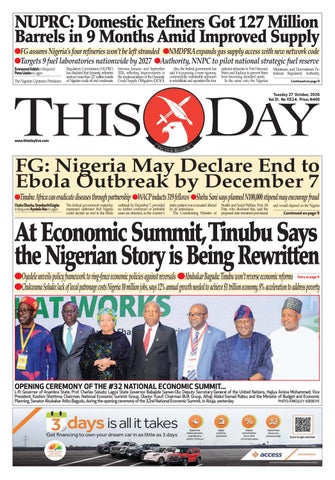
At Economic Summit,Tinubu Says the Nigerian Story is Being Rewritten Oyedele unveils policy framework to ring-fence economic policies against reversals Abubakar Bagudu: Tinubu won’t reverse economic reforms Chukwuma Soludo: lack of local patronage costs Nigeria 10 million jobs, says 12% annual growth needed to achieve $1 trillion economy, 8% acceleration to address poverty Story on page 9
OPENING CEREMONY OF THE #32 NATIONAL ECONOMIC SUMMIT...
L-R: Governor of Anambra State, Prof. Charles Soludo; Lagos State Governor Babajide Sanwo-Olu; Deputy Secretary-General of the United Nations, Hajiya Amina Mohammed; Vice President, Kashim Shettima; Chairman, National Economic Summit Group, Olaniyi Yusuf; Chairman BUA Group, Alhaji Abdul-Samad Rabiu; and the Minister of Budget and Economic PHOTO: KINGSLEY ADEBOYE Planning, Senator Abubakar Atiku Bagudu, during the opening ceremony of the 32nd National Economic Summit, in Abuja, yesterday
2
TUESDAY, OCTOBER 27, T H I S D AY
TUESDAY, OCTOBER 27, T H I S D AY
3
4
TUESDAY, OCTOBER 27, T H I S D AY
5
THISDAY • TUESDAY, OCTOBER 27, 2026
Group News Editor: Goddy Egene Email: Goddy.egene@thisdaylive.com, 0803 350 6821, 0807 401 0580
NEWS
OPENING CEREMONY OF THE MAIDEN AFRICA INTERNATIONAL DEFENCE EXHIBITION...
L-R: Chairman, House Committee on Defence, Babajimi Benson; Minister of state Defence, Bello Matawalle; President of ECOWAS Commission, Birame Diop; representative of President Bola Tinubu and President of the Senate, Godswill Akpabio; Deputy Governor Lagos State, Obafemi Hamzat; Minister of Defence, General Christopher Musa (Rtd); Chief of Defence Staff, General Olufemi Oluyede; and Chief of Army Staff, Lieutenant General Waidi Shaibu, during the opening ceremony of the Maiden Africa International Defence Exhibition (AFRIDEX) in Lagos, yesterday PHOTO: SENATE PRESIDENT’S OFFICE
Tinubu Seeks Stronger African Defence Partnership, Local Capacity over Insecurity Northern senators urge better security in Taraba after Binari killings, death toll rises to 58, govt provides relief Sunday Aborisade in Abuja and Wole Ayodele in Jalingo President Bola Tinubu has called for stronger defence partnerships among African countries, insisting that military cooperation must go beyond equipment supplies to the development of local expertise, strengthening of indigenous industries, and improvement of the continent’s capacity to sustain its security operations. Tinubu spoke at the opening ceremony of Africa International Defence Exhibition (AFRIDEX) 2026 in Lagos, where he was represented by President of the Senate, Godswill Akpabio. In a related development, Northern Senators’ Forum called on security agencies to intensify operations in Taraba State following the killing of worshippers, vigilantes, women, and children in an attack on Binari community in Karim-Lamido Local Government Area. The legislators demanded urgent measures to prevent further bloodshed. They urged the police, Department of State Services (DSS), and Nigeria Security and Civil Defence Corps (NSCDC) to launch a comprehensive security surge across Karim-Lamido and the River Benue corridor, including the establishment of a Forward Operating Base and intelligence-led patrols along the Kompany-Asusar route. Taraba State Police Command confirmed the death of additional 15 people, who died when the boat in which they were fleeing their assailants capsized, bringing the death toll from Friday’s attack on Binnari community to 58.
Tinubu’s address at AFRIDEX 2026 outlined a broader continental approach to tackling the evolving security challenges confronting African countries. The president said threats ranging from terrorism and insurgency to banditry, piracy, and emerging cyber risks required stronger cooperation among African nations. “From the Gulf of Guinea to the Sahel, from our territorial borders to cyberspace and outer space, the threats confronting us are becoming more complex and interconnected,” Tinubu said. He added that the threats were claiming lives, displacing communities, disrupting trade and undermining development. “Africa’s security must, therefore, command our collective attention, because there can be no enduring prosperity where fear governs daily life,” he said. Tinubu said Nigeria had experienced the devastating consequences of insecurity, including deaths, displacement, disrupted livelihoods, and lost economic opportunities. He commended the armed forces for confronting terrorism, insurgency, banditry, piracy, and other transnational threats, while acknowledging the sacrifices made by personnel in the line of duty. The president said, “Our armed forces have confronted terrorism, insurgency, banditry, piracy and other transnational threats with courage and sacrifice. We honour their service and remember those who have paid the supreme price.” He added that the sacrifices of military personnel placed an obligation on political leaders to provide
the equipment, training, resources, and institutional support required to improve operational effectiveness. He stressed that lasting security depended not only on military action but also on strong institutions, public trust, reliable partnerships, and the domestic industrial capacity to sustain defence operations. According to him, African countries must ensure that defence agreements produce long-term benefits beyond the immediate delivery of military hardware. Tinubu stated, “Our defence partnerships must, therefore, deliver value long after equipment has been supplied. Every major acquisition should help develop skills, transfer knowledge, strengthen local industry, and deepen our capacity to maintain what we operate. “The measure of a successful partnership is the capability it leaves behind. African engineers must gain expertise; African enterprises must
grow; African institutions must become stronger.” Tinubu also called for more predictable funding, adequate equipment, rigorous training, and sustained institutional support for African-led peace operations. He stated that the effectiveness of peacekeeping missions depended on ensuring that personnel deployed to conflict zones had the resources and capabilities needed to carry out their assignments. He said, “The courage to respond to crises must be matched by predictable resources, adequate equipment, rigorous training and sustained institutional support. “Those we send to keep the peace must have the means to keep the peace.” The president also called for stronger maritime cooperation among African countries, particularly in the Gulf of Guinea, which he described as vital to trade, energy security, and
shared prosperity. He urged African governments to strengthen cooperation against criminal networks operating in maritime spaces and protect legitimate commercial activities. Tinubu also highlighted the growing influence of cyber capabilities, space technologies, artificial intelligence, and autonomous systems on modern warfare, urging African countries to invest in the knowledge and institutions required to understand and deploy such technologies responsibly. He described AFRIDEX 2026 as an opportunity to translate Africa’s potential into practical defence capabilities through cooperation, knowledge exchange, and industrial development.
Northern Senators Urge Better Security in Taraba After Binari Killings Northern Senators’ Forum, in a
condolence message through their chairman, Senator Abdulaziz Musa Yar’Adua, expressed sympathy with the Taraba State governor, residents of the state, and families affected by the attack on Binari on Friday, October 23. Gunmen had attacked Binnari community in Karim-Lamido Local Government Area of Taraba State last Friday while the community market was in full spring and killed scores of people while property worth millions of naira were destroyed. The senators’ forum said it received with shock reports that innocent worshippers, vigilantes, women, and children were killed shortly after Juma’at prayers. It stated, “On behalf of the Northern Senators Forum, we commiserate with His Excellency the governor of Taraba State, the people of Taraba, and the bereaved families of Binari community in Karim-Lamido LGA over the barbaric attack of Friday 23rd October.
Tinubu Felicitates Friend And Brazilian President, Luiz Inácio Lula da Silva, on Re-Election For Record Fourth Term Reiterates Nigeria-Brazil multilateral cooperation and historical ties Deji Elumoye in Abuja President Bola Tinubu has felicitated his friend and President of Brazil, Luiz Inácio Lula da Silva, on his re-election for a record fourth term. Tinubu also reiterated NigeriaBrazil multilateral cooperation and historical ties. Tinubu, in a six-paragraph
release issued on Monday stated, “I congratulate my friend, President Luiz Inácio Lula da Silva of Brazil, on his re-election for a record fourth term. “Your renewed mandate offers an opportunity to strengthen the longstanding friendship and historical ties between Nigeria and Brazil.
“As two leading nations of the Global South, we can promote economic integration and advance our shared interests in a rapidly changing global order. “I look forward to expanding cooperation in trade and investment, agriculture and food security, energy, oil and gas, manufacturing, science and technology, education,
aviation, and cultural exchange. “I affirm Nigeria’s continued commitment to working with Brazil to strengthen multilateral cooperation and advance shared priorities in Africa, South America, and across the Global South. “On behalf of the people of Nigeria, I wish you a successful new term in office.”
Natasha Woos European Investors to Kogi, Renews Call for Ajaokuta Revival Sunday Aborisade in Abuja The senator representing Kogi Central, Natasha Akpoti-Uduaghan, has wooed European investors to Kogi State, hosting ambassadors from Belgium, Denmark, Italy and Spain on a tour designed to showcase the state’s investment opportunities, cultural heritage and indigenous industries. The visit, which featured engagements with local communities, artisans and cultural groups, provided an opportunity to explore potential economic and humanitarian partnerships while highlighting the
commercial prospects of Kogi Central beyond its tourism attractions. The diplomats visited historical landmarks in Lokoja, including Lord Lugard’s Rest House on Mount Patti and the confluence of the Niger and Benue rivers, before proceeding to Kogi Central for cultural activities and interactions with residents. The Ambassador of Italy to Nigeria, Roberto Mengoni, expressed optimism about the prospects for collaboration, describing Kogi as a state with considerable potential. “Kogi is very rich, and we look forward to partnership,” Mengoni said, while thanking Akpoti-Uduaghan
for facilitating the visit. The engagement also offered the European diplomats an opportunity to experience the traditions, hospitality and entrepreneurial activities of the Ebira people, with particular emphasis on the potential of locally produced goods to attract investment and access wider markets. Belgium’s Ambassador to Nigeria, Pieter Leenknegt, expressed satisfaction with the experience, particularly the hiking expedition around the historic hills of Ihima, commending the opportunity to explore the area’s landscape, culture and cuisine. The programme, according to a
statement by the senator’s media office on Monday, included a visit to Obeiba Hill, where the diplomats sampled traditional delicacies, including akara, apapa and akamu. They also witnessed indigenous production processes, including shea butter and palm kernel oil extraction, black soap making, pottery and traditional Ebira cloth weaving. The statement added that the masquerade performance further exposed the visitors to the cultural identity and artistic traditions of the community. Denmark’s Ambassador to Nigeria, Jens Ole Bach Hansen, praised the
ingenuity of local artisans, particularly women engaged in pottery, traditional clothing and other indigenous crafts. He said the products demonstrated the creativity and determination of the artisans, noting that their skills and enterprise could provide opportunities for economic growth, business development and access to larger markets. Akpoti-Uduaghan said the visit was intended to demonstrate the economic potential of Kogi Central and draw international attention to the skills, industries and entrepreneurial capacity of its people. According to her, the district’s
development prospects extend beyond tourism to include indigenous manufacturing, traditional crafts and other productive activities capable of generating employment and improving livelihoods. “To attract investment, we must give people the chance to see our strengths for themselves: our skills, our enterprise, our culture and our people,” the senator said. She disclosed that discussions with the diplomats covered investment and humanitarian opportunities, expressing hope that the engagement would produce practical partnerships with lasting benefits for residents.
6
TUESDAY, OCTOBER 27, 2026 • THISDAY
NEWS
2026 ELEVATE AFRICA ANNUAL CONVENING...
L-R: Head, Strategic Partnerships Elevate Africa, Dr. Rex Idaminabo; US Representative/Global Ambassador Elevate Africa, Reps Kim Schofield; Queen Consort of Warri Kingdom, Olori Ivie Atuwatse III; Elevate Africa Fellowship Representative (cohort 2025), Dr. Grace Nelson; and Director, Diaspora Affairs, Office of the President of Ghana, Mr. Kofi Darko, at the preconvening press conference of the 2026 Elevate Africa Annual Convening, in Accra, Ghana, yesterday
Eni Retreats Further from Onshore Operations, Sells Nigerian Subsidiary to Sterling Transfers 5% stake in Renaissance JV Italian firm retains deep offshore assets, Nigeria LNG interest Emmanuel Addeh in Abuja Italian energy giant, Eni, has completed the sale of its Nigerian subsidiary, Agip Energy and Natural Resources (Nigeria) Limited (AENR), to Apex Global Energy Limited, a company wholly owned by Sterling Oil Exploration and Energy Production Company Limited. The transaction marked another pedestal in the gradual transfer of International Oil Companies (IOCs) Nigerian onshore interests
to indigenous operators. Eni announced the completion of the transaction yesterday in a statement, following approval by all relevant authorities, although it did not disclose the financial terms of the deal. AENR holds a 5 per cent interest in the Renaissance Joint Venture (JV) which operates onshore and shallow-water oil and gas assets in Nigeria. The transaction transfers Eni’s interest in the venture to Apex, strengthening Sterling’s presence in
the country’s upstream petroleum industry. The transaction comes amid a wider restructuring of the Nigerian oil and gas industry, with several international oil companies selling onshore and shallow water assets to indigenous operators while retaining or expanding their interests in deepwater production and gas-related businesses. The development has accelerated the emergence of Nigerian independent producers as major
operators, even as the new owners continue to invest in ageing infrastructure, address oil theft and pipeline sabotage, and meet environmental obligations in the Niger Delta. In the statement announcing the completion, Eni said the transaction was consistent with its strategy of “optimising its upstream activities by rebalancing the portfolio and divesting non-strategic assets.” The Italian company, however, stressed that the sale did not repre-
Market Capitalisation of Dangote Cement Crosses N20trn Mark on NGX Kayode Tokede
The market capitalisation of Dangote Cement Plc on the Nigerian Exchange Limited (NGX), yesterday crossed the N20 trillion mark, making it the second most capitalised listed company on the bourse. The milestone N20.62 trillion market capitalization as of October 26, 2026 is on the backdrop of a 10 per cent gain in its stock price to N1,222.10 per share from N1,111.00 per share it opened for trading this week. At N1,222.10 per share, Dangote Cement stock hit a 52 week high amid the ongoing Dangote Petroleum Refinery and Petrochemicals’s Initial Public Offering (IPO). The stock price of Dangote Cement
that opened for trading this year at N609 per share has gained 100.67per cent to close at N1,222.10 per share as of October 26, 2026. Capital market analysts stated that surge demand for Dangote Petroleum Refinery and Petrochemicals by retail and institutional investors spread to Dangote Cement stock on the NGX. The landmark IPO Dangote Petroleum Refinery and Petrochemicals enters its final days, with investors accelerating participation ahead of the closing date of October 27, 2026. The company said, “This is the final deadline, and no further extension will be granted. Investors wishing to participate must complete their subscriptions before the offer closes.” The surge in demand follows the
refinery’s recently released nine-month financial results, which showed exceptional growth in revenue, profitability, and cash generation, reinforcing investor confidence in the company’s long-term prospects. Dangote Cement yet to announce nine months ended September 30, 2026 revealed that its Group revenue increased by 21.4 per cent to N2.514 trillion in the half year (H1) ended June 30, 2026, while Group EBITDA rose by 25.8 per cent to N1.188 trillion, reflecting a margin of 47.3 per cent. Earnings per share advanced by 24.3 per cent to N38.22, as the company closed the period with a strong net cash position of N215.2 billion. Overall Group volumes grew by 11.8 per cent to 14.9 million tonnes,
supported by resilient demand in key markets. Nigeria continued to anchor earnings, with EBITDA from the domestic market rising by 28.4 per cent to N1.086 trillion and margins improving to 60.1 per cent. Operational efficiency remained a key focus, with the company reporting a strong reduction in Nigeria cash costs, supported by a more favourable energy mix. It also commissioned the Okpella mobile refuelling unit and added 300 compressed natural gas trucks in Tanzania as part of efforts to improve logistics efficiency and reduce operating costs.
DTN@100: Osoba, Amuka-Pemu, The Lagos Chamber of Commerce Industry (LCCI) has called on Ogunbiyi to Lead National Dialogue and the government to create predictable Veteran journalist and former Ogun State governor, Aremo Olusegun Osoba, publisher of Vanguard Newspapers, Olorogun Sam Amuka-Pemu, and former Managing Director of Daily Times, Dr Yemi Ogunbiyi, will lead a national dialogue organised by Daily Times Nigeria (DTN) as part of activities marking the newspaper’s centenary celebration. The DTN@100 Shaping the Future
TownHall and National Conversation is scheduled to hold on November 3, 2026, at Harbour Point, 4 Wilmot Point Road, Victoria Island, Lagos. Osoba, a former Managing Director of Daily Times, will superintend the event, while Amuka-Pemu, a former editor of The Sunday Times, and Ogunbiyi, Chairman of Tanus Communications, will serve as co-chairs. The event is designed to deepen discussions on Nigeria’s achieve-
ments, recognise individuals who have contributed to the country’s development and promote a more positive perception of Nigeria internationally. According to a statement issued by the organisers, the conversation will bring together professionals from the technology, entrepreneurship, media and strategic communications sectors to examine Nigeria’s progress and explore opportunities for shaping its future.
action valued at approximately $783 million. The acquisition expanded the indigenous energy company’s interests in oil and gas production, gas processing and power generation, while increasing its exposure to the Niger Delta. Besides, in December 2024, Seplat Energy completed its $800 million acquisition of Mobil Producing Nigeria Unlimited from ExxonMobil, taking over the company’s operated offshore assets. The acquisition significantly expanded Seplat’s production base and established it as a much larger player in Nigeria’s upstream industry. Shell also completed the sale of its Nigerian onshore subsidiary, the Shell Petroleum Development Company of Nigeria Limited (SPDC), to Renaissance in March 2025, following regulatory approval. The transfer of these assets to indigenous companies has altered the ownership landscape of Nigeria’s oil industry, with local operators assuming greater responsibility for mature fields and infrastructure previously controlled by multinational companies. The federal government has supported the transfer of assets to operators capable of sustaining production and increasing investment, and has under the Bola Tinubu administration begun the acceleration of regulatory approval.
LCCI Seeks Stable Business Climate to Unlock Investment in Small-scale LNG, CNG Distribution
Dike Onwuamaeze and Oluchi Chibuzor
Ayodeji Ake
sent a complete withdrawal from Nigeria, adding that it would continue to maintain a presence in the country through its offshore operations and participation in Nigeria LNG Limited (NLNG). “Eni will continue to maintain a presence in the country through exploration and development of deep offshore assets as well as through its participation in Nigeria LNG,” the company stated. Under the Renaissance joint venture structure, Renaissance holds a 30 per cent interest and serves as operator, while the Nigerian National Petroleum Company Limited (NNPC) holds 55 per cent and TotalEnergies has a 10 per cent interest. AENR previously held the remaining 5 per cent. The sale therefore transfers Eni’s minority interest to the Nigerianowned company operating through Sterling, rather than removing the assets from the existing joint venture arrangement. Eni’s latest transaction followed its earlier exit from Nigerian onshore operations through the sale of Nigerian Agip Oil Company (NAOC) to Oando Plc, completed in August 2024 amid several other divestments that have taken place in the last few years. At the time, Oando announced that it had completed the acquisition of 100 per cent of NAOC, in a trans-
regulatory and commercial environment to attract private investments into small-scale Liquefied Natural Gas (LNG) and Compressed Natural Gas (CNG) distribution. The LCCI stated that this would bridge the gap between the country’s abundant gas resources and the energy requirements of productive enterprises. It also called for the establishment of dedicated clean energy financing windows for Small and Medium
Enterprises (SMEs) to address high upfront cost of solar systems, battery storage, gas conversion equipment and energy-efficient machinery. These calls were made yesterday by the President of LCCI, Mr. Leye Kupoluyi, during the chamber’s Liquefied Pressure Gas (LPG) and Downstream Natural Gas Sectoral Group’s, “LCCI Eko Gas Scheme 3.0,” event with the theme “Empowering SMEs Through Affordable Clean Energy.” Kupoluyi said: “Nigeria must bridge the gap between its abundant gas resources and the energy requirements of productive enterprises. “This requires investment in gas
gathering and processing facilities, transportation infrastructure, distribution networks, storage and appropriate safety systems. “We encourage the government to create a predictable regulatory and commercial environment that attracts private investment into small-scale LNG, CNG distribution and gas-based industrial energy solutions.” He also made a case for strengthened regulatory coordination and policy consistency, saying investors required clarity regarding energy pricing, licencing, market access, technical standards, and the responsibilities of the different regulatory authorities.
TUESDAY, OCTOBER 27, T H I S D AY
7
8
TUESDAY, OCTOBER 27, 2026 • THISDAY
NEWS
GENOMICS HACKATHON 2026...
L-R: Team Mentor, Negbenose Onoseta; Members of the winning team- Peace Awoyemi and Joshua Ejiyooye; Chief Information Technology Innovation Officer, Institute of Genomics and Global Health (IGH), Adedayo Okunfolami; Team members- Ebidah Peace Oluwatomi and Victor Ebube, posed with the winning team of the Institute of Genomics and Global Health (IGH) XR and AI, at the Genomics Hackathon 2026, held at Redeemer’s University Ede, Osun... recently
N76bn Fraud Trial: EFCC Witness Calls Arik Air Receivership Scam Insists airline owes Union Bank nothing, court admits AMCON board resolutions Wale Igbintade Director of the Lagos Zonal Directorate 2 of the Economic and Financial Crimes Commission (EFCC), Bawa Usman Kaltungo, yesterday described the receivership of Arik Air as fraudulent, insisting that the airline is not indebted to Union Bank of Nigeria Plc. Kaltungo, the fourth prosecution witness in the ongoing trial of former Managing Director of Asset Management Corporation of Nigeria (AMCON), Ahmed Kuru, and others over an alleged N76 billion ($31.5 million) fraud, told the Special Offences Court in Ikeja that the purported bad debt that formed the basis for the receivership did not exist. The witness, who testified before Justice Mojisola Dada, said his investigation into a petition concerning the airline revealed that the basis for appointing a receiver-manager over Arik Air was faulty. In a significant development, however, the court admitted AMCON board resolutions tendered by Kuru’s counsel, Uyi Giwa-Osagie, to challenge the prosecution witness’ assertion that the former managing director had unilaterally approved the receivership.
The documents were admitted despite the prosecution’s objection to their relevance. The court held that they emanated from AMCON’s board as a corporate body and had been duly certified in accordance with Section 104 of the Evidence Act. During cross-examination by Giwa-Osagie, counsel to the second defendant, Kaltungo, said he headed the EFCC team that investigated the petition concerning Arik Air. He told the court that he had informed AMCON’s top management at a meeting that the airline was not indebted to Union Bank and that the appointment of a receiver-manager to take control of the company was defective. The witness said, “The foundation for the appointment of a receivership over Arik Air was fraudulent and faulty. There was no bad debt; it does not exist.” The testimony came amid allegations surrounding the handling of Arik Air’s loan obligations, its takeover by AMCON, and transactions involving the airline’s assets. During the cross-examination, Kaltungo maintained that Kuru, in his capacity as AMCON’s Managing
Director and Chief Executive Officer, had extensive powers and had unilaterally sanctioned the appointment of a receiver-manager over Arik Air. Giwa-Osagie challenged the account by tendering AMCON board resolutions intended to demonstrate that the receivership decision was taken at the corporate level rather than solely by Kuru. The prosecution objected to the admissibility of the documents, arguing that they were too remote to the issues before the court. However, Giwa-Osagie argued that the documents were relevant to
Paul Ibe, media adviser to former Vice-President Atiku Abubakar, has demanded an explanation from the All Progressives Congress over seven 2026 Toyota Prado SUVs reportedly displayed by the party’s National Youth Leader, Dayo Israel. Ibe, in a statement on Monday, questioned the source of funding for the vehicles and whether public resources were involved in their purchase or distribution. He said Israel had displayed the vehicles, thanked First Lady Remi Tinubu for her support and later deleted the post.
However, Ibe argued that removing the pictures did not resolve questions about the vehicles’ ownership, funding and intended beneficiaries. “Deleting the pictures does not erase the questions,” he said. Ibe criticised the development against the backdrop of rising living costs, unemployment and poverty, arguing that the reported distribution of luxury vehicles to party operatives contrasted with the economic difficulties facing many Nigerians. He also questioned the call for Nigerians to make sacrifices amid reports of luxury vehicles being made available for political activities. “Is sacrifice only for the poor?”
In her ruling, Dada upheld the relevance and admissibility of the documents, holding that they emanated from AMCON’s board as a corporate body and had been duly certified in accordance with Section 104 of the Evidence Act. The admission of the resolutions provides the defence with documentary evidence to challenge the prosecution witness’s assertion that Kuru acted unilaterally in approving the receivership. However, their admission does not, in itself, determine the legality of the receivership or resolve the allegations
against the defendants. EFCC instituted the case following a petition by human rights activist and lawyer, Femi Falana, SAN, on behalf of Arik Air’s promoters and shareholders over the airline’s receivership and related transactions. The defendants are Kuru; Kamilu Alaba Omokide, a former receivermanager of Arik Air; Captain Roy Ilegbodu, the airline’s chief executive officer; Union Bank of Nigeria Plc; and Super Bravo Limited. They are facing a six-count charge bordering on conspiracy, stealing and abuse of office.
Fani-Kayode Vows to Rebuild NigeriaSouth Africa Ties, Protect Nigerians As envoy arrives Johannesburg, receives rousing welcome from Nigerians Michael Olugbode in Abuja Nigeria’s newly designated High Commissioner to South Africa, Femi Fani-Kayode, has pledged to rebuild strained relations between Nigeria and South Africa and make the
Atiku’s Aide Demands Answers over Seven SUVs Displayed by APC Youth Leader Chuks Okocha in Abuja
determining his client’s culpability in the alleged offences. He submitted that Kuru was not standing trial over the propriety of AMCON’s powers to appoint a receiver-manager but over the specific allegations contained in the charge sheet. The defence counsel maintained that the board resolutions were necessary to establish the circumstances surrounding the decision and challenge the witness’s account of Kuru’s role. He further argued that the documents were public records that could properly be tendered from the Bar.
he asked. The former vice-president’s aide called on the First Lady, Israel and the APC to disclose the total cost of the seven vehicles, identify their purchasers and explain the sources of the funds used to acquire them. He also demanded the identities of the donors and beneficiaries, evidence of payment and details of the purpose for which the vehicles were provided. Ibe further asked the party to clarify whether any funds or assets belonging to the Federal Government, the Office of the First Lady or government agencies were used in the transaction.
protection of Nigerians living in the country a priority, declaring that his diplomatic mission will focus on restoring friendship, deepening economic cooperation and strengthening African unity. Fani-Kayode made the commitment on Sunday upon arriving in Johannesburg to begin his assignment, which also covers the Kingdoms of Lesotho and Eswatini, at a time when concerns over tensions between Nigerians and South Africans have reinforced the need for sustained diplomatic engagement between the two countries. Speaking to journalists on arrival, the envoy said his primary responsibility, following his appointment by President Bola Tinubu, was to rebuild the bridge of friendship and cooperation between the two countries while safeguarding the interests of Nigerians in South Africa. He stressed that Nigeria and South Africa, two of Africa’s largest economies and most influential countries, must work together to advance their shared interests rather than allow differences to undermine their relations. His arrival was marked by
a large gathering of Nigerians and well-wishers at O. R. Tambo International Airport, where he was received by senior officials of Nigeria’s diplomatic mission and members of the Nigerian community. The crowd welcomed him with songs, cultural displays and expressions of excitement, with representatives of Nigerian professional, cultural, religious, student and political organisations turning out to receive the new envoy. Among those present were former Chargé d’Affaires of the Nigerian High Commission in Pretoria, Ambassador Temitope Ajayi; Nigeria’s Consul-General in Johannesburg, Ambassador Ninikanwa Okey-Uche; and Puleng Chaba, Acting Director for West Africa at South Africa’s Department of International Relations and Cooperation (DIRCO). The reception brought together representatives of the Nigerian Union South Africa (NUSA), Nigerian Citizens Association South Africa (NICASA), Nigeria Doctors Forum, Nigerian Lawyers Association, Group of Nigerian Professionals
Johannesburg and the National Association of Nigerian Students South Africa. Also represented were the Congress of Nigerian Students at the University of Johannesburg, All Progressives Congress in South Africa, City Boys South Africa, Egbe Omo Yoruba Association, Association of Yoruba in Diaspora South Africa, Yoruba Leaders Council, Igbo Union South Africa, Ohanaeze South Africa, Nigerian Muslim Community South Africa, Arewa Union South Africa, Niger Delta Association and Association of Nigerian Nurses and Midwives South Africa, among others. The strong turnout highlighted the importance of engagement between Nigeria’s diplomatic mission and the sizeable Nigerian community in South Africa as Fani-Kayode begins his assignment. However, beyond the celebratory reception, the envoy faces the challenge of translating his pledge to rebuild relations into concrete diplomatic progress, particularly on concerns affecting Nigerians and the broader relationship between Abuja and Pretoria.
9
THISDAY • TUESDAY, OCTOBER 27, 2026
NINE
U.S AFRICOM Commander: ISIS Defections in Nigeria Rise Over 200% After May Operations US to reopen dialogue with Mali, Burkina Faso, Niger to strengthen cooperation against shared security threats Chiemelie Ezeobi The number of ISIS members defecting in Nigeria has increased by more than 200 per cent since a joint operation by Nigerian and United States forces in May, Commander of the United States Africa Command (AFRICOM), General Dagvin Anderson, has said. Anderson gave the update in an exclusive interview with THISDAY, yesterday, on the side-lines of the ongoing Africa International Defence Exhibition (AFRIDEX), in Lagos. He attributed the development to the effect of the operation against a senior ISIS figure and subsequent military operations by Nigerian forces, saying it indicates that some members of the terrorist organisation are reconsidering their involvement.
Commending the partnership between the Nigerian Armed Forces, Nigerian intelligence agencies, and the United States, Anderson said it had been instrumental in the operations, which targeted Abu-Bilal al-Minuki, whom he described as the world’s second-highest-ranking ISIS terrorist. “The partnership with the Nigerian Armed Forces and Nigerian intelligence was exceptional, and that’s what really enabled that partnership to happen and to take out the number two terrorist in the world for ISIS,” Anderson said. He added that Nigeria had continued to conduct operations against ISIS following the May operation, while the United States sustained its cooperation with Nigerian security forces. Anderson described the current security relationship between both
countries as strong, saying the United States provides intelligence, specialised capabilities, and training, while Nigeria contributes its knowledge of local and regional security conditions. “Some of it is intelligence, but also understanding of the terrorist network globally,” he said. “And so Nigeria brings the regional and local understanding, while we bring the global network understanding, and together that becomes very powerful,” he added. Anderson said the United States had provided training in intelligence, surveillance, and reconnaissance, as well as targeting, and would continue to consider requests for specialised training for Nigerian forces. Anderson said the cooperation that happened in May in Borno State, within the Lake Chad Basin, saw both countries
working to disrupt terrorist movements. However, he stressed that military assistance alone could not resolve Nigeria’s security challenges, including terrorism and kidnapping. Anderson stated that investment in governance, development, education, and economic opportunities was necessary to address their underlying drivers. He said, “Ultimately, for the terrorism and insecurity, it needs to be an investment in governance, an investment in development.” He explained that sustainable opportunities could help prevent young people from turning to terrorism and criminal activities. On the withdrawal of Mali, Burkina Faso, and Niger from ECOWAS and what it portended for security in the continent, Anderson said the United
States was seeking to reopen dialogue with the three countries, now members of Alliance of Sahel States, to strengthen cooperation against shared security threats. He said renewed engagement could facilitate intelligence sharing and training, but stressed that communication must first be re-established. Anderson also identified terrorist financing as a critical challenge, saying the United States could contribute global intelligence and cyber capabilities while Nigeria provides local knowledge of financial networks and money laundering methods. On maritime security, he said the United States had supported maritime operations centres, radar systems, and emerging technologies to improve monitoring of the Gulf of Guinea and
Gen. Dagvin Anderson other West African waters. He identified piracy, smuggling, drug trafficking and illegal fishing as major concerns, but said he could not confirm plans for additional vessel acquisitions.
AT ECONOMIC SUMMIT, TINUBU SAYS THE NIGERIAN STORY IS BEING REWRITTEN
Deji Elumoye and James Emejo in Abuja
President Bola Tinubu yesterday said his government was rewriting Nigeria’s decades-long story of economic underperformance through far-reaching reforms designed to dismantle structural barriers, unlock the nation’s enormous potential, and deliver jobs, productivity, and shared prosperity. Tinubu said rewriting the story of a nation that had performed below its potential for far too long was what the administration came into office to achieve: The president spoke in Abuja while formally declaring open the 32nd Nigerian Economic Summit (NES#32), with the theme, “Growth that Works: Delivering Jobs, Productivity and Shared Prosperity.” At the summit, Minister of Finance and Coordinating Minister of the
Economy, Mr. Taiwo Oyedele, presented the Nigerian Economic Policy Framework, which he described as a national economic doctrine establishing how Nigeria made economic decisions and measured real progress. Oyedele said the blueprint aimed at curbing arbitrary policy changes. Minister of Budget and Economic Planning, Senator Abubakar Bagudu, ruled out a return to petrol subsidy, insisting that the Tinubu administration will sustain its economic reforms, despite mounting pressure on households and businesses. Bagudu told the conference that reversing reforms would undermine efforts to address longstanding distortions. Governor of Anambra State, Professor Chukwuma Charles Soludo, said lack of local patronage of Madein-Nigeria products had robbed the country of 10 million potential jobs, adding that everyone has a role to
play in boosting growth. Soludo said the economy needed between seven and nine per cent annual growth rate to address multidimensional poverty. Tinubu, who was represented at NES#32 by Vice President Kashim Shettima, stated that his government began on a difficult note because there was no shortcut to economic growth. He stated, “Distinguished ladies and gentlemen, we came to rewrite the story of a nation that has performed below its potential for far too long. But there is no shortcut to economic growth. This is why we began with a difficult reset. For us, rescuing the economy means rescuing livelihoods and transforming the fortunes of young jobseekers, farmers, manufacturers, entrepreneurs and innovators. “We cannot harness the immense opportunities offered by our growing population without first stabilising the economy. We must also create the
FG: NIGERIA MAY DECLARE END TO EBOLA OUTBREAK BY DECEMBER 7 Centre for Disease Control and Prevention (NCDC) and the World Health Organisation (WHO) validating the required 42-day countdown. The development came as President Bola Tinubu declared that Africa could eradicate Ebola and other infectious diseases through sustained political commitment, adequate investment in public health, stronger institutions and regional collaboration. Tinubu, who spoke at the 50th anniversary celebration and Annual General and Scientific Meeting of the West African College of Physicians (WACP) in Abuja, said Nigeria remained committed to strengthening disease surveillance, laboratory networks, emergency preparedness and cross-border cooperation. Also, the NCDC’s decision to provide a weekly stipend of N100,000 to eligible contacts placed under isolation or quarantine attracted criticism from former Kaduna Central senator, Shehu Sani, who warned that the arrangement could encourage people to falsely claim exposure to Ebola to benefit from the payment. In a statement posted on his verified X handle yesterday, Pate said the evacuation of the index patient on October 26 had not altered the government’s immediate priorities of monitoring identified contacts, investigating alerts and strengthening preparedness across health facilities. “Following the imported Ebola index patient’s medical evacuation from Nigeria today, 26 October, our immediate priorities remain active monitoring of all identified contacts, prompt investigation of alerts and strengthened readiness across our health facilities,” he said. Pate added: “If no further
confirmed or probable cases are detected, Nigeria could progress towards declaring this outbreak over under @WHO criteria, potentially as early as 7 December 2026.” He, however, cautioned that any additional case would require a fresh countdown in line with WHO criteria. “Any further case would require a fresh countdown in accordance with those criteria,” the minister said. He explained that federal health authorities were working with the Federal Capital Territory Administration (FCTA) state health authorities and development partners to contain the outbreak and prevent community transmission. “Our teams, working with Federal Capital Territory administration and state health authorities and our partners, remain focused on containment and preventing community transmission. I ask Nigerians to remain calm, cooperate with contact-tracing teams and follow regular updates from the ministry,” he added. The index patient, a 42-year-old Ugandan-born wife of a Swiss diplomat, was evacuated from Abuja early yesterday aboard an air ambulance, confirming a THISDAY exclusive. The medical evacuation took place through the private jet wing of the Nnamdi Azikiwe International Airport, Abuja, where heightened security measures were put in place ahead of the aircraft’s departure. Photographs obtained from the airport showed a convoy of ambulances and diplomatic vehicles arriving from the Abuja city centre at the General Aviation Terminal. The three-vehicle convoy included a vehicle belonging to an international
agency, which proceeded into the airport’s private aviation section. Airport officials subsequently cordoned off the private wing as arrangements for the evacuation continued. The video footage also showed the aircraft and members of its crew involved in transporting the patient. A THISDAY source had disclosed that the federal government planned to announce the evacuation only after the aircraft had taken off and exited Nigerian airspace. The evacuation came amid heightened attention to Nigeria’s Ebola preparedness and response, particularly the monitoring of contacts, isolation arrangements and efforts to Continued on page 33
conditions for the public and private sectors to invest, expand and generate productive employment.” Tinubu observed that the summit’s theme, “Growth That Works: Delivering Jobs, Productivity and Shared Prosperity,” built on the ambition of the previous edition of the annual event to achieve a prosperous and inclusive Nigeria by 2030. He stated that his administration had “since set in motion a series of reforms to dismantle the structural barriers that have prevented our abundant human and natural resources from yielding prosperity”. The president said, “These reforms are restoring confidence, strengthening our economic foundations and laying the groundwork for sustainable growth.” He added that the administration was encouraged by what it had accomplished so far. Acknowledging that creating jobs was only half the task, the president stressed the need to “improve the quality of work, reduce underemployment and harness the potential” of the country’s underutilised workforce. He stated, “Our pursuit of prosperity demands greater productivity from every worker, enterprise and investment. We must judge infrastructure by the economic activity it generates and education by the skills and productivity it delivers. “We must judge industrial policy by the competitiveness of our firms and investment incentives by the capital, technology, exports and jobs they attract.” Tinubu outlined the achievements of his administration’s reforms, saying they have been well documented. He cited figures from the National Bureau of Statistics indicating that Nigeria’s inflation-adjusted GDP grew by 3.89 per cent in the first quarter
of 2026, compared with 3.13 per cent a year earlier. On economic diversification, he stated that “non-oil activities accounted for 96.08 per cent of GDP, while manufacturing grew by 3.29 per cent and the oil sector by 2.57 per cent”. He emphasised that the gains had reinforced his administration’s confidence in the path of recovery and diversification. The president stated, however, that his administration’s ambition must go beyond favourable statistics, even as the development narrative was changing and investor confidence was returning. Outlining the administration’s gains so far, he said, “In the first quarter of 2026, our capital importation reached $10.37 billion, an increase of 83.83 per cent over the corresponding period in 2025. This comprised both portfolio and foreign direct investment. We will, therefore, continue to ease regulatory burdens, strengthen transparency and policy predictability, and expand access to finance. “Our tax reforms seek to build a modern, equitable system that finances development and gives businesses certainty. This discipline must guide our investments in all sectors of the economy, including energy, agriculture and solid minerals. We are reforming the electricity market to improve supply and attract investment in generation, transmission, distribution and alternative energy.” On agriculture, Tinubu said the administration was connecting farms to storage facilities, processing centres, and markets, while expanding irrigation, mechanisation, finance, and rural infrastructure. He added that the government was also seeking “to move beyond extraction into domestic processing,
industrial production and exports” in the solid minerals sector. The president, however, stated that despite the gains of his administration’s economic reforms, the task remained far from finished, even as young Nigerians had demonstrated their capacity to compete globally in technology, financial services, and the creative industries.
Oyedele unveils framework to guard against policy reversals Oyedele, at the summit, presented the Nigerian Economic Policy Framework, saying it is a national economic doctrine that establishes how Nigeria makes economic decisions and measures progress. He said the plan aimed to curb arbitrary policy reversals, reduce uncertainty for businesses, and ensure economic reforms delivered measurable improvements in jobs, household incomes, and productivity. He said the economic doctrine was intended to outlive successive administrations. The minister stated that Nigeria’s persistent development challenges stemmed not from a shortage of economic plans but from inconsistent policymaking, weak implementation, and the tendency of successive governments to reverse or undermine previous reforms. According to him, policy uncertainty imposes an invisible cost on businesses, discourages investment, raises the cost of capital and prevents potential employment opportunities from materialising. Oyedele said, “Governments will come. Governments will go. But Nigeria’s economic horizon must Continued on page 35
NUPRC: DOMESTIC REFINERS GOT 127 MILLION BARRELS IN 9 MONTHS AMID IMPROVED SUPPLY (NMDPRA) has signed and unveiled and refiners affected supplies in the production or export point instead process, with published criteria and of moving an allocated grade over mandatory disclosure of beneficial Revision II of the Nigerian Gas first quarter. “We engaged producers and long distances, which could take an ownership. Transportation Network Code The NUPRC boss added that (NGTNC), aimed at expanding refiners, and in the second and estimated three to four dollars off gas supply access to power, fertiliser third quarters, 53.7 and 45.1 million the cost of every barrel,” he added. the commission was enforcing the On production, Eyesan said drill-or-drop principle to discourage barrels of crude oil and condensate plants, shippers and investors. The NURPC Chief Executive, were supplied to domestic refineries, Nigeria recorded an average of 1.717 speculative holding of licences, notMrs. Oritsemeyiwa Eyesan, who an overall performance of 97.4 and million barrels per day of crude oil ing that 22 recent awardees were and condensate in September, a 2.34 expected to contribute at least 250,000 spoke yesterday in her speech at 76.2 per cent, respectively. “From Q1–Q3 of 2026, more per cent increase over August. Crude barrels per day within five years. the OTL Africa Downstream Energy She reaffirmed the commission’s Week 2026 in Lagos, restated that than 127 million barrels of Nigerian oil production alone averaged 1.53 the commission was also consult- crude went to Nigerian refineries,” million barrels per day, marking the commitment to meeting the Domestic ing producers, refiners and other she said. Under Section 109 of the fifth consecutive month the industry Gas Delivery Obligation and working with the Nigerian Midstream and stakeholders on a domestic crude Petroleum Industry Act (PIA) 2021, met or exceeded its quota. She attributed the improvement Downstream Petroleum Regulatory the NUPRC allocates crude oil to swap framework. Speaking on the theme: ‘’Secure domestic refineries before export. to better asset integrity, enhanced Authority (NMDPRA) to align The NUPRC chief executive said security of evacuation infrastructure, refinery demand with crude supply Energy, Shared Prosperity’’, the NUPRC boss, who was represented the NUPRC was also consulting stronger collaboration with operators planning, ensuring that upstream by the Assistant Director, Operations, producers, refiners and other and sustained regulatory efforts to gains translate into tangible benefits for households, industries and power Mr. Prosper Omonedo, said the com- stakeholders on a domestic crude restore shut-in production. On the 2026 Licensing Round, she generation. mission’s intervention had improved swap framework. “Under it, a refiner could receive said the 40 blocks on offer would be crude oil deliveries after commercial Continued on page 34 disagreements between producers crude from the nearest suitable subjected to a transparent evaluation
10
TUESDAY, OCTOBER 27, 2026 • THISDAY
NEWS
RENT-AN-ACCOUNTANT SME-FOCUSED INITIATIVE LAUNCH BY THEWHY CONSULTING...
L-R: Head Alpher, Union Bank of Nigeria, Mrs. Aderonke Chukwudeme; Area Business Executive, Ikeja 2, Union Bank of Nigeria, Mr. Eno Ukpe; Managing Consultant, Thewhy Consulting, Mr. Adewale Kehinde, and Head of Resources and Training, Thewhy Consulting, Mrs. Adedolapo Kehinde, during the bank’s participation at the Rentan-Accountant SME-focused initiative Launch by Thewhy Consulting held at the Mulligan Hotel, Yaba, Lagos, yesterday
FG Disburses N38.93bn to 166 Public Tertiary Institutions Beneficiaries include 77 varsities, 46 polytechnics, 41 colleges of education Ndubuisi Francis in Abuja The federal government has disbursed N38.93 billion to 166 public tertiary institutions nationwide under the Needs Assessment Revitalisation
Fund. The disbursement covers 79 universities, 46 polytechnics and 41 colleges of education to support approved projects aimed at addressing infrastructure gaps and improving
teaching and learning facilities across the institutions. The university component accounts for N28.5 billion for 79 institutions, while 46 polytechnics have allocations totaling N5.8 billion. The 41 colleges
of education are allocated N4.7 billion, a statement by the Federal Ministry of Finance explained Sunday. According to the statement signed by the Head of Media, Efe Ovuakporie, the intervention forms part of the
federal government’s efforts to address the needs of public universities and support the implementation of agreed measures under the Memorandum of Understanding between the Federal Government and the Academic Staff
Over 70 Artists to Explore Hidden Histories at Fifth Lagos Biennial Sunday Ehigiator More than 70 artists from Nigeria and across the world will explore hidden histories, cultural memory and overlooked narratives at the fifth edition of the Lagos Biennial, scheduled to hold from November 14 to December 6, 2026, at Eko Atlantic City, Lagos. The international contemporary art exhibition, themed ‘The Museum of Things Unseen’, will feature installations, sculpture, photography, film and performances examining the histories and experiences often excluded from conventional museum spaces. The event will also feature special pavilions presented by the European Union, Floating Museum Chicago and other international cultural organisations. Founded in 2017 by Nigerian
artist and curator, Folakunle Oshun, the Lagos Biennial has established itself as a platform for contemporary artistic expression and international cultural exchange. Previous editions were held at the Nigerian Railway Corporation compound in Yaba in 2017, Independence House in 2019 and Tafawa Balewa Square in 2024, transforming historically significant locations into spaces for contemporary art. The 2026 edition will be curated by Furen Dai, Chinyere Obieze and Sam Hopkins, under the artistic direction of Oshun. According to the organisers, the exhibition will challenge conventional ideas about museums, including questions about whose histories are preserved, whose stories are silenced and whose voices are amplified. It will also examine how new museum institutions could be imagined
beyond existing structural inequalities, with participating artists exploring the politics of visibility, cultural heritage and collective memory. Speaking ahead of the exhibition, Oshun, founder and artistic director of the Lagos Biennial, said the event would encourage audiences to reconsider how museums preserve and represent history. “The Museum of Things Unseen invites us to reconsider what museums preserve, what they leave out, and how we might imagine new institutions that respond to our own histories,” he said. He added that bringing the exhibition to Eko Atlantic City would provide an opportunity to reflect on the relationship between Lagos’s rapidly changing urban landscape and its cultural memory. The choice of venue is expected to provide a setting for examining
Court Orders el-Rufai to Enter Defence on Alleged Wiretapping Trial Alex Enumah in Abuja Justice Joyce Abdulmalik of a Federal High Court, Abuja, on Monday ordered the immediate past governor of Kaduna State, Nasir El-rufai to enter his defence if he so desires in his ongoing trial on bugging the telephone communications of the National Security Adviser (NSA), Nuhu Ribadu. Justice Abdulmalik made the order shortly after dismissing the no-case submission filed by El-rufai, in response to the prosecution’s case. In her ruling on the no-case submission, the judge held there is sufficient evidence by the prosecution to warrant the court to call on the defendant to enter his defence if he
so desires. She subsequently adjourned till November 25 for the former governor to open his defence. The African Democratic Congress (ADC) chieftain is standing trial on a five-count criminal charge brought against him by the Department of State Services (DSS). At the no-case submission hearing on September 22, the prosecution, represented by Oluwole Aladedoye (SAN), objected to the submission and urged the court to dismiss it and order the defendant to enter his defence. According to Aladedoye, the defendant failed to address Exhibit “B”, which the prosecution claimed contains El-rufai’s admission in relation to the tapping of Ribadu’s phone.
He contended that since the prosecution has effectively established a prima facie case against El-rufai, through its two witnesses, the defendant is required by law to enter a defence. Defence lawyer, Akinyemi Aremu, while adopting his client’s no-case submission, argued that the prosecution failed to establish a prima facie case against the ex-governor to require him to be called upon to enter a defence. Aremu urged the court to uphold the no-case submission and discharge his client. El-rufai opted for a no-case submission after the prosecution closed its case upon calling two witnesses - an operative of the DSS and a lawyer, Deji Adeyanju.
the relationship between urban transformation, cultural heritage and the narratives that shape African cities. A major highlight of the exhibition will be the presentation of the Akete Collection, an initiative of the Lagos Biennial aimed at establishing a permanent contemporary art museum in Lagos. The programme will also feature public conversations, performances and the Curatorial Lab Lagos, an international professional development
initiative for emerging curators. The organisers said the fifth edition would further strengthen Lagos’s position as an international cultural destination by bringing together artists, curators, collectors and visitors from different parts of the world. The Biennial will hold a special preview on November 13, ahead of its public opening on November 14. The exhibition will run on selected dates until December 6, 2026, at Eko Atlantic City, Victoria Island, Lagos.
Union of Universities (ASUU). The funds are expected to enable beneficiary institutions to commence or advance approved projects addressing critical infrastructure and other identified institutional needs, with the overall objective of strengthening the quality of tertiary education in Nigeria. “The disbursement underscores the importance of effective coordination between the Federal Ministry of Finance, the Federal Ministry of Education and beneficiary institutions in ensuring that approved public funding translates into tangible improvements in educational infrastructure and institutional capacity. For further information on the beneficiary institutions and their respective allocations, members of the public are advised to visit the official website of the Federal Ministry of Finance ...,” the statement said.
Alleged N582m Fraud: Judge Threatens Arrest of NNPC Coop Society’s Ex-President, Ogunbayo over Absence in Court Alex Enumah in Abuja A High Court of the Federal Capital Territory (FCT), Abuja, has threatened to order the arrest of a former President of the Nigeria National Petroleum Company (NNPC) Staff Multi-Purpose Cooperative Society, Olalekan Ogunbayo, over his failure to appear in court and take his plea in an alleged N582 million fraud charge. Justice Lesley Wike issued the threat on Monday following complaints by the Economic and Financial Crimes Commission (EFCC) that Monday’s proceedings was the third time Ogunbayo refused to appear in court for arraignment on the alleged financial misappropriation of the society’s funds. When the matter was called, prosecution counsel, R. U. Adagba informed the judge that only the 2nd defendant, Abolade Nurudeen was in court. The lawyer complained that Ogunbayo was granted administrative bail but jumped the bail and that all efforts to locate him for
service of the charge have been unsuccessful. The EFCC stated that Ogunbayo had stalled the arraignment twice due to absence in court and applied that bench warrant be issued against him to facilitate his arrest and production in court. Adagba cited Sections 35, 113, 114 of the Administration of Criminal Justice Act (ACJA) 2015, arguing that the court has the power to order arrest of the defendant. However, counsel to the defendants, Innocent Adoo, opposed the arrest warrant application, arguing that arraignment in a criminal trial could not proceed without proper service of the charge on the defendant. He submitted that a defendant must be informed of the allegations against him and given adequate opportunity to prepare his defence, adding that service could not be waived by any party. Adoo told the court that Ogunbayo was still on administrative bail and was unaware of the scheduled arraignment.
He explained the defence had used the information available to it to communicate with Ogunbayo who was said to be in Warri and unable to secure a flight to Abuja for today’s proceedings. The defence counsel consequently urged the court to adjourn the matter to enable both defendants to appear and take their pleas in the interest of justice. Reacting, Justice Wike held that in the interest of justice, the matter be adjourned to enable the first defendant made himself available for arraignment. The judge, however, warned the court would take the necessary steps if Ogunbayo fails to appear on the next adjourned date. She subsequently adjourned until November 23 for arraignment. The anti-graft agency had filed an eight-count criminal charge bordering on alleged criminal misappropriation, abuse of office, corrupt practices and obtaining money by false pretence over the sale of the cooperative society’s property at Plot 50, Karsana North, Abuja.
11
TUESDAY, OCTOBER 27, T H I S D AY
+".&4 )01& $0--&(& ˬ̛̌Ν˵ʍɾʳʍࢫࢫ-˂Ʉ͍Ʉɲͩʍ͍ࢫė͍ͷͩ˂
kĤėĤþHࢫ§H 8HþĊࢫ8Ìࢫ½Ìėࢫ ĤĊėࢫz ööH½ࢶࢶࢶėzHŖࢫ þHࢫkÌþ·H8 ėࢫ ·HĊࢫzÌöHࢫ-̧§HnHࢷࢫ§H ࢷࢫ§ nÌĊ ½ÌŅH·%Hþࢫ࠵࠳࠵࠸ࢫ- ·%þ 8nH
· Ŗࣃ Ĥ½Hࢫ࠵࠳࠵࠹ࢫŋ H-
nĊ-HࢫHœ · ½ ė ̽ࢫþHĊĤ§ė
Hœ · ½ ė ̽ࢫþHĊĤ§ė
ࣁ
࠴ ࠶ ࢫ࣒ࢫ% nþ 8HĊࢸࢫ࠼࠷य़
nþ 8HĊࢸࢫ࠹࠺य़
࠴
ࣁ ࢫ࣒ࢫ nþ 8HĊࢸࢫ࠼࠹य़
࠹
ࢫ࣒ࢫ-ࢫࢫnþ 8HĊࢸࢫ࠴࠳࠳य़
ࣁ ࢫ࣒ࢫ% nþ 8HĊࢸࢫ࠼࠼य़ ࣁ ࢫ࣒ࢫ-ࢫࢫ nþ 8HĊࢸࢫ࠴࠳࠳य़ ĊͩɄͩʍࢫ̛ʱࢫͩ˂ʍࢫɄ͍ͩࢫɲ˵Ʉ̛̛͍͛͛̆͛ࢷࢫ˵Ʉɩ̛͍Ʉ̛͍ͩˏʍ͛ࢷࢫɩ̛Ʉ͍ɾˏ̌ʳࢫɄ̌ɾࢫ̛͍͛ͩͅˏ̌ʳࢫʱɄɲˏ˵ˏͩˏʍ͛ࢶ HΦɲʍͩͅˏ̛̌Ʉ˵ࢫʍɾͷɲɄ̛͍ͩ͛ࢫΝ˂̛ࢫɲ˂Ʉ˵˵ʍ̌ʳʍࢫ̆ˏ̌ɾ͛ࢷࢫ̌ͷ͍ͩͷ͍ʍࢫɄ̌ɾࢫɩ͍ˏ̌ʳࢫ ̛ͷͩࢫͩ˂ʍࢫɩʍ͛ͩࢫˏ̌ࢫʍΘʍ͍Ωࢫ˵ʍɄ͍̌ʍ͍ࢶ ơ͍̈ͷɾࢫΝˏ̌̌ʍ͍͛ࢫ̛ʱࢫ͍ͅʍ͛ͩˏʳˏ̛ͷ͛ࢫˏ̌ͩʍ͍̌Ʉͩˏ̛̌Ʉ˵ࢫɄ̌ɾࢫ̌Ʉͩˏ̛̌Ʉ˵ࢫɄΝɄ͍ɾ͛ࢶ %ʍɄͷͩˏʱͷ˵ࢷࢫ͛ʍ͍ʍ̌ʍࢫɄ̌ɾࢫ͛ʍɲͷ͍ʍࢫΝ̛͍˵ɾ࣒ɲ˵Ʉ͛͛ࢫɲɄ̆ͅͷ͛ࢫΝ˂ʍ͍ʍࢫ˵ʍɄ͍̌ˏ̌ʳࢫͩ˂͍ˏΘʍ͛ࢶ H½ėþ ½-HࢫHœ · ½ ė ̽ࢫkÌþࢫŖH þࢫ࠺ࢫࣜ ĊĊ࠴ࣝࢫ8 Ŗࢫ ½8ࢫ%Ì þ8 ½nࢫĊėĤ8H½ėĊࢫkÌþ ėzHࢫ࠵࠳࠵࠺ࣃ࠵࠳࠵࠻ࢫ - 8H· -ࢫĊHĊĊ ̽ࢫ ĊࢫĊ-zH8Ĥ§H8ࢫėÌࢫė Hࢫö§ -Hࢫ Ċࢫķ§ÌŋĊࢸ
§ nÌĊ 8Ʉͩʍ͛ࢸࢫࢫࢫࢫࢫࢫࢫࢫࢫࢫĊɄͩͷ͍ɾɄΩࢷࢫ࠶࠳ͩ˂ࢫ Ʉ̌ͷɄ͍ΩࢫɄ̌ɾࢫ࠹ͩ˂ࢫkʍɩ͍ͷɄ͍Ωࢷࢫ࠵࠳࠵࠺ §̛ɲɄͩˏ̛̌ࢸࢫࢫࢫࢫࢫ Ʉ̆ʍ͛ࢫz̛ͅʍࢫ-̛˵˵ʍʳʍࢷࢫėΝˏ̌ࢫ§Ʉˬʍ͛ࢫH͛ͩɄͩʍࢷࢫ§ʍˬˬˏࢷࢫ§Ʉʳ̛͛ࢶ ėˏ̆ʍࢸࢫࢫࢫࢫࢫࢫࢫࢫࢫࢫࢫࢫ࠴࠳ ·
%Ĥ ࢫऑࢫöÌþėࢫz þ-ÌĤþė 8ɄͩʍࢸࢫࢫࢫࢫࢫࢫࢫࢫࢫࢫࢫࢫĊɄͩͷ͍ɾɄΩࢷࢫ࠹ͩ˂ࢫkʍɩ͍ͷɄ͍Ωࢷࢫ࠵࠳࠵࠺ §̛ɲɄͩˏ̛̌͛ࢸࢫࢫࢫ࠺࠴ࢫĤ͛ͷ̆ɄࢫĊ͍ͩʍʍͩࢷࢫÌͅͅࢶࢫė͍Ʉ̌͛ɲ̛͍ͅࢫzˏ˵̛ͩ̌ࢷࢫ·ɄˏͩɄ̆Ʉࢷࢫ ɩͷ˥Ʉࢶ ࢫࢫࢫࢫࢫࢫࢫࢫࢫࢫࢫࢫࢫࢫࢫࢫࢫࢫࢫࢫࢫࢫ࠴࠸ࢫ½̌Ʉ̆ɾˏࢫ ηˏˬˏΝʍࢫþ̛Ʉɾࢷࢫơ͍̈ͩࢫzɄ͍ɲ̛ͷ͍ͩࢷࢫþˏΘʍ͍͛ࢫĊͩɄͩʍࢶ ėˏ̆ʍࢸࢫࢫࢫࢫࢫࢫࢫࢫࢫࢫࢫ࠴࠳ ·
öö§ - ė ̽ࢫ-§ÌĊHĊࢸࢫkþ 8 Ŗࢷࢫ࠵࠵½8ࢫ ½Ĥ þŖࢫ࠵࠳࠵࠺ ͅͅ˵ˏɲɄͩˏ̛̌ࢫʱ̛͍̆͛ࢫɲɄ̌ࢫɩʍࢫɾ̛Ν̌˵̛Ʉɾʍɾࢫʱ̛͍̆ࢫΝΝΝࢶ˥Ʉ̆ʍ͛˂̛ͅʍɲ̛˵˵ʍʳʍࢶʍɾͷࢶ̌ʳࢫͷ̌ɾʍ͍ࢫͩ˂ʍࢫ ࣪Ʉɾ̆ˏ͛͛ˏ̛̌࣫ࢫͩɄɩࢫ̛͍ࢫɲɄ̌ࢫɩʍࢫɲ̛˵˵ʍɲͩʍɾࢫʱ̛͍̆ࢫ Ʉ̆ʍ͛ࢫz̛ͅʍࢫ-̛˵˵ʍʳʍࢷࢫėΝˏ̌ࢫ§Ʉˬʍ͛ࢫH͛ͩɄͩʍࢷࢫ§ʍˬˬˏࢷࢫ§Ʉʳ̛͛ࢶ
23(1 '$<6 8 ėHࢸࢫĊ ėĤþ8 Ŗࢫ࠴࠷ėzࢫ½ÌŅH·%Hþࢷࢫ࠵࠳࠵࠹ࢫऑࢫĊ ėĤþ8 Ŗࢫ࠼ėzࢫ ½Ĥ þŖࢷࢫ࠵࠳࠵࠺ ė ·Hࢸࢫ࠼ ·ࢫėÌࢫ࠴࠵ࢸ࠶࠳ö·
k̛˵˵̛Νࢫͷ͛ࢫ̛̌ࢫɄ˵˵ࢫ̛ͷ͍ࢫ̛͛ɲˏɄ˵ࢫ̆ʍɾˏɄࢫ˂Ʉ̌ɾ˵ʍ͛ࢸ ऐ˥Ʉ̆ʍ͛˂̛ͅʍɲ̛˵˵ʍʳʍ ऐ
Ʉ̆ʍ͛ࢫz̛ͅʍ
ėʍ˵ࢸࢫॆ࠵࠶࠷࠺࠳࠻࠶࠹࠹࠵࠵࠵࠼ࢷࢫॆ࠵࠶࠷࠺࠳࠴࠻࠵࠻࠵࠳࠹࠸ࢷ ऐ z-§ʍˬˬˏ
ࢫࢫࢫࢫࢫࢫࢫॆ࠵࠶࠷࠺࠳࠻࠸࠶࠹࠼࠶࠺࠹ࢷࢫॆ࠵࠶࠷࠺࠳࠴࠸࠶࠷࠼࠵࠸࠺ H̆Ʉˏ˵ࢸࢫɄɾ̆ˏ͛͛ˏ̛̌ऐ˥Ʉ̆ʍ͛˂̛ͅʍࢶʍɾͷࢶ̌ʳ ŋʍɩࢸࢫΝΝΝࢶ˥Ʉ̆ʍ˂̛ͅʍɲ̛˵˵ʍʳʍࢶʍɾͷࢶ̌ʳ
12
TUESDAY, OCTOBER 27, T H I S D AY
HAPPY 60TH BIRTHDAY!
Chairman Adewole Adewunmi
A heart that gives, a hand that lifts, a name that stands for service. Chairman Adewole Adewunmi has made generosity a habit and philanthropy a way of life. Vuietly and consistently, he gives of his time, his resources and his strength so that others may rise. When the call comes, he answers, never counting
the cost. His sacriÂce, and his reliability in every season, have made him a pillar of support for family, friends and community alike. We celebrate you today and thank you for your sacriÂces of impact to friends and community.
Congratulations! PKJ
TUESDAY, OCTOBER 27, T H I S D AY
13
14
TUESDAY, OCTOBER 27, T H I S D AY
TUESDAY, OCTOBER 27, T H I S D AY
15
16
TUESDAY, OCTOBER 27, T H I S D AY
TUESDAY, OCTOBER 27, T H I S D AY
17
18
TUESDAY, OCTOBER 27, T H I S D AY
TUESDAY, OCTOBER 27, T H I S D AY
19
T H I S D AY 20
1
TUESDAY OCTOBER 27, 2026 TR
UT H
& RE A S O
Tuesday October 27, 2026 Vol 27. No 11517
N
opinion@thisdaylive.com
www.thisdaylive.com
EPIDEMIC OF COUNTERFEIT BEVERAGES
COSMAS ODOEMENA argues for life imprisonment for counterfeiters
See page 21
THE OGUN STATE ABORTION LAW JOSHUA NWACHUKWU contends that the safe termination of pregnancy law raises constitutional questions
See page 21
EDITORIAL
THE RIGHTS OF AWAITING TRIAL INMATES
See page 22
Many “victims” of the so-called Band A electricity tariff are turning to solar energy, writes PAUL C NWABUIKWU
THE REVENGE OF BAND A Many Nigerians celebrated the failure of former minister of power Bayo Adelabu, the Band A Minister, to clinch the APC governorship nomination in Oyo State with the glee of children screaming “up NEPA!” after months of sweaty darkness. A friend remarked that it was the best news to come out of the country’s endless and underachieving power reform programme in years. The comment was a bit harsh but also understandable given the context. Like food rotting in the fridge during power blackouts, decades of epileptic power supply have soured the minds of many 1LJHULDQV DJDLQVW SXEOLF R൶FLDOV ZKR promised much and delivered little. Things had looked much brighter for Adelabu when he decided to seek greener political pastures after almost WKUHH \HDUV LQ R൶FH 7KH SXGJ\ gregarious scion of the Penkelemesi political dynasty had left for Ibadan with fanfare after resigning as minister. He had departed in a blaze of glory, heralded by supporters and sycophants, to seek his party’s nomination to serve the good people of Oyo State as governor after two unsuccessful previous attempts. His success seemed like a foregone conclusion. Many believed he would be third time lucky. He was a largely unknown quantity outside Oyo during KLV ¿UVW WZR H൵RUWV %XW WKLV WLPH KH was more prepared, more visible, more FRQ¿GHQW :LWK IHGHUDO PLJKW RQ KLV side, the backing of many big wigs and WKH LQWLPLGDWLQJ SUR¿OH DQG UHVRXUFHV conferred on him by “Abuja”, the governorship was in the bag. But the forecasts turned out to be too optimistic. Adelabu’s prospects before the primaries turned out to be wildly overstated. His loss was described as “crushing” by more than one commentator. Senator Sharafadeen Alli got 578,143 of the votes cast. Senator Abdulfatai Omotayo Buhari was a distant second with 32,265 votes. Only 19,193 delegates entrusted their votes to Adelabu who lost to Alli by a staggering 558,950 votes. It was, electorally speaking, the equivalent of massacring one person. 0DQ\ H[SODQDWLRQV KDYH EHHQ R൵HUHG for Adelabu’s abysmal performance. But perhaps the best summary is that Alli had done the hard work and captured the party structure while Adelabu was being hailed as “Incoming governor” and “Your Excellency” by contractors and sycophants in Abuja. +H LV QRW WKH ¿UVW FDQGLGDWH WR OHDUQ
the hard lesson that Abuja money and SUR¿OH FDQQRW GR WKH QHFHVVDU\ PDJLF if a home boy with deep pockets has already secured the support of critical party operatives and charmed the hearts of the locals who have enjoyed many bowls of Amala with him. There is a simply psychological explanation for this. People tend to trust people they know, not those who parachute in with promises at the last minute. Beyond money, this factor also explains the success of charismatic corrupt and incompetent local politicians over better TXDOL¿HG IUHVK SROLWLFLDQV ZLWK ³SOHQW\ grammar”. The theory that Adelabu’s political progress was halted by the curses of Nigerians is a rather dubious one. If FXUVHV ZHUH WKDW H൵HFWLYH ZH ZRXOG have cursed our way to a better country. But to the helpless victims of an uncaring system, the idea that their anger is more powerful than the National Grid which collapsed about two dozen times while Adelabu was power minister is understandably an attractive one. The rejoicing over the former minister’s loss, in all honesty, was a bit unfair. Adelabu did not invent Nigeria’s power problems. Power cuts have been a depressing constant for many decades, crippling the productivity of businesses and making life a misery for families. From available evidence, Adelabu ZDV GHWHUPLQHG WR PDNH D GL൵HUHQFH when he arrived. And he made many promises to show he was serious about turning things around. He declared that within six months, Nigerians would VWDUW VHHLQJ VLJQL¿FDQW LPSURYHPHQW LQ power supply. He assured that under his watch, the collapse of the grid would gradually become a thing of the past. He pledged to electrify industrial clusters and agricultural hubs. But his biggest promise was that supply would hit 6,000 megawatts, a feat that he later claimed that he achieved in his resignation letter but which Daily Trust
said in a special investigation did not KDSSHQ $FFRUGLQJ WR WKH SDSHU ³:KLOH JHQHUDWLRQ DSSURDFKHG WKH 0: mark, it did not surpass it based on YHUL¿HG LQGXVWU\ UHFRUGV« $YHUDJH JHQHUDWLRQ FDSDFLW\ URVH WR 0: LQ Q4 2023 shortly after Adelabu assumed R൶FH IURP 0: LQ 4 ,W GURSSHG WR 0: LQ 4 UHFRYHUHG WR DURXQG 0: E\ 4 DQG WKHQ DERXW 0: LQ 4 2025 before declining to approximately 0: E\ 0DUFK ´ ,Q RWKHU words, nearly cannot kill a bird. But the legacy that will haunt Adelabu DQG GH¿QH KLV WHQXUH LV WKH PXOWL EDQG payment policy which many Nigerians consider a wickedly designed initiative that has worsened the crisis of public trust in government and left consumers with bigger bills and less than the advertised value. The plan sounded like a great idea: move energy pricing from blanket subsidy pricing to a new structure, a hierarchical model (bands A to E) in which big men and big women FRQVXPHUV DQG ULFK ¿UPV DQG IDFWRULHV will be rewarded with extra hours and charged a higher price per unit for the SULYLOHJH $FFRUGLQJ WR WKH R൶FLDO communication, the objective was “to increase revenue for Discos, enable them to strengthen their networks, SURYLGH PRUH SRZHU WR KLJK SD\LQJ customers, and ultimately improve power reliability nationwide." The road to hell – and frustration – is SDYHG ZLWK JRRG R൶FLDO LQWHQWLRQV Incentives that were supposed to sweeten the deal for higher paying customers have largely not materialized. For instance, DISCOs have largely ignored the requirement that they cannot charge Band A customers in Abuja, Lagos and other cities N209.50 per unit if they don’t meet 20 hours per day target. The policy also states that "if a DISCo misses the committed service level for a Band A feeder (distribution line) for seven consecutive days, the feeder is automatically downgraded." That requirement, to a quote a popular pidgin expression, “don enter voice mail”. Those in charge of the system have not kept their end of the bargain and the Band A customers, the only FXVWRPHUV SD\LQJ QRQ VXEVLGL]HG ELOOV KDYH VX൵HUHG WKH PRVW , VKRXOG NQRZ I’m a victim. Nwabuikwu is a member of THISDAY Editorial Board
T H I S D AY
321
TUESDAY OCTOBER 27, 2026
COSMAS ODOEMENA argues for life imprisonment for counterfeiters
JOSHUA NWACHUKWU contends that the safe termination of pregnancy law raises constitutional questions
EPIDEMIC OF COUNTERFEIT BEVERAGES
THE OGUN STATE ABORTION LAW
It is tempting to demand the ultimate punishment for those who manufacture counterfeit alcohol in Nigeria. The scale of the crime warrants our deepest fury. Recent regulatory crackdowns have exposed a terrifying reality: in open markets from Aba to Lagos, unscrupulous syndicates are bottling slow-acting poison camouflaged as premium spirits, killing innocent citizens and shattering families. In response, prominent voices within NAFDAC and the presidency have called for a drastic escalation in legal retribution, advocating the death penalty for fake product dealers. While the moral outrage driving this demand is entirely justified, channelling it into state-sanctioned executions is a dangerous, short-sighted misdirection. Capital punishment will not deter these syndicates. Only systematic, uncorruptible institutional reform can dismantle them. To understand why this crisis evokes such anger, we must look at the horrific physical and emotional devastation these counterfeiters inflict. This is not a victimless economic crime or a simple trademark dispute; it is premeditated mass poisoning. When a criminal syndicate introduces industrial chemicals like methanol into bootleg gin or whisky to cut costs, they pour a lethal toxin directly into human bodies. Every sip launches a silent assault on internal anatomy, destroying the liver and burning through the kidneys. The physical results are catastrophic: sudden, permanent blindness, acute organ failure, and agonizingly painful deaths. The damage, however, extends far beyond physical health. The psychological trauma rippling through our communities is immense. Families are subjected to the sudden, shocking grief of losing healthy loved ones to a casual, everyday drink. Survivors who escape with their lives but lose their sight face a devastating psychological battle against severe depression and anxiety as they adjust to a dark, dependent reality. On a larger scale, this epidemic breeds a pervasive paranoia. It destroys our collective peace of mind and erodes the basic everyday trust required to live and do business together. Why does this trade thrive so flagrantly across our commercial hubs? The answers lie at the intersection of economic desperation, regulatory blind spots, and civic silence. Counterfeiters exploit the current inflationary climate, offering deep discounts to retailers or bleeding fake batches into legitimate inventories to pad profit margins. Furthermore, community enforcement remains highly reactive. In many instances, illegal packaging operations function for years in crowded neighbourhoods while residents look the other way. This civic complicity gives these syndicates the breathing room they need to thrive.
Yet, we must look past the immediate symptoms of this crisis to fix the root cause. The call for the death penalty is an emotional response to a broken system. We see the cycle play out constantly in the national media: a grand spectacle is made where a parade of bootleggers and counterfeiters are displayed on television, handcuffed alongside rows of seized, toxic products. It satisfies our immediate thirst for justice. Yet, in no time at all, these very same individuals are quietly back on the streets, free to return to their deadly activities. Even when regulatory agencies claim that suspects are out on bail, the reality on the ground reveals a revolving-door justice system. Wealthy syndicates routinely exploit legal loopholes, slow courts, and institutional corruption to buy their freedom and resume their trade. This frustrating cycle proves a total fallacy: the belief that the cruelty of a punishment automatically deters a crime. The truth is that criminals are not deterred by how harsh a sentence is, but by how likely they are to get caught and convicted. The calculated greed driving these counterfeit kingpins operates on a simple risk-versus-reward matrix. If a producer knows that a media parade is the highest hurdle they have to clear, and that a loophole or a well-placed bribe will shield them thereafter, the threat of the gallows means absolutely nothing. They operate under the comfortable assumption that they can always buy their way out of trouble—just like the bandits, terrorists, and kidnappers who continue to exploit the same structural fractures in our nation. Furthermore, introducing the death penalty carries immense, irreversible risk within a judicial framework that battles deep systemic vulnerabilities. An execution leaves absolutely no room for human error. Given the institutional challenges within police investigations, the lack of reliable tracking, and the susceptibility of lower courts to influence, the risk of wrongful convictions is dangerously high. Dr Odoemena is a Consultant Family Physician in Lagos
On the 24 of September 2026, the Ogun State House of Assembly passed the Ogun State Safe Termination of Pregnancy Bill, 2026 and forwarded it to the Governor for assent. A critical look at Part III of the Bill, particularly Section 9 of the Law, makes one conclude that the law simply seeks to legalise abortion in Ogun State. Section 9 establishes several grounds upon which abortion can be sought, depending on the stage of gestation and the circumstances of the pregnancy. In summary, the Law provides as follows: First, within the first 12 weeks of gestation, a woman may obtain an abortion after counselling, without need to establish any specific medical or other justification. Second, between 12 and 24 weeks of gestation, abortion may be gotten where the pregnancy poses a risk to the woman's physical or mental health, where there is a risk of foetal abnormality, and, within 18 weeks from conception, if the pregnancy is as a result of rape, incest or other criminal sexual offences. Third, beyond these periods and at any stage of gestation, the Law permits abortion including where the pregnancy endangers the woman's life, where the foetus has a condition incompatible with life, or where the pregnancy poses significant mental health risk or poses a risk of mother-to-child transmission of any life-threatening condition. Taken together, these provisions create a framework under which abortion may be permitted for a broad range of reasons, beyond saving a woman's life. At this point, it is important to note that the law allows women from age 10 to have an abortion. Although girls under 18 are required, under section 12(2) to have parental, guardian or in loco parentis consent, while adults obviously can consent for themselves. With regard to married adults, one is forced to question, what is the interest, right or duty of a husband if the wife wants to abort a child and he doesn’t consent, or he wants an abortion and she refuses? These questions are important, but the more fundamental constitutional difficulty lies elsewhere: the conflict between this and the existing criminal law governing abortion in Southern Nigeria. Ogun State is in Southern Nigeria, where the Criminal Code framework applies. The relevant provisions of the Criminal Code, particularly Sections 228–230, criminalise various acts associated with procuring a miscarriage. Section 228 criminalises the unlawful procurement of a miscarriage, including conduct undertaken by a woman herself. Section 229 addresses the supply or procurement of substances or instruments for the purpose of unlawfully procuring a miscarriage, while Section 230 deals with certain acts performed by medical practitioners and other persons.
The statutory framework therefore criminalises not only the procurement of a miscarriage but also various forms of assistance in procuring one. The precise liability and applicable penalty depend on the provision and circumstances involved. The law provides an exception under Section 297 of the Criminal Code, which protects certain surgical operations performed in good faith and with reasonable care and skill for the benefit of a person, subject to the statutory requirements. This exception does not amount to a general authorisation of abortion on demand as envisaged by the Ogun State Law. Furthermore, Section 309 provides that, “when a child dies in consequence of an act done or omitted to be done by any person before or during its birth, the person who did or omitted to do such acts is deemed to have killed the child.” Section 328 provides that “any person who, when a woman is about to be delivered of a child, prevents the child from being born alive by any act or omission of such a nature that, if the child had been born alive and had then died, she would be deemed to have unlawfully killed the child, is guilty of a felony, and is liable to imprisonment for life. These sections of the Criminal Code Act are exactly the same in the Criminal Code Law of Ogun State. That means in Ogun State, abortion is currently illegal and section 20 of the Ogun State Safe Termination of Pregnancy Bill, which seeks to invalidate any law that contravenes the bill is also not a cure, based on the Supreme Court Judgment in Udeogu v FRN. In Udeogu and FRN, the Supreme Court frowns at legislations, using phrases like "any other law", or "any other law to the contrary", when the law which the new bill seeks to override is not even defined. With regard to the status of abortion in Nigeria, several judicial and professional disciplinary proceedings have definitely stated what it is. Nwachukwu writes from Lagos
22 4
T H I S D AY TUESDAY OCTOBER 27, 2026
EDITORIAL
Editor, Editorial Page PETER ISHAKA Email peter.ishaka@thisdaylive.com
THE RIGHTS OF AWAITING TRIAL INMATES
R
Extended pre-trial detention is a violation of human rights
PDQ\ RI WKRVH XQIRUWXQDWH 1LJHULDQV PD\ KDYH HFHQW ¿JXUHV IURP WKH 1DWLRQDO %XVSHQW ORQJHU WKDQ WKH SHULRG IRU ZKLFK WKH\ ZRXOG UHDX RI 6WDWLVWLFV 1%6 DQG RWKHU KDYH EHHQ MDLOHG LI WKHLU FDVHV KDG EHHQ SURPSWO\ VWDNHKROGHUV RI DZDLWLQJ WULDO LQPDWHV GLVSRVHG RI %XW WKH PDLQ FRQFHUQ LV WKDW WKHUH LV LQ WKH FRXQWU\ XQGHUVFRUH WKH QHHG WR QR VLJQ WKDW DQ\WKLQJ ZRXOG FKDQJH RU WKDW H൵RUWV UHYLHZ WKH FRUUHFWLRQDO V\VWHP 7KH DUH EHLQJ PDGH WR DGGUHVV WKLV SUREOHP WKDW KDV IDFLOLWLHV WKDW DUH VXSSRVHGO\ PHDQW IHVWHUHG IRU GHFDGHV WR UHIRUP FRQYLFWHG R൵HQGHUV DUH SRSXODWHG ODUJHO\ :KLOH ZH GR QRW DGYRFDWH IRU D ZKROHVDOH UHOHDVH E\ SHRSOH ZKR KDYH QRW EHHQ IRXQG JXLOW\ RI DQ\ RI WKHVH GHWDLQHHV LW LV XQFRQVFLRQDEOH WR NHHS R൵HQFH %HWZHHQ DQG SHU FHQW RI WKH LQPDWHV SHRSOH SHUSHWXDOO\ GHWDLQHG ZLWKRXW EHLQJ FRQYLFDUH UHSRUWHGO\ DZDLWLQJ WULDO ³7KHVH ¿JXUHV UHSUHWHG RI DQ\ FULPH 7KHUH LV WKHUHIRUH DQ XUJHQW QHHG VHQW SHRSOH ± PRWKHUV LQFOXGLQJ QXUVLQJ PRWKHUV IRU VRPH LQWHUYHQWLRQ PHDVXUHV ZKLFK VKRXOG LQIDWKHUV GDXJKWHUV VRQV PHPEHUV RI WKH FRPPXFOXGH DFFHVV WR MXVWLFH SURJUDPPH IRU WKH LQPDWHV QLW\ ± PDQ\ RI ZKLFK KDYH FRPPLWWHG PLQRU RIEHWWHU HQGRZPHQW IRU SULVRQHU HGXFDWLRQ YRFDWLRIHQFHV ´ DFFRUGLQJ WR WKH 8QLWHG 1DWLRQV 2൶FH RQ QDO WUDLQLQJ DQG UHKDELOLWDWLRQ SURJUDPPHV $X'UXJV DQG &ULPH 812'& LQ D UHFHQW UHSRUW WKRULWLHV LQ WKH MXVWLFH VHFWRU VKRXOG DOVR FRQGXFW ,Q D MXGJPHQW GHOLYHUHG LQ 0D\ WKLV \HDU WKH SULVRQ LQVSHFWLRQV RQ D UHJXODU (FRQRPLF &RPPXQLW\ RI EDVLV ZKLOH WKHUH PXVW DOZD\V :HVW $IULFDQ 6WDWHV (&2EH D VZLIW UHVSRQVH WR FRP:$6 &RXUW RI -XVWLFH Prolonged detention of awaiting-trial inmates and overcrowding SODLQWV $ERYH DOO WKH IHGHUDO UXOHG WKDW SURORQJHG GHJRYHUQPHQW PXVW ZRUN ZLWK WHQWLRQ RI DZDLWLQJ WULDO in the facilities of the Nigeria Correctional Service violates the WKH VWDWHV RQ KRZ WR GHFRQJHVW LQPDWHV DQG RYHUFURZGLQJ WKH FRUUHFWLRQDO FHQWUHV HVSHLQ WKH IDFLOLWLHV RI WKH 1Lliberty, dignity, fair hearing, presumption of innocence FLDOO\ E\ UHOHDVLQJ WKRVH ZKR JHULD &RUUHFWLRQDO 6HUYLFH RUGLQDULO\ VKRXOG QRW EH WKHUH 1&6 YLRODWHV WKH OLEHUW\ ,W LV QRWHZRUWK\ WKDW PDQ\ RI GLJQLW\ IDLU KHDULQJ SUHVXPSWLRQ RI LQQRFHQFH DQG T H I S D AY WKH VR FDOOHG FRUUHFWLRQDO IDFLOLWLHV ZHUH EXLOW GXEDITOR SHAKA MOMODU WULDO ZLWKLQ D UHDVRQDEOH WLPH IRU WKH LQPDWHV 7KH DEPUTY EDITOR WALE OLALEYE ULQJ WKH FRORQLDO HUD KHQFH WKH GHFD\HG LQIUDVWUXF1DWLRQDO +XPDQ 5LJKWV &RPPLVVLRQ 1+5& KDV MANAGING DIRECTOR ENIOLA BELLO WXUH DUH XQDEOH WR FDWHU IRU WKH LQFUHDVLQJ SRSXVLPLODUO\ FRQWLQXHG WR LGHQWLI\ H[WHQGHG SUH WULDO DEPUTY MANAGING DIRECTOR ISRAEL IWEGBU ODWLRQ RI LQPDWHV ,W LV WKHUHIRUH QR VXUSULVH WKDW CHAIRMAN EDITORIAL BOARD OLUSEGUN ADENIYI GHWHQWLRQ DUELWUDU\ DUUHVW WRUWXUH GHQLDO RI DFFHVV ZKHUHDV WKH SULVRQ V\VWHPV LQ PRVW FRXQWULHV DUH EDITOR NATION’S CAPITAL IYOBOSA UWUGIAREN WR ODZ\HUV DQG SRRU GHWHQWLRQ FRQGLWLRQV DV SHUTHE OMBUDSMAN KAYODE KOMOLAFE PHDQW WR UHIRUP WKH LQPDWHV RXU FXVWRGLDO FHQWUHV VLVWHQW KXPDQ ULJKWV FRQFHUQV DFWXDOO\ KDUGHQ WKHP (൵RUWV DW GHFRQJHVWLQJ :KDW WKH KXJH JXOI EHWZHHQ WKH QXPEHU RI WKHP RU DPHOLRUDWLQJ WKH SOLJKW RI DZDLWLQJ WULDO FRQYLFWHG SHUVRQV DQG WKRVH DZDLWLQJ WULDO FOHDUO\ LQPDWHV ZRXOG FRPH WR QDXJKW ZLWKRXW DGHTXDWH UHYHDOV LV WKDW WKH PDFKLQHU\ RI MXVWLFH GLVSHQVDT H I S D AY N E W S PA P E R S L I M I T E D MXGLFLDO UHIRUP DLPHG DW D FRPSOHWH RYHUKDXOLQJ EDITOR-IN-CHIEF/CHAIRMAN NDUKA OBAIGBENA WLRQ LV IDXOW\ ,QGHHG WKHUH DUH VWRULHV WKDW LQ PDQ\ GROUP EXECUTIVE DIRECTORS ENIOLA BELLO, KAYODE KOMOLAFE, RI WKH FRXQWU\¶V FULPLQDO MXVWLFH V\VWHP 7KDW LV RI WKH VWLQNLQJ WLQ\ SULVRQV DFURVV WKH FRXQWU\ ISRAEL IWEGBU WKH RQO\ ZD\ ZH FDQ HQVXUH WKDW RXU SULVRQV DUH VRPH LQPDWHV KDYH VSHQW EHWZHHQ DQG \HDUV DIVISIONAL DIRECTORS SHAKA MOMODU, PETER IWEGBU, QRW SRSXODWHG E\ LQQRFHQW SHRSOH ZKLOH WKH UHDO LQ GHWHQWLRQ ZLWKRXW WULDO 3ULVRQHUV DQG GHWDLQHHV ANTHONY OGEDENGBE FULPLQDOV URDP WKH VWUHHWV DEPUTY DIVISIONAL DIRECTOR OJOGUN VICTOR DANBOYI PDMRULW\ RI ZKRP KDG QHYHU EHHQ WULHG LQ FRXUW SNR. ASSOCIATE DIRECTOR ERIC OJEH :H UHLWHUDWH RXU HDUOLHU FDOO IRU WKH &KLHI -XVWLFH KDYH DOVR UHSRUWHGO\ EHHQ VXEMHFWHG WR H[WUDMXGLFLDO ASSOCIATE DIRECTOR PATRICK EIMIUHI RI 1LJHULD &-1 -XVWLFH .XGLUDW .HNHUH (NXQ H[HFXWLRQ WRUWXUH IRRG DQG ZDWHU VKRUWDJHV DQG CONTROLLERS ABIMBOLA TAIWO, UCHENNA DIBIAGWU, NDUKA MOSERI WR LQVWLWXWH WKH QHFHVVDU\ UHIRUPV WKDW ZLOO DGGUHVV LQIUDVWUXFWXUH GH¿FLHQFLHV DIRECTOR, PRINTING PRODUCTION CHUKS ONWUDINJO WKH SUREOHP TO SEND EMAIL: first name.surname@thisdaylive.com *LYHQ WKH FXUUHQW VLWXDWLRQ LW LV QRW XQOLNHO\ WKDW
Letters to the Editor Letters in response to specific publications in THISDAY should be brief (150-300 words) and straight to the point. Interested readers may send such letters along with their contact details to opinion@thisdaylive.com. We also welcome comments and opinions on topical local, national and international issues provided they are well-written and should also not be longer than (750- 1000 words). They should be sent to opinion@thisdaylive.com along with photograph, email address and phone numbers of the writer.
LETTERS
ALTERNATIVE ENERGY IS REVIVING SMALL BUSINESSES $FURVV 1LJHULD DOWHUQDWLYH HQHUJ\ LV EUHDWKLQJ QHZ OLIH LQWR VPDOO EXVLQHVVHV UHGXFLQJ RSHUDWLQJ FRVWV FUHDWLQJ HPSOR\PHQW RSSRUWXQLWLHV DQG RSHQLQJ QHZ SDWKZD\V IRU HFRQRPLF JURZWK )URP URDGVLGH SKRQH FKDUJLQJ RXWOHWV DQG EDUEHUVKRSV XVLQJ UHFKDUJHDEOH FOLSSHUV WR VRODU SRZHUHG YLHZLQJ FHQWUHV KRWHOV UHVWDXUDQWV RI¿FHV DQG IDUPV HQWUHSUHQHXUV DUH LQFUHDVLQJO\ ¿QGLQJ ZD\V WR RYHUFRPH SHUVLVWHQW HOHFWULFLW\ FKDOOHQJHV )RU PDQ\ EXVLQHVV RZQHUV DFFHVV WR DOWHUQDWLYH SRZHU KDV EHFRPH PRUH WKDQ D FRQYHQLHQFH LW LV D OLIHOLQH 5HFKDUJHDEOH OLJKWV SRUWDEOH SRZHU VWDWLRQV VRODU SDQHOV LQYHUWHUV DQG EDWWHU\ VWRUDJH DUH HQDEOLQJ EXVLQHVVHV WR RSHUDWH IRU ORQJHU KRXUV VHUYH FXVWRPHUV PRUH H൶FLHQWO\ DQG UHGXFH WKHLU GHSHQGHQFH RQ H[SHQVLYH SHWURO DQG GLHVHO JHQHUDWRUV )RU \HDUV XQUHOLDEOH HOHFWULFLW\ DQG ULVLQJ IXHO FRVWV KDYH FRQVWUDLQHG 1LJHULD¶V PLFUR VPDOO DQG PHGLXP VL]HG HQWHUSULVHV 060(V 0DQ\ HQWUHSUHQHXUV
KDYH VWUXJJOHG ZLWK VKULQNLQJ SUR¿W PDUJLQV LQWHUUXSWHG RSHUDWLRQV DQG WKH KLJK FRVW RI JHQHUDWRU PDLQWHQDQFH $OWHUQDWLYH HQHUJ\ LV KHOSLQJ WR HDVH WKHVH SUHVVXUHV DOORZLQJ EXVLQHVVHV WR UHGLUHFW VRPH RI WKHLU VDYLQJV WRZDUGV H[SDQVLRQ LPSURYHG VHUYLFHV DQG EHWWHU VWD൵ ZHOIDUH 2QH VLJQL¿FDQW EXW RIWHQ RYHUORRNHG EHQH¿W LV WKH SRWHQWLDO WR LPSURYH HPSOR\HHV¶ HDUQLQJV :KHQ EXVLQHVVHV VSHQG OHVV RQ IXHO DQG HOHFWULFLW\ WKH VDYLQJV FDQ FUHDWH URRP IRU RZQHUV WR LQFUHDVH VWD൵ VDODULHV SURYLGH LQFHQWLYHV LPSURYH ZRUNLQJ FRQGLWLRQV RU HPSOR\ DGGLWLRQDO ZRUNHUV $OWKRXJK VXFK LPSURYHPHQWV GHSHQG RQ DFWXDO VDYLQJV DQG EXVLQHVV SHUIRUPDQFH ORZHU HQHUJ\ FRVWV FDQ JLYH HQWUHSUHQHXUV JUHDWHU ÀH[LELOLW\ WR UHZDUG HPSOR\HHV DQG UHWDLQ YDOXDEOH VWD൵ 7KH LPSDFW H[WHQGV DFURVV VHYHUDO VHFWRUV 6RODU SRZHUHG LUULJDWLRQ V\VWHPV HQDEOH IDUPHUV WR SXPS ZDWHU IRU FXOWLYDWLRQ SDUWLFXODUO\ GXULQJ GU\ VHDVRQV ZKLOH VRODU UHIULJHUDWLRQ KHOSV WUDGHUV SUHVHUYH IRRG ¿VK DQG RWKHU
SHULVKDEOH JRRGV 9LHZLQJ FHQWUHV FDQ VFUHHQ IRRWEDOO PDWFKHV ZLWK IHZHU LQWHUUXSWLRQV ZKLOH KRWHOV UHVWDXUDQWV UHWDLO RXWOHWV DQG F\EHUFDIpV FDQ PDLQWDLQ HVVHQWLDO VHUYLFHV PRUH UHOLDEO\ %H\RQG VXSSRUWLQJ H[LVWLQJ EXVLQHVVHV WKH UHQHZDEOH HQHUJ\ VHFWRU LV JHQHUDWLQJ QHZ RSSRUWXQLWLHV IRU VRODU LQVWDOOHUV WHFKQLFLDQV HTXLSPHQW GLVWULEXWRUV DQG PDLQWHQDQFH SURYLGHUV ,W LV FUHDWLQJ GHPDQG IRU WHFKQLFDO VNLOOV HQFRXUDJLQJ \RXWK HQWUHSUHQHXUVKLS DQG FRQWULEXWLQJ WR WKH GHYHORSPHQW RI D JURZLQJ JUHHQ HFRQRP\ 7KH )HGHUDO *RYHUQPHQW GHVHUYHV UHFRJQLWLRQ IRU LQLWLDWLYHV DLPHG DW HQFRXUDJLQJ LQYHVWPHQW LQ FOHDQHU HQHUJ\ )LQDQFLQJ LQWHUYHQWLRQV WKURXJK WKH %DQN RI ,QGXVWU\ %2, DQG SURJUDPPHV VXSSRUWLQJ VRODU DGRSWLRQ GHPRQVWUDWH WKH UROH GHYHORSPHQW ¿QDQFH FDQ SOD\ LQ H[SDQGLQJ DFFHVV WR UHQHZDEOH HQHUJ\ Kenechukwu Aguolu, kenerek1@gmail.com
23
TUESDAY, OCTOBER 27, T H I S D AY
ŚŝĞĨ ,ŽƐƚ
ZŽLJĂů &ĂƚŚĞƌƐ ŽĨ ƚŚĞ ĚĂLJ͘
,ŝƐ ŵŝŶĞŶĐĞ DƵŚĂŵŵĂĚƵ ^Ă͛ĂĚ ďƵďĂŬĂƌ /// ^ƵůƚĂŶ ŽĨ ^ŽŬŽƚŽ ,ŝƐ /ŵƉĞƌŝĂů DĂũĞƐƚLJ
KďĂ ĚĞLJĞLJĞ ŶŝƚĂŶ KŐƵŶǁƵƐŝ
;KũĂũĂ //Ϳ KŽŶŝ ŽĨ /ĨĞ͘
^ƉĞĐŝĂů ĚǀŝƐĞƌ ƚŽ ƚŚĞ WƌĞƐŝĚĞŶƚ ŽŶ WŽůŝƟĐĂů īĂŝƌƐ͘
Zƚ͘ ,ŽŶ͘ :ĂŵĞƐ ďŝŽĚƵŶ &ĂůĞŬĞ ŚĂŝƌŵĂŶ͕ ĮŶĂŶĐĞ ĐŽŵŵŝƩĞĞ ŽĨ ƚŚĞ ,ŽƵƐĞ ŽĨ ZĞƉƌĞƐĞŶƚĂƟǀĞƐ Θ ĨŽƵŶĚĞƌ dŝŶƵďƵ ^ƵƉƉŽƌƚ 'ƌŽƵƉ ;d^'Ϳ
3ULQFLSDO &RQWDFW )RU 7KH (YHQW 0DMRU *HQHUDO $7 -LEULQ 5WG 7HO
7RPSROR >ĞĂĚĞƌ͕ W dͲ ŽŽƌͲdŽͲ ŽŽƌ DŽǀĞŵĞŶƚ ĨŽƌ ƚŚĞ ƌĞͲĞůĞĐƟŽŶ ŽĨ WƌĞƐŝĚĞŶƚ ŽůĂ ŚŵĞĚ dŝŶƵďƵ ' &Z Θ ŚĂŝƌŵĂŶ͕ dĂŶƟƚĂ ^ĞĐƵƌŝƚLJ ^ĞƌǀŝĐĞƐ
24
TUESDAY, OCTOBER 27, T H I S D AY
TUESDAY, OCTOBER 27, T H I S D AY
25
26
TUESDAY, OCTOBER 27, T H I S D AY
LAWYER TUESDAY, OCTOBER 27, 2026
A
TR
UT H
& RE A SO
N
WEEKLY PULLOUT
TR
UT H
& RE A S O
N
/Users/mac/Desktop/27:10:26 pix/images.jpg
Ch
The Nigerian Girl Child: Education, Not Marriage
II
T H I S D AY ˾ TUESDAY, OCTOBER 27, 2026
IN THIS EDITION
R E Y W LA A
TO BE R TU ES DAY, OC
LLOUT WEEKLY PU
TRU
T H & RE A S
TRU
T H & RE A S
ON
ON
27 , 20 26
/images.jpg
top/27:10:26 pix
/Users/mac/Desk
Whether a Political Party’s Constitution Can Limit the Exercise of NASS’s Legislative Power Page IV
Ch
: d l i h C l r i G n a i r The Nige e g a i r r a M t o N Education,
Agbakoba, Ojo, Etomi, Others, Bag Lifetime Achievement Awards at Gavel Lecture Page V
NBA-SBL, NGX, CIoD, Urge Boards to Tackle AI Risks, Embrace Sustainability Page V
QUOTABLE ‘Ebola is not as infectious as Covid. You have to contact the fluid of an infected person.' -Dr Peter Adewuyi, Senior Field Epidemiologist
MDCN Clears Five Doctors, Refers One, Over Gynescope Death Page V
LAWYER
ONIKEPO BRAITHWAITE: EDITOR, JUDE IGBANOI: DEPUTY EDITOR, PETER TAIWO, STEVE AYA: REPORTERS
III THE ADVOCATE
T H I S D AY ˾ TUESDAY, OCTOBER 27, 2026
Forgiveness for Sin; Prosecution for Crime Justice
T
he Preamble of the 1999 Constitution of the Federal Republic of Nigeria (as amended)(the Constitution) provides inter alia, for the promotion of the good government and welfare of the people on the principles of freedom, equality and justice. Section 6 of the Constitution then establishes the various courts to dispense justice, while Section 23 thereof includes justice as one of the national ethics of Nigeria. In Umar v State (2024) LPELR-62409(SC) per Ibrahim Mohammed Musa Saulawa, JSC, the Supreme Court held thus: “Invariably, the term justice denotes the fair treatment of people. The quality of being fair or reasonable in one's disposition….It equally denotes the fair and proper administration of laws; rule of law as against anarchy”. Death of the 37 Alleged Illegal Miners I would like to use the death of the 37 alleged illegal miners held in the Minna, Niger State detention facility of the Nigeria Security and Civil Defence Corps (NSCDC), to make my illustration about justice. They died after two days in NSCDC custody. The How and Why is yet to be established, but, how ever it may have happened, 37 people are dead. It could be murder or manslaughter - see Sections 315-317 & 220-222 of the Criminal Code (CC) and Penal Code (PC) respectively; or reckless endangerment - see Sections 343 & 196 of the CC and PC respectively, or something between both extremes. When I saw a news story stating that the suspended Niger State Commandant of the NSCDC, Suberu Aniviye, asked for forgiveness, I was perplexed. Was he asking to be let off the hook, without being held accountable for the death of the 37? Or was his show of remorse/ apology sort of an allocutus in advance, for when the matter goes to court, in case he is convicted? I realise that such ‘repentance’ is one of the consequences that may occur, in a Nation that mixes religion with State. Crimes are reduced to sins, and sins are elevated to crimes! In other countries, Aniviye would have been sacked immediately, because the buck stops at his table. In Usoro & Ors v Usoro & Ors (2024) LPELR62188(SC) per Helen Moronkeji Ogunwumiju, JSC, the Supreme Court held thus: “In this case where the parties have come to the throne of judgement for resolution, it is not justice to send them back empty handed. That is an invitation to anarchy”. Though this case is different from that of the death of the 37 alleged illegal miners, the principle remains the same - not giving the dead justice by ensuring that those who have wronged them are punished, is unfair to the victims and leaves them empty handed. Let us examine the possible offence the alleged illegal miners could have been charged for - an offence for the unlawful exploration, mining, quarrying, removal, possession or disposal of minerals (without mineral title) under Section 131 of the Nigerian Minerals and Mining Act 2007 (NMMA). The offence doesn’t carry the death penalty, and even if it did, the Defendants would have to have been found guilty and given the death sentence, and such penalty would be appealed all the way to the Supreme Court for affirmation (see Sections 233(2)(d) & 241(e) of the Constitution), before it could be carried out. As far as bail is concerned, even if the 37 were charged for murder, by virtue of Section 161 of the Administration of Criminal Justice Act 2015 (as amended)(ACJA), a High Court Judge could grant them bail in exceptional circumstances; and, if their offence was non-capital but the punishment exceeds three years imprisonment (or less), they would also be entitled to bail, unless they didn’t meet the criteria for the grant of bail (see Section 162-165 of ACJA). Their right to life and not to be subjected to torture or inhuman treatment, were also guaranteed by Sections 33(1) & 34(1)(a) of the Constitution. The essence of justice is that, each person receives what is due to them under a set of rules that are applied consistently, impartially, and with regard to both the wrong done and the interests of those affected by it. The response to a wrong, should bear a reasoned relationship to the wrong itself; like cases should be treated alike, and punishment should be proportionate to culpability. Forgiveness Forgiveness is not a formal part of the ordinary justice system. It is a moral, religious, or interpersonal act. It is not an element the court applies, or requires. Even in the Holy Bible Luke 23:39-43 - the criminal who hung next to Jesus, and was also under the death sentence of crucifixion; Jesus didn’t stop his crucifixion. In fact, the second criminal on the other side of Jesus, stated that they were receiving the just punishment for their deeds. But, Jesus obviously forgave the one who sought his intervention, and promised that the criminal would be with him in paradise that day (once the sentence of execution was carried out and his death followed). Forgiving Mr Aniviye and his staff, without holding them accountable for the deaths of those in their custody, is antithetical to the essence of justice - it is injustice. These requests for forgiveness of so-called repentant terrorists and violent criminals, sound bizarre. If granted, it is partial to the perpetrators and unfair to the victims - see Umar v State (Supra). Even a pardon by the President (see Section 175 of the Constitution) or a Governor (see Section 212 of the Constitution) which is the closest formal mechanism to forgiveness, is usually granted after a Defendant has been charged, convicted, sentenced and served time in prison, and not before they are held accountable. Sometimes, it is granted after the Defendant has completed the sentence, as in the case of Hon. Farouk Lawan who was pardoned by President Bola Tinubu, GCFR, after
ONIKEPO BRAITHWAITE BRAITHWAITE ONIKEPO
onikepo.braithwaite@thisdaylive. com onikepob@yahoo.com
The
Advocate ….the suspended Niger State Commandant of the NSCDC, Suberu Aniviye asked for forgiveness….Was he asking to be let off the hook, without being held accountable for the death of the 37?…I realise that, such ‘repentance’ is one of the consequences that may occur in a Nation that mixes religion with State. Crimes are reduced to sins, and sins are elevated to crimes!…. Forgiveness is not a formal part of the ordinary justice system. It is a moral, religious, or interpersonal act….Where 37 persons die in custody within two days, the proper response is investigation, prosecution where the evidence supports it, and punishment commensurate with the culpability established. To short-circuit that process in the name of forgiveness, is to deny the victims the fair treatment of the law itself he had completed his sentence. So, for example, going by these constitutional provisions, the call for a pardon for Nnamdi Kanu, even before his court case had been completed or he had been sentenced, was premature. Restorative Justice We are aware that the restorative justice approaches, have long been used in the Western world. Restorative approaches emphasise repair of harm, victim participation, apology or acknowledgement, and reintegration rather than pure punishment. In facilitated processes, a victim may choose to forgive, but that choice is personal, and does not bind the State or extinguish the public interest in prosecution. Restorative justice (including victim-offender dialogue/mediation) is far more common for juveniles, minor property offences, or lower-level non-violent cases. For homicide and other severe violence, it is another matter: Where they do occur in murder cases, they are almost always post-conviction, voluntary, and initiated by the victim’s family (or co-victims). The offender has already been convicted, and is usually serving a long sentence. The dialogue is intended for information, accountability, expression of impact, and possible healing - not to alter the sentence, or replace punishment. The Nigerian Version So, it would be accurate to say that the only thing that connects the Nigerian version of forgiveness and that of westernised countries, is the word ‘forgiveness’. Besides that, the Nigerian version doesn’t fit into the known descriptions of restorative
Corpses of the 37 Alleged Illegal Miners
justice or reparative responses to crime. Here, they try to use it to replace the punishment. Unlike USA, forgiveness and repentance in the Nigerian context feature in conversations surrounding violent crimes and criminals, and they show up even before legal proceedings are instituted. This is not what it was designed for - to let off violent offenders instead of holding them accountable. In Nigeria, forgiveness and repentance are becoming tools to escape liability and accountability for grave offence/heinous crimes, particularly those in which there is loss of life. We hear those words used regularly in cases concerning banditry and terrorism. Politicians appear to be using this questionable version of the system, either when they are at a loss for what to do to curb these criminals and their activities, or simply to gain popularity and secure votes. For instance, Nnamdi Kanu has a strong followership in the South East, at least among the Youths. Supporting him and advocating for his release in a so-called ‘political solution’ despite the heinous crimes that have allegedly been committed by IPOB/ESN against their own people, may earn the support of his many supporters. Just like a ‘wanted’ felon like Bello Turji in the North, whose whereabouts may be known by some, is yet to be brought to book. Restitution Restitution in law is another remedy, under the broad idea of reparative responses to crime. It is directed at undoing unjust enrichment, or restoring a person to the position they would have occupied
but for the wrong. Its essence is corrective, rather than punitive: it seeks to reverse the transfer of value, or to compensate for the loss of a legally protected interest, so that the wrongdoer does not retain the benefit of the wrong and the victim is not left to bear it. In cases where the offence involves dishonesty, corruption and theft, there can be restoration or restitution. But, not all offences can be restituted in any meaningful sense. Offences that destroy or permanently impair what cannot be replaced - murder, rape, grievous bodily harm, permanent disability, or the death of a child, cannot be undone by payment or the return of property. A life that is lost, cannot be restored, nor can a body part that is lost in a brutal attack, be replaced. See for instance, the recent attack on a female Australian Member of Parliament, Helen Haines, which resulted in the amputation of her two legs - in such cases, the harm cannot be repaired. Even the payment of compensation to the family of a deceased, or to a permanently disabled person - money may mitigate consequential losses or express recognition of harm, but it does not restore the life, the bodily integrity, or the non-economic interest that was taken. Conclusion The deaths of the 37 alleged illegal miners in NSCDC custody in Minna expose, in the starkest terms, what happens when the requirement of accountability is displaced by the language of forgiveness. Their right to life and not to be subjected to torture or inhuman treatment, were engaged the moment they entered detention. Those rights are not satisfied by an apology from Aniviye under whose watch they died, nor by any subsequent request for forgiveness. This attempt to trivialise grave offences, mustn’t be allowed to thrive. As the Supreme Court observed in Umar v State (Supra), justice denotes the fair treatment of people and the proper administration of laws. Fair treatment of those who died requires that the circumstances of their deaths be properly investigated, that responsibility be established, and that any person found to have breached a duty of care or to have acted unlawfully, be held to account. Anything less, is an invitation to treat custody deaths as regrettable, but unpunished events. There is a further injustice, in the pattern that has emerged. Persons accused of relatively minor offences, such as the theft of a phone, can remain in custody for years because they cannot meet the conditions for bail, while some who are alleged to have taken lives are offered the possibility of release under the banner of repentance. This is not the consistent and impartial application of rules, that justice requires. The same Constitution that guarantees the right to life and to fair treatment, also establishes the courts to dispense justice according to law. Where 37 persons die in custody within two days, the proper response is investigation, prosecution where the evidence supports it, and punishment commensurate with the culpability established. To short-circuit that process in the name of forgiveness, is to deny the victims the fair treatment of the law itself. P.S. The Bundibugyo Ebola Virus Arrives in Nigeria: Its Highlights The Bundibugyo Ebola Virus (BEV) has arrived in Nigeria; but, hopefully, it will be contained. On June 9, 2026, This Day Lawyer’s Cover was on the BEV. We interviewed Dr Ismail Abdus-Salam, the Director, Epidemiology, Biosecurity and Global Health/State Epidemiologist, Lagos State Ministry of Health. He told us that the DRC declared its 17th outbreak of the Ebola Virus since 1976, on the 15th of May, 2026. He stated thus: “Ebola is not one virus, but a family. The Zaire strain that reached Nigeria in 2014, is historically the deadliest - case-fatality rates of 40% to 90%. The Bundibugyo strain, first identified in Uganda in 2007, has been less lethal historically - roughly 25%-50% - though this outbreak’s early figures are provisional. But, lower fatality does not make it less serious…..”. In terms of how the virus is spread, Dr Abdus-Salam said: “Ebola is not airborne. It does not spread like flu or Covid-19; you cannot catch it by sharing air or passing someone on the street. Transmission requires direct contact with the blood or body fluids of a person already sick with Ebola, or who has died of it, entering through broken skin or the mucous membranes of the eyes, nose or mouth, or via surfaces soiled by those fluids. A person infected, but not yet symptomatic, is not contagious; people become infectious, only once ill. And, the body of someone who has died of Ebola is highly infectious….So, plainly: casual contact poses no meaningful risk; the danger is close contact with the fluids of the visibly sick and the dead — hence, caregivers and health workers are most at risk”. On the available treatment, he stated that: “There are no licensed vaccines, and no specific approved medicine for the Bundibugyo strain. Ervebo is licensed only against the Zaire strain, and because the two viruses differ in their key surface proteins by roughly 30%, it is not expected to protect reliably against this one”. For Lagos - “On facilities: the Lagos Mainland Hospital in Yaba - our Infectious Disease Hospital, which managed Nigeria’s Ebola index case in 2014 and was expanded during Covid-19 - is on high alert, with triage, isolation wards, intensive care and specialists. Its on-site Biosafety Level-3 laboratory and Biobank let us confirm samples here, not wait, as in 2014….So, prevention and early care carry the weight of survival: even without a specific drug, early supportive care - fluids, oxygen, treating co-infections, good nursing - saves lives….”.
IV LAW REPORT
TUESDAY, OCTOBER 27, 2026 ˾ T H I S D AY
Whether a Political Party’s Constitution Can Limit the Exercise of NASS’s Legislative Power
Facts The Respondent, a registered political party, had by Originating Summons sought declarations and injunctive reliefs against the Appellant, challenging the provision of Section 77 of the Electoral Act, 2026, that a political party maintain and submit to the Appellant a digital register of its members, containing personal particulars including date of birth, ward, polling unit and National Identification Number, not later than 21 days before its primaries, congresses or conventions, as a precondition for fielding candidates; and challenging Section 84(2) of the Act, which restricts the mode of party primaries to direct primaries or consensus, as inconsistent with provisions of the Constitution of the Federal Republic of Nigeria, 1999 (as altered) on qualification for elective office. The trial court dismissed the suit for lack of merit. On appeal, the Court of Appeal allowed the appeal in part. It set aside the judgement of the Federal High Court and declared Sections 77(5) to (7) and 84(2) of the Electoral Act 2026, together with Activity Serial Number Two of the Appellant’s Revised Timetable and Schedule of Activities for the 2027 General Election, unconstitutional and void; and restrained the Appellant from enforcing them. Dissatisfied, the Appellant appealed to the Supreme Court.
Issues for Determination The Supreme Court determined the appeal on the issues raised by the Appellant, thus: i. Whether the learned Justices of the Court of Appeal lack the jurisdiction to entertain and allow the Respondent’s appeal, having regard to the suit as constituted? ii. Whether the provisions of Section 77(2)(4)(5)(6) & (7) of the Electoral Act, 2026 and Activity Number 2 of the Appellant’s Schedule of Activities for the 2027 General Election are inconsistent with the provisions of Section 65(2)(b), 106(d), 131(c), 142(2), 177(c) and 187(2) and Paragraph 15(a)-(i) of the Third Schedule of the Constitution of the Federal Republic of Nigeria, 1999 (as amended) and therefore null and void? iii. Whether the learned Justices of the Court of Appeal were right in the construction and interpretation of Section 84(2) of the Electoral Act, 2026 and Sections 221, 222(c) of the Constitution of the Federal Republic of Nigeria, 1999 (as amended)? iv. Whether the learned Justices of the Court of Appeal were right in striking down the provisions of Section 77(5) (6) & (7) and Section 84(2) of the Electoral Act, 2026, having regard to the provisions of Section 228(1)(a) of the Constitution of the Federal Republic of Nigeria, 1999 (as amended) and the Respondent’s suit as constituted? v. Whether the learned Justices of the Court of Appeal were right when they nullified and set aside Activity Serial No. 2 of the Appellant’s Revised Timetable and Schedule of activities for the 2027 General Election as being inconsistent with Section 77(4) of the Electoral Act, 2026? Arguments On issue one, the Appellant argued that at the trial court, the Respondent as Plaintiff made several complaints against the National Assembly. That the principal reliefs sought were targeted at the National Assembly, against whom the court made far-reaching findings against. It, therefore, contended that the National Assembly is a necessary party to the suit, and that the non-joinder rendered the suit incompetent and robbed the court of jurisdiction. In response, the Respondent argued that it is evident from the questions raised and the reliefs claimed in the originating summons that it is the Appellant, not the National Assembly, that the Respondent has a grievance with. It submitted that the suit challenged the actions of the Appellant, its directives and regulations under Sections 77(4)-(7) and 84(2) of the Electoral Act affecting the Respondent’s activities as a political party. That challenging the constitutional validity of those statutory provisions does not necessarily imply a challenge to the authority of the National Assembly; and that the reliefs claimed are not targeted at the National Assembly. It submitted further that, to require the National Assembly to be joined in every action challenging the constitutionality of an Act it made would be absurd; and that the questions and reliefs were capable of being effectually and completely determined without the National Assembly joined as a party. It relied on Order 9 Rule 14 of the Federal High Court (Civil Procedure) Rules 2019, MBANEFO v MOLOKWU & ORS (2014) LPELR-22257(SC) and SIFAX (NIG) LTD & ORS v MIGFO NIG LTD & ANOR (2018) LPELR-49735(SC). While the Appellant posited that its activities and the provisions in the Electoral Act, 2026 on submission of register of political parties is not unconstitutional, the Respondent resisted the appeal on this ground. It contended that Section 77(5)-(7) of the Electoral Act, 2026, placed disqualification for failure to submit the membership register within the stipulated time on an individual whom the Constitution had already cleared, merely because the individual joined another party after the deadline for submitting the register, and that the provision vested in the Appellant a power to disqualify, which power is constitutionally reserved for the courts, thereby conflicting with Section 221 of the Constitution and the provisions on qualification. The Respondent, resisting the Appellant’s appeal on this issue, maintained that the grounds for disqualification from a general election are exhaustively prescribed in Sections 65, 66, 106, 107, 131, 137, 142, 177 and 182 of the 1999 Constitution, that the Constitution has covered the field on such grounds, and that Section 77 of the Electoral Act, to the extent that it introduces failure to submit a membership register as a ground of disqualification, is inconsistent with those constitutional provisions and void. On issue three, the part of the Court of Appeal’s judgement under review held that a member of a political party, by joining the party, subscribes to and is bound by its constitution; that it
Honourable Emmanuel Akomaye Agim, JSC In the Supreme Court of Nigeria Holden at Abuja On Thursday, the 24th day of September, 2026 Before their Lordships Adamu Jauro Emmanuel Akomaye Agim Haruna Simon Tsammani Moore Aseimo Abraham Adumein Stephen Jonah Adah Abubakar Sadiq Umar Joseph Olubunmi Kayode Oyewole Justices, Supreme Court SC/CV/495/2026 Between INEC
Appellant And
Zenith Labour Party
Respondent
(Lead Judgement delivered by Honourable Emmanuel Akomaye Agim, JSC) would not be right for the National Assembly to re-write a party’s constitution by changing how it sponsors its candidates; that upon registration, a political party submits its constitution to the Appellant, and that for the Electoral Act to tick off aspects of that constitution should not be lawful; since the Supreme Court has held that nomination and sponsorship are internal affairs of a political party, section 84(2) of the Electoral Act prescribing direct primaries or consensus as the only modes of nomination, was held to conflict with Section 222 of the Constitution. Against this backdrop, the Appellant argued against the reasoning above, submitting that by Section 228(a), (b) and (d) of the Constitution, the law-making power of the National Assembly over party primaries is valid once it serves to ensure internal democracy, and that the Respondent had not shown that direct primaries or consensus would undermine, rather than promote, internal democracy within the party. Court’s Judgement and Rationale Deciding issue one, the Supreme Court held that the questions raised and the reliefs claimed in the Originating Summons “glaringly show that the suit challenged the constitutional validity of Sections 77(4)-(7) and 84(2) of the Electoral Act 2026 under which the Appellant’s
actions, directives and regulations... were made”, and that “the joinder of the National Assembly as party in this suit is not made compelling merely because the suit challenged Appellant’s actions, directives and regulations, on the ground that the provisions of the Act of the National Assembly under which the appellant acted are unconstitutional.” The Court held, relying on RE: MOGAJI (1986) NWLR (PT. 19) 759, that the test is whether the entry of the party sought to be joined is necessary for an effectual and complete adjudication of all questions in the case - MBANEFO v MOLOKWU & ORS (2014) LPELR-22257(SC). The Supreme Court found that the suit at the trial court “was effectually, completely and conclusively determined, resulting in the dismissal of the suit for lack of merit.” That the Appellant, in whose favour that determination was made, was contending for the first time in this appeal that the National Assembly was a necessary party. Relying on ONAYEMI v OKUNUBI (1966) NMLR 50 and CBN v INTERSTELLA COMMUNICATIONS LTD & ORS (2018) 7 NWLR (Pt. 1618) 294, the Court held that the arguments of the Appellant on this issue are rendered invalid. On issue two, the Court set out Section 77 of the Electoral Act, 2026 in full, holding that there is
no provision in Section 77 of the Electoral Act 2026 that personally disqualifies an individual member of a political party from contesting a general election, on the ground that the political party failed to submit its digital membership register to INEC 21 days before its primary. The statutory consequence in subsection 7 is directed at the political party’s eligibility to field candidates for a general election, not an express personal disqualification of every individual member of that political party. The Court distinguished qualification or disqualification, which concerns whether the person is legally qualified to contest the election if fielded, from exclusion, which concerns the prevention of the political party from fielding its members as candidates, holding that members become prevented from participating due to an impediment affecting the political party, nomination, sponsorship or electoral process, rather than from a personal fault or feature of a person. It held that since Section 77(5)-(7) of the Electoral Act has not disqualified any member of a political party from contesting any general election, the question of whether it is in conflict with Sections 65, 66, 106, 107, 131, 137, 142, 177, and 182 of the 1999 Constitution on the grounds of disqualification cannot arise. Thus, the decision of the Court of Appeal nullifying Sections 77(5)-(7) was accordingly, set aside. The Supreme Court agreed with the Appellant that the objective of Section 77 of the Electoral Act, 2026 is to ensure that political parties observe internal democracy, in keeping with Section 228 of the Constitution. Relying on ARDO v NYAKO (2014) 10 NWLR (PT. 1416) 591 at 620, and PRESIDENT, F.R.N. v NATIONAL ASSEMBLY (2023) 3 NWLR (Pt. 1870) 1 at 32, Their Lordships held that the legislative power of the National Assembly over the internal affairs of a political party is limited by Section 228(a), to the making of a law to provide guidelines and rules to ensure internal democracy within political parties. The Court held further that the Respondent as Plaintiff did not allege or show that Section 77(5)-(7) of the Electoral Act 2026 would not promote, but work against the observance of its practice of internal democracy. The Court resolved issue two in favour of the Appellant. Deciding issue three, the Supreme Court held that “by virtue of Section 228(a), (b) and (d) of the 1999 Constitution, the only basis upon which an Act of the National Assembly made for the conduct of party primaries can be impugned or nullified, is that it would not ensure internal democracy within the political party, including the fair and transparent conduct of party primaries, congresses and conventions”, and that the Respondent, as Plaintiff, did not allege or show that the legislative prescription of nomination of candidates by political parties... by direct primaries or consensus in Section 84(2) of the Electoral Act 2026 would not ensure internal democracy. The Court held that “the fact that the Political Party Constitution has made provision for how the party shall nominate its candidate for general election, would not curtail the scope of the exercise of legislative power vested on the National Assembly by Section 228 of the 1999 Constitution”. Their Lordships noted that Section 2 of the Respondent’s own constitution made itself subject to the provisions of the Constitution and Electoral Act, and held that the Respondent cannot resile from its subjection of the party constitution to the Electoral Act, and try to avoid the overriding effect of the Electoral Act over its party constitution, unless it can show that the said provision of the Electoral Act would work against internal democracy in the party. The part of the judgement of the Court of Appeal nullifying Section 84(2) of the Electoral Act was set aside, and issue three was resolved in favour of the Appellant. In light of the decisions on issues two and three, issue four was equally resolved in favour of the Appellant. On issue five, the Supreme Court held that there was nothing in the affidavit in support of the Originating Summons to show that Activity Serial No. 2 of the Appellant’s Revised Timetable was inconsistent with Section 77(4) of the Electoral Act, and that the undisputed facts in the Appellant’s counter-affidavit showed that the Respondent was given sufficient time as required by Section 77(4) of the Electoral Act 2026 to submit the digital register of its members, the Appellant having shifted the timeline from 21st to 23rd April, 2026, to a subsequent window of 23rd April to 30th May, 2026. The Court held that there was therefore, no basis to nullify the Appellant’s Revised Time Table and Schedule of Activities for violating the timeline in Section 77(4), and resolved issue five in favour of the Appellant. On the whole, the Court held that the appeal succeeded on issues two, three, four and five, set aside the judgement of the Court of Appeal, and restored the judgement of the trial court. Costs in the sum of N2 million, was awarded in favour of the Appellant. Appeal Allowed.
The fact that the Political Party Constitution has made provision for how the party shall nominate its candidate for general election, would not curtail the scope of the exercise of legislative power vested on the National Assembly by Section 228 of the 1999 Constitution
Representation Dr Alex Izinyon, SAN, Dr Alhassan A. Umar, SAN with F.O. Izinyon, M.A. Bawa and others for the Appellant. Ikechukwu Anyalewechi with ThankGod Enehor for the Respondent. Reported by Optimum Publishers Limited, Publishers of the Nigerian Monthly Law Reports (NMLR)(An affiliate of Babalakin & Co.)
V
TUESDAY, OCTOBER 27, 2026 ˾ T H I S D AY
NEWS
Upper Row L-R: Chief Bayo Ojo, SAN; Olisa Agbakoba, SAN; Tayo Oyetibo, SAN L–R: Otunba Adetunji Oyebanji; Dr Ayotunde Coker; Ms Cecilia Akintomide; Mrs Jesuyemi Odeyemi,;Mrs Ayoyinka Olajide-Awosedo; Vice Chair, NBA-SBL; Dr Odiong Akpan; Mr Olufemi Shobanjo and Mr Lower Row L-R: George Etomi, Kayode Filani, and Inuro Wills Abimbola Babalola
Agbakoba, Ojo, Etomi, Others, Bag Lifetime Achievement Awards at Gavel Lecture
Stories by Steve Aya
Gavel International Magazine will honour six prominent Nigerian Lawyers with Lifetime Achievement Awards at its Annual Lecture and Awards scheduled for November 17, 2026, in recognition of their outstanding contributions to the legal profession, Civil Society and national development. The Awardees include a former Attorney-General of the Federation and Minister of Justice, Chief Bayo Ojo, SAN; former President of the Nigerian Bar Association and human rights advocate, Dr Olisa Agbakoba, SAN; constitutional Lawyer, Mr Tayo Oyetibo, SAN; and former pioneer Chairman of the NBA Section on Business Law, Mr George Etomi. Others are property and housing expert, Mr Kayode Filani, and environmental rights Lawyer, Mr Inuro Wills. The awards form part of the Ernest Sesei Ikoli Foundation/ Gavel International Annual
Lecture and Awards, an initiative designed to celebrate distinguished Nigerians whose professional achievements and public service have made significant contributions to society. Gavel International, an online news platform with a special focus on law, the administration of justice and the rule of law, maintains that an effective justice system and respect for the rule of law, are indispensable to national development. The platform began its annual lecture series in 2015 with the public presentation of For the Love of Their Nation: Lawyers as Agents of Change in Nigeria, authored by its publisher, Mr Mustapha Adekunle Ogunsakin. The book was presented by former VicePresident of Nigeria, Prof Yemi Osinbajo, GCON, SAN, while the review was delivered by a former General Secretary of the NBA, Mr Dele Adesina, SAN. Participants included leading legal practitioners and public
MDCN Clears Five Doctors, Refers One, Over Gynescope Death The Medical and Dental Practitioners Investigation Panel has found no prima facie case of professional misconduct against five doctors, in connection with the death of Mrs Lovelyn Akudo John at Gynescope Specialist Hospital, while referring another practitioner to the disciplinary tribunal. The Panel’s communication, dated October 5, 2026, identified the five doctors as Professor Jude Ehiabhi Okohue, Dr Adeyi Taiwo Olugbenga, Dr Chukwuebuka Igbokwe, Dr Olawale Enigbokan and Dr Owoseni Taiwo. Professor Okohue, proprietor of Gynescope Specialist Hospital, was among those against whom no prima facie case was established. However, Dr Joseph Aliyu Yahaya, who was involved in the management of the deceased patient, was referred to the Medical and Dental Practitioners Disciplinary Tribunal for further
proceedings. The referral does not amount to a conviction or a final finding of professional negligence, as the allegations are yet to be determined by the tribunal. Similarly, the decision not to refer the five other practitioners, does not constitute a judicial determination of every possible question of liability. The circumstances surrounding Mrs John’s death remain before the Lagos State Coroner’s Court, where relevant evidence and outstanding questions are expected to be examined. The findings have highlighted the need for balanced reporting, that distinguishes preliminary regulatory decisions from final determinations of guilt or liability. The bereaved family remains entitled to pursue accountability through lawful means, while the rights of the practitioners and the hospital must be respected, as the relevant proceedings continue.
commentators such as Chief Wole Olanipekun, SAN; Mr Dele Adesina, SAN; Mr Femi Falana, SAN; Prof Chidi Anselm Odinkalu; Mr Richard Akinnola; Dr Reuben Abati; and Mrs Shola Shoyele. Prof Osinbajo also delivered the keynote address. In 2024, the AttorneyGeneral of the Federation and Minister of Justice, Prince Lateef Fagbemi, SAN, delivered
the keynote address at the annual lecture. The main lecture, titled The Judiciary as the Last Hope of the Common Man: Media and Legal Perspectives, was delivered by Mr Dele Adesina, SAN, a former NBA General Secretary and Life Bencher. The event was chaired by prominent corporate Lawyer, Mr Gbenga Oyebode, MFR. The 2025 lecture focused
on The Impact of National Security Policies on Vulnerable Communities: A Human Rights Perspective. It was delivered by renowned legal practitioner, Prof Yusuf Ali, SAN. Meanwhile, all the Awardees have formally accepted the honours. In a letter dated September 9, 2026, Dr Agbakoba expressed gratitude to Gavel International, for recognising
his contributions to human rights and civil liberties. He described the Award as both a personal honour, and a renewed responsibility to advance justice and protect fundamental rights. “I accept this award, not merely as a personal achievement, but as a renewed responsibility to continue supporting the cause of justice and human rights”, he said.
Lagos Ends 42-Year Battle With Shangisha Landlords, Allocates Lands The Lagos State Government has allocated land to members of the Shangisha Landlords Association, marking a breakthrough in a dispute that has kept affected owners seeking justice for more than four decades. The allocation follows a long legal battle over 549 plots, and enforcement of a Supreme Court judgement delivered in 2012. Landowners and their representatives welcomed the move, as a step towards implementing the court’s decision. Association Chairman, Chief Adebayo Adeyiga, said he was grateful to be alive to witness the development, noting that many original Claimants had died while their children continued the struggle. “We are not going to reject the land”, Adeyiga said, urging the State to provide access roads and other infrastructure to make the site habitable. He also called for respect for court judgements, saying disputes should not persist after a Supreme Court ruling. The Baale of Shangisha, Yusuf Mutiu Ogundare, and
the Onirolu of Irolu, Oba Sikiru Adeyiga, one of the judgement creditors, also thanked the State Government, the IG of Police and officials involved. Counsel to the Judgement creditors, Deji Fasusi, described the allocation as a triumph of the rule of law. He urged the Government to also provide
site services, access roads and complete the remaining allocations promptly. Fasusi appealed to residents to remain patient and cooperate with the authorities, as the process continues. Earlier, Lagos State SolicitorGeneral and Permanent Secretary, Ministry of Justice,
NBA-SBL, NGX, CIoD, Urge Boards to Tackle AI Risks, Embrace Sustainability The Nigerian Exchange Limited (NGX), Nigerian Bar Association Section on Business Law (NBASBL) and Chartered Institute of Directors Nigeria (CIoD) have urged corporate boards to strengthen oversight of technological risks, sustainability and long-term business performance to boost investor confidence. The call was made at the 2026 Corporate Governance Triangle Annual Colloquium in Lagos, themed “Governing for the Future: Board Leadership,
Regulatory Innovation and Sustainable Value Creation in a Digital Economy”.q NBA-SBL Chairman, Baba Alokolaro, represented by Vice Chair Ayoyinka Olajide-Awosedo, said rapid technological advancement was reshaping boardroom responsibilities and required adaptable governance frameworks. NGX Chief Executive Officer, Jude Chiemeka, represented by Head of Trading and Products, Abimbola Babalola, stressed
Bank Witnesses Testify in Trial of Ex-NRC Boss Over $385,000, N165m Allegations An Ikeja Special Offences Court has heard testimony from bank officials in the trial of former Nigerian Railway Corporation (NRC) Managing Director, Fidet Okhiria, over alleged financial misconduct involving $385,000 and 165.4 million. Okhiria is facing a seven-count charge bordering on money laundering, abuse of office and unlawful enrichment by a public official before Justice Rahman Oshodi. At the resumed hearing, two compliance officers testified as prosecution witnesses for the Economic and Financial Crimes
Hameed Oyenuga, representing Attorney-General Lawal Pedro, SAN, presented a map of the allocated area and explained the distribution process. While celebrating this settlement, the landowners say the breakthrough must now be matched by infrastructure and full implementation.
Commission (EFCC). The first witness, Abasiama Idiong of Access Bank, told the court that the bank received EFCC requests between October 2025 and January 2026, for account statements and account-opening documents relating to Okhiria and another customer, Ndubusi Vincent. Idiong said he retrieved the records, obtained the necessary approvals and forwarded them to the Commission. He also confirmed the account numbers, account holders and authorised signatories. Relevant bank documents were admitted as exhibits.
The second witness, Clement Mgbolu of Zenith Bank, said the bank received similar EFCC requests in June, September and October 2025. He testified that the records were verified and forwarded to the Commission, after approval by his superiors. During cross-examination by defence Counsel, Adebowale Kamoru, Idiong maintained that the investigated accounts belonged to Okhiria, while Mgbolu confirmed that the transaction narrations appeared in the bank statements under investigation.
that transparent disclosures, effective board oversight and sustainability integration were essential to investor confidence and long-term capital formation. He highlighted the NGX N-Zero Programme, which supports listed companies in improving climate-related disclosures, assessing emissions and developing decarbonisation strategies. CIoD President, Otunba Adetunji Oyebanji, urged Directors to move beyond regulatory compliance and become active drivers of stakeholder value, organisational resilience and public trust. In her keynote address, DLA Piper Africa Nigeria Country Manager, Mrs Bola Tinubu, challenged boards to strengthen oversight of artificial intelligence, sustainability disclosures and emerging business risks. She also called for simpler filing requirements and proportionate regulation. NGX Regulation Limited Chief Executive Officer, Olufemi Shobanjo, cited the World Economic Forum’s Global Cybersecurity Outlook 2026, which found that 87% of respondents identified AIrelated vulnerabilities as the fastest-growing cyber risk.
VI
TUESDAY, OCTOBER 27, 2026 ˾ T H I S D AY
COVER
Young girls in school in the North
The Nigerian Girl Child: Education, Not Marriage On 11 October, 2026, the global community observed the United Nations International Day of the Girl Child under the theme “End Child Marriage and Invest in Girls’ Rights”. In Nigeria, however, the day’s significance appears to have registered only largely within civil society circles. Many observers note that, the wider society remains either indifferent to, or insufficiently aware of, the harsh realities confronting the Nigerian girl child. Across the country, large numbers of girls continue to be forced into early marriage, withdrawn from school and pushed into labour, subjected to female genital mutilation, or exploited as domestic servants. In this conversation, Ngozi Mirian Arinze; Jean Chiazor Anishere, SAN; Professor Joy Ezeilo, SAN; Dame Joyce Oduah; Dr Willy Mamah; Paulyn Abhulimen-Okpalefe, SAN and Mandy Demechi-Asagba examine why Government responses have remained weak, why existing interventions have yielded limited results, and what must change, if meaningful progress is to be achieved The Girl Child: Between the Laws and Reality Ngozi Mirian Arinze In commemoration of the International Day of the Girl Child 2026
T
he Nigerian Government has committed to safeguarding and protecting every Nigerian child. The Child’s Right Act, relevant sections of the 1999 Constitution, the Convention on the Rights of the Child and the African Charter on the Rights and Welfare of the Child, all affirm that every child is entitled to dignity, safety, and well-being. Yet, when we examine this legal framework through the lens of the girl child, Nigeria is still far from fully translating that promise into reality. One would expect that, with these safeguards in place, the marginalisation of girls would be a forgone story. The reality, however, tells a different story. Nigeria is a patriarchal society. Many communities celebrate the birth of a boy, far more than that of a girl. It is a culture that praises a woman with only sons, but pities one with only daughters, and couples with girls often keep trying for a boy, sometimes ending up with more children than they can maintain. It is a culture that persists, despite modernisation and our various laws. In the face of economic hardship, some families choose a boy for education or skills training, believing a girl will easily be married off, while a boy will start taking care of the family almost immediately. The girl child is seen as a nurturer and caregiver, whose place is in the home. One scenario from my university days has stayed with me, and fuels my advocacy for the girl child. A friend, announcing that his brother’s wife had given
birth, said she had delivered “half current”. A boy, he explained, would have been “full current”. He meant it as a joke, but the logic is plain. Where electricity is concerned, “half current” is a poor supply and “full current” is the real thing. In his eyes, a daughter is a lesser version of a son. Every 11 October, the world marks the International Day of the Girl Child, to draw attention to the rights and potential of girls. This year’s theme calls for an end to child marriage, and for investment in girls’ rights. Boys and girls both face abuse and harm, but girls are disproportionately affected by many of the same threats. From rejection at birth to chores at home, from dropping out of school to being denied inheritance, from sexual abuse to early marriage, the girl child is treated as a second-class citizen, by the very society meant to protect her. Girls are also more likely to be trafficked for commercial sex, domestic servitude and forced marriage. The Girl Child in Numbers According to the UNICEF(2024) about 44% of Nigerian girls are married before the age of 18,
UNICEF reports that Nigeria has more than 23 million girls and women who were married during childhood, making the country home to the largest population of child brides in Africa. Approximately 19.9 million Nigerian women and girls have undergone female genital mutilation….Prevalence rates reach up to 63% in Northwestern States like Jigawa and Zamfara, compared to roughly 10% to 11% in the Southeast
which amounts to over 24 million child brides and ranking third globally. The Child Marriage Data Portal(2024) shows how sharply this varies by regions. Prevalence rates reach up to 63% in Northwestern States like Jigawa and Zamfara, compared to roughly 10% to 11% in the Southeast. UNICEF estimates that one in four girls against one in 10 boys, are victims of sexual violence before the age of 18. The true figure is probably higher, as many cases are not reported. The UNICEF 2022 Press release recorded that Female Genital Mutilation (FGM) among Nigerian girls aged 0-14 rose from 16.9% in 2013 to 19.2% in 2018. Girls also fall behind in school. According to the UNESCO International Institute for Capacity Building in Africa (IICBA)2025 Data Brief, shows that 80.3% of girls in Nigeria complete primary education compared to 88.5% of boys. At upper secondary level, only 55.5% of girls complete their academics compared to 75.3% of boys. Girls account for over 60% of the country’s out-of-school children. According to NORC and the Freedom Fund’s 2024 report, Behind Closed Doors, girls constituted 57.9% of child domestic workers studied in urban Edo and Lagos, with 26.9% reporting that domestic work caused them to miss school, compared with 11% of boys. The evolution of technology has also heightened abuse and violence, suffered by girls and women. Girls are now faced with offline and online abuse. Intimate images are shared without consent, accounts are cloned, and personal details are published to harass and blackmail them. Technology- facilitatedgender-based-violence (TGBV) is likely to grow, as there is increased access to digital devices and internet services. Progress and the Road Ahead In all of this, the bigger question is how the Nigerian society can help girls live safely and thrive. Can the country achieve the global goal SDG 16.2, on ending all manner of abuse against children by 2030? I must add that some success has been achieved through our various Federal and State laws; enforcement agencies and also through the Judiciary. Interestingly, Nigerian courts have upheld protection against the abuse and discrimination faced by girls and women. The conviction of Yunusa Dahiru in the Ese Oruru case illustrates accountability for child trafficking and sexual exploitation, while in Ukeje v Ukeje (2014) 11 NWLR (Pt. 1418) 384, the Supreme Court affirmed that a customary rule excluding
daughters from inheriting their father’s estate, violates the constitutional right to freedom from discrimination. However, there are still quite a large number of cases caught up by attrition. Nigerian Legal Protection Framework Chapters II and IV of the 1999 Constitution of Nigeria establishes a directive obligatory and mandatory responsibility, on the part the Nigerian Government towards the girl child. The enactment of the Child’s Right Act 2003 is a practical step in the right direction, as the Act offers special safeguards and protection to every child. As a fallout of the provisions of the Convention of the Rights of the Child 1989 and the African Charter on the Rights and Welfare of the Child, Section 1 of the said Act mandates that the best interest of the child must be prioritised in both private and public matters. Many States have adopted the Act in different nomenclatures, and adapted to local context. The Violence Against Persons(Prohibition) Act (VAPP Act) 2015 offers protection against criminal offences, and expanded the meaning of rape to include penetration through the anus, mouth, and any other opening in the body. The said Act is applicable only in the FCT Abuja, hence, each State has to domesticate its own. For instance, Lagos State has its own Domestic Violence Law: Protection Against Domestic Violence, 2007. More so, Criminal Law of various States have similar provisions. The Cybercrimes (Prohibition, Prevention, etc) Act 2015(now amended 2024)in its Section 23, prohibits circulation of child pornography. Conclusion Nigeria is not in paucity of laws; rather poor response and enforcement of laws, justice delay, absence of accountability, poor protection regime for victims, poor monitoring and evaluation of compliance to child protection laws, are some of the key gaps that impact quality of protection offered the girl child. The girl child remains at risk due to the prevailing culture that still sees her as a second class citizen, regardless of Section 42 of the Constitution, that provides for right against discrimination on the ground of sex. Recommendation Broad Awareness on the Relevance of Upholding the Rights of the Girl Child: Communities must understand that child marriage impacts a girl’s development, health, and wellbeing. Girls who become mothers before their bodies are ready, face a higher risk of obstructed labour and obstetric fistula according to the World Health Organization(WHO). Invest more in prevention of gender based violence. Prioritise Girl-Child Education: Schooling is one of
VII
TUESDAY, OCTOBER 27, 2026 ˾ T H I S D AY
COVER
The Nigerian Girl Child: Education, Not Marriage cont'd from page VI
the protective measures against early marriage. Education should be made an enforceable right, constitutionally guaranteed. Mechanisms should be mapped out to keep girls in school. Effective Prosecution and Enforcement of Laws: Laws are only as good as those who implement them. There is need for proper sensitisation of Nigerian security agencies within the child protection network. Efficient Judiciary: Cases pertaining to abuse should be speedily disposed, and convicted persons entered into the proper registers and made public. Monitoring and Evaluation: Officers of respective agencies should observe regular check-ins in communities to monitor access to education, exploitation and abuse. Inclusion of Child Protection Clauses in every aspect of Life: Residential communities and workplaces should be encouraged to include these clauses. Efficient Referral System and Responsive Institutions: Collaboration and coordinated efforts is relevant for a holistic service delivery. Participatory involvement: The girl-child should be encouraged to speak and her voice should matter. Creating platforms, where girls can share the experiences and expectations should be encouraged. My friend’s joke about “half current” was meant lightly, but it holds a truth the law has yet to accept. Nigeria has written laws. The test now is enforceability. Ngozi Mirian Arinze, Lawyer; Mediator; Dispute Prevention Strategist; women’s and children’s rights advocate, writer and mentor The Plight of the Nigerian Girl Jean Chiazor Anishere, SAN The plight of the Nigerian girl child raises a fundamental question: why do harmful practices persist, despite the existence of laws intended to prevent them? The answer lies partly in legislative inconsistencies, uneven domestication and implementation of child-protection laws, inadequate institutional capacity, social tolerance of abuse and the failure to hold perpetrators accountable. Nigeria does not necessarily lack laws; rather, it faces the challenge of ensuring that its laws translate into effective protection for every girl, irrespective of her geographical location, social status, religious background or economic circumstances. First, the Constitution must remain the foundation of child protection. Sections 17(3)(f) and 34 of the Constitution of the Federal Republic of Nigeria 1999 (as amended) address the protection of children, and the prohibition of torture and inhuman or degrading treatment. These constitutional provisions, should inform the interpretation and enforcement of all legislation affecting children. However, the express protection of children’s rights should be strengthened through effective statutory safeguards, and accessible remedies. Second, the Child Rights Act 2003 must be implemented uniformly throughout the Federation. Section 21 prohibits the marriage of a person under 18, while Section 23 prohibits betrothal of a child. Section 31 criminalises the sexual intercourse offence specified therein involving a child. These provisions establish important protections, against child marriage and sexual abuse. However, the Child Rights Act operates alongside State legislation, and its enactment at Federal level has not, by itself, guaranteed uniform implementation across all States. The National Assembly and State Houses of Assembly should work within their respective constitutional powers, to ensure comprehensive and consistent protection of children, particularly in matters involving marriage, education, abuse and exploitation. States should review existing legislation, eliminate inconsistencies and strengthen enforcement mechanisms. Third, the prohibition of Female Genital Mutilation, must be rigorously enforced. The Violence Against Persons (Prohibition) Act 2015 expressly prohibits FGM, while applicable State legislation may provide additional protections. The persistence of the practice, demands more than public condemnation. Law enforcement agencies must investigate credible allegations, prosecutors must pursue appropriate cases, and courts must impose lawful sanctions where guilt is established. The National Assembly and State legislatures should also examine whether existing laws adequately address persons who perform, procure, facilitate or knowingly enable FGM, while ensuring that the law clearly identifies the relevant offences and penalties. Prevention must be accompanied by survivor-centred healthcare, counselling and community education. Fourth, Nigeria must strengthen the criminal justice response to child rape, incest and sexual exploitation. The Criminal Code, applicable in Southern Nigeria, and the Penal Code, applicable in Northern jurisdictions, contain provisions addressing sexual offences. The Violence Against Persons (Prohibition) Act and State-level legislation may also apply, depending on the jurisdiction
and circumstances. These laws must be implemented, without discrimination or interference. Allegations involving parents, guardians, relatives, religious leaders, employers or other persons in positions of trust, must receive the same seriousness as allegations against strangers. Family pressure, social standing and a desire to preserve reputation, must never become reasons to suppress legitimate complaints. Nigeria should establish and adequately fund specialised childprotection and sexual-offence response units, improve forensic investigation, provide access to medical care and psychological support, and develop child-sensitive procedures for receiving testimony. The privacy and dignity of child survivors, must be protected throughout the process. Fifth, domestic servitude and child labour require a more effective enforcement framework. The Child Rights Act, the Labour Act and the Trafficking in Persons (Prohibition) Enforcement and Administration Act 2015, provide relevant protections against specified forms of exploitation. Their effectiveness, however, depends on identifying vulnerable children, investigating abusive domestic arrangements and prosecuting conduct that falls within the applicable offences. State child-protection agencies, labour inspectors, social welfare departments and the National Agency for the Prohibition of Trafficking in Persons must strengthen cooperation. Particular attention should be given to children placed in private households under the pretext of domestic assistance, apprenticeship or family support but subsequently denied education, subjected to violence or exploited for labour. Sixth, Nigeria requires stronger implementation, monitoring and accountability. A national child-protection framework should establish clear coordination among Federal and State institutions, Police authorities, prosecutors, courts, schools, healthcare providers and social welfare agencies. Every State should maintain accessible reporting channels, functional child-protection services, emergency referral arrangements and safe shelters for children facing immediate danger. Government should publish periodic data on reported cases, investigations, prosecutions, convictions and survivor support, while safeguarding children’s identities and privacy. The National Human Rights Commission and other relevant oversight institutions, should strengthen monitoring of violations and improve access to remedies. Public officials who deliberately obstruct investigations or unlawfully suppress complaints, should face appropriate disciplinary or legal consequences.
UNICEF estimates that one in four girls against one in 10 boys, are victims of sexual violence before the age of 18. The true figure is probably higher, as many cases are not reported. The UNICEF 2022 Press release recorded that Female Genital Mutilation (FGM) among Nigerian girls aged 0-14 rose from 16.9% in 2013 to 19.2% in 2018
Finally, legal reform must be matched by adequate funding, public education and political will. Laws that are unknown to communities, inaccessible to victims or routinely unenforced cannot provide meaningful protection. Traditional and religious leaders, parents, educators, civil society organisations and the media must become active partners in changing attitudes that normalise abuse. Jean Chiazor Anishere, SAN Nigerian Girl Child in Urgent Need of Protection Professor Joy Ezeilo, SAN Protecting the girl child from early, forced, and exploitative marriage must remain a national priority. While Nigeria’s laws prohibit child marriage below 18, we must confront a deeper and often overlooked reality: marriages involving extremely wide age gaps, sometimes 25 to 40 years, are inherently exploitative, even when the girl is technically above 18. Such unions are not partnerships; they are power-imbalanced relationships where consent is compromised by age, vulnerability, economic pressure, and social inequality. They expose girls to: sexual exploitation, reproductive health risks, interrupted education, psychological harm and lifelong economic dependence. During my tenure as UN Special Rapporteur on Trafficking in Persons, I encountered this issue in Egypt, where the law recognised that marriages with extreme age disparities could constitute exploitation and trafficking. At the time, under President Mubarak, Egypt adopted legal measures to curb such practices because they were being used to mask sexual exploitation under the guise of “marriage”. Nigeria Must Adopt Similar Protections The recent case involving a former Senator and an 18-year-old girl, illustrates the urgent need for reform. Even though the girl is legally an adult, the over 35-year age gap raises serious concerns about exploitation, unequal bargaining power, and the use of marriage as a shield for predatory behaviour. Our laws must evolve, to address these realities. A Call for Legal Reform Nigeria should consider legislation that: criminalises marriages with extreme age gaps where exploitation is evident, even when the girl is above 18; recognises such marriages as potential trafficking or exploitation, especially when financial inducement, coercion, or manipulation is involved; protects girls from predatory adults who use wealth, influence, or power to secure sexual access under the guise of marriage; ensures that consent is meaningful, not coerced by poverty, family pressure, or unequal power dynamics. This is not about policing relationships; it is about protecting vulnerable girls, from exploitation disguised as marriage. As we mark the International Day of the Girl Child, our message must be unequivocal:
Bondage, Violence and the Struggle for Dignity Dame Joyce Oduah, FICMC The celebration of the International Day of the Girl Child should be more than an annual ritual of speeches, slogans and colourful photographs. It should be a moment of national introspection, a time to examine honestly whether Nigeria is protecting its girls, safeguarding their childhood and creating an environment in which every girl can grow up with dignity, security and equal opportunity. The girl child is not merely the woman of tomorrow; she is a citizen of today, entitled to the full protection of the law, the opportunity to acquire an education, the freedom to develop her potential and the right to live without fear of violence, exploitation or discrimination. Yet, for millions of Nigerian girls, childhood remains a fragile privilege rather than a protected right. Their experiences are shaped by poverty, harmful cultural practices, gender inequality, insecurity, sexual violence and the persistent failure of institutions to translate legal protections into lived realities. The plight of the Nigerian girl child is therefore, not simply a women's issue. It is a human rights issue, a public health concern, a national development challenge and a test of our collective conscience. Child Marriage: When Childhood is Stolen One of the most troubling manifestations of gender inequality in Nigeria is child marriage. In parts of the country, particularly in the North, girls as young as 13, 14, 15 and 16 are given in marriage, often without meaningful consent and sometimes before they fully understand the implications of the decision being made on their behalf. UNICEF reported in December 2025 that 33.4% of young Nigerian women had married before the age of 18, with prevalence approaching 50% in the North-East and North-West. Early marriage exposes girls to serious health risks, including complications associated with adolescent pregnancy. It frequently interrupts education, restricts economic independence and increases vulnerability to domestic abuse. Where a girl is financially dependent on her husband and socially isolated from support systems, leaving an abusive relationship can become extremely difficult. Respect for cultural and religious traditions, must never become a licence to perpetuate harm. Our traditional rulers, religious leaders, parents and community elders must become active partners in ending child marriage, rather than passive observers of a practice that deprives girls of their childhood.
Professor Joy Ezeilo, SAN, former Dean, Faculty of Law, University of Nigeria, Enugu; former United Nations Special Rapporteur on Trafficking in Persons
Female Genital Mutilation: The Persistence of a Harmful Practice Female genital mutilation (FGM), is another disturbing violation of the rights and bodily integrity of the girl child. Despite legislation prohibiting the practice, it continues in some communities, sustained by tradition, social pressure and misconceptions about femininity, marriageability and religious expectations. The 2024 Nigeria Demographic and Health Survey reported that 14% of women aged 15-49 had undergone FGM, down from 20% in 2018. This decline is encouraging, but it does not mean the problem has disappeared. FGM has no health benefits. Depending on the nature of the procedure, it can cause severe pain, bleeding, infection, psychological trauma and long-term reproductive and sexual health complications.
The Nigerian Girl Child: Between Cultural
cont'd on page VIII
Education First, Marriage Later Investing in girls’ education, is the most powerful tool we have to end early and exploitative marriage. Educated girls marry later, earn more, lead healthier lives, and contribute meaningfully to society. Girls deserve safe schools, quality education, protection from violence, opportunities to thrive, and freedom from harmful practices that limit their futures.
VIII COVER
TUESDAY, OCTOBER 27, 2026 ˾ T H I S D AY
The Nigerian Girl Child: Education, Not Marriage cont'd from page VII
The Violence Against Persons (Prohibition) Act 2015 criminalises female circumcision and genital mutilation within its applicable jurisdiction, while States that have enacted corresponding laws, have additional legal mechanisms for addressing the practice. The problem is not simply the absence of laws; it is the gap between legislation and enforcement. Families, practitioners and communities must understand that the harmful nature of a practice does not disappear, because it has been performed for generations. Law enforcement agencies must investigate and prosecute offences in accordance with the law, while governments and civil society organisations intensify public education and provide support to survivors. Traditional and religious leaders must also challenge the myths that allow FGM to survive. The body of a girl child, is not the property of her community. Her bodily integrity must be respected. Child Rape and Incest: The Betrayal of Trust Perhaps, even more distressing is the prevalence of sexual violence against children, including rape and incest. These crimes are especially devastating because the perpetrators are sometimes people entrusted with the child's care and protection relatives, neighbours, teachers, guardians or other familiar adults. For a child, the home should be a place of safety. When abuse occurs within the family, the betrayal can be profound. Fear, shame, threats, financial dependence and pressure to protect family reputation, may prevent victims from speaking out. In some cases, families settle such matters privately, pressure the child into silence, or prioritise the reputation of the perpetrator over the welfare of the victim. Such responses compound the original injury, and allow offenders to escape accountability. There is no family honour, in concealing the rape of a child. There is no religious virtue in silencing a victim, and there is no legitimate cultural justification, for protecting a perpetrator at the expense of an innocent child. A child who discloses sexual abuse must be listened to, protected and treated with dignity. Reports must be handled promptly by trained professionals, with appropriate medical care, psychosocial support and lawful investigation. Justice must be pursued, without exposing victims to further humiliation or unnecessary publicity. The Police, health professionals, social workers, schools and the courts must work together to create a child-sensitive response system. Equally important, sex education appropriate to a child's age should help children understand bodily boundaries, recognise inappropriate conduct and identify trusted adults to whom they can report abuse. We must teach children that they have a right to safety, and teach adults that responsibility for preventing abuse rests with them - not with the child. Domestic Labour, Exploitation and Violence The plight of the Nigerian girl child, is also evident in domestic labour and exploitation. Many girls are taken from rural communities to urban centres under arrangements described as fostering, apprenticeship or domestic service. Some are promised education and better opportunities, but, instead, find themselves performing exhausting household chores, caring for younger children and enduring verbal, physical or sexual abuse. Domestic work is not inherently exploitative. However, when a child is deprived of education, subjected to excessive working hours, denied adequate food and rest, or exposed to violence and degrading treatment, the arrangement becomes a serious child-protection concern. Girls in domestic service may be particularly vulnerable, because they live in the homes of those who control their livelihood and may have little access to relatives, teachers or other sources of help. Government agencies responsible for labour, education and child welfare must strengthen monitoring and intervention mechanisms. Communities should discourage exploitative placements, while families must be made aware that sending a child away, doesn’t transfer or extinguish their responsibility for her welfare. Education: The Most Powerful Instrument of Liberation Underlying many of these challenges, is the denial of education. A girl who is not in school is more vulnerable to early marriage, economic exploitation and cycles of dependence. Education does not eliminate every danger, but
Young girls in class it expands a girl's choices, strengthens her confidence and improves her ability to participate in decisions affecting her life. Nigeria must therefore, treat girls' education as a national priority. Governments should invest in safe schools, adequate facilities, trained teachers, menstrual hygiene support, and programmes that reduce the financial burden of schooling on poor families. In communities affected by insecurity, particular attention must be given to protecting schools, and ensuring that displaced girls can continue their education. Girls with disabilities and those living in remote or underserved communities, must not be left behind. Parents, too, have a critical responsibility. A daughter's education is not a favour bestowed upon her; it is an investment in her future, and in the prosperity of the entire family. From Laws on Paper to Protection in Practice Nigeria has established important legal safeguards, including the Child Rights Act 2003, the Violence Against Persons (Prohibition) Act 2015 and the Federal prohibition of FGM under the VAPP Act. These frameworks provide important foundations for protecting children, and addressing gender-based violence. Nevertheless, implementation remains uneven. The existence of a law does not automatically guarantee justice to a girl living in a community where harmful practices are tolerated, reporting mechanisms are inaccessible or perpetrators enjoy social influence. Federal and State governments must strengthen enforcement, improve access to justice and ensure that child-protection agencies are adequately funded and staffed. States must address gaps in their legal frameworks, while law enforcement officers and judicial personnel require appropriate training to handle cases involving children sensitively and effectively. There must also be accessible reporting channels, safe shelters, legal assistance, medical care and rehabilitation services for survivors. Public institutions should collect reliable, disaggregated data to identify vulnerable populations, monitor progress and hold responsible agencies accountable. Above all, implementation must reach the communities where girls face the greatest risks, rather than remaining confined to policy documents and urban conferences. A Collective Responsibility The protection of the girl child, cannot be left to government alone. Parents must nurture, rather than diminish their daughters' aspirations. Traditional rulers must use their influence, to dismantle harmful practices. Religious leaders must promote compassion, justice and human dignity. Schools must provide safe environments. The media must expose abuses
At upper secondary level, only 55.5% of girls complete their academics compared to 75.3% of boys. Girls account for over 60% of the country’s out-of-school children. According to NORC and the Freedom Fund’s 2024 report, Behind Closed Doors, girls constituted 57.9% of child domestic workers studied in urban Edo and Lagos, with 26.9% reporting that domestic work caused them to miss school, compared with 11% of boys
responsibly, without compromising victims' identities. Civil society organisations must continue advocacy, education and survivor support. Boys and men must also be part of this conversation. Gender equality is not a contest between the sexes; it is a commitment to a society in which every human being is treated with dignity. We must raise boys who understand consent, reject violence and regard girls as equal human beings, rather than possessions. The girl child must also be given a voice, in decisions affecting her welfare. Policies designed for girls are more likely to succeed when girls themselves are heard, and their experiences taken seriously. Conclusion The Nigeria We Owe Our Girls The International Day of the Girl Child should compel us to ask a difficult question: what does it mean to celebrate the Nigerian girl child when some girls are still being married off before adulthood, subjected to genital mutilation, raped by people they trust, exploited as domestic workers or denied the education necessary to fulfil their potential? We cannot celebrate girls in public, while tolerating their suffering in private. We cannot praise their resilience, while refusing to remove the conditions that make survival such a difficult task. Nor can we claim to be building a prosperous nation, while millions of girls remain vulnerable to practices that undermine their health, education and freedom. Every girl deserves the opportunity to grow, learn, dream and determine the course of her own life. Her childhood must not be negotiated away, her body must not be violated, her voice must not be silenced, and her future must not be sacrificed on the altar of poverty, prejudice or harmful tradition. The Nigerian girl child, doesn’t need our sympathy alone. She needs our protection, our investment, our courage and our unwavering commitment to justice. The future of Nigeria depends, in no small measure, on whether we have the wisdom and the will to give her this. Dame Joyce Oduah, FICMC, Principal Partner of Joyce and Okey Oduah LP; Secretary General, the Pan African Lawyers Union (PALU); Council Member, Commonwealth Lawyers Association (CLA) Representing Nigeria; Former General Secretary, NBA Protecting the Girl Child When Social Norms Collide with Legal Norms Dr Willy Mamah Growing up as a girl child in Nigeria is, for too many girls, a battle for survival. For many, the struggle begins in the supposed safety of their own homes, where they suffer abuse and neglect at the hands of relatives and neighbours. In schools, for those fortunate enough to be enrolled, some encounter similar challenges from teachers and mentors they hold in high esteem. Even when they seek refuge and solace in religious and worship places, some are confronted with physical, emotional and sexual abuse. East, West, North and South, the picture is distressingly similar, even if the nature and scale of the challenges differ. Violence against girls, often driven by harmful social and cultural norms, unequal power relations and deepening insecurity, is making childhood increasingly precarious. This is both paradoxical and deeply concerning. The paradox lies in the fact that Nigeria has an extensive legal framework for the protection of the girl child, yet its promise has not consistently translated into effective protection. All 36 states of the Federation have adopted Child Rights legislation, drawing on the federal Child Rights Act of 2003, which gives effect to Nigeria’s obligations under the United Nations Convention on the Rights of the Child. The Convention establishes important standards for the protection, survival, development and participation of children. In addition, the Violence
Against Persons (Prohibition) Act of 2015, alongside corresponding legislation adopted by several states, provides further protections against gender-based violence. The Penal and Criminal Codes also establish offences and penalties relevant to child protection and the prosecution of perpetrators. Beyond legislation, Nigeria has established institutions and mechanisms intended to strengthen child protection and access to justice. Yet, despite these laudable measures, girls across the country continue to confront formidable barriers to safety, dignity and the fulfilment of their potential. Recent reports and investigations, paint a deeply troubling picture. The Federal Government’s Ministry of Budget and UNICEF’s Situation Analysis of Children and Adolescents in Nigeria (2024), UNICEF’s The State of Nigeria’s Children (2024), Human Rights Watch’s Report, 10 Years After Chibok, Schoolchildren Still at Risk (2024), and its World Report 2026: Nigeria, among other publications, highlight persistent challenges affecting children’s survival, education and protection. Media investigations have also exposed the trauma families endure when seeking justice, and the obstacles between reporting abuse and securing accountability. The significance of these reports lies not merely in the individual cases they document, but in the broader questions they raise about the capacity of our laws and institutions to protect children, especially girls. Investigations into child marriage, reveal another dimension of the crisis. In March 2026, Premium Times documented communities in Ebonyi and Cross River State, where poverty, customary practices and social expectations, continue to push girls into marriage and away from education. In October 2025, another Premium Times investigation, “Married to Escape Rape: In Zamfara, Conflict Forces Parents to Trade Daughters for Safety”, documented how insecurity and the fear of abduction and sexual violence, were driving some families to marry off their underage daughters in the hope of protecting them. Insecurity has also had devastating consequences, for children’s safety and education. In November 2025, UNICEF reported the abduction of children and teachers from a secondary school in Niger State, following the separate abduction of 25 schoolgirls from a boarding school in Kebbi State. Such incidents illustrate how insecurity compounds children’s vulnerabilities and undermines their rights to education and protection. Taken together, these realities bring into sharp focus the tension between legal norms that promise protection and social norms that sustain, excuse or normalise violations. Four urgent questions therefore, demand our attention. Why should violations of the rights of the girl child concern us all? Why do legal norms collide with social norms? Who sustains these harmful norms, and how can they be challenged? And, what must we do to strengthen protection? The Girl Child as a Measure of Development We must look beyond conventional development indicators, to find a more revealing test of human progress. I argue that the true measure of a country’s development lies in how it treats its children - the most vulnerable, and often, the least heard members of society. This is particularly important for the girl child, whose opportunities and freedoms may be constrained by the combined effects of gender inequality, harmful social expectations, violence, poverty and insecurity. Nigeria must therefore, ask not only how much wealth it produces, but also whether its girls can grow up safely, remain in school, exercise agency, enjoy equal dignity and realise their potentials. Where a girl is denied these basic opportunities because of the circumstances of her birth or the social norms surrounding her, development remains incomplete. The question, then, is not simply why laws have failed to eliminate violations against girls. It is also why the social norms that undermine those laws remain so resilient - and what it will take to change them. The Collision of Norms Female genital mutilation (FGM) illustrates the collision cont'd on page IX
IX
T H I S D AY ˾ TUESDAY, OCTOBER 27, 2026
COVER
The Nigerian Girl Child: Education, Not Marriage bodily integrity and the protection of children from preventable harm. The Violence Against Persons (Prohibition) Act 2015 criminalises female circumcision and genital mutilation within its applicable legal framework. Yet, the persistence of the practice exposes the gulf between having a law, and ensuring compliance with it. Legislation alone cannot eradicate a deeply entrenched practice. Government must strengthen enforcement, prosecute offenders in accordance with due process, protect girls at risk, and engage traditional rulers, religious leaders, parents and community health workers in sustained public education. The message must be unequivocal: a harmful practice does not become acceptable, merely because it is traditional.
cont'd from page VIII
between legal norms and deeply embedded social practices. It reveals why criminalising a harmful practice, although necessary, may not be sufficient to eliminate it when the practice remains socially accepted, culturally defended or reinforced by influential members of the community. The words of the law may remain identical, but the meanings communities attach to them may not. This helps explain why criminal sanctions alone may struggle to eliminate FGM, where the practice is sustained by deeply rooted beliefs and defended by influential community members. One challenge is, the silence that surrounds violations. Girls subjected to FGM are often children who lack the power, information or opportunity to speak for themselves. Communities in which the practice has been normalised, may also be reluctant to report it. This silence is reinforced when respected community members act as guardians of established practices, and discourage challenges to the prevailing order. Another challenge lies in the narratives, through which communities understand their identities and obligations. Every community tells stories about who its members are, where they came from, what justice means, what suffering entails and what obligations people owe one another. Such stories shape how people understand not only their traditions, but also the laws that seek to regulate them. Two important dimensions of law. The first is jurispathy: the process through which authoritative legal decisions select among competing interpretations and suppress others. Courts must eventually resolve disputes, and their judgements can displace alternative understandings of legal meaning. The second is jurisgenesis - the creation of normative meaning within communities. Families, communities, churches, mosques, human rights advocates and other social actors, can generate new understandings of obligation and justice. They can also help give practical life to legal principles before, and beyond, the moment a Judge pronounces on them. This distinction is important. The law does not operate only in courtrooms or parliamentary chambers. It also encounters the beliefs, relationships and everyday practices, through which people understand what is acceptable. The implication is not that, legislation should wait until communities are ready to change. Rather, legal prohibition and social transformation must proceed together. The law establishes the standard and provides a basis for accountability; community engagement helps challenge the beliefs, and relationships that sustain harmful practices. This is where civil society organisations, especially Child Protection Networks, and international partners, including UNICEF, UNFPA, UN Women and Save the Children, can play an important role. Laws may be enacted in parliamentary chambers, but the norms that determine how children are treated must also be challenged in homes, places of worship, schools and community spaces, including communities that are difficult to reach. The Neem Tree Dialogue: When Storytelling Inspires Action Laws, policies and public declarations, important as they are, cannot by themselves transform the beliefs and relationships within which children grow up. Prevention must also engage the family and community environment, that shape their lives. Recently, UNICEF, in collaboration with Government Partners, a community-based non-governmental organisation and traditional institutions, launched a positive-parenting programme titled The Neem Tree Dialogue at the Emir of Zazzau’s palace in Zaria, Kaduna State. This innovative community action initiative, which received royal blessings, was inspired in part by In the Shadow of the Neem Tree, a fictional, deceptively simple but revealing book by Maryam Marwa Abdu, a grassroots Lawyer and advocate. Set in the rural, agrarian village of Chikakuku, the novel follows Talatu, a 13-year-old girl who dreams of education and becoming an entrepreneur, but finds herself caught between her aspirations and expectations surrounding gender, family, culture and marriage. Through her story, the reader encounters not an abstract policy problem but the lives, choices, contradictions and consequences that shape children’s experiences. The book also raises an important question: who has the authority to define culture, and whose interests are served by particular interpretations of it? Its contrasting perspectives on tradition remind us that harmful practices are not necessarily supported by a single, universally accepted cultural position. The Neem Tree Dialogue seeks to take these questions beyond the pages of a book, and into community spaces. Through storytelling, town hall meetings, focus-group discussions, creative approaches, parenting sessions and engagement with trusted community institutions, it aims to encourage reflection on positive parenting, violence
Honourable Minister of Women Affairs, Imaan Sulaiman-Ibrahim against children, child marriage and the social norms that either protect or endanger them. Before scaling up, its initial ambition is to work with at least 1,000 parents across five targeted communities in Zaria. The aim is to strengthen parenting practices, improve awareness of violence against children, support the participation of girls and boys, and create a community-owned platform for sustained dialogue. This is an initiative whose impact must ultimately be assessed, through implementation and evidence. Its underlying proposition, however, is important: storytelling can open difficult conversations, and conversations can help communities identify pathways to change. Traditional and religious leaders, parents, women, young people and children must be participants in this process. Dialogue should not be a substitute for the law, or a means of excusing abuse. It should help build the social commitment that makes prevention possible, and protection more effective. Beyond Commemoration: From Concern to Responsibility We must go beyond commemorating the International Day of the Girl Child. The day should leave us with more than renewed expressions of concern. It should challenge governments to strengthen implementation and accountability, by moving beyond legal provisions to adequate budgetary allocations, effective enforcement and sustained community engagement. It should also inspire institutions and professional bodies, such as the Nigerian Bar Association, to strengthen survivor support and access to justice. Above all, it should awaken families and communities to question practices that deny girls their childhood, dignity and agency. Constructing roads, building flyovers and developing rail networks are important achievements. But, the true measure of our progress lies not only in what we build, produce or accumulate. It also lies in whether those with the least power among us can live safely, free from violence and fear, and are empowered to realise their potentials. The choices we make, will determine how future generations judge us. A community cannot truly prosper if its children are not safe, heard, nurtured and given the opportunity to fulfil their potential. Protecting the girl child is therefore, not merely a child-protection responsibility. It is an obligation we owe to what I call our “larger selves”- the shared human inheritance through which our wellbeing, our future and our continuity extend beyond our individual lives, even beyond the graves and dust of time. Willy Mamah, PhD, child-protection specialist and writer on law, society, sustainable and child-centred development The Nigerian Girl Child: Between the Promise of Her Potential and the Pain of Her Reality Paulyn O. Abhulimen-Okpalefe, SAN Introduction
The paradox lies in the fact that Nigeria has an extensive legal framework for the protection of the girl child, yet its promise has not consistently translated into effective protection
A Childhood Interrupted The girl child is not merely a daughter, a future wife, or a potential mother. She is a human being with inherent dignity, fundamental rights, dreams, aspirations, and an equal claim to the opportunities of life. She is a Future Leader, Scientist, Lawyer, Doctor, Entrepreneur, Teacher, Mother, or President of the Federal Republic of Nigeria. Yet, for millions of Nigerian girls, the promise of childhood is overshadowed by a disturbing reality of discrimination, harmful cultural practices, sexual violence, forced marriage, domestic servitude and the denial of education. As the world marks the International Day of the Girl Child, we must look beyond ceremonial speeches, colourful campaigns and social media hashtags, to confront an uncomfortable question: What does it mean to celebrate the Nigerian Girl Child, when so many Girls are still denied the basic right to be children? The Nigerian girl child stands at the intersection of poverty, gender inequality, social exclusion, insecurity and institutional failure. Although progress has been recorded in some areas, the magnitude of the challenges confronting her demands urgent, coordinated and sustained national action. UNICEF’s Nigerian Child 2025 Report underscores the scale of the crisis: two out of every three Nigerian children live in multidimensional poverty, while violence remains a pervasive threat. Recent data also indicate that approximately one in three young Nigerian women, is married before the age of 18. These figures represent not merely statistics, but childhoods disrupted and futures diminished. Child Marriage: When Childhood is Sacrificed: One of the most disturbing violations of the rights of the Nigerian girl child, is child and forced marriage. In parts of the country, particularly in some communities in Northern Nigeria, girls as young as 13, 14, 15 and 16 are married off before they possess the emotional, psychological or physical maturity to assume the responsibilities of marriage. The Nigerian Girl Child is forcefully removed from her cradle, giving rise to a baby babying babies!. The practice is often sustained by poverty, entrenched social norms, insecurity and misconceptions about religion and family honour. In some instances, a girl is withdrawn from school and given in marriage because her family regards her education as unnecessary, or considers marriage a means of alleviating economic hardship. Early marriage exposes the girl child to early pregnancy, childbirth complications (in some cases death/VVF), domestic abuse, psychological trauma and the permanent loss of educational opportunities. Marriage should never become a socially acceptable disguise, for the abandonment of a child’s rights. Cultural and religious sensitivities deserve respect, but, no custom should be invoked to justify the destruction of a child’s dignity, safety and future. The Child Rights Act 2003 establishes 18 years as the minimum age of marriage under its framework. However, implementation remains uneven, because the Act has not been domesticated in every State. This legal fragmentation creates serious protection gaps, and undermines the principle that every Nigerian child deserves equal protection, irrespective of where she is born. Female Genital Mutilation: An Assault On Bodily Integrity: Female Genital Mutilation (FGM) remains another deeply troubling practice, affecting Nigerian girls. Despite legislation prohibiting it, some communities continue to subject girls to procedures that can cause severe pain, bleeding, infection, long-term physical complications, psychological harm and even death in some cases. FGM is sometimes defended as a cultural rite of passage, or a means of preserving chastity and securing marriage prospects. Such justifications cannot withstand the demands of human dignity,
Child Rape, Incest and Sexual Exploitation: Betrayal Within the Walls of Trust Perhaps, even more heartbreaking are cases of child rape, incest and sexual exploitation. For many girls, danger does not come from strangers lurking outside the home; it comes from persons entrusted with their protection - relatives, guardians, neighbours, teachers or other authority figures. Incestuous abuse is particularly devastating, because it destroys the child’s sense of safety within the very environment where she ought to be most secure. Worse still, victims are sometimes silenced through threats, intimidation, shame, financial dependence or pressure to preserve family reputation. The tendency to blame the victim, question her character, or demand silence in order to protect the family name is an additional injustice. A child who reports sexual abuse needs protection, not suspicion; compassion, not condemnation; and justice, not a negotiated silence. Sexual violence against a child, must never be treated as a private family embarrassment. It is a serious violation of the law and the child’s fundamental rights. Parents and guardians must also teach children about bodily autonomy, inappropriate touching, personal boundaries, and the importance of speaking to trusted adults. Such education does not corrupt childhood; it equips children to recognise danger, and seek help immediately. Domestic Labour, Violence and the Invisible Suffering of Girls Another dimension of the plight of the Nigerian girl child, is the exploitation of girls as domestic workers. Some are sent to live with relatives or unrelated households under arrangements ostensibly intended to provide education, training or better opportunities. Instead, they become unpaid or underpaid domestic servants, enduring physical or verbal abuse. Many are denied schooling, adequate nutrition, rest, and opportunities for personal development. Some are subjected to sexual exploitation, and treated as though their young age deprives them of the right to complain. Domestic violence against girls also takes the form of excessive corporal punishment, humiliation, neglect, deprivation, and psychological abuse. The home, which should be a sanctuary, can become a place of fear. We must distinguish legitimate, age-appropriate household responsibilities from exploitative labour that endangers a child’s health, education, safety or development. Poverty cannot be an excuse for abuse, and the label of a “house-help” must never diminish a child’s humanity. Book to the Streets: The Law Must Move from the Statute Nigeria is not without a legal framework for protecting children. The central problem is the persistent gap, between legal provisions and practical enforcement. A law that exists only on paper offers little comfort to a girl facing imminent forced marriage, sexual abuse or genital mutilation. The Federal and State Governments must strengthen child-protection institutions, ensure effective implementation of applicable laws, improve access to justice and provide adequately funded shelters, counselling services and rehabilitation programmes. States that have yet to enact comprehensive childrights legislation must address those gaps as a matter of priority, while all States must ensure that existing protections are effectively enforced. Education and Economic Empowerment: The Foundations of Freedom Education is the Passport to the future, not only for the girl child, but for the boy child too. Governments must ensure access to free, safe, and quality basic education, particularly for girls in rural communities, conflict-affected areas and economically disadvantaged households. School retention programmes, scholarships, safe transport, adequate sanitation facilities and support for vulnerable families, can help prevent girls from being withdrawn from school and pushed into early marriage or exploitative labour. Parents must also recognise that, educating a daughter is not a wasted investment. It is an investment in the family, the community and the nation. Educating and training a girl child creates a multiplier effect that uplifts entire families, strengthens communities and shapes the future of a nation. Educated and trained girl child has generational impact, because when they grow into skilled women, they could pass down values, knowledge and healthy habits to their children, securing the success of the next generation. We must always remember that Nemo dat quod non habet, meaning “no one can give what they do not have”. Men and boys must equally be engaged in promoting respect, equality and zero tolerance for violence. A National Call to Conscience The protection of the Nigerian girl child, cannot be left to cont'd on page X
X COVER
TUESDAY, OCTOBER 27, 2026 ˾ T H I S D AY
The Nigerian Girl Child: Education, Not Marriage cont'd from page IX
Government alone. It is a shared responsibility involving parents, schools, religious institutions, traditional rulers, civil society organisations, the media, the legal profession and every responsible citizen. We must create an environment in which girls can report abuse without fear, where perpetrators are held accountable, where survivors receive support, and where no girl is forced to choose between her education and her survival. Most importantly, we must stop romanticising harmful traditions, and stop treating violence against girls as an inevitable feature of our society. Conclusion: Let her be a Child The true measure of a nation’s civilisation is not merely its economic growth, political influence, or physical infrastructure. It is also the dignity it accords its most vulnerable citizens, and the protection it provides to those who cannot adequately defend themselves. The Nigerian girl child deserves more than annual celebrations and promises. She deserves safety in her home, protection in her community, quality education in her school, justice in our courts and equal opportunity in our society. Let us build a Nigeria where no girl is forced into marriage before adulthood, no child is subjected to genital mutilation, no daughter is violated by a trusted relative, and no young girl is condemned to domestic servitude because she was born into poverty. When we protect a girl, we protect a generation. When we educate her, we strengthen a nation. When we defend her rights, we affirm our collective humanity. Let the celebration of the International Day of the Girl Child, become more than a date on the calendar. Let it become a national commitment to action - a solemn promise that every Nigerian girl, regardless of her birthplace, background or circumstances, shall have the freedom to grow, learn, dream and fulfil her God-given potential. Conclusively, the Nigerian Girl Child must not merely survive her childhood. She must be allowed to live it, enjoy it and emerge from it empowered to shape her own destiny. Paulyn O. Abhulimen-Okpalefe, SAN, MCIArb (UK), Notary Public of FRN & the State of Georgia Nigerian Girl Child: Confronting the Menace, Breaking the Cycle and Building a Safer Future Mandy Demechi -Asagba Introduction The Nigerian Girl Child in the Face of Overwhelming Challenges The plight of the Nigerian girl child, remains one of the country’s most pressing human rights and social development concerns. Despite existing laws, public awareness campaigns, National, Continental and international commitments, millions of girls continue to face child marriage, female genital mutilation (FGM), rape, incest, domestic violence, exploitative labour and barriers to education. These violations are not isolated incidents. They reflect deeply rooted inequalities, poverty, harmful cultural practices, gender discrimination and failures in the enforcement of protective laws. From girls forced into marriage when they should be pursuing their education, to children subjected to sexual abuse within their own homes, the scale of the problem is humongous and demands urgent and sustained national action. The critical question is not simply why these abuses persist, but what Nigeria must do to eradicate them at their roots and guarantee every girl child the right to live in safety, dignity and freedom. My assessment is that protecting the Nigerian girl child requires a comprehensive approach involving government, families, traditional and religious institutions, schools, civil society, the media and the private sector (whole people, whole government and whole industry approach). Nigeria must move beyond celebrating the girl child, to building a society in which every girl can grow, learn, thrive and fulfil her potential without fear of violence, discrimination or exploitation. Scary Statistics : What the Data Reveals Nigeria faces a child-protection crisis of alarming proportions. UNICEF reports that Nigeria has more than 23 million girls and women who were married during childhood, making the country home to the largest population of child brides in Africa. Approximately 19.9 million Nigerian women and girls have undergone female genital mutilation. UNICEF has also reported widespread violence against children, including sexual violence against girls. The State of the Nigerian Girl Report II (2025), published by the Federal Ministry of Women Affairs and Social Development in collaboration with Save the Children Nigeria, indicates progress in reducing child marriage prevalence. However, substantial regional inequalities remain, particularly in the North-West and North-East. These figures are not merely statistics; they represent
Director General of National Orientation Agency (NOA), Mallam Lanre Issa-Onilu millions of disrupted childhoods, endangered lives and diminished opportunities. They also demonstrate that progress, although possible, remains insufficient. The challenge is particularly severe where poverty, insecurity, limited educational opportunities and entrenched gender inequalities reinforce one another.
hazardous labour or arrangements that deprive them of education, rest and normal childhood development. These violations frequently reinforce one another. Poverty may force a girl out of school, educational exclusion increases her vulnerability to exploitation, and abuse further diminishes her opportunities.
The Major Threats Confronting the Nigerian Girl Child Child and forced marriage In parts of Northern Nigeria, girls as young as 13 to 16 are reportedly forced into early marriage, often without meaningful consent. Sometimes described as “cold marriage”, this practice raises serious concerns about childhood, consent, reproductive health and the right to education. A girl should not be made to bear the burden of her family’s poverty, by sacrificing her childhood and future. Protecting her requires addressing the economic and social conditions, that make early marriage appear to be a solution. The negative consequences of child marriage, far outweigh its benefits, if any.
The Short- and Long-Term Consequences The effects of violence against, girls extend beyond the immediate victim. In the short term, victims may experience injuries, infections, fear, emotional distress, unwanted pregnancy, disrupted schooling and social isolation. In the long term, survivors may face chronic health complications, psychological trauma, reduced educational attainment, economic dependence and increased vulnerability to further abuse. Although these outcomes are not inevitable, inadequate protection and support increase the risks. At the family and community levels, these violations normalise violence, reinforce gender inequality and perpetuate cycles of poverty. At the national level, Nigeria loses valuable human capital, productivity, innovation and future leadership. Every girl denied education, safety and opportunity represents a loss of potential that could otherwise contribute to national development. Globally, these violations undermine commitments to the United Nations Convention on the Rights of the Child, the Convention on the Elimination of All Forms of Discrimination Against Women, the African Charter on the Rights and Welfare of the Child, and the Sustainable Development Goals. Protecting girls is therefore, not charity. It is a human rights obligation and an investment in healthier families, stronger institutions, guaranteed security, a more prosperous society and Nation. The Legal Framework: Why do these Abuses Persist? Nigeria has established important legal protections for children, but implementation remains uneven. The Child Rights Act 2003, particularly sections 21 and 22, prohibits child marriage and betrothal within its framework. However, state-level adoption and implementation remain important considerations in ensuring consistent protection throughout the federation. The Violence Against Persons (Prohibition) Act 2015 criminalises various forms of violence, including FGM and rape, within its applicable jurisdiction. Its implementation must be considered alongside relevant state legislation. The Constitution of the Federal Republic of Nigeria 1999, as amended, provides protections including the right to life under section 33, right to dignity under section 34 and freedom from discrimination under section 42. Nigeria’s obligations under international and regional human rights instruments further reinforce the need to protect children from violence, exploitation and harmful practices. The principal challenge is the gap between legal protection, and the lived experiences of girls. Weak enforcement, inadequate funding, limited access to justice, social stigma and community resistance can prevent existing laws from delivering meaningful protection. The question is no longer simply whether Nigeria recognises the rights of the girl child, but whether those rights are effectively enforced in every home, school and community. Tackling the Root Causes: A Whole-of-Society Approach Eradicating these abuses requires a coordinated strategy that addresses their underlying causes, while strengthening protection and accountability. First, Government must move from legislation to effective enforcement. Federal, State and local authorities should adequately fund child-protection
Female Genital Mutilation Female genital mutilation is a harmful practice, involving the non-medical alteration or injury of female genital organs. It can cause severe pain, bleeding, infections, psychological trauma, sexual difficulties and complications during childbirth. Its persistence, despite legal prohibitions, reveals the gap between legislation and implementation. In some communities, the practice is sustained by social pressure, misinformation and the mistaken belief that it is necessary for cultural acceptance. Eradicating FGM requires effective law enforcement, sustained community education, engagement with traditional and religious leaders, and appropriate healthcare and psychological support for survivors. Healthcare professionals must also reject the medicalisation of the practice. Rape, Incest and Sexual Abuse Sexual violence against children is especially devastating when the perpetrator is a family member, caregiver, teacher or another trusted person. Incest represents a profound betrayal of the child’s trust and security. Survivors may suffer physical injuries, unwanted pregnancy, sexually transmitted infections, depression, anxiety, post-traumatic stress and lasting difficulties with trust and relationships. The situation becomes worse when families conceal abuse to protect their reputation, blame the victim, or pressure the child into silence. Such responses protect perpetrators, at the expense of vulnerable children. Every allegation must be taken seriously and investigated lawfully. Survivors must receive prompt medical care, psychosocial support and access to justice without intimidation, stigma or discrimination. Domestic Violence and Exploitative Labour Many girls experience physical punishment, emotional abuse, neglect and excessive domestic responsibilities. Others are subjected to trafficking,
Nigeria must move beyond celebrating the girl child, to building a society in which every girl can grow, learn, thrive and fulfil her potential without fear of violence, discrimination or exploitation
institutions, strengthen implementation of existing laws and ensure that perpetrators are investigated and prosecuted fairly. Accessible reporting channels, child-friendly investigative procedures, shelters and survivor-support services must be available. Second, education and economic empowerment must be prioritised. Scholarships, school meals, safe transportation, vocational training and digital skills can help girls remain in school and develop economic independence. Social protection programmes should support vulnerable families, so that poverty does not become a justification for child marriage or exploitative labour. Third, families, traditional rulers and religious leaders must become active partners in prevention. Community engagement should challenge harmful practices, without stigmatising entire communities. Respected leaders can help transform social attitudes by publicly rejecting child marriage, FGM and sexual violence while promoting girls’ education and dignity. Fourth, healthcare and psychosocial services must be strengthened. Healthcare professionals should be trained to identify and respond to abuse, provide confidential and appropriate treatment, and refer survivors for legal and psychological support. Fifth, industry and the media must accept their safeguarding responsibilities. Employers should prevent child labour and exploitation, implement child-protection policies and provide safe complaint mechanisms. Media organisations must report responsibly. Technology companies should strengthen measures, against online grooming and sexual exploitation. Sixth, prevention must begin early. Age-appropriate education on personal safety, bodily autonomy, boundaries and seeking help should be encouraged. Schools and communities need trusted safeguarding officers, confidential reporting systems and rapid responses to suspected abuse or forced marriage. Finally, civil society organisations must continue to provide legal assistance, support survivors, monitor government performance and advocate for reforms that translate rights into reality. Creating a Safe Haven for Every Girl Child Nigeria needs a measurable, adequately funded national action plan, with clear responsibilities and regular public reporting. Special attention must be given to girls in conflict-affected communities, rural areas, poor households and other circumstances that increase vulnerability. Government, development partners, civil society and the private sector should work together to provide resources, monitor outcomes and ensure that interventions reach the girls who need them most. Above all, prevention must address the root causes of abuse: poverty, gender inequality, harmful social norms, unequal power relations and the failure to hold perpetrators accountable. Conclusion The Girl Child isn’t the Problem; the Failure to Protect Her is Nigeria cannot achieve sustainable development while millions of girls are denied the freedom to learn, grow, dream and live without fear. We cannot preach family values, while tolerating incest. We cannot celebrate culture, while permitting practices that mutilate girls or force them into premature marriage. We cannot promise equal opportunity while denying girls the education, security and dignity necessary to participate fully in society. The solution demands political will, social courage, adequate investment and collective responsibility. Foster Parenting The Government should be intentional in establishing structure for foster parenting, and save the nation from colossal waste in the guise of security votes. Protecting the girl child, securing the future of the nation and the world. I strongly believe that investing in the girl child, is investing in security. A girl who is protected, educated and empowered today is better equipped to raise a generation grounded in love, discipline, compassion, and responsibility. Government must therefore, prioritise her education, safety, welfare, and development, while investing in structured foster care and parenting systems for vulnerable children. Rather than spending billions on security votes while insecurity persists, we must invest strategically in prevention, by addressing the root causes of violence, neglect, and social instability. When we protect the girl child, we protect the boy child. When we secure her future, we secure the future of the family, the nation, and the world. A safe haven for the girl child, is more than a place free from physical harm. It is a society where her dignity is respected, her voice is heard, her education is protected and her future is not determined by poverty, fear or discrimination. The true measure of our civilisation is not how loudly we celebrate our girls, but how consistently we protect their rights. Let Nigeria move from awareness to action, from promises to accountability, and from isolated interventions to a national movement that makes every home, school, community and institution a place of safety for every girl child. When we empower every girl to fulfil her potential, we help build a safer, fairer and more prosperous world. Mandy Demechi-Asagba, President, African Women Lawyers Association (AWLA) International Inc
T H I S D AY ˾ TUESDAY OCTOBER 27, 2026
XI Acting Group Politics Editor DEJI ELUMOYE
POLITICS
Email: deji.elumoye@thisdaylive.com 08033025611 SMS ONLY
Road to 2027: When Nigeria’s Politics Becomes a Battle for Survival
Iyobosa Uwugiaren writes that the killing of a Nigerian Democratic Congress supporter in Enugu State, killing of All Progressives Congress supporters in Ebonyi State, reported attacks on party offices, inflammatory political rhetoric and restrictions on opposition’s access to public facilities raise urgent questions about safety and fairness ahead of Nigeria’s 2027 general election.
Amupitan
F
or a mother in Afa, a community in Udi Local Government Area of Enugu State, the death of her son, Ifeanyi Nwolie, means more than the pain of burying a loved one. She has also lost the person who, according to reports, regularly sent her money to help meet her needs. The support she depended on has been interrupted by a tragedy that brings the human cost of Nigeria’s increasingly hostile political environment into painful focus. Nwolie, a supporter of the Nigeria Democratic Congress (NDC), was reportedly shot during political activity on October 10, 2026. He was later buried in his hometown, where the party’s presidential candidate, Peter Obi, arrived after travelling from the United Kingdom through Abuja to attend the funeral. Following the burial, Obi visited the bereaved mother and offered to provide the monthly financial support her son had ordinarily sent her for the 15-month period ending in December, 2027. The gesture offered compassion to a grieving family, but it could not undo the loss. Nor could it answer the question hanging over Nigeria’s approach to the next general election: why should supporting a political party expose anyone to the risk of losing his life? Nwolie’s death does not, by itself, establish a nationwide campaign of politically organised violence. The circumstances of his killing require a credible investigation. But the incident takes on wider significance alongside the reported killing of All Progressives Congress supporters in Ebonyi State, attack on the NDC secretariat in Benin City, Edo State; inflammatory rhetoric attributed to former Deputy President of the Senate, Senator Ovie Omo-Agege, at a rally in Warri, Delta State; concerns about violence in parts of northern Nigeria; and reports that opposition parties in different states are being prevented from using public spaces and facilities for campaign activities. In Ebonyi State, two suspected political thugs of the ruling All Progressives Congress (APC) were also killed after they attacked the convoy of the NDC candidate for Ebonyi State House of Assembly, Ezza South Constituency, Mr Rollins Offia Nwali.
Disu
Security sources told mewsmen in the state that security details attached to the NDC candidate, after securing the safety of Nwali and his team, engaged the hoodlums, who were allegedly armed with AK-47 rifles and pump-action guns. The security operatives returned fire, killing one of the attackers at the scene, while the second reportedly died in the hospital. Together, these developments raise a fundamental question: will Nigerians approach the 2027 election as citizens exercising their democratic rights or as political participants navigating fear, exclusion and unequal opportunities? The threat is not limited to physical violence. When supporters face intimidation and opposition parties struggle to access public venues, the democratic space can narrow long before voting begins. Experts have argued that democracy requires political opponents to compete through ideas, policies, persuasion and votes. Electorate should be free to support candidates without fearing attacks or intimidation. In fact, as argued by a political scientist, Robert A. Dahl, in his seminal work ‘Polyarchy: Participation and Opposition,’ he identifies political contestation and citizen participation as essential dimensions of democracy.
His framework emphasises the importance of freedom of expression and association, the right to vote, and the opportunity for political leaders to compete for public support. In particular, the circumstances surrounding Nwolie’s death demand an unbiased investigation. If evidence establishes that he was targeted because of his political affiliation or participation, his killing would represent a grave assault on democratic freedom. The consequences of the killings, ahead of 2027 general election, extend beyond the immediate victims. A supporters’ death leaves relatives and friends grieving; where the persons also provided financial assistance, the families may face additional hardship. Obi’s reported offer to support Nwolie’s mother highlights a dimension of political violence that often receives less attention: its consequences continue long after the funeral. As campaigns build up, the fear of attacks could discourage citizens from attending rallies, joining political organisations or openly expressing their preferences. The challenge for the security authorities and other stakeholders is to ensure that political disagreements do not become threats to personal safety. At a recent political rally in Warri, Delta State, Senator Omo-Agege reportedly urged people to kill anyone attempting to rig an election, using the phrase, “Rig and die.” Yes, opposing electoral malpractice is a legitimate democratic responsibility. Voterigging and deliberate manipulation of results deserve investigation and lawful punishment. But some argue safely that defending electoral
Although INEC cannot resolve every dispute over public facilities, it can raise concerns about barriers to fair political participation. The Nigeria Police Force and other relevant security agencies must investigate reported attacks impartially, protect political gatherings and respond to credible threats.
integrity is different from encouraging people to take the law into their own hands. To be sure, in a polarised environment, aggressive political language can be interpreted as permission to intimidate opponents or engage in violence. Leaders should instead urge supporters to document suspected electoral offences, report them to the appropriate authorities and pursue lawful remedies. Where statements potentially constitute unlawful incitement, competent authorities should investigate impartially, respecting freedom of expression and the law. Political leaders must recognise that defending the ballot cannot mean disregarding the value of human life. Unfolding events suggest that the challenge may extend beyond physical attacks. Reports that opposition parties are being prevented from using public spaces and facilities for campaign activities in different states raise questions about whether parties enjoy a fair opportunity to reach voters. Public halls, open grounds and other government-controlled venues can be important campaign resources, particularly for parties unable to afford expensive private alternatives. If access is selectively denied, political competition becomes uneven before voting begins. Agree that not every refusal to grant access constitutes political persecution. Genuine safety concerns, scheduling conflicts, maintenance requirements and legitimate regulations may justify restrictions. The central issue is whether authorities apply transparent, consistent rules or use administrative decisions to disadvantage political opponents. Where governing parties receive access to venues while comparable opposition applications are rejected without credible explanation, public confidence in the fairness of the process is undermined. That may be the importance of the message that the presidential candidate of the African Action Congress (AAC), Omoyele Sowore, sent recently when he applied to use the Presidential Villa for the inauguration of his campaign council. NOTE: Interested readers should continue in the online edition on www.thisdaylive.com
XII
T H I S D AY ˾ TUESDAY, OCTOBER 27, 2026
BUSINESS/MONEYGUIDE
Government Credit Jumps to N39.4tn, Private Sector Credit Hits N11.4tn Nume Ekeghe
Credit to the federal government expanded by 63.1 per cent year-on-year to N39.40 trillion in September 2026, outpacing the 15.7 per cent growth in private-sector credit, as the latest Central Bank of Nigeria (CBN) data showed contrasting movements in lending to both segments of the economy. The CBN money and credit statistics showed that credit to government rose from N24.16 trillion in September 2025 to N39.40 trillion in September 2026, an increase of N15.24 trillion. Credit to the private sector, meanwhile, climbed from N72.53 trillion to N83.93 trillion, adding N11.41 trillion over the same period. The difference in growth rates is significant. government credit expanded approximately four times faster than private-sector credit, while the increase in financing to government
exceeded the additional credit extended to businesses by N3.83 trillion. A month-by-month examination of the figures reveals a volatile 12-month trajectory for both segments, with government credit accelerating towards the end of 2025 before retreating in the middle of 2026 and rebounding sharply in September. Private-sector credit also experienced considerable fluctuations, rising above N94 trillion early in 2026 before falling back to the N80 trillion range. In September 2025, credit to government stood at N24.16 trillion, while private-sector credit was N72.53 trillion. By October, government credit had increased to N24.79 trillion and private-sector credit to N74.41 trillion. The upward movement continued in November, when government credit reached N26.35 trillion and private-sector credit rose marginally to N74.63
trillion. December marked a more pronounced shift. Credit to government jumped to N34.22 trillion, an increase of N7.87 trillion from November, while private-sector credit rose to N75.83 trillion. The expansion in government credit continued into January 2026, reaching N37.87 trillion. Private-sector credit, however, surged to N93.74 trillion, up from N75.83 trillion in December. In February, government credit increased further to N39.36 trillion, while privatesector credit climbed to N94.61 trillion, the highest level recorded in the supplied monthly series. The subsequent figures, however, showed a reversal in private-sector credit. By April, it had fallen to N80.73 trillion, a decline of N13.88 trillion, or about 14.7 per cent, from February. Government credit stood at N39.63 trillion in April, remaining close to its February level.
ProvidusUnity Bank Graduates Over 100 Entrepreneurs from SME Programme Nume Ekeghe
ProvidusUnity Bank has graduated more than 100 entrepreneurs from the sixth cohort of its SME Development Programme, continuing its efforts to help small businesses overcome the challenges that often stand in the way of growth. The three-month programme, organised in partnership with the Enterprise Development Centre (EDC) of PanAtlantic University, brought together small and medium-sized enterprise (SME) owners from Lagos, Abuja and Port Harcourt.\Speaking at the graduation ceremony held in Lagos, Head of Business Development at ProvidusUnity Bank, Ernest Elue, said the initiative was designed to address the
capacity gaps that often constrain the growth of SMEs and limit their contribution to national development. He said, “For us, this programme goes beyond training entrepreneurs. It is about building an ecosystem where small businesses can access the knowledge, networks, and support required to achieve long-term sustainability and growth. SMEs remain the backbone of the Nigerian economy, and investing in their success is an investment in the country’s future. “Over the years, we have remained committed to supporting entrepreneurs with the tools and capabilities needed to scale their businesses. Through our partnership with the Enterprise Development
Centre, we are helping to nurture resilient enterprises that create jobs, stimulate innovation, and contribute meaningfully to economic prosperity.” Participants described the programme as a transformative experience that provided practical solutions to real business challenges and strengthened their capacity for growth. Founder of Danny Palm Oil, Ukponi Bahan, said the programme provided valuable insights that would support the company’s next phase of expansion. “The training challenged us to think differently about our business and sharpen our growth strategy. The sessions on operations, planning, and sustainability were particularly valuable as we prepare for future growth.”
NACC Hosts Executive Breakfast on U.S. EB-5 Investor Immigration Programme The Nigerian-American Chamber of Commerce (NACC) has organised an exclusive Executive Breakfast Roundtable Discussion aimed at enlightening Nigerian business leaders, investors and high-net-worth individuals on opportunities available through the United States EB-5 Immigrant Investor Programme. The event, held on Thursday, October 22, 2026, in Lagos, focused on the theme, “Exploring the U.S. EB-5 Immigrant Investor Programme: A Strategic Pathway to U.S. Permanent Residency and Global Mobility.”
The discussion was designed to provide insights into how eligible investors can leverage the EB-5 programme to pursue permanent residency in the United States through qualifying investments, while exploring broader opportunities for international business expansion and global mobility. National President of the Nigerian-American Chamber of Commerce, Sheriff Balogun, served as Chief Host, while Moussa Ndiaye, Vice President of Business Development and Head of EMEA at U.S. Immigration Fund,
the guest speaker, took the participants through navigating the immigrant investor programme . The EB-5 Immigrant Investor Programme offers eligible foreign nationals a pathway to U.S. permanent residency through investments that meet prescribed requirements, including job creation and other conditions established by U.S. immigration authorities. Sponsored by U.S. Immigration Fund, the event targeted business executives, entrepreneurs and prospective investors interested in understanding the investment and immigration opportunities associated with the programme.
MARKET INDICATORS MONEY AND CREDIT STATISTICS (MILLION NAIRA) October 2025
Month
Money Supply (M3)
119,037,577.07
-- CBN Bills Held by Money Holding Sectors
9,291.49
Money Supply (M2)
119,028,285.58
Quasi Money
79,681,419.97
-- Narrow Money (M1)
39,346,865.60
---- Currency Outside Banks
4,646,794.28
---- Demand Deposits
34,700,071.33
Net Foreign Assets (NFA)
34,804,442.84
Net Domestic Assets(NDA)
84,233,134.23
-- Net Domestic Credit (NDC)
99,199,655.08
---- Credit to Government (Net)
24,787,980.96
---- Memo: Credit to Govt. (Net) less FMA
0.00
---- Memo: Fed. and Mirror Accounts (FMA)
0.00
---- Credit to Private Sector (CPS)
74,411,674.12
--Other Assets Net
2,603,854.03
Reserve Money (Base Money)
36,641,142.21
--Currency in Circulation
5,057,881.01
--Banks Reserves
31,583,261.21
--Special Intervention Reserves
284,361.95
˾ ÙßÜÍÏ ̋
Money Market Indicators (in Percentage) Month
October 2025
Inter-Bank Call Rate
October 2025
Minimum Rediscount Rate (MRR) Monetary Policy Rate (MPR)
27.00
Treasury Bill Rate
15.07
Savings Deposit Rate
7.43
1 Month Deposit Rate
11.37
3 Months Deposit Rate
11.32
6 Months Deposit Rate
11.12
12 Months Deposit Rate
11.78
Prime Lending rate
18.89
Maximum Lending Rate
29.56
NSE MARKET INDEX CAP
0.75%(52%YoY)
Index
0.9% (29%Y/D) ˾ ÙØÏÞËÜã ÙÖÓÍã ËÞÏ ̋ Ͱ͵ϱ
OPEC DAILY BASKET PRICE AS AT 24TH NOVEMBER , 2025
The price of OPEC basket of twelve crudes stood at $63.14 a barrel on Monday, according to OPEC Secretariat calculations. The OPEC Reference Basket of Crudes (ORB) is made up of the following: Saharan Blend (Algeria), Djeno (Congo), Zafiro (Equatorial Guinea), Rabi Light (Gabon), Iran Heavy (Islamic Republic of Iran), Basrah Medium (Iraq), Kuwait Export (Kuwait), Es Sider (Libya), Bonny Light (Nigeria), Arab Light (Saudi Arabia), Murban (UAE) and Merey (Venezuela).
XIII
T H I S D AY ˾ TUESDAY, OCTOBER 27, 2026
MARKET NEWS
International Breweries’s Profit Drops by 5.74% to N54.51bn in 9 Months Kaode Tokede
Following a 119.25 per cent growth in income tax expense, International Breweries Plc yesterday announced unaudited nine months ended September 30, 2026 with profit after tax closing at N54.5 billion, a 5.74 per cent from N57.83 billion reported in nine months ended September
30, 2025. International Breweries in the period posted N35.93 billion income tax expense in nine months of 2026 from N16.39billion in nine months of 2025, a critical factor that led to 5.74 per cent drop in profit after tax. The brewery marker on the Nigerian Exchange Limited (NGX) disclosed that its profit before tax, however, closed nine months of 2026
P R I C E S MAIN BOARD
F O R DEALS
at N90.44 billion, about 21.86 per cent increase when compared to N74.22 billion reported in nine months ended September 30, 2025. The company in its profit & loss figures declared N482.61billion revenue in nine months of 2026, representing an increase of 2.12 per cent from N472.6 billion in nine months of 2025. Despite double digit
S E C U R I T I E S MARKET PRICE
QUANTITY TRADED
inflation, International Breweries posted N286.7 billion cost of sales in nine months of 2026, which is 8.02 per cent drop from N311.64 billion in nine months of 2025. With the interest in revenue and drop in cost of sales, the company declared N195.94 billion gross profit in nine months of 2026, about 21.76 per cent increase over N160.93 billion in nine
T R A D E D
VALUE TRADED ( N )
MAIN BOARD
A S
O F
months of 2025. The improvement suggests that the brewer generated more gross profit from each naira of sales, although rising operating expenses continued to absorb part of those gains. Administrative, marketing, and distribution expenses increased 26.1 percent to N116.16 billion from N92.09 billion in the nine months to September 2025. The increase reflects higher
O CTO B E R DEALS
spending across operating and commercial activities, including advertising, promotion, and distribution expenses, which rose to N75.14 billion from N54.98 billion. From the balance sheet position, the company declared a total assets of N692.03 billion as of September 30, 20026, down by 6.45 per cent from N739.74 billion in 2025.
2 6 / 2 6 MARKET PRICE
QUANTITY TRADED
VALUE TRADED ( N)
XIV
T H I S D AY ˾ TUESDAY OCTOBER 27, 2026
PROPERTY & ENVIRONMENT Africa Re Puts 7 Floors of 11-storey High-Rise Headquarters Building in Abuja’s Property Market Africa Re has put seven floors in its 11-storey high-rise Premium Grade-A office Headquarters Building into Abuja’s property market, and the building will be managed by Ora Egbunike & Associates (OEA), a leading firm of Estate Surveyors and Valuers, Asset Managers, certified Facilities and Property Managers, its Managing Partner, ESV Cyprian Nnadozie Konkwo, tells Olawale Ajimotokan
S
even floors of the newly completed headquarters building of African Reinsurance Corporation (Africa Re) in Abuja’s Central Business District is now open for leasing. The 11-storey high-rise premium Grade-A office facility is specially finished. The building is more than an architectural statement; it represents a new approach to commercial real estate, combining aesthetics, technology, sustainability and functionality to create a modern business environment designed for the demands of a rapidly evolving corporate world. It will serve as the headquarters of the corporation over the long term, with its facilities and infrastructure designed to support its operational needs. Ora Egbunike & Associates (OEA), a leading firm of estate surveyors and valuers, asset managers, certified facilities and property managers, has been appointed to professionally manage its operations. With its headquarters in Abuja and regional offices in Lagos, Enugu and Onitsha, Ora Egbunike has operated for over 40 years, offering specialist and integrated real estate solutions to corporations, oil and gas companies, governments, international organisations, and high net worth individuals. The firm’s Managing Partner, Cyprian Nnadozie Konkwo, an estate surveyor, valuer and certified facilities manager, describes the building as one of the newest and smartest office accommodations in the Federal Capital Territory (FCT), designed for corporate organisations and institutions seeking a premium business address. “Unarguably, this building is one of the most prestigious addresses in Abuja”, he said. Strategically positioned along Ralph Shodeinde Street in the Central Business District, Abuja, the building shares boundaries with the new AfreximBank African Trade Centre (AATC) and the Federal Ministry of Finance Headquarters. Konkwo said the new building is open for leasing, with its anchor tenant targets including banks, international organisations and development institutions, tech companies, oil and gas companies, multinationals, corporates, consulting firms, among others. According to him, though positioned as a premium address, the building’s commercial spaces are competitively priced against comparable Grade A office developments in Abuja, as the rentals were set using comparable market evidence, to attract organisations that need high-quality office accommodation at rates that reflect prevailing market realities. He added that leasing activities have gained momentum since the commissioning, as interest from prospective tenants has been encouraging, with various organisations making enquiries and sending Letters of Intent (LOI) for the available spaces. For occupants and visitors, the appeal lies in the combination of location, modern infrastructure, energy management, sustainability, premium facilities and professional property management services, ideal for organisations seeking to consolidate their operations in Abuja or establish a presence close to government institutions, major business
Africa Re headquarters building, CBD, Abuja
entities and regulators. The leasable floors are flexible, open-plan spaces split across two wings, ranging from 200 to 373 square metres per floor, for a total lettable area of 5147 square metres, so tenants can design the floor around their teams, not the other way round. Besides the aesthetic facade, technology is built into daily operations, from access control to building management. Build-
ing Information Modelling (BIM) and automated processes support efficient operations, asset management, and the experience of the people working inside. The aim is to ensure that operating standards remain high while protecting and preserving the long-term value of the asset. The roof is where the building makes its case for sustainability. It is covered entirely in solar panels with a capacity of about 250 kVA, alongside conventional generators and the grid supply
The building is more than an architectural statement; it represents a new approach to commercial real estate, combining aesthetics, technology, sustainability and functionality to create a modern business environment designed for the demands of a rapidly evolving corporate world.
from the Abuja Electricity Distribution Company (AEDC), thereby boosting its ESG credentials. Other facilities include: six high-speed elevators, central air conditioning and ventilation, multi-level car parking spaces, gymnasium/fitness centre, electric charging stations, advanced safety and security systems, smart building technology, high-end restaurant, kids’ club/creche, water fountains and LEED-compliant green features. In fact, its solar-powered energy contribution, automated systems, premium amenities, generous parking provision and strategic location collectively establish a strong proposition in Abuja’s Grade A office market. The restaurant occupies the fourth floor in a separate wing and is designed and equipped to cater to an international clientele, with a terrace offering impressive views of the surrounding buildings and the wider business district. The combination of wellness and dining has introduced a lifestyle dimension to the corporate environment, potentially reducing the need for occupants to travel elsewhere for selected everyday services. The reception features decorative beams, columns and chandelier-style lighting, including LED lighting elements that enhance the interior atmosphere and contribute to the prestige expected of a corporate headquarters while giving the development a distinctive identity within Abuja’s commercial landscape. Daily needs are met without leaving the building. On the fourth floor is a high-end restaurant, designed for upscale clientele, sandwiched around green terraces and a professionally run gym/ fitness centre. A Kids’ Club/Creche on the ground floor completes the lineup of facilities for effective work-life balance The OEA’s on-site Property Manager Miss Linda Adikpe and the Facilities Management Co-ordinator, Taofik Yusuf, at the Africa Re building, emphasized that the mix of wellness, dining and childcare adds a lifestyle dimension to the corporate environment and reduces the need for occupants to travel for everyday services. “Together, these facilities reinforce the project development’s ambition to create an integrated environment where businesses can operate efficiently while occupants enjoy a high standard of comfort and convenience,” they reaffirmed. “This sky view elevated structure ranks as the leading office destination in the FCT, professionally managed in accordance with ISO standards and smart technology. Our task now is to fill up the spaces and operate the building to the standard its address demands”, the property managers said. They said functionality, accessibility, and sustainability were all considered in the development’s conception, with the ultimate objective of creating an environment capable of supporting businesses over the long term. The result is a building whose appeal extends beyond its exterior appearance to the systems and facilities that shape the experience of occupants. Beyond being a beautiful building, Africa Re headquarters is a reminder that the future of commercial real estate lies in creating buildings that are not merely visually impressive but also intelligent, sustainable and responsive to the needs of modern businesses.
XV
T H I S D AY ˾ TUESDAY, OCTOBER 27, 2026
FEATURES
Group Features Editor: Chiemelie Ezeobi Email chiemelie.ezeobi@thisdaylive.com,
How EKOBA 81/82 Set is Preserving the Legacy of Eko Boys’ High School 44 Years After Graduation Eko Boys' High School alumni classes of 1981 and 1982 recently held their first grand reunion after over 44 years of graduating from the institution. The meeting, which brought together over 50 old boys of the 113-year-old institution, served as an opportunity for the alumni body to renew its commitment to preserving the school's legacy for generations to come. Esther Oluku reports
T
he popular axiom that 20 friends cannot play for 20 years did not apply on October 9, 2026, when the gates of Eko Boys' High School, Mushin, Lagos, opened to over 50 former students who showed up for a reunion to honour the memory of their alma mater. Decked in immaculate white pants and shirts, some had the standard wine-coloured waistcoats to match, while others had wine vests and jackets. This recreation of the school's uniform was sealed off with wine-and-white-coloured fez caps so that when the host called the meeting to order at a few minutes past 12 pm, all rose in unity to recite the school anthem, which had bound them together over forty-four Group photograph of EKOBA 81/82 at the end of the symposium held at the Rev. W.B Euba years ago. This 2026 reunion is the first public Memorial Hall, Eko Boys' High School, Mushin, Lagos reunion of the Eko Boys' High School Old Boys Association (EKOBA) set of 1981/1982, taking the participants, now in their 60s, back in time. The Homecoming The event opened with a symposium on October 9th at the Reverend W.B. Euba Memorial Hall, bringing together present students of the school in conversation with the alumni body. The purpose of the meeting was to inspire students towards pursuing their individual dreams and aspirations. In his opening address, President, EKOBA 81/82, Mr. Johnson Folayan, stated that the meeting was a celebration of enduring friendship and a moment of giving back to the institution which had moulded them into accomplished men. "We walked through the gates of this school as young, ambitious boys. Today, we return as accomplished men and true custodians of a rich legacy. One of the starting points of this legacy is Eko Boys' High School, and we can’t tell our story without the mention of the school. "This reunion is far more than a social gathering; it stands as a monument to our resilience, our lifelong friendships, and our unwavering commitment to giving back to the school that shaped our character. "Today (Friday, October 9, 2026), we are here to reconnect with ourselves and with our Almamater. This is the core of Reunion 2026, and I would advise us to take the opportunity in both ways," he said. EKOBA National President, Mr. Tito Ganiyu Nurudeen, encouraged students to exert their minds and consciousness towards believing in the possibility of attaining their dreams. "If anyone says to you that is impossible," he said, "they are lying to you. Your job is to settle down and do the best you can. There is no doubt in my mind that you will do extremely well." He also urged students not to yield to the temptation of taking the easy path to success, saying that success requires time, discipline and determination. On his part, immediate Past President, EKOBA 81/82, Mr. Kayode Elliot, urged students to take advantage of the power
L - R: Member EKOBA 81/82, Ek. Kayode Elliot; National President, Eko Boys High School Old Boys Association, Ek. Tito Nurudeen; President, EKOBA 81/82 Alumni Association, Ek. Johnson Folayan; and member, EKOBA BOT Committee, Otunba Funsho Owoyemi, at the inauguration of the nine-room toilet block for the Junior Secondary School students of Eko Boys' High School, Mushin, Lagos
of talent to attain success in life. "It is not everybody that will be successful in academics. That is why we have introduced the basketball court and the lawn tennis court. Also, pick an interest in sports. If academics is not working for you, then let sports work for you," he said. Encouraging Academic Excellence Folayan, speaking during the symposium, stated that, in furtherance of the commitment of EKOBA 81/82 to encouraging academic excellence, the alumni body was opening a cash reward for the best graduating students of each class. The best graduating students from Senior Secondary School Three will get a cash reward of N100,000; the best graduating students from Senior Secondary School One and Two will get N75,000 each, while the best graduating students from Junior Secondary School One, Two and Three will get N50,000 each. Also, the EKOBA National President stated that, with the school's recent upgrade to model school status, the association was working in collaboration with the state government to bring
back the boarding arm of the school as it was four and a half decades ago. "To ensure that you do well in school, we are working with the Lagos State Ministry of Education right now. We are bringing the full boarding house and staff quarters to Eko Boys' High School by September next year. "By September 2027, there will be a full boarding house with new students coming in. They will go into the boarding house and have time to study. They will be fed, clothed and disciplined," he enthused. A Journey in Service Since its establishment as a social service club in 1996, EKOBA 81/82 has supported the school with a multi-million-naira basketball court, 13 computers, two table tennis sets, and a one-million-naira donation towards the construction of the Rev. Benjamin W. Euba Memorial Hall, among others. The reunion did not end as a celebration of memories alone. EKOBA 81/82 reaffirmed its commitment to impacting the institution that had nurtured them by donating a nine-room toilet block to the school. Speaking on
the donation, Folayan explained that they had chosen the renovation of a nine-room toilet block to improve the hygiene level of the students. "When we got here, we realised that there was no toilet. As a matter of fact, the hygiene level was very, very bad. I couldn't have entered the toilet to use it, and these were supposed to be our children growing up. "So, we felt that it was a need and the young boys should grow up knowing that there is a facility called a good toilet for the purpose of hygiene and for them to have that mental awareness that they can actually use good facilities too, like their mates," he said. The facility is fitted with running water and was commissioned to serve the junior secondary school students of Eko Boys' High School. In his remark, EKOBA National President, Tito Nurudeen, explained that while the toilet is one in a series of projects the EKOBA 81/82 Service Club has undertaken since its inception, the toilet project alone is valued at over six million naira. He added that, as part of plans to sustain the facility, the alumni body had hired dedicated staff to ensure that the toilet is always kept clean. The group, during the Gala Night on October 10, 2026, also launched a fundraiser targeted at procuring 20 air conditioning units for the Rev. W.B. Euba Hall, valued at eight hundred and fifty thousand naira (N850,000) each, amounting to a cumulative cost of seventeen million naira (N17,000,000). The presentation of the air conditioning units, Folayan said, would take place during the school's Founder's Day event next year. Reliving Past Memories For many attendees, the nostalgia of their younger days came in pockets of memories of how the school had shaped their journeys through various career paths into adulthood. Vice President, EKOBA 81/82, Mr. Dayo Oni, speaking on the sidelines of the Gala Night, said that the event presented an opportunity to relive youthful memories, share in the joy of seeing old schoolmates again, and reflect on life after many years apart. "I always want to give credence to God because there are few of us that started from class one; some along the way couldn't make it. It is a good thing to have friends that we've seen in the last 45 years. "We had the homecoming, which was memorable, and we did a lot of things together. Those things we did when we were young, and we all had fun," he said. Secretary General, EKOBA 81/82, Mr. Mike Oduniyi, said: "We thank God after 44, 45 years of leaving the school, God Almighty has kept us alive. The least among us is 60 years old. Therefore, we believe we should celebrate ourselves while we are still alive." Eko Boys' High School was founded by Rev. William Benjamin Euba on January 13, 1913, with a vision to provide high-quality education to less privileged children.
T H I S D AY ˾ TUESDAY, OCTOBER 27, 2026
XV1
PERSPECTIVE
Nigerian Navy for the People: Lessons in Soft Power Musa Ilallah
W
hen Nigerians think of their Navy, the images that come to mind are usually warships on patrol in the Gulf of Guinea, special forces boarding a hijacked tanker, or operations against crude oil thieves in the creeks of the Niger Delta. It is important work, which has helped keep Nigeria off the global maritime piracy list for more than 1,600 unbroken days. Operation DELTA SENTINEL, launched in January 2026, equally shows what that work looks like on the ground, in communities across the Niger Delta. Since its commencement, the Navy has recovered more than 7.48 million litres of suspected stolen crude oil and illegally refined petroleum products, disrupted over 241 illegal refining sites and networks, and arrested more than 230 suspects. The momentum has risen steadily through the year, from more than 183 operations in the first quarter to over 580 intelligence-driven operations in the second. In the third quarter alone, the Navy recovered over 2.25 million litres of petroleum products, including more than 1.55 million litres of crude oil, and rescued 24 kidnapped persons. The results are increasingly visible in Nigeria’s national accounts: provisional Central Bank of Nigeria data show crude oil export earnings rising from $8.11 billion in the first quarter of 2026 to $9.39 billion in the second, an increase of almost 16 per cent. Arrests are also translating into accountability, with the Federal High Court in Uyo recently convicting nine crude oil thieves. These milestones have been recorded under the leadership of the Chief of the Naval Staff, Vice Admiral Idi Abbas, who marks his first year in office this week. He took command with a vision of building “a modern, agile and professional naval force” working in synergy with other security agencies. As well as launching Operation DELTA SENTINEL on 13 January 2026, barely two and a half months after taking office, he has pushed for technology transfer to expand indigenous shipbuilding and kept a sustained focus on personnel welfare. He has also consistently charged officers and ratings to build and maintain cordial relationships with civilians, reflecting his conviction that the Navy’s standing rests as much on how it treats citizens as on the firepower it commands. Beyond that firepower, there is another, less familiar side to the Nigerian Navy: a rapidly expanding footprint of peoplefocused impact in communities across the country. This is the Navy’s soft power in the 21st century, and it is proving just as important to national security as any anti-theft operation or patrol frigate. Soft power, a term coined by the Harvard scholar Joseph Nye, describes the ability to shape outcomes through attraction and persuasion rather than force. For a military institution, it means winning trust, building goodwill and earning the cooperation of the people it exists to protect. There is a growing consensus in Nigeria that security cannot be achieved by firepower alone. It depends to a significant extent on communities that share information, support operations and see the armed forces as partners rather than strangers. All the guns,
Dr. Government Oweizide Ekpemupolo, alias Tompolo
warships and drones in the world can only go so far in communities that are hostile to, or distrustful of, security personnel. Nigeria saw the power of community collaboration first-hand a few months ago, in the operation that freed the abducted victims of Oriire in Oyo State, which featured the active involvement of the Navy’s special forces, the SBS. The Nigerian Navy’s Quick Impact Projects (QIPs) are perhaps the clearest expression of this thinking. Modest in scale but significant in impact, they deliver tangible benefits directly to communities: boreholes, electrification projects, clinics and dispensaries, classrooms, sports facilities and more. They stretch across all six geopolitical zones, reaching dozens of communities including Balanga in Adamawa, Irepodun in Kwara, Manga in Plateau, Takum in Taraba, Gwale in Kano, Bagudo in Kebbi, Nkanu East and West in Enugu, Umuahia in Abia, Ikot Abasi in Akwa Ibom, Obudu in Cross River, Epe in Lagos and Ogbomosho in Oyo.
Complementing the QIPs are free medical outreaches. A recent one by the Nigerian Navy College of Accounts and Finance (NNCAF) benefited residents of Umuochala and surrounding communities in Owerrinta, Abia State, with Umuochala community leader, Chief Kenneth Nzeoma, conveying the beneficiaries’ deep gratitude. Similar outreaches have taken place in Imo, Ondo, Delta, Lagos and the FCT in the last six months. What stands out is the geography of these interventions. They are not limited to the coastal or riverine communities where one might expect naval projects to be sited. Many are hundreds of kilometres from the sea, in places where people may never before have seen a naval uniform or vessel. For the Nigerian Navy, “Onward Together” is no longer just an internal slogan; it has come to mean carrying communities and people along. These efforts reflect a modern understanding of what a
navy is for: a navy that builds schools and brings water and electricity is a navy that Nigerians are more likely to trust, support, share intelligence with, and join. There is, of course, room to do more. Documenting the impact of QIPs over time would multiply their value, as would involving communities in choosing projects and sharing these stories more widely. The Nigerian Navy began 2026 rated as having Africa’s strongest fleet. That position is set to strengthen, with recent and forthcoming inductions of new vessels, backed by President Tinubu’s commitment to the welfare and capacity of the Armed Forces. The Navy will continue to project power across the seas. But it is equally making its presence felt in homes, classrooms, clinics and sports facilities in communities across Nigeria, quietly winning hearts in the nation it serves. t.VTB *MBMMBI JT B QVCMJD BGGBJST BOBMZTU CBTFE JO "CVKB )F DBO CF SFBDIFE BU NVTBIL !ZBIPP DPN
T H I S D AY ˾ TUESDAY, OCTOBER 27, 2026
27
BUSINESSWORLD R A T E S MONEY MARKET OPR OVERNIGHT
A S
A T
REPO 25.34% 25.18%
Group Business Editor Eromosele Abiodun Email oriarehu.eromosele@thisdaylive.com
08056356325
O C T O B E R
S & P INDEX
2 5 ,
S & P INDEX
CALL 1-MONTH
23.25% 21.37%
INDEX LEVEL 1-DAY
595.26 0.10%
3-MONTH
22.41%
MONTH-TO-DATE
0.24%
2 0 2 6 EXCHANGE RATE
1/4 TO DATE YEAR TO DATE
0.24% -10.99%
N1,364/ 1 US DOLLAR* *AS AT MONDAY, OCT. 25, 2026
Local Petrol Output Exceeds 12bn Litres, Imports Hit 7.67bn Litres in 13 Months
Emmanuel Addeh in Abuja Nigeria’s domestic refineries supplied 12.01 billion litres of petrol, accounting for 61.2 per cent of the total 19.68 billion litres of petrol pumped into the market from September 2025 to September 2026, while it imported 7.67 billion litres of petrol, representing 38.8 per cent of total supply, fresh industry data has shown. The figures, contained in the September 2026 factsheet of the Nigerian Midstream
and Downstream Petroleum Regulatory Authority (NMDPRA) underscored the growing contribution of local refining to Nigeria’s fuel supply, although imports remained significant in meeting domestic demand. According to the data, petrol imports were relatively high towards the end of 2025, averaging 22.1 million litres daily in September before surging to 52.1 million litres per day in November, equivalent to about 1.56 billion
litres for the month. Domestic supply averaged 19.5 million litres daily in November. While the proponents of total local refining argue that every litre imported puts pressure on foreign exchange reserves, leads to capital flight and kills local industries, the import side maintains that Nigeria cannot rely solely on a single refinery for its fuel, stressing that it will lead to a monopoly. However, Imports remained elevated in
December at 42.2 million litres per day, while domestic supply stood at 32 million litres daily. Combined, the two sources supplied an average of 74.2 million litres per day, the highest monthly rate cited in the data. The balance shifted in early 2026 as domestic refinery output increased and petrol imports declined. By February, imports had fallen to an average of 3 million litres per day, compared with domestic supply of
29.4 million litres daily. According to the data, the gap widened further in April, when local refineries supplied 40.7 million litres per day against imports of 3.7 million litres. Domestic supply rose to 41.5 million litres daily in May, while imports averaged 5.9 million litres. But the improvement in local supply did not prevent a contraction in overall receipts in September. Petrol receipts fell to 38.7 million
litres per day, comprising 28.5 million litres from domestic sources and 10.2 million litres from imports. The regulator attributed the decline partly to a 21 per cent month-on-month fall in domestic supply and a 30 per cent drop in imports. It also identified the exhaustion of approved import permits among major trading companies as a factor affecting supply. The story continues online on www.thisdaylive.com
BOI Establishes 15 Tech Hubs, Supports Young Fashion Entrepreneurs with Solar Power Installation
Dike Onwuamaeze
The Bank of Industry (BOI) has said that it created 15 tech and innovation hubs across the country, which have impacted over 9,220 aspiring entrepreneurs and led to the creation of 950 startups. The Managing Director and Chief Executive Officer of the Bank of Industry (BOI) is Dr. Olasupo Olusi disclosed this in a chat with newsmen in Lagos.
This, he said, were executed under the “BOI Innovation Tech Hub Program,” as part of its Corporate Social Responsibility (CSR). He said the creation of innovative hubs were based on the recognition of the pivotal role that technology and innovation play in driving economic growth, fostering entrepreneurship, and solving pressing societal challenges. He said the BOI has created has created 15 tech and innovation hubs across
the country since 2018, which have impacted over 9,220 aspiring entrepreneurs and led to the creation of 950 startups across the nation. “The bank’s objective in funding and sponsoring Tech/Innovation hubs is to nurture talent, drive economic development and fostering collaboration and knowledge sharing. We aim to provide aspiring entrepreneurs and innovators with the resources, mentorship and infrastructure they need to
FOOD NAME OF COMMODITY
SIZE
STATE
RICE
50KG
ABUJA
50KG
LAGOS
50KG
PLATEAU
50KG
OYO
50KG
RIVERS
50KG
SOKOTO
PRICE
₦53,000 – ₦60,000 ₦55,000 – ₦65,000
₦55,000– ₦68,000 ₦55,000– ₦65,000 ₦70,000– ₦82,000 ₦55,000– ₦70,000
turn their ideas into reality. Through hackathons, and incubation programs, we empower individuals to unleash their full potential and drive positive change in their communities. “Through these hubs we have contributed to the development of vibrant ecosystems that attract investment, create jobs, and spur entrepreneurship. These hubs have driven economic activity, attracting startups, investors, and talent,
COMMODITIES NAME OF COMMODITY
SORGHUM
SIZE
PRICE
STATE
100KG JIGAWA 100KG
BENUE
100KG
KADUNA
50KG
ENUGU
50KG
LAGOS
100KG
DELTA
100KG
ABIA
and fostering a culture of innovation that propels entire industries forward. By fuelling innovation, we not only strengthen the competitiveness of our economy but also position ourselves at the forefront of technological advancement,” he said. According to him, tech and innovation hubs provide platforms for collaboration, enabling individuals and organisations to exchange ideas, share knowledge, and
form partnerships. He said: “The hubs facilitate cross-pollination of ideas, encourage interdisciplinary collaboration, and foster a culture of open innovation. Through initiatives such as networking events, workshops, and knowledgesharing sessions, we create opportunities for meaningful connections and collective learning, driving innovation at scale.” The story continues online on www.thisdaylive.com
T O D AY
PRICE
₦65,000– ₦85,000 ₦70,000– ₦90,000 ₦65,000– ₦85,000 ₦40,000– ₦50,000 ₦42,000– ₦55,000 ₦75,000– ₦95,000 ₦75,000– ₦95,000
NAME OF COMMODITY
SIZE
STATE
PRICE
BEANS
50KG BAG
IBADAN, OYO
50KG
LAGOS
₦65,000– ₦80,000 ₦65,000– ₦80,000
50KG
ABUJA
50KG
ENUGU
₦60,000– ₦75,000 ₦65,000– ₦85,000
50KG
DELTA
₦70,000– ₦85,000
28
TUESDAY, OCTOBER 27, 2026 ˾ T H I S D AY
BUSINESSWORLD
NEWS FOOD
NAME OF COMMODITY
PALM OIL
SIZE
STATE
PRICE
₦42,000 – 25CL LAGOS ₦50,000
NAME OF COMMODITY
GROUNDNUT
COMMODITIES SIZE
STATE
PRICE
100KG KANO N75,000–₦95,000
25CL
PH
₦40,000 – ₦50,000
100KG BENUE ₦80,000–₦105,000
25CL
OYO
₦45,000 – ₦55,000
100KG LAGOS ₦100,000–₦125,000
25CL
IMO
₦40,000 – ₦50,000
100KG DELTA ₦105,000–₦130,000
25CL
EDO
₦40,000 – ₦50,000
100KG
25CL ABUJA
₦48,000 – ₦60,000
100KG ENUGU ₦90,000–₦115,000
ABIA
₦95,000–₦120,000
PRICE
T O D AY
NAME OF COMMODITY
SIZE
ONIONS
₦75,000– 100KG IBADAN ₦100,000 100KG KANO ₦55,000– ₦80,000 ₦80,000– 100KG BENUE ₦110,000 ₦80,000– 100KG PLATEAU ₦110,000 100KG DELTA ₦95,000– ₦125,000 ₦90,000– 100KG LAGOS ₦120,000 ₦90,000– 100KG ENUGU ₦120,000
STATE
PRICE
NAME OF COMMODITY
SIZE
LOCATION
PRICE
MAIZE
50KG
OYO
₦80,000– ₦105,000
50KG ENUGU
₦90,000 – ₦115,000
50KG
ABIA
₦90,000– ₦115,000
50KG LAGOS
₦95,000 – ₦115,000
50KG
KANO
₦70,000– ₦95,000
100KG BENUE
₦65,000– ₦90,000
NUPRC: 10 New Regulations Under Development, 19 Gazetted Stories by Emmanuel Addeh in Abuja The Nigerian Upstream Petroleum Regulatory Commission (NUPRC) has gazetted 19 regulations and is currently developing an additional 10 regulations for the upstream petroleum sector, the upstream regulator has said. Senior Regulatory Officer, Regulations and Special Investigations, Mrs Emmanuella Senlong, said this during a presentation at a two-day National Workshop on the Electricity Act 2023 (as amended), at the State House Banquet Hall, Presidential Villa, Abuja. “To date, the NUPRC has gazetted 19 sectorspecific regulations, with 10 additional regulations
currently under development, and issued 25 operational guidelines covering critical areas across the upstream value chain”, Senlong revealed in a statement. According to Senlong, establishing legal frameworks is only the first step, as true success relies on closing the implementation gap through demonstrable statutory compliance. She said in order to achieve this, the commission is addressing legacy challenges and overlapping obligations by implementing standardised reporting templates, risk-based inspection protocols, and auditable yearly compliance assessments. Organised by Allstates Management Partners Solutions Limited (AMPSL) in collaboration with the
NISO to Advance Integrated Electricity Market The Managing Director and Chief Executive of the Nigerian Independent System Operator (NISO), Bello Mohammed, has proposed a NISO–State Technical Working Group to strengthen collaboration with state stakeholders. Mohammed argued that this will also help to advance the development of an integrated
Group Business Editor Eromosele Abiodun Deputy Business Editor Chinedu Eze Comms/e-Business Editor Emma Okonji Asst. Editor, Energy Emmanuel Addeh Asst. Editor, Money Market Nume Ekeghe Correspondents KayodeTokede(CapitalMarkets) James Emejo (Finance) Ebere Nwoji (Insurance) Reporter Peter Uzoho (Energy)
electricity market in line with the Electricity Act 2023. He made the proposal while making a presentation at the National Workshop on the Electricity Act 2023, at the State House Auditorium, Presidential Villa, Abuja, the organisation said ina. statement. Mohammed also proposed an annual energy planning summit involving NISO and the states to assess energy resources and forecast electricity demand. He stressed the importance of harmonised technical standards, data sharing and effective coordination between state electricity markets and the interconnected national grid. Other proposals, according to the statement,include developing a national state coordination framework, institutionalising integrated planning and adopting a phased implementation roadmap. He explained that the goal is not to centralise electricity markets, but to ensure they work together effectively within a reliable and wellmanaged electricity system.
Office of the Vice President, the workshop themed: “Empowering the States: Reviewing the Electricity Act 2023” brought together representatives of federal and state governments, regulatory institutions, industry operators, investors and development partners to examine opportunities for effective implementation of
the Act. At the two-day workshop, the commission expressed its commitment to the successful implementation of the Electricity Act. Central to this commitment, the commission said, is its strategic role in implementing Domestic Gas Delivery Obligations (DGDO), which require gas producers to make
prescribed volumes available to the domestic market. Meanwhile, NUPRC Chief Executive, Mrs. Oritsemeyiwa Eyesan, has urged staff of the commission to go the extra mile in the performance of their duties. Eyesan said this at a conference organised in commemoration of Customer Service Week 2026.
The NUPRC boss who was represented by the Director, Host Community, Mrs. Ejioro Ufondu, said the theme ‘Going the extra mile’ was instructive. “Going the extra mile is not simply about doing more; it is about doing better, responding faster, taking ownership, and making a meaningful difference in the experience of those we serve.
Ikpea Donates N2.2bn Medical Centre to Ewatto Community A philanthropist and the founder of the Agbonjagwe Leemon Ikpea Foundation, Dr Leemon Ikpea, has donated a 62-bed medical centre to the Ewatto, Esan South East Local Government Area of Edo State to improve access to healthcare in the area and the neighbouring communities. The medical centre, which was commissioned on Monday October 19, 2026 and named after the founder, was built at the estimated
cost of N2.227 billion. The facility is equipped with modern medical equipment and is expected to reduce the difficulties faced by residents who had to travel considerable distances to access healthcare, particularly during emergencies. Speaking at the ceremony, Ikpea said that the project was conceived in response to the healthcare challenges being faced by Ewatto and the surrounding
communities. Ikpea said, “I firmly believe that one of the most meaningful legacies any individual can leave behind is an institution that continues to improve and preserve human lives long after the individual is gone. It is my sincere hope that this Medical Centre will become such a legacy.” Speaking at the commissioning, the governor of Edo State, Monday Okpebholo, commended Chief Ikpea, saying his life
as a philanthropists was exemplified by the lives he had touched. He praised Ikpea for the “extraordinary healthcare investment” he brought to his people”. Okpebholo said, “You have demonstrated that your true success is not measured by what you have achieved, but by the lives you have touched. You built more than hope; you have brought quality healthcare closer to the people.”
FG Commissions Power Projects in Kano, Katsina to Boost Supply The Minister of Power, Joseph Tegbe, has inaugurated transmission substation projects in Kano and Katsina States, adding 240MW at the 330kV level and 376MW at the 132kV level to Nigeria’s transmission network. The projects are expected to strengthen bulk electricity supply, ease pressure on existing substations and improve power delivery to
industrial, commercial and residential consumers in the two states, a statement in Abuja by the Transmission Company of Nigeria (TCN) stated. In Katsina, Tegbe commissioned two 60MVA power transformers at the Kankia Transmission Substation, increasing its installed capacity from 60MVA to 150MVA. He also performed the groundbreaking
ceremony for a new 120MVA transmission substation at Mashi and inspected ongoing work on a 200MVA gas-insulated substation at the 330kV Katsina Substation. Speaking at Mashi, the minister said the new substation, upon completion, would provide an additional 96MW to improve electricity supply to the community and neighbouring areas. He disclosed that issues
relating to right-of-way and compensation for projectaffected persons had been resolved, paving the way for construction to commence. The minister said the projects, implemented by the federal government through the Federal Ministry of Power and the TCN, were aimed at strengthening transmission infrastructure and improving electricity supply across Katsina State.
NERC Holds Training on Handling of Customer Complaints The Nigerian Electricity Regulatory Commission (NERC), has concluded a three-day capacity-building programme for members of its Forum Offices across the country. The training, themed: “Strengthening Forum Members in Delivering Quality Rulings and Resolution of Complaints,” is designed to enhance the capacity of forum members in effectively adjudicating customer complaints and
resolving disputes within the Nigerian Electricity Supply Industry (NESI). Welcoming participants to the programme, the Chairman of NERC, Dr. Musiliu Oseni, represented by the Director, Economic Regulation Division, Mr. Abba Terab, commended the members for their commitment to safeguarding consumer rights and contributing to improved service delivery by Electricity Distribution Companies (Discos).
“It is important that we continue to strengthen your capacity and keep you abreast of developments within the electricity market, particularly changes in the legal and regulatory framework. This will ensure that you are well informed and better equipped to discharge your responsibilities in resolving customer disputes with the Discos,” he said. Also speaking, NERC Commissioner, Stakeholder Management Division
(SMD), Mrs. Aisha Mahmud, represented by the Head, International Relations and Stakeholder Secretariat, SMD, Mrs. Regina Osuagwu described the contributions of Forum Members as invaluable to both NERC and electricity consumers nationwide. She noted that the electricity sector has witnessed significant reforms in recent years, making continuous training essential for effective complaint resolution.
T H I S D AY ˾ TUESDAY, OCTOBER 27, 2026
29
BUSINESSWORLD
ECONOMY
Majiyagbe: AACN Unlocking Critical Factors in Financing Nigeria’s Growth Trajectory The Association of Asset Custodians of Nigeria recently held its flagship Annual Nigerian Investors Day in London, attracting a global audience who had the opportunity of gaining critical insight into Nigeria’s economic reforms. President of the association, Mr. Babatunde Majiyagbe, said the primary goal of the conference is making Nigeria one of the most compelling destinations for investment in Africa remains unshaken Congratulations on your successful outing at this year’s investors’ conference organized by your group, the Association of Asset Custodians of Nigeria (AACN) in London, of which you are president. What would be your key takeouts from the event? et me start by noting that since inception of the Annual Nigerian Investors Day by the Association of Asset Custodians of Nigeria 15 years ago, our cardinal objective has remained to promote portfolio investments in Nigeria by providing a platform through which investors can gain critical insight into the Nigerian economy, as well as an opportunity to engage with appropriate government officials. This year’s event met those fundamental objectives. We had in attendance almost 100 enthusiastic participants, including global custodians, fund managers, international brokers and dealers as well as domestic and foreign institutional investors. A major takeaway that undoubtedly galvanized participation was the presence of the Minister of Finance and Coordinating Minister of the Economy, Mr. Taiwo Oyedele. With his presence, attendees had the benefit of hearing directly, as the Honorable Minister provided details of ongoing economic reforms by the Federal Government, the expected outcome and possible future interventions and policies. Present also at the conference was the Executive Commissioner, Operations at the Securities and Exchange Commission (SEC) - Mr. Bola Ajomale, who represented both the commission and the Director General, Dr Emomotimi Agama. Other principal players in the Nigerian capital market, the Chief Executive Officer of the Nigerian Exchange Limited, Mr. Jude Chiemeka represented by Mr. Abimbola Babalola; Mr. Shehu Shantali, CEO, Central Securities Clearing Systems (CSCS) Plc, Mrs.
to attract capital in a more sustained manner.
L
M ajiy ag b e Onome Komolafe also from CSCS, among others. We also had the leadership of the Angolan Stock Exchange; BODIVA (Bolsa de Dívida e Valores de Angola) as we look towards future collaborations between Nigeria and Angola. With the aforementioned heavyweights in attendance, practically every facet of the Nigerian economy and capital market in particular were meticulously dissected to
the delight of the participants and global audience. Of course, the participants also had the opportunity to air their views and challenges. But, I can confidently declare that the principal purpose of the gathering was accomplished with resounding success. We remain grateful to the Global Custodian Banks who consistently engage us in looking for ways on how Nigeria will continue
What factors underscored your choice of theme for the event, Nigeria’s Next Chapter: From Reforms to Returns? Our choice of theme was to highlight the primacy of the capital market as the foundation of capital formation from which economic development spins. So, it was imperative to examine various vital aspects of the Nigerian capital market in terms of the current standing, interventions, direction, among other policies. As you are aware, Nigeria remains a destination of interest as far as Africa and the emerging markets are concerned. The growing appetite that foreign portfolio investors have in the Nigerian capital market and economy in general makes it expedient to engage them diligently and provide information and data that would enhance their confidence in the economy. A key motivation for investment in any sector or economy is the hope of earning impressive returns. Nobody would dabble into a venture in an environment that is risk prone. So, a clear understanding of the environment where you want to invest your money or capital is very vital. That is why we were delighted by the remarkable participation of leaders of the capital market at the conference, not just by showing their physical presence but also by providing crucial answers to very salient issues and reforms. As you know, foreign investors are crucial to the Nigerian economy. They contribute immensely toward improving liquidity in the capital and money markets. Also, they are a major supplier of foreign exchange which helps to ensure the stability of the local currency, the naira.
The story continues online on www.thisdaylive.com
Terra Oil Wins Most Trusted Cooking Oil NIMASA, ITF Endorse MOU on Seafarer Well-being Golden For many mothers, preparing preparing meals that nourish voted for brands they believed
The Nigerian Maritime Administration and Safety Agency (NIMASA) and the International Transport Workers’ Federation (ITF) have signed a Memorandum of Understanding (MoU) aimed at promoting the mental health and wellbeing of Nigerian seafarers and cadets through training, awareness and capacity building. This was the high point of a three-day Seafarers’ and Cadets’ Wellbeing Awareness and Train the Trainers
Programme with the theme, “Stress: Understanding, Early Management and Coping,” organised by NIMASA in collaboration with the ITF. Speaking at the event, the Director General of NIMASA, Dr. Dayo Mobereola disclosed that the partnership would support capacity building and the integration of the wellbeing module into maritime training curricula, with plans to make seafarer wellbeing a permanent component of preparations for life at sea.
Represented by the Executive Director, Maritime Labour and Cabotage Services, Mr Jibril Abba, he said “seafarers’ wellbeing is essential to safe shipping and NIMASA is committed to protecting maritime workers’ welfare. This programme would equip maritime training institutions, Agency officers and union partners with the skills to identify and manage stress and provide psychological first aid when necessary”.
a meal is one of the ways they express love and care for their families. From the aroma of freshly prepared stew to the taste of their favourite jollof rice, food brings comfort, creates memories and brings loved ones together. The ingredients used in these meals matter, not only for the flavour they deliver but also for the nutritional needs of the people around the table. Through its Pour Pure Love platform, Golden Terra Oil celebrates the love and care mothers pour into
their families. Reflecting the confidence consumers place in the brand for their everyday cooking needs, Golden Terra Oil has emerged as the Most Trusted Cooking Oil Brand at the 2026 Consumer Value Awards. Organised by BrandXchange, the Consumer Value Awards provides a platform for consumers to recognize brands they trust and value. Through a 30day public voting process, consumers nominated and
deserve recognition across different categories. Golden Terra Oil’s win reflects the confidence consumers place in the brand. Speaking on the recognition, Probal Bhattacharya, Chief Marketing Officer, TGI Group, said, “We appreciate BrandXchange for providing a platform that gives consumers a voice in recognizing brands they trust and value. We are grateful to our consumers for their continued confidence in Golden Terra Oil.
Structural Engineers Push for AI, Tighter Regulations to Curb Building Collapses Kemi Olaitan in Ibadan To prevent building failures and strengthen infrastructure in the country, structural engineering professionals have called for stricter enforcement of building regulations, greater adoption of artificial intelligence and improved professional accountability. The call was made at the
2026 Conference and 39th Annual General Meeting of the Nigerian Institution of Structural Engineers (NIStructE), held at the International Conference Centre, University of Ibadan, Oyo State. The conference with the theme, “Re-engineering Structural Practice for a Resilient, Digital and Sustainable Infrastructure
in Nigeria,” brought together engineers, regulators, academics and other stakeholders to discuss technological innovation, climate resilience and professional standards in the construction industry. A former President of NIStructE, Engr. Oreoluwa Fadayomi, while delivering the keynote address, said Nigeria needed to embrace
digital technologies and rethink conventional engineering practices to improve infrastructure safety, efficiency and sustainability. Fadayomi said the country could not build future infrastructure effectively by relying solely on outdated practices and institutional arrangements. He stated that digital transformation was changing
the design, construction, monitoring and maintenance of structures, making it necessary for structural engineers to acquire expertise in both engineering mechanics and digital technologies. The NIStructE President, Taiwo Elegba, in his welcome address, said the conference offered practitioners an opportunity to assess existing engineering
practices, address professional challenges and develop solutions that would bring Nigeria’s structural engineering industry closer to global standards. He said the increasing occurrence of extreme weather events, including flooding, severe storms and coastal erosion, underscored the need for durable and climate-resilient infrastructure.
30
TUESDAY, OCTOBER 27, 2026 ˾ T H I S D AY
BUSINESSWORLD
NEWS
UBA Launches Climate Action to Advance Green Finance, Sustainability Kayode Tokede
United Bank for Africa (UBA) Plc, has launched a Group-wide Climate Action Week to deepen climate awareness, promote responsible environmental practices and advance sustainable finance across its African and international operations. The five-day campaign is with themed, “Banking on Africa’s Climate Future” and reflects the Bank’s commitment to integrating environmental responsibility into its operations, customer engagement and financing solutions. The initiative commenced with the deployment of waste segregation bins across UBA offices and measures to reduce the use of single-use plastics at the Bank’s head offices. These activities underscore UBA’s commitment to translating sustainability principles into practical actions within its workplace and across its
wider ecosystem. UBA’s Group Managing Director/Chief Executive Officer, Oliver Alawuba, emphasised the importance of collective responsibility in addressing the growing impact of climate change. “Climate change is no longer a distant environmental concern; it is increasingly shaping everyday life across Africa. We see its effects in rising food costs, increased energy demand and flooding that disrupts homes, businesses and livelihoods. “At UBA, we believe that building a sustainable future requires collective action, beginning with the choices we make at work, at home and in our communities. Through this Climate Action Week, we are encouraging every member of the UBA Tribe, alongside our customers and other stakeholders, to embrace practical, sustainable habits and inspire others to do the same,” Alawuba said.
Alawuba, noted that climate considerations were increasingly important to business resilience, risk management and long-term economic growth. “Climate change presents significant risks to businesses, communities and economies. These risks can affect business continuity, operating costs and financial performance, making sustainability an increasingly important consideration for both businesses and the financial institutions that support them. “Through UBA Green Finance, we seek to support eligible businesses investing in cleaner technologies and more sustainable operations. By helping customers explore financing solutions aligned with their needs, we can contribute to a more resilient private sector while unlocking opportunities for sustainable economic growth across Africa,” Alawuba further said.
Firm Drives Financing of Oil Palm Industry to Boost National Output Oluchi Chibuzor
Reftop Holdings has continued to expand its footprint in driving innovative financing models of Nigeria’s agricultural financing model through allotment of 2,700 acres of land to subscribers under its PalmCrest Agro-Real Estate Project to boost national oil palm output by 5 percent in 2031. This for the company marks a significant milestone in its drive to combine real estate investment with oil-palm plantation development. This is also as the company has set a target of five-years plan to build its own oil palm refinery that would be capable of meeting 5 per cent Nigeria’s national output and thereby pushing the country to top 2 in world production.
Speaking in Lagos, recently the Managing Director of Reftop Holdings, Dr. David Assogba, said the project was designed to create opportunities for investors to participate in land ownership while supporting the development of productive agricultural assets. He said that PalmCrest is Reftop’s flagship agroreal-estate initiative, built around the ownership of agricultural land, oil-palm cultivation and professionally managed plantation operations. He explained that its first two project phases cover 5,200 acres and have attracted approximately 2,100 subscribers, reflecting growing participation in its agro-real estate investment model noting agriculture
remains the next frontier. “The model combines land ownership with the development and management of productive oil-palm farms. The concept connects land acquisition with productive farming, particularly oilpalm cultivation, allowing subscribers to participate in agriculture without having to personally manage the day-to-day activities of a plantation,” he said. Presenting a technical report, the Chief Operating Officer, Reftop Homes Limited, Emmanuel Oluwatosin,said that so far 2700 acres has been allocated to subscribers, while 150,000 seedlings are ready for transplanting and 40,000 oil-palm seedlings are being nursed.
RC. 2321
STATEMENT TO THE NIGERIAN EXCHANGE LIMITED (NGX) AND THE SHAREHOLDERS ON THE EXTRACT OF UNAUDITED RESULTS FOR THE NINE MONTHS ENDED 30 SEPTEMBER 2026. The Board of Directors is pleased to announce the unaudited results for the nine months ended 30 September 2026.
SUMMARY STATEMENTS OF CONSOLIDATED AND SEPARATE FINANCIAL POSITION
Group Unaudited 30 September 2026
Group Audited 31 December 2025
Company Unaudited 30 September 2026
Company Audited 31 December 2025
ASSETS Cash and cash equivalents
1,613,751
2,552,384
326,197
302,613
Trade and other receivables
424,288
341,192
34,407
21,490
-
-
475,986
506,550
As At in thousands of Nigerian Naira
Intercompany receivables Prepayments
1,302,259
441,244
78,607
11,230
Investment securities
10,862,053
1,703,536
889,921
805,953
TOTAL CURRENT ASSETS
14,202,351
5,038,356
1,805,118
1,647,836
Trade and other receivables
419,476
311,548
39,379
29,785
Investment securities
24,834,866
26,101,171
13,194,267
14,022,851
Investment in associates
34,256,889
33,984,126
19,106,300
19,106,300
Investment in subsidiaries
-
-
2,856,928
2,856,928
Property and equipment
5,279,540
5,467,179
691,379
660,946
Intangible assets
82,110
106,414
359
5,254
Right-of-use assets
39,410
40,972
-
-
TOTAL NON-CURRENT ASSETS
64,912,291
66,011,410
35,888,612
36,682,064
TOTAL ASSETS
79,114,642
71,049,766
37,693,730
38,329,900 8,980,970
LIABILITIES Other liabilities
8,345,656
6,527,277
5,277,659
Deferred income
1,422,293
1,900,572
-
-
Current tax liabilities
5,933,103
4,767,121
16,763
16,763
8,997,733
TOTAL CURRENT LIABILITIES
15,701,052
13,194,970
5,294,422
¤ĚƥĿƑĚŞĚŠƥ ċĚŠĚǶƥ ūċŕĿijîƥĿūŠƙ
182,244
182,244
56,222
56,222
Provisions
405,744
405,744
402,743
402,743
1,757,798
2,063,015
46,493
4,262
TOTAL NON-CURRENT LIABILITIES
2,345,786
2,651,003
505,458
463,227
TOTAL LIABILITIES
18,046,838
15,845,973
5,799,880
9,460,960
Deferred tax liabilities
EQUITY Share capital
1,469,747
1,102,310
1,469,747
1,102,310
Retained earnings
54,652,436
48,563,384
30,840,171
28,264,676
Other reserves
4,945,621
5,538,099
(416,068)
(498,046)
TOTAL EQUITY
61,067,804
55,203,793
31,893,850
28,868,940
TOTAL LIABILITIES and EQUITY
79,114,642
71,049,766
37,693,730
38,329,900
¹ĺĚ IJƭŕŕ ǶŠîŠČĿîŕ ƙƥîƥĚŞĚŠƥƙ DžĚƑĚ îƎƎƑūDŽĚē ċNj ƥĺĚ ūîƑē ūIJ 'ĿƑĚČƥūƑƙ ūŠ ȃȁ ~ČƥūċĚƑ ȃȁȃȇ îŠē ƙĿijŠĚē ūŠ Ŀƥƙ ċĚĺîŕIJ ċNjɇ
Mr. Temi Popoola
Mr. Bayo Opatade
Mr. Izuchukwu Akpa
FRC/2013/CISN/00000005400
FRC/2018/ICAN/00000018978
FRC/2020/002/00000021979
Group Managing Director/CEO
HƑūƭƎ ĺĿĚIJ GĿŠîŠČĿîŕ ~IJǶČĚƑ
Company Secretary
Gƭŕŕ ǶŠîŠČĿîŕ ƙƥîƥĚŞĚŠƥƙ îƑĚ îDŽîĿŕîċŕĚ ūŠ ƥĺĚ ČūŞƎîŠNjɑƙ DžĚċƙĿƥĚ DžDžDžɍŠijNJijƑūƭƎɍČūŞ
SUMMARY STATEMENTS OF CONSOLIDATED AND SEPARATE PROFIT OR LOSS AND OTHER COMPREHENSIVE INCOME
Group Unaudited 30 September 2026
Group Unaudited 30 September 2025
Company Unaudited 30 September 2026
Company Unaudited 30 September 2025
29,573,158
17,946,626
13,319,798
10,817,081
Revenue
27,260,666
15,162,192
13,436,773
10,789,731
Other income/(loss)
2,312,492
2,784,434
(116,975)
27,350
Personnel expenses
(7,403,094)
(4,293,412)
(504,302)
(1,577,854)
For the nine months ended In thousands of Nigerian Naira GROSS REVENUE
(623,953)
(402,727)
(150,438)
(117,953)
Other operating expenses
(6,680,781)
(4,683,875)
(1,491,546)
(1,916,837)
~ƎĚƑîƥĿŠij ¡ƑūǶƥ
14,865,330
8,566,612
11,173,512
7,204,437
-
(708,851)
-
(707,865)
¬ĺîƑĚ ūIJ ¡ƑūǶƥ ɠ ĚƐƭĿƥNj îČČūƭŠƥĚē ĿŠDŽĚƙƥĚĚƙ
5,716,992
3,371,822
-
-
PROFIT BEFORE INCOME TAX EXPENSE Income tax expense
20,582,322
11,229,583
11,173,512
6,496,572
PROFIT FOR THE PERIOD
14,687,069
7,877,700
11,173,512
6,496,572
Depreciation and Amortisation
Finance cost
Other comprehensive (loss) / income:
2026 Insurance Industry Awards and Consumer Nite Holds Nov 6 The Annual Insurance Industry Awards and Consumers’ Nite will hold in November. The Award is the biggest social platform of the Nigerian Insurance Industry. This year’s edition will take place at the Stable Event Centre Surulere, Lagos. The organisers Almond Productions Limited, said the sole purpose of the awards since inception in 2018 remained to recognise and reward the outstanding efforts of the men and women
across the different arms of the insurance industry who work tirelessly to promote and sell insurance often in challenging circumstances, as well as companies and institutions in the insurance eco-system that are leading the change in their operations and delivering value to Nigerians. The Chief Executive Officer Almond, Faith Ugwuode observed that while insurance awareness and penetration is still low without doubt, players in the sector were putting in the work to make more Nigerians
see and appreciate the value of insurance through health insurance, lfe insurance, agricultural insurance, annuity and general insurance products. Ugwuode said in line with the tradition of the Annual Awards to celebrate icons and industry leaders in their lifetime, Mr. Opeoluwa Emmanuel Oredugba will be honoured with the 2026 Insurance Life Achievers Award for his over four decades of impact in the insurance industry.
TOTAL COMPREHENSIVE INCOME FOR THE PERIOD
(5,895,253)
(3,351,883)
-
-
(592,479)
-
81,978
-
14,094,590
7,877,700
11,255,490
6,496,572
533
357
405
295
EARNINGS PER SHARE: Basic/diluted earnings per share (Kobo)
31
THISDAY • TUESDAY, OCTOBER 27, 2026
NEWS
2026 ANNUAL SCALEUP LAGOS JOB FAIR AND ENTREPRENEURSHIP INITIATIVE...
L–R: Former President, Igbobi College Old Boys’ Association (ICOBA), Mr. Femi Olubanwo; Chief Executive Officer, Kreateng Africa, Mr. Adedayo Okunfolami; Founder, SerielleHealth Startup, Mr. Michael Sunmoni; and 1st Vice President, ICOBA, Mr. Femi Soremekun, at the 2026 Annual ScaleUp Lagos Job Fair and Entrepreneurship Initiative, jointly hosted by the Igbobi College Old Boys’ Association (ICOBA) and Kreateng, held in Lagos... recently
NDC Discloses N8.5bn Income, N2.4bn Spending in Seven Months Cleopas: Members deserve to know how party funds are managed Party unveils campaign council, commissions national secretariat Umeh seeks greater funding for state chapters as chairman pledges reconciliation Sunday Aborisade in Abuja and Sunday Ehigiator in Lagos The Nigeria Democratic Congress (NDC) on Monday disclosed that it generated N8.529 billion from nomination forms, membership dues, levies and contributions within its first seven months of operation, while spending N2.402 billion on primaries, publicity, staff salaries and other activities. The party presented the financial figures at its National Executive Committee (NEC) meeting in Abuja, where its National Chairman, Senator Moses Cleopas, said the disclosure was intended to promote transparency and accountability in the management of the party’s resources ahead of its first anniversary. The NEC Meeting was attended by the National Leader of the party, Senator Henry Seriake Dickson; the Presidential Candidate of the party, Mr. Peter Obi; his Vice, Senator Rabiu Musa Kwankwaso; serving and former members of the National Assembly and other notable leaders of the party, among others. Cleopas said the party decided to account for its finances before the statutory deadline for submitting
its audited accounts to the relevant government institutions, insisting that members had a right to know how funds entrusted to their leaders were being managed. He said the decision was not prompted by allegations or criticisms on social media but reflected the party’s commitment to accountability and responsible leadership. According to him, the party’s leadership considered it necessary to provide members with an early account of its financial position, even though the NDC had yet to complete its first year of operation. He said, “One of the critical instruments that destroys leadership or communal living, as I have been taught, is the management of public funds. When you have a responsibility to sit over a public forum, you also owe the people who entrusted you with that privilege an obligation to be open to them. “They must know what you are doing from time to time. Any attempt to foreclose that will lead to suspicion and give room for people to say what is not true. “When you find yourself in a leadership position, accountability must
be your sense of duty, especially when it has to do with common wealth. “That is what Nigeria is suffering from. Nigeria is so blessed. We cannot say that we do not have resources in this country. The question we are asking is: where are our resources? What are our resources being used for that will bring relief or blessings to Nigerian citizens?” The national chairman said the NDC would submit its properly audited financial statement to the constitutionally authorised institutions when the appropriate reporting period ended. He explained that the party’s financial management process involved a committee comprising the national chairman, national secretary, financial secretary, treasurer and auditor, with the party’s legal adviser co-opted when necessary. The National Treasurer, Dr Peter Onigah, presented the financial statement at the meeting, outlining the funds received and expenditure incurred during the period under review. The disclosure comes as the NDC intensifies preparations for the 2027 general election, with the party also inaugurating its presidential campaign
council, present certificates of return to its candidates and commission its national secretariat at the Jabi Area of Abuja. Cleopas said the activities were part of efforts to strengthen the party’s structures and demonstrate its readiness for the forthcoming elections. He said the inauguration of the presidential campaign council followed
Sylvester Idowu in Warri Delta State Governor, Sheriff Oborevwori, Senator Ede Dafinone, and Speaker of Delta State House of Assembly, Hon. Emomotimi Guwor, have mourned the death of Professor Kamene Okonjo, mother of Director-General of World Trade Organisation (WTO), Dr. Ngozi Okonjo-Iweala. They described the deceased as an accomplished scholar, revered matriarch, and community builder. Kamene, who died on Friday at
Says at least 50 died in previous incidents, demands crackdown on counterfeit beverages The Nigerian Medical Association (NMA), Ondo State Chapter, on Monday, raised alarm over the proliferation of counterfeit and adulterated beverages in the state, warning the consumption of potentially harmful drinks may be contributing to cases of liver cirrhosis and kidney disease among young people. The association also called on the Federal Competition and Consumer Protection Commission (FCCPC) and relevant government authorities to launch an immediate crackdown
on fake alcoholic and non-alcoholic beverages, warning that the products pose a serious threat to public health. The NMA Chairman in Ondo State, Dr. Roland Bola Arohunmolase, raised the concerns while speaking with journalists in Akure, citing clinical observations of young people developing serious health conditions outside the age groups traditionally associated with such diseases. Although he said the association could not provide a definitive figure for the cases recorded in recent months because some were still under investigation, Arohunmolase
expressed concern over the changing demographic profile of patients presenting with liver and kidney diseases. He said, “Traditionally, when you profile some diseases, there are certain age groups in which you do not commonly find them. When a disease no longer conforms to its traditional profile, it becomes a cause for concern.” The NMA chairman added, “For instance, I don’t expect a child of 15 years or someone between 15 and 18 to develop liver cirrhosis. You begin to wonder why that would happen.
The chairman also cautioned party members against interpreting the initial list of campaign council appointments as a complete representation of all those who would eventually be involved. “Some are calling to ask, ‘Why is my name not there? Why is my name not there?’ We are not finished. Let them wait for us,” he said.
Oborevwori, Dafinone, Guwor Mourn Okonjo-Iweala’s Mother, Prof Kamene, 96
Fake Drinks: NMA Raises the Alarm Over Liver, Kidney Diseases Among Ondo Youths Fidelis David in Akure
consultations aimed at identifying people willing to commit their time and resources to the party’s electoral project. “It is not a matter of rushing to announce a campaign council. It is a matter of getting people who are committed, people who are ready to serve this nation in that capacity,” he said.
Similarly, we are finding liver cirrhosis and kidney disease among young people between the ages of 22 and 30. I think it calls for caution.” According to him, the consumption of unhealthy alcoholic drinks and beverages could be among the risk factors associated with the emergence of these conditions, although investigations would be required to establish the causes of individual cases. Arohunmolase also cited previous incidents involving suspected adulterated drinks in Odigbo and Irele, saying the reported deaths underscored the urgency of addressing the problem.
the age of 96, was the wife of the late Professor Chukwuka Okonjo, a former traditional ruler of OgwashiUku Kingdom in Aniocha South Local Government Area of Delta State, and mother of the kingdom’s current monarch, Obi Ifechukwude Okonjo II. Oborevwori, in a condolence message by his Chief Press Secretary, Sir Festus Ahon, described the late professor as a distinguished scholar whose contributions to the academia, women’s empowerment, and society would remain indelible. The governor said Kamene’s remarkable achievements in scholarship and advocacy for women’s rights had earned her recognition beyond Nigeria, while her humility, compassion, and commitment to service distinguished her as a woman of exceptional character. He also acknowledged her invaluable contributions to her family and society, stating that her legacy as a mother, grandmother, and great-grandmother would continue to inspire generations. Dafinone also extended his condolences to Okonjo-Iweala and the Okonjo family of Ogwashi-Uku Kingdom over the death of their matriarch, Kamene. Dafinone described Kamene as a woman who lived a remarkable life of purpose and impact, distinguished by her contributions to scholarship, women’s empowerment, and service to humanity. He stated that Kamene’s legacy of excellence, compassion, and devotion
to family would continue to inspire generations, adding that her passing is a profound loss to her family and society. The senator particularly sympathised with Okonjo-Iweala, His Royal Majesty, Obi Ifechukwude Okonjo II, and other members of the Okonjo family over the loss. According to him, although the family would deeply feel Kamene’s absence, there is comfort in the knowledge that she lived a fulfilled life and left enduring footprints in society. Guwor, for his part, described the late nonagenarian as a distinguished matriarch whose life was defined by intellectual accomplishment, service, and an enduring commitment to her family and community. In a statement by his Chief Press Secretary, Mr. Nkem Nwaeke, the speaker said Kamene’s death was a painful loss not only to the Okonjo family and Ogwashi-Uku Kingdom but also to Delta State and Nigeria. He stated that Okonjo was more than the mother of a globally recognised figure, describing her as an accomplished academic, a revered traditional queen, and a community builder whose influence extended beyond her immediate family. Guwor said the deceased had made lasting contributions as a scholar, served her community with dignity, and raised children whose achievements had brought pride to Delta State, Nigeria and Africa.
32
TUESDAY, OCTOBER 27, 2026 • THISDAY
NEWS
THREE-DAY BI-ANNUAL REVIEW OF IMPLEMENTATION OF STRATEGY FOR FOOD SYSTEMS...
L-R: Front row: Food and Agriculture Organisation Consultant, Dr. Sanjo Faniran; Permanent Secretary, Ministry of Women Affairs, Oyo State, Dr. (Mrs) Mofoluwake Ibitoye; Commissioner for Economic Planning and Budget, Lagos State, Mr. Ope Goerge; National Convenor, Implementation of Food Systems Transformation Pathways, Dr. Clementina Ebere-Okoro; Permanent Secretary, Ministry of Agriculture and Food Systems, Lagos State, Mr. Olumide Audu; his counterpart in Economic Planning and Budget, Mrs. Olayinka Ojo; FAO representative, Mr. Isiaka Ibrahim; Southwest Coordinator, National Task Team, Prof. Kayode Ogunsanwo; and other participants, during the opening of a three-day Bi-annual review of the implementation of strategy for Food Systems Transformation Pathways (FSTP) and validation of draft Standard Operating Procedure (SOP) for the Southwest zone held in Ikeja, Lagos...recently
Adebayo: How Nigerians Would Pay N200 Per Litre for Petrol Under SDP Plan
Proposes domestic crude supply to refineries at zero cost, nationwide public transport scheme Says poverty, insecurity Nigeria’s biggest challenges, urges media to resist electoral commercialization Canvasses opposition unity to prevent electoral manipulation ahead of 2027 polls Sunday Aborisade in Abuja The presidential candidate of the Social Democratic Party (SDP), Prince Adewole Adebayo, has proposed a major overhaul of Nigeria’s petroleum pricing policy, saying petrol could sell for N200 per litre if locally produced crude oil were supplied to domestic refineries at no cost under a government-backed arrangement. Adebayo who outlined the proposal at a dinner organised by the SDP leadership on Sunday night, argued that Nigerians should not be compelled to pay international market prices for petroleum products refined from crude oil extracted within the country, particularly when their incomes remain substantially below international wage levels.
He said the proposal would form part of a broader economic strategy aimed at reducing the cost of living, expanding public transportation, creating jobs and addressing the poverty he identified as one of Nigeria’s most pressing challenges. According to him, Nigeria’s petroleum resources should first serve domestic economic needs before the country prioritises exports, adding that a carefully structured arrangement between government and local refineries could make affordable petrol possible without necessarily forcing refineries to operate at a loss. He said, “Any government that says to you that you should buy petrol in Nigeria at international market rates, that person, that government is a liar, is wicked and irresponsible.
“There is an international market for everything. There is an international price for water, rice, oxygen and even labour. “If you go to the University of Canberra in Australia or the University of Sydney, there is an international price for a professor. There is an international price for doctors, nurses and drivers. “Do you pay the international price for labour in Nigeria? So why would you ask somebody who is paid a local price for his labour to pay international prices for what he consumes? It doesn’t make any sense.” The SDP candidate maintained that the disparity between Nigerian wages and international commodity prices made the existing approach to petroleum pricing particularly burdensome for households and businesses already
struggling with rising living costs. He also criticised President Bola Tinubu’s removal of the petrol subsidy, arguing that the policy had increased the financial burden on citizens while the president and other public officeholders enjoyed government-funded transportation, accommodation and other official benefits. Adebayo said, “The president who was staggering at Eagle Square on that windy day, May 29, 2023, and said subsidy is gone, he himself does not buy fuel. “So, he jacked up the price of a product he doesn’t buy. They gave advice that you should reduce the number of cars you use and the number of trips you take. He has increased his own. “A person who doesn’t participate
Ribadu Urges African Leaders to Develop Local Solutions to Combat Terrorism Reiterates calls for international collaboration, intelligence sharing Linus Aleke in Abuja The National Security Adviser (NSA), Nuhu Ribadu, has urged African leaders to take the lead in developing local solutions to combat terrorism and other emerging security threats across the continent. Ribadu also reiterated the need for stronger global and regional cooperation, intelligence sharing and the responsible use of emerging technologies to combat terrorism and violent extremism in Africa. Speaking at the High-Level African Lessons Learned Forum on Counter-Terrorism Cooperation, Intelligence Sharing and Emerging Technologies in Abuja on Monday, the NSA stressed that no country could effectively tackle transnational terrorist networks in isolation, given their ability to operate across borders, communicate through digital platforms and finance their activities through international channels. He said terrorist groups were exploiting porous borders, local grievances, illicit financial networks, digital platforms and online radicalisation to expand their operations across
the continent. Ribadu noted that Nigeria’s experience over the past 15 years had shown that military operations alone could not provide a sustainable solution to terrorism. He said the country had continued to pursue a whole-of-government and whole-of-society approach to counter-terrorism and the prevention and countering of violent extremism. According to him, “Our partners remain important, and we value their continued support. However, sustainable solutions must be rooted in African ownership, African priorities, African institutions and the lived experiences of our communities. “While security operations remain necessary, they must be complemented by intelligence coordination, law enforcement, financial intelligence, justice, strategic communications, prevention, rehabilitation, reintegration, reconciliation, community resilience, education, youth engagement, research, training and technology-enabled analysis.” He also highlighted the growing influence of artificial intelligence, encrypted platforms, drones and
synthetic media on the security landscape, noting that although terrorist groups could exploit these technologies, they also offered opportunities for early warning, threat analysis, digital investigations, border security and the protection of vulnerable communities. “Our task is to ensure that technology is used responsibly, lawfully and effectively in support of peace and security,” he said. Similarly, the United Nations (UN) Deputy Secretary-General, Amina Mohammed, called for stronger intelligence sharing, public trust and the responsible use of emerging technologies to strengthen Africa’s fight against terrorism and violent extremism. Speaking virtually, Mohammed said terrorism continued to devastate families and communities across Nigeria’s North-East, the Lake Chad Basin, the Sahel and parts of East and Southern Africa. “In Nigeria, we know the cost of this scourge, the toll it is taking on families and communities across the North-East and the Lake Chad Basin,” she said.
She added the violence was claiming lives, displacing communities, disrupting economic activities and undermining development in vulnerable areas.
in your market cannot fix the price of the product in that market.” He further questioned what he described as the contradiction between government appeals for citizens to reduce their transportation expenses and the continued use of expensive official convoys and aircraft. Adebayo also alleged that the president had committed substantial public funds to personal and official energy infrastructure while ordinary Nigerians continued to grapple with inadequate electricity supply. His allegations could not be independently verified from the speech. Explaining how his proposed N200-per-litre arrangement would work, Adebayo said Nigeria should distinguish between crude oil earmarked for export and crude reserved for domestic refining. Under the proposed arrangement, he said, crude intended for export would continue to be sold at international market prices, while crude allocated to domestic refineries would be supplied without an upfront charge, with the refineries processing it under an agreed framework. He said Nigeria’s refineries could derive revenue from other petroleum products generated during the refining process, rather than relying exclusively on petrol sales. He said, “The crude oil that we
refine at home is not the same as the one we are selling internationally. The one we sell internationally, that’s okay. We sell it, and we share the money at the Federal Account Allocation Committee. “However, domestically, we take these 445,000 barrels and give it to the four refineries to refine for us. The refinery doesn’t pay for the crude. We also don’t pay them for refining.” Adebayo argued that crude oil refining generated several products beyond petrol, including aviation fuel, kerosene, naphtha, fuel oil and asphalt, which could provide additional revenue for refineries. He maintained the proposed arrangement would allow government to pursue affordable petrol prices while leaving refineries with opportunities to generate profits from the other products. He said, “The economics of a refinery is that, for it to be functional and sustainable, it must make at least 20 per cent, 25 per cent or 30 per cent profit, which is called cracking spread. “So, when you give a refinery one million dollars’ worth of crude oil, the products that will come out of it must not be less than 1.3 million dollars in value. “At 20 per cent or 30 per cent, the refinery is profitable and flourishing, and it can use that money to go and build a refinery or do whatever it likes.”
CDHR Urges UN Members to Back End of US Blockade Against Cuba Michael Olugbode in Abuja The Committee for the Defence of Human Rights (CDHR) has urged United Nations member states to support efforts to end the longstanding United States economic, commercial and financial blockade against Cuba, warning of its reported consequences for the fundamental rights and welfare of ordinary citizens. The call comes ahead of a United Nations General Assembly vote scheduled for October 28 on the question of ending the restrictions, which the Nigerian human rights organisation said had raised serious humanitarian and socioeconomic
concerns. In a statement on Monday, signed by its National President, Comrade ‘Yinka Folarin, and National Secretary, Comrade Idris Afees, CDHR expressed solidarity with the Cuban government and people, drawing attention to Cuba’s report covering March 2025 to February 2026, which documented the reported effects of the blockade on access to essential goods and services. The organisation said the restrictions had implications for the enjoyment of fundamental human rights, including the rights to life, health, food, adequate living standards and development. According to CDHR, economic
and financial restrictions should not impose disproportionate hardship on ordinary people or undermine their ability to access basic necessities. It maintained that the protection of human dignity must remain central to international relations and the resolution of disputes between countries. The organisation said the question of the blockade extended beyond diplomatic disagreements between Washington and Havana, raising broader concerns about the responsibility of the international community to uphold the principles of the United Nations Charter, international cooperation and respect for human rights.
33
THISDAY • TUESDAY, OCTOBER 27, 2026
NEWS
PAN ATLANTIC ALUMNI INTERNATIONAL CONFERENCE...
L-R: Producer and Media Communications Professional, Titilayo Oyinsan; Vice Chancellor, Pan-Atlantic University, Prof. Enase Okonedo; President, Pan-Atlantic University Alumni Association, Dr. Onyebuchi Odianjo; MD/CEO, Coleman Technical Industry, Mr. George Onafowokan; Deputy Vice Chancellor, Pan-Atlantic University, Mr. Peter Bamkole; and MD/CEO, West African Exploration and Production Company, Mrs. Olajumoke Cecilia Ajayi, at the Pan-Atlantic University Alumni International Conference ‘Theme” The Advantage Connecting People Ideas and Opportunities, held at Ecobank Pan African Centre in Lagos... recently PHOTO: SUNDAY ADIGUN
Wike’s PDP Tackles Tinubu, Says Party Not Responsible for Alleged Hunger in Nigeria Chuks Okocha in Abuja The Peoples Democratic Party (PDP) faction loyal to Minister of the Federal Capital Territory (FCT), Nyesom Wike, yesterday, disagreed
with President Bola Tinubu over his assertion that the party was responsible for hunger in the country. Tinubu made the allegation in Kaduna last weekend during the flag-off of his re-election campaign
Ex-Vice President Osinbajo, Traditional Rulers Seek End to N’Central Polarisation Yemi Kosoko in Jos
Former Vice President, Professor Yemi Osinbajo, traditional rulers, religious leaders, and policy experts have called for urgent action to counter growing polarisation and rebuild civic cohesion in North-central Nigeria. They warned that injustice, impunity, and divisive narratives had continued to fuel conflict across the region. The leaders spoke at a national dialogue organised by Justice Research Institute (JRI), in partnership with National Institute for Policy and Strategic Studies (NIPSS), under the theme, “Countering Polarisation and Rebuilding Civic Cohesion in North Central Nigeria: Beyond Tribe and Faith, Reclaiming Our Shared Stories.” Osinbajo stressed that lasting peace could not be achieved without justice, accountability, and intentional reconciliation, drawing lessons from South Africa and Rwanda. He said communities affected by violence and displacement must be helped to heal through truth-telling,
restitution, and institutional reforms that restore confidence in the justice system. He warned that impunity undermined social stability, and insisted that justice must include restitution and restoration. Osinbajo stated, “People cannot simply be told to forget. Where land has been taken unjustly, it must be returned. Where people have suffered losses, appropriate compensation and justice are necessary for healing.” For his part, NIPSS Director-General, Professor Ayo Omotayo, described storytelling as a powerful tool for national reconciliation, stating that societies are held together not only by laws and institutions but also by the stories citizens tell about one another. Omotayo warned that distorted narratives, misinformation, and inherited prejudices could deepen divisions and undermine national development. Equally addressing participants, Emir of Lafia, His Royal Highness, Justice Sidi Bage (Rtd), said conflict began when justice, identity, and belongings were denied.
in the North-west state. National Publicity Secretary of PDP, Jangundu Mohammed said, ‘’The PDP considers these statements as attempts to evade responsibility and divert public attention from the pressing challenges facing the country under the APC-led administration. ‘’Rather than engaging in political blame games, the APC should explain what it intends to do to make food affordable, support farmers, strengthen local food production, create jobs, improve security, fight corruption, improve electricity supply, reduce transportation costs, and restore the purchasing power of ordinary Nigerians, among other pressing concerns.’’ According to the PDP spokesman,
The African University of Science and Technology (AUST), Abuja, has launched the African Leadership Legacy Project (AFRILEAP), a panAfrican research and leadership development initiative aimed at strengthening institutions, promoting accountable governance and ensuring continuity of development policies across the continent. The university, through its Centre for Pan-African and Peace Studies (CePAPS), appointed Dr. Dakuku Peterside, a leadership and public policy expert and former Director-General of the Nigerian Maritime Administration and
Safety Agency (NIMASA), as director of the project, while Dr. Bosco Chukwudumebi Okolo-Obi, from the Centre Leader of CePAPS, was appointed Programme Manager. Speaking at the launch, Peterside described the initiative as an opportunity for leaders to reflect on the enduring impact of their decisions, policies and contributions to society. “AFRILEAP asks every leader one fundamental question: What do you want to be remembered for long after you are gone?” he said. The project is designed to address a persistent governance challenge in Africa, where policies, reforms and development
country’s present day challenges, and demonstrate its commitment to improving the welfare of citizens rather than continually dragging the PDP into its own shortcomings.’’ Mohammed added, ‘’The PDP maintains that the economic challenges confronting Nigeria cannot be resolved by repeatedly blaming previous PDP-led administrations. While historical circumstances may provide context, they cannot serve as a permanent shield against accountability. ‘’Every administration must be judged by its policies, decisions, achievements, and, most importantly, the living conditions of the people it governs. ‘’Nigerians remember the standard of living and the security situation
under previous PDP administrations. Today, citizens are demanding practical solutions, affordable food, economic stability, and improved security, not endless political arguments and blame shifting.” He stated, ‘’We believe that the growing desire among Nigerians for a return to PDP leadership reflects their yearning for better governance, improved living conditions, and a more secure and prosperous country. ‘’Our message to the APC is simple: stop the blame game and start taking responsibility. Nigerians deserve solutions, not excuses. The government in power must address the country’s challenges through concrete, measurable, and sustainable actions that will bring meaningful relief to citizens.”
FG: NIGERIA MAY DECLARE END TO EBOLA OUTBREAK BY DECEMBER 7 prevent further transmission. The NCDC had earlier announced that 53 contacts linked to the confirmed case in Abuja were being monitored. Its Director General, Dr Jide Idris, said the agency would provide eligible contacts with N100,000 weekly to cover feeding, accommodation and family support during the 21-day monitoring period. But reacting to the arrangement, Sani warned that the payment could create an incentive for people to falsely claim they had been exposed to the virus. “They should be careful because some people can come forward and
AUST Launches African Leadership Legacy Project, Appoints Dakuku Peterside as Director Sunday Ehigiator
‘’While the PDP acknowledges some of the achievements recorded by President Bola Tinubu’s administration, where applicable, we firmly reject any attempt to use the PDP’s 16 years in government as a blanket justification for the shortcomings of the present administration. ‘’Acknowledging any genuine achievements must not be misconstrued as an endorsement of all government policies or an acceptance of attempts to shift responsibility for current economic difficulties to previous PDP-led administrations. ‘’After more than APC’s 10 years in office, Nigerians deserve answers, not excuses. The APC must tell Nigerians what it has achieved, outline the concrete measures it is taking to address the
programmes are frequently discontinued following changes in political leadership or the departure of key executives. Through research, evidencebased assessments and leadership development, AFRILEAP aims to promote institutions and systems capable of sustaining development outcomes beyond the tenure of individual leaders. Commissioning the project, the President of AUST, Professor Azikiwe Peter Onwualu, pledged the university’s full support, assuring that it would provide an enabling environment for senior fellows and researchers to achieve the initiative’s objectives.
claim they have the virus because of the 100k,” he wrote. He urged the agency to ensure that beneficiaries were properly verified to prevent abuse of the emergency support arrangement. At the WACP anniversary celebration, Tinubu, represented by Pate, said recent health emergencies had demonstrated that infectious diseases respected no national boundaries, making cooperation among African countries essential. Against the background of the Ebola outbreak, the president said the continent needed sustained investment and stronger public health systems to prevent and contain infectious diseases. “The vision of an Ebola-free West Africa and an Ebola-free Africa is achievable. It requires sustained political commitment and collaboration. Nigeria stands ready to work with WACP, ECOWAS, African Union, Africa CDC and partners,” he said. Tinubu reaffirmed his administration’s commitment to specialist medical training and efforts to address the migration of health professionals, popularly known as the Japa syndrome, while encouraging their eventual return to contribute to the country’s health system. He said healthcare remained a key pillar of the administration’s Renewed Hope Agenda, stressing that access to quality healthcare should not be restricted to a privileged few. “Healthcare remains a key pillar of our administration’s Renewed Hope Agenda. We firmly believe that quality healthcare is not a privilege reserved for a few, but a
fundamental right,” he said. The president listed investments in the construction, rehabilitation and equipping of health facilities, the expansion and modernisation of specialist and tertiary institutions, the revitalisation of thousands of primary healthcare centres, increased financing through the Basic Health Care Provision Fund and expanded health insurance coverage among the government’s interventions. He added that more than 30,000 health professionals had been recruited into federal health facilities in the last two and a half years, while tens of thousands of frontline workers had been trained. According to him, quotas for medical education have also been doubled, with digital technology being deployed to improve disease surveillance and patient records. “Through these reforms, Nigeria is increasingly positioning itself as a healthcare destination and regional hub,” he said. The WACP President, Dr Mamadou Ka, described the golden jubilee as an opportunity to reflect on the college’s achievements and renew its commitment to improving healthcare across West Africa. He recalled that the college’s founding fathers had envisaged an institution that would advance postgraduate medical education and improve healthcare delivery across the region. Over five decades, he said, the college had trained thousands of specialists who had contributed to clinical practice, education, research and health leadership.
Ka identified the growing burden of non-communicable diseases, persistent infectious diseases and inequalities in access to healthcare as major challenges requiring stronger postgraduate education, research and regional collaboration. He urged the college to embrace technology while preserving the human values essential to medical practice. The WACP Vice President, Prof. Benjamin Uzochukwu, said the institution had grown from an initiative involving five English-speaking West African countries into a regional body encompassing English-, French- and Portuguese-speaking countries. He disclosed that as of April 2026, the college had produced more than 40,000 fellows and over 4,000 members. The institution currently has six faculties covering community health, family medicine, internal medicine, laboratory medicine, paediatrics and psychiatry, as well as 13 national chapters across 15 West African countries, with its headquarters in Lagos. Uzochukwu said the anniversary programme included a medical outreach held in Waru, Garki District, Abuja, on October 24, during which specialist consultations were provided for conditions including anaemia, hydrocele and myoma. He also recalled the unveiling of the 50th anniversary monument by the president of the ECOWAS Commission during a welcome cocktail on October 25, as well as the conferment of an honorary fellowship on Tinubu at the Presidential Villa.
34
TUESDAY, OCTOBER 27, 2026 • THISDAY
NEWS
UNITED NATIONS GENERAL ASSEMBLY WEEK...
L-R: Founder Stemhub Foundation, Dr. Addy Olubamiji; Founder, Rainbow Book Club, Mrs. Koko Kalango; Director General, Mariam Babangida National Centre for Women’s Development, Dr. Dayo Benjamins-Laniyi; and Founder Society for the Performing Arts Nigeria, Mrs. Sarah Boulus, at a strategy meeting in New York during the just concluded 81st session of United Nations General Assembly in New York...recently
NDC Unveils Campaign Council as Dickson, Obi, Kwankwaso Take Charge Ahead 2027 OK Movement mocks late preparations, says rivals may seek its grassroots structure Party names ex-ARISE news anchor, Ikokwu, as Obi-Kwankwaso campaign spokesperson Sunday Aborisade in Abuja Nigeria Democratic Congress (NDC) has unveiled its National Campaign Council for the 2027 general election, appointing its National Leader, Senator Henry Seriake Dickson, as Chairman, with its presidential candidate, Mr Peter Obi, and his running mate,
Senator Rabiu Musa Kwankwaso, occupying key positions in the campaign hierarchy. The announcement, however, drew criticism from the OK Movement, whose National Director-General, Hon. John Ozyl Ughulu, questioned the preparedness of political organisations still putting their campaign machinery
together, warning that prominent names on a campaign council do not necessarily translate into electoral strength. Ughulu stated that political ambition without a functional grassroots structure could prove inadequate in a nationwide election. He predicted that some political actors, who had criticised the movement, might
eventually seek its organisational network and mobilisation capacity. He stated, “The funny part of this list is that 90 per cent of the people on it will still come knocking on the doors of the OK Movement to beg for the very structure they have failed to build themselves. “The irony is unbelievable! With less than three months to
NUPRC: DOMESTIC REFINERS GOT 127 MILLION BARRELS IN 9 MONTHS AMID IMPROVED SUPPLY At the event, the federal govern- tive month, owing to the rise in the rulebook for gas transportation. nameplate in September, requiring ment said that it was pursuing the nation’s crude oil production As we know, there’s one pipeline diversity via modular and state a more rigorous, commercially as shown by October output which that different producers put their gas refineries and competitive imports sustainable approach to rehabilitate surpassed 1.7 million barrels per into. And for there to be equity, there on merit-based licences. needs to be a code, or if you like, Umar disclosed that NMDPRA and reposition the four national day including condensates. She said increasing production rules of engagement on how you is in advanced talks with NNPC refineries in Port Harcourt, Warri and Kaduna to prevent them from was only one part, with greater put your gas inside, how the gas is to pilot strategic stock at National emphasis on value addition at home measured, and how you nominate Pipeline and Storage Company becoming stranded assets. Limited (NPSC) depots in Ibadan, Permanent Secretary, Federal through refining, petrochemicals, gas gas,” Umar said. “The pipelines deliver their full Enugu and Suleja to cushion against Ministry of Petroleum Resources, processing and manufacturing. “The emergence of large-scale value only when access to them external shocks, after eight months Mrs Patience Oyekunle, in her remarks, said the government private refining capacity represents is open and fair. It is therefore a of Gulf war pushing crude to $100. He announced the first of nine remained committed to ensuring an important turning point. The pleasure to announce that the existing national refining assets run Dangote Refinery has reached its Authority has officially launched fuel laboratories launched recently by the Nigerian National Petroleum 650,000 barrels-per-day nameplate revision 2 of the Nigerian Gas in Port Harcourt, two more by Company Limited (NNPC) were capacity, strengthening Nigeria’s Transportation Network Code,” year-end, all nine by second half 2027, in partnership with Bureau not lost, supported by technical prospects of becoming a net exporter he explained. Umar said about three-fifths of Veritas and Ace Energy and Power assessment, stronger partnerships of refined petroleum products,” the gas processed in September went Solutions towards a National Referand improved operational discipline. government said. On gas, the federal government to power plants, factories, NLNG ence Laboratory. “At the same time, the government remains committed to ensuring that said Nigeria with over 215 trillion and West African Gas Pipeline, Chairman of OTL Africa Advisory existing national refining assets are cubic feet of proven reserves must while cooking gas demand outstrips Board, Mr Adetunji Oyebanji, in his not allowed to become stranded move from resource-rich to value- supply. He said the Obe-Obiafu- welcome address, said 20 years of investments. We are pursuing a more creating economy, citing the Gas Obrikon (OB3), the Escravos-Lagos OTL mirrors Africa’s downstream rigorous, commercially sustainable Master Plan 2026 targeting 10 billion Pipeline System (ELPS) midline evolution from securing imports and approach to the rehabilitation and standard cubic feet per day by 2027 compressor and the Ajaokuta- managing administered prices to Kaduna-Kano (AKK) pipeline at shaping own supply arrangements, repositioning of our refineries, and 12BCF/d by 2030. “Gas will power industries, sup- over 80 per cent completion will with private refining changing supported by technical assessment, stronger partnerships and improved port electricity generation, expand double transport capacity from 2.2 possibilities. operational discipline,” she said. “When OTL began in 2007, CNG and LPG utilisation, strengthen to 4.4 BCF/d, linking the south She said the 20th anniversary of LNG exports and provide feedstock to north. much of Africa’s downstream “Since Revision I, more shippers discussion centred on securing OTL was a testament to resilience and for petrochemicals,” she said. relevance, commending the platform She warned that the era of extract- have come onto the network, and the imports. Those concerns have not for bringing government, investors, ing value without building value imbalance on the Western network disappeared. But the continent’s operators and regulators together. was changing, with expectations has fallen by about 30 per cent Revi- capacity to shape its own supply The government noted that on local content, technology and sion II builds on these gains,” he arrangements has strengthened,” Nigeria is transforming from import host-community development. said, noting clearer provisions on Oyebanji said, citing Ghana’s 2015 dependence to domestic refining, On its part, the NMDPRA Shrinkage Factor and initial rules price liberalisation, Dangote refinery, private investment and regional said the new Network Code will for Trans-Saharan and Trans-African Kenya’s Mombasa-Nairobi pipeline, competitiveness under the Petroleum deepen domestic gas utilisation and pipelines. Egypt’s Mostorod upgrade, South Industry Act (PIA). On downstream stability, Umar Africa’s Lesedi terminal and Angola’s guarantee open, fair access “Today, we are beginning to Authority Chief Executive, Rabiu said three in four litres of petrol last Cabinda refinery. see the results. Nigeria’s crude oil Umar, who signed and unveiled month were refined domestically He warned of Middle East production has been strengthened the code with partners comprising compared to over half imported a conflict, shipping route insecurity significantly,” she explained. power generation plants, fertiliser year ago, showing energy security and Russian supply disruptions still She said Nigeria has maintained plants, shippers and investors at built at home. pressuring diesel availability and its compliance with the Organisation the OTL opening, said the code is Although, he noted that much freight costs, requiring dependable of Petroleum Exporting Countries the rulebook for shared pipelines. supply still came from one large feedstock, efficient operations and (OPEC) quota for the fourth consecu“The Network Code basically is refinery (Dangote Refinery) above clear rules to sustain confidence.
the general election, they are only just announcing their presidential campaign council. “What exactly have they been doing all this time? Where is the structure? Where is the strategy? Where is the machinery required to prosecute a serious national election?” The NDC campaign council, according to the announcement, will have the party’s National Chairman, Senator Cleopas Zuwoghe, as Vice Chairman, while its National Secretary, Barrister Ikenna Enekweizu, will serve as Council Secretary. Mallam Ibrahim Hussain Abdulkarim was appointed Director-General. The composition brings the party’s principal political figures into a central campaign structure expected to coordinate its electoral strategy, nationwide mobilisation, and communication of its policy agenda ahead of the January 2027 general election. Dickson’s appointment as chairman, with Obi serving as co-chairman and Kwankwaso as co-vice chairman, placed the party’s leading figures at the centre of the campaign organisation as it sought to translate its political platform into a nationwide electoral operation. The council is expected to coordinate campaign activities across the states, local government areas, wards, and polling units, while aligning the party’s leadership, grassroots organisation, and policy messaging around a common strategy. NDC said its campaign would be people-centred and issue-based, anchored on its vision of a new, just and prosperous Nigeria. It also called on members, supporters, and well-meaning Nigerians to remain united and focused as preparations for the election intensified. But Ughulu insisted that the announcement of a campaign council, irrespective of the political stature of its members, should not be mistaken for evidence of adequate electoral preparation. He stated, “Elections are not won by titles, press releases, political noise, or the number of big names on a campaign council.
“Elections are won through grassroots mobilisation, effective coordination, strategic planning, committed people, and a wellestablished structure that reaches every polling unit.”
NDC Names Ex-ARISE News Anchor, Ikokwu, as Obi-Kwankwaso Spokesperson NDC appointed former ARISE News anchor, Dr. Chiogo Constance Ikokwu, as spokesperson for its national presidential campaign council. The party announced Ikokwu’s appointment in the latest list of appointments to the campaign council, as it moved to strengthen its media engagement and strategic communications ahead of the polls. Ikokwu brings more than two decades of experience in journalism, political communication, media strategy, and international affairs to the role. Her professional career spans print, radio, and television journalism, including service as Washington, DC Bureau Chief and Deputy Editor of THISDAY Newspapers, as well as political analyst and anchor at ARISE News. She also has academic experience in journalism and communications, with a PhD in Journalism and Communications, focusing on the intersection of media and politics. Beyond journalism, Ikokwu has served as Strategic Communications Adviser to former Minister of Finance, Dr. Ngozi Okonjo-Iweala, and former Minister of Industry, Trade and Investment, Dr. Okechukwu Enelamah. In her new position, she is expected to help articulate the Obi-Kwankwaso campaign’s positions, communicate its messages, and engage the media on NDC’s programmes, policies, and priorities. Ikokwu recently participated in the NDC nomination process for the House of Representatives seat representing Idemili North and South Federal Constituency of Anambra State, underscoring her involvement in the party’s political activities.
35
THISDAY • TUESDAY, OCTOBER 27, 2026
NEWS
WEDDING CEREMONY OF CHUKS OKOCHA’S DAUGHTER...
L-R: Bride’s Mother, Mrs. Stella Okocha; Groom, Dr. Adinya Michael with his new wife, Dr. Jennifer Chidinma Adinya (nee Okocha); Bride’s Father, Chuks Okocha of THISDAY NEWSPAPERS; and Groom’s mother, Dr. Grace Mbadi-Oli (Nee Adinya), during the wedding ceremony of Mr. Okocha’s daughter in Abuja... recently PHOTO: ENOCK REUBEN
Lagos Governor, Babajide Sanwo-Olu, Gets National Peace and Humanitarian Award Says he’s committed to stronger regional cooperation, coordinated security operations Lagos State Governor, Mr Babajide Sanwo-Olu, yesterday, received the National Peace and Humanitarian Award in recognition of his contributions to the promotion of peace and security. The National Peace and Humanitarian Award was presented to Sanwo-Olu during the South-West
Peace Summit and Humanitarian Awards 2026, organised by The Nigeria Peace Summit Group at NECA Building, Ikeja, Lagos, on Monday. Speaking at the event, SanwoOlu said he received the award with “gratitude and with renewed determination to continue the work
of building a safer, more peaceful and more compassionate society.” Sanwo-Olu, who was represented by the Permanent Secretary, Cabinet Office, Mrs Oluwatoyin Oladeji, said: “Peace in a city of more than twenty million people does not happen by accident. “It is funded, staffed and defended
every day by people who are rarely credited when it holds. This award belongs to them, and I receive it with humility, knowing that the work is far from finished. “I sincerely thank the organisers for this honour. I accept it on behalf of the people of Lagos State, our security agencies, the men and women
who risk their lives to protect our communities, and our traditional, religious and community leaders whose interventions often prevent disagreements from becoming crises.” On his administration’s commitment to security, Sanwo-Olu said: “In Lagos, we have approached security as a shared responsibility. Through
the Lagos State Security Trust Fund, we have strengthened the capacity of security agencies with operational equipment and technology. “We have invested in intelligence gathering, surveillance and emergency response, while working with communities to build the trust that effective policing requires.
AT ECONOMIC SUMMIT, TINUBU SAYS THE NIGERIAN STORY IS BEING REWRITTEN outlive every electoral calendar.” The proposed framework is intended to establish enduring principles for economic decision-making, rather than serve as another development plan, catalogue of government projects, or manifesto of an administration. Oyedele said the document was being released for public consultation and had not yet received government approval. The consultation, which runs until November 27, 2026, will seek public input on 17 core questions through the Ministry of Finance’s website. Following validation, the framework will be presented to the Federal Executive Council (FEC) for approval and the National Economic Council (NEC) for endorsement. A central feature of the proposal is a mandatory policy impact assessment for major economic interventions, including tax adjustments, tariff changes, regulatory restrictions and incentives. Under the proposed arrangement, policymakers would be required to establish the problem a measure seeks to address, provide supporting evidence, identify its beneficiaries and those bearing its costs, and specify the conditions under which it would expire. The framework also proposes an annual National Economic Scorecard, to be published on or before October 1, to track whether real wages are rising, productive employment is expanding, and poverty is declining. Oyedele maintained that headline economic growth and investment announcements alone were insufficient measures of success, stating that economic performance must translate into tangible improvements in living standards. He outlined seven interconnected priorities for the framework: stability, productivity, enterprise, capital, people, markets and institutions. The minister identified private enterprise as the principal engine of economic growth, with government responsible for providing public goods, maintaining the rule of law, correct-
ing market failures, and protecting vulnerable citizens. He also advocated competitive markets, warning against using industrial policies and tariffs to shield inefficient businesses indefinitely from competition. On coordination, Oyedele said government institutions must assess the cumulative burden of their policies on businesses instead of pursuing isolated departmental The minister invited members of the Nigerian Economic Summit Group (NESG) and private sector experts to make valuable contributions to the development of the framework by rigorously critiquing the draft proposal with facts and figures. He said the principles underpinning the framework included enterprise, open but fair markets, and wholeof-government coherence.
Bagudu Rules Out Return to Petrol Subsidy, Says Tinubu Won’t Reverse Reforms Minister of Budget and Economic Planning, Senator Abubakar Bagudu, ruled out a return to petrol subsidy, insisting that the Tinubu administration will sustain its economic reforms, despite mounting pressure on households and businesses. Bagudu, at NES#32, said reversing the reforms would undermine efforts to address longstanding economic distortions and stabilise the economy. “For those of us serving under the president and vice president, the instruction has been clear: we must stay the course,” he said. His position came amid opposition calls, including from the African Democratic Congress (ADC) presidential candidate, Atiku Abubakar, for the restoration of petrol subsidy to ease the rising cost of living. Bagudu, however, acknowledged that sustaining the reforms would require improved implementation, responsive policy adjustments, and targeted interventions to cushion vulnerable Nigerians. He said the government was
focused on translating economic gains into jobs, higher productivity, and improved living standards, while strengthening domestic production and attracting investment. The minister stated that increased revenue accruing to federal, state and local governments presented an opportunity to expand infrastructure and improve public services, stressing the need for stronger coordination among the three tiers of government. He also reiterated Nigeria’s ambition to build a $1 trillion economy by 2030, saying this would require higher productivity, expanded industrial capacity, stronger private-sector participation, and a more competitive business environment. Bagudu identified agriculture, manufacturing, digital technology, and human capital development as key drivers of the administration’s growth strategy. He said the Renewed Hope Ward Development Plan would unlock productive opportunities across Nigeria’s 8,809 wards through targeted interventions based on local economic strengths, including agriculture, fishing, livestock, and textiles. On agriculture, Bagudu highlighted the need for improved access to financing, mechanisation, irrigation, processing, storage and markets to boost production, reduce post-harvest losses, and improve food affordability. He also cited the Nigeria Industrial Policy 2025 and Nigeria First Policy as initiatives aimed at strengthening local manufacturing and supply chains. Bagudu highlighted a proposed 90,000-kilometre fibre-optic infrastructure initiative, being pursued with the European Union and the European Bank for Reconstruction and Development, to expand broadband connectivity. He called for improved access to finance for micro, small and mediumsized enterprises, including through a proposed credit guarantee framework, while urging public- and private-sector stakeholders to mobilise investment to close Nigeria’s development financing gap.
Soludo: Poor Patronage of Local Products Costs Nigeria 10m Jobs Soludo said limited local patronage of Made-in-Nigeria products was costing the country about 10 million potential jobs. The former CBN governor said while the current stability must not be take for granted, the country should not be carried away by the euphoria of massive huge currency appreciation. He said the current growth was not sufficient to eliminate poverty, adding that the economy needs to grow between seven and nine per cent per annual to address poverty. Among other things, he said growth needed to average 12 per cent annually to achieve the proposed $1 trillion economy by 2030. According to him, the average Nigerian still lives on less than $1 per day, urging coordination and collaboration between federal and states governments to rein in inflation and attract investments into the country.
Rabiu Seeks 100 More Major Industrial Firms, Cites FX Reforms Rabiu commended the economic reforms of the Tinubu administration, saying they have begun to address longstanding challenges confronting Nigerian businesses. He acknowledged the difficulties experienced by ordinary Nigerians but stated that improvements in access to foreign exchange had created a more predictable environment for businesses. He called for policy consistency, affordable long-term financing and improved infrastructure to accelerate industrialisation, warning that uncertainty in the business environment can undermine investments requiring decades to deliver returns. He stressed that the success of Nigeria’s economic reforms would depend on the government’s ability to create conditions that enable businesses
to expand production, create jobs, and compete effectively. “We cannot expect businesses to make 20-year investments if they cannot plan with confidence beyond the next few years,” he said. The industrialist identified high borrowing costs and limited access to long-term capital as major constraints preventing small businesses from evolving into large-scale manufacturing concerns. He explained that industrial investments typically required substantial upfront spending on land, factories, equipment, workforce development, and production, often years before businesses begin to realise significant returns. “You cannot build a strong industrial economy primarily with expensive short-term finances,” he said. Rabiu said the next phase of reform must focus on expanding productive capacity and building more big Nigerian businesses capable of competing internationally. He said foreign-exchange reforms had eased a major constraint for industrialists, who previously had to lobby the Central Bank of Nigeria (CBN) for dollar allocations even when they had the naira to pay for imports. Businesses can now obtain foreign exchange through the market, he said, describing the change as a significant improvement for companies seeking machinery and industrial inputs. The BUA chairman cited the cement industry’s transition from heavy dependence on imports to domestic self-sufficiency and net exports as evidence of what sustained investment and local production could achieve. He challenged Nigeria to develop 100 more major industrial companies across critical sectors, like manufacturing, agriculture, mining, technology and other sectors, stating that such businesses would generate jobs, support local suppliers and increase exports. However, he identified expensive financing as a major obstacle, saying industrial projects often require 10 to
20 years to mature and could not be sustainably financed with costly, short-term loans. He called on pension funds, insurance companies, banks, development finance institutions, and capital markets to channel more long-term funds into productive investment. Rabiu also urged the government and private sector to agree on a new economic accord anchored on policy consistency, infrastructure, humancapital development, and shared prosperity. He said, “For many years, one of the greatest challenges facing businesses was access to foreign exchange. You could have all the naira but be unable to obtain the foreign exchange needed to buy raw materials and machinery.”
Amina Mohammed Urges Consolidation of Economic Reforms United Nations Deputy SecretaryGeneral, Dr. Amina Mohammed, assessed the reforms implemented under the Tinubu administration, acknowledging the gains, while urging their urgent consolidation and stabilisation, as well as the effective management of expectations among citizens and other stakeholders. Mohammed applauded the African Development Bank (AfDB) for its new financial architecture for development across the continent, particularly its prioritisation of financing programmes that targeted impactful development.
Dercon: Nigeria Must End Business Protection, Boost Non-Oil Exports to Drive Sustainable Development In his keynote, Professor of Economic Policy at the University of Oxford/former Chief Economist for the UK’s Department for International Development, Stefan Dercon, said macroeconomic stabilisation must be followed by a credible growth strategy capable of raising incomes and expanding economic opportunities.
TUESDAY OCTOBER 27, 2026 ˾ T H I S D AY
36
NEWS
DEEPENING TECHNOLOGICAL ADVANCEMENT…
L-R: Chief Executive Officer, BluDive Technologies Limited, Abdul-Azeez Musa; Territory Manager, Middle East & Africa, Delinea, Nadia Zamouri, and Sales Engineer, Delinea, Vijay Balakrishnan, during the BluDive-Delinea Executive Seminar in Lagos...recently.
2027: NSCDC Warns Personnel against Election Bias, Voter Intimidation Stakeholders Task INEC to conduct free, fair, credible elections Michael Olugbode in Abuja and Ibrahim Oyewale in Lokoja The Nigeria Security and Civil Defence Corps (NSCDC) has warned its personnel against voter intimidation, abuse of citizens and partisan conduct ahead of the 2027 general election, stressing that neutrality and professionalism are essential to protecting Nigerian democracy. The Commandant-General of the Corps, Prof. Ahmed Audi, gave the warning in Abuja while opening a threeday workshop designed to prepare security personnel for election-related duties. This is just as stakeholders in Kogi State have unanimously tasked the Independent National Electoral Commission (INEC) to conduct free, fair
and credible elections in 2027 Audi cautioned officers and men of the agency against abandoning their duty posts or obeying unlawful orders, insisting that their overriding responsibility must be to the national interest and the protection of citizens’ democratic rights. The workshop brought together 216 personnel drawn from the 36 state commands, the Federal Capital Territory (FCT) and 18 zonal Commands to strengthen their understanding of the legal, operational and supervisory responsibilities of security agencies during elections. Organised in collaboration with Alnas Consulting Limited, the workshop was built on the theme: ‘Role of Security Agencies in the Conduct of the General
Sanyo-Olu, Bamidele, Oni, Others Mourn Alhaja Taibat Bakare The death of Alhaja Taibat Amope Bakare, Iya Sunnah General of Ansar-ud-Deen in Ekiti State, has been described as a colossal loss to Orun and Igbemo-Ekiti, Ekiti State and the Muslim community. Lagos State Governor, Mr. Babajide Sanwo-Olu, made this known when he led a delegation of prominent dignitaries on a condolence visit to the family of the late Alhaja Bakare in Igbemo-Ekiti. In his condolence message, Sanwo-Olu urged the family to sustain the legacies of the deceased, who served as the Iya Sunnah General of Ansarud-Deen in Ekiti State until her demise. He described the late matriarch as a devout Muslim who remained committed to the service of Allah throughout her lifetime. Other dignitaries on the governor’s entourage included the Deputy Governor of Enugu State, Ifeanyi Ossai, and Senator Tokunbo Abiru, alongside other government
officials. Similarly, the All Progressives Congress (APC) governorship candidate in the last Osun State gubernatorial election, Asiwaju Munirudeen Bola Oyebamiji (AMBO) visited the Bakare family to commiserate with them over their loss. Oyebamiji described the late Alhaja Bakare as a woman who actively promoted Islamic teachings and supported developmental projects through her charitable contributions. In the same vein, former Ekiti State Governor, Asiwaju Segun Oni, urged the family to take solace in God, describing the death of the late matriarch as a transition to glory. He noted that her contributions to the family, religious community and society would continue to speak for her, urging her children and other family members to preserve and institutionalise the legacies she left behind.
Elections in Nigeria: Legal, Field Conduct, Supervisory and Operational Perspectives’. The Commandant-General’s warning came as preparations gather pace for the 2027
elections, with security agencies expected to play a critical role in ensuring that voters can exercise their franchise without intimidation, harassment or
undue interference. In his welcome address, the Chief Responsibility Officer of Alnas Consulting Limited, Prof. Nasirdeen Usman, described the NSCDC as a
critical component of Nigeria’s security architecture and urged participants to share the knowledge acquired with colleagues in their respective commands.
Anosike Vows to Build Common Facility Centre for Aba Leather, Garment Clusters
Boniface Okoro in Umuahia
The Peoples Democratic Party (PDP) governorship candidate for the 2027 elections in Abia State, Dr. Kelechi Anosike, has promised to build a worldclass Common Facility Centre (CFC) in Aba to boost the leather and garment clusters. Anosike made the promise in Aba when he met with
representatives of the Leather and Garment Clusters, comprising over 200,000 members, as part of his ongoing campaign tour of the commercial city. He said the proposed CFC would be a solar-powered industrial and technical hub equipped with world-class machines to enable Small and Medium Enterprises (SMEs),
especially young tailors, shoemakers and garment makers who lack capital, to produce internationalstandard finished products. According to him, “The model would replicate what the Small and Medium Enterprises Development Agency of Nigeria (SMEDAN) did in Abuja, where tailors register their
materials, pay a token of N5,000, now N10,000, to access all machines in the centre to finish jobs for their customers and keep the proceeds. “I said we will set up a solar-powered centre with all kinds of worldclass machines. Like what SMEDAN did in Abuja-on the tailoring aspect.”
Lagos Dep Gov, Hamzat, Inaugurates UNILAG’S Digital Humanities Facilities Today Sunday Okobi The Deputy Governor of Lagos State, Dr. Obafemi Kadri Hamzat, will today inaugurate the twin facilities of the Centre for Digital Humanities (CEDHUL), the University of Lagos’ flagship hub for research and training at the meeting point of culture and computation.
While inaugurating the facilities, Hamzat will lend the full weight of the Lagos State Government to a project that speaks directly to the state’s ambition for innovation, youth empowerment and a future-ready workforce. Speaking ahead of the event, the first professor of Digital Humanities in Nigeria and Sub-Saharan
Africa and Founding Director of CEDHUL, Professor Babatunde Olusola Ope-Davies, said: “We are redefining the future of the Humanities… What we celebrate is the fruit of many hands: the university, our partners at home and abroad, and now the Government of Lagos State. We are grateful to His Excellency for standing
with us as we open these doors to a new generation of African digital scholars.” The ceremony will also be attended by the ViceChancellor of the University of Lagos, Principal Officers, Deans, partners, scholars, students and members of the press at the Centre for Digital Humanities, University of Lagos, Akoka.
Delta APC: We ‘ll Run Issue-Based Campaign Devoid of Violence
Omon-Julius Onabu in Asaba
Delta State chapter of the All Progressives Congress (APC) has assured the people of the state of its readiness to run an issue-based and rancour-free campaign towards the 2027 general election. The party therefore, urged political actors in the state
to shun all acts of violence, hate speech or inflammatory statements and actions capable of fisrupting the prevailing peace in the state. Chairman of the Media and Publicity Committee of the Delta State APC Campaign Council, Mr Charles Aniagwu, gave the assurance on while unveiling members of the
Media and Publicity Committee to journalists in Asaba. Aniagwu, who is also the Delta State Commissioner for Works (Rural Roads) and Public Information, listed other members of the Media Committee to include Mr Valentine Onojeguo (ViceChairman), Mr Timi Tonye (Secretary), Sir Festus Ahon
(member), Sir Kelly Okolugbo (member) and Mr. Jackson Ekwugum (member). The focus of the state APC’s campaign would be on “the performance of President Bola Tinubu and Governor Sheriff Oborevwori” vis-a-vis their respective administrations’ policies and programmes, Aniagwu stressed.
Joseph Enemona Crowned Olimene Ata Igala, Hosts Davido A businessman and economist, Dr. Joseph Onuche Enemona, has been coronated as the Olimene Ata Igala by the Ata Igala, His Royal Majesty, Dr. Alaji Opaluwa Mathew Akpa. The coronation ceremony was held on Thursday, October 22, 2026, at the Ata’s Palace in
Idah, Kogi State. Enemona hosted Afrobeats super star, David Adeleke (Davido), at the Ogugu Centre, at the ceremony marking his coronation and the inauguration of his new country home in Ogugu, Olamaboro Local Government Area of Kogi State. While thanking God for the
conferment of the prestigious chieftaincy title on him by the Ata Igala, Enemona described the recognition as ineffable and a great privilege beyond expression. He thanked the Ata Igala for considering him worthy for such an honour. He said the award of the
Olimene Ata chieftaincy title had transformed him from an iconoclast to a protégé of the Ata Igala Kingdom. Enemona said it was a double celebration for him as he also formally opened his new country home in Ogugu, Olamaboro Local Government Area of Kogi State.
37
TUESDAY OCTOBER 27, 2026 ˾ T H I S D AY
NEWS
BLAKEY’S NATIONAL TAX AND ECONOMIC CONFERENCE…
L-R: Participants, Mr. Bona Dokubo; Ichie Sunny Ozumba; Managing Partner, TNA Associates/Guest Speaker, Mr. Tony Aruede; Convener and Founder /CEO, Okwudili Ijezie & Co, Chief Blakey Okwudili Ijezie; Managing Director, Asset Plus Limited/Guest Speaker, Pastor Abiodun Oso; Participants Mr. Polycarp Maduka Eze; Dr. Patrick Ossai, and Mr. Ken Ihedioha, during the 19th Blakey’s National Tax & Economic Conference in Lagos …recently
Court Grants $100m Mareva Order in Chappal Energies Dispute, Bars Asset Takeover WaleIgbintade The Federal High Court in Lagos has issued three interim orders restraining R28 Limited and its Founder, Adebisi Adebutu, from taking over the operational assets of two companies, dealing with financial assets worth up to $100 million and effecting changes to their corporate records. Justice Ambrose LewisAllagoa, in an order issued on October 22, 2026, restrained the two respondents from seizing or interfering with the operational premises, management, physical assets, and commercial equipment of Chappal Energies
Offshore Limited and Project Odinmin Investments Limited. The Judge also granted a Mareva order restricting dealings with financial assets up to $100 million or its equivalent in other currencies, while directing the Corporate Affairs Commission (CAC) to preserve the companies’ corporate records and reject specified changes to their directorship, shareholding and signatory authority. The orders were made pending the hearing and determination of the applicants’ motion on notice for interlocutory injunction. The suit, marked FHC/
LAG/FR/500/2026, was filed on October 14, 2026, by Ufoma Joseph Immanuel, Chappal Energies Offshore Limited and Project Odinmin Investments Limited.
The respondents are R28 Limited, Adebutu, Michael Humphries, the CAC, Zenith Bank Plc, Fidelity Bank Plc, Access Bank Plc, and Rand Merchant Bank.
Under the Mareva order, R28 Limited and Adebutu, whether acting personally or through their agents, privies, representatives, nominees or other persons acting on their instructions, are restrained
from transferring, withdrawing, removing, dissipating, assigning, encumbering or otherwise dealing with funds and other financial assets covered by the order.
Nigeria Doesn’t Need Tourist President, Adeyeye Tells Atiku Adedayo Akinwale and Hassan Amina in Abuja The Chairman, Board of Directors of the Nigerian Ports Authority (NPA), Senator Dayo Adeyeye, has declared that Nigeria does not need a tourist president who runs to Dubai whenever there is a crisis. Adeyeye stated this
while addressing a press conference yesterday in Abuja, describing the Presidential candidate of the African Democratic Congress (ADC), Atiku Abubakar as a “jumper” who had defected to six political parties in 19 years. He said Atiku could not fix the Peoples Democratic Party (PDP) that made him
vice president for eight years, asking how would he fix Nigeria of 230 million people? Adeyeye stated: “My brothers, a man who cannot build a political party cannot build Nigeria of 230 million. PDP to AC to PDP to APC to PDP to ADC. Six parties in 19 years. Small crisis, he runs to Dubai. If he cannot stay to fix PDP that made
him vice president, how will he stay to fix Nigeria? “When Obasanjo wanted to crush him, where did he run to? Bourdillon —to Tinubu. Tinubu gave him AC (Action Congress). Gave him a platform. A man who ran to Tinubu for refuge now wants to challenge Tinubu? Asiwaju is his master in politics and nation building.”
and improve food security. Speaking at the Lange and Grant–Ecotutu Showroom Launch Event in Lagos, the Chief Executive Officer of Lange and Grant, Tunde Okoya, said the partnership would combine the companies’ expertise to address inadequate cold storage infrastructure and
improve the preservation of perishable agricultural produce. “The importance of strategic partnerships cannot be overstated in expanding access to cold storage infrastructure in Nigeria. Our collaboration with Ecotutu is focused on tackling post-harvest
losses and improving food preservation,” Okoya said. He explained that Lange and Grant’s expertise in manufacturing structural insulated panels for cold rooms and temperaturecontrolled facilities complemented Ecotutu’s cooling technology and service capabilities.
Experts Urge Women to Use Ecotutu, Lange and Grant Partner on Cold Storage to Reduce Food Waste Legal Rights against Abuse Ayodeji Ake
Blessing Ibunge in Port Harcourt Women have been urged to stand against gender-based violence, protect their property, understand their legal rights and develop the courage to overcome personal and societal challenges. The call was made by the Director of the Office of the Public Defender, Dr Evelyn Membere Asimiea, and the Co-Pastor of Gateway International Church, Dr Manuela George Izunwa, at the church’s annual Beautiful Life Women’s Convention in Port Harcourt, Rivers State. The convention, themed “Lady Gibbor: Building Women of Might,” brought together women from the church’s branches in Port Harcourt and across States in Nigeria for spiritual renewal, legal enlightenment and personal development. Speaking on the topic, “A Woman and Her Legal Rights,” Asimiea said every woman deserved dignity, security, property ownership and protection from all forms of abuse, stressing that religious beliefs should not be used to justify violence
or injustice. “Marriage does not make a woman her husband’s property. Being a Christian does not mean that a woman must accept abuse. And forgiveness does not mean that you must remain in danger,” she said. She urged women to stop treating domestic violence as a private family matter, noting that abuse could be physical, sexual, emotional, psychological or economic. According to her, women experiencing violence should seek appropriate assistance, including medical attention, counselling, police intervention and legal protection, depending on their circumstances. “As women, we need to change one attitude. Instead of asking a woman, ‘What did you do to make him angry?’ let us sometimes ask, ‘Are you safe?’ That question may save a life,” she said. Asimiea also advised women to safeguard their property and financial interests by keeping relevant documents, recording business transactions and seeking legal advice before signing agreements.
Lange and Grant and Ecotutu have partnered to expand access to solar-powered cold storage facilities in Nigeria, unveiling a joint showroom in Lagos to help farmers, traders and businesses preserve perishable goods, reduce post-harvest losses
Licence Issuing Suspension: Investors Ask CBN to Refund N100.35m Promoters of Coin Finance Company Limited have demanded the return of N100.35 million paid to the Central Bank of Nigeria (CBN) to operate as a finance house, following the suspension of new licence applications. A representative of the promoters, Mr Christopher Itua, made the demand in a statement, saying the
funds had remained with the apex bank for about 15 months without the proposed institution progressing. According to him, the investors paid N100 million as capital deposit, N100,000 as application fee and N250,000 as licensing fee on July 16, 2025, bringing the total payment to N100.35 million. The payment was made
as part of the requirements for licensing Coin Finance Company Ltd as a finance house. Itua said CBN officials informed the promoters in October 2025 that processing of new finance house applications had been suspended until further notice. He explained that following the suspension, he wrote the CBN Department of Financial
Policy and Regulation on October 15, 2025, requesting the return of the funds with applicable interest. The promoters later petitioned the CBN Consumer Protection Department on May 18, 2026, and sent a follow-up letter on July 7, but said they had received neither a refund timeline nor a substantive update.
Ekiti Kingmakers Seek Ooni’s Intervention over in Alara Stool
Fidelis David in Akure
The kingmakers of AramokoEkiti, Ekiti State, yesterday appealed to the Ooni of Ife, Oba Adeyeye Enitan Ogunwusi, to intervene in the protracted process of selecting a new Alara of Aramoko-Ekiti, which they said had remained suspended for six months.
The kingmakers, under the Alara-in-Council, urged the Ooni to prevail on Governor Biodun Oyebanji to allow them to reconvene and conclude the selection process, warning that the prolonged vacancy was affecting traditional activities and generating restiveness among youths in the community. In a statement signed by
the Head of kingmakers, Julius Oladiran Adebayo, and the Secretary, Kolade Oyebade, also known as Sajowa, the council said the intervention of the foremost Yoruba traditional ruler would help protect the community’s cultural heritage and chieftaincy traditions. The kingmakers said the selection process began in
April 2026 in accordance with the Alara of Aramoko Chieftaincy Declaration and the Ekiti State Chieftaincy Law. According to the statement, three princes were shortlisted through Ifa divination conducted by Baba Araba Elebuibon, after which voting by the 12 kingmakers ended in a tie, with six votes each.
38
TUESDAY, OCTOBER 27, 2026 • THISDAY
TUESDAYSPORTS
Group Sports Editor: Duro Ikhazuagbe Email: duro.ikhazuagbe@thisdaylive.com
0811 181 3083 SMS ONLY
Kane Ends England’s 25year Wait, Wins Ballon d’Or Saka wins Sócrates Award, Yamal awarded the Young Talent for the Third year Duro Ikhazuagbe with agency report England’s Three Lions Captain, Harry Kane, on Monday night became the first English player to win the Ballon d’Or since Michael Owen in 2001 after being crowned the world’s best player at a ceremony at the London Palladium. Bukayo Saka, Arsenal forward with Nigerian ancestry, was also amongst the winners last night as he won the Socrates Award. The 33-year-old Bayern Munich striker Kane is the fifth Englishman to win in total, with Stanley Matthews (1956), Bobby Charlton (1966) and Kevin Keegan (1978 and 1979) the others. Denis Law of Scotland (1964) and Northern Ireland’s George Best (1968) are the other winners from the United Kingdom. Kane scored 61 goals in 51 club matches last season, the most a Bayern player has ever struck in one campaign. Including England matches, it was 73 goals - plus eight assists - in 65 matches. Only one player at a club in Europe’s top five leagues has ever scored more goals in a season. But he wins it despite not lifting either of football’s biggest prizes last season, having lost in both the World Cup and Champions League
semi-finals. Remarkably the Three Lions captain becomes the first Bayern player to
win the Ballon d’Or since Karl-Heinz Rummenigge in 1981. BBC Sport looks at why Kane won
it and how unusual it is to do so without securing one of those major trophies.
In term of trophies, Kane may have ‘only’ lifted the German double last season. But that more than doubled his career trophy total - having also won the Bundesliga the season before. But in terms of individual output Kane - whose previous best Ballon d’Or finish was 10th - was unmatched last season. His 61 goals in all competitions for Bayern was 19 more than any other player in Europe’s top five leagues managed. In fact it was the most anyone has recorded since Cristiano Ronaldo also notched 61 for Real Madrid 11 years ago. He was the Bundesliga’s top scorer with 36 goals - 17 clear of anyone else. In the Champions League he scored 14 for the beaten semi-finalists. In the German Cup he scored 10 goals, including a hat-trick in the 3-0 win over Stuttgart in the final, and
Harry Kane...ends England’s long wait for Ballon d’Or title
Cricket: Nigeria’s YellowGreens in Firstever T20i Dramatic Win over Uganda Seal spot in T20 World Cup Africa sub-regional qualifiers Nigeria’s stocks in the game of cricket has continued to rise following the country’s senior men’s team, YellowGreens’ defeat of Uganda by one run in a last-ball thriller, ending a long wait for a maiden men’s T20I victory over their East African rivals. YellowGreens’ Isaac Danladi and Selim Salau were selected for tournament honours. The YellowGreens, have recorded a historic milestone in Nigerian cricket, securing their first-ever men’s Twenty20 International (T20I) victory over Uganda with a dramatic one-run win at the ICC Men’s T20 World Cup Africa Sub-Regional Qualifier C in Abuja last Sunday. In a contest that went down to the final delivery at the Moshood Abiola National Stadium cricket venue, Nigeria successfully defended a target of 149 to defeat one of Africa’s established cricketing sides and conclude their qualifying campaign on a memorable note. Beyond the victory, the result represented a significant breakthrough in the historical rivalry between the two nations. Uganda had traditionally dominated their men’s T20I encounters, winning the overwhelming majority of their previous meetings. Nigeria’s narrow triumph therefore marked not only a crucial tournament result but also a landmark achievement for the YellowGreens. With both teams already assured of qualification for the 2027 ICC Men’s T20 World Cup Africa Qualifier, the encounter offered an opportunity to establish supremacy between two of the competition’s strongest sides.
Kane’s Record-breaking 2025-26 Season he also netted once in the German Super Cup. No player has ever scored so many goals in a season for Bayern, a club who have had legendary goalscorers like Gerd Muller, Rummenigge and more recently Robert Lewandowski in their ranks. Kane’s 12 goals for England last season - including six at the World Cup - take him up a total of 73. Only one player in history from Europe’s top leagues has scored more in a season, Lionel Messi’s 82 for Barcelona and Argentina in 2011-12. Next on the list are Muller (72 in 1972-73), Cristiano Ronaldo (66 in both 2011-12 and 2014-15), former Brazil striker Ronaldo (66 in 1996-97), Erling Haaland (64 in 2022-23) and Luis Suarez (64 in 2015-16). Former England striker Alan Shearer recently told BBC Sport: “The winner of the Ballon d’Or should be Harry Kane.
ALL THE BALLON D’OR WINNERS Men’s Ballon d’Or winner Women’s Ballon d’Or winner Men’s striker of the year Women’s striker of the year Men’s club of the year Women’s club of the year Socrates Award winner Men’s goalkeeper of the year Women’s goalkeeper of the year Men’s coach of the year Women’s coach of the year Women’s young talent of the year winner Men’s young talent of the year winner -
Harry Kane Alexia Putellas Harry Kane Charlyn Corral Paris St-Germain Barcelona Bukayo Saka Unai Simón Cata Coll Luis de la Fuente Pere Romeu Vicky López Lamine Yamal
Super 4 Race Intensifies at Nat Idowu U16 Football League Nigeria’s senior men’s cricket team the YellowGreens defeated Uganda in a dramatic manner to reach the African qualifiers for the T20i Tournament Nigeria seized that opportunity in unforgettable fashion. After winning the toss and electing to bat, Nigeria made an aggressive start, with openers Isaac Danladi and Selim Salau immediately putting Uganda’s bowling attack under pressure. The pair combined for an opening partnership of 68 runs from just 7.2 overs, giving the YellowGreens early
momentum and laying the foundation for a competitive total. Danladi was particularly impressive, scoring 47 runs from 28 deliveries, including three fours and four sixes. His attacking innings earned him the Player of the Match award and proved crucial in a contest ultimately decided by the narrowest of margins. Salau contributed 30 runs from 24 balls, striking four boundaries and a
six before falling to Uganda’s Joseph Baguma. Baguma emerged as Uganda’s most effective bowler, finishing with figures of four wickets for 21 runs in four overs and preventing Nigeria from building an even larger total. Ali Rahmon also made a valuable contribution, scoring 35 runs from 23 deliveries, including three fours and two sixes.
The race for a place in the Super 4 of the Nathaniel Idowu Under-16 Football League 2026 has reached a thrilling climax following a dramatic Week 8, setting the stage for a blockbuster final round of fixtures on Saturday, 31 October 2026. Unbeaten Young 11 FA have already secured their place in the Super 4, but three spots remain up for grabs with five teams still firmly in contention heading into Week 9. At the New Maracana Sports Complex, Tolu, Ajegunle United SC kept their qualification hopes alive with a hard-fought 2-1 victory over St. Petersburg FA. Goals from Adogha Peter in the 13th minute
and Onyeabuchi Okoli in the 50th minute proved decisive as Ajegunle claimed a vital three points. Atico FA also breathed new life into their campaign with a thrilling 4-3 win over Moore Wins Foundation FA. Haruna Usman, Korede Olabiyi, Ayomide Oyebanji and Opeyemi Ajiboye all found the net in an entertaining seven-goal encounter. Bright Stars SA produced one of the biggest surprises of the weekend, defeating SC Heritage 2-1 away from home. Feranmi Akinwale scored twice in the 20th and 48th minutes to overturn Norbert Theodore’s opener and propel Bright Stars back into Super 4 contention.
Ikpeme Motivates Flamingos ahead Mexico Clash on Thursday The Acting General Secretary of Nigeria Football Federation (NFF), Dr Emmanuel Ikpeme, has commended Nigeria’s U17 girls, Flamingos for their impressive 3-1 victory over two-time winners Korea DPR on Friday, which secured their place in the Round of 16 at the FIFA U-17 Women’s World Cup in Morocco.
F I FA U 1 7 W O M E N ‘ S W O R L D C U P During a visit to the team’s training session on Monday morning, Ikpeme urged the players to carry the same determination into their knockout match against Mexico on Thursday, October 29. He encouraged the team to take
each game as it comes and remain focused on reaching the quarter-finals. The NFF scribe also promised to be present at the Round of 16 match to support the Flamingos as they continue their World Cup campaign.
Nigeria have scored a total of six goals in their three matches so far at the tournament, with Oluwakemi Adegbuyi and Oluebube Umejiaku accounting for two each. Precious Oscar scored the second goal against Puerto Rico while Rodiat Kanyinsola Yusuf netted from a free-kick against Korea DPR. Thursday’s encounter is a clash of
former FIFA U17 Women’s World Cup bronze medallists. Nigeria picked up the bronze medals after a dramatic penalty-shootout win over Germany in the third-place match in India four years ago, while Mexico defeated Brazil 3-1 on penalties after a 1-1 draw to win bronze medals at last year’s tournament also staged by Morocco.
T H I S D AY • TUESDAY, OCTOBER 27, 2026
39
BACK PAGE CONTINUATION 2027: LET THE GAME BEGIN, LET SANITY PREVAIL North, the home of virtually all the powerful figures of the North. What became a question mark in the Kaduna flag-off rally, however, is that the President and his team arrived three hours behind schedule, they arrived late in the afternoon at a rally scheduled for 10 am by which time many of the persons in attendance had become restless. No politician, no matter how highly placed, should treat the voting public so shabbily. Those who seek to govern and occupy public offices must learn to be punctual. Keeping the people under the sun and hoping to solicit for their votes is contemptuous. It should not happen again. As it turned out, the Tinubu campaign team members shot themselves in the foot. They had to start rushing the programme and found themselves in the uncomfortable position of struggling among themselves for the microphone and for time. The other major highlight of President Tinubu’s maiden outing in the 2027 campaign process of which he had said previously that he will show up only in 12 of the 36 states of the Federation, was his statement that no one should blame him if there is hunger and poverty in the land because it is his opponents who created hunger and poverty. He is only trying to eradicate it. His opponents are just heckling him. I am uncomfortable with this claim. If President Tinubu’s opponents created multi-dimensional poverty, it is his duty to eradicate it. He must be reminded that he once said that he met many problems on the ground when he succeeded President Buhari and it was his duty to deal with both the liabilities and the assets that he inherited, government being a continuity. He had also promised then that he would resolve the crisis of electricity supply in the country within six months. When he now turns around and blames the opposition, he misses the point. Which opposition? Atiku who left office as a Vice President in 2007, with the worst testimonial that anyone could ever get from his boss? Or Peter Obi whose main pedigree is on social media and the streets of diaspora Nigeria? Or Omoyele Sowore who even if he were to become President would organize a protest against himself before suddenly realizing the truth of his own self-indictment? President Tinubu should have stayed on his message of a second term of consolidation, prosperity and growth for the people, and his advice that the people should make sure they have their PVCs and vote for him. Many commentators have taken him up on the subject of poverty and hunger. They claim that as President, he has done nothing to help the people in this regard. By the way, saying that will amount to misinformation, disinformation and outright blackmail. I have argued elsewhere, that nobody has the right to misinform the Nigerian public because it is convenient to do so, and to tell lies shamefacedly is a poor test of character and ability. The current campaign process is driven by too much ignorance and malice. The truth is that the Tinubu administration launched a $3.5 billion poverty alleviation programme along with a Hope Package which comprises Hope Governance, Hope Primary Health Care, Hope Education, Ward Development programme, NELFUND for Nigerian students, and the Renewed Hope Baby Support Programme. There is also a programme called NG-Cares worth about $1. 25 million, there
ADC candidate, Atiku Abubakar is also a Ward Development programme and a $300 million Solutions for Internally Displaced and Host Communities programme, in addition to other social intervention programmes. The duty of an informed commentator is to interrogate the process, implications and the impact of these programmes: Were they effective? What was their impact? Were they transparent? How best could they be redesigned and improved upon? The government can also be held accountable. Unfortunately, one of Nigeria’s major problems is that its electoral process, every season, indeed public debate, is often overtaken by beer parlour talk even in places where more reasoned analysis is required. That disease called “opinionitis” is back on our shores. Nigerian politics, as we approach the 2027 elections, should be driven by decency and sanity. Politicians must realize that they have a bounden duty to preserve the integrity of the same country they seek to govern. If they uproot the country because of their selfish ambitions, there will be nothing left for the average citizen. Politicians should allow sanity to prevail. We are all living witnesses to the Peace Accord that was signed in August 2026 by the political parties with a promise that they will protect the integrity of the electoral process. The time has come for the National Peace Committee to review its methodology and ask critical questions, ahead of its next meeting on January 14, 2027, in the face of the prevalence of discord in Nigerian politics. Of what use is a peace accord that politicians sign and then go ahead to do the opposite at all levels? In August, one Senator Francis Fadahunsi, (APC, Osun East) openly threatened to attack and kill members of
NDC candidate, Peter Obi the Accord Party in the state. He was invited by the Osun Police Command. He lied to the Police, they gave him a handshake and that was it. Many deaths were recorded during the Osun Gubernatorial election. Today, the same Governor whose followers were allegedly killed by APC thugs is President Tinubu’s campaigner-in-chief in Osun State. Dele Farotimi has said it all in a book of the same title: “Do Not Die In Their War (2021).” They will end their war on their own terms and you will be in the mortuary, a casualty, a loss to your loved ones. Voter, beware! In Edo State, in October, a Jarret Tenebe, Chair of the state branch of the APC boasted that whoever opposes the APC in Edo State will be treated to a prayer round of “AK-47 Fire”. He has since claimed that he said this in the same context as “Holy Ghost Fire”, a popular Nigerian saying. Except that intelligent people have not been able to establish a connection in this regard. Mikhail Kalashnikov, the Russian small arms designer, hero of the Russian Federation, hero of Socialist Labour, who invented the AK47 in 1947, before his death in December 2013, wrote to the Russian Orthodox Church to beg for forgiveness for inventing a rifle that had killed so many. In Nigeria, in 2026, it is the same rifle that a Nigerian politician celebrates as a weapon of recourse, not at war but for a simple, civilian election among compatriots. In October 2026, Rotimi Amaechi, a former Speaker of the Rivers State Assembly, a former two-time Rivers state Governor and a former Minister of the Federation, declared that if the people of Edo State were to vote for President Bola Tinubu in 2027, then
all Edo people should be considered mad. He said “only thieves and mad people can vote for Tinubu in 2027.” Must people vote by force? Where is the threat of madness coming from? A few days ago, a former Senate Deputy President, also a former APC member, now in the NDC threatened that anyone who rigs the 2027 election in Urhoboland should be ready to die. “We will kill whoever rigs”! , he declared. He has not denied saying so. Nor has he blamed AI which is the latest lying machine that Nigerian politicians have discovered. They often speak so indecently and they claim it is AI that has misrepresented them. There must be decency in politics. There are existing laws to deal with electoral offences- Sections 118 -133 of the Electoral Act 2026 which must be enforced and not treated as dead law at the very moment their enforcement is required. It is most unfortunate that the worst of all are the ones who find it easy to occupy leadership positions. Now that the 2027 games have begun as it were, we suggest that Nigeria’s 2027 electoral process should be driven by issues and ideas, not gossip, personality attacks, or the thinking that the man who shouts the loudest deserves to win. Elections should not be won by those who burn posters and billboards belonging to the opposition or those who threaten to kill. Democracy is about choice and the people must be allowed to choose freely. Increased voter turn-out in a run off, has recently made the difference in the just concluded Presidential elections in Brazil. The Nigerian voter must be confident enough that he or she is safe and that his or her vote will be protected and counted on election day. After 2027, there should be a country to run.
KADUNA AND THE MEANING OF TINUBU’S SECOND MARCH down on the governors’ performance: “We pay salaries regularly. Our governors are working. I’m proud of them. They are developing. I salute all our governors today. I can see the development strides they are making in their various states.” For the North, it’s a debt repaid. President Tinubu got about 62% of his votes from the North in 2023. He made promises to the region. He has kept his promises in terms of road and rail infrastructure, interventions in healthcare, improving security, and governmental appointments, The Kaduna rally also included key strategic moments worth mentioning. Both Vice President Kashim Shettima and Tinubu/ Shettima Presidential Campaign Director-General, Senator Abdulaziz Yari, harped on Tinubu’s strategic support for key Northerners in the previous bid for the presidency. In 2007, President Tinubu offered former Vice President Atiku Abubakar his ACN platform to run when former President Obasanjo hounded him out of the PDP. The President also backed Nuhu Ribadu in 2011 and late Muhammadu Buhari to be president in 2015 and 2019. According to them, Tinubu supported our sons for 20 years. Now, we should support him again for a second term. VP Shettima maintained that
DG Yari, and even former opponents like FCT Minister Nyesom Wike and Governors Chukwuma Soludo and Ademola Adeleke now on his expanded Campaign Council, President Tinubu projected something the opposition lacks—a broad national coalition.
Why Kaduna Matters for 2027
Vice President Kashim Shettima supporting Tinubu’s re-election is a matter of honour, integrity, political loyalty, and appreciation for the President’s contributions to advancing
The APC says it wants 2 million votes from Kaduna State. That is ambitious, but the symbolism is more important than the number. If President Tinubu can hold the North-West, with a Sokoto rally billed for December 5 and Kano for December 17, win the South-West, and split North-Central, the math becomes very difficult for Atiku’s ADC, Makinde’s APM, and Obi/ Kwankwaso’s camp to solve. The opposition is still running from one small party to another. Tinubu is running on a solid pan-Nigerian structure. Last Saturday in Kaduna, President Tinubu did not just flag off a campaign. He framed the 2027 election as a choice between continuity and chaos, between finishing the reforms and abandoning them midway. He is clear about what he thinks should be done: finish the job. Northern political leaders over the years. •Rahman, Senior Special Assistant to President With VP Shettima beside him, APC National Tinubu on Media and Special Duties, is a Fellow Chairman Prof. Nentawe Yilwatda, Campaign of the Nigerian Guild of Editors.
THISDAY • TUESDAY, OCTOBER 27, 2026
Price: N400
BACK PAGE LEAD PHOTOGRAPH
COURTESY VISIT OF THE ELEANOR CROOK FOUNDATIONS TO THE FIRST LADY...
L-R: Senior Program Director, Big Win Philanthropy, Dr Adetokunbo Oshin, President, Programs, Eleanor Crook Foundation, Yashodhara Rajya Rana, Executive Director, National Primary Healthcare Development Agency, Dr Muyi Aina, Coordinating Minister for Health and Social Welfare, Prof Mohammed Ali Pate, First Lady of Nigeria, Senator Oluremi Tinubu, CEO Operation End Starvation and Founder, Eleanor Crooks Foundation, William Holdsworth Moore, ED, CRI Foundation and Co-Founding Founder, Operation End Starvation, Kara Tracy Weiss, Director, Operation End Starvation, Ellyn Yakowenko and Director, Operation End Starvation, Keisha Lanai Effiom after the courtesy visit of the Eleanor Crook Foundations to the First Lady at the State House, Abuja... yesterday
TUESDAY WITH REUBENABATI abati1990@gmail.com
2027: Let The Game Begin, Let Sanity Prevail
W
ith the inauguration of the campaign council of the African Democratic Congress (ADC) on October 9, that of the Nigeria Democratic Council (NDC) yesterday, October 25, and the flag-off of the campaigns of the All Progressives Congress (APC) on Saturday, October 24, all three being the main political parties in Nigeria’s three-way race, we may assume towards the 2027 general elections, the race, the countdown, clearly has begun. It is an important electoral moment for Nigeria, the eighth time since the return to democracy in Nigeria (1999, 2003, 2007, 2011, 2015, 2019, 2023). Again, Nigeria’s democracy, its institutions, and the people’s choice will be put to the test. There are 18 political parties on the ballot leading the race but the aforementioned three would seem to present us with an interesting three-way race. The highest point was reached last Saturday when President Tinubu launched, his party, APC’s campaign in Kaduna. It was a well-organized rally put together by Governor Uba Sani of Kaduna who welcomed
President Bola Tinubu President Tinubu, his wife and others with gratitude and the promise of the generous hospitality of the people of Kaduna State.
It was on the whole a good outing and a joyous event, with the RaRaRa musical band singing a number of songs: including the anthems A4A, and Omo Ologo to which the President and the Vice President, Senator Kashim Shettima danced with great excitement. Then there were the colourful Kaduna women for Asiwaju/Shettima, and a mammoth crowd which raised questions about alleged claims that the APC candidate and incumbent President has no major following in the North. There have been arguments about the authenticity of the images and reports on social media, but the caveat is that social media does not always represent reality, and it is not known that elections are won by a social media mob. It is real human beings, eligible and empowered accordingly that win elections. It is therefore important that the President in his campaign speech asked his audience: do you have your PVC? He promised the people that should they give him a second term in office, he would deliver growth, opportunity, prosperity, and recovery. The choice of Kaduna as the venue of the APC flag-off is instructive. The Governor
of the state, Uba Sani is a right-hand man, and a favourite of President Tinubu in the North. He must be happy indeed that he was chosen as the host of the APC flag-off. And that for another reason: the former Governor of Kaduna State, Mallam Nasir el-Rufai is not exactly a friend of the incumbent administration, which ironically, he helped to create. To drive home this point, Nasir el-Rufai, a founding father of the APC, has been in security detention, toing and froing from the courts, for over seven months, and there is no guarantee that the Tinubu administration will allow him to be released until after the 2027 elections. Tinubu going to Kaduna State is a show of strength as in who is Nasir el-Rufai to challenge the President or the Federal Government of Nigeria? In spite of Nasir el-Rufai, who is out on a long, lonely season, the APC, Uba Sani and Tinubu put up a massive show in what could have been with el-Rufai on his feet and on the ground, a major battlefield. Kaduna is also a strategic political capital of the Continued on page 39
TUNDERAHMAN GUEST COLUMNIST
Kaduna And The Meaning of Tinubu’s Second March
H
istory has a way of choosing its own geography. When President Bola Ahmed Tinubu chose Kaduna to flag off his 2027 re-election campaign on Saturday, October 24, 2026, he chose more than a location. He was sending a historic message. Kaduna is Nigeria’s political ground zero. From here, the old Northern Region administered the entire North. It was here that alliances were forged. By starting his campaign where the North still feels its pulse, Tinubu told northern Nigeria, “I have not forgotten you.” Ranchers Bees Stadium, Kaduna, the rally venue, was packed with party supporters and sympathisers who had thronged the stadium from as early as 7 am. Some supporters slept overnight at the stadium. President Tinubu’s speech was deliberate, confident, and unusually personal. “My good people of Kaduna, it’s good to be back here again. You have listened to many
Kaduna State Governor Uba Sani speeches. I’m not going to bore you down. I’m happy to be here with you.” The President thanked Kaduna people for their support in the 2023 election, but stated
that he had come to seek their support again for a second mandate to keep a promise of prosperity, continuity, progress and development. For three years, Tinubu’s biggest vulnerability has been the economy. On Saturday, he did not dodge it. He said: “I hear my opponents talking about hunger and poverty. Who created it? They did. They created the hunger. We are trying to eradicate it.” He declared that his administration had demonstrated its commitment to improving Nigerians’ welfare through economic reforms, regular salary payments, and development initiatives implemented by APC Governors across the federation. President Tinubu could not have chosen Kaduna without addressing insecurity. Three years ago, Birnin-Gwari was synonymous with fear. Today, the Kaduna-Abuja road is safer, and farming is returning to Giwa and Soba. Tinubu credited the military push and Governor Uba
Sani’s non-kinetic approach. Governor Uba Sani himself highlighted these achievements in security, infrastructure, and more, commending the President for his support and interventions in the state. For Kaduna, that resonance matters more than any statistic from Abuja. Unlike in 2023, President Tinubu came to Kaduna this time with receipts showing his performance. These include GDP steady growth, falling inflation, naira stability, doubled FAAC allocations to states, rising foreign reserves, infrastructure renewal, NELFUND loans for indigent students, and consumer credit for young people, among others. The message was clear: The first term was surgery; the second term will be recovery, progress and prosperity. It is a powerful argument, because even his critics admit state governors now have more money than ever. President Tinubu doubled Continued on page 39
Printed and Published in Lagos by THISDAY Newspapers Limited. Lagos: 35 Creek Road, Apapa, Lagos. Abuja: Plot 1, Sector Centre B, Jabi Business District, Solomon Lar Way, Jabi North East, Abuja . All Correspondence to POBox 54749, Ikoyi, Lagos. EMAIL: editor@thisdaylive.com, info@thisdaylive.com. TELEPHONE Lagos: 0802 2924721-2, 08022924485. Abuja: Tel: 08155555292, 08155555929 24/7 ADVERTISING HOT LINES: 0811 181 3085, 0811 181 3086, 0811 181 3087, 0811 181 3088, 0811 181 3089, 0811 181 3090. ENQUIRIES & BOOKING: adsbooking@thisdaylive.com (ISSN 1117-871X)