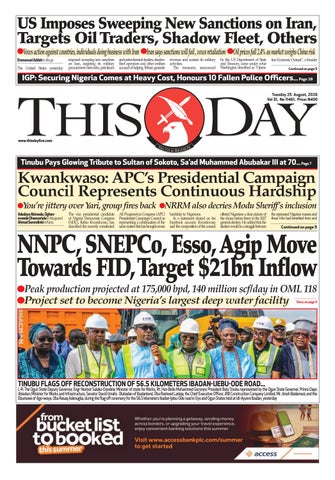
US Imposes Sweeping New Sanctions on Iran, Targets Oil Traders, Shadow Fleet, Others Vows action against countries, individuals doing business with Iran Iran says sanctions will fail , vows retaliation Oil prices fall 2.4% as market weighs China risk
Emmanuel Addeh in Abuja The United States yesterday
imposed sweeping new sanctions on Iran, targeting its military procurement networks, petroleum
and petrochemical traders, shadow fleet operators and other entities accused of helping Tehran generate
revenue and sustain its military activities. The measures, announced
by the US Department of State and Treasury, came under what Washington described as “Opera-
tion Economic Outcast”, a broader Continued on page 9
IGP: Securing Nigeria Comes at Heavy Cost, Honours 10 Fallen Police Officers... Page 28 Tuesday 25 August, 2026 Vol 31. No 11461. Price: N400
www.thisdaylive.com TR
UT H
& RE A S O
N
Tinubu Pays Glowing Tribute to Sultan of Sokoto, Sa’ad Muhammed Abubakar III at 70... Page 7
Kwankwaso: APC’s Presidential Campaign Council Represents Continuous Hardship You’re jittery over Yari, group fires back NRRM also decries Modu Sheriff’s inclusion
Adedayo Akinwale, Oghenevwede Ohwovoriole in Abuja and Ahmad Sorondinki in Kano
The vice presidential candidate of Nigeria Democratic Congress (NDC), Rabiu Kwankwaso, has described the recently constituted
All Progressives Congress (APC) Presidential Campaign Council as representing a continuation of the same system that has brought severe
hardship to Nigerians. In a statement shared on his Facebook account, Kwankwaso said the composition of the council
offered Nigerians a clear picture of the choice before them in the 2027 general election. He added that the election would be a struggle between
the oppressed Nigerian masses and those who had benefited from and Continued on page 9
NNPC, SNEPCo, Esso, Agip Move Towards FID, Target $21bn Inflow Peak production projected at 175,000 bpd, 140 million scf/day in OML 118 Project set to become Nigeria’s largest deep water facility
Story on page 9
TINUBU FLAGS OFF RECONSTRUCTION OF 56.5 KILOMETERS IBADAN-IJEBU-ODE ROAD...
L-R: The Ogun State Deputy Governor, Engr Noimot Salako-Oyedele; Minister of state for Works, Rt. Hon Bello Muhammed Goronyo; President Bola Tinubu represented by the Ogun State Governor, Prince Dapo Abiodun; Minister for Works and Infrastructure, Senator David Umahi; Olubadan of Ibadanland, Oba Rasheed Ladoja; the Chief Executive Officer, JRB Construction Company Limited, Mr. Jimoh Badamosi; and the Ebumawe of Ago-iwoye, Oba Rasaq Adenugba, during the flag-off ceremony for the 56.5 kilometers Ibadan-Ijebu-Ode road in Oyo and Ogun States held at Idi-Ayunre Ibadan, yesterday
2
TUEsday, AUGUST 25, 2026 • T H I S D AY
TUEsday, AUGUST 25, 2026 • T H I S D AY
3
4
TUEsday, AUGUST 25, 2026 • T H I S D AY
5
THISDAY • TUESDAY, AUGUST 25, 2026
NEWS
Group News Editor: Goddy Egene Email: Goddy.egene@thisdaylive.com, 0803 350 6821, 0807 401 0580
AT THE LAUNCH OF U.S. AMBASSADORS FUND FOR CULTURAL PRESERVATION...
L-R: Executive Director, Centre for Memories, Enugu, Iheanyi Igboko; Enugu State Deputy Governor, Ifeanyi Ossai; U.S. Consul General Brandon Hudspeth; and Representative of the Federal Ministry of Arts, Culture, Tourism and the Creative Economy, Dr. Shaibu Husseini at the launch of the $125,000 U.S. Ambassadors Fund for Cultural Preservation (AFCP) grant awarded to the Center for Memories
Stakeholders: Manpower Crisis Threatening Nigeria’s Mega Deepwater Projects
PETAN: Nigeria losing experienced engineers to global markets FG, OGTAN unveil plans to rebuild workforce
Peter Uzoho Stakeholders in Nigeria’s oil and gas industry have raised concerns over the depletion of technical manpower, warning that the shortage could undermine the execution of new mega deepwater projects despite renewed investments and government incentives to revive the sector. The stakeholders, including the Petroleum Technology Association of Nigeria (PETAN), Oil Producers Trade Section (OPTS), Nigerian Content Development and Monitoring Board (NCDMB), Oil and Gas Trainers Association of Nigeria (OGTAN) and industry executives, expressed the concerns at the just-concluded OGTAN Human Capacity Development Conference in Delta State. They said years of underinvestment and prolonged inactivity in exploration and production had created critical gaps in the industry’s technical workforce that must now be urgently addressed as major projects move into execution. After years of declining investment, particularly between 2014 and 2022, Nigeria’s upstream sector has begun to attract billions of dollars in new investments, especially in deepwater developments. Projects currently in execution include Shell’s $5 billion Bonga North and $2 billion HI projects, TotalEnergies’ $550 million Ubeta project and ExxonMobil affiliate Esso’s recently announced $1 billion Usan infill project.
Other major deepwater projects are also progressing towards Final Investment Decisions (FIDs), including the estimated $20 billion Bonga Southwest-Aparo project, the $10.3 billion Zabazaba and Etan projects, the $8 billion Owowo development and the $750 million IMA project. However, stakeholders said the investment rebound had exposed a new challenge: whether Nigeria has enough skilled professionals to execute the projects. The concern is particularly significant as the country seeks to increase crude oil production to 3 million barrels per day by 2030, with less than four years to meet the target. On his part, the Chairman of PETAN and Chief Executive Officer of Geoplex Drillteq, Wole Ogunsanya, said the industry’s biggest manpower challenge was not a shortage of graduates but the loss of experienced mid-career professionals. Represented by PETAN Publicity Secretary, Dr Joan Faluyi, Ogunsanya said Nigeria was steadily losing professionals with 10 to 15 years of experience, including drilling engineers, completions specialists, Remotely Operated Vehicle (ROV) supervisors and instrumentation leads, to international markets. “We develop them, and global markets recruit them,” he said. He described the trend as one of “the sharpest operational constraints facing PETAN members,” noting that companies could secure contracts
but struggle to find the specialists required to execute them. Ogunsanya also identified a widening gap between academic qualifications and practical competence, attributing it to limited access to simulator time, supervised field experience and Original Equipment Manufacturer (OEM) training in Nigeria. On emerging technologies, he said the next cycle of oil and gas contracts would increasingly be driven by digital systems, automation and Artificial Intelligence (AI). He cited a Nigerian AI subsurface solution that won the Nigerian Con-
tent Development and Monitoring Board’s Tech-Innovation Challenge, but said the challenge remained having enough skilled personnel to deploy such technologies safely. “Without addressing the three gaps simultaneously, Nigeria risks ‘localising yesterday’s services while importing tomorrow’s,’” he warned. He proposed that operators should recognise structured placements in indigenous service companies as certifiable training, while allocating part of Nigerian Content Human Capital Development funds to accredited local programmes. Besides, the Executive Secretary of
An estimated 2.27 million children and adolescents aged 0–19 lived with Human Immunodeficiency Virus (HIV) worldwide in 2025, with significant gaps in diagnosis, treatment, and viral suppression continuing to leave younger children particularly vulnerable, United Nations Children’s Fund (UNICEF) said. The newly published 2026 HIV estimates show that about 240,000 children and adolescents acquired HIV during the year, while 74,000
died from AIDS-related causes. The situation is particularly concerning among children aged 0–14. According to the estimates, 1.26 million children in this age group were living with HIV in 2025, while 93,000 acquired the virus and 61,000 died from AIDS-related causes. The figures translate to approximately 255 children acquiring HIV and 167 dying from AIDS-related causes every day. UNICEF said persistent gaps in access to HIV testing and treatment remained a major challenge.
graduates to pass through school without adequate industry training. He said renewed investment optimism arising from the policies and executive orders of President Bola Tinubu had placed several major projects on the horizon, making workforce development an urgent priority. On his part, the Minister of State for Petroleum Resources (Oil), Senator Heineken Lokpobiri, said the federal government was committed to supporting workforce development through the NCDMB and the Nigerian Oil and Gas Industry Content Development (NOGICD) Act.
U.S. Commits $125,000 to Preserve 4,000-year-old Lejja Iron-smelting Site Awards $1.2m in five years to preserve Nigeria’s cultural heritage
Nume Ekeghe
The United States has awarded a $125,000 grant to Centre for Memories in Enugu to support the preservation and digital documentation of the historic Lejja Iron-Smelting Site in Enugu State, believed to date back to about 2000 BC. The grant, provided under the U.S. Ambassadors Fund for Cultural Preservation (AFCP), will support the physical conservation of the site, alongside 3D digital
documentation aimed at preserving its history and making the heritage site more accessible for future generations. The project, titled, “Nchekwaba: Lejja Iron-Smelting,” is expected to provide further insight into the technological advancement and ingenuity of communities in what is now South-east Nigeria thousands of years ago. The U.S. Embassy, in a statement, said the project was part of its broader efforts to strengthen cultural ties between Nigeria and
2.27m Children, Adolescents Living with HIV Globally
Ayodeji Ake
NCDMB, Felix Ogbe, acknowledged that the industry had gone through a difficult period, characterised by a prolonged wait for FIDs, and said the Board had been building capacity over the years as part of efforts to address the workforce challenge. Represented by the Director of the Capacity Building Directorate, Abayomi Bamidele, Ogbe said the absence of new projects had constrained the growth of local content. According to him, Nigeria had effectively lost nearly 15 years of investment, a period long enough for an entire generation of Nigerian
Globally, only 65 per cent of children aged 0–14 living with HIV knew their status in 2025, compared with 89 per cent among adults. Similarly, only 55 per cent of children living with HIV were receiving antiretroviral treatment, compared with 79 per cent of adults. The gap is also reflected in viral suppression, with only 47 per cent of children living with HIV achieving a suppressed viral load. The estimates were released at a critical time for the global HIV response, as reductions in international
financing and disruptions to prevention and community-based services threatened to undermine recent gains. The UNAIDS Special Report for AIDS 2026, released during the International AIDS Conference in Rio de Janeiro, highlighted the potential impact of declining international funding and disruptions to essential HIV services. UNICEF warned that the effects could be particularly serious for children and adolescents, who already faced some of the largest gaps in HIV diagnosis and treatment.
the United States by protecting shared heritage and supporting preservation initiatives that could also provide economic opportunities for local communities. The latest award brings the U.S. government’s cultural preservation support for Nigeria to about $1.2 million over the past five years, covering projects aimed at protecting the country’s historic sites, traditions, and cultural heritage. US Embassy stated, “The project’s implementation by the Centre for Memories, led by U.S. exchange alumnus Iheanyi Igboko, reflects the enduring connections forged through the Cultural Heritage Forward program, which is funded by the U.S. Department of State and organised in partnership with the Smithsonian Institution. “The year-long programme connects Smithsonian experts with Nigerian museum professionals and community-based heritage practitioners to exchange expertise, strengthen professional networks, and advance the preservation of Nigeria’s cultural heritage.” U.S. Consul General Brandon Hudspeth launched the project at a ceremony in Lagos. Hudspeth stated that the Lejja Iron-Smelting Site told a 4,000-year-
old story of ingenuity, innovation, and technological sophistication. He explained that the AFCP grant, awarded to the Centre for Memories, builds on a longstanding U.S.-Nigeria partnership to protect and preserve Nigeria’s cultural heritage. He also expressed the U.S. government’s commitment to working with Nigerian cultural heritage professionals and institutions. Hudspeth stated, “The United States has invested approximately $1.2 million in cultural heritage preservation projects in Nigeria over the past five years, primarily through the Ambassadors Fund for Cultural Preservation. This is not aid this is a strategic economic intervention that advances the interests of Americans, Nigerians, and the global community.” The launch event was attended by Enugu State Deputy Governor Ifeanyi Ossai and representatives of the Federal Ministry of Arts, Culture, Tourism and the Creative Economy; National Commission for Museums and Monuments; International Council on Monuments and Sites (ICOMOS) Nigeria; the Smithsonian Institution’s National Museum of African Art; and Centre for Memories.
6
TUEsday, AUGUST 25, 2026 • T H I S D AY
7
THISDAY • TUESDAY, AUGUST 25, 2026
NEWS
VGLAMOUR MAGAZINE’S 10TH ANNIVERSARY...
L-R: Director-General of the Nigerian Civil Aviation Authority, Chris Ona Najomo; Minister of Women Affairs and Social Development, Hajiya Imaan Sulaiman-Ibrahim; Convener of the Nigeria most influential Vglamour magazine, Mrs. Vivian Lam; Otunba Dr. Adejere Adegbenro; and Comptroller-General of Customs, Bashir Adewale Adeniyi, during the Nigeria Most influential VGlamour Magazine’s 10th Anniversary in Abuja...recently PHOTO: KINGSLEY ADEBOYE
Tinubu Pays Glowing Tribute to Sultan of Sokoto, Sa’ad Muhammed Abubakar III, at 70 Deji Elumoye in Abuja
President Bola Tinubu has paid high tribute to Sultan of Sokoto, His Eminence, Alhaji Muhammad Sa’ad Abubakar III, on his 79th birthday. Tinubu, in a statement, yesterday, described the revered spiritual leader as a stabilising voice in times of turbulence, a bridge-builder across faiths and communities, and a moral compass for the entire nation. He said the President-General of the Nigeria Supreme Council for Islamic Affairs remained a
towering figure of conscience and counsel, a leader who spoke truth with compassion, and counselled patience without weakness. The president, in the nineparagraph release, stated, “Today, I join millions of Nigerians in celebrating a remarkable milestone for a remarkable person: His Eminence, Alhaji Muhammad Sa’ad Abubakar III, the Sultan of Sokoto and President-General of the Nigeria Supreme Council for Islamic Affairs, on his 70th birthday. “Your Eminence, on this day I offer my warmest congratulations
to you and your teeming subjects in Sokoto and beyond, on behalf of myself, the First Lady Senator Oluremi Tinubu, and the government and people of the Federal Republic of Nigeria. “Your seventy years are a testament to a life lived in service, wisdom, and grace. For nearly two decades on the throne of your forebears, you have embodied the finest traditions of the Sokoto Caliphate: scholarship, humility, and an unwavering commitment to peace.” Tinubu stated regarding the sultan, “You have been a stabilising
voice in times of turbulence, a bridge-builder across faiths and communities, and a moral compass not only for our Muslim ummah, but for our entire nation. “I have come to know you as a leader who speaks truth with compassion, who counsels patience without weakness, and who champions unity without compromising conviction. “Under your guidance, the Sultanate has continued to promote education, interfaith dialogue, and humanitarian service. Your advocacy for peaceful coexistence, for the girl-child, and for the dignity
Akpabio Seeks Muslims’ Prayers for Peace, Unity, Economic Prosperity at Eid Maulud First Lady preaches unity, peace
Deji Elumoye and Sunday Aborisade in Abuja
The President of the Senate, Godswill Akpabio, has urged Nigerian Muslims to use the occasion of Eid el Maulud to offer special prayers for peace, unity, security and economic prosperity in the country. Also, the First Lady, Senator Oluremi Tinubu, has preached unity and peace among Nigerians. In a message to mark this year’s Eid El Maulud, she prayed that the celebration strengthens the bonds of unity “among us and bring renewed hope, peace, and blessings to all Nigerians.” Mrs Tinubu, in the message stated: “As we commemorate Eid-el-Maulud 2026, I extend my warm greetings to Muslim faithful across Nigeria. “The celebration of the birth of the Prophet Muhammad (S.A.W) reminds us of his exemplary life and enduring virtues of compassion, forgiveness, and peaceful coexistence. “I encourage all Muslim faithful to emulate these noble virtues and continue to promote peace in our homes, communities and nation. “May this celebration strengthen the bonds of unity among us and
bring renewed hope, peace, and blessings to all Nigerians. Happy Eid-El-Maulud 2026!” Akpabio, in a goodwill message to the Muslim Ummah in Nigeria and across the world to mark the birth of Prophet Muhammad (SAW), also called on Nigerians to embrace love, forgiveness and mutual respect irrespective of their religious or ethnic backgrounds. The Senate President’s message was conveyed by his Special Adviser on Media and Publicity, Eseme Eyiboh. Akpabio described the life and teachings of Prophet Muhammad as a timeless model of compassion, tolerance, humility and service to humanity, urging Muslims to reflect on these virtues as they celebrate the sacred occasion. “As we commemorate this sacred day, I urge our Muslim brothers and sisters to reflect on the virtues of the Prophet and to offer special prayers for peace, unity, and progress in our dear country, Nigeria,” he said. The Senate President stressed that Nigeria’s diversity remained a source of strength, rather than division, and urged citizens to build a culture of peaceful coexistence and mutual understanding. “In these times, our nation needs
the prayers of all religious leaders and faithful. Let us use this period to pray for our leaders, for security, economic prosperity, and for the unity that binds us together as one people under God,” he said. He called on Nigerians to draw lessons from the virtues exemplified by Prophet Muhammad, particularly
compassion, tolerance, humility and service to humanity, in their interactions with one another. The Senate President also reaffirmed the commitment of the 10th National Assembly, under his leadership, to advancing legislation and policies aimed at protecting religious freedom, promoting national cohesion and improving the welfare of Nigerians.
Alhaji Muhammad Sa’ad Abubakar III
of every Nigerian reflects the very best of our shared values.” The president added, “At 70, you remain a towering figure of conscience and counsel. Your palace in Sokoto has become a sanctuary for dialogue, and your words carry weight in every corner of this country. In moments of grief, you comfort. In moments of division, you unite. In moments of doubt, you remind us of our common humanity and our common destiny as one people under God. “As President, I deeply value your partnership in nationbuilding. Your security support, community development, and
the spiritual well-being of our people strengthen the fabric of our republic. Nigeria needs more of the wisdom you so generously offer. “On this landmark birthday, I pray that Allah will continue to grant you many more years in good health, sound mind, and continued strength. May He preserve you for your family, for the Sokoto Caliphate, and for Nigeria. May your reign continue to be a source of blessing, guidance, and honour. “Your Eminence, congratulations once again. May this new decade of your life be your most rewarding yet.”
Fubara Defends Payroll Clean-Up, Says No Room for Politics in Rivers
Blessing Ibunge in Port Harcourt
Governor Siminalayi Fubara of Rivers State defended his administration’s decision to implement the findings of a comprehensive payroll verification exercise across the state’s 23 local government areas, saying the move aims to eliminate “ghost” workers and restore fiscal discipline. Fubara, who spoke on Monday while commissioning the Omademe Internal Roads Project in Ikwerre Local Government Area, said the payroll clean-up was necessary to address longstanding irregularities in the councils’ salary structure. The governor said the problem predated his administration, stating that the former Local Government Service Commission had commenced efforts
to tackle the bloated payroll before the political crisis and subsequent emergency rule in the state. He said he remained committed to completing the process after his return and the inauguration of a new commission, stressing that the exercise is conducted with the support of experienced treasury and ICT personnel. Fubara dismissed suggestions that the payroll verification was politically motivated, declaring that employment into the state’s public service must follow due process, regardless of political affiliation. The governor stated, “It doesn’t matter whether the people are my supporters. It doesn’t matter whether they are people from the other side. Now there is no other side. We are all Rivers people.”
The governor added: “I approved the implementation of that recommendation and I stand by it.” Fubara also used eaffirmed his administration’s commitment to infrastructure development, particularly projects designed to open up rural communities and strengthen economic activities. He said the Omademe road project was conceived to improve connectivity within the community and neighbouring areas. He assured Rivers residents that his administration would continue to deliver projects that add value to their lives until its last day in office. Fubara said, “We want to say it publicly here that it’s not about the number of days, but what matters in the life of every administration is the
value that is added.” The governor appealed to political leaders in Rivers State to consolidate the prevailing peace and avoid returning to the political crisis that previously divided the state. He stated, “For me, I am not interested in going down that road anymore. What is behind me is behind me. “What I am looking at is what is ahead of me.” He urged residents to work together for the development of the state. Earlier, Commissioner for Works, Professor Temple Nwofor, said the Omademe Internal Roads contract was awarded to Setraco Construction Limited in February 2024, with construction commencing in November of the same year.
8
TUESDAY, AUGUST 25, 2026 • THISDAY
NEWS
SSDC’S COURTESY CALL ON THE INDONESIAN AMBASSADOR...
L-R: Member, Board of South South Development Commission (SSDC), Imeh Udoaba; Executive Director Commercial Affairs, SSDC, Hon. Joseph Ugheoke; High Commissioner of Malaysia to Nigeria, H.E Aiyub Bin Omar; Counsellor, High Commission of Malaysia, AAdela Termizi; and President, Association of Oil palm Producers in Nigeria, Alphonsus Inyang, during the a courtesy call on the Indonesian Ambassador by the SSDC leadership, yesterday PHOTO: SSDC
MTN Approves $375m Share Buyback After Rise in Profit Nigeria, Ghana, Uganda lift revenue by 17.5%, growth in S’Africa stalls at 1.5% Emmanuel Addeh in Abuja South African mobile operator MTN Group said yesterday its board had approved a 6 billion rand ($375 million) share buyback programme as it reported a 21.3 per cent rise in half-year adjusted profit and strong cash generation. A Reuters report quoted MTN’s Chief Executive Officer, Ralph Mupita, as telling journalists that the buyback programme would begin on Monday. At 1005 GMT, MTN shares were up 4.61 per cent at 201 rand, the report stated. Africa’s biggest telecom operator, with more than 317 million customers across 19 markets, said adjusted Headline Earnings Per Share (HEPS) rose to 793 cents in the six months ended June 30 from 654 cents a year earlier. Reported HEPS, however, fell 5.8 per cent, hit by a 3.9 billion rand non-cash impairment on its 49 per cent stake in Irancell,
reflecting Iran’s hyperinflation and the sharp depreciation of the rial. Foreign exchange losses in South Sudan also weighed on earnings, the Reuters report added. The impairment comes as MTN seeks to exit Iran, its last remaining operation in a broader withdrawal from the Middle East. The process
has been complicated by U.S. sanctions, in place since May 2018, which have also prevented the company from repatriating about 880 million rand in trapped dividends, Mupita said. “With the sanctions in place, we can’t put any money in and we can’t take any money out. But if the
situation did change in a way where there was a removal of sanctions we would continue with executing our Middle East exit strategy,” he added. According to the report, outside Iran, MTN’s biggest market Nigeria, along with Ghana and Uganda, helped lift service revenue 17.5 per cent to 115.3 billion rand. Growth
Ogun Waterside Local Government has pledged its full support for the proposed Dangote Deep Seaport, describing the project as a transformative investment that will accelerate industrialisation, create employment and reposition the coastal council as a major logistics and maritime hub in Nigeria. The commitment was made during a high-level stakeholders’ meeting convened by the Executive Chairman of Ogun Waterside Local Government, Hon. AbdulGaniyu Adetoye Odunnoiki, at the council secretariat, Dangote Group said in a statement, yesterday. The meeting brought together representatives of Dangote Group,
Besides, the telecom firm said the remaining hurdles to its tower deal with IHS Towers are largely regulatory, having received conditional approval from Nigeria’s competition regulator, which requires it to reduce its stake in the Nigerian business by up to 30 per cent over time at market prices.
Sachet Alcohol: NAFDAC Steps Up Ban Enforcement
Ayodeji Ake
National Agency for Food and Drug Administration and Control (NAFDAC) has intensified enforcement of the federal government’s ban on alcoholic beverages packaged in sachets and PET/plastic bottles below 200ml, warning manufacturers, distributors, and retailers to comply or face severe sanctions. NAFDAC said the enforcement was aimed at completely removing
prohibited alcoholic products from the Nigerian market and reducing easy access to highly concentrated alcoholic drinks, particularly among children and young people. The latest action followed an Irrevocable Enforcement Undertaking signed by Distillers and Blenders Association of Nigeria (DIBAN), Association of Food, Beverage and Tobacco Employers (AFBTE), and their member companies. Under the undertaking, affected
manufacturers were required to immediately recall all alcoholic beverages packaged in sachets and PET bottles below 200ml from distributors, warehouses, and other points within the supply chain. NAFDAC said recalled products will be verified and destroyed under its supervision, with manufacturers bearing the full cost of the destruction. The agency also said factories involved in producing the prohibited pack sizes will not be allowed to
Ogun Waterside LG Backs Dangote Deep Seaport, Pledges Peaceful Investment Climate Peter Uzoho
in South Africa was 1.5 per cent. MTN said strong subscriber additions and growth in digital and fintech services also supported performance. Core earnings rose 24.4 per cent to 56 billion rand, while the EBITDA margin widened 3.1 percentage points to 47.1 per cent .
traditional rulers from Ode Omi and Irokun Kingdoms, community leaders and senior government officials to strengthen collaboration ahead of the project’s development. Odunnoiki commended President Bola Ahmed Tinubu and Ogun State Governor, Dapo Abiodun for approving the Free Trade Zone in Ode Omi and Irokun as the location for the Dangote Deep Seaport, describing the decision as a defining moment for the economic future of Ogun Waterside. “This engagement is about strengthening mutual understanding, fostering peaceful coexistence and creating a sustainable framework for community development and industrial collaboration,” he said.
“The Dangote Deep Seaport will not only transform our local economy but also create opportunities for our people and future generations.” The council chairman urged residents and traditional institutions across the local government to embrace unity and maintain peace, stressing that sustainable development can only thrive in a stable environment. He also assured investors the local government would continue to provide an enabling environment while safeguarding the rights, culture and welfare of host communities. Addressing the gathering, Dr. Sulaimon Ibrahim, who represented Dangote Group, reaffirmed the company’s com-
mitment to responsible investment and meaningful engagement with host communities. He said the success of the deep seaport would be built on transparency, partnership and shared prosperity. “Our commitment goes beyond infrastructure,” Ibrahim said. “We will honour every agreement reached with the host communities and ensure that all persons affected during the planning process are compensated in line with established enumeration and industry standards. Sustainable operations can only flourish in an atmosphere of peace and mutual trust.” The meeting also highlighted expectations for broad based local participation in the project.
reopen until there was satisfactory evidence that the relevant production lines had been dismantled, permanently disabled, or reconfigured to prevent further production. The ban, however, did not emerge suddenly. According to NAFDAC, concerns over the widespread availability of high-alcohol-content drinks in sachets and small bottles dates back to 2018, when regulators raised concerns about their affordability, portability, and accessibility to minors. Following consultations involving NAFDAC, Federal Ministry of Health, Federal Competition and Consumer Protection Commission (FCCPC), DIBAN, and AFBTE, a five-year moratorium was agreed upon in December 2018. The moratorium gave manufacturers until January 31, 2024 to reconfigure production lines, transition to larger packaging, and phase out sachet alcohol and small-volume containers. When the deadline expired, NAFDAC commenced enforcement in February 2024. However, resistance from industry stakeholders and intervention by the National Assembly led to further consultations and an extension of the deadline to December 31, 2025. The full ban subsequently took effect on January 1, 2026, covering alcoholic beverages packaged in sachets, PET bottles below 200ml, and glass bottles below 200ml. NAFDAC said the policy was supported by research highlighting the accessibility of such products to
minors. The agency cited findings indicating that 47.2 per cent of minors and 48.8 per cent of underage persons who procured alcoholic drinks obtained them in sachets, while 41.2 per cent of minors and 47.2 per cent of underage persons procured them in PET bottles. In January 2026, NAFDAC commenced its first-tier enforcement, focusing on manufacturers. The agency said prohibited products found within manufacturing facilities were evacuated and destroyed. By July, the agency escalated the exercise to nationwide mop-up operations across markets, motor parks, retail outlets, bars, and distribution centres. The crackdown resulted in the closure of some factories and the arrest of staff of companies found producing prohibited sachet alcoholic beverages. NAFDAC said companies that violated its directives will also be required to pay applicable investigative charges and regulatory fees. It warned that facilities would only be reopened after satisfying a number of conditions, including completing the nationwide recall, paying applicable charges, destroying recalled products under NAFDAC supervision, and passing inspection and certification by the agency. Companies that fail to comply could face continued closure, placement on NAFDAC’s Regulatory Watchlist, suspension or revocation of product registrations, and criminal prosecution where applicable.
9
THISDAY • TUESDAY, AUGUST 25, 2026
NINE
Dangote’s Petrol Supply Falls 21% to 25.8m Litres/day as Imports Rise 9%
PMS consumption slumps 25% to 35.7m litres daily Crude receipts by domestic refineries drop 8% to 585,000 bpd
Emmanuel Addeh in Abuja The supply of petrol from the Dangote Petroleum Refinery fell by 21 per cent in July 2026, while imports increased by 9 per cent, fresh data from the Nigerian Midstream and Downstream Petroleum Regulatory Authority (NMDPRA) showed yesterday. The development came despite an improvement in petrol stock sufficiency during the month, with available reserves rising to 22.4 days from 19.7 days in June, even as the country remained below the regulatory minimum fuel sufficiency threshold of 30 days. According to the NMDPRA’s July
2026 Midstream and Downstream Statistics, average daily petrol receipts fell from 50.6 million litres in June to 45.5 million litres in July, representing a 10 per cent month-on-month decline. The contraction was driven principally by domestic supply undertaken by the Dangote Refinery, which dropped from 32.5 million litres per day to 25.8 million litres per day, a 21 per cent reduction. At the same time, imports rose from 18.1 million litres per day to 19.7 million litres per day, representing a 9 per cent increase. The figures underlined a renewed increase in Nigeria’s reliance on imported petrol, following months
in which domestic refining had increasingly displaced import as the debate over whether to end fuel importation altogether or create some form of competition for the Dangote facility rages. However, the July figures also showed the significance of the Dangote refinery to the domestic market. The refinery recorded average capacity utilisation of 71.09 per cent during the month. It produced 25.9 million litres of petrol per day and supplied 25.8 million litres daily to the domestic market. The refinery also produced 19.1 million litres per day of Automotive Gas Oil (AGO) or diesel and 15.6 million litres per day of Aviation
Turbine Kerosene (ATK). Its domestic receipts stood at 15.7 million litres per day for AGO and 1.9 million litres per day for ATK. But during the same period, exports amounted to 11 million litres per day of AGO and 11.6 million litres per day of ATK or kerosene. Its closing stock at the end of July stood at 446.1 million litres for PMS, 162.3 million litres for AGO and 217.4 million litres for ATK. The month-on-month shift in petrol supply was particularly notable against the longer-term trend. In July 2025, domestic refineries supplied an average 16.5 million litres of PMS daily, while imports accounted for 36.1 million litres. By July 2026,
domestic supply had risen 56 per cent year-on-year to 25.8 million litres per day, while imports had fallen 45 per cent to 19.7 million litres per day. Thus, although imports increased between June and July 2026, they remained substantially below their level a year earlier. The July 2026 total PMS supply of 45.5 million litres per day was also 13 per cent below the 52.6 million litres recorded in July 2025. In the same vein, the weaker petrol supply coincided with an even sharper fall in recorded consumption. PMS consumption dropped from 47.4 million litres per day in June to 35.7 million litres per day in July,
Alhaji Aliko Dangote representing a 25 per cent decline. NMDPRA said consumption data are based on volumes trucked out into the domestic market.
NNPC, SNEPCO, ESSO, AGIP MOVE TOWARDS FID, TARGET $21 BILLION INFLOW
Emmanuel Addeh in Abuja and Peter Uzoho in Lagos
The Nigerian National Petroleum Company Limited (NNPCL) and its contractor parties — Shell Nigeria Exploration and Production Company Limited (SNEPCo), Esso Exploration and Production Nigeria (Deepwater) Limited, and Nigerian Agip Exploration Limited (NAE) yesterday executed the Addendum to the Oil Mining Lease (OML 118) Production Sharing Contract (PSC) and the Addendum to the Dispute Settlement Agreement (DSA). The development marked a major milestone in the advancement of
the deepwater Bonga Southwest/ Aparo project (BWSAp) towards Final Investment Decision (FID). NNPCL announced the deals in a statement signed by its Chief Corporate Communications Officer, Mr. Andy Odey. The execution gives effect to the fiscal and commercial terms approved by the federal government to support the development of BSWAp and it reinforces Nigeria’s commitment to creating a competitive, stable and attractive environment for large-scale deepwater investment. The milestone follows the approval of the Deep Offshore Oil and Gas Projects Incentives (Tax Remission)
Order, 2026, by President Bola Ahmed Tinubu, an important component of the government’s ongoing reforms to enhance the competitiveness of Nigeria’s deepwater sector and unlock new investment. BSWAp is expected to attract between $15 billion and $21 billion in investment over the life of the project, with peak production projected at about 175,000 barrels of oil per day and 140 million standard cubic feet of gas per day, the national oil firm stated. The project is expected to boost Nigeria’s oil and gas production, government revenues and foreign exchange earnings, while creating
opportunities for local contractors and suppliers and supporting employment, skills development and technology transfer. Speaking on the milestone, the Group Chief Executive Officer of NNPC, Bayo Ojulari, said the project will unlock a major deepwater project, demonstrating that Nigeria has a competitive fiscal framework and a clear pathway for sustainable investment in its energy sector “The execution of the BSWAp PSC and DSA Addenda demonstrates the effectiveness of President Tinubu’s reforms in translating policy into investment. This is about unlocking a major deepwater project and
KWANKWASO: APC’S PRESIDENTIAL CAMPAIGN COUNCIL REPRESENTS CONTINUOUS HARDSHIP sustained the current system. However, an APC support group, APC Daga Titi Zuwa Titi, said Kwankwaso’s comments expressed nervousness regarding Yari’s appointment as Director-General of the APC presidential campaign council. National Coordinator of the group, Jaafar Hassan, said in a statement that Kwankwaso’s comments were a clear indication that Yari’s emergence as the ruling party’s campaign director had unsettled the opposition. But Nigeria Rescue and Renewal Movement (NRRM) also condemned the inclusion of former Borno State governor, Senator Ali Modu Sheriff, in the APC presidential campaign council. NRRM National President, Comrade Aliyu Adam Usman, told journalists that the organisation was particularly worried because of Sheriff’s alleged links to the Boko Haram terrorist group. Kwankwaso said regarding the APC presidential campaign council, “The council brings together many of the same political actors who have supported, defended or participated in the present administration. “Their coming together raises a fundamental question: what exactly are they asking Nigerians to vote for in 2027, a new beginning, or the continuation of the same system that has brought severe hardship to our people?” Kwankwaso, a former governor of Kano State, lamented that families across the country were struggling with the rising cost of food and basic necessities, while young Nigerians faced unemployment and diminishing opportunities. He stated, “Farmers and businesses are struggling to survive, while millions continue to live with insecurity. Our education, healthcare
and other essential public services remain under enormous pressure.” Kwankwaso appealed to Yari to reconsider accepting the position of Director-General of APC Presidential Campaign Council He said, “As a former governor of Zamfara State and a prominent leader from the North-west, I believe Senator Yari has a clear understanding of the devastating consequences of insecurity, poverty, unemployment, displacement and the destruction of livelihoods in the region and the country at large. “I, therefore, will be surprised if, in his good conscience, he will lead a campaign whose principal objective is to secure the continuation of a government under which many of the people he once governed, and other innocent Nigerians remain trapped in these challenges.” The statement also raised concerns over the inclusion of Executive Chairman of the Nigeria Revenue Service, Dr Zacch Adedeji, and Director-General of Budget Office of the Federation, Dr Tanimu Yakubu Kurfi, in the APC campaign’s fundraising and finance structures. Kwankwaso stated that the leadership of critical public institutions demanded neutrality, integrity, and public confidence. He questioned whether the responsibilities of senior officials entrusted with managing public revenue and national finances could appropriately coexist with senior partisan campaign roles. “The government and the APC should explain how such arrangements are consistent with institutional neutrality and public trust,” he stated. Kwankwaso, however, expressed optimism that Nigerians would reject “continued oppression” in 2027 and demand accountable and people-centred governance. “If Osun people can do it, so
can all other parts of the country,” he said, adding, “Ultimately, no campaign council is more powerful than the Nigerian people.”
Ex-Gov Jittery over Yari’s Appointment as APC Campaign Council DG, States Group
A support group, APC Daga Titi Zuwa Titi, fired back at Kwankwaso, saying he is jittery over the appointment of Yari as Director-General of the APC presidential campaign council. The group stated that Kwankwaso’s comments about the appointment of Yari was a clear
indication that his emergence had unsettled the opposition. National Coordinator of the group, Jaafar Hassan, in a statement, said it was revealing that out of all the appointments announced in the APC campaign structure, Kwankwaso found it necessary to personally appeal to Yari to reconsider his acceptance of the responsibility. Hassan stated, “Politicians rarely advise their opponents to abandon positions they consider politically irrelevant. “Senator Kwankwaso may dress his intervention in the language of Continued on page 26
demonstrating that Nigeria has a competitive fiscal framework and a clear pathway for sustainable investment in its energy sector. “NNPC Ltd will continue to work closely with the federal government, our partners and other stakeholders to ensure that this project delivers maximum value for the federation and the Nigerian people,” he explained. The OML 118 Contractor Parties also announced the successful completion of the project’s Pre-Front End Engineering Design (Pre-FEED) phase, which they said had helped mature the technical and commercial scope of the development and positioned it to progress into the Front End Engineering Design (FEED) phase. However, the transition to FEED remains subject to applicable partner, assurance and governance requirements. The partners have also identified a preferred Floating Production Storage and Offloading (FPSO) contractor following a competitive selection process. The selection, the statement said, is subject to the completion of applicable partner, regulatory, assurance and governance processes. According to the oil company,it provides a basis for progressing the FPSO concept into FEED and undertaking further engineering and commercial work required to mature the project towards FID. However, any eventual award of the FPSO Engineering, Procurement,
Construction and Installation (EPCI) contract remains subject to all applicable approvals and requirements, it explained. When operational, BSWAp is expected to become one of Nigeria’s most significant new deepwater production hubs and contribute materially to national oil production. The project is also expected to generate substantial economic benefits through billions of dollars in investment, increased participation by Nigerian contractors and suppliers and direct and indirect employment opportunities across engineering, fabrication, offshore construction, logistics and operations. The development is expected to strengthen Nigerian content by expanding contracting opportunities for indigenous companies, enhancing local fabrication, marine and engineering capabilities, facilitating technology transfer and skills development, and creating opportunities across the wider economy. The execution of the agreements reflects collaboration among NNPC Ltd, the federal government, regulatory agencies and the OML 118 Contractor Parties as the project advances towards FID. NNPC reaffirmed its commitment to working with all stakeholders to advance the BSWAp project safely, competitively and responsibly while maximising value for Nigeria and the Nigerian people.
US IMPOSES SWEEPING NEW SANCTIONS ON IRAN, TARGETS OIL TRADERS, SHADOW FLEET, OTHERS US Treasury Secretary, Scott Bes- take effect, saying he would instead campaign aimed at cutting Iran off The sanctions extend beyond from international financial and sent, described the campaign as an provide them time to comply with Iran, with Washington warning commercial networks. companies and individuals in other “economic onslaught” against Iran the new directive. “We are giving everyone the countries that facilitate Iranian oil The latest action targets nearly and said Washington’s objective 60 individuals, entities and vessels, was to sever the financial lifelines opportunity to remedy bad and petrochemical transactions that behaviour. Why would I want they could also face restrictions. according to the US government, sustaining the Iranian regime. with the sanctions covering Iranian Among the companies targeted Bessent warned that entities to blow up the global financial military activities, procurement, facilitating transactions involving system?” Bessent said at a news was India-based Sadashiva Overcyber operations and petroleum and Iranian oil and helping convert conference. seas Limited, which the US said The US also sanctioned senior imported approximately $69 million petrochemical revenue generation. the country’s petroleum revenues The US said the measures were into funds for the regime could be Iranian military officials, including worth of Iranian-origin petroleum designed to restrict the revenues targeted. He also said US President Islamic Revolutionary Guard Corps products between February 2024 used by the Iranian regime to attack Donald Trump was contacting (IRGC) Commander Ahmad and June 2025. its neighbours, support terrorism world leaders and demanding that Vahidi, Khatam ol Anbia Central Another Indian company, PP and sustain its military capabilities. they cease economic interactions Headquarters commander Ali Softtech Private Limited, was Abdollahi and IRGC Aerospace accused of importing about $25 The sanctions also target with Tehran. companies and intermediaries The announcement has raised Force commander Sayyed Hosein million worth of Iranian petroleum in third countries involved in particular questions about China, Majid Musavi Eftekhari. products between January 2024 Washington accused the officials and June 2025. the purchase, transportation and Iran’s largest trading partner and of directing or supporting Iran’s marketing of Iranian petroleum a major buyer of its oil. Prakrutees Infra Impex India and petrochemical products. China has opposed unilateral military activities, including bal- Private Limited was also sanctioned Among those sanctioned were sanctions and called for political listic missile and unmanned aerial for importing Iranian petroleum India-based companies accused and diplomatic efforts to resolve vehicle programmes. products valued at about $25 of importing Iranian petroleum the conflict, potentially setting the The US also designated the million between May 2023 and products, Turkish companies stage for a confrontation between Iranian Islamic Revolutionary February 2026. involved in petrochemical trade, Washington and Beijing over Guard Corps Cyber-Electronic The US further targeted Hong a Hong Kong-based company enforcement of the new measures. Command, accusing it of obtaining Kong-based Selenium Resources accused of operating a tanker But he declined to identify the information on US military assets Limited, which Washington said carrying Iranian crude, as well countries that would be targeted or and facilities to support Iranian as an India-based customs broker. reveal when those penalties would military targeting operations. Continued on page 27
10
TUEsday, AUGUST 25, 2026 • T H I S D AY
Cgrulis To An
AMIABLE GOVERNOR A Toast To A Life of Service @ 57 I join your family, friends, associates and the good people of Borno State in celebrating you, His Excellency, Prof. Babagana Umara Zulum, as you mark your 57th birthday. Prof., I have known you long enough to know that, for you, public service has never been about the comfort of office. It has always been about the people. One of the enduring lessons of leadership is that trust is built through consistency, that is, when words and actions repeatedly meet. In Borno, you have continued to earn that trust by showing up, taking responsibility and following through. At 57, your journey reminds us that leadership that lasts is rarely built on applause or grand promises. It is built on discipline, purpose and the daily willingness to do the work. As you celebrate another year, my prayer is that Almighty Allah continues to strengthen you, preserve you in good health and grant you greater wisdom and courage to complete the important work before you. Happy 57th birthday, Prof. May the years ahead bring even greater fulfilment in the service of Borno State and our dear nation.
Signed:
Senator Kashim Shettima, GCON
His Excellency,
PROF. BABAGANA UMARA ZULUM, MNI, FNSE Executive Governor of Borno State
Vice President, Federal Republic of Nigeria
TUEsday, AUGUST 25, 2026 • T H I S D AY
11
12
TUESDAY, AUGUST 25, 2026 • THISDAY
NEWS
5TH CORONATION ANNIVERSARY...
L-R: Royal Order of Iwere (ROI), Ade Mabo; Senior Brand Manager, Seaman’s Schnapps, Nnenna Uche-Onyenacho; and Oritsebolowu of Warri Kingdom, Dr. Richard McGrey, during the 5th Coronation Anniversary of His Majesty Ogiame Atuwatse III, Olu of Warri Kingdom, held in Warri Delta State... recently
Report: High Energy Bills, Rising Taxes May Further Raise Beer Prices in Nigeria Emmanuel Addeh in Abuja Beer prices in Nigeria may rise further as brewers contend with sharply higher tax expenses and soaring electricity, gas, diesel, transportation and other operating costs that are squeezing their margins. A report by The Drinks Business highlighted the mounting cost pressures confronting Nigeria’s major breweries, with the latest financial
results showing that Nigerian Breweries, Guinness Nigeria and International Breweries collectively incurred N112.87 billion in tax expenses in the first half of 2026. The figure represented an increase of about 58 per cent from the N71.39 billion recorded by the three companies in the corresponding period of 2025. The higher tax burden came alongside persistent increases
in energy and other operating costs, raising concerns about the ability of the brewers to continue absorbing the additional expenses without passing some of them on to consumers through higher beer prices. The financial results filed with the Nigerian Exchange Limited (NGX) showed that although the three companies generally recorded stronger profit before tax in the
period, increased tax expenses significantly affected their earnings after tax. For Nigerian Breweries, tax expense rose to N63.37 billion in the first half of 2026, compared with N43.83 billion in the same period last year. Its profit before tax increased by 18.2 per cent year-on-year to N156.33 billion, while profit after tax rose by only 5.1 per cent to N92.95
Tunji-Ojo: Make Border Communities Partners in Nigeria’s Security Strategy Michael Olugbode in Abuja Minister of Interior, Dr. Olubunmi Tunji-Ojo, has called for a stronger partnership among universities, security agencies, regional institutions, development partners, and border communities to strengthen Nigeria’s border security, migration management, and regional integration. Tunji-Ojo spoke on Monday at the opening of the African Borderlands Research Network (ABORNE) 2026 conference in Lagos. He said border communities must be treated as active partners in securing Nigeria’s frontiers rather than merely as populations requiring protection. The minister, represented by his Senior Adviser on Policy Research, Dr. Kareem Olajoku, said the involvement of border communities could improve early warning mechanisms, conflict prevention, and overall border management. The four-day conference, cohosted by Lagos State University (LASU) and ABORNE, had as its theme, “Connected Borderlands, Socio-Cultural Integration, and the Centrality of Policy, Research, and Security.” According to Tunji-Ojo, Nigeria’s evolving security and migration challenges require closer collaboration between policymakers, researchers, and practitioners, with decisions increasingly driven by evidence and realities on the ground. “Building a resilient borderline, therefore, requires us to see border
communities not merely as populations to be secured but as partners in security, peace, and development,” he said. He stated that border communities were often the first to experience the consequences of insecurity, irregular migration, and other cross-border challenges, making their participation crucial to developing effective and sustainable responses. The minister said research should also move beyond explaining past developments to helping governments anticipate emerging threats and formulate practical responses. He highlighted ongoing reforms in Nigeria’s migration and border management system, including improvements in biometric identity systems, passport administration, automated border control, and technology-enabled border security. He said the measures reflected the federal government’s determination to build a modern border management system capable of protecting national security while facilitating legitimate travel, trade, and regional mobility. Tunji-Ojo also stressed the importance of Lagos as the host location for the conference, describing the state as a major gateway for the movement of people and goods through its land connections, seaports, and international airports. He said Lagos provided an appropriate setting for examining the complex relationship between security, mobility, trade, community
interaction, and regional integration. The minister commended LASU and ABORNE for bringing scholars, policymakers, security practitioners, and development partners together, describing the collaboration as an example of how academic research and practical experience could be combined to address contemporary security challenges. He urged participants to move beyond identifying the challenges confronting Africa’s borderlands and concentrate on developing practical, collaborative and sustainable solutions. Tunji-Ojo described ABORNE 2026 as more than an academic gathering, saying it provides an important platform for strengthening the link between knowledge and action, communities and institutions, as well as national security and regional cooperation. He expressed hope that partnerships established during the conference would continue beyond the event and research generated from the discussions would influence policymaking and operational practice across Nigeria and the wider African continent. Earlier, Vice-Chancellor of LASU, Professor Ibiyemi Olatunji-Bello, said the hosting of the conference was more than an international academic engagement, describing it as an affirmation of the university’s commitment to producing research that responds to Nigeria’s realities and Africa’s development needs. Olatunji-Bello said Africa needed
a new generation of scholars and professionals who understood that borders were not simply geographical lines but spaces shaped by communities, livelihoods, identity, security, development, and human mobility.
billion. The company’s effective tax rate also climbed to 40.5 per cent from 33.1 per cent a year earlier. Guinness Nigeria also recorded a significant increase in its tax bill, with tax expense rising to N13.03 billion from N7.32 billion in the first half of 2025. Its profit before tax rose to N38.34 billion from N23.83 billion, while profit after tax increased to N25.30 billion from N16.51 billion. However, its effective tax rate increased to 34 per cent from 30.7 per cent. International Breweries recorded tax expenses of N36.47 billion in the first half of 2026, compared with N20.24 billion in the corresponding period of 2025. Its profit before tax increased to N74.79 billion from N61.53 billion, but the company recorded a loss after tax of N38.31 billion, compared with a profit of N41.29 billion in the same period of 2025. Its effective tax rate also rose to 48.8 per cent from 32.9 per cent.
According to the report, the figures suggested that while the three brewers improved their pre-tax performance, rising tax liabilities and operating costs are taking a growing share of their earnings. The pressure is particularly significant for an industry already facing elevated costs for electricity, gas, diesel, transportation and other inputs. With manufacturers under increasing pressure to protect margins while keeping products affordable in a difficult consumer environment, the latest cost increases could ultimately translate into higher prices for beer consumers if the trend persists, it stressed. Also, the development could further compound pressure on consumers already grappling with elevated living costs, while placing additional strain on breweries as they balance rising production expenses against weakening purchasing power.
TUC Pickets Abuja Continental Hotel Over Non-Unionisation Hotel rejects allegation
Onyebuchi Ezigbo in Abuja
Trade Union Congress (TUC) on Monday staged a protest at the premises of Abuja Continental Hotel located in Central District of the Federal Capital Territory (FCT), Abuja. TUC accused the management of the hotel facility of anti-labour practices by preventing its employees from belonging to Hotel Workers Union, an affiliate of TUC. As early as 6am, protesting members of the union stormed the hotel and blocked its entry and exit routes chanting solidarity songs. FCT Police Command promptly deployed its men to the scene to prevent any violence. Addressing the protesters, TUC General Secretary, Dr. Nuhu Toro, said the reason the union embarked on the picketing of the hotel was its management’s refusal to dialogue with the union over demand to
allow workers willing to belong to the union to do so. Toro said the union was out to ensure the hotel workers regained their right to unionisation and collective bargaining. He stated, “The issue is very clear. The hotel workers are being treated like slaves in Abuja Continental Hotel. “Their rights have been violated. They are not allowed to exercise their fundamental human rights. And that is why we are here.” Toro explained that TUC had written to the hotel management on August 4, inviting them for a discussion to try to resolve the issue amicably, but they failed to accommodate dialogue. He said, “To our surprise, the management of Abuja Continental Hotel wrote us back to say owing to renovation exercise going on, they might not be available to discuss with us until end of November. How does that make sense to you? We
are talking about workers’ rights being violated. “We are talking about workers being treated as slaves. And you are postponing it until the renovation is done. Invariably, which means by the time they are done with the renovation, all our workers will have died.” In response to the TUC action, the management of Abuja Continental Hotel rejected the allegation of anti-labour practices, saying it is not opposed to the right of workers to associate freely. In a statement signed by Cluster Director, Human Resources, Abuja Continental Hotel, Niyi Agoro, the hotel said, “While we respect the fundamental right of workers to freedom of association and to express legitimate concerns, we categorically reject the allegations of unfair labour practices and the assertion that management has prevented or attempted to prevent employees from exercising their right to associate.
TUEsday, AUGUST 25, 2026 • T H I S D AY
13
14
TUESDAY, AUGUST 25, 2026 • THISDAY
NEWS
CONGRATS TO THE LATEST UWAM COUPLE...
The newlyweds pictured with their parents, L–R: Father of the Groom, Evarist Anele Uwam; Mother of the Bride, Susan Esele Onwudinjo; the Couple, Ositadinma and Awele (Nee Onwudinjo) Uwam; Father of the Bride, Augustine Ibe Onwudinjo; and Mother of the Groom, Patricia Nnenne Uwam, last Saturday, August 22, 2026 at The Catholic Church of the Holy Spirit (CCHS) Omole, Estate Phase 1, Ikeja, Lagos
Okpebholo Signs Revised Assembly Funds Management, Judiciary Autonomy Bills into Law Felix Omoh-Asun in Benin Hours after Edo House of Assembly passed the revised Edo House of Assembly Funds Management Bill 2023 and State Judiciary Financial Autonomy 2023 Amendment Bill, the state governor, Senator Monday Okpebholo, signed them into law. The bills were amended on Monday by the House of Assembly. The governor signed them on Monday at Government House, Benin City, while receiving Speaker of the Assembly, Hon. Yekini Idiaye. He commended the lawmakers for the swift passage of the legislation. He said he was pleased that the issue had been resolved. A statement by Chief Press Secretary to the Governor, Dr. Patrick Ebojele, quoted the governor as saying, “I am, indeed, delighted because this has become like a controversial law, I must confess to you.” He said the three arms of government — the executive, legislature and judiciary — had distinct responsibilities and should operate within their constitutional mandates. According to him, the executive is responsible for administration and implementation, while the legislature makes laws and performs oversight functions,
and the judiciary interprets laws and punishes offenders. “For me, deviating from these is totally out of the field of play, changing the goal post. I saw danger in it and the way things were going,” the governor said. Okpebholo said he was concerned that funds meant for capital projects were no longer reaching the people, adding that
such projects are the most visible way government could improve the lives of residents. He commended the lawmakers for standing by the people, saying their action demonstrates their commitment to the development of Edo State. Earlier, Idiaye said the legislation did not remove the financial autonomy of the House
of Assembly or the judiciary. He explained that recurrent expenditure would continue to go to the Assembly and the judiciary, while the amendment addressed the management of capital funds. “It is the capital part of the funds that has issues. It was badly abused,” the speaker said. Idiaye said the governor’s
position was aimed at preventing further abuse of capital funds by ensuring that the executive handled the capital component through the appropriation process. He said the Assembly and the judiciary would submit proposals to the executive for approval before accessing funds for capital projects.
“The autonomy is still in place, there is no fear on any side, and the unions should not have any fear,” Idiaye said, adding that workers’ salaries are not affected by the amendment. “I believe they have not been properly briefed, but the autonomy is still in order and the workers’ salaries are not touched,” he said.
JAMB Moves O’Level Upload Online, Ends CBT Centre Visits Candidates can now verify, upload results from home
Kuni Tyessi in Abuja
The Joint Admissions and Matriculation Board (JAMB) has introduced an online system allowing candidates seeking admission into Nigerian tertiary institutions through the 2026 Unified Tertiary Matriculation Examination (UTME) to verify and upload their O’Level results from home. The new service, which initially covers results issued by the West African Examinations Council (WAEC), is expected to reduce candidates’ dependence on Computer-Based Test (CBT) centres for O’Level result uploads, particularly during periods of high patronage. Under the arrangement, JAMB will electronically verify candidates’
results directly with the relevant examination bodies before the results are uploaded to their profiles. The board, in a statement on Monday by its Acting Director, Public Affairs and Protocol, Dr. Fabian Benjamin, said the initiative was designed to make its services easier, faster, safer, and more convenient while eliminating challenges associated with the traditional manual upload process. According to JAMB, the system will also address cases involving misplaced or mixed-up paper certificates, submission of unverified or fraudulent results, as well as errors in the manual entry of subjects and grades. With the integration of JAMB’s e-Facility platform with examination bodies, candidates’ results can
now be checked against records held by the issuing bodies before being downloaded into their JAMB profiles. The board said the innovation formed part of its renewed customer-focused service delivery agenda under its sixth Registrar, Professor Segun Aina, with technology being deployed to reduce unnecessary physical visits, queues, and paperwork. On how to verify and upload results, JAMB explained that candidates would first be required to obtain a result verification code by visiting the designated result verification portal. Candidates with two O’Level sittings are required to log into
entire Southeast to Tinubu and the All Progressives Congress (APC). He said Mbah had demonstrated a rare ability to translate political vision into practical development, adding that his administration had restored confidence in the ability of government to deliver meaningful results. According to him, Mbah’s strong connection with the grassroots has earned him respect across communities, local governments and political circles in the Southeast. “Mbah is a political leader with the courage, exposure
and administrative competence required to effectively mobilise the Southeast for President Tinubu,” Ukwueze said. Speaking further, he said “Mbah understands the aspirations of the people and possesses the political reach to engage stakeholders across party structures, traditional institutions, community leadership and the wider electorate,”. Ukwueze said the President’s confidence in Mbah reflected the governor’s growing influence and ability to build bridges among diverse interests.
Governor Peter Mbah of Enugu State has reaffirmed his administration’s commitment to youth development, describing investment in young people as key to reducing poverty and boosting productivity. Mbah spoke yesterday while touring a six-week digital training and skills acquisition programme organised by his Special Assistant on Youth Development and Mobilisation, Charles Edeh, in partnership with CUTECH Group. Represented by the Secretary to the State Government, Prof. Chidiebere Onyia, the governor said
their JAMB e-Facility dashboard and select “2026 UTME O’Level Upload.” After entering the Verification Code, the two verified results will be displayed, enabling candidates to select the required subjects. The board said candidates must select a minimum of five and a maximum of nine subjects, with no subject selected more than once, before clicking “Apply the O’Level Results.” A notification will be sent to candidates upon successful completion of the upload. JAMB said the new verification service would provide a particularly useful alternative during periods when CBT centres experience
heavy patronage, long queues, or network-related difficulties. The board said it would continue to strengthen collaboration with examination bodies and other government agencies while deploying technology to simplify its processes and improve the overall candidate experience. It said the development underscored its determination to place candidate convenience and efficient service delivery at the heart of its operations. The latest innovation marks another step in JAMB’s digital transformation, moving a process that previously required physical intervention towards a technologydriven system that allows candidates to complete critical admission-related processes remotely.
Mbah Vows to Expand Youth Skills ALGON Deputy Chair Commends Tinubu for Development Programme in Enugu his administration was equipping not remain undiscovered simply Appointing Mbah Southeast Campaign Coordinator Gideon Arinze inEnugu young people with practical and because a young person comes Gideon Arinze in Enugu
The Deputy Chairman of the Association of Local Government of Nigeria (ALGON), Enugu State Chapter, Ugo-Ferdinand Ukwueze, has commended President Bola Tinubu for appointing Governor Peter Mbah as his campaign coordinator for the Southeast ahead of the 2027 general election. Ukwueze, who is also the Chairman of Igboeze South Local Government Area, said yesterday in Enugu that Mbah had the capacity to deliver the
digital skills for better opportunities. “Youth development is a direct investment in the future of Enugu State,” he said, promising to expand the programme to accommodate more participants. Earlier, Edeh said the initiative would form part of a wider youth development framework reaching young people across the state’s 17 local government areas. “Youth development is not an expense; it is an investment, he said. “The programme is only one step in a much broader vision. We want to ensure that talent does
from a rural community or lacks access to opportunity. “Every young person in Enugu deserves a chance to dream, a chance to learn and a chance to succeed.” The Managing Director of CUTECH Group, Collins Onu, said over 1,500 people applied for the programme, but only 200 were selected due to limited capacity. He said the programme was part of the company’s corporate social responsibility efforts to equip young people with skills and knowledge for the future.
TUEsday, AUGUST 25, 2026 • T H I S D AY
15
16
T H I S D AY • TUESday AUGUST 25, 2026
Politics
Acting Group Politics Editor DEJI ELUMOYE Email: deji.elumoye@thisdaylive.com 08033025611 sms only
Obi: Of Ambition and Reality of 2027 Presidential Poll
David-Chyddy Eleke, in this piece, projects what the outing of the candidate of the Nigeria Democratic Congress, Peter Obi in the January, 2027 presidential election will look like as he commences campaigns.
T
he Independent National Electoral Commission (INEC) last week lifted ban on campaigns for the 2027 general elections and the candidate of the Nigeria Democratic Congress (NDC), Mr Peter Obi held a world press conference to share what he feels should guide the election. In 2023, Obi ran for the president of Nigeria on the platform of the Labour Party (LP) and placed third behind President Bola Tinubu of All Progressives Congress (APC) and Alhaji Atiku Abubakar of Peoples Democratic Party (PDP). He was however believed to have won the election, but was shortchanged in some states where he insisted he clearly won, but was rigged out. The 2023 election came with a huge wave, especially with the launching of Obidient Movement, a political support group that cuts across various parts of the country and has members from all political parties. The wave of the movement sent a frenzy into the political space, with many opposition politicians expressing fear that this may cut short their career, and quite truly, while the wave terminated the career of some politicians who lost to candidates who keyed into Obi’s huge following, it resurrected the careers of others who used the bandwagon effect of the wave to ascend to public offices. As the 2027 election draws near, there is doubt if such wave can be resurrected to give him the kind of massive support he received four years ago, but the man at the centre of it all and former governor of Anambra State, Obi, is not relenting. In fact, he believes that his popularity has doubled and that if election was held today, he would not only beat other opponents in the race, but also beat incumbent president, Asiwaju Bola Tinubu of the ruling APC. This is a clear reflection of his posture in the text he read during the press conference held in his house in Onitsha, Anambra State, where he cautioned against playing politics of ethnicity, religion or cronyism. He is of the belief that Nigerians have the right to interrogate every candidate aspiring to be president, both in their physical health, educational qualifications, origin and others. He also believes that anyone coming out for the election should avail himself or herself for the peace accord and pledge not to stoke violence, and such people must show themselves capable and fit by visiting Nigerians across the country and selling their manifestos to them, rather than delegating duties. Part of his text read: “I consider myself quite privileged to be one of those seeking your mandate to deal with these challenges facing our country. I enter this contest with one firm conviction: Nigeria can work, and Nigeria must work. Nigeria faces several serious challenges. Some of them are indeed of existential proportions. “According to the IMF, 63%, or over 140 million Nigerians, live at or below the national poverty line, while humanitarian agencies estimate that 35 million people will need food assistance during the 2026 lean season. About 3.6 million Nigerians remain internally displaced, largely because of conflict and insecurity. “Each year, millions of young people enter the labour market, yet too many struggle to find productive opportunities. Weak infrastructure, unreliable power, insecurity, and the excessive cost of doing business continue to burden households and constrain enterprise. These are more than statistics. They reflect the daily realities of Nigerian families, farmers, workers, students, and businesses.”
Obi
Pledging to run a campaign devoid of ethnicity and religion, Obi said: “The campaign period gives every citizen an opportunity to join the national conversation. I urge Nigerians to examine each candidate’s record and proposals, ask tough questions, and demand evidence behind every promise. “We should debate ideas without hatred, compete without violence, and disagree without weakening the bonds that unite us. When Nigerians make their choice, that choice must be respected. “Nigerians must reject and disregard any campaign driven by propaganda, ethnicity, religion, elitism, or cronyism. As my team and I travel across the country, we will listen to Nigerians, understand their needs and concerns, and assure them that we have the competence, character, and compassion to lead and reset Nigeria for the benefit of all.” Obi seems even more prepared than he was in 2023 and exudes lots of confidence about his performance in the coming election. Adding to Obi’s manifesto, this time, the presidential candidate
has marshalled out some of his manifesto for zones of the country, giving a clear cut view of what he intends to strengthen in such zones, using their areas of strength, where just a little touch can help boost the potentials of people of the area. Espousing the strength of the six geopolitical zones where he will strengthen, Obi said: “Nigeria’s diversity is an economic strength. Each region has distinct assets, and national policy must unlock those assets while connecting them to one productive economy. The North-West can expand agriculture, livestock, irrigation, agro-processing, and manufacturing while strengthening education and security. The North-East can speed up reconstruction, restore livelihoods, and expand agriculture, education, enterprise, and regional trade. “The North-Central can strengthen food production and processing while developing its mineral resources responsibly. The South-West can build on its strengths in manufacturing, technology, finance, trade, and the creative economy. The South-East can expand its entrepreneurial and industrial strength through better infrastructure, stronger connectivity, and greater access to investment. The South-South can derive greater value from oil and gas while expanding maritime services, fisheries, agriculture, and other productive sectors, supported by stronger environmental
As the 2027 election draws near, there is doubt if such wave can be resurrected to give him the kind of massive support he received four years ago, but the man at the centre of it all and former governor of Anambra State, Obi, is not relenting.
protection. The Federal Capital Territory must demonstrate what efficient urban planning, transportation, housing, sanitation, security, and public services can achieve. Every region must produce. Every region must contribute. Every region must benefit.” The presidential hopeful took the opportunity to speak about his pedigree in governance. He said: “My successful private-sector experience, studies in institutions of repute on policy and business matters, and my service as Governor of Anambra State have shaped my understanding of public leadership. Government must manage resources responsibly, set clear priorities, and measure the outcomes of its decisions. Public office is not a reward; it is a responsibility to the people. In Anambra, I prioritised the foundations of long-term development: education, healthcare, infrastructure, fiscal discipline, and institutional capacity. I do not present that record as perfect, but as an experience from which Nigerians can draw their own conclusions. “Senator Rabiu Musa Kwankwaso brings a different but complementary governing experience. As Governor of Kano State, he focused strongly on education, technical training, scholarships, infrastructure, and human-capital development. His administration’s investments in education and skills showed an understanding that the people are a state’s most important long-term resource. Our experiences are different, but our conclusion is the same: Nigeria must invest in its people and manage public resources with discipline,” Obi stated. True to the words of the candidate, his popularity across Nigeria seems to soar even more and his opponents are not unaware of this. For example, Obi who can be described as a very restless man has even before the commencement of campaigns been traversing the length and breadths of Nigeria. He is either in the North, South, East or West to commiserate with people hit by tragedies, to attend functions or even to make his usual donations to schools, colleges and hospitals. And in each of these visits, the rousing reception he receives tells the story of a man greatly loved by his people. When he attends burials or church events, his mere presence seems to disrupt proceedings as supporters quickly become frenzy, chanting his name and their support for him. Being aware of this, and widely known as a humble fellow, the usual Obi has devised a way of always sneaking into events unannounced. Sometimes, he enters a church service through the backdoor and takes any available seat, just to avoid the noise his presence will cause, but as hard as he tries, he still gets noticed and never escapes being mobbed for photographs and politicals chants. His alliance with Rabiu Kwankwaso, the former governor of Kano State and a strong political figure in the North further brightens his chances. In 2023, Obi ran with Dr Datti Baba-Ahmed, who was considered a political featherweight. Attempts to attract Kwankwaso then had failed as the former Kano Governor preferred to test his own popularity by standing for the election independently. There were beliefs that if Kwankwaso had teamed up with Obi, he would have today been the Vice President of Nigeria. This was further proven by the scores of the individual candidates. But 2027 remains to be experienced than speculated, and as the election approaches, political pundits will look out for what surprise the candidates plan to bring this time.
17
T H I S D AY • TUESDAY, AUGUST 25, 2026
POLITY
Atiku’s Petrol Subsidy Proposal Fails The Economic Test and Raises More Questions Than Answers Nigeria needs credible safety nets and immediate relief—not another inadequately costed petrol subsidy
By Gloria Fraser
that subsidy-related reforms mobilised approximately N15.8 trillion for the federation between June 2023 and December 2025. He explained that the gains were reflected in higher distributable revenue rather than accumulated in a separate “subsidy savings” account. This does not mean that N15.8 trillion is sitting in a special account waiting to be spent. The gains appeared as greater distributable revenue and were absorbed by wages, debt servicing, infrastructure, electricity support and other obligations. The World Bank has acknowledged improvements in government revenue, macroeconomic stability and resilience to external shocks. It has also warned that these gains have not translated sufficiently into better living conditions. Both conclusions can be true. The reforms may have prevented a deeper fiscal crisis while imposing excessive hardship through poor sequencing and inadequate protection.
A
ny presidential candidate promising to restore petrol subsidy without publishing its cost, funding source and safeguards is not presenting an economic policy. He is selling an illusion to a distressed electorate. Professor Farooq Kperogi’s defence of Atiku Abubakar’s proposed subsidy arrangement is eloquent and politically entertaining, but its central argument remains economically unconvincing. Kperogi appears delighted that President Bola Ahmed Tinubu and his supporters are supposedly “squirming in discomfort like cats stranded on a hot zinc roof.” That is colourful imagery, but public policy is not judged by how uncomfortable it makes an opponent. It is judged by its cost, sustainability, beneficiaries, safeguards and consequences. Atiku may have identified an emotionally powerful campaign issue. He has not yet presented a fully costed alternative.
MORE MONEY FOR GOVERNORS IS NOT ENOUGH
PERSONAL ATTACKS PRODUCED LITTLE VALUE Kperogi correctly acknowledges that Atiku’s prolonged attacks concerning Chicago State University and Tinubu’s past in the United States produced little political value. Chicago State University confirmed Tinubu’s attendance and graduation in 1979. Its registrar testified that the university issued him a diploma. The BBC Global Disinformation Team found no evidence that the certificate submitted to the Independent National Electoral Commission was forged. Atiku’s American expedition therefore failed to establish the electoral disqualification his supporters anticipated. Nigerians are understandably more concerned about food, transportation, electricity, employment and survival than endless arguments over American records. However, moving from unsuccessful personal attacks to an economic slogan does not mean Atiku has suddenly produced a credible programme. Kperogi interprets Tinubu’s response as evidence that Atiku “struck a raw nerve.” That is speculation. A president may respond strongly because he considers an opponent’s proposal financially dangerous or politically opportunistic. Irritation does not prove that the proposal is sound, just as presidential silence over previous allegations did not prove they were true.
“THE SUBSIDY WILL FOLLOW THE BARREL” Atiku proposes that qualifying Nigerian refineries should receive crude oil at preferential prices, subject to production, efficiency, transparency and domestic-supply conditions. He promises a predetermined annual ceiling and a system for tracing every subsidised barrel. These principles are more detailed than a simple promise to restore the former subsidy, but they remain incomplete. What will the preferential crude price be? How far below the international benchmark will crude be sold? How many barrels will qualify? What is the annual ceiling? Which expenditure will be reduced to finance it? What petrol price will participating refineries be required to maintain? If crude worth $70 per barrel is sold to a refinery for $50, the government sacrifices $20 in potential revenue. That difference is a subsidy, whether it appears as a cash payment, discount or foregone export income. Nigeria would still pay. A spending ceiling is meaningful only when the amount is disclosed. Calling a programme “capped” without revealing the cap is not fiscal responsibility. Tracing discounted crude to a refinery also does not prove that the financial benefit reaches motorists. A refinery receiving cheaper crude can still declare high processing, financing and distribution costs. Marketers and retailers will add their margins, while prices may vary across the country. Without an enforceable pricing formula, transparent refinery accounts and independent retail-price verification, government could subsidise refinery operators without delivering proportionate relief at filling stations. Tracing the barrel is not the same as tracing the benefit.
Former Vice President Atiku Abubakar
NOT EVERY SUBSIDY IS WISE Kperogi argues that every functional society subsidises something. That is true but incomplete. Governments subsidise education, healthcare, agriculture, housing and transportation. The existence of subsidies elsewhere does not prove that every subsidy is affordable, equitable or appropriate. The question is whether petrol subsidy represents the best use of Nigeria’s limited revenue. The National Assembly approved approximately N4 trillion for petrol subsidy in 2022. The former arrangement disproportionately benefited wealthier households with several vehicles, businesses dependent on large generators, middlemen and cross-border smugglers. Poorer households, which consumed relatively little petrol directly, received a much smaller share. Nigeria was effectively borrowing to subsidise consumption while hospitals, schools, infrastructure and social protection remained underfunded. It was an expensive, regressive and corruption-prone system disguised as assistance to the poor. Atiku’s proposed refinery-based arrangement differs from the former import subsidy, but preferential crude pricing could reproduce similar weaknesses unless its costs and consumer benefits are independently verified.
PETROL’S IMPORTANCE DOES NOT VALIDATE ATIKU’S REMEDY Kperogi is correct that petrol occupies an unusually important position in Nigeria. It powers transportation, generators, farms and small businesses. A petrol-price increase travels through the economy, raising food, transportation and production costs. That diagnosis is accurate. The proposed remedy remains questionable. Because transportation is expensive, government should invest in affordable mass transit. Because electricity is unreliable, it should improve generation, transmission and decentralised energy. Because food prices are high, it should support agricultural production, storage and transportation. Using a petrol subsidy to compensate for failures across electricity, transportation, agriculture and social protection is an extremely expensive and imprecise solution. It treats several structural diseases with one fiscally dangerous painkiller.
THE HARDSHIP IS REAL Kperogi is justified in condemning the suffering that followed subsidy removal and currency depreciation. Nigerians experienced a severe cost-of-living shock. Businesses struggled, food and transportation prices increased, and household purchasing power collapsed. The Tinubu administration correctly recognised that
the former subsidy was unsustainable, but its greatest shortcoming was removing it before establishing broad and functional safety nets to protect vulnerable Nigerians. Cash transfers were delayed. The social register faced credibility questions. Mass-transportation initiatives were insufficient. Wage adjustments and food-security interventions did not initially match the hardship. Government cannot answer every complaint with promises of future gains. Nigerians need measurable relief now. However, implementation failure does not make reversal economically sound. The correct response is to repair the protection mechanism—not recreate another subsidy whose cost and beneficiaries remain uncertain.
COMPARATIVE EXPERIENCE SHOWS REFORM CAN WORK Other countries demonstrate that fuel-subsidy reform can succeed when relief precedes or accompanies price increases. Indonesia combined fuel-price reforms with targeted transfers and increased support for education, healthcare and vulnerable households. Egypt pursued gradual energyprice adjustments while expanding programmes such as Takaful and Karama for poorer families. Neither model was perfect, but both recognised a principle Nigeria did not sufficiently apply: citizens must be protected during reform, not promised assistance after hardship has taken hold. The lesson is not to restore an indiscriminate petrol subsidy but to combine reform with credible, adequately funded and immediately operational safety nets. National Patriots does not recommend relying primarily on cash transfers in Nigeria. Weak beneficiary registers, corruption and diversion create a serious risk that funds will not reach the intended households. A more credible option is an independently administered Infrastructure and Social Relief Fund, supervised by a non-partisan board, subjected to continuous independent auditing and reporting directly to the President. At least half of the Federal Government’s additional fiscal gains from subsidy removal and foreign-exchange reform should be committed to this fund. It should finance visible and verifiable mass transportation, healthcare, food security, electricity and community infrastructure.
THE REFORMS HAVE NOT PRODUCED ONLY MISERY Kperogi’s account suggests that the reforms delivered nothing except poverty and better-funded governors. That is inaccurate. Nigeria’s real gross domestic product grew by 3.89 per cent year-on-year in the first quarter of 2026, compared with 3.13 per cent in the corresponding period of 2025. Minister of State for Finance Taiwo Oyedele has said
Citizens are entitled to demand independently verifiable accounts of how the Federal Government, 36 states and 774 local governments used their increased allocations. Unfortunately, higher allocations have not produced sufficient relief for ordinary Nigerians, contributing to public agitation across the country. Some governors have failed to convert additional revenue into visible improvements, while many local governments still lack effective control over their resources. President Tinubu should establish the proposed Infrastructure and Social Relief Fund now, using the federal share and any constitutionally agreed contributions, to ensure that reform revenues deliver measurable benefits directly to citizens. Misuse of public revenue is an argument for stronger accountability—not for consuming that revenue through another general petrol subsidy.
ATIKU’S CONVERSION REQUIRES SCRUTINY Kperogi concedes that Atiku previously advocated subsidy removal. Atiku may legitimately change his position, but he must explain what evidence changed his mind and how his proposed arrangement will avoid the failures of the former system. That responsibility is especially important because Atiku played a central role in the market-oriented privatisation programme of the Obasanjo administration. He cannot credibly reinvent himself as the defender of subsidised fuel without publishing rigorous calculations. He must disclose the volume of crude involved, proposed discount, annual fiscal ceiling, funding source, refinery-selection criteria, consumer-pricing formula and enforcement mechanism. Until then, his proposal remains an appealing but uncosted campaign promise.
RELIEF, NOT REVERSAL Kperogi is right that the 2027 election should be fought in Nigerian kitchens, markets, factories and motor parks—not in American archives. Hunger represents a greater political threat to Tinubu than allegations concerning his past. But hunger does not validate every proposal advertised as relief. Tinubu must urgently accelerate mass transportation, food-security interventions, electricity improvements, affordable healthcare and support for productive businesses. Reform must become visible in the daily lives of citizens. Nigeria does not have to choose between indefinite hardship and an expensive return to subsidised petrol. The responsible path is to retain necessary fiscal reforms, correct their implementation failures and protect vulnerable Nigerians through transparent and verifiable interventions. Kperogi has identified a powerful political argument. He has not demonstrated that Atiku has produced a sustainable economic answer. Political excitement may draw electoral blood, but it cannot balance Nigeria’s books. •Princess Gloria Adebajo-Fraser, MFR President, The National Patriots, Former Special Adviser to President Goodluck Jonathan. Vice-Chairman, Strategic Communications Committee, Buhari Presidential Campaign Council, 2019.
T H I S D AY • TUESday, AUGUST 25, 2026
18
FEatures
Group Features Editor: Chiemelie Ezeobi Email chiemelie.ezeobi@thisdaylive.com,
GMAP: How UBA is Strengthening Africa’s Future Leadership Through Excellence, Enterprise and Execution
As Africa’s young population continues to grow, the need for skilled and adaptable leaders has never been more urgent. Through its Graduate Management Accelerator Programme (GMAP), the United Bank for Africa is investing in young African professionals by building the excellence, enterprise and execution needed to thrive in a changing business environment and shape the continent’s future. Chiemelie Ezeobi reports
“E
xcellence, enterprise and execution are the three things I am taking back home to Zambia to implement — putting the customers first. Being here in Nigeria has been a great experience and being at GMAP is prestigious. It took a lot of persistence and hard work. Thank you, UBA." Those were the words of Thomas from Zambia, as he graduated last week Thursday from the Graduate Management Accelerator Programme (GMAP), United Bank for Africa’s flagship talent development initiative, which continues to prepare young professionals for leadership roles within the financial institution and the wider African business environment For Thomas, whose reflection captured the wider purpose of GMAP, the graduation was more than the end of an intensive training programme. It was the beginning of a new phase in a career shaped by lessons gathered from across borders, cultures and professional experiences. Like Thomas, 373 other young professionals also graduated from the GMAP and were inducted into the workforce, marking the completion of Cohort 21 of GMAP, increasing the more than 5,000 already existing alumni and creating a growing pool of professionals within what UBA describes as the UBA Tribe. Building Leaders Beyond Borders The ceremony at the Landmark Events Centre in Lagos brought together young professionals from Nigeria and seven other African countries where the bank operates The composition of the graduating class reflected UBA’s pan-African structure. Of the 374 graduates, 345 were from Nigeria, while 29 came from UBA operations in Guinea, Tanzania, Kenya, Mozambique, Uganda, Zambia and Côte d’Ivoire. Beyond the numbers-223 women and 151 men, the programme offered a meeting point for young Africans with different backgrounds and experiences. That diversity became part of the training itself, giving participants opportunities to work with colleagues from different cultures and understand how business can be approached from different perspectives. For an organisation operating across multiple African markets, that experience has practical value. The bank is not simply preparing employees to work within individual country operations; it is developing a workforce capable of collaborating across borders and responding to the realities of an increasingly interconnected African economy. From Training To Responsibility At the graduation, UBA Group Managing Director and Chief Executive Officer, Mr. Oliver Alawuba, challenged the new graduates to see their certificates as the beginning of responsibility rather than the conclusion of training. “You came from different countries, with different experiences and disciplines, but today you have graduated as one UBA family, united by one ambition, to build Africa’s future,” Alawuba told the graduates. He reminded them that their first posting might not necessarily be their preferred destination, but urged them to approach every assignment with commitment. “Your first posting may not be your preferred destination, but make it your platform and give it your best. No assignment is too small to reveal a great attitude, and no role is too modest for excellence,” he said. Service as the Differentiator UBA Group Chairman, Mr. Tony Elumelu, brought another dimension to the conversation,
Executive Director, Finance, Ugo Nwaghodoh, Group Chairman, United Bank for Africa, Tony Elumelu; Group Managing Director, UBA, Oliver Alawuba, Group Head, Customer Experience, UBA, Michelle Nwoga; Company Secretary, Bili Odum; Group Executive, Budget, Performance Management & Strategy, Anant Rao; Deputy Managing Director, Chukwuma Nweke and Executive Director designate, Personal and Business Banking, United Bank for Africa, Chidi Okpala and Chief Infrastructure, Enterprise & AI Officer, Jerome Obade, flanked by graduands of the 2026 Graduate Management Accelerated Programme(GMAP) during the graduation ceremony held for over 374 trainees from across Africa, in Lagos, last Thursday
Group Chairman, United Bank for Africa, Tony Elumelu (7th left); Group Managing Director, UBA, Oliver Alawuba, (5th Left); Group Head, Human Resources, Modupe Akindele (3rd left) and Executive Director, Finance, Ugo Nwaghodoh , flanked by best the graduands of the 2026 Graduate Management Accelerated Programme(GMAP) class of UBA Academy, during the graduation ceremony held for over 374 trainees from across Africa, in Lagos on Thursday.
Executive Director designate, Personal and Business Banking, United Bank for Africa, Chidi Okpala; Group Managing Director, UBA, Oliver Alawuba; Group Chairman, United Bank for Africa, Tony Elumelu; Deputy Managing Director, Chukwuma Nweke and Executive Director, Finance, Ugo Nwaghodoh, flanked by some of the graduands of the 2026 Graduate Management Accelerated Programme(GMAP) class of UBA Academy, during the graduation ceremony
focusing on the customer. Why you may ask? As technology continues to reshape banking, financial products and services are becoming increasingly similar. Digital platforms and other technological tools can be adopted by competitors, making it harder for banks to rely on products alone as a competitive advantage. For Elumelu, the answer lies in service. “Products can be commoditised, but service never can, because there is always a differentiator in how you serve and how you create,” he said. He further explained that as banks increasingly adopt similar technologies, the real distinction would come from how those technologies are deployed to improve the customer experience. Elumelu also used his interaction with the graduates to address the uncertainties that often accompany the beginning of a career. In responding to their questions, he drew from his experience to discuss workplace pressures, difficult situations and the importance of maintaining a positive attitude.
He encouraged them to remain resilient and see challenges as opportunities to learn and grow, adding that "As future leaders of UBA, people like you give me confidence that if we hand over to your generation, UBA will be safe". An Investment in Africa’s Talent The significance of GMAP extends beyond UBA’s immediate staffing needs. Africa has one of the world’s youngest populations, while its economies continue to face the challenge of creating opportunities for a growing workforce. For businesses, this creates both a responsibility and an opportunity: developing skilled people who can participate meaningfully in economic growth. UBA’s investment in GMAP reflects that wider need. The programme combines formal training with mentorship and practical exposure, giving participants an understanding of the demands of the banking industry while developing the leadership and professional skills required to operate in a competitive environment.
The more than 5,000 professionals who have passed through the programme represent a growing network of talent shaped within UBA’s African operations. The Real Test Begins The applause, photographs and presentation of certificates marked the close of the ceremony, but not the end of the journey. The 374 graduates now move into different roles and markets, carrying with them the expectations attached to the training they have received. For some, like Thomas from Zambia, the next step is already clear: take the lessons home and turn them into action, with the customer at the centre. His decision to identify three words — excellence, enterprise and execution — as the lessons he would take back to Zambia reflects the broader philosophy behind GMAP because through GMAP, UBA is investing in that human capital and preparing young professionals not simply to occupy positions, but to grow into leaders capable of shaping the bank, its customers and the wider African economy.
19
T H I S D AY • TUESday, AUGUST 25, 2026
perspective
Where Health Reform Becomes Real: Reflections from Nigeria's Primary Healthcare Frontline
improvements in primary healthcare rarely attract headlines. They happen when community health workers identify pregnant women early and continue supporting them throughout pregnancy. They happen when facility teams use routine data to identify children who have missed vaccinations and bring them back into care. They happen when referral systems function as intended, reducing delays during obstetric emergencies, or when supervisors address supply challenges before they become stock-outs. None of these actions is new. What is changing in many places is the consistency with which they are being applied. That consistency matters because it builds confidence – not only within the health system but among communities themselves. When people know that services will be available, and also believe in the responsiveness of the system as it shows up in health worker attitudes and quality of care, they are more likely to seek care early, return for follow-up visits and recommend those services to others. Development partners also have an important role to play, but experience increasingly shows that the greatest impact comes when support strengthens government priorities rather than creating parallel systems. Lasting progress depends on national and subnational leadership, with partners helping to reinforce the systems already being built.
Nkata Chuku
O
n an ordinary morning in a primary healthcare centre, a mother may walk several kilometres with her baby on her back to have him immunised. Whether she returns home relieved or turned away often depends on small, but critical, details: whether the vaccines are available, whether the health worker is there, whether the doors are open at all. Across Nigeria, these everyday moments are becoming increasingly important measures of whether health reforms are delivering on their promise. They remind us that while policies, financing and infrastructure create the conditions for change, the real test of reform is whether people experience better care when they need it most. And that experience is shaped at primary healthcare centres, where stronger systems and essential services covering malaria, family planning and immunisation come together in the care families rely on. There are encouraging signs that this is beginning to happen. The Basic Health Care Provision Fund, ongoing primary healthcare revitalisation efforts and stronger fiscal commitments by many states are creating renewed momentum for primary healthcare. Across the country, facilities are being upgraded, equipment is improving and state governments are demonstrating greater commitment to strengthening services closer to communities. Yet progress is rarely defined by infrastructure alone. A facility may look transformed, but if essential medicines are unavailable, routine immunisation is inconsistent or health workers lack the support they need, families continue to face uncertainty. The distance between policy commitments and a consistently functioning clinic is often bridged by factors that receive far less attention than the reforms themselves. What Progress is Beginning to Look Like One of the most encouraging developments in recent years is that, across different states, common patterns are beginning to emerge where reforms are translating into better services. These are rarely places transformed by a single innovation. More often, they are places where leadership remains focused on implementation, where data is used to solve problems rather than simply report them, where frontline health workers receive regular support, and where different parts of the health system work towards shared priorities. Yobe's recognition in the 2025 Primary Healthcare Leadership Challenge reflects many of these characteristics. Improvements in the availability
Nkata Chuku
of essential medicines, stronger coordination across services and greater confidence in routine data did not happen overnight; they are the result of sustained attention to the fundamentals of primary healthcare Kaduna offers a similar perspective. The state's efforts to strengthen selected primary healthcare centres and expand health insurance coverage have undoubtedly improved access for many families. But perhaps the more significant lesson lies beneath
those visible investments. Conversations with state officials and frontline health workers consistently point to the value of regular performance reviews, closer coordination between partners and government, and sustained leadership attention to implementation. These examples are different in many respects, yet they reinforce the same observation: reforms gain traction when implementation becomes everyone's daily business, not just a policy ambition. The Work that Often Goes Unseen Some of the most important
There is every reason to recognise the progress Nigeria has made in strengthening primary healthcare. Equally, there is every reason to recognise that this progress remains fragile. Workforce shortages, supply chain interruptions and fiscal pressures continue to test even the strongest systems. Across government, frontline health workers, development partners and communities, there is an opportunity to keep learning from states where reforms are beginning to translate into better experiences for families
Building on the Momentum There is every reason to recognise the progress Nigeria has made in strengthening primary healthcare. Equally, there is every reason to recognise that this progress remains fragile. Workforce shortages, supply chain interruptions and fiscal pressures continue to test even the strongest systems. Across government, frontline health workers, development partners and communities, there is an opportunity to keep learning from states where reforms are beginning to translate into better experiences for families – not to replicate one model, but to understand the conditions that allow progress to endure. Ultimately, health reform is not measured by the number of policies adopted or facilities renovated. It is measured by whether a mother arriving at her local clinic finds the care she came for. That is both the promise of Nigeria's primary healthcare reforms and the challenge ahead: ensuring that the encouraging progress already visible in many states becomes the everyday experience of families in every community across the country. •Nkata Chuku is Deputy Director Health Systems Strengthening & Primary Healthcare, Gates Foundation
20
TUEsday, AUGUST 25, 2026 • T H I S D AY
MARKET NEWS A Mutual fund (Unit Trust) is an investment vehicle managed by a SEC (Securities and Exchange Commission) registered Fund Manager. Investors with similar objectives buy units of the Fund so that the Fund Manager can buy securities that willl generate their desired return. An ETF (Exchange Traded Fund) is a type of fund which owns the assets (shares of stock, bonds, oil futures, gold bars, foreign currency, etc.) and divides ownership of those assets into shares. Investors can buy these ‘shares’ on the
floor of the Nigerian Stock Exchange. A REIT (Real Estate Investment Trust) is an investment vehicle that allows both small and large investors to part-own real estate ventures (eg. Offices, Houses, Hospitals) in proportion to their investments. The assets are divided into shares that are traded on the Nigerian Stock Exchange. GUIDE TO DATA: Date: All fund prices are quoted in Naira as at 20th August 2026, unless otherwise stated.
Offer price: The price at which units of a trust or ETF are bought by investors. Bid Price: The price at which Investors redeem (sell) units of a trust or ETF. Yield/Total Return: Denotes the total return an investor would have earned on his investment. Money Market Funds report Yield while others report Year- to-date Total Return. NAV: Is value per share of the real estate assets held by a REIT on a specific date.
DAILY PRICE LIST FOR MUTUAL FUNDS, REITS and ETFS MUTUAL FUNDS / UNIT TRUSTS
AFRINVEST ASSET MANAGEMENT LTD aaml@afrinvest.com Web: www.afrinvest.com; Tel: +234 818 885 6757 Fund Name Bid Price Offer Price Yield / T-Rtn Afrinvest Equity Fund 864.74 876.88 39.71% Nigeria International Debt Fund 419.68 419.68 6.25% Afrinvest Plutus Fund 100.00 100.00 13.93% Afrinvest Dollar Fund 120.04 120.04 8.41% Afrinvest Halal Fund(AHF) 118.27 118.27 13.78% Web: www.alphamorgan.com, Tel: +2347018898523 Fund Name Bid Price Offer Price Yield / T-Rtn ALPHA MORGAN BALANCED FUND 3,140.06 3,160.75 42.91% AIICO CAPITAL LTD ammf@aiicocapital.com Web: www.aiicocapital.com, Tel: +234-1-2792974 Fund Name Bid Price Offer Price Yield / T-Rtn AIICO Money Market Fund 100.00 100.00 17.68% AIICO Balanced Fund 9.39 9.56 19.78% AIICO Eurobond Fund 0.00 -100.00% 0.00 Web:www.anchoriaam.com, Tel: 08166830267; 08036814510; 08028419180 Fund Name Bid Price Offer Price Yield / T-Rtn Anchoria Money Market 100.00 100.00 0.00% Anchoria Equity Fund 1.84 1.84 12.83% Anchoria Fixed Income Fund 576.25 584.74 40.83% ARM INVESTMENT MANAGERS LTD enquiries@arminvestmentcenter.com Web: www.arm.com.ng; Tel: 0700 CALLARM (0700 225 5276) info@anchoriaam.com Fund Name Bid Price Offer Price Yield / T-Rtn ARM Aggressive Growth Fund 1.00 1.00 16.78% ARM Discovery Balanced Fund 1.25 1.25 5.17% ARM Ethical Fund 1.43 1.43 11.90% ARM Eurobond Fund 1.28 1.28 13.23% ARM Fixed Income Fund 1.22 1.22 13.34% ARM Short Term Bond Fund 1.07 1.07 5.06% ARM Shariah Fixed Income Fund 1.06 1.06 4.58% ARM Short Term Eurobond Fund 69.94 72.05 32.05% ARM Specialized Dollar Fund 1,389.20 1,431.08 31.67% ARM Money Market Fund 143.71 148.05 38.01% AVA GLOBAL ASSET MANAGERS LIMITED info@avacapitalgroup.com Web: www.avacapitalgroup.com; Tel 08069294653 Fund Name Bid Price Offer Price Yield / T-Rtn 122.71 122.71 9.93% AVA GAM Fixed Income Dollar Fund 1,356.98 1,356.98 17.65% AVA GAM Fixed Income (Naira) Fund 1.00 1.00 17.20% AVA GAM Money Market Fund AXA MANSARD INVESTMENTS LIMITED investmentcare@axamansard.com Web: www.axamansard.com; Tel: +2341-4488482 Fund Name Bid Price Offer Price Yield / T-Rtn 0.00 0.00 0.00 AXA Mansard Equity Income Fund 0.00 0.00 0.00 AXA Mansard Money Market Fund CAPITAL EXPRESS ASSET AND TRUST LIMITED info@capitalexpressassetandtrust.com Web: www.capitalexpressassetandtrust.com; Tel: +234 803 307 5048 Fund Name Bid Price Offer Price Yield / T-Rtn 2.97 2.97 13.52% CEAT Fixed Income Fund 8.81 9.02 73.41% Capital Express Balanced Fund(Formerly: Union Trustees Mixed Fund) CARDINALSTONE ASSET MANAGEMENT LIMITED mutualfunds@cardinalstone.com Web: www.cardinalstoneassetmanagement.com; Tel: +234 (1) 710 0433 4 Fund Name Bid Price Offer Price Yield / T-Rtn 1.12 1.12 10.55% CardinalStone Fixed Income Alpha Fund 1.30 1.30 7.33% CardinalStone Dollar Fund 2.73 2.77 53.13% CardinalStone Equity Fund 1.66 1.67 33.29% CardinalStone Balanced Fund 1.00 1.00 19.06% CardinalStone Money Market Fund CHAPELHILL DENHAM MANAGEMENT LTD investmentmanagement@chapelhilldenham.com Web: www.chapelhilldenham.com, Tel: +234 461 0691 Fund Name Bid Price Offer Price Yield / T-Rtn Chapel Hill Denham Money Market Fund 0.00 0.00 0.00 Nigeria Bond Fund 0.00 0.00 0.00 Nigeria Dollar Income Fund 0.00 0.00 0.00 Paramount Equity Fund 0.00 0.00 0.00 CORDROS ASSET MANAGEMENT LIMITED assetmgtteam@cordros.com Web: www.cordros.com, Tel: 019036947 Fund Name Bid Price Offer Price Yield / T-Rtn Cordros Money Market Fund 100.00 100.00 16.20% 116.03 116.03 11.88% Cordros Fixed Income Fund 128.71 128.71 13.93% Cordros Halal Fixed Income Fund Cordros Dollar Fund ($) 117.93 117.93 6.21% Cordros Milestone Fund 298.52 300.61 33.36% CORONATION ASSETS MANAGEMENT investment@coronationam.com Web:www.coronationam.com, Tel: 012366215 Fund Name Bid Price Offer Price Yield / T-Rtn Coronation Money Market Fund 1.00 1.00 20.32% Coronation Balanced Fund 2.69 2.73 36.24% Coronation Fixed Income Fund 1.59 1.59 8.49% Coronation Premium Fixed Income Fund 1.07 1.07 9.64% Coronation Dollar Fund 1.03 1.03 5.03% CFG Asset Management Limited Portfoliomanagers@cfgafrica.com Web:https://cfgafrica.com/cfg-am/ , Tel: 02018870020 Fund Name Bid Price Offer Price Yield / T-Rtn CFG Ethical Fund 1,261.23 1,261.23 20.71% CFG AM Naira Fixed Income Fund 1,093.77 1,093.77 14.95% CFG AM Fixed Income Dollar Fund 0.00 0.00 0.00% EDC FUNDS MANAGEMENT LIMITED mutualfundng@ecobank.com Web: www.ecobank.com Tel: 012265281 Fund Name Bid Price Offer Price Yield / T-Rtn EDC Nigeria Money Market Fund 0.00 0.00 0.00 EDC Nigeria Balanced Fund 0.00 0.00 0.00 EDC Nigeria Halal Fund 0.00 0.00 0.00 assetmanagement@emergingafricafroup. EMERGING AFRICA ASSET MANAGEMENT LIMITED com Web:www.emergingafricagroup.com/emerging-africa-asset-management-limited/, Tel: 08039492594 Fund Name Bid Price Offer Price Yield / T-Rtn Emerging Africa Money Market Fund 0.00 0.00 0.00 Emerging Africa Bond Fund 0.00 0.00 0.00 Emerging Africa Balanced Diversity Fund 0.00 0.00 0.00 Emerging Africa Eurobond Fund 0.00 0.00 0.00 Emerging Africa Halal Fund 0.00 0.00 0.00 FBNQUEST ASSETS MANAGEMENT LIMITED invest@fbnquest.com Web: www.fbnquest.com/asset-management; Tel: +234-81 0082 0082 Fund Name Bid Price Offer Price Yield / T-Rtn First Asset Money Market Fund 100.00 100.00 15.50% First Asset Bond Fund -00 -00 10.36% First Asset Dollar Fund 134.26 134.30 7.95% First Asset Halal Fund 154.87 154.87 14.26% First Asset Specialised Dollar Fund 131.01 131.04 8.10% First Asset Balanced Fund 593.52 598.44 38.39% First Asset Smart Beta Equity Fund 583.21 591.49 28.65% First Asset Blended Dollar Fund -00 -00 1.36% FCMB ASSET MANAGEMENT LIMITED FCMBAMhelpdesk@fcmb.com Web: www.fcmbassetmanagement.com; Tel: +234 1 462 2596 Fund Name Bid Price Offer Price Yield / T-Rtn FCMBAM Money Market Fund 0.00 0.00 0.00 FCMBAM USD Bond Fund 0.00 0.00 0.00 FCMBAM Debt Fund 0.00 0.00 0.00 FCMBAM Equity Fund 0.00 0.00 0.00 FCMB-TLG Private Debt Fund 0.00 0.00 0.00 FSL ASSET MANAGEMENT LIMITED Adeniran.Daniel@fsl.ng Web: https://www.fsl.ng/asset-management ; Tel: +2348062727759 Fund Name Bid Price Offer Price Yield / T-Rtn FSL Money Market Fund 0.00 0.00 0.00 FSL Euro Bond 0.00 0.00 0.00 FIRST ALLY ASSET MANAGEMENT LIMITED blossom.omojughare@first-ally.com Web: https://first-allyasset.com/ ; Tel: +2348023217850 Fund Name Bid Price Offer Price Yield / T-Rtn FAAM Money Market Fund 1.00 1.00 17.94% FSDH ASSET MANAGEMENT LTD coralfunds@fsdhgroup.com Web: www.fsdhaml.com; Tel: 01-270 4884-5; 01-280 9740-1
Fund Name Bid Price Offer Price Yield / T-Rtn Coral income fund 5,012.00 5,012.00 9.44% Coral money market fund 100.00 100.00 15.66% FSDH HALAL FUND 1,421.71 1,421.71 12.65% FSDH dollar fund 1.39 1.39 7.11% Coral Balanced Fund 14,325.20 14,426.88 49.04% HILLCREST CAPITAL MANAGEMENT dabbey@hillcrestcapmgt.com Web: https://hillcrestcapmgt.com/; Tel: +2348075144540, 0214540094 Fund Name Bid Price Offer Price Yield / T-Rtn Hillcrest Balanced Fund 0.00 0.00 0.00 LOTUS CAPITAL LTD fincon@lotuscapitallimited.com Web: www.lotuscapitallimited.com; Tel: +234 1-291 4626 / +234 1-291 4624 Fund Name Bid Price Offer Price Yield / T-Rtn LOTUS HALAL FIXED INCOME FUND 1,310.33 1,310.33 9.99% 3.71 LOTUS HALAL INVESTMENT FUND 3.77 34.02% 93.50 LOTUS HALAL EQUITY EXCHANGE TRADED FUND 103.35 59.46% LOTUS WAQF ENDOWMENT FUND 1,543.52 1,543.52 23.67% MERISTEM WEALTH MANAGEMENT LTD info@meristemwealth.com Web: www.meristemwealth.com/funds/; Tel: +2348028496012 Fund Name Bid Price Offer Price Yield / T-Rtn Meristem Equity Market Fund 0.00 0.00 0.00 Meristem Value ETF 0.00 0.00 0.00 Meristem Growth ETF 0.00 0.00 0.00 Meristem Fixed Income Fund 0.00 0.00 0.00 Meristem Dollar Income Fund 0.00 0.00 0.00 Meristem Money Market Mutual Fund 0.00 0.00 0.00 MANGO ASSET MANAGEMENT jetadafe@mangoam.com Web:https://mangoam.com/; Tel: +234 7030839517 Fund Name Bid Price Offer Price Yield / T-Rtn Mango Naira Money Market Fund 1.00 1.00 16.68% NORRENBERGER INVESTMENT AND CAPITAL MANAGEMENT LIMITED enquiries@norrenberger.com Web: www.norrenberger.com, Tel: +234 (0) 908 781 2026 Fund Name Bid Price Offer Price Yield / T-Rtn Norrenberger Money Market Fund (NMMF) 100.00 100.00 18% Norrenberger Islamic Fund (NIF) 107.98 107.98 18% NORRENBERGER DOLLAR FUND (NDF)-----($) 106.75 106.75 15% NORRENBERGER TURBO FUND (NTF)-----(N) 107.23 107.23 13% PAC ASSET MANAGEMENT LTD info@pacassetmanagement.com Web: www.pacassetmanagement.com/mutualfunds; Tel: +234 1 271 8632 Fund Name Bid Price Offer Price Yield / T-Rtn PACAM Balanced Fund 10.00 10.00 #ERROR! PACAM Fixed Income Fund 13.00 13.18 65.65% PACAM Money Market Fund 4.28 4.31 20.81% PACAM Equity Fund 2.86 2.90 44.65% PACAM EuroBond Fund 159.13 165.17 -4.37% SCM CAPITAL ASSET MANAGEMENT LIMITED info@scmcapitalng.com Web: www.scmcapitalng.com; Tel: +234 1-280 2226,+234 1- 280 2227 Fund Name Bid Price Offer Price Yield / T-Rtn The Frontier Fund 0.00 0.00 0.00 SFS CAPITAL NIGERIA LTD investments@sfsnigeria.com Web: www.sfsnigeria.com, Tel: +234 (01) 2801400 Fund Name Bid Price Offer Price Yield / T-Rtn SFS Fixed Income Fund 1.09 1.09 16.04 SFS REIT 334.23 334.23 1.30 UH REIT/SFS 152.03 152.03 5.40 UPDC REIT 14.50 14.50 0.00 STANBIC IBTC ASSET MANAGEMENT LTD assetmanagement@stanbicibtc.com Web: www.stanbicibtcassetmanagement.com; Tel: +234 1 280 1266; 0700 MUTUALFUNDS Fund Name Bid Price Offer Price Yield / T-Rtn Stanbic IBTC Money Market Fund Stanbic IBTC Guaranteed Investment Fund Stanbic IBTC Bond Fund Stanbic IBTC Dollar Fund (USD) Stanbic IBTC Shariah Fixed Income Fund Stanbic IBTC Enhanced Short-Term Fixed Income Fund Stanbic IBTC Balanced Fund Stanbic IBTC ETF 30 Fund Stanbic IBTC Ethical Fund Stanbic IBTC Imaan Fund Stanbic IBTC Nigerian Equity Fund SIAML Pension ETF 40 Stanbic IBTC Aggressive Fund Stanbic IBTC Conservative Fund
STL ASSET MANAGEMENT LIMITED Web: WWW.STLASSETMGT.COM; Tel: 8136115170 Fund Name STL MONEY MARKET FUND STL BALANCED FUND STL DOLLAR FUND
UNITED CAPITAL ASSET MANAGEMENT LTD Web: www.unitedcapitalplcgroup.com; Tel: +234 01-6317876 Fund Name United Capital Money Market Fund United Capital Sukuk Fund United Capital Fixed Income Fund United Capital Nigerian Eurobond Fund United Capital Global Fixed Income Fund United Capital Stable Income Fund United Capital Equity Fund United Capital Balanced Fund United Capital Wealth for Women Fund United Capital Children Investment Fund VETIVA FUND MANAGERS LTD Web: www.vetiva.com; Tel: +234 1 453 0697 Fund Name Vetiva Banking Exchange Traded Fund Vetiva Consumer Goods Exchange Traded Fund Vetiva Griffin 30 Exchange Traded Fund Vetiva Money Market Fund Vetiva Industrial Goods Exchange Traded Fund Vetiva S&P Nigeria Sovereign Bond Exchange Traded Fund Vetiva USD Fixed Income Fund QUANTUM ZENITH ASSET MANAGEMENT & INVESTMENTS LTD Web: www.quantumzenith.com.ng; Tel: +234 1-2784219 Fund Name Zenith Balanced Strategy Fund Zenith Income Fund Zenith Income Fund Zenith Money Market Fund ZEDCREST INVESTMENT MANAGER LIMITED Web: www.zedcrestwealth.com; Tel: +2348075881240 Fund Name Zedcrest Money Market Fund Zedcrest Fixed Inocme Fund Zedcrest Dollar Fund Zedcrest Equity Fund
REITS Fund Name SFS REIT UPDC REIT EXCHANGE TRADED FUNDS Fund Name Chapel Hill Denham Nigeria Infrastructure Debt Fund
1.00 0.00 0.00 0.00 0.00 0.00 13,229.89 486.76 6.55 1,432.81 59,593.00 697.26 16,743.86 10,974.19
1.00 0.00 0.00 0.00 Contact No. 01-2805595 13,356.91 495.10 6.65 1,452.23 60,378.44 709.30 16,992.53 11,027.05
15.56% 6.01% 0.68% 2.66% 11.98% 12.47% 37.20% 56.63% 46.67% 3132.20% -28.96% 69.11% 32.00% 16.95%
jemenike@stlassetmgt.com Bid Price 0.00 0.00 0.00
Offer Price Yield / T-Rtn 0.00 0.00 0.00 0.00 0.00 0.00 unitedcapitalplcgroup.com
Bid Price 1.00 1.17 1.90 121.84 1.21 129.67 2.37 2.76 2.18 1.46
Offer Price Yield / T-Rtn 1.00 15.21% 1.17 9.53% 1.90 8.32% 121.84 5.95% 1.21 6.72% 129.67 14.66% 2.37 38.07% 2.78 34.58% 2.19 35.67% 1.46 34.00% funds@vetiva.com
Bid Price Offer Price Yield / T-Rtn 0.00 0.00 0.00 0.00 0.00 0.00 0.00 0.00 0.00 0.00 0.00 0.00 0.00 0.00 0.00 0.00 0.00 0.00 0.00 0.00 0.00 service@quantumzenithasset.com.ng Bid Price Offer Price Yield / T-Rtn 0.00 0.00 0.00 0.00 0.00 0.00 0.00 0.00 0.00 0.00 0.00 0.00 investmentoperations@zedcrest.com Bid Price 1.00 1.50 1.56
Offer Price 1.00 1.50 1.56
Yield / T-Rtn 19.31% 14.97% 7.66%
1.85
1.88
81.96%
NAV Per Share
Yield / T-Rtn
14.50 0.00
0.00% 0.00%
Bid Price
Offer Price
Yield / T-Rtn
0.00
0.00
0.00
The value of investments and the income from them may fall as well as rise. Past performance is a guide and not an indication of future returns. Fund prices published in this edition are also available on each fund manager’s website and FMAN’s website at www.fman.com.ng. Fund prices are supplied by the operator of the relevant fund and are published for information purposes only.
LAWYER TUeSday, AUGUST 25, 2026
A TR
Bus Preaching
UT H
& RE A SO
N
weekly pullout
TR
UT H
& RE A S O
N
Ban on Bus Preaching and Megaphonic 'Adhan' vs Breach of Religious Freedom
II
T H I S D AY • TueSday, AUGUST 25, 2026
In this edition
R E Y W LA TU eS day, aU
GU ST 25 , 20
A
26
TRU
TH & R
O EA S
N
llout weekly pu
TRU
T H & RE A S
ON
Whether a Condition Precedent to Instituting an Action Constitutes Bar to Access to Court Page IV
Eulogy for Professor A. B. Kasunmu, SAN by Abimbola Williams Akinjide, SAN Page V
d n a g n i h c a e r P s u Ban on B s v ' n a h d 'A c i n o Megaph m o d e e r F s u o i g i l e R Breach of Bus Preaching
Illegal Meth Lab: NDLEA Opposes Bail for 10 Defendants Page V
Quotable ‘You….didn’t really give hope to the people of Osun, you….gave hope to the whole Nigeria, because if this had gone the other way, I think Nigerians would have actually given up on what they call free and fair elections.’ -David Adedeji Adeleke aka Davido, Singer
$25,000 Cyber Fraud: Court Remands FCMB Administrator, ExStaff Page V
Tinubu Directs EFCC to Transfer Recovered Funds to Student Loan Scheme Page V
lawyer
onikepo braithwaite: editor, jude igbanoI: deputy editor, peter taiwo, steve aya: reporters
III The advocate
T H I S D AY • TueSday, AUGUST 25, 2026
Credibility in Osun, Questions for Wike and the NBA
D
ifferent people had different things that caught their attention, about the recently concluded Osun State Gubernatorial election. But, the fact that Accord Party’s Governor Ademola Adeleke, the incumbent, was re-elected to do his second term, having defeated his closest rival, the APC candidate, with a wide margin, not only laid some of the issues to rest, but brought credibility to the election and INEC (Independent National Electoral Commission). Recall a few weeks ago, I stated that certain things bring credibility to an election/electoral process - this is one of them - the fact that the national ruling party didn’t win this election “at all costs”. Despite the pre-election violence in which over 40 people were reported to have been killed, and Senator Francis Fadahunsi’s live video in which he counselled APC supporters to kill Accord Party members if they encountered them before the election (“pi pa ni o”), the election appeared to end up being reasonably decent, apart from some vote buying that was reported. However, while Governor Adeleke’s victory strengthens the credibility of Nigerian elections, comments like that of Mr Nyesom Wike, about a different outcome had he been involved in the Osun election, tend to do the opposite. Nyesom Wike on the Osun Election FCT Minister, Nyesom Wike stated thus: “If the President had wanted to win the Osun State election at all costs, I would have been there and we would have won it, and there’s nothing the Governor can do”. Such a statement does nothing, but undermine the credibility of INEC and the electoral process. The will of the Osun people was expressed quite clearly at the ballot - they want Ademola Adeleke and no one else as their Governor, this time around. In fact, the truth is that each time Ademola Adeleke offered up himself to run for Governor, he seems to have always won the elections; even the 2018 election against Gboyega Oyetola that he eventually lost out on, he had initially satisfied the provisions of Section 179(2)(a) & (b) of the 1999 Constitution of the Federal Republic of Nigeria (as amended) (the Constitution) which sets out the conditions to be fulfilled to win a gubernatorial election. The election was however, declared inconclusive, and Oyetola was able to win the supplementary election, and subsequently, emerge as winner. I will discuss inconclusive elections below. Pertinent Questions What did Mr Wike mean by ‘win at all costs’? How does Mr Wike win elections by “all costs”? Did Mr Wike mean that he would have joined APC in their campaign before the election, to sway voters to their side? That seems doubtful, due to Mr Wike’s reference to Governor Adeleke not being able to do anything after losing out - a loaded statement that not only undermines the credibility of INEC and even the Judiciary, which is where aggrieved candidates turn to for succour, but one that would definitely rile the people, and ignite resentment against the President, the Federal Government and APC. So, what could Mr Wike have done to supersede the will of the Osun people, and force an APC victory on them, no matter what? What would he have done differently that would have guaranteed APC’s victory, without the buy-in of majority of the voters who opted for Governor Adeleke and the Accord Party? In Nigeria, an election outcome that diverges from the actual votes cast or fails to mirror same, is considered to be a stolen or a rigged election, the outcome of which could only be described as illegitimate or undemocratic - a selection, rather than an election.
Onikepo braithwaite Braithwaite onikepo
onikepo.braithwaite@thisdaylive. com onikepob@yahoo.com
The
Advocate “…. the fact that….Governor Ademola Adeleke…was reelected….brought credibility to the election and INEC…. What did Mr Wike mean by ‘win at all costs’?…..what could Mr Wike have done to supersede the will of the Osun people, and force an APC victory on them, no matter what?…. the NBA that was unable to conduct its own general elections credibly, went to observe the Osun election! I found that amusing…..The NBA having just concluded a classic example of what can only be described as an inconclusive election fraught with irregularities….has absolutely no moral justification or election expertise to observe, supervise or judge the elections of others…”
credibly, went to observe the Osun election! I found that amusing. If INEC had done what the ECNBA did in the conduct of the 2026 NBA elections, not only would the public have been up in arms, election petitions arising therefrom would have been rife. And, Osun State for that matter, where the issue of INEC declaring an election inconclusive, was part of the subject-matter of their gubernatorial election petition two cycles ago. How ironic. Even though the 2019 Osun State case - Adeleke & Anor v INEC & Ors was concerned with inconclusive elections, its decision can be distinguished from that of Hon. James Abiodun Faleke v INEC & Anor 2016 18 N.W.L.R. Part 1543 Page 61, because it was decided more on procedural irregularity - the Court of Appeal held that the Judge who delivered the majority decision in the Adeleke case was absent at a crucial sitting of the Tribunal, thereby rendering the judgement a nullity. This position was subsequently upheld, in a split decision of the Supreme Court. The NBA having just concluded a classic example of what can only be described as an inconclusive election fraught with irregularities, in which over 70% of eligible members were disenfranchised, and is trying to proceed normally as if the election was credible and conclusive, has absolutely no moral justification or election expertise to observe, supervise or judge the elections of others, when it failed to conduct and judge its own elections properly. Hon.
James Abiodun Faleke v INEC & Anor (Supra) is the Supreme Court’s foundational authority on the legality of INEC declaring an election inconclusive and the margin-of-lead principle, whereby the number of registered voters exceeds the margin of the votes between the two leading candidates. This is because, this margin is capable of changing the outcome of the election. In the case of the NBA, the body for Lawyers, it is inconceivable that the margin-of-lead principle, very well known to us, hasn’t been applied and a rerun election conducted. The number of registered voters that were disenfranchised, approximately 60,000, was many times more than the margin of votes between Mrs Oyinkansola Badejo-Okusanya, SAN and Mr Lateef Omoyemi Akangbe, SAN, and between Mrs Badejo-Okusanya, SAN and Mr Olumuyiwa Akinboro, SAN. In the case of NBA elections, a rerun election is capable of changing the election outcomes completely, or transforming the performance of Mrs Badejo-Okusanya, SAN and that of the other declared winners, to a credible and valid victory. Going Forward Sadly, whether there are institutional or credibility gains, or there are legitimate concerns and complaints about institutions or processes, those concerned fail to follow up appropriately by doing the needful to develop stronger institutions and better processes.
Electoral College System Of course, there is another exception besides election rigging, to the popular vote not being the determinant of the outcome of an election, but we don’t practice it here - the Electoral College system which is used in America, where the votes of the Electoral College which is really the final decider of the American Presidential elections, doesn’t necessarily have to mirror the outcome of the popular vote, as we saw in the election of Hillary Clinton v Donald Trump, in which Clinton won the votes of the people (popular vote), but Trump won the votes at the Electoral College, making him the winner of the 2016 American Presidential election. In the 2024 Kamala Harris v Donald Trump election, President Trump won both the popular vote and the Electoral College vote. NBA Observance of the Osun Election However, as a Lawyer, what actually interested me about the Osun State Gubernatorial election, was the fact that the the Nigerian Bar Association (NBA) that was unable to conduct its own general elections
Osun State Governor, Ademola Adeleke
Minister of the Federal Capital Territory (FCT), Nyesom Wike, CON
With INEC, Nigerians expect them to build upon their gains of the Osun State election in order to deliver a free, fair and credible general election come 2027 - be it in perfecting their logistics or training their ad-hoc staff, we are expecting less complaints and better outcomes. Nigerians hope that INEC will not disappoint. As for the NBA, over the years, there have been complaints about the conduct of its elections. It appears that there have been difficulties, in making the electronic election process unimpeachable. However, those complaints reached an unprecedented crescendo in the 2026 cycle, particularly because all the shortcomings had been brought to light well before the election was held, but the NBA/ ECNBA chose to ignore/justify them, instead of implementing the necessary corrective measures. Unfortunately, the attitude of ignoring legitimate issues and lack of accountability have become a culture in Nigeria, and the NBA being a Nigerian association, is not immune from same. The NBA’s internal dispute resolution mechanism seems to have been exhausted and appeared to fail, expectedly so too. It therefore, wouldn’t be out of place for aggrieved candidates to institute legal proceedings to seek redress, seeing as it has become impossible for them to benefit from the right of fair hearing and just treatment from any NBA Appeals Committee - see Section 36(1) of the Constitution. The court has jurisdiction to hear and determine the NBA election petitions - see Section 6(6)(b) of the Constitution and Madukolu & Ors v Nkemdilim (1962) LPELR-24023(SC) per Vahe Robert Bairamian, JSC. A candidate also has the locus standi to institute an action, concerning their dissatisfaction with the conduct of the NBA elections and the outcome, as they have a personal interest in the outcome, since they are directly affected by and will suffer injury from same - see Olawoyin v AG Northern Region (1961) LPELR-25065(SC) per Edgar Ignatius Godfrey Unsworth, JSC; Fawehinmi v IGP & Ors (2002) LPELR-1258(SC) per Samson Odemwingie Uwaifo, JSC. Their first prayer would be for an injunction to restrain the inauguration of an NBA Executive which has arisen from an electoral process that is being questioned, as it is trite that an order of injunction cannot be granted to restrain a completed act, so it’s obviously expedient to get one before the swearing in, while the second prayer would be for an order for a rerun election - see AR Security Solution Ltd v EFCC (2018) LPELR-43828(SC) per Kumai Bayang Aka’ahs, JSC. If the court is genuinely interested in playing its role in strengthening institutions and the development of society, the legitimate and fertile grounds for the grant of remedies in the NBA matter, will not simply be brushed aside. They will be given the serious consideration they deserve. Conclusion Building of strong institutions, requires the courage to prioritise institutional integrity over convenience and personal interest. The Osun State election demonstrated that a clear expression of the people’s will, can enhance the credibility of both the process and INEC. Statements that suggest outcomes can be engineered “at all costs”, regardless of that will, do the opposite. Such statements are unhelpful to the President, his campaign and his victory, if he is re-elected. The NBA faces a parallel test. An election in which a substantial majority of eligible members couldn’t participate, cannot simply be brushed off as concluded and unimpeachable. If the courts remain the last hope of the common man, then aggrieved candidates are entitled to seek judicial scrutiny of the electoral process that failed basic standards of accessibility and reliability. Maybe for the first time, Lawyers will see a positive step towards the aggrieved candidates getting the justice they deserve, if the requisite orders are made and the NBA is thereby compelled to obey. Like Amuda Akanbi commented on my page a couple of weeks ago, it only took one Rosa Parks refusing to vacate her seat for a white passenger on a bus, to change the course of American history; likewise, it need only take one Judge to make orders that will not only bring accountability that appears to have been sadly lacking into NBA elections, but also show that any presumption of regularity sought to be enjoyed by the NBA must be earned by conducting unimpeachable elections, and it is obvious that the presumption of regularity cannot be achieved without the requisite integrity needed to make this regularity a reality. It is unfortunate as well as discouraging that many have lost faith, and do not believe that anything will come out of any quest for justice and redress in the NBA situation, and it will just be business as usual!
IV law report
TueSday, AUGUST 25, 2026 • T H I S D AY
Whether a Condition Precedent to Instituting an Action Constitutes Bar to Access to Court Facts Following the death of Oba Oluwole Amele, the Alara of Aramoko in Ekiti State, the process for appointing a new Alara of Aramoko commenced. The Arakele/Arosoye Ruling House, being next in line to produce the traditional ruler, submitted a list of 12 (twelve) candidates to the kingmakers. After several unsuccessful attempts to reach a decision, the kingmakers eventually elected the 1st Respondent by a close vote of 7 to 6 on 10th August 2009. In accordance with the applicable Chiefs Law of Ekiti State, the selection of the 1st Respondent was forwarded to the Ekiti State Government on 19th August 2009, which government approved the appointment and issued an Instrument of Appointment dated 20th August 2009. On 24th August 2009, the appellant commenced an action before the trial court, challenging the emergence of the 1st Respondent, and seeking to nullify the decisions of the kingmakers, as well as to compel a fresh selection process. The Respondents raised different objections to the suit on several grounds. They also filed a motion seeking that the suit be dismissed owing to the failure of the Appellant to pay the mandatory N25,000.00 (twenty-five thousand Naira) security for costs required before instituting the action. In its determination of the objection on payment of mandatory security costs before commencement of the action, the trial court held that this non-compliance with a condition precedent deprived it of jurisdiction and consequently struck out the suit. The Court of Appeal affirmed that decision, prompting the Appellant to further appeal to the Supreme Court. Issue for Determination “Whether the lower court rightly affirmed the decision of the trial High Court in the light of the provisions of the sections of the Chiefs Law of Ekiti State, and the provisions of the Constitution of the Federal Honourable Chioma Egondu Nwosu-Iheme, JSC Republic of Nigeria” In the Supreme Court of Nigeria Arguments Holden at Abuja The Appellant argued that his action challenged On Friday, the 12th day of December, 2025 only the election conducted by the kingmakers and not the appointment of the 1st Respondent as the Before their Lordships Alara of Aramoko. He argued that, since the suit Mohammed Lawal Garba was directed at the election process, he was not Tijjani Abubakar required to pay the N25,000 (twenty-five thousand Chioma Egondu Nwosu-Iheme Naira) security for costs under the Chiefs Law of Haruna Simon Tsammani Ekiti State, relying on the decisions in NKUMA Jamilu Yammama Tukur v ODILI (2006) 2-3 SC 57 AT 61 – 62 and Justices, Supreme Court UZOUKWU v EZEONU II (1991) 6 NWLR (PT. 200) 708 AT 784 – 785. He contended that SC/143/2015 the action was against the process leading to the emergence of the 1st Respondent rather than the Between appointment itself. He argued that non-compliance Prince Olusegun Aderemi Appellant with the security for costs requirement under Section And 11(B) 1 of the Chiefs Law of Ekiti State could not 1. Prince Adegoke Adeyemi … oust the jurisdiction of the court because Sections 6(6) 2. High Chief Amos Ajayi (b), 36(1) and 272(1) and (2) of the Constitution of (The Oloje of Aramoko for and on behalf Respondents the Federal Republic of Nigeria, 1999 (as amended), of the kingmakers of Alara of Aramoko) takes precedence over the statute. He submitted, 3. Attorney-General of Ekiti State relying on BIYU v IBRAHIM (2006) 8 NWLR (PT.981) 1 AT 50 and IDRIS v ANPP (2008) (Lead Judgement delivered by Honourable Chioma Egondu Nwosu-Iheme, JSC) 8 NWLR (PT. 1088) 1 AT 144-145, that the failure to pay the security for costs was a mere procedural irregularity that could be remedied by an order directing payment, rather than by striking out the suit. Contrariwise, the 1st and 2nd Respondents submitted that under the relevant provisions of 314, that the general rule of interpretation of NWLR (PT. 1376) 66, to the effect that the Chiefs Law of Ekiti State, particularly Sections statutes is that where the words of a statute where a statutory condition precedent to 8, 10 and 11, the kingmakers’ exercise necessarily are plain, clear and unambiguous, the court jurisdiction is not fulfilled, the court cannot culminated in the appointment of the king, with the shall give effect to the literal meaning. They validly entertain the action. State Government’s approval constituting the final submitted further that failure of the Appellant The 1st and 2nd Respondents rejected the stage of the appointment process. To establish that to pay the N25,000 (twenty-five thousand submission of the Appellant that the court the exercise of the kingmakers culminated in the Naira) security for costs as required under should have merely ordered payment of the appointment of the king, they argued that the long Section 11B(1)(a)(i) and (ii) of the Chiefs Law security for costs, and not strike out the suit title of the Chiefs Law of Ekiti State can be called in before commencing the action constituted a as done by the trial and lower courts. They aid in giving proper construction to the provisions failure to satisfy a condition precedent to the maintained that once the court lacked jurisdicof the law. In support of this argument, they relied court’s jurisdiction, relying on MADUKOLU tion, the proper order was to strike out the on the case of BELLO v ATTORNEY-GENERAL, v NKEMDILIM (1962) 1 ALL NLR (PT. 4) action, relying on B.L.L.S. CO. LTD v M.V. OYO STATE (1986) 5 NWLR (PT. 45) 828. 581. On this point, they relied on NWORA v WESTERN STAR (2019) 9 NWLR (PT. Further, they relied on the decision of the Supreme NWABUEZE (2013) 16 NWLR (PT. 1379) 1678) 489 and ATTORNEY-GENERAL, Court in ABEGUNDE v ONDO STATE HOUSE 1, and ALADEJOBI v N.B.A. (2013) 15 LAGOS STATE v ATTORNEY-GENERAL, OF ASSEMBLY (2015) 8 NWLR (PT. 1461) FEDERATION (2014) 9 NWLR (PT. 1412) 217.
“…..a condition precedent is not a bar to accessing the court, but a legal requirement that must be fulfilled before a person can validly institute an action. It does not affect a person’s legal rights or the court’s jurisdiction; rather, it delays the exercise of the right until the required condition is satisfied”
Court’s Judgement and Rationale The Supreme Court identified the crux of the appeal as the interpretation of the provisions governing the selection and appointment of an Oba under the Chiefs Law of Ekiti State, particularly the selection process, State approval, and the mandatory security for costs required to challenge an appointment. The Supreme Court held that under the Chiefs Law of Ekiti State, the appointment of an Oba occurs in three stages: selection by the ruling house, appointment by the kingmakers, and subsequent approval or rejection by the State Executive Council.
Therefore, from the relevant provisions of the Chiefs Law of Ekiti State, the decision of the kingmakers to appoint the 1st Respondent on 10th August 2009 constituted an appointment, even though State approval had not yet been given. The court also agreed with the 1st and 2nd Respondents that the long title of a statute, as in this case, the Chiefs Law of Ekiti State, can assist the court in properly interpreting its provisions, as established by the Supreme Court, per Karibi-Whyte, JSC, in BELLO v ATTORNEY-GENERAL, OYO STATE (1986) 5 NWLR (PT. 45) 828 AT 871. Accordingly, and based on its interpretation of the relevant provisions of the Chiefs Law of Ekiti State, including the long title of the Law, the Supreme Court held that the kingmakers are responsible for appointing the chief, as demonstrated by the repeated use of the words “appoint” or “appointment” in the Law. In reaching this conclusion, the court reiterated the established principle that where statutory words are clear and unambiguous, courts must give them their ordinary and literal meaning without resorting to extraneous interpretation, relying on ABEGUNDE v ONDO STATE HOUSE OF ASSEMBLY (2015) 8 NWLR (PT. 1461) 314, ODENEYE v EFUNUGA (1990) 7 NWLR (PT. 164) 618, and CORECNA INTL LTD v CHURCHGATE (NIG.) LTD (2010) 18 NWLR (PT. 1225) 346. Consequently, Their Lordships held that the Appellant, having challenged the appointment of the 1st Respondent by the Kingmakers, was required by Section 11B(1)(a) of the Chiefs Law of Ekiti State to pay the mandatory N25,000 (twenty-five thousand Naira) security for costs. His failure to do so meant that he had not fulfilled a condition precedent to commence the action, thereby rendering the suit incompetent. Importantly, the Supreme Court also rejected the argument of the Appellant that the security requirement violated his constitutional right of access to court. The court noted that even Section 274 of the Constitution of the Federal Republic of Nigeria, 1999 (as altered), makes provision for the State House of Assembly and Chief Judge of a State to regulate court practice and procedure, but these regulations do not necessarily prevent or restrict a person from accessing the courts. Relying on the decision in ATOLAGBE v AWUNI (1997) 9 NWLR (PT. 522) 535, and OSAKA v ADIGUN (2003) 5 NWLR (PT. 812) 95, the Supreme Court, held that a court is competent upon the fulfilment of any condition precedent to the exercise of its jurisdiction, and that any defect in competence is fatal, as the proceedings are rendered a nullity, however well conducted and decided. Accordingly, any condition precedent may regulate the exercise of jurisdiction, without necessarily denying access to the court - TANKO v UBA PLC. (2010) 17 NWLR (PT. 1221) 80. The Supreme Court also clarified that a condition precedent is not a bar to accessing the court, but a legal requirement that must be fulfilled before a person can validly institute an action. It does not affect a person’s legal rights or the court’s jurisdiction; rather, it delays the exercise of the right until the required condition is satisfied - ADAMS v A-G, LAGOS STATE (2020) 17 NWLR (PT. 1753) 281. Finally, the Supreme Court held that once a party fails to satisfy the mandatory condition precedent, the proper order was to strike out the action, as held in B.L.L.S. CO. LTD v M.V. WESTERN STAR (2019) 9 NWLR (PT. 1678) 489 and A-G., LAGOS STATE vs. A-G., FED. (2014) 9 NWLR (PT. 1412) 217, rather than give the party an opportunity to subsequently pay the security. Accordingly, the trial court was correct to strike out the suit, and there was no constitutional breach thereby. Appeal Dismissed. Representation Ademola Adesina with Maxwell Omeje for the Appellant. Akinlolu Makinde with Ayuba Kawu; Ope Muritala and Oluwasola Adesina for the 1st and 2nd Respondent. Gbemiga Adaramola, Director of Civil Litigation, Ministry of Justice Ekiti State with A.E. Arogundade DCL, CC– Law Commercial & Corporate Law for the 3rd Respondent. Reported by Optimum Publishers Limited, Publishers of the Nigerian Monthly Law Reports (NMLR)(An affiliate of Babalakin & Co.)
V
TueSday, AUGUST 25, 2026 • T H I S D AY
NEWS
Chief (Mrs) Abimbola Williams Akinjide, SAN
Late Prof Alfred Bandele Kasunmu, SAN
EFCC Chairman , Ola Olukoyede
Eulogy for Professor A. B. Kasunmu, SAN by Abimbola Williams Akinjide, SAN Stories by Steve Aya The passing of Professor Alfred Bandele Kasunmu, SAN has left a profound void in the Nigerian legal profession, the academic community and in the cherished family of KASUNMU and WILLIAMS to which belonged. Professor Kasunmu was an extraordinary scholar, a distinguished public servant, and a cherished member of our wider family. He was a sage of the legal profession, a man whose intellect, discipline, and integrity shaped generations of Lawyers and strengthened the foundations of legal education in Nigeria. After obtaining his LL.B and LL.M Degrees from the University College London, he returned home in 1964 and was admitted to the Nigerian Bar
that same year. His commitment to the development of legal scholarship began immediately, first as a pioneer lecturer at the University of Ife (then at the Ibadan campus), and later at the University of Lagos, where he became Professor of Law and Dean of the Faculty of
Law in 1973. His service to Lagos State as Attorney‑General and Commissioner for Justice from 1975 to 1978, remains a reference point for professionalism and principled leadership. His elevation to the prestigious rank of Senior Advocate of Nigeria
in 1979 was a well‑deserved recognition of his mastery of the law and his contributions to its growth. Professor Kasumu had a particularly close relationship with my father, Albert Bankole Ekundayo Williams and his brother, Chief Rotimi
Williams, CFR, CON, SAN, both of blessed memory. That relationship extended beyond family ties. His professional respect for his cousin "Timi the Law" whom he fondly called "Uncle England", was echoed in the tribute he wrote in 2005 when
Illegal Meth Lab: NDLEA Opposes Bail for 10 Defendants Stories by Steve Aya
The National Drug Law Enforcement Agency (NDLEA) has strongly opposed the bail applications filed by 10 Defendants — including three Mexican nationals—prosecuted over the alleged operation of a massive clandestine methamphetamine laboratory in an Ogun State forest. Justice Akintayo Aluko
of the Federal High Court in Lagos adjourned ruling on the bail applications until September 2, 2026, following heated arguments between defence Counsel, Benson Ndakara and NDLEA Prosecutor, Buhari Abdullahi. The Defendants, comprising three Mexicans and seven Nigerians, face an 11-count charge involving the illegal production and possession
of 2,419.48 kilogrammes of methamphetamine, alongside tonnes of precursor chemicals recovered from a laboratory in Iloti Village, Ijebu East Local Government Area, Ogun State. Defending the bail application, Ndakara urged the vacation court to release the Applicants on liberal terms, emphasising their fundamental right to liberty, presumption of innocence,
and pressing health concerns that allegedly require specialised medical care outside custodial facilities. Countering the application, the NDLEA urged the court to deny bail, labelling the Defendants high flight risks. Abdullahi highlighted that the syndicate's alleged financier, Anochili Innocent, holds dual NigerianMexican citizenship, while three co-Defendants are Mexican nationals, making
$25,000 Cyber Fraud: Court Remands FCMB Administrator, Ex-Staff A Federal High Court in Lagos has ordered the remand of a Service Administrator with First City Monument Bank (FCMB) Plc, Gideon Bakpa Aghogho, and a former employee, Oscar Ebere Chukwuebuka, over an alleged $25,000 server hack and database breach. Justice Friday Ogazi ordered the duo to be remanded at a facility of the Nigerian Correctional Service (NCoS), following their arraignment by the Economic and Financial Crimes Commission (EFCC) on charges bordering on conspiracy, cybercrime, and money laundering. Prosecuting Counsel Bilikisu Buhari-Bala informed the court that the Defendants, alongside an accomplice identified as Scott who remains at large,
Chief Rotimi Williams passed on: "Chief FRA Williams, SAN (‘Uncle England’ to those of us in the T. A. Williams Clan) was GENESIS 12:2 in action – "And I will make of thee a great nation, and I will bless thee, and make thy name great and thou shall be a blessing."
committed the offences between July 24 and July 26, 2026. According to the EFCC, Aghogho unlawfully released his local Administrative Credential access code to Chukwuebuka, enabling unauthorised access to FCMB’s Virtual Centre Platform and server IP credentials, to siphon $25,000. The prosecution further disclosed that upon completing the illicit operation, Aghogho received $2,000 while Chukwuebuka was rewarded with $400. The alleged acts violate several provisions of the Cybercrimes (Prohibition, Prevention, Etc.) Act, 2015 (as amended in 2024), as well as the Money Laundering (Prevention and Prohibition) Act, 2022. During the arraignment,
the first Defendant, Aghogho, pleaded not guilty to the charges. Conversely, the second Defendant, Chukwuebuka, admitted to the crimes and entered a guilty plea before the court. Defence Counsel, N.
Egah and Livingstone Madu advised the court of their clients’ intention to pursue a plea bargain agreement. However, the EFCC Prosecutor denied knowledge of any formal plea bargain proposal from the defence team.
Justice Ogazi adjourned the matter to August 27, 2026, for a review of the facts regarding the second Defendant’s guilty plea, and ordered that both Defendants be kept in custody pending the next court date.
international absconding a severe threat to the ongoing trial. The prosecution further informed the court that the substantive trial before Justice Musa Kakaki has already commenced, with its first witness testifying. Abdullahi dismissed defence claims of a planned poultry or wine farm, stating forensic evidence confirmed the forest site was custom-built to manufacture illicit drugs using chemicals transported from Lagos. The charges, brought under the NDLEA Act, allege the group unlawfully acquired and transported precursor agents—including toluene, P2P, hydrochloric acid, and acetone—to power the transnational drug production ring.
Tinubu Directs EFCC to Transfer Recovered Funds to Student Loan Scheme President Bola Tinubu, GCFR, has directed that all liquid funds recovered by the Economic and Financial Crimes Commission (EFCC), be channelled directly into the Nigerian Education Loan Fund (NELFund) to boost student loan financing and guarantee the scheme’s long-term sustainability. The Minister of Education, Dr Maruf Tunji Alausa, disclosed this while briefing State House correspondents after the Federal Executive Council (FEC) meeting in Abuja. Alausa clarified that the directive applies strictly
to recovered liquid cash, and not seized physical properties. In addition to the EFCC recoveries, President Tinubu secured FEC approval to channel unclaimed dividends from the Capital Market Trust Fund and funds from the Dormant Account Trust Fund to NELFund, subject to necessary legal frameworks. To execute the directive, the President tasked the Ministers of Finance and Education, alongside the AttorneyGeneral of the Federation, the Debt Management Office, and relevant agencies, with drafting the modalities
for the fund transfer. The Attorney-General will also collaborate with the EFCC Chairman, to review existing legal structures governing the trust funds. The funding boost comes as NELFund’s financial obligations expand rapidly. The Minister revealed that over 1.2 million students are benefiting from the scheme, with the agency disbursing over N93 billion in student stipends and more than N250 billion in institutional fees to public tertiary institutions nationwide. In a related decision,
the FEC approved the transformation of the Suleja Academy into an autonomous institution named the Nigerian Academy for Gifted and Talented Children. The revamped Academy will feature its own governing board and draw funding from Federal appropriations, endowments, and private donations. To give the new gifted children’s Academy proper legal backing, the Council directed the Attorney-General to prepare an Executive Bill for onward transmission to the National Assembly.
VI cover
TueSday, AUGUST 25, 2026 • T H I S D AY
President of the Christian Association of Nigeria (CAN), Archbishop Daniel Okoh
Leader of Muslims in Nigeria. the Sultan of Sokoto, His Eminece, Alhaji Muhammad Sa'ad Abubakar III
Ban on Bus Preaching and Megaphonic 'Adhan' vs Breach of Religious Freedom The Nigerian Senate passed the Federal Road Safety Corps Amendment Bill, proposing a ₦50,000 fine for anyone caught preaching, trading, or hawking inside commercial transport vehicles. The Bill is purportedly aimed at reducing driver distractions and improve road safety, though it still requires Presidential assent to become law. The Lawmakers stated that the rule aims to limit noisy and physical disruptions in moving vehicles, to protect passenger safety and reduce road accidents. There had also been a call for a law to ban Muslims’ call to prayer through loudspeakers. Does this amount to interference with fundamental rights, such as freedom of thought, religion and expression? Kunle Edun, SAN; Norrison Quakers, SAN and Chris Agbiti, tease out and interrogate the issues in the proposed law Legal Analysis of Proposed Law/ Restrictions on Religious Expression in Nigeria Examining (1) preaching in commercial buses and (2) the Muslim call to prayer, with particular reference to fundamental rights under the 1999 Constitution (as amended)
Kunle Edun, SAN
T
Introduction he controversy surrounding the restrictions on religious activities in Nigeria, raises an important constitutional question: when the State regulates conduct that is religious in character, does the regulation merely constitute a lawful restriction for public safety and public order, or does it amount to an unconstitutional interference with fundamental rights? The two issues require separate consideration. The first is the reported restriction/proposed sanction against preaching in commercial vehicles, under the Federal Road Safety Corps (FRSC) legislative proposal. The second is the question of whether a governmental prohibition or severe restriction of the Muslim call to prayer (adhan), particularly through public loudspeakers, would interfere with
constitutional religious freedom. The analysis below treats the two issues separately, and then gives an overall conclusion on whether the proposed restrictions amount to interference with fundamental rights. It is important to state at the outset that, the current Nigerian FRSC controversy concerns preaching in commercial vehicles. I have not found reliable evidence of any current legislation, banning the Muslim call to prayer. The second issue is therefore, analysed as a constitutional hypothetical, while distinguishing it from the FRSC controversy.
“The State cannot interfere with a religious practice, without establishing sufficient legal justification….Religious freedom must be respected, but a genuinely established public-safety interest may justify a properly limited restriction where the Constitution permits such limitation”
It is instructive that Section 10 of the 1999 Constitution, as amended, has already prohibited the Government from adopting any religion. This constitutional provision is flagrantly disobeyed by all tiers of Government; hence, anything that touches on religion is always a sensitive issue in Nigeria. My Lord, Hon. Justice Eko (Rtd Justice of the Supreme Court) once said in the case of Reg. Trustees of Apostolic Church of Christ v Reg. Trustees of Grace Church of Christ (2021) LPELR-55340(SC) (Pp. 46-47 Paras. E) "...I should think religion, under the Constitution is not a business or purpose any Government in Nigeria should engage itself in. Section 10 of the 1999 Constitution provides clearly and unambiguously10. The Government of the Federation or of a State shall not adopt any religion as State religion". Proposed Restriction on Preaching in Commercial Buses The Present Legislative Controversy The Senate has clarified that the prohibition on preaching and hawking in commercial vehicles, is not a new prohibition introduced by the 2026 amendment. According to the Senate, preaching and hawking in commercial vehicles were already offences under Section 10(4) of the Federal Road Safety Commission (Establishment) Act, 2007 and Regulation 220 of the National Road Traffic Regulations, 2012. The Senate stated that the relevant item in the Second Schedule, was merely being renumbered from Item 36 to Item 49 in the amendment process. The Senate also stated that the Bill does not
outlaw street preaching generally or religious activities in public spaces, and that the provision is directed at the safety of commuters and other road users. The distinction is legally significant: a restriction confined to preaching inside commercial vehicles is materially different from a general prohibition on evangelism, Islamic preaching, or religious practice in public spaces. Does Religious Preaching fall within a Protected Fundamental Right? Yes. Section 38(1) of the Constitution of the Federal Republic of Nigeria, 1999 (as amended) guarantees freedom of thought, conscience and religion, including freedom to manifest and propagate one's religion or belief in worship, teaching, practice and observance. Preaching is ordinarily an act of teaching or propagating religious belief. It therefore, falls within the scope of conduct capable of receiving protection under Section 38. The constitutional protection is not limited to private belief; it expressly includes manifestation and propagation in public or private. The expressive character of preaching also brings Section 39(1) into consideration. Section 39 protects freedom of expression, including the right to hold opinions and to impart ideas and information. Religious preaching is therefore, capable of engaging both freedom of religion and freedom of expression. In Abdulkareem v Lagos State Government (2016) JELR 57014 (CA), the Court of Appeal, Lagos Division, considered the right of Muslim female students to wear the hijab in public schools. The case directly relates to the constitutional protection of religious manifestation, under Section 38 and discrimination under Section 42. The State cannot interfere with a religious
VII
TueSday, AUGUST 25, 2026 • T H I S D AY
cover
Ban on Bus Preaching and Megaphonic 'Adhan' vs Breach of Religious Freedom cont'd from page VI
practice, without establishing sufficient legal justification. The fact that Government has an administrative or public-interest objective does not, by itself, remove the conduct from constitutional protection. Religious freedom must be respected, but a genuinely established public-safety interest may justify a properly limited restriction where the Constitution permits such limitation. Section 45: Can the Right be Restricted or Derogated from? Section 45(1) of the Constitution provides the principal general limitation relevant to Sections 38 and 39 of the Constitution. It provides that nothing in Sections 37, 38, 39, 40 and 41 shall invalidate a law that is reasonably justifiable in a democratic society in the interest of defence, public safety, public order, public morality or public health, or for protecting the rights and freedoms of other persons. Consequently, the existence of interference with a fundamental right, does not automatically make the law unconstitutional. The question is, whether the interference falls within the constitutional limitation. For the bus-preaching issue, public safety is the strongest justification available to the State. If preaching in a moving commercial vehicle creates a demonstrable risk of distracting the driver, obstructing passengers, interfering with the operation of the vehicle or otherwise compromising road safety, the State has a legitimate interest in stopping it. However, a law that directly prohibits religious preaching, may carry a heavier constitutional burden than a neutral safety rule that applies to all comparable conduct. The restriction on preaching in commercial vehicles does incur fundamental rights questions, particularly Sections 38 and 39 of the Constitution. However, it does not follow automatically, that the restriction is unconstitutional. Therefore, the better conclusion is that the provision constitutes an interference with a constitutionally protected interest, but the interference may be constitutionally permissible if it satisfies Section 45 and is reasonably justifiable, necessary and proportionate in a reasonable society. Proposed Ban or Restriction on the Muslim Call to Prayer (Adhan) Is the Adhan a Religious Practice Protected by Section 38? Yes, at least, in principle. Section 38(1) of the Constitution protects the freedom to manifest and propagate religion in worship, teaching, practice and observance. A call to prayer is plainly connected with the practice and observance of Islam. A law that specifically prohibits Muslims from making the call to prayer because it is an Islamic religious practice would therefore, directly violate Section 38 of the Constitution. It would not merely regulate a neutral activity; it would regulate a practice because of its religious character. The constitutional position becomes particularly strong where the law is directed specifically at Islam or Muslims, rather than at the neutral problem of excessive noise. It is important to distinguish the Adhan itself, from the method by which it is broadcast. The State may have a legitimate interest in regulating loudspeakers, excessive noise, public disturbance or the hours during which amplified sound may be used. A neutral noise-control law can apply to mosques, churches, political rallies, commercial announcements and other sources of amplified sound. Such a law does not necessarily prohibit religion. It regulates the manner in which sound is produced, in a shared public environment. Conclusion Section 42 of the Constitution which protects citizens against discrimination on the ground of religion amongst others, is relevant where a restriction singles out a person or group because of religion. Government should therefore, adopt religion-neutral rules when regulating public conduct. For example, a rule stating that no place of worship may use an external loudspeaker above a specified decibel level, may be capable of applying equally to mosques and churches. A rule stating that mosques alone may not broadcast the Adhan,
Megaphone attached to a Mosque may be considered discriminatory and thus, unconstitutional. Selective enforcement would strengthen the argument that the measure is discriminatory, and not genuinely directed at a neutral public-order or environmental objective. Kunle Edun, SAN Religious Freedom, Public Order and the Constitution: A Legal Appraisal of the Proposed Ban on Preaching in Commercial Buses and Restrictions on the Muslim Call to Prayer Norrison Quakers, SAN, FCArb Introduction The recent controversy surrounding the proposed prohibition of preaching in commercial buses in Nigeria has generated an important constitutional debate: how far may the State go in regulating religious expression without violating the fundamental rights guaranteed by the Constitution? The issue has become particularly significant, because the controversy over preaching in buses has been accompanied by broader debates concerning the regulation of religious activities, including the use of loudspeakers for the Muslim Adhan, or call to prayer. The Federal Road Safety Corps (Amend-
“A law genuinely directed at road safety, applicable equally to religious and non-religious activities capable of distracting a driver, may be constitutionally defensible. But, a blanket prohibition whose real or practical effect is to prevent the manifestation or propagation of a particular religion….would raise serious questions under Sections 38, 39 and 42 of the Constitution”
ment) Bill, 2026, has attracted criticism because of a provision concerning preaching, hawking and trading in commercial vehicles. Reports initially described the provision as introducing a new ban, although the Senate subsequently stated that the prohibition had existed under the FRSC Act and the National Road Traffic Regulations since 2007, and that the current amendment merely renumbers the relevant provision. This distinction is important. The constitutional question is not simply whether Government can regulate conduct in commercial vehicles. It plainly can. The real question is whether the particular restriction imposed upon religious preaching is constitutionally permissible, and whether a restriction directed specifically at the Muslim call to prayer would survive constitutional scrutiny. In my view, the answer requires a careful distinction between regulation and prohibition. A law genuinely directed at road safety, applicable equally to religious and non-religious activities capable of distracting a driver, may be constitutionally defensible. But, a blanket prohibition whose real or practical effect is to prevent the manifestation or propagation of a particular religion, or which singles out Islam or Christianity for special disability, would raise serious questions under Sections 38, 39 and 42 of the Constitution. 1. The constitutional starting point: Nigeria is a secular constitutional State The starting point must be the Constitution of the Federal Republic of Nigeria 1999 (as amended). Section 10 provides that: “The Government of the Federation or of a State shall not adopt any religion as State Religion”. This provision does not mean that religion has no place in Nigerian public life. Rather, it means that the State must not establish or prefer a religion, as the official religion of the Federation or of a State. The constitutional model is therefore, one of religious neutrality and equal protection, rather than hostility towards religion. The State must neither compel religious observance, nor suppress lawful religious manifestation. 2. Section 38: the express constitutional protection of religious manifestation Section 38(1) is central to the controversy. It guarantees every person: “freedom of thought, conscience and religion” and expressly extends that freedom to the right, either alone or in community, and in public or private, to: “manifest and propagate his religion or belief in worship, teaching, practice and observance.”
The language is remarkably broad. It does not protect merely the internal belief of a person. It protects manifestation and propagation. Consequently, freedom of religion under Section 38 has at least two dimensions: 1. the internal freedom to hold a religious belief; and 2. the external freedom to manifest and propagate that belief. Preaching is plainly capable of falling within the second category. The National Human Rights Commission has similarly recognised that Section 38 protects the freedom to manifest and propagate religion in worship, teaching, practice and observance. The Supreme Court has also given considerable constitutional weight, to religious manifestation. In Lagos State Government & Ors v Miss Asiyat Abdulkareem (Minor) & Ors (2022) LPELR-58517(SC), the Supreme Court considered the right of Muslim female students to wear the hijab in public schools, and upheld the constitutional protection of religious expression. The decision has subsequently, been recognised as an important Nigerian authority on Section 38. The principle emerging from the decision is significant: where a practice is genuinely connected with religious belief, the State cannot simply prohibit it because it is inconvenient, unpopular or inconsistent with an administrative preference. 3. Preaching is constitutionally protected religious expression The proposed prohibition of preaching in commercial buses therefore, raises a legitimate constitutional issue. Preaching is not merely speech, in the ordinary sense. For a person who regards evangelism as a religious obligation, preaching may simultaneously constitute: • religious practice; • religious teaching; • religious propagation; • expression of belief; and • communication of religious ideas. It therefore, potentially falls within both Section 38(1) and Section 39(1) of the Constitution. Section 39(1) guarantees freedom of expression, including: “the freedom to hold opinions and to receive and impart ideas and information without interference”. The Supreme Court's decision in Lagos State Government v Abdulkareem is particularly relevant, because the Court recognised that religious manifestation is constitutionally protected, even when it takes an external form. cont'd on page VIII
VIII cover
TueSday, AUGUST 25, 2026 • T H I S D AY
Ban on Bus Preaching and Megaphonic 'Adhan' vs Breach of Religious Freedom cont'd from page VII
Accordingly, a prohibition against preaching in buses is not simply a traffic regulation. It also has a constitutional dimension, because it regulates the place and manner in which religious expression may occur. That does not automatically make the prohibition unconstitutional. But, it means that the law must pass the constitutional test for restricting fundamental rights. 4. Fundamental rights are not absolute It would, however, be incorrect to argue that Section 38 makes religious conduct immune from regulation. The Constitution itself recognises limitations. Section 45(1) permits laws derogating from Sections 37, 38, 39, 40 and 41 where the restriction is reasonably justifiable in a democratic society in the interests of: • defence; • public safety; • public order; • public morality; • public health; or • protecting the rights and freedoms of other persons. This is the constitutional basis upon which Government may regulate religious activities, that interfere with legitimate public interests. Thus, the argument cannot simply be: “Preaching is religious; therefore, Government cannot regulate it”. That proposition is too broad. The proper constitutional question is: “Is the restriction reasonably justifiable in a democratic society, for one of the purposes recognised by Section 45?” 5. Road safety is undoubtedly a legitimate governmental objective There can be little doubt that, road safety constitutes a legitimate governmental objective. The State has a duty to protect the lives and safety of passengers, and other road users. If particular activities inside commercial vehicles distract drivers, Government is entitled to regulate those activities. Indeed, the Senate has explained that the provision concerning preaching and hawking in commercial vehicles, is intended to address activities considered capable of distracting drivers and thereby endangering road users. The difficulty, however, lies in the means adopted to achieve the objective. A legitimate objective, does not automatically validate every legislative measure adopted in pursuit of it. There must be a rational relationship between the restriction, and the mischief sought to be prevented. 6. The proportionality question The most important constitutional question is therefore one of proportionality. Assuming that preaching may distract a driver, the next question should be: Is an absolute prohibition on preaching in every commercial vehicle, reasonably necessary to protect road users? There may be less restrictive alternatives. For example, Government could prohibit: • any activity that requires the driver to participate; • conduct that obstructs the driver's vision or movement; • excessive noise directed at the driver; • activities occurring while the vehicle is in motion, where the driver is required to participate; • interference with the driver's concentration; • aggressive solicitation of passengers; or • any religious or secular activity which demonstrably distracts the driver. Such legislation would be content-neutral. It would not prohibit Christianity. It would not prohibit Islam. It would regulate conduct, because of its effect on road safety. That is constitutionally much easier to defend. 7. The danger of a blanket prohibition A blanket prohibition, presents a more difficult constitutional problem. Consider two situations. A Preacher enters a bus, stands near the rear of the vehicle and quietly speaks to passengers who voluntarily listen, without engaging the driver. Contrast that with a Preacher who stands beside the driver, uses a loudspeaker and demands the driver's participation. The two situations, do not present the same
Senate President, Godswill Akpabio safety risk. A law that treats them identically, may be vulnerable to the argument that it is over-broad. The constitutional issue is therefore, not whether Government may regulate preaching, but whether it has adopted a restriction that goes further than reasonably necessary to achieve the legitimate objective. This distinction is critical. 8. The Senate's clarification does not eliminate the constitutional question The Senate's clarification that the prohibition already existed under the 2007 FRSC legislation and the National Road Traffic Regulations, is legally significant. But, the fact that a restriction has existed since 2007 does not, by itself, establish its constitutionality. A law does not become constitutional, merely because it has been on the statute book for many years. If challenged, the court would still have to determine whether the restriction is consistent with the Constitution. Section 1(3) of the Constitution establishes the supremacy of the Constitution, and provides that any law inconsistent with the Constitution is void to the extent of the inconsistency. Thus, the appropriate question remains whether the restriction can be justified under Section 45. 9. The Muslim call to prayer raises a different, but related question The issue of the Muslim call to prayer, or Adhan, requires a more nuanced analysis. The Adhan is not merely a secular announcement. It is intrinsically connected with Islamic religious observance. Its purpose is, to call Muslims to prayer. Consequently, a governmental prohibition specifically directed at the Adhan would engage Section 38. If Government were to enact a law stating,
“The proposed restriction on preaching in commercial buses cannot properly be analysed simply as an attack on religion, nor can it be automatically justified merely by invoking road safety”
expressly or in substance: “Mosques shall not broadcast the Muslim call to prayer”, the constitutional difficulty would be considerable. The State would be regulating, a specifically Islamic religious practice. The question would immediately arise, whether such a law constitutes a restriction upon the freedom to manifest and practise religion. 10. But regulation of the sound of the call to prayer, is different from banning the call to prayer This distinction is fundamental. There is a substantial constitutional difference between: A. “Mosques shall not call Muslims to prayer.” and B. “No religious establishment shall use external loudspeakers above a prescribed decibel level, between specified hours.” The first is religion-specific. The second is content-neutral. The second may be constitutionally defensible, because it regulates noise rather than religion. Nigeria already has a regulatory framework, dealing with noise pollution. The National Environmental (Noise Standards and Control) Regulations, S.I. No. 35 of 2009, are intended to regulate noise levels, and protect tranquility and psychological well-being. Lagos State's environmental guidelines similarly, regulate noise from religious houses and require regulated use of speakers, while setting permissible noise levels for different environments. Thus, there is a perfectly legitimate constitutional route for Government: Regulate excessive religious noise, without prohibiting religious expression. 11. The principle of equality: Section 42 The constitutional problem becomes even more serious, if a restriction is imposed selectively upon Islam or Christianity. Section 42(1) prohibits discrimination on the ground of religion. It provides that a Nigerian citizen must not, by reason of religion, be subjected to restrictions to which citizens of other religions are not subjected. Therefore, if Government prohibits the Muslim Adhan because it is Muslim, but permits Christian religious announcements or amplified religious activities under materially identical circumstances, the provision would raise a strong Section 42 challenge. Conversely, if Government prohibits Christian
preaching in buses, but permits another religion to conduct essentially equivalent religious solicitation or preaching in those buses, the same constitutional difficulty arises. Constitutional equality requires neutrality. The State cannot constitutionally adopt a policy of: “Your religion may manifest itself, but theirs may not”. 12. The constitutional test should be religion-neutrality The appropriate test should therefore be: Is the State regulating the harmful conduct, or is it regulating the religion? If the law says: “No person shall engage in an activity which distracts the driver of a commercial vehicle”, the law is directed towards safety. But, if it says: “No person shall preach Christianity in a commercial vehicle”, it is directed towards religious expression. Likewise: “No religious institution shall operate an external loudspeaker above 55 decibels at night”, is fundamentally different from: “Mosques shall not broadcast the Adhan”. The former regulates noise. The latter regulates religion. This distinction should inform the interpretation of any proposed legislation. 13. The African Charter reinforces the constitutional protection The constitutional protection is reinforced by the African Charter on Human and Peoples' Rights (Ratification and Enforcement) Act. Article 8 of the African Charter provides: “Freedom of conscience, the profession and free practice of religion shall be guaranteed”. Article 9 protects the right to receive information and to express and disseminate opinions. Article 11 protects peaceful assembly, subject to necessary restrictions provided by law in specified circumstances, including public safety and the rights and freedoms of others. The Supreme Court has recognised the special position of the African Charter, within Nigeria's legal system. In Abacha v Fawehinmi, the Court recognised that the domesticated Charter forms part of Nigerian law, although it remains subordinate to the Constitution. The Charter is therefore an important interpretive instrument in assessing restrictions upon fundamental rights. cont'd on page IX
IX
T H I S D AY • TueSday, AUGUST 25, 2026
cover
Ban on Bus Preaching and Megaphonic 'Adhan' vs Breach of Religious Freedom cont'd from page VIII
14. Medical and Dental Practitioners Disciplinary Tribunal v Okonkwo The Supreme Court's decision in Medical and Dental Practitioners Disciplinary Tribunal v Okonkwo (2001) 7 NWLR (Pt. 711) 206; (2001) 10 WRN 1; [2001] NGSC 14 is also instructive. The case concerned a Jehovah's Witness Doctor’s religious belief, and the question of religious freedom in the context of medical practice. The significance of the decision lies in the Court's recognition that religious conviction is constitutionally protected, and that the State must take the constitutional freedom of conscience and religion seriously. The case does not establish that religious conduct is immune from all regulation. Rather, it illustrates the principle that the State must not unnecessarily intrude into genuine religious belief and practice. 15. The Supreme Court's decision in Lagos State Government v Abdulkareem The most directly relevant modern authority is Lagos State Government & Ors v Miss Asiyat Abdulkareem (Minor) & Ors (2022) LPELR-58517(SC); (2022) 17 NWLR (Pt. 1859) 213. The case concerned the prohibition of hijab in Lagos public schools. The Supreme Court's decision is significant, because it demonstrates that a religious practice cannot be prohibited merely because the State has adopted a competing administrative policy. The Court upheld the religious rights of the Muslim students, and the decision has been described as an important reinforcement of Section 38. The principle has direct relevance to the present debate: Where a State regulation substantially interferes with a religious practice, the State must demonstrate a constitutionally permissible justification for the interference. 16. The rights of other passengers must also be protected There is, however, another side to the constitutional equation. A passenger in a commercial bus also has constitutional rights. No person should be compelled to listen to religious preaching. The right to freedom of religion includes the right not to adopt another person's religion. The Constitution itself recognises this principle in Section 38(2), which protects persons from being compelled to participate in religious instruction or religious ceremonies of another religion in specified educational circumstances. More broadly, the right of one person to express a religious belief does not automatically confer a right to compel another person to receive or participate in that expression. This is why regulation may legitimately address: • harassment; • intimidation; • coercion; • excessive noise; • obstruction; • interference with the driver; • threats; • forced financial contributions; and • other conduct infringing the rights of passengers. The constitutional solution, however, should ordinarily be to regulate coercive or harmful conduct, rather than to prohibit the underlying religion. 17. A distinction between voluntary participation and compelled participation The law should distinguish between: voluntary religious expression and compulsory religious participation. If passengers voluntarily listen to a short prayer or sermon, there is a stronger argument for constitutional protection. If passengers are prevented from leaving, threatened, abused or compelled to listen, the situation changes dramatically. Likewise, if a preacher's conduct interferes with the driver's ability to operate the vehicle safely, government has a strong justification for
Bus Preaching intervention. The Constitution protects religious freedom, but it does not create a constitutional right to endanger other people. 18. The danger of using public safety as a pretext There is, however, a constitutional danger in invoking “public safety” as a generic justification for restrictions that are actually motivated by hostility towards a particular religious practice. Courts should examine the substance and practical effect of legislation rather than merely accepting its stated purpose. The question should therefore be: 1. What is the actual mischief? 2. Is there credible evidence that the regulated conduct causes that mischief? 3. Is the restriction rationally connected to the objective? 4. Is there a less restrictive means of achieving the objective? 5. Does the restriction apply equally to comparable conduct? 6. Does it disproportionately affect one religion? 7. Does it effectively prohibit the manifestation of a protected religious belief? These questions provide a sound framework for constitutional adjudication. 19. The Muslim call to prayer and noise pollution There is nothing constitutionally objectionable about regulating noise from mosques, churches or other religious institutions. Indeed, the rights of neighbours must be protected. Lagos State's environmental framework already recognises that religious houses must regulate their use of speakers and operate within permissible noise levels. The Federal Noise Standards and Control
“In practical terms, the right to preach on a public commercial bus consisting of a motley of religious interests, and the right to privacy of individuals on that same bus, against the invasion of, and participation in, a religious activities that are contrary to his own beliefs, inexorably, creates a discomfort and disorderliness…..”
Regulations likewise provide a general framework for controlling excessive noise. The constitutionally preferable approach is therefore: control the volume, duration, timing and external impact—not the religious content. If a mosque broadcasts the adhan at an excessive volume, the appropriate regulatory question should be: Is the volume lawful? not: Is the message Islamic? The same principle must apply to churches. If a church uses loudspeakers at a volume that constitutes a nuisance, it should be regulated on the same basis. 20. Selective enforcement would be constitutionally problematic Even a facially neutral law can become unconstitutional in its application. Suppose a law prohibits excessive external religious sound. If authorities enforce it rigorously against mosques but ignore comparable noise from churches, the affected Muslims could potentially challenge the discriminatory application of the law under Section 42. Conversely, selective enforcement against Christian churches could equally raise constitutional concerns. The constitutional obligation is therefore not merely to enact neutral legislation but to administer it neutrally. 21. Is the proposed bus-preaching prohibition unconstitutional? The answer requires qualification. If the prohibition is genuinely a roadsafety regulation If the law is interpreted and applied as a content-neutral prohibition against activities in commercial vehicles that interfere with the driver or compromise passenger safety, it has a strong constitutional justification under Section 45. If it operates as an absolute prohibition on religious propagation If, however, it prevents peaceful religious communication merely because it is preaching, regardless of whether the activity distracts the driver or endangers passengers, the constitutional challenge becomes substantially stronger. Such a law directly affects: • Section 38 — freedom of religion; • Section 39 — freedom of expression; • potentially Section 40 — freedom of association; • and, depending on its application, Section 42 — freedom from religious discrimination.
The question would ultimately be whether the restriction is reasonably justifiable in a democratic society. 22. Is a ban on the Muslim call to prayer unconstitutional? Here the answer is more direct. A religion-specific prohibition on the Muslim call to prayer would, in my opinion, face a very serious constitutional challenge. It would engage: • Section 38 — freedom of religion; • Section 39 — freedom of expression; • Section 42 — freedom from discrimination on the ground of religion; • Section 45 — which provides the permissible constitutional grounds for restriction; • Article 8 of the African Charter — freedom of conscience and free practice of religion; and • Article 9 of the African Charter — freedom of expression. The position would be different if the law merely imposed generally applicable noise limits upon all religious establishments. Such a law could be constitutionally legitimate because it would protect the rights, health and tranquillity of others without discriminating against a particular religion. 23. The constitutional principle of equal inconvenience There is an important principle that should guide the legislature: If religious activity creates a legitimate public problem, the State should regulate the problem in a manner that imposes equal inconvenience on comparable religions. If the use of external loudspeakers creates excessive noise, regulate external loudspeakers. If preaching distracts drivers, prohibit conduct that distracts drivers. If religious solicitation harasses passengers, prohibit harassment. If commercial activity interferes with road safety, regulate commercial activity. But the State should not use a general publicinterest objective as a vehicle for suppressing one religion's lawful manifestation. Conclusion Nigeria's constitutional democracy requires a delicate balance between religious freedom and the legitimate interests of public safety, public order, public health and the rights of others. The proposed restriction on preaching in commercial buses cannot properly be analysed cont'd on page X
X cover
T H I S D AY • TueSday, AUGUST 25, 2026
Ban on Bus Preaching and Megaphonic 'Adhan' vs Breach of Religious Freedom cont'd from page IX
simply as an attack on religion, nor can it be automatically justified merely by invoking road safety. The constitutional inquiry must be more exacting. The State unquestionably has power to regulate conduct in commercial vehicles. It also has power to regulate excessive noise from churches, mosques and other institutions. But, that regulatory power is subject to the Constitution. Section 38 protects not merely private belief but the right to manifest and propagate religion in worship, teaching, practice and observance. Section 39 protects the expression through which religious ideas are communicated. Section 42 prohibits discrimination on the ground of religion. Section 45 permits restrictions, but only within constitutionally recognised limits. Consequently, the better constitutional approach is not an indiscriminate prohibition of religious activity. It is reasonable, proportionate, religion-neutral regulation. The State may regulate the manner, volume, timing and circumstances in which religious activity occurs. It should be much more cautious about regulating the religious message or practice itself. Thus, a law prohibiting a preacher from distracting a driver may be constitutional. A law prohibiting a preacher from preaching because the message is religious is much more questionable. A law regulating excessive sound from a mosque may be constitutional. A law prohibiting the Muslim adhan because it is an Islamic religious practice would raise a substantially stronger constitutional objection. The distinction may be summarised in one sentence: The Constitution permits the State to regulate the harmful effects of religious expression; it does not readily permit the State to suppress religious expression merely because it is religious. The ultimate constitutional test should therefore be whether the legislation is necessary, reasonable, proportionate, non-discriminatory and genuinely directed at a constitutionally legitimate public interest. That approach protects both sides of the constitutional equation: the right of the believer to practise and propagate his faith, and the right of every other citizen to safety, peace, tranquillity and freedom from coercion. In a religiously plural society such as Nigeria, that is not merely a legal necessity. It is an essential condition for constitutional democracy and peaceful coexistence. Note on the current legislative controversy: the Senate has publicly stated that the prohibition concerning preaching and hawking in commercial vehicles was already contained in the FRSC legal framework, and that the current amendment does not create a new prohibition. It also stated that the amendment is directed at road safety, rather than public or street preaching generally. The constitutional analysis above therefore, applies both to the existing provision and to any proposed expansion or enforcement of it. Norrison Quakers, SAN, FCArb The New Amendment to the FRSC Act Banning Preaching on Public Buses and the Conundrum of Religious Sensitivity Chris Edache Agbiti The recent legislative exercise at the Senate of the National Assembly culminating in the passage of an amendment to an existing piece of legislation (now awaiting the assent of Mr President) particularly, Section 10(4) of the FRSC Establishment Act, 2007 and Regulation 220 of the National Road Traffic Regulations, 2012, criminalising, among other infractions, the all-pervasive religious practice of preachments, particularly on commercial vehicles, has again further open up the smouldering fissures of religious sensitivity in our national life.
President Bola Tinubu, GCFR
Scarcely had the first publication of the legislative exercise in the Hansard rolled out of the prints when the religious, nay, legal space went agog with multi-dimensional fingerpointing coming from various stake holders and interest groups, p a r ticularly, faith-based organisations and individuals, who perceive themselves as victims at the receiving ends of what has generally being coloured in conspiratorial narratives, as unjust piece of legislation with specific target to achieve the ends of muzzling expression of religious freedom against, and in favour of, certain interests. In the determination of whether or not a piece of legislation serves the ends of justice for the people, the law itself, paradoxically, is the parameter for that evaluation. The law under reference is not just any law, but the fons et origo, the grundnorm, popularly called the Constitution, and in this context, the extant Constitution of the Federal Republic of Nigeria, 1999 (as amended), (hereinafter, called “the Constitution”) constituting the source from which all laws in Nigeria draw their legitimacy. Any objective assessment or analysis of the justness or otherwise of the passage of the new amendment Bill on the existing Road Safety Act, can only find reasonable basis of
“as a democratic society that Nigeria is, the Bill amending Section 10(4) of the FRSC Establishment Act, 2007 and Regulation 220 of the National Road Traffic Regulations, 2012, criminalising preachment on a public bus qualifies as a law justified to curtail or guard against likely disorderliness, chaos, religious sensitivity and protect safety of lives in a democratic society…..”
legitimacy on the constitutional validity donated by the provisions of the extant Constitution. The big elephant therefore, is to decipher from the Constitution such provisions as contained thereat for the preservation of citizens rights and freedom, to determine whether the amendment to the extant Federal Road Safety Act, particularly as touching the restriction on, and criminalising of, religious preachment on a public transportation facilities. The provisions of Part (IV) of the Constitution embodying the doctrines of Fundamental Rights, provide the necessary roadmap in the determination of the legitimacy or otherwise of the hoopla around the legislative Bill amending Section 10(4) of the FRSC Establishment Act, 2007 and the subsidiary legislation. Section 38 (1) of the extant Constitution represents, or better still, sits among other provisions in the highest hierarchy of statutory provisions one can find anywhere embodying the pride of place of religious rights under the law. The said Section guarantees in clear terms, the freedom of thought, conscience and religion of every person in Nigeria, either alone or in community with others. However, pretty much like all such rights preserved in the bosom of the Constitution, there is always a restriction on the exercise of the rights in deserving situations, a restriction necessitated by the need for a balance between the individual good that the Fundamental Rights provisions seek to protect and the larger collective societal good that the law generally seeks to preserve. It is for this reason that the very Section 38 of the Constitution under review, equally has a specific proviso in derogation, albeit in respect of religious instruction in education, under subsection (2) thereof, thus: “(2) No person attending any place of education shall be required to receive religious instruction or take part in or attend any religious ceremony or observance if such instruction, ceremony or observance relates to a religion other than his own or a religion not approved by his parent or guardian”. When all of the above is balanced against the equally constitutional provisions protecting the right to privacy of every person in Nigeria, as guaranteed under Section 37 of the Constitution, it makes all the more compelling the need for a balancing act between the various individual goods the constitutional provisions guaranteeing individual right to his religious belief and another right to privacy equally guaranteed on the same plane of legal order. In practical terms, the right to preach on a public commercial bus consisting of a motley of religious interests, and the right
to privacy of individuals on that same bus, against the invasion of, and participation in, a religious activities that are contrary to his own beliefs, inexorably, creates a discomfort and disorderliness, an expression of which may likely result in conflict, and defeating thereby, the contractual rights of peaceful enjoyment embodied in the public transportation process that Section 10(4) of the FRSC Establishment Act, 2007 and Regulation 220 of the National Road Traffic Regulations, seek to regulate in the public interests. The Supreme Court has equally espoused the law in this regard in Nwankwo v. Nwankwo (1995) LPELR2110(SC) where the Apex Court explicitly stated that "the purpose of the law is to protect public interest." The court affirmed that the law does not create standalone private rights, or allow individuals to claim private reliefs in matters that fundamentally concern the contravention of public laws or public rights. The likely corollary question as to the superiority of the Constitution embodying Section 38(1) anchoring the legitimacy narratives against Section 10(4) of the FRSC Establishment Act, 2007 and Regulation 220 of the National Road Traffic Regulations, 2012, constituting the basis of some sectional angst against the amended bill, FRSC Establishment Act, 2007, is therefore answered and resolved at the doorstep of the general proviso encapsulated in the ipsissima verba of Section 45(1) of the Constitution of the Federal Republic of Nigeria, 1999 (as amended), thus: “45.- (1) Nothing in Section 37, 38, 39, 40 and 41 of this Constitution shall invalidate any law that is reasonable justified in a democratic society.” Applying the above to the vexed issue in discourse, there is no gainsaying the fact that as a democratic society that Nigeria is, the Bill amending Section 10(4) of the FRSC Establishment Act, 2007 and Regulation 220 of the National Road Traffic Regulations, 2012, criminalising preachment on a public bus qualifies as a law justified to curtail or guard against likely disorderliness, chaos, religious sensitivity and protect safety of lives in a democratic society, having regard to the preamble to the said FRSC Establishment Act, 2007. The conspiratorial narrative, therefore, that the Bill seeks to muzzle the expression of constitutionally guaranteed freedom to espouse one’s religious belief in favour of another religious group, as being bandied by the various faith-based interests groups, at best narratives in sentiments, therefore non-starters. Chris Edache Agbiti, Partner, A. A Malik & Co, Abuja
XI
T H I S D AY • TUESDAY, AUGUST 25, 2026
PERSPECTIVE
At 23, Glo Inspires Nigerians to ‘Never Settle for Less’ By Kayode Akinyemi
investment significantly increased international bandwidth capacity, improved internet speed and reliability, reduced dependence on third-party infrastructure, and strengthened Nigeria’s digital connectivity with the rest of the world. The infrastructure has continued to support the country’s growing digital economy.
T
he story of Globacom, Nigeria’s symbol of indigenous excellence, is one of determination, innovation, service and a commitment to giving customers more. At the heart of that story is a simple belief: Never Settle for Less. Over the past 23 years, the company has shown what is possible when challenges are met with resilience, bold thinking and a constant drive for better results. Recall the early vicissitudes and chequered formative history of the company as a late arrival in the telecoms market, after two foreign mobile telecom firms were licensed and made their debut two years before Globacom was licensed and inaugurated. For any indigenous enterprise squaring up against formidable international rivals with a head start advantage in the same market, it can be a tall order or, in some cases that we have seen, a mission impossible to achieve. But the quintessential Founder and Chairman of Globacom, Dr. Mike Adenuga Jr., a consummate business strategist, accomplished business process engineer, and an effective and efficient leader and manager of human and material resources, had in place a working, tested, and proven blueprint for converting daunting and complex business propositions into actionable and pragmatic business solution enterprises with ubiquitous imprints in Nigeria and around the world in the form of thriving and highly successful mega companies. Inspired by its own endearing antecedents and ennobling business philosophy, which revolve around distilling challenges and transforming them to drive its growth, Globacom has launched a novel campaign and a call to action for Nigerians to “Never Settle for Less” in pursuit of satisfaction and happiness as it commemorates its 23rd anniversary of service, innovation, technological trailblazing, value, and high impact. The campaign reflects the resilience of the Nigerian spirit. Nigerians are known for adapting, pushing through challenges and finding a way forward. But adapting does not mean settling. The campaign is therefore a reminder to seek quality, value and experiences that bring genuine satisfaction. The anniversary celebrations include new product launches, sporting activities for employees and the rollout of the “Never Settle for Less” campaign. Together, these initiatives reflect Globacom’s belief that Nigerians should keep moving forward, pursue their ambitions and strive for fulfilment. New creative products from the innovation hub of the Nigerian telecommunications giant (Globacom) include “Welcome Bonus” which gives new Glo customers a N2,100 worth bonus that includes of free 20 minutes of calls to all networks, 2GB data for browsing, and a free one-month GloTV Premium subscription. The welcome Bonus rewards every new customer who buys and activates a Glo SIM. The second product is “Glo TalkMasta” “6 for 6 Reloaded” tariff which has been enhanced with greater value accruals. Before the upgrade, the tariff plan gave subscribers six free call minutes and 50 MB data for every 6 minutes of talk. With the value enhancement, subscribers still get their 6 free call minutes and Free 100 MB data (50 MB more free data) as well. This is to ensure that subscribers get more value without paying extra cost. While new customer gets the GloTalk Masta by default on registration of their new line, existing Glo customers can dial *606# to migrate to the tariff. The third product is the “Magic Data Bundles”, where every data bundle comes with guaranteed data and a bonus data allocation. The product is offered at 2 price points N1,600 & N3500. For N1600 Magic Bundle, the base data allowance is 2.5 GB, with an additional bonus data allowance that varies between 500 MB and 7.5 GB. So N1600 Magic Bundle offers minimum 3 GB with 500MB Magic Bonus, and a maximum of 10 GB with 2.5 GB Magic Bonus. Similarly, N3,500 customer gets 8GB as base data allowance, and magic bonus ranging from 1GB to 12 GB. Hence, N3,500 Magic Bundle offers minimum 9 GB with 1GB Magic Bonus, and a maximum of 20 GB with 12GB Magic Bonus. Glo’s current and prospect customer can buy magic bundles through
Trailblazer in 4G LTE Technology Globacom was among the pioneers in deploying 4G LTE technology in Nigeria, delivering faster internet speeds, clearer voice quality, improved video streaming, seamless online learning, and enhanced digital experiences for businesses and consumers. The rollout of 4G technology further reinforced the company’s reputation as an innovation-driven telecommunications operator.
Customer-Reward Programmes To appreciate customer loyalty, Globacom introduced several promotions including Festival of Joy, Joy Unlimited Extravaganza and My Own Don Beta promotional campaigns, which are some of the largest customer-reward initiatives in Nigeria’s telecom sector. Through the programme, thousands of subscribers have won life-changing prizes, including houses, cars, tricycles, sewing machines, power generators, cash prizes, and other valuable gifts. The initiative has strengthened customer loyalty while creating memorable experiences for subscribers nationwide.
Artificial Intelligence-Powered Customer Service Chief Mike Adenuga
Glo Café App or by dialing *312#. In the Nigerian market, no other telco has an offer similar to Magic Bundles, another first by Globacom. This unique product ensures that customers always receive the guaranteed bundle and receive additional bonus data, with the bonus size allocated randomly. The bonus varies, but every customer gets extra data on top of their main bundle. The fourth product unveiled is the New Glo Café App, a complete revamp from the old Glo Café App. Glo Café App is Glo’s self-care app, which also has a web variant. The revamped Glo Café App has a vibrant, youthful, and customer-friendly user Interface with a host of new security features and payment options. The most significant attraction of the new App is the Gloria AI assistant, another first by Globacom in Nigeria. Gloria, an AI-powered Voice & Text Assistant, assists with queries and finds the best offers in seconds. It is available in English, Yoruba, Igbo, Hausa, French and Spanish languages. The app also offers exclusive packages such as Free 100GB on First Time Registration, a 100% Bonus on every recharge, Special Data Bundles like 10GB for N2,500 and 10% More data on Data bundles. Glo customers can download Glo Café App from Google and Apple App stores. Going down memory lane, it would be recalled that Globacom has been blazing the trail in the telecoms sector in the spheres of technological innovations, use of AI for customer service, proprietary right in per second billing, among others. All these innovations have not only had revolutionary impact on the market dynamics, they have also significantly delivered premium and unprecedented value to the consumers. By design and operating principles, Globacom was founded as a purpose-built entity to lead in innovative service delivery, serve the consumers in a non-exploitative, mutually beneficial relationship, and advance Nigeria’s and Africa’s economic sovereignty. While some of the innovations powering and delivering value are expectedly technology enabled, some others which revolve around equitable and fair pricing of products/service, flow from the company’s fountain of compassion (per second billing). Since its inception, Globacom has been consistently leading the innovation trends in Nigeria’s telecommunications industry, introducing groundbreaking products, services, and technologies
that have transformed the sector. These innovations, though not exhaustive here, have not only reshaped customer experience but have also delivered significant economic and social benefits. Some of the most farreaching and impactful innovations deserve special mention for reference and history.
Per-Second Billing Revolution One of Globacom’s most significant contributions to Nigeria’s telecommunications industry is the introduction of the per-second billing (PSB) model. Before this innovation, subscribers were charged on a per-minute basis, meaning customers paid for a full minute even if their calls lasted only a few seconds. By pioneering per-second billing, Globacom democratized access to mobile telephony, drastically reduced the cost of voice calls, and compelled other operators to adopt the same customer-friendly pricing model. This innovation made mobile communication more affordable for millions of Nigerians.
Reduction in SIM Card Acquisition Cost Globacom also revolutionized SIM card affordability by reducing the cost of acquiring a SIM from about N25,000 to as low as N200. This unprecedented price reduction removed a major financial barrier to mobile connectivity, enabling millions of Nigerians from different socio-economic backgrounds to own mobile phones and access telecommunications services. The move accelerated mobile penetration across the country and promoted greater digital inclusion.
Data Sharing Services Recognizing the growing importance of internet connectivity, Globacom introduced data sharing services, allowing subscribers to share their data bundles with family members, friends, and colleagues. This innovation enhanced convenience, encouraged efficient data usage, reduced communication costs, and ensured uninterrupted connectivity for users within shared networks.
Investment in Submarine Cable Infrastructure The leading indigenous mobile telecommunications operator became the first privately owned telecommunications company in Nigeria to own an international submarine cable system. This strategic
Introduction of AI Assistant (AI Gloria) Globacom has embraced artificial intelligence to improve customer experience by deploying AI-powered customer service assistants capable of interacting with subscribers through both voice and text. The AI platform provides instant responses to customer enquiries, resolves common issues efficiently, reduces waiting time, and delivers round-the-clock support, thereby improving overall customer satisfaction. Globacom recently unveiled its plan of putting more value directly in the pockets of its subscribers by introducing a new suite of consumer offerings, starting with “More Data More Value”. The new offering was designed to ensure that every Naira spent by a Nigerian consumer yields the highest possible digital return, thus reinforcing its long-standing reputation for affordability and empowerment. As a leading innovator in the telecommunications sector, the company highlighted its technical and marketing initiatives intended to ensure optimal services to the customers nationwide. The company equally explained the expansion of the “Borrow me Credit” offering, a strategic initiative which has been expanded to ensure that no subscriber is ever disconnected due to a low or zero balance.
Innovation Hub and Digital Literacy Initiatives Beyond telecommunications services, the company has invested in nurturing innovation and digital skills through its innovation hub and various digital literacy initiatives. These programmes support young innovators, entrepreneurs, software developers, and technology enthusiasts by providing opportunities for learning, skills development, mentorship, and innovation. Through these efforts, the company continues to contribute to Nigeria’s digital transformation and the development of a knowledge-driven economy. Collectively, these innovations underscore Globacom’s enduring commitment to transforming lives through technology, expanding access to communication, promoting digital inclusion, and driving the growth of Nigeria’s telecommunications industry. Glo “Never Settle For Less” symbolizes the Nigerian’s refusal to be held back. Nigerians know how to adapt to what life throws at them, but they don’t mistake adapting for settling. They keep moving, keep talking, keep trading, keep creating and keep pushing for more, because here, progress belongs to people who strive to achieve more. •Kayode Akinyemi, a Fellow of Nigerian Institute of Public Relations (FNIPR) writes from Lagos, Nigeria.
XII
WEDNESDAY, MARCH 11, AUGUST 2026 • T H I S2026 D AY T H I S D AY • TUESday, 25,
business/MOnEYGUIDE
Stanbic IBTC, Anambra State Government Partner to Boost Trade Nume Ekeghe
Stanbic IBTC has partnered with the Anambra State Government to convene the Nigeria Business Summit Regional Tour in Onitsha to equip businesses with practical solutions for sustainable growth. The summit, organised in collaboration with the Anambra State Ministry of Commerce, Industry and Trade, brought together government officials, business leaders, trade associations, development partners and entrepreneurs to explore practical pathways for economic growth, business sustainability and increased participation in local and international trade. Speaking at the event, Commissioner for Commerce and Industry,
Nonso Chukwuma Ebonwu, highlighted the importance of stronger partnerships between government, financial institutions and the private sector in creating an environment where businesses can thrive and contribute meaningfully to economic growth. “Sustainable economic development requires strong partnerships between the public and private sectors. Financial institutions such as Stanbic IBTC have an important role to play by providing not only access to finance but also business advisory services, capacity building and the knowledge that enables businesses to grow sustainably. “We recognise the critical role businesses play in driving economic growth, creating jobs and fostering innovation.
Supporting their growth remains central to our purpose of driving Africa’s growth, and we will continue to provide the solutions, partnerships and platforms they need to thrive,” he said. Also commenting on Stanbic IBTC’s support for Nigerian businesses, Remy Osuagwu, Executive Director, Business and Commercial Banking, Stanbic IBTC Bank, said: “Our commitment to supporting businesses is unrelenting. Through strategic partnerships and platforms such as the Nigeria Business Summit Regional Tour, we are connecting entrepreneurs to the knowledge, networks and financial solutions needed to scale their businesses and compete more effectively in today’s evolving marketplace.”
Pinnacle Backs Health Sponsors Enugu City International Marathon Leading energy company, Pinnacle Oil and Gas Limited, has thrown its weight behind the Enugu City International Marathon as the official energy partner of the 2026 edition, reinforcing its commitment to promoting health, wellness and positive social impact in Nigeria. Organised by Nilayo Sports Management Limited and endorsed by the Enugu State Government, the Enugu City International Marathon is designed to promote athletic excellence, healthy living, tourism and community engagement, while positioning Enugu as a leading destination for international sports tourism.
Speaking on the partnership, Managing Director/CEO of Pinnacle Oil and Gas Limited, Adenike Labinjo, said the company’s support for the marathon reflects its broader Environmental, Social and Governance (ESG) commitment to creating meaningful value for society. “At Pinnacle, we believe that the strength of a nation is ultimately measured not only by the infrastructure it builds or the economy it grows, but also by the wellbeing, potential and aspirations of its people. This belief is deeply embedded in our Environmental,
Social and Governance philosophy, particularly our commitment to creating positive social impact in the communities we serve. “Our sponsorship of the Enugu City International Marathon is therefore a natural extension of that commitment. While our business keeps industries, businesses and communities moving by providing reliable lubricants, other petroleum products and services, we recognise that there is another kind of movement that is equally important: the movement of people towards healthier lives, stronger communities and a more productive future.
TIBA Opens Nominations for Excellence Awards The Iconic Brand Africa (TIBA) has officially announced the opening of nominations for the 8th edition of the TIBA Excellence Awards 2026. The awards ceremony, themed, “Positioning for Influence, Leadership & Business Growth,” is scheduled to hold on Saturday, November 14, 2026, at The Zone, Gbagada. Since its inception, TIBA has recognised more than 800 outstanding leaders, professionals, entrepreneurs and organisations, providing a platform that brings together influential voices from across different sectors. This year ’s edition features 25 categories spanning entrepreneurship, leadership, personal branding, business, arts, academic research, media, public relations,
technology, healthcare, finance, law, sales and marketing, among others. Highlighted categories include Outstanding Entrepreneur of the Year, Outstanding CEO/ Founder of the Year, Social Impact Award of the Year, Edu-Influencer of the Year, Top 10 Exceptional Professionals in Media & Public Relations, Leadership Award of the Year, Outstanding Corporate Brand of the Year, Outstanding Researcher of the Year, Research Innovation etc. Emphasising the importance of recognising those who drive excellence across the continent, Founder, The Iconic Brand Africa (TIBA), Mrs. Adeola Osideko, stated that, “The people and organisations shaping Africa’s future are not always the loudest in the room. Sometimes, their impact is seen in the
businesses they build, the people they influence, the problems they solve and the standards they set in their industries. The TIBA Awards are about identifying those stories, giving them the recognition they deserve and creating a platform that encourages others to aspire to excellence.” TIBA Awards & Conference is an annual platform dedicated to recognising excellence and creating opportunities for conversations around leadership, influence and business growth. Individuals, organisations, professional networks and members of the public are invited to nominate deserving candidates who have demonstrated exceptional performance, leadership, innovation or impact in their respective fields.
L-R: Managing Director of Urban Shelters Infrastructure Limited, Rilwan Salihu Aliyu and Managing Director and Chief Executive Officer of Exclusive Shelters, Ahmad Bello Kawuwa during the signing ceremony for launch of Phase Two of Dei-Dei Ultra-Modern Market in Abuja… recently
MARKET INDICATORS MONEY AND CREDIT STATISTICS (MILLION NAIRA) October 2025
Month
Money Supply (M3)
119,037,577.07
-- CBN Bills Held by Money Holding Sectors
9,291.49
Money Supply (M2)
119,028,285.58
Quasi Money
79,681,419.97
-- Narrow Money (M1)
39,346,865.60
---- Currency Outside Banks
4,646,794.28
---- Demand Deposits
34,700,071.33
Net Foreign Assets (NFA)
34,804,442.84
Net Domestic Assets(NDA)
84,233,134.23
-- Net Domestic Credit (NDC)
99,199,655.08
---- Credit to Government (Net)
24,787,980.96
---- Memo: Credit to Govt. (Net) less FMA
0.00
---- Memo: Fed. and Mirror Accounts (FMA)
0.00
---- Credit to Private Sector (CPS)
74,411,674.12
--Other Assets Net
2,603,854.03
Reserve Money (Base Money)
36,641,142.21
--Currency in Circulation
5,057,881.01
--Banks Reserves
31,583,261.21
--Special Intervention Reserves
284,361.95 • Source - CBN
Money Market Indicators (in Percentage) Month
October 2025
Inter-Bank Call Rate
October 2025
Minimum Rediscount Rate (MRR) Monetary Policy Rate (MPR)
27.00
Treasury Bill Rate
15.07
Savings Deposit Rate
7.43
1 Month Deposit Rate
11.37
3 Months Deposit Rate
11.32
6 Months Deposit Rate
11.12
12 Months Deposit Rate
11.78
Prime Lending rate
18.89
Maximum Lending Rate
29.56
NSE MARKET INDEX CAP
0.75%(52%YoY)
Index
0.9% (29%Y/D) • Monetary Policy Rate - 27%
OPEC DAILY BASKET PRICE As At 24TH NOVEMBER , 2025
The price of OPEC basket of twelve crudes stood at $63.14 a barrel on Monday, according to OPEC Secretariat calculations. The OPEC Reference Basket of Crudes (ORB) is made up of the following: Saharan Blend (Algeria), Djeno (Congo), Zafiro (Equatorial Guinea), Rabi Light (Gabon), Iran Heavy (Islamic Republic of Iran), Basrah Medium (Iraq), Kuwait Export (Kuwait), Es Sider (Libya), Bonny Light (Nigeria), Arab Light (Saudi Arabia), Murban (UAE) and Merey (Venezuela).
XIII
T H I S D AY • TUESday, AUGUST 25, 2026
mARKET NEWS
Stock Market Commences New Week on Negative Note, Drops by N137.12bn Kayode Tokede The stock market section of the Nigerian Exchange Limited (NGX), opened the week on a negative note, dropping by N137.12 billion over investors profit taking in First Holdco Plc, 31 others. As the stock price of First Holdco dropped by 1.58 per cent, the Nigerian
Exchange Limited All-Share Index (NGX ASI) lost 265.99 basis points or 0.11 per cent to close at 239,085.17 basis points. Consequently, the year-to-date return moderated to 53.64per cent, from 53.81per cent in the previous week. Investor sentiment was negative, as 32 decliners outpaced 18 advancers. Red Star Express emerged the highest price gainer of 9.86
P R I C E S MaiN Board
per cent to close at N16.15, per share. University Press followed with a gain of 9.38 per cent to close at N5.25, while UPDC rose by 5.97 per cent to close at N3.55, per share. Haldane McCall increased by 3.90 per cent to close at N4.00, while Sunu Assurance up by 3.33 per cent to close at N3.10, per share. On the other side,
F O R
S E C U R I T I E S
DEALS
Market Price
quantity traded
International Energy Insurance led the losers’ chart with 9.82 per cent to close at N3.49, per share. Neimeth International Pharmaceuticals followed with a decline of 9.38 per cent to close at N7.25, while Fidelity Bank lost 6.00 per cent to close at N18.80, per share. Guinea Insurance depreciated by 5.19 per cent to close at 73 kobo, while
T R A D E D
value traded ( N )
MaiN Board
A S
O F
NPF Microfinance Bank down by 4.82 per cent to close at N3.95, per share. Meanwhile, the total volume traded advanced by 60.5 per cent to 668.72 million units, valued at N23.83 billion, and exchanged in 45,894 deals. Transactions in the shares of Fortis Global Insurance led the activity with 205.336 million shares worth N412.925 million. United
A U G U ST DEALS
Bank for Africa (UBA) followed with account of 81.334 million shares valued at N3.603 billion, while First Holdco traded 40.414 million shares valued at N5.174 billion. FCMB Group traded 21.055 million shares worth N238.692 million, while Access Holdings traded 17.867 million shares worth N484.184 million.
2 4 / 2 6 Market Price
quantity traded
value traded ( N)
21
THI S DAY • Tuesday, August 25 2026
BUSINESSWORLD R A T E S MONEY MARKET OPR OVERNIGHT
A S
REPO 25.34% 25.18%
A T
Group Business Editor Eromosele Abiodun Email oriarehu.eromosele@thisdaylive.com
08056356325
A u g u st
S & P INDEX
2 4 ,
2 0 2 6
S & P INDEX
CALL 1-MONTH
23.25% 21.37%
INDEX LEVEL 1-DAY
595.26 0.10%
3-MONTH
22.41%
MONTH-TO-DATE
0.24%
EXCHANGE RATE
1/4 to daTE YEAR TO DATE
0.24% -10.99%
N1,364/ 1 US DOLLAR* *AS AT MONDAY, August 24, 2026
Nigeria’s H1 Gas Output Jumps 18.36% as NAG Surges 40.42%
Emmanuel Addeh in Abuja Nigeria’s gross natural gas
production increased by 18.36 per cent between the first half of 2024 and H1 2026, rising from 1,205,000.81 Million Standard Cubic Feet (MMSCF) to 1,426,237.86 MMSCF, but posted a 3.08 per cent growth from 1,383,656.28 MMSCF yearon-year, a THISDAY review of data from the Nigerian Upstream Petroleum Regulatory Commission
(NUPRC) has shown. The steady three-year upward trajectory highlighted an encouraging recovery and expansion across Nigeria’s gas basins, driven primarily by non-associated gas (NAG) developments and expanding export market deliveries. A breakdown of the performance figures indicates a landmark pivot in the source of Nigeria’s gas production. For the first time in the three-year comparative period, Non-Associated Gas (NAG) production also
outstripped Associated Gas (AG) output in H1 2026. Specifically, NAG production surged to 717,539.64 MMSCF in H1 2026, accounting for 50.31 per cent of total volumes produced. This represented a robust 14.87 per cent growth over the 624,638.88 MMSCF recorded in H1 2025, and a remarkable 40.42 per cent expansion when compared with the 511,001.31 MMSCF produced in H1 2024. Conversely, Associated Gas (AG), which is
produced alongside crude oil operations, contracted by 6.63 per cent year-on-year to 708,698.21 MMSCF in H1 2026, down from 759,017.40 MMSCF in H1 2025. In H1 2024, AG production stood at 693,999.51 MMSCF. The growing dominance of NAG reflects ongoing commercial investments targeted specifically at dedicated gas developments under the federal government’s ‘Decade of Gas’ initiative, as the country continues to hold the position
that it will deploy gas as a transition fuel. On the utilisation front, Nigeria posted its best commercial efficiency performance over the three-year period. Total gas utilised in H1 2026 reached 1,322,862.93 MMSCF, representing a record 92.75 per cent overall utilisation rate. This compares favourably to the 92.47 per cent utilisation rate (1,279,401.45 MMSCF) recorded in H1 2025 and 92.24 per cent (1,111,484.21 MMSCF) achieved in H1 2024.
Besides, Export sales served as the main catalyst for the 2026 growth story, bolstered by strong international demand and improved Liquefied Natural Gas (LNG) feedstock deliveries. Gas exports jumped to 563,183.93 MMSCF in H1 2026, a steep 22.46 per cent rise compared to 459,900.33 MMSCF in H1 2025, and a 27.70 per cent leap from 441,024.75 MMSCF in H1 2024. The story continues online on www.thisdaylive.com
NNPC, NAPE Task Oil Firms on Efficient Site Surveys to Cut Cost
Peter Uzoho
The Nigerian National Petroleum Company Limited (NNPC) and the Nigerian Association of Petroleum Explorationists (NAPE) have urged oil and gas operators to abandon generic survey designs and adopt scale-driven, risk-based approaches to reduce cost and operational hazards. The made the call at the NAPE August Technical Session in Lagos, sponsored by Seis-Space Geosciences Ltd with the theme:
“Beyond Site Survey Design: Optimising Infield Activities, Intelligent Data Processing Workflow, and Enhanced Presentation of Results.” Chairman of the session and Deputy Manager, Funding Administration at NNPC, Dr. Osim Ogboke, who summarised the lead paper by Technical Director, Peak Processing UK, Mr. Christopher Alger, said strategy and scale must guide every survey. He explained that most fields today operate like brownfields with existing
infrastructure, pipelines and hazards that must shape planning, vessel selection and operational limits. “For near-shore work with shallow water, operators may need low-draft vessels limited to daylight operations. In deeper water, larger vessels with accommodation for 10 or more personnel become viable,” Ogboke said. He classified surveys into analog and digital. While multi-beam, side-scan and magnetometer remain standard, he said high-risk environments now require
Food name of commodity
Size
State
Rice
50kg
Abuja
50kg
LAGOS
50kg
Plateau
50kg
OYO
50kg
rivers
50kg
Sokoto
Price
₦53,000 – ₦60,000 ₦55,000 – ₦65,000
₦55,000– ₦68,000 ₦55,000– ₦65,000 ₦70,000– ₦82,000 ₦55,000– ₦70,000
digital tools such as 2D ultra-high resolution seismic and Autonomous Underwater Vehicles, AUVs, deployed close to the seabed. Ogboke stressed precision in data acquisition and control, citing the need for velocity probes, DIMCOM patch tests, ISSP for temperature, salinity and pressure, and Ultrashort Baseline, USBL, for positioning. “Because all of this is about precision. You don’t want to go there and then you’re dealing with a field that is
Commodities name of commodity
Sorghum
Size
Price
State
100kg JIGAWA 100kg
Benue
100kg
Kaduna
50kg
Enugu
50kg
Lagos
100kg
Delta
100kg
Abia
in this room... you might find yourself acquiring data that is actually in Ajegunle,” he warned. On processing, he noted that 2D data often reveals artifacts that 3D might miss but which pose danger. For pipeline routes, he advised against cutting scope due to risks like unexploded ordinances. He also recommended integrated vessels with both geophysical and geotechnical capability to cut mobilization costs, and real-time QC via tools like Starlink.
Executive Director, BOCA Energy Resources Ltd, Reginald Ofoegbu, said accidents have taught the industry that site survey is no longer optional. He urged operators to define scope, assess safety and environmental impact, and engage experts to select the right tools. NAPE President, Mrs. Olajumoke Ajayi and the President-elect, Dr Anthony Ofoma, said the theme was timely as the industry adopts new technologies to improve field decisions.
T o d ay
Price
₦65,000– ₦85,000 ₦70,000– ₦90,000 ₦65,000– ₦85,000 ₦40,000– ₦50,000 ₦42,000– ₦55,000 ₦75,000– ₦95,000 ₦75,000– ₦95,000
name of commodity
Size
State
Price
B EAN S
50kg bag
Ibadan, Oyo
50kg
Lagos
₦65,000– ₦80,000 ₦65,000– ₦80,000
50kg
ABUJA
50kg
Enugu
₦60,000– ₦75,000 ₦65,000– ₦85,000
50kg
Delta
₦70,000– ₦85,000
22
Tuesday, August 25, 2026 • T H ISDAY
BUSINESSWORLD
News Food
name of commodity
Palm oiL
Size
State
Price
₦42,000 – 25cl Lagos ₦50,000
Commodities
name of commodity
Size
Groundnut
100KG Kano N75,000–₦95,000
State
Price
25cl
PH
₦40,000 – ₦50,000
100KG Benue ₦80,000–₦105,000
25cl
OYO
₦45,000 – ₦55,000
100KG Lagos ₦100,000–₦125,000
25cl
IMO
₦40,000 – ₦50,000
100KG Delta ₦105,000–₦130,000
25cl
EDO
₦40,000 – ₦50,000
100KG
25cl Abuja
₦48,000 – ₦60,000
100KG Enugu ₦90,000–₦115,000
Abia
₦95,000–₦120,000
Price
name of commodity
ONIONS
T o d ay
Size
State
Price
₦75,000– 100kg Ibadan ₦100,000 100kg KANO ₦55,000– ₦80,000 ₦80,000– 100kg BENUE ₦110,000 ₦80,000– 100kg Plateau ₦110,000 100kg DELTA ₦95,000– ₦125,000 ₦90,000– 100kg LAGOS ₦120,000 ₦90,000– 100kg ENUGU ₦120,000
name of commodity
Size
Location
Price
MAIZE
50kg
Oyo
₦80,000– ₦105,000
50kg Enugu
₦90,000 – ₦115,000
Abia
₦90,000– ₦115,000
50kg Lagos
₦95,000 – ₦115,000
50kg
Kano
₦70,000– ₦95,000
100kg Benue
₦65,000– ₦90,000
50kg
PTDF: Human Capital Key to Energy S e c u r i t y, F G ’s $ 1 t n E c o n o m y Stories by Emmanuel Addeh in Abuja
The Petroleum Technology Development Fund (PTDF) has identified human capital development as critical to strengthening Nigeria’s energy security and achieving the federal government’s ambition of building a $1 trillion economy. The Executive Secretary of PTDF, Prof. Shu’aibu Aliyu, stated this while delivering the keynote address at the 5th PENGASSAN Petroleum and Energy Labour Summit (PEALS) 2026, held at the Congress Hall, Transcorp Hilton, Abuja.
The summit was themed: “Energy Security and Human Capital: Building the Workforce Nigeria Needs for Sustainable Energy Development.” Aliyu said continuous training and investment in human capital were fundamental to the effective functioning of the energy sector, noting that operations, regulation and other critical areas required a workforce with the appropriate skills and competencies. He called for sustained investment in developing a skilled, adaptable and futureready workforce capable of responding to the changing
NISO, NBET Move to Improve Efficiency in Power Market The Nigerian Independent System Operator (NISO) and the Nigerian Bulk Electricity Trading Plc (NBET) have moved to deepen collaboration aimed at improving the efficiency, transparency and attractiveness of Nigeria’s electricity market to investors. The Managing Director/ Chief Executive Officer of NISO, Bello Mohammed, stated this when the Managing Director of NBET, Dr Akinola Odeyemi, visited the system operator, stressing that both agencies had intertwined responsibilities
Group Business Editor Eromosele Abiodun Deputy Business Editor Chinedu Eze Comms/e-Business Editor Emma Okonji Asst. Editor, Energy Emmanuel Addeh Asst. Editor, Money Market Nume Ekeghe Correspondents KayodeTokede(CapitalMarkets) James Emejo (Finance) Ebere Nwoji (Insurance) Reporter Peter Uzoho (Energy)
in ensuring the effectiveness of the electricity market. Mohammed said the ultimate objective of the two organisations was to ensure stable and reliable electricity supply to Nigerians, adding that NISO was willing to collaborate with NBET and other stakeholders to address the liquidity challenges confronting the sector. “Our organisation and NBET share a lot in common; while we manage the service aspect of the electricity market, you manage the energy. Historically, NISO and NBET have always worked in synergy, so what we need now is to improve that under the new leadership,” he said. He added that both agencies had a responsibility to ensure that Nigerians derived the intended benefits of the electricity market reforms. “The goal of establishing these agencies is to ensure Nigerians enjoy stable power supply. We must therefore work together to achieve it,” Mohammed said. On his part, Odeyemi said his decision to visit NISO followed his appointment as NBET’s managing director, explaining that the visit was intended to strengthen relationships with sister agencies and identify areas for closer collaboration.
demands of Nigeria’s energy industry. According to him, strengthening the capacity of workers was essential not only to the effective operation of the energy sector but also to the country’s broader economic development objectives.
The PTDF executive secretary also reaffirmed the Fund’s commitment to deepening collaboration with the Petroleum and Natural Gas Senior Staff Association of Nigeria (PENGASSAN) and other stakeholders to ensure that human capital
development initiatives remained responsive to the needs of the industry. Aliyu stressed that investment in Nigeria’s people was central to the country’s ability to achieve sustainable development and its economic ambitions and
urged stakeholders to renew their commitment to building the workforce required to support Nigeria’s energy future. “Let us commit today to investing in our people, for when we build the workforce, we build the nation,” he said.
NPA Facilitates Release of NDPHC Power Equipment Worth Billions
The Nigerian Ports Authority (NPA) has facilitated the recovery and clearance of critical power equipment belonging to the Niger Delta Power Holding Company Limited (NDPHC) that had been abandoned and left idle at various Nigerian seaports. The intervention, according to the NDPHC, is expected to accelerate the implementation of critical power projects across the country while helping the company avert potential losses running into billions of naira. The NDPHC Managing Director, Jennifer Adighije, disclosed this when she led
members of the company’s management team on a courtesy visit to the Managing Director of the Nigerian Ports Authority, Dr. Abubakar Dantsoho, and his management team in Lagos over the weekend. Adighije commended the NPA for its timely intervention, describing the recovery and clearance of the equipment as critical to strengthening Nigeria’s power infrastructure and ensuring the effective delivery of ongoing and planned power projects. She explained that the equipment was required
for the execution of critical projects by the NDPHC, stressing that prolonged delays in recovering and clearing the consignments could have negatively affected project timelines, increased costs and undermined efforts to improve electricity supply. According to her, the NPA’s intervention had not only facilitated the recovery of the valuable equipment but had also saved the NDPHC billions of naira in potential losses. The NDPHC boss therefore called for stronger and sustained collaboration
between the NDPHC, NPA and other relevant government agencies in the energy and maritime sectors to prevent bureaucratic bottlenecks and other challenges that could affect service delivery and the timely execution of critical infrastructure projects. Responding, the NPA Managing Director, Dr. Abubakar Dantsoho, commended the NDPHC management for the visit and reaffirmed the Authority’s commitment to supporting initiatives and partnerships that promote national development.
The Chief Executive of the Nigerian Upstream Petroleum Regulatory Commission (NUPRC), Mrs Oritsemeyiwa Eyesan, has decried Nigeria’s loss of billions of dollars in oil and gas investment over the past decade, saying the decline weakened the country’s pool of skilled professionals required to drive growth in the sector. Eyesan, who spoke at the inaugural Human Capital Development (HCD) Conference and Expo 2026 organised by the Oil and Gas
Trainers Association of Nigeria (OGTAN) in Warri, Delta State, said Nigeria attracted as much as $26 billion in oil and gas investment in 2014, but the figure had declined to about $2 billion annually by 2023. She said the prolonged investment decline had resulted in the loss of critical technical skills, particularly in exploration and subsurface disciplines, as companies scaled back activities and focused largely on maintaining existing assets. “In that period, the first that
we lost were the geoscientists. So, once the budget cuts started, there was no more exploration so the geoscientists had to be offloaded. “Then some petroleum engineers became casualties because for operators, it was no longer about drilling new wells but it was survival mode; just maintenance and what have you. Our infrastructure was heavily derated because we were not investing,” she said in a statement by NUPRC spokesman,
Eniola Akinkuotu. Eyesan said with Nigeria now seeking to attract fresh investment into the upstream sector, the country must rebuild its technical workforce and develop the competencies needed to support increased activity. “Today we are attracting new investments and so we want to see an upward trajectory. It stands to reason that you must go back to the basics. First of all, we need the right competencies in sub-surface,” she said.
Eyesan Decries Missed Oil Investment Inflows, Harps on Skilled Workforce
FG Takes Cooking Gas Scheme to A’Ibom, Targets 5m Homes Peter Uzoho The federal government has taken its National Grassroots Liquefied Petroleum Gas Penetration Programme (NGLPP) to Akwa Ibom State, marking the second phase of a nationwide rollout designed to deepen clean cooking energy access and boost domestic gas utilisation. The launch, coordinated by the Federal Ministry of Petroleum Resources (Gas)
and the Decade of Gas Initiative, positions Akwa Ibom as a strategic hub given its significant oil output and large natural gas reserves. Coordinating Director of the Decade of Gas Initiative, Mr. Ed Ubong, said the programme aligns with President Bola Tinubu’s agenda to expand access to cleaner energy at the household level. Under the plan, the government targets reaching
one million households annually and five million households by 2030, to help lift national LPG consumption to five million metric tonnes per year within the same timeframe. Minister of State for Petroleum Resources (Gas), Ekperikpe Ekpo, said the programme reflects the Renewed Hope Agenda’s focus on women’s empowerment, grassroots prosperity and domestic
gas utilisation. Ekpo formally launched two interventions in the state: the Akwa Ibom activation of the NGLPP; and the Rural Women Empowerment Initiative for Entrepreneurship Development, under which 3,000 women will receive N100,000 each, amounting to N300 million in direct support to strengthen businesses, agriculture and household incomes.
23
T H I S D AY • Tuesday, August 25, 2026
BUSINESSWORLD
maritime
Insecurity in Nigeria: Lessons from Maritime Sector
Emmanuel Alfred
O
n Friday, July 10, 2026, there was widespread jubilation across Nigeria following the release of pupils and teachers abducted from Oriire Local Government Area of Oyo State after spending 56 days in captivity. This successful rescue operation highlights important considerations not only for the immediate context but also for addressing the broader issue of insecurity in the country. Discussions about insecurity in Nigeria typically focus on familiar strategies such as increasing troop deployments, acquiring weapons, addressing intelligence failures and conducting military operations. However, there is another dimension of Nigeria’s security landscape that deserves our attention: the nation’s maritime domain. Exploring this dimension could offer valuable insights and innovative approaches to enhancing security in Nigeria. For many years, piracy and armed attacks in the Gulf of Guinea posed serious threats to shipping, trade and the wider Nigerian economy. Nigeria’s waters became notorious for kidnapping at sea, attacks on vessels, smuggling operations and the criminal enterprises that profited from these activities. Today, however, the picture is considerably different. Remarkably, the Nigerian Maritime Administration and Safety Agency (NIMASA) reported no piracy incidents in Nigerian waters in 2025. This achievement is commendable, although it should not be misconstrued as a permanent elimination of the threat. The critical question to consider is not whether Nigeria has totally “won’’ the battle against maritime insecurity, but rather what strategies were employed at sea that could inform approaches to addressing insecurity on land. The answer may lie less in the sheer number of security personnel deployed and more in the organisational structure of the security system itself.
Intelligence before force One of the clearest lessons from maritime experience is the importance of understanding a threat before determining how best to respond. Nigeria invested significantly in enhancing maritime domain awareness, surveillance and intelligence capabilities, including the C4i Centre associated with the Deep Blue Project. Rather than simply deploying more security personnel at sea, Nigeria has focused on improving its capacity to see, track and understand activities across its maritime space. This distinction is crucial; effective security encompasses not only swift responses to attacks but also understanding the networks underpinning criminal activities, including
individuals involved, their operational areas, movement patterns, sponsors and where their proceeds go. Kidnapping, banditry, armed robbery and other forms of organised crime on land operate in much the same way. They often involve financiers, informants, transporters, safe houses, weapons suppliers and escape route planners. If criminals operate as networks while security forces respond mainly to individual incidents, the state will remain largely reactive. Lesson from Nigeria’s maritime experience suggests a more proactive approach: build intelligence systems capable of identifying and disrupting criminal networks, rather than simply reacting to their latest attacks.
Security gaps, often institutional gaps The challenges posed by criminal networks often reflect institutional gaps within security frameworks. Criminal networks do not respect administrative boundaries. At sea, criminal networks can operate across territorial waters and jurisdictions, which requires Nigeria to collaborate with neighbouring countries and regional institutions. Likewise, criminal groups do not cease operating simply because they cross into another state. Yet, Nigeria’s security architecture remains heavily influenced by administrative boundaries and institutional jurisdictions. The point here is not solely whether each security agency is sufficiently staffed or equipped, but whether they effectively share intelligence, coordinate operations and together pursue criminal networks across jurisdictions. Experiences from Nigeria’s maritime context highlight a crucial principle: security institutions should be designed around the behaviour and dynamics of threats, rather than being confined to the limitations of government agency boundaries. When threats are interconnected, but institutions operate in isolation, security gaps inevitably emerge.
Act 2019 significantly strengthened the prosecution of maritime crimes, and subsequent judicial enforcement has demonstrated that maritime offences can attract serious legal consequences. Insecurity has intersected with poverty, unemployment, environmental degradation, weak institutions and limited economic opportunities. While these factors may create conditions in which criminality thrives, they do not justify or excuse it. The state must simultaneously address underlying vulnerabilities and increase the risks and consequences associated with crime.
Prioritisation and effective coordination Perhaps the most valuable lesson gleaned from the maritime sector is not any single piece of equipment, law or security operation. It is prioritisation and effective coordination. Complex security problems rarely have single-agency solutions. Nigeria’s maritime security architecture brings together surveillance, intelligence, naval and other security operations, maritime regulation, legal enforcement and regional cooperation. The existence of multiple security agencies with considerable capabilities underscores the significance of connecting these resources toward a common security objective. Although Nigeria has soldiers, police officers, intelligence personnel, surveillance technologies, and laws, the effectiveness of these resources can diminish if information sharing between institutions is slow, responsibilities overlap, or agencies pursue disconnected objectives. Therefore, Nigeria’s security problem may sometimes stem from a lack of integrated security systems, rather than a shortage of personnel or agencies. The maritime experience demonstrates that a well-structured institutional framework is as critical as having adequate manpower and equipment.
Make crime difficult and less Suppression not permanent profitable victory Effective security measures cannot depend on force alone. While arresting criminals is important, there must also be a credible prospect of prosecution and punishment to deter future offences. Piracy is ultimately an economic enterprise, driven by the perception that the rewards appear to outweigh the risks. As part of its maritime response, Nigeria has implemented not only surveillance and security operations but also a stronger legal framework. The Suppression of Piracy and Other Maritime Offences
There is, however, a danger in drawing overly optimistic conclusions from the maritime experience. A noted decline in piracy does not mean that the conditions facilitating such crimes have been eliminated. Criminal groups adapt, change routes, evolve tactics, and explore new opportunities. The same is true on land. Security gains can be reversed if institutions become complacent, funding declines, intelligence systems deteriorate or underlying economic and governance problems are ignored. The objective should
therefore not simply be to reduce attacks temporarily, but to build institutions capable of detecting emerging threats, adapting to changing tactics and maintaining sustained pressure on criminal networks. Achieving this level of sustainable security is a challenge, but it is essential for long-term stability and safety.
Why It Matters The issue of insecurity in Nigeria extends beyond immediate safety concerns and has significant socio-economic implications for every citizen. When farmers encounter dangers in accessing their farms, agricultural production suffers, leading to food shortages and rising prices. When transport routes become dangerous, logistics costs increase, impacting businesses and consumers alike. When businesses spend more on private security and insurance to mitigate risks, productive capital is diverted from growth and expansion initiatives. When investors perceive the country as unsafe, investment decisions change. When citizens are unable to move freely or conduct business safely and confidently, the very foundation of the economy is jeopardised. This is why the maritime experience matters even to citizens who may never set foot on a commercial vessel. While piracy and land-based banditry are not identical threats, experiences in combating maritime insecurity reveal that complex security challenges can be significantly reduced when the government integrates intelligence, specialised capabilities, legal instruments, institutional coordination and sustained attention. The Oyo rescue operation appears to have employed some of the very principles this article advocates: intelligence, multi-agency collaboration, specialised capabilities and sustained targeting of a criminal network. Therefore, the more important question is whether Nigeria can adapt proven maritime security strategies to address the security challenges faced on land. Can Nigeria transform exceptional multi-agency successes into a routine, institutionalised national security framework? Rather than relying on new slogans, there is an urgent need for an honest, systematic evaluation of successful security measures and exploration of how these lessons can be applied to different contexts. By harnessing successful approaches from its maritime sector, Nigeria has the potential to significantly make its roads, farms, schools, communities and cities safer. Ultimately, security is not a one-time event, but a dynamic system. Sustainable security depends on designing a robust framework, capable of learning, adapting and enduring over time, ensuring safety for all citizens. • Dr. Emmanuel Alfred, a Maritime Affairs Analyst wrote from Lagos
24
Tuesday, August 25, 2026 • T H I S D AY
BUSINESSWORLD
news
L - R: Partner, KPMG Nigeria, Elijah Oladunmoye; Managing Director, United Capital, Dr. Gbadebo Adenrele; CFO, AFC Capital Partners, Chika DotimiBeke; Chief Risk Officer, AFC, David Johnson; Team Lead, Olaniwun Ajayi LP, OALP, Terry Akaluzia and Managing Directir/CEO of First Nominees, Kunle Olorunfemi, during the signing ceremony of Infrastructure Climate-Resilient Fund Nigeria (ICRF Nigeria) in Lagos…recently
NESG: Industrial Policy Alone Not Enough to Achieve Industrialisation Dike Onwuamaeze The Nigerian Economic Summit Group (NESG), has stated that industrial policy alone cannot achieve industrialisation of the Nigerian economy without a coordinated policy architecture that simultaneously addresses the foundational constraints limiting productive capacity within the domestic economy. The NESG also stated that industrialisation should not be viewed merely as an expansion of manufacturing activity within an economy, but as a pathway to engendering employment, decent jobs and reducing poverty. The NESG in a report said over the past several decades, Nigeria has pursued industrialisation as a central
pillar of its economic transformation agenda as successive governments have introduced numerous industrial strategies to diversify the economy, expand domestic production, create jobs and reduce dependence on primary commodity exports. However, it said that despite these sustained policy efforts, the country is short of the industrial transformation required to drive inclusive growth due to several constraints like poor infrastructure and access to finance. According to NESG: “Industrial policy plays a critical role in unlocking productivity gains and accelerating structural transformation in developing economies. However, while industrial policy can be an
Rite Foods Named Among Nigeria’s Top 50 Companies of Impact 2026 Rite Foods Limited, a beverage company, has been recognised among the Top 50 Nigerian Companies of Impact for 2026 at this year’s Industry Newspaper Awards. The recognition celebrates organisations making significant contributions to Nigeria’s economic and social development through innovation, sustainability, job creation, and measurable impact. Rite Foods was recognised for its role in advancing the food and beverage industry through investments in modern manufacturing infrastructure, technology, product innovation, and sustainable business practices. The company’s selection also reflects its contribution to local value creation, employment, community development, environmental sustainability, and the broader growth of Nigeria’s fast-moving consumer goods (FMCG) sector. According to Editor-in-Chief and Chief Executive Officer of Industry Newspaper, Goddie Ofose, the award recognises organisations that are contributing meaningfully to the transformation of Nigeria’s
economic landscape. “The Top 50 Companies of Impact recognition is designed to celebrate organisations whose activities demonstrate tangible economic, social, and environmental value. Rite Foods distinguished itself through its commitment to innovation, sustainability, environmental preservation, and community development.” Ofose specifically highlighted the company’s environmental initiatives, including its Waste-IsNaira (W.I.N.) programme and Riteonthebeach project, which focus on plastic waste recovery and environmental awareness. Commenting, Head, Corporate Affairs and Sustainability at Rite Foods Limited, Ekuma Eze, said the recognition reflects the company’s broader commitment to creating value beyond its commercial operations. He said, “This honour is a reflection of the impact we are creating across multiple areas from innovation and human capital development to community engagement, sustainability and support for initiatives that contribute to national development.”
important condition for industrialisation, it is not sufficient on its own. “Its effectiveness depends on the presence of enabling structural fundamentals, including adequate infrastructure, human capital, access to finance, institutional quality, and technological capabilities, which support
successful implementation.” It added: “The persistence of these challenges suggests that industrialisation cannot be achieved through industrial policy alone. Rather, it requires a coordinated policy architecture that simultaneously addresses the foundational constraints limiting productive capacity
while ensuring that industrial growth translates into broadbased improvements in living standards. “Industrialisation should, therefore, be viewed not merely as an expansion of manufacturing activity, but as a pathway to creating productive employment, raising household incomes,
reducing poverty, and strengthening economic resilience.” The NESG warned that without a sustained commitment to industrialisation, a large share of Nigerians will remain trapped in the informal economy, which is characterised by low productivity and limited wage employment.
AFCLaunchesInfrastructureClimate-resilient Fund Nigeria to Mobilise Domestic Institutional Capital AFC Capital Partners (ACP), the asset management subsidiary of Africa Finance Corporation (AFC), has launched the Infrastructure Climate-Resilient Fund Nigeria (ICRF Nigeria) as a dedicated platform to mobilise domestic institutional capital for investment in climate-resilient infrastructure projects across Nigeria and the wider African continent. Registered with the Securities and Exchange
Commission (SEC) as a closed-end fund, ICRF Nigeria is designed to channel capital from pension fund administrators (PFAs), insurers, asset managers and other Nigerian institutional investors towards a diversified portfolio of commercially viable high-impact infrastructure opportunities. In a statement, it said, “ICRF Nigeria forms part of ACP’s $750 million Infrastructure Climate-
Resilient Fund (ICRF), a pioneering vehicle designed to strengthen the resilience of Africa’s infrastructure by embedding climate considerations throughout the asset lifecycle—from planning and design to construction and operation. AFC’s President and CEO, Samaila Zubairu, commented: “Africa is not short of capital. The continent holds more than $4 trillion in domestic resources, including significant pools of long-term
capital in pensions, insurance and sovereign wealth funds. Yet too much of this wealth remains invested in low-risk, short-term instruments rather than being channeled into productive sectors such as infrastructure, industry and innovation.” CEO of ACP, Ayaan Adam, said: “ICRF Nigeria gives Nigerian institutional investors a dedicated route into highquality, climate-resilient infrastructure investments across Nigeria and Africa.
UBA, Fidelity Bank Secure NGX Approval to Declay H1 2026 Result Kayode Tokede
United Bank for Africa Plc (UBA) and Fidelity Bank Plc, yesterday notified market stakeholders of obtaining approval from the Nigerian Exchange Limited (NGX) to extend the deadline for the publication of its audited financial statements (AFS) for the half-year ended June 30, 2026. According to a statement posted on the Exchange, both
UBA are expected to submit H1 2026 audited on or before September 30, 2026. The Group Company Secretary/Legal Counsel, UBA, Bili Odum in a statement stated that the board of Directors approved the Bank’s Financial Statements for the H1 2026 at its meeting held on August 13, 2026, however, the approval of the primary regulator is required before the release of the Results. The statement added that,
“In this regard, the bank has requested and obtained approval of the NGX for an extension of time to file the results on or before September 30, 2026, subject to obtaining the requisite regulatory approvals for the publication of the Results. “The Bank’s insiders are hereby reminded that the previously declared Closed Period in respect of transactions in the Bank’s securities remains in effect
until 24 hours after the publication of the Results.” Also, the Company Secretary, Fidelity Bank, Ezinwa Unuigboje stated that the audited H1 2026 is currently being finalized and upon completion, the AFS shall be presented to the CBN for approval and thereafter, published in compliance with the provisions of the Exchange’s Rulebook and other relevant statutes/regulations.
In a statement, it was noted that the expansion follows the remarkable success of the first phase of the project, which attracted significant investor interest, generated impressive returns on investment, and positioned the Dei-Dei UltraModern Market as one of Abuja’s emerging commercial destinations. Speaking on the significance of the partnership, the Managing Director, Exclusive Shelters, Ahmad Bello Kawuwa,
described the collaboration as a testament to the company’s credibility, excellence and consistent delivery. “The partnership didn’t happen by chance. Urban Shelters has built and delivered projects for decades, and they don’t put their name next to just anyone. They looked at the market, looked at who is actually delivering, and they came to us. “Exclusive Shelters has earned every bit of this recognition.
While other companies were still finding their footing, we were already setting the pace, building on time, building right and building at a standard that attracts attention,” he said. Also speaking, the Managing Director of Urban Shelters Infrastructure Limited, Rilwan Aliyu, described the agreement as the beginning of a long-term strategic relationship that will redefine collaboration within Nigeria’s real estate industry.
Exclusive, Urban Shelters Ignite Abuja’s Next Commercial Investment Boom In a strategic move to expand commercial real estate opportunities and accelerate wealth creation in Nigeria’s Federal Capital Territory (FCT), Exclusive Shelters has partnered with Urban Shelters Infrastructure Limited to launch Phase Two of the Dei-Dei UltraModern Market, a landmark commercial development designed to unlock new investment opportunities and stimulate the next phase of Abuja’s commercial growth.
25
THISDAY • TUESDAY, AUGUST 25, 2026
NEWS
7TH NATIONAL DISCOURSE OF THE COMPANION, AN ASSOCIATION OF MUSLIM MEN IN BUSINESS...
L-R: Special Guest of Honour and Chairman, Senate Committee on ICT and Cyber Security, Sen. Shuaib Afolabi Salis; Keynote Speaker and former Edo State Governor, Sen. Adams Oshiomhole; Special Guest of Honour and Deputy Governor of Lagos State, Dr. Obafemi Hamzat; Chairman of Occasion and former Kano State Governor Mallam Ibrahim Shekarau; Host and National Amir, The Companion, Imam Najeem Jimoh; and Guest Speaker and former Director-General, Administrative Staff College of Nigeria (ASCON), Prof. Liasu Adele Jinadu, at the 7th National Discourse of The Companion, an association of Muslim men in business and the professions, themed “Nigeria’s Political Landscape and the Ethno-Religious Divides,” held in Lagos...recently PHOTO: ETOP UKUTT
Tinubu Flags Off Reconstruction of Ibadan-IjebuOde Road, Approves Abeokuta-Ibadan Dualisation James Sowole in Abeokuta
President Bola Tinubu has flagged-off the reconstruction and dualisation of the 58-kilometre Ibadan–Ijebu-Ode Road linking Oyo and Ogun states, while approving the immediate reconstruction and dualisation of the Abeokuta–Ibadan Road. Tinubu said the projects were part of the federal government’s efforts to strengthen transportation networks, deepen economic integration, and address critical infrastructure deficits across the South-west.
Speaking at the flag-off ceremony held at the open field of Legacy Estate, Idi-Ape, Ibadan, Tinubu, represented by Ogun State Governor, Prince Dapo Abiodun, said the projects demonstrated his administration’s commitment to improving strategic economic corridors and delivering infrastructure that directly impacted the lives of Nigerians. The president described the Ibadan–Ijebu-Ode corridor as a major economic artery connecting Ibadan, Ijebu-Ode, and the Lekki economic axis, with links to other parts of the
South-west and the country. He said the occasion demonstrated what purposeful leadership could accomplish when political will was driven by genuine concern for the welfare and prosperity of the people. The president said the flag-off was more than the commencement of another road project, but “a decisive statement that no critical infrastructure deficit will be ignored and no strategic economic corridor will be allowed to stand in the way of our collective prosperity”. He stated, “The Ibadan–Ijebu-Ode
Road is too important to Oyo State, Ogun State, Lagos and, indeed, the entire Nigeria to be left unattended to. “Today, the Renewed Hope Agenda moves beyond promises into practical action through a project that will improve mobility, strengthen commerce and create new possibilities for our people.” The president stated that improved road infrastructure would boost commerce, enhance productivity, reduce transportation costs, and create employment opportunities
CDHR Demands Comprehensive Investigation, Accountability Over Discovery of Fake Govt Agencies Sunday Ehigiator
Committee for the Defence of Human Rights (CDHR) has called for a comprehensive investigation into the reported discovery of fake and counterfeit government agencies operating in Nigeria, demanding that those responsible and their collaborators be held accountable where culpability is established. CDHR, in a statement jointly signed by its President and Secretary of the Board of Trustees, Comrade Debo Adeniran, and National Publicity Secretary, Comrade Deacon Jeremiah Onyibe, respectively, commended the federal government for allowing the revelations to come to public attention. However, the human rights organisation warned that the discovery must not be the end of the matter, stressing that the existence of purported government agencies operating outside the legitimate structure of government raise serious questions about accountability, supervision, public expenditure, and the integrity of Nigeria’s public service. the statement said, “CDHR, therefore, calls on the Federal Government to immediately commence a comprehensive, transparent and independent investigation into the circumstances surrounding the creation, registration, operation and funding of all identified fake agencies.” It urged the government to identify those responsible for establishing, pro-
moting, financing, or facilitating the entities, including any collaborators within the government, and prosecute them in accordance with the law where culpability was established through due process. The group also called for investigations into whether public funds, salaries, contracts, grants, government properties, or other resources were fraudulently obtained or diverted through the entities. CDHR called on the National Assembly to urgently investigate how the alleged fake agencies were able to emerge and operate without effective detection. It said parliamentary oversight of Ministries, Departments and Agencies (MDAs) must be proactive, continuous, and effective rather than reactive. “Relevant committees of the National Assembly should summon responsible officials, examine records, and establish the institutional failures that allowed fake agencies to exist,” the group said. According to CDHR, the revelations should trigger a broader review of the procedures for establishing, recognising, funding, and supervising government agencies. The organisation urged the Economic and Financial Crimes Commission (EFCC), Independent Corrupt Practices and Other Related Offences Commission (ICPC), and other relevant law-enforcement agencies to thoroughly investigate the matter.
It said investigations should not be limited to the agencies already exposed but should determine whether other fake, duplicated, counterfeit or improperly constituted government agencies were operating within or around the public service. The group said, “Where criminal conduct is established, the promoters, beneficiaries, facilitators and collaborators must be brought before the courts. The law must apply equally to private individuals and public officials.” CDHR also demanded explanations from the Head of the Civil Service of the Federation, Secretary to the Government of the Federation, Accountant-General of the Federation, and Auditor-General for the Federation, within the limits of their respective mandates. The organisation said the officials should explain what was known about the existence and operations of the affected entities, when such information became available, the oversight mechanisms that were in place, and the actions taken. It added that where investigations established negligence, dereliction of duty, abuse of office, complicity, or other wrongdoing, the responsible officials should face appropriate administrative and legal consequences. “No public office should serve as a shield against accountability,” the group said. However, CDHR stressed that allegations must be properly investigated and that no individual
should be declared guilty before the conclusion of due process and judicial determination where prosecution was involved. The organisation said the discovery provided an opportunity for the federal government to undertake a much-needed institutional cleansing of the public service. It called for a comprehensive audit of MDAs and government-funded entities, covering their legal status, mandates, funding arrangements, staffing structures, and physical operations.
for farmers, traders, manufacturers, and other Nigerians. He disclosed that the Ibadan– Ijebu-Ode project would involve the construction of approximately 58 kilometres of dual carriageway using continuous reinforced concrete pavement to ensure durability, safety, and long-term value. Tinubu said the contractor had assured that the project would be completed in less than 24 months, charging the company to mobilise fully to site, adhere strictly to approved specifications, and deliver the project within the agreed timeframe. He also appealed to host communities to cooperate with the Federal Ministry of Works, contractors, and relevant government agencies to ensure the smooth execution of the project. Tinubu warned against encroachment, disruption, and unreasonable demands that could delay construction, stressing that the success of the project depends on the cooperation of all stakeholders. According to him, the real value of the road would be measured by its impact on Nigerians, particularly through improved movement of agricultural produce from farms to markets, easier transportation of raw materials and finished goods, reduced travel time, and better access to jobs, education, and healthcare. Tinubu added that the approval
for the reconstruction and dualisation of the Abeokuta–Ibadan Road would further improve connectivity between the two major cities and stimulate economic activities across Ogun and Oyo states. Minister of Works, Mr Dave Umahi, disclosed that Tinubu had directed the immediate reconstruction and dualisation of the 70-kilometre Ibadan–Abeokuta Road, saying the procurement process is already ongoing. Umahi said Oyo State currently had 17 major road projects out of the 47 Federal Government projects being executed across the South-west. He added that Ogun and Ondo states had a combined 82-kilometre stretch of the Lagos–Calabar Coastal Highway, which, he said, would provide access to the biggest seaport currently being developed in Ogun State. While highlighting some of the projects being executed by the federal government in the South-west, the minister listed the 1,068-kilometre Badagry–Sokoto Road, stating that 258 kilometres had already been dualised. He also mentioned the 56-kilometre Oyo–Ogbomoso Road, which he said was 80 per cent completed, as well as the 34-kilometre Oyo–Ibadan Road, which was abandoned but had been resuscitated by the present administration.
Atiku Condemns Killings, Kidnap in Borgu Chuks Okocha in Abuja Presidential Candidate of the African Democratic Congress (ADC), Atiku Abubakar, has condemned the reported massacre and mass abduction in Borgu Local Government Area of Niger State, describing it as another bloody indictment of Nigeria’s failing security architecture. In a statement by his media office, Atiku said reports that more than 40 Nigerians were slaughtered and scores abducted represented a familiar tragedy: terrorists attack, kill and disappear before security forces arrive. “What happened in Borgu is a national disgrace. Nigerians cannot continue counting corpses while the government counts billions supposedly spent on security.
“Worse still, it has been over 100 days since schoolchildren and 38 other civilians were kidnapped. A hundred days in captivity means a hundred nights of parents wondering whether their children are hungry, sick, frightened or even alive. “Now, before those families have found closure, Borgu is bleeding. How many Nigerians must die before Tinubu accepts that his security architecture is failing?” Atiku said enormous security appropriations meant little if farmers could not reach their farms, travellers feare the highways and terrorists could invade communities and abduct citizens almost at will. “The question is no longer how much Nigeria spends on security, but what security Nigerians are getting for the
money. “The Atiku security plan rests on one principle: the balance of terror must belong overwhelmingly to the Nigerian state. Criminals should fear the state; citizens should not fear being abandoned by it. “This requires more than boots. It requires boots, hardware, technology and intelligence working as one system. Terrorists assemble, weapons move, money changes hands and camps are maintained before attacks occur. Those footprints must become intelligence, and intelligence must become action.” Atiku said his administration would overhaul intelligence coordination, deploy surveillance and geospatial technology, strengthen rapid-response capabilities and establish measurable performance benchmarks for security commanders.
26
TUESDAY, AUGUST 25, 2026 • THISDAY
NEWS
BOOK LAUNCH AND LAUNCH OF OED FOUNDATION...
L-R: Founder, CWG Plc and the Ausso Leadership Academy, Mr. Austin Okere; Managing Director/CEO, AIICO Insurance Plc, Mr. Babatunde Fajemirokun; Celebrant/Founder and Group CEO, ITH Holdings, Olusegun Enitan Dada; his wife, Ojuolape Dada; Representative of the former Governor of Lagos State, Hakeem Bello, and The Abowa of Agbowa-Ikosi, Oba Oriyomi Saheed Momson, during the 40th birthday of Olusegun Enitan Dada, Book launch and launch of OED Foundation in Lagos ... recently
Musa: Nomination into APC Campaign Council Will Not Affect My Official Duties Says resilient industrial base boosts economic competitiveness, regional security
Linus Aleke in Abuja
Minister of Defence, General Christopher Musa, has said his appointment into the All Progressives Congress (APC) Presidential Campaign Council for the 2027 general election would not disrupt or hinder his duties as minister. According to a statement by Special Assistant on Media to the Minister of Defence, Leah Katung-Babatunde, Musa also expressed appreciation to President Bola Tinubu and the leadership of APC for appointing him as Secretary I of the presidential campaign council for the 2027 election. Accepting the appointment, the minister described the trust reposed in him by the president and the party
leadership as a call to higher service. He assured the party hierarchy, stakeholders, and supporters across the country of his unalloyed commitment to executing the strategic responsibilities of the office with diligence, administrative rigour, and single-minded focus to guarantee victory for the party. Musa emphasised that while undertaking this vital assignment in support of the party’s electoral agenda, his primary constitutional mandate of safeguarding the territorial integrity of Nigeria and protecting the life and property of all citizens remained absolute and uncompromising. “National security remains our highest imperative,” the minister stated.
KWANKWASO: APC’S PRESIDENTIAL CAMPAIGN COUNCIL REPRESENTS CONTINUOUS HARDSHIP
brotherly concern, but Nigerians can see through it. “You do not publicly plead with an opponent to leave the battlefield unless you are worried about what his presence on that battlefield means.” The group maintained that Yari’s appointment had altered the political calculations of opposition leaders, particularly in the North-west, where the former Zamfara State governor had built an extensive political network and growing grassroots following. The organisation said, “President Bola Ahmed Tinubu did not appoint Senator Yari to decorate a campaign list. He appointed a former two-term governor, former Chairman of the Nigeria Governors’ Forum, serving Senator and experienced grassroots politician, who understands the political terrain of Northern Nigeria and has demonstrated an ability to organise, mobilise and build relationships across political and regional boundaries. That is what has made Kwankwaso uncomfortable.”
NRRM Condemns Modu Sheriff’s Inclusion in Tinubu’s Campaign Council
Nigeria Rescue and Renewal Movement (NRRM) also condemned the inclusion of former Borno State governor, Senator Ali Modu Sheriff, in APC’s Presidential Campaign Council. Speaking with journalists, NRRM
National President, Comrade Aliyu Adam Usman, said the organisation was particularly concerned about the decision because of historical allegations that had previously linked Sheriff to Boko Haram. According to Usman, the appointment has reopened questions about political accountability and the suitability of individuals entrusted with major responsibilities in the North-east, a region that had endured years of insurgency and insecurity. NRRM said its objection should not be interpreted as an assertion that Sheriff had been convicted of any offence or that the historical allegations had been established as facts. Rather, the group said it was demanding greater scrutiny and accountability when political parties selected individuals to represent them in sensitive regions. Usman stated, “Our concern is why a politician whose name has been associated with serious allegations concerning Boko Haram is being given the responsibility of coordinating the presidential campaign in the North-east, a region that has suffered tremendously from the insurgency.” He stated that political parties should consider not only electoral calculations but also public confidence, historical controversies, and the broader interests of communities, when selecting campaign leaders.
He added, “The ongoing operations, strategic reforms and inter-agency collaborations across the defence sector will continue unabated with increased vigour. “Our resolve to uphold the mandate of the Ministry of Defence, protect our people and drive Mr President’s vision for a safe and prosperous Nigeria remains firm and unshakeable.” Musa called on party members and all patriotic citizens to remain united behind the administration, expressing confidence that APC will achieve success at the polls while continuing to deliver robust governance and security nationwide.
‘Resilient Industrial Base Boosts Economic Competitiveness, Regional Peace, Security’
In another development, Musa said a resilient industrial base strengthened economic competitiveness, created productive employment, enhanced national resilience, and contributed significantly to regional peace and security. The minister spoke at the graduation lecture for participants of National Defence College Course 34, held at the National Defence College in Abuja, yesterday. He stressed that industrial capacity
was no longer merely an economic aspiration but a strategic imperative. The minister added that Africa’s abundant natural and human resources must be transformed into value-added production, technological innovation, and sustainable prosperity if the continent was to realise its full potential. He said, “The security and prosperity of our nations are mutually reinforcing. Lasting peace cannot be sustained without inclusive economic growth, just as sustainable development cannot flourish in an environment of insecurity.” He stated that building resilient institutions, investing in infrastructure,
technology, and human capital, and strengthening regional cooperation were indispensable to securing Africa’s future. According to the defence minister, “As African nations continue to deepen collaboration through continental initiatives such as the African Continental Free Trade Area, we must collectively pursue policies that promote industrialisation, innovation and shared prosperity. “To the graduating participants of Course 34, you are returning to your respective Services, Ministries, Departments and Agencies at a time when strategic leadership is more critical than ever.
Tinubu, Sanwo-Olu, Musawa Mourn Nollywood Star Act, Taiwo ‘Ogogo’ Hassan Deji Elumoye and Olawale Ajimotokan in Abuja
President Bola Tinubu has expressed condolences to the family, friends, and colleagues of veteran Nollywood actor, filmmaker, and screenwriter, Taiwo Hassan following his demise. Before finding fame, Hassan worked as a mechanic at the Ogun State Water Corporation for about 13 years. He began acting in 1981, combining the profession with his mechanic job before leaving it in 1994 to pursue acting full-time. The President, in a statement by his Adviser on Information and Strategy, Bayo Onanuga, described Hassan, popularly known as Ogogo, as a distinguished artiste whose career spanned several decades and made remarkable contributions that helped shape the growth of Yoruba-language theatre and Nigerian cinema. He noted that through his distinctive acting style, powerful screen presence and dedication to his craft, Ogogo entertained generations of Nigerians while promoting the richness of Yoruba culture and Nigeria’s diverse cultural heritage. The president said Ogogo’s body of work would remain an important part of Nigeria’s cultural history, adding that his mentorship and influence on younger artistes further underscored his enduring legacy in the creative industry. “Alhaji Taiwo Hassan was a gifted
artiste who used his talent to tell Nigerian stories, preserve our cultural heritage and entertain audiences at home and abroad. “His passing is a great loss to his family, the Yoruba film industry, Nollywood and the entire Nigerian creative community. “On behalf of the Federal Government, I extend my heartfelt condolences to his family, colleagues, friends and millions of admirers. I pray that Almighty Allah will grant him eternal rest and give his loved ones the strength to bear this irreparable loss.” He urged members of the creative industry and Nigerians to honour Ogogo’s memory by preserving and building on the cultural values and artistic traditions to which he devoted his life. The president also prayed for the peaceful repose of the late actor’s soul.
Babajide Sanwo-Olu
Lagos State Governor, Babajide Sanwo-Olu, has expressed his condolences to the immediate family, friends and associates of the late ‘Ogogo’, who died yesterday at the age of 66. He described the actor’s death as deeply hurtful and heartbreaking. In a statement by his Special Adviser on Media and Publicity, Mr. Gboyega Akosile, Sanwo-Olu said the death of the Nollywood icon was a significant loss to Nigeria,
particularly to the creative industry. He also extended his heartfelt sympathies to Ogogo’s children, family, and the Nigerian entertainment sector on the demise of the actor. Sanwo-Olu urged his family, friends, colleagues, fans, and practitioners in the entertainment industry to accept Ogogo’s death as an act of God. “Alhaji Taiwo Hassan, popularly known as Ogogo, was a bundle of talent, who used his God-given gift to better mankind. As an actor, he brought smiles to many faces through his roles in various movies. “Through his numerous cinematic performances, Ogogo mirrored the society, moulded character and left a lasting impact in many generations of film lovers.” “The death of a loved one is naturally painful because it is irreplaceable, but we must always seek solace in God, especially when the deceased lived a fulfilled life, like the late Taiwo Hassan, who was a celebrated actor in his lifetime. “Ogogo’s death is a profound loss to his family, colleagues, the entertainment industry, and Nigeria. His departure has created a vacuum that will take time to fill in the entertainment sector. He will be sorely missed by family, friends, fans, and colleagues. “I pray that God grants the late Alhaji Taiwo Hassan eternal rest in Al-Jannah Firdaus and gives the family, colleagues, and friends the
strength to endure this irreparable loss.”
Hannatu Musawa
The Minister of Art, Culture, Tourism and the Creative Economy, Hannatu Musa Musawa, has expressed deep sorrow over death of Nigerian movie star, Chief Taiwo Hassan, popularly known as “Ogogo”. Musawa, in a statement by his Special Adviser on Media & Publicity, Dr Nneka Ikem Anibeze, described Ogogo as a towering figure in the Nigerian film industry. The minister lauded Ogogo for helping to shape Nollywood and inspire generations of actors, directors, and producers through his discipline, talent and dedication. “Ogogo was not just a star on our screens. He was a custodian of our culture, a proud voice of Yoruba storytelling, and a man who dedicated his life to building the Nigerian creative industry. “For many years, he made us laugh, made us think, and made us proud of who we are as Nigerians. He brought Yoruba culture and cinema to millions across Nigeria and beyond, and he was a source of pride for the Nigerian creative economy. “The industry has lost a giant, but his legacy will continue to live on through the countless lives he touched and the films he left behind,” she added.
27
THISDAY • TUESDAY, AUGUST 25, 2026
NEWS
FIRST ROBOTIC-ASSISTED SURGERY AT THE IMO ROBOTICS AND ONCOLOGY CENTRE...
Governor Hope Uzodimma (third left) and Prof Kingsley Ekwueme (third right), with other medical personnel after the successful completion of the first roboticassisted surgery at the Imo Robotics and Oncology Centre (IROC) within the Imo Specialist Hospital Umuguma Owerri, last Friday
Atiku’s Fuel Plan Designed to Make Petrol Affordable, Says ADC Chieftain, Okonkwo Chuks Okocha in Abuja Spokesman for the 2027 presidential campaign of Alhaji Atiku Abubakar, candidate of the African
Democratic Congress (ADC), Mr. Kenneth Okonkwo, has defended his principal’s proposal to restore petrol subsidy, saying the policy was designed to make fuel af-
fordable to Nigerians rather than revive the old subsidy regime. Okonkwo said President Bola Tinubu misunderstood Atiku’s proposal, which he described
as the Atiku Fuel Affordability Plan (AFAP). Featuring on Channels Television, Okonkwo said Atiku was not advocating a return to the
Tinubu: LGAs Are Strategic to Nigeria’s Governance Architecture, Closest to People Tasks them on diversity, inclusive governance Olawale Ajimotokan in Abuja President Bola Ahmed Tinubu has described local government councils as occupying a strategic position in Nigeria’s governance architecture, being the closest tier of government to the people. He, however, urged the council bosses across the country to manage the country’s diversity and ensure representative governance and the principle of federal character in administration. He gave the charge yesterday in Abuja in a keynote address delivered on his behalf by the Secretary to the Government of the Federation, Senator George Akume, at a workshop organised by the Federal Character Commission for local government chairmen. “As the closest tier of government to the people, they serve as the primary interface between citizens and the state. The actions and decisions taken at this level have immediate and tangible impacts on the daily lives of our people . “You, as Local Government Chairmen, carry the immense responsibility of ensuring that governance is inclusive, representative, and equitable. You must embody the principles of fairness in appointments, transparency in administration, and balance in the distribution of opportunities and resources.” Tinubu noted such an approach would strengthen public confidence in government and reinforce national unity. The President, who spoke on the theme, “Translating Federal Character Principles into Local Governance: Bridging Policy and Practice,” said diversity is one of
Nigeria’s greatest assets. He said governance at the third tier level should be inclusive and equitable. “Our multiplicity of cultures, ethnicities, and beliefs forms a vibrant national tapestry that must be carefully managed through fairness, justice, and inclusiveness,” he said. He urged the council chairmen to uphold fairness, equity and inclusiveness in appointments, administration and distribution of resources. Tinubu explained that the principle of Federal Character, as enshrined in Section 14(4) of the 1999 Constitution, provided an institutional and moral framework for reflecting the diversity of Nigerians in government. “This constitutional provision underscores the necessity of reflecting the diversity of our people in the composition and conduct of government at all levels, particularly at the state and local government tiers,” the president said. He stressed that the principle was fundamental to promoting a sense of belonging and loyalty among Nigerians, which was critical to the stability, unity and progress of the country. He, however, commended the federal character commission for recognising the importance of the third tier of government as a vital component in the realisation of federal character principles. He also admonished them to eschew sectional interests and embrace a broader national perspective that prioritises unity over division and inclusiveness over exclusion. In addition, he noted that laws
and institutions alone could not achieve the desired outcomes without visionary leadership, ethical conduct and deliberate commitment. Tinubu linked inclusive governance to national development, saying representation and fairness could strengthen social cohesion
and create an environment conducive to economic growth and innovation. “When every segment of society feels represented and valued, social cohesion is strengthened, conflicts are minimised, and the environment becomes conducive for economic growth and innovation,” he said.
controversial subsidy system that relied heavily on imported petrol. “The whole idea of the Atiku plan is affordability of fuel to the ordinary Nigerian,” he said. Atiku had said he would restore petrol subsidy if elected in 2027. However, Tinubu subsequently described the proposal as evidence of “serious ignorance of governance and economy,” arguing that the old subsidy regime imposed a huge financial burden on the country. But Okonkwo dismissed the criticism, insisting that Atiku’s proposal was fundamentally different from the previous system. “It is ignorant of Tinubu to say that Atiku wants to go back to the subsidy of the old,” he said. According to him, the plan would leverage Nigeria’s growing domestic refining capacity by ensuring that local refineries have
access to crude oil at affordable prices. “I will supply the needed crude to our local refineries at a price that will be fair enough for them to use to produce the fuel at a reduced and affordable price to Nigerians,” Okonkwo said. He argued that affordable crude supply would reduce refinery production costs and translate into lower petrol prices for consumers. Okonkwo also blamed the old subsidy regime on Nigeria’s dependence on imported fuel, saying it created opportunities for manipulation of import volumes and subsidy payments. “This was the way the subsidy of the old operated. They were importing 100% of the fuel. We didn’t have any refinery. Atiku is not going back to that and cannot even go back to that,” he added.
US IMPOSES SWEEPING NEW SANCTIONS ON IRAN, TARGETS OIL TRADERS, SHADOW FLEET, OTHERS exported more than $22.8 million Washington’s renewed economic of Hormuz, where disruptions the bigger threat to global oil worth of Iranian-origin petrochemi- pressure as a sign of desperation to shipping have already placed markets could come from Iran’s cal products between January 2023 and insisting that the measures pressure on global energy markets. response. With Iran’s oil exports, the stra“The biggest oil-market risk may would not force Tehran to surand September 2024. The measures also hit Turkey- render. tegic waterway and international not be the sanctions themselves, based Huzur Plastik, which the Iranian Foreign Minister, Abbas financial transactions now at the but Iran’s response to them,” Leon US said imported Iranian-origin Araqchi, said the shift from military centre of the confrontation, the said, warning that Iran still had polyethylene valued at $28 million operations to sanctions showed latest US measures could widen considerable capacity to disrupt between June 2022 and May 2024. that Washington was running out the economic consequences of the other countries’ oil exports. David Oxley of Capital EconomThe US said the sanctions would of options. conflict beyond Washington and block the property and interests in “The fact that they (U.S. leaders) Tehran. ics similarly said that although the property of designated persons that have moved on from military sanctions were broader in scope, are located in the United States or operations … to bring up the Oil Prices Fall 2.4% as their immediate effect on Iranian controlled by US persons. same old plans shows that they flows could be limited Market Weighs China Risk energy It also warned that entities are desperate,” Araqchi said. because most of Iran’s oil exports Meanwhile, the fresh US sanc- go to China. owned, directly or indirectly, by He maintained that Iran had blocked persons by 50 per cent or already endured blockades and tions on Iran triggered a sharp “In practice, though, we suspect more would equally be subject to military pressure and would reversal in oil prices yesterday, that the new package will have with Brent crude falling 2.4 per only a limited direct impact on the restrictions. withstand the latest measures. The measures effectively prohibit “We have never been afraid. All cent to $92.17 a barrel and West Iranian energy flows in the short US persons and transactions within of their actions – whether blockades Texas Intermediate (WTI) drop- term,” Oxley said. or transiting the United States or other military moves they have ping 2.4 per cent to $85.01, after He noted, however, that the from dealing with the sanctioned made – have failed, and this new six consecutive sessions of gains. sanctions could still have a sizeMarket analysts said the im- able impact on the global energy individuals and entities unless issue of theirs will fail as well,” mediate impact of the sanctions on landscape depending on whether authorised by the US Treasury’s he said. Office of Foreign Assets Control. Araqchi called instead for a Iranian oil exports could be limited they accelerate or delay a resolution The latest sanctions formed part settlement based on “justice and because Tehran’s crude shipments to the conflict. have already been constrained by of a broader US attempt to intensify honour”. The market reaction undereconomic pressure on Tehran after Iranian military officials have the US blockade, while China, the scored the importance of China’s Washington and Israel failed to separately threatened retaliation principal buyer of Iranian oil, has response to Washington’s latest achieve a decisive outcome through against countries that cooperate historically resisted Washington’s measures. Beijing has opposed military action. with the US sanctions campaign, sanctions. unilateral US sanctions and called Jorge Leon, head of geopolitical for diplomatic efforts to resolve with the response potentially involving land, sea, air or cyber analysis at Rystad Energy, said the conflict, potentially limiting Iran: Sanctions Will Fail the immediate measures appeared the immediate effectiveness of operations. In a reaction, Iran rejected the The sanctions come amid the less dramatic than the rhetoric Washington’s attempt to isolate latest US sanctions, describing continuing crisis around the Strait surrounding them, arguing that Tehran economically.
28
TUESDAY, AUGUST 25, 2026 • THISDAY
NEWS
PRESENTATION OF GIFT ITEMS DONATED TO HERITAGE HOMES ORPHANAGE...
L-R: Assistant Business Development Manager, Colton Group, Anita Adeboye; Account Manager, Mr. Segun Oladimeji; Assistant Sales Manager, Stella Ezeador; Inventory Manager, Heritage Home Orphanage, Mr. Kingsley Onuoha; Senior Supervisor, Heritage Home Orphanage, Popoola Oluwatosin; Internal Audit, Mr. Samson Sunmola; General Manager, Mr. Afolabi Oni; Human Resources Manager, Toyin Oguntade; Operations and Marketing Manager, Diana Babatope; Accountant, Mr. Yunus Bukhari; and Procurement Coordinator, Kufre Ukpong, during the presentation of gift items donated to Heritage Homes Orphanage, Lagos by Colton Group, in commemoration of World Humanitarian Day 2026... recently
IGP: Securing Nigeria Comes at Heavy Cost, Honours 10 Fallen Police Officers Linus Aleke in Abuja
The Inspector-General of Police, Olatunji Disu, yesterday, reminded everyone that the security of the nation comes at a cost, often borne by men and women who willingly placed their lives on the line for others. He, however, honoured 10 fallen police officers killed during a gun battle with suspected terrorists along the Rafin Makuku axis of Sakaba Local Government Area of Kebbi State on Monday, 10 August 2026. Disu reiterated that the priceless sacrifice of the 10 fallen officers was a solemn reminder of the cost of securing the nation. Speaking at the memorial parade in honour of the 10 fallen police officers of the Special Intervention Squad, held at the Force Headquarters, Abuja, the IGP urged Nigerians to remember the officers and the thousands of police personnel who continue to make similar sacrifices across the country. “Let me assure Nigerians that the Nigeria Police Force remains resolute in its constitutional responsibility to
protect lives and property. “We shall continue to work with the Armed Forces, sister security agencies, state governments and our communities to confront banditry, terrorism and every form of violent criminality threatening our nation. “We shall not be intimidated, we shall not relent, and we shall not allow the sacrifices of our fallen heroes to be in vain. “We will continue to pursue these criminal elements, disrupt their activities and bring those responsible for attacks on our personnel and innocent citizens to justice.” Recalling the incident, Disu said: “Today, we gather with heavy hearts, but with immense pride, to honour 10 gallant officers of the Nigeria Police Force, who paid the supreme price in service to our dear nation during a fierce encounter with suspected bandits along the Rafin Makuku axis of Sakaba Local Government Area of Kebbi State on Monday, 10 August 2026. “On that fateful day, our personnel intercepted a heavily armed group of suspected bandits moving between Zamfara and Kebbi States. In the
ensuing engagement, our officers fought with courage and determination in defence of our people and our national security. Tragically, 10 of our personnel lost their lives, while two others sustained injuries. Two civilians also lost their lives.
The leadership of the All Progressives Congress (APC), has disowned a self-declared governorship candidate, Mr. Abayomi Hunye, insisting that Senator Adeola Olamilekan Yayi remained the party’s standard bearer for the 2027 governorship election in Ogun State. National Secretary of the party, Senator Ajibola Basiru, described his self-declaration as false, unauthorised and mischievous, adding that Hunye was no longer a member of the APC because he had been
suspended. “The All Progressives Congress (APC), hereby informs the general public stakeholders, Ogun State Chapter and the good people of Ogun State that Mr. Abayomi Hunye is an impostor who is currently on suspension as a member of APC. “His recent self-declaration as the governorship candidate of our great party for the 2027 election is completely false, unauthorised, and a mischievous act aimed at misleading the public. “For the avoidance o f doubt, Mr. Abayomi Hunye is not a member
what they swore an oath to do: to serve, to protect and to defend lives and property. Their sacrifice reminds us that every day, police officers across Nigeria put themselves in harm’s way so that millions of Nigerians can live, work and sleep
with a measure of safety and peace.” He, nevertheless, assured the families of the fallen officers that the Force remained committed to supporting them and ensuring that the sacrifices of their loved ones were never forgotten.
At 2026 NBA Conference, Obi, Amaechi, Sowore Clash over Security, Subsidy, Other Gbajabiamila defends state police
Blessing Ibunge in Port Harcourt Presidential contenders, Peter Obi, Rotimi Amaechi and Omoyele Sowore, yesterday, clashed over Nigeria’s security crisis, fuel subsidy, general governance and the country’s political future at the 2026 Nigerian Bar Association (NBA) Annual General Conference in Port Harcourt. This was as the Chief of Staff to the President, Hon. Femi Gbajabiamila, defended the federal
2027: APC Disowns Hunye, Insists Yayi Remains Ogun Governorship Candidate
Adedayo Akinwale in Abuja
“The sacrifice of our men, however, was not in vain, as at least 17 of the suspected bandits were neutralised and four motorcycles belonging to the attackers were destroyed. “These gallant officers died doing
of the APC in good standing. He was suspended from the Party o n April 7, 2026, following a petition from his Ward, Tube Ward, in Ipokia Local Government Area. “The suspension was not arbitrary. It was a grassroots decision driven by the Ward Executives in Tube Ward, ratified b y the Ipokia Local Government Area, and formally approved b y the Ogun State Working Committee.” The party’s scribe explained that Hunye’s suspension was ratified by the Ogun State Working Committee and communicated to the National headquarters.
government’s proposed state police reforms. The presidential candidates’ panel, one of the major highlights of the second day of the conference, produced keen exchanges as the politicians offered competing explanations for Nigeria’s worsening insecurity, poverty and governance challenges ahead of the 2027 elections. The debate became particularly heated when Sowore challenged the records of former Rivers State governor and presidential hopeful, Amaechi, while also criticising former governors and other political leaders for policies he said had impoverished Nigerians. Sowore, who maintained his opposition to the removal of fuel subsidy, accused successive governments of subsidising the lifestyles of the political elite rather than protecting poor Nigerians. “The question about subsidy is, who are you subsidising? You are subsidising the elite. You are subsidising the governors. The only people who are doing well since they removed subsidy were the governors of states. “And when they talk about subsidy, they make it sound like they have not removed subsidy before. I was a student in 1988, I mean in 1989, they removed subsidy. In 1990, they removed subsidy. They said Nigeria will be better. We are in 2026,
they are still removing subsidy.” Amaechi, while hitting back, rejected Sowore’s interpretation of his record and defending his political experience and the coalition involving former Vice-President Atiku Abubakar. He said the coalition remained committed to defeating the ruling All Progressives Congress (APC), accusing the political establishment of allowing corruption and electoral manipulation to thrive. Amaechi also defended his record on appointments, arguing that during his tenure as transport minister, he ensured representation from different parts of the country in appointments under his ministry. Obi, on his part, offered a different prescription for insecurity, linking the problem directly to poverty and Nigeria’s failure to become a productive economy. The Nigeria Democratic Congress candidate argued that Nigeria was not inherently poor but had been impoverished by corruption, weak leadership and the failure to invest adequately in agriculture and other productive sectors. According to him, reducing poverty and transforming Nigeria from a consumption-based economy into a productive one would be central to tackling insecurity. Obi also criticised the political class for exploiting ethnic and religious
divisions, saying politicians were responsible for deepening divisions that ordinary Nigerians did not necessarily share. “Nigeria is poor because those of us who are leaders are stealing the wealth of Nigeria and driving Nigeria into poverty. We can decide. Nigeria is poor today because it is not a productive country. Nigeria is one of the hungriest countries in the world. We got worse in the past three years. “Where we now move from where we are to 109 in the hungriest country. Some of you might not know that in the past two years, Ukraine, that is at war, gave us grain to fight hunger. We are hungry because Nigeria is not a productive country. “If we decide today to invest in critical areas of development, which include pulling people out of poverty, by investing in agriculture, we can make more money from agriculture than we make from oil,” he stressed. The candidates largely backed state police, although the Social Democratic Party candidate advocated a three-tier policing structure involving federal, state and local governments. Earlier, Gbajabiamila, in his keynote address titled: “Policing in Transition,” defended the federal government’s decision to proceed with the establishment of state police, saying the reform was intended to address longstanding weaknesses in Nigeria’s centralised policing system.
tuesday August 25, 2026 • T H i s d ay
29
NEWS
AWARD OF EXCELLENCE TO BEST GRADUATING STUDENT…
L-R: Director, Daily Need Group, Segun Oyin Jolayemi; Head, Private Trust Services, UTL Trust Management Services Limited, Theodore Ojiako; Founder, Oyin Jolayemi Foundation, Otunba (Dr.) M. Oyin Jolayemi; 2026 Best Graduating Student at the Nigerian Law School, Adeniyi Israel Adekunle; Managing Director/Chief Executive, UTL Trust Management Services Limited, Olufunke Aiyepola, and Head of Investment, UTL Trust Management Services Limited, Oluwatobi Egbeyemi, during the presentation of an award of excellence to Adekunle in Lagos…recently
Amotekun Arrests Two Suspected Kidnappers, Eight Others in Ondo DSS, Others rescue kidnap victim, neutralise two suspects in Imo
Fidelis David inAkure and Amby UnezeinOwerri
The Ondo State Security Network Agency, codenamed Amotekun Corps, has arrested two suspected kidnappers and eight other suspects for various offences, including motorcycle theft, burglary, and armed robbery across the state. The Commander of the Corps,
Adetunji Adeleye, disclosed this yesterday while parading the suspects, saying the arrests were part of sustained efforts to rid the state of criminal elements and guarantee the safety of residents. Adeleye also recounted the recent rescue of a woman and her two children from kidnappers in the Isinigbo/ Osi axis, saying the operation
was launched within minutes of receiving a distress call. According to him, “I received a distress call directly from the Isinigbo/Osi area, and within five minutes, my men were there. After a brief scuffle with the kidnappers, we were able to rescue the woman and her two children from their claws.”
He said the cooperation of Fulani residents with the security operatives had also proved crucial in identifying suspected criminals within their community, stressing that such collaboration had helped security agencies avoid generalising criminality. “The amazing part of this struggle is that the Fulani
men who had joined us were the people who assisted us in identifying the kidnappers among them, so that we would not generalize it,” Adeleye said. He disclosed that one of the suspects, identified as Murtala, 19, was arrested with a locally made firearm and other weapons after allegedly attempting to
kidnap the wife of his former employer in Molege, Owo. Adeleye said Murtala had confessed to several kidnapping activities and had targeted his former boss’s wife in his latest operation, but the attempt failed after the husband and others raised the alarm and mobilised security operatives.
Group Tasks Atiku to Clear His Citizenship
Abejoye Sues INEC, NDC for Before Accusing Tinubu Replacing Candidate’s Name in Lagos Question The group, mostly Constitutional Mirror,” signed drug conviction against Yusuf Ebiti Wale Igbintade
A politician and businessman, Hon. Pratt Tunde, has asked the Federal High Court in Lagos to urgently hear his pre-election suit during the ongoing annual court vacation, alleging that the National Democratic Congress (NDC) secretly replaced his name with that of another aspirant on the Independent National Electoral Commission (INEC) portal. The matter, filed in Suit No: FHC/LAG/PREM/19/2026, is before Justice Akintayo Aluko of the Federal High Court, Lagos. Tunde, also known as Pratt Akintunde Bababunmi, is asking the court to grant leave for the suit to be heard and determined
during the court vacation, arguing that any delay could render his case nugatory because of the constitutional time limit governing pre-election matters. The defendants in the suit are the National Democratic Congress (NDC), Sanni Kamurdeen Olatunji, and INEC. In a motion ex parte filed by his lawyer, Chief Ajose Abejoye, the plaintiff urged the court to hear the matter urgently, and if possible, on a day-to-day basis, to prevent the statutory lifespan of the case from expiring. He relied on Order 46 Rule 5 of the Federal High Court (Civil Procedure) Rules 2019, paragraph 6 of the Pre-Election Practice Directions 2026 and the inherent jurisdiction of the court.
Ethical Media Reporting on Exploitative Child Domestic Work Launched
Ayodeji Ake
As part of efforts aimed at telling authentic stories of child domestic work (CDW), members of Street Project Foundation (SPF)recently launched a media alliance where ethical reporting and data are taken into cognisance. The Founder, Street Project Foundation (SPF), Mrs Rita Ezenwa- Okoro, described the ethical media reporting manual as a tool to help save a child and shape culture.
To the media professionals, she added: “You have the power to make the invisible visible, to hold the powerful accountable, to change laws and protect the most vulnerable children in our society.” In her welcome remarks at the launch, Chief Operating Officer, SPF, Eduvielawhe Olutimayin, noted that the press has power and should serve as agent of change. According to her, the gate keeper and agenda setting power without direction is just noise.
A rights group, The Progressive Counsel (TPC), has decried ongoing moves by the presidential candidate of the African Democratic Congress(ADC) and former Vice President, Alhaji Atiku Abubakar, to dig up “a non-existent case of drug conviction against President Bola Ahmed Tinubu.”
composed of human rights lawyers, forensic auditors and policy analysts, yesterday rose from a meeting in Akure, the Ondo State capital, challenging the former VP to first clear the citizenship question hanging over his head, before tackling Tinubu. In a statement titled, “Atiku Must Face the
by its Convener, Maiyegun G. Oloriegbe, the TPC scoffed at Atiku’s hanging query as to whether he is a Nigerian or a Cameroonian, while he is busy dissipating energies on drug accusation against President Tinubu. “Before Atiku Abubakar challenges President Tinubu’s eligibility for 2027, by digging up a non-existent case of
President Bola Ahmed Tinubu, he must first answer the citizenship question hanging over his own head,” the group riposted. According to the TPC, Section 131 of the Constitution is clear, stating that a presidential candidate must be a citizen of Nigeria by birth, not by later incorporation, but by birth.
UNIZIK Sex Scandal: Accused Lecturer Suspended for 3 Months
David-Chyddy Eleke in Awka
The management of Nnamdi Azikiwe University (UNIZIK), Awka, has suspended a lecturer in the Department of Chinese Studies, Prof. Ifeanyi Sunny Odinye, for three months with half salary over alleged contravention of the university’s General and Academic Regulations. Odinye was, a week ago, stripped by suspected students
of Nnamdi Azikiwe University, for allegedly attempting to take advantage of a female student who she had previously caught for involving in examination malpractice. The professor’s suspension followed the submission of an interim report of a six-man panel set up by the university to investigate allegations arising from the incident which was captured in a now viral video.
The panel, chaired by the Provost of the College of Postgraduate Studies, Prof. Emmanuel Obidimma, submitted its preliminary report to the Vice-Chancellor(VC), Prof. Ugochukwu Bond Stanley Anyaehie last Friday. According to a statement issued yesterday by the Director of Information and Public Relations, UNIZIK, Aloysius Emeka Attah, the
panel’s preliminary report addressed two of the five issues contained in its terms of reference. While he was sanctioned for not reporting the incident of malpractice engaged in by the student, the panel, however, deferred consideration of the allegation of sexual harassment against the don, saying further investigations were required to establish the facts surrounding the allegation.
Foundation, UTL Trust Celebrate Law School’s Best Graduating Student Oyin Jolayemi Foundation (OJF), and UTL Trust Management Services Limited has honoured Adeniyi Israel Adekunle, the overall best graduating student of the Nigerian Law School for the 2026 Call to Bar and a long-time beneficiary of the foundation’s scholarship programme. OJF is a private philanthropic organisation committed
toimproving access to educational opportunities for Nigerians, while UTL is a leading corporate trustee in Nigeria and trustee to the foundation. Adeniyi, who also won several other awards, thanked the OJF for its financial and moral support. He noted that he became a beneficiary while in Senior Secondary School 1 (SS1) and that the support
from the foundation and its trustees enabled him to finance his university and law school programmes without financial difficulty. He also graduated as the best graduating student in the Common Law programme at the University of Ilorin with a CGPA of 4.83, the highest ever recorded in the Faculty’s history. The Founder of OJF, Otunba
(Dr.) M. Oyin Jolayemi, congratulated Adeniyi on his achievement and encouraged him to keep up the good work. Also, the Managing Director/Chief Executive of UTL Trust Management Services Limited, Mrs. Olufunke Aiyepola, congratulated Adeniyi for making the foundation proud and urged him not to rest on his oars.
30
TUESDAYSPORTS
TUESDAY, AUGUST 25, 2026 • THISDAY
Group Sports Editor: Duro Ikhazuagbe Email: duro.ikhazuagbe@thisdaylive.com
0811 181 3083 SMS ONLY
Nine NFF Board Members Set to Throw in the Towel Duro Ikhazuagbe
No less than nine members of the Executive Committee of the Nigeria Football Federation (NFF) are believed to have signaled their intentions to quit the board in the face of mounting criticism over the federation’s poor handling of the country’s football administration. THISDAY learnt at the weekend that the 13-member NFF board that has Ibrahim Musa Gusau as President with two vice presidents and 10 others, have met and considering the options of resigning en-masse despite initial plans to have most members returned to office at the election scheduled for September 27 in Lafia, Nasarawa State. A top level sports administrator who confided in THISDAY, insisted
that this option is believed may pave the way for a Normalisation Committee to run the country’s football for the next couple of months. “During this period, we expect a new governance structure to be put in place to midwife a new board for the NFF. We expect also for the new board to be a departure from what Nigerians have been used to in the last two and half decades,” observed the official. Although some names have been speculated to lead the Normalisation Committee, he was categorical that none of those listed in the media reports will be in the committee. He declined to give out any name as consultation was still ongoing as there may be changes before the list is announced. Before Super Falcons’s failure in
Morocco, the Super Eagles failed to qualify for the 2026 FIFA World Cup hosted by USA, Canada and Mexico. The inability of the Super Falcons to qualify for the 2027 FIFA Women’s World Cup sparked the pressure for the NFF board to quit office. The team was dismal in Morocco, failing to reach the semi final of the 2026 WAFCON as well as also failing to pick ticket to the World Cup for the first time since the inaugural edition of the women’s Mundial in China in 1991. The country’s men’s U20 and U17 have similarly failed in Africa and also failed to qualify for the global level. Although the NFF board later fired the fumbling Falcons coaching crew led by Justin Madugu, football stakeholders were not impressed, thereby calling for a total clean up
of the NFF to pave way for a breadth of fresh air. The country’s two anti-graft agencies, the EFCC and the ICPC, have equally stepped into the financing of football at the NFF. The two agencies last week moved into the federations offices in Abuja to check how government’s N17billion released for the prosecution of the 2023 AFCON in Cote d’Ivoire, the 2026 World Cup qualifiers as well as the 2025 AFCON in Morocco was spent. Both Gusau and the General Secretary of the NFF are believed to be amongst those who have agreed to quit the federation. A former Super Eagles Captain, John Obi Mikel in his latest Obi One Podcast, restated his stand on why the NFF board should exit the federation now for fresh leadership to restore
Terem Moffi Completes Hamburg Switch Super Eagles forward, Terem Moffi, has joined Hamburg from Nice on a permanent transfer for 2.5 million euros, which includes 500,000 euros in bonuses. Moffi’s arrival was confirmed by HSV earlier on Monday. The 27-year-old centre-forward joined from OGC Nice after spending the second half of last season on loan at FC Porto. He signed a three-year contract with Hamburg. Before signing the contract, Moffi completed routine medical examinations at the Athleticum of Volkspark at the weekend. He will wear the number 9 shirt at Hamburg. According to Claus Costa, HSV’s Director of Professional Football, Moffi is a striker who is difficult to control due to his physicality, determination, and style of play, and is expected to add power and versatility to the team’s squad. The transfer gives Moffi a fresh start in Germany and gives Hamburg an experienced striker for another Bundesliga challenge. HSV sporting board member Kathleen Krüger said
the Nigerian’s physical strength and international experience would give the team more options in attack.
Moffi is expected to join his new team-mates in training this week. His first competitive chance could
come on Saturday, when Hamburg travel to face Borussia Dortmund in their German Bundesliga opener.
Ibrahim Gusau...clock ticking for his exit from NFF
NPFL Top Scorer, Anas, to Battle Osimhen, Lookman for Nigeria Pitch Award Honour Nigeria Premier Football League (NPFL) top scorer, Anas Yusuf of Nasarawa United FC is set to give his more illustrious Nigerian forwards, Ademola Lookman of Atlético de Madrid and Galatasaray’s Victor Osimhen a run for their money in the race for the Rashidi Yekini Award for the Best Striker of the Year at the 12th Nigeria Pitch Awards Ceremony. The 12th edition of the Nigeria Pitch Awards Ceremony, which had been scheduled for earlier in the year, is to hold on Tuesday, 8th September 2026, at the Ibis Hotel, Toyin Street, Ikeja, Lagos. The 12th Awards Ceremony will feature awards in 18 categories. In the King of the Pitch category, Atlético de Madrid striker Ademola Lookman, the 2024-winner of the award, will face competition from Fulham defender Calvin Bassey and Galatasaray S.K. goal poacher Victor Osimhen. The Queen of the Pitch Award will
be a stiff battle between Chiamaka Nnadozie of Brighton & Hove Albion Women FC, Esther Okoronkwo of AFC Toronto, and Rasheedat Ajibade of PSG Feminine. The award for the Football Friendly Governor of the Year will be a contest among Governors Babajide Sanwo-Olu of Lagos State, Dapo Abiodun of Ogun State, and Umo Eno of Akwa Ibom State. There are other categories of awards to be given out at the ceremony. Speaking ahead of the award, President of Nigeria Pitch Awards, Dr. Shina Phillips, stressed that hosting the 12th Awards Ceremony at this time is “a demonstration of our faith in Nigerian football. Since 2013, when we held our maiden edition in Calabar, we have shown Nigerians that our players deserve commendations and encouragement for their selfless, patriotic contributions to the growth of our football,” Philips noted.
AFN Warns Nigerian Athletes against Signing Unfavourable Deals
Terem Moffi...completes Hamburger switch
Ogundare, Obieze Lift Indian 80TH Independence Day Titles at Ikeja The Indian Independence Day Cup 2026 Tournament at Ikeja Golf Club has produced winners in all the categories with Jimoh Ogundare and Linda Obieze emerging champions in the men and women’s categories. This third edition was spectacular as it was used to mark the 80th independence anniversary of Indian. With over 140 players drawn from across most of the golfing communities of Ikeja, Ikoyi, Lakowe, the Indian Independence Day Tournament lived up to billing with the golfers not sparing anything to be amongst the winners of the various categories. At the end of a competitive outing, Ogundare with 38 points emerged the Overall winner of the men’s category on count back. He was rewarded with a trophy and a carton of vegetable oil. Wale Kalejaiye was first runner up with same 38points as Ogundare while Henry Gboneme (37points) was second runner up. Arun Sharma with 74 points emerged best Gross winner
the country’s football fortunes. Mikel warned that Nigeria risk missing a third consecutive World Cup after failing to qualify for the 2022 and 2026 editions if Gusau is allowed to return for another four years in office as NFF president.
In the women’s category, Linda Obieze emerged Overall winner with 36 points while Abiodun Hassan (33points) was runner up.
Tokunbo Ogunbiyi emerged men’s Longest Drive winner while Chichi Alamu won the ladies’ version. Zed Jituboh also won men’s Nearest to the
Linda Obieze (right) receiving her Indian Independence Day Golf Tournament Overall Best Lady trophy from Neeraj Sharma at Ikeja Golf Club... at the weekend
Pin and Shot on the Green on Hole 17. Rasaki Muritala was runner up. Speaking at the prize presentation ceremony, Vice captain of the club, Ejiro Ogomigo, who represented the Captain, described the tournament as a huge success adding that the Indian community didn’t spare anything to serenade all participants at this edition. “This is the third edition of the Indian Independence Cup. Every year there is improvement, of course this year there’s been major improvement. “This is one tournament a lot of members look forward to play in, it is keenly contested, it is very challenging. “For some reason the course today was extremely challenging, you can see the highest points today was 38 points compared to the previous year where we had about 40 points.” A member of the Indian golf Community, Gagandeep Lakhanpal, expressed his excitement at celebrating their country’s 80th anniversary with their Nigerian friends at the Ikeja Golf Club.
The Athletics Federation of Nigeria (AFN) has reaffirmed its commitment to protecting the welfare and longterm interests of Nigerian athletes, insisting that no agreement entered into by an athlete is “cast in stone.” AFN President, Chief Tonobok Okowa, said the Federation is closely monitoring agreements involving Nigerian athletes and will intervene where such deals are considered detrimental to the athlete or the interests of Nigeria. Okowa, who is also a Senior Vice President of the Confederation of African Athletics (CAA), said the welfare of athletes remains a key component of the Federation’s
responsibilities. He clarified that the AFN has not entered into any agreement with agents or agencies to provide scholarships to Nigerian athletes, urging athletes and their families to exercise caution before committing themselves to any arrangement. The Federation also stressed that athletes who are minors should not enter into agreements without the knowledge and consent of their parents or legal guardians. “It is necessary to protect young athletes from arrangements that could negatively affect their education, careers or national representation.” Okowa stated.
Argentine Football Scout Houseman Discovers Pam after Kaduna Screening
Olawale Ajimotokan in Abuja
Nigerian U-20 player Jahmang Pam has signed a contract with a renowned Argentine international football scout and agent, Marcelo Houseman, following a weeklong scouting programme. Pam signed the contract over the weekend at ABT Football Academy in Kwoi, Southern Kaduna, at the end of the programme, organised by Alhamdu Bala, chairman and proprietor of ABT Football Academy, which attracted no fewer than 800 young footballers from 15 academies. The players participated in intensive training, technical assessments, tactical sessions, and competitive
matches designed to identify promising talents for international opportunities. Sixteen players across the U-17 and U-20 categories were selected for further development and consideration for opportunities abroad at the end of the rigorous scouting exercise. Pam, who featured prominently during the programme, impressed the scout with his technical ability, tactical intelligence, vision, versatility, and understanding of the game. Speaking after the signing, Houseman described Pam as an exciting young talent with qualities capable of attracting interest from clubs outside Nigeria.
T H I S D AY • TUESDAY, AUGUST 25, 2026
31
BACK PAGE CONTINUATION THE MENACE OF FAKE AGENCIES the PFIPC, and the genuineness of his appointment. Adeyemi is said to be in police custody, but he has also confronted the Nigerian government with remarkable boldness. His lawyers have announced that their client does not want to be interrogated discreetly either by the House of Representatives or any other government agency. He wants an open, public hearing to defend all the allegations against him: how he got his appointment letter, physical office space in the Federal Secretariat, an insertion into pages 50 and 51 of the 2026 National Appropriation Act with an allocation of N1.3 billion, and CBN budget codes. Like the Made in Nigeria agency, the PFIPC is said not to have any legal backing. To worsen matters, the ICPC in the course of its investigations further uncovered two additional fictitious agencies associated with the PFIPC namely the FCT Investment Promotion Agency (FIPA) and the Foreign Investment Promotion Agency and Public-Private Partnership (FIPA-PPP). In total, the ICPC has identified four fake agencies, so far, operating publicly, with no formal authorization, using the name of the Presidency and the Nigerian Government in vain. There is also the scandal of the Presidential Implementation Committee on the Alienation of Federal Government Properties which was created by the Obasanjo administration in 2000 to manage the privatization, sale and lease of federal government assets. This particular agency was dissolved by President Tinubu on November 5, 2025 but it has remained in operation ever since with a serving Secretary who again is linked with the OSGF, and has stubbornly refused to stop acting on behalf of the Federal Government. And by the way, since Prince Adeyemi’s
President Bola Tinubu lawyers insisted that he would rather exercise his Constitutional right to speak publicly, we have not heard a word again about his matter. The authorities have surprisingly gone quiet. No. This is one case that must not be swept under the carpet! This on-going menace of fake agencies is a comment on the quality of Nigeria’s governance process. Who keeps records for the Nigerian government? If there is this level of incompetence, forgetfulness and sloppiness at the Federal
level, imagine what chaos there would be at the sub-national levels, where the governance structures and oversight mechanisms are weaker. Every governance cycle, that is transition from one administration to another, there is the usual elaborate, handover ceremony of notes and meetings of personnel. What exactly do they hand over? Who studies the notes? The handover ritual is to ensure a smooth transition and to provide an incoming administration a clear picture of the state of things. But obviously that does not serve the intended purpose because of a gap in Nigeria’s governance process: the tendency to focus more on form rather than substance, atmosphere and ceremony rather than processes, title, power and privileges instead of responsibility. With regard to the structure of government, there was once an Oronsaye Report (2012) under the Jonathan administration which recommended the restructuring and rationalization of Federal government agencies, parastatals and commissions, involving the merger, and/or scrapping of agencies with duplicated functions. The Buhari administration adopted the Report in August 2022 but did nothing. In 2024, the Tinubu administration also adopted the Report and even set up an eight-man review committee on it and two years later, it has also done nothing. For an administration that claims to be reformminded, this is a crying shame and more so, as it now presides over the mushrooming of fake agencies, now the pastime of Nigerian Princes. President Bola Ahmed Tinubu has now ordered a forensic audit and investigation of MDAs under his watch. This is more than three years after he assumed office as President. That audit is three
years late, the timing is misplaced. It is the entire government machinery that is in need of an overhaul. Political leaders also need a mental reset about the original purpose of governance. The damage is already done because investors, foreign institutions, diplomats, even ordinary persons now have every reason to doubt the bureaucratic capacity and the organizational skills of those who run the Nigerian government, beginning with the civil service establishment and extending to the political power elite that seems to be dangerously inattentive. Why should anyone hereafter trust any claim made by a Nigerian official? Where is that department of government where simple details can be verified when a sitting Head of the Civil Service publicly confessed that her office failed and yet she was feted and celebrated on her retirement? Who is responsible for verifying the existence of government bodies? Where did the institutional checks fail? How do fake government agencies gain legitimacy? Nigeria cannot continue to reward inefficiency and negligence and expect to be respected by other countries of the world. Politicians come and go, but countries with strong civil service operations and systems (UK, Canada, Singapore, United States, Australia) often score high in terms of public administration efficiency, policy delivery, risk management and structural organization. Nigeria is running a rickety public service system that continues to cause embarrassment. Th real danger is not that someone can fake government. It is that the fake can become convincing enough to pass through government itself. How to fix this should be one of the major issues for conversation in the 2027 electoral process.
NEWS
Kemi Omotosho: MultiChoice’s Business Transcends Entertainment MultiChoice Nigeria’s business has evolved beyond entertainment, with the company positioning itself as a broader participant in Nigeria’s creative economy, local talent, content production, technology and infrastructure, according to its Chief Executive Officer, Kemi Omotosho. Omotosho said that after more than three decades in Nigeria, MultiChoice had evolved from primarily bringing entertainment into Nigerian homes to becoming part of a wider ecosystem involving producers, actors, production crews, dealers, installers and small businesses. “When people turn on DStv or
GOtv, they see the finished product. What they don’t always see is the entire Nigerian ecosystem behind that screen “We are not just distributing content; we are investing in the people, businesses and infrastructure that help Nigeria’s creative economy grow,” she said. Her comments come as MultiChoice operates under a new ownership structure following its integration into CANAL+, the global media and entertainment group headquartered in France and operating across 70 countries, in September 2025. Omotosho said the new structure
gives MultiChoice Nigeria access to greater scale, technology, content and international expertise while retaining its local focus. “I would describe MultiChoice Nigeria as a deeply Nigerian business with the strength of a global group behind it,” she said. According to her, the company’s products, content and commercial strategies remain shaped by Nigerian realities, while its local operation retains significant flexibility over products, pricing, distribution, content and customer experience. “Nigeria is not a market where you can simply take something that
works elsewhere and assume it will work here,” she said. That local orientation is reflected in platforms such as Big Brother Naija and the Africa Magic Viewers’ Choice Awards, which showcase Nigerian and African stories, talent and culture to audiences across the continent. The MultiChoice Talent Factory is also developing young filmmakers and production professionals, providing skills to help them build careers and businesses. Omotosho said local investment was “fundamental” to MultiChoice’s future in Nigeria, adding that the
company wanted to produce content Nigerians would be proud to watch while ensuring that Nigerian stories could travel across Africa and the world. “Nigeria has the talent to be a global creative powerhouse, and we want MultiChoice to play an important role in making that happen,” she said. She also linked the company’s fight against piracy to protecting the wider creative economy, arguing that piracy affects not only MultiChoice but producers, actors and the many workers whose livelihoods depend on content retaining commercial value. According to her, MultiChoice is working with the Nigerian Copyright Commission and the Federal Ministry of Art, Culture, Tourism and the Creative Economy to curb piracy and
educate the public about its wider consequences. Omotosho said MultiChoice’s long presence in Nigeria remained an advantage as competition intensified across the entertainment industry, citing its established brands, strong local content, extensive distribution network and relationships with producers, creatives and partners. But she acknowledged that longevity alone was insufficient. “We still have to earn our customers every day by delivering great content, value, affordability and a strong customer experience,” she said. For Omotosho, MultiChoice’s next phase is about combining the scale of its global ownership with the local knowledge and creative investment that have defined its Nigerian presence.
Osun Security: Adeleke, New Police CP Seek Peace Building, State Reconciliation Air Chief Decries Misinformation, Governor makes five requests I’ll drive a new beginning, police chief vows
Yinka Kolawole in Osogbo Osun state Governor, Ademola Adeleke and the police command, yesterday, held a new partnership meeting, with the governor making five requests for the police command to fulfil as pathway to restoring peace and normalcy to the state. The newly posted police commissioner, Ibrahim Zungura, in company with top officials of the command, paid the governor a courtesy visit on his assumption of office, promising to restore faith in police among Osun people and serve Osun people for impartial law and order. “I promise to work with the state government for peace and stability of the state. I will be fair to all and I will prove my commitment in the next few
weeks. Osun is a peaceful state and we will work to address all outstanding issues,” the Zungura declared. The state governor, in his response, recalled that the state had passed through turbulent times, noting that, “post-election peace is yet to be fully restored. A police operation today claimed two lives at Ikire. Your DPO for Ikire was fingered. “Based on all details of the attacks, I request immediate commencement of disciplinary action against the DPO. He has become a threat to the people he was posted to protect. “Our government is pushing to establish post- election peace and reconciliation initiatives. I have extended an olive branch to all stakeholders. You are posted to Osun at a very auspicious time.
The police - civilian relationship is at the lowest ebb. The trust level is very disturbing. “I therefore have specific requests as part of our efforts to consolidate peace and state reconciliation: “Let us rebuild public trust in the police. You must make deliberate efforts to remove many areas of current police conduct that paints it as partisan and anti-people. “Let’s strengthen the closer working relationship between the state government and the state police command. The government under my watch seeks no favour other than fair policing. Your partnership with our government for rule of law is solicited. “Reorganise internal workings and operations of the state police
command. I know you will be worried that Osun people see certain police units as the home base of APC thugs. There is a need to dissolve many police operational units because they have been compromised. “Let us strengthen state security by full police participation at the State Security Council meetings. The last time your predecessor attended a state security council meeting was in 2024. “I also call for the release of several Accord members arrested and indeterminate as political detainees. Further arrests of our members should also stop. Our government is ready to support police operations without any string attached. What we seek is fair policing,” the governor noted.
Hostile Narratives to Military Operations Linus Aleke in Abuja
The Chief of the Air Staff (CAS), Air Marshal Sunday Kelvin Aneke, has decried the menace of misinformation, disinformation and hostile narratives surrounding military operations, insisting that these digital vices undermined public confidence. Aneke made the condemnation yesterday while declaring open the 2026 Directorate of Public Relations and Information (DOPRI) Annual Media Workshop and Meeting with Information Officers at the Headquarters of the Nigerian Air Force, Abuja. The CAS, who was represented by the Chief of Policy and Plans (COPP), Nigerian Air Force, Air Vice Marshal Abubakar Yaro Abdullahi, said, “Today’s information environment is increasingly complex, dynamic and highly contested. News
travels at unprecedented speed, while misinformation, disinformation and hostile narratives continue to challenge military operations and public confidence. “In such an environment, effective public communication is no longer merely supportive; it is an operational necessity that contributes directly to mission success. “As Information Officers, you represent the voice and image of the Nigerian Air Force. Your responsibilities extend beyond issuing press releases and organising media engagements. “You are strategic communicators entrusted with shaping public understanding of our operations, projecting the professionalism of our personnel, preserving institutional credibility and strengthening public trust in the Service.
THISDAY • TUESDAY, AUGUST 25, 2026
Price: N400
BACK PAGE LEAD PHOTOGRAPH
UNVEILING OF PLAQUE TO COMMEMORATE THE INAUGURATION OF INTERNAL ROADS IN OMADEME...
L-R: Former Deputy Governor of Rivers State, Tele Ikuru; Governor of Rivers State, Siminalayi Fubara and his deputy, Prof Ngozi Odu at the unveiling of the plaque to commemorate the inauguration of the internal roads in Omademe Community, Ikwerre LGA ... yesterday
TUESDAY WITH REUBENABATI abati1990@gmail.com
The Menace Of Fake Agencies
G
hosts. Fake, Fraudulent, Dubious Things are not new in Nigeria. The crisis of transparency in Nigeria’s public sector payroll system began, for example, as far back as the 70s, and became even more problematic in the 80s, with the expansion of the public service, and the reliance on cash and paper records for payment of civil servants. The records were poorly kept, cash was paid physically by many government agencies, and this made it easy for unscrupulous officials to insert fake names into the list. With the creation of additional Ministries, Departments and Agencies of government, and in the absence of computerization, and a central data base for workers and payments, ghost workers found their way into the payroll. At both the Federal and state levels, non-existent persons collected salaries that they never worked for, but of course the beneficiaries were the corrupt government officials who created the ghosts in the first place. When people retired or died, there was no oversight system to clean up the books. This ghost phenomenon would soon become a scandal with the discovery of wastages and leakages running into billions siphoned out of state coffers. There were just as many ghosts as there were living persons working for the Nigerian government. It was not until after military rule, that a more conscientious effort started being made to drive “ghosts” out of the payroll. In 2007, the Yar’Adua administration introduced the Integrated Personnel and Payroll Information System (IPPIS) to centralize the payroll system and shut out the ghosts. By 2014, about 60,000 ghosts were weeded out of the Federal payroll. The figures were higher at state levels. The fraud was not limited to the payroll alone, the pensions payroll was also affected. Some civil servants in fact collected more than two salaries in a month, using false identities. By 2010, there was a more concerted effort to computerize the payments system, an approach that was strongly resisted from within and outside the system. Subsequent administrations introduced biometric identification. This background is essential simply as a reminder that the culture of falsehood, ghosts, fakery and falsehood is long-established in the Nigerian public system but no one could ever have imagined that a day would arrive when not just human beings, that is personnel, would be non-existent, yet maintained, at a high cost to the state, but whole Ministries, Departments
Prince George Buchi Nwabueze and Agencies (MDAs), will start operating in the open, and yet be as fake as the emergent AI imageries of today. The “ghosts” have assumed human form, and they are so bold that they are insisting on their rights even at the highest level. It is a scandal. It is an embarrassment. Nigeria is having to pay a heavy price for its lack of regard for data, documentation, memory, record-keeping, and its ugly reliance on ad-hoc-sim. Alas, the country’s Presidency, the highest decision-making body in the country (!), has fake agencies and departments. The government of Nigeria does not have a proper record of the various departments that serve it. And so, one after the other, Nigeria discovers fake agencies, fake departments, fake staff, fake appointees, working in real settings, using real resources, all in a surreal context. The latest in the series of scandals coming to light is the most recent announcement, last Friday, by the Chairman of the Independent Corrupt Practices Commission (ICPC), Dr. Musa Adamu Aliyu, SAN that yet another fake federal government agency has been uncovered. The fake agency is called “National Brands Development and Made in Nigeria Special Project Office”. It is allegedly promoted by one Prince George Buchi Nwabueze, with the “suspected active collaboration of senior public servants in the Office of the Secretary to the Government of the Federation”. Prince Nwabueze is said to operate under four variants of his name. We are not dealing with one name,
Prince Adeniyi Adeyemi Matthew but four, identifying one person! Dr. Aliyu SAN had gone to the Villa to brief the President and right there, after seeing the President, he told the Press that the President had ordered the arrest of the said Nwabueze, as well as the immediate suspension of three Permanent Secretaries in the Office of the SGF namely: M. S. Danjuma, Engr. Nandungu Gagare and Richard Pheelangawa. From the very beginning, this matter has been wrongly handled. It is not the job of the ICPC Chairman to speak on behalf of the President within the premises of the Villa, and announce Executive decisions about arrest and suspension of Federal Permanent Secretaries. There are standard procedures for addressing misconduct on the part of civil servants. The Perm Secs, being serving officers of the state, should have been queried by the Head of the Civil Service of the Federation, acting on the directive of the President, to get their responses to the allegation of being facilitators of a fake agency within the system, and it is on that basis that action can be taken. But the ICPC chief was the complainant, and he was the same person who came out to convey the orders of the President. There is often a confusion of roles and responsibilities under this administration and that is why things get mixed up. Now, Prince Nwabueze has kicked back on LinkedIn, (imagine a supposed government appointee responding to the Nigerian government on social media!) with an appointment letter dated October 3, 2025,
which grants him a renewable five-year term as National Coordinator and Executive Director of the same agency which ICPC dismisses as fake. The said letter even assigns an office to his agency: “Room B53, Ground Floor, within the OSGF Complex”. He added further that the agency has been under the OSGF for 16 years, since July 2010. So, what kind of investigation did the ICPC conduct before rushing a report to the President? It has also been disclosed by Prince Nwabueze that his agency has a National Network with Assistant Coordinators in 20, if not all states of the Federation. It is also put on record that the Made in Nigeria agency had organized a Stakeholders Engagement event in Nasarawa state which was hosted by Governor Abdullahi Sule, with plans to establish a National Brand Processing and Packaging Centre in Nasarawa State. It has also organized economic forums and trade exhibitions in different parts of the world. Meanwhile, the ICPC insists that the agency has no Presidential authorization, and that there is no law establishing it. Questions: So, who has been funding it for 16 years? How come it operates under the Office of the Secretary to the Government of the Federation, the same office that keeps government records? And the agency does not exist in law? There is a lot more that the ICPC needs to find out and tell us. Otherwise, we will be tempted to take Prince Nwabueze more seriously, when he, the accused, retorted as follows: “Made in Nigeria Special Project Office is a project office in the OSGF. We don’t know where fake agency comes from. A programme has been in the SGF’s office since 16 July 2010 was just discovered yesterday (Friday) after 16 years. Nigeria is a funny country.” But we don’t think this is funny at all, coming against the background of the previous unmasking of another fake agency, the Presidential Foreign Intervention Promotion Council (PFIPC), promoted by one Prince Adeniyi Adeyemi Matthew. There must be something about fake agencies in Nigeria and Princes. First, we had Prince Adeyemi, now Prince Nwabueze – where will the next Prince of fake come from, probably somewhere in the North to complete the picture of how fake representations also obey the Federal Character rule in Nigeria. Like Prince Nwabueze, Prince Adeyemi also made sordid claims that involved the Presidency and the OSGF about the legitimacy of Continued on page 31
Printed and Published in Lagos by THISDAY Newspapers Limited. Lagos: 35 Creek Road, Apapa, Lagos. Abuja: Plot 1, Sector Centre B, Jabi Business District, Solomon Lar Way, Jabi North East, Abuja . All Correspondence to POBox 54749, Ikoyi, Lagos. EMAIL: editor@thisdaylive.com, info@thisdaylive.com. TELEPHONE Lagos: 0802 2924721-2, 08022924485. Abuja: Tel: 08155555292, 08155555929 24/7 ADVERTISING HOT LINES: 0811 181 3085, 0811 181 3086, 0811 181 3087, 0811 181 3088, 0811 181 3089, 0811 181 3090. ENQUIRIES & BOOKING: adsbooking@thisdaylive.com (ISSN 1117-871X)