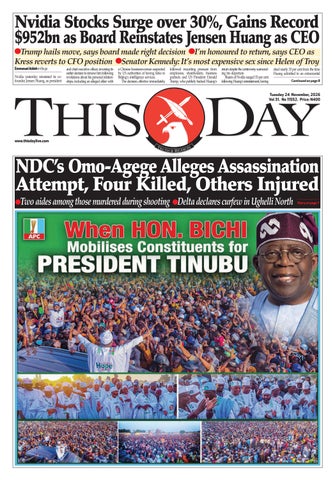
Nvidia Stocks Surge over 30%, Gains Record $952bn as Board Reinstates Jensen Huang as CEO Trump hails move, says board made right decision I’m honoured to return, says CEO as Kress reverts to CFO position Senator Kennedy: It’s most expensive sex since Helen of Troy Emmanuel Addeh in Abuja Nvidia yesterday reinstated its cofounder, Jensen Huang, as president
and chief executive officer, reversing its earlier decision to remove him following revelations about his personal relationships, including an alleged affair with
a Chinese businesswoman suspected by US authorities of having links to Beijing’s intelligence services. The decision, effective immediately,
followed mounting pressure from employees, shareholders, business partners and US President Donald Trump, who publicly backed Huang’s
return despite the controversy surrounding his departure. Shares of Nvidia surged 33 per cent following Huang’s reinstatement, having
shed nearly 33 per cent from the time Huang admitted to an extramarital Continued on page 8
Tuesday 24 November, 2026 Vol 31. No 11552. Price: N400
www.thisdaylive.com TR
UT H
& REASO
N
NDC’s Omo-Agege Alleges Assassination Attempt, Four Killed, Others Injured Two aides among those murdered during shooting Delta declares curfew in Ughelli North
Story on page 7
2
TUESDAY, NOVEMBER 24, T H I S D AY
TUESDAY, NOVEMBER 24, T H I S D AY
3
4
TUESDAY, NOVEMBER 24, T H I S D AY
5
THISDAY • TUESDAY, NOVEMBER 24, 2026
Group News Editor: Goddy Egene Email: Goddy.egene@thisdaylive.com, 0803 350 6821, 0807 401 0580
NEWS
AT ZENITH BANK FOUNDER’S DINNER...
L-R: Executive Director, Zenith Bank Plc, Dr. (Mrs.) Adobi Stella Nwapa; Senior Partner, Kenna Partners, Professor Fabian Ajogwu SAN; Group Managing Director/CEO, Zenith Bank Plc, Dame (Dr.) Adaora Umeoji, OON; Chairperson, Globe Motors, Lady Nkiru Anumudu; Multi-award-winning Journalist and Media Personality, Ruth Osime; and Founder/CEO, EbonyLife Group, Mo Abudu, during Zenith Bank Founder’s Dinner held at Eko Hotel, last week Thursday PHOTO: KUNLE OGUNFUYI
Tegbe: Nigeria Considering New Electricity Tariff Model, Won’t Raise Prices FG may offset outstanding debts with royalties, corporate income tax Assures settlement to be concluded in 2027 Insists generation firms agreed to renegotiated N3.3tn settlement Says his ‘frozen freezer’ comment lighthearted, not dismissal of hardship Emmanuel Addeh in Abuja Minister of Power, Joseph Tegbe, yesterday disclosed that the federal government was considering a new electricity tariff model, but ruled out increasing electricity prices, amid mounting concerns over poor supply and the growing financial liabilities in the power sector. Tegbe also disclosed that the government expects to conclude the settlement of outstanding debts owed to power Generation Companies (Gencos) in 2027, following an agreement that reduced the original N6 trillion liability to N3.3 trillion. Speaking in an interview with Arise Television, the minister said the government was reviewing assumptions underpinning the existing electricity tariff structure to identify adjustments that could improve the financial sustainability of the sector without imposing additional costs on consumers. “Let me make it categorically clear to Nigerians. And I’ll say it again. There’s no plan to increase tariffs,” he declared. He explained that the review would involve examining the cost of gas supplied to power plants and other components of the tariff structure, stressing that the overriding consideration was to expand electricity access without pushing more financial burdens onto Nigerians.
“I’m re-evaluating many things. And I have no boundary. The only boundary and guiding principle I have is re-evaluate everything, rejig whatever you can rejig, as long as you can give Nigerian electricity access,” he said. On the outstanding obligations to Gencos, Tegbe said the federal government had negotiated the liabilities down from N6 trillion to N3.3 trillion, reiterating that N1.23 trillion had already been paid. He said the administration was exploring alternative settlement arrangements, including offsetting some of the debts against royalties and corporate income tax payable by the companies, rather than relying entirely on cash payments. “Today, we have paid N1.23 trillion. Honestly speaking, N1.23 trillion in this economy in a speed of about one and a half years, and we’re on track to finish paying the rest next year,” he stated. The minister added that the government was also engaging the Nigerian National Petroleum Company Limited (NNPC) on ways to reduce the cost of gas supplied to power producers, arguing that Nigeria should leverage its domestic gas resources to improve electricity generation. He explained that the government had decided against using another bond to settle the new liabilities
accumulating in the electricity market, estimated at about N150 billion monthly. According to him, the government is reviewing the factors responsible for the recurring shortfalls, which he attributed largely to inadequate revenue collection and the gap between the cost of electricity supplied and payments received from consumers.
He identified non-payment by some electricity consumers, inadequate metering and continued reliance on estimated billing as major contributors to the problem. Tegbe said the government was targeting the deployment of 7 million meters within three years, adding that about 2.8 million new digital meters had so far been rolled out. On the controversy surrounding
The British Council and Octoville Development Company yesterday launched a seven-week entrepreneurship training programme for 70 young people in Abuja, aimed at equipping them with the skills to establish, manage and sustain viable businesses. The programme, known as ‘Get Set for Business’, was launched with
women and persons with disabilities among the beneficiaries, as part of efforts to promote inclusive economic participation. Speaking in an interview, the Chief Operating Officer of Octoville Development Company, Seun Olorunmaye, said the initiative was being implemented in partnership with the British Council and King’s Trust International. He said similar programmes were
He explained that the comment followed the commissioning of a 1.6-megawatt mini-grid at the University of Abuja, where students had enjoyed uninterrupted electricity for about a year. According to him, some consumers had sent him videos and messages acknowledging improvements in their electricity supply, prompting his lighthearted response.
Uwaleke Explains Why CBN May Not Change Policy Rates Urges MPC to weigh benefits of raising rates against risks to prices, FX stability Ndubuisi Francis in Abuja As the Monetary Policy Committee (MPC) of the Central Bank of Nigeria (CBN) concludes its November 2026 meeting Tuesday, financial expert, Professor Uche Uwaleke, has stated that the committee would likely retain existing policy rates, despite the prevailing macroeconomic indicators. In a position paper titled, “Why the CBN May Likely Hold Policy Rates,” which he made available to THISDAY, Uwaleke recalled that at its September meeting, the committee reduced/reset the Monetary Policy
Rate (MPR) from 26.5 per cent to 23 per cent. It also recalibrated the Standing Facilities Corridor to +50/-300 basis points around the MPR, retained the Cash Reserve Requirement (CRR) for Deposit Money Banks at 45.00 per cent, Merchant Banks at 16.00 per cent, and non-TSA public sector deposits at 75.00 per cent. He statd that the prevailing macroeconomic indicators appear to provide a compelling case for further monetary easing, adding that since the last MPC meeting in September, headline inflation
British Council, Octoville Launch 7-Week Business Training for 70 Youths Emmanuel Addeh in Abuja
his earlier alleged comment that Nigerians were enjoying too much electricity and were complaining about their fridges freezing excessively, the minister insisted that the remark was made jokingly in response to positive feedback from some electricity consumers and was never intended to dismiss the hardship faced by those experiencing poor supply.
being implemented in four other states, adding that the Abuja cohort comprised young people aged between 18 and 35. Olorunmaye said the programme was designed to bridge the gap between technical skills and the business knowledge required to translate such skills into sustainable enterprises. “We have a sufficient number of technical skills. We have loads of opportunities for young persons to
learn skills. But in living or managing a successful business, you need more than just the technical skills. You need soft skills, you need business skills,” he said. He explained that participants would receive training in corporate communication, business models, business management, accounting and other business fundamentals during the seven-week programme.
had moderated further to 14.06 per cent in October, while the Nigeria Overnight Financing Rate (NOFR) declined to 20 per cent. According to him, these developments, particularly the continued deceleration in headline inflation and the easing of short-term money market rates, would ordinarily strengthen the argument for a further reduction in the MPR. But Uwaleke, who is Director of Institute of Capital Market Studies (ICMS), Nasarawa State University, said his expectation was that at the end of its Tuesday meeting, MPC would maintain the status quo by retaining all key monetary policy parameters at their current levels. Such a decision, he stated, would allow the committee sufficient time to assess the impact of its September policy adjustment on financial markets and the broader economy before considering further changes to its policy stance. The professor of capital market pointed out, however, that between September and November 23, the exchange rate weakened from about N1,350 to N1,389 per US dollar- a depreciation more pronounced in the parallel market, while the country’s gross external reserves declined from
US$55.25 billion to US$54.6 billion over the same period. He stated that as MPC ended its November meeting, attention was firmly focused on the policy direction the committee would adopt amid evolving macroeconomic conditions. He said, “At first glance, the prevailing macroeconomic indicators appear to provide a compelling case for further monetary easing. Since the last MPC meeting in September, headline inflation has moderated further to 14.06 per cent in October, while the Nigeria Overnight Financing Rate (NOFR) has declined to 20 percent. “These developments, particularly the continued deceleration in headline inflation and the easing of short-term money market rates, would ordinarily strengthen the argument for a further reduction in the MPR. “Indeed, the September decision to lower the policy rate was partly informed by the need to align the MPR more closely with prevailing money market conditions, particularly the NOFR, which stood at 22 percent at the time. The committee also adjusted the asymmetric corridor around the MPR to +50/-300 basis points.”
6
TUESDAY, NOVEMBER 24, 2026 • THISDAY
NEWS
TINUBU MEETS NDIGBO IN LAGOS...
L-R: Chairperson/CEO of Brittania-U Nigeria Limited, Uju Ifejika, Businessman, Charles Ahize; Wife of Lagos State Governor, Mrs Ibijoke Sanwo-Olu; her husband, Babajide Sanwo-Olu; President Bola Tinubu; Minister of State for Budget and Economic Planning, Dr Doris Uzoka-Anite; Lagos State Deputy Governor/Lagos State APC Governorship candidate, Dr Obafemi Hamzat; Minister of Works, David Umahi; and PHOTO: STATE HOUSE. immediate past Minister of State for Labour and Employment, Nkeiruka Onyejeocha, during the President’s Ndigbo Community Town Hall meeting in Lagos State... yesterday
At Town Hall Meeting With Igbo Community in Lagos, Tinubu Promises Inclusive Governance, National Unity Anyeagbu, Umahi, Uzoka-Anite, Nwakeze and Onyejeocha, in attendance Ndigbo leaders back President’s re-election bid Deji Elumoye in Abuja President Bola Tinubu on Monday assured Igbo communities and business leaders in Lagos of his government’s commitment to inclusive governance, national unity and equity for all Nigerians. The President, who gave the assurance while addressing youths, elders and leaders of Ndigbo during a town hall meeting organised by the Ndigbo National Dialogue and
Development Initiatives at the Wole Soyinka Centre for Culture and the Creative Arts in Iganmu, Lagos State, called on Ndigbo to strengthen their unity, deepen their participation in national politics, and work with other ethnic groups to build a peaceful, prosperous, and united Nigeria. To reaffirm his commitment to national unity, Tinubu joined the gathering to sing the national anthem a second time. “I didn’t believe you would turn out
this many; I am very, very happy. May God bless you, and God will continue to guide and bless our country. It is a great honour for me to be here before you as your president. “I can commit to one thing: the unity of Nigeria. Though tribes and tongues may differ, in brotherhood we stand. None of us told God when we were born where we would be born or what language we would speak. Whether you are Igbo or Hausa, you have no control over yourself. God
created you, created that opportunity. We are all Nigerians. “Let’s see ourselves as individuals living in the same house, geographically called Nigeria”, the President told the gathering. Tinubu said his administration recognises the significant contributions of the Igbo communities to Nigeria’s economic growth, assuring them that no section of the country would be left behind under the Renewed Hope Agenda.
Umahi: Tinubu Will Complete Lagos-Calabar Highway, Nigeria Entitled to Carbon Credit Says president to inaugurate section one by early December Restates directive to ensure free movement of election materials, motorists Emmanuel Addeh in Abuja Minister of Works, David Umahi, has reaffirmed President Bola Tinubu’s commitment to completing the 750-kilometre Lagos-Calabar Coastal Highway, insisting that the project will be delivered as planned. Umahi, in a statement yesterday by his spokesman, Francis Nwanze, described the highway as a profitable national investment with significant revenue-generating potential. He also said the federal government was entitled to carbon credits from the project because of its use of concrete pavement and solar-powered infrastructure, which he said would qualify Nigeria for carbon credit claims. Speaking during an inspection of bridges along Sections One and Two of the coastal highway, the minister disclosed that Tinubu was expected to
inaugurate Section One of the project by early December. He said, “Nothing will happen to the 750-kilometre Lagos-Calabar Coastal Highway, which passes through the nine coastal states. The president has directed that the project must be completed as envisaged.” Explaining the economic benefits of the project, Umahi said its design and construction features would create opportunities for Nigeria to earn carbon credits, while also attracting private investment and commercial activities along the route. He explained, “We are using concrete, and so we are entitled to carbon credits claim. We are also using solar instead of conventional electricity; we are entitled to carbon credits.” He added that the highway would accommodate tourism facilities, facto-
ries, CCTV surveillance systems, and other commercial infrastructure, stating that private investors have already indicated interest in arrangements that would enable them to recover their investments. Umahi described the coastal highway as a profitable national investment, stating that its economic value would extend beyond transportation to tourism, industrialisation, and revenue generation. The minister clarified that the reconstruction of the East-West Road was an additional commitment by Tinubu and would not affect the Lagos-Calabar Coastal Highway, stressing that the administration is simultaneously executing several major infrastructure projects. He also cited the ongoing 1,068-kilometre Sokoto-Badagry highway as another major undertaking of the
Shettima Departs Abuja For Maiduguri To inaugurate some projects today and attend APC presidential rally tomorrow Deji Elumoye in Abuja Vice President Kashim Shettima yesterday departed the nation’s capital, Abuja for Maiduguri, the Borno State capital, for a series of official and political engagements. This was shortly after he presided virtually over the 162nd monthly meeting of the National Economic Council (NEC) in Abuja.
On Monday evening, Shettima will begin his activities with the inauguration of an Information and Communications Technology (ICT) Centre built by the Federal Ministry of Communications, Innovation and Digital Economy in Maiduguri. On Tuesday, the Vice President will launch the deployment of e-mobility and charging infrastruc-
ture before attending the Micro, Small and Medium Enterprises (MSME) Clinic in the state capital. On Wednesday, Shettima will be on ground to receive President Bola Tinubu and other leaders of the ruling All Progressives Congress (APC) in Maiduguri for the presidential campaign rally ahead of the 2027 general election.
federal government. Umahi restated his order for a three-week nationwide emergency rehabilitation of major federal highways to facilitate the movement of motorists, goods and election materials ahead of the festive season and the January 2027 elections. The directive required zonal directors, controllers, resident engineers and contractors to return to construction sites immediately and ensure that failed portions of major roads were restored to motorable conditions.
The President appreciated the leadership of all the market leaders in Lagos for leaving their businesses to be at the gathering. “To all of you, I am grateful for one thing: that you are here this afternoon. You left your businesses, left money-making to come and listen to the president, and I must say thank you”, he said. Tinubu expressed his determination to consolidate his government’s economic gains. According to him, national development requires collective commitment, mutual understanding, and cooperation, urging the Igbo community to embrace dialogue and constructive engagement to address challenges and advance their interests within the Nigerian federation. The President told the gathering that all the South East governors are with him on the journey to make Nigeria a better place and are working for his re-election. He mentioned Chief Chidi Anyeagbu, owner of Chisco Motors; Dave Umahi; Doris Uzoka-Anite; and Nkeiruka Onyejeocha, who were at the gathering, as people he has close connections with. Tinubu explained some of the reasons behind his policies, such as ensuring the tertiary schools are no longer paralysed by union strikes. “To eliminate the crisis in the universities, to build good roads and the engineers that will maintain our cars, our children must be in school.
Just because they are poor doesn’t mean they must not go to university or develop. “We are doing that with NELFUND. The university is stable today because we are doing well. We are putting money in agriculture and trading, and anyone in the trade business can apply to the Bank of Industry and get a loan; anyone in agriculture can take a small farmers’ loan. ‘We have to maintain this country for the sake of every one of us. The critical line in our national anthem is what I’m standing here for. I begged for it, and I am ready to serve. “And I served the first term. The constitution says I can ask for a second term. I want a second term. As you are here today, you make me happy, you make me excited, and I will go home happy and eat (Akpu)”, Tinubu said. He also called on Ndigbo residents in Lagos to participate actively and vote for him, APC Governorship candidate Obafemi Hamzat, and other APC candidates in the 2027 general elections. The President commended the organisers of the town hall meeting for providing a platform for constructive engagement between the Federal Government and the Igbo community, Earlier, host Governor, Babajide Sanwo-Olu, rallied members of the Ndigbo to support President Tinubu’s re-election bid, assuring the President of massive votes from the state in the January 16, 2027, presidential election.
NNPC Filling Station, Staff Slammed with N310m Suit over Alleged Harassment, Demobilisation of Vehicle, Threat to Life Alex Enumah in Abuja A Nigerian National Petroleum Company (NNPC) Filling Station, operating in the Federal Capital Territory (FCT), has been slammed with a N310 million suit for allegedly harassing, intimidating, immobilising the vehicle of one its clients. The suit filed by an Abuja resident, Dr. Kenenna Obiatuegwu, has KUFHAND Integrated Services Ltd, Mr. Chukwuma Anyameluhor, and Mrs. Ngozi, trading under the name of NGOBEST COBED AUTOCARE, as first, second, and third defendants, respectively. While the claimant in the suit marked: FCT/HC/CV/5111/2026
and filed November 5, is demanding the sum of N300 million as general, compensatory, aggravated and exemplary damages, he is also asking the court for another sum of N10 million, being legal and incidental expenses already incurred in consequence of the incident. Among reliefs sought are a declaration that the defendants’ refusal to release his vehicle and their acts of detaining, jacking, immobilising or otherwise interfering with his vehicle over alleged non-reflection of the initial payment for services were unlawful. He stated, “A declaration that the conduct of the defendants in summoning persons to intimidate
the claimant, publicly accusing him of being a thief, 419 and Yahoo boy, and threatening to disgrace him on social media was unlawful and wrongful. “A declaration that the words published by the 3rd defendant concerning the claimant were defamatory and injurious to his reputation.” In a 29-paragraph statement of claim, Obiatuegwu averred that he was traumatised and felt a deep sense of danger when the defendants temporarily detained him and his vehicle on the grounds that they did not see the bank transfer payment he made for their services.
7
THISDAY • TUESDAY, NOVEMBER 24, 2026
NEWS
TINUBU WOOS NDIGBO IN LAGOS...
President Bola Ahmed Tinubu addressing town hall of Ndigbo community to support his reelection bid at the National Theatre Iganmu, Lagos…yesterday
NDC’s Omo-Agege Alleges Assassination Attempt, Four Killed, Others Injured Two aides among those murdered during shooting Delta declares curfew in Ughelli North Keyamo says development disturbing, seeks probe Sylvester Idowu in Warri Palpable tension enveloped parts of Delta State yesterday as a former Deputy Senate President and Delta Central Senatorial Candidate of the Nigeria Democratic Congress (NDC), Senator Ovie Omo-Agege escaped an alleged assassination attempt during a campaign tour of Uduere in Ughelli North Local Government Area of Delta State. The incident, which occurred while the senator was addressing supporters during a campaign visit, allegedly left four persons dead and four others critically injured. The Omo-Agege Campaign Organisation, in a statement issued by its Media Adviser, Sunny Areh, last night alleged that armed men opened fire on the senator and members of his entourage at close range. According to the organisation, Omo-Agege narrowly escaped being hit as bullets reportedly passed close to his head. The campaign organisation identified two of the deceased as Moses Anaughe and Akima Efemena Umukoro, close aides of Omo-Agege. It also named Chief Evance Ivwurie, Chuks Erhire, Tobore Agba and Ayodo Wanogho as among those injured, noting they were receiving medical attention. The organisation further claimed that eyewitnesses heard the attackers shouting, “It’s Omo-Agege we want
to kill,” insisting that the incident was a targeted attack on the senator rather than a political clash. “Senator Ovie Omo-Agege was saved by a divine distraction, when bullets wheezed past his head as he was addressing the crowd that gathered to receive him “This was not a clash. This was not a misunderstanding. This was, according to witnesses, a targeted attempt to assassinate Senator Ovie Omo-Agege”, it added. The campaign organisation alleged that eyewitnesses said a local government boss (names withheld) allegedly led the killer squad, adding: “These are grave allegations. We demand that they be investigated immediately, transparently, and without political cover. “We state it clearly: Delta State is not a war zone. Campaigning is not a crime. Seeking the votes of the people should not be a death sentence.” The campaign organisation demanded a public apology from the state governor if truly he was committed to peace and order the immediate arrest and investigation of all persons alleged to have participated in, financed, or directed the attack, including one Jaro Egbo, the Ughelli North LGA Council Chairman. It also demanded that the governor should guarantee the safety of OmoAgege, the NDC leadership, and all
opposition candidates in Delta State. “We also call on the Inspector-General of Police, the Director-General of the Department of State Services (DSS), and the Commissioner of Police, Delta State Command, to immediately take over this investigation. The Nigeria Police must not allow this matter to be swept under the carpet. “We in fact, call on the InspectorGeneral of Police to personally take over the investigation as we no longer have confidence in the Delta
State Police Command whose officers were present with six trucks but did nothing to prevent the attack and killings”, it added. It called on INEC, civil society organisations, the international community, and all lovers of democracy to take note that Deltans are being shot and killed for exercising their democratic right to campaign. Also, the Delta State Government has Imposed a curfew In Ughelli North Local Government Area until
Teal Culture Founder, Folakemi Oloye, has said Nigerian manufacturers are not producing but assembling imported products, as total dependence on imports, a 36 per cent interest rate, and competition from Chinese factories operating with cheaper foreign credit have left local manufacturers unable to compete. Oloye, who spoke yesterday during an interview and the unveiling of Teal Culture’s Abuja corporate office, said while foreign competitors setting up
factories in Nigeria were sourcing finance at far cheaper rates from outside the country, Nigerian entrepreneurs were borrowing with around 36 per cent interest. She called on the federal government to provide massive support for manufacturing, starting with subsidised innovation hubs equipped with highquality machinery that would allow production to be fast, well executed, and finished to international standards. Such hubs, she said, would free entrepreneurs from spending their
is to bring the situation under control. The affected area is the entire Ughelli North Local Government Area. “The residents in the local government area are hereby advised to adhere strictly to this directive”, it warned. Besides, the Delta State Police Command said it has commenced investigations to ascertain the circumstances surrounding the violence that characterised the shootings during the campaign rally of the NDC at Uduere community.
Insecurity: Tinubu, Zulum, Musa, Ajayi, Others to Headline NSE’s 2026 Conference Engineers assemble 8,000 experts to proffer solutions to security challenge Rabiu: NSE will work with FG, security agencies to facilitate engineering interventions
Emmanuel Addeh in Abuja President Bola Tinubu, Borno State Governor Babagana Zulum, and Director-General of Department of State Services (DSS), Oluwatosin Ajayi, would be the main speakers at the 2026 International Engineering Conference and Annual General Meeting (AGM) of the Nigerian Society of Engineers (NSE), as the country continues to
grapple with sundry security challenges. Other key public figures expected at the event include Minister of Defence, Gen. Christopher Musa (rtd), as well as Inspector General of Police (IGP) , Olatunji Disu. The five-day conference, scheduled for November 30 to December 4 in Maiduguri, is expected to attract about 8,000 engineers, security experts, policymakers, academics, industry leaders
At 36% Interest, Nigerian Manufacturers Cannot Compete, Teal Culture Founder Warns Kuni Tyessi in Abuja
further notice. In a statement signed by the Secretary to the Delta State Government (SSG), Dr Kingsley Emu, the government said the curfew covers the entire council area. “Arising from alleged gunshots and attendant deaths in some parts of Ughelli North Local Government Area of Delta State, the State Government hereby declare an immediate curfew from 6pm to 6am everyday starting from today (last night) until further notice. This
limited capital on tools that still could not deliver competitive quality, while promoting creativity and income generation. Oloye stated, “To be able to do furniture completely in Nigeria, you have to import. Our boards are imported, the screws are imported, the engines are imported, the fabric is imported. So, when you really look at it, it seems like we are assembling as opposed to actually manufacturing from scratch. “The imbalance is most visible in the
cost of money. While foreign competitors setting up factories in Nigeria source finance at far cheaper rates from outside the country, Nigerian entrepreneurs are borrowing at around 36 per cent, thereby making competing really difficult.” She also urged the government to push local content more aggressively and curb the influx of foreign competition taking over local businesses. Beyond that, she said the government must ensure that Nigeria’s raw materials were fully processed at home rather than exported and re-imported as finished goods.
and other professionals, who would explore technology-driven solutions to insecurity and its implications for national development. Tinubu is expected to declare the conference open, while Musa will deliver the keynote address. Zulum will serve as chief host, with Disu and Ajayi also expected to participate in the gathering. Speaking at a pre-conference press briefing in Abuja yesterday, NSE President, Ali Rabiu, said the decision to focus the 59th edition of the conference on security reflected the urgent need to deploy engineering knowledge and innovation in addressing the country’s security problems. The conference is themed, “Engineering Innovation for Enhanced Security and Sustainable National Development.” Rabiu said the society was prepared to work with the federal and state governments, security agencies, the private sector and academic institutions to identify and promote practical engineering interventions capable of strengthening national security. He said, “The Nigerian Society of Engineers stands ready to work with
the Federal and State Governments, security agencies, the private sector, academia and other relevant stakeholders to identify and promote engineering interventions that strengthen national security, protect critical infrastructure, enhance surveillance and monitoring capabilities, support economic recovery and accelerate sustainable national development.” He added that engineering could contribute significantly to the design and deployment of technologies and infrastructure to improve security operations, strengthen emergency response capabilities, protect public assets and enhance intelligence gathering. The NSE president identified cattle rustling, armed robbery, vandalism of critical oil and gas installations, destruction of telecommunications facilities, and attacks on essential infrastructure, including schools, bridges and hospitals, among the security threats undermining the country’s development. He also listed kidnapping, abductions, disruptions to agricultural activities and the growing fear associated with travelling on Nigerian highways as challenges requiring urgent and coordinated intervention.
8
TUESDAY, NOVEMBER 24, 2026 • THISDAY
EIGHT
AIICO, Cornerstone Proposed Merger Envisions N858bn Insurance Powerhouse Combined entity to boast N194bn shareholders’ funds, strengthen underwriting capacity Transaction awaits shareholders’ backing following boards approval
James Emejo in Abuja and Ebere Nwoji in Lagos Two of the country’s listed insurance companies, AIICO Insurance Plc and Cornerstone Insurance Plc, have proposed a merger that would potentially create an enlarged insurance group with about N858 billion in total assets and N194 billion in shareholders’ funds. The development prepares the combined entity to take a leading position in the industry. The proposed combination, an-
nounced yesterday, comes as insurers face increased capital requirements and a transition towards a risk-based capital framework under the Nigerian Insurance Industry Reform Act (NIIRA), heightening pressure on operators to strengthen their balance sheets and underwriting capacity. The boards of both companies have approved the proposed transaction and will present it to their respective shareholders for consideration and approval. If concluded, the enlarged company is expected to become Nigeria’s
leading listed insurance group by gross written premium, insurance revenue and shareholders’ funds. The combined entity will retain its listing on the Nigerian Exchange Limited (NGX). The transaction would consolidate AIICO’s established businesses in life insurance, annuities and retail distribution with Cornerstone’s strength in general insurance and its expanding Takaful operations, creating a more diversified business with a wider product portfolio and distribution network.
The proposed merger is expected to address the growing importance of capital strength in the insurance industry, where the ability to underwrite larger risks, retain more business and absorb potential losses is increasingly critical. In a statement, the companies said the enlarged capital base would improve their capacity to undertake larger underwriting commitments while reducing dependence on reinsurance for risk transfer. It would also provide greater financial headroom for investments
in digital infrastructure, product innovation and improved service delivery. The combination would bring life, general and health insurance, alongside Takaful products, under a single corporate structure, potentially widening the group’s reach across different customer segments. The companies said combining their capital, distribution capabilities and complementary business lines would strengthen their ability to reach more individuals and businesses and deepen insurance penetration.
NAICOM boss, Mr. Olusegun Omosehin
NDC: Tinubu’s Lagos Model Built on Heavy Taxation, Not Development Accuses president of replicating state’s revenue model nationally amid rising debt Alleges intimidation by Edo govt over Obi’s planned visit, says venue cancellation threatens democratic space Party denies rift with Obi over campaign funds Sunday Aborisade in Abuja and Felix Omoh-Asun in Benin City Nigeria Democratic Congress (NDC) yesterday criticised President Bola Tinubu’s record as governor of Lagos State, describing his administration’s fiscal policies as a system of industrialised taxation rather than economic transformation. NDC also accused the Edo State
government of intimidation ahead of the planned visit of its presidential candidate, Peter Obi, to the state on Wednesday, November 25. The party dismissed reports of a disagreement between it and its presidential candidate, Obi, over campaign funding, describing the allegations as false and an attempt to create division within its ranks ahead of the January 2027 presidential election.
The party, which accused the president of failing to translate Lagos State’s substantial revenue earnings into commensurate infrastructure and social development, said his record in the State as Governor, should not be presented as a model for national economic transformation ahead of the January 2027 presidential election. NDC National Campaign Council,
in a statement issued yesterday and signed by its Deputy Spokesperson, Sony Neme, challenged promoters of Tinubu’s presidential ambition to explain how the enormous revenue generated by Lagos during his administration was utilised. It stated that the economic foundations of Lagos, including the Apapa and Tin Can Island seaports, Murtala Muhammed International Airport, and
Third Mainland Bridge, predated Tinubu’s administration. The party said most of the infrastructure was developed by the federal government before 1991. According to the party, Lagos’ economic growth was largely driven by its inherited infrastructure and the entrepreneurial activities of Nigerians from across the country, rather than the policies of any particular governor
(ARISE-Nigeria) Project, a six-year World Bank-supported programme designed to strengthen the country’s capacity to anticipate, prepare for and respond to floods, droughts, fires and other natural disasters. The programme will improve emergency operations centres, early warning systems, weather monitoring and disaster response financing at federal and state levels.
since 1999. “Peel away the carefully manufactured folklore, and citizens across the country have every right to ask: where is Lagos money?” the statement queried. The opposition party alleged that what emerged under successive administrations in Lagos after 1999 was an aggressive revenue-generation system rather than the industrialisation and broad-based economic development being projected by the president’s supporters. It maintained that despite the substantial amounts generated through Internally Generated Revenue (IGR) and Value Added Tax (VAT), alongside considerable borrowing, the state continued to grapple with infrastructure deficiencies and inadequate social services. NDC also raised questions about the reported outsourcing of Lagos State’s tax collection to Alpha-Beta Consulting, allegedly at a 10 per cent commission. It cited court filings in 2020, which allegedly raised questions about more than N20 billion in unauthorised transfers, as well as past Senate testimony by former Chairman of Economic and Financial Crimes Commission (EFCC), Nuhu Ribadu, in which he, reportedly, described corruption allegations involving the
Continued on page 29
Continued on page 29
NEC Raises Police Colleges Overhaul Fund to N230bn, Approves $850m Devt Projects Nigeria’s economy grows by 4.43%, external reserves hit $54.87bn Shettima stresses need to build institutions capable of sustaining benefits of Tinubu’s reforms Deji Elumoye in Abuja The National Economic Council (NEC) has committed an extra N130 billion to overhaul Nigeria’s 13 police training institutions, bringing the total funding to N230 billion. The Council headed by Vice President Kashim Shettima, had earlier this year approved N100 billion for the rehabilitation of police colleges across the country. However, NEC at its Nov, 2026 meeting held yesterday, also endorsed two major development projects involving proposed $850 million in World Bank financing to strengthen disaster preparedness, climate resilience and early childhood development across the country. The approvals were among key decisions reached at the Council’s 162nd meeting, where members also considered the state of the economy, pension reforms and measures to accelerate Nigeria’s national identity registration programme. Presenting an update on the rehabilitation of police training institutions, NEC Ad-Hoc Committee, chaired by Enugu State Governor, Dr. Peter Mbah, disclosed that interventions were currently underway in 13 locations across the country, with 30 percent of the rehabilitation work completed. The committee explained that the additional N130 billion would
accelerate rehabilitation works, upgrade training facilities and strengthen the capacity of police institutions to accommodate increased recruitment and training requirements. Council had earlier approved N100 billion for the rehabilitation programme following the establishment of the committee in October 2025 on the recommendation of President Bola Tinubu. The intervention is also expected to support preparations for the recruitment of 50,000 police personnel and improve the country’s security training infrastructure. On the state of the economy, Minister of Finance and Coordinating Minister of the Economy, Taiwo Oyedele, informed Council that Nigeria’s economic indicators continued to improve, with real Gross Domestic Product growing by 4.43 percent in the second quarter of 2026, compared with 4.23 percent in the corresponding period of 2025. He disclosed that headline inflation declined for the fifth consecutive month to 14.06 percent in October 2026, its lowest level since September 2020, while external reserves stood at $54.87 billion as of November 12, 2026. According to the Minister, Nigeria’s trade surplus increased from N10.2 trillion in the first half of 2025 to N20.1 trillion in the corresponding period of 2026, while net revenue
distributed through the Federation Account Allocation Committee rose by 44 percent, from N15.2 trillion in 2024 to N21.9 trillion in 2025. Oyedele, however, observed that the improving economic indicators had yet to translate sufficiently into relief for households and businesses, particularly in the areas of food prices, electricity costs, access to affordable credit and employment. He noted that food inflation remained elevated at 19.13 percent
in October, while high lending rates and energy costs continued to place pressure on businesses and household incomes. On disaster management and early childhood development, Council approved two memoranda presented through the Federal Ministry of Budget and Economic Planning, headed by Senator Atiku Bagudu. The first involved the proposed $350 million Accelerating Resilience through Investment Systems and Engagement
NVIDIA STOCKS SURGE OVER 30%, GAINS RECORD $952BN AS BOARD REINSTATES JENSEN HUANG AS CEO affair on November 8. The stock closed at $186.64 on November 6. In all, Nvidia added $952 billion in market value on Monday, setting a record for the largest single-day market cap gain by any US-listed company and pushed the company’s total valuation back to roughly $3.98 trillion, overtaking Microsoft and Alphabet to reclaim its spot as the world’s second-most valuable public company behind Apple. The $952 billion single-day jump more than doubled the previous record set by Microsoft (~$450 billion in July 2026) and surpassed the entire market capitalisation of Samsung Electronics, THISDAY learnt. Earlier, invoking Greek mythology, US senator John Kennedy, representing Louisiana, characterised Huang’s reported affair with a suspected Chinese
spy as “the most expensive sex since Helen of Troy”. “Mr Huang … did what he did. I hope he had a good time. It was the most expensive sex since Helen of Troy,” Kennedy said. But the board of the world’s leading artificial intelligence chipmaker announced in a statement that it had unanimously voted to restore Huang as president, CEO and a member of its board of directors, following a series of discussions with him. In the statement, the company said the board was satisfied with Huang’s candour and leadership ability, adding that it had received input from senior US government officials before reaching its decision. “Based on that input, the board is confident that Mr. Huang’s reinstate-
ment poses no national security risk,” Nvidia said. Board Chairman, Harvey Jones, said the company remained convinced that Huang was the right person to lead the technology giant, notwithstanding the circumstances that led to his resignation on November 12. “The board believes Jensen is the right person to lead Nvidia, and that his reinstatement is in the best interests of our stockholders, employees, partners and customers,” Jones said. The reversal came less than two weeks after the board accepted Huang’s resignation and appointed its Chief Financial Officer, Colette Kress, as interim CEO while it began searching for a permanent replacement. Jones had also publicly ruled out bringing Huang back, despite growing
calls from within and outside the company for his reinstatement. However, the campaign gathered momentum, with a petition demanding his return attracting more than 180,000 signatures, including support from billionaire entrepreneur Elon Musk. Trump also weighed in last week, expressing his desire to see Huang return to the top position, adding to pressure on the company’s leadership to reconsider its earlier position. Huang, who built Nvidia from a video-game graphics chip designer into the dominant supplier of processors powering the global artificial intelligence industry, said he was grateful for the board’s renewed confidence. “I am honoured to return to Nvidia Continued on page 23
9
THISDAY • TUESDAY, NOVEMBER 24, 2026
NEWS
NIGERIAN BREWERIES MEDIA SOIREE AND UNVEILING FESTIVE CAMPAIGNS...
L-R: Supply Chain Director, Nigerian Breweries Plc, Mr. Federico Agressi; Company Secretary/Legal Director, NB Plc, Mr. Uaboi Agbebaku; Digital and Technology Director, NB Plc, Mrs. Phil Aneke; Managing Director, NB Plc, Mr. Thibaut Boidin; Human Resources Director, NB Plc, Mrs. Nkechi Runsewe; and Corporate Affairs Director, NB Plc, Dr. Uzo Odenigbo, during the celebration of Nigerian Breweries Plc at 80 and unveiling of the company’s brands’ festive season campaigns held in Lagos, yesterday PHOTO: SUNDAY ADIGUN
NACA: Nigeria’s AIDS-related Deaths Drop by 60%, New HIV Infections Decline by 50% 4.6 million people living with HIV in Africa lack access to treatment, WHO declares Onyebuchi Ezigbo in Abuja and Ayodeji Ake in Lagos Nigeria has recorded a 60 per cent drop in AIDS-related deaths and a more than 50 per cent decline in new HIV infections, the National Agency for the Control of AIDS (NACA) has disclosed. The Director-General of NACA, Dr. Temitope Ilori, disclosed this in Abuja at the 2026 World AIDS Day press briefing, with the theme: “Ending AIDS Starts with Access: Equity, Ownership and Sustainability.”
This comes as the World Health Organisation (WHO) called on African governments to intensify efforts to expand access to HIV prevention, testing and treatment, warning that millions of people across the continent were still unable to access lifesaving services despite significant progress in the fight against AIDS. Ilori said annual AIDS-related deaths fell from 80,000 in 2010 to 32,000 in 2025, while new annual HIV infections declined from 130,000 to 64,000 over the same period.
She also said national HIV prevalence had declined significantly from a historical peak of 5.8 per cent in 2001 to 1.3 per cent in 2025. On the UNAIDS 95-95-95 targets, Ilori said that, in 2025, 80 per cent of all people living with HIV in Nigeria knew their status, 98 per cent of those diagnosed were receiving antiretroviral therapy, while 94 per cent of those on treatment had achieved viral load suppression, meaning the virus was undetectable. She said Early Infant Diagnosis coverage among HIV-exposed infants
had increased more than fourfold, from 15 per cent in 2022 to 66 per cent in 2025, following intensified Prevention of Mother-to-Child Transmission services. Ilori said the theme spoke directly to Nigeria’s national strategy, noting that although science had provided the tools to stop HIV transmission, those tools could only save lives when every citizen had access to them without stigma or barriers. She identified equity, ownership and sustainability as the three pillars of Nigeria’s HIV response.
INEC Secures NUC Backing on Nomination of Credible Academics, Alignment of University Calendars For 2027 Elections Decries worrying rise in negative, threatening rhetoric Adedayo Akinwale in Abuja The Chairman of the Independent National Electoral Commission (INEC), Prof. Joash Amupitan has secured the commitment of the National Universities Commission (NUC) to support the 2027 general election through the nomination of credible academic personnel and the alignment of university academic calendars with the election timetable. The assurance was given by the Executive Secretary of the NUC, Prof. Abdullahi Ribadu on Monday in Abuja during a courtesy visit by the INEC Chairman, who was accompanied by National Commissioners and senior officials of the Commission. INEC Director of Voter Education and Publicity, Mrs. Victoria Eta-Messi in a statement issued Monday said Amupitan described the visit as a deliberate strategic partnership at the final operational stretch towards the Presidential and National Assembly elections on Saturday, 16th January 2027, and the Governorship and State Houses of Assembly elections on Saturday, 6th February 2027. The Chairman said the Commission had introduced operational, technological and security reforms to make the work of its university partners safer and less contentious. He noted that the Nigerian academic community had for over a decade served as the backbone of collation and declaration of results, with ViceChancellors serving as Collation and Returning Officers across the Federation.
He said polling unit results on Form EC8A would undergo automated arithmetic consistency and overvoting checks before transmission to the INEC Result Viewing Portal (IReV), while the Commission had procured 57,000 new Bimodal Voter Accreditation System (BVAS) devices and lowered the voter-to-device ratio to 850 per machine. Amupitan added that the Commission would conduct a nationwide mock accreditation and result transmission exercise across the 36 states and the Federal Capital Territory (FCT) on Saturday, 28th November 2026. On security, the Chairman noted that the Inter-Agency Consultative Committee on Election Security (ICCES) had been decentralised to every Local Government Area and Registration Area, with dedicated security cordons and escort protocols around collation centres. He also drew attention to Sections 96 and 97 of the Electoral Act 2026, which criminalise violence, abusive rhetoric and threats against electoral personnel, and Section 148, which empowers the Commission to prosecute offenders directly. “No Returning Officer or Collation Officer will be left to stand alone against lawlessness,” he said. The INEC Chairman requested the NUC’s support in four areas: the timely nomination of academic staff of verified non-partisan standing, the alignment of academic calendars with the election dates, collaboration on voter education and counter-disinformation
on campuses, and the welfare and recognition of academics deployed for election duty. Responding, Ribadu said NUC would engage Vice-Chancellors on the nomination of academic staff, including through an online meeting, and would transmit a circular to the universities once INEC forwards a formal letter on the matter. “Since we want to have credible elections, we also have to have credible personnel,” the Executive Secretary said, adding that all ad hoc personnel should take an oath of neutrality. On the academic calendar, Ribadu said the entire election cycle would last no more than four weeks, and suggested that universities could adopt a three-to-four-week break to accommodate it. “We will discuss with the ViceChancellors and have their calendars tweaked in such a way that it will not affect the elections, nor will it affect the studies of the students,” he said. He said students could also support voter education through campus clubs, and expressed confidence that the Commission would deliver a transparent, free and fair election that would serve as an example to other African countries. Meanwhile the commission described as false claims circulating on social media that Nigerians would be able to vote in the 2027 general election without their Permanent Voter Cards (PVCs). It warned that such misinformation could disenfranchise citizens and fuel
tension on election day. The National Commissioner and Chairman, Information and Voter Education Committee (IVEC), Mohammed Haruna, made the statement on Monday in Abuja at the INEC Forum for the Nigeria Union of Journalists (NUJ), the Nigerian Institute of Social Media Analysts (NISMA), the Newspaper Proprietors Association of Nigeria (NPAN) and media executives on “Ethical and Professional Standards in Election Reporting Ahead of 2027 General Election.”
On equity, she said no Nigerian should be denied care because of who they are, where they live or what they earn. She stressed the need to enforce the HIV and AIDS (Anti-Discrimination) Act. On ownership, she said communities, traditional institutions and networks of people living with HIV must be involved in designing programmes, while governments at all levels must take full responsibility for their implementation. On sustainability, she said Nigeria could not rely solely on external support but must mobilise predictable domestic resources, strengthen state counterpart funding and integrate HIV services into primary healthcare, the Basic Health Care Provision Fund and the national health insurance system. Ilori, however, warned against complacency, noting that 20 per cent of people living with HIV still did not know their status, while 34 per cent of HIV-exposed infants were yet to receive early diagnosis. To close these gaps by 2030, she said NACA would scale up community-led testing and prevention initiatives, including HIV self-testing, strengthen domestic resource mobilisation, and intensify efforts to eliminate stigma and discrimination. “Ending AIDS starts with access – access to testing, access to
treatment, access to information and access to dignity,” she said. In his remarks, the Chief Executive Officer of the Institute of Human Virology Nigeria, Dr. Patrick Dakum, who was represented at the event, called for stronger community ownership, sustained domestic commitment, strategic partnerships and resilient health systems capable of delivering quality HIV prevention, treatment and care services. He said Nigeria must continue to strengthen collective efforts to eliminate barriers to HIV services, address stigma and discrimination, empower communities and ensure that no one was left behind. “Sustainable HIV programming must be driven by national leadership, local capacity, innovation and meaningful community participation,” he said. Meanwhile, the WHO has called on African governments to intensify efforts to expand access to HIV prevention, testing and treatment, warning that millions of people across the continent were still unable to access lifesaving services despite significant progress in the fight against AIDS. WHO Regional Director for Africa, Dr Mohamed Janabi, made the call in his message to commemorate the 2026 World AIDS Day, under the theme, “Ending AIDS Starts with Access.”
2027: Jafaru Gambo Leko Seeks Reelection, Cites Performance, Legislative Experience as Justification Segun Awofadeji in Bauchi Ahead of the 2027 elections, the candidate of the All Progressives Congress (APC) for Bogoro, Dass and Tafawa Balewa Federal Constituency, Hon. Jafaru Gambo Leko, has stated his performance in office gives him advantage over all his opponents. This was as he called on the federal government for the allocation of over 780 forfeited properties allegedly linked to a former governor of the Central Bank of Nigeria (CBN) to low-income federal civil servants to address the country’s housing deficit. Leko stated this in Bauchi at the weekend during the ongoing interview series organised by the
Correspondents’ Chapel of the Nigeria Union of Journalists (NUJ), Bauchi State, for governorship, senatorial and House of Representatives candidates. The lawmaker defended his performance in office, expressing confidence in his legislative achievements, grassroots engagement and commitment to delivering more dividends of democracy if re-elected in 2027. He highlighted some of his legislative interventions at the National Assembly, including a motion advocating the adoption of the Chinese Yuan as an additional currency for Nigeria’s foreign reserves and international settlement alongside the United States dollar.
He also recalled moving a motion seeking the allocation of over 780 forfeited houses allegedly linked to a former governor of the Central Bank of Nigeria (CBN) to low-income federal civil servants. According to him, the proposal was informed by the need to address the housing challenges confronting Nigerian workers, particularly in view of the limited resources available to the Federal Staff Housing Loans Board. He disclosed that the board had only N2.5 billion to cater for more than 70,000 applicants, arguing that allocating the forfeited properties to low-income civil servants would help address the housing deficit.
10
TUESDAY, NOVEMBER 24, T H I S D AY
TUESDAY, NOVEMBER 24, T H I S D AY
11
12
TUESDAY, NOVEMBER 24, T H I S D AY
TUESDAY, NOVEMBER 24, T H I S D AY
13
14
TUESDAY, NOVEMBER 24, T H I S D AY
TUESDAY, NOVEMBER 24, T H I S D AY
15
16
TUESDAY, NOVEMBER 24, T H I S D AY
TUESDAY, NOVEMBER 24, T H I S D AY
17
18
TUESDAY, NOVEMBER 24, T H I S D AY
LAWYER TUESDAY, NOVEMBER 24, 2026
A
TR
UT H
& RE A SO
N
WEEKLY PULLOUT
TR
UT H
& RE A S O
N
Ch
Chief Wole Olanipekun, GCON, SAN
"I Want to be Remembered as God-fearing and One Who Honoured the Law"
II
T H I S D AY ˾ TUESDAY, NOVEMBER 24, 2026
IN THIS EDITION
R E Y W LA TU ES DAY, NO
VE MB ER 24 ,
A
20 26
OUT WEEKLY PULL
TRU
TRU
T H & RE A S
ON
ON
T H & RE A S
Incomplete Record of Appeal: Whether the Rule Against Jurisdiction Admits of Exception(s) Page IV
Ch
d e r e b m e m e R e "I Want to b and One as God-fearing he Law" t d e r u o n o H o h W , SAN nipekun, GCON Chief Wole Ola
Kemi Pinheiro, SAN launches Six Books Page V
QUOTABLE ‘Political parties, candidates and their supporters, must equally recognise that the judicial process isn’t a continuation of the electoral campaign by other means. They must respect court processes, comply with lawful orders, and refrain from actions calculated to intimidate judicial officers or undermine confidence in the adjudicatory process. -Kudirat Motonmori Olatokunbo Kekere-Ekun, GCON, Chief Justice of Nigeria
Unveiling of SixVolume 'Wole Olanipekun through the Cases' Page VI
LAWYER
ONIKEPO BRAITHWAITE: EDITOR, JUDE IGBANOI: DEPUTY EDITOR, PETER TAIWO, STEVE AYA: REPORTERS
III THE ADVOCATE
T H I S D AY ˾ TUESDAY, NOVEMBER 24, 2026
2027: Political Casanovas and the Danger of False Promises Disposable Campaign Promises find it quite strange, that people are going on about not seeing issue based campaigns for the 2027 elections. If we are to be brutally honest with ourselves, do campaign promises in Nigeria really matter, when, predominantly, they are never kept? And, we mustn’t forget that most of the politicians have moved from party to party over the years, meaning that many of them who are criticising the present Tinubu administration today and are now claiming that they can do better, are very much part of the failure to achieve the Fundamental Objectives and Directive Principles of State Policy contained in Chapter II of the 1999 Constitution of the Federal Republic of Nigeria (as amended)(the Constitution), that has contributed in no small measure to where Nigeria is today.
I
It is therefore necessary, for Nigerians to ‘shine our eyes’, rise up to the provision of Section 14(2)(c) of the Constitution and get serious about participating in our government, not just by shouting and complaining, but by encouraging a hopefully better crop of representatives who are interested in service and orchestrating better outcomes for the people and the country, instead of those who are only interested in their own personal benefit. Yet, even as the people make the call, the images already circulating from the early campaign trail are revealing. Candidates of the frontline political parties and their supporters, are travelling by private jets to go and campaign! Are these people even in touch with the people? This is like rubbing salt, into the wounds of Nigerians! Even if the distance is too far to travel by road (maybe by 2031 they will be able to use the Coastal Road to reach many destinations!), why can’t they charter small CRJ 900 aircrafts from commercial airlines, instead of travelling by a tool that is synonymous with wealth, opulence and exclusivity, the source of which remains questionable. Unfulfilled PDP Campaign Promises I remember that one of the main campaign promises of the PDP in 1999 and President Olusegun Obasanjo’s administration, was ‘electricity for all by the year 2000’ or something like that. 16 years of the PDP, and that promise remained unfulfilled. By the end of the Obasanjo tenure, available capacity may have improved and several new plants were under construction (including through the National Integrated Power Project), but reliable, widespread electricity supply was never achieved. Majority of Nigerians remained in darkness! I remember that the PDP had claimed to have some kind of electricity road-map plan, which needed time to be implemented. I subsequently became disillusioned about that and disappointed that Nigerians had been deceived, when I attended the commissioning of the Dangote Cement Factory in Obajana, Kogi State, and we were given a tour of the Facility and its electricity supply plant, which we were told could light up the whole of the FCT and was constructed from start to finish in one year or thereabouts. Had the PDP administrations followed the Dangote prototype or a similar one, and constructed only one power plant per year for their 16 years in office, spreading it equitably across the geographical zones, each zone would have ended up with at least two new power plants with the third cycle in the offing - Nigeria would have been lit up. The point is not that Government should copy and paste a private industrial plant exactly, but that the timeline and focused execution contrast sharply with 16 years of national planning that still left most citizens in darkness. The fact that the Tinubu administration has now encased itself in Aso Rock Villa in solar energy as an alternative means of electricity supply, is certainly not encouraging, but, I don’t think most of the opposition who didn’t do better in that regard when given the opportunity to do so, have the moral standing to be the ones to judge and condemn, unless they apply the same yardstick they are applying to the Tinubu administration to themselves first. Today, the same people who were part of past administrations or governance through the years, in one way or the other, are the same people insincerely promising heaven and earth under the toga of other political parties, because they realise that our collective
ONIKEPO BRAITHWAITE BRAITHWAITE ONIKEPO
onikepo.braithwaite@thisdaylive. com onikepob@yahoo.com
The
Advocate ….do campaign promises in Nigeria really matter, when, predominantly, they are never kept?…. I remember that one of the main campaign promises of the PDPin 1999 and President Olusegun Obasanjo’s administration, was ‘electricity for all by the year 2000’ or something like that. 16 years of the PDP, and that promise remained unfulfilled…. the Muhammadu Buhari-led APC, came in on its tripod of campaign promises - fighting insecurity and corruption, and revamping the economy….Which of these promises were fulfilled? None…. Most Nigerian Politicians of today are cut from the same cloth.... They are like a ‘Casanova’…. Many of the same actors migrate between parties carrying with them the record of earlier failures, while offering fresh assurances under a new label….they realise that our collective memory as a people is usually short-term or blurred… memory as a people is usually short-term or blurred, while accountability for previous failure is almost non-existent in our society. Unfulfilled APC Campaign Promises In 2015, the Muhammadu Buhari-led APC, came in on its tripod of campaign promises - fighting insecurity and corruption, and revamping the economy. They also promised devolution of powers, even going to the extent of setting up a Committee to purportedly achieve this goal. Which of these promises were fulfilled? None. Insecurity escalated in an unprecedented manner, while corruption was certainly not curbed. The borrowing fever which has increased, started to rise during President Buhari’s administration, while Ways and Means provisions under the Central Bank Act 2007 were continuously observed in their breach by the Federal Government. The number of out-of-school children increased exponentially, with a larger percentage of them being in Northern Nigeria. By the end of President Buhari’s tenure, UNESCO’s Global Education Monitoring Report and related data put the figure at 19.7–20.2 million by 2021–2022; UNESCO model estimates show roughly 14.1 million (all levels) in 2010 rising-to-19.2 million in 2020 and -19.0 million in 2023. Today, UNICEF puts the figure at 18.3 million.
My point? Most Nigerian Politicians of today are cut from the same cloth. I have used the PDP and APC as examples, because they are the two political parties that have governed Nigeria during this Fourth Republic. They are like a ‘Casanova’ who sees a lady that takes his fancy, sweet talks and says whatever is necessary to be able to start a relationship with her. Once he starts and consummates the relationship, he has achieved his goal. He loses interest and starts to misbehave, looking for his next prey. Politicians, particularly the opposition, behave like a Casanova - they simply identify what the people are clamouring for, promise to fulfil their wishes, knowing that they have absolutely no intention whatsoever of so doing, and subsequently, they come up with excuses for why they failed, particularly if they are up for re-election. Actualising Section 14(2)(c) of the Constitution So, how can the people actualise their Section 14(2)(c) constitutional role, to participate in their government and realise good governance, when the political class has repeatedly shown that campaign promises are largely disposable once power is secured? Firstly, through the ordinary instruments the Constitution
Onikepo Braithwaite congratulating Chief Wole Olanipekun, GCON, SAN at the Unveiling of 'Wole Olanipekun through the Cases' in Abuja last week
itself supplies - voting, party membership and internal party processes, petitions, litigation (where locus standi exists) and public scrutiny. Unfortunately, these instruments have been insufficient in the Nigerian context. Aside from the fact that many believe their votes don’t count and so voter-turnout isn’t usually particularly impressive, there is a belief that unlike in places such as the UK where the electorate easily votes out those whom they no longer want, for example, if they believe they have underperformed during their tenures, it is quite difficult to vote out incumbents in Nigeria, even if they don’t perform. Many of the same actors migrate between parties carrying with them the record of earlier failures, while offering fresh assurances under a new label. As for litigation, its limits are clear. Section 6(6) (c) of the Constitution, ousting the jurisdiction of the courts in matters concerning the Chapter II Objectives which are the essence of governance, makes accountability in governance almost unnecessary, and that’s one of the reasons politicians get away with doing little or nothing! And, when matters get to court, some judicial officers who do the opposite of delivering justice, are also not held accountable. A couple of weeks ago, I discussed Justice Peter Lifu who was openly rebuked by the Court of Appeal for judicial rascality/ judicial impertinence, for handing down a decision during the pendency of a stay of proceedings issued by a superior court. In Adamu Suleman & Anor v COP Plateau State (2008) LPELR-3126(SC) per Niki Tobi, JSC, the Supreme Court held thus: “Under the doctrine of precedent, decisions of superior courts are binding on inferior courts. In the hierarchy of the court system in Nigeria, decisions of the Supreme Court, are binding on all other courts. Next in the hierarchy, is the Court of Appeal. Decisions of that Court are binding on all other courts….The next in hierarchy is the High Court”. But, instead of Justice Lifu facing any disciplinary action for disobeying the order of the court above him, it is the Lawyer who is perceived to have abused him for this his misconduct, that is the one that has been recommended for discipline! How ironic. We leave the most important issues, the ratio decidendi unattended to, while we concentrate on obiter dicta! This isn’t how to build strong institutions. Conclusion So, what is the way forward for Nigerians? The Constitution guarantees the right of the people to participate; it does not guarantee that participation will automatically produce competent or honest government. What remains, then, is a narrower but more disciplined form of participation, than the one that is currently being practised. It begins with, refusing to treat every new set of promises as a clean slate. Citizens, media and civil society can track a short, publicly stated list of measurable commitments, not vague aspirations, but concrete items that can be verified within a defined period, and the people can insist that those who made them, or who served in the governments that failed to deliver them, explain the shortfall before they are allowed to campaign on the same terrain again. It continues with selective engagement in primaries and party processes, as a practical filter that withholds support from serial migrants who offer no new accountability mechanisms. And, it requires a deliberate preference, wherever the choice exists, for candidates whose prior public record can be examined, over those whose principal qualification is the fluency of their current promises. Unfortunately, none of this is still a guarantee. A better crop of politicians, remains necessary. Participation under Section 14(2)(c) of the Constitution can raise the cost of serial failure and shorten the period during which failed actors are allowed to rebrand, but it cannot conjure competence or integrity that is not already present in the pool of those who present themselves for office. What it can do is, make the recycling of the same failures more visible and more expensive. In a political economy where campaign promises have long been treated as disposable, that is not a small contribution. It is the minimum that Section 14(2)(c) now demands, if the cycle of unfulfilled assurances is not to continue uninterrupted into 2027 and beyond.
IV LAW REPORT
TUESDAY, NOVEMBER 24, 2026 ˾ T H I S D AY
Incomplete Record of Appeal: Whether the Rule Against Jurisdiction Admits of Exception(s) Facts The Appellants, suing in a representative capacity, commenced Suit No. AKU/52/2011 at the High Court of Delta State against the Respondents, also sued in a representative capacity, claiming a declaration, general damages for trespass and a perpetual injunction in respect of a parcel of land known as Ani-Ugwude Ogbor, at Umogbor, Odafe-Isiuzo, Ibusa. The Respondents filed a preliminary objection to the competence of the suit, which the trial court upheld, and struck out the suit. The Appellants appealed to the Court of Appeal. In its judgement, the lower court struck out the appeal on the ground that the record of appeal was incomplete, in that it omitted a further and better affidavit allegedly filed by the Respondents in support of their preliminary objection. Nettled by the decision, the Appellants further appealed to the Supreme Court. Issue for Determination The Appellants distilled two issues for determination in their brief of argument. The Supreme Court, however, considered only the first issue as determinant of the appeal, thus: Whether the learned Justices of the Court of Appeal were right in striking out the Appellant’s appeal for incomplete record of appeal, without hearing the parties on the issue they raised suo motu? Arguments There was no appearance for the Respondents at the hearing of the appeal, and no brief of argument was filed on their behalf; thus, the submissions before the Supreme Court were those of the Appellants alone. In their submission on the sole issue before the court, the Appellants contended that the Honourable Obande Festus Ogbuinya, JSC decision of the lower court striking out the ApIn the Supreme Court of Nigeria pellants’ appeal for an incomplete record was Holden at Abuja the offspring of an issue the lower court raised On Friday, the 6th day of March, 2026 suo motu, without inviting the parties to address it. They submitted that neither party had, before Before their Lordships the judgement, raised the question whether a John Inyang Okoro further and better affidavit allegedly filed by the Emmanuel Akomaye Agim Respondents ought to have formed part of the Chidiebere Nwaoma Uwa record of appeal. That it was the duty of the Moore Aseimo Abraham Adumein lower court, before resolving the point against the Obande Festus Ogbuinya Appellants, to have afforded them an opportunity Mohammed Baba Idris to be heard on it, and that its failure to do so Justices, Supreme Court occasioned a breach of fair hearing. On the substance of the finding itself, the ApSC.414/2016 pellants contended that there was, in fact, no further and better affidavit filed by the Respondents Between in support of their preliminary objection at the trial court to warrant its transmission as part 1. Vincent Ugo Appellants 2. Anthony Nwanze of the record. Thus, the Appellants could not 3. Anthony Okolie be said to have defaulted in the transmission (For themselves and on behalf of Members of of a complete record. They submitted further, Unuogbor family, Odafe-Isiuzor, Ibusa) relying on decided cases, including Ekpemupolo v Edremoda (2009) 8 NWLR (Pt. 1142) 166 And and Audu v FRN (2013) 5 NWLR (Pt. 1348) 397, that a record of appeal binds the parties 1. Diokpa Maha Respondents and the court. 2. Stephen Nwabuoku 3. Michael Nwabuoku Court’s Judgement and Rationale 4. Louis Odita Deciding the issue, the Supreme Court held that it (For themselves and on behalf of Members of is elementary law that while a court is showered Umuobi family, Odafe-Isiuzor, Ibusa) with the discretion to raise an issue suo motu, on its own motion, it has the bounden duty, (Lead Judgement delivered by Honourable Obande Festus Ogbuinya, JSC) heaped on it by law, to invite parties in the matter and afford them the opportunities on the face of the record serious questions record flowing from the Appellants’ to address it before a decision is arrived of the fairness of the proceedings is evident abandonment of their duty vis-à-vis the at on the point. Where a court fails to do so, - Omokuwajo v FRN (2013) 9 NWLR transmission of record, which was a classic such an injudicious judicial exercise will drag (Pt. 1359) 300 at 332, per Rhodes-Vivour, exemplification of a jurisdictional point/ the court into the foggy arena of conflict, as well JSC. Examining the reasoning of the lower issue, since an appellate court is only clothed as impinge on the inviolable rights of parties to court, the Supreme Court held that it was with the jurisdiction to adjudicate over fair hearing as ingrained in Section 36(1) of the woven around the absence of complete an appeal that is greeted by a complete Constitution. Citing Hambe v Hueze (2001) 4 NWLR (Pt. 703) 372 at 388-389, per Achike, JSC, the Supreme Court restated that generally an appellate court cannot suo motu raise issues at the judgement stage which the parties did Generally, an appellate court is not bestowed with not raise without the perilous risk of stepping into the arena of conflict, and that where it the jurisdiction to entertain an appeal based on an does so in special circumstances, the court cannot found its decision on such new issues incomplete record. … Howbeit, this cardinal principle without first affording both parties or their Counsel opportunity to address the court on of law is a malleable one. Its elasticity is located in the the new issues. Their Lordships held, however, that this principle is a flexible rule of law which admits of certain exceptions, and that the need for address by the parties becomes unnecessary where: (a) the issue relates to the courts own jurisdiction; (b) both parties are/were not aware or ignore a statute which may have a bearing on the case…. (c)…
realm of irrelevancy of the missing process/proceeding, id est, an appellate court can hear an appeal on an incomplete record, where the missing part of the record is so immaterial such that its absence cannot affect the decision of the appeal, one way or the other
record. It held that an issue of jurisdiction rotates outside the universe of raising an issue “ex proprio motu”, so that “a court of law can, proprio vigore, on its own strength, rake it up without being injurious to the law. The Supreme Court then turned to whether the record was, as a matter of fact, incomplete. It held that the record is the bedrock, soul, touchstone, keystone, and bible of every appeal. It binds the parties and the court. Neither a party nor the court, is granted the latitude to add or subtract from the contents of the record. Nor is either permitted to stray away from it. Hence, the importance of transmission of complete record to the appellate court cannot be over emphasised. Generally, an appellate court is not bestowed with the jurisdiction to entertain an appeal based on an incomplete record. … Howbeit, this cardinal principle of law is a malleable one. Its elasticity is located in the realm of irrelevancy of the missing process/ proceeding, id est, an appellate court can hear an appeal on an incomplete record, where the missing part of the record is so immaterial such that its absence cannot affect the decision of the appeal, one way or the other.” Their Lordships then examined the record of the trial court, including the Respondents’ affidavit in support of their preliminary objection and the submissions of their Counsel when the preliminary objection was argued on 19th November, 2012, and held that it was decipherable from these extracts that the further and better affidavit, which is the marrow of this issue, was never filed in support of the Respondents’ preliminary objection, and that, if there was any such process, it related to a previous application which was disposed of by the trial court. Further, that even if a further affidavit was filed, Counsel for the Respondents, having failed to mention it as one of the processes that propped the preliminary objection, it became enveloped in the dense fog of irrelevancy/insignificance, and that, by the Respondents own showing, the further and better affidavit was an absent process. Based on the foregoing, the Supreme Court held that the lower court’s insistence on transmission of the process was tantamount to asking the Appellants to “build castle in the air” which is both a natural and physical impossibility, the Appellants being sheltered properly under the canopy of the legal maxim: Lex non cogit ad impossibilia – the law does not compel an impossibility. And that, the Appellants did not, in the least, fracture the law on transmission of record as to magnet the dire penalty of an incomplete record meted out to their appeal by the lower court. The Supreme Court concluded that the lower court’s categorisation of the Appellants’ appeal as one marooned in the murky ocean of an incomplete record, with its attendant toxic consequence in law, was, with due respect, a flagrant defilement of the law. It was ultra vires the power of the lower court, which has to be mowed down by the unbiased judicial sword of this court. The sole issue was thus, resolved in favour of the Appellants and against the Respondents. On the whole, the Supreme Court held that the appeal was imbued with merit and allowed it. The judgement of the lower court, in Appeal No. CA/B/246/2013, delivered on 10th November, 2015, striking out the Appellants’ appeal on account of an incomplete record, was set aside, and the Appellants’ appeal before the lower court was allowed. The Appellants’ suit - Suit No. AKU/52/2011, was remitted to the Chief Judge of Delta State for an expeditious determination on its merit, by another Judge of the High Court of Delta State. Appeal Allowed. Representation N.A. Erondu for the Appellants No appearance for the Respondents Reported by Optimum Publishers Limited, Publishers of the Nigerian Monthly Law Reports (NMLR)(An affiliate of Babalakin & Co.)
V
TUESDAY, NOVEMBER 24, 2026 ˾ T H I S D AY
IMAGES
I
n a distinguished gathering of the Bar and the Bench, Dr Kemi Pinheiro, SAN, hosted the crème de la crème of the legal community at the Civic Centre, Victoria Island, Lagos, last Friday, 20 November, for the epochal launch of his six books. Among the prominent Lawyers and Judges who graced the occasion were: PHOTOS: KOLAWOLE ALLI L-R: Mr Akin Kekere-Ekun, OFR; Chief Justice of Nigeria, Kudirat Kekere-Ekun, GCON; Wife of the Author, Justice Yetunde Pinheiro; the Author, Dr Kemi Pinheiro, SAN
L-R: Akin Kekere-Ekun; CJN Kudirat Kekere-Ekun; Justice Yetunde Pinheiro; Dr Kemi Pinheiro, SAN and Chief of Staff to the President, Rt Hon. Femi Gbajabiamila CJN Kudirat Kekere-Ekun, GCON
NBA President, Mrs Oyinkan Badejo-Okusanya, SAN (left) and Adeniyi Akintola, SAN
L-R: Olusola Adegbonmire; Prof Bayo Adaralęgbę, SAN; Pioneer Editor, This Day Lawyer, Funke Aboyade, SAN and Folashade Alli, SAN
L-R: Tijjani Gazali, SAN; Chairman, Council of Legal Education, Emeka Ngige, SAN and Chairman, Lagos State Attorney-General, Lawal Pedro, SAN (left) and DPP of the Federation, Rotimi Oyedepo, MultiChoice Nigeria, Adewunmi Ogunsanya, SAN and Toyin Pinheiro, SAN SAN
Book Reviewer, Prof Fabian Ajogwu, SAN
L-R: Son of the Author, Dr Folakunmi Pinheiro; Partners Pinheiro LLP, Tokunbo Davies and Chukwudi Enebeli, SAN Kayode Sofola, SAN
Ayo Akintunde, SAN (left) and Rev Olaotan Ajose-Adeogun, SAN
Author's Aunty, Mrs Akindele (left) and former Lagos State Attorney- L-R: Chief Sena Anthony; Ms Benedicta Molokwu and Chief Dr General, Mrs Wonu Folami Sonny Kuku
VI
TUESDAY, NOVEMBER 24, 2026 ˾ T H I S D AY
COVER
"I Want to be Remembered as God-fearing and One Who Honoured the Law"
Unveiling of Six-Volume 'Wole Olanipekun through the Cases'
He bestrides the Nigerian legal firmament like a colossus, handling some of the most complex cases in the courts. Called to the Bar 50 years ago, and elevated to the Inner Bar 35 years ago, he has held virtually every major office the profession can offer: Attorney-General of the old Ondo State, President of the Nigerian Bar Association, Chairman of the Body of Benchers, and many more. Chief Wole Olanipekun, GCON, SAN, who turned 75 last week, insists there is no intellectual retirement in the practice of law. He continues to work at full strength. Even with two of his children already Senior Advocates of Nigeria, he remains focused on advancing the cause of the profession and mentoring younger Lawyers. He demonstrated this commitment at the launch of his six-volume book, "Wole Olanipekun Through the Cases", in Abuja last week.The event, a gathering of the who-iswho of the Nigerian legal community, was attended by President Bola Ahmed Tinubu,GCFR and the Senate President, Godswill Akpabio, GCON. Chief Olanipekun spoke with Onikepo Braithwaite and Jude Igbanoi in this rare, no-holds-barred interview on his odyssey in the legal profession
L
earned Silk, You were called to the Nigerian Bar in 1976 and elevated to the rank of Senior Advocate of Nigeria in 1991. Looking back over five decades, what has sustained your passion for advocacy and the practice of law? After 50 years at the Bar and 35 years as a SAN, how do you define professional success? Is it measured primarily by cases won, institutions built, or something else? Are you fulfilled? Or there’s still plenty more you want to do? For me, those numbers resonate more than mere passage of years. It is not about the numbers, but the mountains mounted and the valleys trod. Counting fifty years at the Bar and also counting thirty-five years at the Inner Bar is an invitation to pause, deeply reflect and interrogate some fundamental questions: What truly sustains a lifetime in the law? In my view, the answer has remained constant. What has sustained my passion for advocacy is the fact that I have never regarded law merely as a profession. I have always viewed it as a calling, a ministry in its own realm, and a sacred trust reposed in one by Almighty God. When I was called to the Nigerian Bar on 4th July, 1976, I did not enter the profession with grand ambitions of titles, honours or public offices. Like many young Lawyers of my generation, my aspiration was simple, though perhaps, demanding. I desired to become a good Lawyer. I wanted to master advocacy. I wanted to understand the law,
contribute to its development and use it as an instrument for the advancement of justice and humanity. Those aspirations have not changed after five decades. However, I must confess that right from the get-go, I also wanted to attain the great heights a good number of the potentates of the profession attained, from within and outside Nigeria, and I eagerly looked forward to emulating them, using each of them as my point of reference. One of the beautiful peculiarities of the legal profession is that it never permits intellectual retirement. New questions emerge daily. New frontiers are constantly being explored. Consequently, every matter presents a fresh challenge, and every brief an opportunity for further learning. That intellectual stimulation, has remained one of the enduring attractions of legal practice for me. Nevertheless, experience has taught me that professional success cannot be measured solely by the number of cases won. If that were the standard, then every Lawyer who wins his cases would necessarily be fulfilled, and the one who loses his cases frustrated. No Lawyer, however gifted, wins every case. Indeed, a Lawyer who claims never to have lost a case has either not practised long enough, or has not handled sufficiently difficult matters. Litigation, by its very nature, produces winners and losers. I believe professional success
….experience has taught me that professional success cannot be measured solely by the number of cases won….I believe professional success should be assessed through a broader prism. Part of it is certainly reflected in one's contribution to jurisprudence and the development of the law. Part of it lies in the institutions one helps to build and strengthen. Part of it is reflected in the standards one preserves, and transmits to younger generations. Part of it is measured by one's fidelity to integrity, professional ethics and scholarship. Above all, I believe success is measured by impact
should be assessed through a broader prism. Part of it is certainly reflected in one's contribution to jurisprudence and the development of the law. Part of it lies in the institutions one helps to build and strengthen. Part of it is reflected in the standards one preserves, and transmits to younger generations. Part of it is measured by one's fidelity to integrity, professional ethics and scholarship. Above all, I believe success is measured by impact. When I look back today, I derive immense satisfaction not merely from cases conducted or offices occupied, but from institutions strengthened, younger Lawyers mentored, scholarships awarded, lives touched and opportunities created for others. I derive satisfaction from the fact that, some Lawyers who once sat in our Chambers as pupils have gone on to become Senior Advocates of Nigeria, Judges, academics, captains of industry and respected leaders in society. I derive satisfaction from meeting beneficiaries of our scholarship schemes who have become Lawyers, doctors, engineers and other professionals. I derive satisfaction from seeing institutions which some of us helped to build, continuing to serve succeeding generations. Therefore, if posterity were someday to ask how I would wish to be remembered, my answer would be simple: not necessarily as one who won many cases or occupied many offices, but as one who feared God, honoured the law, strengthened institutions, mentored younger generations, upheld professional integrity and contributed, however modestly, to the advancement of the legal profession and the service of humanity. As President of the Nigerian Bar Association (2002–2004), what do you consider the most significant achievements or interventions of that tenure? Although my tenure at the NBA presidency was characterised by numerous pioneering accomplishments, I consider the most significant achievements of our administration to be those that
strengthened the institutional foundations of the Nigerian Bar and continue to endure long after we left office. Foremost among these were the following: i. The establishment and inauguration of the two flagship Sections of the NBA; the Section on Business Law (SBL) and the Section on Legal Practice (SLP). Immediately we assumed office, we constituted a Committee to draft the Bye-laws for the two Committees, and took them to NEC for approvals. After this, we appointed officers for the two Sections with George Etomi chairing the Business Law Session and Yusuf Alli, SAN chairing the Section on Legal Practice. I recall the first Secretary of the Section on Legal Practice was Kayode Adeniyi, Esq., now Adeniyi, JCA. We experimented the take-off of the two Sections at the Annual Conference in Enugu in 2003, and it was a huge success. At the end of the Conference, I also recall a prominent Bar Leader, Chief Debo Akande, SAN, former General Secretary of the NBA, saying that with the coming onboard of the two Sections, the NBA had been revolutionised. ii. We conceived the idea of the NBA Stamp and Seal regime, and it was approved by the NBA-NEC under my leadership. It was formally launched and commissioned at the NEC meeting held in July 2004 at Ilorin by the then Chief Justice of Nigeria, Hon. Justice M. L Uwais, GCON. But, somehow, the scheme wasn’t revived or given the necessary push, until when Okey Wali, SAN took over as the NBA President. iii. We revitalised the Continuing Legal Education Programme of the Association and I appointed Prof Jadesola Akande, OFR, as the Chairman of the Committee, with a mandate to organise Continuing Legal Education programmes in Lagos, Port Harcourt and Kaduna, for a start. iv. During my campaign for the office of the NBA President, I promised to get the NBA registered under Part C of the Companies and Allied Matters Act, particularly on the heels of the Supreme Court decision in Fawehinmi v NBA (No. 2) (1989) 2 NWLR (Pt. 105) 558 SC, wherein the Supreme Court pronounced that the NBA was not a juristic person. I took the idea
VII
TUESDAY, NOVEMBER 24, 2026 ˾ T H I S D AY
COVER
"I Want to be Remembered as God-fearing and One Who Honoured the Law" cont'd from page VI
to NEC, and later got the AGM to ratify the names of the first Trustees of the NBA, under the Chairmanship of the late Alhaji Abdullahi Ibrahim, CON, SAN. I procured the Certificate of Incorporation from the CAC, shortly before I left office. Since then, NBA has been sued and is being sued in the name of Registered Trustees of the NBA. v. If the records have not been lost in the NBA Secretariat, we kick-started the insurance scheme for Lawyers all over the country, and paid reasonable premium to Leadway Insurance Company, and I can recall that many Lawyers benefitted, including a particular Lawyer from the Port-Harcourt Branch who had visibility problems. Three Insurance companies bided for provision of the service, but Leadway was picked as the best. vi. Cognisant of the poor salaries being paid to Lawyers across the country, we divided Nigeria into some zones - Lagos, Port Harcourt, Kano, Abuja, Ibadan, Enugu, etc. and advised senior Lawyers and Law Firms to adhere to salary and wages recommended for each of the zones. It was also emphasised by our Administration that, on no condition should any Lawyer in the country as at then, earn below N75,000. Indeed, it was the NBA that brought the idea of minimum wage to Nigeria. vii. Nigerian Lawyers troop to the IBA Conference every year and also attend the elaborate party at the ‘Nigerian Nite’ in the host country. But, many people don’t know how it all started. The fact is that, there was no precedent for it before I assumed office as President; but, I introduced it at the IBA Conference held in Durban, South Africa, in October 2002, and in doing so, I used my personal funds to organise the first Nite. I recall that I released the funds to a three-man Committee constituted to organise the event comprising Chief Mamman Mike Osuman, SAN, Richard Oma Ahonaruogho, SAN and Kunle Uthman, SAN. The first Nite at Durban recorded a huge success with the likes of Prof Jadesola Akande, Chief Mrs Akintola, Chief Sena Anthony etc. viii. We equally revived the Nigerian Bar Journal, which had become dormant, and within a relatively short period. produced seven editions. We pursued constitutional and statutory reforms within the profession, including amendments to the NBA Constitution and aspects of the Legal Practitioners Act. ix. It was my Executive who started the construction of the NBA House in Lagos, a building which now fetches the NBA substantial revenue. x. A popular item that now recurs at any NEC meeting is the ‘State-of-the-Nation’. I introduced it at the NBA NEC meeting, at Makurdi in 2002. At that time, NEC meetings were held in two days - Fridays and Saturdays. The first day would be wholly devoted to NBA/Lawyer affairs and concerns, while the second day would be committed to national issues in all ramifications. On the latter day, what transpired in any part of the country concerning the legal profession, would be tabled by the individual Branches, including security concerns anywhere in Nigeria, governance or misgovernance; whether at the Federal or State levels, etc. At the end of every NEC meeting, a comprehensive communiqué would be issued. I recall coopting Prof Ernest Ojukwu, SAN into drafting the Communiqué with me. It was the same Ernest Ojukwu that I deliberately picked, as the Chairman of the Editorial Board. xi. Everybody now talks about the ‘President’s Dinner’ during the NBA Conference without asking how it berthed. I copied it from the American Bar Association Conference which I attended as NBA President, and decided to introduce it during our Conference. It started under my regime at our Annual Conference in Enugu in 2003, and the first Keynote Speaker was Chief Andrew Anyamene, SAN. It was meant to bring together some core leaders of the Bar/Profession at a formal session, to crossfertilise ideas in a more relaxed atmosphere, to jaw-jaw on matters relating to the legal profession and later clink glasses. xii. My administration also led other West African countries to establish the West African Bar Association (WABA), with the election of Mr Femi Falana, SAN as the first President. xiii. It was also our Executive that first inaugurated the NBA Election Monitoring
L-R: Chief Justice of Nigeria, Kudirat Kekere-Ekun, GCON; Senate President, Godswill Akpabio, GCON; President of the Federal Republic of Nigeria, HE Bola Ahmed Tinubu, GCFR; Chief Wole Olanipekun, GCON, SAN and his wife, Princess Lara Olanipekun at the Unveiling of 'Wole Olanipekun through the Cases'
Team to monitor the 2003 General Elections, with the late Blessing Ukiri as its pioneer Chairman. We registered the Committee with INEC, and provided it with the requisite funding and equipment to discharge its mandate. Members of the Team were visible across the country, wearing NBA-branded T-shirts and face caps as they monitored the elections. At the conclusion of the exercise, the Team submitted its report to the Executive Committee. Following painstaking deliberations on its findings, we issued a detailed statement on the elections. xiv. Although some people might describe this as an intangible achievement, I do not think it is. I gave elaborate recognition, honour and respect to all my predecessorsin-office, and at no time did I denigrate any of them. In fact, I paid courtesy visits to all of them who were alive as soon as I assumed office. xv. I never collected a dime for any of my official trips, in and out of the country, including my trips for IBA and CLA Conferences. I paid for all of them from my humble earnings. Overall, we ran the NBA as a very robust Association that poignantly defended the rule of law, constantly intervening in the affairs of the country, and our voice was very clear and respected. Notwithstanding the foregoing, I have realised recently, that some people, because of the peculiar nature of NBA politics recently, would want to change the narration and history; forgetting that records are sacrosanct; and history cannot be easily manipulated. Pictures also do not lie. Fortunately, the majority of the members of my Exco are still alive,
and they can bear eloquent testimonies to what I have said. You have served as Chairman of the Body of Benchers and held various other institutional roles (including membership of the National Judicial Council and Legal Practitioners Privileges Committee at different times). What is your assessment of the current state of professional regulation and discipline at the Bar? Having had the privilege of serving the legal profession in various capacities, including as Chairman of the Body of Benchers, member of the National Judicial Council and member of the Legal Practitioners Privileges Committee at different periods, I approach this question from the standpoint of an institutional stakeholder and elder statesman of the Bar, rather than from that of a critic. My assessment is, therefore, cautionary. Truth be told, no institution can afford the luxury of self-adulation. Every generation must periodically examine itself with honesty, humility and sincere candour. One area that continues to engage my attention, is the need to strengthen the culture of professional self-regulation. The legal profession occupies a unique position, because it is one of the few professions substantially governed by its own members. Such a privilege carries corresponding responsibilities. Professional discipline must never be viewed as a weapon for settling personal scores, nor should it become an instrument of calculated vilification. While I am of the bold view that misconduct, wherever established, should not be excused nor romanticised, I am also of the view
I consider the most significant achievements of our administration, to be those that strengthened the institutional foundations of the Nigerian Bar and continue to endure long after we left office….The establishment and inauguration of the two flagship Sections of the NBA…. We conceived the idea of the NBA Stamp and Seal regime…. the NBA registered under Part C of the Companies and Allied Matters Act….Since then, NBA has been sued and is being sued in the name of Registered Trustees of the NBA….It was also emphasised by our Administration that, on no condition should any Lawyer in the country as at then, earn below N75,000. Indeed, it was the NBA that brought the idea of minimum wage to Nigeria
that regulation should not be confined to punishment alone. Discipline is important, but prevention is even more important. In many instances, ethical lapses are traceable to deficiencies in mentorship, professional formation and exposure. Character is not built in a courtroom. It is cultivated over time through association, example and apprenticeship. It is for this reason, that I have repeatedly emphasised the imperative of restoring chambers to their traditional role as centres of learning, mentorship and professional formation. There is also a broader question of professional culture. In my formative years at the Bar, Counsel contested cases vigorously in court and maintained cordiality outside it. Seniors commanded respect, not because respect was demanded, but because it was earned through scholarship, conduct and example. Juniors equally appreciated that professional growth required patience, humility and apprenticeship. While many of those values remain, there is an increasing need to consciously preserve them for future generations. As I often remind younger Lawyers, professions do not decline suddenly; they decline gradually whenever standards are lowered, mentorship weakens and character becomes subordinate to ambition. Conversely, professions flourish when integrity is celebrated, excellence is rewarded, discipline is applied fairly and institutions remain stronger than personalities. My considered view, therefore, is that the regulatory architecture of the profession is substantially sound. What is required is continual refinement, greater consistency, stronger mentorship, deeper ethical consciousness and an unwavering commitment by all of us to preserve the dignity, honour and nobility of the Bar. Congratulations on the launching of your Book and being conferred with the honour of the Grand Commander of the Order of the Nigeria Sir. What motivated you to compile and publish a book on some of your important cases at this stage of your career? How did you select which matters to include? Thank you very much. The title of the six-volume publication is Wole Olanipekun Through The Cases. First, how did I come by the title? Let me confess that, the title of the work is not credited to me. It was through one of my mentees, a Lawyer from my Ikere nativity, Taiwo Olukoyede (Fakoyede), who at a point in time, worked as an Associate Counsel in the Law Office of the late Doyen and indefatigable potentate of the Bar, Chief F.R.A. Williams, CFR, SAN, who introduced cont'd on page VIII
VIII COVER
TUESDAY, NOVEMBER 24, 2026 ˾ T H I S D AY
"I Want to be Remembered as God-fearing and One Who Honoured the Law"
L-R: Chief Wole Olanipekun, SAN; Princess Lara Olanipekun; Attorney-General of the Federation and Minister of Justice, Prince Lateef Fagbemi, SAN; FCT Minister, Ezenwo Nyesom Wike, CON, GSSRS and NBA President, Oyinkan Badejo-Okusanya, SAN cont'd from page VII
the idea to me, after which he handed me a copy of the publication titled “F.R.A. Williams Through The Cases”, which, incidentally, was edited by him. In the Foreword to the publication, that great Jurist of all time, the quintessential Kayode Eso, JSC, posited thus: “It is normal to have biographies of great Judges ‘through the cases’, and equally normal to have biographies of great advocates through the cases… There have been Patrick Hastings’ ‘Cases in Court’, biographies of Carson, illuminating his matchless crossexamination of Oscar Wilde, one of the greatest wits of his age; of the Edwardian trombone, Edward Clarke; of Marshall Hall, ...the studies of the life of Sir Hartley Shawcross. There have even been scintillating stories of the Nigerian elite advocates and of our own ‘Cock’ of the Bar, Eusebius James Alexander Taylor”. Against the foregoing background, I later called upon him to play a major role in the production of the work. The ‘fruits’ of that profound suggestion is the six-volume publication. To this amiable gentleman and prodigious legal practitioner, I express my boundless gratitude. Thus, after five decades at the Bar, I considered it imperative to document, for posterity, some of the topical cases that I have had the privilege of handling and leading in the development of Nigerian law. These works, in my view, would be an added value to the chronicle of the evolution of legal thoughts and adjudication in Nigeria. The cases featured therein, traverse a substantial labyrinth of our entire corpus, including land law, company law, environmental law, oil and gas law, banking and finance, electoral jurisprudence, chieftaincy, criminal law, civil causes, constitutional law, maritime law, energy law, and other important areas of our legal system. In many respects, they dovetail with the legal, constitutional and institutional journey of our nation itself. As to the selection of the cases, let me say without being immodest that I have had the privilege of handling and attending to a multiplicity of cases or causes, running into several hundreds, if not thousands, from the Magistracy to the High Court, through to the Court of Appeal, and berthing at the Supreme Court. To my mind, every case is important, and every client is very much valued; I attached substantial importance and
attention to every case I handled, and, by extension, which our Office undertakes. Considerable difficulty was faced in selecting the cases encapsulated in the six volumes, but as much as possible, most of the cases I attended to at the Supreme Court were included, particularly, the ones I handled before the manuscript went out for publication. As for the Court of Appeal, the editors were very selective, focusing primarily on the recondite nature and constitutional importance of the cases. Let me confess again that, not up to 10% of the cases I handled at the Court of Appeal are included in the volumes. The editors were also more strict in respect of the High Court causes, which run into several hundreds. Be that as it may, the objective was not to showcase victories, but to highlight decisions that, in one way or another, helped shape legal discourse. I must also add that if these volumes help preserve a segment of Nigeria's legal history, strengthen legal scholarship, and inspire younger Lawyers to appreciate the nobility, discipline and intellectual demands of advocacy, then the purpose for which they were conceived would have been fulfilled. Some reflect defining moments in our constitutional development. Others shape democratic governance; a handful influence the corporate-commercial world; many more intersect our constitutional and electoral jurisprudence. Yet, a common thread that runs through all is the truism that it is only the law that resolves conflict and preserve order. In Marwa v Nyako (2012) 6 NWLR (Pt. 1296) 199, where the Apex Court agreed with my submission as the leading Counsel to Marwa, the Appellant, five serving Governors were removed in one fell swoop; thereafter, the National Assembly was compelled to amend Section 182 of the Constitution by adding a new subsection (3) which reads thus: “A person who was sworn-in as Governor to complete the term for which another person was elected as Governor shall not be elected to such office for more than a single term”. Imagine what would have been the fate of all succeeding Presidents, Vice-Presidents, Governors and Deputy-Governors, had we not taken the humongous jurisprudential
I derive satisfaction from the fact that some Lawyers who once sat in our Chambers as pupils have gone on to become Senior Advocates of Nigeria, Judges, academics, captains of industry and respected leaders in society
challenge in Inakoju v Adeleke (2007) 4 NWLR (Pt. 1025) 427, a cause that challenged the raw audacity and recklessness of the Oyo State legislature, to impeach a sitting Governor at D’Rovans Hotel, Ring Road, Ibadan, anchoring their impunity on the tenuous proposition that the Constitution prohibits any Court from looking into or adjudicating on their reckless behaviour. Indeed, by the time we had filed all our processes at the Court of Appeal, I recall a highly respected jurist, a most Senior Advocate of Nigeria and former President of the NBA, saying that we were only going to court to have a good time - that no court could override the decision of a House of Assembly on the impeachment or removal of a Governor from office. How rudderless and chaotic would our democratic journey have become if both the Court of Appeal and the Supreme Court did not stop or set aside the sacking, by the mere statement (ipse dixit), of the President, of a sitting Vice-President from office, had we not taken up the gauntlet in A.-G., Federation v Abubakar (2007) 10 NWLR (Pt. 1041) 1 S.C. Around the same time, a sitting Vice-President was to be prosecuted for criminal offences at the Code of Conduct Tribunal, but we also successfully intervened to checkmate the constitutional effrontery, and got it stopped by the Supreme Court, as captured in A.G Federation v Abubakar (2007) 8 NWLR (Pt. 1035) 117. J.K. Randle v Kwara Breweries Limited (1986) 6 SC 1, the very first case I was privileged to handle at the Supreme Court, defines how the juristic personality of an incorporated company should be proved and established. Then, more recently, we were able to interrogate and successfully challenge the absurdity inherent in a debtor-company, seeking to absolve itself of debt liability, by deflecting its responsibility to register the charge, as contemplated under the Companies and Allied Matters Act. The foregoing are just snippets of some of the causes captured by the publications; but, far beyond this, is the in-depth review and critical analysis of each of and every one of the cases by tested legal practitioners, celebrated academics, and proven Jurists, a feature, which by itself, is most enlightening, highly educative and mentally stimulating. The case of Inakoju v Adeleke is widely regarded as having reshaped the law on gubernatorial impeachment. Can you walk us through the strategic thinking behind that matter and the constitutional principles it established? You have led teams that restored electoral mandates for several Governors (including Oba Rasheed
Ladoja, Oshiomhole, Mimiko and Fayemi) and have been involved in presidential election petitions. How do you view the evolution of election jurisprudence in Nigeria over the last two decades, and what remains the greatest threat to its integrity? It is apt to give the background to Inakoju v Adeleke (2007) 4 NWLR (Pt. 1025) 427. Immediately after the impeachment of Governor Ladoja by some Legislators at the D’Rovans Hotel, Ring Road, Ibadan, an action was filed on behalf of Adeleke, the majority factional Speaker of the House of Assembly who was loyal to Governor Ladoja. Let me confess that we were not the counsel that started the action at the High Court; however, it was thrown out without any consideration. In his ruling of 28th December, 2005, the learned trial Judge upheld the preliminary objection and declined jurisdiction, on the footing that impeachment was a purely political process insulated from judicial scrutiny by the ouster provisions of Section 188 of the Constitution. It was at this stage that the then Governor of Lagos State, Asiwaju Bola Ahmed Tinubu, put a distress call across to me, pleading that I should lead a team of very experienced and cerebral Lawyers to take up the cause of Governor Rasheed Ladoja, in the action already instituted by Adeleke. The senior Lawyers include: Oluwarotimi Akeredolu, SAN, Kola Awodein, SAN, Adeniyi Akintola, SAN, Prof Taiwo Osipitan, SAN, Femi Falana, and Dele Adesina. The point must be made that not much transpired at the High Court, because the trial Judge, merely zeroed her brief ruling on the provision of Section 188(10) of the Constitution which purports to oust the jurisdiction of any Court from entertaining any impeachment or removal proceedings of a Governor or Deputy-Governor under the said subsection. This was also the decision of the Court of Appeal during the Second Republic on the heels of the impeachment of the then Governor of Kaduna State, Alhaji Balarabe Musa by the Kaduna State House of Assembly, as demonstrated in Balarabe Musa v Kaduna State House of Assembly & Ors. (1982) 3 NCLR 463 HC, Balarabe Musa v Auta Hamza & Ors (1982) 3 NCLR 229, and a couple of others. Without sounding immodest, whenever any problem in human life is solved, it would appear to the ordinary man that the problem was never complex or tough, because the mountain has been levelled. A lot of questions agitated my mind, which I transmitted to the team, including whether Section 188 subsection (10) should be read in isolation from Section 188 subsections (1) – (9); whether D’Rovans Hotel qualifies as part of the sacred Chambers of the House of Assembly as defined by the Constitution; whether the Constitutional quorum specified for the sitting of the House could be determined from among the rebellious group, rather than the entire membership of the House; what constitutes proper ‘Notice’ to be given to the Governor under the Constitution, etc. It was at this stage that our team started meeting in different locations in Lagos, including my office and the office of Kola Awodein, SAN at Marina. A formidable Notice of Appeal was prepared with very elaborate grounds of appeal covering all the issues identified, and same was filed at the Court of Appeal. Let me make the point that it was at this stage that the impeached Governor Ladoja filed an application to be joined as a party in the appeal – as an ‘Interested Party’, through Yusuf Alli, SAN, and his application was granted. Fast forward, the Court of Appeal, in a full panel of five Justices led by Ogebe, JCA (as he then was), painstakingly considered all the issues presented before it by the team led by me, allowed the appeal and set aside the decision of the High Court as well as all steps, actions and decisions of the House of Assembly in respect of the impeachment of Gov. Ladoja. At the High Court, as well as the Court of Appeal, the Plaintiffs/Appellants were: Adeleke, who was the authentic Speaker, and Dauda, who was the authentic Deputy-Speaker, and their faction was loyal to Governor Ladoja. Again, their locus standi was challenged on the ground that neither of them was Governor; but, the counter-argument was cont'd on page IX
IX
T H I S D AY ˾ TUESDAY, NOVEMBER 24, 2026
COVER
"I Want to be Remembered as God-fearing and One Who Honoured the Law" cont'd from page VIII
that the Constitution recognises the role of the Speaker as the central figure in the entire impeachment proceedings; not just to preside, but to determine when Notice is given, when it is received, and when to constitute the panel. The decision of the Court of Appeal is reported as Adeleke v O.S.H.A. 2006 16 NWLR (Pt. 1006) 608. For clarity’s sake, Inakoju was the leader and Speaker of the rebellious group of 18 legislators. I recall vividly that the then strong man of Ibadan politics, the late Alhaji Lamidi Adedibu, stupefied by my advocacy at the Court of Appeal, mandated some hoodlums to attack us immediately after we left the courtroom, but still within the Court precincts. It was at this stage, that Prince Lateef Fagbemi, SAN, Counsel to the Respondents, vehemently protested, joined us, and asked them to also ‘deal’ with us alongside with him. This was what disarmed them, and I continue to praise Prince Lateef Fagbemi, SAN, for his gallantry. Fast forward again, Inakoju group appealed to the Supreme Court, hence, the title of the case became Inakoju v Adeleke. The appeal was dismissed; the decision of the Court of Appeal was allowed. The point must also be made at this stage that, immediately after the appeal was argued on 7th December, 2006, the seven Justices retired into Chambers, and later came out with a short ruling, dismissing the appeal, stating that their reasons will be given later. The reason was very obvious, as all this while, Gov. Ladoja was prevented from resuming his duties as Governor, despite the fact that the judgement of the Court of Appeal was given on 1st November, 2006. It was immediately after the dismissal of the appeal on 7th December, 2006, that Ladoja was reinstated. Even at that, one of the senior Counsel in the team, Chief Niyi Akintola, SAN and myself had to address a world press conference, calling the attention of all and sundry to the fact that the Federal Government did not want to comply with the decision of the Apex Court. Inakoju v Adeleke still remains a constitutional watershed, a locus classicus of our time, a decision which has check-mated the rampant impeachment of Governors and Deputy-Governors by powers and principalities. On my involvement in the celebrated cases of Mimiko v Agagu, Osunbor v Oshiomhole, and Fayemi v Oni, let me make myself clear. In Mimiko v Agagu, at the Tribunal but Agagu v Mimiko, at the Court of Appeal, was another very challenging cause for me and the team I led. By and large, both at the Tribunal and the Court of Appeal, Mimiko’s mandate as Governor of Ondo State was retrieved, the decision is now reported as Agagu v Mimiko (2009) 7 NWLR (Pt. 1140) 342. The Oshiomhole case was of the same trajectory with that of Mimiko but I led his team at the Court of Appeal. The decision is now reported as Osunbor v Oshiomhole (2007) 18 NWLR (Pt. 1065) 32. As for Fayemi v Oni (2009) 7 NWLR (Pt. 1140) 223, while we prepared all the processes for Fayemi, twice at the Tribunal and twice at the Court of Appeal, I chose not to make any physical appearance in any of the courts for some reasons, but I assisted in assembling the legal team. By and large, a lot of research was put into each and every one of the three cases. Looking back over the last two decades, I believe election jurisprudence in Nigeria has matured considerably. Our courts have moved beyond a purely technical approach, and have increasingly demonstrated a willingness to interrogate the substance of electoral disputes. Through a long line of decisions, the Judiciary has reinforced the principle that electoral contests are not merely about declaring winners, but about safeguarding the sanctity of the ballot and preserving public confidence in democratic governance. Election petitions have also contributed significantly to the refinement of legal principles relating to burden of proof, substantial compliance, electronic evidence, voters' registers, accreditation procedures, and the collation of results. That said, the greatest threat to the integrity of election jurisprudence is not necessarily the law itself, but the quality of the electoral process from which disputes arise. Where
Chief Wole Olanipekun, GCON, SAN
electoral management is deficient, where public officials fail to discharge their responsibilities with transparency, or where political actors place expediency above principle, even the most developed jurisprudence comes under strain. Courts can only decide cases on the evidence presented before them; they cannot, and should not, substitute themselves for the electorate. Thus, the enduring lesson from these landmark decisions is that democracy is best safeguarded when all stakeholders, electoral bodies, political actors, Lawyers, and Judges alike, respect the provisions of the Constitution, the Electoral Act, and the rule of law. The Judiciary remains the final constitutional guardian, but the true integrity of elections depends on a collective national commitment to ensuring that the votes of citizens genuinely count, and are faithfully reflected in the declared result. You successfully challenged the purported removal of then Vice-President Atiku Abubakar in 2007. What lessons does that decision still hold for the supremacy of the Constitution over executive action? It is common knowledge that during the second term of President Olusegun Obasanjo, the relationship between him and his Vice-President was frosty. On a particular night, it was announced over the network news that the Vice-President has been removed from office. Again, Asiwaju Bola Ahmed Tinubu played a role at encouraging the legal team that I led to take up the challenge. The Constitution is clear and very unambiguous as to how the President and Vice-President can be removed from office, as elaborated under Sections 143, 144 and 146 of the Constitution. Here, the Vice-President was not impeached, no notice of misconduct was levelled against him, he was not interrogated by anybody, he did not resign or tender any resignation letter, no allegation of disability to perform the function of office was levelled against him, etc., yet, the President, who enjoyed the same immunity latitudes with the Vice-President, singularly and unprecedentedly, removed his Vice-President from office. It was a clear threat to democracy; there was no
precedent for it anywhere. To me, law should be used as a potent instrument to challenge and checkmate arbitrariness whether in high or low places, whether as between citizens inter se, or as between citizens and government, or vice-versa. From the Court of Appeal to the Supreme Court, the President’s attempt to remove his Vice-President was successfully challenged. The matter did not end there, as the Supreme Court made very far-reaching pronouncements on all the issues agitated before it. A particular allegation was made against the Vice-President, that he had resigned his membership of the political party that elected him and the President, and that this translated to his resignation from office. The Supreme Court agreed with us that the Vice-President could only resign or be removed from office, in accordance with the strict provisions of the Constitution. The Court also agreed with the distinction drawn by us, as between the office of the Vice-President and that of the National Assembly, particularly, how and when a member of the National Assembly elected on the platform of a political party resigns from that political party, thus, losing his seat in the National Assembly. The point must be made that, the same sitting Vice-President was charged before the Code of Conduct Tribunal for some criminal offences by the Federal Government, despite the clear provision of Section 308 of the 1999 Constitution, giving him immunity from criminal prosecution. We successfully challenged this constitutional impunity and aberration, as can be seen in A.-G., Federation v Abubakar (2007) 8 NWLR (Pt. 1035) 117 C.A. Nigeria is approaching another election cycle. In a few months, election petitions will clog up our judicial system. What does this say about our democracy, if after almost 30 years, we still have so many elections being challenged at tribunals? The fact that other cases are then stalled for these election related matters, makes the wheels of justice move even slower. What can be done to address this? The persistence of extensive electoral litigation almost three decades after our return
Looking back over the last two decades, I believe election jurisprudence in Nigeria has matured considerably…Our courts have moved beyond a purely technical approach and have increasingly demonstrated a willingness to interrogate the substance of electoral disputes
to democratic governance, should concern every thoughtful student of constitutionalism. Democracy matures not merely when elections are conducted regularly, but when electoral outcomes increasingly command public confidence and acceptance. To that extent, the sheer volume of election petitions that follow virtually every electoral cycle, tells us that there is still considerable work to be done in strengthening our democratic architecture. However, I would hesitate to conclude that the existence of election petitions is, in itself, evidence of democratic failure. On the contrary, the availability of lawful mechanisms for resolving electoral disputes is one of the hallmarks of constitutional democracy. The greater concern is the scale, frequency and predictability of such litigation. We appear to have reached a stage where elections are often viewed as having two phases: the first before the electorate and the second before the courts. That is neither healthy nor sustainable, for any democracy. One of the unintended consequences is the enormous burden placed upon the Judiciary. Every election cycle witnesses the redeployment of substantial judicial resources, to electoral adjudication. Judges who would ordinarily be attending to commercial disputes, land matters, criminal trials, family causes and other civil proceedings, are temporarily reassigned to election tribunals. The result is that non-electoral litigants, whose disputes are equally deserving of prompt resolution, often face prolonged delays. Justice, after all, must not only be done in election matters; it must also be available to businessmen, investors, families, property owners and ordinary citizens whose disputes have nothing whatsoever to do with politics. I have always maintained that the long-term solution lies in reducing the causes of electoral litigation, rather than merely increasing our capacity to adjudicate it. Political parties must first strengthen internal democracy. A significant percentage of electoral disputes originate, not from the general elections themselves, but from party congresses, primaries, delegate selection processes and candidate nominations. A party that fails to conduct its internal affairs democratically, often exports its disputes to the courts. Electoral administration, must also continue to improve. The more transparent, credible and technologically reliable the electoral process becomes, the fewer grounds there will be for post-election contests. Citizens are more likely to accept outcomes, when they have confidence in the process that produced them. Furthermore, our political culture requires refinement. Public office should not be perceived, as a prize to be captured at all costs. Many electoral disputes are driven not merely cont'd on X
X COVER
TUESDAY, NOVEMBER 24, 2026 ˾ T H I S D AY
"I Want to be Remembered as God-fearing and One Who Honoured the Law" cont'd from page IX
by legal grievances, but by the desperation that surrounds political power. Democracy flourishes where leadership is viewed as service, rather than conquest. I also remain persuaded that Nigeria should give serious consideration to the establishment of a specialised Constitutional Court or Electoral Court. I advocated this position years ago, including in my lecture at Oxford University on electoral jurisprudence and democratic development. Such a court would allow High Courts to concentrate on their ordinary jurisdiction, while simultaneously promoting consistency and expertise in electoral adjudication. More importantly, it would reduce the disruption occasioned by the periodic redeployment of Judges across the country for election-related matters. Beyond institutional reforms, there is a deeper philosophical question. The true success of a democracy, is not measured by the number of election petitions it can determine. It is measured by the number of elections, whose outcomes are accepted without judicial intervention. The stronger a democracy becomes, the less frequently it needs courts to determine who won elections. The ballot box should remain the primary source of democratic legitimacy, while the courtroom should remain the forum for correcting exceptional violations. The more we reverse that order, the healthier our democracy will become. Indeed, I have often said that the true measure of electoral success is not the number of petitions filed after an election, but the number of electoral outcomes accepted without recourse to litigation. When elections are substantially won at polling units rather than in courtrooms, we would have taken a significant step towards democratic maturity. That, in my respectful view, is the destination towards which Nigeria must steadily aspire. Let me reiterate the point I have always made, that of all democracies in the world; Nigeria remains the most litigious in terms of electoral petitions arising from electoral processes. It is becoming nauseating, if not irritating. For example, mid-term elections were recently conducted in the USA, whereby the functions of both the Republican and Democratic Parties were changed. Some young Nigerians won elections into Congress. The sitting President accepted the results of the elections, and not a single election petition has been filed. Whereas, if it were Nigeria, Judges who would adjudicate on anticipated election petitions, would have been swornin in a large-scale ceremony. To my mind, we should be more sober and reflective in respect of the way and manner we yield or surrender the final decision of the electorate, as demonstrated through the ballot box to the court. Ours has no precedent, not even in India, which is the largest democracy in the world. Some have argued that the Constitution gives the Sharia Courts criminal jurisdiction, via the enactment of the State Houses of Assembly. Is this the accurate position of the law? My answer is in the negative, albeit with a necessary constitutional distinction between the Sharia Courts of first instance established under State laws and the constitutionally recognised Sharia Court of Appeal. The starting point is the Constitution itself. Sections 275, 276 and 277 of the Constitution of the Federal Republic of Nigeria, 1999 (as amended), establish and define the jurisdiction of the Sharia Court of Appeal. In particular, Section 277(1) and (2) principally delineate its appellate and supervisory jurisdiction in respect of questions of Islamic Personal Law, including marriage, guardianship, succession, inheritance, gifts and other specified matters. I am not unmindful that Section 277(1) contemplates the conferment of additional jurisdiction by State legislation. However, such legislative power cannot be construed as an unrestricted licence to confer jurisdiction, in disregard of the constitutional character and limitations of the Court. It must be interpreted within the confines of the highlighted jurisdiction. There is a canon of statutory interpretation called ejusdem generis rule or reverse ejusdem generis rule, which requires that where general words are followed by enumeration of specific words belonging to a particular class, or where enumeration of specific words belonging to a particular class are followed
Chief Wole Olanipekun, GCON, SAN
by general words, the general words are to be interpreted in light of the specific enumeration. By the numerous decisions of the Supreme Court, including in Baka v Muhammed (2025) LPELR-81315(SC), the Sharia Court of Appeal is a Court of enumerated jurisdiction, and not one of general jurisdiction. As such, for the Sharia Court of Appeal to have jurisdiction over an appeal, the subject matter of the appeal must fit into one of the enumerated areas of its jurisdiction. The subject-matter of an appeal over which the Sharia Court of Appeal can exercise jurisdiction, must be an issue of Islamic Personal Law. The Court of Appeal in Abubakar Faransi v Habsatu Noma (2007) 10 NWLR (Pt. 1041), examined Section 14 of the Kebbi State Sharia (Administration of Justice) Law, 2000, which purported to confer civil and criminal appellate jurisdiction upon the Sharia Court of Appeal. The Court held that the provision, insofar as it purported to confer unlimited jurisdiction beyond the contemplation of Section 277(1) and (2) of the Constitution, was unconstitutional and void to the extent of its inconsistency. Even more instructive is the subsequent decision in Garba Burgu Fada v Aliyu Ibrahim (2015) LCN/7822(CA), delivered on 2nd March, 2015, where the Court of Appeal expressly revisited and reaffirmed Abubakar Faransi, reiterating that a State legislature cannot, through statutory enactment, confer unlimited civil and criminal appellate jurisdiction upon the Sharia Court of Appeal in derogation of Section 277 of the Constitution. The Court consequently, allowed the appeal and remitted the matter to the High Court of Kebbi State for determination. These decisions underscore a fundamental constitutional principle: legislative competence, however extensive within its proper sphere, cannot be exercised in a manner that overrides or subverts the Constitution. You have mentored several Lawyers, including some within your firm, to the rank of SAN. What principles guided
your approach to mentoring, and what do you tell young Lawyers today about building a sustainable practice? What is your advice for new Senior Advocates of Nigeria who recently got admitted to the Inner Bar? Mentorship, to my mind, is not merely about teaching law; it is about shaping character. Throughout my professional journey, I have always believed that scholarship without integrity is dangerous, and brilliance without discipline is unsustainable. Consequently, the principles that have guided my approach to mentorship are simple: hard work, honesty, humility, loyalty to the profession, respect for colleagues and Judges, fear of God, and an unwavering commitment to excellence. I have always encouraged younger Lawyers to see legal practice, not as a platform for instant gratification, but as a lifelong apprenticeship in learning, service and self-improvement. To young lawyers seeking to build a sustainable practice, my advice is straightforward: focus more on competence than visibility, more on substance than publicity, and more on reputation than remuneration. The legal profession rewards patience. There are no meaningful substitutes for preparation, diligence, industry and continuous learning. A good name remains a Lawyer’s greatest asset. Clients come and go; cases are won and lost; but character, once damaged, is often difficult to restore. Build your reputation brick by brick, and guard it jealously. As for those who have recently been elevated to the rank of Senior Advocate of Nigeria, I congratulate them warmly, but I also remind them that the rank is not the destination; it is the beginning of a higher responsibility. The Silk is not merely a badge of distinction. It is a call to greater scholarship, greater restraint, greater mentorship and greater service to the Bar, the Bench and society. The profession expects a Senior Advocate to be an exemplar of professional ethics, learning, dignity and leadership.
Nigeria should give serious consideration to the establishment of a specialised Constitutional Court or Electoral Court
Ultimately, whether one is a young Lawyer or a newly appointed Senior Advocate, the enduring test remains the same: not how much distinction one acquires, but how much value one adds. As for the new Senior Advocates of Nigeria, my advice for them is that, the attainment of the rank is not an end in itself. Beyond the privileges it confers on you, it equally imposes on you the onerous duties of leadership at the Bar, respect and courtesy towards the Bench and all colleagues, forensic advocacy, candour and fairness in legal submissions, mentorship of younger Lawyers, adherence to the rule of law, exhaustive methodical and scholarly research, community development, societal engineering, and above all, the fear of God. Much as the rank of Senior Advocate of Nigeria is mostly associated with the word “privilege” even as observable from the nomenclature of the statutory Body that undertakes the worthy task of selection, I see the rank more in terms of responsibilities than privilege, and I implore you all to see it as such. Lastly, let me counsel them to be very slow at pointing accusing fingers at either their colleagues or seniors. From my personal experience, I never lifted any finger against any senior colleague even when I know that he or she has wronged me. President Bola Tinubu recently sent the Legal Practitioners Bill to the National Assembly, with innovative provisions, like compulsory two-year pupillage for new wigs. What specific provisions of the Bill would you consider as priority, and urge for prompt implementation? The Legal Practitioners Bill represents one of the most ambitious attempts in recent times, to reform the legal profession and align it with contemporary realities. Having regard to the complexities confronting legal practice today, I believe the profession should approach the Bill neither with uncritical enthusiasm, nor with outright resistance. Rather, we must interrogate its provisions through the prism of what best serves the administration of justice, the development of the profession and the public interest. If I were to identify the provisions that deserve priority attention, I would begin with those relating to professional formation, continuing legal education, discipline and the welfare of younger Lawyers. The proposed framework for compulsory pupillage, is undoubtedly one of the most far-reaching aspects of the Bill. While reasonable minds may differ on its structure, duration or implementation, the underlying philosophy is difficult to fault. A profession as demanding as ours thrives on apprenticeship, mentorship and supervised learning. The transition from law school to legal practice, should not be left entirely to chance. More importantly, if pupillage is to be mandatory, then the accompanying provisions on remuneration, welfare, supervision and protection of pupils become equally important, for learning must never become a licence for exploitation. I am also particularly interested, in the provisions strengthening Continuing Professional Development and professional discipline. The law evolves daily, and a Lawyer who ceases to learn soon begins to decline. Similarly, every profession preserves its integrity through the consistent enforcement of ethical standards. Public confidence in the legal profession ultimately depends not only on the brilliance of Lawyers, but also on the effectiveness of its disciplinary architecture. The proposed reforms concerning professional regulation, the Body of Benchers and disciplinary oversight therefore, deserve careful consideration and prompt implementation. Ultimately, I believe the most important objective of the Bill should be the restoration and preservation of professional excellence. Laws alone cannot produce great Lawyers. Character, scholarship, mentorship, discipline and integrity remain indispensable. If the Bill succeeds in strengthening those pillars, protecting younger practitioners, promoting lifelong learning and safeguarding the dignity and independence of the profession, it would have made a substantial contribution to the future of the Nigerian Bar. Indeed, the true test of any reform is not what it promises on paper, but the quality of the institutions and professionals it produces thereafter. Thank you, Learned Silk.
T H I S D AY ˾ TUESDAY NOVEMBER 24, 2026
FEATURES
XI
Group Features Editor: Chiemelie Ezeobi Email chiemelie.ezeobi@thisdaylive.com,
How Gates Foundation is Championing AI to Address Africa’s Development Challenges As artificial intelligence reshapes the world, Africa faces a defining opportunity to harness its potential to tackle longstanding development challenges in healthcare, education and agriculture. But ensuring that the technology serves the continent's diverse needs, rather than deepening existing inequalities, requires deliberate investment and homegrown solutions. This was the conversation at the first-ever Goalkeepers gathering in Dakar, Senegal, where the Gates Foundation brought together innovators, policymakers and development leaders to explore how AI can work for Africa. Chiemelie Ezeobi reports
F
or Africa, the growing influence of artificial intelligence presents both an opportunity and a challenge. While the technology is changing how societies access information, deliver healthcare, educate children and produce food, there are concerns that countries and communities with limited resources could be left behind in a revolution largely driven by wealthier economies. Yet, beyond the global conversation about the future of artificial intelligence lies a more immediate question for Africa: how can the continent make the technology work for its people, particularly those whose everyday challenges have remained largely unresolved? This was the central issue explored at the first-ever Goalkeepers gathering organised by the Gates Foundation in Dakar, Senegal, on October 29, 2026. Coming on the heels of its annual Goalkeepers event in New York in September, the Dakar edition provided an opportunity to bring Africa's development realities into the conversation about artificial intelligence and the choices that will determine who benefits from its advancement. Held at the Museum of Black Civilisations, the gathering, themed "Make This Matter: AI, Equity, and the Choice We Can't Delay,” brought together African innovators, policymakers, development partners, young entrepreneurs and other stakeholders to demonstrate how AI could help address challenges in healthcare, education and agriculture. More than a discussion about the possibilities of a new technology, the event highlighted the importance of developing solutions around local needs, languages and circumstances. It also brought into focus the danger of allowing the benefits of AI to become concentrated among countries and populations that already enjoy better access to technology and investment.
consideration for Africa's participation in the AI revolution. If the technology is to serve the continent effectively, it must recognise the languages, histories and cultural contexts of its people. Otherwise, millions of Africans could remain excluded from opportunities that AI is expected to create.
GoalKeepers Dakar 2026 "Make This Matter: AI, Equity, and the Choice We Can't Delay,” brought together African innovators, policymakers, development partners, young entrepreneurs and other stakeholders
Fatma Samoura, Karim Sy and Dr. Seydina Ndiaye judging three AI innovation contestants at Goalkeepers Dakar 2026
Making Healthcare More Accessible One of the strongest illustrations of AI's potential came from Vyonne Njeri, a clinical officer at Kenya's Penda Health, whose experience demonstrated how technology could support healthcare professionals in making critical decisions. She recounted treating a four-month-old baby who presented with fever and a runny The Gates Foundation Amazons... Carine Bambara-Shaw, Senior Communications Officer, Foundation (middle); and Buhle Makamanzi, Deputy Director, Global Communications nose. During the consultation, AI Consult, Gates (far right) an artificial intelligence tool integrated into the facility's digital patient records, flagged not by replacing medical personnel but disadvantage, affecting their ability to elevated respiratory and heart rates. by helping them identify potential understand lessons, participate in class The alert prompted further examination oversights, improve diagnosis and make and develop confidence in learning. and a referral for screening, which revealed Ly shared how ARED piloted an initiative more informed decisions. that the child had a congenital heart defect. For countries still struggling with that introduced children to education For Njeri, the experience demonstrated shortages of healthcare professionals through Wolof, a language spoken by how AI could serve as an additional support and unequal access to medical services, approximately 80 per cent of Senegalese. system for healthcare workers, particularly in The results from the pilot demonstrated such applications could make a significant environments where medical professionals are the potential of mother-tongue instruction difference. often required to attend to several patients to improve learning, subsequently with limited resources. Why Africa Must Build AI Around informing the Ministry of Education's She cautioned, however, against allowing adoption of the approach as part of its Its Languages the technology to replace clinical judgement The question of inclusion also featured bilingual education strategy. noting that AI is not perfect, which is why However, with Senegal having about prominently in the contribution of it must never take over clinical judgement. Mamadou Ly, Executive Director of 25 local languages, including Wolof, To this end, she emphasised on the need Associates in Research and Education Pulaar and Safi, the challenge is how to still have trained healthcare workers, to extend such interventions through for Development (ARED). accessible clinics and people who trust He drew attention to the difficulties artificial intelligence. them to take care of them. “The languages that are going to help faced by children in Senegal who grow " I am the primary healthcare provider at up speaking indigenous languages but children succeed in their education are the frontline, but AI has my back, and this encounter French as the language of not present in the AI systems. If we want support helps me focus on what is most instruction when they begin formal to have AI that is inclusive, we need to important — the people," she posited, thus create it through our language, our history, education. offering a practical perspective on how AI For many of these children, the and our local context,” Ly said. could strengthen African healthcare systems, His contribution raised an important language barrier creates an immediate
African Innovators Bringing Solutions to the Table Beyond the conversations, Goalkeepers Dakar provided a platform for young African entrepreneurs to demonstrate that the continent is already developing practical responses to some of its development challenges. A major highlight was a Dragon's Den-style competition in which three initiatives, Mosaan Health, MBOSS and Makeda, presented their innovations before an audience and a panel of judges that included Fatma Samoura, former FIFA Secretary General. Mosaan Health showcased its AI-powered microscopy technology designed to support faster and more accessible disease diagnosis. MBOSS presented smart irrigation technology aimed at helping farmers conserve water and improve agricultural productivity, while Makeda, a Senegalese reading application, demonstrated how children could learn French through their mother tongues, including Wolof, Sérère and Pulaar. Mosaan Health emerged as the winner of the competition because its innovation stood out for its application of artificial intelligence to a practical healthcare need: making disease diagnosis faster and more accessible. The achievement also underscored the potential of homegrown African technologies to contribute to solving challenges in essential sectors. However, the three initiatives collectively illustrated the breadth of opportunities available to African innovators- from improving healthcare delivery to strengthening food production and addressing educational inequalities, their solutions showed how technology could be adapted to the realities of different communities. Hosted by Senegalese actress and filmmaker Fatou Jupiter Touré, the evening also celebrated African culture through performances by Amira Abed, Elzo Jamdong, Jazelle Touré, Obree Daman, Orchestra Baobab and Samira Fall. Legendary Senegalese musician and Grammy Award winner Youssou N’Dour also performed, bringing a cultural dimension to the gathering. Ultimately, Goalkeepers Dakar demonstrated that Africa's place in the AI revolution should not be limited to adopting technologies developed elsewhere. The continent has its own innovators, knowledge systems and development priorities, all of which must inform how the technology evolves. The experiences shared by Njeri and Ly, alongside the innovations showcased by Mosaan Health, MBOSS and Makeda, brought that argument into practical focus. For Africa, the real promise of artificial intelligence lies in whether it can help a child learn without language becoming a barrier, enable a healthcare worker to identify a potentially life-threatening condition and give a farmer better tools to manage scarce resources. Making that promise a reality will require deliberate investment, collaboration and a commitment to equity. As the discussions in Dakar reinforced, the future of AI is being shaped now, and Africa must have a voice in determining how it benefits from it.
XII
T H I S D AY ˾ DAY, NOVEMBER 24, 2026
BUSINESS/MONEYGUIDE
TAJBank, Lagos Govt Sign MoU on Infrastructure Financing Oluchi Chibuzor TAJBank Limited yesterday signed a tripartite Memorandum of Understanding (MoU) with the Lagos State Government and Berkly Facilities Services Limited for the financing of the multi-billion naira regeneration of the decommissioned Okobaba Sawmill, Ebute-Meta, Yaba, Lagos. The Managing Director/ Chief Executive Officer of TAJBank Limited, Mr Hamid Joda, signed the MoU at the Lagos Ministry of Justice, Alausa, Ikeja. It was co-signed by the bank’s Executive Director, Mr Sheriff Idi; while the Lagos State Attorney-General and Commissioner for Justice, Mr Lawal Pedro (SAN), signed for the state government. Speaking later at Lagos House, Marina, where he
was received by Governor Babajide Sanwo-Olu, Joda described the partnership as a demonstration of the importance of strategic collaboration between governments and financial institutions in delivering sustainable infrastructure. Joda said the MoU reflected the confidence reposed in TAJBank Limited by the Lagos State Government and reaffirmed the bank’s commitment to supporting economic growth through responsible financing and strategic partnerships. He thanked the state government for recognising TAJBank Limited as a credible partner in advancing its infrastructure development objectives. “We are deeply grateful to the Lagos State Government for recognising TAJBank as a credible partner in the pursuit of this important development objective. We do not take this confidence
for granted,” Joda said. He said TAJBank’s participation in the project aligned with its broader commitment to supporting productive economic activities and improving people’s quality of life. Joda explained that the bank’s non-interest banking model was founded on ethical principles, transparency, fairness and responsible financing, which he said were relevant to infrastructure development. In his remarks, Governor Sanwo-Olu thanked TAJBank for partnering with the state government on the project, noting that the collaboration would further strengthen the business relationship between both parties. The governor described the regeneration of the decommissioned Okobaba Sawmill at Ebute Meta, Yaba, as a practical demonstration of the state government’s commitment to its relocation plan.
MARKET INDICATORS MONEY AND CREDIT STATISTICS (MILLION NAIRA) October 2025
Month
Money Supply (M3)
119,037,577.07
-- CBN Bills Held by Money Holding Sectors
9,291.49
Money Supply (M2)
119,028,285.58
Quasi Money
79,681,419.97
-- Narrow Money (M1)
39,346,865.60
Unilever Nigeria Rewards Impact Investment Winner with Grant
---- Currency Outside Banks
4,646,794.28
---- Demand Deposits
34,700,071.33
In line with its commitment to supporting women in business, especially in Small and Medium Enterprises (SMEs), Unilever Nigeria, one of the world’s leading manufacturers of Personal Care brands, has rewarded Kairox Leadership Academy, winner of the 2026 Impact Investment at the 25th Annual Women in Management, Business and Public Service (WIMBIZ) Conference, with a grant of N1 million. According to Head of Corporate Affairs,
Net Foreign Assets (NFA)
34,804,442.84
Communications and Sustainability at Unilever Nigeria Plc, Zainab Obagun, the grant reflects the company’s commitment to supporting individuals and initiatives that create opportunities for young people. “At Unilever, we believe that empowering young people requires supporting initiatives that equip them with the knowledge and practical skills needed to navigate the future. We are pleased to support Kairox Leadership Academy as
they continue their work to bridge learning gaps and create opportunities for young people in Delta State,” Obagun said. In her response, Omolade Ajoko, Co-founder of Kairox Leadership Academy, expressed profound gratitude to Unilever Nigeria. She noted that the grant would strengthen the academy’s efforts to equip young people with relevant skills. She also assured that the funds would be properly accounted for and utilised for the intended purpose.
WealthBridge Asset Management Secures A-(IM) Rating Upgrade WealthBridge Asset Management Limited, a subsidiary of WealthBridge Financial Services Holdings Limited, has recorded a significant milestone in its institutional development, following an upgrade of its Investment Manager Rating by DataPro Limited from BBB+(IM) to A-(IM), with a stable outlook. In a separate assessment, Agusto & Co. affirmed the company’s Investment Manager Rating at BBB(IM), recognising its experienced leadership, decision-making capabilities, support from the wider WealthBridge Financial Services Group and increasing adoption of technology. The assessment also highlighted organisational capacity and the experience of certain specialist teams as areas for further strengthening, providing additional direction for the
company’s institutional development priorities. Together, the independent assessments provide important perspectives on WealthBridge Asset Management’s financial and operational standing, while reinforcing its focus on continuous improvement, stronger governance and enhanced investment management capabilities. Further demonstrating its commitment to institutional excellence, WealthBridge Asset Management has secured three internationally recognised ISO certifications covering its Information Security Management System (ISO/IEC 27001:2022), Business Continuity Management System (ISO 22301:2019) and IT Service Management System (ISO/IEC 20000-1:2018). Issued on October 21,
2026, and valid until October 20, 2029, subject to applicable certification requirements, the certifications underscore the company’s structured approach to information security, business resilience and technologyenabled service delivery. Commenting on the developments, the Group Chief Executive Officer of WealthBridge Financial Services Holdings Limited, Ahmed Adekunle Lawal, said: “The upgrade by DataPro is an encouraging recognition of the progress WealthBridge Asset Management has made in strengthening its financial position, operational capacity and institutional capabilities. We also value the independent assessment by Agusto & Co., including the areas identified for further development, as we remain committed to continuous improvement.
Net Domestic Assets(NDA)
84,233,134.23
-- Net Domestic Credit (NDC)
99,199,655.08
---- Credit to Government (Net)
24,787,980.96
---- Memo: Credit to Govt. (Net) less FMA
0.00
---- Memo: Fed. and Mirror Accounts (FMA)
0.00
---- Credit to Private Sector (CPS)
74,411,674.12
--Other Assets Net
2,603,854.03
Reserve Money (Base Money)
36,641,142.21
--Currency in Circulation
5,057,881.01
--Banks Reserves
31,583,261.21
--Special Intervention Reserves
284,361.95
˾ ÙßÜÍÏ ̋
Money Market Indicators (in Percentage) Month
October 2025
Inter-Bank Call Rate
October 2025
Minimum Rediscount Rate (MRR) Monetary Policy Rate (MPR)
27.00
Treasury Bill Rate
15.07
Savings Deposit Rate
7.43
1 Month Deposit Rate
11.37
3 Months Deposit Rate
11.32
6 Months Deposit Rate
11.12
12 Months Deposit Rate
11.78
Prime Lending rate
18.89
Maximum Lending Rate
29.56
NSE MARKET INDEX CAP
0.75%(52%YoY)
Index
0.9% (29%Y/D) ˾ ÙØÏÞËÜã ÙÖÓÍã ËÞÏ ̋ Ͱ͵ϱ
OPEC DAILY BASKET PRICE AS AT 24TH NOVEMBER , 2025
The price of OPEC basket of twelve crudes stood at $63.14 a barrel on Monday, according to OPEC Secretariat calculations. The OPEC Reference Basket of Crudes (ORB) is made up of the following: Saharan Blend (Algeria), Djeno (Congo), Zafiro (Equatorial Guinea), Rabi Light (Gabon), Iran Heavy (Islamic Republic of Iran), Basrah Medium (Iraq), Kuwait Export (Kuwait), Es Sider (Libya), Bonny Light (Nigeria), Arab Light (Saudi Arabia), Murban (UAE) and Merey (Venezuela).
XIII
T H I S D AY ˾ DAY, NOVEMBER 24, 2026
MARKET NEWS
Stock Market Drops by N767bn on Profit-taking in First Holdco, Others Kaode Tokede The Nigerian equities market commenced the new week on a negative note, as ustained selling pressure in First Holdco Plc and 38 others dragged the market lower by N767billion. At the close of trades, First Holdco dropped by 2.1 per cent while the Nigerian
Exchange Limited (NGX) All-Share Index (NGX ASI) declined by 1,181.84 basis points or 0.48 per cent to close at 246,478.90 basis points. The Month-to-Date and Year-to-Date returns settled at -3.1per cent and +58.4per cent, respectively.. The market capitalisation of listed equities declined by N767 billion to close at N160.04 trillion. Sectoral performance was
P R I C E S MAIN BOARD
F O R DEALS
bearish, as the Banking (-1.4per cent), Consumer Goods (-0.9per cent), Industrial Goods (-0.5per cent) and Oil & Gas (-0.2per cent) indices declined, while the Insurance (+2.8per cent) index advanced. Market sentiment remained negative, with 39 decliners, outnumbering 20 advancers. Industrial & Medical Gases Nigeria and Cornerstone Insurance recorded the highest price gain of 10 per cent each
S E C U R I T I E S MARKET PRICE
QUANTITY TRADED
to close at N30.80 and N5.50 respectively, while AIICO Insurance followed with a gain of 9.87 per cent to close at N4.34, per share. Linkage Assurance appreciated by 9.80 per cent to close at N1.68, while Africa Prudential rose by 8.80 per cent to close at N11.75, per share. On the other hand, Fortis Global Insurance led the losers’ chart by 10 per
T R A D E D
VALUE TRADED ( N )
MAIN BOARD
A S
O F
cent to close at N1.62, per share. Julius Berger Nigeria followed with a decline of 9.97 per cent to close at N279.80, while Livestock Feeds lost 9.85 per cent to close at N12.35, per share. International Breweries lost 9.41 per cent to close at N9.15, while NPF Microfinance Bank depreciated by 9.28 per cent to close at N4.40, per share. However, the total volume traded increased by 44.35 per
N OV E M B E R DEALS
cent to 441.093 million units, valued at N15.496 billion, and exchanged in 38,902 deals. Transactions in the shares of AIICO Insurance topped the activity chart with 58.326 million shares valued at N248.351 million. Transnational Express followed with 36.049 million shares worth N83.275 million, while FCMB Group traded 30.393 million shares valued at N353.232 million.
2 3 / 2 6
MARKET PRICE
QUANTITY TRADED
VALUE TRADED ( N)
1
T H I S D AY TUESDAY NOVEMBER 24, 2026 XIV TR
UT H
& RE A S O
Tuesday November 24, 2026 Vol 27. No 11543
N
opinion@thisdaylive.com
www.thisdaylive.com
WHO POLICES THE GOVERNORS? The objective of state policing must be security without oppression, and decentralisation without tyranny, writes PAT ONUKWULI
See page XV
BREAKING THE BARRIERS TO SEAMLESS CROSSBORDER PAYMENTS ELVIS EROMOSELE urges African banks to make cross-border payments a mainstream service
0 0
1000 mi 1000 mi 1000 km 1000 km
0 0
See page XV
EDITORIAL
THE HUMAN TRAFFICKING SCOURGE
See page XVI
CHIDI ANSELM ODINKALU contends that the President’s referral to the Legal Practitioners’ Disciplinary Committee invites scrutiny
HAS THE NBA MISPLACED ITS UMBRAGE?
prevailed in primaries conducted in December 2006 by the then ruling party, the Peoples’ Democratic Party 3'3 IRU WKH ULJKW WR À\ LWV ÀDJ LQ WKH election to the House of Representatives The announcement by the president in 2007. Some unknown persons of the Nigerian Bar Association (NBA) contrived to remove Mr. Obot’s name referring senior lawyer, Kalu Kalu, to from the records of the Independent the Legal Practitioners’ Disciplinary National Electoral Commission (INEC), Committee (LPDC) for using the substituting him with one Mr. Bassey expression “coconut judge” in relation Etim as the PDP candidate. to a judge, has been predictably In December 2007, the Court of controversial. Kalu Kalu invented that Appeal ordered the President of the expression in response, ostensibly, to Court of Appeal to constitute a new the latest controversial judgment handed ODZ VFKRRO WR DFTXLUH TXDOL¿FDWLRQV tribunal in Uyo to hear Mr. Obot’s case. down by le juge du moment in Nigeria, in perpetrating homicide or grievous Mr. Aondoakaa, then newly installed as Peter Lifu. bodily harm, or in the disposal of human the HAGF, wrote to the President of the The reactions to the intervention by UHPDLQV ,W LV GL൶FXOW WR VHH KRZ D SHUVRQ Court of Appeal (PCA) presuming to the NBA president fall broadly into three convicted of such heinous crime can instruct him to disobey the order of the categories. Her supporters underscore a remain a lawyer. If anything was done, Court of Appeal because, he claimed, duty of the lawyer to “always treat the however, to disbar or strike Alhaji Rauph he was considering a petition from Mr. court with respect, dignity and honour.” from the roll of lawyers in Nigeria, there Etim. Unable to contrive a sensible There are some, however, who fear that appears to be no public record of it. excuse for casualizing the court over the NBA president chose the wrong Tafa Balogun was a senior lawyer and which he presided, the PCA disregarded case to make her point. Stephen Kola former Inspector-General of the Nigeria Mr. Aondoakaa’s importuning. Balogun, for instance, points out that the Police Force, when he pleaded guilty In April 2008, the Tribunal decided “charge cannot be reasonably sustained, in 2005 to eight counts of laundering in favour of Mr. Obot, ordering INEC for three reasons: ambiguity, context, and plundering over 13 billion Naira to certify him as the winner. The Court and perception.” Others accuse the NBA in public funds. The Federal High RI $SSHDO WKH ¿QDO DUELWHU WKHQ LQ president of hurtling under cover of law Court convicted and sentenced him to disputes over elections to parliament, into a cauldron of party politics. six months in prison. He also forfeited D൶UPHG WKH WULEXQDO ,Q VHSDUDWH OHWWHUV In announcing the referral to the over $150 million-worth of stolen cash thereafter to the INEC Chairman LPDC, the NBA president dwells on and property, but Mr. Balogun happily and to the Speaker of the House of the obligations of lawyers in Nigeria “to remained on the roll of lawyers until his Representatives, Mr. Aondoakaa again maintain high standards of professional death in 2022. required them to disregard the Court of conduct.” Kalu Kalu was not in court There was the case of Kunle Kalejaiye, Appeal. They complied. Allegations that when he spoke the words complained of. a Senior Advocate of Nigeria who was Mr. Aondoakaa issued those letters in He was neither lawyer nor litigant in the found to have been involved in corrupt exchange for value were not implausible. case. The referral by the NBA, therefore, relations with a judge, Thomas Naron, On 15 May 2009, Mr. Obot, whose invites scrutiny of the association’s in an election petition. In 2013, Thomas victory the HAGF had frustrated, record in censuring its members for Naron lost his job. Six years later, the returned to the Federal High Court what they do outside the court. It’s a Supreme Court interposed a confounding asking it to declare that Mr. Aondoakaa squalid record. technicality to ensure Mr. Kalejaiye kept KDG DEXVHG KLV R൶FH DQG GHVHFUDWHG Consider the case of Alhaji Rauph his. the third arm. On 1 June 2010, the Omobolaji Gaji. Alhaji Rauph was a In 2021, the same court similarly Federal High Court obliged, lamenting senior lawyer when, on 3 December decided that there should be no WKDW ³WKH KDOORZHG R൶FH RI WKH +$*) 1972, at his home in Kaduna, he fatally consequences in the case of Dr. Joseph has been gradually desecrated and assaulted his secretary, Miss Cordelia Nwobike, SAN, whose specialty was put into disrepute with the likes [of Ego Ejiofor. As life seeped out of her, “inducing court registrars to ensure that Mr. Aondoakaa] being appointed and Alhaji Rauph drove more than 16 his cases were assigned to his preferred occupying it. It is meant for learned, kilometres to the outskirts of the city judges so he could obtain favourable eminent members of the Bar and not for where, along Kachia Road, he disposed judgments.” The NBA did nothing. political charlatans, jobbers or latter-day of Cordelia’s body. On 10 December 2021, the Supreme praise singers/converts….” The police recovered only parts of Court of Nigeria determined that former On 3 September 2015, the Court of the remains after Alhaji Rauph led Attorney-General of the Federation $SSHDO D൶UPHG WKH +LJK &RXUW ZLWK them to the point where he dumped her. (HAGF), Michael Aondoakaa, “had, by WKH KRSH WKDW ³WKDW R൶FH >RI +$*)@ On 23 May 1975, the Supreme Court his conduct, undermined and subverted should never again be occupied by XQDQLPRXVO\ D൶UPHG KLV FRQYLFWLRQ IRU the administration of justice and the individuals of such poor quality as [Mr. culpable homicide not punishable with independence, authority and integrity Aondoakaa].” The Court went further death (manslaughter) with a sentence of of the judiciary” and “ought not to be and invited the Nigerian Bar Association, 12 years in prison. HQWUXVWHG ZLWK DQ\ RWKHU SXEOLF R൶FH NBA, “to subject [Mr. Aondoakaa] to Nigeria law treats Alhaji Rauph’s case at all.” The antecedents of this decision its appropriate disciplinary processes.” as a classic on circumstantial evidence, were staggering. Nothing of the sort followed. EXW WKH FDVH LV VLJQL¿FDQW IRU PXFK In the Uyo Federal Constituency A lawyer and a teacher, Odinkalu can more. Lawyers obviously do not attend of Akwa Ibom State, Bassey Obot be reached at chidi.odinkalu@tufts.edu “Courts exist to dispense justice, not to demand respect from litigants as the price of admission.” David Pannick, Judges, 135 (1987)
T H I S D AY
3XV
TUESDAY NOVEMBER 24, 2026
ELVIS EROMOSELE urges African banks to make cross-border payments a The objective of state policing must be security without oppression, and mainstream service decentralisation without tyranny, writes PAT ONUKWULI BREAKING THE BARRIERS TO SEAMLESS WHO POLICES THE GOVERNORS? CROSS-BORDER PAYMENTS Nigeria stands at the threshold of a consequential constitutional transformation. The National Assembly's passage of the State Police Bill, endorsed by all 36 State Houses of Assembly, signals a departure from decades of centralised policing. Conceived in response to the grim realities of banditry, kidnapping, terrorism and communal violence, the reform promises to bring security closer to the people. Yet beneath this laudable ambition lies a troubling contradiction: will decentralising policing decentralise security, or merely decentralise the instruments of coercion? The argument for state police is compelling. Nigeria's vast geography, diverse communities and increasingly complex security challenges have exposed the limitations of policing a federation of over 200 million people predominantly from Abuja. Officers familiar with local languages, terrain and social dynamics possess advantages that distant command structures cannot easily replicate. Security, after all, is most effective when intelligence travels faster than insecurity. The proposed constitutional framework recognises this reality without abolishing federal policing. Section 214 envisages complementary Federal and State Police Services, with the former retaining responsibility for federal crimes, terrorism, interstate security and national interests. Importantly, State Police Services cannot commence operations without meeting prescribed national standards. Thus, decentralisation is intended to complement, rather than displace, federal authority. Herein lies the catch. Nigeria's governors, frequently described as the chief security officers of their states, have long complained of responsibility without corresponding operational authority. State policing promises to correct that imbalance. Yet authority without restraint can transform today's protector into tomorrow's persecutor. The same institution established to apprehend kidnappers could conceivably intimidate political opponents, suppress dissent, manipulate elections or enforce questionable land acquisitions. Greek mythology offers an instructive parallel in Talos, the bronze giant entrusted with protecting Crete. Patrolling its shores against intruders, his formidable protective powers could also become instruments of destruction against perceived enemies. Yet his vulnerability lay not in any lack of strength but in the fragility of the mechanism controlling him. Nigeria's emerging state police must avoid becoming modern-day Taloses: powerful enough to confront criminals yet insufficiently restrained from turning against the very citizens they were established to protect. Significantly, the Bill anticipates these dangers. Section 215(8) prohibits unlawful or partisan policing directives, while subsection (9) permits police commanders to challenge questionable
instructions. Subsection (11) further protects State Police Commanders against arbitrary removal through requirements for due process, a recommendation from the National Police Council, and legislative approval. These provisions acknowledge that executive authority must remain subordinate to constitutional restraint. Nevertheless, safeguards on paper do not necessarily translate into safeguards in practice. State Police Service Commissions must be genuinely independent, ensuring that recruitment, promotion and discipline reflect professionalism rather than political loyalty. Section 204(1A), as proposed, protects their procedural autonomy from gubernatorial control, while Section 216 establishes national minimum standards for training, conduct, use of force and accountability. Their effectiveness, however, will depend on institutional integrity and enforceable oversight. Equally important is the relationship between federal and state police. Jurisdictions must be clearly delineated, intelligence shared, and operations coordinated to avoid competing commands. Section 214(10) permits exceptional federal intervention where state policing collapses or becomes an instrument of systematic rights violations or political intimidation. Such intervention must remain proportionate, temporary and subject to judicial review, lest federal oversight become another instrument of political interference. Funding presents another formidable challenge. Policing is a continuous public obligation, not a ceremonial project inaugurated with fanfare. Remuneration, training, communications, forensic facilities and operational mobility demand sustainable financing. In states already struggling with recurrent expenditure, inadequately funded police formations risk becoming vulnerable to corruption, patronage and predatory enforcement. An officer uncertain of tomorrow's salary may struggle to resist today's inducement. Ultimately, genuine federalism requires more than relocating uniforms and command headquarters. It demands institutional independence, fiscal responsibility, legislative scrutiny and respect for fundamental rights. Without these foundations, Nigeria risks exchanging the inefficiencies of centralised policing for the excesses of localised repression. Dr. Onukwuli is a legal scholar and public affairs analyst, patonukwuli2003@yahoo.co.uk
When business people complain about the difficulty of paying for goods and services across Africa, I used to think: there they go again. I considered it another familiar complaint about the challenges of doing business on the continent. After all, we have different currencies, different banking systems, regulatory requirements and financial institutions. Perhaps these were just some of the inconveniences of operating across multiple African markets. Then I tried paying for a media activation in Kenya. The experience changed my perspective. I discovered that making a straightforward payment from Nigeria to a service provider in Kenya was anything but straightforward. I could not simply transfer money to M-Pesa, Kenya's widely used mobile money platform. I tried different options, explored alternative payment channels and considered several workarounds. Eventually, I got the payment through someone who knew someone living in Kenya, who was willing to receive naira into a local naira bank account here in Nigeria. I almost felt like a contortionist, with the manoeuvring involved. Think about it. I was paying for a legitimate business service in another African country, yet the transaction required an informal network of personal relationships to succeed. This is unsustainable. More importantly, it is a terrible advertisement for the idea of doing business in Africa. Africa has spent considerable time talking about economic integration, regional cooperation and the opportunities of the African Continental Free Trade Area (AfCFTA). The ambition is compelling: a single African market where businesses can access customers, suppliers, talent and opportunities across national boundaries. But a market is not truly integrated simply because goods can cross borders. Money must move too. According to the Pan-African Payment and Settlement System (PAPSS), crossborder payments in Africa have historically been expensive. The World Bank's 2023 Remittance Prices data puts the average cost of sending money across African borders at between seven and eight per cent. For small businesses operating on thin margins, such charges are significant. Add exchange-rate uncertainty, correspondent banking charges, documentation requirements and settlement delays, and the economics become even less attractive. The problem is not that Africa lacks digital payment innovation. In fact, the continent has demonstrated considerable ingenuity. Nigeria has an extensive instant bank transfer ecosystem. Kenya has M-Pesa, while Ghana has developed a vibrant mobile money market. Several African countries operate sophisticated domestic payment switches. The challenge is that these systems do not always speak to one another. So, Africa has become good at moving money within countries but has yet to make cross-border payments equally seamless. The Pan-African Payment and
0 0
1000 mi 1000 mi 1000 km 1000 km
0 0
Settlement System (PAPSS), developed by the African Export-Import Bank (Afreximbank) in collaboration with the African Union and the AfCFTA Secretariat, is one initiative attempting to address this problem. Launched in January 2022, PAPSS is designed to enable individuals and businesses to make crossborder payments in their respective local currencies. A Nigerian entrepreneur should not need to understand the technical architecture of PAPSS, however, before paying a Kenyan graphic designer, advertising agency, hotel or supplier. The experience should be simple: open a banking application, enter the beneficiary's details, confirm the exchange rate and charges, and complete the transaction. This is precisely the standard African payment infrastructure should aspire to. To achieve this, several things must happen. First, African banks must make crossborder payments a mainstream service. It should not be a specialised facility available only to large corporations or customers who know which banking desk to approach. PAPSS connectivity should translate into accessible services through mobile banking applications and internet banking. Second, regulators and central banks must harmonise requirements. Different know-your-customer procedures, foreign exchange restrictions, transaction limits and compliance rules can undermine even the best technology. Cooperation is essential, without compromising financial security. Third, African fintech companies must be encouraged to build interoperable payment solutions. The objective should not be to create another isolated platform but to connect existing systems. Nigeria's fintech ecosystem, Kenya's mobile money infrastructure and payment networks across other markets should complement one another. Fourth, transparency must improve. Customers should know the exchange rate, transaction charges, settlement time and applicable limits before initiating payments. No business should discover hidden costs after committing to a transaction. Eromosele, a corporate communications expert, sustainability advocate, and Lead Coordinator for the Africa Sustainability Forum, writes via elviseroms@gmail.com.
4XVI
T H I S D AY TUESDAY NOVEMBER 24, 2026
EDITORIAL
Editor, Editorial Page PETER ISHAKA Email peter.ishaka@thisdaylive.com
THE HUMAN TRAFFICKING SCOURGE All stakeholders must do more to contain the menace
W
hile human trafficking is thriving among some desperate persons who have come to regard it as a business, it is shameful that Nigeria is still regarded not only as a transit route for this illegal trade but also a source as well as a destination. That the National Agency for the Prohibition of Trafficking in Persons (NAPTIP) has recorded 1,508 cases of human trafficking and related offences in one year indicates the depth of the challenge. According to the NAPTIP Director-General, Binta Adamu Bello, no fewer than 1,434 arrests were made with 2,700 victims retrieved and rehabilitated with the period. About 65 cases were initiated in court, involving 85 persons, and 74 cases resulted in the conviction of 97 persons. We must commend NAPTIP for their efforts against the technology-facilitated trafficking, deceptive online recruitment, and other emerging forms of exploitation. But it is nonetheless unconscionable that children and young adults, especially of the womenfolk, are increasingly becoming merchandise in Nigeria. The trade is thriving because most of the people involved wield influence with which they circumvent the law. In what is clearly an organised crime, human traffickers move their victims from country to country until they reach their destination. In the process, many die even as the survivors are subjected to all forms of indignity, in the bid to repay the heavy debts owed to their “benefactors” by way of travel expenses. As established over the years, victims of human trafficking and illegal migration often go through physical and psychological trauma as they must always be at the beck and call of organised patrons. The sheer magnitude and sophistication of human trafficking indicate that for any meaningful breakthrough in the efforts to arrest it, collaborative attempts must be made by governments, non-governmental organ-
isations, corporate bodies and the media. Critical stakeholders can no longer continue to watch from the sidelines while unscrupulous people classify fellow human beings as commodities and benefit from their ignorance, desperation and, sometimes, greed. At the root of human trafficking in Nigeria is endemic poverty which has been a veritable tool in the hands of traffickers to lure their victims into illicit jobs with promises of improved living. Several of our citizens who have returned home through the instrumentality of the International Office of Migration (IOM) have narrated how frustration forced them into the journey. We therefore challenge government, at all levels, to address the prevalent poverty ravaging the land and offer meaningful hope of livelihood to frustrated young Nigerian men and women who are often victims of trafficking. We also task NAPTIP to engage critical stallholders to help in massive enlightenment campaigns, particularly in the rural areas of the country where this scourge is now prevalent. Some unscrupulous Nigerians now recruit young boys and girls from rural communities with the promise of securing them good jobs in the cities. Many of those people end up being trafficked out of the country. Therefore, a demonstration of political will to diligently prosecute offenders would serve as deterrent to those engaged in the nefarious trade, irrespective of their social status. That has been demonstrated in many countries where prominent people have been convicted for such crimes. We also call for collaborative efforts by the relevant local agencies, state government and the international partners if we are to successfully tackle this most heinous menace. While we commend NAPTIP for their efforts, other critical stakeholders must join in casting away the complacency that has emboldened the perpetrators of this criminal enterprise who exploit the most vulnerable of our society for illicit gains.
The trade is thriving because many of the people involved wield influence with which they circumvent the law T H I S D AY EDITOR SHAKA MOMODU DEPUTY EDITOR WALE OLALEYE MANAGING DIRECTOR ENIOLA BELLO DEPUTY MANAGING DIRECTOR ISRAEL IWEGBU CHAIRMAN EDITORIAL BOARD OLUSEGUN ADENIYI EDITOR NATION’S CAPITAL IYOBOSA UWUGIAREN THE OMBUDSMAN KAYODE KOMOLAFE
T H I S D AY N E W S PA P E R S L I M I T E D EDITOR-IN-CHIEF/CHAIRMAN NDUKA OBAIGBENA GROUP EXECUTIVE DIRECTORS ENIOLA BELLO, KAYODE KOMOLAFE, ISRAEL IWEGBU DIVISIONAL DIRECTORS SHAKA MOMODU, PETER IWEGBU, ANTHONY OGEDENGBE DEPUTY DIVISIONAL DIRECTOR OJOGUN VICTOR DANBOYI SNR. ASSOCIATE DIRECTOR ERIC OJEH ASSOCIATE DIRECTOR PATRICK EIMIUHI CONTROLLERS ABIMBOLA TAIWO, UCHENNA DIBIAGWU, NDUKA MOSERI DIRECTOR, PRINTING PRODUCTION CHUKS ONWUDINJO TO SEND EMAIL: first name.surname@thisdaylive.com
Letters to the Editor Letters in response to specific publications in THISDAY should be brief (150-300 words) and straight to the point. Interested readers may send such letters along with their contact details to opinion@thisdaylive.com. We also welcome comments and opinions on topical local, national and international issues provided they are well-written and should also not be longer than (750- 1000 words). They should be sent to opinion@thisdaylive.com along with photograph, email address and phone numbers of the writer.
LETTERS
GOMBE'S SURWASH WATER REVOLUTION
In Nigeria, water remains a major challenge. Many communities still walk kilometres to fetch water. Many households still have no toilet. Many schools still have no decent sanitation. Many markets still operate in unhygienic conditions. The result is preventable diseases, high child mortality, and loss of dignity. Despite being Africa’s largest economy, access to safe water and basic sanitation remains low in many states. The Federal Government, in partnership with the World Bank, therefore designed the NG-SURWASH programme — a $700 million intervention covering seven initial states from 2021 to 2027 — to tackle this challenge head-on. The objective was clear: Provide sustainable water supply, end open defecation, improve sanitation in schools, markets, health centres, churches and mosques, and promote hygiene and environmental cleanliness. In Gombe State, that story has changed. And the man who changed it is Aliyu Usman, the Programme Coordinator of the Nigeria Sustainable Urban and Rural Water Supply, Sanitation and Hygiene (NG-SURWASH) programme in Gombe State. What he has done is not just construction. It is a revo-
lution. A revolution that has made water an easy thing in Gombe, sanitation a way of life, and a clean environment a reality. A revolution so brilliant that 14 States of the Federation with over 1,200 delegates are now preparing to storm Gombe to learn the secret. Among the seven states, Gombe state has performed exceptionally, and is the one state that has become number one in implementation, in financial management, and in community impact. The brilliance of the Gombe model is not just in construction, but in sustainability. Engr. Aliyu Usman’s model is now being studied as a national gold standard. It is: Build – Train – Hand over – Sustain. Another unique aspect of the Gombe success is the deployment of solar-powered water systems. In a world battling climate change and energy costs, Gombe opted for sustainability and the future. The boreholes and water schemes are powered by solar, ensuring that water flows even without public electricity and without burdening poor communities with diesel costs. Water is now flowing in urban and rural communities alike, clean, safe, affordable and sustainably. This is
engineering with foresight. The impact goes beyond water. Because every household now has access to a toilet, because schools and public places are clean, the environment has been protected. Waterborne diseases are reducing. Children, especially girls, stay longer in school. Women in markets trade in cleaner environments. Communities now live with dignity. This is what the Sustainable Development Goals, particularly Goal 6 — Clean Water and Sanitation for All — preach. And Gombe is already achieving it, years ahead of the 2030 target. The UN’s recognition is therefore not a surprise. Gombe has cleaned its environment because everybody now has a toilet and everybody now has water. And it is sustainable because the communities own it. The message is clear: If Gombe can do it, Nigeria can do it. If Nigeria can do it, Africa can do it. The Gombe model is simple but powerful: Do not just build for the people; build with the people. Train them. Trust them. Hand over to them. Let them own it. Femi Ajimuda, thestakeholdersmedia.com
T H I S D AY ˾ TUESDAY, NOVEMBER 24, 2026
19
BUSINESSWORLD R A T E S MONEY MARKET OPR OVERNIGHT
A S
A T
REPO 25.34% 25.18%
Group Business Editor Eromosele Abiodun Email oriarehu.eromosele@thisdaylive.com
08056356325
N O V E M B E R
S & P INDEX
2 3 ,
S & P INDEX
CALL 1-MONTH
23.25% 21.37%
INDEX LEVEL 1-DAY
595.26 0.10%
3-MONTH
22.41%
MONTH-TO-DATE
0.24%
2 0 2 6 EXCHANGE RATE
1/4 TO DATE YEAR TO DATE
0.24% -10.99%
N1,364/ 1 US DOLLAR* *AS AT MONDAY, NOV. 23, 2026
LPG Prices Remain Elevated Despite 92.5% Domestic Production
Emmanuel Addeh in Abuja Retail prices of Liquefied Petroleum Gas (LPG), popularly known as cooking gas, remained above indicative levels in October, despite domestic sources accounting for more than 92 per cent of the country’s total supply, fresh information from the industry regulator has shown. Data from the Nigerian Midstream and Downstream Petroleum Regulatory Authority (NMDPRA) put the highest observed retail price
at N1,600 per kilogramme in Bauchi State, while the lowest was N1,208 in Lagos, exceeding the indicative prices under the regulator’s pricing framework. In Bauchi and Sokoto, even the minimum observed retail prices were above their respective indicative levels. In Kano, the indicative price was N1,408.11 per kilogramme, while actual retail prices ranged from N1,406 to N1,570. In Abuja, the indicative price stood at N1,362.76, against retail
prices of between N1,210 and N1,380. According to the factsheet, the elevated prices persisted despite an increase in average daily LPG receipts to 5,187 tonnes in October, 11 per cent higher than the approximately 4,700 tonnes recorded in September. Of this number, domestic sources supplied 4,797 tonnes daily, representing about 92.5 per cent of total receipts, while imports accounted for the remaining 390 tonnes, or 7.5 per cent. Domestic supply
increased by 7 per cent monthon-month during the period under consideration. However, the improvement in supply did not translate into stronger inventory levels. LPG stock cover declined by 7 per cent from 15.9 days in September to 14.8 days in October, leaving the country 15.2 days short of the regulator’s 30-day stock sufficiency benchmark. Similarly, consumption averaged approximately 5,000 tonnes daily during the month, against the regulator’s
demand benchmark of 3,900 tonnes. This meant actual consumption was 28.2 per cent above the estimated requirement, putting pressure on available supply and inventories. A breakdown of receipts showed that other gas processing plants supplied the largest share, at 1,691 tonnes daily, representing 32.6 per cent of the total. Nigeria LNG (NLNG) and Seplat Energy Producing Nigeria Unlimited (SEPNU), through vessels, supplied 1,601 tonnes, or 30.9
per cent, while the Dangote Petroleum Refinery and Petrochemicals contributed 1,505 tonnes, representing 29 per cent. The data showed that supply from Dangote Refinery rose by 115 per cent compared with September, while deliveries from other processing plants increased by 38 per cent. In contrast, supplies from NLNG and SEPNU through vessels fell by 37 per cent. The story continues online on www.thisdaylive.com
MAN Restates Stand Against Retroactive Application of 2025 Nigeria Tax Laws Dike Onwuamaeze The Manufacturers Association of Nigeria (MAN) has restated its opposition to unwarranted retrospective application of the 2025 Nigeria Tax Laws. The Director General of MAN, Mr. Segun AjayiKadir, stated this in his goodwill message at the 2026 National Annual Workshop and Awards of the Commerce and Industry Correspondent Association of Nigeria (CICAN) in Lagos. Ajayi-Kadir also bemoaned the failure of the Central Bank of Nigeria (CBN) to honour
outstanding foreign exchange forward obligations as a matter of serious concern. He said: “MAN supports reforms that modernise tax administration, improve revenue mobilisation and strengthen fiscal sustainability. However, successful implementation requires transparency, consistency and predictability. “We therefore reiterate our opposition to the unwarranted retrospective application of the 2025 Nigeria Tax Laws. Implementation must respect established legal principles and applicable transitional
provisions. Tax reform should encourage enterprise, compliance and investment— not create fresh uncertainty or impose unintended burdens on businesses.” He stated that MAN was actively involved in the formulation of the new tax laws and made contributions to ensure that the reforms would deliver meaningful benefits to the productive sector. “Our guiding principle is that the seed must be protected while the fruit is taxed. In practical terms, tax policy should preserve
FOOD NAME OF COMMODITY
SIZE
STATE
RICE
50KG
ABUJA
50KG
LAGOS
50KG
PLATEAU
50KG
OYO
50KG
RIVERS
50KG
SOKOTO
PRICE
₦53,000 – ₦60,000 ₦55,000 – ₦65,000
₦55,000– ₦68,000 ₦55,000– ₦65,000 ₦70,000– ₦82,000 ₦55,000– ₦70,000
the capital and productive capacity that generate income and sustainable government revenue,” he said. Commenting on the outstanding foreign exchange forward obligations, AjayiKadir said that “the failure to honour valid contractual obligations has had significant financial consequences for affected manufacturers and undermines confidence in the sanctity of contracts. “We urge that this matter be urgently resolved, as policy credibility and investor confidence are inseparable.” Speaking during the
COMMODITIES NAME OF COMMODITY
SORGHUM
SIZE
PRICE
STATE
100KG JIGAWA 100KG
BENUE
100KG
KADUNA
50KG
ENUGU
50KG
LAGOS
100KG
DELTA
100KG
ABIA
workshop, the Group Chairman, FAE Limited, Ms. Layo Bakare Okeowo, said that additional tax obligations, without corresponding improvements in the operating environment, could further weaken local manufacturing. Okeowo, who is also vice president of Lagos Chamber of Commerce and Industry (LCCI), appealed to the government to ensure that tax reforms encourage production rather than discourage it as we approach 2027. She added, “Let us remember that manufacturers are not merely taxpayers. We
are investors, employers, wealth creators and partners in national development. Our position is simple: tax production wisely, encourage investment, protect local industries and make manufacturing profitable in Nigeria. We must not tax the life out of the industries expected to drive our economic growth.” According to her, “Nigeria cannot import its way to prosperity. We must produce, manufacture, innovate and export. The story continues online on www.thisdaylive.com
T O D AY
PRICE
₦65,000– ₦85,000 ₦70,000– ₦90,000 ₦65,000– ₦85,000 ₦40,000– ₦50,000 ₦42,000– ₦55,000 ₦75,000– ₦95,000 ₦75,000– ₦95,000
NAME OF COMMODITY
SIZE
STATE
PRICE
BEANS
50KG BAG
IBADAN, OYO
50KG
LAGOS
₦65,000– ₦80,000 ₦65,000– ₦80,000
50KG
ABUJA
50KG
ENUGU
₦60,000– ₦75,000 ₦65,000– ₦85,000
50KG
DELTA
₦70,000– ₦85,000
20
TUESDAY, NOVEMBER 24, 2026 ˾ T H I S D AY
BUSINESSWORLD
NEWS FOOD
NAME OF COMMODITY
PALM OIL
SIZE
STATE
PRICE
₦42,000 – 25CL LAGOS ₦50,000
NAME OF COMMODITY
GROUNDNUT
COMMODITIES SIZE
STATE
PRICE
100KG KANO N75,000–₦95,000
25CL
PH
₦40,000 – ₦50,000
100KG BENUE ₦80,000–₦105,000
25CL
OYO
₦45,000 – ₦55,000
100KG LAGOS ₦100,000–₦125,000
25CL
IMO
₦40,000 – ₦50,000
100KG DELTA ₦105,000–₦130,000
25CL
EDO
₦40,000 – ₦50,000
100KG
25CL ABUJA
₦48,000 – ₦60,000
100KG ENUGU ₦90,000–₦115,000
ABIA
₦95,000–₦120,000
PRICE
T O D AY
NAME OF COMMODITY
SIZE
ONIONS
₦75,000– 100KG IBADAN ₦100,000 100KG KANO ₦55,000– ₦80,000 ₦80,000– 100KG BENUE ₦110,000 ₦80,000– 100KG PLATEAU ₦110,000 100KG DELTA ₦95,000– ₦125,000 ₦90,000– 100KG LAGOS ₦120,000 ₦90,000– 100KG ENUGU ₦120,000
STATE
PRICE
NAME OF COMMODITY
SIZE
LOCATION
PRICE
MAIZE
50KG
OYO
₦80,000– ₦105,000
50KG ENUGU
₦90,000 – ₦115,000
50KG
ABIA
₦90,000– ₦115,000
50KG LAGOS
₦95,000 – ₦115,000
50KG
KANO
₦70,000– ₦95,000
100KG BENUE
₦65,000– ₦90,000
FG Inaugurates 120MVA Gombe Substation, Upgrades Transformers Stories by Emmanuel Addeh in Abuja
constraining the productive potential of Billiri, Numan and adjoining communities, The Minister of Power, Joseph stressing that reliable Tegbe, has commissioned a electricity was critical to new 2x60MVA transmission unlocking their economic substation in Biliri, Gombe opportunities. He described the State, as well as a 300MVA and 100MVA power investment as part of transformers at the Gombe President Bola Tinubu’s administration’s commitment transmission substation. Speaking at the event, the to strengthening critical minister said the 120MVA transmission infrastructure substation in Billiri, Gombe and ensuring that no state, will strengthen the community was denied economic foundation of opportunities for economic host communities, stimulate prosperity because of businesses, attract investment inadequate electricity supply. According to him, the and create employment Billiri facility has an installed opportunities. Tegbe said the project capacity of 120MVA, was designed to address equivalent to about 96 comprising longstanding electricity megawatts, infrastructure challenges two 60MVA transformers
Seplat Seeks Responsible AI Adoption for Oil Industry Growth Chief Executive Officer, Seplat Energy Plc, Effiong Okon, has called on African energy operators to accelerate the adoption of artificial intelligence (AI) and digital technologies to improve operational efficiency, strengthen asset performance and make faster, better-informed decisions. He made the call while delivering the keynote address at the inaugural Digitalisation
Group Business Editor Eromosele Abiodun Deputy Business Editor Chinedu Eze Comms/e-Business Editor Emma Okonji Asst. Editor, Energy Emmanuel Addeh Asst. Editor, Money Market Nume Ekeghe Correspondents KayodeTokede(CapitalMarkets) James Emejo (Finance) Ebere Nwoji (Insurance) Reporter Peter Uzoho (Energy)
and AI in Energy West Africa conference in Lagos, where he highlighted the growing interdependence between energy and artificial intelligence. A statement by the company stressed that Okon noted that the expansion of AI is increasing demand for reliable energy while creating opportunities for oil and gas companies to improve exploration, development and production. The Seplat CEO explained that the growth of data centres and other digital infrastructure presents significant opportunities for Nigeria’s natural gas industry, given the country’s substantial gas resources. He also highlighted how AI can help energy operators improve reservoir understanding, anticipate equipment failures, strengthen production surveillance and reduce uncertainty in operational decisions. “The relationship between energy and AI is a two-way relationship. There is no AI without energy, and as data centres and other digital infrastructure expand, the demand for reliable power will continue to grow.
connected to the existing G o m b e – Z a b a n a – Yo l a transmission line. It is expected to strengthen supply within the Jos Electricity Distribution Company franchise area. At the Gombe Transmission Substation, the government doubled
transmission capacity from 300MVA to 600MVA in an upgrade expected to improve electricity supply to more than 70,000 additional households in Gombe and neighbouring parts of the North-east. Tegbe said the upgrade would accommodate
growing demand, with benefits extending to other parts of the North-east, including Yobe State. Earlier, the Managing Director and Chief Executive Officer of the Transmission Company of Nigeria (TCN), Sule Abdulaziz, said demand in Gombe and areas supplied
by the station had outgrown its previous configuration. Abdulaziz said the project involved installing the 300MVA transformer and replacing the 30MVA unit with a 100MVA transformer. TCN awarded the project in June 2021, and it was completed in June 2026.
Renaissance, Bayelsa Govt Strengthen Gbaran Biodiversity Action Plan Olusegun Samuel in Yenagoa Renaissance Africa Energy Company Limited, in partnership with the Bayelsa Government and the Nigerian Conservation Foundation (NCF), have moved to safeguard the fragile Taylor Creek Forest and promote sustainable livelihoods. The initiative covers 23 forest-dependent communities across four clans, namely Okordia, Zarama, Biseni, and Tarakiri, spanning Yenagoa and Sagbama Local Government Areas of Bayelsa.
Speaking at the Gbaran stakeholders’ engagement, which took place at Ebiis Hotel, Etegwe Yenagoa, Head of Biodiversity and Conservation at Renaissance, Mr. Charles Akhideno, said the event was part of efforts to protect the environment from oil exploration and exploitation activities in Niger Delta. Akhideno said Renaissance prioritises care for the environment and engages in conservation efforts to restore the environment where it operates. He reaffirmed the firm’s
commitment to sustaining the programme, stressing that the BAP is not just about conservation, but about people, livelihoods, and the shared future of Bayelsa communities. Also speaking, State Commissioner for Environment, Mr Ben Ololo, lauded the oil film for the programme, and called on residents to support efforts to protect forest resources by reporting cases of illegal timber smuggling out of the state. Ololo stressed that forest protection should be a
collective responsibility, noting that authorities cannot effectively monitor forest resources without the cooperation of citizens. In their remarks, Principal Conservation Officer, NCF, Mr Emmanuel Owan and Administrative Head of Self Help and Rural Development Association, Dr Samuel Dare, said the partnership with Renaissance oil film was motivated by the company’s commitment to giving back to communities where it operates, particularly through biodiversity conservation and environmental protection.
Nigeria’s CMFC to Finance Tanzanian Gold Mining Company Kayod Tokede Critical Minerals Financing Corp. Plc (CMFC), listed on the Nigerian Exchange Limited (NGX), has said it signed the partnership with Matundasi ASM Development Company Ltd in Dar es Salaam. Matundasi is developing a gold project in the Lupa Goldfield in south-western Tanzania, one of the country’s
oldest gold-producing districts. Under the deal, CMFC becomes Matundasi’s exclusive investment banking partner. It will finance further exploration, help bring the company’s licences together under a single Tanzanian company, and lead the work towards a stock market listing. For most of the last century, African mining projects
looked to Toronto, London and Sydney for the money to explore. CMFC, formerly Deap Capital Management & Trust Plc, was set up to change that. “We want the capital and the expertise that turn a licence into a company to come from African institutions too,” said Dr. Israel Ovirih, CMFC’s President and Co-CEO. “Matundasi has done the hard early work. Our job
is to finance the next stage and open the door to the capital markets.” Chief Operating Officer, CMFC, Ikenna Oguike also described the agreement as an example of the company’s intended operating model across Africa. He said, “Originating the opportunity, structuring it properly, arranging the capital and investing alongside our partners.”
TGI Reinforces Sustainability Leadership, Outlines Business Model Tropical General Investments (TGI) Group has reaffirmed its position as a thought leader in African sustainability and agribusiness, with two of its senior executives delivering separate fireside chats at the Bank of Industry (BOI) 2026 Sustainability Conference. The sessions, held Lagos, explored how businesses can build resilient food systems, climate-proof agricultural value chains and create long-term value through community-driven,
execution-focused strategies. In a plenary session, Executive Vice Chairman of TGI Group, Farouk Gumel, participated in a fireside chat titled “Building Africa’s Resilient Food Systems: Sustainability, Capital and Leadership at TGI,” moderated by Mrs. Eniola Akinsete, Chief Sustainability Officer at BOI. The conversation examined the role of business leadership in strengthening food systems, the commercial
case for sustainability in agribusiness, and the capital requirements for building resilient agricultural value chains. Gumel said TGI’s approach to sustainability begins not with environmental targets but with the practical realities of operating in Nigerian communities. “We don’t start a venture thinking about profitability or thinking about sustainability. We start our businesses thinking about
how to solve a problem,” he said. “Sustainability is about community and society. Without people, you can have all the greenery you want, but it’s weeds, they’re just grass, non-productive.” In a concurrent session, Head of Corporate Responsibility and Sustainability at TGI, Yosola Onanuga, explained how climate change evolved from a sustainability concern to a boardroom priority for WACOT Rice, a TGI Group member company.
T H I S D AY ˾ TUESDAY, NOVEMBER 24, 2026
21
BUSINESSWORLD
NEWS
L–R: Head, Digital & Automations, Isaiah Iyede; MD/CEO, Dr. ‘Tunde Popoola and Executive Director, Jelilat Kareem, all of CRC Credit Bureau Limited during the launch of a new credit scoring product built for businesses in Lagos… recently
Energy Cost, Access to Finance Impeding MSMEs Contribution to GDP Oluchi Chibuzor
challenges confronting small businesses. She said approximately 96 percent of registered businesses in Nigeria were MSMEs, accounting for about 80 per cent of employment but contributing only 50 per cent to GDP, a situation she attributed to the sector’s underproductivity and inadequate capitalisation. She said, “So 80 percent of those of us that have jobs in Nigeria are employed by nano, micro, small or medium enterprises. And that 80 percent of people in our country are contributing to just 50 percent of our GDP.” She further expressed concern that the sector’s contribution to economic output was disproportionately low compared with the number of people it employed and the capital available to support business expansion. “That 50 percent of our GDP
is powered by only one per cent of the private capital that’s mobilised in Nigeria. Those are very painful numbers. You go
Insurers Challenged on Leveraging Technology to Achieve Inclusion
QNET, an international lifestyle and wellness direct-selling company, has cautioned Nigerians against fraudsters misrepresenting its business model as it showcased its range of lifestyle, wellness and homecare products at its 2026 Expo in Rivers State. The expo, held at the weekend in Port Harcourt,
The productivity of Nigeria’s Micro, Small and Medium Enterprises (MSMEs) remains constrained by inadequate access to finance, high energy costs and shortage of skilled manpower, despite the sector accounting for approximately 80 per cent of employment and 50 per cent of the country’s Gross Domestic Product (GDP). The Executive Director, FATE Foundation, Ayomide Akindolie-Igwe, disclosed in Lagos, ahead of their 12th edition of the foundation’s annual Policy Dialogue Series (PDS) on Entrepreneurship, held in Lagos. She warned that the productivity gap could undermine Nigeria’s ambition of building a $1 trillion economy, stressing that the country’s industrialisation drive would remain difficult to achieve without addressing the structural
Ebere Nwoji Insurance sector operators have been challenged to leverage the technology to bring insurance services closer to the people and build wider clientele. The Commissioner for insurance, Mr Olusegun Ayo Omosehin, stated this at the fifth edition of the insurance meets technology (IMT5.0 ), held in Lagos at the weekend. Speaking on the theme, “Building Insurance that connects,” he said technology has fundamentally changed how people communicate, transact, learn, work and live. He said this being the case, technology must also transform how insurance was delivered. He added, “Around
the world, technology is redefining every aspect of the insurance value chain from digital onboarding and embedded insurance solutions to artificial intelligence, predictive analytics, automation and advanced risk modelling, technology is creating possibilities that were unimaginable only a few years ago.” He however said in the mist of these, the important truth is technology was not the destination but enabler. He said technology would succeed only when it made insurance simpler.When it made claims faster.When it made services more accessible. When it removed friction. When it enhanced trust, and when it brought the industry closer to the people it served.
from 96 to 80 to 50 to one. The figures reflected the urgent need to improve productivity and investment in the MSME
sector if Nigeria must achieve its industrialisation and economic growth objectives. If we’re trying to attain a $1 trillion economy,
we’re trying to be industrialised, it’s impossible for us to achieve that by neglecting the MSME subsector,” she said.
CRC Credit Bureau Introduces B-Score to Strengthen Credit Assessment Kayode Tokede CRC Credit Bureau Limited announced the launch of CRC B-Score, a new credit scoring product built specifically for businesses. CRC B-Score extends the same scoring discipline behind CRC’s long-established CRC Individual Score product to Nigeria’s micro, small, medium and corporate enterprises, giving lenders a consistent, data-driven way to
assess business creditworthiness and giving business owners a clearer view of what stands between them and better financing. Commenting on the launch, MD/CEO of CRC Credit Bureau Limited, Dr. ‘Tunde Popoola said, “ CRC B-Score is about giving Nigerian businesses the same fair, transparent shot at credit that individuals have had through CRC Score Individual. When a lender can
see a business’s real repayment behaviour, exposure and banking relationships in one score, they can lend faster and with more confidence and that means more businesses get the capital they need to grow.” Under the new framework, every business assessed receives a score between 0 and 100, and that score places it within one of three clearly defined risk bands. A business scoring between 80 and 100 falls into the low
risk category, reflecting strong repayment behaviour and good exposure management, while a score between 60 and 79 places a business in the moderate risk band, indicating a manageable credit profile that nonetheless carries a few weak indicators worth watching. A score below 60 signals high risk, typically pointing to poor repayment trends or high exposure stress that lenders will want to examine more closely.
Firm Warns Nigerians Against Fraudsters, Showcases Certified Products Blessing Ibunge in Port Harcourt
followed a similar event in Lagos and provided residents of Port Harcourt and the South-South region an opportunity to experience QNET’s products and learn more about its direct-selling business model. Speaking on the company’s product development and quality standards, QNET’s Chief Network Development Officer, Trevor Kuna, said the company subjected its products
to rigorous manufacturing and quality-control processes. “At QNET, quality is not just a standard; it is the foundation of everything we do. Our products undergo strict manufacturing processes, careful formulation, and comprehensive quality control to ensure they meet, and often exceed, global and local standards,” Kuna said. He added that the company’s wellness and homecare products were
developed with emphasis on safety, efficacy and value for consumers. The General Manager of QNET Nigeria, Ayokunmi Solesi, said the expo was also designed to promote transparency and educate Nigerians about the company’s operations. “We are committed to building an environment of ethical entrepreneurship,” Solesi said.
T H I S D AY ˾ TUESDAY, NOVEMBER 24, 2026
22
BUSINESSSPECIAL
Editor: Goddy Egene goddy.egene@thisdaylive.com 0803 350 6821
Advertising Industry: AI, Consumer Trust and the Battle for Relevance
Raheem Akingbolu writes that at a time when technology is changing the face of advertising, the industry must find a way to embrace new possibilities without losing sight of the people it seeks to reach and the choices that will define its future as captured at the 2026 National Advertising Conference held in Abuja
N
igeria’s advertising industry is at a defining moment. Artificial Intelligence(AI), changing consumer behaviour, fragmented media platforms and growing demands for measurable results are reshaping the way brands communicate, agencies operate and audiences respond to advertising. As these changes gather pace, the industry faces an important question: how can it remain relevant, competitive and commercially valuable without losing the creativity, professional expertise and consumer understanding that underpin effective marketing communications? This question was central to discussions at the 6th National Advertising Conference (NAC 2026), organised by the Advertising Regulatory Council of Nigeria (ARCON) in collaboration with the Heads of Advertising Sectoral Groups. Held from November 11 to 13 in Abuja, the conference brought together regulators, advertising practitioners, media executives, marketing leaders, government representatives and business stakeholders under the theme, “Repositioning the Marketing Communications Industry for the Next Frontier.” Although AI featured prominently, the conference went beyond the immediate implications of new technology. The discussions examined whether the industry has the institutional capacity, professional discipline and commercial imagination to respond to changing market realities. With technology altering the economics of creative production and consumer engagement, agencies and other industry players must reconsider their business models, professional capabilities and value propositions. One of the major contributions to this conversation came from Chairman of Access Holdings Plc and Founder/Chairman of Coronation Group, Aigboje Aig-Imoukhuede, during a fireside chat titled, “Are We Ready for the Next Frontier?” He cautioned against resisting technological change, noting that technology does not necessarily destroy industries but redistributes value within them. Businesses that fail to adapt risk losing relevance, while those that understand and embrace new possibilities can create opportunities for growth. He observed that AI was making basic service offerings increasingly accessible and reducing the cost of activities that previously required larger teams and substantial resources. Small teams can now deploy available tools to build competitive operations, placing pressure on established businesses to demonstrate the value they offer. For advertising agencies, this means moving beyond routine execution and providing clients with demonstrable value, strategic advice and solutions that address their business needs. Aig-Imoukhuede also highlighted the opportunities available to African businesses in the technology space and the importance of personal branding and self-promotion as potential areas of growth. The implications for advertising agencies were examined further during a panel discussion featuring Group Managing Director of MediaFuse Dentsu, Emeka Okeke; Managing Director of Four Pulley Limited, Lanre Ashaolu; and Chief Operating Officer of Leo Burnett Lagos, Oluwaseyi Layade. The panel considered how AI is enabling clients to undertake aspects of campaign
Fadolapo development, content production, creative asset generation and some media-buying activities internally. As these capabilities become more accessible, agencies must demonstrate value beyond execution. Okeke identified scale, qualitative audience data and a deep understanding of local consumers as areas where agencies can retain a competitive advantage. He also highlighted the need for partnerships with technology companies, telecommunications operators, commerce platforms and data specialists to strengthen agency capabilities and improve the value delivered to clients. The discussion reflected a changing relationship between agencies and their clients. As technology gives businesses access to tools that can support some aspects of marketing communications, agencies must establish their relevance through expertise, audience understanding and the ability to provide solutions that go beyond the production of campaign materials. The importance of retaining the fundamental principles of advertising in the face of technological change was also explored during a session titled “Some Things Will Never Change: Enduring Principles”. The session featured Group Chief Executive Officer of Prima Garnet Africa, Lolu Akinwunmi, and Managing Director of Corporate Shepherds Limited, Idorenyen Enang. Their contributions centred on enduring principles such as consumer understanding, differentiation, creativity, trust, human partnership, strategic clarity, ethical conduct and measurable value. While technology can improve efficiency, it does not automatically translate into strategic effectiveness. A campaign must still be informed by a clear understanding
of the consumer and the market in which a brand operates. The speakers also highlighted the importance of local cultural and emotional knowledge in developing effective communication. In a diverse market such as Nigeria, understanding consumers requires more than access to technology. It demands an appreciation of their experiences, expectations and motivations. The consumer perspective was further examined at the Chief Marketing Officers’ Forum, themed, “Rethinking Marketing Communications: The CMO’s Perspective.” The session featured Chief Marketing Officer of PZ Wilmar/PZ Cussons, Chioma Mbanugo; Marketing Director, West Africa, Mastercard, Idemudia DimaOkojie; and Chief Marketing Officer of Tolaram Group, Manpreet Singh. The discussion addressed consumer realities, purchasing power, value propositions, agility and local relevance. The speakers considered the need for brands to respond to changing market conditions and ensure that their communication remains relevant to the people they seek to reach. With pressure on household purchasing power, consumers are increasingly conscious of the value they receive from products and services. This makes it important for brands to understand changing priorities and develop propositions that reflect the realities of their markets. Purposeful communication, technology, trust and practical utility were among the considerations highlighted, alongside the need for businesses to build resilience and protect market share. The importance of understanding African consumers was reinforced by a
multi-country study led by Professor Uchenna Uzo of Lagos Business School and Africa Retail Academy. The research examined the relationship between AI and brand loyalty in African retail, drawing on 1,109 survey responses across 16 countries, 10 focus group discussions and three research documents. The study found that trust in sellers and product quality were leading influences on consumer decisions, ahead of technologyrelated factors such as convenience, delivery speed and product recommendations. Its findings highlighted the continuing importance of human relationships, negotiation and recommendations within communities in shaping consumer choices. The research also pointed to the need for technology to reflect African market realities. Although digital tools can improve convenience and support retail operations, their effectiveness depends on how well they respond to the behaviour and expectations of consumers. In Nigeria, where economic pressure has made consumers more valueconscious, brand loyalty depends largely on whether businesses consistently meet customer expectations. The findings therefore, reinforced the importance of consumer understanding in marketing communications. Technology and data can support the process, but they must be applied in ways that reflect the social, cultural and economic realities of the market. The changing media environment and the need for measurable advertising outcomes also featured in a goodwill message by the Director-General of the National Broadcasting Commission(NBC), Charles Ebuebu. In his address, titled, “From Reach to Results: How Broadcast Digitisation Can Unlock the Next Frontier of Nigeria’s Advertising Market,” he examined how broadcast digitisation could improve audience measurement, advertising delivery verification and advertiser confidence. He noted that digitisation should go beyond clearer pictures and wider signal coverage. Its value should be reflected in the ability to demonstrate audience engagement, verify advertising delivery and provide advertisers with greater confidence in the market. It should also support investment in Nigerian content. The media landscape is becoming increasingly fragmented, with audiences accessing content through terrestrial broadcasting, satellite, Internet Protocol Television, streaming services, applications, connected television and mobile video. This presents a challenge for advertisers seeking reliable information about audience behaviour and the results of their investments. Advertisers want to know who watches, how many people are reached and what outcomes their advertising delivers. Credible audience measurement is therefore important to strengthening confidence in the broadcast advertising market. Ebuebu also highlighted the need for a hybrid approach that takes account of rural communities and areas with limited broadband access. The transition to digital broadcasting must recognise the different levels of technological access across the country to ensure that these audiences are not excluded. The story continues online on www.thisdaylive.com
23
THISDAY • TUESDAY, NOVEMBER 24, 2026
NEWS
ASHLEY FURNITURE OPENS FOR BUSINESS IN LAGOS...
L-R: Chief Executive Officer, Ashley Furniture Nigeria, Moaz Elhodad; Founder, Vento Furniture, Hasan Yigit; Chairman, Ashley Furniture Nigeria, Hon. Farouk Adamu Aliyu; Vice President Kashim Shettima; Lagos State Governor, Babajide Sanwo-Olu; Kogi State Governor, Ahmed Usman Ododo; Jigawa State Deputy Governor, Usman Gumel; and Vice President, Africa and UK, Ashley Furniture, Mark Marias, during the grand opening of the Ashley Furniture showroom in Lagos...recently
NLC Seeks Faithful Implementation of N70,000 Transportation Allowance Says 2027 election not about ethnicity or empty promises Onyebuchi Ezigbo in Abuja Nigeria Labour Congress (NLC) has urged the federal government to ensure faithful implementation of all agreements reached on October 27, 2026, especially the N70,000 transportation allowance and establishment of the Tripartite National Minimum Wage Negotiation Council. NLC President Joe Ajaero made the call on Monday at the opening ceremony of the 2026 NLC Harmattan School holding at the Public Service Institute, Abuja. Ajaero said Nigerian workers expected government to honour commitments made through negotiations, warning that agreements cannot become matters of convenience implemented only when politically expedient. “Trust is and has always been a key factor in building and maintaining a sustainable industrial relations clime, thus fidelity to agreements is crucial,” he said. Ajaero added, “We use this opportunity to call on the federal government to ensure that all the tenets of the 27th October, 2026 agreement are faithfully implemented especially the N70,000 transportation allowance and the setting up of the Tripartite National Minimum Wage Negotiation Council.” He said workers expected to receive the allowance this month, as agreed, alongside the convening of the monitoring meeting, and urged state governments and private sector employers to also implement same.
On the 2027 general election, Ajaero said Nigerians must insist that the campaign be issue-based, not a contest of personalities, slogans, ethnic calculations, or empty promises. He said political parties and candidates must tell Nigerians what they will do about employment, wages,
social protection, education, healthcare, security, food production, infrastructure, taxation, industrial development and workers’ welfare. Ajaero said, “Workers and citizens have the right to interrogate political programmes and demand accountability; and people’s votes must count.
“INEC must ensure transparency in all its dealings including a credible voters’ register to ensure the integrity of 2027 electoral outcomes.” Ajaero, who spoke on the theme, “Organising in the Context of Socioeconomic Transformation,” said the gathering was taking place when
Senate Committee Hails Air Peace Chairman over Military Travel Concessions, Urges Emulation by other Airlines Chinedu Eze Senate Committee on Army has commended Nigeria’s Air Peace Limited, and its Chairman and Chief Executive Officer, Dr. Allen Onyema, for introducing a special N80,000 one-way domestic flight fare for serving and retired personnel of the Nigerian Armed Forces. The committee described the initiative as an exemplary demonstration of patriotism and commitment to national service. The commendation was conveyed in a statement issued by the committee chairman, Senator Abdulaziz Musa Yar’Adua, representing Katsina Central Senatorial District. Yar’Adua applauded the airline’s initiative as a meaningful recognition of the sacrifices made by military personnel in
safeguarding Nigeria’s sovereignty and territorial integrity. The special concession, announced by Onyema during the 2026 Chief of Defence Intelligence Annual Conference in Abuja on November 16, extends to eligible serving and retired military personnel dating back to 1960. Beyond the discounted domestic fare, beneficiaries travelling on Air Peace’s regional and international routes will pay only applicable taxes and charges, with the airline absorbing the airfare component. Yar’Adua described the gesture as a practical expression of national gratitude, stressing the sacrifices of Nigeria’s military personnel deserve tangible support beyond ceremonial recognition. The committee stated, “By reducing the burden of air travel, Air Peace has demonstrated that patriotism is not only spoken in
times of ceremony, but shown in practical action that touches the lives of those who serve.” The lawmakers praised Onyema’s longstanding humanitarian disposition and commitment to national development, urging other airlines and corporate organisations to emulate Air Peace by introducing initiatives that improve the welfare of serving personnel, veterans and their families. The committee also endorsed the establishment of a robust verification framework to safeguard the initiative against abuse, while expressing its readiness to collaborate with Air Peace, Ministry of Defence, and the service chiefs towards its effective implementation. Air Peace said, in a statement, that the commendation further reinforced Onyema’s reputation for humanitarian intervention and
Senate Committee Warns on Land Dispute between Army, Ogun Communities James Sowole in Abeokuta Senate Committee on Ethics, Privileges and Public Petitions, yesterday, warned communities affected by land acquired by Nigerian Army over 50 years ago to cooperate with the committee and other stakeholders towards resolution of issues arising from the acquisition. The committee assured the people of Apunren-Ijebu and Ijebu Imushin Kingdoms in two local government areas in Ogun State, that it would find a lasting solution to the lingering land crisis between them and the Nigerian Army. Chairman of the committee, Senator Nelda Imasuen, gave the assurance when the committee visited the affected
workers faced rising cost of living, declining purchasing power, insecurity, unemployment and increasing poverty. He said workers’ education must equip members to understand the economy, public policy, labour legislation, social protection, taxation, democratic governance, technology and
the evolving nature of work. He warned against attempts to divide labour ahead of the new minimum wage negotiations, urging workers to remain united and speak with one voice. For its part, International Labour Organisation (ILO) said sustainable development could not be achieved unless economic growth was accompanied by social justice.
communities as part of the oversight functions of the senate. The crisis over the land acquired over 50 years ago affected 16 communities in two local government areas of Ijebu North East Local Government Area and Ijebu East Local Government Area. Nigerian Army had recently marked some houses and properties in the 16 communities, warning them that the land on which they built belong to the army. Concerned by the plight of the residents of the communities, the senator for Ogun East, Otunba Gbenga Daniel, took the matter to Senate following which Senate President Godswil Akpabio directed that the Committee on Ethics, Privileges and Petition should look into
the matter. At the meeting of the committee with the residents of the communities, including the two traditional rulers, the Oloko of Ijebu Imushin, Oba Stephen Onafowokan, and Oba of Apunren Ijebu, Oba Jimson Oyelaja, the committee assured them that solution to the matter was in sight. Imasuen promised that the committee would expedite its report on the longstanding dispute over their ancestral land, promising that the matter would not extend to the next senate. He said the committee’s visit was largely due to the determination and sustained efforts of Daniel, commending him for his commitment to bringing the matter before the senate and ensuring that
the concerns of the affected communities received the necessary attention. The committee chairman acknowledged that the dispute had persisted for more than 50 years, describing the visit as an important step towards resolving an issue that has remained a source of concern to successive generations. Imasuen stated, “We are here today largely because of the doggedness of our leader, Senator Gbenga Daniel. I am sure you are aware that members of the committee have had to contend with several engagements across their respective states and senatorial districts. Despite these commitments, he worked tirelessly to ensure that we could come here at this time.
nation-building, reflected in the airline’s longstanding support for national causes, evacuation
of Nigerians from crisis-affected countries, and initiatives promoting peace, unity, and social welfare.
NVIDIA STOCKS SURGE OVER 30%, GAINS RECORD $952BN AS BOARD REINSTATES JENSEN HUANG AS CEO and lead one of the most consequential technology companies in the world at the beginning of a new industrial revolution,” he said. “I take this responsibility with the greatest humility and renewed commitment,” he added. He thanked employees, shareholders, industry leaders and business partners for their support, while expressing particular appreciation to his family. “Above all, I am grateful for the love and support of my family. I can’t wait to get back to work,” he added. Huang’s return, however, does not bring an end to the investigations surrounding the circumstances of his departure. Nvidia said an independent committee comprising only independent directors would continue investigating reports that the chief executive had been the target of a foreign intelligence operation. The committee, which has retained independent legal counsel, was established following reports that Huang had been involved in relationships, including one with a Chinese businesswoman whom US authorities suspect of having links to China’s Ministry of State Security. The allegations have not been established as findings of wrongdoing against Huang, while Beijing has denied the spying allegation. The board said Huang supported the investigation and was committed to cooperating fully until its conclusion. In a further move to strengthen its corporate governance and address national security concerns, Nvidia disclosed that it had established a separate National Security and Export Control Committee, also comprising independent directors.
The committee will oversee trade compliance and national security risks, while the company is engaging specialist legal advisers with expertise in national security matters. Nvidia also announced plans to recruit a Chief Compliance Officer to supervise compliance across the organisation and report to the board’s Nominating and Corporate Governance Committee. The company said it would continue cooperating with ongoing government investigations and inquiries. Kress, who took over as interim chief executive following Huang’s departure, will retain her position as chief financial officer, while Jones will remain chairman of the board. Huang’s departure had sent ripples through Silicon Valley, Taipei and Washington, given the company’s central role in supplying the advanced processors required for artificial intelligence development. At the announcement, Nvidia shares rose more than 31 per cent in premarket trading following news of his reinstatement, reflecting the market reaction to the board’s decision to restore the executive at the centre of the company’s growth. Meanwhile, Trump welcomed the Nvidia board’s reinstatement of Huang as CEO and said his return poses no risk to US national security. “The Nvidia Board of Directors has made the correct and proper decision to return Jensen Huang to the position of CEO,” Trump said in a social media post. “The United States Government has no reason to believe that Jensen’s return to Nvidia poses any risk to national security,” he stressed.
24
TUESDAY, NOVEMBER 24, 2026 • THISDAY
NEWS
DISTRIBUTION OF FOOD ITEMS TO OVER 200 WOMEN UNDER THE WOMEN INTERVENTION INITIATIVE...
L-R: One of the beneficiaries, Alhaja Risikat Akande; Representative of Seyi Tinubu, Mr. Basheer Tosin Ashafa; Team lead and Co-founder of Foodclique Support Initiative, Ibrahim Onilegbale; and Dorcas Animashsun, during the distribution of food items to over 200 women under the women Intervention Initiative sponsored by the City Boy movement in collaboration with the Noella foundation held in Lagos, yesterday
Shettima Declares Drug Control National Emergency, Tasks Stakeholders on Master Plan 14.8m kilogrammes of drugs seized in five years as FG unveils new strategy Michael Olugbode in Abuja Vice President Kashim Shettima has called for Nigeria’s drug control efforts to be treated as a national emergency, warning that the country’s ability to secure its future depends on decisive action against drug abuse, trafficking, and the criminal networks financing the illicit trade. He charged federal, state and local governments, security agencies, health institutions, the judiciary, private sector
operators and community leaders to move beyond policy declarations and ensure the full implementation of the National Drug Control Master Plan (NDCMP) 2026–2030. Shettima spoke on Monday in Abuja at the official launch of the five-year plan. He said the drug menace had evolved beyond a law enforcement challenge into a public health crisis, security threat, development setback and economic problem with far-
reaching consequences for families, communities and the nation’s future. Represented by Special Adviser to the President on Special Duties, Office of the Vice President, Dr. Modibbo Aliyu Umar, the vice president said the scale and complexity of the drug problem demanded a comprehensive, coordinated and sustained national response. “A nation cannot secure its future if it fails to protect the people who must build that future,” he said,
describing the protection of young Nigerians from the consequences of drug abuse and trafficking as critical to national development. Shettima said the new master plan offered Nigeria an opportunity to consolidate the gains of the 2021–2025 framework, address its shortcomings, and confront emerging threats through stronger institutional collaboration, prevention, treatment, rehabilitation, intelligence-led enforcement and disruption of illicit financial flows.
Betta Edu: Ibadan Market Turnout Reflects Confidence in First Lady’s Empowerment Initiatives Over 3,000 women benefit from outreach as APC-PCC Directorate visits 15th state Sunday Ehigiator The Co-Director of the All Progressives Congress (APC) Presidential Campaign Council (PCC) Directorate of Women Mobilisation, Dr. Betta Edu, has said the large turnout of women traders across major markets in Ibadan, Oyo State, reflects confidence in the economic empowerment initiatives of First Lady, Senator Oluremi Tinubu, and the administration of President Bola Tinubu. Edu made this known during a grassroots mobilisation and empowerment outreach in Ibadan over the weekend, where more than 3,000 women reportedly benefited from the programme. Markets visited by the delegation included Bere, Bodija, Malete, OjaOba, Oje and Jericho-Eleyele, where thousands of women traders turned out to welcome the team with songs, dances and solidarity chants in support of the President and the APC. Some of the traders were heard chanting “Akanbi Omo Olodo Ide” and “Continuity Till 2031”, while the reception reportedly caused temporary traffic congestion around the Oja-Oba market axis. Speaking during an empowerment engagement with small-scale businesswomen at Scout Camp Market, Malete, Edu said the outreach was undertaken at the instance of the
First Lady to strengthen economic inclusion and support women whose businesses contribute significantly to the informal economy. She said the First Lady’s empowerment philosophy was based on the conviction that investing in women would strengthen families, improve livelihoods and accelerate national development. “What we have witnessed in Ibadan is inspiring. The enthusiasm of these women speaks volumes about their expectations and their appreciation of efforts to improve their economic circumstances. “The First Lady understands that women, particularly those at the grassroots, need more than encouraging words. They need practical support, opportunities to grow their businesses and interventions that strengthen their financial independence. “When you empower a woman, you empower her family and contribute to the prosperity of the entire community. This is the vision we are taking to women across the country,” she added. Edu urged the women to remain actively involved in the democratic process and support President Tinubu and the APC ahead of the 2027 general election. At a subsequent stakeholders’ engagement at Manhattan Hall, Jericho, along Eleyele Road, she
described Oyo State as an important component of the party’s nationwide mobilisation efforts. She said the Women Mobilisation Directorate would continue to strengthen engagements with women across the country, noting that their economic and political contributions remained important to national development. In a related development, the Directorate extended its humanitarian outreach to Jericho Specialist Hospital, Ibadan, on Saturday, where the delegation visited patients receiving treatment in various wards. The team visited the Emergency
and Accident Unit, Antenatal Ward, Maternity Ward, Paediatric Ward, Neonatal Intensive Care Unit and other critical care sections of the hospital. During the visit, the delegation offered prayers for patients, particularly those in critical conditions, and provided financial assistance to support their medical needs and ease the burden on their families. Edu said the hospital intervention was another demonstration of the First Lady’s commitment to the welfare of vulnerable Nigerians, particularly women, children and families facing difficult circumstances.
“Behind every statistic is a human reality,” he said, stressing that the response to drug use must combine firmness against traffickers with compassion and evidence-based care for persons struggling with substance use disorders. The vice president identified the six pillars of the plan as supply reduction, drug demand reduction, access to controlled medicines for scientific and medical purposes, alternative development and sustainable livelihoods, disruption of the illicit drug economy, and governance, financing and coordination. He called on ministries, departments and agencies to integrate the plan’s priorities into their work plans, budget proposals and implementation schedules, while urging state and local governments to strengthen drug control committees and take ownership of programmes tailored to their communities. Shettima also tasked the National Assembly, justice sector institutions, health and education authorities, traditional rulers, religious leaders, civil society organisations, parents, teachers and young people to assume their respective responsibilities in tackling the menace. He warned that without adequate financing, measurable indicators, reliable data and effective monitoring, the master plan risked becoming another policy document without tangible impact. “A national plan without a credible
financing pathway risks becoming a declaration of good intentions,” he said. He urged stakeholders to ensure that its priorities were backed by resources, institutional commitment and clear implementation timelines. He commended the National Drug Law Enforcement Agency (NDLEA), under the leadership of Brig. Gen. Buba Marwa (retd.), for pioneering alternative development programmes in Africa, with a pilot initiative already transforming three communities in Ondo State through efforts to replace illicit cultivation with legitimate agricultural activities. Shettima urged state and local governments to support the programme, describing sustainable livelihoods as a critical component of efforts to dismantle the economic incentives driving illicit drug cultivation. Earlier, NDLEA Chairman and Chief Executive Officer, Marwa, said the new master plan was designed to preserve previous achievements, correct identified weaknesses and prepare the country for emerging drug threats, including synthetic substances, new psychoactive drugs and increasingly sophisticated trafficking networks. He said the evaluation of the 2021–2025 plan recorded more than 77,700 arrests, seizures of over 14.8 million kilogrammes of illicit drugs and substances, and more than 14,200 convictions, alongside the provision of treatment, counselling and rehabilitation services to over 32,400 people.
Gov Inuwa Yahaya Commissions 30 New Buses, Boosts Gombe Line Fleet to 110
Segun Awofadeji in Gombe
Governor Muhammadu Inuwa Yahaya of Gombe State has commissioned 30 brand-new buses for Gombe State Transport Service, popularly known as Gombe Line, bringing to 110 the total number of buses procured for the company under his administration since 2019. Linking the fleet expansion to his administration’s road infrastructure programme, particularly the Network
11-100 initiative, the governor said 1,120 kilometres of roads had been constructed across the state, to improve connectivity and support the operations of Gombe Line and other transport operators. He described Gombe Line as a special brand of the Gombe, given its nationwide operations and role in projecting the state’s identity beyond its borders. “Gombe Line is like the ambassador of Gombe State in Nigeria.
They sell the name of Gombe State throughout the country. They ply the routes of the entire nation, and they’ve been selling our good name,” he said. Governor Inuwa Yahaya recalled his administration procured 50 buses within its first five months in office in 2019, followed by another 30 in 2022. He commended the company’s management and workforce for maintaining the fleet, generating revenue transparently and controlling
costs without placing undue financial pressure on the government. He also commended the company for sustaining relatively affordable fares while making savings towards further fleet expansion. The governor further announced additional support for the transport sector through the North East Development Commission (NEDC), disclosing the federal governmentsupported intervention included electric/CNG buses and tricycles.
25
THISDAY • TUESDAY, NOVEMBER 24, 2026
NEWS
CREATING SUSTAINABLE PATHWAYS TO SUCCESS FOR GLOBAL AFRICAN SPORTING TALENT...
L-R: Deputy Minister of Education, Innovation, Youth, Sports, Arts and Culture, Republic of Namibia, Dino Ballotti; CEO, TopTier Sports Management, Chichi Nwoko; President, Basketball Africa League (BAL), Amadou Gallo Fall; and Managing Director, Integral, Deolu Lamikanra, at the panel session on creating sustainable pathways to success for global African sporting talent, as part of the Creative Africa Nexus (CANEX) held in Lagos... recently
Again, Brent Falls Below $90 as Iran Vows to Breach US Blockade Bank of America projects Nigeria’s benchmark at $80 per barrel in 2027 JPMorgan sees prices falling to mid-$60s in 2028 Emmanuel Addeh in Abuja Brent crude, the international oil benchmark, yesterday fell below $90 per barrel for the first time in weeks, as prices continued to retreat from October highs, even as Iran threatened to deploy “all available means” to break the United States naval blockade and counter what it described as military aggression. Brent crude futures dropped 3.37 per cent to $89.45 per barrel, while West Texas Intermediate (WTI), the US benchmark, declined 3.20 per cent to $80.74 per barrel, according to data from Oilprice.com. The decline represents a significant retreat from approximately $116 per barrel recorded in late October, reflecting easing concerns over immediate supply disruptions and a reassessment of the global oil market outlook. However, the latest price movement comes against the backdrop of renewed tensions between Washington and Tehran, with the Iranian government warning that the continuing blockade could trigger another escalation in the conflict. Iranian Foreign Ministry spokesperson, Esmaeil Baghaei, said yesterday that his country would deploy every available option to resist the American action, describing the blockade as an act of military aggression.
“You should bear in mind that what the Americans have described as economic sanctions, an economic blockade and a naval blockade undoubtedly constitutes an act of military aggression against Iran,” he said during his regular briefing. Baghaei added that, under Article 51 of the United Nations Charter, Iran was entitled to use any means at its disposal to defend itself. The blockade, imposed by the Trump administration in July, has severely constrained Iran’s economy and reportedly brought its oil exports to a standstill. The measures have also intensified pressure on the country’s currency, with the rial suffering significant depreciation. The threat of retaliation has raised concerns about possible attacks on commercial shipping and American naval assets around the Strait of Hormuz, one of the world’s most critical oil transportation corridors. Any disruption to shipping through the waterway could trigger another sharp increase in international oil prices, particularly given the region’s importance to global crude and petroleum products supply. Meanwhile, financial institutions remained divided over the direction of oil prices, with geopolitical risks and expectations of increased supply shaping their projections for the coming
years. Bank of America maintained its forecast that Brent would average $80 per barrel in 2027, arguing that geopolitical tensions and relatively low global inventories would leave significant portions of the market vulnerable to supply disruptions. The bank also projected Brent at $70 per barrel in 2028, while forecasting WTI at $74 and $66 per barrel in the corresponding years. It expects global oil demand to increase by three million barrels
per day year-on-year in both 2027 and 2028. Bank of America also highlighted the premium commanded by Dated Brent, the physical North Sea crude benchmark, over front-month futures as evidence of tightness in the immediate physical market following direct military attacks on energy infrastructure. However, JPMorgan adopted a more bearish outlook, projecting that persistent oversupply would keep Brent in the high $70s during
Former President Olusegun Obasanjo has praised former Attorney-General of the Federation and Minister of Justice, Chief Bayo Ojo, SAN, for his contributions to strengthening Nigeria’s justice system and advancing the rule of law, describing his tenure in office as a watershed in the country’s legal and institutional development. In a congratulatory message to Ojo ahead of his 70th birthday on November 24, 2026, Obasanjo commended the senior lawyer for a distinguished career defined by
integrity, patriotism and unwavering commitment to national service. In the letter dated November 10, 2026, Obasanjo said Ojo’s exceptional legal expertise, professional acumen and commitment to the rule of law had significantly strengthened institutional reforms during his administration. He said the former justice minister had left an indelible mark on Nigeria’s jurisprudence, ensuring that justice was not merely an abstract principle but a living reality for Nigerians. Obasanjo described Ojo’s professional accomplishments as deserving of the recognition and honours he had
movement also claimed a direct hit on Saudi Arabia’s Rabigh refinery, although Saudi authorities had not confirmed the claim as of yesterday. US President Donald Trump, meanwhile, told Fox News that American strikes against Iran could resume after the New Year if both countries failed to reach an agreement. Iran has also intensified attacks on oil tankers in and around the Strait of Hormuz in recent weeks, keeping the possibility of renewed disruptions to global crude supplies firmly in focus.
Dangote Wins Awolowo Leadership Prize Sunday Ehigiator President of Dangote Group, Alhaji Aliko Dangote, has emerged winner of the 2026 Obafemi Awolowo Prize for Leadership in recognition of his contributions to entrepreneurship, industrialisation and economic development in Nigeria and across Africa. The Obafemi Awolowo Foundation announced Dangote as the recipient in a statement signed by its Executive Director, Dr Olatokunbo Awolowo Dosumu yesterday, following the conclusion of its selection process. The foundation said the selection
committee recognised Dangote’s decades of sustained investments in manufacturing, cement production, fertiliser, petroleum refining and other strategic sectors, noting that his efforts had helped expand Africa’s productive capacity and advance the prospects of economic self-reliance. It said the committee considered his vision, courage, resilience and tenacity of purpose, alongside his commitment to philanthropy and human development through the Aliko Dangote Foundation. Established in 1994, the Aliko Dangote Foundation has implemented interventions in education, healthcare and social
Obasanjo: Bayo Ojo Strengthened Nigeria’s Justice System, Advanced Rule of Law Wale Igbintade
the first half of 2027 before declining to the high $60s in the second half. The bank expects prices to fall further to the mid-$60s in 2028. The latest market weakness followed an equity selloff triggered by renewed concerns about artificial intelligence valuations, while developments in the Middle East continued to inject uncertainty into the outlook. Over the weekend, Iran’s Revolutionary Guards reportedly launched missiles and drones at US military positions in Bahrain. Yemen’s Houthi
received, including his elevation to the rank of Senior Advocate of Nigeria (SAN), conferment of the national honour of Commander of the Order of the Niger (CON), and several lifetime achievement awards from the legal and arbitration communities. The former president also commended Ojo’s contributions to international law and arbitration, noting his engagements on the global stage had brought honour to Nigeria and the African continent. He specifically highlighted Ojo’s election to the United Nations International Law Commission in Geneva
and his leadership as President of the African Arbitration Association. According to Obasanjo, Ojo’s involvement in resolving complex international disputes and shaping global arbitration policy has demonstrated that Nigerian legal practitioners can compete favourably with the finest legal minds across the world. Despite his international accomplishments, Obasanjo said Ojo had remained connected to his roots, particularly his home state of Kogi and Iffe-Ijumu, where he had continued to contribute to community development and social cohesion.
welfare, reflecting the recognition that economic growth must be accompanied by meaningful improvements in people’s lives. The foundation particularly highlighted the educational initiative launched by Dangote in 2026, designed to support 45,000 students initially, with plans to extend its reach to 1.3 million students by 2035. The initiative focuses on science, technology, engineering and mathematics (STEM), closing the literacy gender gap, teacher development and improving the transition from education to employment. According to the statement, Dangote’s description of the commitment as a “strategic investment” aligns with the late Chief Obafemi Awolowo’s conviction that education and human capital development are fundamental to national progress. It quoted Dangote as saying, “Every child we keep in school strengthens our economy. Every student we support reduces inequality.” The foundation said the committee considered Dangote’s combination of visionary enterprise, industrial transformation and commitment to human development a compelling demonstration of leadership whose impact extended beyond individual achievement to the wider society. The Obafemi Awolowo Prize for Leadership was established in 2012, following a special dialogue organised by the foundation on transformational leadership and good governance. The biennial award seeks to recognise individuals whose leadership exemplifies
the values and ideals associated with Awolowo, the first Premier of the Western Region of Nigeria, who was renowned for visionary leadership, integrity, discipline and commitment to social and economic transformation. The selection process involves public nominations, screening, verification and evaluation against established criteria, including integrity, vision, courage, discipline, accountability, people-centred leadership and demonstrable contributions to societal advancement. The process is overseen by a selection committee chaired by former Commonwealth Secretary-General, Chief Emeka Anyaoku. The award will be formally presented to Dangote on Saturday, March 6, 2027, the anniversary of Awolowo’s birth. The ceremony will also feature the Obafemi Awolowo Prize for Leadership Lecture, which will be delivered by the laureate. Meanwhile, the foundation has introduced the Obafemi Awolowo Sectoral Leadership Awards to recognise individuals whose achievements in specific fields demonstrate purposeful, innovative and socially responsible leadership. The awards cover four areas: Politics and Governance; Corporate Governance and Social Responsibility; Educational Transformation; and People-Centred Advocacy and Support for the Underprivileged. For the inaugural edition, Iyinoluwa Samuel Aboyeji Jr., OON, has been named recipient of the Sectoral Leadership Award in Corporate Governance and Social Responsibility.
26
TUESDAY, NOVEMBER 24, 2026 • THISDAY
ROAD TO 2027
GRAND FINALE OF THE 35TH IKORODU-OGA FESTIVAL CELEBRATION 2026...
L-R: Representative of the Kogi State Governor/Director-General/Coordinator of the Governance Delivery Unit, Ambassador Olusiji Godwin Aina; Alaketu of Ketu, Kosofe Land, Oba Isiaka Adio Balogun Oyero; Lagos State Commissioner for Tourism, Arts and Culture, Mrs. Toke Benson-Awoyinka; and Ayangburen of Ikorodu, Oba Kabiru Adewale Shotobi, during the presentation of an award to the commissioner in recognition of her contributions to Tourism Promotion and Development, at the Grand Finale of the 35th Ikorodu-Oga Festival Celebration 2026, held at the Ayangburen’s Palace, Ikorodu... recently
Yusuf: Kwankwaso Made Me Swear by the Quran to Return to APC, He Took My Wife Our leader not responsible for your defection, Kwankwasiyya fires back Governor drums support of Igbo community for Tinubu Ahmad Sorondinki in Kano Kano State Governor, Abba Yusuf, yesterday, gave further explanation on comments about his personal life and political relationship with his estranged leader, Rabiu Kwankwaso, which has sparked widespread debate in Northern Nigeria. In an interview with BBC Hausa, the governor alleged that Kwankwaso made him swear by the Qur’an that they would return to the All Progressives Congress (APC) if President Bola Tinubu did not interfere in his Supreme Court case against Nasiru Gawuna. “He himself sent me to Tinubu. He begged me to go and tell him that we had made this promise, and that if necessary I should swear with the Qur’an right there that if we won, he wanted us to come together,” Yusuf claimed. The governor also spoke in detail
about how the crisis brewed between him and his ex-wife, Zainab Kwankwaso, daughter of Kwankwaso, former Kano State governor and NDC vice-presidential candidate. The comments came amid swirling rumours of marital problems between the governor and his wife, following a report that Zainab had filed for divorce at a court in Abuja, asking the court to dissolve her marriage to the governor. The issue has generated significant debate due to the close relationship between the governor and Kwankwaso. A BBC reporter asked him about the comments he made on Monday, November 16, during a gathering of pensioners at the Kano State Government House conference hall, which many believed were directed at his family. According to him, “He (Kwankwaso) views her as his daughter, while I, as her husband, suddenly find that he made
her take me to court and not even a court in Kano, but in Abuja. “Furthermore, this is something unfamiliar to us; it has become a completely new situation. Look at me, in my position as a governor, and these are my children.” He was therefore asked: “In your position as a governor, don’t you think people will say you are politicising your family matters in public?” Yusuf denied politicising the matter, insisting that he was reacting to a painful experience. “No, I am not the one who politicised it. Right now, if this were done to you, would you be happy? For your family to be taken away without your knowledge, doing what is essentially called abduction (or kidnapping).” When he was further asked if he started talking to his ex-wife’s family in order to find a resolution reconciliation,
he explained that he was being cautious because the matter was already before the court. “Well, you see, since the matter is in court, that is why I am treading carefully.” But one of the elders of Kano State, Mahmoud Adam, has called on Yusuf to take things slowly/carefully because it has affected his political dignity, religious standing, and Hausa culture as he is not known for taking such a step in public.
Kwankwaso Not Responsible for Your Defection, Kwankwasiyya Replies Yusuf Meanwhile, the Kwankwasiyya Movement has replied Governor Kabir Yusuf, over his claim that Senator Rabiu Musa Kwankwaso sent him to President Bola Tinubu to negotiate their return to the APC, allegedly asking him to swear
2027: Arewa Group Decries Spate of Violence, Attacks in Nigeria, Tasks Security Hammed Shittu in Ilorin A pro-north group, the Arewa Discussion Group (ADG), yesterday, condemned the spate of political violence, alleged targeted attacks on politicians, and the disruption of political activities across the country ahead of 2027 elections. The group said the disturbing trend was a direct assault on the democratic process and posed a significant threat to the integrity of the forthcoming elections. A statement in Ilorin by its National Publicity, Dr. Garba Abari, the gruop said, “The escalation of violence, unfortunately being witnessed in various parts of the nation, including the northern communities, is alien to our culture and tradition. “It is not in our character. The North is known for hospitality, respect for elders and constituted authority, and a deep commitment to peaceful coexistence. “We must not allow a few miscreants and misguided ele-
ments, through reckless outbursts and violent actions, to define who we are. “We know who we are, and we must defend and protect the values we stand for: peace, unity, and the sanctity of human life. “The political space must be sanitized, and the culture of impunity must be brought to an
end. The ADG therefore calls on all relevant stakeholders to rise to the occasion.” While charging law enforcement agencies to be proactive and alive to their responsibilities, Abari stated that, they must ensure the protection of lives and property, guarantee the safety of all political actors, and bring to justice anyone
found culpable in these acts of violence, regardless of political affiliation or status. The statement also called on the parents and guardians to be alive to their responsibilities to their wards and children, urging them to counsel and monitor their children against being used as tools for political thuggery and violence.
on the Holy Qur’an. In a press release by its Spokesperson, Hon. Habibu Mohammed, the movement described the claim as an attempt by the governor to shift responsibility for his defection to Kwankwaso. It said the governor could explain and defend his defection, but he could not make sweeping allegations against another person without credible evidence. Kwankwaso, it said, should be judged by his record and publicly expressed convictions, not by claims made to justify another politician’s defection. The movement stressed that meetings and consultations did not automatically bind an entire movement. No individual, it said, could claim to have secured Kwankwaso’s consent or that of the Kwankwasiyya Movement without evidence. It recalled that major decisions in the movement have always required consultation with stakeholders, elected representatives and party leaders, from the PDP era through APC, NNPP, ADC and NDC. Such decisions, it said, could not be made through private conversations. The movement, therefore, challenged Yusuf to provide verifiable details: when the agreement was reached, who participated, what the terms were, and whether there are documents or witnesses to corroborate it. It also asked him to clarify his claim that Tinubu was asked not to interfere in the 2023 governorship case, which the Supreme Court later decided in his favour. It further questioned why an alleged 2023 understanding is being used to
justify a defection that happened in January 2026. If there was a collective commitment, it asked, why did the governor not explain it publicly at the time he left?
Yusuf Drums Support of Igbo Community in Kano for Tinubu’s Re-election In another development, Governor Abba Yusuf has drummed up support for President Bola Tinubu, referencing the understanding on power rotation between the North and South and the need for continuity in national leadership. Speaking with the leadership of the Igbo community in Kano, Yusuf galvanised political support from the Igbo community for President Bola Ahmed Tinubu ahead of the 2027 general election. In a statement by the commissioner of information and internal affairs Sanusi Bature, assured the delegation that his administration would continue to protect all residents and promote an inclusive society where everyone could pursue legitimate economic and social interests without discrimination. He emphasised that every Nigerian has the constitutional right to live and conduct business in any part of the country, adding that ethnicity and religion should never constitute barriers to unity and peaceful coexistence. He commended the Igbo community for its cooperation with the state government, revealing that revenue contributions from the community had increased by about 70 per cent through improved voluntary tax compliance.
Plaintiffs Not NDC Members, Did Not Participate in Primaries, Gwarzo Told Court
Ahmad Sorondinki in Kano
Governorship candidate of the National Democratic Congress (NDC) in Kano State, Comrade Aminu Abdussalam Gwarzo, has told the Federal High Court in the state that the opposing parties were not members of the NDC and did not take part in the party primaries. Gwarzo was last week joined as
the 3rd defendant in the suit filed by NDC members Garba Umar Isa, Yau Abubakar and another after the trio had secured an interim order stopping INEC from publishing the names of Gwarzo as NDC governorship candidate for Kano State. In his notice of preliminary objection, counsel for Gwarzo, Magaji Mato, SAN, argued that the plaintiffs
were not NDC members and lacked the locus standi to institute the matter which he added was not a pre-election matter. He also argued that the matter was filed outside 14 days provided by law and was therefore statue barred as provided for in section 285(9) of the constitution, saying the cause of action arose on June 10th when the party submitted the
names of its candidates to INEC not October when the plaintiffs filed the suit. However, counsel for the plaintiffs, Moses Ademola Falana, told the court that they were just served with the notice of preliminary objection and needed time to respond to his legal arguments from the point of law. Counsel for INEC Hassan Aminu
and NDC lawyer, Dahiru Ibrahim, also said they were not ready for the day’s proceeding having just been served with the 3rd defendant’s notice of preliminary objection. Mato explained that plaintiff were not ready to proceed with the case as they had yet to respond to processes filed by his clients, including a notice of preliminary objection seeking the dismissal of the suit.
27
THISDAY • TUESDAY, NOVEMBER 24, 2026
ROAD TO 2027
ODUA INVESTMENT 50TH ANNIVERSARY PRESS BRIEFING...
L-R: Otunba Lai Oriowo, Group Director, Odu’a Investment Company Limited; Lady Otunba Debola Osibogun, Group Independent Director; Mr. Abdulrahman Yinusa, Group Managing Director; Dr. Tola Kasali, Group Chairman; Chief Segun Ojo, Group Director; and Mrs. Folusho Olaniyan, OON, Group Independent Director, at the press conference heralding the Odu’a Investment Company Limited 50th Anniversary celebration in Ibadan, Oyo State, yesterday PHOTO: ABIODUN AJALA
Atiku Heads to Jigawa Friday as ADC Moves to Launch Presidential Campaign Ibrahim Shuaibu in Dutse and Ibrahim Oyewale in Lokoja Presidential candidate of the Africa Democratic Congress (ADC), Atiku Abubakar, will visit Jigawa State on Friday, November 27, 2026, to launch the party’s presidential campaign in the state ahead of the 2027 general election. The ADC governorship candidate in Jigawa, Senator Sabo Mohammed Nakudu, announced this yesterday during the inauguration of the party’s new office in Jiboga, Birnin Kudu Local Government Area. The office was donated by a party stakeholder, Alhaji Isyaku Abdullahi Jiboga. Nakudu called on party supporters across the state to turn out in large numbers to welcome Atiku, expressing confidence that Jigawa would record a bigger crowd than Sokoto, Kebbi, Bauchi and Yobe states. He attributed the anticipated turnout to what he described as the growing acceptance of the
ADC in Jigawa. The senator also criticised the APC-led federal government over rising petroleum prices and worsening economic hardship, assuring Nigerians that an ADC administration in 2027 would work towards reviving the economy and improving the living conditions of vulnerable citizens. He commended Jiboga for donating the party office and pledged that the facility would be put to effective use in strengthening the
party’s activities. Speaking at the event, Jiboga described the donation as the first phase of his support for the ADC and Nakudu’s governorship ambition. He alleged that his defection to the party had attracted threats from political opponents but vowed not to be intimidated. In another development, the ADC is scheduled to kick off its presidential campaign in Lokoja, the Kogi State Capital today, today.
The All Progressives Congress (APC), has condemned a purported letter circulating on social media, allegedly written by the National Chairman of the Party, Prof. Nentawe Yilwatda, to the Chairman of the Independent National Electoral Commission (INEC) directing the commission to ensure the victory of President Bola Tinubu in the 2027 presidential election. Yilwatda, in a statement yesterday by his Special Adviser on Media and Information Strategy, Abimbola Tooki, described the letter titled: “Preparations for the 2027 Presidential Election and Ensuring the Victory of President Bola Ahmed Tinubu” as desperate and reckless. The chairman noted that the unsigned letter, dated November 22, 2026, contained an outrageous and entirely fabricated claim that the
the amount was too outrageous. He, however, told the journalists that the party hierarchy was already sorting out the issue. On the rumour that Atiku would not contest and has handed over battle to younger ones, Ologbondiyan said it was blatant lies. He stated that no law has banned him not to contest, stressing that Atiku was democrat and eminently qualified to contest the 2027 presidential election. He noted that ADC candidate
would revisit subsidy, noting that most of policies of that present AC Administration were making life difficult for the masses. He added that there must be a way to bring down the prices and make life meaningful for the people, stating that the masses were suffering too much. “The essence of the opposition is to correct mistakes of the ruling party. Democracy is not complete without opposition parties” Ologbondiyan posited.
2027 Polls: Rigging Can Push Nigeria into Civil War, Olawepo-Hashim Warns Leaders Chuks Okocha in Abuja Presidential candidate of the Accord Party, Dr. Gbenga Olawepo-Hashim, has warned that any attempt to rig the 2027 general election could push Nigeria into a full-blown civil war.
Olawepo-Hashim gave the warning on Symfoni Podcast, with Olawale Oluwade, where he spoke extensively on the state of the nation, insecurity, and the credibility of the electoral process, at the weekend.
APC Condemns Fake INEC Letter, Describes It as Desperate, Reckless Adedayo Akinwale in Abuja
The Director of Media and Publicity, ADC/Atiku Abubakar Presidential Campaign Council, Mr. Kola Ologbodiyan disclosed this in a chat with Journalists in Lokoja yesterday . Ologbondiyan explained that Atiku would flag campaign in Kogi State to sell his candidature and manifesto to the good people of the State He lamented that the ADC had been urged to pay the sum of N25 million signage fees, stressing that
APC leadership expected INEC to deploy its institutional mechanisms, administrative frameworks and operational capacities to ensure the declaration of President Bola Tinubu as the winner of the 2027 presidential election. The party categorically stated that the purported letter did not emanate from Yilwatda, was not authored by him, and has absolutely nothing to do with the National Chairman or his office. Yilwatda noted: “It is a fraudulent document, a malicious fabrication and a reckless attempt to impugn the integrity of the National Chairman, the APC and the democratic process.” The chairman maintained that the writer of the document has demonstrated a disturbing level of irresponsibility, dishonesty and desperation by attempting to manufacture a scandal around the
APC leadership and the nation’s electoral institution. He added: “The decision to circulate such an explosive allegation under the guise of an official communication, without a signature, authentication or any credible indication of its origin, exposes the hollowness, deceit and cowardice of its author. “The absence of a signature is particularly telling. It is a glaring indication of the writer’s lack of credibility, accountability and seriousness, and reinforces the suspicion that the document was deliberately concocted to mislead the public, provoke needless controversy and damage the reputation of the Party’s National Chairman. “Beyond its fraudulent content, the purported letter is a gross departure from the established internal procedures, communication protocols and administrative processes of the APC.”
He said Nigeria was already sitting on a dangerous edge, with insecurity, political mistrust and a failing electoral system combining to create conditions that non-state actors could exploit. “The moment there’s slight political crisis, the militia and terrorist groups, who are well organised, may take advantage of the political instability to expand and declare control in some states in the North and they will begin to press towards Abuja,” he said. He warned that President Bola Tinubu has consistently shown the
inability to stay and confront crises head-on. “And, President Tinubu will do the usual thing he does best, which is to run away. He is always away, he cannot stay to solve any problem; he will run away, he will take a flight out of the country,” he noted. Olawepo-Hashim said the alleged loading of the Independent National Electoral Commission (INEC) voters’ register with millions of fake names and AI-generated pictures was just one part of the problem.
He also cited INEC’s lack of preparedness, less than two months before the election as another danger sign and condemned the postponement of the voters’ register clean-up exercise until after the election. “With the current insecurity, political violence and adding election rigging in 2027 will delegitimise government completely and this could open space for non-state actors, insurgents, etc., already operating in 17 out of the 19 northern states to take advantage of the situation,” he warned.
2027: INEC Selects 17,656 Polling Units for Nationwide BVAS Mock Exercise Weekend Adedayo Akinwale in Abuja Ahead of the 2027 general election, the Independent National Electoral Commission (INEC), has selected 17,656 polling units across the country for a nationwide mock accreditation and result upload exercise. The electoral body made this known in a post on X yesterday. The mock exercise is part of the commission’s preparations to assess its election technology and address potential challenges before the 2027 polls.
It said the exercise scheduled for Saturday, November 28, would take place between 8:30 a.m. and 2:30 p.m. It explained that the exercise would test the functionality of the Bimodal Voter Accreditation System (BVAS) and assess accreditation procedures ahead of the elections. It added: “INEC will conduct a nationwide Mock Accreditation and Result Upload Exercise using the Bimodal Voter Accreditation System (BVAS) on Saturday, 28 November 2026, from 8:30 a.m. to 2:30 p.m.”
The commission said the exercise would be conducted in two polling units in each of the 8,838 Registration Areas nationwide. It noted that the exercise was designed to test the BVAS functionality, assess accreditation procedures and identify possible technical issues ahead of the 2027 general election. “The exercise is designed to test BVAS functionality, assess accreditation procedures and identify possible technical issues ahead of the 2027 General Elections,” INEC stated.
28
TUESDAY, NOVEMBER 24, 2026 • THISDAY
ROAD TO 2027
APC’S GUBERNATORIAL LAGOS CENTRAL SENATORIAL MEGA RALLY...
L-R: Minister of Education, Dr. Tunji Alausa; Senator Wasiu Sanni Eshilokun; APC Lagos Deputy Governorship candidate, Princess (Mrs) Damilola Sonayon-James; her running mate and the Deputy Governor, Dr. Obafemi Hamzat; his wife, Oluremi; Governor of Lagos State, Mr. Babajide Sanwo-Olu; the First Lady, Dr. (Mrs) Ibijoke Sanwo-Olu; Chairman, APC Lagos, Pastor Cornelius Ojelabi; Director General, KOH Campaign Organisation, Senator Musiliu Obanikoro; and Chief of Staff to the Governor, Mr. Tayo Ayinde, during the party’s Gubernatorial Lagos Central Senatorial District Mega Rally at the Mobolaji Johnson Sports Arena, Onikan, yesterday
APC Campaign Council Engages Media, Highlights Tinubu’s Reforms Ahead of 2027 Olawale Ajimotokan in Abuja The All Progressives Congress (APC) Presidential Campaign Council has engaged media practitioners in Lagos as part of efforts to deepen public understanding of the policies, economic reforms and infrastructure projects undertaken by President Bola Tinubu’s administration ahead of the 2027 general election. The engagement, led by the Min-
ister of Information and National Orientation, Mohammed Idris, brought together key officials of the Council’s Directorate of Media and Strategic Communications and representatives of media organisations to discuss the administration’s development agenda and progress in implementing its policies since assuming office in May 2023. Idris, who is also Coordinating Director I of the Council’s Media and Strategic Communication
Directorate, said access to accurate and credible information was essential to ensuring informed public discourse on government policies and ongoing reforms. He stressed the need for media practitioners to understand the rationale behind the administration’s policy decisions, their implementation and implications for national development. Other senior officials of the Council at the engagement included
the Special Adviser to the President on Information and Strategy, Bayo Onanuga; Senior Special Assistant to the President on Media and Publicity, Temitope Ajayi; Senior Special Assistant to the President on Media and Special Duties, Tunde Rahman; and Special Adviser to the President on Media and Public Communications, Sunday Dare. Discussions at the meeting covered developments in the economy, foreign exchange,
electricity, transportation, railway infrastructure, roads, the Presidential Compressed Natural Gas (CNG) Initiative and local government autonomy. A major focus was the administration’s investment in transportation and infrastructure, particularly railway development and the CNG initiative, which the Council said were designed to expand transportation options, reduce dependence on petrol
Group: Opposition Deal Dead on Arrival, Atiku’s Name Must Be on Ballot in 2027 Poll Gombe offers presidential candidate appointment with one condition Chuks Okocha in Abuja Audu Aliyu, leader of supporters of the presidential candidate of African Democratic Congress (ADC), Atiku Abubakar, has ruled out his stepping down for either Peter Obi of the NDC or Seyi Makinde of the APM. Addressing a press conference yesterday, the supporters group insisted that it was either his name on the January 16 presidential ballot or nothing. “It is contesting to win or nothing. This is our mandate. He is contesting to win and not to step down for anyone,’’ Aliyu said clearly. Reading the text of the press conference, Audu Aliyu said, “We are here for a short purpose. Over the past few days, a story has been circulated that Alhaji Atiku Abubakar has stepped down from the 2027 presidential race. It is false. It was invented, and it has been pushed in the name of people who have no standing to speak for him. “Alhaji Atiku Abubakar has not withdrawn. He has said so plainly, through his Director of Strategic Communication, in words we gladly repeat: he is in this race to win, and he is stepping down for no one.
“On the groups behind the claim. The body that presented itself as “supporters” of our candidate is unknown to this Directorate. It is not in our register and not part of the accredited support-group family of the ADC. “Genuine support is demonstrated through registration, organisation and work in the wards. It is not established by a gathering of friends and relatives under a borrowed name. “We therefore invite them, as we have before, to name their member groups and present their certificates of registration with the Directorate of Support Groups. Until they do, the claim has no foundation.” Meanwhile, the factional National Chairman of the ADC, Nafiu Bala Gombe, has said he was willing to appoint Atiku as Chairman of the party’s Presidential Campaign Council for the 2027 general election if he formally registers as a member of the party. Gombe made the offer amid the leadership crisis rocking the ADC, following a recent Federal High Court judgment, which removed the David Mark-led National Working Committee and nullified Atiku Abubakar’s emergence as the party’s presidential candidate.
The David Mark-led leadership has since challenged the ruling at a higher court but has continued its political and campaign activities ahead of the 2027 elections. Speaking at an engagement with his faction’s presidential, governorship and National Assembly candidates in Kaduna, Gombe insisted that Atiku and other members of the David Mark-
led faction had not completed the party’s formal registration process. The meeting, organised to harmonise campaign plans and strengthen the party’s electoral strategy, was attended by its presidential candidate, Prof. Chris Uba, Vice Presidential candidate, Dr. Shamsuddeen Modibbo Barkindo, as well as governorship and National As-
sembly candidates from different parts of the country. Gombe urged Atiku to resolve the membership issue by returning to his ward to complete his registration. “Former vice president Alhaji Atiku Abubakar should sheathe his sword and return to his ward to properly register as a bona fide member of the ADC,” he said.
and ease the cost of mobility for Nigerians. Speaking at the meeting, Dare, a former Minister of Sports, emphasised the importance of providing context to government policies and communicating the administration’s record across critical sectors. He said a better understanding of the objectives and outcomes of government interventions would enable citizens to assess the policies and their implications more effectively. The engagement also provided an opportunity for journalists to seek clarification on government programmes and obtain further insights into the administration’s development priorities. Responding to the interaction, Deputy President of the Guild of Corporate Online Publishers (GOCOP), Olumide Iyanda, described the engagement as fruitful, saying it had provided media practitioners with deeper insights into the policies and programmes of the Tinubu administration. He said the discussions would better equip journalists to interrogate government policies and programmes with greater understanding, accuracy and objectivity in the public interest.
2027: ActionAid Challenges INEC over Voter Register Errors, Result Transparency Michael Olugbode in Abuja ActionAid Nigeria has challenged the Independent National Electoral Commission (INEC) to account for errors in the voters’ register ahead of the 2027 general election. It therefore demanded a state-by-state breakdown of complaints, corrections made and unresolved cases, as well as greater transparency in the collation and publication of election results. The organisation said Nigerians deserved clear answers on how errors in the voters’ register would be addressed and how results recorded at polling units would
be tracked through ward, local government and state collation stages to ensure that votes were not altered or lost in the process. In a statement yesterday in Abuja, ActionAid Nigeria said INEC must explain how voters could inspect results at each stage of collation and identify discrepancies between polling-unit figures and results subsequently announced at higher levels. The demand came amid concerns over the commission’s readiness to make collated results publicly accessible through its Result Viewing Portal (IReV). INEC’s Director of Information
and Communication Technology, Lawrence Bayode, reportedly said the commission had yet to build and test the system required to upload collated results to the portal, which currently displays polling-unit result sheets. ActionAid said INEC must disclose where signed result sheets from subsequent collation stages would be published, how quickly they would be made available after announcement and what mechanisms citizens would have to report discrepancies. “Nigerians should never have to beg to see how their votes were counted. They are entitled to an
account of what happened to every vote,” the Country Director, Andrew Mamedu, said. He said the availability of polling-unit results on IReV should be matched by public access to signed ward results to enable citizens verify whether figures from their polling units were accurately transferred during collation. ActionAid also questioned INEC’s handling of discrepancies in the voters’ register, particularly following the commission’s acknowledgement of multiple registrations and reported removal of more than 1.6 million records.
29
THISDAY • TUESDAY, NOVEMBER 24, 2026
NEWS
37TH CONVOCATION CEREMONY OF FEDERAL UNIVERSITY OF AKURE...
L-R: Pro-Chancellor and Chairman Governing Council, Federal University of Technology Akure (FUTA), Dr. Olugbenga Awe; Convocation Lecturer and Group Managing Director/Chief Executive Officer of Access Holdings Plc, Mr. Innocent C. Ike; Vice Chancellor, Professor Adenike Oladiji; and Registrar, FUTA, Mr. Charles Adeleye, at the 37th Convocation Ceremony of the University, last Friday
Military Air Interdictions Kill 37 Terrorists, Destroy Logistics Assets in North East Linus Aleke in Abuja The sustained operational pressure exerted by air assets of the Joint Task Force North-East, Operation Hadin Kai (OPHK), on terrorist elements through a series of intelligence-led precision air strikes across the theatre has resulted in the killing of 37 terrorists and the destruction of their logistics assets, the Nigerian military has said.
The military also disclosed that, between 16 and 23 November 2026, OPHK air assets conducted six precision air strikes across five locations, neutralising 37 terrorists, as confirmed by Battle Damage Assessments (BDA), and destroying four terrorist vehicles. According to a statement by the Acting Media Information Officer of the Joint Task Force North-East, Operation Hadin Kai, Captain Mohammed Goni,
the operations also destroyed a terrorist building and a staging target, disrupted suspected improvised explosive device (IED) activities and further degraded terrorist capabilities, with reports of injuries and the flight of surviving elements from targeted locations. Captain Goni said the successive air interdiction missions, conducted on the basis of credible intelligence and persistent Intelligence, Surveillance and
Reconnaissance (ISR), targeted terrorist movements, hideouts and logistics assets across Monguno Local Government Area (LGA), Kerenoa and Fage in Marte LGA, and the Tumbuma Baba general area of Kukawa LGA. He gave details of the operations as follows: “On 16 November 2026, following verified intelligence indicating that approximately 40 terrorists were moving north-east of Monguno to
attack our troops, a pre-emptive strike was carried out. BDA indicated that 10 terrorists were neutralised, while several others sustained injuries. “In another operation on 17 November 2026, an ISR asset conducting surveillance over Arina Chiki identified a terrorist staging area where elements were reportedly planning an attack on our defensive positions. A precision air strike was subsequently conducted.
BDA confirmed the destruction of the targeted building, with no further movement observed within the structure. “On 20 November 2026, an Intelligence, Surveillance, Target Acquisition and Reconnaissance (ISTAR) asset conducting surveillance over Kerenoa sighted two terrorist vehicles parked near a tree. The targets were engaged with a precision strike, and subsequent BDA confirmed the destruction of both vehicles.
N D C : T I N U B U ’S L AG O S M O D E L B U I LT O N H E AV Y TA X AT I O N , N OT D E V E LO P M E N T former Lagos governor as being of an “international dimension”. However, the party did not provide further details of the judicial proceedings or establish the outcome of the allegations in its statement. But NDC contrasted the development of luxury projects, such as Eko Atlantic City, with the challenges confronting several mainland communities, including recurrent flooding, inadequate healthcare facilities, and the unfulfilled promise of Fourth Mainland Bridge. NDC stated that Lagos, as Nigeria’s commercial nerve centre, should be benchmarked against major African cities, such as Cairo, Kigali, Algiers, Rabat, Nairobi and Cape Town, rather than assessed solely against other Nigerian cities. The campaign council expressed concern that the president was reproducing at the national level the fiscal management approach it attributed to his administration in Lagos. It listed mounting public debt,
increased taxation, and what it described as inadequate transparency as some of the challenges confronting Nigerians under the Tinubu administration. The party stated that the administration’s policies had imposed additional burdens on citizens without corresponding improvements in their living conditions and infrastructure. The NDC campaign council stated, “Even more concerning, President Tinubu has now transported this exact opaque style of fiscal management to the national level, where mounting debt, heavy taxation, and lack of transparency continue to burden citizens without commensurate development.” NDC called on Nigerians to scrutinise the president’s governance record in Lagos and at the national level as the country approached the January 2027 general election. It urged voters to consider the party’s presidential ticket of Obi and Rabiu Musa Kwankwaso, whom it said represented its proposed alternative of transparent and people-centred
governance.
NDC Accuses Edo Govt of Intimidation Over Obi’s Planned Visit NDC accused Edo State Government of intimidation ahead of the planned visit of its presidential candidate on Wednesday. The state chairman of the party, David Olukoga, and the state coordinator of the Presidential Campaign Council (PCC), John Yakubu, made the allegation at a press briefing in Benin City yesterday. They alleged that the party had been denied access to an event centre it had already booked for Obi’s Town Hall meeting. Yakubu said the party had paid N3.7 million for the facility, alongside a refundable deposit of N100,000, before the booking was abruptly cancelled. According to Yakubu, who is also the party’s senatorial candidate for Edo Central in the 2027 election, preparations
for Obi’s visit were already in top gear when he received a call from the event centre’s management informing him that the booking had been cancelled. He stated, “I received a call informing me that the management of the event centre had been intimidated and harassed by certain powerful individuals, who allegedly instructed them not to allow us to use the facility. “Initially, the management gave us conflicting explanations. One of the managers claimed that a wedding had been scheduled for Wednesday, November 25. I asked them to provide evidence that the other event had been booked and paid for, especially since they had already issued us a receipt. “Another manager subsequently claimed that the people who had booked the facility for February 28 were the same people expected to use it on November 25. “What is happening now is an attempt to reverse an arrangement already confirmed by the event centre.” Spokesperson for the Peter Obi
NEC RAISES POLICE COLLEGES OVERHAUL FUND TO N230BN, APPROVES $850M DEVT. PROJECTS Between five and ten states are expected to participate in the initial phase, with selection based on disaster risk exposure, institutional readiness and commitment to emergency preparedness. The second memorandum concerned Nigeria’s State-Led Early Childhood Development Programme, designed to improve children’s access to healthcare, nutrition, early learning and protection services across the 36 states and the Federal Capital Territory. The initiative is expected to receive support from a proposed $500 million World Bank financing arrangement, with the Global Financing Facility indicating potential additional grant support of $30 million. Under the programme, early childhood development hubs will connect primary healthcare facilities with childcare, preschool education and other essential social services, particularly in underserved com-
munities. State governors are expected to provide leadership for implementation, resource mobilisation and accountability, while existing institutions will coordinate service delivery. On the proposed NIMC Act 2026, Council called for stronger collaboration between the National Identity Management Commission and state governments to accelerate the registration of Nigerians and improve the integration of the National Identification Number into public services. Council urged state governments to fast-track identity registration and data capture to ensure that all Nigerians are covered by the national identity system. The initiative is expected to strengthen public service delivery, improve tax administration, eliminate duplicate records and reduce fraud in government payrolls, pensions and social intervention programmes.
On pension reforms, DirectorGeneral of the National Pension Commission (PenCom), Omolola Oloworaran, presented a proposal titled “Securing the Retirement of Nigerian Workers While Strengthening State Finances,” calling for full implementation of the Contributory Pension Scheme across the federation. Council approved the proposal and urged state governors to formally adopt implementation timelines for the Contributory Pension Scheme, while directing their administrative and finance teams to work with PenCom on the necessary arrangements. Earlier, in his opening remarks, Shettima, said Nigeria’s economic future and the lasting success of President Bola Tinubu’s reforms depend on building strong institutions. This, he noted, entails that ministries and the 36 states of the federation must take into consideration those affected before confronting their responsibilities.
“While President Bola Tinubu makes the difficult reforms to stabilise the economy, we must all participate in establishing institutions capable of sustaining the benefits of those reforms. “This requires ministries and States to settle practical responsibilities without losing sight of the people affected. To achieve this, we must cooperate. “We must allow a sound practice in one jurisdiction to inform decisions elsewhere, while respecting the differences in capacity and circumstance across the country. The quality of our cooperation will shape the inheritance we leave,” Shettima stated. The Vice President urged Council members to consider the Nigerian who will depend on the decisions they make years from now. On the ARISE project, Shettima said it must be approached with a basic responsibility “to reduce the damage that disruption can do to incomes, enterprises and public services.”
Media Office and Director of New Media of NDC National Campaign Council, Idris Zekeri, , appealed to residents of Edo State to come out en masse to welcome Obi, insisting that the Town Hall meeting would hold as scheduled at the same venue. Zekeri said, “Obi will be physically present to interact with the people and discuss issues concerning how to move the country forward. He has held similar engagements in several states, and he will do the same in Edo State. We believe the event will be successful.” Zekeri also appealed to security agencies, including the Nigeria Police, Department of State Services (DSS), and Nigeria Security and Civil Defence Corps (NSCDC), to discharge their responsibilities and prevent any attempt to undermine the democratic space. He recalled that the president had issued a statement urging political actors to respect the right of every citizen to participate in the democratic process. Zekeri stated, “I believe some members of his party in Edo State may not have received that message, and we are using this opportunity to remind them. “We have also held a Town Hall meeting in Lagos, which is the president’s home state. Nobody should claim to be more democratic while attempting to prevent a similar engagement in Edo State. “Let me make it clear: Edo State is the headquarters, both spiritually and physically, of the ObidientKwankwasiyya Movement and, indeed, the movement in Nigeria.” He added, “We are, therefore, making it clear that the town hall meeting must hold, one way or another. Those who are afraid to face the people and believe intimidation is the way to go should understand that we will not be deterred. “We are calling on the governor to respect the office he occupies and govern all Edo people. He is not the governor of the APC; he is the governor of Edo State, which belongs to all of us. “He must, therefore, ensure that the political space remains open
for everyone to participate in the democratic process.”
Party Denies Rift with Obi over Campaign Funds Meanwhile, NDC dismissed as false reports of a dispute between the party and its presidential candidate, Obi, over campaign funding. NDC said the allegation was an attempt to create division within the party ahead of January 2027 presidential election. The party said neither Obi nor any of his representatives had complained about inadequate campaign funding or expressed dissatisfaction with the party’s handling of its financial responsibilities. In a statement issued yesterday, the spokesperson of NDC National Campaign Council, Dr Constance Ikokwu, said the alleged disagreement was a deliberate attempt by political opponents to manufacture a crisis within a united and increasingly successful campaign. Ikokwu maintained that the relationship between the party and its presidential candidate remained cordial, stressing that both sides are united by the objective of winning the 2027 presidential election and providing Nigerians with a credible alternative. She said, “The reports circulating in sections of the media suggesting a disagreement or quarrel between the Nigeria Democratic Congress (NDC) and its presidential candidate, Mr Peter Obi, over campaign funding are completely false and should be dismissed for what they are: a deliberate attempt to manufacture friction where none exists.” The NDC spokesperson stated that the growing momentum of Obi’s campaign had unsettled political opponents, prompting attempts to sow discord between the candidate and the party leadership. She declared that Obi had neither complained about a lack of campaign funds nor expressed dissatisfaction with the party over its financial arrangements.
TUESDAY NOVEMBER 24, 2026 ˾ T H I S D AY
30
NEWS
RONIK POLYTECHNIC CONVOCATION CEREMONY…
L-R: Registrar, Ronik Polytechnic, Mr. Joseph Afolabi; Chairman, Governing Council, Dr. Adebola Olubanjo; Honoree Fellow, Mrs Mogbonjubola Ejirinde, represented by Mrs Monica Oghenerobor; Rector, Dr Abiodun Olafenwa, and Member, Governing Council, Ayotunde Adedoyin, during third Ronik Polytechnic Convocation ceremony held at Ejigbo campus in Lagos…recently
Two Years after Invasion, Okuama Community Petitions Tinubu for Detainees’ Release Omon-Julius Onabu in Asaba
About two years after the widely reported reprisal on Okuama community in Ughelli South Local Government Area of Delta State by troops of the Nigerian Army, the people of Okuama have appealed to President Bola Tinubu for the release of some of their leaders still in custody of the military authorities. The Okuama people also urged the president to intervene for the release of
the corpse of “Mr. James Oghoroko, the presidentgeneral of Okuama Community, who died in military custody after suffering inhuman treatment” for a crime he allegedly knew nothing about. In the petition titled: ‘An Appeal For The Release of Okuama Detainees’, the Delta State community said that they felt duty-bound to write an open letter to the President and the Commander-in-Chief of the Armed Forces of the Federal
JIBWIS Hails Salisu Shehu’s Appointment as NERDC Boss Sunday Okobi The National Leadership of The Jama’atu Izalatil Bid’ah Wa Iqamatus Sunah hereby expresses its great joy and support over the recent The appointment of Prof. Salisu Shehu as the Executive Secretary of the Nigerian Educational Research and Development Council (NERDC) by the federal government has been hailed by the national leadership of The Jama’atu Izalatil Bid’ah Wa Iqamatus Sunah(JIBWIS). The National Chairman of JIBWIS, Sheikh (Dr.) Abdullah Bala Lau, in a statement yesterday, said
Prof. Shehu is an erudite and well-grounded scholar in the area of educational development in Nigeria and on the global stage. “He has spent his entire life studying, teaching, researching and participating in the development of education in Nigeria and beyond. Indeed, the appointment of Prof. Salisu Shehu is the perfect demonstration of how to place a square peg in a square hole. In this regard, JIBWIS wishes to extend its strong commendation and appreciation to the Federal Government and the Federal Ministry of Education over this well considered appointment,” he said.
Republic of Nigeria despite being burdened with “heavy hearts” over the unfortunate incident which took place in 2024. While describing the detention of the Okuama
of Skystone Finance, Olasunkanmi Olabinjo, said the initiative was designed to address funding and capacity gaps affecting small businesses. He said many SMEs face challenges beyond access to finance, including limited technology, human resource capacity, business structures and corporate governance. Olabinjo said the company introduced the programme to equip selected entrepreneurs with the knowledge and resources required to expand their businesses and develop into larger enterprises.
the matter in the interest of justice vis-á-vis the country’s constitution. According to the petition, which was sighted by THISDAY in Asaba, a Federal High Court in Warri “ordered
the unconditional release of the six Okuama detainees in June 2026. That order has been ignored for about five months. The military has treated a binding judicial decision with contempt.
FG, Valmont Sign MoU to Establish Irrigation Equipment Plant in Nigeria Begin 40,000-hectare pilot in Adamawa
Sunday Ehigiator The federal government has signed a Memorandum of Understanding (MoU) with Valmont Industries Inc., the world’s largest manufacturer of pivot irrigation systems, to develop irrigation infrastructure, establish an irrigation equipment production plant in Nigeria and strengthen technology transfer under its Irrigate Nigeria
Programme. The agreement also provides for a pilot irrigation project covering 40,000 hectares in Adamawa State, in collaboration with the Nigeria IncentiveBased Risk Sharing System for Agricultural Lending (NIRSAL) and the Agricultural Development Fund (NADF). The Chairman of the Presidential Implementation Committee on Technology
Transfer (PICTT), Dr Dahiru Muhammed, disclosed this following the signing of the agreement with Valmont’s Regional Vice President for the Middle East and Africa, Kalle Autto. Muhammed, whoalso coordinates the implementation of the Irrigate Nigeria Programme, said the partnership would bring the global irrigation technology company on
board as a major partner in developing mechanised irrigation infrastructure across the country. He said the agreement went beyond infrastructure development to include the establishment of a local irrigation equipment manufacturing plant in partnership with the National Agency for Science and Engineering Infrastructure (NASENI).
60 of its Members Murdered in Niger Communities Miyetti Allah Claims the group, Ardo Umoru couple of days, there had the receiving end.
Laleye Dipo in Minna
The Miyetti Allah Cattle Breeders Association in Niger State has claimed that extrajudicial killings of its people have been on the rise in the Borgu and Agwara Local Government Areas of the state. The state Chairman of
Lapai, told some selected journalists in Minna last Sunday that not less than 60 Fulanis were killed in Wawa town of Borgu LGA alone within 24 hours. Lapai further claimed that those killed were buried by their relatives. He added that in the last
been uneasy peace between the Fulanis and the natives in the two local government areas, resulting in the mass exodus of his kinsmen from the communities in the areas. The chairman submitted that the once peaceful areas had turned into a killing field, with the Fulanis at
Lapai said a petition had been sent to the state government and security agencies in the state to intervene in the situation before it further escalates. However, neither the police nor the state government has confirmed the killings.
MTN Nigeria Deploys 106 New Sites, Upgrades 97 to Boost Capacity Nume Ekeghe
Nigeria has expanded Skystone Awards N53m MTN its network infrastructure with deployment of 106 new Grants to 20 SMEs the sites and upgrades to 97 the Chief Executive Officer Esther Oluku Skystone Finance Company Limited has awarded grants totalling N53 million to 20 small and medium-scale enterprises (SMEs) in Nigeria as part of an initiative to support business growth and development. The grant presentation, held in Lagos recently, followed a five-day SME boot camp organised by Skystone Finance in partnership with Capstone Advisory and Fate Foundation. The event also featured a gala and awards ceremony. Speaking at the event,
community leaders by the military authorities as “illegal, because it was in disregard of the order of a court of competent jurisdiction in Nigeria,” the people urged the president to wade into
existing locations, bringing the latest phase of its network improvement programme to 203 sites across the country. MTN, in a statement, noted that the investment,
which spans 2G, 3G and 4G technologies, covers communities across Nigeria’s six geopolitical zones and the Federal Capital Territory (FCT), as the telecommunications company seeks to strengthen network capacity, improve service quality and meet rising demand for connectivity. The expansion comes amid growing reliance
on mobile networks for business transactions, education, remote work and access to digital services, putting increasing pressure on telecommunications infrastructure to deliver reliable and consistent connectivity. In the South-west, the rollout includes four new sites and 16 upgrades in
Lagos, two new sites and three upgrades in Ogun, alongside further upgrades in Ondo, Ekiti, Osun and Oyo states. In the South-east, Anambra benefits from one new site and one upgrade, Abia from two new sites, Imo from one upgrade, while Ebonyi receives six new sites and four upgrades.
Fubara to Receive African Governor of the Year Award in Education, Human Rights, Devt
Sunday Okobi
Rivers State Governor, Sir Siminalayi Fubara, has been selected for the African Governor of the Year Award in Education, Human Rights and Sustainable Development by the Africans in Diaspora Organisation (AIDO).
The organisation announced that its International Advisory Council and Board of Incorporated Trustees unanimously selected Fubara for the prestigious honour at a joint meeting held at the Grand Ballroom of the World Trade Centre in New York City, United States of
America. According to the organisers of the award, in a statement, the award will be presented to the governor at the African Tertiary Education and Human Rights Awards Ceremony scheduled for November 26, 2026, in Abuja. The statement said:
“Governor Siminalayi Fubara’s African Governor of the Year Award deserves to be celebrated for many reasons. The most notable reason being the fact that, Governor Fubara survived three unsuccessful impeachment attempts by the Rivers State House of Assembly.
T H I S D AY • TUESDAY, NOVEMBER 24, 2026
31
BACK PAGE CONTINUATION CHIEF WOLE OLANIPEKUN AT 75 on the use of the Barrister lawyer appellation by Nigerian lawyers, now that it is treated almost like a chieftaincy title. These new lawyers show up at every major legal conference in Nigeria and in Europe or elsewhere even when they do not know enough to make a contribution, but of course, they are good at taking pictures and posting same on social media. This lowering of standards justifies the calls in some quarters for compulsory pupillage for Nigerian lawyers, a period of mentorship and structured training, under an experienced practitioner, as a path to preserving standards and discipline. Chief Wole Olanipekun’s impact extends beyond his courtroom advocacy or the mentoring of lawyers. He has made equally outstanding contributions in the field of education having served as the Pro-Chancellor of four major universities: the University of Ibadan (2009 – 2013), the Ajayi Crowther University, Oyo (2014 – 2022), his alma mater, the University of Lagos, and the Bamidele Olumilua University of Education, Science and Technology in IkereEkiti. He is also a kind-hearted philanthropist, giving back to the universities where he has served as well as other educational institutions. In 1996, he established the Wole Olanipekun Scholarship Scheme through which over 3, 000 students have been sponsored through secondary schools, universities and law faculties. He has donated a 350-seat lecture hall to the University of Ibadan, a lecture theatre to Babcock University, Ilisan-Remo, a Senate Building to Bamidele Olumilua University and a Vice-Chancellor’s
Chief Olanipekun Lodge to Ajayi Crowther University. He also has a Wole Olanipekun Foundation which has built hospital wards and other healthcare as well as educational facilities in his home town of Ikere-Ekiti. In 2023, at a scholarship award and empowerment programme in Ikere-Ekiti, Chief Olanipekun justified his benevolence in the following words when he said: “The poverty level in Nigeria today is not just scary but also terrifying, as over 70 per cent of Nigerians are
rudderless, poverty stricken… This situation then beckons on those who have received God’s benevolence to also tap from God’s attribute of compassion, by lending hands to their fellow human beings.” Chief Wole Olanipekun is a recipient of over 600 awards and titles including Asiwaju of Ikere-Ekiti. He is also a recipient of national honours – Officer of the Order of the Federal Republic (OFR), by the Jonathan administration, 2012, and Commander of the Federal Republic (CFR) in 2022 by the Buhari administration. On November 19, 2026, he made legal history by becoming the first Nigerian lawyer in practice at the Bar to be conferred with the honour of Grand Commander of Nigeria (GCON). This was well deserved, but the manner of its presentation may raise not a few highbrows. Nigeria’s National Honours, certainly not the second highest ranking title of a GCON, should never be given out as a chieftaincy title, at a birthday event. The National Honours Act establishes a procedure for nominations, screening and vetting, approval by the President, and an investiture ceremony where the recipients are decorated by the President. The President or the Presidency is of course at liberty to nominate whoever is considered deserving. The grandeur of the occasion, the weight of it, deepens the symbolism of the honour. President Bola Ahmed Tinubu could have conferred the honour on Chief Olanipekun at a special ceremony within the State House, or wait till the next National Honours event, which takes place annually, to celebrate him. National Honours should not be conferred
casually or as a birthday gift. In 2025, President Tinubu conferred the GCON on Professor Wole Soyinka as part of Democracy Day Honours, lending the gesture with a cloak of formality, as he did also when he conferred the same rank on Senator Godswill Akpabio, Hon. Tajudeen Abbas and Justice Kudirat Kekere-Ekun (CJN) during the 64th Independence Day broadcast in October 2024. The President stirred controversy, however, when on the occasion of the 80th birthday of the Lebanese-Nigerian businessman, Gilbert Chagoury, in January 2026, he more or less sent a GCON to the celebrant like a birthday cake. President Bola Ahmed Tinubu must learn to resist such a temptation. Chief Oluwole Oladapo Olanipekun did not earn a GCON because he is his friend, a trusted legal adviser or a distinguished elder statesman. He deserves the GCON for his outstanding contributions to Nigeria’s jurisprudence and legal system, also for defending the Constitution as a basic framework for expanding the frontiers of justice and the rule of law, and for helping to persuade us, especially politicians and businessmen, that arguments are better resolved in the dignified arena of the courtroom, not the streets. His practice teaches young lawyers what rich harvest awaits the lawyer who is diligent, consistent and dedicated as a minister in the temple of justice. His philanthropy in support of the poor and the deprived is a fresh and welcome reminder of the common humanity we all share. We take the occasion of his 75th birthday to salute him and wish him many more years of service in good health.
NEWS
2027: Renew Tinubu’s Mandate, Support Hamzat, Sanwo-Olu Urges Lagos Electorate APC holds Lagos Central rally to drum up support for party candidates Lagos State Governor, Mr Babajide Sanwo-Olu, has urged Nigerians to give President Bola Tinubu another mandate in 2027. He also sought support for his deputy, Dr. Kadri Obafemi Hamzat, in his quest to govern Lagos State. The governor based his appeal on the current administration’s strong commitment to national development, demonstrated through landmark infrastructure projects and economic investments. Sanwo-Olu made the appeal during the Lagos Central Senatorial APC Rally, held at the Mobolaji Johnson Arena, Onikan, Lagos, where he highlighted the achievements of the Tinubu administration. According to the governor, President Tinubu had made significant progress in transforming the country through investments in road construction, rail transportation, aviation and other critical sectors. “The only way to show appreciation to the president is by coming out to vote massively for him and
all APC candidates. That is the only way we can continue to enjoy the development he has started,” he said. Sanwo-Olu also expressed confidence in the candidacy and capacity of Dr Kadri Obafemi Hamzat to move Lagos forward, calling on Lagosians to support his candidacy and allow him to build on the achievements of the present administration. He said, “K.O.H. has served you well, and he will serve you even better. He will serve you with greater commitment and dedication. I urge you all to support him and give him the opportunity to continue the good work and build on the achievements already recorded. “Let us come out in our numbers, mobilise our families, friends and neighbours, and ensure his overwhelming victory in the 2027 election.” Hamzat, the APC governorship candidate, urged party faithful to intensify mobilisation for President Tinubu’s re-election in 2027, declaring
that no nation could make meaningful progress with a manifesto of grievances. He called on party members and supporters to turn out in large numbers on January 16 to vote for Tinubu and other APC candidates in the National Assembly elections, while urging them to extend the same support to him and all the House of Assembly candidates on February 6. He said continued electoral support
Deputy President of the Senate, Senator Jibrin Barau, has intensified efforts to secure President Bola Tinubu’s re-election in 2027, rallying more than 2,000 Islamic clerics from the 13 local government areas of Kano North Senatorial District to mobilise support for the president and other All Progressives Congress (APC) candidates. Barau, who met with the clerics in Kano yesterday, urged them to use their considerable influence within their communities to garner support for Tinubu, insisting that the president meant well for Kano State, the North-West geopolitical zone and the country. He hinged his appeal on what he described as the administration’s development interventions in Kano and other parts of the North, includ-
ing the establishment of federal institutions and the North-West Development Commission. The Deputy Senate President also disclosed plans to distribute 390 motorcycles to Islamic clerics across the 13 local government areas of Kano North, alongside financial support of N50,000 for each beneficiary. Speaking at the meeting, Barau acknowledged the contributions of religious leaders to peace, stability and development, attributing his political achievements, including his emergence as Deputy President of the Senate, partly to their prayers and support. He said the gathering provided an opportunity to appreciate the clerics for their spiritual guidance and continued contributions to society. He said, “This is a gathering of
the overall progress of the country. In his welcome address, the Chairman of the APC Lagos State Chapter, Pastor Cornelius Ojelabi, urged registered voters to collect their Permanent Voter Cards (PVCs) to enable them to participate in the forthcoming elections, stressing that the PVC remains the only instrument through which citizens can exercise their right to vote and elect their preferred candidates. The Director-General of the PBAT/
KOH Campaign Council, Senator Musiliu Obanikoro, described Tinubu as a committed and steadfast member of the APC whose leadership and resilience exemplify the qualities of a true leader. Obanikoro further described both Tinubu and Hamzat, as knowledgeable leaders with a strong interest in the development of the country, particularly in children’s education, which he identified as the bedrock of every developed society.
Musa: We’ll Convert Brussels Engagement Outcomes into Support for Our Operations Linus Aleke in Abuja Minister of Defence, General Christopher Gwabin Musa, has said the Ministry of Defence, under his leadership, would translate the diplomatic and technical engagements secured in Brussels into concrete operational support for troops
Barau Woos 2,000 Kano Clerics for Tinubu’s Re-election, Promises Motorcycles Sunday Aborisade in Abuja
for the APC would enable Lagos State to sustain its development trajectory and consolidate the gains already recorded, rather than reverse the progress made. The Senator representing Lagos Central Senatorial District, Senator Wasiu Eshilokun-Sanni, urged residents of the district to turn out in large numbers to vote for APC candidates, describing them as credible leaders with a strong commitment to infrastructure development and
our fathers, our leaders, our sheikhs and our imams. You are our leaders. I warmly welcome you all to this gathering and sincerely appreciate your prayers and support. “It is through your prayers and supplications, which Almighty Allah has accepted, that we have attained the positions we occupy today. Kano is one of the greatest states in Africa, and I believe the prayers of our religious leaders have contributed immensely to its greatness,” he said. Highlighting the Tinubu administration’s interventions in Kano, Barau said he personally approached the president to secure approval for the conversion of the Federal Polytechnic, Kabo, into a university. He added that the president also approved the conversion of the Federal College of Education, Kano, into a university.
of the Armed Forces of Nigeria across all theatres of operation. The Minister, who returned to Abuja after an official engagement at the 2026 Schuman Security and Defence Forum in Brussels, Belgium, said troops would continue to adhere strictly to the principles of civilian protection, due process and international humanitarian law. He described the engagements as a major milestone in advancing Nigeria’s counter-terrorism diplomacy and international defence partnerships. Speaking on his arrival, the Minister noted that Nigeria’s participation in the high-level global forum, organised by the European External Action Service (EEAS), had yielded significant strategic
dividends in line with the security priorities of President Bola Ahmed Tinubu. Musa identified the key strategic gains as strengthened EU–Nigeria counterterrorism alignment, the advancement of emerging technology partnerships, global endorsement of Nigeria’s non-kinetic framework and reinforced regional security diplomacy. According to a statement by the minister’s Special Assistant on Media, Leah Katung-Babatunde Musa held bilateral consultations with African and European counterparts on the sidelines of the plenary sessions to strengthen joint security frameworks under the Multinational Joint Task Force (MNJTF) in the Lake Chad Basin, ECOWAS and
the West Africa Police Information System (WAPIS). He explained that Nigeria had secured broad international consensus and renewed commitments from European Union counterparts to deepen collaboration in intelligence sharing, counter-terrorism financing and border management. Musa stressed that discussions with EU defence leaders and multilateral partners had opened new avenues for technical cooperation in counterdrone technologies, military artificial intelligence, digital forensics and satellite intelligence, while strengthening support for Nigeria’s indigenous defence innovation ecosystem.
Bala Mohammed: Bauchi 2027 Budget to Prioritise Completion of Ongoing Projects Segun Awofadeji in Bauchi Governor Bala Mohammed of Bauchi State has affirmed that his administration will make the completion of ongoing projects and outstanding gratuity payments major priorities in the 2027 proposed budget, assuring the exercise will be concluded before the end of the administration. The governor who stated this on Monday at the opening of the State Executive Council meeting described
it as a consolidation budget and his final fiscal plan as governor. He explained the five-month budget would focus on completing existing projects, with minimal provisions for new initiatives. Bala Mohammed said the state has consistently maintained about 60 per cent capital expenditure, prioritised health and education, and recorded impressive budget performance through prudent financial management. He explained the budget, which
covers only five months under his watch, would provide for the completion of existing projects, with limited additions to address critical needs, including road connectivity, improvements to schools and the state’s health system. The governor said his administration had consistently maintained capital expenditure at nearly 60 per cent of the total budget, while sustaining substantial allocations to health and education over the last three years.
THISDAY • TUESDAY, NOVEMBER 24, 2026
Price: N400
BACK PAGE LEAD PHOTOGRAPH
NDLEA UNVAILS DRUG CONTROL MASTER-PLAN...
L-R: Secretary, National Drug Law Enforcement Agency, (NDLEA) Shedrach Haruna; Minister of Justice, Prince Lateef Fagbemi; Representative of the Vice President/ Former FCT Minister, Dr. Aliyu Modibo; Chairman Chief Executive, NDLEA, Gen. Buba Marwa (rtd); and the representative of the Chairman House of Representatives Committee on drugs and narcotics, Hon. Dominic Okafor, during the official launch of the NDLEA National Drug Control Master- Plan (NDCMP), 2026 to 2030 in Abuja ... yesterday PHOTO: ENOCK REUBEN
TUESDAY WITH REUBENABATI abati1990@gmail.com
Chief Wole Olanipekun At 75 C
hief Wole Olanipekun, OFR, CFR, GCON, SAN who was celebrated widely, elaborately and well-deservedly last week on the occasion of his achievement of a triple: 75th birthday, 50 years at the Bar, and 35 years as a Senior Advocate of Nigeria (SAN), belongs to a select group of historical figures in Nigeria’s legal profession (Bar and the Bench) , and without question, one of the most influential lawyers of our time. He is famous not for the longevity of his practice, wealth, or age, but his industry, the breadth of his practice, his contributions to the evolution of legal jurisprudence through compelling courtroom advocacy, his level of expertise and professionalism unmatched by many in the same profession, and how over the years, he has helped to defend access to justice and respect for the rule of law, his advocacy in defining principles and the role of the courts, and his leadership. There is little that he has not yet achieved in the legal profession (notably he has not served as Attorney-General of the Federation and Minister of Justice, and he has not sat on the Bench), but he served early as Attorney General and Commissioner for Justice in Ondo State ()1992 -1993). He became a Senior Advocate of Nigeria (SAN) at the young age of 39, the youngest at the time. In 2002, he was elected the 20th President of the Nigerian Bar Association (NBA), in which capacity he introduced reforms to modernize legal practice, and repositioned the NBA as a voice of reason in defence of the rule of law in society. His leadership as a remarkable NBA President has been acknowledged by the current NBA President, Mrs Oyinkan Badejo-Okusanya. In a tribute to the celebrant, she describes him as “the formidable counsel whose name on a brief commands attention.” In 2002, Chief Olanipekun was appointed a member of the Body of Benchers, the statutory body which formally admits qualified Nigerian law graduates to the Bar and also upholds values and standards within the profession. In January 2007, he was appointed a Life Bencher. He would later serve as the Chairman of the Body of Benchers (March 2022 – March 2023). The conclusion of his tenure in the latter position was preceded by a controversy involving a partner in his law firm, over “a
Chief Wole Olanipekun question of professional misconduct,” but Olanipekun not only stayed till the end of his tenure, he departed with his integrity intact, his reputation unblemished. The Body of Benchers Complex was completed during his tenure. He is not only one of the best lawyers in Nigeria, his law firm Olanipekun and Co. has served as a training ground for many lawyers and produced Senior Advocates, including two of his sons, Dr. Oladapo Olanipekun, who following closely in his father’s footsteps, became a SAN at the age of 35, the second son is Bode Olanipekun, SAN at 34. Many know Chief Wole Olanipekun for the many highprofile election cases that he has handled, and this much was further affirmed by President Bola Ahmed Tinubu on November 19, when he told those in attendance at the celebration of Chief Olanipekun’s 75th birthday that the celebrant is his trusted friend and long-time legal adviser and that he has also already been “booked for 2027”, so opposition party leaders should go and get their own lawyers – a subtle act of intimidation in the circumstance. It is true that Chief Olanipekun has defended four Presidents
(President Umaru Yar’Adua, President Goodluck Jonathan, President Muhammadu Buhari, and President Bola Tinubu) and has been involved in Presidential election disputes since 2007, 2011, 2019, and 2023 - including Abubakar vs Yar’Adua (2008), Buhari v. INEC (2008), Abubakar v. INEC (2020), Abubakar v. INEC (2023); and Obi v. INEC (2023). Tinubu boasted: “Whenever I hand a matter to Olanipekun, I sleep soundly. I cannot promise that the other side sleeps as well. Wole led the legal team that defended three of my predecessors when their elections were challenged. He has therefore been lead counsel to four successful Presidents of Nigeria since 2007. That record is unprecedented in Nigeria.” Chief Wole Olanipekun has also featured prominently in election petition cases at state levels as seen in Adeleke v. Oyetola, Ogboru v. Uduaghan, People’s Democratic Party v. Okocha, Ikpeazu v. Otti, and Agagu v. Mimiko. But in reality his contributions to jurisprudence is not limited to election cases, remembered by many because of the cause celebre character of such litigations, and this is why the proper record has now been established through a six-volume publication titled “Wole Olanipekun Through The Cases (1976 – 2026)” - a festschrift contributed by scholars, legal practitioners and others who critically examine the various cases in which Chief Olanipekun has been involved since his early days as lawyer in 1976. The volumes acknowledge and pay tribute to his varied legal practice from his early days, a phase which Professor Fabian Ajogwu, in a review of the six volumes, refers to as “provincial practice” in Ilorin. Before he became famous, before he set up Wole Olanipekun and Co. in 1980, Chief Olanipekun was a junior lawyer with Akanbi Oniyangi and Co and like all young lawyers he started out in such cases as Okin v. Okin (a matrimonial cause matter), and such other matters as land, trespass, debts and small companies and criminal trials. Before going into full time practice, Olanipekun had taught briefly as a member of the NYSC mandatory scheme at the Kwara State College of Technology (now Kwara State Polytechnic). Olanipekun, the legal icon that is celebrated today did not arrive at this moment overnight: he is a product of hard work and integrity and a reputation built through a strong
capacity, using technical details of law to his advantage, testing evidence in court and pushing the court to affirm original principles. In Wole Olanipekun Through The Cases (1976 -2026), the contributors review a total of 59 High Court cases, 102 Court of Appeal cases, and 114 Supreme Court cases, 275 cases in all in which Chief Olanipekun appeared as lawyer - the scope of which covers electoral litigation, commercial law, jurisdiction, constitutional law, arbitration, real estate, labour, intellectual property, and criminal law – a prodigious range of work. As Professor Lanre Fagbohun puts it in another review of the six volumes: “Together these contributions explore socio-legal contexts of the disputes, the honoree’s underlying legal philosophy, distinctive advocacy strategies and pragmatism as an eloquent and formidable advocate; and the enduring significance of these landmark cases to the development of Nigerian jurisprudence”. At 75, and 50 years after, Chief Olanipekun has not yet shown any sign of slowing down or retiring, even if the future of his practice remains assured – all his four children are lawyers. The alumni of his Chambers are also all over the field as lawyers and judges, cementing his reputation as a trainer of lawyers and as father-figure in the profession. One of the lessons of his career is his versatility. In a few cases, Olanipekun has had to argue the same fine points of law from two sides of the aisle, as counsel for the applicant and in other cases standing for the defendant to resolve specific legal questions. But his more outstanding quality is his capacity to learn and reinvent himself. Many young wigs these days are in such haste to become superstars without the painstaking effort to learn the ropes. It has become more of a fashion these days for a young wig to get onto the register, only to set up an exotic Chambers a few weeks later, gaudily furnished, with the walls lined with the most expensive books that money can buy, books he has no intention to read, and may never read. The newly minted young wig is content to go about insisting on being addressed as Barrister X or Y, even when there is a question mark Continued on page 31
Printed and Published in Lagos by THISDAY Newspapers Limited. Lagos: 35 Creek Road, Apapa, Lagos. Abuja: Plot 1, Sector Centre B, Jabi Business District, Solomon Lar Way, Jabi North East, Abuja . All Correspondence to POBox 54749, Ikoyi, Lagos. EMAIL: editor@thisdaylive.com, info@thisdaylive.com. TELEPHONE Lagos: 0802 2924721-2, 08022924485. Abuja: Tel: 08155555292, 08155555929 24/7 ADVERTISING HOT LINES: 0811 181 3085, 0811 181 3086, 0811 181 3087, 0811 181 3088, 0811 181 3089, 0811 181 3090. ENQUIRIES & BOOKING: adsbooking@thisdaylive.com (ISSN 1117-871X)