11 Years After, Nigeria Returns to JP Morgan’s Global Bond Index New index covers 26 markets, with Nigeria attracting 7.4% weighting Ndubuisi Francis in Abuja and Nume Ekeghe in Lagos
Leading global investment banker, JP Morgan, has included Federal Government of Nigeria (FGN)
bonds in its freshly launched Government Bond Index–Emerging Markets Edge (GBI-EM Edge),
FG: inclusion reflects growing investor confidence in current reforms relaunching the country into the bank’s bond benchmark after 11 years.
The development came days before FTSE Russell’s reclassification of Nigeria from Unclassified to
Frontier market status, effective Continued on page 8
2027: North Will Not Betray Tinubu’s Loyalty Towards Region, Says Campaign DG, Yari... Page 21 Tuesday 15 September, 2026 Vol 31. No 11482. Price: N400
www.thisdaylive.com TR
UT H
& RE A S O
N
FG Signs 728.9bn Power Bond, Formalises Financing Deal to Offset Gencos’ Debt Oyedele says debt settlement must be backed by reforms, market discipline NBET: It’s a milestone in efforts to address longstanding financial challenges Two issuances raise combined N1.23 trillion within nine months Emmanuel Addeh in Abuja The federal government yesterday
officially signed the financing documents for the N728.9 billion Series 2 power sector bond, marking
the completion of the transaction designed to settle part of its N4 trillion outstanding obligations to
the electricity market. The signing ceremony held in Abuja formalised the financing
arrangement after approval had already been secured for the Series 2 Tranche B of the bond, following
the earlier issuance of the Series Continued on page 8
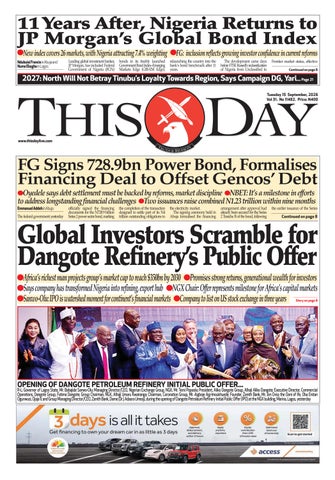
Global Investors Scramble for Dangote Refinery’s Public Offer Africa’s richest man projects group’s market cap to reach $350bn by 2030 Promises strong returns, generational wealth for investors Says company has transformed Nigeria into refining, export hub NGX Chair: Offer represents milestone for Africa’s capital markets Sanwo-Olu: IPO is watershed moment for continent’s financial markets Company to list on US stock exchange in three years
Story on page 8
OPENING OF DANGOTE PETROLEUM REFINERY INITIAL PUBLIC OFFER...
R-L: Governor of Lagos State, Mr. Babajide Sanwo-Olu; Managing Director/CEO, Nigerian Exchange Group, NGX, Mr. Temi Popoola; President, Aliko Dangote Group, Alhaji Aliko Dangote; Executive Director, Commercial Operations, Dangote Group, Fatima Dangote; Group Chairman, NGX, Alhaji Umaru Kwairanga; Chairman, Coronation Group, Mr. Aigboje Aig-Imoukhuede; Founder, Zenith Bank, Mr. Jim Ovia; the Ooni of Ife, Oba Enitan Ogunwusi, Ojaja II; and Group Managing Director/CEO, Zenith Bank, Dame (Dr.) Adaora Umeoji, during the opening of Dangote Petroleum Refinery Initial Public Offer (IPO) at the NGX building, Marina, Lagos, yesterday
2
TUESDAY, SEPTEMBER 15, T H I S D AY
TUESDAY, SEPTEMBER 15, T H I S D AY
3
4
TUESDAY, SEPTEMBER 15, T H I S D AY
5
THISDAY • TUESDAY, SEPTEMBER 15, 2026
Group News Editor: Goddy Egene Email: Goddy.egene@thisdaylive.com, 0803 350 6821, 0807 401 0580
NEWS
JULIUS BERGER LUMINARY SOIREE...
L-R: Board Member, Julius Berger Nigeria, Mr. Chidi Anya Esq.; the Chief Executive Officer, UACN Property Development Company (UPDC PLC), Mr. Odunayo Ojo; the Chief Executive Officer, Ove Arup & Partners Nigeria & President of the Association of Consulting Engineers of Nigeria (ACEN), Engr. Kunle Adebajo; the Honourable Commissioner for Commerce, Cooperatives, Trade and Investment, Lagos State, Mrs. Folashade Ambrose-Medebem; the Managing Director, Julius Berger Nigeria PLC, Engr. Dr. Peer Lubasch; Board Member, Julius Berger Nigeria PLC, Mrs. Bella Disu; and the Chairman of Rendeavour and Managing Director of Alaro City, Mr. Yomi Ademola, during the Julius Berger Luminary Soiree held in Lagos...recently
Ogunleye: NNPC Activating Multiple Pathways to Transform Nigeria into Global Gas Hub EVP reiterates near-term target of 10Bcf/d output by 2027, 12Bcf by 2030 Ekpo: Nigeria working to increase gas production Emmanuel Addeh in Abuja and Peter Uzoho in Lagos The Nigerian National Petroleum Company Limited (NNPC) has reaffirmed its commitment to activate multiple pathways aimed at transforming Nigeria into a global gas hub. The Executive Vice President, Gas, Power & New Energy, NNPC, Mr. Olalekan Ogunleye disclosed this yesterday while speaking at the 2026 Gas Technology & Exhibition Conference (GASTECH), taking place in Bangkok, Thailand, according to a statement by the company’s Chief Corporate Communications Officer, Andy Odeh. Ogunleye, who spoke on a panel themed: “The New LNG Order: Leadership Strategies for Energy Security and Growth” said as geopolitics, conflict and other factors continue to affect global energy supply and demand, Nigeria is leveraging its over 215 trillion cubic feet (tcf) of proven gas reserves to power domestic industrialisation and expand export reach. “Gas development and monetisation from Nigeria’s standpoint is a purely commercial play. NNPC Ltd. is implementing a Gas Master
Plan (GMP) engineered as a gap-topotential tool to move Nigeria from a 215tcf reserves position to above 600tcf,” he added. He explained that the company’s focus was hinged on reinforcing coordination, anchored on the Petroleum Industry Act (PIA), Decade of Gas Framework and the GMP, with the near-term target to ramp up national production of gas to 10 billion standard cubic feet per day (Bcf/d) by 2027 and 12 Bcf/d by 2030. Ogunleye observed that Nigeria was already a reliable global supplier of gas on a major expansion drive, citing key LNG projects such as Trains 1-6 which produce 22 million tonnes per annum (MTPA) and has exported over 6,000 LNG cargoes since 1999, as well as Train 7 which is due for completion in 2027. He said Nigeria’s geographical advantage (well-positioned for the Atlantic Basin and Asian markets) has placed the country as a strategic supplier to global markets, an advantage he said is complemented by Nigeria’s substantial gas resource base and a national focus on gas development. He said Nigeria’s domestic gas utilisation and gas for export are not mutually exclusive, as the country has adopted a dual pathway
which leverages exports for foreign exchange earnings while advancing domestic gas utilisation to create job opportunities, deepen energy security, and economic wellbeing. Ogunleye said Nigeria has derisked new LNG projects through a robust legal and regulatory framework supported by attractive fiscal incentives. “With continued efforts towards stable security, competitive gas pricing and assured gas supply, there is no better time for investors and financiers to confidently participate in the development of Nigeria’s LNG projects,” Ogunleye concluded. Also at the event, the Minister of State for Petroleum Resources (Gas), Ekperikpe Ekpo, said that Nigeria was working to increase gas production and develop infrastructure required to move more of its vast reserves to domestic, regional and international
Sahara has announced the appointment of Chidilim Menakaya as Managing Director, marking an important milestone in the company’s journey to accelerate its “Beyond XXX” vision and drive the next phase of growth, innovation, and impact. Menakaya is a seasoned transformation and strategy executive, bringing more than two decades of leadership experience, spanning Africa, Asia, Europe, and the Middle East. Sahara made the announcement in a statement issued yesterday. Prior to her appointment,
Menakaya served as Director of the Sahara Foundation, where she led the company’s sustainability and social impact agenda. Under her leadership, the foundation expanded the reach of Sahara’s EXTRApreneurship model, strengthened strategic partnerships, and deepened socio-economic impact across communities in the company’s locations. Widely respected for her collaborative leadership style, strategic insight, and ability to build high-performing teams, Menakaya has consistently demonstrated a commitment to developing people, driving innovation, and delivering
Saharan Gas Pipeline to supply gas to Morocco, which ultimately will get to the international market. We are in negotiation with Algeria and Equatorial Guinea,” he said. The minister identified the Obiafu-Obrikom-Oben (OB3) and Ajaokuta-Kaduna-Kano (AKK) gas pipelines as critical infrastructure being developed to connect gasproducing areas with markets across the country. He said the projects would strengthen domestic supply while creating the infrastructure required to support regional exports. Ekpo also pointed to the Decade of Gas initiative, launched in 2021, saying about 20 projects had been identified to increase gas production sufficiently to meet domestic and regional demand, with surplus volumes available for export. “We are progressing to catch up with
the demands of our country and, of course, with the regional demands,” he said. He stressed, however, that domestic consumers would remain the priority, noting that the government had established a domestic delivery obligation requiring producers to meet local demand before exporting surplus gas. The minister said the government had also granted tax waivers for gas-related equipment as part of efforts to encourage investment in the sector. Also speaking at the conference, Oman’s Minister of Energy and Minerals, Salim bin Nasser Al Auh, said the current global energy supply challenge was not caused by a shortage of oil and gas resources or technology, but by the difficulty of moving supplies from production centres to consumers.
Oando’s Irune Joins World Energy Council Nigeria Board Emmanuel Addeh in Abuja The Managing Director of Oando Energy Resources and Executive Director of Oando Plc, Dr Ainojie
Sahara Appoints Menakaya Managing Director to Lead Next Phase of Growth Peter Uzoho
markets. But Ekpo acknowledged that the country’s large gas reserves alone could not unlock the opportunity created by disruptions to global supplies. “Resources alone without provision of infrastructure, technology and financing cannot take us anywhere,” the minister said. According to him, the government is supporting investment in gas infrastructure, including through the gas infrastructure fund provided for under the Petroleum Industry Act (PIA), to facilitate the transportation of produced gas to markets across Nigeria and beyond. Ekpo said Nigeria was already supplying gas to several countries in the region, including Ghana and Togo, while pursuing additional export opportunities. “We are engaging with the Trans-
measurable outcomes. Commenting on the appointment, Executive Director, Sahara, Ade Odunsi, said the decision reflected Sahara’s confidence in purposeful leadership and its commitment to building the future from within. Odunsi stated, “For over three decades now we have remained committed to our vision of bringing energy to life responsibly. Beyond XXX represents our commitment to shaping the future through bold thinking, innovation, sustainability, and shared value creation. Chidilim’s appointment reflects these aspirations. We are confident that under her leadership.
Irune, has been appointed to the governing board of the World Energy Council’s Nigerian Member Committee, as Nigeria renews its participation in the global energy organisation. The governing board of the Nigerian Member Committee was inaugurated in Abuja on August 7, with Abdulrazaq Isa, co-founder of Waltersmith Petroman Oil Limited, emerging as chairman. The committee’s membership also includes Bala Wunti, formerly Chief HSE Officer at NNPC Limited, who serves as chief executive, as well as Prof. Wumi Iledare, Dr Mustapha Abdullahi, Mrs Aisha Katagum, Dr Emmanuel Okon, Dr Victor Ekpenyong and Dr Imamuddeen Talba. The composition brings together professionals from the energy industry, policy, academia and private enterprise, with the committee expected to represent Nigeria in the World Energy Council’s international energy discussions. Irune’s appointment brings to the committee an executive who has been closely involved
in that transition. At 45, he has risen through strategic, corporate and upstream roles at Oando to become head of the company’s energy resources business, an Oando statement said. Trained as a computer scientist, Irune holds a doctorate from the University of Nottingham and began his professional career in technology and automotive research in the United Kingdom, where he worked with Nissan, Honda and Jaguar Land Rover before returning to Nigeria. He subsequently joined Oando, where he held positions spanning corporate communications, strategy and upstream operations. His career at the company has coincided with two major transactions that reshaped Oando’s upstream portfolio. In 2014, Oando completed the $1.5 billion acquisition of ConocoPhillips’ Nigerian upstream business, a transaction that significantly expanded the indigenous company’s position in the sector. A decade later, Oando completed its $783 million acquisition of Nigerian Agip Oil Company from Eni
in 2024. The transaction increased Oando’s participating interests in OMLs 60 to 63 from 20 per cent to 40 per cent and substantially expanded its upstream operations. Irune, as Managing Director of Oando Energy Resources, was involved in leading the completion of the acquisition. His new role on the World Energy Council committee comes against the backdrop of this broader shift in Nigeria’s oil and gas industry, with indigenous companies assuming greater ownership and operational responsibility for assets previously controlled by international oil companies. Beyond corporate operations, Irune has also participated in discussions on Africa’s energy transition, advocating an approach that takes into account the continent’s energy access and industrialisation needs. He has highlighted the role of gas in supporting Africa’s economic development and the need for African energy companies to retain a greater share of the value generated from the continent’s natural resources.
6
TUESDAY, SEPTEMBER 15, 2026 • THISDAY
NEWS
SSDC’S STRATEGIC COLLABORATION WITH FEDERAL UNIVERSITIES...
L-R: Vice Chancellor, Federal University of Petroleum Efurun, Prof. Ezekiel Agbalalaba; VC Fed University of Bayelsa State, Prof. Promise Mebine; VC Federal University of Agric and Tech, Akwa Ibom State, Prof. Joseph Peter Essien; Dep VC (Academics) University of Calabar, Prof. Ekaette Enang; VC University of Uyo, Chris Nyong Ekong; Managing Director/CEO, South South Development Commission (SSDC), Ms. Usoro Akpabio; VC Fed University of Technology, Ikot Abasi, Prof. Leo Daniel; Executive Director, Social Services and Human Capital Development, SSDC, Engr. Preye Aganaba; Dep VC (Administration) University of Benin, Prof. Chris Osubor; and South West representative on SSDC Board, Dr. Bukola Braimoh, during SSDC’s strategic collaboration with Federal Universities in the region, yesterday PHOTO: SSDC
Shettima, Modi Push to Restore Nigeria-India Trade to $15bn PM seeks renewed crude purchases Countries expand cooperation in defence, pharmaceuticals, digital technology, fintech, renewable energy, creative industries Deji Elumoye in Abuja Nigeria and India have agreed to deepen their strategic economic relationship, with India seeking renewed purchases of Nigerian crude oil as both countries move to rebuild bilateral trade towards its previous high of nearly $15 billion. The commitment followed a bilateral meeting between Vice President Kashim Shettima and Indian Prime Minister Narendra Modi on
the side-lines of the just-concluded BRICS Leaders’ Summit in New Delhi. Bilateral trade between both countries stood at $14.95 billion in the 2021- 2022 financial year before declining largely as a result of reduced Indian purchases of Nigerian crude. It dropped to $7.13 billion in 2024–2025 but recovered to about $9 billion in 2025–2026, according to figures disclosed by the Indian High Commissioner to Nigeria, Abhishek Singh.
Modi made a case for renewed crude purchases from Nigeria, saying stronger energy trade could help return commercial exchanges between both countries to previous levels. Shettima said, “Nigeria would examine the request as part of broader efforts by President Bola Ahmed Tinubu’s administration to attract investment and build strategic partnerships capable of expanding the country’s productive capacity.” He identified pharmaceuticals,
defence, digital technology, and the creative industries as areas of particular interest to Nigeria, stressing the need for partnerships that create jobs, transfer skills, and open opportunities for the country’s large youth population. The two leaders also discussed expanded cooperation in renewable and clean energy, power, healthcare, capacity building, financial technology, and other emerging sectors. The vice president said, “The
President Tinubu administration is particularly interested in moving Nigeria’s relationship with India beyond the traditional exchange of commodities towards investments that support domestic production and value addition.” The renewed push builds on a longstanding economic relationship in which crude oil has historically accounted for a significant share of India’s imports from Nigeria. Modi also expressed appreciation
OSSAP-SDGs, RHI Empower 4,500 Vulnerable South-East Women with Business Equipment First Lady gives 2,500 Imo beneficiaries N250m Uzodimma supports additional 2,000 women Deji Elumoye in Abuja Office of the Senior Special Assistant to the President on Sustainable Development Goals (OSSAP-SDGS) and the Renewed Hope Initiative (RHI) have empowered 4,500 indigent and vulnerable women across the five South-east states with business equipment. The beneficiaries comprised 500 women each from Abia, Anambra, Ebonyi, Enugu and Imo states under the core OSSAP-SDGs/RHI programme, as well as an additional 2,000 Imo women supported by Governor of Imo State, Senator Hope Uzodimma. First Lady and Chairman of RHI, Senator Oluremi Tinubu, also donated N100,000 to each of the 2,500 beneficiaries in Imo State, amounting to N250 million. A statement issued on Monday by Special Assistant on Media, Publicity and Strategic Communications in OSSAP-SDGs, Desmond Utomwen, said the intervention was unveiled in Owerri during the South-east flag-off of RHI Women Economic Empowerment Programme, implemented in collaboration with OSSAP-SDGs. While Mrs Tinubu performed the zonal flag-off in Owerri, similar presentations were held simultaneously in Abia, Anambra, Ebonyi and Enugu states, where 500 pre-selected women in each state received empowerment items. The business equipment distributed included deep-chest freezers, maxi gas cookers with ovens, generators, and
industrial grinding machines, intended to help the beneficiaries establish new businesses or strengthen existing enterprises. The South-east exercise followed earlier phases in the North-central, South-south, and South-west geopolitical zones. Under the core nationwide programme, OSSAP-SDGs and RHI are targeting 18,500 vulnerable women, comprising 500 beneficiaries in each of the 36 states and the Federal Capital Territory (FCT). In her address, the first lady explained that the initiative was designed to provide women with productive assets to strengthen their livelihoods and enable them to contribute more meaningfully to their families and communities. She added that women’s economic empowerment remained central to achieving the Sustainable Development Goals, particularly SDG 5 on Gender Equality and SDG 8 on Decent Work and Economic Growth. Mrs Tinubu urged the beneficiaries to put the equipment and financial support to productive use, stressing that the resources are intended to help them establish or expand their businesses, increase their incomes, and improve their families’ welfare. “Let these items serve as a foundation for creating a better life for yourselves and your families. I hope and pray that what you received today will prosper in your hands,” she said. Senior Special Assistant to the President on Sustainable Development
Goals, Princess Adejoke OrelopeAdefulire, described the South-east exercise as another milestone in the partnership between OSSAP-SDGs and RHI to expand economic opportunities for vulnerable women. Orelope-Adefulire said 500 preselected women in each of the five South-east states—Abia, Anambra, Ebonyi, Enugu and Imo—received empowerment items under the core programme. The Imo State government’s support for an additional 2,000 women increased the total number of beneficiaries across the zone from 2,500 to 4,500. Orelope-Adefulire explained that the beneficiaries were drawn from vulnerable groups, including wives of fallen heroes, widows, and indigent women who possessed the determination to work but required productive assets to improve their livelihoods. Describing the intervention as a practical demonstration of the principle of Leaving No One Behind, she said its objective went beyond distributing equipment. “Our objective is not merely to distribute equipment, but to provide productive assets that can unlock potential, foster economic independence and create opportunities for women to thrive,” she said. Orelope-Adefulire stated, “By equipping women with tools such as gas cookers, generators, deep freezers, and grinding machines, we are enabling beneficiaries to establish new businesses, strengthen existing
enterprises, earn sustainable incomes, and provide greater economic security for their households.” The SSAP-SDGs said women’s economic empowerment was an important accelerator of sustainable development, contributing directly to SDG 1 on No Poverty, SDG 5 on Gender Equality, SDG 8 on Decent Work and Economic Growth, and SDG 10 on Reduced Inequalities. Orelope-Adefulire said, “When a woman is economically empowered,
the benefits extend beyond income generation. Poverty is reduced, and she is better positioned to support her family’s health and well-being, address hunger, invest in her children’s education, and exercise her rights with greater confidence and independence.” Orelope-Adefulire urged the beneficiaries to regard the equipment as tools of opportunity and deploy them to create value, generate income and build sustainable livelihoods.
for Nigeria’s hospitality towards the sizeable Indian community living and doing business in the country. Both leaders agreed that stronger private-sector engagement would be central to the next phase of Nigeria-India relations, particularly in industries where Indian companies already possessed considerable expertise and Nigerian demand remains strong. Discussions also covered greater collaboration in fintech and digital technology, building on both countries’ rapidly expanding digital economies and earlier agreements on digital public infrastructure. Shettima said Tinubu’s objective was to ensure that international partnerships translated into investment, technology transfer, industrial growth, and tangible economic opportunities for Nigerians. Nigeria and India also expressed their commitment to sustaining high-level political and economic engagement, including through the India-Africa partnership framework and other multilateral platforms. Speaking earlier, Minister of Women Affairs, Hajiya Imaan Sulaiman-Ibrahim, said Nigeria was drawing lessons from India’s women-led self-help group model to strengthen financial inclusion and grassroots enterprise.
FG Invests N10.5bn in Digital Training Academy to Skill Over 32,000 Nigerians Kuni Tyessi in Abuja The federal government says it has committed over N10.5 billion to the Digital Training Academy, DTA, to equip more than 32,000 young Nigerians with skills needed to compete in the global digital economy. Minister of Education, Dr. Tunji Alausa who announced this on Monday in Abuja at the official launch of the Academy, said the DTA is designed to close Nigeria’s digital skills gap, boost employability, and create pathways for Nigerians to work remotely for global companies without leaving the country. He described the initiative as a
direct implementation of President Bola Ahmed Tinubu’s Renewed Hope Agenda under the Nigeria Education Sector Renewal Initiative, NESRI. The minister said beneficiaries will undergo six months of training on platforms including Coursera and Pluralsight and will receive certifications from leading global technology firms. Key training areas include ICT, cybersecurity, artificial intelligence, machine learning, cloud computing, fintech, product management and quantum computing. To ensure no one is left behind, the federal government has partnered with the National Open
University of Nigeria, NOUN and Yaba College of Technology, YABATECH to provide study centres, internet access and facilitators for learners who lack devices or reliable connectivity. The Academy will also serve as a certification pathway for participants of the 3 million Technical Talent, 3MTT programme. The Director-General of NIMC, Abisoye Coker-Odusote, said digital identity would be critical for Nigerians to access education, jobs and financial services. She described the DTA as “an investment in people, knowledge and national capacity” that would help build a *one-trillion-dollar economy.
7
THISDAY • TUESDAY, SEPTEMBER 15, 2026
NEWS
SIGNING CEREMONY OF BOI’S LANDMARK N274.18 BILLON INAUGURAL DOMESTIC BOND...
L-R: Head, Debts Capital Markets, RMB Nigeria, Laju Atake; Executive Director and Treasurer, RMB Nigeria; Yetunde Ogunremi; Executive Secretary, Bank of Industry, Olufunlola Salami; Executive Director, Corporate Finance, Sustainability & Investments, Bank of Industry, Rotimi Akinde; Executive Director, Public Sector and Intervention Program, Bank of Industry, Mabel Ndagi; General Manager/Divisional Head, Corporate Finance and Advisory Services, Bank of Industry, Ayo Bajomo; Legal Advisor, Bank of Industry, IretiOluwa Daramola; Executive Director, RMB Nigeria, Head of Investment Banking, Broader Africa, Chidi Iwuchukwu; Senior Relationship Manager, RMB Nigeria, Titilope Olatunji; and Group Head, Debt Capital Markets, Bank of Industry, Faruk Hamidu, at the signing ceremony of Bank of Industry’s Landmark N274.18 Billon Inaugural Domestic Bond in Lagos...recently
Tinubu Orders Release of NCDC Funds, North-central 20-year Plan Ready Warns regional development commissions against corruption, white elephant projects Directs SGF to ensure timely funding of regional commissions Olawale Ajimotokan and Michael Olugbode in Abuja President Bola Tinubu has directed Secretary to the Government of the Federation (SGF), Senator George Akume, to ensure timely release of funds accruable to North Central Development Commission (NCDC) and other regional development commissions, as the federal government moves to establish a unified policy framework for regional development. Tinubu, who was represented by Akume at the first-ever North Central Stakeholders’ Development Summit in Abuja yesterday, said adequate and timely funding was necessary to enable the commissions execute strategic projects capable of unlocking the economic and industrial potential of their regions. The president, however, warned the commissions against depending solely on government funding and becoming conduits for waste. He urged them to mobilise private capital and explore Public-Private Partnerships (PPPs), donor funding, and development financing. “There is no excuse for the commissions to become another conduit pipe for wasting public funds,” Tinubu said.
The summit, with the theme, “A Great Leap Forward: A 20-Year Economic, Infrastructural and Social Development Plan for North Central Region,” brought together governors and representatives of the six North-central states and the Federal Capital Territory, traditional rulers, religious leaders, youths, women, academics, development partners, and private-sector operators. Tinubu said the creation of regional development commissions was part of his administration’s Renewed Hope Agenda to accelerate development and close longstanding gaps across the country. He stressed that the commissions were not established to replace, duplicate or usurp the functions of existing tiers of government, but to complement them by addressing development deficits that had persisted over the years. The president charged the commissions to focus on roads, rail transportation, air transport, industrialisation, security, investment, human capital development, education, and healthcare, particularly projects capable of unlocking regional potential and improving connectivity across the country. He also warned the boards and managements of the commissions
against corruption, marginalisation, politicisation, and ethnic bias in the implementation of government programmes, saying those found culpable would be sanctioned. “Development must be about the people and not on paper,” he said. Managing Director/Chief Executive Officer of NCDC, Dr Cyril Tsenyil, said the commission was determined to move the Northcentral from a collection of states with enormous but fragmented potential into a coordinated regional economy with integrated infrastructure, investable projects, and shared prosperity. Presenting the commission’s draft 20-year Economic, Infrastructural and Social Development Plan, Tsenyil said the summit was designed to be
British High Commissioner Designate to Nigeria, Pete Vowles, has arrived in Abuja to assume leadership of the United Kingdom’s diplomatic mission, pledging to deepen the longstanding partnership between both countries. Vowles, who succeeds Dr Richard Montgomery CMG, arrived in the Nigerian capital on Monday, according to a statement issued by the British High Commission. Speaking on his arrival, the new envoy said his immediate priority would be to listen, learn and engage with Nigerians across the country.
“I am hugely excited to be in Nigeria. My first priority is to listen and learn – to travel, meet people and immerse myself in this extraordinary country, its culture and its energy,” he said. He added that the relationship between the UK and Nigeria was anchored in strong people-to-people connections, expressing readiness to work with partners across the country to identify new areas of cooperation. “The UK and Nigeria have a deep and enduring partnership, built above all on the connections between our people. I’m looking forward to discovering Nigeria for myself and working with partners
jobs, and measurable improvements in the lives of residents. NCDC, established under the North Central Development Commission (Establishment) Act, 2024, covers Benue, Kogi, Kwara, Nasarawa, Niger, Plateau, and the FCT. Its mandate includes transportation, agriculture, security, entrepreneurship, industrialisation, employment, health, education, housing, water, electricity, and telecommunications. Tsenyil said the commission would not replace state governments or duplicate existing federal institutions, but would operate as a regional coordination, development, and investment-enabling platform. He stressed that the region must
move from state-by-state competition to regional collaboration, stating that investors view the area through markets, supply chains, resources, labour pools, and economic corridors, rather than political boundaries. He advocated the transformation of agricultural production into agro-industrial value chains, processing of minerals within the region, and integration of roads, railways, waterways, and dry ports into regional economic corridors. NCDC disclosed that discussions had commenced with the Infrastructure Concession Regulatory Commission (ICRC) on a proposed regional railway network, the revival of Ajaokuta Steel, dredging of River Benue and River Niger, Baro Port, and Jos Dry Inland Port.
Vaccine Production: FG Transfers Lagos Assets to BVNL as Equity Contribution Emmanuel Addeh in Abuja The federal government has formally transferred the title documents of two properties in Lagos to Biovaccines Nigeria
Vowles Arrives in Nigeria, Pledges to Strengthen UK-Nigeria Ties Michael Olugbode in Abuja
a turning point rather than another conference where stakeholders exchanged speeches and returned to “business as usual”. He stated that the plan was based on the understanding that major infrastructure and economic transformation could not be achieved within a single electoral cycle. According to him, the Northcentral occupies a strategic position in Nigeria’s economic geography, connecting northern and southern markets, hosting the nation’s capital, and possessing vast agricultural land, water, and mineral resources, a young population and a growing base of universities and enterprises. He said the challenge was to convert those resources into productive assets, competitive businesses, quality
across the country to build on that relationship and see what more we can achieve together,” Vowles said. Vowles brings extensive diplomatic and development experience to his new assignment. Before his appointment, he served as His Majesty’s Ambassador to Zimbabwe and held senior leadership positions within the UK’s Foreign, Commonwealth & Development Office. He previously served as Ambassador to Myanmar and occupied diplomatic and development positions in several African and Asian countries, including Bangladesh, India, the Democratic Republic of Congo and Kenya.
Limited (BVNL), fulfilling its equity contribution to the joint venture established to revive local vaccine manufacturing. The Minister of Housing and Urban Development, Muttaqha Darma, handed over the original title documents of the properties to BVNL through the Ministry of Finance Incorporated (MOFI), which holds the federal government’s interest in the company. The properties are located at No. 445 Herbert Macaulay Way, Yaba, and No. 1 University Road, Yaba, Lagos, a statement in Abuja by the ministry said. Speaking at the handover ceremony, Darma said the transfer represented the fulfilment of the federal government’s equity commitment under its Joint Venture Agreement with May & Baker Nigeria Plc. “You will recall that the federal government entered into a joint venture partnership with May & Baker to revive local production of vaccines. The partnership created Biovaccines Nigeria Limited as a Special Purpose Vehicle for mass production of vaccines for Nigeria
and other West African countries,” he said. Under the agreement, the federal government holds 49 per cent equity in BVNL, while May & Baker owns 51 per cent. The government’s contribution comprises the two Lagos properties. Darma said the push for local vaccine production was not simply an economic initiative, arguing that dependence on foreign supply chains for critical vaccines posed a national security risk. “The lessons of recent global health crises remain crystal clear. A nation that relies entirely on foreign supply chains for its critical vaccines remains fundamentally vulnerable. Localizing vaccine production is not merely an economic ambition; it is a critical matter of national security,” he said. With the transfer of the properties completed, the minister charged the board and management of BVNL, led by Prof. Oyewale Tomori, to translate the development into tangible progress in vaccine manufacturing. “The expectations of the Nigerian people are high, and time is of the essence,” he added.
Earlier, the Permanent Secretary of the Ministry, Dr Shuaib Belgore, described the transfer as an important administrative and operational milestone in the country’s quest for health sovereignty and domestic vaccine production. Belgore said the partnership between the federal government and May & Baker was established as a public-private partnership to revive vaccine manufacturing in Nigeria. He stressed that securing and transferring legal ownership of the properties was crucial to enabling BVNL to attract the investment and partnerships required to develop its operations. According to him, the legal ownership would help the company attract capital investment, international partnerships, technology transfer and infrastructure financing. He also acknowledged the contributions of the Federal Ministry of Health and Social Welfare, Federal Ministry of Justice and the Office of the Chief of Staff to the President towards completing the title documentation process.
8
TUESDAY, SEPTEMBER 15, 2026 • THISDAY
EIGHT
FG Hails Coca-Cola’s $1bn Proposed Investment Says Nigeria open for business Olawale Ajimotokan in Abuja President Bola Tinubu yesterday welcomed the Coca-Cola System’s announcement in 2024 of a potential $1 billion investment in Nigeria over five years, describing the commitment, which followed $1.5 billion invested during the preceding decade, as a vote of confidence in the Nigerian economy. He spoke yesterday in Abuja at the 75th anniversary flagship event of the Nigerian Bottling Company Limited (NBC), held at the Bola Ahmed Tinubu International Conference Centre. The President, represented by the Secretary to the Government of the Federation, Senator George Akume, assured local and international investors that Nigeria remains open for business, while his administration is working to create a more predictable, competitive and investment-friendly business environment. Tinubu said the Coca-Cola System
generated an estimated $1 billion in value-added economic activity in Nigeria in 2024, supported more than 160,000 livelihoods across its value chain and purchased approximately $601 million worth of goods and services from Nigerian suppliers. He added that the federal government recognised the practical challenges confronting businesses and was addressing them through reforms under the Renewed Hope Agenda. “Our message to investors, both Nigerian and international, is clear: Nigeria is open for business, and we are working to make the business environment more predictable, more competitive and more supportive of investment,” Tinubu said. He noted that businesses require reliable power and infrastructure, clear and consistent regulations, efficient ports and logistics, access to foreign exchange and a tax system that
encourages productive enterprise. The President explained that the administration embarked on its economic reforms because of the need to build a more productive and competitive economy capable of reducing dependence on imports, expanding domestic manufacturing and creating greater opportunities for Nigerians. “We are making difficult changes because we want a more productive and competitive Nigerian economy. We do not want to remain overly dependent on imported goods while our own productive capacity remains underdeveloped. We want to produce more, manufacture more, add more value locally and create more opportunities for Nigerians,” he said. He said his administration was interested not merely in the volume of capital coming into the country but also in the impact such investments have on employment, skills development,
local sourcing, technology transfer and domestic productive capacity. “For this Administration, that is what investment must mean. We are interested not only in the amount of capital that comes into Nigeria, but in what that capital does here,” he stated. Tinubu said Nigeria should not be regarded merely as a large market where international businesses sell their products, but as a country where enterprises can establish operations, develop local talent and supply chains, grow and compete in African and global markets. He said the continued investment by Nigerian Bottling Company in production capacity, including new production lines at Asejire in Oyo State and Challawa in Kano State, represents the kind of investment required to strengthen the productive base of the Nigerian economy. The President challenged businesses and policymakers to explore ways of
increasing local content, developing Nigerian companies into dependable suppliers to major manufacturers and progressively replacing imports with competitively manufactured Nigerian products. He pledged that the federal government would continue to improve policies, infrastructure and the regulatory environment required to encourage investment and domestic production. “The government has a role to play. We will continue to work on the policies, infrastructure and regulatory environment required to support investment and domestic production. But the government cannot do this alone. “The private sector must also play its part. Businesses invest. Businesses innovate. Businesses take risks. Businesses create jobs. Our responsibility in government is to create an environment in which those things can happen,” he said.
SGF, George Akume He stressed the importance of human capital development, noting that investment ultimately derives its value from the opportunities it creates for people. He commended the Nigerian Bottling Company for its Supply Chain Academy, established in 1996, which had trained more than 1,400 young people, as well as its empowerment initiatives for women and interventions in communities, including water and hygiene programmes.
GLOBAL INVESTORS SCRAMBLE FOR DANGOTE REFINERY’S PUBLIC OFFER Emmanuel Addeh in Abuja and Peter Uzoho, Kayode Tokede in Lagos A global investor rush for a stake in Africa’s biggest refinery took centre stage yesterday as the Dangote Petroleum Refinery and Petrochemicals formally opened its N2.15 trillion Initial Public Offer (IPO) in what is shaping up as one of the most consequential transactions in the history of Nigeria’s capital market. With 4.1 billion shares offered at N525 each, the landmark offer immediately drew intense interest from investors at home and abroad, as Africa’s richest man, Aliko Dangote, sought to
open ownership of his flagship industrial project to a much wider pool of investors. The public offer, which runs from September 14 to October 13, marks the first time the public can directly acquire a stake in the refinery, with President of Dangote Industries Limited (DIL) Alhaji Aliko Dangote, projecting that the group of companies could hit a market cap of $350 billion by the end of 2030. Dangote, at the opening of the refinery’s IPO on the Nigerian Exchange Limited (NGX) in Lagos, told an excited audience that the $350 billion forecast by 2030 was based on a 10 times price-to-earnings ratio, with the valuation initially represented
on the Nigerian Exchange. Besides, the huge demand for the stock led to interruptions on platforms such as Bamboo and Cowrywise as retail investors rushed to buy shares which have a minimum buy-in of N5,250. Specifically, Bamboo acknowledged the problem in a post on X, attributing the login difficulties to an unusually high volume of users attempting to access the platform to participate in the Dangote Refinery offer. “Hey everyone, we’re getting much higher than expected traffic trying to get into the Dangote IPO and it’s making it difficult for some users to log into the Bamboo app,” the firm said on its social media
handle. The IPO comprises 4.1 billion ordinary shares offered at N525 each, with the offer targeting about N2.15 trillion. The IPO that opened on the NGX in the earlier hours of trading yesterday recorded about N1.5 trillion in subscriptions. In his remarks at the “Facts Behind the Offer” presentation at the NGX, Dangote assured investors that the IPO presented a compelling opportunity for strong returns and sustainable wealth creation. Dangote positioned the offer as a chance for Nigerians and Africans to participate in one of the continent’s most significant industrial achievements. He described the $1.6 billion
FG SIGNS 728.9BN POWER BOND, FORMALISES FINANCING DEAL TO OFFSET GENCOS’ DEBT 2 Tranche A. The development brings the combined value of the two power-sector bond issuances to N1.23 trillion within nine months, underscoring the federal government’s ongoing effort to address legacy debts and restore financial stability to the electricity market. Speaking at the event, the Minister of Finance and Coordinating Minister of the Economy, Taiwo Oyedele, stressed that debt settlement alone would not resolve the underlying problems in the power sector, insisting that the financing intervention must be backed by reforms that would improve the market’s sustainability. According to him, the N728.9 billion power sector bond must be accompanied by stronger market discipline and structural reforms to prevent a recurrence of the legacy debts that have weakened Nigeria’s electricity market. Oyedele said the transaction comprised N402 billion in cash bonds raised from the capital market and N326.9 billion in noncash bonds allotted to participating Generation Companies (Gencos) under the Presidential Power Sector Debt Reduction Programme (PPSDRP). He said the transaction addressed accumulated legacy obligations that had weakened liquidity, constrained investment and affected confidence across the electricity value chain. However, the minister stressed that settling the debts would not be sufficient to resolve the sector’s challenges without reforms to address the factors responsible
for fresh debt accumulation. “This means the bond programme cannot stand alone. It must be accompanied by stronger market discipline, improved revenue assurance, reduction in technical and commercial losses, greater efficiency and accountability across the electricity ecosystem,” Oyedele said. He said the federal government’s objective was to resolve legitimate legacy obligations in a structured and transparent manner while implementing reforms necessary to prevent their recurrence. “It is important that we are leveraging Nigeria’s domestic capital markets,” he said, adding that the transaction demonstrated how the government could use appropriate market instruments to address significant economic challenges while deepening the financial markets and mobilising long-term domestic capital. Oyedele said the ultimate measure of the programme would not be the size of the bonds issued but whether it delivered a financially sustainable electricity market. “Ultimately, the success of this programme will not be measured by the amount or size of bond that we have issued. It will be measured by whether we achieve a financially sustainable electricity market that can attract investments, meet its obligations and deliver more reliable power to Nigerian households and businesses,” he said. Earlier in his opening remarks, the Chief Executive Officer of Nigerian Bulk Electricity Trading Plc (NBET), Akin Odeyemi, described
the Series 2 issuance as another important milestone in the federal government’s efforts to address longstanding financial challenges confronting the electricity supply industry. Odeyemi said the issue would be implemented in two tranches, with 11 generation companies participating, compared with eight under Series 1. He said the increased participation reflected growing confidence in the programme and its ability to provide a credible framework for addressing verified outstanding obligations to generation companies. According to him, accumulated obligations had affected the ability
of market participants to meet their commitments and constrained the capacity of generation companies to invest in additional generation capacity. Odeyemi said the programme should therefore be viewed beyond the settlement of historical debts. “The financial challenges to the power sector have had implications across the electricity value chain,” he said. He added that the programme was “not simply an initiative for settling historical debt, but also as part of efforts to restore financial confidence, liquidity and sustainContinued on page 20
(N2.15 trillion) offer as the largest IPO ever undertaken in Africa, underscoring the company’s commitment to broadening ownership and enabling millions of individuals to benefit from the value generated by a world-class industrial enterprise. According to him, the refinery IPO is more than a capital raising exercise; it is an opportunity for investors to become part owners of a strategic asset that is already delivering strong operational and financial results. “The Dangote Refinery IPO is more than an investment opportunity; it is an opportunity for millions of Nigerians and Africans to build lasting wealth through ownership of a world-class industrial asset. We have built a refinery that is already delivering strong revenues, solid profitability and significant value to the economy. “By investing today, shareholders are not only positioning themselves to enjoy attractive returns and dividend prospects, but they are also laying the foundation for generational wealth that can benefit their children and grandchildren. This offer is designed to allow ordinary people to participate in an extraordinary success story and share in the long-term value that Dangote Refinery will continue to create for decades to come”, he said. He emphasised that the offer reflects the Group’s long-standing philosophy of creating prosperity
through broad ownership, enabling ordinary citizens to share in the success of transformational businesses Dangote noted that the refinery has already fulfilled its core vision of transforming Nigeria from a major importer of refined petroleum products into a significant refining and export hub, supplying domestic demand while serving markets across Africa and beyond. “We are not merely offering shares; we are offering Nigerians an opportunity to participate in a transformational chapter of our economic history. This is a strategic investment in an asset that is creating jobs, conserving foreign exchange, enhancing energy security and strengthening Africa’s industrial capacity,” he stated. Reaffirming the significance of the offer, Dangote said the IPO represents an opportunity for investors to move from consumers to owners and participate in the long-term growth of one of Africa’s most strategic industrial enterprises. “This is a defining investment opportunity. We want millions of Nigerians and Africans to become owners of a business that has been built to create value for generations. Those who invest today are positioning themselves to benefit from the growth, resilience and enduring legacy of a truly transformational enterprise,” he said Aside from the big global invesContinued on page 18
11 YEARS AFTER, NIGERIA RETURNS TO JP MORGAN’S GLOBAL BOND INDEX September 21, 2026, after the index provider concluded that the West African country had met the required market-accessibility criteria. FGN bonds were first included in the J.P. Morgan GBI-EM in 2012, and attracted substantial foreign investment into the domestic securities market. But the country exited the GBI-EM Global Diversified Index in 2015 amid foreign exchange liquidity squeeze. The global investment banking giant announced Nigeria’s re-entry into the bond market via its Global Index Research report yesterday. JP Morgan’s GBI-EM Edge is a benchmark which, tracks localcurrency government debt across 26 frontier emerging markets. Nigeria entered the index with a 7.40 per cent weighting, one of the highest among participating
countries and close to J.P. Morgan’s maximum country weighting of eight per cent. The benchmark includes $17.47 billion worth of eligible Nigerian government bonds across 16 instruments, with the securities recording an average yield to maturity of 17.1 per cent, an average duration of 3.38 years and a B- Sovereign credit rating. The Nigerian allocation is among the larger country weights in the GBI-EM Edge. Countries like Vietnam, Egypt, Morocco, Pakistan, Bangladesh, and Kazakhstan attracted the maximum eight per cent weighting, while Sri Lanka weighted 7.5 per cent. Kenya has a 6.91 per cent weighting, followed by Tunisia at 5.32 per cent, and Uganda at 4.84 per cent. Frontier African markets collectively account for 44.5 per
cent of the index, compared with 31.5 per cent for Asian markets. Overall, the GBI-EM Edge tracks about $328 billion in local-currency government debt across 425 instruments, 26 markets and 24 currencies. JP Morgan said the expansion of the benchmark reflected the growing importance of frontier local-currency debt markets, as well as improvements in bond issuance, auction processes, posttrade infrastructure, and access for foreign investors. Nigeria’s inclusion in global bond index is expected to attract about $17.5 billion into the country’s debt market and lower bond yields by up to 200 basis points. Welcoming the new development, the Federal Ministry of Finance, in a statement yesterday, said Nigeria’s inclusion was a
reflection of growing investor confidence in Nigeria’s economic reforms, particularly the stabilisation of the naira, clearance of the foreign exchange backlog, stronger growth in gross domestic product (GDP), and easing inflation. The ministry stated that Nigeria met the index’s eligibility criteria on two major fronts: liquidity, with FGN bonds actively traded under a Two-Way Quote System, and issuance size, with outstanding bond volumes exceeding the minimum threshold of $250 million per tenor. It recalled that Nigeria’s initial inclusion in the GBI-EM in 2012 attracted substantial foreign investment into the domestic bond market, lowered borrowing costs by about 200 basis points, and Continued on page 21
9
THISDAY • TUESDAY, SEPTEMBER 15, 2026
NEWS
AFRICA INCLUSIVE CLIMATE FINANCE CONFERENCE...
L-R: WSBI Vice President, Africa Regional President and Chairman of the Management Board, Al M Bank, Morocco, Mr. Al-Amine Nejjar; Senior Director of Government Affairs, Western and Central Africa, Visa Foundation, Mr. Chidozie Arinze; Managing Director, LAPO Microfinance Bank, Cynthia Ikponmwosa; CEO, WSBI, Mr. Peter Simon; ESG Board Chairperson, LAPO Microfinance Bank, Angela Omeiza; Director of Programmes, Weselina Angelow; and Director of Business Development, GreenMax Capital Advisors, Mr. Sunkanmi Olowo, at the Africa Inclusive Climate Finance Conference themed “Gender-Smart Finance for Climate-Smart Agriculture: Building Inclusive Rural Economies,” held in Lagos... recently
First Lady Seeks More Collaboration Among Tiers of Govt as FG Distributes 215,000 Maternal Kits
Traditional birth practices fuelling maternal mortality, says MAMII 80,000 food-support packs, new-born clothing rolled out Govt targets 2.9m pregnant women, families by 2028 Deji Elumoye, Onyebuchi Ezigbo and Ayodeji Ake in Abuja Wife of the President, Senator Oluremi Tinubu, has canvassed stronger collaboration among governments at all levels, traditional and religious institutions, development partners, and philanthropists to tackle Nigeria’s maternal and new-born mortality burden. Mrs. Tinubu’s call came as the federal government rolled out 215,000 MAMA kits, 40,000 maternal food-support packs, and 40,000 sets of new-born clothing for vulnerable women and families nationwide. She said the scale of the challenge among pregnant women and infants required collective action to ensure that the interventions reached them particularly those in poor, underserved, and hard-to-reach communities.
The federal government also unveiled a set of incentives to encourage pregnant women to register early for antenatal care, deliver in health facilities, and attend postnatal follow-up, as part of efforts to reduce maternal and new-born deaths. Speaking at the national flag-off of incentives to increase maternal and new-born care services utilisation at the Presidential Villa in Abuja on Monday, Minister of State for Health and Social Welfare, Dr. Iziaq Salako, said the government was providing free emergency medical services, including emergency obstetric and neonatal care, for vulnerable women and children. “Today’s flag-off of incentives is our next deliberate step — rewarding and reinforcing the very behaviours we know save lives: early antenatal registration, facility delivery and
postnatal follow-up,” he said. Speaking on Monday at the flag-off of the distribution at State House Conference Centre, Abuja, the first lady said pregnancy and childbirth should be occasions of hope and joy rather than a threat to the lives of Nigerian women. According to her, “This occasion represents a further step towards ensuring that every Nigerian child has a healthy start in life and that no woman loses her life while giving birth. “The intervention is being implemented under the Maternal and Neonatal Mortality Reduction Innovation Initiative (MAMII) of the Federal Ministry of Health and Social Welfare and is designed to encourage greater use of antenatal, delivery and postnatal services.” Mrs. Tinubu said the programme
aligned with President Bola Tinubu’s Renewed Hope Agenda on Health, which placed healthcare at the centre of national development. She described MAMII as a bold national intervention bringing together critical stakeholders to tackle preventable maternal and new-born deaths through greater awareness, emergency care, and more effective referral systems. She stated, “As a mother, I believe pregnancy and childbirth should be moments of hope and joy, with every woman having access to quality care. However, social, economic, cultural, and logistical barriers still exist. This is what makes today’s flag-off particularly significant.” The 215,000 MAMA kits and bags, according to her, constitute the second batch of the intervention, following the distribution of 110,000 kits in 2025.
Abiodun Tasks Judiciary on Justice, Accountability, Fairness as 2026/2027 Legal Year Begins The Ogun State governor, Prince Dapo Abiodun, has charged the state judiciary to uphold justice, fairness, accountability and the rule of law, saying public confidence in democracy depends largely on the ability of institutions to discharge their responsibilities impartially and responsibly. Abiodun gave the charge on Monday at a thanksgiving service held at the Cathedral Church of St. Peter, Ake, Abeokuta, to mark the commencement of the 2026/2027 legal year of the Ogun State Judiciary. The governor said the peaceful resolution of disputes was essential to maintaining law and order, stressing that the responsibility for protecting the rule of law rested on the three arms of government. He said: “When justice is reflected, citizens have confidence in the state. Where the law is faithfully observed, society enjoys stability. When justice is accessible, grievances are channeled away from violence and self-help towards peaceful and lawful resolution.
“Law and order cannot be sustained by the executive alone. The legislature must enact laws, the executive must faithfully implement them, and the judiciary must importantly interpret and apply them. The constitutional balance among these three arms remains one of democracy’s greatest safeguards against the abuse of power.” Abiodun urged public institutions to ensure that the exercise of power remained within the boundaries of justice, fairness and accountability. He particularly charged judicial officers to remain committed to protecting the rights of citizens and resolving disputes in accordance with the law, noting that impartial and transparent institutions were critical to strengthening public trust in democracy. The governor also reaffirmed his administration’s commitment to improving access to justice, citing the state government’s advocacy for the establishment of an Abeokuta Division of the Federal Court of Appeal.
According to him, a significant number of appeals handled by the Ibadan Division of the Court of Appeal originate from Ogun State, making the establishment of a division in Abeokuta both desirable and necessary. He said locating an appellate division in the state capital would bring justice closer to the people, reduce the burden of travelling to Ibadan and further strengthen the administration of justice in Ogun State. In his sermon, titled “Jesus in Your Boat: The Antidote to a Successful New Legal Year,” the Dean of the Cathedral Church of St. Peter, Ake, Abeokuta, Venerable Samuel Omidiji, urged judicial officers to allow truth, justice and divine wisdom to guide their decisions. Omidiji reminded the judges that they were not alone in the discharge of their responsibilities, saying the ultimate Judge of the universe remained watchful over their deliberations and would grant them wisdom, particularly when confronted with difficult cases.
He charged them to walk humbly with God and ensure that truth and justice remained at the heart of their judgments.
She said government was complementing the kits with 40,000 maternal food-support packs and 40,000 sets of essential new-born clothing, while the intervention would subsequently be expanded to additional local government areas where uptake of MAMII services remained low. Mrs. Tinubu explained the incentives were intended to encourage economically disadvantaged pregnant women to attend antenatal clinics, prepare adequately for childbirth, and remain connected to healthcare services after delivery. She stated, “The new-born clothing represents the administration’s commitment to welcoming every Nigerian child with dignity, warmth, and care. “The maternal food support equally recognises that the health and nutrition of a mother are essential to a healthy pregnancy, safe delivery, and a healthy new-born.” She urged state and local governments as well as traditional and religious leaders, development partners, and philanthropists to work with the federal government to ensure the materials got to women who needed them most. The first lady also highlighted interventions she had supported in maternal and child healthcare, including the provision of professional kits to midwives, retraining of frontline
health workers and advocacy against mother-to-child transmission of HIV, syphilis and hepatitis. She commended the Coordinating Minister of Health and Social Welfare, Professor Muhammad Ali Pate, and officials of the ministry for their commitment to reducing preventable deaths among women and new-borns. Salako said the Maternal and Neonatal Mortality Reduction Innovation Initiative, MAMII, was launched by the ministry in November 2024. It targets 172 local government areas across 33 states, representing 20 per cent of Nigeria’s local government areas. He said, “The aim of this bold, sector-wide ambition is to cut maternal mortality by 30 per cent and neonatal mortality by 20 per cent in these areas by 2028, reaching 2.9 million pregnant women with free, timely and comprehensive care.” According to him, there are already visible results since MAMII was rolled out in states including Bauchi, Borno, Kaduna, Kano, Katsina and Ogun, with over 250 health facilities now actively implementing the programme. He disclosed that more than 32,000 women and 1,700 new-borns had benefited directly from emergency obstetric and neonatal care under MAMII.
NIS, China Immigration Agency Deepen Cooperation on Border Security Michael Olugbode in Abuja The Nigeria Immigration Service (NIS) and China’s National Immigration Administration have explored stronger technical cooperation, intelligence sharing and capacity building as part of efforts to combat irregular migration, document fraud and transnational organised crime. The discussions took place during a bilateral meeting between the Comptroller-General of Immigration, Kemi Nandap, and officials of the National Immigration Administration of China on September 9, on the sidelines of the Sub-Forum on Migration
Management Cooperation in Lianyungang, Jiangsu Province. The international forum, held from September 8 to 11, brought together more than 2,000 participants from 139 countries and organisations to deliberate on strengthening international cooperation in migration management and responding to emerging transnational challenges. According to a statement issued on Sunday by the NIS Service Public Relations Officer, Deputy Comptroller of Immigration, Akinsola Akinlabi, the bilateral meeting focused on issues of mutual interest and opportunities to deepen collaboration between the two institutions.
The statement said the proposed areas of cooperation included technical exchanges, information sharing and capacity-building initiatives, reflecting the growing need for coordinated responses to migration-related security threats. The forum also featured country presentations on migration policy initiatives and efforts to strengthen cooperation among participating countries in tackling irregular migration and transnational organised crime. Parallel sessions addressed smart digital services and administration for foreigners, as well as document verification, technology and intelligence sharing for secure borders.
10
TUESDAY, SEPTEMBER 15, T H I S D AY
TUESDAY, SEPTEMBER 15, T H I S D AY
11
12
TUESDAY, SEPTEMBER 15, T H I S D AY
WEST AFRICAN EXAMINATIONS COUNCIL RESULTS MAY/JUNE 2026
13
TUESDAY, SEPTEMBER 15, T H I S D AY
BRITISH COUNCIL RECOGNITION AND OUTSTANDING CAMBRIDGE LEARNER AWARDS 2026
Celebrating Excellence at James Hope College, Lekki, Lagos
MEET OUR AWARD WINNERS
A1 - B3 GRADES : 94.2% A1 - C6 GRADES : 100% Subject
Percentage
Subject
Percentage
Further Mathematics
100% A1
Digital Technologies
100% A1 -B 2
Literature-in-English
100% A1
Technical Drawing
100% A1 - B 2
Geography
100% A1
English Language
100% A1 - B 3
Accounting
100% A
Biology
100% A1 - B 3
Civic Education
100% A1
Economics
100% A1 - C4
Agricultural Science
General Mathematics
100% A1 - C5
Physical Education
100% A1 100% A1
Physics
100% A1 - C6
Chemistry
100% A1 -B 2
1
Oriel Nnabuikem ONYIA* EIGHT AWARDS: 1. 2. 3. 4. 5. 6. 7. 8.
CELEBRATING OUR SCHOLARS
*
*
ONYIA, ORIEL N. (8A1s,1B)
MICHAEL, ANTHONY A. (8A1s,1B)
1
*
AJIDE, QAYYUM O. (4A1s, 5Bs)
ILOKA, BELUCHI Y. (3A1s, 3Bs, 2Cs)
OSEMEKA, DORIS C. (3A1s, 3Bs, 2Cs)
1
For admission enquiries, please contact:
admission@jameshopecollege.edu.ng
2.
GRANVILLE, DENZEL D. (5A1s, 4Bs)
CHERYL A. FASHEITAN, VICTORIA O. * NWACHUKWU, (4As, 5Bs) (3As, 4Bs,1C)
IFEORAH,TOCHIM C. (4A1s, 4Bs)
TOP IN THE WORLD – ENGLISH AS A SECOND LANGUAGE. TOP IN THE WORLD – RELIGIOUS STUDIES. FIRST PLACE IN NIGERIA - BEST ACROSS EIGHT SUBJECTS. TOP IN NIGERIA - ACCOUNTING. TOP IN NIGERIA - BIOLOGY. TOP IN NIGERIA - CHEMISTRY. TOP IN NIGERIA - COMPUTER SCIENCE. TOP IN NIGERIA - ECONOMICS.
1.
+234 7083662229 | +234 7018282065 +234 7015349257 | +234 7085369376
1.
TOP IN THE WORLD – ENGLISH AS A SECOND LANGUAGE. HIGH ACHIEVEMENT – DESIGN AND TECHNOLOGY.
TOP IN NIGERIA – GEOGRAPHY.
Qayyum Oladimeji AJIDE ONE AWARD: 1.
TOP IN THE WORLD – ENGLISH AS A SECOND LANGUAGE.
*JimOvia FoundationScholarship %HQH¿FLDULHV
*JimOvia FoundationScholarship %HQH¿FLDULHV www.jameshopecollege.edu.ng
TOP IN THE WORLD – ENGLISH AS A SECOND LANGUAGE.
Michael Anthony ESSIEN ONE AWARD:
Denzel Diepreye GRANVILLE* TWO AWARDS: 1.
IKEYI, NWABUNDO S. (9A1s)
Nwabundo Sunshine IKEYI* ONE AWARD:
For admission enquiries, please contact:
admission@jameshopecollege.edu.ng
+234 7083662229 | +234 7018282065 +234 7015349257 | +234 7085369376
www.jameshopecollege.edu.ng
14
TUESDAY, SEPTEMBER 15, 2026 • THISDAY
NEWS
MARKING THE 2026/2027 LEGAL YEAR...
L-R: The Akarigbo and Paramount ruler of Remoland, Oba Babatunde Ajayi; Ogun State Governor, Prince Dapo Abiodun; Chief Judge of Ogun State, Hon. Justice Mosunmola Dipeolu; Speaker, Ogun State House of Assembly, Rt. Hon. Oladaisi Elemide and the President, Ogun State Customary Court of Appeal, Hon. Justice Adebisi Femi-Segun at the 2026/2027 legal year held at the Cathedral Church of St. Peter, Ake, Abeokuta... yesterdau
NHRC Raises the Alarm Over Insecurity, Hate Speech Ahead of 2027 Polls Commission records 297,943 complaints in August, demands probe into Benue, Niger killings Michael Olugbode in Abuja National Human Rights Commission (NHRC) has raised concerns over the worsening human rights implications of insecurity, hate speech, and political violence ahead of the 2027 general election. NHRC warned that failure to address the emerging threats could undermine the fundamental rights of Nigerians. The commission said it received 297,943 complaints nationwide in August 2026, describing the figure, alongside intelligence from its Human Rights Observatory, as an important indicator of the country’s human rights situation. Executive Secretary of NHRC, Dr. Tony Ojukwu, disclosed the situation on Monday while presenting the commission’s August 2026 Human Rights Situation Dashboard. Ojukwu said insecurity remained a dominant feature of the human rights landscape during the month, with renewed attacks on rural communities in Benue and Niger states, despite ongoing security operations. He called for comprehensive and transparent investigations into the killings and urged the authorities to ensure that those responsible were prosecuted without further delay.
“Rescue must be followed by appropriate medical, psychosocial, family-reunification and other forms of support necessary for the recovery and reintegration of survivors,” Ojukwu said. He, however, pointed to several successful security interventions during the month as evidence of what could be achieved through effective intelligence gathering and inter-agency collaboration. The executive secretary cited the rescue on August 5 of 308 Nigerians abducted in Niger and Kwara states in a coordinated, intelligence-led operation. According to him, security agencies also secured the release of several people held captive in Benue State, while 15 National Youth Service Corps (NYSC) members abducted in Kogi State while travelling from Abuja after their passing-out ceremony in Bayelsa State were also rescued. Ojukwu commended the agencies involved in the operations, but stressed that such coordinated responses should become routine rather than exceptional. He said, “These outcomes demonstrate what can be achieved when intelligence, political will and interagency coordination come together. It is a standard the commission expects to see consistently, not occasionally.” Beyond physical insecurity, NHRC
expressed concern over the rise in inflammatory rhetoric and political violence involving political and religious actors as the country moved towards the 2027 elections. The commission said it had condemned statements attributed to Sheikh Sani Jingir and Senator Francis Fadahunsi, describing them as hate speech and incitement to violence, and called for their investigation and prosecution.
Over 500 alumni, professionals and representatives of leading organisations gathered in Lagos for the 2026 Career Fair organised by the Covenant University Alumni Association (CUALA), as stakeholders explored emerging opportunities and the changing demands of the workplace. The career fair, held recently in Lagos, themed, ‘Shaping the Future of Work’, focused on career opportunities, recruitment, professional development, skills development and the impact of artificial intelligence (AI), technology and innovation on the workplace.
The event provided a platform for professionals to engage directly with employers, explore potential career pathways and gain insights into the skills and competencies increasingly required in a technology-driven economy. Delivering the keynote address, Chief Executive Officer of Dataleum, Bode Roberts, challenged participants to adopt a more deliberate approach to career development, urging professionals to identify problems, acquire relevant skills and communicate the value they bring to organisations. Roberts also introduced his B.U.I.L.D. framework, which he said could provide participants with a practical approach to navigating
2027 general election, the NHRC will remain vigilant to ensure that political actors play by the rules,” he said. The commission also waded into the controversy surrounding the Foreign Aid Bill before the National Assembly, acknowledging the government’s interest in ensuring transparency and accountability while drawing attention to concerns raised by civil society organisations, the media, and international partners.
Ojukwu said NHRC was particularly concerned about any possible effect of the proposed legislation on the civic space and the independence of organisations engaged in human rights work. He urged the National Assembly to engage stakeholders on concerns relating to freedom of association, freedom of expression, and the operational independence of civil society organisations.
Nigeria Moves to Close Justice Gaps in Human Trafficking, Migrant Smuggling Cases Michael Olugbode in Abuja Nigeria is seeking to close operational gaps between investigation, prosecution and adjudication in human trafficking and migrant-smuggling cases as criminal networks adopt more sophisticated methods and expand across borders. The move is aimed at strengthening the country’s criminal justice response to transnational organised crime and ensuring that perpetrators are effectively prosecuted while victims receive protection throughout the justice process.
Over 500 Professionals Connect with Employers at CUALA Career Fair 2026 Sunday Ehigiator
Ojukwu warned that the coming election season required heightened vigilance because political participation was inseparable from a broad range of fundamental rights. He said the rights to association, peaceful assembly, freedom of expression and movement, as well as the rights to life and dignity, were all closely connected to the integrity of the electoral process. “As we begin the campaigns for the
career growth in an increasingly technology-driven economy. The fair also featured panel discussions involving industry leaders, including Olajumoke Akindolire, Joshua Adenuga, Roseline Anibueze, Omolara Aribisala, Yomi Amoussa, Anuoluwapo Jide-Olanrewaju, Saanu Olomo, Isaac Kunle, Opeoluwa Duntoye and Ugochi Obi. The discussions examined the impact of AI and emerging technologies across sectors, the skills professionals need to remain competitive and the importance of collaboration among employers, talent and educational institutions in preparing the workforce for the future.
Nigeria’s position as a country of origin, transit and destination for migrants exposes it to complex trafficking and migrant-smuggling threats, requiring closer coordination among investigators, prosecutors, judicial officers, intelligence analysts and other law-enforcement practitioners. Speaking in Abuja on Monday at the opening of a capacity-building workshop on “Strengthening the Criminal Justice Chain in Human Trafficking and Migrant Smuggling Cases,” the Director-General of the National Agency for the Prohibition of Trafficking in Persons (NAPTIP), Binta Bello, said the effectiveness of the justice system depended on the strength of every stage of the enforcement process. Bello said human trafficking and migrant-smuggling networks exploit human vulnerability, undermine national security, violate fundamental human rights and threaten economic stability across national boundaries. According to her, the growing sophistication of criminal networks made it necessary to strengthen the entire criminal justice chain rather than focus on isolated stages of enforcement. “A criminal justice system is only as strong as its weakest link. If an investigation is compromised at the intelligence stage, prosecution becomes difficult; if evidence collection is flawed, justice is delayed or denied; and if judicial proceedings lack specialised operational insights into trafficking dynamics, dangerous criminals return to the streets while
victims remain unprotected,” Bello said. She said the workshop was designed to improve cooperation among investigators, prosecutors and judicial authorities, strengthen the quality of case files and improve the connection between investigation, prosecution and judicial decision-making. The initiative is also expected to close operational gaps from the initial detection of cases and victim-centred investigations through intelligence gathering and prosecution to final adjudication. Bello said participants would strengthen their capacity to address the links between trafficking, migrant smuggling, financial crimes, cybercrime and cross-border security threats. They would also refine strategies for financial tracking, digital evidence collection and international legal cooperation, including Mutual Legal Assistance. The NAPTIP Director General stressed that the intervention would reinforce a victim-centred and trauma-informed approach to justice, ensuring that victims were protected throughout judicial proceedings and not re-traumatised while seeking justice. Bello said NAPTIP had sustained a multi-dimensional strategy anchored on its 5P approach of Policy, Prevention, Protection, Prosecution and Partnership. She disclosed that the agency had secured hundreds of convictions against human traffickers, with its
legal teams continuing to pursue maximum sentences as a deterrent to organised criminal syndicates. She said thousands of victims, including women, children and young men, had been rescued from domestic exploitation, forced labour, sexual servitude, organ-harvesting networks and digital exploitation centres within Nigeria and internationally. According to her, survivors receive psychosocial support, medical care, vocational training and reintegration assistance through NAPTIP’s specialised shelters across the country. Bello said the agency had expanded its intelligence operations in response to the growing use of digital platforms by traffickers, enabling it to track online trafficking syndicates, fake jobplacement schemes and cyber-enabled exploitation networks operating in urban centres and across borders. She added that specialised joint operations with security agencies, border-control authorities and international law-enforcement partners had enabled NAPTIP to intercept transnational syndicates and disrupt smuggling corridors across West Africa and Europe. The agency, she said, had also updated operational guidelines, strengthened standard operating procedures for victim identification and enhanced evidence-gathering techniques to ensure that investigations met international standards. However, Bello warned the agency’s achievements could not justify complacency, given the evolving tactics of organised criminal networks.
LAWYER TUESDAY, SEPTEMBER 15, 2026
A
TR
UT H
& RE A SO
N
WEEKLY PULLOUT
TR
UT H
& RE A S O
N
Ch
Vandalisation of Public Infrastructure and the Law
II
T H I S D AY ˾ TUESDAY, SEPTEMBER 15, 2026
IN THIS EDITION ED
R E Y W LA TU ES DAY, SE
PT EM BE R 15,
A
20 26
LLOUT WEEKLY PU
TRU
T H & RE A S
TRU
T H & RE A S
ON
ON
Jurisdiction of the Supreme Court to Hear Appeals Directly from the LPDC Page IV
Lagos Judiciary Sets September 21 for New Legal Year Page V Ch
f o n o i t a Vandalis ructure t s a r f n I c i l b u P w a L e h t d n a
NDDC Moot Court: 16 Law Faculties Battle for Honours Page V
NBA President Hails Kasunmu as Teacher, Legal Icon Page V
QUOTABLE ‘Before I came into office, 27 States were unable to pay salaries, not to even talk of Pensioners….. They came to Federal, cap in hand, unable to do anything.' -HE Bola Ahmed Tinubu, GCFR, President, Federal Republic of Nigeria
EFCC, FBI Probe Alleged Diversion of USAID Funds Page V
FCT Tribunal Orders Cement Institute to Pay N2bn Tax Page X
LAWYER
ONIKEPO BRAITHWAITE: EDITOR, JUDE IGBANOI: DEPUTY EDITOR, PETER TAIWO, STEVE AYA: REPORTERS
III THE ADVOCATE
T H I S D AY ˾ TUESDAY, SEPTEMBER 15, 2026
Questions for the Coming Election Cycle
I
n 2018, I wrote a piece in which I referred to Nigeria as a ‘dysfunctional, fragile, crisis State’. Some of the reasons that I gave for this assertion were “weak and failing institutions, poor infrastructure, insecurity and internal violence (Boko Haram, Robbers and Herdsmen), poverty, hunger and suffering of majority of Nigerians, greedy elite, political shenanigans, high level of corruption and it’s siblings tribalism, nepotism etc”. The aforementioned reasons that I enumerated, are all intertwined with the failure of successive governments to fulfil the primary purpose of government, that is, the security and welfare of the people and the Fundamental Objectives and Directive Principles of State Policy - see Section 14(2)(b) & Chapter II of the 1999 Constitution of the Federal Republic of Nigeria (as amended) (the Constitution). In 2020, in another piece, I referred to an article I read in the Financial Times of London of 22/12/20 titled “Nigeria is at the risk of becoming a Failed State”. The Fund for Peace Fragile States Index uses some of the indices that I outlined above, to measure the extent of the fragility of a State. This deterioration didn’t/doesn’t occur in one day - it is a process. What looks sudden, is almost always the last visible stage of a longer erosion. The warning signs - elite predation, loss of territorial control, collapsing services, hardening group grievances, flight of talent (‘Japa’ Syndrome), are visible years before any single dramatic day. As a people, Nigerians are not students of History; we forget the past and are usually quick to blame our problems on the here and now. Presently, all the blame of Nigeria’s woes is on the shoulders of President Bola Ahmed Tinubu, GCFR, because as the President of the Federal Republic of Nigeria, the buck stops at his table. But, virtually every person now treated as a serious contender for the Presidency or Vice Presidency in 2027, has already held high executive and/or legislative office in this Fourth Republic. Certainly, that the Tinubu administration is very much part of the mess Nigeria is in today, is indisputable - it cannot be absolved, because many of the ills of the past are still thriving today. But, be that as it may, can the other candidates truly distance themselves from what Nigeria has become today? Particularly when many of them were part of the same political family, at one time or the other? Insecurity/Kidnapping Just as ‘Rome wasn’t built in a day’, the deterioration of a State can take decades. For instance, insecurity in Nigeria, namely kidnapping - it’s first modern wave occurred in June 1999, when two Shell foreign Helicopter Pilots were abducted in Bayelsa State - a group that identified itself as ‘Enough is Enough’, claimed responsibility. In the 2000s, kidnapping took a commercial turn, in the South South and South East. Boko Haram’s kidnap of the Chibok Girls in April 2014, changed the scale of the crime and marked the turning point of its spread to the North. Then there was the Dapchi Girls in 2018, and the rest is history - kidnapping and insecurity continued to escalate. One of the reasons that late President Muhammadu Buhari, GCFR was chosen over President Goodluck Jonathan, GCFR and elected into office, was because Nigerians believed that being a former military General, he would perform better as far as security is concerned, that kidnapping and insecurity generally would be curbed or reduced to a bare minimum. On the contrary, insecurity thrived during the Buhari administration, and the number of IDP Camps increased. So, why are we behaving as if Nigeria only started suffering from insecurity last year? Today, kidnapping is no longer done for a warped ideological agenda or ransom alone; it has branched out to other criminal ventures such as, kidnapping for organ harvesting, rituals and even child trafficking. Recently, I watched a videoclip of a Policewoman and spokesperson of FCT Police Command, SP Josephine Adeh, in which two women, Blessing John and Rose Daniel were displayed (their faces were not shown). Allegedly, they had abducted four children in the FCT in 2025, a set of twins and two others. Two of the children were recovered, while the other two had been sold in Port Harcourt for N1.5 million each - child trafficking. What struck me about the story was that though they were arrested and charged to court, only Rose appeared to have been remanded, and she was released four months later. Needless to say, by 2026, they were back to their old tricks,
ONIKEPO BRAITHWAITE BRAITHWAITE ONIKEPO
onikepo.braithwaite@thisdaylive. com onikepob@yahoo.com
The
Advocate “Just as ‘Rome wasn’t built in a day’, the deterioration of a State can take decades. For instance, insecurity in Nigeria, namely kidnapping - it’s first modern wave occurred in June 1999, when two Shell foreign Helicopter Pilots were abducted in Bayelsa State….insecurity thrived during the Buhari administration… So, why are we behaving as if Nigeria only started suffering from insecurity last year?…. Nigeria’s economy started to decline in the 1970s when oil displaced the old non-oil production base…. and conjuncturally, in mid-2014, when the last high-growth oil cycle ended and was not replaced….Fragility doesn’t have to be a death sentence…. Crossing from weakness to failure or success, is a decision, it is based on choices….. recovery doesn’t happen magically, it cannot happen in one fell swoop with a singular reform…..It does not arrive with a new oath of office, a single subsidy decision, or a slogan” and were arrested again, in the process of trying to abduct a four year old girl. It is obvious that the short ‘vacation’ in prison wasn’t enough to deter and reform them, as they went straight back into abducting children when Rose regained her freedom. SP Adeh said Blessing and Rose had served their term. After only four months? How is this possible? Was she mistaken? In the FCT, kidnapping and child trafficking are usually prosecuted under a mix of the Penal Code Act (PCA), Child’s Rights Act 2003 (CRA); Trafficking in Persons (Prohibition) Enforcement and Administration Act 2015 (NAPTIP Act), and the Terrorism (Prevention and Prohibition) Act 2022 (TPPA), depending on the facts of the case. Nevertheless, whichever law, abduction is a felony attracting anything from seven year’s imprisonment to the death sentence (when the kidnapping results in the death of the abductee), while child trafficking is also a serious offence. For example, Section 27 of the CRA prescribes a punishment of 7-10 years depending on the circumstances, for abducting a child, while Section 30 prescribes 10 years imprisonment upon conviction for child trafficking. See Nwokocha v State (2019) LPELR-47075(CA) per Uchechukwu Onyemenam, JCA. A weak State is not one that lacks a statute book. It is one that cannot make the statute book bite. If Blessing and Rose were charged under
the CRA or the NAPTIP Act, those offences are ordinarily bailable. That a repeat child-trafficking allegation produced a short remand and a return to the same trade, is the point. Lack of accountability, is one of the hallmarks of a weak State. Economy When oil prices crashed in the 1980s, Nigeria experienced an economic downturn. With the IMF-backed Structural Adjustment Programme, growth returned in the late 1980s. Under the regime of General Sani Abacha however, the deterioration of institutions deepened, sanctions bit, investment fled, and inflation spiked (it reached around 70% in the mid-1990s). Poverty deepened. One often-cited estimate is that, the share of people on less than $1 a day rose from about 36% in 1970 (just over 20 million people with a population of approximately 56 million), to about 70% by 2000 (over 88 million people with a population of approximately 127 million). By the inception of civil rule, according to the estimates, majority of Nigerians were living on less than a $1 a day! While the economy appeared to fare better between 2000 and 2014, so much so that Nigeria looked like Africa’s largest economy, there were missed opportunities. Buffers were not rebuilt, and by 2014, the Excess Crude Account established by President Olusegun Obasanjo, GCFR,
Chairman of INEC, Prof Joash Amupitan, SAN
was being drawn down; oil theft and sabotage resulted in a decrease in oil production; fuel subsidy costs rose and poverty stayed high. Between mid-2014 to early 2016, Brent crude fell from $112 p.b. toward $30 p.b. Between 2015 and 2016, Nigeria suffered its first recession, in about a quarter of a century. The 2020 Covid-19 pandemic hit the world, and Nigeria suffered another recession, also because of a slump in oil prices. The ‘removal’ of the fuel subsidy and the foreign exchange correction in 2023, brought more hardship on Nigerians. The truth is that, Nigeria’s economy started to decline in the 1970s when oil displaced the old non-oil production base, instead of existing side by side and complementing it, and conjuncturally, in mid-2014, when the last high-growth oil cycle ended and was not replaced. Corruption which also didn’t start today, but has only escalated over the years (see Sections 15(5) & 16 of the Constitution), hasn’t helped matters. Fragility Needn’t be Destiny Fragility doesn’t have to be a death sentence. Crossing from weakness to failure or success, is a decision, it is based on choices. A State can stay weak without collapsing, and it can also recover, even though the process of recovery is difficult. Just as deterioration doesn’t occur in one day, so also recovery doesn’t happen magically, it cannot happen in one fell swoop with a singular reform. It is cumulative. And, anybody that claims that it can, is being economical with the truth. Therefore, as we go into the next cycle of elections, we must not only ‘shine our eyes’, but open our ears properly to listen to candidates and their manifestos. The bitter truth is that, anybody, including the incumbent, who promises an immediate reversal in our circumstances, is deceiving us. Instead of raining abuses and digging up dirt on each other (as if any of them has a pristine record), Nigerians want to see candidates show us their practical recovery plans for the country, beyond sloganeering. Pertinent Campaign Questions How do they plan to stop organised killing and break the business of violence? How do they plan to reset the fiscal and monetary floor? How do they plan to chase out illegal miners and their local collaborators, and harness our resources for the benefit of Nigeria and Nigerians? What will be done to make government accountable? What will be done to enhance the independence of the Judiciary and uphold the rule of law? What will be done in the area of electoral reform, so that elections will no longer be about who has the deepest pockets, but more about the brightest and the best? What will be done about providing infrastructure, and at the same time, stopping the people from destroying same by scavenging? What will be done about the deep level of poverty? What will be done about out-of-school children? In short, how do they intend to achieve the goals set out in Chapter II of the Constitution, as they relate to any political office a candidate may be vying for? Conclusion Recovery, like decline, is cumulative. It does not arrive with a new oath of office, a single subsidy decision, or a slogan. It arrives when the State again monopolises force in fact, and not in communiqués; when a child-trafficker who has already sold two children does not treat four months in custody as a cost of doing business; when public office ceases to be the most reliable path to private wealth; and when those who seek 2027 can say, without comedy, what they did with the years they already held. Section 14(2)(b) is not a campaign decoration. It is the Constitution’s own statement of why the State exists: the security and welfare of the people. Chapter II sets out the programme. Neither provision began in 2023, and neither will expire in 2027. The buck stops with whoever sits at the table now. It also sat with those who sat there before. So, the question for the coming cycle is not who can abuse the incumbent most fluently, nor who can promise an overnight resurrection; it is who will treat fragility as a decision that can still be reversed — with a plan for security that breaks the business of violence, a fiscal floor that does not assume $100 oil, a justice system that can hold the powerful and the petty, elections that test merit rather than the depth of the war chest, and the honesty to admit that a crisis assembled over decades will only be dismantled over years. A people who will not read their own history, will keep mistaking the last chapter for the whole book!
IV LAW REPORT
TUESDAY, SEPTEMBER 15, 2026 ˾ T H I S D AY
Jurisdiction of the Supreme Court to Hear Appeals Directly from the LPDC Facts The Appellant, a legal practitioner practising in Warri, was arraigned before the LPDC on a two-count complaint of receiving the sum of N1,600,000.00 from a certain Tosan Olukpe by false pretence, as the purchase price for land situate at Ajah-Etan Close, Warri, which did not belong to him, and thereby conducted himself in an infamous manner contrary to Rule 1 of the Rules of Professional Conduct for Legal Practitioners 2007, punishable under Section 12(1) of the Legal Practitioners Act (the “LPA”); and that he had refused to refund the said sum to Olukpe, despite repeated demands. The case of the 1st Respondent was that sometime in 2010, Olukpe had purchased land in Warri from one Mr Akuya, and that during the execution of the Deed of Conveyance, which the Appellant prepared, the Appellant showed him a fishpond and other parcels of land at Ajah-Etan Close, representing that they belonged to him and were available for sale. Olukpe agreed to purchase a specified parcel for 1,600,000,00 and made payment to the Appellant, who acknowledged receipt on the letterheaded paper of his law firm. When Olukpe attempted to develop the land, he was informed that the Appellant wasn’t the owner, and was forcibly ejected from it. Consequently, he demanded a refund, which the Appellant resisted by offering an alternative parcel of land, which Olukpe rejected. Dissatisfied, Olukpe lodged complaints with the Police and the NBA. Following investigations, the NBA found a prima facie case of professional misconduct against the Appellant, which led to the filing of the complaint before the LPDC. In his defence, the Appellant contended that he had informed Olukpe that the land was family land still undergoing survey and not yet fully available for sale, and that despite this disclosure, Olukpe chose to pay the purchase price. He stated further that, the transaction was later disrupted when the land was reclaimed by the family, and that he made efforts to provide alternative land, which Olukpe refused. He contended that he was not accorded fair hearing during the investigation by NBA and admitted that the sum of N150,000.00 had been refunded to Olukpe by members of his family. At the conclusion of the proceedings, the LPDC found both counts of the complaint proved, directed the Chief Registrar of the Supreme Court to strike the Appellant’s name off the Roll of Legal Practitioners maintained at the Supreme Court, and ordered him to refund the sum of N1,600,000.00 to Olukpe through the NBA within thirty days. Dissatisfied, the Appellant appealed to the Supreme Court. During the course of the appeal, the Supreme Court raised, suo motu, the question whether an appeal can lie directly from a direction of the LPDC to the Supreme Court, in view of its decision in OSUJI v LPDC (2025) 17 NWLR (PT 2014) 317, to the effect that an appeal does not lie directly from a decision of the LPDC to the Supreme Court. Counsel for the parties were accordingly invited to, and did file supplementary briefs of argument, specifically addressing the jurisdictional question.
Honourable Mohammed Baba Idris, JSC
In the Supreme Court of Nigeria Holden at Abuja On Friday, the 26th day of June, 2026 Before their Lordships Tijjani Abubakar Emmanuel Akomaye Agim Chidiebere Nwaoma Uwa Moore Aseimo Abraham Adumein Obande Festus Ogbuinya Habeeb Adewale Olumuyiwa Abiru Mohammed Baba Idris Justices, Supreme Court
Issue for Determination Whether the Supreme Court has jurisdiction to entertain an appeal from the LPDC? Arguments The Appellant submitted that jurisdiction is conferred by statute and traced the legislative history of appeals under the LPA, submitting that although earlier provisions provided for appeals to the Appeal Committee of the Body of Benchers, the Legal Practitioners (Amendment) Decree No. 21 of 1994 restored the right of direct appeal to the Supreme Court. Reliance was placed on OKIKE v LPDC (2005) 3-4 SC 49, where the Supreme Court held that it possesses jurisdiction to hear appeals directly from the LPDC, as Section 233(1) of the Constitution has not, either expressly or impliedly, ousted the jurisdiction of the court to hear such appeals. The 1st Respondent, in its supplementary brief, referred to Sections 11 and 12(7) of the LPA and submitted that prior to the amendments to the LPA, appeals from the LPDC went to the Appeal Committee of the Body of Benchers; however, following the decision in LPDC v FAWEHINMI (1985) 2 NWLR (PT 7), several amendments were made to the LPA, culminating in the Legal Practitioners (Amendment) Decree No. 21 of 1994, which, by Section 10 thereof, amended Section 12(7) of the principal Act and restored a right of direct appeal from the LPDC to the Supreme Court. Reliance was also placed on OKIKE v LPDC (Supra), submitting that the Supreme Court has consistently exercised such jurisdiction in a plethora of cases. The 2nd Respondent proffered arguments in alignment with the submissions above, and relying on AKINTOKUN v LPDC (2014) 13 NWLR (PT 1423) 1, where the Supreme Court examined the legislative history of the LPA and held that Decree No. 21 of 1994 has not been repealed and remains part of the extant laws of the Federation, and that although its provisions were not incorporated into the Laws of the Federation of Nigeria 2004, such omission does not amount to a repeal, by virtue of Section 2 of the Revised Edition (Laws of the Federation of Nigeria) Act 2007. Reliance was further placed on NWALUTU v NBA (2019) 8 NWLR (PT 1673) 174 AT 192, to the effect that an omission in a legislative compilation does not extinguish the legal force of a validly enacted statute that has not been expressly repealed. Court’s Judgement and Rationale Before delving into the issues submitted for the determination,
corresponding power to confer an additional appellate jurisdiction on the Supreme Court. The court concluded that any statutory provision, including Section 12(7) of the LPA, which purports to confer a right of direct appeal from the LPDC to the Supreme Court, must yield to the supremacy of the Constitution, by virtue of Section 1(3) of the CFRN, 1999, such a provision is null and void to the extent of its inconsistency. The Court consequently held that Section 12(7) of the LPA, to the extent that it purports to confer a direct appeal from the LPDC to the Supreme Court, is inconsistent with Sections 233 and 240 of the Constitution and is therefore, void by virtue of Section 1(3) thereof. Turning to its earlier decision on the point, the Supreme Court clarified that in OKIKE v LPDC, where the court had held that it possessed jurisdiction to entertain appeals directly from the LPDC, the constitutional implications of Sections 233(1) and 240 of the Constitution were not examined in that case, and that the exhaustive nature of the appellate jurisdiction of the court did not receive the detailed and holistic consideration the issue demanded. The court held that had the relevant provisions been considered together … the conclusion reached may well have been different. Conscious of its position as the Apex Court whose decisions are final, the Supreme Court reiterated that it does not lightly depart from its previous decisions merely because another view appears preferable, and that the doctrine of stare decisis remains a cardinal pillar of our jurisprudence. The court held, however, relying on BUCKNOR-MACLEAN v INLAKS LTD (1980) 8–11 SC 1 and the approving adoption therein of the dictum of Lord Morris in CONWAY v RIMMER (1968) AC 910, that “though precedent is an indispensable foundation … there may be times when a departure from precedent is in the interest of justice and the proper development of the law”. The court restated the circumstances it may depart from a previous decision, as set out in AKINTOKUN v LPDC (Supra). And, that the power to depart from a previous decision is not dependent upon an invitation by Counsel, but inheres in its constitutional status as the final judicial authority in the Federation. Applying the principles above, the court held that no Act of the National Assembly can enlarge its appellate jurisdiction beyond the limits expressly prescribed by the Constitution; accordingly, it overruled the decision in OKIKE v LPDC to the extent indicated. Consequently, the court held that it lacks jurisdiction to entertain a direct appeal from the direction of the LPDC, and that the only constitutionally recognised appellate route by which such an appeal may reach the Supreme Court, is through the Court of Appeal. The appeal was accordingly, held to be incompetent and struck out for want of jurisdiction.
SC/481/2018 Ben Mene-Ejegi
Between
Appellant
And 1. Nigerian Bar Association 2. Legal Practitioners Disciplinary Committee
Respondents
(Lead Judgement delivered by Honourable Mohammed Baba Idris, JSC) the Supreme Court examined the propriety of raising an issue of jurisdiction suo motu and relied on various decisions to justify its stance, including EDEDE v A.G. FEDERATION & ANOR. (2025) LPELR-82109 (SC). Although the court can proceed to determine the issue raised suo motu without calling for an address from the parties where the issue relates to jurisdiction of the court, as in this case, nonetheless, Their Lordships allowed the parties to address the issue of jurisdiction, in deference to their constitutional right to a fair hearing. Even so, the court remarked that the parties did not make substantial submissions on the effect of Section 12(7) of the LPA vis-à-vis its compatibility with the appellate jurisdiction vested in the court by the Constitution. On the issue of whether the direction of the LPDC is appealable to the Supreme Court, the court reiterated the settled principle of law that, courts are creatures of the Constitution or statute, and their jurisdiction is circumscribed by the enabling provisions creating them - MURTALA & ANOR v INEC & ORS (2024) LPELR-79942 (SC). The Supreme Court is a creation of the Constitution, and its jurisdiction, both original and appellate, is circumscribed by the provisions
“…. it lacks jurisdiction to entertain a direct appeal from the direction of the LPDC, and that the only constitutionally recognised appellate route by which such an appeal may reach the Supreme Court, is through the Court of Appeal”
thereof. The court addressed its original jurisdiction under the Constitution, adding that by Section 232(2) of the Constitution, the National Assembly can confer additional original jurisdiction on the court by statute, except for criminal matters. And “it is manifest that the provision does not extend, either expressly or by implication, to appellate jurisdiction”. The Supreme Court then proceeded to examine Section 233 of the Constitution, which confers exclusive jurisdiction on the Supreme Court to entertain appeals from the Court of Appeal, juxtaposing it with Section 240 of the Constitution, which, unlike Section 233, allows appeals from different courts such as the High Court of State, Federal High Court, and tribunals to the Court of Appeal. The court held that by reading Sections 233 and 240 of the Constitution side by side, it becomes manifest that, while the appellate jurisdiction of the Court of Appeal is expressly made subject to the provisions of the Constitution and extends to appeals from the courts and tribunals specifically enumerated therein, as well as such other courts or tribunals as may be prescribed by an Act of the National Assembly, the provision relating to the Supreme Court is distinctly and more restrictively couched. Their Lordships reasoned that the Constitution clearly contemplates a broader and more flexible appellate jurisdiction for the Court of Appeal, capable of statutory expansion, whereas the appellate jurisdiction of the Supreme Court is rigidly confined to appeals emanating from the Court of Appeal alone, with no corresponding constitutional allowance for enlargement by legislative intervention. Applying the principle of expressio unius est exclusio alterius, the court held that while the National Assembly can expand the appellate jurisdiction of the Court of Appeal by statute, it does not have a
Minority Opinion of Honourable Ogbuinya and Abiru, JJSC In their dissenting opinion, the learned Justices observed that the parties were in agreement that the Supreme Court can exercise jurisdiction to hear an appeal flowing from a direction of the LPDC, all placing high premium on the earlier decision of the court in OKIKE v LPDC, where the full court interpreted Section 12(7) of the LPA alongside Section 233(1) of the Constitution and unanimously held that it possessed such jurisdiction. Quoting the pronouncement of Uwais, CJN (of blessed memory), it was decided that the Supreme Court “all along exercised jurisdiction in disciplinary matters pertaining to the conduct of legal practitioners” both before and after the 1979 and 1999 Constitutions, neither of which expressly or impliedly ousted that jurisdiction, and that the court jealously guards its jurisdiction, and does not readily allow it to be ousted. Their Lordships acknowledged that, about eight years later, the full court, in ALADEJOBI v NBA (2013) 15 NWLR (PT. 1376) 66 and AKINTOKUN v LPDC (Supra), declined jurisdiction over appeals that arose from directions of the LPDC without passing through the Appeal Committee of the Body of Benchers, as prescribed by Sections 11(7) and 12(1) of the LPA. However, the Justices found, relying on the reasoning of Honourable Mohammed and Kekere-Ekun, JJSC, in AKINTOKUN v LPDC, that the issue determined in those two cases was distinct from, and did not overrule the issue determined in OKIKE v LPDC, which turned on a different statutory question and remains “extant and … good law for what it decided”. Their Lordships noted further that the subsequent decision of a five-man panel of the Supreme Court in OSUJI v LPDC relied on in the leading judgement, was itself anchored on the cases of ALADEJOBI and AKINTOKUN, and could not, on that account, be treated as having displaced OKIKE v LPDC. Their Lordships embarked on an elaborate comparative survey of the doctrine of departure from previous decisions, drawing on cases including BUCKNOR-MACLEAN v INLAKS LTD (SUPRA) and BRONIK MOTORS LTD v WEMA BANK LTD (1983) NSCC VOL. 14, 226. Relating the conditions required thereof, Their Lordships opined that none of the conditions was satisfied. Accordingly, they opined that OKIKE v LPDC remains a valid and subsisting decision of the court, binding on all under the doctrine of stare decisis, and that the Supreme Court retains jurisdiction to entertain appeals directly from directions of the LPDC. Appeal Struck Out by a Majority Decision of 5:2 Representation P. Akpavie for the Appellant Y.S. Bawa for the 1st Respondent M. Adjeh for the 2nd Respondent Reported by Optimum Publishers Limited, Publishers of the Nigerian Monthly Law Reports (NMLR)(An affiliate of Babalakin & Co.)
V
TUESDAY, SEPTEMBER 15, 2026 ˾ T H I S D AY
NEWS
Chief Judge of Lagos State, Hon Justice Kazeem Alogba
L-R: NDDC Executive Director Corporate Services, Hon Ifedayo Abegunde; Chairman NDDC Governing Board, Mr Chiedu Ebie; Retired Justice of the Supreme Court, Hon Justice Mary Ukaego Peter-Odili; NDDC Executive Director Finance and Administration, Alabo Boma Iyaye; Former NBA President, Mr Olumide Akpata and the NDDC Director Legal Services, Victor Arenyeka, during the NDDC Annual Moot and Mock Trial Competition, in Port Harcourt, Rivers State
Lagos Judiciary Sets September 21 for New Legal Year Stories by Steve Aya The Lagos State Judiciary has announced activities to mark the commencement of the 2026/2027 New Legal Year, with a Thanksgiving Service scheduled for September 21 and a Legal Year Summit the following day. The programme, contained in a statement signed by the Chief Registrar of the Lagos State Judiciary, Mr Tajudeen Adegbenga Elias, invited the Chief Judge of Lagos State, Justice Kazeem Olanrewaju Alogba, members of the Bench and Bar, and the general public to participate in the events. According to
the statement, the Thanksgiving Service will hold simultaneously at 10am on Monday, September 21, at the Central Mosque, Nnamdi Azikiwe Street, Lagos, and the Cathedral Church of Christ, Marina, Lagos. The Judiciary said the use of the two religious venues underscored its commitment to inclusivity and interfaith harmony, while providing an opportunity for members of the legal community and the public to give thanks as the new legal year begins. The Legal Year Summit will follow on Tuesday, September 22, at 10am at The Jewel Aeida, Lekki, Lagos.
NBA President Hails Kasunmu as Teacher, Legal Icon President of the Nigerian Bar Association (NBA), Mrs Oyinkansola BadejoOkusanya, SAN, has paid tribute to late Professor Alfred Bandele Kasunmu, SAN, describing him as a great teacher, distinguished Lawyer and patriarch, whose legacy will endure across generations of the Nigerian legal profession. Mrs Badejo-Okusanya, who joined the Kasunmu family, colleagues and members of the Bar to bid the legal icon farewell, recalled her personal connection with him, disclosing that her first vacation job as a law student was at his chambers. She said the experience remained significant, in her professional journey. The NBA President described Kasunmu as belonging to a rare generation of Lawyers, who went beyond legal practice to build institutions, shape traditions and establish standards for succeeding generations. Prof Kasunmu died on August 9, 2026, aged 92.
The late Professor’s career spanned legal scholarship, advocacy and public service. He was a former Dean of the Faculty of Law, University of Lagos, former AttorneyGeneral and Commissioner for Justice of Lagos State, and one of the early members of the Inner Bar. He also founded Professor A.B. Kasunmu Chambers. Mrs Badejo-Okusanya said Kasunmu’s greatest legacy was not only his titles or accomplishments, but the Lawyers he taught, mentored and influenced. She urged members of the profession to preserve the values he represented, including excellence, integrity, courtesy, preparation and commitment to justice. “We mourn a great Lawyer. We honour an extraordinary teacher. We salute a distinguished Senior Advocate. And, we bid farewell to a true elder of the Nigerian Bar”, the NBA President said, extending her condolences to the Kasunmu family.
The Summit is expected to bring together judicial officers, legal practitioners, policymakers, academics and other stakeholders
to deliberate on issues affecting the administration of justice in Lagos State and Nigeria. The annual New
Legal Year ceremony provides an opportunity for the Judiciary to reflect on the outgoing legal year, set priorities
for the new judicial calendar, and reaffirm its commitment to the rule of law and effective justice delivery.
NDDC Moot Court: 16 Law Faculties Battle for Honours Blessing Ibunge in Port Harcourt Sixteen law faculties from Universities across the Niger Delta are competing in the 2026 Niger Delta Development Commission (NDDC) Annual Moot Court and Mock Trial Competition, with stakeholders stressing the importance of practical legal training in preparing young Lawyers
for the challenges of the region. Declaring the competition open in Port Harcourt, the Chairman of NDDC 7th Governing Board, Chiedu Ebie, said the Commission’s continued investment in the competition was driven by its strategic role in building the confidence and advocacy skills of young legal minds. Mr Ebie said moot court competitions provided law
students with opportunities to develop courtroom presentation and advocacy skills, while gaining practical experience beyond the classroom. “It is our expectation that this competition lays the foundation for the advocacy skills these young legal minds will need to draw attention to the challenges of our region, even at this early stage of their
Uganda Seeks Nigeria’s Expertise on Virtual Assets The Ugandan Law Reform Commission (ULRC) has sought Nigeria’s expertise in developing a robust legal framework for the regulation of virtual assets and Virtual Asset Service Providers (VASPs), during a high-level visit to the Nigerian Law Society (NLS) in Abuja. The visit, facilitated by the Securities and Exchange Commission (SEC), featured a courtesy visit to the NLS National Secretariat and a technical consultation with the founder of the NLS, Chief J-K Gadzama, SAN, on Nigeria’s evolving regulatory framework for virtual assets. The Ugandan delegation was led by Rutaremwa Kenneth and included Agnes Kisamba, PHO/ULRC, and Edward T. Mugwanya, Legal Research Officer, ULRC. The SEC delegation comprised Anthony Edet, Head of Protocol; Anwulika Odinwe, Senior Manager; Ekemini Akpan and Udokwere Michael, both of International Relations. The engagement focused on Nigeria’s experience in regulating digital assets, and how the country’s emerging legal and regulatory framework could assist Uganda in developing legislation suited
to its virtual asset market. Nigeria has taken significant steps, towards formal recognition and regulation of virtual assets. Unlike the repealed Investments and Securities Act 2007, the Investments and Securities Act 2025 expressly includes digital assets, virtual assets and tokenised instruments within the definition of securities, giving the SEC statutory powers to regulate
and license operators. The development was further strengthened on July 17, 2026, when President Bola Ahmed Tinubu, GCFR, signed the Presidential Executive Order on Virtual Assets Coordination 2026. The Nigerian Law Society said the engagement underscored the importance of regional cooperation and knowledge-sharing, in strengthening legal responses to emerging financial technologies.
careers”, he said. The NDDC Managing Director, Dr Samuel Ogbuku, said the competition had been held for the third consecutive year under his stewardship, describing it as part of the Commission’s commitment to educational and humancapacity development in the Niger Delta. Represented by the Executive Director, Finance and Administration, Boma Iyaye, Dr Ogbuku said feedback from previous editions had demonstrated the importance of moot trials in equipping law students and aspiring Lawyers with knowledge, advocacy skills and practical experience. He noted that the competition was particularly relevant, because participants were required to interrogate legal issues connected to the socio-economic and environmental challenges of the Niger Delta, and propose legal solutions.
EFCC, FBI Probe Alleged Diversion of USAID Funds The Economic and Financial Crimes Commission (EFCC) and the United States Federal Bureau of Investigation (FBI) have strengthened collaboration, to investigate the alleged diversion and mismanagement of funds released under United Statessupported health programmes in Nigeria. The development followed a visit by a delegation led by the FBI Assistant Law Enforcement Attaché, Macus Maccain, to the Acting Zonal Director, Lagos Zonal Directorate 2 of the EFCC, Bawa Usman Kaltungo, on Thursday. Maccain said the engagement was aimed
at enhancing intelligence sharing and operational cooperation, over alleged financial irregularities involving organisations that received funds under programmes supported by the United States Agency for International Development (USAID), particularly HIV and Tuberculosis interventions.He said concerns arose after the United States Government shut down some USAID programmes in 2025, leaving questions about funds held by implementing organisations. Jeremy Kennon, Special Agent, Office of Inspector General, Department of State, said reviews had uncovered alleged inflated budgets and
other financial irregularities in Kano State and other States. He also added that the FBI was interested in establishing a long-term working relationship with the EFCC, including reciprocal information sharing. Responding, Kaltungo assured the delegation that the EFCC would investigate the allegations across all affected States, trace the movement of the funds, and identify their ultimate beneficiaries. He said the investigation would determine whether the funds were used for their intended purposes, or diverted or mismanaged, following the termination of the programmes.
VI
TUESDAY, SEPTEMBER 15, 2026 ˾ T H I S D AY
COVER
Inspector General of Police, Olatunji Rilwan Disu
Vandalisation of Public Infrastructure and the Law Vandalism of public infrastructure is no longer petty theft. It kills, blackouts whole corridors, and bleeds the country’s treasury. From rail tracks and transmission towers to telecom sites, bridge fittings and manhole covers, the targets are now the Nigeria’s critical assets. The catalogue of what is being ripped out and stolen, remains a debilitating national concern. Who can halt this ugly trend? How can the culprits be brought to book? What laws are applicable? Mack Ogbamosa, Ayoade Oluwasanmi and Dr Mudiaga-Odje, examine this societal malaise, and consider how the law and other measures can be made to work [9/14, 07:53] Mrs Braithwaite: I'm correcting Advocate for reflow instead of individual corrections to save time Using the Instrument of Law to Curb Rising Incidents of Vandalisation in Nigeria Mack Ogbamosa Introduction
A
side the issue of insecurity, one major challenge facing the country today is the vandalisation of public infrastructure. From the North to the South, and from the East to the West, no part of the country is spared. Vandals are everywhere, destroying what the nation has spent trillions of Naira to build for the benefit of all of us. If they are not dismantling railway tracks, fittings and other components, they are breaking into concrete bridge piles removing embedded steel reinforcement rods, and other iron components. At other times, they are stealing
electric cables, and burning them to extract copper. Apart f r o m throwing the nation into prolonged power disruptions, causing safety hazards, it has been estimated that the Nation loses N75 billion to these incidents of vandalism yearly.
‘Vandals are everywhere, destroying what the nation has spent trillions of Naira to build for the benefit of all of us. If they are not dismantling railway tracks, fittings and other components, they are breaking into concrete bridge piles, removing embedded steel reinforcement rods, and other iron components…. they are stealing electric cables….it has been estimated that the Nation loses N75 billion to these incidents of vandalism yearly”
Laws to Check Vandalisation Nigeria has laws to check this menace. Apart from Federal laws like the Miscellaneous Offences Act( MOA)(Cap M17, Laws of the Federation, 2004); the Electricity Act, 2023, and the Petroleum Production And Distribution ( Anti-Sabotage) Act, Cap P12, Laws of the Federation 2004, there are regional laws - the Criminal Code Act,(CCA), which applicable in the Southern States and the Penal Code Act(PCA)for the Northern States. States also have their own laws. The Miscellaneous Offences Act is a Federal legislation applicable in all parts of the country. Section 1(3)(a) of the Act prescribes up to 14 years imprisonment without the option of a fine for wilfully removing, defacing, or damaging public buildings, vehicles, or Federal/State assets. Section 1(3)(b) raises the penalty up to 21 years imprisonment without a fine if the targeted public property includes a railway line, electric power line, telephone wire, or highway demarcation, while Section 1(9) which is usually applied in cases of severe electrical and utility grid sabotages, carries a maximum penalty of life imprisonment. The Petroleum Production and Distribution (Anti-Sabotage) Act (Cap 12, LFN, 2004) is specifically designed for the oil and gas sector, which forms the bedrock of Nigeria's economy. It states that anyone who wilfully interrupts or aids the interruption of petroleum product distribution or production, is guilty of sabotage. Conviction under this Act, carries a maximum penalty of up to 21 years imprisonment. The Electricity Act 2023 which was
enacted to protect the Nigerian Electricity Supply Industry (NESI) criminalises the intentional destruction, tampering, or rendering non-functional of power generation plants, transmission lines, towers, transformers, and distribution networks. Under its provisions, high-level energy saboteurs and critical grid vandals, can face up to life imprisonment. The Criminal Code Act Under Section 451 of this Act, malicious injuries or wilful destruction of general property, is a misdemeanour carrying a sentence of two years imprisonment. However, if the destruction targets an inhabited structure or causes serious bodily endangerment, the penalty increases to a felony carrying life imprisonment. The Penal Code Act employs Section 351 and 352 to penalise property damage and aggravated vandalism, allowing State courts to sentence local vandals to terms ranging from one to six years in prison, along with mandatory asset restitution. State-Level Criminal Laws on Vandalism Apart from these laws, various State Governments have their own Taskforces and laws to deal with vandalism. For instance, Section 339 of the Lagos State Criminal Law, penalises the destruction or defacing of public facilities. The most recent case which is being prosecuted by the Lagos State Government, is scavengers stripping iron rods from the Festac-Alakija Bridge. Both the vandals and the scrap metal dealers, are being prosecuted. Comparison of the Different Laws While cases under the MOA are tried at the
VII
TUESDAY, SEPTEMBER 15, 2026 ˾ T H I S D AY
COVER
Vandalisation of Public Infrastructure and the Law cont'd from page VI
Federal High Court, those prosecuted under the CCA and PCA are done at the State High Courts or Magistrate Courts. While prosecution at the Federal level is by Federal agencies like the Nigeria Security and Civil Defence Corps (NSCDC) or the Economic and Financial Crimes Commission (EFCC), prosecution under the CCA and PCA is by State Police Commands or State Ministries of Justice. Recent Cases Tried Under these Laws Some of the cases of vandalism adjudicated upon in recent times include: The Third Mainland Bridge Railings Case ( 2026) Chief Judge of the Federal High Court sentenced Abubakar Jaji to five years in prison without the option of fine, for maliciously damaging and removing iron railings from the newly rehabilitated bridge. He was prosecuted by the Economic and Financial Crimes Commission( EFCC). The Warri- Itakpe Rail Corridor Case( November, 2025) The Federal High Court in Ikeja, Lagos convicted and sentenced two vandals - Mudasuru Mutari and Blorie Kokori, to two years imprisonment for dismantling critical rail network components, near Abraka, Delta State. They were prosecuted under the MOA. Ebu Bridge Drainage Case (2025) In Delta State, Emmanuel Sunday was sentenced to two years imprisonment by the Asaba High Court, for breaking into the drainage system of the newly constructed Ebu Bridge. The Judge split his sentence into one year of hard prison time, and one year of mandatory community service of sweeping court premises. The Kano Railway Case (June, 2025) The Chief Magistrate Court in Gyadi-Gyadi, Kano convicted four suspects - Mukhtar Muhammed, Abdullahi Musa, Saidu Yusheru and Salisu Shuabu, after they pleaded guilty to conspiracy and theft of of railway component at Gabasawa Local Government. The Jibowu Bridge Vandalism case (November, 2024) A Lagos Magistrate Court at Oshodi, convicted and sentenced a vandal to four months in prison, for attempting to remove structural scraps and nuts from the Jibowu Bridge. He was caught by the Lagos State Kick Against Indiscipline Brigade. Oredo Magistrates' Court Conviction (2026) On August 18, 2026, Abubakar Dauda was sentenced to two years in prison in Edo State, for the physical destruction and vandalisation of a critical 200KVA power transformer. Lagos State Electrification Agency (LSEA) Case (2025) On July 21, 2025, the Lagos State Magistrate Court sentenced cable thief Inya Bethel to 10 months in prison without a fine option, after he was caught stealing core electrical cable lines in Ikoyi. Murtala Muhammed International Airport (MMIA) Case (2026) On April 23, 2026, an Oshodi Special Offences Magistrate's Court convicted 13 individuals for vandalising Terminal 1 construction sites and stealing building materials. They received 19 months of mandatory imprisonment. How Adequate Are the Laws? Given the rising cases of these incidents and the seriousness of these offences, both in economic terms and the loss of human lives that can result from them, can the existing laws adequately address the issue? Like some Nigerians have said, this writer believes the laws are not stringent enough to deter others not to take to vandalism as a “business”.
What Can be Done Some Federal lawmakers are pushing for an escalation in legal penalties, to curb this destruction of our national assets. They are proposing the death penalty for individuals convicted of vandalising national assets. The Bill specifically targets the sabotage of high-stakes installations such as power networks, airport facilities, and railway tracks. Lawmakers argue that infrastructure destruction has advanced from petty crime, to a direct threat to national security. Some State Houses of Assembly are also driving stricter local prosecution laws. For instance, the Lagos State House of Assembly has called for a major overhaul in how infrastructure crimes are prosecuted. They are demanding that prosecutions should legally extend to businesses and individuals who purchase, sell, or process stolen infrastructure components. There have also been calls to empower Community Policing like the Lagos State Neighbourhood Safety Corps, to grant them stronger surveillance and intervention mandates. Conclusion While agreeing to the suggestion that there is need for more stringent laws prescribing harsher punishment, like death penalty to curb the menace of vandalisation of public infrastructure in the country, this writer believes that there is also a greater need, however, to apply the maximum penalties in convicting those who have been found guilty on the cases already in court. From our observation so far, most convictions have been done under regional or State laws with lesser penalties, and even those convicted under Federal laws, were not given the maximum sentences prescribed by the Act. Beyond this, Government should address the issue of poverty and also ensure that more Nigerians are gainfully employed. Unless and until these measures are taken, it will be difficult, if not impossible, to curb
“Like some Nigerians have said, this writer believes the laws are not stringent enough to deter others not to take to vandalism as a “business”….Some Federal lawmakers are pushing for an escalation in legal penalties, to curb this destruction of our national assets. They are proposing the death penalty for individuals convicted of vandalising national assets”
the rising cases of vandalisation of public infrastructure in the country. Mack Ogbamosa, Legal Practitioner, Communications Consultant, Lagos Curtailing the Human Cost of Vandalism Ayoade Oluwasanmi Every year, the Nigerian government and private companies spend trillions of Naira to put in place much needed infrastructure for the people. The infrastructure provided is at best inadequate, yet, every year, the Nigerian State loses billions of Naira to vandals who destroy the muchneeded infrastructure. The materials stolen from vandalised infrastructure is either sold in its original form on the black market, or melted in the case of iron, and then sold. Therefore, vandals do not see infrastructure as being for everyone’s benefit, but as items they can make money from personally. Of course, there is cost to vandalism, and I wanted to find out if there were any statistics regarding this cost to the country. During my research, I came across the following:According to an article in The International Journal of Research and Innovation in Social Science (IJRISS) titled “The Impact of Property Crime on Public Infrastructure Development in the Nigerian Cities” written by Aro Shittu Oluwakayode, Azmi Fatin Afiqah and Samsudin Salfarina dated 31st August, 2024, estimates from the Nigerian Society of Engineers place direct annual losses from infrastructure vandalism at roughly N76 billion ($200 million), accounting for repairs, lost revenue, and service interruptions. (https://rsisinternational.org/journals/ijriss/ articles/the-impact-of-property-crime-onpublic-infrastructure-development-in-thenigerian-cities/) Also, according to a news report from Nigeria Info 92.3 Port Harcourt posted on Facebook, the Transmission Company of Nigeria (”TCN”) said that the Federal Government spent N29.3 billion to repair 266 vandalised electricity transmission towers nationwide between January 2022 and October 2024 (averaging about N110 million per tower). In the Northern region alone, over N9 billion was deployed in 2024 just to restore damaged power assets. Nationally, power sector inefficiencies exacerbated by vandalism, contribute to broader economic losses estimated up to $26 billion annually. (https://web.
facebook.com/NigeriaInfoPH/posts/tcn-beginsrehabilitation-of-four-vandalised-towers-in-riversnigeriainfofm/1076578531798715/?_rdc=1&_rdr#) In addition to this, a news report in The Punch Newspaper dated March 10, 2025, infrastructure theft and destruction in Abuja cost the Federal Capital Territory an estimated N4.7 billion annually in replacement costs alone, according to structural engineering assessments. (https:// punchng.com/fct-spends-n4-7bn-yearly-onvandalised-infrastructure/). Again, according to a report posted on The Punch Newspapers Facebook page dated 6th August, 2026, petroleum pipeline networks managed by the Nigerian National Petroleum Company (NNPC) regularly suffer hundreds of breaks annually, resulting in multi-billion-Naira product losses and forcing massive expenditures—such as portions of the N7.13 trillion spent on national energy security and surveillance contracts—towards curbing continuous theft. Lastly in a post dated 18th August, 2026 from The Punch Newspapers Facebook, telecom infrastructure vandalism accounts for over N13 billion in direct asset and operational losses, severely disrupting broadband and mobile connectivity. These facts and figures only represent the monetary cost. They do not show or highlight the human cost, in the form of loss of human lives and other ills that vandalised street lights, bridge rails, manholes and roads cause. Street lights are vandalised for the copper in their wires, the metal of bridge rails are vandalised and sold to those who turn them into cheap cutlery, manhole covers are vandalised and sold to those who melt them down and then sell to those looking for cheap metal, and roads are allegedly vandalised by members of the National Union of Road Transport Workers (“NUTRW”) who want bus drivers to slow down and stop at the designated bus stops so they can extort money from them. Each of these actions and more not mentioned, not only cost money to rehabilitate or replace or repair, they are also liable in causing accidents, or greatly reducing a person’s chances of surviving accidents. Take for instance, the fact that many have noted the craters currently inhabiting the surface of the Ozumba Mbadiwe Road in Victoria Island, which neither the Federal Government or the Lagos State Government are willing to do anything about. Some of these craters are interestingly at designated bus stops which might lead one to suspect that they were deliberately created. Unfortunately, neither the Federal Government nor the Lagos State Government, is interested in minor rehabilitations of roads. They would much rather the roads fall into major disrepair, so they can budget large amounts to fix it. The result of this is that at night, these craters in the road along with no functioning street lights can cont'd on page VIII
VIII COVER
TUESDAY, SEPTEMBER 15, 2026 ˾ T H I S D AY
Vandalisation of Public Infrastructure and the Law
Arrested Vandals cont'd from page VII
lead to fatal accidents on roads. In the event that the resulting accident is not fatal, drivers will most likely have to stop due to damage to theirs which would lead them being attacked by at best area boys, at worst kidnappers and organ harvesting syndicates. At the just concluded 66th Annual General Conference of the Nigerian Bar Association (“NBA”) held between the 21st and 28th of August, 2026 the Chief of Staff to the President, Honourable Femi Gbajabiamila, CFR, while representing President Bola Ahmed Tinubu, GCFR, gave a well-received speech during one of the sessions, about why the current administration is taking the necessary steps to amend the Constitution and create State Police. This of course, is in addition to an increase in the number of service members in the armed services. According to him, one of the reasons there was a need to create State Police, is because the Federal Government could no longer keep everyone safe with the current number of Policemen. According to him, there were currently 650 Policemen per citizen, in direct contrast to the internationally acceptable ratio of 450 per citizen. The need for the creation of State Police has come about, due to the increase in killings and kidnappings all over the country. There are quite a large number of ungoverned spaces like forests all over the country, where people with bad motives use as hideouts for their nefarious purposes. Therefore, the increase in the number of Policemen as well as service men are both being done, in a bid to curtail insecurity. However, truth be told, neither Policemen nor servicemen can cover every inch of the country. What then can we do? I personally believe the Government at both the Federal and State levels, have all the laws needed to punish vandals if they are caught. The first step though, is that the Government should be seen to enforce the laws in the books against everyone, and hold offenders accountable whether rich or poor
or lowly or well connected. People take laws into their hands or break the laws, if they believe the Government is not interested in or doesn’t have the will to deal with crimes, or rich and connected people get away with their crimes. This can lead to a descent into anarchy or vigilantism, where people take laws into their own hands. One is of the view that the problem of vandalism, is linked to that of security. If the Government cannot take steps to protect critical national infrastructure from vandals, then that shows that the Government is lax on the bigger issue of security. If you cannot stop vandals who carry out their acts in the open, albeit under the cover of darkness, then imagine what other heinous crimes people are getting away with. However, when vandals commit their crimes, they first need to be tracked, caught. And, prosecuted. If Government has the political will to eradicate or severely reduce the instances of vandalism, apart from increasing the number of Police and service men, the Government at all levels, needs to deploy technological innovations. One of those technological innovations is Closed Circuit Television (“CCTV”) cameras, as well as facial recognition technology that is AI driven. Even with the proposed increase in Policemen and service members, they cannot cover every inch of the country, where there is critical government infrastructure. Therefore, where there are no Policemen or service members, technology should be deployed to assist the Government at all levels. While it would be good to deploy technology to bring Nigeria fully into the technological age, there needs to be a database that the technology can draw information from. A friend recently pointed out that over 14 years after the Bank Verification Number (“BVN”) was introduced, just over 100m people and far less than 200m people, have been registered. This in a country of allegedly over 300m where
“The first step though, is that the Government should be seen to enforce the laws in the books against everyone…. If Government has the political will to eradicate or severely reduce the instances of vandalism, apart from increasing the number of Police and service men, the Government at all levels, needs to deploy technological innovations”
it is compulsory for everyone, no matter the age, to have a BVN. Nigeria last conducted a census in 2006. There is therefore, an urgent need for a census that as much as possible links everyone in Nigeria to a physical address. This will greatly help to know where someone can easily be found. Also, even as the State Police is being created, the Police should also create a database of known criminals, regardless of whether they have served their time or not, which can be accessed by law enforcement. It is a well-known fact that, a lot of crimes are committed by repeat offenders. According to an article in the International Journal of Intellectual Discourse Volume 7, Issue 2 dated June, 2024 written by Prosper Uyoyou Irogbo, the recidivism rate in Nigeria is between 52% to 65%, and in the case of some crimes going as high as 81% in the case of some offences within 36 months of the offender being released. The database of offenders and criminals will help law enforcement create a list of possible suspects, and aid in solving the crime and at a faster rate. It also goes without saying that, there is a need to computerise as many Police stations as possible, and link them to the internet which will aid in the sharing of information. Conclusion The increase in the number of Policemen, enforcing the laws regardless of who it affects, an investment technology, conducting a creditable census as well as the creation of a data base of offenders and their crimes, can go a long way in reducing, if not altogether eradicating the menace of vandalism and its attendant monetary and human costs. However, this can only happen if the Government takes this seriously, and develops that nebulous and ill-defined thing called “political will”. Only time will tell. Ayoade Oluwasanmi, Lawyer; Author; Partner, Litigation Department, Gbenga Biobaku & Co., Lagos
Enforcing the Law to Prevent Incessant Vandalisation of Public Infrastructure in Nigeria Dr Akpo Mudiaga Odje Introduction This discourse accentuates the need for governments at all levels and our citizens, to urgently join forces towards enforcing all laws protecting public and critical infrastructure from decay and vandalisation in Nigeria. And, it calls for stricter laws and their enforcement too, as panaceas to the recent deluge and recurring decimals of decay and vandalisation of public infrastructure in Nigeria. Public Infrastructure: Protected by Law The Criminal Code Act, which is a Federal legislation and the various State legislations on crimes, all provide penal sanctions for vandalisation of public Infrastructure. In the Criminal Code Act, Sections 440, 12A, 77, 440 and 443, all prescribe punishment for acts of wilful destruction of properties. And, this is central to upholding national development and public cohesion, as well as creating social integration between the governed and the government. The principle and ideology is that public infrastructure is owned collectively by all, since they emanate from our common wealth. Why is the Law Concerned With Protection of Public Infrastructure? It is an axiomatic fact that every nation must build common structures for their citizens, and also provide public amenities/infrastructure to enable them to freely transport from end to another, as well as, also provide facilities for general power and energy, healthcare and more importantly too, for national defence. Indeed, these are imperative and fundamental structures necessary for a nation to function effectively, hence, they are classified as public infrastructure. Accordingly, governments of the world and of the comity of nations, also provide vide penal provisions for their existence and safety. The law therefore, sanctions any person who wilfully vandalises or destroys any public infrastructure or causes same to decay. Such an act of vandalism against public infrastructure is thus, viewed in paradoxical perspective, as an attack against the entire nation. Enforcement of Penal Sanctions Against cont'd on page IX
IX
T H I S D AY ˾ TUESDAY, SEPTEMBER 15, 2026
COVER
Vandalisation of Public Infrastructure and the Law cont'd from page VIII
Vandalisation of Public Infrastructure The exquisite doyen of "Administrative Law", De Smith, once quipped that "Pragmatism is usually the enemy of principle". The above apposite postulation extracted as from his book has played out in Nigeria, which is solely attempting to use the instrumentally of the law to curb vandalism of public infrastructure. And, there are reasons for the decay and vandalism of public Infrastructure in Nigeria. Some include: (A) Our Culture of Neglect We as Nigerians, nay Africans, are usually not concerned about the state of such public infrastructure, as we believe that, that is exclusively the government's responsibility, rather than that of the citizenry. (B) Our Lack of Maintenance Culture Governments at all levels, unwittingly or wittingly, are in the union of this culture of general lack of maintenance of public infrastructures in Nigeria. Every government is focusing on how to build new public infrastructure, rather than maintaining existing ones. And, this leads to decay and abandonment of the said infrastructure, before the arrival of vandalism, that further propels a total collapse of such decaying public infrastructure (C) Citizens Inertia in Public Advocacy and Citizens Rights We, as citizens of Nigeria, are admonished by Section 24 of the Constitution of the Federal Republic of Nigeria, 1999 (as amended), to always participate in governance as a civil responsibility towards promoting good government and governance. In Africa and Nigeria, citizens are inherently docile, unconcerned or ignorant of their civic rights, and responsibilities in protecting and preventing decay and vandalism of public infrastructure. They fail to realise that it is these civic rights and duties, that make us participate by proxy in the administration of government, and which ultimately gazumps such a nation closer to an egalitarian society where things work perfectly and "all is well" in biblical terms. We, as citizens, must now act and report on decaying or vandalised public infrastructure to the appropriate authorities on time, and also closely monitor rectification As previously noted, there is traditional citizens apathy on this issue, obviously because of the economic downturn and corruption in high and low places in the country (D) Socio Economic Downturn and Corruption Also Fuel Vandalisation of Public Infrastructure No doubt the economic state of the nation has hit the citizenry so hard and bad, that they are really not concerned nor bothered by a decaying or vandalised public infrastructure. Indeed, and ironically too, most of the vandals claim hunger as the primary reason for engaging in such acts of vandalism. Consequently, the governments at all levels urgently need to govern equitably and transparently in order to curtail this incubus, and drastically reduce the hunger in the country. (E) Corruption as a Formidable Barrier Against the Enforcement of Laws on Vandalisation of Public Infrastructure There is a groundswell of opinion that corruption in our nation, has also had its negative effects on enforcing laws against vandalism of public infrastructure. It was observed sometime and rather sadly too, that some of the vandals are usually government officials, who disguise as vandals and also connive with the real vandals too. This unholy practice is more prominent in the power and energy sectors, where men of the power sector steal government cables with ease, since they exclusively have the knowledge on how to either vandalise or steal such high tension dangerous electric cables and gadgets. We also have cases where the government field workers or supervisors of public infrastructure are either compromised by the contractor whose duty it is to maintain same, or such an official on his own is corrupt, and thus, proceeds to send on a regular basis, wrong and misleading reports of the state of such public infrastructure to government. These indiscretions continue to open public infrastructure, to decay and vandalism.
(F) Lack of Manpower and Technology on the Part of Government Another germane factor militating against the said enforcements, is the patent shortage of manpower and technology on the part of government. Obviously, the government presently lacks the manpower required to send field workers around the country or even a State, to give reports on decaying or vandalised public infrastructure. And, also, our Police lack the capacity to monitor public infrastructure in the country, as they are already even overused and deployed elsewhere for what government believes is a better cause, rather than monitoring public infrastructure. So, what happens is that vandalism cannot be prevented, as our Police can only act after the vandalisation has occurred. We therefore need to employ more field workers and equip the Police, as well as in terms of technology, such as providing them with drones, installation of cctvs planted in strategic areas, and a control room to also watch over public infrastructure. The Way Forward Re-orientation and Re-direction of our Culture of Lack of Maintenance of Public Infrastructure We, as a people, must now understand lucidly that, public infrastructure belong to all of us. And, as such, we must all protect them like our private property in all ramifications, whilst the government does the maintenance. Our Governments at All Levels Must Periodically Examine and Take a Census of the State of the Public Infrastructure The above will enable the government to ascertain the current state of these public infrastructure, which will indeed provoke immediate repairs and maintenance as the case maybe. Employ More Hands and Deploy Technology to Protect Public Infrastructures We reiterate the urgent need to recruit more Policemen and allied security apparatuses of government for this purpose, and also deploying drones, cctv, helicopters, control rooms and trackers, to monitor and protect these common properties from vandalisation.
“….deploying drones, cctv, helicopters, control rooms and trackers, to monitor and protect these common properties from vandalisation”
Non-Prosecution and Conviction of Vandals of Public Infrastructure Sends a Wrong Signal to Society This is another huge challenge, as failure by government to prosecute vandals has further emboldened them to relentlessly vandalise our common wealth. As of now, the government has regrettably and consistently failed to prosecute such vandals, making people believe the narrative that these vandals actually helped politicians during and even after elections, to win their respective elective positions. And, after the elections, the politicians as expected, dumped these vandals, who in turn, are venting their frustration in the vandalisation of public infrastructures to survive. To prove to us that this is not true, our governments at all levels should now take a decisive and bold step, by arresting and prosecuting these vandals to conviction. This will act as a formidable deterrent, against their unpatriotic acts. Equipping and Funding the Judiciary to Dispense Justice in this Respect The most important organ of government that can effectively put a stop to these persistent vandalisation of public infrastructure, is the Judiciary. However, the same remains grossly underfunded, and majority of the courts are unbefitting of their Magistrates and Judges. And, for as long as the Executive continues to neglect the Judiciary, the same will continue to be grossly ill equipped to expeditiously, dispense justice and also equally unable to secure convictions against these vandals. In this connection, we have since asked and continue to ask, and are still asking that our government should properly fund the Judiciary, and build befitting court rooms, as well as build robust libraries for them for same to function optimally and effectively for our collective good. Fighting Corruption and Abuse of Power This is by far, the most formidable impediment towards our collective quest and zest to protect public infrastructure from vandalisation in Nigeria. Corruption kills a whole nation, how much less just a sector of the same. Abuse of power is the first cousin of corruption, and both of them inflict terrible pains on nations upon nations and particularly, in Nigeria. And, this made our Supreme Court lament loudly in the case of AG Ondo v AGF (2002) 9 NWLR (Pt 772) 222 at 247 paras F-G per Mohammed JSC to wit: That the Greatest Challenge Nigeria Faces Today is: "Corruption and Abuse of Office"
And, the law Lords further lamented that : " The Nigerian Green Passport is Synonymous With Corruption" (per Uwaifo JSC at page 385 paras F-H) The above decision of the Apex Court has augmented and brought to the fore again, the debilitating effects "Corruption and Abuse of Power " can cause to a nation as big as Nigeria. Federal Government Undertakes to Fight Vandalism of Public Infrastructure It is relieving to read from a caption from a National Daily of 6/9/2026, at page 6 to wit: “Vandalism: FG to secure transport infrastructure, strengthen intermodal System” The report ran thus: “The Federal Government has directed plans to tackle vandalisation of transport infrastructure across the country. The Permanent Secretary of the Ministry of Transportation, Funso Adebiyi, said Nigerians would enjoy a seamless safe and efficient intermodal transportation system, if activities of vandals is curbed. ……. He said the Council will recommend stiffer penalties for vandalisation of transportation infrastructure, stressing that the criminal act had led to loss of lives, destruction of public assets and life altering injuries to many Nigerians”. Conclusion No doubt therefore, arousing Citizens Consciousness is now key to unlocking their endemic state of collective apathy that prevents them from demanding for their rights, as well as the abnegation of their civic responsibilities and duties as supposed "Watch Dogs" of our incipient democracy. Instructively therefore, as citizens of Nigeria, we should now ensure that we "check" and "balance", our governments at all levels, and where there is vandalism, dereliction, failure and decay of any kind on our public infrastructure and even our public lives too, we should immediately bring the same to government’s attention, especially Trending it through Social Media. And, indeed, a well regulated and coordinated Citizens Advocacy, will inspire us, to jointly Proclaim: The Revolutionary Banner of the "Actio Popularis"; which is: "The Citizens Action". Prince (Dr) Akpo Mudiaga Odje, LLD, LLM (Merit)(London), BL; Member, British Council; Dr Mudiaga Odje SAN & Co, Warri, Delta State.
T
X TAX MATTERS
TUESDAY, SEPTEMBER 15, 2026 ˾ T H I S D AY
FCT Tribunal Orders Cement Institute to Pay N2bn Tax Alex Enumah in Abuja Introduction he Tax Appeal Tribunal, Abuja, has drawn a sharp line under Section 23(1)(c) of the Companies Income Tax Act: a company limited by guarantee does not keep its statutory exemption, merely because it is incorporated for education or the public interest, or because the money is later spent on that mandate. What matters is the source of the income. In Cement Technology Institute of Nigeria (CTIN) Ltd/GTE v Nigeria Revenue Service, a five-member panel chaired by Hon. Chief Moremi Soyinka-Onijala dismissed CTIN’s challenge to additional assessments for 2018–2020 and held that interest on commercial-bank fixed deposits, unlike interest on Federal Government Treasury Bills and Bonds under the 2011 Exemption Order, is chargeable to companies income tax, education tax and withholding tax. The Tribunal found the placements to be organised, repeated and commercial, not mere safekeeping of surplus funds, and ordered payment of 2,025,643,370.13, subject to a limited re- computation to strip out the exempt government securities and to allow Bank of Industry management fees. This decision is relevant to every charity, professional institute and company limited by guarantee that parks idle cash in fixed deposits, and assumes the label “non-profit” is itself a tax shield
T
Facts CTIN had in October 2023 dragged NRS, before the Tribunal over its Notice of Additional Assessment and Demand Notes for Companies Income Tax, Education Tax and Withholding Tax for the 2018-2020 years of assessment, 2017-2019 years of Account and Notice of Refusal to Amend, dated September 28, 2023. CTIN predicated the suit on the grounds that the said assessments were unlawful, null and void and inconsistent with the provisions of the Companies Income Tax Act (CITA), 2004, and the Tertiary Education Trust Fund Act, 2011, because they were based on interest income earned on its Treasury Bills, Bonds and Fixed Deposit placements. Tribunal’s Judgement and Rationale The Tax Appeal Tribunal sitting in Abuja, has held that incomes earned by a non-profit organisation from investments such as fixed deposits and other non-exempt placements, are chargeable to the Companies Income Tax (CIT) and others. A five-member panel of the Tribunal chaired by Hon. Chief Moremi SoyinkaOnijala, predicated its decision on the ground that, "tax liability depends on the nature of the activity from which the income was derived". The Panel subsequently dismissed the appeal by the Cement Technology Institute of Nigeria (CTIN) Ltd/GTE, and ordered the Appellant to pay the Nigeria Revenue Service (NRS) a total of N2,025,643,370.13, being tax on Companies Income Tax (CIT), Education Tax (EDT) and Withholding Tax (WHT) from 2018-2020. However, in their judgement delivered
Chairman, FCT Tax Appeal Tribunal, Hon. Moremi Soyinka-Onijala
last Thursday, the Tax Appeal Tribunal Panel, disagreed with the submissions of the Appellant and resolved all four issues raised in the appeal. Before delving into their findings Hon. Soyinka-Onijala observed that at the core of the case is the proper construction of Section 23(1)(c) of the CITA, "and in particular, whether a company limited by guarantee established exclusively for educational and public-interest purposes forfeits its statutory exemption, because in the prudent management of its funds, it invested temporary surplus resources in Treasury Bills and other low-risk financial instruments (fixed deposit), pending their application towards its institutional mandate". Resolving the issues, the Panel, on issue one, pointed out that contrary to Appellant’s claim that donated or surplus funds were invested as measures of prudent preservation, evidence before the Panel revealed that Appellant invested substantial sums over the relevant years, negotiated income with the banks and paid management fees to the Bank of Industry, in respect of the handling of the placements. "These matters, taken together, show organisation, deliberateness and a profit-yielding purpose in relation to the funds placed", the Chairman of the Panel stated. Stressing that the conduct of a taxpayer is far more important than the business it professes to carry on, the Tribunal held that the conduct of the Cement Institute was more consistent with an organised investment activity, than with mere safe keeping of funds. "The fact that income may be
"….incomes earned by a non-profit organisation from investments such as fixed deposits and other non-exempt placements, are chargeable to the Companies Income Tax (CIT) and others…. The conclusion does not rest on nomenclature, nor on the Appellant’s incorporation as a company limited by guarantee”
applied to ecclesiastical, charitable or educational purposes does not, without more, alters the character of the income which is derived from a trade or business. "The Tribunal therefore, proceeds on the basis that the relevant enquiry is the source of the income, and not merely the destination to which the income is later applied", SoyinkaOnijala held. According to the Panel, it is satisfied that the Appellant’s investment activity had sufficient organisation, repetition and commercial character, to amount to a business for the purpose of Section 9(1)(a) of the CITA. "The conclusion does not rest on nomenclature, nor on the Appellant’s incorporation as a company limited by guarantee. It rests on the nature of the activity from which the income was derived: the placement of substantial funds, the negotiation of returns, the payment of management fees and the earning of income from those placements", the Panel held. On the second issue, the Tribunal, while holding that the Appellant enjoys exemption from interest arising from Federal Government Bills and Bonds in line with Order, 2011 of the Companies Income Tax, however held that fixed deposits with commercial banks do not fall within the class of instruments covered by the Order 2011. It therefore, held that the interest accruing from the fixed deposits are liable to tax. On the third issue, the Panel having concluded that a substantial part of the income in question is derived from a trade or business carried on by the Appellant, and is not exempted under Section 23(1)(c) of the CITA, held that the Appellant has assessable profit within the contemplation of the CITA, and that the Education Tax was properly chargeable under Section 1(2) of the TETFund Act. The Panel similarly ruled against the Appellant on the fourth issue, which bordered on Withholding Tax. "On the whole, and for the reasons given above, this appeal fails and is hereby dismissed, save to the limited extent set out below.” Accordingly, the Tribunal ordered as follows: (i) The Respondent's assessment
of Companies Income Tax in the sum of N1,835,484,959.69 for the 2018-2020 years of assessment is hereby affirmed, save that the Respondent shall, within thirty (30) days, recompute the assessment to give effect to the exemption of interest income specifically traceable to Federal Government Treasury Bills and Bonds under the Companies Income Tax (Exemption of Bonds and Short-Term Government Securities) Order, 2011. (ii) The Respondent's assessment of Education Tax in the sum of N190,158,410.44 for the 2018-2020 years of assessment is hereby affirmed, subject to the same recomputation directed in (i) above. (iii) The Respondent's assessment of Withholding Tax in the sum of N85,267,896.67 is hereby affirmed, subject to arithmetical correction or adjustment where the evidence demonstrates that any component of the sum assessed does not represent a qualifying payment. (iv) The Notice of Refusal to Amend dated September 28, 2023, is hereby upheld, as recomputed in accordance with this judgement. (v) No order as to costs. (vi) Having held that the interest income earned by the Appellant is liable to Companies Income Tax (CIT) and Education Tax (EDT), and having duly considered the statutory duties and obligations of all parties involved in the transaction giving rise to this appeal, the Tribunal hereby re-computes the Company Income Tax and Tertiary Education Tax payable by the Appellant. In carrying out the re-computation, the Tribunal allowed as a deductible expense the management fees paid by the Appellant to the Bank of Industry, and accordingly, deducted the said fees from the interest income in order to arrive at the revised assessable profit and total profit. The Tribunal further noted that, pursuant to the provisions of CITA, the Bank of Industry is required to deduct Withholding Tax at the applicable rate of 10% from the interest income at source be remitted to the Respondent. Due credit has therefore been given for the withholding tax so deducted in determining the Appellant’s final CIT liability. “Consequently, the Tribunal finds that the Companies Income Tax payable by the Appellant is N1,835,484,959.69 while the Tertiary Education Tax payable is N190,158,410.44 as set out the computation below.”
TUESDAY SEPTEMBER 15, 2026 ˾ T H I S D AY
XI
NEWS
SKILLS ACQUISITION AND EMPOWERMENT FOR YOUTHS…
L-R: Representative of the Executive Vice Chairman/CEO of National Agency for Science and Engineering Infrastructure (NASENI) and Coordinating Director, Planning and Business Development Directorate, Dr. Mrs. Nonyem Onyechi; Obi of Onitsha, His Majesty, Igwe Nnaemeka Alfred Achebe, presenting starter packs to a beneficiary of the modern methods of electrical installations and maintenance training during the NASENI Skill Acquisition and Youth Empowerment Programme in Onitsha, Anambra State…recently
APC’s 12.9m Membership Claim Fraud, Says ADC Group Accuses APC of preparing ground for 2027 rigging Chuks Okocha in Abuja The Grassroots Mobilisation Network (GMN), a support group of the African Democratic Congress (ADC), has dismissed the All Progressives Congress (APC)’s claim of 12.9 million registered members as “a scam and outright fraud,”
challenging the ruling party to publish its membership register for public verification. The group alleged that the membership figure was fabricated to create a false impression of massive nationwide support for the APC ahead of the 2027 general election and potentially provide cover for
Former FIRS Chairman, Mani, Picks PDP Guber Ticket in Niger Laleye Dipo in Minna Former Chairman of the Federal Inland Revenue Service (FIRS) Alhaji Mohammed Mani, has been endorsed as the governorship candidate of the Peoples Democratic Party PDP in Niger state Alhaji Mani replaces Abubakar Sulaiman, who was elected at the PDP primary last May. Sulaiman voluntarily withdrawn from the position in the interest of the peace unity and progress of the party. The endorsement of the former FIRS boss for the
governorship contest was made by PDP stakeholders from across the state at the state party secretariat. Addressing the stakeholders, Alhaji Mani promised to deliver the state to the PDP in next year’s election and solicited the support of party faithful for the realisation of the objective. The new PDP candidate had earlier contested for the governorship ticket of the All Progressives Congress(APC) which Governor Mohammed Umaru Bago got by “ consensus.” He was among the APC aspirants who lost in the primary election and recently defected to the PDP.
The Glam and Fire Conference, an annual event for Christian women and the general public convened by Peggy Ovat will hold on October 3, 2026, at SOMI Church Lekki, Lagos. According to Ovat, the conference aims to help business women to discover their identity in Christ and fulfill their divine purpose. Ovat disclosed that the conference will help young women understand who they are in Christ, empower them, and provide practical life workshops and economic support, including micro-grants for women entrepreneurs with
small businesses. She stated that the sessions include: prayer, revival, teaching messages and interactive workshops on successful marriage and relationship guidance. Speakers include Pastor Debola Deji Kurummi, founder of IMMERSE Coaching company, Executive Director at Ideation Hub Africa, and President at Kingdom Leaders Global Alliance; Prophet Steve Ovat, Lead Pastor of the SOMI Church, Lekki Lagos; and Toyosi Etim Effiong, Founder and Chief Strategy Officer of That Good Media.
an alleged plan to manipulate the polls. The allegation was contained in a statement issued yesterday in Abuja by GMN spokesperson, Comrade Peter Emeka. Emeka said the APC’s
claim was an attempt to deceive Nigerians and the international community about the party’s actual strength, arguing that genuine political popularity could not be manufactured through unverified figures.
“The APC’s so-called 12.9 million membership claim is nothing but fraud and a scam by a party that has lost the confidence of Nigerians,” the group said. “You cannot manufacture members on paper when
your government has failed to deliver food, security and jobs to the people.” GMN further alleged that the figures could be deployed as part of preparations to manipulate the 2027 presidential election.
Violence: Tinubu Risks Losing Enugu Votes in 2027, Says PDP Chieftain Gideon Arinze in Enugu A chieftain of the Peoples Democratic Party (PDP), Chief Basil Ani, has warned that growing political tension and alleged violence in Enugu State could hurt President Bola Tinubu’s chances in the state in the 2027 general election. Ani, in a statement to
newsmen yesterday, said growing anger over alleged attacks on PDP members and supporters was increasingly being directed at the federal government, and by extension, the president. He warned that the situation could trigger a protest vote against Tinubu if the federal government
was perceived to have failed to intervene in the alleged political violence. According to him, what began largely as opposition to the administration of Governor Peter Mbah was gradually assuming a wider dimension, with opposition politicians, traditional rulers, and other citizens questioning
the federal government’s response to developments in the state. Ani cited alleged attacks on PDP activities in different parts of the state, including a ward meeting at Akpugo Ward 3 on August 16 and another meeting at Obe Ward, Nkanu West Local Government Area, on August 29.
Osun APC Faults Adeleke over Planned Park Management System Yinka Kolawole in Osogbo The Osun State chapter of the All Progressives Congress (APC) has faulted Governor Ademola Adeleke’s directive to replace the existing leadership structure at motor parks and garages across the state with a government-backed park management system.
The party described the proposed arrangement as illegal and unconstitutional. The party’s position followed the killing of Olalekan Oyeyemi, popularly known as “Emir” or “Ajagungbade,” an Accord Party supporter and appointee of the state government, during a violent clash involving rival factions
of the National Union of Road Transport Workers (NURTW) in Ile-Ife on Sunday. In a statement issued yesterday and signed by the Osun APC Director of Media and Information, Mogaji Kola Olabisi, the party said the incident occurred amid a lingering struggle over the control and leadership of
motor parks and garages in the state. According to the APC, the violence erupted during what was expected to be a peace meeting but later degenerated into a confrontation, leading to the death of Ajagungbade and injuries to several NURTW members and innocent passers-by.
Wants ONSA-led Security Drill to Tackle Banditry The Glam & Fire Conference Sokoto agencies coordinate formations Response Exercise in some threats. Onuminya Innocent in He said the exercise offers in confronting banditry and parts of the country. Holds on October 3 Sokoto Usman described the federal a practical way to evaluate other threats. The Sokoto State Government has urged the Office of the National Security Adviser (ONSA) to bring its crisisresponse simulation to the state, saying it will strengthen how security and emergency
The Special Adviser to the state Governor, Ahmed Aliyu, on Security Matters, Col. Ahmed Usman (rtd), appealed last Sunday while commending the commencement of ONSA’s Rapid Response 3 Crisis
initiative as timely, noting that testing the nation’s crisis management architecture through a multi-agency exercise is critical at a time when different regions are dealing with evolving security
existing response mechanisms and to identify areas that need improvement before a major incident occurs. According to him, relying on real crises to test systems often comes with avoidable losses.
Joint Security Outfit Rescues 16-year-old Boy in Onitsha David-Chyddy Eleke in Awka
Joint security forces in Anambra State have thwarted the abduction of a 16 year old boy by unknown persons. The boy was rescued in Onitsha at a checkpoint. A press release by the
Anambra State Police Command’s Public Relations Officer, SP Tochukwu Ikenga, stated that with the rescue, the command has intensified surveillance for suspected the abductors. The command also stated that it is seeking the assistance
of members of the public to reunite victim with his family in Enugu State where he was abducted. The statement read: “Anambra State Police Command has intensified efforts to apprehend a suspected criminal gang
following the rescue of a 16-year-old boy, Favour Ayogu. “The boy was allegedly abducted in Igboeze South Local Government Area of Enugu State and later abandoned near a security checkpoint in Onitsha.
MARCHSEPTEMBER 11, 2026 ˾ T H15, I S2026 D AY T HWEDNESDAY, I S D AY ˾ TUESDAY,
XII
BUSINESS/MONEYGUIDE
Lagos Can Become $1tn Economy Through Private-sector Partnership Oluchi Chibuzor The Lagos State Commissioner for Commerce, Cooperatives, Trade and Investment, Folashade Kaosarat Bada Ambrose-Medebem, has called for deeper and more strategic collaboration between government and the private sector to unlock Lagos State’s economic potential and accelerate its emergence as a $1 trillion economy by 2052. Ambrose-Medebem made the call while delivering the keynote address at the Julius Berger Luminary Soirée 2026, themed, “The Lagos Proposition: Unlocking Value in a City in Transformation.” She said the Lagos State Development Plan 2052 provides a clear and comprehensive pathway for sustainable growth, encompassing 447 initiatives across 21 strategic sectors and anchored on four pillars: a thriving economy,
a human-centric city, modern infrastructure and effective governance. According to her, the Plan’s ambition is to grow the Lagos economy to between $800 billion and $1 trillion by 2052, a target that will require sustained policy consistency, disciplined implementation and greater private-sector participation. “The ambition is clear: Lagos intends to grow its economy to between $800 billion and $1 trillion by 2052. Achieving this will require a new model of partnership. The era of government merely directing the private sector has passed; what must replace it is genuine co-creation,” she said. She noted that manufacturing contributed 9.57 per cent to the State’s real Gross Domestic Product in the first quarter of 2026, underscoring the importance of industrialisation, infrastructure and enterprise development to
Lagos’ long-term growth. Ambrose-Medebem further stated that Lagos’ GDP stood at approximately $259.75 billion on a purchasing power parity basis in 2023, positioning it as Africa’s second-largest city economy and accounting for more than 30 per cent of Nigeria’s economic output. She explained that, under the purposeful leadership of the Governor of Lagos State, Mr. Babajide Olusola Sanwo-Olu, the government is moving beyond generating investor interest to facilitating bankable transactions and measurable economic outcomes. Through Invest Lagos, the State Government’s flagship international investment summit, Lagos is connecting global capital with a pipeline of structured and progressively de-risked opportunities valued at more than N4 trillion across critical sectors of the economy.
AD Consulting, Ecobank Bring Nigeria’s Art, Architecture Icons Together Nigeria’s leading voices in art and architecture will converge in Lagos as AD Consulting partners with Ecobank Nigeria to present The Convergence: The Iconic Architect & the Icons of Art, a landmark cultural experience celebrating Nigeria’s creative excellence, heritage and legacy. Scheduled for October at the Ecobank Pan African Centre in Lagos, the event will bring together internationally acclaimed architect Olajumoke Adenowo, Founder of AD Consulting, and some of Nigeria’s most distinguished visual artists for an immersive exploration of the relationship between
architecture, art and African heritage. Speaking on the concept behind The Convergence, Founder, AD Consulting, Olajumoke Adenowo, said: “Architecture and art are two of the most enduring expressions of who we are as a people. They tell our stories, preserve our heritage and give form to the values we want to pass on to future generations. The Convergence brings these two powerful voices together to celebrate Nigeria’s extraordinary creative heritage while creating a space for new conversations about identity, beauty,
ownership and legacy.” Austen Osokpor, Head, Marketing & Corporate Communications, Ecobank Nigeria, said: “Africa’s wealth is not defined by financial capital alone. Our culture, creativity, intellectual capital and heritage are equally important assets that must be preserved, celebrated and passed on to future generations. The Convergence gives us an opportunity to support this broader definition of African wealth by bringing together exceptional artists, architects, collectors and cultural patrons in one powerful experience.”
EVN Expo Moved to November, Positions Nigeria’s Flagship E-mobility Platform The EV Nigeria Expo & Conference (EVN Expo), Nigeria’s premier platform for electric vehicles and clean mobility, has announced that its 2026 edition will now hold on 25 and 26 November 2026 at the Balmoral Convention Centre, Victoria Island, Lagos. The new dates place the Expo directly after COP31, the United Nations Climate Change Conference holding in Antalya, Türkiye from 9 to 20 November 2026. EVN Expo 2026 is the first national platform where Nigeria converts the commitments of
the COP31 season into investment, policy, and industrial action. The November window also places the Expo and its Deal Room in the period when companies and investors set their budgets and capital plans for 2027. “COP31 will close on 20 November with fresh commitments that Nigeria must now convert into action,” said Koye Abiola, Convener of the EV Nigeria Expo. “We have placed EVN Expo in the days that follow so that the investors, policymakers, manufacturers, and operators building this sector meet at exactly
the moment those commitments are live. It is the right room at the right time.” The 2026 edition will span two days, with a distinct focus. Day One convenes industry, government, and capital. Day Two centers on skills and the people who will build the sector, with practical programming for engineers, technicians, students, and entrepreneurs entering the e-mobility value chain. Registered attendees, sponsors, and partners have been notified directly, and existing registrations remain valid for the new dates.
L-R: Executive Director, Mrs Olubukunola Awosanya; MD/CEO, Dr. Olufemi Bakre; Chairman, Parallex Bank Limited, Dr. Adeola Phillips; Company Secretary, Dr. Chris Ebare; Executive Director, Mr Matthew Okojie, during the 5th Annual General Meeting of the Bank in Lagos…on Thursday.
MARKET INDICATORS MONEY AND CREDIT STATISTICS (MILLION NAIRA) October 2025
Month
Money Supply (M3)
119,037,577.07
-- CBN Bills Held by Money Holding Sectors
9,291.49
Money Supply (M2)
119,028,285.58
Quasi Money
79,681,419.97
-- Narrow Money (M1)
39,346,865.60
---- Currency Outside Banks
4,646,794.28
---- Demand Deposits
34,700,071.33
Net Foreign Assets (NFA)
34,804,442.84
Net Domestic Assets(NDA)
84,233,134.23
-- Net Domestic Credit (NDC)
99,199,655.08
---- Credit to Government (Net)
24,787,980.96
---- Memo: Credit to Govt. (Net) less FMA
0.00
---- Memo: Fed. and Mirror Accounts (FMA)
0.00
---- Credit to Private Sector (CPS)
74,411,674.12
--Other Assets Net
2,603,854.03
Reserve Money (Base Money)
36,641,142.21
--Currency in Circulation
5,057,881.01
--Banks Reserves
31,583,261.21
--Special Intervention Reserves
284,361.95
˾ ÙßÜÍÏ ̋
Money Market Indicators (in Percentage) Month
October 2025
Inter-Bank Call Rate
October 2025
Minimum Rediscount Rate (MRR) Monetary Policy Rate (MPR)
27.00
Treasury Bill Rate
15.07
Savings Deposit Rate
7.43
1 Month Deposit Rate
11.37
3 Months Deposit Rate
11.32
6 Months Deposit Rate
11.12
12 Months Deposit Rate
11.78
Prime Lending rate
18.89
Maximum Lending Rate
29.56
NSE MARKET INDEX CAP
0.75%(52%YoY)
Index
0.9% (29%Y/D) ˾ ÙØÏÞËÜã ÙÖÓÍã ËÞÏ ̋ Ͱ͵ϱ
OPEC DAILY BASKET PRICE AS AT 24TH NOVEMBER , 2025
The price of OPEC basket of twelve crudes stood at $63.14 a barrel on Monday, according to OPEC Secretariat calculations. The OPEC Reference Basket of Crudes (ORB) is made up of the following: Saharan Blend (Algeria), Djeno (Congo), Zafiro (Equatorial Guinea), Rabi Light (Gabon), Iran Heavy (Islamic Republic of Iran), Basrah Medium (Iraq), Kuwait Export (Kuwait), Es Sider (Libya), Bonny Light (Nigeria), Arab Light (Saudi Arabia), Murban (UAE) and Merey (Venezuela).
XIII
T H I S D AY ˾ TUESDAY, SEPTEMBER 15, 2026
MARKET NEWS
Stock Market Gains N159.8bn Amid Demand for Nestle Nigeria, 19 Others Kayode Tokede The Nigerian stock market commenced the new week on a positive note, as gains in Nestle Nigeria and 19 others drove the overall capitalisation higher by N159.8 billion. As Neste Nigeria rose by 3.57 per cent, the Nigerian Exchange
Limited All-Share Index (NGX ASI) gained by 246.50 basis points, or 0.10 per cent to close at 243,299.24 basis points. Accordingly, market capitalisation rose by N169.8 billion to close at N157.747 trillion. Sectoral performance was mixed as the Banking (+0.7per cent) index advanced, while
P R I C E S MAIN BOARD
F O R DEALS
the Insurance (-0.5per cent), Consumer Goods (-0.2per cent) and Oil & Gas (-0.1per cent) indices declined. The Industrial Goods closed flat. Investor sentiment was negative as 28 losers outpaced 19 gainers. Royal Exchange and Nigerian Exchange Group recorded the highest price gain of 10 per cent each to close
S E C U R I T I E S MARKET PRICE
QUANTITY TRADED
at 99 kobo and N162.80 respectively, while RT Briscoe followed with a gain of 9.88 per cent to close at N8.90, per share. Secure Electronic Technology went up by 7.69 per cent to close at 70 kobo, while Prestige Assurance appreciated by 7.19 per cent to close at N1.49, per share. On the other hand, John
T R A D E D
VALUE TRADED ( N )
A S
MAIN BOARD
O F
Holts led the losers’ chart by 10 per cent, to close at N8.10, while Daar Communications and Ellah Lakes followed with a decline of 9.80 per cent each to close at N1.38 and N9.20 respectively, per share. Regency Alliance Insurance depreciated by 8.97 per cent to close at 71 kobo and Learn Africa declined by 8.67 per cent to close at N7.90, per
S E P T E M B E R DEALS
MARKET PRICE
share. The total volume traded declined by 22.4 per cent to 428.97 million units, valued at N20.52 billion, and exchanged in 54,592 deals. Transactions in the shares of Japaul Sterling Financial Holding Company topped the activity chart with 78.053 million shares valued at N588.867 million.
1 4 / 2 6 QUANTITY TRADED
VALUE TRADED ( N)
XIV 1
T H I S D AY TUESDAY SEPTEMBER 15, 2026 20 TR
UT H
& RE A S O
Tuesday September 15, 2026 Vol 27. No 11473
N
opinion@thisdaylive.com
www.thisdaylive.com
KADUNA AND THE ROAD TO 2027
The Tinubu administration has earned support in the state through development interventions, writes ADEOYE SAMUEL
See page 21
DIPHTHERIA CRISIS: THE IMMUNISATION GAP
PAT ONUKWULI argues for intense surveillance and catchup vaccination in schools and communities
See page 21
EDITORIAL
THE CRISIS OF COUNTERFEIT GOODS
#"
)
)&3 #" &3
%3
* /, #* 5
:,1( 4
5
#* 5 5
See page 22
&3
&3 4
The courts have become so powerful in shaping the outcomes of elections, writes CHIDI ANSELM ODINKALU
THE FOUR QUARTERS OF NIGERIA’S CAMPAIGN SEASON
The beginning of the campaign season for Nigeria’s presidential election in 1979 was dramatic. Michael Ani, then chairman of the Federal Electoral Commission (FEDECO), ushered in the season by announcing WKH GLVTXDOL¿FDWLRQ RI WZR RI WKH ¿YH SUHVLGHQWLDO FDQGLGDWHV 1QDPGL Azikiwe of the Nigerian Peoples’ Party (NPP), and Aminu Kano of the People’s Redemption Party (PRP), KH VDLG ZHUH GLVTXDOL¿HG EHFDXVH RI irregularities in their tax returns. Both PHQ $QL FRQWLQXHG ³DUH QRW ¿W WR UXQ the country.” While their peers and competitors in WKH RWKHU SDUWLHV ZHUH R൵ FDPSDLJQLQJ Nnamdi Azikiwe and Aminu Kano detoured to the courts to determine their eligibility to be on the ballot. The MXGLFLDO YHUGLFW LQ IDYRXU RI $]LNLZH¶V candidacy came down in the penultimate week of July 1979, a mere three weeks WR WKH VFKHGXOHG YRWH RQ $XJXVW 7KH decision permitting Aminu Kano to be on the ballot came down on 1 August 1979, with just 10 days to spare. The uncertainty about whether either candidate would be on the ballot all but doomed the ambitions of Azikiwe and $PLQX .DQR LQ ,W ZDV WKH ¿UVW SURRI WKDW FRXUWV ZHUH VLJQL¿FDQW DFWRUV in determining the destination of the ultimate political prize in Nigeria. As Nigeria enters yet another presidential campaign season, the nature of both political campaigns DQG WKH MXGLFLDO UROH LQ WKHP KDV YHU\ PXFK HYROYHG VLQFH 7KH GLJLWDO ecosystem has become a major site and market for political campaigns. For the ¿UVW WLPH $UWL¿FLDO ,QWHOOLJHQFH ZLOO EH a major factor in the 2026/27 campaign season. Despite these new and exciting GHYHORSPHQWV WKH PRVW VLJQL¿FDQW HYROXWLRQ LQ SROLWLFDO FDPSDLJQV LQ 1LJHULD LQ WKH QHDUO\ ¿YH GHFDGHV since 1979 is that the judiciary has become both a major public for political campaigns and the ultimate determinant of the destination of political power. Democracy may be about choices and decisions by citizens in theory. As SUDFWLVHG LQ 1LJHULD KRZHYHU FLWL]HQV are mostly spectators. They do not decide winners and losers. Nigeria’s judges DORQH KDYH WKH ¿QDO YRWHV 3ROLWLFLDQV who do not play to the judicial gallery LQ 1LJHULD ¿QG WKDW WKH\ GR QRW KDYH D VQRZEDOO¶V FKDQFH LQ KHOO RI VQL൶QJ D SDWK WR R൶FH RU SRZHU
First, it enabled candidates and the INEC to calibrate the deployment of their assets, budgets, and messaging WKURXJK WKH YDULDEOH FRQWRXUV RI WKH electoral season. Second, it was understood that preelection disputes went to the regular courts of the country, and that only election tribunals could decide postHOHFWLRQ GLVSXWHV 7KLV ZDV D YHU\ fundamental distinction. A single judge DW ¿UVW LQVWDQFH FRXOG GHFLGH D SUH election dispute but an election petition tribunal had to be constituted by a minimum of three judges working to YHU\ ¿QLWH WLPHOLQHV Third, until the Amaechi case, preelection disputes were not supposed WR GHWHUPLQH WKH YRWHV RI WKH FLWL]HQV or decide the outcome of the election. If there was a pre-election dispute, it D൵HFWHG WKH SDUWLHV DQG GHWHUPLQHG WKH eligibility of the candidates to be on the ballot. By contrast, the post-election season consequences resonated in terms of the outcome of the election. Only duly constituted election petition tribunals could decide that. The Amaechi case ended the monopoly of election petition tribunals on the capacity to determine the lawfulness of an election outcome. In 2019, for instance, the Supreme &RXUW GHFLGHG ZHOO DIWHU WKH YRWHV KDG EHHQ FDVW DQG FRXQWHG WR UHWURVSHFWLYHO\ ³ZDVWH´ WKH YRWHV FUHGLWHG WR WKH UXOLQJ $OO 3URJUHVVLYHV &RQJUHVV $3& DQG KDQG YLFWRU\ LQ =DPIDUD 6WDWH WR candidates who had clearly been rejected by the people of the state. In 2023, the Court of Appeal did the same thing in Plateau State. It took the Supreme Court WR VDYH WKH VWDWH JRYHUQRU E\ WKH VNLQ RI his political teeth. Since the Amaechi case in 2007, WKHUHIRUH WKH FRXUWV KDYH FRQÀDWHG the political season into one prolonged obstacle course ending not in the ballot box but in courtroom theatre. In turn, this has forced politicians to re-calibrate WKHLU DWWLWXGHV WR SROLWLFDO VWD൶QJ ¿QDQFLQJ DQG FDPSDLJQLQJ (YHU\ VHULRXV SROLWLFLDQ NQRZV QRZ WKDW LW LV QRW HQRXJK WR KDYH WKHLU IDYRULWH SHRSOH LQ ERWK WKH ,1(& DQG WKH VHFXULW\ VHUYLFHV WKH\ PXVW DOVR KDYH their intimates in the highest possible echelons of the judiciary.
+RZ VR" ,W XVHG WR EH WKDW HYHU\ election cycle comprised two seasons: pre-election and post-election season. In WKH 6XSUHPH &RXUW H൵HFWLYHO\ XS ended this dichotomy. In the party primaries to select its FDQGLGDWH DKHDG RI WKH JRYHUQRUVKLS HOHFWLRQ LQ 5LYHUV 6WDWH LQ WKDW \HDU Rotimi Amaechi, the Speaker of the State House of Assembly, emerged winner. +RZHYHU WKH SDUW\ KLHUDUFK\ LQ $EXMD led by the president, Olusegun Obasanjo, chose to disregard the outcome and substituted him with a defeated aspirant, Celestine Omehia. On 26 January 2007, Amaechi sued. While his case worked its way up the hierarchy of the courts, the country ZHQW WR YRWH :KHQ WKH YRWH WRRN SODFH the Independent National Electoral Commission, INEC, declared Celestine Omehia of the PDP the winner of the JRYHUQRUVKLS EDOORW LQ 5LYHUV 6WDWH 2Q 29 May 2007, he took his oath to assume R൶FH DV WKH QHZ JRYHUQRU RI WKH 6WDWH 1HDUO\ ¿YH PRQWKV ODWHU RQ 2FWREHU 2007, the Supreme Court decided that the PDP acted unlawfully when they replaced Rotimi Amaechi with an aspirant whom he had defeated in the SULPDULHV (YHQ PRUH FRQVHTXHQWLDOO\ WKH FRXUW KHOG WKDW ZKHQ FLWL]HQV YRWH LQ HOHFWLRQV WKH\ GR QRW YRWH IRU FDQGLGDWHV WKH\ YRWH IRU SDUWLHV 6LQFH $PDHFKL ZDV the rightful candidate of the PDP in the election, the court continued, he was the inheritor of the mandate conferred on Celestine Omehia. In the immediate term, the court installed as elected a person who was QRW HYHQ RQ WKH EDOORW DGPLWWHGO\ IRU reasons not of his own making). But WKHUH ZDV DQ HYHQ PRUH IDU UHDFKLQJ consequence. The Court collapsed the A lawyer and a teacher, Odinkalu distinction between pre-election and can be reached at chidi.odinkalu@tufts. post-election season. This distinction edu KDG VHUYHG WKUHH IXQFWLRQV SUHYLRXVO\
XV T H I S D AY
321
TUESDAY SEPTEMBER 15, 2026
The Tinubu administration has earned support in the state through development interventions, writes ADEOYE SAMUEL
KADUNA AND THE ROAD TO 2027 Governor Uba Sani’s prediction that President Bola Ahmed Tinubu could secure between 70 and 80 per cent of the votes in Kaduna State in the 2027 presidential election is bold, even by the standards of Nigerian politics. But beneath the headline-grabbing projection lies a more consequential argument: that Kaduna’s political mood is changing because voters are increasingly measuring the government not merely by political slogans, ethnic calculations or partisan loyalties, but by visible interventions and tangible results. Appearing on Channels Television’s Politics Today, Governor Sani did not present his forecast as mere political bravado. He anchored it on what he described as political trends, voting patterns and the impact of the Tinubu administration on Kaduna State. “Kaduna, just write it down, Asiwaju will get nothing less than between 70 per cent to 80 per cent votes,” Uba Sani declared. It is an audacious prediction. But it is also an invitation to examine what has changed in Kaduna since the 2023 election. The most important element of Sani’s argument is his contention that the political configuration that produced the 2023 result has substantially shifted. Kaduna is not a politically passive state. Its electorate is sophisticated, competitive and historically sensitive to questions of representation, development and political inclusion. In 2023, opposition parties made significant gains in parts of the state, particularly Southern Kaduna, where prominent political figures were largely aligned against the APC. According to Governor Sani, that political equation has since changed. Several influential political actors who previously stood outside the APC have moved into the ruling party. Among them is Senator Sunday Katung, whom Sani identified as an important example of the political realignment. The governor’s argument is straightforward: these political movements are not simply the product of political convenience. He believes they reflect a changing assessment of what the Tinubu administration is doing in Kaduna. “No one forced them,” Sani said, attributing the realignment to federal projects and interventions in the state. That distinction matters. Political defections in Nigeria are often dismissed as transactional manoeuvres. But if the movement of political actors is accompanied by genuine changes in voter sentiment, it could indicate something larger: the emergence of a performance-based political narrative in areas where the APC previously faced resistance. Perhaps nowhere is this argument more significant than in Southern Kaduna. For years, complaints of margin-
alisation and inadequate federal presence have featured prominently in the political discourse of the region. Governor Sani believes the Tinubu administration has begun to alter that narrative through concrete projects. Among the interventions he highlighted are the establishment of the Federal University of Applied Sciences in Kachia and the Federal Medical Centre in Kafanchan. These are not insignificant interventions. A university represents more than classrooms and lecture halls. It creates an ecosystem of knowledge, employment, business opportunities, accommodation, transportation and services. A federal medical centre, similarly, represents more than a hospital building. It offers the possibility of improved access to specialised healthcare while generating employment and stimulating economic activity around the institution. For communities that have historically felt excluded from the national development conversation, such projects carry both practical and symbolic importance. They communicate presence. And in politics, presence matters. Governor Sani said he personally raised Kaduna’s infrastructure deficits with President Tinubu. The implication is that the relationship between the state government and the federal government has been deliberately used to attract interventions to communities that need them most. That could become an important political asset ahead of 2027. There is another dimension to Sani’s prediction: the growing importance of measurable performance in Nigerian politics. For decades, elections have frequently been dominated by identity, party loyalty, personalities and emotional appeals. Yet economic pressures and rising expectations are gradually making voters more demanding. Citizens want roads. They want electricity. They want schools and hospitals. They want jobs and economic opportunities. They want security. Increasingly, they want evidence that the government is working. Samuel writes from Abuja, FCT
PAT ONUKWULI argues for intense surveillance and catch-up vaccination in schools and communities
DIPHTHERIA CRISIS: THE IMMUNISATION GAP
An earlier article, “Nigeria’s Immunisation Gap,” warned that vaccine availability must not be mistaken for vaccine protection. It argued that doses may reach warehouses while children remain unvaccinated, partially immunised, or lost to follow-up. Plateau State has now provided a grim answer to that warning: when prevention is weak, emergency becomes policy, and routine protection becomes crisis management. Plateau has closed public and private primary and secondary schools following a diphtheria outbreak affecting Jos North, Jos South, Bassa and Wase. By September 7, health authorities were reporting 148 suspected cases and 25 fatalities. Across Nigeria, eight states, including Plateau, accounted for 98 per cent of confirmed cases in the latest NCDC assessment; about 68 per cent of confirmed cases were unvaccinated. This is more than an outbreak. It is a governance alarm. Diphtheria is vaccine-preventable. Schools are closing not because prevention is impossible, but because protection has been incomplete. Clinics exist, yet children are missed; vaccines are supplied, yet immunity gaps persist; institutions report activity, yet communities remain exposed. The contradiction is administrative before it becomes epidemiological. The National Primary Health Care Development Agency sits close to the centre of that contradiction. Its mandate includes technical direction for primary healthcare, support to states and local governments, monitoring, immunisation, community engagement and control of preventable diseases. Its National Emergency Routine Immunisation Coordination Centre was created specifically to detect routine immunisation gaps, strengthen accountability and expand services in poorly performing areas. That mandate makes repeated immunity gaps harder to explain away. NPHCDA cannot be blamed for every missed child: state agencies, local governments, insecurity, poverty, hesitancy and household circumstances all matter. But where preventable outbreaks recur, it must answer whether weak LGAs were identified early, whether data prompted action, whether missed children were tracked, and whether corrective supervision followed warning signs. The issue is therefore not whether programmes exist, but whether they work. NPHCDA already promotes approaches to identify, enumerate and vaccinate chronically missed children through child-by-child tracking. If such mechanisms exist nationally while large susceptible populations remain locally, the gap is no longer between knowledge and ignorance. It is between design and delivery, promise and performance, and paperwork and protection. Urgency now requires more than emergency vaccination. Plateau, in col-
laboration with NPHCDA, NCDC and neighbouring states, should immediately map zero-dose and incompletely vaccinated children ward by ward; deploy mobile and fixed vaccination teams; verify vaccine and cold-chain availability; strengthen contact tracing and laboratory confirmation; and secure antitoxin, antibiotics and infection-control supplies for treatment centres. The response should also extend beyond clinics. Traditional rulers, religious leaders, school heads, women’s groups and community health workers should be mobilised to identify missed children and counter rumours promptly. Public communication must be clear, local and relentless: explain symptoms, where treatment is available, who needs vaccination and why completing the schedule matters. Silence creates space for fear; trusted information creates space for action. The cost of delay is measured not only in case numbers but also in emptied classrooms and bereaved families. Schools should not simply reopen when case numbers fall. Before reopening, health and education authorities should organise catch-up vaccination in schools and communities, intensify symptom surveillance, and provide parents with clear information on vaccination schedules and early treatment. A closure that interrupts learning must also interrupt transmission and close the immunity gap that allowed transmission to flourish. Data must now be held to account. Plateau and NPHCDA should publish LGA-level coverage, zero-dose numbers, missed vaccination sessions, stock-outs and follow-up performance. Where reported coverage appears reassuring, but outbreaks reveal large susceptible populations, those figures should be audited. Where funds were released for outreach, supervision or commodities, the government should show what reached facilities and what reached children. Neighbouring northern states should act before their classrooms become casualty lines. Kano, Kaduna, Katsina, Borno, Bauchi, Sokoto and Zamfara already bear much of the national diphtheria burden. Dr. Onukwuli is a legal scholar and public affairs analyst. patonukwuli2003@yahoo.co.uk
XVI
22 4
T H I S D AY TUESDAY SEPTEMBER 15, 2026
EDITORIAL
Editor, Editorial Page PETER ISHAKA Email peter.ishaka@thisdaylive.com
THE CRISIS OF COUNTERFEIT GOODS
)
)&3 #" &3
%3
* /, #* 5
5
:,1(
&3 4
4
here is a surge in counterfeit and substandard products across the country, SXWWLQJ PDQ\ DW ULVN VWLÀLQJ OHJLWLPDWH businesses, and discouraging investment. From food items to water to mediFLQHV DQG EXLOGLQJ PDWHULDOV FRXQWHUIHLW LV HYHU\ZKHUH ,Q UHFHQW PRQWKV YLUDO VRFLDO PHGLD SRVWV KDYH UDLVHG WKH DODUP RI IDNH WRRWKSDVWHV ERG\ FUHDPV FRQWDPLQDWHG ERWWOHG ZDWHU PLON EDE\ SURGXFWV DOFRKROLF DQG QRQ DOFRKROLF EHYHUDJHV WR PDQ\ KRXVHKROG LWHPV $QG WKH FRVW LV KLJK DV ZH FDQ VHH IURP ZKDW LV FXUUHQWO\ KDSSHQLQJ LQ 2QGR 6WDWH ZKHUH D ORFDOO\ EUHZHG DOFRKROLF GULQN KDV OHG WR WKH GHDWK of no fewer than 29 persons. “Today, the task force has moved around the parks, markets and streets to HQIRUFH WKH EDQ RQ WKH VDOH RI KHUEDO GULQNV ´ VDLG WKH FKDLUPDQ RI 2GLJER ORFDO JRYHUQPHQW DUHD RI WKH VWDWH 7DLZR $GHJRroye. Counterfeiting is partiFXODUO\ KHOSHG ZKHQ WKH cost of genuine brands GRLQJ UHDVRQDEO\ ZHOO LQ WKH PDUNHW LV UHODWLYHO\ KLJKHU WKXV SXVKLQJ PDQ\ FRQVXPHUV WR XQNQRZLQJO\ HPEUDFH WKH IDNHV ZKLFK DUH FKHDSHU DQG ZHOO SDFNDJHG ZLWK WKH ULJKW ODEHOV DQG VHDOV %HVLGHV WKH FORVXUH RI VRPH RI WKH PXOWLQDWLRQDO GUXJ PDQXIDFWXULQJ FRPSDQLHV RSHUDWLQJ LQ WKH FRXQWU\ OLNH *OD[R6PLWK.OLQH &RQVXPHU 1LJHULD 3OF DV D UHVXOW RI DGYHUVH HFRQRPLF HQYLURQPHQW KDV DOVR HQFRXUDJHG WKH LQÀX[ RI DGXOWHUDWHG DQG FRXQWHUIHLW GUXJV 6LQFH PDQ\ RI WKH GUXJ VWRUHV DFURVV WKH FRXQWU\ DUH NHSW LQ EXVLQHVV E\ ODUJH VFDOH LPSRUWDWLRQ IURP (XURSH ,QGLD DQG &KLQD FLWL]HQV RI VRPH $VLDQ FRXQWULHV UHVLGHQW LQ 1LJHULD KDYH DOOHJHGO\ EHHQ GHHSO\ LQYROYHG LQ WKH FRXQWHUIHLW WUDGH 3RRU TXDOLW\ PHGLFLQHV FRPSURPLVH WKH WUHDWPHQW RI GLVHDVHV OLNH PDODULD OHDGLQJ WR GUXJ UHVLVWDQFH WUHDWPHQW IDLOXUH DQG GHDWK )DOVL¿HG GUXJV DQG XQZKROHVRPH SURFHVVHG IRRGV DUH UHSRUWHGO\ RQH RI WKH OHDGLQJ FDXVHV RI RUJDQ GDPDJH FDUGLDF FRPSOLFDWLRQV DQG FDQFHU 7KH 1DWLRQDO $JHQF\ IRU )RRG DQG 'UXJ $GPLQLVWUDWLRQ DQG &RQWURO 1$)'$& LV YHU\ PXFK
#"
T
Offenders should be severely punished
#* 5 5 &3
DZDUH RI WKH SUROLIHUDWLRQ RI IDNH JRRGV EXW LW LV HYLGHQWO\ RYHUZKHOPHG ,Q $XJXVW DORQH 1$)'$& UHFHLYHG FRXQWHUIHLW SURGXFW FRPSODLQWV 'LUHFWRU *HQHUDO RI 1$)'$& 0RMLVROD $GH\H\H VDLG UHFHQWO\ WKDW WKH UHJXODWRU\ ERG\ PRSSHG XS SURGXFWV LQ QDWLRQZLGH SRVW PDUNHWLQJ VXUYHLOODQFH RSHUDWLRQV EHWZHHQ 0D\ DQG -XO\ DGGLQJ WKDW VRPH DUUHVWHG SHUVRQV ZHUH LQYROYHG LQ WKH FRXQWHUIHLWLQJ RI &:D\ ZDWHU DV ZHOO DV 2UDO % DQG &ROJDWH WRRWKSDVWHV 7KH DJHQF\ LQ DGGLWLRQ KDV DOVR secured some convictions against some counterfeiters, convictions regarded by many as unimpressive, FRQVLGHULQJ WKH VKHHU PDJQLWXGH RI WKH FKDOOHQJH 6LQFH WKH FXUUHQW GLUHFWLRQ RI 1LJHULD¶V H[WHUQDO WUDGH LV PRVWO\ ZLWK FRXQWULHV ZKHUH IDNLQJ DQG DGXOWHUDWLRQ KDYH EHFRPH HVWDEOLVKHG VXE HFRQRPLHV WKHUH LV QHHG IRU D GLSORPDWLF UHRULHQWDWLRQ WKDW LQYROYHV government at the highest OHYHO 7KH QHDU DEVHQFH RI FRQWUROV LQ WKRVH FRXQWULHV and at our end increases the FKDOOHQJH &RUUXSWLRQ DW RXU ports of entry and in the reJXODWRU\ DJHQFLHV LV DQ DUHD RI FRQFHUQ WKDW PXVW EH H[DPLQHG 7KH FXOWXUH RI FRPSOLFLW\ RQ WUD൶FNLQJ LQ substandard products must be stopped. There must EH DQ XUJHQW DQG GHOLEHUDWH SROLF\ E\ WKH IHGHUDO JRvernment to rid the country of fake drugs and other VXEVWDQGDUG JRRGV WKDW DUH NLOOLQJ RXU SHRSOH &ROODERUDWLYH DWWHPSWV PXVW DOVR EH PDGH E\ JRYHUQPHQWV QRQ JRYHUQPHQWDO RUJDQLVDWLRQV DQG FRUSRUDWH ERGLHV WR WDFNOH WKH SUREOHP :H XUJH WKH DXWKRULWLHV LQ 1$)'$& DQG 6WDQGDUGV 2UJDQLVDWLRQ RI 1LJHULD 621 WR ZRUN ZLWK WKH )HGHUDO &RPSHWLWLRQ DQG &RQVXPHU 3URWHFWLRQ &RPPLVVLRQ )&&3& WKH JRYHUQPHQW DJHQF\ VDGGOHG ZLWK SURWHFWLQJ WKH SXEOLF IURP XQUHDVRQDEOH ULVNV DQG LQMXU\ RQ WKLV PHQDFH RI IDNH DQG DGXOWHUDWHG SURGXFWV 7KHUH PXVW EH D FRQVLVWHQW H൵RUW WR DOHUW WKH SHRSOH WR WKH ULVNV RI IDNH GUXJV DQG RWKHU VXEVtandard goods, and reinforce the need for them to paWURQLVH WKH ULJKW KHDOWK LQVWLWXWLRQV $QG LPSRUWDQWO\ SHQDOWLHV IRU WKH R൵HQGHUV VKRXOG EH VWUHQJWKHQHG IURP D PHUH IHZ \HDUV LQ SULVRQ WR OLIH LPSULVRQPHQW
Poor quality medicines compromise the treatment of diseases like malaria, leading to drug resistance, treatment failure and death T H I S D AY EDITOR SHAKA MOMODU DEPUTY EDITOR WALE OLALEYE MANAGING DIRECTOR ENIOLA BELLO DEPUTY MANAGING DIRECTOR ISRAEL IWEGBU CHAIRMAN EDITORIAL BOARD OLUSEGUN ADENIYI EDITOR NATION’S CAPITAL IYOBOSA UWUGIAREN THE OMBUDSMAN KAYODE KOMOLAFE
T H I S D AY N E W S PA P E R S L I M I T E D EDITOR-IN-CHIEF/CHAIRMAN NDUKA OBAIGBENA GROUP EXECUTIVE DIRECTORS ENIOLA BELLO, KAYODE KOMOLAFE, ISRAEL IWEGBU DIVISIONAL DIRECTORS SHAKA MOMODU, PETER IWEGBU, ANTHONY OGEDENGBE DEPUTY DIVISIONAL DIRECTOR OJOGUN VICTOR DANBOYI SNR. ASSOCIATE DIRECTOR ERIC OJEH ASSOCIATE DIRECTOR PATRICK EIMIUHI CONTROLLERS ABIMBOLA TAIWO, UCHENNA DIBIAGWU, NDUKA MOSERI DIRECTOR, PRINTING PRODUCTION CHUKS ONWUDINJO TO SEND EMAIL: first name.surname@thisdaylive.com
Letters to the Editor Letters in response to specific publications in THISDAY should be brief (150-300 words) and straight to the point. Interested readers may send such letters along with their contact details to opinion@thisdaylive.com. We also welcome comments and opinions on topical local, national and international issues provided they are well-written and should also not be longer than (750- 1000 words). They should be sent to opinion@thisdaylive.com along with photograph, email address and phone numbers of the writer.
LETTERS ABUJA’S GROWING POPULATION AND INFRASTRUCTURE RESPONSE $EXMD LV JURZLQJ²DQG JURZLQJ UDSLGO\ :LWK WKDW JURZWK FRPHV DQ XQFRPIRUWDEOH EXW XQDYRLGDEOH UHDOLW\ LQIUDVWUXFWXUH SODQQHG DQG SURYLGHG IRU D PXFK VPDOOHU SRSXODWLRQ LV WRGD\ XQGHU HQRUPRXV SUHVVXUH Roads, drainage systems, transportation networks, ZDVWH PDQDJHPHQW IDFLOLWLHV DQG RWKHU HVVHQWLDO VHUvices must now respond to demands far beyond what was envisaged decades ago. 7KH UHFHQW ÀRRGLQJ DORQJ WKH $LUSRUW 5RDG D[LV Lugbe and Lokogoma has once again brought this UHDOLW\ LQWR VKDUS IRFXV :KLOH LQFUHDVLQJO\ LQWHQVH UDLQIDOO FDQQRW EH LJQRUHG WKH FKDOOHQJH JRHV EH\RQG WKH ZHDWKHU 5DSLG SRSXODWLRQ JURZWK XQFRQWUROOHG GHYHORSPHQW REVWUXFWLRQ RI QDWXUDO ZDWHUZD\V DQG YLRODWLRQV RI WKH $EXMD 0DVWHU 3ODQ KDYH FRPELQHG RYHU WLPH WR FUHDWH YXOQHUDELOLWLHV WKDW UHTXLUH GHFLVLYH DQG VXVWDLQDEOH LQWHUYHQWLRQ ,W LV DJDLQVW WKLV EDFNJURXQG WKDW WKH )HGHUDO &DSLWDO
7HUULWRU\ $GPLQLVWUDWLRQ )&7$ XQGHU WKH OHDGHUVKLS RI WKH )&7 0LQLVWHU 1\HVRP :LNH KDV FRPPHQFHG D FRPSUHKHQVLYH LQYHVWLJDWLRQ LQWR WKH D൵HFWHG DUHDV $EXMD WRGD\ LV YDVWO\ GL൵HUHQW IURP WKH FLW\ RULJLQDOO\ HQYLVDJHG E\ LWV SODQQHUV ,WV DWWUDFWLRQ DV WKH QDWLRQ V FDSLWDO FRXSOHG ZLWK HFRQRPLF RSSRUWXQLWLHV DQG FRQWLQXRXV PLJUDWLRQ KDV SURGXFHG VLJQL¿FDQW SRSXODWLRQ JURZWK DQG WKH UDSLG H[SDQVLRQ RI VDWHOOLWH VHWWOHPHQWV 7KLV SRSXODWLRQ H[SORVLRQ KDV LQHYLWDEO\ RYHUVWUHWFKHG H[LVWLQJ LQIUDVWUXFWXUH 5RDGV FDUU\ VLJQL¿FDQWO\ PRUH WUD൶F GUDLQDJH LQIUDVWUXFWXUH VHUYHV LQFUHDVLQJO\ EXLOW XS FRPPXQLWLHV ZKLOH GHPDQG IRU KRXVLQJ WUDQVSRUWDWLRQ VDQLWDWLRQ DQG RWKHU SXEOLF services continues to rise. *RYHUQPHQW PXVW WKHUHIRUH FRQWLQXH WR H[SDQG LQIUDVWUXFWXUH WR PHHW WKHVH FKDQJLQJ UHDOLWLHV²DQG WKLV LV SUHFLVHO\ ZKDW WKH FXUUHQW )&7$ LV GRLQJ
+RZHYHU SRSXODWLRQ JURZWK FDQQRW H[SODLQ HYHU\ FKDOOHQJH FRQIURQWLQJ WKH FLW\ ,OOHJDO GHYHORSPHQW KDV FRPSRXQGHG WKH SUHVVXUH 6WUXFWXUHV HUHFWHG RQ ZDWHUZD\V REVWUXFWLRQ RI GUDLQDJH FKDQQHOV HQFURDFKPHQW RQ URDG FRUULGRUV DQG GHYHORSPHQW RI GHVLJQDWHG JUHHQ DUHDV XQGHUPLQH WKH FDSDFLW\ RI H[LVWLQJ LQIUDVWUXFWXUH WR IXQFWLRQ H൵HFWLYHO\ 7KLV LV ZK\ UHVWRULQJ WKH LQWHJULW\ RI WKH $EXMD 0DVWHU 3ODQ KDV EHFRPH DQ LPSRUWDQW FRPSRQHQW RI WKH $GPLQLVWUDWLRQ V UHIRUP H൵RUWV (QIRUFHPHQW KRZHYHU LV RQO\ RQH VLGH RI WKH HTXDWLRQ $EXMD V JURZLQJ SRSXODWLRQ UHTXLUHV VXVWDLQHG LQvestment in infrastructure. Dr. Jumai Ahmadu is the Director, Reform Coordination and Service Improvement Department, Federal Capital Territory Administration
T H I S D AY ˾ TUESDAY, SEPTEMBER 15, 2026
15
BUSINESSWORLD R A T E S MONEY MARKET OPR OVERNIGHT
A S
A T
REPO 25.34% 25.18%
Group Business Editor Eromosele Abiodun Email oriarehu.eromosele@thisdaylive.com
08056356325
S E P T E M B E R S & P INDEX
1 4 ,
S & P INDEX
CALL 1-MONTH
23.25% 21.37%
INDEX LEVEL 1-DAY
595.26 0.10%
3-MONTH
22.41%
MONTH-TO-DATE
0.24%
2 0 2 6 EXCHANGE RATE
1/4 TO DATE YEAR TO DATE
0.24% -10.99%
N1,364/ 1 US DOLLAR* *AS AT MONDAY, SEPTEMBER 14, 2026
Survey: Taxpayers Support Reform Objectives, Cautious About Challenges, Economic Pressures
Dike Onwuamaeze A joint survey by PwC Nigeria and the Lagos Chamber of Commerce and Industry (LCCI), on the business impacts of Nigeria’s current tax reform has revealed that taxpayers supported the reform’s objectives but are cautious about the challenges and economic pressures it pose due to administrative and constitutional changes. The report, titled, “Sixmonth Review of Nigeria’s Tax Reforms,” was meant
to capture feedback on the implementation of Nigeria’s new tax regime. It focused on awareness of the tax reforms, the effectiveness of government communication, the performance of the new tax measures and stakeholders’ priorities for improvement. Specifically, it said: “Taxpayers generally support the objectives of the reforms but remain cautious due to implementation challenges, economic pressures, and uncertainty around how some of the new rules apply
in practice.” Presenting the report, a Partner, PwC, Mr. Emeka Chime, said that pressure is built around administrative and constitutional changes and concern on how some of the provisions of the tax reform’s laws would be applied. He said that key findings from individual tax payers showed that 42.8 per cent of the respondents viewed digital platforms such as TaxPro Max and Rev360 positively, which is an indication that digitalisation
has made tax filing and compliance more efficient and accessible. The survey revealed that 38.8 per cent of respondents believed that their tax burden has not reduced significantly. The report said that 39.7 per cent of respondents believed that transparency in tax collection has improved, adding that “citizens and taxpayers have clearer lineof-sight into how revenues are collected and utilised.” It also said that 41.5 per cent of respondents agreed that the tax laws are clearer and easier
to understand. “However, there is still work to improve taxpayer awareness as 58.4 per cent of respondents believe taxpayer education should be top priority.” On the other hand, the report that corporate organisations demonstrated a significantly higher comprehension of the new tax regime than individual tax payers. It said: “In contrast to individual taxpayers, corporate decision makers demonstrate a significantly higher baseline of tax regime comprehension,
with 95.24 per cent reporting between high or moderate awareness, while an isolated 4.76 per cent reported very low understanding. “18.9 per cent of businesses regard the new VAT destination rules positively. The new VAT destination rules are clear and have not disrupted our supply chain. The large neutral response indicates that the full impact may not yet be evident, and some organizations are still in the implementation phase. The story continues online on www.thisdaylive.com
4.8m Electricity Customers Remain Unmetered as Penetration Climbs to 61.5% Emmanuel Addeh in Abuja Over 4.8 million active electricity customers in Nigeria remained without meters at the end of June 2026, although the country’s metering drive recorded a sharp increase during the month, with 203,521 new installations across the 11 Distribution Companies (Discos), checks by THISDAY have shown. According to the latest data from the Nigerian Electricity Regulatory
Commission (NERC), the national metering rate rose to 61.51 per cent in June 2026, up from 60.22 per cent in May, representing a 1.29 percentage-point improvement. The June increase also marked a near doubling of monthly metering activity compared with May, when the Discos installed 104,585 meters, the new data indicated. But despite the improvement, the figures highlighted the continuing
challenge of closing Nigeria’s metering gap, with millions of electricity customers still exposed to estimated billing more than a decade after efforts to achieve universal metering began. The metering deficit has persisted for years, with the absence of meters making it difficult to accurately determine electricity consumption and contributing to disputes between Discos and their customers, despite the introduction of several initiatives by the federal
FOOD NAME OF COMMODITY
SIZE
STATE
RICE
50KG
ABUJA
50KG
LAGOS
50KG
PLATEAU
50KG
OYO
50KG
RIVERS
50KG
SOKOTO
PRICE
₦53,000 – ₦60,000 ₦55,000 – ₦65,000
₦55,000– ₦68,000 ₦55,000– ₦65,000 ₦70,000– ₦82,000 ₦55,000– ₦70,000
government. The NERC’s data showed that the number of active customers across the 11 DisCos increased from 12,520,435 in May to 12,589,486 in June, an addition of 69,051 customers. Over the same period, metered customers increased from 7,540,318 to 7,743,839, leaving about 4.85 million active customers without meters. The latest figures came as the electricity sector regulator said it continues
COMMODITIES NAME OF COMMODITY
SORGHUM
SIZE
PRICE
STATE
100KG JIGAWA 100KG
BENUE
100KG
KADUNA
50KG
ENUGU
50KG
LAGOS
100KG
DELTA
100KG
ABIA
to push metering as part of efforts to improve billing transparency, strengthen revenue collection and reduce disputes between Discos and consumers. In all, the NERC figures showed that Ibadan Electricity Distribution Company (IEDC) recorded the largest number of new meter installations in June, with 80,643 customers metered, followed by Kano with 44,753 devices. In the same vein, Abuja installed 18,419 meters,
while Benin added 18,739. Enugu recorded 10,805 new installations, Kaduna 7,816, Jos 6,077 and Yola 5,202. Besides, the NERC data showed that Port Harcourt added 5,713 customers to its metered base, while Eko installed 4,744 meters. Ikeja recorded the lowest number of new installations during the period with 610 meters, despite having one of the highest penetrations at 87.16 per cent. The story continues online on www.thisdaylive.com
T O D AY
PRICE
₦65,000– ₦85,000 ₦70,000– ₦90,000 ₦65,000– ₦85,000 ₦40,000– ₦50,000 ₦42,000– ₦55,000 ₦75,000– ₦95,000 ₦75,000– ₦95,000
NAME OF COMMODITY
SIZE
STATE
PRICE
BEANS
50KG BAG
IBADAN, OYO
50KG
LAGOS
₦65,000– ₦80,000 ₦65,000– ₦80,000
50KG
ABUJA
50KG
ENUGU
₦60,000– ₦75,000 ₦65,000– ₦85,000
50KG
DELTA
₦70,000– ₦85,000
16
TUESDAY, SEPTEMBER 15, 2026 ˾ T H I S D AY
BUSINESSWORLD
NEWS FOOD
NAME OF COMMODITY
PALM OIL
SIZE
STATE
PRICE
₦42,000 – 25CL LAGOS ₦50,000
NAME OF COMMODITY
GROUNDNUT
COMMODITIES SIZE
STATE
PRICE
100KG KANO N75,000–₦95,000
25CL
PH
₦40,000 – ₦50,000
100KG BENUE ₦80,000–₦105,000
25CL
OYO
₦45,000 – ₦55,000
100KG LAGOS ₦100,000–₦125,000
25CL
IMO
₦40,000 – ₦50,000
100KG DELTA ₦105,000–₦130,000
25CL
EDO
₦40,000 – ₦50,000
100KG
25CL ABUJA
₦48,000 – ₦60,000
100KG ENUGU ₦90,000–₦115,000
ABIA
₦95,000–₦120,000
PRICE
T O D AY
NAME OF COMMODITY
SIZE
ONIONS
₦75,000– 100KG IBADAN ₦100,000 100KG KANO ₦55,000– ₦80,000 ₦80,000– 100KG BENUE ₦110,000 ₦80,000– 100KG PLATEAU ₦110,000 100KG DELTA ₦95,000– ₦125,000 ₦90,000– 100KG LAGOS ₦120,000 ₦90,000– 100KG ENUGU ₦120,000
STATE
PRICE
NAME OF COMMODITY
SIZE
LOCATION
PRICE
MAIZE
50KG
OYO
₦80,000– ₦105,000
50KG ENUGU
₦90,000 – ₦115,000
50KG
ABIA
₦90,000– ₦115,000
50KG LAGOS
₦95,000 – ₦115,000
50KG
KANO
₦70,000– ₦95,000
100KG BENUE
₦65,000– ₦90,000
FG Banks on Long-term Credit to Achieve Manufacturing Target Omolabake Fasogbon The federal government has set a 20 per cent manufacturing growth target by 2030-2031 under the Nigerian Industrial Policy (NIP), banking on longterm financing to drive the expansion. Presently, manufacturers struggle to obtain long-tenor financing well described as a major lifeline to sustain industrial investments which often take years to mature. Minister of State for Industry, Trade and Investment, Senator John Owan Enoh while speaking at Ministerial Roundtable 2 of the Industrial Revolution Work Group (IRWG) themed:”Affordable LongTerm Finance & Building: The Capital Architecture for Industrial Growth and MSME Inclusion,” stated that unavailability of suiting facility is fuelling investors apathy in
productive sector, also behind it lingering around eight to nine per cent in more than a decade. He said the unattractiveness of manufacturing in terms of credit terms is driving investors more into trading, calling on finance house to reverse this trend by offering right facility with extended repayment period. According to him, a financing befitting of manufacturers is such that allow them invest in equipment, expand production and keep borrowing costs low enough to maintain competitive prices. He said,“Our manufacturers do not lack ambition, orders, markets or even money. The challenge is accessing the right financing at the right price and tenor, and getting the right capital structure into the factories.” Also, Minister of Finance and Coordinating
Minister of the Economy, Taiwo Oyedele informed that commercial banks’ credit to the manufacturing sector shrinked by about N1.9 trillion in 2025, representing a decline of more than 22 per cent from N8.5 trillion to N6.61 trillion. Oyedele worried that a present situation where
manufacturers borrow at a prime rate of 27 per cent with maximum rates reaching mid-30 per cent range remains a threat for investments requiring seven, 10 or 15 years to deliver returns. He emphasised therefore that it is crucial this moment that stakeholders, including
government, regulators, development finance institutions and commercial capital providers to approach constraints from individual perspective, toward a more coordinated financing framework. Also speaking, Permanent Secretary, Federal Ministry of Industry, Trade & Investment
(FMITI) , Dr Chris Isokpunwu represented by the Director of Industrial Development Department, Mohammed Bala maintained that affordable and patient capital remained a major constraint to investment in machinery, technology, export production and industrial competitiveness.
Ibom Power Seeks N12bn Bailout as Crisis Cripple 191MW Plant Peter Uzoho Akwa Ibom’s wholly-owned Ibom Power Plant is seeking between N10 billion to N12 billion bailout fund from the state government to avert a total collapse, as gas supply constraints and unpaid salaries push the 191 megawatt electricity generation asset to the brink. Company sources not authorised to speak told
THISDAY exclusively on condition of anonymity that the plant, which has operated for only about 34 days in the past one year, needs immediate intervention to cover gas securitisation, staff emoluments and turbine maintenance. The company’s monthly gas invoice for about 20 days of operation stands at N1.5 billion. But with payments made 45 to 60
days after supply and only 40 per cent of invoices settled, the gas supplier, Acugas, is demanding an escrow covering at least six months. With gas accounting for about 70 per cent of total cost, gas security alone would be about N9 billion, findings show. The human cost is already severe as the plant employs about 140 workers, mostly Akwa Ibom indigenes, and
now owes more than seven months’ salaries. At a monthly wage bill of N120 million, the backlog is N840 million, the sources said. With outstanding allowances and cost-of-living additions, the liability rises above N1 billion. THISDAY gathered that the company’s Health Maintenance Organisation (HMO) was also discontinued as a result of the liquidity crisis facing the company
NISO Strengthens Measures to Boost National Grid Stability Oriental Energy Empowers 692 Emmanuel meeting with staff, where he coordination and technical Gwagwalada in the Federal Addeh in Abuja outlined the organisation’s capacity in managing Capital Territory (FCT), Host Community Members The Nigerian Independent ongoing reforms and interconnected electricity alongside the deployment System Operator (NISO) priorities for improving grid systems, particularly as of Supervisory Control and Peter Uzoho
Oriental Energy Resources Limited, Settlor of the Effiat and Mbo Host Communities’ Development Trust, has empowered 692 beneficiaries in Akwa Ibom State through education, vocational skills and enterprise support under its five-year Host Communities
Group Business Editor Eromosele Abiodun Deputy Business Editor Chinedu Eze Comms/e-Business Editor Emma Okonji Asst. Editor, Energy Emmanuel Addeh Asst. Editor, Money Market Nume Ekeghe Correspondents KayodeTokede(CapitalMarkets) James Emejo (Finance) Ebere Nwoji (Insurance) Reporter Peter Uzoho (Energy)
Development Plan. The beneficiaries were presented at the Trust’s 2026 orientation in Uyo, recently. The package includes 72 people for vocational and skills training, 400 education bursary recipients comprising 200 secondary and 200 tertiary students, 40 full secondary school scholarship beneficiaries, and 180 business grant recipients. Chairman of the Trust, Inam Effiong Okon, said the initiative was aimed at creating opportunities and improving long-term prospects. “Today, we are not just presenting bursaries and scholarships. We are also creating opportunities for learning, skill, growth and empowerment,” he said. Mbo Local Government Chairman, Hon. Sunday Etim, commended Oriental Energy for its strong community relations, describing the programme as tangible with direct benefits to education and livelihoods. Managing Director of Oriental Energy, Mustafa Indimi, said the Trust reflects the company’s commitment beyond compliance.
has stepped up efforts to improve the stability and reliability of the national grid, with investments in advanced control systems, real-time monitoring technology and new national control centres forming part of its strategy to strengthen system operations. The Managing Director/ Chief Executive Officer of NISO, Bello Mohammed, disclosed this at a town hall
performance. Mohammed said NISO had made progress in maintaining the integrity of the grid and enhancing system reliability, while highlighting a recent synchronisation test involving Nigeria and 14 other African countries as a major technical milestone. He said the successful exercise demonstrated the importance of stronger
Nigeria seeks to improve the resilience of its own network. According to him, NISO is also investing in critical infrastructure and technologies designed to give system operators better visibility and control over the grid. Among the projects, he said, are the construction of ultra-modern National Control Centres in Osogbo, Osun State, and
Data Acquisition (SCADA), Energy Management System (EMS), Automatic Generation Control (AGC), telemetry and Internet of Thingsbased monitoring systems. Mohammed explained that the technologies would enhance real-time visibility of grid conditions, improve operational efficiency and enable NISO to detect emerging problems earlier.
FG Inaugurates 14-man C’ttee on Housing Sector Reforms
Emmanuel Addeh in Abuja
The federal government has inaugurated a ministerial committee to drive the implementation of reforms aimed at transforming Nigeria’s housing and built environment sector. The 14-member body was inaugurated in Abuja by the Minister of Housing and Urban Development, Muttaqa Darma, with a six-week deadline to produce a workable implementation strategy. The committee, chaired by the Permanent Secretary
of the ministry, Dr Shuaib Belgore, comprises officials drawn from the ministry’s technical departments and relevant agencies. Its mandate includes coordinating implementation of the reform measures, developing a detailed work plan with priority actions, timelines and deliverables, and monitoring progress to ensure that assigned actions are completed within the approved timelines. Speaking at the inauguration, Darma said the committee was the outcome of a stakeholder validation
conference convened to review housing deficit data compiled by the ministry and establish policy directions for reforming the sector. He said the recommendations from the conference had been divided into three categories: measures that could be implemented immediately by the ministry; those requiring approval from the Presidential Council; and those requiring legislative action. According to him, the ministry’s responsibility is either to provide housing directly for Nigerians or
create the conditions that enable citizens to provide housing for themselves. Darma also called for stronger regulation of the built environment, arguing that the sector had significant room to increase its contribution to the Nigerian economy. Citing 2025 data from the National Bureau of Statistics (NBS), he said the sector currently contributes about 17 per cent to Nigeria’s economy, compared with between 22 and 27 per cent in economies such as South Africa and Kenya.
17
THISDAY • TUESDAY, SEPTEMBER 15, 2026
NEWS
OPENING OF ZIBA PHASE III...
L-R: Director, Ziba Beach Resort, Dr. Olufemi Olumide; Lagos State Commissioner for Tourism, Arts and Culture, Mrs. Toke Benson – Awoyinka; Managing Director/ CEO, Ziba Beach Resort, Mrs. Tricia Olumide; and Chief Executive Officer, Nedcomoaks Limited, Dr. Kennedy Okonkwo, at the opening of ZIBA Phase III, held at Ziba Beach Resort, Okun Ajah, Eti-Osa LCDA, Lagos State... recently
Benin-Asaba Expressway: Daramola Seeks Patience, Assures Motorists of Accelerated Construction Benin-Asaba Expressway Concession Company Limited (BAECC) has appealed for patience from motorists and communities along the corridor as it prepares to accelerate construction on the 125-kilometre highway following the rainy season. Chief Executive Officer of BAECC, Samuel Daramola, in a statement yesterday, said the company remained committed to delivering the project, despite persistent rainfall and the difficulties of reconstructing a heavily travelled highway while keeping it open to traffic. “We recognise the inconvenience
that motorists and communities have experienced, and we do not take their concerns lightly,” Daramola said. “Our responsibility is not only to build the permanent road but also to do everything reasonably possible to keep people moving while construction is taking place,” he added. The project, being executed under a 36-month construction programme, involves extensive reconstruction and expansion, earthworks, drainage systems, pavement construction, culverts, traffic management, and installation of production facilities.
BAECC said substantial work had already been undertaken on different sections, including earthworks and subgrade preparation, drainage and culvert construction, asphalt and binder-course works, and carriageway expansion. The company has also mobilised asphalt plants, concrete batching plants, paving equipment, concrete mould plants, Wet Mix Macadam plants, and other specialised construction equipment. According to BAECC, billions of naira in private-sector resources have been committed to equipment,
construction plants, materials, logistics, and supporting infrastructure for the project. Daramola said much of the preparatory work might not be immediately visible to motorists but was necessary for permanent highway construction. “A project of this magnitude is built in stages. Before the travelling public sees kilometres of finished asphalt, there must be drainage, earthworks, pavement preparation, production plants and equipment mobilisation,” he said. BAECC identified persistent
Kings College Saga: Alausa Meets Unions Over Proposed Changes, Assures Workers of Fair Treatment Kuni Tyessi in Abuja The Minister of Education, Dr. Tunji Alausa, on Monday meets leadership of staff unions over issues concerning King’s College, Lagos, as the Federal Government seeks to address concerns and chart a way forward under its ongoing education reforms. The meeting has in attendance the Trade Union Congress (TUC), the Association of Senior Civil Servants of Nigeria (ASCSN) and other affiliated unions. Also present are the Minister of State for Education, Professor Suwaiba Said Ahmad, and the Acting Permanent Secretary, Dr. (Mrs.) Folake Olatunji David. Alausa, according to a statement
by Attah Ikharo, Special Adviser on Media and Communications, said the engagement reflects government’s commitment to dialogue while balancing workers’ welfare with the national interest and the future of Nigerian children. “While workers’ welfare remains important, all stakeholders must also consider the national interest and the future of the nation’s children,” he said. He commended the unions for their commitment to workers’ rights and their willingness to engage constructively. The minister also lauded the Acting Permanent Secretary for cutting short an official trip to London to respond to the concerns raised, describing
it as leadership and dedication to public service. Alausa reiterated that government reforms will be implemented responsibly, with due consideration for learners, teachers, non-academic staff, and effective management of public resources. He assured the unions that the federal government will continue to engage all stakeholders in good faith and address legitimate concerns within the framework of the law. “We are committed to building an education system that protects the interests of workers, improves learning outcomes and secures a better future for every Nigerian child,” the minister said. Dr. Olatunji David assured the
unions of a smooth transition and the protection of workers’ interests. She clarified that affected staff “remain civil servants and will have the option of either remaining at King’s College under the new administrative arrangement or moving to other schools within Lagos State, based on their choice.” She added that a committee is being put in place to facilitate the transition, carry stakeholders along, and preserve the heritage and objectives of the college. The TUC General Secretary, Comrade Nuhu Toro, said the unions are seeking clarification on the proposed changes at King’s College, particularly around the use of the term “concessioning.”
rainfall as a major challenge during the current phase, explaining that saturated ground conditions have affected earthworks, pavement stabilisation, and asphalt operations. Daramola stressed that the rainfall had affected the sequencing and pace of some activities rather than stopped construction. “Where permanent pavement operations are restricted by rainfall, our teams continue with other engineering activities and palliative interventions,” he said. The company said reconstruction had been further complicated by the need to keep the busy corridor open to thousands of motorists, buses, commercial vehicles, and articulated trucks. BAECC said it had sometimes reopened treated sections earlier than would ordinarily be preferred to ease congestion. “We are building and managing traffic at the same time,” Daramola said. “There are occasions when engineering considerations would favour keeping a section closed for longer, but the realities facing motorists require us to reopen the road,” he explained. The company said palliative interventions would continue on difficult sections to reduce hardship while permanent reconstruction progressed. “Our immediate task is to reduce the inconvenience being experienced today while remaining focused on the permanent solution,” Daramola said. BAECC said it was preparing for a major acceleration of permanent
works from October as weather conditions improved. The programme will cover drainage completion, pavement reconstruction, asphalt binder and wearing-course installation, culvert construction, and other permanent works across multiple sections. Additional personnel, equipment, and construction resources are also being mobilised for the dry season construction window. “As the rains recede, Nigerians will see a significant acceleration of permanent works,” Daramola said. He appealed to motorists and host communities to consider the project within its overall construction programme rather than judge it solely by present difficulties. He stated, “We are not asking anyone to ignore the present difficulties. We recognise them and are addressing them through palliative interventions while building the permanent solution.” Daramola said, “What we ask for is the time and opportunity to deliver the project within the construction programme. Judge us ultimately by the quality, durability and safety of the highway we deliver.” BAECC also pledged continued cooperation with the federal government, relevant agencies, and host communities, saying all stakeholders share the objective of delivering a safe and reliable highway. “The road people see during construction is not the road they will see at completion,” Daramola said. He added, “We ask for a little more patience and the opportunity to complete what we have started.”
NAFDAC Inaugurates 600 Pharmacists Reserve Volunteers to Fight Fake Drugs Sunday Ehigiator The Director-General of the National Agency for Food and Drug Administration and Control (NAFDAC), Prof. Mojisola Adeyeye, has inaugurated 600 pharmacists into the Agency’s Pharmacists Reserve Volunteer Programme (PRVP) as part of efforts to strengthen the fight against substandard and falsified medicines and unwholesome food products across Nigeria. The volunteers, who are already working in different fields, were drawn from all 36 states and the
Federal Capital Territory (FCT), representing the country’s six geopolitical zones. Speaking at the inauguration and administration of the oath of allegiance to the volunteers, Adeyeye charged them to serve the country with integrity, discipline and commitment, warning them against pressures or inducements capable of compromising their responsibilities. She said, “As patriotic Nigerians, reject such offers. The moment a regulator can be bought, the public loses its only protection.” The NAFDAC boss said the
selection of the 600 pharmacists was based on a deliberate and transparent process that balanced merit, availability and fair geographical representation. According to her, the PRVP was not an internship or attachment, but an investment in the pharmacists and the future of regulatory practice in Nigeria. “It is an investment in you, and through you, in the regulatory future of this country.” Adeyeye said the volunteers would receive exposure to medicines regulation, including pharmacovigilance, compliance monitoring, quality
assurance, data collection and public sensitisation against drug abuse. She explained that the initiative was designed to build, over time, a national reserve of working pharmacists who could be mobilised at short notice whenever public health was threatened. She listed possible situations where the volunteers could be deployed to include product recalls, suspected circulation of falsified medicines and emergencies in hard-to-reach communities. “My ambition is that within the next few years, every state of the
federation would have a standing pool of trained, vetted and mobilisable pharmacists working alongside our state offices,” she said. Adeyeye added that the goal was to ensure that NAFDAC’s regulatory presence extended beyond its laboratories and ports of entry to markets, community pharmacies, patent medicine stores and primary healthcare centres nationwide. “Regulation that lives only in the capital cannot protect a nation of more than two hundred million people. This Programme is how we take regulation to the doorstep of the
Nigerian people,” she stated. The DG outlined availability, discipline, integrity, confidentiality, continuous learning and respect for communities as key expectations from the volunteers. She said volunteers must respond promptly whenever called upon for assignments and ensure that they completed their responsibilities. On confidentiality, Adeyeye said information obtained during inspections and investigations belonged to NAFDAC and the Nigerian people and must not be disclosed on social media.
18
TUESDAY, SEPTEMBER 15, 2026 • THISDAY
NEWS
BOOK SIGNATURE AND PRESENTATION OF AMUTA’S MEMOIR ‘THE HOMAGE’...
L-R: Chairman of the occasion, Dr. Yemi Ogunbiyi; Founding member of Newswatch, Mr. Ray Ekpu; Representative of the former Head of States, Ibrahim Babangida, Abe Ibraheem; Author, Chidi Amuta; Governor of Abia State, Dr. Alex Otti; former Minister of transportation/distinguished guest of honour, Rotimi Amaechi; and Former Director General, Nigerian Maritime Administration and Safety Agency (NIMASA), Dakuku Peterside, at a book signature and presentation of Amuta’s memoir “The Homage” held in Lagos ... recently
Vice President: Leaders Must Build Institutions, Governance Should Transcend Elections Ex-NSA, Monguno, urges revival of Musa Usman’s devt vision
Sunday Aborisade in Abuja Vice President Kashim Shettima has challenged political leaders to look beyond electoral cycles and build strong institutions and policies capable of continuing to serve Nigerians long after they leave office. Shettima gave the charge yesterday at the presentation of a book chronicling the life and legacy of Brigadier Musa Usman, the pioneer military governor of the former North-Eastern State. The book, titled, “Service and Impact,” is the biography of the late Usman, who was military governor of North-Eastern State from 1967 to 1975. It is co-authored by Mallam Mahmud Jega and Dr. Theophilus
Abbah. Prominent Nigerians from the North-east geopolitical zone and other parts of Nigeria, including Borno State Governor Babangana Zulum, former Speaker Yakubu Dogara, General Ike Nwanchukwu (retd), and Mrs. Titi Atiku Abubakar, among others, graced the occasion. The vice president, who was represented at the event by his Special Adviser on General Duties, Aliyu Modibbo, said the quality of leadership should not be judged merely by what an administration accomplished while in office, but by the institutions, policies, and development foundations it left behind. He stated, “We must build beyond the next elections and think beyond
political boundaries. “Leadership is measured by what continues to serve the people after the leader has left office.” Shettima said the book presentation offered an opportunity to reflect on a generation of public servants, who regarded political and public office as a responsibility to the people rather than an avenue for personal advancement. He commended the authors, Jega and Abbah, for documenting Musa Usman’s life and preserving the history of his administration, which, he said, continued to have visible impact across the North-east. According to him, the former North-Eastern State, created in 1967, covered a vast and diverse territory
that now comprised Adamawa, Bauchi, Borno, Gombe, Taraba and Yobe states. Shettima stressed that the region’s ethnic, religious, ecological, and historical diversity made it imperative for governments to establish credible and inclusive institutions capable of giving every community a sense of belonging. He pointed to the Musa Usman Secretariat in Maiduguri as one of the enduring monuments of the former governor’s administration, saying it symbolises the lasting value of purposeful governance. He stated that successive administrations had built on foundations laid by their predecessors, urging contemporary leaders to sustain
that tradition despite the complex challenges facing the North-east. Equallyspeaking at the event, former National Security Adviser, Babagana Monguno, said Usman’s contributions to national development remained relevant more than five decades after his tenure as governor of the former North-Eastern State. Monguno recalled that Usman assumed office at the age of 27 and inherited a vast territory with limited infrastructure, but devoted his eight-year tenure to laying foundations for economic and social development across the region. He said the former North-Eastern State covered about 289,421 square kilometres and shared international borders with Niger, Chad and Cam-
eroon. Monguno said Musa Usman’s tenure was marked by a clear commitment to transforming the region into a major centre of national development. He said, “The eight years he served as military governor of the North-Eastern State were exemplified by a commitment to duty, a sense of purpose, and a relentlessness, fired by a desire to transform the North-East into one of the nerve centres for national development.” Former Secretary to the Government of the Federation, Babagana Kingibe, who presented the book, described Musa Usman’s leadership style as collegiate, saying he combined vision and intellectual capacity with humility.
GLOBAL INVESTORS SCRAMBLE FOR DANGOTE REFINERY’S PUBLIC OFFER tors, the offer is also expected to attract a diverse range of interests, including civil servants, teachers, artisans, students, institutional investors, pension funds and members of the Nigerian diaspora. Still highlighting the refinery’s financial strength, Dangote disclosed that the company generated approximately N19.47 trillion in revenue during the first half of 2026, while profit after tax reached N2.55 trillion, demonstrating its capacity to create sustainable value for shareholders. At the offer price, Dangote Petroleum Refinery is expected to achieve an implied market capitalisation of approximately N65.22 trillion. Together with the market capitalisations of Dangote Cement Plc and Dangote Sugar Refinery Plc, the listing is projected to create an equity cluster valued at about N83.5 trillion, making the Dangote Group the largest equity cluster on the Nigerian Exchange. Continuing, the billionaire businessman revealed that the Group would seek a listing on the United States Stock Exchange within the next three to four years, as the company expands its refining and petrochemical operations. Dangote further disclosed that the planned foreign listing would follow the expansion of the refinery’s capacity and broader investments in the business. “In the next three to four years, by the
grace of God, we’ll try and also list outside the African continent, most likely in the US,” he said. But before then, Dangote pledged to take refining capacity to about 1.4 million barrels per day and has laid out plans to spend $14.3 billion on the expansion, with completion targeted for 2029. He said the expansion would take the refinery beyond its current operations. According to Dangote, the group has a $46 billion investment pipeline covering the expansion of its various businesses as it works towards its 2030 vision. “We have an amount of money that we want to spend to expand the group-wide operations. We have $46 billion in the pipeline to invest in and expand our various businesses to take us to the 2030 vision. I think we are on track and we’ll keep tasking ourselves to make sure we achieve our target,” he said. Dangote also said the group would continue to use the Nigerian Exchange as a major platform for bringing its businesses to the investing public, stating that every company operated by the group would eventually be listed. “We as a group will list every single company that we operate,” he added. Dangote said the group had already secured more than it needed to execute its immediate projects and therefore presented the IPO primarily as a means of broadening ownership rather than
simply raising funds. “The primary purpose of this offer is to democratise wealth creation. It is not really about a question of raising money alone, because I believe we have actually raised more than what we need as a group to execute all our projects,” he added. He said the group had initially planned to raise $2.5 billion through a combination of private placement and the IPO, comprising $1 billion from the private placement and $1.5 billion from the public offer. According to Africa’s richest man, demand during the private placement was strong enough to result in $1.2 billion worth of applications being returned, while the group proceeded with its planned $2.5 billion funding target. “We ended up returning a lot of applicants their money which is $1.2 billion, and we took only $2.5 billion. So, $2.5 billion is exactly what we planned to do for us to expand the business and take it to the next level. So, with the private placement, we have already met all our demands,” he added. Dangote said the public offer was therefore intended to give Nigerians and other investors an opportunity to participate in the ownership of the refinery after the private placement. “So, this ownership should actually be expanded to allow ordinary people to participate and also share the prosperity that we
have created and will continue to create,” he said, stating that the refinery was expected to become the largest company in Africa by the end of the year, based on revenue and profitability. In his intervention, the Lagos State Governor, Babajide SanwoOlu, said the offer demonstrated the ability of African investors to fund businesses on the continent, describing the transaction as an opportunity to deepen Nigeria’s capital market. “Africa is the one that can indeed fund and invest in Africa. And we’re demonstrating that here today,” Sanwo-Olu said. He said the offer should expand access to the capital market beyond existing investors and create opportunities for more Nigerians to participate in the ownership of major businesses. “But more importantly, to all the professionals in this room this morning, this is about you. This is about market creation. This is about deepening the market,” he said. “This transaction is changing perceptions about what is possible in Africa. It is creating opportunities for a broad spectrum of investors, from small business owners and market traders to institutional investors and technology entrepreneurs,” he added. Also speaking at the event, the Chairman of the NGX Group, Umaru Kwairanga, said the offer would demonstrate the capacity of the Nigerian capital market to
support businesses operating at a large scale and connect them with a wider pool of investors. “But its importance goes beyond the numbers. It represents an opportunity to demonstrate the capacity of our capital market to support enterprise at a scale and to connect Nigerian businesses with a broader community of investors,” Kwairanga said. He said Africa’s development requires deeper capital markets capable of connecting African savings with African enterprises and financing businesses that could compete globally. “African development will require deeper and more effective capital markets capable of connecting African savings with African enterprises and financing businesses that can compete on the global stage,” he stressed. Kwairanga said NGX was working to strengthen investors with confidence in its integrity, transparency and efficiency. He also noted the wider participation expected from the Dangote Group, following Dangote’s commitment to bring more of its businesses to the Exchange. Chairman of Coronation Group, Mr. Aigboje Aig-Imoukhuede, noted that Dangote has a clear vision for Nigeria and Africa. He said: “Vision attracts capital, governance preserves and talent and execution compounds capital. Those three statements compound
in the life of Alhaji Aliko Dangote. “I believe he is an African who has used the capital market in the way and manner it is supposed to be used. Not just finance business but actually to assist in growing a national and continental economy.” He praised Dangote for being a blessing to the domestic capital market, Nigeria and Africa as a whole. Also, the Ooni of Ife, Oba Adeyeye Enitan Ogunwusi Ojaja II, said he was delighted that the Dangote Refinery IPO has turned into a “People’s” offer, adding that for the first time, he was proud to be a black man. Similarly, the Chief Executive Officer of the Botswana Stock Exchange, Kesegofetse Molatlhegi, commended Dangote for demonstrating that African ambition can deliver globally significant industrial projects, while encouraging greater continental participation in the refinery’s growth story. For his part, Chief Executive Officer of Dangote Petroleum Refinery, David Bird, highlighted the refinery’s operational achievements, noting that it has become the largest single supplier of refined petroleum products into Europe and continues to maintain safe, reliable and efficient operations. He added that the company remains focused on delivering its Vision 2030 objective of becoming the world’s largest integrated refinery and petrochemical complex.
19
THISDAY • TUESDAY, SEPTEMBER 15, 2026
NEWS
2026 TOP 50 NIGERIAN COMPANIES OF IMPACT UNVEILING...
L-R: Proprietor of Lagooz Schools in Orile Agege/Chairman of the Industry Top 50 Nigerian Companies of Impact, Chief Yomi Otubela; SSA to Nigerian President/President, Advertisers Association of Nigeria (ADVAN), Mr. O’tega Ogra; Head of Business Development & Commercial, Cardinal Torch Limited, Ms. Ndutimobong Sunday; and Publisher/Editor-in-Chief, The Industry Newspaper, Goddie Ofose, during the 2026 Top 50 Nigerian Companies of Impact unveiling in Lagos ... recently
We Will Not Allow Extremist Groups to Destabilise Nigeria, Guards Brigade Declares COAS orders troops to sustain pressure on criminals, bolster peace efforts in Plateau Sokoto pushes for ONSA-led security drill to boost response to banditry No terrorist attack at Asaba airport, ONSA carrying out simulation, say police Troops crush Lakurawa terrorists in Kebbi, seize heavy machine gun, motorcycles Fresh attacks leave 13 dead in Plateau as Fulani herders, local communities suffer separate night raids Senator Buba absolves self of terror financing Segun Awofadeji in Bauchi, Chinedu Eze in Lagos, Linus Aleke in Abuja, Onuminya Innocent in Sokoto and Yemi Kosoko in Jos Commander of Presidential Guards Brigade (PGB), Brigadier-General Adebisi Onasanya, has assured Nigerians that the military will not allow extremist groups to destabilise the country. Onasanya gave the assurance while receiving Commander-General of Vigilante Group of Nigeria (VGN), James Udoma, who led members of his management team on a courtesy visit to the Brigade Headquarters in Abuja. He urged VGN to provide the elite military formation with timely and credible intelligence to enable it to nip emerging security threats in the bud. According to a statement by National Public Relations Officer of VGN, ACG Igho Akeregha, Onasanya said, “The period that we are in, there are people who have made up their minds to destabilise Nigeria, and we will not allow that to happen.” The brigade commander stated that VGN played a pivotal role in grassroots intelligence gathering, a contribution he said could not be ignored by conventional security agencies, including the armed forces. He said, “If we continue conducting operations without timely and credible intelligence, it will not be good for security stability. This is where we need the cooperation of the Vigilante Group of Nigeria to help us with reliable and credible intelligence.” Onasanya urged VGN to share any relevant information in its possession with the brigade, assuring the group that such intelligence would be acted upon. He told the VGN delegation, “Any information the VGN has, please share it with us. We will act on it. We will work with you to eradicate the proliferation of light and small arms in the country.” While acknowledging the sacrifices of the men and women of the vigilante group, who put their lives on the line to protect the country, Onasanya said
the brigade was willing to collaborate with credible security partners. “When we see a serious group, we identify with them and work with them,” he said. He also commended the bravery of VGN personnel during successful joint operations with the Guards Brigade, describing the organisation as an important security partner. Onasanya stated, “The VGN is an important partner, and we are ready for more joint operations with you. We will, however, ensure that your men are not put in harm’s way, as we will do all we can to protect them during future operations.” Speaking on the preparedness of Guards Brigade ahead of the 2027 general election, Onasanya disclosed that the brigade was already aware of certain threats. He urged VGN to promptly share information on any suspected or emerging threats. Earlier, Udoma commended the Presidential Guards Brigade for its professionalism in safeguarding the commander-in-chief and the first family. Udoma said the visit was intended to brief Onasanya on the activities of VGN, as well as his recent appointment as Commander-General of the organisation following the death of his predecessor, Navy Captain Umar Bakori (retd.). He stated, “I consider this visit very important in view of the special role of the PGB in ensuring national security. I appreciate the great efforts of the Commander, Guards Brigade, in providing visionary leadership that is keeping the Federal Capital Territory, which is the seat of power, safe for all residents.” Udoma stressed that the responsibility of securing Nigeria should be a concern for all Nigerians, describing VGN as a security-oriented nongovernmental organisation whose members do not receive government salaries but remain committed to the safety and security of the country through selfless service. While acknowledging the Nigeria
Police as the lead agency for internal security, Udoma said VGN’s presence across all 774 local government areas of the country gave it a unique opportunity to access first-hand intelligence at the grassroots. He also warned criminals to turn over a new leaf and become lawabiding citizens, stressing that the group has zero tolerance for communities that harbour fleeing terrorists, prison escapees, bandits, kidnappers, arms traffickers, and other criminals.
COAS Orders Troops to Sustain Pressure on Criminals, Bolster Peace Efforts in Plateau Chief of Army Staff (COAS), Lieutenant-General Waidi Shaibu, directed personnel of 3 Division, Nigerian Army, and Operation Enduring Peace (OPEP) to maintain sustained pressure on criminal groups while supporting initiatives aimed at deepening peace, security, and stability in Plateau State and neighbouring areas. Shaibu gave the directive on Monday during an operational visit to the headquarters of 3 Division and Operation Enduring Peace, where he reviewed the security situation, ongoing operations, and measures being implemented to protect vulnerable communities and consolidate the gains recorded through the peace process. According to a statement by Acting Director of Army Public Relations, Colonel Apollonia Anele, the visit also enabled the COAS to assess ongoing efforts to strengthen security and promote lasting stability across the area of responsibility. As part of Nigerian Army’s drive to modernise its capabilities and improve its response to evolving threats, the COAS inspected the ongoing construction of Nigerian Army Remotely Piloted Aircraft System (RPAS) Control Station. Upon completion and activation, the facility is expected to enhance the army’s Intelligence, Surveillance and Reconnaissance (ISR) capabilities, improve real-time situational awareness, and provide commanders with timely
and accurate intelligence to support sound operational decision-making. During the engagement, General Officer Commanding 3 Division, and Commander, OPEP, Major-General Maxwell Dangana, briefed the COAS on developments within the division’s area of responsibility. Dangana outlined ongoing operations, security arrangements, and consultations with key stakeholders aimed at preventing violence, protecting residents and fostering sustainable peace. The COAS commended the troops for their courage, professionalism, and dedication to duty in securing the area. He urged them to remain vigilant, disciplined, and operationally ready while strengthening collaboration with other security agencies, traditional authorities, community leaders, and other stakeholders involved in the peace process. He stressed that military action must be complemented by dialogue, reconciliation, and other peace-building initiatives to prevent criminal elements from undermining the gains achieved so far. He directed the troops to respond decisively to security threats while maintaining the highest professional standards and respecting the rights of law-abiding citizens. Shaibu assured the troops that the Nigerian Army would continue to provide the necessary support and resources to enable them to discharge their constitutional responsibilities effectively. He also reaffirmed the army’s commitment to protecting life and property, and creating an environment in which communities could coexist peacefully and pursue their legitimate livelihoods without fear.
Insecurity: Sokoto Pushes for ONSA-Led Security Drill to Boost Response to Banditry Sokoto State Government asked the Office of the National Security Adviser (ONSA) to bring its crisis-response simulation to the state, saying it would
strengthen how security and emergency agencies coordinate in confronting banditry and other threats. Special Adviser to Governor Ahmed Aliyu on Security Matters, Col. Ahmed Usman (rtd.), made the appeal on Sunday while commending the commencement of ONSA’s Rapid Response 3 Crisis Response Exercise in parts of the country. Usman described the federal initiative as timely, stating that testing the country’s crisis management architecture through a multi-agency exercise is critical at a time when different regions are dealing with evolving security threats. He said the exercise offered a practical way to evaluate existing response mechanisms and identify areas that needed improvement before a major incident occurred. According to him, relying on real crises to test systems often comes with losses. Usman stated, “We welcome this initiative by the Office of the National Security Adviser. It is a very important exercise because security threats are dynamic, and our response mechanisms must also be tested regularly to ensure that they are effective.”
No Terrorist Attack at Asaba Airport, ONSA Carrying Out Simulation, Say Police Airport Police Command at Asaba International Airport, Delta State, clarified that the incident at the airport, which had been dubbed a terror attack, was actually a planned and coordinated security simulation exercise conducted by the Office of the National Security Adviser (ONSA) last Thursday. In a statement signed by Police Public Relations Officer, Airport Police Command, ASP Mohammed Adeola, the command said the clarification was in response to false reports and narratives circulating on social media aimed at misinforming Nigerians. It said the simulation was designed to assess and strengthen the prepared-
ness, response capabilities, and interagency coordination of relevant security and emergency-response agencies. The police stated, “The simulation exercise involved the deployment of security personnel and other relevant stakeholders to recreate a simulated security incident within the airport environment for the purpose of testing existing response mechanisms, communication channels, command and control structures, and the ability of participating agencies to respond effectively to potential security emergencies. “The exercise was, therefore, a controlled and authorised activity and should not be misconstrued as an actual terrorist attack or invasion of the airport.” The statement added, “Airport Police Command consequently urges members of the public, particularly travellers and airport users, to disregard the false narrative and refrain from circulating unverified information capable of creating unnecessary fear and panic. “The command reassures the public that the security situation at the airport remains under control and that all relevant security agencies remain vigilant and committed to ensuring the safety and security of passengers, airport personnel, facilities, and other stakeholders.” The command also encouraged members of the public to rely on verified information from authorised government and security agencies and support ongoing efforts to strengthen national security preparedness and safeguard critical airport infrastructure.
Troops Crush Lakurawa Terrorists in Kebbi, Seize Heavy Machine Guns, Others Troops of Sector 2, Operation FANSAN YAMMA, recorded another major breakthrough in the ongoing campaign to flush out terrorists from the North-west, with several Lakurawa fighters eliminated and a cache of weapons recovered in Kebbi State.
20
TUESDAY, SEPTEMBER 15, 2026 • THISDAY
NEWS
AWARD WELL DESERVED...
L-R: Group Head, Legal & Regulatory Compliance, Stanley Chikwendu; Group Head, Internal Audit & Control, Chinweugo Nwafor; Publisher, Business Day Newspaper, Frank Aigbogun; MD/ CEO, Transcorp Energy Limited, Christopher Ezeafulukwe and MD/CEO, Transcorp Power Plc, Peter Ikenga, at the 2026 Business Day Top 25 CEOs Awards, where the President/GCEO of Transcorp Group, Owen D. Omogiafo, and Ikenga were recognised as top business leaders in Nigeria at a ceremony held in Lagos...recently PHOTO: Transcorp
1,303 Candidates Jostle for 109 Seats in 2027 Senate Race, 123 Women, 1,180 Men Listed Akpabio, Barau, Bamidele, Oshiomhole, Kalu, Natasha, others on the ballot Sunday Aborisade in Abuja No fewer than 1,303 candidates have been cleared to contest the 109 senatorial seats in the January 2027 National Assembly elections, according to the final list released by Independent National Electoral Commission (INEC). The list, contained in the commission’s final register of candidates for the senatorial election, indicates that the contests across the country would feature a wide field of candidates drawn from several political parties. A review of the 127-page document show that 1,180 of the
candidates are male, while only 123 are female, highlighting the continuing disparity in the representation of women among those seeking elective senatorial positions. The final list also features several prominent politicians and serving lawmakers, setting the stage for keen contests in a number of senatorial districts. Among the high-profile names on the list are Senate President Godswill Akpabio, who is listed as the All Progressives Congress (APC) candidate for Akwa Ibom North-West; Deputy Senate President Jibrin Barau, listed as the APC candidate for Kano North; and
Comrade Adams Oshiomhole, listed as the APC candidate for Edo North. The list also contains the name of Senate Majority Leader, Opeyemi Bamidele, as the APC candidate for Ekiti Central. Bamidele is listed alongside candidates from other political parties, including ADC, APM, NDC, LP, NNPP, and PDP. In Kogi Central, the list shows Natasha Akpoti-Uduaghan as the Peoples Democratic Party (PDP) candidate. The senator is listed among 11 candidates contesting the district, including former Governor Yahaya Bello, who is
flying the APC ticket. The document further indicates that several political parties fielded candidates across the senatorial districts, underlining the increasingly competitive nature of the 2027 National Assembly elections. APC and PDP feature prominently on the list, while other parties, including the African Democratic Congress (ADC), Nigeria Democratic Congress (NDC), Labour Party (LP), Social Democratic Party (SDP), Allied Peoples Movement (APM), New Nigeria Peoples Party (NNPP), Young Progressive Party (YPP), and Zenith Labour Party (ZLP), are equally represented.
FG SIGNS 728.9BN POWER BOND, FORMALISES FINANCING DEAL TO OFFSET GENCOS’ DEBT ability to the Nigerian electricity supply industry.” Delivering an overview of the project, the Managing Director of CardinalStone Partners, Michael Nwezi, said the completion of the first phase of the N4 trillion programme was significant not only for the power sector but also for the development of Nigeria’s capital markets. Nwezi said the programme’s first phase was valued at N1.23 trillion and structured into two issuances: Series 1, which closed at N501 billion in January 2026, and Series 2, which raised N729 billion. He said the two issuances had raised a combined N1.23 trillion within nine months. According to him, Series 1 served as an important test of the programme and demonstrated that the market was willing to support a well-structured instrument despite the complexities surrounding the power sector. “The success of the Series 1 led us to an even better outing on this second issuance. This Series 2, which we are signing today, raised a total of N729 billion,” Nwezi said. He described the Series 2 transaction as the largest fund issuance in the history of the Nigerian capital market, saying it attracted participation from pension fund administrators, banks, sovereign wealth funds, asset managers
and other institutional and retail investors. Nwezi said the strong investor response demonstrated confidence in the structure, repayment framework and economic potential of the programme. “The investor engagement process itself also reinforced an important point that capital is available and investors are willing to finance truly transformational projects when they have sufficient visibility, transparency, and confidence around the offering,” he said. He said the completion of Series 2 marked the conclusion of the first phase of the programme, with work expected to begin soon on the second phase. “This completes phase one, and the work will be starting on phase two very soon,” he said. Also speaking, Special Adviser to the President on Power, Dr. Lanre Babalola, said the issuance represented an important step in restoring commercial stability to Nigeria’s electricity sector. Babalola said the electricity market had for years carried substantial legacy obligations that weakened market participants, constrained investments and undermined confidence across the value chain. He, however, warned that debt resolution alone could not constitute sector reform. “The federal government recognises that we cannot build
the electricity market of the future while continuing to carry unresolved obligations from the past. But we must equally recognise that debt resolution by itself is not sector reform,” Babalola said. He said the government must address the causes of new debt accumulation through improved payment and revenue collection, reduction in technical, commercial and collection losses, accelerated metering and tariffs that increasingly reflect efficient costs while protecting consumers. “The objective is ultimately a power sector that can pay its bills, attract investment, and expand reliable electricity supply without requiring government financial intervention,” he said. On his part, the Director-General of the Bureau of Public Enterprises (BPE), Ayodeji Gbeleyi, said the Series 2 issuance represented another significant step towards addressing verified legacy obligations owed to generation companies, restoring liquidity and boosting investor confidence. Gbeleyi said the successful payment of the first principal component of the Series 1 bond, which fell due in July 2026, was another important milestone demonstrating the federal government’s commitment to meeting its obligations under the programme. He said the objective of the intervention was not simply to
settle old debts but to create the financial conditions for a healthier electricity market. Gbeleyi said complementary interventions were also being pursued in the distribution segment to improve metering, revenue assurance, network performance and reduce aggregate technical, commercial and collection losses. Representing the Gencos, Sahara Group Chief Executive Officer, Kola Adesina, described the intervention as a significant confidence-building measure. Adesina said the government was not merely settling historical debts but restoring liquidity and rebuilding investor confidence across the electricity value chain, from gas supply and generation to transmission and distribution. “The industry must now respond with performance,” Adesina said. He added: “Improved liquidity must translate into greater generation availability, stronger networks, reduced losses, improved collections, increased investment, and ultimately more reliable electricity for Nigerian homes and businesses.” Adesina said government intervention could not replace commercial discipline, stressing that the sustainable future of the sector must be based on accountability, cost-reflective economics, sanctity of contracts and a market where every participant meets its obligations.
The spread of candidates is evident in individual senatorial districts. For instance, Kano Central has 18 candidates, including former Kano State Governor Ibrahim Shekarau on the APC platform, while Kano North has 15 candidates, among them Barau Jibrin of APC. Similarly, Akwa Ibom NorthWest has candidates from a broad range of political parties, including Akpabio of APC, while Akwa Ibom South also has a sizeable field. The final list also reveals significant age differences among the candidates. While some candidates are in their 30s, others are in their 60s and 70s. The list includes candidates aged 35 and above in several constituencies, as well as septuagenarians seeking Senate seats. The gender figures, however, shows a marked imbalance. With
123 women against 1,180 men, women account for less than 10 per cent of the candidates in the final senatorial list. INEC’s document identifies the candidates by state, senatorial constituency, political party, disability status, age, gender, and educational qualifications. Each entry is authenticated under the signature of the commission’s Secretary, Rose Oriaran-Anthony. The publication of the final list effectively provided the basis for the next phase of the 2027 senatorial contests, with political parties and their candidates now expected to intensify campaigns for votes across the 109 senatorial districts. With 1,303 candidates competing for 109 seats, the figures suggest an average of about 12 candidates for every Senate seat, although the number varies considerably from one senatorial district to another.
Avoid Appointing Partisan Lecturers as Returning Officers at Poll, ADC Tells INEC Chuks Okocha in Abuja The African Democratic Congress (ADC), has called on the Independent National Electoral Commission (INEC), to immediately review the use of politically exposed academics as Returning and Collation Officers in the 2027 general election. The ADC made the call following a newspaper report that more than 600 senior lecturers from public universities across Northern Nigeria had endorsed President Bola Tinubu for the 2027 presidential election. The ADC said the development raised a fundamental question of electoral credibility and conflict of interest, particularly because university lecturers and vice chancellors have routinely been entrusted with the sensitive responsibility of collating election results and declaring winners. According to the spokesman of the party, ‘’While acknowledging the constitutional right of every Nigerian, including academics, to support or endorse any political
candidate, the party said no person who has openly taken a partisan position should subsequently be entrusted with determining the outcome of an election involving that candidate.’’ The principle, the ADC said, was straightforward, explaining that, “You cannot campaign for a candidate and then be entrusted with counting the votes and declaring winners in the same election that your candidate is contesting in.” The party, therefore, called on INEC to establish and publish clear criteria, disqualifying academics and other prospective election officials, who have publicly endorsed candidates, participated in partisan political activities, or otherwise demonstrated an obvious political affiliation. It also urged INEC to publish the names of proposed Returning and Collation Officers sufficiently ahead of the elections to allow political parties and the public to identify and raise legitimate conflict-of-interest concerns.
21
THISDAY • TUESDAY, SEPTEMBER 15, 2026
NEWS
4TH EDITION OF THE LEADING WOMEN’S CONFERENCE...
L-R: Chief Commercial Officer, Zenith Prudential Life, Tosin Bayo-Yusuf; Clinical Director, Advance Medical Care Consultancy, Yemisi Ajijola; Convener of the Leading Women Conference (LWC), Director, Selectables Ventures and Co-Senior Pastor, Grand Assembly, Maryland, Ifeade Adebiyi; Chief Executive Officer, FIVE28, Funto Ibuoye; and Media Personality and Compere, Gloria Babarinde, during the 4th Edition of the Leading Women’s Conference sponsored and held at the Foursquare Gospel Church, Grand Assembly, Maryland, Lagos... recently
2027: North Will Not Betray Tinubu’s Loyalty Towards Region, Says Campaign DG, Yari Sanwo-Olu, Oba of Lagos receive APC Presidential Campaign Council Director-General of All Progressives Congress (APC) Presidential Campaign Council (PCC), Senator AbdulAziz Yari, yesterday, assured the Oba of Lagos that the north would fully repay the political debt it owed President Bola Tinubu for his alliance that secured the region a full presidential term from 2015 to 2023. Yari, a former governor of Zamfara State, insisted that nothing would prevent the south from completing its full term in Aso Rock. He said the north would use the 2027
presidential election to express gratitude for Tinubu’s camaraderie, which facilitated former President Muhammadu Buhari’s ascent to power. Yari spoke in Lagos when he led the leadership of the PCC to seek royal blessing at the Iga-Iduganran Palace of Oba of Lagos, His Royal Majesty, Rilwanu Akiolu. Governor Babajide Sanwo-Olu of Lagos State received Yari and his entourage before leading them to the palace. Yari recalled how Tinubu resisted
the pressure mounted on him by some politicians to contest against Buhari in 2019, stressing that Tinubu did not only allow his predecessor to complete his term, but also supported the north. He stated, “For us in the north, I think it is time for us to pay Tinubu back for allowing the north complete its full term. I remember there was a struggle by some power-mongering bloc within the APC who tried to convince Tinubu to contest presidential election in 2019. He resisted the pressure and said it
was the turn of the north. “Tinubu said as long as Buhari can come out and ask people to vote for him, he would be with Buhari till the end. And that was what Tinubu truly did. Today, I don’t think there is an excuse for us from the northern region not to support Tinubu to continue the good job he started and complete its tenure. “The message from the northern Nigeria, where I came from, is that there is nothing to worry about. There are still people of high calibre and character who believe in justice
2027: Uzodimma Inaugurates Imo APC Campaign, Orders Sweeping of Grassroots Ahead of the 2027 general election, Imo State Governor, Hope Uzodimma, has inaugurated the All Progressives Congress (APC) State Campaign Council, charging members to extend party operations to every ward, polling unit, and communities across the state for the purpose of sweeping the presidential, National Assembly and State Assembly polls next year. He spoke yesterday at the Emmanuel Iwuanyanwu International Convention Centre (EIICC) in Owerri, noting that the Council’s core mandate was to secure victory for President Bola Tinubu and all APC candidates in the 2027 general election. Uzodimma, who described the APC as a formidable political brand dedicated to socio-economic transformation, urged Council members to approach their appointments as a national service requiring discipline, strategic unity, and active grassroots engagement. The governor emphasised that campaign operations must move beyond urban centres into local communities to engage the electorate directly. “Our Campaign Council must
establish an active presence at the local government, ward, and polling-unit levels. Candidates across all levels—from the National Assembly to the State House of Assembly—must operate as a unified team to communicate our Party’s transformative achievements,” Uzodimma stated. He reaffirmed his commitment to strengthening political structures in Imo State to support President Tinubu’s national development agenda and secure a complete electoral win for the ruling Party in 2027. Earlier, the APC National Vice Chairman (South East), Dr. Ijeomah Arodiogbu, reiterated that the primary goal of the Campaign Council was strictly focused on winning elections across all elective positions. “The mandate before us is clear: to secure victory in the presidential, governorship, senatorial, House of Representatives, and State Assembly elections,” Arodiogbu said. Echoing similar sentiments, the Imo State APC Chairman, Chief Austin Onyedebelu, directed Campaign Council members to
immediately initiate door-to-door outreach across the 27 local government areas. Responding on behalf of the newly inaugurated body, Chief
Chris Okewulonu assured Party leadership that the Campaign Council was fully prepared to execute its mandate without compromises or delays.
and fairness. We are going to do our best to ensure that Tinubu’s journey continues till the end. He can count on us.” Yari said Tinubu had fundamentally restructured the country, acknowledging that the president inherited a challenging situation from his predecessors. He pointed out that the APC campaign council was not seeking Tinubu’s re-election based on power rotation. He said Nigerians wanted the president back in power, given accomplishments in resetting the economy and the progress recorded in building infrastructure and placing the country on the path of prosperity. Sanwo-Olu said the PCC comprised eminent administrators and experienced politicians, including former Senate presidents, governors, speakers, and senior political leaders. He said the campaign council took the traditional leadership as the first port of call in its nationwide assignment, demonstrating the importance of traditional institu-
tions in promoting peace, unity, and national development. Akiolu declared that there was no vacancy in Aso Rock in 2027, expressing confidence that Tinubu would win re-election. He stated, “One important thing that I know is that, in the next four to five years, there is no vacancy in Aso Rock. By the time the head of this campaign team is coming back here on a visit, he will come to inform me that Tinubu’s second term has happened.” The traditional ruler called for an issue-based campaign, while urging Nigerians to embrace honesty, hard work, unity, and sincerity of purpose. He said political differences should not lead to enmity among citizens. On the delegation of Sanwo-Olu were Deputy Governor Obafemi Hamzat; Lagos APC Chairman, Pastor Cornelius Ojelabi; House of Assembly members; Governor’s Advisory Council (GAC) members; and local government chairmen.
11 YEARS AFTER, NIGERIA RETURNS TO JP MORGAN’S GLOBAL BOND INDEX boosted capital inflows into the equities and banking sectors while strengthening external reserves. The new GBI-EM Edge tracks about $328 billion in local-currency government debt globally. According to the ministry, index-tracking investment funds are expected to rebalance their portfolios in line with Nigeria’s weighting, creating additional foreign portfolio inflows into the domestic bond market over time. The ministry said increased foreign institutional demand for FGN bonds was expected to support bond prices, reduce domestic yields gradually, and help lower the federal government’s cost of servicing naira-denominated debt. Although the benchmark focused on mid-to-long-term government bonds, the government expected improved liquidity in the FGN bond market to spill over into other
segments of Nigeria’s debt market, including Treasury Bills. Reacting to Nigeria’s re-entry to JP Morgan bond index, Minister of Finance and Coordinating Minister of the Economy, Taiwo Oyedele, was also quoted to have said the inclusion was an independent validation of Nigeria’s ongoing economic reforms. Oyedele stated, “This inclusion is a clear, independent endorsement of the discipline behind President Bola Ahmed Tinubu’s reform agenda. It reflects the confidence international capital markets now place in Nigeria’s economic management, and it lowers the cost of financing our development priorities. “We remain focused on the work still required to earn full reinstatement in JP Morgan’s flagship index.” Oyedele reaffirmed government’s
commitment to sustaining macroeconomic reforms and strengthening investor confidence, as it worked toward regaining full membership in J.P. Morgan’s flagship emerging markets bond index. JPMorgan stated in a report, “The GBI-EM Edge (EDGE) is the latest addition to the GBI-EM suite of indices tracking the performance of local-currency denominated government debt from frontier economies. The index tracks the performance of ~$328 billion in debt across 425 instruments spanning 26 markets and 24 currencies, and is characterised by markets with high nominal carry and gradually improving access for international investors. “Looking ahead, the index is less about finding the next high yielder and more about defining the Frontier beta, in a rules-based approach that recognizes the
realities of real-world frictions — convertibility, settlement, and taxation — without stripping out the very risk premia investors are looking to access.” Commenting on the EDGE, it described it as “most comprehensive local-currency benchmark of its kind, greatly increasing the breadth of relative coverage in one of the fastest growing segments in EM fixed income — since inception total eligible issuance has grown almost 6x to $ 328 billion from $ 56 billion”. JPMorgan stated, “Lower correlation to US Equities, US Treasuries, High Grade and High Yield Corporate bonds, relative to other mainstream EM fixed income benchmarks (i.e., EMBI, CEMBI, GBI-EM). Greater representation to frontier Africa (44.5per cent) and Asia (31.5per cent) alongside lower per country exposures of 8per cent.”
22
TUESDAY, SEPTEMBER 15, 2026 • THISDAY
TUESDAYSPORTS
Group Sports Editor: Duro Ikhazuagbe Email: duro.ikhazuagbe@thisdaylive.com
0811 181 3083 SMS ONLY
Lamine Yamal Says He ‘Deserves’ this Year’s Ballon d’Or Award Names Real Madrid’s Kylian Mbappe as main rival for the title Barcelona forward, Lamine Yamal, believes he would be a deserved winner of the Ballon d’Or this year, given his World Cup successwith Spain and La Liga glory with the Catalan club but his closest competitor for the prestigious football award would be Real Madrid rival Kylian Mbappe. “I honestly believe there are two of us who are the best in the world, and this year I’d deserve it because of what I’ve won,” Lamine said in an interview clip shared by Spanish streaming platform Movistaron Sunday night. “As far as I’m concerned, Mbappe and I are the two best in the world. It’s clear to me, and everyone who watches the matches knows it.” France striker Mbappe was the top scorerat the World Cup as well as in La Liga and the Champions League, and said last week no player was better than him last season, though he failed to win any silverware. Yamal was named La Liga’s best playerin 2025-26 as Barcelona successfully defended the title, and later played a key role in Spain winning the World Cup in North America. He had struck a more measured tone at a news conference last Tuesday, saying he believed he had a chance after an “incredible” season but would not beg for votes. Mbappe, meanwhile, has also made his case for the award in recent days. The Spanish teen Yamal was runner-up to Ousmane Dembele
last year, while Mbappe was third in 2023, when Lionel Messi won the award for a record eighth time. Dembele believes the award should
remain with a Paris Saint-Germain player after the French club retained the Champions League. Bayern Munich striker and
England international Harry Kane is also among the favourites to win the award, which will be presented in London on October 26.
Nigeria and Amedspor striker, Gift Orban, continued his fine start to the campaign in the Turkish Super Lig, scoring a hat-trick to inspire a resounding 5-0 victory over Istanbul Basaksehir on Sunday night. The former Hellas Verona striker netted three goals in the second half at the Seyrantepe Spor Kompleksi Stadyumu 1, putting in a standout performance for the hosts. Orban doubled Amedspor’s advantage seven minutes after the restart, rising to head Furkan Soyalp’s cross into the bottom corner. The Nigerian striker extended the lead two minutes later after finishing off a swift counter-attack. Orban calmly converted Ermal Krasniqi’s precise layoff from close range. With fifteen minutes remaining, Orban completed his hat-trick in similar fashion, firing home another
Lamine Yamal...says he deserves to win this year’s Ballon d’Dor title
Nigeria’s Davis Cup Team Jets out to Morocco Olawale Ajimotokan in Abuja Nigeria’s Tennis team departed the country in the early hours of yesterday for Rabat, Morocco, ahead of the 2026 Davis Cup World Group II crunch clash scheduled for September between 19 and 20 at the Union Sportive des Cheminots de Tennis du Maroc. The tie promises fireworks as Team Nigeria seeks to break a jinx that has seen them beaten in all four previous meetings against Morocco. Flying aboard Royal Air Maroc, the players are determined to fly the green-white-green high in what promises to be a mouthwatering championship encounter. The squad has spent the last three weeks in an intensive training camp, sharpening their game and building team chemistry ahead of the crucial tie. The mission is clear, secure a historic win and advance to the Davis Cup World Group I. The players on the trip include; Daniel Adeleye, Canice Abua, Michael Emmanuel, and Yusuf Abubakar. They will be led by Head Coach Benson
Ishicheli. These lads are currently the best in the country. Adeleye spearheaded Nigeria’s defeat of Uzbekistan last February. Adding firepower to the team, rising star Oluwaseun Ogunsakin is expected to link up with the squad in Morocco. Ogunsakin, who recently
featured in Grand Slam tournaments at Roland Garros and the US Open, will complete the five-man lineup flying Nigeria’s colors. Nigeria earned this spot for the first in 30-years after a gritty victory over Uzbekistan in February, setting up this fierce encounter against North
African rivals Morocco. Pride, history and promotion are all on the line. Team Nigeria will be aiming to turn the tables and write a new chapter in the Davis Cup rivalry. The winner of the Morocco vs Nigeria tie will book a place in the Davis Cup World Group I.
pass from Krasniqi to seal his impressive display. The three goals took his tally for the campaign level with Super Eagles striker Victor Osimhen on the scoring charts. Orban, who joined the Turkish club on loan during the summer transfer window, has been in impressive form since the start of the campaign, scoring six goals and providing one assist in five league appearances. The Nigerian striker has found the back of the net against Trabzonspor, Kasimpasa and Istanbul Basaksehir since the beginning of the campaign, establishing himself as one of the league’s in-form forwards. Osimhen has also enjoyed a bright start to the season, scoring six goals and registering two assists in four appearances before suffering a hamstring injury.
Nigeria Launches First CAF A-License Course in Nine Years in Abuja A total of 25 top-flight coaches in Nigeria have commenced intensive theoretical and practical classes in a two-module CAF A-License coaching course that kicked off in the Federal Capital Territory, Abuja on Monday. The course marks Nigeria’s return to the CAF A-License Convention, and is the first time that the country will organise the CAF-A course in the past nine years. However, the NFF had continued to organise coaching courses in the D-License, C-License and B-License categories, including an exclusive CAF C-License course for women that involved three modules over the course of three months in 2025. The CAF A-License cohort includes coaches of the various National Teams and coaches of the Nigeria Premier Football League (NPFL) and Nigeria Women Football League (NWFL) clubs.
The second and concluding module will be hosted next month. Acting General Secretary of the NFF, Dr Emmanuel Ikpeme, will declare open the first module - which will last for five days – on Wednesday. Meanwhile, the West African Football Union Zone B has selected 14 referees from the regional ‘Young Talents’ refereeing course that took place in Ghana six months ago, to officiate at the 2nd edition of the WAFU-B U17 Girls Tournament taking place in Yamoussoukro, 15th – 28th September. This initiative marks an important step in motivating, encouraging and inspiring the young arbiters who were at the course that took place in Ghanaian Centre of Excellence in Prampram, 21st – 25th March 2026. Two referees were selected from each of the seven countries within the zone.
CANAL+, LALIGA Sign Partnership Agreement to Combat Sports Piracy L-R: Nigeria’s Davis Cup team made up of Abua Canice; Adeleye Daniel; Emmanuel Michael; and Abubakar Yusuf left for Rabat, Morocco on Monday morning
Fortune, Ajegunle Utd Set Pace in Week 2 of Nat Idowu U16 League Fortune FA and Ajegunle United were among the biggest winners as the Nathaniel Idowu U-16 Football League recorded 21 goals in five matches during Week 2 at the New Maracana Sports Complex, Tolu. The result took the total number of goals scored in the opening two weeks to 43, following the 22 goals recorded in the opening round. Fortune FA recorded the biggest win of the weekend, defeating Divinely Blessed 6-0, with Odunayo Odesola
Gift Orban Matches Osimhen’s Turkish Super Lig Tally with Hat-trick
scoring a first-half hat-trick in the 3rd, 16th and 25th minutes. Daniel Udoh added another goal before half-time, while substitute Akanbi Quadri completed the scoring with a brace in the 63rd and 70th minutes. Fortune also benefited from four assists by Agbato Wasiu, including three in the first half, while Odesola was named Man of the Match. Divinely Blessed goalkeeper Mira Odey was sent off for bringing down
an onrushing attacker. Young Eleven also secured three points after Chiemerie Eneali scored the only goal of the match in the 68th minute to seal a narrow victory following a goalless first half. Atico FA and Bright Stars SA played out a 1-1 draw, with Timilehin Ajomale putting Atico ahead in the 74th minute before Bright Stars’ Valentine Aniako equalised six minutes later. Aniako, who scored a hat-trick in Week 1, now has four goals in the
competition and leads the Golden Boot race. Sheriff Musa was named Man of the Match for Bright Stars. Ajegunle United recorded a convincing 4-0 victory over Moore Wins, with Peter Adoga scoring twice and Onyebuchi Okolo also getting two goals. Adoga opened the scoring in the 22nd minute, while Okolo added the second five minutes later. Adoga struck again in the 74th minute before Okolo completed the scoring with a free kick in the 81st minute.
CANAL+ and LALIGA have signed an anti-piracy agreement covering nearly 50 countries across Europe, Sub-Saharan Africa and Haiti, strengthening efforts to tackle illegal sports content distribution. Under the agreement, the two organisations will share intelligence, coordinate enforcement strategies and step up action against illegal distribution networks operating across multiple territories. The partnership marks one of the most significant collaborations between a global broadcaster and a major sports competition in the fight against piracy. Piracy has become a major threat to the sustainability of sport, undermining the value of broadcast rights and the investment that supports clubs, youth development, audiovisual production and the wider football ecosystem.
Illegal streaming services can also expose fans to risks including data theft, malware and fraud. The agreement builds on the longstanding relationship between CANAL+ and LALIGA through the distribution of Spanish football across Europe, Africa and Haiti, extending their partnership beyond content distribution to jointly protect the long-term value of sports rights. CEO of CANAL+, Maxime Saada, said: “The unprecedented scale of this partnership reflects the strategic importance CANAL+ attaches to the fight against content piracy. I am particularly pleased that our Group shares a common conviction with LALIGA, one of the sports leagues most committed to combating piracy: piracy undermines the entire sports ecosystem.
T H I S D AY • TUESDAY, SEPTEMBER 15, 2026
23
BACK PAGE CONTINUATION INEC’S “FINAL LIST”, DANGOTE’S ARK AND THE LOOMING AGONY political parties looking for one Presidential position. A total of about 4,864 persons jostling for 469 National Assembly seats. There are 109 seats in the Senate. There are 1, 195 candidates chasing that. There are 360 seats in the House of Representatives, with 3, 213 candidates eyeing those seats. When you add the Presidential candidates and their running mates, you get a total of 4, 864 candidates.” “So, are you surprised? The figures speak to the level of joblessness in the country. With actual unemployment figures over 50%, anything that will give people a job will definitely attract a large number. People are looking for jobs, and in this country, politics does not require any high qualification. You don’t even need real certificates. So, what do you expect?” “Politics is not a job. It should not be. It should be about service, a privilege, not an entitlement” “I correct myself. Politics in Nigeria is actually a profession. When most people get into it. They don’t want to get out of it. They suddenly no longer have a second address. They will do everything to remain in it.” “That is not right. People should learn to be useful to themselves and not just hope that being close to the public treasury is a job, and an opportunity to become an invalid. It is sad to think that people rush to get into elective positions because they have nothing else to do, and they are just lucky to have a Godfather who can push their case” “Unfortunately, that is the state of Nigerian politics. What pains me however, is that the 2027 general election is again dominated by men. Countries like Rwanda, Senegal, South Africa, Ethiopia, Namibia, Cabo Verde are still far ahead of Nigeria in terms of gender representation. Out of 18 Presidential flagbearers, only two are female (NDP, NRM). Out of 14 running mates, only 4 are female (APP, DLA, LP, YPP). .In the National Assembly contest, the females are also in the minority. It is as if we do not have women in Nigeria, and yet they are the ones who troop out to vote on election day. They are the ones who promote the male candidates. They should be in political decision-making positions not as pieces of decoration, but as key players. The men keep failing us. Can we for once give the women a chance?” “Too late. Nigerian women should give themselves a chance. They don’t support themselves. If all Nigerian women come together and sponsor a candidate, and vote for the woman of their choice, then they would have made a statement. But if they are waiting for men to step aside for them, they might as well be waiting for Godot.” “I just pray for a free, fair and credible election.
Prof. Amupitan But I am worried about the threat of violence. The signs in the horizon are frightening, to put it mildly. Imagine what happened last week in Benue state. The NDC Presidential candidate, Peter Obi, went to Benue to visit the people of Yelwata. He was turned back by thugs in Makurdi, purportedly organized by a government official, and then the Commissioner of Information said Peter Obi did not inform the state government. Is there any such rule that a Presidential candidate must inform the state Governor before going to any state either to visit or to campaign? Sometimes, I don’t even understand what goes on in that Benue state. I thought they said the Governor is a Catholic Priest. Most of the time, the man does not sound like a priest. He is very combative.” “Fr. Alia is not a serving priest while he is actively in politics. He is on a different kind of assignment. He is what you may call a suspended priest. So, if you try any nonsense with him, you may see the non-priestly side of him. For example, he has told former Governors of Benue state to stay away and shut up if they have nothing to contribute. As for Mr. Peter Obi, yes, he should not be restricted either as a politician or as a citizen visiting any part of the country, but let us be fair, his trip to Benue state cannot just be altruistic. The Yelwata massacre happened in June 2025, more than one year ago. Why is he just visiting now?” “There is no law prescribing when anybody can
go on a condolence visit. Peter Obi is entitled to police protection as a prominent political figure in an election season. He may not have informed the Governor that he was visiting Benue state, but his party informed the police. The police were there when the thugs were harassing his convoy, but they did nothing, only to turn around and claim that they had arrested some suspects. I am sure those suspects would have since been released and nothing will happen.” “It is a pity that our politicians do not know how to play fair. Do you know that during the Osun state Gubernatorial elections, in parts of the state, the Governor’s posters were either torn or removed. And what surprised me recently was that here in Lagos, I saw posters of the APC Gubernatorial candidate, Dr. Obafemi Hamzat on the Ikoyi link bridge this last Sunday. By Monday morning when I went on that same bridge, all the posters had been torn to pieces and completely defaced. That must have been the work of an opposition party.” “Not necessarily. It could be an aggrieved voter doing his own thing” “People must learn to be civil. Politics should not mean madness. It should not be a season of hate.” “Let’s leave these politicians alone, I beg. At last, they will be okay. By this time next year, we will all be talking about 2031.” “I am praying that things improve; that our lives get better, that we find favour. Because I just don’t get it anymore. Life is getting more difficult every day. Diesel is now over N2, 000 per litre. The pump price of fuel is about N1, 400, and with the crisis in the Middle East: Strait of Hormuz, Red Sea, Houthi rebels, the escalation of conflict, there is no hope in sight, if the situation get worse, we may end up buying petrol at N2,000 per litre by December.” “It is not just petrol. The cost of everything will go up. Transportation. Food. Rent. Healthcare. The cost of living. Meanwhile, salaries will remain at the same level, because salary increment cannot even solve the problem before us. I have never recommended wage indexation as a solution.” “Government needs to provide subsidy for the poor. They need to look beyond seeing subsidy from a political perspective. With Atiku turning subsidy into a campaign issue, the only thing the Tinubu administration knows is to insist that there is no going back on the removal of fuel subsidy, because they don’t want to make Atiku look as if he has said something important.” “Subsidy does not have to be fuel subsidy. I don’t even think government should return the fuel subsidy.
It will only return us to the era of smuggling when we were subsidizing neighbouring West African countries. There must be other ways of cushioning the effect of high fuel prices.” “Which other way? They had talked about the introduction of CNG buses. Where are the buses? They said people should convert their vehicles to gas, and gas conversion kits were promoted. How many people have converted their vehicles, not more than 1, 000 out of over 2 million vehicles on Nigerian roads. And where are the gas fuel stations? I don’t know of anyone. Many state governments promised free public transportation. Where are the free buses? The Federal Government announced that it will invest heavily in agriculture. Nobody has seen the 2, 000 tractors imported from Belarus or how they are being put to use.” “Nigeria, we hail thee!” “Maybe I should invest in the People’s IPO. The mother of all stocks just introduced by the Dangote Refinery. The Ark of Dangote into which every person is rushing into. I hear that for every N525 invested, I could get back about N10, 000 per share in a matter of months. If I can do that, maybe some money will come in with which I can keep going until things improve.” “You have to be careful. Don’t just follow the bandwagon. When people hear that the Dangote IPO is about N2. 15 trillion, they think Dangote is about to share money. The People’s IPO is for the people yes, but it is not a Ponzi scheme. It is not a betting game. It is not Baba Ijebu. It is an investment and it is governed by rules. That is why the Securities and Exchange Commission (SEC)) is advising people to seek advice from registered stockbrokers and authorized receiving agents. It is also important that you read the prospectus.” “I don’t need to read anything. I trust Dangote. The man has the Midas Touch. He cannot fail.” “Have you bothered to think of why companies go to the market to sell their shares? Basically, to raise capital, pay off debts, expand the business and make more money. This is not a social protection scheme. So, all of you that are afraid of missing out, even when you invest, don’t do so with the mindset of a money-doubler. Study the risks, and don’t borrow money to invest please.” “So, where is the hope for the common Nigerian then? And the President and the Vice President are together not in town.” “The President is in France. The Vice President is on assignment in India”. “We are on our own”
combustion engines for intra and inter-city commutes. Our transport infrastructure investments is crashing overhead costs for businesses, improving turnaround time and ultimately adding to net profits. Beyond the findings of credible institutional data analysts, including the United Nations Development Programme (UNDP), routine observations in the streets of Aba, Umuahia and other parts of the State tell very encouraging stories; businesses that left the State years ago are returning back, school leavers and young professionals can now confidently come home to explore opportunities for career growth, occupancy rate at rental property is at an all-time high and in most urban destinations, business hours now stretch long into the night, impacting the velocity of money positively and creating prosperity for hardworking men and women. Evidently, Abia is changing but our system of advantages is much broader; the State offers something more profound and you will find that in the creative energy of our people — the enthusiasm to work and the appetite to make the most of available chances. Our unique strength as a community is in the passion of our people for development and support for continuity of enterprise. In Aba for instance, you will find several family-owned businesses that have survived the turmoils of war, political upheavals and countless social uncertainties; today they stand as enduring testimonies to the resilient spirit of the business community. While much of the credit for the longevity of these businesses belong to the founders, the often-understated truth is that the work ethics of the local staff contribute extensively to keeping the businesses alive through generations. This is a core component of the Abia advantage. When, therefore, you invest in our State, you are not only guaranteed a safe operational environment, you can also take it for granted that you will find a team of lieutenants willing to run through bricks for the success of your venture. It is therefore beyond argument that investing in Abia is a rational decision for cost-sensitive investors because our solid enterprise disposition guarantees that overhead costs, especially transport, rental fees and security, are considerably lower. More fundamentally, the consumer market in Abia is expanding on 2 fronts; one, the population of the State is growing rapidly
following the relocation of several households and businesses; secondly, our generous public expenditure framework regularly puts money in the hands of individuals and businesses which raises the propensity to spend. In Abia therefore, you will not only find a robust market, you will also encounter a rare level of optimism amongst the population and the implication for growth is boundless. The question for the investing public will now be: where would you rather invest? Lastly, I would like to talk about something you often do not hear or read frequently in the news. In March this year, I was at the Osisioma Industrial Layout to commission a multi-million-dollar facility set up by a regional investment group with operations across Africa. The venture took roots in 2023 shortly after our inauguration and today, they are producing and selling their beverage products in different markets. Many of us may have read that a national agro-industrial giant is committing $200 million to the development of 14,000 hectares of oil palm plantation and produce processing plant in the State. Recall also that not-too-long ago, the African Development Bank and its network of partners, including the Islamic Development Bank and the Canada-African Development Bank-Climate Fund, launched the $263.8 million Abia State Integrated Infrastructure Development Project. The project is designed to modernise our urban infrastructure, improve the architecture of public transportation and promote inclusive, climate-resilient development in Abia. Specifically, the project fund shall be applied in the rehabilitation of 248 kilometres of road in Aba and Umuahia, facilitate our waste-to-wealth programme among other body of development initiatives. Undoubtably, major economic players and financiers have seen the opportunities and promises that Abia holds. As expected of returns-seeking economic agents, they have quietly moved in to sow their seeds for guaranteed harvest. Again, we return to the question we asked earlier: where would you rather invest? My informed advice would be a direct one: invest in Abia; invest today. •Dr. Otti, OFR, is the Governor of Abia State; above is the text of his keynote address at the Nigeria-British Chamber of Commerce “Meet the Governor Series” event on September 10, 2026 in Lagos
AN INVITATION TO DREAM we launched a joint security task force codenamed “operation crush.” The well-motivated and equipped team had an express mandate: use every legitimate instrument at your disposal to defend the right of our people to go about their lawful businesses, own property and pursue their dreams as guaranteed in our laws. And it followed our instruction to the letter. In the weeks that followed, a new sense of optimism began to unfold, residents could actually see the bulldozers and payloaders working in their neighbourhoods, news of violent crimes began to thin out and subsequently, a new identity of Abia started unfolding. At any rate, it would be untrue to suggest that we have built a model State in only 39 months; what we have simply done is to set a strong foundation to carry the weight of public expectations. It is for this reason that we are as mindful of the opportunities that develop with each new kilometre of road constructed as we are to the promises that a clean environment holds; we are as invested in the health and wellbeing of the population as we are attentive to the manpower needs of the emerging economy; we care about progress in our electricity reform initiatives very much like we do for all the other development benchmarks. We have gathered this morning to share the Abia story, to talk about what has changed and the opportunities for the residents and businesses. Ultimately, our central objective is to interact with the community of investors, share first hand insights and answer your questions about what to expect when setting up shop in our State. Let me on this note, thank the decision-makers here at the Nigerian-British Chamber of Commerce (NBCC) for providing us with this platform to share highlights of our progress with reputable business leaders and stretch the bridge of the new Abia prosperity. Our profound appreciation goes to Prince Abimbola Olashore, the President and Chairman of the NBCC Council and his entire team for their magnanimity and goodwill. Words of gratitude are also due to the British High Commission for its active presence. Let me specially thank the High Commissioner and his team for their interest and attention to the modest progress happening in our dear State. We are particularly grateful to leaders of the business community who have graciously joined us for this
interaction. It is still early days but the good news is that we are on the right trajectory as the verdict of independent development observers attest. Data from reputable tracking platforms like BudgIT and Phillips Consulting indicate that our State committed the most resources per resident on capital spending according to available national expenditure figures; this report may actually not be a surprise to those who have followed our budgetary outlook in the last 3 years in view of the fact that we allocate at the minimum, 80% of the entire outlay to capital expenditure. More fundamentally, our commitment to the holistic and rapid development of the State has seen us push the bar on fiscal parameters like total budget growth and jump in capital allocation. Beyond our decent performance with respect to improving infrastructure quality and spread, our 15% outlay for healthcare delivery has seen the State top the national chart on health emergency preparedness according to data by SBM Intelligence. Phillips Consulting also established that our State attained a good ranking on security of lives and property. The decision to commit 20% of our annual budgetary allocation to education, though expected to yield its best harvest in the future, is showing impressive signs of earning transgenerational dividends, even in the immediate. Recent data from Phillips Consulting indicate that we are at the upper echelon when it comes to quality of public education. For two consecutive years, the state has maintained the 1st position nationwide in the Senior School Certificate Examination for internal candidates conducted by the National Examination Council (NECO). For the business community, you will be keen to learn that we are in a good place when it comes to the Ease of Doing Business ranking and support for local enterprises. Entrepreneurs in the room, I am also sure, would particularly be pleased to know that the cost of public transportation in Abia, as measured by the spent paid per kilometre of commute on regular transport vehicles, is the lowest in the entire country. For those who may have also paid attention, this would not come as a complete surprise considering the quality of our urban and rural road networks, in addition to the strategic investments in scores of Electric buses which offers lower fares than internal
THISDAY • TUESDAY, SEPTEMBER 15, 2026
Price: N400
BACK PAGE LEAD PHOTOGRAPH
4TH EDITION OF THE LEADING WOMEN’S CONFERENCE...
L-R: Wife of the Gombe State Governor, Dr. Asma’u Inuwa Yahaya; Wife of DG of DSS, Mrs. Charity Ajayi; Wife of the NSA, Hajia Zarah Ribadu; First Lady of Nigeria, Senator Oluremi Tinubu; Coordinating Minister of Health and Social Welfare, Prof Mohammed Ali Pate; and Chairman Senate Committee on Health, Sen. Ipalibo Benito, at the flag-off of the Maternal and Neonatal Mortality Reduction Innovation Initiative MAMII at the Banquet Hall, State House Abuja, yesterday
TUESDAY WITH REUBENABATI abati1990@gmail.com
INEC’s “Final List”, Dangote’s Ark And The Looming Agony “N ow that the game is on, and the race has started, what do you think we should expect?” “What game is that? Which race? The Premier League? The Champions League?” “I mean the 2027 General elections in Nigeria. INEC just released the final list of candidates for the Presidential and National Assembly elections scheduled for January 16, 20027. Other lists will follow. INEC appears to be following its timelines to the letter. I am sure you saw the list. What does it say to you? “ “Of course, I couldn’t have missed it. We have no job now other than to monitor the political process. We need to protect our liberty by being vigilant. Now, we know our candidates for the Presidential and National Assembly elections. This is not the final list though. There are cases in court over many of the positions. At the end of the day, some of the names will be removed by the courts and new names substituted. We saw that in the Osun Gubernatorial election in August when the Social Democratic Party
INEC Chairman, Prof. Joash Amupitan (SDP) was added to the ballot just two days to the election by the Federal High Court in Abuja.” “It made no difference anyway.”
ALEXOTTI OUTSIDE THE BOX
“The law will have to be obeyed, all the same. I know for a fact that the Turaki faction of the PDP which has not been recognized in the INEC list is still in court hoping that the Wike faction will be rejected at the last minute by the Court of Appeal, and their own candidates will represent the party.” “I don’t see that happening” “You never know, especially now that Wike’s Rainbow Coalition is said to be falling out of favour. The story out there is that APC politicians are beginning to insist that the Rainbow Coalition is a strategy with which Wike plans to outsmart President Tinubu and grab some states for the PDP to strengthen his hold on the party. They say Wike is playing a double game with Tinubu.” “The Rainbow Coalition is strong only in Rivers State.” “No. You miss the point. The Rainbow Coalition is influential beyond Rivers. It is firmly on the ground in Kwara through Senator Bukola Saraki. It is also strong in Imo State. The story is that Wike is not fully working for the President, despite his
constant affirmation of loyalty to him. He is secretly positioning himself for 2031, and he is smart enough to start now.” “Please. Three things. While I agree with you that the so-called final list may change in parts I don’t think 100 of Wike put together can outsmart President Tinubu. And I don’t think the courts will on account of your suspicion remove his faction of the PDP from the INEC list. Besides, the Rainbow Coalition is organized to win votes for Tinubu in 2027. Wike is far more hardworking than even the APC members themselves, more loyal to Tinubu than all of them put together. If after the election he tries to play smart, the Tinubu that I know will put him in his place. Cut off his oxygen. But for now, he is useful. Wike only has the kind of power a hunter gives to his dog until he misbehaves and the master serves him as sacrifice to appease Ogun, the god of iron.” “But what a list! 18 Presidential candidates, 18 Continued on page 23
alex.otti@thisdaylive.com
An Invitation to Dream
L
ong-term development happens on the foundation of government-private sector partnerships. While it is beyond dispute that government must set the travel trajectory through deliberate investments in critical infrastructure, institutional reset and firm assurances of safety; none of these can independently guarantee improved standard of living for the populace unless the private sector steps in to set up business ventures that create jobs and improve opportunities through innovation. Development in our view is what happens when the private sector is sufficiently motivated to take advantage of public sector investments to pursue its corporate goals in ways that create prosperity for all. Beyond infrastructure and responsive institutions, development is about creating a network of advantages for hardworking men and women, cutting out the barriers to productivity and incentivising value creation. Much of what we have done in Abia in the last 3 years is to rebuild our State into a regional magnet for the inflow of investment capital. I had long dismissed
Map of Abia State the popular but barely-effective pattern of making the pursuit of investors a standalone project with
extensive outlays for travels, logistics and international media overreach. Investors, whether local or foreign, need not be cajoled with expensive razmataz to see opportunities when they are real; they have their independent tracking system and need not be told when to pay attention. Capital as we know it, has a cowardly disposition with extreme aversion to uncertainty. It will only move when certain fundamentals are guaranteed and these include quality infrastructure, security of lives and property and ultimately, responsive institutions. On the other hand, it will vote with its feet when the objective conditions are either missing or have deteriorated. Since we already knew the dynamics of drawing investment capital, it became more practical to focus on fixing our stock of public infrastructure, particularly roads, to open up the State, connect destinations and restore confidence amongst the local business community. We took on long-abandoned roads in our important business hubs and fixed them to announce our intention. Rehabilitating hundreds of kilometres of roads in
the early months of the administration was only a foundational, we bore no illusion as to how much we could achieve by fixing roads alone. The truth is that investors don’t look at infrastructure in isolation, they are much keener on the entire ecosystem. Therefore, as the construction engineers worked the earthmoving machines to fix the roads, we also found it expedient to evacuate the mountains of refuse that had become the defining landmarks of our urban centres. The other development frontier that needed emergency attention was security because the State, by the time we came to office, was already locked in a fierce territorial battle in at least 2 local government areas where various criminal franchises had taken control of community assets. Right from the inauguration podium, we made it clear that not one inch of our territory shall be yielded to non-state actors, whatever their persuasion. Two options were placed on the table: denounce criminality and become law abiding or quietly pack your bag and leave Abia for good. A few weeks later, Continued on page 23
Printed and Published in Lagos by THISDAY Newspapers Limited. Lagos: 35 Creek Road, Apapa, Lagos. Abuja: Plot 1, Sector Centre B, Jabi Business District, Solomon Lar Way, Jabi North East, Abuja . All Correspondence to POBox 54749, Ikoyi, Lagos. EMAIL: editor@thisdaylive.com, info@thisdaylive.com. TELEPHONE Lagos: 0802 2924721-2, 08022924485. Abuja: Tel: 08155555292, 08155555929 24/7 ADVERTISING HOT LINES: 0811 181 3085, 0811 181 3086, 0811 181 3087, 0811 181 3088, 0811 181 3089, 0811 181 3090. ENQUIRIES & BOOKING: adsbooking@thisdaylive.com (ISSN 1117-871X)