Tinubu Welcomes Rescue of 308 Abducted Citizens in Kwara, Niger States
Directs security, stakeholders to strengthen early warning systems

Directs security, stakeholders to strengthen early warning systems
Anti-graft agency says it acted to save public funds from being looted
Source reveals over N18 billion withdrawn from account in 14 days
ADC: Freezing Osun’s bank account is political terrorism Alleges Tinubu’s win-at-all-cost plan is a threat to democracy Ajayi, Odinkalu, HURRIWA fault EFCC
Governor Ademola Adeleke
yesterday vowed to challenge the Economic and Financial Crimes Commission’s (EFCC) decision to




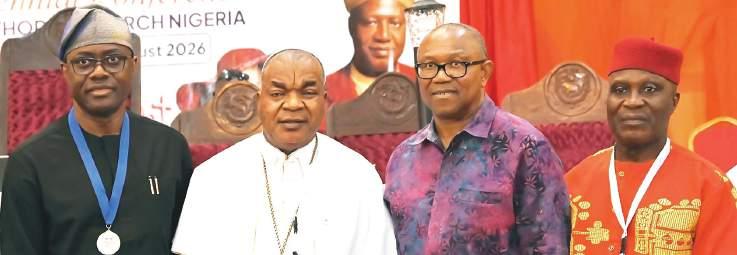
L-R: Oyo State Governor and Allied People’s Movement, Presidential Candidate, Seyi Makinde; Prelate, Methodist Church Nigeria (MCN), His Eminence, Dr. Oliver Alli Aba; Nigeria Democratic Congress Presidential Candidate, Peter Obi; and MCN, Conference Lay President, Sir Ifeanyi Okechukwu, during the opening of 50th/15th Biennial Conference of MCN, held at Bashmor Hall, Ibadan.
Chuks Okocha in Abuja
Former Vice President and presidential candidate of African Democratic Congress (ADC), Atiku Abubakar, has condemned the approval of $4.5 billion by the National Economic Council (NEC) for the refinancing of an oil-backed loan contracted by Nigerian National Petroleum Company Limited (NNPCL).
Atiku described the move as further proof that the President Bola Tinubu administration had mortgaged Nigeria’s future to sustain its reckless fiscal habits.
In a statement issued by his Senior Special Assistant on Public Communication, Phrank Shaibu, Atiku said every new oil-backed obligation pushed Nigeria deeper into a vicious cycle where tomorrow’s wealth was sacrificed to finance today’s policy failures.
He recalled that only a few days ago, the presidency issued a statement in response to his revelation of an unexplained N17 trillion crude oil windfall, claiming that Nigeria is unable to fully benefit from soaring international crude oil prices because future crude earnings have already been committed to oil-backed foreign loans.
Atiku stated, “That explanation
should have embarrassed any responsible government. Instead, this administration has chosen to double down on the very scandal it sought to justify by approving yet another $4.5 billion refinancing. Rather than breaking free from the chains of oil-backed indebtedness, it is tightening them.
“What kind of government inherits a nation blessed with abundant oil resources, removes fuel subsidy, imposes multiple taxes, records
unprecedented crude oil windfalls, borrows aggressively at home, and still finds it necessary to refinance billions of dollars secured against the country’s future oil production?”
Atiku alleged, “This administration has turned Nigeria into a nation permanently living on credit. Instead of using increased revenues to reduce debt and build fiscal resilience, it continues to mortgage the future of generations yet unborn.
“The tragedy is not merely the
refinancing itself. The tragedy is that Nigerians have been subjected to untold hardship in the name of economic reforms, yet the borrowing never stops. The pain is permanent, but the promised gains remain invisible.
“When reforms look like eating away the future to finance today’s consumption, no one can be in doubt that what we have is profligacy without moral restraint.”
The statement said, “President
Tinubu promised renewed hope.
What Nigerians have received is renewed debt, renewed hardship and renewed uncertainty. Under his watch, debt has become policy, borrowing has become governance, and mortgaging the future has become the defining philosophy of his administration.
“Tinubu has become the weapon fashioned against Nigeria’s economy. Nigeria deserves leadership that preserves national assets, not one
that continually pledges them to finance an endless cycle of waste, opacity and fiscal irresponsibility.”
Atiku called on the Tinubu administration to immediately publish the full details of the refinancing arrangement, including its terms, repayment obligations, and the volume of crude oil committed under the deal. He said Nigerians deserved transparency, accountability, and a government that protected—not mortgaged—the country’s future.
Olusegun Samuel in Yenagoa
Nigerian Society of Engineers (NSE), Bayelsa State Branch, has described the nearly completed Azikel Refinery as a world-class engineering project that would play a major role in accelerating industrialisation and economic development in the state.
The commendation came during a tour of the refinery complex in Yenagoa by members of the professional body.
Chairman of NSE’s Bayelsa State branch, Mac Jokori, said during the
tour that the facility had complied with the highest engineering standards and represented a significant milestone for Nigeria’s refining industry.
Jokori said the refinery, currently at the finishing stage, was designed to process both condensate and crude oil as feedstock, describing it as a remarkable engineering achievement.
He stated that beyond its commercial value, the refinery would serve as a catalyst for industrial growth, technology transfer, and local capacity development.
“As engineers, we recognise that a refinery of this scale is more than a commercial venture,” Jokori said.
“It is an engine of industrialisation, a catalyst for local capacity building, and a pathway to sustainable development for our youths,” he added.
According to him, the project is already creating economic opportunities, with more than 700 engineers and other personnel engaged during the completion phase.
Jokori stated that the refinery would deepen collaboration among industry
Access Holdings Plc has published its Sustainability Report for the year ended December 31, 2025 on the Nigerian Exchange Limited, demonstrating how the Group is translating sustainability commitments into measurable business, environmental and social outcomes.
The report, according to a statement, showed a green asset portfolio of N92.14 billion, a 28.47 per cent reduction in operational greenhouse gas emissions against its 2022 baseline, and expanded access to finance for about 2.53 million low-income individuals.
The report reinforced the Group’s strategic shift from scale to value by showing how sustainability
was being embedded in capital allocation, risk management, product development, and operations.
Access Bank Plc, the Group’s largest subsidiary, accounts for a significant portion of the reported outcomes.
The green asset portfolio had grown from N22 billion in 2021 and N72.32 billion in 2024 to N92.14 billion at year-end 2025, advancing towards the Group’s long-term target of N475 billion.
During the year, Access Holdings deployed N72.3 billion under its Sustainable Finance Framework to eligible environmentally beneficial projects and grew its cumulative sustainability-focused loan book to
$1.269 billion.
The emissions reduction reported in 2025 reflects operational changes designed to lower the environmental footprint of the Group’s activities.
Operational emissions fell to 49,352 tonnes of carbon dioxide equivalent from 57,176 tonnes in 2024, supported primarily by branch solarisation across 263 locations and the deployment of 323 solar-powered ATMs, largely across Access Bank in Nigeria.
The Group applies the operational-control approach under the Greenhouse Gas Protocol, accounting for emissions across its African footprint, with Access Bank representing the largest share.
Beyond environmental outcomes, the report highlighted the Group’s contribution to inclusive economic participation. In 2025, Access Holdings extended access to finance to 2,528,117 low-income individuals and on-boarded 78,438 new MSMEs onto its financing platform. Across the Group, 2.8 billion transactions were processed during the year, underscoring the institution’s role as core financial infrastructure for Africa’s real economy.
Gender-lens lending also progressed, with 354,156 loans extended to women and womenowned businesses, totalling N67.4 billion, equivalent to 24 per cent of the relevant loan portfolio.
players, government, and professional bodies to ensure the highest standards of engineering practice, operational safety, environmental stewardship, and local content development.
He pledged the support of NSE for the project through technical collaboration, internship and mentorship programmes, research partnerships, and capacity building initiatives.
President of Azikel Group, Dr. Azibapu Eruani, attributed the extended construction timeline to deliberate engineering upgrades and the complexity of building a full hydro-skimming refinery rather than a simpler topping plant.
Eruani explained that the refinery, originally licensed in 2015, had undergone extensive value engineering and redesign, resulting in an increase in processing capacity to 25,000 barrels per day and raising of total investment to about $1 billion.
“The Azikel Refinery licensed by former President Muhammadu Buhari in 2015 has now gone through several enhanced value engineering and redesign to a 25,000 barrels per day capacity. It is now a $1 billion investment,” he said.
According to him, the facility is a full slate hydro-skimming refinery capable of producing Premium Motor Spirit, diesel, aviation fuel, kerosene, and liquefied petroleum gas, with plans to expand capacity to 125,000 barrels per day in the future.
Eruani stressed that the refinery was conceived as a strategic industrial
project aimed at transforming Bayelsa State into a major industrial hub while creating employment opportunities and stimulating economic growth across the Niger Delta and Nigeria. He disclosed that the project currently employed no fewer than 700 workers, the majority of whom young Bayelsans and Nigerian engineers, alongside expatriate specialists.
The Azikel Group president said the investment had already injected significant economic value into the state through job creation, wealth generation, and skills development.
Addressing concerns over the pace of the project, Eruani said many people had wrongly compared Azikel Refinery with topping plants, stating that the two facilities differ significantly in complexity and capability.
He explained that while topping plants primarily produced diesel, a hydro-skimming refinery was designed to process crude oil or condensate into a full range of refined petroleum products, including petrol and aviation fuel.
He stated, “The cracking of crude oil or condensate to produce petrol and aviation fuel is a major feat in the refinery business, which can only be achieved by hydro-skimming refineries and other refineries equipped with Fluid Catalytic Cracking units.”
Eruani maintained that Azikel Refinery was Nigeria’s second largest full slate refinery and the only refinery in Africa designed to process condensate into a complete range of petroleum products, including petrol, dual purpose kerosene, automotive gas oil, and heavy fuel oil.
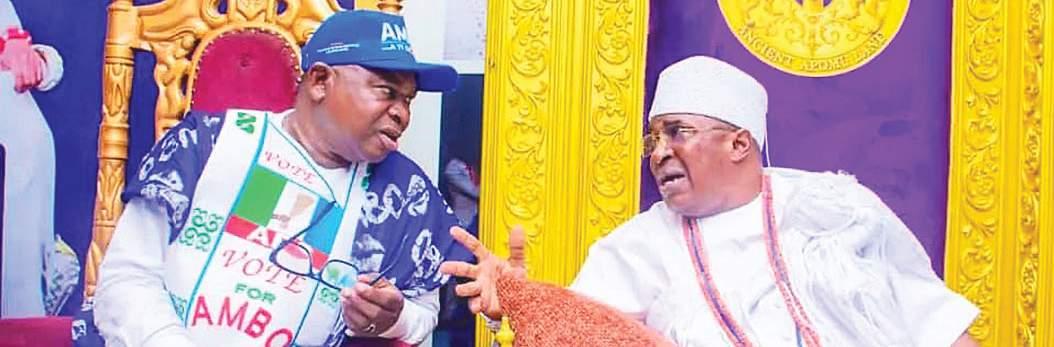
All Progressive Congress (APC) governorship candidate for Osun State, Asiwaju Minirudeen Bola Oyebamiji (left) with HRM Alapomu of Apomu, Oba Kayode
Adenekan on a visit to the Alapomu Palace on Wednesday
The Nigerian Upstream Petroleum Regulatory Commission (NUPRC) yesterday said that 22 major offshore projects are expected between 2026 and 2030 with an estimated investment potential of between $30 billion and $50 billion.
The Commission Chief Executive, NUPRC, Mrs. Oritsemeyiwa Eyesan, said this yesterday in
Lagos at the Society of Petroleum Engineers’ Nigeria Annual International Conference and Exhibition (NAICE 2026).
A statement in Abuja by the Head, Media and Corporate Communications of the NUPRC, Eniola Akinkuotu, disclosed that Eyesan was represented by the Executive Commissioner, Development and Production, Mr Enorense Amadasu.
At the event, Eyesan said in
her keynote address that these investments are expected to increase production, create jobs and strengthen energy security.
“Since 2024, the NUPRC has approved over $57 billion in Field Development Plan (FDPs), some of which have translated to Final Investment Decisions (FIDs). Twenty-two major offshore projects are expected between 2026 and 2030 with an estimated investment
potential of $30–50 billion.
“Beyond increasing production, these investments will create jobs, expand infrastructure, strengthen energy security and reinforce Nigeria’s position as a leading global upstream investment destination,” the NUPRC chief executive stated.
In the recent 2025 licensing round, the commission offered 50 oil and gas blocks spanning onshore, shallow water, deep offshore and
The Attorney General of the Federa- tion and Minister of Justice, Prince Lateef Fagbemi (SAN), has charged the Legal Aid Council of Nigeria (LACoN), to ensure all Nigerians are able to access justice irrespective of economic conditions.
Fagbemi gave the charge on Wednesday in Abuja, during the official inauguration of the Board of LACoN.
The AGF predicated his charge on his conviction that access to justice is not a luxury but rather a prerequisite for national security, public trust, and socio-economic harmony.
It has been stated that over 70 percent of inmates in correctional centers across the country are persons that could hardly pay little fines imposed on them over trivial matters
or could not afford the services of a legal practitioner to defend them in court.
Speaking at the inauguration ceremony, the minister who observed that the Legal Aid Council serves as the moral compass of the country’s justice delivery system, stated that, “In a society where economic disparities can hinder the assertion of basic rights, the Council ensures that poverty is never a bar to justice”.
He further pointed out that Section 19 of the LACoN Act specifically mandated the Council to visit correctional facilities, police cells, and detention centers to monitor awaiting-trial inmates.
“I therefore charge the Board to provide strong policy direction so that management can aggressively deploy operational mechanisms
including the Police Duty Solicitors Scheme (PDSS) and the Court Duty Solicitors Scheme (CDSS) to reduce detention facility congestion, clear court dockets, and safeguard fundamental human rights at early contact points.
“Furthermore, the Board must note that navigating current operational challenges requires both strategic vision and innovative resource management. I urge this Board to key into the ongoing reforms under the Administration of Criminal Justice Act (ACJA) and actively contribute to its legislative amendments so that our legal frameworks remain responsive to contemporary realities and global best practices.
“Furthermore, you must look beyond traditional budgetary allocations by cultivating partner-
Emma Okonji
Yellow Card, a global stablecoin infrastructure provider, has successful closed a $40 million strategic funding round, with investment from SC Ventures by Standard Chartered, Sony Innovation Fund, Polychain Capital, Blockchain Capital, and additional strategic investors.
The funding will scale Global USD Accounts, Yellow Card’s
end-to-end dollar account for businesses, and expand the stablecoin rails connecting it to markets worldwide.
This brings Yellow Card’s total financing to over $120 million.
Speaking about the funding, CEO of SC Ventures, Alex Manson, said: “Stablecoins are here to stay, but their adoption will depend on robust infrastructure and clear real-world utility. Yellow Card is building those rails for businesses
across Africa, enabling them to access and move value efficiently across markets. We believe YC is well positioned to scale across Africa and beyond and look forward to supporting its next phase of growth.”
The investment from Sony Innovation Fund reflects growing institutional interest in stablecoins for payments globally and will allow Yellow Card to deepen its reach in Asia-Pacific.
ships with development partners, strengthening pro bono networks with the Nigerian Bar Association, leveraging legal technology, and building seamless inter-agency synergy with the judiciary, law enforcement agencies, and civil society.
“Let me emphasize that the mandate of the Legal Aid Council is directly central to the legal reform agenda of the Federal Ministry of Justice and the priority areas of the President. Access to justice is not a luxury; it is a prerequisite for national security, public trust, and socio-economic harmony.
frontier basins, with the expectation that the exercise would unlock additional investment.
Eventually, the bid round recorded one of the strongest investor responses in recent years, with 143 companies submitting 200 bids for 37 of the 50 blocks on offer.
Ultimately, 31 companies emerged winners of 37 oil and gas blocks, covering the Niger Delta onshore, shallow water, deep offshore as well as the Benin, Anambra, Chad and Benue frontier basins.
But besides developing its proven reserves, Nigeria, Eyesan said, is building a resilient energy future by maintaining a strong pipeline of exploration opportunities that will sustain long-term growth and energy security.
According to the NUPRC CEO, since 2022, successive licensing rounds have opened access to some of Nigeria’s most prospective oil and gas acreages.
She made reference to the recent 2025 licensing round where 31 companies emerged successful bidders for 37 oil and gas blocks after progressing through a robust, data-driven and technology enabled evaluation process.
Eyesan said the 2026 licensing round which is set to commence soon is showing greater promise thanks to the transparency that
has characterised licensing rounds.
“With preparations already underway for the 2026 licensing round, Nigeria is demonstrating that investment certainty is no longer an aspiration; it is becoming an enduring feature of our regulatory framework,” the NUPRC boss stated.
According to Eyesan, infrastructure deficit continues to undermine Africa’s promising potential, saying however that Nigeria is addressing this challenge through a series of strategies.
“We are expanding gas gathering systems, processing facilities, pipelines and export infrastructure, while promoting shared facilities, open access, third party access and field tiebacks to reduce costs, speed up project delivery, maximise the use of existing infrastructure and help bring stranded oil and gas resources into production,” she stated.
Besides these infrastructure strategies, Eyesan said stronger collaboration among government, security agencies, operators, host communities and private partners as well as the Host Community Development Trust (HCDT) had led to an improvement in the protection of critical energy assets which had ultimately made Nigeria’s upstream sector more resilient.
FG Urges NOTAP, Key Industry Stakeholders Collaboration, Says Nigeria Relies Heavily on Agency for Technology Acquisition
The federal government underscored the need for collaboration between National Office for Technology Acquisition and Promotion (NOTAP) and key industry stakeholders, saying Nigeria relies heavily on the agency for technology acquisition and inventory.
Permanent Secretary, Federal Ministry of Innovation, Science and Technology, Dr. Mukhtar Mohammad, made the appeal when he visited the NOTAP headquarters in Abuja on Wednesday. Mohammad stated, “In the order of presentation I received, the briefs that were provided by the chief executives, I found this agency to be very crucial,
very central to our innovation, science and technology, and also to Nigeria advancing in terms of science and technology.
“In terms of technology acquisition, we rely heavily on this agency to be able to get new technologies, to have an inventory of the technologies in the country, to also have a way to acquire newer technologies through our industries, through our other government agencies, and also through our Mohammedinnovators.” stressed the critical role of NOTAP in the development and patenting of innovations, and in terms of intellectual property to guarantee ownership and ensure innovators were not cheated.
He highlighted the agency’s position, “in terms of commercialisation, which is integrating the newer technologies into the industry so that they have value, is important,” alluding to the central role it plays in terms of the linkage between the needs of the industry and the kind of research being carried out in the country.
The permanent secretary stated, “We need to foster a good collaboration and working relationship between this agency and all of the industries operating in Nigeria, in all sectors: in manufacturing, in oil and gas, in solid minerals, in marine and blue economy, in agriculture, in health, in environment.
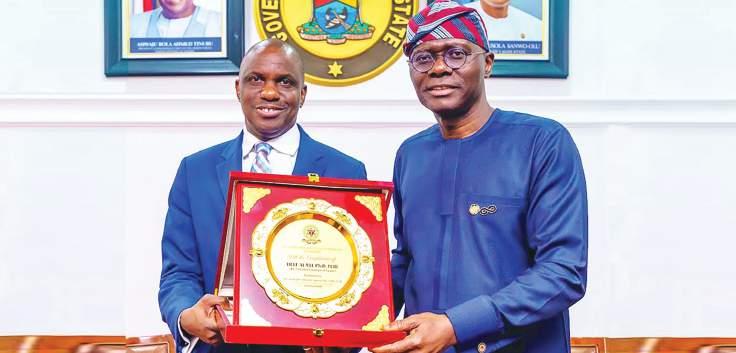
The President/Chairman of Council, The Chartered Institute of Bankers of Nigeria (CIBN), Dr. Dele Alabi (L) and the Executive Governor of Lagos State, Mr. Babajide Olusola Sanwo-Olu, during a courtesy visit by the CIBN to the governor at the Lagos State House, Alausa, Ikeja on Tuesday
Courts lawmakers to preserve customs reforms, says automation replacing discretion as service deepens trade modernisation Senate committee hails N7.3trn revenue in 2025, customs transformation under Adeniyi’s watch
James Emejo in Abuja
Comptroller-General of Customs (CGC), Mr. Bashir Adeniyi, yesterday urged the National Assembly to take a closer look at the country’s growing exemption and waiver regime, stating that many concessions granted for policy reasons deserve periodic legislative review.
Adeniyi said that would help to determine whether such exemptions still achieved their intended objectives or had become costly leakages.
Adeniyi spoke while addressing members of Senate Committee on Customs at a two-day retreat, with the theme, “Legislative Oversight in the Context of Nigeria Customs Service Modernisation and Reforms,” in Abuja.
He stressed that while customs implemented the waiver framework, decisions on whether such incentives remained justified fell squarely within the legislature’s oversight responsibilities.
The senate committee hailed the service for generating N7.3 trillion, against the projected N6.5 trillion revenue in 2025.
Chairman of the committee, Senator Jibrin Isah, appraised the leadership of Adeniyi, describing the revenue feat as
remarkable. He also praised the trade facilitation and anti-smuggling operations under Adeniyi.
Isah said, “The Nigeria Customs Service deserves commendation for surpassing its 2025 revenue target. Under the leadership of Comptroller-General Bashir Adewale Adeniyi, the service has recorded outstanding improvements in revenue collection, trade facilitation and anti-smuggling operations.”
He also praised the management and personnel of the service for the achievements recorded so far, urging the service to confront lingering operational constraints to deliver even better results in 2026.
Adeniyi called for stronger legislative backing to protect the ongoing reforms and modernisation drive of the Nigeria Customs Service (NCS).
He said the reforms anchored on automation and transparency could only succeed if they were insulated from political and institutional interference.
The CGC urged lawmakers to fundamentally rethink how they oversaw the service by focusing less on individual transactions and more on the integrity of the digital systems driving customs administration.
He stated that as customs increasingly automated its operations, effective oversight should move beyond investigations into specific consignments or officers and, instead, interrogate the design, performance, and credibility of the systems that determined trade facilitation, cargo clearance, and revenue collection.
According to him, the most important
questions for legislators should now centre on how the service’s risk management engine is calibrated, whether valuation databases remain current, how quickly compliant cargo is released, and whether tax exemptions continue to deliver the intended economic benefits.
According to him, “The questions that move the national needle are no
longer about isolated transactions but about the rules that govern the system.”
The customs boss stated that resistance to modernisation often came from interests that benefitted from discretionary processes.
He maintained that while the administration had enjoyed strong backing from President Bola Tinubu
and the Federal Ministry of Finance, enduring reforms required institutional support from the National Assembly. He stressed that clear legislative endorsement would make it considerably more difficult for vested interests to frustrate ongoing reforms aimed at eliminating human discretion from customs operations.
Kuni Tyessi in Abuja
The federal government has unveiled a major initiative to transform autism care in Nigeria through expanded specialist training, targeted investments in tertiary institutions, and the establishment of autism centres across the country’s six geopolitical zones.
Minister of Education, Dr. Tunji Alausa, said the initiative represented a significant step towards addressing
the country’s shortage of highly skilled professionals in Audiology, Speech and Language Therapy, and Occupational Therapy, revealing the number of universities offering the specialised programmes has increased. He added that the administration was committed to expanding the programmes to more institutions to meet the growing demand for services for children living with autism, Attention Deficit Hyperactivity Disorder (ADHD),
Onyebuchi Ezigbo in Abuja
The federal government has commenced the development of Nigeria’s first National Rehabilitation and Assistive Technology Strategic plan to strengthen disability-inclusive healthcare and improve rehabilitation services nationwide.
The initiative was unveiled in Abuja on Tuesday during a three-day stakeholders’ zero draft meeting of the national rehabilitation and assistive
technology strategic plan.
Speaking at the event, the Registrar of the Medical Rehabilitation Therapists Registration Board of Nigeria, Prof. Rufai Ahmad, said the strategic plan represents Nigeria’s first coordinated national effort to establish a comprehensive rehabilitation framework.
He explained that the framework was designed to integrate rehabilitation into the country’s healthcare system, improve access to rehabilitation services at all levels of care and expand the
availability of assistive technology for persons with disabilities, older persons and individuals recovering from injuries or chronic illnesses.
According to him, the strategic plan will address critical areas including, “rehabilitation financing, workforce development, assistive technology, service delivery, governance, monitoring and evaluation, as well as partnerships needed to ensure effective implementation”.
Ahmad added that the stakeholders’
meeting provided an opportunity for experts, policymakers, development partners and professional bodies to review the zero draft and make contributions that will produce a robust, inclusive and implementable national policy capable of transforming rehabilitation services in Nigeria.
Also, Head of the Georgia Society for Healthcare Engineers (GASHE), Dr. Umeh Sunday said work on the national rehabilitation strategic plan had already commenced.
and other developmental conditions.
Speaking during an engagement with stakeholders, the minister said investment was ongoing in the human capital needed to strengthen diagnosis, therapy, and rehabilitation services while ensuring that Nigerian families can increasingly access quality care within the country.
He stated, “Our federal government, through the Ministry of Education, is supporting this by expanding the number of institutions offering programmes in Audiology, Speech Therapy and Occupational Therapy.
“We have moved from about four universities to almost sixteen universities, but we want even more institutions to train the manpower needed to support these essential services.”
The minister observed that many Nigerian families still travelled abroad and even to neighbouring countries in search of specialised care for children with autism and ADHD because of limited local capacity, describing the situation as unacceptable.
He said, “Today, many families still have to travel outside Nigeria to access care for their autistic children. This is not
acceptable, and the federal government is determined to change that.”
To accelerate the reforms, the minister announced that beginning next year, the federal government will provide targeted interventions to universities offering the specialised programmes. The support will include the expansion of infrastructure, provision of modern equipmentm and instructional materials to significantly increase institutions’ capacity to train professionals in Audiology, Speech Therapy and Occupational Therapy.
The minister also disclosed that the Federal Ministry of Education had directed the National Board for Technical Education (NBTE) to fast-track the accreditation of the Federal School of Occupational Therapy and the Occupational Therapy diploma programme at the University of Benin, creating a seamless academic progression from diploma to bachelor’s degree while strengthening professional career pathways.
The minister commended universities that had embraced the federal government’s policy direction by introducing specialised programmes, describing their efforts as critical to building the workforce required to improve outcomes for children with developmental conditions.
Emmanuel Addeh in Abuja and Peter Uzoho in Lagos
Global oil prices extended their decline yesterday, with Nigeria’s benchmark, Brent crude, slipping below the $80 per barrel threshold amid growing optimism that tensions between the United States and Iran could ease.
Brent crude fell marginally by 2 cents, or 0.03 per cent, to $78.75 per barrel, while the US benchmark, West Texas Intermediate (WTI), dropped 35 cents, or 0.46 per cent, to $75.42 per barrel.
It came as the Dangote Petroleum Refinery has reduced the ex-depot price of its petrol to N1,165 per litre, down from N1,215 per litre, representing a cut of N50 per litre.
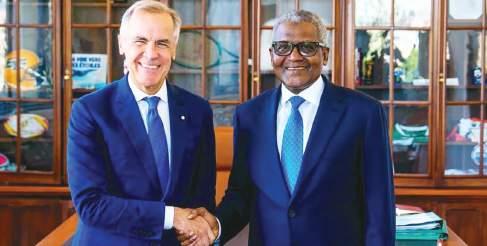
Also, the President and Chief Executive of Dangote Industries Limited,
Aliko Dangote, has held discussions with Canada’s Prime Minister, Mark Carney, on opportunities to strengthen investment partnerships and deepen economic cooperation between Canada and Africa.
The latest oil price decline followed a sharp 5 per cent drop on Tuesday, which pushed Brent below $80 for the first time since July 13, as traders reacted to reports suggesting diplomatic efforts were underway to end hostilities between Washington and Tehran.
Although Iran denied that peace negotiations were taking place, US President Donald Trump disclosed that officials held an “all-day negotiation” with Iranian representatives describing the discussions positively while warning that the US would respond “really hard” if a deal failed to materialise.
The prospect of reopening the Strait of Hormuz, through which about 20 per cent of global oil and liquefied natural gas supplies pass under normal conditions, continued to weigh on crude prices as traders anticipated an improvement in Middle East oil flows.
Further pressure came from the United States, where official data showed an unexpected increase in crude inventories. According to the Energy Information Administration (EIA), US crude stockpiles rose by 2.5 million barrels to 407 million barrels last week, contrary to analysts’ expectations of a 1.5 million-barrel draw. Imports also edged higher while refinery activity slowed slightly.
However, losses were limited by fresh geopolitical risks in the Red Sea
after Yemen’s Iran-backed Houthi movement announced a maritime embargo targeting Saudi ports and vessels and claimed responsibility for a missile attack on a Saudi oil tanker near Yanbu, one of the kingdom’s key crude export terminals.
In addition, renewed attacks on Russian and Ukrainian ships, ports and export terminals in the Black Sea have heightened concerns over disruptions to global grain and oil trade, adding another layer of uncertainty to global commodity markets.
Also, the President and Chief Executive of Dangote Industries Limited, Aliko Dangote, has held discussions with Canada’s Prime Minister, Mark Carney, on opportunities to strengthen investment partnerships and deepen economic cooperation between Canada
petrol price to N1,165, diesel to N1,570
and Africa.
The meeting focused on expanding investment opportunities in Canada and exploring how the Dangote Group, alongside other African investors, can contribute to Canada’s economic growth. Both leaders also exchanged views on Canada’s Africa Strategy and the importance of promoting stronger two-way trade and investment flows between Canada and African countries.
Dangote, according to a statement yesterday, emphasised the growing potential for collaboration between African and Canadian businesses, noting that closer economic ties would unlock new opportunities for job creation, innovation, industrial development, and long-term prosperity.
“Strategic partnerships between Africa and Canada have immense
public funds.
This comes as a reliable source familiar with the investigation alleged that more than N18 billion had been withdrawn from the said account which is now under scrutiny 14 times in less than two months, The source who pleaded to remain anonymous, also dismissed allegations that the Commission was acting selectively ahead of the Osun election, alleging that investigators had observed unusual transactions in the government’s salary accounts. According to the official, accounts that ordinarily recorded salary payments once a month had recently witnessed multiple large transfers within a short period, prompting closer scrutiny by the Commission. He maintained that the EFCC could not ignore suspicious financial movements simply because of the prevailing political climate.
The development however, drew sharp criticism from the African Democratic Congress (ADC), which described the freezing of the state’s bank account as “political terrorism” and alleged it was part of a win-atall-cost agenda of the ruling party that threatens Nigeria’s democracy, while legal and civil rights groups faulted the EFCC’s action.
Meanwhile, the Nigeria Police Force yesterday announced the deployment of 15,000 personnel across Osun State and warned political actors and their supporters
against violating electoral laws ahead of next Saturday’s governorship election.
Governor Adeleke accused the EFCC of unlawfully directing the freezing of the state government’s bank accounts without obtaining a court order, describing the action as a violation of the rule of law and a threat to Nigeria’s democracy.
Addressing a press conference in Osogbo, Adeleke said the state government received a letter from its banker informing it of an EFCC directive ordering the immediate freezing of the accounts.
The governor said the action came amid what he described as sustained intimidation of his administration and members of the Accord political movement, alleging that the state had experienced the paralysis of the local government system, arrests of political leaders and harassment of supporters.
According to him, the freezing of the state’s accounts was carried out without any court order, a development he said was unconstitutional and unacceptable in a democratic setting.
Adeleke called on the Chairman of the EFCC to publicly explain the reasons for the action and provide evidence to justify the directive freezing the state’s accounts.
He warned that allowing federal agencies to take such actions against
subnational governments without due process could undermine constitutional democracy and the rule of law.
The governor disclosed that he had directed the Osun State Attorney General to challenge the EFCC’s action at the Federal High Court in Osogbo.
Despite the development, Adeleke said his administration would continue its activities, insisting that it would not be distracted by what he described as acts of intimidation.
EFCC: We Froze Osun Account to Save Public Funds from Being Looted
However, in its reaction, the EFCC has explained why it issued the “Post-no-Debit” (PND) order on the account of the Osun State Government domiciled with the First Bank of Nigeria.
The anti-graft agency in a statement explained that it took the action to prevent the looting of about N11 billion belonging to the state.
The PND order on the Osun State Government Statutory Allocation Account was made public by the Osun State government, which had accused the anti-graft agency of attempts at paralysing government activities few days to the August 15, governorship election.
While claiming that the said account WAs one of the government’s salary accounts, the government in
a statement issued yesterday by the Commissioner for Information and Public Enlightenment, Kolapo Alimi, stated that the action of the EFCC was aimed at disrupting the operations of the Adeleke-led administration barely few days to the governorship election in Osun State.
Reacting, the anti-graft agency maintained that its decision to freeze the Osun State Government account had nothing to do with the forthcoming election but rather its investigation of an alleged N11 billion fraud.
Specifically, the commission maintained that, “The Osun State government account was frozen to save public funds from being looted.”
It disclosed that some officials of the state government, including the Accountant- General of the State, have had interview sessions with investigators of the EFCC.
According to the statement signed by Head, Media and Publicity, EFCC, Mr. Dele Oyewale, the officials are being investigated over their handling of the Ecology Funds, Intervention Funds and Federal Account Allocation Committee (FAAC).
“The Economic and Financial Crimes Commission (EFCC), is compelled to publicly address issues pertaining to its preventive moves in freezing the bank account of the Osun State government, without prejudice to the imminent governorship election
is only a passing phase that will ultimately give way to the benefits of ongoing reforms.
Secretary to the Government of the Federation (SGF), Senator George Akume, in a statement, against the backdrop of recent exchanges between the administration and leaders of the Catholic Bishops’ Conference of Nigeria (CBCN), said the Tinubu administration recognised the invaluable contributions of the Catholic Church in education, healthcare, humanitarian services, peacebuilding and moral leadership.
According to the government scribe, the President continues to welcome honest advice and constructive engagement from religious institutions.
“The federal government has taken note of public reactions following the recent meeting between President Bola Ahmed Tinubu and the leadership of the Catholic Bishops’ Conference of Nigeria (CBCN). We wish to reaffirm our profound respect for the Catholic Church and its enduring contributions to Nigeria’s
development through education, healthcare, humanitarian services, peacebuilding and moral guidance,” he stated.
According to the SGF, the government believes that many of Nigeria’s challenges cannot be solved alone, arguing that partnerships with faith communities, traditional institutions, civil society organisations, the private sector and citizens remain indispensable to national development.
“Many of the challenges confronting our nation require partnership. Faith communities, traditional institutions, civil society, the private sector and citizens all have indispensable roles to play in promoting peace, strengthening social cohesion and advancing national development. Constructive engagement between government and these institutions is therefore not only welcome but essential,” Akume said.
During a recent meeting at the Presidential Villa, the bishops had expressed concern over worsening economic hardship, insecurity, democratic governance and the
shrinking political space.
The controversy deepened after the former Archbishop of Abuja, Cardinal John Onaiyekan, defended the bishops’ position on television, insisting they were merely fulfilling their responsibility to “speak truth to power” and reflecting the genuine concerns of Nigerians rather than engaging in partisan politics.
His remarks drew sharp responses from senior government officials and supporters of the administration, triggering a public debate over the current administration’s response to criticism vis a vis the Church’s role in holding the government accountable.
But Akume said that the president as well as himself and his office would continue consultations with the leadership of the Catholic Bishops’ Conference, other faithbased organisations and relevant stakeholders on issues raised during the meeting with the president, with a view to deepening collaboration in the national interest.
Akume noted that discussions between Tinubu and the bishops
were candid, respectful and constructive, covering concerns over insecurity, economic hardship, education, public services, electoral credibility, political pluralism and religious freedom.
While acknowledging that there were differences in the assessment of some issues, he said such disagreements should not be interpreted as a breakdown in relations between both sides.
He explained that both parties equally recognised some progress recorded by the administration, including the implementation of the student loan scheme as well as recent successes by security agencies in securing the release of abducted schoolchildren and teachers.
On the economy, Akume admitted that many Nigerians were experiencing severe hardship, but maintained that the reforms being implemented by the Tinubu administration were necessary to correct longstanding structural distortions and place the economy on a sustainable path.
in the state.
“The Commission has been busy investigating the Osun state government since March, 2026, regarding alleged fraudulent handling of Ecology Funds, Intervention Funds and Federal Account Allocation Committee, FAAC account to the tune of N11, 000,000, 000(Eleven Billion Naira only). To this end, some officials of the state government, especially the Accountant General of the State, have had interview sessions with investigators of the EFCC”, the statement.
The commission observed that the ongoing investigations would not have warranted any placement of PND order on the state’s account but for the precipitate and unwarranted movement of funds from the accounts to different suspicious accounts since August 2, 2026.
“The Commission noticed huge transfers of funds into different corporate entities and had to swiftly halt the trend by freezing the accounts from which such heavy funds are being moved.
“The EFCC’s preventive mandate is a public-inclined framework of safeguarding public funds, assets and resources. The Commission cannot watch idly while a state government’s account is being pillaged.
“While the Commission is fully aware of the impending governorship election in Osun State, it has a responsibility to act in defence of the sanctity of the funds of the
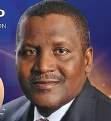
potential to drive sustainable growth and create value for both regions. There is a strong case for increasing investment, fostering innovation, and building mutually beneficial commercial relationships,” Dangote said.
state. It will be uncharitable for the Commission to allow an excuse of an upcoming election to fold its arms to perform its legally-assigned functions,” the statement added.
The EFCC disclosed that besides Osun State, many other states are on the investigative radar of the Commission to ensure accountability and probity.
The commission reiterated that it is a non-partisan and non-sectarian agency that is always working in the overall interests of Nigerians.
“The Osun State government account was frozen to save public funds from being looted.
“The public is enjoined to ignore false narratives and deliberate demonization of the works of the EFCC. The interests of all Nigerians are greater and will always be protected by the Commission,” he added.
A copy of the EFCC’s letter showed that the PND order was sequel to an earlier letter to the Managing Director of First Bank dated April 15, 2026, in respect of “investigation activities”.
The letter signed by one ACE, Adenike Babalola on behalf of the Director, Investigation read in part: “In furtherance to the above you are kindly requested to place a Post-no-Debit on the account.
“The request is made pursuant to Section 38(1)&(2) of the EFCC Act, 2004 and Section 24 of the Money
TINUBU WELCOMES RESCUE OF 308 ABDUCTED CITIZENS IN KWARA, NIGER STATES
in New Bussa Local Government Area of Niger State. This followed a coordinated intelligence-driven operation by National Counter-Terrorism Centre (NCTC), involving personnel from the Armed Forces of Nigeria, Department of State Services (DSS), and Nigeria Police.
It was the largest rescue operation ever carried out on the same day by the joint security team.
Tinubu, in a release by his Adviser on Information and Strategy, Bayo Onanuga, expressed deep appreciation to the leadership and personnel of the security agencies for their bravery, seamless inter-agency collaboration, and dedication, which made the recovery of the victims possible.
The president said, “The successful execution of this intelligence-led operation demonstrates the growing efficiency and collaboration among our security services.
“I commend our gallant men and women in uniform for their bravery and unwavering commitment to safeguarding Nigerian lives.”
The statement said the rescued citizens were receiving first aid and essential medical care at a medical facility at Wawa Cantonment.
Upon completion of their medical evaluations, they would be formally handed over to their state governments for comprehensive care and reunification with their families.
While applauding the return of the victims, the president stressed the imperative of bolstering national security infrastructure to prevent future occurrences.
He directed security agencies and relevant stakeholders to immediately strengthen early warning mechanisms, enhance community-level intelligence gathering, and improve rapid response capabilities to avert similar incidents across the country.
Tinubu reassured Nigerians that his administration remained steadfast in its resolve to eliminate security threats, protect vulnerable communities, and restore lasting peace across every corner of the nation.
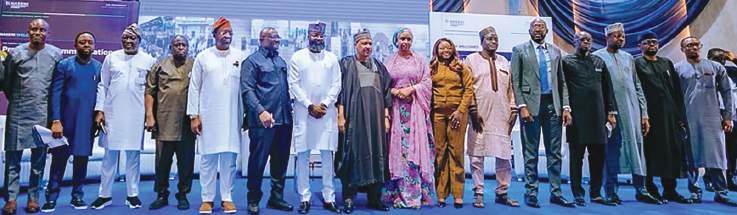
L-R: The former Special Assistant on Digital/New Media to President Muhammadu Buhari, Mr. Tolu Ogunlesi; the Politics Editor and Chief Political Correspondent, Channel TV, Mr. Seun Okinbaloye; the Senior Special Assistant to the President on media and special duties, Mr. Tunde Rahman; the TVC Director of News, Mr. Babajide Kolade Otitoju; the Special Adviser to the President on Media and Public Communication, Chief Sunday Dare; the Special Adviser to the President on Information and Strategy, Mr. Bayo Onanuga; the Executive Vice Chairman/CEO of the National Agency for Science and Engineering Infrastructure (NASENI), Mr. Khalil Suleiman Halilu; Hon. Minister of Information and National Orientation, Mr. Mohammed Idris Malagi; Special Adviser to the President on Policy and Coordination, Haj. Hadiza Bala-Usman; Head, NASENI Innovation Hub, Mrs. Busola Beckley Perez-Folayan; Chairman, Imose Technologies Ltd, Osayi Izedonwen and other special dignitaries during the Presidential Communication Team’s Renewed Hope National Media Tour to NASENI Idu Industrial Area Abuja on Tuesday
Governor Babajide Sanwo-Olu of Lagos State on Tuesday said his administration had empowered about 40,000 residents with business tools to boost small and medium-scale businesses in the state over the past seven years.
Sanwo-Olu said the Lagos State Government empowered the residents with business equipment under the Micro Enterprise Support Initiative (MESI) Empowerment Programme in line with its commitment to poverty reduction, economic inclusion and entrepreneurship across the state.
Speaking during the Year 2026 Micro Enterprise Support Initiative Empowerment Programme organised by the Ministry of Women Affairs and Poverty Alleviation at Blue Roof, Agidingbi, Ikeja, Sanwo-Olu said the initiative aimed to improve livelihoods and enable residents to become economically self-reliant, productive and prosperous.
The business tools presented during the event on Tuesday included sewing and stoning machines, a two-face burner with a gas cylinder, an imported pepper grinding Machine, catering utensils,
Pedicure equipment, hairdressing and barbering kits, photography equipment, agricultural processing machines, deep freezers, popcorn machines, grinding machines and raw food items for traders, among others.
Sanwo-Olu said the initiative demonstrated his administration’s resolve to improve livelihoods by providing residents with the tools needed to build sustainable businesses and achieve financial independence.
He said the MESI programme aligned with the THEMES+ Agenda,
stressing that empowering small business owners, artisans, traders, women and young entrepreneurs is critical to strengthening the state’s economy.
He stated, “Today, we are reaffirming a promise this administration has consistently kept: that governance must improve lives, create opportunities and empower our people to achieve their full potential.
“The Micro Enterprise Support Initiative (MESI) is that promise in action, and another important milestone in our collective effort to build a Lagos where every
Ayodeji Ake
Lagos State has exceeded the global target for exclusive breastfeeding, recording a 57.4 per cent rate among nursing mothers, but health authorities say improving breastfeeding within the first hour after birth remains a major challenge requiring urgent attention.
The Special Adviser to the Governor on Health, Dr. Kemi Ogunyemi, disclosed this on Tuesday during a press briefing to commemorate the 2026 World Breastfeeding Week at the Ministry of Health headquarters in Alausa, Ikeja.
She said the state’s exclusive breastfeeding rate has surpassed the global benchmark of 50 per cent, describing the achievement as a reflection of sustained investments in maternal and child nutrition programmes.
However, she noted that only 14 per cent of newborns in Lagos are breastfed within the first hour of birth, a practice regarded by health experts as critical to child survival.
Speaking on this year’s theme, “Breastfeeding for a Sustainable Start in Life: Strengthen What Works,” Ogunyemi described breastfeeding as one of the most effective and affordable public health interventions for reducing infant illnesses and deaths.
She explained that exclusive breastfeeding for the first six months of life,
followed by continued breastfeeding alongside appropriate complementary feeding until the age of two, provides children with optimal nutrition while supporting healthy physical, mental and cognitive development.
“The importance of breastfeeding as a child survival strategy, especially in the first six months of life, cannot be over-emphasised. Breast milk is free, nutrient-dense, readily available and promotes healthier children while strengthening the bond between mother and child,” she said.
Ogunyemi urged families, employers, healthcare workers, religious leaders and community stakeholders to create enabling environments that allow mothers to successfully breastfeed, stressing that
mothers are more likely to sustain exclusive breastfeeding when they receive adequate support at home, in the workplace and within their communities.
She said the state had continued to strengthen its Maternal, Infant and Young Child Nutrition (MIYCN) strategy through the training of healthcare workers, skilled breastfeeding counselling, nutrition education and enforcement of the International Code of Marketing of Breast-milk Substitutes.
According to her, all 334 Primary Health Centres, 29 secondary health facilities and the state’s tertiary health facility now implement the MIYCN strategy with an effective referral system to improve maternal and
child health outcomes.
Despite these gains, Ogunyemi expressed concern over the low rate of early breastfeeding initiation, attributing it partly to misconceptions surrounding colostrum the first yellowish breast milk produced after delivery which she described as highly beneficial because of its protective properties for newborns.
She disclosed that midwives in both public and private health facilities are being trained to ensure breastfeeding begins within one hour of delivery.
The Special Adviser also dismissed the widespread belief that women who deliver through caesarean section cannot breastfeed immediately after childbirth.
hardworking resident has the opportunity to prosper.
“From the very first day of this administration, we made a commitment to build a Greater Lagos where no one is left behind. We promised to create opportunities, support businesses, empower our people and ensure that the dividends of democracy reach every community.
“Seven years on, our record speaks for itself: across every sector, we have remained focused on delivering practical results that improve the lives of Lagosians.
“The THEMES+ Agenda has been our roadmap for fulfilling those promises. It rests on the simple understanding that sustainable development is meaningful only when it reaches the grassroots.”
Sanwo-Olu stated, “Whether in the heart of our commercial districts, in our rural communities or in the riverine areas, every resident deserves access to opportunities that improve their standard of living.
“The Micro Enterprise Support Initiative is one of the clearest expressions of this administration’s commitment to inclusive governance. It is more than the distribution of tools and equipment; it is the fulfilment of our promise to give our people the means to create wealth, build sustainable businesses, generate employment and achieve financial independence.”
Sanwo-Olu stressed, “Over the last seven years, we have consistently demonstrated that our promises are backed by action. Through strategic investments in infrastructure, transportation, healthcare, education,
technology, security, social protection and enterprise development, we have continued to build a Lagos that works for everyone.
“At the same time, we have deliberately invested in our people, because the greatest legacy of any government is not the projects it builds but the lives it transforms.
“This administration believes that true leadership is about creating opportunities, not dependency. Every empowerment package distributed today represents hope renewed, dreams restored and renewed confidence in the ability of our people to succeed through hard work and determination.” the governor added, “As we continue to implement the THEMES+ Agenda, let me assure every Lagosian that this administration will remain focused on keeping its promises.
“We will continue to invest in our people, expand opportunities for small businesses, strengthen economic inclusion and ensure that the benefits of good governance reach every ward, every community and every household across Lagos State, so that we can continue to build a Lagos where opportunity is within everyone’s reach, enterprise is rewarded, hard work is encouraged, and prosperity is shared.”
Sanwo-Olu commended the Commissioner for Women Affairs and Poverty Alleviation, Mrs. Bolaji Dada, for her commitment to advancing the incumbent administration’s economic empowerment agenda through impactful programmes such as MESI, which continue to transform lives across Lagos State.
Onyebuchi Ezigbo in Abuja
The federal government and the International Labour Organization (ILO) has commenced capacity training for senior personnel involved in the design and implementation social security policies so as make the interventions more effective and result-oriented.
Addressing participants at a 5-Day training workshop on “Transforming Leadership Training on Social Protection”, organized by
the International Labour Organization (ILO) in Abuja in collaboration with UNICEF under the European Union-funded Supporting Sustainable Social Protection Systems in Nigeria (SUSI) project in Abuja, the Director of Social Security at the Federal Ministry of Labour and Employment, Ms. Franca Adiekwele described social protection as a key pillar of any effort at ensuring inclusive economic growth, poverty reduction, and social justice.
She said: “This training
is particularly important as Nigeria continues to advance policies and programs aimed at expanding inclusive, equitable, and sustainable social protection for all, especially vulnerable and underserved populations, building the capacity of policymakers at all levels of governance is critical”.
The Director said the training was aimed at ensuring that social protection policies are well designed, effectively implemented, adequately monitored, and responsive to the
changing needs of our people, Adiekwele also assured that Federal Ministry of Labor and Employment is committed to promoting decent work and strength.
She enjoined all participants to engage actively throughout this training, share experiences and best practices, and apply the knowledge gained to improve policy formulation and implementation at both the national and subnational levels.
In her remarks, the Director, ILO Office for Nigeria, Ghana, Liberia
Sierra Leone and Liaison Office for ECOWAS, Vanessa
said that countries with stronger and more inclusive social protection systems are better able to protect their people, preserve livelihoods, and promote economic recovery.
“This is why strengthening social protection remains central to the ILO’s mandate and to the achievement of the Sustainable Development Goals, particularly the commitment to leave no one behind,” she said.

Email: deji.elumoye@thisdaylive.com
08033025611 sms only
President Bola Tinubu’s second military pay rise is more than a salary adjustment; it is a strategic investment in the morale, fighting spirit and operational effectiveness of the men and women at the forefront of Nigeria’s battle against insurgency and other security threats, writes linus Aleke.
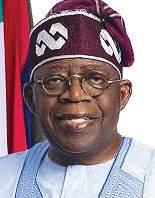
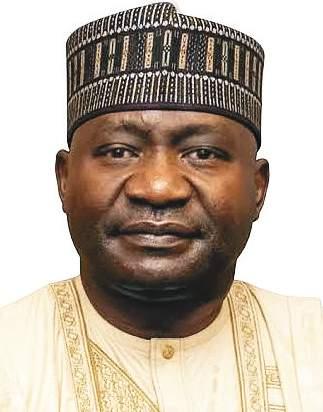
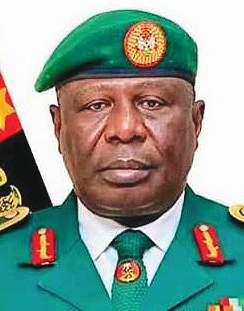
President Bola Tinubu’s approval of a second major pay rise for personnel of the Armed Forces of Nigeria on Tuesday is more than a routine welfare intervention; it is a strategic investment in the morale, fighting spirit and operational effectiveness of the men and women at the forefront of the nation’s battle against insurgency and other emerging security threats. The decision reinforces a long-standing military principle that a nation cannot expect its armed forces to perform optimally without adequately taking care of those entrusted with its defence.
The latest salary review, which provides an increase of between 30 and 80 per cent depending on rank, represents one of the most significant improvements in military remuneration in recent years. It comes less than four years after an earlier upward review under the current administration, which saw the monthly salary of an entrylevel soldier rise from about N49,000 to N100,000 following efforts by the then Chief of Defence Staff, General Christopher Musa (rtd).
Taken together, these interventions reflect a deliberate effort by the administration to reposition, refocus and motivate personnel of the nation’s Armed Forces. Few administrations in Nigeria’s modern history have demonstrated such sustained commitment to improving military welfare within a relatively short period, a move that deserves commendation.
Together, these interventions demonstrate the Tinubu administration’s determination to make military welfare a central component of its national security strategy. The decision also reflects a growing recognition that winning modern warfare requires not only superior equipment and technology but also a motivated, committed and wellsupported fighting force.
The timing of the latest pay rise is particularly significant. Nigeria continues to confront a complex security environment involving terrorism in the North-East, banditry in the North-West, kidnapping, violent extremism, oil theft in the Niger Delta, separatist violence in the South-East,
cult-related violence and other emerging threats across the country. These operations have placed enormous physical, emotional and psychological demands on military personnel, many of whom spend months away from their families while operating in challenging and dangerous environments.
For years, military experts have emphasised the connection between troop welfare and battlefield effectiveness. A soldier who is assured of improved living conditions, financial security and institutional support is better positioned to remain focused on the mission. While salary increases alone cannot guarantee victory in warfare, they are a critical factor in improving morale, strengthening discipline, enhancing loyalty and building a more professional military institution.
The importance of welfare in warfare has been recognised by some of the world’s most respected military leaders. In 1945, the then Chief of Staff of the United States Army and later five-star General, George C. Marshall, highlighted the importance of the human element in combat when he observed: “The soldier’s heart, the soldier’s spirit, the soldier’s soul are everything. Unless the soldier’s soul sustains him, he cannot be relied on.”
Similarly, another five-star
American General and later President of the United States, Dwight D. Eisenhower, noted that “morale is the greatest single factor in successful war,” emphasising that the determination and commitment of troops are as important as weapons and strategy. Decades earlier, the renowned French military commander and statesman, Napoleon Bonaparte, captured the importance of sustaining soldiers when he declared: “An army marches on its stomach.” The statement reflects the broader reality that soldiers who are properly cared for through adequate welfare, logistics and support are better prepared to face the demands of war.
Beyond improving morale, the latest pay rise is expected to strengthen the Armed Forces’ ability to attract and retain skilled personnel required for modern military operations. Contemporary warfare increasingly depends on specialists in intelligence, cyber security, aviation, engineering, medicine and communications. Competitive remuneration is therefore essential to keeping experienced professionals whose expertise is vital to confronting sophisticated security threats.
The salary review is also part of a wider military reform agenda being pursued by the Tinubu administration. Since assuming office, the government has introduced measures aimed at improving the structure, manpower and operational capability of the Armed Forces.
Among the major reforms is the approval for the establishment of four additional divisions of the Nigerian Army. The expan-
These initiatives underline the administration’s understanding that nigeria’s security challenges require a comprehensive approach involving improved welfare, adequate manpower, stronger command structures, modern equipment and enhanced operational capacity.
sion is expected to improve operational command, enhance force deployment and enable quicker responses to security threats nationwide. In addition, the approval for the recruitment of an additional 28,000 personnel into the Armed Forces is aimed at addressing manpower gaps created by expanding security responsibilities.
These initiatives underline the administration’s understanding that Nigeria’s security challenges require a comprehensive approach involving improved welfare, adequate manpower, stronger command structures, modern equipment and enhanced operational capacity.
Speaking in support of the President’s approval, Minister of Defence, General Musa (rtd), expressed appreciation to President Tinubu for approving what he described as a historic salary increment for Armed Forces personnel.
According to a statement by the Special Assistant on Media to the Minister of Defence, Leah Katung-Babatunde, the Minister said the 30 to 80 per cent increase, which takes effect from September 1, 2026, would directly benefit approximately 250,000 personnel across the services.
He explained that the structure of the package was designed to prioritise junior personnel, with an 80 per cent increase for ranks from Private to Staff Sergeant, a 50 per cent increase for middle-ranking officers and non-commissioned officers from Warrant Officer to Colonel, and a 30 per cent increase for senior military leadership.
Describing the approval as a major morale booster, General Musa said: “President Bola Tinubu, has once again demonstrated unwavering leadership and empathy for the brave men and women who put their lives on the line daily to preserve the peace and territorial integrity of our nation. By raising the annual personnel cost from N660 billion to N924 billion, the President has matched words with concrete action, proving that the welfare of our troops remains paramount.”
NOTE:
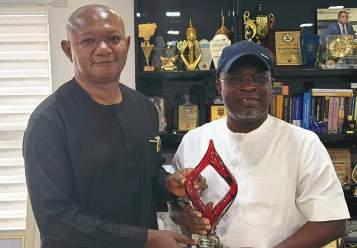
Cornfield Group Chairman, dr. Babatope Michael agbeyo, has long demonstrated that business success can go hand in hand with social impact. Chiemelie Ezeobi writes that his enduring commitment to empowering vulnerable communities, supporting education and advancing human capital development across West and Central africa recently earned him the Security Watch africa Golden Star award for Upliftment of Society through Philanthropy in West and Central africa
Business success is often measured in revenue, market share and expansion into new territories. But for Dr. Babatope Michael Agbeyo, Chairman of Cornfield Group, the true measure of success lies in the number of lives transformed, opportunities created and communities empowered.
Over the years, the entrepreneur has built an impressive corporate empire spanning manufacturing, technology, education and consumer goods. Yet, beyond the boardrooms and business deals, he has cultivated an equally enduring legacy through philanthropy, human capital development and community interventions that have touched thousands across West and Central Africa.
It is this blend of enterprise and compassion that recently earned him the prestigious Golden Star Award for Upliftment of Society Through Philanthropy in West and Central Africa, an honour conferred during the 19th Africa Security Watch Conference and Awards held in Banjul, The Gambia, on July 23, 2026.
Organised in partnership with Stellenbosch University, South Africa, the conference celebrates individuals and institutions advancing security, peacebuilding and sustainable development across the continent.
The honour did not come by chance.
According to the International Coordinator and Chief Executive Officer of Security Watch Africa Initiatives (SWAI), Mr. Patrick Agbambu, the decision followed an extensive evaluation of Dr. Agbeyo's personal and professional contributions to society.
He explained that the selection process involved "tedious but meticulous assessments" before arriving at the conclusion that the Cornfield Group Chairman had distinguished himself through consistent philanthropic interventions and sustained investments in community development.
He cited his commitment to human capital development, educational advancement and the provision of essential resources to underserved communities as evidence of a life dedicated to improving society.
Across several countries in West and Central Africa, his interventions have helped strengthen communities, expanded access to opportunities and contributed to greater social resilience.
For those familiar with his work, however, the recognition merely formalises what many communities have experienced firsthand for years.
Dr. Agbeyo's entrepreneurial story began in 2005 with the incorporation of Media Concepts International, established to provide media products and services across diverse platforms. That venture became the foundation upon which a much larger business ecosystem would emerge.
In 2006, he established Cornfield
Transnational Limited, a manufacturing company that would eventually become one of Nigeria's recognised producers of innovative educational tools.
Its patented mathematical and scientific instruments have become familiar learning aids used by millions of students, helping improve teaching standards while also reducing examination malpractice across Nigeria and neighbouring countries.
Rather than focusing solely on commercial success, the company sought practical solutions to educational challenges, reinforcing Dr. Agbeyo's philosophy that innovation should solve societal problems.
His passion for technology later inspired another milestone. In 2011, he founded Botosoft Technologies, a company specialising in identity management, document security and brand protection solutions.
Today, its systems verify millions of examination candidates annually, providing educational institutions with reliable mechanisms for maintaining transparency, credibility and integrity during assessment processes.
His business interests expanded again in 2017 with the establishment of Cornfield Foods and Beverages, a fast-moving consumer goods company with operations stretching across Europe, the Middle East and Africa.
Each new venture reflected a common pattern, identifying pressing societal needs and developing sustainable commercial solutions capable of delivering lasting impact.
The Gift that Keeps Giving While his business achievements continue to attract attention, it
is perhaps his humanitarian work that has earned him enduring admiration. Through numerous interventions, widows have received financial assistance to establish small businesses and regain economic independence.
Scholarship programmes have opened educational opportunities for students who might otherwise have been unable to continue their studies.
Schools and community centres have benefited from infrastructure support, while various community-based initiatives have improved living conditions for vulnerable populations.
Significantly, many of these interventions have been carried out quietly, without publicity or fanfare.
For beneficiaries, however, the impact has been profound.
Families have found new sources of livelihood, young people have gained access to education, and entire communities have benefited from investments that continue to generate long-term social and economic value.
These efforts have reinforced the belief that entrepreneurship can serve as a powerful instrument for inclusive development when driven by compassion.
Dr. Agbeyo's contributions have attracted recognition from academic institutions, professional bodies and civic organisations both within and outside Africa. He holds honorary doctoral degrees in Business Management from the Federal University, Oye Ekiti, and in Entrepreneurship from Joseph Ayo Babalola University, Ikeji Arakeji.
He is also a Fellow of the Institute of Data Processing Management of Nigeria and a Fellow of the Council of the Chartered Institute of Public Resources Management and Politics in Ghana.
Among several honours received over the years are the Icon of Societal Transformation Award from the
ECOWAS Youth Parliament and the Global Humanitarian Award presented by Wazobia Global Media.
Government officials and civic institutions in the United States have also recognised his humanitarian efforts, reflecting the international reach of his contributions.
While receiving the the Golden Star Award yesterday, Dr. Agbeyo argued that lasting development cannot occur where insecurity persists.
"Security and insecurity are very, very important issues. Not just in one area, I'll even say across Africa," he said.
"We should look at security beyond just 'there's no war in your country.' It's also about whether you can move freely. Even if your own country is peaceful, when your neighboring country is in crisis, you are also affected. Nothing grows without security, not the economy, not culture, nothing."
Drawing from his experience in the real estate sector, he explained how conflict rapidly destroys decades of investment.
"I was in Abuja talking about real estate. The only thing that can destroy a place like the United States is war. No matter how highly developed an area is, when there is war, the value drops to zero. If the entire area is bombed, that property has no value. There can be no education, no trade, no development where there is no peace."
Beyond security, Dr. Agbeyo challenged Africans to take ownership of the continent's narrative.
"If we don't celebrate ourselves, nobody will celebrate us," he declared.
According to him, changing global perceptions requires Africans themselves to communicate stories of resilience, innovation and progress.
"We are communicating the phenomenon of Africa. The rising story of Africa. We are narrating our story ourselves.
"We are telling people: 'No matter what you hear about us, we have individuals, organisations, and entities working hard to ensure security within. You can come and partner us. Invest with us. We have people who can protect your investment."
He stressed that this responsibility should not rest solely with governments and security agencies but should also involve civil society organisations and the private sector.
Commending advocacy groups promoting peace and accountability, he observed that recognition encourages better performance.
"When people know they are being watched, that they can be rewarded and also held accountable, they will be more careful. Then we can achieve more."
He further disclosed that Cornfield Group maintains a network of investors willing to support initiatives that promote peace, security and sustainable development across Africa.
For Dr. Agbeyo, the Golden Star Award affirms a philosophy that has consistently shaped both his business and humanitarian pursuit, which is that genuine success is measured not only by profits earned but also by lives uplifted.
While celebrating its 10th anniversary with a dinner and fireside chat event recently, Victoria Ojiako writes that for all On, it was an opportunity to bring renewable energy leaders together to shape the next decade of energy access in Nigeria
Nigeria's renewable energy ecosystem came together in Lagos as All On Partnerships for Energy Access hosted its 10th Anniversary Dinner and Fireside Chat, convening leaders from government, development finance institutions, the private sector, development organisations, academia and the renewable energy industry to celebrate a decade of catalytic investment while setting the agenda for the future of energy access in Nigeria.
The evening reflected ten years of building businesses, strengthening markets and expanding access to clean, reliable and affordable energy through collaboration. More importantly, it looked ahead, bringing together some of the sector's most influential voices to explore how partnerships, innovation and long-term investment can accelerate universal energy access for millions more Nigerians.
Representing the His Excellency, Mr. Babajide Olusola Sanwo-Olu
Executive Governor of Lagos State, the Honourable Commissioner for Energy and Mineral Resources, Hon. Biodun Ogunleye, congratulated All On on its ten-year journey, describing the organization as an important contributor to Nigeria's renewable energy ecosystem. Delivering the Governor's goodwill message, he commended All On for demonstrating that underserved communities are not beyond the reach of sustainable investment and reaffirmed Lagos State's commitment to creating an enabling policy environment that encourages innovation, investment and private sector participation in the electricity market.
Welcoming guests, Caroline Eboumbou, Chief Executive Officer of All On, reflected on the organization’s evolution from an ambitious vision into one of Nigeria's leading impact investors and ecosystem builders. She acknowledged the presence of the founding visionary and former Board
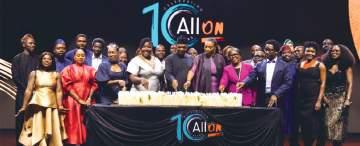
Chairman, Dr. Osagie Okunbor, the Board of Directors, investees, partners, government institutions and communities whose collective efforts have helped shape All On's first decade.
Reflecting on the organization’s journey, Eboumbou noted that while capital was essential, experience had shown that expanding energy access required far more than financing businesses alone.
"We realized very quickly that we needed to be more than just an investor. Building this market required us to combine catalytic capital with technical assistance, venture support, ecosystem development and strategic partnerships. That is how lasting impact is created."
Today, All On's work has contributed to reaching nearly two million lives, demonstrating what is possible when patient capital is combined with innovation, entrepreneurship and long-term collaboration across the renewable energy ecosystem.
One of the evening's defining
moments was a fireside conversation between Eboumbou and Damilola Ogunbiyi, Chief Executive Officer and Special Representative of the United Nations Secretary-General for Sustainable Energy for All (SEforALL).
Their discussion explored the evolution of Nigeria's off-grid energy sector over the past decade and the partnerships required to deliver universal energy access across Africa.
Drawing on years of collaboration with All On, Ogunbiyi reflected on the organization’s role in helping shape Nigeria's renewable energy market, highlighting the importance of institutions that build markets, strengthen businesses and mobilize investment rather than simply financing individual projects.
Together, both leaders agreed that while significant progress has been made, the next decade will require even stronger partnerships, continued innovation and sustained investment to ensure that millions more Africans gain access to reliable, affordable and sustainable energy.
The conversation was followed by an Impact Showcase, where Dalberg presented findings from its independent evaluation of All On's first decade of work. The assessment
highlighted the organization’s contribution to expanding energy access through catalytic investment, venture building, enabling finance and ecosystem development, while demonstrating measurable improvements in business growth, market development and opportunities for underserved communities.
The showcase reinforced the impact of an integrated approach that combines investment with long-term market building.
Looking ahead, a second fireside discussion shifted the focus from reflection to the future of Nigeria's renewable energy sector. Moderated by Abiodun Oni, Chief Executive Officer of FundCo, the panel featured Sandra Dozie, Chief Executive Officer of Salpha Energy and Muhammad Wakil, Country Delivery Lead (Nigeria) for the Global Energy Alliance for People and Planet (GEAPP). Together, they explored the opportunities and challenges shaping the next phase of Nigeria's energy transition, highlighting local manufacturing, innovative financing, enabling policy, private sector investment and strategic collaboration as critical drivers of future growth.
The evening also featured a Special Recognition segment celebrating the collaborations that have shaped All On's first decade. Awards of Excellence were presented to organizations and individuals whose vision, leadership and collaboration have helped strengthen Nigeria's renewable energy ecosystem, from pioneering ecosystem development and policy advocacy to advancing innovation, market growth and universal energy access.
Honourees included The Rockefeller Foundation, Nigeria Climate Innovation Centre (NCIC), Sustainable Energy for All (SEforALL), the Rural Electrification Agency (REA), the Renewable Energy Association of Nigeria (REAN), Shell Nigeria, and Dr. Osagie Okunbor, Founding Chairman of the All On Board of Directors.
emmanuel ugwu-Nwogo in Enugu
ANigerian philanthropist has pledged to dedicate 90 per cent of his wealth to charity and war against poverty, saying that Africa needed "to be liberated" from the pangs of abject poverty.
Engr Chuka Nwokoro, the founder of Mobile Ministry Incorporate, and Charities(MMI Charities), made the vow during an empowerment programme at Enugu, organised by his charity organisation in conjunction with the African Rebirth Vision Foundation(TARVF).
"I say it again, 90 percent of my wealth I will give to the poor," he emphasised. He said that there was no turning back in his mission to liberate people from the shackles of poverty not only in Nigeria, but also in Africa and other parts of the world.
According to him, his ultimate goal in life "is to share love, forgiveness, faith, hope and to reach out to humanity" across the globe, adding that through MMI Charities Africa would eventually be liberated from poverty.
To achieve his aim, the Arochukwu (Abia State) - born philanthropist, who is based in Enugu, holds a monthly empowerment programmes for indigents.
At the July edition of the empowerment programme, which was preceded by a thanksgiving mass at Holy Trinity Catholic Church, Independent Layout, Enugu State, no fewer than 70 indigent women benefitted from the monthly outreach.

Engr. Nwokoro, a prominent Nigerian civil engineer and construction executive whose company delivered major infrastructure projects across Nigeria, including the Imo Airport runway, said that charity was not a function of stupendous wealth but a heart of gold.
He explained that his philanthropic projects was motivated by the biblical injuction as contained in Matt. 19:21 where Jesus enjoined a rich man to "give to the poor and those shalt have a place in heaven".
Aside from indigent women, MMI Charities has consistently empowered young geaduates, helping them to find their footing through employment and funding for business proposals.
In his homily at the thanksgiving mass to mark MMI's third
anniversary, the Very Rev. Fr. John Amadi, a retired priest, enjoined people to embrace charitable work and make life better for others.
He stressed the need for the well to do members of the society to reach out to the less privileged, noting that everyone would be judged by the life they lived and the positive impact made on the society.
The cleric, who is spiritual father and friend to the Nwokoro family, lauded the MMI founder for living his life for God, following in the footsteps of his late father in pursuing apostolic assignments.
“Despite his status in society, Chuka has remained exceptional, helping the poor and investing in the vineyard of God,” he said.
While blessing Engr. Nwokoro, the four priests that concelebrated the thanksgiving mass, prayed for God to during to grant him long life, urging the philanthropist not to ever get weary of helping the needy
and the vulnerable.
The beneficiaries of the empowerment were overwhelmed with joy as MMI Charities distributed various items to the over 70 women that women gathered for the programme.
“I am not here just to give you money or material things, but to increase your faith in God, restore hope, and share love,” he said, adding that he had at the age of 14 "received a clear mandate from God" to help the less privileged.
“I have come to share love with you. I admonish you that no matter how little, help those in your locality who do not have.
"You do not need to have all the money in the world to help those less privileged than you. Love your neighbour because love is everything, and prepare your lives towards making heaven,” he stated.
Nwokoro said that his plan “is to target Africa for God, addung that his work has no denominational bias because "no matter the church you belong to, what matters most is who you are and the love you bring to the world".
Earlier, the Director General of MMI Charities, Mrs. Delphine Chioma, said in her remarks that members of MMI Charities have a passion for God and humanity as expressed in their works. She said that apart from charitable works, the organisation unceasingly prays for Nigeria to become a better society as the country continues to grapple with many challenges.
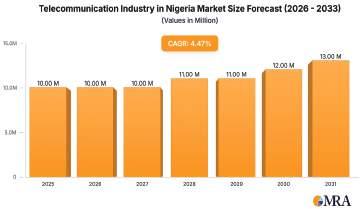
Stories by emma Okonji Telecoms’ operators (Telcos) under the aegis of the Association of Licensed Telecoms Operators of Nigeria (ALTON), have called on the federal government to ensure policy consistency, regulatory certainty and the protection of investments in the telecoms sector, in order to attract further investments.
The operators said this in Lagos at the 12th edition of ICTEL EXPO 2026, organised by the ICT Group of the Lagos Chamber of Commerce and Industry (LCCI).
In his keynote address, themed: ‘Building Nigeria’s Digital Economy: Telecommunications as the Foundation for Investment, Innovation and Inclusive Growth’, the Chairman of ALTON, Gbenga Adebayo, emphasised on the need for the federal government to create an investment-friendly environment for the telecoms sector, insisting that Nigeria requires sustained investment running into billions of dollars to expand fibre networks, improve rural connectivity, deploy 5G and prepare for emerging technologies.
According to him, such investment can only occur where investors have confidence in the operating environment.
“An investment-friendly environment requires policy consistency, regulatory certainty, protection of investments, efficient Right-ofWay processes, reduction of multiple taxation, elimination of infrastructure vandalism, and faster approvals for network deployment. Every improvement in the investment climate translates directly into improved digital infrastructure for businesses
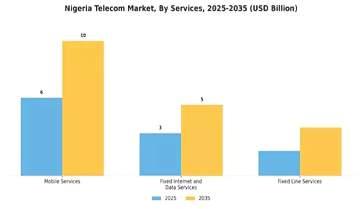
and citizens,” Adebayo said.
He also called for publicprivate partnership to further drive investment in the telecoms sector, adding that government alone cannot build the digital economy.
“The private sector cannot succeed without supportive public policy. Our greatest successes have always emerged through collaboration. As business leaders, policymakers and industry stakeholders, we must deepen partnerships that encourage innovation while protecting investments
and promoting competition.
The Lagos Chamber of Commerce and Industry remains an important platform for advancing this dialogue,” Adebayo further said.
He explained that telecommunications remained one of the most capital-intensive sectors of the Nigerian economy, and he further emphasised that every kilometre of fibre deployed, every base station constructed, every 5G site commissioned and every rural community connected, would require significant
long-term investment. He however commended the federal government for the strategic tariff adjustment it approved in 2025 that led to 50 per cent hike in telecoms tariff. He said the policy intervention played a pivotal role in restoring industry sustainability, enabling operators to move from a period of severe financial pressure to one of renewed capital reinvestment and network expansion.
The story continues online on www.thisdaylive.com
At the recent regional stakeholder validation workshops held separately in Johannesburg, South Africa; Nairobi, Kenya; and Lagos, Nigeria, stakeholders pushed for practical solutions that would strengthen the sustainability of the African social impact ecosystem.
Organised by African Venture Philanthropy Alliance (AVPA), a Pan-African network for social investors that are interested in collaborating to increase the flow of capital into social investments across Africa, the various workshops discussed the issue of Africa’s
grant dependency that has resonated with remarkable consistency across Southern, East and West Africa.
The stakeholders were of the view that the future of Africa’s social impact sector should move beyond grant dependency, towards financially resilient, investment-ready organisations and ecosytems.
With the support of its funder, Porticus, AVPA is running a research on ‘NGO Transitions to Sustainable, Investment-Ready Social Ventures in Africa’ and recently, in collaboration
with implementation partners, Private Equity Support (PES) and enAble Advisors, convened a series of regional Stakeholder Validation Workshops that brought together NGO leaders, funders, policymakers, corporates, intermediaries and impact investors to validate research findings and, more importantly, co-create practical solutions for strengthening the sustainability of the African social impact ecosystem.
While each region brought unique perspectives, the conversations focused around a shared reality, about how
traditional funding models are evolving, requiring organisations to rethink how they finance impact, strengthen organisational readiness, build new competencies and forge stronger cross-sector partnerships. Participants also reinforced that sustainability was no longer simply about securing the next grant, but it’s about building resilient institutions capable of attracting and generating diverse forms of capital and exploring market-based solutions for sustainable impact while remaining true to their mission. The sessions
also showcased case studies of organisations that are already demonstrating the reality of thriving beyond grants.
Founder and CEO, enAble Advisors, Dr. Angela Gichaga, said: “At enAble Advisors, we believe that any sector can enhance performance by increasing self-awareness, challenging limiting beliefs, and fostering a “can-do” mindset in leaders and teams, empowering them to navigate complexity and drive exponential impact in their individual lives, organisations and in the world.”
AVPA’s CEO, Dr. Frank
Market data a s at Wednesday, a ugust 5, 2026
Aswani, said: “Africa remains a major impact opportunity in the world but is largely held back by inadequate financing for social investments and especially catalytic or risk capital. Progress towards mobilising sufficient social investments to address our SDG financing gap will only be achieved if we can creatively mobilise and deploy private capital for social investments, and catalytic capital is important in unlocking this capital.”
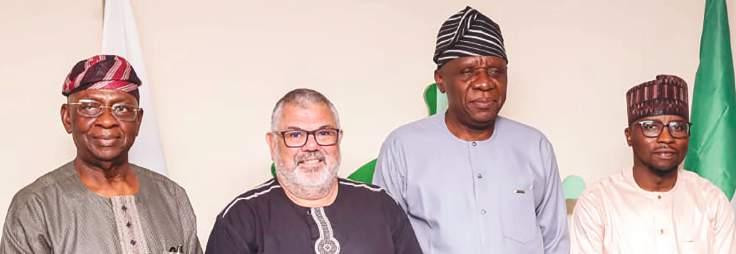
L–R: Chairman, Management Committee of Mission to Seafarers, Lagos, Adebayo Sarumi; Regional Director, Mission to Seafarers, Africa, Cedric Rautenbach; Executive Director Operation, Nigerian Maritime Administration and Safety Agency (NIMASA), Fatai Adeyemi and Executive Director, Maritime Labour & Cabotage Services, Mr. Jibril Abba. During a courtesy visit by the Chairman, Management Committee, Mission to Seafarers, Lagos to NIMASA in Lagos… recently
Stories by Emma Okonji
CEO of Computics Limited, Mr. Moses Braimah has welcomed the recent Federal High Court judgment in Emmanuel Harunna vs. Nigeria Data Protection Commission (NDPC), where the court affirmed the commission’s authority to regulate major data handlers, including decentralised Pointof-Sale (PoS) agent networks.
According to Braimah, the judgment has officially ended the era of treating data protection as an IT department responsibility, and has unlocked one of Nigeria’s most overlooked economic opportunities.
“Far beyond a legal victory, the judgment redraws Nigeria’s digital economy.
It is a corporate wake-up call, a regulatory milestone, an economic opportunity and, above all, a victory for millions of Nigerians whose personal information has too often been
treated as an unprotected commodity,” Braimah said.
The court ruling has effectively armed the NDPC with the legal certainty to enforce compliance across Nigeria’s digital ecosystem.
Under the NDPA, noncompliant organisations face administrative penalties that can be as high as N10 million or two per cent of annual gross revenue, depending on the severity of the violation. That transforms data governance from a routine compliance checklist into a board-level financial, legal and reputational risk requiring immediate executive oversight, Braimah further said.
Analysing the judgment, Braimah said every organisation classified as a Data Controller or Processor of Major Importance must now register, conduct periodic compliance audits and strengthen internal governance.
“That requirement creates
The Sustainability Professionals Institute of Nigeria (SPIN) is set to hold its inaugural Sustainability Conference 2026, a landmark national gathering that will bring together business leaders, policymakers, regulators, financial institutions, among others to explore practical strategies for building resilient and future ready organisations.
This month Lagos hybrid conference, themed: “The Adaptive Enterprise: Sustainability Strategies for Challenging Times”, will convene business leaders, financial institutions, development partners, and sustainability professionals to
explore practical strategies for building resilient and future ready organisations.
Managing Director/Chief Executive Officer, Nigeria Sovereign Investment Authority, Aminu Sadiq, delivered keynote address with other speakers.
Speaking about the conference, President of the Sustainability Professionals Institute of Nigeria, Professor Kenneth Amaeshi, said the inaugural conference would reflect the institute’s commitment to advancing sustainability beyond compliance and positioning it as a core element of organisational leadership.
sustained demand for licensed Data Protection Compliance Organisations (DPCOs), cybersecurity professionals, privacy lawyers, compliance auditors and certified Data
Protection Officers (DPOs). Thousands of qualified Nigerian graduates can now build careers in a rapidly expanding profession instead of competing for shrinking
traditional employment opportunities,” the expert said. He explained that for government, the implications remained equally significant, as registration fees, annual
compliance filings and lawful enforcement will create sustainable internally generated revenue while expanding the formal digital economy.
Oghenevwede
The federal government, through its agency, the Galaxy Backbone (GBB), has launched a Government Service Portal (GPS) that will enhance government service delivery and curb corruption in government circle.
The GPS was launched at the headquarters of the Galaxy Backbone in Abuja.
Speaking at the launch, the Permanent Secretary,
Federal Ministry of Communications Innovation and Digital Economy, Nadungu Gagare, who was represented by the Director E-Government, Ministry of Communications Innovation and Digital Economy, said the Government Service Portal would enhance service delivery, curb corruption and waste in public service.
According to him, the GSP is a journey towards more efficient, transparent and citizen focused public service.
“The soft launch of the Government Service Portal, is an important milestone in Nigeria’s journey towards a more efficient, transparent and citizen focused public service.Today’s event is not simply about developing a digital platform, it’s about demonstrating that what can be achieved when government agencies work together with a shared purpose, making public services easier, faster and more accessible for every Nigerian.” Gagare said. In his welcome address, the Managing Director of GBB, Prof. Ibrahim Adeyanju, said: “Today marks another significant milestone in Nigeria’s digital transformation journey. It is a journey driven by a shared vision—to build a government that is more connected, more efficient, more transparent and ultimately more responsive to the needs of its citizens and businesses.”
Paystack, one of Africa’s leading payments technology companies, has launched Small Business Launchpad, a four-week growth programme for active Paystack merchants running small and mediumsized businesses in Nigeria.
The first cohort opens on August 27, 2026 and will admit up to 50 selected businesses. Participants
will work through practical clinics, expert office hours and direct Paystack support, with sessions focused on the areas small businesses deal with every day - customers, cash flow, operations and growth.
Small Business Launchpad is the latest in a series of Paystack initiatives focused on supporting small businesses
beyond payments. In June, the company launched the Paystack Small Business Bundle, giving eligible merchants access to discounted products and services from trusted partners. Launchpad now extends that support into practical learning, expert access, community, and handson business guidance for the founders and operators behind
those businesses. The company called on active Paystack merchants in Nigeria running a small or medium-sized business can apply, adding that Paystack will review each submission for eligibility, and selected merchants will need to commit to the full programme and pay a N150,000 participation fee.
.ng Academy, the training arm of the Nigeria Internet Registration Association (NiRA), has successfully hosted a pre-conference workshop at the NCS RISE 2026 International Conference, thus deepening its investment in Nigeria’s digital skills development. The workshop forms part of NiRA’s continued drive to build local digital capacity, and drew
professionals, entrepreneurs, and technology enthusiasts eager to sharpen the practical skills needed to compete in an AI-driven, digitally connected economy.
Speaking about the significance of the workshop, President of NiRA, Mr. Adesola Akinsanya, said: “Nigeria’s digital economy will only grow as fast as the skills of the people driving it. At NiRA, we
see .ng Academy as a direct investment in that growth giving professionals and entrepreneurs practical tools they can apply immediately in their businesses and careers. Initiatives like this workshop are how we translate national digital economy ambitions into everyday, on-the-ground capability.”
Vice President of NiRA, Mr. Murtalla Abdulahi,
said: “What stood out at this workshop was how quickly participants connected the training to real opportunity from automating their workflows to building stronger brands online. This is exactly the kind of grassroots capacity building that strengthens Nigeria’s digital economy from within, and NiRA remains committed to scaling these programmes to reach even more Nigerians.”
Recently, a foundation, known as the Almajiri-to-Tech Foundation, transformed 21 streetroaming children in northern part of Nigeria, known as Almajiri children, with technology skills in six months. The plan is to graduate more of the over 30 million street children to further drive Nigeria’s digital transformation agenda, writes Emma Okonji
If 21 children could be transformed in six months, what could happen to over 30 million on the streets?
This question lingered throughout the graduation ceremony of the Almajairi’s as speakers, policymakers, religious leaders and education advocates reflected on what they had witnessed. Before them sat young boys and girls who, only months earlier, had little or no formal education in English Language but today, confidently demonstrate skills many university graduates have never acquired, courtesy of the foundation that trained them on basic technology skills. For years, they were known only by what they lacked. They lacked homes, formal education and opportunities. To millions of Nigerians, they were simply just the Almajiri children roaming the streets with bowls in their hands, and surviving on alms. However, those same hands that once stretched out for survival now hold screwdrivers, assemble computers, repair electronic devices, and build drones. The applause that filled the hall was not merely for 21 graduates receiving certificates, it was also for a new possibility and a future many had never imagined, a future where the Almajiri child is no longer defined by poverty, but by potential.
Addressing the audience during the graduation ceremony in Abuja, the Founder, Almajiri-to-Tech Foundation, Mr. Tim Akano, spoke with conviction born from experience and not theory. Rather than waiting for grants or government intervention, Akano chose to finance the tech-training programme with his own resources. He reached into his own pocket, pulled out N100 million to use for the programme because he believed that they are Nigerian children and that action was needed to empower a single child. Akano expressed that the transformation should permanently change how Nigerians view vulnerable children as the children are not incapable nor unintelligent but have simply been denied opportunity. Akano’s vision stretches far beyond the 21 young pioneers who crossed the graduation stage as he hopes to help take 30 million children off Nigeria’s streets by 2031, by expanding a model that combines technology education, practical skills, entrepreneurship and holistic support. He has however, appealed to the Minister of the Federal Capital Territory, Nyesom Wike, to provide a fully equipped workshop where the graduates can continue to practice their skills and serve paying customers.
Khafilat Ogbara, who is widely celebrated as the “Mother of Almajiri and Out-of-School Children,” endorsed the programme and described it as a practical demonstration of what inclusive education could achieve.
“This is the true Renewed Hope” she declared. Ogbara said the success of the Almajiri-to-Tech Foundation should not remain an isolated achievement. She challenged private schools, corporate organisations, philanthropists and well-meaning Nigerians to become active partners in reducing the number of out-of-school children across the country as every child, regardless of their background or circumstances, deserves an opportunity to learn in order to contribute meaningfully to society.
Similarly, the programme also received endorsement from the Islamic leader affectionately referred to as the “Father of Almajiri and Out-of-School Children,” IGP MD Abubakar. While acknowledging Nigeria’s abundance of knowledge and capable personalities, he argued that the country’s greatest challenge is not a lack of ideas but the willingness to act. He therefore questioned the widely quoted estimate of 30 million out-of-school children, suggesting that the actual number visible on Nigeria’s streets may be even higher. He expressed that “If leaders fail to take care of those they are supposed to serve, we are in serious trouble as it will become difficult to sleep peacefully in beautiful mansions or drive freely on our roads because these children will eventually become a problem for everyone.”
“A nation cannot abandon millions of children and expect lasting peace, security and prosperity. Every child denied education, skills and opportunity represent not only a personal tragedy but a growing national risk. Imagine a child who stands before a large audience and recites the entire Qur’an from memory. That is an intelligent child. That same child could have used the same capacity to study and excel in almost any other subject in our conventional schools,” Abubakar said.
In the same vein, various speakers at the programme called on the global media such as the BBC, CNN, Al Jazeera, to project African stories like the technology training for street-roaming children, instead of the continuous reporting on kidnapping, banditry or political crisis. According
to them, not that those stories should be ignored, but they should not be projected as the only stories through which Nigeria is often viewed.
Founder’s Views
Expressing his views over the six-month technology training programme, its founder, Tim Akano, described the six months training in two words: Incredible Revelation. “The Almajiri children met and exceeded all expectations. Before now, we all believed that it was not possible for an individual to master more than one or maximum of three electronics repairing. The Almajiris children broke the ceiling, each of them mastered how to repair and build the following: telephone handsets, desktops, laptops, fans, microwave ovens, power banks, televisions, rechargeable lamps, washing machines and pressing irons- 10 items in all.
They can build the following from scratch: battery inverters, telephone handsets, desktops and drones and fly it. That is incredible,” Akano said.
Speaking about the challenges encountered during the training, Akano said: “Originally, my budget was N50 million for three months. But after three months we realised we needed to put them on attachments for practicals, and the budget suddenly jumped to over N100 million. Because I feed them daily, pay them money for coming to school and bought tools for them from China. At a level my Accountant was murmuring that Almajiri project was gulping too much money. Again, there were so many analysts who expressed doubts saying “can anything good come out of Almajiris.” Some even confronted me telling me “Almajiris phenomenon is a deliberate creation of Northern Muslim elites, what is the business of a southern christian in fixing it?” Others were of the belief that the Almajiris could not communicate in English, and therefore not trainable. These were some of my challenges.”
Of all my charity initiatives: Adoption of
the Federal School of the Blinds Oshodi Lagos; Adoption of Baptist Day School Oluponna; Scholarships to 20,000 youth yearly, among others, the technology training of the Almajiris is one of my favorites, Akano further said.
Speaking about the kind of support that the foundation will continue to provide to help them transition into work or business, Akano said the cost of setting them up was beyond the Almajiri children. “Therefore, I rented an office space and paid for one year. I equipped it with all the tools needed to carry out their jobs satisfactorily. Now, they have an address called Almajiri Republic Technicians Workshop at Wuse 2 Abuja, besides New Horizons office. My team and I will monitor them daily. I have two experienced mangers dedicated to the project exclusively. We shall be reporting their progress and put the lessons into consideration in tackling the second phase,” Akano said.
He however said the biggest challenges ahead would be marketing, financial management, and continuous improvement and adaptability challenges. He therefore called on state governments, NGOs and corporate organisations that are willing to partner with the foundation in taking the 30 million out- of -school and Almajiris children off the streets between now and 2031, to contact Almajiri -to-Tech Foundation (www.almajiritotech.com).
Nigeria has spent decades debating the Almajiri question. However, the young graduates seated in Abuja during graduation, suggested that perhaps the answer has been hiding in plain sight all along, not in another policy document, but in practical education, compassion and the courage to act.

Kayode Tokede
Nigerian Breweries Plc, has announced a strong performance for the first half of the 2026 financial year, recording a Group Revenue of N804 billion, representing a 9% increase over the N738 billion reported in the corresponding period of 2025.
The company also achieved another significant milestone during the period, restoring its retained earnings to a positive position, further strengthening its financial health and reinforcing the success of ongoing business recovery and value creation initiatives.
A breakdown of the unaudited result for the period ended
Managing Director, FairMoney Microfinance Bank, Henry Obiekea, has stressed the need for the implementation of the ongoing recapitalisation programme of the Central Bank of Nigeria (CBN), describing it as a strategic investment that will strengthen Nigeria’s financial ecosystem.
According to him, if implemented successfully, it has the potential to strengthen financial stability, deepen credit access, improve investor confidence, and support a more inclusive and resilient economy.
Speaking from a Fintech perspective,
June 30 2026 revealed that the company’s Operating Profit grew by 8% from N152 billion in 2025 to N164 billion, notwithstanding the increase in Selling, Distribution and Administration Expenses by 20%.
A further improvement in the Company’s Net Finance Expenses contributed to an 18% growth in the Profit Before Tax. The implementation of the new tax rates moderated the growth in Profit After Tax to 5%, from N161 billion in the first half of 2025 to N193 billion in the current period.
The Company Secretary/Legal Director of Nigerian Breweries Plc, Uaboi Agbebaku, in a statement said the company continued to demonstrate
Obiekea said: “For Nigeria’s rapidly growing Fintech ecosystem, although they are subject to different licensing frameworks depending on their operations, the broader regulatory direction is equally clear. Institutions that facilitate payments, tech-enabled banking, lending and savings are expected to maintain governance, capital and consumer protection standards appropriate to their respective licensing frameworks. The evolution is essential as Fintechs continue to account for a growing share of financial transactions and provide
resilience despite a challenging operating environment marked by macroeconomic volatility.
Agbebaku explained that the increase in the group revenue reflects the benefit of revenue management actions and strategic management initiatives, emphasising sustained investment in strategic brands, focused execution across the value chain, and continued contribution from the premium brands and the malt category.
“Gross profit margin expanded by 2 percentage points with results from operating activities increasing by 8%. Profit before tax went up by 18% supported by a 61% reduction in net finance expense. The impact of the new tax rates limited the group net profit growth to 5%“, he added.
services to millions of previously underserved Nigerians. Collectively, the reforms present a unique opportunity to reshape Nigeria’s financial ecosystem.”
For small and mediumsized enterprises, which contribute significantly to Nigeria’s GDP and employment, Obiekea said improved access to financing remained one of the greatest growth enablers, adding that recapitalisation should not be assessed solely by stronger balance sheets, but also by the extent to which additional capital supports productive economic activity.
ASUS, in partnership with Konga, has officially unveiled its first flagship experience store in West Africa, located in Computer Village, Ikeja, Lagos.
The state-of-the-art facility represents a major investment in customer experience, product accessibility, and digital innovation. The launch also reinforces Konga’s growing reputation as a preferred gateway for leading global technology brands into the Nigerian market.
The landmark event attracted the Minister of Innovation, Science and Technology, Dr. Kingsley Tochukwu Udeh, (SAN), who officially launched the store.
The ASUS team was led by EMEA General Manager, Aaron Tsai, alongside Business Development Manager, Sunnie Chen and others.
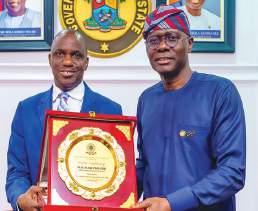
The President/ Chairman of Council, The Chartered Institute of Bankers of Nigeria (CIBN), Dele Alabi and the Executive Governor of Lagos State, Mr. Babajide Olusola Sanwo-Olu, during a courtesy visit by CIBN to Sanwo-Olu at the Lagos State House, Alausa, Ikeja... recently
The minister paid tribute to Leo Stan Ekeh, describing him as one of the foremost architects of Nigeria’s digital transformation. He announced that Ekeh had recently agreed to champion the Federal Government’s Youth and Students Innovation initiative, a flagship programme aimed at equipping young Nigerians with entrepreneurial and technology skills.
Speaking at the event, Tsai expressed appreciation to partners, government
The minister described the facility as a defining achievement for Nigeria’s digital economy, noting that it is far more than the opening of a retail outlet. He called it a strong vote of confidence by a global technology brand in Nigeria's innovation, science, and technology ecosystem and the immense potential of its market.
representatives, and customers for their support. He explained that the flagship store was conceived to provide consumers with direct access to authentic ASUS products, and expressed confidence that the partnership with Konga will further accelerate the brand’s growth and strengthen customer engagement in the region.
In his remark, Chief Operating Officer of Konga Group, Dave Omoregie, said the flagship store reflected Konga’s deliberate strategy to give Nigerian consumers a seamless blend of online and offline retail. He noted that Konga’s logistics network, payment infrastructure, and nationwide retail footprint uniquely positioned the company to support global brands like ASUS at scale, while ensuring customers enjoy authentic products backed by reliable aftersales service.
The price of OPEC basket of twelve crudes stood at $63.14 a barrel on Monday, according to OPEC
Kayode Tokede
The Managing Director and Chief Executive Officer, AVA Capital Plc, Mr. Kayode Fadahunsi has revealed that the recent listing on the Nigerian Exchange Limited (NGX) has significantly expanded its governance and disclosure responsibilities, stressing that the investment banking group now accounts to a broader community of
shareholders, among other capital market stakeholders.
On July 31, 2026, AVA Capital was admitted to the Main Board of NGX following the listing by introduction of its five billion ordinary shares at N7.50 per share, with a market capitalisation of N37.5 billion.
Speaking during an executive media roundtable in Lagos, Fadahunsi said, “We are now accountable to a broader community
of shareholders, regulators, clients, employees and the investing public. With that comes a deeper commitment to transparency, good governance and open engagement,” he said.
He noted that preserving investor trust would be its foremost priority, maintaining that the group seeks to strengthen governance, transparency and accountability while pursuing long-term growth
as a public company.
Fadahunsi maintained that investors’ confidence is fundamental to its business model, stating that although it continues to monitor risks such as inflation, exchange rate volatility and interest rates, safeguarding investors’ capital remains its biggest post-listing challenge.
He explained that the firm’s greatest risk extends beyond macroeconomic
challenges, stressing that investor confidence is critical to sustaining the capital market.
“The highest risk is to continue to responsibly connect opportunities to capital. If the person that connected the opportunity to capital loses people’s capital, that trust is gone. It is a very serious risk.”
He said while inflation, exchange rate movements, monetary policy and
political developments remain important considerations for investment decisions, preserving trust is central to the firm’s operations because its role is to connect investors’ funds with credible opportunities. He explained that the company’s admission to the NGX Main Board through a listing by introduction was driven by governance objectives rather than a need to raise fresh capital.
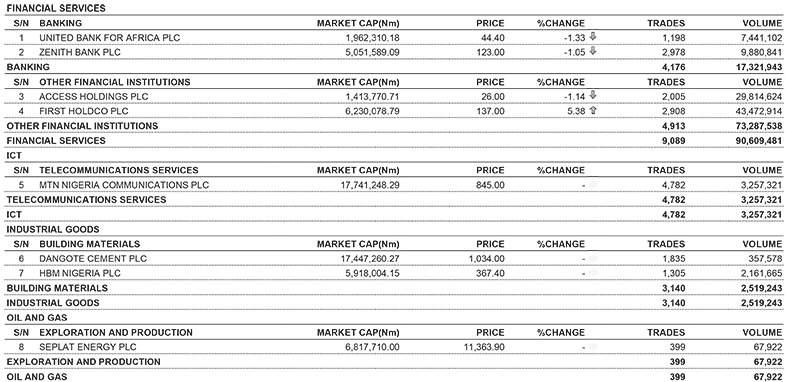
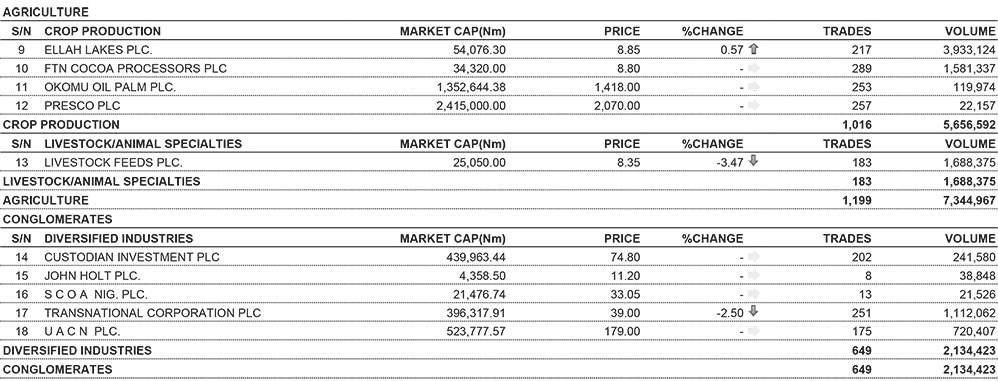
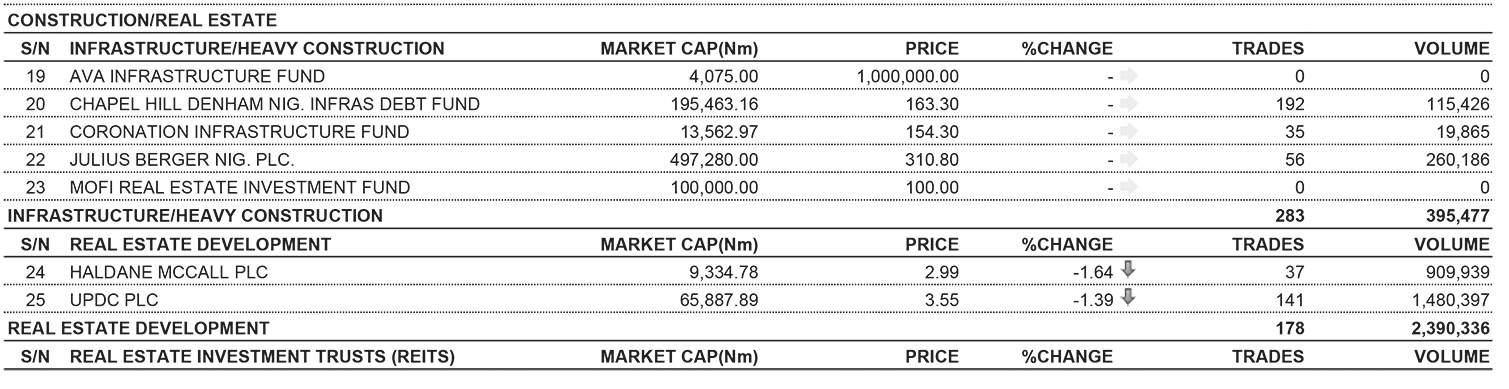
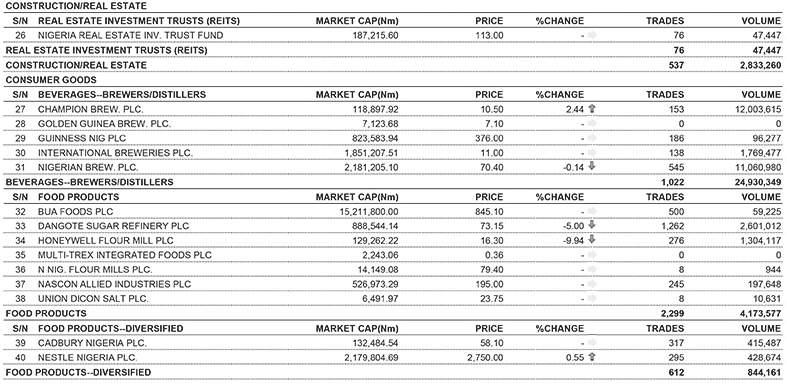
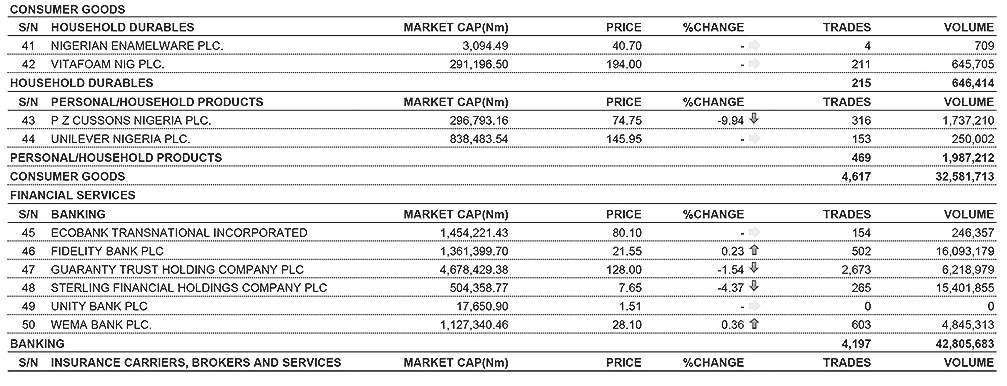
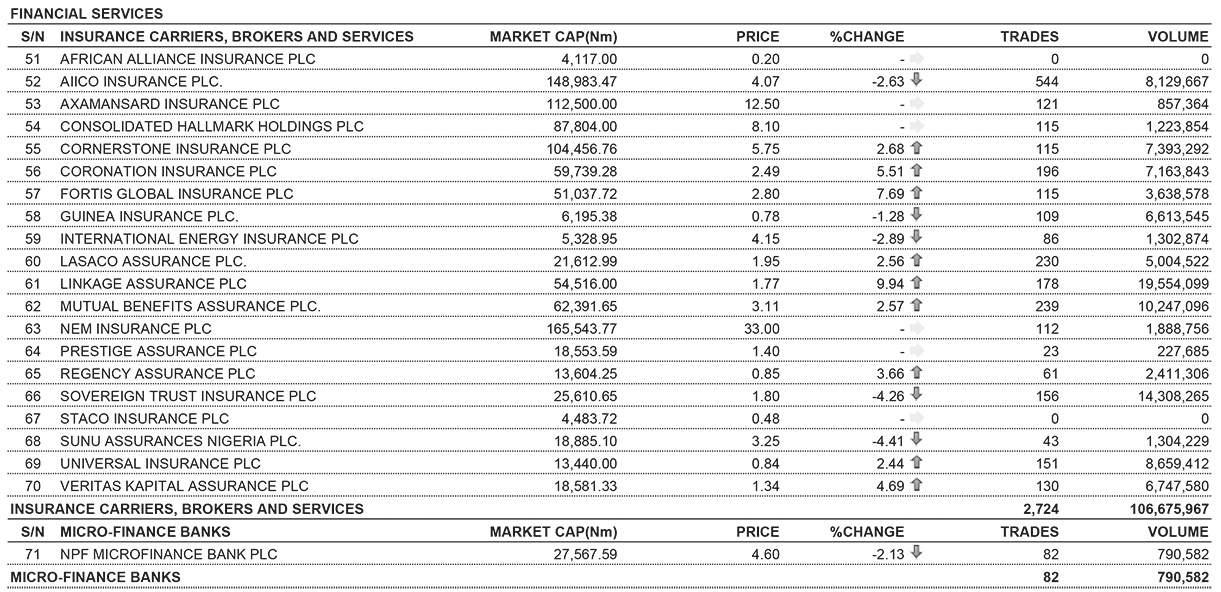

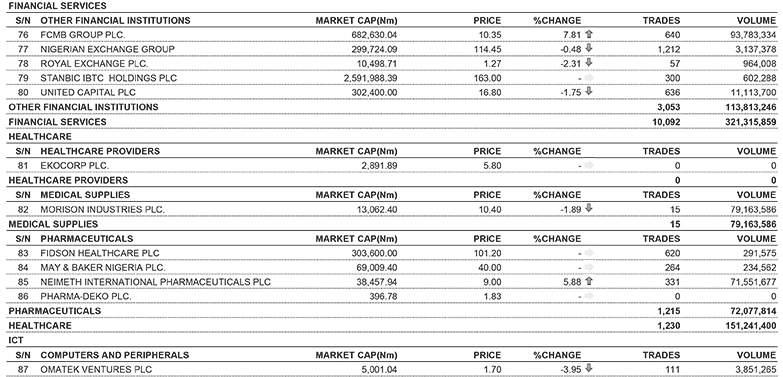
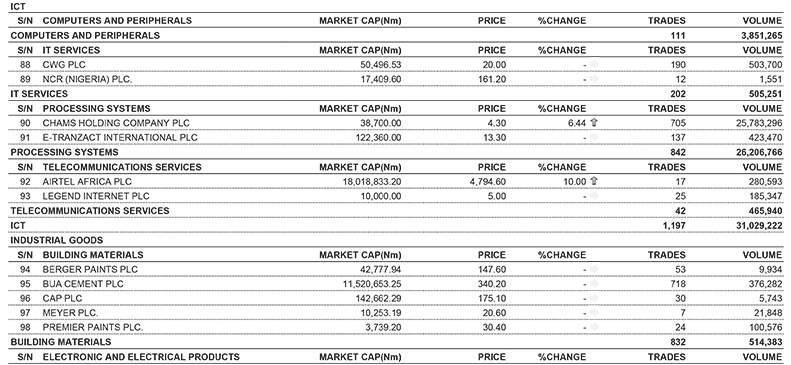
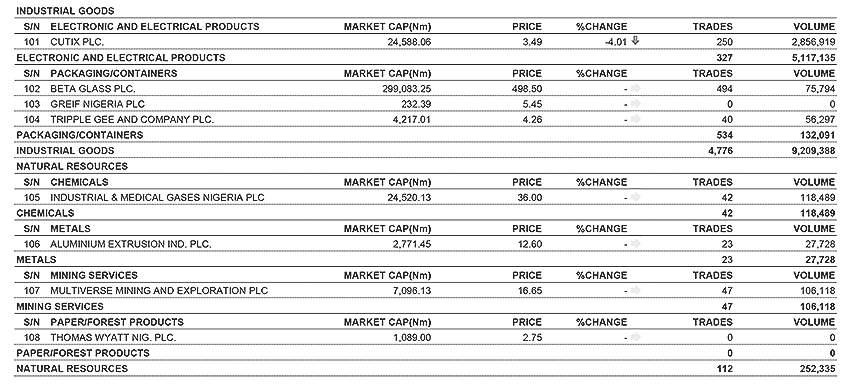
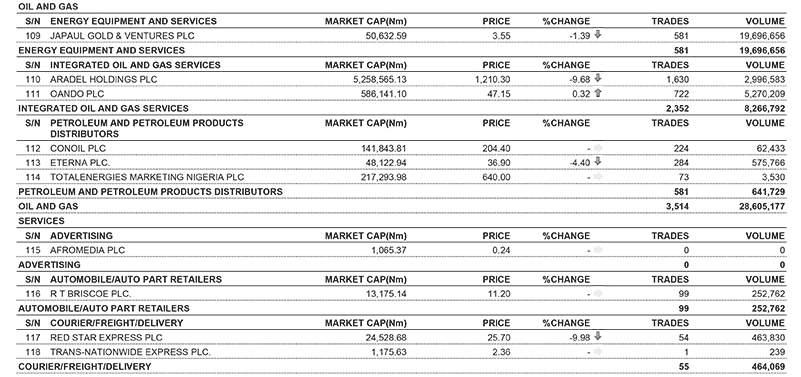

A Mutual fund (Unit Trust) is an investment vehicle managed by a SEC (Securities and Exchange Commission) registered Fund Manager. Investors with similar objectives buy units of the Fund so that the Fund Manager can buy securities that willl generate their desired return.
An ETF (Exchange Traded Fund) is a type of fund which owns the assets (shares of stock, bonds, oil futures, gold bars, foreign currency, etc.) and divides ownership of those assets into shares. Investors can buy these ‘shares’ on the
floor of the Nigerian Stock Exchange.
A REIT (Real Estate Investment Trust) is an investment vehicle that allows both small and large investors to part-own real estate ventures (eg. Offices, Houses, Hospitals) in proportion to their investments. The assets are divided into shares that are traded on the Nigerian Stock Exchange.
GUIDE TO DATA:
Date: All fund prices are quoted in Naira as at 3rd August 2026, unless otherwise stated.
The proposed National Health Facility Regulatory agency promises better oversight. But HaCPaN says it will only duplicate existing regulators, add more fees, and leave ordinary Nigerians to pay the price. Mary Nnah writes
On a Thursday morning in Ikeja, the air was thick with more than just Lagos humidity. Inside a conference room, hospital owners, laboratory scientists, pharmacists, and maternity home operators sat shoulder to shoulder.
They were not politicians. They were not bureaucrats. They were the people Nigerians call at 2 a.m. when a child has a fever, when labour starts early, and when an accident happens down the street.
They came under one umbrella: the Healthcare Providers’ Association of Nigeria (HACPAN). And the reason they gathered was simple. A bill in Abuja could decide whether their doors stay open, or whether the next patient will have to travel farther, pay more, and wait longer.
The bill is called the National Health Facility Regulatory Agency of Nigeria Bill (NHFRA). On paper, it promises “quality assurance” and “patient safety.” But for the men and women who run Nigeria’s private clinics, it feels like another weight on an already tired back.
We Are Not Against Regulation
Speaking during a press briefing in Ikeja, Lagos, recently, the HACPAN National President, Dr. Austine Aipoh, leaned into the microphone not with anger, but with the weariness of someone who has carried patients, staff salaries, and generator fuel for 20 years.
“We support better healthcare quality; improved patient safety is key to our minds, stronger accountability, uniform national standards, and effective regulation and enforcement,” Dr. Aipoh told journalists.
“We can’t shy away from regulation because if you don’t regulate a human being, it will not do what it is supposed to do; it will cut corners. We are not afraid of regulation. Sometimes regulation starts from within.”
He paused, then added the line that stayed with everyone in the room: “But we believe in regulation, not the way the bill is trying to capture it.”
Multiple Fees, Same Patient HACPAN was founded in 2004. Today, it represents licensed private hospitals, clinics, diagnostic centres, laboratories, pharmacies, maternity homes, dental centres, and optometry centres across Nigeria. For over two decades, these facilities have filled gaps where public hospitals could not. They are the small clinic in Port Harcourt that delivers babies at midnight, the laboratory in Benin that runs tests before the big hospital can, and the pharmacy in Kano that gives drugs on credit when salaries are delayed.
“For over two decades, HACPAN has partnered with governments at all levels to improve healthcare quality, patient safety, and access to healthcare services for millions of Nigerians,”
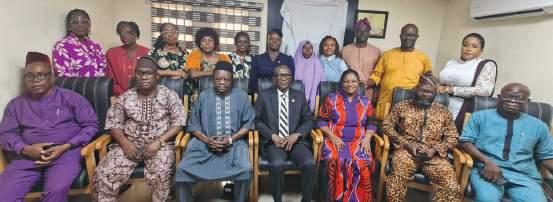
Dr. Aipoh said.
“That tells the world that we are not partial to a better outcome of our healthcare system.”
Yet now, they say, a new layer is being proposed that could undo that work.
Dr. Aipoh walked the room through the bill. The NHFRA, if passed, would have powers to inspect, accredit, certify, monitor, investigate, sanction, and even suspend facilities. It could also appoint “franchisees” to conduct inspections.
To a policymaker in Abuja, that may sound like efficiency. To a clinic owner in Ikeja, it sounds like déjà vu.
“Nigeria already has an extensive health regulatory framework,”
Dr. Aipoh explained, adding, “The Federal Ministry of Health, State Ministries of Health, NHIA, MDCN, PCN, NMCN, and several other statutory bodies are already empowered to regulate different aspects of healthcare delivery.”
His worry is not theory. It is arithmetic.
“If enacted, healthcare providers may be subjected to multiple inspections, multiple accreditation processes, multiple certifications, multiple regulatory fees, and overlapping enforcement actions... Rather than simplifying healthcare regulation, the Bill risks creating an additional layer of bureaucracy that will increase compliance costs without necessarily improving patient outcomes.”
And who pays that cost?
“Setting up a national regulatory agency will create a loss of funds; it will result in more money being charged by providers, and ultimately, the patients will not be able to afford it. Whatever burden you feel economically, who bears the brunt?
The common man out there will bear the brunt, much more than even the man who owns a car.”
He drew a parallel everyone understood: fuel subsidy removal.
“The government thought it was going to offend those who have
cars. But no, the common man out there will bear the brunt because the transportation of foodstuffs and all that affected everything. So if the government wants to say, ‘Oh, we are doing it for the poor man,’ maybe the poor man suffers more.”
Perhaps the most human moment came when Dr. Aipoh spoke about capacity. The bill proposes that the NHFRA can outsource inspections because it may not have enough staff.
To him, that admission said everything.
“After you have not started something, you are already saying that you don’t have enough manpower. If you want to build a house and you don’t have enough blocks, and you say, ‘Come and lay the foundation’... So for them to say they want to set up that body by themselves, they have knocked themselves out.”
He asked a question that hung in the room: why create a new agency when existing ones are underfunded?
“We have the Medical and Dental Council of Nigeria, we have the Pharmacy Council of Nigeria... and so many other regulatory bodies that are recognised by law and the Constitution. So why do you want to smuggle in another one?”
This was not a rejection of the government. On July 9, 2026, HACPAN had presented a formal memorandum at the Senate public hearing. Their tone was respectful, and their task was clear.
“HACPAN respectfully submits that the establishment of the proposed Agency is not the appropriate solution... Our position is not based on opposition to regulation. Rather, it is founded on the need for efficient regulation without unnecessary duplication.”
Their four requests were to withdraw the bill in its current form, strengthen existing institutions, harmonise mandates to remove
duplication, and invest money in digitisation and inspection capacity instead of new offices.
“Nigeria does not necessarily need another healthcare regulator. What Nigeria needs is stronger coordination among the regulators that already exist,” Dr. Aipoh urged.
“We remain fully committed to working with the National Assembly... to develop reforms that improve healthcare quality while promoting efficiency, accountability, and ease of compliance.”
The Faces Behind the Statistics
After the briefing, a woman who runs a 10-bed maternity home in Ajegunle waited to speak. She didn’t give her name. She didn’t need to. She spoke for many.
“If they add one more inspection fee, I will have to increase antenatal. If I increase antenatal, Mama Tolu will go back to the TBA. Is that safer?”
That is the heart of HACPAN’s argument. Policy is not made in a vacuum. It lands in a clinic, on a bill, and in a mother’s pocket..
Dr. Aipoh closed the briefing with gratitude to the media because, he said, without them the story would not travel.
“We appreciate the indispensable role of the media in promoting transparency, accountability, public enlightenment, and national development. We are counting on you to propagate what we believe in about the bill.”
His final warning was not shouted. It was said quietly, like a doctor giving a diagnosis: “Nigerians should look deep. We should be circumspect about that agency that is trying to come because it will not make life better for Nigerians; it will make it worse for Nigerians.”
Outside, Lagos traffic roared on. Inside clinics across the country, nurses were changing gloves, doctors were writing prescriptions, and patients were hoping the cost of care would not rise again next month.
For HACPAN, the fight is not about politics. It is about that patient, and whether the next bill from Abuja helps her or breaks her.
By Ambassador Sola Enikanolaiye
In an era defined by geopolitical competition, trade wars, sanctions regimes, and shifting alliances, one phrase has migrated from European policy papers to the heart of African diplomacy: “Strategic Autonomy”.
For Nigeria, this is not a new experiment in isolation, nor is it a nostalgic return to Cold War non-alignment. As I outlined in a recent address from the Ministry of Foreign Affairs in Abuja, it is something far more direct and more urgent.
Strategic autonomy is alignment to Nigerian national interest. Once you are clear in what constitutes your national interest, you align with those interests regardless of which party is at the receiving end. That is the foundation. I am aware of scholarly publications that was recently put together by the Nigerian Institute of International Affairs on the subject.
While the Ministry prepares the full concept note charting new fronts in a multi polar world, let me share the preliminary framework guiding Nigeria’s foreign policy under President Bola Ahmed Tinubu. Our goal is simple: to ensure that Nigeria, and by extension Africa, is not an object of geopolitics, but a subject that defines its own future.
What Strategic Autonomy means for Nigeria and Africa.
Strategic autonomy is often misunderstood as withdrawal. It is the opposite. It is engagement on our terms. Today, Nigerian Foreign Policy has shifted. Gone is the era of reactive alignment. The Tinubu 4Ds agenda is anchored on strategies that are clearly designed to bring succor to Nigerians. The deliberate pursuit of Nigeria’s national interest across economic, security, technological, and diplomatic domains, without being locked into any single bloc. Nigeria’s strategic autonomy rests on 5 pillars in a world of continuous alignment. Together, they form the blueprint for how Nigeria engages a world that is no longer unipolar, but contested, transactional, and opportunity-rich.
Alignment to Nigerian national interest is the guiding rule. For Nigeria, Foreign Policy begins at home. Every treaty, partnership, and diplomatic gesture is measured against one question: does it deliver jobs, infrastructure, security, defence and dignity for Nigerians? This principle was tested in the enforcement of the One China Policy. When diplomatic lines were blurred, the Ministry acted decisively: relocating trade missions from Abuja to Lagos, Nigeria’s commercial hub, and reaffirming that Nigeria speaks with one voice. There is no room for diplomatic blunder in Nigeria. The message is clear: Nigeria will be a partner, not a pawn. Strategic autonomy means clarity of position first, and flexibility in tactics second.
AfCFTA + global partnerships like China’s zero-tariff access. Nigeria is done with aid-for-diplomacy. The new model is trade-for-growth. Under President Bola Ahmed Tinubu’s Renewed Hope Agenda, Nigeria is leveraging two levers simultaneously:
1. Continental integration through the African Continental Free Trade Area, to build regional value chains.
2. Global partnerships that open markets. China’s zero-tariff policy for eligible Nigerian exports is a case in point, creating new pathways for agriculture, manufacturing, and solid minerals to reach 1.4 billion consumers.
From the Lagos-Calabar coastal transport system to industrial parks in Ogun and Lekki,
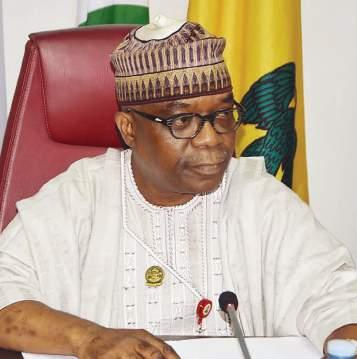
Chinese, European, and Gulf investments are being steered toward productive sectors. The goal is not dependency, but diversification: more partners, more markets, more Nigerianmade exports.
African-led, but open to any partner that delivers results. Nigeria’s security doctrine is rooted in the principle that Africans must lead African solutions. ECOWAS, the AU, and regional counter-terrorism frameworks remain central.
But strategic autonomy also means pragmatism. On terrorism, maritime security in the Gulf of Guinea, and cyber threats, Nigeria is open to cooperation with any partner, East or West that brings intelligence, technology, and capacity without conditions that undermine sovereignty. The benchmark is simple: results for Nigerian communities. Partnerships are judged not by ideology, but by impact on the ground.
Build, don’t just buy. Lead in AI and digital infrastructure. The 21st century will be won on data, chips, and talent. Nigeria refuses to be only a consumer. This is the essence of Minister Bosun Tijjani’s reforms in our digital ecosystem. Through partnerships in 5G, fiber optics, and smart cities, Nigeria is negotiating technology transfer, not just procurement. Engagement with the World Artificial Intelligence Organization and related partnerships signal intent: to move from adoption to authorship.
The aim is to build domestic capacity in AI, fintech, and digital governance, so that Nigerian developers, not just foreign vendors, shape the platforms used daily by 200 million Nigerians. Technological agency is sovereignty in the digital age.
Engage all major powers without being
locked into one camp. In a multipolar world, alignment is a choice made per issue, not per decade. Nigeria maintains a Comprehensive Strategic Partnership with China on infrastructure and more. It deepens trade and security ties with the US and EU. It expands South-South cooperation with India, Brazil, and the Gulf. It leads on the continent through AfCFTA and AU reform.
This is not non-alignment. It is multialignment: engaging all, belonging to none, and extracting maximum value for Nigeria from each relationship. Strategic autonomy is alignment to Nigerian national interests. Nigeria’s 5 Pillars offer more than a foreign policy. They offer a template for mid-sized and emerging powers navigating great power competition. It is a policy of conviction without rigidity. Of partnership without dependence. Of ambition without illusion.
Nigeria will continue to deepen partnerships that deliver infrastructure, jobs, and technology, but always on Nigerian terms. In 2026, the measure of sovereignty is not who you oppose. It is what you are able to build.
We can no longer afford an economy built only on exporting raw materials to one market and importing finished goods from another. The African Continental Free Trade Area gives us the platform to build regional value chains. At the same time, we must diversify globally. This is why we welcome China’s decision to grant zero-tariff treatment to 53 African countries, while we simultaneously deepen trade with the EU, the US, the Gulf, and our neighbors in ECOWAS. No single partner can meet all our development needs, and we will not be dependent on any one.
The primary duty of any government is the protection of its citizens. That principle must guide our security partnerships. African-led solutions through the AU and ECOWAS remain our first choice. But we will not outsource our judgment. We greatly appreciate the US but if any country says he can help me to wipe out terrorism in Nigeria in the next two weeks, will I say
because I’m friend to the US I will not agree? No,”. The safety of Nigerians comes first. Strategic autonomy means we evaluate every security offer by one metric: does it deliver peace, security and stability for our people?
In a multipolar world, we must talk to everyone and be forced to choose no one. This is not duplicity. It is maturity. We have demonstrated this in recent weeks. We condemned Afrophobic attacks in South Africa because the dignity of Nigerians abroad is non-negotiable. We pushed the agenda at the recent ECOWAS Summit in Freetown Sierra Leone where President Tinubu’s voice was clear and unambiguous. At the same time, we are preserving and strengthening the Nigeria-South Africa strategic partnership because both countries benefit from trade, investment, and regional leadership. That is strategic autonomy in practice.
The 4D Agenda meets a fragmenting World
The global shifts make this doctrine necessary today. Today, we have multipolarity. The unipolar moment has passed. Power is diffused across Washington, Beijing, Brussels, New Delhi, Riyadh, and other capitals. Under President Tinubu’s 4D Foreign Policy Agenda: Demography, Development, Diaspora and Democracy — Nigeria’s diplomacy is calibrated to one question: what does this mean for Nigerian citizens? Ideological blocs are secondary to results. Africa has 60% of the world’s youngest population. By 2050, one in four people on earth will be African. Nigeria will be the third most populated country in the world by 2050. We cannot allow our future to be scripted by others. We must define our own development model, centered on jobs, skills, and innovation. In this context, some analysts have described our approach as “pragmatism devoid of doctrine.” I disagree.
“I don’t agree with that kind of characterization. Everything foreign policy is about national interest,”. What we are doing is giving that age-old principle a modern name and structure. We are drawing from our own history. As one of my lecturers at the University used to say, “ non-alignment is alignment to your national interest.” That remains true. Doctrine without delivery is rhetoric. For strategic autonomy to produce tangible benefits, Africa must take deliberate steps.
We must fully implement AfCFTA to unlock a $3.4 trillion single market. That means reducing tariffs, harmonizing standards, and building cross-border infrastructure. We must invest heavily in energy and infrastructure. No factory runs without power. No trade happens without roads, rail, and ports. Strategic autonomy requires industrial power.
Africa must speak with one voice in global forums — at the UN, G20, and WTO. Africa’s 54 countries carry more weight together than separately. It is time to protect and deepen democratic institutions. Autonomy should never be confused with authoritarianism. The legitimacy of our choices comes from the consent of our people.
Let me be clear. Strategic autonomy is not about turning our backs on partners. It is about choosing partners freely. It is the right to trade with anyone, learn from everyone, and be dominated by no one. The world is fragmenting into blocs. Africa’s best option is not to join a bloc, but to become a bloc ourselves — economically integrated, politically coherent, and diplomatically confident.
•Ambassador Sola Enikanolaiye is Minister of State for Foreign Affairs, Federal Republic of Nigeria
Edited by nseobonG okon-ekonG |
At the 2026 Enugu Gaming Conference, industry leaders, regulators, technology experts and operators confronted a defining question: Can Nigeria move from merely consuming gaming technology to building, securing and owning the infrastructure that powers its digital gaming economy? n seobong o kon- e kong reports
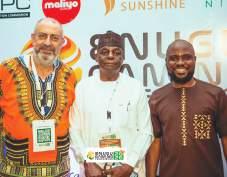
For two days, the International Conference Centre in Enugu became something of a laboratory for the future of Nigeria’s gaming industry. The conversations were not about the familiar language of jackpots, odds and winning tickets. They went deeper—into code, capital, cybersecurity, regulation, data, trust, player protection and the difficult business of building technology that Nigerians can confidently call their own.
Under the theme, ‘Code, Capital and Compliance: Unlocking Nigeria’s iGaming Tech Opportunity’, the 2026 Enugu Gaming Conference brought together regulators, operators, technology specialists, developers, investors and other stakeholders for a conversation that increasingly felt less like an industry gathering and more like a strategic interrogation of where Nigerian gaming goes next.
The central question was difficult, even uncomfortable: Can Nigeria own its iGaming technology? It was a question that exposed both the enormous possibilities before the industry and the gaps that must be closed if those possibilities are to become reality.
For Ejiofor Agada, Planning Committee Lead of the Enugu Gaming Conference, the evolution of the event reflects a deliberate ambition. The conference, he explained, began with a simple conviction—that the Nigerian gaming industry was important enough to deserve a platform that speaks directly to its realities, opportunities, challenges and future.
That idea has grown. Today, the Enugu Gaming Conference is positioning itself as a serious Nigeria-focused gaming platform, attracting some of the finest minds in the sector while deliberately opening its doors to respected experts from outside the country.
The distinction is important. Agada says international participation is not intended to dilute the Nigerian identity of the conference, but to enrich it. The ambition is to build a platform that is “credible, Nigeria-centric, impactful, commercially relevant and globally respected”, without pretending to be anything other than what it is.
The message is unmistakable: Nigeria must learn from the world, but it must
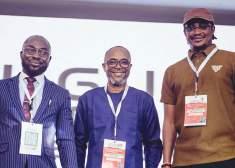





also develop the confidence and capacity to contribute to the global gaming conversation. And that conversation has become increasingly urgent.
The baTTle over who owns The Technology
Perhaps nowhere was the urgency more apparent than during the opening panel session, ‘Building the Stack: Can Nigeria Own its iGaming Technology?’
The question sounded technological. The answers, however, were profoundly human. They touched on trust, competence, data protection, accountability, cross-border payments and the willingness of operators to put their businesses—and their customers—in the hands of Nigerian-built systems.
Oluchi Amadi, a cybersecurity expert, brought the discussion down to one of the most fundamental resources in the digital gaming economy: data. Her question was simple but unsettling: If Nigeria cannot keep its data safe, can it truly claim to own the technology?
The scale of the challenge is considerable.
Amadi pointed to the enormous volume of data generated by millions of people participating in gaming activities and warned against the uncertainty that can arise when operators and regulators are unclear about who bears responsibility for protecting sensitive player information.
In an industry where technology increasingly sits at the heart of transactions, she argued, cybersecurity cannot be an afterthought. Too often, security is considered near the end of a technology rollout, when the system has already been designed and built.
That approach, she suggested, is no longer sufficient. Security must be embedded from the beginning. It must be part of the architecture, continuously monitored and constantly strengthened.
For Nigeria to truly own its iGaming technology, its engineers cannot simply write the code. They must be capable of building, securing and governing the entire technological engine. That is the difference between using technology and owning it.
alone is noT enough
But technology ownership is not simply a question of whether Nigeria has enough programmers. Derrick Kentebe, Executive Chairman of YangaGames, believes the country has the talent required to take advantage of the opportunity.

L-R: Representative of Akwa Ibom State on the NDDC Board, Apostle Abasiadikan Nkono; Sir Emem Akpabio; wife of Ikot Ekpene Local Government Chairman, Mrs. Nkom; Chairman, Essien Udim Local Government Area, Ntiedo Usoro; wife of the President of the Senate, Mrs. Unoma Godswill Akpabio, who represented the Senate President; Chairman of Ikono Local Government Area, Mrs.
and Delivery Advisor to the Governor on Health, Prof A. Umoh, during the inauguration of projects in Ikono Local Government Area by Akpabio, yesterday
concerns of Nigerian workers.
A Coalition of Civil Society Organisations for Good Governance in Nigeria has commended the Director-General of the Department of State Services (DSS), Mr. Oluwatosin Ajayi, for what it described as his commitment to strengthening national security, professionalism and institutional effectiveness.
The coalition also expressed confidence in President Bola Ahmed Tinubu’s administration, endorsing its good governance agenda and ongoing reforms aimed at promoting stability and national development.
Speaking during a rally in Abuja on Wednesday, the National Chairman of Nigeria Citizens Watch for Good Governance, Collins Eshiofeh, said the coalition’s mission was to support responsible leadership, oppose criminality and promote constructive engagement in the interest of the country.
He praised President Tinubu’s leadership, particularly the administration’s reforms and the approval of a new national minimum wage, describing it as evidence of a government that listens to the
The coalition also expressed confidence in the leadership of the DSS Director-General, describing the agency under Ajayi as more professional, proactive and committed to its constitutional responsibilities.
“Under his watch, the DSS has become a professional, proactive
“We are immensely proud of the exemplary leadership displayed by His Excellency, President Bola Ahmed Tinubu. His Renewed Hope Agenda has brought bold reforms, and the approval of a new national minimum wage after painstaking negotiations shows a President who listens to the cries of the Nigerian worker and acts with compassion,” Eshiofeh said.
and fearless institution. He has led the charge against terror cells, bandits and those who seek to destabilise our nation. His leadership is characterised by quiet competence and resolute patriotism,” he said.
Eshiofeh said the coalition was passing a vote of confidence in both President Tinubu and the DSS
Director-General, adding: “They are doing a good job, they are doing an excellent job. We see it, we acknowledge it, and we will defend it.”
The coalition, however, urged security agencies and relevant institutions to continue discharging their constitutional responsibilities professionally, impartially and in
accordance with the rule of law. It stressed that Nigerians deserve a society where justice is administered fairly, public safety is guaranteed and citizens’ rights are protected, adding that it remained committed to promoting good governance, accountability and constructive civic engagement for national progress.
The Chief Whip in the House of Representatives between 1999 and 2007, Alhaji Abubakar Bawa Bwari, has disagreed with former President Olusegun Obasanjo over his remarks that Speaker of the House, Alhaji Ghali Naaba, was given N5million to unseat him (Obasanjo) Bawa Bwari in a statement made available to newsmen in Minna Niger State said former President Obasanjo’s statement
“Does a grave injustice to the memory of our late former speaker and my dear friend”.
The former Chief Whip declared: “It is trite law that a speaker, no matter how influential, cannot single-handedly remove a president. It requires a constitutional two-thirds majority of the entire House, followed by a rigorous, concurrent process in the Senate.”
He asked: “Was this N5 million therefore intended for Ghali alone, or was it meant to be distributed
Onuminya
Leading cement manufacturer, BUA Cement PLC, has graduated 60 youths trained as heavy duty machine operators at its Sokoto plant, with 52 of the graduands offered automatic employment by the company.
The graduation ceremony held in Sokoto on Wednesday was part of BUA’s Corporate Social Responsibility drive aimed at empowering host communities and reducing youth unemployment in the state.
Speaking at the event, the Managing Director and Chief Executive of BUA Cement, Engr. Muhammad Haliru Binji, who was represented by the Plant Director, Engr. Aminu Bashir, said the trainees underwent a rigorous six-month
technical training program.
Binji explained the program was designed to equip youths with practical skills in the operation and maintenance of heavy-duty equipment used in cement production and mining operations.
“Most of these trainees can now operate more than two machines. They are fast learners and have shown commitment throughout the training period,” he said, adding that the initiative aligns with the company’s human capital development policy.
According to him, a deliberate decision was taken to prioritize indigenes from BUA’s host communities in Wamakko and neighboring local government areas for the training.
“This is part of our efforts to empower and give jobs to the youth
from our host communities. We are also trying to complement the efforts of the Sokoto State Government in curbing unemployment,” Binji stated.
Representing Governor Ahmed Aliyu, the Commissioner for Commerce, Haruna Abbas Bashir, commended BUA Cement for the gesture, describing it as timely and impactful.
The Commissioner said the state government, under the 9-Point Smart Agenda of the Aliyu administration, has also rolled out several vocational skills programs to make youths self-reliant.
“As a government, we have put machinery in place to create jobs for our teeming youth. Partnerships like this with BUA Cement are exactly what we need to drive economic growth and reduce poverty,” he said.
across 360 members of the House and 109 Senators, and Senate President Anyim Pius to purchase a constitutional coup?”
Bawa Bwari said the late Speaker Ghali Naaba “was far too sophisticated a political scientist, and far too deeply principled an institutionalist, to ever engage in an enterprise so hollow” adding that he (Naaba) was “simply too committed a democrat to dabble into such shenanigans.
“If anything, his Speakership was the one constantly assailed by fifth columnists sponsored by the executive to remove him (Naaba) adding that, “Indeed, on one occasion we were forced to take the extraordinary step of
displaying on the floor of the house, the money some members took from the presidency as inducements to impeach Ghali from office”.
Bawa Bwari observed that the House leadership was actually quite wary of Vice President Atiku Abubakar during those specific standoffs saying, “We viewed him not as an ally in any impeachment drive, but as President Obasanjo’s chief envoy and defender claiming that whenever the friction between the executive and the legislature reached a boiling point, it was Atiku who frequently appeared at our doorsteps.
The former chief Whip also recalled several interventions by
prominent and respected Nigerians who helped to douse tensions between the lawmakers and former president Olusegun Obasanjo saying that then speaker Ghali Naaba “respected the presidency, even as we fiercely guarded the independence of the legislature”. His words: “Ghali Na’Abba’s battles with the executive were never personal, nor were they transactional. He was driven by an unyielding devotion to the doctrine of the separation of powers.
“He believed, with every fiber of his being, that for Nigerian democracy to survive its infancy, the legislature could not afford to be an appendage of the executive.
Umahi: Tinubu’s Reforms Driving Economic Recovery as FG Begins 122km
Uba Sani says president fulfilling promises to Northern Nigeria
Emmanuel Addeh in Abuja
The Minister of Works, Senator David Umahi, has declared that the economic reforms of President Bola Tinubu are beginning to yield tangible results, arguing that the administration’s aggressive investment in road infrastructure is helping to tackle insecurity, stimulate economic growth, improve agricultural activities and reconnect communities across the country.
Umahi spoke during the official flag-off of the reconstruction of the
122-kilometre Kaduna (Mando)–Birnin Gwari Road in Kaduna State, describing the project as another fulfilled promise by President Tinubu under the Renewed Hope Agenda.
The minister, in a statement by his spokesman, Francis Nwaze, maintained that road infrastructure had become a key instrument for addressing several of the nation’s socio-economic challenges. “We are using this road infrastructure to fix the economic problems we met on the ground. We are using road infrastructure to fight the insecurity
we met on the ground. We are using road building to fight hunger we met on the ground. We are using this road infrastructure to fight the injustices we met on the ground where some states had no federal project like Plateau, Gombe, Ebonyi and even Kaduna,” Umahi stated.
According to him, the Kaduna–Birnin Gwari Road will significantly improve connectivity between Northern Nigeria and Lagos by providing a shorter transportation corridor through Niger, Kwara, Osun and Oyo states.

L-R: Revered Mrs. Victoria Onu, author of the book, Mr. Nkem Ukwa; Mrs. Daniella Ukwa; and Head of Radiography NNPC, Mr. Chile Samuel, during the launch of the book titled “The Conquest in Abuja”... recently
In a major boost to President Bola Tinubu’s digital economy agenda, the Nigerian Communications Commission (NCC) and the Enugu State Government, on Tuesday, sealed a strategic 15-year lease of the agency’s Digital Industrial Park and Learning Centre to the Enugu State Government.
The move would see the Enugu State Government take over and optimise the facilities located in the state capital as the Enugu Talent City and Artificial Intelligence (AI) Institute
in line with the digital economy drive of the Governor Peter Mbah Administration.
Speaking during the lease agreement signing ceremony at Government House, Enugu, the Executive Vice Chairman/CEO of NCC, Dr. Aminu Maida, said the arrangement fully aligned with the Renewed Hope Agenda of the President Bola Tinubu Administration, and its ambition to grow Nigeria into a $1 trillion economy driven by productivity, innovation
and private sector growth.
Maida stressed that Mbah had shown a clear agenda to build Enugu State into a digital economic powerhouse through deliberate investment in education, infrastructure, innovation and digital capacity, maintaining that the Mbah Administration was well positioned to advance the objectives for which these facilities were established.
“Our expectation is that this partnership will support Enugu’s ambition to become a leading destination for digital
services, artificial intelligence, startup incubation, outsourcing, research and technology-enabled enterprise.
“We also expect these facilities to become spaces where young people acquire relevant skills, entrepreneurs transform ideas into viable businesses and local enterprises connect to opportunities beyond Enugu and Nigeria.
“These facilities were conceived as platforms for innovation, entrepreneurship and human capital development. They were designed to deepen
The West African Examinations Council (WAEC) yesterday, announced the results of the 2026 Computer-Based West African Senior School Certificate Examination (CB-WASSCE) for school candidates, with 1,200,514 candidates, representing 61.54 per cent obtaining credits in at least five subjects, including English Language and Mathematics.
Briefing journalists in Lagos, the Head of the Nigeria National Office (HNO), Dr. Amos Josiah Dangut, stated the figure represents a 1.42 percentage-point decline compared to the 2025 performance.
He disclosed that 1,950,726 candidates sat the examination out of the 1,959,668 who registered from 24,207 schools across Nigeria, as well as selected schools in Benin Republic, Côte d’Ivoire and Equatorial Guinea operating the Nigerian curriculum.
The analysis of candidates’ performance showed that 1,687,378 candidates, representing 86.50 per cent, obtained credit passes in at least five subjects, with or without English Language and Mathematics.
According to Dangut, 1,834,695 candidates, representing 94.05 per cent, have had their results fully processed and released, while the results of 116,031 candidates (5.95 per cent) are still being processed due to issues that are being resolved.
He assured affected candidates that efforts were underway to conclude the process within a few days.
The HNO also disclosed that
the results of 167,486 candidates, representing 8.59 per cent of those who sat the examination, had been withheld over alleged involvement in examination malpractice.
He noted that the figure is lower than the 9.7 per cent recorded in 2025, indicating a reduction in malpractice cases.
He attributed the improvement to the council’s sustained antimalpractice measures, including the expansion of computer-based examinations, serialisation of question papers and the introduction of the Digital Examiner Marking System (DEMS), which has accelerated result processing and enhanced service
delivery.
“The council has consistently devised means of combating examination malpractice. The adoption of computer-based examinations and other innovations has significantly strengthened the integrity of the examination process,” he stated.
Dangut whose tenure as Head of the Nigeria National Office ends with the release of the 2026 results described the council’s transition to computer-based examinations as a landmark achievement, saying WAEC had become the first examining body in Africa and among the first globally to conduct achievement tests using the computer-based mode.
He noted that for the second consecutive year, school candidates were allowed to choose between computer-based testing and the traditional pen-and-paper format.
The WAEC boss however stated that the conduct of the examination was not without challenges, citing logistics, late registration by schools, inflation-driven operational costs and the activities of rogue websites promoting fake examination materials.
He condemned the activities of fraudulent online operators who exploit students and parents by peddling fake examination questions and spreading misinformation in the council’s name.
digital skills, support startups, attract investment, create jobs and position Nigeria as a competitive destination for business process outsourcing, knowledge process outsourcing and other technology-enabled services.
“In essence, they were built not merely as physical assets, but as platforms for developing the people and enterprises that will power Nigeria’s digital economy.
“So, for us at the NCC, completing physical infrastructure is only the beginning. Buildings alone do not create innovation. People do. Ideas do. Entrepreneurs do. And partnerships bring all these elements together,” he said.
The NCC boss also commended Governor Mbah’s investment in Smart Green Schools, saying he was building an economy prepared for the future.
“Physical infrastructure is essential to development, but infrastructure alone cannot deliver lasting prosperity. This is what makes the Smart Green Schools initiative significant. It recognises that preparing our children for tomorrow must begin today.
“Technology-enabled schools, digital learning facilities, robotics and artificial intelligence laboratories demonstrate an understanding that education must evolve alongside technology. That is leadership with the future in mind.
“Investment in education and skills raises productivity, expands economic opportunity and strengthens the abil-
ity of individuals and businesses to create value.
“This is even more important today. Artificial Intelligence is reshaping industries. Automation is changing the nature of work. Digital technologies are transforming how governments serve citizens and how businesses operate,” he concluded.
Speaking, Governor Peter Mbah commended President Tinubu for recognising the centrality of the digital economy to the $1 trillion economy he seeks to build, as well as for understanding that much of that growth would come from the states. He noted that AI would contribute about $20 trillion to the global economy by 2030, saying, “It is not a space you want your young ones to be missing.”
“We also believe that our talents, our brightest talents, should not be exported in person. We believe that they should export their talents outside the country from here, and that is why we see huge benefits in these assets in terms of job creation and opportunities for our young people.
“We are also looking at transforming the Digital Bridge Institute into a world-class AI institute. We will also transform the Digital Industrial Park.
“If you have followed the news, we have already taken steps, working with some teams from Qatar, to make sure that it becomes a certification centre for AI on the continent.
The Nigeria Deposit Insurance Corporation (NDIC) has commenced the payment of insured deposits to customers of the 46 microfinance banks whose operating licences were recently revoked by the Central Bank of Nigeria (CBN) last month.
Managing Director and Chief Executive of the NDIC, Mr. Thompson Oludare Sunday, disclosed this yesterday, at a retreat for members of the House of Representatives Committee on Insurance and Actuarial Matters in Lagos.
He said the Corporation moved swiftly to begin reimbursing depositors after the CBN revoked the
licences of the affected microfinance banks and appointed the NDIC as provisional liquidator.
“We are working on those. The CBN revoked the licences, and we were appointed as the provisional liquidator. We have started paying depositors of those banks, and gradually we intend to cover all the insured depositors,” Sunday said.
He explained that beyond paying insured deposits, the NDIC had commenced the recovery of outstanding loans owed to the failed institutions as well as the disposal of their assets to generate funds for the payment of uninsured depositors.
“Our function as liquidator involves the payment of guaranteed
sums. Thereafter, we go after those who owe the institutions and have not paid. We also ensure that we sell the available assets and realise their investments towards paying the uninsured portion of the deposits. So, we have started paying the guaranteed deposits. What we are doing now is also realising the assets of those institutions,” he added.
Although Sunday declined to disclose the number of depositors already paid from the 46 failed microfinance banks, he said the Corporation was leveraging the Bank Verification Number (BVN) database in collaboration with the Nigerian Inter-Bank Settlement System (NIBSS) to identify beneficiaries
and credit them automatically.
“So, the more accounts we discover, the more payments we make,” he said.
Providing an update on the liquidation of Heritage Bank, Sunday revealed that approximately 700,000 depositors had already received their insured deposits, while efforts were ongoing to trace other customers whose records could not be matched due to incomplete or outdated information.
He attributed the challenge largely to legacy accounts opened before the introduction of the BVN system and poor customer records inherited from predecessor institutions.
“For the guaranteed sum, we do
not need you to come forward before you are paid. Of course, there are challenges in the Nigerian system,” he said.
According to him, Heritage Bank evolved through the acquisition and merger of several financial institutions, including Enterprise Bank, which itself inherited customers from banks such as Spring Bank and Guardian Express.
“There are depositors we have not been able to trace, and this is an opportunity for them to come forward. I am sure many of us did the National Youth Service Corps (NYSC) and may have left some money in an account, but there was no BVN then.
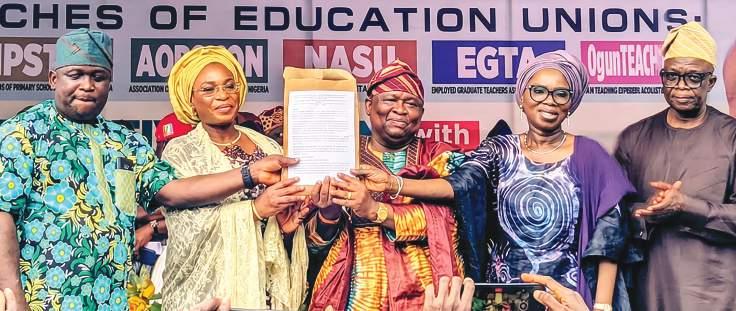
L-R: Chairman, Nigeria Union of Teachers(NUT), Ogun State, Comrade Sewakanu Noah; Wife of the Governorship Candidate, All Progressives Candidate, Ogun State, Mrs. Temitope Adeola; Governorship Candidate, All Progressives Congress, Ogun State, Senator Solomon Olamilekan Adeola; Deputy Governorship Candidate, APC, Ogun State, Mrs. Kudirat Adegunwa-Balogun, and Commissioner for Education, Ogun State, Prof. Abayomi Arigbabu, during an interactive session with leaders and members of teachers’ unions and support groups held at Ake Palace, Abeokuta, Ogun State, yesterday
Alex Enumah in Abuja
Rights activist and Senior Advocate of Nigeria, Mr Femi Falana, has taking on former military head of state, General Abdulsalami Abubakar, for attempting to dismiss corruption allegations against former military head of state, the late General Sani Abacha. Abubakar had in an interview published by the Sun newspaper of June 26, 2026, explained that the late General Sani Abacha, never stole money belonging to the country.
The ex-general had in the interview stated that what is usually referred to as Abacha loot was money the former head of state had saved for the country, following advice from former Libyan Leader, Muammar Gaddafi; former Benin Republic President, Mathieu Kérékou and others, in order for the country not to be financially handicapped in case of freezing of the nation’s accounts arising from sanctions from the international community.
Responding, the senior lawyer who accused the former head of state “belatedly” joining “the dubious campaign to sanitise the ignominous Abacha era”, argued that although Presidents Gaddafi and Kerekou are no longer alive to confirm or deny the claim, they could not have advised General Abacha to engage in the “reckless looting of the nation’s treasury”.
Further accusing the retired general of attempting to rewrite history in a rather untidy manner, Falana stated that General Abubakar did not believe the story that General Abacha had saved any money for the country, as he had July 23, 1998, as head of state instituted a Special Investigation Panel (SIP) with the sole mandate to investigate the looting and corruption that characterised the Abacha era.
“In the course of the investigation, the SIP headed by Mr. Peter Gana, a Deputy Commissioner of Police unravelled the gargantuan Abacha loot with the connivance of the management of the Central Bank of Nigeria. A large quantity of the cash and properties were recovered by the SIP.
“In its report published in November 1998, the SIP revealed that General Abacha approved several fake funding requests for security operations or purchase of equipment by his National Security Adviser (NSA). Upon approval of the fraudulent funding requests, General Abacha directed the Central Bank to release cash in dollars and pounds. The cash was then handed over to the NSA who ensured that the cash was transferred to family members and business associates of General Abacha. It was also confirmed that many properties in many cities were bought with the stolen funds.
“General Abubakar accepted the report in toto and promptly acted on it. In particular, he promulgated and signed the Forfeiture of Assets, Etc. (Certain Persons) Decree No. 53 of 1999, which legitimised the forfeiture and return of the Abacha loot located in Nigeria and Sierra Leone.
“Pursuant to the decree, General Abacha, family members, political associates and political allies were made to forfeit the total sum of $636, 263,187,19, £75, 306 886.93, DM 30m and N547 million as well as 30 percent shares in 2 refineries in Sierra Leone worth $380,000. Also forfeited were several properties in the choice areas in Lagos, Abuja, Kano, Zaria and very expensive official vehicles that had been converted to illegal use by Abacha’s aides”, Falana stated.
According to Falana, the retired general must have forgotten that he was the first ruler to indict,
name and shame General Abacha for the large scale looting of the treasury.
“To that extent, the former military ruler deliberately set out to mislead Nigerians to believe that the Abacha loot is a hoax. But having recovered funds and assets worth over $750 million from the estate of the late dictator, his family members and associates, General Abubakar cannot be permitted to
cover up the grand larceny of his predecessor”, he added.
The rights activist lamented that General Abubakar, out of sheer class solidarity, has turned round to claim, “rather falsely that the Abacha loot was money saved for the Government of Nigeria”.
He argued that having promulgated and signed the Forfeiture Decree No 53 of 1999 which legalised the forfeiture of the
Abacha loot, General Abubakar should apologise to Nigerians and withdraw the statement that the Abacha loot is a hoax.
He also said that the ex-head of state should step down as the Chairman of the National Peace Committee set up to mediate political tensions and organise peace accords for Nigerian elections.
“Finally, we are compelled to attach a copy of the Forfeiture Decree
No 53 of 1999 promulgated and signed by General Abdulsalami Abubakar on May 26, 1999 which listed the funds and properties “acquired corruptly and illegally” by General Abacha, his family members and business associates. In addition, the decree has exposed the barefaced lie that the Abacha loot was money saved for the Government of Nigeria”, Falana added.
The Federal Government has directed the immediate implementation of measures to strengthen the protection of health workers across Nigeria.
It said that henceforth, anyone who intimidates or harasses a health worker shall be investigated and, where the evidence so warrants, prosecuted under the applicable laws of the land.
This followed the submission of the report of the Ministerial Committee on the harassment of health workers by security personnel.
The Committee was constituted on May 19, 2026, following the incident at the University of Uyo Teaching Hospital (UUTH), Akwa Ibom State, involving operatives of the Economic and Financial Crimes Commission (EFCC) and members of the hospital workforce.
The incident disrupted clinical services and triggered industrial action.
A statement signed by the Permanent Secretary of the Federal Ministry of Health and Social Welfare Daju Kachallom
said the Committee found that the Uyo incident was not isolated.
She that eighteen incidents of assault, intimidation or harassment were reported across federal tertiary health institutions within the preceding twelve months, involving patients, relatives, members of the public and security personnel.
“The reported incidents resulted in “bodily injury, psychological harm, damage to hospital property, disruption of services and industrial action, poor communication, prolonged waiting times, inadequate staffing, deficient infrastructure, emotional distress, abuse of authority and the absence of clear security protocols were identified as contributory factors”.
The statement said that the Coordinating Minister of Health and Social Welfare, Prof. Muhammad Ali Pate, has accepted the Committee’s recommendations and directed their immediate implementation in accordance with the accompanying action plan.
“Health workers dedicate their lives to caring for Nigerians and must be able to carry out their duties in an environment that is
safe, secure and free from violence, intimidation or harassment.
“The Federal Government will continue to work with all relevant institutions to protect our health workforce, uphold the rule of law and ensure that healthcare delivery is never compromised,”
Prof. Pate said.
“Accordingly, any person who assaults, threatens, intimidates or harasses a health worker shall be investigated and, where the evidence so warrants, prosecuted under the applicable laws of the Federal Republic of Nigeria.
It said that absence of a specific law relating solely to violence against health workers shall not preclude enforcement under existing criminal, civil or administrative laws.
Sanctions, compensation and other remedies available under the law shall be pursued in appropriate cases.
“Federal Tertiary Health Institutions are to strengthen their internal security arrangements, establish Violence Prevention Teams and improve access control, surveillance, visitor identification and security within emergency units
and other sensitive service areas.
“Each institution shall designate officers to liaise with Law Enforcement Agencies. Security operations within hospital premises must be conducted in a manner that does not endanger patients, obstruct treatment, breach confidentiality or interrupt essential health services.
“Such operations shall be governed by agreed rules of engagement and, where necessary, formal memoranda of understanding,” it said.
The ministry said that the measures were part of broader efforts to improve workplace safety, the quality of patient care and public confidence in health institutions.
“The broader policy recommendations contained in the report will be presented to the next National Council on Health for consideration towards the adoption of a national framework applicable to Federal, State and private health institutions.
“The Ministry shall monitor implementation against assigned responsibilities and timelines, with periodic progress reports submitted to the Coordinating Minister”.
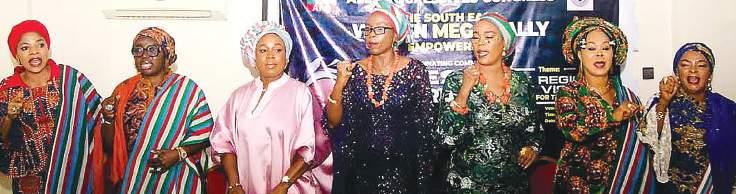
L-R: National Organising Secretary, Tinubu Touch Bearers, Hon. Princess Gloria Akobundu; APC Deputy Governorship Candidate, Anambra State, Sen. Dr. Uche Ekwunife; Leader, Abia Progressive Women, Adamazi Mary Ikoku; APC South East Women Leader, Dr. Oby Ajih; Member, National Salaries, Incomes and Wages Commission, Hon. Ginika Tor Esq; Former Minister of Women Affairs, Mrs.
Ohanenye; and Member, MBNCWD, Princess Anne Agomeze, all members of the newly inaugurated National Coordinating Committee for the APC South-East Women Mega
during a media briefing in Abuja, ahead of the regional gathering scheduled for August 18, 2026, at Okpara Square, Enugu State, yesterday
and Empowerment
Makinde seeks Methodist Church’s support for presidential bid Oyo gov’s reset agents, national volunteers commence registration
Okocha in Abuja and Kemi
Vice-presidential candidate of the Africa Democratic Congress (ADC), Rotimi Amaechi, has urged opposition parties to unite ahead of the 2027 general election if they must stop the ruling All Progressives Congress (APC) party from continuing to hold power.
Amaechi spoke while receiving a faction of the Peoples Democratic Party (PDP), led by Kabiru Tanimu Turaki, SAN, on a condolence visit over the death of his mother, Dame Ezinne Mary Amaechi.
Amaechi, however, urged opposition parties to close ranks, warning that disunity would make it easier for the APC to retain power.
He said cooperation among opposition parties remained the only realistic path to defeating the APC and voting out the President Bola Tinubu administration.
Amaechi urged opposition leaders to continue exploring areas of cooperation as the election approached.
He warned that failure to unite behind a common objective could give the ruling party an easy route to victory.
According to him, opposition parties must place the interests of Nigeria and its citizens above
individual political ambitions and partisan differences.
He maintained that a fragmented opposition would weaken efforts to challenge the APC at the polls.
During the visit, Amaechi also reflected on the sacrifices made by his parents, particularly his mother, in raising him and his siblings.
He described her support and commitment to the family as central to his upbringing and development.
The Turaki-led PDP faction, in a statement by its Publicity Secretary, Ini Ememobong, said Dame Amaechi’s death was a major loss and offered sympathy to Amaechi’s family.
He said the pain of losing a mother was difficult to prepare for and assured Amaechi of the party’s sympathy.
“Nothing prepares anybody for the loss of a parent, especially a mother. So, we can only imagine the deep loss and grief that you and your family are going through,” he said.
The faction also recalled Amaechi’s years in the PDP, during which he served as Speaker of the Rivers State House of Assembly and later governor of the state.
“As a party on whose platform you served the good people of Rivers State as Speaker and later
as governor, we share in your grief and encourage you to be strong, knowing the certainty of death and its role as a window to immortality,” Turaki added.
Makinde Seeks Methodist Church’s Support for Presidential Bid
Oyo State Governor ‘Seyi Makinde, yesterday, publicly sought the support and prayers of the Methodist Church Nigeria for his 2027 presidential ambition, declaring that he was prepared to provide leadership that would unite Nigerians and place service above personal interests.
Makinde made the declaration in Ibadan while declaring open the 50th/15th Biennial Conference of the Methodist Church Nigeria, where he also called for stronger collaboration between government and faith-based institutions to build a more peaceful, just and prosperous country.
Addressing delegates at the conference, he said Nigeria’s development could not be driven by government alone, stressing that religious institutions play a vital role in shaping values, strengthening families and inspiring hope.
He commended the Methodist Church for its long-standing con-
Boniface Okoro in Umuahia
The federal government has said it was committed to ending security challenges in the South-East through a mix of law enforcement, intelligence, community engagement and economic development, with President Bola Tinubu personally driving inclusion for the region.
tributions to education, healthcare, community development and moral instruction, describing such efforts as critical to national development. Makinde said his administration in Oyo State has focused on improving the quality of life of residents by creating opportunities and ensuring development that benefits ordinary people.
According to him, Nigeria was not short of talent or natural resources but required leadership capable of uniting citizens around a shared vision while placing national service above personal ambition.
“It is no secret that I am running to be the President of the Federal Republic of Nigeria, and this is the type of leadership I will offer if given the opportunity to serve,” he said.
He appealed to members of the Methodist Church to support his aspiration through prayers
and encouragement, expressing confidence that Nigeria’s future remains bright with collective commitment and faith in God.
Makinde also reflected on the significance of the conference venue, recalling that he prayed at the same location in 2018 before contesting for the Oyo State governorship.
Speaking at the conference, the Prelate of the Methodist Church Nigeria, His Eminence Dr. Oliver Ali Aba, urged the federal government to intensify efforts to address insecurity, inflation, kidnapping and banditry across the country. He commended the federal government, the Oyo State government and security agencies for securing the release of abducted school children and teachers in Oriire local government area of Oyo State.
The nationwide mobilisation for the Presidential candidate of the Allied People’s Movement (APM), Oyo State Governor, Seyi Makinde, under the APM/PDP alliance said it has received a boost with the commencement of registration of National Volunteers and Reset Agents of the Makinde Reset Nigeria Agenda ahead of the 2027 elections.
The commencement of registration on Makinde’s presidential campaign website: www.seyimakinde.org, was said to be coming with a mounting surge across the 36 states of the federation, the FCT and the Diaspora eager to participate as volunteers in promoting and propagating the Reset Nigeria Agenda, as the much-desired vehicle for national rebirth.
He described the current pains as temporary, saying the government was investing massively in infrastructure, agriculture, power, healthcare and social intervention programmes to cushion the impact of the reforms and create the foundation for long term prosperity.
becoming more stable, inflationary pressures are moderating, macroeconomic fundamentals are strengthening and investor confidence is returning,” he said.
He added that official data also pointed to sustained economic growth, moderation in headline inflation and easing food prices, stressing that the next phase of the reforms would focus on translating macroeconomic gains into lower living costs, quality jobs, improved public services and broader economic opportunities.
Army divisions in Benue, Kwara, Taraba and Edo states, reforms in intelligence gathering, logistics, recruitment, personnel welfare and technology, as well as the creation of the Office of Homeland Security. Akume also used the opportunity to dismiss claims that the Tinubu administration was promoting a one party state, insisting that the government remained committed to constitutional democracy, political pluralism and the independence of the Independent National Electoral Commission (INEC).
Idris told journalists that the summit brought together governors, security agencies, traditional rulers, youth and community leaders to find sustainable solutions to insecurity in the zone.
He said the strong turnout showed that security “requires the collective commitment of communities, leaders and citizens” and not government alone.
He noted that the Renewed Hope Agenda placed security within a broader framework of infrastructure renewal, social inclusion and economic empowerment.
“The message from the federal government is clear: President Bola Ahmed Tinubu’s administration
Minister of Information and National Orientation, Mohammed Idris, stated this in Umuahia, Abia State, during a press briefing after the South-East Regional Security Summit hosted by the Abia State Government in collaboration with the Office of the Senior Special Assistant to the President on Community Engagement (SouthEast) and the Federal Ministry of Defence.
is committed to ensuring that every Nigerian, in every part of the country, has the right to live, work and pursue prosperity in a safe and secure environment,” he said.
On the perception of marginalisation of the South-East, the minister cited massive federal road projects across the region and the appointment of former Ebonyi State Governor, Dave Umahi, as Minister of Works to oversee them.
He said he had toured road projects in Enugu and Ebonyi last year with the President, saying, “We have never had it this good in terms of building of roads, which is critical infrastructure that connects cities,” he said.
According to him, investments in major projects such as the Lagos Calabar Coastal Highway, the Sokoto Badagry Super Highway, rail transport, nationwide road construction and the transformation of Abuja’s road network were expected to stimulate economic activities and improve connectivity across the country.
Besides, he pointed out that the government was expanding food security initiatives through improved agricultural inputs, tractors and institutional support under the National Agricultural Land Development Agency (NALDA), while reforms in the electricity sector and health system were equally being pursued.
Defending the administration’s economic direction, Akume insisted that there was increasing evidence that the reforms were beginning to yield positive results.
“There is growing evidence that these reforms are yielding results. The foreign exchange market is
Akume listed the Social Investment Programmes, the Nigerian Consumer Credit Corporation (CreditCorp), the Nigerian Education Loan Fund (NELFUND), support for business start ups and Conditional Cash Transfers among initiatives designed to ensure that ordinary Nigerians benefit directly from the reform agenda.
On security, the SGF acknowledged that the ultimate measure of government performance remained the safety of citizens, admitting that every life lost to terrorism, banditry, kidnapping and other violent crimes was regrettable.
He, however, said the government was strengthening the country’s security architecture through the establishment of four new
He pointed to the registration of 21 political parties by INEC as evidence that Nigeria’s democratic space remained open and competitive.
“The federal government is neither seeking nor in support of a one party state. President Tinubu’s administration remains deeply respectful of the legal autonomy and constitutional responsibilities of the Independent National Electoral Commission in the spirit of true democracy,” he stated.
The SGF added that the administration would continue to welcome sincere advice from respected national institutions, stressing that no responsible government should ignore legitimate concerns expressed by its citizens.
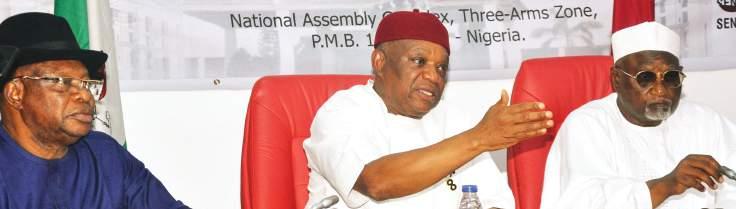
Ad-hoc
Lists feats to include unified forex market, removal of fuel subsidy, more stable macroeconomic environment, banking sector recapitalisation
Deji Elumoye in Abuja
The presidency, yesterday, linked the strong financial performance recorded by many companies listed on the Nigerian Exchange in the first half of 2026 to several key economic reforms implemented by President Bola Tinubu’s government since mid-2023. It particularly listed the significant reforms to include the unification of the foreign exchange market.
Laundering Prevention Act, 2022”.
ADC: Freezing Osun’s Bank Account is Political Terrorism
The ADC condemned the freezing of the State’s account, describing it as “political terrorism” and accused the federal government of weaponising state institutions to punish the people of the state.
In a statement signed by its National Publicity Secretary, Mallam Bolaji Abdullahi, the party argued that President Tinubu’s mentality of ‘all is fair in war’ constitutes a serious threat to democracy and national stability.
The party noted that withholding of funds was part of a broader strategy of intimidation, which it said included the continued occupation of local councils by unelected APC loyalists, the arrest of opposition figures, armed political thugs allegedly backed by security agencies, as orchestrated destabilisation of the State, using federal institutions.
The ADC condemned in the strongest possible terms the freezing of the statutory allocations due to the local governments of Osun State.
According to the spokesman of the party, ‘’This is not an administrative decision or a legal dispute. It is political terrorism by the Bola Tinubu-led APC government carried out with the instruments of the Nigerian state in order to achieve the singular objective of undermining the state government ahead of the coming governorship election in the State.
‘’This sinister move confirms that the Tinubu-led Federal Government will do anything, including starving the people of Osun State, to achieve its political objectives.
‘’Yet no democracy worthy of the name deliberately sacrifices the welfare of innocent citizens in pursuit of partisan political ends. The salaries of workers, the operation of primary
Presidential spokesperson, Bayo Onanuga, in a release explained that by establishing a single, market-determined exchange rate, the reform improved price discovery and enabled companies with substantial foreign currency exposure to more accurately reflect the value of their dollar-denominated revenues in their financial statements.
whose revenues were largely linked to international oil prices and are settled in foreign currency.
The presidency further stated that this has been particularly beneficial for export-oriented and foreign exchange-earning businesses such as Aradel Holdings and Seplat Energy,
According to the statement, “The Tinubu administration’s commitment to strengthening investor confidence in the energy sector was further demonstrated through the timely approval of several landmark upstream transactions.
“Among the most notable approvals was the Renaissance Africa Energy consortium’s acquisition of Shell Petroleum Development Company (SPDC) assets, of which Aradel Holdings is a consortium member.
“Another was the approval of Seplat Energy’s acquisition of the assets of Mobil Producing Nigeria Unlimited (MPNU).
healthcare centres, the education of children, rural infrastructure, and other essential public services have all been turned into bargaining chips in President Tinubu’s political contest.’’ Abdullahi further said, ‘’We have noted earlier that President Bola Tinubu’s mentality, which regards political contests as warfare, constitutes a serious threat to democratic engagement.
‘’ But even in war, there are rules of engagement that recognise human dignity and place limits on the conduct of adversaries.
‘’Democracies are expected to hold themselves to an even higher standard. What justification can there possibly be for the barbarity now playing out in Osun State, where one man has declared war on his own people?’’
He said the freezing of local government funds was only the latest chapter in what has become a systematic campaign to undermine constitutional government in the state.
Adding that, ‘’For well over a year, unelected APC loyalists have continued their illegal occupation of Local Government Councils, in open disregard for democratic legitimacy and the rule of law. Instead of protecting constitutional order, federal institutions have looked the other way and even encouraged the illegality.
‘’Candidates and leaders of the Accord Party have reportedly been subjected to indiscriminate arrests, not because they constitute a threat to public safety, but because political intimidation has become an accepted instrument of politics by a federal government that has abandoned all pretences to ethics or morality.
‘’In Osun State today, violence has become normalised. Hoodlums allegedly associated with the APC have openly deployed military-grade weapons to terrorise communities, intimidate political opponents, and undermine peace across the state.
‘’Rather than confront criminality
with impartiality, security agencies have appeared content to watch from the sidelines.
‘’Even more disturbing are allegations that individuals and their armed gangs have enjoyed the active protection or indulgence of elements within the Nigeria Police while carrying out acts of intimidation against citizens.
‘’If true, nothing better illustrates the collapse of the distinction between the impartial authority of the state and the partisan interests of a political party.
‘’Taken together, these actions reveal something more dangerous than ordinary political competition. They point to the deliberate promotion of a state of anarchy by federal authorities and agencies whose constitutional duty is to preserve law, order, and democratic stability.
‘’No ruling party should ever confuse electoral competition with military conquest. Political opponents are not enemy combatants. Opposition-controlled states are not occupied territories. Public institutions do not belong to whichever party temporarily controls the federal government,” Abdullahi said.
The ADC therefore called for the immediate restoration of all statutory allocations due to the Local Governments of Osun State, the withdrawal of all forms of federal intimidation against the people of the state, and the restoration of constitutional order.
‘’What the people of Osun deserve is the democratic right to freely choose who governs them. But right now, they have been placed under a siege. This rascality has to stop.’’, he stressed.
Ajayi, Odinkalu: EFCC Lacks Power to Freeze Osun Government Accounts Without Court Order
Senior lawyers yesterday weighed in on the matter, arguing that the EFCC lacks the constitutional and statutory authority to freeze the
bank accounts of the Osun State Government without first obtaining a court order.Constitutional lawyer and Senior Advocate of Nigeria, Prof. Konyinsola Ajayi, SAN, said the law is settled that bank accounts can only be frozen pursuant to a valid court order.”It is beyond cavil that this is a bull in the china shop set to break our fragile ware by way of a true federal government being nurtured by the Federal Government,” Ajayi said.
According to him, judicial decisions have clearly circumscribed the powers of the anti-graft agency.”The courts have made two things plain: freeze accounts only on court orders. Second, the EFCC has limited powers.”Combine this with the sovereignty of each state and the crippling effect on millions in the state on suspicion that a few are corrupt or thieving servants,” he added.Ajayi warned that freezing the accounts of a state government without judicial authorisation would not only offend constitutional principles but also disrupt governance, public services and the welfare of millions of residents who have no connection with any alleged wrongdoing.
Similarly, human rights lawyer and former Chairman of the National Human Rights Commission, Prof. Chidi Anselm Odinkalu, said the EFCC cannot lawfully freeze any account through an administrative directive.
“EFCC needs a court order to do that, sir. It cannot be done lawfully as an administrative act,” Odinkalu stated.
Also weighing in, a Lagos-based legal practitioner, Isiaka Olagunju, said the Nigerian constitution recognises a federal system of government and that anti-corruption investigations must be conducted within the limits of the law.
According to him, where there are allegations of embezzlement or financial misconduct against any state official, the EFCC should target the specific individuals
under investigation rather than issue a blanket directive capable of freezing the entire finances of a state government.
He added that the primary responsibility of any government was to ensure the welfare and security of its citizens, warning that any action capable of crippling the financial operations of a state would ultimately hurt innocent residents who depend on government services.
“The primary objective of government is to seek the welfare and protection of its citizens,” he said.
Equally, the Human Rights Writers Association of Nigeria (HURIWA) expressed outrage over the EFCC’s action, describing it as one that raises grave constitutional, legal and democratic concerns.
HURIWA noted that the timing of the reported account restriction— coming in the heat of an election campaign and reportedly affecting an account used for the payment of workers’ salaries—was bound to provoke legitimate public concern about whether coercive state institutions are being deployed in a manner capable of disrupting governance and undermining confidence in the electoral process.
HURIWA in a statement endorsed by its National Coordinator, Emmanuel Onwubiko, noted that democracy cannot flourish where institutions vested with enormous coercive powers are perceived as acting in ways that could tilt the political playing field or create avoidable hardship for citizens.
“It is unacceptable that any action by a federal agency should create the impression that governance in a federating state can be crippled on the eve of an election without the highest standards of transparency, legality and accountability. Such perceptions, if left unanswered, erode public confidence in democratic institutions and the rule of law,” he added.
HURIWA stated that anti-
“These strategic approvals significantly expanded the reserve base, production capacity, and long-term growth prospects of both companies while removing regulatory uncertainty surrounding two of the largest transactions in Nigeria’s upstream oil and gas industry.
corruption agencies derive their legitimacy from strict fidelity to the Constitution and due process, not from the exercise of raw power.
“The EFCC must remain an impartial law enforcement institution. It must never conduct itself in a manner that gives room for allegations that it is serving political interests rather than the cause of justice.
“The credibility painstakingly built by any anti-corruption institution can be undermined if its actions appear selective, opaque or politically timed.”
Osun Poll: Police Read Riot Act to Electoral Laws Violators, Deploy 15,000 Personnel
The Nigeria Police Force yesterday said all violators of Electoral laws would be held accountable for all their actions before, during and after election.
The authority also made it cleared that about 15,000 personnel would be deployed, including Commissioners of Police, Assistant Inspectors-General of Police (AIGs), Police Mobile Force (PMF) operatives and other specialized units, to provide security for the August 15 Osun State governorship election.
THISDAY also learnt exclusively yesterday that 1 DIG, 3 AIG, 37CPs would be deployed to ensure credible, inclusive, and transparent election, as one Commissioner of Police would mount 30 local government areas including Modakeke area office.
The Commissioner Police in charge of Osun state election CP Samuel Erale Etaifo disclosed this yesterday while addressing journalists and Divisional Police Officers (DPOs) at the Police Officers’ Mess in Osogbo. The police boss assured residents and political stakeholders that the police would remain neutral, professional and committed to delivering a peaceful, free, fair and credible election.
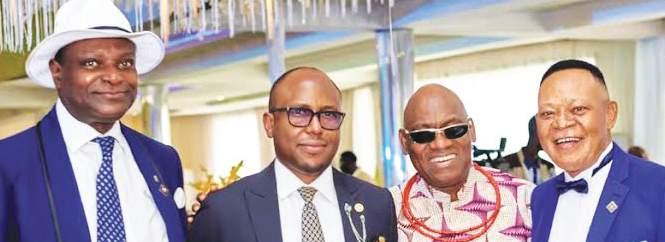
Boniface Okoro in umuahia
There seems to be a sharp division among the people of Bende Local Government Area of Abia State over the third term ambition of the Deputy Speaker of the House of Representatives, Rt. Hon. Benjamin Okezie Kalu, and the controversy surrounding the zoning of the Bende federal constituency
seat between Bende North and Bende South. The division came to the fore following two conflicting positions by groups claiming to speak for Bende. While one group, ‘Bende Forum’, endorsed Kalu for a third term on July 28, 2026, another group, ‘Bende Critical Stakeholders’, on August 1, 2026, disowned the endorsement and
Francis sardauna in Katsina
The Katsina State Hisbah Board has directed all its personnel to obtain valid court orders or arrest warrants before entering hotels or residential premises in the course of their official duties.
The directive was contained in an internal circular dated August 4, 2026, and addressed to all local government commanders and headquarters personnel of the Board.
According to the circular, the decision followed a resolution reached at the Board’s regular meeting held
on June 6, 2026, which took immediate effect.
It stated that all officers and personnel must first secure a valid court order or arrest warrant before carrying out searches or entering hotels and private residences, “except where the Commandant-General or existing laws expressly permit otherwise.”
It explained that the directive was issued to ensure strict compliance with existing laws, rules and regulations governing law enforcement activities, as well as the provisions of the Nigerian Constitution.
Okon Bassey in uyo
Security Operatives of the Akwa Ibom Police Command have reaffirmed its unwavering commitment to the full enforcement of traffic laws across the state as part of efforts to safeguard lives, restore sanity on the roads, and significantly reduce the alarming rate of road traffic crashes caused by avoidable violations.
The State Commissioner of Police, CP Baba Mohammed Azare, expressed concern that despite repeated public enlightenment campaigns and sustained enforcement
efforts, many road users continue to violate traffic regulations with impunity.
Speaking in Uyo, Akwa Ibom State capital, the state police boss noted that these violations have continued to endanger lives, damage property, and disrupt the free flow of traffic across the State.
The command expressed serious concern over the persistent cases of oneway driving, excessive speeding, dangerous and reckless driving, driving under the influence of alcohol or drugs, the use of covered, concealed or defaced number plates.
accused those behind it of impersonation. Convening the stakeholders’ meeting in Umuahia, the Mayor of
Bende, Deacon Bassey Uwabunkeonye, said the gathering became necessary “to counter the flying statement” and sustain peace
in the area.
“Those in this gathering are all Bende people from different political parties-PDP, APC, ADC, NDC, and
Labour. We won’t be there, and then a few people will come and cause trouble in Bende. We will not accept that,” Uwabunkeonye said.
segun awofadeji in gombe
The Youth Wing of the Christian Association of Nigeria (YOWICAN), Billiri Local Government Area chapter of Gombe State, has condemned the Bauchi State Government and its Child Welfare Agency for allegedly refusing to release a 17-year-old Christian girl despite a binding Federal High Court order.
In a statement signed by its Chairman, Sarki P. Napthali, and issued on August 2, 2026, YOWICAN described the continued detention of Miss Faith Barnabas as “a direct violation of the rule of law and contempt of court.”
According to the group, Faith, an indigene of Billiri LGA in Gombe State who resides with a guardian in Bauchi, went missing from her grandmother’s residence in April 2026 shortly after completing her university entrance examinations. The crisis, YOWICAN said, deepened when the family received correspondence on April 20, 2026, from the Bauchi State Shari’ah Commission indicating that the minor had converted to Islam and adopted the name “Sa’adatu.”
Nume Ekeghe
Coronation Asset Management Limited has launched the Series II issuance of up to N20 billion under its N200 billion
Coronation Infrastructure Fund Shelf Programme, deepening access to long-term infrastructure investments for qualified
institutional and high-networth investors.
The offer, which received approval from the Securities and Exchange Commission (SEC), is designed to mobilise long-term private capital for infrastructure financing while providing investors with exposure to a diversified portfolio of infrastructure debt investments targeting
competitive long-term riskadjusted returns.
The 99-year closed-end infrastructure fund invests across key sectors, including telecommunications, transportation, energy, utilities, social infrastructure and real estate, focusing on projects, companies and special purpose vehicles (SPVs) with resilient cash
flows and strong credit fundamentals.
The Series II issuance builds on the performance of the fund’s inaugural offering, which was launched in September 2023. According to the fund manager, Series I raised N8.79 billion in net subscriptions and delivered a net return of 23.27 per cent in 2025.
Gbenga sodeinde in ado
Ekiti
Ekiti State Governor, Mr. Biodun Oyebanji, last Monday secured the educational future of a 14-year-old world Spelling Bee champion, Damilola Adeolu, by awarding her a comprehensive scholarship from senior secondary school through the university with
monthly welfare support and a N5 million cash reward package.
The governor announced the unprecedented support while receiving the SSS1 student of St. Lawrence Metropolitan College, AdoEkiti, at the Government House following her remarkable triumph at the World Spelling Bee
Championship in Shanghai, China, where she won two gold medals after emerging champion in both the Nigerian and African competitions.
Beyond the scholarship, Governor Oyebanji directed that the state government should provide monthly allowances to cater for Damilola’s welfare and learning needs, including
books, computers and other educational materials, describing the intervention as an investment in excellence rather than a mere reward for past achievements.
“You have made us extremely proud. You have conquered the world, but you still have a greater future ahead of you,” the governor told the young champion.
Raheem akingbolu
Rafa Corporation, manufacturer of Rafa Detergent brand, has announced a landmark investment in soap manufacturing technology, marking a major milestone in its ambition to build one of Africa’s leading home and
personal care manufacturing enterprises. The investment significantly expands Rafa’s production capabilities while reinforcing its commitment to innovation, industrial excellence and long-term value creation across Nigeria and West Africa. To this end, the company was
said to have signed contracts for the construction and installation of a state-of-the-art continuous saponification plant integrated with a continuous vacuum soap cooling and drying plant, with a 10-tonnes-per-hour production capacity. Once inaugurated, the expanded production capacity is expected to position Rafa as the largest single-line continuous saponification plant in Nigeria, Nigeria’s largest powder detergent manufacturer by installed production capacity, and reinforce its long-term commitment to industrial excellence.
Olawale Ajimotokan
Nigeria’s Super Falcons put up a sensational attacking master-class at the Stade Moulay Hassan last night, overpowering Egypt 6–2 to set up a heavyweight WAFCON 2026 quarterfinal encounter against Cameroon.
Super Falcons finished as runner up to Malawi who lost 1-2 to Zambia in the group’s other fixture. Apart Egypt, all three teams finished on six points but were separated by head-to- head rule that put Malawi on top of the standing.
Nigeria set the tone early in the contest, taking the lead in the 21st
minute when Asisat Oshoala coolly converted a penalty following a Video Assistant Referee (VAR) handball check. Substitute Gift Monday doubled the advantage in first-half stoppage time, finishing off a brilliant short-corner routine involving Toni Payne and Rinsola Babajide. Egypt pulled one back shortly after to send the sides into the break at 2–1.
The 10-time champions maintained complete control after the restart, with substitute Uchenna Kanu restoring the two-goal cushion in the 57th minute
with a crisp left-footed strike. Nigeria’s dominance was further rewarded through back-to-back VAR-awarded penalties, which Christy Ucheibe and captain Rasheedat Ajibade decisively dispatched in the 80th and 88th minutes respectively. The highlight of the night came deep into stoppage time when Gift Monday and Ajibade sliced
through the Egyptian defense to set up Joy Omewa, who tapped home to mark her first-ever WAFCON goal and cap off an explosive six-goal performance.
The Super Falcons now turn their full focus to the knockout stages, where they will face old rivals Cameroon in the quarter-finals.

Free agent Mohamed Salah who will be unveiled today at Trabzonspor has become the latest highest paid player in the Turkish Super Lig following his reported one-year net salary of €17 million after tax.
In addition, Salah is to receive 20% of the revenue generated from merchandise sales linked directly to his image, alongside other performance bonuses.
Until the arrival of the 34-year-old former Liverpool front man in Turkey, Nigerian Victor Osimhen was the highest paid star in the Super Lig, grossing a net salary of €15 million plus an extra €1 million in bonuses. Galatasaray paid €75 million for Osimhen in what remains a record purchase fee for a Süper Lig club, as well as the club’s third-most expensive sale of all time. All that will become history today when the Egyptian is unveiled at 5.30pm local time.
Interestingly, Salah will become
the new teammate of Super Eagles stars Paul Onuachu and Chibuike Nwaiwu at Turkish team Trabzonspor. Top Transfer Expert, Fabrizio Romano, revealed that Salah has signed a two-year contract with
Trabzonspor.
According to Romano, Salah signed a one-year (plus extra year extension) deal that keeps him at the club until 2028.
Since Trabzonspor are not

traditionally the wealthiest club in Turkey, Salah’s massive wages will reportedly be split between the club and corporate sponsors.
He left Liverpool at the end of last season after nine years on Merseyside, scoring 257 goals.
Salah, who has scored 50 Champions League goals, will play European football with Trabzonspor next season after they finished third, eight points behind champions Galatasaray.
If they fail to progress to the league phase of the Europa League via the play-offs, they will drop down to the Conference League.
Flying Eagles
d’Ivoire to Set up B’Faso Final
Nigeria’s U20 team, Flying Eagles, last night defeated host nation Côte d’Ivoire 4-3 in a dramatic penalty shootout to set up 2026 WAFU B U20 Championship final against Burkina Faso.
Sunday’s WAFU B U20 AFCON final between Flying Eagles and Burkina Faso will be a repeat of a final Group B clash, which the Burkinabes won 2-0.
Burkina Faso reached the championship game after they stopped Niger 2-0 after extra-time today, while Nigeria beat hosts Cote d’Ivoire 4-3 on penalties after scores were tied at 2-2.
The Flying Eagles are the defending champions of the sub-regional tournament after they beat Ghana 2-1 in the 2024 edition of the competition.
The hosts started on the front foot and controlled the tempo from kickoff. They came close to an early opener twice in the 12th and 14th minutes, but Flying Eagles goalkeeper Clinton Lawani was alert and kept Nigeria in the game. The pressure eventually told in the 16th minute when Côte d’Ivoire’s Kaita slotted home to give the hosts a 1-0 lead.
The Flying Eagles pushed for an equaliser before half-time with more urgency, but the Ivorian defence held firm to take a 1-0 lead into the break. Goalkeeper Lawani continued to be Nigeria’s hero in the second half. In the 59th minute, he produced a brilliant save to parry away a dangerous corner that looked destined to be the second goal. Both teams traded attacks as Nigeria chased an equaliser and the hosts sought to double their lead. The breakthrough for Nigeria came in the 67th minute when Captain Habila Simeon rose highest to nod in a pull-out and level the score at 1-1. Despite several chances created by both sides, no further goal came, and the game went into extra time at 1-1. Extra time brought more drama. Aliyu Abubakar put the Flying Eagles ahead 2-1 in the third minute of the first period of extra time. Gift Subi almost made it 3-1 in the 100th minute after a brilliant solo run, but his shot went wide. Côte d’Ivoire responded immediately and levelled it at 2-2 before the end of the first half of extra time.
The leadership of the Nigeria National League (NNL) has expressed appreciation to the Governor of Imo State, Senator Hope Uzodimma, for accepting to host the league’s 17th Annual General Meeting (AGM) in Owerri, the state capital, on August 21, 2026.
The 34 NNL clubs, alongside board members and other key stakeholders, are expected to arrive in the Heartland State on August 20 ahead of the meeting and depart two days later.
NNL Chief Operating Officer (COO), Danlami Alanana, said the league was delighted by the governor’s support, describing the decision to host the AGM as another demonstration of Imo State’s commitment to the growth of football in Nigeria.
“We are very grateful to His Excellency, Governor Hope Uzodinma,
Nicknamed the Black Sea Storm, Trabzonspor have won seven league titles, six of which came between 1976 and 1984. In 2022, they claimed their most recent league success, ending a 38-year wait.
Based in the north-eastern city of Trabzon, they are one of only six teams to have won the Turkish Super Lig.
When the gates of the New Maracana Stadium in Tolu opened at dawn, the crowd that poured in was more than just numbers. Over a thousand children arrived, each carrying a story, a dream, and a hope. For the 321 who were registered, the day marked the beginning of something transformative.
Take Solomon James, 12, who woke
at 5 a.m. to make sure he wouldn’t be late. For him, slipping into real football boots for the first time was more than equipment — it was a symbol of possibility. “I’m going to score many goals this month,” he said, his voice brimming with determination. For Blessing Sanusi, 10, the camp was about friendship as much as sport.
“The coaches were so nice. We played games and I made new friends. I can’t wait to come back tomorrow,” she said, her smile wide enough to light up the basketball court.
And then there was Divine, 15, a goalkeeper who relished the tough drills. With gloves newly gifted by Gear ’em Up, he threw himself into
dives, already imagining himself in the footsteps of Super Eagles legends. “The training was tough but I liked it,” he admitted. “I want to be like Super Eagles goalkeepers.”
The camp wasn’t just for the children; it was for their families too. Parents spoke with gratitude and relief, knowing their children were safe, engaged, and inspired.
Kehinde Laniyan has been appointed as the Chairman of the Board of the Baseball and Softball Association, Oyo State.
The appointment was conveyed in an official letter signed by the General Manager of the Oyo State Sports Council, Mrs. Olubisi Jejelola Adegoke.
This latest appointment comes on the heels of Mr. Laniyan’s recent appointment as a member of the WBSC Africa Baseball Commission, further underscoring his growing recognition within the baseball and softball community in Nigeria and across Africa.
According to the Sports Council, the appointment is a well-deserved recognition of Mr. Laniyan’s
for giving the nod to host the 17th Annual General Meeting in Owerri on August 21. This gesture reflects his administration’s continued support for sports development and football in particular,” he said. He noted that the AGM would provide an important platform for the league’s leadership and club representatives to review the just-concluded season, assess operational issues, and deliberate on strategies aimed at strengthening the Nigeria National League ahead of the 2026/2027 campaign. Alanana added that the NNL Board was confident that Imo State would provide a conducive environment for a successful meeting, while commending the state government for its hospitality and commitment to sports development.
distinguished service, dedication, and leadership in the development of baseball and softball in Nigeria over the years. The Council noted his immense contributions to grassroots sports development in Oyo State through the organization of national training camps, hosting of championships, coaching clinics, and his sustained commitment to expanding baseball and softball programmes in schools.
Mrs. Adegoke expressed confidence that Mr. Laniyan’s extensive national and international network, coupled with his wealth of experience, would greatly enhance the growth and development of baseball and softball in Oyo State.
electoral institutions are usually tested. That the pattern keeps recurring at every election cycle in the same state suggests the problem is not just about one troublesome police commissioner. Nigerians with long memories will recall the electoral tribunal battles of 2007 and 2014, as well as the dramatic collation disputes of 2018 between former Governor Adegboyega Oyetola (the current Minister for Blue Economy) and Adeleke on which I wrote Osun and the 3,498 ‘Super Delegates’ – THISDAYLIVE. And then we had another protracted contest between Oyetola and Adeleke in 2022 in which the latter prevailed. What is remarkable in all these elections is that the current president was a bit part actor in the drama—first, as National Leader of the Action Congress (AC) and later, that of the APC.
It is noteworthy that the Independent National Electoral Commission (INEC) appears to have
done its own homework ahead of the Osun gubernatorial polls. The Resident Electoral Commissioner, Mrs Oluwatoyin Babalola, has spent recent weeks running radio jingles and partnering with civil society groups, traditional rulers and transport unions for a credible election next week Saturday. But all of that work comes to nothing if voters conclude, rightly or wrongly, that the police personnel standing at their polling units answer to a political party rather than to the law.
This then brings me back to Yilwatda’s words. The APC national chairman is entitled to want his party’s gubernatorial candidate, Mr Bola Oyebamiji, to win in Osun. And there is nothing improper in the APC deploying governors, ministers, National Assembly leadership and the full weight of its national structure behind Oyebamiji. But the ruling party should also understand the implications of getting this
“rehearsal” wrong. In his Democracy Day broadcast in June, speaking directly on Ekiti and Osun, the president urged INEC, security agencies and all parties to keep the elections “peaceful and credible.” Those were his own words. The question Osun now puts to him, with barely nine days to go, is whether his party intends to be held to that declaration. I do not believe Tinubu is trying to manipulate Osun State gubernatorial election in his party’s favour and it would be unfair to suggest that. And to be honest, the president doesn’t have much riding on this election, as it would most likely have no bearing on how Osun people vote next year. But there is an old saying that the morning shows the day. The Osun election at the tail end of the current season of off-cycle governorship polls, and the very start of serious positioning for 2027, is that morning. Since his own party’s national chairman has publicly
framed what happens next week Saturday as an important precursor to 2027, that inevitably places additional responsibility on the president to ensure that the election is beyond reproach. What the president must understand is that if this election ends up with allegations of intimidation and lingering doubts about institutional neutrality, it will inevitably influence public expectations of what lies ahead. Yet it doesn’t have to go that way. The next few days can still be deployed to reinforce the political neutrality of security agencies, strengthen public confidence in presidential leadership and demonstrate that electoral competition will be governed by the rule of law and public decency. Doing so will go beyond improving the credibility of one governorship election. It will establish the democratic precedent upon which the legitimacy of the 2027 general election will ultimately rest.
The Minister of Defence, General Christopher Musa, has charged personnel of the Armed Forces to view the newly approved salary increase as a renewed call to duty and redouble their efforts towards neutralising national security threats, protecting civilian lives and restoring stability across the country.
Musa gave the charge while appreciating President Bola Tinubu, for approving a historic 30 to 80 per cent salary increment for military personnel.
He described the decision as a significant boost to troop morale and a demonstration of the administration’s commitment to security sector reform.
Also, the Senator for Abia North, Orji Uzor Kalu, has hailed Tinubu’s approval of a substantial salary increase for members of the Nigerian Armed Forces.
Similarly, the Sultan of Sokoto, His Eminence Alhaji Muhammad Sa’ad Abubakar, has advocated community policing as a key strategy for tackling insecurity across the country.
However, a statement by the Special Assistant on Media to the Minister of Defence, Leah KatungBabatunde, the salary adjustment, which takes effect from September 1, 2026, would directly benefit approximately 250,000 personnel across the three services of the Armed Forces.
The statement noted that the
structure of the package prioritises frontline personnel, with junior ranks from Private to Staff Sergeant receiving an 80 per cent increase, middle-ranking officers and noncommissioned officers from Warrant Officer to Colonel receiving a 50 per cent increase, while senior military leadership would receive a 30 per cent adjustment.
Musa described the presidential directive as a decisive morale booster that reinforces the federal government’s commitment to improving the welfare of troops and strengthening the nation’s security architecture.
“His Excellency, President Bola Ahmed Tinubu, has once again demonstrated unwavering leadership and empathy for the brave men and women who put their lives on the line daily to preserve the peace and territorial integrity of our nation,” the minister said.
He added that the increase in annual personnel cost from N660 billion to N924 billion showed the president’s commitment to prioritising the welfare of military personnel.
“By raising the annual personnel cost from N660 billion to N924 billion, the president has matched words with concrete action, proving that the welfare of our troops remains paramount,” Musa stated.
He further expressed confidence that the improved remuneration would have a positive impact across various theatres of operation, from counter-insurgency missions in the North-East to operations against
banditry, oil theft and kidnapping across the country.
“This subvention of financial hardship for our officers and soldiers will resonate across every theatre of operation; from those confronting insurgency in the North-East to troops tackling banditry, oil theft and kidnapping across the country,” he said.
He assured the president and Nigerians that the gesture would be reciprocated through renewed commitment, discipline and improved operational effectiveness by personnel of the Armed Forces.
Musa also reaffirmed his ministry’s commitment to supporting Tinubu’s mandate through continuous modernisation of military equipment, enhancement of technological capabilities and improved living standards for personnel and their families.
Senator for Abia North, Orji Uzor Kalu, has hailed President Bola Tinubu’s approval of a substantial salary increase for members of the Nigerian Armed Forces.
He described the move as a strategic investment in national security and the welfare of troops battling insecurity across the country.
Kalu, who chairs the Senate Committee on the South East Development Commission (SEDC), also urged military personnel and other security agencies to reciprocate the gesture by upholding professionalism,
fairness and respect for the rights of citizens in the discharge of their constitutional duties.
Kalu through his official social media handles, said the approval underscored the administration’s recognition that the welfare of members of the Armed Forces should remain a national priority.
He noted that military personnel continued to make enormous sacrifices in defending Nigeria’s sovereignty, protecting lives and combating terrorism, banditry, kidnapping and other security threats across various theatres of operation.
“The decision by President Bola Ahmed Tinubu to approve a salary increase for members of the Nigerian Armed Forces deserves commendation.
“It reflects an understanding that the welfare of those who defend our nation should remain a priority,” the former Abia State governor said.
According to him, improving the welfare of troops is both a moral obligation and a critical step towards strengthening the country’s security architecture.
“Every day, our servicemen and women make enormous sacrifices to protect lives, safeguard our territorial integrity and confront the security challenges facing our country.
“Supporting them with better welfare is not only the right thing to do, but also an investment in a stronger and more effective security system,” he stated.
Kalu, therefore, called on members
Sunday Aborisade in Abuja
The Nigeria Democratic Congress (NDC) has constituted a sevenmember National Reconciliation Committee to engage aggrieved aspirants across the country and resolve disputes arising from the party’s recently concluded primaries, as it moved to consolidate internal cohesion ahead of the 2027 general election.
The committee, which will be chaired by political economist, Prof. Pat Utomi, with Buba Galadima as
co-chairman, is expected to begin consultations with aspirants and party stakeholders immediately after its inauguration scheduled for today at the party’s national secretariat in Abuja.
In a statement jointly signed by the National Chairman of the party, Senator Cleopas Moses, and the National Secretary, Mr. Ikenna Morgan Enekweizu, the NDC said the committee was established to address all outstanding grievances generated by the primary elections and strengthen party unity.
Other members of the committee were Mohammed Sanni Takori (Vice Chairman), Babatunde Alli (Secretary), Mrs. Dudu Mamman Manuga, Hon. Salvador Adegoke Moshood and Alhaji Haruna Pai.
The party also announced the establishment of three zonal reconciliation sub-committees covering the North, South-south and South-east geopolitical zones to complement the work of the national panel.
The development came as several candidates whose names were recently published by the
Independent National Electoral Commission (INEC) expressed appreciation to the party’s National Leader and former Bayelsa State Governor, Senator Henry Seriake Dickson, for what they described as his role in stabilising the party during the nomination process.
The candidates said Dickson helped calm tensions generated by delays in the publication of candidates’ names and handled postprimary disagreements transparently without yielding to allegations of financial inducement or manipulation.
of the Armed Forces and other security agencies to justify the confidence reposed in them by demonstrating courage, discipline and integrity in the performance of their duties.
“As this important gesture is being implemented, I encourage our military and other security agencies to continue to justify the confidence reposed in them by serving Nigerians with courage, professionalism, fairness and respect for human dignity.
“Nothing inspires public confidence more than security personnel who carry out their constitutional responsibilities with dedication and integrity,” he said.
The senator maintained that improved welfare would further boost the morale and operational effectiveness of the Armed Forces, stressing that national security remains the foundation for economic growth, national unity and sustainable development.
“A secure nation is the foundation of economic growth, national unity and sustainable development. With improved welfare, renewed commitment and the support of all Nigerians, I believe we can continue to make meaningful progress in securing our country,” Kalu added.
The Sultan of Sokoto, His Eminence Alhaji Muhammad Sa’ad Abubakar, has advocated community policing as a key strategy for tackling insecurity across the country.
The Sultan said sustainable peace could only be achieved through collaboration between security agencies and local communities.
Represented by the Chiroman Kano, Alhaji Adamu Lamido Sanusi, the Sultan spoke yesterday at the Arewa Awareness Summit on Unity Against Insecurity, held at Arewa House, Kaduna.
According to a statement, the Sultan said community members, particularly youths, possessed firsthand knowledge of their environment and should be actively involved in intelligence gathering and crime prevention.
“I personally believe in community policing. To fight crime, we have to work with the people,” he said.
The monarch added that he had consistently worked with Imams,
religious leaders, youth groups and other community stakeholders to promote peace and strengthen security in his domain.
“I personally work with the Imams, religious leaders, youth groups and other community stakeholders to address the challenges in my area, working to ensure peace and security in the community,” he said. He described intelligence gathering as indispensable in combating crime, noting that residents often have better knowledge of suspicious activities within their communities than outsiders.
“The people in the community, especially the youth, are already in the community. They know the community and the areas better than anyone else. You are able to gather more information through collaboration with the community and through multiple agencies working together in the community,” he said. According to him, effective cooperation between communities and security agencies would significantly strengthen efforts to tackle banditry, kidnapping and other criminal activities.
“So, this cooperation, this working together hand-in-hand, is highly important in fighting crime in our communities and in the country,” he added.
The Sultan also commended the organisers of the summit, describing the initiative as a timely platform for exchanging ideas and strengthening partnerships to address insecurity in Northern Nigeria.
Earlier, the Director-General of the Arewa for Peace, Unity, Cohesion and Development Initiative (ACI), Dr Abdullahi Idris, said the summit was convened to develop practical solutions to insecurity in Northern Nigeria.
He said participants were expected to develop strategies that would strengthen dialogue between communities and the government while promoting collective action against insecurity.
Also, Prof. Mohammed Tasiu Dan Sabo, who represented Prof. Ahmad Rufai, said military operations alone could not guarantee lasting peace.
“There has to be a link between security, justice, governance and livelihoods,” he said, stressing that “lasting peace cannot be achieved through military operations alone.”
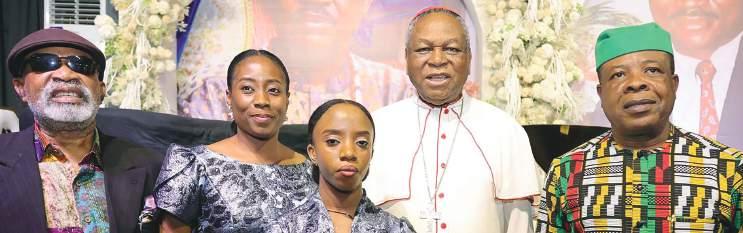
L-R: Former Minister of Labour, Dr. Chris Ngige; daughters of late Dr. Paddy Kemdi Njoku- Ogechi and Matachi Njoku; Nigerian Prelate and Archbishop of the Catholic Church, Cardinal John Onaiyekan; and former Governor of Imo State, Hon. Emeka Ihedioha, during the service of songs held for late Dr. Njoku in Abuja
olusegun.adeniyi@thisdaylive.com

In the build-up to 2003 when the then incumbent Governor Olusegun Osoba was seeking re-election on the platform of the Alliance for Democracy (AD) and then incumbent President Olusegun Obasanjo was also seeking re-election on the Peoples Democratic Party (PDP) platform, the political slogan in Ogun State was ‘Segun L’oke, Segun Ni’sale’. The idea was for voters in the state to adopt a ‘bipartisan’ approach in exercising their franchise. Since the parties were arranged on the ballot paper in alphabetical order, voters were enjoined to ‘look up’ by voting AD during the governorship election and ‘look down’ (for PDP) while casting their ballot in the presidency. For the locals, the slogan was also translated as retaining one Segun at the top (in Abuja) and another Segun at home (in Abeokuta). As it would happen, it was only the Segun in Abuja who prevailed while the Segun in Abeokuta lost out. And the latter has always blamed the former for what he considered an act of betrayal.
While I do not want to dabble into the brouhaha between the two respected Egba Octogenarians, it is evident that political deals are always fraught with risks. It is indeed instructive that of all the five AD Governors in the Southwest at the time, the only one who won re-election was a certain Bola Tinubu in Lagos State whose own slogan was ‘Jeun Soke’. Crudely translated, it means only voters who ‘look up’ for the AD (without ‘looking down’ for any other party) were guaranteed reward. I recall that episode against the background of the upcoming Osun State gubernatorial election that is already throwing up a lot of controversy.
Apparently believing the mantra that one good turn deserves another, Governor Ademola Adeleke has publicly endorsed Tinubu for a second term ahead of his own re-election next week. “Our own son, father and leader”, according to Adeleke, deserves the support of Osun electorate, despite knowing fully well that the president will not be on the ballot until next year. “I am the governor of the ancestral birthplace of Mr. President. How can I have my own in the saddle and think twice before embracing him? I need no persuasion to act as I have declared repeatedly, our endorsement of Mr President.”
That open declaration of support means nothing to some APC supremos who seem to
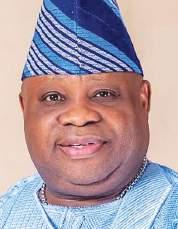
be going for broke and I fear they may have sold a self-serving idea to the president that the ruling party needs Osun for his re-election next year. “We must win Osun and nothing will stop us,” the APC National Chairman, Prof. Nentawe Yilwatda, boasted last week at the inauguration of the 276-member campaign council headed by Governor Hope Uzodimma of Imo State. “These are political heavyweights; it is like a trailer facing a Keke (bicycle). I do not know how the political party standing against us in Osun can withstand the strength of these people who are going there to mobilise and win the election,” Yilwatda declared rather exuberantly, before stating the
reason for his seeming desperation. “This is the last election that will hold before the general election. This will be a litmus test. This will be our practising ground. This will be our rehearsal of the machinery we’re going to prepare for 2027.”
It is remarkable that just a few weeks ago in June, Yilwatda’s Special Adviser on Media and Strategy, Abimbola Tooki published what he said was his assessment of the chances of his party in the gubernatorial elections in Ekiti and Osun States. He predicted that APC would win Ekiti easily (as it turned out to be); but Osun would prove difficult for the party. Writing on how he visited Osun State and the journalist in him could not resist conducting an informal field assessment, Tooki wrote, “...rather than relying solely on elite political conversations, I sought the opinions of ordinary voters whose ballots ultimately determine electoral outcomes. Over (a) few days, I boarded more than 20 commercial motorcycles and engaged the riders in conversations about the coming election.” Then Tooki delivered his bombshell: “The responses were striking. Approximately 16 of them openly declared their intention to vote for Governor Ademola Adeleke.” If Yilwatda’s own spokesman could make such an open deduction that the incumbent will most likely win—and he also explained his reasons—where then is the party’s confidence coming from?
There is even a larger issue here. The Osun State gubernatorial election, according to Yilwatda, will be a “rehearsal of the machinery we’re going to prepare for 2027.” That phrase raises an important question. A rehearsal is a practice session for a larger performance.
So, what exactly is being rehearsed in Osun State? The answer matters to every Nigerian who cares about the future of our democracy. It should matter especially to Tinubu whose administration will ultimately be judged by the standard under which these elections are conducted. While the president has a right to support his party’s gubernatorial candidate in Osun State, he has even a bigger responsibility for law and order in the country.
For months, the Osun Commissioner of Police, Mr Ibrahim Gotan, has been at the centre of accusations from opposition parties and civil society groups who see him more as an APC enforcer than a man whose primary duty is to ensure law and order in the state. And yesterday, the Economic and Financial Crimes Commission (EFCC) entered the fray by placing a ‘Post-No-Debit’ on the Osun State Government Statutory Allocation account. “We are supposed to be in a democracy, where the rule of law must always prevail,” Adeleke said in a statement that questions both the legality and timing of the EFCC action. “We will not accept a situation where federal agencies trample on the constitutional rights of subnational governments.” But the EFCC explained last night that the action was part of its preventive mandate, and taken in public interest, to halt recent suspicious “transfers of funds into different corporate entities.”
Meanwhile, following growing public pressure, the Inspector-General of Police, Olatunji Disu has deployed a new officer, Samuel Erale Etaifo, to superintend the election security for the Osun polls. That is a concession of sorts and an admission of a lack of trust in Gotan’s neutrality. But read the fine print: the same police statement announcing Etaifo’s deployment also noted that Gotan “will remain the substantive head” of the Osun Command, receiving “administrative and operational support” from the new arrival. For those who had called for Gotan’s redeployment, this arrangement is unlikely to resolve the underlying concerns. Where confidence in institutional neutrality has already been weakened, partial administrative adjustments rarely provide sufficient reassurance. But we must also be fair to Gotan. For more than two decades, Osun State gubernatorial elections have become the stage on which Nigeria’s