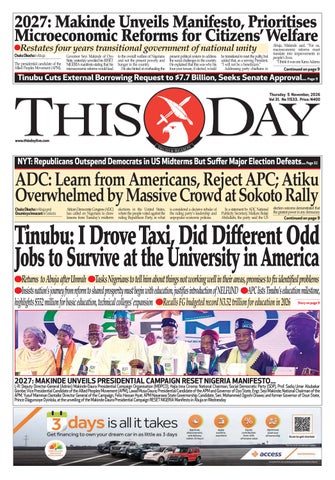
2027: Makinde Unveils Manifesto, Prioritises Microeconomic Reforms for Citizens’ Welfare Restates four years transitional government of national unity
Chuks Okocha in Abuja The presidential candidate of the Allied Peoples Movement (APM),
Governor Seyi Makinde of Oyo State, yesterday unveiled his RESET NIGERIA manifesto stating that his microeconomic reforms would lead
to the overall welfare of Nigerians and not the present poverty and hunger in the country. He also hinted at overhauling the
present political system to address the social challenges in the country. He explained that this was why his four-year tenure, if elected, would
be transitional to reset the polity, but added that, as a serving President, “I will not be a beneficiary.” Addressing party chieftains in
Abuja, Makinde said, “For us, macroeconomic reforms must translate into improvements in people’s lives. “I think it was one Kanu Adamu Continued on page 9
Tinubu Cuts External Borrowing Request to $7.7 Billion, Seeks Senate Approval... Page 9 Thursday 5 November, 2026 Vol 31. No 11533. Price: N400
www.thisdaylive.com TR
UT H
& REASO
N
NYT: Republicans Outspend Democrats in US Midterms But Suffer Major Election Defeats... Page 32
ADC: Learn from Americans, Reject APC; Atiku Overwhelmed by Massive Crowd at Sokoto Rally Chuks Okocha in Abuja and Onuminya Innocent in Sokoto
African Democratic Congress (ADC) has called on Nigerians to draw lessons from Tuesday’s midterm
elections in the United States, where the people voted against the ruling Republican Party, in what
is considered a decisive rebuke of the ruling party’s leadership and unpopular economic policies.
In a statement by ADC National Publicity Secretary, Mallam Bolaji Abdullahi, the party said the US
election outcome demonstrated that the greatest power in any democracy Continued on page 9
Tinubu: I Drove Taxi, Did Different Odd Jobs to Survive at the University in America Returns to Abuja after Umrah Tasks Nigerians to tell him about things not working well in their areas, promises to fix identified problems Insists nation’s journey from reform to shared prosperity must begin with education, justifies introduction of NELFUND APC lists Tinubu’s education milestone, highlights $552 million for basic education, technical colleges’ expansion Recalls FG budgeted record N3.52 trillion for education in 2026 Story on page 9
2027: MAKINDE UNVEILS PRESIDENTIAL CAMPAIGN RESET NIGERIA MANIFESTO...
L-R: Deputy Director-General (Admin) Makinde-Daura Presidential Campaign Organisation (MDPCO), Hajia Inna Ciroma; National Chairman, Social Democratic Party (SDP), Prof. Sadiq Umar Abubakar Gombe; Vice Presidential Candidate of the Allied Peoples Movement (APM), Lawal Musa Daura; Presidential Candidate of the APM and Governor of Oyo State, Engr. Seyi Makinde; National Chairman of the APM, Yusuf Mamman Dantalle; Director General of the Campaign, Felix Hassan Hyat; APM Nasarawa State Governorship Candidate, Sen. Mohammed Ogoshi Onawo; and former Governor of Osun State, Prince Olagunsoye Oyinlola, at the unveiling of the Makinde-Daura Presidential Campaign RESET NIGERIA Manifesto in Abuja on Wednesday
2
THURSDAY, NOVEMBER 5, T H I S D AY
THURSDAY, NOVEMBER 5, T H I S D AY
3
4
THURSDAY, NOVEMBER 5, T H I S D AY
5
THISDAY • THURSDAY, NOVEMBER 5, 2026
NEWS
Group News Editor: Goddy Egene Email: Goddy.egene@thisdaylive.com, 0803 350 6821, 0807 401 0580
CROWDS WELCOME ATIKU TO SOKOTO...
The ADC Presidential candidate was welcomed by a massive crowd to Sokoto state where he held his campaign rally …. yesterday
Namibia President Hails Dangote’s $2.5bn Investment as Historic Milestone for African Industrialisation Group unveils 600-million-litre tank farm, 1,700km regional pipeline, promises cheaper fuel Eyes further opportunities in Namibia
Emmanuel Addeh in Abuja and Peter Uzoho in Lagos President of Namibia, Dr Netumbo Nandi-Ndaitwah, has expressed delight with the eventual launch of Dangote Industries Limited’s $2.5 billion petroleum storage and regional pipeline investment in the country, describing it as a historic milestone in Africa’s industrialisation. Nandi-Ndaitwah also described the occasion as the most memorable day of her presidency. Speaking at the official launch in Walvis Bay, yesterday, NandiNdaitwah commended President and Chief Executive of Dangote Industries Limited, Aliko Dangote, for demonstrating confidence in Africa’s economic potential through large-scale investments designed to strengthen energy security, accelerate industrial development, and deepen regional economic integration. “Today, this is the most memorable day of my presidency,” she declared, describing Dangote as a son of African soil whose investment demonstrates the growing capacity of African entrepreneurs to drive the continent’s transformation. A statement by Dangote Group said the Namibian president disclosed that she had placed the project under the coordination of her office to ensure effective collaboration among government institutions and timely implementation, drawing lessons from previous investment opportunities lost
to prolonged administrative delays. She said her administration was committed to creating a more responsive investment environment, particularly for strategic projects capable of generating employment, strengthening infrastructure, and stimulating economic growth. The investment comprises a proposed 600-million-litre petroleum storage facility and approximately 1,700-kilometre regional pipeline network intended to position Namibia as a strategic energy distribution gateway for Southern Africa. Nandi-Ndaitwah said the project aligned with Namibia’s Sixth National Development Plan and its priorities in infrastructure, logistics, energy security, industrialisation, and employment creation. She described the investment as a practical demonstration of African economic integration, consistent with the objectives of the African Continental Free Trade Area and the African Union’s Agenda 2063. “The African people cannot continue to live in poverty when our continent is so richly endowed with natural resources,” she said. The president urged Namibian businesses to develop the technical capacity required to participate in emerging industrial supply chains, disclosing that her administration intends to broaden its local content framework beyond oil and gas to other sectors. She also emphasised skills transfer,
saying the project should equip Namibian workers with expertise that would remain valuable beyond construction and enhance their competitiveness internationally. Addressing the gathering, Dangote disclosed that the $2.5 billion investment would cover petroleum storage, pipeline infrastructure, and associated
distribution facilities. He said the proposed tank farm would occupy approximately 70 hectares at Farm 58, about 10 kilometres east of Walvis Bay, with storage capacity for 360 million litres of diesel and 240 million litres of petrol. The planned pipeline will extend
from Walvis Bay towards Otjiwarongo, with connections towards Rundu, Ghanzi, and Francistown in Botswana. The wider distribution network is intended to serve Botswana, Zambia, Zimbabwe, Malawi, and the southern Democratic Republic of Congo. Dangote explained that the final pipeline alignment and length would
be determined through detailed engineering studies, route surveys, and regulatory approvals. He expressed confidence that the investment would reduce transportation costs, strengthen petroleum supply reliability, and improve fuel affordability across the region.
Tinubu, Delta Governor, Oborevwori, Felicitate Zenith Bank Chairman, Jim Ovia, at 75 President says he’s an accomplished banker, distinguished business leader Deji Elumoye in Abuja and Sylvester Idowu in Warri President Bola Tinubu has felicitated the founder and Chairman of Zenith Bank Plc, Mr Jim Ovia, on his 75th birthday, saying he was an accomplished banker and distinguished business leader. Also, the Delta State Governor, Hon. Sheriff Oborevwori, while congratulating Ovia, described him as a visionary entrepreneur, whose contributions have helped shape Nigeria’s banking industry. The president, in a release by his Adviser on Information and Strategy, Bayo Onanuga, commended Ovia’s remarkable contributions to Nigeria’s banking industry, economic development and private-sector growth. Tinubu described him as a visionary entrepreneur, accomplished banker and
distinguished business leader. “Mr. Ovia’s dedication, resilience and commitment to excellence have not only grown Zenith Bank into a banking behemoth but also helped the growth of the Nigerian financial services sector. “His pioneering role in establishing Zenith Bank in the 90s and building it into one of Nigeria’s leading financial institutions, with significant presence across Africa, Europe and beyond is remarkable,” he said. Tinubu affirmed that Ovia’s entrepreneurial journey reflected the importance of innovation, discipline, sound corporate governance and long-term investment in national development. The president also lauded his contributions to digital infrastructure, awareness and inclusion, education,
youth empowerment, philanthropy and human capital development, particularly through initiatives that created opportunities for young Nigerians to achieve their potential. Tinubu also wished him continued good health, strength and more years of productive service to Nigeria and humanity.
Oborevwori Celebrates Jim Ovia at 75 Delta State Governor, Hon. Sheriff Oborevwori, has congratulated Dr. Jim Ovia, on his 75th birthday, describing him as a visionary entrepreneur whose contributions have helped shape Nigeria’s banking industry. In a congratulatory message by his Chief Press Secretary, Sir Festus
Jim Ovia
Ahon, yesterday, the governor praised the Agbor-born business mogul for his outstanding role in transforming the nation’s financial sector through innovation, sound leadership and commitment to excellence.
6
THURSDAY, NOVEMBER 5, T H I S D AY
7
THISDAY • THURSDAY, NOVEMBER 5, 2026
NEWS
NDLEA AT ASPIRE FOR WOMEN FORUM...
L-R: Special Assistant to the President on Humanitarian Affairs and Development Partners, Inna Binta Audu, representing Vice President Kashim Shettima; Chairman/ Chief Executive Officer, National Drug Law Enforcement Agency (NDLEA), Brig. Gen. Mohamed Buba Marwa (Rtd) and Founder/President of Aspire Women Forum (AWF), Dr. Zainab Marwa, during the AWF Masterclass for Women and Youths held in Abuja ... recently
N’Assembly Tells CNA to Send Harmonised Bill on State Police to Presidency for Assent Adedayo Akinwale in Abuja The leadership of the National Assembly, yesterday, instructed its Clerk to transmit the harmonised State Police Bill, 2026 to
President Bola Tinubu for presidential assent. Deputy Speaker of the House of Representatives, Hon. Benjamin Kalu, disclosed this development after the
legislature had met constitutional requirement. The state police bill seeks to decentralise policing architecture between the federal and state governments.
The bill became imperative following the deterioration of security in the country. However, Kalu, who made the announcement during plenary, yesterday, expressed satisfaction over the endorse-
Ambode Mobilises Political Associates for Tinubu’s Re-election, Hamzat’s Governorship Bid Sunday Ehigiator Former Lagos State Governor, Mr. Akinwunmi Ambode, has mobilised his political associates to strengthen support for President Bola Tinubu’s re-election and the emergence of Dr. Kadri Obafemi Hamzat as the next governor of Lagos State in the 2027 general election. Ambode reaffirmed his commitment to party unity, strengthening political relationships and mobilising grassroots support during a strategic meeting with his political associates yesterday in Lagos. According to a statement issued by Ambode Support Associates and signed
by Adesina Tiamiyu, arrangements were underway to welcome Hamzat, the All Progressives Congress (APC) governorship candidate, alongside other party candidates, to Epe next week. The proposed gathering, the statement said, would demonstrate the strength, unity and collective resolve of the Lagos APC family ahead of the 2027 general election. It added that the engagement would bring together party members, political leaders, community stakeholders and party faithful from across Lagos State. Beyond providing an avenue for interaction, the gathering is expected to strengthen existing alliances, deepen political collaboration and renew
members’ commitment to the party’s electoral success. The statement said the mobilisation would be anchored on the philosophy of Ambode Support Associates, One Nation, One Community, One Family, with efforts targeted at galvanising support from grassroots communities. It listed Community Development Associations (CDAs), market women, artisans and persons living with disabilities, among other groups, as key stakeholders to be mobilised. The group said the initiative was driven by its belief in inclusion and the need to translate political relationships and collective commitment into electoral success.
Court Grants Subpoenas Against INEC, National Assembly in Suit Challenging Chinda’s APC Candidacy Blessing Ibunge in Port Harcourt A Federal High Court sitting in Port Harcourt has granted applications for subpoenas compelling the Speaker and Clerk of the House of Representatives, as well as the Independent National Electoral Commission (INEC), to produce documents in a suit challenging the eligibility of the All Progressives Congress (APC) governorship candidate, Kingsley Ogundu Chinda. The presiding judge, Justice Muhammed Turaki, granted the applications following submissions by the plaintiff, Samuel Amatonjie, a Port Harcourt-based legal practitioner, who argued that the documents were necessary for the determination of the suit. The subpoena against INEC seeks the production of the membership registers of the Peoples Democratic Party (PDP) and APC submitted to the commission by
both political parties. At the proceedings yesterday, counsel to the PDP, Paul Daudu, and counsel to Chinda, Dike Udenna, raised concerns over the late service of the plaintiff’s response to their preliminary objection challenging the court’s jurisdiction. They consequently sought time to respond to the counter-affidavit. After listening to the parties, Justice Turaki directed counsel to file and exchange the necessary court processes and adjourned the matter until December 10, 2026, for hearing. Amatonjie instituted the suit seeking the court’s interpretation of Section 68 of the 1999 Constitution, as amended, in relation to Chinda’s defection from the PDP to the APC. Among the questions submitted for determination is whether, upon a combined interpretation of Sections 177(c) and 68 of the Constitution, Chinda validly defected from the
PDP to the APC before being screened and declared the APC governorship candidate on May 9, 2026. Other respondents in the suit include INEC, the PDP, APC, the Speaker of the House of Representatives and the Clerk of the National Assembly. Speaking with journalists outside the courtroom, PDP counsel, Daudu, explained the reasons for seeking an adjournment, citing the need for adequate time to respond to the processes served by the plaintiff. Also speaking, Amatonjie described the suit as a matter of public interest, arguing that it was necessary to seek judicial clarification on constitutional provisions governing political defections. He said the case was intended to safeguard constitutional compliance and prevent political developments from undermining the provisions of the nation’s supreme law.
“The message is clear: unity must translate into action, relationships must translate into stronger alliances, and collective commitment must translate into electoral success because we believe strongly in inclusion,” the statement said.
ment of the landmark constitutional amendment by 29 of the 36 State Houses of Assembly. The Deputy Speaker maintained that the outcome marked a historic leap toward establishing sub-national policing across the federation. He stressed that the bill had surpassed the mandatory two-thirds concurrence threshold required across state legislatures, Kalu stated: “The leadership of the National Assembly wishes to inform honourable members and the general public that as of the close of business yesterday, Tuesday, 3rd November, 2026, the office of the Clerk to the National Assembly had received reports from 29 State Houses of Assembly on a Bill for an Act to alter the Constitution of the
Federal Republic of Nigeria, 1999, to provide for the establishment of State Police Services and for related matters. “Consequently, the leadership of the National Assembly has directed the Clerk to the National Assembly to transmit the bill today, Wednesday, 4th November, 2026, to His Excellency, the President of the Federal Republic of Nigeria, for assent.” The legislative procedure conformed with Section 9(2) of the 1999 Constitution (as amended), which stipulates that any constitutional alteration must secure the votes of not less than a two-thirds majority of all members in each chamber of the National Assembly and receive ratification by resolutions of at least twothirds of the State Houses of Assembly before presentation for executive assent.
IMPI: Tinubu Has Rebuilt Nigeria’s Economy with $55bn Reserves Kuni Tyessi in Abuja The Independent Media and Policy Initiative (IMPI) has credited President Bola Tinubu’s economic reforms with rebuilding Nigeria’s external reserves to $55 billion, restoring external sector stability, and repositioning the country for sustainable economic growth. The policy think-tank said the achievement represented a significant departure from the years when successive administrations depleted the country’s oil windfalls without building adequate financial buffers to withstand external shocks. In a policy statement by its Chairman, Dr. Omoniyi Akinsiju, IMPI recalled that Nigeria’s Excess Crude Account (ECA), which stood at $22 billion in 2008, had dwindled to less than $3 billion by 2014, despite the historic oil revenues generated during the period. It alleged that previous administrations between 1999 and 2015 squandered substantial oil earnings on short-term consumption, including a $12 billion Paris Club debt payoff and the funding of what it described as an unconstitutional ECA that state governors routinely depleted. The group also accused the Central Bank of Nigeria (CBN) of expending billions of dollars defending an artificial naira exchange rate peg and subsidising imported refined petroleum products, while domestic refineries remained largely dysfunctional.
According to IMPI, the consequences became evident when global oil prices crashed in late 2014, leaving Nigeria without adequate financial buffers to cushion the impact. Poverty subsequently surged to between 45 and 53 per cent, while the economy slipped into recession in 2016. It said the structural weaknesses also resulted in persistent current account deficits, which reached $17 billion in 2019 and $15.8 billion in 2020. However, IMPI said the country’s economic trajectory began to change in 2023 following Tinubu’s introduction of major market-oriented reforms, particularly the unification of the foreign exchange market and removal of petrol subsidy. It said although the reforms initially imposed significant economic hardship, they helped re-engineer Nigeria’s external balance sheet, moving the country from persistent external deficits to a sustained period of current account and merchandise trade surpluses. “While painful initially, the reforms re-engineered Nigeria’s external balance sheet. Nigeria moved from volatile deficits to a multi-year streak of current account and merchandise trade surpluses,” the think-tank stated. The group disclosed that Nigeria’s gross external reserves had increased from $45 billion to $55 billion by the third quarter of 2026, providing more than 14 months of import cover. It described the development as
evidence of the government’s decision to pursue difficult but necessary economic adjustments rather than sustain policies that encouraged distortions and weakened the country’s external position. IMPI stated, “The current regime took the harder, necessary path – dismantling unsustainable subsidies and distortions to build a self-sustaining economy backed by real productivity and robust external buffers.” Beyond the improvement in external reserves, the think-tank said Nigeria had transitioned from being a net importer to a net exporter of refined petroleum products across West Africa, driven by the integration of domestic refining into the country’s petroleum supply chain. It also stated that non-oil exports, particularly agricultural commodities, solid minerals, and industrial chemicals, had recorded significant growth, contributing to the diversification of the country’s export base. IMPI stated that the reforms had strengthened international investor confidence, citing credit rating upgrades by Moody’s, S&P and Fitch, which it said had helped reduce Nigeria’s international borrowing costs. The group also linked the policy changes to historic gains recorded on the Nigerian Exchange, describing the developments as signs of improving investor sentiment and renewed confidence in the country’s economic prospects.
8
THURSDAY, NOVEMBER 5, 2026 • THISDAY
NEWS
NECCI PUBLIC RELATIONS ROUNDTABLE 2026...
L-R: Hon. Chukwuemeka Nwajiuba, former Minister of state for Education; Mr. Hassan Abdul, Lead Consultant and Chief Executive Officer, Drawbridge Communications; Mr. Sonny Iroche, Founder and Chief Executive Officer, GenAI Learning Concepts Ltd; Dr. Chizor Malize, Managing Director and Chief Executive Officer, Financial Institutions Training Centre (FITC); Dr. Nkechi Ali-Balogun, Founder and Convener, NECCI PR Roundtable; Dr. Oby Ezekwesili, former Minister of Education and former Vice-President of the World Bank’s Africa Region; Otunba Bimbo Ashiru, immediate past Group Chairman, Odu’a Investment Company Limited; Dr. Dakuku Peterside, former Director-General, Nigerian Maritime Administration and Safety Agency (NIMASA); Abdullahi Aliyu Maiwada, Deputy Comptroller and National Public Relations Officer, Nigeria Customs Service; and Mohammad Ali-Balogun, Chairman, Audiovisual Right Society of Nigeria (AVRS), during the NECCI Public Relations Roundtable 2026 in Lagos...recently
Ajay Oommen: Why Africa Must Boost Oil Refining Capacity, Float Strategic Storages Says crude price could fall to $70 on US-Iran crisis resolution Wants Africa to export value-added products Emmanuel Addeh in Abuja The Chief Executive Officer of ATMIN, Mr. Ajay Oommen, has said Africa must urgently boost its oil refining capacity, build strategic storage and stabilise foreign exchange, to avoid importing other people’s risk during global energy crises. Oommen, who spoke on Arise Television’s Morning Show on the implications of the Iran crisis for global energy markets, described Africa’s current structure as a strategic paradox, as the continent exports crude oil and imports refined products. According to him, this exposes the continent to freight spikes, refining margins and supply shocks. “Africa exports oil, imports products. With that, it imports other people’s risk. That’s what we are facing here,” he stressed. Oommen, a Dubai-based commodities trader and former top Shell official, said the biggest gainers from the current crisis remain oil producers, tanker owners and refiners. He explained that freight cost for crude from West Africa to Europe, which was about $2 per barrel, has risen to about$6 to $8 per barrel, while refining margins have hit record highs of up to $45 per barrel. The losers, he said, are consumers who pay for the spike. On calls for windfall taxes on oil
companies, Oommen said while it looks attractive, it could discourage investment. “The upstream companies take heavy risk, and we want to incentivise them to produce more. The refiners who put up the big refineries take a big risk, and we want them to continue to invest more into the refining sector. So I think windfall tax looks good, but is not a good idea,” he said. He suggested that governments should instead use increased tax revenues to provide targeted support for vulnerable households and diesel-dependent small businesses. On fuel supply, Oommen said he hoped that diplomacy prevailed, but warned that prices may remain elevated until mid-2027 because about a lot of the barrels of strategic stocks withdrawn during the crisis need to be replenished. On the impact of the US mid-term elections, Oommen said there is now a greater chance for diplomacy to succeed in the two major global conflicts, particularly the Iran war, which could help stabilise prices. He argued that supply is strong, with US production at a record 13.5 million barrels per day, but demand destruction of about 1.6 to 2 million barrels per day has occurred due to high prices and disrupted flows. “If that stability comes in, the prices should stabilise downward... I believe
the estimate of $70, that’s where it should stabilise, if the peace prevails,” he said. For Nigeria and Africa, Oommen said there is a positive side. With Nigeria’s budget benchmark at $65 per barrel and current production at about 1.6 million barrels per day against a target of 1.86 million, there is room to export more and capture higher value. He said Nigeria is fortunate to have the Dangote Refinery, which has prevented the pump queues and
unrest seen in other African countries with limited refining capacity. He commended Afreximbank for its $20 billion foreign exchange support package for African countries after the crisis and its leadership of a refinancing package for the Dangote Refinery. Oommen explained that ATMIN, which is majority-owned by Afreximbank and focused on hydrocarbon trading, critical minerals, infrastructure and local value addition, was set up to keep commodity trading value in Africa rather than in London or Geneva.
Nume Ekeghe The United States Consulate General in Lagos has identified Nigeria’s fashion industry as an emerging channel for expanding bilateral trade, with Lagos Fashion Week providing a platform for local designers to connect with American buyers, retailers, and other industry players. The consulate made this known at a luncheon held during the Lagos Fashion Week 2026 recently, where it recognised the contribution of the event’s founder, Omoyemi Akerele, to the building of commercial con-
nections between Nigerian designers and the American market. The gathering, which brought together designers, entrepreneurs, and creative industry leaders, highlighted the growing economic value of fashion and the opportunities it presented for businesses in both countries. US Consul General, Brandon Hudspeth, said Lagos Fashion Week had spent 15 years building a platform that not only showcased African creativity but also created opportunities for international trade. Hudspeth said, “It’s an honour to
Pledges support for states advancing Nigeria’s electricity markets Zamfara unveils electricity policy, unveils 2.2MW solar power The federal government yesterday flagged off the development of two interconnected as well as 35 isolated mini-grids in Zamfara state, representing approximately 18.8 megawatts-peak (MWp) of solar generation capacity. The new project will connect 125,106 households across Gummi, Gusau, Kaura Namoda, Maradun, Shinkafi, Tsafe and Zurmi Local Government Areas. Speaking at the event, the Minister of Power, Joseph Tegbe, described
it as a demonstration of the federal government’s commitment to expanding electricity access and supporting state participation in electricity market development. Tegbe stated that under the leadership of President Bola Tinubu, the federal government is pursuing an electricity transformation strategy that recognises the critical role of decentralised infrastructure, state-level market development and privatesector investment. “The unveiling of the Zamfara State Electricity Policy, the groundbreaking of new mini-grid infrastructure and
then monetisation. So that’s exactly where we fit in.” Oommen said licensing holders from Nigeria’s recent bid rounds who lack capacity to develop their fields can also approach ATMIN and Afreximbank for joint financing, risk management and marketing. On decisions by the Organisation of Petroleum Exporting Countries (OPEC), Oommen argued that the cartel’s strength has diminished since the UAE walked out with its about 3 million bpd production.
US Consulate Sees Fashion as New Avenue for Deepening Nigeria-US Trade Relations
FG Flags Off 37 Mini-grid Projects, Set to Add 18.8MW Supply in Zamfara Emmanuel Addeh in Abuja
On how the company supports producers, Oommen said ATMIN and Afreximbank are working to finance marginal field operators in Nigeria who produce as little as 3,000 barrels per day and face challenges of financing, evacuation and aggregation to cargo sizes. He said: “Their problem is financing, first. Second, evacuation. And third is aggregation, because you can’t sell 3,000 barrels a day. You have to build it to a cargo size, which is a million barrels. So aggregation, and
the commissioning of renewable energy projects demonstrate how policy reforms can be translated into practical development outcomes. “Electricity must do more than illuminate homes. It must power hospitals, strengthen educational institutions, support agricultural productivity, enable businesses and improve the quality of public services. “The federal government will continue to support states that are taking practical steps to develop their electricity markets and create the conditions necessary for sustainable
private investment. “What we are witnessing in Zamfara reflects the integrated approach required to address Nigeria’s electricity challenges while creating new opportunities across the economy,” he said. Similarly, Tegbe commissioned two solar mini-grid projects developed by the Zamfara state government. The projects include a 1MW solar mini-grid at Yariman Bakura Specialist Hospital, designed to support reliable electricity for healthcare delivery, and a 1.2MW solar mini-grid serving the Zamfara State Government House.
celebrate Lagos Fashion Week 2026 with so many of Nigeria’s most talented designers and creative leaders. For 15 years, Omoyemi has built one of Africa’s premier fashion showcases, connecting Nigerian designers with American buyers and retailers and showing how trade creates opportunity for both our countries.” Equally present at the luncheon was award-winning American-born actress and producer Osas Ighodaro. Guests were introduced to a fashion-themed game developed by Lagos-based Maliyo Games, reflecting the expanding relationship between fashion, technology, and entertainment. The commercial opportunities are significant, particularly given the size of the American consumer market. According to the US Bureau of Economic Analysis, American consumers spent an estimated $560 billion on clothing and footwear in 2025. For Nigerian fashion businesses, gaining access to this market could provide an important route for expanding beyond domestic and regional customers. It also presents opportunities for American retailers and businesses seeking to establish stronger commercial relationships with African brands and consumers. Since establishing Lagos Fashion Week in 2011, Akerele has grown the event into one of the continent’s
leading fashion platforms. Its 2025 edition featured more than 60 designers and attracted approximately 15,000 guests. Over the years, the platform has also built connections with the American fashion industry. American singer Ciara appeared on the Lagos Fashion Week runway in 2025, while Studio 189, the label co-founded by American actress Rosario Dawson, showcased its collections in Lagos. New York-based Nigerian designer Tia Adeola had also presented her collections at the event. The growing international profile of the platform had attracted coverage from prominent American fashion publications, including Vogue and Essence, further extending the visibility of Nigerian designers. Beyond the runway, Lagos Fashion Week has been working to translate the visibility into commercial opportunities. Nigerian designers have been introduced to international buyers through trade platforms, such as Coterie and NYNOW in New York, and Liberty Fairs in Miami. Luxury retailer Moda Operandi has also provided designers participating in Lagos Fashion Week with access to American shoppers. Similarly, The Folklore, founded by American entrepreneur Amira Rasool, connects African fashion brands with US buyers, including through its partnership with Nordstrom.
9
THISDAY • THURSDAY, NOVEMBER 5, 2026
NINE
Tinubu Cuts External Borrowing Request to $7.7 Billion, Seeks Senate Approval New proposal replaces earlier $20.52bn, €1.045bn borrowing plan, says Akpabio Funds to finance 2026 budget deficit, support reserves, stabilise naira Again, Atiku condemns planned borrowing Chuks Okocha and Sunday Aborisade in Abuja President Bola Tinubu has revised the federal government’s external borrowing plan for 2026, seeking the Senate’s approval of a fresh $7.707 billion (N10.79 trillion) loan to finance part of the budget deficit, replacing an earlier request for $20.52 billion and €1.045 billion. The Senate President, Godswill Akpabio, disclosed this yesterday while reading a fresh letter from Tinubu during plenary, explaining that the new request effectively superseded the previous borrowing proposal submitted to the National Assembly. Reacting to the development, former Vice President and the presidential candidate of the African Democratic Congress (ADC), Atiku
Abubakar condemned President Tinubu’s request to borrow $7.7 billion. The revised request, dated October 26, 2026, specifically seeks legislative authorisation for the federal government to raise the equivalent of N10.79 trillion in external financing as part of the funding arrangements for the 2026 Appropriation Act. The President explained that the proposed external borrowing formed part of the N29.2 trillion new borrowing provision in the 2026 budget, designed to finance the country’s estimated N31.4 trillion budget deficit. Under the revised financing arrangement, the federal government plans to raise N10.79 trillion externally, while N18.4 trillion would be sourced from the domestic debt
market. Tinubu said the external financing would be mobilised through several channels, including Eurobond issuance, concessional and commercial loans from multilateral and bilateral institutions, International Monetary Fund facilities and bridge financing arrangements. However, he indicated that the government would place greater emphasis on Eurobond issuance because of its relatively faster processing time and capacity to generate substantial funds at comparatively lower costs. The President said, “All the options will be pursued simultaneously, considering the costs and related benefits to the country and the time required to access the funds. “In view of this, emphasis will be on the issuance of Eurobonds,
which is typically faster to conclude. Additionally, a large amount can be raised through Eurobonds at a relatively lower cost.” He explained that the final terms and conditions of the proposed facilities would be determined by prevailing market conditions when the loans were being priced. According to him, the Federal Ministry of Finance and the Debt Management Office (DMO) would work together to ensure that the country secures the most favourable borrowing terms. Tinubu said the proposed funds would finance projects and programmes captured in the 2026 Appropriation Act, particularly in critical sectors considered essential to economic growth and national development. He identified defence and security,
transportation, agriculture, power, education and healthcare as priority areas expected to benefit from the proposed external financing. The President explained that the borrowing was necessary to sustain the implementation of the administration’s economic reform agenda and consolidate the gains recorded over the past few years. “The new external borrowings are required to implement the items, programmes and projects in the 2026 Appropriation Act, which are designed to consolidate and strengthen the macroeconomic reforms and gains recorded by this administration in the past few years,” he said. Beyond financing budgetary obligations, Tinubu said the proposed borrowing would also strengthen Nigeria’s external reserves
President Bola Tinubu and provide additional support for exchange-rate stability. He explained that the foreign currency proceeds would be received by the Central Bank of Nigeria on behalf of the federal government, Continued on page 33
TINUBU: I DROVE TAXI, DID DIFFERENT ODD JOBS TO SURVIVE AT THE UNIVERSITY IN AMERICA
Deji Elumoye and Emmanuel Addeh in Abuja
President Bola Tinubu, yesterday, reminisced on his student days in the United States, and recalled how he drove taxi and did different odd jobs to pay his bills while his university education lasted. In a post on X, @OfficialPBAT, Tinubu also challenged Nigerians to give him feedback about things that were not working properly in their areas, pledging to fix identified problems. The president departed King Abdulaziz International Airport, Jeddah, Kingdom of Saudi Arabia, on Wednesday for Nigeria’s capital, Abuja, after the successful completion
of his Umrah (Lesser Hajj) in the Holy city of Makkah. In the post on X, he justified the introduction of the Nigerian Education Loan Fund (NELFUND) through which over N372 billion had been disbursed as students’ loans to young Nigerians, and spoke extensively about his student days He told Nigerians, “If something is not working as it should in your community, I want to hear about it. Your feedback will help us identify problems and address them.” Focussing on his economic reforms, Tinubu said Nigeria’s journey from reform to shared prosperity must begin with education. In the lengthy post on why no Nigerian should be denied education
due to lack of fund, Tinubu stated, “When I first arrived in the United States as a young man, I drove a taxi to earn money for my education. I even had to postpone starting school for several months to save enough. “When I eventually got to Chicago, I worked different jobs to support myself and pay my way through university. I know what it means to worry about tuition, accommodation, and how to make ends meet while pursuing an education. “Those experiences have stayed with me. I know what education made possible in my own life, and I believe every Nigerian child deserves that same opportunity, regardless of where they are born or what their parents can afford.
“This is one reason education remains a major priority of our Renewed Hope administration. Through NELFUND, we have provided over N372 billion in student loans for institutional fees and upkeep, helping young Nigerians remain in school and pursue their education.” Tinubu also stated, “Our technical and vocational education programme has attracted over 2.8 million applications. We have rehabilitated 38 technical colleges, while students in federal and selected state technical colleges now benefit from free school fees, boarding, textbooks, and uniforms.” He announced, “We have reached a new agreement with ASUU,
ADC: LEARN FROM AMERICANS, REJECT APC; ATIKU OVERWHELMED BY MASSIVE CROWD AT SOKOTO RALLY belonged not to the president or the ruling party, but to ordinary citizens armed with their votes. Meanwhile, ADC Presidential Campaign Council described the reception accorded its presidential candidate, Atiku Abubakar, yesterday in Sokoto as a powerful expression of public anger against the President Bola Tinubu administration and the growing support for ADC’s promise to make life affordable again. ADC stated, “Americans have shown that when politicians become arrogant, when policies punish ordinary people, and when those in power mistake popularity for a permanent licence to govern, the ballot box remains the ultimate instrument of accountability. “American voters understand something Nigerians must also learn: elections are about the welfare of the citizens, not sentiments, political loyalties or personality cults. No leader is bigger than the people, and no political party is entitled to power forever.” ADC stated that Nigerians had endured years of unprecedented economic hardship, worsening insecurity, and disappearing opportunities under the Tinubu-led APC government, yet they were being asked to reward the same party with another mandate. The party said, in the statement, “We cannot continue to complain about the cost of living while voting for a president who has made life unaffordable. We cannot demand security while rewarding failure. We cannot earnestly yearn for change while sustaining the very political
system responsible for our collective impoverishment. “History beckons in 2027. Our voters’ cards must become instruments of change, not souvenirs of citizenship. Nigerians must turn out massively and vote for their own interests. “The ADC and its candidates are offering Nigerians a clear alternative: Make Nigeria Affordable Again. Make Nigeria Safe Again. Give Nigerians Jobs Again. “If Americans can use their votes to demand better, Nigerians can do the same. In 2027, let our votes speak louder than the APC-induced suffering.”
people left their offices and abandoned their daily activities to join the procession and attend the rally. He said that was not a crowd assembled by inducement. It was a spontaneous turnout by Nigerians struggling with the cost of food, transport, fuel, and other basic necessities, he said. Shaibu explained that attempts to frustrate the rally only deepened public resentment against the APCcontrolled Sokoto State government, which he said denied ADC access to public facilities requested for the campaign flag-off, and placed
obstacles in the path of the party’s legitimate campaign activities. He said the federal government and its APC allies should understand that denying people a venue could not suppress their political choices. Shaibu stated that in Sokoto, those efforts backfired because the people came out in even greater numbers and made their voices heard. He explained that at the rally, Atiku reaffirmed his commitment to tackling the cost-of-living crisis Continued on page 34
providing for a 40 per cent increase in academic staff remuneration and measures to improve stability in our universities. “A four-year course must take four years. Our young people deserve to complete their education on time and get on with their lives. Promise made, Promise Kept!” Tinubu said, “In medical education, we are investing N110 billion in rehabilitating 24 medical schools. Annual nursing enrolment has increased from 28,000 to 115,000, while medical and dental enrolment has risen from 5,000 to 12,000. “Nigeria needs more doctors, nurses, and other healthcare professionals, and we must build the capacity to train them here at home.” He also spoke to the out-of-school children issue, saying, “Over one million children who were previously out of school have been returned to learning. We are investing in teacher development, expanding educational opportunities for girls, and implementing a new national curriculum that restores Nigerian History to our classrooms. “Our children must know where we have come from, understand the country they belong to, and be prepared to take responsibility for its future. “I commend the Minister of Education, Dr Tunji Alausa @ DrTunjiAlausa, Minister of State,
Professor Suwaiba Sa’id Ahmad @ Suwaiba_Said, and the entire education team @NigEducation for their dedication to this important work. “I am particularly pleased that the team has developed an interactive A–Z of the Nigeria Education Sector Renewal Initiative (NESRI), bringing together the reforms, programmes, achievements and opportunities across our education system.” The president said, “I invite every Nigerian to visit edu4pbat. ng and explore the A–Z of NESRI. If you are a parent, find out what opportunities are available for your children. If you are a student, explore the programmes you can benefit from. If you are a teacher, see what support is available. “And if something is not working as it should in your community, I want to hear about it. Your feedback will help us identify problems and address them. Our journey from reform to opportunities and shared prosperity must begin with education. “The circumstances of a child’s birth should never determine the limits of their ambition. Our responsibility is to give every Nigerian child a fair chance to fulfil their potential. We have more work to do, and I am determined to see it through.” Further rolling out his scorecard in the education sector in the last three and a half years, the president Continued on page 36
2 0 2 7 : M A K I N D E U N V E I L S M A N I F E STO , P R I O R I T I S E S Atiku Overwhelmed by Sokoto M I C R O E C O N O M I C R E F O R M S F O R C I T I Z E N S ’ W E L FA R E who, in a post about two days ago, the issues and set the process in They are the outcome of extensive Nigeria’s founding fathers. Rally Crowd According to him, “Somewhere
ADC Presidential Campaign Council described the reception accorded Atiku in Sokoto as a powerful expression of public anger against the Tinubu administration and growing support for the party. The ADC campaign was flagged off in Sokoto before a mammoth crowd that lined the route from Sultan Muhammad III International Airport to the party’s state secretariat. According to a statement by Director of Strategic Communication, ADC Presidential Campaign Council, Phrank Shaibu, the motorcade took three and a half hours to reach the rally venue as men and women, young and old, including mothers, gathered to welcome and accompany Atiku. Shaibu said in several parts of the city, work came to a standstill,
said that microeconomic stability should mean having access to affordable food. What does macroeconomic stability mean if it does not improve the living conditions of ordinary Nigerians? “Macroeconomic stability must have a direct impact on the people through job creation, improved incomes and a lower cost of living. These are issues we cannot shy away from,” he stressed. According to the APM presidential candidate, “The second concern is that government must take responsibility for results or the lack of them. “I have been trying to explain particularly that we dare not reinforce the system that produced the current situation. Let us leave that discussion until 2027. “In 2027, within the first two weeks, we will begin to address
motion. “Nigeria has the resources and the capacity to achieve greatness. Nigeria is rich in natural resources and human resources, but our leaders are poor in ideas. “Thirdly, our institutions must work across our differences rather than allowing division and bribery to obstruct national development. “It should not matter which political party you belong to or who you know. What should matter is national development and the commitment to improving the lives of our people,” he stated. According to Governor Makinde, “We want a situation where some of the ideas contained in our manifesto will be brought into the open and discussed. “However, I would like to emphasise that we did not come up with these ideas on our own.
consultations. We held town hall meetings across all the geopolitical zones of Nigeria and listened to the people. We asked them: What would you like to see? What kind of Nigeria are you thinking about? “The outcome of those consultations informed our agenda. I remember that, somewhere in the North-East, somebody asked me: Can you give us the Tafawa Balewa of our time? Are you going to be the Awolowo of our time or the Azikiwe of our time? “I remember the passion with which that question was asked and the expectations it carried. It made me realise the weight of the responsibility before us. Therefore, we must take this responsibility seriously. We must not disappoint Nigeria,” he stressed. He said that these ideas were not his alone, as they were the ideas of
along the line, in the way a relay race is conducted, one person runs the first lap before handing over the baton to another runner. I think we dropped the baton somewhere along the line. Therefore, we must now return to rebuilding the Nigeria our founding fathers envisioned.” Talking about the Nigeria of his dream, Governor Makinde said, “We want a Nigeria that works for every Nigerian, irrespective of the part of the country they come from, their religious background or their ethnic identity. “Our founding fathers understood that we had differences and rivalries in this country. That was why they organised constitutional conferences and engaged in discussions about the future of Nigeria. I believe our Continued on page 35
10
THURSDAY, NOVEMBER 5, T H I S D AY
THURSDAY, NOVEMBER 5, T H I S D AY
11
12
THURSDAY, NOVEMBER 5, T H I S D AY
THURSDAY, NOVEMBER 5, T H I S D AY
13
14
THURSDAY, NOVEMBER 5, T H I S D AY
THURSDAY, NOVEMBER 5, T H I S D AY
15
T H I S D AY ˾ THURSDAY NOVEMBER 5, 2026
16
POLITICS
Acting Group Politics Editor DEJI ELUMOYE Email: deji.elumoye@thisdaylive.com 08033025611 SMS ONLY
Hamzat: The Man, HisVision and Agenda for Lagos With a 100-point development blueprint outlining his vision for the Centre of Excellence, the All Progressives Congress’ governorship candidate, Dr. Kadri Obafemi Hamzat, has placed accountability, continuity and inclusive development at the centre of his campaign, challenging residents to hold him responsible for every unfulfilled promise. Wale Igbintade reports.
T
he atmosphere at the Wole Soyinka Centre for Culture and Creative Arts, formerly the National Theatre, Iganmu, Lagos, on Friday, October 30, was unmistakably political, cultural and symbolic. Thousands of party faithful, residents, political stakeholders and invited guests gathered to witness the unveiling of the manifesto of the All Progressives Congress (APC) governorship candidate, Dr. Kadri Obafemi Hamzat. Others followed the proceedings through live broadcasts, extending the event’s reach beyond the venue. The colourful cultural performances celebrating Lagos’ rich heritage, coupled with the presence of prominent political leaders, traditional rulers, religious figures and captains of industry, underscored the significance of the occasion. Governor Babajide Sanwo-Olu, who attended as special guest of honour with his wife, Dr Ibijoke Sanwo-Olu, was joined by former Governor Babatunde Fashola, members of the National Assembly, Lagos State House of Assembly, the Governance Advisory Council, traditional rulers and other political leaders. But beyond the impressive gathering, the central attraction was Hamzat’s attempt to define the next chapter of Lagos’ development journey. His manifesto, titled ‘The Lagos Promise (Ileri Eko)’, is structured around seven pillars and 100 pledges covering healthcare, education, infrastructure, transportation, economic development, employment, security, housing, environmental sustainability and institutional accountability. Its central philosophy was captured in a
Hamzat
simple but weighty declaration: A promise is a debt. In what emerged as the strongest political statement of the occasion, Hamzat challenged Lagosians to hold him accountable for every commitment
contained in the document. “I stand before you today not simply to ask for your vote, but to earn your trust, to share my vision for Lagos, to explain what I believe that we must do differently, and to demonstrate why I am prepared to serve you,” he declared.
The Man Behind the Mission Hamzat’s presentation was not restricted to policy proposals. He offered glimpses into the personal experiences and values that, according to him, have shaped his understanding of public service. He recalled encountering the late sage, Chief Obafemi Awolowo when he was 14 years old and a student at Olivet Baptist High School, Oyo. Awolowo’s campaign procession had passed along the road in front of his school, giving him an opportunity to see the legendary progressive politician at close range. The experience, he said, left an enduring impression on him, particularly the philosophy that a nation progresses when people of honour and ability choose to serve. His political consciousness was also shaped by his father, Alhaji Mufutau Olatunji Hamzat, a banker who later became involved in progressive politics. Elected into the Lagos State House of Assembly in 1979, his father subsequently served as Commissioner for Public Transportation under the administration of the late Governor, Alhaji Lateef Jakande. Hamzat also recalled his childhood in Mushin, where he attended Odu-Abore Memorial Primary School. Those early experiences, he explained, exposed him to the everyday challenges confronting ordinary Lagos residents. “Mushin taught me many things. I learned what a clear drain means to a street during the rainy season. I learned what steady light means to a trader at four in the afternoon,” he said. NOTE: Interested readers should continue in the online edition on www.thisdaylive.com
Tinubu in Akwa Ibom: Lessons from History
As President Bola Tinubu visits Akwa Ibom State on Friday, November 6, Etim Etim takes a look at the lessons learnt since Tinubu first visited the State 12 years ago.
T
here’s excitement in the air as Akwa Ibom State expects the arrival of President Bola Tinubu on Friday, November 6, 2026 for a working visit. It’s a proud moment for Governor Umo Eno who has a lot to show off. Some landmark projects have been lined up for inauguration by the President. Among them are the world-class terminal airport building which many have been talking about and the iconic Arise Palm Resort, a recreation and tourism facility built on a reclaimed parcel of land that was previously ravaged by gully erosion. It would be the third time that Asiwaju Tinubu would set foot on Akwa Ibom soil, the first being November 27, 2014 when Tinubu, then APC National Leader, visited the state to receive defecting Peoples Democratic Party (PDP) members into his party. Leading the defectors then was Obong Umana Okon Umana, who was a few months before the Secretary to the State Government in the Akpabio administration and a key ally of the governor. Umana moved with 10,000 PDP members initially, but later grew to over 30,000 as more people joined the party. They included no fewer than 10 serving House of Assembly and House of Representatives members. Among those who were received into the party by Asiwaju were former minister of Petroleum, Chief Don Etiebet; the late Ime Umana (Lagos based businessman who lived next door to Asiwaju in Lagos); Dr. Chris Ekong (now Professor and Vice Chancellor of University of Uyo); Engr. Alphonsus Ekon; the late Akanimo Edet; former Deputy Speaker of the State House of Assembly, the late Okon Uwah; another former deputy speaker, Hon Uwem Udomah and Chief ItaAwak. There were also Chief Sunny Udom; Dr. John Harry; Chief Sunny Anyang; Chief Perry Ntuk; former Minister Rita Akpan; late Dr. Maurice
Tinubu
Ebong; Chief Sunny Jackson and Dr. Ita Udosen. I remember also former minister, Dr. Ime Okopido; Mrs Geraldine Ita Etuk; Obong Cyril Ekiko; former Akwa Ibom First Lady, Imo Isemin (now late); Dr. Emem Wills; Chief Sam Frank; Chief Victor Iyanam and many others. Most
of them were commissioners and officials in the administrations of Obong Attah and Akpabio, while others were former ministers, Permanent Secretaries and top government officials. That afternoon, I went to the airport with Obong Umana to receive Asiwaju and his delegation, while the crowd was waiting at Asan Ibibio. As a member of his media team, Obong Umana
found me useful for many assignments: protocol, PR, intelligence gathering, monitoring and of course, our core duties: media and publicity. I had just retired from banking and I found the whole political process rambunctiously exciting. Dressed in a simple grey kaftan, Asiwaju arrived in a private jet with Chief Bisi Akande, Chief Niyi Adebayo, former Ekiti governor; Chief Lai Mohammed and some others. It was a few months to the 2015 general election, and so, many of the party’s presidential aspirants, notably Muhammadu Buhari; Atiku Abubarkar; Rabiu Musa Kwakwanso and the late Sam NdaIsaiha, then publisher of Leadership newspaper, also came - separately in private jets – mainly to court the new members, some of whom would be delegates in the national convention that was coming up just a month away. Akwa Ibom airport was filled with airplanes of different models and sizes. It was, undoubtedly, the busiest day in the life of the airport which began operations five years prior. We all moved in buses to Asan Ibibio, venue of the reception rally, where the defectors were formally received into APC. On the drive from the airport, the long motorcade turned into Shelter Afrique estate and headed for the residence of former governor, Victor Attah, to pay a courtesy visit on him. Umanah had served as Attah’s Commissioner for Finance in his second term (2003 – 2007), and the two had maintained good personal relationships since. Now, with Umanah and Attah not in good terms with Akpabio - the outgoing governor who was fighting had to impose a successor – Attah and Umana became politically closer. NOTE: Interested readers should continue in the online edition on www.thisdaylive.com
17
T H I S D AY ˾ THURSDAY NOVEMBER 5, 2026
FEATURES
Group Features Editor: Chiemelie Ezeobi Email chiemelie.ezeobi@thisdaylive.com,
20 Years on the Throne: Sultan Muhammad Sa’ad Abubakar and the Quiet Power of a Modern Monarch At 70, Sultan Muhammad Sa’ad Abubakar marks 20 years on the throne of Sokoto, having transitioned from a distinguished military career to become one of Nigeria’s most influential traditional and religious leaders. Since his emergence in November 2006, he has sought to strengthen the Sultanate’s role in promoting religious harmony, national unity and peaceful coexistence. His journey reflects two decades of leadership shaped by tradition, faith and service. Onuminya Innocent writes
T
wenty years ago, Sokoto stood still in grief. On October 29, 2006, ADC Airlines Flight 53 crashed shortly after take-off from Abuja, killing Sultan Muhammadu Maccido, his son, Senator Badamasi Maccido, and 95 others. Three days later, on November 2, 2006, the Sokoto Caliphate turned to a soldier-diplomat, Brigadier-General Muhammad Sa’ad Abubakar, to fill the void. He became the 20th Sultan of Sokoto, the spiritual head of Muslims in Nigeria, and the President-General of the Nigerian Supreme Council for Islamic Affairs (NSCIA). Earlier Days Born on August 24, 1956, in Sokoto, Muhammad Sa’ad Abubakar was royalty by birth and a soldier by choice. He was the fifth son of the 17th Sultan, Sir Siddiq Abubakar III, who reigned for 50 years (1938–1988) and built the modern Sokoto Sultanate. Raised in the palace, he watched power being exercised with humility, patience and the fear of God—values that would later define his reign. He attended Barewa College, Zaria, before proceeding to the Nigerian Defence Academy, Kaduna, where he was commissioned into the Nigerian Army in 1977. He also attended the Armed Forces Command and Staff College, Jaji, the National War College, and military courses in Pakistan and the United Kingdom. For 32 years, he served Nigeria in uniform with distinction. He rose to the rank of Brigadier-General, serving as Defence Attaché to Pakistan, Commanding Officer of the 241 Recce Battalion, and participating in peacekeeping operations in Chad. Colleagues described him as disciplined, unassuming and deeply religious—a soldier who prayed as faithfully as he drilled his men. He voluntarily retired in 2006, months before destiny called. The road to the throne was neither planned nor openly contested. After the death of Sultan Maccido, four princes from the ruling houses were considered by the kingmakers, led by the Waziri of Sokoto. The choice fell on Sa’ad Abubakar, not because he was the loudest, but because he was considered the most prepared: educated, exposed, neutral in Sokoto politics and a unifier. On November 2, 2006, he was turbaned as Sultan. The city that had buried
the Inter-Faith Dialogue Forum for Peace, supported the training of Christian and Muslim youths as peace ambassadors, and worked with the United States Institute of Peace, the Kukah Centre and international bodies to promote tolerance. When religious tensions threatened to escalate following blasphemy incidents, controversial sermons or election-related violence, it was the Sultan and the CAN President, speaking with one voice, who helped calm the nation. He has hosted CAN leaders in his palace in Sokoto, attended Christian events, and insisted that NIREC meetings must not be ceremonial but must produce action on the ground.
Sultan Muhammad Sa’ad Abubakar
a Sultan on Monday crowned a new one on Thursday. His succession was seamless because he understood one truth: the Sultanate is not about power; it is about service. While his predecessor, Maccido, was known for his political dexterity and international exposure, Sa’ad brought a soldier ’s sense of order and a scholar ’s calm. He did not attempt to copy Maccido. Instead, he built his own style—quiet, consultative and firm when principles were at stake. A Voice for Nigerian Muslims In 20 years, Sultan Sa’ad Abubakar has redefined the throne. As President-General of the NSCIA, he has become the voice of Nigerian Muslims, announcing the sighting of the moons for Ramadan and Eid, mediating between the Federal Government and religious leaders, and advocating peace when the country has threatened to split along religious lines. During the Boko Haram insurgency, he was one of the earliest northern leaders to condemn extremism as un-Islamic,
insisting that Islam is a religion of peace. During farmer-herder clashes, he preached coexistence. During elections, he warned politicians against using religion to secure votes. But it is in inter-religious peace-building that his legacy shines brightest. As Co-Chairman of the Nigeria Inter-Religious Council (NIREC), alongside the President of the Christian Association of Nigeria (CAN), the Sultan has helped build one of the most enduring bridges between Christians and Muslims in Nigeria. Under his leadership, NIREC moved beyond meetings to active mediation, intervening in crises in Jos, Kaduna, Taraba, Benue and Plateau, sending joint Christian-Muslim delegations to troubled communities, and issuing joint statements condemning killings, whether of Christians or Muslims. He has repeatedly told his fellow Muslims: “We cannot claim to love God if we kill His creatures.” And to Christians, he has said: “Nigeria belongs to all of us.” Through NIREC, he championed
Beyond the Throne Beyond religion, he has become Nigeria’s moral compass. He chairs the National Council of Traditional Rulers, advises presidents from Obasanjo to Tinubu, and hosts diplomats and world leaders in Sokoto. Yet, in Sokoto, he remains accessible, attending weddings and naming ceremonies and visiting the sick. He has championed girlchild education, polio eradication and the fight against the problem of out-of-school children, using his pulpit to drive change where politics has fallen short. His reign has not been without challenges. Insecurity in Sokoto East, banditry, poverty and the politicisation of traditional institutions have tested him. Critics have sometimes accused him of silence. His supporters argue that his silence is a strategy—that a Sultan who speaks every day risks losing the weight of his words. When he speaks, Nigeria listens. At 70, with 20 years on the throne, Sultan Muhammad Sa’ad Abubakar stands as a bridge between tradition and modernity, between the Caliphate of 1804 and the Nigeria of 2026. He inherited a throne soaked in grief and has turned it into a throne of stability. For 20 years, Sokoto has not just had a Sultan; it has had a father, a peacemaker and a guardian of faith. As Sokoto celebrates his 20th anniversary, the prayer in the city is simple: for long life, good health and the wisdom to continue to lead. For, in a country often divided by faith and tribe, Sultan Sa’ad Abubakar remains one of the few voices that still unite.
18
THURSDAY, NOVEMBER 5, 2026 • THISDAY
FOCUS FMBN’s Non-interest Mortgage as Alternative to Solving Housing Deficit By Richard Imhoagene
also requires attention to the needs of households that depend on rented accommodation. In major urban centres, rising rental costs and the substantial upfront payments demanded by landlords have made securing decent accommodation increasingly difficult for many low- and middle-income earners. A typical two-bedroom apartment in a satellite town in the Federal Capital Terrotory costs between N2.5 million and N3.5 million. The situation is a similar one in Lagos and other major cities. And this is for areas several kilometers away from the major city centres. For a N3 bedroom apartment, annual rental obligations rise as high as N3.5 to N5 million. If we’re to go by the recommendation of annual housing expenditure not exceeding a third of household income, that would require households to earn as much as N8 to N15 million every year to afford such rents. The reality is that many Nigerians have to make do with even much cheaper housing to cope, and rental payments remain a challenge. In response, the Federal Government through the FMBN is set to introduce the Rent Assistance Loan. Billed for launch in November 2026, it is designed to help eligible NHF contributors meet their rental obligations. Under the proposed arrangement, approved rent payments will be made directly to landlords, with beneficiaries expected to repay the facility over a 10-month period, subject to the approved terms. Nigerians can access up to N2 million to support rental obligations. Also in the pipeline is the Micro Home Improvement Loan intended to support eligible beneficiaries in undertaking improvements to their homes. Once introduced, these initiatives will further broaden FMBN’s housing finance offerings, extending support beyond home acquisition to other important aspects of housing affordability and improved living conditions.
A
ccording to data from the Housing Market Information Portal (HMIP) of the Federal Government’s National Housing Data Steering Committee, Nigeria has a staggering housing deficit of just under 15 million units. While this manifests in multidimensional circumstances, it exposes a housing situation that requires innovation beyond conventional construction and housing finance that supports housing for all Nigerians. Nigeria’s housing challenge goes beyond the need to build more houses. It also involves addressing the existing challenges that make it difficult for ordinary Nigerians to live in decent homes. For many Nigerian households, the difficulty lies not only in finding a suitable property but also in accessing financing arrangements that align with their income, circumstances and preferences. For some Nigerians, particularly those whose religious or ethical convictions discourage interestbased transactions, conventional mortgage financing presents an additional consideration. Even where they have the financial capacity to acquire a home, they may be reluctant to participate in arrangements structured around interest-bearing loans. These realities underscore the need for a more diverse housing finance market, one that recognises that a single financing model may not adequately serve the needs of a diverse population. So when the Federal Mortgage Bank of Nigeria (FMBN) introduced the Non-Interest Mortgage Product, formally known as the Non-Interest Lease-to-Own Housing Scheme, and based on the Ijarah Muntahia Bittamleek (IMBT) model, on October 27, 2026, it sent a signal within the housing ecosystem that an agency of government was beginning to look towards inclusion and dynamism for bridging the huge housing deficit in the country. Launched by the Minister of Housing and Urban Development, Muttaqha Darma, the product introduces an alternative arrangement through which eligible National Housing Fund (NHF) contributors can access housing and eventually acquire ownership. The introduction of this product raises an important question about inclusion in Nigeria’s mortgage market, especially whether providing alternatives to conventional interest-based financing brings more people into a market where participation has historically remained limited?
Addressing the Gap in Mortgage Market Nigeria’s mortgage market has long faced structural challenges, including limited access to long-term financing, high property acquisition costs and the relatively low purchasing power of many households. Beyond these constraints, the structure of available mortgage products may not appeal to everyone. The Non-Interest Mortgage Product is touted as a unique scheme meant to bridge the gap created by one-size-fits-all opportunities. It provides a financing arrangement that does not rely on the conventional interest-on-loan principle. Although the product is designed within the framework of non-interest finance, it is not restricted to any particular religious group. Any Nigerian who meets the applicable NHF eligibility requirements can potentially benefit. Its significance, therefore, extends beyond religious considerations. It introduces greater choice into the mortgage market and recognises that expanding access to homeownership requires different financing structures capable of accommodating a wider range of prospective homeowners. However, the extent to which it will improve inclusion will ultimately depend on affordability, public understanding, the availability of suitable properties and the ability of eligible contributors to access the facility. For the Bank’s Managing Director/Chief Executive, Shehu Usman Osidi, the initiative reflects the Bank’s commitment to making homeownership more accessible, inclusive and responsive to the diverse aspirations of NHF contributors. It also builds on the Bank’s recent efforts to develop additional pathways to homeownership, including the launch of the Diaspora NHF Mortgage Loan in August 2026.
Why is Non-interest Mortgage Different? The distinction between FMBN’s new product, the Ijarah Muntahia Bittamleek and a conventional
A Broader Housing Finance Ecosystem FMBN CEO, Shehu Osidi
mortgage lies primarily in the underlying contractual and financing arrangement. Under a conventional mortgage, a financial institution provides a loan to a borrower for the purchase of a property. The borrower repays the principal amount alongside interest over an agreed period, with the property serving as security for the loan. The Non-Interest Lease-to-Own Scheme operates differently. Based on the Ijarah Muntahia Bittamleek model, it combines a lease arrangement with the eventual transfer of ownership. Under this structure, the property is acquired and owned by the financial institution, which leases it to the customer for an agreed period. The customer makes rental payments for the use of the property, while the contractual arrangement provides for the eventual transfer of ownership after the agreed obligations have been fulfilled. The underlying principle is Profit for Lease, as against Interest on Loan. Rather than advancing an interest-bearing loan for the customer to purchase a house, the arrangement is based on the leasing of an identified asset and the transfer of ownership at the end of the agreed period. This distinction is important because the non-interest character of the product is not established simply by changing the terminology used to describe payments. It is rooted in the structure of the transaction, the ownership arrangement and the contractual relationship between the parties. The facility provides access to up to N50 million, with a lease period of up to 30 years, subject to the applicable terms and approval conditions. It also provides for early repayment without additional charges, while the beneficiary’s payment obligation is assessed against income to support affordability. The product incorporates applicable insurance arrangements to provide protection against specified risks, including death, critical illness and property damage. As with any long-term housing commitment, prospective beneficiaries will need to understand the contractual obligations, payment structure, property ownership arrangements and conditions governing the eventual transfer of title. The introduction of this model does not, by itself, resolve the wider affordability challenges confronting the housing market in Nigeria. However, it broadens the range of financing options available and provides an opportunity to bring prospective homeowners who have different financing preferences into the formal mortgage system.
Beyond Financing Model: Question of Housing Delivery The success of an alternative mortgage arrangement cannot be measured solely by its introduction or the number of people who express interest in it. Its real value will depend on how many Nigerians can use it to secure decent and affordable homes. This was re-echoed at the launch of the product by the Housing Minister who charged the Bank to anchor implementation on four principles of simplicity in application, speed in processing, transparency in transactions and scale of delivery across the country. His message placed the emphasis firmly on results. “The test of this product is not today’s launch but how many Nigerians become homeowners through it,” he declared, urging FMBN to extend the immediate benefits beyond Kano to other parts of the country. The commissioning of the FMBN-Ijarah-01 Estate in Bichi, Kano State, alongside the handover of keys to the pilot project’s inaugural beneficiaries, provided an initial demonstration of the arrangement in practice. The project illustrates the relationship between housing finance and actual housing supply. A financing product can only deliver meaningful benefits where there are suitable properties available at prices that prospective beneficiaries can afford. This is particularly important in a country where the cost of land, building materials, infrastructure and property development continues to influence the price of completed homes. For the initiative to achieve wider reach, there will need to be a sustained supply of qualifying properties across different locations, supported by partnerships with credible developers and efficient project delivery arrangements. There is also the question of accessibility. Information about the product, its contractual structure, eligibility requirements and application procedures must be communicated in clear and understandable terms. This will enable prospective beneficiaries to make informed decisions rather than simply viewing it as another mortgage product. Ultimately, the test will be whether the arrangement creates a practical and sustainable pathway to homeownership for Nigerians who need it.
Looking Beyond Homeownership While expanding access to homeownership remains important, Nigeria’s housing challenge
The introduction of alternative mortgage financing alongside plans for rental assistance and micro home improvement reflects a broader understanding of the different housing needs of Nigerians. For some households, the priority is acquiring a home through a financing arrangement that aligns with their preferences. For others, it is obtaining the financial support required to secure decent rental accommodation while they work towards greater financial stability. The NHF Mortgage Loan continues to provide a conventional interest-based route to homeownership, offering eligible contributors access to up to N50 million at an interest rate of 6 per cent per annum, with a repayment period of up to 30 years, subject to applicable conditions. Other interventions, including the existing Rent-to-Own Scheme, Home Renovation Loan, Individual Construction Loan and Cooperative Housing Development Loan, address different aspects of housing acquisition, construction and improvement. The Diaspora NHF Mortgage Loan Scheme also extends mortgage participation to eligible Nigerians living abroad. Together, these arrangements demonstrate why housing finance should not be approached from a single perspective. Homeownership, rental affordability, housing improvement and access to suitable financing are interconnected aspects of the broader housing challenge. However, the introduction of more products must be accompanied by effective implementation, adequate funding, efficient administration and continuous assessment of their impact. The number of products available is less important than the extent to which they address genuine housing needs. For the Non-Interest Mortgage Product, the critical considerations will be whether it provides a credible alternative to interest-based financing, whether its payment obligations are affordable and whether it can reach Nigerians who have previously been reluctant to participate in conventional mortgage arrangements. For emphasis, Nigeria’s housing challenge requires more than the construction of additional houses. It requires financing arrangements that recognise the diversity of the population, respond to different income realities and provide practical pathways to secure accommodation. The introduction of alternative mortgage financing is therefore, a step towards addressing these needs. Its real test will be whether it translates into greater inclusion, improved affordability and tangible homeownership opportunities for Nigerians. •Richard Imhoagene, a housing analyst and social commentator, writes from Abuja
T H I S D AY ˾ THURSDAY, NOVEMBER 5, 2026
19
GAMINGWEEK Edited by NSEOBONG OKON-EKONG | gamingweek1117@gmail.com | Tel: 08114495324
From Lanre Gbajabiamila to Tunji Bello: How Lagos Roots Keep Reappearing in Nigeria’s Gaming Wars Nseobong Okon-Ekong posits that it may be simplistic to conclude from these parallels alone that either official intended to undermine Lagos State or embarrass President Bola Tinubu. Yet the political optics are difficult to ignore. Both controversies involve federal officials with substantial Lagos backgrounds
Governor Sanwo-Olu of Lagos State
President Tinubu
S
ixteen years of litigation culminated in a landmark Supreme Court judgment on lottery regulation. Yet, barely two years later, fresh regulatory tensions have revived questions about federal authority, executive restraint and the Tinubu administration’s commitment to constitutional federalism. At the heart of Nigeria’s gaming wars is a fundamental question: can the Federal Government regulate lottery and games of chance across the states when the Constitution reserves those powers to the states? On November 22, 2024, the Supreme Court answered that question in AttorneyGeneral of Lagos State and Others v. Attorney-General of the Federation and Others, Suit No. SC/1/2008. The apex court nullified the National Lottery Act 2005, holding that the National Assembly lacked the constitutional authority to legislate on lottery and games of chance within the states. Yet the judgment has not ended the struggle over regulatory jurisdiction. Instead, the controversy has resurfaced through legislative and administrative initiatives, bringing two federal officials with substantial Lagos backgrounds into the spotlight: Lanre Gbajabiamila, former Director-General of the now-defunct National Lottery Regulatory Commission (NLRC), and Tunji Bello, Executive ViceChairman and Chief Executive Officer of the Federal Competition and Consumer Protection Commission (FCCPC). Their cases are different, but the political optics are striking.
The Gbajabiamila chapter The 16-year legal battle predates the President Bola Tinubu administration. Lagos State instituted the case in 2008 against the Federal Government and the National Assembly, arguing that lottery and games of chance fell within the residual legislative powers of the states. Other states
subsequently joined the proceedings. Gbajabiamila, who previously served in Lagos’s lottery administration before becoming a federal appointee, later headed the NLRC, the institution at the centre of the federal regulatory framework challenged by the states. His earlier service in Lagos adds an intriguing dimension to the dispute. The man who subsequently became associated with federal lottery regulation had roots in the state whose constitutional position the Federal Government vigorously contested. Gbajabiamila is also the brother of Femi Gbajabiamila, the president’s Chief of Staff. That connection adds a political dimension to the controversy, although it does not establish that the Chief of Staff influenced the federal government’s position. The Supreme Court’s November 2024 judgment ultimately settled the central constitutional question against the federal framework. But the expectation that the ruling would end the controversy proved short-lived.
A second attempt at federal control? In December 2025, the National Assembly passed the Central Gaming Bill, seeking to establish a federal framework for regulating lottery and gaming across the states and the Federal Capital Territory. The proposed legislation revived concerns that the constitutional question already decided by the Supreme Court was being reopened through the legislative process. This could be likened to an affliction trying to rise a second time. Lagos challenged the move, warning that the bill would conflict with the apex court’s judgment. Tinubu eventually declined to assent, reportedly affirming his commitment to constitutional limits with the declaration: “I am a constitutional democrat.” His decision prevented the bill from becoming law and offered reassurance to states that had fought for years to establish their regulatory autonomy.
Tunji Bello of FCCPC But the episode raised a troubling question: why would the National Assembly pursue legislation that state governments and legal practitioners considered inconsistent with a recent Supreme Court judgment? More disturbing was the apparent silence of federal legislators from Lagos and other states that had challenged federal control of lottery. Rather than visibly defend the constitutional position of their states, they appeared to acquiesce as their colleagues hurried the bill through the legislative process. The speed of the exercise and the silence of those expected to defend state jurisdiction were pregnant with meaning. There have also been allegations that substantial sums of money changed hands in connection with the legislative push. Such claims require credible evidence and should not be presented as established fact without supporting documentation or an official investigation. The constitutional implications of the bill, however, remain a matter of public record.
Bello and new regulatory flashpoint Less than a year after the Central Gaming Bill controversy, the dispute has resurfaced through the FCCPC’s proposed Sales Promotion (Amended) Regulations, 2026. Bello’s background makes the development particularly noteworthy. Before his federal appointment, he held several senior positions in Lagos, including Commissioner for the Environment and Water Resources and Secretary to the State Government. The present controversy concerns how far the FCCPC can go in regulating promotional activities involving lotteries, prize draws and other games of chance under its consumerprotection mandate. On September 30, 2026, the FCCPC published a draft of its amended sales promotion regulations for public consultation. The Federation of State Gaming Regulators of Nigeria (FSGRN) subsequently objected to provisions it believes could confer licensing, approval and supervisory powers on the FCCPC over activities constitutionally reserved for state gaming authorities. The document remains a draft, and its publication does not establish that the FCCPC has implemented a new nationwide lottery licensing regime. Nevertheless, the dispute raises a familiar question: where does legitimate
Gbajabiamila consumer-protection oversight end and the regulation of lottery and gaming begin? The FCCPC has a statutory mandate to protect consumers and promote fair competition. States, following the Supreme Court’s judgment, have a constitutional basis for regulating lottery and games of chance within their jurisdictions. The FSGRN argues that the commission cannot use sales promotion regulations to assume powers that the Supreme Court has ruled fall outside the legislative competence of the National Assembly. The legal distinction is important. Not every promotional campaign constitutes a lottery, just as not every activity labelled a sales promotion is necessarily outside gaming regulation. The substance of the activity and the relevant laws must determine which authority has jurisdiction. If the draft regulations ultimately confer powers that conflict with the constitutional position established by the Supreme Court, another round of litigation may follow.
A recurring problem for Tinubu It may be simplistic to conclude from these parallels alone that either official intended to undermine Lagos or embarrass Tinubu. Public officials have statutory responsibilities, and their actions must be assessed on their legal merits. Yet the political optics are difficult to ignore. Both controversies involve federal officials with substantial Lagos backgrounds, and both have revived disputes over the limits of federal authority. The story continues online on www.thisdaylive.com
20 I S D AY THURSDAY NOVEMBER 5, 2026 TR
UT H
& RE A SO
N
A BOOST TO WORKERS’ WELFARE
See page 21
THE MIDTERM ELECTIONS AND IMPLICATIONS FOR NIGERIA
The post-midterm relationship between Nigeria and the U.S. will be more institutional and demanding, contends FOLAWIYO KAREEM OLAJOKU
See page 21
EDITORIAL
THE ALETO GAS PIPELINE EXPLOSION
See page 22
1
opinion@thisdaylive.com
www.thisdaylive.com
BENARD EDIVRI writes that Oborevwori’s 13th-month salary is a significant intervention in public service welfare
Thursday November 5, 2026 Vol 27. No 11524
NLC and TUC leaders must rise above their differences to face the common challenges squarely, writes MONDAY PHILIPS EKPE
THE LABOUR CONGRESS/TRADE UNION SQUABBLE
Some days ago, the President of Nigeria Labour Congress (NLC), Mr Joe Ajaero, told Nigerians that his Trade Union Congress (TUC) counterpart, Mr Festus Osifo, spent more time abroad than the country and argued that he was, therefore, not in a position to truly understand the socio-economic travails of his members. That punch was the culmination of a chain of unsteady events. On October 8, the NLC issued a two-week ultimatum to the federal government to resolve their pending agreements and restore prices of petroleum products to the 2024 levels when the last minimum wage negotiations were held. Sadly, that deadline died without achieving any of its goals. Then, a meeting between the government and some labour leaders, led by the NLC president, was convened and presided over by the Minister of Labour and Employment, Dr Muhammad Maigari Dingyadi. The Joint National Public Service Negotiating Council (JNPSNC) and Joint Health Sector Union (JOHESU) reportedly participated also. Essentially, what the gathering accomplished was the government’s six months’ award of 70,000 naira to its workers to cushion the biting costs of transportation. Those present welcomed the assistance like half bread that’s better than none. The TUC president whose absence there unsettled some industry watchers, however, promptly dismissed the offer as part of government’s “haphazard measures”, demanded immediate increase of workers’ remunerations and accused Ajaero of short-changing those he was leading. The rejection didn’t surprise many people, quite frankly. And soon afterwards, organisations like the Senior Staff Association of Statutory Corporations and Government-Owned Companies (SSASCGOC) Senior Staff Association of Universities, Teaching Hospitals, Research Institutes and Associated Institutions (SSAUTHRIAI) and the Nigerian Union of Allied Health Professionals (NUAHP) lined up behind Osifo’s stand. Their premises couldn’t be more cogent. As they put them, “with transportation, food, housing and other essentials becoming increasingly unaffordable, this intervention is no substitute for decent wages, fair remuneration or sustainable improvement in workers’ living standards.” It would take deliberate blindness or aversion to the facts to contest the validity of that argument. But then, how many employers can meet most of their staff’s needs? What can’t be denied, though, is the failure of successive governments to truthfully engage the workers in order to
address their legitimate demands. Ajaero may appear to have compromised the yearnings of the country’s workforce by accepting the insufficient cash subsidy speedily. But his explanation to labour reporters in Lagos the other day could win him sympathisers. His word: “Giving workers ₦70,000 as a transportation intervention for six months is not enough, although it provides some relief. For somebody earning ₦70,000, receiving another ₦70,000 is certainly meaningful. But what happens after six months? There are also other policies that must be considered, particularly transportation. We cannot accept a situation where workers receive ₦70,000 as temporary relief and, after six months, the government simply withdraws the intervention without providing an alternative. “Nobody should assume that because the six-month period has expired, workers must return to their previous state of poverty. We have left Egypt; we cannot go back to Egypt. As far as the minimum wage negotiations are concerned, the new negotiations must recognise the existing wage structure and the improvements already achieved. You cannot begin negotiating from a position that ignores those gains.” See, some native intelligence won’t hurt. Ajaero may have applied wisdom in embracing this amount which, considering our poor government’s accountability, can soon be frittered away without trace. It then makes sense to take whatever they’re given and ask for more later! Only that the conditionalities for receiving, if any, mustn’t turn out to haunt or further enslave the beneficiaries now and in the future. Those who think that the bickering between NLC and TUC is orchestrated by the government aren’t alarmist, even if they don’t possess hard proofs. Oftentimes, governments all over the world are the primary enemies of organised labour. For centuries, workers’ revolutions have taught political and business leaders to beware of workers who dare to unite in the pursuit of their common causes. Thankfully, Nigeria had recorded bold, noble and momentous strides by labour
unions, many of which were beyond their own jurisdictions, despite the existing difficulties. They confronted colonists, stood against military tyrants, fought for the enthronement of democracy and aggressively canvassed human rights in concert with the mass media and civil society. Those are some of the legacies handed down to the present labour leaderships - accomplishments they should seek to sustain and bequeath to their successors. True, each dispensation comes with its own peculiarities, so, there can’t be credible reasons to drop the ball now. These are clearly not the best times for the residents of Nigeria. The current cost of living is among the worst since the country was created. In the midst of this stark truth, Ajaero and Osifo must stick together - shoving aside all odds and remain true to their primary task of safeguarding the dignity of labour. For, in the words of Abraham Lincoln, “capital is only the fruit of labour, and could never have existed if labour had not first existed. Labour is the superior of capital, and deserves much the higher consideration.” Even in an age when artificial intelligence (AI) is feared to compete disproportionately with the worker, the human element can’t be ignored. Pope Francis also articulates the supremacy and strategic role of the labourer thus: “There is no worse material poverty, I am keen to stress, than the poverty which prevents people from earning their bread and deprives them of the dignity of work. Youth unemployment, informality, and the lack of labor rights are not inevitable; they are the result of a previous social option, of an economic system that puts profit above man; if the profit is economic, to put it above humanity or above man, is the effect of a disposable culture that considers the human being in himself as a consumer good, which can be used and then discarded.” Dr Ekpe is a member of THISDAY Editorial Board X: @monday_ekpe2
T H I S D AY
321
THURSDAY NOVEMBER 5, 2026
The post-midterm relationship between Nigeria and the U.S. will be more institutional and demanding, contends FOLAWIYO KAREEM OLAJOKU
THE MIDTERM ELECTIONS AND IMPLICATIONS FOR NIGERIA On Tuesday, November 3, 2026, American voters went to the polls in what has now become one of the most consequential midterm elections in modern American history. When the results began to emerge in the early hours of Wednesday morning, it was clear that something fundamental had shifted in the political landscape of the United States. Democrats had not merely won a narrow victory, they had swept into power in both chambers of Congress, reclaiming the House of Representatives with a decisive majority and flipping at least seven Senate seats to secure a 54-seat majority in the upper chamber. The scale of the victory was felt in places long considered unassailable Republican strongholds. In Texas, James Talarico became the first Democrat to win a Senate seat since 1988. In Kansas, Adam Hamilton broke a Democratic drought stretching back to 1932. In South Carolina, another seat long written off as safe for Republicans fell. In Michigan, Abdul El-Sayed made history as the nation’s first Muslim United States Senator. In Texas, Gina Hinojosa became the first Hispanic woman governor, and in Georgia, Keisha Lance Bottoms became the first Black woman governor. Vice President JD Vance, speaking in the aftermath of the defeat, pointed to the war in Iran as the principal reason for the Republican collapse, but voters in exit polls told a much more domestic story. They spoke of the cost of living, of grocery prices that had not come down, of housing costs, of a sense that power in Washington had become too concentrated, and of a desire to restore balance and oversight to government. It was, in the classic American pattern, a rebuke to the sitting president, but the depth of the rebuke was extraordinary. For Nigeria, this was not a distant American drama to be watched with detached curiosity. It was a turning point in its most important bilateral relationship outside the African continent. Nigeria and the United States have a relationship that is long, complex, and at times contradictory, shaped by oil, by migration, by security, by religion, by trade, and by the sheer weight of Nigeria’s demographic and economic importance. What happens in Washington does not stay in Washington. It reaches Abuja, it reaches Lagos, it reaches the battlefields of Borno and the creeks of the Niger Delta, it reaches the visa queues at the American embassy, and it reaches the trading floors where the naira is priced against the dollar. To understand what the midterms mean for Nigeria, it is necessary first to understand where the relationship stood just one year ago, because only then can the scale of the shift be fully appreciated.
In October 2025, the relationship between Nigeria and the United States was at one of its lowest points in decades. The Trump administration had designated Nigeria a Country of Particular Concern for religious freedom under the International Religious Freedom Act, a label reserved for states judged to tolerate systematic religious persecution. The designation was accompanied by strong public language from Washington about the plight of Nigerian Christians, and by threats of possible military action. In Abuja, there was shock, anger, and a deep sense of being misunderstood. The Nigerian government insisted, with considerable justification, that the violence in the country was not a simple religious war, but a complex tapestry of jihadist insurgency, banditry, farmer-herder conflict over land and water, criminal kidnapping networks, and the spillover of instability from the wider Sahel. To reduce it to a single narrative of Christian persecution was, in the view of many Nigerians, not only inaccurate, but dangerous, because it obscured the real drivers of violence and made them harder to solve. What followed was a remarkable exercise in Nigerian diplomacy, one that deserves to be studied as a case study in crisis management. President Bola Tinubu did not respond with public confrontation or with angry rhetoric. Instead, he sent his most trusted hand into the room where the narrative was being written. National Security Adviser Nuhu Ribadu led a delegation to Washington, moving methodically through the White House Faith Office, the State Department, the National Security Council, the Department of War, and the corridors of Congress, the very institutions where the CPC designation had taken shape. His task was not to deny that Christians had suffered, because they had, but to reframe that suffering as one component of a shared threat rather than the whole of it. He spoke of Boko Haram and Islamic State, of Muslim victims as well as Christian victims, of the thousands of Nigerians of all faiths who had been killed, displaced, and traumatised. Olajoku, Ph.D, writes from Abuja,
BENARD EDIVRI writes that Oborevwori’s 13th-month salary is a significant intervention in public service welfare
A BOOST TO WORKERS’ WELFARE Leadership is ultimately measured by its impact on people. Beyond the roads constructed, bridges commissioned and public buildings completed, the enduring value of governance lies in the policies that improve people's lives, recognise their sacrifices and create opportunities for a more secure future. This is the human dimension of Governor Sheriff Oborevwori’s decision to sign the Thirteenth Month Salary Law, 2026, into law in Delta State. The initiative represents a significant intervention in public service welfare and reinforces the principle that development must be about people, not merely physical structures. At the Executive Council Chambers of Government House, Asaba, where the governor signed the legislation alongside four other bills, Oborevwori described the initiative as part of his administration’s commitment to reforms under the MORE Agenda. He expressed optimism that the measures would strengthen public institutions, improve service delivery and promote economic development. Yet, among the measures signed, the Thirteenth Month Salary Law carries a particularly direct message to the state's workforce: the contributions of public servants matter, their welfare deserves attention, and their commitment to public service should be recognised. The public service is the engine room of the government. Behind virtually every policy, programme and development project are thousands of workers whose daily responsibilities sustain the machinery of the state. Teachers educate future generations. Healthcare professionals attend to the health needs of the people. Administrative personnel keep government institutions functioning, while technical officers, engineers and other professionals translate policy decisions into practical outcomes. Their motivation and wellbeing are therefore directly connected to the quality of governance. Oborevwori's decision to institutionalise a thirteenth-month salary benefit for eligible public servants reflects an appreciation of this relationship. The governor explained that the initiative was designed to boost workers’ morale, reward their contributions and improve productivity. It is a recognition that public servants should not be considered merely as employees occupying government offices, but as indispensable partners in the development process. In a period when households face competing financial responsibilities, an additional salary benefit can provide meaningful support. It can help workers meet family obligations, plan for important expenses and approach the end of the year with greater financial reassurance. More importantly, it communicates
something beyond money: that the government recognises the sacrifices of its workforce and is willing to translate that recognition into a tangible welfare intervention. The significance of the Thirteenth Month Salary Law extends beyond individual beneficiaries. When workers receive additional income, the benefits can circulate through the wider economy. Families may have greater capacity to purchase goods, pay for services, support children's education and meet household needs. Local businesses, retailers and service providers may also benefit from increased consumer spending. This is the wider economic argument behind the initiative. The outgoing Delta Head of Service, Dr Mininim Oseji, recognised this dimension when he described the law as a boost to workers' welfare and family wellbeing. He also observed that the policy had the potential to stimulate business activities and commended the governor for introducing it. Oseji's remarks are particularly significant because they highlight the connection between employee welfare and economic activity. A policy that improves the disposable income of workers can have implications for families, neighbourhood businesses and the wider commercial environment. Of course, the extent of this impact will depend on implementation and the wider economic conditions. Nevertheless, the underlying principle is sound: investing in workers' welfare can also contribute to economic confidence and social wellbeing. One of the most important aspects of Oborevwori's approach is his insistence that development goes beyond infrastructure to include policies capable of improving people's lives. This is an important distinction in the assessment of public leadership. Infrastructure remains essential to economic growth and social development, but it is not the only measure of progress. Citizens also need policies that improve their welfare, protect their dignity and respond to the everyday realities of their lives. Edivri writes from Asaba, Delta State
22
T H I S D AY THURSDAY NOVEMBER 5, 2026
EDITORIAL
Editor, Editorial Page PETER ISHAKA Email peter.ishaka@thisdaylive.com
T
THE ALETO GAS PIPELINE EXPLOSION Regulators must enforce safety standards
he cause of the recent gas pipeline explosion at the Old Bori Road in Aleto community, Eleme Local Government Area of Rivers State, is still being investigated. The explosion involved a pipeline belonging to the Nigerian Gas Infrastructure Company Limited (NGIC), a subsidiary of the Nigerian National Petroleum Company Limited (NNPC). That the explosion occurred only weeks after an earlier gas leak along the same pipeline corridor raises questions about whether the underlying weaknesses responsible for the previous incident were adequately investigated and addressed. While reports indicated that residents sustained injuries and homes and businesses were damaged, experts familiar with pipeline transportation of high-pressure gas blame it on aging infrastructure. For Aleto, the authorities should establish the precise route and boundaries of the pipeline's approved right-of-way as well as the legally applicable setback and any restrictions on buildings within the corridor. It is also important to find the actual distance between the pipeline and each affected building and whether any structures were erected within a prohibited area. Did the pipeline's operator and the relevant regulators adequately monitor encroachment? Equally important is community participation. Did residents, farmers and young people living along the pipeline corridors receive safety education or encouraged to report suspicious activities, leaks, ground disturbances and other warning signs? This growing danger is not confined to Eleme. In Bille community, Degema Local Government Area, residents have reportedly witnessed persistent gas bubbling from the ground, water bodies and residential wells, accompanied by fumes and cracks in parts of the community. Civil society organisations, including Social Action, Kebetkache Women Development and Resource Centre, Chikoko Movement, Civil Rights Action, MiiDeekor and Health of Mother Earth Foundation (HOMEF), have joined environmental advocates and community stakeholders in demanding urgent government intervention. The Ijaw Youth Council Eastern Zone Chairman, Datolu Sukubo, has accused the federal government and
relevant companies of failing to respond adequately to the problem since October last year. He argued that operators should not evade responsibility simply because investigators have yet to establish a direct equipment failure or conventional pipeline leak. Meanwhile, the detected gas leaks and the Eleme pipeline explosion have prompted renewed engagement between the authorities in Abuja and Port Harcourt. Governor Siminalayi Fubara has demanded a swift and comprehensive resolution, while pledging to upgrade Bille's primary healthcare centre. The Minister of State for Petroleum Resources (Gas), Ekperikpe Ekpo, has also maintained that the federal government is working towards a sustainable solution. But all these assurances must translate into measurable results. Gas seepage that threatens public health, water sources, fishing, farming and other livelihoods requires prompt investigation, transparent disclosure of findings and effective remediation. Ultimately, hosting oil and gas pipelines should not condemn rural communities to perpetual anxiety. Companies must invest in infrastructure renewal, continuous monitoring, and emergency preparedness. Regulators must enforce safety standards independently while holding operators accountable for negligence. Government, in both the federal and the state, must also ensure that affected residents receive medical attention, environmental protection, compensation where appropriate and meaningful participation in decisions affecting their lives. The Eleme explosion should serve as a turning point. A thorough, independent investigation must establish its cause, determine whether earlier warnings were adequately addressed and identify the officials or operators responsible for any failures. The findings should be made public, with clear deadlines for implementing corrective measures. Nigeria cannot continue to treat pipeline explosions and gas seepage as isolated emergencies. The recurring incidents in Eleme and Bille expose a wider challenge of infrastructure integrity, environmental governance and corporate responsibility. The real test for the authorities and operators is not how quickly they respond after disaster strikes, but how effectively they prevent the next one.
The recurring incidents in Eleme and Bille expose a wider challenge of infrastructure integrity, environmental governance and corporate responsibility T H I S D AY
EDITOR SHAKA MOMODU DEPUTY EDITOR WALE OLALEYE MANAGING DIRECTOR ENIOLA BELLO DEPUTY MANAGING DIRECTOR ISRAEL IWEGBU CHAIRMAN EDITORIAL BOARD OLUSEGUN ADENIYI EDITOR NATION’S CAPITAL IYOBOSA UWUGIAREN THE OMBUDSMAN KAYODE KOMOLAFE
T H I S D AY N E W S PA P E R S L I M I T E D
EDITOR-IN-CHIEF/CHAIRMAN NDUKA OBAIGBENA GROUP EXECUTIVE DIRECTORS ENIOLA BELLO, KAYODE KOMOLAFE, ISRAEL IWEGBU DIVISIONAL DIRECTORS SHAKA MOMODU, PETER IWEGBU, ANTHONY OGEDENGBE DEPUTY DIVISIONAL DIRECTOR OJOGUN VICTOR DANBOYI SNR. ASSOCIATE DIRECTOR ERIC OJEH ASSOCIATE DIRECTOR PATRICK EIMIUHI CONTROLLERS ABIMBOLA TAIWO, UCHENNA DIBIAGWU, NDUKA MOSERI DIRECTOR, PRINTING PRODUCTION CHUKS ONWUDINJO TO SEND EMAIL: first name.surname@thisdaylive.com
Letters to the Editor Letters in response to specific publications in THISDAY should be brief (150-300 words) and straight to the point. Interested readers may send such letters along with their contact details to opinion@thisdaylive.com. We also welcome comments and opinions on topical local, national and international issues provided they are well-written and should also not be longer than (750- 1000 words). They should be sent to opinion@thisdaylive.com along with photograph, email address and phone numbers of the writer.
LETTERS
10TH AFRICAN WOMEN CONFERENCE: A RENEWED CALL TO SERVICE
The 10th Anniversary Edition of the Africa Women Conference (AWC) holding in Accra, Ghana is more than a milestone, is more than the celebration of ten remarkable editions, it is a tribute to a vision that has grown into a respected Pan-African platform for dialogue, collaboration and action. The purpose of the conference is to bring together women leaders, policymakers, development partners, entrepreneurs, academics, civil society organisations, traditional institutions and young people to develop practical solutions for the advancement of African women and girls. AWC has consistently provided a platform for their voices to be heard, their experiences to shape policy conversations, their enterprises to gain visibility and their leadership potential to be strengthened. The establishment of the AWC Leadership Develop-
ment Centre for Women and Girls created a platform for training, mentorship and the development of emerging female community leaders. AWC-Next has also expanded engagement with students, young professionals, youth leaders and girls at the grassroots, ensuring that the next generation is prepared to sustain and advance this important work. Through partnership with DataCamp Donates USA, AWC secured 100 training licences for women and girls across Africa, selected from more than 3,500 applicants. Participants received structured training in artificial intelligence, data science, data analysis, Python, SQL, Excel, Power BI, machine learning and entrepreneurship. Following rigorous performance assessments, 37 outstanding participants progressed to advanced specialisation and professional certification tracks. This
initiative demonstrates how AWC is translating conference resolutions into practical interventions that remove financial barriers, build a sustainable pipeline of African female technology professionals and prepare women and girls to participate meaningfully in the future of work and the digital economy. Past AWC editions have further demonstrated the value of collective action. The eighth edition in Zambia advanced important conversations on digital inclusion, financial access, agritech, entrepreneurship and women’s participation in the digital economy. In direct response to the digital gender gap highlighted at that Conference, the AWC Women and Girls Digital Technology Hub—AI and Data Science Programme was established. Dr. Jumai Ahmadu, Convener, Africa Women Conference (AWC)
23
T H I S D AY • THURSDAY, NOVEMBER 5, 2026
BUSINESSWORLD R A T E S MONEY MARKET
A S
A T
REPO
Group Business Editor Eromosele Abiodun Email oriarehu.eromosele@thisdaylive.com
08056356325
N O V E M B E R
S & P INDEX
4 , 2 0 2 6
S & P INDEX
EXCHANGE RATE
OPR
25.34%
CALL
23.25%
INDEX LEVEL
595.26
1/4 TO DATE
0.24%
N1,383.00 / 1 US DOLLAR*
OVERNIGHT
25.18%
1-MONTH
21.37%
1-DAY
0.10%
YEAR TO DATE
-10.99%
*AS AT WED., NOVEMBER 4, 2026
3-MONTH
22.41%
MONTH-TO-DATE
0.24%
With 58.22% Broadband Penetration, Nigeria Far from Attaining 70% Target
Stories by Emma Okonji Eleven months after the December 2025 deadline for achieving 70 per cent broadband penetration as outlined in the Nigerian National Broadband Plan (2020-2025), the country is still far from achieving the set target. The five-year broadband policy, which was formulated in 2020, seek to achieve 70 per cent broadband coverage for 90 per cent of the Nigerian population, with minimum download speeds of 25 megabyte per second (Mbps) in urban areas and
10 Mbps in rural areas. But as at August this year, Nigeria’s broadband penetration stood at 58.22 per cent, with approximately 126.2 million active broadband subscriptions, which is still a far cry from achieving the 70 per cent broadband target. Despite the country’s inability to meet the set broadband target in December 2025, the Nigerian telecoms sector however recoded steady growth in broadband penetration and subscription in 12 consecutive months, according to the latest statistics released by the Nigerian Communications
Commission (NCC). From September 2025 to August 2026, the sector recorded continuous increase in broadband penetration level and active number of broadband subscriptions. The statistics showed that in September 2025, broadband penetration was 49.34 per cent, with 106.9 million active broadband subscriptions. In October 2025, broadband penetration increased to 49.89 per cent with a corresponding increase in broadband subscription, which reached 108.2 million. In November 2025 and December 2025, broadband
penetration increased again to 50.58 per cent and 51.97 per cent respectively, while active broadband subscription also increased to 109.7 million and 112.7 million respectively within the same period. In January 2026, broadband penetration further improved to reach 53.07 per cent. There was also an improvement in active broadband subscription, which increased to 115 million. In February 2026, the telecoms sector witnessed another increase in broadband penetration, which reached 53.86 per cent, with a corresponding increase in active broadband
subscription, which increased to 116.7 million. In March 2026, there was another increase in broadband penetration to 54.30 per cent, while active broadband subscription also increased to 117.7 million. In April 2026, broadband penetration and subscription increased again to 55.67 per cent and 120.7 million respectively. In May 2026, there was another increase in broadband penetration to 56.11 per cent, with a corresponding increase in active broadband subscription of 121.6 million.
In June 2026, broadband penetration increased again to reach 56.79 per cent, with a further increase in broadband subscription of 123.1 million. In July 2026, the telecoms sector also witnessed another increase in broadband penetration, which reached 57.40 per cent, with a corresponding increase in broadband subscription of 124.4 million, before reaching 58.22 per cent broadband penetration and 126.2 million active broadband subscriptions in August 2026. The story continues online on www.thisdaylive.com
ITU: Digital Divide Persists Despite 6.3bn People Now Online An estimated 6.3 billion people, approximately 76 per cent of the world’s population, now have access to the internet in 2026, up from a revised estimate of 6.1 billion people, or 74 per cent, in 2025, ‘Facts and Figures’ released today by the International Telecommunication Union (ITU) has said. ITU however said despite the continued growth in internet connectivity, two billion people still remained offline and unconnected to the internet, a development that exposed the digital divide that persists globally.
Giving details of the report, ITU Secretary-General, Doreen Bogdan-Martin, said: “In the age of AI, being offline means being shut out of countless opportunities, from education to employment. Now more than ever, we need to expand connectivity and make it meaningful for everyone, everywhere.” With Internet use now estimated to extend to more than three-quarters of global population, ‘Facts and Figures’ 2026 showed continued progress toward universal connectivity. At the same time, the data
revealed persistent disparities in who is connected. According to the report, the use of internet stands at 93 per cent in high income countries, compared with just 32 per cent in low-income countries. Closing gaps in the affordability, availability, quality and use of digital technologies and services is essential to achieving universal and meaningful connectivity, when everyone can use the internet under optimal conditions, at an affordable cost, wherever and whenever they need,
the report further said. Director of ITU’s Te l e c o m m u n i c a t i o n Development Bureau, Cosmas Luckyson Zavazava, said: “The continued expansion of global connectivity creates opportunities for socioeconomic development and supports wider access to emerging technologies such as artificial intelligence. ‘Facts and Figures’ 2026 shows us the significant progress achieved so far and the work that lies ahead of us to translate access to digital technologies into
meaningful connections that can improve people’s lives. For this to happen, we should also prioritise the delivery of digital skills. Without digital skills and meaningful connectivity, the benefits of technologies risk remaining out of reach for many, reinforcing existing digital divides.” The latest edition of ITU’s annual connectivity assessment provides global, regional and income group estimates for indicators related to internet use, subscriptions and traffic as well as affordability,
digital skills, mobile network coverage and mobile phone ownership. Key findings from ITU’s ‘Facts and Figures 2026 include: Gender, Age, Location, Mobile phone ownership, Mobile network coverage, Monthly mobile usage, and Affordability. For gender, the report said globally, 79 per cent of men and 74 per cent of women used the internet, adding that the ratio of women to men using the internet has increased to 0.94. The story continues online on www.thisdaylive.com
M A R K E T D ATA A S AT W E D N E S D AY, N O V E M B E R 4 , 2 0 2 6 BONDS DESCRIPTION Price Yield Change Updated Time (%) ^13.98 23November 96.21 16.98 0.00 4, 2026 FEB-2028 ^21.00 20November 105.35 16.90 0.00 4, MAR-2028 2026 ^19.30 17November 104.53 17.05 0.06 APR-2029 4, 2026 ^14.55 26November 95.28 16.80 0.00 APR-2029 4, 2026 ^18.50 21November 104.48 17.02 -0.12 4, FEB-2031 2026
BILLS MATURITY NTB 8-Oct26 NTB 5-Nov26 NTB 3-Dec26 NTB 7-Jan27 NTB 4-Feb27
Discount Yield
CPS
Change (%) Updated Time
MATURITY
17.00
17.30
November 0.00 4, 2026
17.30
17.85
November 0.00 4, 2026
17.79
18.63
November 0.00 4, 2026
18.54
19.83
November 0.00 4, 2026
19.83
November 0.00 4, 2026
HAAI CP X 7-SEP-26 PCLL CP V 25-SEP-26 AGRO CP IV 7-DEC-26 DAIL CP II 26-NOV-26 JVIL CP XXIV 29-DEC-26
17.10
Discount Yield 22.85
22.92
22.79
23.12
22.80
24.25
21.22
22.32
22.20
23.91
CLEARED NAIRA-SETTLED NDFS Change (%)
Updated Time
November -0.01 4, 2026 November 0.00 4, 2026 November 0.01 4, 2026 November 0.00 4, 2026 November 0.01 4, 2026
CONTRACT TENOR Contract (MONTH)
Current Rate ($/₦)
Updated Time
–
–
–
–
–
–
–
–
–
–
–
–
–
–
–
–
–
–
–
–
26
THURSDAY, NOVEMBER 5, 2026 • T H I S D AY
BUSINESSWORLD
NEWS
L-R: Chief Executive Officer, APM Terminals Nigeria, Koen De Backker; Regional Director, West and Central Africa, International Organisation for Migration (IOM), Sylvia Ekra; Minister, Ministry of Industry, Trade and Investment, Dr. Jumoke Oduwole, Managing Director/Editor-in-Chief, News Central TV, Kayode Akintemi; Chairman, Nigerian Economic Summit Group, Olaniyi Yusuf and the Minister of Budget and Economic Planning, Senator Abubakar Atiku Bagudu at the 32nd Nigerian Economic Summit in Abuja… recently
Data Localisation: Banks Urged to Invest in Scalable Data Centre Infrastructure
Stories by Emma Okonji
As the January 1, 2027 deadline for the migration of all payment transaction data hitherto hosted outside of Nigeria draws near, Nigerian banks have been urged to strengthen their local data centre infrastructure, improve network resilience and adopt scalable connectivity systems to meet the requirements of the new data guidelines of the Central Bank of Nigeria (CBN). The CBN had directed financial institutions and Fintech companies that generate payment transaction data within Nigeria but host such data outside Nigeria, to redirect, store and manage the data in Nigeria, in order
to boost Nigeria’s data sovereignty. The call to strengthen local data centre infrastructure ahead of the deadline, was made by technology solutions experts in Lagos, during an Executive Banking Forum organised by Arravo in partnership with CommScope, where the experts examined the implications of the new CBN regulatory framework for financial institutions and outlined practical approaches to strengthen their technology infrastructure. Giving details of the forum, the CEO of Arravo, Mr. Ayo Adegboye, said with the new CBN directive on data localisation, Nigeria will experience the emergence of hyperscalers, new data centres
and the scalability of existing data centres. According to him, hyperscalers will be coming in to take over some of the existing data centres we have in Nigeria. So, we have brought CommScope, which is our partner and
global leader in data centre infrastructure and cabling, to give insight into how they can support the banks in effectively hosting data locally in Nigeria and to strengthen the technology infrastructure of existing
data centres in Nigeria. “When we talk about the cabling, which has to do with fiber optics and intelligent cabling, which in itself is the bedrock of connectivity, CommScope easily comes to mind because
they are experts in physical connectivity. CommScope is the only Original Equipment Manufacturer (OEM) that offers 25 years warranty on data infrastructure cabling and installation today,” Adegboye said.
NCC Reviews Findings on Level of Competition in Telecoms Industry
NCC has commenced the review of the findings on the study of the level of competition in the telecoms industry, carried out by PricewaterhouseCoopers (PWC). According to NCC, the review of the findings of the study will enable the commission to identify key challenges in telecoms
industry competition, with a view to protecting smaller telecoms operators, while ensuring that market power does not undermine effective competition. Speaking in Lagos during the second stakeholder forum on the study of the level of competition in the Nigerian telecommunications industry, where PWC presented its
preliminary findings about the study, the Executive Vice Chairman of NCC, Dr. Aminu Maida said the contributions from telecoms operators during the engagement would be invaluable in refining the study’s approach, identifying relevant market issues and strengthening the evidencegathering process.
Maida who was represented by the Head, Competition and Tariff at NCC, Omotayo Mohammed, said: “We have reconvened to present the preliminary findings of the study, share the insights emerging from the analysis and, most importantly, obtain feedback before the commission considers the next steps.
more to Nigeria’s Gross Domestic Product (GDP) than oil and gas if fully harnessed, the Executive Chairman of the Courier and Logistics Management Institute (CLMI), Distinguished
a pre-event press briefing ahead of the CLMI 2026 International Conference and Investiture, which holds November 26, 2026, and will be chaired by former President Olusegun Obasango,
delivering the keynote address. The President/Board Chairman, Institute of Export and International Trade, Dr. Bamidele Ayemibo, will also be speaking among others at the forum.
generate trillions of naira in revenue, and Nigeria needs to tap into it. “There are jobs in Nigeria; what is lacking is skills. We are trying to refocus Africa and realign the economy,” he said.
Emeje: Logistics Will Contribute More to Nigeria’s GDP Than Oil and Gas LG Electronics Showcases The courier, logistics, Professor Simon Emeje, with former President of According to Emeje, the Korean Innovation in Abuja transport and management has said. the Pharmaceutical Society sub-sector can help the country sub-sector can contribute Emeje spoke in Lagos at of Nigeria, Ahmed Yakasi, fight poverty, create jobs and LG Electronics has showcased innovations designed to support more convenient, connected and efficient lifestyles, reinforcing the enduring relationship between Nigeria and South Korea. The innovations were showcased during the
Group Business Editor Eromosele Abiodun Deputy Business Editor Chinedu Eze Comms/e-Business Editor Emma Okonji Asst. Editor, Energy Emmanuel Addeh Asst. Editor, Money Market Nume Ekeghe Correspondents KayodeTokede(CapitalMarkets) James Emejo (Finance) Ebere Nwoji (Insurance) Reporter Peter Uzoho (Energy)
celebration of the Republic of Korea’s National Day in Abuja, recently. Hosted by the Embassy of the Republic of Korea under the theme: ‘One Heaven. One Earth. One Humanity’, the event brought together government officials, members of the diplomatic community, business leaders and development partners to celebrate friendship, collaboration and shared aspirations for sustainable growth. Speaking at the event, Managing Director of LG Electronics, Mr. Hyoung Sub Ji, noted that innovation would achieve its greatest value when it improves people’s lives. “Technology is most meaningful when it creates positive experiences for people. What made this event special was seeing guests engage openly, ask questions and discover how innovation can address everyday challenges.
Okoro Harps on Trust as Institutions Set to Promote Stablecoins
Quidax, an African-founded digital assets exchange and the first to receive a provisional licence from the Securities and Exchange Commission (SEC), is working to build a digital asset framework that regulators, businesses and customers can trust,
according to its co-Founder and Chief Executive Officer, Buchi Okoro. According to Okoro, banks, asset managers, fintechs and businesses in other sectors are now considering how to offer stablecoins and digital assets to their own customers, and
Quidax intends to be the partner that helps them make that move. He spoke in Lagos during The Exchange forum on stablecoins and digital assets hosted by Quidax in partnership with Tether, issuer of USDT.
“Over the next five years, our focus is on supporting the ecosystem around us. More and more institutions such as banks, asset managers, fintechs and businesses across every sector, are considering how to bring stablecoins and digital assets to their own customers.
Kecam Technologies Limited Limited , an indigenous IT firm located in the upscale area of Lekki, Lagos has been appointed the Authorised Distributor of GstarCAD in Nigeria, a move expected to give Nigerian businesses and design professionals greater access to professional
computer-aided design (CAD) software at competitive costs. The partnership will bring GstarCAD’s design and drafting solutions closer to architects, engineers, construction companies, manufacturers, educational institutions and other professionals who rely on
CAD tools for their daily operations. Commenting on the appointment, Sales Director of GstarCAD, William Wang, expressed enthusiasm about the partnership and its potential to strengthen the software’s presence in Nigeria. “We are pleased to welcome
Kecam Technologies Limited Limited as our Authorised Distributor in Nigeria. This partnership represents an important opportunity to expand GstarCAD’s presence in the Nigerian market and make our CAD solutions more accessible to local professionals and businesses.
Firm Appointed Authorised Distributor of GstarCAD in Nigeria
25
T H I S D AY ˾ THURSDAY NOVEMBER 5, 2026
EDUCATION Lagos Teacher, Busayo LASU Must Move Beyond Size to Adeyemo, Emerges as 2026 Maltina Teacher Impact, Says New VC Funmi Ogundare that LASU has fulfilled much of women football team on the development, ensuring peace of the Year as a driver of productivity and its founding promise in terms of global stage. The Vice-Chancellor of Lagos scale and reach, disclosing that However, she said the building institutions that would Uchechukwu Nnaike
Busayo Adeyemo of Lanre Awolokun High School, Gbagada, Lagos, has emerged as the winner of the 12th Maltina Teacher of the Year Competition. Adeyemo, who was declared the winner at the competition’s grand finale in Lagos, received a N10 million cash prize, a Honda HR-V, an all-expenses-paid overseas capacity development training, and a year’s supply of Maltina. The Nigerian Breweries-Felix Ohiwerei Education Trust Fund will also build a N30 million school infrastructure project in her honour. In addition, Governor Babajide Sanwo-Olu rewarded her with a 3-bedroom apartment. She also won the Maltina Prize for Best STEM Teacher, worth N1.5 million. The first runner-up, Yusuf Cariyat of Wisdom International School of Excellence (WISE), Sauka, Lugbe, Abuja, received N5 million, while the second runner-up, Ephraim Jacob Inyangudo of Comprehensive Secondary School, Ediene Abak LGA, Akwa Ibom State, received N3 million. Also, 17 other teachers who emerged as state champions received N1 million each for their outstanding performance and commitment to excellence in teaching. The host, Sanwo-Olu, com-
mended Nigerian BreweriesFelix Ohiwerei Education Trust Fund (NB-FOETF) for its commitment to honouring teachers by deploying corporate resources to elevate them. He described the trust fund’s intervention as the best way to deepen partnership between the company and the public sector while also delivering its corporate social responsibilities. President Bola Tinubu, who was represented by the Minister of Humanitarian Affairs and Poverty Reduction, Dr Bernard Doro, stated that the trust fund, through the competition, not only gave teachers their due recognition, visibility, dignity and reward through its investment in classrooms, libraries and learning facilities but also improved the learning environment. Tinubu expressed readiness to partner with NB-FOETF for its planned long-term support for out-of-school children, through its new initiative, to commence in 2027. According to him, the initiative will build on the trust fund’s long-standing focus on teachers and learning environments while expanding access for more Nigerian children. The Chairman, NB-FOETF, and Managing Director, NB Plc, Thibaut Boidin, explained that the competition, since its inception, has celebrated outstanding educators across Nigeria while recognising their contribution to society’s growth.
State University (LASU), Prof. Ayodeji Olawunmi Badejo, has urged the institution’s senate to move it beyond being a university admired for its size and build one that the state cannot do without. Badejo, who said this at her inaugural senate meeting recently, urged members of the senate to own her vision of transforming LASU into Africa’s most consequential city university, stressing that the institution must focus on the impact and value of its achievements rather than merely its physical growth and expanding student population. The 10th substantive VC said
84,326 candidates selected the university as their first-choice institution in the current admission cycle, making it Nigeria’s most preferred university for the second consecutive year. She added that the university now serves more than 85,000 students across its campuses in Ojo, Ikeja, Epe and Badagry, with almost all its academic programmes accredited. Badejo also highlighted the opening of West Africa’s largest digital library, LASU’s selection to host the south-west’s only National Centre of Excellence in Artificial Intelligence, Robotics and Cyber Sciences, and the achievements of the university’s
accomplishments came with greater responsibilities, urging the senate to confront the institution’s weaknesses and pursue measurable outcomes. According to her, LASU’s research income remained in the millions of naira when it ought to run into billions, while student enrolment continued to outstrip available classrooms and laboratories. Building on her vision, ‘Towards an Even Greater LASU’, Badejo outlined five principles to guide her administration, including making Lagos the university’s living laboratory, prioritising outputs over inputs, promoting students’ holistic
outlive her administration. She said every faculty should identify specific challenges facing Lagos that its research and teaching could help address. The VC also pledged to provide every student with an academic adviser, access to support services and supervised work experience before graduation, and to establish a university counselling and wellbeing centre and a student opportunity fund. On staff welfare, she promised that every staff member would receive a confidential statement of verified entitlements within her first 100 days in office.
PAMO University Joins 153-Institution Global Academic Network at Oxford Blessing Ibunge ÓØ ÙÜÞ ËÜÍÙßÜÞ
PAMO University of Medical Sciences, Port Harcourt, has joined the Oxonia University Network, an international alliance of more than 153 universities across 41 countries, in a move expected to strengthen global academic partnerships, medical research and healthcare education. The announcement was made at an exclusive ceremony held at the prestigious Saïd Business School, University of Oxford, United Kingdom, during a highlevel programme on Leadership and Artificial Intelligence (AI)
in Higher Education. PAMO University was represented by Prof. Adaeze Oreh, on behalf of the university’s Board of Trustees. The institution’s admission into the network marks a significant milestone in its international engagement, providing opportunities for collaboration with universities across Africa, Europe, Asia, the Middle East and the Americas. Established in 2013, the Oxonia University Network has grown from 16 institutions across 14 countries to more than 153 member universities in 41 countries. The network promotes international academic
cooperation, research partnerships, innovation transfer and the practical application of research to address societal challenges. The network connects member institutions across Nigeria alongside universities from countries including Malaysia, Jordan, Finland, Libya, the United Kingdom, Slovenia, Azerbaijan, Turkey, Russia, the United Arab Emirates, Bulgaria, Saudi Arabia, Poland, Armenia, Mexico, Slovakia, Lithuania, Brazil, and Venezuela. PAMO University’s inclusion is expected to expand opportunities for joint medical research, faculty exchanges, collaborative healthcare training
and international knowledgesharing, particularly in medical education and health sciences. The Oxford ceremony also witnessed a leadership transition within the network, with the Executive Secretary of the National Universities Commission (NUC), Prof. Abdullahi Ribadu, formally assuming the presidency from his predecessor, Prof. Abubakar Rasheed. In his inaugural address, Ribadu highlighted the need for universities to embrace emerging technologies, particularly artificial intelligence, to improve teaching, institutional administration and medical research.
Cleric Tasks Govt, Varsities on Shared Responsibilities, 100 Orphaned Students Benefit from MCF’s As UI Installs New VC Government at all levels and university administrators in the country have been advised to stop attributing the slow pace of growth, development and performance to their predecessors. In particular university administrators were admonished to demonstrate the unique ingenuity that distinguished them as egg-heads in searching for solutions and providing alternate sources of meeting essential needs of their institutions while waiting for government to deliver on its funding responsibilities. The Chaplain of the Chapel of Resurrection, University of Ibadan, Venerable Dr. Victor Oladele stated this during his sermon on Monday at the inauguration service for the new and 14th Vice-Chancellor of University Ibadan, Prof. Peter Olamakinde Olapegba. The cleric reminded Olapegba and others elected to serve humanity that they all willingly sought for the offices and that they were elected to inherit both the assets and liabilities. He argued that liabilities no matter how legitimate, should not constitute the hurdles to performance, “that is what transformative leadership is
all about.” The vicar also urged the federal government to always remember the goose that laid the golden egg in relation to the University of Ibadan, the country’s premier university, established as a University College in 1948, by providing her with all needed financial support to continue to be “the mother of universities in Nigeria.” At the second leg of the ceremony, which was the inauguration lecture, Prof. Akin Ogundiran of Northwestern University Everstern, Illinois, USA, charged African universities to brain-storm and come up with robust capacities needed to transform challenges arising from AI technology to assets and part of the continent’s contribution to global knowledge. He called for the establishment of AI Institute African universities and urged the new VC to spearhead it. The new VC while acknowledging government’s funding of education, appealed to the government to prioritise education, especially university education, stressing that no nation can develop beyond the knowledge of her institutions.
Three-year Scholarship Segun Awofadeji ÓØ ËßÍÒÓ
100 senior secondary one to three (SS 1-3) students from five schools in Abuja have been awarded a three-year scholarship by MATINAAH Care Foundation (MCF). The vulnerable students now have their school fees covered from SS1 to SS3. Others in SS2 and SS3 will benefit for the duration of their time in school. The benefiting students were selected from five Government Secondary Schools (GSS): Aleita, 15 students; Garki, 40 students; Tudun Wada, 15 students; Wuse One, 15 students; and Wuye, 15 students. A 2025 global estimate stated that 151 million children aged 0-17 have lost one or both parents, with about 39 per cent of the world’s orphans living in Sub-Saharan Africa, and Nigeria accounts for approximately 17.5 million of these orphans. In response to the needs of these vulnerable children, MATINAAH Care Foundation says it is intervening to provide care and education for the selected children, even though it would have done so for more if resources were available. Pastor Ibrahim Magadi, one of MCF’s directors, said the
support is intended to bring succour and help the orphans achieve their dreams in life, pointing out during an interactive session with the students over the weekend that “MCF is assuring these vulnerable, marginalised, persecuted and abandoned children of its support within the organisation’s limited resources”. Dr Julie Jonathan, a physician and lifestyle enthusiast, stated that students who have lost their parents should view their circumstances not as a defining identity, but as an experience through which they can move from trauma towards resilience. Dr Ado Shuaibu, who represented the Director/ Secretary of the Federal Capital Territory Secondary Education Board (FCT-SEB), commended MCF for supporting education and improving the welfare of children and young adults. He reiterated that education remains a powerful instrument for personal development, social transformation and national progress. Also encouraging students, Dr Cyril Efre, a senior manager at the Nigerian Upstream Petroleum Regulatory Commission (UPRC), said in a paper on discipline, excellence and
success that students attend the same school and take the same examination but achieve different results. According to him, the difference is not just
intelligence or lack of connection, but discipline and how individuals use the same 24 hours available to them each day.
Sandra Ochiama, daughter of Christian Ochiama, Chairman Editorial Board of LEADERSHIP Newspaper (middle), with her lecturer, Ronan O’Brien (left), and a friend, Gamar Alli, after her Masters degree convocation at Technological University of Shannon, Mid East, Midlands, Ireland, recently
26
T H I S D AY ˾ THURSDAY, NOVEMBER 5, 2026
BUSINESS/MONEYGUIDE
RMB Nigeria Highlights Financing,Regional Collaboration as Keys to Competitive Industries Nume Ekeghe
Rand Merchant Bank Nigeria (RMB Nigeria) has emphasised the need for long-term financing, infrastructure investment and stronger regional collaboration to accelerate industrialisation and build competitive industries across West Africa. The bank made this known at its sponsored interactive session at the 32nd Nigerian Economic Summit (NES #32), recently under the Summit’s Rising Together Initiative. Speaking during the session, Yetunde Ogunremi, Executive Director and Treasurer, Rand Merchant Bank Nigeria, said financing institutions had an important role to play in supporting the development of competitive regional industries.
“Africa’s opportunity lies not just in trading more, but in producing more and creating greater value within the continent. This requires long-term capital, innovative financing and strong partnerships to build competitive industries and regional supply chains. At RMB Nigeria, we are committed to supporting businesses with the financial solutions they need to turn regional integration into sustainable economic growth.” Opening remarks were delivered by Ambassador Sola Enikanolaiye, Nigeria’s Minister of State for Foreign Affairs, while Dehpue Yenpea Zuo, ECOWAS Commissioner for Economic Affairs and Agriculture, delivered a goodwill address on behalf of H.E. Dr. Omar Alieu Touray, President of the ECOWAS
Commission. The panel discussion was moderated by Nicholas Norbrook, Managing Editor of The Africa Report, with Cecilia Akintomide, Chairperson of the UN Sanitation and Hygiene Fund, providing technical contributions. Other panellists included Kelvin Banda, Principal Economist at the African Development Bank Group; Lillian Kidane, Africa Director at Dalberg; Banji Fehintola, Executive Director at the Africa Finance Corporation; Oluwole Dada, General Manager of SecureID Limited; and Ogunremi. A major issue highlighted during the discussion was the gap between regional trade ambitions and the productive capacity required to translate market access into industrial growth
MTM to Showcase Malaysian Halal Products, Unveil Digital Marketplace Malaysia Traders Market Nigeria Limited (MTM), a bilateral business development organisation facilitating trade and investment between Malaysia and Nigeria, is set to showcase Malaysian halal products and introduce new opportunities for NigeriaMalaysia cross-border commerce at the 2026 Lagos International Trade Fair. The organisation will lead a fourday Malaysian exhibition, tagged “Malaysia, Your Halal Gateway,” at Tafawa Balewa Square, Lagos. Undertaken in strategic partnership with the Lagos Chamber of Commerce and Industry (LCCI), it forms part of the 40th Lagos International Trade Fair, scheduled for November. Designed to foster mutual
value exchange between Malaysian products and the Nigerian market, as well as deepen commercial relations between both countries, the exhibition will provide a platform for Malaysian manufacturers, exporters and service providers to connect with Nigerian importers, distributors, retailers, investors and institutional buyers. MTM’s Founder and CEO, Olawale Suleimon Ayinla, described the initiative as an important step towards translating the longstanding economic relationship between Nigeria and Malaysia into broader commercial opportunities. “Malaysia and Nigeria have maintained valuable trade relations over the years, but we believe there
is considerable room to deepen those relationships, particularly at the level of businesses, manufacturers, distributors and consumers. Our objective is to help bridge that gap by creating practical connections between Malaysian products and the Nigerian market,” he said. Prince Ayinla noted that Malaysia has developed considerable strengths across several industries, including the halal sector, while Nigeria offers an extensive consumer market, a vibrant entrepreneurial community and significant opportunities for trade and investment. He added that bringing these advantages together in a structured and mutually beneficial manner is what Malaysia Traders Market is working to achieve.
Axxela Receives Great Place to Work Recertification Axxela Limited, a leading gas and power portfolio company in Sub-Saharan Africa, has been recertified as a Great Place to Work by the globally recognised Great Place to Work Institute. The recertification reaffirms Axxela’s commitment to building a positive, inclusive and supportive workplace culture where employees can thrive. The recognition follows an assessment of employees’ workplace experience, which recorded strong levels of trust, belonging, safety, and professional development across the organisation. It also reinforces the company’s belief that its people remain integral to delivering sustainable value and advancing its commitment to
providing innovative energy solutions across West Africa. According to the survey, 94 per cent of employees feel physically safe at work; 92 per cent said the company celebrates special events, 91 per cent felt welcomed from their first day, 91 per cent feel good about Axxela’s contribution to the community, while 90 per cent affirmed that they are offered training and development opportunities to support their professional growth. Commenting on the recognition, the Group Chief Executive Officer of Axxela Limited, Moshood Olajide, noted that the recertification reflects the company’s continued commitment to creating a workplace where employees feel
valued, supported, and empowered to grow. He stated that the employee feedback reinforces Axxela’s belief that a strong organisational culture is critical to sustaining performance, innovation and long-term growth. “We are proud to be recertified by the Great Place to Work Institute, as it reflects the voices and continued trust of our people. For us, creating a great workplace goes beyond policies and benefits; it means fostering an environment where our people feel safe, welcomed, supported, and empowered to grow professionally. This recognition affirms the progress we are making while reinforcing our responsibility to continually enhance the employee experience,” he said.
MARKET INDICATORS MONEY AND CREDIT STATISTICS (MILLION NAIRA) October 2025
Month
Money Supply (M3)
119,037,577.07
-- CBN Bills Held by Money Holding Sectors
9,291.49
Money Supply (M2)
119,028,285.58
Quasi Money
79,681,419.97
-- Narrow Money (M1)
39,346,865.60
---- Currency Outside Banks
4,646,794.28
---- Demand Deposits
34,700,071.33
Net Foreign Assets (NFA)
34,804,442.84
Net Domestic Assets(NDA)
84,233,134.23
-- Net Domestic Credit (NDC)
99,199,655.08
---- Credit to Government (Net)
24,787,980.96
---- Memo: Credit to Govt. (Net) less FMA
0.00
---- Memo: Fed. and Mirror Accounts (FMA)
0.00
---- Credit to Private Sector (CPS)
74,411,674.12
--Other Assets Net
2,603,854.03
Reserve Money (Base Money)
36,641,142.21
--Currency in Circulation
5,057,881.01
--Banks Reserves
31,583,261.21
--Special Intervention Reserves
284,361.95
˾ ÙßÜÍÏ ̋
Money Market Indicators (in Percentage) Month
October 2025
Inter-Bank Call Rate
October 2025
Minimum Rediscount Rate (MRR) Monetary Policy Rate (MPR)
27.00
Treasury Bill Rate
15.07
Savings Deposit Rate
7.43
1 Month Deposit Rate
11.37
3 Months Deposit Rate
11.32
6 Months Deposit Rate
11.12
12 Months Deposit Rate
11.78
Prime Lending rate
18.89
Maximum Lending Rate
29.56
NSE MARKET INDEX CAP
0.75%(52%YoY)
Index
0.9% (29%Y/D) ˾ ÙØÏÞËÜã ÙÖÓÍã ËÞÏ ̋ Ͱ͵ϱ
OPEC DAILY BASKET PRICE AS AT 24TH NOVEMBER , 2025
The price of OPEC basket of twelve crudes stood at $63.14 a barrel on Monday, according to OPEC Secretariat calculations. The OPEC Reference Basket of Crudes (ORB) is made up of the following: Saharan Blend (Algeria), Djeno (Congo), Zafiro (Equatorial Guinea), Rabi Light (Gabon), Iran Heavy (Islamic Republic of Iran), Basrah Medium (Iraq), Kuwait Export (Kuwait), Es Sider (Libya), Bonny Light (Nigeria), Arab Light (Saudi Arabia), Murban (UAE) and Merey (Venezuela).
27
T H I S D AY ˾ THURSDAY, NOVEMBER 5, 2026
MARKET NEWS
Presco Grows Profit by 8.5% to N151.5bn in Nine Months Kaode Tokede
Presco Plc has announced an improved performance for the nine months ended September 30, 2026, as profit before tax moved to N151.5 billion, about 8.5 per cent increase over N139.65 billion reported in nine months of ended September 30, 2025. The 8.5 per cent profit
before tax growth was achieved despite prevailing inflation and declining Edible Oil Prices, underscores the company’ s operational resilience and strategic financial management. From the unaudited result and accounts posted on the Nigerian Exchange Limited (NGX), Nigeria’s leading fully integrated Edible Oil Business, announced profit after tax of N111.18
P R I C E S MAIN BOARD
F O R DEALS
billion in nine months 2026, representing an increase of 0.35per cent from N110.8 billion reported in nine months of 2025. The company’s standalone profit before tax saw a substantial 12.7per cent increase to N96.9 billion, with standalone profit after tax rising 11.9 per cent to N68.7 billion, demonstrating strong underlying earnings capacity. Also, Presco’s standalone
S E C U R I T I E S MARKET PRICE
QUANTITY TRADED
cost of sales stood at N46.2 billion, a decline of 6.2per cent from N49.28 billion in nine months of 2025 to reflect improved cost management. Group gross profit remained robust at N202.8 billion, with margins exceeding 73per cent. Revenue closed nine months of 2026 at N276.54billion, about 0.74 per cent from N274.5 billion as revenue from Nigeria moved to N222.0 billion, representing
T R A D E D
VALUE TRADED ( N )
MAIN BOARD
A S
O F
an increase of 12.7per cent. It highlights the strength of the Group’s core market. SNL also reported significant revenue and PBT growth. The company disclosed plans to commence Fresh Fruit Bunches production from the recently acquired Saro Oil Palm Limited plantation in Q4 is set to boost future operational and financial performance. Commenting on the results,Managing Director/
N OV E M B E R DEALS
MARKET PRICE
Chief Executive Officer of Presco, Reji George in a statement said:“Our comprehensive business operations remain robust and well-positioned for continued success. Across our plantations, processing facilities, and supply chain, we have maintained disciplined cost management and optimized productivity, which has translated into strong financial results.
4 / 2 6 QUANTITY TRADED
VALUE TRADED ( N)
THURSDAY, NOVEMBER 5, 2026 • T H I S D AY
28
SOStainabilityWeekly
with
Oke Epia
e-mail: sostainability01@gmail.com Whatsapp: +234 8034000706
Assessing the Climate Economy Promise and Performance of Governors Sani and Mbah By Nnaemeka Oruh
C
limate action has evolved beyond the preservation of ecological integrity and environmental protection. It has increasingly become an instrument for addressing critical developmental and socioeconomic needs, with direct implications for human survival, prosperity, and quality of life.In this regard,
environmental sustainability must serve a dual purpose: safeguarding the health of our planet while advancing sustainable approaches to meeting human needs. It follows, therefore, that we must constantly interrogate how our leaders conceptualise, develop and implement their green agendas. Beyond assessing their commitment to preserving the environment and securing the future of our planet, we
must examine how effectively they are leveraging green opportunities to address pressing everyday needs, including food security, electricity, clean cooking, transportation, smart cities, disaster preparedness and healthcare. It is important to emphasise that evaluating a leader’s green agenda must go beyond the number of environmental projects executed. It must also consider the policies,
action plans, legislative frameworks and institutional structures established to drive climate action, as well as how effectively these mechanisms are translated into measurable outcomes. Against this backdrop, this review examines the green agendas of Governor Uba Sani of Kaduna State and Governor Peter Mbah of Enugu State
•Continued next page
SOStainabilityWeekly Governor Uba Sani — Kaduna State
K
aduna State’s green agenda under Governor Uba Sani is largely anchored on strengthening policy, legislative and institutional frameworks to provide a foundation for sustained climate action. Considering Governor Sani’s legislative background, this emphasis on institutional development is perhaps unsurprising. Some of the key policy, legislative and governance frameworks driving the state’s green agenda include: 10-Year Climate Change Policy and Position Statement: Modelled after Nigeria’s National Climate Change Policy (2021–2030), Kaduna State’s Climate Change Policy and Position Statement provides a framework for public education, monitoring systems and sustainable development initiatives. According to Governor Sani, it is designed to prepare the state for future climate challenges. Kaduna State Agricultural Development Fund (KADFund Law) 2025: This legislation establishes a financing mechanism to support farmers in building resilience against climate-related shocks, particularly those that threaten agricultural productivity and food security. Kaduna State Climate Change Advisory Board Law 2026: In 2026, the state enacted legislation establishing a dedicated climate change advisory structure to strengthen institutional coordination and oversight of climate action. Kaduna State Electricity Law: The law provides a framework for improving electricity generation
Governor Peter Mbah — Enugu State
G
overnor Peter Mbah’s green agenda is framed around leveraging climate action not only to address the developmental needs of Enugu but also as a vehicle for economic expansion, investment attraction and revenue generation. This is evident in the administration’s efforts to leverage national and international opportunities to attract climate-related investments and position Enugu as an emerging destination for green economic development. Some of the key components of the state’s green agenda include: Governance Framework: Under Governor Mbah, Enugu State developed the Enugu State Climate Change Policy and Action Plan (ESCPAP), which was launched in 2025. In addition, the state enacted the Enugu State Environmental Protection Law 2024, establishing a legislative foundation for environmental governance. It has also domiciled climate change responsibilities within a dedicated Ministry of Environment and Climate Change, while the State House of Assembly has established a committee to oversee climate action. International Engagement and Climate Investment Mobilisation: Backed by its climate governance framework and institutional capacity, Enugu has been actively engaging the international climate investment community to attract investments into the state. These efforts have resulted in Enugu joining the Under2 Coalition, a global network of subnational governments committed to ambitious climate action, as well as the Subnational Methane Action Coalition (SMAC). The state has also participated in London Climate Action Week, where it led subnational engagement at the Nigeria Climate Investment Summit (NCIS).
Sani vs Mbah: The Convergence and Divergence
K
aduna and Enugu share a common commitment to integrating climate action into their broader development agendas. Both administrations recognise that environmental sustainability must go beyond conservation to address wider socioeconomic priorities, including energy access, climate education, food security, cleaner household energy and sustainable livelihoods. This shared philosophy is evident in their respective investments in climate governance, clean cooking interventions, tree planting, climate education and partnerships to advance environmental sustainability. Both states also recognise the importance of establishing institutional and policy frameworks to provide direction for climate action, rather than relying exclusively on isolated environmental projects. Ultimately, both administrations are attempting to connect environmental responsibility with economic development and improved living conditions for their people. While their underlying commitment to integrating climate action into development is similar, the two states demonstrate different strategic orientations. Kaduna’s green agenda is largely centred on policy and legislative institutionalisation, climate resilience and practical sectoral interventions. Its approach places considerable emphasis on building the governance structures required to sustain climate action, strengthening agricultural resilience and exploring opportunities within the renewable energy value chain. Enugu’s approach, on the other hand, is more strongly oriented towards climate investment mobilisation, international partnerships and leveraging the green economy as an instrument for economic development and revenue generation. Its participation in international climate coalitions, engagement with the global climate investment community and proposed distributed solar investment programme illustrate this orientation. Put differently, while Kaduna places considerable emphasis on strengthening the institutional foundations and resilience mechanisms for climate action, Enugu is more explicitly positioning climate governance as a platform for attracting investment and driving economic transformation.
SOS Alert
THISDAY • THURSDAY, NOVEMBER 5, 2026
“
29 A mini-grid can be commissioned, photographed and counted. But who maintains it five years later?
– Recent Research Report by Energy Transition Africa (ETA)
and distribution, while creating provisions for renewable energy development. Beyond these policy and legislative interventions, the Kaduna State Government has also undertaken several practical climate-related initiatives. These include but are not limited to: Clean Cooking: The state has supported the transition to cleaner household energy through the distribution of clean cooking stoves. In partnership with the Agro-Climatic Resilience in Semi-Arid Landscapes (ACReSAL) programme, the government has also facilitated training for young people in briquette production, creating opportunities for alternative livelihoods while promoting cleaner cooking solutions. Climate Education: Through its Greening Schools and Climate Change Education Intervention (GSCCEI) programme, Kaduna is investing in a generation of climate-conscious students across public schools. The initiative promotes climate literacy and encourages students to participate in tree planting as a means of mitigating greenhouse gas emissions. Lithium Processing Plant: The establishment of a lithium processing plant is another significant component of Kaduna’s emerging green industrial agenda. The facility, reportedly expected to process 30,000 tonnes of lithium daily, represents an investment in a mineral that is critical to battery storage technologies and the broader renewable energy value chain. In the recently released Subnational Climate Governance Ranking, Kaduna State was ranked third, improving thirteen places from the previous year’s ranking.
Another significant development is the establishment of the Climate and Development Investment Platform (CDIP), through which Enugu advanced a proposal for a 100MW distributed solar energy investment programme valued at approximately US$200 million. These engagements demonstrate the administration’s intention to leverage international climate partnerships and investment opportunities to advance its development priorities. Climate Education: Climate education is another important pillar of Enugu’s green agenda. The state has pursued partnerships with civil society organisations, international institutions and UN bodies to promote climate awareness and education. These efforts have also included the co-creation of a climate education manual. Clean Cooking and Ecosystem Restoration: Tree planting is an important component of Governor Mbah’s environmental agenda. Beyond improving the state’s green cover, the initiative is designed to support ecosystem restoration and create carbon sinks that contribute to greenhouse gas emissions mitigation. The distribution of clean cooking stoves is also part of the state’s efforts to promote cleaner household energy and improve access to sustainable cooking solutions. Urban Renewal, Smart Schools and Sustainable Waste Management: With an emphasis on restoring the beauty and character of the Coal City, Governor Mbah’s green agenda also incorporates sustainable waste management, the development of smart schools and an urban transformation agenda designed to give Enugu the characteristics of a modern smart city. These initiatives reflect an attempt to integrate environmental sustainability into the state’s broader infrastructure and urban development ambitions.
Beyond 2027: What More Needs to Be Done?
W
hile there is no doubt that both Enugu and Kaduna have established important foundations for their green agendas, considerably more needs to be done to translate these ambitions into measurable environmental, economic and social outcomes. Beyond 2027, the green agendas of Governors Uba Sani and Peter Mbah must be sharpened and expanded. This should not be limited to the two states alone; it should also inform the expectations citizens have of everyone seeking political leadership. Some critical areas requiring greater attention for the two States include: 1. Measurable Climate Impacts: The green agenda of both Governors must establish clear, measurable targets against which their climate performance can be assessed. For instance, how many households are expected to benefit from clean cooking interventions? How many hectares of degraded land will be restored? What percentage of the States’ energy mix is expected to come from renewable sources? How much greenhouse gas emissions reduction is expected over the next four years? How many farmers will benefit from climate-resilient agricultural programmes? How many electric vehicle charging stations will be established? What percentage of the public transportation sector will transition to sustainable and low-emission alternatives? These questions must be supported by clearly defined targets, implementation timelines and publicly accessible progress reports. 2. Climate Finance and Budgetary Commitments: There must be a deliberate commitment to allocating a defined proportion of annual State budgets to climate action. However, budgetary allocations alone are insufficient. They must demonstrate actual disbursement, utilisation and the environmental and socioeconomic outcomes of these investments. 3. Emissions Accountability: Both States need to demonstrate stronger commitment to measuring and publicly reporting their greenhouse gas emissions. This should include establishing state-level emissions inventories, clearly defined emissions baselines, reduction targets and regular reporting mechanisms. Climate action must be supported by credible data and measurable outcomes rather than relying solely on the number of projects executed. 4. Disaster Preparedness and Climate Resilience: There is a need to fully document and demonstrate efforts towards disaster preparedness, management and prevention. Investments in early warning systems, flood management, erosion control, drought preparedness, climate-resilient infrastructure and community-level disaster response mechanisms must be effected. 5. Green Jobs and Economic Opportunities: Climate action should become a deliberate instrument for job creation, entrepreneurship and economic diversification. Future green agenda must demonstrate how opportunities are being created for young people, women, farmers, small businesses and local industries. This should include support for renewable energy enterprises, recycling businesses, clean cooking value chains, sustainable agriculture and other emerging green industries.
Call to Action
U
ltimately, the green agenda must not be treated as an isolated environmental responsibility but as a central component of economic planning and human development. It is evident from the foregoing that interrogating the green agendas of those seeking political office ahead of the 2027 elections is increasingly important. Such scrutiny goes beyond determining a leader’s commitment to environmental preservation. It also reveals how effectively they understand and intend to leverage climate action to address urgent developmental challenges, create economic opportunities, and improve the quality of life of their people. The real test of a green agenda is not simply the number of climate policies developed, international conferences attended or environmental projects announced. It is the extent to which these translate into measurable improvements in livelihoods, energy access, food security, environmental protection, economic productivity and climate resilience. As we look towards 2027–2031, citizens must demand more than promises. They must demand clear targets, credible financing, transparent implementation and measurable outcomes. Ask your (would-be) leaders: What is your green agenda for 2027–2031?
•The 2027 Green Agenda welcomes constructive engagement from electoral candidates (executive and legislative) at the national and gubernatorial levels. Contact hello@ sostainability.co.uk & africlime@ gmail.com / 09121425989 / +234 703 456 0393.
30
THURSDAY, NOVEMBER 5, 2026 • THISDAY
NEWS
AFRICA FINANCIAL INDUSTRY SUMMIT (AFIS) 2026 IN LUANDA...
L-R: Mr. Makhtar Diop, Managing Director, International Finance Corporation (IFC) and Dr. Olasupo Olusi, Managing Director/Chief Executive Officer, Bank of Industry (BOI), at the signing ceremony for the US$50 million BOI-IFC senior loan facility, which forms part of IFC’s broader investment package of up to US$100 million during the Africa Financial Industry Summit (AFIS) 2026 in Luanda, Angola
In Luanda, Angola, BoI, IFC Sign $50m Loan to Expand Long-term Financing for Nigerian MSMEs Seven-year facility forms part of IFC’s planned $100m investment package to deepen access to long-term credit Olusi: deal will strengthen BoI’s capacity to finance productive enterprises, expand opportunities for women-owned businesses James Emejo in Abuja Bank of Industry (BoI) has secured a $50 million loan from the International Finance Corporation (IFC) to expand long-term financing for Micro, Small and medium-sized Enterprises (MSMEs) in Nigeria, with women-owned businesses billed to receive at least a quarter of the facility. The seven-year loan, signed at the
Africa Financial Industry Summit (AFIS) 2026 in Luanda, Angola, formed part of a broader IFC investment package of up to $100 million for the Nigerian development finance institution. The financing is expected to strengthen BoI’s capacity to provide longer-term capital to businesses operating in manufacturing, agriculture, renewable energy, and the creative industries, sectors with potential to expand domestic
production and generate employment. The agreement was signed by BoI Managing Director/Chief Executive, Dr. Olasupo Olusi, and IFC Managing Director, Makhtar Diop. Under the arrangement, the facility will provide the Nigerian development finance institution with additional funding to support enterprises with the capacity to grow, create jobs, and strengthen local supply chains.
At least 25 per cent of the loan proceeds will be allocated to women-owned businesses, giving gender inclusion a defined place in the financing programme. Speaking on the agreement, Olusi said the transaction reflected confidence in the bank’s institutional capacity and its role in driving Nigeria’s industrial development. He said the funding would enhance the bank’s ability to provide long-term
First Lady’s Golf Initiative Targets 300 Nigerian Girls, Says NILDS DG Sulaiman hails Tinubu’s support for women’s empowerment 20 African countries converge on Abuja for continental championship NILDS, LGAN partner to promote sports diplomacy, investment Sunday Aborisade in Abuja The Director-General of the National Institute for Legislative and Democratic Studies (NILDS), Professor Abubakar Sulaiman, has commended First Lady, Senator Oluremi Tinubu, for supporting an initiative to introduce 300 Nigerian girls to golf, describing it as a significant intervention in promoting women’s empowerment and expanding opportunities for young female athletes. Sulaiman said the Girls in Golf Legacy Project, unveiled by the First Lady at the opening of the 2026 All Africa Challenge Trophy (AACT) in Abuja, would provide young girls across the country’s six geopolitical zones with opportunities to develop their talents and participate in the sport. The NILDS director-general spoke on Tuesday at the official opening ceremony of the continental championship held at the IBB Golf and Country Club, Abuja. He participated in the symbolic teeoff to mark the commencement of the competition, which has attracted female golfers from 20 African countries. Describing the championship, themed, ‘Uniting Africa Through the Greens,’ as more than a sporting
competition, Sulaiman said it offered opportunities to strengthen African unity, promote gender inclusion, deepen sports diplomacy and stimulate economic development. He noted that sports remained an effective instrument for bringing people together across political, ethnic and linguistic boundaries, fostering mutual understanding, friendship and continental solidarity. The NILDS boss also commended President Bola Tinubu for supporting Nigeria’s hosting of the championship and acknowledged the First Lady’s partnership with the Ladies Golf Association of Nigeria (LGAN) in promoting the tournament and its associated empowerment initiatives. Explaining NILDS’ involvement, Sulaiman said the institute had entered into a strategic partnership with LGAN through a Memorandum of Understanding (MoU) to support the successful hosting of the championship. He disclosed that NILDS had deployed its institutional networks, particularly its engagements with the leadership and relevant committees of the National Assembly, to strengthen legislative and institutional support for the event. According to him, the partnership
reflects the institute’s commitment to extending its mandate beyond legislative research, training and policy advisory services to supporting initiatives that contribute to national development. He said sports governance and development deserved greater attention in national policy discussions, given their capacity to create employment,
attract investment, promote social inclusion and strengthen international relations. Sulaiman added that NILDS was not merely supporting a sporting competition but contributing to efforts to establish an enabling environment for sports development, investment opportunities and stronger relationships among African countries.
financing to MSMEs and other productive enterprises, particularly women-owned businesses. According to him, the partnership extends beyond the immediate loan to a broader effort to mobilise capital, support business expansion and generate sustainable employment. Olusi added that the agreement represented a milestone in BoI’s relationship with IFC and their shared objective of contributing to Nigeria’s economic transformation. According to him, “This partnership represents a strong vote of confidence in BOI’s mandate, institutional capacity and role in advancing Nigeria’s industrial development. “The $50 million facility will strengthen our ability to provide long-term financing to MSMEs and productive enterprises with a deliberate focus on expanding opportunities for women-owned businesses. “Beyond the immediate financing, our collaboration with IFC reflects a shared commitment to mobilising capital, supporting enterprise growth and creating sustainable jobs. “We see this as an important milestone in building a deeper strategic partnership that will contribute meaningfully to Nigeria’s economic transformation.” Diop said access to long-term finance remained critical to helping smaller businesses expand operations, create
jobs, and reinforce domestic value chains. He said IFC’s partnership with BoI would combine direct financing with local capital-market solutions to attract additional private investment and expand local-currency funding for MSMEs, including businesses owned by women. He said, “Expanding access to long-term finance is essential to helping Nigeria’s smaller businesses grow, create jobs, and strengthen local value chains. “Through our partnership with the Bank of Industry, we are combining financing with local capital-market solutions to mobilize more private capital and expand local-currency funding for MSMEs, including women-owned businesses.” The agreement aligns with BoI’s priorities on MSME development, enterprise growth, gender inclusion, and sustainable industrialisation, as well as the federal government’s broader push to expand private-sector-led economic growth and strengthen the productive base. In a statement, the bank said it would continue to work with IFC to conclude the outstanding requirements. BoI is the country’s principal development finance institution, providing financing and advisory services to enterprises across key sectors of the economy, while IFC, a member of the World Bank Group, focuses on mobilising private-sector investment in emerging markets.
Stakeholders: NERC’s Service-based Tariff Has Failed to Improve Supply, Revenue Peter Uzoho Some stakeholders in Nigeria’s power sector have declared that the Nigerian Electricity Regulatory Commission’s Service-Based Tariff (SBT) model has failed to achieve its core objectives of revenue sustainability and attracting private investment required to improve electricity supply to customers after more than three years of implementation of the policy. They stated the position during a panel discussion on “Tariff Reform in Practice: Managing Revenue Sustainability, Customer Expectation
and Service Delivery Together”, at the just-concluded Nigeria Energy Exhibition in Lagos. During the session, regulators, bulk traders, and the organised private sector were asked whether the current tariff model worked in practice, who benefitted, and who bore the risks. Setting the tone, Chairman of Abia State Electricity Regulatory Commission, Mr. Emeka Onyegbule, said the framework was designed to ensure cost recovery as a foundation for investment, but it had not achieved that.
Onyegbule said, “Have we been able to attract the right investment by virtue of doing the SBT? The answer to that question is no. And it’s no because we have about five bands. So what it means is that apart from Band-A, other bands are not paying cost-effective tariff.” He added, “This has been going on since 2022 when NERC did SBT. So what it essentially means is that the revenues that come into the market are very inadequate to attract the kind of investment you want. “One can imagine if you want to go to a bank to raise financing, your
bottom line is very key. The bank would say, we see your cash flow. How are you able to pay back? And if we understand that investment that comes into utility businesses are borrowed funds, such bottom lines cannot support active investment.” He stated that until the national electricity market achieved revenue adequacy across all bands, it will continue to struggle to attract the long-term capital needed for generation, transmission, and distribution improvements, leaving the sector in a cycle of liquidity crisis and underinvestment.
31
THISDAY • THURSDAY, NOVEMBER 5, 2026
NEWS
NIGERIA ECONOMIC SUMMIT GROUP CONFERENCE...
L-R: Managing Editor of The Africa Report, Nicholas Norbrook; Executive Director and Treasurer, Rand Merchant Bank Nigeria, Yetunde Ogunremi; Honourable Minister of state for Foreign Affairs, Federal Republic of Nigeria, Ambassador Sola Enikanolaiye; Chairman, Nigeria Economic Summit Group Board, Niyi Yusuf; and Africa Director, Partner & Dalberg Advisors, Lillian Kidane, after the panel session sponsored by RMB Nigeria titled “From Trade to Value Chains: Building Regional Industries that Compete Globally,” at the Nigeria Economic Summit Group #NES32 2026 Conference in Abuja...recently
Oborevwori Moves to Erase Delta’s Debt Burden, Pays off 86% of Delta’s N463bn Legacy Debt Omon-Julius Onabu in Asaba The Delta State Government has expressed its determination to clear all outstanding legacy debt by the second quarter of 2027. The Commissioner for Economic Planning, Mr. Sonny Ekedayen, who disclosed this at the state’s 2026 budget stakeholders’ engagement in Asaba, said the state government reduced its legacy debt from N463 billion to N63 billion. The outstanding balance of N63 billion would be cleared by the first quarter of 2027, he assured. Ekedayen said that the achievement of the Oborevwori
administration reflected the administration’s commitment to prudent financial management and responsible utilisation of public resources. The state government will prioritise roads and critical infrastructure in the 2027 budget to stimulate economic growth and
improve access to communities across the state, the commissioner noted. While the current expenditure structure allocates approximately 70 per cent to capital projects and 30 per cent to recurrent expenditure, the proposed 2027 budget will sustain the emphasis on capital
expenditure while maintaining a smaller allocation for recurrent spending, he said. In his remarks, the Asagba of Asaba, HRM Obi Prof. Epiphany Azinge, emphasised the importance of citizens’ participation in budget preparation and commended the government for
Residents of Agege are set to enjoy banking and primary healthcare services in one spot as Altbank unveils six integrated AltBoxes across the local government area today being November 4, 2026. The first-of-its-kind community model, executed in partnership with Agege Local Government under the leadership of the executive chairman, Hon. Abdul-Ganiyu Vinod Obasa,
complement government infrastructure investments. “Government cannot continue to build infrastructure, then citizens begin to destroy them”, Odugala, a representative of the CSOs, said, while commending Governor Sheriff Oborevwori for introducing the 13th-month salary.
Enugu Air Begins Lagos–London Operation in December Chinedu Eze Enugu Air announced that it has secured regulatory approval to commence direct flights from Lagos
to London Gatwick in December 2026, marking a major milestone in the airline’s international expansion. The state-owned airline also announced that bookings for the new
route are now open, with intending passengers able to make reservations through its online booking portal. The airline disclosed this in a statement issued yesterday, describing
Alt Bank to Take Banking, Healthcare to Agege Streets with Launch of 6 AltBoxes Kuni Tyessi in Abuja
its reported budget performance. In the same vein, the civil society organisations (CSOs) welcomed plans by the Delta State House of Assembly to introduce legislation regulating housing issues. They urged residents to protect public facilities and maintain environmental cleanliness to
is targeted at bringing essential services closer to traders, small business owners and underserved households while creating jobs at the ward level. Scheduled for 11:00 a.m., the launch will draw officials of ALTBank, the council leadership, community stakeholders and residents. Each AltBox houses two distinct service points - a full banking point and a primary healthcare point - eliminating the need for
residents to travel far for basic financial and health needs. According to the bank, the rollout is the first phase of a plan to establish an AltBox in each of the seven wards of Agege, ensuring no community is left behind in access to formal finance and basic healthcare. The initiative is a major push for financial inclusion, taking banking beyond conventional branches into the heart of communities where it is most needed.
It also ties directly into Alt banks HEART strategy, which prioritises health as a critical pillar of community investment, alongside its purpose of Creating Wealth for All. Beyond Agege, Alt bank says the model is open for replication, inviting other local and state governments to adopt the integrated approach to tackle financial exclusion and primary healthcare gaps through community-driven infrastructure.
the approval as a significant step towards strengthening air connectivity between Nigeria and the United Kingdom. The development comes barely six weeks after Enugu Air operated its maiden international flight to Douala, Cameroon, on September 23, 2026. According to the statement from the airline, the Lagos–London Gatwick service will be operated in partnership with Omni-Blu Aviation (OBA), which has been designated as the operating partner for the route. “Enugu Air has received approval for its Lagos–London Gatwick route, with Omni-Blu Aviation (OBA) appointed as the designated operator under a strategic partnership. “Bookings are now open, and flights will commence in December 2026. “The approval marks a major
milestone in Enugu Air’s expansion, strengthening connectivity between Nigeria and the United Kingdom and opening new opportunities for passengers and trade. “This milestone reflects the bold vision and transformative leadership of the Executive Governor of Enugu State, His Excellency, Dr. Peter Ndubuisi Mbah, whose strategic aviation agenda is positioning Enugu as an emerging gateway for international connectivity, investment, tourism and economic growth,” the statement said. Enugu Air was launched in July 2025 with an initial fleet of three Embraer aircraft, comprising the E170 and E190 series, as part of the Mbah administration’s integrated blueprint for a modern, multimodal transport ecosystem. The initiative is also aimed at positioning Enugu as a major hub.
FG Targets 25m Nigerians for Expanded Eye Care Access by 2030 Sunday Ehigiator The federal government has unveiled plans to expand access to affordable and quality eye care services to more than 25 million vulnerable Nigerians by 2030 as part of efforts to reduce avoidable blindness and accelerate progress towards Universal Health Coverage (UHC). Under the initiative, Nigeria will integrate Primary Eye Care (PEC) into Primary Health Care (PHC) services nationwide, train 10,000 frontline healthcare workers in eye care, distribute five million pairs of ready-made reading spectacles and provide 25,000 fully subsidised cataract surgeries. The commitment was announced at the Global Summit for Eye Health hosted by the Government of
Antigua and Barbuda, co-hosted by the governments of Bangladesh, Guyana, Ireland and Nigeria, in technical collaboration with the World Health Organisation (WHO). The summit was convened by the International Agency for the Prevention of Blindness (IAPB). According to a statement from the summit, Nigeria also plans to increase its active eye care workforce by 20 per cent and improve its Effective Cataract Surgical Coverage (eCSC) by 30 percentage points by 2030. The initiative, jointly submitted by several partners, including Sightsavers and Christian Blind Mission, builds on Nigeria’s existing eye health strategy and seeks to address the burden of avoidable vision loss, particularly
among women, older people and underserved populations in rural and hard-to-reach communities. The statement noted that an estimated 24 million Nigerians were living with vision loss in 2020, while approximately 1.3 million people were blind. Speaking at the summit, the Secretary to the Government of the Federation, George Akume, said eye health should be recognised as a critical driver of economic development rather than treated as a peripheral issue in global development discussions. “For too long eye health has been treated as a footnote in the global development conversation. We must alter that paradigm because vision care is an economic accelerator,” he said.
Akume added that poverty reduction, inclusive education and sustainable economic growth could not be achieved without addressing the vision needs of vulnerable populations. “We cannot eradicate poverty, we cannot ensure inclusive education, and we cannot foster sustainable economic growth if a billion people are left in the dark, and the Value of Vision report shows what a modest investment can do. “$71 billion over five years spent on six critical priorities would unlock $199 billion in economic benefits by 2030,” he said. The summit also highlighted the economic benefits of investing in eye health in Nigeria, citing the Value of Vision: The Case for Investing in Eye Health report on Vision Atlas.
According to the analysis, investments of $110 million in Nigeria’s eye health sector could generate $2.45 billion in economic benefits by 2030, while improving educational outcomes, productivity, road safety and mental health. The report further estimated that such investments could avert 13,590 cases of depression, prevent 56 traffic-related deaths, avoid 1,479 traffic injuries and generate the equivalent of 70,641 additional years of learning. An example of ongoing collaborative interventions is the Focus on Clear Vision project, supported by Sightsavers, government and other partners in Kebbi, Jigawa and Bauchi States. The initiative provides schoolaged children with access to essential
eye care through vision screening and the distribution of spectacles to those who need them. The project has so far screened more than 1.5 million children and teachers and distributed over 33,000 pairs of glasses. Also speaking on interventions to expand access to eye care, the Country Manager of VisionSpring, Abimbola Ogundirahun, said the organisation was supporting the Federal Ministry of Health’s Jigi Bola initiative, which seeks to integrate access to reading glasses into primary healthcare services. She said VisionSpring was providing training, technical assistance and affordable, fit-for-purpose eyeglasses to strengthen the capacity of frontline health workers to deliver vision care services.
32
THURSDAY, NOVEMBER 5, 2026 • THISDAY
NEWS
EXECUTIVE BANKING FORUM, NEW CBN DATA GUIDELINES PRACTICAL ROADMAP FOR BANK TECH LEADERS...
L-R: Marketing and Communications Manager Arravo, David Nnajiemere; Manager, Enterprise Sales, East & West Africa, Commscope, Babatunde Ojo; Director, Sales, Arravo, Oyinlola Okunfolami; Chief Executive Officer, Arravo, Dr. Ayo Adegboye; Data Centre Solutions Architect, Middle East & Africa, Commscope, Hans Jurgen Niethammer; and Managing Director, Bryan and Berkeley, Kehinde Oyedeji, at the Executive Banking Forum themed, New CBN Data Guidelines: A Practical Roadmap for Bank Tech Leaders organised by Arravo in partnership with Commscope in Lagos...recently
NYT: Republicans Outspend Democrats in US Midterms But Suffer Major Election Defeats Republicans and allied groups spend $5.45bn on political advertising against Democrats’ $5.02bn, bringing combined expenditure to $10.47bn Republicans outspend Democrats by $250m in competitive Senate races, but Democrats win almost all the contests Trump-aligned super PACs spend $384m on advertising as billionaire Elon Musk bankrolls Republican campaigns Sunday Ehigiator The New York Times (NYT) revealed yesterday that the Republican Party spent more than Democrats on political advertising during the 2026 United States midterm elections but suffered significant electoral defeats, as voters rejected several Republican candidates despite the party’s considerable financial advantage. According to figures from advertising tracker AdImpact, as referenced by NYT, Republicans and their allied political organisations spent approximately $5.45 billion on political advertising, compared with $5.02 billion by Democrats, bringing their combined expenditure to $10.47 billion. However, the massive spending advantage failed to translate into corresponding electoral victories for Republicans, as Democrats recorded significant gains in key Senate, gubernatorial and congressional contests. An analysis by The New York Times, published yesterday with the title, ‘That
Vaunted Republican Money Advantage? It Went Poof’, highlighted how Republican financial dominance failed to overcome the political and economic conditions influencing voters. The newspaper observed that Republicans had enjoyed a substantial spending advantage in almost every major competitive race, while Democrats had struggled to match their opponents’ financial resources. “For months, Republicans salivated and Democrats cowered at a giant G.O.P. spending advantage in almost every marquee race in the midterms,” the newspaper reported. It added that the financial advantage suddenly became irrelevant when the election results began emerging. The newspaper noted that Republicans outspent Democrats on advertisements in almost every competitive Senate race, spending approximately $250 million more on Senate contests during the general election. However, Democrats won almost all
those races, with the newspaper attributing the outcome partly to a national backlash against President Donald Trump’s policies and persistent concerns over rising prices. In one of the most striking examples, wealthy healthcare entrepreneur Rick Jackson, who financed his campaign for governor of Georgia, spent almost four times as much on general-election advertising as his Democratic opponent, Keisha Lance Bottoms. Despite the financial disparity, Bottoms prevailed. Similar outcomes were recorded in gubernatorial contests in Texas and Ohio, where Republican candidates and their financial backers reportedly enjoyed significant advertising advantages but failed to secure the expected victories. In Texas, Republicans, backed by Musk, spent twice as much as Democrats on advertising in the Senate race, yet Democratic candidate James Talarico secured victory. The newspaper also reported that Trump’s super PACs spent $384 million on their own advertising campaigns, while
most of the 20 biggest political donors in the country were Republicans. Despite the spending, the results demonstrated the limitations of political advertising in an election cycle dominated by economic dissatisfaction and broader concerns about the direction of the country. Commenting on the development, Lynn Vavreck, a political scientist who has extensively researched the impact of political advertising, said campaign spending could influence elections under certain circumstances but might have limited effectiveness when voters were already dissatisfied with prevailing conditions. “There are some election years where just the conditions are middling, and then you know the electioneering can make the difference,” she said. However, referring to the difficult economic environment confronting American voters, she added: “You’re not going to advertise your way out of that.” Vavreck explained that political advertising could make a greater difference
in state and local elections, particularly where candidates were relatively unknown and needed to establish their identities among voters. However, she noted that national political contests were different because candidates were already well known and advertising campaigns often became saturated with competing messages. The political scientist also cautioned against assuming that raising more money necessarily guaranteed electoral victory. “You don’t want to think that if you raise more money, you will win,” she said. “It’s not a disadvantage, but it isn’t sufficient,” she said. The newspaper’s findings also drew attention to previous American elections in which candidates with substantial financial advantages failed to secure victory. In 2016, Democratic presidential candidate Hillary Clinton raised and spent more money than Trump but lost the presidential election. Similarly, former New York Mayor Michael Bloomberg spent more than $1
Veteran Labour Leaders Intervene to Resolve NLC, TUC Rift FG commits to CBA Ajaero: We won’t surrender N70,000 transport allowance
Onyebuchi Ezigbo in Abuja Stakeholders and veteran labour leaders of organised labour have intervened to resolve the misunderstanding between the NLC and the Trade Union Congress (TUC) over the recent agreement with the federal government on the N70,000 transport allowance. The leaders have summoned the leadership of NLC and TUC for dialogue and has asked them to end further altercation in the media regarding the issue. But NLC said it considers the N70,000 transport allowance as starting point for further negotiation for better minimum wage and is not ready to abandon it. Former President of the Nigeria Labour Congress (NLC) and former President of the International Trade Union Confederation (ITUC), Comrade Ayuba Wabba, disclosed this at the 52nd National Executive Council (NEC) meeting of the Medical and Health Workers Union of Nigeria (MHWUN) in Abuja. He said the rift, which has generated media attention, is being exaggerated
by third parties seeking to undermine workers’ unity, solidarity and strength. According to Wabba, the labour veterans including pioneer labour leader, Hassan Sumonu and other past presidents of NLC and TUC have asked both labour centres to suspend further public altercations. “I’m happy that NLC leadership under Ajaero have agreed to the advice of the leaders to say yes, suspend any further altercation, I do not want to see any further statement. We the veterans have intervened and I also told the media yesterday that some of those things out there are just media hype because I don’t see anything in it that every media will be turning attention to. “There are more important issues like inequality than those issues that are being imported by third parties to try to undermine workers’ unity, worker strength and worker solidarity,” Wabba said. Wabba warned the NLC was built by the sweat and blood of Nigerian workers and must not be allowed to be brought down. “Anybody that wants to bring it down certainly we will not take it lightly.
Unity is strength and all of us must advocate for unity of the working class,” he said, recalling sacrifices of founding fathers who left professional careers to build the movement and produced leaders at national and global levels. He urged workers to set the political agenda and demand issue-based campaigns, citing example of Brazil where trade unions remobilised to return former metal workers’ union leader Luiz Inacio Lula da Silva as President who lifted 40 million people from poverty to prosperity. He lamented that the purchasing power of ordinary Nigerian workers has been eroded and the middle class wiped out, stressing that politics is about how resources are managed, shared and distributed. On his part, Minister of Labour and Employment Alhaji Muhammad Maigari represented by former Registrar of Trade Union said that “federal government is fully committed to ensuring that the ongoing collective bargaining agreement negotiation is concluded as soon as possible and that its implementation can bring the expected relief and improved condition
of service to your members”. NLC President, Comrade Joe Ajaero, while addressing the NEC, said labour will not surrender the N70,000 transport allowance already secured, describing it as an addition that cannot be taken away. “Whatever we got for you, nobody can take away from us. The N70,000
you are hearing is just an intervention. Like I said somewhere, when you give glucose to someone and it is inside his mouth, if you want the glucose to bring it out, you put your hand there. You know what will happen. So now that we have N70,000 on top of N70,000 you know where we are going to start from,” Ajaero said.
billion of his personal fortune during the 2020 Democratic presidential primary but failed to secure the party’s nomination. In the 2024 presidential election, President Joe Biden and later his running mate, Kamala Harris, also raised more money than Trump during the final months of the campaign but failed to prevent his return to the White House. Meanwhile, the 2026 election cycle witnessed an unprecedented concentration of political financing among wealthy individuals and independent political organisations. Musk, the world’s richest person, emerged as the biggest individual political donor during the election cycle, contributing hundreds of millions of dollars to Republican-aligned political causes. Other major contributors included Wall Street investors, technology entrepreneurs and wealthy business interests whose donations supported candidates and organisations advocating policies favourable to their respective sectors. The Guardian’s investigation into midterm election financing also highlighted the increasing influence of billionaire donors and the growing use of dark-money organisations, whose original sources of funding are not always publicly disclosed. Super PACs have become particularly influential in American politics because they can raise unlimited contributions from individuals, corporations and other organisations to independently support or oppose political candidates. The growing financial involvement of such organisations has intensified concerns about transparency, accountability and the influence of wealthy individuals on public policy.
CJN, Legal Luminaries to Present Pinheiro’s Six Books on Nigeria’s Legal Future Wale Igbintade The Chief Justice of Nigeria (CJN), Justice Kudirat Motonmori Olatokunbo Kekere-Ekun, will lead members of the judiciary, senior legal practitioners and academics in unveiling six books authored by a Senior Advocate of Nigeria (SAN), Dr ‘Kemi Pinheiro, at a public presentation scheduled for November 20, 2026, in Lagos. The six publications, which draw on Pinheiro’s nearly four decades of legal practice and scholarship,
address critical areas of Nigerian law, including criminal litigation, arbitration, corporate insolvency, justice administration and emerging legal issues. The collection is expected to contribute to ongoing legal discourse and provide practical and scholarly resources for judges, legal practitioners, academics and other stakeholders in the administration of justice. The books are Strategies in Criminal Trial: A Practitioner’s
Guide; Insolvency Law in Nigeria: Practice and Procedure; Arbitration Law and Practice in Nigeria; Defining Moments: Chronicles of a Silk (Volume One); The Compendium; and MULAN Legal: Trending Issues of Law and Faith – Essays in Honour of ‘Kemi Pinheiro, SAN. The public presentation, organised by Pinheiro LP, is expected to bring together leading figures in the judiciary, the Bar and academia to celebrate the author’s contributions to legal practice and scholarship.
33
THISDAY • THURSDAY, NOVEMBER 5, 2026
NEWS
TOWN HALL MEETING ON THE 2027-2029 MEDIUM TERM EXPENDITURE FRAMEWORK...
L-R: Commissioner for Budget and Planning, Mr. Olaolu Olabimtan; Commissioner for Finance and Chief Economic Adviser to the Governor, Mr. Dapo Okubadejo; Governor Dapo Abiodun; Secretary to the Ogun State Government, Mr. Tokunbo Talabi; and the Head of Service, Mr. Olarenwaju Saka, during the Town Hall meeting on the 2027-2029 Medium Term Expenditure Framework (MTEF) and the 2027 budget held in Ijebu-Ode on Tuesday
Okpebholo, Oba of Benin Assure NDLEA of Support in War Against Drugs Marwa seeks backing for alternative livelihoods for cannabis farmers Anti-drug agency arrests 1,200 traffickers, seizes 30 tonnes in Edo Monarch announces return of 40 looted artefacts from Sweden Michael Olugbode in Abuja and Felix Omoh-Asun in Benin City The Edo State Governor, Monday Okpebholo, and the Oba of Benin, Oba Ewuare II, have assured the National Drug Law Enforcement Agency (NDLEA) of their support for its campaign against drug trafficking and substance abuse, pledging to mobilise government and traditional institutions to strengthen the fight. The assurances came yesterday, when the Chairman and Chief Executive of NDLEA, Brig. Gen. Mohamed Buba Marwa (rtd), led a delegation of the agency to Government House and the palace of the Oba of Benin in Benin City, where he sought their backing for an intensified campaign against illicit drugs. The engagements came amid fresh concerns over the scale of drug trafficking and substance abuse in Edo State, where the NDLEA said it arrested more than 1,200 suspected traffickers and seized over 30 tonnes of illicit substances in 2025. A major focus of Marwa’s engagements was the agency’s Alternative Development Programme, designed to persuade cannabis farmers to abandon illicit cultivation for legitimate agriculture, including cassava, yam and maize. The intervention signals a shift beyond arrests and seizures towards confronting the economic incentives sustaining cannabis production, particularly in communities where illicit cultivation has become a source of livelihood. At Government House, Benin City, Governor Okpebholo pledged his administration’s full cooperation with the agency, describing illicit drugs as a major underlying factor in criminal activities, including kidnapping. “At the root of virtually every crime is the issue of drugs. From our experience, even kidnappers first ask their victims for drugs before demanding ransom. That shows that illicit drug is our enemy,” the governor said. He commended the NDLEA’s operations in Edo and assured Marwa that his administration would provide the necessary support to strengthen the fight against drug trafficking and substance abuse.
“Your officers and men in Edo are doing excellent work. We are ready to work with you, we are ready to partner with you, and we are ready to support you with any request you bring before us,” he said. The governor was subsequently decorated as a War Against Drug Abuse (WADA) Grand Ambassador in recognition of his commitment to the anti-drug campaign. Marwa said the Alternative Development Programme was particularly important because enforcement alone could not permanently address the problem of illicit cultivation without providing farmers with economically viable alternatives. He explained that Nigeria had become the first country in Africa to adopt alternative development as a strategic pillar of drug control, adding that the initiative had received the endorsement of the United Nations Office on Drugs and Crime (UNODC) and the Federal Government under the Renewed Hope Agenda. According to him, the programme recognises that farmers must be given sustainable economic options if they are to abandon a crop that offers attractive financial returns but exposes them to criminal prosecution. “The growers themselves have confided in us that they are grateful for this initiative. Even though there is more money in cannabis, they will at least have peace of mind when they cultivate licit crops. With cannabis, they are perpetually ill at ease in their homes with their families for fear of NDLEA,” he said. Marwa disclosed that the pilot phase of the programme had been launched in Ondo State in January, adding that Edo would be the next state to benefit from the initiative following the governor’s acceptance. Under the programme, cannabis farmers are encouraged to switch to legitimate crops, with government support through farm inputs and the provision of essential community infrastructure, including roads, schools, clinics and water facilities. At the palace of the Oba of Benin, Marwa sought the monarch’s intervention in persuading communities across the Benin Kingdom to stay away from
cannabis cultivation and drug trading. He described drug abuse as one of the three leading problems confronting Nigeria, disclosing that more than 15 million Nigerians abuse drugs, a prevalence rate he said was approximately three times the global average. The NDLEA chairman warned that the menace had penetrated schools and communities, making the involvement of traditional rulers indispensable to efforts to prevent a further deterioration of the situation. He disclosed that cannabis accounted for 75 per cent of the 16 million kilogrammes of assorted illicit substances
seized nationwide by the agency in the last five years, underscoring the significance of locally cultivated cannabis to the country’s drug problem. Marwa urged traditional rulers, religious organisations, civil society groups and the media to complement the agency’s enforcement operations with sustained community-level advocacy. “It is the job of the NDLEA to enforce the law against drug trafficking, and as well help those who are addicted to drugs with counselling, treatment and rehabilitation. But this is an assignment that we cannot do alone. It is a whole-of-society approach,” he said.
He described traditional institutions as particularly influential in mobilising communities, noting that their authority and public acceptance made them indispensable allies in the campaign. The NDLEA chairman also commended the Oba for his interventions against social problems, including kidnapping and human trafficking, and said the monarch’s efforts had contributed to reducing human trafficking in the kingdom. Responding, Oba Ewuare II thanked Marwa for recognising the contributions of the Benin Kingdom to the fight against drug abuse and other social
problems. The monarch acknowledged the importance of collective efforts in addressing societal challenges and commended the NDLEA chairman for his work against drug abuse and other social problems. He, however, indicated that he had recommendations for improving the agency’s operations, which he preferred to communicate privately. “I have a suggestion that I will make in writing to NDLEA. I would not want to state it here in public. I want to put it quietly as my own thinking on how to improve the work of NDLEA,” he said.
TINUBU CUTS EXTERNAL BORROWING REQUEST TO $7.7 BILLION, SEEKS SENATE APPROVAL thereby increasing the country’s foreign reserves. “It is also important to add that the process will increase the accretion to the external reserves, since the funds will be received by the Central Bank of Nigeria on behalf of the federal government, thereby supporting the naira exchange rate,” he stated. The President anchored his request on Sections 21(1) and 27(1) of the Debt Management Office (Establishment, etc.) Act, 2003, which provide for legislative approval of external borrowing and empower the National Assembly to approve the terms and conditions of such facilities. He specifically asked the Senate to approve the proposed N10.79 trillion borrowing, equivalent to $7.707 billion, based on the 2026 budget exchange rate of N1,400 to the dollar. Tinubu also sought the Senate’s authorisation for the Minister of Finance and Coordinating Minister of the Economy, in collaboration with the DMO, to take the necessary steps to implement the borrowing arrangement. Explaining the significance of the revised communication, Akpabio said the fresh request effectively cancelled the earlier proposal read by him from Tinubu on October 27, seeking approval for $20.52 billion and €1.045 billion in external borrowing. He said the latest letter was more
explicit about the government’s financing requirements and provided greater flexibility in sourcing funds from different international markets and institutions. Akpabio said, “I believe this letter effectively cancels the earlier request that was sent for $20-something billion. But this is much more explicit.” The Senate President explained that the revised arrangement recognised that the federal government would not necessarily obtain all the required funds from a single source, but would explore different financing opportunities to secure competitive terms. He said, “This also takes cognisance of the fact that the borrowing is not going to take effect from only one location. So, we have to go out there and search for the best terms, what we may call a willing-seller, willing-buyer approach.” Following the presentation of the presidential communication, Akpabio referred the request to the Senate Committee on Local and Foreign Debts for further legislative scrutiny. He asked the committee to examine the proposed borrowing arrangements and report back to the Senate for consideration, “as soon as practicable.” The revised borrowing request comes amid continuing concerns over Nigeria’s rising public debt obligations, the growing cost of debt servicing and the government’s
dependence on borrowing to finance budgetary commitments. With the 2026 budget providing for substantial new borrowing, the Senate’s consideration of Tinubu’s request is expected to focus not only on the proposed financing arrangements but also on the country’s capacity to manage additional external debt and ensure that borrowed funds are deployed for the purposes stated by the government.
Atiku Condemns N10.79 Trillion Request However, Atiku condemned the move, questioning: “‘’What is the problem with this government? Why is President Tinubu making borrowing requests on behalf of Nigeria week in, week out? Barely days after an external borrowing proposal of $20.52 billion and €1.045 billion was presented to the National Assembly, another request for $7.7 billion is now before the Senate. Nigerians cannot be expected to treat this relentless borrowing as routine paperwork. In a statement by the ADC Director of Strategic Communications, Phrank Shauib, the presidential candidate stated: ‘’Every new foreign loan is a bill Nigerians will eventually have to pay. This government cannot keep presenting borrowing as a substitute for sound economic management while families and businesses carry the cost of its failures.’’
He said that the latest request raises urgent questions, asking ‘’Which specific projects will the APC led Federal Government use the money for? How much will each project cost? What are the repayment schedule, interest rate and other conditions?’’ Atiku said the President’s own letter to the senate did not state the final terms of the fresh loan request and whether it will depend on market conditions when the borrowing is priced. The former vice president said tNigerians should not be asked to accept a loan before they know what it will cost the country. He further tasked the Senate to scrutinise this proposal line by line. insisting that ‘’It must demand a full project list, clear funding allocations, the proposed loan terms and a credible repayment plan before considering approval., stating ‘’No government should receive a blank cheque to contract foreign debt in the name of budget implementation.’; Atiku expressed worries that ‘’With President Tinubu’s tenure approaching its end, he must not bind Nigerians and future administrations to fresh debt without full disclosure and rigorous scrutiny. We call on international agencies and lenders to stop extending new loans to this administration until it provides transparent terms, a credible repayment plan and clear evidence of how previous borrowings have benefited Nigerians.
34
THURSDAY, NOVEMBER 5, 2026 • THISDAY
NEWS
TIMES HEROES AWARDS CEREMONY...
L-R: Fidelis Anosike, Chairman, Folio Media Group; Professeur Dorothy Udeme Ufot SAN and her husband, Udeme Ufot, Group Managing Director, SO&U Group; and Dr. Yemi Ogunbiyi, Co-chairman, Daily Times Centenary Event, at the Times Heroes Awards ceremony, where Mr. Ufot received the Changemaker Award for Strategic Marketing Communications... recently
NDC Raises the Alarm over Attack on Obi’s Convoy in Calabar, Police Confirm Arrest Sunday Aborisade in Abuja and Bassey Inyang in Calabar Nigeria Democratic Congress (NDC) has condemned an attack on the convoy of its presidential candidate, Mr Peter Obi, in Calabar, describing the incident as an unacceptable threat to democratic participation. The party called on the Cross River State government and security agencies to investigate the attack, identify those responsible, and ensure their prosecution. Cross River State Police Command
confirmed the arrest of a suspect following the attack on Obi’s convoy. NDC, in a statement by the spokesperson of its National Presidential Campaign Council, Dr. Chiogo Constance Ikokwu, disclosed that no member of Obi’s delegation was injured during the incident. According to the party, one of the vehicles on the convoy was ambushed during the attack. The incident allegedly occurred around the popular Watt Market area shortly after Obi arrived in the state capital for a presidential
town hall meeting scheduled for Metropolitan Hotel. The convoy was, reportedly, moving through the metropolis amid cheers from supporters when suspected political thugs, allegedly, launched the attack, and vandalised some vehicles. NDC also recalled a similar incident involving Obi’s convoy in Benue State, alleging that their presidential candidate encountered a roadblock mounted by a mob along the Makurdi-Gboko federal highway, near the Nigerian Air Force Base
in Makurdi. The party expressed concern over what it described as recurring incidents of political intimidation, insisting that Nigerians must be allowed to participate in political activities without fear of harassment or violence. It said the attack in Calabar should not be treated lightly, urging the state government and security agencies not to ignore the incident or allow those responsible to escape accountability. “Silence and inaction only embolden perpetrators,” the party
Navy Deploys Newly Trained Special Forces to North-east to Combat Terrorism
Linus Aleke in Abuja
Chief of Defence Staff (CDS), General Olufemi Oluyede, said the Nigerian Navy recently deployed newly trained special forces, code-named the Marines, to the North-east Operational Theatre to tackle terrorism. Oluyede made the disclosure during an interview with journalists on the side-lines of the ongoing Chief of Naval Staff’s Retreat at Naval Headquarters,
Abuja. Stressing that no single service could do the job alone, the CDS said, “It is a collective effort, and that is why we always emphasise the issue of jointness. “Talking about the Marines, these are specialised regiments that were brought together this particular year. They were well-trained and supported by the Americans. “They have already been inducted and deployed to the North-east, where
they are doing very well, especially along the Baga axis. “They are working in conjunction with other services, particularly the army and the air force, integrating their activities to counter terrorist operations in that general area. They are doing very well, and we are very proud of their performance.” Fielding questions on the fight against insurgency and what Nigerians should expect, the CDS said, “It is
important for us to assure Nigerians that things are getting better. We are doing our very best collectively to make Nigeria safer. “What we require from Nigerians is their support and prayers. If, for any reason, they notice anything suspicious, they should report it to us because everything we do relies on intelligence. We need community support and the support of all Nigerians to move the country forward.”
INEC Seeks UN, UK Help to Fight Foreign Disinformation Ahead of 2027 General Poll Adedayo Akinwale in Abuja The Independent National Electoral Commission (INEC) warned that foreign-driven disinformation posed one of the biggest threats to the 2027 general election. The commission asked the United Nations and the United Kingdom to support its efforts to counter such disinformation. INEC Chairman, Professor Joash Amupitan, SAN, made the appeal at the commission’s headquarters in Abuja during separate courtesy visits by UN Special Representative for West Africa and the Sahel, Mr. Leonardo Simao, and British High Commissioner to Nigeria, Mr Pete Vowles. Amupitan, in a statement by INEC’s Director of Voter Education and Publicity, Mrs. Victoria Eta-Messi, said INEC wanted a partnership with the UN on a rapid response mechanism and public awareness campaigns to combat
Foreign Information Manipulation and Interference (FIMI). He said foreign actors often operated through local proxies rather than directly, describing it as “a very big challenge” for Nigeria and the West African region. The chairman stated that INEC’s recent research showed that the trend was growing across the sub-region. The commission, he said, was already holding local and zonal engagements, including with traditional rulers, to educate staff and the public on misinformation, verification, and the misuse of artificial intelligence. Amupitan stressed that he made a similar appeal to the British High Commissioner, seeking a joint action against “AI-driven manipulation, Foreign Information Manipulation and Interference (FIMI), fake news, and hate speech, thereby protecting public trust in the democratic process.” He said the commission agreed with the UN that elections should be “a
source of peace and stability”, and was working to deliver a credible poll with efficient logistics, transparent result management, and timely declaration of results. He also sought UN support for early-warning and monitoring systems, high-level dialogue among political actors to prevent violence, and programmes to promote the inclusion of women, the youth, and vulnerable groups. He said INEC was using its Election Risk Management tool with security agencies to map vulnerable areas. Amupitan said, “The integrity of Nigeria’s democracy matters not only to our citizens but to the peace, stability, and economic growth of the entire West African sub-region and the African continent. “INEC remains resolutely independent, impartial, and committed to delivering a 2027 General Election that meets the highest global standards of transparency and fairness.”
In response, Simao said elections should not be another source of violence or another burden for the country. He said the United Nations Office for West Africa and the Sahel (UNOWAS) had consulted political parties, candidates, and government institutions on preparedness. Simao stressed that the UN would be present during the elections, “not as observers, because we don’t have mandates to be observers,” but to “inspire and encourage also positive behaviours.” He described the UK as one of INEC’s most steadfast international partners, and thanked the country for support in capacity building, gender mainstreaming, voter education, and policy design. Vowles, for his part, described the 2027 elections as an important opportunity for Nigeria to showcase to the world how a strong democracy in a large, diverse country should operate.
stated, stressing that the authorities must demonstrate their commitment to protecting the rights of political actors and citizens.
Police Confirm Arrest of Suspect Cross River State Police Command confirmed the arrest of a suspect in the attack on Obi’s convoy in Calabar. The confirmation came through the command’s Police Public Relations Officer, ASP Sunday Eitokpah, in a statement. Eitokpah identified the arrested suspect as Victor Edet Yellow-Duke, aged 27, and said investigations had commenced to identify other individuals involved in the attack, including those suspected of sponsoring it.
A brief statement from the police said, “NDC supporters under heavy attack in Watt Market. The police have made an arrest to this effect. The suspect’s name is Victor Edet Yellow Duke, male, 27 years.” The police have not disclosed further details on the circumstances surrounding the attack. The police assured Calabar residents that normalcy had been restored, adding that adequate security personnel have been deployed to strategic locations across the metropolis to prevent a recurrence. Despite the incident, Obi proceeded to Metropolitan Hotel, Calabar, for the scheduled presidential town hall meeting, where he engaged party supporters and other stakeholders.
ADC: LEARN FROM AMERICANS, REJECT APC; ATIKU OVERWHELMED BY MASSIVE CROWD AT SOKOTO RALLY and restoring hope to households and businesses. Shaibu said the ADC presidential candidate’s plan included a targeted, production-based subsidy for qualifying petroleum products refined in Nigeria. By tying support to domestic production, the policy will help bring down the cost of fuel and ease the pressure that high transport and energy costs place on food prices and family budgets, he said. Shaibu stated, ‘’The ADC message is clear: Nigerians deserve a government that makes life more affordable, supports local production and responds to the hardship people face every day. “When you have a message that connects with the people, you do not need to rent a crowd. The people show up on their own.”
Tension as Community Guards Allegedly Shoot Two ADC Supporters En Route to Rally Two persons believed to be supporters of ADC were, allegedly, shot by operatives of Sokoto State Community Guards along the Sokoto–Wurno Road, amid heightened political tension before the party’s presidential campaign rally in the state. The incident, reportedly, occurred when the operatives barricaded the road linking Sokoto metropolis with the eastern part of the state, forcing vehicles conveying supporters to the rally venue to turn back.
The victims were said to be among those going to attend the campaign rally for the ADC presidential candidate, Atiku, in Sokoto. Eyewitnesses alleged that the shooting followed an altercation between occupants of a vehicle conveying the supporters and the guards. The operatives were accused of opening fire during the confrontation, leaving two persons with gunshot injuries. The victims were subsequently rushed to a hospital for medical attention. A source said it took the intervention of the Civilian JTF in the convoy of Senator Ibrahim Lamido, coordinator of the Sokoto State ADC Presidential Campaign Council, before vehicles were allowed to move through the checkpoint. The community guards had previously been accused of attacking the ADC governorship candidate, Hon. Manir Muhammad Dan’iya, at the Sultan Abubakar III International Airport, Sokoto. The latest allegation further heightened concerns over the conduct of security personnel and the need to ensure that political activities were conducted without intimidation or violence. Sokoto State Police Command Public Relations Officer, DSP Ahmad Rufai, when contacted, said the command had yet to receive information about the alleged shooting, and as such, could not confirm the incident.
35
THISDAY • THURSDAY, NOVEMBER 5, 2026
NEWS
GLOBAL SUMMIT ON EYE HEALTH WEARING THE SIGNATURE-HEART-SHAPED GLASSES...
Delegates at the Global Summit on Eye Health wearing the signature-heart-shaped glasses synonymous with the International Agency for Prevention of Blindness (IAPB) #LoveYourEyes Campaign held at St. John’s, Antigua and Barbuda on Tuesday
Contrary to Rainbow Coalition’s Targeted Voting, Shettima Advocates All-APC Ballot Tinubu worried over people’s wellbeing, promises more infrastructure devt Yilwatda, Yari, Abbas, others rally Nasarawa for president’s re-election in 2027 Adedayo Akinwale in Abuja and Igbawase Ukumba in Lafia Vice President Kashim Shettima, yesterday, told members and supporters of All Progressives Congress (APC) in Nasarawa State to vote all the way for the party, contrary to the idea being promulgated by the Rainbow Coalition. The coalition led by Federal Capital Territory minister, Nyesom Wike, supports President Bola Tinubu, but diverts support in other election categories. But Shettima, who led the APC delegation to Lafia for the party’s presidential campaign rally, urged voters in the state to deliver a straight-ticket victory for the party in the 2027 general election. The vice president, who represented President Bola Tinubu, was joined at Lafia Square by APC National Chairman, Professor Nentawe Yilwatda, and
Speaker of House of Representatives, Hon. Tajudeen Abbas. The rally, which formed part of early mobilisation activities for the 2027 polls in the North-central, drew party leaders, members of the National Assembly, APC governors, and thousands of supporters from across Nasarawa State. Addressing the crowd, Shettima said voting for Tinubu and other APC candidates would translate into more dividends of democracy for the people of the state and the country. He said Nasarawa had benefited immensely from reforms at the centre, which had led to massive infrastructure development, not just in the state, but across the North-central zone and the country at large. He cited examples of such projects, including the Lafia bypass linking the state to Benue, and the Nasarawa-Plateau-
Bauchi-Gombe highway project, whose ground-breaking took place recently. He said the Tinubu administration had placed Nasarawa at the centre of its Renewed Hope Agenda through investments in road infrastructure, education, and solid minerals development, and would sustain the momentum if given another mandate. The vice president called for uniform voting for the party across all levels. He declared, “APC from top to bottom, APC from bottom to top. We do not want a situation where they say vote for the president and not the governor, or vote for the governor and not the president, or the senator, or the House of Assembly. We want APC straight.” Shettima also revealed that Tinubu was worried about the wellbeing of the people and the hardship they had endured and assured that the president
would embark on more infrastructural projects in his second term. He stated, “People of Nasarawa, today I bring you greetings and good news. I urge you all to come together and have a single voice. “The government of President Tinubu and that of A.A. Sule are very concerned about the well-being of the people, and we have seen all the hardship endured by the people. “The days don’t lie. Of course, people have suffered a lot, especially when it comes to the use of roads for transportation and even the easy movement of our farm produce. To this end, the government has built a bypass road linking Nasarawa to Makurdi, up to Shendam. “This is why the president is promising that if you vote him in for the second term, I will do more for you. Also, to
this end, I urge you to vote Senator Ahmed Wadada to become the governor of the state.” Shettima said, “The main message from the president is that we vote APC from top to bottom and bottom to top. We don’t want to hear that they vote for APC in the Senate and leave the House of Representatives aside, nor vote for the President in APC and leave the rest. What we want is APC on all corners” In his remarks, Yilwatda said Nasarawa was strategic to APC’s electoral calculations in the North-central, and commended party stakeholders in the state for their unity and organisation. Abbas said the relationship between the National Assembly and the executive had never been better, stating that the synergy has resulted in the passage of 78 bills in three years in support of the Renewed Hope Agenda.
The rally was also attended by Senator Ahmed Wadada, whose supporters chanted his name during the event, alongside other federal and state lawmakers, members of the Progressive Governors’ Forum, and APC stakeholders from across the 13 local government areas of the state. Describing the rally as a significant moment for APC and urging Nigerians to support the president for another term, Abbas stated that continuity was necessary for the completion of ongoing projects and the realisation of the government’s development objectives. The speaker maintained that several projects currently being implemented would require additional time to achieve their intended outcomes, insisting that returning Tinubu to office would provide the administration the opportunity to consolidate its programmes.
2027: MAKINDE UNVEILS MANIFESTO, PRIORITISES MICROECONOMIC REFORMS FOR CITIZENS’ WELFARE
founding fathers were undoubtedly among the best this country had to offer at that time. “When you go to the universities, you see students graduating at the top of their classes. In the past, many of those who excelled academically went into the public service. “Today, however, the best of the best no longer want to work in the public sector. They prefer to work in the private sector because of the financial opportunities available there. “You cannot blame them for that because it is a simple proposition. I do not want to complicate things. I do not want a situation where I start using big grammar such as price modulation to explain issues that should be straightforward.” In view of this, he said, “My simple proposition is that government must make life easier for the people. That is all. “We must develop people’s abilities and expand their access to opportunities. We must also have institutions that work. “Concrete promises alone are not enough. Every promise must be linked to a responsible institution, a delivery plan and measurable results that citizens can verify. It is not enough to say we have this or that and then engage in arguments. What matters is that citizens can verify the results. That is the standard behind our Reset
Agenda. “There are four major concerns that have shaped my decision to seek the presidency. I did not just wake up one day and suddenly decide to become President of Nigeria. There are four fundamental issues driving my decision, and they form the basis of the Reset Agenda. “As the vice-presidential candidate said, we held discussions despite coming from completely different backgrounds and different parts of Nigeria. I am Yoruba, from the South-West, while he is Hausa. “Let me also use this opportunity to appreciate our national leaders from the different parts of the country. During the process, they made contributions and sacrifices, even when it meant having to lose sleep at night. “Our leaders from the NorthEast and the North-Central also contributed immensely to the process. “The first concern is the emphasis on macroeconomic reforms to the detriment of broad-based economic growth. “It is almost like someone saying, ‘This family has a lot of money in its savings account,’ without considering the welfare of the people who make up that family,” he stated. On the need for political realignment, Makinde said, “Political parties will come and go, but our national
development plans and the things we must do for our people must remain constant. We must continue to implement them, irrespective of the political party in power. “Fourthly, more than half of Nigeria’s population lives in poverty. These people must be at the centre of government decisions. They should never be treated as an afterthought. “All four issues I have mentioned are interconnected, and they require a coordinated response. This is why Nigeria needs a Reset Agenda.” According to the APM presidential candidate, “So, let us get to the heart of the Reset Agenda. “Our economic agenda focuses on reducing the structural cost of living. We must lower the cost of production and enable Nigerian businesses to become competitive. “For instance, no matter how hard I try, a manufacturer who relies on generators powered by diesel will continue to incur high production costs. We must make it possible for manufacturers to connect to the national electricity grid and access electricity at a lower cost. “Of course, the cost of energy remains a major burden on businesses. We export plastics and many other products to the Republic of Benin. Today, some businesses are leaving Nigeria because our operating environment is not competitive enough.
“So, what do we mean by the structural cost of living? We are talking about avoidable costs that make essential goods and services more expensive for you and me.” On the Tuesday US midterm elections, he said, “By the way, this week, I was watching developments in the United States when I left the house, and what I saw irritated me. In the US, one political party can gain control of Congress, the Senate and the House of Representatives. That is the kind of democracy we want to practise. “However, because of developments affecting democracy in the United States, oil prices declined by about one per cent. For most of last week, crude oil traded at about $100 per barrel. “As the price of crude oil rises in the international market, more money is taken from the pockets of Nigerians and transferred into the Federation Account. “I know how this works because, for several years now, I have participated in the process of federal allocations. Every month, state commissioners of finance come to Abuja for the allocation process. “In fact, someone once said that state allocations were given to us by the Federal Government. That is not the case. The money is paid into the Federation Account and must constitutionally be shared among
the different tiers of government. “Therefore, nobody should say that the President gave you this money or that money. These are revenues belonging to the Federation and are shared in accordance with the Constitution. “So, when crude oil sells at a higher price in the international market, what happens? More money is taken from the pockets of ordinary Nigerians and transferred into the Federation Account. “Therefore, as part of our Reset Agenda, we must ask an important question: How will this additional revenue be used to benefit the majority of Nigerians? “What value does every Nigerian derive from the increase in oil prices, particularly considering that we are not yet a sufficiently productive country?” On the subsidy regime, he said, “Yes, there has been a lot of political debate about petroleum subsidy, but under our Reset Agenda, we have a clear pathway to deliver value to Nigerians. “I am particularly passionate about this because the oil and gas industry is one I have worked in for almost all my life. “This is part of the Nigerian dream. I left Ibadan in early October 1990 with just a bag containing a few belongings, perhaps two pairs of trousers, three or four shirts and a book. The only thing I had was
the fare to travel to Kaduna with my degree. “I travelled across the country, searched for opportunities and eventually secured a job. I got married, had children and built my life in that environment. I also established my business there, working and growing through the opportunities available to me. “Therefore, when people talk about value creation and value distribution, these are things I experienced and practised in those days. “I know what it means to create value, and I believe Nigerians must derive value from the increase in the price of crude oil in the international market. “The government has been talking about price modulation and the Presidential CNG Initiative. Some of these interventions may provide short-term solutions, but we must also consider the long-term approach. “There are certain things that Nigerians, including ordinary people on the streets, already understand about the current administration. “For instance, when it comes to the federal government’s budget, there is a lack of transparency. Today, Nigerians do not have a clear understanding of the projects being implemented and the actual performance of the budget,” Makinde stressed.
36
THURSDAY, NOVEMBER 5, 2026 • THISDAY
NEWS
OGUN POLITICAL WOMEN STAKEHOLDERS’ FORUM...
L-R: Deputy Governor, Ogun State, Noimot Salako-Oyedele: Wife of the Governor of Ogun State, Bamidele Abiodun; Wife of All Progressives Congress(APC) Candidate, Ogun State, Temitope Adeola; and Deputy Governorship Candidate, APC, Ogun State, Kudirat Adegunwa-Balogun during the Ogun State Political Women Stakeholders’ forum held at Cultural Centre, Kuto, Abeokuta
Shobanjo Tasks Daily Times to Leverage 660,000 Archives, Become Global Media Conglomerate Advertising guru receives Change Maker of the Century Award at newspaper’s centenary celebration Proposes media, publishing divisions, IPO to expand revenue, ownership base Sunday Ehigiator Chairman of Troyka Holdings, Dr. Biodun Shobanjo, has challenged Daily Times of Nigeria to leverage its historical archives and institutional heritage to transform into a global media and publishing conglomerate, urging the newspaper to explore new business opportunities beyond traditional print journalism. Shobanjo made the call while delivering the keynote address at the Times Heroes Award, held recently in Lagos, as part of activities marking the newspaper’s 100th anniversary. Speaking on the theme, “Honouring the Past, Shaping the Future,” he said declining newspaper readership and circulation, alongside the growing influence of digital platforms, had
made it imperative for traditional media organisations to rethink their business models and explore sustainable sources of revenue. Shobanjo said Daily Times must look beyond conventional newspaper publishing and diversify into digital media, entertainment, publishing, and other content-driven businesses to remain competitive in the evolving media landscape. A major part of his proposal centred on the commercial and cultural value of the newspaper’s historical archives, which he estimated at approximately 660,000 photographs, videos, and other archival materials documenting Nigeria’s history. According to him, the archives constitute significant intellectual
and commercial assets that could be monetised through digital content, documentaries, licensing, publishing, and entertainment. Shobanjo stated, “You have 660,000 photographs, videos and other archival materials. These are not just historical records; they are assets that can be converted into economic value. “You must begin to look at how these materials can generate revenue for the organisation.” Drawing parallels with Rupert Murdoch’s News Corporation, Shobanjo proposed that Daily Times restructure its operations around two major business divisions: media and publishing. He explained that the proposed structure would enable the organisation to diversify its operations, expand its
revenue base, and establish a sustainable business model beyond newspaper production. Shobanjo also advocated broader public ownership of the historic institution through a proposed Initial Public Offering (IPO) on the Nigerian Exchange, while allowing Folio Communications, its majority stakeholder, to retain controlling interest. “The Daily Times should belong to Nigerians,” he said, stating that wider public participation in its ownership would give citizens an opportunity to invest in and benefit from the institution’s future growth. Reflecting on the newspaper’s history, he acknowledged the contributions of past media professionals, intellectuals, and business leaders, particularly former
chief executives, Chief Tola Adeniyi and Alhaji Yemi Ogunbiyi, whom he recognised for their roles in the organisation’s development. He also commended Chairman of Folio Media Group, Mr. Fidelis Anosike, for his audacity and commitment to sustaining the Daily Times legacy, urging him and Folio Communications to build on the newspaper’s heritage and reposition it for greater achievements. Shobanjo was honoured with the Change Maker of the Century Award at the centenary celebration in recognition of his contributions to Nigeria’s marketing communications industry and the broader business landscape. The award recognised his pioneering role in the country’s advertising and marketing communications industry,
institution-building, talent development, and the nurturing of generations of professionals. His entrepreneurial legacy spans organisations, including Insight Redefini, All Seasons, and Quadrant MSL, with business interests covering advertising, media, and integrated communications. The recognition also highlighted his contribution to building institutions designed to create value and opportunities beyond their founders. At the Shaping the Future Town Hall held as part of the centenary activities, business leaders and industry stakeholders also examined the importance of building sustainable enterprises, developing human capacity, and establishing institutions capable of outliving their founders.
TINUBU: I DROVE TAXI, DID DIFFERENT ODD JOBS TO SURVIVE AT THE UNIVERSITY IN AMERICA
said his government had expanded access to learning, improved teachers’ welfare, and stabilised the academic calendar across higher institutions in the country. Spokesperson of All Progressives Congress Presidential Campaign Council (APC-PCC), Dele Aleke, who disclosed the president’s record in a release, stated that the government’s interventions covered basic and secondary education, technical and vocational training, and tertiary education. Alake, who quoted from the 2026 Nigerian Education Sector Renewal Initiative (NESRI) report of the Federal Ministry of Education, explained that the reforms focused on six priority areas, namely technical and vocational education, science and medical sciences, out-of-school children, girl-child education, digitalisation, and education quality assurance. According to the NESRI report, the federal government allocated a record N3.52 trillion to education in the 2026 budget and secured $552 million for the HOPE-EDU programme, which targets 29 million children, over 500,000 teachers, and 65,000 public schools. The report said the BESDA programme had returned over one million out-of-school children to learning, trained 1,400 Tsangaya
teachers, and established 200 bilingual centres across 17 northern states. It added that the AGILE programme had reached 7.19 million girls, with 3.7 million enrolled in secondary schools, while over 10,000 schools had benefited from improved facilities. The NESRI index indicated that the administration had introduced a revised national curriculum that reintroduced Nigerian History and strengthened Civic and Heritage Studies. The National Learning Assessment, for instance, had been restored to monitor pupils’ performance and identify learning gaps. Under EduRevamp, 53,553 teachers had registered, while 51,794 joined the first cohort of the Accelerated Teacher Professionalisation Pathway (ATPP), a six-month programme offering professional qualifications, certification and licensing. Backed by N2 billion, the programme targets 250,000 teachers by 2027. Also, the Inspire Live initiative provides online lessons from Primary One to Senior Secondary School Three, supported by certified teachers and AI-assisted learning. Under Tinubu’s government, the statement stated, the TVET scheme had attracted over 2.8 million applications, with 156,446 verified trainees receiving free training, monthly
stipends and start-up support. The statement said, “More than N65.7 billion have already been disbursed to trainees, while another sum of N30.2 billion has gone to training centres. The government has also rehabilitated 38 technical colleges and introduced free technical education covering tuition, boarding, textbooks, and uniforms. “Also, NELFUND, a flagship programme of the Tinubu administration in the education sector, has processed 1,659,853 student loan applications and disbursed N372.62 billion, comprising N192.89 billion for tuition and N179.73 billion for upkeep allowances across 319 tertiary institutions.” The administration, according to the report, has resolved the age-long dispute between the Academic Staff Union of Universities (ASUU) and government, and implemented the agreement that provided for 40 per cent increase in academic staff remuneration and improved welfare benefits. Additionally, the Tertiary Institutions Staff Support Fund has disbursed N28 billion to 15,000 workers across 153 public institutions, offering eligible staff loans of up to N10 million for housing, healthcare, transportation and education. The report added that the federal government was investing N110
billion in the rehabilitation of 18 federal medical schools across the six geopolitical zones. Nursing enrolment rose from 81,480 in 2023 to 114,300 in 2025, while 20 STEM-focused tertiary institutions had been approved and 12 engineering and technology faculties were targeted for rehabilitation. The federal government also provided N365 million annually for research and innovation through the National Laureate Prize, while the Student Venture Capital Grant disbursed over N2.5 billion to 45 student entrepreneurs, the report said. It added that each beneficiary could access up to N50 million in equity-free funding. It said entrepreneurship certification was currently ongoing in 14 federal universities, while the Diaspora BRIDGE initiative had registered 1,141 Nigerian experts abroad, reaching 16,675 students across 107 tertiary institutions. Still on the achievements recorded so far in the education sector, Alake, who is also Minister of Solid Minerals Development, quoted Minister of Education, Dr. Tunji Alausa, as saying the success of Tinubu-led education reforms would be measured by their impact on students, teachers, and institutions, rather than the amount of money allocated or the number
of programmes introduced. Alausa stated, “Our measure of success is not merely the amount of money allocated to education or the number of programmes introduced. It is the difference these interventions make in the lives of our children, students, teachers and institutions.” Meanwhile, Tinubu departed Jeddah for Abuja on Wednesday after the successful completion of his Umrah, lesser Hajj, in the Holy city of Makkah. The president’s plane, according to a release by presidential spokesperson, Bayo Onanuga, took off at the Royal Terminal of the King Abdulaziz International Airport, Jeddah, at 5:13pm Saudi time. Deputy Governor of the Makkah Region, Prince Saud bin MISHAL bin Abdulaziz Al Saud; Nigerian Ambassador to Saudi Arabia, Ambassador Yakubu Gambo; and Hon. ConsulGeneral, Ambassador Muazam Ibrahim Nayaya, accompanied the president to the airport. Before departure, Tinubu had a brief meeting with the deputy governor of Makkah at the Royal Guest Palace at the airport. On arrival in Saudi Arabia last Thursday, the president led his delegation to perform the Umrah rites, including the circumambulation of the Holy Ka’abah. Last Sunday, Tinubu was granted
the rare privilege of entering the sacred structure, where he and members of his delegation performed the two raka’at prayers. Inside the Holy Ka’abah, the president offered special supplications to Almighty Allah for lasting peace, security, unity, and prosperity in Nigeria, while seeking divine guidance, wisdom, and strength to continue to serve the Nigerian people. Tinubu also prayed for Allah’s continued blessings upon Nigeria, its leaders, and citizens, expressing hope that the country’s diversity would be transformed into a source of strength, national cohesion, and shared prosperity. The president’s visit to the Kingdom of Saudi Arabia provided an opportunity for spiritual reflection, thanksgiving, and prayers for Nigeria, as well as renewed commitment to the national task of building a peaceful, united, and prosperous nation. Tinubu expressed appreciation to the Custodian of the Two Holy Mosques, King Salman bin Abdulaziz Al Saud, and Crown Prince Mohammed bin Salman, for the special courtesies and hospitality extended to him and his delegation, particularly the privilege of accessing the Holy Ka’abah to offer prayers.
37
THURSDAY NOVEMBER 5, 2026 ˾ T H I S D AY
NEWSXTRA
Benue, Oyo, Abia, Other States Yet to Approve State Police Bill as Senate Sets Nov 15 Deadline 30 assemblies endorse constitutional amendment
Sunday Aborisade in Abuja The Senate has given the six state Houses of Assembly yet to communicate their positions on the proposed constitutional amendment establishing the State Police until November 15 to do so, warning that failure to respond by the deadline could be deemed as withholding approval. The Senate Leader, Opeyemi Bamidele, disclosed this during plenary yesterday while updating lawmakers on the progress of consultations
with the 36 state legislatures on the proposed amendment. The outstanding states are Benue, Oyo, Cross River, Niger, Abia and Kano. The Deputy President of the Senate, Jibrin Barau, has, however, informed the red chamber that the Kano State House of Assembly would transmit its approval to the National Assembly before the November 15 deadline. The Senate Leader nevertheless said 30 states had already approved the bill, exceeding the constitutionally required two-thirds majority
of 24 states needed to advance the amendment. The outstanding six states are expected to communicate their decisions before November 15, when the National Assembly intends to forward the proposed constitutional amendment to President Bola Tinubu for assent. Bamidele explained that the National Assembly had completed its responsibility by passing the bill and transmitting it to all 36 state Houses of Assembly for consideration and approval.
2027: I’ll Pick Competence over Politics in Cabinet Formation, Says Donald Duke
Ayodeji Ake
The presidential candidate of the Peoples Redemption Party (PRP), Donald Duke, has said he would prioritise competence over political considerations in appointing members of his cabinet if elected president in 2027. Duke, who spoke in an interview yesterday in Abuja, said Nigeria’s numerous challenges required a government driven by expertise, capacity and performance rather than political patronage or the need
to compensate individuals and groups for electoral support. “If I am going to pick a cabinet, you may not find any politician in that cabinet,” he said. The former Cross River State governor argued that forming a cabinet around political interests could distract an administration from governance, as appointees might become more concerned about securing political support for another election than delivering on their responsibilities. “I’m going for the broke. When you start putting politicians in your cabinet, you
are looking at the next election. You are thinking about the people who will support you. For me, I want the people to support me. If you perform, the people will support you,” he said. Duke maintained that the 2027 presidential election should be about the capacity of candidates to address Nigeria’s economic difficulties, insecurity, unemployment, poor education, healthcare challenges and weaknesses in the justice system, rather than political personalities and party structures.
Funding: EFInA CEO Tasks SMEs to Look beyond Conventional Loans Chief Executive Officer (CEO) of Enhancing Financial Inclusion and Advancement (EFInA), Foyinsolami Akinjayeju, has tasked small and mediumsized enterprises (SMEs) to rethink their approach to financing, urging them to look beyond conventional loans and identify capital that aligns with their operational needs, growth ambitions and repayment capacity. Akinjayeju made this call during a panel discussion
titled “Access to Capital Beyond Loans: What SMEs Need to Know in 2026” at the ninth edition of the Caladium Lagos SME (CLSME) Bootcamp, held in Lagos. Drawing on EFInA’s A2F 2026 insights, Akinjayeju noted that only about10 per cent of Nigerians had accessed formal credit, highlighting the need to improve access to appropriate financing while helping entrepreneurs make informed
borrowing decisions. She cautioned that debt could accelerate business failure if repayment obligations exceed a business’s capacity to generate cash flow. Rather than treating borrowing as the default response to a funding need, she encouraged entrepreneurs to assess their productive capacity, identify operational bottlenecks, and determine what type of financing would address their specific challenges.
Zora Manuel, Lakeshore Centre, EDC Partner on Breast Cancer Awareness SundayOkobi
Zora Manuel Scents has partnered with Lakeshore Cancer Centre and EDC to educate the Nigerian public on the dangers of breast cancer and solutions, while celebrating the values Nigerian women bring to society. At the launch of a new fragrance called ‘Nwanyibuife: In her Becoming’, to commemorate Breast Cancer Awareness month held in Lagos, the Founder of Zora Manuel Scents, Chiazor
Onyebadi, lamented that women are not celebrated enough, adding that: “We tend to celebrate women when they accomplish something society deems worthwhile.” She added: “October is a month we turn our attention to breast cancer awareness. But for me, this cause is also personal. A woman whose life touched my family was recently lost to cancer. “Her story reminds me that behind every diagnosis is a woman with a life, a family,
dreams, love, memories, and a story that deserves to be seen and remembered. “And that is why I wanted Nwanyibuife to be more than a fragrance. I wanted it to celebrate the woman herself, because women around us are going through things we may never know about. “Women living with breast cancer continue to love, nurture, work, laugh, and show up for the people around them, even while navigating something incredibly difficult.”
Press Week: Abia Correspondents Chapel Trains 50 Journalists BonifaceOkoroinUmuahia The Correspondents Chapel of the Nigeria Union of Journalists (NUJ), Abia State, will today (November 4, 2026) kick off a three-day training for over 50 journalists and media professionals ahead of the 2027 general election. Sponsored by the Chapel, the training programme will run till November 6 at Bishop Anthony Nwedo Pastoral Centre, BCARoad,
Umuahia, as part of activities to mark the Chapel’s 2026 Press Week. With the theme: ‘The Future of Journalism in an Era of Disinformation: Preparing Abia Media Practitioners for Democracy and the 2027 Polls’, the retreat is designed to strengthen capacity for credible, ethical and responsible election reporting. According to a joint statement issued by the Chairman of the Chapel, Deacon Steve Oko;
Secretary, Henrietta Ashikodi; Chairman of the Planning Committee, Peter Okor; and Secretary, Leonard Okachie, participants will be exposed to responsible application of AI in reporting, fact-checking and verification of political claims, ethical election coverage, media safety, hate speech, inflammatory political communication, and promotion of peaceful, credible elections.
38
THURSDAY, NOVEMBER 5, 2026 • THISDAY
THURSDAYSPORTS
Group Sports Editor: Duro Ikhazuagbe Email: duro.ikhazuagbe@thisdaylive.com
0811 181 3083 SMS ONLY
Nigeria’s Flamingos Demolish Brazil to Reach First-ever FIFA U17 Women’s World Cup Final Duro Ikhazuagbe Nigeria’s Flamingos on Wednesday evening became only the first African team to reach the final of the FIFA U17 Women’s World Cup. The Hakeem Busari cadet ladies did this in style after they shot past mighty Brazil 3-1 in the semifinal played in Rabat, Morocco yesterday evening. Now, the Flamingos will aim to
do better with one more win as they face Japan on Saturday. One goal by Queen Joseph and a brace by Awawu Bashiru sent Nigeria soaring three goals above the Brazilians. Winger Greise Kelly however pulled back one for the South Americans in the added time.
Flamingos were resolute in ensuring that they did not allow any more goal from Brazil as they flew into the historic final to face Japan in the championship match. The Nigerian ladies were deservedly the winners on the night as they had at least 30 attempts at goal with
eight of them on target, while Brazil were reduced to only four shots for the entire game. Japan stopped fellow Asians and defending champions North Korea in the earlier semifinal 4-1 on penalties after both teams played out a 1-1 draw in regulation time.
RESULTS U17 WORLD CUP Japan 1-1 N’Korea (4-1 penalties) Brazil 1-3 Nigeria
Chukwueze Undergoes Surgery, Out for Three Months Samuel Chukwueze has undergone a hip surgery and will be out for at least three months. This effectively rules him out of a 2027 AFCON double-header against Tanzania last this month. AC Milan confirmed in an official statement yesterday that Chukwueze had surgery in London to repair a ruptured tendon in the left hip. The statement further said that the player will now return to Italy
to begin his rehabilitation. The Serie A giants did not say how long Chukwueze will be out. But various other sources in Italy suggested that the Super Eagles forward will not be back in action before three months. Chukwueze was subbed off during Milan’s Serie A match against Atalanta on October 18 and initially , a conservative therapy was opted for before surgery was finally required.
CHAMPIONS LEAGUE Athens 2-3 R’Madrid Fenerbahce 3-2 Liverpool Dortmund 2-1 Betis FC Porto 4-1 Napoli Lens 1-9 Como PSV 1-2 C’Brugge Leipzig 2-3 Man City Sl’Prague 1-2 Arsenal Viking 4-1 Sabah FC
EUROPA LEAGUE Rennes 0-0 Olympiacos
Samuel Chukwueze...undergoes surgery to correct hip injury
TODAY AC Milan v Ferencvaros Anderlecht v Salzburg Cry’Palace v Hoffenheim Levski Sofia v Jagiellonia Lillestrom v Plzen Nijmegen v Omonia Sociedad v Lyon Sp’Prague v Bo’mouth Alkmaar v Juventus Leverkusen v Marseille Benfica v Lech Poznan Celta Vigo v Royale Celtic v Besiktas
Firm Hosts 2026 Golf Classic, Advocates Stakeholder Relationships Raheem Akingbolu
Nigeria’s Flamingos celebrating defeating Brazil to reach their first-ever FIFA U17 Women’s World Cup final in Rabat, Morocco on Wednesday evening
Osimhen, Lookman, Others Snubbed as Hakimi Favourite to Retain CAF Award Nigeria’s top players like Victor Osimhen and Ademola Lookman were ignored in the Confederation of African Football’s CAF Awards list unveiled yesterday. The CAF Award ceremony is scheduled to hold in Lagos pm December 7. In the men’s categories released on Wednesday, no Nigerian male player secured nomination in Player of the Year, Goalkeeper of the Year, Interclub
Player of the Yeat, Coach of the year, Young Player of the Year, National Team of the year; and Club of the Year. However, reigning Player of the Year, Morocco’s Achraf Hakimi headlines the men’s individual nominations, alongside former winner, Sadio Mané, Ghana’s Antoine Semenyo, Morocco’s Brahmin Díaz and Senegal’s Pape Gueye. Super Falcons’ top stars like Azizat Oshoala, Rasheedat Ajibade and
Chiamaka Nnadozie were all left out in the women’s categories Meanwhile, Flamingos rising star Kemi Adegbuyi and Falconets and Benfica striker Janet ‘Semenya’ Akekoromowei have made the 10-person shortlist for the 2026 CAF Young Player (women). Edo Queens’ goaltender, Christiana Uzoma was also listed in the goalkeeper category. Adegbuyi, 16, has been among the
goals as the Flamingos reached the U17 World Cup final for the first time. She has also been outstanding at the WAFU B level as well as in the NWFL. ‘Semenya’, on the other hand, featured for the Falconets at the U20 World Cup in Poland earlier in the year. The other nominees include Grace-Ruth Sery, Rose Kadzere, Adji Ndiaye, Romaine Gandonou and Winfrida Gerald
Grassroots Sports Summit Will Reposition Nigerian Sports Development, Says Are The President of the Nigeria Rugby Football Federation and Chairman of the Accommodation and Logistics Sub-Committee of the National Grassroots Sports Development Summit 2026, Dr. Ademola Are, has expressed confidence that the forthcoming summit will provide a lasting framework for transforming grassroots sports development in Nigeria. Are described the summit, scheduled for November 18–19, 2026, at the Banquet Hall, State House, Presidential Villa, Abuja, as a historic initiative, being
the first national summit of its kind organised through the Office of the Senior Special Assistant to the President on Grassroots Sports Development, Hon. Adeyinka Anthony Adeboye. Speaking ahead of the event, the experienced sports administrator noted that the summit comes at a crucial time when the leadership of the National Sports Commission (NSC) is placing renewed emphasis on grassroots sports development as the foundation for sustainable sporting excellence. “This summit is coming at a time when the management of the National
Sports Commission is preaching grassroots sports development because that is the only way Nigeria can continue producing talents,” Are stated. The Rugby Federation President commended Hon. Adeyinka Anthony Adeboye for championing the firstof-its-kind summit, describing the initiative as a significant contribution towards strengthening Nigeria’s sporting future. “Bringing together notable individuals from across the country who are contributing effectively to grassroots sports development is a step in the
right direction. I can assure you that the document that will eventually be prepared and adopted will go a long way in repositioning grassroots sports development in Nigeria,” Are declared. The summit, themed “Creating a New Pathway for Sustainable Grassroots Sports Development,” will focus on five critical pillars: Participation, Talent Development, Infrastructure, Sports Economy and International Pathways, with the ultimate objective of producing actionable recommendations for sustainable sports development across Nigeria.
Premier real estate consultancy firm, Knight Frank Nigeria, has hosted corporate leaders, industry partners, and golf enthusiasts at the prestigious Ikoyi Club 1938 for the second edition of the annual Knight Frank Golf Classic. Designed to transcend traditional corporate interactions, the tournament served as an exclusive platform to deepen professional relationships, foster high-level networking, and celebrate long-standing business partnerships. Originally launched during Knight Frank’s Diamond Jubilee celebrations to mark six decades of operations in Nigeria, the event has now been established as a cornerstone annual tradition. Speaking on the objective behind the gathering, Senior Partner and Chief Executive Officer of Knight Frank Nigeria, Mr. Frank Okosun, , emphasized the strategic importance of building connections outside the formal boardroom environment: “We are here to enjoy a great day of
golf, but more importantly, to celebrate relationships. The Knight Frank Golf Classic brings together our clients, partners, and friends in an environment where we can connect beyond the usual business setting. We value these relationships, and today is an opportunity to appreciate the people who have been part of our journey.” Commenting on the evolving real estate landscape in Nigeria, Okosun highlighted Knight Frank’s commitment to raising advisory standards across the continent. The 2026 tournament attracted strong backing from major institutional partners, including co-sponsor Tatum Bank. Highlighting the strategic alignment between banking, wealth creation, and golf, Mr. Niyi Adeseun, Managing Director of Tatum Bank, noted: “As a commercial bank operating for about 18 months, our sponsorship is a deliberate strategy to connect with visionary wealth creators and leaders. Golf teaches strategic patience and uncompromising integrity, core values that mirror our operations at Tatum Bank.”
Over 3,500 Athletes Battle for Laurels in i-Fitness GameFest 2.0 Over 3,500 fitness enthusiasts are
expected to participate in the iFitness Gamefest competition scheduled to hold at the Legacy Pitch, National Stadium, Surulere, Lagos, on Saturday, 7 November 2026. Organised by West Africa’s fastest-growing fitness chain, i-Fitness, the programme which will start at 7am, is the Mainland edition of its inter-branch sports and fitness competition. The event, themed: “Different Squad, Unstoppable Together”, will see 689 competitors from 14 i-Fitness branches across the Lagos Mainland compete in football, a
100m sprint, a 200m relay,sack race and an all-day lifting challenge. Competition. Eight branches of the outfit in the Lagos mainland have already qualified for the knockout stage of the football event after the preliminary matches played across the braches in the buildup to the this stage. The teams include; Magodo, Ogudu, Ikorodu, Iponri, Surulere, Ago Palace, Opebi and Acme. The first edition, GameFest 1.0 Island Edition, drew over 1,500 participants. This year, more than 3,500 guests have registered, including over 2,300 i-Fitness members.
T H I S D AY • THURSDAY, NOVEMBER 5, 2026
39
BACK PAGE CONTINUATION A TALE OF FOUR CRUCIAL ELECTIONS
leading opposition parties chose not to run and urged their supporters to back them. At the end, the candidates on what became known as the ‘Student List’ took about 53% of the vote, and Vuēiđ conceded on the election night even before all the votes were in. Perhaps nobody has captured what happened in Serbia as succinctly as Giorgio Fruscione, a Research Fellow at the Italian Institute for International Political Studies (ISPI). “It is a historic achievement that highlights the value of democracy at a time when European streets are in turmoil, making the (Serbian) students a role model for the rest of the continent too,” says Fruscione. “I cannot think of anything similar anywhere in the world–a group of young people, unknown to most, with no party structures, no money and no leadership, managed effectively to bring down an autocrat who controlled all the media, the police and criminal networks, and had almost unlimited financial resources at his disposal. All this without a single act of violence, in a country whose reputation has often been associated with violence and political instability.” Meanwhile, Israel is still reeling from the outcome of its election that Prime Minister Benjamin Netanyahu has been struggling to discredit. The ruling bloc–made up of his Likud party, ultra-Orthodox and a far-right supremacist faction–won 53 seats while the opposition bloc, led by a former military general, Gadi Eisenkot, won 48. Ordinarily, the majority required to form government in the 120-seat
parliament is 61 but both leaders have pledged not to deal with the 19 members from the Arab parties. President Isaac Herzog begins consultations this week and must name a candidate to form the government. Failure could send Israelis back to the polls. About one in five Israeli citizens is Arab. They voted in numbers never seen before, and the system counted those votes. The difficulty is that the men who require those seats do not want to be seen as needing them. Overall, these are four countries with four different systems, and none of them is perfect. But we can learn from them. The first lesson is about the efficacy of a strong opposition. I spent the 2010/2011 academic session as a Fellow at the Weatherhead Center for International Affairs at Harvard researching why ruling parties so rarely lose elections. I found that in the two preceding decades, they won 96 percent of competitive presidential elections across the world, and the main reason was a divided opposition. Serbia presents a textbook case for that point: several parties stepped aside to back the ‘Students List’ and, in the process, rewrote the democratic history of their country. In Nigeria, those who want to unseat the incumbent president in the coming 2027 general election cannot keep negotiating into January and expect to be taken seriously. Especially when presenting a united front doesn’t even guarantee success. In Brazil, most of the eliminated right-wing candidates rallied behind Bolsonaro after the first round which
he won, and the main opposition candidate still lost at the end. But there is also a lesson for those in power in Nigeria. To imagine invincibility is to ignore the lessons of contemporary history. Vuēiđ had the advantages of office in Serbia, and he was upended by students; Netanyahu’s coalition lost its majority in Israel and Trump is now effectively a lame duck American president with Tuesday’s electoral clean sweep by the Democratic Party. This brings me to another lesson. Serbian voter turn-out was nearly 69 percent. Young people, African Americans, Latinos exercised their franchise in large numbers across the U.S. on Tuesday. In Israel, Arab voters moved from about 53 percent to about 80 percent and upended the arithmetic of a nation. All these are in sharp contrast to what happens in Nigeria, where only about 27 percent of registered voters participated in 2023. Yet, an election can be lost by those who stay at home as surely as by those who are ‘rigged out’. Then, the third lesson. Israel should remind us that voters can hand politicians a result nobody planned for. Under Section 134 of the Constitution, a presidential candidate needs the highest number of votes and at least 25 percent in at least 24 states. If nobody achieves that, there is a second election, something Nigeria has never had. But as we have seen in Brazil, Serbia and Israel, there is always a first time for everything. Another lesson, especially from the American election is that big money doesn’t always translate to electoral victories. Although both parties spent billions of dollars,
the Republican candidates in highly competitive races had extraordinary support from wealthy donors, including from Elon Musk who reportedly dished out about $450 million! The point was made most eloquently by Ms Keisha Lance Bottoms. Addressing supporters after overcoming billionaire Rick Jackson to become Georgia’s first elected female governor and the first Black governor in the state’s history, Bottoms said: “In big and small ways, you’ve shown that no amount of money will ever, never ever, ever overcome the power of the people.” Let me now make the point that goes to the heart of what I wrote last week. Serbian citizens who feared fraud were vigilant as observers without resorting to violence. All the threats from American politicians before Tuesday were about going to court. Section 60(3) of the Electoral Act 2026 now requires presiding officers to transmit polling unit results to the IReV portal, although the manual Form EC8A becomes the primary source where there is ‘communication failure’. Since tribunals must now receive IReV data in evidence, a party that is truly worried about rigging should be training agents for every polling unit and securing its copy of every result sheet. It should not be telling supporters to bring kerosene. The final point: If there is anything that the elections in Serbia, Brazil, Israel and United States have taught us, it is that when the people are determined to make a change, nothing can stop them.
NEWS
Shettima: Tinubu’s Infrastructure Revolution Turning Regions Into Economic Powerhouses Says Akwanga–Maiduguri super highway’ll strengthen trade, reduce transport costs across N’Central, N’East Seeks renewed mandate for President at APC campaign rally in Lafia Deji Elumoye in Abuja Vice President Kashim Shettima has said the massive infrastructure investments being undertaken by the administration of President Bola Tinubu are connecting Nigeria’s major economic corridors, strengthening regional trade, reducing transportation costs and opening new opportunities for businesses and communities across the country. He noted that by weaving concrete veins of commerce through every economic corridor, the Tinubu government is turning infrastructure into a masterstroke of national transformation. Speaking in Lafia, the Nasarawa State capital, on Wednesday during the All Progressives Congress (APC)
presidential campaign rally, Shettima said the Federal Government’s investments in strategic transport infrastructure are designed to link agricultural and industrial production centres with markets, stimulate employment and accelerate economic development across the nation’s geopolitical zones. He described the Akwanga–Jos– Bauchi–Gombe–Biu–Maiduguri Superhighway as a major component of the administration’s infrastructure development agenda, explaining that the project will strengthen economic connections between the North-Central and North-Eastern regions. The Vice President said the project, alongside the Lagos–Calabar Coastal Highway and the Sokoto–Badagry
Superhighway, reflects the administration’s determination to address Nigeria’s infrastructure deficit and create a more integrated national economy. “We have promised to connect producers and markets. We have promised to ease movement across regions. We have promised to generate employment. We have promised to diminish costs that burden traders and families. This is what we are doing, and we have come to ask for your support for another term to complete this mission,” he said. Shettima explained that improved road connectivity would facilitate the movement of agricultural produce, minerals and manufactured goods, bringing farms, mines and factories closer to consumers and businesses.
According to him, the administration’s infrastructure programme is being supported by economic reforms introduced to strengthen public finances, improve government revenues and restore investor confidence. “We inherited an economy burdened by fiscal pressure. We inherited a country with an infrastructure deficit. We inherited a country with weakened investor confidence and structural defects. These problems demanded decisions that no responsible government could postpone. But I come to you to assure you that the worst days are over. We have already fixed our economy.” He maintained that the administration’s fiscal reforms had improved revenue generation and increased
Senate Moves to Revolutionise Agriculture, Tighten Emergency Healthcare Standards Another bill sets 15-minute emergency response deadline, prescribes sanctions for hospitals Sunday Aborisade in Abuja The Senate yesterday advanced two major legislative initiatives aimed at addressing critical challenges confronting Nigeria, with a proposed agricultural revolution bill seeking to transform food production and another legislation prescribing enforceable emergency treatment standards for public and private hospitals. While the agricultural reform bill, sponsored by the Deputy President of the Senate, Senator Jibrin Barau, scaled second reading, a separate proposed amendment to the National Health Act, 2014, sponsored by Senator Abdulaziz Musa Yar’adua, seeks to introduce strict timelines for emergency medical attention and sanctions for healthcare providers that violate the prescribed standards. The two legislative initiatives underscore the Senate’s efforts to deploy legislation to tackle food insecurity, declining agricultural productivity,
inadequate emergency healthcare delivery and other challenges affecting the welfare of Nigerians. Leading debate on his agricultural reform bill during plenary presided over by the President of the Senate, Senator Godswill Akpabio, Barau said Nigeria needed a fundamental transformation of its agricultural sector to restore its productive capacity and reposition it as a major driver of economic development. The proposed legislation, titled, ‘A Bill for an Act to Provide a Comprehensive Legal Framework for the Transformation and Modernisation of Agriculture in Nigeria, Promote Food Security, Agricultural Productivity, Mechanisation, Irrigation, Agricultural Financing, Agro-industrialisation, Rural Development and ClimateResilient Farming, seeks to provide a comprehensive statutory foundation for modernising the sector. Barau recalled the country’s glorious agricultural past, when agricultural
production supplied essential raw materials to industries and contributed significantly to economic growth, lamenting that the collapse of those production systems had weakened the sector. He said the bill was designed to review existing agricultural practices, introduce necessary reforms and establish a new direction capable of stimulating productivity and unlocking the sector’s enormous potential. Describing the administration of President Bola Tinubu as reformoriented, the Deputy Senate President said the proposed legislation was intended to complement the federal government’s ongoing economic reforms. He, however, stressed that national development should not be left to the President alone, insisting that the legislature and other stakeholders had important responsibilities in supporting the reform process. “This is a reforming government.
The government is making changes and introducing reforms across different sectors. I acknowledge that the President is doing well in pursuing reforms in various aspects of our national life. “However, we cannot leave everything to the President alone. Government is a collaborative undertaking, and we all have a responsibility to complement what the President is doing. “That is why I have introduced this bill. A lot of thought and effort have gone into its preparation. The objective is to examine the agricultural sector, introduce the necessary changes and bring about a revolution in the sector,” he said. Explaining the scope of the proposed transformation, Barau said Nigeria needed to abandon its existing agricultural trajectory and embrace fundamental changes in the way farming and agricultural production were organised.
allocations to subnational governments, providing additional resources for infrastructure development and other public investments. “The Renewed Hope Agenda of His Excellency, President Bola Ahmed Tinubu, has been a long-awaited silver lining. We have pursued reforms to protect public finances. We have pursued reforms to raise revenue. We have pursued reforms to restore investor confidence and encourage Nigerian production,” the Vice President said. He noted that Nasarawa State, with its vast agricultural and mineral resources, stands to benefit from improved transportation networks and the administration’s emphasis on domestic production and industrial development. On education, Shettima highlighted the Nigerian Education Loan Fund (NELFUND), saying students from Nasarawa State have access to financing for higher education under the Federal Government’s student loan programme. He also disclosed that President Tinubu had approved the conversion of the Federal Polytechnic, Nasarawa, into the Federal University of Mining, Engineering and Technology, describing the initiative as a strategic investment in the technical manpower required to develop Nigeria’s solid minerals sector. “This decision recognises Nasarawa State’s mineral endowment and the need to educate engineers, scientists and technologists who can transform that wealth into a lasting industrial advantage,” he said. Shettima further identified mineral processing as a major priority of the administration’s industrial policy, recalling the commissioning of the Diamond New Energy Lithium Processing Plant in Nasarawa State. He explained that the government’s reforms are intended to encourage domestic processing of mineral resources, create manufacturing jobs and retain greater economic value within Nigeria. “We have put in place reforms that allow Nigerians to earn far more from mineral processing, create manufacturing jobs and reduce the export of raw miner-
als, rather than surrender higher-value work, its rewards and our industrial future to other countries,” he stated. Acknowledging the economic difficulties experienced by Nigerians, the Vice President said the government remained conscious of the sacrifices associated with its reforms, assuring Nigerians that the administration was determined to translate the gains into improved living conditions. “We are not in denial about the short-term pain that has accompanied our reforms. We have already come through that surgery, and believe me, it was successful,” he assured. Shettima also commended Nasarawa State Governor, Abdullahi A. Sule, for his administration’s investments in roads, flyovers, urban infrastructure, education, healthcare and public institutions. He praised the governor’s leadership and contributions to the development of the state, noting that increased fiscal allocations had provided additional opportunities for state governments to implement development projects. According to him, the APC was returning to Nigerians to present an account of its stewardship and seek a renewed mandate for President Tinubu and the party’s candidates. “We have come here today because we owe Nigerians an account of our stewardship,” he said, adding that the administration was seeking the opportunity to complete ongoing development programmes. The Vice President also called for peaceful political participation and urged supporters to reject violence during the electoral process. “I trust you to resist any temptation to yield to violence and prove to all detractors that ours is a politics based on issues,” Shettima stated. Also speaking, Speaker of the House of Representatives, Hon. Tajudeen Abbas, noted the party’s courage and pride in presenting President Tinubu’s scorecard, maintaining that the Nigerian leader’s first term in office had been unprecedented in the history of democracy in Nigeria.
T H I S D AY • THURSDAY, NOVEMBER 5, 2026
Price: N400
BACK PAGE LEAD PHOTOGRAPH
LAUNCH OF THE DANGOTE NAMIBIA TANK FARM AND REGIONAL PIPELINE PROJECT...
L–R: Group Vice President, Oil & Gas and Fertiliser, Dangote Industries Limited, Devakumar Edwin; Group President/Chief Executive, Dangote Industries Limited, Aliko Dangote; President of the Republic of Namibia, H.E. Dr. Netumbo Nandi-Ndaitwah; and President of Afreximbank, Dr. George Elombi, during the official launch of the Dangote Namibia Tank Farm and Regional Pipeline Project at Farm 58, Walvis Bay, Namibia, yesterday
OLUSEGUNADENIYI THE VERDICT
olusegun.adeniyi@thisdaylive.com
A Tale of Four Crucial Elections I left Nigeria two weeks ago and within these past 14 days, there have been four consequential elections across South America, Europe, Asia and North America. In Serbia on 25 October, the students who started a nationwide protest two years ago to demand accountability, drew up a list of candidates, mobilised the electorate and defeated President Aleksandar Vuēiđ who has been in power for the last 12 years. Two days later (27 October) in Israel, the much-awaited parliamentary election produced a cliffhanger result that leaves Prime Minister Benjamin Netanyahu utterly frustrated since there may be no government without a deal with the Arab parties whose membership in the Knesset has almost doubled. Then in an unprecedented political turn-around in Brazil on 30 October, the 81-year-old incumbent President Lula da Silva secured a fourth term with a margin of 4.43 million votes despite trailing in the first round by 2.2 million votes. Finally, in the United States on Tuesday, Democrats gained five governorship seats and won both the Senate and House, firmly taking control of Congress with surprise victories in several Republican strongholds that include Ohio, Texas, South Carolina and Kansas. Remarkably, Kansas last elected a Democrat 94 years ago! I am currently in the U.S. where pundits are still trying to come to terms with the political implications of the massive ‘Blue Tsunami’ of Tuesday night. Several gender and ethno-religious records were also broken by the Democrats such that House Minority Leader, Hakeem Jeffries, is poised to become the first Black Speaker in January. So overwhelming is the nature of the Democratic victory that President Donald Trump could not but concede to a defeat that many describe as a repudiation of his (foreign and domestic) policy choices and a referendum on his stewardship. Trump, of course, has attributed the results to the fact that he was not on the ballot saying with him, the Republicans “would have won in a landslide.” Not even his own deputy, Vice President J.D. Vance (who has attributed the loss largely to the war in Iran), takes his principal serious on that claim. Serbia. Israel. Brazil. United States. There are lessons from these four countries that will serve us in Nigeria as we prepare for the 2027 general election. Let’s start with Brazil where no presidential candidate had ever come from behind to win a runoff poll since the country returned to direct elections in 1989. Instructively, Lula lost the first round with 45 percent to Senator Flavio Bolnosaro’s 47 percent, but he won the run-off with 51.79 percent of total votes. The defeated Bolsonaro has refused to concede, asking the courts to annul the result because voting was extended by two hours. He seems to be clutching at straws. Not only did Bolnosaro’s own party join the call for
President Donald Trump that extension at the time, but it has also been established that those two hours approved by the Supreme Court produced only about 34,000 ballots.
Besides, Bolsonaro’s Liberal Party has recognised the outcome of the election and accepted Lula’s victory. Bolsonaro has taken refuge in the U.S. Most political pundits have credited Lula’s victory to the power of social media. One of his supporters, André Janones, a 42-year-old congressman, started and ran a WhatsApp group called ‘Lula’s Army’. From 60,000 followers after the first round, the aggressive mobilization that followed ballooned the membership to nearly 11 million. Lula himself was persuaded to get a smartphone (reportedly he never had a mobile phone of his own until the election), and he began taking selfies at rallies. In his victory speech, Lula praised Janones whom he described as “our general” who was “raising the morale of our troops every day.” But we must read that story correctly. The real campaign work was done offline. Supporters were asked to list friends and relatives they could persuade or get to the polls, with special attention to teenagers and people above 70, for whom voting is optional. Lula also had the advantage of incumbency while
Bolsonaro scored an own goal. In the final television debate on 23 October, he called the president ‘nine fingers’, a taunt about the finger Lula lost in a factory accident as a young metalworker. Although Bolsonaro apologised on air, many undecided voters reportedly did not take it well. In Serbia, following the collapse of the roof of a popular train station in November 2024, killing no fewer than 15 people, students took to the street, accusing the government of President Vuēiđ of nepotism, corruption and negligence. Calls for a transparent investigation led to months of sit-ins, blockades and marches led by students, and then a demand for snap elections. When that demand was met, apparently because some powerful people misread the room, the students drew up a list of 250 candidates to contest against the ruling party. Those candidates include academics, civil society activists, and other professionals with no prior involvement in politics (and none is a student). With a tacit endorsement of the students, several Continued on page 39
Belt and Road in the Age of AI
T
he 2026 edition of the Media Cooperation Forum on Belt and Road is currently being held in Fuzhou, Fujian Province of China with the theme, ‘Pursuing Common Understandings and Aspirations: A Decade of Belt and Road Media Cooperation’. The 4th Council Meeting of the Belt and Road News Network (BRNN) will also be convened at the sidelines to review the BRNN’s work report (2024-2026), promote the third Silk Road News Awards, and admit new Council members. Ordinarily, I should be in China attending both sessions as one of the 43 Council members. But because the invitation came after I had committed myself to this vacation, I had to politely explain my absence. Asked to send a video message, below is the text of my presentation for the 4th BRNN Council meeting. ================= In April 2019, I sat in the conference hall of People’s Daily in Beijing as one of the founding members of Belt and Road News Network (BRNN) Council. At the time, the network had 182 member organisations. Today BRNN has attracted 323 media outlets from 117 countries worldwide. What that growth reveals most eloquently is that in a noisy and divided world, serious media organisations want to talk to one another. That perhaps explains why dialogue among our media still matters. When our newsrooms speak directly, we can report on our different societies with context and nuance. Above all, we can report accurately, and accuracy remains the only currency of our profession.
President Xi Jinping of China In the age of disinformation, that is no small thing. THISDAY newspapers in Nigeria where I work and our sister organisation, ARISE Television, have given us a direct line to colleagues across Asia, Europe, Latin America and the rest of Africa. These media outlets have also given us access to content and contacts that have deepened our coverage of a relationship that now touches almost every sector of the Nigerian economy. Looking ahead, I have three expectations. One,
we need more exchange in both directions, of journalists, stories and perspectives, so that African voices are heard in Beijing as clearly as Chinese voices are heard in Nigeria and the rest of Africa. Two, we need practical cooperation on the tools reshaping our industry, including the responsible use of artificial intelligence in newsrooms. Three, we need the confidence to tell complete stories, in terms of the difficulties as well as the successes. At the end of the day, credibility is what will make the Belt and Road story believable to sceptical audiences. What is remarkable about the growing rise of China, especially in Africa, is that development can be measured in critical infrastructure like roads, railways and ports. Nigerians see this in the Lagos–Ibadan railway and the Lekki Deep Sea Port. Since 1st May this year, China has granted zero-tariff access to all 53 African countries with which it has diplomatic relations, Nigeria included. At a time when many are raising barriers, that is a practical argument for openness, and the shared prosperity that openness makes possible. This year marks the 70th anniversary of diplomatic relations between China and Africa. It is also the China–Africa Year of People-to-People Exchanges. No exchange between peoples lasts longer than the one carried out through honest journalism. That remains our common responsibility. Thank you very much for listening as I look forward to joining you next year.
Printed and Published in Lagos by THISDAY Newspapers Limited. Lagos: 35 Creek Road, Apapa, Lagos. Abuja: Plot 1, Sector Centre B, Jabi Business District, Solomon Lar Way, Jabi North East, Abuja . All Correspondence to POBox 54749, Ikoyi, Lagos. EMAIL: editor@thisdaylive.com, info@thisdaylive.com. TELEPHONE Lagos: 0802 2924721-2, 08022924485. Abuja: Tel: 08155555292, 08155555929 24/7 ADVERTISING HOT LINES: 0811 181 3085, 0811 181 3086, 0811 181 3087, 0811 181 3088, 0811 181 3089, 0811 181 3090. ENQUIRIES & BOOKING: adsbooking@thisdaylive.com (ISSN 1117-871X)