Akpabio: 30 States Have Endorsed Constitution Amendment for State Police
Senate President expresses optimism over decentralised policing Urges northern youths to mobilise support for Tinubu’s 2027 re-election in Abuja. Says economic reforms need time to deliver results Warns against paid social media propaganda hisTheofficesenate president said the
Sunday Aborisade in Abuja President of the Senate, Godswill
Akpabio, on Wednesday disclosed that about 30 state Houses of Assembly had endorsed the proposed constitution
amendment to establish state police. Akpabio expressed optimism that Nigeria could soon adopt a decentralised
policing system to strengthen national security. He spoke when members of Arewa
Revival Project, a northern youth organisation with membership across the 19 northern states, visited him at
proposed reform would improve the country’s capacity to tackle insecurity by Continued on page 8
Thursday 29 October, 2026 Vol 31. No 11526. Price: N400
www.thisdaylive.com TR
UT H
& REASO
N
OPay Deepens Financial Inclusion as Digital Finance Reaches 64.4% of Nigerians, Excluded Population Falls to 21%... Page 34
TUC Rejects FG’s N70,000 Transport Allowance, Demands Salary Increase Atiku mocks relief initiative, says it can only buy 50 litres of fuel
Chuks Okocha and Onyebuchi Ezigbo in Abuja
Trade Union Congress of Nigeria (TUC) yesterday objected to the federal government’s proposed
N70,000 transport allowance to civil servants, saying temporary wage awards are not sustainable
and far-reaching. The objection came as former Vice President and presidential
candidate of African Democratic Congress (ADC), Atiku Abubakar, described the N70,000 monthly
transport support for public service workers as a desperate last-minute attempt to contain public anger. The federal government had Continued on page 8
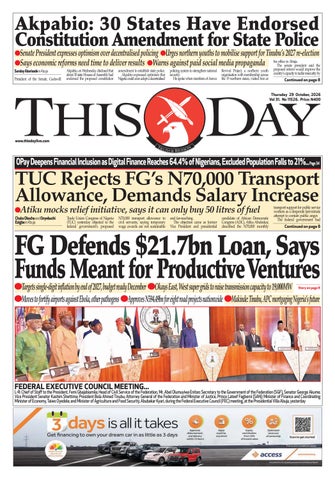
FG Defends $21.7bn Loan, Says Funds Meant for Productive Ventures Targets single-digit inflation by end of 2027, budget ready December Okays East, West super grids to raise transmission capacity to 19,000MW Moves to fortify airports against Ebola, other pathogens Approves N594.49bn for eight road projects nationwide Makinde: Tinubu, APC mortgaging Nigeria’s future
Story on page 8
FEDERAL EXECUTIVE COUNCIL MEETING...
L-R: Chief of Staff to the President, Femi Gbajabiamila; Head of Civil Service of the Federation, Mr. Abel Olumuyiwa Enitan; Secretary to the Government of the Federation (SGF), Senator George Akume; Vice President Senator Kashim Shettima; President Bola Ahmed Tinubu; Attorney General of the Federation and Minister of Justice, Prince Lateef Fagbemi (SAN); Minister of Finance and Coordinating Minister of Economy, Taiwo Oyedele; and Minister of Agriculture and Food Security, Abubakar Kyari, during the Federal Executive Council (FEC) meeting, at the Presidential Villa Abuja, yesterday
2
THURSDAY, OCTOBER 29, t T H I S D AY
THURSDAY, OCTOBER 29, t T H I S D AY
3
4
THURSDAY, OCTOBER 29, t T H I S D AY
5
THISDAY • THURSDAY, OCTOBER 29, 2026
Group News Editor: Goddy Egene Email: Goddy.egene@thisdaylive.com, 0803 350 6821, 0807 401 0580
NEWS
TINUBU WELCOMING ADESINA TO THE VILLA...
President Bola Ahmed Tinubu (right) receives in audience with the former President of African Development Bank Group, Mr. Akinwumi Adesina, at the Presidential Villa, Abuja on Tuesday
Train 7: Amid $3 Billion External Funding, NLNG Seeks More Certainty in Oil Sector Says proven track record key to securing financing Emmanuel Addeh in Abuja The Managing Director and Chief Executive Officer of Nigeria LNG Limited (NLNG), Adeleye Falade, has called for greater certainty in Nigeria’s oil and gas industry, cautioning that the country’s vast natural resources alone cannot attract the capital required to develop them. Falade said investors needed confidence that contractual terms would remain stable, buyers would take delivery of production and operators would meet their obligations, citing the $3 billion in external financing secured for NLNG’s Train 7 project as evidence of the importance of these conditions. Speaking at the 32nd Nigerian Economic Summit in Abuja during a panel session titled, “Unlocking Nigeria’s Oil Potential: The Push for More Oil,” he said Nigeria’s challenge was not a shortage of resources but the ability to translate them into commercially viable projects that lenders could confidently finance. “Certainty itself is the product,” Falade said, explaining that investments in the oil and gas industry required substantial upfront capital, with recovery periods of 20 to 30 years depending on confidence that the terms underpinning projects would
endure throughout their lifespan. For lenders, he said, the quality of the resource was only one consideration, alongside the durability of the investment framework, predictable earnings and the capacity of project owners and other participants to honour their commitments. Falade pointed to the financing of Train 7, secured in 2020 amid the COVID-19 pandemic, as an example of how a credible investment proposition could attract capital even during a period of global uncertainty. The project is being financed through a combination of NLNG’s internally generated cash flows and $3 billion in external funding from 31 local and international financial institutions. According to him, the financing was underpinned by NLNG’s track record of developing six operating liquefaction trains and repaying the loans used to finance those earlier expansions, giving lenders evidence of its ability to execute projects and meet its financial obligations. “Track record compounds,” he said, explaining that each successful project strengthened the company’s credibility and improved its ability to secure financing on competitive terms. By the time NLNG sought funding for Train 7, he said that lenders could
evaluate an established history of project delivery rather than rely solely on projections of future performance. Falade identified three fundamental questions that lenders and investors must be able to answer before committing capital to major energy projects: “Who buys the product? Who carries the risk? Who stands behind the project?” He explained that long-term sales and purchase agreements, including contracts extending to
Senate has begun legislative moves to transform the National Institute for Legislative and Democratic Studies (NILDS) into a full-fledged regional university to provide specialised training in legislative practice, democratic governance, and institutional development across West Africa. The proposed legislation, sponsored by Deputy President of the Senate, Senator Jibrin Barau, scaled First Reading during plenary on Wednesday, barely 48 hours after he announced plans to upgrade the
them, with buyers better positioned to handle market risks while the company and its contractors managed technical risks. The NLNG chief executive also highlighted the importance of operational performance in sustaining investor confidence, disclosing that plant utilisation had risen to 81 per cent year to date after remaining at about 60 per cent for approximately two years because of feedgas constraints.
The improvement, he said, demonstrated the plant’s capacity to deliver stronger output when sufficient gas was available, reinforcing the link between reliable operations, predictable production and lenders’ willingness to provide capital. Beyond financing, Falade said major energy projects should deliberately develop Nigerian businesses and technical capabilities that could support subsequent investments and compete in international markets.
90% of facility reserved for small businesses, women and youth entrepreneurs targeted Michael Olugbode in Abuja The French Development Agency (AFD) and the Bank of Industry (BOI) have signed a $30 million financing agreement to expand access to credit for Nigeria’s creative industry, with at least 90 per cent of the facility earmarked for micro, small and medium-sized enterprises (MSMEs). The agreement, which includes a €500,000 technical assistance
Barau’s bill to transform NILDS scales First Reading 48 hours after proposal institute into a university serving Nigeria and other member states of the Economic Community of West African States (ECOWAS). The bill, titled West African University of Legislative Studies (Establishment) Bill, 2026 (SB. 1087), seeks to establish an institution that would build on NILDS’ existing infrastructure and institutional capacity to provide specialised academic and professional training for legislators and other stakeholders in democratic governance across the sub-region. Barau, who is also First Deputy Speaker of the ECOWAS Parlia-
20 years, provided the commercial foundation for NLNG’s investments by establishing a market for future production before a final investment decision. Such agreements, he said, enabled projected output to be translated into anticipated cash flows that lenders could assess when determining whether to provide financing. He added that bankable projects also required clear allocation of risks to parties best equipped to manage
AFD, BOI Sign $30m Deal to Unlock Finance for Nigeria’s Creative Sector
Senate Moves to Establish West African University of Legislative Studies Sunday Aborisade in Abuja
Plant utilisation rises to 81% after two years at 60%
ment and Chairman of Senate Committee on the Review of the 1999 Constitution, announced his intention to sponsor the bill on Monday while representing President of the Senate, Senator Godswill Akpabio, at the 10th Convocation Ceremony of the NILDS-University of Benin (UNIBEN) postgraduate programmes in Abuja. At the ceremony, he disclosed he had begun discussions with Director-General of NILDS, Professor Abubakar Sulaiman, on the modalities for converting the institute into a full-fledged university.
programme, is AFD’s first credit line dedicated to cultural and creative industries anywhere in the world, positioning Nigeria as the beneficiary of a financing initiative targeting one of the country’s emerging sources of jobs and economic diversification. The facility, signed in Abuja during the visit of AFD Chief Executive Officer, Christophe Lecourtier, was designed to improve access to finance for businesses in fashion, design, textiles, music, film and audiovisual production, video games and visual arts. Women-led and youth-led enterprises, as well as first-time borrowers, are among the priority beneficiaries of the programme, which seeks to
address financing barriers that have constrained the growth of creative businesses. The initiative comes as Nigeria’s cultural and creative industries account for approximately five per cent of the country’s Gross Domestic Product (GDP) and provide livelihoods for more than 4.2 million people. Under the agreement, the BOI would deploy the credit facility to eligible businesses, while the technical assistance component would strengthen the bank’s capacity to finance the sector through staff training and the development of financial products tailored to the needs of creative enterprises. The programme targets the training
of at least 70 per cent of relevant BOI staff, alongside the development of specialised financing products to better serve businesses whose needs may differ from those of conventional industrial enterprises. The agreement was signed by BOI Managing Director, Dr Olasupo Olusi, and Lecourtier, who represented AFD, reinforcing the longstanding partnership between the two institutions. Beyond expanding access to credit, the initiative is expected to promote financial inclusion, support skilled employment and strengthen the contribution of the creative economy to Nigeria’s sustainable and inclusive growth.
House Urges FG to Rename Federal Varsity Wukari After T. Y. Danjuma Adedayo Akinwale in Abuja The House of Representatives has called on the federal government to rename the Federal University, Wukari, Taraba State, after Lt. Gen. General Theophilus Danjuma (rtd). The resolution of the House was sequel to the adoption of a motion jointly sponsored by Hon. Jonathan Gbefwi, Mark Useni and Ayuba Zaku Dampar at the plenary one Wednesday, saying the varsity should now be known as T.
Y. Danjuma Federal University, Wukari (TYDFUW), subject to the necessary amendment of its enabling Act. Moving the motion, Gbefwi said the University, Wukari was established in 2011 to expand access to higher education and promote research and national development. He noted that the contributions of Danjuma to Nigeria through military and public service, philanthropy and support for education, healthcare, and vulnerable communities deserved such
recognition. Gbefwi argued that naming the university after Danjuma would honour his contributions to national development and preserve a legacy of service for future generations. The Speaker, Hon. Abbas Tajudeen, who presided over plenary, commended Gbefwi for sponsoring the motion, describing it as apt. When the motion was put to a voice vote, the lawmakers overwhelmingly voted in its favour.
6
THURSDAY, OCTOBER 29, 2026 • THISDAY
NEWS
THANKSGIVING SERVICE COMMEMORATING JUSTICE GBAJABIAMILA’S 70TH BIRTHDAY...
L-R: Former Lagos State Governor, His Excellency, Mr. Akinwunmi Ambode; his Wife, Mrs. Bolanle Ambode; the celebrant, Hon. Justice Oluyinka Gbajabiamila (Rtd.); and his wife, Pastor (Mrs.) Adeola Gbajabiamila, at the thanksgiving service commemorating Justice Gbajabiamila’s 70th birthday yesterday at RCCG Throne of God Parish, Ikoyi
Power Sector Loses N150bn in Q2, FG Mulls Payment Guarantee to Halt Debt Tinubu orders minister to fix Mambila crisis Peter Uzoho Nigeria’s power sector recorded losses of about N150 billion in the second quarter (Q2) of 2026, exceeding regulatory targets. This has prompted the federal government to consider payment assurance guarantees to prevent further accumulation of sector debts, currently estimated at N3.3 trillion. The government is also pushing to resolve the long-standing Mambila hydropower crisis on presidential order,
while setting an ambitious target of 270 gigawatts of electricity generation by 2060 to meet future industrial and technology-driven demand. Special Adviser to the President on Power, Dr Rilwan Babalola and the Minister of Power, Mr. Joseph Tegbe disclosed this yesterday in Lagos at the Leadership Summit of the Nigeria Energy Exhibition and Conference 2026. Babalola said in Q2, more than a third of energy delivered to distribution companies (Discos) was not paid for,
with aggregate technical, commercial and collection (ATC&C) losses at 30-40 per cent depending on Disco, doubling the regulator’s target. Of the total generation, he said only a portion of that hits Nigerian homes and businesses because of leakages along the whole value chain. The gap is not a shortage of capacity. He, however, blamed the gap on shortage of performance and of planning rather than shortage of capacity. He said Nigeria has over 13,000
Govt eyes 270gw by 2060
megawatts installed generation capacity but generates 4,000-5,000MW daily, with much capacity built without rigorous demand analysis. “A sector that has total losses of about 40 per cent is a sector that is struggling. The best practice in the world is between five and 10 per cent. 10 per cent is of concern; five per cent is manageable. “In that one quarter, losses above target cost the market approximately N150 billion every quarter, and too little of what is collected finds its way back
Atiku Demands Daily Update as Tinubu Departs Abuja for Makkah President to return next week, use opportunity for spiritual reflection Ex-VP says Tinubu will travel to France after brief appearance in Makkah Emmanuel Addeh in Abuja The Presidency yesterday announced that President Bola Tinubu will today (Thursday) depart Abuja for Makkah, Saudi Arabia, to perform Umrah, even as former Vice President, Atiku Abubakar, demanded daily photographic and video evidence of the president’s activities during the pilgrimage. The presidency stated that Tinubu would use the Islamic pilgrimage in the Holy City to pray for the nation and give him the opportunity to seek God’s guidance. According to a statement by Tinubu’s Special Adviser on Information and Strategy, Bayo Onanuga, the visit would also provide the president with an opportunity for spiritual reflection, devotion and prayers for Nigeria’s peace, unity, stability and continued progress. “While in Makkah, President Tinubu will perform the religious rites associated with Umrah, seeking Allah’s guidance and blessings for Nigeria and its people,” the statement said. The statement added that before departing Abuja, Tinubu was scheduled to commission equipment acquired by the Nigerian Air Force (NAF) at the Presidential Wing of the Nnamdi Azikiwe International Airport. The presidency said the Nigerian leader was expected back in the country next week after completing the spiritual exercise.
But Atiku, in a statement issued yesterday by the Director of Strategic Communication of the African Democratic Congress (ADC) Presidential Campaign Council (PCC), Phrank Shaibu, questioned the president’s declared destination, alleging that intelligence available to him suggested that Tinubu might travel to France after making a brief appearance in Makkah. The former vice president challenged the presidency to provide current, date-stamped photographs and videos showing Tinubu at the Kaaba and participating in the rites of Umrah, insisting that Nigerians deserved verifiable evidence of his
presence in the holy city. “If President Tinubu is truly travelling to pray for Nigeria, the Presidency should release clear, current, date-stamped photographs and videos each day showing him at the Kaaba and participating in the rites of Umrah,” Atiku said. He added that Nigerians were entitled to know the president’s full itinerary and daily engagements, arguing that a trip presented as a spiritual mission on behalf of the country was a matter of public interest. Atiku also raised questions about the president’s health and an alleged $20 billion loan request involving a French business partner, calling on
the presidency to address the issues and disclose the details of the trip. He said he and other Nigerians would join the president in prayers for the country’s peace and progress, but warned against treating a declared religious undertaking without the seriousness and transparency it deserved. “No one should invoke the name of Almighty Allah in vain,” Atiku said, adding that Nigerians deserved a transparent account of the president’s activities during the pilgrimage. “Nigerians are entitled to know the president’s daily engagements and how the trip is being funded,” the former vice president pointed out.
to the generators and the gas suppliers,” Babalola added. He noted that 21 per cent of power on transformers was never billed and 20 per cent of billed energy not collected. He said President Bola Tinubu had approved a power sector reset and restoration blueprint to complement the Minister’s action plan, focusing on foundation - market design, conduct and structure - while the Minister focuses on superstructure. “Performance before expansion means three things: Close both circuits. Make every naira in the chain visible and accountable. And only then building a foundation can carry the weight,” Babalola said. He further said execution would be through four commitments: measure first plant by plant, feeder by feeder; fix chain end-to-end on loss reduction, metering, collection and remittance; prove then scale on defined corridors; and complete market via bilateral contracting with large industrial anchors. Tegbe, speaking on “Powering the Nation: Nigeria’s Roadmap to Grid Stability, Investment, Energy Security”, said reliable electricity was central to Tinubu’s resolve. “Every serious reform needs a leader that is willing to take his political part. Under President Bola Tinubu, reliable electricity is central,” Tegbe added. He unveiled a three-phase roadmap: stabilise June 2026-February 2027, scale March 2027-June 2028, transform from 2028 onwards, anchored on five milestones. On debts, he said government has paid N1.23 trillion of N3.3 trillion legacy debt and was blocking leakages.
“Currently, we’re also working to resolve the legacy sector debt. Currently estimated at N3.3 trillion. We’ve paid N1.23 trillion out of it,” Tegbe explained, adding that options include, “structured settlements, payment assurance mechanisms, legally permissible net off arrangements for eligible obligations.” On Mambila, he said President Tinubu has directly ordered its resolution. “Yesterday we discussed Mambila and Mr. President told me, ‘Minister, go fix Mambila,” Tegbe said, noting 21 dams discovered along Sokoto-Badagry expressway will also be developed into hydro projects while small hydro supports agricultural corridors. He noted that technical audits of entire power infrastructure have commenced to avoid throwing money at wrong things, prioritising three energy zones - Lagos-Ogun corridor accounting for 50 per cent demand, Benin-Edo-Port Harcourt, and Abuja-Kaduna-Kano with Lagos-Ogun and Abuja as proof of concept. “The corridor approach is important because we can’t address a 50-year problem across a nation as big as Nigeria overnight,” he said. He announced initiatives such Grid Asset Management Company (GAMCO) and Renewable Asset Management Company (RAMCO) to link stranded capacity to creditworthy demand. “There’s no reason why I cannot evacuate from Alaoji today and using an IPT or reconducted lines to serve Agbara where the demand is needed. The whole concept is about optimisation,” he said.
NISO Seeks Coordination of State Power Markets to Avert Grid Fragmentation Proposes technical working group to harmonise operations Plans integrated network mapping, real-time monitoring Emmanuel Addeh in Abuja The Nigerian Independent System Operator (NISO) is seeking to establish a formal coordination mechanism with state electricity markets to prevent fragmentation of the country’s power industry following the decentralisation introduced by the Electricity Act 2023. The system operator said it was advancing plans for a NISO–States Electricity Market Technical Working Group to address operational, technical and institutional challenges arising from the emergence of multiple state
electricity markets alongside the national electricity market. Speaking at the ongoing Africa Energy Leadership Summit 2026 in Lagos, the Managing Director and Chief Executive Officer of NISO, Mohammed Bello, said the initiative was necessary to ensure that the growing number of electricity markets and independently developed power infrastructure operated within a coordinated national framework. “Our position is clear: decentralisation should create more opportunities and more investment, not more
fragmentation,” he said. The NISO chief executive explained that the Electricity Act 2023 had fundamentally changed Nigeria’s electricity industry by empowering state governments to establish electricity markets and regulate generation, transmission and distribution within their respective territories. “These developments present enormous opportunities for accelerating electricity access, improving service delivery, stimulating competition and attracting much-needed private capital into the sector. However, they also
introduce new complexities,” he said. The proposed technical working group is expected to facilitate coordination on grid connections, network access, cross-boundary electricity transactions, metering, energy accounting, settlement arrangements, planned outages, maintenance and emergency responses. The NISO chief executive stressed, however, that the organisation’s expanding responsibilities would not extend to regulating state electricity markets or undermine the statutory functions of the Nigerian Electricity
Regulatory Commission (NERC) and state electricity regulatory authorities. “Let me emphasise that this does not make NISO a regulator of state electricity markets, nor does it diminish the statutory responsibilities of NERC or State Electricity Regulatory Authorities. “Rather, NISO’s responsibility is to provide the necessary technical, operational, planning and market coordination interfaces that enable the different institutions and market participants to function efficiently within the wider Nigerian electricity ecosystem,” he said.
7
THISDAY • THURSDAY, OCTOBER 29, 2026
NEWS
PANEL SESSION AT THE 32ND NIGERIAN ECONOMIC SUMMIT...
L-R: Executive Chairperson, Eyrie Group and Second Vice Chairman of NESG, Amina Maina; NLNG MD/CEO, Adeleye Falade; NUPRC’s Commission Chief Executive, Oritsemeyiwa Eyesan; and Partner, Energy & Natural Resources Audit KPMG Nigeria, Toyin Abiola-Salami, after a panel session at the 32nd Nigerian Economic Summit (NES), yesterday
Sanwo-Olu: Lagos Targeting $1 Trillion GDP By 2052, Seeks More Investment State’s budget rises from N700bn to N4.2tn in 7 years Governor wants to be remembered for solving needs of Lagos residents Orders clearance of land documents waiting for gov’s consent Emmanuel Addeh in Abuja and Dike Onwuamaeze in Lagos The Governor of Lagos State, Babajide Sanwo-Olu, has said that Lagos is eyeing increased investment in infrastructure, technology, human capital and businessfriendly policies to drive its protected $1 trillion economy by 2052. Sanwo-Olu said the target was anchored on the Lagos State Development Plan 2052, a long-term blueprint featuring 447 initiatives across 21 strategic sectors, designed to position the state as Africa’s model megacity and a globally competitive economic and financial hub. The governor spoke at the Lagos Executive Business Breakfast Meeting organised by the Nigerian-British Chamber of Commerce (NBCC) in Lekki, Lagos, with the theme, “The Future of Lagos: Business, Investment and Global Competitiveness.” He said the development plan was built around four pillars: a thriving economy, a human-centred city, modern infrastructure and effective governance. According to him, sustained investment in infrastructure, technological innovation and improved port efficiency had the potential to strengthen manufacturing, create jobs and stimulate economic activity beyond Lagos. Sanwo-Olu, who has been in office since May 29, 2019, said his administration had created opportunities and improved the lives of millions of residents through governance initiatives
and infrastructure development. He added that he hoped to be remembered as a governor who made a tangible difference in the lives of Lagosians by addressing their individual needs in transportation, healthcare, education, economic empowerment, security and infrastructure. Highlighting projects undertaken by his administration, the governor cited the Blue and Red rail lines, improvements in electricity regulation, expanded digital connectivity and investments in healthcare and education as critical to the state’s long-term competitiveness. He also identified the Lekki Deep Sea Port, industrial developments and the expansion of the technology and creative sectors as important drivers of economic growth and regional trade. Sanwo-Olu said the state was strengthening support for small and medium-sized enterprises through financing and grants, while promoting innovation and developing a skilled workforce to meet the demands of emerging industries. Besides, he disclosed that Lagos State’s budget had increased from about N700 billion in 2019 to N4.2 trillion in 2026, reflecting rising investment requirements and the need to improve revenue generation to sustain development. The governor urged members of the NBCC to look beyond Lagos as a large consumer market and recognise its potential as a centre for produc-
tion, innovation, regional trade and international investment. He reiterated his administration’s commitment to building an economy capable of attracting global capital, creating employment opportunities and improving residents’ quality of life. Also, Sanwo-Olu has ordered an immediate clearance of a backlog of documents in the state’s lands department awaiting to be issued with “Governor’s Consent.” Sanwo-Olu disclosed this yesterday in Lagos at the same event, stating that plans are underway to commence the creation of Lekki Deep Sea Port Phase 2. He added that he signed
an executive order on Tuesday that made it compulsory for companies to provide health insurance schemes for their workers. He said: “I am sure some people in this room will say that we still have issues with our land transactions. Yes! There are six of them that are meant to be signing the Governor’s Consent. It is not only me. I sign the Certificate of Occupancy (C of O). “But some of the challenges that we have seen include the excuse that the internet goes down, which is not an excuse. I told my colleague that I am going to fire some of them because if we give them the responsibility to sign
US Embassy official discloses AI data centre deal
Folalumi Alaran in Abuja Minister of Solid Minerals Development, Dr. Dele Alake, yesterday dismissed reports that Nigeria had sold $700 billion worth of solid mineral assets to the United States, insisting that the bilateral agreement between both countries involves no transfer of ownership of Nigeria’s
mineral resources. Alake made the clarification in Abuja at the inauguration of the Nigeria-United States Committee on Strategic Cooperation in the Solid Minerals Sector, established following the strategic cooperation framework agreed by both countries during the 81st United Nations General Assembly in New York.
Abuja seeks Japanese capital, technology transfer as Tokyo promises faster visa processing Nigeria is seeking to establish a joint industrial and investment hub with Japan to attract foreign capital, accelerate technology transfer and position local businesses to tap into Japanese supply chains and the wider African market. The proposal, put forward by the Minister of Foreign Affairs, Ambassador Bianca Odumegwu-Ojukwu, signals Nigeria’s push to turn 66 years of diplomatic relations with Japan into a stronger economic partnership driven by investment, industrialisation and job creation. Odumegwu-Ojukwu made the
proposal during a bilateral meeting with Japan’s Ambassador to Nigeria, Suzuki Hideo, urging Tokyo to work with Nigeria on a practical roadmap for the proposed Nigeria–Japan Industrial and Investment Hub. The initiative is expected to facilitate joint ventures, connect investors with credible Nigerian businesses, promote skills development and encourage Japanese companies to establish stronger industrial links with Africa’s largest economy. The minister stressed that existing bilateral agreements must translate into concrete investment commitments and measurable development outcomes, rather than remain
will provide that,” the governor said. He also said that approval has been granted for the Badagry Deep Sea Port, adding that two international shipping lines have indicated their interests to work with the proposed Badagry sea port. The governor also stated that the Okpebi Link Bridge will be open to the public next month. He said that care is being taken to ensure that the bridge will be an iconic infrastructure even in the next 100 years. He also disclosed that he signed an Executive Order on Tuesday that will compel everybody to provide health insurance schemes for their workers.
Alake Denies Sale of Nigeria’s $700 Billion Mineral Assets to US
Nigeria, Japan Move to Set Up Industrial Hub to Unlock Investment Michael Olugbode in Abuja
the Governor’s Consent, they should not have any excuse not to be able to sign at least one thousand in a month. “But they have given me commitments that they will clear up the backlog because citizens of Lagos State must have functional property assets they can trade with.” The governor also disclosed that the Lekki Deep Sea Port that was developed during the COVID-19 era is today working at full capacity and is asking for additional land to create a Phase Two of the deep-sea port. “For Nigerian manufacturers, efficient port infrastructure is very, very critical. And we are beginning to see that Lekki
diplomatic declarations. “The outcomes of the Forum must be translated into concrete programmes, investment commitments and measurable development outcomes,” she said. She urged both countries to implement the agreements reached at the 10th Nigeria–Japan Special Partnership Forum, held in Abuja on August 27, through practical programmes and regular consultations between their foreign ministries. To strengthen private-sector participation, Odumegwu-Ojukwu called for more partnerships between Nigerian and Japanese companies
through joint ventures, local content development, skills transfer and the integration of Nigerian businesses into Japanese supply chains. She also sought greater engagement by the Japan External Trade Organization (JETRO) to link Japanese investors with Nigerian enterprises and publicsector partners. Beyond manufacturing and trade, Nigeria is seeking Japanese investment in solid minerals, gas development, cleaner energy technologies and industrial decarbonisation, with the minister highlighting the strategic importance of resilient energy and critical-mineral supply chains.
“There is no sale of any Nigerian asset. There’s nothing exchanging hands,” the minister declared, describing reports that the United States was coming to take over Nigeria’s mineral resources and security architecture as false. He explained that the memorandum of understanding signed by both countries was a governmentto-government framework designed to facilitate business-to-business engagements between American investors and Nigerian mining operators, rather than a transaction involving the sale of national assets. He said, “We created a platform to facilitate mingling of US investment ventures with Nigeria’s local operators. It is in the public domain. We signed it in public and published it in four or five national newspapers.” The minister said the partnership was intended to attract foreign investment, facilitate technology transfer, strengthen domestic mineral processing, and create employment, while ensuring that Nigeria retains greater economic value from its natural resources. He stated that Nigeria and other African countries had historically received limited economic benefits from exporting raw materials, despite
possessing resources critical to global industries, particularly the transition to clean energy. Alake stated, “We have the resources, the critical elements the world needs to transit to clean energy. So, we are creating a new paradigm — you bring your capital, expertise and technology, to match with our natural resources and create a win-win situation. The investor gains, Nigeria gains.” Alake said the federal government was determined to end the practice of extracting minerals and exporting them without processing, disclosing that investors are now required to demonstrate a clear pathway for local processing before being granted mineral titles. He attributed the emergence of processing factories in the country to the policy, citing the lithium processing plant recently commissioned in Nasarawa State by Vice President Kashim Shettima as an example of the government’s push for value addition. The minister also said the administration’s economic reforms had helped restore investor confidence by providing assurance on security of tenure and the repatriation of profits.
8
THURSDAY, OCTOBER 29, 2026 • THISDAY
EIGHT
CBN: 57% of Financial Institutions Ready for Data Localisation Deadline Expects compliance with January 2027 deadline, warns of sanctions for deliberate non-compliance NITDA: 326 MDAs spent N3.8trn on technology in 3 Years
Nume Ekeghe Central Bank of Nigeria (CBN) and National Information Technology Development Agency (NITDA) have disclosed that only 57 per cent of financial institutions are ready for the country’s data localisation requirements, but expressed optimism that the industry would meet the January 1, 2027 deadline. The regulators gave the indication yesterday at the Executive Regulatory Dialogue on National Sovereign Cloud Initiative (NSCI) and Data Localisation Implementation in Lagos, where they engaged banks, fintechs, payment infrastructure providers, and other stakeholders on compliance expectations. With less than three months to the deadline, the regulators said they were prioritising engagement and guidance
to help institutions close gaps in their preparedness, warning, however, that deliberate non-compliance would attract sanctions. CBN issued a circular on June 15, 2026, introducing requirements covering data localisation, market structure, ultimate beneficial ownership disclosure, and systemic oversight in Nigeria’s payments system. Under the directive, regulated institutions were expected to ensure that critical payment transaction data generated in Nigeria were stored and managed locally, with compliance required from January 1, 2027. Speaking at the dialogue, Director of the Payments System Supervision Department, CBN, Rakiya Yusuf, said the engagement was intended to clarify the requirements and help stakeholders
prepare adequately for implementation. Yusuf said a survey conducted ahead of the meeting showed that more than half of the industry was ready. She expressed confidence that institutions yet to comply would make progress with further guidance. Yusuf stated, “I am so glad that the survey that we also put forward to be able to generate some data has shown us that more than 50 per cent of the industry are ready to comply. So the remaining less than 40, I mean, less than 50, will also, with this clarity provided, be able to build on what they have.” Yusuf said CBN was optimistic that the industry would meet the deadline, stressing that the policy is critical to national sovereignty, transaction visibility, and financial system stability. She stated, “Ultimately, we are look-
ing forward to that by January 2027, everyone will be on board to have the payments data localised because it’s about our sovereignty, it’s about clarity, it’s about visibility over our transaction data, and it’s about ensuring financial system stability, which is the mandate of the Central Bank of Nigeria.” On enforcement, Yusuf said the regulator would initially focus on helping institutions understand and comply with the requirements rather than imposing penalties. She said, “Sanctions will surely not be the first in our mind when it comes to enforcement. So, what is surely first in our mind is to ensure that everybody is hand-held.” She, however, warned that institutions deliberately frustrating the implementation would face consequences. “However, where we see that there is
a deliberate attempt to scuttle it, of course, sanctions will come,” Yusuf stated. “There will be sanctions for non-compliance,” she added. Director-General of NITDA, Kashifu Inuwa Abdullahi, disclosed that 57 per cent of financial institutions were ready to comply with CBN’s data localisation requirements ahead of the January 1, 2027 deadline. Abdullahi said the engagement was designed to assess preparedness and guide institutions yet to meet the requirements. He stated, “The objective is to check, to find out. Based on our survey, 57 per cent of them are ready to comply and meet the deadline of 1st January 2027. Those who are not ready, we are here to provide guidance for them, to handhold them, to make sure we support them to comply with the guidelines.”
CBN Governor, Yemi Cardoso He explained that the financial sector was being prioritised because it was Nigeria’s most digitalised sector, adding that NITDA is working with the budget office to prepare ministries, departments and agencies (MDAs) for compliance.
FG DEFENDS $21.7BN LOAN, SAYS FUNDS MEANT FOR PRODUCTIVE VENTURES Deji Elumoye and Chuks Okocha in Abuja
The federal government yesterday defended its proposed $21.7 billion external borrowing plan, insisting that the funds would finance productive investments in infrastructure and other critical sectors to stimulate economic growth, strengthen national productivity and improve living standards. The Minister of Finance and Coordinating Minister of the Economy, Taiwo Oyedele, said the proposed financing should be assessed based on the assets to be created and the economic returns expected, rather than simply as an addition to the country’s debt burden. Oyedele spoke after the Federal Executive Council (FEC) meeting presided over by President Bola
Tinubu at the State House, Abuja, amid criticism of the borrowing plan by former Vice President, Atiku Abubakar, as well as the presidential candidate of the Nigeria Democratic Congress (NDC) in the 2027 election, Peter Obi. Oyedele maintained that the proposal was a financing plan and did not mean the federal government had already borrowed the money or would necessarily draw down the entire amount. “Altogether, if you convert the euro amount and add it to the dollar amount, it will come up to $21.7 billion. First and foremost, this is a plan. It doesn’t mean that we have borrowed. It doesn’t even mean that we borrow all of it. So it’s a plan. The average lifespan of the projects under this plan is five years. This qualifies as investment. This is investment, not
borrowing,” Oyedele pointed out. The proposed financing comprises $20.52 billion and €1.045 billion for projects and programmes covering transportation, security, healthcare, agriculture, energy, digital infrastructure, education and social protection. The government said transportation infrastructure accounts for approximately $10.6 billion, including major projects such as the Sokoto-Badagry and Lagos-Calabar highways and the Kano-Kaduna rail project. Oyedele said the government was pursuing financing from multilateral and bilateral development partners, alongside other sources, to implement the projects. Besides, about $7.9 billion is expected from multilateral and bilateral partners, with the World Bank among the major institutions providing support. Oyedele
said a $5 billion World Bank component would attract concessional financing at an average interest rate of about 2.1 per cent, while some social-sector loans would carry interest rates of around 2 per cent. He said the government was prioritising favourable financing terms to reduce borrowing costs and ensure that the projects delivered lasting economic benefits.
Government Targets Singledigit Inflation Rate The minister also disclosed that the federal government was targeting single-digit inflation by the end of 2027, as it intensifies efforts to stabilise prices and sustain economic growth. He said inflation had declined to 14.63 per cent in September from 20.98
TUC REJECTS FG’S N70,000 TRANSPORT ALLOWANCE, DEMANDS SALARY INCREASE approved a monthly transport allowance of N70,000 for public service workers across all levels for six months, beginning in November 2026, to cushion the effects of rising living costs. The approval was announced in a memorandum of understanding (MoU) issued at the end of a conciliation meeting between government representatives and leaders of the Nigeria Labour Congress (NLC) in Abuja on Tuesday. The MoU was signed by Tanimu Yakubu, Director-General of the budget office; Joe Ajaero, NLC President; Garba Abdul, Permanent Secretary of the Service Welfare Office in the Office of the Head of the Civil Service of the Federation; and Muhammad Dingyadi, Minister of Labour and Employment.
However, TUC demanded immediate salary increase for workers and implementation of agreement reached with Joint Health Sector Unions (JOHESU). TUC said its position was taken at its National Administrative Council meeting on October 8 in Abuja, where it sent a demand letter to the federal government through the office of Secretary to Government of the Federation. A statement signed by TUC President, Festus Osifo, said the union would await the outcome of a meeting with the federal government to decide on the next steps to take. The congress said the letter was in furtherance of an earlier press briefing on the economic hardship facing workers and proposed measures
to address it. On salary increase, TUC said its position was clear that the federal government should review and increase the salaries of workers. It said the government did not require any minimum wage negotiation before increasing pay, as there was no maximum wage law in the country. It stated that some states had raised minimum wage above N100,000, adding that the federal government could raise the pay of its lowest workers to N300,000, from the current N70,000, and apply consequential adjustment. “While it is good to negotiate minimum wage, which will affect other cadre of workers, FGN must raise wage level immediately as there
are no law or historical practices stopping it from doing so,” TUC stated. Following the letter, the TUC leadership held consultative meetings with government officials, including Secretary to Government of Federation, where its position was canvassed. It said the proposal of wage award was mentioned, but it was vehemently rejected for several reasons. According to TUC, temporary wage awards are not sustainable and far-reaching. The congress cited the wage award agreed on October 2, 2023, which was to be implemented until the minimum Continued on page 35
per cent in the corresponding period of the previous year, after peaking at about 34 per cent. According to him, FEC resolved to intensify efforts to bring down prices, particularly food prices, while sustaining investments in infrastructure, human capital development and job creation. Oyedele disclosed that Nigeria’s foreign reserves had risen above $55 billion, the highest level in 18 years, while net reserves had increased to more than $45 billion from less than $1 billion three years ago. He put economic growth at 4.43 per cent in the second quarter, compared with 2.74 per cent in May 2023. The minister added that the taxto-GDP ratio had risen from about seven per cent in 2023 to 12.5 per cent by the end of 2025, while the debt-service-to-revenue ratio had declined from 97 per cent to below 60 per cent. Oyedele also defended the removal of petrol subsidy, arguing that the previous arrangement placed an unsustainable burden on public finances and constrained the government’s ability to invest in infrastructure and essential services. He said Nigeria had increased petrol prices about 3,050 times in 50 years without resolving the underlying subsidy problem, adding that the government had introduced interventions to cushion the impact of economic reforms on vulnerable Nigerians. According to him, more than 10 million households had received over N600 billion in cash transfers, while the Nigerian Education Loan Fund had disbursed N372.6 billion to more than 1.5 million students. He added that more than 800,000
micro, small and medium-sized enterprises had benefited from subsidised loans at single-digit interest rates. The minister further said low-income earners making up to N100,000 monthly were exempt from personal income tax, while businesses with annual turnover of up to N100 million were exempt from corporate income tax, value-added tax and withholding tax under the relevant tax reforms. He also disclosed that the Nigerian capital market had grown from about N30 trillion to more than N160 trillion, expressing optimism about the naira’s outlook on the strength of improved foreign reserves and other economic fundamentals.
Uzoka-Anite: 2027 Budget Ready by December The federal government also said it was working towards presenting the 2027 budget before the end of the year to allow the National Assembly sufficient time to consider the proposed fiscal framework ahead of the next financial year. The Minister of State for Budget, Doris Uzoka-Anite, disclosed this while briefing journalists after the FEC meeting. “We are working on the 2027 budget, and our intention is to present it before the end of the year,” she said. Further details of the proposed budget, including its overall size, revenue projections, deficit estimates and allocations to key sectors, are expected to emerge as preparations progress.
FG Begins Procurement for East, West Super Grids Similarly, the federal government Continued on page 36
AKPABIO: 30 STATES HAVE ENDORSED CONSTITUTION AMENDMENT FOR STATE POLICE bringing policing closer to communities. He expressed confidence that the constitution amendment process was nearing completion, adding that the establishment of state police would complement existing security structures and enhance efforts to address the country’s security challenges. He urged the youth to intensify grassroots mobilisation for President Bola Tinubu’s re-election in 2027, stating that continuity in government would allow the administration’s economic reforms and security policies to produce the desired results. Akpabio also called on the Nigerian youth to rise above what he described as paid social media propaganda against the administration. He said the president had taken significant steps to diversify the economy, reform the tax system, and address longstanding structural problems. He explained, “As I speak with you now, for the first time in the history of Nigeria, it may not take
us a month before we have a state police system, a decentralised policing in the country, because about 30 states have endorsed the amendment to the Nigerian constitution to bring about state police system, which will further increase the security of the nation.” The senate president expressed optimism that Nigeria would overcome its security challenges, urging the youth to remain confident in the country’s future while supporting efforts to restore peace and stability. He stated, “I always tell them that the devil that you see today, you will soon see them no more. Very soon, we shall overcome the insecurity that we face today. So, feel confident as you go round campaigning.” Akpabio maintained that decentralised policing would further strengthen national security, particularly by improving the ability of law enforcement agencies to respond to threats within their respective communities. He urged the Arewa youths to
mobilise support for Tinubu ahead of the 2027 presidential election, saying the administration needs time to consolidate its policies. He said the president had taken steps to move Nigeria away from its longstanding dependence on crude oil revenues and introduce reforms intended to reposition the economy. He said, “I expect the Nigerian youth to rise above social media propaganda because this president has managed to take us out of a mono-economy, an economy that was dependent only on crude oil. “He has brought innovations to bear through the tax reform system, through tinkering with anachronistic laws.” Akpabio stated that the administration’s performance had earned it the support of the National Assembly, declaring that lawmakers have endorsed Tinubu for a second term. He said, “No president has achieved the level of development that he has done in this country today since
independence. The naysayers will not want to say so, but I am very proud and members of the National Assembly are very proud. “We hold our heads very high and say, yes, we have given him a pass mark and that we have endorsed him to come for a second term in office.” Akpabio said Nigeria’s continued survival amid economic and security difficulties reflected the president’s willingness to confront the challenges facing the country. “I give glory to God that Nigeria is still surviving, and surviving because we have a president who thinks and somebody who wants to face challenges, and he is facing the challenges,” he said. He urged the youth to support continuity in government, stating that changing the administration before its policies fully matures could undermine the progress made so far. He stated, “You don’t change a winning team. He is doing so well. Allow his policies to crystallise. This
is not somebody who is coming to experiment. He is already doing it.” Akpabio also emphasised the importance of youth participation in national development, saying government policies should create a stable foundation for future generations. He said, “Whatever we are doing today, we are doing it to stabilise your future and ensure the survival of Nigeria. So, it is good that you are seeing it.” He warned that the youth could face considerable challenges in countering criticism of the administration on social media, alleging that some individuals attacking the president and his supporters online are being paid to do so. Akpabio alleged, “It is not going to be easy for you because most of those who are attacking the president and attacking these young men on social media are being paid. You are not being paid.” He advised the youth to organise periodic grassroots engagements to
explain government policies and challenge misinformation, rather than attempt to compete continuously with critics on social media. He said, “You may not be able to have the kind of energy and time with them. But once in a while, gather the youth together and let them see the truth and know the truth.” The senate president added, “Attacking a government that is working well for them, trying to bring uncertainty, is not the best.” The visit provided an opportunity for the Arewa Revival Project to express support for Akpabio’s leadership of the National Assembly and recognise what it described as his contributions to national development. Earlier, Project Coordinator, Arewa Revival Project, Hon. Mustafa Ibrahim, said the organisation considered Akpabio deserving of recognition because of his contributions to nation-building and the achievements recorded under his leadership of the National Assembly.
9
THISDAY • THURSDAY, OCTOBER 29, 2026
NEWS
OTL AFRICA DOWNSTREAM ENERGY WEEK EXPO...
L-R: Divisional Head, Energy, Fidelity Bank Plc, Emeka Nkemakolam; Group Managing Director, Emadeb Group, Adebowale Olujimi; Executive Director, Emadeb Group, Olugbesoye Olujimi; and Executive Director, Corporate Bank, Fidelity Bank Plc, Abolore Solebo, on the sidelines of the OTL Africa Downstream Energy Week Expo in Lagos... recently
FG, Africa CDC, Stakeholders Seek to Prioritise Community Health Workforce To deliver 2 million workers by 2030 Onyebuchi Ezigbo in Abuja The federal government, Africa Centre for Disease Control and Prevention (Africa CDC), and other continental partners have canvassed urgent prioritisation of community health workforce, warning that Africa’s health sovereignty will remain an illusion unless community health workers were recognised, paid and planned for. They expressed confidence that under the Continental Acceleration Plan 2026-2030, to be launched Friday,
Africa could cross the two-million health workers’ deployment target set for November 2029 if member states delivered reported plans. The call was made at High-Level Forum on Fit-for-Purpose Health Workforce: Accelerating Africa’s Progress Towards Two Million Community Health Workers by 2030, hosted by Nigeria, in collaboration with Africa CDC and UNICEF in Abuja. Minister of State for Health and Social Welfare, Dr. Iziaq Salako, represented by Director of Health
Planning, Research and Statistics, Dr. John Ovayoru, said the meeting was not to admire the problem but to solve it through measurable interventions. Salako said, “We are here for very serious business. The health workforce Africa needs is the workforce that will move us forward. About 80 per cent of health conditions occur at community level and do not require consultant surgeon. Often, communities simply need a community health worker who can identify diseases early, intervene quickly, and refer appropriately.”
Salako said Nigeria was proud to host the forum together with Africa CDC and UNICEF, and thanked the 55 member states present. He recalled that in 2016, Heads of State committed to training and deploying two million community health workers, reaffirmed in 2017, and renewed in February 2026 at 39th AU Summit convened by President Bola Tinubu and at Accra Extraordinary Summit in July. He stated, “The community health worker is the face of the health system for millions. She vaccinates child,
UK Backs N3.75bn Drive to Finance Women-Owned Businesses in Nigeria Michael Olugbode in Abuja The UK Government and FSD Africa are targeting N3.75 billion in domestic investment to finance women-led businesses in Nigeria, in a move aimed at addressing a funding gap that continues to constrain the growth of small enterprises. The initiative, backed by a $335,000 grant from FSD Africa with funding from the UK Government through the British High Commission in Nigeria, seeks to mobilise capital from Nigerian investors to support 15 small and growing businesses owned by women over the next three years. The investment will be channeled through the RiTA Investment Network, established by Rising Tide Africa, a pan-African network of women angel investors, to connect women entrepreneurs with high-networth individuals, angel investors and family offices. The intervention comes amid persistent difficulties faced by small businesses in accessing formal financing, particularly women-owned enterprises, which often struggle to meet conventional lending requirements despite their potential to generate jobs and stimulate economic growth. Figures cited by the initiative indicate that Nigeria’s small businesses face a financing gap of about N13 trillion, with 19 out of every 20 unable to access formal finance. Women entrepreneurs face additional barriers, with women owning about 40 per cent of the country’s
small businesses but reportedly being rejected for credit more than three times as often as their male counterparts. The initiative’s promoters said the problem was often linked to the inability of women entrepreneurs to provide assets, particularly land, as collateral for bank loans, rather than a lack of viable business opportunities. Speaking on the initiative, the Head of Green Growth and Private Sector Development at the British High Commission, Paul Healey, said the partnership would strengthen access to investment for women entrepreneurs and help them expand their businesses. “Women entrepreneurs are building successful businesses across Nigeria, but many still face barriers to accessing the investment they need to grow. This partnership between the UK Government, FSD Africa and Rising Tide Africa is changing that,” he said. Healey said the initiative would create stronger connections between businesses and investors, opening up opportunities for enterprises to grow, generate employment and contribute to Nigeria’s economy. The Director for Early-Stage Finance at FSD Africa, Juliet Munro, said Nigeria had substantial private wealth that could support growing businesses but lacked effective channels to connect domestic investors with enterprises in need of capital. “Nigeria does not lack capital. Women angel investors in Rising Tide Africa have shown for years that they will back women-led businesses
with their own money. The RiTA Investment Network gives that capital the structure and instrument to grow, in naira, and at scale,” she said. A key feature of the initiative is its emphasis on naira-denominated financing, which is intended to reduce the foreign-exchange risks associated with dollar loans for businesses whose revenues are earned in the local currency. The network will primarily deploy revenue-based financing, an arrangement under which repayments rise
or fall in line with a business’s sales. The model is designed for profitable enterprises that lack conventional collateral and want to avoid surrendering ownership stakes to investors. To attract domestic capital, the platform will operate with professional credit assessment, an investment committee, an advisory board and monitoring and reporting systems intended to give investors greater confidence in the businesses they support.
follows pregnant woman, treats malaria at the doorstep, and raises alarm when outbreak begins. “When she stops epidemic in the village before it reaches the city, that is health sovereignty in action.” Salako warned that as of May 2026, Africa had only 1.06 million community health workers deployed, roughly half of the target, with four years left. Only 68 per cent of member states formally recognise them, only half pay them through government wage bill, and 85 per cent rely on donors for half or more of programmes at a time development assistance for health has fallen 40 per cent since 2021, he said. The minister said, “A workforce that is not recognised, paid or planned for is a workforce that cannot be retained.” He expressed confidence that Continental Acceleration Plan 2026-2030, to be launched Friday, showed Africa could cross the twomillion target by November 2029 if member states delivered reported plans, adding that investment case is $4.3 billion per year with $19 return for every dollar. For Nigeria, with over 240 million people, Salako said only about 93,000 community health workers were deployed, fewer than four per 10,000, but under Renewed Hope Agenda and Health Sector Renewal Investment Initiative government was revitalising PHCs so that every ward had functional facility.
He said with clear national policy, master registry, and domestic financing through BHCPF, Nigeria will continue to lead as AU Champion. He gave three tests for delegates: leave with country-owned plan that finance minister can put into next budget not waiting on donors; commit to reforms only government can make, including recognition and inclusion in wage bill; and ensure Abuja Communique records specific, dated, measurable commitments. Representing Africa CDC Director General Dr. Jean Kaseya, Special Representative, Professor Aliko Baba Ahmed, said the turnout of 55 member states and 36 partners was a statement that community health workers were central to health security agenda, especially as the continent battled Ebola outbreak affecting about 10,000 people and killing close to 5,000 across four countries including Nigeria. He said health sovereignty rested on five pillars: surveillance, workforce development, domestic financing, digital transformation and local manufacturing, saying almost 70 per cent of medical products are imported. Ahmed stated, “Community health workers are link across all five pillars. Without them, we do not have structure to make health sovereignty real. They detect problems before escalation, protect communities through immunisation and connect people to institutions.”
Senate Panel Screens, Clears NGE President, 15 Others for NHRC Board Anaba pledges commitment to human rights protection As committee forwards report to Senate for consideration Sunday Aborisade in Abuja The Senate Committee on Judiciary, Human Rights and Legal Matters has screened and cleared the President of the Nigerian Guild of Editors (NGE), Eze Anaba, and 15 other nominees for appointment to the governing board of the National Human Rights Commission (NHRC). The committee, chaired by Senator Adeniyi Adegbonmire, conducted the screening as part of the legislative process for reconstituting the commission’s governing board following President Bola Tinubu’s request for Senate confirmation of the nominees.
Anaba, who is also the Editor of Vanguard Newspapers, said his nomination represented a continuation of his longstanding commitment to human rights advocacy, which he described as an integral part of his journalism career. Speaking after the screening, he expressed confidence that the nominees, with their diverse professional backgrounds, would contribute to strengthening the commission and advancing human rights protection in Nigeria. He however cautioned against making premature commitments before the Senate completed the
confirmation process. “We’ve just been screened. We’ve just been confirmed. So don’t let us jump the gun. That’s number one,” Anaba said. He added: “I’m happy to be approved at least by this screening committee. So, until confirmation.” Explaining his experience in human rights advocacy, the NGE president said the responsibility had always been closely linked to his work as a journalist. “I’ve done this human rights thing all my life. It has gone together with my journalism job. So, it’s going to be a continuation of what I’ve been
doing,” he said. Anaba disclosed he had been associated with the work of the NHRC before his nomination to the governing board, expressing optimism that the incoming members would help deliver improved results. “I’ve been part of Nigeria’s Human Rights Commission for a while. Not at this level. But I can assure you that with the members we have in this council, Nigeria will benefit from a very good National Human Rights Commission,” he said. He added he would make further commitments after the completion of the confirmation process.
10
THURSDAY, OCTOBER 29, t T H I S D AY
HAPPY BIRTHDAY TO HIS ROYAL MAJESTY
OBA RILWAN BABATUNDE OSUOLALE AREMU AKIOLU 1 OBA OF LAGOS
Sincere birthday wishes to our amiable Kabiyesi, Oba of Lagos on your 83rd Birthday Anniversary. May your reign be eenriched with many more y years of divine grace and abundant blessings.
H. E. AKIN AMBODE
11
THURSDAY, OCTOBER 29, t T H I S D AY
+".&4 )01& $0--&(& ˬ̛̌Ν˵ʍɾʳʍࢫࢫ-˂Ʉ͍Ʉɲͩʍ͍ࢫė͍ͷͩ˂
kĤėĤþHࢫ§H 8HþĊࢫ8Ìࢫ½Ìėࢫ ĤĊėࢫz ööH½ࢶࢶࢶėzHŖࢫ þHࢫkÌþ·H8 ėࢫ ·HĊࢫzÌöHࢫ-̧§HnHࢷࢫ§H ࢷࢫ§ nÌĊ ½ÌŅH·%Hþࢫ࠵࠳࠵࠸ࢫ- ·%þ 8nH
· Ŗࣃ Ĥ½Hࢫ࠵࠳࠵࠹ࢫŋ H-
n-ĊHࢫHœ · ½ ė ̽ࢫþHĊĤ§ė
Hœ · ½ ė ̽ࢫþHĊĤ§ė
ࣁ
࠴ ࠶ ࢫ࣒ࢫ% nþ 8HĊࢸࢫ࠼࠷य़
nþ 8HĊࢸࢫ࠹࠺य़
࠴
ࣁ ࢫ࣒ࢫ nþ 8HĊࢸࢫ࠼࠹य़
࠹
ࢫ࣒ࢫ-ࢫࢫnþ 8HĊࢸࢫ࠴࠳࠳य़
ࣁ ࢫ࣒ࢫ% nþ 8HĊࢸࢫ࠼࠼य़ ࣁ ࢫ࣒ࢫ-ࢫࢫ nþ 8HĊࢸࢫ࠴࠳࠳य़ ĊͩɄͩʍࢫ̛ʱࢫͩ˂ʍࢫɄ͍ͩࢫɲ˵Ʉ̛̛͍͛͛̆͛ࢷࢫ˵Ʉɩ̛͍Ʉ̛͍ͩˏʍ͛ࢷࢫɩ̛Ʉ͍ɾˏ̌ʳࢫɄ̌ɾࢫ̛͍͛ͩͅˏ̌ʳࢫʱɄɲˏ˵ˏͩˏʍ͛ࢶ HΦɲʍͩͅˏ̛̌Ʉ˵ࢫʍɾͷɲɄ̛͍ͩ͛ࢫΝ˂̛ࢫɲ˂Ʉ˵˵ʍ̌ʳʍࢫ̆ˏ̌ɾ͛ࢷࢫ̌ͷ͍ͩͷ͍ʍࢫɄ̌ɾࢫɩ͍ˏ̌ʳࢫ ̛ͷͩࢫͩ˂ʍࢫɩʍ͛ͩࢫˏ̌ࢫʍΘʍ͍Ωࢫ˵ʍɄ͍̌ʍ͍ࢶ ơ͍̈ͷɾࢫΝˏ̌̌ʍ͍͛ࢫ̛ʱࢫ͍ͅʍ͛ͩˏʳˏ̛ͷ͛ࢫˏ̌ͩʍ͍̌Ʉͩˏ̛̌Ʉ˵ࢫɄ̌ɾࢫ̌Ʉͩˏ̛̌Ʉ˵ࢫɄΝɄ͍ɾ͛ࢶ %ʍɄͷͩˏʱͷ˵ࢷࢫ͛ʍ͍ʍ̌ʍࢫɄ̌ɾࢫ͛ʍɲͷ͍ʍࢫΝ̛͍˵ɾ࣒ɲ˵Ʉ͛͛ࢫɲɄ̆ͅͷ͛ࢫΝ˂ʍ͍ʍࢫ˵ʍɄ͍̌ˏ̌ʳࢫͩ˂͍ˏΘʍ͛ࢶ H½ėþ ½-HࢫHœ · ½ ė ̽ࢫkÌþࢫŖH þࢫ࠺ࢫࣜ ĊĊ࠴ࣝࢫ8 Ŗࢫ ½8ࢫ%Ì þ8 ½nࢫĊėĤ8H½ėĊࢫkÌþ ėzHࢫ࠵࠳࠵࠺ࣃ࠵࠳࠵࠻ࢫ - 8H· -ࢫĊHĊĊ ̽ࢫ ĊࢫĊ-zH8Ĥ§H8ࢫėÌࢫė Hࢫö§ -Hࢫ Ċࢫķ§ÌŋĊࢸ
§ nÌĊ 8Ʉͩʍ͛ࢸࢫࢫࢫࢫࢫࢫࢫࢫࢫࢫĊɄͩͷ͍ɾɄΩࢷࢫ࠶࠳ͩ˂ࢫ Ʉ̌ͷɄ͍ΩࢫɄ̌ɾࢫ࠹ͩ˂ࢫkʍɩ͍ͷɄ͍Ωࢷࢫ࠵࠳࠵࠺ §̛ɲɄͩˏ̛̌ࢸࢫࢫࢫࢫࢫ Ʉ̆ʍ͛ࢫz̛ͅʍࢫ-̛˵˵ʍʳʍࢷࢫėΝˏ̌ࢫ§Ʉˬʍ͛ࢫH͛ͩɄͩʍࢷࢫ§ʍˬˬˏࢷࢫ§Ʉʳ̛͛ࢶ ėˏ̆ʍࢸࢫࢫࢫࢫࢫࢫࢫࢫࢫࢫࢫࢫ࠴࠳ ·
%Ĥ ࢫऑࢫöÌþėࢫz þ-ÌĤþė 8ɄͩʍࢸࢫࢫࢫࢫࢫࢫࢫࢫࢫࢫࢫࢫĊɄͩͷ͍ɾɄΩࢷࢫ࠹ͩ˂ࢫkʍɩ͍ͷɄ͍Ωࢷࢫ࠵࠳࠵࠺ §̛ɲɄͩˏ̛̌͛ࢸࢫࢫࢫ࠺࠴ࢫĤ͛ͷ̆ɄࢫĊ͍ͩʍʍͩࢷࢫÌͅͅࢶࢫė͍Ʉ̌͛ɲ̛͍ͅࢫzˏ˵̛ͩ̌ࢷࢫ·ɄˏͩɄ̆Ʉࢷࢫ ɩͷ˥Ʉࢶ ࢫࢫࢫࢫࢫࢫࢫࢫࢫࢫࢫࢫࢫࢫࢫࢫࢫࢫࢫࢫࢫࢫ࠴࠸ࢫ½̌Ʉ̆ɾˏࢫ ηˏˬˏΝʍࢫþ̛Ʉɾࢷࢫơ͍̈ͩࢫzɄ͍ɲ̛ͷ͍ͩࢷࢫþˏΘʍ͍͛ࢫĊͩɄͩʍࢶ ėˏ̆ʍࢸࢫࢫࢫࢫࢫࢫࢫࢫࢫࢫࢫ࠴࠳ ·
öö§ - ė ̽ࢫ-§ÌĊHĊࢸࢫkþ 8 Ŗࢷࢫ࠵࠵½8ࢫ ½Ĥ þŖࢫ࠵࠳࠵࠺ ͅͅ˵ˏɲɄͩˏ̛̌ࢫʱ̛͍̆͛ࢫɲɄ̌ࢫɩʍࢫɾ̛Ν̌˵̛Ʉɾʍɾࢫʱ̛͍̆ࢫΝΝΝࢶ˥Ʉ̆ʍ͛˂̛ͅʍɲ̛˵˵ʍʳʍࢶʍɾͷࢶ̌ʳࢫͷ̌ɾʍ͍ࢫͩ˂ʍࢫ ࣪Ʉɾ̆ˏ͛͛ˏ̛̌࣫ࢫͩɄɩࢫ̛͍ࢫɲɄ̌ࢫɩʍࢫɲ̛˵˵ʍɲͩʍɾࢫʱ̛͍̆ࢫ Ʉ̆ʍ͛ࢫz̛ͅʍࢫ-̛˵˵ʍʳʍࢷࢫėΝˏ̌ࢫ§Ʉˬʍ͛ࢫH͛ͩɄͩʍࢷࢫ§ʍˬˬˏࢷࢫ§Ʉʳ̛͛ࢶ
23(1 '$<6 8 ėHࢸࢫĊ ėĤþ8 Ŗࢫ࠴࠷ėzࢫ½ÌŅH·%Hþࢷࢫ࠵࠳࠵࠹ࢫऑࢫĊ ėĤþ8 Ŗࢫ࠼ėzࢫ ½Ĥ þŖࢷࢫ࠵࠳࠵࠺ ė ·Hࢸࢫ࠼ ·ࢫėÌࢫ࠴࠵ࢸ࠶࠳ö·
k̛˵˵̛Νࢫͷ͛ࢫ̛̌ࢫɄ˵˵ࢫ̛ͷ͍ࢫ̛͛ɲˏɄ˵ࢫ̆ʍɾˏɄࢫ˂Ʉ̌ɾ˵ʍ͛ࢸ ऐ˥Ʉ̆ʍ͛˂̛ͅʍɲ̛˵˵ʍʳʍ ऐ
Ʉ̆ʍ͛ࢫz̛ͅʍ
ėʍ˵ࢸࢫॆ࠵࠶࠷࠺࠳࠻࠶࠹࠹࠵࠵࠵࠼ࢷࢫॆ࠵࠶࠷࠺࠳࠴࠻࠵࠻࠵࠳࠹࠸ࢷ ऐ z-§ʍˬˬˏ
ࢫࢫࢫࢫࢫࢫࢫॆ࠵࠶࠷࠺࠳࠻࠸࠶࠹࠼࠶࠺࠹ࢷࢫॆ࠵࠶࠷࠺࠳࠴࠸࠶࠷࠼࠵࠸࠺ H̆Ʉˏ˵ࢸࢫɄɾ̆ˏ͛͛ˏ̛̌ऐ˥Ʉ̆ʍ͛˂̛ͅʍࢶʍɾͷࢶ̌ʳ ŋʍɩࢸࢫΝΝΝࢶ˥Ʉ̆ʍ͛˂̛ͅʍɲ̛˵˵ʍʳʍࢶʍɾͷࢶ̌ʳ
12
THURSDAY, OCTOBER 29, t T H I S D AY
THURSDAY, OCTOBER 29, t T H I S D AY
13
14
THURSDAY, OCTOBER 29, t T H I S D AY
ŚŝĞĨ ,ŽƐƚ
ZŽLJĂů &ĂƚŚĞƌƐ ŽĨ ƚŚĞ ĚĂLJ͘
,ŝƐ ŵŝŶĞŶĐĞ DƵŚĂŵŵĂĚƵ ^Ă͛ĂĚ ďƵďĂŬĂƌ /// ^ƵůƚĂŶ ŽĨ ^ŽŬŽƚŽ ,ŝƐ /ŵƉĞƌŝĂů DĂũĞƐƚLJ
KďĂ ĚĞLJĞLJĞ ŶŝƚĂŶ KŐƵŶǁƵƐŝ
;KũĂũĂ //Ϳ KŽŶŝ ŽĨ /ĨĞ͘
^ƉĞĐŝĂů ĚǀŝƐĞƌ ƚŽ ƚŚĞ WƌĞƐŝĚĞŶƚ ŽŶ WŽůŝƟĐĂů īĂŝƌƐ͘
Zƚ͘ ,ŽŶ͘ :ĂŵĞƐ ďŝŽĚƵŶ &ĂůĞŬĞ ŚĂŝƌŵĂŶ͕ ĮŶĂŶĐĞ ĐŽŵŵŝƩĞĞ ŽĨ ƚŚĞ ,ŽƵƐĞ ŽĨ ZĞƉƌĞƐĞŶƚĂƟǀĞƐ Θ ĨŽƵŶĚĞƌ dŝŶƵďƵ ^ƵƉƉŽƌƚ 'ƌŽƵƉ ;d^'Ϳ
3ULQFLSDO &RQWDFW )RU 7KH (YHQW 0DMRU *HQHUDO $7 -LEULQ 5WG 7HO
7RPSROR >ĞĂĚĞƌ͕ W dͲ ŽŽƌͲdŽͲ ŽŽƌ DŽǀĞŵĞŶƚ ĨŽƌ ƚŚĞ ƌĞͲĞůĞĐƟŽŶ ŽĨ WƌĞƐŝĚĞŶƚ ŽůĂ ŚŵĞĚ dŝŶƵďƵ ' &Z Θ ŚĂŝƌŵĂŶ͕ dĂŶƟƚĂ ^ĞĐƵƌŝƚLJ ^ĞƌǀŝĐĞƐ
THURSDAY, OCTOBER 29, t T H I S D AY
15
16
THURSDAY, OCTOBER 29, t T H I S D AY
17
THURSDAY, OCTOBER 29, t T H I S D AY
In Loving Memory It has been 8 years since you left this side of the divide, but to us it feels just like yesterday, and your memory remains indelible. Though we miss your physical presence, we take solace in knowing that you are resting in the bosom of your Maker. We pray that your soul continues to rest in peace. Amen.
Late Chief Tony Anenih Born: 4th August, 1933 Died: 28th October, 2018 Fondly remembered by Rowena Akhere
18
THURSDAY, OCTOBER 29, t T H I S D AY
/(*$/ 35$&7,7,21(56· 35,9,/(*(6 &200,77(( 6835(0( &2857 2) 1,*(5,$
7+5(( $506 =21( 6835(0( &2857 &203/(; 3 0 % $%8-$ ± 1,*(5,$7(/
ƖLjƖƀƉ ~%Ɖj8Ɖ B)Ɖ~ bUƉj8Ɖ )bFj~Ɖ % j )Ɖj8ƉbF:)~F
XXƉ8j~Ɖ zzXF Fjb
%\ WKH FRPELQHG SURYLVLRQV RI 6HFWLRQ RI WKH /HJDO 3UDFWLWLRQHUV $FW &DS / /DZV RI WKH )HGHUDWLRQ RI 1LJHULD DQG 3DUDJUDSK RI WKH *XLGHOLQHV IRU WKH &RQIHUPHQW RI WKH 5DQN RI 6HQLRU $GYRFDWH RI 1LJHULD WKH *XLGHOLQHV WKH /HJDO 3UDFWLWLRQHUV 3ULYLOHJHV &RPPLWWHH WKH /33& RU WKH &RPPLWWHH KHUHE\ PDNHV D IRUPDO FDOO IRU DSSOLFDWLRQV SUHSDUDWRU\ WR WKH DZDUG RI WKH UDQN IRU WKH \HDU ,Q FRPPHQFLQJ WKH \HDU H[HUFLVH DSSOLFDWLRQ VKDOO RQO\ EH PDGH RQOLQH DQG SURVSHFWLYH $SSOLFDQWV DUH GLUHFWHG WR YLVLW ZZZ OSSFRQOLQH FRP
',5(&7,9(6 72 35263(&7,9( $33/,&$176 21 68%0,66,21 2) 7+(,5 5(63(&7,9( $33/,&$7,216
͑
7KH DSSOLFDWLRQ SRUWDO ZZZ OSSFRQOLQH FRP ZLOO EH RSHQ WR WKH JHQHUDO SXEOLF DW DP RQ 1RYHPEHU VW
͑ x͑ x͑
$SSOLFDQWV DUH UHTXLUHG WR SD\ D QRQ UHIXQGDEOH SURFHVVLQJ IHH DV IROORZV ଂ )LYH 0LOOLRQ 1DLUD IRU /HJDO 3UDFWLWLRQHUV LQ SULYDWH SUDFWLFH ଂ 7ZR 0LOOLRQ )LYH +XQGUHG 7KRXVDQG 1DLUD IRU /HJDO 3UDFWLWLRQHUV HPSOR\HG LQ JRYHUQPHQW VHUYLFH
3D\PHQWV VKRXOG EH PDGH WR DQ\ RI WKH IROORZLQJ DFFRXQWV LQ IDYRXU RI WKH /HJDO 3UDFWLWLRQHUV 3ULYLOHJHV &RPPLWWHH 6$1 =HQLWK %DQN 3/& ² $FFRXQW 1XPEHU *7 %DQN 3/& ² $FFRXQW 1XPEHU
x͑ x͑ ͑
8SRQ FRQFOXVLRQ RI SD\PHQW $SSOLFDQWV VKRXOG XSORDG D FRS\ RI WKH HYLGHQFH RI SD\PHQW RQ WKH DSSOLFDWLRQ SRUWDO $SSOLFDQWV ZLOO UHFHLYH D FRQILUPDWRU\ HPDLO IURP WKH /33& 6HFUHWDULDW DQG VKDOO WKHQ SURFHHG ZLWK WKH DSSOLFDWLRQ SURFHVV RQOLQH
͑
$OO DSSOLFDQWV ZKHWKHU $GYRFDWHV RU $FDGHPLFV PXVW XSORDG FOHDU DQG OHJLEOH FRSLHV RI DOO PDQGDWRU\ DQG VXSSRUWLQJ GRFXPHQWV DV VSHFLILHG LQ WKH *XLGHOLQHV YLD WKH DSSOLFDWLRQ SRUWDO ,Q DFFRUGDQFH ZLWK 3DUDJUDSK RI WKH *XLGHOLQHV RQO\ FOHDU FRSLHV ZLOO EH DFFHSWHG E\ WKH 6HFUHWDULDW $FDGHPLF DSSOLFDQWV LQ DGGLWLRQ WR XSORDGLQJ VFDQQHG FRSLHV RI WKHLU SXEOLVKHG ZRUNV RQOLQH DUH UHTXLUHG WR VXEPLW VHYHQ SKRWRFRSLHV HDFK RI WKHLU &XUULFXOXP 9LWDH DQG ,PSDFW 6WDWHPHQW 7KHVH PXVW EH VXEPLWWHG DORQJVLGH WKH IODVK GULYHV UHIHUHQFHG LQ &ODXVH EHORZ
͑
$IWHU XSORDGLQJ FRSLHV RI DOO PDQGDWRU\ RU VXSSRUWLQJ GRFXPHQWV RQOLQH DOO DSSOLFDQWV VKDOO DOVR VXEPLW ILYH IODVK GULYHV FRQWDLQLQJ D FRS\ RI WKHLU FRPSOHWHG DSSOLFDWLRQ IRUP GRZQORDGHG IURP WKH RQOLQH SRUWDO DV ZHOO DV FRSLHV RI DOO WKH PDQGDWRU\ DQG VXSSRUWLQJ GRFXPHQWV XSORDGHG RQ WKH RQOLQH SODWIRUP WR WKH /33& 6HFUHWDULDW
͑ ͑
$Q\ DSSOLFDWLRQ DQG VXSSRUWLQJ GRFXPHQWV VXEPLWWHG LQ D PDQQHU FRQWUDU\ WR WKH GLUHFWLYHV RI WKH /33& DV HQXPHUDWHG DERYH ZLOO EH UHMHFWHG E\ WKH 6HFUHWDULDW
͑
$OO DSSOLFDWLRQV DQG WKHLU PDQGDWRU\ RU VXSSRUWLQJ GRFXPHQWV VKDOO EH VXEPLWWHG RQOLQH DW ZZZ OSSFRQOLQH FRP EHIRUH DP PLGQLJKW RQ WKH VW -DQXDU\ ZKLOVW WKH IODVK GULYHV UHIHUUHG WR LQ FODXVH DERYH PXVW EH GHOLYHUHG WR WKH /33& 6HFUHWDULDW EHIRUH SP RQ WKH VW )HEUXDU\ ͘
͑
$Q\ VXEPLVVLRQ PDGH DIWHU WKH GHDGOLQHV VWLSXODWHG LQ FODXVH DERYH VKDOO EH WUHDWHG DV D QRQ VXEPLVVLRQ͘
)RU IXUWKHU HQTXLUHV $SSOLFDQWV VKRXOG VHQG DQ HOHFWURQLF PDLO WR WKH 6HFUHWDULDW /HJDO 3UDFWLWLRQHUV 3ULYLOHJHV &RPPLWWHH YLD OSSFVHFUHWDULDW#FRXUWV JRY QJ
.$%,5 (1,2/$ $.$1%, (64 &+,() 5(*,675$5 2) 7+( 6835(0( &2857 2) 1,*(5,$ 6(&5(7$5< /(*$/ 35$&7,7,21(56 35,9,/(*(6 &200,77((
THURSDAY, OCTOBER 29, t T H I S D AY
19
1
T H I S D AY THURSDAY OCTOBER 29, 2026 20 TR
UT H
& RE A S O
N
opinion@thisdaylive.com
www.thisdaylive.com
THE CASE FOR TINUBU'S RE-ELECTION
Among other things, the President helps in making Kaduna largely secure, argues ABDULLAHI YUSUF FAROUK
See page 21
A LEGACY IN MOTION KALU OKORONKWO pays tribute to Rabiu Kwankwaso, Vice Presidential candidate of the NDC, at 70
See page 21
EDITORIAL
IDLE UBEC FUND AND MATTERS ARISING
See page 22
Thursday October 29, 2026 Vol 27. No 11518
Rivals of the ruling party need to step up their efforts to surmount the daunting hurdles, writes MONDAY PHILIPS EKPE
AS OPPOSITION PARTIES GATHER MOMENTUM In two and half months from now, Nigeria’s 2027 general elections will produce our next set of political leaders, hopefully. At the moment, we’re saddled with various shades of anticipation, manifestations of the politic, and signs of strengths and missteps. Politicians, like a bridegroom eager to impress his bride, are pushing hard to secure the attention of the electorates with the hope of snatching victories. Many of them have been around long enough to weather the VWRUPV WKDW RIWHQ GH¿QH WKH FRXQWU\¶V electioneering processes. A great majority have crossed party lines and contributed to the blurring of the ideologies that have strengthened democracy elsewhere. Also, the two major opposition parties, African Democratic Congress (ADC) and Nigeria Democratic Congress (NDC), have announced their own presidential campaign councils. It’s probably too late in the day to thoroughly discuss the distinguishing doctrines and manifestoes that qualify RU GLVTXDOLI\ WKH R൶FH VHHNHUV ZKR solicit the electorates’ endorsements and votes. The frenzy is already underway. Public discourse is saturated with noise. Where decent communication of ideas and credible promises is required, ad hominem - personal attack – has, instead, since taken over and further undermined the capacity of the citizens to understand the pertinent issues and participate responsively and responsibly. The ruling All Progressives Congress (APC) and the parties hoping to wrest power from LW DUH XQLWHG LQ PLGZL¿QJ DQG SDUDGLQJ the lean intellectual outputs of this period. But while APC appears to sit SUHWW\ LWV RSSRQHQWV FDQQRW D൵RUG DQ\ complacency. So far, most of the messages that have emanated from the opposition parties revolve around the inadequacies of President Bola Tinubu and his administration. Not unexpectedly, though. The president holds the proverbial yam and knife in many spheres of our national life. Federal institutions too are attempting to interpret and execute his dreams and visions of Nigeria. Pointing out his shortcomings to a beleaguered populace, therefore, is both expected and germane. It’s quite in order for every election time to produce that sort of spotlighting. What the contestants against Tinubu and his team shouldn’t do, however, is hope that taunting their targets is all there is to making the electorates accept and vote them in. One critical reason for this is the sad reality that our politicians are hardly distinctive. Members of the political class are generally viewed as
lacking the desire to pursue the common good. Surely, Tinubu-bashing as a prime tool for winning the hearts of the people won’t get the job done. One unfortunate WUXWK LV WKDW VX൵HULQJ KDV UHPDLQHG one of the progressive elements of the current democratic dispensation. With each successive administration comes disturbing degrees of deprivation which in turn engender a lowering of people’s expectations. Even if Nigerians feel any need to change their leaders in order to usher in fresh hopes for transformation, the options before them – particularly the presidential frontrunners - may not be too appealing as they form part of the same past that many people would rather want discarded. While it would be unfair to lump all SXEOLF R൶FH KROGHUV WRJHWKHU DV LQHSW self-seeking and predatory, those who really stand out must be too few to truly register their presence. And those ZKR PDNH DQ\ GL൵HUHQFH DUH OLNH WKH proverbial one-eyed man in the country of the blind. This situation elicits awkward attitudes from the generality RI 1LJHULDQV LQFOXGLQJ LQGL൵HUHQFH DQG outright resignation. It’s in this murky atmosphere that next year’s general elections keep crawling closer. The APC is clearly ahead of its competitors in terms of visibility and display of organisational capabilities. Some persons attribute these to inherent institutional superiority; others point to the pluses as clear signals of the electoral fortunes that await it in a matter of weeks. Without doubt, the party in power has performed some ‘wonders’ that can’t be waived aside. It initially didn’t start the present term with the much-needed majority in the National Assembly. Then, opposition parties had 182 members, ahead of its own 175. But the tide began WR WXUQ TXLFNO\ )URP RQH R൵ F\FOH poll to another, APC started clinching more legislative positions. Last year, it accounted for two-thirds of the seats in the federal legislature. Before then, beginning from Delta State, some state governors primarily
from the People’s Democratic Party (PDP), jumped the ship that gave them SROLWLFDO OLIH LQ WKH ¿UVW SODFH WR WKH RQH WKH\ ¿JXUHG ZRXOG VHFXUH WKHLU IXWXUH At present, only Oyo, Bauchi, Osun, Abia and Anambra out of the country’s 36 states and the Federal Capital 7HUULWRU\ )&7 DUH QRW R൶FLDOO\ UXQ by APC governments. The last three states whose governors belong to other parties now work openly to actualise Tinubu’s second term. On the surface, these massive, earth-shaking absorptions are proofs of a true giant on its way to inevitable landslide triumphs. But crediting whatever gains APC has garnered since Tinubu assumed R൶FH SXUHO\ WR KLV JRYHUQPHQW¶V accomplishments would be insincere or naïve. No realistic Nigerian would trivialise the hugely unfair edge that comes with incumbency. All the agencies responsible for conducting and protecting elections are directly or remotely tied to the government. That’s because the framers of the constitution failed to imagine the possibility of having devious persons and manipulators call the shots. They obviously assumed that the arms of government would be controlled by men and women devoted to the cardinal duty of safeguarding the citizens’ welfare and security. Equally and closely concerning is the perceived unfettered access of those in authority to commonly-owned wealth. Can the bursting war-chests being ÀDXQWHG E\ $3& IXQFWLRQDULHV SDVV any test of probity? I can swear that the hyper-expensive SUVs reportedly given to the party’s youth leaders by the First Lady the other day won’t be replicated by ADC, NDC and their fellow antagonists. Can they even try? But they can, at least for posterity’s sake, forget the errors they have committed of their own. They refused to team up to challenge Tinubu frontally, for instance. Whether that was to satisfy ego or getting a go at gambling or for any other rationale, we’ll soon know. They shouldn’t continue to stay in the shadow of APC armed with excuses and blame games. Let them step up forcefully and use whatever media of communication they can lay their hands on to sell themselves. They should plan well within the resources they can still muster to bear their responsibilities during and after the polls. Life happens, after all. Success does not always go the way of the fattest. Dr Ekp e is a member of THISDAY Editorial Board X: @monday_ekpe2
T H I S D AY
321
THURSDAY OCTOBER 29, 2026
Among other things, the President helps in making Kaduna largely secure, argues ABDULLAHI YUSUF FAROUK
THE CASE FOR TINUBU'S RE-ELECTION The formal launch of the All Progressives Congress (APC) presidential campaign in Kaduna State last Saturday has come and gone, but its significance extends far beyond the impressive crowd, elaborate organisation and political excitement that characterised the occasion. One of the major talking points is the fact that it provided the host Governor, Senator Uba Sani, with a powerful platform to, as always, demonstrate his abiding faith in President Bola Ahmed Tinubu’s capacity and good intentions for Nigeria and why he deserves another four years in office. The governor's compelling case rests on a straightforward argument: Kaduna State has a significant stake in the continuation of the Tinubu administration because the emerging gains in security, federal infrastructure investments, educational development, healthcare delivery and intergovernmental cooperation require sustained commitment to translate their full potential into lasting prosperity. For Uba Sani, beyond the political spectacle, the more consequential question is what the partnership between the Federal Government and Kaduna State has delivered; what remains unfinished and why continuity under President Tinubu could be beneficial to Kaduna and the wider North. His argument is that the relationship has moved beyond partisan solidarity to encompass practical cooperation on some of the most pressing challenges confronting the people. And within the short time allocated for him to speak, he succinctly highlighted them. For Kaduna State and by extension the North, security is not an abstract political talking point. It is the foundation upon which virtually every other development aspiration rests. For years, banditry, kidnapping and violent attacks devastated communities, disrupted agricultural activities, endangered travellers and weakened public confidence. Farmers became afraid to visit their farmlands, businesses suffered, and families endured the anguish of displacement and separation from their loved ones. The consequences of insecurity were particularly devastating in rural communities, where agriculture and local commerce sustain livelihoods. It is against this background that Governor Sani's emphasis on security cooperation with the Tinubu administration assumes considerable significance. The governor has consistently recognised that state governments cannot defeat complex security threats acting alone. He recalled how it was a thug of war to campaign in certain areas of the state in 2023, but the situation is completely reversed today. And the argument for Tinubu's re-election is that continuity will sustain the effective measures, correct weaknesses and intensify the fight against criminal ele-
ments. For Governor Uba Sani, the opportunity to consolidate security cooperation with the Federal Government offers a substantial reason to support Tinubu for another term. A more secure Kaduna would not only protect lives; it would also restore farming, revive commerce, encourage investment and strengthen the economic foundations of Northern Nigeria. If security creates the conditions for development, infrastructure provides the pathways through which economic opportunities reach the people. Here, the Tinubu administration's interventions in Kaduna offer Governor Sani another important pillar of his re-election argument. Consider the proposed Kaduna Light Rail Project, estimated at about ଂ1 trillion, which is intended to transform transportation within the state capital. The proposed network comprises a 30-kilometre corridor from Rigachikun to Sabon Tasha and a 20-kilometre line linking Millennium City and Rigasa. If successfully implemented, the project could change the way residents move around Kaduna, ease transportation difficulties, improve access to workplaces and commercial centres, and create opportunities for businesses along its corridors. Its significance extends beyond the immediate convenience of urban commuters. Efficient transportation can reduce the economic costs of congestion, strengthen the productivity of workers and make a city more attractive to investors. The reconstruction of the Kaduna– Mando–Birnin Gwari Road is equally significant. The 122-kilometre project, flagged off in August 2026, is intended to reconnect communities, facilitate commercial activities and improve movement along a corridor that has experienced serious security difficulties. The ongoing Abuja–Kaduna–Kano Super Highway project, part of which was inaugurated during the campaign flag-off, represents another strategic investment whose potential benefits extend across Northern Nigeria. Farouk, a Geologist and Human Rights Activist, writes from Kaduna
KALU OKORONKWO pays tribute to Rabiu Kwankwaso, Vice Presidential candidate of the NDC, at
A LEGACY IN MOTION At 70, Senator Rabiu Musa Kwankwaso, Ph.D, former Governor of Kano State and Vice Presidential candidate of the Nigeria Democratic Congress (NDC) in the January 16, 2027 presidential election, represents one of the most intriguing figures in Nigeria’s political space: a politician whose influence is deeply rooted in the political soil of Kano, whose ambitions and alliances have repeatedly drawn him into the wider contest over Nigeria’s future. His journey from engineering and public service administration to the governorship of his home state of Kano, the National Assembly, the Ministry of Defence and presidential candidate in the 2023 elections, offers more than a personal chronicle of political survival. It tells a story about power, loyalty, grassroots organisation and the challenge of translating regional political capital into a national leadership. Perhaps one of the most revealing assessments of Kwankwaso’s political journey came from President Bola Ahmed Tinubu in his goodwill message to the former Kano state governor on his 70th birthday. In a statement issued on October 21, 2026, Tinubu acknowledged Kwankwaso’s contributions as a twoterm governor, former Minister of Defence, senator and presidential candidate, describing him as an influential figure and a progressive politician. In a seven-paragraph tribute, Tinubu stated: “My warm congratulations to my friend, Dr Rabiu Musa Kwankwaso, former Governor of Kano State, one time Minister of Defence and former Senator representing Kano Central Senatorial District. Senator Kwankwaso and I have longstanding association, dating back to our time in the National Assembly in 1992; he in the House of Representatives and I in the Senate, and later in 1999 when we both emerged as governors of our respective states. “As members of the Class of ‘99 Governors, we both played pivotal roles in laying the foundation for the democracy the nation enjoys today. Shaped by different political choices, our political paths differed until we coalesced in 2013 to form the All Progressives Congress. Since then, history and service have kept us intertwined. “I must acknowledge Senator Kwankwaso’s immense contributions to Kano State and Nigeria as a two-term Governor, former Minister of Defence, former Senator, former presidential candidate, and now a presidential running mate”. “Senator Kwankwaso remains an influential figure and a progressive politician. That we are in different political parties and competing on different platforms in the January 2027 election will not remove my affection for Senator Kwankwaso” the President affirmed. Tinubu’s acknowledgment that political differences would not erase his affection for Kwankwaso is a reminder that democratic competition need not extinguish personal relationships. It also
offered a glimpse into the political history of a man whose career has been shaped by alliances, disagreements, changing party affiliations and a persistent determination to remain relevant in Nigeria’s evolving political order. As Kwankwaso marked his 70th birthday on October 21, 2026, the occasion invited reflection not only on the offices he has occupied but also on the movement he has built, the constituencies he has mobilised and the political questions his next chapter raises. His emergence as the vice-presidential running mate to His Excellency, Mr. Peter Obi, former Governor of Anambra State on the Nigeria Democratic Congress (NDC) platform has given that chapter a new dimension, bringing together two former governors whose political careers developed in different regions but whose public narratives share an emphasis on human capital, public accountability and the promise of more responsive governance. Born on October 21, 1956, in Kwankwaso village in Madobi Local Government Area of Kano State, Senator Rabiu Musa Kwankwaso began his professional journey in engineering at the Kaduna Polytechnic and subsequent postgraduate studies in the United Kingdom. He pursued a career in public service with the Kano State Water Resources and Engineering Construction Agency, where he worked from 1975 to 1992. This background is relevant to understanding the political persona he would later cultivate. Engineering demands an appreciation of systems, resources, planning and the relationship between design and delivery. Public administration demands the additional discipline of balancing competing interests, managing institutions and accounting for decisions. Although professional training alone does not guarantee effective governance, Kwankwaso’s early career placed him in the practical world of public infrastructure before he entered the more volatile arena of partisan competition. His formal entry into national politics came with his election to the House of Representatives in 1992, representing Madobi Federal constituency. Okoronkwo is a communications strategist, a leadership and good governance advocate
22 4
T H I S D AY THURSDAY OCTOBER 29, 2026
EDITORIAL
Editor, Editorial Page PETER ISHAKA Email peter.ishaka@thisdaylive.com
IDLE UBEC FUND AND MATTERS ARISING
T
States should assist children’s education by accessing the funds in their back yard
he revelation that more than N267 billion in released basic education intervention funds remained unspent as of August 2026 should concern all stakeholders in the country, especially at a period when millions of children are not in school. According to the Universal Basic Education Commission (UBEC) Executive Secretary, Dr Aisha Garba, such a huge sum of unutilised funds underscores the need for a fundamental shift in how some states plan, budget and spend money allocated to basic education. What the governors and other stakeholders must understand is that the hundreds of billions of Naira that are trapped within UBEC are not merely unspent funds; they UHÀHFW D FRXQWU\ ZKRVH OHDGHUV FDUH OLWWOH DERXW WKH IXture of its children. For almost two decades, the commission has been reporting unaccessed funds earmarked for universal basic education (UBE)—N50 billion in 2010, N80.9 billion in 2015, and N263 billion as of December 2024. At present about nine states are yet to fully draw down the intervention funds due to failure to provide the counterpart funding. This is also due partly to structural defect: a framework that subordinates the 774 local governments to state executives, reducing a constitutionally recognised third tier to administrative dependency. In a bid to help the Nigerian child access good education, especially at the foundation level, the federal government established the UBEC in 1999. Its mandate is to administer a fund to all the 36 states of the federation as part of measures to standardise primary education. The UBEC fund is an annual grant by the federal government to help the states upgrade their primary education facilities to provide a good basic education for the nation’s children. To access the fund, state governments are required to match the federal government’s grant strictly for primary education expenditure. While some ignore this facility, children study under very deplorable conditions, including having lessons under trees and dilapidated classrooms
while the quality of teachers remain suspect in many cases. Despite the growing number of out-of-school children across the country, many governors still deny their states of this special federal government intervention fund due to the demand of counterpart funding, which is a needed demonstration of seriousness for entitlement. These states, including Abia, Ogun, and Imo, fail to understand that by not utilising UBEC IXQG WKH\ DUH ¿JKWLQJ D FRPPLWPHQW WR WUDQVSDUHQF\ and accountability to the people whose interests they have sworn to protect. They are also mortgaging the future of our children. Ordinarily, primary education does not fall within the purview of the federal government and the two per cent of the Consolidated Revenue Fund (CRF) it set aside for equal distribution to all the states to support basic education was a response to a felt national need. While this intervention fund is not supposed to be the main or alternative fund for that critical education sub-sector, many state governments speak about it with a sense of entitlement. Interestingly, the states complaining of inadequate funds to rebuild classroom, train teachers and provide instructional materials are the ones putting forward all sorts of arguments against rules for access to the special intervention funds. The states need to have a rethink and show more commitment to primary education by taking steps to access the UBEC fund in the interest of the Nigerian child. Not accessing the fund is not only counter-productive to the education of our children, but also depriving Nigerians of thousands of employment opportunities that could be generated if the huge money lying fallow is injected into the economy through productive activities. We, therefore, urge the governors to reprioritise basic education, which is too important to be neglected. The lesson is all too clear: once the foundation is faulty, whatever we build on it would be permanently defective.
The states need to show more commitment to primary education by taking steps to access the UBEC fund in the interest of the Nigerian child T H I S D AY EDITOR SHAKA MOMODU DEPUTY EDITOR WALE OLALEYE MANAGING DIRECTOR ENIOLA BELLO DEPUTY MANAGING DIRECTOR ISRAEL IWEGBU CHAIRMAN EDITORIAL BOARD OLUSEGUN ADENIYI EDITOR NATION’S CAPITAL IYOBOSA UWUGIAREN THE OMBUDSMAN KAYODE KOMOLAFE
T H I S D AY N E W S PA P E R S L I M I T E D EDITOR-IN-CHIEF/CHAIRMAN NDUKA OBAIGBENA GROUP EXECUTIVE DIRECTORS ENIOLA BELLO, KAYODE KOMOLAFE, ISRAEL IWEGBU DIVISIONAL DIRECTORS SHAKA MOMODU, PETER IWEGBU, ANTHONY OGEDENGBE DEPUTY DIVISIONAL DIRECTOR OJOGUN VICTOR DANBOYI SNR. ASSOCIATE DIRECTOR ERIC OJEH ASSOCIATE DIRECTOR PATRICK EIMIUHI CONTROLLERS ABIMBOLA TAIWO, UCHENNA DIBIAGWU, NDUKA MOSERI DIRECTOR, PRINTING PRODUCTION CHUKS ONWUDINJO TO SEND EMAIL: first name.surname@thisdaylive.com
Letters to the Editor Letters in response to specific publications in THISDAY should be brief (150-300 words) and straight to the point. Interested readers may send such letters along with their contact details to opinion@thisdaylive.com. We also welcome comments and opinions on topical local, national and international issues provided they are well-written and should also not be longer than (750- 1000 words). They should be sent to opinion@thisdaylive.com along with photograph, email address and phone numbers of the writer.
LETTERS PROMOTING FAIRNESS IN TAX ADMINISTRATION
Taxation is one of the most important instruments WKURXJK ZKLFK JRYHUQPHQWV ¿QDQFH SXEOLF VHUYLFHV build infrastructure and drive national development. Yet, the success of any tax system depends not only on the laws governing revenue collection but also on the FRQ¿GHQFH FLWL]HQV KDYH LQ WKH LQVWLWXWLRQV UHVSRQVLEOH for administering those laws. 7KLV LV ZK\ WKH HVWDEOLVKPHQW RI WKH 2൶FH RI WKH Tax Ombud (OTO) by President Bola Ahmed Tinubu deserves recognition as an important step towards VWUHQJWKHQLQJ IDLUQHVV DFFRXQWDELOLW\ DQG SXEOLF FRQ¿dence in Nigeria’s tax administration. At a time when the Federal Government is pursuing VLJQL¿FDQW UHIRUPV WR LPSURYH UHYHQXH JHQHUDWLRQ WKH need to ensure that taxpayers are treated fairly cannot be overstated. Nigerians must understand their tax obligations, while revenue authorities must be prepared to explain their decisions, respect due process and provide accessible channels through which legitimate com-
plaints can be resolved. These were among the central issues that emerged at the stakeholders’ town hall meeting organised by WKH 2൶FH RI WKH 7D[ 2PEXG LQ $EXMD +HOG XQGHU WKH theme, “Promoting Fairness in Tax Administration in Nigeria,” the meeting brought together representatives of professional bodies, labour unions, business associations, market organisations, the media and tax and revenue authorities. The gathering provided an opportunity to examine how Nigeria can build a revenue administration system WKDW HQFRXUDJHV FRPSOLDQFH ZLWKRXW H[SRVLQJ FLWL]HQV and businesses to arbitrary assessments, unnecessary administrative burdens or unfair treatment. Participants commended President Tinubu for esWDEOLVKLQJ WKH 2൶FH RI WKH 7D[ 2PEXG GHVFULELQJ LW as a potentially valuable avenue for taxpayers seeking impartial consideration of grievances arising from tax and revenue administration. The pioneer Tax Ombud
DQG &KLHI ([HFXWLYH 'U -RKQ 1ZDEXH]H DOVR UHFHLYHG FRPPHQGDWLRQ IRU KLV OHDGHUVKLS DQG H൵RUWV WR SRVLWLRQ the institution as a credible mechanism for addressing administrative complaints. 7KH VLJQL¿FDQFH RI WKLV GHYHORSPHQW OLHV LQ D VLPSOH but important principle: tax compliance is more sustainDEOH ZKHQ FLWL]HQV EHOLHYH WKDW WKH V\VWHP FROOHFWLQJ their money is fair. A government may enact comprehensive tax laws and deploy sophisticated revenue collection mechanisms, but these measures will not achieve their full potential if taxpayers perceive the system as unpredictable, inacFHVVLEOH RU LQGL൵HUHQW WR WKHLU FRQFHUQV :KHUH FLWL]HQV EHOLHYH WKDW WKH\ KDYH QR H൵HFWLYH DYHQXH IRU FKDOOHQJing administrative errors or unfair treatment, resentment can undermine voluntary compliance. Musa Wada, Abuja
T H I S D AY ˾ THURSDAY, OCTOBER 29, 2026
23
BUSINESSWORLD R A T E S MONEY MARKET
A S
A T
REPO
Group Business Editor Eromosele Abiodun Email oriarehu.eromosele@thisdaylive.com
08056356325
O C T O B E R
S & P INDEX
2 8 , 2 0 2 6
S & P INDEX
EXCHANGE RATE
OPR
25.34%
CALL
23.25%
INDEX LEVEL
595.26
1/4 TO DATE
0.24%
N1,383.00 / 1 US DOLLAR*
OVERNIGHT
25.18%
1-MONTH
21.37%
1-DAY
0.10%
YEAR TO DATE
-10.99%
*AS AT WED., OCTOBER 28, 2026
3-MONTH
22.41%
MONTH-TO-DATE
0.24%
5G Penetration Drags as 4G, 2G Lead in Market Share across Networks
Stories by Emma Okonji The percentage of subscribers utilising telecommunications services per various mobile phone generations currently being deployed in Nigeria, such as 2G, 3G, 4G, and 5G technologies, has continued to widen with 4G and 2G leading in terms of percentage share and market penetration, despite the hype that accompanied 5G rollout in 2022. According to the latest statistics released by the Nigerian Communications Commission (NCC), while
4G tops the chart with 54.77 percentage market share, 2G is second on the chart with 36.05 percentage market share as at August 2026. NCC data placed 5G in third position on the chart, with a percentage market share of 4.92, followed by 3G as fourth position on the chart with a percentage market share of 4.27 as at August 2026. During the rollout of 5G services in September 2022 by MTN and in June 2023 by Airtel, the operators raised the hopes of telecoms subscribers, with lots of
promises that the advanced 5G technology would extend the reach and capacity of operator’s data network in Nigeria and enable much faster speeds and lower latency, giving customers near-instant access to the things they care about and downloads that take seconds, instead of minutes. Both MTN and Airtel also promised that within one year of rollout, the penetration of 5G technology must have spread to all parts of the country, giving subscribers better experience in terms
of data usage, download speed and voice clarity. But four years down the line, since the first rollout of 5G in 2022, its market penetration level has continued to drag for obvious reasons, which include the inability of MTN and Airtel to rollout the 5G technology as fast as they intended, citing high cost of 5G equipment that is priced in dollar denomination, including the limited number of 5G enabled devices available to Nigerians to connect to the 5G network.
From the NCC’s statistics, 5G penetration level has remained abysmally low from inception, as 2G and 4G penetration levels continue to spread faster, an indication that more subscribers still utilise the 2G and 4G technologies, despite the fact that they are older forms of technologies that were launched several years before the launch of the advanced 5G technology in Nigeria. But even at that, the world has advanced to 6G technology that has been described as the next game changer in the global
technology space. According to NCC data, as at January 2026, 4G penetration was 53.41 per cent, followed by 2G with 36.97 per cent and 3G penetration was 5.67 per cent, while 5G penetration was 3.94 per cent. In February 2026, 4G still topped the chart with 53.59 per cent penetration level, followed by 2G with 36.87 per cent penetration level, and 3G had 5.49 per cent penetration level, while 5G had 4.06 per cent penetration level. The story continues online on www.thisdaylive.com
ICT Stakeholders Push for Implementation of DNSSEC to Protect Nigeria’s .ng Domain Name Stakeholders in Information and Communications Technology (ICT) have stressed the need for the adoption and implementation of the Domain Name System Security Extensions (DNSSEC) in Nigeria in order to protect all websites on .ng domain name, and by extension, the country’s digital ecosystem and to build resilience around it. The stakeholders also called
on the federal government to establish Domain Name System (DNS) in Nigeria as a critical national infrastructure, to enable safe and uncompromised browsing of the internet. The stakeholders made the call during a webinar organised by the Nigeria Internet Registration Association (NiRA), to commemorate the global Cybersecurity Awareness
Month, which holds every October. DNS is the phonebook of the internet that translates human-readable web addresses like .com, into numerical IP addresses that computers use to interact with each other. It is often described as an internet phonebook that helps users to find their way to websites or online services, while the DNSSEC is a security feature
that adds cryptographic digital signatures to DNS records to verify their origin and ensure they have not been tampered with. In other words, it adds a layer of security and trust on DNS by using digital signatures to verify that DNS responses are authentic and have not been tampered with. In his keynote speech, the President of NiRA, Mr. Adesola Akinsanya, said in
an era of Artificial Intelligence (AI), where internet fraudsters use AI to create websites and messages that look real and convincing, which they use in defrauding internet users, the need for the adoption and implementation of DNSSEC for Nigeria became necessary in order to create a resilient digital ecosystem for Nigerians. “DNSSEC is an important layer of security, but it
must work alongside other protective measures to create a resilient digital ecosystem. The .ng zone is signed, and a significant proportion of Nigerian internet users rely on resolvers that validate DNSSEC signatures. The .ng namespace continues to grow, reflecting increasing adoption of Nigerian digital identity. The story continues online on www.thisdaylive.com
M A R K E T D ATA A S AT W E D N E S D AY, O C T O B E R 2 8 , 2 0 2 6 BONDS DESCRIPTION Price Yield Change Updated Time (%) October ^13.98 230.00 28, 2026 96.21 16.98 FEB-2028 ^21.00 20105.35 16.90 0.00 October MAR-2028 28, 2026 ^19.30 170.06 October 104.53 17.05 28, 2026 APR-2029 ^14.55 26October 95.28 16.80 0.00 APR-2029 28, 2026 ^18.50 21October 104.48 17.02 -0.12 FEB-2031 28, 2026
BILLS MATURITY NTB 8-Oct26 NTB 5-Nov26 NTB 3-Dec26 NTB 7-Jan27 NTB 4-Feb27
Discount Yield
CPS
Change (%) Updated Time
MATURITY
17.00
17.30
0.00 October 28, 2026
17.30
17.85
0.00 October 28, 2026
17.79
18.63
0.00 October 28, 2026
18.54
19.83
0.00 October 28, 2026
19.83
0.00 October 28, 2026
HAAI CP X 7-SEP-26 PCLL CP V 25-SEP-26 AGRO CP IV 7-DEC-26 DAIL CP II 26-NOV-26 JVIL CP XXIV 29-DEC-26
17.10
Discount Yield 22.85
22.92
22.79
23.12
22.80
24.25
21.22
22.32
22.20
23.91
CLEARED NAIRA-SETTLED NDFS Change (%)
Updated Time
-0.01 October 28, 2026 0.00 October 28, 2026 0.01 October 28, 2026 0.00 October 28, 2026 0.01 October 28, 2026
CONTRACT TENOR Contract (MONTH)
Current Rate ($/₦)
Updated Time
–
–
–
–
–
–
–
–
–
–
–
–
–
–
–
–
–
–
–
–
24
THURSDAY, OCTOBER 29, 2026 ˾ T H I S D AY
BUSINESSWORLD
NEWS
L–R: Founder WinCancer Foundation, Olabisi Oladiran; Head, Brand Management & Corporate Communications, Polaris Bank, Rasheed Bolarinwa; Trustee WinCancer Foundation, Oluwatumininu Adesioye and Digital PR Executive, Polaris Bank, Adaku Nwankwo at the Inaugural WinCancer Games event to mark breast cancer month… recently.
Digital Access Drives NGX Group’s Profit to N20.6bn in Nine Months Kayode Tokede Nigerian Exchange Group Plc has reported profit before tax of N20.6 billion for the nine months ended September 30 2026, up 83.3 per cent from N11.2 billion in the same period of 2025. The group in its profit & loss figures declared a profit after tax of N14.7 billion in nine months of 2026, a
86.4 per cent increase from N7.9 billion reported in nine months of 2025. The 86.4 per cent profit growth is above the group’s full-year 2025 profit after tax of N10.5 billion, with a quarter of the year still to run. The performance reflects a structural shift in Nigeria’s capital market: more investors, increasingly retail
and increasingly onboarding through digital self-service channels, trading more often across a deeper market. NGX group is converting that activity into earnings while improving efficiency and investing in the people and infrastructure the next phase of growth requires. Earnings per share was N5.33 for the period, reflecting the enlarged share
base following the 1-for-3 bonus issue approved by shareholders in April 2026 (nine months of 2025 restated for the bonus issue: N2.68). Share of profit from equity-accounted investees rose 69.6% to N5.7 billion, driven primarily by Central Securities Clearing System Plc (CSCS), underlining the value of the Group’s position across the market
value chain. Commenting on the results, the Group Chairman, Umaru Kwairanga, said: “These results show what a well governed and strategically astute market institution can deliver as Nigeria's capital market deepens.” Group Managing Director/Chief Executive Officer, Temi Popoola, said: “More Nigerians are
investing, and more of them are doing it digitally. That broadening participation more than doubled our transaction revenue and is creating real wealth for investors. We are investing ahead of that curve, in our people, our infrastructure and our technology roadmap, so that the market can absorb the next wave of investors efficiently and securely.”
Firm Empowers 100 SMEs to BOI, AFD Sign $30m Facility to Boost Nigeria’s Creative Economy Boost Solar Infrastructure Stories by Emma Okonji Synafare Energy, a supply chain trade company, that focuses on financing of renewable energy products, celebrated its 2nd year anniversary in Lagos, where it offered between N10 million
Group Business Editor Eromosele Abiodun Deputy Business Editor Chinedu Eze Comms/e-Business Editor Emma Okonji Asst. Editor, Energy Emmanuel Addeh Asst. Editor, Money Market Nume Ekeghe Correspondents KayodeTokede(CapitalMarkets) James Emejo (Finance) Ebere Nwoji (Insurance) Reporter Peter Uzoho (Energy)
and N100 million to 100 SME businesses that trade on renewable energy to support and grow their businesses. Explaining the rationale behind the financial support, the CEO and Co-founder, Synafare Energy, Tobi Esho, said the financing would make it easy for merchants to acquire renewable energy assets and pay later with a discounted interest rate that is as low as 3.5 per cent monthly, which is below the five per cent interest rate that lenders offer to businesses. “We make this offer not just for installers or for end customers, but also for distributors who want to stock up. If you buy a large quantity, you buy cheaper. So, we want to make sure that people can buy cheaper and we provide them the capital, that will be paid back after sales,” Esho said.
The Bank of Industry (BOI) and the Agence Française de Développement (AFD) have signed a $30 million credit facility to support Nigeria’s creative and cultural industries. The agreement was signed
in Abuja by the Managing Director of BOI, Dr. Olasupo Olusi, and the Chief Executive Officer of AFD Group, Christophe Lecourtier. Speaking at the ceremony, Olusi described the deal
as ‘’a major milestone that builds on the longstanding partnership between both institutions and expands collaboration into a critical growth sector of the Nigerian economy.”
According to him, the creative sector, which spans music, film, fashion, design and gaming, holds one of the biggest opportunities for job creation, youth inclusion and economic diversification.
US–Nigeria Strategic Partnership Forum Harps on Bilateral Cooperation The American Business Council Nigeria partnered with The Heritage Foundation to convene a high-level US–Nigeria Strategic Partnership Forum in Lagos, bringing together senior US policy experts, Nigerian government officials, business
leaders, and civil society representatives to advance bilateral cooperation between both countries. Led by The Heritage Foundation’s James Carafano, the US delegation included Ambassador Carla Sands; former Congresswoman, Vicky Hartzler; retired Coast
Guard, Admiral Paul Thomas and other distinguished policy experts. Discussions explored key areas of mutual interest, including critical minerals and mining, energy, agriculture, maritime cooperation, infrastructure, security, and religious
freedom. The forum also featured participation from senior Nigerian officials, including the Minister of Industry, Trade and Investment, Dr. Jumoke Oduwole, the Governor of Lagos State, Babajide SanwoOlu and other government officials.
DBN Launches DAWN, Impact Report and MSME Data Assets The Development Bank of Nigeria (DBN) Plc has launched DAWN: DBN Action for Women in Nigeria, unveiled its DBN Impact Report and presented the DBN MSME Data Assets at the seventh edition of its
Annual Lecture, held at the Congress Hall, Transcorp Hilton, Abuja. Themed: ‘From Policy to Prosperity: Translating Economic Reforms into MSME Growth’, the 2026 lecture brought together government
officials, regulators, development partners, financial institutions and entrepreneurs to examine how national economic reforms can deliver real gains for micro, small and medium-sized enterprises (MSMEs).
Delivering the welcome address, the Managing Director/CEO of DBN, Dr. Tony Okpanachi, said the central challenge was no longer the reforms themselves but ensuring their benefits reach businesses at the end of the chain.
T H I S D AY ˾ THURSDAY, OCTOBER 29, 2026
BUSINESSWORLD
25
E-BUSINESS
Experts to Address Africa’s Digital Transformation at AfriTECH Africa Tech Alliance Forum has named Digital Encode Limited, Nigerian cybersecurity and information security advisory firm as the lead sponsor of the sixth edition of its Africa Tech Alliance Forum (AfriTECH 6.0). The organisers also announced additional speakers for the continental technology gathering scheduled for November in Lagos.
The speakers include: Chief Executive Officer of the Internet Exchange Point of Nigeria (IXPN), Muhammed Rudman; Managing Director/ Chief Executive Officer of Shared Agent Network Expansion Facilities Limited (SANEF), Uche Uzoebo; and Chief Executive Officer of Tizel Cybersecurity and Regional Sales Director at Tecom Concepts Limited, and Happiness Obioha.
The additional speakers will join the line-up of speakers earlier announced, which include the EVC/ CEO, the Nigerian Communications Commission (NCC), Dr. Aminu Maida, alongside Chairman of the Association of Licensed Telecommunications Operators of Nigeria (ALTON), Gbenga Adebayo, and others.
Firm Marks Cybersecurity Awareness Month esentry, a managed security services provider serving organisations across Africa, hosted a 10km Cybersecurity Walk through Yaba and surrounding communities in Lagos, as part of activities marking this year’s cybersecurity awareness month, which holds every October. The initiative brought together cybersecurity
professionals and enthusiasts to promote digital safety and public awareness. The walk was inspired by this year’s Cybersecurity Awareness Month theme: ‘Don’t Make It Easy for Them’, which highlights the small, consistent habits that make it harder for cybercriminals to succeed. Chief Business Officer
at esentry, Gbolabo Awelewa, said the walk was designed to make cybersecurity relevant to the people who need it most. “Cybersecurity awareness works best when it reaches people where they live and work. This walk was our way of taking the conversation out of the workplace and into the open.
Coy Wins Most Innovative Fintech Brand Award PalmPay has been recognised at the 2026 BrandCom Awards as the Most Innovative Fintech Brand 2026, highlighting its efforts to improve digital banking through reliable transactions, enhanced security, and customerfocused financial solutions. The recognition reflects PalmPay’s commitment to developing practical innovations that address everyday banking needs. With a 99.9 per cent
transaction success rate, the fintech continues to prioritise reliability while expanding access to other digital financial services through its app. Commenting on the recognition, Head of Marketing & Communications, PalmPay Nigeria, Olorunfemi Hanson, said: “Innovation means understanding our customers’ evolving needs and developing
solutions that make banking more reliable, convenient and secure. From providing a robust range of financial services in one app to strengthening our security infrastructure in response to emerging fraud tactics, we continue to put customers at the centre of our innovation. This recognition reinforces the importance of building solutions that deliver real value and strengthen trust in digital financial services.”
African Brands Congress to Discuss AI Revolution in Lagos The African Brands Congress (ABC) is set to bring together business executives, marketing professionals, technology experts, policymakers and brand owners from across Africa and beyond to explore howArtificial Intelligence (AI) can transform brand development, consumer engagement and business competitiveness. The congress is designed to provide industry stakeholders with practical insights into the opportunities and challenges of integrating AI into branding, marketing,
communications and customer experience, while preserving the authenticity and cultural identity of African brands. As AI increasingly influences how consumers discover products, how businesses personalise marketing messages and how organisations manage customer relationships, African brands face growing pressure to adapt to technological changes without compromising public trust, creativity and cultural relevance. The congress will examine how businesses can harness AI-powered
tools to understand consumer behaviour, anticipate market demand, streamline content production and improve customer service, while addressing concerns about data privacy, intellectual property, algorithmic bias and misinformation. The programme will feature plenary sessions, panel discussions, masterclasses, an exhibition floor and structured networking opportunities, providing participants with a platform to exchange ideas, showcase innovations and explore business partnerships.
(&2:$6 &200,66,21 &200,66,21 '( /$ &('($2 &20,66$2 '$ &('($2 /2&$/ &203(7,7,9( %,'',1* /&%
6833/< '(/,9(5< ,167$//$7,21 $1' 7(67,1* 2) &/,1,&$/ (48,30(17 /$%25$725< (48,30(17 $1' &21680$%/(6 )25 (&2:$6 &200,66,21 ,1 +286( &/,1,& /276 ,19,7$7,21 )25 %,'6 5() 1R (&: '$*6 '+5 ,+& /&% UG 2FWREHU 7KH &RPPLVVLRQ RI WKH (FRQRPLF &RPPXQLW\ RI :HVW $IULFDQ 6WDWHV (&2:$6 LQWHQGV WR DOORFDWH D SRUWLRQ LWV EXGJHW WR PDNH HOLJLEOH SD\PHQWV XQGHU WKLV FRQWUDFW IRU ZKLFK WKLV LQYLWDWLRQ WR %LGV LV EHLQJ LVVXHG 7KH (&2:$6 &RPPLVVLRQ LV QRZ LQYLWLQJ \RX WR ELG IRU WKH ³6XSSO\ 'HOLYHU\ ,QVWDOODWLRQ DQG 7HVWLQJ RI &OLQLFDO (TXLSPHQW /DERUDWRU\ (TXLSPHQW DQG &RQVXPDEOHV )RU (&2:$6 &RPPLVVLRQ ,Q +RXVH &OLQLF´ LQ WKUHH /RWV DV LQGLFDWHG EHORZ /RW 6XSSO\ 'HOLYHU\ ,QVWDOODWLRQ DQG 7HVWLQJ RI &OLQLFDO (TXLSPHQW IRU (&2:$6 &RPPLVVLRQ ,Q +RXVH &OLQLF /RW 6XSSO\ 'HOLYHU\ ,QVWDOODWLRQ DQG 7HVWLQJ RI /DERUDWRU\ (TXLSPHQW DQG &RQVXPDEOHV IRU (&2:$6 &RPPLVVLRQ ,Q +RXVH &OLQLF /RW 6XSSO\ 'HOLYHU\ DQG ,QVWDOODWLRQ RI /DERUDWRU\ )XUQLWXUH DQG 3KDUPDF\ 6KHOYHV IRU (&2:$6 &RPPLVVLRQ ,Q +RXVH &OLQLF 7KH %LG 6HFXULWLHV 6KDOO 5HPDLQ 9DOLG IRU 'D\V DIWHU %LG 2SHQLQJ 7KH WKUHH ORWV DUH GLVWLQFW DQG LQGLYLVLEOH DQG WKH FRQWUDFW ZLOO EH DZDUGHG SHU ORW ,QWHUHVWHG ELGGHUV ZLWK WKH UHTXLVLWH TXDOL¿FDWLRQ DQG H[SHULHQFH PD\ ELG IRU RQH PXOWLSOH RU IRU DOO WKH WKUHH ORWV 7KH %LGGHU VKDOO EHDU DOO FRVWV DVVRFLDWHG ZLWK WKH SUHSDUDWLRQ DQG VXEPLVVLRQ RI LWV %LG DQG WKH (&2:$6 &RPPLVVLRQ VKDOO QRW EH UHVSRQVLEOH RU OLDEOH IRU WKRVH FRVWV UHJDUGOHVV RI WKH FRQGXFW RU RXWFRPH RI WKH ELGGLQJ SURFHVV 7KH %LGGLQJ 'RFXPHQW VKDOO EH PDLOHG VRIW FRS\ RQO\ WR LQWHUHVWHG %LGGHUV XSRQ VXEPLVVLRQ RI D ZULWWHQ UHTXHVW DQG SD\PHQW E\ %DQN 7UDQVIHU LQ IDYRXU RI (&2:$6 &RPPLVVLRQ $EXMD RI QRQ UHIXQGDEOH IHH RI 2QH KXQGUHG 7KRXVDQG 1DLUD 1*1 RQO\ $FFRXQW 'HWDLOV DYDLODEOH RQ UHTXHVW ,QWHUHVWHG DQG HOLJLEOH ELGGHUV PD\ REWDLQ IXUWKHU LQIRUPDWLRQ IURP (&2:$6 &RPPLVVLRQ 'LUHFWRUDWH RI $GPLQLVWUDWLRQ DQG *HQHUDO 6HUYLFHV 3URFXUHPHQW 'LYLVLRQ QG )ORRU (&2:$6 &RPPLVVLRQ +HDGTXDUWHUV $EXEDNDU 2 6XOHLPDQ $YHQXH ,QVWLWXWLRQV 5HVHDUFK &DGDVWUDO =RQH 3LZR\L $LUSRUW 5RDG 30% $EXMD )&7 1LJHULD 0RQGD\ WR )ULGD\ IURP DP WR SP (PDLO SURFXUPHQW#HFRZDV LQW ZLWK D FRS\ WR LNNDPDUD#HF RZDV LQW VEDQJRXUD#HFRZDV LQW PQQROL#HFRZDV LQW YYLHUD EDPED#HFRZDV LQW %LGV 2ULJLQDO &RSLHV VKDOO EH GHOLYHUHG LQ D VHDOHG HQYHORSH DQG GHSRVLWHG LQ WKH (&2:$6 7HQGHU %R[ ORFDWHG LQ WKH 'LUHFWRUDWH RI $GPLQLVWUDWLRQ DQG *HQHUDO 6HUYLFHV 3URFXUHPHQW 'LYLVLRQ QG )ORRU (&2:$6 &RPPLVVLRQ +HDGTXDUWHUV $EXEDNDU 2 6XOHLPDQ $YHQXH ,QVWLWXWLRQV 5HVHDUFK &DGDVWUDO =RQH 3LZR\L $LUSRUW 5RDG 30% $EXMD )&7 1LJHULD %LGV VKRXOG EH FOHDUO\ PDUNHG ³6XSSO\ 'HOLYHU\ ,QVWDOODWLRQ DQG 7HVWLQJ RI &OLQLFDO (TXLSPHQW /DERUDWRU\ (TXLSPHQW DQG &RQVXPDEOHV )RU (&2:$6 &RPPLVVLRQ ,Q +RXVH &OLQLF ´ ³'R 1RW 2SHQ ([FHSW LQ WKH 3UHVHQFH RI WKH 2SHQLQJ &RPPLWWHH 7KH HQYHORSH 6+$// DOVR LQGLFDWH WKH ELGGHU V QDPH DV ZHOO DV WKH /RW 1R V ELGGHG IRU %LGV 6+$// EH GHSRVLWHG LQ WKH (&2:$6 7HQGHU %R[ ORFDWHG DW *HQHUDO $GPLQLVWUDWLRQ 3URFXUHPHQW 'LYLVLRQ 2ႈFH QG )ORRU 1R $EXEDNDU 2 6XOHLPDQ $YHQXH ,QVWLWXWLRQV 5HVHDUFK &DGDVWUDO =RQH 3LZR\L $LUSRUW 5RDG 30% $EXMD )&7 1LJHULD RQ RU EHIRUH 1RYHPEHU WK DW DP 1LJHULD 7LPH *07 %LGV ZLOO EH RSHQHG VDPH GD\ LQ WKH SUHVHQFH RI LGGHUV UHSUHVHQWDWLYHV ZKR FKRRVH WR DWWHQG RQ WK 1RYHPEHU DW SP *07 (&2:$6 &RPPLVVLRQ +HDGTXDUWHUV $EXEDNDU 2 6XOHLPDQ $YHQXH ,QVWLWXWLRQV 5HVHDUFK &DGDVWUDO =RQH 3LZR\L $LUSRUW 5RDG 30% $EXMD )&7 1LJHULD $ VLWH LQVSHFWLRQ RI WKH (&2:$6 &RPPLVVLRQ ,Q +RXVH &OLQLF VDPH DGGUHVV LQGLFDWHG DW SRLQW ZLOO WDNH SODFH RQ WK 1RYHPEHU DW SP 1LJHULDQ 7LPH $OO ELGGHUV PD\ ZLVK WR DWWHQG WKLV LPSRUWDQW PHHWLQJ DQG ZLOO KDYH WKH RSSRUWXQLW\ WR SK\VLFDOO\ LQVSHFW DQG VHHN FODUL¿FDWLRQ HVSHFLDOO\ ZLWK UHJDUGV WR WKH IXUQLVKLQJ DQG PLQRU ZRUNV FRPSRQHQW RI WKH ELGV 7KLV LQYLWDWLRQ IRU %LGV FDQ EH DOVR FRQVXOWHG RQ WKH (&2:$6 2ႈFLDO ZHEVLWH
&RPPLVVLRQHU IRU ,QWHUQDO 6HUYLFHV
T H I S D AY ˾ THURSDAY OCTOBER 29, 2026
26
POLITICS
Acting Group Politics Editor DEJI ELUMOYE Email: deji.elumoye@thisdaylive.com 08033025611 SMS ONLY
Dagogo: Govt Borrowing Must Be Subjected to Transparent Legislative Scrutiny A former member of the House of Representatives and member of the African Democratic Congress, Dr. Farah Dagogo, in this interview speaks on the constitutional limits of economic policy entrenchment, external loans being taken by the President Bola Tinubu’s government, and sustainable alternatives to a blanket petrol subsidy regime. Adedayo Akinwale brings excerpts:
M
inister of Finance and Coordinating Minister of the Economy, Taiwo Oyedele, has indicated that the Federal Government intends to pursue a law-backed economic policy framework to prevent future administrations from reversing petrol subsidy removal and tax reforms. What is your position on this proposal? With due respect, I believe this proposal requires careful constitutional consideration. There is an important distinction between providing a sound statutory foundation for economic policies and attempting to make those policies permanently irreversible by future governments. Under Sections 4, 58 and 59 of the Constitution of the Federal Republic of Nigeria, 1999, legislative powers are vested in the National Assembly and the State Houses of Assembly within their respective constitutional jurisdictions. These provisions also establish the legislative procedures through which bills become law at the federal and state levels. Where the National Assembly has the requisite legislative competence, it may enact laws governing taxation, petroleum regulation and other matters within its constitutional jurisdiction. Such laws provide legal certainty, establish enforceable obligations and create institutional frameworks for implementation. However, the fact that a policy has been enacted into law does not make it constitutionally immune from subsequent amendment or repeal. The objective of economic reform should therefore be to establish clear, coherent and predictable rules that encourage investment, strengthen public institutions and promote long-term economic stability. It should not be to remove the lawful legislative discretion of future governments or deny future elected representatives the ability to respond to changing economic circumstances. Can an Act of the National Assembly then permanently prevent a future government from reversing these policies? No ordinary Act of the National Assembly can permanently deprive a future National Assembly of its constitutional power to amend or repeal that legislation. A valid law remains binding until it is amended, repealed, invalidated by a competent court or otherwise ceases to have effect in accordance with the law. An incoming administration cannot lawfully disregard an existing statute merely because it disagrees with the policy behind it. Equally, a future legislature may amend or repeal an ordinary statute through the constitutionally prescribed legislative process. That is an essential feature of representative democracy and the rule of law. Consider the Petroleum Industry Act, 2021. It establishes a statutory framework for the petroleum industry, including provisions relating to petroleum pricing and market regulation. Those provisions have legal force, but they are not constitutionally irreversible. The National Assembly may amend the Act in accordance with the applicable legislative procedure. The same principle applies to taxation. Nigeria’s 2025 tax reform legislation, including the Nigeria Tax Act, 2025 and the Nigeria Tax Administration Act, 2025, provides a statutory basis for significant changes to the country’s tax system. The new framework took effect from January 1, 2026 in respect of the relevant provisions scheduled to commence on that date. Nevertheless, these laws remain subject to constitutional requirements, judicial interpretation and future legislative amendment. The fundamental distinction is between giving a policy the force of law and making it impossible for a
Dagogo
future government to change it. The former is constitutionally permissible within the legislature’s competence; the latter cannot ordinarily be achieved by passing a conventional statute. If the government seeks genuine constitutional entrenchment, it must comply with the applicable amendment procedure under Section 9 of the Constitution, including the required legislative majorities and approvals of State Houses of Assembly, as applicable. Even constitutional amendments must remain consistent with the Constitution’s own amendment requirements and other applicable constitutional limitations. My position is that policy continuity should be secured through institutional credibility, transparent implementation, effective oversight, broad stakeholder consultation and demonstrable public benefits—not through an attempt to permanently bind the democratic choices of future administrations. In a constitutional democracy, no administration should treat its policy preferences as permanently binding on its successors. Equally, no succeeding administration should disregard valid laws at will. Both the executive and the legislature must operate within
the Constitution and the rule of law. President Bola Tinubu has requested National Assembly’s approval for a supplementary external borrowing plan of approximately $20.52 billion and €1.045 billion for 2026–2027. Is the proposed borrowing justified? The question must be examined from two distinct but related perspectives: economic justification and legal compliance. The reported request, presented to the National Assembly on Tuesday, 27 October 2026, covers proposed external financing for projects and programmes in infrastructure, power, transportation, agriculture, healthcare, education, water supply, security, employment generation and public financial management reforms. The proposal has been referred for legislative scrutiny. The scale of the proposed financing is substantial, and that alone makes rigorous scrutiny indispensable. However, neither the size of the borrowing nor the government’s stated development objectives is sufficient, in isolation, to establish whether the proposal is economically justified. Borrowing can be a legitimate instrument of national development. Economies require significant investment in electricity, transport infrastructure, healthcare, water systems and other productive assets. Where a project delivers long-term economic and social benefits, financing it over time may be more appropriate than attempting to fund the entire cost from current revenue. External borrowing may also be justified
Nigeria may legitimately borrow for development, but every borrowing proposal must be justified project by project, assessed against the country’s repayment capacity and subjected to transparent legislative oversight.
where the financing terms are competitive, the repayment profile is manageable and the projects generate sufficient economic returns or measurable public benefits. However, borrowing must not become a substitute for fiscal discipline, improved domestic revenue mobilisation, expenditure efficiency or responsible debt management. Before this proposal can be considered prudent, the government must demonstrate that the expected benefits justify the full cost and risks of the financing. Critical questions must be asked such as, what specific projects will receive the funds? How much is allocated to each project, and what is the implementation timetable? Also, we need to determine: who are the lenders? What are the interest rates, commitment fees, arrangement fees, grace periods, maturities, repayment schedules and other conditions? The economic and social returns must be spelt out. What measurable improvements in productivity, employment, revenue generation, public services or poverty reduction are expected from each investment? Is the debt sustainable? Can Nigeria meet the resulting repayment obligations without undermining essential public expenditure or creating excessive pressure on future budgets? What is the Foreign-exchange exposure? Since the loans are denominated in foreign currencies, what would happen to debt-service costs if the naira depreciates significantly? Another is alternative financing? Has the government and its advisers compared the proposed loans with domestic financing, concessional development finance, public-private partnerships, improved revenue collection and the reprioritisation of existing expenditure? Our Implementation capacity is also an area of concern. Do the relevant ministries, departments, agencies and state-level partners have the capacity to execute the projects efficiently and prevent cost overruns, delays and procurement abuses? These are not procedural formalities. They are central to determining whether borrowing will produce sustainable development or leave future generations with substantial liabilities and inadequate public assets. What about the question of previous approvals? I believe that is another matter that deserves particular attention: the relationship between this request and earlier borrowing approvals. Public reporting indicates that Senate President, Senator Godswill Akpabio, referred to the borrowing programme’s appearance in previous budgetary and borrowing arrangements. That observation makes reconciliation essential, but it does not, by itself, establish that the current request is duplicative or unlawful. The National Assembly must establish whether the proposal represents entirely new financing, the implementation of previously approved borrowing, an extension or restructuring of an existing programme, or an additional approval for financing already contemplated in an earlier plan. The government should publish a reconciliation schedule showing the original approvals, amounts committed, funds drawn, undisbursed balances, outstanding obligations and any additional financing now being requested. So my position is straightforward: Nigeria may legitimately borrow for development, but every borrowing proposal must be justified project by project, assessed against the country’s repayment capacity and subjected to transparent legislative oversight. NOTE: Interested readers should continue in the online edition on www.thisdaylive.com
27
T H I S D AY ˾ THURSDAY, OCTOBER 29, 2026
FEATURES
Group Features Editor: Chiemelie Ezeobi Email chiemelie.ezeobi@thisdaylive.com,
Inside Optiva Capital Partners' Approach to Women’s Leadership and Empowerment Optiva Capital Partners’ approach to women’s empowerment goes beyond recognition to focus on leadership, professional growth and long-term wealth creation. Bukola Lasisi writes that through opportunities for women within the organisation and partnerships that support women outside it, the company seeks to promote greater participation in decision-making, business growth and the building of lasting legacies
A
cross corporate Nigeria, women-focused initiatives have increasingly become a familiar part of the organisational calendar. From International Women’s Day campaigns to mentorship sessions, leadership conversations and empowerment programmes, businesses continue to find ways to acknowledge the importance of women in the workplace and society. However, recognition is not the same as empowerment. The real measure of a company’s commitment to women is not necessarily how prominently it celebrates them on a particular day, but what happens after the programme ends. Are women given meaningful access to leadership? Are there structures that enable them to grow, contribute and build lasting professional value? These questions point to a broader understanding of empowerment — not simply as a moment to be observed, but as a culture that creates opportunities for women to participate, lead and build sustainable futures. This philosophy is reflected in the approach of Optiva Capital Partners, a wealth preservation and investment immigration company. Rather than treating women-focused initiatives as isolated corporate activities, Optiva has built its approach around two interconnected priorities: creating opportunities for women within the organisation and supporting women beyond it. Creating Opportunities for Women In Leadership Internally, this means creating opportunities for high-performing women to take on revenue-generating roles, participate in strategic meetings and contribute to expansion initiatives. These opportunities give women greater visibility and exposure while enabling them to build the credibility and influence needed to progress professionally. Optiva also supports women in senior management to participate in Women in Management, Business and Public Service (WIMBIZ), a non-profit organisation that promotes and empowers women in leadership. Beyond formal development opportunities, the company advocates for women in executive conversations, helping ensure that their expertise is recognised and that they are considered for significant responsibilities and leadership opportunities. The impact of this approach is reflected in Optiva’s workforce. Women account for more than 70 per cent of the organisation’s employees, with representation extending into leadership and decision-making. Under the leadership of Executive Director of Business Development, Amb. Dr Amaka Okeke, Optiva shows how female talent can occupy influential positions and contribute directly to business growth,
Amb Dr. Amaka Okeke, Executive Director, Business Development, Optiva Capital Partners and Amara Isiocha-Emeni, Head, Client Engagement, Optiva Capital Partners
strategy and organisational direction. Extending Empowerment Beyond The Workplace The company’s commitment also extends beyond its workforce. Through partnerships with initiatives such as SheCan Nigeria and ‘Be More’ by Chinneylove, Optiva supports programmes that provide women with mentorship, confidence-building and access to opportunities for growth. For Optiva, these efforts reflect a broader understanding of what it means to create meaningful opportunities for women. Empowerment is not only about recognition or representation; it is also about giving women the access, resources, visibility and support required to translate opportunity into progress. Connecting Women’s Empowerment With Wealth Creation This becomes particularly significant
within the context of wealth creation. As a wealth preservation and investment immigration company, Optiva operates in a space fundamentally connected to long-term opportunity, financial security and legacy building. Women are not only employees or beneficiaries of empowerment initiatives. They are entrepreneurs, investors, professionals, business owners, family decision-makers and wealth creators. When women are better positioned to participate in wealth creation, families can build greater financial resilience. When women have a meaningful role in decisions about assets, investments and succession, wealth preservation becomes a shared family priority, helping ensure that wealth is protected and transferred across generations. This is where Optiva’s approach to women’s empowerment intersects
with its broader business philosophy. Creating opportunities for women to lead and participate in wealth creation is not simply about what women can achieve today; it is also about the families, businesses and legacies they can help build for tomorrow. Building a Culture of Lasting Opportunity The wider culture of women’s empowerment will not change overnight. But businesses can contribute to that change by embedding opportunity into how they operate, through leadership, professional development, visibility, community partnerships and access to resources. For Optiva Capital Partners, meaningful empowerment is ultimately about creating the conditions for women to lead, create wealth and shape what comes next. It is a commitment that moves beyond celebration and towards lasting opportunity, stronger families and more enduring legacies.
28
T H I S D AY ˾ THURSDAY, OCTOBER 29, 2026
BUSINESS/MONEYGUIDE
CITN, ACCSA Agree on Framework to EquipTax Professionals for Digital Era Global International President, Mrs. Pamela Njemanze said the deal The Chartered Institute reflects a shared goal for of Taxation of Nigeria excellence and knowledge to impact (CITN) and the Association sharing of Chartered Certified professionals with modern System Accountants skills in AI, digital systems Global (ACCSA Global) and others relevant for have signed a two- global competitiveness. “Today represents more year Memorandum of Understanding (MoU) to than the formal signing of advance digital skills and a document; it signifies global opportunities for our shared commitment Nigerian tax professionals. to professional excellence, The partnership signed in international cooperation, exchange, Abuja, creates a framework knowledge for joint work in artificial and the advancement intelligence (AI), digital of accounting, taxation, transformation, executive finance, and related leadership, international professions in a technologycertification, research, and driven world,” she said. President and Chairman policy development. CITN in a statement of Council of CITN, Mr. disclosed that the move Innocent Ohagwa stated aims to to prepare tax that global collaboration and finance professionals was key to address for global digital economy. complex tax challenges. He noted that digital Speaking at the ceremony witnessed by economy taxation, crosstransactions, key stakeholders, ACCSA border Omolabake Fasogbon
transparency, and public trust require cross-border cooperation,confident that the agreement would fulfil its objectives. “Taxation and public finance are no longer confined to national borders. The challenges our members face - from digital economy taxation and cross-border transactions to transparency and public trust are shared by professionals worldwide,” Ohagwa said. Under the agreement, both bodies will train tax practitioners and policymakers in automated taxation, data analytics, and digital financial systems to improve tax administration. The initiative will also feature international leadership schemes, exchange visits, and study tours to expose members to global standards.
Guinness Urges Marketers to Put Consumers at Centre of Growth The Managing Director of Guinness Nigeria Plc, Girish Sharma, has called on marketers and advertising agencies to challenge conventional thinking, deepen their understanding of consumers and develop locally relevant ideas that strengthen brands and drive business growth. Sharma made the call during a fireside chat titled, “Challenging the Status Quo,” at the Omnicom Advertising Africa Conference, themed “Welcome to the Noise.” Drawing on his experience across consumer businesses, including Indomie, Kellogg’s, Colgate, Power Oil and Guinness Nigeria, Sharma emphasised that
effective marketing starts with understanding consumers and translating those insights into propositions that resonate in the local market. “We must spend more time with consumers and understand their needs. Global ideas can sometimes provide a strong foundation, but local insight is what makes them relevant. Our responsibility is not simply to create work that wins awards, but to develop ideas that connect with consumers, strengthen our brands and help our businesses grow,” Sharma said. He underscored the need for marketers to look beyond established ways of working, challenge
assumptions and ensure that creativity is grounded in a clear understanding of the consumer and the commercial objectives the business seeks to achieve. Earlier in the conference, Graham Cruickshanks, Director of Africa Operations at TBWA, addressed the broader theme of “Welcome to the Noise”, highlighting the importance of distinctive storytelling and Africa’s cultural identity in shaping brand narratives. Referencing the iconic Michael Power campaign, he illustrated the potential of memorable storytelling to create a lasting connection between brands and audiences.
Indigo Bags Four Awards, Emerges PR Agency of the Year Integrated Indigo Limited, one of Nigeria’s leading integrated marketing communication consultancy firms, has emerged Public Relations Agency of the Year at the 2026 Brandcom Awards held in Lagos. The agency was also crowned for its work in corporate communication and brand public relations, emerging as the Most Outstanding Agency in Corporate Communication and Most Outstanding Agency in Brand PR while its Managing Director/Chief Executive Officer, Bolaji Abimbola, was named PR Personality of the Year.
Speaking on the recognition, Abimbola described the awards as a reflection of the collective efforts of the agency’s team in developing and executing communication strategies that strengthen brands, build stakeholder relationships and support business objectives. He explained that the recognition is a morale booster for the agency to continue raising industry standards through innovation, creativity and a deeper understanding of clients’ business needs. “We are honoured to receive these
recognitions, which reflect our commitment to delivering strategic, impactful and results-driven communication for our clients. These awards are a testament to the dedication of our team, the trust of our clients and partners, and our belief in the power of meaningful communication to build brands, strengthen reputations and create lasting value. I am particularly elated not only because of our win tonight but also for wins of some of our clients, including HBM Nigeria, Nigerian Bottling Company (NBC) and InDrive”, he said.
MARKET INDICATORS MONEY AND CREDIT STATISTICS (MILLION NAIRA) October 2025
Month
Money Supply (M3)
119,037,577.07
-- CBN Bills Held by Money Holding Sectors
9,291.49
Money Supply (M2)
119,028,285.58
Quasi Money
79,681,419.97
-- Narrow Money (M1)
39,346,865.60
---- Currency Outside Banks
4,646,794.28
---- Demand Deposits
34,700,071.33
Net Foreign Assets (NFA)
34,804,442.84
Net Domestic Assets(NDA)
84,233,134.23
-- Net Domestic Credit (NDC)
99,199,655.08
---- Credit to Government (Net)
24,787,980.96
---- Memo: Credit to Govt. (Net) less FMA
0.00
---- Memo: Fed. and Mirror Accounts (FMA)
0.00
---- Credit to Private Sector (CPS)
74,411,674.12
--Other Assets Net
2,603,854.03
Reserve Money (Base Money)
36,641,142.21
--Currency in Circulation
5,057,881.01
--Banks Reserves
31,583,261.21
--Special Intervention Reserves
284,361.95
˾ ÙßÜÍÏ ̋
Money Market Indicators (in Percentage) Month
October 2025
Inter-Bank Call Rate
October 2025
Minimum Rediscount Rate (MRR) Monetary Policy Rate (MPR)
27.00
Treasury Bill Rate
15.07
Savings Deposit Rate
7.43
1 Month Deposit Rate
11.37
3 Months Deposit Rate
11.32
6 Months Deposit Rate
11.12
12 Months Deposit Rate
11.78
Prime Lending rate
18.89
Maximum Lending Rate
29.56
NSE MARKET INDEX CAP
0.75%(52%YoY)
Index
0.9% (29%Y/D) ˾ ÙØÏÞËÜã ÙÖÓÍã ËÞÏ ̋ Ͱ͵ϱ
OPEC DAILY BASKET PRICE AS AT 24TH NOVEMBER , 2025
The price of OPEC basket of twelve crudes stood at $63.14 a barrel on Monday, according to OPEC Secretariat calculations. The OPEC Reference Basket of Crudes (ORB) is made up of the following: Saharan Blend (Algeria), Djeno (Congo), Zafiro (Equatorial Guinea), Rabi Light (Gabon), Iran Heavy (Islamic Republic of Iran), Basrah Medium (Iraq), Kuwait Export (Kuwait), Es Sider (Libya), Bonny Light (Nigeria), Arab Light (Saudi Arabia), Murban (UAE) and Merey (Venezuela).
29
T H I S D AY ˾ THURSDAY, OCTOBER 29, 2026
MARKET NEWS
GTCO Reports N879.9bn Profit Before Tax in Nine Months Kaode Tokede
Guaranty Trust Holding Company Plc (GTCO) yesterday released its unaudited consolidated and separate financial statements as of September 30, 2026, to the Nigerian Exchange Group (NGX) and London Stock Exchange (LSE) with a Profit Before Tax of N879.9 billion.
The N879.9 billion PBT was driven by sustained growth across its core earnings lines, with interest income, fees and commission income and trading income growing year-on-year by five per cent, 1.4per cent and 3.1per cent respectively. This resilient performance was delivered despite a N87.9 billion fair value loss recognised in the period, with PBT moderating
P R I C E S MAIN BOARD
F O R DEALS
slightly by 2.3per cent from N900.8 billion in Q3 2025. The Group’s Total Assets grew by 3.5per cent to N18.37 trillion from N17.76 trillion December 2025, while Shareholders’ funds closed at N3.5 trillion. Capital Adequacy Ratio (CAR) remained very strong at 34.2per cent (Bank: 33.9per cent), and asset quality improved, with IFRS 9 Stage 3 Loans closing at four per cent at Group level
S E C U R I T I E S MARKET PRICE
QUANTITY TRADED
(FY 2025: five per cent) and 3.4per cent at Bank level (FY 2025: 3.4per cent). Cost of Risk (COR) also improved to 0.9per cent from 2.2per cent over the same period, while coverage for credit-impaired loans closed at 130.7per cent (FY 2025: 106.9per cent). Deposit liabilities grew by 8.6per cent from N2.87 trillion in December 2025 to N13.98 trillion in September 2026, reflecting the continued
T R A D E D
VALUE TRADED ( N )
MAIN BOARD
A S
O F
strength of the Group’s deposit franchise, while the net loan book moderated by 4.1per cent to N3.00 trillion, in line with the Group’s disciplined approach to risk asset creation. Earnings quality also improved, with funded income rising to 77.8per cent of gross earnings and net core earnings growing by 4.4per cent to N1.505 trillion, while Profit After
O CTO B E R DEALS
Tax closed at N614.6 billion (Q3 2025: N699.6 billion), reflecting changes to Companies Income Tax regulation which affected capital allowance reliefs. The Group continues to maintain a well-structured, healthy, liquid and diversified balance sheet across all the jurisdictions where it operates a banking franchise, as well as across its Payments, Pension and Funds Management businesses
2 8 / 2 6 MARKET PRICE
QUANTITY TRADED
VALUE TRADED ( N)
C on the Ex of Seg a s
30
THURSDAY, OCTOBER 29, t T H I S D AY
GAMINGWEEK Edited by NSEOBONG OKON-EKONG | gamingweek1117@gmail.com | Tel: 08114495324
FSGRN Warns FCCPC Rules Could Raise Promotion Costs, Confuse Consumers Over Gaming Oversight Nseobong Okon-Ekong reports that FSGRN has accused FCCPC of defying the Supreme Court, smuggling federal control of gaming through the back door Businesses offering promotional prize draws could face duplicate approvals and higher compliance costs, while consumers risk confusion over which regulator is responsible when disputes arise, as the Federation of State Gaming Regulators of Nigeria (FSGRN) accuses the Federal Competition and Consumer Protection Commission (FCCPC) of encroaching on state gaming powers through its Sales Promotion Regulations 2026. The federation argues that the rules revive federal control over lotteries despite a Supreme Court judgment it says bars such interference within the states.
I
n a statement signed by Olajide Boladuro, Director-General of the Oyo State Lottery and Gaming Board and Vice Chairman of FSGRN, the federation demanded an immediate review of the regulations, insisting that consumer protection must not become a route to assuming gaming powers constitutionally assigned to states. The dispute centres on the Supreme Court’s November 22, 2024 judgment in Attorney General of Lagos State & Ors v. Attorney-General of the Federation & Ors, Suit No. SC/1/2008. The FSGRN says the ruling invalidated the National Lottery Act 2005 insofar as it regulated lotteries within the states and restrained federal interference in the sector. At issue is Regulation 3 of the FCCPC’s 2026 rules, which directs promoters of activities classified as lotteries under the Act to comply with its provisions and obtain approval from the National Lottery Regulatory Commission (NLRC). The federation argues that this revives a federal licensing framework affected by the Supreme Court’s decision. The regulations also require sales promotion registration, fee and certificate
FCCPC Boss Tunji Bello payments, and empower the FCCPC to supervise prize draws, scrutinise winner selection, demand information on random-selection algorithms, and order fresh draws where irregularities are suspected. The FSGRN says these measures go beyond policing misleading promotions and intrude into the licensing and supervision of gaming activities. “A lottery does not cease to be a
Subscriptions, AI and the End of Big Gaming Tech? For years, some of the biggest technology companies have found a way to make consumers pay repeatedly for products they once bought outright, writes Iyke Bede From video games to office software and creative applications, subscriptions have become a major part of how these companies make money. But artificial intelligence is beginning to challenge that arrangement, and the gaming industry is among those facing the consequences. The recent progress in PlayStation 5 emulation is one example. Developers are now working on ways to reproduce the PS5 environment on ordinary computers, allowing some games originally designed for Sony’s console to run on Windows and other operating systems. Projects such
as SharpEmu and KytyPS5 have made considerable progress, with a growing number of titles reaching gameplay. This development matters because reproducing a modern console is no small undertaking. It requires developers to understand how the hardware and software work and then build something that can perform similar functions. AIassisted coding and reverse engineering are now helping developers tackle some of these challenges. The story continues online on www.thisdaylive.com
Olajide Boladuro lottery merely because it is described as a sales promotion,” the federation said.
It warned that operators facing overlapping federal and state requirements could incur additional costs, potentially affecting the cost and availability of promotional campaigns. It also questioned Regulation 64, which envisages cooperation between the FCCPC and the NLRC on promotions involving lottery elements. The federation acknowledged the FCCPC’s role in protecting consumers against deceptive practices and failures to honour promotional promises. However, it argued that unclear boundaries between regulators could make it harder for consumers and businesses to identify the appropriate authority when complaints arise. It maintained that consumer protection and gaming regulation require distinct but coordinated responsibilities. The story continues online on www.thisdaylive.com
Africa Responsible Gaming Network Launches Nigerian Chapter, Unveils Toll-Free Helpline Iyke Bede reports on the launch of the Africa Responsible Gaming Network’s Nigerian Chapter, its toll-free helpline and efforts to strengthen awareness, research, support and regulation in response to gambling-related harm across the continent
From left: Founder of GamblePause Initiative Africa, Ladipo Abiose; Senior Correspondent, GAMINGWEEK, Iyke Bede; Head of Clinical Services, Federal Neuro-Psychiatric Hospital, Yaba, Lagos, Dr Oluwafunmilayo Akinola; Chief Executive Officer, Goflux Services Limited, Udukheli Izebuno; Founder of GambleAware NG, Gabriel Akpabio; and Programme Director, Responsible Gaming Against Addiction Foundation (RGAAF), Seun Abimbola, at the launch of the Africa Responsible Gaming Network’s Nigerian Chapter in Ikeja, Lagos.
Following the continental launch of the Africa Responsible Gaming Network (ARGN), a platform of coalesced responsible gaming organisations across Africa recently held the launch of its Nigerian Chapter in Ikeja, Lagos. The network, which comprises 21 members from 11 countries, is guided by its objectives to promote collaboration, knowledge-sharing and coordinated responses to gamblingrelated harm across Africa. As part of the launch, the network unveiled a toll-free helpline, 0800-00-GETHELP, to make it easier for individuals experiencing gambling-related harm to access support and assistance. The line is intended to bring its services closer to the public by removing the cost barrier associated with seeking help. The Programme Director of the Responsible Gaming Against Addiction
Foundation (RGAAF), Seun Abimbola, said the ARGN was established through a collaborative effort among responsible gaming stakeholders in Nigeria and other African countries. The story continues online on www.thisdaylive.com
31
THISDAY • THURSDAY, OCTOBER 29, 2026
NEWS
2026 AFRICA INTERNATIONAL DEFENCE EXHIBITION...
L-R: Business Development Director, Barzan Holdings, Mr.Miles Cormac Lalor; Consultant, Barzan Holdings, Mr. Zakary Yusuf; Minister of state for Defence, Dr. Bello Matawalle; Regional Director, Barzan Holdings, Mr. Mohammed Babatunde Ibrahim Alaya; and Relationships Manager, Barzan Holdings, Omar Hasnah, during the 2026 Africa International Defence Exhibition (AFRIDEX), held in Lagos, yesterday
Barau Counters Osinbajo, Defends Tinubu’s Economic Reforms Blames poor communication for public discontent, cites NELFUND, highway projects Says global conflicts worsened cost-of-living crisis
Sunday Aborisade in Abuja Deputy President of the Senate, Senator Jibrin Barau, yesterday, challenged former Vice President Yemi Osinbajo’s gloomy assessment of Nigeria’s economy and democratic governance. Barau insisted that President Bola Tinubu’s administration was addressing longstanding structural challenges, but needed to communicate its policies and achievements more effectively to Nigerians. He acknowledged the validity of concerns raised by Osinbajo, particularly those relating to economic hardship, declining public confidence in democratic institutions, and inadequate youth participation in electoral politics. But Barau stated that the perception of poor government performance was partly attributable to the failure of political leaders to adequately explain their policies, interventions, and ongoing development projects. The deputy senate president spoke in Yola, Adamawa State, during a public lecture, titled, “Democracy and Development: Rethinking the Leadership Question,” organised to mark the 59th birthday of Governor Ahmadu Umaru Fintiri. Osinbajo, who served as Vice President between 2015 and 2023, had expressed concern about the growing dissatisfaction with democratic governance across Africa, despite
nearly three decades of uninterrupted democratic rule in several countries. Drawing on findings from Afrobarometer surveys, the former vice president highlighted widespread economic anxiety, declining public confidence in government, rising living costs, unemployment, inadequate healthcare and diminishing youth participation in electoral processes. He stated that although 64 per cent of Africans preferred democracy to other forms of government, only 38 per cent were satisfied with how democracy was functioning in their respective countries. Osinbajo also cited survey findings indicating that 59 per cent of Africans considered their national economies to be in bad shape, while 51 per cent believed their economies had deteriorated. He warned that persistent economic hardship and the failure of democratic institutions to meet citizens’ expectations could undermine public confidence in democracy, particularly among young people. Responding to the presentation, Barau praised Osinbajo’s intellectual depth but questioned whether the gloomy picture reflected the full extent of government interventions and ongoing efforts to address the country’s challenges. “I know he is a very good orator, a good public speaker and an intellectual to the core,” Barau said.
Explaining why he had decided to respond, despite initially intending to avoid making a speech at the birthday celebration, the senator described Osinbajo’s presentation as thought-provoking. “Having said that, I am compelled to make some comments on the paper. It is a very beautiful and thought-provoking paper,” he said. Barau identified inadequate communication between political leaders and citizens as a major factor contributing to public dissatisfaction, stating that governments need to do more to explain the policies and
programmes designed to improve living conditions. He said, “What I want to say is this: one important reason for the gloomy picture portrayed by the surveys, particularly those conducted by Afrobarometer, is what the professor talked about and specifically observed: the issue of communication between the leaders and the led. “There is no proper communication.” The senator maintained that although Nigerians were entitled to demand better living conditions and hold public officials accountable,
citizens also needed adequate information about the challenges confronting the country and the measures being taken to address them. He cited interventions in education and infrastructure as examples of the federal government’s efforts to tackle structural deficiencies that had constrained economic growth and limited opportunities for millions of Nigerians. On education, Barau highlighted the Nigerian Education Loan Fund (NELFUND), introduced under Tinubu’s administration, describing it as an intervention designed to expand
Disbursements Under BHCPF Hit N323.6bn as at September 2026, Says FG Onyebuchi Ezigbo in Abuja The federal government has disclosed that the total amount released under the Basic Health Care Provi-sion Fund (BHCPF) between the first disbursement in 2019 and September 2026 stands at N422.3 billion, with N323.6 billion already disbursed. The disclosure came as the federal government pushed for a quick passage of BHCPF Act amendment bill to increase statutory Consolidated Revenue Fund (CRF) allocation to
the fund from one per cent to two percent to enable it expand direct funding to 17,600 Primary Health Centres (PHCs). Minister of State for Health and Social Welfare, Dr. Iziaq Salako, gave the update on Tuesday in Abuja while briefing journalists on behalf of the Ministerial Oversight Committee (MOC) on BHCPF on three years of implementation and reform of the fund. Salako said N249.6 billion, representing 77.1 per cent of disbursement, occurred in the last three years of
President Bola Tinubu’s administration. He added that following approval to disburse addi-tional N40.7 billion at the October MOC meeting, total disbursed will hit N364 billion, with N290.2 billion or 79.7 percent disbursed under Tinubu administration. Salako said the administration had prioritised BHCPF as reflected in increased budgetary allocation and consistent increase in releases from N61.6 billion in 2023 to N132 billion between January and September 2026. He said statutory Consolidated
FCCPC Tasks Discos on Transparent Execution of Community Electricity Investments IKEDC: We have achieved 85% metering of customers, call for end to equipment vandalisation CDC Leader: Electricity supply has improved a bit Dike Onwuamaeze The Federal Competition and Consumer Protection Competition (FCCPC) has tasked electricity distribution companies (Discos) to be transparent in executing investments by consumers and communities in electricity distribution infrastructures within their respective coverage areas. The FCCPC gave this task yesterday in Lagos State during the “FCCPC onthe-spot Electricity Consumer Complaints Resolution Town Hall, Lagos” with the theme: “Fair Billing, Reliable Service, Speedy Redress: Putting the Electricity Consumer First.” The town hall was held at Ikorodu,
Lagos State. A Deputy Director of FCCPC, Mrs. Omagu Nwachukwu, who represented the Executive Vice Chairman/Chief Executive Officer of FCCPC, Mr. Tunji Bello, during the town hall, said there was a law surrounding the execution of investment by consumers and communities in electricity distribution infrastructure. Nwachukwu explained: “We are here so that we can iron out the creases and make it smooth by fine-tuning the process so that people can benefit from the laws that have been put in place for them. “We will intervene and ensure that this law is made practicable so that consumers
access to tertiary education, particularly for students from financially disadvantaged backgrounds. He stated that access to education remained critical to addressing the long-term consequences of poverty, unemployment and social exclusion, especially in a country with a large and growing youth population. Barau said, “Before now, it was very difficult for a child who did not have the means to go to school. Now, everyone, except a child who does not want to go to school, can go to school in Nigeria with the NELFUND introduced by this administration.”
can transparently put in their money into electricity transformer and enjoy the value of their investment. “You know that every good business is founded on ethics. If there is no ethics, we will keep having these issues.” Bello, in his welcome remark, said that the electricity sector has consistently ranked among the leading sources of complaints received by the FCCPC, adding that “across the Ikeja Electric (IKEDC) and Eko Electricity franchise areas, consumers continue to raise the same concerns: estimated and arbitrary billing, delays in metering, disputed bills, disconnections without due process, delayed reconnection, and poor service
quality. “These are not new complaints. What must be new is our response.” He added that consumers should know their rights and use them. “You have the right to be metered. You have the right to a bill that reflects what you actually consumed. You have the right to be informed before disconnection and to be treated with courtesy and fairness. “And when your complaint is not resolved, you have the right to escalate it, and the FCCPC is one door you can always knock on. He also said rights come with responsibilities and urged them to pay for the energy they have consumed, adding:
“Do not bypass meters or engage in illegal connections. Protect the installations in your community, because vandalism punishes all of us. “And when you complain, come with your facts, your bills, and your account details, so that we can help you faster. A responsible consumer is a powerful consumer.” The Chief Commercial Officer of IKEDC, Mr. Ayodele Dosumu, assured consumers that the future is bright because Ikeja Electric has done sizeable investments in its coverage area to improve electricity supply. Dosumu however, appealed against vandalisation of equipment.
Revenue Fund (CRF) releases increased from approximately N8.95 billion monthly in 2021 to N13.08 billion and currently N20.43 billion monthly. At full implementation of 2026 appropriation, BHCPF is expected to have received N245.1 billion by the end of 2026. Salako said 2025 federal health budget increased by nearly 60 per cent, raising the sector’s share to 5.2 per cent from just over three per cent, while Tinubu proposed N2.48 trillion for health in 2026 appropriation, translating to about six per cent of budget net of liabil-ities. He said at the 16th MOC meeting on October 14, the committee approved third-quarter allocation of N40.75 billion, compared with N32.88 billion in the preceding quarter. Of the amount, N19.87 billion was allocated to National Health Insurance Authority gateway, N18.3 billion to National Primary Health Care Development Agency, N2.04 billion to Emergency Medical Treatment, and N509.48 million to NCDC gateway. On impact, he said NHIA enrolment increased from 16.2 million in 2023 to 23.06 million by Q3 2026, with 3,182,943 vulnerable Nigerians identified with NIN as BHCPF beneficiaries. BHCPF release also funded free vesicovaginal fistula surgeries, free emergency caesar-ean sections for 96,068 women and babies, and cover-age for key populations, including people living with HIV and TB. About 90,000 inmates in correctional facilities will soon enjoy coverage.
32
THURSDAY, OCTOBER 29, 2026 • THISDAY
NEWS
GAS PIPELINE FOR INDUSTRIALISATION...
L-R: Managing Director, South East Development Commission (SEDC), Mark Okoye II; Chairman, SEDC Board, Dr. Emeka Wogu; Deputy Speaker, House of Representatives, Benjamin Kalu; and SEDC Executive Director, Finance and Administration, Chinyere Ekomaru, at the SEDC’s South East Gas Pipeline Investment signing ceremony in Enugu, yesterday
FG to Begin Execution of Southeast’s 400km Gas Pipeline Project Initial phase to cost $100m, SEDC commits $3m Tinubu: Region must rise from potential to reality Mbah, other governors pledge support for project Emmanuel Ugwu-Nwogo in Umuahia The federal government has taken a firm step towards facilitating the rapid industrialisation of the South-east zone of the country by establishing a regional gas distribution network. The project, with the initial phase costing $100 million, is being undertaken by the South-east Development Commission(SEDC) and is expected to not only boost industrialisation but also attract investments and create jobs in the region.
To kick-start the project, the investment agreement was signed on Tuesday at the South-east Gas Infrastructure Investment and Project Development Ceremony held at Hotel Presidential, Enugu with all the parties pledging to ensure its full realisation. The 400-kilometre pipeline project, designed to connect gas resources to industrial and commercial centres across Enugu, Anambra, Imo, Abia and Ebonyi states, has about 150 potential customers already identified, with projected demand of 254 million
standard cubic feet of gas per day, the organisers said. Speaking at the event, President Bola Tinubu, represented by the Deputy Speaker of the House of Representatives, Benjamin Kalu, described the project as a strategic investment that would connect the region’s natural gas resources to industries, strengthen manufacturing and unlock economic opportunities across the five states. “The South-east’s entrepreneurial spirit is one of Nigeria’s greatest eco-
nomic assets. I have always believed that the prosperity of the Southeast is inseparable from the prosperity of Nigeria,” the President said. He said the project aligned with his administration’s commitment to building an integrated regional economy, stressing that gas infrastructure should support industrial development across state boundaries rather than serve isolated markets. “Gas infrastructure must therefore serve industries and markets, not stop at political boundaries. That
House Gives INEC Chairman Seven Legislative Days to Explain Readiness for 2027 Elections Juliet Akoje in Abuja The House of Representatives has directed the Chairman of the Independent National Electoral Commission (INEC), Prof. Joash Amupitan to appear before its Committee on Electoral Matters within seven legislative days to brief lawmakers on the commission’s preparedness for the 2027 general elections. The proposed briefing is expected to address key areas, including Continuous Voter Registration (CVR) and Permanent Voter Card (PVC) management, election logistics, deployment of electoral technologies such as the Bimodal Voter Accreditation System (BVAS) and the INEC Result Viewing Portal (IReV), training of electoral personnel, election security, risk assessment strategies, budget implementation and lessons from the recently concluded Ekiti State governorship election. The House further requested a comprehensive report on the commission’s overall readiness for the 2027 polls. The report is expected to detail progress in continuous voter registration, the production and distribution of PVCs as well as the preparedness of electoral technology and logistical arrangements for the nationwide exercise. Other areas to be covered include the identification and mapping of
difficult-to-access and challenging locations, recruitment and training of election officials, approved budgetary provisions, funds released, outstanding disbursements and the possible impact of funding shortfalls on the implementation timetable. The resolutions followed the adoption of an amendment to a motion sponsored by the Minority Whip, Hon. Mansur Manu Soro (APM, Bauchi), and the Deputy Minority Leader, Hon. Abdussamad Dasuki (ADC, Sokoto), during plenary on Wednesday. Moving the motion, Soro stressed that the credibility, transparency and public acceptance of the 2027 general elections would largely depend on INEC’s level of preparedness in voter registration and education, logistics, technology deployment, personnel training, security coordination, funding and the timely implementation of the electoral timetable. He said the recently concluded Ekiti State governorship election offered important lessons in election administration, technological deployment, logistics management, stakeholder engagement, security arrangements and voter participation, adding that the experiences should inform preparations for the forthcoming general elections. The Minority Whip also drew attention to reports from Continuous Voter Registration centres across the country, which have highlighted operational
challenges such as inadequate registration equipment, insufficient personnel, network disruptions, long waiting periods and growing demand from citizens seeking to register or update their voter information. According to him, the difficulties disproportionately affect first-time voters, rural dwellers, persons with disabilities, students and workers, thereby restricting their access to voter registration and threatening the
participation of eligible citizens in the electoral process if urgent measures are not taken. Soro maintained that early institutional preparation was essential to ensure the timely procurement of election materials, deployment of technology, recruitment and training of electoral personnel, effective voter education, security planning, electoral risk assessment and efficient logistics across the country.
is the economic logic of regional integration,” he said. According to him, the gas pipeline would connect Imo’s gas resources to the wider regional economy, thereby benefiting manufacturers in Aba, strengthen industrial clusters in Nnewi and Onitsha, attract productive enterprises to Enugu, expand agro-processing and manufacturing in Ebonyi. He, however, stated that the projected benefits extended beyond supplying existing factories to creating the conditions for new industries, industrial parks and investments that had stalled because of unreliable energy supply. “Our ambition is not simply to deliver gas to existing factories. It is to make possible factories that do not yet exist, industrial parks yet to be developed, and investments that have remained on the drawing board because reliable energy was unavailable,” Tinubu said. He described the SEDC as an institution established to deliver measurable development outcomes, urging it to assess its performance by the investments it mobilised, infrastructure it enabled, opportunities it created and lives it improved.
The President said the South-east Vision 2050 development framework, supported by Vice-President Kashim Shettima and the governors of the region, provided a foundation for coordinated economic growth. He also cited his approval of the South-east Investment Company as part of efforts to attract private capital into strategic development projects, noting that governments could not finance every development ambition from public funds. “This is the model I expect from our development institutions: identify strategic economic opportunities, prepare credible projects, commit public resources responsibly and mobilise private capital at a scale government budgets alone cannot achieve,” he said. Tinubu commended the SEDC for committing $3 million to the gas project and establishing a framework to mobilise additional investments from state governments, institutions and private investors. He said the project’s initial phase required approximately $100 million, describing the partnership between public institutions and private investors as essential to developing sustainable infrastructure.
Stroke: Every Minute Counts as SAN Takes #ActFAST Campaign to Streets Bennett Oghifo As Nigeria joins the rest of the world to mark World Stroke Day today, Thursday, Stroke Action Nigeria (SAN) has called on Nigerians to recognise the warning signs of stroke and seek immediate medical attention, warning that delays could cost lives and leave survivors with permanent disabilities. The organisation, under its “Know the Signs. #ActFAST. Every Minute Counts” campaign, is taking stroke awareness to the streets through a public rally aimed at educating Nigerians on how to identify symptoms and respond swiftly
to a suspected stroke. The campaign comes amid concerns that poor public awareness, misconceptions about stroke symptoms and delays in seeking medical care continue to undermine treatment outcomes, increasing the risk of preventable deaths and long-term disabilities. Stroke Action Nigeria said early recognition and prompt access to appropriate medical care were critical to improving outcomes, urging individuals, families and communities to treat suspected stroke as a medical emergency rather than wait for symptoms to disappear or resort to home remedies.
The rally, the centrepiece of the organisation’s World Stroke Day 2026 activities, will bring together volunteers, health advocates and supporters to engage members of the public through educational materials, direct conversations and practical guidance on stroke prevention and emergency response. At the heart of the campaign is the internationally recognised FAST approach, which helps people identify common stroke warning signs and understand the urgency of seeking medical attention. The acronym stands for Face, Arms, Speech and Time. Face checks whether one side of the face droops;
Arms tests whether one arm is weak or difficult to raise; Speech identifies slurred or difficult-to-understand speech; while Time emphasises the need to seek emergency medical attention immediately. SAN said Nigerians should not ignore these symptoms, even when they appear mild or disappear after a short period, stressing that suspected stroke requires urgent medical assessment. The organisation is also using the campaign to highlight major stroke risk factors, including high blood pressure, diabetes, smoking, physical inactivity and unhealthy dietary habits.
33
THISDAY • THURSDAY, OCTOBER 29, 2026
NEWS
COURTESY VISIT...
L-R: Special Adviser to the Minister of Industry, Trade and Investment, Mr. Muideen Oyenike; Special Adviser to Minister, Federal Ministry of Industry, Trade and Investment, Mrs. Nwando Ajene; Lagos State Commissioner for Tourism, Arts and Culture, Mrs. Toke Benson-Awoyinka; and Director, Administration and Human Resources, Lagos State Ministry of Tourism, Arts and Culture, Mr. Taoreed Dosunmu, during the courtesy visit by the Federal Ministry of Industry, Trade and Investment, held at Lagos Tourism Ministry’s Conference Room... recently
2027: Mbah Inaugurates 7,000 Strong Enugu APC Campaign Council, Pledges to Lead Charge to Secure Poll Victory for APC Sounds upbeat on successful electoral outcome based on his outstanding performance Tells party faithful Tinubu’s re-election is a task that must be done Emmanuel Ugwu-Nwogo in Umuahia All Progressives Congress (APC) in Enugu State has set in motion the machinery for its 2027 electioneering following the inauguration of a huge campaign council comprising over 7,000 members. Governor Peter Mbah inaugurated the campaign council ON Tuesday evening at the International Conference Centre, Enugu. Mbah pledged to lead the party’s election campaigns to every nook and cranny of the state, showcasing his works, instead of making promises. He said his administration would face the people of Enugu with boldness in soliciting renewal of the mandate they gave him in 2023, saying he has justified the confidence reposed in him. Mbah stated that Enugu was already soaring high in economic growth and development, saying the state has recorded outstanding infrastructural transformation over the past three years. He recalled that the 2026 Phillips Consulting State Performance Momentum Index ranked Enugu as the fastest-improving state, having recorded a Momentum Score of +1.15, the highest by any of the 33 states assessed. Mbah pointed out that under his administration Enugu had made tremendous progress in Ease of Doing Business. Quoting the Presidential Enabling Business Environment Council (PEBEC) report, he said
Enugu had leaped from 36th out of 37 subnationals in 2023 to sixth position nationally in 2025. The governor said he was already “really excited” to take his report card to all the 68 Development Centres of the state, including the markets, with the campaign team, adding that he would be inaugurating projects at each of the 260 wards in the course of the electioneering. Mbah stated, “The people of Enugu cannot wait to see us. They are so excited. And as I go to every ward and Development Centre, I will also take time to commission both the Smart Green School and the Type 2 Primary Healthcare Centre.” He stressed the need for the campaign council to vigorously market President Bola Tinubu to ensure that he garnered maximum votes in Enugu State. He said all the impactful projects of his administration were accomplished because Mr. President made more funds available to states. According to Mbah, “We must also campaign hard for the president because it also took those bold and courageous policies of his to achieve what we accomplished in the last three years. “You can have all this vision and conviction, but if you do not back it up with money, you cannot do anything. Therefore, we also need to recognise and acknowledge that.” The Enugu governor, who is APC Campaign Coordinator for the South-east, said Mr. President
had done so much for the zone that he deserved full support for his re-election bid, citing several major infrastructural interventions by Tinubu in the South-east, and Enugu State, in particular. He stated that Tinubu had shown good faith towards Ndigbo in terms of development projects, strategic appointments, establishment of South East Development Commission (SEDC), among others, even though the region gave him a marginal percentage of its votes in 2023. Mbah lauded Mr. President for his sterling performance, saying that his
A popular Nollywood actor, Emeka Ike, on Wednesday lost in the N10 billion fundamental rights suit brought against Lere Olayinka, a Senior Special Assistant to the Minister of the Federal Capital Territory (FCT), Nyesom Wike, and the Independent National Electoral Commission (INEC). This is following the dismissal of the suit for being incompetent and improperly constituted. Ike, a House of Representatives aspirant on the platform of the Nigeria Democratic Congress (NDC), had dragged the FCT’s media aide to court for allegedly violating his fundamental right to privacy. In the suit marked: FHC/ABJ/
CS/1272/2026, and filed on June 15, 2026, through his counsel, Leonard Adeh, the Nollywood actor had demanded that the court ordered Olayinka and INEC to pay him the sum of N10 billion compensation for damages suffered as a result of the actions of the two defendants. He asked the court to declare that Olayinka’s publication of his database on X without his approval “amounts to gross breach and violation of the applicant’s fundamental right to privacy and the protection of personal data.” Delivering judgment on Wednesday, Justice Salim Ibrahim of a Federal High Court, Abuja, upheld the preliminary objections of the respondents, holding that the suit was grossly incompetent and accordingly dismissed it.
campaign. They include the deputy governor, Barr. Ifeanyi Ossai; Deputy National Chairman, APC (South), Dr. Ben Nwoye; Speaker, Enugu State House of Assembly, Rt. Hon. Uchenna Ugwu; Chairman of Enugu APC, Dr. Martin Chukwunweike; and Secretary to the State Government (SSG), Professor Chidiebere Onyia. The campaign council parades the who’s who in Enugu politics, with an Advisory Council comprising former President of the Senate, Ken Nnamani; former Governor of old Anambra State, Senator Jim Nwobodo;
and former military governor of old Anambra State and Chief of the Naval Staff, Rear Admiral Allison Madueke (Rtd.). Others include former Minister of Power, Professor Barth Nnaji; former Minister of Information and governorship candidate of All Progressives Grand Alliance (APGA) in the 2023 governorship election in the state, Mr. Frank Nweke Jr.; business mogul, Prince Arthur Eze; Senator Chuka Utazi; and former deputy governors Mrs. Cecilia Ezeilo, Bishop Ralph Nwoye, Dr. Sunday Onyebuchi, and Chief Okechukwu Itanyi.
APC Youth Leaders Hit Back at Critics, Defend Prado SUV Distribution Youth leaders of the All Progressives Congress (APC) have hit back at critics of the distribution of Prado Sports Utility Vehicles (SUVs) to selected party youth leaders, insisting that the initiative rewards loyalty and strengthens grassroots mobilisation ahead of the 2027 general election. In a joint statement signed by, APC Zonal Youth Leader for the South-South and chairman, Prince Koyoyo and APC Zonal Youth Leader for the North-East and secretary, Comrade Joseph Mwadiyale, alongside a separate statement by the Forum of APC Immediate Past
Nollywood Actor, Emeka Ike, Loses N10bn Privacy Suit against Wike’s Aide, INEC Alex Enumah in Abuja
bold economic reforms have stabilised the country’s faltering economy. He added that macroeconomic indicators had shown that the country was on the path of regaining its economic strength. Basking in his own performance and that of Tinubu at the federal level, Mbah fired on the APC faithful, telling them to be unapologetically proud of the party they belonged to and be ready to defend its performance. The campaign council, which comprises 51 Directorates, is chaired by the governor, with five vice chairmen assisting him to coordinate the
The judge agreed with the respondents that the action did not meet the threshold for a fundamental rights enforcement proceeding. Defining fundamental rights as inalienable and inherent rights derived from natural law, he noted that the applicant’s complaint was essentially one of breach of data protection law. Justice Ibrahim held that an applicant in such a suit bears the burden of providing strong and convincing evidence, adding that ordinary and general assertions would not suffice. “The applicant has a burden to prove the facts as alleged by him. In the instant case, I did not see his inalienable rights that has been breached by the 1st and 2nd respondents,” he said.
State Deputy Youth Leaders, signed by Hon. Ekpeni Freedom Holywater and Hon. Elemi Cyril Emmanuel, the groups passed votes of confidence in the party’s National Youth Leader, Dayo Israel, rejecting what they described as attempts to discredit his leadership over the controversy. The APC zonal youth leaders, including representatives from the six geopolitical zones, said although the announcement of the vehicle distribution might not have been well received in some quarters, the gesture deserved commendation. They argued that party members who had committed their time, resources and energy to the growth and electoral success of the APC should be recognised for their contributions. “For years, one of the recurring
concerns among party faithful has been the inadequacy of the reward system for those who dedicate their time, resources and energy to the growth and electoral success of the APC,” the leaders said. They described the vehicles facilitated by Israel as a morale booster that would ease movement and improve the capacity of youth leaders to mobilise party members across the country. The leaders also disclosed that Toyota Hiace buses had earlier been provided to the Deputy National Youth Leader, the six zonal youth leaders and the FCT Youth Leader to support their activities. They further claimed that at least 100 Nigerian youths had benefited from overseas capacity-building and
training conferences facilitated under Israel’s leadership. According to them, the APC Youth Wing also now has a youth resource centre that serves as a hub for activities and engagement among party members and other young Nigerians. The zonal youth leaders cited President Bola Tinubu’s remarks at an event organised by the CityBoy Movement in Abuja on October 19, saying the President had singled out Israel’s efforts in youth development for commendation. They urged stakeholders with reservations about the vehicle distribution to embrace constructive engagement, warning against allowing disagreements over the initiative to undermine unity within the party’s youth wing.
Igbo Day: Ohanaeze Chieftain Wants Court Cases Resolved Before Bayelsa Event Olusegun Samuel in Yenagoa The acting President of Ohanaeze Ndigbo in Bayelsa State, Chinedu Arthur-Ugwa, has called on parties involved in the organisation’s leadership dispute to suspend all activities surrounding the planned Igbo Day celebration in Yenagoa until pending court cases are resolved. In a statement made available to journalists in Bayelsa, he warned that proceeding with the event could trigger tension and a breach of public peace.
Arthur-Ugwa urged aggrieved parties to allow the judicial process to run its course, stressing that peace and unity should take precedence over the proposed celebration. The warning comes amid a leadership tussle between Arthur-Ugwa and Frank Odunukwe over the presidency of Ohanaeze Ndigbo in the state, with the Bayelsa State High Court, sitting in Yenagoa, adjourning hearing on a preliminary objection in the matter until November 12, 2026. The case, which came up for hear-
ing on Friday, was adjourned after counsel to the defendant, Nathaniel Lokosin, told the court that the relevant processes were served on his client on October 21, leaving the defence with insufficient time to respond. Arthur-Ugwa also cautioned against proceeding with the Igbo Day celebration without the necessary approval from the national leadership of Ohanaeze Ndigbo Worldwide, warning that the event could heighten tensions amid the unresolved leadership dispute.
34
THURSDAY, OCTOBER 29, 2026 • THISDAY
NEWS
7TH EDITION OF REAL ESTATE DISCUSSIONS AND AWARDS...
L–R: Chief Executive Officer, Good Tenants, Adekunle Jinadu; Chief Executive Officer, Cutstruct, John Oamen; Senior Special Assistant to the Lagos State Governor on Housing, ESV. Ayodeji Amodu; Founder/ CEO, ThinkMint Nigeria/Europe & Green Mortgage, Mrs Imelda Olaoye; Special Adviser to Lagos State Governor on E-GIS and Urban Development, Dr Olajide Abiodun Babatunde; Founder/Business Strategist, Liveizy, Tochi Adesanya; and Head of Professional Services, CW Real Estate, Oladapo Runsewe, at the 7th Edition of Real Estate Discussions and Awards, REDA 2026, held at GRA, Ikeja... recently
Gov AbdulRazaq: My Administration has Constructed over 650Kms of Roads in Kwara Hammed Shittu in Ilorin
Governor AbdulRahman AbdulRazaq of Kwara State has said his administration has completed over 650 kilometres of roads in the state since assumption of office. He however said the construction of the affected roads have excluded the completed 294km tax credit roads while additional projects are in progress and in the pipeline so as to improve the infrastructure that supports agriculture, commerce,
investment, and economic growth. AbdulRazaq stated this yesterday during the flag-off the construction of 21-kilometre Oke-Oyi/Lanwa road in Ilorin East and Moro Local Government Areas of the state with the sole aim to improve connectivity, ease transportation, and widen economic opportunities in the affected communities. The governor equally flagged-off the construction of Oke Ose/Maya Asunlope road which also falls within Ilorin East.
He noted that a road is valuable not merely because it connects two locations, but because of the people it helps, the businesses it supports, and the opportunities it brings within reach. “To the people of Moro and Ilorin East Local Government Areas, particularly the residents of Oke-Oyi, Lanwa, Ilala, Onikoko, Budo Isale, Alufa and neighbouring communities, this project is a statement of our commitment to your wellbeing and the future of your communities.
“We understand what this road means for a farmer trying to get produce to market, a trader struggling to move merchandise, or a family making an essential journey. “With over 650 kilometres of roads completed (excluding the 294km tax credit roads) and additional projects in progress and in the pipeline, we are steadily improving the infrastructure that supports agriculture, commerce, investment, and economic growth.” At the groundbreaking ceremony at Oke-Ose, AbdulRazaq reiterated his
government’s resolve to continually invest in roads and critical infrastructure, believing that economic prosperity does not happen by chance. “We recognise the transportation difficulties that have affected movement in this area. “We understand that behind every difficult journey is a person trying to earn a living, a trader working to sustain a business, a family meeting its daily needs, or a resident trying to get from one place to another,” he said.
House Approves N100.5bn Reimbursement for Yobe Airport Juliet Akoje in Abuja The House of Representatives has approved a N100.5 billion promissory note programme to reimburse the Yobe State Government for the construction of the Muhammadu Buhari International Cargo Airport in Damaturu, following the federal government’s decision to take over the facility. The approved sum of N100,509,017,234.55 was granted on Wednesday after the House considered a report submitted by its Committee on Aids, Loans and Debt Management. Speaking with journalists at the National Assembly in Abuja, the committee’s chairman, Abubakar Hassan Nalaraba, said members conducted due diligence and carried out an inspection of the airport before recommending the reimbursement. He explained that officials of the Federal Ministries of Aviation and Finance as well as other relevant government agencies, provided technical assessments and supporting documents for the project. Nalaraba said the committee approved the reimbursement after reviewing the findings of its oversight exercise and receiving technical reports from the Ministries of Aviation and Finance, alongside relevant accounting authorities. According to him, the committee was satisfied with the quality of the airport’s infrastructure and equipment, adding that professionals who assessed the facilities certified them as meeting the required standards. The committee’s report disclosed that the Federal Ministry of Aviation had inspected the completed airport and confirmed that the quality of construction complied with the standards required for the federal
government to assume ownership of the facility. It further established that the Yobe State Government had settled payments due to the contractors responsible for executing the project, while the Bureau of Public Procurement confirmed that the procurement process complied with the relevant requirements. In arriving at its recommendation, the committee examined documents and submissions from the Yobe State Government, the Federal Ministries of Finance and Aviation, the Federal Executive Council and the Bureau of Public Procurement. The documents reviewed included contract agreements, certificates of completion, evidence of payments to contractors, due-process compliance reviews and the Bureau of Public Procurement’s certificate of no objection. President Bola Ahmed Tinubu had earlier sought the National Assembly’s approval for the promissory note programme in a communication read on the floor of the House on October 13, 2026. The request was made in accordance with the Debt Management Office (Establishment) Act, 2003, and the Fiscal Responsibility Act, 2007, which require legislative approval for the programme. Promissory note programmes are instruments used by the federal government to settle outstanding verified liabilities, including reimbursements to state governments that execute projects on behalf of the federal authorities. Speaking on the potential economic benefits of the airport, Nalaraba said the facility would provide additional value to the people of Yobe State and help attract investments to the state and the country.
He noted that the construction of critical infrastructure in a state could improve the welfare of residents while creating opportunities for economic growth and investment. Also speaking, a member of the committee representing Yobe State, Mohammed Jajere, said the airport had the potential to become a major cargo hub for the North-East, particularly for the transportation of agricultural produce and raw materials. Jajere described Yobe as an agrarian state with abundant agricultural products and raw materials, expressing optimism that the cargo airport would provide an important transportation link for the region. He added that the facility could facilitate the movement of agricultural produce from the North-East to other
markets, thereby improving access to buyers and supporting economic activities across the region. However, journalists questioned the commercial viability of airports in Nigeria, citing a report attributed to the Federal Airports Authority of Nigeria (FAAN) which indicated that only three of the country’s 22 domestic and international airports were commercially viable. In response, Nalaraba said the committee based its recommendation on the technical assessments conducted by the relevant aviation authorities, noting that lawmakers relied on the expertise of professionals to evaluate the operational prospects of the facility. He maintained that officials of the Ministry of Aviation and FAAN had inspected the airport and certified it as viable and ready for commercial
operations. The committee chairman further stressed that the project had undergone the necessary administrative and technical assessments before the reimbursement request was presented to the National Assembly for consideration. Nalaraba also clarified that the approved amount was not new funding for the construction of the airport but a reimbursement to the Yobe State Government for expenditure already incurred on a project the federal government had decided to take over. He explained that the money had already been spent on the construction of the international cargo airport, describing the proposed payment as a repayment to the state rather than fresh funding for the project.
Expressing appreciation, the All Progressives Congress House of Representatives candidate for Ilorin East/Ilorin South Federal Constituency come 2027, Hon. Abdulquawiy Olododo said the two road projects further demonstrate the commitment of the administration to the development of rural communities. “For me, today’s occasion is not merely about flagging-off a road construction. “It is about the opportunities this road will create for our farmers, traders, young people and families whose daily lives depend on better connectivity”. Baale of Oke-oyi, Mallam Soliu Abdulkadir and Alangua of Oke-mi Mallam Suleiman Ibrahim, in their separate remarks, said the event indicates that the government is committed to rural development, commending the governor for promoting fairness, inclusion and a stronger government-community relationship. Mallam Ibrahim said his community has been longing for motorable road as far back as 1981, noting that the project is a dream come true. Spokesman for Oke-Ose community, Alhaji Suleiman Aremu, applauded AbdulRazaq for improving their access to basic infrastructure, pledging their continued support to the APC-led government. He described Oke-Ose/Maya Asunlope road project as ‘incredibly unique’ in the history of Oke-Ose and adjoining communities.
OPay Deepens Financial Inclusion as Digital Finance Reaches 64.4% of Nigerians, Excluded Population Falls to 21% Ayodeji Ake Digital financial services reached 64.4 per cent of Nigerian adults in 2026, while the proportion of financially excluded Nigerians fell to 21 per cent from 26 per cent in 2023, according to the 2026 Access to Financial Services in Nigeria survey by Enhancing Financial Innovation and Access (EFInA), as digital payments provider, OPay, deepens efforts to expand access to financial services through mobile payments, transfers, savings and merchant services. The survey found that 79 per cent of Nigerian adults, representing about 94.2 million people, used a financial product or service, while formal financial inclusion rose to 73
per cent in 2026 from 64 per cent in 2023. Financial exclusion also declined from 26 per cent in 2023 to 21 per cent in 2026, while the use of digital financial services increased from 45 per cent to 64.4 per cent over the same period. The figures highlight the growing role of digital financial services in improving access to payments and other financial products, with digital payments company, OPay, among the providers operating in the expanding ecosystem. OPay, which began operations in Nigeria in 2018, offers mobile payments, money transfers, bill payments, savings, debit cards and merchant services, enabling customers
to conduct several transactions without necessarily visiting a bank branch. For commercial drivers, receiving payments promptly can mean having enough money to purchase fuel and continue working. Market traders can transfer money to suppliers without leaving their shops, while families can send money to loved ones within seconds instead of undertaking long journeys. These everyday transactions illustrate the practical value of financial inclusion, particularly for people who need convenient ways to receive, send and manage money regardless of their income or location. However, the EFInA survey indicated that increased access to financial services has not necessarily
translated into financial security for most Nigerians. It found that three out of every four Nigerian adults were not financially healthy, while formal credit reached only 10 per cent of adults and insurance coverage stood at five per cent. The findings underscore the need for financial inclusion efforts to go beyond account ownership and payment services to help individuals and businesses build savings, manage risks, access credit and sustain their livelihoods. OPay’s services are designed to bring everyday financial transactions closer to consumers and businesses, particularly those whose activities depend on frequent payments.
35
THISDAY • THURSDAY, OCTOBER 29, 2026
NEWS
2026 COUNCIL OF RETIRED FEDERAL PERMANENT SECRETARIES WEEK...
L-R: Former Head of the Civil Service of the Federation (HCSF), Alhaji Isa Bello Sali; Former HCSF, Alhaji Mahmud Yayale Ahmed; Former Secretary to the Government of the Federation, Mr. Boss Mustapha; Former HCSF, Mrs. Didi Esther Walson-Jack; Former Permanent Secretary, Amb. Godknows Ogali; Retired Permanent Secretary, Ministry of Foreign Affairs, Amb. Nkem Wadibia-Anyanwu; and the Head of the Civil Service of the Federation, Mr. Abel Olumuyiwa Enitan, at the Council of Retired Federal Permanent Secretaries (CORFEPS) Week 2026 Colloquium and unveiling of the CORFEPS Journal in Abuja, yesterday PHOTO: ENOCK REUBEN
Senate Seeks Border Security Camps After Killing of 80 in Taraba Lawmakers demand more personnel for Taraba, Plateau, Bauchi border communities NEMA, North-East Development Commission urged to provide emergency relief Sunday Aborisade in Abuja The Senate has called for the immediate deployment of additional security personnel and the establishment of security camps along the borders of Taraba, Plateau and Bauchi states following the killing of about 80 people by armed bandits in Binari community, Karim-Lamido Local Government Area of Taraba State. The upper chamber also urged the National Emergency Management Agency (NEMA) and the North-East Development Commission (NEDC) to provide urgent relief materials to residents affected by the attack. The resolutions followed a motion raised during plenary
by Senator Isa Lau, who drew attention to the persistent attacks on rural communities in his constituency and the growing threat to lives and property. Lau said the latest assault had claimed scores of lives, heightened insecurity and forced residents to flee their homes, warning that urgent intervention was necessary to prevent further killings. He lamented the continued attacks by armed bandits on rural communities, stressing that the government must fulfil its constitutional responsibility to protect lives and property. The senator warned that failure to take decisive action could lead to further loss of lives, the destruction of communities and a worsening
NESI Week Deferred Till December to Align with Power Sector Reforms Emmanuel Addeh in Abuja The Nigerian Electricity Supply Industry (NESI) Week, earlier scheduled to hold on November 15, 2026, has been rescheduled to December 13–19 to enable stakeholders to align the programme with the ongoing power sector reforms of President Bola Tinubu’s administration. The convener of NESI Week, Dr. Obiora Anthony, disclosed this in a statement issued in Abuja, explaining that the change would allow the Federal Ministry of Power, investors and other industry stakeholders to harmonise their objectives ahead of the conference. He said the event, which is designed to bring global players in the electricity industry together under a public-private partnership framework, would focus on strengthening Nigeria’s power infrastructure and improving electricity supply. “The theme of the conference is: ‘Powering the Future’, where key stakeholders will speak on the electricity and energy ecosystem, for policy dialogue, business engagements, investment, innovations and
strategic partnership,” Anthony said. He added that the revised dates would provide more time for stakeholder coordination and adequate preparation for the programme, while appreciating the continued support of partners and prospective participants. The week-long event will feature the NESI CEO and Policy Forum, NESI Expo, NESI Innovation Challenge, NESI Energy Future Experience, NESI Games and Awards, the statement added. The activities are expected to bring together policymakers, industry leaders, investors, innovators and technology providers to discuss developments across the electricity value chain. Anthony urged sponsors, exhibitors, speakers, media partners and participating institutions to take note of the new dates. “NESI Week is put together by industry players to deliver electricity and drive growth and development in the sector, translating policy to action for increased generation, transmission and distribution in the power sector value chain,” he said.
humanitarian crisis in the affected areas. He urged the relevant authorities to strengthen security operations and establish a sustained presence in vulnerable communities to prevent armed groups from exploiting gaps in surveillance along the boundaries of the three states.
Contributing to the debate, Senator Mohammed Monguno described the motion as timely, stressing that protecting lives and property remained the fundamental responsibility of government. “The primary purpose of governance is to protect the lives and property of the people,” Monguno said, commending Lau for bringing
the plight of his constituents to the attention of the Senate. Following deliberations on the motion, the Senate called on security agencies to deploy additional personnel to the affected communities and establish more security camps along the Taraba, Plateau and Bauchi borders. The proposed measures
are aimed at strengthening surveillance, improving security coverage in the vulnerable areas and preventing further attacks on rural settlements. The Senate also urged NEMA and the NEDC to provide emergency assistance to displaced residents and other victims of the violence.
TUC REJECTS FG’S N70,000 TRANSPORT ALLOWANCE, DEMANDS SALARY INCREASE wage was agreed in 2024, but was never implemented holistically, with some workers still owed one or two months while others never received it. TUC stated, “How do we go back to same wage award that never benefited all workers? How can workers be expected to trust fresh promises when previous obligations remain outstanding?” It also cited irregularity in the payment of the 2023 wage award, where those who got up to four months of N40,000 never got it monthly but at intervals, while over 80 per cent of states and the informal sector never implemented any wage award. “From the foregoing, we further reiterate our demand for pay raise for all government workers, as salary is only consistent and far-reaching pay that workers could rely upon,” TUC said. It stressed that negotiations of a new national minimum wage must not become an excuse for postponing urgent pay increment. On cost-of-living relief, TUC said economic crisis affected not only federal workers but also state and local government workers, as well as pensioners, private sector and informal economy workers. It called on government at all levels to implement measurable interventions to reduce the cost of essential goods, ensure timely payment of salaries and pensions, and revitalise the productive sector. On JOHESU, Osifo said he led the organised labour team that included the JOHESU leadership to resolve the industrial action that lasted several months. He said after several meetings at
the Federal Ministry of Health, a final conciliatory meeting was held at Ministry of Labour and Employment, where a communique was agreed. The signing led to suspension of the industrial action in good faith, but TUC said the government did not keep its side. Under the terms of settlement, it was agreed that all outstanding issues relating to CONHESS adjustment shall be conclusively addressed without further delay, but seven months later, adjustment remained unimplemented, Osifo said. “This continued failure to honour explicit commitment violates principle of good faith, undermines confidence in collective bargaining, and is absolutely unacceptable,” the TUC said. It demanded immediate implementation of CONHESS adjustment, clear timetable, budgetary provisions, and resolution of outstanding matters. TUC said its position was unequivocal that workers were demanding social and economic justice, adding that it would defend workers’ rights without retreat and pursue every legitimate avenue to compel government to honour obligations. It said it awaited the final outcome of scheduled meetings with the government to decide the next line of action. Meanwhile, Atiku condemned the N70,000 monthly transport support for public service workers as a desperate attempt by the federal government to contain public anger. He said it was an admittance that government policies had made life unbearable for millions of citizens. In a statement issued by Phrank
Shaibu, Director of Strategic Communication of the ADC Presidential Campaign Council, Atiku said, “The Tinubu administration is scrambling from one announcement to another, showing its failure to grasp the crisis. The cost-of-living crisis reaches beyond transport: energy, food, rent and other essentials affect every part of daily life. “Barbers pay more to power their clippers; restaurant owners face higher cooking costs; shopkeepers struggle to keep prices down; school bus operators pay more for fuel; and families still must buy food. Every business and household are affected. Does hardship end at the bus stop?” The statement said, “If public service workers receive N70,000 monthly for transport from November, what happens to private sector workers, traders, small businesses, transport operators and millions without formal jobs? The public workforce is only a fraction of Nigeria’s population. A temporary allowance for some cannot solve a national crisis. “The agreement also leaves the effective date for a new minimum wage unresolved. The government must publish payment dates, explain eligibility and say when wage negotiations will produce a decision.” Atiku said, “Any genuine relief is welcome, but a six-month allowance cannot undo this hardship. At about N1,400 per litre, N70,000 buys roughly 50 litres of petrol. What meaningful difference can 50 litres make over an entire month? “What Nigerians are witnessing is a government that set the house ablaze with its reckless policies, then pretends to fight the inferno by
throwing ice cubes at the flames. A temporary N70,000 allowance cannot extinguish a cost-of-living crisis this government ignited. “This is the pattern: the fuel discount failed, the 90-day cost of living plan failed before it began, and now comes another temporary payment. The government promised CNG would lower transport costs, but that promise has failed. For Nigerians still paying more to commute, the CNG programme is another scam of promises, while families face the same unaffordable prices.” The statement added, “These rushed announcements smack of political bribery and corruption. Tinubu has shown no genuine intention of clearing the monumental mess caused by his hasty subsidy removal. He offers temporary payments instead of confronting the consequences. “Atiku has proposed a practical alternative: a transparently managed production subsidy for fuel refined in Nigeria, delivering relief at the pump. Tinubu must not punish 250 million Nigerians for the corruption and leakages of a few thousand. His arrogance prevents him from reconsidering a cocky decision, while families and businesses pay the price. “N70,000 may help with transport, but it cannot explain why work, food and running a business have become unaffordable. Nigerians need lasting relief, decent wages and an economy that rewards honest work. When will life become affordable again?” Atiku said his campaign would pursue practical measures to lower living costs, raise household incomes, and restore dignity to work.
36
THURSDAY, OCTOBER 29, 2026 • THISDAY
NEWS
MEETING WITH OGUN EAST STAKEHOLDERS...
L-R: The Chairman of the Ogun State Teaching Service Commission (TESCOM), Apostle Biodun Sanyaolu; the Secretary to the Ogun State Government, Tokunbo Talabi; Ogun State Governor, Prince Dapo Abiodun; and the Commissioner for Finance and Chief Economic Adviser to the Governor, Dapo Okubadejo, during a meeting with Ogun East stakeholders held in Ijebu-Ode on Tuesday
FG DEFENDS $21.7BN LOAN, SAYS FUNDS MEANT FOR PRODUCTIVE VENTURES
has approved the commencement of procurement for the proposed East and West Super Grids as part of efforts to expand electricity transmission capacity from about 5,000 megawatts to 19,000MW within two years. The Minister of Power, Joseph Tegbe, who disclosed this after the FEC meeting, said the projects would strengthen the national grid and enable more electricity to be transmitted to consumers. He said the government had also approved three major interventions to reinforce transmission infrastructure around Abuja and Lagos, while accelerating efforts to clear more than 300 containers of electricity equipment stranded at the nation’s ports. The first approval covers the construction of a 33kV double-circuit underground and overhead line linked to the Katampe Transmission Substation, which serves the North-Central region. The second involves the design, manufacture and supply of three 300MVA, 330/132/33kV power transformers for the Ikeja West Transmission Substation, a critical facility supplying the Lagos axis. The third project entails the reconstruction and upgrade of the 35.6-kilometre Itumola-Mapasin-Shagamu 132kV single-circuit transmission line to a double-circuit line to accommodate rising electricity demand along the Lagos-Shagamu corridor. Tegbe said the projects formed part of the government’s broader strategy to improve transmission infrastructure, stabilise electricity supply and maximise the use of existing power-sector assets. He disclosed that the ministry had commenced a nationwide technical audit of electricity infrastructure, dividing the country into three major energy zones: Lagos and its surrounding industrial corridor; the Abuja-Kaduna-Kano axis; and the Enugu-Onitsha-Benin axis. According to him, the audit, which began four weeks ago, would identify ageing and weak infrastructure requiring replacement or rehabilitation to improve the reliability of the national grid. The minister also restated that the government had paid N1.23 trillion out of the N3.3 trillion owed to gas suppliers and other stakeholders, adding that the outstanding liabilities had contributed to difficulties in ensuring adequate gas supply to power generation companies. He said the government was working to improve the operational efficiency of the Transmission Company of Nigeria (TCN) and the Nigerian Independent System Operator (NISO) particularly in coordinating grid management and infrastructure development. Tegbe explained that separating
system operations from transmission infrastructure management was intended to improve efficiency, response times and coordination across the electricity network. He added that the government was reviewing options for greater privatesector participation in electricity asset management to improve performance and ensure better utilisation of existing infrastructure. On the super grids, Tegbe said the projects would strengthen transmission links across the northern and southern parts of the country, connecting Sokoto through Abuja and other locations to parts of the South. He said Tinubu had approved the commencement of the procurement process, describing the initiative as a significant step towards building a more resilient electricity network capable of supporting future demand. Tegbe also announced that construction had commenced on a new National Control Centre (NCC) in Osogbo to replace the existing facility, which he said was built 64 years ago. The new centre is expected to strengthen the monitoring and management of the national grid. He further disclosed that the government was energising completed transmission substations in Kano, Katsina, Bauchi and Gombe, among other locations, to bring idle infrastructure into service. The minister said the government was also expanding access to electricity through solar mini-grids, particularly in institutions and locations facing transmission constraints. According to him, at least 14 federal universities had received installed and energised solar mini-grids, with capacities ranging from one megawatt to five megawatts. Another 11 universities were being supported through the Tertiary Education Trust Fund, bringing the number of institutions covered by the programme to nearly 30. He stated that five teaching hospitals were also benefiting from solar power installations being implemented in collaboration with the Federal Ministry of Health. On the backlog of electricity equipment stranded at the ports, Tegbe described the situation as unacceptable, saying some containers had reportedly remained uncleared for between 14 and 20 years. He said the president had directed the ministry to work with the Nigerian Ports Authority (NPA) and the Nigeria Customs Service (NCS) to clear more than 300 containers containing electricity equipment. Tegbe attributed the prolonged delay to the failure of previous administrations to settle outstanding charges and complete the necessary clearance processes.
FEC Approves N45.8bn Disease Surveillance System
In the same vein, FEC has approved N45.8 billion for a biosecurity and disease surveillance system at five international airports to strengthen Nigeria’s capacity to detect Ebola and other dangerous pathogens at its borders. The Coordinating Minister of Health and Social Welfare, Prof. Ali Pate, disclosed this after the meeting, saying the project would be implemented under a 20-year public-private partnership concession awarded to BioHealth Consortium following the council’s approval of its full business case. Pate described the initiative as a major investment in Nigeria’s health and economic security, warning that infectious disease outbreaks could disrupt economic activities and threaten public safety. “Over the last two weeks, I think you realise the significance of enhancing biosecurity at our points of entry. Since COVID, we have known that there are significant vulnerabilities in terms of public health threats crossing borders and the need for coordinated, technology-driven systems for early warning, detection and response to emerging infectious disease threats,” he stressed. The surveillance system will be deployed at the Murtala Muhammed International Airport, Lagos; Nnamdi Azikiwe International Airport, Abuja; Mallam Aminu Kano International Airport, Kano; Port Harcourt International Airport; and Akanu Ibiam International Airport, Enugu. According to Pate, more than 18 million passengers pass through Nigeria’s airports annually, making effective surveillance at points of entry critical to national health security. Under the concession arrangement, the private-sector partner will design, finance, build, operate and maintain the facilities throughout the concession period, while the federal government will provide policy, institutional and regulatory oversight. The assets will revert to the federal government at the end of the concession in line with the agreement reviewed and endorsed by the Infrastructure Concession Regulatory Commission (ICRC). He said the project will incorporate wastewater surveillance to detect pathogens associated with aircraft, air and surface sampling equipment, and technologies for monitoring cargo and baggage. It will also establish a National Surveillance Operations Centre to coordinate real-time monitoring, integrate data, track incidents and support rapid responses to suspected outbreaks. The facilities will include modern
laboratories for rapid diagnostics at points of entry, with their operations integrated with those of the Nigeria Centre for Disease Control and Prevention, Port Health Services, the Nigeria Customs Service (BCS), the Nigeria Immigration Service (NIS) and the National Agency for Food and Drug Administration and Control (NAFDAC). Pate said the project was partly informed by lessons from Nigeria’s recent response to the Ebola threat. He disclosed that Nigeria had maintained surveillance and containment measures before confirming an imported Ebola case in October. The patient had recovered after receiving treatment in Nigeria and was continuing to improve in her home country, he added. The minister, however, warned that the threat remained, given the continued spread of Ebola in the Democratic Republic of Congo and the possibility of other infectious diseases entering Nigeria.
Umahi: Eight Road Projects Worth N594.49bn Get Nod FEC has also approved eight road projects worth N594.49 billion across the country, while Nigeria and four other West African countries are pursuing financing from the African Development Bank (AfDB) for their respective sections of the proposed 1,028-kilometre Lagos-Abidjan highway. The Minister of Works, Dave Umahi, disclosed this after the meeting, saying the approved projects had contract sums ranging from N11.33 billion to N209 billion, alongside remedial works on deteriorated sections of the East-West Road. He listed the projects to include the 18-kilometre Amaseri Road, from Ishagu to Otakot on the Enugu Expressway, awarded at N20.257 billion. The council also approved N11.33 billion for the third phase of the Umuahia-Bende-Afikpo Road in Abia State, with about five kilometres remaining under the federal government’s scope. Umahi explained that the project had previously been funded under the NNPC tax-credit scheme, but work stalled after the funding arrangement was discontinued. The project was subsequently rescoped, while the Abia State Government undertook to construct the remaining 43 kilometres, he said. In Kogi State, the council approved N160 billion for the reconstruction of the 95-kilometre E2K-Okey-Ampa-Otopa Road. It also approved N209 billion for the 81.1-kilometre Ado-Ekiti-IjanIlumoba-Ikole Road in Ekiti State, including a bridge. The contract was awarded to CBC. Other approvals include N28.218
billion for the 17-kilometre Sokoto-Illela Road, Route A1, awarded to Kespeko Global Limited, and N62 billion for a 30-kilometre road linking Adamawa and Taraba states, with five bridges. The latter contract was awarded to WeChina Nigeria Limited. The council further approved N89.2 billion for the 47-kilometre Bichi Ring Road, including a flyover, and N14.486 billion for the eight-kilometre Dikko-Maje link road connecting to the Suleja-Minna Road. The respective contractors are Lara Lake and MW Resources Limited. On the East-West Road, Umahi said the council considered remedial works on sections that had deteriorated partly because the road was constructed years ago and now lies below flood level. He said ministers from Nigeria, Benin Republic, Togo, Ghana and Côte d’Ivoire would meet on Friday to discuss financing arrangements for the regional highway, with him chairing the meeting. Under the proposed arrangement, the AfDB would provide funding to participating countries to develop their respective sections of the transnational corridor, although the financing remains subject to the outcome of the discussions and the bank’s arrangements. Nigeria’s section, stretching from Tincan Island in Lagos to the Seme border with Benin Republic, covers 79 kilometres. The other sections comprise 89 kilometres in Togo, 576 kilometres in Ghana, 155 kilometres in Côte d’Ivoire and 128 kilometres in Benin Republic.
Makinde: Tinubu, APC Mortgaging Nigeria’s Future Meanwhile, the Makinde-Daura Presidential Campaign Organisation has condemned the continued resort to foreign borrowing by Tinubu, cautioning that he’s deliberately mortgaging the sovereignty and future of the nation. In a statement by the Director Strategic Communications, Richard Ihediuwa, the group vehemently rejected the latest loan 80 days to a crucial election that it said will ultimately remove him from office in May, 2027. ‘’We are deeply concerned that these loans are repeatedly justified under the omnibus of funding infrastructure, critical projects and budget deficits, yet Nigerians cannot point to commensurate projects or has this successive borrowing been able to adequately fund Tinubu’s three overlapping budget cycles, raising the question as to where monies have gone. ‘’This malignant debt cancer and insatiable appetite for foreign loans have reached alarming proportions that every well-meaning Nigerian should fear for the nation’s future as Tinubu’s government relentlessly
accumulates domestic and external debts with neither commensurate development, transparent utilisation nor a credible repayment plan,’’ the campaign office said. Ihediuwa said that this new request has reinforced the fear that Tinubu is burying Nigeria by installment. ‘’In June 2023, President Tinubu secured a $750 million World Bank loan under the Power Sector Recovery Performance programme to improve electricity supply nationwide. Ironically, Nigerians continue to endure crippling darkness, to the extent that the Aso Rock Villa is powered by a solar plant. ‘’That same month, another $500 million was borrowed for institutional strengthening and women’s empowerment. Where is the money, how many women have benefited, and where is the impact? ‘’In July 2023, the President secured another $800 million for Conditional Cash Transfers, followed by a further $700 million in September. ‘’In June 2024 President Tinubu borrowed $2.25 Billion for “Reforms for Economic Stabilization to Enable Transformation and Accelerating Stabilisation and Resilient Growth”. Today, the economy is not only atrophied, it is also neither transformed nor stabilised. ‘’In 2025, President Tinubu borrowed another $1.57 billion for healthcare, education and human-capital development, alongside another $500 million from the African Development Bank later that year. ‘’In 2025, the Senate approved an extensive borrowing plan involving $21.19 billion, €4 billion and ¥15 billion. Included was $3 billion earmarked for the Eastern Railway Corridor linking Port Harcourt to Maiduguri. Yet the corridor remains a question mark for Nigerians awaiting tangible progress as it remains as moribund as ever. ‘’In April 2026, the Senate approved $6 billion for modernizing our ports alongside another $1.5 billion for early-childhood development and household prosperity. What a bitter irony of a beautiful caption in Nigeria where millions of households struggle to afford food, while battling a devastating out-of-school-children crisis. And now comes another colossal borrowing request of $20.52 billion and €1.045 billion,’’ the group recalled. The Makinde/Daura campaign cautioned that Tinubu is steering Nigeria towards the fate of Egypt under Khedive Isma’il (1863-1880) whose dependence on foreign loans and extravagant spending drove Egypt into bankruptcy with devastating consequences on the sovereignty of that nation. He said that it was unfortunate that at his age, Tinubu is leaving a legacy of ‘debt and enslavement’ rather than productive investments, prosperity, and economic stability.
37
THURSDAY OCTOBER 29, 2026 ˾ T H I S D AY
NEWS
LAW SCHOOL CENTENNIAL CLASS MARKS 40TH ANNIVERSARY…
L-R Past Nigerian Bar Association (NBA) Benin Chairman, Nosa Francis Edo-Osagie; former Hon Attorney General and Commissioner of Justice Borno State, Mohammad Monguno; Justice of the Supreme Court, My Lord Hon Justice Amina Augie (rtd) (Guest Speaker), Hon Justice Taiwo Taiwo (rtd), and a member of the centennial class of the Nigerian Law School Lagos, during its 40th anniversary and reunion celebration held in Abuja…recently
NDC Accuses Edo Government, APC of Intimidation, Harassment Felix Omoh-Asun in Benin City
Edo State chapter of the Nigeria Democratic Congress (NDC) has accused the state government and the All Progressives Congress (APC) of intimidating its party members ahead of 2027. The party said yesterday that the Edo State Government and APC are harassing its
members and preventing the party from campaigning in the state. The allegations were made during a press conference in Benin City by the Edo State Obi-Kwakwanso Campaign Director General, Andrew Yakubu. The NDC strongly condemned the reported intimidation, harassment and violence directed against its
BioVana, NICRAT Partner on National Cancer Biobank Network
Fred Ojeh
BioVana, a health data infrastructure company, has partnered the National Institute for Cancer Research and Treatment (NICRAT) to advance the implementation of Nigeria’s National Cancer Biobank Network (NCBN), a nationally coordinated initiative designed to strengthen cancer research and precision oncology in Nigeria. The NCBN initiative is built on a 2025 memorandum of understanding between BioVana and NICRAT
Public office confers a duty to serve and never a licence to intimidate. Edo State belongs to its people. No party may claim exclusive possession of its institutions, public spaces
or its political future. “Over the past six weeks, our party has received reports of arrests, threats, disrupted meetings, attacks on campaign premises and the destruction
of political materials. These allegations require prompt investigation, protection for those at risk, and accountability wherever wrongdoing is established,” the party said.
Kogi Assembly Directs State Tertiary Institutions to Halt School Fees Increment Ibrahim Oyewale in Lokoja
The Kogi State House of Assembly has directed the management of the Prince Abubakar Audu University, Anyigba, and the Kogi State Polytechnic in Lokoja to halt the implementation of the new increment of school fees in their Limited, Chief Kestin Pondi, respective institutions. This followed a petition Tompolo said the vehicles and other resources were provided to support Governor Hope Uzodimma and the movement’s campaign John Shiklam inKaduna activities across the state. He described Tinubu as The Managing Director of a courageous leader who DICON-D7G, Mr. Osman prioritised Nigeria’s interests Chennar, has called on by embarking on economic the federal government to reforms from the beginning intensify support for local of his administration in May defence manufacturing and technology transfer to reduce 2023. reliance on imported “Our President, President Nigeria’s military equipment. Bola Tinubu, is a very Chennar made the call in a courageous man. A man who statement yesterday in Kaduna puts Nigeria first. A man who loves Nigeria more than he loves himself. The Niger Data Mobilisation Team and indigenes of Nkpa community in Abia State have issued a 72-hour ultimatum to and marks a significant Deputy Speaker of the House step toward establishing of Representatives, Benjamin connected, standardised, and Kalu, and his former campaign sustainable cancer research Director-General, Trump Eke, infrastructure across the to withdraw a defamation suit against public interest advocate country. Speaking on the significance of the partnership, CoFounder and CEO of BioVana, Estelle Dogbo, said: “Nigeria Segun James already has significant cancer leaders and research resources distributed Business stakeholders have stressed the across institutions. The importance of data localisation NCBN is about connecting in strengthening data security, those resources through the protecting national interests, standards, infrastructure and building a resilient digital and governance required economy in the country. to make them more useful This was the conclusion at for research.” the CIO & C-Suite Conference
Tompolo Seeks another Term for Tinubu to Consolidate Reforms High Chief Government Ekpemupolo, popularly known as Tompolo, has declared support for President Bola Tinubu’s reelection, saying the president means well for Nigeria and deserves another four years to consolidate his administration’s reforms. Tompolo spoke at the inauguration of the PBAT Door-to-Door Movement in Imo State, where he donated 30 vehicles to support grassroots mobilisation for Tinubu’s re-election. Represented by the Managing Director of Tantita Security Services
members, supporters and other opposition groups allegedly involving persons associated with the ruling party (APC) in the state. “Our position is unequivocal:
submitted to the House of Assembly by a Lokojabased Non-Governmental Organisation, Mohab Care Foundation. The petitioner noted that students, prospective students, parents and guardians face serious hardship as a result of the recent increase in school fees in the institutions, with emphasis on the state
polytechnic in Lokoja. According to the petition, before the recent increase by the state polytechnic, the school fees were approximately N32,000 for indigenous students and N50,000 for non-indigenous students. However, the fees currently payable in some departments are reportedly between N105,000 and almost N150,000,
representing an increase of well over 200 percent in some cases. “As an organisation working for the welfare of orphans, vulnerable children and disadvantaged families, we are deeply concerned about the consequences of this increase on children whose parents and guardians are already struggling to meet their basic needs,” the petition added.
DICON-D7G Urges FG to Boost Local Defence Manufacturing as the organisation participated in and sponsored the ongoing African Defence Industries Exhibition (AFRIDEX) in Lagos. He warned that dependence on foreign suppliers could leave the country vulnerable to supply chain disruptions and delays in the delivery of military equipment, with possible implications for military operations. He said: “No nation can
achieve genuine strategic autonomy if its critical military capabilities remain heavily dependent on external supply chains. “Nigeria must develop the capacity to manufacture, maintain, and sustain the equipment required by its Armed Forces.” The statement said local defence production must extend beyond the assembly
of imported equipment to the development of indigenous technologies, skilled manpower, and sustainable manufacturing capabilities. “Technology transfer must translate into practical industrial capacity, enabling Nigerian engineers and manufacturers to acquire the expertise required to produce, maintain, and upgrade military equipment,” the statement added.
Abia Community Demands Suit Withdrawal over N1.3bn Road Project Darlington Agoha over his criticism of the execution of the Nkpa Road project. The group, led by Dixon Uwakwe, gave the ultimatum in Umuahia, accusing the plaintiffs of using litigation to intimidate a citizen who raised questions about a Federal Governmentfunded infrastructure project.
The dispute centres on the Nkpa Road project, reportedly financed with N1.3 billion from the Federal Government’s Ecological Fund. The community alleged that despite the substantial public funding, sections of the road remained incomplete and some completed portions had
deteriorated, raising concerns about the quality and value delivered to residents. Uwakwe said the community’s intervention was driven by the need for accountability over public expenditure and not merely the legal dispute involving Agoha.
Business Leaders Stress Importance of Data Localisation in Nigeria and Awards Africa, held in Lagos yesterday, where industry leaders, technology executives and other stakeholders examined the policy, prospects and challenges of keeping data within national borders while sustaining innovation and global competitiveness. The Director, Payments
System Supervision Department of the Central Bank of Nigeria (CBN), Mrs. Rakiya Yusuf, said data localisation had become critical as digital payments, e-commerce, cloud computing and artificial intelligence continued to transform economic activities. She said: “Across the world, data has become a strategic
asset and a critical enabler of economic activity.” She reaffirmed the CBN’s circular, which directed financial institutions and participating payment service providers to ensure that relevant payment data and associated assets are stored and managed in Nigeria, with a compliance deadline of January 1, 2027.
38
THURSDAY, OCTOBER 29, 2026 • THISDAY
THURSDAYSPORTS
Group Sports Editor: Duro Ikhazuagbe Email: duro.ikhazuagbe@thisdaylive.com
0811 181 3083 SMS ONLY
Nigeria’s Flamingos Target Another Win Against Mexico in Morocco Duro Ikhazuagbe Nigeria’s U17 girls, Flamingos, will face Mexico in the Round of 16 of the ongoing FIFA U-17 Women’s World Cup in Morocco this afternoon with a place in the quarter-finals at stake. The match will kick off at 3pm Morocco time (4pm in Nigeria). The clash with Mexico is a reminder of both team’s clash in the group stage at the 2014 FIFA U17 Women’s World Cup finals. Playing at the Estadio Nacional de Costa Rica in San José, the Flamingos trounced the Mexicans 3-0 in a Group
U17 WORLD CUP D encounter on 23rd March 2014, with Rasheedat Ajibade, Uchenna Kanu and Aminat Yakubu the scorers. The trio have since moved to the senior team and become the mainstay of the Super Falcons. At final training session on Wednesday, Head Coach, Hakeem Busari, had earlier told his charges to forget about the group stage wins over Puerto Rico and Cup-holders Korea DPR, and train their minds on the intensity of knockout-stage football.
Busari will be able to select from his full squad of 21 players, but in-form goalkeeper Jane Ijirigho, and defenders Azeezat Oduntan, Ohunene Sunday, Esther Stephen and Kanyinsola Rodiat Yusuf are likely to start. Favour Nkwocha and Tosin Rafiu, who saw action with the Falconets at the FIFA U20 Women’s World Cup in Poland last month, and Mary Dunstan may still run the middle. Oluebube Umejiaku and Oluwakemi Adegbuyi, with two goals each in the competition, may still be preferred upfront though Precious Oscar, and captain Harmony Chidi who was benched for last Friday’s
clash with the world champions, are possibles for starting shirts. Meanwhile, the Acting General Secretary of the Nigeria Football Federation (NFF), Dr Emmanuel Ikpeme, yesterday visited the Flamingos at their afternoon training session in Rabat, urging the team to put their victory over Korea DPR behind them and focus on the next challenge Ikpeme encouraged the players to remain focused and determined as they prepare for the knockout clash, reminding them of the task ahead as they continue their World Cup campaign.
Nesiama, Okpako Conclude Final Facility Inspection as GCU Relays Closes Entries A Technical Team led by GCU Relays Coordinator, Commodore Omatseye Nesiama (rtd), and NAATO President, Prof. Jeff Okpako, have concluded the final facility inspection of the Government College Ughelli Athletics Arena, inclusive of the tartan track, just as entries have closed for the eighth edition of the annual Intercollegiate Meet scheduled for November 14th, 2026. Leading the pack of invited legacy schools to the eighth annual GCU Relays is Edo College, Benin from Edo State alongside previous participants Idia College, Benin. Other legacy schools invited include; Federal Government College, Warri, Urhobo College, Effurun, James Welch, Emevor, St Peters Claver’s, Aghalokpe, St. Patrick’s College, Asaba amongst others. The Technical Inspection Team Reports highlighted the present state of the tracks and the needed remedial works to be done, whilst calling on Corporate Nigeria to effect a fresh construction of the tartan tracks after a decade of its first execution.
“We have undertaken a tour of the facilities. Unfortunately, a couple of places look bad. But would see what we can do before November 14th, 2026,” Nesiama remarked, adding “there are a few potholes that can create serious safety issues. But let’s see what can be done practically. Even the 100m area and the home straight needs re-touching. Erosion has taken over some portion of lane one. It could be dangerous to the athletes.” “However, and good enough, we are trying to commission some experts to fix the terribly bad home straight where all races will conclude. “We shall see how quickly these erosion affected areas and safety issues can be fixed and certified for competition. We remain hopeful and optimistic about delivering this eighth edition,” observed the report. The Government College Ughelli (GCU Relays) is a bold initiative of the Old Boys Association, (GCUOBA) that was strategically conceived to revive Intercollegiate athletics competition in Nigeria.
Ballon d’Or Winner, Lopez, Pays Ag. General Secretary of the Nigeria Football Federation (NFF), Dr Emmanuel Ikpeme (centre), in a group photograph with the Flamingos after their last training on Wednesday evening in Rabat, Morocco Tributes to Late Nigerian Mom
NIS DG, Shaibu, Urges Team Nigeria to Win Without Cheating The Director General and Chief Executive Officer of the National Institute for Sports (NIS) RT. Hon. Philip Shaibu, has charged Nigerian athletes to be courteous, bold and disciplined as they pursue medals at the Youth Olympic Games in Dakar, Senegal. The 2026 Youth Olympic Games will take place in Dakar from October 31 to November 13, bringing together more than 2,700 young athletes from 205 countries to compete for medals and national honours. Team Nigeria contingent will depart for the Games today. Shaibu said the Games provide
YO U T H O LY M P I C GA M E S a platform for Nigerian youths to showcase talent and national pride on the global stage. The immediate past Deputy Governor of Edo State urged the athletes to compete in the true spirit of fair play and sportsmanship. He emphasized that medals must be won without cheating or any act that could bring Nigeria’s name into disrepute. According to him, the image of the country is a priority that must
be protected at all times. Comrade Shaibu added that President Bola Ahmed Tinubu was working hard to rebuild Nigeria’s image for the present and the future. He said any conduct that tarnishes that image at an international event like the Youth Olympics will be unacceptable. The DG called on the athletes to be good ambassadors on and off the field. Team Nigeria is made up of 17 athletes who will compete in five
sports allocated by the International Olympic Committee (IOC). The events where Nigeria will feature include; Athletics, Table Tennis, Swimming, Beach Volleyball, and Cycling. The contingent will be supported by six coaches who will accompany the team to Dakar. The NIS boss expressed confidence that the young athletes have the capacity to make the nation proud. He reaffirmed the Institute’s commitment to athlete development and urged the team to go for gold while upholding integrity, discipline and the values of the Olympic movement.
2026 1XCup: Excitement Builds as Young Strikers FC, Tonic FC Battle for Title
Excitement is building in the air as the prestigious 2026 1XCup Grassroots Football Tournament in Lagos State cruises to final matches this weekend. Already, two teams, Young Strikers FC of Lagos Island and Tonic FC of Ikorodu will battle for the star prize of the biggest grassroots football tournament in Nigeria at the final on Saturday, October 31 at the Inspire Sports Arena, Cappa Oshodi, Lagos. Kick off is 11 am. According to the tournament’s Chief Organiser, Engr Waidi Akanni, before the final, the two losing semifinalists, Collins Edwin SC and JP Young Stars FC will engage in battle of wits for the Third Placed title of this fourth edition in the series.
The ex-international who is also a former Lagos FA Chairman, told THISDAY yesterday that apart from former Nigeria and Manchester United player, Odion Ighalo, notable sports administrators like DG , Lagos State Sports Commission, Lekan Fatodu; Chief Anthony ‘Zulu’ Adeboye, SSA to President on Grassroots Sports; Sports entrepreneur, Yemi Idowu; and several other sports personalities are listed to be at the final game of the 2026 edition. “Also, we have the likes of Director General, President Bola Ahmed Tinubu (DG PBAT - KOH) Lagos APC campaign group, Senator Musiliu Obanikoro; Senator Wasiu Eshinlokun Sanni; Mr. Vinod Obasa;
Consular General of Brazil embassy; Lagos State Commissioner of Police,, Mr Tijani Fatai amongst the senior
Engr. Waidi Akanni... Chief Organiser of the 1XCup
personalities coming to grace the final match slated to hold at 11.am. While commending the management of 1XBET Limited, Engr. Akanni revealed that the 1XCup tournament has opened opportunities for young Nigerian footballers to gain traction with foreign clubs. The 1XCup tournament was created by the betting company 1xBet with the primary aim of fostering a passion for sport and supporting talented local players. Since the first edition in 2023, the competition has grown into a genuine sporting movement. Hundreds of young players, dozens of teams and thousands of fans took to the pitch, demonstrating that the love of football has no limits.
Vicky Lopez has paid a glowing tribute to her Nigerian mother after she won a Ballon d’Or for Young Talent of the Year for the second time running. The Spain and Barcelona Femeni star, 20, dedicated her achievement to Nigerian mother, Joy Felix, who died from a brain tumour when Vicky was only 11 years old. “Mom, even though you can’t be physically by my side, I feel your
presence every day,”Lopez said. “Everything I’ve accomplished, I owe to you, so thank you for teaching me never to give up.” Lopez has sported the Nigerian flag on her football boots. In the year under review, she scored 17 goals, made 12 assists and was named Player of the Match six times for a dominant Barcelona team, who scooped the Ballon d’Or for women’s club of the Year..
Vicky Lopez...pays tributes to her late Nigeria mother
Future Eagles Hammer New Caledonia, Beaten by Benin Republic After going six matches unbeaten at the ongoing FIFA U15 World Cup and Festival in Azerbaijan, the Future Eagles finally succumbed to superior firepower, losing 3-6 to their counterparts from Benin Republic on Wednesday evening. Captain Timothy Ogar Ijachi netted twice to climb to 11 goals in the tournament, while Wisdom Boniface scored Nigeria’s other goal for his second of the competition. Ijachi has been quite a revelation in Baku. He scored in the opening-day
3-3 draw with South Sudan, netted in the 2-2 draw with Jordan on Sunday morning, and then hit a brace in the 3-3 draw with The Gambia on Sunday evening. On Monday morning, he was on song again, scoring the winner in the 2-1 win over Cyprus, and hours later, scored Nigeria’s only goal in the 1-1 draw with Pakistan. On Wednesday, he made it a hattrick in the 7-0 rout of New Caledonia, before hitting another brace in the loss to Benin Republic.
T H I S D AY • THURSDAY, OCTOBER 29, 2026
39
BACK PAGE CONTINUATION WORDS THAT KILL DEMOCRACY
has told Nigerians that jungle justice will follow should he be ‘rigged out’ of the senatorial election in January. It is noteworthy that until recently, Omo-Agege was the de facto APC leader in Delta State. When Governor Sheriff Oborevwori defected to the ruling party, the balance shifted. At the APC primaries in May this year, Omo-Agege lost the senatorial ticket to the incumbent Ede Dafinone. He left the party for the NDC, and has been campaigning ever since as a champion of “integrity” and “accountability.” Yes, politicians change parties, and no one should be denied the right to do so. But voters are entitled to ask whether his passion for clean elections is truly a principle or mere opportunism. Did the threat to rig-and-die emerge when the machinery was no longer in his hands? If rigging is an evil worth killing over, one wonders why the language of violence appeared only after Omo-Agege lost the ruling party’s ticket. Just in January 2025, Omo-Agege urged his supporters to dismiss the reports that he was contemplating leaving
the APC. “Already, our dear President’s reform agenda for re-tooling Nigeria’s economy to a productive one is bearing fruits and the people are testifying to the renewed hope of all facets of the population,” Omo-Agege said at the time. “President Tinubu will not be deterred or distracted by reactionary forces determined to keep the people in perpetual penury.” None of these proves bad faith. But it invites the kind of scrutiny a candidate who wants to lead should welcome. For Omo-Agege, this is the time to withdraw his threat and invoke the Jonathan Goodluck Doctrine: Nobody’s ambition is worth the blood of any Nigerian. His half-hearted clarification will still be read by his supporters as a green light for murder. The best answer to rigging is a vote that is protected, counted and defended through lawful means: polling-unit agents, honest observers, transparent result transmission, and courts that decide cases without fear or favour. The people must understand that politicians who make these threats know where they meet to share our commonwealth and when the violence
they invoke happens, neither they nor members of their families would be affected. We are all aware that killing during our elections has rarely been spontaneous. It tends to follow a script written at rallies, where politicians speak in coded or open language and young men with few prospects hear an instruction. Many of those young men end up bearing the cost: injured, jailed, or buried, while the politicians drive home to safety and the comfort of their heavily protected families. For those who can still remember, in the days leading to the Osun State gubernatorial election in August, the Nigeria Police Force (NPF) reported at least 30 politically motivated killings, with a serving Senator introducing a new refrain, ‘Pi pa ni o’ which literally translates into a license to kill political opponents. At the end, the re-elected Governor Ademola Adeleke may end up dancing ‘Skelewu’ with the same Senator as they jointly promote the incumbent president for the 2027 general election. Meanwhile, all the families that lost their loved ones to the election are bearing their cross alone.
As I wrote after the election, Osun: The Cost of a ‘Rehearsal’ – THISDAYLIVE, the ballot box was invented so that the transfer of power could be settled by counting votes rather than breaking heads. “In Osun State, we ran both systems at once. We counted the votes and we broke the heads. Yet, until the political class can be persuaded that the first makes the second unnecessary, we are conducting a census of who is willing to die for other men’s ambition. And then holding a vote afterwards to make it official. A democracy that compels citizens to count the body bags after counting the votes is imperiled.” Democracy depends on a simple bargain: We may fight fiercely over who governs, but we must agree to settle the contest by votes and rules rather than force. A leader who tells his followers that “there’s no court this time” is proposing to tear up that bargain before a single ballot is cast. If rigging is the disease, violence is not the cure. It is another strain of the same illness. Nigerians have buried too many victims of election seasons to pretend otherwise.
NEWS
African Energy Chamber Honours SLB’s Omorodion in South Africa Emmanuel Addeh in Abuja
The African Energy Chamber (AEC), has honoured the Country Director of Schlumberger Nigeria Limited (SLB), Dr Nosa Omorodion, for his more than three-decade contributions to Nigeria and Africa’s energy industry. The Executive Chairman of AEC, N.Y Ayuk, said the recognition included Omorodion’s role in technology development, local content advancement and the growth of indigenous energy companies. Omorodion received the Lifetime Achievement Award at African Energy Week (AEW) 2026 in Cape Town, South Africa, in recognition of his impact on the continent’s energy sector. Ayuk described the award recipient as “a true legend” and “a determined fighter for Africa’s energy future”, noting that his career had helped advance technical
expertise, strengthen local capacity and create opportunities for African professionals and businesses. He said Omorodion’s leadership at SLB and contributions to professional organisations had supported the development of indigenous energy companies, enabling them to improve their operations, develop assets and compete more effectively in the industry. Ayuk also praised his role in providing guidance to national oil companies during challenging periods, describing his counsel and judgment as valuable to the sector. Beyond his corporate responsibilities, Omorodion was recognised for championing the development of young Africans through initiatives such as the Tech Graduate Trainee Programme, SLB Young Creators Programme and Nigeria’s first AI Academy. According to Ayuk, the initiatives have expanded access to technical training, innovation and digital
skills, helping prepare young Africans for opportunities in an increasingly technology-driven energy industry. He also highlighted SLB’s partnership with the ONE Campaign, which supported the installation of solar power systems at healthcare facilities across Nigeria to improve electricity reliability and reduce dependence on diesel generators. Ayuk said the initiative reflected Omorodion’s belief that energy was not merely a commodity but a critical enabler of healthcare, education, economic opportunity and human dignity. “He did not make the moment about himself. Instead, he challenged us to focus on the future and on empowering, equipping and developing Africa’s young people,” Ayuk said. He added that Omorodion’s legacy extended beyond the leadership positions he had occupied to include the professionals he had mentored, the capacity
Dr Nosa Omorodion
he had helped build and the opportunities he had created for
others to succeed. Ayuk said the recognition was
both a tribute to Omorodion’s achievements and a reminder that considerable work remained to strengthen Africa’s energy industry. “The work is not finished. Communities still need reliable power. Young Africans need opportunity. Indigenous companies are still ready to grow, innovate and lead,” he said. He added: “Your Lifetime Achievement Award honours the past, but your example points us towards the future.” Ayuk also described Omorodion as a family man, mentor and builder whose achievements should be measured not only by his personal success but also by the number of people he had helped to advance. He said Omorodion’s career demonstrated that effective leadership involved preparing others to take on leadership responsibilities and ensuring that institutions and communities were stronger as a result of one’s service.
LP Chief, AA Candidate to Sue INEC over Alleged Alteration of Ogun PDP Register Progressives Congress (APC) in Ogun other PDP candidates had completed State of desperation and unwilling- the same processes. Iyabo Obasanjo: Ogun APC afraid of facing Adebutu ness to face a fair electoral contest, “What is it that Honourable Ladi
Alex Enumah in Abuja and James Sowole in Abeokuta
The National Vice Chairman of the Labour Party (LP) in the South-west, Dr Arabambi Abayomi, and a governorship candidate under the platform of the Action Alliance (AA), Prof Awofala Awolola, have threatened to sue the Independent National Electoral Commission (INEC). They said that this is over the alleged unlawful alteration of the Peoples Democratic Party (PDP) membership register submitted to the commission as part of conditions for the 2027 general elections. Both Arabambi and Awolola have formally petitioned INEC to preserve the original register and investigate information alleging that an affidavit had been sworn to explain the omission of the name of PDP’s governorship candidate, Oladipupo Adebutu, from the document. The LP chieftain and the AA guber candidate warned that they would challenge any purported retrospective alteration of the register or administrative action, based on an
allegedly unlawful substitution of the original document. While they acknowledged that they were not in possession of the alleged affidavit, the LP chieftain and AA guber candidate called on the electoral umpire to establish whether the affidavit existed and whether it had been submitted to the commission. Speaking with journalists yesterday in Abuja, the petitioners expressed concern that the reported affidavit might be used to seek recognition of Adebutu as the PDP’s governorship candidate for the 2027 election in Ogun State. According to them, they had received information suggesting that INEC might publish Adebutu’s name on Thursday, October 29. They recalled that the PDP conducted its Ogun State governorship primary in Abeokuta on May 24, 2026, adding that the membership register submitted to INEC ahead of the exercise did not contain Adebutu’s name. They said a Certified True Copy (CTC) of the register issued by INEC on July 20, 2026, reflected the omission,
adding that a PDP executive member had sworn to an affidavit explaining the omission as an error by the party. They attributed the information to a disclosure reportedly made by a member of the PDP’s Ogun State Executive Committee, during a WhatsApp discussion. The signatories said they had not independently verified the existence or contents of the affidavit. Citing Section 77 of the Electoral Act 2026, they argued that the statutory requirements governing party membership registers should guide INEC’s handling of the matter. They maintained that an affidavit explaining an omission should not, on its own, be treated as authority to amend a register retrospectively. They also referred to a Supreme Court judgment delivered on September 24, 2026, in INEC v. Zenith Labour Party, Appeal No. SC/CV/495/2026, which they said was relevant to the statutory requirements governing membership registers. The politicians asked INEC to establish whether the alleged affidavit had been submitted, when it was
received, the official who received it and the purpose for which it was presented. They further called for an investigation into any credible evidence of improper interference with the commission’s records. “We are placing the Commission formally on notice that any purported retrospective alteration of the membership register, or administrative recognition founded upon a legally impermissible substitution of the statutory register, will be challenged before a court of competent jurisdiction. “We reserve the right to invoke all appropriate judicial, administrative and other lawful remedies should credible evidence establish that the relevant statutory records have been unlawfully altered, substituted, manipulated or otherwise compromised. “The integrity of our democracy and the rule of law must be protected. We will not stand by while the rules are bent for the benefit of one man”, Arabambi said. Meanwhile, the PDP senatorial candidate for Ogun Central, Senator Iyabo Obasanjo, has accused the All
following the omission of the PDP gubernatorial candidate, Hon. Ladi Adebutu’s name from the list recently published by INEC. Obasanjo, who represented Ogun Central between 2007 and 2011, made the allegation during an interview with The Arena, an Abeokuta-based multi-topic podcast. She said the circumstances surrounding Adebutu’s omission suggested that political opponents were more interested in eliminating competition than winning elections through the ballot box. The former Ogun State Commissioner for Health described the development as a threat to Nigeria’s democracy, warning that allowing powerful political interests to manipulate electoral processes could undermine the country’s democratic system. Obasanjo explained that she initially dismissed rumours about the omission because the lists of senatorial and House of Representatives candidates had already been published. However, she said further inquiries into Adebutu’s case raised questions about why his name was missing when
did differently than what we did? And when I asked that question, I have a scientific mind. The answer was, he did the exact same thing, right? That we all did,” she said. The next question is then why is his name not in the list?” According to her, the investigation that followed suggested that political opponents had taken steps to influence the situation, which she described as illegal. She maintained that no satisfactory reason had been given for Adebutu’s omission and expressed confidence that his name would eventually be restored. “His name is going to be back (on the list),” she said. The PDP candidate argued that the issue went beyond Adebutu or the fortunes of her party, warning that allowing political opponents to remove candidates through questionable means could set a dangerous precedent. “If this happens, then a democracy will crash because everybody that is a money bag will go to Abuja and give the neutral institution money to remove anybody they think can beat them,” she said.
T H I S D AY • THURSDAY, OCTOBER 29, 2026
Price: N400
BACK PAGE LEAD PHOTOGRAPH
SENATORS AFTER PLENARY...
L-R: Chairman, Senate Committee on Appropriations and Ogun State APC governorship candidate, Adeola Olamilekan; Chairman, Senate Committee on Defence, Ahmad Lawan; President of the Senate, Godswill Akpabio and Senate Leader, Opeyemi Bamidele, after plenary of the Senate on Wednesday PHOTO: SENATE PRESIDENT’S OFFICE
OLUSEGUNADENIYI THE VERDICT
olusegun.adeniyi@thisdaylive.com
Words That Kill Democracy I
f citizens of France, Italy, Belgium, Indonesia and numerous countries across Europe, Asia and South America can be so burdened by the rising cost of living that they troop to the streets in protest, one can only imagine how Nigerians survive the level of deprivation we are experiencing today. Yet neither the people in power (whose minions are dashing out brand new SUVs for campaigns) nor those who seek to displace them are offering practical solutions to these existential challenges. All that we hear is “I will return fuel subsidy” which–even if true (and I doubt)–amounts to digging when already in a hole or “I will not take Nigeria back to Egypt on subsidy”, whatever that may mean. To compound the problem, the real quotable quotes that seem to be defining this season can be found in the threats of violence should results of the coming 2027 general election not conform to certain expectations. A state commissioner pledges to cut off the finger that thumbprints their ballot for candidates of a party different from the ruling one. One governor reminded Nigerians that ‘Operation Wetie’ (the political violence that engulfed the Western Region in the First Republic) was incubated in his state. Even when the Coordinating Minister for the Economy is confessing in London that most Nigerians now borrow money to eat, a state party chairman says that whoever stands in his way of manufacturing millions of votes for the incumbent president would have to contend with AK-47. And then an opposition politician charged Nigerians that “during the elections, whether I am alive or dead, go to the polling centres with your bottles and jerrycans of kerosene. Either they do what is right, or we all die there.” But perhaps the most egregious threat has come from Ovie Omo-Agege. In a viral video, the former Deputy Senate President told a political gathering in Delta State, “Anybody who rigs the election on that day, we will kill him!”, while promising “aura for aura.” Then came the most troubling line: “There’s no court this time. We’re going to fight.” Omo-Agege, who unfortunately has doubled down on his statement, is a lawyer by profession. His late father was an illustrious member of the Nigerian bench who became the longest serving Chief Judge of Delta State. Omo-Agege himself served eight years as a lawmaker in the Senate, rising to the position of Deputy Senate
Former Deputy Senate President Sen. Ovie Omo-Agege, President. In that position, he chaired the Senate Committee on the Review of the Constitution and was the ruling All Progressives Congress (APC) governorship candidate in Delta State in 2023. He is now the Nigeria Democratic Congress
(NDC) Senatorial Candidate for Delta Central. When a man of that standing says the courts are irrelevant and that violence will decide an election, it is no mere flourish. It is an invitation to anarchy, and it deserves to be taken seriously. Fairness requires acknowledging what OmoAgege may be reacting to. Nigerians know the rot of election rigging: ballot-box snatching, doctored result sheets, bought officials and compromised tribunals. But the legitimacy of a grievance never licenses the remedy of murder. Nigeria’s electoral offences are defined by law and prosecuted in courts. Extrajudicial killing is not “self-defence of the ballot.” It is a crime. And then, who defines a rigger? The answer, in the Nigerian context, is whoever holds the machete, the gun or the loudest microphone. A candidate who cheerfully hands that authority to his supporters has handed them a licence to kill. And Omo-Agege knows, like all his fellow-politicians, that the victims of such madness would most likely be ordinary citizens, poor men and women who are mere foot soldiers for the real riggers with whom they (the Omo-Ageges of this world) may even be wining and dining. Meanwhile, it is impossible to discuss this
threat without noting the history that should make Nigerians uneasy. On 18 April 2018, armed men entered the Senate chamber and carried off the mace, symbol of the legislature’s authority. Then Senate President, Dr Bukola Saraki, was being harangued by powerful interests within the ruling party of which he was also a member at the time. The Senate blamed Omo-Agege, who was serving a suspension, for the violence. The House of Representatives also endorsed the recommendations of a joint ad hoc committee of the National Assembly, which approved the suspension of Omo-Agege for 180 legislative days. While Omo-Agege was invited by the police at the time and released, the court later voided his suspension. And he has consistently denied the allegations which remain unproven. Yet the episode matters for a different reason. It is a reminder of how easily the line between political contest and physical force can blur, and how institutions struggle to hold powerful figures to account when they choose to fight in the courts. A politician with that history owes the public particular care in his words. Instead, Omo-Agege Continued on page 39
Suicide Inside A Police Station? E ven for someone who has written extensively about the bizarre nature of crime and punishment in Nigeria, I have been more than shocked about how a man who allegedly stole plantain, perhaps out of hunger, ended up hanging himself in a police cell in Ipara, Remo North Local Government Area of Ogun State. “I find it difficult to understand how such a thing could happen,” Mrs Gift Joseph, mother of the victim said while recounting how she was told by the police that his only son allegedly committed suicide under their watch. Arrested on 17 October, the family of Peter Igbang, a 25-year-old farmer and former mechanic apprentice, were still in the dark about his whereabouts when they got a call that he was in police custody. Peter’s elder sister, Juliet, said that on the evening of Tuesday, 20th October, she got a call from a woman who visited Peter in detention and had been asked to help contact
his family. When Juliet and her mother reached the station the next day from Lagos, an officer’s first words were: “I am sorry for your loss.” Bewildered, Juliet reportedly asked, “Loss? How?” The police then responded that his brother had hung himself. Let’s take the rest of the story from Juliet as reported by Vanguard newspaper: “I said I wanted to see the cell. Is there a rope there? What is inside that cell that he could use to hang himself? They said he used his own clothes. I asked, ‘But I thought when they arrest someone, they don’t allow them to go in with clothes except boxers. How come he was with his clothes?’ When they showed me a picture of him hanging on the window, he was wearing his full trousers. That means the boy was fully dressed. They took me to the cell. I saw a I asked what the bucket was doing inside the cell. They said it is normally in the bathroom beside the cell.”
It is important to add here that custodial deaths, including through self-harm, are not uncommon, even in advanced societies. So, I am not disputing that Peter Igbang may have committed suicide inside his police cell. But considering how little premium police personnel place on people’s lives in our country, especially when they are poor, there is something about this particular tragedy that is quite disturbing. Besides, when someone dies in detention, you don’t casually tell members of their family, “sorry for your loss.” It is not only irresponsible but also unconscionable. Such callous disregard for human life by agents of the state is at the heart of the crisis of law enforcement in Nigeria. I hope the Inspector General of Police will order an investigation to unravel what exactly happened to Igbang while instituting the necessary reforms that will make his officers place a premium on every life, no matter their social status.
Printed and Published in Lagos by THISDAY Newspapers Limited. Lagos: 35 Creek Road, Apapa, Lagos. Abuja: Plot 1, Sector Centre B, Jabi Business District, Solomon Lar Way, Jabi North East, Abuja . All Correspondence to POBox 54749, Ikoyi, Lagos. EMAIL: editor@thisdaylive.com, info@thisdaylive.com. TELEPHONE Lagos: 0802 2924721-2, 08022924485. Abuja: Tel: 08155555292, 08155555929 24/7 ADVERTISING HOT LINES: 0811 181 3085, 0811 181 3086, 0811 181 3087, 0811 181 3088, 0811 181 3089, 0811 181 3090. ENQUIRIES & BOOKING: adsbooking@thisdaylive.com (ISSN 1117-871X)