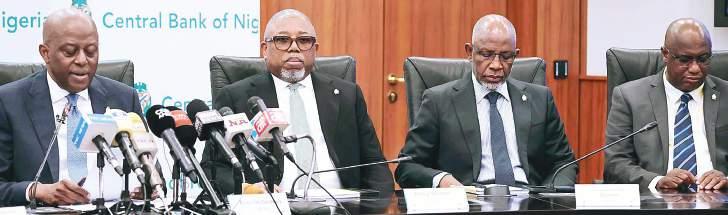
Unfazed by New Inflationary Concerns, CBN Retains MPR at
Cardoso: impact of Middle East crisis largely muted on Nigerian economy due to benefits of prior policy reforms, price pressures transitory Says 33 banks emerged with stronger financial soundness indicators after recapitalisation exercise Declares apex bank committed to FX stability, doubles down on prospects for $1bn daily turnover CPPE hails retention of policy instruments
James Emejo
www.thisdaylive.com
Central Bank of Nigeria (CBN) yesterday resolved to retain the Monetary Policy Rate (MPR), the benchmark interest rate, at 26.5 per cent, and the standing facilities corridor around the MPR at +50/-450
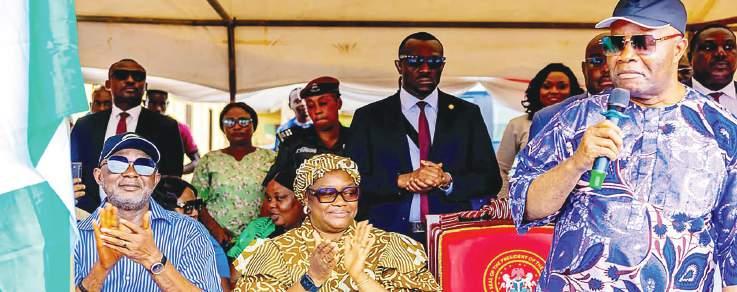
Fubara Withdraws from APC Guber Primary, Says Decision Difficult But Necessary
Blessing Ibunge in Port Harcourt Rivers State Governor, Siminalayi Fubara, has withdrawn from participating in the 2027 All Progressives Congress (APC) governorship primary holding today in the state. He, however, described the decision as difficult but necessary.
Cole also
Also, Mr Tonye P Cole, another strong aspirant of the APC, has declared his withdrawal from the party’s gubernatorial primary election Fubara, in a statement yesterday,
down guber bid
Continued on page 8 said he would support whosoever
Emmanuel Addeh in Abuja and Nume Ekeghe in Lagos
World’s leading ratings agency, S&P Global, has upgraded the long-term ratings of seven Nigerian banks following its recent upgrade of Nigeria’s sovereign credit rating, citing ongoing economic reforms, improved foreign exchange market conditions and stronger growth prospects for the country.
The agency, in a statement, raised the long-term global scale ratings of Access Bank Plc, Bank of Industry (BoI), Guaranty Trust Bank Ltd., Stanbic IBTC Bank Plc, Standard Chartered Bank Nigeria Ltd., United Bank for Africa Plc and Zenith Bank Plc to ‘B’ from ‘B-’, while assigning stable outlooks to the institutions. It also revised the outlooks on Fidelity Bank Plc and First City Monument Bank Plc to positive
Continued on page 8
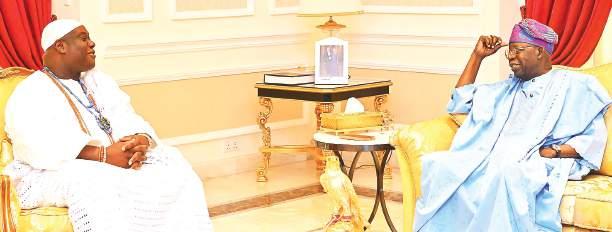
WHEN ROYALTY MEETS POWER...
President Bola Ahmed Tinubu received Ooni of Ife, His Imperial Majesty, Oba Adeyeye Enitan Ogunwusi Ojaja ll, at his residence Ikoyi, Lagos, on Tuesday
in Abuja and Nume Ekeghe, Dike Onwuamaeze in Lagos
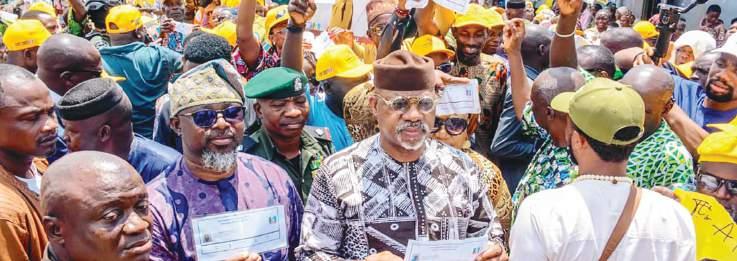
APC PRIMARIES FOR IKENNE STATE CONSTITUENCY AT WARD 3, IPERU-REMO...
L-R: Chairman, Ikenne Local Government, Hon. Jamiu Asimi; House of Assembly aspirant for Ikenne State Constituency, Asiwaju Seyi Odumuyiwa, and the Ogun State Governor, Prince Dapo Abiodun during the All Progressives Congress primaries for Ikenne State Constituency at Ward 3, Iperu-Remo on Wednesday.
$5bn NLNG
Upstream operating firms rise to 117 Service companies jump to 11,765
Peter Uzoho
The $5 billion Nigeria Liquefied Natural Gas (NLNG) Train 7 project has reached 92 per cent completion and is now advancing into systems completion and pre-commissioning, marking a major milestone for Nigeria’s gas expansion drive and local content development.
That was as Nigerian Content Development and Monitoring Board (NCDMB) said the number of companies operating in the country’s upstream oil and gas sector had risen from less than 10 to 117, while service firms surged to 11,764 currently.
NCDMB credited the surge to the Nigerian Oil and Gas Industry Content Development (NOGICD) Act of 2010.
NLNG’s Project Director for Train 7, Mr. Ali Uwais, who represented the company’s Managing Director, Mr. Adeleye Falade, gave the project’s update in Lagos, at the 2026 Nigerian Oil and Gas Midstream and Downstream Summit in Lagos.
The event was organised by NCDMB under the theme, “Unlocking, Growing & Sustaining Nigerian Content Development in Nigeria’s Oil & Gas Midstream and Downstream Sectors.”
Uwais said the project, which faced years of delay and uncertainty, finally moved forward after front-end engineering commenced in 2018 and a
reconfiguration introduced a common liquefaction unit that boosted capacity to the equivalent of two trains from the earlier era.
Final Investment Decision (FID) of the project was taken in December 2019 in Abuja, where its shareholders – Nigerian National Petroleum Company Limited (NNPC), Shell, TotalEnergies, and Eni – agreed to proceed with the landmark midstream gas project.
Uwais said, “In 2020, at the height of the COVID-19 pandemic, the engineering procurement and construction contract for the project was awarded to Saipem, Chiyoda and Daewoo Consortium.
“Despite global uncertainty, the shareholders remain committed that the project move forward, even under that Covid. Today, Train 7 is over 92 per cent complete.”
When operational, Train 7 is expected to raise NLNG’s production capacity from 22 million tons per annum (MTPA) to 30MTPA, representing a five per cent increase in the company’s export capacity.
Uwais said the project’s real significance lay in its impact on the Nigerian industry and capability, crediting deliberate collaboration with government agencies and private firms for the progress.
He said one of the most important decisions the company made earlier in the project was to treat Nigerian
content not as a compliance obligation, but as a development opportunity. He stated that the decision shaped how they treated the project.
As the project required up to 4,000 tons of structural steel within a tight schedule, Uwais said Nigerian companies, such as Dorman Long, Aveon, African Industries, among others, supplied a significant portion.
He added that NLNG also invested in steel fabrication and galvanising facilities that will serve the wider industry after the completion of Train 7.
In addition, he said all medium and high voltage cables were manufactured
locally by Nigerian companies, including Coleman, Mecom, Medgene, and Cable Metal, delivering substantial volumes.
Uwais acknowledged that local vendor capacity was tested during the execution of the project, and some challenges were identified.
Some local vendors, he said, presented difficulties with production capacity, quality standards, and delivery timelines.
He said in some cases additional interventions and technical oversight were required to meet the project standards.
Uwais pointed out that industries grew with such experiences and NLNG was eager to support them to surmount the challenges and deliver value to the project.
The NLNG official cited medium voltage cable production as an example of capability built during the project, saying the challenge also exposed gaps in cryogenic equipment manufacturing and testing.
To address the challenge, he said the project created opportunities for collaboration with Nigerian universities to deepen local research and technical competencies.
At peak construction, Uwais revealed that over 13,000 Nigerians were employed on Train 7, while thousands received training in welding, scaffolding, electrical work, and other specialist skills.
He also revealed that the project achieved 130 million man-hours safely, with only two lost time injuries recorded.
Uwais said, “No milestone is more important than the safety of our people. We continue to pass a simple message across the workforce: if you see something, say something, and do something.”
Over 7.6m Workers Have Enrolled in Social Insurance Scheme, Says NSITF
As Nigeria Police joins scheme
Ezigbo in Abuja
Nigeria Social Insurance Trust Fund (NSITF) said it had enrolled over 7.6 million employees in the Employees Compensation Scheme (ECS).
NSITF also said it had recorded a historic first with the enrolment of the Nigeria Police into the scheme.
A statement by NSITF’s Deputy General Manager, Corporate Affairs, Alex Mede, said Managing Director
of the fund, Oluwaseun Falaye, revealed the development at the 2026 International Civil Service Conference in Abuja on May 20.
Faleye said, “We have enrolled over 7.6 million employees into the Scheme. We secured the enrolment of the Nigeria Police Force into the ECS — a historic first — after engagements with the Inspector-General of Police.
“When our officers know that
Nigeria Unveils Landmark Net Zero Investment Plan to Unlock Climate Finance, Power Green Economic Transformation
Michael Olugbode in Abuja
Nigeria has taken a major step in its climate and economic transformation agenda with the launch of the country’s first comprehensive Net Zero Investment Plan (NZIP).
The NZIP is a strategic framework expected to unlock billions of dollars in climate finance, stimulate green industrial growth, and accelerate the transition to a low-carbon economy.
The investment roadmap,
unveiled in Abuja by the National Council on Climate Change, was designed to convert Nigeria’s climate commitments into concrete, bankable investment opportunities capable of attracting local and international investors.
The initiative comes at a critical period when African countries are under increasing pressure to balance economic growth with climate action amid worsening climate shocks, rising energy demands, desertification, flood-
ing, food insecurity, and growing concerns over the global transition away from fossil fuels.
For Nigeria — Africa’s largest economy and one of the continent’s leading oil producers — the challenge has been particularly significant. While the country depends heavily on oil revenues to support government spending and foreign exchange earnings, it is also among nations most vulnerable to climate change impacts. In recent years, devastating
floods have displaced millions of Nigerians, destroyed farmlands and infrastructure, and intensified concerns about environmental sustainability and economic resilience.
Against this backdrop, the federal government said the NZIP would provide the financial architecture needed to drive Nigeria’s transition toward net zero emissions by 2060 while protecting economic growth and expanding investment opportunities.
their families will be protected should they sustain injury or lose their lives in the line of duty, their confidence and gallantry will increase, and our national security will be the safer for us all.”
Speaking on the theme of the conference, “Reforms, Resilience and Results,” Falaye said, “This theme is not merely aspirational. It is a call to action. Across the globe, public institutions are under unprecedented pressure to deliver efficient services, restore public confidence, adapt to rapid technological and economic disruption, and ensure that governance remains people-centred and sustainable.”
He added, “For us in Nigeria, the conversation around reform is no longer optional — it is urgent. The future of governance and national development depends on the ability of our institutions to evolve, innovate, and respond effectively to the needs of our citizens.
“And I can say with confidence today that at the Nigeria Social Insurance Trust Fund, we have chosen to lead by example.”
Faleye maintained, “Reform is the foundation of institutional progress. Institutions that resist change
eventually become ineffective and disconnected from the people they are meant to serve. But true reform is not merely structural — it is cultural.
“It demands a shift in mindset from bureaucracy to responsiveness, from routine administration to strategic impact, from excuses to execution.”
Highlighting the achievements so far, the managing director said, “When I assumed office as Managing Director and Chief Executive of the Nigeria Social Insurance Trust Fund on July 15, 2024, I inherited an institution with enormous potential but significant operational challenges.
“The Employees’ Compensation Scheme — a landmark social protection instrument established under the Employees’ Compensation Act, 2010 — was not reaching its full potential. The compliance was uneven. Claims processing was slow. Public awareness was low. And the confidence of stakeholders was fragile.”
He explained, “We chose not to complain about these challenges. We chose to confront them headon through deliberate, bold, and measurable reforms. Let me share the evidence.
Onyebuchi
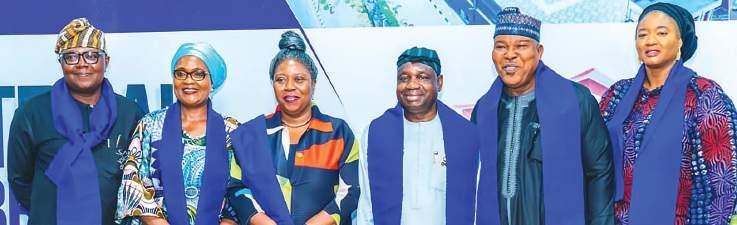
MINISTRY OF TOURISM, ARTS AND CULTURE MINISTERIAL PRESS BRIEFING...
L-R: Chief Executive Officer, Lagos State Council for Arts and Culture, Mr. Idowu Johnson; Lagos State Permanent Secretary, Ministry of Tourism, Arts and Culture, Mrs. Bopo Oyekan-Ismaila; Lagos State Commissioner for Tourism, Arts and Culture, Mrs. Toke Benson-Awoyinka; Lagos State Commissioner for Information and Strategy, Mr. Gbenga Omotoso; Lagos State Permanent Secretary, Ministry of Information and Strategy, Mr. Olanrewaju Bajulaiye; and Executive Secretary, Lagos State Film and Video Censors Board, Mrs. Bukola Agbaminoja, during the 2026 Ministerial Press Briefing of the Ministry of Tourism, Arts and Culture to commemorate the Sanwo-Olu administration, held at Bagauda Kaltho Press Centre, Alausa, Ikeja, yesterday
Presidency Identifies RegTech as Instrument for Financial Inclusion, Trusted Digital Economy
CBN: Effective regulation should enable innovation, not stifle growth Expert warns against Africa losing billions annually to digital fraud, high remittance costs
The Presidency has identified Regulatory Technology (RegTech) as a critical tool for achieving financial inclusion and building a trusted digital ecosystem capable of driving the nation’s economic transformation agenda.
Speaking yesterday, at the 2026 RegTech Africa Conference and Expo (#RACE2026) held at the State House
in Abuja, Technical Adviser to the President on Economic and Financial Inclusion, Dr. Nurudeen Abubakar Zauro, described the solution as “the intelligent bridge between innovation and accountability.”
He noted that technologies such as artificial intelligence, blockchain, digital identity systems, and realtime analytics would improve fraud detection, strengthen consumer protection, and lower barriers that
prevent underserved populations from accessing financial services.
The presidential adviser stressed that President Bola Tinubu’s administration views digital trust, transparency, and inclusive infrastructure as central pillars in delivering its economic goals.
In a keynote address on behalf of the Presidency, Zauro said the country must move beyond reliance on natural resources and position
itself among nations building trusted digital ecosystems capable of expanding opportunities for citizens.
According to him, the administration’s Renewed Hope Agenda recognises that millions of citizens remain outside the formal financial system and that sustainable economic growth requires stronger confidence in digital financial systems.
His words: “The world is witnessing a transformation
FG: Telecoms Policy Review Will Bridge Digital Gap, Enhance Public Service Delivery
The federal government has stressed the need for a review of the implementation of Nigeria’s National Telecommunications Policy 2000, established 26 years ago for policy direction and regulation.
Special Adviser to the President on Policy and Coordination, Hadiza Bala Usman, made the point yesterday during the ongoing telecoms policy review in Lagos, organised by Nigerian Communications Commission (NCC), in collaboration with Federal Ministry of Communications, Innovation and Digital Economy.
The forum is themed, “The Imperative of Policy Drivers in Attaining National Objectives and Building Collaboration across Sectors and Segments of Government.”
Usman said a policy that was fit for purpose in 2000 could not simply be assumed to remain adequate in 2026, hence the need for the review.
In her keynote address, Usman said the review would help in developing modern frameworks that would shape the next phase of Nigeria’s telecommunications development.
She stated, “The workshop is not merely a technical engagement. It is an invitation to look back with honesty, examine the present with clarity, and prepare for the future with discipline. The National Telecommunications Policy 2000 was developed at a defining moment
in Nigeria’s reform journey.
“It supported the liberalisation of the sector, encouraged private investment, enabled competition, and helped transform telecommunications from a limited public service into one of the most dynamic sectors of the Nigerian economy.”
Usman said, “More than two decades later, Nigeria has changed. Technology has changed. The economy has changed. The expectations of citizens have changed. What was once largely understood as voice connectivity has become the foundation for digital trade, e-commerce, financial technology, digital identity, public service delivery, education, health, agriculture, security, disaster response, innovation, and job creation.
“The review will therefore help to bridge the existing digital gap and enhance public service delivery.”
She advised industry stakeholders to make meaningful input that would enable the reviewed policy to address identifiable challenges and build a resilient and digitised economy.
According to her, a modern telecommunications policy must speak not only to networks and operators, but also to national productivity, inclusion, innovation, competition, consumer protection, data governance, infrastructure resilience, public service delivery, digital skills, investment, and security.
She said, “We must understand where coverage gaps exist, where service quality is weak, where
infrastructure is vulnerable, where consumer complaints are concentrated, where investment is constrained, where states have created enabling environments, and where coordination failures are slowing progress.”
In his opening remarks, Executive Vice Chairman of NCC, Dr. Aminu Maida, said when the telecoms policy was introduced in 2000, Nigeria’s telecommunications sector was at a very different stage of development.
Maida said the immediate priority then was to move from a state-dominated market, limited access
and low tele-density, to a liberalised and competitive industry.
He said the telecoms environment had evolved, adding that in today’s era, regulation must support broadband infrastructure, digital financial services, cybersecurity, identity systems, e-government, data governance, consumer trust, innovation and critical infrastructure protection.
Maida called for collaboration with relevant institutions, state governments, and other public bodies to shape the new narratives in the telecoms sector.
where technology is no longer merely supporting governance; it is redefining it. Nations that succeed will not simply be those with natural resources, but those capable of building trusted digital ecosystems that expand opportunity for every citizen. Nigeria must be one of those nations.”
He stated that ongoing interventions under the Presidential Committee on Economic and Financial Inclusion (PreCEFI) are supporting digital public infrastructure, consumer trust frameworks, and inclusive onboarding systems to ensure that geographical location, income levels or lack of formal identification do not exclude citizens from participating in the financial system.
Zauro added that achieving Nigeria’s target of becoming a one-trillion-dollar economy by 2030 would require stronger partnerships among regulators, financial institutions, technology firms and development partners.
“The journey toward a one-trilliondollar economy by 2030 will not be achieved by policy declarations alone. We must collectively build systems that are not only efficient but equitable,” he said.
Also speaking, Governor of the
Central Bank of Nigeria (CBN), Olayemi Cardoso, stressed that effective regulation remains essential for sustainable digital innovation.
Speaking on the theme, “Regulating for Trust and Inclusion in a Digital Economy: The Central Bank of Nigeria’s Policy Vision,” Cardoso, who was represented by Director of the Payments System Supervision Department, Dr. Rakiya Opemi Yusuf, said trust remained the foundation upon which digital economies thrive.
“Our objective is not simply to regulate innovation, but to create an environment in which innovation can thrive responsibly; one supported by clear rules, resilient infrastructure, effective oversight, and a deliberate commitment to inclusion,” he said. He said Nigeria’s growing digital ecosystem, driven by mobile banking, fintech innovation, and electronic commerce, had expanded access to financial services but also introduced emerging risks, including cyber threats, fraud, operational vulnerabilities, and data privacy concerns. The CBN Governor noted that future financial supervision across Africa would increasingly rely on predictive analytics, automation, real-time monitoring, and stronger regional cooperation. Urges
Hormuz: FAO Calls for Alternative Trade Routes to Avert Imminent Global Food Crisis
food inflation
United Nations Food and Agriculture Organisation (FAO) warned that the closure of the Strait of Hormuz had gone beyond a temporary shipping disruption, signalling the beginning of a systemic agrifood shock.
FAO said the situation could trigger a severe global food price crisis within six to 12 months if alternative trade routes were not explored.
The UN agency stated that the shock was already unfolding in stages vis-a-vis energy, fertiliser, seeds, lower yields, commodity price increases, and
FAO said avoiding a global food price crisis would not only require alternative trade routes outside Hormuz, but also restraint on export restrictions, protection of humanitarian flows, and buffers to absorb higher transport costs.
In a podcast published on Wednesday, FAO’s Chief Economist, Maximo Torero, said it was time to “start seriously thinking about how to increase the absorption capacity of countries, how to increase their resilience to this choke, so that we start to minimise the potential impacts”.
Torero said that would involve exploring “intervention by governments, by international financial organisations, by the private sector, and by UN agencies and other research centres to try to help countries to be able to cope better with the current situation.”
FAO stated that the window for preventive action was closing quickly, adding that decisions taken now by farmers and governments on fertiliser use, imports, financing and crop choices will determine whether a severe global food price crisis emerges within six to 12 months.
FAO Food Price Index, which tracks monthly changes in the international prices of a basket of globally traded food commodities, rose for a third consecutive month in April, driven by high energy costs and disruptions linked to the conflict in the Middle East, indicating that the impact is already visible.
Director of FAO’s Agrifood Economics Division, David Laborde explained that mitigating the effects would require shifting to alternative land and sea routes, including via the eastern Arabian Peninsula, western Saudi Arabia, and the Red Sea.
Ndubuisi Francis in Abuja
Emma Okonji
Deji Elumoye in Abuja
COURTESY VISIT BY THE POLISH DEPUTY PRIME MINISTER...
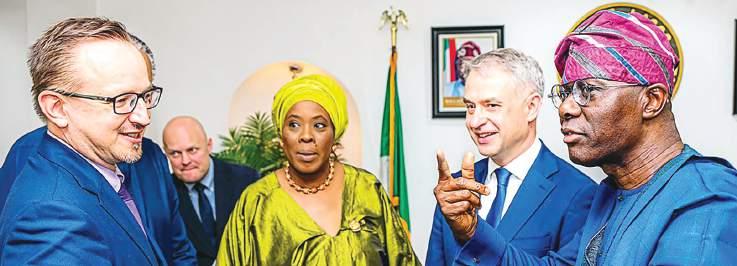
R-L: Lagos State Governor, Mr. Babajide Sanwo-Olu; Poland Deputy Prime Minister and Minister of Digital Affairs, Mr. Krzysztof Gawkowski; Commissioner for Commerce, Cooperatives, Trade and Investment, Mrs. Folashade Bada Ambrose-Medebem; and Ambassador of the Republic of Poland to Nigeria, Mr. Michal Cygan, during a courtesy visit by the Polish Deputy Prime Minister at the Lagos House, Marina, yesterday
NAF Destroys Terrorists’ Hideouts in Southern Tumbuns, Mandara Mountains
Nigeria pushes for African-led cooperation to fightterrorism, other emerging threats Presidency declares Nigerians have the right to defend themselves against attackers
Makinde signs executive order to regulate local security groups in Oyo NLC demands action by FG, states to end banditry
Chuks Okocha, Onyebuchi Ezigbo, Linus Aleke in Abuja and Kemi Olaitan in Ibadan
The Nigerian Air Force has intensified ongoing air offensives against terrorist elements in the North-east, destroying terrorist hideouts and logistics hubs in Bukar Meram in the Southern Tumbuns and Chikide in the Mandara Mountains.
According to a statement by the Director of Public Relations and Information, Nigerian Air Force, Air Commodore Ehimen Ejodame, the operations were carried out by the Air Component of Operation Hadin Kai following credible intelligence and confirmatory Intelligence, Surveillance and Reconnaissance (ISR) missions.
The statement disclosed that NAF air assets executed precision air strikes on the identified enclaves, destroying terrorist logistics facilities, structures and assembly points concealed within the areas.
Several terrorists were also neutralised during the operations, while planned attacks by the insurgents were disrupted.
Speaking on the operations, the Chief of the Air Staff (CAS), Air Marshal Sunday Kelvin Aneke, reaffirmed the Nigerian Air Force’s commitment to sustaining coordi-
nated joint operations with sister services and allied partners in the fight against terrorism and other security threats across the country.
The CAS stressed that intelligencedriven air operations would continue to target and destroy terrorist hideouts, logistics networks and operational bases wherever they were located, as part of ongoing efforts to restore peace and security nationwide.
Nigeria Pushes for African-led Cooperation to fightTerrorism, Other Emerging Threats
The Chief of Air Staff (CAS), Air Marshal Sunday Kelvin Aneke, has reaffirmed Nigeria’s commitment to strengthening African-led security cooperation and collective responses to terrorism and other emerging threats across the continent.
Air Marshal Aneke made the commitment while chairing the 2026 African Air Chiefs’ Symposium held in Tunis, Tunisia, under the auspices of the Association of African Air Forces (AAAF).
According to a statement by the Director of Public Relations and Information, Nigerian Air Force, Air Commodore Ehimen Ejodame, the symposium brought together Air Chiefs, senior military officials and
strategic partners from across Africa to deepen collaboration in airpower development, interoperability and coordinated security operations aimed at promoting peace, stability and sustainable development on the continent.
CAS said the theme of the symposium, “Operationalising the Association of African Air Forces: A
New Era of Shared Responsibility”, underscored the urgent need for African nations to jointly develop practical and sustainable solutions to evolving security challenges.
The CAS observed that terrorism, insurgency, transnational organised crime and humanitarian crises have continued to threaten peace and prosperity across Africa, making
stronger partnerships, intelligencesharing and enhanced operational coordination among African air forces increasingly necessary.
According to him, “No single nation can effectively confront today’s complex security threats alone. Our collective strength lies in our ability to work together, share capabilities and build a united front
against forces that threaten the peace and prosperity of our continent.” Air Marshal Aneke further noted that the symposium marked another important step towards strengthening the operationalisation of the Association through active participation and shared commitment by member nations.
Continued on page 36
53 years After, NYSC Continues to Bridge Economic and Socio-Cultural Gaps in Nigeria
The National Youth Service Corps (NYSC), will be 53 years on 22 May 2026, having been established by Gen. Yakubu Gowon (Rtd) on May 22 1972.
The national youth service scheme was at that time solely established to promote unity amongst the people after the Nigerian civil war that ended in 1970.
Fifty-three years down the line the scheme has not only promoted unity, it has also promoted inter marriages and currently contributes to Nigeria’s economy in diverse areas.
The NYSC through corps members have contributed immensely to the educational section in the country. Most schools rely on serving corps members to run their schools. In the area of healthcare, it will be an understatement to say any state of the federation can cope with healthcare delivery without the help of serving corps members.
The Director General of the NYSC, Brig. Gen. Olakunle Nafiu, on his visit to the Lagos State governor, Babajide Sanwolu, stated that “services provided by the NYSC for the government and people of Lagos State worth over 14 billion
FG Recommits to Skills Training for Nigerian Youth at London Education Forum
Kuni Tyessi in Abuja
The federal government has reiterated its plan to equip young Nigerians with employable skills through expanded non-formal education and vocational training programmes.
Minister of Education, Dr. Maruf Tunji Alausa, made the pledge at the Education World Forum in London during a special plenary session moderated by Prince Edward, the Duke of Edinburgh.
Alausa said the Tinubu administration views non-formal education as a key tool for youth empowerment and job creation, especially for out-of-school children and vulnerable groups.
“What we are doing in Nigeria is because we have a lot of out-ofschool children, we have to find a way to quickly get them a kind of non-formal education,” he told the forum.
The minister joined Ontario Education Minister Paul Calandra, Rio
Grande do Sul Education Secretary Raquel Teixeira, and youth representative Andrea Chakma of the Duke of Edinburgh International Award Foundation to discuss how non-formal learning, soft skills, and industry partnerships can improve youth employability.
At the center of Nigeria’s approach is the Accelerated Basic Education Programme, which offers an alternative curriculum aligned with mainstream schooling for learners outside the formal system.
This is complemented by the Technical and Vocational Education and Training initiative, a flagship federal programme that provides tuition-free vocational training, stipends, and start-up support to close skills gaps and encourage entrepreneurship.
Alausa also highlighted the National Policy on Skills Development, which promotes flexible learning pathways combining hands-on training, digital literacy, and vocational skills.
naira annually.
“Gen. Nafiu was quantifying, in minimum monetary value, the contributions of the over 44,000 Corps members deployed to the length and breadth of the state in various capacities, including the 333 medical doctors, 306 pharmacists, 274 nurses, and 7188 teachers.”
According to Nafiu, “Lagos was the number one destination for Corps members, noting their parents were also comfortable with it, citing the relative security of the state.
“No state can survive today without NYSC. We saved some states up to the tune of N30-40 billion annually gets about 400 doctors from NYSC annually,” he added
In the area of elections, the scheme has equally given the electoral body, the Independent National Electoral Commission (INEC) a lot of face lift and credibility when it concerns the use of serving corps members as voters registration agents and as election officials during general elections.
Former Head of state and founder of the NYSC, Gen. Yakubu Gowon (Rtd), noted that no government institution has contributed to national development more than the NYSC has done.
“The NYSC has contributed to national development more than any other organisation in the country. The
authorities should consider setting up a trust fund for the scheme.” In the area of revenue generation, the scheme has not done badly at all. Though it was not established for revenue generation purpose, yet the scheme has seen the need to generate revenue through ventures like garment factory, bakery, bottles water shoe making and others so that when the corps members are leaving, they will leave with both technical and entrepreneurial skills.
The scheme also has its own health programme, “Health Initiative for Rural Dwellers (HIRD).” Through this Initiative, the scheme is bridging the health care gap between the urban and rural areas with over two million beneficiaries.
The Assistant Secretary General for Youth Affairs, and Head of the United Nations Youth Office, Felipe Paullier, applauded the NYSC at the flag-off of the NYSC Health Initiative for Rural Dwellers (HIRD) held at Kabusa community, Federal Capital Territory, Abuja. Paullier said his visit to Nigeria centred on meaningful discussions with critical youth organisations and youth representatives, particularly the NYSC, as well as key stakeholders to advance the youth agenda in the country.
He stated this is by strengthening the role of young people as partners in development, peace, and human rights.
Oghenevwede Ohwovoriole in Abuja
IMF Urges Nigeria, Others to Shift to Private Sector- Led Growth as Debt-Funded Model Weakens
Says current growth path could delay per capita income gains in 50 Years
Nume Ekeghe
International Monetary Fund
(IMF) has urged Nigeria and other Sub-Saharan African economies to urgently abandon debt-driven and state-led growth models in favour of private sector-led expansion.
IMF warned that current growth trends across the region were too weak to significantly improve living standards, and could leave per capita incomes taking nearly 50 years to double.
In its latest Regional Economic Outlook for Sub-Saharan Africa, titled, “Africa Needs a Growth Reset,” IMF said rising debt burdens, expensive borrowing costs, and declining
development assistance had exposed the limitations of growth strategies heavily dependent on government spending and commodity booms.
The fund warned that unless African economies implemented broad structural reforms aimed at unlocking private investment and productivity growth, the region risked another prolonged cycle of weak growth, unemployment and declining competitiveness.
The report was authored by IMF African Department, economists Grace Li and Nikola Spatafora, alongside deputy division chief Constant Lonkeng.
It stated, “At current growth rates, per capita income in sub-Saharan
Africa would take roughly half a century to double. Our chapter in the IMF’s latest Regional Economic Outlook for Sub-Saharan Africa shows that implementing well-designed structural reforms especially in governance, business regulation, and market openness could lift output by around 20 percent within a decade.
“The point is not reform for reform’s sake. It is to shift the growth model from one led mainly by the state to one driven more by private investment, productivity, and jobs.”
On the continents debt, IMF stated, “The public sector-led growth model is now spent. With debt high, borrowing costly, and aid falling,
the state can no longer be the main engine of growth. The region needs more private investment, backed by broad, business-friendly reforms.”
The Washington-based institution said the region must now pursue reforms capable of attracting private investment, strengthening institutions, and improving the ease of doing business.
It identified governance reforms, market openness, and business regulation as the three areas where Sub-Saharan Africa lagged behind frontier emerging markets most.
The report added, “Reforming state-owned enterprises, especially in energy and transport, is another key priority. When tariffs stay below
cost-recovery levels, cash flow weakens, maintenance is delayed, and investment stalls. The result is a familiar tax on growth: unreliable and expensive services for firms and households.
“The better reform efforts use four ingredients: map stakeholders, align prices with costs, define social goals clearly, and explain how any savings will be used.”
The fund stated that harmonising rules under the African Continental Free Trade Area could expand market access.”
It recommended, “Protect the vulnerable. Targeted, temporary cash transfers based on current registries and delivered digitally can
cushion short-term costs. Strengthen the state’s implementation capacity. Better systems for learning, institutional memory, and monitoring are essential. External partners can help by supporting sustained capacity building.”
S&P UPGRADES RATINGS FOR ACCESS, BOI, GTB, STANBIC IBTC, STANDARD CHARTERED, UBA, ZENITH from stable, while affirming their ratings.
In another development, the President of Dangote Group, Aliko Dangote, has said the Dangote Refinery was targeting a September launch for its Initial Public Offering, IPO, following what he described as overwhelming investor demand running into billions of dollars.
This was as the Chairman of First HoldCo, Olufemi Otedola, commended Dangote’s vision and industrial achievements, describing the businessman as one of Africa’s greatest economic leaders while pledging to personally acquire one hundred million dollars worth of shares in the refinery.
According to S&P, the actions followed its May 15, 2026 decision to upgrade Nigeria’s sovereign
credit rating to ‘B’ from ‘B-’ with a stable outlook, reflecting what it described as sustained structural reforms that have improved the country’s macroeconomic profile.
The agency noted that the liberalisation of the foreign exchange market has improved access to foreign currency and encouraged a more market-driven exchange rate system, helping to boost investor confidence and support non-oil economic growth.
S&P added that reforms in taxation and increased centralisation of petroleum revenues have strengthened fiscal earnings and are expected to reduce the ratio of interest payments to government revenue over time.
It recalled that Nigeria’s real Gross Domestic Product (GDP)
grew by 4 per cent in 2025, driven by an 8.5 per cent increase in oil production and a 3.9 per cent expansion in the non-oil economy.
Although the agency projected a slight moderation in growth in 2026 due to inflationary pressures arising from the Middle East conflict, it maintained that increased government capital expenditure and ongoing reforms by the Central Bank of Nigeria could support economic resilience.
S&P said Nigeria was relatively shielded from the broader impact of the Middle East crisis because of its status as a net oil exporter and emerging refined petroleum producer.
Nonetheless, the firm expressed confidence that most Nigerian banks would be able to absorb ad-
ditional provisioning requirements due to their strong profitability levels.
The agency forecast average return on equity for Nigerian banks at between 20 and 23 per cent in 2026, slightly lower than the estimated 25 per cent recorded in 2025, while return on assets is expected to moderate marginally to around 3.0 per cent.
“We expect the Nigerian financial sector will remain profitable and continue to perform well in coming quarters. We forecast the average return on equity will normalise at 20 per cent-23 per cent in 2026 compared to 25 per cent estimated for 2025, while return on assets will decline marginally to 3.0 per cent-3.1 per cent from an estimated 3.3 per cent in 2025.
FUBARA WITHDRAWS FROM APC GUBER PRIMARY, SAYS DECISION DIFFICULT BUT NECESSARY
emerges as the APC candidate for the forthcoming general election.
According to him, “After deep reflection and extensive consultations with my family, friends, and associates, I have taken the difficult but necessary decision to withdraw from the APC gubernatorial primaries.
“I do so with a full heart and with a firm commitment to support whoever emerges as the candidate of our great party. Leadership is ultimately about sacrifice.
“There comes a time when personal ambition must yield to the greater good of the people. Rivers State is bigger than any individual, and at this critical moment, the peace, stability, and unity of our dear state must take precedence over every personal interest.”
The Rivers State governor commended his supporters, who stood firmly with him throughout the period of political crisis in the State, stressing that his recent silence was for the interest of the state and the people.
“I understand the disappointment, the anger, and the pain many of you may feel. Much has indeed been invested and much sacrificed along the way. But please know that your loyalty and trust were never in vain. My silence over this period was deliberate and strategic, guided always by the higher interest of our state and our people.
“As our elders say, not everything a hunter sees in the forest is spoken of in the marketplace. Some truths are best borne quietly, not out of fear, but out of wisdom and restraint for the sake of peace and a greater purpose.
“It is enough to say that I have faced immense pressures and difficult choices, but my love for Rivers State remains greater than
anything else.”
He also thanked the APC members for the platform and support extended to him from the time he became a member, just as he expressed appreciation to President Bola Tinubu, for his support and encouragement.
“The APC remains our collective home, and I urge all party faithful and supporters to remain steadfast and committed as we continue to build a stronger and more united future together,” he said.
The governor added that he stepped aside from participating in the upcoming gubernatorial election not out of weakness, fear, or surrender, but out of conviction and sacrifice so that the state may move forward in peace and unity.
He added that, “I remain committed to serving the good people of Rivers State till the end of my term.”
Similarly, Tonye Cole, in a statement personally signed, said his action was for the overriding interest of party unity, peace, and collective progress, and respect to the supremacy of the party.
“As a committed democrat and a firm believer in the supremacy of strong institutions as the foundation for sustainable development, I have consistently advocated dialogue, reconciliation, and unity among the various stakeholders and factions within the Rivers State chapter of our great party, the APC.
“In recent days, the national leadership of our party convened a critical stakeholders’ meeting during which far-reaching discussions were held on the future of the Rivers APC and the imperative of presenting a united front ahead of the primaries and the 2027 general election.
“Following that meeting, and after extensive consultations with
members of my political team, associates, supporters, and other key stakeholders, I have taken the decision, in the overriding interest of party unity, peace, and collective progress, to respect the supremacy of the party and withdraw from the forthcoming primaries.
“Accordingly, I wish to formally announce my withdrawal from the race and pledge my full support and cooperation to whoever emerges as the party’s candidate at the conclusion of the primaries.”
Cole added that his decision was not made lightly, but product of deep reflection, patriotism, and an unwavering commitment to the stability, growth, and success of their party and the state.
“Although I may be stepping aside from this contest, I remain fully committed to the ideals, principles, and aspirations that brought us together, and I will continue to work tirelessly for the progress of our party and the development of Rivers State and for the important change we all want to see,” he said.
Cole therefore, called on all his supporters to remain calm, peaceful, and steadfast, and to give their full cooperation to the leadership of the great party.
“Let us unite and work together to secure victory for our president, our party, and all APC candidates in the 2027 General Election,” he added.
“Profitability will be supported by still-high interest margins, growing net interest income, and slightly lower provisions. Most Nigerian banks are now compliant with the CBN’s new paid-up capital requirements after successful capital raises over the past two years, improving bank capitalisation overall,” S&P pointed out.
The agency projected that nominal lending growth would remain strong at about 25 per cent in 2026, driven mainly by oil and gas, agriculture and manufacturing. However, it cautioned that real lending growth remains weak due to inflation and elevated interest rates, adding that asset quality pressures would persist following the withdrawal of regulatory forbearance measures.
S&P estimated that nonperforming loans in the banking industry would stabilise between 6 and 7 per cent in 2026, while credit losses are expected to remain elevated at between 2 and 2.5 per cent.
“Pressure on asset quality will persist amid the lifting of forbearance, and high inflation and interest rates. Therefore, we expect the non-performing loan (NPL) ratio to stabilise at 6 per cent-7 per cent in 2026.
“ Similarly, we expect credit losses for the sector will remain elevated at about 2.0 per cent-2.5 per cent in 2026. However, we expect most banks to absorb the incremental provisioning requirements,” the ratings agency stated.
S&P also noted that most
Nigerian lenders have complied with the new capital requirements introduced by the CBN after raising fresh capital over the last two years. The apex bank had increased the minimum paid-up capital requirement to N500 billion for banks with international licences and N200 billion for those operating national licences.
Generally, it noted that crude oil production is expected to average about 1.66 million barrels per day in 2026, while the 650,000 barrels-per-day refinery owned by Dangote Group has reached full operational capacity, helping to strengthen domestic fuel supply and cushion external shocks.
Despite the improved outlook, the agency warned that inflation, poverty and weak purchasing power remain major constraints on the Nigerian economy.
According to the report, inflation averaged 18.6 per cent annually over the past decade, although it is projected to decline to 17.7 per cent in 2026 and fall below 10 per cent by 2028.
S&P further stated that poverty levels in Nigeria have risen sharply to 50 per cent of the population from 30 per cent before 2020, while about 31 million Nigerians currently face food insecurity compared to roughly four million in 2019.
Dangote Refinery Targets
September IPO Launch
Meanwhile, the President of Dangote Group, Aliko Dangote, has said the Dangote Refinery was
Continued on page 36
UNFAZED BY NEW INFLATIONARY CONCERNS, CBN RETAINS MPR AT 26.5%
cent, and 75 per cent for non-TSA public sector deposits.
Speaking at the end of the two-day, 305th, meeting of the Monetary Policy Committee (MPC) in Abuja, CBN Governor, Mr. Olayemi Cardoso, said the decision to hold policy rate was anchored on a comprehensive assessment of the risks to the outlook.
Cardoso said although inflation had risen marginally, for two consecutive months, largely induced by external shocks, MPC recognised its transitory nature and remained confident that the current macroeconomic environment was sufficiently robust to support a return to disinflation.
Reacting to the MPC resolutions, Centre for the Promotion of Private Enterprise (CPPE) hailed the apex bank’s decision to hold monetary policy parameters constant.
CPPE Chief Executive, Dr. Muda Yusuf, said the bank’s decision reflected a pragmatic, measured,
and increasingly sophisticated understanding of the inflation dynamics currently confronting the Nigerian economy.
The CBN governor particularly referenced the spill overs from the Middle East crisis, which had exerted upward pressure on energy prices and cost of transportation.
He said available evidence indicated that the effect of the crisis on the Nigerian economy had been largely muted due to the benefits of prior policy reforms.
Cardoso, who read the committee’s communique, listed the policy interventions to include exchange rate stability, improvements in external reserve buffers, strengthened monetary policy transmission, a well-capitalised banking system, and ongoing fiscal consolidation, which had significantly enhanced the economy’s ability to absorb external shocks.
Cardoso stated, “As a result, the pass through of global commodity
and energy price shocks to domestic inflation has been significantly mitigated and would have been more pronounced in the absence of these reforms.”
He said MPC was convinced that the essential conditions for price stability remained firmly in place.
The committee also welcomed the recent sovereign rating upgrade amid prevailing external headwinds, stating that the development underscores the strength of the country’s macroeconomic funda- mentals and reinforces confidence in its reforms.
However, the central bank governor pointed out that headline inflation, year-on-year, rose marginally for the second consecutive month to 15.69 per cent in April 2026, from 15.38 per cent in the preceding month, largely driven by an increase in the food component.
Food inflation rose to 16.06 per
cent in April 2026, from 14.31 per cent in March, reflecting the high cost of transportation and other logistics factors.
Core inflation moderated to 15.86 per cent in April 2026, from 16.21 per cent in March. Similarly, the 12-month average inflation slowed to 19.16 per cent in April 2026, from 20.05 per cent in March, marking the sixth month of consecutive decline.
Month-on-month, headline inflation also eased to 2.13 per cent in April 2026, compared with 4.18 per cent in March 2026, reflecting moderation in both food and core components.
MPC called for a cautious and vigilant policy stance to anchor inflation expectations and safeguard macroeconomic stability.
Cardoso highlighted the committee’s satisfaction with the successful conclusion of the
Continued on page 35
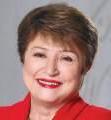
IMF MD, Kristalina Georgieva
LAUNCHING OF THE 3T IMPEX NON-OIL EXPORT INDEX REPORT 2026...
L-R: Administration Officer, Institute of Export and International Trade, Victoria Orji; Lead Consultant, 3T Impex Trade Consulting, Dr. Bamidele Ayemibo; Human Resource Manager, 3T Impex Trade Consulting, Ms. Grace Adedayo; and Head of Trade Logistics and Operations, Mr. Caleb Afuwape, during the virtual launching of the 3T Impex Non-Oil Export Index Report 2026 by the Lead Consultant, Dr. Bamidele Ayemibo, held in Surulere, Lagos ... recently
Falana Drags South Africa Before African Rights Commission Over Xenophobic Attacks
Seeks urgent referral over alleged systemic attacks
Wale Igbintade
Human rights activist and lawyer, Femi Falana, SAN, has petitioned African Commission on Human and Peoples’ Rights over persistent xenophobic attacks, killings, and alleged human rights violations against Nigerians and other African nationals in South Africa.
In the petition filed pursuant to the African Charter on Human and
Peoples’ Rights, Falana urged the commission to urgently intervene and refer the matter to the African Court on Human and Peoples’ Rights for binding adjudication.
The senior lawyer accused the South African government of failing to protect foreign nationals from recurring violence, intimidation, and discrimination.
According to him, the attacks are neither isolated nor sporadic,
but reflect a “systemic failure” by South African authorities to safeguard the rights and lives of AfricanFalanamigrants. said there remained “a persistent, widespread and well-documented pattern of xenophobic violence, intimidation and discrimination against Nigerians and other African nationals in the Republic of South Africa”.
He alleged that the attacks had
resulted in killings, physical assaults, arbitrary arrests, torture, looting, destruction of businesses, forced displacement, and sustained threats to life and personal security.
The petition cited recent incidents involving two Nigerians, Amaramiro Emmanuel and Ekpenyong Andrew, who reportedly died in April 2026 in separate incidents, allegedly, involving personnel of the South African National Defence
EU Launches €4.5m Peace Drive in Sokoto as 537,000 Residents Set to Benefit from Landmark RECAP Project
European Union (EU) has formally launched a sweeping 18-month initiative aimed at curbing conflict and rebuilding resilience in North-west Nigeria, with over half a million people in Sokoto State expected to benefit directly.
At a high-level External Stakeholders Grant Opening Meeting held Wednesday in Sokoto, EU unveiled the RECAP project, Resilience, Engagement, and Conflict Prevention for At-Risk Populations’ Protection in Sokoto State.
The €4.5 million intervention targets communities battered by insecurity, climate shocks, displacement, and deepening poverty.
Funded by EU, RECAP will
be rolled out by a consortium led by Action Against Hunger Nigeria, alongside International Alert and local partner, Save The Child Initiative.
The project will run in close coordination with Sokoto State Government, traditional rulers, civil society groups, and community leaders across 10 local government areas.
Speaking at the launch, Ms. Xenia Stoll, Political Officer at the EU Delegation to Nigeria and ECOWAS, said the project signalled a deepening partnership between EU and Sokoto State.
Stoll described conflict prevention and inclusive governance as “strategic imperatives” for the region.
She stated, “The European Union
values the relation with Sokoto State. We support the governor and state authorities in their efforts to provide stability and prosperity for their population.”
Stoll added, “Through RECAP we jointly commit to conflict prevention, social cohesion, and human security in Northwest Nigeria.”
She said the project will directly confront drivers of violence, including exclusion, competition over scarce resources, and economic marginalisation.
“This action strengthens local capacities for peace and contributes to long-term stability in Sokoto State,” she stated.
According to the implementing partners, the overlap of climate stress, armed conflict, and poverty
in Sokoto demands a new approach.
Mr. Thierno Samba Diallo, Country Director for Action Against Hunger Nigeria, stated, “In Sokoto State, conflict, climate stress, poverty, and displacement intersect in ways that demand inclusive, locally owned solutions.”
Diallo stressed that the project marked a shift from crisis response to sustainable peace. He stated, “This project reflects our collective responsibility to move beyond crisis response and invest in sustainable peace.
Force.
According to Falana, Andrew reportedly died after he was arrested in Pretoria following an altercation with law enforcement officials, while Emmanuel, allegedly, died from injuries inflicted by security personnel.
He said the incidents had shocked the Nigerian community and raised serious concerns over the conduct and accountability of South African security operatives.
Falana also drew attention to fresh mob attacks against African migrants, and said videos circulated in May 2026 showed groups of South Africans assaulting Black foreign nationals, threatening them and demanding they leave the country.
The petition stated that victims were beaten with sticks, harassed, and subjected to degrading treatment amid inflammatory anti-foreigner rhetoric.
Falana stated that attacks had been reported in Gauteng Province, Durban, Cape Town, East London, KwaZulu-Natal, and Eastern Cape.
He disclosed that diplomatic missions, including the Nigerian High Commission in South Africa, had issued security advisories warning of planned protests and
He added that other African governments, including Ghana, had also raised concerns over the safety of their citizens in South Africa.
According to him, more than 130 Nigerians have requested evacuation from South Africa over fears for their safety.
The human rights activist said the violence was occurring against a backdrop of entrenched hostility towards foreign nationals, fuelled by public rhetoric, socio-economic tensions, and inadequate state response.
He added that women and children were disproportionately affected, making them more vulnerable to violence, exploitation, and displacement.
Recalling previous incidents, Falana said at least 127 Nigerians had been killed in xenophobic attacks in South Africa by 2019, leading to protests in Nigeria and diplomatic interventions between both countries.
He accused the South African government of consistently failing to prosecute perpetrators of xenophobic violence despite repeated attacks over the years.
Evelyn Oyome Retains Ikoyi Club Ladies Championship Title NLC to Picket Non-Pension Remitting Employers,
Sunday Ehigiator
Defending champion Evelyn Oyome, has emerged Overall Gross Winner at the 2026 Ikoyi Club Ladies Championship after carding a combined gross score of 170 over two days to retain her crown at the prestigious tournament held recently at the Ikoyi Golf Club 1938, Lagos. Oyome returned scores of 85 and 85 to finish ahead of
Pat Ozoemene, who came first runner-up with a total gross score of 174, while Ifeoma Obata placed second runner-up with 185. Speaking during the championship, the Lady Captain of Ikoyi Club 1938 Golf Section, Annie Eimiakhena, described the annual tournament as a platform to determine the best female golfer in the club while also promoting friendship, integrity and community impact.
“Today and tomorrow represent our ladies’ championship. The championship occurs once in a year. More or less, we’re trying to see who is the best lady golfer amongst us,” she said.
Eimiakhena noted that participation in the championship was strictly by qualification, adding that about 70 ladies registered for the competition, while guest players also participated in some categories.
Slates June 1, for Crack Down on Defaulting Employers
The Nigerian Labour Congress (NLC), has vowed to deal with both foreign investor employers and their local counterparts who deny their employees adequate pension plan slating June1, 2026, as a decisive date to crack down on such employers.
The Congress insisted that days were gone when Nigerian workers were enslaved in their own father land without adequate plans for their rainy days.
The Chairperson NLC Lagos State Chapter Council, Funmi Sessi, who spoke at an interactive session on the Contributory Pension
Scheme organised by the National Pension Commission ( PenCom) between executive members of the Lagos NLC chapter andPenCom in Lagos Tuesday, noted that some foreign investor employers in particular who came from their own countries where labour laws were clearly stated organised and obeyed to the letter come to Nigeria to establish businesses, employ Nigerians and determine to continue to disorganise labour system in the country.
She said indigenous investors and employers follow suit in this regard leaving workers to toil in vain.
Insisting the Congress has come
out to give hope for the hopeless workers and speak for workers who have no body to speak for them, Sessi said beginning with Lagos, labour laws must be obeyed to the letter so that Nigerian workers retire with dignity. She said from June 1st, the Congress would declare a statewide enforcement action against government institutions and private companies that have failed to remit workers’ pension deductions and those that have failed to set up a pension plan for their workers. She warned that defaulting employers would face prosecution and public exposure beginning June 1, 2026.
Ebere Nwoji
Onuminya Innocent in Sokoto
EVENT COMMEMORATING THE WORLD DAY FOR SAFETY AND HEALTH AT WORK...
L-R: Head, Sales and Marketing, Pinnacle Oil and Gas Limited, Nnenna Mbaoma; Terminal Manager, Pinnacle FZE, Muhammed Ansari; Head, IT, Ayodeji Makinde; Head, Procurement and Administration, Oluseyi Ogunfowora; Executive Director, Augustine Omoyibo; Managing Director/CEO, Adenike Labinjo; Head, Human Resources, Mabel Akinniranye; and Head, Operations, Salisu Jajere, during the company’s event commemorating the World Day for Safety and Health at Work 2026 held in Lagos ... recently
US Links Terrorism Funding in Nigeria, Others to Transnational Drug Cartels
Says cocaine flows across Atlantic have increased nearly sixfold States highest drug seizure in history worth $1bn recorded in recent days Reveals W’Africa accounted for 51% of global terror deaths in 2024 Warns of rising influence of Russia, China, Iran in Africa NDLEA cracks N480bn international meth ring, arrests Mexican nationals
The United States Africa Command (AFRICOM) has drawn a direct link between the escalation of terrorism across Nigeria and other African countries and the rapid expansion of transnational drug trafficking networks operating through the continent.
In a testimony before the United States House Armed Services Committee, AFRICOM Commander, Gen. Dagvin Anderson, said terrorist groups across West Africa and the Sahel are increasingly sustaining their operations through involvement in narcotics trafficking and other forms of organised crime.
He said the convergence of terrorism and drug trafficking has become a major driver of instability in the region, with extremist organisations exploiting weak governance systems, porous borders and ungoverned spaces to expand their financing networks.
Anderson noted that recently a shipment of 35 tonnes of cocaine with a street value of $1 billion was seized in the Africa sub-region, describing it as the highest interdiction in history and stressing the funds from the sale of the illegal substances was fuelling terrorist activities.
The revelation by the US authorities also coincided with the announcement by the National Drug Law Enforcement Agency (NDLEA) of the dismantling of a transnational methamphetamine production syndicate jointly operated by a Nigerian drug cartel and Mexican collaborators, leading to the arrest of 10 suspects.
During the operation, illicit drugs and chemicals valued at over N480 billion were recovered, the Chairman and Chief Executive Officer of the NDLEA, Brig. Gen. Buba Marwa (rtd.) told journalists in Abuja.
According to Anderson, the top US military officer, cocaine trafficking across the Atlantic has increased nearly sixfold since 2024, with West Africa emerging as a key transit corridor linking Latin American producers to European markets.
Anderson warned that terrorist groups and criminal networks are now operating in closer coordination, with proceeds from drug trafficking being used to fund recruitment, procure weapons and sustain insurgent
activities across multiple theatres in Africa.
He said groups such as ISIS-West Africa Province, ISIS-Sahel and Jama’at Nusrat al-Islam wal-Muslimin (JNIM) continue to exploit the same illicit economies and trafficking routes used by transnational criminal organisations.
The AFRICOM commander told lawmakers that this evolving nexus between terrorism and narcotics is complicating counter-terrorism efforts across the continent, particularly in regions already affected by political instability, military coups and reduced international security presence.
“The convergence of terrorism and narco-trafficking further exacerbates these threats. African-based terror groups are financed to an increasing degree by drug cartels, expanding those terror group’s reach and lethality. This convergence not only destabilises the region but also poses a direct threat to US national security interests.
“Since 2024, we have seen an increased flow of drugs emanating from the Americas through Africa into Europe, with a nearly sixfold increase of cocaine flowing across the Atlantic Ocean. Additionally, Mexican, Venezuelan, and Caribbean cartels seek to franchise industrial-scale drug production on the continent by exporting lab expertise to Africa and using Africa as a transshipment point to generate revenue.
“Both the Cartel de Jalisco Nueva Generacion (CJNG) and the Sinaloa Cartel have established methamphetamine production labs in Africa to exploit an expanding market in permissive regions. Mexican cartel members were arrested during raids in several African countries at some of the largest labs ever discovered. This convergence turns a fragile security landscape into a pressure cooker, demanding interagency focus and coordination to prevent a rupture,” Anderson emphasised.
He stressed that the spread of illicit economies, including drug trafficking, is reinforcing the operational capacity of extremist groups and contributing to the widening insecurity across Nigeria and neighbouring states in the Lake Chad Basin and Sahel regions.
Anderson called for stronger international cooperation, improved intelligence sharing and more coordinated action with African partners to disrupt the financial and logistical
networks sustaining both terrorism and organised crime.
Beyond terrorism, Anderson warned of expanding geopolitical competition on the continent, accusing China, Russia and Iran of exploiting instability to undermine U.S. interests.
He said China was aggressively investing in Africa’s mining, transport and infrastructure sectors to secure strategic minerals and maritime assets, warning that Beijing’s influence over battery-grade graphite processing posed a long-term vulnerability to the US defence industrial base.
Anderson further alleged that Russia was using paramilitary operations and gold extraction activities in the Sahel and Central African Republic to evade sanctions and fund its economy, while also expanding disinformation campaigns and recruiting vulnerable African youths to fight in Ukraine.
Anderson stressed that Africa’s rapidly growing youth population and rising unemployment levels were worsening the security situation,
warning that millions of unemployed youths remain vulnerable to recruitment by extremist organisations.
He called for stronger inter-agency coordination, sustained intelligence support and deeper cooperation with African partners to contain the growing threats on the continent.
The testimony comes amid increasing military cooperation between Nigeria and the US in counter-terrorism operations targeting ISIS-linked groups operating in the country’s north-east and north-west regions.
Only recently, joint US-Nigerian military operations announced the killing of several senior ISIS commanders and over 170 fighters during coordinated strikes in northeastern Nigeria.
Meanwhile, Nigeria’s anti-narcotics war yesterday recorded one of its biggest breakthroughs as the NDLEA announced the dismantling of a massive Nigerian-Mexican methamphetamine syndicate operating from a hidden forest laboratory in
The sweeping crackdown led to the arrest of an alleged drug baron, three Mexican chemists, and six Nigerian accomplices, alongside the seizure of methamphetamine and precursor chemicals valued at over N480 billion.
The operation, described by the agency as the largest clandestine methamphetamine bust in Nigeria’s history, exposed the growing infiltration of foreign drug cartels into the country and raised fresh concerns over attempts to transform rural communities into production hubs for synthetic narcotics.
Chairman and Chief Executive Officer of NDLEA, Marwa, disclosed details of the operation during a press briefing at the agency’s headquarters in Abuja. According to him, the cartel operated an industrial-scale methamphetamine laboratory concealed inside Abidagba forest in Ijebu East Local Government Area of Ogun State, while maintaining luxury safe houses and operational bases in Lagos.
Marwa said months of intelligence gathering culminated in coordinated tactical operations carried out by the agency’s elite Special Operations Unit across Ogun and Lagos states within 48 hours.
He explained that operatives stormed the forest laboratory on May 16, catching members of the syndicate in the middle of processing dangerous illicit substances.
Among those arrested were three Mexican nationals identified as Martinez Felix Nemecto, Jesus López Valles and Torrero Juan Carlos, allegedly brought into Nigeria to provide technical expertise for meth production.
The agency also arrested four Nigerian suspects identified as Nwankwo Christian, Igwe Abuchi Remijus, Ifeanyichukwu Joshua and Egwuonwu Victor at the forest facility. Simultaneously, another NDLEA tactical team raided a luxury residence in Golf Estate, Lakowe, Lekki, Lagos, where alleged cartel leader Anochili Innocent was arrested.
Maintenance Culture: Abia Creates Biomedical Unit for Medical Equipment Maintenance, Repair
Begins
biogas project in secondary schools As Otti Marks 3rd anniversary with inauguration of 25 roads
To institute maintenance culture, the Abia State Government has established a Biomedical Unit charged with ensuring maintenance and repairs of medical equipment in state government hospitals to prevent downtime. Similarly, the government has established a biogas digester to drive a biogas demonstration project in schools in the state for renewable energy adoption, with a secondary school in Owerrinta already chosen for the pilot project.
Commissioner for Information, Prince Okey Kanu, brought these developments to public notice at Government House, Umuahia, during a joint press briefing on the outcome of this week’s State Executive Council (EXCO) meet-
ing, adding that Governor Alex Otti would inaugurate over 25 road projects to mark his third anniversary in office.
To achieve the goal of ensuring that medical equipment were in good condition and functional, Kanu disclosed that a hands-on training programme was ongoing for Biomedical Engineers and staff of the Ministry of Health on equipment maintenance, in collaboration with Medshare USA and CPR USA Engineers currently in the state to train the indigenous engineers.
The 10-day training programme designed to build local capacity for the maintenance and management of modern medical equipment in state-owned health facilities commenced on May 12, 2026 and ends on May 22, 2026.
Commissioner for Health, Prof.
Enoch Ogbonnaya Uche, said the Biomedical Unit was established to ensure sustainability in the ongoing healthcare reforms in the state.
“We don’t just want to build hospitals, equip them and then the equipment will malfunction; and then we won’t be able to have the quality of care that the governor has promised in Abia.
“So, this was well thought out to ensure that we have a unit that maintains that equipment to reduce or eliminate downtime,” Uche said.
On the biogas project, the Information Commissioner said it is designed to demonstrate the viability of converting organic waste into renewable energy within educational institutions across the state.
“The bio-gas initiative is intended to assess the affordability, scalability, and acceptance of the technology
in schools, while also generating research data that could support wider implementation across the state.
“The programme, when fully on stream, will demonstrate the viability of biogas as a renewable energy source from organic waste within schools or institutions,” Kanu stated.
He explained the pilot project, which is currently in its early stages, is expected to begin gas production within a few weeks. If successful, the initiative would be replicated in other schools and public institutions throughout Abia. With regards to the third anniversary celebration holding this month, Kanu revealed that Governor Alex Otti would inaugurate over 25 road projects across the state to mark his three years in office.
Emmanuel Addeh and Michael Olugbode in Abuja
Ogun State.
Boniface Okoro in Umuahia
THE HEALING OF SOUTHERN KADUNA
Uba Sani is a bridgebuilder, restoring trust between government and communities long alienated from power, reckons EMMANUEL AMOS
page 21
WHY AMOS DANGUT DESERVES
SUPPORT AT WAEC LANRE IBRAHIM argues that the threat against the Head of National Office is uncalled for
THE ATTACKS ON OYO SCHOOLS
The burden of the memoir is that Gowon remembered selectively, contends PAT ONUKWULI
GOWON’S MEMOIR: DUTY WITHOUT ATONEMENT
On Tuesday, May 19, 2026, Nigeria’s political, military and ecclesiastical establishment gathered in Abuja for the public presentation of General Yakubu Gowon’s longawaited memoir, My Life of Duty and Allegiance. The event was, in every sense, a national spectacle: solemn in appearance, lavish in substance; reflective in language, triumphalist in mood. It was a gathering of those who govern memory, bless power, and too often convert national tragedy into ceremonial applause.
My Life of Duty and Allegiance is Gowon’s personal narration of his journey from military officer to Head of State, his sudden emergence after the crises of 1966, his prosecution of the Nigerian Civil War, his overthrow in 1975, exile, academic life, and later peace-building initiatives. Its central argument is familiar: that Gowon acted out of duty, not malice; allegiance, not ambition; national necessity, not ethnic hatred. It presents him as a reluctant soldier-statesman who bore the burden of preserving Nigeria at its most fragile hour.
Yet, for Ndigbo, this memoir arrives not merely as literature, but as a moral summons. It is not simply the recollection of an old soldier; it is the delayed testimony of the Commander-in-Chief under whose authority Biafra was bombed, blockaded, starved, defeated and then rhetorically embraced. Gowon had, at over 90 years of age, perhaps his last great opportunity to move from explanation to expiation, from defence to repentance, from national heroism to moral courage. He reneged.
Here lies the painful contradiction. Gowon has spent decades praying for Nigeria, but prayer without atonement is a ceremony without cleansing. In both Christian and traditional moral imagination, supplication must be accompanied by restitution. The gods do not heed libation poured over concealed bones. Heaven does not accept incense rising from an altar beneath which injustice remains buried. Nigeria may pray, but Nigeria must also confess.
His famous declaration of “No Victor, No Vanquished” remains one of the most polished phrases in our national archive. But polished words do not necessarily produce polished justice. There was a victor,
and there were the vanquished. There was a federal state that survived, and there were people who returned to ruins, abandoned property disputes, reduced savings, broken livelihoods, and enduring suspicion. A phrase that sounded magnanimous in January 1970 has, over time, become a monument to unfinished reconciliation.
Indeed, the burden of this memoir is not that Gowon remembered wrongly, but that he remembered selectively. Between memory and truth lies responsibility; between patriotism and justice lies confession. A leader may preserve a nation and still fail a people. He may win the argument of sovereignty and lose the verdict of humanity. For Ndigbo, therefore, the question is no longer whether Gowon loved Nigeria; it is whether he has shown that he understood the price at which Nigeria was retained. A country may survive a war, yet remain morally defeated by the terms of its survival.
The same must be said of the socalled three Rs: Reconciliation, Reconstruction and Rehabilitation. In proclamation, they were noble; in implementation, they were hollow. If reconciliation had been sincere, the Southeast would not still be pleading for equitable treatment. If reconstruction had been real, the region would not still be begging for meaningful inclusion in the National Gas Pipeline network, the National Rail Master Plan, and the longpromised dredging of the River Niger. If rehabilitation had been honest, the Southeast would not still endure excessive police and military presence, as though citizenship in that region remains permanently on probation.
This is the tragedy of Gowon’s legacy: he preserved the country but did not heal it. He ended the war but did not end the wound. He announced unity
but left untouched the structures of exclusion that made unity sound like conquest in softer language.
The Civil War cannot be reduced to one man’s sin. Biafran leadership also made grave choices. War, by its nature, enlarges error and diminishes humanity. But Gowon’s burden remains unique. He led the recognised Nigerian state. He commanded the superior military power. He controlled the machinery that imposed the blockade. He bore the duty to protect citizens before they became enemies. Therefore, his memoir required not only recollection, but remorse.
Instead, Nigeria was offered grandeur where humility was needed. The launch reportedly attracted immense financial pledges, the familiar obscene theatre of elite Nigeria, where suffering is remembered beneath chandeliers and history is purchased in millions. The powerful applauded; the wounded listened. The state celebrated duty; Ndigbo searched for apology.
National unity cannot be built by suppressing dissent, hounding memory, or militarising grievance. Unity imposed by fear is merely silence wearing the uniform of peace. A federation that treats one region as a suspect cannot demand patriotic affection from it. Nigeria cannot continue to ask the Southeast to forget while refusing to repair.
Gowon’s memoir may secure his place in the library of Nigerian power. It may satisfy those who prefer history without discomfort and reconciliation without justice. But for many Ndigbo, it will remain an incomplete confession: eloquent in self-defence, deficient in atonement; rich in chronology, poor in contrition; impressive as memoir, inadequate as moral reckoning.
In the end, Gowon has reminded Nigeria of his duty and allegiance. What he has not sufficiently acknowledged is the price Ndigbo paid for both. And until that truth is faced, his prayers for Nigeria will remain noble, but incomplete, a prayer without propitiation, a hymn without repentance, a memoir without redemption.
Dr. Onukwuli is a legal scholar and public affairs analyst. patonukwuli2003@yahoo. co.uk
Uba Sani is a bridge-builder, restoring trust between government and communities long alienated from power, reckons EMMANUEL
AMOS
THE HEALING OF SOUTHERN KADUNA
For years, Southern Kaduna occupied a painful place in Nigeria’s political and security conversations. The region, blessed with rich cultural diversity, agricultural potential, and resilient people, became associated with recurring tensions, feelings of marginalisation, and deep political distrust. Many citizens believed they were treated more as political outsiders than equal stakeholders in the Kaduna project. The bitterness that accumulated over time did not emerge in a vacuum; it was fuelled by years of divisive politics, insensitive governance, and rhetoric that often widened existing fault lines instead of healing them.
Today, however, a new political atmosphere appears to be taking shape under the administration of Uba Sani. While challenges remain, there is a growing perception across Southern Kaduna that the current administration is pursuing a more inclusive model of governance that emphasizes dialogue, balanced development, economic empowerment, and political accommodation rather than division and confrontation. Increasingly, many residents see Governor Uba Sani not merely as a political leader, but as a bridge-builder attempting to restore trust between government and communities long alienated from power.
The significance of this shift cannot be overstated. Kaduna is not just another Nigerian state; it is a microcosm of Nigeria itself. Its political stability depends heavily on fairness, inclusion, and the ability of leaders to manage diversity responsibly. When governance becomes sectional or inflammatory, the consequences are usually severe. Under the immediate past administration, many Southern Kaduna communities openly complained of exclusion, insensitivity, and antagonistic rhetoric.
Whether in handling communal crises, political appointments, or public communication, the previous administration frequently found itself accused of deepening divisions rather than promoting reconciliation. Political disagreements became emotionally charged, and many citizens felt disconnected from government structures.
Uba Sani’s leadership style has presented a striking contrast. Rather than governing through political intimidation or combative rhetoric, he has adopted a more measured, empathetic, and consensus-driven approach. His language consistently emphasizes unity, equity, and shared progress. Unlike the politics of exclusion that many associated with the past, the current administration appears committed to ensuring that every part of Kaduna feels the presence of government.
That message was strongly reinforced during the recent Kaduna South Senatorial campaign inauguration and re-election declaration of Senator Sunday Marshall Katung in Kafanchan.
Representing Governor Uba Sani at the event, Deputy Governor Hadiza Sabuwa Balarabe delivered a message that reso-
nated deeply across Southern Kaduna. She reiterated the administration’s commitment to “equity, fairness, and inclusive development,” emphasizing that every part of Kaduna State must feel the impact of governance.
For many years, Southern Kaduna leaders and citizens repeatedly demanded precisely that recognition: fairness, inclusion, and equal treatment within the state’s political structure. By publicly affirming those principles, the Uba Sani administration is attempting to rebuild confidence in state institutions and restore a sense of belonging among historically aggrieved communities.
One of the administration’s strongest priorities has been agriculture and rural economic development, areas particularly relevant to Southern Kaduna communities. Kaduna’s recent selection as a pilot state for the Nigeria Governors’ Forum State-Led Rice Transformation Initiative represents more than an agricultural programme; it is part of a broader economic strategy capable of uniting communities through shared prosperity.
Agriculture remains one of the most important economic activities across Southern Kaduna. By increasing investment in farming, agro-processing, food security, and rural infrastructure, the administration is effectively targeting sectors that directly affect ordinary citizens regardless of ethnic or religious identity.
Governor Uba Sani’s decision to personally chair the proposed State Rice Development Council further demonstrates seriousness and political ownership of the initiative.
Under his administration, Kaduna reportedly increased agricultural budget allocation dramatically, from 0.5 percent in 2023 to 13 percent in the 2026 budget, surpassing the Malabo Declaration benchmark. Such investment signals a government focused less on political theatrics and more on practical economic transformation.
This developmental focus is critical because sustainable peace often grows from shared economic opportunities.
Communities that feel economically included are less vulnerable to manipulation by divisive political actors. By prioritizing agriculture, food security, skills development, and infrastructure, Uba Sani is effectively using governance as a tool for social healing.
Amos writes from Zaria
LANRE IBRAHIM argues that the threat against the Head of National Office is uncalled for
WHY AMOS DANGUT DESERVES SUPPORT AT WAEC
At critical moments in the life of public institutions, reform-minded leadership often attracts resistance, controversy, and organised opposition. This has been the historical pattern across government agencies, universities, regulatory bodies, and examination institutions. The ongoing tensions within the Nigerian office of the West African Examinations Council should therefore be viewed within the broader context of institutional reform, administrative restructuring, and the difficult choices required to modernise a system that affects millions of students annually.
The recent protest by sections of unionised staff against the Head of National Office, Amos Dangut, must be carefully interrogated beyond sensational headlines and emotional accusations. At a time when WAEC is conducting one of the largest coordinated examination exercises on the African continent, involving nearly two million candidates across tens of thousands of schools, the public needs to separate reform-related discomfort from genuine institutional victimisation.
The truth is that major institutions rarely change without friction. Since assuming leadership, Amos Dangut has presided over one of the most ambitious periods of administrative tightening and operational reform within WAEC Nigeria. Whether one agrees with every policy or not, there is little doubt that the institution has been pushed toward stronger accountability, stricter operational discipline, improved examination coordination, and a more performance-driven culture.
For decades, Nigerians have complained about examination malpractice, weak supervision, compromised operational systems, bureaucratic inefficiency, delayed results, poor accountability, and institutional laxity in public examination bodies. Ironically, when administrators emerge with the courage to confront entrenched inefficiencies, they often become targets of organised resistance by those uncomfortable with change.
This is not peculiar to WAEC. It is the sociology of reform. One of the major accusations against the present WAEC leadership relates to stricter personnel management and disciplinary measures. Yet, every serious institution in the world survives on standards, compliance, and consequences. No examination body entrusted with the academic future of millions of young people can afford operational indiscipline, weak supervision, or administrative disorder.
The suggestion that enforcing standards automatically amounts to “highhandedness” deserves scrutiny. Institutions that manage national examinations cannot function as loose bureaucracies governed only by sentiment and informal convenience. They require discipline, hierarchy, efficiency, and operational responsiveness. Indeed, many of the re-
forms being criticised today may well become the foundations upon which future institutional stability is built.
It is also important to observe that the WAEC management itself responded to several allegations raised by union leaders and clarified its position. In fact, management reportedly suspended the controversial minimum net pay balance policy after reviewing concerns raised. That alone suggests responsiveness rather than authoritarianism. It demonstrates that dialogue channels remain open and that institutional mechanisms for review still exist.
What is therefore required at this moment is maturity, restraint, and balance from all parties. Public confidence in WAEC is too important to be endangered by prolonged institutional instability, especially during the conduct of WASSCE. Millions of students, parents, schools, and universities depend on the credibility and smooth functioning of the Council. Any action capable of disrupting examinations or weakening public trust should be approached with caution.
Unfortunately, there is also a tendency within parts of the public sector to resist reforms that alter long-standing administrative cultures. Whenever recruitment processes are tightened, performance measures introduced, promotion systems reviewed, or disciplinary mechanisms strengthened, opposition quickly emerges from entrenched interests accustomed to older systems.
That reality should not be ignored. The modernisation of examination administration globally now requires stronger digital systems, faster decision-making, learner operational timelines, stricter supervision frameworks, and improved accountability. WAEC cannot remain permanently trapped in outdated bureaucratic traditions while the education sector around the world evolves rapidly. Under Amos Dangut’s leadership, WAEC has increasingly embraced operational modernisation and institutional restructuring aimed at improving efficiency. Such transitions are rarely painless. Yet, history often vindicates leaders willing to take difficult decisions in the long-term interest of institutions.
Dr. Ibrahim writes from Lagos. Lanibrahim2029@ yahoo.com.
Editor, Editorial Page PETER ISHAKA
Email peter.ishaka@thisdaylive.com
THE ATTACKS ON OYO SCHOOLS
Security agencies must do more to secure the schools
When on the last day of 2025 there was an attack on Ipele in Owo Local Government Area of Ondo State which forced residents to flee to nearby bushes, authorities in the country were alerted about the implications of the Southwest becoming a new front for some criminal cartels. The coordinated attacks last Friday on three schools and abduction of pupils in Oriire Local Government Area of Oyo State have confirmed that fear. According to reports, gunmen suspected to be terrorists on motorbikes attacked Baptist Nursery and Primary School, Yawota; Community Grammar School, Ahoro-Esinele; and L.A Primary School. An assistant headmaster identified as Mr Adesiyan and a commercial motorcyclist (Okada rider) were killed while a principal and scores of pupils were abducted.
Last weekend, a viral video of the abducted principal of Community Grammar School, Esiele, Mrs Alamu Folawe surfaced online. Obviously traumatised in the footage, she appealed to the federal government, the Oyo State Government, Christian Association of Nigeria (CAN), and security agencies to ensure their safe release. That the attacks occurred in the same Oyo State where the Southwest governors officially launched ‘Operation Amotekun’ in January 2020 to combat rising insecurity in the region is rather ironic. In its statement last Sunday, Afenifere lamented: “The actions of SouthWest governors in recent times do not suggest that they appreciate the enormity of the responsibility they shoulder concerning the security of their land.”
is advancing toward the Southwest,” according to the Afenifere spokesman, Jare Ajayi. “These are not just criminal elements looking for ransom...The type of weapons they use, the derring-do manner with which they attack, and the intensity of the damage they inflict show clear evidence of serious backers.”
Most reports indicate that ISWAP, an extremist group prevalent in the north-east and the southern Lake Chad Basin, is bent on expanding its spheres of influence, and spreading terrorism across the country. In recent months, policemen, vigilantes, traditional rulers and many others have been reported as victims of ambushes by gunmen. For instance, on 10th September 2025, five security operatives comprising three police officers and two vigilante members were killed at Egbe, Kogi West Area, close to Ondo. Less than two weeks later, four other policemen were killed at a checkpoint in Abugi and Isanlu in Lokoja and Yagba East local government.
When teachers and learners are under repeated attacks, not only are their lives shattered, but the future of the nation is also stolen
EDITOR SHAKA MOMODU
DEPUTY EDITOR WALE OLALEYE
MANAGING DIRECTOR ENIOLA BELLO
DEPUTY MANAGING DIRECTOR ISRAEL IWEGBU
CHAIRMAN EDITORIAL BOARD OLUSEGUN ADENIYI
EDITOR NATION’S CAPITAL IYOBOSA UWUGIAREN THE OMBUDSMAN KAYODE KOMOLAFE T
EDITOR-IN-CHIEF/CHAIRMAN NDUKA OBAIGBENA
Amid reports of infiltration of some terrorists fleeing into some forests in the region, the Southwest Governors’ Forum pledged to establish a joint security surveillance to tackle the ISWAP threat. There is nothing on ground to suggest any concrete efforts in that direction. Last year, the pan-Yoruba socio-political group had warned of the implication of a growing threat to the South-West. “The sacking of communities in Kogi, Kwara, and other Middle Belt areas are grim reminders that terrorism
GROUP EXECUTIVE DIRECTORS ENIOLA BELLO, KAYODE KOMOLAFE, ISRAEL IWEGBU
DIVISIONAL DIRECTORS SHAKA MOMODU, PETER IWEGBU, ANTHONY OGEDENGBE
DEPUTY DIVISIONAL DIRECTOR OJOGUN VICTOR DANBOYI SNR. ASSOCIATE DIRECTOR ERIC OJEH
ASSOCIATE DIRECTOR PATRICK EIMIUHI
CONTROLLERS ABIMBOLA TAIWO, UCHENNA DIBIAGWU, NDUKA MOSERI DIRECTOR, PRINTING PRODUCTION CHUKS ONWUDINJO TO SEND EMAIL: first name.surname@thisdaylive.com
Letters to the Editor
The killings, abductions of staff and students as well as the wanton destruction of school structures are already impacting negatively on education, particularly in the far north. It is ominous that these criminal gangs are increasingly making schools in other regions their targets. The reason may be more opportunistic than ideological, considering the vulnerability of the education space, but it is nonetheless worrisome. We are never tired of recalling Manuel Fotaine’s observation, who currently serves as the Special Adviser, Child Rights, in the office of the United Nation’s Children Fund (UNICEF) Executive Director. He once reminded Nigerians that when teachers and learners are under repeated attacks, “not only are their lives shattered, but the future of the nation is also stolen.”
In recent days, President Bola Tinubu has offered the usual assurances. But talk is cheap. While efforts are ongoing to secure the release of the abducted Oyo State pupils and teachers, authorities in the country must work to put an end to this growing madness.
Letters in response to specific publications in THISDAY should be brief (150-300 words) and straight to the point. Interested readers may send such letters along with their contact details to opinion@thisdaylive.com. We also welcome comments and opinions on topical local, national and international issues provided they are well-written and should also not be longer than (750- 1000 words). They should be sent to opinion@thisdaylive. com along with photograph, email address and phone numbers of the writer.
DISRESPECT FOR COURT ORDERS ENCOURAGES LAWLESSNESS
The recent press release by the family of Mallam Nasir El-Rufai raises troubling questions about how law enforcement agencies treat citizens in custody. The Independent Corrupt Practices and Other Related Offences Commission’s refusal to allow Mallam’s doctor access on 15 May 2026, and its prevention of dinner delivery by his wife, cannot be reconciled with court orders granting him access to family, lawyers, and medical care. If “protocols” are used to nullify court orders, then the orders themselves become meaningless. The family’s account makes clear that these actions go beyond routine detention procedures. Preventing a meal because it arrived 30 minutes late, after ICPC itself delayed the doctor’s visit for two hours, appears punitive rather than procedural. Detention for securing for an investigation is lawful. Detention that denies ba-
sic rights and dignity, however, moves into the realm of harassment. The rule of law requires that agencies act within the law, not above it.
This matter is not about politics or personalities. I am writing as a concerned Nigerian who sees a dangerous pattern forming. If agencies can ignore court orders today and hide behind “protocols,” what stops the same practice when those currently in power are out of office?
Young Nigerians watching this will conclude that court rulings are optional and that might determine right. The disadvantages are clear: erosion of trust in the judiciary, normalization of executive overreach, discouragement of civic participation, and the risk that future leaders will treat citizens the same way they were treated. This weakens institutions and sets a cycle of retaliation that no one benefits from.
The current administration must recognize that selective compliance with court orders sets a dangerous precedent. Today it is one citizen; tomorrow it could be any Nigerian. If young people see that court rulings are treated as optional, they will lose faith in institutions and conclude that power, not law, determines outcomes. That lesson harms the country far more than any single case.
I therefore call on the administration to intervene and ensure that the ICPC respects court orders, grants Mallam access to his doctor and family, and ceases practices that turn detention into punishment. Law enforcement must be firm, but it must also be lawful. Nigeria’s democracy depends on it.
Ibrahim Bukar Tijjani, hkbukar74@gmail.com
Acting Group Politics Editor DEJI ELUMOYE
Email: deji.elumoye@thisdaylive.com
08033025611 sms only
When Bloodshed Becomes Routine and Nigeria Grows Numb to Terror
Once upon a time, terror in Nigeria felt distant to many Southerners. Today, highways, schools, farms, and rural communities across the Southwest increasingly echo the fears long familiar in the Northeast. a s kidnappings and massacres spread with chilling frequency, an even darker question emerges, has Nigeria started normalizing bloodshed and fear? Adedayo Adejobi reports.
There was a time when a major terror attack in Nigeria could stop the nation emotionally in its tracks. People argued passionately in buses and market squares. Newspapers carried screaming headlines for days. Student groups marched angrily through campuses. Civil society organisations mobilised protests. Religious leaders thundered from pulpits. The nation mourned loudly because the violence still felt abnormal.
Today, something far more disturbing is happening. Massacres now arrive almost rhythmically. Another highway ambush. Another village raid. Another school attack. Another kidnapping. Another grieving family negotiating ransom payments in silence. Another government condolence statement swallowed quickly by the next tragedy.
The killings continue, but the outrage weakens.
Barely days after the horrifying attacks linked to Ogbomoso, reports emerged of another abduction along the Ogbaku Ejemekwuru Road, where armed men reportedly intercepted travellers and dragged several victims into nearby forests. Across parts of the Southwest and Northeast, fear is no longer episodic. It is becoming woven into ordinary life.
Drivers now calculate danger before choosing roads. Parents worry each morning when children leave for school. Farmers increasingly abandon lands lying too close to forests. Entire communities adjust movement around fear the way people once adjusted around weather.
And perhaps that is the real national tragedy.
Not merely that terrorists continue attacking vulnerable Nigerians, but that the country itself appears to be adapting psychologically to permanent insecurity.
Nigeria is slowly becoming a society where bloodshed no longer shocks the public conscience with the intensity it once did.
That normalisation should terrify every serious political leader in this country.
For more than a decade, Nigeria has
battled overlapping waves of terrorism, banditry, communal violence, mass abductions, and organised rural terror. According to multiple conflict monitoring groups and security assessments, tens of thousands of Nigerians have died from terrorism related violence over the last ten years. Millions have been displaced internally. Entire communities across Borno, Zamfara, Katsina, Benue, Plateau, and parts of the Northwest have lived through repeated cycles of displacement and fear.
But what once felt geographically distant to many Southerners is increasingly becoming a national psychological condition.
The Southwest, long perceived as relatively insulated from insurgent style violence, now carries growing anxieties of its own. Rural highways increasingly provoke fear. Local vigilante groups expand because communities feel exposed. Stories of kidnappings travel quickly through churches, mosques, markets, and family WhatsApp groups. Fear has become conversational.
This is no longer simply a Northern crisis. It is no longer somebody else’s tragedy.
And yet, the national response feels strangely muted. Where is the sustained outrage that once
followed attacks of this magnitude? Where are the coordinated student protests, the civic pressure campaigns, the relentless public anger that once forced insecurity to dominate national discourse for weeks?
Perhaps Nigerians are exhausted.
Years of violence have produced a dangerous emotional fatigue. Citizens already overwhelmed by inflation, unemployment, and economic hardship now consume horror almost mechanically. A massacre trends briefly online. Public sympathy surges temporarily. Then attention shifts.
The cycle repeats.
That silence now extends across institutions that once positioned themselves as the moral voice of national resistance.
Student unions that previously mobilised aggressively over insecurity appear subdued. Civil society outrage feels fragmented and inconsistent. Pressure groups speak sporadically. Even political actors who once weaponised insecurity as proof of governmental collapse now sound more restrained because power now resides in their enclave.
A country that gradually stops reacting to bloodshed risks losing something deeper than outrage. It risks losing moral sensitivity itself.
This is what makes President Bola Tinubu’s famous 2014 criticism of the Jonathan administration so politically haunting today.
At the height of Boko Haram’s brutal insurgency in the Northeast, Tinubu condemned the government in blistering terms, declaring that “the festering
Government cannot merely govern through reassurance alone. nigerians have listened to repeated promises that terrorists were being defeated, weakened, or technically dismantled. yet ordinary citizens still travel roads with fear sitting beside them like an invisible passenger.
Boko Haram attacks on the northeast and massacre of innocent citizens is concrete proof that Nigeria has no government.” At the time, many Nigerians agreed with him. Communities were under siege. Schoolgirls had been abducted. Bombings dominated national life. Insecurity became one of the most powerful political weapons deployed against the Jonathan administration.
Today, history quietly circles back with uncomfortable questions.
If mass abductions continue spreading across highways and rural communities, if citizens increasingly organise survival around fear, if schools remain vulnerable, if terror groups continue operating with confidence across multiple regions, then Nigerians are entitled to ask whether those same standards of accountability still apply.
These are not partisan questions. They are governance questions.
Nigeria allocates enormous sums annually to defence and security. Over successive administrations, hundreds of billions of naira have flowed into military operations, weapons procurement, intelligence coordination, and national security infrastructure. Yet insecurity continues mutating geographically and tactically. Citizens naturally ask difficult questions.
Why do kidnappers still operate with such audacity on major roads? Why do rural communities increasingly rely on informal vigilante networks rather than visible state protection? Why do attacks repeatedly expose intelligence failures? Why does terror appear more decentralised despite rising security budgets? Government cannot merely govern through reassurance alone. Nigerians have listened to repeated promises that terrorists were being defeated, weakened, or technically dismantled. Yet ordinary citizens still travel roads with fear sitting beside them like an invisible passenger.
NOTE:
Tinubu
Gen musa
IGP Disu
SOStainability Week ly
Edited by Oke Epia |
WashingandHushing
Nigerian Banks and ESG: Between Optics and Practice
Conversations on Environmental, Social, and Governance (ESG) in Nigeria’s financial services sector are often framed around investor confidence, international rankings, sustainability reports, or green finance commitments. This way, a very important accountability issue is easily turned into a public relations, branding, and marketing gimmick. Sadly, the immediate consequences of weak ESG systems are not borne by shareholders sitting in boardrooms in Lagos, London, or Johannesburg. They are borne by ordinary citizens crushed in the crucibles of scorched earth and broken communities.
They are borne by the fishing communities whose rivers are polluted by projects financed without environmental safeguards. They are borne by women excluded from financial decision-making structures. They are borne by workers trapped in exploitative contract staffing systems. They are borne by communities displaced by extractive projects financed with little to no accountability. And they are borne by a country increasingly vulnerable to climate shocks, while financial institutions continue funding carbon-intensive sectors without credible transition plans.
The recently launched Fair Finance Nigeria policy assessment report, titled “How Four Banks in Nigeria Are Responding to Global Environmental, Social and Governance Compliance Standards?”, offers one of the clearest warnings yet about the state of sustainable finance in Nigeria. Conducted between July and November 2025, the assessment evaluated four leading banks — Access Bank, United Bank for Africa, Zenith Bank, and Standard Chartered Bank against more than 400 international ESG indicators. The findings were alarming. The banks collectively recorded an average ESG performance score of just 1.7 out of 10. That score is not merely a technical rating. It is a reflection of systemic weaknesses in one of Nigeria’s most powerful economic sectors. And it raises urgent questions about accountability, environmental and social justice, financial ethics, and the future of development in Africa’s largest economy.
How the four banks ranked
The temptation is to reduce the findings to a ranking exercise: which bank scored highest or lowest. If the scores were positive, the banks with high rankings would have taken advertorials in newspapers to glamorize. But that misses the deeper issue. The real story is what these scores reveal about the structural culture of banking governance in Nigeria.
For context, Fair Finance Nigeria (FFNG) is the Nigerian chapter of Fair Finance International (FFI), a global network that “assesses, reports on, and campaigns for more responsible investment policies and practices by financial and public institutions. FFNG’s mission is to empower consumers, policymakers, and citizens to hold financial institutions accountable for adopting environmental, socially responsible, fair, and sustainable practices.” The methodology is to benchmark investment policies and practices against international standards in critical areas such as human rights and climate impact. Oxfam, CISLAC, BudgIT, CODE, STEPS, and Policy Alert are the headline civil society groups behind the Nigeria chapter. The assessment exposed major deficiencies in tax transparency, climate responsibility, human rights protections, biodiversity commitments, and public accountability. One of the most troubling findings was that all four banks scored zero on tax transparency. This means the assessed institutions failed to publicly disclose disaggregated country-by-country revenues or provide sufficient clarity regarding relationships with entities operating in tax havens or low-tax jurisdictions.
Tax opacity weakens national economic growth and development. When financial
systems lack transparency, illicit financial flows become easier to conceal. Governments lose revenue that could have funded healthcare, education, public infrastructure, flood resilience, and social protection systems. In countries like Nigeria, where millions remain economically vulnerable, tax secrecy is not simply a governance problem but a social justice issue.
The report also found that climate action commitments among the banks were critically weak, with an average score of just 0.9 out of 10. Even though Nigeria is highly vulnerable to climate change impacts, banks continue to finance high-emission sectors, such as oil and gas, without publicly available transition strategies or measurable frameworks for emissions reduction. This contradiction sits at the heart of Nigeria’s sustainability crisis. Financial institutions increasingly publish sustainability reports and make public ESG commitments, yet many continue funding activities that worsen flooding, environmental degradation, pollution, social displacement, and long-term climate vulnerability. The banks are profiting from sectors that contribute to ecological instability, while many of the
communities suffering the environmental consequences remain economically marginalized and socially disempowered.
Blighted governance scores…
Interestingly, the assessment showed relatively stronger performance in the governance domain, especially in operational areas such as labour rights, gender policies, and anti-corruption frameworks. This reflects a broader trend within corporate sustainability systems in many developing economies: organizations often prioritize internal administrative compliance because it is easier to measure, communicate, and less disruptive to business models.
It is easier to implement workplace policies than to reform financing practices; it is easier to publish diversity statements than to stop financing environmentally destructive projects; it is even easier to conduct internal ethics training than to disclose climate-related financial risks tied to loan portfolios. This explains why governance-related scores may appear relatively high while external financing impacts are low. However, serious concerns persist in labour practices with questions around contract
staffing, wage disparities, workplace welfare, union curtailment, employee mental health, and gender representation in senior leadership. The challenge is that ESG is being viewed from the limited prisms that allow for impressive optics. But ESG accountability demands scrutiny of how banks influence society through the projects they finance, the industries they prioritize, and the risks they externalize onto vulnerable populations and communities. When banks finance environmentally risky projects without adequate safeguards, communities bear the consequences long before financial institutions experience reputational damage.
In the Niger Delta, decades of oil-related environmental degradation have devastated livelihoods, polluted water systems, and weakened public health outcomes. Financial institutions that finance fossil fuel extraction cannot remove liability for adverse impacts. When large construction projects are implemented without proper human rights protections, local populations frequently face displacement, loss of livelihoods, weakened access to natural resources, and environmental degradation. When financial institutions continue to fund carbon-intensive industries without adequate climate-risk assessments and responsibility for accountability, the social costs eventually return to ordinary citizens through rising living costs, disaster losses, food inflation, and public health crises. The victims of weak ESG governance are not abstract stakeholders. They are real people.
Branding and PR gymnastics
Annual sustainability reports of banks discuss inclusion, climate action, governance frameworks, and corporate responsibility. Yet beneath those glossy reports lies a difficult question many financial institutions have not fully answered: How sustainable is a banking system that increasingly depends on unfair labour practices? Across Nigeria’s banking sector, casualization appears to have been normalized. Thousands of workers operate under outsourced arrangements through third-party agencies rather than as full employees of the banks they serve daily with sweat and toil. These workers often occupy frontline positions — marketers, customer service officers, sales agents, recovery agents, and operations staff, and yet many are faced with lower wages, weak job security, limited healthcare protections, unrealistic performance targets, and exclusion from long-term employee benefits. This contradiction strikes at the heart of ESG itself: if the ‘social’ pillar of ESG covers labour dignity, worker welfare, mental health, fair remuneration, gender inclusion, and decent work, then Nigerian banks must confront uncomfortable realities about their employment frameworks. The International Labour Organization (ILO) defines decent work as productive work delivered in conditions of freedom, equity, security, and human dignity. Nigeria’s banking sector, despite its profitability, continues to face criticism over work pressure, contract staffing systems, and aggressive sales cultures that many labour advocates argue undermine employee welfare. These questions matter because the Fair Finance Nigeria assessment reveals that Nigerian banks perform relatively better on internal labour policy disclosures than on broader environmental and governance accountability. Yet disclosure is not the same thing as lived reality.
• Roosevelt Ogbonna, MD/CEO Access Bank
• Oliver Alawuba, MD UBA
• Adaora Umeoji, MD Zenith Bank-
• Ayodeji Deji Adelagun, MD Standard Chartered Bank
SOStainability Week ly
Edited by Oke Epia |
Catriona Laing, Ex-UK High Commissioner, to Speak at Nigeria Climate Investment Summit in London
The list of high-profile speakers confirmed to participate in the Nigeria Climate Investment Summit (NCIS) London is increasingly matching the anticipation of stakeholders from around the world. Former United Kingdom High Commissioner to Nigeria, Catriona Laing, is the latest high-profile speaker to be announced by the organisers of the much-talked-about Summit. The high-ranking career diplomat, said to be currently the most senior and experienced bureaucrat on African affairs in the UK Foreign and Commonwealth Development Office (FCDO), served as the High Commissioner in Abuja between 2018 and 2023. She had previously served in Zimbabwe, among other critical posts in Africa. Her extensive experience and dignified clout in Nigeria-UK bilateral
relations, the organisers say, will help to achieve the objectives of the Summit. A statement by GLOBE Legislators
Trends and Threads
and SOStainability, conveners of NCIS London, said the growing interest in the summit, designed as a major programme of the London Climate Action Week (LCAW), confirms Nigeria’s rising profile as a destination of choice for green global investments. The Summit will provide a structured platform to present Nigeria’s climate policy progression, highlight investable transition opportunities, and showcase institutional ESG performance before a key global audience in London, the epicentre of climate finance.
The NCIS will explore investment pathways into numerous renewable energy and transition opportunities in Nigeria, given recent policy initiatives like the launch of the National Carbon Market Framework (NCMF), Phase 3 of the Nationally Determined Contributions
(NDCs), activation of the Climate Action Plan, and unbundling of the electricity sector through the Electricity Act 2023. The Summit will reaffirm, with demonstrable evidence, Nigeria’s position as the destination of choice for climate finance, green investments, and delivery of SDG 7 on energy access; broker deals and initiate twinning opportunities for investment uptake and sustainable, productive partnerships around energy access, renewables, and transition projects; support engagement by leading Nigerian lawmakers and subnational leaders with global energy and climate diplomacy, ahead of COP 31 in Antalya, Turkey; and offer policy recommendations and clear implementation pathways, including through Nigeria’s NDC on advancing climate action with intergovernmental and policy partners.
Beyond the Rebranding of Oil and Gas Companies
For decades, Nigeria’s oil and gas sector has powered the nation’s economy while simultaneously leaving behind polluted rivers, devastated farmlands, communities shadowed by gas flares, unemployment, and serious environmental damage in the Niger Delta. Today, however, the language is changing. Oil companies now speak about “energy transition,” “decarbonization,” “net zero,” “clean energy,” and “sustainability.”
But beyond the glossy sustainability reports and conference speeches, a difficult question remains: is Nigeria witnessing a genuine transition, or merely a strategic repositioning of fossil fuel companies in a world moving away from oil?
This question matters because Nigeria sits at a dangerous crossroads. The country depends heavily on oil revenues, yet the global economy is increasingly shifting toward cleaner energy systems. Nigeria cannot afford to ignore the transition. But it also cannot afford a transition that exists only on paper. The real issue is not whether transition efforts exist. They do. The deeper issue is whether those efforts are bold enough, transparent enough, and people-centered enough to truly transform the country’s energy future.
The reality Nigeria cannot ignore Nigeria is Africa’s largest oil producer, yet millions of Nigerians still lack reliable electricity. Communities living near oil facilities continue to suffer environmental degradation despite decades of petroleum wealth. Gas flaring, though reduced over the years, remains a major challenge in several oil-producing areas. At the same time, international pressure on fossil fuels is increasing. Investors are demanding Environmental, Social, and Governance (ESG) compliance. Climate financing is increasingly tied to cleaner energy pathways. Conscious financial institutions are becoming more cautious about funding high-carbon projects. Nigeria’s response has been to embrace the concept of a “just” or “fair” energy transition, one that allows the country to continue using gas as a transition fuel while gradually reducing emissions. The Federal Government’s Energy Transition Plan aims for net-zero emissions by 2060 while also expanding energy access and protecting jobs. The government argues that Nigeria cannot simply abandon oil and gas overnight because millions depend on the sector economically. That position is understandable. Yet the transition debate becomes problematic when “transition” is used to justify endless fossil fuel expansion without sufficient investment in cleaner alternatives.
What are oil companies actually doing?
Several oil and gas companies operating in Nigeria have begun repositioning themselves
as “energy companies” rather than simply oil producers and marketers.
Seplat Energy, for example, now openly describes itself as supporting Nigeria’s energy transition through gas development and
new energy investments. The company has increasingly focused on gas infrastructure and domestic energy supply. Shell Nigeria also states that environmental and social responsibility are central to its operations
while increasing investments in gas-related projects. Meanwhile, Nigeria has promoted gas expansion as a major transition strategy. New policy frameworks under the Petroleum Industry Act (PIA) introduced incentives for gas development projects. Reuters recently reported that new gas-focused production agreements are being presented as part of Nigeria’s shift toward a gas-powered economy. The Nigerian Gas Flare Commercialization Programme (NGFCP) is another major initiative intended to reduce gas flaring by converting wasted gas into economic value. Government projections suggest the programme could attract billions of dollars in investment while reducing emissions and generating electricity. On paper, these developments appear promising, but transition efforts cannot be measured by announcements alone. The real test is whether communities can feel the difference.
Can companies claim sustainability while gas flaring persists?
For decades, gas flaring has symbolized the contradiction at the heart of Nigeria’s petroleum industry: enormous energy wealth existing alongside environmental destruction and energy poverty. Although regulatory efforts to stop gas flaring date back to the Associated Gas Re-Injection Act and newer reforms under the PIA, enforcement has historically remained weak. Communities in the Niger Delta continue to raise concerns about polluted air, damaged crops, contaminated water, and health risks linked to oil and gas operations. Discussions across public forums and environmental reporting continue to highlight frustrations about the slow pace of change despite decades of promises. This raises critical questions: If gas flaring still exists after decades of regulation, what exactly has failed: policy, enforcement, infrastructure, or political will? Why should communities trust new “transition” promises when older environmental promises remain unresolved? Can companies genuinely market themselves as climate-conscious while affected communities continue to bear environmental costs? These are not anti-investment questions. They are accountability questions.
Reform or reputation repair?
The Petroleum Industry Act of 2021 was widely presented as a transformative reform for Nigeria’s oil and gas sector. It created new regulatory structures, introduced host community development provisions, and aimed to improve transparency and investor confidence. Supporters argue that the PIA modernizes the industry and creates a more predictable investment climate.
• Heineken Lokpobiri, Minister of Petroleum Resources (Oil)
• Catriona Laing
• Ekperikpe Ekpo, Minister of State, Petroleum Resources (Gas)
FEaturEs
Bequeathing EDOBEST Legacies to 1.7bn People in ICESCO Countries
At
the third edition of the Islamic World Educational, Scientific and Cultural Organisation (ICESCO) conference in London, Obaseki bequeaths the resounding success of EDOBEST to developing nations in search tangible learning outcomes, Crusoe Osagie writes
For many developing nations, the challenge in education is no longer the absence of policy ideas, but the inability to translate ambitious promises into measurable improvements in classrooms. Across the 53 member states of the Islamic World Educational, Scientific and Cultural Organisation (ICESCO), home to nearly 1.7 billion people, the urgency of fixing foundational learning has become impossible to ignore. Millions of children still lack basic literacy and numeracy skills, while governments continue to search for scalable and evidencebased reforms capable of reversing learning poverty.
It was against this backdrop that education transformation took centre stage at the third edition of the ICESCO High-Level Ministerial Dialogue held in London, United Kingdom. The summit convened ministers, policymakers, education experts and development partners to examine how countries can move beyond rhetoric and achieve practical gains in K-12 education systems. Central to the discussions was the growing recognition that foundational education remains the bedrock of economic growth, social stability and long-term national development.
One reform model that attracted considerable international attention at the conference was the Edo Basic Education Sector Transformation initiative, popularly known as EDOBEST. Introduced during the administration of former Edo State Governor, Godwin Obaseki, the programme has increasingly emerged as one of Africa’s most closely studied examples of education reform with measurable learning outcomes.
Now serving as a researcher at Boston University, Obaseki was invited as a keynote speaker at the London summit, where he shared firsthand insights into how a political campaign promise evolved into a large-scale education reform programme that produced tangible classroom results.
The significance of EDOBEST to ICESCO’s objectives was difficult to overlook. This year’s conference focused specifically on identifying scalable delivery models capable of strengthening foundational learning across member states. Organisers sought practical reform case studies backed by evidence, especially those demonstrating how technology and data-driven management can improve teaching quality, accountability and student performance. In many respects, EDOBEST represented precisely the kind of reform model the organisation hoped to spotlight.
ICESCO officials noted that member states collectively account for nearly half of the world’s children
experiencing learning poverty. In countries such as Nigeria and Pakistan alone, an estimated 44 million children around the age of 10 are unable to read and understand a simple text. These statistics underline the scale of the crisis confronting many developing nations and explain the growing emphasis on foundational learning as a development priority.
According to ICESCO, evidence consistently shows that as much as 75 per cent of long-term economic growth variation among nations can be linked to learning outcomes achieved at the foundational level. This reality has elevated education reform from a social policy concern to a strategic economic imperative.
In his keynote presentation, Obaseki focused on the difficult transition from political declarations to practical implementation. He argued that successful education reform begins with leadership making education the government’s most visible and consistent priority, rather than merely one item among competing agendas.
He stressed the importance of building a compelling public narrative around education reform, one that connects directly to the future prospects of citizens and communities. According to him, reform programmes succeed when governments are able to mobilise public trust and maintain
momentum despite bureaucratic resistance, vested interests and the short-term pressures of politics.
Obaseki also emphasised that transformational reforms require active leadership from the highest levels of government. In his view, governors, ministers or heads of state cannot afford to delegate responsibility entirely if they hope to achieve meaningful results. Sustained political ownership, he suggested, is often the difference between reform programmes that survive and those that collapse under administrative inertia.
Another major theme of his presentation was sustainability. Obaseki argued that reforms must outlive the administrations that initiate them. This requires building strong institutions, establishing credible financing mechanisms and creating public expectations that make it difficult for future governments to reverse progress.
The London dialogue also explored how technology and Artificial Intelligence can support education system transformation. Presentations from policymakers and development partners examined how AI-driven tools are already assisting governments in lesson design, learning analytics, system monitoring and accountability. Delegates were encouraged to distinguish between technologies that genuinely improve educational delivery and those promoted without clear evidence of impact.
The summit further provided a platform for ministers and senior officials from ICESCO member states to exchange experiences on
reform implementation. Discussions focused on how countries can bridge the persistent gap between policy ambition and classroom realities, while also identifying the practical interventions capable of producing results within the next two to three years.
Beyond the technical discussions, the conference reflected a growing consensus that education reform in the developing world must become increasingly evidence-based, datadriven and implementation-focused. For many delegates, the attraction of EDOBEST lay not merely in its policy design but in its demonstrable outcomes and replicable structure.
As ICESCO advances toward its Education Agenda 2026-2030 and the broader global Education 2030 targets, the organisation appears increasingly focused on practical delivery systems rather than abstract commitments. The challenge facing many member states is no longer understanding what needs to be done, but discovering how to execute reforms effectively at scale.
In that search for workable solutions, the EDOBEST experience has positioned itself as more than a local success story from Edo State. It is increasingly being viewed as a potential template for countries seeking to transform struggling education systems into engines of human capital development.
For the nearly 1.7 billion people living across ICESCO member nations, many of whom continue to grapple with weak foundational learning systems, the lessons from Edo may prove both timely and consequential.
Photo Caption: Immediate Left of Obaseki: Head, Education Sector, Islamic World Educational, Scientific and Cultural Organisation (ICESCO), Dr. Ahmad Al-Banyan;Visiting Researcher and Scholar, Centre for African Studies, Boston University and former governor of Edo State, Mr. Godwin Obaseki; Minister of Education of Bangladesh, Dr. ANM Ehsanul Hoque Milon at the third edition of ICESCO Summit in London, United Kingdom
Google Upgrades Search Engine with Gemini 3.5 Flash, Introduces Search Agents, Agentic Coding
Stories by emma Okonji
Google has upgraded its search engine with its Gemini 3.5 Flash app, integrated with Artificial Intelligence (AI) to deliver sustained frontier performance for agents and coding, designed as the new default model in AI mode for everyone globally.
The upgrade of Google intelligent search box, which is the latest in the past 25 years, puts its most powerful AI tools right at the fingertips of users, making it easier to ask questions and
receive prompt answers, thus introducing a new era of AI search.
Gemini 3.5 Flash delivers intelligence that rivals large flagship models on multiple dimensions, at exponential speeds. It’s Google’s strongest agentic and coding model yet, outperforming Gemini 3.1 Pro on challenging coding and agentic benchmarks, and leading in multimodal understanding.
According to a statement from Google, “The balance of speed and performance makes 3.5 Flash ideal for tackling long-horizon agentic
tasks. What used to take developers days and auditors weeks, 3.5 Flash can now help complete in a fraction of the time, often at less than half the cost of other frontier models. It rapidly plans, builds and iterates to solve real-world problems, whether it’s developing new applications, maintaining codebases or helping to prepare financial documents.
When coupled with the updated Antigravity harness, 3.5 Flash becomes a powerful engine for deploying collaborative sub-agents to tackle challenges at scale for
the most demanding use cases. Under supervision, it can reliably execute multi-step workflows and coding tasks while sustaining frontier performance.”
The enhanced agentic coding capabilities of 3.5 Flash are also delivering even more intelligent experiences across Search, from introducing new information agents that work 24/7 to unlocking more dynamic generative UI experiences.
CEO, Google and Alphabet, Sundar Pichai, said: “Gemini 3.5 and Antigravity are unlocking a new world
of agents and agentic capabilities. We’ve been bringing agents to developers and enterprises for a while.
Now we are super focused on bringing the power of agents, safely and securely, to consumers so that it works for everyone.”
Gemini 3.5 was developed in accordance with our Frontier Safety Framework. We have strengthened our cyber safeguards, which makes it less likely to generate harmful content, and to mistakenly refuse to answer safe queries. We achieve this with new, more
advanced safety training and mitigations, including interpretability tools that help check and understand the AI’s inner reasoning before it provides a response, Pichai further said.
VP, Google Labs, Gemini App & AI Studio, Josh Woodward, said: “Gemini is becoming a more helpful AI assistant, with an intuitive new UI, proactive daily briefs and Gemini Spark, an agent to help you get things done around the clock, delivering proactive, 24/7 help.”
Telecommunications regulators from around the world have endorsed a new set of guidelines to navigate digital challenges and opportunities.
The new guidelines were endorsed at the Global Symposium for Regulators 2026 (GSR-26), organised by the International Telecommunication Union (ITU) in Turkey.
The new guidelines tagged: “2026 Best Practice Guidelines: Regulatory Governance Essentials,”
are set of digital regulation toolkits to address emerging technologies, infrastructure resilience, youth safety, disaster management and the persistent global digital divide.
The annual symposium issues guidelines to help regulators govern the complex digital market with clarity, evidence and coherence.
Speaking during the symposium, ITU SecretaryGeneral, Doreen BogdanMartin, said: “Regulators today must do more than
oversee markets — they must shape the conditions for innovation, investment and meaningful connectivity.
At GSR-26, regulators rose to the challenge of navigating these new, fast-moving digital frontiers with confidence, agility and trust.”
The regulatory guidelines endorsed at GSR-26 outline innovative approaches to advance evidence-based regulation, stronger cross-sector coordination, responsible experimentation, and regional and international
cooperation.
In support of the guidelines, ITU also presented new tools to support sustainable digital development for all, which includes: Connectivity Planning Platform – for governments to plan, prioritize and accelerate the deployment of digital infrastructure; Global Economic Model and Study Tool – to help regulators assess the socio-economic impact of connectivity investments; Digital Readiness Framework – to evaluate the
maturity of legal, policy and governance frameworks for digital transformation; and Regulatory Perspectives for Satellite Communications to Connect Underserved Communities – a report identifying mechanisms to leverage satellite technology for universal and meaningful connectivity, particularly for vulnerable populations and public facilities.
Chair of GSR-26 and President of Turkey’s Information and Communication Technologies
Authority (BTK), Ömer Abdullah Karagözolu, said: “The 2026 Best Practice Guidelines reflect our shared commitment to fostering resilient, inclusive and futureready digital ecosystems. In a world shaped by rapid technological transformation, it is essential to have international cooperation, adaptive regulation and shared responsibility to ensure that digital innovation benefits all societies.”
Report: How Frontier Firms Are Re-building Operating Model for AI
Stories by Emma Okonji
Over the last few years, the way software gets built has moved through four distinct patterns of human-agent collaboration, and the same patterns are beginning to show up across other functions.
According to Microsoft 2026 Work Trend Index research report, every business leader knows the world is changing, but only a fraction of leaders have a clear picture of what to do about it.
The four patterns, according
to the research findings, are the place to start, adding that the real work ahead for leaders is redesigning their firm’s operating model around the collaboration patterns.
The Microsoft 2026 Work Trend Index research stated that “As agent use increases, human involvement doesn’t disappear, it changes shape. What declines is the amount of tactical, step-by-step execution work humans do themselves. And what rises is the need for humans to set direction, define standards and evaluate
Coys Drive Conversations on Future of Intelligent Networking
TD Africa, in collaboration with Hewlett Packard Enterprise (HPE) Operated by Selectium, hosted a high-level partner engagement forum in Lagos, which focused on emerging trends shaping the future of enterprise networking and infrastructure transformation.
Speaking at the forum, Country Manager, HPE Operated by Selectium, Dr. Ifee Kojo, highlighted HPE’s commitment to helping organisations modernise their infrastructure and navigate the future of connectivity.
According to her, “HPE is driving transformation across the entire technology ecosystem, from the data centre to the edge, from IoT to AI-powered connectivity. Our focus is on helping businesses strengthen security, improve scalability, and build intelligent infrastructures that support innovation and growth.”
Coordinating Managing Director at TD Africa, Chioma Chimere, emphasised the importance of future-ready networking in enabling business resilience and longterm digital growth.
outcomes. Ultimately, the goal is not to move every task and business process to the fourth pattern.”
“The shift is already visible in output, with 58
per cent of AI users saying they’re producing work they couldn’t have a year ago, rising to 80 per cent among Frontier Professionals, the most advanced AI users in
our research. Additionally, when AI users were asked which human skills are most important as AI takes on more work, they said two topped the list: quality
control of AI output (50 per cent) and critical thinking — that is, analyzing information objectively and making a reasoned judgment (46 per cent),” the report stated.
Rank Capital Named 7th Fastest-Growing Fintech in Africa
Kayode Tokede
Rank Capital, has been named the 7th fastestgrowing financial technology company, the 6th in Nigeria and the 12th overall fastestgrowing company in Africa on the Financial Times’ annual “Africa’s Fastest Growing Companies” list.
The annual ranking,
compiled by the Financial Times in collaboration with Statista, identifies the top 100 African companies that have shown the highest compound annual growth rate (CAGR) in revenues.
Rank Capital’s high placement underscores its rapid growth and the viability of its unique community-powered model
in the Nigerian financial services sector. It also places it among an elite group of African startups that have maintained high-velocity growth despite global economic headwinds.
CEO and Co-Founder of Rank, Femi Iromini said, “Rank Capital’s ranking is a powerful validation of our mission to make prosperity
common. By blending modern technology with the age-old power of social trust, we are proving that community-powered wealth-building is not just viable - it is the future. This milestone belongs to our users and partners who believe that we can rise faster when we rise together”
Firm Unveils Services to Modernise Dispute Resolution Process
Visa, a global leader in digital payments, has released six new dispute resolution tools aimed at tackling the high cost and complexity of traditional dispute processes.
The expanded suite of dispute resolution services is designed to help merchants and financial institutions cut administrative costs, reduce fraud-related losses
and redirect those resources toward growth, innovation and customer experience.
In a statement released by Visa, Vice President/ Cluster Head, Visa West Africa Andrew Uaboi, said: “Disputes put strain on every part of the payments ecosystem, frustrating consumers, while driving cost and complexity for
merchants and financial institutions. When outdated technology cannot keep pace, fraud goes undetected. Our expanded suite of dispute services gives clients the visibility they need in serving customers, launching new products and growing their businesses.”
The Visa Dispute Resolution Network streamlines pre-
dispute handling so merchants can resolve potential disputes before they escalate, accelerating resolution, and reducing operational burden.
Complementing this, the Visa Dispute Recovery Manager manages disputes with GenAI responses and providing win prediction scoring to maximize recovery, through automation. Additionally
Firm Backs Household Energy with Advanced Inverter
Festival
Iwopin Kingdom Partners DTML to Digitise Okosi
In a historic move set to redefine the preservation and global promotion of Nigeria’s cultural heritage, the Kingdom of Iwopin has entered into a landmark strategic partnership with Digital Transformation Media Limited (DTML) for the digitalisation and international promotion of the revered Okosi Festival.
The agreement, signed on the sidelines of the colourful Okosi Iwopin Ajidagan 2026 Festival, marks a defining moment in the cultural and economic trajectory of Iwopin, as the Kingdom embarks
on a journey to elevate the annual Okosi boat regatta from a celebrated local heritage event into a globally recognised cultural tourism spectacle.
Speaking on the significance of the agreement, His Royal Majesty, Oba Sunday Adeniyi Agbojo, the Liken of Iwopin Kingdom, underscored the cultural, historical, and transformational importance of the landmark partnership.
He described the Okosi Festival as more than a celebration, but a living testament to the identity, resilience, and maritime heritage of the Iwopin people.
LG Electronics is reinforcing its commitment to smarter and more energy-efficient living by spotlighting its range of inverter-powered refrigerators designed to meet the evolving needs of Nigerian households.
As electricity costs continue to rise and inflationary pressures shape consumer
spending, LG’s refrigerator portfolio is positioned as a practical solution that combines dependable performance with responsible energy consumption.
General Manager, Home Appliance Solutions, LG Electronics Nigeria Mr. Oktai Kim, said: “Nigerian
consumers are becoming more intentional about how they use energy and manage household costs. By offering a diverse range of inverter-powered refrigerators, we are giving families the flexibility to choose solutions that suit their homes while delivering long-term value through energy efficiency and dependable performance.” Rather than focusing on technology alone, LG’s energy-saving refrigerator portfolio emphasises everyday benefits, efficient operation, reliable cooling, and designs that adapt to real living conditions.
At the 12th edition of the Africa Magic Viewers’ Choice Awards (AMVCAs), Interswitch, through its flagship brands Quickteller and Verve, has again reinforced its steadfast commitment to driving the growth of Africa’s creative ecosystem.
As a key sponsor of this year’s awards, Interswitch
championed three major categories, each reflecting the depth, richness, and diversity of African storytelling. Quickteller featured as sponsor of the Best Music Score category, recognising the composers and sound designers who bring emotion and depth to visual storytelling, while Verve sponsored both the Best
Writing in a Movie category and Best Writing in a TV Series category, spotlighting the writers whose narratives continue to shape culture, influence audiences, and elevate African content on the global stage.
Following a vibrant Cultural Day celebration at Federal Palace Hotel, the 12th AMVCAs held at
Eko Hotel, brought together leading actors, filmmakers, producers, and industry stakeholders from across the continent. Beyond the glamour and recognition, the event underscored a broader shift in the increasing global relevance of African stories and the growing economic potential of the creative sector.
L-R: Director General Nigerian Maritime Administration and Safety Agency (NIMASA), Dr. Dayo Mobereola; Flag Officer Commanding (FOC) Western Naval Command, Rear Admiral Abdullahi Mustapha, representing the Chief of the Naval Staff, Vice Admiral Idi Abbas; Executive Director Maritime Labour and Cabotage services, NIMASA, Mr. Jibril Abba; and Commodore S.O Ohunenese, Commander Deep Blue Task Group, Commodore IU Agwu during the 2026 Deep Blue Operational Maritime/C4i Capability Demonstration and Graduation ceremony in Lagos… recently
Gami NG W EE k
Edited by NsEObONG OkON-EkONG | gamingweek1117@gmail.com
How Gamification is Opening New Revenue Paths for african sports
The traditional model of the African sports industry is shifting toward digital fan engagement. For decades, the market relied purely on matchday ticket sales and local broadcast rights. Today, global sports properties are moving toward continuous monetisation through interactive digital ecosystems, writes Iyke Bede
This transition relies heavily on gamification. By integrating fantasy leagues, prediction pools, and digital rewards, sports organisations can monetise fan attention outside of live match hours. This strategy allows sports brands to compete directly against streaming platforms and social media for consumer time.
Data from The Business Research Company shows that the global fantasy sports market reached $34.08 billion in 2025 and is projected to reach $38.94 billion this year. This expansion is driven by global smartphone adoption and the integration of payment systems. The African continent presents a major growth market for this
sector due to specific macroeconomic factors.
Demographic and infrastructure trends support this digital expansion. The Global System Operators and Manufacturers Association (GSMA) projects that Sub-Saharan Africa will reach approximately 751 million mobile subscribers by 2030. Smartphone penetration is rising rapidly in Nigeria, Kenya, and South Africa. This mobile-first population already uses social platforms daily for interactive sports discourse.
This active consumer base creates direct commercial opportunities for tech platforms and media companies.
Moving a fan from passive viewing to active participation increases platform session times, generates high-fidelity
consumer data, and creates new revenue streams through micro-transactions and targeted advertising.
Regional fintech infrastructure has accelerated this market entry. Seamless mobile money protocols lower the friction of digital participation for users. Consequently, homegrown prediction platforms and Web3-integrated fan apps are emerging to capture this younger demographic.
Local ventures like Bayse are establishing dedicated prediction markets within the region, while continental tech providers like ProTouch Africa deploy white-labeled mobile fan engagement applications to bridge the gap between clubs and supporters.
Registration Portal Opens for Enugu Gaming Conference 2026
Nseobong Okon-Ekong
Events Arcade Solutions Limited, in partnership with the Enugu State Gaming and Lotteries Commission, has officially announced the opening of the registration portal for the highly anticipated Enugu Gaming Conference 2026 (EGC 2026).
Prospective delegates, exhibitors, sponsors, regulators, gaming operators, fintech innovators, technology companies, investors, and gaming enthusiasts can now register via the official portal.
EGC 2026 is positioned as a leading platform for conversations around gaming innovation, regulation, fintech integration, responsible gaming, investment opportunities, and the future of the African gaming ecosystem, with a special focus on Nigeria, particularly the South-East market.
Speaking on the launch of the registration portal, Ejiofor Agada, Event Lead for EGC
2026, described the conference as more than just an industry gathering.
“EGC 2026 is designed to create meaningful
engagement between regulators, operators, technology providers, investors, and other stakeholders shaping the future of gaming in Africa. Opening the registration portal marks another major step toward delivering a worldclass experience that combines business opportunities, policy discussions, innovation, and strategic networking,” he said.
According to the organisers, EGC 2026 will feature keynote presentations, panel discussions, exhibitions, networking sessions, entertainment experiences, and strategic conversations focused on the future of gaming, technology, fintech, and regulation across Africa. Interested participants are encouraged to register early due to anticipated demand and limited premium slots.
International organisations are modifying their expansion models to reflect this landscape, shifting away from standard physical-gate and cable TV dependency toward direct-to-consumer mobile platforms.
For instance, the NBA has tied the commercial footprint of the Basketball Africa League (BAL) to off-court digital storytelling and direct creator partnerships. By embedding lifestyle narratives, music, and fashion into short-form videos featuring local influencers, the league captures and holds the attention of a youthful audience on social media. The ultimate objective is to transform casual social media scrollers into an active digital community that can be reliably monetised year-round through interactive apps, virtual merchandise, and digital partnerships.
However, severe structural bottlenecks limit immediate scalability. High mobile data costs and inconsistent internet access restrict daily user engagement. Furthermore, many domestic African leagues lack the digital infrastructure and intellectual property protection necessary to launch proprietary fan platforms.
The primary operational hurdle is the lack of a real-time data infrastructure. Sophisticated gamification requires advanced analytics, live tracking, and synchronised statistical feeds.
Prince arinze arum
Lookman
Osimhen
boniface
Accion MfB Disburses N350bn to 500,000 Customers in 20 Years
Sunday Ehigiator
The management of Accion Microfinance Bank has said it has disbursed over N350 billion in loans to more than 500,000 customers over the last 20 years, while maintaining a repayment rate of over 99 per cent.
The bank disclosed this during its 20th anniversary press conference held yesterday in Lagos, where members of the board and executive management highlighted the institution’s contributions to financial inclusion, SME growth, responsible lending, and digital banking innovation in Nigeria.
Speaking at the event, the Managing Director/ Chief Executive Officer, Taiwo Joda, described the bank as a pioneer in providing access to finance for underserved entrepreneurs.
According to him, “In 20 years, we have impacted 500,000 customers and disbursed over N350 billion. We are a pioneering microfinance bank looking
at the bottom of the pyramid, granting access to capital for micro, small and medium enterprises.”
He explained that the bank supports both underbanked entrepreneurs and those without formal banking relationships, stressing that access to capital has remained central to the bank’s operations.
The Board Chairman, Christian Ruehmer, said the bank was established 20 years ago to bridge the financial inclusion gap affecting millions of hardworking Nigerians.
“We saw many hardworking Nigerians who had dreams to improve their lives but were not bankable. This was exactly the reason why Accion Microfinance Bank started,” he stated.
Ruehmer added that despite technological advancements, human interaction remained critical in banking operations.
“In banking, we differentiate between unwillingness and inability to pay. If
somebody comes back with inability to pay, we are here for them and we help them. That is not technology primarily, but human presence,” he said.
Also speaking, the Chief Risk and Compliance Officer, Kazeem Bisiriyu, said the bank had adopted robust risk management systems and customer engagement strategies to reduce loan defaults.
“We maintain high-level relationship management. We don’t just give customers money; we engage them, monitor usage and ensure funds are used for the intended purpose,” he said.
The Chief Commercial Officer, Stephen Olalere, said the bank’s lending strategy focused heavily on business financing rather than personal consumption.
“Businesses are catalysts for economic growth. We don’t just give loans; we educate customers, analyse their businesses, and ensure they borrow within their repayment capacity,” he said.
First City Monument Bank (FCMB) has continued its financial literacy drive for secondary school students across Nigeria, helping young people build practical money management skills.
The initiative, carried out in collaboration with the Central Bank of Nigeria (CBN) as part of the 2026 Global Money Week celebration, reached thousands of students across the country’s six geopolitical zones.
The programme, themed, ‘‘Smart Money Talks’’, was designed to help students understand basic financial concepts early and develop the knowledge, skills, and attitudes needed to make informed financial decisions in a complex
economic environment.
Through interactive sessions in Lagos, Kano, Abuja, Adamawa, Ogun, Imo, and Akwa-Ibom states, students learned about prudent resource management, budgeting, responsible spending, saving culture, and productive use of money.
Speaking on the programme, FCMB’s Divisional Head of Corporate Affairs, Diran Olojo, said financial literacy remains a critical life skill for young people.
We want to nurture a generation that is informed, self-reliant, and equipped to make sound financial choices.”
In his lecture to students of Hasiyanda Secondary School, Kano, FCMB’s Zonal Head, Northwest, Ali Yahaya, said: “Understanding money is one of the most important life skills you can develop. Financial literacy helps you make informed choices, avoid costly mistakes, and build a secure future regardless of your background or income level. Saving is not just about setting money aside; it builds discipline, resilience, and long-term thinking. Developing good financial habits early can shape opportunities and improve your future.”
SFS Emerges as UPDC REIT Fund Manager
Oluchi Chibuzor
SFS has emerged as the fund manager for the UPDC Real Estate Investment Trust( REIT) following the resignation of Stanbic IBTC Asset Management. Speaking at the extraordinary general meeting of the UPDC Real Estate Investment Trust, the Managing Director, SFS Capital Nigeria, Mr. Patrick Ilodianya, said the outcome of how they emerged is a rigorous following resignation of Stanbic IBTC Asset Management.
He disclosed that since effectively taking over the fund, total revenue has reached N1.027 billion in the first quarter of 2026. According to him, “In the first quarter alone ninety daystotal revenue reached N1.027 billion, one of the highest quarterly revenues in this Trust’s history. Rental income grew by 82.8 percent year-on-year, reflecting the underlying contractual rent dynamics and improved performance across the portfolio. Net distributable income rose 36.4 percent, one of the strongest first-quarter
results since inception.”
He added that, “In March 2026, our GCR credit rating was upgraded to A(NG), with a Positive Outlook, an independent endorsement of the Trust’s underlying strength. NAV per unit closed the quarter at N13.58, reflecting the underlying asset values independently determined by the Trust’s valuers.”
On his part, Head, Trust Finance, United Capital, Ezekiel Folahan, said as joint trustees, they will continue to monitor the fund to ensure full compliance to regulatory rules.
following: Saharan Blend (Algeria), Djeno (Congo), Zafiro (Equatorial Guinea), Rabi Light (Gabon), Iran Heavy (Islamic Republic of Iran), Basrah Medium (Iraq), Kuwait Export (Kuwait), Es Sider (Libya), Bonny Light (Nigeria), Arab Light (Saudi Arabia), Murban (UAE) and Merey (Venezuela).
Seplat Pledges $1bn Dividend to Shareholders in Five Years
Kayode Tokede
Seplat Energy Plc, yesterday said it aimed to deliver $1 billion in shareholder dividends reward over the next four to five years, as the indigenous oil & gas company seeks to sustain investor returns following the integration of Mobil Producing Nigeria Unlimited assets.
This was disclosed by the Chairman of the company, Senator Udoma Udo Udoma, during a post-Annual General Meeting (AGM) media briefing in Lagos.
He also said the company listed on Nigerian Exchange Limited (NGX) and London Stock Exchange (LSE) is targeting 500,000 barrels of oil per day in joint venture production while working towards tripling its attributable
production over the medium term.
According to him, the company remained on track to meet both its production and shareholder return targets.
“We have committed ourselves to deliver a billion U.S. dollars in terms of dividends over the next four or five years. And we’re well on track.” he said.
The dividend projection comes as Seplat continues
to consolidate gains from its acquisition and integration of Mobil Producing Nigeria Unlimited, now renamed Seplat Energy Producing Nigeria Unlimited. The chairman said the company had completed both the acquisition and operational integration within timelines earlier communicated to shareholders.
Earileri, the shareholders of Seplat Energy approved a total
dividend payout of N113.78 per share for the 2025 financial year. The approved dividend comprises a final dividend of N68.54 and a special dividend of N45.24 per share. Senator Udoma noted that the company has now moved into a single headquarters in Lagos after giving up its former office space as part of efforts to reduce operating costs and improve returns to shareholders.
“Our commitment is to return shareholder value. So we’re always looking at ways of keeping our costs down and keeping our profits up,” he said.
Also speaking, Chief Executive Officer of Seplat Energy, Roger Brown, said the integration had significantly expanded the company’s operational scale and strengthened its balance sheet.
PRICES FOR SECURITIES TRADED AS OF MAY 20/26
L-R: Lagos State Commissioner for Innovation, Science and Technology, Mr. Olatunbosun Alake; Chairman, Airtel Africa Foundation, Dr. Segun Ogunsanya; Minister of Finance and Coordinating Minister of the Economy, Mr. Taiwo Oyedele; Governor Babajide Sanwo-Olu; Founder and Chief Executive Officer of Kasi Cloud Datacenters, Mr. Johnson Agogbua; and Founder and Chairman of Infrastructure Masons (iMasons), Mr. Dean Nelson, during the ribbon-cutting ceremony of Kasi Cloud Hyperscale Data Centres on Tuesday
PCN to Tinubu: Incessant Attack on Students Will Discourage Parents from Sending Children to School
Ready to deploy personnel to educational institutions Provides continuous surveillance, intelligence gathering
The Peace Corps of Nigeria (PCN), has warned the incessant attack on educational institutions by bandits and kidnappers is capable of discouraging most parents from sending the wards to school.
Commandant of the Corps, Dickson Akoh, who sounded the warning, stated that if the President Bola Tinubu-led federal government fails to take drastic
action, the development could jeopardize the future of Nigeria’s children and youth. Akoh was speaking with journalists on Wednesday, in Abuja, on the ‘State of the Organization’ and commencement of the nationwide personnel revalidation exercise”.
“Meanwhile, we wish to use this medium to register our grave concern and stand in absolute solidarity with the nation over the incessant invasion of educational institutions
and the kidnapping of students and staff across the country.
“This systemic criminal assault on our academic system, if left unchecked, threatens to completely undermine the fabric of our educational sector. It will not only induce severe psychological trauma and pervasive fear among students but will also profoundly discourage parents from sending their wards to schools and colleges, thereby jeopardizing the future of
Nigerian youth”, Akoh said.
He disclosed that in view of the escalating insecurity across the country, most notably the frequent invasions, targeting, and kidnapping of staff and students, the urgent deployment of Peace Corps of Nigeria personnel to educational institutions has become an administrative and security imperative.
According to him, such initiative seeks to deploy a layered security framework that integrates
Osun 2026: Civil Society Organisations Task INEC, Security Agencies, Media to be Civil During Electoral Process
Yinka Kolawole in Osogbo Civil Society Organizations (CSOs) yesterday collectively tasked the Independent Electoral Commission (INEC), security agencies, political actors, and other critical stakeholders to conduct themselves in a civil and responsible manner throughout the electoral process.
The Chairman, Civil Society Matters Committee, Imole Campaign Council, Hon. Funmiso Babarinde, made the call during an engagement organized by the Civil Society Matters Committee of the Imole Campaign Council for the re-election of Governor Ademola Adeleke.
He also urged INEC release the voters’ register to political parties on time and ensure early deployment
of electoral materials, guarantee a hitch-free exercise, and remain impartial throughout the process.
Similarly, he posited that the police and other security agencies must remain apolitical.
According to him “they must desist from actions capable of creating tension or chaos ahead of the election. Security agencies should act professionally and responsibly in order to strengthen public confidence in the democratic process.”
He said, “The media must continue to see itself as a messenger of peace and unity, not discord, during the electoral exercise. Likewise, civil society organisations, as the voice of the people, must uphold their mandate by promoting democratic values and avoiding unnecessary partisanship.”
“Our democracy must be protected, and that responsibility begins here in Osun State, which remains the final phase of the off-cycle elections in Nigeria before the 2027 general elections.”
Also in his opening remarks, Apesin Abiodun Adegoke, Vice Chairman Civil Society Matters Committee of the Imole Campaign Council noted that Civil Society organisations remain critical stakeholders in every democratic setting.
He stressed out that through advocacy, voter education, election monitoring, and public engagement, serves as the voice of the people and help promote accountability and transparency in governance.
Adegoke however said the theme
ASUU Slams FGN Over Partial Rollout of 2025 Agreement
The Academic Staff Union of Universities, ASUU, has criticized both the federal and state governments for failing to comply with the agreement and implement the salary component of the 2025 FGN-ASUU deal.
Speaking at a press conference in Kano on Wednesday, the Zonal Coordinator of ASUU Kano Zone, Abdullahi Muhammad, also strongly condemned the partial and outright refusal by some public universities to implement the agreement.
According to him, the enthusiasm generated by the unveiling of the
agreement on the 14th January 2026 was gradually diminishing and may soon disappear if the government failed to honour its commitment to fully implement it.
“ASUU Kano Zone strongly condemns the partial or outright refusal to implement the salary component of the 2025 FGN-ASUU agreement by a number of Vice Chancellors of public universities.
He said, “our concern arises from the government’s inability to constitute the implementation monitoring committee which was expected to protect the agreement from bureaucratic delays and inertia and ensure its effective
implementation.”
He noted the federal government’s implementation was fragmented and poorly coordinated, and that only a small number of states had adopted and enforced the agreement.
“Administrators of federal universities have selectively implemented aspects of the Consolidated Academic Tool Allowances, Earned Academic Allowances and Professorial Allowances, despite the fact that all these components were meant to be integrated into the Consolidated Academic Staff Salary Scale as part of the monthly remuneration package for academics,” Muhammad said.
of the interactive session as, “The Role of Civil Society Organisations and the Media Community in Free, Fair, and Credible Elections,” speaks directly to “the responsibilities we all share in protecting democracy and ensuring the integrity of our electoral system.”
He said “Similarly, the media plays an indispensable role in shaping public opinion, disseminating accurate information, promoting peaceful coexistence, and holding leaders and institutions accountable. A responsible media environment is essential to peaceful and credible elections.”
grassroots monitoring with robust early-warning systems to detect and mitigate threats before they escalate.
“By training and deploying disciplined officers and men as specialized safety officers, the initiative addresses critical issues such as cultism, drug abuse, and unauthorized access, establishing a proactive, community-driven presence within schools and colleges to safeguard lives and property”, the commandant stated.
He claimed the PCN personnel who would be operating at the front-lines of educational institutions, “will focus primarily on continuous surveillance and intelligence gathering within school perimeters.
He added that by maintaining a constant, vigilant presence, the Corps is strategically positioned to identify vulnerabilities, track suspicious activities, and detect potential security breaches by intruders.
The commandant noted the critical, real-time intelligence will be seamlessly and rapidly transmitted to conventional security agencies, creating a vital link that enables a rapid, coordinated response to neutralize threats before harm can befall the academic community.
“Central to this model is its perfect alignment with Nigeria’s broader
Safe Schools Strategy, providing a sustainable, cost-effective solution to the current security gaps in the educational sector.
“By bridging the operational gap between school administrations and formal security agencies, the Peace Corps ensures that information sharing is instantaneous and actionable.
“Beyond physical protection, this integrated approach incorporates peace education and psycho-social support, effectively addressing the root causes of delinquency while establishing a secure, peaceful environment conducive to academic excellence and national development”, he added.
Meanwhile, Akoh disclosed that the Corps has commenced a comprehensive nationwide revalidation exercise of its personnel, as part of efforts at updating its records and harmonizing human resources capacity with modern institutional standards.
Observing the exercise marks a defining milestone in the evolutionary trajectory of the PCN since its inception, the commandant stressed that, “This is not merely a routine administrative check; it is a vital, non-negotiable audit aimed at updating our records and harmonizing our human resource capacity with modern institutional standards”.
Economic Recovery Initiative Targets 125,890 Beneficiaries in Lake Chad Basin by 2028
The implementation of the second phase of the Lake Chad Inclusive Economic and Social Recovery Project (RESILAC2) has been expanded to reach more 125,890 beneficiaries, extending to 2028.
The project which is the brain-child of the European Union and French Development Agency and supported by over 20 development partners is also targets impacting directly on 36,000 beneficiaries in Borno State.
The initiative is a regional project aimed at strengthening people’s resilience through economic recovery, social cohesion and sustainable land management in the countries around the Lake Chad Basin.
European Union, France, Nigeria
and other countries within the Lake Chad Basin have met to review the progress being made in the implementation of the second phase of an economic recovery initiative meant to stabilize the economy of the region and pull the vulnerable population out of poverty.
Co-financed by the European Union and the Agence Française de Development to the tune of €38.5 million, this second phase is being implemented by a consortium of NGOs Action Against Hunger (lead partner), CARE International and Groupe URD, in partnership with CCFD-Terre Solidaire as well as national and local organisations.
A statement by the Regional Representative: RESILAC 2, Julia Waldruche said the meeting which
focused on the, “Inclusive Economic and Social Recovery in the Lake Chad Basin.”
Under the aegis and Chairmanship of the Lake Chad Basin Commission (LCBC), it brought together donors, implementing partners, national authorities and civil society organizations from Cameroon, Nigeria and Chad, in hybrid format at La Residence Hotel in N’Djamena.
EU and France joined the governments of other participating countries to pledge commitment in extending and intensifying the project’s activities to reach more 125 890 beneficiaries, extending to 2028. this second phase of RESILAC will continue this trajectory by building on previous impact of the project on the communities.
Ahmad Sorondinkio in Kano
Onyebuchi Ezigbo in Abuja
Alex Enumah in Abuja
SIGNING OF MOU BETWEEN LEBARA AND SLOT...
L-R: Chief Operating Officer, Lebara Nigeria, Mary Akin-Adesokan; Head of Business, Slot Nigeria, Eghosa Osadolor;
and Head of Sales, Acquisition and Distribution, Lebara
Aderike
2027: Atiku, Amaechi, Hayatudeen Appear Before ADC Presidential Screening C’ttee
Ex-vice president presents committee with economic rescue plan, bold security agenda Hayatudeen reaffirms commitment to tackling insecurity, cost of living, unemployment
Chuks Okocha in Abuja
Former Vice-President Atiku Abubakar, former governor of Rivers State, Rotimi Amaechi and renowned economist, Mohammed Hayatudeen, yesterday, appeared before the African Democratic Congress (ADC) presidential screening committee in Abuja, the nation’s capital.
First to appear before the committee was Hayatudeen and was immediately followed by Atiku. Rotimi Amaechi was the last to appear and he spent over two hours with the committee.
Atiku was accompanied by some of his associates, including former governor of Sokoto State, Senator Aminu Bello Tambuwal, former governor of Imo State, Emeka Ihedioha and former minister of Police Affairs, Adamu Waziri.
The presidential screening committee is chaired by former Cross River State governor, Senator Liyel Imoke.
Other members of the committee were Hon. C.I.D. Maduabum as Secretary, Alhaji Lawal Batagarawa, Prof. Bode Ayorinde, Hon. Nnena Elendu-Ukeje, Prof. David Salifu, and Col. Abubakar Ali Ciroma.
The screening exercise was part of the party’s preparations for its presidential primary.
Hayatu-Deen, who spoke to report-
ers after his screening reaffirmed his commitment to tackling insecurity, cost of living and unemployment
He expressed confidence in the ADC as the most credible political platform capable of defeating the ruling All Progressives Congress (APC) and offering Nigerians a serious alternative built on competence, credibility, and solutions-driven leadership.
The economist and former Chairman of the Nigeria Economic Summit Group said Nigeria could no longer afford politics without direction, especially at a time when millions of citizens were struggling under worsening economic hardship, rising insecurity, and unemployment.
According to him, his campaign remained firmly focused on the issues that mattered most to ordinary Nigerians, namely the rising cost of living, insecurity across several parts of the country, and the urgent need to create jobs and restore economic confidence.
Hayatu-Deen stated that while political conversations often revolved around personalities and power blocs, Nigerians themselves were increasingly concerned about practical solutions that could improve their daily lives and restore hope in the future.
“We cannot continue to normalise poverty, fear, and hopelessness as the national condition. This election
must be about the future of Nigerian families, about whether people can afford food, whether young people can find jobs, whether farmers can safely return to their farms, and whether businesses can survive and grow again.”
He further noted that the ADC presented a unique opportunity to build a broad national coalition around competence, unity, and economic
renewal, adding that the country required leadership with both the capacity and urgency to confront its current challenges.
On whether, he would step down at the party’s presidential primary election, he said he would do the wish of the party.
Atiku’s Media aide, Phrank Shaibu, in a statement, said, “Atiku Abubakar, today appeared before the
Presidential Screening Panel of the African Democratic Congress (ADC), where he not only presented his credentials for verification as part of the party’s presidential nomination process, but also laid before the panel his bold economic rescue blueprint and comprehensive security action plan for a nation bleeding from economic distress and escalating insecurity.”
Atiku described the engagement as far more than a routine party process, saying it was an opportunity to present a practical and urgent pathway for rescuing Nigeria from the grip of economic stagnation, mass unemployment, institutional drift, and the horrifying insecurity that has left innocent citizens vulnerable to massacres, kidnappings, and terror attacks.
NERC, ONSA Agree to Establish Joint Forum to Combat Vandalism in Power Sector
The Nigerian Electricity Regulatory Commission (NERC) and the Office of the National Security Adviser (ONSA) have agreed to establish a joint stakeholders’ forum aimed at tackling the growing incidence of vandalism in Nigeria’s power sector, as part of efforts to safeguard critical electricity infrastructure across the country.
The move followed a visit by a delegation from ONSA to the headquarters of NERC in Abuja,
where both agencies discussed strategies to strengthen interagency collaboration and improve the protection of assets within the Nigerian Electricity Supply Industry (NESI), a note by the commission said.
Welcoming the delegation, Chairman of NERC, Musiliu Oseni, commended ONSA for its role in protecting national infrastructure and stressed the need for deeper cooperation in addressing the persistent destruction of power installations nationwide.
Anambra State government has revealed that its target is to industrialize agriculture in the state and make farmers earn foreign exchange for their farm produce.
The State Commissioner for Agriculture, Hon. Ben Odoemena, stated this yesterday during the inauguration of Ideal Agro Allied Produce Limited, a tuber crop processing company sited in Akwaeze, Anaocha Local Government Area of Anambra State and founded by famous industrialist and business-
man, Chief Ikenna Okafor. Odoemena said the administration of Prof. Chukwuma Soludo will support farmers to engage in industrial scale farming as against subsistence farming which only produces for consumption.
He said: “We’ll encourage farmers to farm in commercial scale, and this would not only guarantee food sufficiency, but also earn farmers foreign exchange. With the establishment of tuber crop processing plant, there would be no fear of unsold farm produce rotting away, but would rather be
processed and exported.
“I’m happy that my first assignment after swearing-in is the inauguration of an agro processing plant that will ensure zero wastages in tuber crop. What we have here is the secret of agriculture in civilized climes.
“In Anambra, we want to support industries like this because the Soludo administration has plans to support industrialized farming. We have passed the period of planting harvesting and eating. We want to start cultivating, eating and exporting to enrich ourselves.
“We want industries like this to drive agriculture and support what we intend to do in agriculture because if you harvest and no one buys them, it will waste.
“But this company has made the job easy for us to talk about the industrialization of agriculture. This is part of the things Anambra will invest in and we will support businessmen like this.
“The technology this company has will help to ensure that your products are processed and exported for you, so that you can earn foreign exchange for your product.”
According to him, sustained collaboration between the two institutions has become increasingly necessary to improve electricity supply reliability and reduce the economic losses associated with vandalism of transmission and distribution facilities.
Oseni noted that attacks on power infrastructure continue to undermine investments in the electricity sector, disrupt supply to consumers and increase operational costs for operators in the industry.
In his remarks, the Director of Critical National Assets and Infrastructure Protection at ONSA, AVM Enebong Effiom, also underscored the importance of closer coordination between security agencies and electricity sector stakeholders in securing national assets.
As part of resolutions reached during the meeting, both institutions agreed to establish a joint stakeholders’ forum dedicated to combating vandalism in the power sector.
They also resolved to develop a shared database containing information on electricity assets, incidents of vandalism and infraction reports to help assess threat levels and improve response mechanisms.
In addition, the agencies agreed
to create a dedicated reporting platform that would enable faster reporting of incidents, prompt arrests and prosecution of criminal elements involved in attacks on power infrastructure.
The latest initiative comes amid recurring cases of vandalism targeting transmission towers, substations, transformers and distribution equipment across different parts of the country, a development that has continued to worsen electricity supply challenges.
Meanwhile, the Renewable Energy Association of Nigeria (REAN) has commended NERC for the introduction of the ‘Mini-grid Regulations 2026’ and the proposed net-billing framework, describing them as important measures capable of accelerating renewable energy access in Nigeria.
The association gave the commendation during a courtesy visit to NERC in Abuja led by its President, Ayo Ademilua.
A major highlight of the discussions was the increase in the mini-grid development threshold to five megawatts and above under the updated regulations, a move REAN said would encourage more investments and enable the execution of larger renewable energy projects.
Ajayi, during the signing of the memorandum of understanding between Lebara Nigeria and Slot Nigeria in Lagos, yesterday
PHOTO: ABIODUN AJALA
Emmanuel Addeh in Abuja
ONE-DAY WELLNESS WORKSHOP FOR INTERNAL AUDITORS...
L-R: Head, Behavioural Medicine, Lagos State University Teaching Hospital (LASUTH), Prof. Olurotimi Coker; Lagos State Permanent Secretary, Office of Internal Audit, Mrs. Monsurat Titilope Alaka; retired Permanent Secretary in the Lagos State Public Service, Mr. Bashir Braimoh; and representative of the Lagos State Wellness Centre, Alausa, Mrs. Bolanle Idowu, at the One-Day Wellness Workshop for Internal Auditors in Lagos State, held at Adeyemi Bero Auditorium, Alausa, Ikeja ... recently
Lamido: Jonathan Should Avoid 2027 Poll
Says he should remain a global statesman
former governor of
contesting the 2027 general election as a presidential candidate, saying it would dimmish his integrity. He further said all those urging him to contest for were the very
people that abandoned him in 2015.
The leadership of the Peoples Democratic Party (PDP) had Monday granted him waiver to enable him contest the 2027.
Lamido described the call on Jonathan as a greek gift and urged him to maintain his status as a global statesman and avoid the danger of being dragged into the
murky waters of politics.
In a statement on X, Sule Lamido said, “Former President Jonathan understands his position in Nigeria as a Leader in his capacity as a
Obi: I’m Not Worried About Jonathan’s Aspiration, Focused on Rebuilding Nigeria
Ex-Anambra gov screened by NDC for 2027 primaries, dismisses consensus talks
Chuks Okocha and Sunday Aborisade in Abuja
Presidential hopeful, Mr. Peter Obi, has declared that he was not disturbed by speculations surrounding a possible presidential bid by former President Goodluck Jonathan, insisting that his focus remained rebuilding Nigeria and offering credible leadership ahead of the 2027 elections.
Obi spoke shortly after undergoing a screening exercise conducted by the Nigeria Democratic Congress (NDC) at the party’s national secretariat in Abuja which lasted till 10pm on Tuesday night as part of preparations for its 2027 presidential primaries.
The former Labour Party presidential candidate dismissed insinuations that he had already emerged as the consensus candidate of the party, maintaining that the process remained open and democratic.
He asked: “How can it be based
on consensus? The party opened up the expression of interest forms for people to buy. I bought the form. As the party said, I’m the only one who expressed interest.
That’s it.”
Reacting to mounting speculation that Jonathan could join the race, Obi said democracy should encourage all qualified Nigerians to freely offer themselves for service.
“Democracy is about people offering themselves for service and being voted for. I’m not in any way going around looking for who is contesting. I’m concentrating on how to build a better Nigeria,” he said.
Obi also commended the NDC for what he described as a transparent and credible screening process, saying the party was demonstrating internal democracy by adhering to laid-down procedures.
“At NDC, we are choosing to do things properly. When we say there is going to be a screening, there is going to be a screening. That
is democracy in action,” he said.
The screening session, chaired by former Ebonyi State Governor, Sam Egwu, lasted for more than two hours.
Obi used the occasion to outline his vision for Nigeria, stressing that the country must become more secure, united and economically stable through inclusive governance and strict adherence to the federal character principle.
According to him, insecurity, poverty and corruption had continued to undermine national development and must be decisively tackled.
“We want to see a country where mothers no longer fear when their children go to school. We want Nigerians to travel all over the country without fear,” he said.
He lamented the growing level of hardship across the country, noting that millions of Nigerians daily struggle to survive amid worsening economic conditions.
“So many Nigerians go to bed not knowing where the next meal
FG: 3.6m Passports Produced Since 2023
Olawale Ajimotokan in Abuja
Minister of Interior, Olatunji Olubunmi-Ojo, said Nigeria had produced 3.6 million passports since the President Bola Tinubu administration came on board in 2023. Olubunmi-Ojo disclosed this yesterday at the International Civil Service Conference 2026 in Abuja. He ascribed the feat to reform in passport production, from a slow, manual and fragmented process into a system catalysed by innovation, automation,
integration, and efficiency.
“We cleared 270,000 backlogs of about three years, doing it in less than three weeks. And today we have been able to produce over 3.6 million passports since we came aboard,” Olubunmi-Ojo said.
He added that the country also had the capacity to churn out 10,000 passports per hour from its newly established world-class centralised personalisation centre in Abuja.
He stated, “And what that means is that from a system that could do 400 or 500 passports
per hour, in all over the world, we could barely do three, four thousand a day or per hour. Today, we are in a position to do nothing less than 10,000 passports per hour with a centralised level of control.”
The minister said the centre was part of a broader effort to modernise the ministry’s operations and eliminate the inefficiencies of the old system of passport issuance, which was marked by delay, duplication, and unnecessary contact between applicants and officials.
will come from. That must change. We must stop turning public assets into private wealth,” Obi added. Obi, however, said uniting Nigeria would be his first task as president, pledging to make security, accountability, and constitutional governance the foundation of his administration.
“We are not a united nation; my primary goal is to bring Nigeria together. We want mothers to feel safe when their children head to school or work. We envision a Nigeria where travel throughout
the country can be done without fear,” he said.
Obi argued that unity must be backed by adherence to the constitution, particularly its provisions on federal character and inclusivity.
He linked national cohesion to economic stability, noting that many Nigerians go to bed uncertain about their next meal.
The former Anambra governor said fighting corruption would be central to his plan, accusing politicians of prioritising elections over citizens’ welfare.
former president thus making him a sovereign symbol.
“He is also in the rank of a global alumni of world leaders. It is unfair and ill opportune to drag his person into the current murky political arena populated by unserious self-seeking and self serving characters barely a week to the closing of nomination of candidates to run for various positions in the 2027 general election.
“This is more so with the fragmented political Parties we have, lacking in ideology beyond power grab!
“The call for President Jonathan to hop into the political arena, no matter how well intentioned, stemmed from the helplessness and hopelessness Nigeria has found itself. For now, President Jonathan needs to maintain his dignified position as our sovereign ownership.
“While the call is appreciated, it is a desperation call lacking in any depth beyond being a ventilator of frustration. President Jonathan must not fall for this ego caress call! We can save him for the future,” he cautioned.
The Independent National Electoral Commission (INEC), yesterday, declared that a total of 1,059,360 voters have been registered for the June 20, 2026 governorship election in Ekiti State, assuring political parties and residents of a free, fair and credible electoral process.
The announcement was made in Ado Ekiti during the official visit of the INEC National Chairman, Professor Joash Ojo Amupitan, SAN, alongside National Commissioners, for a readiness assessment and the formal publication and presentation of the voters register to political parties ahead of the poll.
Speaking at the event, Amupitan described the presentation of the register as a major constitutional and statutory requirement aimed at strengthening transparency and integrity in the electoral process.
According to him, the voters register represented the foundation
upon, which credible elections were built, stressing that the commission had carried out rigorous verification and cleaning exercises to eliminate irregularities, including duplicate registrations.
He disclosed that the current figure represented an increase of about 66,000 voters compared to previous records, noting that over 68,000 new registrations were initially recorded during the Continuous Voter Registration (CVR) exercise before more than 2,000 duplicate entries were removed through the Automated Fingerprint Identification System (AFIS).
“Today, we are pleased to present a comprehensive and meticulously compiled voters register prepared after rigorous data collection, verification and diligent cleaning exercise. The integrity of the register is critical to the credibility of the election,” he said.
The INEC chairman revealed that seven out of the nine major activities outlined in the timetable for the Ekiti governorship election had already been
completed, adding that the remaining activities include the end of campaigns and the conduct of the election itself.
Amupitan assured stakeholders that the commission would deploy technology effectively to guarantee transparency, saying lessons from recent elections, particularly in Anambra and the Federal Capital Territory (FCT), had strengthened public confidence in the electoral process. He maintained that votes would count in Ekiti, urging eligible voters to come out en masse on election day.
“I want to assure you that your votes will count. During the last Anambra election under my watch, results were transmitted promptly and transparently. By 7 p.m. on election day, about 93 per cent of the results had already been uploaded to the IReV portal,” he stated.
The INEC boss also warned political parties against vote buying and other electoral offences, describing vote trading as a major threat to Nigeria’s democracy.
Gbenga Sodeinde in Ado Ekiti
Chuks Okocha in Abuja
A
Jigawa State, Sule Lamido, has cautioned former President Goodluck Jonathan against
UKANA WEST 2 HOUSE OF ASSEMBLY APC PRIMARY ELECTION...
R-L: President of the Senate, Senator Godswill Akpabio, addressing party members during the House of Assembly primary election of the All Progressives Congress (APC) in Ukana West 2, Essien Udim Local Government Area of Akwa Ibom State, while former member of the Akwa Ibom State House of Assembly, Hon.
and wife of the Senate President, Mrs. Unoma Godswill Akpabio, listen
Tinubu: Powerful Interests Sabotaging Economy,
Fuelling Insecurity Over Subsidy, FX
Reforms
Raises the alarm over plot to destabilise Nigeria Soyinka reveals Beko once planned to assassinate Abacha, seeks recognition for unsung NADECO heroes
Wale Igbintade
President Bola Tinubu yesterday alleged that powerful interests angered by the removal of fuel subsidy and the unification of the foreign exchange (FX) market were attempting to destabilise the country, including by fuelling insecurity.
Tinubu spoke yesterday in Lagos while speaking as Special Guest of Honour at the launch of The
banking recapitalisation exercise, which culminated in the emergence of 33 banks with stronger financial soundness indicators, enhancing their capacity to support the economy.
MPC urged the central bank to remain proactive and adopt necessary measures to address potential post recapitalisation risks towards preserving financial system stability.
According to the CBN governor, gross external reserves remains robust at $49.49 billion, as of May 15, 2026, compared to $48.35 billion at end March 2026, sufficient to cover 9.04 months of imports for goods and services.
He said, “This strong buffer continues to reinforce investor confidence in the Nigerian economy and support exchange rate stability.”
In its outlook, CBN stated that growth was expected to remain resilient in 2026, despite emerging downside risks associated with the Middle East conflict.
Cardoso said, “Available projections indicate a moderate increase in inflation in the near term. However, the combined effects of previous policy tightening, exchange rate stability, and enhanced food supply are expected to support the return to disinflation.
“In light of evolving domestic and global uncertainties, the committee reaffirmed its commitment to a forward looking and evidence
NADECO Story.
He was represented at the event by former Governor of Ogun State, Chief Olusegun Osoba.
The event held in Lagos also featured the presentation of a publication chronicling the struggle against military rule and the campaign to actualise the mandate of the late business mogul and presumed winner of the June 12, 1993 presidential election, Chief Moshood Abiola.
based policy framework anchored on its primary mandate of achieving price stability while preserving the soundness and resilience of the financial system.”
Commenting on measures being taken by the apex bank to curtail imported inflation and stabilise prices, Cardoso said, “Basically, we have to remember that we have been coming from 11 straight months of disinflation.
“We believe that what we have now is something that has resulted from external shocks. But notwithstanding that, we have been able to create buffers that have protected us during this period. Of course, the Standard & Poor’s upgrade is further testimony to the fact that we are clearly adopting policies that are taking us in the right direction.”
He added, “The answer to that clearly is that we will continue on that path. We will sustain the course. We have seen that as a result of adopting the right policies, we have consistently been on the path of disinflation. This, we believe, is temporary, and in due course, we should go back to the trend we had embarked upon, largely due to the tools that we had adopted.
“So we will continue in that light. In addition to that, of course, it is key that the centrepiece of our toolkit which is ensuring that the foreign exchange rate remains
Speaking on the president’s behalf, Osoba said the administration’s economic reforms had disrupted entrenched interests that previously benefited from fuel subsidy payments and multiple foreign exchange windows.
Osoba stated, “For security, the president asked me to let you know that he is aware there is a deliberate attempt to destabilise the country by people he believes are angered
stable. That is something we are committed to ensuring, so that collaboration is strengthened and potential pass through is minimised.”
On the recapitalisation exercise and fate of other remaining banks under regulatory forbearance and yet to meet the new capital threshold, the central bank governor said, “And if you notice, much of what has come out of the banking recapitalisation exercise, which saw the emergence of 33 banks meeting that requirement, is one that shows the resilience of Nigeria investors. The belief investors have in our economy, given the fact that the ratio was about 74 per cent to 26 per cent or thereabouts.
“So, that also shows a great interest in investing in Nigeria, and I think that is something Nigerians should be very proud of. They should be very, very proud of it. And, of course, what you see is that the recapitalisation exercise has gone on relatively seamlessly.
“The banks you talk about are banks that have been subjected to various forms of legal, regulatory and judicial issues, and they are ones that, in the fullness of time, will be in a position to move forward on that recapitalisation trajectory.”
Cardoso explained, “Bearing in mind also that at a particular point in time when the central bank had cause to intervene, some of the
by the cancellation of multiple exchange rates and the removal of fuel subsidy.”
He added that despite resistance, the president had remained committed to stabilising the economy.
“He is determined to ensure that, if that is the only legacy he leaves, it will be a properly restructured economy. He is determined to face it,” he said.
Osoba stated that Tinubu had
time that they would have had, similar to what the other banks had, was taken away from them.
“So, it would be unfair to compare them in terms of timing to what the other banks have been able to do within that limited time that we gave them.
“However, we are fully on top of all of the banks that are still on that road of travel, and there is business continuing as usual. And we support all the efforts that they are making towards getting over the regulatory and legal impediments in the area.”
The CBN governor stated that the current goal of the apex bank was to achieve $1 billion daily FX turnover.
He said, “We definitely will get there. With some of the reforms that have been undertaking and some of the things you will see in the FX Manual, we are confident that as time goes along, we will get to that level.
“When this administration took over, foreign exchange turnover on a daily basis was about $1 million. As of today, it is about $55 million. At times, it has been as high as $1 billion on a daily basis, not every day, but it has happened.”
Reacting to the latest MPC decisions, CPPE said, “The outcome of the 305th MPC meeting reflects a balanced and intelligent policy calibration that appropriately recognises that the ultimate objective of
identified the economy and national security as top priorities of his administration.
He also warned that insecurity, which had earlier been largely contained in some regions, was now gradually spreading to the South-west.
“We can all see that the security situation is gradually moving into the South-west zone, which we previously believed was secure,”
macroeconomic management is not merely to tame inflation statistics, but to create an environment that supports investment, productivity, competitiveness, industrialisation and sustainable job creation.”
Yusuf said at a time of heightened global uncertainty and mounting geopolitical tensions, the decision of MPC had sent a powerful signal of policy maturity, strategic restraint, and confidence in the direction of macroeconomic management.
He said the current inflationary pressures were substantially structural, externally induced, and being driven more by supply-side disruptions than by excess domestic demand.
According to him, “Monetary policy is a powerful stabilisation instrument, but it cannot repair supply chains, resolve geopolitical conflicts or eliminate structural bottlenecks in production and distribution.
“Attempting to force down structural inflation solely through aggressive monetary tightening would amount to applying a monetary solution to a structural problem.
“The decision to hold rates, therefore, demonstrates a commendable recognition that excessive tightening at this stage could suffocate productivity, weaken industrial recovery, constrain investment appetite and undermine
he said.
On the economy, Osoba said Tinubu acknowledged the relative stability in the FX market, pointing to a narrowing gap between official and parallel market rates.
“The difference between the parallel market and the official market is now almost negligible. At one point, it was close to N2,000 to the dollar; it is now about N1,380,” he said.
employment generation.”
Yusuf pointed out that economies did not grow on the strength of high interest rates but “on the strength of productivity, enterprise, investment confidence and policy coherence”.
He said CPPE particularly commended CBN for the increasingly disciplined management of the monetary policy architecture and the relative stability achieved in the foreign exchange market over the recent months.
Yusuf said a stable currency environment “improves investors’ sentiment, moderates imported inflation, enhances planning predictability and reduces speculative distortions within the market”.
He stated that the recent policy direction of the apex bank reflected a transition from crisis management to confidence management, which was critical for restoring macroeconomic credibility, and rebuilding investor trust in the Nigerian economy.
The CPPE chief executive stated, “We also commend the fiscal authorities for the renewed commitment to fiscal consolidation and improved revenue performance.
“The sustainability of macroeconomic stability ultimately depends on the quality of fiscal discipline. “Rising revenues should translate into lower fiscal deficits, reduced dependence on debt financing and stronger fiscal buffers.”
Nse Ntuen,
PHOTO: SENATE PRESIDENT’S OFFICE
APC PRIMARY SAMPOU/KALAMA WARD 6...
Governor of Bayelsa State, Senator Douye Diri (in front), during the House of Assembly primary of the All Progressives Congress in his Sampou/Kalama Ward 6 in Kolokuma/Opokuma local government area of the state on Wednesday
Protests, Grievances Mark APC Assembly Primaries as More Senate Winners Emerge
Yilwatda: Our primaries near perfect, almost rancour-free nationwide, president happy with us over logistics deployed for exercise
Deji Elumoye, Sunday Aborisade, Alex Enumah in Abuja, Hammed Shittu in Ilorin, James Sowole in Abeokuta, Ferdinand Ekechukwu, Sunday Ehigiator in Lagos, Kemi Olaitan in Ibadan, Laleye Dipo in Minna, Olusegun Samuel in Yenagoa, Fidelis David in Akure and Blessing Ibunge in Port Harcourt
Protests, grievances and jubilation, yesterday, marked the House of Assembly election primaries of the All Progressives Congress (APC) across the country.
While some applauded the exercise
He cited the successful conduct of the Table-Top Exercise during the African Air Chiefs’ Symposium 2025 in Zambia as a key milestone towards the planned Field Training Exercise scheduled to hold in Kenya in February 2027.
He explained that such initiatives were crucial to improving interoperability, operational readiness and coordinated responses to both security and humanitarian challenges across Africa.
Activities during the symposium also included strategic presentations and engagements focused on enhancing the effectiveness and responsiveness of African air forces
and described the process as credible, others protested alleged victimisation and intimidation by powerful forces in the party in their states.
Although official reports have not been released by the APC leadership, the aftermath of the exercise has begun to discredit the process in some places, while jubilation has taken over other places.
This, nonetheless, the ruling party is scheduled to hold its governorship primaries today across the country, just as more winners have emerged in the senate primaries.
Shedding more light on yesterday’s
in tackling contemporary security threats.
On the sidelines of the symposium, CAS held a series of bilateral and multilateral meetings with partner air forces and international stakeholders aimed at expanding cooperation in training, joint exercises, intelligence sharing and counter-terrorism operations.
The engagements, according to the statement, further reinforced the Nigerian Air Force’s commitment to building stronger strategic partnerships to enhance operational effectiveness, support ongoing counter-insurgency and counter-terrorism efforts, and
S&P UPGRADES RATINGS FOR ACCESS, BOI, GTB, STANBIC IBTC, STANDARD CHARTERED, UBA, ZENITH
targeting a September launch for its Initial Public Offering, IPO, following what he described as overwhelming investor demand running into billions of dollars.
Dangote disclosed this during a visit by the management of First Bank to the refinery complex in Lagos, where discussions centred on investment opportunities and the future growth of the refinery business.
Dangote said preparations were in top gear for the public listing of the Dangote Refinery, with the company targeting a September launch for its Initial Public Offering.
According to him, investor interest in the refinery has continued to grow strongly, with requests already approaching billion of dollars under the ongoing private placement arrangement.
Dangote described the refinery as
one of the most strategic industrial investments in Africa, noting that the facility was projected to account for about ten per cent of America’s refining capacity and emerge as the largest refinery in the world. Chairman of First HoldCo, Olufemi Otedola, commended Dangote’s vision and industrial achievements, describing the businessman as one of Africa’s greatest economic leaders while pledging to personally acquire one hundred million dollars worth of shares in the refinery.
The planned IPO is expected to open up ownership of the Dangote Refinery to a wider segment of Nigerians and institutional investors, as the company positions itself as a major player in the global refining industry and one of Africa’s biggest revenue-generating businesses.
exercise, the National Chairman of the APC, Prof Nentawe Yilwatda, gave the national leadership of the party thumbs up for the primaries.
Speaking with newsmen after meeting with President Bola Tinubu at his Ikoyi-Lagos residence, Yilwatda described the primaries as near perfect and almost rancour-free.
Thanking APC supporters for the disciplined approach they’ve given the primaries processes, the APC Chairman declared that the exercise “is near rancour-free, very organised, little complaints, it’s usual for people to complain in election processes, but
promote regional stability.
At the closing ceremony, Aneke was unanimously re-elected Chair- man of the Association of African Air Forces for another two-year term, reflecting the confidence of member nations in his leadership and strategic vision for the Association.
In his closing remarks, CAS said the symposium had provided a valuable platform for addressing evolving security challenges and strengthening cooperation towards collective airpower development among African air forces.
He stressed the importance of political support, intelligence sharing, interoperability, air mobility, logistics cooperation and indigenous capacity development in enhancing operational readiness and long-term sustainability.
Presidency: Nigerians Have the Right to Defend Themselves Against Attackers
Special Adviser to President Bola Tinubu on Policy Communication, Daniel Bwala, has said Nigerians have a constitutional right to defend themselves against attackers.
Bwala stated this yesterday during an interview on Arise Television while reacting to recent violent attacks in parts of the country, including the killings and abductions in Esiele community in Oriire Local Government Area of Oyo State.
The presidential aide said the Nigerian Constitution guaranteed citizens the right to self-defence.
“The constitution has guaranteed to every citizen of Nigeria the right to self-defence; you have the right to defend yourself.
“When your right, my right, and that of my neighbour is put together,
it’s near perfect.”
He explained that both consensus and direct primaries were adopted as the case may be, adding that at no point was consensus forced on the aspirants.
His words: “Our guidelines are very clear. Our guidelines on consensus are clear. Our guidelines on direct primaries are also clear. Where consensus doesn’t work, you go for direct primaries. That’s what people are doing across the states.
“There’s no state where people have complained that they wanted direct primaries and they were given compulsory consensus. Because it’s a consensus form that we gave.
it becomes collective rights to defend ourselves and Nigerians have the right to defend themselves.”
He added that any citizen faced with a life-threatening attack could lawfully take steps to protect themselves.
“If you come to my house to try to kill me, any lethal weapon I use to defend myself is guaranteed by the Constitution,” Bwala stated.
He, however, clarified that the possession of firearms and certain weapons remained regulated under Nigerian law.
“Nigerians don’t have the right to bear certain arms unless those arms are permitted, but people can come together to apply to the government for the right to coordinate themselves,” he said.
Speaking on the broader security situation in the country, Bwala said insecurity was a global challenge and stressed the importance of collective action and intelligence sharing in combating criminal activities.
“Solution is what we all look to; evil men operate anywhere in the world, no matter how tight you are as a government.
“You do your best and expect that with the help of God and collective participation of the people through collective intelligence, we will be able to put an end to it.”
The presidential aide acknowledged growing public frustration over repeated attacks and killings across the country.
“I know the Nigerian people will continue to complain. For example, no matter how we say that we are sorry and the incident happens again, people will complain, cry and mourn because it’s the lives of the Nigerian people that are taken away by the evil element. We will
Party set for guber primaries today
“You must sign off those consensus forms that you’ve stepped down. You agreed on a consensus candidate before the process takes place. That’s what we’re following in the guidelines.”
Yilwatda also stated internal conflict resolution mechanism has been put in place to look at complaints of aspirants and prepare the party for a resounding victory at the 2027 polls.
According to him, “We have an internal conflict resolution mechanism that has prevailed over a period. We have the Presidential Conflict Resolution Committee. “We have the Party Conflict Resolution Committee. The party itself
put an end to this as a people.”
Bwala also linked the rise in insecurity to election cycles, claiming that violent incidents often increase during politically sensitive periods.
“Every eve of elections in Nigeria from 2014, 2018, 2022, and now 2026, you will see that crisis increases because of the idea of a crisis economy. A lot of people take advantage of that, but the will and spirit of the people is what will put an end to this situation,” he said.
He further highlighted the role played by local vigilance groups and paramilitary organisations in supporting security agencies with intelligence gathering, particularly in conflict-prone states such as Borno.
Seyi Makinde Signs Executive Order to regulate LocalSecurity Groups in Oyo State
Oyo State Governor, Seyi Makinde, yesterday, signed Executive Order No. 001 of 2026 regulating the registration, coordination and operations of vigilante groups, associations and organisations involved in security-related activities across the state.
This was just as he assured residents that the government was intensifying efforts to rescue safely the victims of the recent abduction of students and teachers in Oriire Local Government Area, while appealing for continued support and cooperation from the public.
The governor said the Executive Order became necessary to strengthen security coordination, prevent abuse by unregulated groups and avoid ethnic confrontation amid rising insecurity in parts of the country.
Makinde signed the executive
has been working to ensure that we reduce crisis as much as we can. We manage people as much as we can.
“Everywhere, if you lose an election, it’s not a rare thing. The emotions, the sentiments, the fact that you feel you’re the best and then suddenly it’s gone, you’re not the one.
“The sentiments and feelings, the ill feelings, sometimes it’s there. We ensure that we have the early healing process so that we can work on the campaign process so that we can emerge victorious across the country in 2027.” Continues online
order during a press briefing held at his Kolapo Ishola private residence in Ibadan, where top security officials and government functionaries were present.
The governor thanked residents for remaining calm and cooperating with security agencies as the state continues to navigate the current security threat and efforts to rescue the abducted teachers and students of Yawota and Ahoro-Esinele High School in Oriire Local Government.
He also warned against ethnic profiling and the targeting of innocent residents under the guise of fighting crime.
“For emphasis, we must avoid at all costs anything that can lead to ethnic tension where people that do not know how issues come about, or because they are from a certain ethnic group, become a target.
“Yes, we do not want criminals in Oyo State, so if you see any criminal activities, anyone perpetrating such activities, please report to us. We will act,” Makinde said.
He stressed that the state gov- ernment would not tolerate the formation of illegal security groups engaging in ethnic confrontation which might further deepen division among residents in the state.
“We do not want people forming groups, associations, in the name of security, and then on that basis they start ethnic profiling and ethnic confrontation. If you have any legal reasons to set up or engage in a security type of work, let us know. The government is here to give the necessary support,” he added. Makinde reaffirmed his administration’s commitment to strengthening the state’s security architecture and ensuring peace across Oyo State.
NAF DESTROYS TERRORISTS’ HIDEOUTS IN SOUTHERN TUMBUNS, MANDARA MOUNTAINS
VaLUE sysTEM RE-ORiENTaTiON PROGRaMME...
L-R: Principal, Baptist Model High School(BMHS), Ijegun, Alimosho, Lagos State, Deacon Gboyega Aborode; Visioner, Bethel Events and Value Advocacy, Kola Oyelowo; Director, Lagos Baptist Conferences Schools, Rev. Oluwafemi Omotoso; National Director, Community Initiatives for Enlightenment, Morality and Value System, Dr. Kehinde Babarinde and Chaplain, BMHS, Rev. Ifeanyichukwu Ekuh, during value system re-orientation held in Lagos…recently
WAYPAN Condemns Oyo School Abduction, Demands Urgent Rescue, Security Reform
Police Arrest Two Suspected Members of Kidnap Syndicate in Kaduna
Linus aleke and Kuni Tyessi in abuja
The West African Youth Protection and Advocacy Network (WAYPAN) has condemned the kidnapping of school children and teachers in Oriire Local Government Area of Ogbomosho, Oyo State, describing it as cowardly and reprehensible against innocent Nigerians.
The group called for a new security paradigm rooted in intelligence-led policing, accountability, technology-driven security operations, community engagement, and peoplecentred governance.
In a statement signed by the Programme Coordinator, Rafiu Adeniran Lawal, WAYPAN expressed outrage over the targeting of students and educators.
Bauchi APC Primary: Groups Mobilise Support for Bala Wunti
segun awofadeji inBauchi
As the All Progressives Congress (APC) governorship primary election in Bauchi State gets under way, a coalition of political support groups has thrown its weight behind Dr. Bala Maijama’a Wunti, urging party members to support what it described as “a tested leader with competence, compassion, and grassroots acceptance.”
The groups made their position known during a joint press briefing held in Bauchi, where they presented Dr. Wunti as the aspirant best positioned to unite the party and provide purposeful leadership for the state.
Addressing journalists on behalf of the coalition, the Chief Executive Officer of the Bala Wunti Support Organisation, Mukhtar Ahmad Jarmajo, said the APC primary should be seen as a defining moment for the future of Bauchi State.
He noted that unlike many politicians associated with “empty promises and political sensationalism,” Dr. Wunti has continued to distinguish himself through humility, credibility, and a consistent record of service to humanity.
Jarmajo said Wunti has spent years touching lives, investing in people, and supporting communities despite not occupying elective office.
Diageo Reaffirms Commitment to African Culture
Raheem akingbolu
Global beverage company, Diageo, has reaffirmed its commitment to promoting African culture, creativity, and economic growth through its headline sponsorship of the recently concluded Africa Magic Viewers’ Choice Awards (AMVCA).
In a statement, the company said that its participation in the AMVCA reflected its support for platforms that celebrate African storytelling, talent, and innovation, while contributing to the continent’s growing creative economy.
Diageo, through its portfolio of brands, maintained a strong presence across several segments of the awards, including entertainment, hospitality, and cultural showcases that supported talents, vendors, creators, SMEs, and media professionals.
Its tequila brand, Don Julio, served as the headline sponsor of the awards. At the same time, Guinness emerged as the official beer sponsor and powered the entertainment segment with performances from artists such as Benson, Fave, Tiwa Savage, and Odumodublvck during the AMVCA after-party.
Calling the attack a direct assault on the rights of young Nigerians to live in peace and access education in a safe and
secure environment, WAYPAN urged the federal government, Oyo State Government, and security agencies to act immediately.
The group also called for the arrest and prosecution of the perpetrators to ensure justice and deter further attacks, and warned that
kidnapping is spreading from northern to southern Nigeria and creating the impression of a nation under siege.
2027 Polls: STB Manufacturers Alert Tinubu of Impending ‘Broadcasting
sunday aborisade in abuja
The Association of Licensed Set-Top Box Manufacturers of Nigeria (STBMAN) has raised the alarm over the National Broadcasting Commission’s (NBC) planned transition from analogue to digital broadcasting.
The group warned that the exercise could trigger confusion, legal disputes,
and disruptions capable of undermining the credibility of the 2027 general election if not properly managed.
In a statement issued yesterday in Abuja by its Chairman, Sir Godfrey Ohuabunwa, the association appealed to President Bola Ahmed Tinubu to urgently intervene and halt what it described as a unilateral
implementation process, pending wider consultations with stakeholders in the broadcasting industry.
Crisis’
STBMAN said that although it supports Nigeria’s digital migration programme, the approach currently being pursued by the NBC appeared rushed and inconsistent with the 2012 Digital Switchover (DSO) White Paper approved by the Federal Executive Council.
The association argued that the arrangement being presented as a Digital Switchover was merely the aggregation of channels on NigComSat platforms rather than a fully Digital Terrestrial Television (DTT) migration as originally envisioned under the national DSO framework.
Bauchi APC Primary: Groups Mobilise Support for Bala Wunti
segun awofadeji in Bauchi
As the All Progressives Congress (APC) governorship primary election in Bauchi State gets under way, a coalition of political support groups has thrown its weight behind Dr. Bala Maijama’a Wunti, urging party members to support what it described as “a
tested leader with competence, compassion, and grassroots acceptance.”
The groups made their position known during a joint press briefing held in Bauchi, where they presented Dr. Wunti as the aspirant best positioned to unite the party and provide purposeful leadership for the state.
Addressing journalists on behalf of the coalition, the Chief Executive Officer of the Bala Wunti Support Organisation, Mukhtar Ahmad Jarmajo, said the APC primary should be seen as a defining moment for the future of Bauchi State.
He noted that unlike many politicians associated with “empty promises and political sensationalism,” Dr. Wunti has continued to distinguish himself through humility, credibility, and a consistent record of service to humanity. Jarmajo said Wunti has spent years touching lives, investing in people, and supporting communities despite not occupying elective office.
EKSU Law Student Champions Women, Youth Participation in Politics
Kemi Olaitan inIbadan
A 500-level law student of Ekiti State University (EKSU), Miss Fatiha Olomide, has called for increased participation of women and youths in politics as preparations for the 2027 general election begin to gather momentum across the country. Olomide, who is the
Convener of the Our Future is Now Project, made the call while outlining the group’s expanded advocacy agenda aimed at empowering young people and addressing social challenges affecting Nigeria’s future.
According to her, the initiative was originally established as an advocacy platform against the
rising number of out-of-school children, noting that the project has now broadened its focus to include women’s inclusion in governance and youth political participation.
She said the need for young people and women to actively participate in leadership has become more urgent as the country prepares for another
electoral cycle, stressing that political inclusion remains a major pathway to sustainable national development. Olomide said the project is now championing the campaign for more women in appointive and elective positions, describing gender inclusion as a necessary step toward balanced and people-centred governance.
Tatum Bank Posts N1.7bn Profit, Seeks Stronger Lagos Partnership
ayodeji ake
The Board and Management of Tatum Bank have reaffirmed their commitment to supporting Lagos State’s economic growth as the young financial institution strengthens its foothold in Nigeria’s banking industry following a strong early performance and rapid regulatory compliance. Despite operating for only eight months within the 2025 financial year, the bank recorded a Profit Before Tax (PBT) of N1.7 billion, underscoring its strong growth trajectory and sound strategic direction.
The Managing Director/ CEO of Tatum Bank, Niyi Adeseun, disclosed these during a courtesy visit to the Governor of Lagos State, Babajide Sanwo-Olu. Adeseun led a team that ncluded Executive Director, George Oko Oboh, NonExecutive Directors, Tonya Lawani, Frank Okosun and other members of management. Discussions during the visit were centred on partnership opportunities with Africa’s largest sub national economy and the bank’s emerging role in the financial services ecosystem.
GOWON AND THE ‘OLD WOUNDS’ responses I received after publishing the first part, I knew I was embarking on a dangerous mission. Former Nigeria Bar Association (NBA) President, Mr Olisa Agbakoba, SAN did not take kindly to Iloh’s account of how his car was seized by the late Justice Geoffery Ubaka Agbakoba, a former Chief Justice of the defunct East Central State, who happened to be Olisa Agbakoba’s father. I ended the second part, Still on the Biafran Nightmares…, with a terse line: “I am done with Biafra.”
Apart from governance and the reforms initiated, Gowon also recounted the circumstances surrounding the coup that topped his administration and the Dimka-led coup against Murtala Muhammed to which he was linked. But it is in how he was toppled that Gowon gives himself away. “The coup that terminated our administration made me more aware of the fickleness of human nature…it is not my style to want to expose people, especially close friends, who might have betrayed my trust. Instead, I leave them to the pangs of their conscience.” But Gowon did not leave some of them, especially two, to their conscience. He took his pound of flesh, albeit in a subtle manner. Both are now of blessed memory: Joe Garba and Abdullahi Mohammed who were Colonels at the time. The former was Commander of the Federal Guards Unit while the latter (who would later be Chief of Staff to both Presidents Obasanjo and the late Umaru Musa Yar’Adua) was the Director of Military Intelligence.
Gowon also did a character reference on many of our famous retired Generals since they all, at one time or another, served under him. There were many references to Obasanjo whom Gowon said would never willingly agree to be number two to anybody—not even to himself, Obasanjo! But it is the portrait of the late Murtala Muhammed whom Gowon described a “temperamental, contentious
and highly impulsive individual” that I find most interesting. He was Murtala’s senior at Barewa College. “Many a time in school, he would pick fights with some of his colleagues, especially Hamza Zayyad who would later chair Nigeria’s Bureau of Public Enterprise (BPE). Both would typically injure each other before reporting to the school’s dispensary where I was in charge.” But that did not prevent Murtala from fighting Zayyad or somebody else the next day!
Despite their differences, Gowon also attested to Ojukwu’s sense of humour, citing a particular one to make his point. In June 1968, the then British Minister of State for Foreign and Commonwealth
Affairs, Lord Malcolm Shepherd, visited Gowon in Lagos and Ojukwu in Enugu. Displeased with the report the minister took back to London, Ojukwu reportedly retorted, ‘Certainly, this Lord is not my Shepherd!’ Gowon remarked: “Even in anger, Ojukwu still maintained some of his edgy humour as he played on the title of the life and peer, The Lord Shepherd.”
Gowon ruled for nine years and it was under his administration that Nigeria started to reap the oil windfall. The current generation of Nigerians will marvel at a story told by Gowon on the day he received a call from then Central Bank of Nigeria (CBN) Governor, Dr Clement Isong, a Harvard-trained economist, seeking appointment on an emergency situation. Having cancelled all his appointment to see Isong, Gowon said he was surprised to see the CBN Governor walk in with excitement. “Governor, what was so important that you could not tell me on the red line? And why are you looking so happy with yourself?” Gowon reportedly asked, especially considering that he had been worried. “My question did not erase the smile on his (Isong’s) face. Instead, he sounded far happier than I had thought when he began to explain the purpose of his earlier call. ‘Sir, I have come to tell you that we’ve got so much money and I do not know what to do with it?’”
I leave readers to find out the interaction that followed at period when Nigeria had more money than sense. But let me drop this from Gowon: “Indeed, this was at a time the World Bank came to borrow money from our government to finance industrial developments in some developing countries. We obliged the World Bank on the condition that there would be no delays in repayment whenever we needed our money to finance various obligations
on our national development plans.”
I know what usually follows whenever I write on a book like this. For that reason, I called Dotun Eyinade yesterday to ask whether they have copies of Gowon’s book and he assured me they do. So, whoever wants to read the book should contact RovingHeights Bookstores.
In his review at the presentation on Tuesday, the Catholic Bishop of Sokoto, Mathew Hassan Kukah broke down the book into five key themes: The Three Coups; Times of Trials and Tribulations; Truth and Redemption; Victoria Gowon: Wife, Shield, Diplomat and Chief Security Officer and Nigeria: Who Next, What Next? But as insightful as Kukah’s take, BOOK REVIEW: Inside Yakubu Gowon’s “My Life of Duty and Allegiance”, By Mathew Hassan Kukah is, it still doesn’t capture the whole essence of the book.
However, whatever one makes of Gowon’s account, and there will be contestations, as there should be with any memoir that touches on such defining moments in our national history, it is a reminder that the past is never really past in Nigeria. The ghosts of 1966 and the civil war continue to haunt our present, shaping how we see ourselves and one another more than half a century later. That Gowon, now in his nineties, finally decided to put pen to paper suggests he understood that silence, however well-intentioned, is not always golden, and sometimes, the old wounds must be reopened, examined, and properly dressed if they are ever to heal. Whether ‘My Life of Duty and Allegiance’ will contribute to that healing or add another layer to our contested narratives remains to be seen. But the conversation it provokes is important, especially at a time when the centrifugal forces threatening our union seem stronger than the bonds holding us together.
FG Reassures Nigerians of Safety Nets Against Ebola
WHO approves $3.4m to strengthen response in DRC, Uganda
The federal government has asked Nigerians to remain calm and not to be apprehensive over reports of an ongoing Ebola outbreak in parts of the Democratic Republic of the Congo (DRC) and Uganda. Apart from assuring the public that there is currently no confirmed case of Ebola Virus Disease (EVD) in Nigeria, the government reaffirmed
that all necessary precautionary measures have been activated to strengthen national preparedness and response systems.
A statement signed by the Assistant Director, Information and Public Relations, Ado Bako quoted the Coordinating Minister of Health and Social Welfare, Prof. Ali Pate, of having said that the Federal Ministry of Health and Social Welfare, through the Nigeria Centre for Disease Control
and Prevention (NCDC), Port Health Services, and other relevant agencies, is closely monitoring the situation in collaboration with the World Health Organization (WHO) and regional health authorities.
According to the minister, Nigeria remains vigilant and has activated enhanced preparedness measures to safeguard public health and strengthen the country’s capacity for early detection and rapid response.
“While Nigeria currently has no confirmed case of Ebola Virus Disease, the federal government is taking all necessary proactive measures to strengthen national preparedness, surveillance, and coordination mechanisms to protect the health and wellbeing of all Nigerians,” the minister stated.
He said that ongoing response and preparedness measures include: enhanced surveillance and monitoring
Oando Eyes Output Growth as Oil Buyers Turn to W’Africa for Supply
Oando Plc’s Group Chief Executive, Wale Tinubu, has pointed to a growing shift in buyer interest towards West Africa amid escalating disruption to international oil flows caused by conflicts in the Middle East.
Speaking in an interview with Bloomberg on the sidelines of the Africa CEO Forum in Kigali, where global energy security took centre stage, Tinubu said the disruption around the Strait of Hormuz had changed the way global buyers and investors assess energy supply risk, particularly in regions historically viewed as stable sources of hydrocarbons.
According to him, the shift has already translated into stronger crude prices and increased revenue potential for producers such as Oando.
“We’ve seen crude oil prices increase by 40 per cent on average, so we are certainly getting a windfall increase in our revenues,” Tinubu said.
Tinubu noted that the disruption to oil flows through the Strait of Hormuz had weakened the long-standing perception of the Middle East as a relatively secure hydrocarbonproducing region.
For buyers in Asia and other major consuming markets, the disruption, he said, has sharpened the need to diversify supply sources and secure alternative barrels from regions such as West Africa. “We have seen increasing investor interest, because now the Strait of Hormuz has been challenged, the Middle Eastern premium you got from being a stable environment to produce hydrocarbons has been disrupted,” Tinubu said.
He added that Oando had received growing interest from Asian institutions and governments seeking energy security alternatives out of West Africa, as supply concerns continue to reshape procurement priorities.
“A lot of Asian countries are having great difficulty in receiving their crude
oil supplies, so we’re getting a lot of interest from Asian institutions and governments looking at energy security opportunities out of West Africa,” he said.
For Oando, he stated that this renewed attention is expected to reinforce an already planned drilling programme. Tinubu said the company had launched a major campaign to increase production.
Asked whether the increased demand would translate into more drilling, he said: “Definitely. We already had a major drilling campaign planned, which we’ve started, and we plan to increase our production to 100,000 barrels a day.”
According to him, the company is also expanding its rig capacity to support the production ramp-up. Tinubu said Oando had taken delivery of its first rig, with others expected in the coming months.
The Oando CEO also remarked on how recent global events may
require the company to accelerate its activities to capture the supply gap created by the conflict. “We had a big campaign planned for the next five years, but with what has gone on now, it’s likely we have to intensify it because we need to capture the demand shortfall that has been created by this conflict,” he said.
Bloomberg reported that Oando plans to drill seven new oil wells by the end of the year, which could lift output by 10,000 barrels per day. The report also noted that the company aims to raise up to $750 million over the remainder of 2026 through a mix of debt and equity to support its growth and acquisition plans.
Beyond Nigeria, Oando’s growth ambitions are increasingly regional and international, building on the company’s landmark acquisition of NAOC from Eni in 2024 and strengthening its posture as an indigenous energy player with expanding global ambitions.
nationwide; strengthened screening and health declaration protocols at points of entry in collaboration with Port Health Services and increased coordination with state ministries of health and relevant stakeholders.
Other aspects of the preparedness include; strengthening of laboratory preparedness and diagnostic capacity;; reinforcement of infection prevention and control measures across health facilities.
In addition, Pate said that the ministry is intensifying public awareness, risk communication, and community engagement activities.
The minister urged Nigerians to remain calm, avoid spreading misinformation, and continue observing preventive measures, including regular hand hygiene and avoiding contact with bodily fluids of persons showing symptoms of illness.
He further advised the public to promptly report any unusual illness to the nearest health facility.
Similarly, the Minister advised Healthcare workers across the country to maintain a high index of suspicion, adhere strictly to infection prevention and control protocols, promptly isolate suspected cases, and report through established public health channels.
Meanwhile, the WHO said it has approved an additional $3.4 million to help strengthen response efforts against the ongoing Ebola outbreak in the Democratic Republic of the Congo (DRC) and Uganda, where fatalities have risen to 139.
WHO said that the fresh funding, drawn from its Contingency Fund for Emergencies, increases the agency’s total allocation for the outbreak response to $3.9 million.
The organisation also said that emergency teams, medical supplies
and technical personnel have already been deployed to affected areas to support surveillance
Speaking at a media briefing in Geneva on Wednesday, WHO Director-General, Tedros Adhanom Ghebreyesus, said the organisation classified the outbreak as a Public Health Emergency of International Concern (PHEIC) due to concerns over the possibility of wider regional spread.
He explained that the health emergency declaration followed consultations with authorities in both countries and was made under the International Health Regulations to facilitate urgent global mobilisation and coordination.
According to data from WHO, 51 Ebola infections have been officially confirmed in the DRC, mainly in Ituri and North Kivu provinces, including Bunia and Goma, while Uganda has recorded two confirmed infections in Kampala, one of which resulted in death.
The organisation further disclosed that a United States citizen infected while working in the DRC had been evacuated to Germany for treatment. Tedros warned that the actual scale of the outbreak could be much higher, with close to 600 suspected cases already identified alongside 139 suspected deaths.
He said that the virus had now spread into multiple urban locations, while infections among healthcare workers suggested ongoing transmission within medical facilities.
He said that the worsening insecurity, population displacement and movement linked to mining activities in eastern DRC has increased the likelihood of cross-border transmission.
Chukwuemeka Odumegwu Ojukwu
Onyebuchi Ezigbo in Abuja
Emmanuel Addeh in Abuja
Chelle Unleashes Osimhen, Lookman, Onuachu, Others on Poland, Portugal
Picks a blend of experience and 10 uncapped players for Unity Cup defence in London
Duro Ikhazuagbe
Despite not qualifying for the 2026 FIFA World Cup, handlers of the Super Eagles have lined up a formidable squad to give Poland and Portugal a big fight before the kickoff of the Mundial next month.
Eric Chelle yesterday unveiled a star-studded Nigerian side led by Captain Wilfred Ndidi, Victor Osimhen, Ademola Lookman and Paul Onuachu to battle both Poland and Portugal in the international friendlies next month.
Also in Chelle’s team are the likes of midfielder Alex Iwobi, goalkeeper Maduka Okoye, defenders Zaidu Sanusi, Calvin Bassey and Semi Ajayi.
The French Malian gaffer also listed midfielders Frank Onyeka and
Alhassan Yusuf in his 24-man squad to confront Poland with legendary Robert Lewandowski and the Portuguese lining up the likes of Cristiano Ronaldo and Paris St-Germain quartet of Vitinha, Joao Neves, Nuno Mendes and Goncalo Ramos.
The three-time African champions, who have been drawn to face Madagascar, Tanzania and Guinea Bissau in the race to next summer’s Africa Cup of Nations finals, will tackle hosts Poland at the PGE Narodowy Stadium in Warsaw on Wednesday, 3rd June ((kick-off, 8.45pm Poland time), before flying to Portugal to face Portugal (that country’s last match before this year’s FIFA World Cup finals) at the Estadio Dr. Magalhães Pessoa in Leiria on Wednesday, 10th
June (kickoff, 8.45pm Portugal time).
However, before the international friendlies, Chelle will be in London next week to attempt to retain the Unity Cup Mini-Tournament that Nigeria won last year.
For the Unity Cup that will have a semi-final and Final at the Charlton Athletic Stadium (The Valley) between 26th and 30th May, Chelle selected Captain Ndidi, goalkeeper Francis Uzoho, defenders Bruno Onyemaeachi and Igoh Ogbu, forwards Moses Simon, Akor Adams and Terem Moffi, and 10 uncapped players.
The Super Eagles will file out against the Warriors of Zimbabwe at The Valley on Tuesday, 26th May, with victory to propel them to the Final against the winner of the clash between Jamaica
and India, which holds at the same venue on Wednesday, 27th May. There are also first-time invitee goalkeeper Arthur Okonkwo, defenders Emmanuel Fernandez, midfielders Raphael Onyedika, Tochukwu Nnadi and Ebenezer Akinsanmiro, and forward Rafiu Durosinmi, who is also joining the group for the first time.
Home-boys Michael Atata (goalkeeper), Elias Ochobi, Chibueze Oputa, Obinna Igboke (defenders), and Aderemi Adeoye, Ayobami Junior, Tosin Oyedokun (midfielders) are also called.
THE UNITY CUP SQUAD
GOALKEEPERS: Francis Uzoho (Omonia FC, Cyprus) Arthur Okonkwo (Wrexham FC, England); Michael Atata (Ikorodu City)
MIDFIELDERS: Alex Iwobi (Fulham FC, England); Frank Onyeka (Coventry FC, England); Wilfred Ndidi (Besiktas
FORWARDS: Ademola
Adams
Aston Villa players celebrating defeating Freiburg 3-0 to win the Europa League title...last night
PHOTO: AFP
Villa’s Europa League Victory Keeps Alive English Hopes of Six UCL Spots
Aston Villa’s Europa League 3-0 win against Freiburg last night ended their 44-year wait for a European trophy - and kept alive the Premier League’s hopes of a sixth Champions League spot next season.
Unai Emery’s men had already confirmed their place in next season’s elite European competition with a topfive finish, but now Bournemouthand Brightonwill know sixth place could
earn a place alongside them.
If the Villans finish fifth in the Premier League, Unai Emery’s side will qualify for the Champions League as the Europa League winners.
The extra Champions League place that the Premier League earned through the European Performance Spot would then go to the team finishing sixth.
Villa would finish fifth in they lost
at Manchester Cityand Liverpoolalso won at home to Brentford.
Should that happen, the Champions League qualification focus then turns to sixth spot. If Bournemouthavoid defeat at Nottingham Forest, or Brightonfail to win at home to Manchester United, the Cherries would finish sixth.
Should Bournemouthlose and Brightonwin, it would then be the Seagulls who claimed sixth spot.
King Kanu Insists Arsenal Deserved the Premier League Title
Former Super Eagles Captain, Nwankwo Kanu has joined former Arsenal legends celebrating the Gunners Premier League victory on Tuesday night.
Kanu who was part of the “Invincibles” that last won the Premier League title for Arsenal in 2004. He made 119 appearances with 30 goals to be named as one of the greatest players ever to don the colours of the North London club.
Shortly after Bournemouth drew 1-1 with Manchester City to hand over the Premier League title to the Gunners with a game to spare, King Kanu took to social media to celebrate his former club.
“KAN U believe it??? Arsenal
Forever. The Gunners worked so hard for this. Difficult but they fought. Very well deserved. Come on you gunners,” wrote Kanu who captained Nigeria’s U-23 Dream Team to win the 1996 Olympic men’s football gold medal for Nigeria, nay Africa for the first time.
Kanu must have been fulfilled with the trophy coming home after 22 years that his class of Gunners went all the way to the title without conceding defeat that season in 2004.
Kanu who earlier won the the 1995 UEFA Champions League with Ajax Amsterdam of The Netherlands, before getting a short-spell at Inter Milan of Italy and later played for Portsmouth of
England, must also be dreaming a double for his Gunner.
Arsenal have a May 30 UEFA Champions League final date to keep with cup holders PSG.
Victor Osimhen and Ademola Lookman ...to lead Super Eagles against Poland and Portugal
Nwankwo Kanu...hails Arsenal’s Premier League win
FC, Turkey); Raphael Onyedika (Club Brugge, Belgium); Fisayo Dele-Bashiru (SS Lazio, Italy); Tochukwu Nnadi (Olympic Marseille, France); Alhassan Yusuf (New England Revolution, USA)
Lookman (Atletico Madrid, Spain); Samuel Chukwueze (Fulham FC, England); Moses Simon (Paris FC, France); Paul Onuachu (Trabzonspor AS, Turkey); Akor
L-R: Chairman, MPC and Governor, Central Bank of Nigeria (CBN), Olayemi Cardoso; member, MPC/ Deputy Governor, CBN, Financial System Stability, Mr. Philip Ikeazor; member, MPC/ Deputy Governor, CBN, Yuguda Lamido Abubakar and member, MPC/ Deputy Governor, CBN, Prof. Murtala Sabo Sagagi, during the 305th MPC press briefing held at the apex bank headquarters in Abuja, yesterday PHOTO: SUNDAY AGHAEZE L
OLUSEGUN ADENIYI
Gowon and the ‘Old Wounds’
Following his capitulation, (Major Chukwuma) Nzeogwu was brought to Lagos and admitted at the Lagos University Teaching Hospital (LUTH) where I went to see him. I asked why they killed all senior officers in Lagos and Kaduna, and further asked, ‘do you realise the damage this has done to the esprit de corps of the army and the Nigerian armed forces?’ After I asked, ‘why did you kill Ademulegun?’, I realised I should not have bothered because the answer to the question was obvious. Everyone knew he was hostile to Ademulegun; they never agreed on several issues, especially because of what he termed the Brigade Commander’s romance with the Northern political leaders. I then asked: ‘What about Shodeinde, one of the most decent and gentle officers we had?’ At that point, Nzeogwu visibly became truly angry but not with me. He was quite upset with his other colleagues in Lagos, his co-conspirators in the South, especially (Major Emmanuel) Ifeajuna and others at the core of the planning. He said there was no such plan for a one-sided execution, that is, killing of the officers from the North. I was not too convinced, but he sounded quite sincere and it truly sounded like he was double-crossed by his colleagues. I then made him realise, just in case he didn’t know, the enormity of the problem they had created. I said: ‘Do you realise what you have done? You’ve taught other people what they could do, and it could go against anybody or group in the future’…My well-known position remains that Nzeogwu was ‘a misguided but gallant soldier with principles’, which was a primary reason I ordered that he be buried with full military honours after he died in battle during the civil war…
=================================
===========
The foregoing is an excerpt from the 855-page memoir/autobiography of former Head of State, General Yakubu Gowon. I obtained a copy of ‘My Life of Duty and Allegiance’ on Monday evening and by Tuesday afternoon I had completed the reading of what is, without doubt, a very important account of our national history. Having for decades said he would not write a memoir so as not to ‘open old wounds’, Gowon admitted at the presentation on Tuesday that he changed his mind to “preserve institutional memory through a truthful documentation of my experience.” He also responded to people he said have peddled misinformation about him. The people to whom Gowon ‘replied’ include Alexander Madiebor, Murtala Muhammed, Olusegun Obasanjo, Ibrahim Babangida, Godwin Daboh, Chinua Achebe and of course, those he described as ‘Biafra propagandists’ like the late Frederick Forsyth, Uche Chukwumerije and Cyprian Ekwensi.
It is clear from Gowon’s book, as it is with most accounts of that era, that the crisis of Nigeria started from the 15 January 1966 military coup and the selection of military and civilian targets for execution by the planners. That coup led to the countercoup of July the same year and the train of events that culminated in a three-year civil war. Gowon began by recalling the 1964 jostle in the military for succession to the then departing British head of the army and the role he played at the time. Four men were in competition: Brigadier Johnson Aguiyi-Ironsi, NA 3; Brigadier Samuel Ademulegun, NA 4; Brigadier Babafemi Ogundipe, NA 6 and Brigadier Zakariya Maimalari (the only Sandhurst trained officer), NA 8. “In my position as Adjunct General, my counsel was sought on who I thought was best suited for the office. I was lucky in the sense that Alhaji Muhammed Ribadu, the Minister of Defence at the time, had high regard for me. He asked the Permanent Secretary, Mr Abdulaziz Atta, to sound me out. I gave him my honest assessment of all the officers under consideration. With me, Ademulegun’s highly temperamental disposition knocked him off. Ogundipe, I felt, would have command-and-control issues. Although I believed Maimalari was very capable as an officer, I was more favourably disposed to having Ironsi appointed as GOC because he was a good officer and given the situation at hand, it made a lot of sense to respect seniority within the officer’s corps so as not to create any bad blood amongst us. Ironsi matched my inclinations. I recommended him.”
However, Gowon’s faith in Ironsi began to shake on 15th January 1966 after the first military coup that took out many northern leaders and military officers. The story of how one of the plotters saved
his (Gowon’s) life for an intervention he once did regarding foreign posting is quite revealing, but the lopsidedness of the killings was an issue. “All the officers affected happened to have come from the same school—Barewa College and from the same region—the North and of the rank of Lt Col and above. All were the most senior officers from the North and were believed to be loyal to the country’s leadership and Maimalari.” Meanwhile, seven months earlier in May 1965, Gowon had gone on a military training at the Joint Services Staff College (JSSC) in Latimer, UK and, as he recalled, returned to Nigeria on 13th January, “hours before a catastrophic occurrence which changed the history of Nigeria and the story of my life.”
On 14 January 1966, a day after Gowon returned to Lagos, a party had been organized by Maimalari with many officers, including Ironsi, in attendance. Gowon did not spend much time at the party before leaving. Not long after, the same Ironsi was at Ikeja Cantonment rallying troops in a manner that would later arouse Gowon’s curiousity, if not suspicion. “The harvest of deaths yielded answers to some of the questions that had bothered my mind a few hours earlier. I instantly recalled I had asked Martin Adamu why it was the GOC, Ironsi, and not the Brigade Commander, Maimalari, that arrived at the barracks in Ikeja immediately after the H-Hour the coup planners struck. It now seemed clear to me that the GOC, General Ironsi, must have known what was happening and what happened to the Prime Minister, the Finance Minister, Chief Festus Okotie Eboh, and Brigadier General Maimalari who had all been killed.”
It was not only Ironsi’s sudden appearance in Ikeja that worried Gowon but what transpired between them earlier at the same party, as he (Gowon) was leaving with his girlfriend. “Ironsi’s statement to Edith (Ike but later, Okongwu) and me when we took our leave from him at the party a few hours earlier came back to me. On our way out, he had said to us, ‘Have a nice time; you never know tomorrow.’ Of course, I knew that the GOC’s remark was vulgar but, given my state of mind then, I had easily waved it aside. However, in the situation that we were in before dawn and with what happened, Ironsi’s reference to ‘tomorrow’ suddenly took on a new meaning.”
After highlighting the circumstances under which Ironsi became Head of State, Gowon detailed the misgivings within the military of some actions taken by their C-in-C, especially when the report of the investigative panel revealed that the January 15 coup “bore heavy ‘Igbo’ stamp because no officer from the North was involved and no Yoruba officers, apart from Major Wale Ademoyega were named as primary accomplishes.” The details of the second coup, how he (Gowon) tried to save
Ironsi and the roles played by the actors are quite revealing. So is how he was made the Head of State (at age 31 and a bachelor) against his wish and the disagreements with Ojukwu which eventually led to the civil war. Gowon’s recollection of the civil war is insightful but also measured. The roles of the UK, United States, France and Soviet Union are also documented.
Gowon’s conclusion is that Biafra lasted as long as it did basically due to a well-oiled propaganda machine which, as he argues, continues till today. “Although the war ended more than half a century ago, remnants of Biafran propaganda still pop up in a lot of literature purveyed by writers from Eastern Nigeria, especially by the late Chinua Achebe. His stories were easily digestible because they appeared so palatable, yet they were so far away from the truth,” Gowon wrote. “Later day writers, too, have rehashed some of these stories in enchanting prose that made pretensions to speaking truth about war-time Nigeria too subjective and well-off mark. God knows if we had behaved in the way some crude leaders did or if we had acted like some other countries would have done, there would have been no talk of reconciliation or keeping the country together. In the end, to parody the writer, Chinua Achebe, there really would have been no country.”
In January 2013, I started what I thought would be a long series, Memories of Biafran Nightmares, following my encounter with the late Rev Moses Iloh, who headed the Red Cross in Biafra. Given the
Continued on page 38
Now,
COYG!
understand that the United Nations (UN) General Assembly is working on a resolution to declare the coming Sunday, May 24 ‘Arsenal Day’, although there are also suggestions that it should be May 19 when Manchester City ‘bottled’ the little hope we gave them. What I don’t understand is why President Bola Tinubu has not declared a national holiday to celebrate our beloved team. In fact, we need three days. For 22 years, we were bullied, harassed, mocked, caricatured, intimidated and tormented. But this is our revenge season. And we will be unsparing. Pastor Poju Oyemade of the Covenant Nation—a fan of the FORMER Champions whose players continue to ‘Walk Alone’—may have donned Arsenal jersey yesterday but nobody can ‘bribe’ us with such gestures. But first, let’s conclude the business in Budapest. Come On You Gunners!