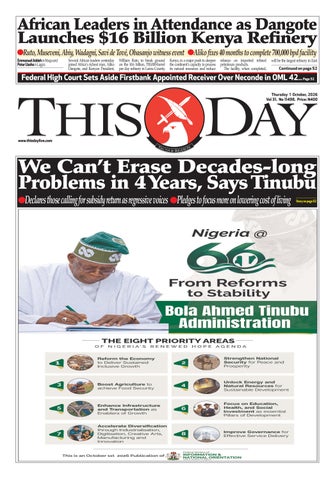
African Leaders in Attendance as Dangote Launches $16 Billion Kenya Refinery Ruto, Museveni, Abiy, Wadagni, Savi de Tové, Obasanjo witness event Emmanuel Addeh in Abuja and Peter Uzoho in Lagos
Several African leaders yesterday joined Africa’s richest man, Aliko Dangote, and Kenyan President,
William Ruto, to break ground on the $16 billion, 700,000-barrel per day refinery in Lamu County,
Aliko fixes 40 months to complete 700,000 bpd facility
Kenya, in a major push to deepen the continent’s capacity to process its natural resources and reduce
reliance on imported refined petroleum products. The facility, when completed,
will be the largest refinery in East Continued on page 52
Federal High Court Sets Aside Firstbank Appointed Receiver Over Neconde in OML 42... Page 52 Thursday 1 October, 2026 Vol 31. No 11498. Price: N400
www.thisdaylive.com TR
UT H
& RE A S O
N
We Can’t Erase Decades-long Problems in 4 Years, Says Tinubu Declares those calling for subsidy return as regressive voices Pledges to focus more on lowering cost of living
Story on page 52
2
THURSDAY, OCTOBER 1, t T H I S D AY
THURSDAY, OCTOBER 1, t T H I S D AY
3
4
THURSDAY, OCTOBER 1, t T H I S D AY
THURSDAY, OCTOBER 1, t T H I S D AY
5
6
THURSDAY, OCTOBER 1, t T H I S D AY
7
THISDAY • THURSDAY, OCTOBER 1, 2026
Group News Editor: Goddy Egene Email: Goddy.egene@thisdaylive.com, 0803 350 6821, 0807 401 0580
NEWS
DINNER WITH THE ACE, NMDPRA...
L-R: Ed Ubong, Director, Decade of Gas Secretariat; Momoh Oyarekhua, Chairman, Crude Oil Refinery-owners Association of Nigeria (CORAN); Umar Gwandu, Technical Assistant to the Minister of state for Petroleum (Oil); Rabiu Abdullahi Umar, Authority Chief Executive (ACE), Nigerian Midstream and Downstream Petroleum Regulatory Authority (NMDPRA); Adegbite Falade, Chairman, Independent Petroleum Producers Group (IPPG)/CEO Aradel Holdings Plc; and Hassan Mahmud, Chief Economist, Dangote Group, during a dinner in honour of NMDPRA ACE at the 3rd Edition of Nigeria Oil Refining Summit (NORS 2026) hosted by CORAN, in Lagos, on Tuesday
Audited Results: NNPC Profit Rises 33% to N7.2trn, Dividends Climb to N5.8trn Taxes, royalties, other remittances jump 39% to N22.3trn Oil company reiterates $60bn investment target by 2030 Total revenue dips to N34.5trn Over 30 Chinese partners assess Warri, Port Harcourt refineries National oil firm says no date fixed for IPO
Emmanuel Addeh in Abuja The Nigerian National Petroleum Company Limited (NNPC) Tuesday announced that it posted a 33 per cent increase in Profit After Tax (PAT) to N7.2 trillion in the financial year ended 2025, rising from N5.4 trillion in 2024. According to the national oil company, this was despite a 24 per cent decline in its total revenue to N34.5 trillion. NNPC also declared a N5.8 trillion dividend and reported its strongest crude and condensate production in five years, averaging 1.77 million barrels per day. The results, presented at the company’s headquarters in Abuja by the Group Chief Executive Officer, Bayo Ojulari, further showed a significant improvement in other key financial indicators, with Earnings Before Interest, Tax, Depreciation and Amortisation (EBITDA) rising 22 per cent to N18 trillion, while earnings per share increased 32 per cent to N35.9. Besides, Operating cash flow grew 16 per cent to N12.8 trillion, while return on equity improved by 200 basis points to 16 per cent. The company’s board declared a dividend of N5.8 trillion, representing a 35 per cent increase over the previous year.
Speaking at the briefing, Ojulari attributed the stronger profit performance to improved operational efficiency and financial discipline, despite the pressures that affected revenue during the year. He said taxes, royalties and other remittances to the federal government rose 39 per cent to N22.3 trillion. Ojulari said crude oil and condensate production averaged 1.77 million barrels per day, representing the company’s highest level in five years, while natural gas supply reached a three-year high of 7.2 billion standard cubic feet per day. The improvement in production was also reflected in the company’s annual volumes, with oil and condensate production totalling 565.8 million barrels, up 5 per cent, while NNPC’s equity share increased 11 per cent to 223.7 million barrels. In the same vein, natural gas production rose 9 per cent to 2,606.2 billion cubic feet, with NNPC’s equity share increasing 11 per cent to 1,154.9 billion cubic feet. According to Ojulari, progress across the portfolio included completion of the AKK River Niger crossing and full completion of the 40-inch by 623-kilometre Ajaokuta-Kaduna-Kano
mainline. He explained that the NNPC also commissioned the ANOH-OB3 Custody Transfer Metering Station and advanced the 300MMscfd ANOH Gas Processing Plant to start-up readiness. It also acquired 500 CNG-powered trucks, and adopted a Technical Equity Partnership Model for its refinery reform. Ojulari said the performance was the result of sustained attention to the company’s assets, infrastructure and execution, stressing that the stronger earnings would give NNPC greater capacity to invest and contribute to public revenue. “Our 2025 performance shows
The ECOWAS Bank for Investment and Development (EBID) has approved a $100 million facility for Nigeria’s Kano-Maradi Standard Gauge Railway Project, providing fresh financing for the acquisition of rolling stock and operational equipment for the second phase of the project. The approval was part of four operations valued at $390 million approved by the bank’s Board of Directors at its 101st Ordinary Meeting held in Lomé, Togo, on September 28, 2026. In a statement from the
bank, the Kano-Maradi project is expected to strengthen rail connectivity between northern Nigeria and the wider West African region, while supporting the movement of people and goods and facilitating cross-border trade. The rail financing is particularly significant as improved transport infrastructure remains central to reducing the cost and difficulty of moving goods across the region. The $100 million commitment places the transport project among the major investments approved by EBID as the regional development bank steps up financing for infrastructure and productive
cent of leadership positions, compared with a global industry average of 17 per cent. Beyond its financial performance, NNPC announced that it recorded progress on several major infrastructure and operational projects during the year. On the refineries, Ojulari said NNPC had made significant progress with prospective partners under its Technical Equity Partnership model. He said the prospective partners had carried out a three-month intrusive, on-site due diligence exercise involving more than 30 senior technical personnel, with the objective of establishing a commercially viable and sustainable
pathway for the refineries. According to him, the new approach would require prospective partners to take equity stakes and share responsibility for the performance of the refineries, rather than simply executing rehabilitation contracts and leaving NNPC with the operational risks. He said the company had learnt from previous refinery rehabilitation efforts and was determined to ensure that any new arrangement resulted in commercially sustainable operations. “We want going forward to have a refinery that is self-sustaining, that is profitable and is sustainable, and that’s what we’re looking for,” Ojulari said.
Seplat Seeks Accelerated Investment to Position Nigeria as Africa’s Global Gas Powerhouse Peter Uzoho Seplat Energy Plc has called for increased investment across Nigeria’s gas value chain to unlock the country’s vast natural gas resources, strengthen energy
EBID Approves $100m for Kano-Maradi Rail Project Nume Ekeghe
what disciplined execution and a capable workforce can deliver. We are strengthening earnings, growing production and investing in the people and assets that will sustain value for our shareholders, communities and the Nigerian people,” he said. He said NNPC was also strengthening its workforce through its Talent-toValue programme, noting that more than 1,000 newly recruited professionals had completed a rigorous one-year internship and training programme and had been deployed across the company. The company said it employed 1,023 full-time employees in 2025, while women now occupy 23 per
sectors under its new Growth, Resilience and Optimisation (GRO) Strategy for 2026-2030. Beyond Nigeria, Ghana accounted for the largest share of the latest approvals, with EBID committing $50 million to MOSL Limited to support the supply of petroleum products and another $230 million to Azumah Resources Ghana Limited for the development of the Black Volta Gold Project. The bank also approved $10 million for the pilot phase of the West Africa Initiative for ClimateSmart Agriculture (WAICSA), covering Ghana, Senegal and Togo.
security, drive industrialisation, and position Nigeria as Africa’s leading gas powerhouse. Speaking at the Gas Investment Forum (GIF) 2026 in Lagos, yesterday, Seplat Energy’s Chief Executive Officer, Mr. Effiong Okon, said while Nigeria possesses more than 215 trillion cubic feet of proven gas reserves, the true value of those resources can only be realised through sustained investments in production, processing, transportation and utilisation infrastructure. Represented by the Director of Gas & New Energy at Seplat, Mr. Okechukwu Mba, Okon, who addressed the conference themed, “Positioning Nigeria as Africa’s Global Gas Powerhouse,” noted that energy poverty remains a major challenge across Africa, with an estimated 600 million people in sub-Saharan Africa still lacking access to electricity. “Gas reserves in the ground do not power homes or factories. Gas creates value only when it is produced and reliably delivered to consumers. “The task before us is to convert
Nigeria’s vast gas endowment into tangible economic growth, industrial development and energy access for millions of people,” he said. The Seplat Energy CEO commended the federal government’s ongoing efforts to improve investment conditions in the gas sector, particularly initiatives aimed at addressing legacy debts in the gas-to-power value chain, which are helping to improve the bankability of gas projects. He also welcomed recent Final Investment Decisions (FIDs) on major energy projects and described the commencement of operations on the Obiafu-ObenObtikom (OB3) gas pipeline as a significant milestone for Nigeria’s gas industry. Okon highlighted the role of policy reforms, especially the Petroleum Industry Act (PIA), in creating a more transparent and investor-friendly environment for gas investments. He noted that institutions such as the Nigerian Midstream and Downstream Petroleum Regulatory Authority (NMDPRA) and
the Midstream and Downstream Gas Infrastructure Fund (MDGIF) were helping to strengthen regulatory certainty and close infrastructure gaps across the sector. Speaking on Nigeria’s global competitiveness, he said the country’s strategic location in the Gulf of Guinea gives it a unique advantage in serving both regional and international gas markets, including Europe, while also supporting growing energy demand across Africa. Okon also outlined Seplat Energy’s significant investments in gas infrastructure over the past decade, including the 375 million standard cubic feet per day (MMscfd) Oben Gas Plant, the 90 MMscfd Sapele Gas Plant, and the flagship 300 MMscfd ANOH Gas Plant, which together reinforce the company’s position as one of Nigeria’s leading domestic gas suppliers. According to him, Seplat currently supplies gas directly to six power stations and supports numerous industrial customers through gas distribution networks.
8
THURSDAY, OCTOBER 1, 2026 • THISDAY
NEWS
STAKEHOLDERS ENGAGEMENT MEETING OF SSDC WITH SOUTH SOUTH WOMEN GROUPS IN EDO...
L-R: Director Women Affairs, Ministry of Youths Development, Mrs. Florence Nwazor; Chief Storekeeper, Mr. Imudo Okafor; Director, Child Department, Mrs. Anthonia Aghedo; Clerk to the Commissioner, Mrs. Florence Obinyan; Edo State Representative on the South-South Development Commission (SSDC) Board, Barr. Femi Oise Agge; Permanent Secretary, Mrs. Joy Irenosen; Director Finance and Accounts, Mrs. Mary O.; Director Media, Daisy Osunde; and Personal Assistant to the Commissioner, Don Kester, during the Stakeholders Engagement meeting of SSDC with South South Women Groups in Edo State, yesterday PHOTO: SSDC
PTDF Summit: Active Oil Rigs Rose from 14 to 60 Under Tinubu, Says Lokpobiri Ekpo: Infrastructure gaps, financing costs threat to private investment Shehu Aliyu: PTDF journal to serve as platform for research findings Filani: Over 15,000 scholars sponsored by PTDF so far Emmanuel Addeh in Abuja The Minister of State for Petroleum Resources (Oil), Heineken Lokpobiri, yesterday disclosed that the number of active oil drilling rigs in Nigeria have risen from about 14 to more than 60 under the President Bola Tinubu administration, resulting in over 1.7 million barrels per day output. Lokpobiri, who spoke at the inaugural Petroleum Technology
Development Fund (PTDF) Journal Summit in Abuja, attributed the development to the ongoing reforms in the petroleum industry, which he said were restoring investor confidence, improving regulatory certainty and creating conditions for increased private sector investment. Represented by the Technical Adviser, Downstream, Emmanuel Sinime, the minister said Nigeria had also recorded more than $10 billion in foreign direct investment
in recent years, while indigenous operators now account for more than 50 per cent of the country’s crude oil production. The summit themed: “Private Sector Participation in Nigeria’s Midstream and Downstream Petroleum Sector: Prospects, Challenges and the Way Forward”, brought together government officials, regulators, industry operators, academics, researchers and other stakeholders. Lokpobiri said the increase in
crude oil production and drilling activity had to be matched by adequate infrastructure, efficient transportation and storage systems, expanded refining capacity and a competitive market capable of delivering value to consumers and investors. He cited the emergence of the Dangote Petroleum Refinery and the increasing operations of modular refineries, including Waltersmith and Aradel, as evidence of what private
Obinna Chima Urges Journalists to Deepen Scrutiny as Nigeria’s Financial System Undergoes Transformation Nume Ekeghe and James Emejo in Abuja The Saturday Editor of THISDAY, Dr. Obinna Chima, has called for a shift in financial journalism from simply reporting financial figures and institutional statements to providing deeper interpretation of the forces shaping Nigeria’s rapidly changing financial system. Chima made the call yesterday while presenting a paper titled, “The Role of the Media in Building a Future-Ready Financial System” at the Central Bank of Nigeria (CBN) organised 38th Seminar for Finance Correspondents and Business Editors in Abuja yesterday. He said developments includ-
ing banking recapitalisation, tax reform and the fintech revolution had fundamentally changed the financial system compared with what financial journalists covered a decade ago, raising the question of whether financial journalism was evolving at the same pace. He argued that the changing financial landscape required journalists to do more than reproduce numbers or statements from financial institutions. “Reporting must move beyond figures to interpretation,” Chima said, stressing that journalists must “uncover what drives financial performance.” He added: “The focus must shift from what institutions say to what the numbers reveal.”
Chima said the financial journalist of the future must therefore combine the roles of an interpreter, investigator, educator and watchdog, particularly as digital banking, fintech and mobile payments continue to blur traditional boundaries within the financial services industry. He also stressed the relationship between credible financial reporting and trust, noting that the quality of information available to the public, investors, depositors, businesses and policymakers directly affects confidence in the financial system. According to him, “Nigeria cannot build a genuinely future-ready financial system without a future-ready financial media.” He described journalists as a bridge
between highly technical financial institutions and the wider public, which often does not understand the language of banking, monetary policy and financial markets. Chima further cautioned financial journalists against sacrificing accuracy for speed, declaring that “credibility is more valuable than being first.” He also identified financial literacy as an important responsibility of the media, particularly in explaining financial reforms, connecting policy to citizens and promoting financial education.
sector investment could achieve in the downstream industry. The minister, however, said infrastructure deficits, regulatory uncertainty, logistics challenges, market volatility, exchange-rate movements and high transportation costs remained significant constraints to investment. He stressed the need to strike a balance between regulation and the ability of businesses to operate, attract investment and create jobs. On his part, the Minister of State for Petroleum Resources (Gas), Ekperikpe Ekpo, said the federal government could not develop Nigeria’s gas sector alone, stressing that private capital, technical expertise and innovation were critical to unlocking the country’s natural gas resources. Ekpo said infrastructure gaps and high financing costs, alongside project development risks, regulatory bottlenecks and inadequate access to reliable energy infrastructure, remained major challenges confronting private investors. He said the Petroleum Industry Act (PIA) had provided an important framework for improving regulatory certainty, strengthening institutional governance and encouraging investment in the midstream and downstream sectors.
According to him, the Decade of Gas initiative is aimed at transforming Nigeria into a gaspowered industrial economy, with natural gas serving as a catalyst for industrialisation, job creation, energy security and economic diversification. He said achieving the objective would require sustained investment in gas processing, transportation and distribution infrastructure, as well as liquefied petroleum gas, compressed natural gas, petrochemical and gas-based industries. Earlier, the Executive Secretary of PTDF, Prof. Shehu Aliyu, said the growing participation of private investors in refining, gas processing, logistics, storage and petroleum products distribution presented opportunities for economic growth, job creation, technology development and local capacity building. Aliyu said the PTDF Journal would serve as an important platform for disseminating research findings, technical innovations, industry experiences and professional knowledge across the petroleum value chain. He said the Fund was particularly interested in ensuring that research outputs moved beyond publication to application, intellectual property development and commercialisation.
IsDB Board Approves US$938m for Clean Energy, Water, Food Security, Health, Others for Nigeria, 5 Member Countries
Director, Ahmed Abu Ghazeleh, in Katsina State by enhancing agriculOkobi highlighted IsDB’s ongoing com- tural productivity and strengthening President Tinubu Approves National Sunday The Board of Executive Directors mitment to turning development farmers’ capacity to withstand climate and market shocks,” it stated. of Islamic Development Bank goals into tangible impact. Strategy on Public Service Reforms (BED) In the Republic of Uzbekistan, The statement identified priority (IsDB), led by IsDB President, H.E. Dr. Muhammad Al Jasser, has approved areas to include lighting homes with the board approved US$115 million Oghenevwede Ohwovoriole in Abuja
President Bola Tinubu has approved the National Strategy on Public Service Reforms being anchored by the Bureau for Public Service Reforms (BPSR) to drive reforms in public service delivery. The BPSR Director General, Dasuki Arabi disclosed this at the Child Online Safety Protection and Reporting of Abuse (COSPRA) 2026 summit with the theme, “Protecting Every Child in the AI Era: Building
a Safe and Trusted Digital Future.” The summit was organised in Abuja, Wednesday by the Ndukwe Kalu Foundation (NKF) and the Nigeria Internet Registration Association (NIRA), in collaboration with the National Information Technology Development Agency (NITDA), the National Data Protection Commission (NDPC), and the Nigerian Communications Commission (NCC), among others. In his goodwill message, Ariba disclosed that President Bola Tinubu
had approved the national strategy on public service reforms which is a pillar around the reforms that the bureau has been driving. “The National Strategy on Public Service Reforms, which is the pillar around the reforms we’ve been driving, has been approved for renewal by the President. I will look forward to capturing whatever will come out of this into the new version of the National Strategy on Public Service Reforms.
a new package of US$938 million in development financing for Nigeria and five other member countries. The package agreed at the board’s 368th meeting in Jeddah, Saudi Arabia, was to support transformative projects in energy, agriculture, health, transport, water supply, resilience, sanitation, and connectivity in the benefitting countries. The approvals, according to a statement made available to THISDAY yesterday by its Communication
cleaner energy, helping farmers cultivate more productive and resilient livelihoods, safeguarding children from preventable diseases, improving road connectivity, and expanding access to safe water, and sanitation in rural areas. The statement said, for Nigeria, the board approved US$60.67 million for the Katsina State Integrated Agricultural Development Hubs Project. “This initiative aims to boost incomes and resilience among farmers
for the Kungrad Wind Power and Battery Storage Project, a landmark clean-energy investment to increase private wind power capacity and support the country’s rising energy needs. The board also approved US$202.150 million for Uzbekistan’s Agriculture Mechanisation Development Project, “which aims to expand access to modern, efficient, and climatesmart agricultural mechanization solutions.”
9
THISDAY • THURSDAY, OCTOBER 1, 2026
NEWS
2026 BOI ANNUAL PUBLIC LECTURE...
L-R: Guest Lecturer and Adjunct Professor, Georgetown University, Asad Alam; Deputy Director, Financial Markets Department, Central Bank of Nigeria, Bashir Ahmad; Managing Director, Bank of Industry, BOI, Dr. Olasupo Olusi; Special Adviser to the President on Economic Affairs, Dr. Tope Fasua; and Registrar General, Corporate Affairs Commission, Hussaini Magaji, during the BOI 2026 Annual Public lecture in Abuja, on Tuesday PHOTO: ENOCK REUBEN
Oyetola: Marine Ministry Unlocking Nigeria’s Blue Economy Potential As NIMASA says Nigeria recorded four piracy-free years Yinka Kolawole in Osogbo and Kasim Sumaina in Abuja Minister of Marine and Blue Economy, Gboyega Oyetola, has said the creation of a dedicated ministry for the sector by the President Bola Tinubu government is helping to unlock Nigeria’s marine resources for job creation, economic growth, and environmental sustainability. Oyetola stated this yesterday at his 72nd birthday celebration held at his country home in Iragbiji, Osun State. He thanked Almighty Allah for preserving his life and expressed appreciation to his family, friends, and associates for celebrating with him. In a another development, Nigerian Maritime Administration and Safety Agency (NIMASA) on Wednesday revealed that Nigeria had recorded four consecutive years without a single piracy incident. The agency attributed the milestone to sustained efforts to strengthen maritime safety and security, including the enactment and implementation of the Suppression of Piracy and Other Maritime Offences (SPOMO) Act. Director-General of NIMASA, Dr. Dayo Mobereola, made the disclosure while speaking at the 21th Abuja International Trade Fair. For his part, Oyetola said Nigeria was blessed with abundant marine
resources, including 853 kilometres of coastline and about 10,000 kilometres of inland waterways, stressing that the creation of the ministry is aimed at unlocking the economic potential of the resources. He stated, “First of all, we need to thank Mr. President for creating a dedicated ministry in the economy. Nigeria is blessed with a lot of resources, particularly in marine resources. “The essence of creating the ministry is to unlock the potentials and resources that we have, to create jobs, economic growth and environmental stability. “We’ve done so well by every standard within the three years that the ministry has been created.” The minister said the ministry had developed a policy framework to guide investment opportunities in the marine and blue economy, while also making progress in maritime security and safety, including Nigeria’s admission into Category C of the International Maritime Organisation (IMO) after about 15 years. Oyetola said efforts were also ongoing to increase local fish production. He said output had risen from about 1.3 million to 1.5 million, while measures, such as advocacy, distribution of life jackets, and replacement of rickety boats were being implemented to reduce boat
mishaps on inland waterways. In the area of ports, the former Osun State governor said, “We are modernising the port, the existing port we have six of them in Nigeria, we are modernising the port because, we are losing so much in terms of revenue to the neighbouring countries, because of the level of draft that we have, the draft level for now is about 13 meters, whereas to attract big vessels we need 16 to 18 meters, so we are trying to increase the draft level to about 16 meters, that’s ongoing, it’s not limited to Apapa Tincan alone, we are doing Warri, Calabar, Port Harcourt, all the existing ports are being modernized.”
Equally speaking at the event, All Progressives Congress (APC) governorship candidate in the August 15 governorship election in Osun State, Bola Oyebamiji, thanked Oyetola for his mentorship and support, praying Almighty Allah to grant him longevity, good health, grace, and blessings. Oyebamiji said, “I’m happy to be here this morning to honour my boss, my leader, my mentor on his birthday. My prayer is for the almighty Allah to grant him longevity of life with an abundance of grace and blessings. “And I want to appreciate the honourable minister for spreading his wealth, for distribution of his income to people both the indigent and even
FG Pursues Single-digit Interest Rate, Loan Moratorium to Boost Livestock Sector Bennett Oghifo
Minister of Livestock Development, Alhaji Idi Muktar Maiha, has assured stakeholders in the sector that the ministry would liaise with the Federal Ministry of Finance and Central Bank of Nigeria (CBN) towards ensuring a single-digit interest rate and long tenure loans in the sector. Maiha stated this during a facility visit to ABIS Ultra-
Modern Livestock Processing Factory in Lekki, Lagos, on Tuesday. The minister emphasised that the ministry would work on achieving a single-digit, pension capital, loan moratorium, and loan payment plan that would drive the livestock sector on the path of growth. He stated, “We do know that there are challenges. We are now going to work with the Minister of Finance,
Wema Bank Equips Nigerian Businesses for Global Trade Through Export Trade Academy Bennett Oghifo Wema Bank has reinforced its commitment to empowering Nigerian businesses for global competitiveness with the successful completion of a two-day Export Trade Academy. The training held in Lagos equipped over 500 business owners with the knowledge, skills, and resources required to participate more effectively in international trade. It was the second edition of the Wema Export Trade Academy (WETA). The programme brought together exporters, small and medium enterprises
(SMEs), commodity aggregators, trade associations, regulators, and professionals in intensive practical sessions focused on helping Nigerian business owners understand and navigate the realities of the export market, from identifying viable opportunities and meeting international buyer expectations to documentation, compliance, financing, logistics, and risk management. During the two-day programme, participants were taken through critical areas of the export journey by experienced international trade professionals, including Central Bank of Nigeria (CBN), Nigerian Export Promotion Council
at least a lot of party members here today so I wish him long life. “I pray again that the almighty Allah bestow him with good health.” Mobereola, represented by Mrs. Nneka Obiano, said the progress made in maritime safety and security had significantly improved confidence in Nigeria’s maritime domain. He recalled that Nigeria was previously regarded as one of the major piracy hotspots in the Gulf of Guinea, a situation that negatively affected vessel traffic, foreign investment, and the movement of goods and services. According to him, “The absence of a dedicated legal framework for prosecuting piracy had been a major
challenge until the SPOMO Act was enacted in 2019. “The first successful prosecution of pirates under the Act between 2021 and 2022 demonstrated Nigeria’s resolve to confront maritime crimes through legal and institutional measures. “Some of us may be aware of the time in the past when the Gulf of Guinea was regarded as the piracy hotspot of the world.” Mobereola explained that the insecurity had serious economic consequences, as vessels were diverted to neighbouring countries, while investment and trade were disrupted. “The introduction of the SPOMO Act changed the situation by providing a legal framework for prosecuting piracy and other maritime offences,” he added.
(NEPC), Nigerian Customs Service (NCS), Nigerian Ports Authority (NPA), National Agency for Food and Drug Administration and Control (NAFDAC), as well as businesses and professionals actively involved in international trade. Speaking on the significance of the programme, Deputy Managing Director, Wema Bank Plc, Oluwole Ajimisinmi, said Nigeria had enormous entrepreneurial potential and businesses with products that could compete successfully in markets beyond Nigeria’s borders. Ajimisinmi said what was often lacking was the right combination of knowledge, access, financing, and
partnerships. According to him, “At Wema Bank, we recognise that the potential of Nigerian businesses in global trade can only be fully realised when they have access to the right knowledge, the right connections, and the right financial support. “WETA brings these critical elements together and our ambition is to create a platform that helps businesses understand the export ecosystem, connect with the right stakeholders, and build the capacity required to participate sustainably in international trade.”
to make sure that capital loans in the agricultural sector are effective. There is no way you can establish an abattoir and have 25 per cent interest rate. “There is no way you can go ranching or feedlotting and pay 16 to 20 per cent interest rate and get three to four years’ repayment. We need pension capital. We need single digits. We need long-term repayment. At least minimum 10 years. That is when that farm will mature.” At the tour of the facilities, including the abattoir that processes 250 cows per day in a certified hygienic environment, Maiha commended ABIS group for bringing modernity into the livestock processing business and creating employment opportunities for women. He said the ministry will work to ensure that certified abattoirs were created nationwide. Maiha stated, “You can see how neat the facility is, whether you are talking about poultry, whether you are talking about fish, or goats, or beef. That is the way to go. That is our discussion with the executive members of the Lagos State government. “We are talking about having laboratories everywhere so that we stop bringing lorries, and trailers. You bring process, and culture. You pick up your phone and you order meat. You order processed meat. You can see here all
the by-products. “The blood, the faeces, the horns, the hooves, the skin, everything is processed. It is also raw materials for other industries.” He pledged the ministry will not relent until it achieved a separate mandate of transforming the agricultural sector into a modern, profitable, sustainable, and globally inclusive industry for national food security, job and work creation, and for the stability of the rural area. In his remarks, Chairman and founder, ABIS Group, Ambassador Emmanuel Usman Nelson, stated that government’s support for the livestock production sector with loans at single digit will fuel change in the sector. Nelson said the government also needed to fix dilapidated roads for ease of transporting livestock and ensure access to land towards expanding the business. He advised herders in the country to embrace modernised way of rearing livestock instead of roaming through the forest. Usman lauded the livestock development minister and Lagos State Government for supporting operators in terms of granting of approvals to operate and urged them to do more in modernising the sector, as well as creating more jobs through livestock development.
10
THURSDAY, OCTOBER 1, t T H I S D AY
THURSDAY, OCTOBER 1, t T H I S D AY
11
12
THURSDAY, OCTOBER 1, t T H I S D AY
THURSDAY, OCTOBER 1, t T H I S D AY
13
14
THURSDAY, OCTOBER 1, t T H I S D AY
THURSDAY, OCTOBER 1, t T H I S D AY
15
16
THURSDAY, OCTOBER 1, t T H I S D AY
THURSDAY, OCTOBER 1, t T H I S D AY
17
18
THURSDAY, OCTOBER 1, t T H I S D AY
THURSDAY, OCTOBER 1, t T H I S D AY
19
20
THURSDAY, OCTOBER 1, t T H I S D AY
THURSDAY, OCTOBER 1, t T H I S D AY
21
22
THURSDAY, OCTOBER 1, t T H I S D AY
THURSDAY, OCTOBER 1, t T H I S D AY
23
24
THURSDAY, OCTOBER 1, t T H I S D AY
THURSDAY, OCTOBER 1, t T H I S D AY
25
26
THURSDAY, OCTOBER 1, t T H I S D AY
THURSDAY, OCTOBER 1, t T H I S D AY
27
28
THURSDAY, OCTOBER 1, t T H I S D AY
THURSDAY, OCTOBER 1, t T H I S D AY
29
30
THURSDAY, OCTOBER 1, t T H I S D AY
THURSDAY, OCTOBER 1, t T H I S D AY
35
THURSDAY, OCTOBER 1, t T H I S D AY
31
32
THURSDAY, OCTOBER 1, t T H I S D AY
THURSDAY, OCTOBER 1, t T H I S D AY
33
34
THURSDAY, OCTOBER 1, t T H I S D AY
36
THURSDAY, OCTOBER 1, t T H I S D AY
THURSDAY, OCTOBER 1, t T H I S D AY
37
1
T H I S D AY THURSDAY OCTOBER 1, 2026 38 TR
UT H
& RE A S O
Thursday October 1, 2026 Vol 27. No 11490
N
opinion@thisdaylive.com
www.thisdaylive.com
WHEN ECONOMIC PAIN THREATENS SOCIAL PEACE
PAUL IBE argues for a cut in cost of petrol
See page 39
THE PETROLEUM IMPORT LICENCE JUDGMENT The backward integration provisions of the PIA must not be rendered redundant, argues ECHE STEPHEN IDOKO
See page 39
EDITORIAL
NIGERIA AT 66
See page 40
Self-liberation is critical to both personal and national development, writes MONDAY PHILIPS EKPE
THE INDEPENDENCE NIGERIANS NEED Most commentaries on the country’s 66 years of political emancipation from her erstwhile British imperial lords so far have been lamentable in tone and diction. Quite understandably. Expressions of various shades depict Nigeria as an organism that has refused or failed to respond positively to all the developmental stimuli at its disposal and has, therefore, remained stunted for decades. Other viewpoints centre around the need to be more patient with her as the hurdles which exist now are a necessary part of nation-building. United States of America is frequently used to illustrate the tough road to enduring greatness. The US is what it has become after two and half centuries! Meaning that those who are always eager to send our nation to the guillotine should kindly do a rethink. To be fair, citizens who have increasingly grown sceptical and cynical about Nigeria and whatever is left of her prospects are not necessarily less patriotic than those determined to forge on with their faith in a bright future. No matter how far apart the two sides may have gone, they must come to terms with what the true catalyst for transformation is. The change agent resides in the soul, in the very chamber that hosts mindsets, attitudes and will. 7KHVH DUH DWWULEXWHV RI ERQD ¿GH KXPDQ beings, not items to be bestowed by politicians. Nigerians are known for enduring and surviving hard conditions, situations that would push citizens of other countries to the streets in wild protests against their own governments. It isn’t clear whether that’s a virtue or vice. But should sitting still and complaining in the face of deprivation and mediocre living be regarded as merits? If indeed the Nigerian masses don’t seem to be able to rise to the occasion as obtainable elsewhere, it would be unfair to simply dismiss them as cowards. Call it whatever it is. Even resilience has its own limits and many Nigerians have since arrived there. Elasticity doesn’t suggest any capacity for endless stretching. Snapping always occurs when the breaking point is reached. The frustrations with the Nigerian system, the recklessness and self-centredness of the political elite and an overriding premonition that things may just not get better in our own lifetime appear to have conspired to force many people onto the paths of helplessness and hopelessness. No one gets to those edges in one day. It happens gradually. Slowly but certainly, people have watched the nation’s indices of individual and corporate wellbeing deteriorate. Take the marking of our
Independence Day itself, for instance. My early life reminiscences still have robust images of October First. March pasts involving the armed forces, police, paramilitary services, educational institutions, boys’ scouts, girls’ guides, boys’ and girls’ brigades and others did not only add colour to the day’s grandeur. They were all unanimous in celebrating the strides and dignity of a country attempting to shed her dependent past and take on a more progressive and free status. No state or local government capital then was excluded from those glorious shows. The ceremonies these days, where and when they’re staged, have lost their bite substantially. The slide began when governments started announcing sober anniversaries for reasons ranging from dwindling fortunes to insecurity. But even if the Independence Day celebration or lack of it needn’t elicit any elevated discourse, its symbolism shouldn’t be ignored either. Here’s why. Freedom indicates an earlier existence of bondage. Bound by the shackles of colonialism, the lands so conquered sought to liberate themselves. In our own case, the skin colour of the colonists didn’t help matters. We thought that wresting power from them and domiciling same amongst us would guarantee our happiness and prosperity. Even if 66 years aren’t enough to justify any negative stance on Nigeria’s chances of entering the comity of successful countries, it’s apparent that having whites rule us wasn’t our only headache. Since October 1, 1960, several aspects of our national life have been experiencing a downward movement. Yes, varying degrees of successes have been recorded on the way. Consensus exists, however, that the country hasn’t yet achieved a reasonable level of the utilisation of its potentialities. Finger-pointing in this regard moves disproportionately towards WKH UXOLQJ FODVV 1RW ZLWKRXW MXVWL¿FDWLRQV though. The truism that everything rises and falls with leadership subsists here too.
But stopping the argument there misses the point altogether. Our leaders are neither from Mars nor Guinea Bissau, the country whose national football team, The Dromedaries, currently ranked 132 by FIFA, humiliated the Super Eagles of Nigeria (26th in FIFA ranking) by 3-0 some days ago. They originate from our PLGVW 6R ZKHQ SROLWLFDO R൶FH KROGHUV misbehave, as they often do, and the rest of us sit still like frozen quantities, we all – preys and predators alike – become YLFWLPV RI GL൵HUHQW NLQGV 2QH VHW LV denied the basic necessities of existence. And the other is diminished in ways that aren’t captured in dollars and naira but lethal nonetheless. It’s time to interrogate the essence of our personal liberty, for, no true progress can occur outside its awareness and utility. Some thinkers here on the transformative energies of independence. Franklin D Roosevelt: “True individual freedom cannot exist without economic security and independence. People who DUH KXQJU\ DQG RXW RI D MRE DUH WKH VWX൵ RI which dictatorships are made.” Nigerians can relate with this, having endured tyrannies of diverse colours and shameful SRYHUW\ SUR¿OHV Stephen Covey: “Every human has four endowments – self-awareness, conscience, independent will and creative imagination. These give us the ultimate human freedom... The power to choose, to respond, to change.” The rich endowment of Nigerian citizens isn’t in doubt locally and globally. Marshalling this towards attaining more noble heights remains challenging, however. Maya Angelou: “Independence is a heady draught, and if you drink it in your \RXWK LW FDQ KDYH WKH VDPH H൵HFW RQ WKH brain as young wine does. It does not matter that its taste is not always appealing. It is addictive and with each drink you want more.” Surely, freeing our own minds, like good wine, tastes wow! But many Nigerian youths especially are currently addicted to slavish substances, sadly. Virginia Woolf: “The man who is aware of himself is henceforward independent; and he is never bored, and life is only too short, and he is steeped through and through with a profound yet temperate KDSSLQHVV ´ 7KH VXUHVW URXWH WR IXO¿OPHQW is a freed mind. It’s indispensable to real growth. But most Nigerians may have been too overwhelmed with visceral, mundane wants to bother about lofty goals. This unravelling tragedy must be halted. Dr Ekpe is a member of THISDAY Editorial Board X: @monday_ekpe2
T H I S D AY
339
THURSDAY OCTOBER 1, 2026
PAUL IBE argues for a cut in cost of petrol
WHEN ECONOMIC PAIN THREATENS SOCIAL PEACE There are moments in the life of a nation when an economic statistic ceases to be merely a statistic and becomes a warning. Nigeria may be approaching such a moment. The warning is contained not simply in the price displayed at filling stations, but in what that price is doing to the daily lives of millions of citizens: how much it costs to get to work, transport food, move goods, run a business, take children to school or simply remain economically active. A recent article by a veteran columnist, Lasisi Olagunju offers a disturbing illustration. Between September 10 and September 22, 2026, he spent ଂ211,396 on petrol for one vehicle—an average of about ଂ17,616 a day. Sustained for 30 days, that would amount to roughly ଂ528,490; annualised, approximately ଂ6.43 million. The point is obviously not that every Nigerian spends that amount on petrol. The more important question is: what happens to a society when the cost of participating in the economy begins to consume the income generated by participating in that economy? Petrol is not merely another commodity in Nigeria. It runs through almost every layer of economic activity. Farmers need transportation to move produce. Traders must reach markets. Manufacturers depend on energy and logistics. Workers must commute. School buses, ambulances, generators and commercial vehicles consume fuel. When petrol becomes dramatically more expensive, the entire economy absorbs the shock. It appears in transport fares, food prices, building materials and virtually every service dependent on mobility. Nigeria’s political history also demonstrates that fuel prices can become triggers for wider mobilisation. In January 2012, the Jonathan administration’s attempt to remove the petrol subsidy more than doubled the pump price, triggering widespread protests and a nationwide labour strike. The government subsequently partially reversed the increase. The lesson is important. Citizens do not experience economic reforms primarily through fiscal tables. They experience them through household budgets. That reality resurfaced in August 2024 when nationwide demonstrations over economic hardship incorporated demands concerning petrol prices, electricity tariffs, hunger and the broader cost of living. Economic hardship does not automatically produce social disorder. But the risks increase when people begin to believe that work no longer guarantees survival; that sacrifice is demanded disproportionately from ordinary citi-
zens; that government is unresponsive to suffering; and that the future offers little prospect of improvement. At that point, economic grievances can acquire a political vocabulary. Nigeria saw something similar during the 2020 #EndSARS protests. What began principally as anger over police brutality broadened into wider grievances about governance, accountability and living conditions. The warning for every government is straightforward: social unrest does not always remain confined to the grievance that initially produced it. A fuel crisis can aggravate a food crisis. A food crisis can intensify a wage crisis. Accumulated economic grievances can eventually become questions of political legitimacy and public order. That sequence is not inevitable. But neither is it imaginary. Other governments confronting sharply rising fuel costs have recognised the danger of allowing an energy shock to pass unchecked through household finances. In September 2026, France expanded targeted assistance for low-income, high-mileage workers affected by higher fuel prices, increasing potential beneficiaries from about three million to 5.5 million and extending support to sectors including farming, fishing and construction. Britain extended its temporary fivepence-per-litre fuel-duty reduction through December 2026. Germany announced temporary fuel-tax reductions, while South Korea extended reductions in fuel taxes through November. These governments are not necessarily abandoning market economics. They are recognising a basic principle: when an external energy shock threatens to spread through the entire economy, targeted government intervention may be necessary to cushion households and businesses. Nigeria’s emphasis on compressed natural gas is understandable. The country possesses substantial gas resources, and diversifying the transport-energy system is strategically sensible. Ibe, Media Adviser to Atiku Abubakar, writes from Abuja
The backward integration provisions of the PIA must not be rendered redundant, argues ECHE STEPHEN IDOKO
THE PETROLEUM IMPORT LICENCE JUDGMENT The recent judgment of the Federal High Court, Abuja, directing the Nigerian Midstream and Downstream Petroleum Regulatory Authority (NMDPRA) to continue granting and renewing petroleum product import licences to Matrix Energy, A.A. Rano Nigeria Limited and AYM Shafa Limited raises fundamental questions about the future of Nigeria's domestic refining industry and the proper interpretation of the Petroleum Industry Act (PIA), 2021. The judgment presents substantial questions of law that deserve urgent appellate consideration, particularly regarding the relationship between competition, backward integration and the statutory discretion of the petroleum regulator. At the heart of this controversy is a simple question: Did the National Assembly intend to establish a petroleum industry perpetually dependent on imported refined products, or did it deliberately provide a legal framework to encourage domestic refining while permitting imports to address supply shortfalls? The answer must be found in the PIA itself. Section 317(8) expressly empowers the NMDPRA to apply the backward integration policy to encourage investment in local refining. Subsection (9) provides for the issuance of import licences to address product shortfalls, while subsection (10) establishes the considerations governing import-volume allocation, including refining output, competitive pricing and distribution capacity. These provisions were deliberately included in the Act. They cannot be treated as mere legislative decorations. Admittedly, Section 317(8) uses the word "may", thereby conferring discretion upon the regulator rather than imposing an absolute prohibition on imports. However, that discretion is a statutory power which must be exercised lawfully and consistently with the objectives of the legislation. It is therefore difficult to reconcile the spirit of these provisions with any interpretation that effectively converts petroleum importation into a continuing commercial entitlement, irrespective of domestic production and supply considerations. The learned trial Judge reportedly relied on Sections 31, 32 and 211 of the PIA, read together with Section 72 of the Federal Competition and Consumer Protection Act, in reaching the conclusion that the regulator must promote competition and prevent market dominance. There is nothing objectionable about that principle. Indeed, competition remains essential to ensuring fair pricing, product availability and consumer protection. However, competition is not synonymous with unrestricted importation. The PIA envisages competition within a petroleum industry that also encour-
ages domestic investment, production, refining, storage and distribution. Section 309 further establishes the precedence of the PIA over inconsistent provisions of other enactments in matters governed by it, subject to the Constitution and the statutory exception relating to the Nigerian Oil and Gas Industry Content Development Act. Consequently, the general competition provisions of the FCCPA must be reconciled with the specific petroleum-sector framework under Section 317. The principle of harmonious statutory interpretation requires that legislation be read as a whole, giving effect to all its provisions rather than allowing one provision to render another ineffective. It is important to acknowledge that the reported judgment makes the issuance and renewal of import licences conditional upon the companies satisfying applicable statutory and regulatory preconditions. It does not expressly grant an unconditional right to import petroleum products. Nevertheless, a substantial question remains: Does the continued entitlement contemplated by the judgment preserve the regulator's discretion to implement backward integration, assess domestic supply shortfalls and determine import volumes under Section 317? This is a legitimate question deserving appellate clarification. An appeal could properly invite the Court of Appeal to determine whether the general obligation to promote competition can override, diminish or restrict the specific statutory powers conferred upon the NMDPRA to encourage local refining and regulate petroleum product imports. It should equally clarify whether satisfying ordinary administrative licensing requirements automatically establishes entitlement to importation without consideration of the broader statutory framework. These are questions extending beyond the commercial interests of the three marketers. They concern the regulatory foundation upon which Nigeria's refining industry is being developed. Idoko, LLB, BL, is Publicity Secretary, CORAN
40 4
T H I S D AY THURSDAY OCTOBER 1, 2026
EDITORIAL
Editor, Editorial Page PETER ISHAKA Email peter.ishaka@thisdaylive.com
NIGERIA AT 66
We should strive for a state where governance matches the expectations of the citizenry
E
very nation is perpetually engrossed in the quest for the realisation of its founding ideals. Very few are anywhere near that goal. Nigeria, which marks its 66th independence anniversary today, remains a work in progress. There may be disagreements as to how best to create a fair, equitable and prosperous nation but has Nigeria survived a nasty civil war that could have extinguished less fortunate states. We have a diversity that others envy. We are educated, enterprising and optimistic. The world’s two most antagonistic faiths co-exist. Our brilliant citizens lead some of the world’s most successful organisations DQG PRVW SUR¿WDEOH FRUSRUDWLRQV $PLG DOO WKLV 1LJHria remains a young nation with rusty ancient maladies. However, there is a strong consensus that given our human and natural resource endowments, Nigeria has not fared too well compared to its peers in the congregation of nations. Today, members of the generation of Nigerians who were around in KDYH D ULJKW WR VLJK LQ GLVTXLHW $W PRVW RI Nigeria’s age grade nations have made commendable progress. Indonesia, Malaysia, South Korea, and Singapore have all become globally notable nations. The much that can be said about Nigeria today is that it has enormous potential. To most Nigerians, 66 years of independence have not translated into much even when the concept of nationhood has persisted and survived. In many ways, the age of nations can measure their achievement in established identities, stable cultures and a global reputation for good or ill. The sorry state of our public utilities does not match our bulging population. Worse still, our democracy has largely been more formal than substantial. We have embraced democracy as a ritual observance rather than an instrument of economic development and social advancement. Our leaders must understand that the mere passage of time does not confer greatness on nations. Nor does
platitudes, no matter how repetitive. It is the realisation of promises made at the foundation and the hopes raised at the beginning that matter most. Even the enemies of Nigeria do not deny its social and economic potential, despite the generations of waste and abuse LW KDV VR IDU H[SHULHQFHG $OVR DV KRPH WR DERXW RQH out of every four black persons on earth, its abundance of human resources is not in doubt. But there is a leadership challenge at all levels of governance, and that holds us back. On a day such as this, therefore, SHRSOH LQ OHDGHUVKLS SRVLWLRQV PXVW UHÀHFW RQ VRPH RI those things that are keeping the country down. Despite recent measures that have pauperised maMRULW\ RI 1LJHULDQV SURÀLJDF\ UHPDLQV WKH QDPH RI WKH JDPH IRU SXEOLF R൶FLDOV DW DOO OHYHOV RI JRYHUQment in our country. We therefore call on the federal government and the 36 states to begin to cut down on the waste that is now associated with government. We suggest a review of government spending and, more importantly, a rethink of the cost of PDLQWDLQLQJ RXU SXEOLF R൶FH holders. Most of the resources being wasted can be deployed to areas of pressing challenges both at the federal level and in the states. The challenge of the next three decades as Nigeria pursues centennial goals is therefore how to escape from the doldrums of insecurity, avoidable poverty and state incompetence. We need to evolve into a PRUH H൶FLHQW DQG PRUH PHULWRFUDWLF VWDWH LQ ZKLFK WKH FRQGXFW RI VWDWH D൵DLUV PDWFKHV WKH JHQHUDO H[pectations of the citizenry and civil society. To change that narrative would require a new mindset by both the leaders and the citizens. One, government must do more to provide security and insulate Nigerians IURP WKH H൵HFWV RI WKH FDWDVWURSKH WKDW KDV RYHUWDNHQ the land. Two, the withering economy must be reinvigorated and put Nigerians back on their feet. Over and above all, we must all commit to the unity of our country and its diversity. We wish all Nigerians happy 66th independence anniversary.
Government must do more to provide security and insulate Nigerians from the effects of the catastrophe that has overtaken the land T H I S D AY EDITOR SHAKA MOMODU DEPUTY EDITOR WALE OLALEYE MANAGING DIRECTOR ENIOLA BELLO DEPUTY MANAGING DIRECTOR ISRAEL IWEGBU CHAIRMAN EDITORIAL BOARD OLUSEGUN ADENIYI EDITOR NATION’S CAPITAL IYOBOSA UWUGIAREN THE OMBUDSMAN KAYODE KOMOLAFE
T H I S D AY N E W S PA P E R S L I M I T E D EDITOR-IN-CHIEF/CHAIRMAN NDUKA OBAIGBENA GROUP EXECUTIVE DIRECTORS ENIOLA BELLO, KAYODE KOMOLAFE, ISRAEL IWEGBU DIVISIONAL DIRECTORS SHAKA MOMODU, PETER IWEGBU, ANTHONY OGEDENGBE DEPUTY DIVISIONAL DIRECTOR OJOGUN VICTOR DANBOYI SNR. ASSOCIATE DIRECTOR ERIC OJEH ASSOCIATE DIRECTOR PATRICK EIMIUHI CONTROLLERS ABIMBOLA TAIWO, UCHENNA DIBIAGWU, NDUKA MOSERI DIRECTOR, PRINTING PRODUCTION CHUKS ONWUDINJO TO SEND EMAIL: first name.surname@thisdaylive.com
Letters to the Editor Letters in response to specific publications in THISDAY should be brief (150-300 words) and straight to the point. Interested readers may send such letters along with their contact details to opinion@thisdaylive.com. We also welcome comments and opinions on topical local, national and international issues provided they are well-written and should also not be longer than (750- 1000 words). They should be sent to opinion@thisdaylive.com along with photograph, email address and phone numbers of the writer.
LETTERS
NIGERIA AT 66: WHICH WAY NIGERIA? Sixty six years after independence, Nigeria should be asking itself a question that can no longer be postponed: what exactly has become of the great promise of our naWLRQ" $ FRXQWU\ EOHVVHG ZLWK HQRUPRXV KXPDQ DQG QDWXral resources should not, at this stage of its journey, still be struggling with problems that ought to have become GLVWDQW PHPRULHV $V ZH PDUN \HDUV RI LQGHSHQGHQFH this should be more than another occasion for colourful ceremonies, patriotic speeches and celebrations. It is a WLPH IRU VREHU UHÀHFWLRQ DV D SHRSOH WR H[DPLQH ZKHUH we are, where we ought to be and, most importantly, how best to move Nigeria forward. Undoubtedly, Nigeria is not where it used to be. There KDYH EHHQ VLJQL¿FDQW GHYHORSPHQWV LQ GL൵HUHQW VHFWRUV of the economy and society, and successive administrations have introduced policies and programmes aimed at addressing the country’s challenges. However, we must also acknowledge that we are certainly not where we ought to be, considering the enormous human and natural UHVRXUFHV DYDLODEOH WR XV $ QDWLRQ EOHVVHG ZLWK DEXQGDQW
natural resources, a large youthful population and considerable human capital should be able to provide a higher standard of living for its citizens. $W 1LJHULD VKRXOG KDYH QR UHDVRQ WR VWLOO EH EDWtling with inadequate power supply, dilapidated roads, massive unemployment and widespread hunger. These are challenges that have persisted for decades, despite the huge resources committed to addressing them. While some of our past and present leaders may have done, or may still be doing, their best, the reality remains that their H൵RUWV DORQH KDYH QRW EHHQ HQRXJK WR VROYH WKH QXPHURXV problems bedevilling the nation. What Nigeria requires LV VXVWDLQHG FRPPLWPHQW H൵HFWLYH LQVWLWXWLRQV DFFRXQWability and policies that go beyond individual administrations. Corruption and insecurity also continue to pose serious challenges to national development. Resources that should be channelled towards infrastructure, education, healthcare, job creation and other essential services can be undermined by corruption and poor accountability. Sim-
ilarly, insecurity discourages investment, disrupts economic activities and threatens the lives and livelihoods of citizens. We cannot continue like this as a nation. There must be a collective determination to strengthen institutions, uphold the rule of law and confront the factors that continue to undermine national development. Unfortunately, the people themselves appear to have become accustomed to many of these perennial problems. This has contributed to a situation where some citizens fail to demand accountability from leaders or make H൵HFWLYH XVH RI WKHLU GHPRFUDWLF SRZHU GXULQJ HOHFWLRQV Democracy gives citizens the opportunity to choose their representatives and to replace those whose performance does not meet their expectations. Elections should therefore be about competence, integrity, policies and the ability to serve the public interest, rather than personal OR\DOW\ RU WHPSRUDU\ EHQH¿WV Tochukwu Jimo Obi, Obosi, Anambra State
T H I S D AY ˾ THURSDAY, OCTOBER 1, 2026
41
BUSINESSWORLD R A T E S MONEY MARKET
A S
A T
REPO
Group Business Editor Eromosele Abiodun Email oriarehu.eromosele@thisdaylive.com
08056356325
S E P T E M B E R
S & P INDEX
3 0 , 2 0 2 6
S & P INDEX
EXCHANGE RATE
OPR
25.34%
CALL
23.25%
INDEX LEVEL
595.26
1/4 TO DATE
0.24%
N1,383.00 / 1 US DOLLAR*
OVERNIGHT
25.18%
1-MONTH
21.37%
1-DAY
0.10%
YEAR TO DATE
-10.99%
*AS AT WED., SEPTEMBER 30, 2026
3-MONTH
22.41%
MONTH-TO-DATE
0.24%
Broadband Penetration Maintains Steady Growth as Telecoms Contribution to GDP Increases
Stories by Emma Okonji Nigeria’s broadband penetration has maintained a steady growth in the past one year, reaching 57.40 per cent growth with 124.4 million broadband subscriptions in July this year, according to the latest statistics released by the Nigerian Communications Commission (NCC). The statistics also revealed an increase in the contribution of the telecoms sector to Nigeria’s Gross Domestic Product (GDP), which reached 9.72 per cent in Q2, 2026, up
from 9.19 per cent recorded in Q1, 2026. The statistics, which THISDAY obtained from the official website of the NCC, showed that as at August 2025, broadband penetration was 48.81 per cent, with 105 million broadband subscriptions. In September 2025, broadband penetration increased to 49.34 per cent, with a corresponding growth in broadband subscriptions of 106 million. In October 2025, Nigeria recorded another growth in
broadband penetration, which reached 49.89 per cent, with a corresponding growth in broadband subscriptions of 108 million. In November 2025, broadband penetration increased again to 50.58 per cent, with 109 million broadband subscriptions, before reaching 51.97 per cent broadband penetration level, with 112 million broadband subscriptions in December 2025. In January 2026, Nigeria witnessed another broadband penetration growth, which
reached 53.07 per cent, with 115 million broadband subscriptions. In February 2026, broadband penetration increased again to 53.86 per cent, with 116 million broadband subscriptions. In March 2026, there was a further increase in broadband penetration to 54.30 per cent and a subsequent increase in broadband subscriptions to 117 million. In April 2026, broadband penetration increased again to 55.67 per cent, with a further increase in broadband subscriptions to
120 million. As at May 2026, there was another increase in broadband penetration, which reached 56.11 per cent, with a subsequent increase in broadband subscriptions to 121 million. In June 2026, broadband penetration further increased to 56.79 per cent, with another increase of 123 million broadband subscriptions, before reaching 57.40 per cent broadband penetration level, with an increased broadband subscriptions of 124 million in July 2026. According to the statistics,
the telecoms sector contribution to Nigeria’s GDP has also maintained steady growth in the last two years, but with minimal fluctuations. From the statistics, the telecoms sector contribution to GDP in Q1, 2024 was 14.58 per cent, but it dropped to 8.93 per cent in Q2, 2024, with a further drop to 7.51 in Q3, 2024. Telecoms contribution to GDP however picked up in Q4, 2024 to reach 7.80 per cent, with a further increase in Q1, 2025 to 8.50 per cent. The story continues online on www.thisdaylive.com
Group Calls for Urgent Action to Unlock Nigeria’s Export Potential The Manufacturers’ Association of Nigeria Export Promotion Group (MANEG) has called on the federal government to tackle the high cost of production, logistics bottlenecks and other structural constraints undermining the competitiveness of Nigerian manufactured products in international markets. The group made the call at its 9th Annual General Meeting (AGM) held in Lagos, with the theme: ‘Unlocking Nigeria’s Manufacturing Export Performance Through Tackling Cost, Logistics as Competitiveness Constraints’. Speaking the Chairman of
MANEG, Mrs. Ruth Owojaiye, said the competitiveness of Nigerian exports was being significantly affected by the cost of doing business, particularly high interest rates, unreliable power supply, rising energy and logistics costs, poor road infrastructure and other deficiencies that increase the cost of getting products from factories to markets. According to her, while manufacturers recognise that structural reforms cannot be achieved overnight, the business community needs to see measurable and sustained progress in addressing the constraints that continue to
erode the competitiveness of Nigerian products. “Manufacturers are itching. Exporters are asking the government for support to ensure everything works. We know that it’s not going to happen in a day. But we need to see steps happening to ensure that logistics issues are being dealt with, the roads are being fixed, interest rates are being addressed,” Owojaiye said, while welcoming the recent reduction of the Monetary Policy Rate (MPR) to 23 per cent. She noted that access to affordable credit remained critical to manufacturers
seeking to expand production, invest in technology, meet international standards and compete effectively in export markets. The MANEG Chairman also renewed the group’s call for the settlement of outstanding claims under the Export Expansion Grant (EEG), describing the incentive as an important mechanism for supporting exporters operating in a highly competitive global environment. She said the payment of outstanding claims would provide exporters with resources to reinvest in their businesses, strengthen
production capacity and cushion some of the cost pressures affecting their operations. Owojaiye further stressed the importance of compliance with standards in destination markets, noting that export competitiveness is not only about producing at scale but also about ensuring that Nigerian products consistently meet the technical, quality and regulatory requirements of international markets. Also speaking, the Director-General of the Manufacturers’ Association of Nigeria (MAN), Mr.
Segun Ajayi-Kadir, said the challenge before Nigeria was not simply to increase the volume of goods exported but to create the conditions under which Nigerian manufacturers could compete successfully against products from other countries. He noted that Nigeria’s high-cost operating environment could undermine the gains from increased market access, including opportunities created by the African Continental Free Trade Area (AfCFTA). The story continues online on www.thisdaylive.com
M A R K E T D ATA A S AT W E D N E S D AY, S E P T E M B E R 3 0 , 2 0 2 6 BONDS DESCRIPTION Price Yield Change Updated Time (%) September ^13.98 230.00 30, 2026 96.21 16.98 FEB-2028 ^21.00 20105.35 16.90 0.00 September MAR-2028 30, 2026 ^19.30 170.06 September 104.53 17.05 30, 2026 APR-2029 ^14.55 26September 95.28 16.80 0.00 APR-2029 30, 2026 ^18.50 21September 104.48 17.02 -0.12 FEB-2031 30, 2026
BILLS MATURITY NTB 8-Oct26 NTB 5-Nov26 NTB 3-Dec26 NTB 7-Jan27 NTB 4-Feb27
Discount Yield
CPS
Change (%) Updated Time
17.00
17.30
0.00 September 30, 2026
17.30
17.85
0.00 September 30, 2026
17.79
18.63
0.00 September 30, 2026
18.54
19.83
0.00 September 30, 2026
19.83
0.00 September 30, 2026
17.10
MATURITY HAAI CP X 7-SEP-26 PCLL CP V 25-SEP-26 AGRO CP IV 7-DEC-26 DAIL CP II 26-NOV-26 JVIL CP XXIV 29-DEC-26
Discount Yield 22.85
22.92
22.79
23.12
22.80
24.25
21.22
22.32
22.20
23.91
CLEARED NAIRA-SETTLED NDFS Change (%)
Updated Time
-0.01 September 30, 2026 0.00 September 30, 2026 0.01 September 30, 2026 0.00 September 30, 2026 0.01 September 30, 2026
CONTRACT TENOR Contract (MONTH)
Current Rate ($/₦)
Updated Time
–
–
–
–
–
–
–
–
–
–
–
–
–
–
–
–
–
–
–
–
42
THURSDAY, OCTOBER 1, 2026 ˾ T H I S D AY
BUSINESSWORLD
NEWS
GROWTHX FORUM…
L–R: Deputy Managing Director, Etranzact, Hakeem Adeniji-Adele; Chief Technology Officer, First City Monument Bank, Blessing Ehize; Chief Executive Officer, Unicloud Africa, Dr. Krish Ranganath; Founder/Editor in-Chief, Techeconomy, Peter Oluka; Founder/CEO of Bridge57 Solutions Limited, Roseline Ilori; Co-founder/COO, Cashwise Finance, Elsie Godwin; President, Nigeria Internet Registration Association (NiRA), Adesola Akinsanya; and CEO, Open Access Data Centre (OADC), Dr. Ayotunde Coker, during GrowthX by Techeconomy forum, held in Lagos… recently
Another Telco Gets Universal Licence to Offer Voice, Data Services across Nigeria Stories by Emma Okonji The number of telecoms services providers is on the rise as Swift Telephone Network Limited (STN), has been awarded a Unified Access Service Licence (UASL), by the Nigerian Communications Commission (NCC) to provide data and voice services across Nigeria. The milestone marks STN’s formal evolution from its early beginnings as a telephone call service operating under an umbrella structure, into an independent
Nigerian telecommunications company, positioned to build the next generation of digital infrastructure in Nigeria. Chief Executive Officer of STN, Oluwole Adetuyi said: “This UASL is not just a licence. It is a new chapter. It represents where we started, what we have endured, how we have evolved, and where we are going. We are building in Nigeria, for Nigeria.” “Telcos can evolve, compete globally, and build institutions of lasting value from Nigeria. At a time when the digital economy is central
to national growth, STN is proof that local ambition, backed by resilience, can deliver world-class infrastructure”, said Adetuyi. According to him, as STN
enters the new phase, the company is committing to building a truly Nigerian telecommunications ecosystem, adding that some of the key pillars of the telecoms’ firm
include: Investment in skills development and training for Nigerian engineers, technicians and digital professionals; Prioritising partnerships with Nigerian service providers,
contractors and vendors across the value chain as well as collaborations with global technology partners to deepen indigenous technical capabilities.
Media Practitioners Urged to Strengthen Cross-border Reporting African journalists need to look beyond crisis-driven coverage and tell more stories about the people and institutions building connections across borders, fellows at the 2026 MTN Media Innovation Summit in South Africa have said. The call came during a session moderated by one
of the MIP fellows Tolulope Ajibola, titled: ‘Storytelling Across Borders: Finding the Untold Nigeria–South Africa Stories’, held as part of the South African study visit for the fifth cohort of the MTN Media Innovation Programme (MIP). The fellows noted that African journalism often
looked beyond national borders when there is a crisis, while stories about entrepreneurs, students, artists, researchers, technology innovators and professionals building relationships across countries receive less attention. They called for more coverage of everyday experiences and relationships between
communities in Nigeria and South Africa. The discussion was part of the two-day summit held at the University of Johannesburg, which brought together 25 senior Nigerian journalists selected from a pool of applicants, alongside South African editors, researchers and media practitioners.
Firm Redefines Broadband Value, Upgrades Network CIPRMP Inducts Oyemonlan Chartered
Marking its 15th anniversary as Nigeria’s pioneer 4G LTE broadband operator, Spectranet Limited has announced a sweeping overhaul of its network infrastructure alongside a new customer value proposition of unlimited, unmetered internet access for nine hours every night, from 11:00pm to 8:00am, available on all data plans of N12,500 and above. Speaking on the strategic shift, Spectranet’s Chief
Group Business Editor Eromosele Abiodun Deputy Business Editor Chinedu Eze Comms/e-Business Editor Emma Okonji Asst. Editor, Energy Emmanuel Addeh Asst. Editor, Money Market Nume Ekeghe Correspondents KayodeTokede(CapitalMarkets) James Emejo (Finance) Ebere Nwoji (Insurance) Reporter Peter Uzoho (Energy)
Operating Officer, Mr. Sumit Gambhir, emphasised that the milestone was about delivering practical, lifeenhancing utility to everyday Nigerians. “Nourishing a digital lifestyle shouldn’t come with constant anxiety over data meters. Our 15th anniversary is about thanking our loyal community while showing new subscribers what true broadband freedom feels like. Whether you are a remote professional collaborating across global time zones, a university student downloading massive academic resources or simply gaming, or a family running heavy cloud backups and software updates, our network is built to support your ambitions without limits,” Gambhir said. According to Gambhir, the new customer value proposition is tailored for flexibility. “You don’t have to sacrifice your sleep cycle. Work intensively from 11:00pm to 1:00am, rest fully, and pick right back up from 6:00am to 8:00am. We are empowering our subscribers to consume content, study, and grow on their own terms,” Gambhir further said.
Fellow in Strategic Leadership
The Chartered Institute of Public Resources Management and Politics (CIPRMP), Ghana, has inducted Dr. Benjamin Oyemonlan, Chief Executive Officer of Platnova, as a Chartered Fellow in Strategic Leadership and Public Resources Management. The honour recognises his
contributions to corporate governance, responsible resource management and organisational development. The fellowship places Oyemonlan among professionals distinguished for their impact on strategic leadership and sustainable business practices.
CIPRMP Ghana cited Oyemonlan’s entrepreneurial leadership, administrative competence, and commitment to accountability, transparency, and professional excellence. “This recognition is a meaningful reflection of the work we are doing at Platnova
and the responsibility that comes with building financial infrastructure for businesses,” said Benjamin Oyemonlan. For me, leadership is about building systems that create lasting value, and I am grateful to everyone on our team who continues to make that vision possible.”
Interswitch Unfolds Next Phase of Digital Payments Transformation
Tony Icheku, Owerri
Interswitch, one of Africa’s leading integrated payments and digital commerce companies, opened the sixth edition of its flagship industry engagement series, TechConnect 6.0, in Owerri, Imo State, bringing
together stakeholders across government, financial services, technology and business to explore how adaptive financial infrastructure can support a rapidly changing market. Delivering his keynote address, Executive Chairman, Imo State Internal Revenue Service, Mr Justice Okoye
examined the role of connected and adaptive infrastructure in strengthening institutions, improving service delivery and expanding economic participation. Speaking on the theme, Vice President, Business Innovation and Growth, Interswitch, Tyoyila Aga, said:
“As financial infrastructure evolves, we have an opportunity to design that change deliberately, with the resilience to withstand disruption, the flexibility to adapt, the security to earn trust and the inclusiveness to ensure that more people can participate in the economy.”
Google Introduces AI Features to Help Nigerian Businesses Google has announced two new features for AI Max for Search, giving Nigerian businesses a clearer view of what their Search ads deliver and more control over how those ads behave. Unveiled at DMEXCO in Cologne, Germany, one of the world’s largest digital
marketing events, the updates are a new reporting feature in Google Ads and an expansion of AI Brief, a tool built with Gemini that lets advertisers guide their ads in plain words. Director, East & West Africa, Google, Olumide Balogun, said: “We’re excited to give Nigerian businesses a clearer
view of what their advertising delivers. “Every naira matters, especially in the weeks before Black Friday. With the new report, business owners will see on one screen the question a customer asked, the ad she saw and the page she landed on, which makes it far easier to decide where their budget
works best.” Dan Taylor, Google’s Vice President of Global Ads, unveiled the updates in his DMEXCO keynote, where he set out how search is changing. People now ask longer, more detailed questions, and many search by voice or with their phone camera.
THURSDAY, OCTOBER 1, t T H I S D AY
43
44
THURSDAY, OCTOBER 1, t T H I S D AY
T H I S D AY ˾ THURSDAY OCTOBER 1, 2026
46
Acting Group Politics Editor DEJI ELUMOYE
POLITICS
Email: deji.elumoye@thisdaylive.com 08033025611 SMS ONLY
Nigeria at 66: The Changing Character of Its Politics As Nigeria marks 66 years of independence, Jonathan Eze examines the country’s turbulent journey, the changing character of its politics and the difficult choices that will determine whether the promise of independence can finally be translated into prosperity, stability and national confidence.
Tinubu
O
n October 1, 1960, Nigeria inherited the sovereignty for which generations of nationalists had agitated. Sixty-six years later, the question is no longer whether Nigeria can survive. It has survived wars, coups, economic crises, political upheavals and democratic reversals. It has endured moments when its very existence appeared precarious and yet emerged, sometimes battered but remarkably resilient. The more consequential question now is whether survival can be converted into transformation. That is the uncomfortable paradox of Nigeria at 66. The country possesses enormous human and natural resources, a youthful population, a
formidable entrepreneurial spirit and considerable influence within Africa. Yet millions of its citizens continue to contend with poverty, insecurity, unemployment, inadequate infrastructure and declining purchasing power. Nigeria’s anniversary, therefore, ought to be more than another ceremonial occasion punctuated by patriotic speeches. It should provoke a serious interrogation of the national journey: what was inherited, what was lost, what was achieved, what went wrong and what must change if the next generation is to inherit a country more confident than the one it received.
Nigeria We Inherited The founding generation left behind a complicated inheritance: a vast territory, considerable agricultural and mineral wealth, a growing population and a society divided by geography, language, ethnicity and religion. The challenge was never merely to govern this territory. It was to forge a political community out of its diversity. Nigeria’s First Republic attempted that difficult task under a parliamentary system, with Sir Abubakar Tafawa Balewa as Prime Minister and Dr Nnamdi Azikiwe as Governor-General, before the country became a republic in 1963 with Azikiwe as President. But political competition soon became in-
creasingly regional and ethnic in character. The crisis eventually produced the military coups of 1966, followed by a counter-coup, civil war and years of military rule. That period left an enduring lesson. When institutions are too weak to mediate political competition, elections can become existential contests. Political opponents cease to be merely opponents; control of government becomes synonymous with access to the state itself. Much of Nigeria’s subsequent political history can be understood against that background. NOTE: Interested readers should continue in the online edition on www.thisdaylive.com
‘Tinubu, By His Acts, Has Shown Commitment Towards Restructuring Nigeria’ Former National Vice-Chairman of the All Progressives Congress, South-West, Mr Bankole Adefemi Oluwajana, in this interview, speaks on President Bola Tinubu’s performance, the state of Nigeria’s economy, agriculture, restructuring, and the 2027 general elections, among other national issues. Wale Igbintade brings excerpts.
W
hat is your assessment of President Bola Tinubu’s vision and performance so far? President Tinubu is very brilliant and knows what he is doing and where he is taking Nigeria. He means well for Nigeria. Presidents before him majorly had governance in mind. In addition to governance, the government of President Tinubu has introduced restructuring, growth and economic stability. If there are lapses and mistakes, they are not deliberate. Such hitches are not unusual, and the rough edges can be smoothened. Obviously, President Tinubu wants a wellstructured and better future for Nigeria. The naira deregulation and removal of subsidy are good policies. Now, Nigerians travel abroad with goods to sell there, earn income and return with empty boxes. Before now, it was the other way around—Nigerians would go abroad with empty boxes and return with boxes filled with goods. This was injurious to the economy. The reversal of this trend is good for the economy. We are making good progress, as shown by the increase in our reserves from $28 billion under President Jonathan to $54 billion now, an increase of almost 100 per cent within a few years. Economically, we are moving forward, and there is global acknowledgement of this. It will be disastrous to reverse the course. Looking at political dynamics, what caused the APC’s loss in Osun State? On politics, the loss to the Accord Party in Osun State was expected. It couldn’t have been otherwise. The man who won, Governor Adeleke, is one of us. Our candidate,
Oluwajana
the candidate of the APC in the election, is good. The man who believes himself to be the leader of the APC structure in Osun State, the immediate former governor, doesn’t have what it takes to lead progressives. He is not charismatic, looks like an introvert, and his human relations are weak.
He never would have been in politics but for his closeness to the President. His deputy, Benedict Alabi, would have done better. Baba Akande would have done far better, even at his age. There are so many strong politicians in the APC—Bashiru, Omisore, Fadahunsi, Omoworare and many others. Oyetola was the weak link.
How do you evaluate the current state of opposition parties ahead of the forthcoming elections? On the forthcoming election, it is very obvious that there is no serious opposition, or the opposition parties are not serious. The supposedly biggest of them all, the ADC, has no governorship candidate in Abia, Cross River, Enugu, Ebonyi, Kano, Katsina and Taraba States, comprising 159 LGAs, about 20 per cent of Nigeria. Kano alone has 44 LGAs and has the largest voting bloc in the North. Kano is one of the two swing states that decide presidential elections. The NDC is in an even worse dilemma. The opposition candidates are in three categories. Some are dreamers, often misled by marabouts and prophets. The second category comprises serial contenders who gather together those who are angry with President Tinubu, those who do not like him, and some former associates who have fallen out with him. In this second group, we have strange bedfellows. How can we explain Aregbesola, a known progressive socialist, pairing up with an anti-democratic dictator like David Mark, who retired as a military irredentist, and an aggressive capitalist like Atiku? It is impossible to have a unified team from such a concoction. The third group comprises unduly ambitious young men without structure. They assume that a riot, protest or upheaval can bring them to power, forgetting that the same upheaval may consume them. NOTE: Interested readers should continue in the online edition on www.thisdaylive.com
47
T H I S D AY ˾ THURSDAY, OCTOBER 1, 2026
FEATURES
Group Features Editor: Chiemelie Ezeobi Email chiemelie.ezeobi@thisdaylive.com,
Living With Sudden Disability and the Road Beyond Rehabilitation
The 13th edition of the Christian Outreach on Disability (Codisa) Foundation seminar brought together health practitioners, caregivers, persons with disabilities and leaders of disability associations in a discourse titled "Life After Sudden Disability: Navigating Rehabilitation, Building Community". Esther Oluku reports
L-R: Director of Psychology, Federal Neuropsychiatric Hospital, Yaba, Mr. Akin Gabriel; Physiotherapist, National Orthopedic Hospital, Igbobi, Mrs. Temilola Abolarin; Pastor, Redeemed Christian Church of God, Lawrence Arowosegbe; Disability Rights Advocate, Ms. Titilola Oresanya and Interim President, Spinal Cord Injuries Association of Nigeria, Mr. Abdulwahab Matepo during the 13th Codisa Foundation seminar which held at The Chapel of The Healing Cross, Surulere, Lagos
W
hen eight-year-old Fiyinfoluwa was taken to the hospital by his mother, Ms. Ireti Oresanya, on a bright morning in 2022, it was on account of a brief illness. He had walked by himself into the hospital that morning. Later in the day, he told her he couldn't feel his legs. According to her, she had dismissed the statement as words of fear from an ill child but before the day ended, Fiyinfoluwa had slipped into a coma which went on to paralyse his entire body. From shock to fear and from fear to denial. The roller coaster of emotions stayed with both mother and son so that while Fiyinfoluwa would late recover the use of his brain and forelimbs, the illness left him visually impaired and dependent on a wheel chair for mobility. What is disability? According to the World Health Organisation disability is any physical, mental, cognitive or sensory condition that makes it more difficult for a person to do certain daily activities. This may include impairment of limb(s), sight, hearing and memory loss amongst others. Disability may sometimes be the result of a congenital anomaly. At other times, it may happen gradually as a result of a deteriorating health condition, post surgical procedure or as a result of a sudden traumatic experience like an accident. Persons who suddenly become disabled would experience difficulty or outright inability in carrying out routine functions. This may mean readjusting their short, mid-term and long term plans to fit their new reality. For many adults, sudden disability may mean displacement from work, adjusting from a life of independence to one of dependence, and paying out of pocket for the extra cost of caring for one's self as a person dependent on another for his or her basic needs. Navigating sudden disability in Nigeria Deputy Director of Physiotherapy at the National Orthopedic Hospital, Igbobi, Mrs. Temilola Abolarin, explained that sudden disability is an emotional journey for the patient who never planned for it, their loved ones who have to adjust to the new normal and their caregivers who are saddled with the responsibility of nurturing patients to recovery.
A section of participants at the 13th Codisa Foundation seminar which held at The Chapel of the Healing Cross, Surulere, Lagos
For patients, she stated that emotions ranging from shock at what has happened to fear of the doctor's diagnosis, anger at what they could have done differently, grief at their state of loss, uncertainty over what the future holds for their dreams and aspirations and the journey towards acceptance. The journey, she said, requires the concerted effort of the patient, his or her immediate family and the care giver while prioritising the care needs of the patient. "As caregivers, we need to take in our assessment and plan. We must take the patient's desire into consideration. The journey is a teamwork of physician, physiotherapist, occupational therapist, speech and language therapist, psychologist, social worker, even dietician and family caregiver and the patient is at the centre. The patient is the number one person on the team," she said. Rehabilitation and care post diagnosis An Assumptive Disaggregated Data published by the Joint National Association of Persons Living with Disabilities reported that approximately 35 million Nigerians suffer from one or more disabilities. In July 2026, the Minister of Health and Social Welfare, Prof Ali Pate, stated that Nigeria has only about 5,000 physiotherapists. This places the ratio of physiotherapy care for people with disabilities at one physiotherapist to 7000 patients. This figure highlights a severe shortage of skilled manpower in disability rehabilitation making rehabilitation and post diagnosis care at a disproportionate distribution across high, middle and low income earners. The Minister also announced the launch of the National Integrated Rehabilitation Services at Doya Primary Health Care center, Bauchi state. The initiative hopes to among other, prioritise rehabilitation services for persons with disabilities across the country. By activating this service across the 34,000 primary health care centers in the country, it is hoped ther rehabilitation services will reach low
income earners at the grassroots. Acknowledging this gap in skilled workforce to support the nationwide integration of rehabilitation services into Primary Health Care, he called on all professionals within rehabilitation services, including Physiotherapists, Occupational Therapists, Prosthetists and Orthotists, Speech and Language Therapists, Audiologists and every other rehabilitation profession, to work together towards achieving the World Health Organisation Rehabilitation 2030 initiative— a global call to address existing gaps in rehabilitation care. Also the lack of structure in Nigeria's care work subsector for persons with disabilities places the bulk of the caregiving work on the spouse, child(ren), sibling or relative of the affected person, most of which is unpaid. This reduces the earning capacity of the family in the face of rising cost of medical and everyday essentials of the disabled person. This situation puts a financial strain on many families who have to care for their loved ones who is now dependent on them. Speaking on the need to standardise care work to support people with disabilities in Nigeria, Interim President, Spinal Cord Injuries Association of Nigeria, Abdulwahab Matepo, stated that currently, Nigeria has no structured system of trained carers for persons with disabilities. He added that although pockets of agencies exist where carers can be sourced, the lack of structure of the industry creates a weak link of untrained or poorly trained carers. "When disability happens unexpectedly, it destabilises everybody involved the immediate family and the victim. The person who has disability and all members of the family will feel it the most because everything will come to a standstill as it were. It is either the spouse or the parents will now sit with the person who has become disabled to give 24 hour care. "That person may not be able to go back to his or her job again, that is the caregiver and there is no remuneration for doing that job. if there is a structured arrangement such that instead of the spouse or the father or the mom having to stay
waiting on the disabled person, we can just register and get the caregiver so that our families, friends and spouses can go back to their own gainful employment. "The absence of a structured pool of caregivers where you can just apply and get one, that is the problem we face. It is important to have a structured care system where people who need this type of care are sourced and supported by government," he said. THISDAY reports that while carer jobs gotten directly from loved ones of persons with disability pay between N200,000 and N300,000 monthly, carer supplied through agencies pay between N100,000 and N150,000. This disparity in payment may also be based on care experience and skill of the carer. Why this conversation matters For Codisa Foundation, the workshop forms part of the education and advocacy objectives of the organisation with a mission to strengthen public knowledge on disability, encourage skills acquisition for persons with disabilities and foster collaboration in supporting survivors to go through life more confidently. Speaking on the sidelines of the event, Head of Events and Programmes for Codisa Foundation, Titilola Sanni, explained that this year's theme is particularly important because sudden disability can happen at any stage of an individual's life necessitating the need for adaptation. "This workshop is part of our way of raising awareness on disability, ensuring that we can advocate for persons with disabilities while we look to partnerships with like minded institutions that can collaborate with us and support persons with disabilities. We have been doing this for 13 years now." "This year, we thought that there are some people who just wake up and find out that they have become persons with disabilities. They don't know what to do. They suffer psychological breakdown. Some of them don't know where to run to. "We thought this is a very good opportunity for us to let people know that if this happens, this is how they can recover, seek rehabilitation, and reintegrate into society," she said. Codisa Foundation is an independent not-for-profit organisation birthed from a church committee of The Chapel of the Healing Cross.
48
T H I S D AY ˾ THURSDAY, OCTOBER 1, 2026
BUSINESS/MONEYGUIDE
Alebiosu: Future-ready Bankers Must Embrace Innovation, Uphold Integrity Nume Ekeghe
The Chartered Institute of Bankers of Nigeria (CIBN) has inducted 2,178 new Chartered Bankers, charging them to embrace innovation, strengthen their professional competence and uphold ethical standards as the banking industry continues to evolve. President/Chairman of Council, CIBN, Dele Alabi, gave the charge at the 2026 Stream II Chartered Banker Induction Programme held in Lagos. Alabi said the inductees were entering the banking profession at a time of profound technological and economic transformation, with artificial intelligence, economic uncertainty and changing customer expectations reshaping the industry. He said future-readiness required bankers to anticipate change, exercise sound judgement and harness innovation while remaining committed to professional and ethical standards.
Alabi said: “This occasion is more than the attainment of a qualification, it marks your formal admission into a chartered profession and, with it, your acceptance of the Code of Ethics and Professional Standards that define the profession. From today, you do not merely occupy positions within the banking and financial services industry; you assume a professional trust and the responsibility that comes with it. “Technology, Automation and Innovation encourages professionals to use emerging tools to improve how financial services are delivered, while Professionalism and Ethical Conduct ensures that innovation and leadership remain grounded in the standards on which confidence in our profession depends.” Also speaking at the event, the Managing Director/Chief Executive Officer, FirstBank Nigeria, Olusegun Alebiosu, urged the new Chartered Bankers to see innovation as an essential part of remaining
relevant in the industry. Alebiosu said customers were increasingly demanding faster, safer and more convenient financial services, making it necessary for banks and their professionals to continually improve how they serve them. “Sometimes, it is simply finding a faster, safer and easier way to solve a customer’s problem,” he said. According to him, innovation was not limited to launching new digital platforms, but also involved improving existing processes and finding better ways to meet customer needs without losing sight of risk. He noted that Nigerian banks were operating in an environment shaped by recapitalisation, economic reforms, cyber threats and global uncertainty, making sound judgement and resilience increasingly important “Disruption is no longer temporary; it is our operating environment,” Alebiosu said.
MARKET INDICATORS MONEY AND CREDIT STATISTICS (MILLION NAIRA) October 2025
Month
Money Supply (M3)
119,037,577.07
-- CBN Bills Held by Money Holding Sectors
9,291.49
Money Supply (M2)
119,028,285.58
Quasi Money
79,681,419.97
-- Narrow Money (M1)
39,346,865.60
---- Currency Outside Banks
4,646,794.28
---- Demand Deposits
34,700,071.33
Net Foreign Assets (NFA)
34,804,442.84
Polaris Bank Deepens Customer Service Drive with Initiative
Net Domestic Assets(NDA)
84,233,134.23
-- Net Domestic Credit (NDC)
99,199,655.08
Nume Ekeghe
---- Credit to Government (Net)
24,787,980.96
Polaris Bank has said that it is set to join organisations globally to celebrate the 2026 Customer Service Week. The bank, in a statement noted that the theme represents a continuation of its longstanding commitment to putting customers at the heart of its business and continually improving the quality of their banking experience.
Speaking ahead of this year’s celebration, the Managing Director/ CEO of Polaris Bank, Mr. Kayode Lawal, reaffirmed the importance of customers to the Bank’s continued growth. “Customers are at the heart of everything we do. Their feedback, trust and partnership challenge us to keep improving and delivering value every day. Customer Service Week is an opportunity to recognise that
relationship and remind ourselves that great service must go beyond expectation,” he said. For Polaris Bank, this commitment extends across its physical and digital touchpoints, including its branch and business network, contact centre and digital banking platforms such as VULTe. The Bank continues to focus on creating a consistent and responsive experience, regardless of where or how customers choose to engage.
Outsourcing Firm Promises Greater Impact at 20th Anniversary Emmanuel OlorundaOtaru
The Chairman of Resource Intermediaries Limited, Dr. Alex Okoh, is optimistic about the future of the company, ”To be the first in outsourcing management, providing value adding services to clients with a highly efficient and professional team”. Dr. Okoh said this in his opening remark at the 20th anniversary celebration of the company at the weekend in Lagos. “Our anniversary theme: “Future Forward: Beyond Outsourcing; Sustainable Growth” is timely. Our journey into the future is about being Future Forward through innovation and adaptability, going Beyond Outsourcing by creating
greater value and strategic solutions for our clients, while pursuing sustainable growth,” he said. According to him, “20 years is a milestone, not a destination. The next 20 years must be about greater ambition, innovation, relevance, and impact. We have the opportunity to build a legacy, which should not be by how long we have existed, but by the value we have created”. In his keynote address, the MD/CEO of RIL, Mr. Ademolasoye Awonaike, said, “Today, we celebrate 20 years of purpose, resilience, solving problems, and building people while helping businesses grow. No organization succeeds for 20 years on strategy alone, but because of people, with courage, conviction and
commitment to excellence”, he said. On his part, the pioneer MD and co-founder of RIL, Mr. Olusoji Oyawoye, said that most businesses, very few survive the first five years, but their company is waxing strong after 20 years, giving birth to subsidiaries in Ghana, Kenya, and theBUNKer workspaces with staff all over Nigeria, three regional offices, that is worth celebrating. He said the real competition are your customers, not people doing what you are doing. ”When we started, there were international companies doing outsourcing, some are dead now, but we local indigenous, we are still alive. If your customers are happy, no competition can do anything.
---- Memo: Credit to Govt. (Net) less FMA
0.00
---- Memo: Fed. and Mirror Accounts (FMA)
0.00
---- Credit to Private Sector (CPS)
74,411,674.12
--Other Assets Net
2,603,854.03
Reserve Money (Base Money)
36,641,142.21
--Currency in Circulation
5,057,881.01
--Banks Reserves
31,583,261.21
--Special Intervention Reserves
284,361.95
˾ ÙßÜÍÏ ̋
Money Market Indicators (in Percentage) Month
October 2025
Inter-Bank Call Rate
October 2025
Minimum Rediscount Rate (MRR) Monetary Policy Rate (MPR)
27.00
Treasury Bill Rate
15.07
Savings Deposit Rate
7.43
1 Month Deposit Rate
11.37
3 Months Deposit Rate
11.32
6 Months Deposit Rate
11.12
12 Months Deposit Rate
11.78
Prime Lending rate
18.89
Maximum Lending Rate
29.56
NSE MARKET INDEX CAP
0.75%(52%YoY)
Index
0.9% (29%Y/D) ˾ ÙØÏÞËÜã ÙÖÓÍã ËÞÏ ̋ Ͱ͵ϱ
OPEC DAILY BASKET PRICE AS AT 24TH NOVEMBER , 2025
The price of OPEC basket of twelve crudes stood at $63.14 a barrel on Monday, according to OPEC Secretariat calculations. The OPEC Reference Basket of Crudes (ORB) is made up of the following: Saharan Blend (Algeria), Djeno (Congo), Zafiro (Equatorial Guinea), Rabi Light (Gabon), Iran Heavy (Islamic Republic of Iran), Basrah Medium (Iraq), Kuwait Export (Kuwait), Es Sider (Libya), Bonny Light (Nigeria), Arab Light (Saudi Arabia), Murban (UAE) and Merey (Venezuela).
49
T H I S D AY ˾ THURSDAY, OCTOBER 1, 2026
MARKET NEWS
Stock Market Gains N63.73trn in Nine Months on Investors Confidence Kayode Tokede
The market capitalisation of listed stocks on the Nigerian Exchange Limited (NGX) advanced by N63.73 trillion in nine months of 2026, driven by foreign exchange reforms, renewed investors confidence , impressive corporate earnings, among other factors. The market capitalisation
that opened for trading in 2026 at N99.376 trillion, gained N63.73 trillion or 64.13 per cent to close September 30, 2026 at N163.105 trillion. Also, the NGX All Share Index added 95,598.64 basis points or 61.43 per cent Year-till-Date (YtD) from 155,613.03 basis points to close September 2026 at 251,211.67 basis points.
P R I C E S MAIN BOARD
With less than five new
F O R DEALS
listings, the NGX so far in 2026 has witnessed an unprecedented growth, reaching historical N164 trillion mark on improvement macroeconomic indicators. The returning to FTSE Russell in September 2026, boosted activities as the stock market gained N5.37 trillion or 3.4 per cent Monthon-Month (MoM) to close at N163.104 trillion from
S E C U R I T I E S MARKET PRICE
QUANTITY TRADED
N157.739 trillion it closed for trading in August 2026. Nigeria on September 21, 2026 returned to Frontier Market status after a three years absence from the global index provider’s classification. The foreign exchange, T+1 settlement, among others have led to soar in Nigeria’s capital importation amid stability. The market in September 2026 also commenced the
T R A D E D
VALUE TRADED ( N )
A S
MAIN BOARD
O F
N2.1 trillion Initial Public Offer (IPO) of Dangote Refinery The NGX Group attributed the bullish trend to regulatory clarity, macroeconomic reforms, and increasing investor confidence—both local and foreign. These gains positioned the domestic market among the bestperforming globally. Market analysts,
S E P T E M B E R DEALS
MARKET PRICE
however, affirmed that investor confidence, macroeconomic reforms, and enhanced corporate performance are the key drivers of the rally. The resurgence in foreign portfolio investments, improved company fundamentals, and oversubscribed public offerings were highlighted as signs of a maturing, resilient, and globally attractive Nigerian capital market.
3 0 / 2 6 QUANTITY TRADED
VALUE TRADED ( N)
50
THURSDAY, OCTOBER 1, 2026 • THISDAY
FOCUS An Open Letter to a Distressed Priest By Wole Soyinka My dear Reverend Aburo, ou have reached out to me, and I feel moved by your entreaty. You urge me to say something, anything at all to silence the recent caterwauling – my own deliberate choice of words -- by our familiar custodians and adjudicators of the public weal. In reality? A bunch of hyper-active but clearly successful motley. I say “successful”, because they have succeeded in distracting you from your undoubtedly overstretched but urgent ministry – given the plight of Nigerian and other migrants in your current abode, I am touched by your effort to renew contact with this global migrant in pursuit of a common ground for communal understanding despite distances -- political, religious, environmental – that, at least, is my summative reading. Given the nature of some of the commentaries called up by “clicking on links” volunteered by others who share your concerns, even I admit that a total stranger, encountering such defamatory bilge, would believe that he or she had stumbled on a defining moment of life and death for an entire nation. This orchestrated screech of sectarian desperation has been triggered off, apparently, by the refusal of this veteran of dissent to nourish the thrill famished component embedded in most of humanity, one that manifests itself through any number of emotive activities – soccer, boxing, wrestling extreme sports, and others. I shall quickly concede that it is not always negative or irrational. The problem is – I have already spoken, so I do not know exactly where their problem lies. Is there any special language I have yet to discover, to make myself audible? Some newly invented jargon by the Tik-Tok generation and their elderly mouthers? Well, by making this response in the form of an Open Letter, I hope you will grant me the right to claim that I have made a positive move toward your earnestly posed and deeply appreciated entreaty. I repeat – I have already spoken, and clearly, only I remain inaudible, which is hardly surprising. At this age, one tends to speak more and more to oneself, that being the most dependable, and rationally responsive listener one can hope for in a rapidly changing – some would even claim – disintegrating world. It is only to be expected that the occupiers of the little corner of that world, known as Nigeria, would prefer not to disintegrate with the rest, hence your proactive move, targeted at the human factor - that human factor and its contributory potential. The human in us however demands Reciprocity – no, absolutely not material or even vocalised – laudatory or condemnatory. Perhaps the commonest, plain-speaking equivalent is also the most challenging and inspirational – Truth telling. The Truth shall make you free? Forgive my skepticism. Still, the process itself is perhaps the compacted message, so we need not despair. I have spoken, and now spoken through the literary format. Kindly consider this a preface, timed to catch the Independence delivery train. The full tract will surface within weeks – now that counts as a promise, unlike the slavering demands of peremptory but infantile impotents. To avoid any disappointment, perhaps I should introduce myself – contextually. The CV is straightforward: I abhor dictation and hold slaves to such tendencies in deserved disregard. I reserve for myself the fundamental right of judgement in choosing what, when, how, and where I disseminate my ideas, only ensuring their accessibility. Even the difference between peace time and conflict, for instance, demands different tempi of reaction and/or initiating commentaries. Sounding off and other forms of ego indulgence, playing to the gallery etc. are made to “know their place” – at least in my catalogue of social relevance and priorities, and even exertion of civic worth. Now my dear Reverend, before you become irritated with me for stating the obvious, kindly recall that this is exactly why I have chosen this Open-Letter format, and seized on the prospect of co-opting you as opportune vector. Like all other societies, ours is replete with both geniuses and morons, with thoughtful questers and the proverbial empty barrels, with compulsive Truth gospelers and – Liars! Most fortuitously, your entreaty comes as we approach the nation’s embarkation on the Birthday ceremonials of its existence. Uncharacteristically, I shall join the chorus of wellwishers – I even have a Birthday present, it has been with me for a while but only now, thanks to you, have I been moved to begin its unwrapping! In the interest of the nation, and given the ecumenical umbrella that should define the religious ministry, I urge you to devote some special time of aggressive intensity to a specific spiritual disorder that plagues the dwellers of this land-mass in a frighteningly disproportion measure to all other nations I have ever visited, heard of, or studied in any depth. Put simply, it is a disorder of moral deficiency that threatens to turn the nation into -- a Republic of Liars! Now we move closer to Acknowledgements, a literary device that tends to be unavoidably personal, occasionally institutional and pietistic – you know – in the nature of….” firstly (or, finally) I give thanks to God
Y
Prof. Wole Soyinka
the only Giver, from whom all things derive etc. etc… but always an attribution rendered in self-denial and humility. We follow literary tradition. Our major occupier of the Acknowledgement page and inspiration of this long letter is a literary work, a Memoir that provides the major springboard for a long overdue exercise, whose timing and circumstances of birth could not be more apt. The work presumes to be a work of repentance, burnished resolve, a confessional by a reformed “lost sheep”, seeking redemption for a past of notoriety, predatoriness, indeed criminal existence. I appear as a testifier of vested interest – let us first get that out of the way, in the pursuit of objectivity: “Yet he (Wole Soyinka) vowed not to critique Tinubu until after a year in office. The year has passed, and still, Nothing…. Nothing? Repeated ad nauseam with smirking, magisterial variations! Nothing! But perhaps this is one of those Artificial Intelligence identity clones. The contradicting ‘Nothing’ is however on record, widely reported, yet our “redeemed” voice of the people clambers between the publishers’ impressive hard covers, festooned with narcissistic photo display to undermine, even evaporate reality as conveyed in abundance, through the same medium of ink, paper, and cyber, and in real time and details. What are we expected to make of the following? An endorsement letter and certificate of good governance between old friends? Misplaced Priorities: As detailed by Vanguard, Soyinka sarcastically quipped that the president could have simply sent his son’s heavy guard rather than deploying military assets to handle regional issues like the Benin Republic uprising. Given the environment of Great Expectations, vows, pledges and non-fulfillment, it is necessary to make myself clear – I owe no one. Neither before the most ethical tribune the world has ever conceived of, nor in any known legalistic tribune. Elections seem to make even the most retentive controversialists suddenly brain porous. They jettison all normally adopted checks, restraints, even the language of basic decency for the thrill of lying their way into hell. (Is there enough room to contain them all?) We shall cull a further slice or two of consolidated grime as foretaste of one such evident career in the brothel of falsehood. It is never too late to retreat to first-base reflection and be re-classified as merely careless, not morally debased and villainous. So, we proceed to just one or two further warm-up issues in this preface. Once isolated, and within their recognisable contexts, they will serve as pointers, become internalised, and assist us in a true assessment of claims to repentance, social transformation, and social responsibility. Two such issues are unveiled through the next excerpts. We urge special attention to the second, since it moves beyond mere individual peddling of falsehood to alert us to the nation survival active impediments Those who peddle deliberate, self-serving distortions, invent and falsely attribute at will, are conscious agents of imposition – they foreclose nation survival as democratic choice. They exist in denial of dues to civil totality since, in effect, their mission is inherently a call to violent divisiveness. They are amoral egoists and, one can only hope that they meet their just deserts whenever Nemesis makes its routine rounds. Do I sound extreme, dear Aburo? If I do, kindly grant me the plea of precedence. I merely follow the impressionable doctrine of just deserts, one that derives -- and my recollection is sound
on this! – from religious practices during the season of self-mortification and penance, such as Lent. Still resonating in recall is the ritual call-and-response service of open anathemisation -- conducted by the officiating priest. One felt the sonorous voices that seemed divinely transmitted during that liturgical service, voices that seemed moulded in dread to imprison the souls of such fomenters of deadly divisions. I urge you to place such satanic provocateurs at the top of your waiting list whenever that ritual next comes around. Please judge for yourself – here comes the second, the diabolic instigation of unprincipled minds: “In December he declared that Peter Obi was unfit to lead the country and recently insisted that Obi must not run in 2007” The lie, of course, is in the second part, set in bold. Kindly enquire of this author the time, place and context of this anti-democratic pronouncement. Although prepared to educate the needful on any available platform regarding why an electorate should vote or not vote for one candidate but not the other -- the earlier part is opinion, and I have no interest whatsoever in debating, amending or clarifying. A commonplace exercise of a fundamental human right, over which I dare any untutored scallywag or bandwagon intellectual to so much as think of denying or threatening this individual in plain exercise. Public lies, like flies, beget maggots, so no one should be astonished when a sordid squelch is heard on a casual stroll, and the suppuration fluid spurts out to stain the vestments of the innocent. Among the nation’s follow-follow undertakers, consider this promotional volunteer who forgot the fate of the heedless fly that followed the coffin into the grave: Soyinka was alleged to have said “Peter Obi should not be allowed to contest.” “Alleged“ of course, the cowardly insurance certificate of fakers! Not be allowed? And who is supposed to stop him? To what level of imbecility are we being invited to stoop in order to proceed to a next step? And what is that next, uplifting and ennobling step? How gullible does society have to be in order NOT to be insulted by such a transparent, insolent fable? Is it possible that there actually exists a civic being of self-worth who fails to feel contaminated by such ethical degeneracy and political turpitude? Just what is at stake? To achieve what end? Some arcane strategy towards the next election? Or maybe, we should simply concern ourselves with the question: is the infectious disease still controllable? My dear Reverend, I assure you that I would not dream of burdening you with an impossible mission which, despite my skeptical attitude to, indeed outright rejection of, the notion of spiritual attacks – strikes me as a valid case for some exorcist rites – no less than of the Devil himself still rampaging his way home from a full-fledged Satanic possession of hundreds, maybe even thousands of “netters”, now entrapped in what strikes me as a St. Vitus Dance, Nigerian edition. Fortunately, you can invite additional help from Father Mathew Kukah who, in his introduction to that patchily entertaining photo-album“ cautions: “The author (not his real name!)” makes some claims that are at variance with the truth.” A priestly euphemism, but over-abundantly qualified for a comprehensively skeptical approach to whatever emerges from a warmed-up leftover Born-again, burning, he claims, with the fire of moral cleansing. Is it not
sufficient humiliation already to have to concede the existence of all such as meriting any exchange beyond the time of day? Enough! We shall stop here, lest we find ourselves already in the detailed Birthday package, dedicated to this year’s Independence Day. It would have been a great spice to the celebrations Menu if I had been able to serve it up on the symbolic date itself. However, as you yourself acknowledged, I tend to overreach myself with commitments, to the detriment of the mechanics of sense and age. You will receive an advance copy, but our assiduous time-keepers will just have to await their turn. Beneath it all, as I hinted in our private commencement of exchanges, my mild anxiety – I admit -- remains the risk of arriving at a point when, thanks to a deepening contempt for an aberrant minority of loquacious but sterile “mouthers”, what amounts to a Sanity Sabbatical – which is often indistinguishable from Silence - becomes a sustained, survival imperative for the very creative temperament. I experiment, adjudge findings, and exercise my fundamental right of choice. Just an example -- and with true embarrassment, and apologies for my participant claim -- you cannot consider a Silence as truly “silent” where it has nonetheless returned VOICE – yes, Capital letters – to, and brought JUSTICE closer for, a large swathe of civil society – ‘the masses’, as so fulsomely mouthed by far too many. I refer to the resuscitation of the ‘Ombudsman’ avenue of citizen redress – otherwise known as the Public Complaints Commission already in operation across all thirty-six states. I value such “silences” over and above – but not as replacement of! – the most robust and stimulating polemics – that is, serious minded, not simply coarse, uninformed and illiterate. In any case – and this is what counts -- this happens to be attuned to my creative-productive Muse and energies at this stage, than singing the praises of a president, or revving up the old engine to condemn some real or contrived failures for thrill starved mouthers. No matter, Reverend, I have implicitly embraced your entreaty, so – Peace? It is only a short while to the outing of the full LIARS edition – plus, depending on a number of factors – the routine pre-planned Open House encounter at its emergence, but I recall the wise saying that the devil always finds work for idle hands. So how on earth do two hundred million plus people occupy their time in the interim? We all know that even the rain itself stops falling when WS has not been heard lately, or is “alleged” to have been offering some discordant noises to counter vox populi’s own cacophony. The difference is that I am bored stiff with my own voice – irrespective of whoever is running the show, not forgetting Einstein’s voice ringing in one’s head in mockery: only a madman does the same thing the same way with the same material over and over again and expects to obtain a different result! Well, at least one can attempt to frustrate the devil and his labour agency by finding work for the unemployed, thus, I resort yet again to your unexpected call to forbearance. The solution is the somewhat unusual Birthday gift. It consists of the “Statement for the Defence” by a colleague, one also of the cloth, who acted in good conscience, and in defiance of fascistic laws now ravaging Democratic norms and institutions in the United States. When Donald Trump’s ICE trucks invaded his neighbourhood on their mission of brutalisation, kidnappings, and deportations, our colleague emerged, proceeded to lay himself in front of the wheels of a truck and refused to budge. Another time he carried a placard and blocked the passage of the invading vehicles. He is currently undergoing his second round of court hearing. No one is preaching an identical form of articulation but, I recollect enough of my bible thumping which seems specially addressed to this locality of lying mouthers: “Go and do thou likewise.” So now, my dear priest, I have spoken – or at least struck some notes as overture -- and also, I hope, in good conscience. We should be able to announce an early date for the delivery of the full Birthday Package, working title still tentatively The Liars’ Progress – after John Bunyan’s Pilgrim’s Progress – confidently no later than the Great Day itself. Nothing taxing on the average mind, no attempt to patent any new discovery on that egalitarian asset – Silence - remedial and creative. Our intent is simply to remind us of its historic legitimacy as both spear and shield, provocateur and recourse. The full tract finally recognises and acknowledges the existence of individual fabricators on their own terms, now that the worms are finally coming out of the woodwork, labels attached, notoriety embossed in confident impunity. We dismiss too readily the defiant variants of the Nasir el-Rufais of our times, our feisty home-bred David in the den of Goliaths who, beset on all sides, lashed out with the memorable pronouncement: “Silence is the best answer for fools.” Pity. He should have expanded it to read….and LIARS! Happy Independence Day. •Wole Soyinka Autonomous Republic of Ijegba, A.R.I September 29, 2026
52
THURSDAY, OCTOBER 1, 2026 • THISDAY
FIFTY-TWO
Federal High Court Sets Aside Firstbank Appointed Receiver Over Neconde in OML 42 Declares appointment invalid Wale Igbintade The Federal High Court in a landmark ruling yesterday, set aside the purported appointment of the Receiver over Neconde and its interest in Oil Mining Lease (OML) 42 by First Bank. Delivering judgment in Suit No. FHC/L/CS/2545/2025 (Glencore Energy UK Ltd & Ors v. Abubakar Sulu-Gambari, SAN & Ors), Honourable Justice Osiagor held that Nestoil’s
lenders, acting through FBN Trustees, cannot enforce their facility by appointing a Receiver over Neconde or its interest in OML 42 because the Deed of Charge has not yet crystallized. The Court declared the Receiver’s appointment invalid and ordered it set aside completely. The Court further granted an injunction restraining the lenders from taking any enforcement steps against Neconde or appointing a Receiver over the company or its
interest in OML 42 until the Deed of Charge crystallizes. This decisive ruling provides critical legal clarity and safeguards Neconde’s operations and assets at a time when the company continues to play a vital role in Nigeria’s upstream oil and gas sector. A spokesperson for the Nestoil Group said: “We welcome the clear and wellreasoned judgment of the Federal
focused on operational excellence, value creation, and contributing to Nigeria’s energy security. High Court. We remain committed to engaging constructively with all stakeholders and to the continued responsible development of OML 42 for the benefit of Nigeria.” The judgment reinforces the principle that security interests must crystallize before enforcement rights can be exercised, providing important certainty for Nigerian corporate borrowers and the wider energy sector. Nestoil Group and Neconde remain
About Nestoil Group Nestoil is a leading indigenous Nigerian energy and infrastructure company with interests spanning oil and gas exploration and production, engineering, construction, and marine services. Through its Neconde Energy Limited, the Group holds significant interests in OML 42 and remains committed to sustainable development of Nigeria’s hydrocarbon resources.
Abubakar Sulu-Gambari
We Can’t Erase Decades-long Problems in 4 Years, Says Tinubu Declares those calling for subsidy return as regressive voices Insists Nigeria was in a dark place, like a sick patient when he took over Says nation at turning point, foundation now repaired Pledges to focus more on lowering cost of living Emmanuel Addeh in Abuja President Bola Tinubu, this morning, acknowledged the hardship faced by millions of Nigerians since the commencement of his administration’s economic reforms, but argued that the problems confronting the country were accumulated over decades and could not be erased within four years. In his Independence Day address delivered to commemorate the 66th anniversary of the country’s independence, Tinubu said his administration inherited an economy in a deeply distressed state and had been compelled to take difficult decisions to correct what he described as long-standing distortions. The president, who said Nigeria has now reached a turning point, declared that the period of economic emergency treatment was over and that the country had entered what he described as an “age of prosperity”, following what he said was the repair of the foundations of the economy. He also took a swipe at those advocating a return to petrol subsidies, describing them as “influential but regressive voices” and warning Nigerians against abandoning the reforms in favour of arrangements that, according to him, had merely concealed the underlying weaknesses of the economy. “We cannot erase in four years what accumulated over generations.
But we can change its course. We can build an economy that steadily lifts people out of poverty while ensuring that those who remain vulnerable are not abandoned along the way,” he emphasised. The president’s address, titled: “From Reform to Prosperity,” came as Nigerians mark 66 years of independence today, amid continuing concerns over the cost of living, food prices, jobs and household purchasing power. Since Tinubu assumed office in May 2023, the cost of living has risen sharply, with the removal of petrol subsidy being one of the most immediate shocks to households. The product, which sold for about N195 per litre when he took office, has risen to around N1,500 per litre, representing an increase of more than 650 per cent. Besides, the naira has suffered a steep depreciation under the administration’s foreign-exchange reforms. The dollar, which traded at about N460 around the time Tinubu assumed office, subsequently rose to around N1,500, significantly increasing the cost of imported goods, raw materials, medicines, machinery, school fees and other dollar-denominated expenses. In the same vein, transportation costs have surged, while electricity has added another layer to the burden. In April 2024, the federal government approved an increase in the
Band A electricity tariff from about N68 to N225 per kilowatt-hour, an increase of more than 200 per cent for affected customers. But looking back at Nigeria’s post-independence journey, Tinubu said the country had endured war, military rule, economic crises, insecurity and political upheaval, but had survived because of the resilience and
determination of its people. He said the promise of independence had always extended beyond the raising of the national flag, stressing that the founding generation had sought a country in which Nigerians would have the freedom to shape their destiny and enjoy opportunity, dignity and a better life. According to him, the promise
of Nigeria had for too long been undermined by policy choices that postponed difficult decisions and allowed economic distortions to deepen. “For too long, the promise of Nigeria was undermined by choices that postponed difficult decisions and allowed deep economic distortions to grow.
“By 2023, poverty was rising, and hope was nearly gone. The country’s situation was darker than ever. We had no choice but to act,” he stressed. Using the analogy of a cancer patient, Tinubu said his administration inherited a country that required painful but necessary treatment Continued on page 58
SGF: Nigeria Won’t Revert to Destructive Petroleum Subsidy Regime Idris: Reforms have laid the groundwork for correcting entrenched structural weaknesses Olawale Ajimotokan in Abuja Secretary to the Government of the Federation, Senator George Akume, has vowed the country would never return to the ruinous petroleum subsidy regime that was sustained by successive administrations until its removal in 2023 by President Bola Tinubu. Akume maintained this stance yesterday in Abuja at a lecture to mark the country’s 66th Independence Anniversary under the theme “Unity and Faith, Peace and Progress”. He explained that removal of the
petrol subsidy, unification of the foreign-exchange market, tax and other fiscal reforms were some of the difficult, but necessary decisions made by the administration to rebuild stability and save the nation from imminent collapse when it assumed office three years ago. “These were difficult decisions, but necessary to rebuild stability and we have started enjoying the results. According to the World Bank, Nigeria’s real GDP grew by 4.2 per cent in the first half of 2026, up from 3.9 per cent a year earlier, as business activity expanded.
“The task before us now is to ensure that growth translates into jobs and higher incomes for all Nigerians,” Akume, who referenced the World Bank data, said. He maintained that instead of restoring fuel subsidy, the government will harness Nigeria’s abundant natural gas by accelerating the cleaner, cheaper alternatives of Compressed Natural Gas (CNG) that have led to drastic cutting of fuel costs for motorists and commuters. According to Akume, with over 120,000 vehicles being converted to CNG and with more than 400
conversion centres and 90 fueling stations nationwide, more Nigerians now feel the savings in their daily lives as CNG buses now carry millions of passengers at fares far below those of petrol buses. The SGF also stressed that provision of reliable electricity and affordable transport were critical in the daily lives of Nigerians, adding the administration had also tackled the power sector’s problems by clearing legacy debts, increasing investment, and improving transmission and billing. Continued on page 60
AFRICAN LEADERS IN ATTENDANCE AS DANGOTE LAUNCHES $16BN KENYA REFINERY Africa and one of the continent’s biggest industrial projects, with the construction phase expected to create about 60,000 jobs. The project, being developed by Dangote Group, is also designed as an integrated industrial complex incorporating a 1,000-megawatt power plant, plastics manufacturing, fertiliser and chemical production facilities. Those who personally attended the event included: Ethiopian Prime Minister, Abiy Ahmed; Ugandan President, Yoweri Museveni; Togolese President, Jean-Lucien Savi de Tové; Beninese President Romuald Wadagni and former Nigerian President, Olusegun Obasanjo. At the event which was also attended by the Governor of Ondo
State, Lucky Aiyedatiwa, as well as the Ooni of Ife, Oba Adeyeye Ogunwusi, many African leaders, especially from East Africa also sent their representatives. They included those from Rwanda, Burundi, South Sudan, and Tanzania. Addressing the ceremony, Dangote said the project represented a new phase in Africa’s industrial development and demonstrated that the continent could increasingly process its own resources and create value locally. Stressing that the project is scheduled to be completed in the next 40 months, the billionaire businessman said a vessel with about 400 pieces of construction equipment is expected to dock at the Lamu Port in the next 60 days, in addition to 110 pieces of
equipment delivered last week. “This is Africa coming together to build Africa. Today we are not simply breaking ground for a refinery, we’re breaking ground for a new chapter in Africa’s industrial journey to a brighter future. Lekki has proved that it can be done, Lamu must prove that it can be repeated,” Dangote stated. According to him, the project is part of a wider effort to end Africa’s dependence on exporting raw materials and importing finished products. “For too long, our continent has actually been rich in resources but poor in value creation and addition. We have exported crude oil and imported refined products. Such practice only leads to us exporting our jobs and opportunities that
should remain on the continent and lead us into importing poverty into our nations,” he argued. To ensure there’s maximum employment of Kenyans during the construction and subsequent oil production, Dangote said his company plans to set up a training school for engineers in Lamu, assuring that every qualified person will be employed in the course of the project. “We want to make sure that we can get expertise locally without having to employ people from China or India,” he said. He also recalled the relationship between him and ex-President Obasanjo, describing him as “the father of Africa” and praised him for playing a critical role in ensuring that one of his major investments
in Nigeria was completed despite widespread doubts that the project could succeed. According to him, the former president earned a unique place in the history of his business empire when he believed that local production of cement was achievable despite facing significant scepticism. “Nobody had ever built that kind of factory in Africa, but Obasanjo made sure that we built it and commissioned it just a few days before he left office,” he said. Dangote has said the deep-water Lamu port was an important factor in selecting the location, particularly because it can accommodate large vessels transporting crude oil. The Dangote Group had offered regional governments in East Africa a combined 30 per cent equity stake
in the project, in a move aimed at giving participating countries a direct interest in the refinery. In his remarks, an excited Ruto urged Dangote to ensure the project is completed within the 40-month period he announced, describing the refinery as a landmark investment that would transform Kenya’s energy and industrial landscape and strengthen the country’s economic integration with the region. Ruto said the project was expected to boost Kenya’s economy by 12 per cent, generate 60,000 direct jobs and attract $4 billion in foreign direct investment annually during its four-year construction phase. He said the project would also anchor the development of the Lamu Port South Sudan and Ethiopia Transport (LAPSSET) Corridor.
53
THISDAY • THURSDAY, OCTOBER 1, 2026
NEWS
NNPCL TEAM’S VISIT TO GOVERNOR ABIODUN...
L-R: The Executive Vice President, Gas, Power and New Energy, Nigeria National Petroleum Company Ltd, Mr. Olalekan Ogunleye; Group Chief Finance Officer, Mr. Dapo Segun; Ogun State Governor, Prince Dapo Abiodun; and the Chief Relations Officer, Mrs. Morenike Adewunmi, during the visit of Nigeria National Petroleum Company Ltd team to the governor, yesterday
Shettima Woos Investors for Nigeria’s Green Energy Transition Nigeria needs $410bn additional investment to achieve net-zero pathway, says presidency Michael Olugbode in Abuja Vice President Kashim Shettima has called for urgent policy reforms, stronger public-private partnerships, and innovative risk-sharing mechanisms to attract domestic and foreign investment into Nigeria’s green infrastructure. Shettima said the country required about $410 billion in additional investment by 2060 to achieve its net-zero pathway. He made the call on Tuesday at the second edition of the Decarbonising Infrastructure in Nigeria (DIN) Summit in Abuja. The forum brought together policymakers, development finance institutions, private investors, members of the diplomatic corps, and climate experts to examine ways
of closing the huge financing gap confronting Nigeria’s green transition. Represented by his Deputy Chief of Staff, Senator Ibrahim Hadejia, the vice president said the scale of funding required presented not only a challenge but also a significant investment opportunity for domestic and international investors. He stated, “Our Energy Transition Plan estimates that Nigeria will require about $410 billion in additional investment above business-as-usual through 2060 to achieve its net-zero pathway. “That is a significant financing requirement. But it also tells us something else: there is a very large investment opportunity ahead of us.” Shettima stressed that while government would remain an important player in financing the
transition, it could not provide all the capital required to achieve Nigeria’s long-term energy and infrastructure objectives. He said, “We need the private sector. We need development finance institutions. We need domestic financial institutions and institutional investors. And, perhaps most importantly, we need projects that are properly prepared and capable of attracting that capital.” The summit, held at United Nations House in Abuja, was organised by the Office of the Vice President with support from the National Council on Climate Change and United Nations Industrial Development Organisation (UNIDO). It was themed, “De-risking Green Infrastructure Investment in Nigeria: Enabling Policy, Project Readiness
and Risk-Sharing Solutions.” Shettima said the central issue was no longer simply the availability of ideas, policies, or climate ambitions, but the ability to convert them into projects that investors could assess, finance and implement. He identified the questions investors would ordinarily ask before committing capital, including whether the policy environment was clear, whether the revenue model was credible, whether technical issues had been adequately addressed, and how risks would be allocated among the parties involved. “These are practical questions. And I believe that is where DIN Summit 2.0 can make a useful contribution,” he said. The vice president acknowledged that investment in green infrastructure
Interswitch TechConnect 6.0 Unfolds Next Phase of Digital Payments Transformation Tony Icheku in Owerri Interswitch, one of Africa’s leading integrated payments and digital commerce companies, has flagged-off the sixth edition of its flagship industry engagement series, TechConnect 6.0, in Owerri, the Imo State capital. Stakeholders across government, financial services, technology, and business gathered at the event to explore how adaptive financial infrastructure could support a rapidly changing market. The event, held at Protea Hotel, Owerri, was themed, “Built for What’s Next: Designing Adaptive Financial Infrastructure for a Dynamic Market.” Discussions focused on the need for financial and digital infrastructure that could evolve with changing customer expectations, emerging technologies, business models, and the wider demands of a digital economy. The Owerri edition marked the first stop of the TechConnect 6.0 nationwide tour, with subsequent editions scheduled for Abuja on October 13, Ibadan on October 22,
and Lagos on October 27. The series will continue to bring together stakeholders across financial services, technology, government, and business to examine the infrastructure, innovation, and collaboration required to support a changing digital economy. Delivering a keynote address, Mr. Justice R. Okoye, FCA, ACTI, Executive Chairman, Imo State Internal Revenue Service, examined the role of connected and adaptive infrastructure in strengthening institutions, improving service delivery, and expanding economic participation. Speaking on the theme, Vice President, Business Innovation and Growth, Interswitch, Tyoyila Aga, said, “As financial infrastructure evolves, we have an opportunity to design that change deliberately, with the resilience to withstand disruption, the flexibility to adapt, the security to earn trust and the inclusiveness to ensure that more people can participate in the economy.” Aga stated that as financial services, businesses, and government processes became increasingly digital, infrastructure must evolve
from standalone systems into connected ecosystems capable of supporting new services, channels, and customer expectations. He also highlighted interoperabil-
ity, cybersecurity, data governance, and inclusion as important considerations in building infrastructure that could remain relevant as the market changes.
in Nigeria faced policy, financial, technical and institutional challenges, but said the obstacles could be addressed through collaboration among stakeholders. He said Nigeria’s NDC 3.0 had recognised the need to develop a stronger pipeline of projects with viable financing propositions, increase private-sector participation and improve access to climate finance. The presidency also pointed to developments across Africa aimed at using early-stage project preparation, blended finance, and risk-sharing mechanisms to attract private capital into green infrastructure. It cited the African Development Bank’s Alliance for Green Infrastructure in Africa, which is seeking to mobilise $500 million in early-stage blended finance to help develop a project pipeline capable of catalysing substantially larger investments. Personal Assistant to the President on Subnational Infrastructure, Mr. Musaddiq Adamu, who welcomed participants on behalf of DIN Summit Steering Committee, said the summit was designed to answer a practical question: what would it take to move green infrastructure projects from ideas to investment? Adamu said the DIN initiative had evolved considerably since
its first edition, with pre-summit workshops conducted across energy, transport, urban development and agriculture. He recalled that last year’s summit attracted more than 400 stakeholders and led to the launch of the first DIN State Summit Report, while engagements generated between project developers and potential investors had already produced tangible outcomes. One such outcome, he said, followed a presentation by APM Terminals on the electrification of port operations at last year’s summit. According to him, the engagement subsequently contributed to a $60 million agreement with the Nigerian Ports Authority to advance port electrification, with Onne Port positioned to become Nigeria’s first green port. Adamu said, “For me, that is an important lesson. The objective is not simply to have a good conversation. The goal is to create real investment opportunity,” He stated that Nigeria had “no shortage of ambition”, with policies, plans and ideas already in place, but stressed that the greater challenge was transforming those ideas into projects that investors could understand, finance, and deliver.
FG Moves to Accelerate Health Tax Reform May introduce alcohol, tobacco taxes
Onyebuchi Ezigbo in Abuja National Health Insurance Authority (NHIA) has moved to accelerate health tax reform in Nigeria, describing it as critical to sustainable health financing and efforts to curb rising non-communicable diseases (NCDs). At a National Stakeholder Cocreation Workshop on Realising Health Taxes for Sustainable Health Financing and Curbing NCDs, held in Abuja on Tuesday, NHIA Director-General, Dr. Kelechi Ohiri, said health tax reform could not be achieved by the health sector alone but through collaboration with other sectors. Ohiri stated, “Health-tax reform
is not the mandate of any single sector or ministry “It has to involve the leadership of the Ministry of Finance, Budget and Planning, the private sector, civil society, the media and all stakeholders.” He said while Nigeria continued to grapple with infectious diseases and maternal mortality, it was also confronting the growing burden of NCDs associated with consumption of sugar-sweetened beverages (SSBs), tobacco, and alcohol, alongside an urgent need for predictable domestic financing. “Health taxes offer a promising strategy for addressing both challenges,” he said, stating that they are both a powerful public-
health intervention that saves lives by changing behaviour and a legitimate domestic resource mobilisation tool. Ohiri said Nigeria was not starting from blank page, building on World Health Assembly resolutions and the federal government’s commitment to domestic resource mobilisation. He disclosed that Senate had already passed the SSB Tax Bill, sponsored by Senate Committee on Health, and it was awaiting concurrence by House of Representatives. Ohiri said the house committee chairman on health had committed to attend to the bill. “The proposed reforms seek to strengthen the existing SSB tax
framework and allocate a portion of resources directly to health promotion, disease prevention and primary healthcare,” he said. He said the central question for stakeholders was what it will take to move viable reforms through policy, legal, fiscal and administrative systems into effective implementation. He said it included identifying needed political leadership, institutional capacities, and public financial management mechanisms to ensure transparency, and improve revenue and health outcomes. Citing Philippines, which used health taxes to expand health insurance coverage, Ohiri said Nigeria could target new revenues to reduce the burden and expand coverage, while learning from other countries.
54
THURSDAY, OCTOBER 1, 2026 • THISDAY
NEWS
FACILITY TOUR OF ABIS ULTRA-MODERN LIVESTOCK PROCESSING FACTORY...
L-R: The Special Adviser to the Lagos State Governor on Agriculture and Food System, Dr. Oluwarotimi Fashola; Co-founder and Group Director, ABIS Group, Mrs. Abigail Nelson; Founder/ Chairman, ABIS Group, Ambassador Emmanuel Nelson Usman; Minister of Livestock Development, Alhaji Idi Mukhtar Maiha; Group Director, ABIS Group, Barr. Mohammed Bello Tukur; and Acting President, Amalgamated Union of Foodstuffs and Cattle Dealers of Nigeria (AUFDN), Hon. Kabiru Salisu Dabai, during the facility tour of ABIS Ultra-Modern Livestock Processing Factory, Lekki, Lagos, yesterday
At Nigeria’s 66th Independence Anniversary, Leaders, Others Express Mixed Feelings First Lady, Akpabio, Barau, Mark, Yilwatda, Sanwo-Olu, Mohammed, Oborevwori, others urge unity, peace, renewed faith in nation Workers will resist attempt to rig elections, intimidate voters, NLC declares, demands fuel price reduction Deji Elumoye, Chuks Okocha, Michael Olugbode, Adedayo Akinwale, Onyebuchi Ezigbo, Sunday Aborisade in Abuja, Yinka Kolawole in Osogbo, Ahmad Sorondinki in Kano and Ibrahim Oyewale in Lokoja Nigerian leaders across faiths, interests, and political leanings have expressed mixed feelings as the country marks her 66th Independence Anniversary today. Despite their reservations, a collective optimism for the future resonated among those who expressed their thoughts yesterday ahead of today’s Independence Day. While some sought citizens’ renewed faith in the country, others were confident of the fact that the country was headed in the right direction.
First Lady Seeks Nation’s Diversity Nurtured Via Tolerance, Unity and Others First Lady, Senator Oluremi Tinubu, stressed the need for Nigeria’s diversity to be nurtured through peace, tolerance, dialogue, unity, and love. In a message issued to commemorate the 66th anniversary of Nigeria’s independence, the first lady declared, “Our diversity remains one of our greatest assets; we must continue to nurture it through peace, tolerance, dialogue, unity, and love for country.” She enjoined Nigerians to continue to choose love over division, peace over conflict, and hope over despair, “as we work together towards attaining the Nigeria of our dreams.” Mrs Tinubu, in the five -paragraph release, stated, “As Nigeria marks 66 years of independence, we celebrate the remarkable journey of a resilient nation and honour the sacrifices of those who laid the foundation for our freedom. “Since gaining independence in 1960, we have overcome various challenges, embraced change, and continued to build a stronger and more prosperous nation.” She stated, “Our diversity remains one of our greatest assets; we must continue to nurture it through peace, tolerance, dialogue, unity, and love for country. As Martin Luther King Jr.
once reminded us, ‘Love is the most durable power in the world’. “May we continue to choose love over division, peace over conflict, and hope over despair, as we work together towards attaining the Nigeria of our dreams. I pray that Almighty God bless Nigeria, protect our people, strengthen our unity, guide our leaders, and grant our nation enduring peace, prosperity, and progress. Happy 66th Independence Anniversary, Nigeria!”
Akpabio Urges Unity, Love, Faith in Nation’s Future President of the Senate and Chairman of the National Assembly, Senator Godswill Akpabio, urged Nigerians to renew their commitment to national unity, love, and collective responsibility as the country marks its 66th Independence Anniversary. Akpabio, in a goodwill message issued yesterday by his Special Adviser on Media and Publicity, Hon. Eseme Eyiboh, congratulated President Bola Tinubu and Nigerians at home and abroad, describing Nigeria as “our destiny, our duty, our future”. The senate president said the anniversary offered Nigerians an opportunity to celebrate the country’s journey since independence, honour the sacrifices of its founding fathers, and reaffirm faith in the nation’s future. He said, “On behalf of the Senate, the 10th National Assembly and my family, I extend warm felicitations to His Excellency, President Bola Ahmed Tinubu, GCFR, and Nigerians everywhere on our 66th Independence Anniversary. “Today, we celebrate the gift of nationhood and the enduring promise of our beloved country.” According to him, 66 years after the national flag was raised to signify Nigeria’s independence, the aspirations of freedom, self-government, and national development that inspired the country’s founding remain relevant. Akpabio said, “Sixty-six years ago, our national flag rose to proclaim the birth of an independent Nigeria. With it rose the hopes of millions: the hope of freedom, the dignity of self-government and the conviction that we could shape our own destiny. “That flag still flies, and that promise
still calls us forward.”
Barau Urges Renewed Faith in Nation Deputy President of the Senate, Senator Jibrin Barau, urged Nigerians to renew their faith in the country and remain committed to building a stronger, more prosperous, and secure country. Barau, in a goodwill message by his Special Adviser on Media and Publicity, Ismail Mudashir, called on Nigerians to reflect on the sacrifices of the nation’s founding fathers and uphold the ideals of unity, peace, justice, tolerance, and collective development. He acknowledged that Nigeria had recorded significant progress since independence, but said the country had continued to face challenges requiring unity of purpose, resilience, and a shared commitment to national development. Barau said, “After 66 years of independence, our country has made significant progress, even as we continue to confront challenges. With unity of purpose, resilience and faith in our collective capacity, Nigeria will overcome its present difficulties and emerge stronger.” Barau urged Nigerians to support the Tinubu administration in implementing the policies and programmes of the Renewed Hope Agenda, saying cooperation between citizens and government is essential to achieving national development. He stated, “With the cooperation of Nigerians, we will build a stronger, more prosperous and more secure nation. This is a time to remain hopeful and committed to the task of nation-building. “We must all play our part in building the Nigeria we desire.”
Yilwatda: We’re on Path to Stronger, More Prosperous Nation National Chairman of the All Progressives Congress (APC), Professor Nentawe Yilwatda, said Nigeria was on the path to a stronger and more prosperous nation. Yilwatda stated that the Tinubu
administration inherited a difficult economic situation and took the politically difficult decision to undertake fundamental reforms designed to correct longstanding structural distortions and place the economy on a more sustainable footing. Yilwatda, in a message by his Special Adviser on Media and Information Strategy, Abimbola Tooki, commemorating Nigeria’s 66 Independence Day celebration, commended citizens for their sacrifices, patience and determination in navigating the difficult challenges confronting the country. The chairman stressed that Nigeria’s journey since independence had not been without difficulties, but the country had consistently demonstrated an extraordinary capacity to overcome adversity, reinvent itself, and move forward. He stated that the removal of the petrol subsidy, reforms to the foreignexchange market, efforts to strengthen domestic revenue mobilisation, monetary and fiscal reforms, were measures aimed at attracting investment and strengthening productive sectors of the economy.
Mark Seeks Renewed Devotion to Unity Former Senate President and National Chairman of African Democratic Congress (ADC), Senator David Mark, appealed to citizens and leaders to renew their commitment to the unity, peace, stability, and development of the country. Mark, in a goodwill message to Nigerians, described the attainment of independence from British colonial rule as a defining milestone in the country’s history and a testament to the resilience, courage, and enduring aspirations of the Nigerian people. He said 66 years after independence, the occasion should not merely be a celebration of the past but an opportunity for sober reflection on the journey so far and a renewed determination to build a Nigeria where justice, equity, security, and prosperity were accessible to all. Mark said Nigeria possessed enormous human and material resources capable of transforming the country into a prosperous and globally
respected nation. He stressed that the challenge was to harness the resources responsibly for the common good. He stated, “At 66, our nation has every reason to celebrate, but we must also reflect deeply on our journey as a people. Independence was not simply the termination of colonial rule; it was the beginning of our collective responsibility to build a nation founded on justice, unity, peace and shared prosperity. “Nigeria belongs to all of us. Our diversity should remain a source of strength, not division. We must continue to promote national unity, mutual respect and inclusion, while ensuring that every citizen, regardless of ethnic, religious, political or geographical background, has a sense of belonging.”
Uphold Patriotism, Founding Values, Sanwo-Olu Tasks Nigerians Lagos State Governor, Mr. Babajide Sanwo-Olu, urged Nigerians, particularly Lagos residents, to uphold the country’s founding values of patriotism, resilience, and determination, stressing that the progress of Nigeria depends on the collective efforts of its people. Sanwo-Olu advised Nigerians to respond to the country’s challenges with renewed faith, responsible citizenship, and collective action. He said Nigeria’s capacity to survive periods of adversity remained a reason to hope for a better future. In his independence anniversary message, signed by his Special Adviser on Media and Publicity, Mr. Gboyega Akosile, the governor said the Independence Day celebration was not only a reminder of the nation’s hard-earned freedom but also a call to renewed dedication to building a stronger and more prosperous country. He praised the founding fathers and patriots of Nigeria, as well as current and former public office holders who had laboured since 1960 to ensure that Nigeria remained indivisible irrespective of religious, tribal, and ethnic differences. Sanwo-Olu specially congratulated President Bola Tinubu on the 66 anniversary of Nigeria, saying the country is already witnessing growth and development under his leadership.
The governor implored citizens to demonstrate patriotism not merely through celebrations of national milestones but in their everyday actions that strengthen social cohesion, respect the rights of others, and contribute to national development.
Stay on Course, Oborevwori Urges Nigerians Delta State Governor, Sheriff Oborevwori, appealed to Nigerians to remain steadfast and united, saying sustained commitment to the current reform efforts is essential to achieving lasting development and prosperity. Oborevwori, in his Independence Day message by his Chief Press Secretary, Sir Festus Ahon, said, “There is hope on the horizon and brighter days ahead.” He urged Deltans to continue to support Tinubu’s Renewed Hope Agenda, and the state government’s MORE Agenda, saying continuity and stability in governance are critical to delivering sustainable development. The governor said his administration was complementing federal efforts through massive infrastructure projects, investment in renewable energy, job creation, and measures designed to attract foreign direct investment to Delta. “There is light at the end of the tunnel,” Oborevwori said, asking the citizens to remain patient, resilient and committed to the Nigerian project. He reaffirmed his administration’s commitment to inclusive governance and pledged to continue to implement policies and programmes that would improve the living standards of the people and expand opportunities across the state.
Nigerians Must Reject Third-Class Country Status, Says Gbenga Hashim Presidential candidate of Accord Party, Dr. Gbenga Olawepo-Hashim, challenged Nigerians to reject the idea that the country must remain a third-class nation. Olawepo-Hashim urged citizens to take greater ownership of Nigeria’s future ahead of the 2027 presidential Continued on page 55
55
THISDAY • THURSDAY, OCTOBER 1, 2026
NEWS
SECOND EDITION OF PODFEST NAIJA 2026...
L-R: Co-founder, Women in Management, Business, and Public Service (WIMBIZ), Adeola Azeez; Convener, PodFest Naija/CEO, AT3 Resources – The Muvmnt Agency, Tosin Adefeko; Deputy Governor of Lagos State, Dr. Obafemi Hamzat; Founder/ Chairperson, Eventful, Yewande Zaccheaus; and Deputy Governorship Candidate of the All Progressives Congress (APC) in Lagos State, Princess Damilola Sonayon-James, during the second edition of PodFest Naija 2026 held at Harbour Point, Lagos... recently
AT NIGERIA’S 66TH INDEPENDENCE ANNIVERSARY, LEADERS, OTHERS EXPRESS MIXED FEELINGS election. In an Independence Day message released in Abuja, yesterday, Olawepo-Hashim explained that Nigeria’s prolonged underdevelopment was not the result of a lack of resources, but the failure to deploy the country’s enormous human, natural, and institutional capacity for transformation. He identified poverty, human trafficking, insecurity, institutional capture, the weakening of the civil service, and the breakdown of security infrastructure among the factors holding the country back despite its enormous potential. Olawepo-Hashim maintained that Nigeria’s young population should be transformed from a development challenge into the country’s greatest economic advantage through skills, education, employment, and productive opportunities. “Nigeria is not a poor country. We have behaved like a poor country because we have consistently underutilised the enormous capacity available to us.”
NLC: Workers Will Resist Attempt to Rig 2027 General Poll, Intimidate Voters Nigeria Labour Congress (NLC) warned that workers would resist any attempt to rig the 2027 general election or intimidate voters, insisting that the choice of the people must be respected and prevail. In an Independence Day message by its President, Comrade Joe Ajaero, the congress said 66 years ago, the country’s founding fathers wrested the nation from colonial rule, believing independence would bring economic freedom, but today governance decisions had been captured by neoliberalism. Ajaero stated, “Sixty-six years after independence, Nigeria has become a nation whose governance decisions have been captured by neoliberalism; an ideology that does not serve workers, does not serve the masses, does not serve the nation, but is designed to serve Western capital.” He said from policy formulation to subsidy removal, wage suppression to price escalation, the beneficiaries were a tiny elite and international capital, while costs were borne by workers whose labour built the country. NLC saluted workers, artisans, youths, women, retirees, and informal economy operators struggling for survival. The congress said Nigeria was in full-scale survival crisis with real value of wages devoured by inflation. It said petrol now sold at N1,430 per litre or higher in major cities and more in remote areas, driving up food, school fees, rent, and transportation.
It described May 2023 petrol price hike as systematic assault on the working class, stating that three years after subsidy removal, promised infrastructure and social services remain mirage. Ajaero said, “Where exactly did the subsidy savings go? Nigerians deserve an answer, and they deserve it now.” He lamented that Africa’s largest oil producer depended on imported refined petroleum while four publicly owned refineries remained comatose, a policy choice favouring importers and Western refining capital. NLC listed five immediate demands: immediate reduction in petrol price to cut inflation transmission; nationwide wage award for all federal, state and local government workers; implementation of tax relief agreed in October 2023 MoU with labour; expedited new national minimum wage negotiation to replace N70,000 already destroyed by inflation; and reduction in cost of governance. It also demanded massive investment in roads, hospitals, and schools, and creation of opportunities for youths, in order to discourage perilous migration across the Sahara and Mediterranean. On insecurity, NLC said nearly 2,000 Nigerians died from violence in the first quarter of 2026, stating that farmers cannot farm and poverty and inequality remain fertile soil for crime. It stated, “As campaigns rage on for the 2027 general election, we warn all political forces that the choice of the people must be respected. “Any attempt to manipulate elections, intimidate voters, or exploit divisive rhetoric to incite ethnic and religious antagonism will be unacceptable.” Ajaero said NLC will at the appropriate time use Workers’ Charter to indicate which policies and candidates deserved working class support. But he said the congress will never accept workers being treated as dispensable electoral tools.
LP: Despite Missed Opportunities, Failed Hopes, There’s Much to Celebrate Labour Party (LP) acknowledged the many missed opportunities and unfulfilled expectations over the decades, but stated that there was still much to celebrate. In a statement by LP National Publicity Secretary, Ken Enuma Asogwa, the party said, ‘’Our continued existence as one indivisible nation, despite the numerous challenges we have confronted over the past 66 years, speaks to our collective resolve and our understanding that our strength lies in our unity and diversity.
‘’Granted, Nigerians are today burdened by myriad economic and security challenges, some of which are the consequences of successive years of ineffective leadership and governance. ‘’Yet, as we continue to strive and hope for a better future, the Labour Party urges our beleaguered citizens not to despair.” LP said, ‘’There will surely be joy in the morning. It would be a double tragedy for a people who have endured years of misrule to now surrender hope for their country. “We must remember that meaningful change will only come when we, as citizens, rise to hold our leaders accountable, an obligation that cannot be fulfilled through resignation or despair.’’
Yoruba Group Demands Talks on Nigeria’s Constitutional Future A coalition advocating Yoruba selfdetermination called on President Bola Tinubu and the National Assembly to urgently facilitate dialogue among Nigeria’s ethnic nationalities on the country’s constitutional future, including the possibility of an independent Oduduwa/Yoruba Nation. Committee for the Actualisation of Yoruba Self Determination (CAYSD), in a statement commemorating Nigeria’s independence anniversary, said it was commencing an “organised, legal, peaceful, and democratic examination” of self-determination and the possible creation of a Yoruba Nation. The statement was signed on behalf of the group by Professor Ademola Araoye and endorsed by prominent members, including Professor Banji Akintoye, Senator Femi Okurounmu, and Dr. Akin Fapohunda. The statement said self-determination marked a new phase in the group’s campaign for the political future of the Yoruba people. CAYSD said the current position represented a shift from its longstanding advocacy for the restructuring of Nigeria into a genuine federation. It said repeated attempts to achieve substantial autonomy for the country’s constituent regions had failed. CAYSD said it, therefore, wanted peaceful self-determination, including the possibility of an Oduduwa Nation, brought into public discourse and subjected to constitutional engagement and democratic consideration. It also stressed that its campaign would not involve violence, ethnic intimidation, armed mobilisation, attacks on public institutions, or coercion of communities.
Gwarzo Seeks Unity, Good Governance
The Kano State governorship candidate of Nigeria Democratic Congress (NDC), Comrade Aminu Abdussalam Gwarzo, congratulated Nigerians, especially Kano residents, on the occasion of the country’s 66th Independence Anniversary. Gwarzo called for renewed commitment to unity, democratic values, good governance, and economic development. In a statement by his spokesperson, Ibrahim Garba Shuaibu, Gwarzo said Nigeria’s independence should not merely be celebrated with ceremonies and speeches, but should serve as a reminder of the responsibility of leaders and citizens to build a nation where every Nigerian can live with dignity, security, and hope. The NDC candidate said the country’s 66 years of independence had demonstrated the resilience and determination of Nigerians, despite challenges confronting the country. He urged political leaders at all levels to place the interests of the people above personal and partisan considerations, stressing that leadership should be measured by its impact on the lives of citizens.
Oyintiloye: Tinubu’s Reforms Yielding Gains An All Progressives Congress (APC) chieftain in Osun State, Hon. Olatunbosun Oyintiloye, said the economic reforms introduced by President Bola Tinubu since May 2023 had reshaped Nigeria’s economic direction, with gains recorded in some key areas. However, Oyintiloye acknowledged continuing pressure on household welfare, purchasing power, and the cost of living. He expressed his thoughts during a media briefing in Osogbo. Oyintiloye said as Nigeria marked its 66th Independence Anniversary, a fair assessment of the economy required comparing the situation inherited in 2023 with developments under the Tinubu administration’s reform programme. He said the administration inherited an economy facing foreign exchange shortages, weak crude oil production, the financial burden of petrol subsidy, low government revenue, heavy debt-service obligations, infrastructure deficits, and widespread poverty. According to him, the removal of petrol subsidy and reforms in the foreign exchange market represented major policy shifts, complemented by efforts to strengthen revenue mobilisation, investment and production. Oyintiloye said the reforms had been credited with improving the country’s trade balance, unifying the exchange-rate system, rebuilding foreign exchange reserves, raising tax revenue, reducing debt-service pressure,
containing fiscal deficits, and curbing excessive Ways and Means financing.
NSCDC Deploys Men Nationwide, Vows to Protect Critical Assets During Independence Nigeria Security and Civil Defence Corps (NSCDC) ordered a nationwide security deployment to protect critical national assets and infrastructure as Nigeria marks its 66th Independence Anniversary. Commandant General of NSCDC, Professor Ahmed Audi, said the corps had deployed adequate personnel and operational resources across the 36 states of the federation and the Federal Capital Territory (FCT) to ensure a peaceful celebration. Audi, in a statement by the Corps’ National Public Relations Officer, Assistant Commandant Babawale Afolabi, said the deployment would give special attention to strategic installations, public facilities, and other vulnerable locations considered susceptible to vandalism, sabotage, and other criminal activities. He said the corps was fully prepared to discharge its statutory responsibilities and contribute to the maintenance of peace and national security before, during, and after the independence celebrations. “The NSCDC remains fully prepared to discharge its statutory responsibilities and contribute effectively to the maintenance of peace and national security,” Audi said. The CG added that the corps would sustain close collaboration with sister security agencies, relevant stakeholders, and communities to strengthen intelligence gathering and improve its capacity for rapid response to security threats. Audi urged Nigerians to complement the efforts of security agencies by remaining vigilant and law-abiding throughout the celebrations. He called on citizens to promptly report suspicious persons, activities or movements to the appropriate security authorities, stressing that public cooperation remains critical to effective security.
Bala Mohammed Urges Collective Responsibility Bauchi State Governor, Bala Abdulkadir Mohammed, has called on Nigerians, particularly the people of Bauchi State, to remain united, peaceful and committed to building a prosperous and inclusive nation. He made the call in his goodwill message commemorating Nigeria’s
66th Independence Anniversary, in which he congratulated Nigerians at home and abroad and acknowledged the resilience and enduring spirit of the people. Mohammed said the anniversary provides an opportunity for Nigerians to celebrate the country’s free-dom, reflect on its journey since independence, appreciate the sacrifices of past generations and renew their commitment to building a united, peaceful and prosperous Nigeria. He acknowledged the economic and social pressures confronting families and communities, particularly the rising cost of living, noting that the difficult circumstances should not diminish the people’s hope or confidence in the future. The governor urged citizens to respond to present challenges with greater solidarity, patience and col-lective effort, stressing that unity, peace and the common good must remain above individual and sec-tional differences. Mohammed emphasised that peace and security remainedd essential prerequisites for sustainable de-velopment and therefore called on citizens to uphold peaceful coexistence, tolerance, mutual respect and understanding across ethnic, religious, political and social divides. “Public office is a sacred trust. It is temporary, and no individual holds it forever. What endures are the institutions we strengthen, the opportunities we create, the lives we touch and the foundations we lay for those who come after us,” the governor said.
Rights Activist: Our 66th Independence Anniversary Calls for Sober Reflection A Kogi-based human rights activist and Executive Director, Conscience for Human Rights and Conflicts Resolution (CHRCR), Idris Abdul, said the celebration of 66 years of Nigeria’s independence called for sober reflection. In a press statement, Abdul explained that although the country might not have been where it ought to be, 66 years was a long journey in nation building. He said Nigeria had remained one indivisible nation, despite the tribulations, and challenges. Abdul stated that Nigeria had cause to celebrate at 66. He pointed out that the challenges ranged from insecurity, corruption, and poverty, to economic deprivation, unemployment, inflation, and lack of youth participation in leadership and governance.
56
THURSDAY, OCTOBER 1, 2026 • THISDAY
NEWS
EMPOWERING 70 DIGITAL MEDIA MANAGERS FOR GRASSROOTS OUTREACH...
L-R: One of the beneficiaries, Mr. Ohiremen Emmanuel and Senior Special Assistant to the President on Technical Vocational and Entrepreneurship Education, Dr. Abiola Arogundade during the presentation of tablets and other digital devices at a media information and empowerment meeting with digital media managers under the National Digital Skills and Technical Empowerment Programme (NDSTEP) in Abuja by Dr. Arogundade ... recently
Court Adjourns Suit Challenging Chinda’s Rivers APC Candidacy to November 4 Plaintiff seeks disqualification over alleged invalid defection from PDP Wale Igbintade The Federal High Court in Port Harcourt has adjourned till November 4, 2026, hearing on a suit seeking to disqualify the All Progressives Congress (APC) governorship candidate in Rivers State, Kingsley Chinda, over
alleged invalid defection from Peoples Democratic Party (PDP). Justice Muhammed Turaki granted the adjournment after the plaintiff, Samuel Amatonjie, who represented himself, sought time to respond to preliminary objections filed by counsel to some of the respondents.
Chinda, who currently serves as Minority Leader of the House of Representatives under PDP, recently emerged as the APC governorship candidate in Rivers State after other aspirants, including Governor Siminalayi Fubara, Tonye Cole, and Alabo George-Kelly, withdrew from the
party’s governorship primary election. In the suit instituted by way of originating summons, Amatonjie is asking the court to determine whether Chinda validly defected from PDP to APC within the contemplation of the 1999 Constitution (as amended). The plaintiff wants the court
to determine, upon a combined interpretation of Sections 177(c) and 68 of the Constitution, whether Chinda could be regarded as having validly defected to APC as of May 9, 2026, when he was screened, contested the APC governorship primary, and was declared the party’s candidate for the
Tax Ombud: We Won’t Shield Taxpayers from Lawful Obligations James Emejo in Abuja Tax Ombud/Chief Executive, Office of the Tax Ombud, Dr. John Nwabueze, has warned taxpayers against misconstruing its mandate as a means of evading legitimate tax obligations, stressing that it would not shield taxpayers from lawful liabilities or usurp the powers of the courts. Nwabueze gave the clarification in Kaduna after a two-day stakeholder engagement on taxpayer rights, responsibilities, and effective revenue administration in the North-west. Nwabueze said the office was neither established to cancel legitimate tax liabilities nor encourage non-
compliance, but to provide an independent and impartial mechanism for addressing operational, procedural, and administrative grievances arising from tax administration. In a statement issued by Chief Press Secretary to the Tax Ombud, Chukwudi Achife, Nwabueze said, “It is important to clarify what we do not do. The Tax Ombud is not a mechanism for cancelling legitimate tax liabilities merely because the taxpayer does not wish to pay. “We do not make tax policy. We do not encourage non-compliance. We do not shield taxpayers from their lawful obligations and we are certainly not the courts.” He explained that the office’s
mandate covered both the rights and responsibilities of taxpayers as well as those of tax authorities, with its services provided free of charge to facilitate dispute resolution, mediation, and complaints handling. According to him, the objective is to promote a tax administration system that is transparent, fair and consistent, while providing taxpayers with an accessible avenue for resolving grievances without necessarily resorting to costly and protracted litigation. The two-day engagement, which brought together representatives of the seven North-west states, organised private sector, business owners, and professional bodies, was
part of efforts to strengthen trust between taxpayers and revenue authorities. Nwabueze said the programme also featured a roadshow across Kaduna metropolis, during which taxpayers and business owners were sensitised on their rights and obligations and given the opportunity to lodge complaints directly with officials. He said the direct engagement was intended to make the Ombud’s services more accessible while reinforcing transparency in tax administration. Meanwhile, Kaduna State Governor, Senator Uba Sani, stressed the need for greater taxpayer compliance
to enable the state generate more revenue for infrastructure and social services. Represented by Commissioner for Finance, Ibrahim Tanko Mohammed, the governor said the state had improved its revenue collection processes through technology and sustained engagement with taxpayers. He said the Tax Ombud’s free mediation services could further strengthen taxpayer confidence and compliance, while urging the office to establish its North-west regional headquarters in Kaduna. The governor pledged the state government’s support for the immediate take-off of the proposed office.
2027 election. Amatonjie is also seeking a declaration that the Independent National Electoral Commission (INEC) is constitutionally bound to comply with the provisions of the 1999 Constitution in determining the eligibility of persons seeking to contest the office of governor. Among other reliefs, he is asking the court to declare that INEC cannot validly recognise, accept or publish Chinda’s name as the APC governorship candidate for the 2027 Rivers State governorship election if the court finds that he did not validly defect from PDP to APC. He is further seeking an order declaring null and void any legal recognition allegedly accorded Chinda by INEC as the APC governorship candidate. The suit names Chinda, INEC, PDP, APC, Speaker of the House of Representatives, and Clerk to the National Assembly as respondents. The suit has consequently placed Chinda’s eligibility to contest the Rivers State governorship election at the heart of a constitutional dispute, with the plaintiff questioning the validity of his defection from PDP to APC and the legal basis for his candidacy.
NDIC Seeks Early Detection of Bank Vulnerabilities to Prevent Financial Crises Warns Nigerians against unlicensed fund managers, unrealistic returns James Emejo and Aminat Hassan in Abuja Managing Director/Chief Executive, Nigeria Deposit Insurance Corporation (NDIC), Mr. Thompson Oludare Sunday, yesterday disclosed the corporation had intensified efforts to identify vulnerabilities in financial institutions early and strengthen safeguards against problems that could escalate into wider financial crises. He spoke at the NDIC Special Day at the 21st Abuja International Trade Fair organised by the Abuja
Chamber of Commerce, Industry (ACCI). Sunday said the corporation was increasingly positioning itself not merely as a payer of claims after bank failures but as a “risk minimizer” within financial safety-net architecture. Represented by NDIC Head, Communication and Public Affairs, Hawa Gambo, he explained that the corporation’s supervisory activities involved examining banks’ books, assessing the quality of their loan portfolios and determining whether assets pledged as collateral could
be realised when required. He said the approach was designed to identify weaknesses early and strengthen safeguards before institutional problems developed into broader crises. According to him, the NDIC had continued to strengthen its institutional framework through the deployment of Risk-Based Supervision, an enhanced Differential Premium Assessment System, the Single Customer View Framework, a distress resolution suite and the Bank Liquidation Management System.
He added that these measures were being complemented by stronger collaboration with the Central Bank of Nigeria (CBN) and other institutions within the financial safety-net architecture. Sunday said the NDIC’s mandate of deposit guarantee, bank supervision in collaboration with the CBN, failure resolution and bank liquidation remained critical to maintaining confidence in the banking system. He noted that the corporation had in 2024 raised the maximum insured deposit limit to N5 million
per depositor per Deposit Money Bank and Mobile Money Operator, while the limit for Microfinance Banks, Primary Mortgage Banks and Payment Service Banks was increased to N2 million. The enhanced coverage, he said, provided full protection for more than 98 per cent of depositors across insured institutions, helping to shield households, small businesses and other vulnerable depositors from the immediate effects of bank failures. For depositors with balances above the insured limits, he said the NDIC continued to pay liqui-
dation dividends from recoveries arising from debts owed to failed institutions and the disposal of their physical assets. Sunday also disclosed that the corporation had transformed its reimbursement process through the use of technology, including the Bank Verification Number (BVN), Single Customer View and NIBSS infrastructure. He said verified depositors of failed banks could now receive their insured deposits within days of bank closure, compared with the cumbersome manual processes previously associated with reimbursement.
57
THISDAY • THURSDAY, OCTOBER 1, 2026
NEWS
BRAND PARTNERSHIP OF OLOJO FESTIVAL...
L-R: Activation Manager, Nigeria Distilleries Limited, Benson Oluwafiropo; Managing Director, Fastash Global Concept Multiventures, Shittu Fasilat Ajoke; and Senior Brand Manager, Seaman’s Schnapps, Nigeria Distilleries Limited, Nnenna Uche-Onyenacho, during the 2026 Olojo Festival held in Ile-Ife Osun State in partnership with Nigeria Distilleries Limited... recently
Yilwatda: FG’s Agencies Must Contribute to Realisation of Tinubu’s $1trn Economy Vision Adedayo Akinwale in Abuja The National Chairman of the All Progressives Congress (APC), Prof. Nentawe Yilwatda, yesterday said every federal government agency and parastatals must contribute to the realisation of President Bola Tinubu’s $1 trillion economic vision. He added that the objective was not the responsibility of the government alone, saying it requires the participation of the private sector, public institutions, political stakeholders and ordinary Nigerians. To this end, he charged political appointees and heads of federal agencies to see themselves as critical contributors to Tinubu’s vision of building a $1 trillion economy. Yilwatda gave the charge in Abuja, while receiving members of a Forum of Chief Executive Officers of Federal Agencies at the APC National Secretariat in Abuja. He noted that members of the Forum should not be seen merely as technocrats but as political appointees who earned the confidence of the President through competence, experience and commitment. The chairman stressed that for every public office holder today, there are countless other qualified Nigerians who could occupy the same positions, adding that the opportunity must be justified through
service, performance and loyalty. He said Forums such as the CEOs’ Forum are important in bridging the information gap between government and the people, since they implement programmes that directly impact citizens. The chairman stated: “Your appointments are not accidental. They are both professional and
political responsibilities. “When you accepted these positions, you accepted the duty not only to serve the nation but also to contribute to the success of the administration that entrusted you with those responsibilities.” Yilwatda decried that many achievements of the Tinubu administration were not adequately communicated to the public.
The Coalition of Civil Society in Nigeria has petitioned the Independent Corrupt Practices and Other Related Offences Commission (ICPC) to investigate alleged irregularities in Nigeria’s 2026 federal budget, including the circumstances surrounding disputed allocations and projects allegedly linked to Senator Solomon Olamilekan Adeola, popularly known as Yayi. The Coalition also called for Adeola, who chairs the Senate Committee on Appropriations, to relinquish the position pending the outcome of an independent investigation into the allegations. The petition, signed by the
mandate, programmes, budget and align them with the national objective of economic growth, job creation and national development, while also ensuring effective public communication. His words: “That objective is not the responsibility of the government alone. It requires the participation of the private sector, public institutions, political stakeholders and ordinary
Nigerians.” “Every agency should be able to answer a simple question: What contribution is it making towards achieving a one-trillion-dollar economy?” he queried. “Indifference is not an option, and appointees must actively work to ensure the success and continuity of the administration’s programmes,” he said.
2027: Agbakoba Urges Presidential Candidates to Prioritise Niger Delta Environmental Crisis Demands justice for late Joy Amos Sunday Ehigiator Senior Advocate of Nigeria (SAN), Dr. Olisa Agbakoba, has urged presidential candidates ahead of the 2027 general election to make environmental recovery in the Niger Delta a central part of their campaign agendas. Agbakoba, who chairs Niger Delta Environmental Justice Lawyers’ Forum, also called for the establishment of a statutory Niger Delta Environmental Restoration and Compensation Authority to coordinate the implementation of recommendations from decades of
Establishment of Environmental Restoration Authority for Niger Delta
reports and inquiries on environmental degradation in the region. He made the demand on behalf of the forum in a position paper, titled, “From Oloibiri to Renewal: An Agenda for an Environmental Recovery Compact for Nigeria’s 2027 Presidential Candidates,” issued yesterday in Lagos. The forum said it was non-partisan and did not endorse any political party or candidate, but was seeking to bring the environmental crisis in the oil-producing region into the national political conversation ahead of the 2027 election. Agbakoba stated, “The Niger
Coalition Petitions ICPC Over Alleged 2026 Budget Irregularities, Seeks Adeola’s Suspension Esther Oluku
“Significant work is being done across sectors, but many Nigerians do not hear about it. Achievements do not speak for themselves. They must be communicated clearly, consistently and credibly,” he said. The chairman told the forum that the realisation of the $1 trillion economy was a collective effort. The chairman, therefore, called on every agency to examine its
Coalition’s Convener, Comrade Buna Olaitan, and General Secretary, Comrade Wyseman Ajayi, was presented yesterday to journalists at a press conference in Lagos. In the petition addressed to the ICPC Chairman, the group urged the anti-corruption agency to investigate what it described as questionable provisions in the 2026 Appropriation Act, including allocations to an allegedly non-existent government agency, projects reportedly outside the statutory mandates of some federal institutions and projects allegedly relocated to Ogun State. A major focus of the petition is the allocation of about N1.3 billion to the Presidential Foreign Investment
Promotion Council (PFIPC) in the 2026 budget. The coalition questioned how an entity whose legal existence has subsequently been disputed by the federal government could have secured a budgetary allocation and passed through the various stages of the appropriation process. The controversy surrounding PFIPC has already prompted investigations by Nigerian authorities. The ICPC had earlier said its investigation established that PFIPC was not created by any law, executive order or other valid government instrument, while its alleged promoter, Adeniyi Adeyemi, was never appointed by the federal government.
Delta sits at the heart of the national economy and has endured decades of environmental harm, yet it rarely features in presidential campaigns, and no candidate has placed it at the centre of theirs. “The forum has resolved to bring the Niger Delta into the national conversation, and this is our contribution to that effort. We are asking each candidate one question: what is your agenda for environmental recovery in the Niger Delta?” According to the lawyers, oil was first discovered at Oloibiri in 1956, after which the Niger Delta bore what they described as the environmental cost of Nigeria’s oil economy. They said the Ogoni struggle, the work of the Hydrocarbon Pollution Remediation Project (HYPREP), investigations by Amnesty
International, successive inquiries, reports, and court decisions had documented pollution, weak prevention and enforcement, delayed or inadequate remediation, disputed spill investigations, as well as harm to health and livelihoods. The forum identified fragmentation as a major challenge, stating that issues, such as clean-up, compensation, public health, security, divestment and energy transition were being handled separately without a single institution accountable for overall outcomes. The lawyers said the need for urgent action had been highlighted by the gas explosion in Bille Kingdom, Rivers State, which severely injured Joy Amos on September 3, 2026. Amos, a resident of Bille Community in Degema Local Government
Area of Rivers State, subsequently died at the Rivers State University Teaching Hospital in Port Harcourt on or about September 21, 2026, after receiving treatment for severe burn injuries. According to a petition filed before the Magistrate Court of Rivers State by PILEX Centre for Civic Education Initiative, Amos allegedly sustained the injuries in a fire/explosion incident connected with gas leakage in the community. The petition is seeking a formal Coroner’s Inquest into her death to establish, among other matters, the medical cause of death, the nature and extent of her injuries, the circumstances surrounding the alleged gas leakage and explosion, and whether the leakage caused or contributed to the incident.
NDDC Goes Fully Digital, Activates E-Memo Portal Blessing Ibunge in Port Harcourt The Niger Delta Development Commission (NDDC) has commenced the full implementation of its Electronic Memo (e-Memo) Portal as part of efforts to digitise its operations, improve efficiency and eliminate delays associated with manual processes. The Information, Technology and Innovation (IT&I) Department formally onboarded the Managing Director of the Commission, Dr. Samuel Ogbuku, onto the platform at the NDDC headquarters in Port Harcourt, yesterday.
Speaking during the exercise, Ogbuku described the digitalisation initiative as a transition from “transaction to transformation”, saying it would help eliminate human errors, missing files, unnecessary bottlenecks and delays in the processing of official documents. He said the onboarding marked another significant milestone in the Commission’s digital transformation drive, aimed at automating internal processes and strengthening the delivery of its mandate across the Niger Delta region. According to him, the adoption of
digital processes would enable the NDDC to work more efficiently and ensure that critical documents and processes move through the system in record time. Ogbuku also stressed the need for strict compliance with the new digital workflow, noting that directors had already undergone training while other staff members would subsequently be onboarded. He urged directors and relevant officers to fully embrace the system as the Commission moves towards a more automated operating environment.
58
THURSDAY, OCTOBER 1, 2026 • THISDAY
NEWS
TOWARDS A ROBUST LIVESTOCK DEVELOPMENT IN NIGERIA...
L-R: Permanent Secretary, Ministry of Agriculture & Food Systems, Lagos State, Emmanuel Audu; Special Adviser to the Lagos State Government on Agriculture and Food Systems, Dr. Rotimi Fashola; Executive Chairman, Origin Tech Group, Nigeria, Prince S J Samuel; Minister of Livestock Development, Alhaji Idi Mukhtar Maiha; Commissioner, Ministry of Agriculture & Food Systems, Lagos State, Abisola Olusanya; and Executive Director, Corporate Services, Origin Tech Group, Nigeria, Mr. Olusesan Ayeni, during a stakeholders parley at Origin Tech Group Nigeria towards unlocking the potentials in the livestock development in Nigeria
DHQ Confirms Implementation of Salary Increase for Military Personnel Presidential media team inspects phase II of Abuja barracks project Linus Aleke in Abuja The Defence Headquarters (DHQ) yesterday confirmed that personnel of the Armed Forces of Nigeria have started receiving their September salaries, with the approved salary increase now reflected in their payments. The Director of Defence Information, Maj. Gen. Samaila Uba, confirmed this during a telephone chat with THISDAY in Abuja. The development comes as the presidential media team inspected the ongoing Phase II of the Bola Ahmed Tinubu Barracks project in Abuja, as the federal government intensifies its investment in military infrastructure and personnel welfare. “The development represents the fulfilment of a promise by President Bola Tinubu to improve the welfare of military personnel. The efforts of the Minister of Defence and the Service Chiefs in consistently advocating improved welfare and better conditions of service for troops are also noteworthy,” a source said.
Meanwhile, the inspection team, led by the Special Adviser to the President on Media and Public Communications, Chief Sunday Dare, included the Senior Special Assistant to the President on Digital and New Media, Mr Otega Ogra. The project, approved and funded by the President, comprises 30 blocks of family quarters, six blocks of senior officers’ accommodation, an Army club, a MAMI market, bridges, drainage systems and other essential infrastructure. When completed, the development is expected to provide accommodation for more than 1,000 soldiers and their families, while the wider residential community is projected to serve more than 6,000 people. Speaking during the inspection, Dare described the project as one of the tangible outcomes of the administration’s decision to redirect public resources towards infrastructure and other areas of national development following the removal of the fuel subsidy. He said the significance of the
project went beyond the buildings under construction, as it demonstrated how public resources could be transformed into lasting assets while improving the welfare of personnel
responsible for defending the country. The Senior Special Assistant to the President on Digital and New Media, Ogra, highlighted the project’s economic impact, noting
that its construction had created opportunities for engineers, artisans, labourers, suppliers and other service providers. The project is part of broader
Governor Mbah Swears In 17 New LG Chairs, Seeks Eradication of Poverty Says councils are active partners in Enugu development Tasks new council chiefs on accessibility, accountability Emmanuel Addeh in Abuja Governor of Enugu State, Dr Peter Mbah, has charged the newly sworn-in chairmen of the 17 local government areas in the state to immediately commence work, saying that the local government system remains an active partner in the development agenda of the state government. Speaking at the inauguration ceremony in Enugu, the governor reminded the chairmen that the promises they made during the
electioneering period had now become obligations to the electorate, describing the relationship between elected officials and the people as a social contract. The Enugu State Independent Electoral Commission (ENSIEC) had on Sunday declared candidates of the All Progressives Congress (APC) winners of the 17 chairmanship and 260 councillorship seats in the council election conducted across the state on Saturday. The chairmen and their council
areas are John Ogbodo, Nkanu West; Mike Ogbuekwe, Nkanu East; Ugochukwu Nwanjoku, Aninri; Jude Chinedu Asogwa, Nsukka; Caleb Ani, Enugu South; Ugo Ferdinand Ukwueze, Igboeze South; Brendan Emeka Ani, Isi-Uzo; Ibenaku Onoh, Enugu North; Martin Amadieze, IgboEtiti; and Innocent Ezeoha, Udenu. Others are: Chris Onyekachi Simon, Igboeze North; Chijioke Ezeugwu, Uzo Uwani; Hyginus Agu, Udi; Uche Okolo, Awgu; Beloved Dan Anike, Enugu East; Greg Anyaegbudike,
WE CAN’T ERASE DECADES-LONG PROBLEMS IN 4 YEARS, SAYS TINUBU rather than temporary relief. He explained: “Nigeria was like a sick patient who receives the terrible news that he has cancer. His doctor explains that the treatment will be difficult and painful, but that it offers a strong prospect of recovery. “The patient has a choice. He can begin treatment, endure its discomfort and fight the disease. Or he can ask only for morphine, dull the pain and leave the cancer to spread. “For too long, Nigeria’s leaders chose morphine while praying for a miracle that never came. They focused on symptoms while allowing the disease to take hold deep within the fabric of our society. “We spent enormous sums sustaining inefficient arrangements that were never intended to last. We hid from difficult truths and passed the consequences from one generation to the next.” Tinubu said his administration therefore chose to confront the underlying problems rather than continue with policies that merely softened their immediate consequences. According to him, when his administration assumed office, it resolved to do things differently, choosing to excise the cancer that
has plagued the nation for too long. “The reforms that followed were difficult. The side effects were real. Yet, we must never confuse the medicine with the disease. Our reforms did not create the weaknesses in our economy. They confronted them,” the president pointed out. Tinubu also threw jabs at those calling for a return to subsidy arrangements, arguing that the country could not afford to reverse the changes introduced by his administration. “Now, as certain influential but regressive voices would have us abandon the treatment and return ourselves to the abuse of addictive subsidies, we must resist their siren song. We must remember why we began this journey and how far we have already come,” he said. Tinubu, who assumed office in May 2023, said the reforms had begun to produce measurable improvements in the economy, arguing that the country is now in a stronger position to pursue broad-based prosperity. “Three and a half years later, the evidence that Nigeria’s economic outlook has improved is undeniable. Our economy has grown by over 4 per cent this year. Both oil and non-oil sectors have contributed to
efforts to strengthen the Nigerian Army’s infrastructure and welfare systems under the leadership of the Chief of Army Staff, Lt. Gen. Waidi Shaibu.
the renewed period of stable growth. “Oil theft is down. Inflation has fallen substantially from its peak. Our foreign reserves have been rebuilt, our foreign exchange market has stabilised, and in 2025 this country recorded its highest revenue from non-oil exports in its history, exceeding $6 billion. This is real money being made by real Nigerian businesses,” he maintained. He said the changes had also attracted the attention of international observers, multilateral institutions and investors, insisting that the private sector was already responding to what he described as improved economic stability and resilience. “My fellow Nigerians, we have reached a turning point. The emergency treatment is over. The foundation has been repaired. The central economic task before us has changed. For three years, our overriding purpose was to correct our nation’s course. Now, our purpose is simple: shared and widespread prosperity,” he stated. The president said the next phase of his administration would focus less on correcting macroeconomic distortions and more on lowering the cost of living, expanding production, creating
jobs and increasing opportunities for Nigerians. He explained that prosperity, in his view, should not be measured merely by the size of the economy or headline economic statistics, but by the effect of economic growth on households and businesses. “When I speak of prosperity, I do not speak merely of a larger economy, abstract numbers or better statistics. I mean something much more personal. I mean a Nigeria in which the farmer can cultivate his land safely, produce more at lower cost, and earn a decent return for his labour. “A Nigeria in which factories have reliable power, businesses can obtain credit, and young people can find productive work. A Nigeria in which food and transportation are affordable, education is within reach, and hard-working families can look towards the future with confidence. This is the promise we must now fulfil,” he explained. On the immediate challenge of the rising cost of living, Tinubu said the administration would concentrate on reducing the cost of production and transportation, arguing that lower costs across the economy would eventually translate into cheaper
goods for consumers. “Our priority is to bring down the cost of living. We will achieve this by lowering the cost of producing and moving the things Nigerians consume,” he said. He listed mechanised irrigation, dryseason farming, access to seeds and fertiliser, agricultural mechanisation, storage and transportation among the measures being pursued to increase food production and reduce postharvest losses. He added that investments in roads, railways and ports were intended to connect farms and factories more efficiently to markets. “Our logic is simple. When a farmer produces more cheaply, when fewer crops are lost between the farm and the market, when a manufacturer spends less on electricity, when a truck reaches its destination faster, and when the business environment fosters fair competition, all those savings will ultimately find their way into the price of goods in the market,” he said. The president also placed job creation and industrialisation at the centre of the next phase of his economic programme, particularly against the backdrop of Nigeria’s rapidly growing youth population.
Oji River; and Vitals Ndu, Ezeagu. Mbah said: “In the last few weeks, you went around the communities, meeting our people, soliciting their votes. They have done you that honour of giving you their mandates to serve them and it is now your turn to discharge those commitments. “So, what you have just done here today is beyond symbolism. It is quite significant because it means that you have just sealed the social contract you have with the people. “I would, therefore, imagine that you are going to hit the ground running because there is really no honeymoon when we have quite a whole number of tasks ahead of us at this point.” The governor stressed the strategic importance of the local government system, describing it as the tier of government closest to the people and a critical partner in the state’s development agenda. He said the government’s objective to eradicate poverty could not be achieved without addressing poverty in rural communities where there is prevalence of poverty. He, therefore, urged them to align their programmes and priorities with the broader development agenda of his administration, particularly in education, healthcare, sanitation, agriculture and poverty reduction. Mbah further charged them to make themselves accessible and accountable to the people. “You must be accessible to the people that elected you. You must be accountable to them. And you must spend their resources responsibly,” Mbah stressed. On education, the governor urged the chairmen to go beyond physical infrastructure and focus on measurable outcomes, including literacy, numeracy and school enrolment.
59
THISDAY • THURSDAY, OCTOBER 1, 2026
NEWS
DISCUSSING ROLE OF MEDIA AND FUTURE-READY FINANCIAL SYSTEM...
L-R: Development Consultant & Lead Consultant, Industry & Private Sector Development, ECOWAS, Prof. Ken Ife; Editor Saturday THISDAY, Dr. Obinna Chima; Director, Financial Policy and Regulation Department, Central Bank of Nigeria (CBN), Dr. Rita Sike; CBN Director, Corporate Communications and Investor Relations, Mr. Micheal Akuka, and Deputy Director, Monetary Policy Department, CBN, Dr. Taiwo Ajilore, at the 38th Edition of FICAN Seminar, Finance Correspondents and Business Editors in Abuja, yesterday
Wike: I Will Resign as Minister If Tinubu Loses FCT, Rivers in 2027 Polls Minister of the FCT, Nyesom Wike, has vowed to resigned as a member of the federal cabinet if President Bola Tinubu failed to win both River States and the FCT in the presidential election scheduled for January 16, 2027. He said this yesterday in Abuja at a stakeholders’ parley with the members of the Apo Mechanics
and Traders Association led by its President General, Chief Chimezie Ifeh, to resolve the long-standing relocation and land allocation exercise for thousands of traders and mechanics operating within the Apo Mechanic Village corridor by the FCT Administration. The former Rivers State governor,
stated that his continued relevance as a cabinet minister would be directly tied to his ability to deliver political victory for the president in his primary areas of influence. “If I cannot deliver where I work, then I’m not worthy to be here. If I lose FCT, I’m not supposed to be FCT Minister. By January 17, 2027, I
will announce my resignation as FCT Minister should the President lose in Rivers State and the FCT,” he said. The minister, who stressed that his political mandate required concrete electoral success, also outlined his political strategy for the territory, saying the administration was building a rainbow coalition to secure victory
Again, Atiku Demands Release of El-Rufai, Other Political Detainees ADC targets one million presidential votes in Kaduna, says Kashim Imam
Chuks Okocha in Abuja Presidential candidate of the African Democratic Congress (ADC), Alhaji Atiku Abubakar, has again demanded the immediate release of a former governor of Kaduna State and Deputy Chairman of the ADC Presidential Campaign Council, Mallam Nasir El-Rufai, as well as other persons he described as political prisoners. Atiku made the demand when he received the leadership of the ADC in Kaduna State at his Abuja residence. He said the federal government had no justification for continuing to detain citizens on account of their political beliefs or associations. “The federal government has no basis to continue to hold people on the grounds of their beliefs or
political association. Let’s hope that the federal government will listen to wise counsel and release them immediately,” Atiku said. Speaking on his longstanding relationship with Kaduna State, Atiku said he had consistently enjoyed tremendous goodwill among the people of the state, stressing that Kaduna would be central to the ADC’s strategy for the 2027 general election. “Kaduna State will be key in all that we would do. I also want our party to win Kaduna State. We must not allow our elections to be stolen in the state or in any other state,” he stated. Atiku also urged ADC leaders and supporters in the state to draw lessons from the recent governorship election in Osun State, where he alleged that voters resisted financial
inducement and voted according to their convictions. “We can all recall what happened in Osun State. There was no money that was not taken to the state, as well as the entire security. But the people of Osun took their money and refused to vote for them,” he added. Earlier, Chairman of the ADC Presidential Campaign Council, Mallam Kashim Imam, disclosed that Kaduna State had emerged first in the ongoing nationwide membership registration exercise and had maintained its lead. Imam charged the state leadership to translate the party’s growing membership base into electoral support for its presidential candidate in 2027. “Kaduna State came first in the registration of party members
Pantami Wins Rescheduled Gombe PDP Governorship Primary Chuks Okocha in Abuja The Peoples Democratic Party (PDP), has again declared Professor Isa Ali Pantami as its governorship candidate for the 2027 general election in Gombe State. The declaration was made after the primary election held on Tuesday across the 114 wards across the 11 LGAs of the state. Pantami has earlier emerged as the candidate of the PDP on May 26 through affirmation, however a Federal High Court last Thursday
nullified the election and ordered a fresh election. Announcing the result, the Chairman of the PDP Governorship Primary Election Committee, Hon. Johnbull Tiemlong Shekarau, disclosed that a total of 2,555 accredited members participated in the exercise, which he said was conducted across all the 11 local government areas of the state. He said Pantami emerged winner of the primary election after polling 2,054 votes to defeat the two other aspirants. Shekarau also announced that
former member of the House of Representatives, Khamisu Ahmed Mailantarki scored 389 votes to emerge as the first runner-up, while Hon. Usman Aliyu Garry, who polled 112 votes, emerged as second runner-up. In his acceptance speech, Pantami commended members of the party for voting peacefully during the exercise. He called on Mailantarki and Garry to come and join him, and work for the success of all the party candidates during the general elections.
and has continued to maintain the lead. Kaduna State must deliver a minimum of one million votes for our presidential candidate. Kaduna is central to the ADC ahead of the 2027 presidential election,” Imam said. In his opening remarks, the ADC governorship candidate in Kaduna State, Alhaji Isah Ashiru, expressed confidence in the party’s prospects, saying the ADC was poised to win the governorship election and deliver all its candidates in the state.
across various elective offices in the FCT. He affirmed total support for reelection of the president while also backing candidates of the ruling party across legislative tiers in the six Area Councils. “Let us be clear on direction: for the Presidency, it is Bola Ahmed Tinubu! For the Senate, Philip Aduda is a man of the people, unlike those who only appear on television. “The two House of Representatives candidates we are supporting are also here. They are former Area Council chairmen. “In the FCT, we are running a unified coalition across parties to deliver results. If I cannot deliver FCT as Minister, then I am not qualified to hold this office. We have a firm agreement, and today is the final affirmation,” Wike declared. The traders’ relocation, which has dragged on since 2015, had previously been hindered by internal disputes over beneficiary lists. Their leadership recalled that earlier administrative attempts that asked association heads to compile names were heavily abused, with non-traders, relatives, and “ghost” entries crowding out genuine workshop operators. Ifeh raised concerns over historic
lack of engagement and unfulfilled 2015 land promises, while the trader leadership overwhelmingly agreed that direct physical enumeration was the only way to safeguard genuine operators. To prevent further bureaucratic friction, Wike said supervision of the exercise had been stripped from the Abuja Municipal Management Council (AMMC) and placed under his direct office, spearheaded by his Chief of Staff, the Director of Land, the Director of Urban Planning, and the Abuja Municipal Area Council (AMAC). Addressing the mechanics’ concerns, Wike granted a three-day grace window for any uncaptured, legitimate shop owners to undergo physical enumeration alongside two designated trade association representatives. “During the enumeration, we will physically verify the people sitting there. There won’t be any ghost entries,” Wike stressed, warning that anyone listed who failed to show up in person during inspection would be permanently omitted. According to FCTA technical directors, over 4,000 verified beneficiaries would receive customised plot sizes depending on their line of trade.
Amaechi: Women Hold 90% Key to Ousting APC in 2027 Chuks Okocha in Abuja The Vice-Presidential candidate of the African Democratic Congress (ADC), Rotimi Amaechi, has said women woul determine the outcome of the party’s battle against the All Progressives Congress (APC), in the 2027 general election, charging them to take the campaign into their wards and polling units. Amaechi, who recalled how women were mobilised during the campaign that brought the APC to power, said the ADC must replicate that grassroots strategy if they hope to dislodge the ruling party. He spoke yesterday at the ADC National Women League Conference at the Shehu Musa Yar’Adua Centre, Abuja, alongside Hajiya Titi Atiku-Abubakar, wife of the party’s presidential candidate, Atiku Abubakar, and the Director-General and Campaign Manager of the Presidential
Campaign Management Committee, Senator Austin Akobundu. “The struggle to take away these (alleged) thieves from government is 90% dependent on our women,” Amaechi said. Recalling APC’s campaign against the then ruling party, he said women were deliberately mobilised and placed at the forefront of the movement, arguing that their participation would again be critical to the ADC’s 2027 campaign. “When we were in APC and we wanted to remove your government, you saw what we did. We brought out the women, in every state we went to, women were in front. “We spoke to them, we met with them at night, and we made sure that we told them that if they did not come out to vote, we would not win. And they came out. We fought the war, and we won,” he said. The former Rivers State governor
tied the proposed mobilisation to what he described as worsening economic hardship, citing food prices, school fees, unemployment and the rising number of out-of-school children. Amaechi claimed that the number of out-of-school children had risen from between 10 million and 12 million when he left government to about 20 million currently, while the number of illiterate Nigerians had reached 92 million. He particularly urged women in the North to take the 2027 election seriously, alleging that the region accounted for a large proportion of the country’s out-of-school and illiterate population. “If you’re a northern and you’re sitting here, you shouldn’t even be singing at all. Reason Tinubu is taking you more every day into poverty. It means that before you meet up with the South, Jesus Christ for us Christians would have come,” Amaechi said.
60
THURSDAY, OCTOBER 1, 2026 • THISDAY
NEWS
SANWO-OLU’S FIRESIDE CHAT WITH THE PUBLIC SERVICE ACCELERATOR PROGRAMME COHORT II...
L-R: Permanent Secretary, Lagos State Ministry of Establishments and Training, Mrs. Olubusola Abidakun; Chairman, Civil Service Commission, Mrs. Boladele Dapo-Thomas; Commissioner for Establishments and Training, Mr. Afolabi Ayantayo; Lagos State Governor, Mr. Babajide Sanwo-Olu; Head of Service, Mr. Olabode Agoro; Senior Special Assistant to the Governor on Establishments and Training, Mrs. Ouwatoyin Atanda-Rufai; and Director of Training, Ministry of Establishments and Training, Mrs. Modupe Animashaun, during a fireside chat with the Public Service Accelerator programme Cohort II, at the Lagos House, Marina, Lagos, yesterday
FG Opens Talks with Discos on Planned 24hour Power Supply to Lagos, Abuja, Others Proposes infrastructure expansion to unlock commercial demand Emmanuel Addeh in Abuja The federal government has begun discussions with electricity Distribution Companies (Discos) on plans to establish dedicated energy zones that will provide round-the-clock electricity supply to major demand centres, beginning with the Lagos axis, Abuja-Kaduna-Kano and Enugu-Port Harcourt corridors. To this end, the Minister of Power, Joseph Tegbe, has held a strategic closed-door meeting with the leadership of selected electricity distribution companies and other industry players to work out the framework for implementing the proposed 24-hour power supply zones. The government’s plan, it was learnt, is aimed at tackling one of the major constraints in the electricity market, which is the inability of the distribution end to take up and deliver available power to consumers, particularly in areas with significant commercial and industrial demand. Tegbe, at the meeting, stressed that solving Nigeria’s electricity challenge required more than increasing genera-
tion and improving transmission infrastructure, arguing that the distribution segment must also be strengthened to ensure that available electricity reaches consumers. According to him, the proposed energy zones would be designed to bridge that gap by concentrating investments and interventions in areas with high and growing electricity demand. The zones are expected to unlock latent commercial and industrial demand while strengthening the revenue base and collection capacity of the participating distribution companies. The minister also expressed the federal government’s commitment to expanding and strengthening electricity infrastructure in highdemand areas to ensure that supply capacity keeps pace with demand as the economy expands. The initiative, he said, is expected to focus initially on three major economic corridors: the Lagos axis; the Abuja-Kaduna-Kano corridor; and the Enugu-Port Harcourt axis. The areas are among the country’s major commercial and industrial
Obi Deplores IDP Crisis, Says Nigerians Deserve Homes, Not Camps Onuminya Innocent in Sokoto Presidential candidate of the Nigeria Democratic Congress (NDC), Mr. Peter Gregory Obi, has said it was unacceptable for any Nigerian to be living in an Internally Displaced Persons (IDPs) camp. Obi said if elected president in 2027, his administration would tackle insecurity decisively and ensure every Nigerian in IDP camps returne to their homes. He stated this in Sokoto when he visited the Ramin Kura IDP Centre in the state capital. Obi, who visited the camp with his running mate, Musa Rabiu Kwankwaso, lamented that leaders were not doing enough to secure the lives and property of Nigerians. He said the growing number of displaced persons across the country was a direct consequence of failure in the security sector.
“As far as any Nigerian is living in IDP camp, all of us are in IDP camp,” he said, noting that leaders could not live in comfort in Abuja and claim that all was well. He attributed the current situation to lack of empathy on the part of those in authority. According to him, true leadership was about sympathy, empathy and decisiveness in policy making. “We are here to tell them that we feel their pains and trouble. We urge you to be hopeful, things will get better when we get into power,” Obi told the IDPs. He announced a financial support for the displaced persons but declined to disclose the amount, saying his representative would deliver the package to them. Obi urged Nigerians to vote for capacity, competence and political will in 2027 to turn around the fortunes of the country.
centres, with substantial concentrations of businesses, manufacturers, government institutions and other large electricity consumers. The discussions with the Discos are expected to form part of a sequenced approach by the ministry of power to address constraints across the electricity value chain, from generation and transmission to distribution and end-user demand. The minister had, upon assuming office, pledged to pursue a disci-
plined approach to resolving the sector’s challenges, with emphasis on ensuring that interventions were sequenced according to the specific constraints affecting the electricity market. The proposed energy zones represent an attempt to align infrastructure investment with actual and potential demand, while creating areas where electricity supply can be made more predictable for households, businesses and industries.
The government said it believes that reliable electricity in the targeted areas could also stimulate greater economic activity by allowing industries and businesses to plan their operations around a more dependable power supply. The discussions, it was gathered, also examined the capacity of the participating Discos to take up additional electricity and deliver it to customers within the proposed zones, as well as the infrastructure
required to support the initiative. According to the minister, increasing generation without resolving constraints at the distribution end would not by itself translate into reliable electricity for consumers. The meeting also advanced the electricity component of President Bola Tinubu’s Renewed Hope Agenda, which identifies reliable energy supply as a critical foundation for economic growth, industrialisation and job creation.
Fake Agency DG Adeniyi, Arraigned, Remanded in Kuje over Alleged Forgery Alex Enumah in Abuja The alleged fake Director General of the Presidential Foreign Intervention Promotion Council (PFIPC), Adeyemi Adeniyi, was Wednesday arraigned before Justice Mohammed Umar of a Federal High Court, Abuja. Although he pleaded not guilty to the entire eight-count criminal charge brought against him by the federal government, the court however ordered that he be remanded at the Kuje
Correctional Center, pending the hearing and determination of his bail application. Adeniyi, 38 years old was being tried alongside two others whose whereabouts were unknown, on charges bordering on conspiracy and forgery. The two others said to be at large were identified as Femi ( surname unknown) Anu (surname unknown). The charge marked: FHC/ABJ/ CR/25/2025, was entered against the defendant by the Director of
Public Prosecution of the Federation (DPPF), Oyedepo Rotimi (SAN). At Wednesday’s proceedings, the DPPF, who led the prosecution team sought the court’s permission to have the charge read to Adeniyi for the purpose of his plea. This request was not opposed by the defence lawyer, Genesis Francis, following which an official of the court read out the eight counts to the defendant, and to which he pleaded not guilty. Upon denial of the charge, the prosecution applied for a date for
the commencement of trial and urged the court to remand the defendant in prison pending the conclusion of the trial. Responding, the defence lawyer drew the court’s attention to the bail application of the defendant, arguing that the motion has been served on the prosecution and was ready for hearing. However, trial judge stated that he preferred taking the bail application on the next adjourned date and adjourned till October 12 at noon.
SGF: NIGERIA WON’T REVERT TO DESTRUCTIVE PETROLEUM SUBSIDY REGIME “Across the country government is also advancing other major highways as Abuja to Kano, and the East–West Road designed to connect our cities and rural communities. “We are expanding and repairing roads so that farmers can reach markets, businesses can move goods efficiently, and citizens can travel safely. Rail and Ports are also experiencing modernization aimed at moving people and goods more efficiently. “Real estate is also receiving a boost. Government is expanding mortgage finance so hardworking Nigerians can buy homes, creating both houses and jobs,” Akume said. In addition, he reiterated that country had over the past three and a half years witnessed massive investment in infrastructure, and
to improvement in connectivity, sign-posted by legacy projects such as the Lagos–Calabar Coastal Highway that will link Lagos through the coastal states to Calabar, dramatically improving trade routes. On agriculture and food security, he reaffirmed government’s determination boost production by supporting mechanisation, irrigation, quality seeds, fertilizer, silos and local processing. Addressing youth empowerment, the SGF said over 60 per cent of Nigerians, described as the country’s greatest asset were under 25 and were being catered for through expansion of the Education Loan Fund so that millions of students can afford university and vocational studies. Speaking on health and social
protection, Akume said the government was equipping thousands of primary healthcare centres under the IMPACT initiative and expanding safety nets including NG-CARES Additional Financing, SOLID and HOPE programmes backed by World Bank and federal funds, to provide cash transfers and essential services to vulnerable families. On security, he saluted the armed forces and said government is improving equipment, intelligence and coordination, with a new National Threat Assessment and five-year Strategic Defence Plan. “Security and welfare of the people is the responsibility of government. Nothing matters more than the safety of our people. When communities have opportunities and trust in justice,
crime and violence decline. In that sense, development and security go hand in hand,” he stated. Also speaking at the event, Minister of Information and National Orientation, Mohammed Idris, who described Nigeria as continuing project, said although the reforms of the past three years by the administration were not easy, they had also set in motion the difficult process of correcting longstanding structural weaknesses and laying stronger foundations for the future. Stating that President Tinubu is tasked with the responsibility of steering Nigeria through necessary reforms towards stability, growth and shared prosperity, the minister added that the president wanted to ensure that the benefits of reform reached ordinary citizens.
61
THURSDAY OCTOMBER 1, 2026 ˾ T H I S D AY
NEWS
YOUTH ENGAGEMENT…
L-R: Senator Yunus Akintunde; Oyo State All Progressives Congress (APC) Deputy Governorship Candidate Hon. Adesoji Adedeji,and Hon. Akeem Adeyemi, during the zonal youth engagement in Oyo…recently
Troops Killed 554 Terrorists, Apprehended 1,333, Rescued 1,736 in Third Quarter
Linus Aleke in Abuja
The Nigerian military has said troops across all theatres of operation killed 554 terrorists and other criminals, apprehended 1,333 of them alive, and rescued no fewer than 1,736 kidnapped civilians in the third quarter of 2026. The military also revealed that 333 terrorists
surrendered to troops, while 244 arms and 8,160 rounds of ammunition were recovered. Addressing a press conference on the operational achievements of personnel of the Armed Forces of Nigeria and other security agencies in the third quarter of 2026, the Director of Defence Military Operations, Major General Michael Onoja, said the troops dismantled 104
illegal refining sites and recovered 1,610,402 litres of stolen petroleum products, representing a significant degradation of criminal and terrorist operational
The campaign office of the Nigeria Democratic Congress (NDC) candidate for Oredo federal constituency in the 2027 general election, Hon. Frank Uyi Omosigho, in Benin City, has reportedly been attacked. The attack, which reportedly occurred at about 10 p.m. last Tuesday, with campaign posters, banners and other materials allegedly destroyed during the attack, was said to have been carried out by suspected political thugs. The campaign office located at Stadium Road yesterday revealed visible signs of destruction, with several
Chuks Okocha in Abuja
The African Democratic Congress (ADC) Presidential Campaign Council (PCC) has condemned the arrest of members of the ‘TinubuMust-Go (TMG)’ movement in Maiduguri, Borno State, campaign materials pulled by the administration of down and damaged. Governor Babagana Zulum, Reacting to the incident, Omosigho, who represents Oredo East constituency in the Edo State House of Assembly, said community Laleye Dipo in Minna members alerted him to the attack, prompting him to visit Almost three weeks after 37 Illegal miners died in the office at about 11 p.m. He said he met youths at the the custody of the Nigeria premises who complained that Security and Civil Defence unknown persons had arrived Corps (NSCDC) in Niger at the office and destroyed the State, another disaster has befallen the state. campaign materials. This time, no fewer “My appeal to youths is not to allow politicians to use than eight people, mostly them to perpetrate violence or women and children, other illegal acts. Anyone caught violating the law would face the consequences. JonathanEze
Dangote Industries Limited (DIL), one of the sponsors of the 21st Abuja International Trade Fair, will spotlight the ongoing Initial Public Offering (IPO) of the Dangote Petroleum Refinery and Petrochemicals (DPRP) during the company’s special day. This was contained in a statement issued by the Corporate Affairs Unit and made available to journalists in Lokoja, Kogi State, yesterday. The Dangote Special Day, scheduled for October 2, will feature a high-level fireside and business interactive
recorded 147; Operation Whirl Stroke recorded 55, and Operation Udo Ka (OPUK) recorded four, while Operation Delta Safe recorded no attacks.”
describing the action as a reckless abuse of power and office. In a statement issued yesterday, the Director of Media and Publicity of the ADC PCC, Kola Ologbondiyan, described the arrests as an attempt to intimidate and silence citizens expressing opposition
to the government. “The arrest of members of the Tinubu Must Go (TMG) movement in Maiduguri by the state governor is reckless and a total abuse of power and office. It is a welcome gift for President Tinubu,” Ologbondiyan said. He alleged that some state governors were now
engaged in a race to impress President Bola Ahmed Tinubu at the expense of the rights and welfare of ordinary citizens. “What is in vogue among some of these current governors is a race to impress Tinubu at the expense of ordinary citizens,” he stated.
N10,000 Palliatives: Stampede Claims 8 Lives at Niger Govt House have reportedly died in a stampede at the Government House in Minna, the state capital. The stampede was said to have been caused when people were allegedly invited from different wards in Minna to receive N10,000 palliatives from the state government. It was learnt that the huge
crowd became unruly and uncontrollable, resulting in the stampede. However, another source said some youths were in the government house to dissociate themselves from the planned protest by a group of youth miners. It was learnt that one government official threw
bundles of money into the air, resulting in the stampede. A woman and her two daughters, according to an eyewitness, were among those trampled upon, adding that several others were injured and rushed to the Primary Healthcare Centre close to the government house.
Minister Tasks Charcoal Merchants on Sustainable Forestry
Dangote Sponsors Abuja Trade The Minister of Environment, Abass Lawal, has Fair, Features Refinery IPO Balarabe charged charcoal merchants and Ibrahim Oyewale in Lokoja
operation. Operation Hadin Kai recorded 33 attacks; Operation Fansan Yamma recorded 115; Operation Savannah Shield recorded 13; Operation Enduring Peace
ADC PPC Condemns Zulum’s Arrest Tinubu-Must-Go Movement Members
Political Thugs Allegedly Attack NDC Campaign Office Felix Omoh-Asun inBenin City
capacity nationwide. Major General Onoja said: “During the period under review, the AFN recorded a total of 367 attacks across various theatres of
session bringing together representatives of Dangote Group, governments, the organised private sector, and business leaders to examine the transformative role of the Dangote Refinery in Nigeria’s economic development. According to the company, the interactive session will provide prospective investors, entrepreneurs, business operators and other participants with an opportunity to engage directly with representatives of the Dangote Group and gain a better understanding of the refinery’s ongoing IPO and its broader economic significance.
other stakeholders in the forestry sector to embrace sustainable practices and support the federal government’s efforts to reverse deforestation and restore Nigeria’s degraded forest landscapes. The minister gave the charge
at the flag-off of the 2026 Operation One Million Trees Tree Planting Programme organised by the Association for Forest Conservation and Green Industrial Charcoal Merchants at the Faculty of Renewable Natural Resources, University of Ibadan. The programme, which brought together forestry practitioners, charcoal merchants, environmentalists, students,
regulators and other stakeholders, is aimed at promoting afforestation and encouraging responsible management of Nigeria’s forest resources. Speaking at the event, the minister described tree planting as one of the most practical measures for combating climate change, reversing deforestation, restoring biodiversity, controlling desertification and strengthening
the resilience of the nation’s ecosystems. He said Nigeria’s forests provide critical environmental, social and economic benefits, including biodiversity conservation, regulation of water resources and livelihoods for millions of Nigerians, stressing that their protection must therefore remain a collective responsibility.
Cybernovr Offers Scholarships for Cybersecurity Training Sunday Okobi Cybernovr has announced a 100 per cent scholarship programme for learners seeking to acquire cybersecurity knowledge and practical skills through its Cybersecurity Education & Awareness Programme (CEAP). The nine-week programme,
in commemoration of Nigeria’s 66th independence anniversary, is open to applicants at all levels, with selected learners required to pay no tuition fees. According to a statement issued by the organisers, the scholarship is designed to provide participants with foundational and practical
knowledge in cybersecurity while promoting digital safety and awareness. The programme will feature live instructor-led sessions for two hours weekly, alongside access to the Cybernovr Mobile Learning Management System (LMS). Participants will also
undertake a hands-on capstone project and receive a certificate of completion at the end of the programme. The training covers 12 modules, including introduction to cybersecurity, identity management, cyber threat awareness, ethical hacking and coding.
62
THURSDAY, OCTOBER 1, 2026 • T H I S D AY
BACK PAGE CONTINUATION NASIR EL-RUFAI AND THE REST OF US in Kaduna and Abuja; three corruption cases filed by the ICPC and the wiretapping case by the DSS. Each, taken alone, may be defensible. Taken together, they look less like a prosecution than a relay race in which the baton is the defendant who, as I once surmised, is essentially being ‘roundtripped’ by three state agencies. Then there is the issue of bail. On 14 April, Justice Rilwan Aikawa of the Federal High Court, Kaduna, admitted El-Rufai to bail in the sum of N200 million with two sureties in like sum. One must be a Kaduna resident whose property must have a verified Certificate of Occupancy. The other must be a respected elder certified by the elders’ council. El-Rufai must also surrender his passport, report to the ICPC on the first Monday of every month and live at a named residence. The judge herself described the terms as “strict and extensive.” A week later, Justice Darius Khobo of the Kaduna State High Court refused El-Rufai bail outright. He cited the gravity of the nine-count charge and fears of interference with investigations, and held that the interests of justice were best served by keeping El-Rufai available for “an accelerated trial”. In the Abuja case, Justice Joyce Abdulmalik’s bail conditions included a surety who is a federal civil servant not below Grade Level 17 and resident in either Maitama or Asokoro. That surety must also deposit the original Certificate of Occupancy of a landed property with the court and furnish three months’ evidence of salary authenticated by a bank manager. The defendant must also produce a letter of attestation from the chairman of the Kaduna State Traditional Council and two other members. That council, by the way, was constituted by El-Rufai’s successor, Governor Uba Sani! Which chief or emir would risk his royal stool (and all the attendant goodies) for a man that has already been indicted by the State House of Assembly and is, to put it mildly, not in the good books of the incumbent governor? When El-Rufai’s lawyers returned in June to say that the directors they approached did not own houses in those Abuja Districts, the judge declined to vary the terms, insisting that such civil servants exist. The Judge evidently knows a lot about Abuja! Meanwhile, the law on this is not ambiguous. Section 165(1) of the Administration of Criminal Justice Act (ACJA) 2015 provides that where bail is granted, the conditions shall not be excessive. This has been affirmed by the Supreme Court which held that the principal function of bail is simply to secure the attendance of the defendant at trial. Even the five suspects arrested near a British air base used by American bombers on an alleged terror case that has drawn global attention were released on bail within a few days!
El-Rufai Let us now consider the arithmetic. Section 12 of the Cybercrimes Act provides, upon conviction for unlawful interception, a fine not exceeding N5 million or two years’ imprisonment, or both. The DSS closed its case in June after calling two witnesses. The court will rule on his no-case submission on 26 October. By then El-Rufai will have spent more than eight months in custody, convicted of nothing, on a charge that carries a maximum of two years! Let me also make this clear: Judges rule on the applications before them, and each of these conditions may be defended on its own terms. But one court has refused bail outright, and two others have set conditions that have proved impossible to meet. The outcome is the same: a man whom Section 36(5) of our Constitution presumes innocent is being punished before judgement. When citizens can be detained in perpetuity simply by filing cases in different courts and before different Judges, the judiciary becomes, wittingly or unwittingly, mere tools for untoward practices. It gets even worse. In June, a family member said that a doctor at the National Hospital, Abuja, had expressed concern that El-Rufai could be developing a serious medical condition. After a court-approved medical visit on 7 July, the ICPC accused him (El-Rufai) of using the occasion to meet political associates and arrested his personal physician, Professor Bello
Abubakar, for allegedly making false statements. In August, El-Rufai filed a N10 billion fundamental rights suit alleging that his wife and son had been barred from visiting him. The ICPC insists that it has met its obligations, and that access to detainees is governed by certain regulations. I am in no position to adjudicate those claims. But when the doctor who attends to a detainee becomes a suspect himself, every physician in Nigeria has received a message. What makes all this even more interesting is that El-Rufai is not an ordinary Nigerian. He was the Director General of the Bureau of Public Enterprises (BPE) for more than three years, Minister of the Federal Capital Territory for four years and Governor of Kaduna State for eight. He is wealthy enough to retain a team of Senior Advocates of Nigeria. His son, Bello, sits in the House of Representatives. If a man with his means can spend 227 days in custody on allegations yet to be proven, we can only imagine what would happen to the ordinary citizen who steps on some big toes. As it would happen, El-Rufai, of all people, should know the answer. The leader of the Islamic Movement in Nigeria, Sheikh Ibrahim El-Zakzaky, and his wife, Zeenat, were held in defiance of a December 2016 order of the Federal High Court, Abuja, that they be released. The Kaduna State Government under El-Rufai then prosecuted them for culpable homicide. On 28 July 2021, Justice Gideon Kurada upheld their no-case submission and freed them. Within two days, Kaduna State announced fresh charges with El-Rufai deploying every extra-legal trick to keep the El-Zakazakys behind bars. I recall this episode not to gloat or justify the whataboutery that El-Rufai’s opponents use to dismiss the call for justice. I recall it because it proves conclusively that the instruments of state have neither memory nor loyalty. They serve whoever holds them, and they are always, eventually, held by someone else. El-Rufai must have gotten the memo by now. President Bola Tinubu needs no lecture as to what happens when the apparatus of state is turned against a critic. His years in exile during the dictatorship of the late General Sani Abacha are part of the democratic story that will be on full display this afternoon in Lagos at the premier of the documentary, MKO, produced and directed by my friend, Ose Oyamendan. But let’s be fair; this is not Tinubu’s call: This perversion of bail is a problem within the purview of the National Judicial Council (NJC) that appears to be looking away while the judiciary is being rubbished. Even if the Judges who have granted El-Rufai bail vary the conditions, he still has a case before a Judge who outrightly refused him bail!
Meanwhile, it is obvious that the ICPC is determined to keep El-Rufai in detention till ‘kingdom come’. The commission initially obtained a 14-day remand order, under oath, to charge him to court within the duration of that order. That order expired without charges being filed. So, the ICPC went to secure another remand warrant in rather controversial circumstances. In the interval, the ICPC claimed in court documents to have recovered wiretapping equipment from El-Rufai’s residence. While the Constitution grants a right to silence, the ICPC treated El-Rufai’s assertion of that constitutional right as evidence of non-cooperation and publicised the same as one of their justifications for keeping him in custody. In a reflection titled ‘My Relationships and the Aftermath’, released last weekend, El-Rufai wrote about the silence of his friends and those he once supported. He said he bears no resentment towards them. I understand that silence; fear is a rational response for most politicians in a season like this. But silence is also how these things become normalized. The precedent being set in this case will not end with El-Rufai. It will be available to the next government, against the next political opponent. That political opponent may have no Senior Advocate on retainer: only a charge sheet, bail conditions nobody can meet, and a long wait for ruling in different courts. That the judiciary is part of a process by which a citizen has been turned into a political ping-pong ball by prosecutors using the process of arraignment and bail application to orchestrate perpetual detention raises serious questions. The offences for which El-Rufai has been arraigned are bailable and many others facing similar charges are now Senatorial candidates of various political parties, plotting their way to the red chambers where they will join fellow travellers to make laws for the rest of us. On a day such as this, people who hold the levers of power in Nigeria should understand that as a citizen, El-Rufai is entitled to fair treatment by our courts and state institutions. The context may be more personal but I believe we can adapt the words of the late South African President Nelson Mandela to argue that the freedom of a country and that of its citizens are intertwined. At 66, Nigeria should be old enough to understand that a state that can weaponise the judiciary and security apparatus against one of its most powerful citizens would have no qualms crushing its weakest. That explains why I believe that whatever one may think of Nasir El-Rufai [and I have had my disagreements with him over the years], we should all be interested in his case. I wish Nigerians a Happy Independence Anniversary.
to do a video project on a Nigerian leader. Try as hard as he did, he couldn’t find enough footage of a Nigerian leader in the libraries and archives. So, he was calling me for help. “Where are you?” he asked me after his initial dump. I told him. “Why are you even doing other people’s story instead of ours? It’s like we have no history!” he lamented. I still remember how deflated I was on my way to my apartment in Ashkelon after the shoot. I couldn’t shake off my son’s admonition. That was when I decided I was going to finish ‘Hope Derailed’
as we called it then. Then, God stepped in and Pastor Tunde Bakare got in touch. He would not like this, but his support and door opening was a tonic. Soon, we signed a Canadian co-production pact and MKO was alive again. MKO took us to places people warned us not to go. It introduced us to people we might never otherwise have met. Many were ordinary Nigerians who happened to be standing close enough to history to see what was really happening. The man nobody notices in the meeting. The woman who serves you water. The security guard who looks away. The driver. They see things. They hear things. They know things. Their stories gave us the background we needed to sit across from the principal actors with better questions. It’s been a long, humbling journey making MKO. The film is still buried under a mountain of debt and part-owned by a collection of financiers until we pay off the debt. But it was worth it. My foreign crew always talk about returning to Nigeria, even after two got hospitalized with malaria. After our world premiere at the 2026 Sheffield International documentary film festival on June 12, the critics were so taken by the story we keep getting screening invitations all over the world. People often ask me if would I have committed to the film if I knew what we were getting into? My answer always is yes, but I would, in the words of one of our Nigerian crew, shine my eyes. Our story deserves to be told. If we don’t know where we’re coming from, we have no chance of getting where it is we dream of getting to. So, what did I find filming MKO? I found out that many powerful people within and outside Nigeria don’t want it told. I found out that some of the people being regarded as heroes of June 12 are actually villains. I found out foreign leaders don’t care about you. They care about your resources. No one is coming to save Nigeria. Nigerians will save Nigeria. •Oyamendan, the director of MKO, is a Nigerian-American Hollywood-based filmmaker. MKO premieres today (October 1) in Lagos and is in theaters nationwide from tomorrow (October 2).
WHAT I DISCOVERED MAKING MKO history. Life drew a different path for Nigeria and we should move on. He will make sure no one participates in the documentary. He reminded me of how powerful he was. I tried to thank him for his time, but he hung up so brashly I was tempted to say a prayer for his cell phone. He wasn’t alone. “Why are you waking up things that are dead and buried? Let it go,” one of Nigeria’s former Presidents told me. One army general turned prominent politician who sat at the annulment table kept us waiting for seven hours. Around 1 am, he asked for a meeting with me. After 30 minutes of mindless jabber, he said we should return the next day when he would be more prepared. We did. And waited 6 hours. Then he sat in the interview chair for ten minutes and tried to redefine history. Then there was funding. I had decided we will not live and die by foreign funding. Most foreign grants offer African filmmakers funds in exchange for shaping the way you tell your story. I was so sure we were going to be able to raise the funds in Nigeria. Who won’t want to help tell this story, especially since a lot of the pro-democrats and Abiola supporters were now in power or were powerful politicians and industrialists? We collected smiles. We collected promises. We collected assurances that somehow always seemed to die in the eyes of the people making them. I deliberately did not ask one man. Asiwaju Bola Ahmed Tinubu before he was president. He had a central role in key parts of the story and ethically you wait until the end of filming to solicit support from your characters. Only Mr. Tunde Folawiyo and the late Captain Hosa Okunbo gave us the significant financial backing to start. Eventually, the funding dried up and the project seemed dead. It seemed some people were actually relieved the project was dead. I actually heard people snicker when they ask me about the fate of the project for about half a decade. But I knew the project wasn’t dead. I thought it was on life support, and I wasn’t sure I was the one to revive it. I moved on to other projects. Then, one evening late in the last decade, I was filming a particularly difficult scene on a project in Israel. I am around
Late MKO Abiola Kibbutz Niram with some Israeli soldiers as I tried to facilitate the safety of my Palestinian crew half a mile away as they filmed in the middle of the battlefield during a war in Gaza. Then my phone rang. And kept ringing. I never answer calls on set. I only had a phone in case my crew needed to call urgently. I knew whoever was ringing would not stop ringing until I picked it up. So, I did. Turns out it was my nine-year old kid trying to reach me from across the world. He had a class assignment on world leaders and decided
T H I S D AY • THURSDAY, OCTOBER 1, 2026
Price: N400
BACK PAGE LEAD PHOTOGRAPH
TOTALENERGIES /IMA GAS DEVELOPMENT PROJECT FINAL INVESTMENT DECISION...
L-R: Special Adviser to President on Oil and Gas, Olu Verheijen; Country Chair and Managing Director, TotalEnergies EP Nigeria Limited, Matthieu Bouyer; Minister of State for Petroleum Resources (Oil), Heineken Lokpobiri; Chairman and CEO, AMNI, Chief Tunde J. Afolabi; Representative of River State Governor, and his Chief of Staff, Sunny Ewule, Chief Executive of the Nigerian Upstream Petroleum Regulatory Commission (NUPRC), Oritsemeyiwa Eyesan; and Deputy Managing Director, JV, Olivier Cassassoles at the Final Investment Decision (FID) ceremony for the IMA Gas Development Project in Abuja...recently
OLUSEGUNADENIYI THE VERDICT
olusegun.adeniyi@thisdaylive.com
Nasir El-Rufai and the Rest of Us O n his 66th birthday in February this year, Mallam Nasir El-Rufai walked into the Abuja headquarters of the Economic and Financial Crimes Commission (EFCC) in response to an invitation. He remains in captivity as Nigeria marks its own 66th independence anniversary today. But his travails are with the Independent Corrupt Practices and Other Related Offences Commission (ICPC). The commission has not only barred the media from covering the three cases for which it has arraigned the former Governor of Kaduna State, he is also being treated more as a convict than as a detainee. Before I continue, it is important to make a declaration from the outset on what this column is not about. It is not a plea for immunity. Neither is
Nasir El-Rufai it a verdict on the ICPC allegations against El-Rufai. I have read the report of the Kaduna State House of
Assembly. Those are specific and serious allegations for which their former governor has already pleaded not guilty and is entitled to his day in court. Nor will I defend what El-Rufai said on ARISE Television that “someone” he knows had tapped the telephone of the National Security Adviser (NSA), Mallam Nuhu Ribadu, and he had listened in on some conversation. So, for me, the question is not whether El-Rufai should be tried. The problem is how that trial has unfolded and what that says about the rule of law in Nigeria. I stated this much in May this year and nothing seems to have changed. Consider the sequence. On 12 February, security operatives attempted to arrest El-Rufai at the Nnamdi Azikiwe International Airport, Abuja, on his return from Egypt. His passport was reportedly seized.
On 16 February, the Department of State Services (DSS) filed cybercrime charges against him at the Federal High Court, Abuja. That same day, El-Rufai honoured the EFCC invitation. At about 8pm on 18 February, the EFCC granted him administrative bail. He did not make it beyond the premises. Armed operatives waiting at the commission headquarters took him away, and before the night was over, the ICPC announced that El-Rufai was in its custody “in connection with investigations”. On 1 April, only days after he had been let out on compassionate grounds to bury his mother, DSS operatives took custody of him again. Today El-Rufai faces four separate criminal trials Continued on page 62
OSEOYAMENDAN What I Discovered Making MKO
GUEST COLUMNIST
W
hen we first rolled camera on MKO in November 2013, I had no clue it was the beginning of a 12-year journey. Our plan was to release the film in 2015! It was an ambitious, creative dive. I was desperate to capture the voices of those at the ringside in the battle for Nigeria’s democracy because I was worried some of them may pass away and we will lose that chance forever. Once a person is gone, there is no reshoot. Backed by some of the best brains in the world of documentary, I felt we were ready. Our list of interviewees was not only long but also spread across four continents. Some were ageing and in poor health. Some were eager to tell their side of the story. And some slammed their doors in our faces. With a tested crew from Hollywood, we got on
Late MKO Abiola the plane and came to Nigeria to start a cinematic journey unlike any other. Productions are like a
battle, but we were meticulous. We thought we had everything figured out. But, as the mercurial Fela will say, “then things come dey happen”. The first cold wind that slapped me in the face was how little the younger generation knows about Nigerian history. And a lot of it is not their fault. Remember this is a country that barred the teaching of her history in schools for a stretch of time. When I film in Nigeria, I travel with a small foreign crew from Hollywood and bolster it with a crew from Nigeria. I want the foreign crew to bring their technical experience, but I also want them to train, share knowledge and build relationships with their Nigerian colleagues. On our first day of production, I asked the crew what they knew about MKO Abiola. “I think he’s a guy that ran for election one time,” the closest person to an answer
proffered. All the rest had little or no clue, except for the oldest person in the crew. Meanwhile the Hollywood crew had overstudied on MKO. That gap in knowledge and history became another incentive to tell this story. Then came the people who didn’t want us to make it. One of the party chairmen from that era had agreed to an interview. All we had to do was show up with our cameras. And then came this telephone conversation. For a few seconds I thought he was watching a football game in which his team was losing badly. He was loud, angry and I feared he was shouting himself into a stroke. He didn’t want to be a part of the documentary. He didn’t think it was necessary to document that part of Continued on page 62
Printed and Published in Lagos by THISDAY Newspapers Limited. Lagos: 35 Creek Road, Apapa, Lagos. Abuja: Plot 1, Sector Centre B, Jabi Business District, Solomon Lar Way, Jabi North East, Abuja . All Correspondence to POBox 54749, Ikoyi, Lagos. EMAIL: editor@thisdaylive.com, info@thisdaylive.com. TELEPHONE Lagos: 0802 2924721-2, 08022924485. Abuja: Tel: 08155555292, 08155555929 24/7 ADVERTISING HOT LINES: 0811 181 3085, 0811 181 3086, 0811 181 3087, 0811 181 3088, 0811 181 3089, 0811 181 3090. ENQUIRIES & BOOKING: adsbooking@thisdaylive.com (ISSN 1117-871X)
64
THURSDAY, OCTOBER 1, 2026 • THISDAY