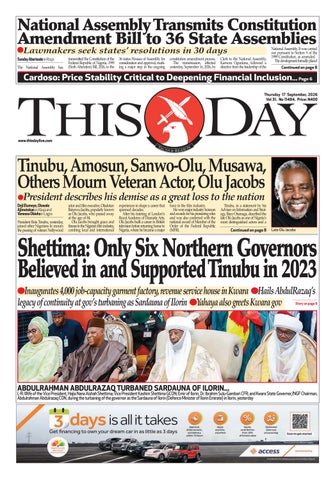
National Assembly Transmits Constitution Amendment Bill to 36 State Assemblies Lawmakers seek states’ resolutions in 30 days
Sunday Aborisade in Abuja The National Assembly has
transmitted the Constitution of the Federal Republic of Nigeria, 1999 (Sixth Alteration) Bill, 2026, to the
36 states Houses of Assembly for consideration and approval, marking a major step in the ongoing
constitution amendment process. The transmission, effected yesterday, September 16, 2026, by
Clerk to the National Assembly, Kamoru Ogunlana, followed a directive from the leadership of the
National Assembly. It was carried out pursuant to Section 9 of the 1999 Constitution, as amended. The development formally placed Continued on page 8
Cardoso: Price Stability Critical to Deepening Financial Inclusion... Page 6 Thursday 17 September, 2026 Vol 31. No 11484. Price: N400
www.thisdaylive.com TR
UT H
& RE A S O
N
Tinubu, Amosun, Sanwo-Olu, Musawa, Others Mourn Veteran Actor, Olu Jacobs President describes his demise as a great loss to the nation
Deji Elumoye, Olawale Ajimotokan in Abuja and Vanessa Obioha in Lagos President Bola Tinubu, yesterday, joined other Nigerians to mourn the passing of veteran Nollywood
actor and film executive, Oludotun Baiyewu Jacobs, popularly known as Olu Jacobs, who passed away at the age of 84. Olu Jacobs brought grace and finesse to the Nigerian film industry, combing local and international
experiences to shape a career that spanned decades. After his training at London’s Royal Academy of Dramatic Arts, Olu Jacobs built a career in British television before returning home to Nigeria, where he became a major
force in the film industry. He won major industry honours and awards for his pioneering roles and was also conferred with the national award of Member of the Order of the Federal Republic (MFR).
Tinubu, in a statement by his Adviser on Information and Strategy, Bayo Onanuga, described the late Olu Jacobs as one of Nigeria’s most distinguished actors and a Continued on page 8
Late Olu Jacobs
Shettima: Only Six Northern Governors Believed in and Supported Tinubu in 2023 Inaugurates 4,000 job-capacity garment factory, revenue service house in Kwara Hails AbdulRazaq’s legacy of continuity at gov’s turbaning as Sardauna of Ilorin Yahaya also greets Kwara gov
Story on page 8
ABDULRAHMAN ABDULRAZAQ TURBANED SARDAUNA OF ILORIN...
L-R: Wife of the Vice President, Hajia Nana Aishah Shettima; Vice President Kashim Shettima GCON; Emir of Ilorin, Dr. Ibrahim Sulu-Gambari CFR; and Kwara State Governor/NGF Chairman, Abdulrahman Abdulrazaq CON, during the turbaning of the governor as the Sardauna of Ilorin (Defence Minister of Ilorin Emirate) in Ilorin, yesterday
2
THURSDAY, SEPTEMBER 17, t T H I S D AY
THURSDAY, SEPTEMBER 17, t T H I S D AY
3
4
THURSDAY, SEPTEMBER 17, t T H I S D AY
5
THISDAY • THURSDAY, SEPTEMBER 17, 2026
Group News Editor: Goddy Egene Email: Goddy.egene@thisdaylive.com, 0803 350 6821, 0807 401 0580
NEWS
GASTECH CONFERENCE IN BANGKOK THAILAND...
L-R: Board Chairman, NNPC Limited, Engr. Ahmadu Musa Kida; President, Solar Turbines Incorporated and Senior Vice President, Caterpillar Inc. Derrick York; Commission Chief Executive (CCE) of the Nigerian Upstream Petroleum Regulatory Commission (NUPRC), Mrs. Oritsemeyiwa Eyesan; and Group Chairman/CEO Lee Engineering Group And Allied Companies Limited, Chief Dr. Leemon A. Ikpea CON, FNSE, JP, at the ongoing Gastech conference in Bangkok, Thailand
Oye: Nigeria’s Macroeconomic Stability Not Trickling Down to Poor Says 30% interest rate cannot grow GDP Urges FG to prioritise food security, single-digit lending Tasks EFCC to cite law criminalising dollar-denominated legal fees Emmanuel Addeh in Abuja The Chairman of the Alliance for Economic Research and Ethics, Dele Oye, has said Nigeria’s improving macroeconomic indicators are yet to translate into better living conditions for millions of citizens, warning that rising poverty and food prices could undermine the gains recorded in the economy. Oye, a former president of the Nigerian Association of Chambers of Commerce, Industry, Mines and Agriculture (NACCIMA), said the decline in headline inflation and the recent improvement in economic growth did not adequately reflect the realities confronting households across the country. Speaking on AIT, Oye said while Nigeria was recording growth and rising oil production, the benefits were not being evenly distributed, particularly at the sub-national level. He noted that the national inflation rate of 15.39 per cent masked significant differences in prices across states, pointing to food inflation in Adamawa, which he said stood at 51 per cent in July. “What that means is not just a statistic. It is insecurity. Because for the woman in Adamawa who has to go to the market, the GDP figures do not mean anything, or
the national inflation figure does not mean anything. It is the price they have to pay. “What it means is they have to pay more for less. So we have to find a way to have inclusive growth,” he said. Oye said the government needed to focus on ensuring that macroeconomic stability translated into cheaper credit, higher employment and lower food prices, arguing that growth figures alone could not capture the economic experience of ordinary Nigerians. He criticised what he described as poor coordination between the federal and sub-national governments, saying some state governments were spending scarce resources on projects that did not directly improve livelihoods. “If you look at all the macroeconomic gains, the way the resources are being deployed, especially at the sub-national level, you have seen that people are building flyovers without water or through regular traffic. People are going into airline business,” he said. He also questioned the decision by some state governments to establish airlines, arguing that the sector was capital-intensive and difficult to operate profitably. According to him, states should instead deploy part of their resources to
provide affordable credit to businesses and industries, which he said would stimulate employment and deepen the impact of macroeconomic stability. “If you turn part of that money to create single-digit loans for your industries, you will see that it will increase stability, generate more employment and create more macroeconomic stability that will trickle down to the poor,” he said. Oye urged the federal government to adopt what he described as a “food-first” approach to economic policy, arguing that food prices were
a critical measure of the welfare of poor Nigerians. “The government needs to declare a food-first on price, because food inflation is the tax the poor pay on survival,” he said, while calling for greater protection for farmers and improved access to farms. He identified insecurity, poor roads and the high cost of transportation as other factors preventing economic growth from reaching households. Oye also called for a reduction in lending rates, arguing that businesses could not expand meaningfully when
Sunday Ehigiator in Lagos and Linus Aleke in Abuja in Abuja Nigerian Navy has commended the Federal High Court in Uyo, Akwa Ibom State, for the conviction and sentencing of nine persons for crude oil theft, describing the judgement as a significant development in the fight against economic sabotage. The nine convicts were on September 14 sentenced by the court to five years’ imprisonment on Count One and 10 years’ imprisonment
on Count Two, without the option of fine. Director of Naval Information, Navy Captain Abiodun Folorunsho, disclosed the development in a statement issued yesterday. Folorunsho said the convicts were arrested by the Nigerian Navy on February 7 during an intelligence-led operation under Operation DELTA SENTINEL. He said the suspects were arrested while allegedly stealing crude oil from an oil wellhead identified as
Says job losses impacted over 1,000 senior staff, 40,000 junior workers The Federation of Construction Industry (FOCI) has warned that the Nigerian construction industry is facing a serious crisis arising from inadequate and unpredictable funding, delayed payments and rising operating costs, urging urgent government intervention to prevent the sector from total collapse. FOCI raised the alarm in a communiqué issued yesterday after its 70th Annual General Meeting
(AGM) and read by its President and Chairman of Council, Chief Vincent Barrah. The association said the slow pace of construction activities by its members over the past year was “very worrisome”, attributing the situation largely to the gap between annual budgetary provisions and actual cash releases for infrastructure projects. According to FOCI, many projects are awarded without adequate multiyear funding, leading to delayed payments, accumulation of certified
raising bonds on the other, at any price,” he said. Oye also called for a more coordinated approach to poverty alleviation, arguing that the government could use existing identification and banking infrastructure to make interventions more transparent and targeted. He also advocated greater implementation of local government autonomy, arguing that funds meant for local governments should be transmitted and monitored in a manner that ensures they are used for their intended purposes.
Navy Commends Conviction of Nine Crude Oil Thieves by Uyo Federal High Court
FOCI: Construction Industry Faces Collapse over Funding, Payment Crises Emmanuel Addeh in Abuja
interest rates remained around 30 per cent. “You cannot grow the GDP with 30 per cent interest rate. There’s nothing you can do that will work. So we need to find a way to have a reasonable price loan,” he said. He further criticised the federal government’s borrowing programme, saying excessive government demand for funds could crowd private businesses out of the credit market. “We are currently being priced out of the market. If you go to the market today, there’s one government
debts, reduced construction activities and, in some cases, suspension or abandonment of projects. “Most of our members handling various projects are not working as we speak, and those working are operating at a very low capacity due to non-payment of certified jobs,” the association said. FOCI also raised concerns over the termination of existing contracts, particularly those handled by its members for the Ministry of Works, saying some contracts were terminated
by mutual consent because inadequate funding had delayed their execution. The association argued that contractors could not reasonably be expected to continue executing capital-intensive projects without corresponding funding from employers. “You do not expect a contractor to continue working without the provision of the necessary funds by the employer,” FOCI said, stressing that delays, suspension or abandonment of projects should not automatically be blamed on contractors.
ASABO-D in Ibeno Local Government Area of Akwa Ibom State. Folorunsho said the conviction underscored the importance of effective collaboration between security agencies, prosecutors, and the judiciary in ensuring that arrests for economic crimes ultimately lead to justice. Folorunsho stated, “The conviction of the nine crude oil thieves is therefore not merely a judicial outcome but a clear demonstration of what can be achieved when operational action is matched by effective prosecution and judicial determination.” The development comes as the navy sustains intensified operations against crude oil theft, illegal bunkering, and other forms of economic sabotage under Operation DELTA SENTINEL, its anti-crude oil theft operation. The service said since its inception in January 2026, the operation had leveraged intelligence-driven surveillance, precision interdictions, and sustained maritime dominance across the Niger Delta. According to the navy, the operation has resulted in the dismantling of more than 241 illegal refining sites, disruption of criminal networks, recovery of more than 6.44 million
litres of suspected stolen crude oil, and illegally refined petroleum products, and the arrest of over 230 suspects. Folorunsho stated, “These operational achievements underscore the Nigerian Navy’s unwavering resolve to deny economic saboteurs the freedom to exploit the nation’s hydrocarbon resources, while protecting critical national infrastructure and reinforcing energy security.” The navy attributed the renewed operational momentum to the strategic leadership of the Chief of the Naval Staff, Vice Admiral Idi Abbas, whose priorities include intelligence-led operations, interagency collaboration and enhanced maritime domain awareness. The service said its efforts were in support of the policy direction of President Bola Tinubu to increase Nigeria’s crude oil production to 2.5 million barrels per day by 2027, and contribute to economic development and sustainable growth in the oil and gas sector. Nigerian Navy stressed that arrests and interdictions would have greater strategic value when they culminate in timely convictions capable of reinforcing the rule of law and deterring criminal networks.
6
THURSDAY, SEPTEMBER 17, 2026 • THISDAY
NEWS
BEHOLD THE NEW SARDAUNA OF ILORIN...
L-R: Minister of Trade and Investment, Dr. Jumoke Oduwole; First Lady Kwara State, Amb Folake Abdulrazaq; Wife of the Vice-President, Hajiya Nana Shettima; Vice-President Kashim Shettima; Governor Abdulrahman Abdulrazaq; and Ogun State Governor, Prince Dapo Abiodun, at the turbaning of Governor AbdulRahman AbdulRazaq as the Sardauna of Ilorin (the Defence Minister of Ilorin Emirate), by the Emir of Ilorin, HRH Alhaji (Dr.) Ibrahim Kolapo Sulu-Gambari in Ilorin, Kwara State, yesterday
Cardoso: Price Stability Critical to Deepening Financial Inclusion Sanusi Lamido regrets delaying telecoms’ entry into financial sector Oloworaran seeks pension inclusion module in EFInA survey EFInA report reveals drop in financial exclusion to 21% amid limited access to formal credit, insurance, pension by vulnerable Nigerians James Emejo in Abuja Governor of the Central Bank of Nigeria (CBN), Mr. Olayemi Cardoso, yesterday, said price stability was a critical condition for deepening financial inclusion, stating that persistent inflation and exchange rate volatility can undermine gains in access to formal financial services. Cardoso said financial inclusion could not thrive in an environment of economic instability, stressing that rising inflation erodes household purchasing power, weakens savings, and increases the cost of credit, particularly for lowincome and underserved Nigerians. That was as Emir of Kano, and former CBN Governor, Muhammadu Sanusi II, said he was wrong to have delayed the entry of telecommunications companies into the country’s financial services sector. Sanusi said the decision slowed
the pace of financial inclusion. Sanusi, who served as CBN governor from June 3, 2009 to June 2, 2014, said his decision was largely driven by concerns over depositors’ funds following the banking sector crisis at the time. Cardoso and Sanusi spoke during the launch of Access to Financial Services in Nigeria (A2F) 2026 Survey Report in Abuja. Equally speaking at the event, Director-General, National Pension Commission (PenCom), Ms Omolara Oloworaran, called for the introduction of a dedicated pension inclusion module into EFInA’s A2F survey to establish what would persuade millions of Nigerians outside the formal pension system to start and sustain retirement savings. Oloworaran urged pension operators and other industry stakeholders to experiment with digital onboard-
ing, accredited pension agents, new distribution channels, transaction-based savings, incentives, and behavioural nudges as part of efforts to expand pension coverage across the country. The latest survey by EEFInA revealed that the country’s financial exclusion rate had fallen to 21 per cent, though the gains in access to formal financial services were increasingly bypassing the poorest citizens. According to the report, financial inclusion stands at 79 per cent, with about 94.2 million adults, formal inclusion 73 per cent, with about 87.2 million adults, formal credit 10 per, with about 12 million adults currently borrowing from regulated providers. The survey found that only nine per cent or 11 million adults had access to pension, while 5.2 per cent or 6.2 million adults had formal insurance protection. The report also showed that 64.4 per cent or about 77 million
adults used digital channels to receive income, make payments, and remit. Cardoso stated that exchange rate volatility also complicated business planning, discouraged investment, and increased the cost of essential inputs, making the restoration of price stability and confidence central to the financial inclusion agenda. He pointed out that CBN had, since 2024, refocused its operations on its core mandate of monetary and price stability through tighter liquidity management, improved monetary-fiscal coordination, and more consistent deployment of monetary policy instruments. He added that the bank was transitioning towards an inflationtargeting framework designed to place price stability at the centre of monetary policy, strengthen transparency and accountability, and improve policy predictability for households, businesses and investors.
FG Inaugurates 3MW Solar Hybrid Power Project at Yakubu Gowon Varsity Tegbe: Facility will reduce reliance on diesel, ease budgetary pressure Project to serve 40,000 students, over 3,500 staff Emmanuel Addeh in Abuja The federal government yesterday commissioned a 3MW solar hybrid power project at the Yakubu Gowon University, formerly University of Abuja, with the Minister of Power, Joseph Tegbe, promising to extend electricity coverage to other parts of the institution within six months. Tegbe, who spoke at the inauguration of the project implemented under the Rural Electrification Agency (REA) Energising Education Programme Phase 2, through the Nigeria Electrification Project (NEP), stressed that the government would work to expand the project’s coverage. He added that increasing the battery storage capacity would enable the system to serve additional areas of the university. The project combines a 3.3MW solar array with 3MW AC output capacity and 2 megawatt-hours of battery storage to support critical loads beyond solar hours.
Tegbe said the intervention was particularly important because universities require reliable electricity for teaching, research, healthcare, technology, administration, security and digital infrastructure. He emphasised that the project would also reduce reliance on diesel and ease pressure on institutional budgets while improving the learning environment. The minister disclosed that 388 streetlights had also been provided at the university to improve illumination and campus security, adding that additional dark spots would be addressed as battery capacity was increased. Tegbe said the Yakubu Gowon University project was one of 15 universities and three teaching institutions covered under the second phase of the Energising Education Programme. He said the federal government was committed not only to commissioning renewable energy projects but
also to ensuring their sustainability through proper maintenance and asset management. “Commissioning is the first phase. The second phase is sustainability. Now, sustainability means maintaining those infrastructures, replacing those infrastructures, and also oiling that infrastructure,” Tegbe said. He identified the recently launched Renewable Asset Management Company (RAMCO) as part of the government’s strategy for maintaining and optimising renewable energy assets. Tegbe also announced plans for a similar arrangement for national grid assets, stressing that investments in electricity infrastructure must be protected from vandalism and other forms of damage. He said the ministry had established a joint working committee involving the Economic and Financial Crimes Commission (EFCC), the Nigeria Police Force (NPF) and the Nigeria Security and Civil Defence Corps (NSCDC) to
monitor and protect critical national electricity assets. The minister also highlighted the programme’s technical training component, saying 20 students from each of the 15 participating universities were being trained in areas including soil testing, installation and commissioning of renewable energy infrastructure. He said the 300 students involved in the programme would be tracked to facilitate opportunities for them in electricity distribution companies, generation companies and the REA. Earlier, the Managing Director of the Rural Electrification Agency, Abba Aliyu, said the programme had delivered renewable energy infrastructure to 22 federal universities and three affiliated teaching hospitals, providing more than 100MW of clean energy. Aliyu said the programme was positively impacting more than 300,000 students and over 50,000 academic and administrative staff.
Represented by CBN’s Director, Consumer Protection and Financial Inclusion, Mrs. Aisha Isa Olatinwo, Cardoso said, “Restoring price stability and confidence is therefore not separate from financial inclusion. It is fundamental to it.” He said the 2023 A2F survey had recorded significant improvements in citizens’ participation in the formal financial system. Cardoso stated that total financial inclusion rose from 64 per cent in 2020 to 74 per cent, while formal inclusion increased from 56 per cent to 64 per cent. Similarly, financial exclusion declined to 26 per cent, while the use of non-bank formal financial services increased substantially. He attributed the progress to the expansion of digital payments and agent banking, improvements in identity infrastructure, risk-based customer due diligence, financial education, regulatory innovation, and collaboration among stakeholders. Cardoso, however, cautioned that the gains had not been evenly distributed, with rural communities still recording higher exclusion levels than urban areas. He also identified persistent regional disparities and a significant gender gap, stating that access to credit, insurance, pensions, and other products capable of building long-term financial resilience remains limited. He said the challenge was no longer simply to open bank accounts or increase the number of financial access points, but to ensure that financial services were affordable, reliable, safe, and capable of improving the financial well-being of users. The central bank governor said, “The policy challenge before us is therefore no longer simply to open accounts or expand access points. It is to ensure meaningful usage, affordability, reliability, safety, trust and measurable improvement in financial health.”
New Inclusion Framework Cardoso said CBN had commenced work on the fourth phase of the National Financial Inclusion Strategy, following the completion of the review of the NFIS 3.0 framework. He said the emerging strategy
would shift the focus from broad access targets to an integrated, datadriven, and accountable approach that prioritised consumer protection, digital financial safety, and effective delivery at the sub-national level. According to him, the bank also plans to undertake geospatial mapping of financial access points to establish a national repository showing where financial services are available, where gaps persist, and how payment channels perform. He said the initiative would combine location, institutional, operational and transaction data to support risk-based supervision, evidence-based policymaking, and targeted investments in underserved communities. Cardoso also highlighted efforts to strengthen gender-inclusive finance, particularly through the implementation of the Women’s Entrepreneurial Finance Code in collaboration with Bank of Industry and Development Bank of Nigeria. He said the initiative was designed to promote stronger institutional accountability, gender-disaggregated data, and concrete measures to expand financing for women-owned micro, small and medium enterprises. He added that Women’s Financial Inclusion Dashboard, alongside other initiatives targeting women’s access to finance through agent networks, would help make disparities more visible and improve the precision of interventions. Cardoso said CBN was also strengthening the infrastructure required to support wider participation in the financial system. He disclosed that BVN enrolment had risen to 67.8 million by the end of 2025, representing unique Nigerians with bank accounts, while the number of accounts across the banking subsector had exceeded 100 million. He added that the agent network supported under the Shared Agent Network Expansion Facility had surpassed two million agents. According to him, the Sabi Money Platform’s nationwide financial literacy programme is also being used to engage communities and equip Nigerians with the knowledge required to make informed financial decisions, avoid fraud, and use financial services responsibly.
7
THISDAY • THURSDAY, SEPTEMBER 17, 2026
NEWS
FCMB GROUP PARTICIPATING IN DANGOTE REFINERY IPO...
L-R: President, Dangote Industries Limited, Alhaji Aliko Dangote; Governor Babajide Sanwo-Olu of Lagos State; Group Managing Director, Nigerian Exchange (NGX) Group, Mr. Temi Popoola; Chairman of Coronation Group Limited, Mr. Aigboje Aig-Imoukhuede; and Group Chief Executive, FCMB Group Plc, Mr. Ladi Balogun, at the Opening Gong Ceremony and Facts Behind the Offer presentation of the Initial Public Offering of Dangote Petroleum Refinery and Petrochemicals at the NGX on September 14, 2026, in Lagos. FCMB Group is participating in the transaction through three operating companies - FCMB Capital Markets, CSL Stockbrokers and First City Monument Bank ...recently
FG Sets December Deadline for 95% NIN Coverage Michael Olugbode in Abuja The federal government has set December 2026 as the deadline to achieve 95 per cent coverage of Nigeria’s population under the National Identification Number (NIN) system, signalling an accelerated push to make digital identity the foundation of access to public services, financial transactions, and social interventions. The target was announced yesterday by Chief of Staff to the President, Femi Gbajabiamila, who represented President Bola Tinubu at the 2026 National Day of Identity celebration. Gbajabiamila said the national identity database had expanded from about 80 million NINs at the inception of the administration to nearly 140 million, describing the growth as a major step towards bringing more Nigerians and legal residents into the formal economic and public-service system. The government’s latest drive effectively places identity registration at the centre of its efforts to improve how citizens are identified, how public resources are distributed, and how people access government and financial services. Gbajabiamila said the significance of the expansion went beyond the number of records captured, stating that every NIN represents an individual who can increasingly participate in the formal economy and establish a verifiable relationship with government institutions. He stated, “Behind every NIN is a Nigerian with a recognised identity; a citizen or resident who can increasingly participate in the formal economy, access government services, establish financial relationships, and be better protected by the institutions of the Nigerian state.” The government is seeking to close the remaining identity gap through a ward-level enrolment programme designed to take registration to communities rather than requiring citizens to travel long distances to designated centres.
According to Gbajabiamila, free enrolment is now being taken to all 8,809 wards across the country, while more than 5,000 enrolment agents have been trained to make the process more accessible to persons with disabilities, older citizens, and other vulnerable groups. The initiative is significant in a country where the absence of reliable identity records has complicated the planning and delivery of public programmes, particularly where government needs to determine who is eligible for specific interventions and where beneficiaries are located. Gbajabiamila said the recently enacted National Identity Management Commission Act 2026 had strengthened the statutory framework governing identity management, including provisions on data protection, mandatory NIN usage in critical sectors, and tougher penalties for identity-related offences. He described trusted identity as an essential component of a modern economy, placing it alongside infrastructure, such as roads, electricity, telecommunications, and financial systems. Director-General and Chief Executive Officer of National Identity Management Commission (NIMC), Dr.Abisoye Coker-Odusote, confirmed that the commission had recorded substantial growth in enrolment, with the national register now containing the identities of more than 140 million Nigerians and legal residents. Coker-Odusote attributed much of the increase to the Ward-to-Ward Enrolment Project, which extended NIMC services to the country’s 8,809 wards. Beyond enrolment, Coker-Odusote said the commission was attempting to change the experience of citizens who already had NINs by reducing the time required to update their records. She said the NIMC Self-Service Modification Platform had processed close to two million record updates, cutting modification processes that previously took weeks to between 24 and 48 hours through a citizen’s
phone. The commission is also preparing to move the identity programme from predominantly digital records to physical credentials, with CokerOdusote announcing that Nigerians are expected to begin receiving physical National e-ID Cards before the end of the year. She said the biometric cards would combine identity verification with access to government benefits and financial payments, including functionality that would allow them to be used in locations with limited internet connectivity. “The physical card is not a promise for the distant future; it is actively in the deployment pipeline, and I am pleased to announce that Nigerians will begin holding physical e-ID cards in their hands before the year ends,”
she said. The developments are coming against the backdrop of broader efforts by the government to build a digital public infrastructure in which a verifiable identity can serve as the link between citizens and multiple public and private services. Coker-Odusote said the new law had also expanded NIMC’s regulatory responsibilities and its role in Nigeria’s Digital Public Infrastructure. She said the legislation designated NIMC as the National Root Certification Authority for the country’s Public Key Infrastructure and aligned its operations with the Nigeria Data Protection Act 2023. The implications of the identity expansion are already being felt beyond the traditional identity-management
sector, with the education ministry seeking to use NIN-linked information to address persistent weaknesses in education data. Minister of Education, Dr. Tunji Alausa, said accurate identity information was necessary to properly track pupils, students, and teachers and improve planning across the education system. Alausa said the sector served between 75 million and 80 million students across basic, post-basic, and secondary education, making reliable identity information critical to determining the scale and location of educational needs. He said the absence of accurate data had made it difficult to effectively identify out-of-school children, deploy teachers and ensure that government interventions reached
their intended beneficiaries. The minister said, “We cannot tackle the challenge of out-of-school children. We cannot identify and effectively target the intervention of every child without accurate data.” He added that linking identity information to education records could reduce multiple registrations and fraudulent claims while improving the ability of government to direct resources towards genuine beneficiaries. Minister of Interior, Olubunmi Tunji-Ojo, similarly linked the identity programme to national security, economic development, and social inclusion, saying reliable population information would improve government’s ability to determine where public infrastructure and interventions are required.
Kings College Crisis: FG, Education Ministry Workers Reach Agreement to End Protest Alausa accuses directors of instigating employees Says no going back on concessioning Kuni Tyessi in Abuja Workers of the Federal Ministry of Education have agreed to suspend their industrial action following a meeting with the Minister of Education, Dr. Tunji Alausa, and the Minister of State, Prof. Suwaiba Ahmad, over the proposed concession of King’s College, Lagos. The meeting, which ended late yesterday in Abuja, produced an agreement aimed at de-escalating tension and restoring normalcy in the ministry and at the college. Under the agreement, workers will immediately suspend the industrial action embarked upon to protest the planned takeover of King’s College. The ministers also assured that no staff will be victimised for participating in the protest. Both parties further agreed to a two-week pause on the
take-off of the implementation of the takeover of King’s College by the Old Boys Association to allow for dialogue. It was also agreed that policemen deployed to King’s College premises will be redeployed with immediate effect. In addition, a seven-man committee will be set up to negotiate and thoroughly examine the federal government’s agreement with the Old Students Association on the management of King’s College. The meeting came hours after Alausa accused some directors in the ministry of instigating workers and after workers blocked the ministry’s gate, forcing the earlier cancellation of a scheduled meeting. Alausa, who addressed journalists at a press conference in Abuja, said there was no going back on the concession, insisting
that the federal government remained committed to it despite opposition from workers and other stakeholders. He insisted that the government followed due process in arriving at the decision, which is aimed at improving the college’s infrastructure, resources and overall management. “Misinformation has been going around, perpetuated by union members and unscrupulous members of staff of the Federal Ministry of Education,” Alausa said. “But the unscrupulous staff of the Federal Ministry of Education, some people, via whatever name of the association that have turned the lives of our students and the lives of our children into criminal enterprise, we will not allow that to happen,” he added. The minister also accused the Parent-Teacher Association (PTA)
of King’s College of turning admission into a criminal enterprise. “The PTA of King’s College has turned admission into King’s College into criminal enterprise,” he alleged, claiming the association charges up to N20 million per admission. Meanwhile, Alausa announced the cancellation of a meeting earlier scheduled with workers of the ministry for Wednesday. He said the workers failed to meet two conditions set as prerequisite for the engagement. “We gave them two conditions yesterday (Tuesday). We said we would meet with you at 3 p.m. today (Wednesday), but members of staff of the Federal Ministry of Education must return to work, and the gate of the ministry must not be blocked. “They didn’t follow these two requirements, which we thought were simple,” the minister said.
8
THURSDAY, SEPTEMBER 17, 2026 • THISDAY
EIGHT
Labour Kicks as Petrol Price Hits Record N1,500 Per Litre Ajaero: Increase inflicting incalculable damage on Nigerians Says nothing wrong with subsidising needs of Nigerians Motorists, commuters groan over soaring prices Emmanuel Addeh, Onyebuchi Ezigbo in Abuja, Peter Uzoho in Lagos, Ahmad Sorondinki in Kano and Sylvester Idowu in Warri Petrol prices have surged to a record N1,500 per litre in parts of the country, unleashing fresh hardship on motorists and commuters, with the Nigeria Labour Congress (NLC) warning yesterday that the latest increase was inflicting ‘incalculable damage’ on Nigerians. The price shock, which spread across Abuja, Lagos, Kano, Delta and other parts of the country, followed the latest increase in the gantry price of the product by Dangote Petroleum Refinery, coming amid a sharp rise in international crude prices and mounting concerns over supply disruptions linked to the conflict in the Middle East. With transport operators already raising fares and some motorists abandoning their vehicles, the latest development has renewed fears of another wave of increases in the prices of food, goods and essential services as the higher cost of petrol
works its way through the economy. The latest price surge, which has been reported across major cities and other parts of the country, followed a fresh increase in the gantry price of petrol by the Dangote Petroleum Refinery, which in its latest move, raised its ex-depot price by N85, or 6.7 per cent. The refinery’s latest adjustment came amid renewed volatility in international crude oil prices, with Brent crude trading above $107 per barrel as tensions in the Middle East intensified and disruptions around the Strait of Hormuz heightened concerns over global oil supplies. Rising crude prices have pushed up the cost of importing and refining petrol, while marketers have passed the additional cost through the supply chain to consumers. The latest increase is the fourth upward adjustment by Dangote Refinery since August 21, taking its gantry price up by N185, or 15.9 per cent, in less than a month. The refinery had increased the price from N1,165 to N1,185 on August 21, to N1,200 on August 26, N1,265 on
August 29 and subsequently to N1,350 on September 12. The refinery also raised its coastal price to N1,783,530 per metric tonne from N1,669,543, while directing customers to return all Automated Truck Certificates (ATC) for repricing.
Organised Labour Expresses Outrage The NLC, in a statement signed by its President, Joe Ajaero, expressed outrage over the latest development, saying the increase was coming at a time when pressure on marketers to reduce pump prices in line with international crude prices was beginning to yield results. Ajaero said the new price increases had inflicted “incalculable damage” not only on workers’ wages but also on the general wellbeing of Nigerians and the economy. “It is an established fact that when transportation costs go up, everything else follows, including school fees, rents, tariffs, foodstuffs, etc. These new costs continue to inflict or deepen poverty among the
populace, stressing the quality of life to the limits,” the statement said. The Congress acknowledged that the latest surge had been triggered by the resurgence of conflict in the Gulf and the resulting pressure on crude prices, but argued that Nigeria’s status as an oil-producing country should provide some protection for its citizens against external shocks. It said the country had sufficient local refining capacity, although a substantial part of the capacity was in private hands, and argued that Nigerians should therefore enjoy a measure of protection against developments in the international oil market. “As a nation, and as a people endowed with enormous fossil resources, we are deserving of a certain level of protection or buffer against the gales from the Gulf, and indeed, other gales,” Ajaero said. He also criticised the continued exposure of local refineries to imported crude, saying the situation undermined the objective of building domestic refining capacity. The NLC therefore called on the
federal government to immediately provide reasonable wage awards to workers, sell sufficient crude to local refineries in naira and expand national storage capacity as part of measures to create a buffer against energy supply disruptions. According to the labour centre, the measures would help create jobs, generate economic value and address emerging security challenges. Ajaero also argued that there was nothing wrong with the government subsidising the needs of citizens, particularly during emergency situations. “At the moment, there is no oil-producing country we know of that has not intervened or come up with sustainable palliatives in one way or the other in these perilous times,” he said. He said the need for government intervention had become more urgent because the country was currently benefiting from higher international crude prices. According to him, the government was making additional revenue from crude sold in the international spot market, earning between $35 and $40 per barrel above the budgeted
NLC President, Joe Ajaero benchmark, which he said translated to trillions of naira monthly. “The government ought to be satisfied with this as it is a windfall,” the NLC president maintained. The labour centre warned that the consequences of the petrol price increases would extend well beyond the cost of transportation, with higher logistics expenses expected to feed into food prices, rents, school fees and other essential services. Ajaero also warned that the Continued on page 36
SHETTIMA: ONLY SIX NORTHERN GOVERNORS BELIEVED IN AND SUPPORTED TINUBU IN 2023 Deji Elumoye in Abuja, Hammed Shittu in Ilorin and Segun Awofadeji in Gombe Vice President Kashim Shettima, yesterday, said only six of the 19 northern governors actually supported the presidential ambition of Asiwaju Bola Ahmed Tinubu in 2023. Shettima made the disclosure at the palace of Emir of Ilorin, Alhaji Ibrahim Sulu-Gambari, during the turbaning of the Kwara State
governor, Alhaji AbdulRahman AbdulRazaq, as Sardauna of Ilorin Emirate. According to him, the tension that heralded the 2023 presidential campaign and the election proper was so daring that it could only take a determined politician with a strong heart to continue to pursue his ambition. He said many clogs were cast on Tinubu’s path to frustrate his focus. Shettima stated, “You all know that we have 19 states in the north,
out of these, only six actually believed and supported Tinubu, but Tinubu refused to be deterred. He was able to cross the road. “Then, the slogan was: ‘baba bayan sushi’, (Buhari said he didn’t like him), even with all this, Tinubu went ahead with his ambition. “Just like former President Muhammadu Buhari, Buhari would call your bluff and send you away once you try to arm-twist him in any political negotiation.” He urged Nigerian politicians not
to see politics as a game-of-death but to always reconcile after contest, saying, “After the 2023 election, President Tinubu hugged and forgave all other northern governors that did not support him. That is a mark of a good leader.” Shettima urged Kwara politicians to close ranks after the All Progressives Congress (APC) primaries. He told them to emulate Tinubu’s large heart in any political purpose. He also hinted that the federal government inherited $3.9 billion
TINUBU, AMOSUN, SANWO-OLU, MUSAWA, OTHERS MOURN VETERAN ACTOR, OLU JACOBS towering figure whose remarkable career spanned theatre, television, and film globally. Tinubu acknowledged his contributions to the development and professionalisation of Nigeria’s entertainment industry, stating that the late Jacobs inspired generations of actors and filmmakers through his exceptional talent, discipline, and dedication to his craft. The president also praised the late actor’s remarkable ability to bring depth, dignity, and authenticity to the characters he portrayed, earning him admiration in Nigeria and beyond. Tinubu said, “He was a giant of the Nigerian creative industry. His passing is a great loss to Nigeria, the African film industry and the global community of lovers of the performing arts. His remarkable body of work will continue to speak to generations yet unborn. “The nation recognises the enormous contributions of Nigeria’s creative practitioners to the country’s cultural identity, global image and economic development. Olu Jacobs played a big role in creating this identity.” The president, while praying for the repose of the soul of the deceased, extended his heartfelt condolences to the Jacobs family, particularly his wife, veteran actress Chief Joke Silva, their children, relatives, colleagues in the Nigerian film industry, and the entire creative
community over the loss of the celebrated thespian.
Amosun: It’s a Great Loss to Africa Former Ogun State governor, Senator Ibikunle Amosun, expressed his condolences to the family, friends, colleagues, and admirers of Olu Jacobs. Amosun described the passing of the late thespian as a great loss to the Nigeria and African entertainment industry. He stated, “Olu Jacobs will be remembered for his significant contributions to the growth and development of Nigeria’s film and entertainment industry, which earned him numerous honours and recognitions. “This includes the Africa Movie Academy Award for Best Actor in a Leading Role in 2007, the Industry Merit Award at the Africa Magic Viewers’ Choice Awards in 2013, and the MAA Lifetime Achievement Award in 2016. “He also received the prestigious national honour of Member of the Order of the Federal Republic (MFR) in recognition of his contributions to the country’s film industry and entertainment arts. “The late veteran actor wrote his name in the sand of time through his exceptional talent, versatility, distinctive voice, mastery of his craft and enduring influence on
actors, practitioners, and audiences of Nigerian theatre and cinema. “He will be greatly missed for bringing honour and distinction to Ogun State and his ancestral home – Egbaland.” Amosun urged the family, particularly his widow, Mrs. Joke Silva, their children, members of the Nigerian theatre and film industry,
and all admirers of Olu Jacobs to find solace in his remarkable accomplishments and the enduring legacy he left behind.
Sanwo-Olu: Creative Industry Lost Big Lagos State Governor, Mr. Continued on page 34
in the treasury, but refused to be discouraged, saying, “The economic team forged ahead to turn the economy around, today, Nigeria is better for it.” Earlier, Shettima inaugurated the 11-storey Kwara Revenue Service (KWRS) House on Ahmadu Bello way and the garment factory, both in Ilorin, the state capital. The garment factory is a signature project of the administration of AbdulRazaq designed to employ at least 4,000 people at full capacity. The inauguration of the projects formed part of activities marking the turbaning of AbdulRazaq as Sardauna of Ilorin (the Defence Minister of Ilorin Emirate), by Sulu-Gambari, making the governor the first person to hold the title. Speaking at the turbaning ceremony, Shettima applauded the legacy of continuity sustained by AbdulRazaq. He recalled that the governor’s late father, Alhaji AbdulGaniyu Folorunsho AbdulRazaq (SAN),
carried an Ilorin name into history as the first lawyer in Northern Nigeria and the first Mutawalle of Ilorin—a title he said remained in the family in celebration of their bond with the emirate. The vice president stated, “His father, Alhaji AbdulGaniyu Folorunsho AbdulRazaq, SAN, carried an Ilorin name into history as Northern Nigeria’s first lawyer. Every path begins with someone willing to walk without familiar footprints. Through law and diplomacy, his story became part of Nigeria’s own. “The branch may reach towards another horizon, yet it carries within itself the memory of the root. His father was the first Mutawalle of Ilorin, a title that remains in the family in celebration of their bond with the emirate. “Today, another chapter enters the family’s relationship with this palace.” Continued on page 35
NATIONAL ASSEMBLY TRANSMITS CONSTITUTION AMENDMENT BILL TO 36 STATE ASSEMBLIES the proposed constitutional altera- on constitutional alteration bills, constitutional alteration process, was not intended to dictate the tions before the state legislatures, the National Assembly expected the State Houses of Assembly outcome of the consideration whose resolutions were constitution- the process to be concluded in an are expected to consider the Bill by the state legislatures, but to ally required before the National orderly and timely manner. and communicate their respective facilitate the orderly discharge of Assembly could proceed with the He said the state legislatures resolutions to the National Assembly their constitutional responsibilities. amendment process. were expected to consider the bill within 30 days of receipt. “The National Assembly Under Section 9 of the consti- and transmit their resolutions to “For clarity, the 30-day period recognises the constitutional tution, a bill seeking to alter the the National Assembly within 30 is an expected administrative responsibility vested in the State provisions of the constitution could days of receipt. timeframe and does not constitute Houses of Assembly and respects not be passed by either chamber The clerk made it clear that a constitutional deadline.” their independence in the considof the National Assembly unless the 30-day period should not be The transmission consequently eration of the Bill,” he said. approved by resolutions of not less misconstrued as a constitutional shifted the next phase of the The National Assembly further than two-thirds of the Houses of deadline, but should rather be seen constitutional alteration exercise pledged to conduct the entire constiAssembly of the 36 states. as an administrative timeframe to the state legislatures, which tutional alteration exercise within the In the transmission letters to intended to facilitate coordination now have the responsibility of framework of the constitution and the state legislatures, the clerk and the timely completion of the independently considering the established legislative procedures. requested them to subject the bill to process. proposed amendments and Ogunlana stated, “The National the requisite legislative consideration “It is noted that the Constitu- deciding whether to approve or Assembly remains committed to in accordance with their respective tion does not prescribe a specific reject them in accordance with ensuring that the constitutional procedures and communicate their period within which the State their constitutional and legislative alteration process is conducted resolutions to the National Assembly Houses of Assembly are required procedures. in strict compliance with the to communicate their resolutions after concluding deliberations. The National Assembly also Constitution and in accordance Ogunlana, in a statement, stressed on a constitutional alteration Bill,” assured the state Houses of As- with the principles of due process, sembly that their constitutional institutional cooperation and respect that although the constitution did Ogunlana stated. He added, “Nevertheless, in the independence would be respected for the legislative responsibilities of not prescribe a specific period within which state Houses of Assembly interest of an orderly, coordinated throughout the process. Continued on page 35 The clerk said the transmission must communicate their resolutions and timely conclusion of the
THURSDAY, SEPTEMBER 17, t T H I S D AY
9
10
THURSDAY, SEPTEMBER 17, 2026 • THISDAY
NEWS
IMPROVED CAPITAL MARKET ON THEIR MINDS...
L-R: Head, Administration and Human Resource Officer, Chartered Institute of Stockbrokers (CIS), John Esezobor; Registrar and Chief Executive of the Chartered Institute of Stockbrokers (CIS), Mr. Ayo Adeonipekun; Managing/CEO, Meristem Stockbroker Limited, Mr. Saheed Bashir; 14th President of CIS, Dr. Fiona Nyako Ahimie; Managing/CEO, AVA Capital Plc, Mr. Kayode Fadahunsi; Managing Director, AVA Securities Limited, Adejoke Ganiyu; Executive Director/MD, AVA Trustees Limited, Bolanle Ekanim; and Managing Director, AVA Global Asset Managers Limited, Adekunle Odebiyi, during a courtesy visit by the CIS officials to AVA Capital Plc in Lagos…recently
NLNG: How Methane Reduction Can Pay for Itself, Boost Gas Revenue Boil-off gas, start-up recovery projects target 10–15% emissions cut Company urges stronger, shared standards for emissions measurement Falade: NLNG’s role in gas monetisation cut flaring from 65% to sub-20% Emmanuel Addeh in Abuja The Nigeria LNG Limited (NLNG) has urged gas producers globally to treat methane reduction as a business priority, arguing that curbing methane losses can simultaneously increase gas revenues, improve plant efficiency and reduce emissions. The company’s Managing Director and Chief Executive Officer, Adeleye Falade, made the call at the Gastech 2026 Exhibition and Conference in
Bangkok, Thailand, where he said methane abatement should be viewed not merely as an environmental obligation but as an opportunity to recover lost gas and generate commercial returns. Speaking during a panel titled: “Capturing the Lost Opportunity: Driving Global Alignment on Methane Abatement Across Natural Gas Supply Chains,” Falade said NLNG’s approach was built around measuring methane losses, identifying where interven-
tions were required and investing in technologies that could prevent gas from being lost. “Every tonne emitted is lost product, lost revenue and lost energy; gas we could have sold. Every molecule of methane avoided is both an emissions reduction and a recovered energy resource,” a statement from the company quoted him as saying. He cited NLNG’s new boil-off gas compressor and start-up gas recovery project as examples of investments
designed to deliver both environmental and commercial benefits, noting that each was expected to reduce methane emissions by about 10 to 15 per cent. According to him, both projects have positive projected net present values, indicating that their anticipated financial returns exceed their costs over their operating lives. “The most compelling business case is the simplest one: the projects that cut our methane also pay for themselves. The same discipline that
WEF Report: Nigeria Lags in Gender Political Empowerment, Ranks 143 out of 145 Countries Says global gender parity is estimated to be attained in 120 years Dike Onwuamaeze Nigeria lags in the gender political empowerment sub-index of the “Global Gender Gap Report 2026” as it is ranked 143 with 0.037 score out of 145 countries that were covered by the World Economic Forum’s (WEF) report. The report released yesterday showed that Nigeria ranked above Papau New Guinea and Vanuata ranked 144 and 145 with 0.015 and 0.000 scores respectively in political empowerment. While Iceland, Finland and Norway took the first, second and third positions in the global the ranking with 0.954, 0.728 and 0.704 scores respectively. WEF said for the past two decades the Global Gender Gap Index has benchmarked progress towards gender parity across four dimensions: economic participation and opportunity, educational attainment, health and survival, and political empowerment. It stated the index has continued to offer a consistent measure of the present state of gender parity, as well as the long-term evolution of global efforts to close the gender gap. It said: “Over the past 20 editions, the Global Gender Gap Index score has increased +5.2 percentage points
across the 97 economies featured in all editions, from 64.2 per cent in the 2006 edition 69.4 per cent in the 2026 edition – its highest score to date. “If these economies were to continue to advance at this estimated rate of progress, global gender parity is estimated to be attained in 120 years.” Commenting specifically on Nigeria’s performance across the key sub-indexes, WEF said that “in political empowerment, Nigeria has the most terrain to cover, with 96.3 per cent of the gap left to be closed. “In this sub-index, Nigeria is third from the bottom on the overall index. “Parity at ministerial and parliamentary levels does not only sit below the 10 per cent threshold but has declined more than 1.0 percentage point over time on both indicators,” the report said, adding that Nigeria has continued “to record 0.0 per cent parity at the head-of-state level.” However, the WEF’s report stated that Nigeria has closed over twothirds of its gender gap in 2026, with a gender parity score of 67.6 per cent and overall global ranking of 144. It said: “Compared to 2025, Nigeria improved its score by +2.7 percentage points, from 64.9 per cent, and its overall ranking by +10 places. “Over the past two decades, the Sub-Saharan economy (Nigeria) has
advanced a total of 6.6 percentage points from its 2006 score of 61 per cent. “After several years of limited movement, the economy records in the current edition one of its strongest annual improvements.” It said that among the 30 best performers in Economic Participation and Opportunity sub-index, Nigeria has raised its economic parity score to 76.6 per cent, which is the 7th highest in its Sub Saharan African (SSA) region. “The score has increased by +0.4 percentage points since the previous edition of the index and represents a 20-year improvement of +15.4 percentage points, up from 61.2 per cent in 2006. “Over time, the economy’s performance has been boosted by gains in workforce parity: parity in labour-force participation rate improved from 53.5 per cent in 2006 to 97.4 per cent in 2026. “Nigeria has also reported strong advances in estimated earned income parity, lifting its score from 41.1 per cent in 2006 to 77.1 per cent in this edition,” WEF said. The report also stated that educational attainment remained Nigeria’s second lowest ranked sub-index, “reflecting persistent gender gaps in educational access
accumulated over time.” It said that this is evident in the adult literacy gender gap, which has closed by 79.6 per cent.
reduces methane also improves asset reliability and plant efficiency. The returns show up in more places than the emissions ledger,” he said. Falade said credible measurement was central to NLNG’s methanereduction strategy because it enabled the company to identify losses, direct investment to appropriate interventions and assess whether those measures were delivering the desired results. He said NLNG’s experience also demonstrated that producers in developing economies could establish internationally trusted emissions-reporting systems by investing in monitoring infrastructure, strengthening reporting capabilities and subjecting their data to independent scrutiny. He highlighted NLNG’s Gold Standard recognition under the Oil and Gas Methane Partnership (OGMP) 2.0, noting that the company was the first in Africa to achieve Level 5 methane emissions reporting. He added that NLNG’s measurement, reporting and verification system
was independently assured by DNV in accordance with ISO 14064. The company, he said, had deployed site-wide optical gas imaging and a structured Leak Detection and Repair programme, while it was also progressively introducing continuous monitoring and real-time dashboards across its plant and vessels. “Credible measurement is a function of commitment and not a function of geography and NLNG has proved it can be done in Africa,” Falade said. He said the company had not waited for perfect infrastructure before beginning its methane-reduction efforts, instead prioritising credible measurement, investing in appropriate technologies and strengthening reporting through independent verification. Falade said methane reduction was also being incorporated into the design of NLNG’s Train 7 project, which is expected to increase the company’s LNG production capacity from 22 million tonnes per annum to 30 million tonnes per annum.
Medical Lab Scientists Seek End to Import Dependency on Diagnostics Products Tomori: local vaccine production being sabotaged Onyebuchi Ezigbo in Abuja The Conference of the Guild of Medical Laboratory Directors of Nigeria has said that the country should sustain efforts at attaining proficiency in production of local diagnostic products. The position of the medical laboratory scientists came just as a renowned virologist and Chairman of Biovaccines Nigeria Ltd. (BVNL), Prof. Oyewale Tomori blamed selfish interests for the delay in reviving local vaccine production Speaking at the in Abuja at the 28th Annual Scientific Conference and Annual General Meeting (AGM) of the Guild of Medical Laboratory Directors (GMLD) the National President of the Guild, Dr. Sam Fele said the country has
relied heavily on imported reagents, consumables, equipment exporting employment opportunities among other disadvantages. He said the market value of imported diagnostic materials is protected to reach $1.70 billion by 2032 Speaking on the conference theme - “From Diagnostic Sovereignty to Market Readiness”, Fele said the country must move beyond dependence to establish a thriving and competitive diagnostic industry capable of holding fort globally. Fele also said that laboratory must be at the centre of any transformation if the country is to achieve diagnostic sovereignty. “ Diagnostic sovereignty requires more than domestic production. It demands an integrated, end-to-end
ecosystem that connects research, innovation, manufacturing, regulation quality assurance, distribution, laboratories healthcare providers, patients and data. “Nigeria must ensure that a viable market exists for locally manufactured medical diagnostics if efforts to achieve diagnostic sovereignty and sustainable healthcare production to succeed,” has said. While declaring the conference open, Minister of State for Health and Social Welfare Dr, Iziaq Salako, who was represented by Dr. Emeka Elom, Director and Head, Medical Laboratory Services Division, Federal Ministry of Health and Social Welfare, said accurate and timely diagnosis remained critical to healthcare delivery, disease surveillance and public health decision-making.
11
THISDAY • THURSDAY, SEPTEMBER 17, 2026
NEWS
STANBIC IBTC AT NGX OPENING CEREMONY FOR DANGOTE PETROLEUM REFINERY IPO...
L-R: Chief Executive, Stanbic IBTC Capital Limited, Oladele Sotubo; Managing Director, Capital Market, Chapel Hill Denham, Lanre Buluro; Chief Executive Officer, Vetiva Capital Limited, Chuka Eseka; Group Chief Financial Officer, Dangote Industries, Murat Erden; Chief Executive Officer, Nigerian Exchange Limited, Jude Chiemeka; and Managing Director, Firstcap Limited, Ukandu E. Ukandu, during the facts behind the offer presentation at the NGX Opening Gong Ceremony for the Dangote Petroleum Refinery and Petrochemicals Initial Public Offering (IPO) held in Lagos
CAC Advocates Harmonisation of Beneficial Ownership Register to Curb Illicit Financial Activities, Others Says CAC should serve as central corporate data backbone James Emejo in Abuja Registrar-General/Chief Executive, Corporate Affairs Commission (CAC), Hussaini Ishaq Magaji, has advocated the harmonisation and centralisation of the country’s beneficial ownership information to curb illicit financial flows and other related crimes. Magaji said fragmented databases across government institutions could undermine efforts to identify the individuals ultimately controlling companies and benefiting from corporate structures. He spoke at the opening of a training workshop on Beneficial Ownership Register, organised for journalists and Civil Society Organisations (CSOs) in Abuja. He said the country needed to move beyond maintaining separate “islands” of beneficial ownership information towards an interconnected national transparency architecture. The CAC boss stressed that the objective should be to enable regulators, law enforcement agencies, journalists, and other authorised users to connect ownership information across different sectors and establish the natural persons ultimately behind corporate entities. Essentially, the commission currently operates the register, while beneficial ownership information relating to entities in Free Trade Zones (FTZs) is
maintained within the Nigeria Export Processing Zones Authority (NEPZA) framework, with similar information on extractive industries maintained under the Nigeria Extractive Industries Transparency Initiative (NEITI). While acknowledging the statutory basis for the separate arrangements, Magaji said the information being sought by the different registers was substantially the same. According to him, the fundamental questions remained: who owns an entity, who controls it, who benefits from it, and who remains the natural person behind the corporate structure. Magaji said, “Do we continue to operate separate islands of beneficial ownership information, or do we move towards a harmonised and centralised national architecture?” He stressed that the CAC corporate registry should serve as the central corporate data backbone. Magaji stated that the proposal was not intended to strip NEPZA, NEITI or other institutions of their statutory responsibilities, but to ensure that relevant information could be connected and accessed through common standards. The registrar-general added, “Transparency works best when information can be connected.” He explained that companies could operate across different sectors and regulatory environments, making it
necessary for ownership information to remain visible, irrespective of where an entity conducted business. He stated that an integrated system would help eliminate duplication, improve the quality of corporate information, and provide a clearer picture of ownership structures for legitimate investigative and regulatory purposes.
Unmasking Real Company Owners The CAC boss also sought to deepen public understanding of beneficial ownership, stating that Nigeria’s corporate legal framework
The Niger Delta Development Commission (NDDC) has tasked contractors and consultants handling its projects with not allowing disputes to fester, saying early identification and resolution of conflicts are critical to preventing delays, rising costs, and project abandonment across the Niger Delta region. The Commission said disagreements over payments, project variations, designs, timelines, quality of work, measurements, access to sites and relations with host communities must be addressed before they escalate into crises capable
of stalling development projects. The Executive Director, Corporate Services, NDDC, Hon. Ifedayo Abegunde, gave the charge in Port Harcourt, Rivers State, during a three-day sensitisation programme on Conflict Sensitivity and Alternative Dispute Resolution (ADR) for NDDC contractors and consultants. The programme was tagged: ‘Enhancing Capacity for Alternative Dispute Resolution: Application in Project Execution for Sustainable Development in Niger Delta’. Abegunde, who represented the NDDC Managing Director, Dr. Samuel Ogbuku, noted that disagreements could arise during
He described the PSC framework as an effort to “lift the veil” of corporate complexity and identify the human being ultimately behind a corporate structure. He stressed that beneficial ownership disclosure should not be treated merely as another regulatory requirement but as an instrument for corporate accountability, transparency and the fight against illicit financial activities. The framework, he said, was particularly important in tackling corruption, illicit financial flows, money laundering, terrorism financing, and the abuse of corporate structures.
Tool for Investigative Journalism Magaji also urged journalists to begin viewing the beneficial ownership register as an investigative resource capable of helping them uncover relationships that might not be immediately apparent from conventional company records. The registrar-general challenged journalists investigating companies, transactions, procurement arrangements or business relationships to establish who ultimately owned, controlled, or benefited from the entities involved.
First Lady Inaugurates TETFUND/RHI ICT Experience Centre At KWASU, Ilorin As Atoyebi charges govs, LG chairmen to build on First Lady’s grassroots interventions Deji Elumoye in Abuja and Bennett Oghifo in Lagos Wife of the President, Senator Oluremi Tinubu, on Tuesday inaugurated the TETFund/ Renewed Hope Initiative (RHI) ICT Experience Centre at Kwara
NDDC Moves to Halt Project Delays with Early Conflict Resolution Sunday Okobi
uses the term Person with Significant Control (PSC) to capture the concept. Under Nigeria’s Persons with Significant Control Rules, 2022, disclosure is designed to identify individuals who ultimately exercise significant ownership, control or influence over companies and other relevant entities. Magaji explained that although directors and shareholders might appear in a company’s immediate corporate records, the person exercising ultimate control or benefiting from the structure could be different from the individuals whose names appear on the documents.
project implementation over payment, variations, designs, timelines, quality of work, measurements, access to project sites, contractual obligations and relationships with host communities. He urged contractors and consultants to ensure that such issues were identified and professionally managed before they became major disputes capable of stalling projects. According to him, “Every NDDC project goes beyond the contractual relationship between the Commission and its contractors, as communities depend on roads, bridges, schools, health facilities and other interventions for improved livelihoods.”
State University, Malete, as part of continued efforts to equip Nigerian youths with digital skills and expand access to technology-driven learning across tertiary institutions. Kwara State University is one of six tertiary institutions selected for the pilot phase of the ICT Experience Centre intervention, with one institution representing each of Nigeria’s six geopolitical zones. In a related development, Convener of the Bola Ahmed Tinubu Ideological Group, Comrade Bamidele Atoyebi, has urged state governors and local government chairmen to embrace complementary programmes that would extend the impact of the Renewed Hope Initiative (RHI) to more communities. Atoyebi made the call in a statement titled “Progressive Governors, LG Chairmen Should Complement First Lady’s Drive,” where he argued that state and local governments must take greater responsibility for translating federal interventions into tangible benefits for residents in wards and communities. He said the RHI, launched in 2023 by the First Lady, Senator Oluremi Tinubu, had implemented programmes in agriculture, eco-
nomic empowerment, social investment, health and education, including grants, agricultural inputs, healthcare interventions and support for women, persons with disabilities and elderly Nigerians. Meanwhile, of six tertiary institutions selected for the pilot phase of the ICT Experience Centre intervention, similar centres have been commissioned at Ekiti State University on May 30, the University of Cross River State on September 4, and Anambra State Polytechnic on September 10, 2026, while the centres at Kaduna State and Taraba State Universities are also ready and scheduled for inauguration soon. The inauguration, held on Tuesday, September 15, 2026, revealed the planned expansion of the intervention to 15 additional tertiary institutions across the country, with construction currently ongoing in the benefiting institutions. Represented by the wife of the Vice President, Hajiya Nana Shettima, Mrs Tinubu said the ICT Experience Centre represents “opportunity, innovation, knowledge, and hope” for young people in Kwara State and beyond. She said the initiative aligns with
the Renewed Hope Agenda of President Bola Tinubu, particularly its focus on youth empowerment, education, innovation, and economic transformation. According to her, the centre provides a modern environment equipped with ICT laboratories, interactive digital displays, conference facilities, and exhibition spaces to support learning, creativity, research, and technological advancement. The First Lady further disclosed that the next phase of the intervention would cover 15 institutions in Adamawa, Bayelsa, Borno, Delta, Edo, Enugu, Imo, Katsina, Nasarawa, Niger, Ondo, Osun, Rivers, Yobe and Zamfara States. She said the expansion demonstrates the administration’s commitment to ensuring that more Nigerian youths, irrespective of their location, have access to digital learning and innovation opportunities. While addressing the students, Mrs. Tinubu encouraged them to take ownership of the facility and maximize the opportunities it provides. She urged the students to use technology positively to transform their lives, communities, and the nation.
T H I S D AY ˾ THURSDAY SEPTEMBER 17, 2026
12
Acting Group Politics Editor DEJI ELUMOYE
POLITICS
Email: deji.elumoye@thisdaylive.com 08033025611 SMS ONLY
NGE’s Warning Signs: Press Freedom, Politics and Security Ahead of 2027 Iyobosa Uwugiaren argues that the communiqué issued by the Nigerian Guild of Editors after its meeting in Kano recently, is both a defence of the democratic ecosystem and a reminder that the media itself must carry the responsibilities that accompany freedom.
Idris
T
he Nigerian Guild of Editors (NGE), at its Standing Committee meeting in Kano on September 11, 2026, issued a communiqué that deserves more than the routine attention usually given to professional associations’ statements. Coming a few months before the 2027 general elections, the Guild’s intervention touches on some of the central questions confronting the nation’s democracy: press freedom, the conduct of security agencies,
Disu
especially the Nigeria Police Force, the political space available to parties and candidates, electoral fairness, economic reforms, infrastructure and national security. Taken together, the communiqué reads as both a defence of the democratic ecosystem and a reminder that the media itself must carry the responsibilities that accompany freedom. Its most remarkable feature is the Guild’s concern about what it describes
as the increasing violation of press freedom through the harassment, intimidation and prosecution of journalists by security agencies. The reference to cybercrime laws and other legislation with the potential to undermine legitimate journalism should be taken seriously. Because a democracy cannot thrive where journalists operate under the constant fear that critical reporting may attract arrest, intimidation or prosecution. Equally, press freedom cannot mean immunity from the law. Journalists, like every
other citizen, are subject to laws governing defamation, fraud, privacy, incitement and other unlawful conduct. The critical issue is whether such laws are applied consistently and transparently, or whether they become instruments for silencing uncomfortable reporting. That distinction is fundamental. NOTE: Interested readers should continue in the online edition on www.thisdaylive.com
Wike’s Rainbow Coalition: Broadening Tinubu’s Base or Challenging the APC? Two strategies, one presidency: Minister of the Federal Capital Territory, Nyesom Wike is widening the political net, while the governors are tightening the ruling All Progressives Congress structure. The question is whether both approaches can coexist without pulling the coalition apart. Jonathan Eze writes.
Tinubu
T
he political temperature surrounding President Bola Tinubu’s 2027 reelection bid appears to be rising, not because of an open confrontation between the President and his allies, but because of an increasingly consequential disagreement over who should control the machinery of political mobilisation around him. At the centre of the emerging contest are FCT Minister, Nyesom Wike and the Progressive Governors’ Forum, led by Imo State Governor, Senator Hope Uzodinma.
Uzodinma
What began as a disagreement over the character and purpose of Wike’s proposed “Rainbow Coalition” has now developed into a broader argument about party loyalty, political autonomy, electoral strategy and the architecture through which Tinubu’s re-election should be pursued. The latest confrontation became public after the APC governors resolved that they would not participate in or endorse any alliance capable of weakening the APC or undermining
Wike
its candidates at any level. Uzodinma, speaking for the governors, said their campaign commitment was to APC candidates across the electoral spectrum. Wike, however, has drawn a distinction between supporting Tinubu for president and supporting APC candidates in every other election. He insists that the Rainbow Coalition is designed principally to mobilise support across political parties for Tinubu, while allowing those parties to field candidates in governorship and legislative contests. That distinction is at the heart of the dispute.
The fault line: Tinubu versus the APC structure? Wike’s argument is essentially that presidential politics and sub-national politics are not necessarily the same enterprise. His position is that politicians from different parties can support Tinubu for president while retaining their partisan identities and contesting against APC candidates in other elections. NOTE: Interested readers should continue in the online edition on www.thisdaylive.com
THURSDAY, SEPTEMBER 17, T H I S D AY
13
nkole nt, &
14
T H I S D AY ˾ THURSDAY, SEPTEMBER 17, 2026
HEALTH & LIFESTYLE
Group Features Editor: Chiemelie Ezeobi Email chiemelie.ezeobi@thisdaylive.com, Tel: 07010510430
Exclusive Breastfeeding: How Mothers Brave the Odds to Give Newborns Their First Line of Defence Every mother wants the best start for her child, but for many Nigerian women, exclusive breastfeeding comes with sleepless nights, financial pressure and physical exhaustion. Yet, despite these challenges, they continue to breastfeed and quietly proving that breastmilk is newborn’s first line of defence. Ayodeji Ake writes
F
or Mrs. Bimbo, the sound of a hungry baby crying in the middle of the night is no longer unfamiliar. At three months, her baby still wakes frequently to breastfeed. There are nights when sleep becomes a luxury, days when exhaustion takes over and moments when she wonders how her body continues to produce enough milk. Yet, each time her baby cries, she reaches for her breast. No water, no infant formula, no food. Just breastmilk. “I am still doing it presently because I still have a baby of three months and we are still on it. No water, no food, no nothing, only breast milk,” Bimbo said. Her story is one of thousands being lived quietly in homes across Nigeria, where mothers are making difficult choices to practise exclusive breastfeeding despite economic hardship, exhaustion, conflicting advice and the demands of caring for a newborn. For Bimbo, exclusive breastfeeding is not merely a health recommendation she read somewhere. It is a personal commitment. “I know the benefits of breast milk and I prefer it to baby food,” she said. But beneath that determination lies another reality: breastfeeding can be physically and emotionally draining. And that is precisely why health experts and UNICEF are calling for society to stop treating breastfeeding as a responsibility that belongs to mothers alone. The Baby’s First Vaccine As the world marked World Breastfeeding Week from August 1 to 7, themed ‘Breastfeeding for a Sustainable Start in Life’, the United Nations Children’s Fund (UNICEF) renewed its call for stronger support for breastfeeding mothers. The message was simple but powerful: breastmilk is more than food. It is protection. UNICEF Chief of Field Office in Lagos, covering the South-West region, Ms Celine Lafoucriere, described breastmilk as every baby’s “first vaccine.” According to her, breastmilk protects children against illnesses, supports brain development and provides the foundation for healthy growth. Yet Nigeria continues to face a major breastfeeding gap. UNICEF warned that only about three in 10 Nigerian babies are exclusively breastfed during their first six months of life. Even more troubling, only one in three babies is put to the breast within the first hour after birth. For Lafoucriere, these numbers represent millions of babies who may be missing an important layer of protection during one of the most vulnerable periods of their lives. She said the South-West, despite its large population, health facilities and growing commercial centres, still has significant work to do to ensure that every newborn benefits from recommended breastfeeding practices. But the responsibility, she stressed, cannot rest on mothers alone. Working mothers need supportive workplaces. Health workers need to provide accurate information. Husbands and other family members need to encourage rather than discourage breastfeeding. And employers need to create environments where women can continue breastfeeding after returning to work. The Mother Behind the Statistics Behind every percentage is a woman like Bimbo. She knows the statistics may sound simple, six months of exclusive breastfeeding. But living those six months is an entirely different experience.
hungry, emotionally overwhelmed or unsupported may struggle to sustain breastfeeding, regardless of how strongly she believes in its benefits.
“At any little thing, the baby wants to suck, It drains the parent,” she said. Her words capture a reality that is often missing from public health campaigns. Breastfeeding may be natural, but it is not always easy. The baby wakes at night, the mother wakes, the baby feeds, the mother struggles to return to sleep, then the baby cries again. For mothers practising exclusive breastfeeding, there is often no handing over the feeding responsibility to another person. “The exclusive mothers, even breastfeeding mothers, not even only exclusive, we hardly sleep,” Bimbo said. The exhaustion becomes particularly intense during the first weeks, when babies may struggle with colic and other tummy discomforts. Bimbo said she has developed her own way of dealing with such moments. “When they are crying, they are having tummy problems and all that, I still give them breast,” she said. She explained that rather than routinely purchasing medicines for her children during periods of colic, she has relied on breastfeeding and comfort. “Anytime they are crying, they are tummy problem and all that is still breast. And they will become calm for that period of time.” Her experience, however, is personal and should not be interpreted as medical advice for every baby. Health professionals advise parents to seek appropriate medical care whenever a newborn is unwell or shows concerning symptoms. Unfriendly Economy The conversation around breastfeeding is also inseparable from Nigeria’s economic reality. Food prices have risen sharply, putting pressure on household budgets. For breastfeeding mothers, however, the nutritional needs of the mother herself become part of the equation. Bimbo knows this firsthand. “The only thing is that the mother should eat very well,” she said. But eating well is easier said than done. “The economy is not friendly,” she acknowledged. While exclusive breastfeeding does not require parents to purchase infant formula, the mother still needs adequate food and fluids to support her own health and breastfeeding. Bimbo said she makes a conscious effort to drink enough water and eat adequately, even though maintaining three square meals
every day is not always easy. “Most times, it’s not all the time, I also take three square meals, but I normally make sure I’m taking enough water,” she said. Her argument becomes particularly practical when she compares the cost of breastfeeding with infant formula. She recalled visiting a friend who had delivered through Caesarean section and was using infant formula. According to Bimbo, the tin of formula cost about 11,000. “Now please multiply 11,000 every week,” she said. For a mother struggling to manage household expenses, the calculation can quickly become frightening. Bimbo’s conclusion is straightforward. “Let’s say we have four months, 11,000 times four. We are talking of 44,000. In my own calculation, I would rather use that 44,000 to stock my kitchen, eat very well and give my baby the diet that he needs,” she argued. Her point reflects one of the economic advantages of breastfeeding: when breastfeeding is possible and appropriate, breastmilk does not require families to repeatedly purchase formula. But experts caution that mothers should not be shamed when breastfeeding is difficult or impossible. Some women face medical, employment or other circumstances that affect infant-feeding choices. The goal, therefore, should be support not condemnation. A Body Under Pressure There is another side of exclusive breastfeeding that rarely appears in statistics: what it does to the mother’s body. Bimbo laughs when describing her own experience. “It drains me,” she said as she also joked about losing weight. “Me, if you see me now, I’m lean, but I am happy because it’s giving me the result I want.” For her, the physical sacrifice is worthwhile because she believes she can see the benefits in her child. She recalled taking her son for a check-up, where the doctor reportedly asked what she was giving him because of his appearance and development. “I said, it’s just milk,” she recalled. The doctor, she said, jokingly asked whether she had “fertiliser” in her breastmilk. Bimbo laughed at the memory. “It’s ordinary milk, ordinary breastfeeding, ordinary breast milk.” Her story illustrates why breastfeeding support must include the mother. A mother who is constantly exhausted,
When Dad Sleeps, Mum Breastfeeds For Bimbo, one of the simplest solutions is also one of the most overlooked: fathers must participate. Breastfeeding itself may require the mother’s body, but motherhood does not mean she should carry every other responsibility alone. “At night, you will be up taking care of that child, but the father is sleeping,” she said. Her appeal to fathers is simple. “Let them help with the house chores - washing clothes, preparing meals, cleaning the house, taking care of older children, buying food, and providing emotional reassurance,” she pleaded with men. These may appear to be small things, but for a mother waking several times during the night to breastfeed, they can make a significant difference. Bimbo also believes financial support is crucial. “Financially, they should support you,” she said. Sometimes, she explained, a mother simply wants to eat something different from homemade food. “There are some times even food, homemade food, you’d be tired of homemade food. You want to get something outside.” For her, being able to afford such small comforts can improve a mother’s emotional wellbeing. The message is clear: supporting breastfeeding means supporting the woman who is doing the breastfeeding. The Workplace Problem The challenge becomes even more complicated when mothers return to work. UNICEF’s Lafoucriere stressed that working mothers need adequate time and private spaces to breastfeed. This is particularly important in urban areas such as Lagos, where long commuting hours and demanding work schedules can make breastfeeding difficult. A mother may leave home before sunrise, spend hours in traffic, work throughout the day and return home exhausted. Without workplace support, maintaining breastfeeding becomes an uphill battle. Lafoucriere therefore called for breastfeedingfriendly workplaces that provide mothers with the time and privacy needed to express breastmilk or feed their babies. She also urged employers to recognise that supporting breastfeeding is not simply a favour to female employees. It is an investment in healthier families and, ultimately, healthier communities. Breastmilk Is a Complete Meal During a Special visitation program organised by the Health Writers’ Association of Nigeria (HJEWAN), at Majidun Primary Health Centre, Chief Nursing Officer, Nurse Janet Otah, reinforced the message during activities marking World Breastfeeding Week. Using songs and interactive sessions, she engaged mothers and children while explaining why exclusive breastfeeding remains so important. She described breastmilk as a complete meal for babies during the first six months. According to her, healthy babies who are exclusively breastfed do not need additional water, herbal preparations, infant formula or other foods during this period. The story continues online on www.thisdaylive.com
T H I S D AY ˾ THURSDAY, SEPTEMBER 17, 2026
15
HEALTH
When Payment Becomes a Barrier to Healthcare in Lagos Stateowned Hospitals: Patients Still Stranded as System Failures Persist
For patients seeking care in Lagos public hospitals, the struggle does not always end at the consultation room. At payment points, network failures, limited alternatives and demands for cash can turn urgent medical needs into prolonged ordeals. Eight months after THISDAY investigated the consequences of the state’s electronic payment arrangement, fresh public complaints have renewed questions about the system, eliciting response from the state government. Omolabake Fasogbon reports
E
ight months after THISDAY newspaper’s investigation uncovered the dangerous monopoly in the payment system across Lagos public health facilities, the situation has persisted unabated, sparking a viral public outcry that has now drawn a response from the Lagos State Government, with its claims clashing with the true picture. Patients Still Struggle at Pay Points Patients continue to struggle at pay points, where decisions regarding their access to treatment ultimately lie. The investigation, titled “How Singleprovider Payment System Deepens Healthcare Barriers, Endangers Lives,” detailed heartbreaking patient experiences, including delayed and denied treatment, missed appointments, exploitation and even avoidable death under an arrangement that entrusts bill payment across the state’s 36 public hospitals to a sole payment provider. The provider also routes transactions primarily through one bank, a protocol that locks patients out of treatment when the sole provider inevitably suffers downtime, as there is no alternative payment vendor to process payments. European Merchant Services (EMS), a London-based payment consultancy, defines the single-provider model as a system in which “an organisation handles all its transactions through one payment provider”. In healthcare, this means that when the provider fails, patients are trapped, unable to pay, and therefore unable to receive care. A recent outburst by Mrs. Kafayat Oshodi in a viral video detailing her encounter at Randle General Hospital, followed by public outrage echoing her claims, corroborated THISDAY’s report. Oshodi’s experience attests to the continuity of a monopolistic payment structure that remains a thorn in the flesh of healthcare seekers. Mrs. Oshodi narrated how she was stuck at the payment point during an emergency case when the hospital insisted on cash, rejecting the e-payment option she had prepared for, the very payment method the government has consistently promoted. According to her, “Despite rushing to the hospital with four different debit cards, they rejected POS transfers and insisted on a cash deposit, even after I had queued for an hour,” she stated. “When I asked to make a transfer from my phone, they claimed the network was bad and directed me to a POS operator who charged me far higher fees than usual.” While the government reacted to her claim, its response was evasive, failing to address the main issue: the demand for cash in hospitals, which was the major bone of contention, as Nigerians continued to question the motive for cash demands amid multiple digital payment options and the push for cashless transactions. The investigation found that cash often becomes the last resort in Lagos hospitals when the sole provider faces downtime. Experts Warn Against Single-Vendor Risk The outcome is understandable, given Nigeria’s connectivity challenges, which is precisely why experts submit that state administrators must adopt a multi-provider payment system to allow seamless switching when one network fails, while offering
Commissioner for Health, Lagos State, Professor Akin Abayomi
freedom of choice to healthcare seekers. As an implication of embracing a single payment vendor, digital health advisor Emeka Chukwu cautioned that it could create structural bottlenecks where a single outage can freeze public health corridors, disrupt emergency care, and erode patient trust. “No critical investment should centralise payment around one agent. It is simply dangerous,” he warned. From THISDAY’s investigation, however, Kafayat’s struggle was among the least of the hurdles patients endure under the state’s rigid system. Experts believe a state-owned contingency would have averted these ordeals, should a vendor system fail or come under a cyberattack, as once happened in the US. THISDAY found none, save for the provider’s manual backup— cash—an alternative found to cause delays often associated with increased mortality and readmission rates, worsening clinical outcomes, and, in extreme cases, leading to death. CEO of Clearwater, a U.S.-based cybersecurity firm, Steve Cagle argued that health organisations must maintain an in-house contingency, different from the vendor’s. His submission followed a disruption that hit a large part of the US health system, when Change Healthcare—the sole billing and payment provider for much of the country’s healthcare sector, much like the model Lagos has embraced—suffered a major cyberattack that put healthcare on hold for over a month. “Hospitals should have a plan if a critical vendor goes down. What if you have a vendor that’s down for an extended period of time?” he asked. Nigerians React on Social Media The outcry following Mrs. Oshodi’s viral video suggests the masses are indeed pushed to the wall and eager for reforms that
Mrs Kafayat Oshodi, who in a viral video alleges a Lagos hospital demanded cash and Lagos State’s sole outsourced hospital rejected e-payment during an emergency, payment provider, Megalek Nigeria Limited
will be expedited. THISDAY captured some of the struggles Nigerians relayed via social media following Mrs. Oshodi’s revelation, below: Onefold Mission wrote: “I have experienced it first-hand many times. Once I was told by 2am midnight to pay N100,000 cash.” Olowoyan Benjamin also wrote: “I understand this woman very well because it happened to me too at Massey Hospital. If not for God that kept my baby alive, they almost turned me into a mad person. Even some people beg for money just to settle some bills and some still lost baby and you will still pay if the baby die.” Also expressing her grievance, Iyanuoluwa Olatunde shared: “You will wonder if stakeholders of government parastatals are in touch with government policies. How would the federal government implement cashless policies and a government hospital is still insisting on cash payment? Isn’t that counterintuitive?” Joseph Omogbehin also recounted his experience, saying: “She’s saying the truth, I experienced this. My wife was referred on emergency to Ikorodu General. We got there 11am; she didn’t get to the ward until 6:30pm. The main problem is their payment system. The government is still responsible for this kind of operations; our health systems are still far from being reliable.” Lagos Government Responds, But Claims Contrast with Reality In response to THISDAY’s investigation into hospital e-payment failures, the Lagos State Government has addressed concerns over adopting a sole payment provider, which leaves patients stranded and scrambling for cash when the payment provider is down. Appearing on Arise News’ The Morning Show, Lagos State Commissioner for Health, Prof. Akin Abayomi, addressed the issue after interviewers cited THISDAY’s January 2026 report titled “How Single-provider Payment System Deepens Healthcare Barriers, Endangers Lives” and a September follow-up report documenting how payment difficulties persist. Asked about the choice of a single payment gateway and whether the policy was being reviewed, Abayomi explained
that the state outsources fee collection to private operators so health workers can focus on clinical care. “We’ve now outsourced the payment gateways to the private sector so that it doesn’t mess up with clinical activities,” Abayomi said. “It makes it much cleaner for us. It’s an outsourced process.” When the interviewer asked, “Is it to one private sector, or different?” Abayomi replied, “They’re different, yeah and the different pay gateways here”, a stance that contrasts with THISDAY’s findings, which revealed that transactions across state facilities are still routed through a single electronic vendor, Megalek Nigeria Limited. Addressing a viral video involving a patient at Randle General Hospital, highlighted in THISDAY’s follow-up report as an example of ongoing operational challenges, Abayomi stated that state investigations showed the patient received emergency care funded through public welfare, explaining that the dispute stemmed from a refund request when a relative requested a refund. However, the state government did not provide specific details regarding frequent network outages or the absence of digital backup payment channels identified in THISDAY’s findings. When probed further on the payment gateway and the consequences of cash demands, the commissioner did not explain why patients are directed to seek cash during system downtime. Instead, he remarked, “There might be no network on that day or something like that, you know, but generally speaking we try. We’re rolling out the Smart Health Information Platform for Lagos so all our general hospitals are going digital.” THISDAY’s initial report found that using one payment vendor, Megalek Nigeria Limited, leaves patients stranded during network failures because there is no alternative to process payments. The follow-up report showed that eight months after the initial publication, patients in Lagos public hospitals continue to experience delays and demands for cash payments when Megalek suffers downtime. The commissioner, however, disclosed that the state’s welfare structures are functional, adding that digital updates are underway.
T H I S D AY THURSDAY SEPTEMBER 17, 2026 16 TR
UT H
& RE A S O
N
opinion@thisdaylive.com
www.thisdaylive.com
WHEN THE ROAD BECOMES A NIGHTMARE
The Lagos-Ibadan Expressway needs urgent attention, writes AKINLOLU AKINPELUMI
See page 17
WHY NIGERIA NEEDS A STRONG TAX OMBUD
The success of tax reform will ultimately depend on public acceptance, argues MUSA WADA
See page 17
EDITORIAL
THE SPREAD OF DIPHTHERIA
See page 18
1 Thursday September 17, 2026 Vol 27. No 11475
Nigeria’s foremost political office seekers should elevate their quest, writes MONDAY PHILIPS EKPE
OUR OILY PRESIDENTIAL CANDIDATES It’s not a surprise that our political OHDGHUV DUH ¿[DWHG RQ RLO PDWWHUV (YHU EHIRUH WKH SUHVHQW WLPHV ZKHQ HYHQ WKHLU FRXQWHUSDUWV LQ DGYDQFHG QDWLRQV FDQQRW D൵RUG WR NHHS WKHLU PLQGV DZD\ IURP WKH IXHO SXPSV LQ WKHLU FRXQWULHV WKH\ DOZD\V IRXQG ZD\V WR ZHDYH HOHFWLRQ SURPLVHV DURXQG WKH D൵RUGDELOLW\ DQG DYDLODELOLW\ RI SHWUROHXP SURGXFWV 0DQ\ SROLWLFDO R൶FH KROGHUV DURXQG WKH ZRUOG KDYH SDLG GHDUO\ IRU QRW NHHSLQJ HQHUJ\ FRVWV ZLWKLQ WKH UHDFK RI WKHLU DYHUDJH FLWL]HQV $QG DW YDULRXV SRLQWV WKHVH FRPEXVWLEOH FRPPRGLWLHV KDYH GHWHUPLQHG WKH SUHVHQFH RU DEVHQFH RI WUDQTXLOOLW\ LQ PDQ\ SODFHV 7KDW WKH ZRUOG OLWHUDOO\ UXQV RQ HQHUJ\ LV WKHUHIRUH QRW DQ RYHUVWDWHPHQW %XW QRZ ZKDW REWDLQV LQ 1LJHULD DV LW PRYHV JUDGXDOO\ WRZDUGV WKH QH[W JHQHUDO polls points to concerns that should be YLHZHG RXWVLGH WKH RYHUDOO WUDMHFWRU\ RI D QDWLRQ SUHRFFXSLHG ZLWK SURGXFWV ZKLFK KDYH GH¿QHG PXFK RI LWV VRFLR SROLWLFDO DQG HFRQRPLF KLVWRU\ )RUPHU +HDG RI 6WDWH *HQHUDO <DNXEX *RZRQ¶V IDEOHG JD൵H LQ WKH V WKDW PRQH\ ZDVQ¶W 1LJHULD¶V SUREOHP EXW KRZ WR VSHQG LW ZDV LQVSLUHG VROHO\ E\ WKH SHWURGROODU ZLQGIDOOV GXULQJ KLV UHJLPH +H LQDGYHUWHQWO\ YHUEDOLVHG ZKDW HYHQWXDOO\ EHFDPH WKH XQVHHQ PHWDSK\VLFDO JDGJHW WKDW KDV FRQWLQXHG WR PDQLSXODWH ZKDW ZH GR ZLWK WKHVH VXSHUDEXQGDQW QDWXUDO UHVRXUFHV 6HYHUDO RWKHU FRXQWULHV ZLWK VLPLODU FUHGHQWLDOV KDYH VLQFH XWLOLVHG WKHLUV WR VHFXUH WKHLU RZQ SUHVHQW DQG IXWXUH EXW VDGO\ ZH GRQ¶W VHHP VHW \HW WR JHW ULG RI WKH DOEDWURVV DQ\WLPH VRRQ 5DWKHU WKDQ FRQYHUW RXU KXJH HQGRZPHQWV WR HQDEOHUV RI SHUSHWXDO SURVSHULW\ IRU WKH SHRSOH WKH SHUVRQV ZKR KDYH DFFHVVHG SROLWLFDO SRZHU KDYH RYHU WKH \HDUV VXFFHHGHG ODUJHO\ LQ VTXDQGHULQJ WKH RSSRUWXQLWLHV WKURXJK ODFN RI YLVLRQ LQFRPSHWHQFH DQG VHOI DJJUDQGLVHPHQW $QG QRZ WKDW ZH¶UH LQ D VHDVRQ WR KHDU ZKDW WKRVH ZKR DVSLUH WR RFFXS\ WKH FRXQWU\¶V GULYHU¶V VHDW LQWHQG WR GR GL൵HUHQWO\ WKH VLJQDOV DUHQ¶W FRKHUHQW DQG FRQYLQFLQJ HQRXJK 3DLQIXOO\ 7KH SROLWLFV RI RLO VXEVLG\ UHPRYDO KDV SHUKDSV QRW VXUSULVLQJO\ WDNHQ WKH FHQWUH VWDJH 7KH LPSRUW RI WKLV VZHOOLQJ GUDPD VKRXOGQ¶W EH ORVW RQ XV 3UHVLGHQW %ROD 7LQXEX¶V 0D\ GHFODUDWLRQ WKDW ³IXHO VXEVLG\ LV JRQH ´ LV DUJXDEO\ 1LJHULD¶V SXQFKLHVW FUXGHVW LQDXJXUDWLRQ VSHHFK VWDWHPHQW HYHU +LV FULWLFV VRPHWLPHV GHVFULEH LW DV ³FUXHOOHVW´ +H PRVW SUREDEO\ ZDQWHG WR GHPRQVWUDWH KLV readiness to confront one of the nation’s VWXEERUQ PRQVWHUV IURQWDOO\ ,QVWUXFWLYHO\ YLUWXDOO\ DOO KLV PDMRU RSSRQHQWV LQ WKH
HOHFWLRQ WKDW SURGXFHG KLV YLFWRU\ ZHUH XQDQLPRXV RQ WKHLU GHVLUH WR GURS ZKDW WKH\ VDZ DV D PDVVLYH OHDNDJH LQ WKH FRXQWU\¶V FKDOOHQJHG UHYHQXH EDVH 7KH VRUURZV DQG WHDUV WKDW SURQRXQFHPHQW DQG WKH QDLUD ÀRDWDWLRQ ZKLFK IROORZHG LW KDYH EURXJKW XSRQ WKH FLWL]HQU\ FHUWDLQO\ PRWLYDWHG WKH Presidential Candidate of the African 'HPRFUDWLF &RQJUHVV $'& $OKDML $WLNX $EXEDNDU WR DQQRXQFH KLV SODQ WR UH LQWURGXFH WKH VXEVLG\ LI HOHFWHG QH[W \HDU :KHQ UHPLQGHG WKDW LW ZDV D WRWDO UHYHUVDO RI KLV LQLWLDO SROLF\ VWDQG WKH YRZ ZDV PRGL¿HG WR PHDQ WKDW WKH VXEYHQWLRQ ZRXOG EH IRU SURGXFWLRQ QRW GRZQVWUHDP RSHUDWLRQV %XW WKHQ VRPHUVDXOW LV QRW VWUDQJH WR SROLWLFV HVSHFLDOO\ LQ FOLPHV ZKHUH EHLQJ DFFRXQWDEOH WR WKH SRSXODFH LV QRW D UHTXLUHPHQW IRU HOHFWRUDO YLFWRULHV 7KH $'& VWURQJPDQ NQRZV ERWK WKH JDPH DQG KLV HQYLURQPHQW DQG KH H[SHFWV WKH SHRSOH WR EH DGHTXDWHO\ PRYHG E\ WKHLU SHUHQQLDO SHQXU\ WR ZDQW WR YRWH RXW 7LQXEX 7KH SUHVLGHQW¶V RWKHU PDMRU FKDOOHQJHU 0U 3HWHU 2EL RI WKH 1LJHULD 'HPRFUDWLF &RQJUHVV 1'& KDV WDNHQ D PRUH PHDVXUHG SRVLWLRQ RQ RLO +H ZRQ¶W MHWWLVRQ WKH SUHYDLOLQJ RUGHU EXW ZRXOG SXUVXH D PRUH WUDQVSDUHQW UHVSRQVLYH DQG UHVSRQVLEOH JRYHUQDQFH +H KDV LQ KLV GUDZHU SHRSOH RULHQWHG HFRQRPLF SURJUDPPHV WKDW ZRXOG SURPRWH WKH UHGXFWLRQ RI KDUGVKLS 2QH LPDJH 2EL KDV PDQDJHG WR DFTXLUH RYHU WLPH LV SUXGHQFH ,W ZRXOG WDNH PRUH WKDQ UKHWRULF WKRXJK WR FRQYLQFH 1LJHULDQV WKDW KH FDQ UDLVH QDWLRQDO OHDGHUVKLS DERYH WKH OHYHOV WKDW VXFFHVVLYH KHDGV RI JRYHUQPHQW KDYH DWWDLQHG 1RW WR VRXQG DODUPLVW WKH VWDNHV DUH JHWWLQJ KLJKHU ZLWKRXW FRPPHQVXUDWH SURVSHFWV 7KH VKRUWDJH RI RULJLQDO LGHDV DERXW KRZ WR UXQ WKH FRXQWU\ LQ ZD\V WKDW JLYH JHQXLQH KRSH WR WKH SHRSOH LV RQ IXOO GLVSOD\ XQIRUWXQDWHO\ 7KH IDFW WKDW YRWHUV DUH VWXFN ZLWK WKH VDPH IURQWUXQQHUV LQ WKH ODVW SUHVLGHQWLDO HOHFWLRQ IXUWKHU GDPSHQV WKH PRUDOH LI QRW SV\FKH RI PDQ\
1LJHULDQV 2QO\ *RG NQRZV ZKDW WKH PDQ LQ WKH VDGGOH WUXO\ WKLQNV RI WKH RXWFRPHV RI WKH UHIRUPV KH KDV LPSRVHG RQ WKH SHRSOH 7KH SUHDFKPHQWV WKDW WKH SUHVHQW VX൵HULQJV ZLOO XOWLPDWHO\ EH LQVWUXPHQWDO WR OLPLWOHVV HQMR\PHQW KHUHDIWHU VRXQG LQFUHDVLQJO\ KROORZ 3DUDGHG VWULGHV RI IRUHLJQ UHVHUYHV LPSURYHPHQWV DQG VWDELOLW\ LQ IRUHLJQ H[FKDQJH PHDQ OLWWOH RU QRWKLQJ WR VRPHRQH ZKRVH VSHQGLQJ FDSDELOLW\ KDV GUDLQHG DZD\ IURP KLP VXEVWDQWLDOO\ $ VWDEOH ORFDO FXUUHQF\ UHPDLQV D IDOODF\ D KRD[ WR ZKRHYHU KDV DQ\ UHVSHFWDEOH PHPRU\ WR UHFDOO WKH UDWHV RQO\ IRXU \HDUV DJR 4XLWH LQWULJXLQJO\ 7LQXEX $EXEDNDU DQG 2EL WKH JHQWOHPHQ SURQRXQFHG ZLQQHU ¿UVW UXQQHU XS DQG VHFRQG UXQQHU XS LQ WKDW RUGHU E\ WKH ,QGHSHQGHQW 1DWLRQDO (OHFWRUDO &RPPLVVLRQ ,1(& LQ DUH VWLOO KHUH DV WKH OHDGLQJ FRQWHVWDQWV KRSLQJ WR JUDE PDMRULW\ YRWHV /XFNLO\ IRU WKHP WKH PDVV PHGLD DUH WUHDWLQJ WKHP DFFRUGLQJO\ 5DQNHG IRXUWK LV 'U 5DELX 0XVD .ZDQNZDVR ZKR UDQ RQ WKH WLFNHW RI WKH 1HZ 1LJHULD 3HRSOHV 3DUW\ 1133 EXW LV QRZ LQ 1'& DV 2EL¶V YLFH SUHVLGHQWLDO FDQGLGDWH :H¶UH VWLOO VDGGOHG ZLWK WKH VDPH DPELWLRXV UHOHQWOHVV SROLWLFLDQV \RX VHH $V H[SHFWHG WKH RSSRVLWLRQ ¿JXUHV LQ SDUWLFXODU KDYH VWDUWHG WKHLU FDPSDLJQV ZLWK IXHO LVVXHV ± ORZ KDQJLQJ IUXLWV WKDW WRXFK WKH YHU\ VRXOV RI WKH QDWLRQ¶V WHHPLQJ SRRU 7KH\ ZRXOG VODVK WKH FRVWV LQWR WKH JURXQG EOD EOD EOD 7KHUH¶V KDUGO\ DQ\ QHZ WKLQJ WKH JRYHUQPHQW FDQ VD\ DERXW WKH VXEMHFW QRZ WKDW WKH SULFH RI SHWURO KDV PRYHG EH\RQG RQH GROODU SHU OLWUH ,W¶V EHHQ WU\LQJ WR DVFULEH D FKXQN RI WKH JURZLQJ VXFFHVV RI 'DQJRWH 5H¿QHU\ WR LWV ¿VFDO LQJHQXLW\ :HOO JRRG OXFN $W WKLV SRLQW RXU SROLWLFDO SRZHU VHHNHUV VKRXOG LQ *RG¶V QDPH VWHS RXW RI WKH RYHU WUDYHOOHG URDG RI GLVKLQJ RXW HPSW\ DQG KDOI EDNHG SOHGJHV WR WKH GHVSRQGHQW PDVVHV 7KH\ VKRXOG DOVR DYRLG PHVV\ RLO\ VPHDU ¿JKWV $FFXVDWLRQV RI WKH SUHVLGHQW¶V FORXG\ FHUWL¿FDWHV DQG GUXJ GHDOLQJV $EXEDNDU¶V DOOHJHG VKDG\ EXVLQHVVHV DQG GRXEWV DERXW 2EL¶V XQLYHUVLW\ GHJUHH DPRQJ RWKHUV ± PRVW RI ZKLFK DUH WLPH ZRUQ ± DUH QRW OLNHO\ WR PRYH 1LJHULDQV WR DQ\ FRQVHTXHQWLDO DFWLRQV DQ\ZD\ 7KH\¶UH WRR XVHG WR EHLQJ UXOHG E\ VHOI FHQWUHG GHYLRXV SHUVRQV WR EH ERWKHUHG E\ WKH SXUSRUWHG VWDLQV RQ WKH FXUUHQW FURS RI FDPSDLJQHUV :H FDQ RQO\ DSSHDO WR 7LQXEX DQG FR WR VKRZ XV KRZ WKH\ FDQ WKLQN RXWVLGH WKH ER[ DQG OHDG WKHLU IHOORZ FRXQWU\PHQ DQG ZRPHQ WR D GHVLUDEOH GHVWLQDWLRQ Dr Ekpe is a member of THISDAY Editorial Board X: @monday_ekpe2
T H I S D AY
317
THURSDAY SEPTEMBER 17, 2026
The Lagos-Ibadan Expressway needs urgent attention, writes AKINLOLU AKINPELUMI
The success of tax reform will ultimately depend on public acceptance, argues MUSA WADA
WHEN THE ROAD BECOMES A NIGHTMARE
WHY NIGERIA NEEDS A STRONG TAX OMBUD
There is a point on the Lagos-Ibadan Expressway where you begin to wonder whether you are still making progress or simply wasting away in traffic. You leave the office with the hope of getting home at a reasonable hour, only to find yourself sitting on the same spot for hours. Sometimes, the journey home becomes so exhausting that you arrive long after everyone has gone to bed. For many commuters, this has become a familiar experience. The Lagos-Ibadan Expressway, one of the busiest and most important roads in the country, has become a source of daily frustration. But beyond the traffic itself, there is another problem that deserves urgent attention: the growing practice of motorists driving against traffic to escape congestion. What may appear to some drivers as a desperate attempt to find a way out often creates a much bigger problem for everyone else. It puts other road users at risk, worsens the traffic, and turns an already difficult journey into a dangerous one. The Ogun State Government, in particular, needs to take a closer look at this situation and work with the relevant authorities to find a lasting solution. For someone who works in Lagos and lives in Ogun State, the journey home can sometimes feel like a second shift at work. Imagine leaving your office at 5 p.m., expecting to be home by 7 p.m., only to find yourself still on the road at midnight. During those long hours, fuel is being consumed, phone batteries are running down, food is being purchased, and valuable time is lost. The consequences go beyond inconvenience. Workers arrive home tired and frustrated. Parents spend less time with their children. Small business owners lose hours that could have been used to attend to customers or manage their businesses. Some people may even decide against accepting certain jobs or business opportunities because of the uncertainty of getting to and from work. For those travelling long distances, the situation can be even more difficult. A journey that should take a few hours can become an all-day experience. Passengers sit in vehicles with little room to move, while drivers struggle to keep their eyes on the road and their tempers under control. This is not how a major economic corridor should function. One of the most troubling sights on the expressway is the number of motorists who drive against the flow of traffic, especially when congestion becomes severe. Some do it because they are impatient. Others may believe they
are saving time or trying to reach an alternative route. Whatever the reason, the practice is dangerous. A vehicle moving in the opposite direction can cause a serious collision in seconds. Other motorists may be forced to brake suddenly or swerve into neighbouring lanes. In a congested environment, where vehicles are already moving slowly and space is limited, the consequences can be devastating. There is also the danger of emergency vehicles being unable to move freely. An ambulance, fire service vehicle, or rescue team may need to reach someone in distress, but a badly managed road can make that difficult. We must not wait for a major tragedy before taking this problem seriously. The question is not simply why motorists are driving against traffic. We must also ask why some of them feel that this is their only option when the road becomes completely congested. This is where the government needs to act. The authorities should identify the points along the expressway where traffic regularly becomes unbearable and examine whether properly designed alternative routes, controlled diversions, or emergency access arrangements can be introduced. Of course, such arrangements must be carefully planned. An alternative route should not become another opportunity for motorists to drive recklessly. It must be safe, clearly marked, and properly managed by traffic officers. There is also a need for better coordination between the agencies responsible for the expressway. When an accident, vehicle breakdown, or other obstruction occurs, the response should be swift enough to prevent a small problem from becoming a major traffic crisis. Technology can also help. Traffic cameras, real-time monitoring, and better communication with motorists could make it easier to identify dangerous driving and respond to incidents before they escalate. Akinpelumi is secretary, Arepo CDC Electricity Committee
Nigeria’s tax system is undergoing one of the most consequential transformations in the country’s economic history. Under President Bola Ahmed Tinubu, the Federal Government is pursuing far-reaching reforms aimed at broadening the tax base, improving compliance, strengthening domestic revenue mobilisation and creating a more efficient tax administration system. But there is an important principle that must guide this process: a successful tax system is not defined only by how much government collects, but also by how fairly it treats those from whom it collects. That is why the Tax Ombud has become particularly important at this stage of Nigeria’s development. The institution occupies a sensitive position between government’s legitimate interest in collecting revenue and the rights of taxpayers. Its importance lies in providing a credible avenue through which individuals and businesses can raise legitimate concerns about tax administration and seek appropriate redress. At the centre of this responsibility is Dr John C. Nwabueze, appointed by President Tinubu as Tax Ombud and Chief Executive Officer in September 2025. His appointment comes at a time when the government is seeking to fundamentally change Nigeria’s tax culture. For decades, taxation has largely been discussed from the perspective of government revenue. But a modern tax system must also consider the experience of the taxpayer. Government needs revenue to fund infrastructure, security, education, healthcare and other public services. Taxpayers, in turn, are entitled to expect that assessments and administrative procedures will be conducted lawfully, transparently and professionally. When taxpayers believe that the system is arbitrary or that there is no credible mechanism for resolving grievances, confidence suffers. When they believe that the rules are clear and that legitimate complaints can be heard, voluntary compliance becomes easier to sustain. This is the space the Tax Ombud is expected to occupy. Its role should not be misunderstood as opposition to revenue authorities. Rather, it should contribute to improving the quality and credibility of tax administration by ensuring that taxpayer concerns receive appropriate attention and that recurring administrative problems are identified. That function is particularly relevant as Nigeria implements its current tax reforms. The country urgently needs to increase domestic revenue. Excessive dependence on borrowing and volatile revenue sources has constrained government’s ability to plan and finance development sustainably. A broader and more efficient
tax base is therefore essential. But the pursuit of higher revenue must be accompanied by fairness. Revenue collection that creates widespread distrust can ultimately undermine compliance. A tax system works better when taxpayers understand their obligations, have confidence in the process and know where to turn when they encounter genuine administrative difficulties. This is especially important for small businesses and individual taxpayers, who often lack the financial resources to engage tax specialists whenever they encounter complex regulatory questions. The Tax Ombud therefore has an important public education role. Nigerians need to understand not only what the law requires of them, but also the protections available to them within the tax administration framework. This is essential to building a mature tax culture. The relevance of the institution also extends beyond individual complaints. Properly handled grievances can reveal patterns of administrative difficulty. If similar concerns are repeatedly raised by taxpayers, they may point to weaknesses in procedures, communication or implementation. The Tax Ombud can use such information to encourage improvements across the system. In this respect, the institution can serve both taxpayers and government. Its effectiveness, however, will depend heavily on credibility. Taxpayers must have confidence that the office can listen to their concerns fairly, while revenue authorities must recognise it as an institution capable of contributing constructively to better administration. That requires professionalism, balance and institutional independence. It is against this background that the professional profile of Dr Nwabueze becomes relevant. His career brings together mathematics, accounting, finance, taxation, economic policy, legislative advisory work and international professional experience.
Alhaji Wada is a Public Affairs Analyst
18 4
T H I S D AY THURSDAY SEPTEMBER 17, 2026
EDITORIAL
Editor, Editorial Page PETER ISHAKA Email peter.ishaka@thisdaylive.com
THE SPREAD OF DIPHTHERIA
F
Health authorities should embark on mass vaccination against the disease
that the statistics cannot be relied upon. Conservaollowing a recent outbreak of diphthetively, according to Tomori, the number of unvacria in Kano State which killed scores cinated people in the country could be as high as 87 of children in Rano Local Government million. Unfortunately, most of those susceptible to Area, we warned health authorities in the WKH GLVHDVH DUH FKLOGUHQ EHORZ ¿YH \HDUV 7KHVH DUH country to work to ensure the spread of victims whose immunity cannot withstand the assothe disease. It is now evident that warning ciated illnesses for diphtheria. was not heeded given the fatalities in other states like As experts have warned, the chief factors for the Katsina, Kaduna, Borno, Bauchi, Plateau, Sokoto GLSKWKHULD VFRXUJH DUH ORZ YDFFLQH FRYHUDJH LQVX൶and Zamfara. According to Zamfara’s State Director cient storage and transportation, as well as inadequate of Public Health, Dr Yusuf Haske, no fewer than 44 disease and laboratory surveillance. Poor response deaths have been recorded in the state with 367 clisystem, and citizens’ low awareness on vaccination nically suspected cases and 320 patients successfully against diphtheria are other factors putting the entreated. While it remains a shame that Nigerians are tire country at risk. The greater danger is that healburdened with these preventable diseases, especialth authorities in many of the 36 states are not doing ly at this period, we hope that the Nigeria Centre for enough to tackle the problem. Disease Control and Prevention (NCDC) will work To deal with the challenge with health authorities in posed by diphtheria, governthe states where there is Nigeria’s poor vaccination for Diphtheria, Pertussis and Tetanus ment at all levels must take already diphtheria outcoordinated steps, inurgent break. (DPT) has become the finger-bed for the incessant outbreaks of cluding mass vaccination of Until about 15 years Nigerians. Infected persons ago, this serious and the disease in the country since 2011 should be hospitalised as highly contagious bacteagainst the current situation rial infection was known in which most persons are given medications while to be endemic only in the Caribbean and Spanish they remain in their homes. Health facilities, espeT H I S D AY FRXQWULHV 'LSKWKHULD D൵HFWV WKH WKURDW DQG QRVH DQG EDITOR SHAKA MOMODU cially primary health centres, should be equipped FDQ OHDG WR GL൶FXOW\ LQ EUHDWKLQJ KHDUW UK\WKP SURDEPUTY EDITOR WALE OLALEYE enough to manage cases where secondary and tertiablems, lungs, kidney issues, and ultimately death. MANAGING DIRECTOR ENIOLA BELLO ry health facilities are not available. Like many other African countries that do not take DEPUTY MANAGING DIRECTOR ISRAEL IWEGBU ,Q WKH LPPHGLDWH KHDOWK DXWKRULWLHV LQ WKH D൵HFWHG CHAIRMAN EDITORIAL BOARD OLUSEGUN ADENIYI pre-emptive measures against looming diseases, Nistates seem to be handling the issue on their own. That EDITOR NATION’S CAPITAL IYOBOSA UWUGIAREN geria’s poor vaccination for Diphtheria, Pertussis and THE OMBUDSMAN KAYODE KOMOLAFE is not a helpful approach for a contagious disease like 7HWDQXV '37 KDV EHFRPH WKH ¿QJHU EHG IRU WKH LQdiphtheria. It requires the collaboration of the federal cessant outbreaks of the disease in the country since government and other critical stakeholders. For long2011. term planning, there must be collaboration between In 2022, the NCDC issued a national diphtheria T H I S D AY N E W S PA P E R S L I M I T E D education and health authorities to ensure that vacciVXUYHLOODQFH JXLGHOLQHV ZLWK VSHFL¿F PHDVXUHV RQ EDITOR-IN-CHIEF/CHAIRMAN NDUKA OBAIGBENA nation against DPT becomes requirement for primaGROUP EXECUTIVE DIRECTORS ENIOLA BELLO, KAYODE KOMOLAFE, how to prevent, detect and respond to the disease. A ISRAEL IWEGBU ry and school admissions or for continuous learning. few months later, hundreds of people were killed folDIVISIONAL DIRECTORS SHAKA MOMODU, PETER IWEGBU, They should also borrow a leaf from many countries lowing an outbreak of disease in the country which ANTHONY OGEDENGBE free from diphtheria that require people already vacsuggested that no lessons were learnt. The challenge DEPUTY DIVISIONAL DIRECTOR OJOGUN VICTOR DANBOYI cinated against the disease to take booster shots after SNR. ASSOCIATE DIRECTOR ERIC OJEH is obvious. A renowned epidemiologist and Professor ASSOCIATE DIRECTOR PATRICK EIMIUHI of Virology, Oyewale Tomori once revealed that only CONTROLLERS ABIMBOLA TAIWO, UCHENNA DIBIAGWU, NDUKA MOSERI being vaccinated for a considerable number of years. As late in the day as it may seem, government at all about 60 per cent of Nigerians have been vaccinated DIRECTOR, PRINTING PRODUCTION CHUKS ONWUDINJO levels should isolate infected persons and commence DJDLQVW GLSKWKHULD JRLQJ E\ R൶FLDO ¿JXUHV +H DGGHG TO SEND EMAIL: first name.surname@thisdaylive.com mass vaccination.
Letters to the Editor Letters in response to specific publications in THISDAY should be brief (150-300 words) and straight to the point. Interested readers may send such letters along with their contact details to opinion@thisdaylive.com. We also welcome comments and opinions on topical local, national and international issues provided they are well-written and should also not be longer than (750- 1000 words). They should be sent to opinion@thisdaylive.com along with photograph, email address and phone numbers of the writer.
LETTERS
KURU: A ROAD AS A DEATH TRAP
The reported terrorist attack on a commercial bus at Dungus Junction, Kuru, Jos, Plateau State, which allegedly claimed the lives of almost all six passengers on board, is deeply disturbing and demands urgent attention from the authorities. $FFRUGLQJ WR UHSRUWV WKH DWWDFNHUV RSHQHG ¿UH RQ WKH EXV ZKLOH WKH GULYHU ZDV UHSRUWHGO\ GURSSLQJ R൵ passengers. Although the identities of the victims and other details surrounding the incident are yet to EH IXOO\ FRQ¿UPHG WKH UHSRUWHG ORVV RI LQQRFHQW OLYHV has once again exposed the frightening security challenges facing Nigerians. The most troubling aspect of the incident is that these were ordinary citizens simply travelling to their destinations. They were not combatants. They were passengers who expected to complete their journeys and return safely to their families. Instead, their jour-
ney ended in violence. This raises a fundamental question: How safe are Nigerians on their own roads? For years, Nigerians have witnessed attacks on highways, villages, places of worship, schools and other public spaces. Each incident generates public outrage, followed by promises of stronger security measures. But when similar attacks continue, citizens are left wondering whether enough is actually being done to protect them. The Kuru incident should therefore not be allowed to become another forgotten security story. Security agencies must increase intelligence gathering, surveillance and patrols around vulnerable locations and transport corridors. More importantly, there must be rapid and H൵HFWLYH UHVSRQVHV WR FUHGLEOH LQWHOOLJHQFH DERXW planned attacks.
The government should also strengthen collaboration between security agencies, local communities and transport unions. Local residents and commercial drivers often possess valuable information about suspicious movements and criminal activities. Such information can help security agencies prevent attacks before they occur. However, security is not only about deploying personnel after an attack. Authorities must invest in modern intelligence systems, communication equipment, surveillance technology and adequate training for security personnel. Those responsible for attacks must also be investigated and brought to justice. Precious Musa Adamu, Department of Mass Communication, Abubakar Tatari Ali polytechnic, Bauchi
THURSDAY, SEPTEMBER 17, T H I S D AY
19
20
THURSDAY, SEPTEMBER 17, T H I S D AY
WEST AFRICAN EXAMINATIONS COUNCIL RESULTS MAY/JUNE 2026
21
THURSDAY, SEPTEMBER 17, T H I S D AY
BRITISH COUNCIL RECOGNITION AND OUTSTANDING CAMBRIDGE LEARNER AWARDS 2026
Celebrating Excellence at James Hope College, Lekki, Lagos
MEET OUR AWARD WINNERS
A1 - B3 GRADES : 94.2% A1 - C6 GRADES : 100% Subject
Percentage
Subject
Percentage
Further Mathematics
100% A1
Digital Technologies
100% A1 -B 2
Literature-in-English
100% A1
Technical Drawing
Oriel Nnabuikem ONYIA* EIGHT AWARDS:
100% A1 - B 2
1.
Geography
100% A1
English Language
100% A1 - B 3
2.
Accounting
100% A
Biology
100% A1 - B 3
Civic Education
100% A1
Economics
100% A1 - C4
Agricultural Science
General Mathematics
100% A1 - C5
Physical Education
100% A1 100% A1
Physics
100% A1 - C6
Chemistry
100% A1 -B 2
3.
1
4. 5. 6. . .
CELEBRATING OUR SCHOLARS
*
*
ONYIA, ORIEL N. (8A1s,1B)
MICHAEL, ANTHONY A. (8A1s,1B)
1
*
AJIDE, QAYYUM O. (4A1s, 5Bs)
ILOKA, BELUCHI Y. (3A1s, 3Bs, 2Cs)
OSEMEKA, DORIS C. (3A1s, 3Bs, 2Cs)
1
For admission enquiries, please contact:
admission@jameshopecollege.edu.ng
2.
GRANVILLE, DENZEL D. (5A1s, 4Bs)
CHERYL A. FASHEITAN, VICTORIA O. * NWACHUKWU, (4As, 5Bs) (3As, 4Bs,1C)
IFEORAH,TOCHIM C. (4A1s, 4Bs)
TOP IN THE WORLD ENGLISH AS A SECOND LANGUAGE. TOP IN THE WORLD RELIGIOUS STUDIES. FIRST PLACE IN NIGERIA - BEST ACROSS EIGHT SUB ECTS. TOP IN NIGERIA - ACCOUNTING. TOP IN NIGERIA - BIOLOGY. TOP IN NIGERIA - CHEMISTRY. TOP IN NIGERIA - COMPUTER SCIENCE. TOP IN NIGERIA - ECONOMICS.
1.
+234 7083662229 | +234 7018282065 +234 7015349257 | +234 7085369376
1.
TOP IN THE WORLD ENGLISH AS A SECOND LANGUAGE. HIGH ACHIEVEMENT DESIGN AND TECHNOLOGY.
TOP IN NIGERIA
GEOGRAPHY.
Qayyum Oladimeji AJIDE ONE AWARD: 1.
TOP IN THE WORLD ENGLISH AS A SECOND LANGUAGE.
*JimOvia FoundationScholarship %HQH¿FLDULHV
*JimOvia FoundationScholarship %HQH¿FLDULHV www.jameshopecollege.edu.ng
TOP IN THE WORLD ENGLISH AS A SECOND LANGUAGE.
Michael Anthony ESSIEN ONE AWARD:
Denzel Diepreye GRANVILLE* TWO AWARDS: 1.
IKEYI, NWABUNDO S. (9A1s)
Nwabundo Sunshine IKEYI* ONE AWARD:
For admission enquiries, please contact:
admission@jameshopecollege.edu.ng
+234 7083662229 | +234 7018282065 +234 7015349257 | +234 7085369376
www.jameshopecollege.edu.ng
22
T H I S D AY ˾ THURSDAY, SEPTEMBER 17, 2026
FEATURES
Group Features Editor: Chiemelie Ezeobi Email chiemelie.ezeobi@thisdaylive.com,
How Lagos is Building a Greener, More Liveable Urban City through Tree-planting
Lagos State is expanding its urban-greening efforts, with 13,401 trees planted across its five divisions by June 30, 2026, towards a target of 20,000 trees for the year. Through geo-tagging, monitoring and localcouncil custodianship, the initiative seeks to move beyond ceremonial planting to building a greener, more liveable city, with residents’ participation essential to its long-term success. Chiemelie Ezeobi writes
A
s Lagos expands, the trees that line its roads, shade its neighbourhoods and soften its built environment are becoming increasingly important. Urban greening is no longer simply about beautification. It is part of the wider effort to make a rapidly growing city more liveable, resilient and environmentally sustainable. The challenge is that trees take time to mature, while the pressures of urbanisation are immediate. Every new road, building and paved surface can reduce the space available for vegetation. The consequences include increased heat, reduced natural drainage, loss of habitats and diminished opportunities for residents to enjoy green spaces. Against this backdrop, the Lagos State Government’s tree-planting and urban-greening initiatives represent an investment whose full benefits may only become apparent years after the seedlings are planted. Geo-tagging: Beyond the Numbers In July 2026, Lagos State disclosed that 13,401 trees had already been planted across its five divisions by June 30, representing 67 per cent of a target of 20,000 trees for the year. Planting was expected to continue during the rainy season through October across the state's 57 local government and local council development areas. The figures provide an indication of the scale of the initiative, but the more consequential issue is what happens after the planting ceremonies are over. A tree planted today requires water, protection, maintenance and time to establish itself. Without those, the number of seedlings put into the ground may say little about the actual environmental outcome. This is where the state government's decision to geo-tag and monitor trees under the programme becomes important. According to the disclosure, local councils have been designated as custodians responsible for nurturing the trees for at least 12 months. The arrangement introduces a clearer system of responsibility. Rather than treating tree planting as a one-day activity, it recognises that the survival and growth of the trees are essential to the success of the programme. Governments have traditionally celebrated the number of seedlings planted without always demonstrating how many survived. Geo-tagging offers an opportunity to address that weakness. With the location of each planted tree recorded, monitoring can focus on whether the trees remain alive, are receiving attention and are growing as intended. The question, therefore, should extend beyond how many trees Lagos plants in a year. It should also ask how many survive, where they are located and whether they are contributing to the intended environmental benefits. That shift from planting to long-term stewardship is central to the credibility of any urban-greening programme. Building a Greener Urban Environment The Lagos State Parks and Gardens Agency, LASPARK, reported planting 19,875 trees across Lagos in the preceding year under its greening programme, with activities extending across all 57 LGAs and LCDAs. The continuing effort reflects the importance of maintaining vegetation
L-R: Permanent Secretary, Office of Drainage Services, Engr. Mahamood Adegbite; Chairman, Agege Local Government, Hon. Vinod Obasa; Honourable Commissioner for the Environment and Water Resources, Mr. Tokunbo Wahab; Representative of the Governor of Lagos State and Secretary to the State Government, Barr. Abimbola Salu-Hundeyin; Wife of the Deputy Governor of Lagos State, Mrs. Oluremi Hamzat and General Manager, Lagos State Parks and Gardens Agency, Mrs. Adetoun Popoola, during the year 2026 annual tree planting exercise, held on the 14th of July, 2026, at the Eko Amore Gardens, Freedom way, Lagos State
in a city where development is constantly reshaping the landscape. It is easy to underestimate a tree. Beside a flyover or modern tower, it appears modest. It has no ribbon-cutting ceremony worth televising. Its impact does not arrive immediately. Indeed, the true beneficiaries of a tree planted today may be people who were not present when it entered the ground. That is precisely what makes urban greening a legacy project. Lagos’ environmental challenge is not simply what it constructs. It is also what construction removes. As buildings, roads and paved surfaces multiply, natural vegetation disappears. Concrete absorbs and releases heat. Rainwater has fewer opportunities to infiltrate soil. Shade diminishes. Habitats disappear. Air quality can suffer. A city can therefore become wealthier, more developed and simultaneously less comfortable to inhabit. Trees help rebalance that relationship. They provide shade, capture carbon and contribute to air quality. Their roots help stabilise soil, while vegetated areas can support stormwater management and provide habitats for wildlife. Green environments also offer relief from the intensity of dense urban development. Parks, gardens and tree-lined public spaces provide opportunities for recreation and relaxation, making them important components of urban life rather than decorative additions. LASPARK's statutory functions include managing parks and open spaces, promoting afforestation, protecting biodiversity, enumerating trees and regulating pruning and felling across Lagos. These responsibilities place the agency at the centre of the state's efforts to preserve and expand its green assets. Government’s Role And Lagosians’ Responsibility The state government's treeplanting programme is a positive step, but its long-term success cannot
depend on public authorities alone. The decision to assign local councils responsibility for nurturing planted trees for at least 12 months provides a framework for maintenance. However, the wider environment in which those trees grow is shaped by the conduct of residents, businesses, developers and other stakeholders. A tree can be planted along a road and later damaged by indiscriminate parking. A young seedling can be destroyed during construction. Another may be neglected because residents do not regard it as their responsibility. Such actions can undermine the investment made in planting and maintenance. Lagosians therefore have a direct role to play in ensuring that the state's greening efforts produce lasting results. Residents can support the programme by protecting trees planted in their neighbourhoods, avoiding activities that damage them and reporting cases of deliberate destruction or unauthorised felling to the relevant authorities. Where space permits, households, schools, religious institutions, businesses and community organisations can also participate in planting and nurturing trees on suitable land, while observing applicable regulations. The objective should not be to plant indiscriminately. Trees must be appropriately selected and located, with consideration for roads, drainage infrastructure, overhead utilities, buildings and other public facilities. Proper planning helps ensure that trees can grow without creating avoidable conflicts with urban infrastructure. Businesses and developers also have responsibilities. Construction activity should incorporate the preservation of existing vegetation where practicable and provide for appropriate landscaping. Commercial properties can contribute to urban greening through well-maintained trees and landscaped spaces. Community participation is particularly important because local residents are often the people who see what happens to trees after government officials leave a planting site. They can identify damage, observe maintenance gaps and help ensure that public green assets are not treated as abandoned property. Measuring the Legacy The success of Lagos’ greening
programme will ultimately depend on the quality of its implementation. The 20,000-tree target for 2026 provides a measurable objective. The 13,401 trees planted by June 30 show progress towards that target. The reported 19,875 trees planted in the preceding year provide additional evidence of the scale of the state's continuing efforts. But the more meaningful test lies in survival rates, maintenance, distribution and the condition of the trees over time. Geo-tagging and local-council custodianship can help establish the foundation for that accountability. They also create an opportunity for government to communicate more clearly with the public about where trees have been planted, how they are being maintained and what challenges are affecting their survival. Such transparency can strengthen public participation. Residents are more likely to protect and support initiatives they understand and can see developing in their communities. The environmental benefits of trees also extend beyond individual planting sites. When connected through parks, gardens, road corridors and other green spaces, vegetation can contribute to a broader urban ecological network. That makes planning essential. Lagos needs development, but it also needs to retain and expand the natural assets that help make development sustainable. Urban greening cannot solve every environmental challenge facing the state. It must work alongside effective drainage, waste management, air-quality regulation, responsible construction and other environmental measures. However, it remains an important part of the wider response to the pressures of urban growth. A Shared Investment in Tomorrow The trees planted today may not provide substantial shade immediately. Their roots may take years to establish, and their contribution to the urban environment will develop gradually. That delay should not diminish their value. It should reinforce the need for consistency. For the Lagos State Government, the task is to sustain planting, monitoring, maintenance and protection. For LASPARK and local councils, it is to ensure that assigned responsibilities translate into living, growing trees. For residents, it is to recognise that public green spaces and planted trees belong to the shared environment they inhabit. A greener Lagos will not be created by government announcements alone. It will emerge from the combination of sound planning, public investment, effective maintenance and everyday cooperation. The state has begun building that foundation through its tree-planting initiatives, geo-tagging efforts and local-council custodianship arrangements. Lagosians can strengthen it by buying into the programme, protecting trees and treating urban vegetation as essential infrastructure. A tree may appear modest beside a modern tower or a major highway. Yet its value lies in what it contributes over time: shade, habitat, environmental balance and a more comfortable city. The legacy of the greener Lagos will therefore be measured not only by the number of trees planted, but by the living landscape those trees help create for generations to come.
T H I S D AY ˾ THURSDAY, SEPTEMBER 17, 2026
23
BUSINESSWORLD R A T E S MONEY MARKET
A S
A T
REPO
Group Business Editor Eromosele Abiodun Email oriarehu.eromosele@thisdaylive.com
08056356325
S E P T E M B E R
S & P INDEX
1 6 , 2 0 2 6
S & P INDEX
EXCHANGE RATE
OPR
25.34%
CALL
23.25%
INDEX LEVEL
595.26
1/4 TO DATE
0.24%
N1,383.00 / 1 US DOLLAR*
OVERNIGHT
25.18%
1-MONTH
21.37%
1-DAY
0.10%
YEAR TO DATE
-10.99%
*AS AT WED., SEPTEMBER 16, 2026
3-MONTH
22.41%
MONTH-TO-DATE
0.24%
Active Internet Subscribers Hit 157.7M as Internet Data Usage Increases to 1.7M Terabytes
Stories by Emma Okonji The number of active subscribers for data (internet) services recorded on the network of each licensed service providers utilising various technologies, reached 157,706,496 as at July this year, numbers released by the Nigerian Communications Commission (NCC), has revealed. The NCC data also showed that the total internet data usage across networks, increased to 1,662,021.45 Terabytes (TB) in July, up
from 1,532,172.67TB recorded in June this year. According to the statistics, which THISDAY obtained from the website of NCC, the increase in the active internet subscriber number and the rise in the volume of internet data usage have been consistent for 12 consecutive months (August 2025 to July 2026). Analysis of the data showed that active internet subscribers reached 140,328,196 in August 2025, and the number increased to 140,949,570 in September
2025, with a further increase to 142,631,825 in October 2025. In November 2025, active internet subscribers increased again 144,787,281, before reaching 148,166,926 in December 2025. In January 2026, active internet subscribers increased again to 151,555,145, with a further increase in February 2026 to 153,134,987. In March 2026, active internet subscribers increased again to 153,820,556, and in April same year, it increased
again to 154,724,088. In May 2026, active internet subscribers increased again to 157,405,351. The number however dropped slightly in June 2026 to 156,858,549, but increased again in July 2026 to 157,706,496. Further analysis showed that as active internet subscribers have increased in number in 12 consecutive months, the volume of internet data usage also increased within the same period as released by the NCC. From the NCC’s statistics on internet data usage, the
volume of usage reached 1,152,347.24 Terabytes in August 2025, but dropped slightly to 1,147,133.24 Terabytes in September 2025, before rising again to 1,235,459.47 Terabytes in October 2025. In November 2025, the volume of internet data usage increased to 1,236,544.10 Terabytes, with a further increase in December 2025 to 1,386,238.23 Terabytes. In January 2026, the volume of internet data usage dropped slightly to 1,385,536.04 Terabytes, with
a further drop in February 2026 to 1,260,060.27 Terabytes. In March 2026, the volume of internet data usage increased to 1,422,764.54 Terabytes, but dropped slightly again in April 2026 to 1,414,848.70 Terabytes. In May 2026, the volume of internet data usage increased again to 1,504,067.36 Terabytes, with a further increase in June to 1,532,172.67 Terabytes, before reaching 1,662,021.45 Terabytes in July 2026. The story continues online on www.thisdaylive.com
Stakeholders Move to Strengthen Broadband, Internet Connectivity for Seamless Electoral Process As Nigeria prepares for the next general elections in 2027, stakeholders in the Information and Communications Technology (ICT) sector have stressed the need for the government to strengthen broadband and internet connectivity to enable seamless electoral processes across states. The stakeholders spoke at The Nigeria eGovernment Summit and Awards 2026, which was held in Lagos, with the theme: ‘Mainstreaming Technologies in Nigeria
Election Management.’ The Commissioner, Science and Technology, Cross River State, Asso. Prof. Justin Beshel, in his lead paper presentation at a panel session moderated by the CEO of VDT Communications, Mr. Biodun Omoniyi, explained that although technology is available in Nigeria, the rate at which such technology thrives is what matters to the electorates. “Nigeria is not totally backward in technology, but the environment where
the technology is deployed, determines whether it can thrive or remain redundant. So, gradually, electoral technology is becoming a central modern tool, from voter accreditation and logistics to resource management and public communication. But its effectiveness depends solely on the environment it operates. Over time, a good number of us have been used as ad hoc staff during electoral processes. And over time, we have been faced with the challenges
of broadband and internet connectivity for uploading and transmitting election results,” Beshel said. According to him, the challenge in the present time is the inability to get reliable broadband for last-mile connectivity, adding that several localities, polling units, and wards in the hinterlands do not have internet connectivity, which according to him, is a major challenge to a seamless electoral process. Beshel further explained
that Nigeria cannot build technology-enabled elections on technology alone, insisting that Nigeria must build the infrastructure and create policy environment that allows the technology to work, and make broadband part of the infrastructure of election management. In his views, technologyenabled election operations require connectivity that is available, connectivity that must reach the locations where electoral operations take place, including the
hard-to-reach communities. He insisted that if Nigeria wants technology-enabled elections, Nigeria must first build an environment that enables the technology. The Chief Executive Officer of Tizel Cybersecurity, Mrs. Happiness Obioha, who presented the second lead paper at the panel session, said Nigeria needed to secure her digital trust and the political environment itself for the forthcoming election. The story continues online on www.thisdaylive.com
M A R K E T D ATA A S AT W E D N E S D AY, S E P T E M B E R 1 6 , 2 0 2 6 BONDS DESCRIPTION Price Yield Change Updated Time (%) September ^13.98 230.00 16, 2026 96.21 16.98 FEB-2028 ^21.00 20105.35 16.90 0.00 September MAR-2028 16, 2026 ^19.30 170.06 September 104.53 17.05 16, 2026 APR-2029 ^14.55 26September 95.28 16.80 0.00 APR-2029 16, 2026 ^18.50 21September 104.48 17.02 -0.12 FEB-2031 16, 2026
BILLS MATURITY NTB 8-Oct26 NTB 5-Nov26 NTB 3-Dec26 NTB 7-Jan27 NTB 4-Feb27
Discount Yield
CPS
Change (%) Updated Time
17.00
17.30
0.00 September 16, 2026
17.30
17.85
0.00 September 16, 2026
17.79
18.63
0.00 September 16, 2026
18.54
19.83
0.00 September 16, 2026
19.83
0.00 September 16, 2026
17.10
MATURITY HAAI CP X 7-SEP-26 PCLL CP V 25-SEP-26 AGRO CP IV 7-DEC-26 DAIL CP II 26-NOV-26 JVIL CP XXIV 29-DEC-26
Discount Yield 22.85
22.92
22.79
23.12
22.80
24.25
21.22
22.32
22.20
23.91
CLEARED NAIRA-SETTLED NDFS Change (%)
Updated Time
-0.01 September 16, 2026 0.00 September 16, 2026 0.01 September 16, 2026 0.00 September 16, 2026 0.01 September 16, 2026
CONTRACT TENOR Contract (MONTH)
Current Rate ($/₦)
Updated Time
–
–
–
–
–
–
–
–
–
–
–
–
–
–
–
–
–
–
–
–
T H I S D AY ˾ THURSDAY, SEPTEMBER 17, 2026
24
BUSINESSWORLD
FINANCE
Nigeria: Global Recognition Signals Investor Confidence Nume Ekeghe writes on the growing international recognition of Nigeria’s economic reforms, as the country records a string of positive signals from global financial institutions, investors and rating agencies, raising hopes that the difficult policy adjustments of the past three years are beginning to translate into stronger investor confidence
F
or an economy that spent years struggling to convince investors that it could provide a predictable environment for capital, Nigeria is beginning to receive an unusual form of validation: the outside world is starting to change its assessment. The evidence is coming from different directions. For instance, FTSE Russell recently announced that it is restoring Nigeria to its Frontier Market classification after the country was pushed into “Unclassified” status in 2023 over concerns about foreign exchange liquidity and investors’ ability to repatriate capital. Also, J.P. Morgan has admitted Nigerian government bonds into its new Government Bond Index–Emerging Markets Edge, potentially opening the door to billions of dollars in benchmark-linked investment. Earlier this year, the Financial Action Task Force (FATF) removed Nigeria from its grey list after the country addressed deficiencies in its anti-money laundering and counter-terrorist financing framework. The European Union subsequently removed Nigeria from its list of high-risk third countries for money laundering and terrorist financing. The three major international rating agencies Fitch, Moody’s and S&P have also moved in a more favourable direction, with S&P upgrading Nigeria to B, Fitch affirming its B rating with a stable outlook and Moody’s revising its outlook to positive. Then there is the more mundane but perhaps more telling evidence: foreign exchange is becoming easier to access, Nigerian naira cards are working abroad again, banks are raising
Recently, the International Monetary Fund (IMF), in its 2026 Article IV assessment, said sustained reforms since 2023 including ending fuel subsidies and deficit monetisation, tightening monetary policy and liberalising the exchange rate had strengthened macroeconomic stability, rebuilt external buffers and improved foreign exchange market functioning. It also noted that portfolio inflows had resumed and Nigeria had regained access to international markets. Former Finance Minister Wale Edun was similarly emphatic when he represented Nigeria at the IMF and World Bank Spring Meetings. “The overall message from the Spring Meetings is encouraging. Nigeria’s global economic standing is improving. Our reform story is being taken seriously and indeed used as an example. Our resilience is better understood, and our investment case is strengthened, with confidence returning at a faster pace,” Edun said.
Ti n u bu
international spending limits, reserves have climbed above $54 billion and diaspora remittances are approaching the Central Bank of Nigeria (CBN) $1 billion monthly target. Taken together, these developments suggest something bigger than a collection of isolated policy announcements. They suggest that Nigeria’s economic reforms are beginning to produce the one outcome that policymakers have been seeking since 2023, confidence.
programme is that the key policymakers arrived with a clear diagnosis of the country’s problems. The reforms were painful because they targeted some of the most entrenched distortions in the economy: fuel subsidy, multiple exchange rates, monetary financing of fiscal deficits, weak public finances and undercapitalised banks. Government sources volunteered that the objective was not simply to make Nigeria look better to international investors. “It was to make the economy Reform Architecture function differently. That distinction is One distinguishing feature of the important,” said a government official Bola Tinubu administration’s economic who do not want his name in print.
CBN Monetary Reset
At the centre of the adjustment has been the CBN’s return to orthodox monetary policy. The CBN under the leadership of Olayemi Cardoso inherited an economy in which foreign exchange shortages, multiple exchange rates, monetary financing and weak confidence had become mutually reinforcing. The response was to allow the FX market to become more market-driven, tighten monetary conditions, improve transparency and rebuild the central bank’s credibility. The story continues online on www.thisdaylive.com
Dangote Refinery: Principal Actors and Factors Behind Success Hafiz Bakare
D
angote Refinery’s landmark Initial Public Offering (IPO) is the largest public offering in Africa’s history with a target of N2.15 trillion (approximately $1.63 billion). Dubbed “the people’s IPO”, the offer is structured to maximise retail inclusion across Nigeria and the wider African continent. The survival and eventual success of the Dangote Refinery required a vast network of actors, ranging from multiple presidential administrations and strategic regulatory interventions to commercial banks and the sheer industrial willpower of Aliko Dangote himself. The success is shared across several phases and stakeholders: A. GENERAL 1.Conception and Land Concessions (2013–2016) -Aliko Dangote & Dangote Group: As the visionary and primary risk-taker, Dangote conceptualized the project in 2013, initially planning it for the Olokola Free Trade Zone across Ondo and Ogun states before regulatory and logistical bottlenecks forced a relocation. -Lagos State Government: The project required massive political goodwill for land acquisition. When the Olokola plan stalled, the Lagos State Government under Governor Babatunde Fashola stepped in to secure and provide a subsidized massive 2,635 hectares of land within the Lekki Free Zone, which became the operational bedrock for the project. 2. Construction, Financial Engineering & Political Backing (2016–2023) - A Consortium of Local and Foreign Banks*: Out of the estimated $19–$20 billion final cost, the project was heavily funded by commercial
debt. A consortium of Nigerian commercial banks alongside international syndicates provided billions in loans. - Godwin Emefiele & The CBN: Emefiele’s contribution was vital during this phase. The Central Bank of Nigeria (CBN) provided roughly N125 billion in domestic currency loans through its intervention funds and prioritized foreign exchange (FX) allocation to the Dangote Group for importing heavy refining equipment amidst chronic national FX shortages. -The Buhari Administration: Former President Muhammadu Buhari provided the broad political backing, executive support, and state apparatus necessary to protect the site’s development. Buhari also authorized the Nigerian National Petroleum Company (NNPC) Limited to acquire a 20% equity stake in the refinery for $2.76 billion in 2021 to secure state alignment. Buhari not only commissioned the project in May 2023 (even though the refinery did not and could not commence operation until much later) but also reaffirmed the directive for the NNPC equity stake, providing critical state validation and liquidity. -The Indian Government: During a critical tech-transfer bottleneck where required technology clearances were delayed, former President Muhammadu Buhari directly intervened with the Prime Minister of India to secure fast-tracked approvals for engineering and technical deployments. 3. Wading Through Opposition, Sabotage, and Regulatory Battles (2023–2024) -Industry and Bureaucratic Pushback: Upon completion, the refinery faced severe opposition from local and international oil
(IPO). This step transitions the project from a private/state-backed “single-owner” entity into a publicly traded asset owned by everyday shareholders. Its long-term financial sustainability will rest to an extent on the capital markets and institutional investors while government interventions and a favourable, reform-oriented policy environment remain 4. Commencement of Operations & crucial. The “Naira-for-Crude” Framework B. THE TINUBU FACTOR (2024–Present). President Bola Tinubu’s individual footprint -President Bola Tinubu’s Administration: Despite early regulatory friction with on the Dangote Refinery is distinct because midstream and downstream authorities it spans two entirely different eras of his (NMDPRA) over monopoly concerns political life. It bridges his foundational and fuel import licenses, the Tinubu role as Governor of Lagos State (1999–2007) administration ultimately brokered with his current executive interventions as the breakthrough “Naira-for-Crude” President of the Federal Republic of Nigeria. initiative. While Emefiele originally Aliko Dangote explicitly acknowledged this discussed the conceptual idea of selling legacy, stating that the refinery is, “in many products in naira back in 2021, it was ways, (Tinubu’s) brainchild.” Furthermore, the President’s aggressive President Bola Tinubu’s administration that legally designed, approved, and restructuring of the Nigerian National enacted the official Naira-for-Crude policy. Petroleum Company (NNPC) Limited and This framework directed the NNPC to his enforcement of full deregulation served supply crude to Dangote Refinery and as the operational “oxygen” that kick-started any other functioning local refinery in and stabilized the Dangote Refinery. While the refinery was (and is) a technological Naira, removing the heavy burden of sourcing US dollars for feedstock thereby marvel, it was functionally suffocated by old enabling sale of refined petrol to citizens in institutional networks, import-reliant cartels, Naira, bypassing intense foreign exchange and an artificial subsidy regime. Tinubu systematically dismantled these barriers, pressures. creating the exact economic environment 5. Transition to the IPO & Continued required for a private mega-refinery to thrive. Political/Policy Backing -The Securities and Exchange 1. The Lagos Gubernatorial Era: Laying Commission (SEC) & The Nigerian the Spatial Foundation (2002–2006) Long before the refinery was conceptualised, Stock Exchange: The transition of the mega-refinery Tinubu designed the physical and legal into a public entity is being managed economic zone that would eventually host it. by Nigeria’s capital market regulators, culminating in the SEC’s approval of The story continues online on its monumental Initial Public Offering www.thisdaylive.com trading syndicates as well as local regulatory bodies, such as the Nigerian Midstream and Downstream Petroleum Regulatory Authority (NMDPRA). Regulatory hurdles initially delayed licenses and false claims were leveled regarding the quality of Dangote’s refined products.
25
THURSDAY, SEPTEMBER 17, 2026 ˾ T H I S D AY
BUSINESSWORLD
INSURANCE
NAICOM’s Failed Insurance Firms Dilemma With recent conclusion of recapitalisation exercise in the insurance industry, NAICOM ‘s appointment of receivers and liquidators for the failed insurance firms has generated court actions against possible liquidation, writes Ebere Nwoji Although there are some of these failed companies whose present situation has attracted public sympathy because of their past records, yet there are some that obviously needed to be cleared from the system so that there will be peace and public trust in the system because their continued existence is causing dent on the image of the entire insurance sector.
T
he present leadership at the National Insurance Commission (NAICOM), will for ever be remembered for its determination to conduct a fair and conclusive recapitalisation exercise in the Nigerian insurance industry after two decades of several inconclusive recapitalisation attempts. Indeed, before the present commissioner for insurance, Mr Olusegun Ayo Omosehin’s regime in NAICOM, his predecessors namely Mohammed Kari and Sunday Thomas had experimented on several models of recapitalisation but all ended inconclusively because of oppositions from some owners of insurance firms who could not raise the new capital within the specified time. But with Nigerian Insurance Industry Reform Act’s (NIIRA) recommendation of new capital base for the sector, Omosehin, girded his loin to ensure that the recommendation was carried out to the letter.
NAICOM’s Guidelines In September 2025, the commission released a standard and explicit recapitalisation guidelines stating a 12-month period for all insurance firms to raise the new capital. According to Omosehin, the objectives of the guideline include to strengthen the capacity of insurance and reinsurance companies in Nigeria, to give effect to Part IV and other relevant sections of NIIRA 2025. This guidelines aim to provide guidance and clarity on minimum capital requirement (MCR); set the timelines for the implementation of MCR; align capital requirements with risk exposure and best practices; provide guidance on admissible and inadmissible assets and liabilities and ensure seamless consolidation and transition to new capital regime. Omosehin in doing this was careful to see that what made the previous exercises
Industry Analysts’ View
end inconclusively did not rear its head again . But despite these efforts and the guidelines, some companies which could not meet the recapitalisation deadline have headed to court while some are now struggling to raise their capital one month after the expiration of the deadline. Some who obviously have not been obeying the regulator’s stated rules have equally gone to court in their usual manner of rendering every recapitalisation initiative inconclusive. This is despite NAICOM’s several warnings on the fact that there would be no extension of the deadline. This has raised the question on what the companies have been doing in the past twelve months that they have suddenly woken up to start raising the new capital.
The situation, according to industry analysts, has positioned the regulator at crossroads or in a state of dilemma between allowing these companies who have woken up now to look for funds to scale through the recapitalisation and remain in business and going ahead to liquidate the companies to maintain its integrity . According to the analysts, if the commission allows the companies to raise their capital now and remain in business, it would have secured the future of the companies, especially the companies that have over the years been playing according to rules, saved their workers from job loss and guard against other consequences it would have had on the economy. On the other hand, the analysts said this would set bad example in the industry for future recapitalisation as most operators would not take the commission seriously. According to them, if this happens, despite guidelines and deadline, operators would in future recapitalisation initiatives choose to ignore the commission and it’s set guidelines and deadlines and choose to meet the capital requirement at their own convenient time. According to them some deviant operators may even
choose not to recapitalise but continue to transact business.
Operators’ views
Some operators who spoke to THISDAY on the condition of anonymity, said the situation was a big challenge to the regulator and calls for carefulness on the part of NAICOM to strike a balance between maintaining its present position of having concluded the recapitalisation and liquidate the failed companies and looking at the faces of companies like Universal Insurance and Royal Exchange Prudential insurance which have been compliant with the operating rules over the years. They however cautioned that this would make the commission lose its integrity and respect among the operators. Before the enactment of NIIRA which ensured recapitalisation, the insurance sector way back in the years of the late Chief Oladipo Bailey as the commissioner for insurance, had experienced different cycles of failed recapitalisation attempts. In 1997 the late Chief Bailey as the insurance commissioner first attempted to raise the minimum operating capital of the industry from N20 million to N500 million .This ended in multiple court cases by opposing parties. Ten years after precisely in 2007, the then commissioner for insurance Mr Fola Daniel in his gentle nature and wisdom successfully raised the capital base of the operators to N2 billion minimum for life operators, N3 billion for nonlife operators, N5 billion for composite firms and N10 billion for reinsurers.This was the last conclusive recapitalisation exercise carried out in the industry before the present NIIRA driven initiative . The story continues online on www.thisdaylive.com
Kolawole: Business Growth Depends on Workable Payment Solutions CEO of Reeple, a cross-border payment infrastructure company, Oluwatomisin Kolawole, speaks about the growth of payment solutions across Africa and how Reeple is building infrastructure that will address the hiccups in cross-border payment, among other issues. Emma Okonji presents the excerpts: Given your experience in building cross-border payment solutions for African businesses, how has Reeple enabled business growth across Africa? eeple has enabled business growth by removing one of the biggest barriers African businesses face: the difficulty of moving money quickly, affordably, and reliably across borders. Many SMEs, freelancers, agencies, and growing companies across Africa lose opportunities because payment delays, high FX costs, and fragmented banking systems make it difficult to serve international customers or pay global partners. At Reeple, we are building infrastructure that helps businesses send and receive payments across more than 50 countries with greater speed, transparency, and confidence. Today, we are supporting scores of businesses across Africa with remittance and payout infrastructure for vendor payments, freelancer payments, business remittances, and recurring cross-border transactions. Our growth has shown us that when payments work, businesses grow. They can hire better talent, serve global clients, expand into new markets, and operate with less fear around settlement delays or failed transactions. That is the impact we are building for.
cross-border infrastructure supporting payments to more than 50 countries. For us, the mission is clear: make African businesses globally connected. Nigeria gave us a strong foundation, but Africa is the opportunity. Our expansion reflects the scale of the problem and the ambition of the businesses we serve.
R
What informed Reeple’s expansion plan from a Nigeria-focused payment solution
Ko l a wole
into a broader platform, enabling seamless payments across 50 countries? The expansion was driven by customer demand and by the reality that Africa’s payment problem is not limited to Nigeria. We started with a Nigeria-focused use case, but very quickly we saw the same pain points across the continent: businesses needed to pay suppliers, freelancers, staff, and partners in different countries, but existing systems were slow, expensive, and unreliable. Our customers were not thinking only locally. They were already doing business across Africa, North America, Europe, and other international markets. So, we had to build for where the market was going, not just where it started. That informed our move into broader
Trust is a major concern in crossborder payments. In what ways has Reeple been able to address the issue to boost operational confidence? Trust is everything in payments. Businesses are not just sending money; they are trusting you with payroll, supplier relationships, customer commitments, and reputation. At Reeple, we address trust through compliance, transparency, partnerships, and execution. We have secured 12 banking and payment partners, which gives us stronger corridor coverage and more resilient payout infrastructure. We also operate with a compliance-led mindset, including customer verification, transaction monitoring, partner due diligence, and clear internal controls. Our Canadian payment licence further strengthens our regulatory foundation as we scale North American corridors into Africa. We also build trust through communication. Businesses want to
know what is happening with their money. Reeple gives them clearer visibility, predictable fees, and faster settlement, reducing the uncertainty that usually comes with cross-border transfers. Trust is not a slogan for us. It is built every day through reliable execution, responsible compliance, and a product that consistently delivers. African countries face poor infrastructure challenges that limit cross-border payments. What are the implications and the way forward? Poor payment infrastructure limits trade, investment, entrepreneurship, and financial inclusion. When businesses cannot move money easily across borders, they lose time, revenue, and competitiveness. SMEs struggle to pay suppliers, freelancers struggle to receive international earnings, and companies are forced into informal or inefficient channels. The implication is that Africa’s digital economy cannot reach its full potential if money movement remains fragmented. We cannot talk about continental trade, remote work, exports, and startup growth without solving payments. The story continues online on www.thisdaylive.com
26
BUSINESSWORLD
THURSDAY, SEPTEMBER 17, 2026 ˾ T H I S D AY
INTERVIEW
NCAA’s Delayed Report: Facts Behind Airline Disruptions Fred Chukwuelobe
T
he recent operational statistics released by the Nigerian Civil Aviation Authority (NCAA), indicating that more than 60 per cent of domestic flights were either delayed or cancelled, understandably generated concern among the flying public. The report identified Air Peace and United Nigeria Airlines as recording the highest number of delays and cancellations during the period under review. To many passengers, the conclusion appears straightforward: the airlines must be failing in their obligations. However, a deeper examination of the realities of airline operations in Nigeria reveals a far more complex picture. While airlines must take responsibility for issues within their control, a significant percentage of delays and cancellations arise from systemic challenges and external factors over which carriers have little or no influence. Notably, the NCAA report focused largely on delays and cancellations without providing corresponding passenger load factors, airport constraints, weather-related disruptions, or infrastructure limitations that contribute significantly to operational challenges. Several recurring factors account for most of the disruptions experienced by domestic airlines. Apron Congestion One of the biggest challenges confronting airline operations in Nigeria is inadequate apron space at major airports, particularly Lagos and Abuja. Aircraft may complete boarding and be fully prepared for departure, yet remain unable to push back because other aircraft are occupying critical positions. In such situations, departures are delayed until movement clearance is obtained. A delay of thirty minutes on one sector can trigger a chain reaction across an airline’s network, affecting multiple flights scheduled for the day. When these delays extend into the evening, airlines may be forced to cancel subsequent flights, especially where flight crew duty-time limitations are exceeded or where destination airports lack night-landing facilities. Poor Navigational Infrastructure Nigeria’s aviation infrastructure remains inadequate for the demands of modern air transport. Many airports either lack fully functional Instrument Landing Systems (ILS) or operate with equipment that does not support lowvisibility operations. Consequently, pilots are often unable to land or depart during adverse weather conditions, even when such flights would proceed safely in more advanced aviation environments. In many developed countries, aircraft can operate in visibility conditions as low as 200 to 500 metres. In Nigeria, however, visibility below prescribed minimums sometimes between 2,000 and 3,000 meters often results in aircraft holding, diverting to alternate airports, or returning to base. The resulting delays and cancellations are then reflected in airline performance statistics despite being caused by infrastructural deficiencies. Bird Strikes Bird strikes remain a major operational hazard worldwide, but the problem is particularly acute in Nigeria. Many airports are surrounded by thick vegetation, wetlands, and refuse dumps that attract large concentrations of birds. When birds collide with aircraft, particularly engines, the consequences can be severe, ranging from expensive repairs to aircraft being grounded for extended periods. Industry records indicate that Nigerian airlines collectively experience dozens of bird strikes annually. Every aircraft withdrawn from service because of bird-strike damage inevitably disrupts schedules and contributes to delays and cancellations. VIP Movements Security protocols surrounding the movement of the President, Vice President, and other high-ranking officials often require temporary closure of airport airspace.
During such periods, arriving aircraft may be placed in holding patterns while departing flights remain on the ground awaiting clearance. The resulting operational disruptions frequently extend beyond the duration of the VIP movement itself, affecting schedules throughout the day. Technical Issues Aircraft are sophisticated machines operating under strict safety regulations. Technical defects can arise unexpectedly despite rigorous maintenance programmes. When such faults occur, responsible airlines have only one option: ground the aircraft until the problem is rectified. While passengers may view such decisions as operational failures, the reality is that safety must always take precedence over schedule integrity. No responsible airline should be expected to operate an aircraft that does not meet airworthiness standards. Foreign Object Debris (FOD) Foreign Object Debris on runways and taxiways remains another significant concern. Loose metal objects, stones, tyre fragments, and other debris can damage aircraft engines and landing gear. Routine runway inspections and prompt removal of such hazards are essential for safe operations. When FOD-related incidents occur, aircraft may be delayed, grounded, or subjected to additional safety inspections, all of which impact airline schedules. Missing Context in NCAA Report Against this backdrop, the NCAA’s publication of delay and cancellation figures deserves closer scrutiny. According to the authority’s report, Air Peace operated 1,864 flights in August, with 1,330 delayed and 666 cancelled. However, figures obtained from the airline indicate that it operated 2,564 flights during the same period. The airline further stated that internal operational delays accounted for 391 flights, while external factors beyond its control were responsible for 1,257 delays. Even within the category of internal delays, many technical issues stem from factors such as bird strikes and infrastructure limitations rather than managerial negligence. This raises important questions. Why was August selected for publication when airline operations during the month were affected by industrial actions, bird-strike incidents, aircraft damage arising from ground operations, and other extraordinary disruptions? Why were first-quarter statistics not released with similar prominence? Why have reports for some preceding months not received the same attention? These questions are not intended to absolve airlines of responsibility where they are genuinely at fault. Rather, they highlight the need for balanced reporting that places operational statistics within their proper context. Civil aviation thrives when regulators and operators work as partners in advancing safety, efficiency, and growth. Around the world, aviation authorities serve as facilitators of industry development while maintaining strict regulatory oversight. Publicly releasing statistics without adequately explaining the underlying causes risks creating a misleading narrative and undermining public confidence in the sector. The Federal Government has demonstrated commitment to improving airport infrastructure and expanding aviation capacity. The NCAA, as the industry’s chief regulator, should complement these efforts by focusing on solutions to the systemic challenges responsible for many operational disruptions. The objective should not be to apportion blame but to identify deficiencies, improve infrastructure, strengthen safety systems, and create an environment where Nigerian airlines can operate more efficiently. Only then will the travelling public receive the reliable air transport service it deserves. t$IVLXVFMPCF KPVSOBMJTU QVCMJD BGGBJST BOBMZTU XSJUFT GSPN -BHPT
THURSDAY, SEPTEMBER 17, T H I S D AY
27
28
T H I S D AY ˾ THURSDAY, SEPTEMBER 17, 2026
BUSINESS/MONEYGUIDE
NPERA Boss: Port Efficiency Vital to Nigeria’s $1tn Economy Goal Oluchi Chibuzor The Director-General of the Nigerian Ports Economic Regulatory Agency (NPERA), Dr Pius Akutah, has identified efficient and competitive seaports as critical to Nigeria’s ambition of building a $1 trillion economy by 2030. Akutah said the agency was committed to transforming the port regulatory environment through stronger enforcement, standardsetting, automation and digitisation. Akutah stated this in Lagos when the President of the Shipping Correspondents Association of Nigeria (SCAN), Mr Moses Ebosele, led a delegation of the association on a courtesy visit to NPERA. According to Akutah, the agency was established not only to regulate the economic activities at the ports but also to enforce compliance and deter
practices capable of undermining trade and port efficiency. He said NPERA now has stronger legal provisions for sanctioning infractions, unlike the previous regulatory framework under the Nigerian Shippers’ Council. “In the past, there was no such potency in our law, so we couldn’t enforce anything because the penalties were too insignificant to deter any infraction,” he said. Akutah, however, noted that the new framework provides for a minimum penalty of N500,000 for an individual first offender, while penalties can increase where infractions are repeated. He added that the highest penalty for a corporation is N20 million, stressing that the agency could multiply the penalty where a company continued to violate the law. “The aspects of the law on legal enforcement or criminal prosecution for
infractions captured in the NPERA law will serve as deterrence,” he said. Speaking earlier, the president of SCAN, Moses Ebosele said: “We are here first and foremost to congratulate the management and staff on the new responsibility entrusted to the Agency to regulate Nigeria’s seaports. “We recognise that this is a significant mandate with far-reaching implications for the maritime sector, the economy and the country’s overall trade facilitation efforts”. Ebosele, who also invited the DG to SCAN 2026 summit scheduled for October 29th, 2026 in Lagos said the visit is also an opportunity to establish a stronger relationship between the Agency, adding “We believe that effective regulation requires not only sound policies and enforcement, but also clear communication and continuous engagement with stakeholders”.
FCMB SheVentures, JSAID Train 100 Interior Designers Kayode Tokede Jenniez School of African Interior Design (JSAID) and FCMB SheVentures have trained 100 interior designers to strengthen their financial literacy, business management skills, and ability to build sustainable enterprises. The programme combined JSAID’s expertise in interior design education, professional development, and entrepreneurship with FCMB SheVentures’ financial and business development support. Participants received practical guidance on structuring and managing their businesses, making informed financial decisions,
and accessing appropriate financial solutions for growth. The training also addressed a key industry challenge: helping designers move beyond creative practice to build commercially viable enterprises. FCMB SheVentures is the women-focused business proposition of First City Monument Bank (FCMB). It provides women entrepreneurs with access to finance, business support, mentorship, and networks to help them grow their businesses. Commenting on the initiative, Group Head, SheVentures and Impact Segment, FCMB, Nnenna Jacob-Ogogo said: “At FCMB SheVentures, we recognise that entrepreneurs need more than access to finance to thrive. They also
need knowledge, networks, and confidence to build businesses that can scale and create lasting value. “Our partnership with JSAID reflects our commitment to supporting women across sectors of the economy, including the creative industry. By equipping interior designers with financial and business management skills, we are helping them turn their talent into sustainable enterprises.” Founder of Jenniez School of African Interior Design, Dr Jennifer Chukwujekwe said: “This collaboration addresses one of the critical gaps in the interior design industry: helping talented designers understand and navigate the business and financial aspects of their profession.”
ESET Strengthens Cybersecurity Awareness with Lagos State Civil Service ESET Nigeria has joined the Lagos State Civil Service Commission Career Week 2026 to advance the conversation around cybersecurity, digital transformation and the resilience of public-sector institutions. The Career Week, organised around the theme of driving business process automation in Ministries, Departments and Agencies (MDAs) within the Lagos State public service, provided a platform for conversations around the changing nature of work and the importance of building a workforce that is equipped for an increasingly digital environment. ESET Nigeria’s participation brought cybersecurity
into that conversation, highlighting the role of awareness in supporting safer and more resilient use of technology. Managing Director, ESET Nigeria, Olufemi Ake, delivered a cybersecurity awareness presentation to participants, as his participation underscored ESET Nigeria’s commitment to making cybersecurity awareness part of broader conversations about digital transformation, workplace readiness and the responsible adoption of technology. As public institutions continue to depend on digital systems, connected devices and online platforms to support everyday
operations, cybersecurity awareness has become an increasingly important part of organisational resilience. Technology can improve how services are delivered and how teams collaborate, but the benefits of digital progress depend on people understanding the risks that can accompany greater connectivity. The awareness engagement therefore placed emphasis on the human side of cybersecurity. Employees and other technology users remain an important part of an organisation’s security environment, making practical knowledge, vigilance and informed decision-making essential complements to cybersecurity technology.
MARKET INDICATORS MONEY AND CREDIT STATISTICS (MILLION NAIRA) October 2025
Month
Money Supply (M3)
119,037,577.07
-- CBN Bills Held by Money Holding Sectors
9,291.49
Money Supply (M2)
119,028,285.58
Quasi Money
79,681,419.97
-- Narrow Money (M1)
39,346,865.60
---- Currency Outside Banks
4,646,794.28
---- Demand Deposits
34,700,071.33
Net Foreign Assets (NFA)
34,804,442.84
Net Domestic Assets(NDA)
84,233,134.23
-- Net Domestic Credit (NDC)
99,199,655.08
---- Credit to Government (Net)
24,787,980.96
---- Memo: Credit to Govt. (Net) less FMA
0.00
---- Memo: Fed. and Mirror Accounts (FMA)
0.00
---- Credit to Private Sector (CPS)
74,411,674.12
--Other Assets Net
2,603,854.03
Reserve Money (Base Money)
36,641,142.21
--Currency in Circulation
5,057,881.01
--Banks Reserves
31,583,261.21
--Special Intervention Reserves
284,361.95
˾ ÙßÜÍÏ ̋
Money Market Indicators (in Percentage) Month
October 2025
Inter-Bank Call Rate
October 2025
Minimum Rediscount Rate (MRR) Monetary Policy Rate (MPR)
27.00
Treasury Bill Rate
15.07
Savings Deposit Rate
7.43
1 Month Deposit Rate
11.37
3 Months Deposit Rate
11.32
6 Months Deposit Rate
11.12
12 Months Deposit Rate
11.78
Prime Lending rate
18.89
Maximum Lending Rate
29.56
NSE MARKET INDEX CAP
0.75%(52%YoY)
Index
0.9% (29%Y/D) ˾ ÙØÏÞËÜã ÙÖÓÍã ËÞÏ ̋ Ͱ͵ϱ
OPEC DAILY BASKET PRICE AS AT 24TH NOVEMBER , 2025
The price of OPEC basket of twelve crudes stood at $63.14 a barrel on Monday, according to OPEC Secretariat calculations. The OPEC Reference Basket of Crudes (ORB) is made up of the following: Saharan Blend (Algeria), Djeno (Congo), Zafiro (Equatorial Guinea), Rabi Light (Gabon), Iran Heavy (Islamic Republic of Iran), Basrah Medium (Iraq), Kuwait Export (Kuwait), Es Sider (Libya), Bonny Light (Nigeria), Arab Light (Saudi Arabia), Murban (UAE) and Merey (Venezuela).
29
T H I S D AY ˾ THURSDAY, SEPTEMBER 17, 2026
MARKET NEWS
Stock Market Gains N316bn to Sustain Positive Momentum Kayode Tokede The Nigerian stock market extended its rally for a third consecutive session this week, as investor optimism around the Dangote Refinery’s N2.15 trillion Initial Public Offer (IPO) sustained bullish momentum. The All-Share Index rose by 487.28 basis points or 0.20 per cent, to close at 244,791.79
basis points. Similarly, the overall market capitalisation value gained N316 billion to close at N158.715 trillion. The Insurance (+1.6per cent), Consumer Goods (+0.8per cent) and Banking (+0.2per cent) indices advanced, while the Industrial Goods and Oil & Gas indices closed flat. Investor sentiment was positive, as 34 gainers outpaced 25 losers.
P R I C E S MAIN BOARD
F O R DEALS
Sovereign Trust Insurance recorded the highest price gain of 9.69 per cent to close at N2.15, per share. Champion Breweries followed with a gain of 9.50 per cent to close at N10.95, while Livestock Feeds rose by 9.42 per cent to close at N7.55, per share. Learn Africa up by 9.09 per cent to close at N8.40, while Mutual Benefits Assurance rose by 8.93
S E C U R I T I E S MARKET PRICE
QUANTITY TRADED
per cent to close at N3.05 per cent. On the other hand, Industrial & Medical Gases Nigeria led the losers’ chart by 9.93 per cent to close at N27.65, per share. John Holts followed with a decline of 9.88 per cent to close at N7.30, while LivingTrust Mortgage Bank shed 9.84 per cent to close at N2.84, per share. Fidson Healthcare shed 9.19 per cent to close at
T R A D E D
VALUE TRADED ( N )
A S
MAIN BOARD
O F
N72.65, while Royal Exchange lost 9.00 per cent to close at 91 kobo, per share. The total volume traded advanced by 31.1 per cent to 662.43 million units, valued at N37.45 billion, and exchanged in 63,271 deals. Transactions in the shares of Sterling Financial Holdings Company topped the activity chart with 142.041 million shares valued at N1.072 billion.
S E P T E M B E R DEALS
MARKET PRICE
AIICO Insurance followed with 73.633 million shares worth N274.417 million, while Fidelity Bank traded 43.326 million shares valued at N873.378 million. Guaranty Trust Holding Company (GTCO) traded 40.546 million shares valued at N5.271 billion, while Zenith Bank transacted 34.868 million shares worth N4.468 billion.
1 6 / 2 6 QUANTITY TRADED
VALUE TRADED ( N)
30
THURSDAY, SEPTEMBER 17, 2026 • THISDAY
INTERVIEW Magnus Onyibe: Nigeria’s Centralised Police System Has Failed, State Police Now Imperative Nigeria’s worsening security crisis has renewed calls for a fundamental overhaul of the country’s centralised policing system. In his new book, ‘The Imperative of State Police in Nigeria’, Magnus Onyibe, a former Delta State commissioner and public policy analyst, argues that policing must be brought closer to the people if the country is to confront terrorism, banditry, kidnapping and other crimes effectively. Onyibe says the current structure has weakened grassroots intelligence, slowed response times and left large areas vulnerable to non-state actors. He proposes a decentralised, two-tier policing model supported by stronger community participation, modern technology, adequate funding and firm safeguards against political abuse by governors. In this interview, Onyibe explains the inspiration behind his book, examines the historical roots of Nigeria’s policing crisis and outlines how state police could strengthen—not undermine—national security, constitutional democracy and public accountability. Sunday Ehigiator presents the excerpt What inspired you to write ‘The Imperative of State Police in Nigeria’, and why now? efore the return to democracy in 1999, the military ruled without regard for human rights, as it was an autocratic government. As such, the regime tolerated no dissent; the masses were silenced by jackboots and gun barrels. Take, for instance, the infamous Maitatsine riots in the 1980s, originating from the Lake Chad area in Borno State. It was brutally crushed by military force without mercy, and the brutality could not be challenged. Under democratic rule, the president could face impeachment for authorising what might have been deemed a crime against humanity. Being conscious of the fact that dissent would increase when the military quit the political leadership stage with the return of democratic rule, I reckoned that brutal force, popularly known as kinetic action, would no longer be applied, compelling the return of the police that are more adept at managing unrest and protests than the military. So I started advocating for state police in my mass media column titled ‘Leading from the Streets’. Some of the articles I wrote and published since 1999 to date that I used as source material for the book.
B
Why is state police an imperative, rather than just another option for tackling insecurity in Nigeria? As already stated earlier, Nigeria is currently in dire state as non-state actors are wreaking havoc on the populace by taking up arms against society. Boko Haram, whose name translates from Hausa to English as ‘opponents of Western education’, is originally against Western education, but there are currently political Boko Haram and the ideological vision. So over the years, non-state actors in Nigeria have become hydra-headed, with ISWAP, Lakurawa and sundry insurgents evolving over the years to exacerbate the level of insecurity in Nigeria. All this happened because after the 1966 military coup, the armed forces usurped the role of the police force, which is adept at and constitutionally empowered to maintain law and order in society. As Barack Obama, a former president of the US, once stated, ‘Because you have a hammer does not mean you have to hit on every nail’. Because the military was in power, and it preferred the option of using force to achieve its objectives, which, by the way, is actually its training and orientation, it was easy for it to tackle all challenges, including religious and human rights agitation, with sheer military force. Unfortunately, it has been found and even proven to be a counterproductive methodology. Hence, it has become necessary for it to return the role to the police force that should be the leading actor in that space.
Magnus Onyibe
What did Nigeria lose when regional policing was abolished, and what lessons does that history offer today? We lost local intelligence-gathering capacity, which used to come from the grassroots. The colonialists used the regional police or native policing system the most. Hence, there was relative peace in the hinterlands. Back in the day, native police were the first responders. They were able to nip crimes in the bud, like the sheriffs in the US. Today, with a centralised policing system, response time has become too slow. Therefore, a return to a decentralised policing system has become imperative. Incidentally, I’m a big advocate for involving the community, its leaders, and traditional rulers in policing. How much of Nigeria’s security crisis is linked to weaknesses in the centralised
policing system? All of the above criminal activities exist because the police are distant from society. The presence of police alone is a major deterrent. For instance, in some locations in the US, you may notice a police patrol van parked in a high-crime area with the lights flashing. If you look closely, you will find that it is just a decoy with no police officer in the vehicle. But the patrol car and lights scare away criminal elements that fear the presence of law enforcement agents. The truth is that any ungoverned swathe of land or space will be occupied by non-state actors, basically because nature abhors a vacuum. One of the biggest challenges that the security forces and agencies are currently grappling with is the lack of credible intelligence, which should be coming from the grassroots sources. As the saying goes, distance is a barrier. As you might have noticed, almost all the security
forces’ successes in countering the outlaws, especially in the bushes, are through the help of hunters and vigilantes. The reason is simply that they know the terrain better. As the Minister of Defence, Gen. Chris Musa (retd), recently noted in a media statement, interagency cooperation via sharing of intelligence and assets has also helped in their recent successful operations in the theatres of war. The speed of successfully recovering the children and teachers in Orire, Oyo State, was attributed to reliance on credible intelligence provided by hunters and Amotekun, who, due to their proximity, were able to share information with their local or community leaders who worked with security forces. The 2,000 stations nationwide are not enough to cover a country of 220 to 240 million people. As Continued on page xx
THISDAY • THURSDAY, SEPTEMBER 17, 2026
31
INTERVIEW
Nigeria Must Combine State Police With AI, Community Intelligence for the military, they need forward operating bases so that they can respond faster when they are called upon by communities in distress. The US, for instance, has at least 850 forward operating bases worldwide, with most of them in Europe, the Middle East and Asia. They are able to fight the multiple wars they have been engaged in, including Afghanistan, Iraq, and currently Iran. A decentralised national security system will definitely take security closer to the masses. Is Nigeria’s security crisis institutional rather than a failure of individual officers, and how can state police address it without weakening the Nigeria Police Force? If you give Nigerian security agencies the right tools and training, they always excel. Your assessment is evident in the fact that our men/women in uniform on international assignments often return home with laurels for valour or leadership. So, we need to train them well, equip them with modern gadgets and other crime-fighting equipment, and keep them motivated with a good welfare package. One is not unaware of the funding constraints handicapping the government. But a situation where a police station is funded with a measly N500 a day based on a budgetary allocation of N15,000 a month is scandalous. This situation explains why police often make people who go to their stations to report crime buy stationery to write their statements and even purchase fuel for vehicles to convey them to crime scenes. The corrupt ones amongst them also mount illegal checkpoints to extort unfortunate members of the public. Conversely, a wellresourced private security firm such as Tantita Security Services is doing well protecting our country’s oil/gas assets in the Niger Delta because they have the correct tools and a well-motivated workforce. How can your framework prevent governors from abusing state police for political purposes? The threat is real, but you can’t throw away the baby with the bath water. Because someone got choked and probably died while eating does not mean we all should stop eating. Road accidents happen quite often, and so do air mishaps occur, but people still travel by road and air. What gives folks the confidence to keep travelling by air and road is that lessons are learnt and measures to prevent future occurrences are put in place. So the guardrails are being put in place by the presidential working group on state police, of which the chief of staff to the president, Rt. Hon. Femi Gbajabiamila is the chairman. What would an ideal state police system look like in terms of recruitment, command, funding, training and accountability? The conventional wise crack, ‘He who wears the shoes knows where it pinches’, matters in this instance. The community has to be involved in all the aspects you listed. Very importantly, there has to be accountability and oversight too by the community leaders, who in most cases are monarchs or chiefs. I’ve been informed by the secretary to the Presidential Working Group, Dubem Moghalu, that they are in partnership with stakeholders preparing a workable formula/blueprint based on information extracted from the community leaders and members of Nigerian society nationwide. With a constitutional proviso that any constitutional reform must receive the concurrence of a two-thirds majority of state houses of assembly, inputs from local community levels must shape the new police force, which is being proposed to be two-tier: federal and state police, as obtainable in the US. It could even be multi-layered to county police, etc.
The book
How should state police be funded, especially in poorer states, and what role should the Federal Government play? Funding will always be an issue. Even in the almighty USA, funding has always been an issue to the extent that politicians make it a campaign talking point. Hence, talks about defunding the police or not have become a defining political matter that can make or mar a politician’s chances at the polls in the US, Germany and India, etc. As for police reform in Nigeria, there is a proposal which will likely sail through that the federal government standardise policing. There will be a minimum threshold for states to meet in order to be allowed to operate. Also, the FG will augment or support any state unable to fund its police force. But in my view, all the states are likely to be able to be self-funding owing to the huge funds accruing to them arising from savings from petrol subsidy removal by President Tinubu. Also, there are opportunities to get funding via a public-private partnership (PPP model that has been mastered by both Lagos and Enugu states. The Police Trust Fund is another window for funding the police. I believe the mandatory three per cent charge from the budget has been increased by the federal lawmakers to five per cent or so in the course of the ongoing reform exercise. How can AI, data analytics, surveillance and command centres transform state policing in Nigeria? Although the cost of acquiring and deploying high technology is quite prohibitive, in my view, there is no expense that is too much to spend in securing lives and property. In these days of high tech such as artificial intelligence, governments can’t afford to allow non-state actors to get ahead of them in the deployment of technology for nefarious activities, as they currently sometimes outgun our security agents because they possess sophisticated and superior weapons. Enugu State is the leader in deploying technology for security purposes. Lagos State follows it closely,fundswith and both have set up partnership arrangements with the private sector to raise funds to provide people in their respective states with watertight security services. Enugu State has even gone as far as setting up a forensic laboratory to track
repeat criminals and track them through their fingerprints and other evidence. However, not all states have to own labs. One can serve each region. States like Oyo and Niger have also recently procured drones to combat insecurity. How can traditional rulers and community institutions support modern policing without undermining constitutional authority and professional standards? I’m a strong and perhaps the only advocate for the involvement of our traditional rulers and community leaders in policing. In my view, their role as the ones settling quarrels and conflicts between the people in their communities puts them in pole position to be a repository of local intelligence, which can help the police nip crimes in the bud. Criminals are not spirits or ghosts but humans who are anti-social, lazy and want to obtain what does not belong to them by force and likely hold extreme views about religion or politics, as the case may be. They, in most cases, live amongst us except for the hardened extremists who reside in the forests. Even those have family members because they didn’t drop from the sky. As such, the community leaders or traditional leaders know them and can help law enforcement trace them. In the past, before the 1966 coup, after which the police were centralised, traditional rulers had native police before they were integrated into the federal police. They deployed the police before they escalated. Today, traditional rulers who report outlaws are killed easily in reprisal actions because they have no defence against their attackers, which is unlike the days of native police, which were used by the colonialists to maintain law and order. Do you believe the current momentum under President Tinubu is Nigeria’s best opportunity in decades to reform its policing system? What President Tinubu is about to do was attempted by former President Olusegun Obasanjo in 1999, when he saw the green sprouts of the current full-blown state of insecurity threatening to wreck our country, but which our gallant soldiers are combating. But he was threatened with impeachment by the governors who saw state police as an unnecessary burden that the FG wanted
to shift to them. Their point was that, at a time when they were seeking a bigger slice of federal revenue, the FG was indirectly trying to increase their financial burden by unbundling state police, which would require them to invest a big chunk of their lean funds into funding state police, and they didn’t like that. As we may be aware, policing is on the exclusive legislative list, which means it is exclusively in the purview of the federal government, which pays the police, since the Constitution in Section 214 states clearly that there shall be one police force controlled by the FG. Ideally, the FG should have proposed state police along with allocating more revenue to states by tinkering with the current revenue formula. But perhaps because they didn’t invest in critical and out-of-the-box thinking, they did not do that, and the governors who were conscious and concerned about their tight revenue position, in resistance to further pressure on their already stretched revenue, stopped the move, and the concept got stymied. What measurable improvements should Nigerians expect from state police within the first three to five years? With police presence in the communities, especially in ungoverned spaces where there is no government presence, and more police stations, the people will feel safe, and the marauders will be deterred from attacking wantonly. The response time by law enforcement will also be shorter. That is, in addition to the fact that information and intelligence to nip crimes in the bud are readily available. When the community is involved in policing, it is usually safer. Finally, who is the book written for, and what should Nigerians take away from it about security reform? The book is written for Nigerians in general, as the book details how decentralised policing can strengthen security without undermining national unity or constitutional democracy. The book proposes a comprehensive framework covering recruitment, professional standards, command, funding, accountability, technology, intelligence sharing and federalstate coordination, while highlighting the roles of traditional rulers, communities and political leadership.
32
THURSDAY, SEPTEMBER 17, T H I S D AY
33
THISDAY • THURSDAY, SEPTEMBER 17, 2026
NEWS
OPENING OF THE 15TH GENERAL SYNOD OF THE CHURCH OF NIGERIA...
L-R: The Archbishop of the Province of Lagos and the Diocesan Bishop of Remo, The Most Reverend Dr. Michael Olusina Fape; Dean, Church of Nigeria, The Most Rev. Dr. Blessing Eyindah; Ogun State Governor, Prince Dapo Abiodun; The Archbishop, Metropolitan and Primate of Church of Nigeria, The Most Reverend Henry Ndukuba and his wife, Mrs. Angela Ndukuba, during the opening of the 15th General Synod of the Church of Nigeria (Anglican Communion) held at Our Saviour’s Anglican Church, Ikenne-Remo, Ogun State... yesterday
Report: Iran War Gulped $38bn in Six Months, US Disputes Findings on Munitions Shortages Emmanuel Addeh in Abuja The over six-month-old U.S. war against Iran has cost $38 billion so far and that amount is projected to rise by $3 billion a month, Congress’ nonpartisan bookkeeper has reported, as the Donald Trump administration searches for ways to end the conflict and reopen the vital Strait of Hormuz. The war is expected to increase inflation by 0.5 per cent in the first three months of 2027, according to the Congressional Budget Office (CBO) accounting, which totaled expenses through August 1, a Reuters report said. The mounting costs have strained U.S. munitions stockpiles and driven
up energy prices, raising concerns about the country’s ability to respond to other potential conflicts and adding pressure on an already stretched federal budget, it said. The cost was close to the $37.5 billion that Defense Secretary Pete Hegseth reported at a Senate hearing on July 21. The budget office said the majority of the costs stem from the rapid drawdown of munitions, estimating that it could take five years to replenish U.S. stockpiles. Reuters reported in August that the U.S. had used “virtually all” of its long-range precision missiles during the war. The Department of Defense did not cooperate with congressional financial auditors, CBO reported.
White House spokeswoman Anna Kelly described Trump’s attacks on Iran as “decisive action” to prevent Tehran from harming U.S. personnel or interests. She said in a statement that the U.S. military has “more than enough munitions, ammo, and stockpiles to serve all of the Commander-in-Chief’s strategic goals and beyond.” Chief Pentagon spokesperson Sean Parnell disputed the report’s findings of munitions shortages and said, “We have everything required to strike at the time and place of the president’s choosing.” The cost inquiry was conducted at the request of the top Democrat on the U.S. House of Representatives Budget Committee, Brendan Boyle
of Pennsylvania. “Donald Trump’s disastrous war in Iran has already taken the lives of brave American servicemembers and left others wounded,” Boyle said in a statement. “Beyond that human toll, this nonpartisan CBO report makes clear that the war has also cost American taxpayers tens of billions of dollars and counting, while continuing to drive up costs.” Eighteen U.S. military service members have died in the Iran war. The report did not include costs of recent strikes on commercial vessels in the Strait of Hormuz and attacks on U.S. military installations in the region. It also did not factor in the borrowing expenses associated with financing the war, which could add
tens of billions of dollars to the total cost. The CBO accounting found the war could have sprawling consequences for the U.S. defense posture and the domestic economy. The deficit in critical munitions, including missile interceptors, risks hampering the Pentagon’s response in the event of another major conflict, such as potential hostilities involving China and Taiwan, CBO said. At the July hearing in the Senate, Hegseth pleaded for nearly $90 billion in emergency funding to restock munitions supplies. “Without these funds, we face critical shortfalls,” Hegseth said. The Pentagon’s inspector general reported this week that Iran had
Niger Delta Must Break from Six Decades of Extraction, Says Alaibe Insists region needs strategic governance, integrated infrastructure to unlock economic potential Blessing Ibunge in Port Harcourt Former Managing Director of the Niger Delta Development Commission (NDDC), Chief Ndutimi Alaibe said that Niger Delta must urgently move beyond more than six decades of dependence on rawmaterial extraction and reposition itself as a production, processing, logistics and trading hub for West and Central Africa. Alaibe, made the assertion yesterday, as lead speaker at the 2026 Niger Delta Economic and Investment Summit organised by the Niger Delta Chambers of Commerce, Industry, Trade, Mines and Agriculture (NDCCITMA) in Port Harcourt, Rivers State. The former NDDC boss said the region’s persistent poverty and infrastructure deficits, despite decades of oil production, underscored the urgent need for a new development strategy anchored on accountability, economic integration and indigenous enterprise. He said the fundamental question confronting the region was no longer how much crude oil it could extract, but how effectively it could transform its natural and human resources into sustainable economic opportunities. “Over six decades of Niger Delta extracting raw materials to the world, and we are still where we are. Poverty
in this case has not fundamentally changed.” According to him, many Niger Delta communities still lack basic infrastructure, healthcare, education and potable water despite the region’s enormous contribution to Nigeria’s oil economy. Alaibe argued that the development challenge was partly rooted in the failure to connect the region’s historic trading culture with modern infrastructure, finance and markets. He recalled that long before petroleum, the region was a major trading centre for palm oil, with waterways linking communities such as Bonny, Opobo, Old Calabar and Warri to international markets. “Petroleum did not create the Niger Delta’s connection to the global economy. It changed the commodity,” he said, stressing that the region must now reclaim its commercial heritage by developing productive industries capable of competing globally. He cited Aba and the Ariaria International Market as evidence of the region’s enduring entrepreneurial capacity, saying the challenge was to provide businesses with the infrastructure and commercial systems required to scale. “Our people already know how to produce and trade. The challenge is to build the infrastructure and commercial systems that will allow them
to compete at a much larger scale.” Alaibe said the African Continental Free Trade Area (AfCFTA) presented a major opportunity for Niger Delta businesses, but warned that access to a continental market would mean little without competitive logistics, reliable electricity, product standards, trade finance and efficient customs procedures. He called for the development of integrated economic corridors rather than isolated infrastructure projects, linking production clusters to ports, airports, processing facilities, warehouses and markets. “We must stop approaching infrastructure as isolated projects and begin developing economic corridors that connect production centres to processing facilities, logistics platforms and markets.” The former NDDC chief also identified the region’s waterways as an underutilised economic asset, urging governments to develop navigable channels, jetties, cargo terminals and safer systems for barging and coastal shipping. He said a properly developed blue economy could support fisheries, aquaculture, marine engineering, ship repair, fabrication and coastal tourism. On security, Alaibe described it as “economic infrastructure,” arguing that insecurity on port
corridors, waterways and industrial zones increases operating costs and discourages investment. He cited the decline in reported daily crude losses from about 102,900 barrels in 2021 to approximately 9,600 barrels by mid-2025 as evidence of what collaboration among government, security agencies, communities and private operators could achieve. Alaibe also called for greater accountability in regional development planning, insisting that master plans should not remain policy documents without implementation. “Plans continue to be planned until they are implemented.” He advocated stronger legislative backing for strategic regional development plans and urged governments to balance spending on physical infrastructure with direct investments that improve household welfare, education, healthcare, skills and enterprise development. He further welcomed the emergence of platforms such as the Niger Delta Chamber of Commerce to support small and medium-sized enterprises, saying regional development must empower entrepreneurs rather than depend exclusively on government intervention. Alaibe said the Niger Delta’s next chapter should be defined by value addition and trade. “We began as a trading region.
Oil made us an extraction region. Our next chapter must make us a production and trading powerhouse.” He urged governments and private investors to connect the region’s farms, factories, waterways, ports, airports and entrepreneurs into a single economic system capable of serving the wider African market.
damaged or destroyed hundreds of buildings on U.S. bases in the Middle East as well as aircraft including fighter jets, refueling planes and drones. It put the war cost through June 19 at $33.4 billion, saying the amount included about $184 million in damages to U.S. diplomatic facilities from Iranian strikes. Energy shocks caused by attacks in the Strait of Hormuz, the narrow waterway through which roughly 20 per cent of the world’s oil traveled before the war, and on energy facilities in neighboring Gulf countries have sharply increased prices for consumers and global producers. The rising cost of the war also threatens to weigh on deteriorating U.S. fiscal health. The nation’s total public debt surpassed $40 trillion in August, the Reuters report stated. Trump regularly contrasts the Iran war with the U.S. invasions of Iraq and Afghanistan that followed the September 11, 2001, attacks. The eight-year U.S. war in Iraq, which involved more than 100,000 ground troops at its peak, cost $2 trillion, Reuters reported. The two-decade-long U.S. conflict in Afghanistan, which also involved more than 100,000 troops at its most intense, cost $2.3 trillion, according to Brown University’s Costs of War project.
Suspected Herdsmen Ambush Benue DPO, Kill Two Policemen George Okoh in Makurdi
Suspected armed herders have ambushed the entourage of a Divisional Police Officer in Ayilamo, Logo Local Government Area of Benue State, killing two police officers. The new attack occurred on Monday evening, barely days after suspected herders reportedly killed four policemen and seven residents in the same community. According to local sources, the DPO, who had travelled to Makurdi on official duty, was returning to Ayilamo when his entourage was ambushed by the armed assailants. One of the sources, who spoke on condition of anonymity, said the victims were among newly
deployed Mobile Police officers in the area. “At about 6pm on Monday, some newly deployed Mobile Police officers to Ayilamo community were attacked and killed. “The incident occurred while the officers were on their way from Ayilamo to escort the Divisional Police Officer, who was returning to the community from Makurdi,” the source said. Confirming the attack, spokesperson for the Benue State Police Command, DSP Peter Aondongu, said two officers in the DPO’s entourage were killed. “The DPO came to Makurdi to collect some things, and while returning to Ayilamo, he was attacked and lost two of his men in the attack,” Aondongu said.
34
THURSDAY, SEPTEMBER 17, 2026 • THISDAY
NEWS
THE RICHARDSON EXHIBITION...
L-R: Prince Dapo Adelegan; MD UPDC Plc, Odunayo Ojo; Olamide Osineye of Page Financials; Chairman ATC Industrial Park, Ode Remo, Senator Dipo Odujinrin; Olamide Odumade of Mixta Africa; and Chairman, Fishvalley Estates Omoooba Muyiwa Osho, at the ATC stand at the Richardson Exhibition, Eko Hotel...recently
Reject Vote Buying, Demand Credible Elections, Catholic Bishops Tell Nigerians Chuks Okocha in Abuja The Catholic Bishops’ Conference of Nigeria (CBCN) has urged Nigerians to reject vote-buying and demand transparent, free, fair, and credible elections, starting with 2027. The bishops made the call in Ile-Ife, Osun State, during a courtesy visit to the palace of the Ooni of Ife, Adeyeye Ogunwusi, on the sidelines of the CBCN’s second plenary assembly, taking place from September 10 to 18. Speaking on behalf of the group, the CBCN president and archbishop of Kaduna, Matthew Ndagoso, said the country’s democratic process must be protected through responsible participation and credible elections. Ndagoso said Nigerians must resist the practice of exchanging their votes for money, noting that credible elections are essential to addressing the challenges confronting the country. He called for greater cooperation between religious and traditional institutions in tackling insecurity, poverty, corruption, unemploy-
ment, violence and divisions along ethnic and religious lines. The bishop said Nigeria’s challenges required “collective efforts” involving the government, traditional institutions, religious organisations and citizens.
Ndagoso said religious and traditional leaders had “complementary roles” to play in promoting peaceful coexistence, protecting young people, strengthening families and combating violence and
criminality. The cleric commended Ogunwusi for promoting peace, national unity, youth development and harmonious co-existence among Nigerians of different ethnic and religious backgrounds.
In his remarks, the monarch described the bishops as influential voices whose interventions on national issues attract considerable attention. The delegation included John Onaiyekan, Archbishop Emeritus
of Abuja; Peter Okpaleke, Bishop of Ekwulobia; Michael Crotty, Apostolic Nuncio to Nigeria; Gabriel Abegunrin, Archbishop of Ibadan; John Oyejola, Bishop of Osogbo; and Matthew Kukah, Bishop of Sokoto Diocese.
NHRC, AccountabilityLab Seek Coordinated Response to Digital Rights Violations Agencies, CSOs move to bridge complaint-resolution gaps, restore confidence in access to justice Michael Olugbode in Abuja The National Human Rights Commission (NHRC) and AccountabilityLab Nigeria have called for stronger interagency collaboration and coordinated mechanisms to ensure that victims of digital rights violations can access justice promptly and effectively. The call was made on Wednesday at a multi-stakeholder convening on “Building a Coordinated Response System for Digital Rights Violations,” where representatives of government institutions, regulatory agencies, civil society organisations, the legal profession, the media, and the telecommunications and technology sectors examined gaps in the response to
rights abuses in Nigeria’s digital space. The Executive Secretary of the NHRC, Chief Tony Ojukwu, said the meeting had become necessary amid the growing importance of Nigeria’s digital ecosystem to civic engagement, investigative journalism, democratic dialogue and the exercise of constitutional freedoms. Ojukwu questioned whether existing mechanisms were sufficiently coordinated to respond swiftly, effectively and accountably when citizens’ rights were violated within or through the digital environment. He noted that while civil society organisations documented abuses, the media exposed systemic violations and legal practitioners initiated legal
proceedings, responses often remained fragmented, with unclear referral pathways, inadequate procedures for preserving digital evidence and delays in handling high-stakes cases. The NHRC Executive Secretary stressed that constitutional protections for human dignity, privacy, freedom of expression, and freedom of assembly and association applied equally online and offline. He further reaffirmed the Commission’s statutory mandate under the National Human Rights Commission Act, as amended, to receive and investigate human rights violations, facilitate remedies for victims, examine laws and policies against human rights standards,
and collaborate with government and non-governmental institutions. Ojukwu said the Commission was prepared to serve as an anchor for the proposed collaborative framework but emphasised that sustainable protection of digital rights required the collective participation of law enforcement agencies, the judiciary, regulatory authorities, civil society organisations, technology platforms and telecommunications providers. The Executive Secretary urged stakeholders to ensure that government actions relating to cybercrime, national security and online harms remained consistent with constitutional safeguards, due process and international human rights obligations.
He referenced the Cybercrimes (Prohibition, Prevention, etc.) Amendment Act of 2024, including the revision of Section 24, and called for rights-based scrutiny of the enforcement of the law. Ojukwu cautioned against the possibility of statutory enforcement inadvertently restricting constitutionally protected speech, access to information and civic space. According to him, the need to maintain this balance would become increasingly important ahead of the 2027 electoral cycle, when the digital environment is expected to play a significant role in political discourse, voter mobilisation and public accountability.
TINUBU, AMOSUN, SANWO-OLU, MUSAWA, OTHERS MOURN VETERAN ACTOR, OLU JACOBS Babajide Sanwo-Olu, described the passing of legendary Nollywood actor, Olu Jacobs as a great loss to the creative industry and Nigeria. Sanwo-Olu, in a statement by his Special Adviser on Media and Publicity, Mr. Gboyega Akosile, said the legacy of Olu Jacobs would live on through his works and the memories he created. The governor said Olu Jacobs’ contributions to the creative industry would remain evergreen, adding that the late actor’s talent, grace, and creativity were unmatched. He stated that the veteran actor used the theatrical medium to entertain, inspire, and positively influence society. Sanwo-Olu extended his heartfelt condolences to Mrs. Joke Silva, widow of Olu Jacobs, the deceased’s family, friends, and the entire Nigerian entertainment industry on the passing of the thespian. He stated, “Without any iota of doubt, Olu Jacobs is one of the respected fathers of Nollywood. He was a legendary actor and
filmmaker who featured in several British and Nigerian television series and movies. “He shaped the Nigerian theatre, television, and film industry for over five decades. His extraordinary life and the lasting impact he made with his artistry have solidified his legacy. The vibrant spirit he embodied and the joy he shared through his craft will always remain in our hearts. “Olu Jacobs will be sorely missed by family, friends, fans, associates, and countless admirers of his talent and contributions to Nigerian entertainment.”
Musawa: It’s a Monumental Loss Minister of Art, Culture, Tourism and the Creative Economy, Hannatu Musa Musawa, mourned the passing of Olu Jacobs, describing it as a monumental loss to the nation and the entire creative industry. Musawa stated, “Olu Jacobs was not just an actor, he was a
national institution. He was one of the most important pillars of Nigeria’s entertainment industry and one of Africa’s greatest actors. For over five decades, his voice, his presence and his craft gave life to our stories and gave dignity to our industry. “Through the Lufodo Academy which has trained hundreds of actors, directors and filmmakers who are now leading Nollywood, and the countless lives he touched, his legacy will continue to live on stage, on screen and in the hearts of millions of Nigerians. Nigeria has lost a Lion, but his light will never fade.” The minister, on behalf of the Federal Government of Nigeria and the entire creative community, also extended heartfelt condolences to Dame Joke Silva, his children, and other family members.
More Tributes Pour in for Olu Jacobs Committee for Relevant Art
(CORA), in its tribute, described Jacobs as a colossus. “The Lion of Lufodo, as he was fondly called, bestrode the earth like a colossus, leaving a trail of legacies that will continue to reverberate in the Nigerian creative ecosystem and beyond,” CORA stated. It added, “His was indeed a life distinguished by extraordinary feats. Only a man with exceptional qualities and carriage could embody such multiple endowments and still possesses the level of humility that Mr. Jacobs radiated in his relationships with colleagues, associates, and younger members of his callings.” Jacobs was also a member of the Audio-Visual Rights Society of Nigeria (AVRS), which, in its tribute, described him as one of the most recognisable and respected figures in the Nigerian creative industry. AVRS stated, “An actor of international repute and a true giant of the stage and screen,” it stated, acknowledging that Jacobs lived a life worthy of celebration and emulation.
“For generations of actors, Olu Jacobs was more than a performer; he was a standard. His commanding presence, distinctive voice, discipline and mastery of character made him a reference point for younger actors seeking to understand the depth and dignity of the acting profession.” The body also praised Joke Silva, who founded the Lufodo Academy of Performing Arts alongside her husband, for her devotion, loving care, and strength, particularly through his long period of sickness. Silva had disclosed in 2021 that her husband was diagnosed with dementia with Lewy bodies. “She stood beside him with remarkable dignity and demonstrated the profound meaning of partnership, family and commitment,” AVRS said. Jacobs is survived by his wife and children. Born Oludotun Baiyewun Jacobs on July 11, 1942, the late Jacobs was a prominent figure in the Nigerian film and theatre industry. He began his acting career in British television
series and international films before returning to Nigeria. He trained at the Royal Academy of Dramatic Art, England, and also performed in Britain. One of his notable roles after returning to Nigeria was in the television series, “The Third Eye,” where he played a detective. Other notable films included “Oloibiri,” “My Kingdom,” and “Covert Operation.” Jacobs went on to star in numerous Nollywood films and received several accolades for his acting, including the Industry Merit Award for outstanding achievement in acting at the 2013 Africa Magic Viewers’ Choice Awards. He was also conferred with the national award of Member of the Order of the Federal Republic (MFR) in 2011. He was admired for his distinctive voice and commanding presence on stage, in films, and on television. His command of the English language was equally admired by younger generations, with many describing him as a godfather of Nollywood.
35
THISDAY • THURSDAY, SEPTEMBER 17, 2026
NEWS
NIGERIAN PATRIOTS AND INTEGRITY AWARD CONFERENCE...
L-R: Legal Practitioner, Chief Jackson Agbai; Eze Abiriba Umon, Lagos, Mr. Nelson Ogba Egbuta; Enachioken of Abiriba Kingdom, The Paramount Ruler of Abiriba People and Recipient of The most outstanding integrity Royal Father of the year Award 2026, His Royal Majesty Eze Kalu Kalu Ogbu; President, Abiriba Communal Improvement Union (ACIU), Lagos Chapter, Mr. Chekwas Anagha; Members, ACIU, Elder Ejibe Ogba; and Chief Uguru Aru Ngama, during Nigeria Association of Christian Journalist (NACJ) Nigerian Patriots and Integrity Award Conference held in Lagos...recently
Now That the Facts Are Out, Will You Quit the Presidential Race, Presidency Dares Obi Anambra govt releases ex-gov’s alleged debt records, insists he owed gratuity, others Deji Elumoye in Abuja and DavidChyddy Eleke in Awka The Presidency, yesterday, asked the presidential candidate of the Nigerian Democratic Congress (NDC), Mr Peter Obi, if he would make good his threat to quit the 2027 presidential race with the quantum of facts and figures about debts owed while he served as governor of Anambra State. This was as the Anambra State government has released what it termed the public debt records of the presidential candidate of Nigeria Democratic Congress (NDC), Mr Peter Obi, while he was governor of Anambra State. Obi had recently threatened to withdraw from the January, 2027 presidential race if there were proof of any undoing during his tenure as two-time Governor of Anambra State. The Presidency has therefore taken Obi up on his threat, asking how soon he was going to quit the electoral stage with the avalanche of
documents showing what he owed workers and teaches while his tenure lasted as Anambra governor. Presidential spokesperson, Bayo Onanuga, in a post on his verified X handle, @aonanuga1956, wrote that the Anambra State government, has made available documents showing that Obi owed pensions and gratuities as well as water corporation and teaches salaries during his time as governor. He therefore posted that the ball was now in Obi’s court to see if he’d see through his threat to quit the presidential race. Onanuga in the X post stated: “Peter Obi claimed he left Anambra with a clean slate of debt and even threatened to quit the presidential race if his claims were proven otherwise. “Now, the Anambra government has confronted him with facts and figures showing he owed Water Corporation workers, teachers, and pension and gratuities, and had also borrowed for frivolous things.
“The ball is back in his court. Will he follow through on his threat by quitting the race?” Meanwhile, the Anambra State government has released what it termed the public debt records of the presidential candidate of Nigeria Democratic Congress (NDC), Mr Peter Obi, while he was governor of Anambra State. In a press statement by the Commissioner for Information and Value Reformation, Dr Law Mefor, and titled Gov Peter Obi and Record of Public Debt in Anambra: Facts Beyond Propaganda and Lies, the state government insisted Obi left behind debt as governor, both in domestic loans and unpaid pensions and gratuity. The statement read: “Our attention has been drawn to a viral post by a former Governor of Anambra, HE Mr. Peter Obi, CON, on what he described as Phantom Debts and Ecological Loan Fallacy, which presumably was in response to some statements in a podcast by
the Anambra State Commissioner for Finance. “We understand that this is a campaign season and candidates often go to the extremes in order to impress. If not that the said post was in his personal handle, we would not have believed that he could have made such wild, and verifiably false claims. “As a government, we are focused 100% on delivering dividends of democracy to millions of Ndi Anambra. However, when a former governor of the state makes some outlandish claims about the state of public debt he left behind and especially when the present government has been spending billions of Naira servicing the same debt, a responsible government owes the public a response in the interest of transparency and accountability.” Stating what it described as the fact, the state government clarified that, “HE Peter Obi Spent about $4.05 billion (equivalent to NS.4 trillion at current exchange rate) in 8 years and
SHETTIMA: ONLY SIX NORTHERN GOVERNORS BELIEVED IN AND SUPPORTED TINUBU IN 2023 honour and a fitting recognition of Stating that the continuity of a connect with implementation, market a farmer can reach. “Such investments must be his contributions to public service, legacy — such as the one made financing and the circumstances by AbdulRazaq — summoned of communities. That work requires sustained so that those who inherit leadership and the development reflection on what a name could listening across different experiences them can build upon them. A legacy of Kwara State and northern carry across generations, Shettima and respecting the obligations each takes its fullest measure in the Nigeria. generations it continues to serve.” The message was contained in said although a surname might government carries. “A federation is sustained Dignitaries who graced the oc- a press release issued by Directorbe received by a child at birth, the responsibilities attached to through the patient conversa- casion included the governors of General, Press Affairs, Government that surname must be undertaken tion between those who share Imo, Kebbi, Plateau, Ekiti, Ogun, House, Ismaila Uba Misilli. The governor said the title of afresh. responsibility for its people. No Niger, Bayelsa, and Kaduna states. He stated, “As Governor boundary on an administrative map Others were First Lady, Senator Sardauna carried profound historical AbdulRazaq receives his turban, can divide the dignity Nigerians Oluremi Tinubu, represented by significance in northern Nigeria, we remember those who preceded are entitled to expect.” wife of the vice president, Hajiya traditionally associated with leaderhim, and we offer prayers for the Shettima said AbdulRazaq Nana Shettima; Minister of Trade, ship, service, courage, responsibility, generations who will encounter participated in engagements Industry and Investment, Jumoke and devotion to the welfare of the this occasion through the stories with the federal government and Oduwole; Attorney General of the people. their elders preserve. development partners as Chairman Federation and Minister of Justice, Yahaya said the choice of “There is something sobering of the Nigeria Governors Forum, Lateef Fagbemi (SAN); Emir of AbdulRazaq for the revered title by about celebrating a friend while adding that behind this institutional Zazzau, HRH Nuhu Bamali; and the Emir of Ilorin was particularly both of you remain answerable language lies the core responsibility Soun of Ogbomosho, Oba Ghandi fitting, reflecting his record of to the demands of public office. of meeting the needs of farmers, Afolábí Alaoye, Orumogege III, service, leadership qualities, and Titles will eventually pass into the households, and businesses among others. commitment to the progress of record of our lives. The human Chairman of Northern Nigeria his people. He lauded the governor’s govbonds formed along the way should ernance record in Kwara, pointing Governors’ Forum (NNGF) and The NNGF chairman comendure beyond the appointments out that it extends from renewed Governor of Gombe State, Alhaji mended Emir Ibrahim Suluthrough which other people first classrooms to medical coverage Muhammadu Yahaya, congratu- Gambari for his thoughtful and came to know us. and roads connecting communities. lated AbdulRazaq, on his turbaning discerning choice, stating that the “At the National Economic traditional institution honoured a The vice president stated, “These as Sardauna of Ilorin. Council, our responsibilities are chapters in the story of a state Yahaya, on behalf of his col- public servant whose conduct in meet in discussions concerning as its people encounter it: the lesson leagues in NNGF, described office has continued to demonstrate the federation and its states. We a child can attend, the treatment the conferment of the title on humility, integrity, and a strong consider how economic proposals a household can seek, and the AbdulRazaq as a well-deserved sense of responsibility.
also contracted US$ 123.77million in external debt alone which our government has so far paid billions of Naira in service payments. “Let’s be clear: hardly any government in the world has zero debt stock. The issue is not whether or not borrowing is good: no business or government can scale significantly without some debt. “Yes, we converted the audited and published expenditures using the average official exchange rates during the eight years of Peter Obi and they sum to about USS$4.05 billion. “At the current official exchange rate, it would sum to about N5.4 trillon and he surely governed to the best of his ability. Of course, no government will ever finish the work of development. “As at the date HE Peter Obi left office (17th March 2014), there were and still are 8 different external borrowings his administration left for his successors. “As of June 30, 2026, the total balance of such loans left by HE Peter Obi at the official exchange rate stood at N127.4Billion. Here we summarise the latest report from the Debt Management Office (DMO) on Anambra’s debt status (as of
June 2026), indicating the dates the loans were signed and the balance remaining. “Evidently, HE Peter Obi borrowed for malaria, erosion control, education, healthcare, etc. So far, this government pays hundreds of millions of Naira every month to service these debts and we are not complaining. It is good for Anambra once we can show the impacts.” The state government further stated that as at when Obi left office, he left behind a state without any functioning urban or rural water schemes, increasing insecurity and increased poverty, ostensibly dead public schools and dead public hospitals with grossly inadequate teachers and medical personnel (indeed 44% of all communities in Anambra, 78 out of 179) did not and still do not have any public primary schools (and this administration is only beginning to close the gap). They insisted he also left a decrepit infrastructure with huge urban slums, etc. “Only about 27% of Anambra residents patronised public health institutions because of poor quality and nonfunctionality (he even admitted abandoning public health system at the recent NBA conference).
NATIONAL ASSEMBLY TRANSMITS CONSTITUTION AMENDMENT BILL TO 36 STATE ASSEMBLIES all tiers of the legislature.” He stated, “Upon receipt of the The constitution amendment pro- resolutions of the State Houses of cess requires cooperation between Assembly, the National Assembly the federal and state legislatures, will proceed with the necessary with Section 9 prescribing the steps in accordance with the required threshold for alterations provisions of the constitution.” to the constitution. The latest development comes The transmission of the Sixth against the backdrop of continuing Alteration Bill represented the efforts by the National Assembly latest formal stage in the process to review aspects of Nigeria’s following its consideration by the constitutional framework and National Assembly. strengthen the legal and institutional Once the state Houses of As- foundations of governance. sembly complete their consideration, By transmitting the bill to all 36 their resolutions are expected to be state legislatures, the National Asreturned to the National Assembly sembly has now formally activated for further action in accordance with the constitutionally required statethe constitutional provisions govern- level component of the alteration ing alterations to the Constitution. process. The clerk explained that the The outcome of the deliberations federal legislature would await the in the state Houses of Assembly will resolutions of the state legislatures determine whether the proposed before determining the subsequent amendments would proceed with steps. the next stage.
36
THURSDAY, SEPTEMBER 17, 2026 • THISDAY
NEWS
LSSTF’S 2-DAY STATEWIDE INTER AGENCY TRAINING FOR SECURITY OPERATIVES...
L-R: General Manager, Globus Training and Advisory Ltd, Mr. Desmond Nnebue; DPO, Gowon Estate Police Station, CSP Owolabi Sefunmi; a Facilitator, Professor Oka Martin Obono and Executive Assistant, Lagos State Security Trust Fund, LSSTF, Mrs. Adaobi Nwankwo, during the closing ceremony and presentation of certificates at the September edition of LSSTF’s 2-Day Statewide Inter-agency Training for Security Operatives in Lagos held at The Zone, Gbagada
IGP Disu Pledges Tougher Security Measures After Fresh Plateau Killings Yemi Kosoko in Jos Inspector General of Police, Olatunji Disu, has reaffirmed the commitment of the Nigeria Police Force to strengthening security operations in Plateau State, following a series of attacks across several local government areas. During a condolence visit to the Plateau State Government in Jos, Disu said the police leadership
was deeply concerned about the renewed violence. He noted that sustainable peace could only be achieved through continuous collaboration between security agencies and local communities. He also disclosed that arrests had already been made in connection with the recent incidents. The attacks included the ambush of commuters at Dungus Junction
in Kuru, Jos South, where nine people were killed, as well as separate assaults in Mangu and Tahoos community in Riyom, which claimed additional lives. Disu said his engagements with community stakeholders have reinforced confidence in the police, assuring the state that security agencies would intensify coordinated efforts to curb further violence.
The Deputy Governor of the state, Josephine Piyo, who represented Governor Caleb Mutfwang, described IGP’s visit as a demonstration of his commitment to safeguarding lives and property. She appealed for the reactivation and deployment of personnel to the Mobile Police Barracks in Gashish, Barkin-Ladi, which has remained dormant since its establishment. According to her, full operation
of the facility would significantly enhance security across BarkinLadi, Riyom, Bokkos and Mangu. Earlier, the IGP addressed participants of the Senior Executive Course 48 at the National Institute for Policy and Strategic Studies (NIPSS), Kuru, where he delivered a paper titled, “The Orange Economy and Entrepreneurship in Nigeria: The Role of the Nigeria Police.”
He argued that Nigeria’s creative economy spanning music, advertising, digital art, cultural exhibitions and technological innovation could not thrive on talent alone without deliberate national commitment. He added that Nigeria’s vibrant youth population offered vast potential to drive growth in the sector, provided the right security environment is maintained.
LABOUR KICKS AS PETROL PRICE HITS RECORD N1,500 PER LITRE NLC would not remain silent if the government allowed marketers to continue increasing pump prices without measures to cushion the effect on Nigerians. “We are of the view that a government that seeks re-election in the next few months cannot afford to stand and watch marketers inflict suffering on the citizenry in the name of deregulation. Labour has an obligation to speak out or act accordingly,” he warned.
Petrol Price Nears N1,500 in Abuja, Environs In Abuja and neighbouring Nasarawa State, petrol prices have climbed to as high as N1,450 per litre, with motorists in some locations facing the prospect of paying even more as the latest increase filters through the market. Checks by THISDAY showed that petrol was selling for N1,450 per litre at Hariz and Zamson filling stations along the Abuja-Keffi Expressway in Mararaba, where a large number of people who work in the federal capital reside. NIPCO and AYM Shafa outlets along Airport Road were dispensing the product at N1,430 per litre, while AFDIN and AA Rano stations on the same route were selling at N1,415 per litre. At Addahos filling station at Chikakore Junction in Kubwa, petrol was also selling for N1,430 per litre,
while Nigerian National Petroleum Company Limited (NNPC) retail outlets were dispensing at the same price. Other outlets also reviewed their prices following the latest adjustment by Dangote Refinery. NIPCO raised its price from N1,350 to N1,430 per litre, while Mobil outlets increased their prices from N1,350 to N1,400 per litre. Empire Energy and Sharon filling station in Kubwa were also selling the product at N1,430 per litre as of yesterday evening, while MRS was dispensing the product for M1,395 per litre. The increases came after Dangote Refinery raised its gantry price by N85, from N1,265 to N1,350 per litre, representing a 6.7 per cent increase. The latest adjustment has intensified pressure on marketers, who say they have little option but to reflect higher acquisition costs in their pump prices.
More Hardship in Lagos Motorists and commuters in Lagos are also facing higher petrol prices, with pump prices reaching N1,400 per litre in parts of the state as rising crude prices and the latest increase in Dangote Refinery’s gantry price continue to filter through the downstream market. THISDAY’s checks showed that prices ranged between N1,380 and N1,400 per litre, depending on
location and marketer. MRS filling station at Old Western Avenue, Surulere, was selling at N1,390 per litre, the same price recorded at AP filling station on Awolowo Road, Ikoyi, opposite the THISDAY/ARISE Towers. At FESTAC, MRS sold at N1,396, while Mobil sold at N1,390. BOVAS at Ojodu Berger sold at N1,400, while an NNPC filling station at Ikosi-Ketu also sold at N1,400 per litre. SKG at Ijegun was dispensing at N1,354 per litre. The latest increase followed Dangote Refinery’s fourth upward review in 22 days. The refinery had moved its PMS gantry price from N1,165 to N1,185 on August 21, to N1,200 on August 26, N1,265 on August 29 and finally to N1,350 on September 12. Dangote Refinery President, Aliko Dangote, had defended the increases, saying petrol remained cheaper in Nigeria than in other African countries and assuring that there would be no queues. But marketers said the increases had left them with little choice but to review pump prices. Public Relations Officer of the Independent Petroleum Marketers Association of Nigeria (IPMAN), Chinedu Ukadike, said marketers were compelled to adjust their prices following the successive increases by the refinery. “Every time Dangote increases his price, our price will also rise,” he said.
Also, National President of the Petroleum Products Retail Outlets Owners Association of Nigeria (PETROAN), Billy Gillis-Harry, had warned that pump prices would increase nationwide as crude oil prices rose. “Refiners, depot owners, marketers and retailers will increase their prices with the spike in crude oil prices,” he said. The price shock has also been compounded by tight supply conditions in parts of Lagos, with more than 30 depots and jetties reportedly vacant while fewer than 10 tracked depots were carrying products, according to Petroleumprice.com, an online petroleum products tracker. Among the facilities listed as empty were New Atlas Cove Jetty, HEYDEN Ijora, Integrated and Rainoil Ijegun. Earlier last week, several depot owners in Coconut, Satellite Town and Dockyard withheld sales as the landing cost climbed to N1,311 per litre, with operators reluctant to sell below replacement cost. The impact has already begun to spread across the wider economy, with transporters increasing fares by between 20 and 30 per cent on some major Lagos routes. Commuters on the Ikorodu-CMS and Oshodi-Berger corridors were among those worst affected, while traders said food and other commodity prices were also rising as logistics costs increased.
Motorists, Commuters Groan in Delta Motorists and commuters in Delta State are also facing increased hardship following the latest surge in petrol prices, with the product now selling for between N1,350 and N1,500 per litre in Warri and surrounding areas. THISDAY observed yesterday that retail pump prices in Warri and environs ranged between N1,350 and N1,500 per litre. Similar prices were recorded in Sapele, Ughelli, Udu, Orerokpe, Isoko and their environs, while filling stations in more remote locations were selling at as much as N1,500 per litre. Comparable rates were also recorded in Agbor, Asaba and Okpanam in Delta North Senatorial District. NNPC retail stations were selling at around N1,375 per litre, representing the lowest price observed in the area, while private filling stations were dispensing at between N1,400 and N1,450 per litre. The increases have forced commercial transport operators to review their fares, further worsening the burden on commuters.
Kano Residents Abandon Vehicles, Resort to Trekking Residents of Kano are also groan-
ing under rising petrol prices, with pump prices climbing to between N1,450 and N1,470 per litre across the metropolis. A market survey conducted by THISDAY yesterday showed that major marketers, including A.A. Rano and Aliko A.Y. Maikifi, were selling the product at N1,450 per litre, while independent marketers such as Kokiya and Idi Abbas filling stations were dispensing at N1,470 per litre. Despite the high prices, most filling stations visited in the city had few or no buyers, as many motorists appeared unable or unwilling to purchase petrol at the new rates. Several stations along Ibrahim Taiwo Road, Zoo Road and Maiduguri Road were largely deserted, with attendants seen sitting idle and waiting for customers. The development forced some residents to abandon their private vehicles, resulting in a noticeable decline in vehicular movement across major roads in the state capital. Commercial tricycle operators, popularly known as Keke Napep, are also counting losses as residents increasingly resort to trekking in an attempt to cut transportation costs. “Before, I used to make N14,000 daily, but now I hardly make N7,000. People no longer board Keke, they prefer to trek even long distances,” a Keke operator at Bata, Habibu Musa, told THISDAY.
37
THURSDAY SEPTEMBER 17, 2026 ˾ T H I S D AY
NEWS
UNVEILING OF DIASPORACARE BY LINKAGE ASSURANCE…
L-R: Chief People Officer/Head, Management Services, Linkage Assurance Plc,Mr. Humphrey Ozegbe; Executive Director, Technical, Linkage Assurance Plc,Mr. Okanlawon Adelagun; Group Managing Director, Wetherheads Group, Mr. Abiodun Iderawumi; Managing Director, Linkage Assurance Plc, Mr. Daniel Braie; Executive Creative Director, Wetherheads Group, and Mr. Jesujoba Popoola, during the unveiling of DiasporaCare+ by Linkage Assurance Plc in Lagos… recently
Political Intolerance: InterSociety Threatens Int’l Sanctions against Soludo, Alia, Others David-Chyddy Eleke in Awka
The International Society for Civil Liberties and Rule of Law (InterSociety) has threatened to pursue international sanctions, including possible travel restrictions to Europe and the Americas, against six Nigerian governors, whom it accused of promoting political intolerance and undermining opposition activities ahead of the 2027
elections. The organisation named Anambra State Governor, Charles Soludo; Hyacinth Alia of Benue State; Monday Okpebholo of Edo State; Francis Nwifuru of Ebonyi State; Peter Mbah of Enugu State; and Hope Uzodimma of Imo State as those allegedly promoting political violence in Nigeria. In a special statement issued in Enugu last Tuesday, InterSociety alleged that the governors
Dikko Emerges Sokoto LP Guber Candidate Onuminya Innocent inSokoto
The Labour Party (LP) has settled on a new standard-bearer for the 2027 governorship election in Sokoto State with the emergence of former Permanent Secretary, Abubakar Haliru Dikko, as its consensus candidate. The affirmation was conducted at the party’s state secretariat in Sokoto and was monitored by officials of the Independent National Electoral Commission (INEC) in line with the Electoral Act. The development followed the withdrawal of the earlier
recognized candidate, Aminu Umar Ahmad, who has since defected to the All Progressives Congress (APC). Dikko, a retired top civil servant, emerged through a voice vote affirmed by delegates drawn from the 23 local government areas of the state after extensive consultations by party leaders. Speaking shortly after his emergence, the LP candidate, who was represented by his running mate, Hon. Jamiliu Adamu, pledged to run a people-oriented government anchored on practical solutions to Sokoto’s challenges.
Umesegha Clinches BusinessDay’s Top 25 CEOs Award Prospera Finance Limited has been honoured at the prestigious BusinessDay Top 25 CEOs award in an endorsement of its market growth and innovation. The Chief Executive Officer of Prospera Finance Limited, Dr. Joshua Obinna Umesegha, received the coveted ‘Next Bull Award’ during the ceremony hosted in Lagos. The Next Bull Award recognizes high-performing, fast-growing private companies and institutional leaders that demonstrate operational resilience, strong corporate governance, and market
leadership; positioning them as tomorrow’s initial public offering (IPO) stars and major drivers of Nigeria’s financial ecosystem. Under the leadership of Dr. Umesegha, Prospera Finance Limited has rapidly established itself as a key player in Nigeria’s financial services and fintech ecosystem. The award underscores the firm’s track record in bridging credit gaps, scaling micro-lending operations, and driving structured access to capital for individuals and Small and Medium Enterprises (SMEs).
and their loyalists had been involved in political exclusion, intimidation of opposition figures, abuse of state power and shrinking of the civic space.
It described the development as an emerging “axis of political intolerance” across parts of the South-East, South-South and NorthCentral, particularly against
the Nigerian Democratic Congress (NDC) and its presidential candidate, Peter Obi. InterSociety alleged attacks on opposition supporters
in Enugu, threats against political and community leaders in Ebonyi, and attempts to restrict opposition activities in Anambra, Benue, Edo and Imo States.
Beware of APC Govs with Fake Political Clout, Tinubu Told Emmanuel Ugwu-Nwogo in Enugu As the Progressives Governors Forum (PGF) and the Minister of the Federal Capital Territory (FCT), Nyesom Wike, compete for political relevance, President Bola Tinubu has been warned to be mindful of the “few pretending governors (FPGs)
in his party. The PGF, under the leadership of Imo State Governor, Senator Hope Uzodinma, has made it known that Wike’s Rainbow Coalition constituted a distraction in their strategy to ensure President Tinubu’s re-election success. The governors, therefore, want Tinubu to discountenance
the FCT Minister’s political alliance since his loyalty is doubtful, being a member of an opposition party. But a foundation member of APC, Osita Okechukwu, in a statement made available to journalists yesterday in Enugu, advised the president to avoid being misled by the FPGs in his ruling party. He wondered why the
Progressive Governors would create a storm in a teacup over an “elementary political matter such as the coalition being put together by a minister serving in Tinubu’s cabinet. “In my 48 years of participation in Nigerian party politics, I have never seen where such an elementary issue was pretentiously thrown open,” he said.
Don’t Divert €55m French Loan to Fund Campaign, Alli Warns Makinde The Senator Sharafadeen Alli Campaign Organisation has warned the Oyo State Governor, Seyi Makinde, against diverting the €55 million-approximately N85 billion-French Government concessional loan secured for the improvement of decrepit healthcare facilities in Oyo State to hastily conceived
and politically motivated projects in the few months to the end of his administration. The campaign organisation, in a statement issued last Tuesday, stressed that the facility represents a major financial obligation on the state’s future, with repayment of the N85billion scheduled to start with the
next administration. Alli’s campaign organisation, therefore, warned that the loan be deployed strictly to salvage the deplorable health facilities in the state, urging Makinde to resist the temptation to divert the money to fund his unrealistic presidential
aspiration. “It has come to our notice that Governor Makinde has constituted a committee to design how the money will be swiftly spent under the guise of executing some projects four months to the general election and eight months to the end of his government.
Linkage Assurance Unveils DiasporaCare+ for Nigerians Abroad Executive Officer of Linkage abroad greater confidence are extending the value of Nume Ekeghe
Linkage Assurance Plc has unveiled DiasporaCare+, an insurance solution designed to provide Nigerians living abroad with protection for their families, assets, liabilities and other interests in Nigeria. The product, unveiled by the Managing Director/Chief
Assurance, Daniel Braie, is part of the insurer’s strategy to deepen insurance penetration and develop products that respond to the changing needs of Nigerians at home and in the diaspora. Speaking at the unveiling, Braie said DiasporaCare+ was designed to give Nigerians
that the people and interests they care about at home are adequately protected. “DiasporaCare+ is about giving Nigerians abroad greater confidence that the people and interests they care about at home can have access to meaningful insurance protection. We
insurance beyond geographical boundaries and providing a dependable bridge between our diaspora community and home,” he said. The product is built around four key areas of protection, covering travel, homes, automobiles and holidayrelated injuries.
Moneda Investment Limited Closes N5bn Series 1 Commercial Moneda Investment Limited has successfully closed its N5 billion Series 1 Commercial Paper(CP) issuance at N6 billion, achieving 120 per cent subscription under its N30 billion CP programme. The successful close represents the first issuance under the programme and marks a significant milestone
in Moneda’s efforts to deepen its access to institutional capital and strengthen its capacity to finance opportunities across African natural resource value chains. The transaction attracted demand above the initial N5 billion target, resulting in a N6 billion close. Commenting, Group Chief
Executive Officer, Moneda, Ejike Egbuagu, said: “It is a big deal to put yourself out there in the capital markets and to be accepted, understood and welcomed by the market. The business we do is unconventional, financing and investing with an African focus, so the fact that the
market understands and trusts what we are building means a great deal to us.” Moneda continues to expand its activities across African natural resource value chains, using alternative credit and operational support to enable businesses to grow, execute and capture more value locally.
38
THURSDAY, SEPTEMBER 17, 2026 • THISDAY
THURSDAYSPORTS
Group Sports Editor: Duro Ikhazuagbe Email: duro.ikhazuagbe@thisdaylive.com
0811 181 3083 SMS ONLY
Nigeria, England in Winner-takesall Clash for Quarterfinal Ticket Olawale Ajimotokan in Abuja Nigeria’s U-20 women’s national team, the Falconets, will be aiming to secure a place in the quarter-finals of the FIFA U-20 Women’s World Cup when they face England’s Young Lionesses this afternoon at the Stadion Miejski in Bielsko-Biała, Poland. The Round of 16 clash presents Nigeria with another opportunity to advance in the competition and continue their pursuit of a deep run at the tournament. The Falconets booked their place in the knockout stage in emphatic fashion, thrashing New Caledonia 10-1 in their final Group F fixture. The result lifted Nigeria to second place in the group behind Spain, after Moses Aduku’s side had earlier lost 2-0 to Spain and played out a goalless draw with China PR. Aduku will once again look towards his attacking options, with SL Benfica forward Janet Akekoromowei among the players who impressed during the record-breaking victory. Winner Onajite David scored a hat-trick against New Caledonia, while Ramotalahi Kareem was also among the scorers as Nigeria produced a powerful second-half display to seal qualification in style. England, meanwhile, reached the Round of 16 after finishing third in Group B behind Brazil. The Young Lionesses opened their
U 2 0 W O M E N ’S W O R L D C U P campaign with a 1-1 draw against Canada before recording a 5-1 victory over Tanzania, and then suffered a 1-2 reverse against Brazil in their final group game.
They ultimately finished above Canada on goals scored after the two teams ended level on points. The meeting promises to be a demanding test for the Falconets,
with both teams now just one victory away from the quarter-finals. If Nigeria progress, they will face either hosts Poland or Colombia in the last eight, adding further significance to Thursday’s encounter as the knockout phase gathers momentum.
With injuries ravaging Nigeria’s top strikers like Victor Osimhen, Paul Onuachu and Tolu Arokodare, Head Coach, Eric Chelle, is going grey ahead of Super Eagles 2027 Africa Cup of Nations (AFCON) qualifiers starting next weekend against Madagascar. Osimhen has been down with injury that has seen him sidelined in Galatasaray’s last couple of matches and is not expected back before next weekend. Onuachu on the other hand did not train with Trabzonspor squad on Tuesday and there is now fears that the gangling forward may be battling undisclosed injury. Although Onuachu featured for Trabzonspor, playing the full 90 minutes in a goalless stalemate against Konyaspor, not training on Tuesday means he may not be in shape to play for Nigeria next week. The Nigerian forward has endured a turbulent start to the campaign. He
Super Falconets’ Kafayat Mafisere (right) in action against New Caledonia on Sunday. Face real opposition today in Poland when Nigeria battle England for the last 8 ticket.
Udo-Obong Rewards 17-year-old Aderemi After Stunning 50.95s Run Olympic champion Enefiok UdoObong has honoured his promise to Nigeria’s emerging athletes by presenting 17-year-old Iyanuoluwa Aderemi with a N500,000 cash reward for her outstanding performance in the women’s 400m at the 2026 Dynamic Athletics Meet in Lagos. Aderemi earned the prize after tearing up the track at the Yabatech Sports Complex, Lagos, to clock a remarkable 50.95 seconds, a new personal best that comfortably surpassed the 51.80-second target set by Udo-Obong. The Akoko, Ondo State-born athlete’s performance was one of the standout moments of the third edition of the Dynamic Athletics Meet and has brought renewed attention to her potential in the women’s 400m. Udo-Obong had promised N500,000 each to the male and female 400m winners who achieved the stipulated winning standards of 45.50 seconds and 51.80 seconds respectively. Having met the condition in emphatic fashion, Aderemi received her reward on Wednesday at the National Stadium, Surulere, Lagos. Udo-Obong, who was part of Nigeria’s gold medal-winning 4x400m relay team at the Sydney 2000 Olympic Games, used the occasion to encourage the teenager to remain committed to her development. He urged Aderemi to treat her breakthrough performance as the beginning of a longer journey rather than an endpoint, particularly as she looks ahead to the 2027 season. The Olympic champion also stressed the need for stakeholders
Chelle Going Grey over Super Eagles Injury Concern Ahead Madagascar Clash
in Nigerian athletics to rally around promising talents such as Aderemi and provide the support required to help them progress to the highest level.
The presentation was witnessed by: • Dynamic Athletics Meet Founder and CEO Olabanji Ayegbusi • Aderemi’s coach Adeleye
L-R: Olympic gold medalist, Enefiok Udo-Obong; recipient of the award, Iyanuoluwa Aderemi; and Dynamic Athletics Meet Founder and CEO, Olabanji Ayegbusi during the third edition in Lagos...recently
Ogunmakinju • Veteran coach and former national head coach Armelia Edet • Lagos State Athletics Performance Director Abiodun Ibrahim • Lagos State athletics coach Bamise Emmanuel Udo-Obong, who currently works as Technical Adviser to the Saudi Arabia Athletics Federation, has continued to contribute to athletics development beyond his competitive career. He served as Technical Director at the African U-18 and U-20 Athletics Championships in Abeokuta and also at the Niger Delta Games in Benin City, Edo State, earlier this year. The Dynamic Athletics Meet, which began in 2024, has established a platform for young and established athletes to compete alongside one another while gaining valuable exposure.
Flamingos Hammer Niger Rep. 5-0 in Dominant Display Nigeria’s U17 women’s team, the Flamingos, began their 2026 WAFU B U17 Girls’ Cup campaign in emphatic fashion with a commanding 5-0 victory over Niger Republic in Yamoussoukro on Wednesday. The Flamingos asserted their dominance from the first whistle, controlling possession and dictating the tempo of the game. Captain Harmony Chidi set the tone in the 16th minute, opening the scoring to give
Nigeria a deserved 1-0 lead. Despite sustained pressure, Nigeria had to wait for some time for their second goal which came through Awawu Bashiru’s clinical finish. Adegbuyi also had a goal ruled out for offside, but the first half ended with Nigeria firmly in control, with goalkeeper Onyiyechi Opara untested throughout the opening 45 minutes. The second half saw the Flamingos continue their relentless attacking
display. While Niger Republic struggled to contain Nigeria’s pace and creativity, the Flamingos remained patient in their build-up play, searching for more goals to seal the emphatic win. The floodgates opened late in the game as the Flamingos turned dominance into goals. In the 83rd minute, Ohunene Sunday made it 3-0 with a well-taken goal, before Mary Dunstan made it four, leaving the Nigeriens stunned.
had to wait until the fourth match of the Turkish season to open his goal account, a milestone that came at the cost of a minor injury. Arokodare’s availability for the Super Eagles’ September Africa Cup of Nations qualifiers has come under fresh scrutiny after Ajax coach Míchel Sánchez confirmed that the striker has been battling a fever. Arokodare was left out of Ajax’s starting XI for Tuesday’s Eredivisie meeting with Willem II because of the illness. The 25-year-old was named among the substitutes, and spent the entire 90 minutes on the bench. Sánchez’ men, however, did not need the Super Eagles striker’s help as the home team ran out comfortable 5-1 winners inside the Johan Cruijff ArenA. Arokodare, though, will look to shrug off his fever ahead of Ajax’s next fixture against Excelsior on Saturday and the international break right after.
Saudi Club Given Stadium Ban Over Jota Chants Saudi Pro League side Al-Taawoun have been ordered to play two home league matches behind closed doors after their supporters taunted Al-Hilal midfielder Ruben Neves over the death of his friend and team-mate Diogo Jota. Al-Taawoun have also been fined 100,000 Saudi Riyals (£20,000). Liverpool forward Jota died in a car crashat the age of 28 in July last year and was a close friend of midfielder Neves, having played alongside him for Wolverhampton Wanderers and Portugal. Neves also now wears the number 21 shirt for Portugal in Jota’s memory, and has a tattoo on his calf of him
and Jota embracing. He was also a pallbearer at Jota’s funeral. Supporters targeted Neves before his side’s 6-0 win on Saturday by repeatedly shouting “Jota” at him. After the match, Neves told reporters: “I just hope they don’t go to pray later after what they did.” Cristiano Ronaldo, who plays for Al-Nassr in Saudi Arabia and was an international team-mate of Jota, called for lifetime bansto be issued to the chanting fans. In a statement, Al-Taawoun said: “Such behaviour is completely unacceptable and does not represent the club, its fans, or the values for which the club is known.
FIFA to Present Review of Infantino’s Shelved Investment Plan to Council FIFA said on Thursday that
a review of the withdrawn FIFA Forward Enterprise (FFE) proposal would be presented to the world football body’s Council, after Denmark’s football chief Jesper Moller criticised the lack of answers regarding the abandoned project. Last week, Moller criticised world football’s governing bodyfor declining to answer what he described as “critical questions” at a Legal Committee meeting about the scrapped proposal, launched by FIFA President Gianni Infantino, to sell commercial stakes in tournaments to outside investors. “FIFA Standing Committees advise and assist the FIFA Council in their respective fields in line with FIFA’s Statutes and
Governance Regulations,” FIFA told the Reuters news agency in a statement. “As previously communicated, a review of the withdrawn FIFA Forward Enterprise proposal will be presented to the FIFA Council.” The FIFA Council comprises 37 members, including President Infantino, eight vice-presidents and 28 members elected by FIFA’s member associations. Infantino’s proposal to sell a 20 percent stake in the World Cup and other FIFA events triggered a global backlash, with UEFA, the AFC and CONCACAF among the confederations calling for changes to FIFA’s leadership structure. The possibility of a no-confidence vote against Infantino was also discussed.
T H I S D AY • THURSDAY, SEPTEMBER 17, 2026
39
BACK PAGE CONTINUATION I SAW A MAN IN THE CAR BOOT the Hilux appeared to have been grounded there with the front tires deflated. By the time the two policemen entered my vehicle and we set off, I knew we were chasing the wind, and at the next junction where the road forked three ways, the trail went cold. As if reading my thoughts, one of them asked, “How do we know which way they took?” It was not a question; it was an admission that we had reached a dead end. Without saying anything, I drove the policemen back to their beat, thanked them and went home utterly dejected. I did not take down the plate number of the car I was chasing. I have turned this over in my mind more than I care to admit. But the honest answer is that I trusted the police to close the gap once I had alerted them. That trust turned out to be the most expensive assumption I made all evening. And I don’t blame those police officers which is why I won’t mention the location. If a patrol vehicle is not working at the exact moment it is needed,
and two minutes can pass at the mention of a person in a car boot without anyone reaching for a radio (I didn’t even see one with them), there is no point scapegoating those officers. That is a systemic problem that goes beyond punishing them for failure at their duty post. Besides, we should also ask ourselves whether we have not unwittingly created a situation in which our policemen, having themselves been brutalized by the state and society, approach their work with a high dose of cynicism. On 22nd February 2017, as I once recalled, there was a bank robbery in Owerri, Imo State capital, which claimed the life of a police man whose family was abandoned until the footage of the Closed Circuit Television (CCTV) camera which captured the incident went viral. In the video clip, Sergeant Chukwudi Iboko was seen engaging the robbers in a gun duel, killing one of them before he was himself shot. He died the next day from his wounds. If the case had
not been brought to the public, Iboko’s family would have had to carry their cross alone like many of their colleagues, including two other Sergeants who sustained injury from the same operation. So, in a way, we are reaping what we sow in the police. But let’s get back to the main issue for today. In the sequel column on kidnapping that I mentioned earlier, I made the point that the Katsina State Government’s description of General Abubakar’s death in captivity as due to “natural causes” was a way of filing a crime under the heading of a medical footnote. I did not expect, three months later, to witness a smaller version of the same evasion at a checkpoint, reflected as a failure of urgency. “The vehicle is not working” is a perfectly ordinary sentence. It is also, in context, exactly the kind of sentence that allows a system to explain away its own paralysis without ever having to name it. I am aware that police officers across this country
die in the line of duty in numbers that ought to command more sympathy than they receive. And I made that point earlier. But sympathy for an under-resourced institution and honesty about its state of readiness are not mutually exclusive. Both things can be true: that our policemen are underpaid, undersupplied, and overexposed, and that a man waving from the boot of a moving car deserves a faster response. Sadly, I keep returning to the image of that man and it has disturbed my sleep many times in the past one week. Imagine how many similar moments happen on Nigerian roads in a week that nobody writes a column about, and you begin to understand the true shape of the security challenge. Yet until our security architecture can guarantee that “the vehicle is not working” is never again the reason a rescue does not happen, we remain a country that depends less on its institutions than on the mercy of God. That man, wherever he is right now, is a reminder of what that costs.
NEWS
Customs Seize Goods Worth Over N5bn, Launches Investigation at Onne Port Blessing Ibunge in Port Harcourt The Nigeria Customs Service has seized goods worth over five billion naira at the Onne Port, Eleme local government area of Rivers State. Comptroller General of the Nigeria Customs Service, Bashir Adeniyi, revealed this while displaying the seized goods at the Onne Port, Rivers State, on Tuesday, stating the agency has launched an investigation into the circumstances surrounding the goods importation. Adeniyi said the goods, which included a total of 45 containers of 25 litres each vegetable oil (the brand of delicious and pure brand), with 1,050 jerry cans inside each of the 45 containers with a total duty paid value of N4,252,500,000; nine by 40 footer containers of used clothing with a duty paid value of N1,045,580,000, and eleven 20 footer containers of foreign tomato paste with a duty paid value of N232,000,000, were declared as plants, spare parts, and
machineries at the port. The CG, decried that the free zones which were created by the federal government to create incentives and waivers for importers and for trade facilitation, is now been used for illicit deals by bad elements within the ports. “Over the last few months, the command in Onne has been undertaking a review of operations of some goods that are imported through Onne ports but are destined to some free trade zones and other economic zones in the country. “And what we have discovered through our intelligence and our risk-based analysis of the profiles of these importers is that so many of them have started to abuse the free zone concessions,” he said. The Customs CG recalled that recently, the Cross River/Akwa Ibom Command recorded a seizure of two by 40 footer containers of vegetable oil that were initially destined for Calabar Free Trade Zone, but were
arrested somewhere where they were being diverted. “Before that interception, there were in our records about 40 other containers of vegetable oil that were taken into Calabar Free Trade Zone. Our suspicion is that these containers did not get into the Free Trade Zone. However, we are going to be talking to them,” Adeniyi stated. He emphasised that the agency’s commitment to prompt port clearance of imported goods should not in any way damage local production capacity. “As we get goods through our ports, we must also ensure that local producers of the same products get justice. As you may be aware, the federal government of Nigeria in its quest to encourage local productions of goods have created special economic zones, free zones, free trade zones, some of them for exports, some of them for local production of goods. “And for these zones to operate
fully, a number of incentives and waivers have been done before them. “A good number of them are allowed to import their raw materials, their plants and machineries free of duty and all other charges. Sometimes government goes a step further by allowing them to import goods that are under import prohibition. “However, what we have witnessed in recent time is a flagrant abuse of those concessions that have been put at their disposal to encourage production either for local consumption or for exports,” he said. He stated that while investigations continue, customs agents will be the primary suspects of the illegal imports of the goods. “We are going to be asking questions, not just from the authorities of the Free Trade Zone, but also from Nigeria Customs Service. What happened to those 40 containers? We’ll be asking questions like, where are the customs documents that were used to process these containers?
SDP Presidential Candidate Hails Supreme Court Verdict, Declares Ruling Ends Crisis Sunday Aborisade in Abuja Presidential candidate of the Social Democratic Party (SDP), Adewole Adebayo, has declared that there was “no life” in the legal challenge by Shehu Gabam to the leadership of the party, following the Supreme Court’s dismissal of his appeal. Adebayo said the decision of the apex court had brought what he described as the prolonged leader-
ship dispute in the opposition party to an end, clearing the way for the leadership of Prof. Abubakar Sadiq Gombe to continue steering the affairs of the SDP. The Supreme Court, according to the party yesterday, had dismissed Gabam’s appeal against the judgment of the Court of Appeal which had set aside a Federal High Court decision recognising him as National Chairman of the party.
The five-member panel, comprising Justices Adamu Jauro, Haruna Tsammani, A.A. Adumein, Jonah Adah and Joseph Oyewole, delivered the judgment on Wednesday. In the lead judgment, Justice Jauro had held that the appeal had become irrelevant and consequently dismissed it. Reacting to the judgment, Adebayo said the Supreme Court’s decision had effectively closed the chapter on
the leadership controversy. “Supreme Court said there is no life in the case and dismissed the case. That is the end of Shehu Gabam. There is nothing about the SDP leadership crisis coming up again,” he said. Adebayo said the justices had asked the plaintiffs to withdraw the appeal and apologise, although the specific details of that aspect of the proceedings were not contained in the judgment cited in the statement.
What happened to the landing certificates? “And from Free Trade Zone operators, we’ll want to know, in what production process were the 40 containers of vegetable oil deployed? “We want to know whether they were used as raw materials, or whether they, as final products, were used in the production of some other items. “If that was what happened, we will be interested in knowing the invoice, to see the invoice and see the final products of the various companies that imported this. “As a result of this, the following decisions have been taken. Number one, this is 56 containers that we are seeing today, including nine containers of assorted used clothing. “The two containers of tomato paste that we see here, and the 46 containers, 45 containers of vegetable oil are hereby pronounced ceased, because they are imported in contravention of sections 55 and 233 of the Nigerian Customs Service Act 2023. “Number two, we are going to initiate court processes leading to the condemnation and final forfeiture of these item. Number three, all those that are involved, whether they are importers, they are agents, shipping companies, all accessories, everybody involved, one way or the other, I have directed our legal units to initiate the prosecution of those that are involved. “And finally, number four, we will undertake a comprehensive audit of all the containers whose custom processes were suspended and are moved from these ports to Tinapa Free Trade Zones. “We will be requesting them to
produce the customs documents, and we’ll be asking them to produce the process that consumed the containers of vegetable oil and the final products thereof. And while this process is ongoing, no further transfer of containers to Tinapa Free Trade Zone would be entertained. Appropriate directive has been given that until all the containers that were transferred are properly accounted for, we will not allow any future transfer of containers into the Free Trade Zone,” the Customs CG said. He further stated that the interception of the containers is aimed at safeguarding Nigeria’s economic interests, protecting public health, support domestic production, and ensure compliance with the country’s import laws and regulations, “Importing consignments that violate existing restrictions or involve false declarations that we have seen in this particular case can have serious consequences for the Nigerian economy, Nigerian security, and can further deprive the government of legitimate revenue. It also exposes our manufacturers, farmers, and other local producers to unfair competition. “It weakens demand for locally manufactured goods and agricultural produce. It discourages investment and threatens employment across our domestic value chain. The economic impact is also very significant. “When we see large-scale importation of products that Nigeria can produce, it may undermine federal government’s efforts in promoting local industry. It will also compromise our ability for food security, to create jobs, and to diversify the economy.
Plateau Govt Applauds Army Chief over New Units to Protect Vulnerable Villages Linus Aleke in Abuja The government and people of Plateau State have applauded the Chief of Army Staff (COAS), Lieutenant General Waidi Shaibu, for establishing additional Nigerian Army formations and units in vulnerable areas of the state, describing the initiative as a timely intervention that would strengthen security, reassure communities and consolidate the prevailing peace on the Plateau. The Deputy Governor of Plateau State, Ngo Josephine Chundung Piyo,
conveyed the state government’s appreciation during a courtesy visit to the COAS in Jos. She particularly commended the establishment of the 24 Armour Brigade in Langtang, along with its component units in Mangu, Wase and Shendam, noting that their strategic locations would enhance security coverage and improve the capacity of troops to respond swiftly to threats in vulnerable communities. The deputy governor said the establishment of the new formations and units further demonstrated the
commitment of the Nigerian Army, under the leadership of Lieutenant General Shaibu, to bringing security closer to the people and denying criminal elements the freedom to operate. She expressed optimism that the increased military presence would boost public confidence, strengthen early responses to security threats and contribute significantly to sustaining peace across the state. While appreciating the intervention, the deputy governor called for the deployment of additional
personnel and equipment to fully operationalise the newly established units and further strengthen security across the state. She also assured the COAS of the Plateau State Government’s readiness to provide accommodation and other necessary support to facilitate the deployment and effective functioning of the troops. Responding, the COAS disclosed that additional troops, including another battalion, would be deployed to Plateau State to reinforce existing formations and enhance the Army’s
capacity to address current and emerging security challenges. He added that the President and Commander-in-Chief of the Armed Forces, Bola Tinubu, had approved the recruitment of an additional 20,000 personnel to strengthen newly established formations and units and enhance the Nigerian Army’s operational capacity nationwide. Shaibu stressed that the expansion of the Army’s presence in Plateau State was aimed at improving operational reach, enhancing responsiveness and providing greater
security to vulnerable communities. According to a statement by the Acting Director, Army Public Relations, Colonel Appolonia Anele, the COAS also called on relevant stakeholders and the private sector to complement federal government efforts by supporting initiatives that would enhance the effectiveness and sustainability of security operations. The COAS further emphasised that lasting peace required the collective commitment of government, security agencies, traditional and community leaders, as well as citizens.
T H I S D AY • THURSDAY, SEPTEMBER 17, 2026
Price: N400
BACK PAGE LEAD PHOTOGRAPH
75TH ANNIVERSARY FLAGSHIP GALA OF NIGERIAN BOTTLING COMPANY...
L-R: Region 3 Director, Coca-Cola HBC, Vladimir Kosijer; President, Africa Operating Unit, The Coca-Cola Company, Luis Felipe Avellar; Chief Operating Officer, Coca-Cola HBC, Naya Kalogeraki; Chairperson, Nigerian Bottling Company (NBC) Board, Sola David-Borha; Chairman, Coca-Cola HBC, Anastassis G. David; Secretary to the Government of the Federation of Nigeria, Senator (Dr) George Akume; Chief Executive Officer, The Coca-Cola Company, Henrique Braun; Director, Coca-Cola HBC Board, Zulikat Wuraola Abiola; CEO, Coca-Cola HBC, Zoran Bogdanovic; Vice President, Nigeria & Egypt, The Coca-Cola Company, Mariam Khan; and Managing Director, Nigerian Bottling Company (NBC), Goran Sladic, at the 75th Anniversary Flagship Gala of Nigerian Bottling Company, held , at the Bola Ahmed Tinubu International Conference Centre Abuja on Monday
OLUSEGUNADENIYI THE VERDICT
olusegun.adeniyi@thisdaylive.com
I Saw a Man in the Car Boot
I
n my column of 17 March 2021, ‘Kidnappings Incorporated!’, I argued that abduction for ransom in Nigeria is no longer a crime of desperation but an industry, featuring the hallmarks of a business model that includes structure and returns. Three months ago, in a sequel to that piece, I wrote about the ordeal of the late Major General Rabe Abubakar (rtd), who was ambushed (along with his wife) on the Karaduwa–Matazu Road in Katsina State and held for two weeks before he died in captivity. On the evening of last week Wednesday, I was a witness to such horror. It was about 5:10 pm. I was driving home from the office when a saloon car moved into my line of sight. One boy was standing up through the open roof. Another hung out his head from the left side of the vehicle, with about three other
Inspector General of Police, Olatunji Disu boys cramped inside. They drove so fast that I wondered what was pursuing them. By the time
I drove to the next junction where a little traffic held them, I noticed something strange. Was it a product of my imagination that someone was being held in the car boot? By this time, the traffic had eased and the car turned left with speed. I decided to give it a chase. When I moved closer, the car boot opened again and a man waved desperately before closing it back. He had no shirt on. Now, I knew there was no ambiguity about what I was looking at. This must be a kidnap victim. I decided in that instant to follow the vehicle. Familiar with the road, I knew there was a police checkpoint not far ahead, and for a few minutes I allowed myself to hope that the people inside that car with sinister intentions would be apprehended. The arithmetic seemed simple. They were driving into the arms of the law; all I had to do was
Still on the ‘Wushishi’ Option L ast week, I used the statement by the Education Minister, Dr Tunji Alausa, regarding the ‘mind boggling’ leakages of National Examinations Council (NECO) questions to intervene on the challenge of examination malpractice in Nigeria. While the column, Exams and the ‘Wushishi’ Option – THISDAYLIVE, resonated with many readers who shared varied experiences in the messages sent to me, the feedback I received from government was that I downplayed the progress that has been made in tackling the challenge, especially in recent years. That was not my intention. I am aware that with a focus on data-driven and skill-based learning, Alausa has introduced several initiatives aimed at improving the education sector in Nigeria. These include launching the National Education Repository and Databank (NERD) and Digital Nigerian Education Management Information System (DNEMIS) for certificate tracking and verification, mandating a regular review of school curricula every three years to eliminate skills mismatches and expanding access, especially for indigent students through interest-free Nigerian Education Loan Fund (NELFUND). There has also been a slew of other reforms, including banning candidates caught cheating in exams (for between two to five years) while some of the apprehended culprits are currently being prosecuted. Computer Based Test (CBT) is also being introduced for both NECO and WAEC from 2027. However, as commendable as these efforts may be, what we are dealing with is a global problem that requires the support of all stakeholders, which was the essence of my intervention. Last month, precisely
Education Minister, Tunji Alausa on 18 August, the Guardian of London published a comprehensive report, ‘AI Cheating, leaked papers and marking errors: how exam protests went global’, which highlighted this challenge. Authored by Deborah Solomon and Oliver Holmes, the report claims that nearly 60,000 university applicants were recently forced to resit tests in Mexico amid suspected cheating, while Portugal’s “disastrous attempt to digitise school exam marking sparked the country’s worst education crisis in decades.” But the biggest scandal was in India, where the education minister had to resign “after an exam paper leak affected millions of students and was linked to more than a dozen students taking their own lives.” One of the experts featured in the report, Dr Sarah
Eaton of the Werklund School of Education at the University of Calgary, Canada, blamed the problem on the pressure young people now face in an increasingly competitive world. “When a single test can determine a young person’s entire future, cheating is no longer just about individuals but becomes a systematic issue, said Eaton. This is compounded when illicit commercial industries, known as the ‘education mafia’, exploit student desperation by stealing and then selling exam papers, something that has become widespread in India and elsewhere,” the report stated while also noting how, with AI, “cheating has gone hi-tech.” For all his strides, and I alluded to them last week, what Alausa must understand is that there are no easy solutions to this problem. The CBT, for instance, is not a magic bullet. It would only change the dynamics of cheating with technology, added with the real possibility of ‘technical glitch’ that has seen Nigerian parents challenging WAEC results of their wards almost like politicians do election results. What is therefore evident is that no matter the systems put in place, people who are determined to cheat will still do so. Therefore, while authorities in the sector continue to make efforts to address the challenge of examination malpractice, it is also important for Nigeria to be part of the broader conversation on education: Academic success and life chances should not depend on a few hours of exams. That should compel us not only to rethink how we organise the curriculum but also how we assess students by testing knowledge acquired incrementally rather than what they can recall during examination periods.
stay behind them. But just a few metres to the intersection where the Police Hilux was parked, the car made a sharp U-turn, as though the driver had sensed the trap closing, and doubled back the way we had come. I had a choice: turn and keep chasing a diverted car or alert the policemen. I chose the latter. What happened next is the part of this story I have been unable to shake off for the past eight days. I drove near the police vehicle and began screaming, almost hysterically. I described what I had just witnessed and expected the urgency that ought to attend a possible abduction unfolding in real time. This was something the two policemen probably would also have witnessed were they alert. Because the car actually turned beside their ACCOS (Abuja Crime Control Squad) Hilux vehicle. Initially, the disposition of the two officers suggested they were deciding whether this was worth their trouble, not how quickly they could respond. Somehow, I managed to convince them but after picking up their pistols, they attempted to enter my vehicle. “You are not using your own vehicle?”, I asked. “The vehicle is not working,” one of them replied. When I looked closely, I realized Continued on page 39
Adieu Olu Jacobs
Late Olu Jacobs One of the most accomplished thespians in Africa, Mr Olu Jacobs, died yesterday at age 84. The late Jacobs was married to Ms Joke Silva, a widely respected actress in her own right. My short tribute is in the online edition.
Printed and Published in Lagos by THISDAY Newspapers Limited. Lagos: 35 Creek Road, Apapa, Lagos. Abuja: Plot 1, Sector Centre B, Jabi Business District, Solomon Lar Way, Jabi North East, Abuja . All Correspondence to POBox 54749, Ikoyi, Lagos. EMAIL: editor@thisdaylive.com, info@thisdaylive.com. TELEPHONE Lagos: 0802 2924721-2, 08022924485. Abuja: Tel: 08155555292, 08155555929 24/7 ADVERTISING HOT LINES: 0811 181 3085, 0811 181 3086, 0811 181 3087, 0811 181 3088, 0811 181 3089, 0811 181 3090. ENQUIRIES & BOOKING: adsbooking@thisdaylive.com (ISSN 1117-871X)