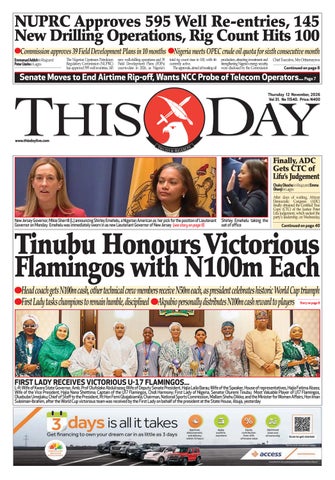
NUPRC Approves 595 Well Re-entries, 145 New Drilling Operations, Rig Count Hits 100 Commission approves 39 Field Development Plans in 10 months Nigeria meets OPEC crude oil quota for sixth consecutive month Emmanuel Addeh in Abuja and Peter Uzoho in Lagos
The Nigerian Upstream Petroleum Regulatory Commission (NUPRC) has approved 595 well re-entries, 145
new well-drilling operations and 39 Field Development Plans (FDPs) year-to-date in 2026, as Nigeria’s
total rig count rises to 100, with 46 currently active. The approvals, aimed at boosting oil
production, attracting investment and strengthening Nigeria’s energy security, were disclosed by the Commission
Chief Executive, Mrs Oritsemeyiwa Continued on page 8
Senate Moves to End Airtime Rip-off, Wants NCC Probe of Telecom Operators... Page 7 Thursday 12 November, 2026 Vol 31. No 11540. Price: N400
www.thisdaylive.com TR
UT H
& REASO
N
Finally, ADC Gets CTC of Lifu’s Judgement Chuks Okocha in Abuja and Emma Okonji in Lagos
New Jersey Governor, Mikie Sherrill (L) announcing Shirley Emehelu, a Nigerian American as her pick for the position of Lieutenant Governor on Monday. Emehelu was immediately sworn in as new Lieutenant Governor of New Jersey (see story on page 8)
Shirley Emehelu taking the oat of office
After days of waiting, African Democratic Congress (ADC) finally obtained the Certified True Copy (CTC) of the Justice Peter Lifu judgement, which sacked the party’s leadership, on Wednesday, Continued on page 40
Tinubu Honours Victorious Flamingos with N100m Each Head coach gets N100m cash, other technical crew members receive N50m each, as president celebrates historic World Cup triumph First Lady tasks champions to remain humble, disciplined Akpabio personally distributes N100m cash reward to players
Story on page 8
FIRST LADY RECEIVES VICTORIOUS U-17 FLAMINGOS...
L-R: Wife of Kwara State Governor, Amb. Prof Olufolake Abdulrazaq; Wife of Deputy Senate President, Hajia Laila Barau; Wife of the Speaker, House of representatives, Hajia Fatima Abass; Wife of the Vice President, Hajia Nana Shettima; Captain of the U17 Flamingos, Chidi Harmony; First Lady of Nigeria, Senator Oluremi Tinubu; Most Valuable Player of U17 Flamingos, Oluebube Umejiaku; Chief of Staff to the President, Rt Hon Femi Gbajabiamila; Chairman, National Sports Commission, Mallam Shehu Dikko; and the Minister for Women Affairs, Hon Iman Suleiman-Ibrahim, after the World Cup victorious team was received by the First Lady on behalf of the president at the State House, Abuja, yesterday
2
THURSDAY, NOVEMBER 12, T H I S D AY
THURSDAY, NOVEMBER 12, T H I S D AY
3
4
THURSDAY, NOVEMBER 12, T H I S D AY
5
THISDAY • THURSDAY, NOVEMBER 12, 2026
Group News Editor: Goddy Egene Email: Goddy.egene@thisdaylive.com, 0803 350 6821, 0807 401 0580
NEWS
THE PAST, THE PRESENT AND THE FUTURE...
L-R: Former Governors of Lagos State- Mr. Babatunde Fashola, SAN, and Mr. Akinwunmi Ambode; the Governor, Mr. Babajide Sanwo-Olu; his Deputy and APC Lagos State Governorship candidate, Dr. Obafemi Hamzat, during the formal inauguration of the Lagos Governor’s Lodge in Abuja, on Tuesday
Tinubu Orders New Funding Framework for Foreign Missions RMAFC seeks sustainable financing model Committee to submit implementation plan by December 11 as Shehu rejects reliance on higher budgetary allocations James Emejo in Abuja The federal government has initiated a comprehensive review of the funding arrangements for the nation’s diplomatic missions abroad. The move seeks to address persistent financial constraints through a more predictable and sustainable financing framework. The exercise, directed by President Bola Tinubu on October 14, is expected to go beyond increased budgetary allocations to examine the systemic weaknesses in fund releases, foreign exchange arrangements, budget execution and expenditure management affecting the operations of Nigerian missions. The Presidential Technical Working Group, chaired by the Chairman of the Revenue Mobilisation, Allocation and Fiscal Commission (RMAFC), Dr. Mohammed Bello Shehu, is expected to submit its report, alongside a detailed implementation programme, to the president by December 11, 2026. Speaking at the inaugural meeting of the working group in Abuja, Shehu said the presidential intervention was aimed at finding a lasting solution to the financial difficulties confronting the country’s foreign missions, warning that the exercise must produce practical recommendations capable of being
implemented. He said the president expected the committee to develop a workable framework that would resolve the funding challenges rather than merely document existing problems. Shehu said the review would critically examine the underlying causes of financial instability at the missions and identify alternative funding arrangements that would guarantee transparency, predictability and sustainability without disregarding the country’s prevailing fiscal constraints. Significantly, he cautioned against approaching the assignment as a demand for higher budgetary provisions, insisting that the adequacy of allocations alone would not resolve the operational difficulties if funds were not released promptly or managed efficiently. According to him, the working group must consider the entire funding chain, including budget formulation, appropriation, release mechanisms, foreign exchange measures, expenditure controls and the prioritisation of essential diplomatic commitments. Shehu described the missions as critical instruments of Nigeria’s sovereignty and international engagement, noting that their responsibilities extended beyond diplomatic representation to protecting Nigerians abroad, strengthening bilateral and multilateral relations,
promoting trade and investment and projecting the country’s international standing. He warned that these responsibilities could be compromised if the missions continued to operate under unpredictable financial conditions. The RMAFC chairman said the commission’s involvement was informed partly by observations from official study engagements and interactions
with personnel of Nigerian missions in different countries, which exposed the operational consequences of existing funding difficulties. He explained that the commission was acting within its constitutional mandate under Paragraph 32(c), Part I of the Third Schedule to the 1999 Constitution, as amended, which empowers it to advise federal and state governments on fiscal efficiency
and methods of increasing revenue. Shehu, however, stressed that the intervention was not intended to assume the responsibilities of other government institutions but to consolidate their fiscal, administrative and operational expertise towards achieving a common objective. In a statement issued by Head, Information and Public Relations Unit, RMAFC, Maryam Umar Yusuf, he said the working group would also
examine international best practices while ensuring that its recommendations were consistent with Nigeria’s constitutional, legal and institutional realities. To guide the exercise, Shehu identified evidence-based analysis, inclusive institutional participation and practical implementation as the key principles that must underpin the committee’s work.
Regional Development Ministry Moves to Digitise Reporting, Strengthen Oversight of Seven Commissions Michael Olugbode in Abuja The federal government has moved to strengthen transparency, accountability and performance monitoring across the country’s seven Regional Development Commissions with the introduction of a digital reporting platform designed to track projects, expenditure and implementation progress. The initiative, spearheaded by the Ministry of Regional Development, also involves a revised quarterly reporting framework aimed at addressing longstanding weaknesses in submissions by the Commissions,
including inconsistencies in reporting formats, incomplete financial information, inadequate project documentation and delays. The Permanent Secretary of the Ministry, Dr Mary Ogbe, disclosed this yesterday in Abuja, while declaring open a capacity-building programme for desk officers from the seven Regional Development Commissions on the revised Quarterly Reporting Template and the newly introduced Regional Development Commissions (RDC) Quarterly Reports Application. Ogbe said the initiative was designed to improve the quality and
credibility of performance data used by the federal government to assess the Commissions’ contributions to the implementation of President Bola Tinubu’s Renewed Hope Agenda across the different regions. She explained that the Ministry submits quarterly performance reports to the Central Results Delivery Coordination Unit (CRCDU) in the Office of the Special Adviser to the President on Policy and Coordination, making accurate and timely information from the Commissions critical to national performance assessment. According to her, the revised reporting framework harmonises
the CRCDU requirements with the Commissions’ quarterly performance templates and the Harmonised Performance Bond Matrix to ensure uniformity, accuracy and consistency with the Presidential Reporting Blueprint. A major component of the reform is the introduction of the RDC Quarterly Reports Application, which will allow the seven Commissions to prepare and submit their quarterly returns electronically, validate financial information, upload supporting documents and transmit reports securely using individual submission keys.
6
THURSDAY, NOVEMBER 12, 2026 • THISDAY
NEWS
3-DAY CANEX WEEKEND 2026...
L-R: Group CEO and Co-Founder of the Creative Production Company Livespot360, Deola Ayeni Art Alade; Lagos State, Commissioner for Tourism, Arts and Culture, Mrs. Toke BensonAwoyinka; Minister of Art, Culture, Tourism, and the Creative Economy, Hannatu Musa Musawa; and Lagos State Commissioner for Commerce, Cooperatives, Trade and Investment, Mrs. Folashade Bada Ambrose-Medebem, during the 3-Day CANEX Weekend 2026-Creative Africa Nexus at Wole Soyinka Centre for Culture and Creative Arts, Lagos State... recently
House Wades into NRS, TETFund Dispute Over N123.48bn Education Tax Deductions Adedayo Akinwale in Abuja
House of Representatives Public Accounts Committee has waded into a N123.48 billion dispute between Nigeria Revenue Service (NRS) and Tertiary Education Trust Fund (TETFund) over deductions from Education Tax. The committee, chaired by Hon.
Bamidele Salam, took up the matter during its ongoing probe of audit queries on revenue collections and remittances. The auditor-general had flagged discrepancies between the education tax collected by NRS, formerly the Federal Inland Revenue Service (FIRS), and what was remitted to TETFund. At the hearing, NRS was rep-
resented by its Executive Director, Shettima Tamadi, while TETFund was represented by its Director of Finance and Accounts, Dr. Gloria Olotu. Both agencies held sharply opposing views. Olotu told the committee that the law allowed the four per cent cost of collection only on non-oil revenue, not on the entire education tax.
She said the auditor-general first raised the issue, prompting TETFund to review the deductions. The review showed that NRS had applied the four per cent charge to total education tax collected, without excluding the oil component. Using NRS’s own figures, which separated oil and non-oil components, TETFund calculated excess deduc-
tions between 2012 and 2024 at N123,486,953,796.24. “The fund had written several letters to the revenue agency seeking a resolution of the matter but had yet to receive the requested refund,” Olotu said. Tamadi disagreed, and insisted no refund was due, while adding that deductions are legal.
COP31: Guterres Urges Oil Windfall Tax to Fund Climate Recovery for Vulnerable Countries Chiemelie Ezeobi in Antalya, Türkiye United Nations Secretary-General, António Guterres, has called on governments to tax windfall profits made by oil companies and channel the proceeds into climate recovery efforts in vulnerable countries. Guterres warned that fossil fuel interests were undermining the global fight against climate change. He made the call on Wednesday at the opening ceremony of the COP31 Leaders’ Summit in Antalya, Türkiye, citing the disparity between oil companies’ profits and resources available to countries suffering climate-related losses. The call came as UN Climate Change Executive Secretary, Simon Stiell, and COP31 President of Negotiations, Chris Bowen, called for accelerated climate action and stronger international cooperation amid growing economic and environmental challenges. Guterres said the nine largest oil companies made $95 billion in profits in the last quarter alone, while the Loss and Damage Fund had received only about $600 million. According to him, the companies made in approximately 14 hours what the fund had received, stressing that those benefiting from fossil fuels must contribute to addressing climate damage. “It’s time for governments to tax these windfall profits – and use them to help vulnerable countries recover. Polluters must pay,” he said. Guterres warned that global emissions reached an all-time high in 2025, while the last four
years were the hottest on record. He said exceeding the 1.5-degree Celsius temperature threshold under the Paris Agreement was now inevitable but urged countries to intensify efforts to limit the scale and duration of the overshoot. He called for global emissions to fall by approximately six per cent annually and advocated a new Climate Justice Compact to ensure developing countries receive the finance and technology needed for clean energy transitions and climate protection. He also urged developed countries to deliver at least $300 billion annually in climate finance by 2035 and provide clear plans to at least triple adaptation finance within the same period. Stiell urged world leaders to accelerate climate action, saying international cooperation could ease inflationary pressures, strengthen energy security, and protect national economies from global shocks. At the High-Level Segment for Heads of State and Government, Stiell said international cooperation had helped reduce projected global warming from well over four degrees Celsius to about 2.6 degrees, while investments in clean energy had overtaken those in fossil fuels. However, he warned that progress remained inadequate and climate benefits were not being shared equitably, particularly with vulnerable countries. “Action is not yet fast enough – the science demands we drastically pace up. And it’s not yet fair enough – the benefits have not been shared equally,” he said. Stiell identified electrification,
tripling adaptation finance, and improving access to climate funding as key priorities for COP31. Bowen described the global situation as a “polycrisis”, citing energy insecurity, armed conflicts, rising living costs, technological disruption and worsening climate impacts. He said the challenges had placed multilateralism under pressure, but called for stronger international cooperation rather than a retreat from collective action.
Bowen said renewable energy, electrification, and diversified energy sources could help countries address energy security concerns while advancing climate objectives. On climate finance, he called for funding to become faster, simpler and fairer, expressing concern that only 0.2 per cent of adaptation finance reached small island developing states. Meanwhile, day four of COP31 featured discussions on green
industrialisation, investment, and jobs, with the COP31 Presidency, Germany, and the United Kingdom hosting a high-level dialogue on generating employment and economic growth through green industries. Other sessions examined international cooperation on accessible early warning systems, water resilience, and climate-health interventions under the Global Climate Action Agenda.
He relied on Sections 15A and 69 of the NRS Act, stating that Section 69 defines non-oil revenue as all revenue other than that derived from Petroleum Profits Tax (PPT). On that basis, he said Education Tax paid by oil companies was not Petroleum Profits Tax and was, therefore, subject to the four per cent deduction. He explained that oil companies paid PPT separately, and NRS did not deduct cost of collection from PPT payments. In its intervention, the committee said while NRS’s interpretation looked straightforward on an ordinary reading of the law, the disagreement between two federal agencies required an authoritative legal position. TETFund said it had already sought the opinion of the AttorneyGeneral of the Federation (AGF) and would forward the response to the committee. The committee resolved to independently seek the AGF’s legal opinion before taking a decision. The hearing was adjourned pending the submission of TETFund’s written position and the AGF’s legal advice.
Nigeria, Saudi Arabia Sign 2027 Hajj MoU on Quota, Pilgrim Welfare, Operational Standards Olawale Ajimotokan in Abuja Nigeria and Saudi Arabia have formalised a framework for the 2027 Hajj pilgrimage, with both countries committing to improved operational coordination, strict compliance with pilgrimage regulations and enhanced welfare services for Nigerian pilgrims. The Memorandum of Understanding (MoU) between the National Hajj Commission of Nigeria (NAHCON) and Saudi Arabia’s Ministry of Hajj and Umrah was signed yesterday in Jeddah. A statement by Head, Information and Publications, NAHCON, Shafii Sani Mohammed, said it provides for coordinated arrangements covering Nigeria’s Hajj quota, accommodation, transportation, healthcare and
adherence to critical operational deadlines. The agreement was signed by the Chairman and Chief Executive Officer of NAHCON, Ambassador Ismail Abba Yusuf, on behalf of Nigeria, while Saudi Arabia was represented by its Vice Minister of Hajj and Umrah, Dr. Abdulfattah bin Sulaiman Mashat. Both countries will strengthen the institutional framework governing Nigerian pilgrims’ participation in the annual pilgrimage, with particular emphasis on service delivery, operational efficiency and the protection of pilgrims’ welfare. The MoU establishes the basis for cooperation on the allocation of Nigeria’s Hajj quota and compliance with Saudi regulations, while providing a framework for addressing logistical challenges
that could affect the smooth conduct of the pilgrimage. It also identifies accommodation, transportation and healthcare as service areas requiring effective coordination between the two countries. Both parties are expected to strengthen engagement on service standards, operational monitoring and the resolution of emerging challenges ahead of the 2027 Hajj. The agreement further places emphasis on meeting established deadlines, a critical requirement in Saudi Arabia’s increasingly structured Hajj management system, where timely completion of administrative and operational processes is central to successful pilgrimage arrangements. Yusuf commended the Saudi government and the Ministry of Hajj and Umrah for sustained investments in pilgrimage
infrastructure, improvements in Hajj arrangements and continued constructive engagement with Nigeria. In his remarks, Mashat disclosed that Saudi Arabia recorded a 93 per cent pilgrim satisfaction rate during the 2026 Hajj, commending Nigeria for its contribution to the achievement. NAHCON is expected to translate the commitments into concrete operational arrangements through engagements with State Muslim Pilgrims’ Welfare Boards, licensed Hajj tour operators and relevant Saudi institutions. The ceremony was attended by Nigeria’s Ambassador to Saudi Arabia, Ambassador Yakubu Gambo, and members of the National Assembly led by the Chairman of the House Committee on Hajj Pilgrimage, Hon. Jafar Mohammed.
7
THISDAY • THURSDAY, NOVEMBER 12, 2026
NEWS
KYARI’S APPEARANCE AT SENATE COMMITTEE ON PUBLIC ACCOUNTS...
L-R: Prof Sam Erugo (SAN) (Lawyer for Kyari); former GCEO of NNPCL, Mele Kyari; and Chukwuemeke Ukauzo (esq) (another Lawyer), when Kyari appeared before the Senate Committee on Public Accounts to defend the unaccounted for N210 trillion Audit Report for 2017-2023 held in Abuja, yesterday PHOTO: JULIUS ATOI.
Senate Moves to End Airtime Rip-off, Wants NCC Probe of Telecom Operators Demands automatic refunds for failed calls, threatens sanctions over poor services Directs regulator to investigate MTN, Glo, Airtel, 9mobile, report within four weeks Passes bill to strengthen regulation, coordination of senior secondary education Sunday Aborisade in Abuja The Senate on Wednesday moved to protect millions of Nigerians from unjustified telecommunications charges, demanding automatic refunds for failed calls and ordering an investigation into the billing practices of major mobile network operators over persistent complaints of unexplained airtime deductions. The upper chamber specifically urged the Nigerian Communications Commission (NCC) to investigate MTN Nigeria, Globacom, Airtel Nigeria and 9mobile, establish the extent of deductions arising from failed, dropped and interrupted calls, and introduce measures compelling operators to refund subscribers for services not effectively delivered. The Senate also directed the telecommunications regulator to strengthen enforcement of quality-of-service standards and impose appropriate sanctions on operators whose persistent network deficiencies violate regulatory requirements. The resolutions followed a motion sponsored by Senator Mohammed Tahir Monguno, representing Borno North, during plenary on Tuesday, titled: “Need to Curb Unjustified Deductions from Subscribers’ Airtime Resulting from Substandard Services
Through Robust Consumer Protection.” The lawmakers expressed concern that millions of Nigerians routinely lose airtime on calls that fail to connect, terminate abruptly or suffer network interruptions, forcing subscribers to spend additional money attempting to establish successful communication. They maintained that Nigerians should not be made to pay for telecommunications services that have not been effectively delivered, stressing that purchasing airtime amounts to payment for a service and not merely an attempt to establish communication. The Senate observed that telecommunications services had become indispensable to individuals, businesses and institutions, with millions of Nigerians spending substantial amounts on airtime daily to meet their communication needs. However, it noted that subscribers frequently experienced failed call connections, abrupt disconnections, inaudible conversations and network interruptions, resulting in airtime deductions without effective communication. The chamber further observed that subscribers were often compelled to make repeated calls to achieve successful connections, thereby incurring additional expenses arising from network deficiencies beyond their control.
It expressed particular concern that seemingly small deductions, when aggregated across millions of subscribers, translated into substantial financial losses, especially for low-income earners, traders, students and small business operators. The Senate recalled that the Nigerian Communications Act, 2003, empowered the NCC to regulate the telecommunications industry, protect consumers and enforce acceptable standards of service delivery. While acknowledging that oc-
casional network failures might be unavoidable, the lawmakers insisted that subscribers should not bear the financial consequences of services not delivered or materially compromised by network-related failures. Consequently, the Senate urged the NCC to investigate the billing practices of the four major mobile network operators and establish the extent of airtime deductions arising from unsuccessful, dropped and interrupted calls. It also called on the regulator to
The Minister of Marine and Blue Economy, Dr. Adegboyega Oyetola, has called on investors and financial institutions to tap into Nigeria’s vast catfish industry, describing the country’s fish production deficit as a major investment opportunity capable of driving economic growth, food security and job creation. According to a statement by his Special Adviser, Dr. Bolaji Akinola, the Minister made the call yesterday in Abuja at a High-level roundtable
discussion on ‘Scaling Sustainable Catfish Value Chain Transformation’, organised under the Fisheries and Aquaculture for Africa, the Caribbean and the Pacific (FISH4ACP) programme. Oyetola said Nigeria’s annual fish requirement stood at approximately 3.6 million metric tonnes, while domestic production from all sources was about 1.4 million metric tonnes, leaving a significant supply gap that local aquaculture operators and prospective investors could exploit. According to the minister, “Expanding domestic fish production
commission to conduct independent technical audits of operators’ billing systems to ensure that subscribers were charged only for actual and properly delivered chargeable call durations. The Senate further mandated its Committee on Communications to invite the NCC and relevant telecommunications operators to investigate the complaints, assess the financial losses suffered by subscribers and submit recommendations for further legislative and regulatory action within four weeks.
Lagos Gets 5 New CNG Stations to Cut Transport Costs, Power 8,400 Cars Daily Facilities bring cheaper, cleaner fuel closer to Lagosians Tinubu directs 500 more outlets toward national network of 1,000 Peter Uzoho Lagos State yesterday took a major step toward cheaper and cleaner transport on with the inauguration of five Compressed Natural Gas (CNG) daughter and last-mile retail stations across the state, a project expected to directly ease the cost pressures faced by drivers,
businesses and commuters. The stations, developed by Ibile Oil and Gas Corporation (IOGC) with support from the Midstream and Downstream Gas Infrastructure Fund (MDGIF), are located in Idimu, Ogolonto, Abule Egba, Ajah and Oko-Oba. Together, the stations can hold 45,640 standard cubic metres of
Fish Production Gap Presents Huge Opportunities, Says Oyetola, Woos Investors to Catfish Industry Bennett Oghifo
establish an accessible and time-bound complaints and redress mechanism through which subscribers could seek refunds or appropriate compensation for unjustified deductions and persistent service failures. In addition, the NCC was urged to introduce regulations requiring telecommunications operators to automatically reverse or refund airtime deducted from verifiably failed calls and qualifying network-related service interruptions. The lawmakers also directed the
is an economic and food security imperative. It offers an opportunity to strengthen domestic food supply, reduce dependence on fish imports, stimulate enterprise development and create sustainable livelihoods across the country.” He noted that Nigeria was Africa’s second-largest aquaculture producer and a leading producer of farmed African catfish, stressing that the sector’s potential extended beyond fish farming to hatcheries, feed mills, equipment manufacturing, transportation, processing, cold-chain services and trading.
“Investment in aquaculture has a multiplier effect, creating opportunities and value across several interconnected sectors of the economy,” he said. Oyetola however maintained that closing the production gap would require more than establishing additional fish farms, insisting on coordinated investments across the entire value chain. He identified access to quality fingerlings, affordable feed, appropriate financing, effective fish health management, reliable markets and modern infrastructure as essential to sustainable industry expansion.
gas and, at full capacity, fill about 8,400 cars per day using natural gas produced in Nigeria. Each facility has 24,000 standard cubic metres per day of compression capacity and 9,800 standard cubic metres of storage capacity, designed specifically as last-mile retail stations serving consumers closer to where they live, work and conduct business. The impact include less time on queues, more time earning, an easier-to-plan fuel bill and cleaner air on roads shared by millions. The Minister of State for Petroleum Resources (Gas), Hon. Ekperikpe Ekpo, who inaugurated the facilities, said there was particular significance in commissioning the projects in Lagos, a state that occupies a special place in the public-service journey of President Bola Ahmed Tinubu. Ekpo said the President Bola Tinubu has specifically directed the expansion of CNG infrastructure nationwide, including an additional 500 CNG refuelling stations towards a planned national network of 1,000 stations, with emphasis on ensuring that the benefits translate into lower
transportation costs for Nigerians. For a dynamic economy such as Lagos, he said the implications were significant as every additional CNG station expands the ecosystem required to give motorists and commercial transport operators a viable alternative fuel. He said it brings cleaner gas closer to the point of consumption and supports the broader objective of making CNG increasingly accessible across Nigeria. Ekpo stressed that success must not be measured by the number of stations commissioned, but by impact: whether infrastructure helps reduce operating costs for transporters and businesses, whether those savings reach commuters, and whether Nigerian families begin to feel tangible relief. He commended IOGC and the Lagos State Government for embracing the opportunity, describing it as exactly the type of Federal-State-private-sector collaboration that must be replicated across the country. He also commended MDGIF for continuing to perform its catalytic role.
8
THURSDAY, NOVEMBER 12, 2026 • THISDAY
EIGHT
Dangote Refinery’s IPO Attracted N5.85trn Bids from 3.8m Investors Three subscribers account for 46.72% of total subscriptions Dangote Cement shelves $1bn London listing, cites market volatility Emmanuel Addeh in Abuja The Initial Public Offering (IPO) of Dangote Petroleum Refinery and Petrochemicals attracted about N5.85 trillion in bids from nearly 3.8 million applicants, more than double its base target of N2.15 trillion, in the largest equity transaction in African capital market history. Subscription data according to reports confirmed by market sources showed that investors applied for 11.15 billion shares valued at N5.85 trillion, compared with the 4.1 billion shares originally offered at N525 per share in the offer branded as “The People’s IPO”. The data, which represented applications rather than final allotments, underscored strong investor appetite for the $20 billion Lagos-based refinery, Africa’s largest, as it pursued a $14.3 billion five-year expansion to raise processing capacity from 700,000 barrels per day (bpd) to 1.4 million bpd by 2029.
The offer, which opened on September 14, 2026 and was extended by the Securities and Exchange Commission (SEC) from October 13 to October 27, allowed a minimum subscription of 10 shares at N5,250 to broaden retail participation. According to multiple reports, the structure of demand revealed two distinct stories: while retail participation drove headcount, a handful of institutions drove value. Nearly 3.8 million subscribers, about 84.39 per cent of all subscribers, applied for just 62.26 million shares valued at N32.69 billion, representing only 0.56 per cent of total shares subscribed. Another 404,000 subscribers, about 10.71 per cent of applicants, the report said, subscribed for 178.45 million shares worth N93.69 billion. Combined, the two low-ticket categories accounted for about 95.1 per cent of all subscribers, but only 2.16 per cent of the total shares applied for.
However, that pattern fell short of the ambition articulated by Chairman of Dangote Industries Limited (DIL), Aliko Dangote, who had targeted 10 million retail investors to democratise ownership of the refinery. On the other hand, concentration was stark at the top, with just three subscribers accounting for about 46.72 per cent of total subscriptions, worth about N2.73 trillion, the report explained. One investor applied for 771 million shares worth about N405 billion, or 6.92 per cent of total demand. Two groups of five investors each applied for 671.5 million shares worth N352.54 billion and 667.91 million shares worth N350.65 billion, respectively, according to the subscription summary. The identities of the subscribers were not disclosed, but Bloomberg had earlier reported about $4.1 billion in total demand, comprising $1.9 billion from Nigerian investors and $2.1 billion from international investors, including South
Africa’s Public Investment Corporation (PIC), which manages about $220 billion in pension assets, and Nigerian pension fund managers. The offer also generated more than N860 billion in online retail subscriptions from about 1.55 million unique online subscribers, with about 2.2 million online subscription transactions processed before collation of offline channels. In the meantime, attention will now shift to allotment and listing as SEC has allowed the refinery to absorb up to 30 per cent of oversubscription on top of its base offer, which could raise final proceeds. The company will determine allocation across categories, subject to regulatory approval, which will define actual amount raised and final shareholder base. The refinery’s IPO showing did not come as a surprise, with demand supported by recent financials. For the nine months ended September
2026, the refinery reported revenue of $22.48 billion, up 144.47 per cent year-on-year, and profit after tax of $4.73 billion, compared with a loss of about $117 million in the corresponding period of 2025. Meanwhile, Dangote Cement Plc cancelled its proposed secondary listing and offering on the London Stock Exchange (LSE), citing current market conditions and strategic priorities, in a setback for the UK bourse, which had struggled to attract major new issuers. The decision was disclosed in a notice filed with the Nigerian Exchange Limited (NGX) on Tuesday following a board meeting held on November 10, 2026. The company stated, “The Board resolved that, in light of current market conditions and the Company’s strategic priorities, the Company announces that it and its selling shareholder, Dangote Industries Limited (DIL) will not proceed with the proposed secondary listing and offering on the London Stock Exchange
Alhaji Aliko Dangote at this time.” The notice said, “The company’s ordinary shares remain listed on the NGX, and this decision does not in any way affect the company’s operations or business plans. Dangote Cement Plc remains focused on delivering sustainable value to its shareholders and building on its strong market position.”
TINUBU HONOURS VICTORIOUS FLAMINGOS WITH N100 MILLION EACH Deji Elumoye and Sunday Aborisade in Abuja President Bola Tinubu, yesterday, rewarded each member of Nigeria’s victorious Under-17 women’s football team, the Flamingos, with a N100 million federal government savings bond in recognition of their historic triumph at the FIFA U-17 Women’s World Cup in Morocco last Saturday. The president directed that the N100 million reward for each player should be issued as a savings certificate, with the money preserved for the young footballers in view
of their age. Announcing the presidential package to the young players while receiving them at State House, Abuja, on behalf of the president, First Lady, Senator Oluremi Tinubu, said the rewards were in fulfilment of Tinubu’s longstanding commitment to appropriately recognise Nigerian athletes who bring honour to the country. She stated, “Let me recall Mr. President’s promise to every Nigerian athlete: make Nigeria proud and come back to a grateful nation. “In fulfilment of this promise,
it is my pleasure, on behalf of the president, to announce the following rewards for the players, technical crew, and administrators of the Flamingos, whose collective efforts have brought honour and pride to our nation by winning the FIFA Under-17 Women’s World Cup. “For all our players, Mr President is awarding you a savings certificate of N100 million each. Each of you is getting N100 million.” Explaining the arrangement to the excited female footballers, Mrs Tinubu said the money would be preserved for their future rather than
placed immediately at their disposal. She told them, “Do you know what a savings certificate is? It is money, but it is in trust for you. You are still very young. Do you want to start handling N100 million now?” The first lady added, “For the coach, a reward of N100 million cash, and then for the technical crew, N50 million each. That’s what Mr President said I should tell you.” Mrs Tinubu described the achievement of the triumphant FIFA U-17 Women’s World Cup Champions as a remarkable moment in the history of Nigerian and African sports, saying
Nigerian-born Emehelu Makes History as New Jersey’s Lieutenant Governor Emmanuel Addeh in Abuja Nigerian-born American lawyer, Shirley Emehelu, has made history as the first immigrant to become Lieutenant Governor of New Jersey, United States. Emehelu, who emigrated from Nigeria as a child, was appointed by Governor Mikie Sherrill, becoming the fifth Lieutenant Governor of the state. The appointment was also historic, as New Jersey’s two highest executive offices are occupied by women simultaneously for the first time. The development represents a milestone for Nigerian-Americans, whose participation in US public life now includes one of the highest executive positions in American state government. Similarly, Emehelu assumed the position of Secretary of State, consolidating responsibilities in government administration, electoral oversight and public service. She was sworn in at the New Jersey Statehouse in Trenton by Chief Justice Stuart Rabner, with her husband and children participating in the ceremony. Announcing the appointment, Sherrill described Emehelu as an experienced public servant whose career demonstrated integrity, accountability and a commitment to protecting residents. “Shirley embodies those values,” the governor declared, referring to her administration’s emphasis on accountability and public service. Sherrill said Emehelu’s record in prosecuting financial crimes, protecting consumers, defending civil rights and combating government waste informed her selection. The governor explained that
Shirley Emehelu (L), a Nigerian American being sworn in as new Lieutenant Governor of New Jersey while the New Jersey Governor, Mikie Sherrill (R) and others watched with keen interest on Monday Emehelu had also demonstrated effective leadership while overseeing the administration of New Jersey’s recent elections as Acting Secretary of State. Accepting the appointment, Emehelu expressed appreciation for the confidence reposed in her and reaffirmed her commitment to serving the state’s diverse population. Other Nigerian Americans who won election include: Segun Adeyina, Georgia, State House, District 110; Solomon Adesanya, Georgia: State House, District 43; Will Jawando, Maryland, Montgomery County Executive; Esther Agbaje, Minnesota, State House, District 59B and Ukeme Awakessien-Jeter, Ohio: State House, District 7. Also elected were: Junior Ezeonu, Texas, State House, District 101; Olaleye Onikuyide, Connecticut, State House,
District 19; Gabe Okoye, Georgia, State House, District 102; Phil Olaleye; Georgia, State House, District 59; Justin Onwenu, Michigan, State Senate, District 1. Others included: Janelle Anyanonu, New Mexico, State House, District 19; Carol Kazeem, Pennsylvania, State House, District 159; Odus Evbagharu, Texas, State House, District 135 and Dr Oye Owolewa, Washington, DC, Council at-large. Emehelu said: “I’ve spent my career upholding the law, protecting families, and rooting out fraud, abuse, and corruption.” Emehelu also acknowledged the significance of her Nigerian heritage and the opportunities her appointment represented for immigrant and minority communities. “As a Black woman and Nigerian
American, I’m proud of what this appointment represents for our state, and especially for the communities that share my heritage,” she said. She expressed hope that the occasion would encourage younger generations to pursue public service and contribute meaningfully to their communities. “I hope we can inspire the next generation to find their own ways to serve and make a little history of their own too,” she said. The lieutenant governor pledged to support Sherrill’s administration in addressing living costs, expanding economic opportunities and ensuring more responsive government. Reflecting on her years in public service, Emehelu identified the protection of ordinary citizens as the central motivation behind her professional career.
they have made the country proud by becoming the first African nation to win the prestigious title. The first lady said, “I thank the parents, guardians, and fans whose support has nurtured these young champions, who stand as a shining testament to our belief that our youth are our greatest asset and a source
of national pride. “On behalf of Mr. President and the good people of the Federal Republic of Nigeria, I congratulate you once again. You have made our nation proud, and we celebrate every one of you.” Continued on page 42
NUPRC APPROVES 595 WELL RE-ENTRIES, 145 NEW DRILLING OPERATIONS, RIG COUNT HITS 100 Eyesan, during a presentation at the peaked at 1.79 million barrels during management session of the 44th An- the period, while the lowest daily nual International Conference and output for the month stood at 1.60 Exhibition of the Nigerian Association million barrels per day. Crude oil production data, excludof Petroleum Explorationists (NAPE) in Lagos. ing condensate, showed that Nigeria The conference was held under the had met its assigned OPEC quota for theme: “Energy Security in an Era of six consecutive months, producing 1.53 Global Disruption: Positioning Nigeria million bpd in May, 1.55 million bpd for Resilience, Competitiveness, and in June, 1.51 million bpd in July, 1.5 Prosperity.” million bpd in August, 1.53 million Eyesan, who was represented by bpd in September and 1.51 million the Deputy Director, Basinal Admin- bpd in October. On a month-on-month basis, istration, NUPRC, Ahmad Abdullahi, explained that the approvals were however, production dipped by 1.7 part of the Commission’s strategy per cent, according to a breakdown to ensure that regulatory processes announced in Abuja in a statement support production growth and the by the NUPRC Head of Media and availability of energy in the country. Corporate Communications, Eniola “Year to date, about 39 FDPs Akinkuotu. The NUPRC attributed the stable have been approved. About 145 new well-drilling approvals granted. performance in recent months to enYear to date, about 595 well re-entry hanced operational stability, supported approvals were granted. That goes to by improved production uptime and tell that as a commission, we have crude evacuation efficiency. improved our approval time level, The sustained growth recorded which again reduces costs that is being in October, it stressed, reflected the wasted or for projects to continue to continued commitment of operators wait for approval. and industry stakeholders to improv“From the regulator’s perspective, ing operational efficiency, maintaining to ensure that our energy security is asset integrity and enhancing producnot threatened, we must ensure that tion reliability across the Nigerian we approve Field Development Plans upstream petroleum sector. and new well-drilling applications A breakdown of daily average to meet our production targets and crude oil and condensate production guarantee energy availability,” Eyesan by terminals and streams during the stated. review month showed that Forcados The CCE noted that the rising Terminal accounted for 318.49kbpd, number of approvals reflected while Bonny came second with improvements in the Commission’s 311.02kbpd. approval processes, which had helped Qua Iboe Terminal recorded an reduce waiting periods and the costs average production of 173.97kbpd operators incur while projects remain of crude oil and condensate, while on hold. Escravos Oil Terminal posted a daily The latest figures came as Nigeria average of 134.67kbpd. Bonga ranked produced a daily average of 1,687,710 as the fifth-highest producing terminal, barrels of crude oil and condensate in recording an average of 106.65kbpd October 2026, reaching 101 per cent of crude oil and condensate. of the 1.5 million barrels per day oil The NUPRC also said the apquota set for it by the Organisation provals were intended to ensure of Petroleum Exporting Countries that Field Development Plans and (OPEC). new well-drilling applications were Data from the NUPRC yesterday processed to meet production targets showed that single-day production and guarantee energy availability.
9
THISDAY • THURSDAY, NOVEMBER 12, 2026
NEWS
DTN@100 TIMES HEROES AWARD...
L-R: Wife of Minister of Defence, Mrs. Lilian Ogboho Musa; Minister of Defence, General Christopher Gwabin Musa (rtd); Chairman, AW Network and STARC, Adebola Williams; and DirectorGeneral/Chief Executive Officer of National Identity Management Commission (NIMC), Bisoye Coker-Odusote, during the DTN @ 100 Times Heroes Awards in Lagos...recently
NELFUND Takes Student Loan Sensitisation to MDAs, Says N375 Billion Disbursed Kuni Tyessi in Abuja The Managing Director/Chief Executive Officer of the Nigeria Education Loan Fund (NELFUND), Mr. Akintunde Sawyerr, has tasked Ministries, Departments and Agencies (MDAs) with ensuring that the benefits of the student loan scheme reach the intended beneficiaries, describing them as critical to disseminating the right information about the scheme. Sawyerr gave the charge during a sensitisation roadshow organised by the Fund at the Federal Ministry of Humanitarian Affairs, Federal Secretariat, Abuja, on Wednesday. He said the sensitisation was aimed at increasing awareness and understanding of the scheme and addressing misconceptions with accurate information. He said the Fund believes ministries
are critical stakeholders in national development and have an important role to play in creating awareness and ensuring the laudable Federal Government initiative reaches its intended beneficiaries. “I sincerely appreciate the Federal Ministry of Humanitarian Affairs for providing this opportunity for us to engage with its management and staff. The purpose of this roadshow is to deepen awareness and understanding of NELFUND’s mandate, operations and the opportunity available to eligible Nigerian students to access financial support for higher education,” he said. He commended the staff for their active participation, constructive engagement and valuable contributions during the session. Also speaking, the Director of SERVICOM at NELFUND, Mr.
Olusola Fowobaje, said the Fund chose the Ministry of Humanitarian Affairs for the sensitisation because of its closeness to the grassroots in efforts to reduce poverty. He said although MDA workers may have heard about the Fund through television and social media, the information may not have been in-depth because of their busy schedules. “They are parents and guardians, so they need the in-depth information of the product that NELFUND has, hence the initiative,” he said. “The fortunate thing about this product is that we are not selling the product. We are giving it out in the form of loans to our students, to our children in federal and state government institutions, without interest. So the MD said we should take it to the doorsteps of our people,”
Wema Bank Awards N300m to 11 Innovators at Hackaholics 7.0 Bennett Oghifo
Wema Bank has awarded N300 million to 11 winning teams at the seventh edition of its Hackaholics innovation programme, to support the development and commercialisation of technology-driven solutions addressing economic and societal challenges. The funding was announced at the grand finale of Hackaholics 7.0, themed Festival of the Future, held in Lagos on November 6, 2026. The competition attracted 5,329 participants and generated 1,632 ideas and innovative solutions across seven pitch centres in Uyo, Kano, Yaba College of Technology, Benin, Ibadan, Enugu and Lagos. Following the nationwide selection exercise, 59 participants emerged, while 21 finalists were shortlisted through a multi-stage evaluation process to compete for prizes across four categories: Startup/Ideathon, Social Impact, Women-Led and Hackathon. The overall winner, Tony Niteon Nwose, founder of Niteon, received the N60 million grand prize for his agricultural technology solution connecting farmers to processors, financial services and markets. In the Startup/Ideathon category, Emmanuel Adeboje of Acceede
emerged first runner-up, receiving N40 million for his education-focused innovation, while David Lawani of All-Arbitrates came third with N20 million for his digital platform designed to improve access to arbitration and dispute resolution. In the Social Impact category, Kabir Olaosebikan of Craft Planet emerged winner, receiving N40 million for his innovation that converts plastic waste into sustainable building materials. Samuel Ayomide Shonubi of SocialSign came second, receiving N30 million for his sign language technology solution aimed at improving communication and digital inclusion for people with hearing impairments, while Oluwaseyi Whyte Akinlolu of Harthio secured third place with N20 million for his mental wellness solution. For the Women-Led category, Zainab Boluwatife Adeagbo of MamaAlert emerged winner, receiving N20 million for her digital healthcare solution designed to improve women’s access to timely healthcare services. Precious Zino of URI secured second place with N10 million for her artificial intelligence-powered marketing solution, which helps businesses improve customer engagement and strengthen their digital presence.
In the Hackathon category, Kelvin Nnadi of Neural Forge emerged winner, receiving N30 million for his AI-powered medical diagnostic solution. David Campbell of Nexa AI came second with N20 million for his AI-powered customer intelligence solution, while Uti Henry of Vhorde secured third place, receiving N10 million for IRIS, an AI-powered smart glasses innovation designed to help visually impaired people navigate their surroundings independently. Speaking at the event, the Managing Director and Chief Executive Officer of Wema Bank, Moruf Oseni, said the funding reflected the bank’s commitment to providing practical support for entrepreneurs developing solutions to pressing economic challenges. He said, “At Wema Bank, we believe that the future of our economy will be shaped by the ideas we recognise, nurture and invest in today. Across Nigeria, young innovators are developing remarkable solutions to challenges in agriculture, healthcare, education, financial services and several other sectors. Our responsibility is to ensure that these ideas receive the support and resources required to translate into meaningful impact.
he added. He said the sensitisation team had visited the Ministry of Regional Development and has scheduled other engagements, including security agencies’ barracks. He explained that the sensitisation became important following reports that some students collect the loan and still collect school fees from their parents. “Some students, our children, collect this loan and still collect school fees from their parents. Because the parents, most of them are not aware, especially the educated parents like you. We’ve gone out a lot. And that is why we are bringing it to your doorsteps, the ministries, the departments and the agencies,” he said. Fowobaje said the loan is intended to open doors of opportunity for deprived members of society who could not afford tertiary education because of lack of funds. “The fact that someone is my gateman, his son or his children should not open the gate for my children. And that is the initiative because they now have access. The children should not start where the father stops. The Federal Government has come out to say, this money is
available for your children to go to school,” he said. He said the executive management of NELFUND is doing everything possible to make the process seamless and to serve Nigerians well. According to him, the Fund will continue to provide financial assistance to eligible students in Nigerian public tertiary institutions, ensure sustainable financing of education through a transparent and accountable loan system, reduce the number of students who drop out due to financial constraints, promote human capital development and national productivity, and advance inclusive and equitable access to quality education. The Fund said as at end of October 2026, over N375 billion had been disbursed to students across the country, comprising more than N194 billion for institutional fees and over N180 billion for students’ upkeep allowances. The staff were taken through the rudiments of the NELFUND application portal and disbursement processes, with their fears allayed on sustainability, death of a beneficiary, and the period and mode of repayment after employment, among others. The Permanent Secretary of the Hu-
manitarian Ministry, Mrs. Olubunmi Olusanya, represented by the Assistant Director, Training/Staff Welfare, Mrs. Eweje Ololade Modukpe, said the Ministry appreciated the sensitisation, noting that it gave staff awareness and understanding of NELFUND, and that the presentations were an eye-opener. “Some say it is real, some say it is political propaganda, but here they are today. That is to tell us that it is real, and that the office is existing, and the programme is real,” she said. According to her, there was initially skepticism about granting the request, since the staff are not students. “I remember, when the letter came, I was thinking within myself, we are not students. How does this affect us? So when I put a call through, it was explained, they are aware that we are not students, but we have children. We are all mothers, we are all fathers, and we are parents. Even if we don’t have one, we have people under us that we are training in school. So with that, we can even know how we can key in, and even if our children are already enjoying it, how do we even know? So these are some of the issues that were unravelled here today,” she said.
31 Years After, Ogonis Renew Demands for Justice Over Murder of Saro-Wiwa, Others Blessing Ibunge in Port Harcourt Ogoni socio-cultural group, KAGOTE (Khana, Gokana, Tai and Eleme), has called on the federal government to use the Ogoni Remembrance Day to focus on the development of Ogoniland in honour of Ken Saro-Wiwa and other Ogoni who lost their lives in the struggle. The president of KAGOTE, Chief Lesi Maol, made the appeal in Port Harcourt on Tuesday during the commemoration of the yearly Heroes Day (also Ogoni Martyrs Day) to mark the execution of Saro-Wiwa and eight other Ogoni activists on November 10, 1995, by the military government of General Sani Abacha. He said that the history of Ogoni oil is written not only in economic figures, but also in the sacrifices of Saro-Wiwa and others who stood for the dignity and wellbeing of Ogoni communities. Maol said that while KAGOTE appreciates the efforts of the federal government and the Rivers State government in addressing the developmental
needs of the Ogoni, more should be done to boost development in the area in order to improve the lives of the people. According to Maol, the Ogoni people are willing and ready to work constructively with the federal government towards a peaceful, responsible and mutually beneficial resumption of oil activities in Ogoniland. Maol stressed the talks on oil resumption deserves seriousness, wisdom and responsibility, noting that KAGOTE’s objective is the transformation of oil into an “instrument of reconciliation, environmental recovery, economic empowerment and generational prosperity. The KAGOTE president said: “November 10 must be more than a day of mourning. It must also be a day of accountability, renewal and recommitment to the development of Ogoniland. Our departed heroes deserve more than annual tributes. They deserve a living legacy reflected in the wellbeing of our people. “We must continue to strengthen
our relationship with government at all levels, development institutions and the private sector. We recognise that sustainable progress requires partnership, constructive engagement and a willingness to identify areas of common interest. “KAGOTE remains committed to supporting initiatives that promote peace, strengthen public institutions, improve social welfare and create economic opportunities for Ogoniland.” He said: “ KAGOTE respectfully advocates that the agreed confidence building measures should be substantially implemented, with visible and verifiable outcomes, before the conclusion of any final Memorandum of Understanding. “These measures should address the concerns of our people, demonstrate good faith and provide the assurance necessary for meaningful negotiations. We equally believe that credible, transparent and inclusive congresses should be convened across the four Ogoni Local Government Areas of Khana, Gokana, Tai and Eleme.”
10
THURSDAY, NOVEMBER 12 T H I S D AY
THURSDAY, NOVEMBER 12, T H I S D AY
11
+".&4 )01& $0--&(& ˬ̛̌Ν˵ʍɾʳʍࢫࢫ-˂Ʉ͍Ʉɲͩʍ͍ࢫė͍ͷͩ˂
kĤėĤþHࢫ§H 8HþĊࢫ8Ìࢫ½Ìėࢫ ĤĊėࢫz ööH½ࢶࢶࢶėzHŖࢫ þHࢫkÌþ·H8 ėࢫ ·HĊࢫzÌöHࢫ-̧§HnHࢷࢫ§H ࢷࢫ§ nÌĊ ½ÌŅH·%Hþࢫ࠵࠳࠵࠸ࢫ- ·%þ 8nH
· Ŗࣃ Ĥ½Hࢫ࠵࠳࠵࠹ࢫŋ H-
n-ĊHࢫHœ · ½ ė ̽ࢫþHĊĤ§ė
Hœ · ½ ė ̽ࢫþHĊĤ§ė
ࣁ
࠴ ࠶ ࢫ࣒ࢫ% nþ 8HĊࢸࢫ࠼࠷य़
nþ 8HĊࢸࢫ࠹࠺य़
࠴
ࣁ ࢫ࣒ࢫ nþ 8HĊࢸࢫ࠼࠹य़
࠹
ࢫ࣒ࢫ-ࢫࢫnþ 8HĊࢸࢫ࠴࠳࠳य़
ࣁ ࢫ࣒ࢫ% nþ 8HĊࢸࢫ࠼࠼य़ ࣁ ࢫ࣒ࢫ-ࢫࢫ nþ 8HĊࢸࢫ࠴࠳࠳य़ ĊͩɄͩʍࢫ̛ʱࢫͩ˂ʍࢫɄ͍ͩࢫɲ˵Ʉ̛̛͍͛͛̆͛ࢷࢫ˵Ʉɩ̛͍Ʉ̛͍ͩˏʍ͛ࢷࢫɩ̛Ʉ͍ɾˏ̌ʳࢫɄ̌ɾࢫ̛͍͛ͩͅˏ̌ʳࢫʱɄɲˏ˵ˏͩˏʍ͛ࢶ HΦɲʍͩͅˏ̛̌Ʉ˵ࢫʍɾͷɲɄ̛͍ͩ͛ࢫΝ˂̛ࢫɲ˂Ʉ˵˵ʍ̌ʳʍࢫ̆ˏ̌ɾ͛ࢷࢫ̌ͷ͍ͩͷ͍ʍࢫɄ̌ɾࢫɩ͍ˏ̌ʳࢫ ̛ͷͩࢫͩ˂ʍࢫɩʍ͛ͩࢫˏ̌ࢫʍΘʍ͍Ωࢫ˵ʍɄ͍̌ʍ͍ࢶ ơ͍̈ͷɾࢫΝˏ̌̌ʍ͍͛ࢫ̛ʱࢫ͍ͅʍ͛ͩˏʳˏ̛ͷ͛ࢫˏ̌ͩʍ͍̌Ʉͩˏ̛̌Ʉ˵ࢫɄ̌ɾࢫ̌Ʉͩˏ̛̌Ʉ˵ࢫɄΝɄ͍ɾ͛ࢶ %ʍɄͷͩˏʱͷ˵ࢷࢫ͛ʍ͍ʍ̌ʍࢫɄ̌ɾࢫ͛ʍɲͷ͍ʍࢫΝ̛͍˵ɾ࣒ɲ˵Ʉ͛͛ࢫɲɄ̆ͅͷ͛ࢫΝ˂ʍ͍ʍࢫ˵ʍɄ͍̌ˏ̌ʳࢫͩ˂͍ˏΘʍ͛ࢶ H½ėþ ½-HࢫHœ · ½ ė ̽ࢫkÌþࢫŖH þࢫ࠺ࢫࣜ ĊĊ࠴ࣝࢫ8 Ŗࢫ ½8ࢫ%Ì þ8 ½nࢫĊėĤ8H½ėĊࢫkÌþ ėzHࢫ࠵࠳࠵࠺ࣃ࠵࠳࠵࠻ࢫ - 8H· -ࢫĊHĊĊ ̽ࢫ ĊࢫĊ-zH8Ĥ§H8ࢫėÌࢫė Hࢫö§ -Hࢫ Ċࢫķ§ÌŋĊࢸ
§ nÌĊ 8Ʉͩʍ͛ࢸࢫࢫࢫࢫࢫࢫࢫࢫࢫࢫĊɄͩͷ͍ɾɄΩࢷࢫ࠶࠳ͩ˂ࢫ Ʉ̌ͷɄ͍ΩࢫɄ̌ɾࢫ࠹ͩ˂ࢫkʍɩ͍ͷɄ͍Ωࢷࢫ࠵࠳࠵࠺ §̛ɲɄͩˏ̛̌ࢸࢫࢫࢫࢫࢫ Ʉ̆ʍ͛ࢫz̛ͅʍࢫ-̛˵˵ʍʳʍࢷࢫėΝˏ̌ࢫ§Ʉˬʍ͛ࢫH͛ͩɄͩʍࢷࢫ§ʍˬˬˏࢷࢫ§Ʉʳ̛͛ࢶ ėˏ̆ʍࢸࢫࢫࢫࢫࢫࢫࢫࢫࢫࢫࢫࢫ࠴࠳ ·
%Ĥ ࢫऑࢫöÌþėࢫz þ-ÌĤþė 8ɄͩʍࢸࢫࢫࢫࢫࢫࢫࢫࢫࢫࢫࢫࢫĊɄͩͷ͍ɾɄΩࢷࢫ࠹ͩ˂ࢫkʍɩ͍ͷɄ͍Ωࢷࢫ࠵࠳࠵࠺ §̛ɲɄͩˏ̛̌͛ࢸࢫࢫࢫ࠺࠴ࢫĤ͛ͷ̆ɄࢫĊ͍ͩʍʍͩࢷࢫÌͅͅࢶࢫė͍Ʉ̌͛ɲ̛͍ͅࢫzˏ˵̛ͩ̌ࢷࢫ·ɄˏͩɄ̆Ʉࢷࢫ ɩͷ˥Ʉࢶ ࢫࢫࢫࢫࢫࢫࢫࢫࢫࢫࢫࢫࢫࢫࢫࢫࢫࢫࢫࢫࢫࢫ࠴࠸ࢫ½̌Ʉ̆ɾˏࢫ ηˏˬˏΝʍࢫþ̛Ʉɾࢷࢫơ͍̈ͩࢫzɄ͍ɲ̛ͷ͍ͩࢷࢫþˏΘʍ͍͛ࢫĊͩɄͩʍࢶ ėˏ̆ʍࢸࢫࢫࢫࢫࢫࢫࢫࢫࢫࢫࢫ࠴࠳ ·
öö§ - ė ̽ࢫ-§ÌĊHĊࢸࢫkþ 8 Ŗࢷࢫ࠵࠵½8ࢫ ½Ĥ þŖࢫ࠵࠳࠵࠺ ͅͅ˵ˏɲɄͩˏ̛̌ࢫʱ̛͍̆͛ࢫɲɄ̌ࢫɩʍࢫɾ̛Ν̌˵̛Ʉɾʍɾࢫʱ̛͍̆ࢫΝΝΝࢶ˥Ʉ̆ʍ͛˂̛ͅʍɲ̛˵˵ʍʳʍࢶʍɾͷࢶ̌ʳࢫͷ̌ɾʍ͍ࢫͩ˂ʍࢫ ࣪Ʉɾ̆ˏ͛͛ˏ̛̌࣫ࢫͩɄɩࢫ̛͍ࢫɲɄ̌ࢫɩʍࢫɲ̛˵˵ʍɲͩʍɾࢫʱ̛͍̆ࢫ Ʉ̆ʍ͛ࢫz̛ͅʍࢫ-̛˵˵ʍʳʍࢷࢫėΝˏ̌ࢫ§Ʉˬʍ͛ࢫH͛ͩɄͩʍࢷࢫ§ʍˬˬˏࢷࢫ§Ʉʳ̛͛ࢶ
23(1 '$<6 8 ėHࢸࢫĊ ėĤþ8 Ŗࢫ࠴࠷ėzࢫ½ÌŅH·%Hþࢷࢫ࠵࠳࠵࠹ࢫऑࢫĊ ėĤþ8 Ŗࢫ࠼ėzࢫ ½Ĥ þŖࢷࢫ࠵࠳࠵࠺ ė ·Hࢸࢫ࠼ ·ࢫėÌࢫ࠴࠵ࢸ࠶࠳ö·
k̛˵˵̛Νࢫͷ͛ࢫ̛̌ࢫɄ˵˵ࢫ̛ͷ͍ࢫ̛͛ɲˏɄ˵ࢫ̆ʍɾˏɄࢫ˂Ʉ̌ɾ˵ʍ͛ࢸ ऐ˥Ʉ̆ʍ͛˂̛ͅʍɲ̛˵˵ʍʳʍ ऐ
Ʉ̆ʍ͛ࢫz̛ͅʍ
ėʍ˵ࢸࢫॆ࠵࠶࠷࠺࠳࠻࠶࠹࠹࠵࠵࠵࠼ࢷࢫॆ࠵࠶࠷࠺࠳࠴࠻࠵࠻࠵࠳࠹࠸ࢷ ऐ z-§ʍˬˬˏ
ࢫࢫࢫࢫࢫࢫࢫॆ࠵࠶࠷࠺࠳࠻࠸࠶࠹࠼࠶࠺࠹ࢷࢫॆ࠵࠶࠷࠺࠳࠴࠸࠶࠷࠼࠵࠸࠺ H̆Ʉˏ˵ࢸࢫɄɾ̆ˏ͛͛ˏ̛̌ऐ˥Ʉ̆ʍ͛˂̛ͅʍࢶʍɾͷࢶ̌ʳ ŋʍɩࢸࢫΝΝΝࢶ˥Ʉ̆ʍ͛˂̛ͅʍɲ̛˵˵ʍʳʍࢶʍɾͷࢶ̌ʳ
12
THURSDAY, NOVEMBER 12, T H I S D AY
THURSDAY, NOVEMBER 12, T H I S D AY
13
14
THURSDAY, NOVEMBER 12, T H I S D AY
THURSDAY, NOVEMBER 12, T H I S D AY
15
16
THURSDAY, NOVEMBER 12, T H I S D AY
THURSDAY, NOVEMBER 12, T H I S D AY
17
T H I S D AY ˾ THURSDAY NOVEMBER 12, 2026
18
POLITICS
Acting Group Politics Editor DEJI ELUMOYE Email: deji.elumoye@thisdaylive.com 08033025611 SMS ONLY
Oshoniyi: Nigerians Yet to Feel Gains of Tinubu’s Reforms
Astute businessman and enterpreneur, Dr Atilade Olufemi Oshoniyi, in this interview, takes a look at the economic reforms embarked upon by President Bola Tinubu upon assumption of office in May, 2023, including petrol subsidy removal and foreign exchange liberalisation. He also speaks on the government’s achievements, criticisms by opposition politicians ahead of the 2027 general elections in the country. Folalumi Alaran brings excerpts:
C
ould we say President Bola Tinubu inherited the economic crisis his administration is dealing with, or did his reforms and policies create hardships? Mr President inherited an economy burdened by substantial public debt, rising debt-service obligations, an expensive petrol subsidy regime, multiple exchangerate windows, weak revenue mobilisation, infrastructure deficits and declining investor confidence. However, acknowledging inherited problems should not become an excuse for every subsequent failure. Every administration must be judged by the condition of the country it inherited and the decisions it subsequently made. Tinubu’s decisions to remove petrol subsidy and liberalise the foreign exchange market addressed longstanding structural weaknesses but also produced immediate economic shocks. The question is whether the transition has been managed effectively and whether Nigerians are beginning to enjoy the benefits of the sacrifices demanded of them. Could there have been an alternative to petrol subsidy removal and foreign exchange reforms, which worsened the economic situation? There is a distinction between the necessity of reform and the manner of implementation. Successive governments recognised that petrol subsidy was unsustainable, while multiple exchange rates encouraged arbitrage and discouraged productive investment. The IMF’s June 2026 assessment acknowledged that the reforms improved macroeconomic stability and strengthened external buffers. However, it estimated that poverty had reached 63 per cent of the population under Nigeria’s national poverty line, while about 27 million Nigerians experienced food insecurity in autumn 2025. The government could have prioritised timely cash transfers, public transportation, targeted food support, affordable healthcare and protection for small businesses. Reform must demonstrate that its eventual benefits outweigh the sacrifices and that vulnerable Nigerians are not abandoned. What would you say are the achievements of the incumbent administration against the opposition’s argument that he has done nothing? The claim that the administration has done absolutely nothing does not reflect its documented record. The government has undertaken economic restructuring through subsidy removal, foreign exchange reforms, revenue changes and a new tax framework. The Nigerian Education Loan Fund has expanded financing opportunities for students in public tertiary institutions. In infrastructure, major projects include the Lagos-Calabar Coastal Highway, SokotoBadagry Super Highway and Abuja-KadunaZaria-Kano road. The Presidency reported that more than 2,700 kilometres of highways and major roads were under construction, reconstruction or rehabilitation as of May 2026. The Electricity Act 2023 has opened opportunities for states to participate in electricity generation, transmission and distribution. Other interventions include agricultural mechanisation, fertiliser support, healthcare, CNG transportation and the N70,000 national minimum wage. These are identifiable actions, but their scale, completion and impact must be independently assessed. Announcements are not completed projects.
Oshoniyi
As a businessman in the Diaspora, what do institutions such as the IMF and World Bank say about the administration’s performance? Their assessments provide an external perspective on the reforms. The IMF’s June 2026 Article IV assessment acknowledged improvements in macroeconomic stability, external buffers and foreign exchange market functioning. It estimated economic growth at four per cent in 2025 and projected 4.1 per cent for 2026. The World Bank’s October 2026 Nigeria Development Update reported that the economy grew by 4.2 per cent in the first half of 2026, compared with 3.9 per cent in the corresponding period of 2025. Nigeria’s removal from the Financial Action Task Force grey list in October 2025 was another significant development in its financial integrity framework. However, neither institution has declared that Nigeria’s economic problems have been solved. The IMF continues to highlight poverty, food insecurity and insecurity. The World Bank has also emphasised the
need to translate growth into employment, better household incomes and improved public services. The fair conclusion is that macroeconomic stabilisation is progressing, but widespread prosperity remains a challenge. Can you identify the major sectors in which the Tinubu administration has recorded measurable progress, and how should Nigerians assess these achievements? Education, infrastructure, power, agriculture and public finance offer measurable examples. NELFUND reported cumulative disbursements of N372.62 billion to 1,659,853 students across 319 tertiary institutions as of October 30, 2026. This represents an important financing opportunity, although the scheme must also be assessed by its accessibility and sustainability. In infrastructure, more than 2,700 kilometres of roads were reported to be at different stages of construction and rehabilitation. The Electricity Act provides a framework for state electricity markets and private investment. Agriculture has received mechanisation, fertiliser and agro-industrial interventions, while the minimum wage increased from N30,000 to N70,000.
The IMF continues to highlight poverty, food insecurity and insecurity. The World Bank has also emphasised the need to translate growth into employment, better household incomes and improved public services. The fair conclusion is that macroeconomic stabilisation is progressing, but widespread prosperity remains a challenge.
In public finance, improved revenue mobilisation has increased resources available to states and local governments. The proper test is not the number of programmes announced but beneficiaries reached, projects completed, jobs created and improvements in citizens’ lives. If President Tinubu’s achievements are real, why are so many Nigerians still experiencing acute economic hardship? There is a genuine disconnect. Macroeconomic stability and household prosperity are related, but they are not the same. An economy can record GDP growth, stronger reserves and increased revenue while households struggle with food prices, rent, transportation, school fees and healthcare. The IMF estimated that 63 per cent of Nigerians were living below the national poverty line. It also reported that 9.2 million households had been enrolled in the cash transfer system against a target of 15 million. Those enrolled had received at most three transfers of N25,000 since 2023. These figures demonstrate the gap between policy intentions and delivery. The government must move beyond aggregate economic indicators and demonstrate improvements in employment, purchasing power, food security and access to essential services. Has Tinubu done enough to address insecurity, particularly banditry, kidnapping, terrorism and attacks on farming communities? Security remains one of the most difficult areas in which the administration must demonstrate stronger results. There have been military operations, intelligence interventions and equipment acquisitions, but persistent attacks, kidnappings, displacement and disruption of farming indicate that the challenge remains unresolved. The government must improve protection while addressing illegal arms proliferation, unemployment, weak local intelligence, poor border management and ineffective governance in vulnerable communities. Economic reforms cannot deliver their full benefits if farmers cannot safely cultivate their land and businesses cannot operate without fear. With the renewed move to establish state police, does this represent the kind of security restructuring Nigeria needs, and what safeguards should accompany it? State police could provide an important opportunity to decentralise security management and make policing more responsive to the peculiar challenges of individual communities. As of November 4, 2026, 30 State Houses of Assembly had approved the proposed constitutional amendment, exceeding the required two-thirds threshold of 24 states. The measure was being processed for transmission to the President for assent. However, establishing state police alone will not solve insecurity. There must be clear constitutional safeguards against political interference, victimisation of opposition figures and abuse of authority by governors. There must also be independent oversight, adequate funding, professional recruitment, proper training and respect for human rights. The Federal Government should retain responsibility for national security coordination, while state police services address local crimes and community-level intelligence. The objective should be complementary policing, not competing security structures. NOTE: Interested readers should continue in the online edition on www.thisdaylive.com
THURSDAY, NOVEMBER 12 T H I S D AY
19
T H I S D AY ˾ THURSDAY NOVEMBER 12, 2026
20
FEATURES
Group Features Editor: Chiemelie Ezeobi Email chiemelie.ezeobi@thisdaylive.com,
NAF Extends Community Support Beyond Security Operations With Intervention Project In Ogun Chiemelie Ezeobi
F
or residents of Igbore Community in Abeokuta South Local Government Area of Ogun State, access to clean water and adequate street lighting has received a boost following the inauguration of a special intervention project by the Nigerian Air Force (NAF). The project, executed under the leadership of the Chief of the Air Staff (CAS), Air Marshal Sunday Kelvin Aneke, comprises 25 solar-powered streetlights and functional boreholes expected to serve more than 200 houses in the community. Beyond the provision of basic infrastructure, the intervention highlights the Nigerian Air Force's growing emphasis on community engagement as an important component of its broader responsibility to promote national security and strengthen relations with the civilian population. For a community where access to essential amenities directly affects everyday living, the facilities are expected to improve water supply, enhance security through better illumination of streets and provide residents with a healthier living environment. The project also carries a symbolic significance, as it honours Air Vice Marshal Patrick Babatunde Phillips GCM, an illustrious son of Ogun State whose distinguished military career represents a legacy of discipline, dedication and patriotism. SECURITY BEYOND THE BATTLEFIELD Representing the Chief of the Air Staff at the commissioning ceremony, the Air Officer Commanding Logistics Command, Air Vice Marshal AA Suleh, said the intervention reflected the NAF's determination to complement its constitutional responsibilities with practical initiatives that address the needs of communities. He explained that the military's responsibility to the country could extend beyond its operational duties through purposeful engagement with communities and interventions that improve the living conditions of residents. According to him, meaningful relationships between the military and the people are essential to building mutual trust,
Air Vice Marshal Patrick Babatunde Phillips watches while representative of the Chief of Air Staff (CAS), Air Marshal Sunday Kelvin Aneke, Air Vice Marshal AA Suleh, Air Officer Commanding, Logistics Command; Mr. Iskeel Olanrewaju Saka, Head of Service, Ogun State and representative of Prince Dapo Abiodun, Governor of Ogun State; and a clergyman, Inaugurate the CAS Special Intervention Projects of solar powered street lights and functional borehole, executed in his honour in his Igbore Community, Abeokuta South Local Government Area, Ogun State.
strengthening civil-military relations and creating an environment conducive to lasting peace and security. The provision of the facilities in Igbore is therefore part of a peoplecentred approach that recognises the importance of community welfare in building public confidence in security institutions. While the Nigerian Air Force remains focused on defending the nation's territorial integrity and securing its airspace, interventions of this nature demonstrate how the institution can also contribute to development at the grassroots. Improved access to water, for instance, addresses an everyday necessity for households, while the installation of solar-powered streetlights offers an additional layer of security, particularly during the night. The combination of both facilities makes the intervention relevant to the immediate needs of residents, while reinforcing the relationship between
the military and its host communities. OGUN GOVERNMENT COMMENDS MILITARY PARTNERSHIP The Ogun State Government also welcomed the intervention, describing it as an example of purposeful collaboration between government institutions and security agencies in advancing community development. In a goodwill message delivered on behalf of Governor Dapo Abiodun, the Head of Service, Mr Iskeel Olanrewaju Saka, mni, commended the Nigerian Air Force for extending its contributions beyond its primary military responsibilities. He noted that the project complemented the state government's ISEYA development agenda, particularly its commitment to infrastructure, improved community welfare and sustainable development. Saka emphasised that partnerships between government institutions and security agencies remained important
to strengthening public confidence, promoting mutual understanding and sustaining peace. He also urged residents to take ownership of the facilities and ensure their proper maintenance so that the benefits would continue to serve present and future generations. His appeal highlights an important consideration in community development: providing infrastructure is only one part of the process; ensuring that the facilities remain functional requires the cooperation and commitment of the people they are intended to serve. The state government expressed appreciation to the Chief of the Air Staff and the Nigerian Air Force for the intervention, while reaffirming its commitment to productive partnerships with the Armed Forces and other security agencies. HONOURING SERVICE, STRENGTHENING COMMUNITIES The recognition of Air Vice Marshal Phillips through the project also underscores the importance of celebrating individuals whose professional contributions and public service have brought honour to their communities and the country. By associating the intervention with his distinguished military service, the Nigerian Air Force has connected community development with the values of discipline, education, patriotism and selfless service. For Igbore residents, however, the immediate significance lies in the practical benefits of the facilities. More than 200 households are expected to benefit from improved access to water, while the 25 solar-powered streetlights will contribute to better visibility and security across the community. Ultimately, the Igbore intervention demonstrates how security institutions can contribute to national development through targeted projects that respond to the everyday needs of citizens. It also reinforces the understanding that lasting security is strengthened not only through military operations but through trust, cooperation and meaningful relationships between security agencies and the communities they serve.
Scentified Launches Andraste, Opens Perfume Shop at Legend Hotel Dike Onwuamaeze
S
centified, a subsidiary of Cascades Luxury Limited, has launched Andraste, an expressive new fragrance, into the Nigerian market. The launch took place alongside the opening of a new retail shop by Scentified at The Legend Hotel Lagos Airport, Curio Collection by Hilton, for the sale of luxury fragrance. The Founder/Director, Scentified, Mr. Derrick Chike Memeh, said that the company is poised to make exceptional fragrance discoveries more accessible to Nigerians who love perfumes that are of a very high quality, long-lasting. Memeh said that Andraste is from the prestigious British luxury perfume house of Boadicea the Victorious, which is known for its distinctive approach to perfumery, and draws inspiration from British heritage, history and the art of fragrance creation. He said: “Its fragrance draws on themes of strength, elegance and individuality while its composition reflects this inspiration through a striking interplay of floral richness and deeper, more distinctive accords.”
Guests at Scentified
Memeh said that Scentified’s new store at The Legend Hotel Lagos Airport, would extend the brand’s retail presence and brings its carefully curated portfolio of niche and international luxury fragrances closer
to hotel guests, discerning travellers and fragrance enthusiasts. He said: “The new location reflects Scentified’s commitment to creating more opportunities for fragrance discovery in Nigeria, combining access
to exceptional international perfume houses with a considered and immersive retail experience. “Its presence within the hotel further strengthens the intersection between luxury hospitality and personal fragrance, offering visitors an opportunity to explore distinctive scents as part of their experience. “As a luxury fragrance retailer, Scentified continues to build a portfolio of exceptional niche and international perfume brands, connecting customers with the artistry, craftsmanship and stories behind each fragrance. “Through its growing retail network, the brand is contributing to the evolution of Nigeria’s luxury fragrance market and cultivating a deeper appreciation for the art of perfumery.” Speaking during the unveiling, Memeh said that Cascades Luxury started in London as Cascades Consult, is bringing top niche fragrances, which are found in exclusive stores to Nigeria. He said that brands like Boadicea, Clive Christian, Pantheon Roma, Spirit of Kings, Fragrance Zoa and The Spirit of Dubai are now in Nigeria under the umbrella of Scentified. The Chief Marketing Officer, Boadicea, Janet Inglis, described Nigeria as “a very important market for Boadicea,” which, according to her, launches a couple of new fragrances every year.
21
T H I S D AY ˾ THURSDAY NOVEMBER 12, 2026
PERSPECTIVE
Late Architecture Benjamin Afakwu: Celebrating a Life of Impact 20Years After remembered him as a strict timekeeper, a dedicated professional and someone who took his responsibilities seriously. He valued punctuality, discipline and commitment, qualities that were evident in both his professional and personal life. Despite his accomplishments and professional standing, he was known for treating people equally, irrespective of age or social standing. Whether dealing with the young or the old, he demonstrated a disposition that earned him affection and respect. His philanthropic nature further distinguished him. He understood the importance of reaching out to others and making a difference in the lives of people around him. Indeed, the true measure of a man’s greatness is not limited to his professional achievements or material accomplishments, but also to the lives he touches and the memories he leaves behind.
Royce Okolie
T
wenty years after his passing, the remarkable life, professional accomplishments, philanthropic disposition and enduring legacy of Late Architect Benjamin Sunday Afakwu remain worthy of celebration. A man of immense charm and charisma, he was a distinguished professional, philanthropist, sports enthusiast, devoted family man and committed Catholic whose contributions touched lives across different generations. Twenty years may have passed since the departure of Late Architect Benjamin Afakwu, but the memories of his remarkable life, professional accomplishments and contributions to humanity remain indelible in the hearts of those who knew him. Indeed, his family, the people of Onicha-Ugbo in Delta State, the University of Port Harcourt community and the nation at large lost a rare gem when he passed on November 13, 2006, at the age of 57. An achiever in several ramifications of life, Afakwu was a man whose story represented resilience, determination, intellectual curiosity and an uncommon commitment to personal development. From his humble beginnings in OnichaUgbo to his professional accomplishments in the built environment and his eventual rise to the position of Chief Technical Officer at the University of Port Harcourt, his journey was one of courage, hard work and perseverance. Born on April 10, 1949, in OnichaUgbo, Delta State, he was the last of five children of the late Mr. Monye Afakwu and late Madam Ugom Afakwu. His childhood, however, was marked by personal tragedy. At just four years old, he lost his father, and two years later, at the age of six, he also lost his mother. Following the loss of their parents, he and his siblings had to confront the realities of life and fend for themselves. Despite these difficult circumstances, young Benjamin refused to allow the challenges of his early years to define his future. Rather, they became part of the foundation upon which he built a life characterised by determination, discipline and an enduring quest for knowledge. A Journey Defined by Education and Excellence Afakwu began his formal education at the age of six at CMS Primary School, Onicha-Ugbo. In 1955, he gained admission into Niger Technical College (NTC), Asaba, where he studied Building Science and Construction. His passion for knowledge and professional excellence subsequently took him beyond Nigeria’s shores. In 1973, he proceeded to City and Guilds, London, where he obtained a Full Technological Certificate (FTC) in Building Construction. Not content with his accomplishments, he continued his academic pursuit at the Early School of Building, London, where he obtained an IAAS in Building. He later gained admission into the PGDAA School of Architecture, London, where he obtained a Postgraduate Diploma in Urban Planning. His intellectual curiosity remained undiminished even after establishing himself professionally. In 2000, he
Late Afakwu
obtained a Postgraduate Diploma in Technology Education (PGDTE) from Rivers State University of Science and Technology (RSUST). Two years later, in 2002, he earned a Master of Science degree in Environmental Management from Enugu State University of Science and Technology (ESUT). In 2004, he further obtained a Master of Education degree in Industrial Education (Building) from Rivers State University of Science and Technology. These academic qualifications reflected more than his desire to accumulate certificates. They demonstrated his belief in continuous learning, professional development and the importance of acquiring knowledge to make meaningful contributions to society. A Distinguished Career at the University of Port Harcourt Professionally, Afakwu found an important platform for expressing his technical expertise and commitment to service at the University of Port Harcourt, where he was employed. Through dedication, experience and professional competence, he rose through the ranks to become Chief Technical Officer in the University’s Works and Services Department before his demise. His position placed him within an important institutional structure responsible for the university’s physical infrastructure and technical services. His professional journey at the institution remains an important part of his legacy, particularly among members of the University of Port Harcourt community. Beyond the designation he held, his career represented years of commitment to an institution that played a significant role in the
development of higher education in Nigeria. Marriage, Family and the Values of Togetherness Away from his professional engagements, Afakwu was a devoted husband and father who cherished his family. In 1979, he married his beloved wife, Mrs. Rita Ngozi Afakwu, at All Saints Catholic Church, OnichaUgbo, Delta State. Their marriage was blessed with four children. His family remained an important part of his life, and the memories of his devotion, discipline and commitment to his responsibilities continue to form an enduring part of his family’s story. For a man who experienced the painful loss of both parents at a tender age, building and nurturing his own family represented an important chapter of his life’s journey. A Man of Character, Philanthropy and Passion for Sports Perhaps one of the most remarkable aspects of Afakwu’s personality was the combination of professional discipline and an amiable disposition. He was widely remembered as a man of immense charm and charisma, a philanthropist and a passionate lover of sports. His interest in sports reflected his appreciation for recreation, competition and the values of teamwork. He was also a devoted Catholic who believed in peace and harmonious relationships. His commitment to his faith was reflected in his disposition towards life and his interactions with people. Those who encountered him
Twenty Years After: A Legacy Worth Celebrating On November 13, 2026, it will be exactly 20 years since Architect Benjamin Sunday Afakwu passed on to glory. Yet, two decades have not diminished the significance of his life or the memories he left behind. For his wife, children and extended family, the anniversary represents an opportunity to reflect on the life of a man whose presence meant so much to them. For the people of Onicha-Ugbo, it is an occasion to remember a son of the community who rose above difficult childhood circumstances to achieve remarkable milestones. For the University of Port Harcourt community, his professional journey remains part of the institution’s history, while his story offers inspiration to younger generations about the importance of education, determination, professional commitment and personal discipline. His life also teaches an important lesson about resilience. Having lost both parents before reaching the age of seven, he could easily have been overwhelmed by the difficulties of his early years. Instead, he pursued education, developed his professional capabilities, built a family and established a career that earned him recognition and respect. As family members, friends, associates and well-wishers gather to commemorate his 20th remembrance anniversary, the occasion goes beyond mourning his departure. It is a celebration of a life that demonstrated the possibilities of determination, hard work, faith and service to humanity. Twenty years after his passing, his story remains relevant, his memories remain cherished and his legacy deserves to be preserved for generations yet unborn. Late Architect Benjamin Sunday Afakwu may have departed this world at the age of 57, but the values he represented, the professional milestones he achieved, the family he nurtured and the lives he touched remain enduring testimonies to his existence. He was a man of vision, character, compassion and achievement. Twenty years after, his memory lives on, his contributions are remembered, and his life remains worthy of celebration.
22
THURSDAY, NOVEMBER 12, 2026 • THISDAY
SOStainabilityWeekly
with
Oke Epia
e-mail: sostainability01@gmail.com Whatsapp: +234 8034000706
Trends and Threads
DRE, DARES: Moving from Slogans to Measurable and Sustainable Impact in Clean Electricity
•Joseph Tegbe, Minister of Power
Beyond the billions of naira announced in launches and mobilised in climate finance, Nigerians yearn for affordable and sustainable electricity, writes Mmachi Okafor
N
igeria’s distributed renewable energy sector received a significant boost in September 2026 with the commercial launch of the $300 million Nigeria Distributed Renewable Energy (DRE) Fund. Announced by the Nigeria Sovereign Investment Authority (NSIA), Africa50 and Sustainable Energy for All (SEforALL) on the sidelines of the United Nations General Assembly in New York, the fund aims to attract investment into distributed renewable energy and expand electricity access. Its long-term significance, however, will depend on how effectively the financing translates into reliable, affordable power and measurable improvements in people’s lives. For millions of Nigerians, unreliable electricity remains a major obstacle to economic activity, education, healthcare and household welfare. Distributed renewable energy solutions, including solar mini-grids and standalone solar systems, offer an alternative for communities and businesses that are poorly served by the national grid. Yet, despite their potential, these projects face persistent challenges, including high financing costs, foreign exchange volatility, regulatory uncertainty and consumers’ limited purchasing power.
• Dr Musiliu Oseni, NERC Executive Vice Chairman
The DRE Promise The DRE Fund seeks to address some of these barriers by mobilising capital for renewable energy development. Its objectives also align with Mission 300, an initiative targeting electricity access for 300 million people across Africa by 2030. However, the fund’s success will depend not simply on the amount announced, but on whether it attracts additional private investment and supports projects that would otherwise struggle to secure financing. Institutional economics offers another perspective. Douglass North’s work highlights how institutions, rules and enforcement mechanisms influence economic performance. For renewable energy investors, predictable regulations, credible contracts and macroeconomic stability can be just as important as access to capital. This means the fund’s effectiveness will also depend on the broader policy environment in which projects operate. Beyond investment returns, energy justice raises an important question: who ultimately benefits from expanded electricity access? Research by Jenkins and colleagues emphasises the importance of fair distribution, meaningful participation and recognition of communities’
“
• Mathew Verghis, World Bank Country Director
different needs. If projects primarily serve commercially attractive locations, low-income and remote communities could remain underserved. Financing strategies must therefore balance commercial viability with affordability and inclusion. The economic benefits of electricity access also extend beyond connecting households to power. Reliable electricity can help small businesses increase productivity, extend operating hours, preserve goods and create employment opportunities. However, these benefits are not automatic. They depend on whether electricity is affordable, dependable and used for productive activities. Whither the DARES Impact? Nigeria’s Distributed Access through Renewable Energy Scale-up (DARES) programme provides an important framework for understanding the government’s broader efforts to address electricity shortages through decentralised renewable energy solutions. Approved by the World Bank in December 2023, the programme is supported by $750 million in International Development Association (IDA) financing and is designed to improve electricity
Transparent reporting on funding disbursement, project completion, electricity connections and service quality would help strengthen public confidence
”
access for more than 17.5 million Nigerians. Implemented through Nigeria’s Rural Electrification Agency (REA), DARES focuses on expanding private-sector participation in renewable energy development, particularly in rural and underserved communities where conventional electricity infrastructure remains inadequate. Unlike the newly launched $300 million DRE Fund, which is structured to mobilise investment capital, DARES uses public development financing to support electricity access through mechanisms that encourage private-sector participation. A major component of DARES involves supporting the development of solar-powered mini-grids in rural and underserved communities. These decentralised electricity systems can supply power to households, small businesses, schools, healthcare facilities and agricultural enterprises without requiring immediate connection to the national electricity grid. Through performance-based grants and other financing mechanisms, the programme seeks to encourage private developers to invest in locations where commercial returns might otherwise be insufficient. This approach is particularly important in communities where extending conventional electricity infrastructure would be expensive or technically difficult. However, mini-grid deployment must be accompanied by effective maintenance systems, transparent tariff structures and consumer protection measures to ensure long-term sustainability. DARES also supports the expansion of standalone solar systems for households and small enterprises
•Continued next page
SOStainabilityWeekly Trends and Threads
•Aminu Umar-Sadiq, NSIA MD
that cannot easily access electricity through the national grid or mini-grid networks. These systems can provide electricity for lighting, phone charging, refrigeration, communication equipment and other essential services. Their importance is particularly evident in remote communities where population density or geographical conditions make larger electricity infrastructure economically challenging. Nevertheless, the affordability of standalone systems remains a significant concern. Even where financing arrangements reduce initial costs, many low-income households may struggle with repayment obligations or the cost of replacing batteries and other components. Another important aspect of DARES is its emphasis on attracting private investment into Nigeria’s renewable energy market. Rather than relying exclusively on government-owned electricity infrastructure, the programme seeks to create opportunities for renewable energy developers, equipment suppliers, financial institutions and local entrepreneurs. This strategy recognises that public financing alone is unlikely to meet Nigeria’s enormous electricity infrastructure requirements. By reducing some of the financial risks associated with renewable energy projects, DARES could encourage private companies to expand their operations into underserved communities. However, its success will depend on transparent project selection, credible financing arrangements, effective regulatory oversight and the ability of participating businesses to remain financially sustainable. Beyond household electrification, DARES recognises the importance of using electricity to stimulate economic activity. Reliable power can support agricultural processing, irrigation, cold storage, manufacturing, retail operations and other income-generating activities.
•Abba Abubakar Aliyu, REA MD
For instance, rural farmers could benefit from solar-powered irrigation and refrigeration systems that reduce post-harvest losses, while small businesses could lower their dependence on expensive petrol and diesel generators. Similarly, access to electricity could enable healthcare centres to preserve vaccines, schools to operate digital learning facilities and entrepreneurs to extend their business hours. However, these economic benefits require complementary investments in equipment, business development, technical training and access to markets. Electricity access alone does not guarantee higher productivity or employment creation. DARES also operates within Nigeria’s broader electricity reform framework, requiring coordination among the Rural Electrification Agency, electricity regulators, state governments, private developers and participating communities. Effective implementation depends on clear regulations, reliable project monitoring and the capacity of relevant institutions to manage financing and enforce contractual obligations. The programme must also address the relationship between mini-grid infrastructure and future national grid expansion. Without adequate coordination, developers could face uncertainty over their investments when the national grid eventually reaches communities already served by decentralised electricity systems. This makes regulatory predictability and long-term electricity planning essential. DARES represents a potentially significant intervention in Nigeria’s electricity sector because it combines international development financing with private-sector participation and decentralised renewable energy technologies. Its projected reach of more than 17.5 million Nigerians suggests that successful implementation could contribute substantially to reducing electricity
SOS Alert
THISDAY • THURSDAY, NOVEMBER 12, 2026
23
“
We are also calling on all fossil fuel companies operating in Nigeria, including Shell, to contribute to a super fund with sufficient resources to fully clean up the Niger Delta to international standards. – Amnesty International on environmental justice for the Niger Delta Region
• DamilolaOgunbiyi, SEForAll Chief Executive
poverty. However, the programme’s effectiveness should be assessed against measurable outcomes rather than financing commitments or projected beneficiary figures alone. One of DARES’ strongest features is its focus on communities that have historically received inadequate electricity services. By supporting mini-grids and standalone systems, the programme could reach households and businesses excluded from conventional electricity infrastructure. Nevertheless, questions remain about whether the poorest communities will benefit equally. Private developers may naturally prefer locations with higher electricity demand and stronger consumer purchasing power. Consequently, without carefully designed subsidies and social inclusion measures, communities experiencing the most severe electricity poverty could remain underserved. A credible assessment should therefore examine the geographical distribution of projects, household affordability, gender inclusion and the participation of vulnerable communities. The programme also has the potential to strengthen local economies by reducing dependence on costly fossil-fuel generators. For small businesses, reliable electricity can reduce operating expenses, improve productivity and create opportunities for expansion. Renewable energy deployment could also generate employment in installation, equipment distribution, maintenance, technical services and local enterprise development. The Search for Impact However, these outcomes should not be assumed. Independent evaluations would need to establish how many sustainable jobs are created, whether participating
businesses experience measurable income growth and whether electricity costs become more affordable. For example, comparing business performance before and after electrification would provide stronger evidence of the programme’s economic impact. Although DARES benefits from substantial development financing, Nigeria’s difficult macroeconomic environment presents important challenges. Exchange-rate instability can increase the cost of imported solar panels, batteries, inverters and other renewable energy equipment. Inflation and high borrowing costs may also undermine project profitability and household affordability. Furthermore, developers operating in low-income communities may struggle to recover investments through electricity tariffs. This creates a delicate balance between ensuring affordable electricity for consumers and maintaining commercially sustainable energy businesses. The programme’s long-term success will therefore depend on its ability to reduce financial risks without creating permanent dependence on public subsidies. Nigeria’s electricity sector continues to experience regulatory and institutional challenges that could affect renewable energy development. Project approval procedures, tariff regulations, licensing requirements and coordination between federal and state authorities may influence implementation. The Electricity Act 2023, which provides a framework for greater state participation in electricity regulation, creates opportunities for decentralised energy development but also increases the importance of coordination across jurisdictions. Strong oversight will be necessary to prevent project delays, inefficient spending and uneven implementation. Transparent reporting on funding disbursement, project completion, electricity connections and service quality would help strengthen public confidence. More on this as SOStainability unravels the RENEW SDG7 project in the coming weeks.
T H I S D AY THURSDAY NOVEMBER 12, 2026 24 TR
UT H
& RE A S O
N
opinion@thisdaylive.com
www.thisdaylive.com
A HOMECOMING FOR TINUBU Among other things, President Tinubu’s visit to Akwa Ibom is a boost to tourism, reckons ANIETIE USEN
See page 25
MUTFWANG’S METRO BUS INITIATIVE
The Tin City buses provide cushion against rising transportation costs, writes YAKUBU DATI
See page 25
EDITORIAL
THE WORSENING PLIGHT OF WORKERS +HDOWK &DUH
0,1,080 :$*( 08 80 :
See page 25
(;3(16(6
1 Thursday November 12, 2026 Vol 27. No 11531
MONDAY PHILIPS EKPE writes that Nigerian voters should prepare to pursue the noble cause of electing responsible leaders
A RESOLUTE ELECTORATE CAN WIELD POWER The drumbeats for the 2027 elections are in full blast. President Bola Tinubu started his nationwide rallies in Kaduna the other day. But the turnout of supporters and admirers reportedly didn’t meet the expectations of his party. His rivals insist that the pictures of the event in the media are largely AI-generated. Few days later, Alhaji Atiku Abubakar, the embattled Presidential Candidate of the African Democratic Congress (ADC), staged his own in Sokoto and, shortly after, Kebbi State. He was said to surmount the hurdles allegedly thrown on his path by government agents to pull huge crowds. Same geographical zone. 6DPH SHULRG %XW GL൵HUHQW UHVXOWV The volumes of the people at political meetings aren’t always reliable parameters for determining acceptability and outcomes, we mustn’t forget. But they do create images of the number of voters who’re likely to endorse the candidates. Even in the most electorally repressive countries, thumbprints of the electorates can suddenly become important. And no control of the machineries that safeguard, authenticate and announce victories at the polls can guarantee anything, because, tides can turn in unpredictable ways, sometimes. Those presidential campaign openers in the north west by two of the leading contenders for the president of Nigeria come May 29, 2027, have somehow set the stage to revalidate the centrality of the electorates to the current election cycle. Truly, every citizen armed with the voter’s card should have his/her shoulders squared up straight right now. :KHWKHU 1LJHULDQV DUH VX൶FLHQWO\ aware, as they should be, of the depth and sanctity of their civic responsibility in the scheme of things is yet to become obvious. I know of many young people who voted in the 2023 presidential poll but aren’t sure of doing so now because their candidate wasn’t declared winner. There’re many more who see these exercises as futile and time-wasting. But if the same persons don’t mind sitting for matriculation exams many times to gain admission into tertiary institutions, why can’t they apply similar resilience to this sacred obligation in order to determine who and who preside over their political D൵DLUV" Not even the dwindling faith in the elections’ credibility should be able to dissuade them. Creditable polls enabled by people-power are indeed possible. Happily, worthy examples aren’t in short supply. The famous June 12, 1993 poll that gave the late Chief Moshood Abiola his now revered triumph, albeit acknowledged posthumously,
that may even be envied by some other citizens elsewhere. %XW WKHQ XQGHQLDEOH GH¿FLWV DERXQG here. Forget the statistics that sometimes show thriving macroeconomic indices. Average Nigerians have witnessed stubborn slides in the factors that make life worth living, ironically in an otherwise abundantly endowed space. Majority of them have had to embrace nostalgia as a way of escaping the pain of not having many owed much of its mystique to the reasons for aspiring to a fruitful future. overwhelming resolve of the citizenry to The predicaments are legion: Eversend the soldiers back to their barracks thinning job prospects. Embarrassing, via the ballot. And only recently, snowballing underemployment. Fast Osun State indigenes withstood the disappearing middleclass. Limping, invading, all-conquering forces of the castrated currency. Impaired capacity All Progressives Congress (APC) to to move around. Undermined personal ensure that their governor, Mr Ademola wellness. Substandard or non-existent Adeleke, won his re-election despite social amenities. Decrepit public being on the platform of a less-known infrastructure. Fractured, failing, failed families. Unsettling insecurity. And Accord Party (AP). Fresh echoes from the international more. These ungodly, perennial problems scene also seem to lend their push to the Nigerian electorate. The last few ought to inspire the electorates to vote in weeks saw voters in Brazil, Serbia, only serious candidates. For, embedded Israel and the United States rise up to the in the very doctrine of democracy is the responsibility of wielding their power power of the people – especially their to positively exploit and defend their ability to periodically choose those to democratic rights through the ballot represent or govern them. In Nigeria, ER[ 7KH H[HUFLVHV ZHUHQ¶W ÀDZOHVV EXW politicians know when and how to excellent and acceptable enough to either appeal to it. Sadly, over time, it’s been checkmate authoritarianism wearing the reduced to a jingle and a rally refrain cloak of democracy or further strengthen used to hoodwink – if not mock – the the world’s most preferred system of populace who have already been serially government. The institutions that make abused by those in authority during the for virile democratic practice are virtually period meant for governance. I’ve always maintained that the on their knees now, compared to any other time in Nigeria’s history. Since the Tinubu administration can’t be credited present three arms of government aren’t with bringing those yokes into Nigeria furnished to galvanise the necessary as they’ve taken decades to develop into monsters. Only that, like many of changes, the electorate should step in. Nothing is more debilitating than its predecessors, it hasn’t demonstrated being a victim of self-defeat. External the requisite willingness and readiness threats may appear intimidating but to confront them frontally in order to doom can be averted as long as possible SURGXFH PHDQLQJIXO DQG ODVWLQJ H൵HFWV if internal energies are substantially It’s for this purpose that the president’s strong. The psychological state of real test this time around should be his Nigerian voters as the 2027 elections actual dividends, not another set of approach is concerning. In fairness to promises. Luckily, it doesn’t require a the masses, not many things exist at the 100 percent score to earn an A grade. Getting leaders to account for their moment to engender trust in the ongoing actions and inactions has been one electoral processes which should throw of the bony, elusive duties of our up truly progressive leaders. electorates. This failure has resulted However, saying that no progress largely in enthroning a culture of has been made at all in the present mediocrity, rascality, impunity and a democratic dispensation is to be an incurable pessimist. For the nation to condescending, pedestrian patronage have remained geographically united among the ruling class. Voters should alone, despite its existential challenges, arise quickly. This next opportunity for instance, could be attributed, not mustn’t be squandered. only to providence but, also, to the Dr Ekpe YLJLODQFH DQG VDFUL¿FHV RI WKH PHQ DQG is a member of THISDAY Editorial women devoted to achieving that goal. Board X: @monday_ekpe2 Not to mention several other pluses
T H I S D AY
325
THURSDAY NOVEMBER 12, 2026
The Tin City buses provide cushion against rising transportation costs, writes YAKUBU DATI
Among other things, President Tinubu’s visit to Akwa Ibom is a boost to tourism, reckons ANIETIE USEN
A HOMECOMING FOR TINUBU It was a presidential visit that defied conventions and broke all available records. The reality that the top three Nigerian leaders: President Bola Tinubu and his wife, Oluremi; Vice President Kashim Shettima and his wife, Hajiya Nana, along with Senate President Godswill Akpabio and his wife, Unoma, together with 71 Senators, were all on the same spot, at the same time, in Uyo, capital of Akwa Ibom State, on a working visit, has no parallel anywhere in Nigeria. To crown it all, the fact that President Tinubu stayed the night in Akwa Ibom State, with his wife and top federal officials, spoke volumes, not just about the success of the working visit, but the confidence the President has reposed in Governor Umo Eno and Akwa Ibom State. What was even more striking and difficult to ignore was that since he became the President about four years ago, the No.1 citizen of Nigeria had not spent a night in any of the 36 States of Nigeria, except his political base of Lagos State. “This is a homecoming for me. I worked here in Akwa Ibom as an auditor in Mobil...and I love you with my whole heart ", the President said, as the mammoth crowd responded with a deafening ovation. With a palpable sense of nostalgia, he went ahead to address the subject matter of the day: "I am happy to inaugurate the airport named after my colleague (Obong Victor Attah) who had served this State very well as a governor. This is the fulfilment of a vision: from vision to reality”. The applause this time was not just for the President alone but for the succession of Akwa Ibom quality governors namely Attah; Godswill Akpabio, Udom Emmanuel and of course, Umo Eno, the man with a finisher’s anointing. But beyond the applause for the President and a generation of purposeful Governos in the State; beyond the confidence President Tinubu has in both Governor Eno and Senator Godswill Akpabio, the Senate President; and beyond the fact that President Tinubu had earlier in his career in the 1980s worked in Akwa Ibom's Qua Iboe Terminal of Mobil, there is also a distinguishing feature of Akwa Ibom that would have persuaded the President to break with his tradition and stay the night in the freshly minted ARISE PALM RESORT built by Governor Eno. That unique selling point of Akwa Ibom is safety. The State is assessed as a low risk environment on national security and risk indices, ranking among the safest States in Nigeria. Data from the Nigeria Risk Index and the Early Warning Indicator System show that Akwa Ibom holds a low risk score of 0.35%, and is placed at the lowest end of the risk spectrum, compared
to states with higher conflict activity. OpenWatch, an independent security analysis and incident tracking platform, says under its Fatality & Incident Data that Akwa Ibom is ranked 37 out of 37 nationally by reported fatalities. This means Akwa Ibom has the lowest recorded fatality rate in Nigeria. To make the State even safer and more secure, the list of projects listed for commissioning by the President, during the working visit, November 6, 2026, included the State Command and Security Control Centre, a major investment in the State's security architecture by Governor Eno. “The facility is designed to provide a central platform for security coordination, intelligence gathering, information sharing and emergency response”, Governor Eno said. Koko Essien, a retired Army General who is the Akwa Ibom State Commissioner of Internal Security and Waterways, told journalists at a recent media parley that “by improving communications and collaboration among security agencies, the Command Centre is strengthening intelligence-led policing and the State's capacity to respond to security threats”. The outstanding security and safety credentials of Akwa Ibom State, especially under Governor Eno, has also augured well for foreign investments and tourism which has been flowing into the State, particularly in the last three years of Umo Eno Administration. Tourism is actually the centrepiece of the Umo Eno Administration. His investment in this sector is pursued as a major cross-cutting pillar of the ARISE Agenda, which integrates tourism development across multiple economic and infrastructure areas. Under Hospitality and Accommodation, Governor Eno is upgrading and expanding assets such as the Ibom Hotel and Golf Resort, Four Points by Sheraton and ongoing projects such as the 250-bedroom Ibom International Hotel. Under Entertainment and Recreation, Governor Eno has amazed even his critics by developing landmarks like the mind-blowing ARISE Palm Resort (built on a reclaimed erosion site), where President Tinubu, his wife and top federal officials spent their night. Usen is a Veteran Journalist
MUTFWANG’S METRO BUS INITIATIVE As President Bola Ahmed Tinubu's plane touches down the Yakubu Gowon International Airport at Heipang and drives into the Jos metropolis, a recurring site he would be seeing is the litany of green buses moving to and fro the roads. The irony is that as the President views this beautiful site across the landscape, he may feel connected to them as they appear to be on their own though ferrying people across the length and breadth of the metropolis. But the fact is that the green buses are daily reminders of President Tinubu's well-thought-out economic reforms in the country which has brought genuine services to the masses. They form some of the benefits brought about by Governors Caleb Muftwang to alleviate the suffering of the people and lift the living standards of the masses with innovative infrastructural tangibles. They are direct response to the call made by the President on state governors to justify the unprecedented fiscal inflow to their states with visible development results. Tinubu had said, “We need to do more. Nigerians are still complaining at the grassroots. You, the governors, have to wet the ground and give more dividends of democracy at the grassroots." Luckily for Plateau, its Governor did not waste the opportunity of the support by the presidency but has ploughed the resources into what would make meaningful impacts in the lives of people by introducing the Tin City Metro buses which have been serving the people for close to three years now. Mutfwang’s broader transportation interventions—including restored Lagos– Jos–Abuja flight operations, revitalised rail services, renewed interstate buses and expanded Jos–Abuja transport operations—reinforce a strategy of connectivity, mobility and economic opportunity. Since the increase in the price of fuel, the Governor reasoned rightly that before the benefits of the reforms would mature to bring in the desired positive effects, people would have to contend with commuting within the metropolis and environs hence initiated the idea of the metro buses to the great delight of the benefiting public. With fares pegged at ଂ200 per trip, the service provides a practical cushion against rising transportation costs. Plateau people are happy theirs is not a case of 49 sitting, 99 standing as Fela would say. Its 30 modern 50-seater buses, connecting communities across Jos and its environs—including Bukuru, Zawan, Vom, Heipang, Rukuba and JUTH—represent far more than an urban mobility project. They constitute a targeted intervention in the everyday economics of survival. The Jos–Bukuru corridor illustrates the importance of affordable mass transit in
a rapidly expanding urban environment. For commuters navigating busy routes across the metropolitan area, Tin City Metro offers a more affordable alternative to conventional transportation, helping reduce the daily financial burden of movement. For workers, students, traders and families, every naira saved on transportation is a naira available for food, education, healthcare and other necessities. In an economy where household budgets are under pressure, affordable mobility becomes an instrument of economic protection and social inclusion. The initiative’s CCTV security, smart payment systems and reusable digital travel cards further demonstrate that social relief need not come at the expense of modernisation. With nearly 60,000 active cardholders reported, Tin City Metro is evolving into a public transportation platform with significant potential for efficiency, accountability and improved commuter experience. Politically, the programme illustrates an important distinction between reform as an economic prescription and reform as a lived experience. While the Federal Government undertakes the difficult task of restructuring the national economy, state governments have a complementary responsibility to cushion immediate hardship and make the benefits of change more accessible. The political significance is clear: Tinubu’s reforms require governors who can translate national economic objectives into tangible relief at the grassroots and Mutfwang’s Metro Bus initiative demonstrates how state-level governance can help sustain public confidence in a difficult but consequential national transition. As the President’s visit places Jos, for his presidential campaign, Tin City Metro buses offers a powerful reminder that the success of Renewed Hope will ultimately be measured not only by policy announcements or economic indicators, but by the daily experiences of ordinary Nigerians. This is because reform and compassion are not competing priorities. They are complementary necessities. Dati is a former Commissioner of Plateau State
26 4
T H I S D AY THURSDAY NOVEMBER 12, 2026
EDITORIAL
Editor, Editorial Page PETER ISHAKA Email peter.ishaka@thisdaylive.com
THE WORSENING PLIGHT OF WORKERS
A
Government must do more to contain the cost of living crisis
VODYH ZDJH WKDW FDQ QR ORQJHU VXVWDLQ 1LJHULDQ ZRUmid crushing hardship fuelled by NHUV DQG WKHLU IDPLOLHV ´ JDOORSLQJ LQÀDWLRQ DQG ULVLQJ FRVW RI 6KRUWO\ DIWHU WKH IHGHUDO JRYHUQPHQW DSSURYHG WKH OLYLQJ PDQ\ 1LJHULDQV VSHQG VLJQL¿QDWLRQDO PLQLPXP ZDJH RI 1 LQ -XO\ FDQW SRUWLRQV RI WKHLU LQFRPHV VLPSO\ RUJDQLVHG ODERXU LQWHQVL¿HG DJLWDWLRQV IRU VDODU\ WR FRPPXWH )RU ZRUNHUV SDUWLFXODUO\ (;3(16(6 UDLVH DPLG ZRUVHQLQJ HFRQRPLF FRQGLWLRQV 7KLQJV +HDOWK LQ XUEDQ FHQWUHV LW LV D GDLO\ DJRQLVLQJ &DUH KDYH WDNHQ D WXUQ IRU WKH ZRUVH DLGHG E\ WKH SURH[SHULHQFH )ROORZLQJ SHUVLVWHQW WKUHDWV RI VWULNH E\ 0,1,080 :$*( 08 8 0 : ORQJHG FULVLV LQ WKH 0LGGOH (DVW ZKLFK KDV IXUWKHU ODERXU WKH IHGHUDO JRYHUQPHQW DW D UHFHQW PHHWLQJ VKRW XS WKH FRVW RI IXHO OHDGLQJ WR DQJXLVK LQ PDQ\ ZLWK WKH 1LJHULD /DERXU &RQJUHVV 1/& DSSURYHG KRPHV 7KH FRVW RI IRRG WUDQVSRUWDWLRQ DQG VHUYLFHV D PRQWKO\ 1 WUDQVSRUW DOORZDQFH IRU ZRUNHUV LV PRVWO\ GHWHUPLQHG E\ IXHO LQ DQ HQYLURQPHQW DFURVV DOO OHYHOV IRU VL[ PRQWKV EHJLQQLQJ WKLV PRQWK ZKHUH WUDQVSRUW LQIUDVWUXFWXUH LV DW EHVW HSLOHSWLF WR FXVKLRQ WKH LPSDFW RI IXHO VXEVLG\ UHPRYDO 7KH SUHYDLOLQJ KDUGVKLS LV IXUWKHU ZRUVHQHG E\ LQ+RZHYHU WKH 7UDGH 8QLRQ &RQJUHVV 78& D PDFUHDVHV LQ HOHFWULFLW\ WDUL൵V DQG WKH LPSDFW RI UHFHQW MRU DOO\ LQ WKH FUXVDGH IRU ZRUNHUV ZHOIDUH UHMHFWHG WKH WD[ PHDVXUHV DOORZDQFH RXWULJKW LQVLVWLQJ WKDW ZRUNHUV QHHG D SUR8QIRUWXQDWHO\ WKH &1* &RPSHU ZDJH LQFUHDVH QRW ³KDSKDSUHVVHG 1DWXUDO *DV DOWHUQDWLYH ]DUG PHDVXUHV´ ,W ZDV D VWDQFH SXVKHG IRUZDUG E\ WKH JRYHUQPHQW WKDW VSDUNHG D VKDUS GLVDJUHHThings have taken a turn for the worse, aided by the LV VWLOO VDGGOHG ZLWK VHYHUDO RSHUDPHQW EHWZHHQ WKH WZR ODERXU WLRQDO DQG LQIUDVWUXFWXUH KXUGOHV OHDGHUV D GLVSXWH WKDW VSLOOHG prolonged crisis in the Middle East which has further shot %HVLGHV WKH KLJK FRVW RI FRQYHUVLRQ LQWR WKH VWUHHWV DQG GHJHQHUDWHG RI YHKLFOHV WKHUH LV D VHYHUH VFDULQWR HPEDUUDVVLQJ SHUVRQDO DWup the cost of fuel, leading to anguish in many homes FLW\ RI UHIXHOOLQJ VWDWLRQV DFURVV WDFNV 7KLV SURPSWHG WKH LQWHUWKH FRXQWU\ ZLWK VRPH PRWRULVWV YHQWLRQ RI VRPH YHWHUDQ ODERXU VSHQGLQJ D IXOO GD\ RU PRUH WR KDYH D JDV UH¿OO OHDGHUV %XW HYHQ LI VRPH D൶OLDWHG XQLRQV RI WKH IHXT H I S D AY 2QO\ ODVW ZHHN WKH IHGHUDO JRYHUQPHQW LQDXJXUDWHG GLQJ OHDGHUV DUH VWLOO UHSRUWHGO\ TXHXHLQJ EHKLQG WKHLU EDITOR SHAKA MOMODU D QHZ &1* IDFLOLW\ LQ .DUX $EXMD WR H[SDQG WKH RZQ DQG GHHSHQLQJ WKH GLVFRUG PDQ\ KDYH FDXWLRQHG DEPUTY EDITOR WALE OLALEYE FRXQWU\¶V UHIXHOOLQJ QHWZRUN WR MXVW VWDWLRQV MANAGING DIRECTOR ENIOLA BELLO ERWK WKH 1/& DQG 78& SUHVLGHQWV -RH $MDHUR DQG DEPUTY MANAGING DIRECTOR ISRAEL IWEGBU ,W LV LQ WKLV VWUHVVIXO PL[ WKDW ZRUNHUV KDYH VWHS)HVWXV 2VLIR QRW WR ZDON LQWR D WUDS WKDW PLJKW ZHDNHQ CHAIRMAN EDITORIAL BOARD OLUSEGUN ADENIYI SHG XS DJLWDWLRQV IRU D QHZ PLQLPXP ZDJH +RZHRUJDQLVHG ODERXU )RUPHU 1/& 3UHVLGHQW &RPUDGH EDITOR NATION’S CAPITAL IYOBOSA UWUGIAREN YHU WKH IHGHUDO JRYHUQPHQW KDV PDLQWDLQHG WKDW WKH THE OMBUDSMAN KAYODE KOMOLAFE $\XED :DEED VDLG ³:H KDYH PDGH LW FOHDU WKDW ZRUPRYH LV ³SUHPDWXUH DQG SRWHQWLDOO\ GLVUXSWLYH ´ 7KH NHUV¶ RUJDQLVDWLRQV DUH VXSSRVHG WR EH RQH EHFDXVH 0LQLVWHU RI /DERXU DQG (PSOR\PHQW 0XKDPPDG WKH REMHFWLYH LV RQH DQG WKH DLP LV RQH ´ 'LQJ\DGL VDLG WKDW WKH FXUUHQW ZDJH LV GXH IRU UH,QGHHG WKHUH LV HYHU\ FDXVH IRU ODERXU WR XQLWH IRU T H I S D AY N E W S PA P E R S L I M I T E D YLHZ LQ -XQH DUJXLQJ WKDW WKH 1DWLRQDO 0LWKH FUXFLDO EDWWOHV DKHDG LQ WKH LQWHUHVW RI ZRUNHUV $V EDITOR-IN-CHIEF/CHAIRMAN NDUKA OBAIGBENA QLPXP :DJH $FW DV DPHQGHG LQ SUR1$68 3UHVLGHQW &RPUDGH 0DNROR +DVVDQ ULJKWO\ GROUP EXECUTIVE DIRECTORS ENIOLA BELLO, KAYODE KOMOLAFE, YLGHV IRU D WKUHH \HDU UHYLHZ F\FOH 7KH 1 ISRAEL IWEGBU SRLQWHG RXW UHFHQWO\ WKH 1 QDWLRQDO PLQLPXP DIVISIONAL DIRECTORS SHAKA MOMODU, PETER IWEGBU, SDOOLDWLYH LV PRUH RU OHVV D IDOORXW IRU WKH ORQJ ZDLW ZDJH KDV EHFRPH VR PLVHUDEOH XQEH¿WWLQJ IRU DQ\ ANTHONY OGEDENGBE DQG ZH HQGRUVH LW 6R LV WKH IHGHUDO JRYHUQPHQW FDVK ZRUNHU 7KH SUHYDLOLQJ HFRQRPLF UHDOLWLHV KDYH UHQDEPUTY DIVISIONAL DIRECTOR OJOGUN VICTOR DANBOYI VXSSRUW SURJUDPPH WKDW SURYLGHV 1 PRQWKGHUHG WKH DPRXQW JURVVO\ LQDGHTXDWH ³:LWK WKH LQSNR. ASSOCIATE DIRECTOR ERIC OJEH O\ JUDQWV WR VRPH YXOQHUDEOH KRXVHKROGV DFURVV WKH ASSOCIATE DIRECTOR PATRICK EIMIUHI FUHDVH LQ SXPS SULFHV DVWURQRPLFDO ULVH LQ FRVW RI CONTROLLERS ABIMBOLA TAIWO, UCHENNA DIBIAGWU, NDUKA MOSERI FRXQWU\ WR KHOS HDVH WKH ULVLQJ FRVW RI OLYLQJ 7KH IRRG WUDQVSRUWDWLRQ KRXVLQJ HOHFWULFLW\ KHDOWKFDUH DIRECTOR, PRINTING PRODUCTION CHUKS ONWUDINJO JRYHUQPHQW PXVW PDNH GHOLEHUDWH H൵RUWV WR WDFNOH DQG RWKHU HVVHQWLDO FRPPRGLWLHV ´ VDLG +DVVDQ ³WKH TO SEND EMAIL: first name.surname@thisdaylive.com WKH LQFUHDVLQJ FKDOOHQJH RI SRYHUW\ FXUUHQW PLQLPXP ZDJH KDV H൵HFWLYHO\ EHFRPH D
Letters to the Editor Letters in response to specific publications in THISDAY should be brief (150-300 words) and straight to the point. Interested readers may send such letters along with their contact details to opinion@thisdaylive.com. We also welcome comments and opinions on topical local, national and international issues provided they are well-written and should also not be longer than (750- 1000 words). They should be sent to opinion@thisdaylive.com along with photograph, email address and phone numbers of the writer.
LETTERS NIGERIA’S POWER CRISIS: TIME TO MOVE BEYOND PROMISES 1LJHULD¶V SHUVLVWHQW HOHFWULFLW\ FULVLV KDV EHFRPH RQH RI WKH JUHDWHVW REVWDFOHV WR WKH FRXQWU\¶V HFRQRPLF GHYHORSPHQW LQGXVWULDO JURZWK DQG VRFLDO DGYDQFHPHQW )RU GHFDGHV VXFFHVVLYH DGPLQLVWUDWLRQV KDYH PDGH SURPLVHV DQQRXQFHG UHIRUPV DQG FRPPLWWHG HQRUPRXV SXEOLF UHVRXUFHV WR WKH SRZHU VHFWRU \HW PLOOLRQV RI 1LJHULDQV FRQWLQXH WR OLYH DQG RSHUDWH EXVLQHVVHV XQGHU DQ XQUHOLDEOH HOHFWULFLW\ VXSSO\ 'XULQJ WKH SUHVLGHQWLDO FDPSDLJQ 3UHVLGHQW %ROD $KPHG 7LQXEX PDGH D VWURQJ FRPPLWPHQW WR 1LJHULDQV WKDW KLV DGPLQLVWUDWLRQ ZRXOG GHOLYHU VWDEOH HOHFWULFLW\ ,QGHHG KH FKDOOHQJHG 1LJHULDQV QRW WR UH HOHFW KLP LI KH IDLOHG WR IXO¿O WKDW SURPLVH XQOHVV KH FRXOG R൵HU FRQYLQFLQJ UHDVRQV IRU KLV IDLOXUH 7KDW FRPPLWPHQW PXVW QRZ EH PHDVXUHG DJDLQVW WKH UHDOLWLHV FRQIURQWLQJ KRXVHKROGV EXVLQHVVHV DQG LQGXVWULHV DFURVV WKH FRXQWU\ ,W LV WKHUHIRUH GL൶FXOW WR XQGHUVWDQG KRZ D FRXQWU\ DV ULFKO\ HQGRZHG DV 1LJHULD ZLWK DEXQGDQW QDWXUDO JDV ZDWHU UHVRXUFHV DQG RWKHU HQHUJ\ SRWHQWLDOV FRQ-
WLQXHV WR VWUXJJOH ZLWK VXFK DQ HPEDUUDVVLQJ HOHFWULFLW\ GH¿FLW 0RUH GLVWXUELQJ LV WKH UHYHODWLRQ WKDW RYHU FRQWDLQHUV RI HOHFWULFLW\ HTXLSPHQW LQFOXGLQJ KLJK FDSDFLW\ WUDQVIRUPHUV FDEOHV DQG VZLWFKJHDU UHPDLQHG VWUDQGHG DW 1LJHULDQ SRUWV IRU EHWZHHQ DQG \HDUV 7KHVH ZHUH QRW RUGLQDU\ FRPPHUFLDO JRRGV EXW FULWLFDO LQIUDVWUXFWXUH SURFXUHG WR VWUHQJWKHQ WKH FRXQWU\¶V HOHFWULFLW\ WUDQVPLVVLRQ QHWZRUN :KLOH 1LJHULDQV HQGXUHG \HDUV RI GDUNQHVV HTXLSPHQW WKDW FRXOG KDYH FRQWULEXWHG WR LPSURYLQJ HOHFWULFLW\ GHOLYHU\ ZDV OHIW WR GHWHULRUDWH DW WKH SRUWV EHFDXVH RI XQUHVROYHG DGPLQLVWUDWLYH ERWWOHQHFNV XQSDLG FKDUJHV DQG EXUHDXFUDWLF IDLOXUHV 7KLV LV DQ LQGLFWPHQW RI LQVWLWXWLRQDO QHJOLJHQFH SRRU FRRUGLQDWLRQ DQG D GLVWXUELQJ ODFN RI DFFRXQWDELOLW\ LQ SXEOLF DGPLQLVWUDWLRQ 3UHVLGHQW 7LQXEX GHVHUYHV DFNQRZOHGJHPHQW IRU GLUHFWLQJ WKH UHOHYDQW DXWKRULWLHV WR ZRUN ZLWK WKH 1LJHULD &XVWRPV 6HUYLFH WKH 1LJHULDQ 3RUWV $XWKRULW\ DQG RWKHU DJHQFLHV WR IDFLOLWDWH WKH LPPHGLDWH FOHDUDQFH RI
WKH VWUDQGHG HTXLSPHQW 7KH FRPPHQFHPHQW RI WKH HYDFXDWLRQ H[HUFLVH LQFOXGLQJ WKH UHOHDVH RI WKH ¿UVW FRQWDLQHUV LV D ZHOFRPH GHYHORSPHQW +RZHYHU WKH ELJJHU TXHVWLRQ LV ZK\ LW WRRN SUHVLGHQWLDO LQWHUYHQWLRQ IRU JRYHUQPHQW DJHQFLHV WR SHUIRUP ZKDW VKRXOG KDYH EHHQ WKHLU EDVLF UHVSRQVLELOLWLHV :KR DXWKRULVHG WKH SURFXUHPHQW" :KLFK DJHQFLHV ZHUH UHVSRQVLEOH IRU FOHDULQJ WKH HTXLSPHQW" :K\ ZHUH WKH RXWVWDQGLQJ FKDUJHV QRW UHVROYHG \HDUV HDUOLHU" :HUH FRQWUDFWRUV SDLG IRU SURMHFWV WKDW ZHUH QHYHU FRPSOHWHG" 1LJHULDQV GHVHUYH DQVZHUV DQG WKRVH UHVSRQVLEOH IRU WKH SURORQJHG DEDQGRQPHQW PXVW EH LQYHVWLJDWHG DQG KHOG DFFRXQWDEOH ,W LV HTXDOO\ LPSRUWDQW WKDW WKH HTXLSPHQW XQGHUJRHV SURSHU WHFKQLFDO LQVSHFWLRQ EHIRUH GHSOR\PHQW VLQFH PDWHULDOV OHIW XQXVHG IRU WZR GHFDGHV FDQQRW DXWRPDWLFDOO\ EH DVVXPHG WR EH ¿W IRU SXUSRVH Tochukwu Jimo Obi, Obosi, Anambra State
T H I S D AY ˾ THURSDAY, NOVEMBER 12, 2026
27
BUSINESSWORLD R A T E S MONEY MARKET
A S
A T
REPO
Group Business Editor Eromosele Abiodun Email oriarehu.eromosele@thisdaylive.com
08056356325
N O V E M B E R
S & P INDEX
1 1 , 2 0 2 6
S & P INDEX
EXCHANGE RATE
OPR
25.34%
CALL
23.25%
INDEX LEVEL
595.26
1/4 TO DATE
0.24%
N1,383.00 / 1 US DOLLAR*
OVERNIGHT
25.18%
1-MONTH
21.37%
1-DAY
0.10%
YEAR TO DATE
-10.99%
*AS AT WED., NOVEMBER 11, 2026
3-MONTH
22.41%
MONTH-TO-DATE
0.24%
Internet Subscribers Hit 158.5m across Networks as MTN Leads with 84.6m
Emma Okonji The number of active subscribers for data (internet) services on each of the licensed service providers utilising the different technologies such as GSM, Fixed Wired/Wireless and Voice over Internet Protocol (VoIP), reached 158,520,893 as at August 2026, numbers released by the Nigerian Communications Commission (NCC), has reveaaled. The data showed that the number of internet subscribers utilising the mobile GSM technology via mobile phones and
devices for connectivity, reached 158,066,217 as at August 2026. This is an indication that more internet subscribers access the internet via their mobile phones and other SIM-enabled devices, while those on the MTN network were leading with 84,557,845 internet subscribers as at August 2026. The statistics on active internet subscribers, which is the latest in the telecoms industry, was released recently on the website of the Nigerian Communications Commission (NCC), the telecoms industry regulator. From the statistics, the
number of subscribers that were connected to the internet via Mobile (GSM) technology as at March 2026, was 153,151,418, while the number of subscribers that were connected to the internet via Fixed Wired/ Wireless technology was 450,787, and the number of subscribers that were connected to the internet via VoIP technology, was 218,351, which brought the total number of internet subscribers to 153,820,556 as at March 2026. The number of subscribers that were connected to the internet via Mobile (GSM) technology as at April 2026,
was 154,347,260, while the number of subscribers that were connected to the internet via Fixed Wired/ Wireless technology was 156,662, and the number of subscribers that were connected to the internet via VoIP technology, was 220,166, which brought the total number of internet subscribers to 154,724,088 as at April 2026. The number of subscribers that were connected to the internet via Mobile (GSM) technology as at May 2026, was 157,021,888, while the number of subscribers that were connected to the internet via Fixed Wired/Wireless
technology was 157,925, and the number of subscribers that were connected to the internet via VoIP technology, was 225,538, which brought the total number of internet subscribers to 157,405,351 as at May 2026. The number of subscribers that were connected to the internet via Mobile (GSM) technology as at June 2026, was 156,447,414, while the number of subscribers that were connected to the internet via Fixed Wired/Wireless technology was 180,966, and the number of subscribers that were connected to the internet via VoIP technology, was 230,169, which brought
the total number of internet subscribers to 156,858,549 as at June 2026. The number of subscribers that were connected to the internet via Mobile (GSM) technology as at July 2026, was 157,271,801, while the number of subscribers that were connected to the internet via Fixed Wired/Wireless technology was 204,082, and the number of subscribers that were connected to the internet via VoIP technology, was 230,613, which brought the total number of internet subscribers to 157,706,496 as at July 2026. The story continues online on www.thisdaylive.com
Nigeria Needs $100bn Annually to Bridge Infrastructure Gap, Says ACEN Oluchi Chibuzor The Association of Consulting Engineers of Nigeria, ACEN, has said that Nigeria will need about $100 billion in annual infrastructure investment to address its estimated $2.3 trillion infrastructure deficit. President of ACEN, Kunle Adebajo, disclosed this at the association’s 48th annual conference and dinner held in Lagos. According to him, “Our infrastructure deficit is
estimated at $2.3 trillion and government spending covers less than 30 per cent of the annual need. So the gap is huge, and the gap of that size will not be closed just by money. It must be closed by productivity, more infrastructure, better designed, delivered on time, and maintained for its full life.” Adebajo said artificial intelligence could improve infrastructure development by accelerating engineering processes, improving
project planning and reducing mistakes. He added that AIpowered tools can also test road alignments and drainage designs, analyse construction schedules, identify possible delays and detect structural defects through drones and computer vision. Adebajo identified inadequate knowledge, poor adoption, insufficient infrastructure investment and the absence of locally generated data as challenges
to effective AI deployment. He said: “We need to create our own local data. AI at the moment tends to be based a lot on the Western world. We need to be able to show it how to do it and tailor it to Nigerian requirements. AI can actually level the field now for Nigerian firms and practices. “For so long, we’ve lamented that our firms are too small to compete from multilateral work, but used effectively, AI will allow a
firm of maybe 30 people to do the analytical drafting and documentation and have that capacity that previously required a firm of 300.” He, however, warned that engineers must retain responsibility for decisions made using the technology, stressing that professional judgment could not be delegated to algorithms. The ACEN boss announced plans to establish a task force on AI in consulting engineering to promote
responsible adoption, address confidentiality, verification and professional liability, and ensure clients are informed when AI-generated products are used. President of the Council for the Regulation of Engineering in Nigeria (COREN), Prof. Sadiq Abubakar, said it was working towards Nigeria becoming a permanent member of the International Engineering Alliance by June 2027. The story continues online on www.thisdaylive.com
M A R K E T D ATA A S AT W E D N E S D AY, N O V E M B E R 1 1 , 2 0 2 6 BONDS DESCRIPTION Price Yield Change Updated Time (%) November ^13.98 230.00 11, 2026 96.21 16.98 FEB-2028 ^21.00 20105.35 16.90 0.00 November MAR-2028 11, 2026 ^19.30 170.06 November 104.53 17.05 11, 2026 APR-2029 ^14.55 26November 95.28 16.80 0.00 APR-2029 11, 2026 ^18.50 21November 104.48 17.02 -0.12 FEB-2031 11, 2026
BILLS MATURITY NTB 8-Oct26 NTB 5-Nov26 NTB 3-Dec26 NTB 7-Jan27 NTB 4-Feb27
Discount Yield
CPS
Change (%) Updated Time
MATURITY
17.00
17.30
0.00 November 11, 2026
17.30
17.85
0.00 November 11, 2026
17.79
18.63
0.00 November 11, 2026
18.54
19.83
0.00 November 11, 2026
19.83
0.00 November 11, 2026
HAAI CP X 7-SEP-26 PCLL CP V 25-SEP-26 AGRO CP IV 7-DEC-26 DAIL CP II 26-NOV-26 JVIL CP XXIV 29-DEC-26
17.10
Discount Yield 22.85
22.92
22.79
23.12
22.80
24.25
21.22
22.32
22.20
23.91
CLEARED NAIRA-SETTLED NDFS Change (%)
Updated Time
-0.01 November 11, 2026 0.00 November 11, 2026 0.01 November 11, 2026 0.00 November 11, 2026 0.01 November 11, 2026
CONTRACT TENOR Contract (MONTH)
Current Rate ($/₦)
Updated Time
–
–
–
–
–
–
–
–
–
–
–
–
–
–
–
–
–
–
–
–
28
THURSDAY, NOVEMBER 12, 2026 ˾ T H I S D AY
BUSINESSWORLD
NEWS
L-R: Head, Client Services, Leadway PFA, Uduak Essien; President, Association of Digital Marketing Professionals (ADMARP), Elizabeth Ogunseye; Head, Business Development, Leadway PFA, Gbenga Dada; Managing Director, BrandEye Media, Femi Adelusi; Convener, Brandcom Awards, Joshua Ajayi; and Team Lead, Brand & Communications, Leadway PFA, Tomisin Adeleye, during the presentation of the Most Outstanding PFA Company of the Year Award to representatives of Leadway PFA in Lagos… recently
ITU Moves to Address Digital Technology Challenges, Opportunities Stories by Emma Okonji The International Telecommunications Union (ITU), the United Nations agency responsible for the regulation of digital technologies across globe, has opened its Plenipotentiary Conference 2026 (PP-26) in Doha, Qatar, to discuss the opportunities and challenges in emerging technologies. Speaking at the opening ceremony, ITU Secretary-
General, Doreen BogdanMartin, said: “The decisions made here in Doha will shape our digital future for generations. While emerging technologies are opening new possibilities, billions still remain offline. PP-26 is our chance to build a stronger, more resilient ITU, one that helps our members navigate change while bringing the benefits of technology to everyone, everywhere.” According to her, ITU
enables the invisible digital fabric of everyday life, ensuring technology benefits humanity. Behind the technologies people rely on, ITU coordinates radio frequencies and satellite orbits, sets key technical standards, and drives digital development for everyone, everywhere. PP-26 therefore calls on countries to work “Together for a connected digital future.”
The conference has brought together around 3,000 participants to address critical, collective issues, such as: Expanding global connectivity and investment; Strengthening the resilience of digital infrastructure; Ensuring reliable emergency and humanitarian communications; Advancing spacebased connectivity and sustainability; Harnessing
emerging technologies for development, among others. Minister of Communications and Information Technology of the State of Qatar, H.E. Mr. Mohammed bin Ali Al Mannai, said: “We are pleased to welcome delegations from around the world to Doha for the PP26. By hosting PP-26, Qatar reflects its commitment to international cooperation and to shaping the future
of the sector. We look forward to decisions that strengthen ITU’s role and advance connectivity for all. The co-location of PP-26 and MWC26 Doha offers a unique opportunity to bring policymakers and industry leaders together, foster international dialogue and partnerships, and advance discussions on innovation, investment, and the future of telecommunications.”
Ekeh: Africa’s Tech Identity ISACA Advocates Resilient Structures for GRC of the Future Built on ‘Corporate Suicide’ Esther Oluku
Chairman of Zinox Group, Leo Stan Ekeh, has told an international gathering of women leaders that his decision to build a technology company in Africa, at a time when the sector was virtually non-existent on the continent, amounted to what he described as ‘corporate suicide’. Speaking on the theme: ‘Losing the Fear’, at The International Women Leadership Conference (TIWLC) in Dubai, organised by the Ibukun Awosika of
Group Business Editor Eromosele Abiodun Deputy Business Editor Chinedu Eze Comms/e-Business Editor Emma Okonji Asst. Editor, Energy Emmanuel Addeh Asst. Editor, Money Market Nume Ekeghe Correspondents KayodeTokede(CapitalMarkets) James Emejo (Finance) Ebere Nwoji (Insurance) Reporter Peter Uzoho (Energy)
Leadership Foundation, Ekeh, who was a keynote speaker on the final day of this year’s conference, addressed over 600 women industry leaders from different countries across the globe. Ekeh encouraged the women to recognise their capacity to shape industries, create opportunities and influence the future. His message resonated with the wider conversation around women’s leadership, economic participation and the need for greater representation in sectors traditionally dominated by men. He said he returned from his studies abroad to a Nigeria where his peers were filing into banking, oil and gas, and where technology was largely seen as a foreign game. “I chose the road not taken,” he told the conference. “It was corporate suicide in the eyes of my parents and many others. I lost the fear because I believed technology was the master key that would unlock possibilities for Nigeria and Africa,” Ekeh further said. He said the journey came with considerable hardship, including living on one meal a day for over three years and sleeping in a very small room in his office.
The Lagos state chapter of professionals in information technology, ISACA Lagos, has harped on the need for resilient cyber security structures to strengthen technology Governance, Regulation and Compliance (GRC) for the future. The call was made at the 2026 ISACA Annual
Conference themed, “Tech Warfare: GRC Playbook for 2026 and Beyond,” held in Lagos. In his opening address, President, ISACA Lagos, Mr. Justus Osuji, explained that in a continuously evolving digital age, information technology professionals must become leaders who understand how governance,technology, cybersecurity, privacy,
resilience, artificial intelligence, and business objectives intersect. “The threats we face today are evolving faster than many organisations can adapt. Artificial intelligence is transforming the way businesses operate, but it is also empowering threat actors with unprecedented capabilities. In this environment, Governance,
Risk, and Compliance can no longer be treated as a support function or a periodic exercise. “GRC must become a strategic capability embedded within the DNA of every organisation. The question before us is no longer whether disruption will occur. The question is whether our organisations are prepared for it,” he said.
UK, Nigeria Strengthen Creative Partnerships to Support Growth The UK and Nigeria have concluded a series of creativesector engagements in Lagos, connecting creative businesses, practitioners, policymakers and cultural institutions with expertise, networks and potential routes to new audiences and markets. The UK Creative Sector delegation brought together
17 professionals from England, Scotland, Wales and Northern Ireland with Nigeria counterparts, working across film, television, music, fashion, design, literature, theatre, visual arts and other creative sectors. British Deputy High Commissioner in Lagos, Jonny Baxter, said: “Nigeria’s creative industries combine exceptional
talent, entrepreneurial energy and global influence. The UK is committed to being a practical, long-term partner, connecting Nigerian creative businesses and institutions with expertise, networks, finance and international markets. “These engagements have been about creating the
conditions for meaningful collaboration. Their success will be measured by what happens next: the relationships that continue, the barriers that are addressed and the opportunities that develop into lasting benefits for people and businesses in both our countries.”
Zoho Simplifies Multichannel Marketing with AI Agent Capabilities Zoho has announced a major update to Zoho Campaigns, its multichannel marketing platform, introducing a redesigned campaign experience, an enhanced email editor, native WhatsApp marketing and support for Artificial Intelligence (AI) agent workflows. The latest enhancements are designed to help businesses simplify campaign
management, improve marketing efficiency and deliver more consistent customer experiences across multiple communication channels. Country Head, Zoho Nigeria, Kehinde Ogundare, said: “Marketing teams need solutions that make it easier to connect with customers, manage campaigns and understand what is working
across different channels. The latest enhancements to Zoho Campaigns bring these capabilities together, helping businesses simplify their marketing processes while maintaining greater control over customer engagement. As AI becomes more integrated into business operations, it is also important that organisations can use these technologies
to support their teams and make more informed decisions.” The updated Zoho Campaigns introduce a more integrated approach to multichannel marketing, allowing businesses to manage communications across email, SMS and WhatsApp within a connected campaign experience.
29
THURSDAY, NOVEMBER 12, 2026 ˾ T H I S D AY
BUSINESSWORLD
NEWS
MultiChoice Group Welcomes NBC Directive on Content Rights, Retransmission Oluchi Chibuzor MultiChoice Group, a CANAL+ Company, has welcomed a directive issued by Nigeria’s National Broadcasting Commission (NBC), reaffirming the rules governing intellectual property rights and the retransmission of audiovisual content in Nigeria. The directive reinforces a fundamental principle of broadcasting that access to another operator’s signal does not confer the right to retransmit or commercially redistribute its content. It makes clear that operators must obtain the necessary rights and authorisations before retransmitting protected
content, and that unauthorised retransmission constitutes a violation of intellectual property rights. Welcoming the directive, Kemi Omotosho, CEO of MultiChoice Nigeria, said the NBC’s clarification was an important step towards protecting content creators and rights-holders, while establishing a more orderly and sustainable broadcasting market. “The Group welcomes the NBC’s efforts to provide greater clarity on content rights and retransmission rules in Nigeria. This clarification is an important step towards strengthening the protection of creators and rights-holders and fostering a well-structured
and sustainable audiovisual market. A clear and predictable regulatory framework benefits the entire creative ecosystem, supporting investment in
local content and creating long-term value for creators, rights-holders, operators and audiences alike,” Omotosho said.
The directive provides important regulatory guidance to the broadcasting industry and reinforces the need
to respect intellectual property rights, promote fair competition and maintain a level playing field for legitimate operators.
Data Localisation: Banks Urged to Invest in Scalable Data Centre Infrastructure Emma Okonji As the January 1, 2027 deadline for the migration of all payment transaction data hitherto hosted outside of Nigeria draws near, Nigerian banks have been urged to strengthen their local data centre infrastructure, improve network resilience and adopt scalable connectivity systems
to meet the requirements of the new data guidelines of the Central Bank of Nigeria (CBN). The call to strengthen local data centre infrastructure ahead of the deadline, was made by technology solutions experts in Lagos, during an Executive Banking Forum organised by Arravo in partnership
with CommScope. Giving details of the forum, the CEO of Arravo, Mr. Ayo Adegboye, said with the new CBN directive on data localisation, Nigeria will experience the emergence of hyperscalers, new data centres and the scalability of existing data centres. According to him, hyperscalers will be coming
in to take over some of the existing data centres we have in Nigeria. “When we talk about the cabling, which has to do with fiber optics and intelligent cabling, which in itself is the bedrock of connectivity, CommScope easily comes to mind because they are experts in physical connectivity.
Firm to Drive Africa’s Digital Economy with Innovative Technology
Interswitch, one of Africa’s leading integrated payments and digital commerce companies, has highlighted its contribution to the evolution of Africa’s payments ecosystem and the infrastructure supporting its digital
economy at Moonshot by TechCabal 2026. During the forum, which was held at the National Theatre, Lagos, under the theme: ‘Courage & Conviction: Building for a New World’, Interswitch served as a platinum
sponsor and hosted the Big Tech & Enterprise Stage for the second consecutive year. In his keynote the Managing Director, Payment Scheme and Networks, Interswitch, Vincent Ogbunude,
hinged on Moonshot’s overarching theme, and drew on Interswitch’s innovation journey. Ogbunude highlighted five defining acts of courage that have shaped the company’s evolution and contribution
to the payment’s ecosystem including the introduction of ATM services, Quickteller, POS payments, Verve and its all-new Tap-to-Pay innovation unveiled at the event, alongside Mastercard.
“Courage in technology is not simply about being first; but more about having the conviction to recognise a problem, build a solution that matters and stay committed to making it work at scale,” Ogbunude said.
T H I S D AY ˾ THURSDAY, NOVEMBER 12, 2026
30
BUSINESSWORLD
FINANCE
Beyond N300M: What Wema Bank Hackaholics Revealed About the Future of Nigerian Innovation
L–R: Executive Director, Retail, Digital and Finance, Wema Bank, Tunde Mabawonku; Representatives of Niteon and First-place Ideathon Winners, in the Hackaholics 7.0, Daniel Chukwuemeli and Tony Nwose; Managing Director/CEO, Wema Bank, Moruf Oseni and Executive Director, Corporate and Global Markets, Wema Bank, Olukayode Bakare, at the Hackaholics 7.0 Grand Finale in Lagos… recently Okey Chukwuemeka
T
here is something quite remarkable about watching young people present solutions to problems that many of us have lived with for years, sometimes accepting them as part of everyday life. At Wema Bank’s Hackaholics 7.0 Grand Finale in Lagos, I found myself thinking about how much potential exists in this country, how easily some of it could go unnoticed, and what becomes possible when an institution decides to do more than applaud good ideas. The event, themed, “Festival of the Future,” was an impressive gathering of innovators, entrepreneurs, technology leaders and other players within Nigeria’s innovation ecosystem. The energy was unmistakable. From the experiences created around the event to the quality and diversity of solutions presented, it was clear that considerable thought had gone into making the grand finale more than an awards ceremony. But what made the experience particularly significant for me was the scale of the commitment behind it. Consider the journey. Across seven pitch centres in Uyo, Kano, Yaba College of Technology, Benin, Ibadan, Enugu and Lagos, Hackaholics 7.0 attracted 5,329 participants and generated 1,632 ideas and solutions. From that pool, 59 participants emerged, with 21 finalists eventually selected through a multi-stage evaluation process. At the grand finale, 11 winning teams received a combined N300 million in funding. Those figures deserve attention, not simply because they are impressive, but because of what they represent. Behind them are thousands of young Nigerians willing to take a chance on their ideas, subject their thinking to scrutiny and pursue solutions to challenges across agriculture, healthcare, education, environmental sustainability, accessibility and other sectors. For many young entrepreneurs, the greatest difficulty is not identifying a problem or imagining a solution. It is finding the resources, guidance, connections and opportunities required to turn an idea
into something people can actually use. Talent may be widely distributed, but access to opportunity is not. And that imbalance has consequences for how quickly promising innovations develop and how many never get the chance to prove their worth. This is why I believe the real significance of Hackaholics lies beyond the competition itself. Wema Bank has created a platform that brings emerging innovators into contact with the kind of institutional support that can help move their ideas forward. The range of solutions recognised at the seventh edition made that point particularly compelling. The overall winner, Tony Niteon Nwose of Niteon, received N60 million for an agricultural technology solution designed to connect African farmers with international buyers, processors and financial services. In a country where agriculture remains central to livelihoods and economic activity, the potential value of improving market access and financial opportunities for farmers is considerable. I was equally interested in the attention given to innovations addressing social and environmental problems. Craft Planet, which received N40 million in the Social Impact category, is working to transform plastic waste into sustainable building materials. SocialSign, awarded N30 million, is using technology to improve communication and inclusion for people with hearing impairments, while Harthio, which received N20 million, is focused on proactive mental wellness support. These are the kinds of innovations that should encourage a broader conversation about what technological progress means for Africa. It cannot be measured only by the sophistication of a product or the novelty of an application. It must also be considered in terms of the problems being addressed, the people who stand to benefit and the opportunities created for society. The same diversity was evident across
the other categories. From healthcare solutions such as MamaAlert and Neural Forge to education, dispute resolution, customer intelligence and assistive technology, the winning ideas demonstrated that innovation is taking shape in different ways and across different areas of need. I also found the recognition of womenled solutions particularly important. Creating a dedicated opportunity for women innovators to compete for funding and visibility is a meaningful part of widening participation in the technology ecosystem. The recognition of MamaAlert and URI demonstrated the breadth of ideas women are bringing into spaces where access to funding and opportunity can still be challenging. Of course, winning a competition is not the same as building a successful business. Funding does not automatically guarantee commercial viability, adoption or long-term impact. The real test for these ventures will come in the months and years ahead, as they refine their products, reach customers, navigate operational challenges and demonstrate that their solutions can deliver value at scale. But that is precisely why early institutional support matters. It gives promising founders a stronger foundation from which to confront those realities. There is also something worth recognising about Wema Bank’s consistency. Hackaholics did not begin with this seventh edition. Since its introduction in 2019, the initiative has recorded more than 21,000 applicants, engaged over 50,000 participants, supported more than 10,000 startups across three countries and contributed to the development of over 100 solutions. In an environment where corporate initiatives can sometimes disappear after a few editions, sustaining an innovation platform over several years is significant. It suggests an understanding that building an ecosystem requires patience, continued investment and a
willingness to support ideas whose full potential may take time to emerge. Wema Bank’s own history of digital innovation, including the introduction of ALAT in 2017, provides context for this commitment. What I find particularly noteworthy, however, is the decision to extend that innovation ambition beyond the Bank’s own products and services to support entrepreneurs working on challenges across the wider economy. Nigeria’s future will depend in part on how successfully we connect the creativity of our young people with institutions capable of helping them build viable enterprises. That responsibility cannot rest with government alone, nor can it be left entirely to venture capital firms and individual investors. Established businesses have an important role to play in creating pathways through which emerging talent can access capital, expertise and opportunity. Hackaholics 7.0 offered a practical example of what that contribution can look like. As the grand finale drew to a close, I thought about the thousands of people who had participated in the journey and the 11 teams leaving with resources to take their solutions further. I also thought about those who did not win, but whose ideas had been tested, challenged and exposed to new possibilities. The N300 million was undoubtedly one of the biggest announcements of the evening. Yet the more important story, in my view, is what that investment represents: a deliberate effort to give promising Nigerian ideas a better chance of becoming useful, sustainable businesses. The success of Hackaholics 7.0 should ultimately be measured not only by what happened on that stage, but by what its participants go on to build, the problems they solve and the value they create. That is where the lasting contribution of an initiative like this will be found. And it is why the experience deserves attention well beyond the excitement of the grand finale. t 0LFZ $IVLXVFNFLB JT B mOBODJBM FYQFSU BOE QVCMJD BGGBJST DPNNFOUBUPS
THURSDAY, NOVEMBER 12 T H I S D AY
31
32
T H I S D AY ˾ THURSDAY, NOVEMBER 12, 2026
BUSINESS/MONEYGUIDE
Malaysia Unveils Blueprint for Nigeria to Unlock $3.5tn Halal Economy Nume Ekeghe The High Commission of Malaysia in Nigeria has begun to advocate a transformative economic agenda at the 2026 Lagos International Trade Fair. Positioned under the theme, “Malaysia, Your Halal Gateway,” the showcase will present a collaborative framework to help Nigeria transition into an African halal powerhouse. According to the High Commissioner of Malaysia to Nigeria, Amb Aiyub Omar, the global halal economy is currently valued at an astounding $3.5 trillion. “The industry has transcended traditional religious boundaries to become a universal benchmark for quality, hygiene, sustainability, and ethical production. Beyond food and beverages, the market extends deeply into
pharmaceuticals, cosmetics, Islamic finance, logistics, and tourism. With its vibrant entrepreneurial spirit, vast agricultural resources, and status as Africa’s most populous nation, Nigeria possesses all the necessary ingredients to capture a significant share of this market. Malaysia’s global leadership in the halal sector is built on decades of strategic foresight and a highly successful dual-engine institutional framework,” Amb Aiyub said. He added, “The Department of Islamic Development Malaysia (JAKIM) ensures rigorous regulatory and religious compliance, while the Halal Development Corporation (HDC), the world’s first government-backed halal industry development corporation established in 2006, spearheads commercial expansion and investments. “This approach has
yielded exceptional economic resilience. In 2025, Malaysia’s halal exports reached RM68.52 billion (approximately $16.9 billion), representing a 10.9% year-on-year increase. The food and beverage sector anchors this growth, contributing over RM36 billion (approximately $8.87 billion), followed closely by halal ingredients at RM21.39 billion (approximately $5.27 billion).” Aiyub emphasizes that the halal ecosystem is fundamentally a strategic economic lever, not a religious imposition or an agenda to “Islamize” a nation. “To assist Nigeria in moving from a consumer base to a premier producer and exporter, Malaysia offers four strategic insights for developing the local ecosystem,” he disclosed.
‘Compliance to Regulatory Standards Determines Access to Domestic, Export Market’ Dike Onwuamaeze
The Director General of National Agency for Food and Drug Administration and Control (NAFDAC), Professor Mojisola C. Adeyeye, has stated that compliance to regulatory standards would open export opportunities for Nigerian manufacturers in the global market that require “evidence of regulatory compliance and quality assurance.” According to her, compliance to regulatory standards is a competitive advantage in both domestic and export
markets. She described strong regulatory compliance as the foundation for food and drug safety, public health protection, consumer confidence, and global market competitiveness, stating that “organisations that prioritise quality, continuous improvement, and regulatory excellence will be better positioned to succeed in both local and international markets.” Adeyeye stated this last week in her keynote address on “Strengthening Regulatory Compliance for Competitive Nigerian Business,” at a
“Roundtable Breakfast Meeting” that was organised by the Nigerian Association of Chambers of Commerce, Industry, Mines and Agriculture (NACCIMA). She said: “In today’s business environment, compliance is no longer just a legal obligation. It is a competitive advantage. Companies that consistently produce safe and high-quality products earn public trust, strengthen their reputation, attract investment, and gain greater access to both local and international markets.”
Rotary Club Omole to Commissions Renovated School Facilities, Plant Trees Today Rotary Club of OmoleGolden, District 9111, is set to deliver another remarkable intervention in education, sanitation and environmental sustainability with the official commissioning of its Star Projects at Ajuwon Senior High School, Ajuwon Akute, Ogun State, today. According to the President Rotary Club of Omole- Golden, Dr Omowunmi Bakare, “the projects to be commissioned include the renovation of the school’s administrative block, the renovation of eight students’ toilets, and the planting of flowers and tree seedlings to promote a cleaner, healthier
and greener learning environment.” Bakare stated that “the initiative reflects Rotary’s commitment to creating lasting impact by addressing practical community needs and improving the conditions under which young people learn and thrive.” She added that, “the projects demonstrate the club’s determination to translate Rotary’s ideals into meaningful and sustainable community development.” In her words, “We are committed to creating lasting impact beyond the walls of our club by investing in projects that improve lives”. “Through these interventions, we hope to provide a more
conducive learning environment, promote students’ health and well-being, and encourage environmental responsibility,”Bakare said. Also speaking, the Service Project Chair, Rotarian Rowland Onigiobi described the projects as practical investments in the future of the students and the wider community. Onigiobi noted that “the renovation of the administrative block and eight students’ toilets, alongside the tree-planting exercise, addresses important needs in basic education, Water, Sanitation and Hygiene (WASH), and environmental protection.”
MARKET INDICATORS MONEY AND CREDIT STATISTICS (MILLION NAIRA) October 2025
Month
Money Supply (M3)
119,037,577.07
-- CBN Bills Held by Money Holding Sectors
9,291.49
Money Supply (M2)
119,028,285.58
Quasi Money
79,681,419.97
-- Narrow Money (M1)
39,346,865.60
---- Currency Outside Banks
4,646,794.28
---- Demand Deposits
34,700,071.33
Net Foreign Assets (NFA)
34,804,442.84
Net Domestic Assets(NDA)
84,233,134.23
-- Net Domestic Credit (NDC)
99,199,655.08
---- Credit to Government (Net)
24,787,980.96
---- Memo: Credit to Govt. (Net) less FMA
0.00
---- Memo: Fed. and Mirror Accounts (FMA)
0.00
---- Credit to Private Sector (CPS)
74,411,674.12
--Other Assets Net
2,603,854.03
Reserve Money (Base Money)
36,641,142.21
--Currency in Circulation
5,057,881.01
--Banks Reserves
31,583,261.21
--Special Intervention Reserves
284,361.95
˾ ÙßÜÍÏ ̋
Money Market Indicators (in Percentage) Month
October 2025
Inter-Bank Call Rate
October 2025
Minimum Rediscount Rate (MRR) Monetary Policy Rate (MPR)
27.00
Treasury Bill Rate
15.07
Savings Deposit Rate
7.43
1 Month Deposit Rate
11.37
3 Months Deposit Rate
11.32
6 Months Deposit Rate
11.12
12 Months Deposit Rate
11.78
Prime Lending rate
18.89
Maximum Lending Rate
29.56
NSE MARKET INDEX CAP
0.75%(52%YoY)
Index
0.9% (29%Y/D) ˾ ÙØÏÞËÜã ÙÖÓÍã ËÞÏ ̋ Ͱ͵ϱ
OPEC DAILY BASKET PRICE AS AT 24TH NOVEMBER , 2025
The price of OPEC basket of twelve crudes stood at $63.14 a barrel on Monday, according to OPEC Secretariat calculations. The OPEC Reference Basket of Crudes (ORB) is made up of the following: Saharan Blend (Algeria), Djeno (Congo), Zafiro (Equatorial Guinea), Rabi Light (Gabon), Iran Heavy (Islamic Republic of Iran), Basrah Medium (Iraq), Kuwait Export (Kuwait), Es Sider (Libya), Bonny Light (Nigeria), Arab Light (Saudi Arabia), Murban (UAE) and Merey (Venezuela).
33
T H I S D AY ˾ THURSDAY, NOVEMBER 12, 2026
MARKET NEWS
Stock Market Drops by N293bn to Sustain Downward Trend Kaode Tokede The Nigerian stock market yesterday extended its decline trend as sell-offs across key sectors dragged the market capitlisstion lower by N293billion. As a result, the benchmark Nigerian Exchange All-Share Index
(NGX-ASI) fell by 0.18 per cent to close at 251,861.24 basis points. Consequently, market capitalisation decreased by N293 billion to close at N163.53 trillion. Market sentiment remained negative, as 22 stocks advanced against 29 decliners. Caverton Offshore Support Group followed with 8.96 per cent gain to
P R I C E S MAIN BOARD
F O R DEALS
close at N3.65, while Abbey Bank appreciated by 8.66 per cent to close at N6.90, per share. Champion also advanced by 8.56 per cent to close at N10.15, while Ecobank Transnational Incorporated (ETI) rose by 6.93 per cent to close at N74.85, per share. On the flip side, Okomu Oil led the
S E C U R I T I E S MARKET PRICE
QUANTITY TRADED
losers’ chart with a 10.00 per cent decline to close at N1,148.60, per share. Nigerian Enamelware followed with a 9.96 per cent drop to close at N33.00 , while NASCON Allied Industries fell by 8.99 per cent to close at N167.00, per share. FTN Cocoa Processors declined by 8.36 per cent to close at N6.80, and VFD
T R A D E D
VALUE TRADED ( N )
MAIN BOARD
A S
O F
Group lost 6.67 per cent to close at N11.20, per share. The total volume traded declined by 24.3 per cent to 413.05 million units, valued at N22.62 billion, and exchanged in 30,732 deals. Transactions in the shares of Honeywell Flour Mills topped the activity chart with 75.961 million shares valued at N2.592 billion. Guaranty Trust Holding
N OV E M B E R DEALS
MARKET PRICE
Company (GTCO) followed with 38.226 million shares worth N4.572 billion, while Sovereign Trust Insurance traded 28.554 million shares valued at N70.393 million. Champion Breweries traded 24.499 million shares valued at N249.053 million, while Access Holdings transacted 23.076 million shares worth N629.715 million.
1 1 / 2 6 QUANTITY TRADED
VALUE TRADED ( N)
34
THURSDAY, NOVEMBER 12 T H I S D AY
MARKET NEWS A Mutual fund (Unit Trust) is an investment vehicle managed by a SEC (Securities and Exchange Commission) registered Fund Manager. Investors with similar objectives buy units of the Fund so that the Fund Manager can buy securities that willl generate their desired return. An ETF (Exchange Traded Fund) is a type of fund which owns the assets (shares of stock, bonds, oil futures, gold bars, foreign currency, etc.) and divides ownership of those assets into shares. Investors can buy these ‘shares’ on the
floor of the Nigerian Stock Exchange. A REIT (Real Estate Investment Trust) is an investment vehicle that allows both small and large investors to part-own real estate ventures (eg. Offices, Houses, Hospitals) in proportion to their investments. The assets are divided into shares that are traded on the Nigerian Stock Exchange. GUIDE TO DATA: Date: All fund prices are quoted in Naira as at 9th November 2026, unless otherwise stated.
Offer price: The price at which units of a trust or ETF are bought by investors. Bid Price: The price at which Investors redeem (sell) units of a trust or ETF. Yield/Total Return: Denotes the total return an investor would have earned on his investment. Money Market Funds report Yield while others report Year- to-date Total Return. NAV: Is value per share of the real estate assets held by a REIT on a specific date.
DAILY PRICE LIST FOR MUTUAL FUNDS, REITS and ETFS MUTUAL FUNDS / UNIT TRUSTS AFRINVEST ASSET MANAGEMENT LTD aaml@afrinvest.com Web: www.afrinvest.com; Tel: +234 818 885 6757 Fund Name Bid Price Offer Price Yield / T-Rtn Afrinvest Equity Fund 874.05 882.04 41.21% Nigeria International Debt Fund 432.40 432.40 10.64% Afrinvest Plutus Fund 100.00 100.00 15.71% Afrinvest Dollar Fund 121.06 121.06 7.16% Afrinvest Halal Fund(AHF) 118.90 118.90 14.38% Web: www.alphamorgan.com, Tel: +2347018898523 Fund Name Bid Price Offer Price Yield / T-Rtn ALPHA MORGAN BALANCED FUND 3,258.32 3,280.93 48.32% AIICO CAPITAL LTD ammf@aiicocapital.com Web: www.aiicocapital.com, Tel: +234-1-2792974 Fund Name Bid Price Offer Price Yield / T-Rtn AIICO Money Market Fund 100.00 100.00 16.81% AIICO Balanced Fund 9.76 9.95 24.47% AIICO Eurobond Fund 111.08 11.08% 111.08 Web:www.anchoriaam.com, Tel: 08166830267; 08036814510; 08028419180 Fund Name Bid Price Offer Price Yield / T-Rtn Anchoria Money Market 100.00 100.00 18.15% Anchoria Equity Fund 1.93 1.93 15.73% Anchoria Fixed Income Fund 574.60 583.05 40.44% ARM INVESTMENT MANAGERS LTD enquiries@arminvestmentcenter.com Web: www.arm.com.ng; Tel: 0700 CALLARM (0700 225 5276) info@anchoriaam.com Fund Name Bid Price Offer Price Yield / T-Rtn ARM Aggressive Growth Fund 1.00 1.00 16.67% ARM Discovery Balanced Fund 1.26 1.26 5.06% ARM Ethical Fund 1.47 1.47 12.74% ARM Eurobond Fund 1.32 1.32 13.48% ARM Fixed Income Fund 1.25 1.25 13.80% ARM Short Term Bond Fund 1.08 1.08 5.03% ARM Shariah Fixed Income Fund 1.07 1.07 4.70% ARM Short Term Eurobond Fund 74.40 76.64 40.47% ARM Specialized Dollar Fund 1,447.90 1,491.56 37.23% ARM Money Market Fund 147.98 152.45 42.11% AVA GLOBAL ASSET MANAGERS LIMITED info@avacapitalgroup.com Web: www.avacapitalgroup.com; Tel 08069294653 Fund Name Bid Price Offer Price Yield / T-Rtn 123.23 123.23 7.78% AVA GAM Fixed Income Dollar Fund 1,451.44 1451.44 21.69% AVA GAM Fixed Income (Naira) Fund 1.00 1.00 17.00% AVA GAM Money Market Fund AXA MANSARD INVESTMENTS LIMITED investmentcare@axamansard.com Web: www.axamansard.com; Tel: +2341-4488482 Fund Name Bid Price Offer Price Yield / T-Rtn 0.00 0.00 0.00 AXA Mansard Equity Income Fund 0.00 0.00 0.00 AXA Mansard Money Market Fund CAPITAL EXPRESS ASSET AND TRUST LIMITED info@capitalexpressassetandtrust.com Web: www.capitalexpressassetandtrust.com; Tel: +234 803 307 5048 Fund Name Bid Price Offer Price Yield / T-Rtn 3.10 3.10 15.35% CEAT Fixed Income Fund 9.16 9.37 61.38% Capital Express Balanced Fund(Formerly: Union Trustees Mixed Fund) CARDINALSTONE ASSET MANAGEMENT LIMITED mutualfunds@cardinalstone.com Web: www.cardinalstoneassetmanagement.com; Tel: +234 (1) 710 0433 4 Fund Name Bid Price Offer Price Yield / T-Rtn 1.15 1.15 12.82% CardinalStone Fixed Income Alpha Fund 1.26 1.26 6.88% CardinalStone Dollar Fund 2.92 2.96 63.06% CardinalStone Equity Fund 1.79 1.80 47.47% CardinalStone Balanced Fund 1.00 1.00 19.47% CardinalStone Money Market Fund CHAPELHILL DENHAM MANAGEMENT LTD investmentmanagement@chapelhilldenham.com Web: www.chapelhilldenham.com, Tel: +234 461 0691 Fund Name Bid Price Offer Price Yield / T-Rtn Chapel Hill Denham Money Market Fund 0.00 0.00 0.00 Nigeria Bond Fund 0.00 0.00 0.00 Nigeria Dollar Income Fund 0.00 0.00 0.00 Paramount Equity Fund 0.00 0.00 0.00 CORDROS ASSET MANAGEMENT LIMITED assetmgtteam@cordros.com Web: www.cordros.com, Tel: 019036947 Fund Name Bid Price Offer Price Yield / T-Rtn Cordros Money Market Fund 100.00 100.00 16.20% 119.04 119.04 11.94% Cordros Fixed Income Fund 132.98 132.98 14.39% Cordros Halal Fixed Income Fund Cordros Dollar Fund ($) 119.46 119.46 6.10% Cordros Milestone Fund 306.32 308.42 36.73% CORONATION ASSETS MANAGEMENT investment@coronationam.com Web:www.coronationam.com, Tel: 012366215 Fund Name Bid Price Offer Price Yield / T-Rtn Coronation Money Market Fund 1.00 1.00 19.86% Coronation Balanced Fund 2.77 2.82 40.16% Coronation Fixed Income Fund 1.66 1.66 12.98% Coronation Premium Fixed Income Fund 1.12 1.12 14.05% Coronation Dollar Fund 1.03 1.03 5.21% CFG Asset Management Limited Portfoliomanagers@cfgafrica.com Web:https://cfgafrica.com/cfg-am/ , Tel: 02018870020 Fund Name Bid Price Offer Price Yield / T-Rtn CFG Ethical Fund 1,312.79 1,312.79 20.47% CFG AM Naira Fixed Income Fund 1,126.52 1,126.52 14.88% CFG AM Fixed Income Dollar Fund 108.21 108.21 6.42% EDC FUNDS MANAGEMENT LIMITED mutualfundng@ecobank.com Web: www.ecobank.com Tel: 012265281 Fund Name Bid Price Offer Price Yield / T-Rtn EDC Nigeria Money Market Fund 0.00 0.00 0.00 EDC Nigeria Balanced Fund 0.00 0.00 0.00 EDC Nigeria Halal Fund 0.00 0.00 0.00 assetmanagement@emergingafricafroup. EMERGING AFRICA ASSET MANAGEMENT LIMITED com Web:www.emergingafricagroup.com/emerging-africa-asset-management-limited/, Tel: 08039492594 Fund Name Bid Price Offer Price Yield / T-Rtn Emerging Africa Money Market Fund 0.00 0.00 0.00 Emerging Africa Bond Fund 0.00 0.00 0.00 Emerging Africa Balanced Diversity Fund 0.00 0.00 0.00 Emerging Africa Eurobond Fund 0.00 0.00 0.00 Emerging Africa Halal Fund 0.00 0.00 0.00 FBNQUEST ASSETS MANAGEMENT LIMITED invest@fbnquest.com Web: www.fbnquest.com/asset-management; Tel: +234-81 0082 0082 Fund Name Bid Price Offer Price Yield / T-Rtn First Asset Money Market Fund 0.00 0.00 0.00 First Asset Bond Fund 0.00 0.00 0.00 First Asset Dollar Fund 0.00 0.00 0.00 First Asset Halal Fund 0.00 0.00 0.00 First Asset Specialised Dollar Fund 0.00 0.00 0.00 First Asset Balanced Fund 0.00 0.00 0.00 First Asset Smart Beta Equity Fund 0.00 0.00 0.00 First Asset Blended Dollar Fund 0.00 0.00 0.00 FCMB ASSET MANAGEMENT LIMITED FCMBAMhelpdesk@fcmb.com Web: www.fcmbassetmanagement.com; Tel: +234 1 462 2596 Fund Name Bid Price Offer Price Yield / T-Rtn FCMBAM Money Market Fund 0.00 0.00 0.00 FCMBAM USD Bond Fund 0.00 0.00 0.00 FCMBAM Debt Fund 0.00 0.00 0.00 FCMBAM Equity Fund 0.00 0.00 0.00 FCMB-TLG Private Debt Fund 0.00 0.00 0.00 FSL ASSET MANAGEMENT LIMITED Adeniran.Daniel@fsl.ng Web: https://www.fsl.ng/asset-management ; Tel: +2348062727759 Fund Name Bid Price Offer Price Yield / T-Rtn FSL Money Market Fund 0.00 0.00 0.00 FSL Euro Bond 0.00 0.00 0.00 FIRST ALLY ASSET MANAGEMENT LIMITED blossom.omojughare@first-ally.com Web: https://first-allyasset.com/ ; Tel: +2348023217850 Fund Name Bid Price Offer Price Yield / T-Rtn FAAM Money Market Fund 1.00 1.00 17.50% FSDH ASSET MANAGEMENT LTD coralfunds@fsdhgroup.com Web: www.fsdhaml.com; Tel: 01-270 4884-5; 01-280 9740-1
Fund Name Bid Price Offer Price Yield / T-Rtn Coral income fund 5,194.37 5,194.37 11.01% Coral money market fund 100.00 100.00 16.30% FSDH HALAL FUND 1,475.96 1,475.96 13.52% FSDH dollar fund 1.42 1.42 7.22% Coral Balanced Fund 14,435.66 14,540.13 34.67% HILLCREST CAPITAL MANAGEMENT dabbey@hillcrestcapmgt.com Web: https://hillcrestcapmgt.com/; Tel: +2348075144540, 0214540094 Fund Name Bid Price Offer Price Yield / T-Rtn Hillcrest Balanced Fund 0.00 0.00 0.00 LOTUS CAPITAL LTD fincon@lotuscapitallimited.com Web: www.lotuscapitallimited.com; Tel: +234 1-291 4626 / +234 1-291 4624 Fund Name Bid Price Offer Price Yield / T-Rtn LOTUS HALAL FIXED INCOME FUND 1,317.43 1,317.43 13.99% 3.82 LOTUS HALAL INVESTMENT FUND 3.89 37.83% 93.19 LOTUS HALAL EQUITY EXCHANGE TRADED FUND 103.00 58.94% LOTUS WAQF ENDOWMENT FUND 1,449.29 1,449.29 35.58% MERISTEM WEALTH MANAGEMENT LTD info@meristemwealth.com Web: www.meristemwealth.com/funds/; Tel: +2348028496012 Fund Name Bid Price Offer Price Yield / T-Rtn Meristem Equity Market Fund Meristem Value ETF Meristem Growth ETF Meristem Fixed Income Fund 10.00 10.00 18.08% Meristem Dollar Income Fund 117.94 117.94 12.65% Meristem Money Market Mutual Fund 10.72 10.74 3.67% MANGO ASSET MANAGEMENT jetadafe@mangoam.com Web:https://mangoam.com/; Tel: +234 7030839517 Fund Name Bid Price Offer Price Yield / T-Rtn Mango Naira Money Market Fund 1.00 1.00 16.40% NORRENBERGER INVESTMENT AND CAPITAL MANAGEMENT LIMITED enquiries@norrenberger.com Web: www.norrenberger.com, Tel: +234 (0) 908 781 2026 Fund Name Bid Price Offer Price Yield / T-Rtn Norrenberger Money Market Fund (NMMF) 100.00 100.00 18% Norrenberger Islamic Fund (NIF) 108.46 108.46 18% NORRENBERGER DOLLAR FUND (NDF)-----($) 105.72 105.72 12% NORRENBERGER TURBO FUND (NTF)-----(N) 109.81 109.81 14% PAC ASSET MANAGEMENT LTD info@pacassetmanagement.com Web: www.pacassetmanagement.com/mutualfunds; Tel: +234 1 271 8632 Fund Name Bid Price Offer Price Yield / T-Rtn PACAM Balanced Fund 10.00 10.00 0.14 PACAM Fixed Income Fund 13.50 13.72 13.00% PACAM Money Market Fund 4.41 4.44 25.00% PACAM Equity Fund 3.21 3.23 64.00% PACAM EuroBond Fund 156.93 163.67 -2.00% SCM CAPITAL ASSET MANAGEMENT LIMITED info@scmcapitalng.com Web: www.scmcapitalng.com; Tel: +234 1-280 2226,+234 1- 280 2227 Fund Name Bid Price Offer Price Yield / T-Rtn The Frontier Fund 293.52 302.37 75.7% SFS CAPITAL NIGERIA LTD investments@sfsnigeria.com Web: www.sfsnigeria.com, Tel: +234 (01) 2801400 Fund Name Bid Price Offer Price Yield / T-Rtn SFS Fixed Income Fund 1.12 1.12 16.52% SFS REIT 341.17 341.17 1.55% UH REIT/SFS 153.08 153.08 5.13% UPDC REIT 20.05 20.05 0.00% STANBIC IBTC ASSET MANAGEMENT LTD assetmanagement@stanbicibtc.com Web: www.stanbicibtcassetmanagement.com; Tel: +234 1 280 1266; 0700 MUTUALFUNDS Fund Name Bid Price Offer Price Yield / T-Rtn Stanbic IBTC Money Market Fund Stanbic IBTC Guaranteed Investment Fund Stanbic IBTC Bond Fund Stanbic IBTC Dollar Fund (USD) Stanbic IBTC Shariah Fixed Income Fund Stanbic IBTC Enhanced Short-Term Fixed Income Fund Stanbic IBTC Balanced Fund Stanbic IBTC ETF 30 Fund Stanbic IBTC Ethical Fund Stanbic IBTC Imaan Fund Stanbic IBTC Nigerian Equity Fund SIAML Pension ETF 40 Stanbic IBTC Aggressive Fund Stanbic IBTC Conservative Fund
STL ASSET MANAGEMENT LIMITED Web: WWW.STLASSETMGT.COM; Tel: 8136115170 Fund Name STL MONEY MARKET FUND STL BALANCED FUND STL DOLLAR FUND
UNITED CAPITAL ASSET MANAGEMENT LTD Web: www.unitedcapitalplcgroup.com; Tel: +234 01-6317876 Fund Name United Capital Money Market Fund United Capital Sukuk Fund United Capital Fixed Income Fund United Capital Nigerian Eurobond Fund United Capital Global Fixed Income Fund United Capital Stable Income Fund United Capital Equity Fund United Capital Balanced Fund United Capital Wealth for Women Fund United Capital Children Investment Fund VETIVA FUND MANAGERS LTD Web: www.vetiva.com; Tel: +234 1 453 0697 Fund Name Vetiva Banking Exchange Traded Fund Vetiva Consumer Goods Exchange Traded Fund Vetiva Griffin 30 Exchange Traded Fund Vetiva Money Market Fund Vetiva Industrial Goods Exchange Traded Fund Vetiva S&P Nigeria Sovereign Bond Exchange Traded Fund Vetiva USD Fixed Income Fund QUANTUM ZENITH ASSET MANAGEMENT & INVESTMENTS LTD Web: www.quantumzenith.com.ng; Tel: +234 1-2784219 Fund Name Zenith Balanced Strategy Fund Zenith Income Fund Zenith Income Fund Zenith Money Market Fund ZEDCREST INVESTMENT MANAGER LIMITED Web: www.zedcrestwealth.com; Tel: +2348075881240 Fund Name Zedcrest Money Market Fund Zedcrest Fixed Inocme Fund Zedcrest Dollar Fund Zedcrest Equity Fund
REITS Fund Name SFS REIT UPDC REIT EXCHANGE TRADED FUNDS Fund Name Chapel Hill Denham Nigeria Infrastructure Debt Fund
0.00 0.00 0.00 0.00 0.00 0.00 0.00 0.00 0.00 0.00 0.00 0.00 0.00 0.00
0.00 0.00 0.00 0.00 0.00 0.00 0.00 0.00 0.00 0.00 0.00 0.00 0.00 0.00
0.00 0.00 0.00 0.00 0.00 0.00 0.00 0.00 0.00 0.00 0.00 0.00 0.00 0.00
jemenike@stlassetmgt.com Bid Price 0.00 0.00 0.00
Offer Price Yield / T-Rtn 0.00 0.00 0.00 0.00 0.00 0.00 unitedcapitalplcgroup.com
Bid Price 1.00 1.20 1.94 123.45 1.24 134.51 2.50 2.87 2.24 1.53
Offer Price Yield / T-Rtn 1.00 15.50% 1.20 9.85% 1.94 8.23% 123.45 5.92% 1.24 7.55% 134.51 15.25% 2.52 45.42% 2.89 39.47% 2.26 39.48% 1.53 39.59% funds@vetiva.com
Bid Price Offer Price Yield / T-Rtn N93.43 N93.63 52.27% N23.99 N24.09 47.67% N39.61 N39.71 1.32% N125.97 N126.17 96.78% N150.63 N152.63 4.24% N1.00 N1.00 17.60% 1.18 1.18 2.09% service@quantumzenithasset.com.ng Bid Price Offer Price Yield / T-Rtn 47.09 47.65 38.78% 52.83 53.32 32.10% 33.94 33.94 11.97% 1.00 1.00 15.55% investmentoperations@zedcrest.com Bid Price N1.00 N1.54 1.58
Offer Price N1.00 N1.54 1.58
Yield / T-Rtn 19.13% 14.60% 6.92%
2.01
2.03
96.97%
NAV Per Share
Yield / T-Rtn
20.05 0.00
0.00% 0.00%
Bid Price
Offer Price
Yield / T-Rtn
0.00
0.00
0.00
The value of investments and the income from them may fall as well as rise. Past performance is a guide and not an indication of future returns. Fund prices published in this edition are also available on each fund manager’s website and FMAN’s website at www.fman.com.ng. Fund prices are supplied by the operator of the relevant fund and are published for information purposes only.
35
T H I S D AY ˾ THURSDAY, NOVEMBER 12, 2026
HEALTH & LIFESTYLE
Group Features Editor: Chiemelie Ezeobi Email chiemelie.ezeobi@thisdaylive.com, Tel: 07010510430
The Fight for Africa’s Stomach Health Begins In Lusaka as O’Morain,Yamaoka, Leja Lead the Charge Helicobacter pylori is silent, widespread, and deadly, fuelling ulcers and gastric cancer across Africa. Now the continent is fighting back as world-leading experts are converging on Lusaka to rewrite the battle plan. Writes MARY NNAH
F
or millions of Africans, a silent bacteria is quietly destroying stomach health, causing ulcers and fuelling gastric cancer. Yet the guidelines used to fight it were never built for Africa. That is why the world’s leading experts are heading to Lusaka, to launch a battle plan made in Africa, for Africa.
A Silent Bacteria Ravaging Africa Africa is rising in a fierce battle against Helicobacter pylori, the silent stomach bacteria behind ulcers and gastric cancer. For millions across the continent, H. pylori is not just an infection. It is a daily threat to stomach health, a driver of chronic pain, ulcers, and a major risk factor for gastric cancer. Yet for years, the fight against it has been fought with borrowed tools.Medical experts recognized that existing international medical guidelines failed to account for Africa’s distinct socioeconomic realities such as limited local funding, poor health care access and underdeveloped diagnostic infrastructure. That failure is the core issue driving the 2nd African Helicobacter Pylori and Microbiota International Scientific Conference in Lusaka, Zambia. Lusaka Becomes The War-Room Global Professors, Prof. Emeritus Colm O’Morain and Prof. Yoshio Yamaoka lead a world-class charge to speak at the conference. The two-day war-room conference will hold at the Grand Palace Hotel Lusaka, Zambia from November 27 to 28, 2026. Prof. Colm O’ Morain, renowned Emeritus Professor of Medicine at the Trinity College Dublin & Tallagent University Hospital Ireland, is the keynote speaker and will be speaking on “The next 40 years of H. pylori - Opportunities & Challenges.” Another globally renowned Physician, Microbiologist & research specialist in Helicobacter /gastro cancer pathogens, Prof. Yoshio Yamaoka will be speaking on “Collaborative Research in Africa: Current Progress & Future Perspective, while Prof. Marcis Leja will be speaking on “Gastric Cancer Prevention Initiatives in Europe”.
Board members, African Helicobacter and Microbiota Study Group
“The President, AHMSG, Prof. Mashiko Setshedi in a press release said the international conference will also feature, good will messages from Prof. Peter Malfertheiner, President, ZAGAN, Prof. Kelly, Richen Symposium, oral presentations, panel discussions, award/prize presentations for best oral presentation, AHMSG Presidential handover and AHMSG Board Members meeting. Built In Africa, For Africa The African Helicobacter & Microbiota Study Group was established and launched in Lagos, Nigeria, in 2022 through a series of collaborative steps to tackle the specific challenges of Helicobacter pylori (H. pylori) infections and gastric health across the African Continent. Prof. Stella Smith, a Director of Research at the Nigerian Institute of Medical Research (NIMR) and prominent microbiologist, spearheaded the initiative and was appointed the founding President. The Group was built to create tailored continent specific guidelines for diagnosing, preventing and treating H. pylori infections to ultimately reduce related conditions like stomach ulcers and gastric cancer.It was formed as an international coalition originally
bringing together leading medical scholars and board members across multiple African countries including Nigeria, South Africa, Cameroon, Egypt, Kenya, Morocco, Senegal and Tanzania. However, the Group has expanded with additional three countries such as Zambia, Namibia and Democratic Republic of Congo. Innovation That Must Reach Patients Richen Medical Sciences, based in China, supported the Group’s official establishment with major sponsorship. According to Dr. Attilio Citrino, the Global Marketing R & D Director, Richen Medical Group, “Medical innovation has real value only when it reaches patients and makes a difference in their lives. Our commitment is not simply to develop advanced diagnostic technologies, but to build meaningful scientific partnerships, share knowledge and support healthcare professionals in improving early diagnosis and disease prevention. We believe that cooperation with the African medical and scientific community represents an important opportunity to advance gastrointestinal healthcare and create lasting benefits for patients.” Dr. A. Citrino and Mr. S. Jiangs, further
emphasized that, “Richen Medical Science Group considers Africa an important region for the development of sustainable scientific and healthcare collaborations. The company aims to strengthen relationships with African medical institutions, universities and healthcare professionals, supporting greater awareness of Helicobacter pylori infection, earlier diagnosis and improved prevention of gastrointestinal diseases, including gastric cancer. Through scientific cooperation, medical education and access to advanced non-invasive diagnostic technologies, Richen seeks to contribute to the continuous improvement of healthcare services and patient outcomes, promoting a shared vision in which technological progress and medical knowledge work together to improve global health.” They stressed that Richen Medical Science Group is an international medical technology company headquartered in Beijing, China, founded in 2002 and specialising in the research, development, manufacturing and commercialization of innovative diagnostic solutions. With a strong focus on gastroenterology, the company has developed extensive expertise in non-invasive diagnostic technologies, particularly the Carbon-13 Urea Breath Test (13C-UBT) for the detection of Helicobacter pylori infection. Its product portfolio includes advanced infrared spectrometry systems and hydrogen and methane breath-testing technologies for the assessment of gastrointestinal disorders. Through its international operations, including its European subsidiary in Italy, Richen is committed to providing reliable, accurate and patient-friendly diagnostic solutions to healthcare professionals worldwide, and that scientific research, technological innovation and international medical cooperation are fundamental pillars of Richen’s development strategy. The company actively supports clinical research, scientific education and collaboration with leading academic institutions and professional organisations, including its longstanding partnership with the European Helicobacter and Microbiota Study Group (EHMSG).
As The Africa Union Adopts New Plan of Action; Will Member States Give Health and Developmental Justice a Chance? Dr. Adeolu Adebiyi
O
ftentimes when we talk about drug control in Africa, the common narratives are that of criminality, arrests and seizures of illicit drugs. Then next, we think about how to increase sanctions to deter drug trafficking and stigmatise those who use any illicit drugs. Securing our borders and ensuring drug traffickers pay for their crime is indeed very important, however, for far too long, we have paid less attention to the human cost of drug use. Recently, I asked a group of young people in Abuja who had travelled from the North, West, South and Eastern parts of Nigeria whether drug use is reducing or increasing in their various neighbourhoods. The answer was unanimous- “Increasing!”. They are obviously not lying, and the answer is what we can all see in our communities. The many years of the war on drugs in Nigeria and across many African countries have not led to drug use abating while the human cost is also not yet fully quantified. In 2014, the West Africa Commission on Drugs led by the Former President of Nigeria, Olusegun Obasanjo, launched a report “Not just in Transit: Drugs, State and Society in West Africa”. A report that detailed the reality of
Dr. Adeolu
illicit drug trade, increasing consumption and health related challenges among the burgeoning population of West African countries. The report emphasised the need for national laws to evolve from the prevailing “war on Drugs” to a pragmatic approach that consider the realities of drug use in our communities. More than ever before, we are seeing how drug laws disproportionately affect the most vulnerable in our society. In Nigeria, our drug law does not differentiate between people who traffic drugs and those who use
drugs with the NDLEA Act (2004) prescribing minimum of 15 years and maximum of 25 years’ imprisonments for people caught using illicit drugs. While the national policies have evolved with less emphasis on prosecuting people who use drugs, the general principle of using the criminal justice system and law enforcement to address a public health problem persists. This has led to series of human rights violation of people who use drugs, incessant arrests, extortions, limited treatment and rehabilitation facilities and reduced government funding for health and harm reduction programs which are proven public health interventions approved by the World Health Organization. Year after year we celebrate arrests and seizures of drugs and crack down on organised crimes which are very much commendable, the human cost of paying less attention to the other side of the response where health and development ought to be the centre of our response to drug control among both young and adults who use drugs is becoming too difficult to ignore. A nation where over 14.3 million people are using illicit drugs, according to 2019 survey; and where HIV prevalence among people who inject drugs increased from 4.4% to 10.9% based on 2020 national survey do not need a further debate to discontinue the narrow fixation on law enforcement to manage a
public health need. Drug control response in Nigeria and Africa should embrace a developmental approach. Africa’s drug-control response requires developmental justice rather than continuing the conventional “war on drugs”. Punitive enforcement alone does not address the conditions that shape vulnerability. Experts have documented how poverty, exclusion, stigma and limited access to health care have aggravated the impact of drug use on individuals and communities. Poverty brings food insecurity and stress; unemployment brings economic insecurity, and limited schooling means less knowledge of risk and fewer routes to help. In a survey on drug use disorders, including alcohol and drug use disorders, conducted in twenty six countries, only 1.0% of affected people in low & lower-middle-income countries received minimally adequate treatment, compared with 10.3% in high-income countries. A developmental-justice approach would combine proportionate law enforcement with prevention, harm reduction, treatment, social protection and meaningful participation by affected communities. It would distribute responsibilities and resources fairly, while protecting health, dignity and future of our youths. The story continues online on www.thisdaylive.com
36
T H I S D AY ˾ THURSDAY NOVEMBER 12, 2026s
EDUCATION How Babcock, Cavista Technologies Plan to Bridge Skills Gap, Boost Technology Innovation As AI transforms the world of work, Babcock University and Cavista Technologies have partnered to bridge the gap between classroom learning and industry demands, equipping students with practical skills, mentorship and real-world experience while advancing the university’s ambition to become a hub for technology and innovation in Africa. Funmi Ogundare reports
A
s Artificial Intelligence reshapes industries, transforms workplaces, and redefines the skills required in the global economy, the question facing universities is no longer just what students are taught, but how prepared they are to apply that knowledge to solve real-world problems. For many Nigerian graduates, the transition from the classroom to the workplace remains challenging. While universities provide the theoretical foundations and practical knowledge required for professional careers, employers increasingly demand something more like industry experience, creativity, problem-solving abilities, collaboration and the capacity to adapt to rapidly changing technologies. Against this backdrop, Babcock University, Ilishan-Remo, Ogun State, and Cavista Technologies have entered into a strategic partnership to prepare young Nigerians for the realities of the technology industry and emerging opportunities in the global digital economy. The partnership, formalised through a memorandum of understanding, will expose 300- and 400-level students of Babcock University’s Computer Science Department to industry professionals, practical technology applications, mentorship and opportunities to develop solutions to real-life challenges. For the Vice-President and General Manager of Cavista Technologies, Oyebola Morakinyo, the collaboration represents more than an institutional agreement. It is an investment in human capital and an opportunity to help develop the next generation of technology professionals. Morakinyo, an alumna of the university’s alpha set, described the partnership as a homecoming, noting that it offered her an opportunity to give back to an institution that contributed to her development. “I am especially proud to stand here today as an alumnus of the alpha set. For me, it is a deeply personal moment because life has
Vice President and General Manager, Cavista Technologies, Oyebola Morakinyo and Vice-Chancellor, Babcock University, Prof. Afolarin Ojewole, at the signing of a Memorandum of Understanding (MoU) between both institutions at the university’s campus, recently in Ogun State
gone full circle. First, I was a student, then became an industry leader, and now I am here to partner in advancing technology education in Nigeria,” she stated. She explained that as AI adoption expands across sectors, including agriculture, healthcare and governance, graduates must be equipped with more than programming knowledge and theoretical understanding. According to her, the technology industry needs professionals who can translate academic knowledge into innovative products and services capable of addressing economic and societal challenges. “As organisations increasingly adopt AI-powered solutions on the global stage, there is a growing need for graduates who understand not only the theories taught in schools
but can also take that knowledge and use it to transform industries and unlock economic value,” she said. To achieve this, Cavista Technologies plans to deploy experienced professionals from its workforce of more than 300 technology experts to mentor students and expose them to the demands of the industry. The engagement will also focus on developing essential workplace competencies, including communication, teamwork, creativity, resilience and an ownership mindset. Morakinyo said the organisation was intentional about attracting, developing and retaining talented professionals, adding that its annual hackathon was one of the platforms through which it identifies and nurtures young innovators. Having organised four editions of the competition since its inaugural edition at Babcock University, she disclosed that preparations were underway for the fifth
edition, scheduled for the last weekend of March next year. She described the new partnership as another significant step in the organisation’s commitment to developing technology talent in Nigeria. For Babcock University, the collaboration is also part of a broader ambition to strengthen its research capacity, improve global visibility and establish a sustainable technology ecosystem. The President and Vice-Chancellor, Prof. Afolarin Ojewole, said the university was determined to build a partnership that would outlive the current leadership of both institutions. He explained that the agreement had been designed as a structural arrangement embedded in the university’s operations to guarantee continuity and long-term benefits. “The arrangements that have been made are intended to outlast any human being who was part of the signing today, whether signing or witnessing. So it is structural, wherein no matter who sits on the seat I sit in, or any one of us, it is ingrained in what we do,” he stated. According to him, Babcock’s renewed commitment to research, innovation and global relevance provides the foundation for sustaining the partnership. Ojewole noted that universities had historically played significant roles in the emergence of technology-driven communities around the world, citing the development of major technology ecosystems around institutions in cities such as San Francisco. He said the university intended to leverage its international connections, particularly its affiliation with the global Seventh-day Adventist educational network, to establish a model that would position the institution as a centre for coordinating technology development. NOTE: Interested readers should continue in the online edition on www.thisdaylive.com
Gov Yahaya Seeks Revival of Northern Educational Heritage, Special Schools to Tackle Out-of-School Menace Segun Awofadeji in Gombe
Governor Inuwa Yahaya has advocated renewed unity and cooperation among northern states, proposing the establishment of special schools, modelled after the historic Barewa College, as part of efforts to address the out-of-school menace and strengthen the educational foundation of northern Nigeria. He stated this when he received the national leadership of the Barewa Old Boys Association (BOBA), led by the President, Major General Alwali Jauji Kazir (rtd), on a courtesy visit to the Government House, Gombe, as part of activities marking the association’s 2026 biennial lecture
and awards ceremony, hosted by the state. The governor described the biennial lecture’s focus on out-of-school children and national security as timely, particularly given the educational challenges confronting northern Nigeria. He restated that the challenge of out-of-school children must be addressed within the context of food and social security, cultural values, economic opportunities and the overall wellbeing of the people. Reflecting on the north’s educational heritage, he recalled the sacrifices earlier generations made to send their children to institutions such as Barewa College,
urging the present generation to sustain that legacy by ensuring every Nigerian child has access to quality education. He noted that despite the creation of states and administrative boundaries, the north had long been bound by strong social, cultural and educational ties, which must be preserved through renewed unity and cooperation. Yahaya said the state continues to accommodate students from different parts of the country, reflecting its longstanding tradition of hospitality and inclusion. He proposed establishing special schools across the north, modelled on Barewa College, to revive the educational and social bonds that
once united the region. “BOBA can design a framework for establishing Barewa extensions in all the states of the north, with similar institutions sharing the philosophy of Barewa College,” he said. The governor pledged to present the proposal and other resolutions from the conference to the Northern Governors’ Forum, which he chairs, for consideration and possible support. He expressed the state’s readiness to collaborate with BOBA and other institutions on initiatives that promote education, development and the wellbeing of the people. He also urged the delegates to visit some of the state’s development projects to witness the ongoing transformation.
FUOYE VC Felicitates Ekiti First Lady at Birthday, Professorial Elevation Vice-Chancellor of the Federal University OyeEkiti (FUOYE), Professor Joshua Ogunwole, has felicitated the wife of Ekiti State Governor, Prof. Olayemi Oyebanji on the occasion of her birthday, which coincided with her elevation to the professorial cadre by the University of Ibadan. In a goodwill message to the first lady, the vice-chancellor expressed delight on behalf of his university community for God’s double benevolence of additional year to her life and reaching the peak of her academic career; joining her family, friends, associates and well-wishers in celebrating another year of her life. Ogunwole noted with thanksgiving to God the exemplary life of the
governor’s wife, which continued to find expression in hard work, commitment to scholarship and academic, as well as sacrifice for the welfare of fellow human beings. In the message, Ogunwole said, “happy birthday to Her Excellency, Her BAORESS, Prof. Olayemi Abiodun Oyebanji. The entire Federal University Oye-Ekiti community felicitates and rejoices with you on this day,” he expressed hope that the years ahead would bring greater opportunities, renewed strength and mulitiple celebrations.
“We trust God for sound health, continuous divine uplifting and greater accomplishments for you in Jesus name…amen,” he added. Reflecting on the significance of the first lady’s professorial attainment, Ogunwole observed that it could only take a unique and uncommon woman of priceless virtue like Prof. Olayemi Oyebanji to combine her other demanding callings, including the office of the first lady, with an academic career and still record such great and historic feat. According to the VC, the first lady has made it clear to women and even men that in the pursuit of education, with determination, no hurdle can stop women from breaking record.
Ogunwole
37
THISDAY • THURSDAY, NOVEMBER 12, 2026
PERSPECTIVE
Tunde Ajia Examines Human and Political Challenges Behind Africa’s Megaprojects I
n ‘Stakeholder Management: The Africa Problem’, Tunde Ajia explores why successful infrastructure delivery requires more than funding, engineering, and ambitious plans, noting that across Africa, major infrastructure projects are closely tied to hopes for economic growth, improved connectivity, and better access to essential services. Yet competing interests, political pressures, institutional challenges, and community expectations can complicate delivery. Ajia examines these challenges and the role stakeholder management plays in determining project outcomes. The book makes a clear case for looking beyond the technical side of infrastructure development to understand the people, relationships, and decisions that influence progress. Ajia is a project delivery executive, strategic advisor and project management thought leader who has led complex projects and major programmes across sectors, industries and geographies. His work sits at the intersection of strategy, policy and the delivery of capital-intensive projects, with a particular focus on infrastructure, megaprojects and the organisational capabilities required to deliver them successfully. With a multidisciplinary background spanning engineering, technology, operations, and project leadership, he brings a systemsoriented, collaborative approach to complex project delivery. More information about him and his work is available at www. tundeajia.com. His professional experience underpins Stakeholder Management: The Africa Problem, bringing together practical project knowledge, research, and observations about the complex environment in which major infrastructure projects are delivered. A book for those shaping infrastructure’s
Ajia’s book offers a focused examination of the human, political, and organisational factors that must be considered alongside engineering and finance.
The challenge behind projects
Large infrastructure projects bring together a wide range of stakeholders. Government bodies may focus on national priorities, investors on financial returns, contractors on delivery obligations, and local communities on how a development will affect their lives. These interests do not always align. When expectations are misunderstood, or communication breaks down, disagreements can complicate implementation and threaten the value a project is intended to deliver. Ajia explores how project managers can navigate these competing demands. His approach places stakeholder identification, analysis, engagement, communication, and expectation management at the heart of effective project leadership. The book focuses on the African infrastructure environment, where local context, political dynamics, and cultural considerations can strongly influence how projects unfold.
Practical lessons from real project environments The book
future Stakeholder Management: The Africa Problem is written for project managers and professionals working in infrastructure delivery, business strategy, and economic development. It is also relevant to readers seeking to understand why ambitious projects can encounter difficulties even when substantial resources and expertise
are available. At its core, the book argues that infrastructure success depends on how effectively people and institutions work together. Strong stakeholder management can help project leaders address competing interests, build understanding, and keep attention on the outcomes a project is meant to achieve. As African countries continue to pursue infrastructure development,
Drawing on case studies and professional experience, Ajia examines the challenges that arise when stakeholder interests are not adequately understood or managed. The book considers examples involving infrastructure developments and public initiatives, using them to explore the relationship between project decisions and their wider consequences. It covers leadership, influence, decision-making, and the politics around major projects. It
also examines how project managers can build trust, communicate with different groups, understand competing priorities, and adapt their approach as circumstances change. A key lesson is that stakeholder management cannot be treated as a one-time task completed during planning. It must continue throughout the project lifecycle, with project leaders remaining attentive to changing expectations and emerging concerns.
Rethinking how success is measured Another important theme is the distinction between delivering a project and achieving its intended outcomes. A project may meet deliverable targets or reach important milestones without producing the expected long-term benefits. Infrastructure must ultimately serve people and fulfil the purpose for which it was developed. Ajia therefore encourages readers to look beyond immediate outputs and consider broader measures of performance. This perspective highlights the practical value of infrastructure, the needs of its users, and the lasting effects of project decisions. The book also looks ahead, exploring developments in infrastructure financing, technology, cybersecurity, and regional connectivity. These changes create new opportunities, but they also introduce additional considerations for project leaders and stakeholders. The book was released on November 11th 2026, and is available to purchase in Nigeria from Selar e-Commerce online for an eBook / Digital copy -https://selar. com/stakeholder-management and Roving Heights Bookstores online for hardcover or paperback versions - https://rhbooks. com.ng/product/stakeholder-managementthe-africa-problem/
NEWS
Digital Inclusion: UNHCR, Germany Donate Vehicles to 10 States for Remote, Hard-to-Reach Communities Ndubuisi Francis in Abuja
As part of its digital inclusion strategy, the United Nations High Commission for Refugees (UNHCR) Nigeria, in partnership with Germany, Wednesday handed over ten digitally-compliant, high-calibre wehicles to ten states of the federation to provide essential documentation services to displaced and remote communities in their states.
The mobile-one-stop Landcruiser (4×4) station wagons with heavy-duty roof racks were handed over in Abuja to representatives of the ten benefitting states, including Adamawa, Akwa Ibom, Benue, Borno, Cross River, Katsina, Sokoto, Taraba, Yobe and Zamfara at a ceremony attended by top government officials, the diplomatic community and development partners, among others. In his remarks, the UNHCR Repre-
sentative in Nigeria, Arjun Jain, noted that many Nigerian communities do not have the power to issue documentation on the spot, and consequently, families affected by conflict, displacement and natural disasters do not access essential documentation and services. He observed that without a National Identity Number (NIN) or a Bank Verification Number (BVN), they are unable to open a bank account, register
a SIM, receive any financial assistance, or even be included in the national social register. According to him, the one-stop mobile units (vehicles) were designed to bridge that gap. “As we know, the ten principal states receiving these units are entrusted with this supportive caravan, and these are border states that host a large number of displaced communities.
NIESV Women’s Wing Seeks Bigger Role for Women in Nigeria’s Real Estate Industry Sunday Okobi The National Women’s Wing of the Nigerian Institution of Estate Surveyors and Valuers (NIESV) has called for greater recognition and participation of women in the real estate industry, saying qualified female professionals can compete favourably with their male counterparts. The National Coordinator of the Women’s Wing, Alhaja Ibironke Ogun, made the call yesterday at their office in Ikeja, Lagos State, while briefing journalists ahead of a four-day retreat and investiture scheduled for Abeokuta, Ogun State, from November 26 to 29. Ogun, who described the programme as the first of its kind for the women’s wing, said the initiative was designed to
strengthen professional capacity, improve visibility and create more opportunities for women in the real estate sector. She said the programme with the theme: ‘Women in Real Estate Practice: Challenges, Opportunities and Prospects’, would bring together about 200 to 250 female estate surveyors and valuers from state branches across the country. According to her, the profession has evolved significantly in terms of female participation, noting that when she entered the profession, women were a small minority. “I recall when I was about to go into this field. In a class of about 150, we were just five women,” Ogun said. She, however, noted that the situation had improved, with women now occupying more professional and
leadership positions across the industry. Ogun, who was surrounded by the executive members of the Lagos State chapter of NIESV, including ESV Olutosin Bamigbola, ESV Agbalaye Toyin, and ESV Ganiyat Balogun, said the women’s wing of NIESV would focus on ensuring that qualified female estate surveyors were given equal opportunities to manage projects, secure professional appointments and occupy strategic positions in government and private organisations. “One of the things we will be doing is to ensure that the right peg is put in the right hole,” she said. The incoming chairperson of the Lagos State chapter of the Institute added that the women’s wing would also seek greater visibility for female-
led firms, stressing that women estate surveyors and valuers possessed the same professional competence as their male counterparts. Beyond gender inclusion, Ogun identified quackery and fraudulent property transactions as major challenges confronting the real estate sector. She urged members of the public to verify the professional status of estate practitioners before engaging them, warning that patronising unqualified operators could expose property owners and investors to financial losses. According to her, registered estate surveyors and valuers are required to undergo professional training and examinations and operate within established regulatory and professional frameworks.
“Each vehicle, as you will see, is equipped with power, laptops, printers and the systems needed to provide biometric documentation services directly to remote communities,” he said, adding that financial inclusion is a critical goal of the Renewed Hope Agenda. Therefore, he pointed out that the initiative reflects the strong vision of the Minister of Humanitarian Affairs, Dr. Bernard Doro, through the One Humanitarian, One Policy Response System (OHOPRS), noting that the system, which is quite visionary, brings together humanitarian action, social protection and durable solutions, creating a coordinated pathway from emergency assistance towards stability and self-reliance. He expressed sincere appreciation to the Government and people of Germany for funding the initiative, and particularly thanked the German Ambassador to Nigeria and ECOWAS, Stefan Rossel. Speaking at the event, Ambassador Rossel whose country financed the ten digitally-compliant vehicles, underscored the need for bringing essential documentation services to displaced and remote communities. The diplomat urged the benefitting states of the mobile-one-shop initiative to apply maximum use of the facility, assuring of Germany’s continued support. The Permanent Secretary, Federal Ministry of Humanitarian Affairs and
Poverty Reduction, Mr. Olubunmi Olusanya. Speaking on behalf of the Forum of Commissioners for Humanitarian Affairs, and Poverty Reduction in Nigeria, Dr. Helene Isamu stated that as commissioners responsible for humanitarian affairs and poverty reduction across their respective states, they recognise that documentation was fundamental to identifying the vulnerable, reaching those in need, and ensuring that no one is left behind. “We commend once again the UNHCR and all collaborating partners, and encourage our participating state governments to provide the necessary institutional support, ownership and sustainable mechanisms to ensure that this initiative meets its intended impact. “We look forward to stronger partnerships, wider coverage, and the eventual expansion of this intervention to other states across the federation,” she said In her address, the UN Resident Coordinator and ILO Country Director, Vanessa Phala who applauded the digital inclusion initiative to the states, noted that for a child, a birth certificate is a key to opportunity, and for a young person, a National Identity Number can open doors to education and employment. For a family, she argued that access to financial services can provide a pathway to economic independence, adding that the mobile-one-stop shop brings these opportunities closer to the communities.
T H I S D AY ˾ THURSDAY, NOVEMBER 12, 2026
38
GAMINGWEEK Edited by NSEOBONG OKON-EKONG | gamingweek1117@gmail.com | Tel: 08114495324
Brazil’s Betting Crackdown and Player-Protection Lessons for Africa In this collaborative feature by GAMINGWEEK and Gamble Aware NG, Iyke Bede examines how Brazil’s betting crackdown raises questions about the limits of regulation when players move to unregulated platforms, and the lessons African markets can draw on enforcement, prevention and effective player protection
O
n September 25, 2026, Brazil’s government banned fixedodds betting nationwide, including sports betting and online games, and ordered existing platforms to wind down their operations. The move has brought the country’s unregulated market into sharper focus, but it has also raised a broader question about player protection: what happens when people who continue to gamble move beyond the reach of the regulated system? To gain further insight, we spoke with Sarah Reis, a responsible gaming and player protection specialist in Brazil. “My main concern is that, without effective enforcement measures and efforts to tackle the unregulated market, more and more consumers may turn to platforms operating outside the regulated environment,” she noted, sharing her concerns about the move. She added, “This concern is not merely theoretical. In the first days following the measure that banned fixed-odds betting in Brazil, the government itself announced actions against hundreds of websites suspected of operating irregularly and identified networks promoting betting through digital channels. Although it is still too early to measure the impact of the ban on the size of the unregulated market, which appears to be growing rapidly, these figures show that tackling this activity remains a significant challenge.” While the objectives of the ban translate well on paper, she warned that proper steps should be taken to implement, enforce, and assess the effects of the ban on consumers, especially those moving in droves to the black market. Regulation can give authorities ties and operators the tools to protect consumers nsumers through measures such as self-exclusion, xclusion, spending limits, age verification ion and behavioural monitoring. Butt those safeguards depend on players remaining maining g within an environment where the rules can be enforced. That tension matters beyond d Brazil. Across Africa, where different jurisdictions sdictions are developing and refining their heir own gambling regulations, the experience nce offers a caution about the limits of regulation gulation without effective enforcement. “When a player uses an unregulated gulated g platform, they may be more exposed posed p to risks related to the security y of their personal data and money, ney, y lack of transparency, difficulties in ce recovering funds, and the absence of effectively enforced protection n mechanisms. From a responsible gambling perspective, there is another fundamental issue: the ability to identify risky behaviour and intervene before the harm escalates,” she said. In an unregulated system,, punters have access to wager a
Luiz Inácio Lula da Silva President of Brazil stake. While that may sound favourable to the punter, it is only one half of the story. The other part surfaces when they begin experiencing gambling harm, with no platforms or support mechanisms to help them recognise the problem, manage their behaviour or seek help. In other words, when the enforcement measures are unable to contain the unregulated market, the risk of worsening the scourge of problem gambling, identified by patterns such as debt, emotional distress, and impact on interpersonal relationships, abounds. From Reis’ perspective, the gaps yet unseen for the Brazilian market facing the ban may become obvious sooner rather than later. For the African g markets facing no bans at the moment,
however, she warns that markets should not approach regulation with a reactionary mindset. A proactive approach is needed to ensure that risky behaviour does not morph into more serious problems. Introducing responsible gaming rules does not automatically produce results. Implementation, compliance, data, staff training, intervention and oversight are what would help the various markets across the continent attain sustainability. “Making a tool available does not necessarily mean that players will use it or that it will be sufficient to prevent harm,” said Reis. “The main lesson is that regulating a market does not simply mean authorising operators and establishing obligations. It is neces necessary to build a framework capable
of monitoring the implementation of the rules, identifying gaps, and holding those who fail to comply accountable.” Reis added, “These examples show the importance of combining individual tools with structural protection measures. Self-exclusion, for example, can provide an additional barrier for people who want to stop gambling, while behavioural monitoring allows operators to identify changes in gambling patterns and assess the need for intervention.” Understanding the complexities of the African market, Reis does not present her thoughts as a one-size-fits-all solution for African markets. Instead, she implores experts to analyse the nuances and adopt what would possibly work for their respective markets. “African markets should also consider the social, economic, and cultural particularities of each country. Protection measures need to take into account access to technology, consumer habits, levels of financial literacy, and the availability of mental health services. “In addition, I believe it is essential to invest in training professionals who work directly with players. Customer support, responsible gambling, risk, and compliance teams need to be prepared to recognise signs of vulnerability, carry out appropriate interventions, and refer cases that require specialised support,” Reis explained. With Brazil’s approach, which Reis describes as “political”, questions remain over whether the fuller player-protection picture was adequately considered, even as authorities crack down on the unregulated market. “My main recommendation would be to place prevention and player protection at the centre of regulatory planning, with clear responsibilities for operators, effective enforcement, and collaboration between regulators, companies, healthcare professionals, and support organisations. The development of a sustainable market depends not only on the rules that are established, but also on the ability to enforce them and protect people in practice,” Reis noted. Ultimately, Brazil’s crackdown exposes a fundamental player-protection challenge: regulatory safeguards lose their reach when consumers move outside the regulated system. For Africa, the lesson is to build markets where prevention, enforcement and player protection develop alongside the industry from the outset.
39
THISDAY • THURSDAY, NOVEMBER 12, 2026
NEWS
APC AKURE RALLY...
Massive crowd at APC Presidential rally in Akure, Ondo State … yesterday
At Akure’s APC-PCC Rally, Shettima Says Tinubu’s Focused, Supercharging State Coffers, Fast-tracking Growth Reveals Ondo’s federation account receipts rose by over 22% in first 9 months of 2026 Deji Elumoye and Adedayo Akinwale in Abuja Vice President Kashim Shettima has stressed that President Bola Tinubu’s economic reforms are bolstering the fiscal strength of state governments, accelerating critical infrastructure, and expanding economic opportunities across Nigeria. According to him, the economic policies of the Tinubu government have supercharged state-level revenues, unlocking vital investments in roads, agriculture, power, education, and healthcare,with Ondo State recording a significant increase in revenue from the federation account. Speaking on Wednesday at the All Progressives Congress (APC) Presidential Campaign Rally in Akure, the Ondo State capital, Shettima recalled that Ondo received over 22 per cent more from the Federation Account in the first
nine months of 2026 than in the same period in 2025. Representing the President at the campaign rally, the Vice President told the mammoth crowd that gathered at the Akure Township Stadium that the gains recorded so far demonstrate the importance of sustained reforms and cooperation between the Federal Government and subnational governments. “Our promise to prioritise the welfare of Ondo State has been demonstrated through the increased revenue accruing to Ondo State. This has come with President Tinubu’s reforms. Even in the first nine months of this year, Ondo received over 22 per cent more from the Federation Account than it did in the same period last year,” he stated. Shettima lauded Governor Lucky Aiyedatiwa for deploying the additional resources towards development projects, noting that the administration’s inter-
ventions are addressing longstanding infrastructure and economic challenges. On agriculture and rural development, he disclosed that the Federal Government, working with the state government and development partners, had constructed, rehabilitated and maintained more than 386 kilometres of rural roads to improve access to farms and markets. “We are aware that a cocoa farmer in Idanre knows how much of his earnings a bad road can swallow. We have worked with your governor and our partners to build, repair and maintain more than 386 kilometres of rural roads,” he declared. The Vice President also highlighted the Lagos–Calabar Coastal Highway, which he said had reached Ajegeri in Ilaje, the revalidation of the Port Ondo licence and the completion of 48 kilometres of concrete pavement on the Sagamu–Ore Road.
In the power sector, Shettima announced the completion and inauguration of the Ode-Erinje transmission line and substation, while noting that pipes had begun arriving for the Owena water supply project in Akure. He further listed the operationalisation of the Federal University of Technology, Akure (FUTA) Teaching Hospital, five TETFund projects at Rufus Giwa Polytechnic, Owo, and healthcare support through 203 public facilities under the Basic Health Care Provision Fund. The Vice President said the Nigerian Education Loan Fund (NELFUND), student hostel projects, MSME financing and grants are expanding opportunities for students, traders, artisans and small businesses across the state. On security, Shettima reaffirmed the administration’s commitment to strengthening security institutions and improving personnel welfare, citing the
legislation providing statutory backing for the Police Training School in Oyin-Akoko. “We inherited a compromised security system, no doubt, and Ondo State paid a regrettable price. But we overcame all the attacks on us because we stood together and declared that never shall we let the enemies of the state triumph,” he said. The Vice President thanked the people of Ondo State for their continued support, assuring them that President Tinubu’s administration remained determined to consolidate its reforms and complete ongoing development projects. “Our economy is stable now. We have put the naysayers to shame. And the cause is not magic; it is your choice, your vote, your trust, your patience, your faith, and the leadership of President Bola Tinubu” he declared. “We will never take you for granted as we march together to the polls again
to renew the mandate of our leader, His Excellency President Bola Ahmed Tinubu, and finish what we have begun,” Shettima further said. Earlier, Ondo State Governor Aiyedatiwa vowed that the people of Ondo State would turn out en masse to vote for President Tinubu because the state is a progressive state, just as the President is a progressive, even as he applauded the ongoing reforms the Tinubu administration has embarked on to revamp the nation’s economy. Recalling that the people of Ondo State voted massively for the President in 2023, the governor said, “We voted for you because we believe in you, because we know what you can do, and because we know your track record as a former governor of Lagos State. Mr. President, you have not disappointed us at all. You have also done well here in Ondo State by giving us three ministers.”
40
THURSDAY, NOVEMBER 12, 2026 • THISDAY
NEWS
LAGOS FASHION WEEK 2026...
L-R: Brand Manager, Premium Category, Lush Hair Nigeria, Buzugbr Victoria; Senior Brand Manager, Damilola Agboola; Brand Manager, Ese Alagbogu; and Marketing Manager, Vivian Obiano, all of Lush Hair Nigeria at Lagos Fashion Week 2026 held in Lagos... recently
Fagbemi Tasks States on Anti-Trafficking Funding as NAPTIP Rescues 28,762 Victims, Secures 857 Convictions Agency records 1,434 arrests, rehabilitates 2,700 victims in 15 months; Delta only state without NAPTIP command Michael Olugbode in Abuja The Attorney-General of the Federation and Minister of Justice, Prince Lateef Fagbemi, SAN, has challenged state governments to take greater financial and operational responsibility for combating human trafficking, warning that the fight cannot be left to the federal government alone. Fagbemi, who was represented by the Acting Director, Citizens Rights Department, Mr. Haliru Kabiru, at the opening of the 29th National Stakeholders’ Consultative Forum (NSCF) on Human Trafficking in Nigeria in Abuja on Tuesday, said every state had a responsibility to protect its young population from
trafficking networks and the exploitation of vulnerable citizens. His warning came as the DirectorGeneral of the National Agency for the Prohibition of Trafficking in Persons (NAPTIP), Binta Lami Adamu Bello, disclosed that the agency had rescued and supported 28,762 victims of human trafficking since its establishment and secured 857 convictions against traffickers. Fagbemi said state governments must strengthen their anti-trafficking task forces, improve coordination among relevant institutions and incorporate anti-trafficking programmes into their budgets. “Going by the data from NAPTIP and the development partners, no state is immune to trafficking in persons; young
and innocent young people from the states are being cut down in their prime by the trafficking networks on daily basis and this calls for greater concerns from States governments,” he said. He added: “Remember that every victim and every trafficker comes from a state, and we must join hands to stop the traffickers before they succeed in wiping away our young population due to their selfish desires.” The Attorney-General said the federal government’s commitment to tackling trafficking was reflected in reforms under President Bola Tinubu’s Renewed Hope Agenda, particularly interventions aimed at reducing poverty, expanding economic opportunities, promoting digital literacy,
strengthening social protection and improving access to justice. He noted that trafficking thrived on socio-economic vulnerabilities, making youth empowerment, skills acquisition, entrepreneurship development, financial inclusion and social investment essential components of the national response. He also called for stronger prosecutorial capacity, intelligence sharing, mutual legal assistance and extradition arrangements to dismantle transnational trafficking networks and ensure that perpetrators were brought to justice regardless of where they operated. Fagbemi commended NAPTIP and its development partners for strengthening intelligence-led investigations, expanding
FINALLY, ADC GETS CTC OF LIFU’S JUDGEMENT with its presidential candidate, Atiku Abubakar, directing his legal team to study the ruling and take necessary legal action. That was as all the candidates vying for offices on the platform of ADC in the 2027 general election adopted a diplomatic pressure in the appeal of the judgement against them by the Federal High Court judge. This followed Lifu’s initial refusal to release the CTC. Meanwhile, Atiku decried the sealing off of his planned Thursday presidential campaign venue, Arewa House, in Kaduna, saying he would not be intimidated. A statement by ADC’s Director of Strategic Communication, Phrank Shaibu, confirmed release of the Lifu judgement’s CTC. It said, ‘’Justice Peter Lifu has finally released the duly authenticated copy of his judgement, on the final day of the seven-day period prescribed by the constitution. “Releasing a consequential judgement on the last permitted day leaves the African Democratic Congress with precious little time to study it and prepare its next legal steps in line with Section 294(1) of the Constitution of the Federal Republic of Nigeria.” According to the opposition party, the constitution provides, “Every court established under this constitution shall deliver its decision in writing not later than ninety days after the conclusion of evidence and final addresses and furnish all parties to the cause or matter determined with duly
authenticated copies of the decision within seven days of the delivery thereof. ‘’The ADC will study the judgment and pursue every lawful remedy available. But the timing of the release raises serious concern, especially as our party continues to face actions that obstruct its campaign and political consultations.” Decrying the sealing off of the venue of Atiku’s planned rally today in Kaduna, ADC said, ‘’In Kaduna, the APC-led government has sealed the historic Arewa House, the proposed venue for our presidential candidate, Atiku Abubakar’s consultation with northern stakeholders on Thursday. ‘’Arewa House is part of the shared heritage of the diverse peoples of northern Nigeria. Sealing it to prevent a political consultation is an affront to their culture and dignity.” The statement quoted Atiku as saying, “My campaign team had proposed the Arewa House as the venue for our consultation with stakeholders on Thursday and, today, the APC government decided to seal the building. ‘’This is a troubling pattern. During our campaign flag-off in Sokoto, the APC government also tried to frustrate us. The people stood firm, and their will prevailed.” ADC stated, “Now, as Atiku prepares to consult stakeholders at Arewa House, the venue has been sealed. ‘’We hold President Bola Tinubu and the APC politically responsible
for this pattern of obstruction. An outgoing president and a ruling party should respect democratic competition, not use public authority to impede the opposition, restrict political consultation, or weaken Nigerians’ right to choose. ‘’We will not be intimidated. We thank Nigerians across the country for their massive support, solidarity and encouragement. Your resolve strengthens ours. The ADC will continue its consultations, pursue its legal rights, and take its message of a new direction to the people.’
All ADC Candidates Petition CJN, Others
All the candidates vying for offices on the platform of ADC in the 2027 general election adopted diplomatic pressure in the appeal of the judgement against them by Lifu. This followed Lifu’s refusal to release the CTC of his judgement that sacked the David Mark leadership of ADC. All the candidates, yesterday, submitted petitions to the United Nations, Chief Justice of Nigeria, Chief Judge of Federal High Court, Chairman of Independent National Electoral Commission (INEC), President of Court of Appeal, and Nigeria Bar Association (NBA). Continued on page 43
victim protection and rehabilitation services, improving cross-border cooperation and adopting technology-driven approaches, particularly the National Human Trafficking Dashboard, to enhance coordination and accountability. He said the National Action Plan on Human Trafficking in Nigeria (2022–2026), due to expire in December, required a comprehensive and evidence-based review to determine achievements, implementation gaps and lessons for the next five-year framework covering 2027–2031. The minister urged ministries, departments and agencies, state task forces and other implementing partners to provide accurate reports, performance data and candid feedback to guide the review. He said the successor plan must contain clearly defined objectives, measurable indicators, realistic targets, designated institutional responsibilities and effective monitoring and evaluation arrangements, supported by adequate funding and resource mobilisation strategies. Fagbemi also warned that the increasing use of digital platforms for deceptive recruitment, fraudulent employment offers and online exploitation required stronger collaboration among law enforcement agencies, technology companies, telecommunications operators, financial institutions and digital service providers. He called for improved public enlightenment and community engagement, stressing the importance of parents, teachers, traditional and
religious institutions, youth groups and community leaders in identifying and preventing trafficking schemes. The Attorney-General acknowledged the technical and financial contributions of development partners, including the United Nations Office on Drugs and Crime (UNODC), the International Organization for Migration (IOM), the International Centre for Migration Policy Development (ICMPD), Expertise France, FIAP, the governments of Switzerland and the Netherlands, and the European Union. He said the forum should produce four major outcomes: an evidence-based assessment of the outgoing National Action Plan; identification of achievements, gaps and lessons; practical recommendations for improving coordination and accountability; and agreed priorities for the development of the 2027–2031 framework. He reaffirmed the federal government’s commitment to working with state governments, relevant institutions and development partners to prevent and eliminate human trafficking, stressing that the success of the next action plan would depend on sustained political commitment, adequate resources and accountability for results. Fagbemi urged all stakeholders to remain committed to protecting vulnerable persons, strengthening the administration of justice, supporting victims and ensuring that perpetrators were brought to justice before declaring the 29th National Stakeholders’ Consultative Forum on Human Trafficking officially open.
E-DON Advances Digital Education with Indigenous QR Smart Board, 3D Technology Kuni Tyessi in Abuja Nigerian-led classroom revolution is underway as the College of Education (COE), Ikwo, Ebonyi State moves to adopt E-DON’s indigenous QR Interactive Smart Board and 3D Animation and Simulation Software, in a strategic shift from imported, chalk-and-talk teaching to interactive, technology-driven learning designed for Nigerian curricula. The initiative is a major milestone in the drive to transform Africa’s educational landscape through local innovation, rather than dependence on imported solutions.
The Provost, Prof. Benedict Chukwuma Edigbo Mbam, speaking on behalf of the College, said the proposed adoption of E-DON’s homegrown technology marks a decisive step towards preparing teachers who can thrive in a digital world. He said indigenous education technology innovator, E-DON, is advancing digital education in the country with its two flagship technologies, designed to redefine how knowledge is delivered, understood and experienced in modern classrooms. He noted that the QR Interactive Smart Board is designed to replace passive, chalk-and-talk teaching with
interactive digital learning, making lessons more engaging, accessible and technology-driven. He added that it will also serve as complement to the 3D Animation and Simulation Software, which bridges the long-standing gap between theory and practice, and through 3D visualisation, animation and simulation, complex and abstract concepts in science, mathematics, geography, biology and technical subjects will become easier to understand, explore and remember. “We cannot continue to train 21stcentury teachers with 19th-century tools. Our responsibility is to prepare teachers who will walk into modern
classrooms with confidence, with digital competence, and with the ability to make learning come alive for their own students. “This technology will help our lecturers deliver better, our studentteachers learn better, and our college remain relevant, competitive, and attractive to the next generation of learners. It is about quality, it is about relevance, and it is about the future” Prof. Mbam said. National Coordinator, The Electronic Education Initiative, E-DON, Dr. Idonuagbe Akogun said indigenous innovation is the key to sustainable transformation.
41
THISDAY • THURSDAY, NOVEMBER 12, 2026
NEWS
NIGERIAN COMMUNITY GREATER MANCHESTER’S CELEBRATION OF NIGERIA’S 66TH ANNIVERSARY...
L-R: Mayor Mohammad Tahir Rafiq, Mayor of Bury Metropolitan Borough Council; Otunba Abayomi Bandele Bashir-Kaka, Chairman Nigerian Community Greater Manchester; Ms Joy Adetona, PRO, NCGM; Mayor Faisal Rana, Mayor of Rochdale Borough Council; and Mrs. Iram Faisal, Mayoress of Rochdale Borough Council, during the Nigerian Community Greater Manchester’s celebration of Nigeria’s 66th Independence anniversary in Manchester …recently PHOTO: NCGM
Gbajabiamila: Only Yari, Alake, Idris Can Speak for APC Campaign Council APC blaming the messengers for its failed leadership, says ADC Adedayo Akinwale in Abuja All Progressives Congress (APC) Presidential Campaign Council (PCC) has restricted its public voice to just three officials, namely, Director-General of APC-PCC, Senator Abdulaziz Yari; its official spokesperson and Minister of Solid Minerals, Dele Alake; and Minister of Information and National Orientation, Mohammed Idris. Chief of Staff to the President and Deputy Director-General (Administration), APC-PCC, Hon. Femi Gbajabiamila, issued the directive on Wednesday, saying it is to ensure more cohesive, disciplined, and effective public engagement. But African Democratic Congress Presidential Campaign Council (ADCPCC) mocked the move as an act of desperation by a government unwilling to confront the truth about its failures. Gbajabiamila stated, “To ensure more cohesive, disciplined, and effective public engagement, the All Progressives Congress Presidential Campaign Council has made some changes to the structure of the Directorate of Media and Strategic Communications. “The council has approved that only the campaign’s Director-General, Senator Abdulaziz Yari; the Minister of Solid Minerals, Dele Alake, as official
spokesperson; and the Minister of Information and National Orientation, Alhaji Mohammed Idris, will speak on behalf of the council.” Gbajabiamila directed that all previously announced persons in spokesperson capacity shall henceforth dissolve into the Directorate of Media and Strategic Communications as members. He urged radio and television stations to take note of the changes and act accordingly, adding that the campaign would delegate appropriate person(s) for appearances where and when necessary. However, ADC-PCC said the decision to dissolve the APC presidential campaign council’s former group of spokespersons should have gone further to courageously advise President Bola Tinubu to withdraw from the 2027 presidential race in the overriding interest of the country. Director of Media and Publicity, ADC-PCC, Kola Ologbondiyan, in a statement issued yesterday, said the council recalled that the dissolution followed the damning disclosure by Hassan Alwan, one of the APC-PCC’s spokespersons, that ministers under Tinubu allegedly paid to secure their appointments and were expected to recoup their investments while in office. According to ADC-PCC, rather
than address the serious allegations of monetised political appointments, APC has chosen to blame the messengers for exposing the failures of its leadership. Ologbondiyan stated, “You cannot sack spokespersons for telling Nigerians the truth about a government that has failed on virtually every front. “Hassan Alwan did not invent the rot; he merely brought to public attention what Nigerians have long suspected: that under President Tinubu, public office has become a marketplace and governance a business venture for recovering political investments.” ADC-PCC added that APC’s response amounted to an attempt to suppress an embarrassing revelation instead of addressing the fundamental issues raised by it.
The federal government has unveiled three Liquefied Compressed Natural Gas (LCNG) facilities in Kano State, comprising a 300,000 standard cubic metres distribution hub and a 21,000 standard cubic metres daughter and retail station, in a move to cut transport costs and boost investment. The Minister of State for Petroleum Resources (Gas), Mr. Ekperikpe Ekpo, stated in Kano that the Tamburawa hub would provide LNG storage, regasification and CNG distribution to daughter stations, while retail outlets will bring gas closer to consumers. According to him, the facilities reflected the federal government’s
commitment to translating Nigeria’s abundant gas resources into affordable energy for households, businesses, industries and transportation. The Minister emphasised the importance of the Midstream and Downstream Gas Infrastructure Fund (MDGIF) in mobilising private-sector investment to develop critical gas infrastructure, commending the fund for supporting qualified companies to access financing. In his remarks, the Executive Director of MDGIF, Mr. Oluwole Adama, said the administration of President Tinubu had encouraged the expansion of refueling and vehicle conversion infrastructure through the Presidential Initiative on Compressed Natural Gas (Pi-CNG).
record had continued to raise serious concerns. ADC-PCC also observed that Tinubu’s re-election campaign had offered Nigerians little beyond recycled promises, unfulfilled commitments, and a rebranded version of the 2023 manifesto, repackaged as a new vision for 2027. The council maintained that Nigerians had seen through the administration and could not be deceived by cosmetic changes, political theatrics, or a fresh propaganda machinery. It said, “No new spokesperson, no fresh propaganda strategy, and no campaign jamboree can whitewash the failures of this administration. Nigerians are confronted daily with hunger, insecurity, corruption,
unemployment, and a collapsing confidence in government. Changing the people who communicate these failures does not change the reality confronting the country.” ADC called on Tinubu to listen to the voice of reason and the growing concerns of Nigerians by withdrawing from the 2027 presidential contest and sparing the country another four years of failed leadership. Nigeria cannot afford another term of monetised appointments, failed reforms, economic hardship and deceitful propaganda, ADC-PCC stated. It expressed confidence that Nigerians would seize the opportunity of the 2027 general election to vote for competence, integrity, purposeful leadership, and a new beginning under ADC.
NDC Slams Tinubu Govt Over Failed 112 Emergency Line Demonstration Says failed demonstration exposes gaps in Nigeria’s emergency response infrastructure Sunday Ehigiator The National Democratic Congress (NDC) has criticised the adminis-
FG Moves to Cut Transport Cost with 300,000SCM LCNG Facility in Kano Ahmad Sorondinki in Kano
It added, “ Instead of providing convincing answers to the grave allegations of appointment racketeering, the APC has chosen to shoot the messenger, dissolve its mouthpieces, and hope that silence will make the scandal disappear. It will not.” The council stated that the development reflected the broader failures of the Tinubu administration, which, in the last three and a half years, had presided over worsening economic hardship, widespread hunger, rising insecurity, unemployment, and a deepening crisis of public confidence. ADC accused the administration of failing to demonstrate the competence, transparency, accountability, and policy direction required to address Nigeria’s mounting challenges, while its fiscal policies and budget implementation
Adama noted the fund’s responsibility under Section 52 of the Petroleum Industry Act was to translate government policies into viable gas infrastructure through strategic partnerships. He urged fleet owners, transport unions, businesses and investors to take advantage of the facilities, stressing that dependable gas supply, safe operations and proper maintenance would be critical to their sustainability. Earlier, the Founder and Chief Executive Officer of Rolling Energy Limited, Alhaji Mubarak Danbatta, explained that the company’s partnership with MDGIF was designed to address challenges associated with the transportation and distribution of gas over long distances.
tration of President Bola Tinubu following the failure of Nigeria’s 112 emergency line during a live television demonstration by the President’s Campaign Spokesperson, Mallam Alwan Hassan. The party described the incident as a national embarrassment and a reflection of what it called the failure of the All Progressives Congress (APC)-led government to deliver effective public services. In a statement signed by its Spokesperson, NDC National Campaign Council, Dr. Chiogo Constance Ikokwu, the party said the failed demonstration had raised serious questions about the state of Nigeria’s emergency response infrastructure and the government’s preparedness to protect citizens. The NDC said the emergency line, which should provide immediate assistance during accidents, violent attacks, medical emergencies and other life-threatening situations, failed to respond when it was put to the test on national television.
It dismissed the explanation that the failure was caused by network issues, insisting that Nigerians needed functional public safety infrastructure rather than excuses. “Giving an excuse that the line did not work because of ‘network issues’ does not cut it at all. We ask the APC government to stop giving excuses and get things moving,” the statement said. The party argued that the incident was not an isolated case but reflected broader challenges confronting the country, including insecurity, poorly equipped hospitals, unreliable public infrastructure, failing institutions and the rising cost of living. It also accused the federal government of prioritising the defence of its performance and public image over addressing the challenges confronting ordinary Nigerians. “What makes this particularly troubling is the government’s apparent obsession with defending its record rather than fixing the problems. Public resources,
government machinery and official platforms should be deployed to deliver results, not manufacture positive headlines,” it said. The NDC maintained that governance should be measured by the quality of services citizens receive, particularly during emergencies, rather than claims made by government officials. It further urged the Tinubu administration to acknowledge its shortcomings, stop what it described as deceiving Nigerians and prepare to leave office in 2027. The party called for the emergence of an NDC-led government under its presidential candidate, Peter Obi, and his running mate, Rabiu Musa Kwankwaso, saying they would address the country’s governance challenges and restore effective public service delivery. The statement added that Nigerians deserved functional institutions and reliable public services, stressing that public safety should not be reduced to political propaganda or television performances.
42
THURSDAY, NOVEMBER 12, 2026 • THISDAY
NEWS
ROTARY ALL NIGERIA PEACE SUMMIT...
L-R: District 9126 Governor, Olaniyi Okin; Rotary International President, Yinka Babalola; District 9141 Governor, Anthony Olikagu; District 9111 Governor Bukola Bakare; and Chairman Central Planning Committee, Dr. Kazeem Mustapha, during Rotary All Nigeria Peace Summit held in Ikeja, Lagos...recently
Banditry: IG Gives Police Commissioners 72 Hours to Give Threat Assessments Update Linus Aleke in Abuja Inspector-General of Police, Olatunji Disu, has given some Commissioners of Police 72 hours to furnish him with updated threat assessments of their commands and operational requirements at Force Headquarters. Disu gave the directive during his conference with police strategic managers in Abuja yesterday. He revealed that no fewer than 611 suspected criminals had been arrested by operatives of the force across the federation in just one month. Giving a breakdown of the arrests, rescued kidnap victims, and recovered arms and ammunition, the IGP said, “Since our last conference, our personnel have arrested 218 banditry and terrorism suspects, 85 suspected armed robbers, 129 suspects for murder and culpable homicide, 59 suspected kidnappers and 120 suspected cultists. “We also rescued 95 kidnap victims, recovered 306 assorted firearms and 630 rounds of ammunition of various calibres,
along with 116 stolen vehicles. I commend all officers and men whose courage, professionalism and commitment have contributed to these achievements.” Disu stated, “I must now speak plainly. The statistics I have just read represent progress, but they do not tell the full story. Bandit attacks are ongoing
in some states across the Federation, and communities in those areas continue to face real threats to their safety and livelihoods. This is a challenge we are confronting directly, and I will not allow this conference to pretend otherwise. “I am therefore directing as follows, with immediate effect: All Commissioners
of Police in affected commands are to submit updated threat assessments and operational requirements to Force Headquarters within 72 hours. “I want specifics, not generalities. The DIG in charge of Operations is to coordinate the immediate deployment of additional personnel, mobility and
air support to the most affected areas, in consultation with the commands concerned.” The IGP added, “Intelligence-led operations must be sustained and intensified. Every command must have a standing operational plan for its high-risk zones.
“Community intelligence must be deepened. Traditional rulers, village heads, hunters’ associations and local vigilante groups in affected areas must be engaged and incorporated into our intelligence architecture. The people know who the bandits are. We must give them the confidence to tell us.”
Nigeria, Qatar to Set Up Training,Visa Centres for Nigerian Workers Onyebuchi Ezigbo in Abuja Nigeria and Qatar have agreed to establish a training centre and a Qatar Visa Centre in Nigeria as part of efforts to strengthen bilateral labour cooperation and promote safe, orderly and regular migration for Nigerian workers seeking employment in the Gulf country. A statement signed by the Head of Press and Public Relations Ann Daniel said the agreement was reached during a bilateral meeting between Nigeria’s Minister of Labour and Employment,
Dr. Muhammad Maigari Dingyadi, and his Qatari counterpart on the sidelines of the 358th Session of the Governing Body of the International Labour Organization (ILO) in Geneva, Switzerland. Under the proposed arrangement, the training centre will prepare Nigerians seeking employment opportunities abroad by equipping them with relevant skills and knowledge required to access overseas jobs. The establishment of the centre is expected to contribute to better
preparation of prospective migrant workers and support efforts to ensure that Nigerians seeking employment outside the country are adequately equipped before embarking on the journey. Similarly, both countries agreed to establish a Qatar Visa Centre in Nigeria to facilitate visa processing for Nigerians travelling to Qatar for employment and other purposes. The proposed visa centre is also expected to make the visa application process more accessible and support
the promotion of safe, orderly and regular labour migration between the two countries. Dingyadi said the agreement reflects the commitment of Nigeria and Qatar to strengthening cooperation in labour and employment matters, particularly in addressing the challenges associated with international labour migration. For Nigeria, the initiative presents an opportunity to improve the preparation of prospective migrant workers, facilitate access to overseas employment opportunities and strengthen institutional
arrangements for managing labour migration. The proposed facilities are also expected to contribute to efforts to promote decent employment opportunities and ensure that labour migration takes place through appropriate and orderly channels. The meeting further underscores the importance of bilateral partnerships in addressing issues surrounding international recruitment, workers’ mobility and the protection of migrant workers.
TINUBU HONOURS VICTORIOUS FLAMINGOS WITH N100 MILLION EACH She said the team’s victory had also elevated Nigerian football, would inspire millions of young girls and open a new chapter for women’s football in Africa. “Through perseverance, strong determination and teamwork, you won six consecutive matches and, ultimately, made history as world champions,” she stated. The president specifically celebrated Awawu Bashiru and Oluebube Umejiaku, whose decisive goals secured Nigeria’s victory in the finals, with Umejiaku also emerging as the tournament’s Most Valuable Player and winning the Golden Ball award. He urged the players not to allow the celebrations surrounding their historic achievement to distract them from their careers. Tinubu stated, “I commend your humility even after this historic victory. It speaks volumes about your character. I urge you to remain humble, disciplined and focused, and always remember that Nigeria believes in you. “You have elevated Nigerian football, inspired millions of young girls and opened a new chapter for women’s football in Africa, showing every Nigerian child that their dreams
are valid and achievable even on the biggest stages in the world.” The president also commended the head coach, Akeem Busari, his technical crew, medical personnel, administrators, and officials for their dedication and sacrifices. At the commencement of the reception, Mrs Tinubu reassured the players, who had expected to meet the president personally, that she was receiving them with his full authority. Drawing laughter from the gathering, she told the youngsters, “If you have seen me, you have seen Mr President. Is that good enough?” She explained that the reception was being held at the president’s banquet hall because she was representing him, emphasising the importance the presidency attached to their achievement. The first lady also advised the young footballers to remain prayerful and never forget the values that sustained them throughout the competition. She stated, “As a mother, always remember to pray. Don’t forget the humbling moment you stood together and started worshipping that night. Don’t ever forget that. Wherever we are, God brought us
there.” In his remarks, Chairman of the National Sports Commission (NSC), Mallam Shehu Dikko, stated that the structure of the reward, the federal government bonds, would attract between 12 and 14 per cent annual interest, with each player expected to receive approximately N1.1 million monthly over the period. Dikko said that would provide the players with regular financial support for their education, families, training, and other welfare needs, while preserving the principal until they attain adulthood. He stated, “These are young kids, under 17. There is no need to flood them with money. That can destroy their career. So, Mr President is now giving them what we call an FGN savings bond for like five years.” Dikko added that by the time the bonds mature, the players would have attained adulthood and would be better positioned to make informed financial decisions. He stated, “By the time those bonds mature, they are already adults. They can make a clear decision on what to do with their own money.” The Flamingos made history in Morocco by becoming the first African nation to win the FIFA U-17
Women’s World Cup and the first African women’s team to win a FIFA World Cup title at any level. The presidential reception was attended by government officials, members of the National Sports Commission, football administrators, representatives of the Presidential Campaign Council’s women organisations, and other top government officials.
Akpabio Distributes N100m to Female World Champions at Senate Reception President of the Senate, Senator Godswill Akpabio, personally distributed N100 million cash reward to Nigeria’s victorious Flamingos, following their historic triumph at the FIFA U-17 Women’s World Cup, while declaring that the team’s achievement signalled victory for All Progressives Congress (APC) in the 2027 general election. Akpabio gave the money to the players while receiving the world champions at the National Assembly in Abuja, where he congratulated the players and their technical crew for bringing international glory to Nigeria. The senate had at plenary on
Tuesday passed a resolution to give N100 million to the victorious Flamingos and their officials. The senate president also expressed confidence that President Bola Tinubu would secure re-election in 2027, describing the timing of the Flamingos’ triumph as significant for the ruling party. He said the team’s World Cup victory, coming as the country prepares for another general election, was a positive signal of what Nigerians should expect politically in 2027. Akpabio spoke in the presence of Deputy President of the Senate, Senator Jibrin Barau, other principal officers and lawmakers. He stated, “Perhaps, there is a special significance in the timing of your victory, particularly as Nigeria approaches the 2027 general election. You brought this World Cup to us at this time, and we believe we have won the next election. “For the president to receive you and welcome you in this manner means he will also receive a bigger trophy of re-election as President of the Federal Republic of Nigeria.” He disclosed that the National Assembly had committed N100 million to reward the players for their outstanding performance, while
acknowledging Tinubu’s separate promise of N100 million bonds for each member of the victorious team. He described the president’s bond initiative as an enduring form of financial support that would provide long-term benefits for the young footballers. Akpabio said the Flamingos’ achievement was particularly significant because of the manner in which they recovered from their opening defeat to record six consecutive victories and emerge world champions. He described their comeback as a demonstration of the resilience, determination, and fighting spirit Nigerians needed to overcome the country’s challenges. Earlier, the senate leadership commended the players and their officials for their historic achievement, describing the victory as a major boost to Nigeria’s international sporting reputation. The players and their officials expressed appreciation to Tinubu, the National Assembly, sports authorities, and Nigerians for their support, pledging to sustain their commitment to representing the country successfully in future international competitions.
43
THISDAY • THURSDAY, NOVEMBER 12, 2026
NEWS
4TH EDITION OF ANNUAL MILESTONE RECOGNITION OF MEDIA ICONS IN NIGERIA...
L-R: Martins Oloja, former Managing Director/ Editor-in-Chief of The Guardian; Olori Janet Mba Afolabi, CNN award winner, Publisher/ Queen of Apomu Kingdom, Osun State; and Azubuike Ishiekwene, Senior Vice Chairman/ Editor-in-Chief at Leadership Media Group, all awardees at the 4th Edition of Annual Milestone Recognition of Media Icons in Nigeria, which took place on November 7, 2026, at Abuja Continental Hotel (former Abuja Sheration and Towers) Abuja
I’ll Protect Christians, Muslims, Other Faiths, Olawepo-Hashim Tells US Congress Chuks Okocha in Abuja Accord Party presidential candidate, Dr. Gbenga Olawepo-Hashim, has told the United States Congress and the United States Commission on International Religious Freedom (USCIRF) that protecting every Nigerian’s right to worship freely must become a central pillar of
the country’s security and conflict prevention strategy. In a policy brief submitted ahead of a US House Hearing on Nigeria, yesterday, Olawepo-Hashim acknowledged the persecution of Christians in parts of the country, including attacks on churches, killings of pastors, and destruction of communities.
He cautioned against presenting Nigeria’s religious crisis solely as a conflict between Christians and Muslims. Olawepo-Hashim stated, “Christians in northern and central Nigeria face persecution. Churches have been burned, villages destroyed, and pastors killed. This is real. “But Shia Muslims, minority
sects, and Hausa Muslim communities also face persecution and discrimination. Framing Nigeria as Christians versus Muslims divides Nigeria. Framing it as all victims versus violent extremism unites Nigeria.” He stated that religious freedom should be treated not only as a human rights issue but also as an
instrument of conflict prevention and national security. The Accord candidate added, “When people cannot worship freely, they feel excluded. When killers are not punished, impunity grows. When impunity grows, communities form militias. When militias grow, extremists recruit from them. “Protecting a church in Plateau,
a Shia mosque in Kaduna and a Hausa cultural centre in Kebbi is how we stop extremism before it takes root.” Olawepo-Hashim said, if elected, his administration would develop and implement a National Policy Framework on Religious Freedom for Conflict Prevention and Countering Violent Extremism.
and Good Governance and to the democratic norms of the African Union. Your Governments and institutions have long stood with the Nigerian people in upholding these principles, and we respectfully invite your continued engagement. ‘’Our requests. Within the bounds of your mandates and normal diplomatic practice, we respectfully urge you to: (a) emphasise to the Government of Nigeria and the relevant institutions the importance of due process, including the immediate release of the CTC and the full exercise of the right of appeal to final determination. ‘’(b) encourage that no step be taken to implement the judgement so as to exclude candidates or alter the ballot while appeals and applications for stay are pending; (c) encourage INEC to act with strict neutrality and transparency, in accordance with the Constitution and the Electoral Act; ‘’(d) call for restraint by security agencies and respect for the right of peaceful assembly. Our Support Group will gather peacefully at the Federal High Court premises, Abuja, on 11th November, 2026 by 10:00am to receive the CTC, and we invite your offices to follow developments and, where feasible, to be represented; and (e) keep the pre-election period, including the current litigation phase, under close diplomatic and observation attention through your existing channels. ‘’We are committed to peace, to the rule of law and to the Nigerian people’s right to choose their leaders freely. We remain available to brief
your offices, provide documents, and meet at your convenience.”
FINALLY, ADC GETS CTC OF LIFU’S JUDGEMENT They also submitted petitions to ECOWAS Commission, United States, European Union, and United Kingdom High commission, asking that they should intervene for a quicker release of the CTC to enable a right of appeal against the Lifu judgement. At the United Nations, leader of the group, Aliyu Audu, said to a representative, ‘’We’re here to submit a letter to the United Nations, drawing your attention and appealing that you use all possible diplomatic options to get the government to obey the law, let democracy thrive. I mean, there is no democracy if there is no competition. ‘’If you take the option of the court away from the people, it’s just going to end up being coronation and not democracy. The country is already fragile enough. The 27 years of democracy untruncated, that we’ve celebrated in Nigeria, that is still the hope of democracy in Africa. ‘’We are the most populous democracy in Africa as it is and the actions of the president and the government of the day through abuse of the judicial process and the various institutions does not in any way show that they are interested in upholding this democracy. “And we are not going to let them get away with it. So, we are going to exhaust every available legal means of seeking redress. But the bottom line is they won’t get away with it. Whatever way they want it; we are very prepared for it.” Audu added, “This is our nation. We’re not leaving this country for
anybody and democracy has come to stay. He who has benefited, who supposedly is a democrat, who claimed to have fought for democracy, should not be the very person destroying democracy in Nigeria. ‘’There are actions of his over the years that have shown clearly that he does not have the interest of upholding the democratic principle in Nigeria. We are going to hold him accountable and we just want the United Nations to bear us witness in every step we take. So we brought the letter here addressed to you.’’ Audu then gave the United Nations official a copy of the petition submitted to the diplomatic bodies so far visited. He stated, ‘’This is an acknowledgement copy. This is a petition we submitted to the High Court, just to put you on notice.” The document was received, with an acknowledgement copy issued, by Suzanne Su, Head of the Resident Coordinating Office, accompanied by Ronald Kayanja, Head of the UN Information Centre, and Mahmoud Sinasi, Deputy Head of Security. But, there was no response from the UN representative. A copy of the petition given to news men read, ‘’We write on behalf of the Forum of ADC Candidates in Nigeria, a body of candidates nominated by the African Democratic Congress (ADC) for the 2027 general election. ‘’We do not write to ask any friendly government or institution to take sides in a domestic legal dispute. We write to ask for
something every democracy holds dear: that every citizen’s day in court, including the right of appeal, is honoured in full, and that no candidate is removed from the ballot before the law has run its course. ‘’The matter: On 5th November, 2026, the Federal High Court, Abuja, per Hon. Justice Peter O. Lifu, delivered judgement in the above suit. The judgement voided the emergence of Senator David Mark as National Chairman of the ADC and voided all actions taken by him, including the nomination of all ADC candidates for the 2027 general elections. “If given effect while still open to challenge, it would remove the candidates of a major opposition party, including, as widely reported, its presidential candidate, from the ballot. ‘’Our position. We respect the courts and we disagree with this judgment. The Constitution of the Federal Republic of Nigeria, 1999 (as amended), guarantees a right of appeal to the Court of Appeal, and requires that the decisions of courts be delivered in writing and made available to the parties. “We are pursuing every lawful avenue, and we will abide by the final decision of the highest court of competent jurisdiction once our right of appeal is exhausted. Our concern. A right of appeal is only as real as the ability to exercise it. “Immediately after judgement on 5th November, 2026, our counsel formally applied for the Certified True Copy (CTC) of the judgment and paid the prescribed fees. As at the date of this letter, five (5)
days later, the CTC has not been released to us, and our lawyers’ daily visits to the Registry have produced no lawful explanation. “We have petitioned the Honourable the Chief Judge of the Federal High Court (copy enclosed). We have also received information that political pressure is being brought on the Independent National Electoral Commission (INEC) to implement the same judgement immediately. We make no accusation against any person or institution here. “We simply observe that a party cannot be asked to accept the consequences of a judgment while being denied the document it needs to challenge it. Why this matters beyond the ADC. Democracy is not sustained by elections alone. “It is sustained by the confidence of citizens that the rules apply equally to all, that the courts are open to all, and that the contest is decided by voters. When citizens come to believe that an election can be settled in a registry or a courtroom before a single ballot is cast, faith in democracy and in the institutions of government erodes: apathy grows, grievance deepens, and stability is put at risk. “Nigeria is Africa’s most populous democracy and a cornerstone of ECOWAS, at a time when democratic norms are under strain across our region. Nigeria is party to the International Covenant on Civil and Political Rights, which protects the right to a fair hearing and the right to take part in public affairs, to vote and to be elected. “It has also subscribed to the ECOWAS Protocol on Democracy
Nwosu: ADC Will Shame INEC, Judiciary over Sack of Party’s Leadership by Lifu Former Chairman of ADC, Ralph Nwosu, accused INEC and the judiciary of being the brains behind the recent sack of the party’s leadership by Lifu. Nwosu, who spoke yesterday on the Morning Show of ARISE News Channels, said the court judgement given by Lifu remained inconsequential because another court of equal jurisdiction had earlier given a judgement declaring the election that brought in Mark as the current party chairman, and Atiku as the party flag-bearer, as valid and acceptable. Nwosu said, “Therefore, every process that David Mark has conducted or will conduct in the future are legal and binding. A court of the same standard cannot rule otherwise. And if they do, the first one will prevail.” He explained that given the earlier court judgement and other legal evidences that the party had, the party would shame both INEC and the judiciary at any level where the case might be taken to for further interpretation. Nwosu stated, “Ordinarily, we would not think of appealing the case, because another court of equal jurisdiction has passed judgement in favour of ADC, but the ADC Chairman, David Mark, is an upright and credible man, and Continued on page 44
44
THURSDAY, NOVEMBER 12, 2026 • THISDAY
NEWS
15TH AFRICA INTERNET GOVERNANCE FORUM IN ACCRA...
L-R: ICT Director, Association of African Universities (AAU), Dr. Thomas Songu; Chairman/CEO, Kheweul.com and AfRegistrar, Mouhamet Diop; President, Nigeria Internet Registration Association (NiRA), Adesola Akinsanya; Senior Director, New gTLD and ICANN, Bob Ochieng; and Director, Stakeholder Engagement and Operations for Africa, ICANN, Yaovi Atohoun, during the 15th Africa Internet Governance Forum (AfIGF) in Accra, Ghana... recently
ADC Mocks APC, Says It Repackaged 2023 Promises in New 2027 Elections Manifesto Chuks Okocha in Abuja
African Democratic Congress (ADC) has described the newly released 2027 manifesto of President Bola Tinubu and All Progressives Congress (APC) as a shameless repackaging of promises made in 2023, many of which remained unfulfilled. In a statement by its National Publicity Secretary, Mallam Bolaji Abdullahi, ADC said the document read like the manifesto of a new political party seeking power for the first time, rather than one that had governed Nigeria since 2015 and presided over the worst affordability crisis Nigerians had experienced. ADC stated, “The fundamental question Nigerians must ask is simple: why is a government campaigning on promises it should already have fulfilled? President Tinubu has been in office since May 2023. “The APC has controlled the federal government for nearly 12 years. Yet, reading this manifesto,
one would think they are only now discovering the problems they were elected to solve. “In 2023, President Tinubu promised health insurance for 40 per cent of Nigerians within two years. Today, barely one in 10 Nigerians is covered, and the same target has been moved to 2031. “He promised one million ICT jobs within 24 months. His government’s own figures indicate only about 15,000 jobs and opportunity pathways.” The statement added, “In 2023, the APC described electricity supply of 4,500 megawatts as a crisis. Its new manifesto acknowledges average generation of just 4,022 megawatts. How does a government campaign to solve a crisis it has made remarkably worse? “Most astonishingly, President Tinubu now promises a programme for his first 100 days after re-election, including measures he already possesses the executive powers to implement right now. What exactly is stopping him from acting today? What stopped him
from acting in 2023 when he came into office?” ADC emphasised that Nigerians should not have to re-elect a president to get him to do the job they elected him to do four
years earlier. Abdullahi said, “Tinubu wants Nigerians to forget that poverty has risen to 63 per cent under his watch; that the N70,000 minimum wage has lost more than a quarter
begin very soon.”
We’ve Received CTC of Judgement, Atiku’s Name is Not Mentioned, Says Dino Melaye Senator Dino Melaye said ADC had received the CTC of the court judgement against the party and the name of Atiku was not mentioned. Melaye stated that in a post on his official Facebook page. He wrote. “We have just received the Certified True Copy of the Justice Lifu’s judgement. Nowhere in the judgement is Atiku Abubakar’s name or any other candidate’s name mentioned. All the propaganda and lies of APC have expired. Atiku Abubakar is coming.”
ADC-PCC Decries Cash Distribution by APC Officials, Says Nigerians Not for Sale African Democratic Congress Presidential Campaign Council (ADC-PCC) has condemned the growing spectacle of APC officials distributing cash, gifts and food at
long catalogue of failures across the economy and security sectors, the president and his party have the temerity to present another colourful brochure full of the same undelivered promises.”
Jigawa PDP Rejects Shettima’s Claim, Says Lamido Never Endorsed Tinubu for 2027 Ibrahim Shuaibu in Dutse
The Peoples Democratic Party (PDP) in Jigawa State has dismissed claims that former Governor Sule Lamido has endorsed President Bola Tinubu for re-election in 2027, insisting that the former governor has made no such declaration. The party said the reported endorsement, attributed to VicePresident Kashim Shettima during President Tinubu’s campaign rally in Dutse on Tuesday, did not reflect Lamido’s political position. In a statement yesterday in
Dutse by its State Chairman, Babandi Ibrahim Gumel, the Jigawa PDP described the claim as unauthorised, stressing that Lamido had neither endorsed Tinubu nor declared support for the ruling All Progressives Congress (APC). The party maintained that Lamido, a former governor of Jigawa State and former Minister of Foreign Affairs, was politically experienced and capable of announcing his political decisions without the assistance of intermediaries.
FINALLY, ADC GETS CTC OF LIFU’S JUDGEMENT he is a very disciplined person, showing discipline in the party and in all he’s done. That’s why we are going to appeal the case. “I know that in the courts, we have very good quality lawyers. But for somebody like Justice Peter Lifu to disqualify ADC, and ruled in his court that ADC was deregistered when there was no basis for that, even more so when the appeal court had said, stay action, let’s look at the matter.” He said, “Justice Peter Lifu did what he did because he knew ADC has scored victory in the field. People were beginning to rejoice with the ADC, when suddenly Justice Peter Lifu decided to go against people’s happiness through his judgement, which we see as a rascality of a very corrupt political culture. “In this case, everything we did, nobody can find any fault in it. It wasn’t a transaction, we did it for patriotic reason. So, what is happening to ADC, I must accuse APC government of being liable.” Nwosu added, “We want to open a gallery to shame the INEC, to shame the judiciary, and that will
of its purchasing power, and that millions of families can no longer afford the basic necessities of life.” He stated, “Yet, rather than account for the hardship he has inflicted on Nigerians and his
campaign events in what appears to be an attempt to whip up support for Tinubu. In a statement by Director, Strategic Communication, Phrank Shaibu, the council said, ‘’At a time when millions of Nigerians are struggling to afford food, transport and basic necessities, flaunting wads of cash at political gatherings is an insult to their hardship. “It exposes a ruling party that has lost the confidence of the people and is now relying on inducements to create the appearance of enthusiasm.” Shaibu said, “The pattern is becoming impossible to ignore. From reports of luxury vehicles presented to APC women leaders, to cash and cooked food distributed by the President’s son through the City Boy Movement, and now videos circulating of an APC women leader handing out money and fabrics, the ruling party appears to be treating political support as something that can be bought. “The same authorities that have pursued ordinary Nigerians over alleged abuse of the Naira
must explain why apparent cash distribution by political operatives at campaign events should be treated differently. The EFCC and INEC must investigate these incidents and take appropriate action wherever electoral or currency laws have been breached.” The statement said, “After three and a half years of economic hardship, rising insecurity and mounting public debt, the APC has little to show Nigerians. Its answer is to display cash and gifts at political events, as though a brief handout can erase the daily struggle families face or buy their votes. “The Tinubu administration has pushed millions deeper into poverty, while Nigerians continue to demand answers about the scale, terms and use of government borrowing. Cash, gifts and staged displays cannot conceal a record of failure. “No amount of money can compel Nigerians to endorse a government that has made life harder for them. The people’s votes are not for sale, and no manufactured crowd can substitute for their verdict at the ballot box.”
It recalled Lamido’s decision to remain in the PDP during the 2013–2015 political crisis, when five governors elected on the platform of the party defected to form the APC. According to the statement, Lamido’s refusal to join the defectors demonstrated his political consistency, loyalty to his convictions and commitment to the PDP. The party also traced his political journey from the People’s Redemption Party (PRP) to his emergence as a prominent national political figure, arguing that he had always
expressed his political positions openly. It therefore urged Shettima and the APC leadership to stop attributing political endorsements to the former governor without his personal confirmation. “If Dr Sule Lamido ever decides to endorse President Bola Ahmed Tinubu or any candidate, he possesses the immense political courage, eloquence and personal authority to make that statement by himself, in his own voice and in his own words,” the statement said.
Kidnappings: Afenifere Urges S’West Governors to Acquire Modern Weapons for Amotekun Adedayo Akinwale in Abuja Afenifere has called on the governors of South-west to acquire modern, high-grade weapons for the Western Nigeria Security Network, Amotekun, so that its personnel could match the firepower of criminals. It said the call became imperative following the rising wave of kidnappings in Ogun, Oyo and Osun states, warning that the current security measures are not enough to protect residents. National Publicity Secretary, Jare Ajayi, cited the recent abductions along the Ijebu-Ode–Ibadan Road and at the Forestry Research Institute of Nigeria (FRIN), Ibadan. He recalled that last Tuesday, travellers heading to Ibadan from Ijebu-Ode were abducted, with the kidnappers demanding N25
million ransom. He added that one of the victims, Mr. Dapo, had just completed his National Youth Service Corps (NYSC) in Edo State. Ajayi stressed that the attack came weeks after prospective corps members travelling from Ibadan were kidnapped in Imo State on October 1, 2026. He lamented that the FRIN abduction also followed a similar incident at the same location a few months earlier. “We are deeply saddened that these disheartening incidents are occurring at all, as they remind us that much still needs to be done to secure the people and ensure their safety,” Ajayi noted. Though he said the group was relieved that the victims were rescued or released, the recurrence showed how vulnerable the region remained.
THURSDAY NOVEMBER 12, 2026 ˾ T H I S D AY
45
NEWSXTRA
APC CAMPAIGN RALLY IN ASABA…
Member representing Aniocha/Oshimili Federal Constituency in the House of Representatives, Ngozi Okolie, Delta State Governor, Sheriff Oborevwori, and the All Progressives Congress (APC) candidate for the constituency in the 2027 general election, Ndudi Elumelu, during the APC campaign rally in Oshimili South Local Government Area, Asaba…yesterday
Obi Pledges to Secure, Unite Nigerians if Elected President in 2027 George Okoh in Makurdi Presidential candidate of the Nigeria Democratic Congress (NDC), Peter Obi, has pledged to tackle insecurity, unite Nigerians and drastically reduce poverty if elected president in 2027. Obi made the pledge during a town hall meeting
in Makurdi, Benue State, on Wednesday, where he assured residents that his administration would take decisive action against kidnapping, killings and other security challenges confronting the country. The NDC presidential candidate, accompanied by his running mate, Rabiu Kwankwaso, also visited
the Tor Tiv, Prof. James Ayatse, and the Yelewata community, where they commiserated with residents over the massacre of 271
Kano State Governor, Alhaji Abba Yusuf, has presented a proposed budget of N1.107 trillion for the 2027 fiscal year to the Kano State House of Assembly, with a strong focus on capital development, completion of ongoing projects and accelerated rural development. Tagged, “Budget of Consolidating Gains and Accelerated Rural Development,” the proposal stands at N1,107,024,004,244.48 and represents the fourth and final budget of the administration’s first tenure. Presenting the estimates, Governor Yusuf explained
that the budget was designed to consolidate achievements recorded since 2023, complete priority projects and strengthen essential public services before the expiration of the administration’s first tenure on May 29, 2027. The proposed budget allocates N693.47 billion to capital expenditure, representing 63 per cent, while N413.55 billion is earmarked for recurrent expenditure, representing 37 per cent. The governor said the capitalheavy structure demonstrates his administration’s commitment to infrastructure expansion, human capital development and investments capable of stimulating economic growth.
Cybersecurity Experts Converge for ISSAN Annual Confab The Information Security Society of Africa – Nigeria (ISSAN) is set to host its 2026 Annual Cybersecurity Conference on Wednesday, November 18, 2026, bringing together leading industry executives, policymakers, regulators, cybersecurity professionals and technology experts from Nigeria, across Africa and the international community. The conference, themed “Cybersecurity: Balancing Risk, Resilience and Responsibility in the AI Era,” will provide a platform for critical conversations on the evolving cybersecurity
landscape, particularly the opportunities, vulnerabilities and responsibilities emerging from the rapid adoption of Artificial Intelligence. Hybrid and Registration: https://bit. ly/4ignVK0. According to a statement, as organisations increasingly integrate AI into their operations, the conference will examine how businesses, financial institutions, government agencies and critical infrastructure operators can strengthen their cyber defence capabilities, manage emerging risks and build sustainable digital resilience.
not tolerate the abduction or killing of innocent Nigerians. He said, “If we are in government and anyone
tries to kill or kidnap two children, we will get you. We must stop this act. No Nigerian will be allowed to go to bed hungry.”
Adeyeye: Nigerians are Suffering, But Tinubu Saved Nigeria from Economic Collapse, Bankruptcy Gbenga Sodeinde in Ado Ekiti
Chairman of the Nigerian Yusuf Presents N1.107 Trn 2027 Budget The Ports Authority (NPA),
Ahmad Sorondinki in Kano
people in 2025. Obi expressed concern over the rising insecurity across the country, stressing that his government would
Senator Dayo Adeyeye, has acknowledged the economic hardship currently confronting Nigerians, but insisted that President Bola
Tinubu’s administration prevented Nigeria from sliding into economic collapse and possible national bankruptcy through its farreaching reforms. Adeyeye, who is also the National Chairman of the South-West Agenda for Asiwaju (SWAGA), said the
painful decisions taken by the administration, particularly the removal of fuel subsidy and the unification of the foreign exchange market, were necessary interventions to rescue the nation’s economy from a dangerous path. Speaking with journalists
in Ado-Ekiti, the Ekiti State capital, yesterday, the former senator said he understood the difficulties being experienced by citizens, but argued that the alternative would have been a deeper economic crisis that could have affected the survival of the country.
2027: Our Strength Lies in Our Grassroots Support, Says Oborevwori Delta State Governor, Rt. Hon. Sheriff Oborevwori, has said that the All Progressives Congress (APC) strength lies in its grassroots support and growing acceptance among the people, insisting that the party does not need to buy votes to win the 2027 elections. Oborevwori made the declaration yesterday at the
APC Local Government-byLocal Government campaign rally in Akwukwu-Igbo, headquarters of Oshimili North Local Government Area, where he expressed confidence that the area would sustain its strong electoral support for the party in the 2027 general election. “How can we buy votes
when we have the votes? Do you buy what you already have? It is those who do not have the people that will resort to such practices,” the governor declared, urging party supporters to translate their enthusiasm into massive votes. He recalled that Oshimili North recorded the highest number of votes in Delta
State in the last election, expressing optimism that the local government would consolidate its position in 2027. The governor described the rally as an opportunity to celebrate his administration’s achievements and appreciate the people’s support, assuring them that more development projects would be delivered.
NIESV Seeks Bigger Role for Women in Nigeria’s Real Estate Industry Sunday Okobi The National Women’s Wing of the Nigerian Institution of Estate Surveyors and Valuers (NIESV) has called for greater recognition and participation of women in the real estate industry, saying qualified female professionals can compete favourably with their male counterparts.
The National Coordinator of the Women’s Wing, Alhaja Ibironke Ogun, made the call in Ikeja, Lagos State, while briefing journalists ahead of a four-day retreat and investiture scheduled for Abeokuta, Ogun State, from November 26 to 29. Ogun, who described the programme as the first of its kind for the women’s wing,
said the initiative was designed to strengthen professional capacity, improve visibility and create more opportunities for women in the real estate sector. She said the programme, with the theme: ‘Women in Real Estate Practice: Challenges, Opportunities and Prospects’, would bring together about 250 female estate surveyors
and valuers from state branches across the country. According to her, the profession has evolved significantly in terms of female participation, noting that when she entered the profession, women were a small minority. “I recall when I was about to go into this field. In a class of about 150, we were just five women,” Ogun said.
Coca-Cola Value Chain Delivers $1bn Economic Impact, Supports 160,000 Jobs Raheem Akingbolu
For more than seven decades, Coca-Cola has been part of Nigeria’s commercial and social landscape, refreshing millions of consumers while building an extensive economic ecosystem that connects manufacturers, suppliers, farmers, distributors,
transporters and retailers across the country. The scale of this contribution is now becoming clearer. A comprehensive Socio-Economic Impact Assessment (SEIA) has revealed that the Coca-Cola System in Nigeria generated approximately $1 billion in value-added economic activity
and supported more than 160,200 jobs across the country in 2024 alone, highlighting the far-reaching economic impact of its operations beyond the production and sale of beverages. Conducted by Steward Redqueen, a global consultancy with experience undertaking
similar assessments for the Coca-Cola System in more than 60 markets, the study examined the economic footprint of The Coca-Cola Company and its authorised bottling partner, Nigerian Bottling Company (NBC), alongside the extensive network of businesses that support their operations.
46
THURSDAY, NOVEMBER 12, 2026 • THISDAY
THURSDAYSPORTS
Group Sports Editor: Duro Ikhazuagbe Email: duro.ikhazuagbe@thisdaylive.com
0811 181 3083 SMS ONLY
Shaibu Describes Tinubu’s Reward to Flamingos as Bold Statement on Sports,Youth Devt The Director-General of the National Institute for Sports (NIS), Comrade Philip Shaibu, has praised President Bola Ahmed Tinubu for rewarding Nigeria’s U-17 women’s national football team, the Flamingos, with N100 million each following their historic FIFA U-17 Women’s World Cup victory in Morocco. The financial packages were of-
ficially announced yesterday by the First Lady, Senator Oluremi Tinubu, during a reception for the team at the Presidential Villa in Abuja According to the monetary incentives announced, each of the players is to receive N100 million to be held in trust in a designated bank to secure their financial futures. The Head Coach Akeem Busari is
U 1 7 W O R L D C U P FA L LO U T to also get N100 million, while the Technical Crew Members get N50 million each. Comrade Philip Shaibu in his reaction to the largesse from the Federal Government described the reward as a bold statement on the
value of sports and youth development in Nigeria. He noted that the gesture serves as “leadership rewarding excellence” and will inspire grassroots athletes to aim for national recognition. Senator Oluremi Tinubu in his mes-
sage to the champions advised them to maintain their focus, discipline, and role as positive ambassadors for Nigeria as they transition into higher levels of their football careers. The Flamingos secured their place in history after defeating Japan 3-1 to become the first African team to ever win the FIFA U-17 Women’s World Cup last Saturday in Rabat, Morocco.
Earlier on their arrival to Abuja, the Flamingos were promised a N100million donation by Senate President, Godswill Akpabio in behalf of the Red Chambers of the National Assembly. The players and officials were also serenaded at a special dinner organised by Premium Trust Bank with promises of Naira rain to follow.
Full House in Uyo as Eagles in Second Training Ahead Clash with Tanzania Taifa Stars boast not scared of Nigeria 2 0 2 7 A F C O N Q UA L I F I E R S Duro Ikhazuagbe Captain Wilfred Ndidi’s arrival in Uyo completed Coach Eric Chelle’s 24-man squad that trained for the second time yesterday ahead Friday’s 2027 Africa Cup of Nations qualifier against Taifa Stars of Tanzania The Besiktas defensive midfielder was delayed at his base in Turkey due to canceled flights. His arrival created a buzz in the camp as all players trained in the evening at the practice pitch of the Godswill Akpabo International Stadium in the Akwa Ibom capital. Eagles will have their first official training on the mainbowl of the Nest of Champions this evening to be followed by that of the visitors. Team’s Media Officer, Promise Efoghe confirmed last night that all the invited players are in camp and looking
forward to pick all three points on Friday against Tanzania. “ It’s a full house here in Uyo. All the players are here in camp and are getting ready for our second training session this evening,” observed the media officer who also confirmed that sports journalists and photographers are allowed to witness only first 15 minutes after which the rest session will be behind closed gates. Players in camp yesterday include; Calvin Bassey, Ola Aina, Alex Iwobi, Arthur Okonkwo, Semi Ajayi and Benjamin Federicks. Also at yesterday’s training are; Alhassan Yusuf, Bright Osayi-Samuel, Akor Adams, Tochukwu Nnadi, Chibuike Nwaiwu, Moses Simon, Tolu Arokodare, Ademola Lookman, Francis Uzoho and Stanley Nwabali. Tijani Samson, Wilfred
G’Bissau to play Madagascar today
Ndidi, Suleiman Mubarak, Abdullahi Bewene, Taiwo Awoniyi, Moses Usor, Bruno Onyemaechi and Fisayo
Dele-Bashir competed the list of players in camp. Meanwhile, Tanzania Football Federation Official, Almasi
Kasongo has insisted that the Taifa Stars are not scared of playing the Super Eagles in Uyo.
Pochettino Set to Replace Carrick at Troubled Man Utd Mauricio Pochettino is ready to accept an offer from Manchester United to become their next head coach. United have opened talks with the Argentine about him potentially replacing Michael Carrick(45), who is expected to be relieved of his duties in the next 48 hours. Once Carrick’s future is clarified, sources have told BBC Sport that USA manager Pochettino wants to take the job. US Soccer officials are expecting an official approach from United - and sources have told BBC Sport they have a contingency plan for their manager leaving, which includes a succession plan. Former Tottenham and Chelsea boss Pochettino wants to remain respectful to the US Soccer Federation and will wait for United to make their approach. The Red Devils would be required to pay $10m (£7.5m) to release Pochettino from his contract, which he only signed in August. The USA have a two-legged Concacaf Nations League quarterfinal against Haiti over the next week. With confidence over a succession plan, it raises the possibility that Pochettino may not take
charge of those games. On Thursday, US Soccer cancelled planned media with players citing a clash with Veterans Day, though some reports claimed it was to stop the squad being asked about their manager. Pochettino, 54, is understood to view the prospect of managing United as a serious opportunity, with the expectation being he would accept the job were it formally offered. United have spoken to the L-R: Super Eagles players Alex Iwobi, Wilfred Ndidi and Akor Adams caught in training with ex-Argentina defender about rest of the squad yesterday at the practice pitch of the Godswill Akpabio Stadium in Uyo their managerial position on three previous occasions - when Jose Mourinho was sacked in 2018, then in 2022 before the club appointed Erik ten Hag and again when the Dutchman was sacked in 2024. Carrick’s future at United was top on the agenda of a meeting in Monaco last night expected to be attended by chief executive Kylian Mbappe did not train with the UEFA NATIONS LEAGUE Omar Berrada, director of football rest of the Le Bleus squad yesterday Jason Wilcox and co-owner Sir as France take on Italy in a UEFA relationship between star strikers Onda Cero journalist Alberto Nations League clash today. Jim Ratcliffe. Kylian Mbappé and Ousmane Pereiro reported that the Frenchman Now, reports coming out of Paris United are 18th in the Premier hinted of a major fall-out Dembélé for some time now, and did not participate in the national League - inside the relegation have between the France Captain and now it seems Mbappé has fallen team’s training session on Wednesday zone - after winning just one of coach Zinedine Zidane. out with his national team coach either. their first 10 games and none According to Pereiro, it is a The French national team have as well. since August. According to L’Equipe, this is feeling, and Mbappé was under never been known for their fine It is the club’s lowest position cohesion and good atmosphere, based on Zidane’s decision to move the supervision of physiotherapists at this stage of a top-flight season but now the conflicts seem to have Mbappé to the left wing during the before the national team flew to Italy September training camp, which was yesterday evening. since 1986-87, when they were escalated. France face Italy tomorrow. 20th. There have been reports of a frosty allegedly interpreted as a demotion.
Mbappé, Zidane Fall Apart as France Take on Italy Today
Super Eagles are widely tipped to win the match, having beaten the visitors seven of their past 11 encounters. The remaining four ended in draw results. Kasongo who admitted the quality within the Nigerian fold however dismissed reports that Tanzania will approach the match with fears of losing scandalously. “We are not scared. Football is a game of 90 minutes. We know the quality within the Nigerian fold and their pedigree. We are well prepared,” observed Kasongo. Guinea-Bissau who are leading the AFCON 2027 Group I on six points, three more than Nigeria, will take on Madagascar away in Antananarivo. A win for the Guineans will further put Eagles under pressure ahead of the double header against the Taifa Stars on Friday and Tuesday. Eagles in Camp in Uyo Calvin Bassey Ola Aina Alex Iwobi Arthur Okonkwo Semi Ajayi Benjamin Federicks Alhassan Yusuf Bright Osayi-Samuel Akor Adams Tochukwu Nnadi Chibuike Nwaiwu Moses Simon Tolu Arokodare Ademola Lookman Francis Uzoho Stanley Nwabali Tijani Samson Wilfred Ndidi Suleiman Mubarak Abdullahi Bewene Taiwo Awoniyi Moses Usor Bruno Oyemaechi Fisayo Dele-Bashiru
TODAY UEFA NATIONS LEAGUE Turkey v Belgium Czech v Spain England v Croatia Italy v France
AFCON 2027 Ghana v Somalia DR Congo v S’Leone E’Guinea v Zimbabwe Guinea v Eritrea Madagascar v G’Bissau Benin v CAR Cameroon v Namibia Ivory Coast v Gambia Senegal v Sudan
T H I S D AY • THURSDAY, NOVEMBER 12, 2026
47
BACK PAGE CONTINUATION KEYAMO, HEAVENS DON’T FALL IN A DAY
know this. The descent began, as I recalled in May, with Justice Bassey Ikpeme’s midnight injunction and a string of conflicting court orders that gave the military the excuse it was looking for. When the annulment of the 12 June election was announced on 23 June, the heavens did not fall. Markets opened and people still went to work. Then came the Interim National Government. Then General Sani Abacha took power on 17 November 1993, and Chief MKO Abiola was arrested the following June. Kudirat Abiola was murdered on a Lagos street on 4 June 1996, and her husband died in custody on 7 July 1998. Before then, all the five political parties decided to ‘adopt’ the military Head of State who was still a serving army general as their joint and sole presidential candidate. Heavens, of course, did not fall on any of those days but by the end, there was hardly any sky left. Our democracy is not in that place, and I am not suggesting it is. But the pattern should disturb anyone who cares about the ballot. On 14 January 2020, the Supreme Court upturned a 4-1 appeal court judgement to declare as governor a candidate who had come fourth in the election.
In his valedictory speech last week, Supreme Court Justice Uwani Musa Abba-Aji confirmed what has been whispered in Abuja for years: all the seven apex court Justices who delivered that infamous judgement, Imo and the Arithmetic of Injustice – THISDAYLIVE (as I put it then) remain under U.S. travel restrictions. The message is simple, a democracy where the decisive vote is cast in the courtroom, not the polling unit, is imperiled. Every time a judge rather than the electorate removes a candidate from the ballot, every time a conclave of Judges decides to award the governorship of a state to the man who came fourth in an election, every time a ruling party cheers an opponent’s misfortune in court, a little more of the sky comes down. That is why Keyamo’s choice of words matters more than his argument. “Heavens will not fall” is the same as the “nothing will happen” that I started with. For the policeman, it is the citizen with a phone. Here, it is the voter who may be told on 16 January that the choice had been made for them some few weeks before in a courtroom simply because heavens will not fall.
What makes this hard to take is that it comes from Keyamo who incidentally happens to be my friend. He is a successful legal practitioner by any measure, and he earned his stripes as a pro-democracy activist. He began practising law in 1993 in the chambers of the late Chief Gani Fawehinmi, at the height of the campaign to restore the 12 June mandate. In 1994, he joined his principal and others in the campaign against military rule, and he was arrested and detained several times for it. Even under civilian rule, Keyamo was held incommunicado and without charge from December 2002 until he was granted bail in February 2003. At that time, Amnesty International declared him a prisoner of conscience. He is also a recipient of several awards, including the Global Human Rights Award in Washington DC. In government, Keyamo was spokesman for President Muhammadu Buhari’s 2019 re-election campaign as a cabinet member and was retained in the same position for the Bola Tinubu campaign in 2023. In the middle of that campaign, Keyamo gave the Economic and Financial Crimes Commission (EFCC), Independent Corrupt Practices and Other Related Offences Commission (ICPC)
and the Code of Conduct Bureau 72 hours to arrest Atiku. When they did not, he filed a case at the Federal High Court in Abuja to compel them. On 5 June 2023, the court dismissed the suit as frivolous. In April this year, Keyamo (who once described himself as a ‘political Nostradamus’) warned that the ADC might end up with no candidate in 2027 if its leadership dispute stayed in court. That ‘prophecy’ seems to be fulfilling itself. I don’t know how the ADC will resolve its wahala, and there is a lot to say about buying a political platform from merchants without doing due diligence. But an election in which the strongest opposition candidate is edged off the ballot, whether by means fair or foul, cannot be described as credible. There is even a bigger issue here: Power is transient, and the precedents set by those who hold it today will be applied tomorrow, possibly to them. The policeman in that video learnt within a day that “nothing will happen” is a dangerous thing to say when the camera turns around. Those who speak the language of power from higher offices should learn the same lesson. Before the heavens come down on all of us!
NEWS
PenOP: Govt Must Unlock Pension Assets to Finance $1tn Economic Aspiration Ifeanyi-Okoro says pension funds can bridge long-term financing gaps in infrastructure, housing, energy Urges regulators, operators, government, private sector to deepen collaboration, unfreeze investment opportunities James Emejo in Abuja The Pension Fund Operators Association of Nigeria (PenOP), yesterday identified the country’s growing pension assets as a critical source of long-term domestic capital capable of financing infrastructure development and accelerating its ambition of building a $1 trillion economy by 20230. Chief Executive of PenOP, Mrs. Anthonia Ifeanyi-Okoro, stated this at the 2026 Pension Correspondents Association of Nigeria (PenCAN) conference with the theme, “The Role of Regulator, Operators in Actualising
Nigeria’s $1 Trillion Economy Target”, in Abuja. She said the effective deployment of pension funds into infrastructure, housing, energy and other productive sectors could help address the country’s financing constraints, while stimulating economic expansion and preserving contributors’ retirement benefits. Represented by the association’s Head of Branding and Communications, Olajumoke Akinwa, she pointed out that pension assets, now estimated at about N33 trillion, represented one of the country’s largest pools of longterm domestic capital that could be
strategically mobilised to support the country’s economic transformation. She stressed that achieving the $1 trillion economic target would require more than policy declarations, emphasising the need for deliberate capital formation, long-term investment and strong institutions capable of converting available financial resources into productive economic activities. According to her, the pension industry is strategically positioned to support this ambition, given its capacity to mobilise substantial funds over extended investment horizons. Ifeanyi-Okoro, “A $1 trillion economy is not an abstract ambition.
It is a goal that demands deliberate capital formation, long-term investment, and strong institutions working in step. “The pension industry is well placed to contribute. Pension assets now run into trillions of naira, making them one of the largest pools of long-term domestic capital in the country.” However, she noted that unlocking the economic potential of pension funds must not come at the expense of the financial security of contributors, insisting that investment decisions must continue to prioritise prudence, safety and sustainable returns. She maintained that the ability of
United Nigeria Airlines, NCS Kick-off Initiative to Fight Cancer Airline’s MD recalls how he survived cancer, lost 2 sisters to disease Chinedu Eze United Nigeria Airlines (UNA) and the Nigerian Cancer Society (NCS) have launched the ‘United Against Cancer’ initiative to help create awareness for the early detection and treatment of cancer. Speaking at the press briefing in the airline’s Lagos office yesterday, United Nigeria Airlines’ Managing Director, Mazi Osita Okonkwo, said the airline’s position is that the fight against cancer must begin with early detection. Sharing his own experience, he said he is a cancer survivor and also lost two sisters to the disease and does not shy away from talking about it because telling the story gives hope to people who may be facing the disease or who may think a diagnosis is a death sentence. For the initiative, he said the first level of the campaign will focus on early-stage prevention, a large-scale awareness drive and the sharing of information. The second level addresses cancers that are not caught early and need treatment.
“We have heard the news, and we have seen people who have been affected by this deadly disease. It is on that basis that United Nigeria has decided to work with the Nigerian Cancer Society in a special way to mount a campaign against cancer in Nigeria. “We have looked at the programmes and activities of the Society, and we are very happy with them. We believe they need to be supported, not only by United Nigeria Airlines through the United Nigeria Airlines Foundation but also by the passengers who fly with us and book tickets on our platform. “Our passengers would have the opportunity to contribute to the fight against cancer in a very simple but unique, innovative way. You book a ticket and have the option to make a voluntary contribution on our platform. “You can give as little as N1,000, N2,000, N5,000, N100,000, and so on. That is the first stage of the campaign. All the money and donations raised will go directly to the Society, into an account designated by the Society
for this purpose. “The second level is that some cancers will not be caught at that early stage, and those patients will need treatment. Successful treatments have been recorded across the board. This is also a personal matter for some of us. “I mentioned that we have our own personal stories. I am a cancer survivor myself. I also lost two sisters to cancer; both were victims of this deadly disease. We are not shy about talking about it, because when you tell the story, it gives hope to someone who may be facing this problem or who may think it is a death sentence. It is not,” Mazi Okonkwo said. Mazi Okonkwo said United Nigeria Airlines has committed to making its platform and flights available to the Society, not only to raise money but also to raise awareness about the disease. UNA’s cabin crew will lead the campaign on board, making announcements and engaging passengers directly. Passengers will find information in the seat pockets in front of them, and co-branded
materials will appear at check-in counters. Speaking at the event, NCS President, Prof. Abidemi Omonisi, a pathologist, described the partnership as an important intervention in addressing the funding challenges facing cancer care in Nigeria.
pension funds to support national development would depend largely on striking the right balance between financing economic growth and protecting the retirement savings entrusted to pension operators. On the respective responsibilities of the regulator and operators, the PenOP chief executive said both parties must strengthen their partnership to ensure that pension resources were efficiently managed and deployed within a credible regulatory environment. She explained that while the regulator was responsible for providing the policy framework, supervision and safeguards necessary to sustain confidence in the pension system, operators must bring innovation, investment discipline and sound risk management to the management of contributors’ funds. “Neither can succeed alone, and the strength of this partnership will shape how far we go,” she said. Furthermore, Ifeanyi-Okoro pointed out that Nigeria’s $1 trillion economic ambition required a broader coalition of stakeholders, warning against placing the responsibility exclusively on regulators and pension fund operators. She called for greater participation by government institutions, businesses, entrepreneurs, ministries, departments and agencies, as well as international
development and investment partners. According to her, the country must move beyond the traditional boundaries of the pension industry to build partnerships capable of expanding investment opportunities and creating an enabling environment for both domestic and international capital. She said the scale of financing required to achieve the economic target made it imperative for public and private sector institutions to align their priorities and collectively address constraints limiting the flow of investment into productive sectors. She added that the pension industry must deepen engagement with other economic players to identify viable opportunities through which its long-term capital could support sustainable growth. The PenOP chief executive also urged participants at the conference to use the gathering to interrogate existing industry practices, identify shortcomings and develop practical recommendations that could strengthen the contribution of pension funds to national development. She said the discussions should go beyond theoretical engagements to produce actionable outcomes and a shared commitment among stakeholders to reposition the industry for a more significant role in the economy.
Tinubu Rejoices with Emir Ilorin as He Marks 31st Years on the Throne
Says he served the Nigerian bench with dignity and integrity
Deji Elumoye in Abuja President Bola Tinubu has described the 11th Emir of Ilorin, Dr Ibrahim SuluGambari as one of the nation’s finest traditional rulers and a distinguished Nigerian through and through. The President, in a seven-paragraph tribute issued on Wednesday stated, inter alia: “Dr Ibrahim Sulu-Gambari, the 11th Emir of Ilorin, is among the finest of our nation’s traditional rulers—a
distinguished Nigerian through and through. “A lawyer and scholar, he rose to the peak of his legal career as a Justice of the Court of Appeal (Lagos Division) before ascending the throne of his forefathers. “In the judiciary, he served the nation with dignity and integrity. “I commend His Majesty for his patriotic undertakings in ensuring peace and stability in Ilorin and beyond. “As the Chairman of the Kwara
State Council of Traditional Rulers, he has provided purposeful leadership, preserving the grace, integrity, and renown of the revered Ilorin throne. “On behalf of the Federal Government of Nigeria, I congratulate Dr Ibrahim Sulu-Gambari on his 31st anniversary on the throne. “I share in the joy of this milestone with the Emir, his family, and the people of Ilorin, and I pray for many more peaceful and prosperous years for him and the emirate.”
T H I S D AY • THURSDAY, NOVEMBER 12, 2026
Price: N400
BACK PAGE LEAD PHOTOGRAPH
PRESIDENTIAL PENSION SECURITY INITIATIVES LAUNCH...
L-R: Senate Majority Leader, Senator Opeyemi Bamidele; Senate President, Senator Godswill Apkabio; Director General , PenCom, Omolola Oloworaran and Senator Cyril Fashuyi at the launch of Presidential Pension Security Initiatives at the Conference Center of the Presidential Villa, Abuja on Tuesday PHOTO: GODWIN OMOIGUI
OLUSEGUNADENIYI Keyamo, Heavens Don’t Fall in a Day THE VERDICT
olusegun.adeniyi@thisdaylive.com
I
n May this year, there was a viral video of a police officer warning Nigerians against recording him while on duty. He was later identified as an Assistant Superintendent of Police, Newton Isokpehi. Holding his rifle, he threatened that whoever gave citizens permission to film policemen would be the one to bury the victims. But once public outrage ensued, Isokpehi posted another video begging for forgiveness and saying he did not mean it. Even before the Anambra State Police Command arrested him and began disciplinary proceedings, I didn’t take that first video as a moment of madness. In his anger, Isokpehi said out loud what many people in uniform believe and many Nigerians have heard in one form or another: I can kill you and nothing will happen! But this is not a police problem. Isokpehi only advertised on social media what has over the years become a general malaise in Nigeria. We hear the same language everywhere, including in the classroom: I can fail you and nothing will happen! It is the same language even in places of worship. For some spiritual leaders, their excesses are protected by a convenient reading of “touch not my anointed”. So, whatever may be their station, the language of power in Nigeria is less a threat than a confident claim that there will be no consequences: I can do this to you, and nothing will happen. And this brings me to the Minister of Aviation and Aerospace Development, Mr Festus Keyamo, SAN. Last Thursday, Justice Peter Lifu of the Federal High Court, Abuja, ruled on a suit involving the African Democratic Congress (ADC). He nullified the David Mark-led national leadership of the party and every decision it took. That included the May presidential primary that produced former Vice President Atiku Abubakar as the party’s candidate. The next day, Keyamo reacted on his X handle. “You cannot abuse judges and blackmail the judiciary when it doesn’t go your way,” he wrote, before ending in capital letters: “Heavens WILL NOT FALL IF A CERTAIN ATIKU ABUBAKAR IS NOT ON THE BALLOT IN 2027.” To back his case, Keyamo pointed to Zamfara and Bayelsa, two states where the All-Progressives Congress (APC) lost hard-won victories at the Supreme Court without, according to him, attacking the judges. The ADC has appealed, and the Independent National Electoral Commission (INEC) has said that Atiku’s name and that of his running mate,
Festus Keyamo Chibuike Rotimi Amaechi, are still on their portal. The Court of Appeal will have the next word, and I am not going to pre-empt their decision. But here is the point: Nigerian politicians are fair-weather friends of the judiciary. On 2 July, Justice Musa Liman of the same Federal High Court dismissed a suit against the Mark-led leadership. Atiku praised the judiciary for showing “courage, independence, and fidelity to the constitution” and declared that the courts “cannot be hijacked.” Four months later, a judgment that went the other way has become, in the words of his camp, a plot by the ruling party. The phrase Keyamo used has a history too. In
July 2023, it was Atiku who told the Presidential Election Petition Court that the heavens would not fall if it removed President Bola Tinubu from office. His lawyers relied on retired Supreme Court Justice George Oguntade, who wrote in the 2007 case involving Amaechi that he (Oguntade) must do justice even if the heavens would fall. In that judgement, the apex court nullified the election of Mr Celestine Omehia as Rivers State Governor and declared Amaechi (who was not on the ballot) the rightful winner. In their reasoning, he (Amaechi) was the rightful Peoples Democratic Party (PDP) gubernatorial candidate whose name was unlawfully substituted by the then ruling party. Keyamo is also right in the narrowest sense. Atiku turns 80 later this month and has contested the presidency more times than many voters can remember. If he is not on the ballot in January, the sun will still rise in Nigeria. But this was never about Atiku. It is about who gets to choose the president of Nigeria. The comparison with Zamfara and Bayelsa does not hold. Both judgments came from the apex court, at the end of the appellate ladder. Accepting them was not magnanimity. There was simply nowhere left to go. What happened last Thursday was a judgment of first instance that will be appealed. It decides who should lead a political party, exactly the sort of internal dispute that Section 83 of the Electoral Act 2026 was meant to keep out of the courts. I made that argument on this page in May, in “The Judicial Route to Anarchy”. In two separate suits,
two judges of the same court have now given opposite answers on the same party leadership within four months! Then there is the judge himself. On 15 June, Justice Lifu ordered INEC to deregister the ADC and four other parties. He did so even though the Court of Appeal had, on 22 May, directed him to stay proceedings in the matter. The next day, the appellate court suspended Lifu’s judgment and described his conduct as “judicial rascality”. On 28 July, it set the judgment aside entirely. That is the same judge, dealing with the same party, less than 10 weeks before a general election. I hold no brief for the ADC, and I am not saying that the latest judgment is wrong in law. That is for the Court of Appeal to decide, and I hope it does so quickly. My point is simpler. When a minister of the Federal Republic, and a respected SAN, tells critics to keep quiet about a judgment with this history, he is not defending the judiciary. He is defending a favourable judicial outcome. Keyamo is right that the heavens will not fall on the day Atiku’s name comes off the ballot. The heavens never fall in a day. They fall slowly, in pieces small enough for each to be explained away. Afterall, as the Yoruba adage says, ͞ҊŵҸǵĚĠ ďƷ ŞƌſŬž͕ ſ ďҸǰũƷ ǁҮǰLJŞŶ͕ Ŭž ŵҸǰ pé žŽũҸǵ kò ní òlúwèrè n pa ní”. Crude translation: A child insults the Iroko tree and begins to look over his shoulder; he doesn’t know that òlúwèrè (the spirit being) doesn’t extract immediate revenge. Those of us who followed the June 12 saga Continued on page 47
Sleepwalking into AI Danger?
I
was in the United States during their midterm election held last week Tuesday and one of the issues that determined the outcome in many states is that of locating data centres which happen to be the most critical infrastructure for Artificial Intelligence (AI). According to the Pew Research Centre Survey released shortly before the election, on 22 September, “More than half of Americans (54%) now say data centers are mostly bad for the environment, up from 39% in January.” In Texas, Ohio and a few other states, Democrat Party candidates performed well on the strength of their campaign on environmental issues, especially on data centres. A report by Fox News, quoting a conservative
AI safety group, states that Republican-leaning constituencies with large data centers or proposed projects were flipped by Democrats. “Humans First’s analysis, obtained by Fox News Digital, examined public election returns and data-center project records in 1,540 counties across 16 states,” the channel stated. “Across all counties examined, those hosting large data centers shifted an additional 2.2 percentage points toward Democrats compared with non-host counties in the same states. The pattern appeared in 14 of the 16 states and 25 of the 27 governor and Senate races examined.” The biggest concern about data centres is their impact on renewable energy, especially water resources. A single data center is said to consume
an average of over 300,000 gallons of water each day for cooling. That is more than what a thousand families require for a day. Considering reports that many African governments are giving up inland waterways to big tech companies that are looking for where to cite their data centres, there is an urgent need for caution. Even when the biggest security challenge we face in the Sahel can be located in the shrinking of Lake Chad from 25,000 square kilometers in 1963 to a mere 1,350 square kilometers today, it would seem that authorities in Nigeria and on the continent are not paying much attention to the issue of the environment as they sign for the construction of data centres with all their implications for the livelihood of our people.
Printed and Published in Lagos by THISDAY Newspapers Limited. Lagos: 35 Creek Road, Apapa, Lagos. Abuja: Plot 1, Sector Centre B, Jabi Business District, Solomon Lar Way, Jabi North East, Abuja . All Correspondence to POBox 54749, Ikoyi, Lagos. EMAIL: editor@thisdaylive.com, info@thisdaylive.com. TELEPHONE Lagos: 0802 2924721-2, 08022924485. Abuja: Tel: 08155555292, 08155555929 24/7 ADVERTISING HOT LINES: 0811 181 3085, 0811 181 3086, 0811 181 3087, 0811 181 3088, 0811 181 3089, 0811 181 3090. ENQUIRIES & BOOKING: adsbooking@thisdaylive.com (ISSN 1117-871X)