...NOT IN THISDAY STYLE? THEN YOU’RE NOT IN STYLE TR
UT H
& RE A S O
N
SUNDAY, OCTOBER 4, 2026
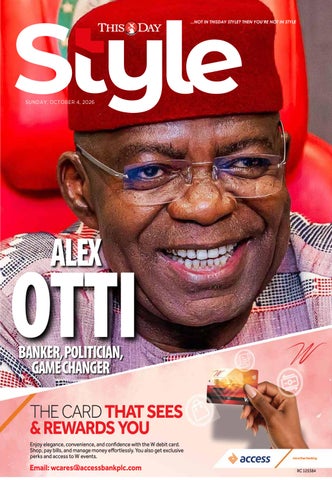
ALEX
OTTI BANKER, POLITICIAN, GAME CHANGER
THE CARD THAT SEES & REWARDS YOU Enjoy elegance, convenience, and confidence with the W debit card. Shop, pay bills, and manage money effortlessly. You also get exclusive perks and access to W events.
Email: wcares®accessbankplc.com
♦ access
1
more than banking
RC 125384
Sunday, October 4, 2026 Vol. 22, No. 11464
Sunday, October 4, 2026 Vol. 22, No. 11464
EDITOR’S LETTER
COVER NOTE
MEN: 8 THINGS TO DO TO SMELL BETTER Smelling good is actually much simpler than many men make it. It is less about owning an expensive bottle of perfume and more about what happens before the perfume ever comes out. A man can be impeccably dressed and still ruin the whole effect the moment he walks into a room if he does not smell as good as he looks. The suit is sharp, the shoes are polished, the watch is right, but something is missing. If you want to elevate your presence in any room, looking good is only part of it. You should smell good too. Here are a few simple things every man should know.
EXECUTIVE EDITOR
14
14
B
efore entering politics, Alex Otti spent more than two decades in the banking industry, rising through the ranks of several leading financial institutions before becoming Group Managing Director and Chief Executive Officer of Diamond Bank. His years in the corporate world gave him experience in financial management, business development and leadership, but in 2014, he chose to leave banking and pursue a different ambition: becoming governor of Abia State.
Lifestyle & Fashion
4
10
20
Men: 8 Things to do to Smell Better
3
Pac Holdings Celebrates 20 Years Of Impact
4
Your Style Changed. Does Your Wardrobe Have To?
6
S yle TR
UT H
& RE A SO
N
EXECUTIVE EDITOR KONYE NWABOGOR
Crowns, Culture And Change: The Women Who Shaped Nigerian Pageantry
8
Interview: Ojay, “You Evolve or Dissolve”
10
DEPUTY EXECUTIVE EDITOR OLUFUNKE BABS-KUFEJI
Are You Doing Too Much to Your Skin?
18
ASSISTANT EDITOR YINKA OLATUNBOSUN
Opinion: Why Do We Stay in Relationships That No Longer Work?
19
CONTRIBUTOR EBIYEKON DORCAS DIO
10 Reasons To Add More Green To Your Wardrobe
20
Beyond The Cinema: The Rise of YouTube Movies
22
08111847087
08111847086
DIRECTOR, PRINT PRODUCTION CHUKS ONWUDINJO 08077092196
What We Keep
I
had one of those moments while putting this week’s issue together when a sentence followed me around for much longer than necessary. It came from my opinion piece, Why Do We Stay in Relationships That No Longer Work?: “If you met this person today, knowing everything you know now, would you still choose them? Not who they were five years ago. Not who you hope they might become. Who they are today.” Now, that is one heavy question. The piece was inspired by Nurse Sugar’s conversation with Ifedayo Agoro on Diary of a Naija Girl, which has been all over social media. I watched the excerpts and, like many people I imagine, kept wondering where exactly the line is between fighting for a relationship and fighting against what you already know. There is no clever answer here. People stay in relationships for a hundred different reasons, and both men and women do it. Love is complicated, history is powerful and leaving is not always the brave choice any more than staying is always the foolish one. But every now and then, perhaps we should remove the years, promises and potential from the equation and look at what is actually in front of us. Read the article. I have a feeling it will start a few conversations. Elsewhere in the issue, Nollywood is giving us another kind of relationship to examine: ours with YouTube. I remember when watching a new Nigerian film meant going to the cinema or waiting for it to eventually find its way to television. Now you can be lying in bed on a Sunday afternoon and discover a new film alongside several million other people. The industry itself seems less certain about whether this is entirely good news. There are conversations about quality, cinema attendance, revenue and whether the ease of YouTube is changing how films are made. Fair questions. But you cannot ignore what it has opened up: audiences across borders, fewer barriers to distribution, and immediate feedback from viewers who certainly don’t believe in keeping their opinions to themselves. Beyond The Cinema: The Rise of YouTube Movies takes a closer look. And because October always gives us a good excuse to look back at ourselves, we also went down memory lane. Do you remember when pageants were a really big deal? When a new beauty queen was a national conversation, and people actually remembered who wore the crown from one year to the next? Crowns, Culture And Change: The Women Who Shaped Nigerian Pageantry revisits some of those unforgettable women and the different eras they represented. The pageant world may not command quite the same attention today, but I still believe in what the right platform can do for a young woman. A crown can be temporary; the access, confidence, visibility and opportunities that come with it do not necessarily have to be. And Nigeria has certainly produced women who proved that there could be a very interesting life after the sash. Anyway, how are you all doing? I hope life has been kind to you this week, or at the very least, not unnecessarily dramatic. Mine has given me enough material to keep these letters interesting, so I suppose we should be grateful for small mercies. Have a lovely Sunday, and enjoy the issue.
Love,
2
Printed by Ups Digitals Ltd, Abuja; 08057025005; info@upsdigitals.com
@thisdaystyle |
@thisdaystyleon | www.thisdaystyle.ng
By Funke Babs-Kufeji
1. Start with a proper shower
This sounds obvious, but it matters. And for men who sweat heavily, especially in hot weather, double cleansing in the shower can make a noticeable difference. The first wash helps break down sweat, oil, deodorant residue and the day’s build-up on the skin. Rinse properly, then go in with a second wash, paying particular attention to the underarms, chest, groin, back and feet. You do not need to scrub your skin aggressively. A thorough second cleanse is enough to leave the skin properly clean without stripping it. A good shower is not about spending half an hour in the bathroom. It is about actually washing rather than simply standing under the water.
2. Exfoliate Your Underarms, Neck and Feet
These areas can easily collect sweat, dead skin and product build-up, which can contribute to unwanted odour. Gentle exfoliation once or twice a week can help keep the skin clean and fresh, particularly around the underarms, neck and feet. There is no need to scrub aggressively. A mild body exfoliant and a gentle touch are enough. And because these areas can be sensitive, stop if the skin becomes irritated or uncomfortable.
3. Look after your underarms
A good deodorant or antiperspirant can make a considerable difference, especially in hot weather. Apply it to clean, dry skin and give it time to dry before getting dressed.
4. Take care of your mouth
Bad breath can undo every other grooming effort. Brush properly, clean your tongue, floss and keep up with dental appointments. If persistent bad breath remains despite good oral hygiene, it is worth speaking to a dentist.
5. Wash and maintain your hair
The scalp can produce sweat and oil, particularly in a hot climate. Keep your hair and scalp clean and pay attention to whatever styling products are being used. A heavily fragranced shapoo is not a substitute for a clean scalp. Keep the shampoo simple and fragrance free.
6. Clean your beard
A beard can hold onto food, sweat, smoke and product residue. Wash it regularly and keep the skin underneath clean. If the beard is long, a proper beard wash and conditioner can help keep it fresh.
7. Use fragrance properly
Perfume should complement cleanliness, not cover up a lack of it. Apply fragrance to clean skin, particularly pulse points such as the wrists and neck. A few wellplaced sprays are usually better than emptying half the bottle. And remember, smelling expensive does not necessarily mean smelling strong. A good fragrance should be noticed, not announced several metres before you arrive.
8. Drink water and pay attention to your diet
Body odour is not determined by food alone, but hydration and diet can affect how a person smells, particularly alongside sweating. Drinking enough water and maintaining a balanced diet are part of looking after the body generally. Ultimately, smelling good is one of those small details that can change how a man presents himself. It does not require a bathroom full of products or a fragrance collection worth a small EMMANUEL OKORO fortune.
3
Sunday, October 4, 2026 Vol. 22, No. 11464
Sunday, October 4, 2026 Vol. 22, No. 11464
PAC HOLDINGS CELEBRATES 20 YEARS OF IMPACT
P
anAfrican Capital Holdings Limited (PAC Holdings) marked two decades of business, investment and growth across Africa with an exclusive 20th Anniversary Gala Night at Harbour Point, Victoria Island, Lagos. Held under the theme “20 Years Strong: Igniting Africa’s Future,” the black-tie celebration brought together guests to commemorate a journey that began in 2006. The evening featured Professor Benedict Oramah as Keynote Speaker, with Lagos State Governor Babajide Sanwo-Olu as Special PAC RESEARCH REPORT LAUNCH Guest of Honour. Over the past two decades, PAC Holdings has evolved from a focused financial services platform into a diversified proprietary investment group with interests across seven sectors: Financial Services, Real Estate & Infrastructure, Technology & Payment Systems, Agro-Allied & FMCG, Healthcare, Hospitality & Entertainment and Renewable Energy. The Group has also facilitated transactions across more than 35 countries, working with governments, financial institutions and businesses across banking, infrastructure, telecommunications, energy and healthcare. As it enters its third decade, PAC Holdings is looking ahead through its SCALE 2030 strategic direction, with an emphasis on sustained growth, stronger market relevance and greater impact. ALFRED ADEWALE MARTINS
GOV BABAJIDE SANWO OLU
CHRIS AND HIS WIFE MRS OMOLOLA OSHIAFI
4
OBA ABDULWASIU LAWAL
SAM OGBU NWOBODO
OLIVER NNONA
FATAI ASIMI
RENE AWAMBENG
SINA ALIMI
TUNDE AND OLUSEYI AFOLABI
CHARLES OKOUGBODU
HUMPHREY ORIAKHI
NENTOK GOMWALK
SAM EGUBE
OLU AKPATA
WOLE ABU
CORDELIA AND ERIC OKORUWA
AYODEJI ABDUL
TAIWO ALIMI
DELE IGE
NELSON AND JOSEPHINE OSHIAFI-ONUOHA
NNEKA ONYEALI-IKPE
FOLASHADE AMBROSE-MODEBEM
AFIE BRAIMAH
OLUFUNKE ADU
JENNIFER ODUFUWA
ABUBAKAR SANI BELLO
AKINWUMI AMBODE
PROF BENEDICT ORAMAH MRS CHINELO ORAMAH MR ADAM MOLAI MRS OMOLOLA OSHIAFI MR CHRIS OSHIAFI
PASCHAL NWAEZEAPU
KEHINDE ALIMI
ADEPOJU AND OYINDA OMIDIRAN
RAHUL SAVARA
TREVOR WARD
CHARLES OKONKWO
OLUFEMI FALEBITA.
WALE TINUBU
MRS UJU IFEJIKA MR CHRIS OSHIAFI MRS OMOLOLA OSHIAFI SENATOR TOKUNBO ABIRU PROFESSOR OLADAPO AFOLABI MR DONALD DUKE MR MUSTAPHA CHIKE OBI
OMONE OSHIAFI, CHRIS OSHIAFI, OMOLOLA OSHIAFI AND JOSHUA OSHIAFI
5
TR
UT H
& RE A SO
TR
N
Sunday, October 4, 2026 Vol. 22, No. 11464
YOUR STYLE CHANGED. DOES YOUR WARDROBE HAVE TO?
There comes a point when you open your wardrobe and, despite having plenty of clothes, very little feels right. Nothing is necessarily wrong with the clothes. They still fit, they are still in good condition, and some of them were once your favourites. They simply do not feel quite like you anymore. Before you decide you need a wardrobe overhaul, consider another possibility: perhaps your clothes have not become boring. Your style has changed. Personal style rarely stays exactly the same. What appealed to you three years ago may not be what you reach for today. Maybe you once loved fitted dresses and heels but now prefer relaxed tailoring and flats. Perhaps your wardrobe used to be full of colour and prints, but you are suddenly drawn to cleaner silhouettes and quieter combinations. Or you may be moving in the opposite direction, becoming more adventurous after years of playing it safe. The instinct is often to shop your way into this new version of yourself. But changing your style doesn’t necessarily mean changing everything you own. Sometimes, you just need to stop wearing your old clothes the same way.
& R E A SO
N
same jeans with the same type of top. Eventually, even good clothes begin to feel boring because we already know exactly how the outfit will look. Break the formula. Wear the dress you usually save for dinner with flat sandals. Pair tailored trousers with a simple T-shirt instead of a blouse. Throw a blazer over denim. Wear a crisp shirt open over a fitted tank. The clothes have not changed, but the proportions and attitude have.
Let Accessories Do Some Work
Sometimes the quickest way to move an old wardrobe towards a new aesthetic is through accessories. Shoes, jewellery, belts, bags and even eyewear can completely change the direction of familiar clothes. A simple dress can look sleek with sculptural jewellery and a structured bag, relaxed with flat sandals and a woven tote, or more playful with colourful accessories. If your style is evolving, this is also a smarter place to experiment before committing to several new outfits.
Pay Attention to Silhouette
TONYE GARRICK
Eventually, you may discover that something genuinely is missing. Perhaps your wardrobe needs better everyday shoes, wider trousers, a good jacket or a bag that works with the way you dress now. That is when shopping becomes useful. Instead of buying several random pieces because you are bored, you are buying one or two things that connect what you already own to where your style is going. It is the difference between shopping for a temporary fashion fix and actually building a wardrobe.
Start With What You Still Love
Forget trends for a moment and look at your wardrobe properly. Which pieces would you still be attracted to if you saw them in a shop today? Those are the clothes worth working with. A great white shirt, well-cut trousers, a dress you still love, good denim, or a blazer that fits beautifully doesn’t suddenly become useless because your aesthetic has shifted. The question is whether you can make it work for the way you want to dress now.
Know When Something Has Had Its Time
Break Your Old Outfit Formulas
LAMIDE AKINTOBI
Most of us repeat combinations without thinking: the same blouse with the same trousers, the same dress with the same heels, the
You may not dislike your clothes; you may dislike how you are wearing them. If you are currently drawn to looser silhouettes, try an oversized shirt with trousers you previously wore with fitted tops. If you want a more defined shape, add a belt to a dress or blazer. Roll sleeves, change your tuck, layer differently or play with lengths. Small adjustments can make surprisingly familiar pieces feel current again.
Identify the Real Gaps
By Bakare Mariam
6
UT H
Sunday, October 4, 2026 Vol. 22, No. 11464
BUKKI GEORGE TAYLOR
EMELDA RUFAI
Of course, not everything needs to be saved. Some clothes belong to an earlier version of your style, and that is perfectly fine. If something no longer fits properly, feels uncomfortable, or keeps getting pushed aside no matter how you style it, it may be time to let it go. The point is not to keep everything. It is to become better at recognising the difference between “I don’t like this anymore” and “I don’t like how I’ve been wearing this.”
EJIRO AMOS TAFIRI
7
Sunday, October 4, 2026 Vol. 22, No. 11464
CROWNS,
CULTURE AND CHANGE: THE WOMEN WHO SHAPED NIGERIAN
PAGEANTRY Beauty pageants have never commanded the kind of national obsession Nigerians reserve for football, music or Nollywood. Yet for almost seven decades, the women who wore the country’s most famous crowns have occupied a fascinating place in our cultural history. Long before Instagram, influencer deals and viral crowning moments, there was Miss Nigeria. Later came the Most Beautiful Girl in Nigeria, better known as MBGN, ushering in another era of glamour and international competition. They are separate pageants with different histories, but together their queens tell an interesting story about changing ideas of Nigerian beauty, femininity and ambition. Perhaps even more interesting is what happened after the crowns came off. These women became nurses, lawyers, politicians, actresses, entrepreneurs, diplomats, advocates and media personalities. One made global history. By Yinka Olatunbosun
GRACE OYELUDE – Miss Nigeria 1957
N
igeria’s pageant story begins before independence. Grace Atinuke Oyelude became the first Miss Nigeria in 1957 after her brother submitted her photograph to the competition organised by the Daily Times. Born and raised in Kano, she represented the Northern Region. Oyelude used her £200 prize to travel to England, where she qualified as a nurse and midwife before earning further qualifications in nursing and hospital administration. Back in Nigeria, she built a distinguished healthcare career, eventually serving as senior matron and director of nursing services at Ahmadu Bello University Teaching Hospital before retiring in 1985. Today, she is remembered not simply as Nigeria’s first beauty queen, but as a pioneer whose crown became a doorway to an entirely different career.
8
Sunday, October 4, 2026 Vol. 22, No. 11464
REGINA ASKIA – MBGN 1989
ROSEMARY ANIEZE – Miss Nigeria 1960
R
egina Askia was first runner-up to Bianca and subsequently succeeded her as titleholder. She then made the leap into television and Nollywood, becoming one of the recognisable screen faces of the 1990s. But Askia reinvented herself again after relocating to the United States. She returned to school, trained in nursing and became a Family Nurse Practitioner. Today, she combines healthcare and advocacy and is the founder of Regina Medical Services in New Jersey, which opened in 2023.
R
osemary Anieze’s reign arrived at a remarkable moment. She was Miss Nigeria in 1960, the year the country gained independence, earning her the enduring nickname “Miss Independence.” Her story did not end with pageantry. Anieze-Adams became associated with Nigeria’s early broadcasting and performance scene, including radio drama, and later with Lagos cultural life. Her trajectory reflected a generation in which beauty, broadcasting and the arts were beginning to intersect.
NIKE OSHINOWO – MBGN 1991
N
H
elen Prest-Ajayi was 19 and studying law when she won Miss Nigeria in 1979. She subsequently represented Nigeria at Miss World and later earned a master’s degree in law from King’s College London. Today, Prest-Ajayi’s interests stretch across business and education. She is Chairperson of Bank of Nevis International Trust Services and an educational consultant and literacy advocate through Educatrix Resources. She is also an author, with much of her educational work focused on improving foundational literacy and numeracy.
BIANCA ODUMEGWUOJUKWU – MBGN 1988
F
ew Nigerian beauty queens have travelled quite as far from pageantry as Bianca Onoh, now Bianca OdumegwuOjukwu. After winning MBGN in 1988, she went on to win Miss Intercontinental in 1989. A lawyer by training, she subsequently entered diplomacy and served as Nigeria’s ambassador to Spain. Her public career has since reached another level. In May 2026, President Bola Tinubu elevated Odumegwu-Ojukwu from Minister of State for Foreign Affairs to Minister of Foreign Affairs, making the former beauty queen the country’s chief diplomat. It is perhaps the most striking example on this list of just how far life after a crown can travel.
M
unachi Abii, popularly known as Muna, won MBGN in 2007 and then did something relatively unexpected for a beauty queen: she became a rapper. Her career has since expanded across music, modelling and acting. In 2026, Abii was still actively working across music and film, speaking about bringing the two together through storytelling and creating soundtracks for film.
EZINNE AKUDO – Miss Nigeria 2013
E
ike Oshinowo became one of the most enduring personalities associated with Nigerian beauty culture after her reign. She moved through several worlds afterwards, including entrepreneurship, fitness, television and beauty. Most interestingly, she eventually returned to pageantry itself, taking on the Miss Nigeria franchise and attempting to reposition the competition for a new generation. Her story came full circle: from being judged on the pageant stage to helping shape what the institution could become.
HELEN PREST-AJAYI – Miss Nigeria 1979
MUNACHI ABII – MBGN 2007
AGBANI DAREGO – Miss World 2001
T
hen came the moment that changed everything. Agbani Darego won MBGN in 2001, reached the Top 10 at Miss Universe and, months later, won Miss World in Sun City, South Africa, becoming the first Black African woman to take the crown. The victory transformed Nigerian pageantry overnight. Darego went on to build an international modelling career, working with major fashion and beauty names, before moving into entrepreneurship with her fashion label, AD by Agbani Darego. More than two decades later, she remains the Nigerian beauty queen most immediately associated with global pageant success.
zinne Akudo represented another evolution: the crown as a platform for advocacy. The law graduate won Miss Nigeria in 2013. In a wonderful full-circle moment, one of her first major shoots afterwards was for THISDAY Style alongside Grace Oyelude, the first Miss Nigeria, crowned 56 years earlier. Akudo later founded The Eight Foundation, extending her platform into advocacy against sexual violence and support for survivors. More than a decade later, she has continued to build a public platform around meaningful conversations. She now hosts Beyond with Ezinne, a podcast exploring identity, healing, grief, faith, purpose and adulthood. Its second season launched in Lagos in June 2026 under the theme “Conversations That Matter.”
SHATU GARKO – Miss Nigeria 2021
T
hen, in 2021, Miss Nigeria produced an image that would have been difficult to imagine when the competition began in 1957. At 18, Kano-born Shatu Garko became the first Muslim woman and first hijabwearing contestant to win Miss Nigeria. Her victory sparked conversations about religion, modesty and pageantry, but it also expanded the visual idea of who could stand on a Nigerian pageant stage and ultimately wear its crown.
9
Sunday, October 4, 2026 Vol. 22, No. 11464
Sunday, October 4, 2026 Vol. 22, No. 11464
T
here was something about my conversation with Ojay that stayed with me long after we hung up. Even over the phone, his passion was unmistakable. Not just for entertainment, but for building something bigger than himself; something that would outlive him, create opportunities for others and contribute to an ecosystem where creatives could thrive. As he spoke about his journey, from talent management to building DefEars into a multifaceted entertainment and creative company, one thing became increasingly clear: Ojay is not particularly interested in standing still. He is constantly looking for new opportunities, new ways to create value and new possibilities for the people and industries around him. Whether it’s discovering talent, embracing technology, investing in original African stories or reimagining the power of community, his approach seems to be guided by one simple philosophy: you evolve or dissolve. In this conversation, we explore the decisions, failures, ambitions and unconventional thinking that have shaped his journey so far, as well as his vision for the future of African entertainment.
By Ayomipo Lawal DefEars started as a talent management company, but today it has evolved into something much broader. Take us through that journey. I’ve been in the music space for a long time, and I’ve morphed into so many things along the way. I used to style music videos with Clarence Peters and worked with Asa Asika too, initially styling videos for newer artists who were trying to work with him. I also used to do print and merchandise. Along the way, I met Blackmagic through Asa. He wanted some things printed, so I made them for him. At the time, I was studying at the University of Ibadan, and I was very social in school, so when we were putting together a show, I reached out to him. We cut a deal; I brought him over and took care of him. He liked how we worked and eventually reached out to ask if I’d manage him. I was already managing JHYBO, who had a song with Cynthia Morgan. So I was already doing music management in one form or another, even before I finished school. Then, in 2020, I was having a conversation with a friend in Ethiopia about the industry — that “friend” is Dapper that we all know today — and we realised that while we had a lot of solid labels, we didn’t really have solid management companies. We weren’t talking about individual managers; we were talking about an actual management company. That was where the vision for DefEars came from. The reference at the time was Def Jam, and I came up with DefEars. It literally means “definitely hear us” — you’d definitely hear us, but we’re also deaf to mediocrity. We don’t hear that. I started with talent management. I’d already been managing Skiibii for about two years before DefEars, but he became my first official DefEars talent. Then, through music promotion, I met my partner and COO of the company today, Teni Oyewole, who was previously Head of Sub-Saharan Africa for TikTok. She was very deep in influencer marketing and was mentoring a lot of influencers. I saw an opportunity in what she was doing and told her, “There’s a business here. These people already trust you, so let’s build something around that trust.”That’s how we started influencer management. From there, we moved into content creator management, production, TV production, merchandising and agency services. We’ve done TVCs, including one for Checkers Custard, and today we’re the agency for brands like Kellogg’s, Munchies, BetPawa, Lush Hair, Indomie and Colgate. We handle their social media accounts — especially TikTok — and work across influencer marketing, production, events and TVCs. And now we’ve moved into the YouTube movie space with DefEars Originals. We released our first official movie, Tough Cut, recently. So, yeah, we’ve expanded quite a bit. It has gone from talent management into a much broader entertainment and creative company. Looking back over your career, what was the one decision that changed everything for you? The decision that changed everything for me was deciding to see
10
everything I was doing as a company, rather than just seeing it as me. I’ve always been a hustler. Even in secondary school, everybody knew that about me; I used to sell sweets to my colleagues. In university, I always found a way to make money for myself. But at some point, I wanted to make money for other people too, not just myself. That was the pivotal moment — going from Ojay Lagos, or Ojay Swag, to DefEars Management. Suddenly, it wasn’t about me anymore. I gave all the glory to the company. That shift in mindset changed everything. I wasn’t just building myself anymore; I was building something bigger than myself.
OJAY:
“YOU EVOLVE OR DISSOLVE”
You seem to have a knack for spotting people before they become obvious choices. What do you look for that others might miss? People look at stats. They look at numbers. They look at trends. To be very, very honest, I’m focused on how much you want it. How bad do you want it? I search for hunger. When there’s a will, there’s a way. I feel like we can add everything else that’s missing along the way. But you can’t add hunger to someone who’s not hungry. So, I genuinely look for people who are super passionate, hungry for what they want and have the will to go after it. Even talent isn’t enough. Your talent can fade if you don’t stay hungry. I’ve been able to spot early on when someone really, really wants it. It’s only hunger that’s worth my time. Your talent isn’t even worth my time if tomorrow you can wake up and decide you don’t feel like doing this anymore. I’ve wasted my time, my efforts and my journey. So that’s what I look for. What’s been the toughest part of building DefEars that people on the outside probably don’t, see? People management. Having to manage different people, different walks of life and different temperaments, while also figuring out how to satisfy everybody on the team, has probably been my biggest challenge. You have to know when to blow hot, when to blow cold, when to make strict decisions, when to ignore something and sometimes when to act like you didn’t even know. That skill set of people management has honestly been the most difficult challenge for me. That’s where emotional intelligence really comes into play. You’ve moved across music, influencer marketing, events, production and now original content. How do you make sure you can operate at that scale without losing quality? For me, it’s very simple: I hire my weakness. I’m nothing without my team. When I’m going into a new terrain, I look for who’s the best in that area, and we collaborate. I’m very big on collaboration. I bring my own insights from what I’ve done in the past, you bring your experience, and we merge it together and do a madness. That’s been my approach to breaking into new fields quickly. I can learn it myself, but that will take me a long time. I also learn fast on the job, but I’m always a student of the game. When I’m entering a new space, I’m not trying to be the smartest person in the room. I’m trying to find the smartest
person in that room and work with them. The entertainment industry moves quickly. How do you decide what’s actually worth chasing? I only do what I enjoy. If you notice, everything I’m doing is still around the same thing: entertainment. I only chase things that I enjoy. If you come to me today with an opportunity in treasury bills, as great as I might think the opportunity is, it’s not for me. I make sure I only chase things that, six months from now, I’ll still enjoy doing. I don’t just go for turnover or making money. I go for things I’m super passionate about and things I know I can sustain. If you come to me with a tour that’s going to make me quick money, but I know I’m not going to enjoy it, no matter the amount, I’ll let it go. It’s not mine. It’s probably for someone else. You’ve spoken about community as the next major frontier in entertainment. Why? I genuinely believe the future is going to be about communities. Before, it was an individual race. You had individual superstars. Now, I think communities are going to become the superstars. You can’t be a star alone anymore. In the future, it will be less of you and more of us. The earlier we understand that trajectory, the better for us. That’s why you’re seeing all these communities emerge — cafés, book clubs, cycling communities, people coming together to talk about social issues. The idea of community is going to be huge. I have a friend who has a community where they just listen to albums. They come together, listen to two albums, and everybody gives their commentary. Now imagine I’m trying to launch a new artist and I’m in partnership with that community. We do a listening session together. Think about the content we can create and the opportunity to tap into an audience that already exists. That’s the future I see. Even when you think about how we used to sit under a tree and have elderly people tell children stories, that was a community. Imagine if someone had recorded those stories. Imagine the footage we’d have today. The culture doesn’t have to disappear just because the setting changes. Maybe we’re not sitting under a tree anymore. Maybe we’re sitting in a café. But the community is still there. Everything needs to be leveraged. Every opportunity, you have to look at it 360 degrees and ask, “Am I leveraging this in its entirety?”That’s how I think the future is going to work. African entertainment has become one of the continent’s biggest global exports. From where you sit, what do the next five years look like? It’s going to be worth so much. I joke with my friends that I’m really interested in anything related to content because I know what it’s going to be in the next five years. That’s what I’m going to use to send my kids to university — the dividends of all the content we’re making now. Every time, it gains more value, especially when we’re telling our own unique, original stories. We’re entering an era where we’re seeing stories like Children of Blood and Bone. That’s our story, but it’s being told to us. Imagine if someone had told that story decades ago. Imagine how valuable it would be now. So I’m very interested in telling our stories ourselves. Our music is going to become even more valuable because people will continue sampling it. Look at Fela’s music. His legacy continues to create value because his work is being sampled and reinterpreted. I also see influencer marketing becoming much bigger. People will eventually get tired of seeing the same American and British influencers and want to bring more Nigerian and African creators into global campaigns. We’ve already seen glimpses of that. We had a talent who partnered with Fortnite to create his own unique dance and avatar. We charged quite a lot for it, and at the time, he couldn’t even believe he could earn that kind of money. But that’s valuable. It spotlighted him, it spotlighted us, and it spotlighted Africa. And it’s not just music. Our food, culture, language, fashion, stories — everything is going to be part of this explosion. You need to be ready. You evolve or dissolve. That’s always been my approach. As much as we think we’ve covered this region, there’s always another region to cover. We want to be prepared and move fast so that when these opportunities come, we’re not redundant. We’re not the people who were relevant five years ago. We’re still part of the conversation. If you had unlimited resources tomorrow, what’s the one idea you’d put everything behind? I actually don’t have a project I’ve never tried to do, but I know the project I’d put everything behind — and I’ve already started it. It’s called Hustle. Hustle is a web app where brands and content creators can connect directly. You don’t need a middleman. If you want to book a content creator, you go on the platform, send a message, negotiate in real time and get the deal done. The creator uploads their content, and it’s watermarked. Once you approve it, the platform releases the money to the creator. It acts as an escrow, takes its percentage, and you get your video without the watermark. Very simple. It’s not even for the Coca-Colas of this world. I’m talking about the everyday SME. Imagine an SME that has ₦200,000 to spend on promotion and wants to reach people in Kaduna but doesn’t know anybody there. They can go on Hustle, categorise Kaduna influencers, see their reach and find the right person for their niche. The platform will also have AI suggestions — creators recommended based on your niche, audience and budget. That’s the future of what I want to build: taking influencer marketing and putting technology behind it. That’s all I want to do.
11
Sunday, October 4, 2026 Vol. 22, No. 11464
Sunday, October 4, 2026 Vol. 22, No. 11464
Enjoy elegance, convenience and confidence with the W debit card. Shop, pay bills and manage money effortlessly. You also get exclusive perks and access to W events
12
13
PHOTOGRAPHY: by Kelechi Amadi- Obi and Kelechi Ofoedu
14
ALEX
OTTI:
B
Sunday, October 4, 2026 Vol. 22, No. 11464
BANKER, POLITICIAN, GAME CHANGER BY FUNKE BABS-KUFEJI
efore entering politics, Alex Otti spent more than two decades in the banking industry, rising through the ranks of several leading financial institutions before becoming Group Managing Director and Chief Executive Officer of Diamond Bank. His years in the corporate world gave him experience in financial management, business development and leadership, but in 2014, he chose to leave banking and pursue a different ambition: becoming governor of Abia State. The move from boardroom to politics came with its share of challenges. Otti contested under the All Progressives Grand Alliance in 2015, when the Court of Appeal declared him the winner of the governorship election, only for the Supreme Court to
reverse the decision. He returned to the race in 2019 and made a third attempt in 2023 under the Labour Party, eventually securing victory and taking office as governor. Since then, his administration has focused on road construction, public transportation, electricity supply and improving the operating environment for local manufacturers, particularly in Aba. Otti says his government has also reduced the state’s inherited debt by about 75 per cent while maintaining significant capital expenditure without borrowing for the road projects he highlights. These claims form part of his account of the administration’s priorities, alongside efforts to strengthen public services and support business activity. With another governorship election approaching in 2027, questions remain about his political future and his place in the Labour Party. In this interview with Funke Babs-Kufeji, Otti discusses his administration’s record, the thinking behind its policies, the challenges of governance and the kind of legacy he hopes to leave behind.
COVER
COVER
Sunday, October 4, 2026 Vol. 22, No. 11464
When you became governor in 2023, what did you find when you looked closely at the state’s infrastructure and finances? What immediately told you there was a lot of work to do? Whatever I saw, I told myself I would roll up my sleeves and deal with it. I saw a great deal, but you do not solve a problem by bemoaning your fate or looking backwards. As MKO Abiola reportedly said, you cannot move forward while looking backwards. I inherited debt of about N191.22 billion, including contractor debts, pension arrears and obligations to multilateral organisations. The debt to multilateral organisations was reported by the Debt Management Office at about N148 billion. We have since reduced the debt to about N48.4 billion, paying roughly 75 per cent of the debt we
15
inherited. You made infrastructure an early priority. You have said that your administration built about 450 roads without borrowing while reducing inherited debt by 75 per cent within 36 months. How did you manage that, and where did you decide to start? It comes down to planning. We decided that no less than 80 per cent of our budget would go into capital expenditure. Over the last three years, that figure has been between 80 and 82 per cent. In 2024, for instance, it was about 82 per cent, leaving roughly 18 per cent for recurrent spending. If the budget is ₦1 trillion, that means about ₦800 billion goes into capital expenditure, with the balance covering operating costs and other recurrent needs. That discipline leaves more money for roads, environmental work, hospitals, schools and other infrastructure. The other issue is the cost of governance. If you do not manage it carefully, you can work hard year after year without seeing the results. You have always emphasized about the importance of reducing the cost of governance, What have you done to reduce the cost of governance? We have tried to keep the cost of governance within 20 per cent. Salaries account for about 11.9 per cent of our costs, and we intend to keep that figure under control even after implementing the new minimum wage. We have had to reduce other areas of expenditure. That is part of the discipline behind our approach. Did your experience as a bank chief executive help you manage the state’s finances? Experience matters alot. I worked in banking and have always been comfortable working with numbers, so that background has been very useful to me. You cannot give what you do not have, and that experience has helped. The opposition has criticised the pace of your projects and accused you of failing to give the Federal Government adequate credit for some of the roads you have constructed. There have also been reports about the technical and administrative support behind federal road projects in Abia. Tell us about this support. The question to ask is what exactly is meant by technical and administrative support, and how much money is involved. There is a procedure for these things, and everything works according to that procedure. When the opposition runs out of things to criticise, it sometimes resorts to propaganda. These are federal roads that had not been attended to, so I approached the President and said I wanted to rehabilitate them and sought reimbursement from the Federal Government. The President told me that he had instructed the Minister of Works to approve requests from any state governor who wanted to construct federal roads within their state. He asked me to approach the Minister and follow the established procedure. However, the Federal Government would not commit to reimbursing the state. The President’s position was that the roads were being used by our people, so the state could choose to undertake the work if it wanted to. I subsequently approached the Minister, obtained the necessary approvals and awarded the contracts. The roads were completed. Then people began asking why I was not giving the Federal Government credit. We have always acknowledged that these are federal roads. What more credit is expected? The approval process is not an arrangement, it is available to every state that wants to undertake such projects. Of the approximately 450 roads you have constructed, how many are federal roads? Not many. There are about six federal road projects altogether, including Port Harcourt Road in Aba. We had the chance to visit the newly constructed central bus terminal named after Professor Oti. It has been described as something of a mini airport, with
16
Sunday, October 4, 2026 Vol. 22, No. 11464
a health centre, a control centre and other facilities. What is its capacity, and what are your plans for it? The terminal has a capacity for 340 buses. It is not exclusively for our green shuttle buses; it will accommodate other operators as well, bringing public and private transport services together in one location. We do not want bus parks scattered all over the place. The idea is to centralise transport operations so buses can depart from and return to an organised terminal. Our broader objective is to make essential services, including transportation, education and healthcare, more accessible to everyone in Abia state. Why did your administration choose electric buses, particularly after the removal of the fuel subsidy and the resulting increase in transportation costs? When the petroleum subsidy was removed, transportation costs rose, along with the prices of other goods and services. The subsequent floating of the naira also contributed to inflation and a higher cost of living. At the National Economic Council, we discussed the impact of these developments, and the Federal Government provided support to states, including funding for compressed natural gas buses. When we assessed our circumstances in Abia, we felt there was an opportunity to go further. We had already made progress on electricity supply through Geometric Power, which serves Aba and several surrounding local government areas. We are interested in the green economy and the transition towards net-zero emissions. Electric vehicles have considerably fewer moving parts than conventional internal-combustion engines, which can reduce maintenance costs. We therefore decided to invest in electric buses, and we are pleased with that decision. We started with 20 buses, brought in another 20, and the next 30 were almost ready at the time of this interview, with delivery expected in November. Another 30 are planned after that. Our target is 100 electric buses. You mentioned that the charging points at the terminal are powered by solar energy. How will the charging infrastructure be expanded across the state? We have two facilities in Umuahia: one at the International Conference Centre and another at the bus terminal. The solar installation is an alternative power source. We do not want a situation where the public electricity supply fails and the buses cannot operate. We also have a charging facility in Aba, where we are building a larger bus terminal. The project has progressed considerably, and we expected to commission it before the end of the year or very early in the new year. The Aba terminal will be larger than the one named after Professor Oti. We plan to establish terminals across the three zones to connect major towns and communities more efficiently. Eventually, services could extend to cities such as Enugu, Port Harcourt and Lagos, depending on demand. There is no point running empty buses to Lagos; everything has to fit into the transport master plan. There is a bigger question around Aba’s future as an industrial and manufacturing centre. It has often been described as the “Japan of Africa”, is it
something you are promising it will be , and what specifically have you done in Aba since assuming office? I often disagree with the phrase “Japan of Africa” We are not trying to copy Japan, China or Dubai. We want to be ourselves. We started with power because studies showed that energy accounts for close to 60 per cent of manufacturing costs. Geometric Power had been in Aba for almost 20 years but it had struggled to get going. We worked with the company and the state’s power team to identify the problems and took a decision to address them and in about a year, Geometric was operating, which resolved many problems. There were still shutdowns related to gas supply, so we also worked on an alternative gas supply. After power, we focused on the condition of the roads. We also looked at the quality of products made in Aba and, in partnership with the United Nations Development Programme, established an Export Growth Lab. The first cohort included about 25 manufacturers, who have completed the programme. Aba has always had enterprise. What it needed was an environment in which businesses could operate and grow. And it has that now.
COVER
COVER
Sunday, October 4, 2026 Vol. 22, No. 11464
In your opinion, do you see Made-in-Aba products competing with products made in China and becoming an asset for Nigeria? Absolutely. Aba has a large manufacturing base, including shoes, fabrics and clothing. Nigeria itself provides a substantial market, and improving the business environment can help manufacturers reach more customers. The work is about enabling local producers to make quality products and become more competitive. You have described Abia’s electricity arrangements as a major change, with Geometric Power supplying Aba and surrounding areas. If the state relies on this system and something goes wrong at Geometric, what is the fallback? It is a risk, and the alternatives could include renewable energy or another source of power. The generating machines are built to operate continuously, but we still have to factor in the risks. It is similar to asking what happens if the national grid collapses. You have to start somewhere while planning for contingencies. You have also said you do not intend to subsidise electricity and want to provide reliable, round-the-clock power. Why do you believe consumers should pay for electricity rather than receive a subsidy? What about low-income earners? It is not everything that should be subsidised. When you subsidise consumption rather than production, you can encourage inefficiency and create opportunities for abuse. When people have to pay, they tend to use electricity more efficiently. However you look at it, reliable public power can still be cheaper than darkness. If a business has to run a generator, buy diesel and pay for maintenance, it may spend much more than it would on public power. Manufacturers need a consistent supply of electricity, and if you can provide that, they are prepared to pay for it. Low-income earners will have to manage their consumption as people do in many parts of the world, where households sometimes switch off electricity to conserve power. You have the Labour Party ticket for the February 2027 governorship election, while saying you do not oppose President Bola Ahmed Tinubu’s re-election. Some people see this as a comfortable arrangement between a Labour Party governor and the ruling party. How do you explain your position? I have said that I am not in a position to oppose his candidacy. Sometimes people misunderstand opposition. If you are part of a government and oppose everything, you can create an implosion. If I have a problem with a policy, I can raise it at our meetings. There are things the President’s administration has implemented that resonate with my thinking, including the removal of the fuel subsidy. I have also said that the President has a right to run. That does not mean I have abandoned my own political position or my own presidential candidate. With the next governorship election approaching, what do you want the people of Abia to take away from your 3year 3months in office? Do you see the opposition as a threat to your re-election? We are on the way to delivering what we promised our people. We have the capacity, commitment and character to do what is right. Opposition is a natural part of democracy. We are mindful of its existence, but we are not trying to push it away, and we do not react to it unnecessarily. If you are no longer governor, what would you want your legacy to be? What should the people of Abia remember you for? A. I have not thought about it in detail, but I would want my legacy to be about leadership: genuine, sound and selfless leadership that puts the people first. Leadership is more important than roads, hospitals or any individual project because everything succeeds or fails on the strength of leadership. Geometric Power deserves credit for its work; our role was to provide support. Providing that support is also part of what leadership
17
Sunday, October 4, 2026 Vol. 22, No. 11464
Sunday, October 4, 2026 Vol. 22, No. 11464
OPI NION @thisdaystyle |
ARE YOU DOING TOO MUCH
YOUR SKIN?
There was a time when a skincare routine meant cleanser, moisturiser and perhaps sunscreen. Now, one look at the average beauty shelf and you might find vitamin C, niacinamide, retinol, glycolic acid, salicylic acid, toner, essence, exfoliating pads, masks and three different serums all waiting for their turn. We have become very good at adding things to our skin. A few spots appear, so we buy something for acne. The face looks dull, so in comes an exfoliant. Someone on TikTok has incredible skin and swears by a particular serum, so that goes into the cart too. Before long, you are layering products without being entirely sure what half of them do. The irony is that in the pursuit of better skin, we sometimes end up doing too much.
By Bakare Mariam
Your Skin Can Get Overwhelmed
That sudden tightness, dryness, stinging, or unusual sensitivity shouldn’t automatically send you shopping for another product. Look at what you are already using first. Perhaps you recently increased how often you exfoliate. Maybe you introduced a new active ingredient or started combining several products designed to tackle the same problem. If your skin was relatively comfortable before and suddenly isn’t, adding something else to “fix” it may only make it harder to identify the culprit. This is also why introducing several new products at once is rarely helpful. If your skin reacts, which product caused it? You have no idea. Introduce products gradually and pay attention to how your skin responds.
Not Every Spot Requires a Skincare Emergency
A pimple appears on Tuesday and by Wednesday there is a new cleanser, spot treatment and serum in the bathroom. We have all become a little impatient with skin. Occasional breakouts happen, and they do not necessarily mean your entire routine has failed. Constantly changing products every time your skin misbehaves can leave you
18
chasing one problem after another. The same applies to results. Skincare advertising and social media have made dramatic transformations look almost instant, but using a product for a few days without waking up with completely different skin does not necessarily mean it isn’t working. Give products time to do what they are designed to do, while following their directions. Of course, burning, swelling, significant irritation or another concerning reaction is different. Stop using the product and seek professional advice where necessary.
there, perhaps an acid serum at night and a peeling treatment at the weekend. Individually, each product may have a purpose. Together, they may simply be too much for your skin. Go through your shelf and check what your products actually contain. You may discover that several of them are doing very similar jobs. And remember that more product does not mean faster results. Using twice the recommended amount or applying something more frequently than instructed will not necessarily get you to glowing skin twice as quickly. Sometimes it gets you irritation instead.
You Probably Don’t Need All Your Friend’s Routine Is Not Those Actives Exfoliation is a particularly easy Your Routine place to overdo things. A scrub here, an exfoliating toner
This may be the hardest skincare lesson in the age of influencers.
Someone can have beautiful skin and still be completely unqualified to tell you what your skin needs. Your friend may happily use a product that irritates you. An influencer’s elaborate twelvestep routine may be perfect for her and completely unnecessary for you. Differences in skin type, sensitivity, age, environment and existing concerns all matter. So before buying the latest product everyone seems to be talking about, ask yourself one question: What exactly am I trying to treat? If you cannot answer it, perhaps you don’t need the product.
Sometimes, Go Back to Basics
A good skincare routine does not need to impress anybody. For many people, a sensible foundation is fairly straightforward: cleanse appropriately, moisturise and use sunscreen during the day. From there, you can introduce products to address specific concerns rather than adding them simply because your routine feels too basic. There is also a point when another serum is not the answer. Persistent acne, recurring irritation, unexplained rashes or other stubborn concerns may need assessment by a dermatologist rather than another round of trial and error.
F
@thisdaystyleon |
www.thisdaystyle.ng
BY KONYE CHELSEA NWABOGOR
or Nigerian women, there is a particular kind of relief that comes with being able to say, “I have someone.” Add a ring and the questions change. Nobody is asking when you will settle down anymore. Your mother can relax. The aunties have moved on to somebody else. Friends are discussing aso-ebi and, depending on how public your relationship is, Instagram already knows there is a wedding somewhere in
Psychologists call a version of this the sunk-cost effect: previous investment can influence our willingness to continue with something even when the current reality no longer justifies it. Relationships are obviously not business investments, but the emotional arithmetic is familiar. There is also potential. Perhaps he will stop cheating. Maybe she will become less controlling. He will eventually communicate. She will finally trust the future. you. Once you marry, things will settle. But what happens when Sometimes they do. the relationship everyone But potential needs evidence. is congratulating you for is An apology is evidence of making you miserable? regret. It is not automatically That question feels evidence of change. If the particularly relevant after offence changes but the the recent conversation pattern remains; betrayal, around Nigerian-born apology, reconciliation, entrepreneur and content temporary improvement, creator Olubukola “Sugar” betrayal again, then Akinpelu, popularly known forgiveness can quietly as Nurse Sugar. In her new become maintenance. memoir, My Life as Sugar: This does not mean cheating A Memoir of Everything I must end every relationship Built and Everything I Hid, or that one terrible season and a recent interview means two people should with Ifedayo Agoro on separate. Long relationships Diary of a Naija Girl, are messy. People hurt Akinpelu spoke about each other. Couples survive the distance between the infidelity, financial crises, successful life people saw grief, infertility, career online and what she says problems and periods she was experiencing when they barely recognise privately in her marriage. themselves, never mind each She discussed a surprise other. proposal, marriage, The more useful question financial abuse and what is what happens after the she describes as unhealthy problem. patterns she did not Does anything actually immediately recognise. change? Her account has since If you complain that you feel become the subject of neglected, does your partner competing allegations become more present or online, which is another simply more defensive? After cheating, is trust genuinely rebuilt or are reminder that the public rarely knows everything happening inside you now expected to become a private investigator? When you disagree, somebody else’s marriage. But one line from the description of her memoir can you still speak without humiliation, threats or contempt? Are both captures something many women will recognise: “The world knew Sugar. people repairing the relationship, or has one person become its full-time It never knew me.” How many relationships look completely different maintenance department? from the inside? Commitment has become one of the ways we measure And perhaps the hardest question: if you met this person today, knowing romantic success. Five years together means something. Ten years everything you know now, would you still choose them? means even more. Engagement suggests intention. Marriage is treated Not the person from five years ago. Not the person they promise to as arrival. Yet none of those things tells us whether two people trust each become. This person. other, communicate well, remain faithful or even particularly like each other There is another practical reality women do not discuss enough. Sometimes anymore. And for Nigerian women, walking away can come with another set leaving is difficult because the relationship has swallowed everything of calculations. Research among unmarried women found pressure coming around it. Your friends are his friends. Your weekends revolve around him. not only directly from parents but indirectly through family gatherings, friends Your finances are intertwined. Every future plan has “we” attached to it. and colleagues. Another 2026 study of Nigerian female academics and Maintaining your own friendships, earning capacity, interests, and sense of doctors found that some experienced workplace stigma because they were self is therefore not preparation for a breakup. It is healthy adulthood. Love single and childless. should expand your life, not leave you unable to imagine one outside it. So imagine finally finding the relationship everyone has been asking you None of this is an argument for leaving whenever love becomes difficult. about, only to admit it isn’t working. Neither is it an argument for staying because you have already stayed this You are 34. You have been together six years. Both families have met. long. Perhaps an introduction has happened. Maybe deposits have been paid. Perhaps we simply need better measures of commitment beyond the Your married friends keep telling you no relationship is perfect. Your mother obvious. reminds you that men are not beans. Someone inevitably asks what exactly Look instead at the ordinary evidence: respect, accountability, safety, you expect to find “outside.” honesty, affection, the ability to repair what gets broken and whether both Suddenly, staying is not only about love. people are still doing the work. Because yes, ten years together can tell a It is about time. beautiful story. There is a reason “I’ve already given him seven years” feels like an argument. But sometimes, it only tells you that ten years have passed.
WHY DO WE STAY IN RELATIONSHIPS THAT
NO LONGER WORK?
19
Sunday, October 4, 2026 Vol. 22, No. 11464
10
Sunday, October 4, 2026 Vol. 22, No. 11464
REASONS TO ADD MORE GREEN TO YOUR WARDROBE
For one day every October, green becomes almost impossible to avoid. It appears in dresses, suits, aso-oke, accessories and every imaginable interpretation of the Nigerian flag. Then Independence Day passes and, almost as quickly, many of us move on. But green deserves better than being treated like an October 1 uniform. It is actually one of the most interesting colours to have in your wardrobe. Choose emerald when you want glamour, olive when you want something understated, sage for softness, and lime or chartreuse when subtlety is absolutely not the plan. Green can be elegant, playful, sophisticated or dramatic depending on how you wear it. So now that the Independence Day outfits have had their moment, here are ten reasons to keep the green going.
1. There Really Is a Green for Everyone
Saying you don’t look good in green is a bit like saying you don’t look good in blue. Which one? Deep forest green feels completely different from mint, just as emerald bears little resemblance to khaki. The trick is finding the version that works for you. Try different shades against your skin rather than dismissing the entire colour. CHOPARD
AMRAPALI LONDOM
MIMI LINDA YINA AND ANGEL OBASI
2. Green Loves Melanin
MATEO
BVLAGRI
YVONNE LEON IFY OKOYE MACH AND MACH
20
7. Green Makes Unexpected Colour Combinations Work
That makes a good green piece worth keeping. An emerald dress you love now can still look great years from now, while an olive jacket or deep-green bag is unlikely to suddenly feel out of place. Trendy when you want it to be, classic when you don’t: that is a pretty good reason to make room for more green.
This is where things get interesting. Green and pink can be playful. Emerald and burgundy feel rich. Olive and chocolate brown are quietly luxurious. Green and cobalt make a confident pairing, while metallic gold can turn deeper greens into evening territory immediately. Even red can work when the shades and proportions are right.
Rich greens can look particularly striking against deeper skin tones. Emerald and jade have a jewel-like intensity, while lime and chartreuse create beautiful contrast. Even softer shades like sage can work when styled thoughtfully. If you usually reach 8. You Don’t Have to for red, orange or yellow when you want colour, green deserves a Wear Much of It If a full green look feels fitting-room audition. ambitious, start small. A green handbag 3. Some Greens Are against an all-black Practically Neutrals outfit. Emerald heels Not every green needs to with a neutral dress. announce itself from across the Olive sunglasses, a room. Olive, khaki and muted scarf or statement forest green can work much like earrings. One wellbrown, navy or black. Pair them chosen accessory with cream, white, denim, camel can introduce colour or chocolate brown, and they without making you settle easily into an everyday feel as though the wardrobe. An olive trouser, for colour is wearing instance, can be almost as useful you. as your favourite pair of jeans.
4. It Can Also Bring the Drama CULT GAIA
and you quickly realise how much range it has. It can feel traditional in one look and completely modern in another. The difference is in the fabric, silhouette and styling.
At the other end of the spectrum is green that has absolutely no interest in behaving quietly. Think an emerald evening gown, sharp lime tailoring or a chartreuse dress at a wedding. These shades do most of the work for you, which means the rest of the styling can remain relatively simple.
9. It Moves Easily From Day to Night
Few colours travel across occasions quite as comfortably. Sage linen can look relaxed at brunch. Olive works beautifully for daytime separates. A forest-green suit can hold its own at work, while emerald satin immediately understands an 5. It Is a Great Alternative evening invitation. You can keep to Black the colour and We love black because it is simply change the reliable, sophisticated and fabric, shade and easy. But sometimes reliable becomes predictable. Deep bottle silhouette. green offers much of the same elegance while feeling slightly less 10. It Has expected. Try it for an evening dress, tailored suit, silk blouse or Serious even occasion wear when another Staying black outfit feels too obvious. Power
Some colours have a moment and 6. It Already Has a Place in then seem to disappear almost as quickly. Green has managed Nigerian Fashion to avoid that. Different shades Green does not need to be confined to flag-inspired dressing. move in and out of fashion—one season it is sage, another it is Look at the colour across lace, lime, olive or emerald—but the aso-oke, Ankara, adire, silk and colour itself rarely feels dated. contemporary Nigerian fashion,
ALISON LOU RENI ABINA YOLANDA OKEREKE
21
Sunday, October 4, 2026 Vol. 22, No. 11464
enough cinema screens, There was a time when wait for a television slot or putting a Nigerian convince a global streaming film on YouTube could service to acquire a film. A easily be interpreted movie can be uploaded and as an afterthought. potentially watched in Lagos, The serious films went London, Accra, Toronto or Atlanta on the same day. to cinemas. Others That accessibility matters were acquired by in an industry that has long television stations struggled with distribution. or, later, streaming platforms. YouTube was Nigeria has a huge film-loving population but comparatively where you found old limited cinema infrastructure. Nollywood movies, clips, Also, the cost of cinema trailers and whatever tickets and multiple else happened to be streaming subscriptions can put regular viewing beyond available for free. the reach of some people. That distinction is As international streaming becoming increasingly companies have adjusted difficult to make. their investment strategies Today, some Nigerian in Nigeria, filmmakers have filmmakers are had another reason to look producing movies seriously at platforms they specifically for YouTube, can use on their own terms. established actors But convenience alone does not explain what is are building their happening. own channels into The movies themselves are distribution platforms, and full-length films are getting better. Anyone familiar with the attracting millions of uneven quality of some views. The movies are earlier Nigerian films discussed on TikTok uploaded online will notice and Instagram, scenes the difference. Pictures become memes and are sharper, sound is cleaner, locations are more actors trend. What thoughtfully selected, once looked like an and cinematography is alternative outlet is increasingly ambitious. beginning to function There is greater attention to like a distribution lighting, editing, wardrobe system of its own. and production design. Scenes are not simply being recorded; they are being moni constructed for viewers Oboli’s accustomed to consuming Love in content from everywhere in Every the world. Word Oboli has said that when offered she moved into YouTube perhaps the clearest filmmaking, she deliberately demonstration of its reach. brought her experience Released on YouTube in making cinema films into the March 2025, the romantic format. Her team researched drama starring Uzor Arukwe production costs, potential and Bamike “Bambam” returns and how the platform Olawunmi-Adenibuyan worked before committing recorded more than two to it. Her approach was to million views within its first 24 maintain a high production hours, 4.3 million within three standard rather than treat days and 20 million within YouTube as the cheaper, less three weeks. By January important cousin of cinema. 2026, it had crossed 31 And she is hardly alone. million views. Ruth Kadiri has built one Those numbers point to of Nollywood’s most something more interesting recognisable YouTube than one successful film: operations. Bimbo Ademoye, Nigerian viewing habits are Uche Montana, Maurice changing. Sam, Sonia Uche and other For filmmakers, YouTube actors and producers have offers something the developed substantial traditional distribution channels of their own. By system has not always August 2025, RuthKadiri247 provided easily: direct had more than three million access. A producer does not subscribers and over 500 necessarily have to secure million cumulative channel
O
22
Sunday, October 4, 2026 Vol. 22, No. 11464
BEYOND THE
CINEMA: THE RISE OF YOUTUBE MOVIES By Bakare Mariam
OMONI OBOLI
UCHE MONTANA
RUTH KADIRI
views, while Omoni Oboli TV, launched only in December 2023, had already crossed one million subscribers and more than 277 million views. The significance goes beyond impressive numbers. Actors are increasingly becoming their own studio heads, marketers and distributors. In the older system, an actor largely depended on being selected for someone else’s production. Today, a performer can commission a script, assemble a cast and crew, produce a film, market it through social media and release it without handing over the entire journey to traditional gatekeepers. A successful channel then becomes more than somewhere to upload movies. It becomes an asset. It also changes the relationship between filmmaker and viewer. Oboli has described the people around her channel as a community rather than simply a collection of viewers. “They weren’t just coming here to watch movies. They were part of it,” she told Premium Times in 2026. The comments, suggestions and criticism, she explained, provide “real-time data” that can influence what filmmakers make next. That feedback is something cinema cannot quite replicate. On YouTube, reactions arrive immediately. People debate characters, complain about endings, praise performances and demand sequels, giving filmmakers an unusually direct view of what is connecting and what is not. Social media has also changed how these movies are marketed. A viewer may first encounter a film through a short TikTok clip, an Instagram post or something forwarded to a WhatsApp group, then search for the full movie on YouTube. Instead of relying entirely on trailers, billboards or formal publicity campaigns, a single scene can do a remarkable amount of work. A funny exchange, an argument people recognise from their own relationships, or one particularly quotable line can travel far beyond the film itself. Viewers become part of the publicity, circulating scenes and recommendations long after release. YouTube is opening doors for actors too. The films combine established Nollywood names with performers who may not yet have had a major cinema breakthrough. A strong role in a widely watched film can introduce an unfamiliar face far
more quickly than the traditional climb through supporting parts once did. And the stories are expanding. Romance remains one of the platform’s safest bets, but there are also films about friendships, family pressure, ambition, money, marriage, work and contemporary relationships. Nollywood’s familiar formulas have certainly not disappeared: rich man meets struggling woman, troublesome relative enters the picture, enormous secret could have been resolved by one conversation. But the volume of production gives viewers more room to find something different. Titles such as Treasure in the Sky, Monica, Before the Love, Child of Thunder and The Secret of Montana sit alongside the hugely popular Koleoso, creating a growing catalogue beyond conventional theatrical releases. The geographical reach is equally important. Ruth Kadiri has said that more than 70 per cent of watch time on Nigerian YouTube channels comes from outside the country. For an industry with a huge diaspora market, that means a locally produced film no longer needs an international cinema run before it can travel. Still, millions of views should not automatically be confused with quality.
A
popular film can be badly written. A smaller film can be excellent. View counts tell us that people clicked; they do not necessarily tell us what those people thought when the credits rolled. There have also been industry concerns about artificially inflated views, making the numbers themselves something worth treating with caution. What matters more in the long term is whether filmmakers can turn occasional hits into sustainable businesses. Channels belonging to actors and producers are already becoming destinations in their own right. Viewers subscribe because they expect new films, recognise recurring actors and begin to associate particular channels with a certain kind of storytelling. That allows filmmakers to create consistently, introduce new talent and build a catalogue instead of starting from zero with every release. In that sense, the subscriber count may eventually be as interesting as the view count. One viral film is a hit. An audience that returns for the next film, and the one after that, is a business. Ruth Kadiri has been particularly
direct about that opportunity, describing YouTube as a way for more filmmakers to make money. But the economics are not quite as simple as enormous view counts can make them appear. Filmmaker Kunle Afolayan has argued that YouTube cannot yet match what major streaming platforms can pay for films, even if its accessibility makes it an important option for producers who may not have those deals. That distinction matters. YouTube is not necessarily replacing every other distribution model. It is giving filmmakers another one. There are limitations. Advertising revenue can fluctuate. Production quality varies enormously. Piracy remains a problem; Oboli has spoken publicly about Nigerian YouTube movies being copied and distributed through Telegram. Building a profitable channel also requires consistency, marketing and a steady production pipeline. There is another vulnerability too. Filmmakers may have more control over what they release, but they are still operating inside a global platform whose algorithms, monetisation policies and rules they do not control. Independence, in this case, is relative. None of this means cinema is finished. Watching a major production on a large screen, with powerful sound and an audience reacting around you, remains an experience a phone or laptop cannot reproduce. Cinema, subscription streaming and YouTube do not have to compete until only one survives. Different films can thrive in different places. What YouTube has done is add another door. And perhaps that is why its rise matters more than whether one movie gets five million views and another gets 20 million. Nollywood has spent decades finding ways around the limitations of distribution. VHS helped build the industry. DVDs carried it through another era. Cinemas returned, streaming platforms arrived, and now filmmakers are discovering what can happen when they can take their work directly to viewers. For the viewer, the change feels much simpler. You can pick up your phone intending to watch one short video and, two hours later, realise you have just watched an entire Nigerian film. Increasingly, that is not an accident. It is the new distribution strategy.
23
挀 椀 最 愀 䴀 䜀氀漀 猀⸀ Sunday, October 4, 2026 Vol. 22, No. 11464
攀 氀 搀 渀 甀 䈀 愀 愀琀
䐀
愀 琀 愀 䐀 搀 攀 攀 琀 渀 愀 爀 愀 攀 甀 猀 椀 䜀 爀 瀀 爀 甀 匀 琀 渀 愀 琀 猀 渀 ⬀䤀 猀 甀 渀 漀 䈀
一䔀嘀䔀刀 匀䔀吀吀䰀䔀 䘀伀刀 䰀䔀匀匀 24