...NOT IN THISDAY STYLE? THEN YOU’RE NOT IN STYLE TR
UT H
& RE A S O
N
SUNDAY, SEPTEMBER 27, 2026
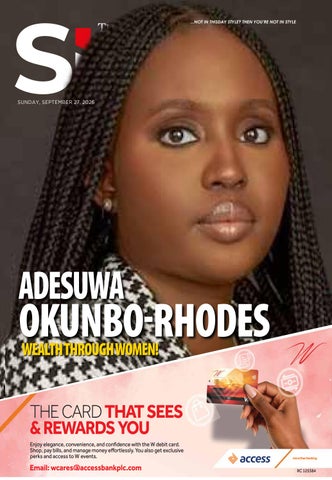
ADESUWA
OKUNBO-RHODES WEALTH THROUGH WOMEN!
THE CARD THAT SEES & REWARDS YOU Enjoy elegance, convenience, and confidence with the W debit card. Shop, pay bills, and manage money effortlessly. You also get exclusive perks and access to W events.
Email: wcares®accessbankplc.com
♦ access
1
more than banking
RC 125384
Sunday, September 27, 2026 Vol. 22, No. 11457
Sunday, September 27, 2026 Vol. 22, No. 11457
EDITOR’S LETTER
COVER NOTE
WOMAN OF FAITH
EXECUTIVE EDITOR
14
14
A
desuwa Okunbo Rhodes has built a career around capital, enterprise and, increasingly, the question of who gets access to both. A prominent Nigerian venture capitalist, private equity investor and entrepreneur, she is the Founder and Managing Partner of Aruwa Capital Management and one of Africa’s youngest female private equity fund managers. She has also become a leading voice for gender-lens investing, dynamic capital allocation and SME growth across West Africa.
Lifestyle & Fashion
4
10 Men: 8 Things To Do To Smell Better
3
Yoruba Meets Akan, Ayomide Weds Arielle
4
Dating in 2026: Where Did the Romance Go?
6
Not Every Trend Deserves Your Money
7
A Full Closet Doesn’t Always Mean More Outfits
8
Oluyemisi Fadahunsi: Making Preloved Fashion Desirable
10
The New Rules Of Wedding Guest Fashion
18
S yle TR
UT H
& RE A SO
N
EXECUTIVE EDITOR KONYE NWABOGOR 08111847087
DEPUTY EXECUTIVE EDITOR OLUFUNKE BABS-KUFEJI 08111847086
ASSISTANT EDITOR YINKA OLATUNBOSUN
20
CONTRIBUTOR EBIYEKON DORCAS DIO
Bad Hair Day? Start Here
21
DIRECTOR, PRINT PRODUCTION CHUKS ONWUDINJO
10 Nigerian-Themed Movies Worth Rewatching on Independence Day
22
Opinion: Are We All Starting To Look The Same?
2
21
Printed by Ups Digitals Ltd, Abuja; 08057025005; info@upsdigitals.com
08077092196
The Last Quarter
W
e are finally heading into the last quarter of the year, and I have to say, I’m rather happy to see it. 2026 has been quite a year. Exciting in many ways, but also demanding for most Nigerians, with enough twists and turns to keep all of us on our toes. Still, I’m glad we seem to be winding down beautifully. So, how has your year been? Did it look anything like the one you imagined in January? Whatever the answer, we still have three months to go, and a lot can happen in three months. You still have time to finish something, start something, change direction, or finally get serious about that thing you have been postponing. If you want to begin next year from a stronger position, this is probably the time to lock in. January is a lot easier when you don’t expect it to perform miracles. And if this year has reminded us of anything, it is how quickly our ideas about almost everything can shift. Beauty is an interesting example. For a while now, I’ve heard people say that women are beginning to look alike. I never really paid much attention to it until recently, when I started noticing a certain familiarity at events. The brows, lips, cheekbones, hair, makeup; different women, but often a very similar aesthetic. That conversation inspired our opinion piece, Are We All Starting to Look the Same? There is nothing inherently wrong with enhancements, treatments or wanting to look better. I’m certainly not against any of it. But I find it interesting that, with more beauty choices available than ever, so many people seem to be choosing versions of the same thing. At what point does perfection become predictable? And doesn’t individuality still count for something? Read the piece and tell me where you stand. Dating appears to have developed its own version of this: plenty of choice, but somehow even more rules. Dating in 2026: Where Did the Romance Go? looks at just how complicated the business of liking someone has become. Now there’s a strategy for everything. Who texts first, how quickly you reply, how available you should be, who is doing too much and, of course, the endless instruction to “match energy.” Protecting yourself is one thing, but if everyone is busy making sure they never care more, where exactly is romance supposed to enter the conversation? It’s a fun read and, depending on the state of your love life, possibly a little too familiar. October also gives us another reason to look at ourselves, this time as a country. With Independence Day coming up on October 1, 10 Nigerian-Themed Movies Worth Rewatching on Independence Day revisits films that tell different parts of our story. Nigeria can be difficult, funny, frustrating, hopeful and completely contradictory, sometimes all before lunchtime. Our cinema has captured plenty of that, and the holiday feels like a good excuse to revisit some of those stories. How are you doing, by the way? Thank you for reading and for staying with us this far into the year. I hope you enjoy this week’s issue and have a beautiful Sunday.
HAPPY 75TH BIRTHDAY ALHAJA LATEEFAT YOYINSOLA MAKANJUOLA
Love,
@thisdaystyle |
@thisdaystyleon | www.thisdaystyle.ng
3
Sunday, September 27, 2026 Vol. 22, No. 11457
Sunday, September 27, 2026 Vol. 22, No. 11457
YORUBA MEETS AKAN, AYOMIDE WEDS ARIELLE
W
hen Ayomide Durowaiye-Herbert and Arielle Akpele said “I do,” it was more than a wedding. It was a lovely coming together of two cultures, with Yoruba traditions from Nigeria meeting those of the Akan people of Côte d’Ivoire. The celebrations began with a traditional ceremony at 2222 Avenue Dollard, LaSalle, Montreal, Canada, before the couple went on to solemnise their marriage at Rue de la Cathédrale, Montreal. The festivities continued at Le Corbusier, Laval, where family and friends gathered to celebrate the newlyweds. Guests travelled from Nigeria, Côte d’Ivoire, the United Kingdom, France and the United States, giving the Montreal celebration a wonderfully international feel while keeping family, culture and love at the heart of it all.
NEWLYWEDS ARIELLE & AYOMIDE DUROWAIYE-HERBERT
AYODELE & OLUDELE DUROWAIYE
DELPHINE & SERGE AKPELE
FEHINTI ONANUSI, KEMI BABALOGBON AND MRS FUNKE OWONUBI
ANTOINE AND LOUISE N’DA
DAVE TANIS AND ANGIE APPIAH
JANE DERIVAL, NATE BOISVERT AND CATHERINE BOATENG.
AYOMIDE & ARIELLE DUROWAIYE-HERBERT
4
LAUREE CORBEIL-PHILLIPS AND BASSAM AL-HAJ
LUBNA, MOHAMMED AND MAYA AL-HAJ
KOLA OLAWUNMI AND HIS WIFE MOFOLUSO WITH MRS IFEOMA ABAJUE AND HER HUSBAND OBINNIA
ENIOLA BELLO & AYOBAMI ENIOLA-OLAITAN
DIDIER KOUADIO AND FABIENNE GBALLO
ESTHER DUROWAIYE-HERBERT
FUNMI OBANDO.
SHINNA & FUNMI OLORUNTOYIN
STEVE AROGUNDADE AND WIFE YEWANDE
DR. PHILLIP AKOMOLAFE WITH WIFE, BOSE
OLUWASEYI ALAMUDUN
TITI AYENI
IREOLUWA OMAMUSI, MARIA ALEJANDRA DEL ROSARIO AND ELVIN AMIROV.
5
Sunday, September 27, 2026 Vol. 22, No. 11457
Sunday, September 27, 2026 Vol. 22, No. 11457
DATING IN 2026: WHERE DID THE ROMANCE GO?
NOT EVERY TREND DESERVES YOUR MONEY
Dating has never been particularly simple, but in 2026 it seems to come with an entire set of unwritten rules. Don’t reply too quickly. Don’t doubletext. Don’t ask what you are too soon. Don’t seem too available. Match their energy. Keep your options open. And whatever happens, try not to look like you care more. Yet people still want love. We want chemistry, companionship, affection and someone genuinely excited to hear from us. What has changed is how we go about finding it. From performing nonchalance to situationships that refuse to become relationships, endless talking stages and financial expectations, these are some of the ways modern dating has made romance feel far more complicated than it needs to be.
Have you ever seen something online so many times that you suddenly started wondering if you needed it too? Not liked it. Not wanted it. Needed it. One minute you are perfectly happy with everything you own. A week later, everybody seems to have the same shoe, bag, water bottle or beauty gadget, and now yours feels strangely inadequate. That is the clever thing about trends. See something often enough and curiosity can very quickly turn into desire. Of course, trends are part of the fun of fashion and beauty. Sometimes they introduce us to things we genuinely end up loving. Other times, they leave us with an expensive reminder that we should never shop after midnight. So perhaps trends fall into three categories: worth it, think twice, and please leave it online.
By Oghenekeno Akpoili
When Nonchalance Became a Dating Strategy
There is a strange kind of power attached to looking uninterested now. You can be excited to receive a message and deliberately wait before replying. You can miss someone but refuse to say it first. You can care deeply while behaving as though you could take it or leave it. Nobody wants to appear desperate, and boundaries are healthy. But there is a difference between protecting yourself and performing indifference. If two people are constantly trying to prove who cares less, genuine communication
6
The Talking Stage That Never Ends
is the feeling that there is always another option. One disappointing date, one argument, one annoying The talking stage was habit and somebody seemingly supposed to be the better is only a swipe, follow or DM beginning. Now, it can away. become the entire Sometimes walking away is relationship. absolutely necessary. Disrespect, Weeks turn into months dishonesty and genuine of good-morning texts, incompatibility should not be late-night calls, flirting and excused in the name of making emotional conversations relationships work. without anything actually But not every uncomfortable moving forward. Two people moment is a red flag. People can know each other’s routines, favourite meals and misunderstand each other. They family stories without knowing have bad days. Relationships sometimes require patience beyond whether they are dating. the exciting beginning. Taking things slowly is sensible. Remaining Romance Did Not Disappear. permanently stuck in the middle is different. Eventually, Expectations Changed. somebody has to ask what For all the complaints about modern exactly is happening. dating, people have not stopped
When Love Comes With a Financial Checklist
eventually disappears.
Situationships: Close Enough, But Not Too Close
You talk every day, go on dates, share intimate moments and behave like a couple. Then someone asks what you are, and suddenly nobody knows. Situationships are not necessarily a problem when both people want the same thing. The trouble begins when one person believes they are slowly building towards commitment while the other is simply enjoying companionship without responsibility. Sometimes people avoid defining things because commitment feels like closing other doors. But ambiguity is only comfortable when nobody is quietly hoping it will become something else.
Money matters in relationships. Financial stability, ambition and compatible attitudes towards money are reasonable things to consider when choosing a partner. But sometimes modern dating sounds suspiciously like an assessment. What does he earn? What does she bring to the table? What car does he drive? Can he afford a particular lifestyle? Social media adds another layer. Luxury dates, expensive gifts, holidays and elaborate proposals are constantly displayed, making comparison almost unavoidable. Wanting financial security is not the problem. It becomes one when earning power begins to outweigh character, compatibility, kindness and connection.
When Dating Became Disposable
Perhaps one of the biggest changes
wanting romance. We still want someone who is excited to see us. Someone we can laugh with, call for no particular reason and miss without feeling foolish about it. Dating has changed because people have changed too. We have more choices, stronger boundaries and greater freedom to decide what relationships should look like for us. Those are not necessarily bad things.
Maybe We Just Need More Honesty
Perhaps modern dating could simply use a little less performance. Want something casual? Say so. Looking for commitment? Say that too. Like someone? There is no prize for hiding it particularly well. Boundaries matter. Standards matter. So does knowing when to leave. But romance also requires enough vulnerability to admit when someone matters to you. Because liking someone should still be one of the enjoyable parts of dating, not something you have to pretend you are above.
By Oghenekeno Akpoili
Worth It: The Ballet Flat Comeback Ballet flats are everywhere again, but this comeback actually makes sense. They are comfortable, easy to wear and work with everything from jeans and dresses to skirts and tailored trousers. More importantly, ballet flats existed long before their current revival and will still be perfectly wearable when the fashion crowd moves on.That is usually a good s ign. If you genuinely like something and can imagine wearing it beyond its trending moment, your money is probably safe.
Or the sunglasses you would never ordinarily choose. Or a very specific dress silhouette that looks fabulous on other people but feels completely Leave It Online: The 12-Step wrong when you wear it. And yet, after seeing it enough Skincare Routine times, your resistance starts to At some point, skincare became weaken. less of a routine and more of a This is when you need to remember chemistry practical. that something can be fashionable There is the cleanser, toner, essence, without being your fashion. You exfoliant, serum, another serum, don’t have to train yourself to eye cream, moisturiser, face oil, like everything the internet has mask and several mysterious bottles collectively decided is chic. whose purposes you can no longer remember. Worth It: The Trend That The irony is that many of us eventually discover the same thing: Already Looks Like You we consistently use about four of These are the easiest trends to buy them. into. Buying more skincare doesn’t Maybe oversized bags are back, automatically mean taking better and you’ve always carried half care of your skin. If your bathroom your life around with you anyway. shelf is already full of half-used Perhaps wide-leg trousers are products, perhaps finish those having a moment, and you’ve worn before TikTok introduces you to them for years. Maybe brown is another ingredient you apparently suddenly fashion’s favourite colour cannot live without. and half your wardrobe is already brown. Enjoy your moment. The best trends don’t require you to Think Twice: The Viral reinvent yourself. They simply give Beauty Gadget you more options within a style you You know how this story goes. already enjoy. Someone runs a futuristic-looking device across her face for 30 Think Twice: The One-Event seconds. It lights up. Perhaps it vibrates. Her skin looks incredible. Outfit You immediately want one. This one is especially dangerous Then yours arrives; you use it when an invitation arrives. religiously for five days, and six You convince yourself that you months later it is living beside the absolutely need something new facial cleansing brush you also once because everybody attending has believed would change your life. probably already seen everything Some beauty devices do have you own. So you buy the dress, legitimate uses. The issue is whether shoes, bag and perhaps jewellery to you are buying something you will complete the vision. realistically use consistently. Your The event lasts four hours. previous beauty-gadget history The outfit is never seen again. should provide the answer. Before buying something specifically for one occasion, ask whether you can see yourself wearing at least Leave It Online: The Trend part of it differently afterwards. If You Don’t Even Like not, perhaps rent, borrow, restyle This one catches more of us than something you own or at least we care to admit. spend an amount you won’t There is always that shoe everyone resent when the photographs stop loves that you secretly think is ugly. appearing on Instagram.
Sometimes impractical can be fun. Just don’t confuse fun with investment.
Think Twice: The Bag That Can’t Hold Your Phone
Micro-bags are adorable until you actually need them to perform the duties of a bag. Phone? Doesn’t fit. Sunglasses? Absolutely not. Keys, cards and lipstick? Choose your fighters. There is nothing wrong with buying one purely because you love it. Fashion doesn’t always have to be practical. But if you’re spending serious money, it is worth acknowledging exactly what you’re buying: something fabulous to complete an outfit, not the hardworking bag you’re going to carry everywhere.
7
TR
Sunday, September 27, 2026 Vol. 22, No. 11457
UT H
& R E A SO
N
Sunday, September 27, 2026 Vol. 22, No. 11457
A FULL CLOSET DOESN’T ALWAYS MEAN MORE OUTFITS
You know that moment when you open your wardrobe, see clothes everywhere and still decide you have nothing to wear? The problem is rarely that there is actually nothing there. More often, you have simply run out of ideas for what is there. Most of us have default combinations: the jeans that always go with that top, the dress worn exactly the same way every time, the trousers reserved for work. After a while, even a wardrobe full of perfectly good clothes can begin to feel strangely limited. The instinct is usually to shop. But before adding another item, it might be worth asking whether your wardrobe needs more clothes or simply better styling. By Bakare Mariam
Stop Buying Versions of What You Already Own We all have a type. Maybe yours is white shirts, black dresses, blue jeans or slightly different versions of the same top. There is nothing wrong with knowing what works, but repeatedly buying similar pieces rarely creates more options. Instead, identify what is actually missing. Perhaps you have plenty of tops but not enough bottoms to wear them with. Maybe one versatile jacket or pair of shoes would unlock several outfits. A useful purchase should expand your wardrobe, not simply add to it.
Stop Saving the Good Clothes
There are clothes in many wardrobes patiently waiting for an occasion important enough to deserve them. Wear them. The dress you love does not always need a big dinner. Event trousers can work with a simple top. A dramatic skirt can survive perfectly well outside a wedding. Clothes become far more useful when we stop assigning them to one occasion and start styling them around our actual lives.
Shop With Outfits in Mind
A piece can be beautiful and still be a terrible addition to your wardrobe. Before buying it, think of at least three ways you could wear it with things you already own. Does it work with your shoes? Can you dress it up and down? Will it fit naturally into your life? If every new purchase requires another purchase before you can wear it, you may simply be creating a more expensive problem.
Clear What Is Getting in the Way
Sometimes having too many clothes makes getting dressed harder. Pieces that no longer fit, impulse buys you never liked, and clothes you have not worn in years can hide the things you actually enjoy. A clear-out does not mean reducing your wardrobe to ten neutral pieces. It simply means seeing what you own and using it. Because having plenty of clothes and having plenty of outfits are two different things. Sometimes you do not need another shopping bag. You just need to look at your wardrobe differently.
Break Up Your Usual Combinations
One reason wardrobes become boring is that we start thinking of individual pieces as fixed outfits. That shirt belongs with those trousers. That skirt goes with that top. Break them up. Wear the shirt with a skirt. Try the trousers with a tank and jacket. Throw an oversized shirt over a fitted dress. Pair something polished with something casual. Sometimes the freshest outfit in your wardrobe is simply a combination you have never tried.
Give Your Basics More Work
SOLIAT BADA
Basics may not be exciting, but they often make everything else wearable. A white shirt, good jeans, black trousers, a simple tank or an easy jacket can connect pieces that otherwise seem difficult to style. That dramatic top becomes easier with plain trousers. The skirt you never know what to do with suddenly works with a simple T-shirt. Not everything in your wardrobe needs to be the star.
Change the Details
ANGEL ANOSIKE , OSHUWA IMOYO
8
Before deciding you are tired of an outfit, change what is happening around it. Swap heels for flats, change your bag, add a belt or layer some jewellery. Roll up the sleeves of a shirt, tuck it differently or throw on a jacket. Even changing your hairstyle can alter the overall feel. Accessories are particularly useful because they allow you to repeat clothes without repeating the entire look.
SEYI WILLIAMS AND YESIDE LAGUDA
OZINNA ANUMUDU AND IFE BOB NABENA
9
Sunday, September 27, 2026 Vol. 22, No. 11457
Sunday, September 27, 2026 Vol. 22, No. 11457
B
y day, Oluyemisi Fadahunsi operates in the exacting world of corporate law, advising on complex, multi-million-dollar transactions across energy, mining, manufacturing and international trade. As Head of Corporate, Commercial and Governance Legal at African Industries Group, she has built a career around structure, strategy and value. Away from the boardroom, however, she is applying some of those same instincts to a very different industry: fashion. As founder of Eko Fashion Loop, a curated preloved fashion platform, Fadahunsi is making a case for a more considered way of consuming clothes. Built around the idea that great fashion should have more than one life, the platform encourages people to rethink what happens to the pieces they no longer wear, while giving others access to quality fashion without always buying new. For Fadahunsi, circular fashion is not simply about reselling clothes. It is about changing our relationship with them: buying better, keeping pieces in circulation longer, and recognising the value already in our wardrobes. She tells Yinka Olatunbosun about building Eko Fashion Loop, the growing appetite for preloved fashion in Nigeria and why conscious consumption may be one of the most important shifts in the way we dress.
Could you explain the concept behind Eko Fashion Loop and what inspired its creation? Eko Fashion Loop is a curated preloved fashion platform that gives great fashion a second life. We create a trusted, stylish, and convenient marketplace where people can buy and resell quality fashion pieces, unlock value from their wardrobes, and participate in a more circular way of consuming fashion. The idea was born from my personal relationship with fashion. About ten years ago, I realised I had beautiful, fashionable pieces sitting in my wardrobe that I simply wasn’t wearing. At the same time, access to international brands and high-fashion pieces in Nigeria was very different from what it is today. Unless you travelled frequently, knew someone who did, or were willing to pay significant markups through a handful of retailers, many of the brands we love today were not easily accessible. Those pieces were harder to come by, so every purchase felt intentional. Over the years, I invested in building a wardrobe I genuinely loved. But like many women, I bought clothes for weddings, birthdays, holidays, career milestones, future plans, and sometimes even for the woman I hoped to become, perhaps two dress sizes smaller. As my wardrobe grew, I noticed something interesting. Many of these beautiful pieces had barely been worn. Some still had tags attached. Others had only been worn once and then forgotten. What struck me even more was that I wasn’t alone. So many people around me had wardrobes filled with valuable pieces sitting idle, while others were actively searching for exactly those items. What started as a personal observation ten years ago has become an even bigger reality today. We now live in an age of unprecedented consumption. We are constantly exposed to new trends, social media influence, endless shopping options, and the idea that we always need something new. Our wardrobes are fuller than ever, yet many of us wear only a fraction of what we own. Although I had started operating on a smaller scale years ago, there was a defining lightbulb moment when I realised there was immense value locked away in people’s closets and a real opportunity to connect that value with people who would genuinely love and wear those pieces. That realisation led to the rebranding and expansion of Eko Fashion Loop. We wanted to widen the net of people who feel welcome in our community by giving great fashion a longer life, helping both women and men unlock value from their wardrobes, and proving that style does not have to end after a single wear. Fashion deserves to be worn, loved, shared, and recirculated. What specific gap in Nigeria’s fashion ecosystem does Eko Fashion Loop seek to address? The biggest gap we are addressing is helping people recognise that
10
they are sitting on value. Many of us have wardrobes filled with beautiful clothing, designer pieces, occasion wear, handbags, shoes, and accessories that we no longer use, yet we do not see them as assets. When it’s time to declutter, we often give them away during charity drives, pass them on to family members, or leave them hanging in our closets. While there is nothing wrong with generosity, most people never stop to consider the real financial value sitting in those wardrobes. The second gap is wastage. Too many quality pieces are left unused for years until heat, humidity, mould, or poor storage conditions damage them beyond repair. By the time someone decides to let them go, they are no longer in a condition to be enjoyed by someone else. Eko Fashion Loop is helping to change that mindset. We want people to see fashion as something that can continue creating value long after the first wear. We already understand this concept with cars, electronics, furniture, and even property. We comfortably buy and sell pre-owned assets because we recognise their value. Our question is: why should quality fashion be any different? At the same time, we are encouraging a more sustainable approach to consumption. Instead of letting great pieces sit unused or end up as waste, we help keep them in circulation where they can be worn, appreciated, and enjoyed again. Whether it’s a luxury handbag, a beloved Zara dress, or a beautiful piece from a Nigerian designer, every item deserves the chance to live longer.
oluyemisi
FADAHUNSI MAKING PRELOVED FASHION DESIRABLE
How does the initiative align with global conversations around sustainability and responsible consumption? The global fashion industry is undergoing a major shift. The conversation is no longer just about producing new clothes more sustainably. It’s increasingly about extending the life of the clothes that already exist. Today, the global secondhand apparel market is worth hundreds of billions of dollars and is projected to reach approximately $367 billion by 2029, growing significantly faster than the broader fashion industry. We’re also seeing some of the world’s biggest retailers embrace circular fashion. From Reselfridges at Selfridges to Zara Pre-Owned, resale is becoming part of the mainstream shopping experience. Eko Fashion Loop brings that global movement into the Nigerian context. We believe great fashion should not end after a single wear. By helping quality pieces move from one owner to the next, we reduce waste, unlock value, and make fashion more accessible. Ultimately, we’re building a culture where people buy more intentionally, wear more consciously, and see fashion as something that can have multiple lives. Why do you believe now is the right time for Africa to embrace circular fashion? It is because we can leapfrog. We don’t need to drown in textile waste first like the Global North did. Africa is uniquely positioned to benefit. We have one of the youngest populations in the world, and that generation is more connected than any before it. Through social media, e-commerce, and global culture, young Africans know the brands, designers, and fashion trends they love, regardless of where they live. At the same time, awareness of value and more intentional spending is growing. People are becoming increasingly conscious of how they consume. They want
quality, access, and for their money to go further. What’s interesting is that circularity is not entirely new to us. Africans have always understood the idea of extending the life of clothing. We hand pieces down to siblings, cousins, friends, and family members. What is changing now is that technology allows us to do that at scale. For me, circular fashion is about democratising access. It allows someone who may not be able to afford a designer piece at full retail price to own and enjoy it. It allows someone else to unlock value from something they no longer wear. Everybody wins. Africa doesn’t need to copy the West’s journey. We have an opportunity to build our own version of circular fashion, one that combines community, commerce, sustainability, and access. And I believe that time is now. What are some of the most common misconceptions people have about resale, preloved and circular fashion in Nigeria? The biggest misconception is that buying preloved fashion means you cannot afford to buy something new. For a long time, secondhand clothing has carried a stigma. Some people associate it with financial hardship rather than seeing it for what it can be: a smart, intentional purchasing decision. In reality, some of the world’s most sophisticated fashion consumers actively participate in the resale market. Collectors seek out vintage Chanel and Hermès pieces, and certain rare or discontinued styles can command prices equal to or even higher than newer versions because of their craftsmanship, rarity, and collectability. Another misconception is that if you’re selling clothes, it means you’re broke or in urgent need of money. I think we need to change that narrative. Selling items you no longer use is simply good financial sense. We do it with cars, phones, electronics, furniture, and even property. Fashion should not be any different. Many people also underestimate the value sitting in their wardrobes. A dress you wore once to a wedding, a handbag you no longer reach for, or a pair of shoes sitting untouched in a box could be exactly what someone else is looking for. Rather than letting those items sit unused or deteriorate over time, why not unlock their value and give them a second life? At Eko Fashion Loop, we’re helping to reframe the conversation. Buying preloved is not a sign that you can’t afford new. Selling preloved is not a sign of financial distress. Both are smart, conscious decisions that allow people to maximise value, reduce waste, and make fashion work harder for them. Ultimately, we want people to see their wardrobes differently, not just as collections of clothing, but as assets with the potential to continue creating value long after the first wear. Trust is everything in resale, especially with luxury and Nigerian designer pieces. How do you ensure quality, authenticity and fair pricing? Trust is our currency. When people shop on Eko Fashion Loop, they need to feel confident that what they see is exactly what they get. That’s why every item goes through a careful review process before it is accepted onto the platform. We assess pieces for quality, condition, desirability, and overall presentation. We provide detailed descriptions, clear imagery, and honest communication so buyers can make informed decisions. If a piece shows signs of wear, we disclose it. Transparency is non-negotiable. With luxury and designer items, authenticity is equally important. We protect both the buyer and the seller by completing the necessary checks and asking the right questions before listing a piece. Pricing is also key to building trust. We aim for pricing that reflects an item’s condition, brand, age, rarity, and current market demand. The goal is for sellers to receive fair value while buyers feel they are getting access to quality pieces at a sensible price point. Ultimately, we are not just facilitating transactions. We are building a community. Every successful purchase strengthens confidence in the platform, and every satisfied seller reinforces the idea that fashion can continue to create value long after its first wear. At Eko Fashion Loop, trust isn’t just part of the business. It is the business. What are your goals for Eko Fashion Loop over the next five years, and what legacy do you hope to leave behind? Over the next five years, I want Eko Fashion Loop to become the trusted home for curated fashion resale in Africa, a platform where people instinctively think of buying, selling, and recirculating quality fashion pieces. Beyond growth, my goal is to help normalise circular fashion and remove the stigma that often surrounds resale. I want people to see buying preloved as a smart style decision and selling preloved as a smart stewardship decision. I would love to see a future where people naturally consider a garment’s next life before buying it. A future where wardrobes are curated more intentionally, where quality pieces remain in circulation longer, and where ownership is understood as stewardship rather than accumulation. From an industry perspective, I hope we contribute to building a stronger resale ecosystem for both international brands and Nigerian designers. The dream is for Nigerian fashion pieces to be collected, archived, traded, and valued across generations in the same way that iconic global fashion houses have achieved. As for legacy, I hope Eko Fashion Loop changes the way people think about fashion. I want us to prove that style, sustainability, and smart consumption can coexist. If years from now more people buy intentionally, hold on to fewer things they don’t use, and feel proud to pass great pieces on rather than let them sit forgotten in a closet, then I would consider that a success.
11
Sunday, September 27, 2026 Vol. 22, No. 11457
Sunday, September 27, 2026 Vol. 22, No. 11457
is here
Apply to participate in the IFC Certi�ed Mini MBA and pitch your business to be eligible for business grants Scan to apply
#BuiltByHer
Terms and conditions apply | Selection is competitive and based on the published eligibility and selection criteria
12
13
Sunday, September 27, 2026 Vol. 22, No. 11457
ADESUWA
OKUNBO-RHODES BUILDING WEALTH THROUGH WOMEN
A
COVER
COVER
Sunday, September 27, 2026 Vol. 22, No. 11457
BY YINKA OLATUNBOSUN
desuwa Okunbo Rhodes has built a career around capital, enterprise and, increasingly, the question of who gets access to both. A prominent Nigerian venture capitalist, private equity investor and entrepreneur, she is the Founder and Managing Partner of Aruwa Capital Management and one of Africa’s youngest female private equity fund managers. She has also become a leading voice for gender-lens investing, dynamic capital allocation and SME growth across West Africa. An Economics graduate from the University of Bristol, Rhodes began her career in investment banking in London at Lehman Brothers before moving to J.P. Morgan, where she worked across Leveraged Finance and Mergers & Acquisitions, executing more than $5 billion in cross-border transactions across emerging markets. She later moved into Africa-focused private equity at TLG Capital before co-founding Syntaxis Capital Africa, where, as Managing Partner, she focused on deploying growth capital to SMEs across Sub-Saharan Africa. Today, through Aruwa Capital, she helps direct investment toward businesses founded or led by women, that employ gender-diverse workforces, or that provide goods and services for the female economy. The firm is one of the few women-owned and women-led private equity firms operating on the continent. Rhodes became the first solo female General Partner in Nigeria to raise more than $10 million for a debut institutional fund and, subsequently, the first female solo GP in Africa to raise over $50 million in a fund. Alongside managing Aruwa Capital’s portfolio investments across Nigeria and Ghana, she serves on corporate boards spanning healthcare, agriculture, manufacturing and hospitality. Her work has earned global industry recognition, including the 2X Global Woman Fund Manager of the Year award and a place among Institut Choiseul’s 100 Laureates under 40 shaping Africa’s economic future. In this conversation with Yinka Olatunbosun, she discusses her work towards sustainable wealth creation and building structural support for women across Africa’s business ecosystem. You launched Aruwa Capital Management at just 29, after an already successful career in investment banking and private equity. What made you decide that it was time to build something of your own? The decision was less about reaching a particular age and more about the fact that I had spent my entire career seeing the underrepresentation of women in finance and in capital allocation. J.P. Morgan, and later TLG Capital and Syntaxis Africa, gave me a strong foundation. I learned how capital moves, how investment decisions get made and what makes a business worth backing. I also saw clearly who was consistently left out. The companies I found most compelling were rarely the ones getting funded: SMEs in the “missing middle”, too large for microfinance and too small for the large private equity funds, needing cheques of $1 million to $3 million that almost nobody in our market was writing. In addition, less than 2% of capital was going to women. At 29, I had enough experience to understand the industry and not quite enough to be intimidated by it, and I had the faith to believe things could be done differently. I wanted to build a firm that delivered strong commercial returns, while being deliberate about where that capital goes and what it builds. Seven years on, with about $80 million under management across two funds and 17 portfolio companies, the thesis has held. A gender lens has never been a concession on returns. It is how we find businesses the rest of the market has mispriced. Looking back, starting at 29 was both daunting and liberating. I didn’t have all the answers, but I had strong conviction.
14
Before Aruwa, you had already built an impressive career across J.P. Morgan, TLG Capital and Syntaxis Capital Africa. What did those years teach you about money, power and who gets access to capital? Those years taught me that capital follows trust. It follows networks, familiarity and proximity just as much as it follows fundamentals. The businesses that get funded are not always the best businesses; they are often simply the ones closest to the people writing the cheques. Across J.P. Morgan, TLG Capital and Syntaxis, I sat in the rooms where those decisions were made, and I could see who was being overlooked. Women entrepreneurs. SMEs in sectors considered unglamorous. Markets that were underestimated because nobody in the room had ever lived in them or been on the ground. That is what shaped our thesis at Aruwa Capital. We invest in femaleled and female-focused companies in non-cyclical sectors with robust gross margins, essential goods and services people buy whether or not the economy is up or down. That is a discipline, not a compromise, and it is my answer to anyone who assumes a gender lens means a softer investment case. There is often a glamorous narrative around leaving a successful career to build your own company. What did the early days of Aruwa actually look like when there was no guarantee it would work? The early days were far from glamorous. For a long stretch, it was me, a laptop and a pitch deck, doing the work nobody sees: building a
15
pipeline, meeting entrepreneurs, putting in place the governance and processes an institutional investor would eventually want to see, all without knowing when, or whether, we would raise our fund. First-time fund managers face a circular problem, you cannot raise capital without a track record and a team, and you cannot build a track record or team without capital. What kept me going was the conviction that the gap was real, and a fair amount of stubbornness. I also learned very quickly that you have to become comfortable with uncertainty, because the alternative is standing still. Those early years taught me that building something meaningful is mostly consistency, resilience, persistence and being willing to do the work long before anyone is paying attention. The recognition came much later, and it came because of the hardwork and persistence, not instead of it. It took me eight years to raise my first fund in Africa and that journey has made me a better investor and leader today. Today, Aruwa manages about $80 million across two funds. At what point did you realise that what you had started was becoming much bigger than the original idea? I don’t think there was one single moment. It happened gradually, as the businesses we backed grew into companies several times the size we first met, as our companies raised external capital at valuations much higher than ours, as entrepreneurs began coming to us before they went anywhere else, and as institutions like British International Investment, Bank of Industry, TotalEnergies Closed Pension Fund and Ford Foundation put their capital behind us. That was when I realised we were building something with a life beyond the original idea I had at 29. Reaching our first close of Aruwa Fund II was significant and our second fund close was another milestone. But the measure I care about is not the size of the funds. It is that 17 companies now sit in the portfolio, six of them manufacturers making locally what Nigeria would otherwise import, and that 70% of the direct jobs across those businesses are held by people under 35. At some point Aruwa became an institution with 19 people in it making lasting impact in Nigeria by investing in companies solving meaningful problems and contributing to long term economic growth in our markets. Aruwa deliberately invests in businesses that serve women, are led by women or have significant female participation in their workforce and value chain. Beyond the social argument, what have the numbers taught you about the business case for investing in women? The numbers have reinforced what we believed from the beginning: investing in women is not just the right thing to do, it is smart business. Women drive household purchasing decisions and they dominate the informal trade that moves goods across our markets. Yet, that economic contribution remains significantly undercapitalised. In our portfolio, 70% of companies are female-led or female-founded and 60% are female-founded or co-founded. Every one of them operates under an Operational and Financial Action Plan that includes a Gender Action Plan, so this is measured rather than asserted. With that backdrop, we have seen in Fund I, 29x in revenue growth on average since our investment, 7x valuation uplifts when these companies raise subsequent funding rounds and financial returns above global benchmarks. Our performance is showcasing that investing with a gender lens is a competitive advantage for superior financial returns. But in addition, the same portfolio is also creating meaningful social impact, supporting over 200,000 jobs in Nigeria and Ghana. Ultimately, a gender lens is a sourcing advantage. It puts us in front of businesses other funds never see and it is not about investing in women at the expense of returns, it is about recognising that women represent one of the largest and most underserved economic opportunities in Africa. You have described women as an overlooked economic opportunity. Why do you think investors have been so slow to recognise the scale and spending power of the female economy in Africa? Part of it is that the frameworks were built elsewhere. If your model of a market is drawn from formal, salaried, urban consumption, you will miss the woman who buys for a household of eight, sells in an open market and never appears in the data set investors use to size an opportunity. The bigger issue is also categorisation. Gender gets filed under impact, impact gets filed under concessionary, and the whole opportunity is then assessed against the wrong benchmark. Nobody has ever described a fund that only backs men as a thematic strategy. That is changing, and quickly. As more data becomes available and investors look past inherited assumptions, the $15 trillion female economy becomes harder to ignore. For me, the opportunity was never to invest in women as a category; it was to understand women as a powerful
16
Sunday, September 27, 2026 Vol. 22, No. 11457
economic force and build an investment strategy around that reality. Private equity remains a space with relatively few women at the top. Your investments cut across healthcare, financial services, renewable energy, consumer goods, agriculture and technology. When an entrepreneur walks into the room looking for investment, what makes you sit up and pay attention? The founder, first. I want someone who understands their customer better than I ever will and who can tell me precisely why the problem exists, not simply that it does. I am looking for clarity of thought, resilience, and a willingness to change course and adapt when the numbers and market say so. Then the model. We invest in non-cyclical sectors with robust gross margins, so I want pricing power and a product people buy in a bad month as well as a good one. Evidence of traction, strong repeat purchases, a customer who would be genuinely inconvenienced if the company disappeared. We are backing the business and the person leading it, and we are taking an equity stake and staying for years, so both have to hold up. And I pay attention to ambition and vision. Six of our 17 companies are manufacturers, and we backed them because their founders weren’t trying to import a little more efficiently; they were building to make things locally despite all the challenges. That kind of ambition is rare, and it is worth supporting. You have gone from analysing and executing deals for other institutions to being responsible for your own investors, team and portfolio companies. How has becoming a founder changed the kind of leader you are? Becoming a founder has made me far more comfortable with imperfect information. Earlier in my career, I was executing inside institutions with established structures and resources. As a founder, there is no playbook; you decide, often before you have everything you would like to have, and you own the outcome. It has also made me a more empathetic leader. I have 18 people whose careers I am responsible for, LPs whose capital I am accountable for and founders who need me to be useful and impactful rather than merely present. Leadership isn’t about having all the answers. It is about creating clarity, making the difficult call when it is required, and giving people enough room to do their best work. Most importantly, I’ve learned that building an institution is very different from building a career. I sit on and chair boards now, and much of what I do is make decisions that will still matter long after I am the person making them. You are an investor, entrepreneur, CEO, wife and mother. Has your definition of success changed as your career and your life have become fuller?
Definitely. Earlier in my career, success was tied to achievement: the next role, the next deal, the next milestone, and I measured myself against a list. I have two young children now and a firm with employees who rely on me to bring my best. Today I think about success more holistically: building Aruwa into an institution that endures and can run without me, having real impact through the businesses we back, being present for the people I love, and continuing to grow as a person. People ask how I balance it; I don’t, and I don’t even try. Some weeks the firm gets more of me and some weeks my family does. The ambition is still very much there; I have just stopped confusing a career that looks impressive with a life that feels like mine. For someone whose professional life revolves around assessing risk, are you equally calculated in your personal life, or is there a completely different Adesuwa away from the spreadsheets and investment committees? I’m definitely far more calculated professionally than I am personally! Investing trains you to model the downside, run the scenarios and ask what breaks. Life doesn’t hand you a five-year model. Away from work, I’m much more instinctive; I trust my gut, I say yes to things quickly, I try not to overanalyse. I think you need both; if you ran your personal life like an investment committee, you would never do anything spontaneous, and you would miss most of what makes life worth living.
COVER
COVER
Sunday, September 27, 2026 Vol. 22, No. 11457
You have achieved quite a lot at a relatively young age, including being named a World Economic Forum Young Global Leader and 2X Global Woman Fund Manager of the Year. What still feels unfinished to you? We are just getting started at Aruwa; being only seven years old, we haven’t even scratched the surface yet of what is possible. Recognition is meaningful, but it is never the destination, and it tends to arrive for work you finished years earlier. There is still so much I want to build with Aruwa Capital. I want Aruwa to become an enduring African investment institution, one that outlives me and keeps creating value for investors, entrepreneurs and the communities our companies employ. I also want us to have proved, with realised returns rather that the markets and founders this industry has historically overlooked can deliver exceptional performance. We are 17 companies in, and returns get judged at exit, so that case is still being made. I don’t spend much time thinking about what I’ve already achieved. I’m far more interested in what we build next. When you think about Aruwa ten years from now, what does growth look like? Is the ambition a much larger fund, expansion across Africa, a broader investment mandate—or something else entirely? Growth is about much more than a larger fund. Of course we want to grow the capital base, but the ambition is a lasting institution, not an AUM number. I have a vision of Aruwa Capital being a multiasset class and multi-country platform. We plan to extend beyond Nigeria and Ghana and keep identifying market gaps that present mispriced opportunities. Getting bigger for the sake of being bigger is how funds lose their discipline and style drift; we won’t do that. Ten years from now, I would like Aruwa to be recognised as one of Africa’s leading investment platforms, one that delivered strong returns across multiple funds and, in doing so, changed how investors think about female fund managers and female entrepreneurs, recognising that we are also capable of driving Africa’s growth. Away from capital, deals and boardrooms, who is Adesuwa? What do travel, tennis, cooking and time with your family give you that work cannot? Away from work, I enjoy good food, travel, and quality time with my family. Tennis gives me a completely different kind of energy; it is competitive enough to satisfy that part of me, and it forces me to be fully present: you cannot use your phone and return serve at the same time. Time with my family reminds me there is a whole world outside this one and that the most meaningful moments rarely have a milestone attached to them. My children also make me better at what I do. They give me perspective, they help me recharge, and provide a greater sense of purpose and responsibility to leave Nigeria in a better state than I met it for them and their generation.
17
Sunday, September 27, 2026 Vol. 22, No. 11457
Sunday, September 27, 2026 Vol. 22, No. 11457
THE NEW
eat, or dance without adjusting your dress every five minutes, the outfit may be asking too much of you. Looking fabulous and being able to breathe can happen at the same time.
RULES OF WEDDING
3. The Gele Doesn’t Have To Enter The Room Before You
There will always be a place for a spectacular gele. Sometimes the outfit demands the drama and sometimes you simply want it. But it no longer has to accompany every traditional wedding look. Smaller styles, scarves, fascinators and simpler headpieces can work just as well, particularly when the clothes already have plenty going on. If your dress has dramatic sleeves, embellishment and an interesting neckline, your head doesn’t necessarily need another storyline.
GUEST FASHION
There was a time when you could almost predict what the women at a Nigerian wedding would be wearing: lace, gele, matching shoes and bag, and enough embellishment to make sure nobody mistook the occasion for an ordinary Saturday. That formula hasn’t disappeared, but wedding guest fashion has become far more interesting. The gele might be smaller or missing completely. A beautifully cut midi might replace the floor-length lace gown, and flats can make it onto the dance floor without first being hidden inside somebody’s handbag. We still want the entrance, the pictures and, naturally, the compliments. We just have a few new ideas about how to get there. Here are the wedding guest rules that may be due for an update.
4. Every Invitation Doesn’t Require A Small Fortune
Wedding guest dressing can become expensive very quickly. At some weddings, aso-ebi fabric can cost anywhere from ₦250,000 to ₦1 million. Then come tailoring, makeup, hair, gele, shoes, bag and jewellery. For celebrities and guests whose looks will end up online, photography and content can become another expense. There is nothing wrong with going all out when you want to. Dressing up is part of the fun. But not every invitation requires a complete financial project. Restyle something you own, rent, borrow or simply decide that this isn’t the wedding where you need a completely new look. You are attending a wedding, not funding one.
By Oghenekeno Akpoili
1. Aso-Ebi Doesn’t Have To Mean Looking The Same
Aso-ebi remains one of the best parts of Nigerian wedding culture, but identical fabric doesn’t require identical outfits. One woman can turn hers into a clean midi, another into a dramatic gown and someone else into separates she can wear again. And if you aren’t wearing the asoebi, don’t panic. Work with the dress code or colour palette and choose something that still feels like you. Not being in uniform doesn’t make you any less of a guest.
2. Comfort Is No Longer A Dirty Word
We have all seen her. Stunning at 2 p.m., barefoot by 6. Nigerian weddings can be long. There may be a church service, traditional ceremony, reception, photographs and several hours of dancing, so shoes that hurt before the couple has even made their entrance are probably not a great idea. Lower heels, block heels and beautiful flats deserve more respect. The same applies to clothes. If you cannot sit,
18
5. Dress For The Wedding You Are Actually Attending
CHIDINMA OSA IGHODARO
A garden wedding at 2 p.m. and a ballroom reception at 7 p.m. are not the same fashion assignment. Neither are a traditional wedding and a beach ceremony. Check the venue, time, dress code and weather before deciding what
to wear. Lagos heat alone has humbled many excellent fashion ideas. And don’t choose entirely for the photograph. Something can look spectacular standing perfectly still in front of a camera and become completely impractical after six hours of sitting, walking, eating and dancing. The picture matters. The actual wedding does too.
6. Yes, You Can Wear It Again
Somewhere along the way, repeating an outfit became something people felt they needed to explain. We should probably get over that. A great dress can attend more than one wedding. Change the shoes, jewellery, bag, hair or headpiece and the mood changes. Separates are even easier to reinvent, while old aso-ebi can sometimes be altered into something completely different. Social media has made us more conscious of repeating clothes because there is photographic evidence of almost everything we wear. But clothes are supposed to have a life beyond one Instagram post. And if the guest lists are completely different, who exactly are we performing this wardrobe amnesia for?
EVBADE OHIOWELE IN EJIRO AMOS TAFIRI
7. Look Fabulous. Just Remember You Are A Guest
Wedding guest fashion has become much more adventurous. Corsets, cutouts, sheer details, sculptural dresses, dramatic sleeves and trains have made getting dressed for a wedding considerably more fun. By all means, make an entrance. Nobody is suggesting you should look forgettable simply because somebody else is getting married. But there is still a difference between being beautifully dressed and arriving as though your own bridal party is waiting outside. If three people need to arrange your train before you can sit down, we may have entered another category entirely. Just look good. Take the pictures. Collect your compliments. Then find your table and enjoy the wedding.
NGOZI AKINTUJOYE
19
Sunday, September 27, 2026 Vol. 22, No. 11457
Sunday, September 27, 2026 Vol. 22, No. 11457
OPI NION @thisdaystyle |
T
@thisdaystyleon |
www.thisdaystyle.ng
BY FUNKE-BABS KUFEJI
here is a face you see everywhere now. You know it even if you cannot quite describe it. The brows are perfectly shaped and lifted. The lashes announce themselves before the wearer does. The lips are full and glossy, the cheekbones defined, the skin impossibly smooth. Add a perfectly laid wig and immaculate makeup and, individually, there is nothing remarkable about any of it. Put everything together, though, and the face starts to look strangely familiar.
artifice. Women have powdered, painted, plucked, curled and extended various parts of themselves for centuries. There is nothing particularly modern about wanting to look better. What feels different is the shrinking definition of what “better” looks like. Faces once had more permission to be distinctive. A strong nose was simply a strong nose. Cheeks could be round rather than sculpted. Brows could be thin, thick, unruly or barely there. A gap tooth, deep-set eyes, a crooked smile or an unusual face shape could become the very thing people remembered about you. Now, many of those characteristics can be softened, filled, lifted, filtered or contoured away. And because we see the altered version so frequently, the untouched one can begin to feel as though it needs work. Filters complicate things further. They subtly slim the face, lift the eyes, smooth the skin and refine the nose, often without us giving it much thought. Look at that version of yourself often enough, and your actual face can start to feel like the before picture. Perhaps the sameness isn’t entirely accidental. Beauty has always been influenced by what surrounds us, but we have never been surrounded by this many faces, this often. We don’t occasionally encounter a beauty trend in a magazine anymore. We see it repeatedly through celebrities, influencers, friends and complete strangers. The more familiar a particular look becomes, the more normal it feels. And the more normal it feels, the easier it is to wonder whether we should look that way too. There is also a certain reassurance in knowing exactly what is considered attractive. Ask for this brow, this lip shape, this wig or this makeup finish, and you already know the result will be recognisable as “beautiful”. Individuality is riskier. It requires deciding that something works for you even when everyone else is doing something different. And perhaps that is what we are losing: not our faces exactly, but some of the confidence to leave certain things alone. Think about the women whose beauty you remember. It is rarely because every feature was technically perfect. Usually, there was something particular about the face. Something that belonged to her. You couldn’t order the entire look from a salon menu because part of its appeal was that nobody else quite had it. That distinction matters. Beauty becomes far more interesting when the question isn’t simply, “How close can I get to the ideal?” but “What actually looks good on me?” That could mean dramatic lashes and a 30-inch wig. It could mean a close crop and barely any makeup. It could mean fillers, freckles, a bold lip, thick brows or leaving the gap between your teeth exactly where it is. Individuality isn’t about looking natural. It is about looking like your choices belong to you. So wear the wig. Book the facial. Fill your lips if you want to. Draw your brows to perfection. Beauty should be fun, and what a woman chooses to do with her face is entirely her business. Just leave a little room for the face underneath it all.
ARE WE ALL STARTING TO LOOK THESAME?
Beauty has never given us more options, yet somehow, we appear to be moving towards the same result. We have access to more products, treatments, techniques and inspiration than women before us could have imagined. You can change your hair before lunch, reshape your brows in an afternoon and subtly alter parts of your face without ever going near an operating theatre. Makeup can transform, wigs can reinvent, and filters can produce an upgraded version of you before you have even posted the photograph. Choice should have made beauty more individual. Instead, it sometimes feels as though it has made it more uniform. Social media has certainly helped. Spend enough time scrolling through Instagram or TikTok and certain features begin to register as the accepted language of attractiveness: fuller lips, smaller noses, sculpted cheeks, lifted brows, dramatic lashes and skin without a pore in sight. The faces are different, but the aesthetic is remarkably consistent. Eventually, repetition starts to look like a standard. And once something becomes the standard, everything outside it can begin to feel like a flaw. That is perhaps the more interesting part of this conversation. It isn’t whether fillers are good or bad, whether women should wear wigs or whether lashes have become too long. Beauty has always involved
20
BAD HAIR DAY?
START HERE
First, decide if the hair is actually bad
Sometimes your hair isn’t terrible. You’re just tired of it. You’ve had the same braids for three weeks, seen yourself in 400 selfies and reached that stage where nothing about the hairstyle excites you anymore. Everyone else may still think you look perfectly fine. Change something small. Move your parting. Sweep your braids to one side. Try a high ponytail. Turn that middle-part wig into a side part. Sometimes you don’t need new hair; you just need to stop wearing the old hair the same way.
Some mornings, your hair simply refuses to cooperate. The wig that sat perfectly yesterday suddenly looks suspicious. Your braids have reached the stage where no amount of mousse convinces anyone they are still fresh. Your twist-out did not twist out. Your silk press has expanded overnight, and the ponytail you imagined is looking very different in the mirror. Naturally, this is also the day you have somewhere important to be. We put a lot into our hair: hours in the salon, endless decisions about what to do next and more money than we sometimes care to calculate. So when it stops cooperating, it can genuinely affect your mood. But before you cancel your plans, book When in doubt, put it up an emergency salon appointment or decide it is finally The bun has saved more bad hair time to cut everything off, start here. days than we give it credit for.
Old braids? Bun. Natural hair refusing negotiations? Bun. Frontal beginning to expose secrets? Strategic bun. A sleek low bun has that wonderful ability to look intentional even when it was very much an emergency. Add earrings, tidy your edges if that’s your thing, and nobody needs to know what happened 20 minutes earlier. Just don’t pull every strand into submission. A little texture is not a crisis.
Bring out the accessories. Scarves, headbands, clips and hair cuffs aren’t just decoration; sometimes they are excellent damage control. A beautiful scarf can rescue roots that need attention. A wide headband can disguise that awkward stage between fresh and finished. Hair cuffs can make older braids
BIDEMI AKANDE
TANA ADELANA
interesting again. Even statement earrings can shift the entire look. Never underestimate a well-tied scarf. What started as an emergency can quickly become the best part of the outfit.
Your wig may need help, not retirement. Sometimes the problem isn’t the wig. It’s what you’ve been doing to the poor thing. Product buildup, too much oil, tangled ends and repeated heat can leave even an expensive wig looking exhausted. Before declaring it finished, detangle it properly, wash it when necessary and restore the style. If you’re constantly reaching for a straightener because it looks dull, more heat may be making matters worse. And if the lace is no longer cooperating, accept the message.
Natural hair does not have to “behave”
For years, many of us learnt to describe natural hair according to how easy it was to control. Soft hair was “good hair.” Shrinkage was annoying. Frizz meant something had gone wrong. But your hair isn’t misbehaving because it shrank. Sometimes the twist-out won’t twist out. Fine. Pick it out. Shape it. Add moisture. Put it into puffs. Throw on a headband. Wear the fro. The goal shouldn’t always be to force your hair into another texture before you consider it presentable.
Know when it’s actually an SOS.
There is a difference between hair that looks rough today and hair that has been asking for help for months. Constant breakage, thinning edges, an irritated scalp, excessive dryness and repeated tension from tight styles shouldn’t simply be hidden under another wig or fresh braids. Sometimes your hair needs a break more than it needs another hairstyle. Finally, keep one emergency style in your back pocket. Everybody needs one: the puff, scarf-and-bun combination or faithful wig that has never embarrassed you publicly. Bad hair days are inevitable. Looking bad because of one isn’t.
21
Sunday, September 27, 2026 Vol. 22, No. 11457
Sunday, September 27, 2026 Vol. 22, No. 11457
10
93 DAYS (2016)
I
f you love solving puzzles, enjoy nostalgia and prefer quieter cinema, My Father’s Shadow hits the mark. The firstever Nigerian film to be selected for the Cannes Film Festival and winner of a Special Mention for the Caméra d’Or, Akinola Davies Jr.’s My Father’s Shadow is a powerful drama exploring family, memory and the spiritual threads that connect the living and the dead.
NIGERIAN-THEMED
MOVIES
WORTH REWATCHING ON INDEPENDENCE DAY Independence Day means different things to different Nigerians. For some, it is a moment to reflect on the country and how far it has come. For others, it is simply a welcome public holiday to stay home, spend time with family and friends and enjoy a slower day. Either way, October 1 usually comes with familiar reminders of Nigeria. Flags appear on cars, Nigerian jerseys come out, and radio stations return to songs that have become part of our national memory. Veno Marioghae’s Nigeria Will Survive, Funmi Adams’ Nigeria, My Beloved Country and Timi Dakolo’s Great Nation are the sort of songs that instantly feel right for the day. Movies can have the same effect. Nigerian cinema has told our story from many angles, capturing our history, politics, culture, struggles and triumphs. From films about colonial rule and the Civil War to stories of military coups, corruption, activism and ordinary Nigerians navigating extraordinary circumstances, there is plenty to revisit. For Nigerians in the diaspora, these films can also be a reminder of home. There is a saying that Nigeria is sweeter when you are out of it. Distance has a way of making you miss the food, weather, clothes, music and all the little things that once felt ordinary. So, if you are spending October 1 indoors and wondering what to watch, this is a good time to revisit some Nigerian stories. Here are ten films, in no particular order, worth your time and data.
I
f you could turn back the hands of time and bring someone back, who would it be? For many Nigerians, Dr Stella Ameyo Adadevoh would certainly make the list. Her story forms part of the true events captured in the gripping medical thriller 93 Days. The film documents the heroism of Nigerian doctors and health workers who fought valiantly to contain the deadly Ebola virus outbreak in Lagos after an infected diplomat collapsed at the international airport. It is both a reminder of a frightening period and a tribute to the people who stood on the front line.
MY FATHER’S SHADOW (2025)
’76 (2016)
F
or those who enjoy documentaries that are more than a collage of interviews and instead offer an immersive eye-to-screen experience, Kachi Joel Benson’s Mothers of Chibok is a great pick. The documentary follows four Nigerian mothers—Yana, Lydia, Ladi and Maryam—living in the village of Chibok, Northeast Nigeria. Against an unpredictable farming season, Benson captures their gruelling day-to-day lives a decade after the April 14, 2014 Boko Haram terrorist attack that saw the abduction of 276 schoolgirls. Rather than framing these women merely as helpless victims of a national tragedy, the film portrays them as resilient warriors continuing with their lives in the shadow of an event that changed them forever.
22
I
f you like films where attention is paid to production design, costume and historical detail, Kunle Afolayan’s iconic October 1 deserves another watch. Set in the tense weeks leading up to Nigeria’s independence from British colonial rule in October 1960, the psychological thriller follows Inspector Dan Waziri, a northern police detective dispatched to a remote Western Nigerian town to investigate a series of ritualistic murders involving young schoolgirls. All of this unfolds as the country itself stands at a major political crossroads.
R FUNMILAYO RANSOME-KUTI (2024)
A
well-researched film that offers a compelling way of telling Nigerian history, Funmilayo Ransome-Kuti, directed by Bolanle Austen-Peters, is one of the few biopics made in Nigeria. It chronicles the remarkable life of teacher, anti-colonial activist and women’s rights pioneer Funmilayo Ransome-Kuti. The movie is also a conversation starter and a good choice for a home where everyone enjoys some laughter followed by a spirited discussion.
eady for a loveon-edge, warthemed story? Then ’76, directed by Izu Ojukwu, fits the bill. Rooted in the 1976 military coup attempt, the film explores military discipline, post-war anxiety and the personal sacrifices of families caught in a period of political upheaval. History provides the backdrop, but the story is driven by how that history shapes ordinary lives and relationships.
HALF OF A YELLOW SUN (2013)
I
By Yinka Olatunbosun
MOTHERS OF CHIBOK (2026)
OCTOBER 1 (2014)
THE BLACK BOOK (2023)
R
eady for suspense, thrills and the kind of story that keeps you on the edge of your seat? The Black Book takes you there. Produced and directed by Editi Effiong, the crime thriller stars Richard Mofe-Damijo, Sam Dede, Shaffy Bello and Femi Branch. The plot follows Paul Edima, a bereaved deacon and former elite military operative whose son is brutally framed for a highprofile kidnapping by a corrupt police unit. Forced to resurrect his violent past, Edima embarks on a relentless quest for justice, uncovering a vast sociopolitical conspiracy within the underbelly of Lagos. Call it a typical John Wick kind of movie; it is still worth your dime and time.
THE ENCOUNTER (2015)
If you prefer longer sleep time to screen time, a short movie might be exactly what you need. Tolu Ajayi’s critically acclaimed The Encounter presents a tense, fictionalised historical confrontation between Biafran Commander-in-Chief Odumegwu Ojukwu and an imprisoned Major Emmanuel Ifeajuna during the Civil War. It brings Ifeajuna’s story to the screen after his illustration graced the cover of “Olympic exercise books” for decades. From independence and civil war to activism, public health and contemporary Nigeria, these films approach the country from very different directions. Some entertain, some unsettle, and some take you back to chapters of Nigerian history worth remembering. For October 1, that sounds like a pretty good watchlist.
f you have ever wondered what the half of a yellow sun represents in Nigerian history, it is the Biafran emblem. It carries the burden of bloodshed and a history many would rather forget, but one that remains an important part of Nigeria’s story. Directed by Biyi Bandele and adapted from Chimamanda Ngozi Adichie’s novel, Half of a Yellow Sun layers that history into a romantic story while portraying the human cost of the Nigerian Civil War and the resilience of those who lived through it.
SAWOROIDE (1999)
I
f your movie taste leans towards culturally rooted stories, Tunde Kelani’s Saworoide is an obvious pick. The political classic uses a fictional kingdom to mirror Nigeria’s struggles with military autocracy, corruption and the fight for true democracy. More than two decades after its release, the themes still give viewers plenty to think about.
23
Sunday, September 27, 2026 Vol. 22, No. 11457
⸀ 䜀氀漀 猀 甀 渀 漀 䈀 攀 洀 漀 挀 氀 攀 圀 ㈀ 一 攀攀
爀 昀 礀 䔀渀樀漀 猀 甀 渀 漀 戀 昀 漀 栀 琀 爀 漀 眀
一䔀嘀䔀刀 匀䔀吀吀䰀䔀 䘀伀刀 䰀䔀匀匀 24