...NOT IN THISDAY STYLE? THEN YOU’RE NOT IN STYLE TR
UT H
& RE A S O
N
SUNDAY, OCTOBER 25, 2026
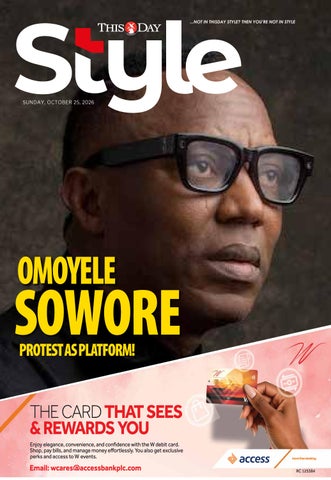
OMOYELE
SOWORE PROTEST AS PLATFORM!
THE CARD THAT SEES & REWARDS YOU Enjoy elegance, convenience, and confidence with the W debit card. Shop, pay bills, and manage money effortlessly. You also get exclusive perks and access to W events.
Email: wcares®accessbankplc.com
♦ access
1
more than banking
RC 125384
Sunday, October 25, 2026 Vol. 22, No. 11485
Sunday, October 25 , 2026 Vol. 22, No. 11485
EDITOR’S LETTER
COVER NOTE
WHY FIT MATTERS
MORE THAN
FASHION EXECUTIVE EDITOR
14
14
F
ew figures in Nigerian public life divide opinion as much as Omoyele Sowore. To some, he is a fearless activist who has spent decades speaking truth to power. To others, he is a controversial political figure whose confrontational approach raises as many questions as it answers. Either way, Sowore has never been one to shy away from a fight. From his days as a student activist to founding SaharaReporters and eventually entering presidential politics, he has built a reputation for challenging authority, often at considerable personal cost.
Lifestyle & Fashion
3
10 Why Fit Matters More Than Fashion
20 3
S yle TR
2
What Happens When You Stop Getting Botox?
4
Where To Spend And Where To Save On Makeup
5
The Designers We’re Excited To See This Fashion Season
6
Buying Art: What’s Actually Worth the Money?
8
Oversabi Aunty: A Story Of Family, Faith And Sacrifice
9
Haruna Garba Magashi: On Justice, Leadership And The Road To 2027
10
Opinion: Are We Becoming A Generation Of Oversharers?
19
Your Next Designer Handbag Could Be Nigerian
20
8 Small Details That Make A Home Look More Expensive
22
UT H
& RE A SO
N
EXECUTIVE EDITOR KONYE NWABOGOR 08111847087
DEPUTY EXECUTIVE EDITOR OLUFUNKE BABS-KUFEJI 08111847086
ASSISTANT EDITOR YINKA OLATUNBOSUN CONTRIBUTOR EBIYEKON DORCAS DIO DIRECTOR, PRINT PRODUCTION CHUKS ONWUDINJO
Printed by Ups Digitals Ltd, Abuja; 08057025005; info@upsdigitals.com
08077092196
On Everyone’s Radar
T
hose of us who spend a fair amount of time on social media can attest to the fact that there’s hardly ever a dull moment. There’s always someone’s personal business to discuss: a relationship falling apart, a family disagreement, or a scandal complete with screenshots and voice notes. Nothing seems sacred anymore. And while I sometimes wonder why people feel the need to share quite so much, the rest of us aren’t exactly discouraging them. After all, somebody is reading those comments and waiting for the next update. It’s remarkable how much our understanding of privacy has changed. I’m all for people speaking up when it matters, particularly when doing so exposes injustice or helps someone find support. But there’s also something to be said for keeping certain parts of our lives to ourselves. Perhaps we’ve become so accustomed to having an audience that we’ve forgotten we don’t always need one. It’s an interesting conversation we explore in “Are We Becoming a Generation of Oversharers?” Do read it. I’d love to hear your thoughts. Now, one thing I certainly won’t complain about seeing all over my timeline is fashion. Fashion season is finally here, and there’s already a wonderful sense of anticipation across the industry. Lagos is preparing for weeks of shows, presentations and events, but beyond the glamour, this is an important moment for the designers and everyone who helps bring their work to life. Months of creativity, planning and hard work are finally coming together. I’m particularly curious about what some of our designers have been working on. We’ve followed their collections, collaborations, and activities throughout the year, but there’s always something exciting about seeing fresh work. Some have been consistently visible, while others have kept us guessing. I’m hoping for strong collections, fresh ideas and a few surprises. We’ve highlighted some of the names we’re looking forward to in “The Designers We’re Excited to See This Fashion Season.” Do have a look. And while we’re celebrating Nigerian fashion, I think our handbag designers deserve more attention. We’ve become enthusiastic about investing in clothes from homegrown labels, yet when it comes to bags, many of us still instinctively look towards Paris and Milan. Meanwhile, Nigerian brands are producing beautiful pieces with designs and craftsmanship worth appreciating. “Your Next Designer Handbag Could Be Nigerian” introduces a few names that might make you reconsider where your next handbag comes from. And really, who doesn’t appreciate having more options? Before I go, how are you all doing? I hope October has been treating you kindly and that you’re finding time to enjoy yourselves despite everything competing for your attention.There’s plenty happening over the coming weeks, and I’m looking forward to it. I hope you are too.
Love,
@thisdaystyle |
@thisdaystyleon | www.thisdaystyle.ng
One of the most expensive mistakes women make is buying clothes that almost fit. Not the dress that’s obviously too small or the trousers that refuse to button. Those mistakes are easy to spot. The real problem is the blazer that’s slightly too big, the jeans that feel a little tight around the waist, or the dress that would be perfect if only it were an inch shorter. We buy these pieces because they’re beautiful, convince ourselves we’ll make them work, and then leave them hanging in the wardrobe while reaching for the same trusted outfits. Fashion trends may dominate our wishlists, but fit often determines whether an outfit looks good and gets worn. Here’s why getting it right makes such a difference.
Good Fit Makes Affordable Clothes Look Expensive
Have you ever complimented someone on an outfit only to discover it came from a surprisingly affordable store? Chances are, the fit was doing much of the work. A jacket that sits neatly on the shoulders, trousers that fall at the right length and a dress that follows the body’s proportions create a polished appearance. Meanwhile, even the most expensive designer piece can look awkward when the sleeves are too long, or the waistline sits incorrectly. A luxury label is no substitute for good fit.
You Buy Less And Wear More
Most wardrobes contain purchases made with the best intentions. The sale bargain, the trending silhouette, the dress that might fit better after losing a little weight. Understanding which cuts and proportions suit you makes shopping more intentional. Instead of buying something simply because it looks beautiful on a mannequin, you consider whether
you’ll actually enjoy wearing it. The result? Fewer shopping regrets, less money wasted and more outfits you can confidently pull together without buying anything new.
A Good Tailor Can Change Everything
Nigerian women have long understood the value of a good tailor. Whether it’s adjusting an aso-ebi outfit, taking in a dress or shortening trousers, small alterations can transform how clothes look. Ready-to-wear garments are produced using standard measurements, but our bodies rarely fit a single standard. Sometimes a beautiful outfit just needs a slightly adjusted waist, shorter sleeves, or a better hemline. Before abandoning a piece you love, find out whether a simple alteration could make it work.
Your Size Is Just A Number A size 12 in one brand might fit completely differently from a size 12 in another. Yet many women become frustrated when their usual size suddenly feels uncomfortable. Clothing sizes vary, and designers use different proportions. Instead of insisting on a particular number, pay attention to how the garment fits your body. Can you sit comfortably? Does the fabric pull awkwardly? Does the outfit allow you to move freely? Those answers matter far more than the number printed on the label.
OLAYINKA ARO LAMBO
Comfort Changes How You Carry Yourself
It’s difficult to look completely at ease when you’re constantly adjusting your clothes. A dress that keeps riding up, trousers that dig into your waist or a neckline that requires constant attention can turn an otherwise beautiful outfit into an inconvenience. When clothes fit comfortably, you stop worrying about them. You can sit, walk, dance and enjoy yourself without repeatedly checking whether everything is still in place. That ease often makes an outfit look even better.
Fit Helps You Find Your Personal Style
The more you understand what fits
OMON ODIKE
your body, the easier it becomes to recognise clothes that genuinely suit you. You begin noticing which silhouettes work, which proportions you prefer and which pieces you wear repeatedly. Trends become options rather than instructions.
EMELDA RUFAI
ELOHOR ELIZABETH
You can still experiment with oversized tailoring, dramatic shapes and new styles. Good fit doesn’t necessarily mean tight or figurehugging; it means the garment sits and moves the way it was intended to.
3
TR
UT H
& RE A SO
N
Sunday, October 25, 2026 Vol. 22, No. 11485
Sunday, October 25 , 2026 Vol. 22, No. 11485
WHERE TO SPEND AND WHERE TO SAVE ON MAKEUP
WHAT HAPPENS WHEN YOU STOP GETTING BOTOX? From returning wrinkles to surprising changes in facial muscles, here’s what really happens when you decide to give the injections a rest. You’ve been getting Botox for five years, perhaps ten. Your forehead is smooth, your frown lines are barely visible, and you’ve almost forgotten what your face looked like before the injections. Then one day, you decide to skip an appointment. Maybe you’re reconsidering the expense, or simply curious about what happens when you stop. Will your face suddenly catch up with all those years of ageing? Have your muscles become dependent on the injections? And could taking a break actually be good for you? The answers are more interesting than you might expect.
usual treatment window, although the extent and duration vary. Muscle activity generally recovers after treatment stops, but scientists are still studying the longer-term effects of repeated injections. So, while Botox is temporary, its effects on muscle structure may occasionally last longer than expected.
Your Wrinkles Might Not Return as Deeply
One potential advantage of consistent Botox use is that expression lines may have had less opportunity to become permanently Your Face Doesn’t Return to etched into your skin. However, there’s a difference between Normal Overnight wrinkles caused by repeated facial Botox temporarily blocks the nerve movement and those associated signals that tell certain facial muscles with collagen loss, sun damage and to contract. Its effects typically last declining elasticity. Botox addresses three to four months, although some the former, not every aspect of regular users experience longerageing. If you started treatment at lasting results. 35 and stop at 45, your skin hasn’t As the treatment wears off, remained biologically 35 throughout movement gradually returns. Your that decade. You may have fewer forehead starts creasing again, and pronounced forehead lines, but other lines around your eyes become age-related changes will still have more visible when you smile. By occurred. six months, much of your original muscle activity will usually have Your Facial Balance May returned, although recovery varies. Interestingly, some long-term users Look Different may find they no longer frown as Botox isn’t used exclusively for habitually as they once did. wrinkles. Depending on where it’s injected, it can subtly lift eyebrows, Years of Botox Can Actually soften a prominent jawline or change certain facial expressions. Change Your Muscles When treatment stops, those effects Here’s something that doesn’t gradually disappear. always come up during cosmetic Someone who received masseter consultations. Botox to slim a square jaw, for Repeated Botox injections can example, may notice their jawline cause treated muscles to become becoming fuller as muscle volume thinner through reduced activity, a recovers. Similarly, a brow lift process known as muscle atrophy. achieved through strategically Research suggests these changes placed injections will eventually fade. can sometimes persist beyond the
4
These changes aren’t necessarily signs of accelerated ageing. They’re simply the loss of specific cosmetic effects.
The Biggest Adjustment Might Be Psychological
There’s another consequence that rarely features in Botox conversations: becoming accustomed to a particular version of your face. After years of seeing
yourself with fewer expression lines, their return can feel more dramatic than it actually is. A perfectly ordinary forehead crease might suddenly seem like a new wrinkle. And because Botox has become such a routine beauty treatment, some women continue maintaining their results almost automatically, without considering whether they still want them. Taking a break offers an opportunity to reassess that relationship.
Some makeup products are worth every naira you spend on them. Others are simply expensive versions of things you could buy for considerably less. And surprisingly, the difference isn’t always obvious. A luxury foundation might give you the most beautiful finish you’ve ever had, while a mascara picked up at the supermarket could outperform one costing five times as much. Even professional makeup artists regularly mix high-end products with affordable favourites because performance, not price, is what matters. So, before you spend another small fortune restocking your makeup bag, it helps to know which products genuinely deserve the investment and which ones you can comfortably save on.
SPEND: Foundation
Your foundation covers more facial real estate than almost anything else in your makeup bag, so getting it right matters. Beyond coverage, consider undertones, texture and how the formula wears throughout the day. Darker complexions particularly benefit from carefully matched shades that don’t turn grey or orange. Premium foundations can offer beautiful finishes, but test them against affordable alternatives before committing.
SAVE: Mascara
A mascara doesn’t need an impressive price tag to deliver dramatic lashes. Maybelline and L’Oréal have built loyal followings with affordable formulas that rival luxury alternatives. Since mascara should generally be replaced around three months after opening, spending heavily on every tube seems unnecessary. Save your money and concentrate on finding a wand and formula that suit your lashes.
SPEND: Concealer
A brilliant concealer can disguise dark circles, pigmentation and blemishes without announcing its presence. The difference often comes down to texture. You want coverage that doesn’t crease
excessively, settle into fine lines or make delicate under-eye skin look dry. A well-matched, comfortable formula is worth paying extra for, particularly if concealer is part of your daily routine.
SAVE: Lip Liners and Brow Pencils
These everyday essentials rarely require luxury prices. Affordable lip liners can provide excellent pigmentation and staying power, while inexpensive brow pencils often deliver the precision needed for natural-looking arches. Focus on colour accuracy and application rather than packaging. They’re also products you replace frequently, making affordable favourites particularly practical.
SPEND: Makeup Brushes
Good tools can make inexpensive makeup look considerably better. Quality brushes pick up and distribute product evenly, blend more smoothly and can last for years when properly maintained. Forget enormous professional sets. Invest in a reliable foundation brush, a fluffy powder brush and a couple of excellent blending brushes. Those few purchases will do most of the work.
SAVE: Blush and Highlighter There’s little reason to spend excessively here when affordable brands offer impressive colours, textures and finishes. Whether you prefer a subtle flush or something more dramatic, the important considerations are pigmentation and blendability. For deeper skin tones, choose shades that show up beautifully without appearing chalky. The prettiest blush isn’t necessarily sitting inside the prettiest compact.
SPEND: Setting Spray
If your makeup regularly needs to survive heat, humidity, long working days or an entire Lagos wedding, a dependable setting spray deserves attention. The best formulas help extend wear without leaving skin sticky, excessively shiny or uncomfortable. Not every expensive spray performs better, but finding one that genuinely keeps your makeup intact is worth the investment.
SAVE: Eyeliner
From classic black wings to softly defined waterlines, excellent eyeliners exist at affordable prices.
What matters is smooth application, strong pigmentation and resistance to smudging. Unless a premium formula offers noticeably better wear, there’s no compelling reason to pay more.
SPEND: Eyeshadow Palette If you regularly wear eyeshadow, investing in one excellent palette can be smarter than accumulating several mediocre ones. Look for richly pigmented shades that blend easily and complement
your complexion. Choose colours you’ll genuinely use rather than an extravagant collection that spends most of its life untouched.
SAVE: Lipstick
Luxury lipsticks can feel wonderful, but affordable formulas now offer beautiful pigmentation, comfortable textures and impressive staying power. Unless you’re particularly devoted to a signature shade or finish, there’s no need to spend heavily.
5
Sunday, October 25, 2026 Vol. 22, No. 11485
Sunday, October 25 , 2026 Vol. 22, No. 11485
CHRISTIE BROWN
THE DESIGNERS WE’RE EXCITED TO SEE THIS FASHION SEASON From highly anticipated solo shows to exciting runway returns and fresh creative directions, these are the names giving us plenty to look forward to. Fashion season in Lagos is never just about the clothes. There are the invitations everyone wants, the shows that spark fashion conversations, the familiar faces in the front row, and, inevitably, the collections that will make us reconsider our wardrobes. But beyond the excitement, there is something particularly interesting about this season. Some of our most established designers are choosing to command their own stages, others are returning to the runway after a relatively low-profile period, while a younger generation continues to challenge what contemporary African fashion can look like. With Lagos Fashion Week and GTCO Fashion Weekend approaching, alongside independent presentations, our expectations are understandably high. Here are nine designers whose collections we are especially looking forward to.
FIA
FIA has always appealed to women who enjoy making an entrance. Known for playful proportions, unconventional shapes and confident colour combinations, the label brings a welcome sense of fun to fashion. Its expected GTCO Fashion Weekend outing is particularly interesting because FIA represents a different approach to statement dressing: clothes that can be dramatic without taking themselves too seriously. We are looking forward to seeing how that creative energy translates into a complete runway collection.
MAI ATAFO
HOUSE OF MARVEE
House of Marvee is entering an interesting phase. Founded by Marvellous Olugu, the luxury label has earned attention for its intricate couture designs and elaborate craftsmanship. This season, however, brings a significant development: the planned debut of its ready-to-wear collection at GTCO Fashion Weekend. Can the house translate its couture sensibility into pieces designed for a wider wardrobe? That is what makes this presentation particularly exciting. It could introduce an entirely new audience to the brand.
LANRE DA SILVA AJAYI
Few Nigerian designers understand the theatre of fashion quite like Mai Atafo. His 2023 standalone presentation was an ambitious production featuring 83 outfits, 50 models and an extraordinary runway arrangement. Now, he is preparing another independent show, and expectations are considerable. Atafo has spent years perfecting the relationship between tailoring, sophistication and spectacle. His suits remain among the most recognisable in Nigerian menswear, but his womenswear deserves equal attention. The excitement this time is about how he intends to surpass himself, creatively and in the scale of the presentation.
Lanre Da Silva Ajayi has never been a designer to shy away from glamour. Lace, elaborate detailing, vintage influences and beautifully feminine silhouettes have long defined her work. Yet what makes LDA interesting is her ability to revisit these signatures without abandoning the identity she has spent two decades building. Her independent presentation is one to anticipate, particularly for anyone who appreciates the craftsmanship behind occasion dressing. We are hoping for the sort of collection that reminds us why fashion can still be wonderfully extravagant.
BANKE KUKU
Banke Kuku has built an instantly recognisable identity around expressive prints, beautiful fabrics and clothes that make dressing up feel enjoyable. Her pieces have become favourites among women who appreciate colour without sacrificing elegance. With a standalone presentation on the horizon, we are curious to see how she develops that signature aesthetic. Will she experiment with new silhouettes, introduce unexpected fabric combinations or take her print storytelling somewhere entirely different? Whatever direction she chooses, subtlety is unlikely to be the point.
6
There is a particular sophistication to Christie Brown that makes the Ghanaian label consistently worth watching. Founded by Aisha Ayensu, the brand has developed a distinctive language of structured silhouettes, rich textiles and contemporary interpretations of African design. Its anticipated appearance at Lagos Fashion Week brings an exciting cross-border dimension to the season. Christie Brown understands how to make cultural references feel luxurious without becoming predictable. We are especially interested in the construction, styling and fresh ideas it will bring to the runway.
KILENTAR
Michelle Adepoju’s Kilentar has become one of the most compelling labels to watch, particularly for its thoughtful approach to traditional craftsmanship. Handwoven textiles, intricate beadwork and modern silhouettes come together in pieces that feel both artistic and wearable. Her previous intimate presentation at Temple Muse demonstrated that a fashion show need not be enormous to make an impression. With another off-site showing anticipated, we are interested in how she will continue exploring texture, technique and the possibilities of African textiles.
EMMY KASBIT
Emmanuel Okoro has established Emmy Kasbit as a label that understands the relationship between heritage and modern dressing. His use of traditional textiles, contemporary tailoring and distinctive silhouettes has given the brand a recognisable identity. Last season, he described his collection as a rebirth, signalling a fresh creative direction. With an off-site presentation expected this year, we are eager to see how that evolution continues. Emmy Kasbit is particularly good at creating clothes that feel culturally grounded without appearing restricted by tradition.
BRIDGET AWOSIKA
Bridget Awosika has always occupied an interesting position in Nigerian fashion. Her aesthetic is distinctive, often favouring architectural shapes, fluid fabrics and an understated sensuality. Having maintained a relatively low runway profile for some time, her anticipated return to Lagos Fashion Week is one we are particularly curious about. Fashion moves quickly, but designers with a strong identity rarely need to chase every trend. The question is how Bridget’s design language has evolved during her time away from the spotlight.
7
Sunday, October 25, 2026 Vol. 22, No. 11485
Sunday, October 25 , 2026 Vol. 22, No. 11485
MOVIE REVIEW
BUYING ART:
WHAT’S ACTUALLY WORTH THE MONEY? TUTU BY BEN ENWONU
SUNSET IN BANANA ISLAND BY JACQUELINE SUOWARI
Walk into an art gallery in Lagos, and you could find two paintings hanging a few feet apart. One costs N500,000. The other is priced at N20 million. So, what exactly are you paying for? The artist’s name? Their talent? The history of the painting? Or simply what someone else is willing to pay? Art pricing can be confusing, especially when you’re buying for the first time. Unlike a handbag or a piece of furniture, there is no straightforward formula for determining what a painting should cost. Here are seven things to consider before you buy. By Funke Babs-Kufeji
1. The Artist’s Name Comes at a Price
NJIDEKA AKUNYILI CROSBY, BUSH BABIES, 2017
Reputation matters. Established Nigerian artists such as Ben Enwonwu, Bruce Onobrakpeya and Nike DaviesOkundaye have built careers that collectors recognise. Their exhibitions, achievements and previous sales can influence what buyers will pay. But a famous name doesn’t guarantee you’ll love the work. Emerging artists can produce exceptional pieces at more accessible prices.
2. Not All Works by the Same Artist Cost the Same
An artist might have one painting priced at ₦2 million and another at ₦15 million. The difference could come down to when each was made, its importance in the artist’s career, its condition or its rarity. A work from a defining period may attract more attention than a recent piece. PEJU ALATISE DESPERATELY LABAKE
VICTOR EHIKAMENOR
8
WHEN IT RAINS I LL SEND FOR YOU BY PEJU ALATISE
3. Original or Print? Know What You’re Buying
An original painting is unique. A limited-edition print is one of a stated number of impressions, sometimes signed and numbered by the artist. A mass-produced reproduction is different again. All can look appealing on a wall, but they shouldn’t be priced as though they’re interchangeable.
Ask exactly what you’re getting, particularly when the description sounds impressive but isn’t clear.
4. A Painting’s History Matters
In art, provenance means the documented history of ownership. Who owned the work before? Has it appeared in notable exhibitions? Can the seller establish that it’s genuine? Reliable records can give buyers confidence and sometimes support a higher price. If you’re spending substantial money, ask for documentation and a proper receipt. An exciting story about a painting is no substitute for evidence.
OVERSABI D AUNTY:
By Yinka Olatunbosun
A STORY OF FAMILY, FAITH AND SACRIFICE
5. Popularity Can Push Prices Up
When collectors compete for work by the same artist, prices can rise. Gallery representation, exhibitions and auction results may increase visibility and demand. But attention doesn’t always last. A high asking price isn’t proof that someone else will pay it later. Before you buy, find out whether comparable works have actually sold at similar prices, rather than relying on enthusiastic predictions.
6. Expensive Doesn’t Mean a Good Investment
Art can appreciate, but it can also lose value or prove difficult to resell. Gallery commissions, framing, transport, insurance and conservation add to the cost of ownership. If profit is your main objective, do more than admire the painting: research the artist’s sales history and consider how you might eventually sell it. Nobody can promise that today’s fashionable name will be tomorrow’s auction sensation.
7. Sometimes, the Best Buy Is the One You Love
Perhaps a painting reminds you of childhood, captures something familiar about Lagos or simply makes you happy. That’s a perfectly good reason to own it. Set a budget, buy from a credible source and make sure you understand the price. You don’t need to become an art expert overnight, and you certainly don’t need to impress anyone with the amount you spent.
OVERSABI AUNTY WAS DIRECTED BY TOYIN ABRAHAM
CASTS OF OVERSABI AUNTY - MIKE EZURONYE, ENIOLUWA ADEOLUWA, TOYIN ABRAHAM
rama overload. Noisy. Slightly exaggerated. Oversabi Aunty is many things, but beyond its boxoffice success, it is a film that holds a mirror up to Nigerian family dynamics, religious overzealousness and emotional neglect. Directed by and starring Toyin Abraham, the film blends comedy with family drama, exploring the fine line between religious devotion, good intentions and the chaos that can unfold when one person becomes too involved in everyone else’s affairs. The film also marks a significant milestone for Nollywood, with Abraham becoming the first filmmaker whose directorial debut crossed the ₦1 billion mark at the Nigerian box office. At the centre of the story is Toun (Toyin Abraham), an overly pious and self-righteous church usher who has made it her personal mission to correct everyone around her. Whether dealing with extended family members, neighbours or complete strangers, she is convinced that she knows best. Unfortunately, while she is busy fixing other people’s lives, her own household suffers from her lack of attention. Her husband, played by Mike Ezuruonye, and their children bear the consequences of her emotional detachment and controlling nature. The tension builds steadily, culminating in a dramatic wedding introduction where Toun’s interference and unresolved family issues come to a head. Toyin Abraham delivers an energetic and convincing performance as a woman whose certainty about doing God’s work blinds her to the damage she is causing at home. Her character is frustrating, occasionally amusing and remarkably familiar. Almost every Nigerian family or community has encountered an oversabi individual, someone who feels compelled to offer unsolicited advice or interfere in matters that
do not concern them, often under the guise of morality or wisdom. The film features a strong supporting cast, including Mike Ezuruonye, Jemima Osunde, Efe Irele and Enioluwa Adeoluwa. Ezuruonye, in particular, matches Abraham’s energy, bringing believable tension to their portrayal of a troubled marriage. Their arguments, exchanges and even moments of dancing contribute to the chemistry between them, although some of the subplots involving the children feel unnecessarily stretched. One of the film’s strengths is its portrayal of Yoruba and Igbo cultures. Through the characters’ interactions, disagreements over children’s names and family expectations, Abraham presents the complexities and beauty of interethnic marriage. Despite their differences, the families find common ground, reinforcing the idea that relationships can thrive beyond ethnic boundaries. Beyond the comedy, Oversabi Aunty offers a commentary on parenting, emotional neglect and the consequences of excessive religious zeal. It raises important questions about the difference between being morally upright and being emotionally available to those closest to us. Still, the film is not without its shortcomings. Its heavy reliance on shouting and prolonged arguments can become exhausting, with some scenes losing their emotional impact through repetition. The third act also takes a few questionable turns, particularly in how the central conflicts are resolved. A more convincing examination of accountability might have given the conclusion greater emotional weight. On the technical side, the editing deserves commendation. Scene transitions are generally smooth and engaging, maintaining the audience’s interest as the story moves between domestic conflicts, church activities and social gatherings. Although some of the church and party sequences appear deliberately extended to emphasise Toun’s neglect of her family, certain aspects of the narrative could have benefited from further development. Ultimately, Oversabi Aunty succeeds in combining entertainment with recognisable social realities. Its exaggerated humour, family conflicts and moral lessons may not always be delivered with subtlety, but the film offers enough relatable moments and strong performances to sustain interest. Beneath the laughter is a familiar reminder that caring for others should never come at the expense of the people who need us most.
9
Sunday, October 25, 2026 Vol. 22, No. 11485
Sunday, October 25 , 2026 Vol. 22, No. 11485
H
Personally, I see my role as much more than that of a running mate. I see myself as a voice, a bridge, and a source of inspiration for millions of young people in Northern Nigeria who have become disillusioned with a political system that has failed to deliver the promise of a better life. Coming from the North, I understand the frustration of young people who watch their region struggle with poverty, insecurity, unemployment, and educational deprivation despite its enormous human and economic potential. I want my participation in this political journey to demonstrate that the future of the North does not have to be determined by a small circle of political elites. Ordinary people have the right and the capacity to participate meaningfully in deciding their own future.
aruna Garba Magashi may not command the same headlines as his presidential running mate, Omoyele Sowore, but he has spent years fighting his own battles for justice. A Kano-based lawyer and human-rights advocate, Magashi has built his career defending others’ rights and challenging a system he believes has failed too many Nigerians. Now making another bid for the vice presidency on the platform of the African Action Congress (AAC), he hopes to take that fight beyond the courtroom and into government. But who is the man behind the political ambition, and what does he believe he can bring to the country’s leadership? In this conversation with Konye Nwabogor, Magashi discusses his journey from law to politics, the challenges facing northern Nigeria, his partnership with Sowore and the kind of vice president he hopes to become. He also shares a little about his life away from politics and the courtroom.
You’ve built a career as a lawyer and human-rights advocate. What first drew you into politics, and was there a particular experience that convinced you that you needed to do more? What first drew me to politics was my strong desire for positive change and my conviction that we cannot continue to complain about a broken system while refusing to participate in fixing it. There are two contradictory arguments that are common in Northern Nigeria. The first is that anyone who wishes to preserve their honour, dignity, and integrity should stay away from Nigerian politics because of the dishonourable practices associated with it. The second is that good people have no moral right to complain about bad leadership when they have refused to participate in the political process. As the popular argument goes, good people abandoned politics, creating room for bad people to take over. These two arguments made me reflect deeply on the kind of society we want to build. I came to the conclusion that we cannot continue to entrust our collective future to people whose values and actions we disagree with, while expecting them to deliver the change we desire. If we want a different kind of politics, people with integrity, courage, and a genuine commitment to the public good must be willing to participate. However, I also believe that joining politics is not enough; the platform and the people one associates with matter just as much. I do not believe that someone can simply join a political camp whose values contradict his convictions and expect to transform it without compromising those convictions in the process. That is why I chose to align myself with Mr Omoyele Sowore, whose political ideals, courage, and commitment to challenging the status quo resonate with my own convictions. For me, entering politics is not about abandoning my identity as a lawyer or human-rights advocate. Rather, it is an extension of that commitment. I believe that defending people’s rights and pursuing justice should not be limited to the courtroom or public advocacy. We must also be prepared to engage with the political system that shapes people’s lives. Ultimately, I joined politics because I believe that meaningful change requires more than criticism from the sidelines; it requires the courage to step forward, participate, and be part of the solution. You are running alongside Omoyele Sowore for the second time. What do you think makes your partnership work, and what do you personally bring to the ticket? I believe a strong political partnership is built when two people from different backgrounds come together, united by a common vision, shared values, and a determination to achieve the same goal. That, to me, is the foundation of my partnership with Omoyele Sowore. Sowore is a man who refuses to accept that meaningful change is impossible in Nigeria. He believes that ordinary Nigerians possess the capacity to take responsibility for the affairs of their country and that governance should serve the interests of the people rather than a privileged few. His belief in the power of the masses resonates deeply with my own convictions. As a lawyer and human-rights advocate, I have spent years engaging with ordinary Nigerians, particularly the less privileged, and witnessing their struggles, aspirations, and determination to live better lives. I have seen that the problem is not that Nigerians lack the desire or capacity to succeed. Rather, what many of them lack is a fair opportunity, an enabling environment, and leadership that genuinely believes in their potential. I believe that is where our visions converge. Sowore brings his longstanding commitment to political activism and challenging the status quo, while I bring my legal experience, human-rights background, and understanding of the realities confronting ordinary people, particularly in Northern Nigeria. Our partnership is not about our individual ambitions, it is about advancing a common cause.
10
For too long, many of our people have been treated as instruments of political mobilisation rather than citizens whose interests, rights, and aspirations deserve to be respected. My aspiration is to encourage Northern youths to rise above political apathy, reject the politics of dependency, demand accountability, and reclaim their rightful place in the governance of their communities and country. I also bring a perspective that is rooted in the conviction that political transformation must go hand in hand with justice, respect for human rights, and the rule of law. We cannot build a truly democratic society if citizens are denied their rights, institutions are weakened, and public resources are managed without accountability. Running together for the second time reinforces my belief that our partnership is about consistency of purpose. We understand that transforming Nigeria is not an easy task, and that meaningful change requires courage, sacrifice, and sustained commitment. Ultimately, what I bring to the ticket is the voice and experience of a lawyer, the convictions of a human-rights advocate, and the determination to inspire ordinary Nigerians, particularly Northern youths, to believe that they are not condemned to be spectators in their own country. They have a right to lead, a right to demand accountability, and a right to build a Nigeria that works for everyone.
haruna garba
MAGASHI ON JUSTICE, LEADERSHIP AND THE ROAD TO 2027
The vice presidency is often seen as a supporting role. If elected, what would you want to be remembered for achieving in that office? I do not subscribe to the notion that the Vice President is merely a spare tyre, waiting to be used only when the President is unavailable. The Nigerian Constitution clearly defines the responsibilities of the Vice President, and I believe the office has significant potential to contribute to national development when its responsibilities are approached with commitment, vision, and a genuine concern for the people. If elected, my approach would be to discharge my constitutional responsibilities faithfully, support the President in implementing our shared vision, and contribute meaningfully to rebuilding Nigeria into a country that works for all its citizens. However, beyond the constitutional duties and the protocols of the office, I want to be remembered for something much more important: being a Vice President who gave the ordinary Nigerian a sense of belonging in the affairs of the nation. I want the common man, the struggling market woman, the subsistence farmer, the unemployed graduate, and the young entrepreneur to look back at my time in office and say that, for once, somebody in the highest levels of government understood their struggles and worked to improve their circumstances. I also want to be remembered for contributing to meaningful economic reforms that translate into tangible improvements in people’s lives. Economic reforms should not merely produce impressive figures on paper; they must create jobs, stimulate local businesses, improve purchasing power, reduce poverty, and give young Nigerians a genuine opportunity to succeed through their hard work. Another area I consider particularly important is the reform of our justice system. Having spent 22 years in the legal profession, I understand the difficulties that ordinary Nigerians encounter in accessing justice. I would want to use the opportunities available within the office to support reforms that make justice more accessible, affordable, efficient, and responsive to the needs of the people. Justice should not be a privilege reserved for those who can afford it; it must be a right that every Nigerian can realistically enjoy. Above all, I would want my legacy to reflect the principle that public office is a responsibility to the people, not a privilege for the officeholder. The Vice President must be willing to listen, engage, contribute ideas, and work collaboratively to achieve the government’s objectives while remaining conscious of the promises made to Nigerians. At the end of my tenure, I want to be remembered not simply as a man who occupied the office of Vice President, but as a man who used that office to improve lives, strengthen institutions, expand opportunities, and restore the confidence of ordinary Nigerians in their country. That, to me, would be a legacy worth leaving behind. Nigerians have heard countless promises from politicians over the years. What makes your own approach to leadership different, and why should people believe you would deliver? First, I believe Nigerians have every right to demand accountability from those who seek their votes. A campaign promise is not a favour a politician does for the people. It is a commitment made to the people in exchange for their mandate. When politicians repeatedly make promises and fail to fulfil them, they undermine public confidence, breed cynicism, and create the impression that political leadership cannot be trusted. The problem is not that Nigerians have stopped believing in the possibility
of a better country. Rather, years of unfulfilled promises have made many people understandably sceptical about those who seek public office. When leaders repeatedly betray the trust of the people, they create an atmosphere of uncertainty and hopelessness. We must change that culture. What distinguishes our approach is that we are not coming into politics as people who have enjoyed the privileges of political power and are now seeking another opportunity to perpetuate the same system. Our political engagement is rooted in a longstanding struggle for a better Nigeria and a belief that government must serve the people, not exploit them. Mr Omoyele Sowore has spent years challenging the status quo and advocating for the rights and interests of ordinary Nigerians, often in circumstances where doing so has come at a personal cost. His political activism reflects a sustained commitment to demanding accountability from those in power. Our partnership is built on the conviction that Nigeria needs a fundamental change in the way governance is approached. For me, however, the issue goes beyond making promises or asking Nigerians to trust us simply because of what we say. Trust must be earned through consistency, transparency, accountability, and demonstrable commitment to the public good. If given the opportunity to serve, we must be prepared to explain not only what we intend to achieve but also how we intend to achieve it, the resources required, and the results Nigerians should expect. We must establish clear priorities, set measurable targets, and subject our performance to public scrutiny. Where we encounter difficulties, we must be honest with Nigerians rather than conceal our failures behind excuses. I also believe that leadership requires the courage to make decisions in the public interest, even when those decisions are politically inconvenient. We cannot promise Nigerians a better country while continuing to protect the interests of a privileged few at the expense of the majority. Ultimately, Nigerians should judge us not merely by our speeches or campaign slogans but by our records, our principles, our consistency, and the seriousness of our plans. We are not asking Nigerians to trust us blindly. We are asking them to examine our convictions, assess our records, scrutinise our proposals, and hold us accountable for every commitment we make. My belief is that public trust is not secured by the promises a politician makes before an election, but by the integrity with which those promises are pursued after the election. That is the standard of leadership I believe Nigeria deserves, and the standard by which I would want to be judged. Away from politics and the courtroom, who is Haruna Magashi? What do you enjoy doing, and what is something about you that might surprise people? Away from politics and the courtroom, Haruna Magashi is a very simple man. I enjoy living among ordinary people, relating with them freely, and treating everyone with dignity, regardless of their social status. I have never believed that one’s profession, position, or achievements should make one feel superior to others. I value mutual respect, and I believe that every human being deserves it. One thing that might surprise people is that I am not much of a talker. My mother used to say that I could spend hours in a room full of siblings and relatives without uttering a word. I think Mr Sowore has also observed this about me. But there is a difference between being quiet and having nothing to say. When a matter demands my contribution, I can speak at length and with conviction. I prefer to listen, observe, and think before I speak. One of the things that gives me the greatest joy is helping people solve their problems. There is a special kind of happiness that comes from knowing that someone is smiling because you were able to make a difference in their life. It does not always have to be something big. Sometimes, a little assistance, a piece of advice, or simply being available when someone needs you can mean a great deal. I find genuine fulfilment in such moments. I am also a sportsman, particularly a squash player. I enjoy the game because it challenges both the body and the mind. Beyond sports, I value anything that contributes to a balanced and meaningful life. At home, I see myself as an active member of the family, not someone whose responsibilities end outside the house. I support my wife in her business, help my three children with their studies, and participate in other household chores. The only place where I readily admit defeat is the kitchen! I have not quite mastered the art of cooking, so that responsibility is one area where my wife still has the advantage over me. Another thing I enjoy immensely is reading. I have a circle of friends who share my passion for books, and we often engage in discussions around what we read. I can get so absorbed in a book that I lose track of time. I also value books as gifts. To me, giving someone a book is giving them an opportunity to discover new ideas, broaden their understanding, and see the world differently. Finally, I enjoy making friends and maintaining relationships. I believe that human connections are among life’s greatest treasures. The people we meet, the ideas we exchange, and the experiences we share all contribute to who we become. If there is one thing I would want people to know about Haruna Magashi, it is that beneath the identity of a lawyer, human-rights advocate, and politician is an ordinary family man who enjoys simple living, loves books, values friendship, and finds his greatest satisfaction in making life a little better for someone else. I believe that is the essence of who I am, and it is the same spirit I try to bring into my professional and public life.
11
Sunday, October 25, 2026 Vol. 22, No. 11485
Sunday, October 25 , 2026 Vol. 22, No. 11485
Enjoy elegance, convenience and confidence with the W debit card. Shop, pay bills and manage money effortlessly. You also get exclusive perks and access to W events
12
13
PHOTOGRAPHY by Kunle Ogunfuyi
OMOYELE
SOWORE PROTEST AS PLATFORM!
F
BY KONYE CHELSEA NWABOGOR
ew figures in Nigerian public life divide opinion quite like Omoyele Sowore. To some, he is a fearless activist who has spent decades speaking truth to power. To others, he is a controversial political figure whose confrontational approach raises as many questions as it answers. Either way, Sowore has never been one to shy away from a fight. From his days as a student activist to founding SaharaReporters and eventually entering presidential politics, he has built a reputation for challenging authority, often at considerable personal cost. Now, as he sets his sights on the 2027 presidential election, he faces a different challenge: turning years of protest and public resistance into a political platform capable of winning votes. Can the man who has spent much of his life challenging the system convince Nigerians that he can actually run it? And what will he do differently this time? In this conversation with Konye Nwabogor, Sowore discusses his political ambitions, campaign funding, the realities of Nigerian politics and the personal sacrifices that come with a life of activism. He also offers a glimpse of the man behind the protests, controversies and headlines.
Sunday, October 25 , 2026 Vol. 22, No. 11485
COVER
COVER
Sunday, October 25, 2026 Vol. 22, No. 11485
You’ve spent over three decades challenging governments and fighting for change. Looking at Nigeria today, do you believe your activism has made a real difference, or do you sometimes feel you’re still fighting the same battles? Absolutely, my activism has made a difference, and I have no regrets whatsoever. But I have never confused progress with victory. We are still fighting some of the same battles because the political class that has held Nigeria hostage has continued to reproduce itself, changing political parties, slogans, and alliances while preserving the same oppressive system. When I started activism as a student leader at the University of Lagos, military dictators ruled Nigeria. We confronted them even when doing so could cost us our education, our freedom, or our lives. We fought for democracy, freedom of expression, including the struggle for independent media, accountable leadership, and the dignity of ordinary Nigerians. Today, Nigerians can openly challenge presidents, organise resistance movements, expose corruption, and confront injustice in ways that were once almost unimaginable. Those freedoms were not donated by benevolent rulers. People fought, suffered, and sometimes died for them. We founded SaharaReporters to challenge the monopoly of information controlled by powerful interests. We declared #RevolutionNow when many believed Nigerians had lost the capacity to resist. We have helped defend citizens whose rights were violated, including people who had no political connections or financial resources; in some cases, we fought for people who are themselves tools for oppression, like we did with #POLICEPROTEST in 2025. But the fundamental struggle remains unfinished. We removed military uniforms from government without dismantling the mentality of military dictatorship. We replaced military decrees with constitution that the military imposed upon Nigeria, and which are too often disregarded by those in power. So, yes, we are still fighting, but we are not standing in the same place. Every generation of resistance builds on the previous one. The struggle is not evidence of failure. Surrender would have been failure. You’ve been arrested and detained several times, yet you continue to speak out. Have you ever considered a less confrontational approach, or do you believe confrontation is necessary to bring about change? What exactly is a less confrontational approach to oppression? Should I politely request that corrupt politicians stop stealing? Should I beg security agencies to respect fundamental human rights? Should I whisper when Nigerians are being kidnapped, impoverished, tortured, or unlawfully detained? People often confuse confrontation with violence. I have consistently advocated organised, principled and nonviolent resistance. But nonviolence does not mean silence, submission or cowardice. I have been arrested, detained, assaulted, prosecuted, and subjected to restrictions on my movement. My family has paid an enormous price. Yet the question should not be why I continue confronting injustice. The question should be why those responsible for injustice continue operating with impunity.
14
15
When we declared #RevolutionNow in 2019, the government responded with repression because it understood that organised citizens could challenge entrenched political power. I do not wake up looking for confrontation. I wake up determined not to surrender my rights or abandon those whose rights are being violated. There is nothing radical about demanding electricity, education, healthcare, living wages, and security. What is radical is expecting nearly 250 million people to endure avoidable suffering indefinitely. I am not confrontational because I enjoy confrontation. I am confrontational because injustice must be confronted. SaharaReporters changed the way Nigerians consume political news and hold public officials accountable. But you’re also an activist and politician. How do you separate your political interests from the journalism of the platform you founded? SaharaReporters was founded on a simple but revolutionary principle: information belongs to the people, not to those who occupy political offices or control economic power. Long before I became a presidential candidate, SaharaReporters was exposing corruption, challenging powerful institutions, and giving ordinary Nigerians a platform to tell stories that conventional media organisations were unwilling or unable to publish. When I entered partisan politics, I understood the importance of maintaining the editorial independence of the organisation. SaharaReporters has its own editorial structure, journalists, and professional responsibilities. I do not expect journalists there to become my campaign spokespersons or suppress stories because they may be politically inconvenient. The standard I have always defended is straightforward, it is that journalism must follow evidence, not political loyalty. I have been criticised by SaharaReporters writers and commentators, and the platform has reported stories involving individuals associated with my political activities. That is precisely how independent journalism should function. There is also a fundamental difference between having political convictions and corrupting journalism. Every journalist is a citizen with rights, opinions, and convictions. The ethical obligation is to ensure that reporting remains independent, verifiable, and accountable. SaharaReporters was not established to protect Omoyele Sowore. It was established to challenge the abuse of power, whoever exercises it. If I ever become president, SaharaReporters must retain the freedom to investigate and expose my government. Anything less would betray the reason we founded it. You’ve contested the presidency twice without gaining significant electoral support. What have those experiences taught you, and what will you do differently in 2027? First, I reject the suggestion that the value of a political movement can be measured exclusively by the number of votes officially recorded in an electoral system whose credibility has repeatedly been questioned. That does not mean I dismiss electoral results. It means we must understand the conditions under which elections take place: vote buying, intimidation, unequal access to resources, institutional weaknesses, and the entrenched advantages enjoyed by established political parties that steal public funds to do unethical electioneering and rig electoral outcomes. In 2019, we introduced a revolutionary political alternative that challenged the traditional political establishment. In 2023, we continued building that movement under extremely difficult circumstances. Those experiences taught us important lessons about organisation, grassroots structures, political education, election-day mobilisation, voter protection, and the necessity of building a movement that exists beyond election seasons.
16
Sunday, October 25 , 2026 Vol. 22, No. 11485
For 2027, we are strengthening our party structures, expanding community engagement, developing more effective digital organising systems, and building stronger relationships with workers, students, farmers, traders, professionals, and Nigerians in the diaspora. We are also making our policy proposals more accessible so Nigerians can understand exactly what a revolutionary government would mean for their daily lives; that’s why we are the only candidate with an app, SOWORENOW, downloadable from the Android and Apple app stores. But one thing will not change: we will not abandon our principles to become acceptable to the same establishment we are challenging. I did not enter politics to become another familiar face in a failed political arrangement. I entered politics to change that arrangement fundamentally.
We will pursue the restoration of fuel subsidies within a transparent, accountable framework while developing affordable mass transportation, expanding domestic refining capacity and addressing the structural problems in the energy sector.
of citizen-powered political financing we want to institutionalise. I also reject the notion that Nigerian elections must necessarily be competitions between billionaires spending questionable fortunes. Why should someone seeking public office require extraordinary personal wealth? Why should access to political leadership depend on the capacity to distribute money rather than the quality of ideas, integrity and public service? We intend to use our resources efficiently, disclose campaign financing in accordance with applicable laws, and prioritise grassroots organising, volunteer networks, and direct engagement. Money can purchase billboards, advertisements and political operatives. It cannot legitimately purchase the conscience of an entire nation. We are not looking for investors who want to buy Nigeria through our campaign. We are building a movement of citizens who want to reclaim their country.
Beyond protests and social media, how do you intend to reach everyday Nigerians and convince them to vote for you? What is your campaign strategy this time? One of the biggest misconceptions about our movement is that it exists only on social media. That is simply untrue. We have been organising in communities, universities, workplaces, markets, villages and cities across Nigeria for decades. Many of the people who participate in our struggles are not even active on social media. In 2024, our movement, led by TakeITBack, shook this country with the #ENDBADGOVERNANCE protest. For 2027, our approach combines direct grassroots engagement with modern technology and sustained political education. We are organising town hall meetings, community conversations, market visits, workplace engagements, student outreach, neighbourhood mobilisation, and direct engagement with Nigerians excluded from conventional political discussions. We are strengthening the African Action Congress (AAC) structures and encouraging our supporters to coordinate their activities rather than operate as isolated individuals or spend endless hours discussing politics without translating those conversations into real organisation. We are also deploying digital tools, including the SoworeNow platform, to improve communication, volunteer coordination, and public participation. Of course, our campaign will not be built around distributing bags of rice or purchasing political loyalty. It will be built around discussing people’s actual problems and presenting clear, practical alternatives. When I visit a fishing community in the Niger Delta, I want to discuss waterways, livelihoods, environmental justice and transportation. When I meet teachers, we discuss salaries, classrooms and qualititave education. When I meet young people, we discuss employment, technology and opportunities. Our strategy is to take politics away from the exclusive control of political contractors and return it to ordinary Nigerians.
Many Nigerians know what you’re fighting against, but perhaps fewer know what you would do differently. If elected president, what would be your first three priorities? I have never been interested in merely criticising government. We have developed concrete proposals for transforming Nigeria, and our priorities are clear. First, economic justice and the restoration of living standards. We will pursue a N500,000 monthly minimum wage as part of a broader living-wage policy, confront the outrageous cost of governance, eliminate wasteful privileges, and redirect public resources toward productive sectors. We will pursue the restoration of fuel subsidies within a transparent, accountable framework while developing affordable mass transportation, expanding domestic refining capacity and addressing the structural problems in the energy sector. We will also begin an ambitious public housing program, including our proposal for one million mixed-income homes, and initiate tenancy reforms to protect Nigerians from exploitative rent demands. Second, free, quality education and accessible healthcare. Education will be free, qualitative, accessible and compulsory from primary school through public university. We will invest in teachers, learning infrastructure, instructional materials, virtual learning (e-learning), school meals, and the safety of students. Healthcare will be treated as a fundamental public responsibility rather than a privilege reserved for those who can afford private hospitals or overseas treatment. We will invest in primary healthcare, medical professionals, public hospitals and the systems needed to deliver effective services across the country. Third, security, justice and the complete restructuring of public accountability. We will confront insecurity with intelligence-led policing, modern technology, better-equipped security institutions and improved welfare for security personnel. We will end the routine weaponisation of security agencies against critics and peaceful protesters. We will pursue corruption cases through due process, strengthen institutional transparency and deploy modern technologies to make government expenditure traceable and publicly accountable. We will also begin reforms to restore confidence in the judiciary and guarantee that the law applies equally to ordinary citizens and political officeholders. These priorities are interconnected. You cannot achieve meaningful security while millions are trapped in desperation. You cannot create prosperity without education. You cannot build public trust when corruption is rewarded. Our objective is not simply to change the occupants of government offices. It is to change what government does, whom it serves, and how it is held accountable.
Running for president in Nigeria requires a lot of money. How are you funding your campaign, who are your financial backers, and how do you intend to compete with the resources available to the major political parties? Our campaign is funded through contributions from supporters, volunteers and ordinary Nigerians who believe in the political alternative we are presenting. We are not funded by political godfathers who expect oil blocks, government contracts, ministerial appointments or access to the national treasury in exchange for campaign financing. We have demonstrated that people are willing to contribute when they believe in a cause. During a recent fundraising challenge, we set a target of N1 million in 48 hours and received approximately N5.5 million in less than 24 hours. That is the kind
You’ve spent years criticising how Nigeria is governed. But there’s a difference between demanding change and being responsible for delivering it. Why should Nigerians trust you to lead the country? Leadership is not the ability to occupy an office, ride in a convoy, distribute patronage or deliver speeches written by advisers. Leadership is the capacity to identify problems, mobilise people, make difficult decisions and accept responsibility for the consequences. For more than three decades, I have organised people, built institutions, challenged powerful interests and remained consistent in my commitments. I established SaharaReporters as an independent media platform that challenged powerful political and economic interests. I have participated in building political movements, organising citizens and defending people whose rights were violated. These are not theoretical experiences. They involve organisational discipline, difficult decisions, financial pressures, strategic planning, and accountability. I also understand that running a country is different from leading a protest. Government requires competent institutions, capable professionals, clear priorities, disciplined implementation and measurable outcomes. I do not intend to govern Nigeria as a one-man spectacle. I
COVER
COVER
Sunday, October 25, 2026 Vol. 22, No. 11485
17
COVER
Sunday, October 25, 2026 Vol. 22, No. 11485
intend to assemble capable Nigerians, empower institutions and establish clear standards of public accountability. The difference between my approach and the conventional political culture is that I do not believe public office confers personal ownership of the state. Nigerians should not trust me blindly. They should examine my record, interrogate my proposals, demand transparency and hold me accountable to measurable commitments. I am not asking Nigerians to replace one unquestionable ruler with another. I am proposing a government that citizens have the power to question, challenge and hold accountable. You’ve been involved in activism for most of your adult life. How has that affected your family and personal relationships, and have you ever wondered what your life might have been like if you’d chosen a different path? The greatest personal cost of activism is not imprisonment. It is the time you lose with the people you love. I have spent years separated from my family because of political persecution, detention, court proceedings, and restrictions on my movement. There were birthdays, anniversaries, school events, and ordinary family moments I could not attend. Those moments cannot simply be recovered. Recently, I was able to spend time with my wife and children in the United States after a prolonged separation. My son turned 17, and we marked our 22nd wedding anniversary. Experiences like those remind you that behind every public struggle there are private sacrifices that people rarely see. My family did not volunteer to experience every consequence of my political convictions, yet they have carried those burdens with extraordinary resilience. Of course, I sometimes imagine what life might have been like if I had chosen a quieter path. I could have concentrated on journalism, business, family, and personal comfort. But I also ask myself what would have happened if everyone who recognised injustice decided that personal comfort was more important than confronting it. I cannot pretend the sacrifices have been easy. They have not. My family deserves more of my time, and I remain conscious of that responsibility. But I would rather explain to my children why I stood against injustice than explain why I remained silent when I had the opportunity to resist it. People often describe you as fearless, outspoken and controversial. Do you think that public image reflects who you really are, or is there a side of you Nigerians rarely get to see? I find the description of fearlessness interesting because courage is not necessarily the absence of fear. Courage is understanding the consequences of your actions and refusing to abandon what is right because those consequences are uncomfortable. I am outspoken because I believe Nigerians have suffered enough from politicians who speak in coded language, avoid difficult questions and say whatever is convenient. As for being controversial, I have discovered that in Nigeria, standing firm and refusing to genuflect to powerful people is often enough to earn that description. But there is much more to me than the image people see during protests, interviews, or confrontations with security agencies. I enjoy humour. I laugh a lot. I value friendships. I love my family. I enjoy meeting ordinary people and listening to their experiences. I am also deeply interested in technology, innovation, journalism, history, sports and the possibilities of human creativity. People who know me personally understand that I am not permanently angry. In fact, I enjoy life enormously. I can be uncompromising about principles without being incapable of affection, friendship or laughter. The public sees me confronting power. Those close to me also see
18
Sunday, October 25 , 2026 Vol. 22, No. 11485
someone who loves people, enjoys life and believes that a better world is possible. Away from politics, protests and public debates, what does a normal day in your life look like? How do you relax, and what are the little things that make you happy? I enjoy running. It has become an important part of my daily routine and personal discipline. I participate in road races and long-distance runs whenever possible. Recently, I completed the Abeokuta 10-kilometre Road Race, and I have participated in races in Enugu, Abuja, and the United States. Running gives me an opportunity to think, clear my mind, and maintain the physical and mental stamina required for the work I do. I also enjoy reading, following technological developments, watching interesting documentaries, engaging in conversations, and spending time talking to people and listening. I love visiting communities, particularly the riverine areas where I grew up. Returning to Kiribo and interacting with people who knew me long before politics is always a special experience. I enjoy the waterways, the natural environment and the simplicity of community life. And splashing down in water whenever possible, I am an avid swimmer. Some of my happiest moments are ordinary ones. I also enjoy meeting creative people who are creating things, developing new ideas and refusing to surrender to the limitations imposed on them. People sometimes imagine that activism is an existence without joy. That is not true. I fight for a better Nigeria precisely because I believe people deserve to enjoy life, pursue happiness and realise their potential without constantly struggling merely to survive. You’ve spent much of your life fighting for the Nigeria you believe in. If you never become president, what would make you feel that all those years of activism were worthwhile? I did not begin fighting for Nigeria because I wanted to become president. I began fighting because I could not accept injustice, dictatorship, corruption, and the deliberate destruction of human potential. I was confronting military dictators long before the idea of contesting a presidential election became part of my political journey. The presidency is not the ultimate purpose of my struggle. It is an instrument through which I believe we can accelerate the transformation Nigeria desperately needs. Of course, I want to become president, and I am working seriously toward that objective. I am not participating in elections merely to make a statement or decorate the ballot paper. But my life cannot be reduced to whether I eventually occupy Aso Rock. If Nigeria becomes a country where a child born in Kiribo, Maiduguri, Sokoto, Makurdi, or any other community has the same opportunity to succeed as the child of a president, that would be a victory. If workers can live decently on their wages, if public education works, if hospitals save lives, if young people can find meaningful employment and if citizens can criticise government without fearing arrest, those would be victories worth fighting for. If future generations no longer have to organise protests simply to demand the basic necessities of civilised existence, then we will have achieved something historic. And if the movements we have built inspire another generation of Nigerians to challenge injustice and defend their rights, our sacrifices will never have been wasted. I have never believed that one individual must personally enjoy the fruits of every struggle he participates in. Some people plant trees under whose shade they may never sit. But I am not finished planting, organising or fighting. I intend to see the transformation we have struggled for become a reality. I want to become president because I want to change Nigeria. But I did not start fighting to become president, and I will not stop fighting because of an election result. My ultimate ambition is not to be remembered as a president. It is to help build a Nigeria where no citizen needs extraordinary courage simply to live with dignity, freedom, and justice.
OPI NION @thisdaystyle |
W
@thisdaystyleon |
www.thisdaystyle.ng
BY KONYE CHELSEA NWABOGOR
e used to have private lives that we occasionally shared. Now, increasingly, we have public lives from which we occasionally withhold information. It is a remarkable reversal, especially when you consider how recently privacy was an ordinary part of being an adult. You could be married for twenty years without your colleagues knowing the details of your relationship. You could experience financial difficulties or go through a painful breakup without feeling that anybody outside your immediate circle needed an explanation. Today, complete strangers can know the most intimate details of our lives, sometimes before the people closest to us do. Spend a little time on Nigerian social media and the transformation becomes obvious. Someone is explaining why their marriage collapsed. Another person is sharing screenshots of an argument with a friend. There are detailed accounts of family disagreements, revelations about infidelity and personal experiences that would once have been discussed behind closed doors. And because these stories often unfold over several days, we follow them almost like television series, waiting for the next instalment. What fascinates me is how quickly this has become normal. Not so long ago, Nigerian society was almost excessively concerned with discretion. We grew up hearing that family matters should remain within the family and that there was dignity in keeping some things to yourself. Much of this was tied to the fear of public judgment. People worried about embarrassing their families, damaging their reputations or becoming the subject of gossip. That culture certainly had its shortcomings. It encouraged people to conceal difficulties that deserved attention and sometimes protected harmful behaviour under the excuse of keeping family matters private. Women were expected to tolerate unacceptable situations, victims of abuse were discouraged from speaking up, and personal struggles were often treated as sources of shame. In many ways, social media has helped correct that imbalance. It has given people a voice, created communities around shared experiences and made conversations about abuse, mental health and financial hardship more accessible. In Nigeria, where getting institutions to respond to legitimate complaints can be frustrating, public exposure has also become a practical tool for demanding accountability. A complaint that goes unanswered for weeks can suddenly receive attention once it starts trending. But somewhere within this welcome culture of openness, something else has happened. We have gradually started treating disclosure itself as a form of authenticity, as though the more someone reveals, the more genuine they must be. Why should the depth of someone’s honesty be measured by how much of their personal life they are willing to make public? There is something strange about a culture that celebrates boundaries in relationships while simultaneously expecting almost unlimited access to people’s private experiences. Social media has also changed the rewards associated with sharing. A deeply
personal story can attract enormous attention, sympathetic comments, new followers and sometimes commercial opportunities. The more emotional or controversial the revelation, the more likely it is to travel. Platforms thrive on engagement, and very little generates engagement quite like the intimate details of another person’s life. This does not mean everyone who shares a painful experience is looking for attention. But it does mean we operate in an environment where personal exposure is constantly encouraged and rewarded. Perhaps that explains why even ordinary life events increasingly seem to require public documentation. Relationships are announced, celebrated, analysed and occasionally dissolved before an audience. Pregnancy journeys, hospital visits and moments of grief are shared in extraordinary detail. None of these choices is inherently wrong. What has changed is the assumption that an experience somehow becomes more significant when other people witness it. And we, the audience, are hardly innocent. We complain about people revealing too much, yet eagerly read their stories. We examine screenshots, discuss relationship scandals in WhatsApp groups and follow developments involving people we have never met. Sometimes we become so invested that we feel entitled to explanations. A celebrity stops posting their spouse, and speculation begins. Someone announces a separation without providing details, and followers immediately demand to know what happened. We have become accustomed to access, and access has gradually begun to feel like entitlement. There is also the question of people who never agreed to become part of these public narratives. A person may be comfortable discussing their marriage, but their spouse may not be. A parent may enjoy documenting family life, but their children may eventually resent having their childhood permanently available online. The internet also has a habit of preserving moments that people themselves have outgrown. An emotional confession made at twenty-five can resurface at forty. A disagreement that has long been resolved can remain available for strangers to revisit. We have become remarkably comfortable making permanent records of temporary emotions. What I find particularly interesting is that all this openness has not necessarily made us more intimate with one another. We may know someone’s relationship history, financial difficulties and family disagreements without knowing anything meaningful about their character. Information, after all, is not the same thing as intimacy. None of this suggests that we should return to the days when silence was automatically considered respectable. Speaking up can be courageous, necessary and transformative. But privacy can be equally valuable. The two ideas should be able to coexist without one being treated as evidence against the other. Perhaps what we are losing is not privacy itself, but our appreciation of it. The understanding that some experiences are no less meaningful because they remain undocumented, and that having a story does not create an obligation to tell it. I rather like the idea that there should still be things about people that you can only discover by actually getting to know them. After all, if we’ve already read your entire life story on Instagram, what exactly are we supposed to discuss over dinner?
ARE WE BECOMING A GENERATION OF
OVERSHARERS?
19
Sunday, October 25, 2026 Vol. 22, No. 11485
Sunday, October 25 , 2026 Vol. 22, No. 11485
YOUR NEXT DESIGNER
HANDBAG COULD BE NIGERIAN 10 Nigerian brands making beautiful bags worth adding to your collection
A good handbag is always a worthy addition to any wardrobe, and Nigerian designers are giving us more reasons to shop closer to home. From beautifully crafted leather bags to beaded evening pieces, stylish totes and statement designs, the options are becoming increasingly difficult to ignore. And while international luxury labels will always have their appeal, there’s plenty of homegrown talent producing bags worth making room for in your collection. Here are ten Nigerian brands that deserve a spot on your wishlist.
O’ECLAT DESIGNS
ÉKI KÉRÉ
MARTÉ EGELE
KISARA
O’Eclat Designs brings together leather, interesting colours and Nigerian textiles in a way that feels modern and wearable. Founded by Gbemisola Johnson, the brand offers everything from structured totes to compact clutches and mini bags. Its Ella Midi Tote is particularly appealing for everyday use, while the Julia Fold and Lima designs offer smaller options. It’s a good reminder that Nigerian craftsmanship can be celebrated without every accessory needing to look overtly traditional.
Not every beautiful handbag has to be made from leather. Éki Kéré’s raffia totes offer something different, particularly for women who enjoy natural textures and relaxed dressing. The brand’s patch raffia bags combine woven materials with indigo-dyed details, creating accessories that feel artistic without being difficult to wear. They’re especially lovely for weekends, holidays and those days when your outfit needs something less structured and a little more interesting.
FEMIHANDBAGS
Femi Olayebi has been in the handbag business long enough to know that women want more than something pretty to carry around. FemiHandbags offers leather totes, crossbody bags, luggage and smaller accessories, making it a practical destination for different needs. There’s something reassuring about a brand that understands the importance of function. After all, a handbag can be gorgeous, but if you have to fight to fit your essentials inside, the romance wears off rather quickly.
ZASHADU
If you appreciate a handbag that looks expensive without needing an enormous logo, Zashadu deserves your attention. Founded by Zainab Ashadu, the Lagos-based brand has developed a distinctive identity around leather, sculptural shapes and careful detailing. Its 1982 handbag, quilted TKO Classic and woven designs offer different takes on contemporary luxury. These are bags with enough personality to stand on their own, particularly if your wardrobe leans towards elegant, understated dressing.
If your handbag preferences lean towards something fun but still polished, Marté Egele has plenty to offer. The brand’s Ese, Bui and other signature styles play with proportions, colour and structure. There are tiny top-handle bags for women who carry practically nothing and larger options for those of us who insist on taking half our belongings everywhere. The designs have a youthful appeal without feeling restricted to a particular age group.
Kisara is another name to explore if you like handbags that move beyond conventional leather designs. Known for combining cane weaving with leather, the brand’s approach gives its accessories an unusual, handcrafted appeal. These are the kinds of bags that work beautifully with simple outfits because the texture does much of the talking. A good option for anyone who wants something distinctive without necessarily reaching for a familiar international label.
TIFFANY AMBER
AABOUX LISA FOLAWIYO
Lisa Folawiyo knows how to make embellishment look fashionable rather than excessive. Her beaded shoulder bags are a lovely extension of the creativity we already associate with her clothing. Colourful, detailed, and unapologetically decorative, they’re especially appealing for dinners, weddings, and evenings when a simple outfit needs something extra. Think of a plain black dress, beautiful heels and one of her intricately beaded bags. Very little else required.
20
For lovers of clean lines and interesting shapes, AABOUX is worth discovering. Founded by Zainab Aliyu, the brand creates limited-edition leather handbags with an architectural feel. Its signature Mira designs and other structured styles are especially appealing to women who prefer sophisticated accessories with a modern edge. The brand also uses a distinctive construction technique that reduces visible stitching. The result is a polished aesthetic that feels contemporary without trying too hard.
BANKE KUKU
Banke Kuku has built a recognisable fashion identity around vibrant prints, beautiful fabrics and relaxed glamour. Her printed pouches bring that same spirit to accessories. They’re ideal for holidays, lunches, relaxed evenings and occasions when a traditional leather handbag feels a little too serious. If you already own one of her colourful outfits, you’ll understand the appeal. And even if you don’t, a printed pouch is an easy way to introduce some of that signature personality into your wardrobe.
Tiffany Amber has been a familiar name in Nigerian luxury fashion for nearly three decades, and its accessories deserve attention too. Founded by Folake Coker, the fashion house has built a reputation for elegant, sophisticated designs that appeal to women who appreciate timeless style. Its handbags are another reason to look beyond the usual international labels. For anyone who already loves the Tiffany Amber aesthetic, it’s a name worth considering when shopping for something special.
21
Sunday, October 25, 2026 Vol. 22, No. 11485
8 SMALL DETAILS THAT MAKE A
HOME LOOK
MORE EXPENSIVE
Sunday, October 25 , 2026 Vol. 22, No. 11485
upgrade if you already own lamps a sleek coffee table paired with an that feel a little dated. interesting antique piece creates a more personal, collected look.
Some homes just have that expensive look. You walk in, admire the furniture, notice a few interesting pieces, and immediately assume the owner spent a small fortune decorating. But look closely, and you might discover that the sofa isn’t particularly expensive, the artwork came from a local artist, and that gorgeous side table was picked up at a furniture market. The difference is often in the details. Not the obvious things like keeping your home tidy or buying nice curtains, but the small decorating decisions that make a space feel more stylish and thoughtfully put together. Here are eight worth trying.
3. Upgrade the Little Things You Touch Every Day
Here’s a decorating trick worth knowing. Instead of painting your walls one colour and your skirting Sometimes, luxury is in the boards and doors another, try smallest details. Think beautiful using the same shade throughout. soap dispensers instead of plastic This technique, known as colour bottles, proper hand towels in the drenching, creates a seamless, guest bathroom, attractive trays sophisticated effect. It works for your bedside essentials and particularly well with warm lovely drinking glasses. None of neutrals, deep greens and rich these needs to cost a fortune, earthy tones. but together they make everyday spaces feel more considered. 7. Give Your Entrance Even your tissue box deserves a Some Attention little dignity. Your entrance doesn’t have to
be grand to make an impression. Even a narrow hallway can benefit A home filled entirely with brand- from a slim console table, a new furniture can sometimes feel beautiful mirror or an interesting a little too perfect. An antique decorative piece. A small bowl for mirror, an old wooden chest, keys or a lovely lamp can make a vintage stool or a beautifully the space feel intentional. It’s the restored chair introduces first part of your home guests see, character. Look around local so why leave all the decorating furniture markets or ask about effort for the living room? pieces your family no longer uses. That old side table gathering dust 8. Spend More on One somewhere might be exactly what Thing, Not Everything your living room needs. You don’t need expensive
4. Add Something Old
1. Go Bigger With Your Artwork
One large piece of art can make a room look considerably more sophisticated than several small pictures scattered across the walls. It doesn’t have to be an expensive original. A beautiful photograph, an interesting abstract print or artwork from an emerging Nigerian artist can do the job. The trick is getting the scale right. A tiny picture hanging above a large sofa can look rather lost, while an oversized piece immediately creates impact.
6. Try Painting Everything One Colour
ART BY TOLU ALIKI
furniture in every corner. Sometimes, one exceptional 5. Pay Attention to piece can make everything Lampshades around it look better. It could be a Most people focus on buying a beautiful lamp and forget that the beautiful accent chair, an unusual coffee table or a striking piece shade can make just as much difference. A pleated fabric shade, of art. Let that item take centre stage and keep the surrounding textured linen or an interesting pieces simple. The secret is sculptural shape can make an ordinary lamp look considerably knowing what deserves attention more expensive. It’s also an easy and what doesn’t.
2. Stop Buying Matching Furniture Sets
There’s nothing wrong with matching furniture, but buying the sofa, armchairs, centre table and side tables as one complete set can make your living room look like a furniture showroom. Try mixing materials, shapes and even styles. A contemporary sofa beside a vintage wooden chair or
22
• DESMOND LEATHER ARMCHAIR • HARPER SIDE TABLE • HAMILTON CHAISE SECTIONAL SOFA • SEB COFFEE TABLE • WITH STORAGE LORENZO WOOL AREA RUG
MADELRA WALL MIRROR BY ORANGE TREE
23
挀 椀 最 愀 䴀 䜀氀漀 猀⸀ Sunday, October 25, 2026 Vol. 22, No. 11485
攀 氀 搀 渀 甀 䈀 愀 愀琀
䐀
愀 琀 愀 䐀 搀 攀 攀 琀 渀 愀 爀 愀 攀 甀 猀 椀 䜀 爀 瀀 爀 甀 匀 琀 渀 愀 琀 猀 渀 ⬀䤀 猀 甀 渀 漀 䈀
一䔀嘀䔀刀 匀䔀吀吀䰀䔀 䘀伀刀 䰀䔀匀匀 24