...NOT IN THISDAY STYLE? THEN YOU’RE NOT IN STYLE TR
UT H
& RE A S O
N
SUNDAY, SEPTEMBER 20, 2026
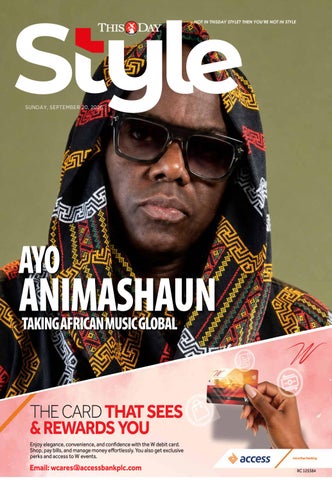
AYO
ANIMASHAUN TAKING AFRICAN MUSIC GLOBAL
THE CARD THAT SEES & REWARDS YOU Enjoy elegance, convenience, and confidence with the W debit card. Shop, pay bills, and manage money effortlessly. You also get exclusive perks and access to W events.
Email: wcares®accessbankplc.com
♦ access
1
more than banking
RC 125384
Sunday, September 20, 2026 Vol. 22, No. 11450
Sunday, September 20, 2026 Vol. 22, No. 11450
EDITOR’S LETTER
COVER NOTE
TWO SIDES Elegance
of
FINE JEWELLERY
One Language.
Infinite Expressions. EXECUTIVE EDITOR
14
14
F
or more than three decades, Ayo Animashaun has helped shape how Nigerian music is seen, celebrated, and ultimately sold to the world. Entrepreneur, television executive and media visionary, he has built a career around an enduring passion for music and an instinct for where the culture is headed next. His journey began in the 1990s with Hip Hop World Magazine, launched from a deep love for music and at a time when Nigeria’s growing hiphop scene was still finding its voice and visibility.
Lifestyle & Fashion
6
10 The 4C Hair Guide: What Your Natural Hair Actually Needs
3
Not Every Trend Deserves Your Money
4
Opinion: Why Are We So Obsessed With Being The Prize?
5
7 Ways Denim Is Getting A Fashion Upgrade
6
What Makes A Man Look Well Dressed?
8
Aliko Dangote: Building Beyond Himself
10
10 Reasons Burgundy Belongs In Your Wardrobe What’s Worth Spending On In Your Wardrobe? Plus-Size Style Rules Worth Breaking The Weekend Reset We Actually Need
2
22
18
S yle TR
UT H
& RE A SO
N
EXECUTIVE EDITOR KONYE NWABOGOR 08111847087
DEPUTY EXECUTIVE EDITOR OLUFUNKE BABS-KUFEJI 08111847086
ASSISTANT EDITOR YINKA OLATUNBOSUN
20
CONTRIBUTOR EBIYEKON DORCAS DIO
22
DIRECTOR, PRINT PRODUCTION CHUKS ONWUDINJO
23
Printed by Ups Digitals Ltd, Abuja; 08057025005; info@upsdigitals.com
The Currency of Trust
T
here are very few business announcements that can get Nigerians talking, but Aliko Dangote seems to have managed it. Since news of the Dangote Refinery IPO broke, the conversation has been everywhere. People are discussing shares, asking questions, doing calculations and, most interestingly, talking about buying in. And that, for me, is the real story. Beyond the size of the refinery or the numbers attached to the IPO is the way Nigerians have embraced the opportunity. There seems to be a genuine belief in what Aliko Dangote has built and, perhaps even more importantly, in the name behind it. It says something about the power of reputation. A good name really does travel ahead of you. Dangote has spent decades building businesses Nigerians can see and recognise, while taking on projects so ambitious that plenty of people questioned whether they could be done at all. So when he says Nigerians can now own a piece of what he has built, people are paying attention. That kind of confidence cannot be manufactured overnight. I also like what this moment represents. We spend a lot of time discussing everything that does not work here, so it is refreshing to be reminded of what is possible. That we can think at scale, build at scale and create businesses that can stand alongside their counterparts anywhere in the world. Sometimes you need someone to do what everyone has spent years saying cannot be done. Very well done, Aliko. Now, from being the man of the moment to everybody wanting to be the prize. Our opinion piece this week, Why Are We So Obsessed With Being The Prize?, is one I really enjoyed because it touches on something I see more and more in modern relationships. Two people can genuinely like each other and still be sitting there waiting to see who cracks first. I understand some of it. Nobody wants to feel foolish, taken for granted or like they are carrying a relationship alone. But I think we have started confusing self-respect with performance. Surely knowing your value should make you more secure, not more calculating? You can have standards and still be soft. You can protect yourself without becoming impossible to reach. And sometimes doing “too much” is simply what caring looks like when we stop keeping score. Read the piece and see where you land. Also read The Weekend Reset We Actually Need, because weekends should contain an actual life too. Friends, family, errands, fun, rest, perhaps a little adventure and, occasionally, absolutely nothing. How are you all doing, by the way? I hope you’ve had a good week and, if you haven’t, I hope the weekend makes up for it. Mine definitely needs fewer notifications, good food, and no unnecessary drama. Have a lovely weekend, people. See you next week, hopefully well-rested and minding our business.
08077092196
Love,
@thisdaystyle |
Elegance has no single expression. From the timeless luminosity of pearls and diamonds to the warmth of sculpted gold, fine jewellery celebrates individuality in all its forms. Every jewel tells a different story. Classic or contemporary, subtle or statement-making, discover fine jewellery that is distinctly, unmistakably yours.
Panthère De Cartier Watch Medium Model, Quartz Movement, Yellow Gold, Diamonds
Ferre Gold and Diamonds Concentric Hoop Earrings
Ferre Multi-Layered Gold & Diamonds Necklace
Yoko London South Sea Pearl & Diamond Ring
Yoko London Multilayered Pearl And Diamond Choker Necklace Chopard Happy Sport Oval Steel Diamond
Ferre Ruby & Diamonds Earrings
visit us:
Ferre White Pearl And Ruby Bracelet
P O LO F I N E J E W E L L E RY, T h e Pa l m s S h o p p i n g M a l l , 1 B I S Way, O n i r u , L a g o s , N i g e r i a | + 2 3 4 ( 0 ) 7 074 5 6 8 0 6 3
@thisdaystyleon | www.thisdaystyle.ng
3
Sunday, September 20, 2026 Vol. 22, No. 11450
Sunday, September 20, 2026 Vol. 22, No. 11450
THE 4C HAIR GUIDE: WHAT YOUR NATURAL HAIR ACTUALLY NEEDS
OPI NION @thisdaystyle |
S
@thisdaystyleon |
www.thisdaystyle.ng
BY TEME ELVIS WEYINKURO
pend enough time online, and you could be forgiven for thinking that the biggest mistake you can make in any relationship is caring more than the other person. Don’t text twice. Don’t call first too often. Don’t be too available. Don’t let them know how much you like them. Match their energy. Keep your options open. And whatever happens, never be the person doing too much. Somewhere in all of this is the idea of being “the prize”: the person who is pursued rather than pursuing, who has more options, more leverage and apparently less to lose. There is nothing wrong with knowing your worth. Having standards is healthy. So are boundaries. Nobody should remain in a friendship or relationship where they are consistently disrespected, neglected or taken for granted. But knowing your worth and needing to prove that you are worth more are two very different things. And increasingly, it feels as though we are confusing the two. Look at the way we talk about dating. Who called first? Who initiated the date? Who is more invested? Who apologised? Who has more options? Even perfectly ordinary expressions of affection can be analysed as evidence that one person has somehow surrendered their advantage. The person who says “I miss you” first has lost. The lover boy is doing too much. The woman who openly adores her partner needs to remember she is the prize. Reply too quickly, and you are too available. Take too long, and suddenly you are playing games. It is exhausting. At some point, you have to wonder: if both people are trying desperately not to care more, who exactly is having the relationship? The mentality has found its way into friendship too. We talk about our circles in increasingly transactional terms. What does this person bring to the table? Who has access? Who makes the introductions? Who is always calling? Who shows up more? Reciprocity matters, of course. Nobody wants to carry an entire friendship alone. But reciprocity and keeping score are not the same thing. Real relationships are rarely perfectly balanced at every moment. Sometimes your friend needs you more. You make the calls. You drive across town. You lend the money. You make the introduction or sit with her through the terrible week. At another point, life turns, and you are the one who needs somebody to show up. That isn’t necessarily imbalance. Sometimes that’s simply friendship. The problem with constantly thinking about who is “the prize” is that even generosity can begin to feel like losing. Calling first becomes desperation. Apologising first looks like weakness. Being available becomes having no life. Showing enthusiasm becomes doing too much. We have become very good at protecting ourselves from appearing too invested.
Unfortunately, genuine connection requires some investment. There is a strange contradiction in wanting to be loved deeply while being terrified of looking like we love ourselves deeply. We want people who communicate, but hesitate to send the message. We want vulnerability, but carefully ration our own. We complain about emotionally unavailable people while sometimes treating emotional availability as something slightly embarrassing. Lagos dating conversations make this particularly funny. Everybody seems exhausted by the dating pool; nobody can find anybody serious; everyone wants genuine connection — and yet heaven forbid you reply too quickly. Social media hasn’t created all of this, but it has certainly given us a language for it. “Match their energy.” “Never let a man tell you twice he doesn’t want you.” “If they wanted to, they would.” Some of these phrases contain useful advice. The problem begins when complicated human relationships are reduced to rules that leave no room for context, bad days, misunderstandings, different personalities or the simple fact that people don’t always love in exactly the same way. Of course, underneath much of this behaviour is a legitimate fear. Nobody wants to be taken for granted. Nobody wants to discover that they have been giving endlessly to someone who would barely inconvenience themselves in return. And nobody particularly enjoys the embarrassment of realising they cared much more than the other person did. But perhaps the answer isn’t caring less. Perhaps it is becoming better at deciding who deserves your care. There is a difference between having boundaries and building walls. Selfrespect doesn’t require emotional detachment, and protecting yourself doesn’t mean every relationship has to become a negotiation. Sometimes you can call first. Sometimes you can apologise first. Sometimes you can be excited about somebody and allow them to know it. Sometimes you can do something generous without immediately checking whether they have done the equivalent for you. And sometimes you will give more. The important thing is recognising when “sometimes” has quietly become “always.” Knowing your worth should help you recognise relationships where you are valued. It shouldn’t require you to constantly demonstrate that you are the more valuable person in them. Because once two people are preoccupied with maintaining the upper hand, intimacy becomes almost impossible. Someone is always calculating, withholding, matching energy or waiting for the other person to move first. You may successfully avoid looking foolish, but you may also avoid experiencing the very connection you say you want. Maybe we need to retire the idea that every relationship requires a prize at all. The problem with constantly trying to be the prize is that prizes are meant to be won.Relationships are meant to be experienced
WHY ARE WE SO OBSESSED WITH BEING THE PRIZE?
4
4
4C hair has a reputation for being difficult. There is the shrinkage, the tangling, the dryness, and those wash days that somehow take up half the weekend. Add the endless stream of products, routines, and natural hair advice online, and caring for your hair can quickly feel far more complicated than it needs to be. But 4C hair isn’t necessarily difficult; it simply has particular needs. Its tightly coiled strands can lose moisture easily, tangle more readily and require gentler handling. Once you understand that, building a routine becomes much simpler. And no, it doesn’t have to involve ten products, expensive treatments or hours spent detangling. Whether you’re newly natural or simply trying to make your routine easier, here are eight simple ways to care for your 4C hair. By Oghenekeno Akpoili
1. Start With a Clean Scalp
Healthy hair care starts at the scalp. Sweat, oil and product buildup still need to be removed, so avoiding shampoo altogether isn’t necessarily better for natural hair. How often you wash depends on your scalp, lifestyle and styling habits, but when you do, use a gentle shampoo and concentrate on cleansing the scalp rather than aggressively scrubbing the strands. Follow with conditioner to soften the hair and make detangling easier.
2. Make Moisture a Priority
Because of its tightly coiled structure, 4C hair can be particularly prone to dryness. Water-based leave-ins and moisturisers can help, followed by a cream or light oil if your hair needs it. But don’t confuse more product with more moisture. If your hair constantly feels coated or greasy, piling on another product probably isn’t the solution. Pay attention to what your hair actually responds to.
3. Detangle in Sections
Trying to drag a comb through a full head of 4C hair is an unnecessary battle. Work in manageable sections while the hair is damp and conditioned, using your fingers or a wide-tooth comb. Start at the ends and work up gradually. Most importantly, don’t rush. Rough detangling can turn ordinary knots into avoidable breakage.
4. Make Sure Your Protective Style Is Actually Protective
Braids, twists, cornrows and wigs can reduce daily manipulation, but only when they’re done properly. If your scalp hurts, your edges are being pulled, or a style feels excessively tight, it isn’t protecting much. Avoid unnecessary tension around the hairline, care for your scalp while wearing the style, and give
your hair some care between installations.
5. Protect Your Hair at Night
This may be the easiest change on the list. Cotton pillowcases can create friction and absorb moisture from the hair. Sleeping with a satin or silk bonnet or scarf, or switching to a satin or silk pillowcase, can help reduce friction, retain moisture and keep styles looking better for longer.
6. Stop Manipulating It Every Day
Not every morning needs to begin with a comb. Constant brushing, combing, stretching and restyling means more friction and more opportunities for breakage. Low-manipulation styles such as twists or buns can give your hair a break for a few days. Sometimes the best thing you can do is simply leave it alone.
7. Pay Attention to Your Ends
Trimming won’t make your hair grow faster, but damaged and split ends can lead to more tangling and breakage. Instead of trimming on an arbitrary schedule, check the condition of your ends and remove damage when needed. Healthy ends can make your hair easier to manage and help you retain length.
8. Keep Your Routine Simple
You don’t need every product currently trending online. A good shampoo, conditioner, moisturising product and something to protect your hair at night may be enough. What matters is finding products that work for your hair and using them consistently. 4C hair will shrink, coil and tangle; that is part of its texture, not evidence that something is wrong with it. Once you stop fighting the way your hair naturally behaves and start giving it what it needs, caring for it becomes much simpler.
5
Sunday, September 20, 2026 Vol. 22, No. 11450
Sunday, September 20, 2026 Vol. 22, No. 11450
7 WAYS DENIM IS GETTING A
can also stop head-to-toe denim from looking too uniform. The trick is less about matching and more about creating balance.
FASHION UPGRADE
4. Designers Are Playing With The Fabric Itself
Denim has always been reliable. Exciting? That depends on the season. But lately, the fabric we know best as jeans has been showing off. It is being sculpted into corsets and gowns, cut into unexpected silhouettes, dressed up for the red carpet and pulled apart only to be pieced back together again. Even the humble pair of jeans is getting a rethink. The interesting part is that denim hasn’t changed. Fashion has simply become more imaginative about what to do with it. Here are seven ways the everyday fabric is getting a very good upgrade. By Oghenekeno Akpoili
1. Jeans Are Changing Shape Again
The era of one dominant jean shape appears to be over. Wide-leg and relaxed jeans are still around, but straight cuts, barrel legs, exaggerated cuffs and slimmer silhouettes are all competing for wardrobe space. That is probably good news. Instead of everyone squeezing into the same fashionable shape, you have more freedom to choose what works for your body and personal style. Even familiar jeans are being updated through unusual seams, asymmetric waists, oversized pockets and interesting hems. Sometimes the difference between an ordinary
pair and a great one is now in the dresses, jumpsuits, maxi skirts, shirts, waistcoats, co-ords and details. dramatic gowns. Some pieces are so structured or intricately 2. Denim Has Moved constructed that you have to Beyond Jeans look twice to realise they are This is where the real fun begins. denim. Designers are treating denim as It opens up far more possibilities a fabric, not just something you for wearing the fabric too. You make jeans from. can love denim without owning We’re seeing corsets, fitted another pair of jeans.
3. Double Denim Has New Rules
Matching a denim jacket perfectly to your jeans is no longer the only way to do double denim. In fact, looking slightly mismatched can make it more interesting. Try dark jeans with a faded shirt, an oversized jacket with a fitted denim skirt, or a corset with wide-leg jeans. Black can meet blue; cream can meet indigo. Different weights and textures
Denim is also becoming more experimental. Patchwork, embroidery, embellishment, distressing, fraying, coating, bleaching, and reconstruction are changing the fabric’s surface. This is where a basic denim piece can become the statement rather than the background of an outfit. Embellished jeans don’t need much else competing with them. A patchwork skirt already has enough personality. Even distressed denim has moved beyond a few predictable rips at the knee. The fabric itself is becoming part of the design.
5. Denim Is Making Unexpected Friends
Denim and a cotton T-shirt will always work, but some of its more interesting pairings now involve fabrics that seem to have very little in common with it. Think denim with lace, leather, sheer fabrics, sequins, satin or richly textured textiles. The contrast is what makes it work: something rugged beside something delicate, something familiar beside something luxurious. You can try the same idea without buying anything new. A denim skirt with a sheer blouse or jeans with a silk shirt immediately feels different from the usual casual combinations.
6. Denim Is Going Places It Wasn’t Invited Before
There was a time when “no jeans” on an invitation effectively meant denim should stay at home. Fashion has complicated that rule. Denim has increasingly appeared in eveningwear and on major fashion stages. Designers have also pushed denim into corsetry, embellished dresses and dramatic floorlength silhouettes. That doesn’t mean your everyday jeans are suddenly blacktie appropriate. It means the fabric itself isn’t automatically casual anymore. Cut and construction now matter just as much as material.
7. Old Denim Is Getting A Second Life
BALLY
6
KEMI WILLIAMS
Perhaps one of denim’s most interesting upgrades involves pieces that already exist. Because denim is durable, old jeans are particularly suited to being cut up, patched, reconstructed and turned into something completely different. Designers are increasingly working with discarded denim, while vintage and customised jeans have become desirable precisely because they don’t look brand new.
NKWO
ONYEKA UGWU
OSAS IGHODARO
WON HUNDRED
7
TR
UT H
& R E A SO
N
Sunday, September 20,20, 2026 Vol. 22,22, No. 11450 Sunday, September 2026 Vol. No. 11450
Sunday, September 20, 2026 Vol. 22, No. 11450
WHAT MAKES A MAN LOOK WELL
you’ve arrived before you do. A good fragrance should be discovered, not announced. None of this requires an elaborate routine. It simply requires the same attention you gave to choosing the clothes.
DRESSED?
Know When To Dress Down
You can usually tell when a man dresses well, but it isn’t always easy to say exactly why. Sometimes he isn’t wearing anything particularly expensive or fashionable. His trousers just sit properly, his shoes are right, his shirt fits, he smells good and nothing looks accidental. Then there is the opposite: an expensive outfit that somehow still doesn’t quite work. The difference is often in the details. And the good news is that most of them don’t require an entirely new wardrobe. Here are a few that make more difference than you might think.
Being well dressed doesn’t mean being dressed up. Not every dinner needs a blazer. Not every birthday requires your most elaborate native. And there are places where a beautifully fitted T-shirt, good trousers and loafers will look considerably better than an outfit that is trying very hard to announce itself. The same applies in reverse. There is casual, and then there is looking as though somebody called you outside unexpectedly. Knowing the room matters.
By Oghenekeno Akpoili
Don’t Let The Small Things Spoil It
This is where many otherwise good outfits go wrong. The shirt is creased. The undershirt is showing at the neck. The trouser pockets are stuffed with a phone, wallet, keys and everything else a man apparently needs to survive the afternoon. The belt has seen better days. The socks are having an entirely different conversation from the rest of the outfit. Individually, none of these things seems particularly serious. Together, they can make a good outfit look careless. A steamer is a wonderful invention. So is a bag.
The Fit Comes First
Fit is probably the quickest way to tell whether a man pays attention to how he dresses. Trousers shouldn’t gather endlessly around the ankles. A shirt shouldn’t pull across the stomach or shoulders. A jacket should sit properly rather than look borrowed from somebody slightly bigger. And tighter does not automatically mean better fitted. There is a difference. This is also why a good tailor is worth knowing. Small alterations can completely change clothes you already own. Sometimes the problem isn’t your wardrobe. Your trousers simply need hemming.
Stop Saving Everything For A Special Occasion
There are men with excellent clothes sitting untouched in their wardrobes while the same three polos are working overtime. Wear the good shirt. Wear the loafers. Bring out the watch. That lovely native doesn’t have to wait for somebody’s wedding, and the expensive perfume doesn’t need permission from Saturday night. Clothes earn their money by being worn. Of course, this doesn’t mean wearing your best suit to buy groceries. It simply means getting out of the habit of dividing your wardrobe into “normal clothes” and everything you actually like.
Your Shoes Are Telling On You
You can get almost everything right and lose the argument at your feet. Beautiful native with tired shoes. A sharp suit with the wrong loafers. Dirty white sneakers that stopped being white several outings ago. Shoes are one of those details people notice even when they aren’t consciously looking. You don’t need twenty pairs. You need a few good ones that cover your actual life and that you bother to maintain. Clean the sneakers. Polish the leather. Replace the pair that has clearly served its country.
EMMANUEL OKORO
Expensive Doesn’t Automatically Me Stylish
A visible label can tell us where something came from. It cannot tell us whether you look good in it. One of the easiest traps in menswear is assuming that expensive pieces will do all the work. They won’t. An ill-fitting designer shirt is still ill-fitting. An expensive shoe can still be the wrong shoe for the outfit. And wearing several recognisable labels at once doesn’t necessarily improve the overall look. Spend where quality matters, certainly. But don’t confuse price with taste.
Grooming Is Part Of The Outfit
The clothes do not stop at your neck. A fresh haircut, neat beard, clean nails and skin that is actually being looked after all contribute to how put-together a man looks. So does fragrance. And smelling good doesn’t mean the entire room needs to know
8
KELECHI AMADI OBI
Find Your Thing
TOKUNBOR AKERELE
MAI ATAFO
The best-dressed men usually have something recognisable about the way they dress. Maybe yours is beautifully cut native. Perhaps you are a white-shirt-and-great-watch man. Maybe you love colour, jewellery, loafers, interesting glasses or immaculate basics. You don’t need all of them. In fact, trying to incorporate every new thing you see is probably the fastest way to lose whatever personal style you already have. NOBLE IGWE
9
Sunday, September 20, 2026 Vol. 22, No. 11450
F
INTERVIEW BY OJY OKPE
Sunday, September 20, 2026 Vol. 22, No. 11450
for somebody to just buy and go and sell it up tomorrow,” he says. “This is a future for anybody’s family. You’re actually investing for the future of your family.” It is an interesting way to frame the offer, particularly coming from someone whose own business story began with capital passed down through family. His hope is that ownership can move in the other direction too, from one generation to another, but this time on a much wider scale. Dangote says the demand has already surprised him. When asked about retaining roughly 85 per cent of the refinery, he says more shares could be made available. “We want as many people as possible, to be a part of it” he says. “This is my main mission to make sure that yes, we democratise this share.” He even brings his own driver into the conversation again, saying, “I cannot see my driver’s money being returned.” There is something very deliberate about the repetition. For Dangote, the driver is not just a driver. He represents the ordinary Nigerian He says should have a place in the ownership story.
WORDS BY FUNKE BABS-KUFEJI
or decades, Aliko Dangote has built his business around a simple but demanding idea: think big, take calculated risks and stay the course. From the young man who began trading commodities with a ₦500,000 loan from his grandfather to the industrialist behind one of Africa’s biggest business empires, his story is as much about persistence as it is about scale. Now, with the Dangote Refinery reshaping the conversation around local production and an ambitious plan to bring ordinary Nigerians into the company’s ownership, Dangote is thinking beyond business. He is thinking about what remains when the builder is gone.
There are people who build businesses, and then there are people who seem to spend their lives trying to prove that something bigger is possible. Aliko Dangote belongs to the second group. His story is now so familiar that it can sometimes sound almost unreal. A young trader. A ₦500,000 loan from his maternal grandfather, the late Alhaji Dantata. Then the gradual move from trading commodities to manufacturing, from cement and sugar to flour and salt, and eventually to a refinery in Lagos that has become one of the most ambitious industrial projects on the continent. But listening to Dangote talk about his journey, what stands out is not really the money. It is the risk. He speaks about business almost as if risk is simply part of the job description. “It is sort of a dream and it’s a vision,” he says of the refinery. “At the same time, I know exactly where this company is going to go.” The story, however, did not begin with a refinery. It began with trading. Dangote has often returned to those early days when explaining his approach to business, and in this interview he is keen to remind younger entrepreneurs that the empire did not appear overnight. “I started business selling only four trucks as a distributor, L- R - GROUP CHAIRMAN NGX , ALHAJI DR not as importer,” he says. He would buy four trucks at a time, sell them and gradually build his UMARU KWAIRANGA , ALIKO DANGOTE , GROUP capital. “That is how I piled up,” he explains. It was a modest beginning, but there was already MD NGX GROUP , MR TEMI POPOOLA something in the model that would define much of what came later: start with a product people need, understand the market and keep building. Trading eventually gave way to something much more ambitious. Dangote began moving into manufacturing, and cement became one of the defining businesses of that transformation. What started as a business supplying a basic commodity developed into a major manufacturing operation, with cement plants and investments stretching beyond Nigeria. Dangote Cement became the clearest example of his belief that Africa should not simply be a market for imported goods but should have the capacity to produce what it consumes. The same thinking followed him into sugar, flour and salt. These were not glamorous products, but that was almost beside the point. They were things people bought every day. ALIKO DANGOTE AT THE NIGERIAN EXCHANGE GROUP IN LAGOS FOR THE OPENING OF THE DANGOTE PETROLEUM REFINERY IPO. Sugar became a major part of the group’s business. Flour and salt followed. Later came fertiliser, food processing, energy, logistics and petrochemicals. One business opened the door to another, and the Dangote Group gradually moved from being primarily associated with trading into a much broader industrial enterprise.
aliko
T
DANGOTE:
here is a certain logic to the progression. Cement is needed to build. Sugar and flour feed households and businesses. Fertiliser supports agriculture. Energy powers industry. Petrochemicals feed into other areas of manufacturing. Dangote’s businesses have increasingly occupied different parts of the economic chain, and the underlying question has remained remarkably consistent: why continue importing what can be produced locally? It is that question that eventually led to the refinery. The refinery is not simply another addition to the Dangote portfolio. It represents the kind of bet that can change the scale of a business entirely. It has taken years, enormous capital and a willingness to absorb uncertainty that would make most business owners uncomfortable. Dangote, however, talks about it with the calm of someone who has spent his career becoming accustomed to uncomfortable decisions. “It is sort of a dream and it’s a vision,” he says. “At the same time, I know exactly where this company is going to go.” The refinery is also at the centre of what he describes as his latest ambition: opening up a piece of the business to ordinary people. Dangote insists that the IPO is not primarily about raising money. In his words, the bigger objective is to “bring democracy into stock exchange” by allowing people who would normally never imagine themselves owning part of a company of this scale to become shareholders. He puts it rather simply: “My driver, your driver, the cooks, the market woman, everybody will now be a shareholder like me.” That is the idea behind what has been dubbed the “people’s IPO”. He says he wants as many people as possible to participate, and when asked why he would not simply retain control, his response is surprisingly direct: “I don’t mind to be diluted as much as possible because I want people to actually be part of this good journey.” There is another part of the plan that Dangote appears particularly passionate about. He does not want the shares treated as another quick-money opportunity. He wants them held. Passed down. He talks about the possibility of people buying shares today and their children ALIKO DANGOTE AND HIS DAUGHTERS , FATIMA, MARIYA AND HALIMA and grandchildren still owning them years later. “This is not a share
BUILDING BEYOND HIMSELF
10
PHOTO CREDIT: Kelechi Amadi-Obi
B
ut beneath the public offering is a much more complicated story about risk. Building the refinery was not a safe, carefully protected corporate exercise. It involved enormous borrowing, personal exposure and years of uncertainty. Yet Dangote does not speak about the experience as though he wants sympathy for it. If anything, he seems almost matter-of-fact about the discomfort that comes with building something at this scale. Perhaps that is because risk has been woven into his business life from the beginning. His manufacturing businesses have all had to contend with the realities of doing business in an environment where infrastructure, financing and policy can change the economics of an investment. Dangote is particularly blunt about the challenges facing manufacturers. Interest rates, inconsistent government policies and unreliable electricity, he argues, can make local production unnecessarily expensive. He recalls the financial pressures around building his businesses and says, “We have never in our history of 47 years defaulted on any loan.” Then comes the line that perhaps best captures his frustration: “You cannot manufacture goods with diesel.” For Dangote, this is not simply about making more money. It is about what happens when a country continues importing things it could produce itself. His argument is that industrialisation requires patience, infrastructure and an environment in which businesses can invest for the long term. It is also why the evolution of his own career matters. The young man who began by trading commodities eventually became a manufacturer because, at some point, importing was no longer enough. He wanted to control production. Cement provided the first major expression of that ambition. Sugar, flour and salt widened the consumer base. Fertiliser moved the group closer to agriculture. Energy and petrochemicals opened another layer of industrial possibility. The refinery then took the logic to its most ambitious conclusion yet: produce locally at a scale large enough to serve a market that has historically depended heavily on imports.
T
here is something almost stubborn about the progression. One business was never quite enough. And yet Dangote does not describe his journey as a series of grand master plans. When he talks to young Nigerians, his advice is surprisingly simple. “Work hard, be very consistent, be focused and know what you want to do.” Then, perhaps knowing how impatient younger entrepreneurs can be, he adds: “You cannot be jack of all trade. So concentrate... Don’t be too much in a hurry.” It is an advice that sounds almost ordinary coming from someone whose business interests now stretch across so many industries. But perhaps that is the point. Dangote still talks about his beginnings. The four trucks. The early trading. The gradual accumulation of capital. He seems to understand that the size of the empire can make the journey look deceptively easy in retrospect. It wasn’t. There is also a more personal side to the conversation, and this is where the interview becomes less about the refinery and more about what happens after the founder is gone. Dangote has three daughters, whom he describes as his “Amazons”, and he says he can see one or even two of them eventually leading the group. But what is striking is his understanding of the danger of family businesses. He knows that handing a company to the next generation simply because they carry the family name is not enough. “An owner manager can take more risk than a professional manager,” he says, reflecting on the decision to build the refinery. That distinction appears to matter to him because the future of the Dangote Group cannot depend entirely on Dangote himself. The bigger the organisation becomes, the more important systems, governance and professional management become. When asked about his legacy, his answer is revealing. He does not talk first about wealth, buildings or his name on a company. “I want these companies to be run professionally,” he says. “I want to have the highest level of governance.” He points to Microsoft, Apple and JP Morgan as examples of companies that survived the departure of their founders and major figures. The implication is clear: building the company is only half the work. Building an institution that can survive its founder may be the harder part. And then he says something that is almost startling in its bluntness: “We will make sure that we make it very difficult for any family member to come and destroy anything.”
E
ven the question of having a male heir does not appear to weigh heavily on him. Asked whether he still hopes to have a son because of traditional expectations around succession, Dangote does not present it as a priority. His daughters, he suggests, are more than capable of carrying the responsibility. It is a small but telling departure from the old assumptions about who should inherit African family businesses. His definition of succession appears increasingly tied to ability rather than simply being male. And perhaps that is the larger story running through this interview. Dangote is still talking about building. Even after decades of doing it, he does not sound finished. He talks about petrochemicals, raw materials, energy and the possibility of creating industries around products Africa currently imports. He talks about shareholders, governance and succession. He talks about what happens when he is no longer there. There is, finally, something almost circular about his story. He began with family capital. He built from trading into manufacturing. Cement became an industrial giant. Sugar, flour, salt and other businesses expanded the group into the everyday economy. Fertiliser, energy, logistics and petrochemicals pushed the business further into the infrastructure of production. Then came the refinery, arguably the boldest expression yet of the idea that Africa should produce more of what it consumes. Now he wants to put ownership of one of his biggest ventures into the hands of ordinary people. He is thinking about legacy, but not only in terms of what his family inherits. He wants the companies to survive him and, if his vision works, he wants ordinary shareholders to inherit a piece of the story too. Asked what he would tell young Nigerians who want to become an Aliko Dangote, he does not offer a complicated formula. “Work hard. Be very consistent. Be focused and know what you want to do.” Then he returns to his own beginning, those four trucks, the slow accumulation, the years of work. His final hope is even bigger: “We pray that every Nigerian will actually have a bite, every African will have a bite and then the rest of the world.” For a man whose name has become almost synonymous with scale, perhaps the most interesting thing is that he is now talking about spreading ownership rather than simply accumulating it. The refinery may be the biggest thing he has built so far. But listening to Dangote, it is clear that the building is not really the end game. The bigger question is what survives when the builder is no longer there.
11
Sunday, September 20, 2026 Vol. 22, No. 11450
Sunday, September 20, 2026 Vol. 22, No. 11450
Enjoy elegance, convenience and confidence with the W debit card. Shop, pay bills and manage money effortlessly. You also get exclusive perks and access to W events
12
13
Sunday, September 20, 2026 Vol. 22, No. 11450
AYO
ANIMASHAUN
TAKING AFRICAN MUSIC GLOBAL
F
BY YINKA OLATUNBOSUN
or more than three decades, Ayo Animashaun has helped shape how Nigerian music is seen, celebrated, and ultimately sold to the world. Entrepreneur, television executive and media visionary, he has built a career around an enduring passion for music and an instinct for where the culture is headed next. His journey began in the 1990s with Hip Hop World Magazine, launched from a deep love for music and at a time when Nigeria’s growing hip-hop scene was still finding its voice and visibility. The publication became a foundational platform for the industry and laid the groundwork for what would eventually grow into a much larger media and entertainment enterprise. In November 2013, Animashaun expanded that footprint with HipTV, a 24-hour music and lifestyle channel on DStv, broadcasting to millions across Africa and giving African artists another vital visual platform. But perhaps his most defining creation is The Headies. Through Smooth Promotions, where he serves as CEO, Animashaun founded the awards as a platform to recognise excellence and celebrate talent within the Afrobeats and hip-hop communities. Over the years, The Headies has grown into one of Africa’s premier music award shows, documenting the evolution of an industry that has itself gone global. Animashaun has been equally determined to push that story beyond the continent. Historic editions of The Headies have been staged in the United States as part of a broader effort to increase international recognition for Afrobeats. Through initiatives such as the Headies Creative Summit, he has also continued to champion the business behind the music and the professionalisation and expansion of Nigeria’s creative economy. Now, that journey enters another chapter. The 18th Headies Awards is heading to Toronto, Canada, with the main ceremony set for October 23. Ahead of the show, Ayo Animashaun sits down with Yinka Olatunbosun to unpack the story behind the media dynasty he has spent more than three decades building and the African legacy it has become.
You are one of the custodians of pop culture in Nigeria. How did your journey in music media begin, and what inspired Hip Hop World Magazine? It began with a programme I was presenting at the time. The idea was simple: we wanted to help people learn the lyrics of popular songs and sing them correctly. That experience brought me even closer to music and made me realise that there was a much bigger opportunity to document and celebrate the culture around it. By 1993, I already knew that I wanted to publish a music magazine. Hip-hop was becoming increasingly influential, and I was a major fan of the genre, particularly rap, although I also listened to R&B, pop and other music genres. I felt that music media was where I belonged, so the idea eventually developed into Hip Hop World Magazine. For the first edition, we had Michael Jackson on the cover and Shabba Ranks on the centre spread. They were among the major figures in global popular culture at the time, and featuring them reflected the scale of the vision we had for the publication from the beginning. What has kept you in show business for so many years, right up to 2026? Passion. In the beginning, it was never primarily about making money; it was about doing something I genuinely loved and believed in. My passion for music kept me publishing even when the business was difficult, and the commercial opportunities weren’t immediately obvious. I also saw the magazine as a serious media business, not simply a personal project. I wanted it to reach people across Nigeria and beyond, so we built distribution in every part of the country and extended it to markets such as the United Kingdom and Canada. That combination of passion, ambition and a commitment to building
14
COVER
COVER
Sunday, September 20, 2026 Vol. 22, No. 11450
something enduring has kept me in the industry all these years. What was the defining moment that made you realise print media needed to expand into television and digital media, leading to the creation of HipTV? The defining moment came after the first Hip Hop World Awards. The awards attracted considerable attention, and it became clear that we needed a television platform that could capture, promote and extend the life of the content we were creating. HipTV was therefore established initially to support the awards and became, in many ways, the television expression of Hip-Hop World Magazine. Because the awards took place only once a year, however, we knew the television platform could not exist solely around that event. We began developing regular magazine-style programming that could continuously showcase artists, music and entertainment culture. HipTV started as a 30-minute programme syndicated on leading terrestrial television stations on Fridays, Saturdays and Sundays. Over time, the vision expanded. What began as a supporting platform grew into a major channel for discovering, promoting and celebrating African talent. When you launched Hip Hop World Magazine, Afropop and Nigerian hip-hop were still developing. How did you convince sceptics and advertisers that youth music was commercially viable? We didn’t spend much time trying to convince people with words. We concentrated on doing the work to the highest standard possible. Our passion was visible, the quality of the publication spoke for itself, and, most importantly, it became clear that we had built an audience. Advertisers began to understand that if they ignored that audience, they were overlooking an important market. The process was gradual. Some brands recognised the opportunity early, while many others did not. But
15
we remained focused and refused to be distracted. As the platform grew and the audience became more evident, more advertisers and partners came on board. The lesson was that the strongest argument for a new market is often consistent execution and demonstrable audience loyalty. The Headies, formerly known as the Hip Hop World Awards, have become an important benchmark for music recognition in Nigeria. What part of the original vision has remained unchanged, and what has had to evolve? What has remained unchanged is our passion for recognising and celebrating African talent in the best possible way. From the beginning, we have been committed to building credible categories, identifying excellence and placing outstanding artists on a major stage. We have also remained committed to discovery—using categories such as Next Rated and other platforms within the awards to give emerging artists visibility and an opportunity to reach a wider audience. What has had to evolve is the structure of the awards. Music is constantly changing, so the categories must reflect the realities of each period. At one time, for example, we had a Best Reggae/Dancehall category because Nigerian artists produced a substantial body of work in that space. As the volume and influence of that genre changed, the category became less relevant. Other categories have also been retired, refined or introduced in response to changes in the music. The scope of The Headies has evolved as well. It is no longer simply a Nigerian awards platform; it now includes categories and talent from across the African continent. As Afrobeats and African music have gained global audiences, we have also had to rethink how the awards are produced, presented and positioned—including where they are staged. The core purpose has remained the same, but the platform must keep evolving with the music, the industry, and the audience. Awards inevitably generate controversy. How do you manage pressure from artists, record labels and public opinion while protecting the integrity of the voting process? The most important thing is to establish a clear system and remain faithful to it. Over time, people who genuinely want to understand the process will see how it works, though others will always disagree. Every category has a definition and a set of criteria, and participants and members of the public also have a responsibility to read those definitions and vote where voting applies. There have been occasions when people have been extremely vocal about who they believe should win, only for our records to show that they did not vote. Making noise in the room or on social media does not determine the result. In voting categories, votes determine the outcome, and we respect that process. For many years, independent auditors have managed or verified the results and delivered them to us only a few hours before the ceremony. That structure protects the awards from improper influence and also protects the organisers. At the same time, we recognise that awards are inherently subjective. When many strong bodies of work are reduced to a shortlist, and one winner is selected, disagreement is inevitable. That happens with awards everywhere in the world. If you organise an awards platform, you must be prepared for criticism. Our responsibility is not to make everybody agree with every result; it is to maintain a credible process, apply the rules consistently and protect the integrity of the institution. What were the primary strategic and operational reasons for taking the 15th and 16th editions of The Headies to Atlanta? Strategically, the objective was to position The Headies as a global awards platform for Afrobeats and African music—one with international impact, visibility and influence. Afrobeats had become a global force, and we believed the awards also needed to enter spaces where the wider international industry and audience could engage with it. You cannot build a truly global institution by remaining only within familiar territory. Operationally, the move was also an important learning experience. Producing an event outside Nigeria required us to work within a different culture, regulatory system and professional environment. We had to engage relevant institutions, including the United States Mission in Nigeria, to support travel and other logistical requirements. We also had to adapt to unfamiliar processes covering permits, venue operations, production standards and public safety. One of the strongest lessons was how seriously event safety is treated. Venue capacity, clearly marked exits, emergency access and crowd movement are not afterthoughts; they are fundamental requirements. Even when a venue has operated for years without an incident, every precaution must still be in place. The experience made us reassess some of the ways events are produced in Nigeria. Taking The Headies abroad was therefore not only about global visibility; it also exposed the team to systems and standards that could strengthen the organisation over the long term.
Sunday, September 20, 2026 Vol. 22, No. 11450
live entertainment in Nigeria? Nigeria has enormous creative talent and one of the most energetic entertainment audiences in the world, but our physical infrastructure has not developed at the same pace. The most immediate gap is the shortage of purpose-built venues that can accommodate major concerts and live productions safely, comfortably and professionally. It is not simply a question of capacity; a modern venue must also have the right acoustics, backstage facilities, loading access, parking, crowd-control systems, emergency exits and technical support. Promoters are often forced to convert spaces that were not designed for large-scale entertainment, which increases costs and creates operational and safety challenges. The supporting infrastructure around events— including dependable power, transport access, security, ticketing systems and trained technical personnel—also needs significant improvement. We have the artists, the audiences and the demand. What we now need is sustained public- and private-sector investment in world-class venues and event infrastructure that can support the scale of Nigeria’s creative economy.
COVER
COVER
Sunday, September 20, 2026 Vol. 22, No. 11450
Taking HipTV onto a 24-hour satellite television model via DSTV was a major milestone. What were the key operational hurdles in scaling up constant content creation for a continuous music channel? Moving to a 24-hour satellite channel was a major leap because it required us to shift from producing individual programmes to running a complete broadcast ecosystem. The first challenge was building a content pipeline strong enough to fill every hour without becoming repetitive or compromising quality. We had to expand beyond music videos into original interviews, live performances, entertainment news, countdown shows, documentaries, lifestyle programming and coverage of major industry events. We also had to scale our people, processes and infrastructure. That meant recruiting and training producers, presenters, editors, researchers and technical personnel; introducing shift-based operations; developing a disciplined programming schedule; and ensuring that content could move seamlessly from production through post-production to transmission. Broadcasting on DStv also came with strict technical and quality-control requirements, so reliability, redundancy and consistency became essential. At the same time, we had to handle music licensing, content rights, and artist clearances more systematically. Perhaps the biggest challenge was maintaining HipTV’s identity while operating at that scale. We did not want to fill airtime merely for the sake of being on air; every programme had to remain relevant to our audience and reflect the energy, ambition and diversity of African music and youth culture. It demanded substantial investment, long hours and constant innovation, but it ultimately strengthened our capacity and helped position HipTV as more than a music channel—as a platform for the entire entertainment ecosystem. You have spoken openly about corporate and financial battles, including legal disputes to protect Smooth Promotions and HipTV assets. What did those experiences teach you about corporate governance and protecting media intellectual property? Those experiences taught me that corporate governance cannot be treated as a formality, particularly in a creative business where so much of the value is intangible. A company must be built around strong institutions rather than personalities. Clear ownership structures, properly documented board decisions, transparent financial controls, independent professional advice and a strict separation between personal and corporate interests are essential. When these systems are weak, even a successful business can become vulnerable during periods of disagreement or transition. Nigeria is a peculiar country, where many rules are applied upside down; you need to stay grounded. I also learnt that media intellectual property must be protected with the same seriousness as physical property. Every trademark, programme format, production master, archive, licensing agreement and digital asset should have a clear chain of ownership. Rights must be registered where appropriate, contracts must state precisely what is owned or licensed, and records must be securely maintained. Creating valuable content is not enough; you must be able to establish legally that the company owns it and has the authority to use and commercialise it. The disputes were difficult, but they reinforced the importance of documentation, vigilance and institutional discipline. They also taught me to address governance risks early rather than wait until a crisis develops. Ultimately, protecting Smooth Promotions and HipTV was not simply about defending assets; it was about preserving years of creativity, investment, employment and cultural contribution. The broader lesson is that African media entrepreneurs must combine creative vision with strong legal, financial and governance structures if they want to build organisations that can outlive their founders.
What are the biggest infrastructure gaps currently holding back
16
17
TR
UT H
& R E A SO
N
Sunday, September 20,20, 2026 Vol. 22,22, No. 11450 Sunday, September 2026 Vol. No. 11450
Sunday, September 20, 2026 Vol. 22, No. 11450 ROCKYEMMYSTUDIO
1. It’s What You Buy When You’re Bored With Black
Black will always be useful, but there comes a point when another black bag, shoe or dress feels like buying something you already own. Burgundy gives you much of the same ease with a little more personality. It is dark enough not to frighten the colour-shy, but interesting enough to change the mood of an outfit.
2. It Makes Denim Look Better
KAY
NEEDLE AND THREAD LARGE
BURGUNDY
5. It Loves A Good Texture
Burgundy is lovely in cotton, but give it leather, suede, velvet, satin or a chunky knit, and it really starts showing off. The depth of the colour becomes more noticeable, which is why a simple burgundy suede shoe or leather bag can look far more special than the same piece in a flatter shade.
This may be one of burgundy’s easiest wins. Blue denim and deep wine tones work together. Add burgundy loafers to jeans and a white shirt, or carry a burgundy 6. It Can Make A Simple bag with your favourite denim Piece Look More Expensive dress. Nothing complicated has No, burgundy cannot perform happened, yet the outfit suddenly miracles on terrible fabric or bad looks more considered. finishing. But on a well-cut, simple piece, the colour has a richness 3. It Plays Very Well With that does a lot of visual heavy lifting. A satin skirt, pump, or Others structured bag in burgundy can Cream, grey, navy, camel, chocolate brown, olive, pale pink, look surprisingly polished without logos, embellishment, or much white — burgundy is surprisingly else. sociable. Even red can work if you know what you’re doing. This means adding burgundy doesn’t require buying an entirely new supporting cast. Chances are, several things already hanging in your wardrobe are waiting for it.
10 REASONS
bag. Then you discover it works with your jeans. And your grey trousers. And that cream dress. And chocolate brown. Three weeks later, you’re looking at burgundy loafers and calling them an “investment.” We know how this story ends.
7. It Knows How To Dress For A Wedding
Burgundy was practically made for occasion dressing. It looks beautiful in lace, velvet, satin, and aso-oke, and pairs well with gold, 4. A Burgundy Bag Does champagne, blush, and deeper An Unreasonable Amount jewel tones. It can be dramatic without becoming shouty, which Of Work is useful at a wedding where This is probably how they get you. everybody has already come You buy one because it feels more prepared to be seen. interesting than another black
8. You Don’t Even Have To Buy Clothes
Not ready for a burgundy blazer? Fine. Start with your nails. Try a deep wine lipstick, belt, scarf, sunglasses or even hair with burgundy undertones. You get the effect without committing half your wardrobe to the cause. Although once the nails happen, we cannot guarantee the bag won’t follow.
9. It Won’t Look Ridiculous When The Trend Moves On
Fashion may be paying extra attention to burgundy now, but wine, oxblood and deep red shades have been around for decades. The styling may change, but the colour itself isn’t likely to suddenly look like evidence from a very specific year. Buy a good burgundy piece, and you can keep wearing it long after fashion finds its next favourite colour.
10. It Might Already Be The Missing Piece Sometimes a wardrobe doesn’t need more clothes. It needs something that makes the clothes already there feel different. Burgundy is very good at that. The white shirt looks sharper. The grey suit feels less corporate. Denim gets dressed up. Black gets a break. You don’t need a burgundy takeover. You certainly don’t need the dress, bag, shoes, nails and lipstick all appearing at once. Just make room for one really good piece. If it happens to be the bag you’ve been staring at for three weeks, consider this permission.
CARTIER LARGE
BELONGS IN YOUR WARDROBE
There are colours you admire from a distance, and then there are colours that quietly start making a case for space in your wardrobe. Burgundy belongs firmly in the second group. It is not as predictable as black, not as loud as bright red, and it somehow makes even familiar clothes feel a little more interesting. You can go all in, of course, but the beauty of burgundy is that you really don’t have to. One bag, one shoe, one knit — sometimes that’s enough. Still unconvinced? Here are ten reasons burgundy deserves a spot in your wardrobe.
RENE CAOVILLA LARGE
CHRISTIAN LOUBOUTIN LARGE
L’AGENCE LARGE HUDAYYA FADOUL ABACHA
MODEL FOR HUDDAYA
LATASHA JIMMY CHOO LARGE
TIFFANY AMBER
18
JIMMY CHOO LARGE
SAINT LAURENT LARGE
MULBERRY LARGE
19
TR
UT H
& R E A SO
N
Sunday, September 20,20, 2026 Vol. 22,22, No. 11450 Sunday, September 2026 Vol. No. 11450
Sunday, September 20, 2026 Vol. 22, No. 11450
WHAT’S WORTH
SPENDING ON IN YOUR
WARDROBE? We have all spent too much on something we barely wore and, somehow, very little on something that became a wardrobe favourite. Price, as it turns out, isn’t always a good indicator of value.Some pieces really are worth spending more on because the difference shows in the fit, finish or how long they last. Others can be bought for far less without anyone noticing.So, before you decide where your fashion budget goes next, here’s how to know which pieces are worth spending a little more on and which ones you can happily save on.
A Good Tailor Is Worth the Money
A beautifully fitting garment will almost always look better than an expensive one that does not fit properly. This is particularly useful in Nigeria, where a good tailor can transform a wardrobe. A reasonably priced dress with the right alterations can look far more sophisticated than an expensive dress hanging awkwardly on the body. You can shorten sleeves, adjust waists, taper trousers, and change hemlines. Sometimes your wardrobe doesn’t need new clothes. It needs better-fitting ones.
Put Money Into Good Shoes
Shoes are another area where quality matters. Uncomfortable shoes that lose their shape quickly are rarely a bargain, particularly when they end up sitting in the wardrobe because they hurt too much to wear. Spend more on the pairs you’ll wear regularly: comfortable work shoes, classic heels, everyday flats, quality sandals, or a good pair of trainers. There is no need to do the same with every pair, though. A dramatic evening shoe that may only come out twice a year does not necessarily need a luxury price tag.
Save on Trends ALAIA VS AMAON
BUSOLA TEJUMOLA A GOOD TAILOR IS WORTH THE MONEY
SAVE ON CLOTHES THAT WILL ONLY BE WORN ONCE
Don’t Overspend on Basic T-Shirts
DIDI AKINYELURE
By Funke Babs-Kufeji
Spend More on What You Wear Most
The things you use constantly deserve a bigger investment. Think about the everyday handbag, the blazer that goes to work every week, the trousers that always fit properly or the shoes that can be worn from morning meetings to dinner. These pieces earn their keep. A wellmade handbag, for instance, can last for years with proper care. The same goes for a good pair of shoes. Buying quality once can make more sense than repeatedly replacing cheaper versions that lose their shape or finish after a few months.
Trends are fun. They are also temporary. That statement sleeve, metallic finish, exaggerated silhouette or very specific season’s colour may look irresistible today and completely dated a year later. This is where it makes sense to save. There is nothing wrong with buying a more affordable version of a trend and enjoying it while it feels fresh. Not every item needs to become a permanent part of the wardrobe.
AQUAZURRA LARGE
Good basics matter, but a simple white T-shirt does not need a luxury label to do its job. What matters is the fabric, the fit and how well it holds up after washing. Affordable, well-fitting T-shirts, camisoles and everyday tops can work perfectly well. Replace them when they become stretched, faded, or tired, and put the bigger portion of the budget toward pieces where quality makes a more obvious difference.
Invest in a Good Blazer
DON’T OVERSPEND ON BASIC T-SHIRTS
Few pieces work harder than a well-cut blazer. It can sharpen jeans, elevate a simple dress
and make an otherwise casual outfit feel considerably more polished. A good blazer in black, navy, cream, grey or another versatile shade can stay in a wardrobe for years. This is one of those pieces where construction and fit are worth paying for.
Save on Clothes That Will Only Be Worn Once
Occasion dressing is where wardrobes can become unnecessarily expensive. A beautiful dress is bought for a wedding, worn once, photographed from every possible angle and then forgotten. It happens. Unless the piece has genuine repeatwear potential, there is little reason to spend a fortune on it. An affordable occasion dress can look just as striking with the right shoes, accessories, hair and makeup.There is no award for spending the most money at someone else’s wedding.
Spend Where Quality Is Visible
Certain details reveal the quality of an item almost immediately. Poor stitching, cheap hardware, fabric that pills after a few washes. A handbag that collapses or shoes that look worn after only a handful of outings. These are the areas where spending a little more can make a noticeable difference.The entire wardrobe does not need to be expensive. The goal is to have the pieces you see most, wear most, and rely on most look and feel good.
Shop for the Life You Actually Live
Perhaps the most sensible wardrobe rule is also the simplest: buy for your real life. Someone working in a corporate environment may get more use from a quality blazer and good work shoes than an expensive evening gown. Someone who travels frequently may benefit more from a reliable handbag, comfortable shoes and versatile clothing. There is little value in filling a wardrobe with clothes for an imaginary lifestyle. Before buying something, ask a very simple question: How often will this actually be worn? If the answer is “probably not very often”, there is a good chance that it does not deserve a large portion of the fashion budget.
CULT GAIA
20 20
21
TR
UT H
& RE A S O
N
Sunday, September 20, 2026 Vol. 22, No. 11450
Sunday, September 20, 2026 Vol. 22, No. 11450
PLUS-SIZE STYLE RULES WORTH BREAKING
THE WEEKEND
For years, plus-size fashion came with far too many instructions. Wear black because it’s slimming. Avoid horizontal stripes. Define your waist. Be careful with prints. Don’t show too much skin. And, above all, make sure everything is “flattering.” But perhaps we’ve spent enough time dressing women according to rules designed to make their bodies look smaller. Good style is still about fit, proportion and knowing what works for you. But it should also leave room for experimentation. Sometimes the dress will hug every curve. Sometimes the print will be enormous. Sometimes your waist will be nowhere in sight. None of these things automatically makes an outfit wrong. Here are five plus-size style rules worth forgetting.
RESET WE ACTUALLY NEED
By Friday evening, most of us have accumulated more than just unread emails. We have people we haven’t called back, clothes that need attention, errands we’ve postponed, plans we’ve been meaning to make, and a general sense that several parts of life could use a little sorting out. That is where the weekend reset comes in. Not the highly choreographed version that involves spending two days preparing to return to work, but one that leaves your home, diary, relationships and head in slightly better shape — while still allowing you to have a life. Here are seven places to start.
1. Clear One Thing That Has Been Hanging Over You
You know the thing. The dress that needs altering. The parcel you’ve been meaning to return. The prescription you need to refill. The appointment you keep forgetting to book. Choose one or two and get them done. There is something deeply satisfying about removing a task that has been taking up far more mental space than the actual effort required.
You Don’t Always Have To Define Your Waist
KANAYO AKINSOLA
The instruction to cinch the waist has followed curvy women around forever. Belts, wrap dresses and highwaisted everything are great when that’s the look you want, but they aren’t compulsory. A straight-cut dress, relaxed suit, oversized shirt or flowing kaftan can look just as good. Not every outfit needs to create an hourglass silhouette. Sometimes the shape of the clothes is what makes the outfit interesting.
Wear The Big Print
Plus-size women have been warned about large prints, horizontal stripes and anything supposedly capable of making the body look bigger. Wear them anyway. A huge floral, bold stripe, animal print or colourful pattern can look fantastic. Pay more attention to the cut of the garment and how the print sits than whether somebody once declared it “flattering.” There are already enough boring clothes in the world.
2. Put Your Home Back Together
This is not an invitation to spend Saturday scrubbing the house from ceiling to floor. Do whatever makes home feel good again. Change the sheets. Buy flowers. Restock the fridge. Deal with the laundry. Clear the pile of clothes that has been moving between your bed and chair all week. Sometimes the reset is simply walking into your bedroom and not immediately seeing work.
ONO BELLO
Bodycon Is For Bodies
A fitted dress will show your stomach, hips and thighs. That’s rather the point. What matters more is how well the dress is made. Good fabric, lining, ruching and clever seaming can completely change how bodycon sits. A badly constructed fitted dress can look terrible at any size. So rather than asking whether your body is right for the dress, find the dress that is right for your body.
LATASHA NGWUBE
3. See Your People
Busy weeks have a way of reducing relationships to WhatsApp reactions and “I’ll call you later.” Have lunch with your parents. Meet your girls for drinks. Go on the date. Visit your sister. Call the friend you’ve been playing voicenote tennis with for three weeks. Not every weekend needs to be packed with social plans, but the people you love deserve some space in your life that isn’t squeezed between meetings.
Show The Arms. Or The Legs. Or Both. LILIAN PAUL
Sleeveless dresses, minis, crop tops and cut-outs don’t suddenly become unavailable after a certain dress size. Wear as much or as little as makes you comfortable. The important difference is choice. Covering your arms because you love sleeves is one thing. Covering them because you’ve spent years being told they shouldn’t be seen is another. And yes, a plus-size woman can wear a mini without immediately reaching for something long to “balance” it.
Stop Shopping By The Number On The Label
22 22
TOLU DEMUREN
5. Give Yourself Some Attention
Weeks can become so busy that personal maintenance is reduced to whatever can be achieved before leaving the house. So book the hair appointment. Get your nails done. Go to the gym. Take the long walk. Have the massage. Stay in bed for an extra hour. Read the book that’s been beside you for months. The point isn’t to complete another self-care checklist. Ask yourself what would make you feel better and do some version of that.
6. Check In On Your Actual Life
There are certain things we avoid looking at when we’re busy because work gives us an excellent excuse. Your bank account, for one. The personal project you keep saying you’ll start. The trip you want to take. The course you’ve been considering. The relationship that’s been bothering you. The fact that you’ve said yes to far too many things next month. Give yourself a little time to think beyond next week’s deadlines. Sometimes a reset isn’t about getting organised. It’s realising something needs to change.
7. Give The Week A Head Start Then Leave It Alone
By Sunday evening, take a quick look at what’s ahead. Check your diary, note the important meetings, decide what you’re wearing on Monday Go dancing. See a film. Try the and make sure there is something restaurant you’ve been saving on sensible to eat. Instagram. Go to an exhibition. Spend the afternoon at the beach. Then stop. Dress up for dinner for no particular Don’t sacrifice Sunday night answering emails nobody expects reason. until Monday. Take your shower, order If you can get away for the dinner, watch something ridiculous, weekend, even better. A night put your phone down and get into somewhere different or a those clean sheets. spontaneous road trip can do
4. Do Something Fun And Don’t Make It Productive
Sizing is wildly inconsistent. You can be one size in one shop and two sizes larger in another without your body changing on the journey between them. Buy what fits. A smaller size pulling across the bust or digging into your waist doesn’t look better because you prefer the number on the label. And never underestimate a good tailor. A small adjustment to the bust, sleeve, waist or hem can completely change how a garment sits. Perhaps that’s the plus-size fashion rule worth keeping: fit the clothes to your body, not your body to the clothes. JUMOKE
what reorganising a kitchen drawer never will. Fun is not the thing you get to do after you’ve finished being responsible. It is part of having a life.
IFY OKOYE
23 23
挀 椀 最 愀 䴀 䜀氀漀 猀⸀ Sunday, September 20, 2026 Vol. 22, No. 11450
攀 氀 搀 渀 甀 䈀 愀 愀琀
䐀
愀 琀 愀 䐀 搀 攀 攀 琀 渀 愀 爀 愀 攀 甀 猀 椀 䜀 爀 瀀 爀 甀 匀 琀 渀 愀 琀 猀 渀 ⬀䤀 猀 甀 渀 漀 䈀
一䔀嘀䔀刀 匀䔀吀吀䰀䔀 䘀伀刀 䰀䔀匀匀 24