...NOT IN THISDAY STYLE? THEN YOU’RE NOT IN STYLE TR
UT H
& RE A S O
N
SUNDAY, OCTOBER 18, 2026
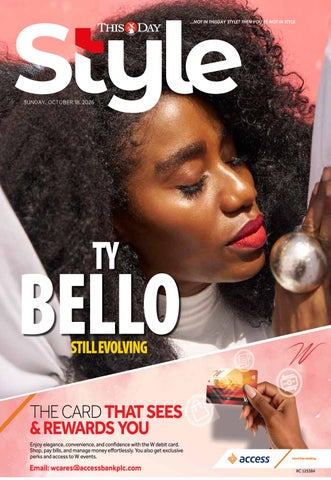
TY
BELLO STILL EVOLVING
THE CARD THAT SEES & REWARDS YOU Enjoy elegance, convenience, and confidence with the W debit card. Shop, pay bills, and manage money effortlessly. You also get exclusive perks and access to W events.
Email: wcares®accessbankplc.com
♦ access
1
more than banking
RC 125384
Sunday, October 18, 2026 Vol. 22, No. 11478
Sunday, October 18 , 2026 Vol. 22, No. 11478
EDITOR’S LETTER
COVER NOTE
EXECUTIVE EDITOR
14
14
T
Y Bello has never been easy to define by just one thing. For more than two decades, she has moved between music and photography with a rare ability to make both feel deeply personal. Behind the camera, she has photographed presidents, cultural figures and some of the most recognisable faces of our time, while also using her lens to find extraordinary stories in ordinary people. In music, faith has remained a constant thread, expressed through songs that are intimate, reflective and unmistakably hers.
Lifestyle & Fashion
4
10
Breast Cancer Doesn’t Always Start With A Lump: 8 Signs You Shouldn’t Ignore
18 3
S yle TR
2
Bovi Ends World Tour On A High Note In Lagos
4
The New Rules Of Ageing: What’s Worth Doing, What Works And What Doesn’t
6
Medical-Grade Skincare: 6 Things To Know Before You Spend Your Money
8
Opinion: When Does Beauty Become Too Much?
9
Joseph Edgar: Big Ideas, Bold Moves And No Filter
10
How To Wear Fashion’s Boldest Trends Without Looking Overdone
18
The Lagos Event Season: What to wear and how to Prepare
20
The Single Series: What If We Never Get Married?
21
So, You Want to Buy Art?
22
UT H
& RE A SO
N
EXECUTIVE EDITOR KONYE NWABOGOR 08111847087
DEPUTY EXECUTIVE EDITOR OLUFUNKE BABS-KUFEJI 08111847086
ASSISTANT EDITOR YINKA OLATUNBOSUN CONTRIBUTOR EBIYEKON DORCAS DIO DIRECTOR, PRINT PRODUCTION CHUKS ONWUDINJO
Printed by Ups Digitals Ltd, Abuja; 08057025005; info@upsdigitals.com
08077092196
On Second Thought
T
here’s something strangely fascinating about those reality TV shows featuring botched cosmetic procedures. You watch someone explain their fifth nose job, or enormous implants, and you find yourself wondering, why did you need to go that far? It’s an easy question to ask from the comfort of your sofa, but increasingly, worth asking beyond the television screen. We see less extreme versions of it around us every day. Bleached skin with burnt knuckles, overdone fillers, unnaturally sharp jawlines, exaggerated BBLs and barely recognisable faces. And you begin to ask, at what point does beauty become too much? And who really gets to decide anyway? Now, I’m certainly not knocking anyone for wanting to look better. I’m all for a little assistance from science, especially as we age. But there’s a difference between enhancement and becoming unrecognisable. My opinion article, “When Does Beauty Become Too Much?”, explores that increasingly blurred line, without pretending the desire to look good is something women should apologise for. Which brings me to ageing. Not the graceful, effortless kind everyone loves to recommend, but getting older and deciding what to do about it. “The New Rules of Ageing: What’s Worth Doing, What Works and What Doesn’t” is a must-read for any woman planning to keep things together over the next few months and beyond. Because between expensive skincare, aesthetic treatments and every new miracle procedure on Instagram, knowing what deserves your money is practically a survival skill. Looking younger is one thing. Looking like yourself, only better, is quite another. And speaking of the expectations women are constantly negotiating, there’s another that makes people uncomfortable. Marriage. Or, more specifically, the possibility that it might never happen. This week, we introduce The Single Series with “What If We Never Get Married?” It’s a conversation I think every single woman should read, whether marriage remains on her wish list or she’s questioning it. Some subjects become unnecessarily frightening because we treat them as taboo. Perhaps confronting the possibility helps clarify what we want. Anyway, enough of all that. How have you all been? I hope life has been kind to you lately. And even if it hasn’t, I hope you’ve managed to find a few things to smile about. We’re already halfway through October, and I’m still trying to understand where the year went. I hope you’re making time for yourselves, checking in on the people you love and finding little reasons to enjoy the days as they come. On that note, enjoy this week’s issue. And if you happen to know anyone who has figured out how to make the remaining months of the year feel like six, please send them my way. I have a few things I’d like to squeeze in. Love,
@thisdaystyle |
@thisdaystyleon | www.thisdaystyle.ng
BREAST CANCER DOESN’T ALWAYS START WITH A LUMP: 8 SIGNS YOU SHOULDN’T IGNORE When we think about breast cancer, the first thing that comes to mind is usually a lump. We’ve been told to feel for one, watch out for one and see a doctor if we find one. It’s good advice, considering that a lump is one of the most common signs of breast cancer. But here’s what doesn’t get nearly enough attention: breast cancer doesn’t always announce itself that way. Sometimes, the warning signs are less obvious. A change in skin texture, unusual nipple discharge or a persistent rash might seem harmless enough to ignore. While most breast changes aren’t cancerous, knowing what deserves attention could make an important difference. This Breast Cancer Awareness Month, here are eight signs worth knowing.
1. When Your Nipple Suddenly Changes Direction
Some nipples naturally point inward, and that’s perfectly normal. What deserves attention is a nipple that has always pointed outward suddenly turning inward or becoming unusually flattened.
This change, known as nipple inversion, can sometimes indicate an underlying breast condition. It doesn’t automatically mean cancer, but it should be examined.
2. Skin That Starts to Dimple
A change in breast skin texture might seem like a minor cosmetic issue. However, dimpling, puckering or skin resembling orange peel can sometimes indicate breast cancer. These changes may occur when underlying tissue or lymphatic drainage is affected. If your breast skin suddenly looks different, don’t dismiss it.
3. Discharge When You’re Not Breastfeeding
Nipple discharge isn’t always unusual, particularly during pregnancy or breastfeeding. However, spontaneous discharge, especially from one breast, deserves attention. Bloody or clear discharge can occasionally be associated with breast cancer, although benign conditions are more common. New, unexplained discharge should be medically assessed.
4. Redness, Warmth or Swelling That Appears Suddenly
Inflammatory breast cancer, a rare but aggressive form of the disease, can cause rapid swelling,
redness and warmth without an obvious lump. These symptoms sometimes resemble an infection, making them easy to misinterpret. Although infections are more common, rapidly developing or persistent changes require prompt medical attention.
5. An Unexplained Change in Breast Size or Shape Most women have naturally asymmetrical breasts, and hormonal fluctuations can affect their appearance. What matters is a new, unexplained change. If one breast suddenly appears noticeably larger, develops an unusual contour or looks different from its usual shape, arrange a medical examination.
6. A Nipple Rash That Refuses to Clear
A persistent rash around the nipple might resemble eczema or irritation from clothing. Often, that’s exactly what it is. However, Paget disease of the breast, a rare condition associated with breast cancer, can cause redness, crusting, scaling or itching around the nipple. A rash that refuses to clear, particularly on one side, deserves investigation.
7. Breast Pain That Doesn’t Feel Normal Breast pain is common, particularly around menstruation, and most cases aren’t cancerrelated. However, persistent pain concentrated in one area,
especially when it doesn’t follow your usual hormonal pattern, should be checked. Pain alone rarely indicates breast cancer, but unexplained changes shouldn’t automatically be dismissed.
8. A Lump Somewhere You Weren’t Checking Breast cancer can sometimes cause swelling or enlarged lymph nodes in the armpit or near the collarbone, even without an obvious breast lump. Although infections and other harmless conditions frequently cause swollen lymph nodes, any new, unexplained swelling deserves medical attention.
What About When There Are No Signs? Here’s something equally important: breast cancer doesn’t always come with warning signs, particularly in its early stages. That’s why regular screening, when recommended for your age and risk level, matters even when your breasts look and feel perfectly normal. Mammograms can sometimes detect changes long before they become noticeable. And while most breast changes are not cancerous, it’s always better to have something unusual checked than to ignore it. Breast cancer awareness is ultimately about two things: knowing when to seek medical attention and understanding that feeling fine doesn’t always mean there’s nothing to check.
3
TR
UT H
& RE A SO
N
Sunday, October 18, 2026 Vol. 22, No. 11478
Sunday, October 18 , 2026 Vol. 22, No. 11478
BOVI ENDS WORLD TOUR ON A HIGH NOTE IN LAGOS
I
t was a night of laughter, music, and memorable performances as comedian Bovi Ugboma brought his 2026 world tour, Guilty as Charged, to a grand finale at the Eko Convention Centre in Lagos on Sunday, October 11. Performing before a packed audience, Bovi delivered an energetic closing set, drawing laughter with his trademark wit, sharp observations on everyday life and hilarious takes on relationships, politics and social issues. The evening also celebrated Nigerian comedy talent, with veteran comedians I Go Save and Mr. Patrick making special appearances. Emerging acts H-Prince, Ovy Godwin, Jesta, Funny Urch, Phronesis and MC Mr Rhelax also shared the spotlight. Adding to the entertainment was a performance by Loud Urban Choir, while cast members of Bovi’s comedy series, Visa on Arrival, treated guests to a lively interactive session featuring cash giveaways. The Lagos finale marked the end of a successful tour that included sold-out performances at London’s Indigo at The O2 and across six Canadian cities, as well as a homecoming show in Benin City.
EBUKA UCHENDU
FUNNY BONE
FUNNY URCH
H PRINE
I GO SAVE
JESTA
M C EDO PIKIN
MC RHELAX
MR PATRICK
NICOLE ASINUGO
OVY GODWIN
PHRONESIS
BOVI UGBOMA
4
5
Sunday, October 18, 2026 Vol. 22, No. 11478
There was a time when growing older simply meant adjusting your wardrobe, investing in a good moisturiser and accepting the occasional grey hair. Today, there’s an entire industry promising to slow, reverse or disguise the process. Between longevity supplements, cosmetic procedures, wellness retreats and endless skincare routines, getting older can feel like an expensive project. But here’s something worth remembering: not everything needs fixing. Some things need attention, others need adjustment, and quite a few are perfectly fine as they are. So, what should we actually be doing differently?
Sunday, October 18 , 2026 Vol. 22, No. 11478
THE NEW RULES OF AGEING: WHAT’S WORTH DOING, WHAT WORKS AND WHAT DOESN’T
HAVE A LIFE OUTSIDE WORK AND RELATIONSHIPS
TREAT SELF-CARE AS MAINTENANCE, NOT A REWARD
1. Fashion: Stop Dressing According to Your Birth Certificate What works: Understanding your
body, investing in good tailoring and wearing clothes that reflect your personality.
What doesn’t: Abandoning
miniskirts, sleeveless dresses, denim or bold colours because someone decided they’re inappropriate after 40. Personal style should evolve with your taste and lifestyle, not disappear with age. The secret is proportion, fit and knowing what makes you feel good. A beautifully tailored pair of trousers can do more for your appearance than an expensive outfit that doesn’t fit properly.
2. Skincare: Consistency Beats Expensive Promises What works: Daily sunscreen,
moisturising and proven ingredients such as retinoids and vitamin C. DOLORES ODOGWU, GRACE OSIME
6
What doesn’t: Expecting a luxury
cream to erase deep wrinkles or reverse years of sun damage. Skin naturally changes with age, becoming drier and less elastic. Adjusting your routine makes sense, but buying every trending product doesn’t. A few effective products used consistently will generally serve you better than a bathroom shelf full of promises.
3. Hair: Grey Doesn’t Mean Game Over What works: Choosing flattering cuts, protecting your scalp and adapting your haircare routine as texture and density change. What doesn’t: Believing that older
women must wear short hair, avoid extensions or automatically embrace grey. Colour your hair, wear wigs, experiment with braids or go completely silver. The choice is yours. Just remember that thinning edges and hair loss deserve attention, particularly when caused by tight hairstyles or underlying health conditions.
4. Fitness: Strength Matters More Than Size
wellbeing, not simply a smaller waistline.
What works: Strength training, walking, stretching and regular cardiovascular exercise.
6. Cosmetic Treatments: Know When to Stop
What doesn’t: Obsessing over the
number on the scale while ignoring muscle and bone health. Muscle mass naturally declines with age, making resistance training increasingly important. You don’t need an intimidating gym routine. Squats, resistance bands, weights and regular movement can make a meaningful difference.
5. Nutrition: Forget Miracle Supplements What works: Adequate protein, fibre, vegetables, healthy fats and proper hydration. What doesn’t: Detox teas, extreme
diets and expensive supplements promising biological rejuvenation. Some supplements are useful when deficiencies exist, but there’s no magic capsule that replaces balanced nutrition. Eat for energy, muscle, heart health and long-term
What works: Carefully selected treatments administered by qualified professionals. What doesn’t: Chasing every
new injectable or attempting to eliminate every visible sign of ageing. Botox, lasers and other procedures can address specific concerns, but they have limitations and risks. The objective should be an informed choice, not a face that looks permanently surprised.
7. Sleep and Hormones: Pay Attention to Your Body What works: Prioritising sleep, managing stress and seeking medical advice about hormonal changes. What doesn’t: Dismissing persistent
exhaustion, hot flushes or mood changes as simply getting older. Perimenopause and menopause can affect sleep, skin, energy and
BUKKY GEORGE TAYLOR
overall wellbeing. Understanding these changes makes managing them easier. Where appropriate, medical treatments can help. 8. Makeup: Update Your Technique, Not Your Personality What works: Hydrating formulas, thoughtful application and makeup that complements changing skin texture. What doesn’t: Assuming mature women must abandon shimmer, bright lipstick or dramatic eyes. Heavy powders and thick foundations can emphasise fine lines, but there’s no universal rule. Experiment with lighter textures and techniques that suit your face. Makeup should remain enjoyable.
9. Relationships: Your Social Life Still Matters What works: Maintaining friendships, meeting new people, dating if you want to and staying socially engaged. What doesn’t: Assuming romance,
adventure or new beginnings have
BOLA BALOGUN
an expiry date. Friendships change, relationships end, and priorities shift. None of these means life becomes less interesting. Staying connected and open to experiences contributes to emotional wellbeing at every age.
10. Attitude: Stop Trying to Win Against Time What works: Regular health screenings, curiosity, confidence and investing in experiences that make life enjoyable. What doesn’t: Comparing yourself
to heavily filtered photos or treating every birthday like a problem that needs fixing. There’s nothing wrong with wanting to look younger. But there’s also something liberating about looking your age and feeling fantastic. Ultimately, ageing well isn’t about following every new rule. It’s about knowing which ones deserve your attention and which ones you can happily ignore. And if anyone insists you’re too old to wear something fabulous, perhaps they’re the ones who need updating.
7
Sunday, October 18, 2026 Vol. 22, No. 11478
MEDICAL-GRADE SKINCARE: 6 THINGS TO KNOW BEFORE YOU SPEND YOUR MONEY
From expensive serums to dermatologist-recommended creams, medical-grade skincare promises impressive results. But is it really better than your regular beauty products, and should you be paying more for it?
8
Sunday, October 18 , 2026 Vol. 22, No. 11478
Skincare shopping used to be fairly straightforward. You found a cleanser, a good moisturiser, perhaps a serum, and that was that. Now, beauty shelves are filled with products promising clinical results, advanced formulations and ingredients that sound like they belong in a science laboratory. And somewhere in all that, medical-grade skincare has become the latest beauty obsession. The appeal is obvious. Who wouldn’t want products that promise better skin, fewer wrinkles and a more even complexion? But before you spend half your salary on a tiny bottle of serum, here are six things worth knowing.
prices because of branding, packaging and exclusivity. A moisturiser containing ceramides and glycerin doesn’t need to cost a fortune to support your skin barrier. Likewise, an affordable broadspectrum sunscreen can provide excellent protection when used correctly. Before investing in an expensive product, look beyond the price. Check its ingredients, the evidence supporting its claims and whether it offers something your existing skincare routine doesn’t. Your skin doesn’t know how much you paid for that bottle.
4. Who Actually Needs MedicalGrade Skincare? If you’re dealing with persistent acne, melasma, stubborn hyperpigmentation or significant sun damage, professionally recommended skincare may be 1. What Does Medical-Grade worth exploring. A dermatologist can help identify Actually Mean? ingredients and treatments that are Despite how impressive it sounds, appropriate for your skin rather than medical-grade skincare isn’t an leaving you to experiment with every officially recognised regulatory trending product. category. It’s generally used to This is especially important for darker describe products marketed as having skin tones, where irritation can advanced formulations, clinically tested worsen pigmentation. ingredients or professional backing. However, medical-grade skincare Brands such as SkinCeuticals, Obagi isn’t automatically necessary for and ZO Skin Health are commonly everyone. If your skin is healthy and associated with this category. your current products work, you may While some offer well-researched have no reason to change them. formulations, the medical-grade label itself doesn’t guarantee superior 5. Can These Products performance. In other words, a product can look very Damage Your Skin? Yes, particularly when powerful active scientific without necessarily being ingredients are used incorrectly. better for your skin. Combining strong exfoliating acids, retinoids and other treatments can 2. Are the Ingredients cause dryness, sensitivity, breakouts Really Better? and damage to the skin barrier. Not always. Many medical-grade One common mistake is assuming products contain ingredients already that stronger products deliver found in regular skincare, including faster results. In reality, irritated skin vitamin C, retinol, hyaluronic acid, often takes longer to recover, and niacinamide and glycolic acid. inflammation can leave behind dark The difference may lie in ingredient marks. concentration, stability, delivery Introduce active ingredients systems and the quality of the gradually, avoid unnecessary formulation. However, higher combinations and seek professional concentrations don’t automatically advice when dealing with persistent produce better results. skin problems. For example, a well-formulated vitamin Sometimes, doing less for your skin C serum from an affordable brand may produces better results. outperform a more expensive product if its ingredients are more stable and 6. So, Is It Worth Switching? suitable for your skin. That depends entirely on your skin The important question isn’t whether and what you’re trying to achieve. an ingredient sounds impressive. If you have specific concerns It’s whether the product contains an that your current products aren’t effective formulation that addresses addressing, investing in evidenceyour concerns. based treatments may make sense. But if your routine already includes 3. Does a Higher Price a suitable cleanser, moisturiser, Guarantee Better Skin? sunscreen and effective targeted Absolutely not. ingredients, you may have everything Some medical-grade products are you need. Rather than replacing your expensive because of research, entire skincare collection, consider specialised formulations and clinical investing in one product that testing. Others command premium addresses a genuine concern.
OPI NION @thisdaystyle |
F
@thisdaystyleon |
www.thisdaystyle.ng
BY KONYE CHELSEA NWABOGOR
rom bleaching creams to cosmetic procedures, the pursuit of beauty has never offered more possibilities. But somewhere between looking better and looking completely different, have we become a little too enthusiastic about fixing ourselves?
improvement. Overfilled lips and exaggerated facial contours can create an appearance that feels less harmonious than before. Of course, some people genuinely prefer dramatic results, and personal taste should be respected. Still, respecting someone’s choice doesn’t mean pretending cosmetic procedures cannot produce poor outcomes. They can, and sometimes do. Beauty has always involved a little intervention. We colour What interests me is how quickly our eyes adjust. A decade ago, certain our hair, straighten our teeth, wear makeup, experiment with skincare facial proportions might have seemed unusual. Today, after seeing similar and occasionally pay looks repeatedly on professionals to improve celebrities and social media, what nature gave us. None they begin to feel normal. of this is new. What has And once an aesthetic changed is how much we becomes fashionable, people can alter, how easily we who might never have can do it and, perhaps considered changing their most importantly, what we features suddenly begin to now consider beautiful. see problems where none Now, guys, don’t get me existed before. wrong. I’m all for looking Perhaps the strangest thing good. There’s something about our relationship with wonderful about living beauty is how easily we can at a time when we have lose sight of what we already so many options. We have. A woman may spend can improve our skin, years trying to change her soften wrinkles, restore complexion, reshape her lost volume and address features or correct perceived features we’ve never imperfections, only to find particularly liked. And why that each improvement not? Growing older doesn’t introduces another concern. mean surrendering to every And sometimes, in trying to line or sag. There’s nothing become a more beautiful dishonest about wanting to version of ourselves, we age gracefully with a little end up looking less like assistance. Good skincare, ourselves. Not necessarily exercise, healthy habits because the treatments were and carefully considered unsuccessful, but because cosmetic treatments can all somewhere along the way, play a part. we lost sight of what we were But we also need an trying to achieve. honest conversation about The beauty industry what happens when understands this perfectly. It rarely tells us we’re unattractive outright. the help becomes too obvious, or when improvement begins to change Instead, it introduces concerns we didn’t know we had. There are treatments someone’s appearance beyond recognition. for your jaw, cheeks, mouth and even the way your face looks when you’re We’ve all seen transformations that make us look twice, and not necessarily not smiling. By the time you’ve addressed everything, you may have spent a for the intended reasons. Disproportionately full lips, jawlines sharpened to fortune fixing a face that wasn’t particularly problematic. almost architectural precision, permanently lifted cheeks and foreheads that Ageing adds another layer. We’ve confused ageing well with refusing to barely move. Then there are dramatic changes in complexion, sometimes look older. They aren’t the same thing. Ageing gracefully doesn’t require leaving an obvious difference between the face, hands and other parts of the accepting every physical change without question, but neither does it body. These are visible outcomes, not moral failings, but pretending every mean preserving the exact face you had at 25. A woman in her fifties can result is flattering or healthy doesn’t help anyone. look spectacular without looking thirty. Good skin, healthy hair, fitness, Skin bleaching deserves a more serious conversation than it usually thoughtful grooming and personal style make an enormous difference. So receives. We can’t acknowledge the history of colourism and the advantages can appropriate cosmetic treatments. The point is to work with the changes sometimes attached to lighter skin without ignoring the consequences of rather than treating every sign of time as an emergency. aggressive lightening. Some products contain harmful substances that can Perhaps we should also admit that some beauty trends simply don’t work for cause skin thinning, discolouration and serious health problems. And when everyone. Not every face needs fuller lips. Not every jaw requires definition. the face becomes several shades lighter than the hands, it raises questions Not every complexion needs lightening. What makes someone attractive about the methods being used and whether the desired result has been often comes down to balance, expression and individuality, not whether they achieved. meet the latest aesthetic specifications. There’s a difference between treating hyperpigmentation and attempting to This isn’t about policing people’s appearances. It’s about discussing beauty change your natural complexion entirely. Yet these distinctions are often lost without treating every intervention as either empowerment or insecurity. in an industry that markets almost every form of lightening as brightening, There’s plenty of room between those extremes for personal preference, glowing or correcting. The language has become more sophisticated, even good judgement and professional advice. when the underlying beauty ideals haven’t changed. By all means, book the facial, see the dermatologist and enjoy the Cosmetic enhancements present a different dilemma. A well-administered possibilities. Just remember that a good beauty professional should treatment can be remarkably subtle. Someone looks rested, refreshed sometimes tell you that you don’t need anything else. or simply like a particularly good version of themselves. But not every After all, the goal is to turn heads, not have people checking twice to confirm procedure produces that result, and not every additional treatment is an it’s actually yours.
WHEN DOES BEAUTY BECOME TOO MUCH?
9
Sunday, October 18, 2026 Vol. 22, No. 11478
Sunday, October 18 , 2026 Vol. 22, No. 11478
J
public narratives without escalating reputation damage? The International Masterclass in Crisis Management and Reputational Management was designed to provide a unique platform for robust knowledge sharing, engagement and dissection of crisis management indices by key decision takers from all sectors of human endeavour so I feel our leaders need this session at this time especially because of the way they approach crises. You see when a crisis erupts, you see various press releases, ill-trained spokesmen jumping in and worsening the case. All sorts of people jump in including family members and the person in question sweating and trying to explain. At the end of the day, Nigerians are short-changed, reputation is damaged; brand productivity and bottom line is hit. This is why we decided to pull together the richest crop of experts to assist in building an internationally accepted module of crises and reputational management.
oseph Edgar has made an interesting career out of refusing to stay in one lane. The investment banker who became a theatre producer, columnist and author is perhaps just as famous for his unfiltered opinions as he is for his ambitious stage productions. Better known as the Duke of Shomolu, Edgar has brought Nigerian history to the stage through productions such as Awo, Aremu and Emotan, while using his financial background to attract corporate investment into theatre. He is outspoken, occasionally controversial and rarely short of something to say. In this conversation with Yinka Olatunbosun, he discusses his latest coffee-table book, his journey from banking to theatre, his passion for the arts and the lifestyle behind his larger-than-life personality
Hosting the Masterclass across both Abuja and London bridges public governance and international strategy. How do you adapt the curriculum to suit the high-stakes environment of policy makers in Nigeria’s capital versus executives in global finance hubs? Initially, we planned the class for our political class hence the choice of Abuja. But then, we started getting serious interests from our private sector friends then we expanded it. London is one of the international dimensions of the masterclass so that our attendees would have the beautiful luxury of comparing notes with international experts. Also, they would have practical experience through visitation and engagement with iconic international institutions and their crisis management team. The class has been designed for key decision takers in both public service, private service and governance. It is also perfect for reputation managers, brand custodians, communications experts, crisis managers and PR Specialists. What you would be leaving the session with would be a more expansive and matured approach towards anticipating a crisis, engaging it and very importantly muting it while still safeguarding reputation which is very key.
Your career trajectory from investment banking to theatre producer has been quite phenomenal. Mounting ZIK and OBEY at London’s Shaw Theatre represents a major step in taking authentic Nigerian narratives to the global stage. What really motivated you into creative storytelling? Nothing has pulled me away from Finance. I’m still a Finance man as I run a boutique advisory Firm called Barnaby & Edgar. What gives people that impression that I have left Finance is the confidential nature of advisory so the face the public sees of me is the face that promotes theatre. Theatre is known to be largely underfunded in Nigeria. Still you had a successful run of Kashimawo in the UK. How are you able to manage with a large-scale stage production in London? I’ve learnt some hard lessons in the spending culture of that market. The brands there would rather buy tickets than sponsor. I don’t know if it’s the general notion or it’s just my own personal experience but in my three-year sojourn, I’ve seen a lot more ticket sales than than sponsorship from that side. It’s more than tough. We made a N12m loss this time and are still struggling to offset our debts. You can imagine paying forex debts from Naira earnings. It’s a learning curve and we are curating a new market and as such most remain patient and committed. How do you tell stories of historical figures like Zik and cultural icons like Obey to second-generation diaspora youth and older generations in a way that blends education, entertainment with nostalgia? For me, it is telling the stories with a lot of music and dance. Music as well as dance is the wine with which we serve the delicious meal. The songs alongside music makes digestion smooth and easy and at the end of the day, the appetite is satiated. Another thing I’ve learnt is also the level of involvement of the audience and artists. They are mostly nostalgia-driven because when we do historical plays, the audience having left these shores, are eager to see these plays to relive memories and connect with their heritage. Our December plays would be magic. We have started looking for the money. Four beautiful plays, by four beautiful female directors drawn from Kaduna, Ilorin, Asaba and Uyo. And all of them are academics with three professors and a PhD holder delivering Hafsatu, Princess Inikpi, Dein of Agbor and Makamba. It’s going to be fun this December. Your Masterclass series tackles “Definitive Strategies in Robust Crisis & Reputational Management.” What institutional gaps do you hope to bridge with this initiative? Strategy. Strategy is where I see these institutions failing in anticipating, engaging and muting Crisis, hence our resolve to pull people into a room to amongst others knowledge share Drawing from your dual background in investment banking and public commentary, what is the single biggest misstep African institutions make in the first 24 hours of a public relations breakdown? The biggest mistake they made is not anticipating it. Hence, the fire brigade approach when it happens. Serious organisations plan a crisis, prepare for it and build down and advance engagement modules to engage when it happens with no panic and these structures can also be deployed even with Crisis that blind sides the organisation. When you don’t prepare for it, it blindsides you and you find yourself running from pillar to post, worsening the case and damaging more things than even the crises. How do you teach leaders to effectively push back against hostile
10
joseph
EDGAR
BIG IDEAS, BOLD MOVES AND NO FILTER
You have described Maddtimes as a mapping of power and influence built around the premise that structural power in Nigeria has failed. How does the book define “charismatic power,” and what qualified an individual for the Maddtimes Power List? We put together a group of very prominent sector experts who contributed very powerful essays on power and influence in every conceivable aspect of Nigerian life. We got contributions from such diverse people as the Olu of Warri, Prof Koyinsola Ajayi SAN, Otunba Bimbo Ashiru, Gov Tunde Fashola, Atedo Peterside, Tonye Cole e.t.c They were 50 and their 50 essays formed the first part of the book and they now chose the 100 people that they considered the very powerful and influential people in the country. Why did you choose the lavish, coffee-table book format to deliver such a sharp critique of power dynamics in contemporary Nigeria? The book is a compendium and hits people differently. It’s a deep knowledge trove. A reference book, a book of satirical profiles and a book of beautifully made satires; all made in the finest *craftsmanship that you can think of. Between staging historical drama, training corporate executives in crisis control, and documenting political influence in print, how do these seemingly disparate projects connect under your overall mission as the “Duke of Shomolu”? The thread is influence and how to deploy that towards positive impact and outcomes. Looking ahead, how do you plan to leverage the intersection of theatre, crisis management, and publishing to build a lasting institutional platform for African storytelling and strategy? No bigger ambitions. I’m just having fun with my life, thinking and executing these projects. It’s all fun.
11
Sunday, October 18, 2026 Vol. 22, No. 11478
Sunday, October 18 , 2026 Vol. 22, No. 11478
Enjoy elegance, convenience and confidence with the W debit card. Shop, pay bills and manage money effortlessly. You also get exclusive perks and access to W events
12
13
TR
PHOTOGRAPHY: TY Bello
TY BELLO STILL EVOLVING
T
BY KONYE CHELSEA NWABOGOR
Y Bello has never been easy to define by just one thing. For more than two decades, she has moved between music and photography with a rare ability to make both feel deeply personal. Behind the camera, she has photographed presidents, cultural figures and some of the most recognisable faces of our time, while also using her lens to find extraordinary stories in ordinary people. In music, faith has remained a constant thread, expressed through songs that are intimate, reflective and unmistakably hers. Her latest project may be one of her most ambitious yet. Two years in the making, I Speak Lion, I Speak Lamb is a gospel project spanning two albums, with 20 songs on each; 40 songs in total. Beyond the sheer volume of music, it offers an interesting window into where Ty is creatively today and what she has to say after more than two decades of making art in different forms. In this conversation with Konye Chelsea Nwabogor, TY Bello talks about the making and meaning of I Speak Lion, I Speak Lamb; how her sound has evolved; the relationship between music and photography; creating in the age of AI; and what continues to excite and challenge her at this point in her life and career.
UT H
& R E A SO
N
Sunday, October 18 , 2026 Vol. 22, No. 11478
COVER
COVER
Sunday, October 18, 2026 Vol. 22, No. 11478
You have spent the last two years working on I Speak Lion, I Speak Lamb, which eventually became two albums with 20 songs each. Why did this project become such an expansive body of work, and what connects those 40 songs? Yes, two years is a long time to do a body of work. But it occurred to me that as I head toward turning 50, I’ll have been doing music professionally for 30 years. I was seeking to create a body of work that ran through my musical history, my journey with God, and the different sides to my music. It was hard to pin the journey down to one type of sound. So I was looking for a way to tie down the journey with sounds that connect. That takes a lot of time. It also meant that I couldn’t do it in fewer songs. I had to find a way. It was almost like I was writing a book, and I needed more words to write it. I wanted to create a coherent body of work that told my journey as a musician. And so I found out that, in the same way that I have two lives, being a musician and a photographer, my musical journey has two very different types of sounds. I wanted the listener to be able to experience both. The title I Speak Lion, I Speak Lamb immediately suggests two contrasting ideas: strength and surrender, power and gentleness. What does the title mean to you, and what does it tell us about the music? You’re right about strength and surrender. I feel like, in being human and walking with God, worship music is that place where I’m able, when I need it, to find the strength that I need to conquer the things I need to conquer. But it’s also the place where I come and allow myself to be broken. Music is how I spiritually find both types of expression. Before I even decided on the title, I found that there was a tension in finding music that spoke about both. It is in the sound that I’m able to face myself, allow myself to be vulnerable, and discuss the things that really matter to me. But it is through the sound that I also gather the strength to face the world. It’s where I find the courage to slay my giants. This is very clearly a gospel project. At this stage of your life, what does making gospel music mean to you, and has your understanding of what you want to communicate through your music changed over the years? I think I’ve been lucky enough to find a way to make music that’s truly authentic without pressure coming from anywhere else. Making music that is faith-based is not a strategy. It’s my reality. That is where the music comes from. Every song that I’ve ever sung came out of a conversation with God. I find that many other people are also having those same conversations. Many people connect with the music on a very deep level. There’s something that makes you feel fulfilled. The things that make you vulnerable actually give strength to other people. I feel like I’ve been blessed with the most fulfilling music career anyone can ask for. The conversations that I have in the sacred place connect with other people because we all have similar struggles and questions that we sometimes ask God. To find those things in music is something that brings us all together. Worship is also a place where we can all express our heartfelt gratitude.
14
15
Sunday, October 18 , 2026 Vol. 22, No. 11478
After two years and 40 songs, there must have been moments when the project surprised even you. Was there a particular song or moment during the process when you realised the album was becoming something bigger than you initially planned? Music eventually will surprise you, but you have to be patient for that to happen. The music wasn’t stitching together for a very long time, but I knew not to give up on it. I knew I needed to listen and go deeper into my archive, enjoying the music that I felt God had gifted me with. It was work in itself, but I was very consistent. The pay off comes when you are able to connect the dots and it all starts making sense spiritually and sonically. A major factor that made this particular project special was the producers I was privileged to work with. For the most part, I was working with people that were way younger than me. And to find 20-year-olds and 25-year-olds digging in and making music that is way beyond their years, while bringing the innovation of youth to a sound, brought all of us very major surprises. I was open enough to allow the sound to be experimental. And my goodness, we were all surprised. It’s easy to make a slow song that you can connect to spiritually, but it takes more intention to make a high energy and vibrant sound do exactly the same thing. I am glad that we were able to get there with every single song- fast or slow. You have been making music for more than two decades. When you listen to these new albums, what do you hear in TY Bello today that perhaps wasn’t present in your earlier work? I find that I am less afraid to make myself vulnerable. I am less afraid to share what my thoughts really are. My focus over the years has shifted more from trying to make perfect music to an eagerness to share truths that I have found, and to find frequencies of sound that break down these truths in a way that people can fully take in and have spiritual “aha “ moments. I love that I have learned to work, collaborate with others deeper than I ever have before. It’s been a journey. I feel like that’s the biggest lesson that I’ve learned. It’s beautiful to also know that the TY who made music in university decades ago is still very much alive. I’m glad that my inner child is still here, having fun and reminding me why I started. Nigerian music has changed enormously since you began your career, and gospel music itself is reaching much wider audiences. Where do you see your music sitting within this new landscape, and are there artists from this generation you would particularly like to collaborate with? Every day, I pinch myself that I’m still making music at all. That would have been enough in itself, but to constantly be surrounded by some of the smartest, most brilliant minds in music, decade after decade, year after year, can only be the hand of God. It has made the process very enjoyable and also very stretching. I have grown a lot. Collaborating constantly with younger musicians has been God’s gift to me. My music has grown, but it definitely hasn’t aged at all. I feel younger now than I did when I started in my teens. It’s incredible to know that my music has had an impact on the Nigerian musical space over the last 20 years. Somehow, God has made a place for me and has given me a very unique audience. One of the most amazing things is when strangers walk up to me and tell me what the music has done for them, how it gave them the courage to do things they were afraid to do, or how it carried them through a bad time. It encourages me and reminds me that making music itself is actually service. It’s ministry. It’s not just a quest for relevance. It’s an opportunity to serve. I feel like, as long as I stay true to myself and to the sounds that I’m
16
discovering, and allow myself to collaborate without fear across generations, both older and younger, I can continue to grow. On this album, for instance, I have a collaboration with Chris Delvan, but I also have collaborations with Greatman Takit, Sinmidele, and Ellie Scotte. I believe age is a privilege for all of us, both being young and being old. It’s beautiful to tap into the experience of an older musician, but also the openness and fearlessness of the young. I’m glad to know that somehow, I’ve benefited from both throughout my entire career. My strength has always been in my collaborations. They’ve made my music very powerful and very colourful. There was a period when many people probably thought of TY Bello first as a photographer and then as a musician. Did you ever feel photography had overshadowed the music, or were you completely comfortable allowing one part of your creativity to take the lead? One of the prayers I say all the time is for the wisdom to understand what part of my life should take the lead in every season. Some seasons, I know to drop everything and just focus on marriage and motherhood, in other seasons, my relationship with God. My dual expression as an artist is exactly the same. When it’s time for music, then I give the music what it requires. Having the life and the freedom to move between both careers is such a beautiful escape. For me, music is something that I would love to do for the rest of my life. But I believe that one of the reasons I can still do it with as much passion as I do is photography. It’s an alternative escape, and it helps me take long enough breaks to refresh and fall in love again. This is true for album making because I actually get to create music every single week, with my musical director, George Alao and the beautiful community we’ve grown with in the last ten years. Music has a way of making you feel like you have to find identity within it. I realised that my identity cannot be gotten from what I create, but from my intimacy with God and faith in Him. You have photographed everyone from presidents and major public figures to everyday people whose stories might otherwise have gone unnoticed. After all these years, what still makes you curious about a person before you photograph them? What makes me curious about every human being is the uniqueness of their story. Everyone has a story. And photography is my gift to stay deeply connected to someone. I feel like by the time I’m done photographing someone, I get to know them really well. And I fall in love with the person that they are. I see the little nuances that they take for granted, and I make it my goal to find ways to bring that out. It’s almost addictive because it’s like reading a very, very interesting book, week after week, and being introduced to new characters that God wants me to see. Photography keeps me really human and keeps me really in touch with what makes all of us different. Has spending so much of your life observing people through a camera changed the way you make music? Do you find that the photographer in you influences the way you write, tell stories or even imagine sound? Absolutely. Being a visual artist makes a different type of musician out of me. I tend to see sound the way I see light. I see sound and composition the way light falls on an image. And I feel like composition is the same. Photography makes me very aware and strengthens my ability to make something beautiful out of something that already exists and is normal. I feel like when I take this skill to sound, I am able to play with possibilities. And I’m not afraid to experiment and see what would happen if I just tried something out that I never tried before. I’m constantly doing this in my work. Constantly pushing in my photography. Constantly pushing for what’s possible, either on the subject or with the lighting. With music, I’m constantly trying to see if I can put ideas that are not connected together, just out of curiosity. Art makes us curious human beings.
And it’s wonderful to be able to use the same type of thinking for both sides of my work. Technology, social media and now AI have dramatically changed both photography and music. In a time when almost anyone can create and manipulate an image or a piece of music, what do you believe still separates meaningful creative work from everything else? The human spirit. Technology will always be a tool. No matter how dramatic or revolutionary it is, it will never take away from the experience of the soul. I believe that one must never be afraid to explore the tools that are available to us. But we owe it to ourselves to maintain authentic, real experiences. I can’t replace the wisdom I glean from God in music with an app. It will never be the same because it’s personalised and authentic in a way that I cannot describe. Having these tools will always be a blessing. The radio never stopped us from singing. It’s like the transition from black-and-white to colour film. It’s a bigger experience, and the possibilities are greater. A shift in colour just adds another dimension to how an image is experienced. But this doesn’t diminish the importance of the contrast in a black-and-white image. In the same way, technology does not take away from our joy, our pain, our sadness, or our conquests. None of those things will change. Creating music that connects with those things will always be beautiful, whether or not you choose to use the tools of the day.
COVER
COVER
Sunday, October 18, 2026 Vol. 22, No. 11478
You have moved between music, photography, creative direction and storytelling without ever seeming particularly interested in staying in one box. Was that something you consciously chose, or have you simply always followed whatever creatively interested you at the time? Once, an older person was concerned about my choice to be an artist and made it clear that it wouldn’t work. It was one of the biggest gifts that I ever got. It made me realise that being an artist was a choice and I had to make it work. Freedom and the ability to do what you desire comes at a cost and so there is always a desire for wisdom. It’s the number one thing that I pray for- the wisdom to juggle it all and to understand timing. I may have more than one thing on my plate, but it’s important not to have it on my plate all the time. I need to understand every season so that I am not overwhelmed and I give everything God has given me a chance to thrive. You seem to be at a point in your career where there is very little left to prove. What excites you now, and has your definition of success or even a good life changed as you have grown older? I’m glad that you used the words “Nothing left to prove.”The moment you stop trying to prove, especially to other people, is when you really start living. I’m constantly looking to experience what is possible. Chasing after the flickers, images and the what-ifs that God places before me. And allowing myself to spontaneously try. And it’s wonderful because the results have surprised me greatly. This has kept my life very interesting. Season after season, I’m able to engage in different creative relationships and find new expression in allowing myself to not just lean on what I know. With I Speak Lion, I Speak Lamb introducing this new chapter, where is TY Bello right now, not just as an artist or photographer, but as a woman, and what are you looking forward to next? As a woman, one of the most important things to me is seeing the impact my creative endeavour has on my children and my marriage. I love that it’s been a creative process for all of us, as I’ve found a way to get them involved and excited in the creative process. For instance, my children actually wrote the chorus of one of the songs and were very much contributing to the production process. I love it when I can bring them into what I do somehow. I stopped crafting goals simply out of desires about fifteen years ago. I realised that you will always find your goal when you get to the end of your current God-given instruction. I’ve always felt like I don’t need to know what to do next. I just need to know how to do what is placed in front of me. I Speak Lion, I Speak Lamb was placed in front of me two years ago. I assumed that it was an instruction that would take me three months. When I saw that it would take me as long as two years, I had the choice to speed things up and only get a fragment of what it was that I was to create, or slow everything down and give the music what it demanded. I find out that once I give what is in front of me everything that it demands, then there’s always a future, because every time I have done that, it always opens the door to the next phase. It’s just such a delight to finally be completing an idea that has taken so long to form, and I am open to every door that it presents to me.
17
TR
UT H
& RE A SO
N
Sunday, October 18, 2026 Vol. 22, No. 11478
Sunday, October 18 , 2026 Vol. 22, No. 11478
HOW TO WEAR FASHION’S
skirt worn over a fitted slip creates an interesting play on texture. Organza jackets are another clever way to introduce transparency without feeling exposed. The trick is to think about what goes underneath just as carefully as what goes on top. Good underlayers can make even the most daring sheer piece surprisingly wearable.
BOLDEST
TRENDS WITHOUT LOOKING
3. Let Statement Accessories Do the Talking
Sometimes, all an outfit needs is one spectacular accessory. Think oversized gold earrings with a crisp white shirt, a sculptural cuff with a simple black dress or an unusual handbag paired with relaxed tailoring. Statement accessories work particularly well when the rest of your outfit is relatively uncomplicated. You don’t necessarily need enormous earrings, a chunky necklace, an embellished belt, and a dramatic handbag competing for attention. Pick your star performer and let it enjoy the spotlight.
OVERDONE
Fashion is having plenty of fun with proportions, textures and dramatic details. Oversized silhouettes, sheer fabrics, metallic finishes and statement accessories are giving us more reasons to experiment with our wardrobes. But while these looks might be fabulous on the runway or your favourite fashion influencer, translating them into something you can comfortably wear to lunch, dinner or an event is another matter entirely. The good news is that you don’t need a stylist or an entirely new wardrobe to pull off fashion’s more adventurous looks. Often, the difference between a great outfit and one that feels excessive comes down to proportions, styling and knowing which details deserve the spotlight. Here are seven ways to make bold fashion work in real life.
4. Wear Bold Colours With Intention
Bright colours can be intimidating, particularly when you’re combining shades that wouldn’t ordinarily share a wardrobe. But some of the most interesting outfits come from unexpected pairings. Try cobalt blue with chocolate brown, burgundy with pale pink or a vibrant orange accessory against an otherwise neutral outfit. Tonal dressing is another option: wearing different shades of one colour can look striking without feeling chaotic. Rather than adding every colour you love, choose a combination that feels deliberate. EZINNE CHINKATA
Who decided sparkle belongs exclusively to evening events? A metallic skirt can look surprisingly relaxed with a plain cotton T-shirt and flat sandals. Sequined trousers paired with a simple shirt can work for a fashionable lunch, while silver shoes can instantly update jeans and a blazer. The secret is contrast. Pair something glamorous with something ordinary, and suddenly the outfit feels less like you’re heading to an awards ceremony and more like you simply have excellent taste.
6. Mix Textures for a More Interesting Look
Some of the best outfits combine fabrics that appear to have very little in common. Leather with lace, satin with denim, or a structured aso-oke jacket over fluid trousers can create a beautiful contrast. Texture adds depth without necessarily requiring bright colours or elaborate accessories. The important thing is to consider the weight and finish of each fabric. A delicate lace top, for instance, can soften the toughness of leather trousers, while a crisp shirt can give a heavily embellished skirt a more contemporary feel.
1. Give Oversized Silhouettes Some Structure
Voluminous skirts, exaggerated shoulders and wide-leg trousers can make a serious fashion statement, but proportions matter. If you’re wearing an oversized blazer, try pairing it with straight-cut trousers or a fitted skirt. A dramatic balloon skirt works beautifully with a simple, close-fitting top. The idea isn’t to make everything smaller but to give the eye somewhere to rest. And if you’re going oversized from head to toe, pay attention to tailoring so the clothes look intentional rather than borrowed.
7. Know When to Stop Styling
This might be the most useful fashion skill of all. You have the dramatic dress, the fabulous shoes, the jewellery and the bag. Individually, they’re wonderful. Together, they might be having four different conversations. Before leaving the house, take another look at the entire outfit. Would simpler shoes improve the silhouette? Does the necklace compete with the neckline? Would removing the belt make everything look cleaner? Editing an outfit doesn’t mean making it boring. It simply allows the strongest elements to stand out.
2. Make Sheer Pieces Work Beyond the Runway
SHAFFY BELLO
18
Sheer fashion doesn’t have to mean showing everything. A transparent blouse layered over a beautiful camisole can look sophisticated, while a sheer
5. Bring Metallics and Sequins Into Daylight
TOYOSI EFFIONG
JULIET OLANIPEKUN
19
Sunday, October 18, 2026 Vol. 22, No. 11478
Sunday, October 18 , 2026 Vol. 22, No. 11478
THE SINGLE SERIES
THE LAGOS EVENT SEASON: WHAT TO WEAR AND HOW TO PREPARE Lagos is entering one of its busiest social seasons, and your wardrobe had better be ready. Between major fashion weeks, independent designer shows, collection launches, art exhibitions, film premieres, private parties, and everything in between, the invitations are about to come thick and fast. Some events call for serious fashion, others for effortless chic, and a few will take you from afternoon presentations to late-night parties. The challenge isn’t finding somewhere to go. It’s figuring out what to wear to everything without buying an entirely new wardrobe. Here’s how to prepare.
1. Get Your Calendar Sorted First
Before planning outfits, figure out where you’re actually going. Lagos Fashion Week and GTCO Fashion Weekend are obvious highlights, but there are also standalone runway shows, designer presentations, art openings, film screenings and afterparties competing for attention. Prioritise the events you genuinely want to attend and note their locations, times and dress codes. An afternoon gallery visit requires a different approach from an evening premiere. Knowing your schedule helps you decide which outfits need to work overtime and which occasions deserve something special.
2. Do a Proper Wardrobe Audit
Before spending money, take everything out and assess what you already have. That beautiful dress you’ve worn only once, the statement jacket gathering dust, or those tailored trousers you forgot about could become your strongest looks this season. Try creating complete outfits rather than looking at individual pieces. Photograph combinations on your phone so you have options ready when invitations arrive. The objective isn’t to wear
20
hours in them. Block heels, elegant flats and comfortable sandals are perfectly acceptable, regardless of how dramatic everyone else’s footwear appears. If you’re wearing something particularly elaborate, make sure you can sit, walk and breathe comfortably. Fashion should make an impression, not become an endurance test.
6. Book Your Beauty Appointments Early
something new every day. It’s to make what you own look interesting again.
Hair, nails, makeup and grooming can become surprisingly difficult to organise once everyone starts preparing for the same events. Book essential appointments ahead of time and choose hairstyles that can last through several outings. A sleek bun, well-maintained braids or a versatile wig can work beautifully with different looks. For makeup, prioritise products that survive long days, heat and humidity. Carry blotting papers, lip colour and a compact for touchups. You don’t necessarily need professional makeup for every appearance. A polished routine you can recreate yourself will save both time and money.
3. Invest in Pieces That Make an Impact
If you’re shopping, be strategic. One exceptional piece can do more for your wardrobe than several forgettable purchases. Think sculptural tops, beautifully cut trousers, statement skirts, interesting jackets or distinctive accessories. These pieces can be styled differently across several events. This is also a wonderful opportunity to explore emerging Nigerian designers. You might discover something more original than the familiar outfits everyone seems to be wearing. And please, avoid placing complicated last-minute orders with designers. Event season is stressful enough without wondering whether your outfit will arrive before the show starts.
7. Get the Small Details Right
Even the most beautiful outfit can be undermined by poor preparation. Check that your clothes fit properly, repair broken zips, replace missing buttons and arrange any necessary alterations early. Make sure your shoes are clean and your handbags are in good condition. Keep invitations, tickets and event addresses accessible on your phone. Confirm whether an event requires registration or a specific dress code. And if you’re attending several events in one evening, plan your movements realistically. Lagos traffic has absolutely no respect for a carefully planned outfit schedule.
4. Master the Day-to-Night Outfit
One of the biggest challenges of Lagos event season is attending multiple events without having time to change. The solution is to build outfits that can transition easily. A tailored trouser suit can work for an afternoon presentation and become evening-ready with statement earrings, a different bag and a change of shoes. A simple dress can also move between occasions with the right accessories. Keep a small beauty kit in your handbag or car for quick touch-ups. Sometimes, changing your lipstick and jewellery is all you need.
MODEL FOR YUTEE RONE
8. Set a Budget and Resist the Pressure
5. Take Comfort and the Weather Seriously
Lagos fashion events often involve long queues, standing through presentations, walking between venues and navigating unpredictable weather. Choose breathable fabrics where possible and avoid outfits that require constant adjusting. Test your shoes before committing to several
WANNIFUGA
VANESSA AZAR
Between clothes, beauty appointments, transport and socialising, event season can become expensive very quickly. Decide which occasions justify a new purchase and which ones can be handled with what you already own. Borrow accessories, repeat outfits and avoid buying something simply because everyone else appears to be shopping. Most importantly, don’t allow the pressure to be photographed or noticed to dictate your spending. The most stylish people aren’t necessarily the ones wearing the most expensive clothes.
WHAT IF WE NEVER GET MARRIED? By Funke Babs-Kufeji
I
’m in my 40s and, for most of my life, I never really questioned whether I would get married. It was simply part of the future as I imagined it. I would meet someone, fall in love, get married and move on to the next chapter. There was no reason to think otherwise. Then life happened. I have dated. I have met men who seemed promising and others who made me seriously question my judgement. I have loved, been disappointed, picked myself up and carried on. Somewhere along the way, though, I stopped being quite so certain that marriage was waiting for me around the corner. And then a question I never expected to ask myself became difficult to ignore: what if I never get married? For a single woman, particularly as you get older, that question carries more weight than it probably should. Friends get engaged. Younger cousins start getting married. Family members give you that look. You know the one. They are trying very hard not to ask, until eventually somebody does. “So, when are you getting married?” As though you have received the date and simply forgotten to inform everyone. Then comes the advice. Be more open. Stop being so picky. Go out more. Give him a chance. There is always an auntie with a nephew, a friend with a colleague or somebody who knows a “really good man.” After a while, you can begin looking at your life through everybody else’s expectations. The truth is that being single does not necessarily mean something went wrong. A relationship may have ended. You may not have met the right person. You may have walked away from something unhealthy or simply refused to settle for something you knew would make you unhappy. Sometimes, you are just single. It is a relationship status, not a diagnosis. That doesn’t mean you don’t want marriage. I still do. There is something lovely about the idea of building a life with someone. Companionship. Partnership. Having someone to come home to, travel with, laugh with and call when something completely ridiculous happens. Someone with whom you can build traditions, memories and perhaps a family. There is nothing embarrassing about admitting that you want those things. The danger begins when wanting marriage turns the rest of your life into a waiting room. How many decisions do women postpone because they imagine they will make them “when I get married”? The house. The holiday. The move. The business. Sometimes even the good plates. At some point, you have to acknowledge that this is your life. Not the rehearsal. Not the version before the real thing starts. Buy the house if you can. Take the trip. Change careers. Build the business. Invest your money. Celebrate your birthday properly. Make your home beautiful. Keep your friendships alive. Use the good plates. And please don’t lower every standard simply because another birthday has arrived. There is a strange idea that as women get older, things that would once have been considered red
flags should suddenly become “small issues.” Of course nobody is perfect. But imperfection is not the same thing as dishonesty, disrespect, emotional unavailability or being fundamentally wrong for you. Marriage is too serious a decision to make because you are frightened of being the last single woman at the table. Still, I don’t think we should romanticise being single either. Sometimes it is frightening. You wonder what growing older alone might look like. Who will be there when life becomes difficult? Who will sit beside you in the hospital? What happens when friends become increasingly absorbed in their own families? Who becomes your person? Those are real questions. But marriage itself does not automatically answer them. There are married people who are deeply lonely and single people surrounded by
extraordinary communities of friends and family. A spouse can be an incredible source of love and support, but a wedding ring is not an insurance policy against loneliness. Perhaps that means single women need to be more deliberate about building the other structures that make a life secure. Financial independence matters. So do friendships, family relationships, health, community and having people you can actually call at 2 am. And yes, there will still be weddings that get to you. You can genuinely adore your friend, dance until your feet hurt, take fifty photographs with the bride and still go home wondering when — or whether — it will happen for you. Both feelings are allowed. But there will also be mornings when you wake up and realise you quite like the life you have built. You enjoy your independence, your friendships, your work, your home, your routines and the freedom to decide what happens next. None of that means you have given up on love. It simply means love is no longer the only interesting thing that can happen to you. Maybe I will get married. I still hope I do. I would like to meet someone whose presence makes my life richer, happier and bigger rather than smaller. But if marriage comes, I want it to meet me already living. Because perhaps the question that frightens so many of us, What if I never get married? has been taking up too much space. A better question might be: What kind of life am I building either way? And suddenly, there is so much more to talk about.
21
Sunday, October 18, 2026 Vol. 22, No. 11478
Sunday, October 18 , 2026 Vol. 22, No. 11478
SO,YOU WANT TO BUYART?
NIKE OKUNDAYE ARTIST
By Funke Babs-Kufeji
Buying your first piece of art can feel strangely intimidating. Walk into a gallery or art fair, and suddenly everyone seems fluent in a language you do not speak. There is talk of provenance, editions, mediums, emerging artists and investment potential, while you are standing in front of a painting thinking, I just really like this. That is actually a very good place to start. You do not need to be an art expert to buy art. You need curiosity, a little information and enough confidence to trust your own eye. Because while there are practical things worth knowing before you spend your money, the best collections often begin quite simply: with something you genuinely want to keep looking at.
Start With What You Like ART-BY-NDIDI-EMEFIELE
22
Forget, for a moment, who everyone says you should
HOUSE OF WILLIAMS LAGOS
you are buying. Is it an original painting, a print or a photograph? Is it part of a limited edition? If so, how many exist? Is it signed and numbered? For an older work, what condition is it in? These are not questions reserved for experienced collectors. They are simply sensible questions when you are spending your money.
be buying. Spend some time discovering what you naturally respond to. Visit galleries and exhibitions, attend art fairs and follow artists online. Notice the works that make you stop, then notice the ones you find yourself thinking about afterwards. Your taste may have very little to do with what is currently fashionable, and that is perfectly fine. You also do not need an elaborate explanation for why you love something. Sometimes a work reminds you of a person or place. Sometimes it makes you feel something you cannot quite name. Sometimes you simply think it is beautiful. That counts.
Set A Budget
You do not need millions to start buying art. Smaller works, photography, prints and works on paper can be excellent entry points, as can pieces by emerging artists whose prices have not yet climbed significantly. Decide what you can comfortably afford before you begin shopping and resist being pushed beyond it. And be careful about buying purely because someone has declared an artist “the next big thing.” Art can appreciate in value, but there are no guarantees. Markets change, careers change, and collectors’ tastes change. A useful test is this: if this piece is worth exactly what you paid for it ten years from now, would you still be happy to own it?
Know Who And What You Are Buying
Once money is involved, however, emotion needs a little information. Know whether you are buying directly from the artist, through a gallery, at auction or from a private seller. A reputable seller should be able to tell you about the artist, when the work was created, its medium and its history. If you are spending a substantial amount, ask about authenticity and provenance. Also establish exactly what
BEN ENWONWU THE DANCER
Think About Your Space But Not Too Much
Before paying, consider where the work will live. Check its dimensions rather than guessing from a photograph. Think about lighting, framing and whether the piece needs protection from direct sunlight or special handling. What you should not do is reduce art to interior decoration. It does not have to match the sofa, curtains or rug. In fact, the unexpected piece may be the thing that gives the room its personality.
Keep The Paperwork
This is the unglamorous part, but it matters. Keep invoices, certificates of authenticity, provenance information and any
documentation supplied with the work. These records may become important if you later want to insure, sell or donate the piece. They also help establish its history, particularly as an artist’s career develops.
Take Your Time
You are allowed to walk into a gallery and leave empty-handed. You are also allowed to fall in love with something and not immediately reach for your card. If possible, take a photograph, look at more of the artist’s work, ask questions and compare prices. Give yourself a little time away from the excitement of seeing it in the gallery. If you are still thinking about it afterwards, that tells you something.
START WITH WHAT YOU LIKE
23
Sunday, October 18, 2026 Vol. 22, No. 11478
⸀ 䜀氀漀 猀 甀 渀 漀 䈀 攀 洀 漀 挀 氀 攀 圀 ㈀ 一 攀攀
爀 昀 礀 䔀渀樀漀 猀 甀 渀 漀 戀 昀 漀 栀 琀 爀 漀 眀
一䔀嘀䔀刀 匀䔀吀吀䰀䔀 䘀伀刀 䰀䔀匀匀 24