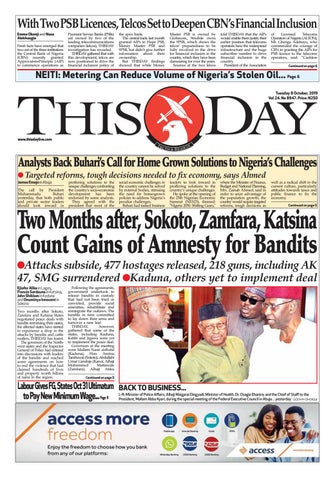
With Two PSB Licences, Telcos Set to Deepen CBN’s Financial Inclusion Emma Okonji and Nosa Alekhuogie Fresh facts have emerged that two out of the three institutions the Central Bank of Nigeria (CBN) recently granted Approval-in-Principle (AIP) to commence operations as
Payment Service Banks (PSBs) are owned by two of the leading telecommunications companies (telcos), THISDAY investigation has revealed. THISDAY gathered that with this development, telcos are now positioned to drive the financial inclusion policy of
the apex bank. The central bank last month granted AIPs to Hope PSB, Money Master PSB and 9PSB, but didn’t give further information about their ownership. But THISDAY findings showed that while Money
Master PSB is owned by Globacom, 9mobile owns the 9PSB, which shows the telcos’ preparedness to be fully involved in the drive for financial inclusion in the country, which they have been clamouring for over the years. Sources at the two telcos
told THISDAY that the AIPs would enable them justify their earlier position that telecoms operators have the widespread infrastructure and the huge subscriber number to drive financial inclusion in the country. President of the Association
of Licensed Telecoms Operators of Nigeria (ALTON), Mr. Gbenga Adebayo, who commended the courage of CBN in granting the AIPs for PSB licence to the telecoms operators, said: “Cashless Continued on page 6
NEITI: Metering Can Reduce Volume of Nigeria’s Stolen Oil... Page 6 Tuesday 8 October, 2019 Vol 24. No 8947. Price: N250
www.thisdaylive.com TR
UT H
& RE A S O
N
Analysts Back Buhari’s Call for Home Grown Solutions to Nigeria’s Challenges Targeted reforms, tough decisions needed to fix economy, says Ahmed James Emejo in Abuja The call by President Muhammadu Buhari yesterday, that both public and private sector leaders should look inward in
proffering solutions to the unique challenges confronting the country's socio-economic development has been endorsed by some analysts. They agreed with the president that most of the
social economic challenges in the country cannot be solved by external bodies, stressing the need for home-grown policies to address Nigeria’s peculiar challenges. Buhari had tasked business
leaders to look inward in proffering solutions to the country’s unique challenges. He spoke at the opening of the 25th Nigerian Economic Summit (NES25), themed: "Nigeria 2050: Shifting Gears,"
where the Minister of Finance, Budget and National Planning, Mrs. Zainab Ahmed, said in order to seize advantage of the population growth, the country would require targeted reforms, tough decisions as
well as a radical shift in the current culture, particularly attitudes towards taxes and public finance to fix the economy. Continued on page 5
Two Months after, Sokoto, Zamfara, Katsina Count Gains of Amnesty for Bandits Attacks subside, 477 hostages released, 218 guns, including AK 47, SMG surrendered Kaduna, others yet to implement deal Ejiofor Alike in Lagos, Francis Sardauna in Katsina, John Shiklam in Kaduna and Onuminya Innocent in Sokoto Two months after Sokoto, Zamfara and Katsina States negotiated peace deals with bandits terrorising their states, the affected states have started to experience a drop in the attacks by bandits and cattle rustlers, THISDAY has learnt. The governors of the Northwest states and the Inspector General of Police had entered into discussions with leaders of the bandits and reached some agreements on how to end the violence that had claimed hundreds of lives and property worth billons of naira in the region.
Following the agreements, government undertook to release bandits in custody that had not been tried or convicted, provide social amenities, rehabilitate and reintegrate the outlaws. The bandits in turn committed to lay down their arms and turnover a new leaf. THISDAY, however, gathered that some of the states, including Kaduna, Kebbi and Jigawa were yet to implement the peace deal. Governors at the meeting were Mallam Nasir el-Rufai (Kaduna), Hon. Aminu Tambuwal (Sokoto), Abdullahi Umar Ganduje (Kano), Alhaji Mohammed Mattawale (Zamfara), Alhaji Atiku Continued on page 5
Labour Gives FG, States Oct 31 Ultimatum to Pay New Minimum Wage... Page 8
BACK TO BUSINESS... L-R: Minister of Police Affairs, Alhaji Maigarai Dingyadi; Minister of Health, Dr. Osagie Ehanire; and the Chief of Staff to the President, Mallam Abba Kyari, during the special meeting of the Federal Executive Council in Abuja…yesterday godwin omoigui
2
T H I S D AY • TUESDAY OCTOBER 8, 2019
TUESDAY OCTOBER 8, 2019 • T H I S D AY
3
4
TUESDAY OCTOBER 8, 2019 • T H I S D AY
5
TUESDAY, ˜ ͺ ˾ T H I S D AY
PAGE FIVE TWO MONTHS AFTER, SOKOTO, ZAMFARA, KATSINA COUNT GAINS OF AMNESTY FOR BANDITS Bagudu (Kebbi) and the host, Mallam Aminu Masari (Katsina). Earlier in May, Adamu, at a meeting of northern traditional rulers in Kaduna, had listed Zamfara and Kaduna States as topping the list of states with high crime rate. Following the amnesty granted Zamfara bandits by Matawalle, the Director of Press at the Government House in Gusau, Mr. Yusuf Idris, told THISDAY that the bandits had released 427 hostages. He also said the state had been enjoying peace since the governor resorted to pacifying the bandits. According to him, the governor started the peace process a day after his inauguration. “He was inaugurated on Wednesday and he started the peace meetings on Thursday with a meeting with security chiefs in the state. On Friday, he met with traditional rulers,
followed by a meeting with Fulani leaders and local vigilantes. The governor spent 47 days holding meetings day and night. After the meeting, he embarked on consultations with a visit to the President, Vice President, Chief of Army Staff, Chief of Air Staff and the Inspector General of Police to seek their support for the peace efforts,” he stated. He added that the bandits willingly embraced the peace efforts and were not paid money to surrender to the state government. Idris stated that in order to sustain the peace and rehabilitate the repentant bandits, the state government has mapped out a social intervention programme to recruit 18,000 youths, who would be paid N20,000 allowance monthly. According to him, the governor is also building a RUGA settlement in each of the three senatorial zones to settle Fulani herders and curb
the crisis between them and farmers, which he described as the root cause of banditry in the state. THISDAY also gathered that over 216 rifles have been surrendered by the bandits, including AK47 rifles, LMG military rifles, LAR rifles and several caches of ammunition. The peace efforts, however, suffered a major blow with last week’s attack on a security outpost in which nine soldiers were killed in Sunke village of Anka Local Government Area. However, security reports showed that the attackers came from Niger State. In Katsina State, the armed conflict started with the frequent clashes between the Fulani, who are mostly herdsmen, and Hausa that are farmers, over grazing on farmlands, which often lead to the destruction of farm produce. The situation, however, became more horrifying
when the volunteer groups popularly known as Yan-Sakai began to attack the Fulani they perceived as bandits or cattle rustlers. This ugly trend was left unattended to by the government until when the Fulani began to launch reprisals, killing, kidnapping people and burning the villages of their perceived enemies. Beside the number of people killed or kidnapped, the houses or property destroyed by the bandits, some sectors like education, agriculture and health in the affected local governments also recorded significant setback. Since banditry reared its ugly head in the state, many farmers, particularly those in the frontline local government areas, abandoned their farmlands; many schools and hospitals remained closed, while some major markets were also deserted. However, Governor Bello
Masari was able to restore peace by granting amnesty to the repentant bandits. On realising the importance of the peace initiative, the state government reached an agreement with the bandits that they would release their members arrested and detained by security personnel in Katsina, Kano and Kaduna States, while in turn, the bandits will free captives in their custody. To actualise the agreement, the repentant bandits have so far freed 70 captives, including children and pregnant women in their custody. Similarly, all those bandits arrested and sent to jail were released. The repentant bandits also surrendered two AK47 rifles and ammunition to the state government. Masari told THISDAY in an exclusive interview that more firearms were being retrieved and kept by leaders of bandits in different camps
across the eight frontline local government areas of the state. "What we know that is currently going on in the forest is that the bandits' commanders have started retrieving arms and ammunition from their boys in different forests within Katsina and Zamfara States. So, after we restore normalcy, they will surrender the arms recovered from their boys," the governor said. The governor added that since the commencement of the peace deal in the state, the level of attacks orchestrated by the armed bandits and cattle rustlers had reduced significantly but expressed worry that the process was still fragile. According to him, "To a large extent, there has been no new attacks but the whole process is still fragile; so, we need to maintain and sustain it to a certain level before we can say all is quiet. Continued on page 6
ANALYSTS BACK BUHARI’S CALL FOR HOME GROWN SOLUTIONS TO NIGERIA’S CHALLENGES Buhari said his administration would continue to collaborate with the private sector in designing and implementing developmental projects that will keep Nigeria on track for sustained, inclusive and prosperity-driven growth. Buhari, who made his first appearance at the annual summit, having been often represented by Vice President Yemi Osinbajo, also noted that the successful conclusion of 2019 general election and the resort by aggrieved candidates to seek redress in the courts rather than the street was proof that the country's ‘‘democracy is maturing.’’ By this, he said Nigeria has demonstrated to the world that it is capable of electing leaders in a peaceful and orderly manner. He said: “The elections have come and gone. Our country, once again, has shown the world that we can choose our leaders in a peaceful and orderly manner. ‘‘Apart from a few pockets of unrest, majority of voters exercised their civic rights without hindrance. Furthermore, we also saw an increase in the number of aggrieved candidates, and supporters, who took their concerns and grievances to the courts as opposed to the streets. This is how it should be. Ladies and Gentlemen, what this clearly shows is that our democracy is maturing." The president assured his audience that his administration was determined to equip citizens with the means to seize any opportunities that may arise from the anticipated population growth to about 400 million by 2050. To this end, he said the government would sustain investments in education, healthcare, infrastructure, security, strengthen and entrench the rule of law. Buhari further bemoaned the concentration of wealth in the hands of a few individuals at the expense of ordinary Nigerians, adding that the development had contributed to the current insecurity bedevilling the country. "A significant proportion of Nigeria’s prosperity today is concentrated in the hands of a few people living primarily in four or five states and the FCT,” he said, adding that
some of the most prosperous Nigerians were present at the event. "This leaves the remaining 31 states with close to 150 million people in a state of expectancy and hope for better opportunity to thrive. This, in the most basic form, drives the migratory and security trends we are seeing today both in Nigeria and across the region," he said. The president said going forward, policies and programmes must focus on promoting inclusivity and collective prosperity. ‘‘In recent weeks, I have been to Niger Republic to attend the ECOWAS summit; Japan with fellow African leaders to attend the Tokyo International Conference on African Development; the United Nations General Assembly in New York; and South Africa on a state visit to exchange ideas on the common themes we share as the two largest economies in Africa. ‘‘What was very clear at these meetings, and numerous others I have been privileged to attend over the years is the increased consensus by leaders that to address population growth, security and corruption matters in developing economies, our policies and programmes must focus on promoting inclusivity and collective prosperity," he said. Buhari added: ‘‘This shift implies that the concept of having competitive free markets that focus on wealth creation alone will be replaced by those that propagate the creation of inclusive markets which provide citizens with opportunities that will lead to peaceful and prosperous lives.’’
Stakeholders Back Buhari on the Need to Look Inwards Meanwhile, analysts, who spoke THISDAY last night agreed with the president’s position. The President, Chartered Institute of Bankers of Nigeria (CIBN), Dr. Uche Olowu, said what the president meant was the need to design integrated policies that would address socio-economic challenges confronting the country. He said: “These socioeconomic crises include social
unrest as a result of the lack of job creation, poverty and all that. So, who is going to do that for you? Of course, you don’t expect any other person than concerted efforts, united in one voice, in making sure that we develop policies that would address all those challenges. “Look at population growth. It is a threat and at same time an opportunity. So, are you saying we should wait for somebody from outside to address the challenge of population growth for us? “So, I buy into the president’s vision on that because it is very easy to know that it is only Nigerians that can solve Nigeria’s challenges.” The Head of Research at Agusto & Co, a Pan-African credit rating agency, Mr. Jimi Ogbobine, who welcome the president’s position, however, pointed out that the world had gone global. According to him, the advent of the internet has shown that the world is more connected than is thought of. “So, while we are looking inwards, we must also be prepared to compete globally, if not we might miss out of global opportunities,” he said, adding: “We must understand global trends, global dynamics and we must be globally competitive.” An economist and Chief Executive, Global Analytics Company, Mr. Tope Fasua, said though it was a laudable move by the president, a lot still needed to be done towards actualising the target. He told THISDAY:"I believe the theme of the summit is too far into the future. Horizons have become shorter. Next week is short term. Next month is medium term. Next year is long term. And if you want to project into the deep future, five years may see the world vastly different from how it is today. In 15 years time, human beings may be able to fly to anywhere they want with electronic wings. "Crazy things will happen. A theme that projects 31 years hence may, therefore, be escapist. Or unrealistic. I hope they give a breakdown of how the different long terms will roll into 2050, which is ages away going by the speed of today's thinking." He said he agreed with the president that economists needed to look inwards but
contended that as the leader, the president should take the lead. “Already we have lost ground vastly. Our definition of development is such that we borrow from abroad, bring technology and labour from abroad and expect foreigners to innovate everything we need,” he said, adding: "Foreign investors will never develop this country. Without responsible governance and a deep resolve to lock down and activate our youth, the private sector's effort will range between feeble to nothing.”
Targeted Reforms, Tough Decisions Needed to Fix Economy, Says Ahmed Meanwhile, in her opening remarks, the Minister of Finance, Budget and National Planning, Ahmed, said in order to seize advantage of population growth, the country would require targeted reforms, tough decisions as well as a radical shift in the current culture, particularly attitudes towards taxes and public finance. "Just as the saying goes ‘no pain no gain’- I must say, the journey will be painstakingly tough and will require sacrifices on all sides, including government, the private sector, citizens and other stakeholders, she said." The minister noted that the future required huge financial investments on multi-faceted physical and social areas by both the federal, state and local governments to be able to provide quality, useful, accessible and affordable education, healthcare, transportation, housing, electricity and water. She stressed the need to also provide digital connectivity and innovation, and rise above the tide of disruption that the Fourth Industrial Revolution will present. On the proposed value added tax (VAT), Ahmed said the present administration remained committed to increasing finance for investment in health and education, to improve human capital development indices. She said the objective was to further increase funding for capital expenditure so as to constitute at least 30 per cent of
federal budgeted expenditures. As a result, she explained, government had been compelled to review its fiscal policies, including the proposed VAT rate increase. She said: "Nigeria’s VAT as a share of GDP in Nigeria has declined from 1 percent in 2010-2013 to 0.8 per cent in the last four years (2015 - 2018). This is significantly below the median of five per cent of GDP in other comparable African countries. "Nigeria’s low VAT-to-GDP is attributable to the low nominal VAT rate, which at five per cent is the lowest in the African region (which averages at about 16 percent). Furthermore, the efficiency of VAT collection, at 0.2, is well below the African regional average of 0.33.” She argued that the proposed VAT increase is likely to impact more on consumption by the urban communities and the wealthier sections of the population, than on the poor. "The Ministry of Finance, Budget and National Planning plans to closely coordinate its fiscal policies with the central bank’s current tight monetary policy stance, to ensure that the appropriate outturns are achieved in terms of growth, consumption and inflation," she said. Ahmed added that the proposed VAT increase was in line with the recommendations of the Presidential Committee on the Funding Options for the minimum wage increase. Nevertheless, the minister noted that the outputs of the summit are critical to the implementation of government’s 11 priority areas of its next generation of national plans. She identified the areas to include, Economic and governance reforms, comprising macroeconomic stability through coordinated economic, monetary, fiscal and trade policies; fight corruption and improve governance; enhanced investments in physical infrastructure, human capital development to spur job creation and economic growth and improved health, education and productivity of Nigerians. Other, include, ensure energy sufficiency (power); ensure energy sufficiency (petroleum products); improve transportation and
other infrastructure and drive industrialization, focusing on macro, small and mediumsized enterprises among others. According to her: "Shifting gears emphasise the imperatives for the country to move to a more robust competitive private sector economy with focus on the implications of the projected population of the country hitting over 400 million, making Nigeria the third most populous country in the world by 2050. "The structure of this population that majority will be under the age of 35, representing a large percentage of Africa’s young working-age population. The opportunities are endless, as are the risks, however, if we do not accelerate our efforts towards sustainable and inclusive growth, and improved human capital. "There is an urgent need to design policies that will not only address the rising population but ensure paradigm shift to a competitive private sector led economic growth and development. The Agenda for this summit is therefore, to provide strategic and innovative ways of getting the maximum benefits from the expected demographic dividends."
TOP GAINERS COURTVILLE AFRIPRUD ABCTRANS WEMABANK UACN TOP LOSERS CORNERSTONE SEPLAT CADBURY
NGN NGN 0.02 0.22 2.05 26.70 0.03 0.37 0.05 0.63 0.55 7.10 NGN 0.04 0.36 38.00 517.00 0.60 9.85 CAVERTON 0.14 2.46 OANDO 0.10 3.60 HPE Nestle Nig Plc ₦1,230.00 Volume: 151.714 million shares Value: N1.504 billion Deals: 2,854 As at yesterday 07/10/19 See details on Page 33
% 10 9.9 8.8 8.6 8.4 % 10 6.8 5.7 5.3 2.7
6
TUESDAY, ˜ ͺ ˾ T H I S D AY
NEWS
NEITI: Metering Can Reduce Volume of Nigeria’s Stolen Oil Chineme Okafor in Abuja The Nigeria Extractive Industries Transparency Initiative (NEITI) yesterday said that Nigeria could reduce the volume of oil stolen from her shores by insisting on and installing adequate metering infrastructures at various oil production fields and flow stations mostly in the oil-rich Niger Delta. NEITI, explained at a workshop on metering infrastructure in Nigeria’s oil industry, that the country was perhaps the only oil producing jurisdiction where international operators determined her daily oil production volume. It added that after many years of oil production, the country cannot independently verify her oil production levels but rely on international oil companies
(IOCs) to do same. Speaking at the workshop, the Executive Secretary of NEITI, Mr. Waziri Adio, who was represented by NEITI’s Director of Communications, Dr. Orji Ogbonanya Orji, stated that experts in the industry has said the country’s oil metering infrastructure was adequate, but the agency believed it was not, and decided to commission a study on the level of adequacy of the infrastructure. The NEITI had previously disclosed in its audit reports of operations in Nigeria’s oil sector for 2012, 2013, 2014, and 2015, that a total of $9,896,794,799 ($9.89 billion) worth of crude oil was lost to inadequate measurement of oil produced as a result of poor metering infrastructure. It explained for the period, up to 106,861,842
Adio million barrels of oil were not adequately accounted for. But in his remarks, Adio said: “Stealing of Nigeria’s crude can be minimised if we
know exactly what we produce, what we consume locally and export internationally, and these have occurred over the years in NEITI’s audit reports.” He stated: “At this time when government is looking for ways and means of funding budget deficit, the need for us to take adequate measures to realise fully revenues that accrue from oil, gas, and mining is key and one way to do that is to know the quantity of oil we produce.” According to him: “Industry operators try to convince us that we are in good standing but at the NETI, we think we are not, we think we can do better, we think that infrastructure for the measurement of crude oil that we produce are not adequate and can be improved upon. We think that we are the only country that has not done well
here.” Adio, noted that the NEITI will “be comfortable when our country gets maximum benefits from the oil and gas we produce,” adding, “and we think a lot of gaps exist and one of it is that we do not know the quantity of oil that we produce.” Asked if the quantity of oil the country often declared as its production volumes were estimated and not based on metered volumes, he said: “We think so because we are dealing with international oil companies who are also here to make profit, and because we do not have indigenous companies who have gone as far as the international oil companies, we do not think we should rely more on information that we get from companies that are
here to do business. “We must have our independent way of assessing what we are producing like it exists in Saudi Arabia, Kuwait, Norway and others who do not have the kind of challenges we have.” In his presentation on the outcome of the study, Dr. Sunday Kanshio, who was a member of the study team, stated that most of the oil production sites the team visited during its research were found to have no meters at their wellheads in breach of the dictate of the 1969 Petroleum Act of Nigeria. Kanshio further disclosed that the team discovered that there was no infrastructure in place to accurately determine the volume of crude oil or product stolen or lost in the country.
TWO MONTHS AFTER, SOKOTO, ZAMFARA, KATSINA COUNT GAINS OF AMNESTY FOR BANDITS "What we are doing now is to restore confidence and normalcy. It is only when you restore confidence that the bandits will be able to surrender their arms and under this fragile situation it will be very difficult for them to even hand over their arms except those who are willing." He said plans were on the way to disarm and rehabilitate all the repentant bandits to ensure that they did not go back to crime. Masari explained the peace plan: "The second thing we are doing is to disarm all the bandits and rehabilitate them. Disarmament has to go handin-hand with rehabilitation because somebody who lost over 200 cattle and he has laid down his arms, what is there for him or what can he do to earn a living? "We have started building schools for them. We built 10 for them when we had the initial amnesty; we started but unfortunately because of the reoccurrence of the crisis, the schools were abandoned some of them have become the camp headquarters of some of the bandits. "The school we had the first meeting in Sabuwa, they said for eight months nobody could dare reach there but now we
are rehabilitating the school, increasing numbers of classes, fencing it, providing borehole and we are going to make it a comprehensive primary school as soon as possible with a hope that by next year they will start admitting JSS one students. "The last stage we are going to do is total integration. This means that nobody will be hindered from moving from one part of the state to another. So, the integration stage would involve Nigerian NGOs that would help us in re-establishing and abolishing artificial barriers between the warring groups," the governor added. But Masari did not disclose the cost of rehabilitating the repentant bandits, saying that the peace initiative would bring a lasting solution to insecurity problems and called on doubting Thomases to pray for its success. He also said the state government had made adequate arrangements for sustaining the peace accord, expressing confidence that the amnesty is a permanent solution to banditry in the state. “We were able to build trust and confidence between us and the bandits. They have come
to believe that this process is not a deceit and one other issue is that the bandits themselves had been living in a terrible situation in the forest and were looking for a way out of their predicaments," he stated. In Sokoto State, THISDAY gathered that the residents had enjoyed peace until the border towns of Isa, Sabon Birnin, Rabah and Goronyo were overrun by bandits. Rabah is the ancestral home of the late Sarduana of Sokoto, Sir Ahmadu Bello, who was known as an apostle of peace not only in his state but the whole country. THISDAY gathered that since the beginning of this year, over 60 people were killed by the bandits in the state. For instance, in January alone, 26 people were killed in Gandi district in Rabah Local Government; in February another 16 people were killed in Dalijan , Rakkonni and Kalhu of the same LGA. Also in July, 20 people were killed in Makau Faru , Dan Tatsoko , Kamitau village of Goronyo LGA. However, the Commissioner for Careers and Security Matters, Col. Moyi Garba (rtd), told THISDAY that attacks by bandits have stopped since the last three
months as a result of the peace efforts by Governor Aminu Tambuwal, who negotiated with the gunmen. "I am telling you confidently that there are no more bandit attacks. I am from Isa Local Government. The people of the area can now go about their businesses without fear of being attacked,” he said. He added that as part of negotiations, the state government is planning to rehabilitate any bandit ready to repent and to surrender his arms. As part of the rehabilitation programme, he said the state government had approved the training of 1,700 youths in furniture making and plans were underway to introduce other vocational trainings to cater for repentant bandits. On his part, the Commissioner of Police in Sokoto State, Mr. Ibrahim Sani Kaoje, said there was no case of bandit attack in Sokoto State any longer. He was, however, worried about the rising spate of rape and homosexual cases in the state. He attributed the reduction in banditry to the negotiations between the armed group and the government as well as the police.
However, while some of the states are counting the gains of amnesty for repentant bandits in their domains, some others are yet to embrace the peace deal, two months after the governors of the North-west region rose from a meeting in Katsina State and resolved to grant amnesty to the bandits. Kaduna, Kebbi and Jigawa States are the three states yet to explore this option. However, unlike Kaduna, incidents of banditry are not so rife in Jigawa and Kebbi. Although Kaduna is one of the states facing serious security challenges in the region, it is not among the states that granted amnesty to bandits. THISDAY gathered that incessant cases of kidnappings, armed robbery and banditry had become almost the order of the day as gunmen terrorise communities and commuters along the Kaduna - Abuja road and Kaduna-Birnin Gwari Road. People are being abducted by bandits either in their homes or on the highways with the relations of the victims paying huge amount of money to the
bandits as ransom to secure the release of their loved ones. Asked how the Kaduna State Government is handling the security situation, the Commissioner for Internal Security and Home Affairs, Mr. Samuel Aruwan, told THISDAY that the government was making progress in tackling the situation. He how declined to give any details about what is being done, saying it will undermine the security of the citizenry. ”For strategic reasons and in order not to undermine security of the citizenry and what we are doing, we wouldn’t give graphic details of the measures (being adopted), but we are making progress and by the grace of God, we will succeed,” Aruwan said in a text message. But he was silent on why the state government had not considered amnesty for the bandits as was agreed among North-west governors in August. However, the state police command, said it had adopted proactive approach by taking the battle to the bandits. Spokesman of the command, Mr. Yakubu Sabo, said the police had succeeded in destroying 11 bandits' camps in the state.
access to deposit products and payments services through a secured technology-driven environment. The Director, Corporate Communications Department of the CBN, Isaac Okorafor, had also said the approval in principle was part of the processes the institutions had to fulfil in order to be granted license to operate as fully-fledged PSBs. According to Okorafor, the decision of the CBN to issue the AIP to the applicants followed the institutions’ satisfaction of documentation and other laid down conditions. Sequel to the issuance of the AIP to the three banks, he said they were expected to submit their respective applications for the grant of a final licence, not later
than six months after the AIP. Speaking further, he disclosed that the CBN code of corporate governance for banks would also be applicable to the PSBs. The CBN had in the last quarter of 2018, unveiled the operational guidelines for PSBs. The move was in furtherance of the Bank’s mandate of promoting a sound financial system and enhancing access to financial services for low income earners and unbanked segments of the society. The PSBs are to operate mostly in the rural areas and unbanked locations, targeting financially excluded persons, with not less than 25 per cent financial service touch points in such rural areas as defined by the CBN from time to time, the guidelines said.
Kaduna, Others Yet to Embrace Amnesty Option
WITH TWO PSB LICENCES, TELCOS SET TO DEEPEN CBN’S FINANCIAL INCLUSION policy initiative all over the world is telcos-led. I, therefore, call on the CBN to consider granting more telecoms companies the opportunity to drive cashless economy in Nigeria.” MTN and Airtel, in their half-year financial reports posted on the Nigerian Stock Exchange (NSE) recently, said they were awaiting regulatory approval for PSB licence, having applied to CBN in 2018. The Director of Payments Systems Management at the CBN, Mr. Samuel Okojere, who confirmed the development, said the CBN decided to extend the PSB licence to the telecoms operators to test their capabilities and claims that they can successfully drive financial inclusion through
their nation-wide telecoms infrastructure. “Telcos cannot play directly in the financial payment space but because they have the network, CBN allowed them to work with institutions that are licensed to offer financial services so that they can be properly regulated, and CBN can withdraw the licence when they perform below expectations. “MTN and other telcos already have the Super Agent licence and they have started deploying the services in rural community and the CBN expects them to perform well,” Okojere said. Regional Director, Marketing Communications at Globacom, Mr. Charles Jenarius, who confirmed the PSP licence to his company said: “We are still putting our
plans together and by the time we finalise, we will disclose to the public how we intend rolling out services with the PSB licence to further deepen the CBN financial inclusion strategy. “With the PSB licence, we will be able to prove to Nigerians that we have the capacity to lead cashless policy initiative of the CBN.” Also, the Executive Director, Regulatory and Corporate Affairs at 9mobile, Mr. Abdulrahman Ado, said 9PSB would operate as an independent entity as mandated by the CBN, inherit a rich legacy of value driven practice in service delivery focused on excellence in service quality, innovation and customer experience. According to him, “9mobile applied for the PSB licence
to enable it drive financial inclusion using its wide agent network and extensive experience in operating in rural/underserved areas, to provide financial services to low income groups who are typically financially excluded and transact almost exclusively in cash.” According to Adebayo “Digital money is the way to go, Nigeria has the infrastructure to drive it through the robust nature of telecoms networks across the country, but Nigerians also need to grow beyond sentiments in the introduction of cashless policy.” The central bank had explained that the AIPs were in line with its objective of enhancing financial inclusion and the development of the payment system by increasing
TUESDAY OCTOBER 8, 2019 • T H I S D AY
7
8
TUESDAY OCTOBER 8, 2019 ˾ T H I S D AY
NEWS
Group News Editor Ejiofor Alike Email Ejiofor.Alike@thisdaylive.com, 08066066268
APC Govs Admit Existence of Internal Crisis in Ruling Party
Deji Elumoye in Abuja Governors of the ruling All Progressives Congress (APC), yesterday did an appraisal of the ruling party, and admitted that there is internal crisis rocking the party, especially with the lack of synergy between the state executives and the federal parliament. The APC governors under the aegis of Progressive Governors Forum have therefore expressed concern over the lack of cooperation among elected members of the executive arm of government and the legislature. The Chairman of the Forum and Governor of Kebbi State, Alhaji Atiku Bagudu, who led the governors on a visit to the leadership of the National Assembly, explained that they were in the country’s apex legislative institution to present the report of the Forum’s committee on Legislative Matters, headed by the Governor of Katsina State, Alhaji Aminu
Masari to the National Assembly. Commenting on the report, Masari lamented that all efforts by his committee to come up with an acceptable mutual relationship between the governors and the National Assembly members had not achieved the desired results. According to him, the absence of coordination between the elected state executives and the federal parliament had produced crisis of trust which is capable of destroying the party. “The absence of coordination (between the executive and the legislature) has produced crisis of trust, which if care is not taken can destroy our party and the political process. “So, as leaders, we need to make amends, especially in the area of management of political relations among all the party stakeholders. We need not remind ourselves of what happened between 2015 and 2019. The Progressive Governors Forum has a standing sub-committee on Legislative
Matters that started in the last assembly. But unfortunately, no success came out for obvious reasons. “So, we thought that we should contact you (National Assembly) early enough so that we put a machinery in motion in making sure that this time around, we are on the same page, that is, the Progressive Governors Forum and the National Assembly. He added that “in doing so, we want to use this opportunity to address some fundamental issues that does not only affect APC alone as a political party but the whole nation. We have
itemised some areas which we want to discuss for the purpose of this courtesy call. The details will come when your subcommittee and our subcommittee meets and discuss in detail. “We can recall that President Muhammadu Buhari recently reminded us of our responsibilities in providing leadership to and prioritise building of strong relationships between all elected representatives both in the executive and legislative arms of government as well as our party leaders.” Masari also expressed
concern that the avoidable circumstances were preventing the elected officials of the APC from providing the necessary leadership. “Unfortunately, we allowed avoidable circumstances to give new life to our political opponents, especially parties in opposition to APC, like PDP. “We have not managed our personal aspiration to contest elections through the inability of our party leadership to painstakingly ensure broad consultations leading to collective decision that were recorded on most of these avoidable circumstances.
“We know what happened in the build up to 2019, the crisis we have in so many states within our own political party. I am referring to those crisis that could have been avoided. Masari was stopped midway into his speech by the Chairman if the Givernors’ Forum and Governor of Ekiti state, Kayode Fayemi, who whispered into the ears of the compere of the courtesy visit that the media should be asked to excuse because of the weighty nature of the issues being raised. Journalists were therefore asked to leave Room 301, venue of the courtesy visit.
Buhari Seeks Global Cooperation on War against Piracy Kingsley Nwezeh, Eromosele Abiodun and Sumaina Kasim in Abuja President Muhammadu Buhari yesterday in Abuja called on governments the world over to support Nigeria’s ongoing war on piracy and maritime crime and criminality in the Gulf of Guinea (GoG), noting that the Gulf is vital to global energy demands and economic prosperity. The President, who made the call while speaking at the ongoing Global Maritime Security Conference in Abuja, added that security in the GoG is contingent on the ability to put in place international, continental regional and national framework and resources. He pledged that Nigeria would not relent on her efforts to address piracy scourge. He pointed out that the international treaties on maritime security provided robust mechanisms for cooperation among maritime nations in the fight and suppression of maritime crimes. “To succeed in our objective, a collective effort from all stakeholders represented here today is essential. I reiterate the need for a joint effort because security in the GoG is vital and central to global trade in view of the fact that many trade routes connecting the continent to the rest of the world, run through the Gulf. “Also, the Gulf of Guinea encompasses diverse geographical, geological and rich cultural heritage with many of its states endowed with vast oil and gas deposits critical in addressing global energy demands. More so, as the African continent forges ahead with phase 2 negotiations for the creation of the African
Continental Free Trade Area (AfCFTA), safety and security of sea transportation are critical to seamless trade and effective economic integration. “Our approach, therefore, towards the realisation of maritime security in the region and other vital sea lanes is contingent on our collective effort and ability to put in place international, continental, regional and national framework and resources in cooperation with critical stakeholders,” he said. Buhari, who was represented by the Minister of State for Foreign Affairs, Ambassador Subairu Dada, pointed out that Nigeria recorded significant improvement in the recent International Maritime Bureau (IMB) ranking, a proof that efforts to eradicate the menace by the governments in the region are bearing dividends. Buhari said the Nigerian Navy has stepped up collaborative efforts with other maritime security agencies aimed at achieving a safe and secure maritime domain. “I charge us all to continue to work together towards the security of our waters and trade routes for our economic prosperity,” the President added. On his part, the Minister of Transportation, Rotimi Amaechi, said the absence of legal frameworks within member states seemed to be a significant challenge in the regional effort to stem the tide. “Nigeria, in this regard, thankfully, has put in place detailed legislation in the form of a Suppression of Piracy and Other Maritime Offences Act to tackle and repress piracy and other maritime crimes in the Nigerian maritime domain,” he said.
APC CHIEFTAINS…
R-L: Governors Mai Mala Buni of Yobe State; Nasir el-Rufai of Kaduna State; Kayode Fayemi of Ekiti State and Bello Masari of Katsina State, during a meeting of APC governors and leadership of the National Assembly in Abuja ....yesterday
Labour Gives FG, States Oct 31 Ultimatum to Pay New Minimum Wage Onyebuchi Ezigbo in Abuja Organised labour yesterday gave the three tiers of government October 31 as deadline to pay the N30,000 new minimum wage. Following series of stalemated talks, both the Nigeria Labour Congress (NLC) and Trade Union Congress (TUC) had last week issued an ultimatum urging federal government to conclude negotiations on the consequential adjustment on the new minimum wage on or before October 16. NLC and TUC also gave federal government till Wednesday (tomorrow) to reconvene and conclude
negotiation on consequential adjustment for the new minimum wage. The two labour centres warned that if their demands on the full implementation of the new minimum wage were not met on close of work on October 16, they would embark on industrial action without notice to government. In a communiqué issued at the end of a meeting between NLC, TUC and the Joint National Public Service Negotiating Council (JNPSNCTrade Union Side) in Abuja, the labour movement had rejected the offer by government for salary adjustment of 11 per cent for public workers on salary
grade level 07 – 14 and 6.5 per cent consequential increase for public workers on grade level 15 – 17. However, speaking for the federal government, the Minister of Labour and Employment, Senator Chris Ngige had pointed out that the only way government could meet demands of labour is to retrench workers or sack redundant ones. But in an address delivered yesterday by the President of the Nigeria Labour Congress (NLC), Mr. Ayuba Wabba, to mark the 2019 Decent Work Day in Abuja, the labour movement said that government must keep its promise of putting people
first by reversing the ugly trend of wage poverty and extreme inequality. Wabba, whose speech was read by the Deputy President of NLC, Mr. Benjamin Anthony, argued that there could not be decent work without decent wages. “The national minimum wage is the floor for decent wages. We call on all tiers of government in Nigeria to commence full implementation of the N30,000 national minimum wage. Also, negotiations for the consequential salary adjustment must be concluded now so that all workers would have a reason to smile at the end of this October,” he said.
Fear of EFCC Forcing Govs to Maintain Low Profile, Says Magu The acting Chairman of the Economic and Financial Crime Commission (EFCC), Mr. Ibrahim Magu has alleged that some state governors are afraid of organising flamboyant parties because of the commission. Magu, said yesterday during his working visit to the commission’s zonal office in Makurdi, the Benue State capital that some of the governors were
now maintaining a low profile. He said that the development was due to the fact that whenever the governors contravened the law, EFCC would come after them, as they were always on the commission’s radar, both within and outside the country. “EFCC is all eyes and ears, wherever and whenever they organise such ostentatious
parties, they will be fished out and prosecuted, be it within or outside the country. The acting EFCC chairman stressed that the commission would not relent in its efforts at curbing their excesses, stressing that necessary strategic plans had been put in place and were expected to yield results in the fight against corruption. According to Magu, even
though corruption is deeprooted in the country, the anti-corruption war of the federal government is yielding results. He said that the task of fighting corruption was very complex and sophisticated, as organised criminal gangs were daily devising new high-tech means of perpetrating fraud and other criminal activities.
9
TUESDAY OCTOBER 8, 2019 ˾ T H I S D AY
NEWS
Atiku, Saraki, Babalakin, Foursquare Church Condemn Sex-for-marks Incident Involving UNILAG Lecturer Pro-Chancellor promises investigation
Chuks Okocha in Abuja and Funmilayo Ogundare in Lagos A former Vice President and Presidential candidate of the Peoples Democratic Party (PDP) in the 2019 presidential election, Atiku Abubakar; former Senate President, Dr. Bukola Saraki ; Pro-Chancellor of the University of Lagos, Dr. Wale Babalakin; and Foursquare Gospel Church in Nigeria have expressed anger over sex-for-grade incident involving a lecturer at the University of Lagos (UNILAG) These reactions followed a video exposing a lecturer of the UNILAG, making sexual demands from an admission seeker. Reacting to the sordid exposure in the BBC Africa Eye’s latest investigative documentary, Atiku said such predatory attitude was unacceptable, and required systemic strategies to put deterrence to such behaviour Atiku in a statement signed by his media aide, Paul Ibe said, “as a father and promoter of education, Atiku Abubakar believes that we should not allow a trend that is psychologically abusive to young women to thrive. In fact, that’s a direct opposite of what a sound educational system represents. “The overwhelming outrage, outpouring of examples and outright naming of perpetrators means that unless something is done, and expeditiously too, young people might begin to take the laws into their own hands. Moreover, there is a compelling need to focus on helping the victims to also cope with their turmoil - at least one person wanted to kill herself three times”. He recommended punitive, exemplary measures and swift continuous legislation to stem this “epidemic”. Reacting to the incident,
Babalakin said, “having seen the BBC report - I got wind of it this morning that there was such a report. On behalf of the council, we have zero tolerance for sexual harassment. We will investigate the matter thoroughly, and anybody found wanting, will have to face the consequences according to the laws of the university. Students must not be made to suffer for anything and your marks must be directly commensurate with your performance. Any other thing is not scholarly and will not be tolerated.” Saraki, on his part, charged President Muhammadu Buhari and the National Assembly to revisit the sexual harassment bill. The bill prescribed, among others, a five-year jail term for any lecturer, educationist or person in a position of authority in any tertiary institution in Nigeria found guilty of sexual misconduct. A UNILAG lecturer was exposed in a video by BBC Africa where an undercover journalist, Kiki Mordi, disguised as a 17-year-old admission seeker. The lecturer, Boniface Igbeneghu, is a former sub-dean of the Faculty of Art and head pastor of a local Foursquare Gospel Church. The lecturer was alleged to have invited the student to his office and sexually harassed her. In a 13-minute video, Igbeneghu told Kiki Mordi, the undercover reporter, how some lecturers in the institution tossed female students for sex. He had invited the teenager to his office for a number of tutorials, before delving into sexual conversations with her. The lecturer went to the bathroom, upon his return, he locked the door, switched off the light and embraced the “admission seeker.” Igbeneghu also described the
Abe Preaches Peace, Unity among Nigerians The immediate past representative of the Rivers South-East Senatorial District, Senator Magnus Ngei Abe, has charged Nigerians to rise above age-long stereotypes and build bridges across the country without ethnic bigotry. Abe gave this charge at the weekend while speaking at the annual New Yam Festival of the people of Isiagu Community in Awka South Local Government Area of Anambra State. He said: “Whatever challenges we face as a country today should not discourage us from towing the path of unity and brotherhood. “Our history should remind us that we must be one. We must be our brother’s keeper and be united so that we can prosper together as no part of Nigeria can fulfill its full potentials without others.” Abe, according to a statement signed by his spokesperson, Parry Saroh Benson, thanked the traditional ruler of Isiagu Community, Igwe Augustine Nwankwo, Ezedioramma II, Igwe Agu I, for the honour done him by the conferment of the
chieftaincy title of “Nwanne Di Na Mba 1 of Isiagu.” He also congratulated Igwe Nwankwo on the success of the annual new yam festival and urged him not to allow the culture of his people to be completely washed away by the influence of western culture. He said: “I am glad that you have accepted me as Nwanne Di Na Mba 1 of Isiagu Kingdom. I want to say that I am now part of you and you are part of me and as the days go by, our friendship, love, and relationship will grow. Let us keep the things that have kept us as one. “I always insisted that I will not accept titles, honours, and awards, while I was in office and I did my best to avoid such situations. Out of office, it’s a different story. I am genuinely flattered by your love and acceptance.” The event was witnessed by the Chairman, Anambra State Central Council of Traditional Rulers, Eze Peter Uyamo and Chairman, Awka South Local Government Area of Anambra State, Leo Nwuba.
secret place where lecturers meet to “touch students breast” in a staff club of the university. “They call the place cold room,” he said, adding that female students must pay to have good grades. Several Nigerians online have called for proactive measures against the lecturer.
“We need to believe victims and make institutions safer for our students.” On its part, the Foursquare Gospel Church in Nigeria has asked Igbeneghu to step down from all “ministerial assignments.” Igbeneghu, who is a part-time pastor in the church, is a lecturer
at the University of Lagos. In a statement, the church dissociated itself from the conduct of the lecturer. “The attention of the leadership of The Foursquare Gospel Church in Nigeria has been drawn to a video clip trending on social media platforms titled ‘Sex for grades: Undercover in West
Africa Universities – BBC News’ wherein a lecturer in University of Lagos named Dr. Boniface Igbeneghu also described as a pastor in Foursquare Gospel Church was allegedly involved in sexual misconduct with some female students of the University,” the statement read.
BRAINSTORMING ON ECONOMY …
L-R: President Muhammadu Buhari; Chairman, Sterling Bank and Nigerian Economic Summit Group (NESG), Mr. Asue Ighodalo; and Executive Director, Sterling Bank Plc, Mr. Emmanuel Emefienim, during the opening ceremony of the 25th NESG meeting in Abuja… yesterday
Tribunals Uphold Ortom, Mohammed’s Elections Segun Awofadeji in Bauchi and George Okoh in Makurdi The governorship election petition tribunals sitting in Bauchi and Makurdi have upheld the elections of Governors Bala Abdulkadir Mohammed of Bauchi State and Samuel Ortom of Benue State Delivering the over sixhour judgment yesterday, the chairman of the three-member panel, in Bauchi, Justice Sale Musa Shu’aibu announced the dismissal of the petition by the All Progressives Congress (APC) and its candidate, Mohammed Abubakar Abdullahi. Abdullahi and the APC had filed the petition against Mohammed of the Peoples Democratic Party (PDP) and the Independent National Electoral
Commission (INEC) challenging the governor’s victory in the March 23 supplementary election. “The election of Bala Mohammmed is valid he was duly elected with majority votes,” he said Shuaibu said INEC was right both in declaring the March 9 election as inconclusive and in declaring Mohammed the winner of the re-run election. Shuaibu added that the petitioners failed to prove the allegations of corrupt practices and non-compliance with the Electoral Act by the respondents beyond a reasonable doubt. “We shall not go into details in the petition. He who asserts must prove beyond a reasonable doubt. He awarded N100,000 as a cost for the benefits of first, second and third respondents Three judges on the tribunal
unanimously adopted the judgment. Meanwhile, Bauchi State Governor, Mohammed has described his victory as victory for the people of the state regardless of their political affiliation. According to him, after every effort by the opponent failed to give them victory, he would establish a framework for the urgent task of restoring hope to what he described as demoralised, disenchanted and dispirited people of the state. He dedicated his victory to the entire people of the state, and insisted that noting will distract him from his sustained pursuit of the seven-point agenda until he attains the ultimate goal of achieving the greatest good for the greatest number of all those who reside in the state.
Mohammed used the medium to appeal to all stakeholders especially his opponents at the tribunal to sheath their swords by supporting his administration for the development of the state. In a related development, the governorship Election Petition Tribunal Sitting in Makurdi has upheld the election of Governor Samuel Ortom of Benue State. According to the Chairman of the tribunal, Justice Henry Oduseyi,who read the judgment, the petitioners Emmanuel Jime of the All Progressives Congress (APC) failed to prove that the 2nd respondent was not dully elected by majority of lawful votes cast. He also said the petitioners failed to prove that the 2019 elections were conducted in non-compliance with the Electoral Act 2010 as amended.
Nigeria’s Population is a Liability, Says Sanusi James Emejo in Abuja The Emir of Kano, Muhammdu Sanusi II yesterday described the present Nigerian population as a liability rather than an asset. Speaking during a round-table session on ‘Nigeria in 2050 - Boom or Bust?’ at the ongoing 25th Nigerian Economy Summit, he said all the current social vices including the Boko Haram insurgency, herdsmen/farmers clashes, drug addiction, out-ofschool children- all had direct bearing to the consequences of population. Speaking alongside Chairman of the Nigeria Governors Forum
(NGF) and Governor of Ekiti State, Dr. Kayode Fayemi; Founder, The Kukah Centre, Bishop Matthew Kukah; and Chief Executive, Jumia Nigeria, Mrs. Juliet Anammah, Sanusi said: “I think we should get away from this question of it (population) is an asset or liability- it is a liability. “And all the issues you have from herdsmen/farmers clashes, Boko Haram, drug addiction, out-of-school children- these are all tied to the population we have and the question is how do you turn that into a productive one?” He also decried the high rate of divorce between husbands
and wives and called on the authorities to create an obstacle to divorce. He said currently, the process of a divorce appeared to be too cheap for man- who often times, gets away with no responsibility given him to cater for the family he left behind, thereby leaving a trail of poverty. Essentially, he said husbands who seek for a divorce be made to bear the full consequences by allowing him to part with his valuable assets to serve as a deterrent and reduce divorce rate. He said there is currently no protection for divorce, adding that the country needs to put responsibility on marriage
divorce going forward. The conversation focused on how demographic realities be transformed into social and business opportunities and its implications on internal migration and threats to sustainable peace and security. According to the monarch, “this population problem is perhaps the most important developmental challenge we have to face. If we don’t have a demographic transition, we will never have economic transition.” He said there’s a need for a change of mindset and for people to see the woman as humans with rights to education as well as to earn income.
10
TUESDAY OCTOBER 8, 2019 ˾ T H I S D AY
NEWS
Magunjin Garin Sokoto Slams N500m Libel Suit on Ex-Governorship Candidate, Shinkafi Akinwale Akintunde Magunjin Garin Sokoto, Alhaji Hassan Danbaba, has dragged the Zamfara State governorship candidate of the All Progressives Grand Alliance (APGA) in the last election, Alhaji Sani Shinkafi, to court for alleged defamation of his character. In the suit instituted at the High Court of the Federal Capital Territory, Abuja, Danbaba is amongst other prayers claiming the sum
of N500 million as damages against the defendant. The claimant, who is the President of Bina Consult and Integrated Service Ltd, alleged that the defendant had in a most vicious and vitriolic attacked his integrity and reputation through an Internet publication which has gone viral. According to him, the defendant, had on or about September 28, 2019 on his Whatsapp published a libelious petition titled ‘Request to
Ogun Raises N1bn to Fight Insecurity
Recover Over N900 million Unremitted Funds Belonging to Zamfara State’, which he circulated to his contacts and thereafter to other members of the public. He claimed that the said words in the petition in their natural and ordinary meaning connoted that he conspired with a former Governor of Zamfara State, Abdulaziz Yari to fraudulently acquire a property belonging to Zamfara State. Dambaba also averred that the petition portrayed him as a corrupt person who conspired with Yari to defraud the state of the sum of N950 million and more and that he
is a thief, a fraudster, and a corrupt person. He averred that the defendant knew and intended that these words or statement published on the social media platform would be republished by his contacts and close associates and which would equally be republished on other electronic and social platforms until it is circulated all over Nigeria. He said the publication went ‘viral’ in the sense that within a few hours, a large but unquantifiable number of WhatsApp users within the Federal Capital Territory, Abuja and all over Nigeria and
abroad read the publication including but not limited to his close friends and business associates. Danbaba averred that as a result of the libelous words published against him, his reputations have been gravely and flagrantly damaged by the defendant and this has occasioned considerable distress and embarrassment to him. He argued that given his position as the Magajin Garin Sokoto, the publication has caused him great embarrassment and lowered his estimation in the eyes of Nigerians generally and in particular, all the people who
are either part of, or look up to the great Sokoto Caliphate as an embodiment of the great history, tradition and culture of the people. He added that the position of Magajin Garin Sokoto places him as the highest ranking traditional title holder after the Sultan of Sokoto himself. The claimant therefore prayed the court for an order of perpetual injunction restraining the defendant, whether by himself, his servants, agents, associates, friends, from further publishing or causing to be published the said words or any word similarly defamatory against him.
South-west states to set up ‘Amotekun’ patrol outfit Idowu Sowunmi Governor Dapo Abiodun-led administration in Ogun State has raised over N1 billion in its determination to fight insecurity in the state and beyond. Disclosing this at a stakeholders’ dinner organised by Ogun State Security Trust Fund Board, the governor added that the South-west states have agreed to set up a joint patrol team to be known as ‘Amotekun’ to ensure adequate security in the region. The dinner was the board’s first major fund-raising activity since it was inaugurated on August 24 by the Abiodun administration. The governor, who noted that Ogun State was vulnerable to criminal attacks as a result of its location and proximity to three other states, including Lagos and a neighbouring country, added that the state was also fast becoming an industrial hub with increase in economic and commercial activities. He also mentioned cross-border migration as well as
the state harbouring the busiest highway in the country as major attractions to criminality. Abiodun reiterated the call that all stakeholders should be involved in security issues, explaining that the procurement of 100 patrol vehicles and 200 motorbikes was a demonstration of his administration’s determination to fight crime and reduce it to the barest minimum. He lamented that security agencies in the state were operating without the needed tools. The governor decried the absence of central communication system among security agencies in the state, noting that it was bad that the lack of a proper communication system had stalled proper communication synergy among security chiefs in the state. “We need more equipment. We do not have any telecommunication equipment. We need monitoring and tracking devices, because with these monitoring and tracking devices we can monitor and track criminals.
Court Softens Journalist Abiri’s Bail Condition The Federal High Court in Abuja yesterday softened the bail conditions for a Bayelsa based journalist, Mr. Jones Abiri. On June 24, Abiri was arraigned on a three-count charge of terrorism, economic sabotage and fraud. Justice Ijeoma Ojukwu had earlier granted him N100 million bail with one surety in like sum, wherein she ordered that the surety must own a landed property in Abuja metropolis. Abiri was unable to meet the requirements to regain his freedom, forcing his counsel, Mr. Samuel Ogala, to apply before the court to vary the bail terms. The judge, however, on Monday gave Abiri new bail conditions. In the varied bail terms, Ojukwu ordered one Mr Frederick Lokpobri, a level 14 officer of the Federal Ministry of Power who elected to stand as surety for Abiri, to swear to an affidavit. The judge ordered Lokpobri to swear to an affidavit of means commensurate with
the bail sum earlier granted. He was also asked to in furtherance, deposit originals of the title documents of his landed property situated at the Nassarawa axis before the court registrar. Ogala in a motion dated Sept. 2 and filed on Sept. 3, informed the court that his client was unable to meet the previous bail conditions because Abiri knew no one with a landed property within Abuja metropolis. The Federal Prosecutor, Mr Bagudu Sani, opposed the bail application in a counter affidavit, urging the court to discountenance it. Counsel to Abiri, argued that the prosecution failed to adduce cogent reasons why the application for variation should not be granted. Ojukwu granted the bail application and adjourned the matter until Oct. 17 for trial. While addressing newsmen after the court proceedings, Ogala said he hoped Abiri would be released after perfecting the new bail conditions.
AWARD ON HOSPITALITY …
L-R: Director of Sales, Transcorp Hilton Abuja, Kayode Olabode; Award Panel member, Baroness Nerina Keeley; and President/Chief Executive Officer, Transcorp, Valentine Ozigbo, at the Seven Stars Luxury Hospitality and Lifestyle Awards where Transcorp Hilton Abuja received two sectoral leadership awards for Nigeria and Africa and Ozigbo was named the Hospitality Personality of the Year, in Greece... weekend
Again, Bandits Kill One, Abduct Four in Kaduna Community John Shiklam in Kaduna One person was killed while four others were abducted in the early hours of yesterday when gunmen invaded Anguwan Barau, Udawa community in Chikun Local Government Area of Kaduna State. The incident came three days after the abduction of six female students and two staff of Engravers College in Kakau Daji in the same local
government. According to a resident of the community, bandits arrived the community at about 4.00 a. m., shooting sporadically. He said one person was killed during the attack while four persons, including a wife of the pastor of Godiya Baptist Church in the community were taken away. He said: “This morning at about 4.00 a. m., gunmen attacked our community and
abducted four people and killed one person. “The bandits were many, shooting indiscriminately. This made a lot of people to run for safety. The kidnappers are yet to communicate with the community. “Those abducted include: Mrs. Jummai Ido, the wife of the Pastor of Godiya Baptist Church Angwan Barau Udawa, Mr. Luka Auta, Mr. Sale Auta and Mr. Yakubu Audu, while
Mr. Ezra Haruna was killed.” However, the Public Relations Officer of Kaduna State Police Command, Mr. Yakubu Sabo, did not respond to text messages sent to his mobile phone on the incident. Kaduna is one of the states grappling with security challenges, occasioned by kidnappings and banditry, especially in communities along the dreaded Kaduna-Abuja road and Kaduna-Birnin Gwari road.
Jonathan Saved Nigeria from Bloodshed, Says PDP BoT Chuks Okocha in Abuja The Chairman of the Peoples Democratic Party (PDP) Board of Trustees, Senator Walid Jubrin, has cautioned Nigerians against abusing former President Goodluck Jonathan, stating that he saved Nigerians from crisis and bloodshed. Reacting to the book published by a former British Prime Minister, David Cameron, where he said Jonathan refused to allow the British government from helping in the rescue of the missing Chibok school girls, the PDP BoT chairman said
“what the former president expects from Nigerians is respect and nothing more.” He cautioned all religious groups, ethnic and others bodies to respect the former president for conceding defeat in 201º5, saying the former British prime minister has taken his comment on Jonathan too low. Jubrin, in a statement yesterday, said: “Goodluck Jonathan saved Nigeria by conceding defeat in 2015 and therefore should be praised and never be disgraced by any one. “Jonathan and Mrs. Jonathan should be saved of any
blame. The former British prime minister has taken the matter too far in his book. The Nigerian insecurity problems are serious to single out one particular individual for blame. “The insecurity in Nigeria should be the concern of all Nigerians. By the grace of God, Boko Haram, herdsmen, banditry etc will be a thing of the past.” He commended the military personnel and the Department of State Services for their efforts and role in combating the insecurity and other insurgency in the country. “I wish to congratulate the Army, Police, Civil Defence, Department of
the State Services, and all other security agencies for all their efforts,” he said. He also appealed to the All Progressives Congress (APC), saying “APC should leave our former president Goodluck alone. All Fulani leaders are trying hard to ensure that herdsmen are totally controlled and restricted to convenient places therefore bringing to an end to roaming in the streets.” PDP and the APC had Sunday evening engaged each other over the comments by Cameron that Jonathan refused external aid to rescue the kidnapped Chibok school girls.
11
TUESDAY OCTOBER 8, 2019 ˾ T H I S D AY
NEWS
Borno Admits Adopting Conventional, Unconventional Methods to Tackle Boko Michael Olugbode in Maiduguri Borno State Government has admitted that it was combining both conventional and unconventional approaches to tackling the Boko Haram crisis. The spokesman of Governor Babagana Umara of Borno State, Mallam Isa Gusau told THISDAY yesterday that the state governor has the blessings of all the residents of the state to evolve all legal action to put an
end to the Boko Haram crisis. Gusau was responding to media report that the government had deployed 1,000 hunters employed from both North East and North West to take on the insurgents. Gusau said although he would not speak on the matter given its security nature, but confirmed that the governor had decided to aggressively combine both conventional and unconventional approaches to address the Boko Haram crisis.
Gusau said: “”I can’t say much on the issue you raised because it is a high- level security matter. What I can confirm is, as you know, Borno has for 10 years been faced with a desperate situation and given that, Governor Zulum, has with the consent of key stakeholders that include elders and traditional rulers, decided to aggressively explore every lawful means necessary in trying to put an end to the insurgency. The governor will continue to support our armed forces. He has, as you
are aware, increased the monthly allowances of civilian JTF, hunters and vigilantes involved in fighting the insurgents. “The governor has also acquired and deployed close to 200 surveillance vehicles to fighting the insurgency and he is doing more. He is combining the coercive means with massive investment in education, jobs creation and social protection and you have seen all of these happening. “Zulum is applying mixed methods and he intends to
be aggressive. Ma ybe some Nigerians thought Governor Babagana Zulum was joking when he solicited prayers from a group of Nigerians operating around the Ka’aba, which we Muslims take seriously. “Those Nigerians are helping free-of-charge. Their prayers do not mean that prayers can’t be answered from Nigeria. But as people of faith, we all know that there categories in places of worship. People travel to Jerusalem to offer prayers. We need all the prayers we can get
given the task ahead. “Governor means serious business. He is not out to joke. Some Nigerians, including Senator Shehu Sani, who haven’t felt the heat of the insurgency may enjoy the luxury of sending out twits and joke over issues of life and death affecting the people of Borno. “Those of us who live in Borno have felt and still feeling the heat. We don’t have the luxury to tweet from comfort zones and make mockery of serious issues affecting lives.”
N900m Notes Did Not Disappear in EFCC Custody, Says Commission Kingsley Nwezeh in Abuja The Economic and Financial Crimes Commission (EFCC) yesterday denied reports that N900 million notes recovered from bank officials facing trial at an Ibadan High Court was pilfered by its operatives. The commission said contrary to reports bank officials were responsible for tampering with the 106 boxes containing the mutilated currencies. The anti-graft agency said the pilfering of the boxes was one of the reasons why the bankers are in court. A statement issued by EFCC said the court only ordered the commission to produce the boxes as evidence and not on the the basis that the commission tampered with it as reported. The statement signed by the Spokesman of the Commission, Wilson Ewujaren, said the thrust of the case was on tampering with the mutilated currencies domiciled at the Central Bank of Nigeria( CBN). “The attention of the Economic and Financial Crimes Commission, EFCC has been drawn to reports by a section of the online media alleging that N900
million (Nine Hundred Million Naira) mutilated Naira notes, recovered from bank officials currently being prosecuted before the Federal High Court, Ibadan had been tampered with by operatives of the Commission. “The reports which supposedly emanated from the October 4 proceedings of the Federal High Court,Ibadan claimed that the trial Judge, Justice P.I Ajoku made the discovery that operatives of the Commission tampered with the boxes containing the money”, it said. The commission further stated that “it is important to state that this narrative is false and calculated to mislead the public. “At no time during the proceedings did Justice Ajoku accuse the Commission of tampering with any box. The only order made by the court was for the EFCC to produce the 106 boxes containing the mutilated currencies as evidence. “How the order to produce the boxes turned into an indictment for tampering with N900million only exist in the warped imagination of the purveyors of the false report”.
House to Appeal Restraining Order on Edo Assembly Crisis The leadership of the National Assembly has said it is worried over a High Court order that restrained it from taking over the legislative duties of the Edo State House of Assembly. Speaker Femi Gbajabiamila disclosed this in Abuja during a meeting between the leadership of the National Assembly and the Progressive Governors’ Forum. Gbajabiamila hinted that the leadership of the National Assembly will appeal the court judgment that restrained the lawmakers from interfering in the affairs of Edo state House of Assembly. The Progressive Governors’ Forum was led to the meeting by its Chairman and Governor of Kebbi State, Atiku Abubakar Bagudu. The governors of the All Progressives Congress (APC)
at the meeting include: Aminu Bello Masari (Katsina), Dr. Kayode Fayemi(Ekiti), Mallam Nasir Elrufai (Kaduna), Babagana Zulum (Borno), Mohammed Yahaya (Gombe), Abdullahi Ganduje (Kano), Sani Bello (Niger), Mai Mala Buni (Yobe), Abdulrahaman Abdulrazak (Kwara) and Godwin Obaseki (Edo). The Deputy Governor of Nasarawa state, Dr. Emmanuel Akabe, represented the governor. It would be recalled that both chambers of the National Assembly had in June resolved to take over the legislative duties of the Edo State House of Assembly following the crisis that emanated when nine lawmakers loyal to Governor Obaseki were secretly inaugurated by the Governor on June 17, while others were left out.
PLANNING BIG FOR OLD BOYS…
National President, Government College, Ibadan, Old Boys Association (GCIOBA) and Senior Advocate of Nigeria (SAN), Dr. Wale Babalakin (right), and his deputy, Mr. Tola Obembe, addressing the press on GCI’s 90th anniversary celebrations in Lagos...yesterday
Court Orders Forfeiture of N280m Linked’ to Invictus Obi A Federal High Court in Lagos yesterday temporarily forfeited to the federal government the N280,555,010.65 found in bank accounts belonging to two companies owned by ‘Forbes entrepreneur’ Obinwanne Okeke also known as Invictus Obi. The companies are: Invictus Oil and Gas Limited and Invictus Investment Limited. Okeke is standing trial in the United States of America for an alleged $11million cyber fraud following his indictment alongside 77 Nigerians. The Economic and Financial Crimes Commission (EFCC) told Justice Rilwan Aikawa that Okeke, 31, was “a strong leader of a cybercrime syndicate specialised in business email
compromise.” Justice Aikawa made an order for the temporary forfeiture of the sums of N240,250,904.46 and N40,304,106.19, which the anti-graft agency said it found warehoused in the Nigerian bank accounts of Invictus Oil and Gas Limited and Invictus Investment Limited, respectively. EFCC counsel, Rotimi Oyedepo told the court that the funds were reasonably suspected to be proceeds of cybercrime and urged the judge to order their forfeiture to the federal government to prevent Okeke from dissipating same. In an affidavit filed in support of the application, EFCC investigator, Ariyo Muritala, said the commission assigned
him and others to investigate a request for information on Okeke and three others by the United States Department of Justice, Office of the Legal Attache, US Consulate General. “I know as a fact and verily believe that our investigation has revealed the following ear-aching and mind-boggling findings: (a) That the Obinwanne George Okeke is a strong leader of a cybercrime syndicate specialised in business email compromise. (b) That the said syndicate has defrauded many innocent and unsuspecting victims (g) That the said Obiwanne George Okeke has been arrested by the Federal Bureau of Investigation in the United States of America for cybercrime-related offences
(h) That if these funds are not forfeited to the Federal Government of Nigeria Obiwanne George Okeke and his cronies will dissipate same,” Muritala said in the affidavit. Oyedepo argued that Justice Aikawa had the power to make the interim forfeiture order by virtue of Section 17 of the Advance Fee Fraud and other related Fraud Offence Act No. 14, 2006. The judge agreed with him and ordered the temporary forfeiture of the funds. Okeke was in 2016 celebrated by Forbes International as one of Africa’s most outstanding 30 entrepreneurs under the age of 30 and described by the magazine as “proof that there is hope for Africa.”
Buhari’s Budget Presentation a Mere Routine, Says PDP Chuks Okocha in Abuja As President Muhammadu Buhari presents the 2020 budget bill to a joint session of the National Assembly today, the main opposition political party, Peoples Democratic Party (PDP) has described the exercise as a mere routine, alleging that the All Progressives Congress (APC)-led government was not interested in the performance of the budget. PDP said it’s not enough for the President to rush to the National Assembly to
present the budget, but the President should endeavour to tell Nigerians how the budget has been performing since he became the President in 2015. PDP, in an interview with THISDAY by its National Publicity Secretary, Kola Ologbondiyan, said: “To us, there is nothing spectacular about President Buhari presenting the budget to the National Assembly on Tuesday. The budget presentation is a mere routine. It is merely a yearly ritual. “We dare ask: what is the
performance ratio of the budget since 2015? Has the budget been implemented up to 50 per cent? What has been the ratio or rates of implementation of the budget since he took over the governance of the country? Is he worried that the performance rate of the budget in the last four years has remained less than 50 per cent? “Take for instance, the capital budget for 2019 budget is just is being released in the last quarter of the year. So,
what can be done in the last quarter since it is expected that budget should be based on a 12-calendar circle? “The normal claim is that the budget will live the circle of the fiscal year till when the next budget is passed and yet the capital budget for 2019 is just been released. What is the level of performance of the 2019 budget? What is the performance rate of other budgets? What is the performance ratio compared to what we had prior to 2015?”
12
TUESDAY OCTOBER 8, 2019 • T H I S D AY
TUESDAY OCTOBER 8, 2019 • T H I S D AY
13
14
T H I S D AY ˾ ˜ Ͷ˜ 2019
COMMENT
Editor, Editorial Page PETER ISHAKA Email peter.ishaka@thisdaylive.com
SANWO-OLU ON THE PLATFORM Lagos State governor, Babajide Sanwo-olu, is one of us, writes Ibe O. Ibe
H
e told the story of the Lagos commute by his own experience. From a rain-drenched parade at The Police College, Governor Babajide Sanwo-Olu of Lagos State set out to a dry arena. As the convoy manoeuvred through the city’s heady traffic, his car seat turned into a dressing room. He was not going to present himself at the annual intellectual fest known as The Platform with his hair glistening with water, his trousers dripping into his shoes and his shirt too soggy for his gubernatorial majesty. He was not ready to wipe his face, moment after moment, as he stood for questions propounded by Poju Oyemade, pastor of the Covenant Christian centre, to explain his stewardship so far. What a contrast he would have cut around the spruce Peter Obi, or trado-official Chukwuma Soludo or the censorious Bismarck Rewane to whom he deferred deceptively. So, he changed from the formal, starchy uniform to his trademark cap at a stylish angle on top of his sokoto and buba. Many would have imagined the first citizen of the state, or what columnist Sam Omatseye sees as the BOS of Lagos, pull off his clothes, wipe his body dry and slip into his new wear. The video must have played out in the fantasies of the audience that October 1 afternoon, each person drawing their own script. But Governor Sanwo-Olu, with that introduction to a story on the peculiar Lagos traffic, had humanised himself before an audience. He was not just the governor, with all the pomp and ceremony. He did not invoke security cover from heaven as the rain poured, his clothes and skin clobbered by the elements, and he reacted by a change of wardrobe. In the words of Joseph Conrad in the novel Lord Jim, he showed he was “one of us.” It is in that air of the human that he handled the questions from the astute pastor of CCC. If the roads were bad, he knows. He just witnessed it, and he even rolled out some of the names, noting that just as his body and clothes were at the mercy of the elements, so too are the roads. No point filling out the roads, the potholes that have crippled the streets and arteries. They will wash away, and it would amount to a waste of resources. Why not bear for a few months until God closes the skies and allows a new berth of sunshine. He said that while acknowledging the multi-modal necessity of commute in Nigeria’s big city. Ploughing statistics, he noted that water and rail are the future, while debunking a story comparing Ethiopian rail experience with that of Lagos, a subnational, as well as blowing up the claim that the city had spent fanciful billions far and above even the state budget for the rail project still under construction in the state. Good news, he announces. Boats and buses are coming, and in gradual phases, the city will decongest the roads. No illusion about the work ahead, it is big. Just like working out the profit and loss of water transportation where a boat can ride full in one commute and return almost empty.
GOOD NEWS, HE ANNOUNCES. BOATS AND BUSES ARE COMING, AND IN GRADUAL PHASES, THE CITY WILL DECONGEST THE ROADS. NO ILLUSION ABOUT THE WORK AHEAD, IT IS BIG
He also faced education, and referred to a body known as Bridge House to tackle and monitor quality as the state upgrades infrastructure in the school. Quality of teachers also means getting more of them. He is recruiting thousands of them already, his first priority in hiring so far. Technology is a high key to pursue monitoring, absences and activities. He reiterates the predominance of private schools, and how policy must marry plenty with success. But his is also aspirational and wants to take advantage of school feeding. He knows for Lagos this is a complication, but how is he going to cope with such a huge population as Lagos, in spite of the battle for resources from all quarters. Some states have done it, and it has jolted up school enrolments. On medical tourism, he makes a point often ignored. India, Europe and America are well-known for the quality of their medical care. But we have good hospitals, yet the law forbids any advertising. How, the governor asks, can we know that a hospital can compete with the ones in Asia, the United States and Western Europe unless people know about it? As a subnational government, Lagos State government does not have the powers to defy the law. He says it is a cause worth pursuing. But he shows that Lagos has spoken with big equipment companies. He said in his recent trip to the United States he had parlayed with such firms as GE and Philips, and plans are afoot to ply Lagos with state-of-the arts gizmos. But he said this on a cautionary note. We don’t yet have the personnel to operate the equipment. So we need to acquire the human wherewithal first. It means training. Raining means time. Time means patience. On what Pastor Oyemade calls technology flight, the governor torpedoes the premise of the question. Some countries are giving visas and tax incentives to retain and attract talents around the world. But Governor Sanwo-Olu reminds him and the audience that a governor cannot grant all those because they are in the province of the federal government. But he boasts about his special adviser on innovation and technology who is a young man in his early thirties and who is a techie. Undergirding his outing was a governor’s attempt to tell a story of the beginning of what he sees as a transformational tenure. He spoke in a tone not of hectoring knowledge, but of a learner, a disarming trait in a man who evinces a mastery of his subject, speaking with reference to no document or any other prepared material. He coaxed, wooed, dissected, peering into the future. It was a show of proud humility, at times responding to the questions as though daunting but cutting them to pieces point after point. Rewane he called for help as though he didn’t have the answers. But he did, and with confidence. Many expect him to succeed, but the ball is on his court. He was the first sitting governor to appear on The platform, and he has set a tone for others. Ibe wrote from Lagos
ADOKE AND THE BURDEN OF MEMORY
Chidi Anselm Odinkalu writes that the former attorney-general’s memoir, Burden of Service, is all revealing
S
enior Nigerian public officers are notoriously parsimonious with their recall once out of office. From among their club memoirs are unusual, especially, from those with any sense of lingering shelf-life. It’s easy to speculate as to why this is so. In a country ruled by whim, risk aversion is prudent when you are out of power. By remaining quiet or feigning amnesia, yesterday’s men limit the likelihood that their successors may remember them for the wrong reasons. Moreover, with government as the principal guarantor of a good life, respect for the its rule of Omerta is the only way to retain any hope of access to its revolving doors. When it occurs, departure from this trend is usually enforced. This is why the memoir recently published by Mohammed Bello Adoke is notable. Adoke, a Senior Advocate of Nigeria (SAN), was Attorney-General and Minister of Justice under President Goodluck Jonathan for five years from 2010 until 2015. Since leaving office, his name has been linked with several controversies, the most high profile being in connection with the settlement of the now Infamous Oil Prospecting Lease (OPL) 245 granted in April 1998 by General Abacha to the shadowy Malabu Oil and Gas Limited. In his memoir, Adoke feels called upon to clear his name by discharging a burden of narration in the controversies that have dogged him after office. Fittingly, his story is published under the titled Burden of Service. The sub-title Reminiscences of Nigeria’s Former Attorney-General, underscores the point that Adoke is, remarkably, the first former Attorney-General of the Federation to publish any account of his time in office. In addition to the Malabu Oil controversy, Burden of Service also offers insights into many other highlights of the Jonathan years, including the hand-over of Bakassi Peninsula to Cameroon, recovery of Abacha loot, the removal of Ayo Salami as President of the Court of Appeal, and the climactic denouement to Nigeria’s
2015 general elections. Adoke’s telling of his version of the stories packs a punch. While his parochial account is interesting in and of itself, it is the vignettes he offers when he is not necessarily pleading his own case that make Adoke’s account deserving of attention. A general theme of his is the shiftiness of Nigerian politicians and he illustrates this with several issues in the book. Five deserve attention. The first is the currency of loyalty in Nigerian politics. Under General Abacha, politicians popularised “I am loyal” as cult greeting. It is not lost on those who are interested that anyone who has need to repeat affirmations of loyalty in this way probably knows nothing about loyalty in the first place. Illustrating this point, Adoke narrates how many people close to President Jonathan donated money to support the campaign of General Muhammadu Buhari in 2015. According to him, “many of my cabinet colleagues, including those known to be close to the President, had made donations to Buhari’s campaign. Those involved included heads of agencies. A Principal Officer of the National Assembly from the PDP was to later confess publicly that he donated N5 million to the APC during the elections.” This shiftiness is not limited to politics; it also extends to high matters of constitutional legality. This is the second highlight from Burden of Service. Adoke tells a remarkable story about the fate of the Constitution (Fourth Amendment) Bill of 2015, which was said to have failed to receive presidential assent before President Jonathan vacated office. The amendment included clauses granting immunity to law-makers, life pension to former presiding officers of the National Assembly and inducting them into life membership of the National Council of State. It also contained a provision dispensing with presidential assent to constitutional amendments. As Adoke tells it, after the 2015 election, the National Assembly transmitted the Bill to the President for his assent. By the time Adoke learnt of this,
President Jonathan had reportedly assented to the bill and authorized for this to be returned to the National Assembly. The President’s Senior Special Assistant on Administration, Matt Aikihionbare, confirmed this. So, Adoke raced to the presidency to explain to the President the dangers inherent in the provisions contained in the amendment he assented to. After his encounter with President Jonathan, “the President looked genuinely surprised and promptly withdrew his assent”, whereupon he directed the Attorney-General “to prepare a memorandum elucidating all the issues… raised and why he would have to veto the bill.” The rest is history but an important constitutional question arises – can a president having assented to a law unilaterally withdraw his assent? Thirdly, there is the issue of weaponisation of litigation against the public purse in judgment debts. It’s best to render this in Adoke’s own words: “Many of the claims were bogus but since it was an organized scam, they were getting away with it… Again, there were too many people interested in judgment debts. We were getting calls from all manner of people, including members of the National Assembly. Actually, some National Assembly members were making appropriation for judgment debts based on an understanding with the debtors (sic). It was a conspiracy against the national treasury.” This does not require any translation but it would have been useful if Attorney-General Adoke could tell who “they” were. At a time when they are being abused to intimidate and persecute critics of government, Adoke, fourthly, offers insights into the context and justifications for the Terrorism Prevention Act (TPA) and Cybercrimes Act, both adopted under his watch as Attorney-General. In addition to the clear and present threat of Boko Haram, the rationale for the former was the need to implement the treaty framework of international co-operation on terrorism to which Nigeria had subscribed. Concerning the
latter, the goal was to “ensure the protection of critical national information infrastructure and to promote cybersecurity… intellectual property and privacy rights.” Today, sadly, these laws have been turned into instruments for pursuit of regime opponents, more imagined than real. Fifth, there is the matter of plea bargains in white collar crimes involving politically exposed persons (PEPs) in Nigeria. About this, Adoke tells the story of the presidential pardon granted former Bayelsa State Governor, Diprieye Alamieyeseigha. According to him, Alamieyeseigha’s conviction was under a plea bargain and “as part of the plea bargain he was to be granted presidential pardon by (President Umaru) Yar’Adua after his release from jail. This, however, did not materialize as President Yar’Adua fell ill and died.” Plea bargains are subject to approval by courts and it’s doubtful whether this part of the deal was disclosed to any court. It certainly wasn’t disclosed to Nigerians. As Attorney-General of the Federation, Adoke was also the official leader of the legal profession. His memoir offers an unusual insight into how he views hierarchies at the Bar. To make this point, he tells the story of how, before his time, “a substantial part of the budgetary allocation made for solicitors’ fees was being paid out only to two or three private solicitors. There was a case of a former Attorney-General that as paying a Senior Advocate N50 million for each case….” The result was there was insufficient money to go round, so many of the cases against government went un-defended, leading to more judgment debts. So, how did Adoke address this? He decided that “no SAN would be paid more than N5 million for a brief; any other lawyer, who was not a SAN, would receive a maximum of N2 million.” In the un-complicated calculus of Attorney-General Adoke, a SAN is worth 250% of the non-SAN! Co-Convenor of Nigeria Mourns, Odinkalu works with the Open Society Foundations
15
T H I S D AY ˾ TUESDAY, OCTOBER 8, 2019
EDITORIAL VIOLATING THE RIGHTS OF CITIZENS The culture of democracy is gradually being soiled
A
t the swearing-in of 38 new Senior Advocates of Nigeria (SAN) last month in Abuja, the Chief Justice of Nigeria, Tanko Muhammad, underlined the need to observe the rule of law at all times. “All binding court orders must be obeyed,” he said. “Nobody, irrespective of his or her position, will be allowed to toy with court judgments...As we know, flagrant disobedience of court orders or noncompliance with judicial orders is a direct invitation to anarchy in the society.” Less than 24 hours after the CJN spoke, there was a flagrant disobedience of a court order. A Federal High Court in Abuja had ordered the immediate release of the convener of ‘RevolutionNow’ protest Omoyele Sowore who was arrested 3rd August, from Department of State Service’ (DSS) facilities. For more than a week, the security agency ignored the court COERCING THE order. After flouting CIVIC SPACE AND that order, Sowore DESTROYING was arraigned DISSENTING VOICES IS again before the AGAINST THE DICTATES federal high court that granted him OF DEMOCRACY bail with stringent conditions. It is clear that the whole idea was orchestrated to keep him in detention using the instrumentality of the same law that had earlier been cynically violated. Unfortunately, whatever may be the ordeal of Sowore, it is not isolated. The number of arrests by the DSS for flimsy reasons is on the increase. Mr. Chido Onuma, social commentator, was picked up as he waited for his luggage on arrival on a flight into Lagos. His crime? He wore a T-shirt with the inscription: ‘Now we are all Biafrans’. But circumscribing the civic space has gone beyond the arrest of some citizens. Apparently to prevent any form of protests, the Abuja Unity Fountain, which has over time become the symbol of human rights activism
Letters to the Editor
within the federal capital territory is currently being fenced by the authorities.
I
T H I S DAY EDITOR BOLAJI ADEBIYI DEPUTY EDITOR YEMI AJAYI, DAVIDSON IRIEKPEN, MANAGING DIRECTOR ENIOLA BELLO DEPUTY MANAGING DIRECTOR KAYODE KOMOLAFE CHAIRMAN EDITORIAL BOARD OLUSEGUN ADENIYI EDITOR NATION’S CAPITAL IYOBOSA UWUGIAREN MANAGING EDITOR JOSEPH USHIGIALE
T H I S DAY N E W S PA P E R S L I M I T E D EDITOR-IN-CHIEF/CHAIRMAN NDUKA OBAIGBENA GROUP EXECUTIVE DIRECTORS ENIOLA BELLO, KAYODE KOMOLAFE, ISRAEL IWEGBU, IJEOMA NWOGWUGWU, EMMANUEL EFENI DIVISIONAL DIRECTORS BOLAJI ADEBIYI, PETER IWEGBU, ANTHONY OGEDENGBE DEPUTY DIVISIONAL DIRECTOR OJOGUN VICTOR DANBOYI SNR. ASSOCIATE DIRECTOR ERIC OJEH ASSOCIATE DIRECTORS PATRICK EIMIUHI, SAHEED ADEYEMO CONTROLLERS ABIMBOLA TAIWO, UCHENNA DIBIAGWU, NDUKA MOSERI DIRECTOR, PRINTING PRODUCTION CHUKS ONWUDINJO TO SEND EMAIL: first name.surname@thisdaylive.com
TO OUR READERS Letters in response to specific publications in THISDAY should be brief (150-200 words) and straight to the point. Interested readers may send such letters along with their contact details to opinion@thisdaylive.com. We also welcome comments and opinions on topical local, national and international issues provided they are well-written and should also not be longer than (9501000 words). They should be sent to opinion@thisdaylive.com along with the email address and phone numbers of the writer.
FEDERALISM IS THE WAY FORWARD
I
congratulate Nigeria and all her citizenry on the 59th Independence anniversary. Despite the odds, they can still stand strong and hope for a better future. When there is life, there is hope. Whilst we celebrate a few notable achievements by this administration such as the ratification of the Not too young to run bill; increased government spending on infrastructure; the planned implementation of the N30,000 minimum wage; and the recent listing of Nigeria as one of the top 20 countries with improved and reformed status in the ease of doing business by the World Bank, it is still evident that the Nigeria state is characterised by incessant violence, underdevelopment, widespread poverty, lack of basic education, mass unemployment, lack of basic infrastructure, moral decadence and problems of insecurity. The Nigeria state is an emerging complex that is sophisticated, densely populated and wealthy in terms of human and natural resources. The administrative structure of a country is an utmost important structure because leadership uses structural administrative system to change the society for good or bad. Let it be known that our problem in Nigeria is not about political parties, regimes, tribes or individuals but the structural system that encourages all forms of negative vices; hence an urgent need for fundamental and holistic systemic change in Nigeria. If democracy will prosper in Nigeria, we must carefully desire and embrace an administrative structure that will bring peace, justice, equity and unity to all citizens. For any sincere government in power, they must seek to implement a workable, scientific and
n the prevailing paranoia, it is either our security operatives are ignorant, lack any sense of humour, are casually mischievous or all of the above. Coercing the civic space and destroying dissenting voices is against the dictates of democracy. In many of the states, social media activists are routinely being persecuted by governors who are more or less law unto themselves. We do not understand the legal basis under which many of the detainees in some of the states are being held, some for very ridiculous reasons. The fear of many Nigerians is that we may be sliding back into the dark days of authoritarian rule when state goons had pre-signed detention order in their back pockets. With a frightened judiciary in place, we may not be too far away from those dark days. Interestingly, one of the charges against Sowore is ‘insulting the president’. We are not aware of any law in Nigeria that includes such an offence. Should free speech be stripped of the power to insult, autocrats and despots would roam unfettered by the dread of barbed words which is an implicit component of free expression in a democracy. If indeed such a crime existed and was punishable by lawless detention, President Donald Trump would have filled America’s prisons with journalists and citizens who have since made insulting him a national favourite pastime. What the foregoing depicts is the growing culture of intolerance that is fast taking over our land. Yet to the extent that in a participatory democracy, sovereignty resides with the people, the heads of our security agencies ought to place the nation above all other interests in the discharge of their responsibility. We therefore renew our call on public officials, at all levels, to rein in their impulse for what has become a gross abuse of power. This is crucial not only to the success of their assignment but also to reaffirming the essence of our democracy.
methodologically proven approach in governance. Nigeria will experience peace and progress in a democratic type of government when she fully comes to understand the import of the words of the late sage Obafemi Awolowo: “If rapid political progress is to be made in Nigeria, it is high time we were realistic in tackling its constitutional problems. Nigeria is not a nation; it is a mere geographical expression. There are no ‘Nigerians’ in the same sense as there are ‘English’ ‘Welsh’ or ‘French’. The word Nigeria is merely a distinctive appellation to distinguish those who live within the boundaries of Nigeria from those who do not”. Thus, he comes to the conclusion that “Every multi-lingual or multi-national country with a unitary constitution must either eventually have a federal constitution based on the principles I have enunciated or disintegrated or be perennially afflicted with disharmony and instability”. For the Nigeria state to gain its balance, be productive, be united and minimize agitation and instability, it must return to the practice of federalsim, a holistic federalism practice, which was the basis for the agreement of our existence at independence by the founding fathers. The practice of federalism for the Nigeria state can never be over emphasized. Nigeria must employ the principles of federalism. Federalism presupposes the existence of diverse people with different socio-cultural backgrounds in a single nation. It has been considered as one of those tools for regulating and minimising ethnic conflicts extant in the politics of multi-ethnic states. Olayemi Olaniyi, Convener, A Nigeria that works, Lagos
NIGERIA: 59YEARS OF NATIONHOOD
A
ny person who has reached the age of 59 years is considered old enough to know what is wrong and right. In spite of our ethnic, religious and cultural differences, the country has remained one. Nigeria stands to gain more from our differences. Take for instance the cattle and grains being transported to the southern states from Northern Nigeria. What about the bulk of processed and finished goods transported to Northern Nigerian from the industrial southern states? So, every ethnic group is contributing in one way or the order to the development of the country. That is why you can find millions of Igbos, Yorubas and members of other ethnic groups in the North engaging in lawful business to eke out a living and vice-versa. This fascinating arrangement has aptly captured the slogan of one nation, different people. The country has succeeded in breaking the jinx of our democratic journey. Nigeria had tried unsuccessfully in the past to entrench the culture of democracy but was truncated by the khaki men. At last, the country can boost of good 20 years of uninterrupted democracy. Also, in terms of infrastructural development, the country has witnessed the construction and expansion of many roads across the country. In spite of some achievements, Nigeria is not competing effectively with its contemporaries. Nigeria at 59 is still battling with the crisis of nation- building. The menace of Boko Haram, killer herdsmen, kidnapping and above all, communal crises, are unnerving. If our leaders will promote good governance, the country will overcome its challenges and attain greatness. Ibrahim Mustapha, Pambegua, Kaduna State
16
TUESDAY OCTOBER 8, 2019 ˾ T H I S D AY
NEWS
Sanwo-Olu Honours Police Officer for Saving Robbery Victim An act of kindness rendered to an armed robbery victim by the Divisional Police Officer (DPO) of the Ogudu Police Station in Lagos, Mrs. Celestina Kalu, a Superintendent of Police (SP), was yesterday rewarded by the Lagos State Governor, Mr. Babajide Sanwo-Olu, who personally invited the kindhearted cop to the State House for an honour. Sanwo-Olu described Kalu as “a humane police officer,” and commended her decision to save the life of an orphan, Friday Ajabor, who was shot by a two-man armed robbery gang at MKO Abiola Park in Ojota, as a “matchless trait of compassion”. Ajabor, a 25-year-old orphan from Edo State, was at the park with his friend at about 8pm on September 19 when the two robbers waylaid them, attempting to dispossess them of their valuables. They struggled with the robbers, until the assailants overpowered them. Ajabor’s friend managed to escape from the scene with their personal effects, leaving him at the mercy of the robbers armed with a local pistol. The robbers shot Ajabor in the bowel at a close range for struggling with them and disappeared from the scene. However, a team of policemen from Ogudu Police Station led by Mrs. Kalu arrived at the scene about 30 minutes later and
took the hapless victim who was lying in a pool of blood to two hospitals where he was rejected for lack of bed space. The victim was later admitted in the Intensive Care Unit (ICU) of the Lagos State University Teaching Hospital (LASUTH) in Ikeja, where he underwent a series of surgery. The cost of the victim’s medical treatment was personally defrayed by Mrs. Kalu. Her re-enactment of the noble role of the Good Samaritan saved the life of the orphan whose relatives could not be reached at the time he was admitted into the ICU. The DPO’s act of kindness caught Gov. Sanwo-Olu’s attention after it went viral in the social media, prompting the Governor to reach out to the policewoman and the victim. Sanwo-Olu said Mrs. Kalu went beyond the limit of her official duty to save the life of the robbery victim and stressed that the policewoman’s effort was “the essence of public service” and “a true spirit of Lagos.” The governor said her rare exemplary show of kindness should be emulated by every Lagosian. He also urged security operatives not to fall short of such act of kindness in the discharge their duties to the citizens. Sanwo-Olu said: “I am personally amazed by this rare act of kindness displayed
by Mrs. Celestina Kalu, who went beyond the official call of duty to save the life of a citizen using her personal resources. This is one of the essences of governance and public service when you have public officers going beyond the call of duty to render a helping hand to a fellow citizen. “This is a rare trait of compassion by the DPO. We usually don’t get to witness such act of kindness, because everyone of us is too overwhelmed by myriad of personal challenges. When we see law enforcement officers giving us reasons to be kind, we need to appreciate and recognise such action. This is why we are honouring Mrs. Kalu this morning as our role model. This will encourage others to emulate this act of kindness. “Not only that she stopped to help the victim at the point of death, she also went ahead to make financial commitment that ensured immediate treatment of the victim at the hospital. We are happy that this effort paid off because the victim is alive and he is recuperating well.” Sanwo-Olu presented a special plaque bearing the official seal of the Lagos State Government to honour the DPO, while also taking over the cost of Ajabor’s surgery. He urged security agencies to scale up their surveillance across the state to rid Lagos of robbers and criminals.
TUESDAY OCTOBER 8, 2019 • T H I S D AY
17
T H I S D AY ˾ TUESDAY OCTOBER 8, 2019
18
POLITICS
Group Politics Editor NSEOBONG OKON-EKONG Email nseobong.okonekong@thisdaylive.com (08114495324 SMS ONLY)
Why Nigerian Political Parties Evolve Along Ethnic Lines Nseobong Okon-Ekong writes that leaders of the Oduaa Peoples Congress and Igbo Youth Movement have identified reasons why Nigerians gravitate towards their ethnic enclave in forming political parties
Osibote
N
igeria’s political parties evolved along ethnic lines in the First Republic, simply because some leaders found it difficult to accept the emergence of Dr. Nnamdi Azikiwe as Herbert Macaulay’s replacement in the NCNC in 1946, argues Mr. Elliot Ugochukwu Uko, President, Igbo Youth Movement (IYM). He reasoned further that had a northerner replaced Macaulay, the NPC would not have been formed and had a Yoruba man replaced Macaulay, Action Group would not have been formed. Responding to questions on why Nigerian political groups assume an ethnic colours, Uko said, “Nigeria made it impossible for her citizens to assume nationalistic posture in their thinking through the undeserved punishment meted out to Ndigbo since 1970. Everybody knew that millions of Ndigbo whose bank accounts were seized (and a paltry £20) allowed them in 1970, were not informed by Nzeogwu, Adegboyega, Ifeajuna and co about a coup in January 1966. Everybody knew that they were slaughtered all over northern Nigeria and in Lagos, Ibadan and Abeokuta in their thousands all through the repulsive and horrendous well planned pogroms of 1966 that inspired secession and outright war. Yet everybody tacitly approved or at least condoned the war of attrition and scorched earth policy visited on Ndigbo by successive governments since 1970. Both the oppressed and onlookers know for a fact that, there is no justice in Nigeria. It is against the law of nature for the oppressed to be patriotic and nationalistic. The oppressed will only remain aggrieved, bitter and angry until Justice and equity is enthroned. Even the oppressor
Uko
himself and the minorities are not nationalistic because the winner takes all attitude of the oppressor ensues a dog eat dog culture of every man to himself. A great bane of nation building. Even today, Igbo land is deliberately removed from the railway modernization plan. “No passable road in the zone, all the roads are clearly broken and impassable. Fulani herdsmen having a field
The challenges of having over 250 ethnic groups jostling for recognition and prominence is real. Accordingly, they employ all manners of method to agitate. Some of the approaches used often pose a great threat to our corporate existence and development as a nation
day raping, beheading, kidnapping and terrorizing the entire zone,while Nigerians remain quite over the suggestion by the government, that no Igbo man is qualified to head any military or paramilitary agency. When they complain, they are told to wait for their turn to rule Nigeria, while in another breath, they are mocked that they will never rule Nigeria.” Prince Osibote, President, Oduaa Peoples Congress (OPC) argued that the challenges of having over 250 ethnic groups jostling for recognition and prominence is real. Accordingly, they employ all manners of method to agitate. Some of the approaches used often pose a great threat to our corporate existence and development as a nation. Most of the crisis that pervade our space today are ethnic by nature but are often disguised as religious. What about the seeming imbalance in government today, the South-east region is shouting marginalization, the south-south is talking about under developement and environmental degradation. But all hope is not lost, there is some light at the end of the tunnel. There is strength in unity, our diversity should not tear us apart, instead it should be our source of strength and development. That is why I will like to appeal to the President to listen to the People’s yearnings for restructuring. Nigerians are losing hope, they need assurance we can make it as a nation. Every aspect of our national life must be seen to be working, that is when the people will feel that they belong and build their confidence and trust. Osibote rejected the notion that organizations like the OPC erode national unity and Pan Nigerian consciousness.
He reasoned that “OPC is not out to erode national unity. You will recall that our Late leader, Dr Fredrick Fasehun was at the forefront of the agitation for a Sovereign National Conference (SNC). OPC had gone to the rooftops to exclaim, agitate and mobilize, invested all manner of resources to shout both home and abroad that the survival of Nigeria as a nation and the survival of her democracy lies in the convening of a SNC where Nigerians will forge a federation based on mutual trust and agreement. So the fact is the OPC has always advanced the course of national unity and prosperity for Nigeria and Nigerians.” The OPC leader believes that his organization and the like can identify common ground to work with other Nigerian ethnic groups and consciously promote them to achieve national cohesion. He said, “OPC has always enjoyed a cordial relationship with other ethnic groups and some self-determination groups. Check our records for the relationship between the OPC and Arewa Consultative Forum. Our mutual relations with MASSOB, Ohaneze Ndigbo, even with some Niger Delta self-determination groups over the years are on record. OPC is not an ethnic chauvinistic organization. If you check rightly, you will notice that the objectives and aims of these groups are similar to that of the OPC in that we share a common understanding in the defence of the interests of our people. Some of these groups too are at the front row of agitations for a better Nigeria through calls for restructuring. With this, it is only natural that we embrace ourselves and find a common ground to push for a successful Nigeria.
T H I S D AY TUESDAY OCTOBER 8, 2019
19
POLITICS
APC, PDP, 21 Other Parties in the Hot Race for Lugard House Ibrahim Oyewale writes that the political landscape already in Kogi State is charged with a lot activities towards the governorship election on November 16
Bello
Wada
Adeyemi
Ologbondiyan
A
council chairmen and secretary to local government and special adviser under the past administrations. Earlier, the APC in Kabba, the headquarters of Kogi West Senatorial district was a beehive of political activities when the top echelon and the zonal executive of the party were busy receiving the defectors from other opposition parties making APC in the Senatorial district a new abode. From the West Senatorial district, the the ruling APC has received more defectors in Kabba/Bunu council area of Kogi State as prominent members of two different parties including the PDP defected to the APC in the state . The Director General, APC Bello/Onoja Governorship Campaign, Senator Smart Adeyemi while receiving defectors from other political parties , said Kogi state was moving closer to becoming a oneparty state. He along with the Speaker of the state House of Assembly, Kolawole Matthew received over 1000 returning members of the Audu/Faleke Group who collapsed their structure from the ADC and moved to the APC. The group was led by a community leader, Chief Emmanuel Olowodola along with all the executives of ADC in the council areas. Adeyemi at the ceremony disclosed that the recent defection of bigwigs of other parties to the APC was a measure of the growing confidence in the party. He said that the coming of Chief Olo-
wodola, few days to the governorship election was a big plus for the party. He described the former Post Master of the federation as an accomplished politician who would add great value to the party, “people are moving into our party because of the growing confidence in APC “This is the party to beat. This is the party that means well for the people. This is the party of development.” In his remarks ,the speaker of Kogi State House of Assembly , Kolawole Olushola Matthew said the gale of defections in the Western senatorial district has turned the opposition party, PDP to a dead horse. “Tell me what remains of PDP; very soon, we will obliterate PDP from the state political map. He therefore promised that the defectors along with their teeming supporters, would be accorded all the rights and privileges of existing members. Speaking on behave of the defectors , Chief Olowodola said he was delighted to be back in the fold of APC with his supporters. He pledged to do his best and mobilise members to improve the electoral fortunes of the All Progressive Congress (APC). The politician noted he was confident that APC would win the November 16 governorship election in Kogi and urged party members to continue to work for the progress of the party. Earlier, former Chairman, Kabba/Bunu Local government Council and former member Kogi State House of Assembly , Nathaniel Taiwo along with over 1000 PDP members defected to the ruing APC in Okebukun Kabba/Bunu council areas. They were welcomed into the party along with their supporters and followers, as Adeyemi handed over the APC broom to Mr. Ojo at the ceremony. Meanwhile, the Speaker had also led a motorcade campaign rally which commenced at the party secretariat went round the town and ended at palace of Obaro of Kabba, HRM Oba Solomon Owoniyi to receive royal blessing. In a related development, the Peoples Democratic Party (PDP), Kogi West stakeholders have entered into an agreement for the endorsement of the joint ticket of Musa Wada and Samuel Aro, as their choice for the Nov. 16 governorship election in the state. At a stakeholders meeting held recently in Lokoja, PDP also vowed to ensure the reconciliation of all the aggrieved PDP members in the zone as a result of the out come of the recent party’s governorship primary election which didn’t go down well with some members. The stakeholders, including party leaders, women and youth representatives, endorsed the Wada/ Aro ticket for November gubernatorial Election at a meeting of Kogi West PDP, chaired by the party’s zonal chairman, Sam Abenemi, in Lokoja.
The stakeholders described the occasion as “Confidence Building Meeting”, held that the party had won and lost elections, and learnt a lot of lessons. They maintained that the party must address grievances arising from the party primary and as well as embark on reconciliation of aggrieved members. “Our party will not form a government of a few, whose responsibility will be to loot the state dry. When PDP governed the state, workers and teachers were building houses but the reverse is the case. Mr Kola Ologbondiyan, PDP National Publicity Secretary, in his remarks urged all stakeholders of the party to put aside grievances arising from the primary election. He pleaded with them to form a formidable team, to ensure victory for the party and its flag bearer in the forthcoming election. He said, “Our party will not form a government of a few, whose responsibility will be to loot the state dry. “When PDP governed the state, the economy was in good hands, workers and teachers built houses but reverse is the case now, ” he said. He said the National Chairman of the party, Mr Uche Secondus, was committed to a genuine reconciliation process aimed at bringing all aggrieved party members on board, ahead of the election. “Secondus said I should tell this house that the party will run on reconciliation and we have started. In PDP, we are sure and confident, we will achieve that unity. “Let us take this message back to our polling units, that the people have the responsibility to rescue themselves, ” he said. In his remarks, Sam Bamidele Aro, running mate to the PDP governorship candidate , Musa Wada, expressed gratitude to the party’s stakeholders for the endorsement and promised not to betray the confidence reposed in him. “I assure you that I will be a good ambassador of Kogi West. I will not disappoint you. There is nothing for you to get at the other side. They will only give you promises and at the end, you will get nothing. Among those present at the meeting include a former Deputy Governor Yomi Awoniyi, a former Deputy Chief of Staff to Vice President Atiku Abubakar, Prince Olusola Akanmode. Others include; a former member of House of Representatives, Sola Ojo and top party leaders from the West Senatorial District of the state. Also speaking Akamonde has urged the the governorship running mate to ensure that he will promote principles that put something on the table for the the people of Kogi West, stressing that the people on the other side are already saying that power would be handed over to the Kogi West and the people are already buying the ideas and hence PDP must equally keep hope of the the area alive.
gainst all odds, the Electoral Management Body, the Independent National Electoral Commission (INEC) has finally cleared and displayed a list of 23 out 49 candidates and their respective running mates of various political parties in Kogi State for the November 16th governorship election. Prior to this time, INEC had supervised the governorship primaries of the political parties in Kogi State in accordance with provision of Electoral Act 2010 (as amended ) to prevent distractions or pre-election legal battles associated with the electoral process. It is now crystal clear that the battle line has been drawn between the incumbent governor, Yahaya Adoza Bello of the All Progressive Congress (APC) and the Peoples Democratic Party flag bearer, Dr. Musa Wada Meanwhile, in a twist of fate, at least eight candidates have voluntarily withdrawn from the race and drummed support for the incumbent governor Yahaya Bello, while 18 others were disqualified by the INEC for non compliance with electoral guidelines. THISDAY checks however revealed that only 23 candidates will file out for the governorship election in Kogi on the 16th November 2019. The last may not have been heard as the the electoral umpire’s decision is subject to litigation by the affected candidates who wish to seek redress just like others are already in court over their displeasure on the conduct of just concluded party primaries in the state. However, sequel to the successful conclusion of the party primaries, political gladiators in Confluence State have hit the ground running, gone back to their chess boards and trenches to strategize for the battle ahead. With the political landscape already charged with a lot activities gearing towards the governorship on November 16th, 2019. All is set for battle of these gladiators. In fact the preceding weeks after the party primaries signified that all contending political parties are indeed getting ready for the battle of the “titans” who are willing to test their popularity and might as the day of reckoning draws nearer. In fact it was a win-win situation for the ruling APC in the state as mass defection hit the camp of the PDP, ADC and other political parties with their loyalists dumping their membership to join APC in the last minute realignment of forces that is currently going on across the state. It was indeed a gale of defection in the hitherto stronghold of PDP at weekend in Omola and Olamaboro local government areas in the eastern flank of Kogi state. It seems the coast is getting clearer for the ruling party as they received former political office holders ,ex- commissioner,
All is set for battle of these gladiators. In fact the preceding weeks after the party primaries signified that all contending political parties are indeed getting ready for the battle of the titans who are willing to test their popularity and might as the day of reckoning draws nearer
T H I S D AY ˾ Ͷ˜ Ͱͮͯͷ
20
FEATURES
Group Features Editor: Chiemelie Ezeobi Email chiemelie.ezeobi@thisdaylive.com, 08152252325
A Youth Corps-driven Community Development Initiative Chiamaka Ozulumba writes that to give back to the society, some youth corps members serving in Apapa LGA, Lagos, through their Community Development Service, recently embarked on a sensitisation of teenagers about rape, child abuse and molestation, as well as personal hygiene with emphasis on the girl-child
Students of Randle Senior Secondary School, Apapa
Students of United Christian Junior Secondary School, Liverpool, Apapa with their sanitary products
W
ith emphasis on the girl-child, some youth corp members of the Social Welfare and Education Group under Apapa Local Government Area (LGA), through its Community Development Service Initiative, recently embarked on the ‘Fearless and Speak-out’ campaign, which is sensitisation of teenagers about rape, child abuse and molestation, as well as ‘Give the Girl-child a Pad’, which tackles personal and menstrual hygiene. The group in collaboration with the Apapa Local Government Council, Rehdors Logistics Solution Limited, Matsept Global Logistics and Blue Anchor Agency embarked on the sensitisation and educative program on rape, child abuse and molestation and personal hygiene with emphasis on the girl-child in secondary schools within the Apapa community. This project being the first of its kind began with two secondary schools; United Christian Junior Secondary School, Liverpool and Randle Senior Secondary School, both in Apapa
NYSC Local Government Inspector, Apapa Local Government, Mr Richard Ekpesomhegbe Aloye (ninth from left) with members of the Social Welfare and Education Group
Menstrual Hygiene Menstrual hygiene management (MHM), as captured by United Nations Children’s Fund, (UNICEF) and World Health Organisation (WHO) is the comprehensive access to safe and healthy sanitary pad, adequate information, preparation, and support with which to manage menstruation in a healthy, safe, and dignified manner. Its absence can cause infertility, amongst other diseases in the reproductive system of in women. Globally, poor MHM has been a grave challenge and Nigeria is no exception. The United Nations Educational, Scientific and Cultural Organisation (UNESCO), report estimates that one in ten girls in Sub-Saharan Africa misses school during their menstrual cycle, beyond this, gap in MHM has been recognised
as one of the impeding factors to social and economic empowerment and growth. In Nigeria, in addition to the taboos and myths surrounding menstruation, MHM issues confronting women and girls as include low availability of hygienic sanitary towels, high cost of disposal pads, poor knowledge of menstrual hygiene management and insufficient access to safe and private sanitation services, availability and adequacy of water. It was to stem their findings that most girls in secondary schools make use of unhygienic and unsanitary products during their monthly flow, that buoyed the team to kick start a laudable project tagged “Give the Girl Child a Pad” through its Community Development Service Initiative. While the female students were
taught the ideal ways of properly placing, handling and disposal of their sanitary materials to avoid contaminating their environment, their male counterparts were not left out in both schools visited as personal hygiene packs containing hand sanitisers, deodorants, soaps, toothbrushes, tooth paste were distributed to them in both schools. The group sought to reach 300 students in each school and made that feat achievable through donations in cash and kind made by notable companies like Rehdors Logistics Solution Limited, Matsept Global Logistics and Blue Anchor Agency who pledged their continuous support for projects of this nature Speaking with THISDAY, Tosin Sangobowale the outgoing president of the CDS group said “We were looking for a way to give back to the
society and members of the committee came up with the notion that we do a project on the girl-child particularly on the issues of personal hygiene, rape and non-usage of sanitary materials during their menstruation and we unanimously decided to focus on the girls in secondary school after findings revealed that four in every 10 girls within the ages of eight to eighteen were using tissues, torn clothes, foams and other unsanitary materials in place of sanitary pads.” When the group got to United Christian Junior Secondary School, Liverpool it was discovered that female students mainly in the junior section had little or no idea of what “sanitary pads” were and when asked why, the issue of poverty came up. According to them, they don’t use sanitary pads, rather they make use of torn clothes, foams and other ab-
T H I S D AY ˾ Ͷ˜ Ͱͮͯͷ
21
FEATURES sorbable materials they deem worthy of use during their monthly flow. This could be primarily attributed to the high price of sanitary pads, with Always ultra-pads selling at N450 for eight in a pack, Lady Care at N300 for a pack of eight, Virony for a pack of 30 going for N900. All these are out of the level of a young Nigerian girl-child whose parents are low-income earners, artisans, market women and men. Miss Amaka (surname withheld) a J.S.S 2 student who started menstruating at age 10 spoke to THISDAY on why she does not make use of sanitary pads during her monthly flow. She said: “When I started seeing my menses, my mother would cut pieces of her old Ankara material and give them to me in place of pads, which I will use but I have to keep changing it to avoid being stained. I am not always happy once I start menstruating because I have to limit my daily movement to prevent the pieces of cloth from falling, so I wear tights under my school uniform to prevent too much movement”. Expressing her joy when she saw the cartons of sanitary pads the corp members unloaded from their buses, she told THISDAY “at least I will use pad this month”. Another J.S.S 3 student, Miss Abimbola (surname withheld), told THISDAY that “I don’t use pads regularly. It all depends on my parents’ pockets, when there is little or no money, I have no choice but to use tissue which I have to use minimally to avoid my mother ’s anger. I am very happy seeing all the gifts the corp members brought to our school.” Sensitisation against Rape At Randle Senior Secondary School, Apapa students welcomed the corp members with songs of joy when they saw all the “goodies”. Afterwards, boys and girls were divided into classes and the sensitisation on rape, peer pressure, personal hygiene and menstruation took place as staff and teachers of the respective schools applauded the effort made by the corp members in taking care of their “younger ones”. The male students were coached on various defence mechanisms to make use of in case they feel threatened. The issue of rape was a delicate topic as the girls voiced out their fears, and they were told to be “Fearless and Speak-out”. They were urged not be silent even when they are threatened or abused as there are laws put in place to safeguard them irrespective of whatever the perpetrator tells them. Stressing that fear kills faster, the corp members said it is the major tool being used to oppress and make their voices not heard. On the issue of sensitisation against rape Sangobowale said: “Our mission is to inform, educate these high-risk kids from being timid, silent and the need to speak-out as there is tremendous need particularly in the cases of children from low income neighbourhoods, slums and ghettos on being sensitised on this problems and in turn giving them a platform to report cases due to findings that reveal, four in every 10 girls within the ages eight to 18 years are at risks of becoming victims of these encroaching problems in Apapa LGA. “There is a constant daily struggle for girls in secondary schools in their academic progress and social development as well as the adverse effects that stem from the stigma borne by victims of such abusive conditions and the damage done to their mental health which inadvertently leads to cases of depression which further increases the odds of suicide among them.”
Students of United Christian Junior School, Liverpool, Apapa
Students of United Christian Junior Secondary School, Liverpool, Apapa
Members of the Social Welfare and Education group with Manager of Rehdors Logistics Solution Limited, Mr Kolawole Saheed Dayo ( second from right) and staff
A
WEEKLY PULL-OUT
‘PRESIDENT BUHARI HAS BEEN GROSSLY OVERRATED’
08.10.2019
Professor Akin Oyebode
2/DASHBOARD
08.10.2019
Distinction between Employment with the Federal Civil Service and Federal Government-Owned Company PAGE 4
Lawyers Tasked on Effective Use of Oral Advocacy, Electronic Evidence PAGE 5
Lagos AG, Adegboruwa, Others, to Speak at Judiciary Correspondents Seminar PAGE 5
QUOTABLES ‘It doesn’t lie in the mouth of an Attorney-General or President, to pick and choose which court orders to obey. When you do that, you are reducing the status of the country, to a Banana Republic.’ – Femi Falana, SAN, Human Rights Lawyer and Activist
‘I didn’t hear Sowore and others say that, the Government should be toppled.....The case against him, is as dead as a ‘Dodo’.....Dodo is not fried plantain, but a bird that existed in the Southern part of Africa. It is now extinct. So, when something is as dead as a Dodo, it is extinct, it can never fly!’ – Dr Mike Ozekhome, SAN, Human Rights Lawyer and Activist
‘There are Supreme Court Decisions backing President, VP, Waiving their Immunity, if need be’ PAGE 6
‘In law practice, keep your eyes and ears open’ PAGE 6
COLUMNISTS DR. MIKE OZEKHOME, SAN, OFR, FCIARB, PH.D, LL.D Constitutional Democracy, means a system of government, in which political and governmental power, is defined, limited and shared by a grundnorm called the Constitution, which provides inbuilt checks and balances. This column seeks to fiercely discuss constitutional, legal and political issues, with a view to strengthening, deepening and widening the plenitude and amplitude of democracy and good governance, without fear or favour. The writer of this column, Dr. Mike Ozekhome, SAN, is a Constitutional Lawyer, Human Rights Activist, Pro-Democracy Campaigner, Notary Public and Motivational Speaker. He co-founded the Civil Liberties Organisation (CLO), Nigeria's pioneer human rights league, on October 15,1987, the Universal Defenders of Democracy (UDD), in 1992, and with Chief Gani Fawehinmi and others in 1998, the Joint Action Committee of Nigeria (JACON), to push out the military. In his early days, he lectured at the University of Ife. Dr. Ozekhome is an author of many books. He is also a Special Counsel at the International Criminal Court (ICC), at The Hague.
ABUBAKAR D. SANI Abubakar D. Sani holds a Bachelors degree from the University of Maiduguri, and has been in active private legal practice since he was called to the Nigerian Bar in 1987.He is the Principal of Abubakar D. Sani & Co., which has offices in Abuja and Kano. " INSIGHT" aims to unravel, analyse and proffer solutions to numerous anomalies in Nigerian law and practice, particularly statutes, vis-avis the Constitution, International Treaties and Conventions to which Nigeria is a signatory, Judicial Precedent and other relevant statutes and issues.
ONIKEPO BRAITHWAITE EDITOR JUDE IGBANOI DEPUTY EDITOR AKINWALE AKINTUNDE REPORTER TUNDE BUSARI GROUP HEAD OCHI OGBUAKU II ART DIRECTOR
/3
Independence? What Independence!
S
‘Sad’ Independence Day! ad 59th Independence Day! What is there to be happy about? Would it not have been better, if Nigeria had stayed as a colony of Great Britain or as a British Territory like Hong Kong (HK) was till 1997? By the time HK was handed back to China in 1997, her GDP per capita was $27,215, in comparison to our own extremely low $315.55, as of the same time. There would certainly have been better infrastructural development - like a steady supply of electricity and water, strong educational and decent healthcare systems - all the things the British provided us with before they left in 1960; our natural resources, like oil and gas (which were just being discovered then) and the other uncountable mineral resources which Nigeria has been endowed with, would have been well harnessed by now, while we would probably have become one of the top 10 world producers and exporters of those which we were already exploiting in the 1960s, like cocoa and charcoal, instead of more or less abandoning them, upon the discovery of oil. Our institutions, would have been properly built into strong structures. I say this, not because I am an unrealistic dreamer, but, because we can all see the development in HK (and Britain), even South Africa - though it was developed at the expense of the Black South Africans and apartheid - you cannot compare their level of infrastructural development to ours. After the Korean War of the late 1950s, about 2000 American Peace Corps Volunteers, working in various capacities such as teachers, health workers, engineers, policy advisers, mentors and so on, went to South Korea (SK) to assist them get back on their feet. Today, SK remains, maybe one of the only countries in the world, to have made the transformation from a 3rd world undeveloped country, into a 1st world developed nation. By 1997, military rule was going out of fashion, and it would have been highly likely that the British would have handed over to a civilian government in Nigeria, like they did in 1960. But, by then, possibly with that type of solid British background, we would have been ready for self-rule. Education, Ports and Natural Resources Again like SK, HK does not seem to have mineral resources, so far, not in commercial quantities anyway. The secret of HK’s economic success, are education and harnessing its harbours into ports. Though Section 18 of the 1999 Constitution of the Federal Republic of Nigeria (as amended)(the
North Korea
Constitution) sets out Educational Objectives of free education up to University level, and free adult literacy programmes, Nigeria still has only about a 51% literacy rate, and unlike SK and HK, we have failed to invest in education. I watched a television programme, in which former Governor of Anambra State, Peter Obi, calculated that, roughly, what Nigeria has spent on education in the past 10 years, is about what South Africahas spent in one year! Education is part of the secret of economic success, but because majority of those who run the show in Nigeria are so poorly educated, Government places little or no value on education, as here, it is easier for a semi-illiterate to get into position of power and become 'rich' by looting, than for professionals like Doctors and Teachers, to irk out a decent living. HK, on the other hand, is a small place, with a population of less than eight million people, and it has a 99% literacy rate. HK also has about 33 ports, with which she developed her economy, by becoming a major trading hub in Southeast and East Asia. HK’s Pearl River Delta Port, is the 5th busiest port in the world. Nigeria, as big as we are, has only about six ports (to tiny HK’s 33), with Apapa Port being the busiest. Presently, access to Apapa Port is a nightmare, while the other Ports are under-utilised. While we should be promoting Nigeria as the largest trade hub not just in West Africa, but the whole of Africa, especially as we have such a huge population, Government seems unable to resolve the Apapa gridlock issue, which has resulted in it taking up to four or more days for trailers to gain entry to the Port to ferry goods, and consequently, a loss of trillions of Naira, in the bargain. If Government does not have the wherewithal to resolve this gridlock hindrance, why not hire foreign consultants to bring a solution to the problem, and others from HK, to teach us how to make our Ports run efficiently and more profitably? Our huge natural resources, which Government has a mandate to optimally harness, by virtue of Section 16(1)(a) of the Constitution, have been rendered useless, since they have mostly been left to lie there fallow and unyielding by successive governments, due to their lack of focus and direction, and corruption, amongst other impediments. Third Term Yet, out of extreme sycophancy and selfishness, some are foolish enough to mention a 3rd term agenda again! A 3rd term, to stay and do what? To cause
Yours Truly viewing North Korea from Dora Observatory, DMZ, South Korea
Nigeria to further sink into the abyss of poverty and failure, leaving majority of Nigerians to continue to suffer untold hardship, while government officials and politicians live a lavish life of opulence and glamour? Since my return to Lagos from SK, I still marvel at the fact that, a few decades ago, they were poorer than us, and we actually gave them aid; yet, today, we are the ones in need of aid and assistance. Thankfully, Section 137(1)(b) of the Constitution, only provides for a maximum of two four-year terms for the President; and while by virtue of Section 9(2) of the same Constitution, Section 137(1)(b) can be amended, the provisions of Section 9(2) make it almost impossible to make any amendments! A vote of not less than two-thirds of the House proposing the amendment, and a resolution of not less than two-thirds of all the members of the Houses of Assembly, is required to push this amendment to allow a 3rd term, through. So, for those who are afraid that Baba (President Muhammadu Buhari) and his so-called ‘cabal’ are returning in 2023, never fear - it is highly unlikely - they will never get the resolutions from all the State Houses of Assembly- at least I don’t see the PDP States, acceding to it. The Cons of Section 9 of the 1999 Constitution While this difficulty in amending the Constitution works to the advantage of not being able to include a modification for a 3rd term this time around, which would be detrimental to Nigerians and the country, the reality is that, on the other side of the coin, useful and progressive constitutional amendments are also almost impossible to implement, leaving us exactly where those in the military, who crafted the 1999 Constitution, wanted/want us to be. The Unitary system of Government which obtains in Nigeria, where the Central Government - in our case, the Federal Government, reigns supreme, and most powers remain concentrated in it, with only a few being delegated to the States, will be difficult to change, because the requirements by virtue of Section 9 of the Constitution, needed to make the changes as per the National Assembly and the Houses of Assembly, will never be realised. For example, in the case of revenue allocation, States that have no oil or gas and are enjoying the present revenue allocation arrangement, will never agree that mineral resources should be moved from the Exclusive Legislative list to the Concurrent, as they may see such a movement as an upset to their ‘apple cart’, a threat to the easy revenue allocations which they are presently receiving, and the loss of their indirect control of those resources. Likewise, for those who are clamouring for either the creation of at least one more State in the South East to be at par with the six State zones, or for us to return to the old regional system, the provisions of Sections 8 and 9(3) of the Constitution, make it almost impossible for this dream to be realised. It is obvious that, those who crafted the 1999 Constitution wanted the North to have an advantage, giving the North West and North Central (including Abuja) seven territories each, with the North East and Southern Zones, except the South East (Igbo Zone), having six States each. Going Forward Going forward, since we are unable to do it ourselves, instead of wasting our scarce resources on ferrying large entourages on fruitless trips to Japan and UNGA (United Nations General Assembly), and visiting Baba in the UK
ONIKEPO BRAITHWAITE
THE ADVOCATE onikepo.braithwaite@thisdaylive.com onikepob@yahoo.com Twitter: @TheAdvocateTD
“WHAT IS THERE TO BE HAPPY ABOUT? WOULD IT NOT HAVE BEEN BETTER, IF NIGERIA HAD STAYED AS A COLONY OF GREAT BRITAIN OR AS A BRITISH TERRITORY LIKE HONG KONG (HK) WAS TILL 1997?.....THERE WOULD CERTAINLY HAVE BEEN BETTER INFRASTRUCTURAL DEVELOPMENT.....NATURAL RESOURCES, LIKE OIL AND GAS....AND THE OTHER UNCOUNTABLE MINERAL RESOURCES WHICH NIGERIA HAS BEEN ENDOWED WITH, WOULD HAVE BEEN WELL HARNESSED BY NOW.....OUR INSTITUTIONS, WOULD HAVE BEEN PROPERLY BUILT INTO STRONG STRUCTURES” when he goes on medical tourism, that money would be better spent on taking and bringing key people to and from places like SK to study their development model (and how to rear cows whose beef is tender, juicy and succulent like theirs, without parading them openly grazing on the roads, since Nigerian beef is so tough and stringy - because the Koreans eat a lot of beef), HK to learn about running our Ports better, Israel on security issues and to learn how to develop solutions, to transform the vast desert land in the North to viable land suitable for RUGA and farming, Malaysia, India, and Singapore for a somewhat inexpensive and yet, effective healthcare system, Singapore on how to stamp out corruption, SK and Singapore on keeping our environment clean, China on electricity generation and supply, Australia, Saudi Arabia and China on how to harness our mineral resources optimally, England on a good welfare programme for the poor and unemployed, Denmark and England on how to improve our Judiciary, and nearby Ghana for the rule of law and how to improve our educational system (since a considerable number of our children, seem to go there to further their education). What we learn from places such as this, will then be adapted to suit our own purposes, and not simply copied and pasted.
4/LAW REPORT
08.10.2019
Distinction between Employment with the Federal Civil Service and Federal Government-Owned Company
T
that, having opted to transfer his service from the Civil Service to NITEL, the Appellant was no longer a civil servant, but was a private employee governed by the Respondent’s conditions of service. On the 2nd issue, counsel for the Appellant argued that, there was ample evidence that the Appellant was charged to court on the allegation of theft, and without waiting for the outcome, the Respondent dismissed him on the basis of the said allegation. He further argued that, it was illegal and unconstitutional for an administrative panel constituted by the Respondent to inquire into, investigate a criminal offence and recommend punishment, as the panel constituted by the Respondent had done in the instant case. Counsel for the Respondent submitted that, the Appellant was not dismissed based on the issue of theft, but on his negligence, dishonesty and misconduct. He argued that, the lower Court was right to hold that the Respondent ought not to have waited for the criminal charge to end before dismissing him, as this would have been injurious to the Respondent’s Training Institute which the Appellant was in charge of.
Facts
he Appellant was an employee of the Respondent, serving as a Senior Manager. Sometime in 1986, while he was the Principal of the Respondent’s Training School in Kano, an 11 KVA switch panel got missing under his watch. The loss of the switch panel was reported to the Police, and the prosecution of the Appellant and other suspects commenced. It was during the pendency of the trial, that the Appellant was dismissed from the employment of the Respondent. Prior to his dismissal, the Respondent had set up an investigation panel, to investigate the loss of the switch panel and various other allegations of official impropriety and corruption at the Respondent’s Training School, during the Appellant’s headship of the Respondent’s Training School. The Investigation Panel turned in a report in which the dismissal of the Appellant was recommended, and he was consequently dismissed. Aggrieved, the Appellant filed an action at the Kano State High Court, challenging his dismissal on the grounds that it was unconstitutional, null and void. He also sought his reinstatement, and the payment of his entitlements. In proof of his case, the Respondent pleaded his employment history with the Federal Civil Service up to when the Respondent was established in 1985, at which point, the Respondent and other employees of the defunct Post and Telegraph Department, were given the option of remaining in the Federal Civil Service or moving over to the Respondent, and they exercised the option of moving over to the Respondent. The Appellant claimed that his movement to the Respondent was a continuum of his employment with the Federal Civil Service, hence his employment with the Respondent was governed by the Federal Civil Service Rules. After taking evidence from both parties, the trial court gave judgement in favour of the Appellant, and ordered his reinstatement into the Respondent’s employment and the payment of his entitlements, from the date of his dismissal up to the date of his reinstatement. Dissatisfied, the Respondent appealed to the Court of Appeal which upheld the appeal. Further to this, the Appellant appealed to the Supreme Court. The parties filed and exchanged their respective briefs of arguments, in which they distilled issues for determination. The Respondent also raised a preliminary objection, in which it challenged the Appellant’s additional grounds of Appeal Numbers 4, 5 and 6, and the issues derived therefrom. The Respondent argued that the Appellant failed to seek and obtain the leave of court before raising the said grounds, which it alleged were grounds of mixed law and fact. The Appellant argued that it obtained the requisite leave of court, before filing the said additional grounds of appeal. The Court held that, the Appellant indeed, sought and obtained leave of court on 26th February, 2008 in respect of the additional grounds of Appeal. The Court however, held that the Appellant’s additional Ground 6 was a fresh issue which did not emanate from the judgement of the lower court, and which the Appellant failed to obtain leave to raise as such. The Court held that, a party who seeks to file and argue a fresh issue which was not canvassed at the lower court, whether the issue pertains to law or procedure, must seek and obtain the leave of court first, else such an issue must be struck out. Consequently, while the Court allowed the Appellant’s additional Grounds 4 and 5, it struck out the Ground 6 and the issues formulated therefrom. The Court thereafter, proceeded to determine the issues which were competently before it. Issues for Determination 1. Whether the Appellant by virtue of Section 277(1) of the Constitution of the Federal Republic of Nigeria 1979, is not a civil or public servant. 2. Was it of any consequence, that the Appellant was dismissed by the Respondent during the pendency of the criminal trial? Arguments On the 1st issue, counsel for the Appellant submitted that, based on the evidence adduced by the
Hon. John Inyang Okoro, JSC
In the Supreme Court of Nigeria Holden at Abuja On Friday, the 21st day of June, 2019 Before Their Lordships Musa Dattijo Muhammad Kumai Bayang Aka’ahs John Inyang Okoro Amina Adamu Augie Musa Uwani Abba-Aji Justices, Supreme Court SC.319/2006 Between Engineer Emmanuel Oghenese Awala.......Appellant And Nigerian Telecommunications PLC.........Respondent (Lead Judgement delivered by Hon. John Inyang Okoro, JSC)
Appellant which included his letter of employment into the Federal Public Service, the Appellant was a civil servant governed by the Civil Service Rules, and whose employment enjoyed statutory flavour. Counsel for the Respondent argued conversely
“A LIMITED LIABILITY COMPANY INCORPORATED UNDER THE COMPANIES AND ALLIED MATTERS ACT OR ANY OTHER LAW WHICH SUCH COMPANY IS REGISTERED, WHETHER OWNED BY THE GOVERNMENT OR THE PRIVATE SECTOR, IS GOVERNED BY ITS RULES AND CONDITIONS OF SERVICE, AND NOT BY THE CIVIL SERVICE RULES”
Court’s Judgement and Rationale On the 1st issue, the Court relied on its decision in OKOMU OIL PALM COMPANY LTD v ISERHIENRHEN (2001) 6 NWLR (Part 710) 660 @ 686 and held that, a limited liability company incorporated under the Companies and Allied Matters Act or any other law under which such company is registered, whether owned by the government or the private sector, is governed by its rules and conditions of service and not by the Civil Service Rules. The court held that, although the Respondent is wholly owned by the Federal Government of Nigeria, it remained a limited liability company with its own set of service rules and regulations, binding its employees separately from that of the Federal Civil Service. The Court held that, having voluntarily exited the Federal Civil Service when he opted to join the Respondent at its inception in 1986, the Appellant could no longer enjoy the protection of employment with statutory flavour under the Federal Civil Service Rules, as the Respondent, though owned by the Federal Government, was not part of the Federal Civil Service. On the Appellant’s reliance on the definition of “Public Service of the Federation” in Section 277(1) of the 1979 Constitution, to buttress his contention that the Respondent is a public corporation owned by the Federal Government hence the Appellant was not in a private organisation, the court again relied on its decision in OKOMU OIL PALM COMPANY LTD v ISERHIENRHIEN (Supra) in which it held that, the classification contained in the said provision is not intended to be a general definition for all purposes, but is for the purpose of code of conduct of any person coming within it, to see that such person can be controlled by the Government in the way he acquires wealth and conducts himself in public affairs. It does not necessarily bring the person, under the authority of the Federal Civil Service Commission. On the 2n d and 3rd issues which were decided together, the Court relied on its decision in ARINZE v FIRST BANK OF NIGERIA PLC (2004) 12 NWLR (Part 888) 663 that, in private employment, the employer can dismiss in all cases of gross misconduct. The Court held that, from the findings of the court below, the Appellant was dismissed based on other issues of misconduct and negligence which bordered on incompetence found against him by the Committee set up by the Respondent, to investigate the management of the Respondent’s Training School, and not necessarily on the issue of theft which had been reported to the Police. Appeal Dismissed. Representation Christopher Oshomegie Esq. with Felix Ipogah Esq., Emmanuel Ezeifedikwa Esq. and Chinwe Ohadinma Esq. for the Appellant M. O. Liadi Esq. with Ime-Edem Nse Esq. and Emmanuela Osifo Esq. for the Respondent
08.10.2019
NEWS/5
2019 CATHOLIC BEGINNING OF LEGAL YEAR MASS L-R: Mrs Tolu Pinheiro, Hon. Justice Adenike Coker of the Lagos State Judiciary and Mr Toyin Pinheiro, SAN
L-R: Ms Geraldine Wey, Ms Mary Bassey, Ms Augusta Chibututu, Mr. Toyin Pinheiro, SAN, Hon. Justice Adenike Coker, Mrs. Theresa Ikimi, Mrs. Tolu Pinheiro and Mrs. Lizzy Akah
Lawyers Tasked on Effective Use of Oral Advocacy, Electronic Evidence Alex Enumah in Abuja Lawyers in the country have been charged to deepen their skills in the areas of oral advocacy, generation and presentation of electronic evidence, so as to be in a position to advance the cause of their client in view of the emerging trends in Information and Communication Technology (ICT). The charge which was made at a three-day workshop on Oral Advocacy and Electronic Evidence, is coming on the heels of the important role technology now plays in business, and the resolution of technologically related disputes. The workshop which held in Abuja, was put together by Attorney General Alliance/ Africa Alaince Partnership (AGA/AAP), in conjunction with the Nigerian Institute of Advanced Legal Studies (NIALS). Speaking at the occasion, Director-General of NIALS, Prof. Muhammed Ladan, harped on the need for both prosecution and defence Lawyers to have afull grasp of the concept, and the place of electronic evidence in modern day jurisprudence. According to the DG, electronic evidence is fast gaining ground in Nigeria, with more than 40 cases decided through the use of electronically generated evidence, between 2011 and date. The law Professor, however, stressed that, for Lawyers to succeed in the deployment of electronically generated
evidence in arguing their case in court, much attention must be place on presentation, just as generating the said electronic evidence. “Since 2011 to date, we have nothing less than 40 cases decided where pieces of evidence electronically generated had been admitted, questioned, with some asked to be re-evaluated. “I think the trend on the part of our Judiciary, is understanding the need to attach weight, because you can prepare as a Prosecutor or as a Lawyer, and you can actually meet all the requirements, but the big question that follows the admissibility of such piece of evidence, is the question that comes from the Judges, ‘what weight do I attach to this piece of evidence electronically generated, and why should I attach the weight to it in the first instance’?”, he said. Ladan added that, Lawyers should also consider that, evenif the electronically generated evidence is important among other pieces of evidence, it is not the only evidence that a Judge uses to decide a case. He further disclosed that, for electronic evidence to be accepted, it must be credible, reliable and authenticated, as required by Section 84 of the Evidence Act. So, it is not just generating electronic evidence from the server or computer or from the polling unit, it must be
authenticated as required by Section 84. When you generate some electronic evidence you must meet the requirement of reliability, you must meet the requirement of authenticity, and you must also meet the requirement that it can actually stand to prove a fact in the issue, or fact relevant to the case. On his part, AGA/AAP Board Member, Markus Green, observed that, skills in Oral Advocacy and Electronic Evidence are necessary tools for Lawyers to perform optimally, in modern times. He said the AGA/AAP recognising this fact, decided to partner with Nigerian Lawyers to sharpen skills in these two areas. “The effective, efficient administration of justice is what we are trying to get to; we want a fair functioning Judiciary, a judicial system that works for everyone, and the ability to process, to understand electronic evidence, to understand the technologies that exist to process electronic evidence. “Another part of the training is oral advocacy, understanding the need for Lawyers to be able to stand and make a cohesive clear and concise arguments to Judges, and advocate for their client. Our job as Lawyers, is to be the voice for the voiceless, fight for the individuals who do not have the knowledge, who do not have the understanding, be able to make those arguments
effectively. If we are not doing that as Lawyers, we are not doing our job; we are doing our clients a disservice”, he said. As part of the training, Lawyers will be equipped with how to effectively deal with electronic evidence, and how to marshal out evidence in form of an argument, craft a closing statement, do crossexamination, as well as direct examination. Also speaking, a senior Partner at Punuka Attorneys and Solicitors, Chief Anthony Idigbe, SAN, disclosed that the workshop is part ofthe general training programme Punuka runs with Attorney General Alliance of the United States and the African Alliance Partnership, to improve the justice sector in Nigeria. Chief Idigbe submitted that, advocacy is crucial in the maintenance of the rule of law, and, as such, every advocate must possess good skills in advocacy, to be able to pursue properly, the ultimate aim of the justice system, which according to him, is the pursuit of justice itself. He expressed confidence that, participants at the end of the training, would be better equipped to advance the cause of their clients, both in court and out of court. The three-day workshop was attended by prosecutors, defence counsel, Judges and policy makers, amongst others.
Lagos Hotel Occupancy and Restaurant Consumption Tax Law, Constitutional, Court Rules Akinwale Akintunde Justice Rilwanu Aikawa of a Federal High Court sitting in Lagos, has declared that the Lagos State Hotel Occupancy and Restaurant Consumption Tax Law and Regulation, is constitutional, valid and operative. The Court, in a judgement delivered last Thursday, also invalidated Sections 1, 2, 4, 5 and 12 of the Value Added Tax Act, for being inconsistent with the provisions of the Constitution of
the Federal Republic of Nigeria 1999 as amended. The Registered Trustees of Hotel Owners and Managers had dragged Lagos State Attorney-General & Anor to court, to challenge the legality of the Lagos State Hotel Occupancy and Restaurant Consumption Tax Law and Regulation, in 2018. The Plaintiff had argued that, since the Value Added Tax (VAT) by Federal Inland Revenue Service (FIRS) contains provisions relating to the consumption, it
had ‘covered the field’ and as such, no State law can impose any similar tax. Delivering judgement in this Suit No. FHC/L/CS/360/18, Justice Aikawa granted an order of perpetual injunction, restraining the FIRS from collecting tax from customers, for goods and services consumed in Hotels, Restaurants and Event Centres in Lagos State. However, the recent judgement stated that, Lagos State is the only constitutional and
lawful body permitted to assess, impose and collect tax from customers for goods and services consumed in Hotels, Restaurants and Event Centres, in the State. The court also enjoined all Hotels, Restaurants, and Events Centre Managers and Operators, to henceforth comply with the provisions of the Hotel Occupancy and Restaurant Consumption Tax Law and Regulations of Lagos State.
LEGAL UPDATE FIDA AFRICA REGIONAL CONGRESS 2019 The FIDA Africa Regional Congress/Conference will hold in Abuja from 11th-15th October, 2019. The event is being hosted by Chief Mrs Victoria Olufunmilayo Awomolo, SAN, who is the Regional Vice President for West and North Africa. The Keynote Speaker is the erudite Professor of Law, Joy Ngozi Ezeilo, OON. The theme of the Congress is 'The Growth of Women and Children in Africa beyond Rhetoric’. Other highlights of the programme include: Skills Acquisition and Empowerment of 50 indigent women, Reports from other African FIDA Branches, and the Dinner & Awards Night.
Lagos AG, Adegboruwa, Others to Speak at Judiciary Correspondents Seminar Akinwale Akintunde Lagos State Attorney-General and Commissioner for Justice, Mr Moyo Onigbanjo, SAN and Human Right Lawyer, Mr Ebun-Olu Adegboruwa, SAN, are among the Special Guests expected to speak at this year's annual lecture organised by the National Association of Judicial Correspondents (NAJUC), Lagos Branch. The annual lecture with the theme: "Press Freedom in the New Social Media Age; Implications and the Laws", will hold today, Tuesday, October 8, 2019, at the Muson Centre, Onikan, Lagos. A statement issued and signed by the Chairman of the Association, Peter Fowoyo, said: “the lecture is expected to review some of the serious challenges that hinder press freedom, in a democratic society such as ours. Press freedom is, and must be guaranteed under our laws, and it is until when the press is totally free that we can have sufficient peace, stability and progress, culminating into an industrial revolution”. "The new social media has come to stay, yet, media practitioners/ journalists are not taking full advantage of it, leaving the space for non-
professionals, not just spreading fake news but, reaping heavily from it." The program is to be chaired by former Pro-Chancellor, Ladoke Akintola University of Technology (LAUTECH), Ogbomosho, Oyo State, Chief Bolaji Ayorinde, SAN, while the Royal father of the day is, His Royal Majesty, Oba Abdul- Fatai Aromire, the Ojora of Ijoraland. Former online Editor, Mr. Lekan Otunfodunrin, Founder of Centre for Law and Civil Culture, Mr. Abdulganeey Imran, and a Lagos based legal practitioner, Mr. Bolanle Olugbani, are the discussants of the theme. Other events include, the commissioning of the refurbished Press Centre at the Court of Appeal, Lagos Divison, Igbosere, Lagos, award ceremony on individuals who have distinguished themselves in the sphere of their endeavours; launching of NAJUC Lagos Branch Website, and free medical services for members of the Association.
Onigbanjo, SAN
Adegboruwa, SAN
6/
08.10.2019
‘There are Supreme Court Decisions backing President, VP, Waiving their Immunity, if need be’ A Lagos based Senior Advocate of Nigeria, Ade Adedeji, last week spoke with selected journalists, including Akinwale Akintunde, on the state of the nation. He also reacted to the recent statement credited to the Vice-President, Prof. Yemi Osinbajo, SAN that he would waive his constitutional immunity conferred on him under Section 308 of the Constitution, in order to clear his name over the N90 billion he is accused of receiving from Federal Inland Revenue Service (FIRS)
P
lease, tell us about yourself I have been in law practice, for 31 years. I read Social Science as my first degree and Law as a second degree from the University of Lagos (UNILAG). I also did my Masters in Law at UNILAG. Effectively, I was at the University of Lagos for almost 10 years: I gained admission to UNILAG in 1979, finished my first degree in 1982 and did my NYSC, 1982-1983. I returned to UNILAG to study law in 1984, graduated in 1987, finished from the Law School in 1988, and I was called to Bar in 1988 the same year. I returned to UNILAG in 1990 for my Masters in Law, and I’ve been in practice ever since. What informed your choice of law, as your career? I was never counselled, as they do these days. By the way, neither of my parents was a Lawyer. I became interested in law, through my association with very good friends of mine. After we left school, we started thinking of what to do, and because we were young, we took a conscious decision that, we needed to be in school for a longer period than what any Masters degree could offer us at the time. So, the first option was to consider Law, which, perhaps, would keep us in school. For a 21-year old, you probably still wanted to be in school for another three, four years.
What is your view on the Federal Government’s anti-corruption war? I think the policy of the government on corruption should be applauded, for so many reasons. We have reached the stage in this country, where corruption has become so endemic, and it is indeed, an understatement, to state that unless something is done about it, we cannot go anywhere. What do I mean by that? As a nation working hard to move to the next level of industrialisation, to grow the economy generally, we surely must address the issue of corruption. Lawyers often raise concerns about the manner the anti-graft war is being fought,
“...... I THINK THERE ARE A COUPLE OF SUPREME COURT DECISIONS, ON WHETHER OR NOT HE CAN WAIVE HIS CONSTITUTIONAL IMMUNITY, AND THE VERDICT IS TO THE EFFECT THAT, THE PRESIDENT OR THE VICE PRESIDENT, THE GOVERNOR OR HIS DEPUTY, CAN WAIVE OR ELECT TO SUSPEND SUCH IMMUNITY”
especially the constitutionality of some of the government’s actions. What’s your take on this? The way we address corruption, must be such that everybody must be carried along. It must be done in such a way that, the government that is leading the campaign, must be at the forefront of carrying the whole nation along and essentially making the point that, unless we all come together to fight this cancer, we cannot survive, either in the short run or in the long run. In doing that, however, one thing seems very clear to me: the government must do it constitutionally; it must do it in accordance with the law. We cannot fight corruption, when we continue to disobey orders of court, we cannot fight corruption when the rule of law is grossly abused, we cannot fight corruption, when, indeed, the people that are leading the fight are corrupt. What do I mean by that? The leaders who are leading the fight could be said to be corrupt, when they grossly disobey orders of court. For instance, when they abuse the rule of law. Abuse of rule of law, in my view, is in itself corruption, when things are not done in accordance with the law, in accordance with the laid down rules, it can only amount to corruption. So, if you’re going to lead the campaign, you must be seen as clean in every area, particularly in those areas as I have mentioned. Vice President Yemi Osinbajo, has
Ade Adedeji, SAN
offered to suspend his immunity and head to court, following an allegation that he is involved in a $90 billion campaign fund scandal. Some Lawyers have said that the immunity is constitutionally imposed on him, so he cannot suspend it. A few others have also said that, he can suspend it in a
CONTINUED ON PAGE 15
Legal Personality of the Week Sanford Uchechukwu Mba
‘In law practice, keep your eyes and ears open’ Please, give a brief introduction of yourself My name is Sanford Uchechukwu Mba. I was called to the Nigerian Bar in 2012. After a short stint in legal practice, I took out time to pursue postgraduate studies in International Business law. This period offered me the opportunity to appreciate the nuances of comparative law, from both common law and civil law perspectives. Also, during this period, I had the opportunity to hold visiting scholar positions at two prestigious institutions, first, at the Cornell Law School and secondly, the Commercial Law Centre, Harris Manchester College, Oxford University. Presently, I am a Senior Counsel in the Corporate and Commercial Law Practice Group of Adepetun, Caxton-Martins, Agbor and Segun (ACAS-Law), where I have participated in providing legal advisory and support for local and foreign businesses, cutting across different sectors and industries in Nigeria. In addition to holding a doctoral degree in the International Business law stream, I am an academic member of Insol International, as well as a Member of the Chartered Institute of Arbitrators, (UK Branch). Have you had any challenges in your career as a Lawyer, and if so, what were the main challenges? I am not sure I think of my experiences in legal practice, as challenges. My attitude is to take those experiences, as the friction that comes with the polishing of a gem. For instance, working in a fast-paced legal environment with competing turnaround time, is quite interesting. Again, personally, I like to think of this experience, as an opportunity to develop
what we thought to be a good case made out, the Magistrate simply said he wouldn’t grant bail. Nothing more. My heart sank.
Sanford Uchechukwu Mba
adroitness and build character. What was your worst day as a Lawyer? During my National Youth Service Scheme days. A dear friend and colleague and I were assigned to provide pro bono representation for a young man who was remanded in the Ikoyi Prison, while awaiting trial. The accusation was theft, but, clearly, the story of the prosecution just did not add up, and curiously, the accused had not been represented even though the prosecution had closed its case. In spite of endless adjournments, the Magistrate eventually did sit, and we were ready make our bail application which we had painstakingly prepared, with judicial authorities suggesting that the accused was entitled to bail. Following
What is your most memorable experience as a Lawyer? Well, since my postgraduate studies add up to my experience, I might as well recount one such experience. The most memorable experience for me in recent years, was when I received the opinions of two of the Professors on my doctoral defence panel, on my thesis. Professor Jennifer Payne (a Professor of Corporate Finance at Oxford University), and the opinion of Professor Sebastian Mock (a Professor of law at the Vienna University of Economics and Business) spoke highly of the thesis. Thanks to their recommendations, that thesis has formed the basis of the book “New Financing for Distressed Businesses in the Context Restructuring Law”. The book addresses key policy issues bordering on debt restructuring, international approaches to new lending as an important component of debt restructuring regimes, and the role of the distressed debt market in funding distressed businesses. Who has been most influential in your life? My father, James Ifeanyichukwu Mba, (God rest his soul), was largely responsible for shaping me. As a result of certain health challenges, I spent more time with him, and it afforded me the opportunity to learn pretty much from him, from things as pedestrian as cooking and writing, to more serious issues like my outlook on life. I always wish, he were still alive.
Other than my father, George Soros has profoundly impacted me as a philanthropist, who is willing to stake his wealth for his convictions. Now, I know he might not be able to spot me in a crowd (laughs), but through various institutions into which he channeled his fortunes, I have immensely gained not only academic knowledge, but also deep insights on the case for an open society. Why did you become a Lawyer? So, anyone growing up in this generation will readily recall how in our senior secondary school days, non-science students were branded unserious. My older siblings were already in the science class, and I didn’t think that I needed to be as serious as them. Despite persuasion by my parents, I decided to be anywhere but in the science class. Well, the interest in law came afterwards. My interest in law, was triggered by social justice issues. What would be your advice to anyone wanting a career in law? Go for it. Just be careful not to be too expectant that, the financial reward will come once you have the degrees in hand. If you put in the work, and keep your eyes and ears open to opportunities, you will be alright. If you had not become a Lawyer, what other career would you have chosen? Economics. Something tells me that, I will get an MBA in the not too distant future. Where do you see yourself in ten years? I see myself holding the position of a practice Professor of law, and as a leading light in commercial law practice.
08.10.2019
/7
TALKING CONSTITUTIONAL DEMOCRACY DR. MIKE OZEKHOME, SAN
SMS only to 08098898888
The $9 Billion Judgement Debt: An Albatross on Nigeria’s Lean Neck (Part 5)
I
for commercial purpose. As under the FSIA, the particular use or intent of property is a factspecific inquiry, and whether a fund capital commitment would constitute such property, has not been fully resolved. The SIA explicitly provides that the property of a sovereign’s “central bank or other monetary authority” held for its own account, is not in use for commercial purposes and cannot be enforced against absent consent. Sovereign wealth funds, are not explicitly addressed in the statute.
Introduction n the last four parts of our series on this vexed issue, I have discussed the facts of the issue; the cacophony of voices, ranging from the former Attorney-General of the Federation (AGF), Michael Aondoakaa, SAN’s reaction, to Malami’s (AGF) response, and that of the Governor of Central Bank of Nigeria (CBN); the legal issues arising from the $9 billion judgement debt; the recent judgement of the Federal High Court (FHC), sitting in Abuja, ordering the winding up of the P & ID Nigeria company, and the aftermath of the judgement. Today, I shall continue with the legal issues arising from the judgement debt. Thereafter, I shall proffer my final thoughts on this issue. Arbitration If a State entity has consented to arbitration, it may be subject to a U.S. court action brought to enforce an arbitration agreement, or to confirm an arbitration award. The scope of immunity from enforcement, is somewhat different. Where FSIA treats foreign States and their instrumentalities roughly the same for purposes of immunity from suit, for enforcement, property owned directly by the State, is treated differently from property owned by its agencies. A judgement can only be enforced against the property of the foreign State, if the property at issue is “used for commercial activity” – a definition which has not been fully developed, as it applies to funds. Enforcement against the assets of agencies or instrumentalities, by contrast, looks to the actions of the entity, not the use of the targeted asset: the entity must be generally “engaged in commercial activity.” Even if these requirements are satisfied, enforcement may not proceed, unless an exception applies. Again, these exceptions vary, depending on whether the property subject to enforcement belongs to the foreign State, or to an agency or instrumentality. Finally, the FSIA provides that, the property of a foreign central bank or monetary authority “held for its own account” is immune from enforcement, unless the entity, or its parent foreign State, has explicitly waived its immunity from enforcement. In other words, even if a fund secures a successful judgement or award against a foreign central bank or monetary authority, it will be virtually impossible to enforce that judgement unless the investor or its parent State, has waived its right to immunity from enforcement. English Law: State Immunity Act of 1978 English law is similar to FSIA, but contains some differences worth noting, in the investment context. The relevant statute in the United Kingdom, is the State Immunity Act of 1978 (“SIA”), which has been extended to numerous territories that follow English law, including the Cayman Islands and the British Virgin Islands. SIA provides that, foreign States, including their heads of state, government, and governmental departments, are immune from suit in the UK courts (or the courts of the jurisdiction that has adopted the SIA). Sovereign immunity
“GOD, WHERE, WHEN, HOW AND WHY, DID WE FIND OURSELVES IN THIS SCANDALOUS STATE OF NADIR, DOLDRUMS AND NATIONAL CALAMITY? NIGERIA AT 59!!!”
President Muhammadu Buhari
under SIA, also extends to “separate entities” (i.e., bodies distinct from the executive organs of the government of the State and capable of suing or being sued, such as certain sovereign wealth funds), if the proceedings against the entity relate to its exercise of sovereign authority, and the circumstances are such that, the State itself would have been immune. By tying immunity to the nature of the action, rather than the quasi-governmental nature of the actor, SIA allows for a more limited form of immunity than FSIA. SIA also recognises three exceptions to immunity, that are particularly relevant to private equity funds, although with slight differences in scope from the exceptions under the FSIA. Specifically: Commercial Transactions In proceedings related to a commercial transaction, the State entity is not immune and can be sued, unless the parties have agreed otherwise in writing. As drafted and interpreted, this exception potentially applies to investments in a private equity fund, but there is little case law on the point. Waiver/Consent As with FSIA, immunity under SIA is waiveable. Roughly speaking, a State entity may waive immunity from suit by (i) prior written agreement (e.g., side letter), (ii) instituting proceedings without claiming immunity, (iii) submitting to jurisdiction as a defendant in a suit and (iv) intervening in or taking any steps in any suit (other than for the purpose of claiming immunity). Arbitration Under SIA, an agreement to submit a dispute to arbitration can constitute a waiver of immunity from suit, for matters related to the arbitration. The exceptions to immunity from enforcement under SIA are narrower than those relating to immunity from jurisdiction, and also somewhat narrower than the equivalent exceptions under FSIA. Under SIA, an action to enforce a judgement against the assets of an otherwise immune State entity requires (i) consent to enforcement (consent to suit is insufficient), or (ii) enforcement against property used or intended for use,
Foreign States v U.S. States Sovereign immunity extends not just to foreign sovereigns, but to U.S. States and their agencies and actors, which are protected from suit by the Eleventh Amendment to the U.S. Constitution. Whether any particular State actor qualifies as an “arm” of the State and immune from suit, is a complex and fact-specific question, but a number of States’ employee retirement plans, have been found to meet the test, and be presumptively, entitled to sovereign immunity. Unlike FSIA and SIA, the Eleventh Amendment does not distinguish between immunity from suit and from enforcement, and does not provide any direct exception from immunity for acts involving a “commercial activity.” A State may engage in commercial activity – including investing – without giving up its protection from suit. A State may waive immunity, however, either with a one-off agreement (e.g., in a side letter), through more generally applicable action (e.g., by passing legislation waiving immunity for a certain category of disputes), or by failure to assert it in the context of a particular litigation. State and local governmental investors, commonly request that any suit related to their investment in a fund be brought only in their home State courts, often because of State legislation permitting limited waiver of immunity for commercial disputes. For funds with such investors from multiple States, however, this approach presents significant challenges. Final Thoughts While a full analysis of sovereign immunity requires careful attention to particular facts, two considerations are fundamental at the time of the investment. One is, the court chosen by the parties to determine any disputes. Understanding – in more detail than can be presented here – the particular requirements and limitations of sovereign immunity under the law of the jurisdiction where the dispute is to be determined, is essential to understanding the scope of legal recourse, if a dispute arises. The second is, the possibility of waiver. If immunity exists, it can be addressed in negotiations, and a carefully drafted waiver clause in the relevant transaction documents, can make the parties’ agreement as to immunity clear and enforceable. For funds, it’s also important to remember that, the sovereign immunity doctrine discussed here governs the prosecution of legal actions and the judicial enforcement of judgements. In a private investment, other methods of recourse may be available, including “self-help” remedies built into the fund documentation, and may be drafted in such a way to avoid questions of immunity altogether. The End. Tears, Sorrow, Blood: Lamentation for Nigeria at 59 Introduction Tears, Sorrow, Blood, Pains, Pangs, Anger, Hunger, Melancholy, Dejection, Hopelessness, Haplessness, Disillusionment, Poverty, Ignorance, Termites and Maggots, eat up the national edifice. Chaos and anarchy reign supreme; Impunity triumphs, Irredentism, cronyism, clannishness and nepotism, strut around CONTINUED ON PAGE 11
8/COVER
08.10.2019
‘President Buhari has been Grossly Overrated’ Many serving Legislators in both chambers of the National Assembly, Judicial Officers in all hierarchies of the courts, and Senior Advocates of Nigeria, have had the privilege of sitting under his tutelage. Little wonder that, his retirement and sendforth reception last year, was a gathering of who-is-who in the legal community. Professor Akin Oyebode taught International Law and Jurisprudence at the University of Lagos for decades, and only took time off, to be ViceChancellor of the University of Ado Ekiti. He, it was, who drafted the African Convention on Transborder Cooperation, at the instance of the African Union. In a recent chat with Onikepo Braithwaite (who was also one of his students in Jurisprudence at the University of Lagos) and Jude Igbanoi, Professor Oyebode spoke about a myriad of issues, including the exit of the former Chief Justice of Nigeria, Walter Onnoghen, and why he is vexed and disappointed with the recent xenophobic attacks on Nigerians in South Africa
W
hat is your assessment of the process which was adopted to oust the former Chief Justice of Nigeria, Walter Onnoghen? Faulty or Unimpeachable? What lessons must we learn from that incident? Walter Onnoghen, by default, allowed his traducers to take advantage of him. By pleading inadvertence and loss of memory regarding his foreign currency account, he thereby provided the rope to hang him. By the time the National Judicial Council found him liable, many Nigerians had adjudged him guilty, leaving him with no choice than to drink his hemlock. As for what lessons to be learnt from his fate, it is the necessity for judicial
Professor Akin Oyebode PHOTOS: Kola Alli
officers and politically exposed persons, never to violate the Eleventh Commandment: ‘Thou should not be found out’. What is your take on the recent $9.6 billion award, secured by P & ID Limited against the Nigerian Government? The present Government is alleging, amongst other things, that the transaction is a fraudulent scam
“WALTER ONNOGHEN, BY DEFAULT, ALLOWED HIS TRADUCERS TO TAKE ADVANTAGE OF HIM”
against our country. Evidence of fraud usually vitiates a contract. Were these allegations not raised before the Arbitral panel, before the award was made? Did Nigeria not put up a defence in this dispute? Also, it has been argued by the Speaker of the House of Representatives, that the seat of arbitration in this matter, is Nigerian Law, and the court that has jurisdiction, the Federal High Court of Nigeria, and not the English Court. As a Professor of International Law, kindly, shed some light on some of these matters arising. The case exposes the lapses in Nigeria's bureaucracy, in relation to assumption of international obligations. There seems to be grounds for contributory negligence on the Nigerian side, for failure to exercise due diligence in respect of the entire transaction. More significant, is Nigeria's omission to plead fraud as a vitiating factor at
08.10.2019
the commencement of the arbitral proceedings. It is also curious, why Nigeria continues to accept foreign law as proper law of its contracts with foreign parties, more so, after its bitter experience with the cement armada cases. Maybe Nigeria would finally tighten the loose ends, of the way and manner it enters into its foreign engagements and make resort to locally available expertise, in such matters in future. Worries have been expressed over the huge arbitral award against Nigeria, in the matter of P &ID. Some have argued that, if this award is executed, Nigerians may start feeding from dustbins. How did we as a country, get to this sorry pass? What is the panacea? Do you see any way out of this conundrum for Nigeria? What would be your candid advice in this matter? We should stop crying over spilled milk in this regrettable debacle, and do everything possible to avoid a recurrence. The Council of Legal Education cancelled parttime law degree programmes in all Universities, and this has been in enforcement for over 15 years now. But, of recent, graduates of the National Open University Nigeria (NOUN) have been angling to be admitted into the Nigerian Law School. Although, the Council has insisted that the NOUN doesn’t meet the requirements, the Federal Government recently appeared to be considering the move to admit law graduates from the NOUN. Should they be considered, given the peculiar nature of their study programme? Already, many have expressed concerns about the standard of Lawyers being churned out these days. How do you think the admission of Open University law graduates, may affect the standard of the profession? I am in tandem with the decision of the Council on Legal Education, limiting admission to the Nigerian Law School to only graduates of regular Law programmes, but if Law graduates of correspondence institutions are now eligible for admission to the Nigerian Law School, I believe the Universities would be right to consider reintroducing their evening law programmes, in order to give the chance to interested and qualified persons to become Lawyers, leaving the market to determine
COVER/9
the quality of their learning. Nigerians and other African nationals living and doing business in South Africa, have been under xenophobic attacks from black South Africans. The problem appears intractable, as the South African authorities do not seem to have any political will to halt the assault, which is presently on the rise. The worry is that, for the first time, we are noting reprisal attacks on South African businesses in Nigeria, by Nigerian youths. This is very unlike the Nigerian spirit. What, in your view, could have motivated this angst here in Nigeria? Is the Nigerian Government handling the situation as it should be, applying the proper principles of international law and diplomacy, in trying to resolve this crisis? In your opinion, what else should be done? The recent experience of our nationals and other Africans domiciled in South Africa, is most disheartening and unfortunate. Having drafted the African Convention on Transborder Cooperation at the instance of the African Union, I feel a sense of anguish and disappointment, that the attitude of the ordinary South African is a betrayal and disservice to the attainment of continental union by 2063. We need to ask what becomes of the recently-concluded African Continental Free Trade Area Agreement, if Afro phobia is to get the better of African States? Admitted, the South African government has since apologised to Nigeria for being in breach of its duty to protect under international law, the rights of every foreigner located within its jurisdiction. Nevertheless, that does not exhaust reprisals or retorsion available to Nigeria under international law. While one may not condone direct action by angry Nigerians against South African interests here in Nigeria, that should bring it home to South Africa that, every effort should be made to assuage the wounds of Nigeria and restore relations with our country to the status quo ante. The recently concluded Annual General Conference of the Nigerian Bar Association, dwelt heavily on the vexed issue of sexual harassment in law chambers. Female Lawyers appear to have suffered this, for too long. The experience in the academia, is even worse, with many male Lecturers being guilty of
“HAVING DRAFTED THE AFRICAN CONVENTION ON TRANSBORDER COOPERATION AT THE INSTANCE OF THE AFRICAN UNION, I FEEL A SENSE OF ANGUISH AND DISAPPOINTMENT, THAT THE ATTITUDE OF THE ORDINARY SOUTH AFRICAN, IS A BETRAYAL AND DISSERVICE TO THE ATTAINMENT OF CONTINENTAL UNION BY 2063”
harassing female students, so much so that, the Sexual Harassment in Tertiary Educational Institutions Prohibition Act had to be passed in 2016, in an attempt to stem this horrible tide. How can this problem be addressed permanently, in the different spheres of life? Let it be said that, sexual harassment is a universal phenomenon, as the #MeToo movement in the US has shown. The way out, it seems, is for the abused to be provided with a forum for ventilation of grievances. The peccadilloes of President Clinton and Trump, are enough to show that, sexual depravity has no regard for status or position. What is your assessment of the 2019 general elections? Some say that it was the worst election in CONTINUED ON PAGE 10
10/COVER
08.10.2019
‘PRESIDENT BUHARI HAS BEEN GROSSLY OVERRATED’ CONTINUED FROM PAGE 9 Nigeria’s history, in terms of being free and fair. The unprecedented high number of election petitions, over 800 or so, may seem to lend credence to this school of thought. Is it a case of Nigerians having no game spirit and being sore losers, or that there is something seriously wrong with our electoral process? The jury seems to be still out, regarding Nigeria's last elections. If truth is to be told, we are operating on a steep learning curve, as far as elections are concerned. The requisite spirit for acceptance of defeat by losers and magnanimity among winners, seems to be lacking among the contenders. Indeed, we seem to be practising democracy without democrats. For as long as this situation endures, I regret to say that, we will certainly have to endure more of the same. Many Nigerians were not surprised at the outcome of the Presidential Election Petition Tribunal, as most believed that, whether or not the judgement took 24 hours to be delivered and was seemingly thorough, it was just a ruse for an already pre-determined decision, that the boat of incumbency would not be rocked, no matter how much merit the Petitioner’s case had. Therefore, sceptics believe that appealing to the Supreme Court, will be nothing more than an academic exercise which will yield absolutely no results. What is your opinion? Your question is reminiscent of Realist jurisprudence of the rule- sceptics and factsceptics, but it can hardly be disputed that ideology operates within the judiciary in the context of what Oliver Wendell Holmes had called "the brooding omnipresence in the sky." We have had in this country, Judges with what has been described as, "kabiyesi" or "follow-follow" mentality, and others who adhere to justice as they see it, even if the heavens fall! As one of or revered Justices, Chukwudifu Oputa observed, when
justice is done, the heavens never fall, but instead rejoice. But, then, what is justice? Maybe we should rest the question on the
position that, like beauty, justice lies in the eye of the beholder...Until, and unless the ideological mist clears, it might be very
“I BELIEVE THAT, PRESIDENT BUHARI HAS BEEN GROSSLY OVERRATED. HE HAS SINCE BEEN UNDERPERFORMING, AND I DON'T SEE MUCH IMPROVEMENT, DURING THIS HIS LAST TERM”
difficult, if not impossible to predict what the Supreme Court will do in the case of Atiku v Buhari. With the fruitful years you have spent in the ivory tower, would you say Nigeria is producing too many Lawyers? To the extent that we are not yet a lawordered society, perhaps we need more, and not fewer Lawyers. The more, the merrier! It has as been suggested very strongly, that the retirement age of Professors should be increased to 70. Would you support that call, having just recently retired, and still very sound and strong? The policy of 70 years compulsory retirement age, is firmly in place. In a country with a 54-year lifespan, I believe Nigeria would profit a great deal from the current retirement age for professors. Like wine and women, Professors tend to get better with age. What, in your opinion, were the achievements of the Buhari administration in its first term, especially with regard to the fight against corruption, fighting insurgency, security, entrenching the rule of law, and revamping the economy? What should be the thrust of his administration’s second term? I believe that, President Buhari has been grossly overrated. He has since been underperforming, and I don't see much improvement during this his last term. After all, as our people say, ‘you can't teach an old dog new tricks’.
08.10.2019
/11
Legal Aid as Important for Economy as Hospitals and Schools, Claims New IBA-World Bank Report
A
new report from the International Bar Association (IBA) Access to Justice and Legal Aid Committee and the World Bank claims that improving legal aid services is as important for economic growth as providing functioning hospitals, schools and roads. The report, A Tool for Justice: A Cost Benefit Analysis of Legal Aid , is the outcome of discussions first started in 2017 about how increased access to justice can be a ‘win-win’ for businesses, the economy and society at large. More than 50 cost and benefit studies of legal aid programmes from around the world were surveyed for the report, with evidence compiled from civil and common law jurisdictions in Australia, Bangladesh, Canada, Liberia, Malawi, South Africa, the United Kingdom and the United States of America. IBA President Horacio Bernardes Neto commented: ‘The evidence is clear - improving access to justice benefits society and contributes to economic growth. I urge the international community to read this report and share the findings. In a world of injustice, it is vital that we work together to redress the balance.’ A Tool for Justice: A Cost Benefit Analysis of Legal Aid reveals that around 5.1 billion people - two-thirds of the world’s population - lack meaningful access to justice. Lack of access to justice traps people in vicious cycles of poverty, inequality and marginalisation. The burden of this justice gap falls disproportionally on the most vulnerable, including women, children, minorities and people with disabilities. Lack of access to justice also increases the risk of conflict and violence within a society. Legal aid is a recognised way of providing access to justice, but the funding for it is often seen as a drain on state finances. Aid programmes are most frequently required for cases related to divorce, domestic violence, evictions,
IBA President, Horacio Bernardes Neto
homelessness and unsafe housing conditions. Referencing evidence from a number of global cost and benefit studies, the report claims that legal aid programmes are as fundamental to economic growth as ‘high status’ issues such as healthcare and education. Not providing legal aid, the report argues, does not save money. The cost of problems left unresolved by a lack of legal aid do not disappear - they simply
shift to other areas of government spending such as healthcare, housing, child protection and imprisonment. A study for Canada estimated the cascading costs of unequal access to justice on public spending in other areas (for example, employment insurance, social assistance and healthcare costs) to be approximately 2.35 times more than the annual direct service expenditures on legal aid. Similarly, a cost benefit analysis
of a domestic violence legal aid programme in the State of Wisconsin, in the US, found that each prevented incident of domestic violence saved US$3,201 in avoided medical care, mental healthcare, lost productivity, and property damage costs. Georgia Harley, Senior Governance Specialist at The World Bank, commented: ‘Legal aid is undeniably good economics. Strengthening legal aid and related services increases access to justice and ensures that the rule of law is upheld. Most importantly, improving legal aid programmes saves government money and strengthens the economy in the long term.’ Cost benefit studies have become increasingly important as governments demand qualitative and quantitative data to allocate social spending more effectively. A Tool for Justice: A Cost Benefit Analysis of Legal Aid offers a practical guide on how to implement a cost benefit analysis of different policy alternatives. The guide offers governments and other policy-makers the tools to gather the relevant data needed to conduct their own cost benefit analyses of legal aid programmes in their jurisdictions. The ultimate aim is to support governments in allocating their resources more efficiently and effectively to close the justice gap. Lucy Scott-Moncrieff, a member of the IBA Access to Justice and Legal Aid Committee who led for the IBA on the project and report, commented: ‘Unaddressed legal needs affect individuals, their families, the justice system, the economy and society as a whole. As a profession we must continue to champion legal aid programmes and ensure that everyone has the opportunity to access justice.’ A Tool for Justice: A Cost Benefit Analysis of Legal Aid was launched on Thursday 26 September 2019 at the IBA Annual Conference in Seoul. A video of the Showcase session: the economics of justice – using cost benefit analysis to demonstrate the economic returns of legal aid programmes, will be available to view soon.
THE $9 BILLION JUDGEMENT DEBT: AN ALBATROSS ON NIGERIA’S LEAN NECK (PART 5) CONTINUED FROM PAGE 7 like a proud peacock. Corruption multiplies geometrically, ravaging the land. Nigeria is now the second most corrupt country in West Africa, and one of the 148 most corrupt in the world. Rule of law is subsumed, human rights crushed. Democracy is vanquished. Even basic civil liberties are suppressed and subjugated. Judges are brutalised, humiliated and denigrated, for doing their jobs. The Judiciary is weakened, traumatised, pauperised. The Legislators haemorrhage the national purse with fantastic and indefensible out-of-the-world pay packets. The Executive acts imperiously, untrammelled, uncontrolled, like Louis X1V of France. The cabal holds the nation down, by the jugular. Less than 20 people, dictate the fate of 200 million Nigerians. There are no checks and balances. Absolutism, dictatorship, fascism, brutality, bestride our democratic space like a colossus. Yet, the people, the Civil Society,
remain docile, complicit, frightened and cowed. Mediocrity is enthroned, in place of meritocracy. Hypocrisy, lies, revisionism, propaganda are elevated, celebrated and dressed in the false garb of truth and patriotism. Genuine criticism, dissent, opposition, plurality of views, are treated as treason, and at best, as treasonable felony. Nigerians now murmur, rather than discuss freely. Soliloquy and monologue, take the place of robust dialogue. Nigerians now live like walking corpses, like the living dead. The common man and woman, languish in abject penury. The middle class diminishes. Industries relocate to neighbouring countries. Massive disinvestment, becomes the order of the day. Nigeria, once upon a time the biggest economy in Africa, and the 3rd fastest growing in the world, is today the poverty capital of the world. Parents now sell their children to survive, and the children
do likewise. Husbands kidnap wives and wives, husbands, for cheap ransom. Insecurity, becomes the order of the day. Boko Haram, herdsmen, kidnappers, armed robbers, hired assassins, control our highways, pathways and forest routes. Nigeria has been turned into, a gruesome crimson field of bloodbath. There is mass suicide and homicide. Mass unemployment, is the order of the day. Retrenchment becomes a norm. Education and certificates, are racketeered. Children learn under uncovered roofs in rain, storm and sun, sitting on the bare floor. Graduates roam the streets, without jobs. Our beautiful daughters and sisters, are sold into second slavery as sex objects. Young ablebodied men take to kidnapping, armed robbery, internet scams and ‘Otokoto’ rituals. Money bags are celebrated, no matter the illicit sources of their wealth. The Church and the Mosque are
complicit, in this societal degeneration. Morals, ethics, values, recede into the abyss of historical oblivion. Prices of food have gone out of the roofs, leaving the poor prostrate and defeated. The tail now wags the dog, the leaders molest the people whose mandate they utilise. They laugh the people to scorn, exploit them, beat them, scourge them, impoverish them and misuse them. God, where, when, how and why, did we find ourselves in this scandalous state of nadir, doldrums and national calamity? Nigeria at 59!!! A woman still crawling, flatbreasted, misused, dehumanised and degraded. There will still be sunshine, at the end of the storm. Yes, a silver lining, on a dark cloudy sky. God help us. THOUGHT FOR THE WEEK “The speed of decision making, is the essence of good governance.” (Piyush Goyal).
12/MORE IBA 2019 IMAGES
08.10.2019
L-R: Jane Abeokuta, John Bayeshea, former NBA President, Chief Wole Olanipekun, SAN and Mr. Dayo Akinlaja
L-R: Chief Emeka Ngige, SAN, Hon. Justice Husseini Yusuf of the FCT High Court and Dr. Babatunde Ajibade, SAN
L-R: Mr. Marx Ikongbeh, NBA National Publicity Secretary, Mr. Kunle Edun, IBA President, Horacio Bernardes Neto and NBA 1st Vice-President, Mrs. Foluke Dada
L-R: Mrs Choi, Mrs Mfon Usoro, Mr. Chunghwan Choi and NBA President, Mr. Paul Usoro, SAN
Former Lagos State Attorney-General and Commissioner for Justice, Mr. Adeniji Kazeem, SAN (left) and Dr. Wale Olawoyin, SAN
Editor, THISDAY LAWYER, Mrs. Onikepo Braithwaite and Mr. Toyin Pinheiro, SAN
L-R: Chief G.M. Kuttuh, Plateau State Chief Judge, Hon. Justice Yakubu Dakwak and Mr. Steve Abar
L-R: Onyeche Thomas, Tolulope Olubunmi, Atelisika Joffa, Nengi Douglas and Uchechukwu Onuogu
L-R: NBA Lagos branch Chairman Yemi Akangbe, NBA National Welfare Secretary, Jonathan Usman, NBA National Publicity Secretary, Kunle Edun, Mr. Offiong Offiong, SAN, NBA National Treasurer, Banke Olagbegi Oloba, Mrs. Mfon Usoro, NBA former National Treasurer, Mrs. Funmi Oluyede, NBA 1st Vice-President, Dr. Foluke Dada
L-R: Tosin Emuze, Oreva Omoghene, Offiong O Offiong, SAN, Mfom Usoro, Raymond Mgbeokwere and CEO/MD, LawPavilion Ope Olugasa
08.10.2019
MORE IBA 2019 IMAGES/13
L-R: Mr. Oreva Omoghene, Olayemi Oni of Lagos State Ministry of Justice, Mrs. Lilian Agbakoba, Dr. Olisa Agbakoba, SAN, Mrs. Victoria Onabolu, Tosin Emuze of LawPavilion and Folasade Tugbiyele
L-R: Toxin Amuze, Adaobinna Edozie and Chief Chris Uche, SAN
L-R: K.K Eleja, SAN, DPP Lagos State Ministry of Justice, Mr. Oshoala, Abia State Attorney-General and Commissioner for Justice, Mr. Uche Ihediwa and Professor Wahab Egbewole, SAN
Delegation of the Nigerian Law School: L-R: Salmanu Rilwanu, Maureen Stanley-Idum, Professor Isa Chiroma, SAN, (DG), Elizabeth Max-Uba and Samuel Osamolu
L-R: Mr. Adebayo Adelodun, SAN, Mr. Ope Olugasa of LawPavilion and Malam Yusuf Ali, SAN
Yvonne Olowu (left) and Mrs. Oyinkan Badejo-Okusanya
L-R: Mr. Folabi Kuti, Uduak Nasara-Danmallam, Ganiyu Sekinat and Mutiu Ganiyu
L-R: Mr. Kunle Edun, Mrs. Banke Olagbegi Oloba, NBA General Secretary, Mr. Jonathan Gunu Taidi, Dr. Foluke Dada and Mr. Joshua Usman
Cross-section of Lawyers
14/
08.10.2019
INSIGHT ABUBAKAR D. SANI
xL4sure@yahoo.com
08034533892
Return of Toll-Gates, Waiving Osinbajo’s Immunity, et al
T
views must matter, as laws are made for men, and not the other way round.
Introduction
he recent announcement that the Federal Government intends to re- introduce tolling on Federal highways, has been somewhat overshadowed by the proposed increase in the rate of Value-Added Tax (VAT) from 5% to 7.5%. Both have predictably been met with public disquiet, given the parlous state of the economy which has seen the take-home pay of the average public worker, taking him/her anywhere but home. While the proposal is understandably motivated by the socio-economic imperative of ramping up Government revenue, even more important, however, is the constitutional imperative that no government policy should violate applicable laws. This includes the Constitution itself, our grundnorm. Accordingly, we need to do a quick fact-check to see whether reintroducing tolling on Federal highways is legally and/or constitutionally defensible. Is it? Let’s find out. Constitutional basis of Tolls, Levies, etc By virtue of Section 4(3) and Item 63 of the Exclusive Legislative List of the 1999 Constitution of Nigeria, only the National Assembly is competent to legislate on “federal trunk roads”. However, prior to the advent of this provision, the Federal Highways Decree (now Act) of 1971 had vested in the Minister responsible for Federal highways, the “power to erect, equip and maintain toll gates on any Federal highway as and when required, with the approval of the President”: see Section 2(1) of the Act, which goes ahead to empower the Minister to “prescribe such fees, dues or charges that may be payable at any (such) toll-gate”. However, the extant statute on the division of the powers of the federating units (Federal, State and Local Governments) over taxes and levies (including road taxes) is the Taxes and Levies (Approved List for Collection) Act (formerly Decree) 1998. By virtue of Item 6 of Part II of the Schedule to the Act, State Governments possess the sole authority to collect road taxes. Section 2(2) of the Act categorically bans “any person, including a tax authority, from mounting a road block in any part of the Federation for the purpose of collecting any tax or levy” (which includes any fee or charge - Section 4). Under Sections 2 and 3 of the Act, it is a crime for any person “other than the appropriate tax authority to assess or collect on behalf of the Government, any tax or levy listed in the Schedule” to the Act. The appropriate “tax authority” is defined in the Act as “the Federal Board of Inland Revenue, the State Board of Internal Revenue, the Local Government Revenue Committee or a Ministry, Government Department or any other Government body charged with the responsibility for assessing or collecting the particular tax”. Now, as ever, the question is, whether either of these statutes (or any part(s) thereof) are valid, either by reference to the Constitution or any other applicable law. As previously stated, both the Taxes and Levies (Approved List for Collection) Act and the Federal Highways Act pre-date the 1999 Constitution. To that extent, they take effect under it as “existing laws,” as long as they are within the legislative competence of the appropriate legislative authority, vis-à-vis their subject matter. See Section 314(5)(b) of the Constitution. In this case, the appropriate legislative authority is the National Assembly: Sections 4(3), 315(1)(a) and Item 63 of the Exclusive Legislative List of the Constitution, as aforesaid. At this juncture, it is important to stress that, strictly speaking, the imposition of road levies or charges, is not specifically conferred on any of the three tiers of Government by the Constitution; it is merely inferred, by virtue of Item 68 of the Exclusive List, which empowers the National Assembly to legislate on “any matter incidental or supplementary to any other mentioned elsewhere in this
Governor of the Central Bank of Nigeria, Godwin Emefiele
List”. If this view is correct, it will validate the provisions under review, as it will mean that the National Assembly is competent to empower both State Governments and the Minister of Works, to collect road taxes generally and to toll Federal highways, respectively. Is there a conflict here? Seemingly so, yes, but I believe it can be resolved in a couple of ways: (i) A specific clause or a statute prevails over a general one on thesame subject-matter; (ii) An older, inconsistent statute is abrogated by a more recent one on the same subject-matter. Applying the first test, the proposed toll-gates on Federal roads would be saved, because the applicable law is specific in scope - Federal highways - whilst the other (the Taxes and Levies Act) which empowers State Governments to collect road taxes is general (being applicable to all roads, without discrimination). The second parameter is more problematic, however, as it would abrogate the older law (the Federal Highway Act), in favour of the recent one, the Taxes and Levies, etc) Act. Which is to be preferred? It remains to be seen, but, if one may hazard a guess, to the extent that the latter law specifically bans the erection of road-blocks (read: toll-gates) for the purpose of collecting any tax or levy, it seems to be more in consonance with current economic realities, at least from the perspective of those who have to bear the brunt of the policy - the toll-payers. Their (our)
“...... SHORT OF A PRIOR AGREEMENT BY THE DEBTOR TO CROSS-LINK HIS OR HER ACCOUNTS IN ALL OR SEVERAL BANKS, IT WOULD VIOLATE HIS/HER RIGHT TO FAIR HEARING UNDER THE CONSTITUTION, TO COMPULSORILY ACQUIRE HIS FUNDS IN ONE BANK IN SATISFACTION OF AN UNADJUDGED DEBT PURPORTEDLY DUE TO ANOTHER BANK”
Vice-Presidential Immunity: Can it be Waived? The recent offer by Vice-President, Prof. Yemi Osinbajo, SAN, to waive the immunity conferred on him (and the President, Governors and their Deputies) under Section 308 of the Constitution, in order to facilitate “a robust adjudication” of the allegation of corruption levelled against him and the Federal Inland Revenue Service, has elicited a divergence of opinions from those whose views on the issue matter: Lawyers. While some have asserted that the immunity clause is merely a shield, to protect its beneficiaries - including the Vice-President - from being dragged to court while still in office, others have posited that it also constitutes a disability, and bars the Vice-President from instituting any action to redress perceived wrongs done to him. I believe that the latter view, is a fallacy. The issue was settled twelve years ago, in GLOBAL EXCELLENCE COMMUNICATIONS v DONALD DUKE, SC: 313/2006, where the Supreme Court, in a unanimous judgement, followed the dictum of Ayoola, JSC, in TINUBU v I.M.B SECURITIES (2001) 8 NWLR Part 740 Page 192 @ 721, in rejecting a construction of the relevant provision of the Constitution (Section 308) “as also constituting a disability on the person granted immunity”. Accordingly, in the case of Vice President Osinbajo, nothing bars him from suing the maker of the supposedly defamatory allegations. Tinubu v IMB is no authority to the contrary, as it was categorically overruled by the Apex Court in Global Excellence v Donald Duke, as aforesaid. CBN’s Directive to Banks to Set-off DebtorCustomer’s Funds In yet another curious, albeit well-intentioned, initiative, the Central Bank of Nigeria (CBN) is reported to have directed banks to off-set the credit balances of any customer, against their debts in other banks. Like the Apex Bank’s recently introduced levy on cash withdrawals/deposits above specified thresholds, this policy, in my view, poses more questions than it answers. This is because, as previously argued on these pages, short of a prior agreement by the debtor to cross-link his or her accounts in all or several banks, it would violate his/her right to fair hearing under the Constitution, to compulsorily acquire his funds in one bank in satisfaction of an un-adjudged debt purportedly due to another bank. See Sections 36(2) and 44(1) & (2)(c) of the Constitution. In the absence of such an agreement, only a specific power conferred on CBN by any law, can validate that directive. Beyond its general powers of management and superintendence of the financial system under Sections 2, 32 and 42 of the CBN Act, no law empowers the Apex Bank to introduce such a policy. That Police Security Trust Fund The law recently signed by President Muhammadu, imposing yet another levy, this time, on the profits of banks for the purpose of shoring up the funding of the Police, might seem like a step in the right direction. Given that all of us are paying the price for the glaring short-comings of the Police (increased incidents of kidnapping, etc), why would anyone question any move designed to make a difference in that regard? The reason is simple: the Police is not the only security agency which suffers from that challenge. Why single it out? The law frowns on that sort of discrimination. It is known as the right to equal protection of the law, and is codified in Article 3(2) of the African Charter. What is good for the goose, ought to be sauce for the gander. Therefore, the scope of the beneficiaries of the law, ought to be widened to include other security agencies.
08.10.2019
THE LIGHTER SIDE/15
LEGAL HUMOUR
We Hold Your Brief JUDE IGBANOI jude.igbanoi@thisdaylive.com Dear counsel, Sir, I look forward to your advice on this issue. There was a fracas in Ajah area over a disputed plot of land, which led to the destruction of properties of some residents in the neighbourhood. Several persons also sustained serious injuries, during the altercation between the miscreants and residents. One of the Bricklayers who was working on my property, was arrested two days after the incident. He was held in police custody for five days, before his family later notified me. On the day he was released, he told me about his ordeal in police detention, and how he was tortured to confess that he and three others stole a motorcycle, building materials, and broke into a shop where they stole some items valued at over N400,000. Although they are on bail presently, they will be arraigned in court any time from now, for an offence they didn’t commit, and were forced write a statement and admit to an offence they didn’t commit, just for them to gain their freedom. Please, help with advice on how they can be exonerated from this offence they didn’t commit. S.A., Lekki, Lagos.
Dear S.A., It is quite unfortunate that, a lot of injustice and human rights violations are still going on in our security agencies, despite the clear provisions of the law against them. First, detainees are not supposed to be tortured for any reason whatsoever. Secondly, they were not supposed to have been detained beyond 48 hours, at most, 72 hours. Thirdly, being forced to make confessional statements is illegal, and a gross violation of their rights. For instance, Section 9(3) of the Lagos State Administration of Criminal Justice Law provides that; “where any person who is arrested with or without a warrant volunteers to make a confessional statement, the Police shall ensure that the making and taking of such statement is recorded on video, and the said recording and copies thereof may be produced at the trial, provided that, in the absence of video facility, the said statement shall be in writing in the presence of a legal practitioner of his choice”. Apparently this was breached. I would advice that you get a Lawyer to defend your Bricklayer in court, as the issue of a statement obtained under duress, must be raised promptly before the trial proceeds - trial within trial - and could be a successful defence that would avail him against these allegations.
Liar Liar As a potential juror in an assault-and-battery case, I was sitting in a courtroom, answering questions from both sides. The Assistant District Attorney asked such questions as: Had I ever been mugged? Did I know the victim or the defendant? The defence Attorney took a different approach, however. “I see you are a Teacher,” he said. “What do you teach?” “English and Theatre,” I responded. “Then I guess I better watch my grammar,” the defence Attorney quipped. “No,” I shot back. “You better watch your acting.” When the laughter in the courtroom died down, I was excused from the case. Not So Humble I was once a legal secretary, to a young law clerk who passed the Bar exam on his third try. This fledgling Attorney worked hard on his initial pleading, which should have read “Attorney at Law” at the top of the first page. After I submitted the finished document for his review and signature, I was embarrassed when he pointed out a critical typing error. “Must you rub it in?” he asked. I had typed: “Attorney at Last” Tough Punishment I was a brand-new Attorney in Practice alone, and I had a likewise inexperienced Secretary fresh out of High School. The importance of proofreading the results of my dictation was highlighted one day, when a reminder to a client’s tenant to pay her rent or suffer eviction was transcribed as follows: “You are hereby notified that, if payment is not received within five business days, I will have no choice but to commence execution proceedings”.
‘THERE ARE SUPREME COURT DECISIONS BACKING PRESIDENT, VP, WAIVING THEIR IMMUNITY, IF NEED BE’ CONTINUED FROM PAGE 6 few instances. What are your thoughts on this? His Excellency, Prof. Yemi Osinbajo, has shown clearly to those of us who are watching from outside, the quality and integrity of a person in office that we all look forward to, in this country. I think that statement alone, let me start by saying that, I am most impressed, because it has proven beyond reasonable doubt that, this is a man of integrity; this is a man that can be trusted when all the chips are down; this is a man that we can use as a model of people that should be voted into office, in this country. The reason for that is simple, it’s very rare and unusual, for us to have somebody of his status coming out to say: “Look, I am ready and prepared to suspend my immunity, if need be”. By merely saying that, he is also telling us that, if anybody is in doubt, he doesn’t have anything that is hidden or shady about his conduct, and performance in office as the Vice President of this country. Now, on the question of whether or not he can do that, I think there are a couple of Supreme Court decisions on whether or not he can waive his constitutional immunity, and the verdict is to the effect that, the President or the Vice President, the Governor or his Deputy, can waive or elect to suspend such immunity. I believe that he must have looked at all the ramifications, before he came to that conclusion. But, I also believe that, the adversaries and these people who, for political reasons, for reasons of getting to power (are making these allegations) will get the message that, no matter how hard they try, they may be fighting a failed battle, and that is my view on that issue. Prof. Yemi Osinbajo is a man of integrity, and I believe that, when all the chips are down, everybody will see that clearly, and all the people that are drawing knives now, that they’re beginning to look at future election, will have themselves to blame, and it is just question of time. Trial delay is a major problem in the Nigerian judicial system. Cases often spend years before being concluded. How do you think judicial proceedings can be speeded up? Cases are delayed in our courts, for a lot of reasons, some of which are lawful. For instance, parties to an action must be served, and in some cases, personally. Where the court is unable to serve a party personally, the rules of court require that a formal application shall be brought, to request for an order of court for substituted service, like pasting on last known address, etc. All these efforts take time, and the issue relating to service is fundamental. It is a serious issue of procedure that things must be done properly and in accordance with the rules.
But, having said that, there is no doubt that, there are so many instances of delay in proceedings, that are unlawful and distasteful. Lagos Judicial Division, for instance, is the 3rd jurisdiction in Africa with highest volume of actions instituted as at 2016 (after Cairo and Johannesburg). There are a lot of cases that I call frivolous, that should not even be in court. I believe efforts at mediation and arbitration, are beginning to address these issues. Of importance, however, is the abuse by litigants and counsel. It is therefore, my argument that, incessant or frequent review of our rules may really not work, if we do not change our attitude. I think it is about time we considered awarding huge penalties against parties and counsel, who are deliberately involved in sharp practices, to stall proceedings. Just 38 Lawyers were sworn in as Senior Advocates of Nigeria (SANs) last month. Some Lawyers feel that this number, as is usually the case, is too small, considering the large number of applicants. They have suggested that all qualified applicants, irrespective of region or State of origin, should be conferred with the rank, in other words, that there should be no quota system. Do you agree? The rank of Senior Advocate of Nigeria, is meant for advocates who have distinguished themselves in advocacy, and have excelled or contributed to the development of law and practice. I can confirm to you that, our nation is blessed with Lawyers in various fields, who have contributed to the growth and development of law and practice, and are deserving of recognition. I believe for instance, that there are Solicitors (Lawyers) who deserve recognition. Same for Administrators and Legislators. But, these categories, are not advocates statutorily qualified for such awards. Just maybe, a different award should be created to recognise them for their excellence. With respect to advocates, I believe there are so many more advocates who daily prove their mettle in court rooms, but are unknown due to their areas of practice. I believe we need to constantly reform our laws and rules, to recognise otherwise brilliant Lawyers in this category. I have some colleagues/contemporaries and many of us know them due to their industry and brilliance, but, unfortunately, may not be recognised, because the rules provided to prequalify them, do not allow them to come forward. If the nets are cast wide, I believe an elevation of 40 Lawyers to the Inner Bar, may even be more acceptable. Former Chief Justice of Nigeria, Justice Walter Onnoghen, proposed appointing senior Lawyers straight to the Supreme Court? What’s your view on this? Will
it help to enrich the Bench, if experienced Lawyers are appointed directly to the Court of Appeal or Apex Court? I will argue that, an injection of eminent members of the Inner Bar always adds value to the quality of our decisions, and that diversity is always a good thing. I have listened to contrary arguments, and I am inclined to support the view that, a career in the Judiciary should not be jettisoned to achieve this objective. In the circumstance, I think we should encourage senior Lawyers even before attaining silk and others from the academia, to consider entering at the Court of Appeal level. I think the problem we currently have is that, a Senior Advocate of Nigeria, having reached the pinnacle of his career, is being considered an intruder in a judicial career that he never prepared for. We need to address these issues. Following the exit of Justice Onnoghen, it has been suggested that the Code of Conduct Tribunal (CCT) is, unlike other courts, not really subject to the National Judicial Council’s authority. Some Lawyers even consider it as a tool of the Presidency. What is your view? The Code of Conduct Tribunal, for all intents and purposes, is an inferior court. Apart from Lawyers, even the judicial officers in the course of proceedings, regard themselves as something close to an appendage of the President. It is my view that, considering the huge functions and responsibilities of that Tribunal, and in order to enhance its status, there is need (urgent need) to appoint highly qualified and senior judicial officers, to sit on the Tribunal. Young Lawyers often complain about poor remuneration and welfare. What was it like, in your time? I was lucky to start at one of the top law firms at the time in 1989, 1990, 1991; Allan and Ogunkeye, and then Western House. They’re still there, but a bit old now, the Partners are a bit old now. Allan and Ogunkeye was one of the topmost law firms in those days, and Western House was a beehive for the best Lawyers in the country, at the time. The reason I am saying that, is that we were better paid than most of our contemporaries, so we couldn’t complain when others were complaining. But, for the most part, our contemporaries used to tell us all sort of stories, some of them not even earning half of the salaries we were earning at the time. For those of them, yes, I can confirm that, it was not too good. Things have changed a great deal, but, unfortunately, the bad habit of the past, still flows into what we still experience. I believe we need to address it, I believe a lot of firms can do a lot more, than what they’re doing.
16/
08.10.2019
WORDS OF WISDOM
(Culled from the Internet)
22
TUESDAY OCTOBER 8, 2019 • T H I S D AY
23
T H I S D AY ˾ Ͷ˜ 2019
BUSINESSWORLD R A T E S MONEY MARKET OVERNIGHT OBB
A S
A T S E T E M B E R
REPO 9.29 Ͷ˛Ͱͱ
CALL 1-MONTH 3-MONTH
5.50 7 Ͷ˛ͳͮ
S & P INDEX INDEX LEVEL 1-DAY MONTH-TO-DATE
411.53% 0.05% 0.36%
Group Business Editor Obinna Chima Email obinna.chima@thisdaylive.com 08152447875
2 7 , S & P INDEX 1/4 TO DATE YEAR TO DATE
2 0 1 9 Ͱ˛Ͷͯϱ ͯͳ˛ͰͶϱ
EXCHANGE RATE N306.95/1US DOLLAR* ̩
Quick Takes Sagay, Others for FLAG’IT App Lauch
PROMOTING FINANCIAL LITERACY
R-L: Managing Director/Chief Executive Officer, Sigma Pensions Limited, Mr. Dave Uduanu; Head Brand and Reputation, Africa Google, Mrs. Mojolaoluwa Aderemi-Makinde; Executive Director, Junior Achievement Nigeria (JAN), Mrs.Simi Nwogugu, and Managing Director/ CEO, Siemens Nigeria, Mrs. Onyeche Tifase at JAN’s 20th anniversary conference held in Lagos…recently
Survey: Collaboration, Knowledge Sharing Required to Shape Global Future Oluchi Chibuzor A new survey has revealed that Nigerians believe collaboration and knowledge sharing are key tools to creating a better world future. Commissioned by Expo 2020 Dubai, and conducted by YouGov, the “Global Optimism Outlook Survey,” tracked people’s priorities for the future, looking at sustainability, economic growth, technology, travel, and more. According to the report, more than 20,000 people across 23 countries were surveyed, broken down by geographic region, gender, employment, marital status, and income. Despite the breadth of diversity, it appeared the majority of the world is closely aligned when
ECONOMY it comes to the key issues facing the planet’s future. According to the results, 80 per cent of Nigerians believed knowledge gathering, learning and access to education would be effective at unlocking opportunities in the future, followed by access to resources (77 per cent), and collaboration across national borders and cultures (76 per cent). On nationwide economic development, 46 per cent and 45 per cent of respondents stated that access to education and knowledge were encouraging Nigeria’s growth. The survey also revealed that 96 per cent believed that greater collaboration and communication between individuals and com-
munities could help in shaping a better future. “Technology consistently appeared as having a role to play in future development and collaboration, with respondents saying they believe tech advancements will continue to build communities (96 per cent) and connect people globally (95 per cent). “Trade was also ranked highly among respondents. Seventy-four per cent said they would like to experience free trade for all, while 93 per cent said they were optimistic about the future of global trade. “Seventy-seven per cent of Nigerian business owners and entrepreneurs between the ages of 30-39 proved to be the most optimistic. “This income and age group
are keen to drive the country’s sustainable sector in line with growing the economy, and believe this can be achieved if businesses across countries are allowed to trade freely,” the report explained. When asked about what they would most like to experience in the year 2050, sustainability was top for the Nigerians surveyed. According to the report, 71 per cent cited carbon-free travel and universal clean energy transportation, followed by sustainable infrastructure and architecture (68 per cent). Tech featured again, with 74 per cent, 61 per cent and 63 per cent saying they would like to experience high-tech solutions, cloud computing, big data and Continued on page 24
CBN Charges Firms to Embrace Big Data for Survival Peter Uzoho A Deputy Governor of the Central Bank of Nigeria (CBN) in-charge of Operations Directorate, Mr. Ade Shonubi, has advised business organisations in the country to leverage the power of big data and internet of things (IoT), to survive competitions in the present and future business environment which are driven by digital technology. Shonubi gave the advice in Lagos, recently, while delivering a keynote address at the maiden Thought Leadership Colloquium organised by Greenwich Registrars & Data Solutions Limited,
ECONOMY with the theme: “Big Data in Nigeria: A Business Case in an Era of Digitalisation and Data Protection.” The deputy governor who was represented at the occasion by a director at the Information Technology department of the CBN, Hajiya Rakiya Shuaibu Mohammed, said organisations who fail to meet up with the fast pace of change using the power of big data would go out of business. He explained: “So to survive in this age, organisations need to have an agile data architecture
that will enable them harness the power of big data and be able to play in their competitive ecosystem. “So what I think we should do as an organisation is to have a very clear vision and a very clear strategy. When we have to look at data, we have to make a conscious decision to look at data as an asset, and to do that, we have to look at the entire organisation. “So if for example, let’s say in the central bank or as banks, we have our payment infrastructure and we are taking it as our critical information asset, we do everything we can to make sure we protect
it, to make sure we make it better, to make sure we use it to drive revenue or even bring down cost. “We have to think about data in that light as well even we want to harness the power. The second thing is that we need to have tangible used cases. “So when you understand the business drivers for harnessing the power of data in your organisation, you need to also ask yourself: what is it you want to use this data for? “Is it that you want to increase revenue? Or is it that Continued on page 24
The Akin Fadeyi Foundation, Convener of the Corruption Not in My CountryProject,issettolaunchanewmobileandwebapplicationdevice designed to empower Nigerians to report corruption. The app would be launched on October 10, 2019, in Abuja.The Report-Corruption-App, called FLAG’IT, a project initiated by the Foundation is funded by the John.D and Catharine. T. MacArthur Foundation to further promote anti-corruption fight in Nigeria by working with public institutions to open us their processes for transparency, accountability and excellent service delivery. With FLAG’ITApp, citizens shall be able to report and document their experiences around corruption and engage with government officials on issues bordering service delivery and corrupt practices across the country. The Chairman of the Presidential Advisory Committee Against Corruption, Professor Itse Sagay, will deliver the keynote address at theevent,whilethePublisherofPREMIUMTIMES,Mr.DapoOlorunyomi; Dr. Boboye Oyeyemi, Corp Marshal of Federal Roads Safety Corps; Dr. Kole Shettima, Co-Director on Nigeria and Africa Director, MacAuthur Foundation; Oliver Stolpe, Country Representative, United Nations Office On Drugs and Crime, and Simon Kolawole, Founder ofThe Cable Online Newspaper are also billed to speak at the event. Last September, the Akin Fadeyi Foundation announced a strategic collaboration with the FRSC on the Report-Corruption-App and expressed strong confidence that the birthing of the App was the beginning of a reawakening of the consciousness of Nigerian citizens to combat corruption.
Group Organises eGovernment Forum
DigiServe Network Services Limited in partnership with the Federal MinistryofCommunicationTechnology,FederalInlandRevenueService (FIRS),NigeriaCommunicationCommission(NCC),NationalInformation Technology Development Agency (NITDA), Association ofTelecoms companies of Nigeria (ATCON) and Nigeria Internet Registration Association (NIRA), will be holding a one day conference to discuss how technology adoption in government can boost government IGR, enhancegovernmentservicedeliveryandreduceunemploymentinthe country.Withthetheme:eGovernment:PoweringGovernancewithICT, the conference also provides an opportunity for the stakeholders to discuss the recently approved National eGovernment plan and parley on how to remove the barriers militating against the growth of the Nigerian telecoms and ICT sector. According to the Executive Chairman of DigiServe Network Services Limited, Mr. Lanre Ajayi, the Nigeria eGovernment conference would provide a platform where government officials and experts in various specialisations in ICT can interact, share perspective and develop roadmaptomainstreamingICTinvariousdepartmentsofgovernment. HeassuredNigeriansthattheconferencewouldnotjustbeanothertalk shop, but an avenue to proffer practical solutions to real-life problem.
NSIA Introduces Travel Insurance Policy
The NSIA Insurance said it has enlarged its product portfolio through the addition of INSIA Travel Insurance policy. Managing Director of the company, Mrs Ebelechukwu Nwachukwu, said the introduction of the Travel Insurance product was the company’s response to its commitment to continuously provide value to customers.The product covers: medical services, travel assistance and free medical benefits. Accordingtoher,themedicalservicespackagecoversmedicalexpenses forsicknessandinjuries;emergencymedicalevacuationandrepatriation, repatriation of mortal remains to the home country, convalescence expense and dental treatment due to accident. She said the travel assistance package covers terrorism, catastrophe, lossofpassport,traveldocumentsandluggageaswellastripcancellation and legal fees. Also, the free medical package covers delivery of medicines, 24-hour phone assistance, and medical referral to local medical specialist, as well as relay of urgent messages and personal liability to third parties for injury, death or property damage, she added. Accordingtoher,thebenefitsofNSIATravelInsuranceplanarenumerous, key of which is the fact that the policy has worldwide coverage and gives the policy holder a great level of comfort to travel without worry.
“The urgency of the moment is warranted by the context of the new and complicating realities. Oil will be history in less than 20 years’ time but the pressures of peculiar demographics and geography are upon us. Nigeria has one of the highest population growth rates in the world”
Former CBN Governor,,
Prof. Charles Soludo
24
T H I S D AY ˾ Ͷ˜ 2019
BUSINESSWORLD SURVEY: COLLABORATION, KNOWLEDGE SHARING REQUIRED TO SHAPE GLOBAL FUTURE Artificial Intelligence (AI), and e-commerce respectively. Commenting on the report, UAE’s Minister of State for International Cooperation and Director General of Expo 2020 Dubai, Reem Al Hashimy said: “In just over a year, Dubai and the UAE will be bringing the world together for the World Expo, in a spirit of collaboration, and creating an open global dialogue that allows us to look towards the future with renewed optimism. “We developed the Global Optimism Outlook Survey to help us understand what the citizens of the world believe will shape a better future. “People from around the world have spoken, and we are listening. The results show that we are more connected than we may believe. “That dialogue, communication and collaboration are essential, and that we are united in our desire to create a happier, more inclusive, cleaner planet. CBN CHARGES FIRMS TO EMBRACE BIG DATA FOR SURVIVAL you want to use it to bring down cost? Or is it that you want to use it to improve the capability of your people so that they are more productive? Or is it that you want to increase customer loyalty?” Also, in his presentation, the guest speaker and digital transformation strategist from Denmark, Mr. Steffen Damborg, said senior business leaders and chief executive officers must create strong digital culture in their organisations, stressing that a digital culture empowers people to deliver results faster. Earlier in her welcoming speech, the acting Managing Director of Greenwich Registrars &Data Solutions, Obiageli Chiki-Ijegbulam, who made reference to an IBM study, said under-utilising data was a costly mistake for many organisations. According to Chiki-Ijegbulam, “an IBM study in 2017 revealed that inferior data cost the US almost 20 per cent of the nation’s GDP –a pretty convincing case for improving and expanding data opportunity.
Group Business Editor
Obinna Chima
Capital Market Editor
NEWS
AOS Orwell Seeks to Participate in NLNG Train 7 Peter Uzoho AOS Orwell, an oil and gas company, has indicated its readiness to participate actively in the Nigeria LNG Train7 and Bonga South West Aparo Projects, two of the major oil industry projects expected to commence soon in the country. AOS Orwell is operating in Nigeria and Ghana, in the areas of Wellbore Construction, Process Automation and Control, and Oilfield Tubular and Accessory Manufacturing and Repair services. Known to be the largest fishing company in West Africa, the company has also gained recognition as one of the largest Machine Shops in Nigeria, fully owning and operating three Machine shops across Trans-Amadi, in PortHarcourt and Onne in Rivers State, and Takoradi in Ghana. The Managing Director, AOS Orwell, Mr. Femi Omotayo, said in Lagos, during an interview with journalists that the firm has built enough capacity in its people and in its multi-million-dollar facility, to sufficiently deliver on both ground-breaking projects. “We will be working on the Train 7 project. We are partners with the winners (Saipem Consortium). So we are looking to provide end-to-end services on the valves aspect of the project. “We are working to offer enough value to be able to offer that one-stop-shop solution as far as it concerns valves. “We are big enough to give the guarantees with both local and international manufacturing, infrastructure and partnerships in place. We will also be working with them on skids. “So, chemical injections and things like that. We will work
on electricals as well. We have our facility in Port Harcourt, Rivers State, which will handle Low Voltage/Medium Voltage switchgears in-country. Also, Bonga South West is something we all are looking forward to. We are hopeful,” Omotayo said. Omotayo further stated that the outlook for Africa’s oil and gas industry was really positive in the middle of troubled operating and economic headwinds, noting that with oil prices steadily on the rise towards pre-collapse levels, internal and external conditions had arm-twisted oil and gas companies to be more efficient. “This no doubt has impacted
on the way indigenous companies in the oilfield servicing industry operate. Investors as well, more than ever, have an increased need for clarity and certainty in making key investments against this backdrop,” he said. On the impact of the Local Content Act and its implementation on indigenous companies, he described the Act as, “a jewel for indigenous companies operating in Nigeria.” According to him, “that singular Act built what we see today through the past nine years. We are coming from a mental headspace where I was told that Africans cannot handle
control systems. “Today, all that has changed. Specifically, for us at AOS Orwell, we build capacity in our locals to the point where we are able to maintain world-class standards. “Today, when I walk into our workshop and see our local boys handling the same control system wires, I get a good feeling. This is very encouraging and the industry has been very supportive. There is a lot of trust and belief in the system today. “This has paved the way for investment to thrive. And there has been a lot of investment. Nigerian companies have invested heavily towards the
growth and development of local content. “For us at AOS Orwell, we have always been committed to local content even before the law backed it up. We have two world-class schools, one in Lagos, and the other in Port Harcourt, where we train young indigenous engineers and help them build capacity in the areas of process automation and control and the other in fishing. “All together, we are quite happy with the Local Content Act and we are extremely happy with what the leadership is doing and we give them our full support any day”.
PRODUCT RE-LAUNCH
L-R: Commercial Director, Lafarge Africa Plc, Mr. Gbenga Onimowo; CEO, Mr. Michel Pucheros; Group Head, Civil/Building S.O.N, Engr. Ugbaja Joseph and Sectional Head, Product Certification Department, Engr. Idim Nsemo, at the re-launch of Lafarge Africa’s newly improved Elephant Supaset Cement in Lagos…recently abiodun ajala
LEAP Africa, Citi Foundation Empower Students Hamid Ayodeji LEAP Africa in collaboration with Citi Bank, as part of efforts to fill important gaps in education as well as to improve learning outcomes for students, has graduated 450 “iLead students.” They disclosed during the graduation ceremony in Lagos recently, that the iLead programme which has been in existence for over three years was aimed at empowering public secondary school students; whereby they are enabled to effectively transition into adulthood. The Programme Manager, LEAP Africa, Segun Alimi ex-
pressed the organisation’s commitment towards contributing to the nation’s economic development and reducing unemployment through social innovators programmes and support systems that help young people transition from school to work. This, he explained, would help raise the aspiration of the students as well as help them successfully transit from secondary school to tertiary level, before going into the workforce. This, he said would equip them to contribute to national development. According to him, the iLEAD programme empowers the students with different pathways
for growth in leadership skills, entrepreneurship, vocational learning or employment, time management, creativity and diverse ways they can be change agents. “This scheme does not just stop at learning; they go further to put this to practice through their community change project. “Different groups in each school come together to identify a problem within their communities and provide solutions. “The teachers are adequately trained and equipped to go on to cascade the learning on to the students over the course of their academic session. “The classes hold during
their club period so as not to intervene with their typical school activities,” Alimi added. Also speaking at the graduation ceremony, the Founder, Dreams from the Slump Initiative, Isaac Success, in keynote address explained: “As a child, growing up for me was very challenging; one of the reasons being I was told I was never going to amount to nothing. On the bright side, each time people said this to me I kept encouraging myself that I could do better than they expected. “I kept a positive mind-set thereby I was able to turn the challenges and pain into a passion which I built and utilised to
empower myself before growing to empower other children who are currently undergoing educational challenges as they blossom into older ages. “I was very determined to be the change in my community because in my community 95 percent of the children do not have access to adequate and affordable education. “It is from my commitment to the empowerment of children across the country I created Dreams from the Slum Initiative which I have used to acquire support from international organizations and the government to support this empowerment of youth initiative.”
Comms/e-Business Editor
Eaton Advocates Increased Adoption of Microgrid
Senior Correspondent
Ugo Aliogo
Correspondents
Eaton Nigeria has called for increased adoption of microgrid in order to meet the energy demands in the country. Speaking during at an event in Lagos recently, the Country Manager, Eaton Nigeria, Temitayo Awojole, said microgrid was a measure to eliminate costs associated with unexpected power loss; ensure continuous
Goddy Egene Emma Okonji
Raheem Akingbolu (Advertising) Chinedu Eze (Aviation) Eromosele Abiodun (Maritime) James Emejo (Finance) Ebere Nwoji (Insurance) Chineme Okafor ((Energy) Reporters
Nume Ekeghe (Money Market) Nosa Alekhuogie (ICT)
power supply, and facilitate renewable power generation. He said the utility landscape in Nigeria was constantly evolving, thus requires innovative and sustainable power management options. He added that with an estimated 4600 power outage hours yearly, Nigerians are heavily reliant on generators which are expensive and not environmentally friendly. “The utility landscape in
Nigeria is constantly evolving, thus requiring innovative and sustainable power management options. “With an estimated 4600 power outage hours yearly, Nigerians are heavily reliant on generators, which are very expensive and not ecological. Microgrid is the most viable solution. “Investment in microgrid solutions will be more cost effective
overtime, with a projected cost savings of over 40 per cent and a quick return on investment. “The United Nations Sustainable Development Goal (SDG) advocates sustainable consumption and production patterns. It is possible for energy to be utilised responsibly. Microgrid adoption will reduce CO2 emission and is better for the environment,” Awojole said. At the event, Eaton showcased
its capabilities, highlighting the company’s Wadeville Microgrid facility in South Africa, and its energy storage project in Amsterdam, Netherlands. The company stated that custom solutions can be developed to meet industry or community needs, and confirmed ongoing plans to provide microgrid support to the Food and Beverage industry and hospitality industry in Nigeria.
25
T H I S D AY ˾ Ͷ˜ 2019
BUSINESSWORLD
ENERGY
Poor Deal for Nigeria’s Power Consumers Chineme Okafor, writes that the disputes between operators in Nigeria’s electricity market have never really been all about making sure majority of power consumers in the country are satisfied by the electricity service they get Nigeria’s power market is synonymous with a new profile other than its well-recognised poor service delivery. Today the electricity market is dominated by frequent operators’ bickering. In a somewhat recurrent practice, the sector has been subjected to unending quarrels amongst its key operators – notably between the 11 electricity distribution companies (Disco) and Transmission Company of Nigeria (TCN, as well as between the power generation companies (Gencos) and Nigerian Bulk Electricity Trading Plc (NBET). But each time the operators go at each other, it has however never really been about satisfying consumers who have from records had to deal with poor service delivery from the market. It has mostly been about their desire to either have more power go out of their generation systems, or less come into the distribution network for reasons best known to them. And while this persists, a new report from the Nigerian Electricity Regulatory Commission (NERC) has disclosed that electricity consumers in the country are not having it easy with service deliveries to them. It explained that the level of service complaints lodged by consumers have rather continued to increase in a clear indication of service discontent. A market beset with quarrels Based on another report from the Advisory Power Team in the Office of the Vice President, Prof. Yemi Osinbajo, Nigeria’s power supply has remained on a steady decline over the last three months of July, August and September, with average daily supply from the national grid to homes and offices in the country falling to 3473 megawatts (MW) in September. The report, which was reviewed by THISDAY, came at a period the sector’s key operators engaged in intense forms of fight over their interests. However, the industry statistics showed that within the three months, average daily power generated and distributed was a meagre 3557MW. A breakdown of this showed that in July, average daily supply to Nigerians was 3676MW, which dropped to 3526MW in August, and further down to 3473MW in September. Osinbajo’s office also noted that within the period, the average volume of constrained electricity – that is electricity that could not get to homes and offices due to various challenges such as low gas supply; unavailability of transmission and distribution infrastructure; as well as water management challenges, was 4013MW daily. It explained that in July, the volume of constrained power was 3872MW. This, however, rose to 4020MW in August and further to 4147MW in September, as a result of which N57.619 billion; N59.820 billion and N59.714 billion were respectively not earned by the sector within the three months period. In details, through a 10-day power production assessment THISDAY did for the three months under consideration, it observed that the country could not produce up to the 4000MW customary production figure government official often quoted as average daily power production level of the country. For example, on July 1, it was observed that the available volume of power to the grid was 3526Mw which rose to 3830MW on July 10, but subsequently down to 3645MW before closing the month on a 3750MW generation level. On August 1, it was down to 3733MW and further to 3482MW on August 10, and then 3673MW and 3361MW on August 20 and 31. By September 1, power on the grid dropped to 3176MW and then up to 3637MW on September 10, before falling to 3595MW on September 20 and then ending the month on a paltry 3380MW production level. Osinbajo’s office in this regard reiterated that the constraints to improved power supply in the country were insufficient gas supply, poor distribution and transmission infrastructure. “On September 30, 2019, average energy sent out was 3,380MWH/Hour (down by 162.02MWH/Hour from the previous day)
alleged load rejection practices often endanger its transmission facilities, a charge the Discos disputed and claimed the TCN had dysfunctional transmission infrastructure. The Gencos equally quarreled with the NBET, and alleged the agency unilaterally imposed a 0.75 per cent levy on them as administrative charges for paying their gas invoices. The Gencos equally claimed the NBET had made efforts to takeover payment of their gas invoices as a condition for them to benefit from a new N600 billion intervention package from the federal government, while their monthly earnings for power produced for the grid further dwindled.
Mamman 1911MW was not generated due to unavailability of gas. 112.5MW was not generated due to unavailability of transmission infrastructure, while 1,776MW was not generated due to high frequency resulting from unavailability of distribution infrastructure.,” said the report from Osinbajo’s office. However, within this period, the country
witnessed an intensity of quarrel between the Discos TCN over alleged mismanagement of electricity loads. The TCN had repeatedly accused the Discos of rejecting loads allocated to them because they lacked the capacity to distribute as much electricity as possibly generated to the grid by the Gencos. It also said the Discos through their
Consumers Bear Burden With the disagreements ongoing, the NERC in its report of activities in the industry within the first quarter of 2019 (Q1) explained that complaints from electricity consumers for poor services increased from the level it was in the last quarter of 2018. It said the 11 Discos received a total of 151,938 complaints during the first quarter as against 136,393 complaints received in the fourth quarter of 2018. According to it, during the same period, Ikeja Disco had the highest number of complaints, while Yola Disco recorded the lowest customer complaints. The NERC noted that the Discos’ customer complaints centered on service interruption, poor voltage, load shedding, metering, estimated billing, disconnection, and delayed connection, among others. “During the quarter under review, all the Discos received several numbers of complaints on each of the aforementioned key issues. The number of complaints on metering and billing increased during the first quarter of 2019 and still dominates the customer complaints,” said NERC. The commission explained that metering and billing accounted for 61 per cent or 92,626 of the total complaints received during the quarter under review as against 47 per cent or 63,791 recorded in the fourth quarter of 2018. “This implies that, on average, 1029 customers complained about metering and billing per day in the first quarter of 2019. “Another issue of serious concern is service interruption, accounting for 8.5 per cent (i.e. 12,920) of the total customer complaints received during the quarter under review,” it added. To address customers’ complaints, the NERC informed that on a continuous basis, it monitors the complaint handling and resolution process adopted by Discos. It said: “Specifically, the commission followed-up on the audit exercise of the 11 Discos’ compliance to service standards that were conducted during the year 2018, by reviewing the reports of the exercise. “The commission has resolved that all Discos should henceforth submit their customers’ complaints reports on a monthly basis. It further directed that the customer complaints handling software being introduced by Discos should be subjected to a dry run for performance assessment.” According to it, a continuous strive to improve on the operation of its Forum Offices which are set up to adjudicate on consumers’ complaints that are not adequately resolved to the satisfaction of consumers by the responsible Discos would also be pursued. It added that as at the end of the first quarter of 2019, it had established 30 Forum Offices for effective adjudication of customer complaints and urged consumers to make the most of the opportunity to get redress for poor electricity service delivery. “In addition, in line with its 2017-2020 strategic plan, the commission continue to monitor the implementation of the Meter Asset Provider Regulation which is designed to address the metering gap and eliminate estimated billing in NESI (Nigerian Electricity Supply Industry),” the NERC said with regards to the Disco’s installation of meter at the premises of consumers under their networks.
26
T H I S D AY Ëž ÍśËœ Ͱ͎ͯ͡
Seeking End to Oil Theft The federal and Delta State governments have been advised to collaborate in tackling the rising criminal activities of crude oil theft on the Oil Mining Lease 26 jointly owned by the Nigerian Petroleum Development Company and First Hydrocarbon Nigeria Limited, writes Peter Uzoho Almost on a daily basis, oil bunkerers find new frontiers for their illicit operations in Nigerian oil fields. They keep expanding their cartels and syndicates and migrating to new oil zones to sustain their criminal business: bunkering, illegal refining and, desecration of the environment, with its huge negative impact on the nation’s economy. Crude oil theft in all its forms has been going on in the oil rich Niger Delta states for decades despite efforts of the government and the operators to curb the menace. However, what used to be a familiar occurrence in the more volatile Rivers and Bayelsa States has gradually moved to new locations in Delta State. The Oil Mining Lease (OML26), a 10,000 per day oil producing asset jointly owned by the Nigerian Petroleum Development Company Limited (NPDC), an upstream subsidiary of the Nigerian National Petroleum Corporation (NNPC) and First Hydrocarbon Nigeria Limited (FHN), has suffered series of attack by the thieves in recent times. OML26 is located in Delta State and has two oil producing fields in Ogini and Isoko. Its equity is shared 55:45 per cents between the NPDC and FHN respectively and, a technical partner, Asset Management Team (AMT), is managing it on behalf of the NPDC. Between June and September 2019, between 400,000 and 450,000 barrels of crude has been lost at the asset to the thieves who carry out their bunkering operations everyday even in full glare of a military formation stationed near their scene of operation in the area. In August this year, Edo State Governor and Chairman of the Ad hoc Committee of the National Economic Council on Crude Oil Theft, Mr. Gowdin Obaseki, disclosed that Nigeria lost about 22 million barrels of its crude oil production to oil theft between January and June 2019. Obaseki who warned that if nothing was done to curtail the ugly trend, the figure could double by the end of the year, added that the menace of oil theft and pipeline vandalism were beginning to pose a threat to the national economy. Also, a January 2017 report on ‘oil theft and diversion’, by the Atlantic Council, a Washington D.C. –based organisation, had described Nigeria’s oil theft case as “unique, in that bunkering can be done using hot or pressure tapping while the pipeline is still in operation, or the thieves can engage in cold bunkering, where they blow up a pipeline and install a permanent underground tap leading to a storage facility while the line is out of operation.� The above scenario is what has been happening at the OML26 fields for the past four months where the thieves, alleged aided by unscrupulous security operatives, steal crude by illegally connecting their pipes to the NPDC/ FHN pipelines and start syphoning. They also have refineries where they produce diesel and sell to people in cellophane containers. “We discovered a 3-inch pipe which they connected to our 10-inch pipeline; they would connect their hose to this pipe (one of the pipelines in Agbarha-Otor), insert a valve and begin to load into the truck and go away. Underneath this place is where our 10-inch pipeline that goes to the LACT Unit in Eriemu. “Yesterday (October 2) we came and harvested the three-inch pipeline that was connected to our pipeline and dug underneath three kilometres away before inserting their valve, we removed the pipe and clamped the hot tap spot,� the Manager, Government, Security and Community Affairs, NPDC/FHN, OML26 Asset Management Team (AMT), Mr. Blessing Ogbowo, told journalists last week during the team’s raid and demolition of such pipes and illegal refineries in Agbarha-Otor. “This is just the preliminary of what they do, the real refinery, that is, where they are cooking the crude, is deep inside the forest. What happens here is, they bring their trucks,
connect their hose to this pipe and begin to steal our crude. If the truck gets filled up, it goes and another one comes. That’s what they do here. They operate at nights. “This line comes from our Flow Station at Ozoro. It is 29 kilometers from our flow station to the LACT Unit where we offload into the major trunk line that goes to the TFP (Trans Forcadoes Pipeline). So, it is in-between the 29 kms that they have this tapping points and steal our crude,� Ogbowo said. The situation further raises question as to the credibility of security agents to really protect the nation’s oil assets which is part of their statutory duties. Commentators have for so long been accusing security operatives assigned to guide the pipelines and other oil industry assets of colluding with oil thieves to steal crude because of pecuniary gains from the proceeds of such crimes. It remains a mystery how the bunkerers would steal crude from the pipelines, load into their trucks and pass a military formation, the Headquarters of the 222 Battalion of the Nigerian Army, without being caught. The distance between the 222 Battalion in Agbarha-Otor and the NPDC/FHN LACT Unit where crude is being stolen is just about 700 meters difference. But Obowo attributed that to acts of few bag eggs among many good ones, saying they have been working closely with the Force in the community despite all odds. “We work closely with them, they support us, and we have over 40 soldiers that are in our
We don’t know how they do it, they bring in their equipment and they build. For instance, we destroyed seven the last time and the security agencies in Isoko North Local Government told us that they had information that the thieves were building another 16 new illegal reďŹ neries. It’s a syndicated arrangement
operations and support our operations. It is a mystery to me how the thieves come here and begin to steal the crude even with the presence of the soldiers. “But we work closely with them, we work in collaboration, and don’t forget that there is always a Judas among the 12 disciples which is why we are saying that the press need to help us and expose them. “Because we cannot say it to the world who is really behind it. There is collaboration between us and the leadership of the military. But the mystery is, in spite of that collaboration, the stealing is still taking place under their nose and that’s what we can’t explain,� Ogbowo said. He said the management even went as far as contracting some people to help in safeguarding the assets and to inform them of any development but that such could not still curb the stealing. According to him, the failure of the contractors to deliver led to the termination of the contract which was supposed to be a yearly-renewable contract. “The contract was for them to work here 24 hours. What we are saying is that there is serious compromise across board. We have now decided to terminate the surveillance contract because of the level of stealing here. “We said we cannot continue to pay you when the job you are doing for us is suffering. It was a yearly renewable contract. So every year we renew it. The contract lasted from August to September 2019. “This high level of stealing started in June. We started losing crude in a high level in June this year. When they started, they started from about 500 barrels a day, 800 barrels; they increased to 1000, to 1,500 barrels a day. “As at last week (September ending), we were losing 5, 400 barrels every day. So if you calculate it over time, we have lost well over 400,000 to 450,000 barrels of crude within three months. When we complained to the military guys here they said they have been doing their best. “But to be fair to them, one of the challenges they have is shortage of manpower. Because it is the 222 Battalion that sees from here (Agbarha-Otor) down to Kwale. So, Midwestern operations, Neconde operations, Agip operations, our operations, Heritage operations, all of them, are under them. “So the manpower they have is not enough to really take care of the situation. There are situations when we would report that the crude oil thieves are operating, let us go and raid them, but they would have deployed their men to other operations at the same time, maybe, destroying illegal refineries in Enwe or in Uzere or in Ewreni or somewhere else. “I think that is one of the major reasons why
they are unable to cope with the high level of stealing that is taking place. And I must also say that if you recall, most of these things used to be a familiar occurrence in the heartland of Niger Delta – Bayelsa, Rivers State. “But there seems to be a migration of the thieves from that side down to this area. It is a sad commentary,� he said. Ogbowo also regretted that despite spending over a billion naira on the 34 host communities as corporate social responsibility, through a Community Development Board (CDB) set up after a Group Memorandum of Understanding (GMoU), the criminality still goes on unabated. He further said: “We pay money into that board and we have paid over a billion naira to the board. Why this is still happening in spite of all that, is beyond us. Again, it is not the communities themselves that are doing this. There are criminals within the communities. So at the leadership level of the communities you have people who want to collaborate with us, who want to take actions to stop this ugly menace. “The Chairman of the CDB, Prince Johnson Akpomalue actually stopped payment of the fund to two of the communities where the stealing is scandalous. Apart from Agbarha-Otor, there are two other communities where you see diesel being sold in cellophane containers. “The thieves refine it in the night, then in the morning people will come and buy in 25 litre cellophane containers and load them and go. It is done with impunity under the nose of security agencies as if to say, come and dare us if you can. “The Police and the soldiers have made several arrests. This is the second time we are embarking on illegal refineries destruction. We have destroyed some in the past. Because it is a cartel and a syndicated criminal operation, as soon as you finish the destruction of the refineries, they will go and mobilise, reinforce and begin to build again, and because access to the terrain is difficult, you cannot just go in there, it is difficult. The terrain is marshy and swampy, so it is not something you go every day but they have mastered the act. “We don’t know how they do it, they bring in their equipment and they build. For instance, we destroyed seven the last time and the security agencies in Isoko North Local Government told us that they had information that the thieves were building another 16 new illegal refineries. “It’s a syndicated arrangement. So we want this thing to be really exposed because the economy of this country is bleeding. So until the federal and state governments come to our rescue, we may not be able to fight this fight all by ourselves�.
27
T H I S D AY Ëž ÍśËœ Ͱ͎ͯ͡
Weighing CBN’s Agricultural Intervention
Bankole Ayoade A major challenge confronting the nation in the face of the pervasive insecurity across the country is the looming food insecurity. With the clash between herdsmen and farmers which is resulting in people who ordinarily depend on subsistent farming to feed and cater for themselves being afraid to go to the farm, it is obvious that a greater problem is really in the offing a situation that has been worsened by the scourge of insurgency. Since the attacks escalated, hundreds of Nigerians have been killed, some in their farms, with thousands of households in North-east and North-central displaced and their farmlands and their livelihoods completely destroyed. However, in spite of the activities of these criminals and saboteurs, President Muhammadu Buhari has made self-sufficiency in food production a major plank of his economic policy. He set a clear direction with his declaration that Nigerians must produce what they eat as well as consume what they produce. To demonstrate the seriousness of the policy, he backed it with substantial budgetary allocation to agriculture from N8.8 billion in 2015 to N46.2 billion in 2016; and N103.8 billion in 2018. Agriculture within this period, grew by 14.27 per cent in 2018. From the perspective of the Central Bank Governor, Godwin Emefiele, Nigeria’s huge monthly food import bill of $665.4 million as at January 2015 was not sustainable. Through a well-articulated policy, this was reduced to $160.4 million as at October 2018. He said the reductions in food import were recorded on rice, fish, milk, sugar and wheat, and added that the policy would be maintained. However, despite the reduction in food importation achieved within the period under review, most economists believe that the amount spent on food importation is still on the high side and that the reduction
that has been achieved merely scratched the surface of the problem. Perhaps, this informed the directive by President Muhammadu Buhari to the Central Bank of Nigeria (CBN) to stop the sale of Forex to food importers. Rather such importers should source for Forex from the parallel market. In the opinion of the president, Nigeria is now self-sufficient in food production. Following up on the President’s commitment to not only reviving agriculture, but also ensuring that the nation attains self-sufficiency in food production, Emefiele through a conscientious policy drive, took the president directive a step further and generated subsequently 1.132,260 million jobs in the agricultural sector with a pledge to create millions more in the next five years. At the core of the policy that made the success so far achieved possible is the Commercial Agricultural Credit Scheme. The scheme incentivised operators in the sector and gave them the needed push they required to actualise their potentials and enable agriculture to regain its key player role in the nation’s economy. Besides, the policy is part of the initiative of the Central Bank to diversify the economy away from the hurtful dependence on oil and gas. The policy drew attention to that fact that before the discovery of oil, agriculture was the mainstay of the economy in terms of revenue generation and creation of job opportunities. But with oil, over the years, the sector’s relevance in economic calculations diminished. It gave rise to a sad development in which the country that used to be a net exporter of agricultural produce became an importer of most of the crops it used to export. What followed was a displacement of rural farmers who stayed on for the simple reason that they have to feed their families. Young men and women who used to find fulfilment in farming, due to lack of incentives, not only abandoned the farms but also, actually, developed loathsome attitude towards agriculture as a whole. The resultant fallout
was a mass drift towards the city in search of insufficient or even non-existent white collar jobs. In the cities, and with nothing meaningful to do to earn a decent living, anti-social behaviour and, in extreme cases, criminal tendencies began to manifest among the youth group posing, in the process, serious challenges to personal and national security. Nigeria began to assume an environment for the raising of educated and sophisticated criminals. Emefiele, on assumption of office took a wise decision not to restrict his policies and functions to the traditional monetary and financial system stability issues. The starting point was the Anchor Borrowers Programme (ABP) that has made the country almost self-sufficient in rice production and also scaled down considerably the foreign exchange hitherto spent on food importation. Since the introduction of that programme, 255 private organisations and 14 state governments have participated in it. The interesting part of it is the creation of a large group of small holder farmers. The agricultural policy also created opportunities for investors to delve into adding value to the products thereby enhancing the agro-processing capability of the country which received further boost with the cap on official foreign exchange access to 41 and later 43 items. For the CBN, it is not all about big business as it initiated the Agric-business Small and Medium Enterprises Scheme designed and channelled towards not just the creation of employment opportunities among the youth but also giving a boost to the managerial capacity of agri-businesses. We recall also the role the bank is playing in trying to revive the moribund textile industry through the rejuvenation of cotton farming and the policy to ban the importation of textile materials. This sector has the capacity to transform Nigeria’s rural economy and revive the textile and garment industries by creating over two million jobs, improve internal revenue across three tiers of government, reduce $4 billion import bill incurred annually on textile and apparel, safeguard and earn foreign exchange. To demonstrate its seriousness in the
actualisation of this policy, there is in place a restriction of foreign exchange to textile importers by the CBN which will, expectedly, boost the local textile industry, in terms of increase in production capacity. Currently, they are operating below 20 per cent. It is important also to point out the policy on milk which is intended to encourage local production of milk and other milk products. It is meant to encourage backward integration with all the attendant benefits to all stakeholders. The CBN has promised to generate a minimum of five million jobs within the agricultural sector before the end of the tenure of the present administration of Emefiele. Nigeria is rich in animal husbandry and ought to be self-sufficient in dairy products. But that is not presently the case as the country import most of her needs in that sub-sector. It is the thinking of the Emefiele that this situation ought to be reversed so as to take full advantage of the endowment that is presently literally wasting. In this connection that the CBN came out with a policy to restrict official foreign exchange availability to importers of milk. It is not intended to ban out rightly the importation of the product. What the policy is envisaging is that businesses that must import milk, just have to look for other sources for their foreign exchange requirements outside the CBN. Regardless of the negative reactions from beneficiaries of the old order, the CBN is forging ahead with its implementation. Just as was the case when the restriction was on 41 items. Considering the achievements so far recorded in the last four years, and given the drive, zeal and commitment of the CBN towards making the policy a reality, we have every reason to believe that it is doable. The Central Bank under Emefiele has set a trend in the diversification of the economy using agriculture as the fulcrum. What is essential now is for the apex bank to get to the point where it will be difficult to reverse without causing major hiccup in the nation’s economy. To that extent, the administration must necessarily put in place modalities for ensuring sustainability in the long term.
Sigma Pensions Harps on Savings among Youths Nume Ekeghe The Managing Director and Chief Executive Officer, Sigma Pensions Mr. Dave Uduanu, has urged youths to adopt the habit of setting aside some amount of their income. This, he said would enable them achieve financial independence. He said this while speaking to youths at a master
class session organised by the Junior achievement Nigeria (JAN), as part of their 20th anniversary youth leadership conference in Lagos over the weekend. Uduanu, whose firm supported the forum added: “By starting pension saving immediately you start working, you are on your way to financial independence. You can start early; how much
you save depends on you. The trick is that, from studies, if you save 20 to 30 per cent of your income from the day you start working, you are on your way to financial independence.� Furthermore, he said as they become salary earners, they should work towards increasing their savings percentage. He said: “Now as your
income increases, the rate of increase in consumption should be lower than the rate of increase in income. This means that your savings rate should go up. “If you start pension savings at age 25, and by the time you are 60 years, depending on the quality of your savings, and when you leave it in an account that compounds at 15 per
cent a year, buy the time you are 60, it is going to worth a lot. But the trick is you need to start early.� He added: “The other trick is, when the money is being invested, don’t touch it. Another distinction you need to make is that there is a difference between savings and investment. “And there is a difference between investment and
business, or ventures.� “People often mix it up. People often think that their business is their retirement savings; it is not. “Your retirement savings account is that pot of money that you don’t touch till you retire. “It has to be a conscious effort to be discipline on it till retirement. That pot of money should be kept intact, and you shouldn’t touch it.�
28
TUESDAY OCTOBER 8, 2019 • T H I S D AY
TUESDAY OCTOBER 8, 2019 • T H I S D AY
29
30
TUESDAY, OCTOBER 8, 2019 ˾ T H I S D AY
MARKET NEWS
SEC Moves to Reduce Cost, Promote Market Efficiency, Transparency Goddy Egene The Securities and Exchange Commission (SEC) has said that the introduction of checklist review process will make the market more competitive, reduce cost, promote efficiency, transparency and accountability. Acting Executive Commissioner
Operations, SEC, Mr. Isyaku Tilde during an engagement session with the Association of Issuing Houses, Trustees and Solicitors on the commencement of checklist review. According to Tilde, while the process would drastically reduce time-to-market, it places a huge responsibility on issuing houses to ensure that its documentation
A Mutual fund (Unit Trust) is an investment vehicle managed by a SEC (Securities and Exchange Commission) registered Fund Manager. Investors with similar objectives buy units of the Fund so that the Fund Manager can buy securities that willl generate their desired return. An ETF (Exchange Traded Fund) is a type of fund which owns the assets (shares of stock, bonds, oil futures, gold bars, foreign currency, etc.) and divides ownership of those assets into shares. Investors can buy these ‘shares’ on the
and filing are flawless. He said: “Both the Issuing Houses and Solicitors who sign up on such filing take up all attendant liability should the documentation be thereafter found to be incomplete or deficient. These procedural changes which are being implemented in stages commenced with the Checklist
floor of the Nigerian Stock Exchange. A REIT (Real Estate Investment Trust) is an investment vehicle that allows both small and large investors to part-own real estate ventures (eg. Offices, Houses, Hospitals) in proportion to their investments. The assets are divided into shares that are traded on the Nigerian Stock Exchange. GUIDE TO DATA: Date: All fund prices are quoted in Naira as at 04Oct-2019, unless otherwise stated.
Review on July 1, 2019 and is expected to run for six months to enable the commission assess both the capacity and preparedness of Financial Advisers and Solicitors in Particular, whilst the ‘Deemed Approval’ regime is expected to commence in January 2, 2020.” He noted that the capital market has in recent times faced a number
of challenges which has militated against its rapid growth and impacted not just on the economy at large but on the activities of operators as well. “The need for a market that lives up to its role of catalysing economic growth by facilitating development cannot be over emphasised, and this informed the various initiatives
being pursued under the Capital Market 10 years Master Plan as well as other ancillary initiatives which seek to, amongst others, increase the depth and breadth of the market; bring more competition, reduce cost, promote efficiency, transparency and accountability - all under a collaborative regulatory and oversight regime.
Offer price: The price at which units of a trust or ETF are bought by investors. Bid Price: The price at which Investors redeem (sell) units of a trust or ETF. Yield/Total Return: Denotes the total return an investor would have earned on his investment. Money Market Funds report Yield while others report Year- to-date Total Return. NAV: Is value per share of the real estate assets held by a REIT on a specific date.
DAILY PRICE LIST FOR MUTUAL FUNDS, REITS and ETFS MUTUAL FUNDS / UNIT TRUSTS AFRINVEST ASSET MANAGEMENT LTD aaml@afrinvest.com Web: www.afrinvest.com; Tel: +234 818 885 6757 Fund Name Bid Price Offer Price Yield / T-Rtn Afrinvest Equity Fund 140.12 142.15 -10.89% Afrinvest Plutus Fund 100.00 100.00 12.94% Nigeria International Debt Fund 273.67 273.67 1.56% ALTERNATIVE CAPITAL PARTNERS LTD info@acapng.com Web: www.acapng.com, Tel: +234 1 291 2406, +234 1 291 2868 Fund Name Bid Price Offer Price Yield / T-Rtn ACAP Canary Growth Fund 0.88 0.88 4.19% ACAP Income Funds 0.77 0.77 35.44% AIICO CAPITAL LTD ammf@aiicocapital.com Web: www.aiicocapital.com, Tel: +234-1-2792974 Fund Name Bid Price Offer Price Yield / T-Rtn AIICO Money Market Fund 100.00 100.00 12.48% AIICO Balanced Fund 2.37 2.40 6.68% ARM INVESTMENT MANAGERS LTD enquiries@arminvestmentcenter.com Web: www.arm.com.ng; Tel: 0700 CALLARM (0700 225 5276) Fund Name Bid Price Offer Price Yield / T-Rtn ARM Aggressive Growth Fund 14.29 14.72 -13.87% ARM Discovery Fund 330.44 340.40 -7.35% ARM Ethical Fund 27.94 28.78 -1.06% ARM Money Market Fund 1.00 1.00 11.97% AXA MANSARD INVESTMENTS LIMITED investmentcare@axamansard.com Web: www.axamansard.com; Tel: +2341-4488482 Fund Name Bid Price Offer Price Yield / T-Rtn AXA Mansard Equity Income Fund N/A N/A N/A AXA Mansard Money Market Fund N/A N/A N/A CAPITAL EXPRESS ASSET AND TRUST LIMITED info@capitalexpressassetandtrust.com Web: www.capitalexpressassetandtrust.com ; Tel: +234 803 307 5048 Fund Name Bid Price Offer Price Yield / T-Rtn CEAT Fixed Income Fund 1.87 1.87 11.00% CHAPELHILL DENHAM MANAGEMENT LTD investmentmanagement@chapelhilldenham.com Web: www.chapelhilldenham.com, Tel: +234 461 0691 Fund Name Bid Price Offer Price Yield / T-Rtn Chapelhill Denham Money Market Fund 0.14 0.12 13.63% Paramount Equity Fund 12.12 12.23 2.66% Women's Investment Fund 107.92 108.63 4.23% CORDROS ASSET MANAGEMENT LIMITED assetmgtteam@cordros.com Web: www.cordros.com, Tel: 019036947 Fund Name Bid Price Offer Price Yield / T-Rtn Cordros Money Market Fund 100.00 100.00 11.66% Cordros Milestone Fund 2023 94.98 95.67 Cordros Milestone Fund 2028 95.73 96.59 CORONATION ASSEST MANAGEMENT investment@coronationam.com Web:www.coronationam.com , Tel: 012366215 Fund Name Bid Price Offer Price Yield / T-Rtn Coronation Money Market Fund 1.00 1.00 10.75% Coronation Balanced Fund 0.84 0.85 -1.22% Coronation Fixed Income Fund 1.23 1.23 10.13% EDC FUNDS MANAGEMENT LIMITED mutualfundng@ecobank.com Web: www.ecobank.com Tel: 012265281 Fund Name Bid Price Offer Price Yield / T-Rtn EDC Nigeria Money Market Fund Class A 100.00 100.00 12.18% EDC Nigeria Money Market Fund Class B 1,000,000.00 1,000,000.00 12.07% EDC Nigeria Fixed Income Fund 1,115.97 1,122.75 12.28% FBNQUEST ASSET MANAGEMENT LTD invest@fbnquest.com Web: www.fbnquest.com/asset-management; Tel: +234-81 0082 0082 Fund Name Bid Price Offer Price Yield / T-Rtn FBN Fixed Income Fund 1,249.29 1,250.07 11.60% FBN BALANCED FUND 139.50 140.41 -2.30% FBN Money Market Fund N/A N/A N/A FBN Nigeria Eurobond (USD) Fund - Institutional N/A N/A N/A FBN Nigeria Eurobond (USD) Fund - Retail N/A N/A N/A FBN Nigeria Smart Beta Equity Fund 121.56 123.12 -18.96% FIRST CITY ASSET MANAGEMENT LTD fcamhelpdesk@fcmb.com Web: www.fcamltd.com; Tel: +234 1 462 2596 Fund Name Bid Price Offer Price Yield / T-Rtn Legacy Money Market Fund 1.00 1.00 10.79% Legacy Debt Fund 3.55 3.55 9.47% Legacy Equity Fund 1.05 1.06 -14.25% Legacy USD Bond Fund 1.07 1.07 3.90% FSDH ASSET MANAGEMENT LTD coralfunds@fsdhgroup.com Web: www.fsdhaml.com; Tel: 01-270 4884-5; 01-280 9740-1 Fund Name Bid Price Offer Price Yield / T-Rtn Coral Growth Fund 2,999.34 3,030.19 0.52% Coral Income Fund 3,018.88 3,018.88 10.16% FSDH Treasury Bills Fund 100.00 100.00 12.09% GREENWICH ASSET MANAGEMENT LIMITED assetmanagement@gtlgroup.com Web: www.gtlgroup.com ; Tel: +234 1 4619261-2 Fund Name Bid Price Offer Price Yield / T-Rtn Greenwich Plus Money Market Fund 100.00 100.00 10.62% Nigeria Entertainment Fund 111.46 112.23 3.45% GROWTH & DEVELOPMENT ASSET MANAGEMENT LIMITED assetmanagement@gdl.com.ng Web: www.gdl.com.ng ; Tel: +234 9055691122 Fund Name Bid Price Offer Price Yield / T-Rtn GDL Money Market Fund 10.00 10.00 11.91%
INVESTMENT ONE FUNDS MANAGEMENT LTD enquiries@investment-one.com Web: www.investment-one.com; Tel: +234 812 992 1045,+234 1 448 8888 Fund Name Bid Price Offer Price Yield / T-Rtn Abacus Money Market Fund N/A N/A N/A Vantage Balanced Fund N/A N/A N/A Vantage Guaranteed Income Fund N/A N/A N/A Kedari Investment Fund (KIF) N/A N/A N/A LOTUS CAPITAL LTD fincon@lotuscapitallimited.com Web: www.lotuscapitallimited.com; Tel: +234 1-291 4626 / +234 1-291 4624 Fund Name Bid Price Offer Price Yield / T-Rtn Lotus Halal Investment Fund 1.16 1.18 5.32% Lotus Halal Fixed Income Fund 1,124.39 1,124.39 10.16% MERISTEM WEALTH MANAGEMENT LTD info@meristemwealth.com Web: http://www.meristemwealth.com/funds/ ; Tel: +234 1-4488260 Fund Name Bid Price Offer Price Yield / T-Rtn Meristem Equity Market Fund 9.86 9.94 -7.84% Meristem Money Market Fund 10.00 10.00 11.00% PAC ASSET MANAGEMENT LTD info@pacassetmanagement.com Web: www.pacassetmanagement.com/mutualfunds; Tel: +234 1 271 8632 Fund Name Bid Price Offer Price Yield / T-Rtn PACAM Balanced Fund 1.29 1.31 4.80% PACAM Fixed Income Fund 12.03 12.07 7.56% PACAM Money Market Fund 10.00 10.00 13.14% PACAM Equity Fund 1.01 1.01 PACAM EuroBond Fund 100.73 102.61 SCM CAPITAL LIMITED info@scmcapitalng.com Web: www.scmcapitalng.com; Tel: +234 1-280 2226,+234 1- 280 2227 Fund Name Bid Price Offer Price Yield / T-Rtn SCM Capital Frontier Fund 122.40 123.07 1.43% SFS CAPITAL NIGERIA LTD investments@sfsnigeria.com Web: www.sfsnigeria.com, Tel: +234 (01) 2801400 Fund Name Bid Price Offer Price Yield / T-Rtn SFS Fixed Income Fund 1.04 1.04 11.02% STANBIC IBTC ASSET MANAGEMENT LTD assetmanagement@stanbicibtc.com Web: www.stanbicibtcassetmanagement.com; Tel: +234 1 280 1266; 0700 MUTUALFUNDS Fund Name Bid Price Offer Price Yield / T-Rtn Stanbic IBTC Balanced Fund 2,339.21 2,350.37 1.03% Stanbic IBTC Bond Fund 205.82 205.82 10.61% Stanbic IBTC Ethical Fund 0.83 0.84 -12.11% Stanbic IBTC Guaranteed Investment Fund 267.52 267.62 10.27% Stanbic IBTC Iman Fund 146.34 147.92 -10.31% Stanbic IBTC Money Market Fund 100.00 100.00 12.08% Stanbic IBTC Nigerian Equity Fund 7,459.82 7,540.99 -12.17% Stanbic IBTC Dollar Fund (USD) 1.15 1.15 5.73% Stanbic IBTC Shariah Fixed Income Fund 100.77 100.77 0.00% UNITED CAPITAL ASSET MANAGEMENT LTD Web: www.unitedcapitalplcgroup.com; Tel: +234 803 306 2887 Fund Name Bid Price Offer Price Yield / T-Rtn United Capital Balanced Fund 1.15 1.16 -1.16% United Capital Bond Fund 1.68 1.68 15.52% United Capital Equity Fund 0.67 0.68 -7.13% United Capital Money Market Fund 1.00 1.00 12.78% United Capital Eurobond Fund 110.24 110.24 8.62% United Capital Wealth for Women Fund 1.05 1.05 5.22% QUANTUM ZENITH ASSET MANAGEMENT & INVESTMENTS LTD service@quantumzenithasset.com.ng Web: www.quantumzenith.com.ng; Tel: +234 1-2784219 Fund Name Bid Price Offer Price Yield / T-Rtn Zenith Equity Fund 9.87 10.02 -5.59% Zenith Ethical Fund 11.12 11.30 -6.33% Zenith Income Fund 22.38 22.38 10.64% Zenith Money Market Fund 1.00 1.00 11.72%
REITS NAV Per Share
Yield / T-Rtn
5.40 117.54 53.38
-44.85% 5.78% 3.17%
Bid Price
Offer Price
Yield / T-Rtn
8.11 85.76 68.90
8.21 87.62 70.22
-18.30% -24.11% -19.63%
Fund Name FSDH UPDC Real Estate Investment Fund SFS Skye Shelter Fund Union Homes REIT
EXCHANGE TRADED FUNDS Fund Name Lotus Halal Equity Exchange Traded Fund SIAML Pension ETF 40 Stanbic IBTC ETF 30 Fund
VETIVA FUND MANAGERS LTD Web: www.vetiva.com; Tel: +234 1 453 0697 Fund Name Vetiva Banking Exchange Traded Fund Vetiva Consumer Goods Exchange Traded Fund Vetiva Griffin 30 Exchange Traded Fund Vetiva Industrial Goods Exchange Traded Fund Vetiva S&P Nigeria Sovereign Bond Exchange Traded Fund
funds@vetiva.com Bid Price
Offer Price
Yield / T-Rtn
3.23 5.29 11.74 10.65 149.07
3.27 5.37 11.84 10.85 151.07
-19.06% -30.45% -19.58% -13.72% 12.82%
NAV Per Share
Yield / T-Rtn
108.34
17.40%
INFRASTRUCTURE FUND Fund Name Chapel Hill Denham Nigeria Infrastructure Debt Fund
The value of investments and the income from them may fall as well as rise. Past performance is a guide and not an indication of future returns. Fund prices published in this edition are also available on each fund manager’s website and FMAN’s website at www.fman.com.ng. Fund prices are supplied by the operator of the relevant fund and are published for information purposes only.
TUESDAY OCTOBER 8, 2019 • T H I S D AY
31
32
T H I S D AY Ëž ÍśËœ 2019
BUSINESS/MONEYGUIDE
FG to Commence Database Capturing of MSMEs Nationwide Nume Ekeghe The federal government has announced plan to commence national database capturing of all micro, small and medium sized enterprises (MSMEs) nationwide, in a bid to enhance support towards the sector. The Chairman, Governing Board Small and Medium Enterprises Development Agency of Nigeria (SMEDAN), Mr. Femi Pedro, said the database would enable the federal government allocate resources to grow the segment of the economy which in turn would reduce unemployment. Speaking at SMEDAN’s review of the national policy on MSMEs in Lagos, yesterday, Pedro said: “This year, SMEDAN is embarking on a project that is very important to us and already has the support of the federal government. “We are starting a mass registration of MSMEs in Nigeria. We don’t want to rely on surveys alones. “We want to have a database of every business so we can focus polices directly on different sectors and different goods in different parts of the country. And this database would also be made available for lenders, funders, people who are ready to provide support, state governments, policy holders and policy makers. So it is a
very important project that has never been done before in this country.� He also said the review of the national policy on MSMEs guiding document which SMEDAN and stakeholders where working on would be ready and sent to the Presidency for approval by the end of this year, or latest by January. Speaking further on the database, he said: “We have already started, but we are looking for more funding, particularly from outside sources not only the federal government and we are putting together the parameters. Hopefully the registration should start by January. “We are appointing consultants who would advise us as we do not have the resources to do this alone. So the consultants would drive the process for us and advice how to go about it. “This project is very important to us and is something I am passionate about. I don’t think an agency should exist without a database f its members and people we are serving,� he added. He also urged the federal government to create an enabling environment citing it would drastically reduce unemployment in Nigeria. “Nigeria is presently being
burdened on unemployment and imagine if these 41 million MSMEs are able to employ one person additionally, unemployment would disappear. “And what we need to focus on is how we can enable, encourage and grow these MSMEs and absorb this population of unemployed youths. “If the government and all the stakeholders collaborate to provide an enabling environment for MSMEs we can actually get the country out of this predicament of unacceptable unemployment.� On his part, SMEDAN Director-General, Dr. Dikko Radda, said: “MSMEs are without a doubt the engine of growth because they are a major source of employment generation, wealth creation and poverty reduction. “Towards ensuring that Nigeria is unarguably ranked as one of the top 20 world economies, the government is assiduously working to provide an enabling environment that would allow MSMEs and even large businesses flourish.� Furthermore, he said: “In furtherance of the efforts, this administration has designed and is implementing a number of policies and programmes to improve the business environment and upscale the capacity of MSMEs to thrive.�
UBA Celebrates Customer Service Week The United Bank for Africa (UBA) has joined the rest of the world to celebrate the 2019 Customer Service Week, themed, “Magic Happens Here,� with recognitions for staff who have excelled in excellent service delivery. The event which was commemorated all over the world, recognises the importance of customer service and seeks to show appreciation to the staff who serve and support customers with the highest degree of care and professionalism. The theme for this year’s celebrations embodies all that the bank represents as encompassed in its Core Values - the 3EEEs: Excellence, Enterprise and Execution. Already, all branches of the bank are engaged in various activities which would make
the week-long celebration exciting and memorable. UBA’s Group Managing Director/Chief Executive Officer, Mr. Kennedy Uzoka, who spoke on the significance of continuous excellent service delivery to customers, appreciated the staff who have worked tirelessly to satisfy customers, and urged them not to rest on their oars. He said, “Over three years ago, we resolved to address the persistent customer service challenges in the Bank by launching the Customer First (C1st) Philosophy. “The primary objective of which was to transform the Bank into an undisputed customer-focused institution delivering excellent financial services from the customers’ standpoint. “As we celebrate this year’s
Customer Service Week, I would like to express my gratitude to you all for the journey so far. It is my belief that, with our collective strength and commitment to the Bank’s corporate goals, the ongoing crusade on Customer-First Philosophy, anchored on our core values; Enterprise, Excellence and Execution (3EEEs), the C1st drive will permeate the system and become our most treasured initiative group wide,� he noted. The GMD seized the opportunity to explain that UBA was on the right trajectory to entrenching herself as the preferred bank in the hearts of customers, adding “Our primary objective is to imbibe and demonstrate C1st philosophy as a ‘way of life’ in all our engagements with customers. This is truly our core essence and how we wish to be primarily recognised always.�
FCMB Pledges Enhanced Service Delivery First City Monument Bank (FCMB) has restated its commitment to attain the highest level of customer advocacy by leveraging on its solid business models, bespoke solutions, excellent service delivery, highly professional staff and technology to turn the aspirations of its customers to opportunities. The bank gave the assurance in a statement to celebrate this year’s international Customer Service Week, holding from October 7 to 11, 2019, across its 206 branches in Nigeria. The theme of the celebration recognises that good service was magical, which could turn an unhappy customer into a satisfied long-term customer. It can also turn an occasional customer into a repeat customer as well as the biggest fan and advocate
of an organisation. The highlight of the weeklong activities lined-up include a ‘’Special Thank You’’ message to customers nationwide and a plan by the Managing Director, Mr. Adam Nuru to directly speak to as many FCMB customers as possible, the statement explained. In addition, the Executive Management of FCMB would visit children across all regions who have kiddies account with the Bank whose birthdays fall during the customer service week, to celebrate with them and present them gifts. Also, Staff that have gone the extra mile to provide magical service will be recognized and rewarded. Commenting on the Customer Service Week, the Divisional Head, Service Management and Technology, FCMB, Mr.
Kayode Adigun said, ‘’for us at FCMB, the theme of this year`s celebration is very significant as the concept of customer service is embedded in our corporate identity which is reflected in our core values-Execution, Professionalism, Innovation and Customer focus (EPIC). “And this has been re-affirmed by our recent position in the latest KPMG BICSS where we came 3rd in both the Retail and SME segments. We are committed to continually offer our customers across all business segments, magical customer experience that will clearly stand us out, not just in the financial industry but in the service industry generally. Thank you for banking with us and we look forward to more patronage as we progress on our service experience journey’’.
L-R: Regional Bank Head, Apapa, Fidelity Bank Plc, Jude Monye; Executive Director, South, Aku Odinkemelu; Executive Director, Shared Services and Products, Chijioke Ugochukwu; Executive Director, Lagos and South West, Nneka Onyeali- Ikpe, and Executive Director, Operations and Information, Gbolahan Joshua, during a press conference announcing the launch of the Fidelity Get Alert in Millions Promo Season 4, held in Lagos‌recently
MARKET INDICATORS MONEY AND CREDIT STATISTICS
(MILLION NAIRA)
NOVEMBER 2018 Money Supply (M3)
31,794,803.44
-- CBN Bills Held by Money Holding Sectors
6,333,064.28
Money Supply (M2)
25,461,739.17
-- Quasi Money
14,773,076.98
-- Narrow Money (M1)
10,688,662.18
---- Currency Outside Banks
1,711,763.59
---- Demand Deposits
8,976,898.59
Net Foreign Assets (NFA)
18,990,400.78
Net Domestic Assets(NDA)
12,804,402.66
-- Net Domestic Credit (NDC)
26,062,986.22
---- Credit to Government (Net)
2,980,229.66
---- Memo: Credit to Govt. (Net) less FMA
7,093,619.43
---- Memo: Fed. and Mirror Accounts (FMA)
-4,144,571.43
---- Credit to Private Sector (CPS)
23,082,756.56
--Other Assets Net
13,258,583.57
Reserve Money (Base Money
6,811,192.37
--Currency in Circulation
2,100,129.91
--Banks Reserves
4,366,259.05
Ëž Ă™Ă&#x;ĂœĂ?Ă? Ě‹
Money Market Indicators (in Percentage) Month
March 2018
Inter-Bank Call Rate
15.16
Minimum Rediscount Rate (MRR) Monetary Policy Rate (MPR)
14.00
Treasury Bill Rate
11.84
Savings Deposit Rate
4.07
1 Month Deposit Rate
8.82
3 Months Deposit Rate
9.72
6 Months Deposit Rate
10.93
12 Months Deposit Rate
10.21
Prime Lending rate
17.35
Maximum Lending Rate
31.55
Ëž Ă™Ă˜Ă?ĂžĂ‹ĂœĂŁ ÙÖÓĂ?ĂŁ Ă‹ĂžĂ? Ě‹ ͯ͹Ϲ
OPEC DAILY BASKET PRICE Ëœ Ͳ Ͱ͎ͯ͡
The price of OPEC basket of fourteen crudes stood at $58.59 a barrel on Friday, compared with $57.96 the previous day, according to OPEC Secretariat calculations. The OPEC Reference Basket of Crudes (ORB) is made up of the following: Saharan Blend (Algeria), Girassol (Angola), Djeno (Congo), Oriente (Ecuador), ZaďŹ ro (Equatorial Guinea), Rabi Light (Gabon), Iran Heavy (Islamic Republic of Iran), Basra Light (Iraq), Kuwait Export (Kuwait), Es Sider (Libya), Bonny Light (Nigeria), Arab Light (Saudi Arabia), Murban (UAE) and Merey (Venezuela). SOURCE: OPEC headquarters, Vienna
33
T H I S D AY ˾ Ͷ˜ 2019
MARKET NEWS
All-Share Index Falls 0.45% as Equities Market Opens on Bearish Note Goddy Egene Trading at the stock market resumed for the new week on a bearish note as the Nigerian Stock Exchange (NSE) All-Share Index fell by 0.45 per cent to close at 26,866.41. Similarly, the market capitalisation shed N58.9 billion to close at N13.1 trillion. The market had depreciated by N3347 billion last week following losses by bank-
ing stocks. Although some level of bargain hunting was expected this week, losses by bellwethers such as Seplat Petroleum Development Company Plc, Nestle Nigeria Plc,Dangote Cement Plc and Stanbic IBTC Holdings Plc made the market to sustain its bearish trend. However, analysts at Cordros Capital had said while they expected the negative trading to persist through the final quarter of
P R I C E S MAIN BOARD
F O R DEALS
the year, they also expected some pockets of gains over the final months of the year as fund and portfolio managers realign portfolios prior to the start of 2020. “Nonetheless, we note that valuations remain attractive driven by price deterioration throughout the year. Hence, we advise that long-term investors consider appropriately timed investments,” the analysts said. Meanwhile, the price losers’
S E C U R I T I E S MARKET PRICE
QUANTITY TRADED
VALUE TRADED ( N )
chart for yesterday was led by Cornerstone Insurance Plc with 10 per cent, trailed by Seplat with 6.8 per cent. Cadbury Nigeria Plc shed 5.7 per cent as investors appeared to be ignoring the impressive half year results posted by the company. Cadbury Nigeria Plc reported a revenue of N19.455 billion for the half year ended June 30, 2019, showing an increase of 11 per cent compared with the
T R A D E D MAIN BOARD
A S
N17.555 billion recorded in the corresponding period of 2018. Profit before tax stood at N953 million compared with a loss of N424 million, while the company ended with a profit after tax of N669 million. According to the company, the overwhelmingly positive result reflected the success of its current drive to sustain its growth trajectory and to enhance shareholder value. On the positive side, Courtville Business Solutions Plc
O F
led the price gainers with 10 per cent followed by African Prudential Plc with 9.9 per cent. Associated Bus Company Plc chalked up 8.8 per cent, while Wema Bank Plc, UAC of Nigeria Plc and Chams Plc added 8.3 per cent among others. Despite the bearish trading, activity level rose as volume and value of trading rose 9.2 per cent and 45.6 per cent to 151.7 million shares and N1.5 billion respectively.
0 4 / 0 9 / 2 0 1 9 DEALS
MARKET PRICE
QUANTITY TRADED
VALUE TRADED ( N)
34
˾ TUESDAY, OCTOBER 8, 2019
Tuesday, October 8, 2019 Thisday Afrinvest 40 Index Loses 55bps
THISDAY AFRINVEST 40 INDEX
Yesterday, the Thisday Afrinvest 40 Index declined 0.6% to close at 1,166.57 following losses in DANGCEM (-0.1%), NESTLE (-2.0%) and NIGERIAN BREWERIES (-0.7%). These
Fundamental Performance Metrics for THISDAY AFRINVEST 40 Index
ƐƚŽĐŬƐ ĐƵŵƵůĂƟǀĞůLJ ĂĐĐŽƵŶƚ ĨŽƌ ϮϮ͘ϭй ŽĨ ƚŚĞ ŝŶĚĞdž͘
ƋƵŝƟĞƐ DĂƌŬĞƚ džƚĞŶĚƐ ĞĂƌŝƐŚ ^ƚƌĞĂŬ͙ ASI Shed 0.5%
Yesterday, the local bourse posted a bearish performance as sell-ŽīƐ ŝŶ SEPLAT (-6.9%), NESTLE (-2.0%) and STANBIC (-2.5%) dragged the All Share Index (ASI) lower by 0.5% to 26,866.41 points. YTD loss worsened to -14.5% while mar-
Ticker
Current Price
THISDAY AFRINVEST 40
ROE
ROA
P/E
P/BV
Divindend Earnings Yield Yield
1,166.57
-0.55%
-20.5%
16.7%
18.6%
5.7%
4.7x
0.6x
7.2%
18.2%
1 Guaranty Trust Bank PLC
26.55
0.2%
18.7%
-22.9%
-23.0%
34.8%
5.2%
4.0x
1.3x
10.4%
25.1%
2 Zenith Bank PLC
18.00
0.0%
12.3%
-21.9%
-21.9%
24.8%
3.4%
3.0x
0.7x
15.6%
33.8%
150.90
-0.1%
9.1%
-20.5%
-18.9%
51.6%
23.4%
6.5x
3.1x
10.6%
15.4%
1,230.00
-2.0%
8.5%
-17.2%
-16.6%
105.8%
29.7%
20.4x
21.3x
4.8%
4.9%
50.00
-0.7%
4.5%
-41.5%
-36.1%
8.5%
3.8%
27.6x
2.4x
4.9%
3.6%
5.30
0.0%
4.5%
-33.3%
-33.8%
9.4%
1.0%
3.9x
0.3x
4.9%
25.8%
15.20
2.7%
4.5%
-21.6%
-21.6%
5.8%
5.4%
6.0x
0.6x
2.6%
16.6%
6.05
-1.6%
4.3%
-21.4%
-22.4%
15.5%
1.7%
2.6x
0.4x
14.0%
38.9%
0.5x
3.5%
27.1%
7.0%
3 Dangote Cement PLC 4 Nestle Nigeria PLC 5 Nigerian Brew eries PLC 6 FBN Holdings Plc 7 Cement Co Northern Nigeria PLC 8 United Bank for Africa PLC
ŬĞƚ ĐĂƉŝƚĂůŝnjĂƟŽŶ ĚĞĐůŝŶĞĚ ďLJ Eϱϴ͘ϵďŶ ƚŽ Eϭϯ͘ϭƚŶ͘ ,ŽǁĞǀͲ
Price Price Previous Current Change Change Price Weightin YTD Index to Change g Date
12.60
0.0%
1.8%
-58.7%
-60.0%
-23.2%
-2.3%
517.00
-6.8%
3.6%
-19.2%
-19.2%
13.7%
8.7%
11 Access Bank PLC
7.10
-1.4%
4.5%
4.4%
9.2%
22.8%
2.2%
1.8x
0.4x
12 Ecobank Transnational Inc
7.60
0.0%
2.0%
-45.7%
-46.9%
15.9%
1.1%
2.1x
0.3x
13 Stanbic IBTC Holdings PLC
37.05
-2.5%
2.6%
-22.7%
-22.7%
28.0%
4.4%
5.8x
1.5x
5.4%
14 Unilever Nigeria PLC
26.70
0.0%
2.2%
-27.8%
-27.8%
12.2%
7.5%
16.2x
2.0x
5.6%
(55.7m units), TRANSCORP (17.2m units) and FBNH
15 Lafarge Africa PLC
16.00
-1.5%
2.7%
28.5%
33.3%
2.1%
0.7%
(14.4m units) while NESTLE ;Eϰϴϲ͘ϭŵͿ͕ DANGCEM
16 Guinness Nigeria PLC
32.90
0.0%
0.8%
-54.3%
-54.3%
6.2%
3.5%
13.1x
0.8x
4.6%
17 Okomu Oil Palm PLC
54.95
0.0%
1.2%
-27.9%
-27.9%
18.2%
13.5%
10.3x
1.9x
6.1%
9.7%
18 Total Nigeria PLC
123.20
0.0%
1.0%
-39.3%
-39.3%
9.2%
1.8%
16.4x
1.6x
14.3%
6.1%
19 11 PLC
140.00
0.0%
1.2%
-24.5%
-24.5%
24.8%
10.9%
6.3x
1.4x
5.9%
16.0%
15.00
0.0%
1.0%
-35.1%
-32.4%
3.1%
1.1%
13.2x
0.4x
8.0%
3.60
-2.7%
1.1%
-28.0%
-25.0%
14.3%
2.5%
1.6x
0.2x
22 Fidelity Bank PLC
1.63
-2.4%
1.1%
-19.7%
-19.7%
12.4%
1.4%
1.9x
0.2x
6.7%
23 Transnational Corp of Nigeria
1.00
-1.0%
0.9%
-24.2%
-22.5%
14.2%
3.2%
4.3x
0.6x
3.0%
23.4%
24 Dangote Sugar Refinery PLC
10.50
-0.5%
0.8%
-31.1%
-29.1%
20.7%
11.4%
6.2x
1.3x
10.5%
16.3%
1.9x
Ğƌ͕ ĂĐƟǀŝƚLJ ůĞǀĞů ƌŽƐĞ ĂƐ ǀŽůƵŵĞ ĂŶĚ ǀĂůƵĞ ƚƌĂĚĞĚ ĂĚͲ ǀĂŶĐĞĚ ďLJ ϵ͘Ϯй ĂŶĚ ϰϱ͘ϲй ƚŽ ϭϱϭ͘ϳŵ ƵŶŝƚƐ ĂŶĚ Eϭ͘ϱďŶ ƌĞƐƉĞĐƟǀĞůLJ͘ dŚĞ ŵŽƐƚ ĂĐƟǀĞ ƐƚŽĐŬƐ ďLJ ǀŽůƵŵĞ ǁĞƌĞ FCMB
;EϮϳϬ͘ϬŵͿ ĂŶĚ GUARANTY ;EϭϳϮ͘ϭŵͿ ůĞĚ ďLJ ǀĂůƵĞ͘
9 International Brew eries PLC 10 SEPLAT Petroleum Development C
20 Flour Mills of Nigeria PLC 21 Oando PLC
Bearish Sector Performance Sector performance was bearish as only the Industrial
3.8x 3.7x
-7.2%
55.4% 46.5%
1.1x
17.1% 6.2% -0.1% 7.6%
7.6% 61.2% 52.5%
25 Diamond Bank PLC
Goods index (+0.2%) ended in the green territory owing to ƉƌŝĐĞ ĂƉƉƌĞĐŝĂƟŽŶ ŝŶ CCNN (+2.7%) and CUTIX (+2.6%). The Oil & Gas index led the laggards, declining 4.2% due to ƉƌŝĐĞ ĚĞƉƌĞĐŝĂƟŽŶ ŝŶ SEPLAT (-6.9%) and OANDO (-2.7%). Trailing, the Consumer Goods and Insurance indices lost ϭ͘Ϯй ĂŶĚ Ϭ͘Ϯй ƌĞƐƉĞĐƟǀĞůLJ ĨŽůůŽǁŝŶŐ ƐĞůů ƉƌĞƐƐƵƌĞƐ ŝŶ NESTLE (-2.0%), NIGERIAN BREWERIES (-0.7%) and MANSARD (-1.8%). Losses in STANBIC (-2.5%) and ACCESS (-1.4%) dragged the Banking index down by 0.1%. Finally, the AFR/ d ŝŶĚĞdž ĐůŽƐĞĚ ŇĂƚ͘
26 FCMB Group Plc
1.60
0.0%
0.7%
-15.3%
-11.1%
9.2%
1.2%
27 UAC of Nigeria PLC
7.10
8.4%
0.5%
-27.2%
-25.7%
-6.9%
-3.3%
/ŶǀĞƐƚŽƌ ƐĞŶƟŵĞŶƚ ĂƐ ŵĞĂƐƵƌĞĚ ďLJ ŵĂƌŬĞƚ ďƌĞĂĚƚŚ ;ĂĚǀĂŶĐĞͬĚĞĐůŝŶĞ ƌĂƟŽͿ ŝŶĐŚĞĚ ƵƉ ƚŽ ϭ͘ϭdž ĨƌŽŵ Ϭ͘ϲdž ƌĞĐͲ ŽƌĚĞĚ ƉƌĞǀŝŽƵƐůLJ ĂƐ ϭϳ ƟĐŬĞƌƐ ŐĂŝŶĞĚ ĂŐĂŝŶƐƚ ϭϲ ůŽƐĞƌƐ͘ The top gainers were COURTVILLE (+10.0%), AFRIPRUD (+9.9%) and ABCTRANS (+8.8%) while CORNEST (-10.0%), SEPLAT (-6.8%) and CADBURY (-5.7%) were the top losers.
8.7%
52.7%
9.6%
-26.0%
1.95
2.6%
0.7%
2.6%
2.6%
8.1%
0.8%
6.4x
0.5x
29 Presco PLC
40.35
0.0%
0.3%
-37.0%
-37.0%
7.3%
4.6%
12.0x
1.5x
5.1%
8.3%
30 NASCON Allied Industries PLC
13.50
2.3%
0.3%
-25.0%
-25.0%
35.9%
12.1%
9.7x
3.3x
7.6%
10.3%
31 Forte Oil PLC
28 Sterling Bank PLC
14.80
0.0%
0.2%
-46.1%
-47.1%
48.9%
7.4%
2.3x
1.1x
32 Union Bank of Nigeria PLC
7.00
0.0%
0.5%
25.0%
25.0%
7.0%
1.1%
11.3x
0.9x
33 Julius Berger Nigeria PLC
18.55
0.0%
0.3%
-7.7%
-16.1%
21.8%
2.5%
3.4x
0.7x
117.5%
38.3%
34 PZ Cussons Nigeria PLC 35 Chemical and Allied Products P
7.00
0.0%
0.2%
-42.1%
-43.1%
25.55
0.0%
0.2%
-26.7%
-26.7%
15.6%
43.5% 8.9% 10.8%
122.1x
0.6x
2.4%
0.8%
9.0x
10.9x
11.6%
11.1%
0.63
8.6%
0.2%
0.0%
0.0%
7.8%
0.7%
6.1x
0.5x
4.8%
16.5%
37 Beta Glass PLC
53.80
0.0%
0.2%
-21.2%
-21.2%
16.8%
11.3%
5.4x
0.8x
2.7%
18.6%
38 Dangote Flour Mills Plc
22.45
0.4%
0.6%
227.7%
240.2%
-30.8%
-9.1%
39 Transcorp Hotels Plc
5.40
0.0%
0.1%
-11.5%
-11.5%
5.1%
2.6%
14.3x
0.7x
40 AXA Mansard Insurance PLC
1.67
-1.8%
0.1%
-8.7%
-8.7%
9.4%
2.6%
8.5x
0.8x
T ic k er
3.9x
-9.4% 3.0%
T o p 10 T r a d e s b y V o l u m e
P ric e
P ric e C hg %
T ic k er
Vo lum e
P ric e C hg %
C OUR T VILLE
0.22
10.0%
FCM B
55.7
0.0%
A F R IP R UD
3.87
9.9%
T R A N SC OR P
17.2
-1.0%
A B CTRA NS
0.37
8.8%
FB NH
14.4
0.0%
WEM A B A N K
0.63
8.6%
A C C ESS
7.4
-1.4%
UA C N
7.10
8.4%
Z EN IT H B A N K
6.9
0.0%
CHA M S
0.26
8.3%
GUA R A N T Y
6.5
0.2%
N EIM ET H
0.46
4.5%
WEM A B A N K
5.0
8.6%
UC A P
2.08
4.0%
UB A
3.5
-1.6%
WA P IC
0.37
2.8%
F ID ELIT YB K
3.2
-2.4%
CCNN
15.20
2.7%
ST ER LN B A N K
2.7
2.6%
T o p 10 L o s e r s
T o p 10 T r a d e s b y V a l u e
ŝŶǀĞƐƚŽƌ ƐĞŶƟŵĞŶƚ ƌĞŵĂŝŶƐ ǁĞĂŬ T ic k er
P ric e
P ric e C hg %
0.36
-10.0%
517.00
-6.8%
C A D B UR Y
9.85
-5.7%
GUA R A N T Y
172.1
0.2%
C A VER T ON
2.46
-5.4%
Z EN IT H B A N K
123.5
0.0%
3.60
-2.7%
FCM B
89.1
0.0%
37.05
-2.5%
FB NH
76.2
0.0%
C OR N ER ST SEP LA T
OA N D O ST A N B IC F ID ELIT YB K N EST LE
T ic k er
Value
P ric e C hg %
N EST LE
486.1
-2.0%
D A N GC EM
270.0
-0.1%
1.63
-2.4%
A C C ESS
52.4
-1.4%
1230.00
-2.0%
SEP LA T
32.1
-6.8%
M A N SA R D
1.67
-1.8%
UB A
21.3
-1.6%
UB A
6.05
-1.6%
T R A N SC OR P
17.2
-1.0%
Asset Management
Investment Research
Ayodeji Ebo | aebo@afrinvest.com
Ola Belgore | obelgore@afrinvest.com
Robert Omotunde | romotunde@afrinvest.com
Adedoyin Allen | aallen@afrinvest.com
Oluwarotimi Ashimi | oashimi@afrinvest.com
Adedayo Bakare | abakare@afrinvest.com
Brokerage
7.0% 11.8%
We expect the market to remain bearish as the broader
Afrinvest West Africa Limited
29.5%
36 Wema Bank PLC
T o p 10 G a i n e r s
/ŶǀĞƐƚŽƌ ^ĞŶƟŵĞŶƚ ^ƚƌĞŶŐƚŚĞŶƐ
0.2x 0.4x
TUESDAY, ΀˜ ͺ͸͚Π˞ T H I S D AY
35
BACK PAGE CONTINUATION THE SPIRITUAL SOLUTION TO BOKO HARAM When the head of the country’s military tells them that a particular war is beyond the capacity of his men and that spiritual warfare will be required, what comes to their mind is the kind of warfare that their ancestors fought, or the type that Christian and Islamic evangelicals introduced, resulting in a syncretic religious order in colonial and post-colonial Africa. Buratai, Nigeria’s Chief of Army Staff is obviously frustrated, tired and exasperated. He used the words: spiritual and ideology. Boko Haram is a spiritual and ideological force. Its soldiers seek to create an Islamic State and impose a Sharia orthodoxy on Nigeria. Boko Haram is not just a religious war; it is a spiritual violation of Nigeria. Boko Haram adherents do not believe in Western civilization. They regard it as sin. That is an ideological war. To mobilise recruits and sustain the battle, Boko Haram leaders indoctrinate young people. They attack their minds. They get them to buy into an ideology of hate and violence. Every revolution starts in the mind of men. Buratai is certainly right when he says the war against terror cannot be won by the military alone, or that it should be a collaborative effort. Is there a role for religious groups in the matter? The Nigerian military is more or less giving up, so, I think, yes. The religious mind in Nigeria is stronger than the political mind, even if there is a gap between private and public attitudes. Nigerians troop to churches, mosques and shrines, some do so every day, claiming to know the mind of God, but when it comes to public attitudes, they act differently. Buratai in calling for a religious solution may have heard a little about the concept of the psychology of terrorism. Terrorists are first and foremost human beings and there is a science to their behaviour as is the case with every other human being. Is there a way in which religion can moderate that behaviour? Can our priests and alfas use the pulpit to change the behaviour of persons and communities? Can ritualists and shamanists call on the elements to turn Sambisa forest into a place of value rather than a forest of evil? Can the clerics use holy water, fasting, days of prayer to
turn the eyes of the Evil One away from Nigeria and bring peace and happiness? In seeking such meta-solutions, the religious-minded is apparently proclaiming the failure of the state, but with state officials themselves saying the war against terror requires a metaphysical approach, this may well be a subject for further interrogation. A failed state yes, but may be not yet. What is required is a translation of the proposal into a strategy, with proper co-ordination and management. What kind of spiritual warfare is the Nigerian military asking for? How can we deploy all the spiritual resources, agents and organizations in the country to achieve results and defeat Boko Haram? In the absence of proper strategy and co-ordination, we could have all kinds of persons doing their own thing in their own corner. Already, perhaps in response to the call by the Chief of Army Staff, a spiritual warfare against Boko Haram has begun in Borno State, where the Governor, Babagana Zulum, a Professor of Engineering, has chosen to recruit 1,000 traditional hunters to face the Boko Haram terrorists. These hunters we are told, have supernatural powers. They can resist gun shots. They can appear and disappear at will. They can kill thousands in a minute. The hunters have been reportedly provided with dane guns, and swords, and they have sworn to an oath to defeat Boko Haram. In addition, Governor Zulum has engaged 30 prayer warriors for daily supplication around the Ka’aba to pray for peace in Borno State. He has thus recruited a group to report Boko Haram directly to God, in Mecca, the holy land. The Nigerian military cannot afford to have every state Governor running with their own script of spiritual warfare. To save Nigeria from Boko Haram, we must all work and pray together. This is why I recommend strategy and synergy. The Chief of Army Staff should appoint a Boko Haram Counter-Spiritual Warfare Co-Ordinator or Adviser. The person should be a very senior statesman, preferably an old, retired soldier, who once upon a time in his life understood the value and application of the “Juju option� to military warfare/
international diplomacy and who at the same time is very knowledgeable in Christian theology, and has a good relationship with Muslims and Nigerians across ethnic, religious and geographical boundaries. He must have enough influence and gravitas to be able to reach out to the spiritual leaders of Nigeria, across various persuasions. He must be an elderly man whose only interest is the survival of Nigeria as a sovereign entity. He will not be paid for the assignment. He should have a military background. His team should be treated like a battalion of the Nigerian Army to be known as the Spiritual Counter-Insurgency Rapid Response Division. No member of this proposed team will receive any form of compensation. But whatever they may need for their purpose should be provided directly by the Presidency. The team should be organized as follows: all Muslim clerics should work together as one division. They should all storm Sambisa forest and hold prayers there non-stop for 40 days and 40 nights to exorcise the spirit of evil from the forest. Leaders of white garment churches should lead another division. They should be deployed to every part of the country to cleanse Nigeria with prayers, anointed oil, lit candles, and holy water. They should fast and pray and call on the Lord of Hosts, the I am that I am, Jehovah Jireh. Sat Guru Maharaji, the Living Master, should lead all children of Light in prayer. Nigeria needs the touch of all Masters, Living and Ethereal, to envelope Nigeria with Light and banish darkness. Leaders of the Pentecostal Churches led by GO Enoch Adeboye can organize a 100-day Marathon prayer and fasting session to take this country’s case to God, to plead for Divine Favour and forgiveness. Animists should not be left out. Every ethnic nationality should be asked to visit every shrine or grove in every community in Nigeria and place curses on anybody who commits any evil on the soil that is known as Nigeria. In calling for national spiritual warfare, Buratai may have heard of what happened in the city of Benin not too long ago. When criminals began to seize
control of that city, the Oba of Benin called out his priests and in broad daylight, all the priests wearing blazing and frightening red colour cursed the criminals and warned them to stop or face the wrath of the gods of Benin. There has been peace and security in Benin since then. The same criminals who do not respect Nigerian Police and Army or the Nigerian Constitution have been very careful with the gods and ancestors! There must be something that the Benin palace knows that the Nigerian military probably needs. How about asking the Oba of Benin to co-ordinate an anti-Boko Haram operation? There is also the recent case of Oke Owa community in Ondo State. Some Fulani cattle herders took their cows to a sacred hill in that community in defiance of the community’s traditions and rules. The cows, 36 of them were struck dead mysteriously by lightning and thunder. The traditional ruler of the Oke Owa community usually spends a night alone in the sacred grove where that incident occurred. He should be taken by the Federal Government to Sambisa forest. Let him spend a night there and summon whatever spirits are protecting his village on a sabbatical in the North West and North East of Nigeria. The Governor of Borno State has mobilized some hunters who we are told have bullet-proof bodies. The Are Ona Kakanfo of Yorubaland, Iba Ganiyu Adams should also be recruited to lead the Yoruba Agbekoya to support the Nigerian military in the war against terror. The Egbesu of the Niger Delta should also come to the rescue of the Nigerian military. I commend the Chief of Army Staff for his humility. It is not easy for a General to admit that what he and his men are facing at the war-front is rather daunting and that they need spiritual help. It is not easy to accept DEFEAT. Where are all those pastors who claim that they can make the lame walk and the blind see? Nigeria needs HELP right now! If we defeat the Boko Haram through spiritual warfare, Nigeria would have made a very original contribution to the science of modern warfare.
BUILDING AND SUSTAINING A STRONG ECONOMIC FUTURE FOR NIGERIA As GDP growth rates fizzled out in 2015 and 2016, the Central Bank of Nigeria (CBN) compounded the situation by embarking on forex policies which caused investors to both take fright and take flight at the same time. The inevitable outcome was an economic recession. It was only after CBN succumbed to pressure in early 2017 to allow a Nafex exchange rate, where all business units and individuals could buy and sell forex freely at a market determined exchange rate of N360/$1 approx., that supply bottlenecks slowly disappeared and the economy limped out of a recession. The Nigerian economy is however still largely stagnant and so anaemic GDP growth rates which fall below the approximate 3% population growth rate are not cause for celebration. With high inflation rates in the 11% range, which CBN appears to have accepted as being the norm, investors now fear stagflation. Compare and contrast this with Ivory Coast and Senegal which held inflation below 2% and grew GDP in excess of 7% in 2018. Before going into prescriptions it is important to update this audience about the current structure of the Nigerian economy, which is significantly different from what prevailed in 1993 in five important areas: 1) Over 50% of our GDP now comes from the Service Sector. CBN appeared to have forgotten this in 2016 when directing banks to allocate 60% of forex to the manufacturing sector that accounted for less than 10% of GDP. CBN also held out the false hope that denial of forex to specific sectors of the economy would somehow incentivise investors in other sectors. The reality is that draconian actions directed at one group of investors simply make other investors think “so who is next and/or what is next�? A corollary of this proposition is to point out that actions and pronouncements that increase overall Uncertainty and Risk are likely to be counter-productive, if the goal is to boost investment activity generally; 2) Inward diaspora remittances now eclipse the oil and gas sector as the number one source of forex for Nigeria. Again, CBN overlooked this while trying to force these inflows to come in at a stipulated official rate of N200/$1 at a time when the parallel market had galloped beyond N400/$1 in 2016; 3) Our ICT sector’s GDP contribution has since outgrown the oil and gas sector share of GDP and so it should be heralded and nurtured instead of being attacked by rogue regulators as has become fashionable; 4) The split of aggregate demand between the Private Sector and the Government Sector (all 3 tiers) is now 91.5%/8.5%. Some Nigerians still dream about FG stimulating national aggregate demand through its own expenditure activity alone. Meanwhile, FG’s total 2020 budget expenditures will translate into a paltry sum of $130 or less per Nigerian. How can that possibly transform Nigeria’s economy in a meaningful way? One of the first areas of consensus in that first economic summit in 1993 was that FG expenditures alone could never transform
Finance Minister, Zainab Ahmed the Nigerian economy and so by far the most impactful activity that FG could engage in was to create an enabling environment and a level playing field that would stimulate phenomenal private sector investment activity. 25 years later some of our policy makers still sound as if they missed this most basic lesson. 5) In 2018, Nigeria’ Foreign Direct Investment inflows slipped behind Ghana’s for the first time. In terms of FDI flows into Africa, Nigeria slipped into the second tier in 2018. The first tier is now comprised of Egypt, South Africa, Congo, Morocco, Ethiopia, Ghana and Mozambique. Indeed, Mozambique may head this chart in a few years time. They have provided the type of clarity which Nigeria has refused to provide to the Oil and Gas sector from the moment the Oil Minister in the previous administration produced a first draft of a myopic Petroleum Industry Bill.
The Way Forward It is not too late for President Buhari’s Government and our national assembly to borrow a cue from Mozambique and learn how to enact laws that provide clarity and reduce uncertainty for investors in the oil and gas sector and other sectors too. So, why is Nigeria unable to achieve GDP growth rates of 6% and above which are currently the norm in several Sub-Saharan Africa economies? The obvious answer is that we appear to have frightened most investors away (local and foreign) and they will not be coming back any time soon until we correct the structural dysfunction that frightened them away in the first place. Investors appear to have concluded that the Nigerian economy is rigged against all except the very well-connected and they are right. By definition, the well-connected investors are few and so our Investment/GDP ratio is likely to remain low until we make it possible for all
other investors (Nigerian and foreign) to come back and partake in the task of baking a bigger cake on the basis of a level playing field. In Nigeria of 2019, only the well-connected can expect the following: 1) Security of life and property; 2) Prompt dispensation of Justice; 3) Sanctity of contracts; 4) No harassment from multiple rogue regulators; 5) Access to land via the Land Use Act; 6) Freedom from multiple illegal State and Local Government levies; 7) Provision of good roads and pipe-borne water to their door-step; 8) Access to subsidised financing; and 9) Public sector employment opportunities. For the youths, the less privileged and others who are not well connected, they dare not expect these nine things. Instead, they should concentrate on avoiding being the victims of extra-judicial killings and other forms of Police (notably SARS) or Army brutality and if they go into a legitimate business activity, they should get ready to grapple with endless threats and harassment by FIRS, Customs, State Government Tax authorities, SARS, NAFDAC etc. The bulk of this harassment typically comes from corrupt government officials seeking to line their own pockets through extortion. Sadly, there appears to be no oversight function and so the excesses of these rogue regulators is largely unchecked, thereby leaving no respite nor protection for their poor victims. There is no justice for the underprivileged in Nigeria and so this exacerbates income inequality which is already very high, as demonstrated by our Gini Coefficient of 0.4 approx. A new generation of Nigerians (largely youths) have been dealt a terrible hand. A Nigerian Passport gives them few options for taking flight. It is not so with investors. Many can take flight and have done so. Sadly, most utterances by important public figures give the remaining investors even more cause to worry. We need a paradigm shift away from harassing investors to one of welcoming them sincerely as well as taking actions that boost business confidence, as Morocco and Rwanda do all the time. A global race is on to win the hearts and minds of investors. Nigeria is currently losing that race badly even within Africa. Reversing this terrible trend is a shared responsibility. A society gets the leaders that it deserves and so I do not blame this Government or past Governments. I blame the elite in general because we shy away from backing truly competent political leaders, as if we fear that we will not succeed in manipulating them or getting them to rig economic outcomes in our favour. In the meantime, FG has lost fiscal viability because it lacks the courage to trim personnel overheads on account of a bloated headcount in the public sector. Will 98% of the population continue to suffer so that less than 2% who make up the bloated public sector can maintain their lifestyles? The same FG endorsed a largely unaffordable minimum wage and presses on with “populist� subsidies which are largely cornered by the rich. Government revenues as a percentage of GDP are exceedingly low at 6%
approx and yet all that the private sector does is resist any attempts to increase indirect taxes or price products such as petrol and electricity on the basis of full cost recovery. Even the recent inevitable decision to introduce toll gates on our roads has been met by private sector resistance. Following the launch of a new paymentsenabled National ID Card it is certainly possible to quantify the annual petrol subsidy, apportion it and pay each Nigerian adult that falls below a minimum income threshold his or her share. This can be executed transparently by the same office for National Social Investment Programmes that currently pays monthly handouts to a lucky few out of the 90 million extremely poor Nigerians. If FG is in the habit of being seen to grant subsidies then we should focus less on getting stubborn people to shed a bad habit. It is far better to get them to replace a bad habit of wasted subsidies with a much better habit of direct payments to the poor via an instrument that the rich cannot corner or access. There will be no strong economic future for Nigeria that can be built and sustained if the deal is to starve the Government of revenues, whilst blaming the three tiers of Government for failing to deliver on their respective mandates. The responsibility that we must share is to encourage FG to get its finances in order and attain both fiscal viability and macroeconomic stability. We must also encourage FG to level the playing field for investors and quit dangling rent-seeking and/or arbitrage opportunities such as multiple exchange rates, which remain open to abuse. In 1993, Summiteers and CBN agreed that CBN should pursue a 5% inflation target. At that time US inflation was 3% and so the gap was only 2% p.a. Today, US inflation is 2% and yet CBN appears to be content with keeping inflation high at 10 or 11% p.a., the 9% per annum differential is much too high and is inconsistent with the declared goal of maintaining exchange rate stability. Nobody should get carried away by our short term reliance on “hot� money inflows to bolster forex reserves on the basis of distorted “carry trades�. CBN should quit expanding its mandate into other questionable areas, if it cannot meet its most basic mandate of containing inflation. We cannot afford to approach the next 25 years by repeating the errors of the last 25 years. The shared responsibility includes getting the elite to become less insular or less sycophantic and to learn to speak truth to power. The recently appointed Economic Policy Advisory team is a step in the right direction by FG. Their job will be made a lot easier if this Summit can help establish an elite consensus on the unfinished business that is still holding us back from building and sustaining a strong economic future for Nigeria. I thank you for your attention. t"UFEP / " 1FUFSTJEF $0/ JT UIF 'PVOEFS PG 4UBOCJD *#5$ #BOL 1MD BOE UIF $IBJSNBO PG "OBQ #VTJOFTT +FUT -JNJUFE "35 9 $PMMFDUJWF -JNJUFE $BECVSZ /JHFSJB 1MD BOE &OEFBWPS )JHI *NQBDU &OUSFQSFOFVSTIJQ -UE (UF
36
IMAGES
L-R: Senior Manager, Midstream Commercial, Seven Energy, James Odiase; Director, Investment and Sector Development, Federal Ministry of Power, Osaisai Emontoghan; and Commercial Manager, Power, Seven Energy, Oge Peters, during the annual Future of Power conference organized by BusinessDay in Lagos...recently PHOTO: ETOP UKUTT
T H I S D AY ˾ Ͷ˜ Ͱͮͯͷ
Photo Editor ÌÓÙÎßØ ÔËÖË Email ËÌÓÙÎßØ˛ËÔËÖË̶ÞÒÓÝÎËãÖÓàÏ˛ÍÙ×
L-R: Founder, Patrick Otoro Productions Limited, Patrick Otoro; Secretary to the Government of the Federation, Boss Mustapha; Senior Manager, Program Implementation, MTN Nigeria, Abasi-Ekong Udobang and Senior Manager, Public Affairs, MTN Nigeria, Anas Galadima at the MTN Foundation sponsored ‘Agbarho: The Musical’ stage play in Abuja...recently
L-R: Former Imo State Governor, Achike Udenwa; former Secretary General of Commonwealth, Emeka Anyaoku; and Imo State Governor, Emeka Ihedioha, at the 9th Emeka Anyaoku Lecture Series on Good Governance in Owerri...recently
L-R: Managing Director/ Chief Executive Officer, Lekeside Educational Consultant, Mr. Amson Ifekoya; Admission Director, Lincoln American University, Mrs. Prerna Lama; Belgium Ambassador to Nigeria, Dr. Daniel Dargent and Admission Adviser, Lincoln American University, Mr. Mudit Dorgan, at the Lekeside International Education Fair 2019 in Abuja...recently PHOTO: ENOCK REUBEN
President of the SENATE, Distinguish Senator Ahmed Lawan and the Speaker Rt Hon Femi Gbajabiamila interacting with the press after the meeting with President Buhari at the Residence, Presidential Villa in Abuja. ..recently PHOTO: STATE HOUSE
L-R: Chief Risk Officer, Ecobank Nigeria, Biyi Olagbami; Executive Director, Commercial Banking, Carol Oyedeji; Managing Director, Patrick Akinwuntan; Chief Audit Executive, Felix Igbinosa; Executive Director, Corporate Banking, Akin Dada and Chief Financial Controller, Ibukun Oyedeji during the bank” commemoration of Ecobank Day 2019 in Lagos...recently
T H I S D AY Ëž ÍśËœ Ͱ͎ͯ͡
37
L-R; Governor of Ekiti State, Dr. Kayode Fayemi; National Vice President of the Full Gospel Businessmen Fellowship International, Mr. Okeoma Agu and Regional Vice President, Mr. Niyi Ogunlusi during the visit of the leadership of the group to the Governor ahead of the regional convention of the FGBMFI in Ado-Ekiti‌. recently
L-R; Advisory Partner /Chief Economist, PWC, West Africa, Dr. Andrew Nevin; Chairman, Greenwich Registrars, Mr. Kayode Falowo; Ag. Managing Director, Obiageli Chicki-Ijegbulem; and Digital Transformation Strategist, Copenhagen, Denmark, Mr. Steen Damborg, at the Greenwich Registrars and Data Solutions Conference in Lagos...recently PHOTO: SUNDAY ADIGUN
People attend a march in Causeway Bay in solidarity with the student protester who got shot by police with live ammunition in Hong Kong, China October 2, 2019
L R:AlaaďŹ n of Oyo, Oba Lamidi Adeyemi; and Orangun Oke Ila,Dokun Abolarin at the 80th Birthday Celebration of General Alani Akinrinde in lbadan...recently PHOTO: FELIX ADEMOLA
R-L: Senior Pastor, Trinity House, Pastor Ituah Igodalo and Pastor Olu Victor Oyinloye during the press brieďŹ ng on the forthcoming event Honour Nigeria Award in Lagos‌recently PHOTO: SUNDAY ADIGUN
Photo: REUTERS
L-R: Director Consumer Nigerian Communication Commission (NCC), Mrs. Feliciia Onwuegbuchulam; Market Leader of Lagos State, Mrs. Folashade Ojo-Tinubu; Chief Retailer & Consumer Sales of Globacom, Mr. David Maji; Coordinator National. Lottery Regulation Commission Lagos, Mrs. Onuzidu Priscilla-Nkine and President General Nigeria Football and other Sports, Dr. RaďŹ u Lacipo at the Glo Recharge and Win Big Promo, My Own Don Beta Promo Mechanics held in Lagos....recently PHOTO: MUBO PETERS
L-R: Operations excellence Manager, UAC Restaurant, Omoniyi Oniyide; Marketing Services Manager, Eustesia Ogunsusi; Operations excellence Manager, Edo Edeko and Marketing Manager; Ethel Mba, during Mr. Bigg’s Customer experience activation in Lagos‌recently
38
TUESDAY OCTOBER 8, 2019 • T H I S D AY
39
˜ ˜ ͺ ˾ T H I S D AY
TUESDAYSPORTS
Group Sports Editor Duro Ikhazuagbe Email duro.ikhazuagbe@thisdaylive.com 0811 181 3083 SMS ONLY
Nduka Irabor Quits LMC, Says League Now Have Stability of Leadership Duro Ikhazuagbe Pioneer Chairman of the League Management Company (LMC), Hon. Nduka Irabor, has given notice of his withdrawal from the management of Nigeria’s topflight Nigeria Professional Football League (NPFL). “By December 28, I would cease to be a member of the LMC board. It is however open to make this exit date earlier. The board needs time to find a replacement for me. If it has one now it may go ahead and date the resignation letter I submitted at time of incorporating LMC. “I am offloading some of my schedule and doing more travels theses days. I need
to focus on my core private business,” Irabor confided exclusively to THISDAY last night. Six and half years ago, Irabor, a former chairman of the Communications Committee of the House of Representatives, took charge of the then League Management Committee and incorporated a statutory independent body to manage the league. On when the league would restart for the 2019/20 season, Irabor said: “ That would have to come from Chairman Shehu (Dikko). We are grappling with obvious funding issues. Without a broadcast sponsor it is difficult for us to market
the league at its real value. This indeed is the league’s surest revenue source. I know this is been impressed on the relevant persons and happily,
the Sports Minister, Sunday Dare, appears to have a good handle on this matter. It feels good to have somebody in government champion the
cause of the game.” The sports minister earlier yesterday tweeted that the NPFL has been rescheduled to start on October 20.
Irabor however insisted that despite his quiting the league body, his relationship with other members of the board remains cordial.
Ike Ugbo
Super Eagles Coach, Rohr, Targets Ugbo to Replace Abraham Femi Solaja with Agency report Nduka Irabor...quits LMC
Neymar and Samba Lads Land in Singapore for Nigeria The big match day is conformed as the Seleção, Brazil national team players, as reported arrived Singapore in the early hours of yesterday with star man Neymar Jr in the mix of players that are expected to be part of the matches against Senegal and Nigeria on Sunday. Neymar reportedly arrived Singapore overnight. If he was still feeling snoozy after his overnight flight from Paris, he would have been awakened by the beat of the samba drumming that greeted him at the JW Marriott Singapore South Beach early Monday morning. The Brazil superstar, who scored the last goal in his club Paris Saint-Germain’s 4-0 win over Angers on Saturday, and his Selecao teammates are in town for the Brazil Global Tour which sees the five-time world champions face Senegal and Nigeria on Thursday and Sunday respectively in two international friendlies at the National Stadium. Stepping out of a minivan after his compatriots and PSG colleagues Marquinhos and Thiago Silva, the 27-year-old Neymar, who wore a black cap, white T-shirt, khaki pants, as well as diamond-studded necklace and earrings, looked bleary-eyed as he scanned his surroundings.
It was 7.30am and while there were just nine fans, who had waited for an hour, outside the hotel, Neymar stopped to sign a caricature of himself and four jerseys – including some of his former club Barcelona which he has been heavily linked with a return to – before striding into the JW Marriott in under a minute. On Brazil’s last visit to the Republic in 2014 for an exhibition against Japan, Neymar scored all four goals in the 4-0 win in front of more than 50,000 fans at the National Stadium. Undergraduate Amanpreet Singh, 23, told The Straits Times: “It is understandable after a long flight, but at least Neymar stopped. “The poor turnout could be attributed to the fact that it is early Monday morning, when people have to work or go to school. And there are just a few players coming in batches this time round. “I was also here for Inter Milan when they arrived at the same hotel for the International Champions Cup in July, and there were also just about 25 fans for the entire team on a Wednesday morning. “But it is also good for us early birds because we stand a higher chance of getting an autograph or wefie.”
After the failed bid to lure the duo of Tammy Abraham and Fikayo Tomori to join the Super Eagles last week, the team’s Coach Gernot Rohr, is set to begin another run with the quest to lure another British-born Nigerian teenager, Ike Ugbo to play for his team. According to Daily mail yesterday, it reported that the young FC Chelsea Loanee is the latest England prospect to be targeted by the former African champion. Nigeria have been running the rule over 21 year-old
hotshot Ugbo who has caught the eye after making a prolific start to his loan spell at Roda JC this season. Ugbo scored his fifth goal in just eight appearances, six of which have been starts, for the Dutch side at Telstar on Friday night and Nigeria had officials at the game to watch him having stepped up their interest. The teenage forward, Ugbo was born in Lewisham, south London and is eligible for Nigeria through his parents and he has played for England at U-17 and U-20 category helping the latter squad win the 2017 Toulon Tournament.
Nigeria were dealt a blow last week when Ugbo’s Stamford Bridge teammate Tammy Abraham was recalled to the England squad when they were hoping to persuade him to switch allegiance. The Premier League’s joint top scorer Abraham has featured twice for England in friendlies against Germany and Brazil but will not be tied down until he earns a competitive cap, which could come in either of the upcoming Euro 2020 qualifiers against Czech Republic or Bulgaria. Nigeria’s attempts to swoop for eligible youngsters with
dual nationality show no sign of slowing down and could now continue with Ugbo, having recently persuaded the likes of Alex Iwobi, Ola Aina and Chuba Akpom, who all represented England at youth level, to make the switch. Ugbo has shown admirable maturity by refusing to let a bizarre pay dispute disrupt his scoring form and is determined to continue making his mark in Holland. It emerged last week that Roda had been used money sent by Chelsea to cover their portion of Ugbo’s wages to instead pay the rest of their squad last month.
Super Falcons Out of Tokyo Olympics The Super Falcons of Nigeria extended their non appearance at the Olympic Games soccer event for the third time after crashing out to visiting Côte d Ivoire in the second leg qualifying match played at Agege Stadium in Lagos yesterday. On the back of impressive goalless first-leg draw in Abidjan, the teams played out a 1-1 draw in Lagos to see Christopher Danjuma’s
side bow out of the qualifiers at the same stage as four years ago. The visitors set the tone of what is to come with early charge on their host and as early as fourth minute they almost scored a goal but defensive net work out the Falcons were able to check the onslaught. But the stadium went dead silent in the 12th minute as Khapo Nina fired the visitors into the lead via a
free kick that beats goalkeeper Nnadozie hands down. Falcons almost conceded another five minutes later through counter play but the Ivorians were unable to take advantage of unsettled Nigerian team. In the 32nd minute, Ange N’Guessan forced Nigerian keeper to another brilliant save from the edge of the box. However, captain Aisat Oshoala restored parity in
the 34th minute with a solo run and forced past the goalkeeper. In the second stanza, Falcons made several efforts to get the winner but could not convert the chances. The second leg saw coach Danjuma made three changes to the side that started at Parc des Sports, Treichville, with Gift Monday, Rasheedat Ajibade and Ngozi Ebere earning starting places.
Nigerian Jebutu Relishes Win at Maiden Lagos Open Femi Solaja When the much anticipated Nigeria Open Tennis tournament got underway yesterday morning, it was Nigerian lad, Emmanuel Jebutu that was the hero of the day after his 6-1, 6-0 win over Bhanu Suthar from
India in the opening round of matches at the Lagos Lawn Tennis Court. Although it was his maiden approach at the ITF rated tournament, the young Nigerian was amazed with his performance and promise to hoped it will serve as inspiration to him as the
second round matches get underway this morning on all the courts. “I did not believe I could give somebody 6-1, 6-0 in a tournament of this magnitude, even though it’s a qualifying match. To beat an Indian in my first ever match in the Lagos Open
is something I’ll love to cherish. I’ll now focus on the second round of the qualifiers and hope to go even better in the next phase,” he expressed in a post match interview with ThisdaySports after the encounter.
Tuesday October 8, 2019
TR
UT H
& RE A S O
N
Price: N250
MISSILE PDP to APC
“We the APC and the Buhari presidency to perish the idea of thinking that this unnecessary distortions on the Jonathan administration would bury the demand for an inquest into the Danu racket through which billions of naira meant for the wellbeing of Nigerians are allegedly being diverted to private purses” – PDP telling the APC that the attacks on former President Jonathan was misdirected as it best suits President Buhari and the APC administration which has gone down as the most incompetent and most corrupt in the history of our nation.
TUESDAY WITH REUBENABATI The Spiritual Solution to Boko Haram N abati1990@gmail.com
o one is in any doubt that terrorism poses one of the gravest threats to humanity in today’s world. Here in Nigeria, within a decade and a little, unconscionable acts of violence by persons pursuing heinous ideological, religious, and political objectives has resulted in wanton destruction of lives and property, making Nigeria one of the most difficult places to be in the world, especially in the North Eastern part of the country where a notorious group known as Boko Haram holds sway as a local terror group and as a wing of al-Qaeda and the Islamic State of the West African Province (ISWAP). The Nigerian government has since adopted a military option to stop the Boko Haram in its tracks and to prevent it from seizing Nigerian territory. Boko Haram has indeed proven to be a threat to the sovereignty of Nigeria and the integrity of the state itself. The Nigerian Government argues that it has been able to “defeat” the group “technically” or “degrade” it but all of that is no more than mere rhetoric. The reality is different and that includes the Boko Haram attacking an Emir’s palace in broad daylight reprisal attack. It includes brazen assault on Nigerian military camps, with Nigerian soldiers, ill-equipped, poorly motivated, war-weary troops, taking to their heels or putting up feeble resistance. Since the crisis began, more than 2,000 lives have been lost and it has been more than 2,000 days since 276 girls were abducted from a secondary school in Chibok, Borno State. Terrorism being an asymmetrical war, not even the smartest Generals know when or how any war against terror will end. What we know
Buratai is that Nigeria has a terrible task on its hands, it is like fighting the Devil, in an unknown space, where there are no rules, and the enemy wears a mask. The worst part is the creeping mutation of the security crisis in the country: the crisis keeps spreading like cancer as if the terrorists have engaged independent contractors of their own: bandits in Zamfara, kidnappers in Kaduna, pipeline vandals in the South South, killer-herdsmen from the Middle Belt to Osun and Eastern Nigeria, ritualists, rapists, yahoo yahoo boys in the South West and everywhere else… in one word, we live in a country where the population of rogues appears to be rising and the unusual has become the norm. No serious government will fold its arms and
allow a country such as we have to collapse. To that extent, I am in total agreement with our compatriots who argue that the government must adopt multiple approaches in dealing with the country’s security challenge. It may be true after all that intractable problems require desperate solutions, but what is now of interest, in my view, is the latest recourse to a spiritual solution to terrorism and the seriousness with which some highly placed persons are promoting that metaphysical option. It all started with Nigeria’s Chief of Army Staff, Lt. Gen. Tukur Buratai who around September 30, 2019 said at a seminar in Abuja, that clerics within the Nigerian military and religious leaders across the country would need to help the military win the war against terror with the aid of spiritual warfare. The Seminar organized by the Nigeria Army Resource Centre was reportedly titled: “Countering Insurgency and Violent Extremism in Nigeria through spiritual warfare.” Buratai said: “It is easier to defeat Boko Haram and ISWAP terrorists than their ideology because while we degrade the terrorists and their havens, the ideology grows the group. Therefore, communities, families, and groups should join in the fight and narratives to reject and prevent the ideologies of the terrorists and extremist groups. Religious bodies and organizations in particular who interface regularly with the grassroots should be at the forefront of the spiritual battle and fashion out ways of stepping up their roles. The fight against terrorism, Boko Haram and ISWAP as well as other security threats, cannot be left to the troops in the battle field alone.” This statement drew all kinds of interpretations
with the general public wondering why the military would be asking for spiritual warfare. Does it mean that the Nigerian military with all the weapons at their disposal now want to fight terrorists with anointing oil and holy water and amulets and charms? Is Buratai suggesting that we should withdraw military Generals from the frontlines and send the likes of Pastor Enoch Adeboye, Pastor David Oyedepo, Pastor Tunde Bakare, Apostle Johnson Suleiman, Pastor Chris Okotie, Guru Maharaji and all the big Islamic clerics that we can deploy from Agege to Kano to Mali and Senegal? One lawyer has since said Buratai was misinterpreted in what I consider a needless revision. It will be recalled that the same Chief of Army Staff was reported as having said at the commissioning of a remodeled All Saints Military Church at the Maxwell Khobe Cantonment, Rukuba Barracks, near Jos in June, that the military also have spiritual needs! I suspect very strongly that if Buratai were not a soldier, he would probably be a cleric, given the consistency with which he apparently draws attention to the spiritual side of warfare. In a superstitious country such as Nigeria, I do not imagine that there will be too many who will disagree with his views, and it should not be surprising that his focus on spirituality resonates with the people. Nigerians in the 21st Century are basically still living in the Medieval era. Their worldview is dominated by a daily conception of saints and enemies who are trying to do harm, evil spirits lurking in the air, and animism as the sole explanation for natural phenomena. Continued on page 35
ATEDOPETERSIDE GUEST COLUMNIST
Building and Sustaining a Strong Economic Future for Nigeria
I
consider it a great honour and privilege to have been invited as the Keynote Speaker on the occasion of the Dinner to celebrate the 25th Nigerian Economic Summit here today in Abuja. The organisers told me they wanted a speaker who was an active participant at the first Summit held a little over 25 years ago and who is still active today. When I went back to read the Report of the 1st Nigerian Economic Summit which kicked off on 18 February, 1993, my first reaction was one of humility and thanksgiving to God that I am still here 25 years later; I never realised that so many out of that very first batch of Summiteers had since passed on. May their gentle souls rest in perfect peace. My second reaction however was one of disappointment that some of the exact same economic issues and problems that plagued Nigeria then are still being debated here 25 years later. I am not claiming that we have not achieved phenomenal progress in certain areas such as telecommunications, commercial and investment banking, Pension reform and other service sector pursuits such as Information Technology, Music, Film, Art and Fashion. The harsh reality is that whatever gains Nigeria achieved in income per capita over
the course of the last two decades are slowly being wiped out, as falling annual per capita incomes have become the norm in every single year since 2015. Macroeconomists measure broad aggregates and the numbers do not lie. The investment and GDP statistics used here were obtained with the assistance of Dr Yemi Kale, who heads the National Bureau of Statistics. In a nutshell, falling living standards appear to have come to stay in Nigeria and so hoardes of Nigerians continue to join the ranks of the extremely poor year after year, at a time when several African countries are successfully lifting more and more of their own people out of poverty. World Bank data confirms that the African countries who have been most successful (Top ten) at reducing extreme poverty over the course of a 15-year period spanning Year 2000 to 2015 are Tanzania, Chad, Republic of Congo, Burkina Faso, Congo DRC, Ethiopia, Namibia, Mozambique, Rwanda & Uganda. When the earlier Summits were being held in the 1990s, some of the most popular comparisons by presenters were those between Nigeria and Malaysia, Indonesia and various other Asian tigers. Today, we can clearly benefit from case studies on poverty reduction emanating from Africa’s top 10. The same can be said for
education, healthcare and infrastructure where Nigeria does not feature in Africa’s top 10 in terms of rapid positive change. Indeed, Nigeria now leads the world in two appalling statistics: 1) the largest number of school age children out of primary school (10.5m); and 2) total number of persons living in extreme poverty (90m approx.). It was not so in 1993. There is a frightening and ominous link between these two sets of statistics because children who are ill-equipped in terms of basic primary education are likely to be the most difficult to integrate into a 21st Century economy. Many of them were born into poverty and will remain in poverty unless we do something urgently to rescue them. Even more worrying are the regional disparities that show up when socioeconomic data is disaggregated. For instance, the WAEC May/June 2019 WASSCE results show that nine out of the top 10 States with the best results are from the South East and South-South zones - Lagos State is the only top 10 entrant from outside these two zones. Conversely, of the bottom eight States on this same Exam results chart, five are from the North West, whilst three are from the North East zone. In the 1990s, rapid economic growth eluded many Sub-Saharan African economies. In 2018,
the average GDP growth rate for Sub-Saharan African economies was 2.4%, but if you exclude the two largest economies (Nigeria and South Africa), who are both laggards, then the GDP growth rate for the rest of Sub-Saharan Africa immediately leaps up to 5%. We therefore no longer need to go to Asia to learn lessons about rapid growth. We only need to look to Ivory Coast and Senegal in West Africa which grew at 7.40% and 7.0% respectively or to Ethiopia and Rwanda in East Africa, which grew by 8.50% and 7.20% respectively in 2018. The fore-runner of GDP growth is the Investment/GDP ratio. If there are little or no investments today, then there will be little or no growth in a couple of year’s time. The double-digit growth of 2002 came on the back of the very high Investment/GDP ratio of 35% recorded in year 2000, which was the first full year following the restoration of democracy. Thereafter, the long term trend for Nigeria’s Investment/GDP ratio has been a near-continuous downward slide. By 2012, the Investment to GDP ratio had slid all the way to below 15% and so GDP growth rates were bound to fall sharply after 2013. Continued on page 35
Printed and Published in Lagos by THISDAY Newspapers Limited. Lagos: 35 Creek Road, Apapa, Lagos. Abuja: Plot 1, Sector Centre B, Jabi Business District, Solomon Lar Way, Jabi North East, Abuja . All Correspondence to POBox 54749, Ikoyi, Lagos. EMAIL: editor@thisdaylive.com, info@thisdaylive.com. TELEPHONE Lagos: 0802 2924721-2, 08022924485. Abuja: Tel: 08155555292, 08155555929 24/7 ADVERTISING HOT LINES: 0811 181 3085, 0811 181 3086, 0811 181 3087, 0811 181 3088, 0811 181 3089, 0811 181 3090. ENQUIRIES & BOOKING: adsbooking@thisdaylive.com