Fidelity Bank Profit Rises by 24% to N30.4bn Proposes 20k dividend per share Nume Ekeghe Fidelity Bank Plc has delivered another impressive full-year result, sustaining the sterling financial performance that has
been witnessed by the top lender in recent years. The bank’s full year 2019 results released on the Nigerian Stock Exchange (NSE) yesterday showed
strong growth across key income and balance-sheet lines. Gross earnings grew by 14 per cent to N215.5 billion, from N189 billion in 2018 while profit before tax rose by 21 per
cent to N30.4 billion, compared with N25.1 billion recorded in the previous year. Net profit surged by 24 per cent from N22.9 billion in 2018 to N28.4 billion in 2019.
Buoyed by the performance, the bank plans to pay a dividend of 20 kobo per share translating to N5.8 billion compared to the dividend of 11 kobo paid in 2018.
In other indices, its net interest income increased by 13.2 per cent to N83.1 billion in 2018. Also, net operating Continued on page 8
Despite Economic Challenges, FIRS Commits to N8.5tn Revenue Target...
Page 5
Tuesday 24 March, 2020 Vol 25. No 9115. Price: N250
www.thisdaylive.com TR
UT H
& RE A S O
N
More States, FCT Tell Workers to Stay at Home Bauchi gov in self-isolation Aisha Buhari advocates complete lockdown
Our Correspondents The rising cases of COVID-19 yesterday forced more states to
ask their non-essential workers to stay at home in a desperate effort to check the spread of the pandemic.
Edo, Kaduna, Niger, Bauchi and Osun states joined Lagos, Kwara, Zamfara, Enugu, Anambra and Ebonyi states in
slamming a stay-at-home order on their workers, particularly those from level 1-12. Edo State Government,
which yesterday confirmed its first case, said the measure and many more had been put in place to curtail the spread
of the pandemic in the state. The Governor, Mr. Godwin Continued on page 8
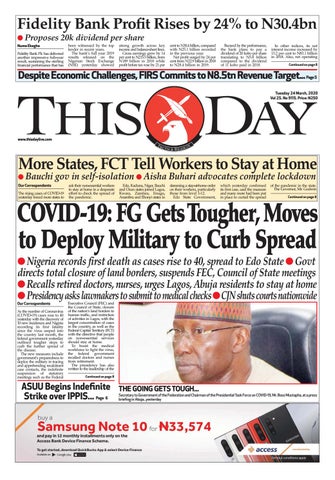
COVID-19: FG Gets Tougher, Moves to Deploy Military to Curb Spread Nigeria records first death as cases rise to 40, spread to Edo State Govt directs total closure of land borders, suspends FEC, Council of State meetings Recalls retired doctors, nurses, urges Lagos, Abuja residents to stay at home Presidency asks lawmakers to submit to medical checks CJN shuts courts nationwide
Our Correspondents
As the number of Coronavirus (COVID-19) cases rose to 40 yesterday with the discovery of 10 new incidences and Nigeria recording its first fatality since the virus seeped into the country last month, the federal government yesterday outlined tougher steps to curb the further spread of the disease. The new measures include government’s preparedness to deploy the military in tracing and apprehending recalcitrant case contacts, the indefinite suspension of statutory meetings such as the Federal
Executive Council (FEC) and the Council of State, closure of the nation’s land borders to human traffic, and restriction of activities in Lagos, with the largest concentration of cases in the country, as well as the Federal Capital Territory (FCT) with the directive that people on non-essential services should stay at home. To boost the medical workforce to fight the virus, the federal government recalled doctors and nurses from retirement. The presidency has also written to the leadership of the Continued on page 8
ASUU Begins Indefinite Strike over IPPIS... Page 6
THE GOING GETS TOUGH... Secretary to Government of the Federation and Chairman of the Presidential Task Force on COVID-19, Mr. Boss Mustapha, at a press briefing in Abuja...yesterday
2
TUESDAY MARCH 24, 2020 •T H I S D AY
TUESDAY MARCH 24, 2020 • T H I S D AY
3
4
TUESDAY MARCH 24, 2020 •T H I S D AY
TUESDAY, ÍşÍźËœ ͺ͸ͺ͸ Ëž T H I S D AY
5
NEWS
Group News Editor Ejiofor Alike Email Ejiofor.Alike@thisdaylive.com, 08066066268
Wage Cut, Layoff Imminent with Rising Lockdown Mele Kyari: Oil companies’ operations will not be disrupted Obinna Chima The growing number of COVID-19 cases, which is forcing many public and private organisations to scale down their operations, as part of measures to contain the spread, is expected to impact negatively on the profitability of organisations, analysts have said. The situation may also lead to wage cuts as well as layoffs by organisations battling to balance the books and make returns to shareholders. However, the Group Managing Director of the Nigerian National Petroleum Corporation (NNPC), Mr. Mele Kyari, has said oil and gas companies’ operations in the country would not be disrupted despite the pandemic. Commercial banks have also adopted various safety measures in line with their business continuity plans, due to the impact of the deadly virus. As part of the preventive procedure to curb the spread of the virus as well as protect their employees and other critical stakeholders, many private and public organisations have instructed their staff to stay away from their official premises and some now work from their respective homes. Only those on essential services are allowed within the premises. Speaking with THISDAY yesterday on the impact of the increasing lockdown of businesses, the Managing Director, Cowry Assets Management Limited, Mr. Johnson Chukwu, projected an increase in unemployment level. According to him, the United States estimated that the impact of the virus, which has disrupted the global supply chain, could lead to an unemployment level of about 30 per cent in the US. “For Nigeria, we already have a very high level of unemployment, which the last figure released about two years ago put at about 23 per cent. “What we are seeing now is that a lot of companies are already asking their staff to work from their homes. So, if we get to a point where there is a lockdown, the microbusinesses would automatically lose their jobs,� he explained. This, Chukwu, attributed to the fact that operators of micro-businesses get their income on a daily basis. “The micro-businesses would be severely affected because they don’t have the reserve or the balance sheet size to continue to pay salaries. “Then, for the medium scale businesses and the conglomerates, their capacity to sustain wage bills would depend on how long the crisis would last. We know the hotel industry has shut down, the night clubs, event centres, restaurants, even Eko Hotels. “The international airlines have shut down and even the local flights, the frequency rates have reduced. So, we expect to see some layoffs or some limitations on staff salaries
and wages. We can’t avoid job losses as it stands today,� Chukwu added. Managing Director, Financial Derivatives Company Limited, Mr. Bismarck Rewane, also said the development would lead to job losses and cut in wages if the impact of the pandemic drags on. “If you are not working, where am I going to pay your salary from when I am not selling anything? If the hotels have closed, the airlines have closed, where will the revenue come from? “Also, the exchange rate has gone down. So, basically we are facing a massive contraction in economic activities and we should expect that this may lead to some form of unemployment. “But, it is a global problem, and not specific to Nigeria,� he said.
the World Health Organisation (WHO) and the Nigeria Centre for Disease Control (NCDC) for keeping the banking hall safe for staff and customers. “To gain access to any of our business premises, all staff and visitors undergo temperature screening and are required to either use the hand sanitisers we provide or wash their hands with water and soap for 20 seconds. “From Monday, March 23, we will be asking nonessential visitors to our offices to contact us through other digital and online means like telephone, online meetings, teleconferencing, and others,� it stated. It also urged customers to conduct more transactions
through its various electronic channels. Access Bank Plc, which said an individual, who visited one of its branches last Monday had since tested positive to the virus, announced the temporary closure of its Ligali Ayorinde branch in Lagos State. “The health of all our stakeholders remain paramount at Access Bank Plc, as we are adopting all necessary measures to ensure safety at this time,� it added. Wema Bank also stated that it now ensures that everyone visiting any of its branches undergoes a temperature test, makes use of hand sanitisers and maintains social distance.
It advised its customers to refrain from visiting any of its branches during this period and make use of its digital banking platform, ALAT. "With ALAT, they can pay bills, buy airtime and data to make calls and stay online. They can also pay for their Cable TV subscription to stay informed during this period," the bank added, saying it has increased awareness on the virus across its social media channels. On its part, the Ecobank Group advised its customers to utilise more of its digital self-service solutions. According to the bank, “Customers can bank from anywhere by utilising digital
solutions to easily access their bank accounts, make payments, transfer funds, process salaries, and carry out other ancillary banking transactions from the comfort of their homes and offices without visiting branches.� The bank stated that measures had been put in place at its branches to help curtail the spread. These it listed to include provision of temperature checks at all entry points to screen employees, customers and visitors; installation of hand sanitisers; equipping customerfacing staff with emergency response plan; encouraging social distancing, especially from anyone who is coughing or sneezing, among others.
No Disruption in Oil and Gas Operations, Says Mele Kyari Also speaking exclusively to Arise TV, the broadcast wing of THISDAY Newspapers, Mele Kyari said he was aware that the International Oil Companies (IOCs) operating in Nigeria had given work-at-home orders to their non-essential staff from yesterday. He, however, added that this would not in any way affect oil production in the country. He said: "Field and terminal operations will be sustained and no immediate impact is anticipated." Also clarifying Kyari's statement, the Group General Manager of the National Petroleum Investment and Management Services (NAPIMS), Mr. Bala Wunti, said most of the IOCs would trigger the process of allowing non-essential staff to work from home yesterday and another from today. He, however, declined to disclose the names of the affected oil companies. He explained that the measure being taken by the IOCs was in line with the business continuity plan that the NNPC has with oil and gas operators in the country. He said the business continuity plan was meant to anticipate any eventuality and was premised on 3PRs - Preparation, Prevention, Protection, and Recovery. Wunti added that the plan would ensure that all critical oil and gas operations were sustained and were done in line with the Health, Safety, and Environmental (HSE) policies applicable to the oil industry. He stated that with the measures put in place, oil and gas operations would not be disrupted.
Banks Adopt Safety Measures Besides the oil industry, the banking sector has adopted safety measures to protect their staff and customers. For instance, First Bank said it had implemented all best practice international protocols, including the recommended health and safety measures by
COVID-19 GREETING... Borno State Deputy Governor, Mr. Umar Kadafur (left), and Governor Babagana Zulum, during a public function in Maiduguri...yesterday
Despite Economic Challenges, FIRS Commits to N8.5tn Revenue Target Ndubuisi Francis and James Emejo in Abuja The Executive Chairman, Federal Inland Revenue Service (FIRS), Mr. Muhammad Nami, has expressed the agency’s commitment to achieving the N8.5 trillion revenue target for the year. Addressing members of staff at a retreat of Tax Operations Group yesterday in Abuja, Nami urged them to take up the challenge and justify the confidence the country had reposed in the service particularly at this "critical time when virtually all the other sources of revenue for the government are being challenged especially by COVID-19 pandemic, the downward slide in the price of oil at the international market for as low as $30 per barrel against $57 benchmark used for the budget." He said several measures had been taken since assuming office to boost the welfare of staff as well as encourage them to give their best to improve its revenue
profile, adding: "We shall not relent in providing the right environment for you to succeed." According to him, "When the federal government set the N8.5 trillion target, it must have realised that we are equal to the task. As the hub of the operations of the service, you are therefore expected to deliver the bulk of the target while the other groups support you." The FIRS boss said he had taken a number of measures to facilitate staff delivery on the job by reverting certain authorisations hitherto domiciled at headquarters namely utilisation of credit notes, operational letters, issuance of TCCs among others. To this end, he stressed that examination of account has been restored while proper segmentation in tax administration consistent with global best practices was reinstated. He said: "I have also initiated a phased programme of connecting with the staff at the lowest rung of the service
in order to feel their pulse and intervene in matters inhibiting their performance." Among other things, he said there is an ongoing realignment of staff programme which is intended to ensure that people are rightly placed so as to achieve the best output possible. He also said the 2019 promotion exercise earlier suspended would soon be held with a reviewed set of criteria seen as more friendly and designed to make as many staff as possible advance to the next level. Nami said vacancy positions have also been expanded, explaining that soon after the 2019 exercise that of the year 2020 would also hold. "With all these initiatives, I will expect nothing short of 100 per cent delivery of your target by the year-end," he said. He, however, challenged the group to come up with "well thought out plans and workable strategies from this retreat. It is for this reason that you are brought together to 'jaw-jaw' for two days. I
also want you to be mindful of the fact that the task ahead of us this year is enormous." Meanwhile, the Domestic Tax Operation Group (DTOG) of the FIRS has assured the management and board of the agency that it would work to enable the revenue agency to achieve its N8.5 trillion revenue target for 2020. The TOG made the commitment in a communiquĂŠ it issued at the end of its two-day 2020 Tax Operation Group Retreat, in Abuja. FIRS had posted a N3.7 trillion shortfall out of the N8.8 trillion projected for 2019 fiscal year. According to the communiquĂŠ, “The participants expressed their resolve to remain committed and continue to work hard towards realising the N8.5 trillion revenue target set for the service. TOG unanimously agreed that with the new management’s determination to empower and motivate the staff, the target would not only be achieved but be surpassed.â€?
6
TUESDAY, ÍşÍźËœ ͺ͸ͺ͸ Ëž T H I S D AY
NEWS
ASUU Begins Indefinite Strike over IPPIS Onyebuchi Ezigbo in Abuja Following the expiration of its two-week warning strike, the Academic Staff Union of Universities (ASUU) has declared an indefinite strike with effect from yesterday. The National President of the union, Prof. Biodun Ogunyemi, at a press conference in Abuja, said: “The union has decided to embark on total and indefinite strike from Monday, 23, 2020.� He said the union rejected the use of force to make
its members enroll on the Integrated Payroll and Personnel Information System (IPPIS). The National Universities Commission (NUC) had directed the universities across the country to close for a month, beginning from March 23, due to the outbreak of COVID-19. But before the NUC’s directive, ASUU had commenced its warning strike on March 9, 2020. ASUU had embarked on the strike over the
non-payment of salaries of their members who refused to enroll in the federal government’s IPPIS, payroll software mandated for all public officials. ASUU had rejected the federal government’s IPPIS, leading to the suspension of the payment of their salaries by the federal government. THISDAY had reported that the warning strike might escalate as the federal government had rejected the union’s demand for more time to develop its alternative
payment application, the University Transparency and Accountability System (UTAS), as its preferred mode for the payment of salaries of academic staff. ASUU officials and the federal government’s delegation led by the Minister of Labour and Employment, Dr. Chris Ngige, had met twice since the beginning of the warning strike but could not resolve the dispute. THISDAY gathered that when the federal government’s negotiating team asked ASUU
team to present the union’s alternative payment platform, which the union had claimed it developed at a cost of N2 million, the union requested for 18 months to develop the UTAS platform. Ogunyemi was quoted by a member of the government’s negotiating team at the closeddoor talks as having told the meeting that the software for UTAS was yet to be fully developed and that if given 18 months, it would be able to develop and perfect the payment platform.
The federal government has since rejected ASUU’s demand for more time, saying it would amount to locking down government’s business. THISDAY gathered that although the government was shocked by the revelation that ASUU was not yet ready with UTAS despite its claim of having developed a homegrown and better alternative to IPPIS, the team agreed that ASUU should go and put up a position paper that would respond to all the issues in dispute.
FG to Impound Vehicles Parked on Highways, Says Fashola Emmanuel Addeh in Abuja Minister of Works and Housing, Mr. Babatunde Fashola, has threatened that the federal government would soon commence the forceful removal of any vehicle parked on the country’s highways, obstructing construction work going on in major roads throughout Nigeria. Fashola, who also dimmed hopes of an early completion of Port Harcourt-Enugu, AbaPort Harcourt highway, noted that it was not possible to finish the project this year, but said part of the road would be fixed to ease the suffering of commuters on the road. "We expect people to cooperate with us. We expect people not to park vehicles on the construction sections because this will obstruct traffic. Our highways are not parking lots. Any vehicle parked on any part of the construction sections of the highway should be impounded,� he directed. The minister, in a statement by a Deputy Director of Press in the ministry, Boade Akinola, blamed environmental factors affecting work on the project. Fashola spoke during an inspection of the Port Harcourt-Enugu section of the highway. He noted that a large part of the construction was on water, reason it was delaying. "We must first remember that if you do not have water, you cannot be a port city. Essentially, we are building on water. It is a very challenging environment for infrastructure. "As you can see, our plan is to deliver eight lanes from what was four lanes since we intend to make our experience better this rainy season than
last year," he said. He appealed to the host communities to be patient with the federal government and show cooperation as government was committed to providing bigger, better, wider and safer road for them. He added that though the work would not be completed this year, government intended to finish the four lanes, divide the four lanes into two for incoming and outward bound traffic to facilitate free flow of traffic. According to him, the move would serve as a form of relief to commuters and other road users as nine kilometres of the road from Eleme junction is in between Port Harcourt urban and metropolitan. Speaking on why the road construction was delayed, Fashola said: "A lot of sand filling is going on here, the road is dug well over two metres and we have to remove the bad soil and replace it with good soil and this accounts for a lot of dredging work going on here. It is another challenge altogether." He also explained that part of the road was passing through already built area, noting that some buildings had to go as well as the relocation of power lines, adding that those were some of the challenges and the reasons the road was taking time to be completed. While calling for the cooperation of commuters, communities, local and state governments to fast-track the construction of the road, Fashola assured the people that this year’s experience would be better than last year’s.
PREVENTION BETTER THAN CURE... Gombe State Governor, Alhaji Muhammadu Yahaya (left), and Chairman, COVID-19 Taskforce, Professor Idris Mohammed, during the inauguration of the taskforce in Gombe...yesterday
NSE Closes Trading Floors, to Operate Remotely Goddy Egene The Nigerian Stock Exchange (NSE) would from tomorrow close all its trading floors temporarily for 30 days as part of the measures to curtail the spread of COVID-19. NSE Chief Exchange Officer, Mr. Oscar Onyema, disclosed this to all stakeholders last night, saying remote trading would continue while its staff would be available through all its digital platforms to provide support. Onyema said: “Over three weeks ago, we activated precautionary health measures across our offices where we screened visitors with thermometers, provided sanitisers and minimised access into our premises. Further to this and with
the significant growth in new cases, effective Tuesday (March 24), we have activated a 30-day remote working plan for our employees excluding essential staff. “In order to give our dealing members enough notice, effective Wednesday (March 25), all our trading floors will be temporarily closed, although remote trading will continue and NSE staff will be available through all our digital platforms to provide support. “We regret any inconvenience this may cause in the discharge of your business activities, but we must act in the best interest of all stakeholders at this time.� He assured stakeholders
that NSE had put in place measures to ensure their operations and trading activities continue seamlessly throughout the period. He said: “As an exchange, we will ensure that all relevant information continue to flow into the market to ensure the pricing of risk assets remains transparent and reliable across asset classes to allow investors to value their portfolios and make informed investment decisions under these volatile conditions. “Dealing members are, therefore, encouraged to continue to trade remotely via our electronic platforms such as FIX protocol and XNET, and reach out to their Compliance Officer
if any support is required. “Please note that we will provide manual support to members without remote access during this period. Issuers who have any business to conduct with the exchange can reach out to their Relationship Manager for guidance. You should continue to submit all regulatory filings via Issuers’ Portal (X-Issuer). “As the exchange embraces social distancing as prescribed by Nigeria Centre for Disease Control (NCDC), we have further engaged with the federal government on issues of annual general meetings, maturing financial instruments, financial reporting, to mention a few and appropriate updates will be provided in due course.�
FG, States, LGs Share N581.566bn for February Ndubuisi Francis in Abuja The Federation Accounts Allocation Committee (FAAC) has shared a total of N581.566 billion to the federal, states and local governments for the month of February. This was announced after a rescheduled meeting of the committee after it was deadlocked last week due to disagreement over revenue figures. A communiquĂŠ issued by the FAAC indicated
that from the total revenue of N581.566 billion, the federal government received N236.118 billion, states received N159.010 billion, and the local government councils received N119.305 billion. Oil producing states received N45.310 billion as 13 per cent derivation revenue while the revenue generating agencies received N21.822 billion as cost of revenue collection. The N581.566 billion shared comprised Statutory Revenue,
Value Added Tax (VAT), Exchange Gain, and revenue from Forex Equalisation Account. It was announced that the balance in the Excess Crude Account (ECA) was $ 72.221 million. The gross statutory revenue for the month of February 2020 was N466.058 billion. This was lower than the N525.253 billion received in January by N59.195 billion. Also for the month of February, the gross revenue available from VAT was
N99.552 billion as against N104.758 billion in the previous month, resulting in a decrease of N5.206 billion. Exchange Gain yielded total revenue of N0.757 billion, and revenue from Forex Equalisation Account was N15.199 billion. From the VAT revenue of N99.552 billion, the federal government received N13.888 billion, the state governments received N46.292 billion, the local government councils received N32.404 billion
and the revenue generating agencies received N6.969 billion as the cost of revenue collection. The Exchange Gain revenue was N0.757 billion and the federal government received N0.350 billion, states received N0.178 billion, local government councils received N 0.137 billion, while the oil-producing states received N0.092 billion. From the Forex Equalisation Account revenue of N15.199 billion, the federal
government received N6.966 billion, state governments received N3.533 billion and local government councils received N2.724 billion while the oil producing states received N1.976 billion The communiquĂŠ confirmed that in the month of February 2020, Petroleum Profit Tax (PPT), Companies Income Tax (CIT), Import and Excise Duties, Oil and Gas Royalties and Value Added Tax (VAT) all recorded substantial decreases.
TUESDAY MARCH 24, 2020 • T H I S D AY
7
8
TUESDAY, ÍşÍźËœ ͺ͸ͺ͸ Ëž T H I S D AY
PAGE EIGHT FIDELITY BANK PROFIT RISES BY 24% TO N30.4BN income rose by 15.6 per cent from N97.2 billion to N112.3 billion, while total assets grew by 22.9 per cent from N1.720 trillion in 2019 to N2.114 trillion in the period under review. Commenting on the results, Fidelity Bank Chief Executive Officer, Mr. Nnamdi Okonkwo, expressed delight with the performance, saying “we are delighted at the results, which clearly showed that we sustained our performance
trajectory and continued to increase our market share driven by significant traction in our chosen business segments.� On digital banking, he said the results were enhanced by new initiatives in the retail lending segment and the deepening of the bank’s existing digital products. According to him, “We now have 47.4 per cent of our customers enrolled on the mobile/internet banking products, 82 per cent of total
transactions now done on digital platforms and 31.1 per cent of fee-based income now coming from our digital banking business.� He added that the efforts aimed at strengthening the bank’s foothold of the retail market were yielding results with savings deposits rising by 20.7 per cent to N275.2 billion, making it the sixth consecutive year of double-digit growth. “Savings deposits now accounts for about 22.5 per
cent of total deposits, an attestation of our increasing market share in the retail segment,� Okonkwo stated. Just as was seen with deposit growth, there is also a corresponding increase in the bank’s retail assets. Retail loans grew by 42.9 per cent to N53.8 billion driven by the bank’s new digital lending products and partnership with fintechs. As at December 2019, the bank had disbursed over
70,000 micro-loans on our flagship digital lending product (Fidelity FastLoan) in partnership with Migo. Conversely, there was a remarkable improvement in non-performing loans (NPLs). The bank’s NPL ratio dropped to 3.3 per cent, from 5.7 per cent in the 2018 full year due primarily to the growth in its loan book and a 25.1 per cent decline in absolute NPLs resulting from the loan write-offs of over N12 billion.
Fidelity Bank is a fullfledged commercial bank operating in Nigeria with over five million customers that are serviced across its 250 business offices and various digital banking channels. The bank focuses on select niche corporate banking sectors as well as Micro Small and Medium Enterprises (MSMEs) and its currently driving its retail banking businesses through its robust digital banking channels.
ravaging pandemic has also hit the judiciary, following an order by the Chief Justice of the Federation, Justice Ibrahim Muhammad, suspending all courts’ activities. Justice Muhammad's directive was contained in a fresh circular dated March 23 to all heads of courts. The closure, which is for an initial two weeks, comes into effect from today. However, the CJN said the judges could attend to pressing issues and or time-bound cases in their courts. "In view of the reality of COVID-19 in the country and in order to take further preventive steps, all heads of courts are, from tomorrow (March 24) directed to suspend court sittings for an initial period of two weeks at the first instance, except in matters that are urgent, essential or time-bound according to our extant laws,� he said.
security agencies and all other meetings had been suspended until such a time when normalcy returns.
COVID-19: FG GETS TOUGHER, MOVES TO DEPLOY MILITARY TO CURB SPREAD two chambers of the National Assembly, the Senate and the House of Representatives, with an exhortation to them to prevail on lawmakers, who just returned from trips to countries with high cases of COVID-19, to submit themselves for medical checks. Besides, to complement the efforts of the federal government to curb the spread of the disease, which has now spread to five states with the discovery of an incidence yesterday in Edo State, more states and the FCT Administration have ordered a large proportion of their workforce to stay at home while Niger State has clamped a 12-hour curfew on the state. Apart from Edo, the other states with cases of COVID-19 are Oyo, Ekiti, Ogun, and Lagos. The FCT is also infected. However, amid the concerted efforts by local authorities in Nigeria to check the spread of the pandemic, the United Nations warned the global community to prepare for hard times ahead, saying the world was at war with the virus. The Secretary to the Government of the Federation, who is also the Chairman of the Presidential Task Force on COVID-19, Mr. Boss Mustapha, announced the federal government’s decision yesterday in Abuja. Mustapha said the Council of State meeting earlier scheduled for Thursday had been postponed. In addition, the federal government also resolved that all land borders that had hitherto been under a partial closure would now be closed to human traffic for four weeks effective, from yesterday. The SGF also added that a circular would soon be issued to the Head of Service of the Federation, Dr. Folashade YemiEsan, for immediate action to be taken to protect federal civil and public servants from the pandemic. “If and when the need arises, any national assets required for use in the response to COVID-19 shall be mobilised and deployed. The federal government is at the highest level, engaging with state governors in order to ensure a collaborative and effective response to COVID-19 pandemic,� he said, adding: “All Abuja and Lagos residents are
strongly advised to stay at home, avoid mass congregation of any kind as well as non-essential outings, until further advice is given.� He said the taskforce would continue to monitor the global and domestic developments, while it has isolated Lagos and Abuja for particular attention in view of their population, mobility, and number of cases already reported. Mustapha added that advisories had been issued and measures taken, including “escalating the nation’s capacity for testing and detection through the acquisition of more testing kits and establishment of additional test centres, enhancing contact tracking, deepening awareness creation, closure of schools and tertiary institutions and the total ban on international travels, which commenced at 12.00 midnight tonight at all the nation’s airports.� Last night, the Head of Service of the Federation gave effect to the federal government's directive on the need to safeguard the welfare of its service personnel. She told all civil servants from level 12 and below to stay at home from today till further notice.
Former PPMC MD, Achimugu, Becomes First Fatality Figure While giving an update on the epidemic yesterday, the Nigeria Centre for Disease Control (NCDC) reported the death of an infected case, but did not disclose the name of the deceased. But THISDAY later identified the deceased as a former Managing Director of the Pipeline Products and Marketing Company (PPMC), a subsidiary of the Nigerian National Petroleum Corporation (NNPC), Mr. Suleiman Achimugu. Announcing the death yesterday, NCDC said: “The case was a 67-year-old male who returned to Nigeria following a medical procedure in the United Kingdom. He had underlying medical conditions, including multiple myeloma and diabetes, and was undergoing chemotherapy.� Achimugu died in the early hours of Sunday.
In confirming his death, his family said his remains had been buried according to Islamic injunctions. The statement signed by Mr. Abubakar Achimugu on behalf of the family called for prayer for the repose of his soul and healing for all other COVID-19 patients undergoing treatment.
Cases Rise to 40 While announcing the number of the new cases yesterday, NCDC said of the 10 new cases, six were from Lagos, three from Abuja and one from Edo State. This brings the total number of cases in the country to 40. Sharing the information on its Twitter handle, @NCDCgov, the agency said of the 40 confirmed cases, two had been discharged after successful treatment of the disease; one died while 37 others were still under isolation and undergoing treatment. Shortly after the NCDC's announcement, Lagos State Government provided further details on three of the six new cases from the state. The Commissioner for Health, Prof. Akin Abayomi, said one of the three patients came into Nigeria from Ukraine since March 15. He said: “The other two had a travel history to the United Kingdom. They both came into Lagos on March 13 and March 20 respectively."
FG Threatens to Use Army, Police for Contact Tracing With the rapid spread and reports of case contacts refusing to report for testing and self isolate, the Minister of Information and Culture, Alhaji Lai Mohammed, yesterday advised Nigerians to prepare for tougher measures as part of government's response to the COVID-19 pandemic. Mohammed told journalists in Abuja yesterday that the federal government would not hesitate to deploy the military and other security agents for contact tracing in cases where persons suspected to have contacted the virus do not voluntarily show up for testing. He said: “We should be ready for tougher measures.
The forms they will take will be out from the end of today or tomorrow. But Nigerians should be ready for tougher measures. If we don’t do proper contact tracing, the figure will multiply every five days. Nigerians must take ownership of this initiative. “We will not hesitate to use any platform, including the military and the police, to enforce social distancing, and to ensure that proper tracing is done because we are talking of a situation where if we do not take time, there are several hundreds of thousands, who will be infected. “Containment is very cheaper than cure. A few people have helped. If you know you travelled recently, give yourself up to relevant agencies.�
Presidency Asks Lawmakers to Submit to Medical Checks As part of the containment strategy, the presidency has implored members of the National Assembly, who just returned from trips abroad, to subject themselves to COVID-19 test. The Chief of Staff to the President, Malam Abba Kyari, in separate letters to the Senate President, Dr. Ahmad Lawan, and the Speaker of the House of Representatives, Hon. Femi Gbajabiamila, urged them to ensure that the lawmakers present themselves for screening at the airports. In the two separate letters dated March 21, Kyari noted that senators and members of the House of Representatives were not presenting themselves for screening at the airports. He said: "As you are aware, these airport screenings are our primary line of defence and refusal by any citizen to subject to these tests is a threat to our nation. "Accordingly, you are kindly requested to direct all senators who returned to Nigeria from foreign trips to report themselves to the nearest NCDC test centre with immediate effect."
CJN Orders Temporary Closure of Courts Meanwhile, the impact of the
INEC Suspends Regular Activities The COVID-19 pandemic has also forced the Independent National Electoral Commissions (INEC) to announce the suspension of its regular activities. It, however, said the suspension did not affect preparations for the forthcoming governorship elections in Edo and Imo states. In a statement issued by the National Commissioner and Chairman, Information and Voter Education Committee, Mr. Festus Okoye, the commission said the directive was in line with the advisory on social distancing from WHO and the NCDC. Okoye said the commission had taken the following additional measures to protect its staff, visitors and the general public. According to him, "Effective from Tuesday 24th March 2020, all regular and non-essential activities will be suspended in its headquarters and offices nation-wide for 14 days in the first instance." He added that the regular quarterly meetings with stakeholders, namely: political parties, civil society organisations, the media,
World is at War, Says UN Chief Amid the various measures to tame the virus, the SecretaryGeneral of United Nations, Antonio Guterres, yesterday raised the alarm over the spread and deaths from COVID-19, saying the world was certainly at war. Guterres, in a video on the impact of the ongoing COVID-19 outbreak on the world, called for more commitment from governments to combat the effect the outbreak would have on economies. “We are facing a global health crisis unlike any in the 75-year history of the UN — one that is spreading human suffering, infecting the global economy and upending people’s lives,� he said. Guterres said labour organisations across the world could lose as much as $3.4 trillion in income by the end of the year. He added that above the crisis, the effect on humans, especially the vulnerable would be disastrous if governments did not intervene by doing things differently. The human crisis, he said, called for solidarity, as the human family was stressed and the social fabric was being torn. “My central message is clear, we are in an unprecedented situation and the normal rules no longer apply. “We cannot resort to the usual tools in such unusual times. The creativity of the response must match the unique nature of the crisis and the magnitudes of the response must match its scale. Our world faces a common enemy. We are at war with a virus,� he stated. Tomorrow, Guterres would launch a COVID-19 Global Humanitarian Response Plan. He would be joined by the UN’s Under-Secretary-General for Humanitarian Affairs, Mr. Mark Lowcock; WHO Director-General, Dr. Tedros Adhanom Ghebreyesus; and UNICEF Executive Director, Ms. Henrietta Fore.
MORE STATES, FCT TELL WORKERS TO STAY AT HOME Obaseki, while briefing journalists in Benin City on the preparedness of his government in tackling the spread of the virus in the state said though the state was witnessing its first case, there was no need to panic. "COVID-19 is not a death sentence, so there is no need to panic. With swift identification and proper and management and care, many persons who had been infected with the virus have made full recoveries if we all work together to take the right precautions,� he said, advising citizens to practise social distancing to prevent COVID-19 from spreading. He prohibited gatherings of more than 50 people and said all schools remained closed in the state until further notice.
The governor said public transportation would remain in operation but warned against crowding in commercial vehicles. "All public officers below grade level 12 (except those providing essential services such as fire and healthcare) should work from home till further notice,� he directed, adding: "Citizens are advised to postpone unnecessary travels in and out of Edo state and if possible stay at home."
Kaduna to Enforce Restriction on Large Gathering In Kaduna State, the government said it would commence the enforcement of restrictions on large gatherings, especially in
churches and mosques. Governor Nasir el-Rufai announced this yesterday in a broadcast to the people of the state. He said security agencies had been directed to ensure compliance across the state. The governor warned that “the state government will not hesitate to impose a statewide curfew, should that become the only way to enforce compliance and make everyone understand the collective danger that we face.� The governor also announced that relevant federal authorities had been contacted to stop the Abuja-Kaduna train service in order to limit the danger from contact on the train and influx from people who might have been exposed to infected persons.
Civil servants from Level 12 and below have also been directed to remain at home for the next 30 days, effective from today. Workers providing essential services, especially in the health, security and emergency service sectors are, however, exempted from the directive. El-Rufai said: “Kaduna State Government has decided to move from advice to actual enforcement of its restrictions on large gatherings, especially in churches and mosques. “Security agencies have been directed to ensure compliance across the state. “These agencies will also enforce compliance with the decision to close all schools, whether public or private,
religious or secular, Islamiya or run by Christian missions. "The emphasis on prevention is the only logical thing to do because our health system cannot cope with an outbreak of COVID-19. “It is better to impose restrictions and save lives, than to be complacent and bury victims.�
Niger Imposes 12-hour Curfew Niger State government has restricted the movements of people throughout the state in the daytime following Governor Abubakar Sani Bello's announcement of 12-hour statewide curfew. Continued on page 38
TOP GAINERS NGN CHAMS PLC PRESTIGE UNIONDAC NASCON
NGN % 0.22 0.55 0.22 9.40
10 10 10 9.9
0.65 7.85 NGN 4.00 36.45 2.10 19.30 0.19 1.79 NCR 0.20 2.00 PZ 0.40 4.05 HPE Nestle Nig Plc â‚Ś915.30 Volume: 379.483 million shares Value: N3.424 billion Deals: 4,669 As at yesterday 23/03/2020 See details on Page 33
9.0 % 9.8 9.8 9.6 9.0 8.9
UACN TOP LOSERS PRESCO FLOURMILLS MAYBAKER
0.02 0.05 0.02 0.85
9
TUESDAYMARCH 24, 2020 ˾ T H I S D AY
COVID-19 UPDATE...
COVID-19 UPDATE...
COVID-19:Declare State of Emergency Now, Falana Tells Buhari Martins Ifijeh Human rights activist and Senior Advocate of Nigeria (SAN), Mr. Femi Falana has called on President Muhammadu Buhari to issue a proclamation of a state of emergency in Nigeria immediately, as part of measures to halt the spread of COVID-19. He said the proclamation is the legal backing required for the enforcement of measures against the disease. Falana, in a statement made available to THISDAY, said Nigerians, especially
highly placed political and religious leaders, have ignored government’s directive because the measures were not backed by any law in the country. He said: “In order to stem the dangerous trend, the government should put necessary legal measures and mechanisms in place without any further delay. “In particular, the attention of the Nigerian people ought to be drawn to Section 45 of the Constitution, which provides that the fundamental rights of citizens to personal liberty, freedom of movement, freedom of assembly and association
may be infringed upon or restricted in the interest of public health and public safety. “Once the proclamation is issued and published, it is
required to be approved by a resolution supported by twothirds majority of each house of the National Assembly. Once the measures are set out in the
said proclamation, they will have the force of law capable of being enforced by the police and other security agencies.” He said if President Buhari
does not declare a state of emergency, state governors should issue Executive Orders to address the health challenge.
Umahi Bans Wedding, Burial, Others in Ebonyi Benjamin Nworie in Abakaliki Ebonyi State Governor, David Umahi, yesterday banned all forms of public gathering in the state for one month. He listed such public gatherings to include burial, wedding, conference, seminars and any other large gatherings. The governor stated this at the town hall meeting which was held at the International Conference Centre in Abakaliki, the state capital. Represented by his Deputy, Kelechi Igwe, the governor said the ban is for a period of one month in the first instance. He said the ban was part of measures to protect the people from contacting the deadly COVID-19 which has been declared a pandemic by the World Health Organisation (WHO). According to him, “It is painful to take the decision, but
the government had to reason that it is better to let the dead bury the dead for now. But if you feel that you cannot wait, then you can take the corpse and bury it with just you and your family without any ceremony or invitation to any other person.” Umahi also said civil servants in the state shall from March 25 be advised to work from home, adding however that those on essential services shall be exempted from the order. The governor warned traditional rulers and council chairmen against shielding any person suspected to have contacted the deadly virus. He said anybody suspected to have contacted the virus should immediately be sent to the nearest health centre for onwards transfer to the state isolation centre, which has been built at the Unity Square in Abakaliki for proper treatment and care.
MAINTAINING SOCIAL DISTANCE...
L-R: Chief Medical Director, Irrua SpecialistTeaching Hospital, Prof. Sylvanus Okogbeni; Head of Service, Mr. Isaac Ehiozuwa; Deputy Governor, Hon. Philip Shaibu; and Edo State Governor, Mr. Godwin Obaseki, during a press briefing on the steps taken by the state government to ensure that COVID-19 is curtailed in the state, at the Government House, Benin City…yesterday
Coronavirus More Vicious than Boko Haram, Says SGF Daji Sani in Yola The Secretary to the Government of the Federation (SGF), Boss Mustapha, has described COVID-19 as more vicious than Boko Haram, as the disease is capable of wiping out a whole city within the shortest time. The SGF, who disclosed this at the Yola International Airport in Adamawa State, noted that Nigerians should strictly adhere to the advice and directives on the virus.
According to him, “As dreaded as Boko Haram, COVID-19 is more vicious, as one afflictions or infection can wipe out a city within the shortest time frame. “Hence, Nigerians should strictly adhere to these warnings such as keeping social distance, avoid hands shake and observed personal hygiene.” Mustapha said it is not disobedience to greet others from a distance, which is just to prevent the spread of
the disease. The SGF added that he was in the state to commiserate with Garkida’s people over the unfortunate attack on them recently. Meanwhile, the Adamawa state Governor, Ahmadu Umaru Fintiri, has taken drastic measures to prevent the spread of COVID-19 in the state in a statewide broadcast, noting that it was meant to update the people on the current development on the virus in the state. According to him, “There
was no case of Coronavirus in the state, but for precautionary measures, the state government has taken serious measures to prevent the disease from spreading into the state. “Fellow citizens, it is with a profound sense of responsibility that I address you on an issue that is no longer news, a pandemic.” “Nigeria, and indeed, Adamawa State is not left out in revving up the attention necessary to contain or prevent the spread of the pandemic.”
Fayemi Inaugurates Osun Assembly Suspends Activities for 16 Days Enforcement Task Force Yinka Kolawole in Osogbo
Victim Ogunje in Ado Ekiti In order to ensure compliance with executive orders issued by the Ekiti State Governor, Dr. Kayode Fayemi, outlawing gatherings of more than 20 persons in the state, a task force was yesterday inaugurated to enforce the directives to forestall the spread of the contagious COVID-19. It was also disclosed that 37 out of 42 persons suspected to have had direct contacts with the dead American who allegedly imported the disease to the state had been identified and put under solitary confinement. Members of the committee include 16 council chairmen, Nigeria army, Department of State Services (DSS), police, Nigerian Security and Civil Defence Corps (NSCDC), Federal Road Safety Commission (FRSC), traders, Ekiti State environmental inspectors and other ethnic nationalities. Inaugurating the committee, Fayemi, who was represented by the state Commissioner for Environment, Mr. Gbenga Agbeyo, said the government was not particularly happy about the way the order banning congregation of more than 20 people was being defied.
Terms of reference to be executed, according to the governor, are: “To ensure that all private and public schools in the state are closed; no gathering of more than 20 persons anywhere in the state; all public transport carries the required number of people and ensure that all market men and women practice hand washing in their shops.” The governor charged the chairmen to prevail on the religious leaders in their council areas to stop huge crowd while conducting their services. Also speaking, the commissioner revealed that the 37 persons, apart from the driver of the dead American, who had been tested positive to COVID-19, are experiencing self-isolation in the state. “Medical history had shown that people coming from highly endemic countries like China, England, Italy and America were the ones importing the disease to Nigeria. “In Italy, about 793 persons died in a day and 600 the subsequent day. Today, over 5,000 have died in that country. We pray this doesn’t happen in Ekiti State and that is why we must take precautions,” she said.
In a bid to put preventive measure in place and to curtail the spread of the deadly COVID-19, the Osun State House of Assembly yesterday suspended all the parliamentary
activities for two weeks. Meanwhile, state Governor, Gboyega Oyetola, has urged people of the state not to panic but to obey government’s simple instructions and directives. He also advised the people to follow simple hygiene, saying
together, we shall win the war against coronavirus and keep our state safe and secure. The Chairman of the Assembly Committee on Information, Hon Kunle Akande, disclosed this during a press conference held at the Assembly complex.
Flanked by the Chairman, Assembly Committee on Health, Hon. Adenike Abioye, Akande said the decision to suspend parliamentary activities, sessions, hearing for the next 16 days came on the resolution of the Assembly in their plenary session.
Ondo Bans Political, Social, Religious Gatherings James Sowole in Akure Ondo State Government last night placed total ban on all political, social and religious gatherings in the state for 14 days in the first instance. Specifically, the state government called on the Peoples Democratic Party (PDP), Ondo State chapter, to consider postponing its state congress scheduled for today
Tuesday, March 24 and take a cue from the Governor of Oyo State, Mr. Seyi Makinde who by public apology, agreed that the party did not exercise discretion by organising a political rally in Ibadan, the state capital. The banning of all public gathering and other actions was revealed by the Commissioner for Information and Strategy, Mr. Donald Ojogo in a statement issued on the outcome of State
Executive Council meeting. Ojogo said measures were taken to stem the rampaging menace of COVID -19 pandemic, saying the decisions were taken in the overall interest of the state. The commissioner said gatherings at clubs, beer parlours and joints are prohibited until further notice. In addition, the government said “all civil servants from Grade Levels 01-12, except those
on essential duties as may be determined by their respective accounting officers and chief executives, are hereby advised to stay at home for now.” “Government, as well as all persons of goodwill in Ondo State, no doubt, heaved a sigh of relief when a few days ago, our collective anxiety became calm only after the result conducted on a suspected COVID-19 case turned out negative.
Obiano Asks Workers to Work from Home for 14 Days The Anambra State Governor, Chief Willie Obiano has sent home the state workforce for 14 days as a measure to contain COVID-19 in the state. Obiano, through a new committee constituted on Friday evening to monitor cases of the virus in the state, asked the workers, except the health workers, to work from home.
He however directed that workers whose attention is needed with the 14 days of isolation would be called upon to render special service. “All public gatherings are hereby suspended in Anambra State till further notice with effect from today, March 23, 2020. This includes traditional marriage ceremonies, community festivals, ofala
festivals, masquerade festivals, Igbankwu nwanyi, funeral ceremonies, baby christening, new yam festivals, title-taking ceremonies and any meeting of more than 30 participants. Traditional rulers and President General of Communities must ensure full compliance or be held responsible. “All nursery, primary, secondary, vocational and
tertiary schools are hereby closed with immediate effect. All academic and extra-curricular activities are hereby suspended. “All public transport operators are directed to submit the manifest of all passengers coming into Anambra State to the appropriate authorities with their names, phone numbers, residential addresses and final destination.
10
TUESDAY MARCH 24, 2020 ˾ T H I S D AY
COVID-19 UPDATE...
COVID-19 UPDATE...
Matawalle Orders Lockdown in Zamfara Governor Bello Muhammad of Zamfara State has shut down all government offices, ministries, agencies and agencies (MDAs) across the state. “I have ordered for the immediate shutdown of all government offices, ministries, departments and agencies. “Almajiri schools should also be
closed. All the state civil servants should remain at home, gathering of more than 20 people is banned. “Our hospitals, fire service and radio stations are not affected by this rule.” The governor had attended the inspection of proposed quarantined COVID-19 centre at the Federal Medical Centre,
Gusau on Friday after his arrival in the state. The First lady Hajiya A’isha Bello Muhammad also cancelled
a press briefing at the governor’s private residence at exactly 3p.m, an hour to the scheduled time. Meanwhile, the state
Commissioner of Police, Mr. Usman Nagoggo banned all gatherings of more than 20 people across the state and
ordered for decongestion of all police stations, including immediate release of all suspects with minor offences.
Benue Uncovers 3,460 LG Ghost Workers George Okoh in Makurdi
Benue State Government has uncovered 3,460 ghost workers on the payroll of 23 local government areas in the state. Chairman of the state Local Government Service Commission, Dr. Bem Melladu, made this known yesterday when he presented the commission’s report to the state Governor, Samuel Ortom,
in Makurdi. Melladu said out of a total number of 18,426 employees, only 14,966 turned up for verification, stating that the verification equally uncovered names of deceased staff on the payroll, salary padding, redundancy as well as falsification of retirement dates among other fraudulent practices at the third tier of government in the state.
OF BATON… MTN Mandates Staff to CHANGE New Comptroller, Nigeria Immigration Service (NIS), Lagos State Command, Mrs. Doris Braimah (left), receiving the handing over document from Acting Comptroller of the Command and Deputy Comptroller of Immigration, Mr. Mohammed Abubakar, during the handing over Work from Home ceremony at the command’s headquarters, Alagbon, Ikoyi, Lagos...yesterday Following the ban on social gatherings of more than 20 persons, MTN Nigeria has also announced that its staff would now work from home. The company’s Senior Manager, External Relations, Funso Aina said that the telco’s operations would continue to run at full scale with essential staff working limited hours on-site. He said: “MTN Nigeria has directed its team to start working from home from Monday as
part of precautionary measures to stop the spread of COVID-19. “We also plan to announce the temporary closure of some of our stores. Those that will remain open will operate reduced hours and maintain strict and social distance measures. “The situation unfolding around the world is unlike anything we have seen in our lifetime and is a reminder that we are all more connected than we ever know,” he added.
Ogun Bans Gathering of More than 20 Persons Kayode Fasua in Abeokuta In furtherance to its effort at curtailing the spread of COVID-19, the Ogun State Government yesterday lowered the number of those who may gather in one place at a time from 50 to 20. The latest action therefore implies that no church or mosque can congregate with more than 20 persons at a time, and that those attending burial, wedding or sundry ceremonies cannot exceed 20 persons. Announcing the latest development in a statement yesterday, the Chief Press Secretary to the state Governor, Dapo Abiodun, Mr. Kunle Somorin, said: “The decisions were taken after the daily review of developments at a meeting chaired by the governor.” He said apart from that, the state government had also resolved that all heads of Ministries, Departments and Agencies (MDAs) as well as the local governments are to draw up rosters that would ensure that no more than 20 percent of their workforce across all cadres work daily, “thus ensuring that most staff come to work once a week.” Health workers, fire service and Ogun State Emergency Management Authority (OGSEMA) are exempted from this arrangement. Also, all teachers in public primary
and secondary schools are to proceed on their vacation immediately. “All government offices, irrespective of where they are, are to maintain social distancing, provide hand sanitizers and hand washing facilities among other hygiene measures, at all times,” the statement added. However, the state government has also extended the frontiers of the restriction orders to include a ban on visits to all government offices, stating that they are put on hold until further notice. “Also, banks, telecommunications and other similar service providers that offer services in hubs and or bays are required to ensure that no more than 20 clients are in their service areas at a time. “Social distancing must be maintained between those who will be on the queue or waiting halls by at least five feet between clients. Those outside the halls should maintain similar standards of social distancing. “Henceforth, any group of more than 20 persons that congregate in the name of any meeting-spiritual or secular-shall be visited with the full wrath of the law. The state Task Force has been mandated to ensure full and total compliance,” the state government warned in the statement.
ActionAid Calls for Lockdown of Nigeria Dike Onwuamaeze The ActionAid Nigeria (AAN), has called on the federal government to lockdown the country for the next 14 days in order to fast-track the efforts of the Presidential Task Force on Control of Covid-19 (PTFCC-19) in combating the spread of the virus in the country. The Country Director of AAN, Mrs. Ene Obi, who spoke in Abuja yesterday, noted that the increasing cases of the imported virus into the country required that more still need to be done quickly and promptly to roll the tide against
the spread of the virus. Obi said: “With the cases of infected persons increasing from 3 to 36 within a week, Nigeria needs to be ready for the worst-case scenario. Unfortunately, the concept of social distancing and selfisolation remains a mirage to many Nigerians. The average Nigerian, particularly those offline and at the grass root are still ignorant and lack the basic safeguarding information on symptoms and prevention of the spread of the virus.” She said that the AAN is concerned that no proactive steps are being taken at the grass root level to educate an
average woman in the market that one infected person with high exposure can infect up to 2.5 million persons within five days as stated by the Minister of Health, Mr. Osagie Ehanire during a press conference yesterday. “We are worried that Nigeria’s level of preparedness to respond to COVID-19 is low and this further buttress the need to re-prioritise Nigeria’s budgetary provisions by investing more in healthcare facilities. Nigeria’s porous borders makes her susceptible to outbreaks and it is quite unfortunate that we still have public gathering
across the nation with many Nigerians still going about their businesses in packed public transport,” Obi said, adding that: “Outbreaks and pandemics create an opportunity to re-evaluate the potency of our healthcare system and authenticity of our citizens database, which would have eased contact tracing of the imported cases of the coronavirus.” The AAN, therefore, called on the state governments to swiftly increase the awareness campaign on the proactive measures needed to prevent the spread of the virus at the grassroot level.
Yobe Directs Closure of Schools Michael Olugbode in Damaturu Yobe State Government has ordered the closure of all schools in the state to combat the spread of COVID-19. Although, no case has been
reported in the state, but the state governor, Alhaji Mai-Mala Buni has directed the closure of all public and private schools in the state for a month as part of measures to avert the spread of the pandemic. The directive was contained in
a statement released yesterday and duly signed by the State Commissioner for Basic and Secondary Education, Dr. Muhammad Idris. The statement ordered all principals and head teachers in both public and private schools
under the ministry of education in the state to take immediate action towards actualising the directive. The statement however urged students particularly those in SSG 3 and JSS 3 to use the period to study hard while at home.
Borno Introduces Measures to Safeguard IDPs Michael Olugbode in Maiduguri Borno State Government yesterday lockdown all internally displaced persons (IDPs) camps
in the state to check against the spread of COVID-19 in the state. Under the latest directive, there is an imposition of a four-week ban on visitors to all IDPs camps
in the state, and it is one of the state’s strategies to contain the outbreak of the virus in the state. The state governor, Prof. Babagana Zulum had last week
appointed the state’s deputy governor, Umar Kadafur to chair a high-powered multistakeholder response team for the epidemic.
FG Warns against Panic Buying, Price Hike James Emejo in Abuja
The federal government yesterday warned Nigerians against acts of panic buying, products adulteration and hoarding, adding that the government is working closely with manufacturers and other stakeholders to minimise the impact of the COVID-19
pandemic. The Minister of Industry, Trade and Investment, Mr. Niyi Adebayo also stated that the government will continue to do everything possible to support industries to sustain their operations and where necessary stimulate a surge in production of essential commodities particularly
medicines and sanitary products. Speaking at a joint media briefing with the Manufacturers Association of Nigeria (MAN) in Abuja, following two days of deliberations on how to manage the impact of the pandemic in the country, the minister said his ministry had taken measures to proactively address the challenges,
potential threats and impact of the pandemic on the domestic economy. He said all measures necessary to protect and promote the health and safety of industrial and related workers, their families, communities and the country at large were currently being put in place.
Uzodinma Creates 23 Ministries, Swears-in Commissioners Amby Uneze in Owerri In spite of the government directives that large crowd of people are not allowed to converge in a place because of Coronavirus, relations,
friends and well-wishers of commissioners and aides gathered at the Ahiajoku Convention Centre in Owerri to witness their swearing-in ceremony on Monday. At the event, Governor Hope
Uzodinma charged the newly sworn-in 23 commissioners, and 89 special advisers and senior special assistants to bring to the fore their wealth of experience to drive the shared vision of prosperity of his administration
which is anchored on the 3Rs of Rehabilitation, Reconstruction and Recovery. Uzodinma called on the appointees to see their appointments as a privilege they could not afford to abuse.
TUESDAY MARCH 24, 2020 • T H I S D AY
11
12
TUESDAY MARCH 24, 2020 •T H I S D AY
13
TUESDAY MARCH 24, 2020 ˾ T H I S D AY
24 HOURS...
24 HOURS...
AMCON Seeks Court’s Permission to Freeze Ogboru’s Accounts The Asset Management Corporation of Nigeria (AMCON) has approached the Federal High Court in Lagos for an order to attach the bank accounts of the 2019 governorship candidate of the All Progressives Congress (APC) in Delta State, Chief Great Ogboru, and his firm, Fiogret Limited, in a bid to recover a judgment debt of N784million. In an ex parte application filed before Justice Maureen Onyetenu, AMCON said the N784million debt arose from a July 5, 2013 consent judgment entered in its favour by Justice Okon Abang. The corporation said contrary to its expectation, about seven
years after Justice Abang’s judgment, Fiogret Limited and Ogboru “have not taken any step(s) to satisfy/liquidate the judgment sum and the accruable interest.” AMCON said its investigation had revealed that Fiogret and Ogboru had accounts in 22 banks in Nigeria. It prayed the court to summon all the banks to disclose how much Fiogret Limited and Ogboru have with them and for the court to make an order attaching the funds “to prevent the judgment debtors from dissipating their funds with the various garnishees (banks).” The corporation said this was the only means by which it
could “reap the fruits of its hard-earned judgment in the suit herein.” But Fiogret Limited and Ogboru are challenging Justice Onyetenu’s jurisdiction to hear AMCON’s ex parte application, seeking the seizure of their funds. The firm and the businessman said they had already appealed Justice Abang’s July 5, 2013 judgment up to the Supreme Court while their Motion on Notice praying for a stay of execution of the judgment was also pending before the apex court. They contended that contrary to AMCON’s argument, there was no provision in AMCON Act,
stipulating that they must pay the N784 million judgment sum into an account approved by the court pending the determination of their appeal
by the Supreme Court. Besides, they said the Federal Government also owed Fiogret Limited N4.3billion, which the Federal Ministry
of Justice had in an October 20, 2015 acknowledged and expressed the resolve of the Federal Government to pay N350 million to AMCON.
FG Asks Non- essential Civil Servants to Stay at Home Olawale Ajimotokan in Abuja The federal government has directed all non- essential public servants on Grade Level 12 and below to stay and work at home with effect from Tuesday, March 24, 2020 (today), until further notice. The Head of Service of the Federation, Mrs. Folashade YemiEsan issued circular yesterday as a follow-up to the measures
by the federal government to manage the identified cases of Covid-19 and curtail its spread. The Head of Service said government was concerned about the welfare and safety of all civil servants and other Nigerians. She asked all public servants to strongly follow the measures being put in place by government to curtail the spread of the pandemic.
Further she said all categories of workers who will be at work to limit the number of visitors they receive to the barest minimum and to reduce physical contact as much as possible. Again, all officers who have recently visited countries with incidence of COVID-19 or have had contact with persons who recently returned from these countries to self-isolate at home for 14 days.
Ize-Iyamu Hails Buhari, Tinubu, Others for Ekiti, CAN Meet over Alleged Violation Fayemi’s Executive Order Foiling Attempted Removal of Oshiomhole of Ekiti while speaking with executives have also put on alert Victor Ogunje in Ado Ekiti A governorship aspirant on the platform of the All Progressives Congress (APC) in Edo State, Pastor Osagie Ize-Iyamu, has hailed President Muhammadu Buhari; the National Leader of the governing party, Senator Bola Tinubu; APC governors and others for foiling the coup against the party’s National Chairman, Mr. Adams Oshiomhole.
He stated this yesterday in Benin, while addressing Edo APC leaders and members who came to welcome him, upon his return from Abuja, where he went to solidarise with Oshiomhole, a former governor of the state. Ize-Iyamu said: “We are very grateful, as indigenes of Edo State, because we would have been ashamed and disappointed, if our
son, Oshiomhole, was removed from office. “President Buhari, Senator Tinubu and other leaders of APC deserve commendation for foiling a coup, which was the product of a grand conspiracy, coordinated and funded from Edo State, for the removal as National Chairman of APC, an Edo son, Comrade Oshiomhole.
The Ekiti State Government has met with the leadership of the Christian Association of Nigeria (CAN) over the alleged flouting of order issued by the state Governor, Dr. Kayode Fayemi, banning gathering more than 20 people in the state. The state Committee on CODIV-19 stated this in Ado
journalists on the update on the progress made in taming the disease. The state Commissioner for Health, Dr. Mojisola Yaya-Kolade, who addressed journalists, said the meeting was convened to seek the partnership of the association on how best to enforce the order in all churches. Kolade added that bank
on the need to guard against overcrowding of customers in the bank, saying this could jeopardise the fight against coronavirus. “We have met with the leadership of CAN and we made it clear to them that the order must be enforced. Very few churches complied last Sunday while some did well.
14
T H I S D AY Ëž Ëœ Í°Í˛Ëœ Í°ÍŽÍ°ÍŽ
COMMENT
Editor, Editorial Page PETER ISHAKA Email peter.ishaka@thisdaylive.com
IHEDIOHA’S GLOWING VISION
Austin Uganwa pays tribute to the former governor of Imo State, Emeka Ihedioha, at age 55
R
t. Hon Emeka Ihedioha, a foremost lawmaker who recently stepped down as Imo State Governor is 55, Tuesday, March 24, 2020. In all ramifications, it is a worthy and fulfilled milestone and should therefore be commemorated with pomp and wide-ranging jubilations. The reasons are instructive. Ihedioha’s three decades stint in politics has been trailed by amazing footprints and profound legacies which have largely boosted Imo and national development frontiers and hugely beneficial to humanity. Unlike many politicians of our time, at 55, Ihedioha exudes uncommon attributes including visionary leadership, character, honesty, discipline and forthrightness which are inextricably linked to his vast but rare political accomplishments. These values manifested fundamentally during his seven-month rule as Imo State Governor. The proficient application of his well-articulated Imo Rebuild Vision infused with desirable discipline and dedication resonate on the state transformative and revitalized trajectories within a short time Although his tenure as Imo Governor was painfully cut too short via the unjust and dubious decision of the apex court January 14, 2020, Ihedioha’s unassailable excellent record in Imo resulted essentially from the efficient, accountable, transparent and participatory fashion he ran the government tinged with visionary leadership dexterity. It’s strongly believed that at 55 Ihedioha’s leadership skills have close similarities with those of the globally acclaimed visionary leaders such as Deng Xiaoping, former Chinese President, who in 1980s took the country through market-driven economic reforms that transformed its economy to be second to none on the global economic curve. There is also former United States President, Bill Clinton who inherited a disoriented economy from George Bush senior and was able to turn it around within a short time frame through pragmatic visionary leadership inputs and realistic reforms. Akin to Clinton, Ihedioha took over a state in total ruins with deplorable infrastructural base. Ihedioha at inception of his government defined his vision and mission for the state. His vision although ambitious was to enthrone strategic reforms capable of making Imo one of the top three most developed state economies in Nigeria by year 2025 and to rank within Afrca’s top 10 economies by year 2030. His mission was clear, laudable and feasible: “To rebuild, reposition and transform Imo into a modern ecosystem for education, agriculture, industry, tourism, culture, sports, human capital development, science and technology�. By the time he was brazenly and arrogantly forced to step down, he not only set the enumerated sectors on a veritable path of recovery, he had actually transformed many of them Specifically, verifiable and incontrovertible instances are wont to suffice here. Ihedioha- led administration mobilized the reconstruction and rehabilitation of 25 intra and intercity roads concurrently, including federal roads in order to grapple with gross infrastructural decay in the state. He restored Otamiri Water Scheme that left Owerri taps dry for eight years and reconnected the state secretariat and other public
AT 55, IHEDIOHA EXUDES UNCOMMON ATTRIBUTES INCLUDING VISIONARY LEADERSHIP, CHARACTER, HONESTY, DISCIPLINE AND FORTHRIGHTNESS WHICH ARE INEXTRICABLY LINKED TO HIS VAST BUT RARE POLITICAL ACCOMPLISHMENTS
buildings to the national grid through Imo Power and Rural Electrification Agency he established to tackle dismal power supply. Under his watch, Imo security architecture was reinforced by establishing a joint task force code-named Operation Iron Gate. Smart agricultural development was facilitated through the launching of sustainable agro road map. Ihedioha administration commenced multi-billion Naira upgrade, rehabilitation and equipping of technical colleges and set up visitation panels to identify the challenges of the higher institutions in Imo towards improving the standard of education at that level. The government launched health insurance scheme, anti-retroviral therapy and established Health Insurance Agency to liberalize and to reduce the cost of health services. The dignity of labour and the pensioners was restored. Workers salary was increased and the payment structure standardized. An enduring biometric verification exercise of pensioners was undertaken and the payment of their monthly entitlements commenced after six years of non-payment. Ihedioha administration ensured full release of monthly financial allocations to the 27 local councils and introduced Treasury Single Account, revitalized the procurement process, reinforced ease of doing desk. The outcomes were fascinating and far-reaching. The Internally Generated Revenue scaled up from N250m to N1.2b as at January with prospects of skyrocketing. The National Bureau of Statistics and other relevant international development agencies that conducted a survey on corruption among the 36 states during the second half of 2019 placed Imo as the least corrupt state. Imo was recognized as the state with the fastest growing economy by Business Day Newspaper. These are just a tip of an iceberg as there were several other inimitable accomplishments. His vision is so practical, result-oriented and therefore infectious that the successive government is struggling to copy it. At 55, Ihedioha is a good party leader. He has been a consistent party member since 1998 and remains a unifying factor in Imo PDP. When the Supreme Court was fraudulently misled by Senator Hope Uzodinma to cancel his election, he met the large-scale injustice with patient optimism and civility. He re-engaged the apex court, in so doing, established the nullity of the earlier decision through the preeminent minority judgment of Justice Centus Nweze. At 55, Ihedioha remains the first federal lawmaker to ascend through the circuitous political ranks of the House of Representatives to the highest stratum. He played a leading role in the redefinition of the House legislative agenda which significantly transformed the institution. This made Ihedioha to be likened to the two United States lawmakers - Robert Wagner and Arthur Vandenberg- who in 2004 were recognized as among the five most outstanding lawmakers in US history because of their exceptional legislative inputs. Born into family of Pa Green Ihedioha in sprawling Mbutu, Aboh Mbaise Local Council in Imo State, Ihedioha commenced his political career during the short lived third republic when he worked with the then Deputy Senate President, Senator Albert Legogie of the blessed memory as a press officer. Dr Uganwa wrote from Owerri
COVID-19: ESCALATE NATIONAL RESILIENCY NOW There is urgent need to intensify public awareness preventive measures against the deadly viral disease, writes Oseloka H. Obaze
I
t ought not to be a hard sale to convince anyone, that try as we may and have, Nigeria is well behind the emergency response curve required for tackling the Covid-19 pandemic. Hence, now is the time to escalate the national resiliency level holistically, and in an unfettered manner. Luckily, we have global response examples, best practices and lessons learned to borrow from, as well as mistakes that should be avoided entirely. My assessment of this matter in non-partisan and purely from the policy and complex emergency response perspective. First, I believe that those who are against shutting down non-essential public and academic institutions are wrong. They are putting their economic considerations first. We must be aware, that whatever economic of financial losses we incur nationally in our preventive efforts, will ultimately pale, when compared to eventual national losses, if we fail to mitigate the spread of Covid-19 expeditiously. Here is the painful reality. Nigeria now has a total of 36 cases of coronavirus in the country. Covid-19 infections in Nigeria will extrapolate exponentially. For now we seem comfortable in orchestrating containment. The spread of infections will eventually rise because of indiscipline, our fluid form of urban and rural transportation, lack of societal control regimes and structures during emergencies, poverty, compelling need to fulfill sustenance and hierarchy of needs at any cost, poor national safety net, illiteracy and poor national orientation in compliance with public orders. Furthermore, we seem to be allowing our success in managing the limited scope Ebola outbreak to induce a false sense of response capabilities. The wide distrust gap that exist between the national population and the government is a critical factor. If we must sell fear and use shock therapy
to induce compliance with preventive measures, now is the time. That may be the only way to guarantee the escalation of our national resiliency to the required level. Federal and state cooperation will be imperative, beyond setting up the Presidential Task Force on Covid-19, and the National Economic Council meeting intermittently. Our national leaders must also lead by example; first by personally exhibiting publicly, the value of social distancing. That is not happening yet. There are some other biting realities we must contend with. What, for instance, is the acceptable national casualty and fatality threshold? Will we accept hundreds, thousands or millions before the blame game starts? For now, fate has been kind to us, but I suspect it won’t be for long. We, as a nation will eventually overcome the Covid-19 challenge, but the costs and fatality rates will only be mitigated, if we act proactively and expeditiously. I have commented elsewhere on the prevailing challenges. My point of view remains unapologetically consistent. I’m not into dooms day scenarios, but it’s better to be safe than sorry. Bearing in mind that Nigerians including traders, fuel vendors, contractors, consultants and even healthcare providers tend to profiteer from crisis and emergency situations, the federal government must take the lead. We must have a strict Presidential Executive Order on hoarding and price gouging. That order must also be enforced. Various states might have some comparative response advantages in terms of finances and social and health structures; but this is time to collaborate and not compete. Decentralization will work best and help overcome the red tape and bottleneck approach, associated with all efforts, policies and finances coming out of Abuja. So what to do? The healthcare providers need more support. But we must have structured and
uniformed response units at the state level. The reactive responses so far are grossly insufficient for the scope of impending complex emergency and crisis that could be cataclysmic for Nigeria. At the state level, we must start setting up centralized and localized testing and holding spheres, as well as quarantine areas. The National Emergency Management Agency (NEMA) and its state counterparts (SEMAs), military and para-military agencies and all first responders should now be on “Code Yellow� operational mode across the nation. Our national prevention advocacy is disjointed. Television and Radio jingles and handbills in various ethnic languages are not reaching the critical masses out there. This explains the recent cases of chloroquine overdoses, by those self-medicating. It also explains the lackadaisical response to social distancing. We need to escalate public awareness preventive measures advocacy process. Such campaign should be national in scope. We must also marshal all available national financial resources required to tackle this pandemic. Announced Federal Government response funding and Central Bank intervention support of N50 billion soft loans to small businesses are worthwhile. Likewise the announced CBN increase in its intervention by another N100 billion in loans to support in 2020 the health authorities and ensure that laboratories, researchers and innovators work with global scientists to produce vaccines and test kits in Nigeria to prepare for any major crises ahead. Yet, I have, even at the risk of sounding unrealistic advocated that FGN should as a matter of urgency release at the minimum, N74 billion directly to the 36 States, the FCT and the Nigeria Centre for Disease Control (NCDC). I stand by that recommendation. The resources recommended might seem outrageous, but Nigeria has expended
far larger amounts on less critical national security matters. I remain convinced that not responding robustly and expeditiously now, will ultimately cost Nigeria more, financially, materially, morally and certainly, in terms of human casualties. Covid-19 challenge to Nigeria, will demand collective national leadership that is assertive and robust. Nigerians need to see President Muhammadu Buhari and VP Osinbajo personally leading that campaign. Presently Nigeria is on the lower rung of the COVID-19 spiraling totem pole. The extrapolation and increase will definite come, if lessons from Iran, Spain, Italy and US are anything to go by. Our demographic mosaic is much more diverse and equally much more susceptible. Our local population will involuntarily shift from epicenters of infections, and in doing so abet the spread. The crisis high-point will come if and when we are eventually required to lockdown cities, towns and communities. We must, therefore, contemplate what our contingency sustenance plans will be for city and rural families in terms of healthcare, food, finances, if we arrive at the critical juncture. From past experience, some, including bureaucrats, policymakers and consultants, have exploited moments of dire national emergencies as means of getting rich quick. It happened in Niger Delta and in the North East, and even the 2012 flood disaster. Yet, we should not allow such experiences from stopping the federal government in releasing the funds required to combat this pandemic robustly. States can’t go it alone and should not pretend to be ready, when they know they are not. We must escalate our national resiliency now. We must seize the moment. Obaze, MD/CEO Selonnes Consult, is former Secretary to the Anambra State Government and a former U.N. ofďŹ cial
15
T H I S D AY ˾ TUESDAY, MARCH 24, 2020
EDITORIAL THE ILLICIT TRADE IN HUMAN ORGANS All the stakeholders should come up with a solution to this monstrosity
T
he latest and most heinous dimension to human trafficking in Nigeria is that it has gone beyond sexual exploitation. The traffickers now invest in the harvesting of human organs which has become a very lucrative enterprise. With so many people wanting to go for kidney, liver and heart transplants, records reveal that these organs are in high demand, especially in developed countries. To put it frankly, this is an affront against humanity and on our psyche and pride as a people. There is therefore a need for collaborative efforts by the relevant local agencies, state government and the international partners if we are to successfully tackle this barbarity. Last week, the National Agency for the Prohibition of Trafficking in Persons (NAPTIP) DirectorGeneral, Dame Julie Okah-Donli raised the alarm on the increase in organ harvesting in the country. “People are just getting away with murder… Last week, a 10-month-old baby was rescued, they had taken out one of THIS IS AN AFFRONT his eyeballs and AGAINST HUMANITY AND they were about to ON OUR PSYCHE AND take out the second PRIDE AS A PEOPLE when the two guys were caught,” said Okah-Donli who painted a pathetic picture of the growing challenge. With increasing poverty in the country, many Nigerians are being lured by traffickers into either slavery abroad or their death at home. There were stories of how some Nigerian women are administered drugs that cause ovarian hyper stimulation in order to extract their eggs afterwards. There were also reported instances where female undergraduates of some Nigerian universities sell their eggs to willing buyers. The ever growing need to feed the IVF “factories” with embryos has engendered the exploitation of young women for their eggs. A recent report by an organ of the United
Letters to the Editor
Nations rated Nigeria poorly in tackling human trafficking which is now multi-dimensional. Since the trade in human organs and trafficking in human eggs and embryos are multibillion dollar businesses, it is no surprise that some of the Nigerian traffickers are now drawn into it. And given the level of economic deprivation, it is also no surprise that there are many willing customers.
I T H I S DAY EDITOR BOLAJI ADEBIYI DEPUTY EDITOR YEMI AJAYI, DAVIDSON IRIEKPEN, MANAGING DIRECTOR ENIOLA BELLO DEPUTY MANAGING DIRECTOR KAYODE KOMOLAFE CHAIRMAN EDITORIAL BOARD OLUSEGUN ADENIYI EDITOR NATION’S CAPITAL IYOBOSA UWUGIAREN MANAGING EDITOR JOSEPH USHIGIALE
T H I S DAY N E W S PA P E R S L I M I T E D EDITOR-IN-CHIEF/CHAIRMAN NDUKA OBAIGBENA GROUP EXECUTIVE DIRECTORS ENIOLA BELLO, KAYODE KOMOLAFE, ISRAEL IWEGBU, IJEOMA NWOGWUGWU, EMMANUEL EFENI DIVISIONAL DIRECTORS BOLAJI ADEBIYI, PETER IWEGBU, ANTHONY OGEDENGBE DEPUTY DIVISIONAL DIRECTOR OJOGUN VICTOR DANBOYI SNR. ASSOCIATE DIRECTOR ERIC OJEH ASSOCIATE DIRECTORS PATRICK EIMIUHI, SAHEED ADEYEMO CONTROLLERS ABIMBOLA TAIWO, UCHENNA DIBIAGWU, NDUKA MOSERI DIRECTOR, PRINTING PRODUCTION CHUKS ONWUDINJO HEAD, COMPUTER DEPARTMENT PATRICIA UBAKA-ADEKOYA TO SEND EMAIL: first name.surname@thisdaylive.com
ndeed, some unscrupulous Nigerians are now recruiting from the villages young boys and girls with the promise of securing them good jobs when the real intention is to harvest their organs for sale. While we therefore condemn human trafficking, we are of the strong belief that a demonstration of political will to diligently prosecute offenders would serve as deterrent to those engaged in the nefarious trade. The sheer magnitude and sophistication of this human merchandising indicate that for any meaningful breakthrough to be achieved in the efforts to arrest it, collaborative attempts must be made by governments, non-governmental organisations, corporate bodies and even influential individuals. Critical stakeholders can no longer continue to watch from the sidelines while unscrupulous people classify fellow human beings as commodities and benefit from their ignorance, desperation and, sometimes, greed. All said, trafficking in human person and organs in Nigeria cannot be combated without the effective reform of the country’s criminal justice system. That explains why it is urgent and important for the NAPTIP to partner with other organisations in tackling this threat. NAPTIP officials have always cited corruption and slow judicial process as the main obstacles in bringing human trafficking offenders to justice. But beyond mere lamentation, all the critical stakeholders must pull resources together to effectively tackle the human trafficking scourge and its allied crime of organ trafficking.
TO OUR READERS Letters in response to specific publications in THISDAY should be brief (150-200 words) and straight to the point. Interested readers may send such letters along with their contact details to opinion@thisdaylive.com. We also welcome comments and opinions on topical local, national and international issues provided they are well-written and should also not be longer than (9501000 words). They should be sent to opinion@thisdaylive.com along with the email address and phone numbers of the writer.
THE AVOIDABLE TRAGEDY AT ABULE ADO
T
he tragedy at Abule Ado in Amuwo Odofin local government on 15th March 2020 was rather unfortunate. At the last count, some 20 people, including a family of four, some students of Bethlehem Girls College, their principal, and two other staffers, reportedly having morning devotion, lay dead according to THISDAY Editorial of March 20, 2020. According to an eye witness account, a truck hit some gas cylinders in a gas processing plant near the Nigerian National Petroleum Corporation’s 2B Pipeline’s Right of Way. Over 50 cars, domiciliary edifices and businesses were consumed in the inferno. It was so heart-wrenching that the Lagos State Governor, Babajide Sanwo-Olu likened the bloodbath to a theatre of war. The country is still awaiting an official report of the root cause of the incident but the avoidable tragedy was as a result of the NNPC pipelines that lie close to residential buildings and businesses in different parts of the country. The laxity in the management of these pipelines led to accidents in places like Ijegun near Amuwo Odofin, Arepo in Ogun State, among numerous others in other parts of the country. The first question that any discerning Nigerian should ask is why should the NNPC construct pipelines close to
residential houses or offices where many people are domiciled? It is a gargantuan risk which is part of the failure of our policymakers to secure the lives and properties of those that they govern. Why can’t these pipelines be constructed far away from the residential areas so that they do not only constitute an environmental hazard but a life threatening one as well? What happened to the activities of the town planners in the various states who are on the payroll of honest and conscientious tax payers? Aren’t they supposed to plan the cities and towns in such a way that the pipelines do not end up harming the residents there? Were bribes collected by these bureaucrats from unscrupulous landlords or property developers? Why did the government turn a blind eye when these pipelines were being constructed near residential buildings? What happened to the investigations that were done in Ijegun and Arepo and the resolutions for implementation to avoid a re-occurrence? All these are nagging questions begging for urgent and speedy answers as we cannot continue to toy with the lives and well being of millions of Nigerian citizens and residents. The culprits should be speedily brought to book to serve as a deterrent to others and there should be the feeling by the citizens of a robust government presence in their lives in the bid to keep them safe from harm’s way of the explosions
and fires that occur more out of administrative negligence. The vandalism of these pipelines by greedy Nigerians is another source of concern and worry. These short-sighted people burst the pipelines in order to sell the petroleum products to make quick money without sparing a thought about the lives and properties of those around them. In many cases it has been established that some government officials connive with these criminals to perpetrate the heinous offences against the state. Why haven’t any culprits been found and adequately sanctioned? The NNPC has an annual ritual of spending billions of naira on repairing vandalised pipelines. In 2015, about N103 billion was spent while in 2016, about N 116 billion was spent and yet the crisis has not abated. It is high time the government took a sturdy measure against this malady. The government must show its Big Brother status by showing up to alleviate the economic plight of those who lost their means of livelihoods in the blast. The usual ‘I don’t care attitude’ of the government must cease here. To those who lost their lives, may their souls find rest in the Lord’s Bosom. The government also has the responsibility to ensure that their loved ones left behind don’t go through hell and high water to keep their heads above water. Tony Ademiluyi, Lagos
16
TUESDAY MARCH 24, 2020 •T H I S D AY
TUESDAY MARCH 24, 2020 • T H I S D AY
17
T H I S D AY ˾ TUESDAY MARCH 24, 2020
18
POLITICS
Group Politics Editor NSEOBONG OKON-EKONG Email nseobong.okonekong@thisdaylive.com (08114495324 SMS ONLY)
Inching Towards a Lockdown Nseobong Okon-Ekong, Vanessa Obioha and Martins Ifijeh write that with the gradual closure of schools, offices, transportation hubs, hotels and event centres, the global impact of the COVID-19 pandemic on economies is already being felt in Nigeria
Buhari
Lawan
Gbajabiamila
Ehanire
A
of international airports in Lagos and Abuja. The Murtala Muhammed International Airport Lagos and Nnamdi Azikiwe International Airport Abuja are the busiest airports in the country and will remain closed for one month according to the FG directive. Operations in international airports in Kano, Enugu and Port Harcourt were also grounded. In the wake of the pandemic in the state, Lagos state government kicked off a series of safety measures to curb the spread of the disease. One of such gospels is social distancing. The novel virus from the family of Severe Acute Respiratory Syndrome (SARS) is typically spread from one person to another via respiratory droplets produced during coughing. Medical reports also disclosed that COVID-19 may also be spread from touching contaminated surfaces and then touching one’s face. Upon assuming the position of the Incident Commander against Covid-19 in Lagos, Governor Babajide Sanwo-Olu instituted a number of measures, including the closing of all tertiary, secondary and primary schools, suspension of religious gatherings, including church services and Jumat prayers, among others. Yesterday, the governor also called on bus operators including BRT and ‘danfos’ to cut down on the number of passengers they carry, saying this was necessary to minimize contact. Meanwhile, the Commissioner of Police, Lagos State, Hakeem Odumosu said from today, the police force was going to implement the Lagos law against public gathering and religious activities. Social distancing has been the common safety practice by nations to contain the contagion. The state government barred social gatherings that exceeded 50 attendees and over the weekend, the number was whittled down to 20. Organisers of sports, entertainment and culture events were forced to reschedule their events to curtail the spread. The state government also ordered schools to shut down while the Federal Government called for tertiary institutions to be closed. The Kwara State government as well ordered all primary and secondary schools to be closed and advised civil servants to work from home. On Sunday, Lagos State ordered civil servants from grade level 1-12 to stay home for 14 days. Many corporate organisations already asked their employees to work from home and hold virtual meetings.
decision of the governors in a communiqué he read at the end of the closed-door meeting.
and across the globe. Yesterday, it banned all rail transportations as part of measures to ensure Nigerians remain at home. The Federal Government has also ordered the immediate closure of the ongoing NYSC orientation camps nationwide over COVID-19 fears. The Director General of the National Youth Service Corps (NYSC), Brig-Gen. Shuaibu Ibrahim said the closure became necessary following the outbreak of the disease in the country. He confirmed that no corps member, staff or camp official had contracted the virus, urging corps members to ensure personal hygiene in their places of primary assignment. In addition, the Central Bank of Nigeria has adjusted the foreign currency exchange to keep the Naira value and announced a credit relief of N59 billion to businesses affected by the Coronavirus pandemic. It also granted a further moratorium of one year on all principal repayments. Furthermore, it cut down the interest rate on loans from 9 to 5% per annum for one year. The apex bank will fund 12 pharmacists in drug production while providing loans to pharmaceutical companies intending to expand or open their manufacturing plants in the country. The Federal Government, however, is yet to announce any relief plan for citizens who are shut in. Workers working remotely are confronted with the challenge of unstable electricity and high cost of internet. The inability of the presidency to provide a clear path to sustain the country during this pandemic will increase panic among citizens. It may have to study China’s model in providing funding for citizens during the nightmarish outbreak. It is still unclear how much preparation the Nigerian government has made should there be large outbreaks of the disease, especially as it relates to mass testing, number of isolation centres, and treatment facilities across the country.
s the devastating news of economic meltdown faced by countries that are affected by the global pandemic, COVID-19 continue to reverberate round the world, Nigeria is steadily arming herself for the war-like privation ahead. By global health prediction, disease outbreaks are only 36 hours away from potentially entering any country of the world irrespective of how farther apart the index country and the receiving nations are geographically placed. However, it took Nigeria 59 days to get her first confirmed case of COVID-19, a new coronavirus disease which broke out from Wuhan city in China since December 31, 2019. The country recorded the first case of COVID-19, a contagious airborne disease on March 5. The index case was from an Italian who exhibited symptoms of the disease shortly after his arrival in the country. The Lagos State Ministry of Health was quick to respond to the case, tracing individuals who might have been in contact with the Italian. Though the Italian has been discharged and out of harm’s way, the state has, however, recorded more cases of the deadly virus. As at the time of filing this report, the number of Coronavirus cases in Nigeria was inching closer to 35 with Lagos state having the highest number of infected persons. That number pales in comparison to the rising death toll in Italy, which is now the epicenter of pandemic. On Saturday, March 21, the European country recorded 793 cases in one day, the highest so far. Spain, Netherland and Canada has so far imported one case each into Nigeria. The Blindfold Cases During announcement of each confirmed case in Nigeria, the federal government, either through the Ministry of Health or the NCDC gives detail on the travel history of the patients. They however didn’t give detail on seven cases. While it is certain they were not exposed to the virus through community spread, the country with which they imported it have never been mentioned. The Nigerian government has not also mentioned whether any case was imported into the country through China, the epicenter of the disease despite Nigeria’s high trading partnership with the country. Since the virus made its unwelcome entrance into Nigeria, measures have been taken to ensure public health safety, though, the response has not been as swift as many wish. For instance, international flights from infected countries were still allowed in the first week of the viral’s presence. Travel bans, however, have been imposed on 15 countries and by last Saturday, the Federal Government ordered the closure
North-west Governors Close Schools The North-west Governors’ Forum has directed that schools within the region should be closed for 30 days. Rising from their meeting last week in Kaduna, the governors said the decision was to prevent citizens from contacting the COVID-19. The Chairman of the forum and Katsina State Governor, Hon. Bello Masari, announced the
Economic Impact of COVID-19 on Nigeria Despite the low turnout of the disease in the country, Nigeria is gradually aiming for a lockdown. Moreover, the global impact of the pandemic on economies is already felt in the country. As one of the biggest suppliers of oil to Europe, the inevitable dip in crude oil prices has affected the country such that the President Muhammadu Buhari announced a reduction in the pump price of fuel. But that directive is yet to be obeyed by marketers. The Nigeria Stock Exchange is not immune to the pandemic effect. Like crude oil, stock values have plummeted. According to reports, the All Share Index (ASI) has been on a free fall since the outbreak of the disease, with the banking sector recording the highest loss followed by consumer goods and the oil and gas sector. Perhaps, the sector that is most hit by the pandemic is the trading sector. Nigeria imports a large number of goods from China. With the threatening pandemic resulting in closure of airports and borders, the effect is adverse in the trade and consumer markets. The crippling of socioeconomic activities also affects the hospitality business which is a major source of revenue to states like Lagos. Eko Hotels and Suites, home to most upscale social events in the state announced recently that it will be temporarily closed. The restrictions on movement of people and goods will inadvertently yield privation in a country where a large percentage of the population live on less than $1 per day. No Stimulus Package from Nigeria The Federal Government is yet to provide stimulus to keep the economy afloat while the battle against the pandemic rages on. However, the Central Bank of Nigeria (CBN) has announced that N1.1 trillion will be injected into the economy to fight Coronavirus. The Governor of the bank, Godwin Emefiele said the bulk of the money will be used in funding intensive research and training in order to contain the pandemic. “First the CBN is directing all Deposit Money Banks to increase their support to the pharmaceutical and healthcare industries in local drug manufacturing, in increased bed count in hospitals across Nigeria, in funding intensive care as well as in training, laboratory testing, equipment and R&D.” He also called on the private and public health sector to take advantage of this in tackling the dreaded outbreak. The Federal Government has banned all foreign trips for government officils, and has advised Nigerians against travelling abroad until the outbreak is defeated in the country
Laboratory Capacities For instance, the federal government presently has only five level-3 laboratories across the country; the National Reference Laboratory Abuja, University of Benin Teaching Hospital Laboratory, Edo State, University of Nigeria Teaching Hospital Laboratory in Enugu, the Central Public Health Laboratory in Lagos State, and the Ahmadu Bello University Teaching Hospital Laboratory, Zaria. The Director General, the Nigeria Centre for Disease Control (NCDC), Dr. Chikwe Ihekweazu said in addition to the five facilities, the national health security body has mobile laboratories capable of testing persons for COVID-19 in states or regions without the
T H I S D AY ˾TUESDAY MARCH 24, 2020
19
POLITICS
Emefiele
Sanwo-Olu
Masari
Ezekwesili
level three laboratories. The Nigerian Governors Forum also said earlier that each state has agreed to build laboratories, as this will ensure all states have the capacity to test for diseases.
quickly arranged subsidized credit to support scaling up the production of health equipment and other critical activities involved in the outbreak response.
encouraged to contribute. “The proposed increase in spending of funds on COVID-19 means accountability for those funds should be top of your government’s list of priorities, if it is to remove opportunities for corruption that can undermine initiatives to stop the spread of COVID-19.” SERAP noted that the EFCC and ICPC should prosecute and punish anyone found guilty of mismanagement or stealing public funds meant for addressing the coronavirus pandemic. Former Presidential candidate in the 2019 national elections, Dr. Obiageli Ezekwesili urged the leadership of the National Assembly to invite President Muhammadu Buhari to address the lawmakers and the Nigerian public on his administration’s strategies and account of efforts at containing the Coronavirus pandemic and the global economic shock. Through her Spokesperson, Mr. Ozioma Ubabukoh, she stated that “at a time Nigeria is at war against a rapidly escalating pandemic
of Corona virus and an increasingly distressed, deteriorating and declining economy, the Commander-in-Chief of the Armed Forces, President Buhari, is missing in action.” Ezekwesili, who is also a Co-convener of Bring Back Our Girls, declared, “Fellow Citizens, it is grossly irresponsible of Nigeria resident, General Muhammadu Buhari, to hide away from addressing and assuring his citizens at a time like this when leaders of other nations are doing much more.” A couple of days ago, members of the House of Representatives made a quick retreat, after Nigerians took to Twitter and other social media platforms to condemn their intention to adjourn plenary for two weeks to reduce chances of contracting the deadly COVID-19. The lawmakers had unanimously adopted a motion of urgent public importance, titled, ‘The Need for Emergency Response and Tackling of Deadly Coronavirus (COVlD-19) in Nigeria’, moved by Hon. Idem Unyime, and granted the prayer by Hon. Ndudi Elumelu.
Lessons from America and China In countries like the United States which is seeing a steady rise in the virus spread, there have been efforts by the government to help citizens as well as businesses that will be affected by the pandemic. Senate Republicans unveiled a rescue package that would provide hundreds of billions of dollars in loans to big corporations and small businesses, large corporate tax cuts and checks of up to $1,200 for taxpayers. The plan would also place limits on a paid-leave program to respond to the crisis. Chinese policymakers have targeted vulnerable households and looked for new ways to reach smaller firms—for example, by waiving social security fees, utility bills, and channeling credit through fintech firms. The authorities
Interplay of Political Forces As more and more states initiate measures that will keep the disease at bay, the SocioEconomic Rights and Accountability Project (SERAP) has urged President Muhammadu Buhari to instruct the Economic and Financial Crimes Commission (EFCC) and the Independent Corrupt Practices and Other Related Offences Commission (ICPC) to jointly monitor federal and states’ spendings on coronavirus. “Your government ought to move swiftly to increase spending on efforts to combat coronavirus in the country and provide funding support to Nigerians that are most affected by the crisis, by presenting COVID-19 budget/ spending plan to the National Assembly and setting up a COVID-19 trust fund to which wealthy individuals and others should be
How COVID-19 Challenges the Responsiveness of the 9th Senate Mon-Charles Egbo, Print Media Aide to the Senate President, Dr. Ahmad Lawan highlights the efforts of the Upper Legislative Chamber of the National Assembly at containing COVID-19 The health, wealth and future of Nigeria and her citizens are today threatened following the unfortunate invasion of the pandemic coronavirus. The cumulative impacts of this calamitous situation are multi-dimensional. Life and living have become extremely difficult for the citizenry. The economy is badly hit such that the anticipated gains of the early passage of the 2020 budget including the overall successful attempts at strengthening the institutions for national development, are progressively fizzling out. And more worrisome, government seems over-whelmed thereby heightening the anxiety and despair of the masses. But to Senate President, Dr. Ahmad Lawan and the senate, this is yet another opportunity to walk the talk, by way of demonstrating that their ultimate goal is “the wellbeing of the Nigerian people”. As such, it is a moral duty to at all times, to stand for the very people that defied all odds to freely give their mandates to these legislators. There is certainly no amount of sacrifice or dividend that can be considered too much for the constituents who rose to be counted when it mattered most. And so, concerned that this dreaded virus has the potential to spread to an alarming level, particularly to the grassroots where the health care management system is very weak, and also convinced that early detection is vital in combating the scourge, the senate has spared nothing at delivering critical and strategic interventions since the outbreak, even when Nigeria had not been affected. Flowing from its several urgent motions and extensive deliberations on the issue, the senate passed far-reaching resolutions aimed at protecting the people. Among others, it was their position that President Muhammadu Buhari as a matter of urgency should “address the nation on the situation of the deadly virus in Nigeria at least to show empathy and sensitivity; as well as “take more precautionary measures including
but not limited to travel bans, restrictions on large gatherings, tighter border controls, stringent checking of people coming into Nigeria including mandatory 14 day quarantine, banning of some countries and other measures that the Federal Government deem fit to take. The senate further requested “the Federal Government to open testing centres in each state of the Federation”, and to “stop airlines coming in from countries known to have been affected with the Coronavirus; as well as “shut down all international airports except Abuja and Lagos to ensure proper check of citizens coming in”. Then to ensure coordination and effectiveness, the senate asked the federal government to “immediately constitute a meeting of the National Council of Health to harmonize their responses and advocacy to Covid-19. Also in this regard, public health departments at all levels of governance are directed to “ensure that all public health requirements and hygiene be properly monitored in accordance with the health enactment of federal, state and local governments”. And above all, “the federal government should set up a special intervention fund for the purpose of tackling this Coronavirus”. According to the visibly-disturbed senate president, “this is the most important issue that every part of the world is concerned with. Even though we are lucky, we should not rest on our oars, we must ensure that we marshal all available resources to protect our citizens. We need to be very careful, this is something that is entirely new to the world. We should work with the executive to ensure that we provide those facilities, particularly the testing centres. We need to have testing centres at least in each geographical zone. We need to have a standard which must be set by the federal ministry of health. Everything we have said here is because we are concerned with the health of our people”. Meanwhile in usual demonstration of proactive leadership, Lawn had at the early
stage of the outbreak, particularly when Nigeria had not recorded an incident, led the senate leadership to an assessment tour of the temporary isolation centre for eventual victims of the coronavirus at the University of Abuja Teaching Hospital, Gwagwalada, Abuja. At the visit, he adjudged the centre, as being “not in good shape and does not look ready to receive any patient” in the event that Nigeria was attacked as later was the case. He lamented that, “we are in an emergency even if we don’t have people who are affected, we shouldn’t just rest on our oars. We have to do everything and anything possible to fix that temporary isolation centre to be prepared and ready to receive any one who falls sick in this respect.” He added that, “I am sad, we are indeed actually sad, that of the N620 million that was supposed to be released to this place for fixing of everything here to NCDC, not a kobo has been released. We are going to get across to the Minister of Finance and all the other authorities that have anything to do with this to release this money. So, we are going to ensure that the money is released, we are going to put pressure. This is what they are supposed to do, and they must do it. There’s no way that Nigeria, the largest economy in Africa, with a population of 200 million, and yet the Federal Capital and six surrounding states of the Northcentral, you don’t have one room that you can call an isolation centre, where anyone who unfortunately falls into this crisis will be taken to. This is not acceptable. Let’s spend money on our people, we waste money on some things that are less important. This is about the health and lives of the people of this country, and therefore, no investment is too much.” Instructively and to further illustrate the depth and sincerity of the corporate concern of the senate, this visit was preceded by an invitation to the health minister, Osagie
Ehanire, for a discussion with the senate leadership on Nigeria’s level of preparedness against the epidemic. At the meeting, the senate president asserted that the senate “want to be part of the response. We want to ensure that our quarantine centres are properly equipped. I want to lead a team to visit the centre in Gwagwalada tomorrow afternoon. We want to come and see how well that place has been put. We are not praying for anyone to contact the disease but while praying for the best, we should prepare for the worst”. Then towards expanding those interventions, senate was to urge the Federal Government to allocate more funds to the Nigeria Centre for Disease Control, NCDC, for procurement of “the latest and most recent equipment that there is, for research and diagnosis of tropical diseases disrupting human existence as prevention is always better and cheaper than cure”. As a dedicated leader who is passionate about the wellbeing of the Nigerian masses, Senator Ahmad Lawan is not relenting. He has consistently warned that though the situation was yet to escalate, “we shouldn’t push our luck too far. We should be very observant of all those regulations the technical experts give us. There is a need for the Federal Government to do a little more, especially in the area of testing centres. The entire North and South-east have no testing centres and it shouldn’t be so. Also, for isolation centres, the state governments are building, the ministry of health should come out with a standard which will be replicated in all the states. So we need to through our committees, ensure we work with the ministry of health to work with the states to ensure the isolation centres are standardised. The federal government is supposed to do that, and we are prepared to support the federal government’s request is for money. Even for those established, we want to suggest that we continue to upgrade the standards.
T H I S D AY Ëž Í°Í˛Ëœ Í°ÍŽÍ°ÍŽ
20
FEATURES
Group Features Editor: Chiemelie Ezeobi Email chiemelie.ezeobi@thisdaylive.com, 08038901925
Empowering the Vulnerable in Nasarawa Igbawase Ukumba writes that Senator Umaru Tanko Al-Makura recently empowered the youths and women in his Nasarawa South senatorial district in a bid to create a sustainable way for beneficiaries to eke a living
A sample of the grinding mills displayed at the event
A cross section of women beneďŹ ciaries sitted
P
erhaps, it could be established that empowering someone with money here and there, or during festivities, is not the best empowerment. Therefore, it could be arrived at that the best empowerment is to create a sustainable way by which the beneficiaries would eke their living rather than begging political appointees whenever they are faced with certain challenges. It was against this fact that Senator Al-Makura recently at his constituency office in Lafia, the Nasarawa State capital, donated 50 pieces of power generating sets and 50 grinding mills to some vulnerable youths and women respectively in his constituency of Nasarawa South Senatorial Zone. The constituency office of Senator Al-Makura, who is also chairman of the senate committee on solid minerals, located opposite the Lafia Township Stadium was filled beyond its capacity as boys and girls, young and old rolled out their drums to celebrate what they described as the first benevolence of its kind to people of the zone since inception of the present political dispensation in the country. This perhaps explains why AlMakura's benevolence to his constituents was viewed by the National Vice Chairman of the APC for the North Central Zone, Alhaji Suleiman Wambai, as first of its kind in the state's sourthern senatorial district since inception of the present political dispensation. According to Wambai, "before today, we had observed that even if we had had a representative in the National Assembly, Abuja, it was nothing but a mirage as we did not receive any dividend of democracy which we are receiving today courtesy of our senator and the immediate past Governor Al-Makura." The APC chieftain continued that in every state of the country there is a political juggernaut, hence in Nasarawa State at the moment AlMakura is the political emancipator of the state. According to him, "if we go to the South-west geopolitical zone, there is a man we call Asiwaju Tinubu; therefore in Nasarawa State, Senator Al-Makura is our Asiwaju."
Senator Al-Makura (middle) in a tet e tet with his guests at the event
Wambai justified his reason to equate Tanko Al-Makura with Asiwaju Tinubu: "Because if you look at the back of Asiwaju Tinubu, you will see that he had planted people in strategic political sphere. In a similar way, Senator Tanko Al-Makura has planted people all over the places in Nigeria. In conclusion, Al-Makura is our Asiwaju of Nasarawa State. We are hopeful that the state will continue to see an egalitarian leadership qualities in the senator." As encomium continued to shower on the former governor's leadership qualities during the event, the state secretary of the APC, Aliyu Bello, rated him as a representative devoid of tribal or religious sentiment. "This is a type of representative devoid of Alago, Gwandara, Hausa, Christian or Muslim sentiment. But this is a truthful representation," he asserted. The state's APC scribe consequently
revealed that what led to the election of Senator Al-Makura to the senate was not borne out of sentiments, but based on the leadership qualities majority of people in the senatorial district discovered in the former governor of the state during his stewardship as the third democratically elected governor of the state. Speaking on behalf of women and youths of the senatorial district who were earmarked for Al-Makura's benevolence, the provost of the state's College of Education, Dr. Rebecca Umaru, thanked Al-Makura for thinking about the plight of his constituents and hitherto coming home to tell the women and youths of what was in stock for them from Abuja. Dr. Umaru said: "With this gesture, we are convinced that throughout your (Al-Makura) stay in the National Assembly, you will never forsake
us the people of your senatorial district. Therefore, I am calling on the beneficiaries of these items to make judicious use of the donations for their good and that of their various communities." Speaking to journalists shortly after making the donations, Al-Makura explained that his gesture was a zonal intervention to his constituency. "This is an initiative to lift people of my constituency. I was informed by the yearnings of the people for empowerment and in doing so, I was mindful of the most vulnerable groups that are in need of this empowerment for upliftment," he said. He continued that "these categories of people are the youths and the women. They are vulnerable because a lot of times they have been at the brunt of what it takes to generate support. I feel they should be reciprocated one way or the other." "So I decided that the youths who are engaged in one kind of vocation or another requested for power generation sets and we supported them by donating 50 pieces of power generation sets so that they can power their various businesses to sustain their living." "The same time with women who are engaged in household delicacies need to be supported by way of giving them something that will have a value chain or boost their production. So I decided to provide these 50 grinding mills which can be used for different purposes." He continued that that was the first time he was empowering his constituents practically by way of donating equipment. However, the senator disclosed that since his stay in the senate, he had done one empowerment or another to his constituents, but it was not as practical as the donations he had just made. "So I am assuring my constituency that the only way to reciprocate and appreciate them for the trouble they have taken to elect us and to continue with this support, we will reciprocate that support so that with time this support will consolidate into impenetrable support that we will have APC as a party that will remain for as long as we sustain this kind of gesture," Al-Makura added.
T H I S D AY ˾ MARCH 24, 2020
21
FEATURES
Promoting Bio-safety in Food Production Sunday Ehigiator writes that in its ongoing campaign to promote bio-safety in food production, Health of Mother Earth Foundation, and other civil society organisations have petitioned government to ban all genetically-engineered crops in Nigeria
H
ealth of Mother Earth Foundation (HOMEF), alongside other Civil Society Organisations (CSOs), has petitioned government to ban all geneticallyengineered crops in Nigeria and repeal the National Bio-safety Management Agency Act. They made these demands through a five-page petition delivered to the Lagos State government, at the State’s House of Assembly, after concluding a six-kilometer awareness walk from Under-bridge Ikeja, to the state house. The petition was signed by HOMEF, Joint Action Front, Center for Children’s Health Education, Orientation and Protection, Justice Development and Peace Commission, Spaces for Change, Child Health Organisation, Center for Human and Socio-Economic Rights, Peace and Development Project, Nigerians against GMOs, and Environmental Rights Action/Friends of the Earth Nigeria. In the petition, the groups described GMOs as products of genetic engineering; which is a technology that allows scientists to create plants, animals and micro-organisms by manipulating genes at the cellular level in a way that is not possible via traditional or natural processes. “It allows DNA from one type of organism to be introduced into another related or unrelated species. Genetic manipulation is also done within a single organism. Nigerians are consuming foods bought from the market shelves without any idea that they are made from the genetically modified organisms (GMOs). “The manner in which these items are imported into the country calls for serious concern. Another source of worry is the fact that the agency set up to regulate biosafety issues in the country is essentially a permitting agency, passing virtually every application that comes its way. “Although the National Bio-safety Management Agency (NBMA) has said illegal importation of GMOs into the country is being checked, these products are abundant in our market shelves as revealed by a survey which we carried out across 10 Nigerian cities in 2018 and in 2019. “Our campaign against GMOs is particularly against genetic modification of food crops and animals and any other genetic modification that will alter ecosystem balance negatively, impact our agriculture or destroy local economies and foods. “Some GMOs are essentially pesticides while others are made to withstand the use of herbicides made by the same corporations producing the GM seeds. This has led to the development of super pests and super weeds.” The group therefore demanded a “nullification of the permits issued for the importation and release of genetically modified maize, beans, cotton into the country. These permits have been issued without regard for the complaints by millions of Nigerians and without the consent of many. “We demand a close surveillance of our markets and farms to halt illegal entry of GMOs into Nigeria and into our food supply. We demand a ban of all toxic agrochemicals – especially glyphosate containing ones identified as probable carcinogens. “And finally, we demand a halt to the assault on our agriculture through genetic modification of our staple crops including cassava. We urge that Nigeria should be circumspect about technologies that aim to contaminate our environment, destroy our agriculture, culture and rupture our socio-economic fabric and assert unbridled controls over our agriculture and foods.” Speaking with THISDAY on some consequences of GMOs, the Director, Health of Mother Earth Foundation, Nnimmo Bassey, said, “GMOs thrive in monocultures which has direct implications on nutritional diversity and indirect implications on climate resilience.
Coalition of CSOs at the Lagos State House of Assembly while making demands for the ban of GMOs
Non-genetically modified crops such as this are the way to go “This system of farming on which GMOs are based will lead to land grabs, impoverish small scale farmers-who produce bulk of the food we eat and concentrate power in the head of a few industrial farmers. Nigeria does not need GMOs. They are promoted on false premises. Research has shown that GMOs do not give higher yields and are not more nutritious than normal crops. “They do not use less herbicides and pesticides. With the many problems we are contending with as a nation, GMOs should not be allowed to compound our situation. We must not accept a technology simply because it is available. We must as a people determine what is good for us.” This walk came at the heels of a one-day media workshop held in Lagos on the theme, ‘Promoting Nigeria’s Bio-safety'. This was part of its undying efforts to save lives through holistic approaches to end the spread of GMO foods. According to them, the country is not medically ready for the health consequences. At the workshop, Bassey, who reiterated
that Nigeria was not ready for GMOs said: “Our health system is poor and non-effective when compared to other country’s health system”. Nnimmo, however described GMOs as artificial crops that pollute and degrade. “GMOs have socioeconomic, social-cultural and religious implications. This will cause a lot of implications on out farmers and food system”. The expert continued that while small scale farmers leave the soil enriched, GMO products does the contrary. “It endangers the health of consumers and negatively has an impact on the ecosystem". He said, “80 per cent of food in the world is produced by small scale farmers, using 26 per cent of the resources. We don’t need synthetic food in Nigeria, but protection and aids for our farmers.” Accordingly, he added that GMOs produce for consumption causes harmful consequences to human health. Adding, he said, "Although GMO is meant to kill weevils, it is poisonous to the health. Nigeria
and Europe do not have the same health system”. As a veteran in the field of research, Nnimmo insisted that the National Bio-safety Management Agency Act 2015 needed to be reviewed. “This will prioritise the precautionary principle, strengthen public participation and include strict provision for liability and redress”. To further drive his point home, he called on the government on food sovereignty, freedom from seed colonialism, noting that labeling doesn’t work in Nigeria’s socio-cultural context. “GMO crop development is driven mainly by agrochemical firms, focuses on herbicide tolerant crops; patented seed outlaw seed-saving, reducing self-reliance.” He, however, tasked the media to take up action in creating awareness about GMOs and its health consequences to Nigerians. Media experts trained were correspondents and editors from print, online and electronic media covering health issues in Lagos.
A
WEEKLY PULL-OUT
COVID 19: TESTING NIGERIA’S RESILIENCE
24.03.2020
President Muhammadu Buhari
2/DASHBOARD
24.03.2020
Defence of an Action in Representative Capacity PAGE 4
Retired Judges should handle Election Petitions, says Falana PAGE 5
Olisa Agbakoba Legal Announces Synergy with Indian Law Firm, Capstone Legal PAGE 5
Access to Justice, RoLAC Increase Justice Sector Stakeholders’ Awareness on Anti-Torture, VAPP Acts, at Workshop PAGE 6
QUOTABLES ‘Recognise that, price gouging is a violation of the law. Taking advantage of people and their vulnerability at the time of a global public health emergency, is a violation of the law.’ – Babatunde Irukera, Lawyer, CEO, Federal Competition and Consumer Protection Commission
‘Rome was not Built in a Day’ PAGE 6
‘His exile to Nasarawa will not stand, because it’s unconstitutional. But, as per returning him to the Emirate, I don’t see it happening, because that is purely within the purview of Kano State.’ – Daniel Hassan Bwala, Legal Practitioner, Abuja
COLUMNISTS DR. MIKE OZEKHOME, SAN, OFR, FCIARB, PH.D, LL.D Constitutional Democracy, means a system of government, in which political and governmental power, is defined, limited and shared by a grundnorm called the Constitution, which provides inbuilt checks and balances. This column seeks to fiercely discuss constitutional, legal and political issues, with a view to strengthening, deepening and widening the plenitude and amplitude of democracy and good governance, without fear or favour. The writer of this column, Dr. Mike Ozekhome, SAN, is a Constitutional Lawyer, Human Rights Activist, Pro-Democracy Campaigner, Notary Public and Motivational Speaker. He co-founded the Civil Liberties Organisation (CLO), Nigeria's pioneer human rights league, on October 15,1987, the Universal Defenders of Democracy (UDD), in 1992, and with Chief Gani Fawehinmi and others in 1998, the Joint Action Committee of Nigeria (JACON), to push out the military. In his early days, he lectured at the University of Ife. Dr. Ozekhome is an author of many books. He is also a Special Counsel at the International Criminal Court (ICC), at The Hague.
JOY HARRISON-ABIOLA AJoy Harrison-Abiola holds a Bachelor of Arts (BA) degree from Ondo State University and a Master of Business Administration (MBA) from Lagos State University. She is a Fellow of the Institute of Strategic Management Nigeria (ISMN), a member of the Association of Legal Administrators Illinois, and a member of the International Relations Committee (Africa). She is is a leading Legal Management Professional, with over 21 years’ experience as a business professional. She works with Adepetun Caxton- Martins Agbor & Segun- ACAS-Law as the Practice Administrator. “FROM THE BACK OFFICE” explores what law firms need to do, to remain competitive and relevant in today’s business and economic climate, and will also look at ways to re- engineer and awaken the dynamics of the contribution of the Legal Management Professionals; to better position them to provide practical solutions to the challenges facing law business.
DR. KUBI UDOFIA Dr. Kubi Udofia holds a Doctorate degree in Law from the University of Nottingham, a Certificate in International Risk Management from the Institute of Risk Management, London, a Masters degree in Corporate Law from University College London, and a Bachelors degree from University of Uyo, in Nigeria. Called to the Nigerian Bar in 2007, Dr. Udofia is a scholar-practitioner, and routinely provides a wide range of contentious and non-contentious legal services, to both local and foreign firms. Dr. Udofia is an acknowledged expert, in Insolvency and Restructuring law in Nigeria
ADERINSOLA FAGBURE Aderinsola Fagbure is a keen writer having written her first article which was published by the junior section of a national daily, at the age of five. She is a graduate of Igbinedion University Okada and has just completed a Master’s degree in Corporate Law at the University College London. Her column, “In black and white” discusses the need for innovation on the Nigerian legal scene particularly in the fields of Mergers and Acquisitions, Corporate Finance, Corporate Governance and Energy Law.
ONIKEPO BRAITHWAITE EDITOR JUDE IGBANOI DEPUTY EDITOR AKINWALE AKINTUNDE REPORTER TUNDE BUSARI GROUP HEAD OCHI OGBUAKU II ART DIRECTOR
/3
Corona Virus Blues
T
A Punishment from God? he fear of Coronavirus aka Covid 19, is the beginning of all wisdom for now! An infectious/ contagious disease communicable by close contact with anyone infected with it (6 feet), or through respiratory droplets when an infected person coughs or sneezes, or from touching contaminated surfaces and using the same unclean hands to then touch the face. Though there are so many different views and opinions about the virus, the bottom line is that, people are very SCARED, almost more afraid than during the Ebola outbreak in 2014. I was speaking to a friend of mine in London, who feels that there is too much panic-mongering about the Coronavirus, after all, the flu virus is also highly contagious and kills, she said! Truly, Flu is high on the list of communicable diseases, with Covid 19, Ebola, HIV and Hepatitis. Another friend said, even though countries like North Korea, China and America have big nuclear capabilities to erase the world, God has used this small virus to confuse the world and do a considerable amount of erasing of its own, with people dying from the virus in different parts of the world like Italy, at an alarming rate, on a daily basis. My friend believes that, we need to repent immediately and turn back to God. Yes, many are giving Covid 19 a religious connotation, saying that the world has sinned, and God has sent a plague in the form of Covid 19 to punish us. As people are quoting the Bible, specifically 2 Chronicles 7:13-14 “Whenever I hold back the rain or send locusts to eat up the crops or send an epidemic on my people, if they pray to me and repent and turn away from the evil they have been doing, then I will hear them in heaven, forgive their sins, and make their land prosperous again”; some Muslim clerics are saying that Covid 19 is God’s revenge on atheists and others, for persecuting Muslims! Considering the fact that the virus is in Saudi Arabia and the UAE attacking Muslims too, I am indeed, more than extremely sceptical about the soundness of the reasoning of the afore- mentioned Muslim clerics, at least, in respect of Covid 19.
Tackling Covid 19: Beyond the religious connotations, and the different reasons espoused for the origins of Covid 19 (Wuhan/deliberate biological weapon of mass destruction), we have the reality of this scourge to contend with, as it has practically taken over the present in which we are living. What is the role of the Government of Nigeria in dealing with this problem? How prepared are we? Baba’s Lack of Response Last week, I watched a press conference on CNN in which President Donald Trump, the Head of the FDA and the Head of the Task Force on Covid 19 in America, were answering questions on the epidemic/pandemic. I hope that is not what the people who are urging Baba (President Muhammadu Buhari) to address the nation, are expecting, because I doubt if they will get it. Even though people still bashed President Trump’s performance, at least, he still addressed his people. In almost five years in office, when has Baba ever come out to address us or participated in a question and answer session with journalists on crucial issues, like Boko Haram, the Herdsmen crisis or even the economy? Have many lives not been lost, in all that violence? Even Baba’s favourite, the fight against ‘kwarappsion’ (corruption), when has he addressed the nation on it? So, what makes Covid 19 so special, so much so that Baba will suddenly become a master communicator? And, even if he eventually chooses to address the nation, the lack of care is already glaring, in his failure to have addressed us from the beginning of the outbreak;
plus, his address won’t annihilate Covid 19 anyway!
The Law Section 14(2)(b) of the 1999 Constitution of the Federal Republic of Nigeria (as amended)(the Constitution) provides inter alia that, the welfare of the people shall be the primary purpose of Government, while Section 17(3)(d) of the Constitution provides that the State shall direct its policy towards providing adequate medical and health facilities for all persons, which sadly, has not been done. Section 35(1)(e) of the Constitution provides that, a person shall be deprived of his/ her right to personal liberty, if such a person is suffering from a contagious disease (like Covid 19). Quarantine is also Item 54 on the Exclusive Legislative List. The World Health Organisation (WHO) which Nigeria is a member of, adopted the International Health Regulations (IHR), which as of 1997, was binding on all member States, except Australia. It is a regulatory mechanism which focuses on the worldwide surveillance of communicable diseases, sharing of epidemiological information about diseases, health measures to be observed in situations of outbreaks, to ensure “maximum security against the international spread of diseases with a minimum interference with world traffic”. Alas, the rapid spread of Covid 19 has forced many countries, including Nigeria, to reduce world traffic by placing travel bans and restricting entry into their domains. Reality: Medical The above-mentioned provisions evince the fact that, Government has the most major role to play and is fully empowered by law, to curb the spread of this epidemic in Nigeria, quarantine people, ensure that those who require medical attention are given adequate healthcare, and try to make the landing as soft as possible for Nigerians. Unfortunately, with the sorry state of our medical facilities and the rapid rate at which Nigerians are fleeing back home for cover, one wonders what will happen if many of the returnees from abroad, are actually infected with the Coronavirus. Will the country be able to treat patients effectively, and control the spread of the virus? The travel ban placed by Government, which should have been implemented earlier, is still extremely welcome - as they say, ‘better late than never’. It’s good that Government has decided to adopt the ‘prevention is better than cure’ stance, given the state of the medical facilities in the country. In our own context, it is better to try as much as possible to prevent the spread, than to confront a situation where the Nigerian Government is saddled with multitudes of infected patients who have to be treated and cured, while at the same time trying to curtail the spread, since our medical facilities are absolutely inadequate and unprepared for this kind of scourge. Our main hospital for infectious diseases in Nigeria, I believe, is the Mainland Hospital, Yaba, Lagos (MH), which seems to have a maximum capacity of only about 200 or so. What is the condition of MH? While Governor Sanwo-Olu claimed that it is a state-of-the-art facility, other sources claim otherwise, that it is in fact, an uncompleted mosquito infested dump with makeshift tents for extra accommodation. Which is it? Even if it’s a mixture of both, that is unacceptable. It should be what Mr Governor claims it is, no more no less. One would have imagined that, at least, after the outbreak of Ebola, any sensible forward thinking Government would have invested in constructing good infectious disease centres, especially in major cities which have international airports, like Lagos, Abuja, Kano and Port Harcourt. Don’t forget that we also have the outbreak of Lassa fever, to contend with too. Do we have enough testing kits for Covid 19 and protective gear? Should there not be proper testing facilities at every International Airport? How well trained are our medical personnel in handling infectious
Dr Abayomi, Lagos State Commissioner for Health and Others, with the Italian Covid 19 Patient who is said to have fully recovered
diseases? Should we not have called upon the Chinese and Cuban Governments to come in under sterile conditions with supplies and expertise, to assist us? How were the Chinese able to curb the spread of the virus, so that Italy now has a higher death toll than China where Covid 19 is said to have originated and emanated from? With the N1 trillion CBN intervention fund, should some of it not be expended on expanding the infectious diseases centres immediately like China swiftly did, at least in Lagos, Abuja and Port Harcourt or Enugu? Economic Beyond the medical interventions, in terms of cushioning the effect of this crippling scourge on Nigerians, Government needs to take some more proactive economic steps. I felt so irritated when it was announced that Baba has graciously reduced the pump price of fuel to N125 per litre or so! Pray tell, what is so gracious about it? Should the crash in oil prices, not also be reflected here too? As far as I’m concerned, I’m not sure that the price of fuel has been reduced enough. In Uganda, President Museveni issued an order that Landlords must not collect rent from the people, for the next three months. Failure to adhere to this directive, will attract seven years imprisonment upon conviction. What is our Government doing about our people, majority of who live from hand to mouth, and must go out to earn their daily bread in order to survive? People who do not have the wherewithal to stock up on any supplies, because they have no purchasing power to last more than a day? How will they pay their monthly rents? How will they feed their children? Nigeria does not have a social welfare system. Even though Section 16(2)(d) of the Constitution provides inter alia that, the State shall direct its policy towards suitable and adequate shelter, food, reasonable minimum wage, sick benefits and so on for Nigerians, nothing of the sort exists here. It looks like if the Nigerian people do not die from Covid 19, hunger and poverty may kill them during this epidemic/pandemic! How unfortunate. This is also the time for corporate social responsibility, for our Nigerian billionaires to come to the aid of their helpless fellow men. How much are they contributing to fighting Covid 19 in Nigeria, and helping the people through these hard times? Are they donating food stuff en mass to the people? Are they donating testing kits, supplies and hospital wings to the various infectious disease centres? Are they volunteering their private jets to bring in medical supplies for infected Nigerians? Contracts During this Covid 19 pandemic, many commercial contracts are being cancelled, or their performance being postponed, due to the contractual doctrines of Frustration and Force Majeure. Simplistically, the former may result in the termination of the contract, while the latter may result in the postponement of performance - to be performed after the force majeure has passed, or outright termination. The principle of Frustration derived from the Latin phrase, “Non haec foedera”(meaning it was not this that I undertook) - Total (Nig) Plc v Akinpelu 2004 17 N.W.L.R. Part 903 Page 509 at 523, is “the premature determination of an agreement between parties......at the time of its premature determination, owing to the occurrence of an intervening event or change of circumstances so fundamental as to be regarded by law as striking at the root of the agreement and entirely beyond what was contemplated by the parties when they entered into the agreement” N.B.C.I. v Standard (Nig) Eng. Co. Ltd 2002 8 N.W.L.R. Part 768 Page 104. Force majeure is “unforseeable circumstances that prevent someone from fulfilling a contract”. It could be in form of a natural disaster like an earthquake or pandemic like Covid 19, or war, riots or strikes. For example, in the case of a caterer who has a contract to supply meals to a company which has either closed down or is only offering skeletal services due to Covid 19, the company may be constrained to instruct the caterer to suspend services until further notice, as a health precaution to stop the spread of the epidemic, which will obviously result in a loss of income for the caterer for the period that services are suspended. In this case, suspension of performance of the catering contract may even be mutual, as the caterer too may not be inclined to continue with services during the pandemic.
ONIKEPO BRAITHWAITE
THE ADVOCATE onikepo.braithwaite@thisdaylive.com onikepob@yahoo.com Twitter: @TheAdvocateTD
“WHAT IS OUR GOVERNMENT DOING ABOUT OUR PEOPLE, MAJORITY OF WHO LIVE FROM HAND TO MOUTH, AND MUST GO OUT TO EARN THEIR DAILY BREAD IN ORDER TO SURVIVE? PEOPLE WHO DO NOT HAVE THE WHEREWITHAL TO STOCK UP ON ANY SUPPLIES, BECAUSE THEY HAVE NO PURCHASING POWER TO LAST MORE THAN A DAY? HOW WILL THEY PAY THEIR MONTHLY RENTS? HOW WILL THEY FEED THEIR CHILDREN?“ Contracts usually contain clauses as to what the consequences would be in the case of the occurrence of force majeures, especially in the case of Tenancy Agreements where the demised premises may become uninhabitable, due to say a fire outbreak or a tornado. In such a situation, the Landlord may refund the unused portion of the rent if the damage of the demised premises is through no fault of the Tenant, and then, the tenancy terminates. If it is something that can easily be rectified, the payment of rent may be suspended during the period of restitution, and resumed once the Tenant is able to resume habitation of the demised premises. The issue of the force majeure which frustrates the performance of a contract, is usually a defence for the party breaching the contract, with regard to damages and specific performance. How China Curbed Covid 19 Wuhan, and nearby cities in Hubei Province, were on lockdown for a considerable length of time, while people in other places voluntarily quarantined. The Chinese Government built two dedicated Covid 19 hospitals within one week, and healthcare workers from all over the country resumed duty there. Schools and businesses were closed, while aggressive social-distancing was practiced. Being a country controlled by an authoritarian Government, people were monitored through mobile phone applications like we-chat, and even had colour codes on their phones to indicate their health status, thereby preventing infected people from moving around as the guards at train stations etc would not let any infected person through. Invariably, these drastic measures reduced the spread of the virus considerably, so that it was only the members of the household of an infected individual that ran the risk of being infected. While some of these measures, like monitoring people through phone applications may be extreme and cannot be implemented in democratic settings, Government has to look for ways to encourage people to do social distancing, while our people also have to play their part, by being responsible and cautious. I was shocked when someone was telling me that the Bishop in their Church was still preaching that people should physically show each other the sign of peace, as they cannot contract Covid 19 in the House of God! How utterly irresponsible is that, especially coming from someone that the congregation looks up to? Or selling holy oil that purportedly prevents the contraction of Covid 19 or heals it?
4/LAW REPORT
24.03.2020
Defence of an Action in Representative Capacity
T
cause of action in Suit No. LD/446/2013 arose after the determination of the Appellants’ appeals in Appeal Nos. CA/L/578/06 and CA/L/ 579/08 on 5th April, 2013 and time did not run during the pendency of the appeals. He argued that, the Respondent’s right of action for the purpose of enforcing the judgement in Suit No. ID/ 339/88 was only possible, after the bar placed on that right by the Appellants’ two appeals was removed. He relied on IBRAHIM v OSIM (1987) 4 NWLR (PT. 67) 965. On the 3rd issue, counsel for the Appellant submitted that, the Court of Appeal erred in law in upholding the originating summons procedure adopted by the Respondent in initiating the suit, as there were clear contentious matters that could not have been properly resolved on the basis of an originating summons. Counsel for the Respondent submitted that, the originating summons procedure utilised by the Respondent was appropriate.
Facts
he Respondent had commenced an action at the High Court of Lagos State in Suit No. ID/339/88 against a certain Chief Jimoh Arowolo as Defendant, in a representative capacity. The Respondent sought inter alia, a declaration that he is entitled to the statutory right of occupancy over a parcel of land at Olayiwola Street, Oko Oba, Ikeja Local Government, Lagos State. While trial was ongoing, the Respondent discovered that the 1st Appellant had destroyed the structures on the land in dispute, and was constructing a building on the land. Further to this, the Respondent filed an application to join the 1st Appellant in the suit. The Application was opposed by the 1st Appellant, and refused by the court. At the end of the trial, Olorunnimbe J, entered judgement in favour of the Respondent. Not having included an order of possession of the property in his writ of summons originally, the Respondent subsequently approached the court for an order of possession of the land. The 1st Appellant filed an application to join the already concluded suit, but it was dismissed. On 19th April, 2004, Honourable Justice A. F. Adeyinka made a consequential order of possession of the land in favour of the Respondent. The order was made consequent upon the judgement of Olorunnimbe J. delivered on 23rd March, 1998. The 1st Appellant and his wife who had split the parcel of land into two and obtained certificates of occupancy over the same filed an appeal against the consequential order of possession through Appeal Nos. CA/L/579/06 and CA/L/578/06. On 5th April, 2013, the Court of Appeal delivered its judgement in which it allowed the appeal, and set aside the consequential order of possession. Thereafter, the Respondent commenced an action by way of originating summons in Suit No. LD/446/2013 against the Appellants and “every other person in occupation of the property in dispute” at the High Court of Lagos State, claiming possession of the land over which judgement was delivered in his favour in Suit No. ID/339/88. The Appellants opposed the claim for possession on the grounds that they were not parties to Suit No. ID/339/88; that the action was statute barred, and that the mode of commencement of the action by an originating summons was inappropriate. The trial Court coram Honourable Justice Femi-Adeniyi however, found merit in the Respondent’s action and granted him possession of the property on the ground that the Appellants are privy to Chief Arowolo who was the Defendant in Suit No. ID/339/88. Aggrieved, the Appellants filed an appeal to the Court of Appeal which dismissed the appeal. The Appellants further appealed to the Supreme Court. In their brief of argument, the Appellants distilled 3 issues for determination which the court relied on in its determination of the appeal. Issues for Determination 1. Whether the Appellant is bound by the decision of Olorunnimbe J. in Suit No. L/339/88. 2. Whether the action of the Respondent is statute barred. 3. Whether the action was properly instituted by way of originating summons. Arguments On the 1st issue, counsel for the Appellants argued that, the Appellants were not parties to Suit No. ID/339/88 and Chief Arowolo who was the Defendant in the suit did not have any common interest with the Appellants, to have been able to represent them in defending the Respondent’s claim. He also argued that the effect of the refusal of Olorunnimbe J. to join the Appellants in Suit No. ID/339/88, was that the Appellants could not be bound by the judgement of His Lordship. He further submitted that, the success of the Appellant’s appeals against the order of possession of Adeyinka J. in Appeal Nos. CA/L/578/06 and CA/L/579/08, means that the Appellants are not bound by the judgement of Olorunnimbe J. in Suit No. ID/339/88. Conversely, counsel for the Respondent argued that, the 1st Appellant and his wife were privies of the Chief Jimoh Arowolo who was sued in Suit No. ID/339/88 in a representative capacity. He contended that, the Appellants’ appeals in Appeal Nos. CA/L/ 578/06 and CA/L/579/08 were strictly against the consequential order of possession made by Adeyinka J. and the judgements of the Court of Appeal on the appeals only set aside the ruling of Adeyinka J. in that regard. He submitted that, nowhere in the said judgements was the judgement of Olorunnimbe J. set aside or interfered with, and the judgement of Olorunnimbe J. was also never appealed against by the Appellants. On the 2nd issue, counsel for the Appellants contended
Hon. Musa Dattijo Muhammad, JSC
In the Supreme Court of Nigeria Holden at Abuja On Friday, the 17th day of January, 2020 Before Their Lordships Mary Ukaego Peter-Odili Musa Dattijo Muhammad John Inyang Okoro Paul Adamu Galinje Uwani Musa Abba Aji Justices, Supreme Court SC.552/2015 Between Mr Adisa Adeogun & Anor ..................Appellant And Dr Adetunji Olukayode Akinyemi.................. Respondent (Lead Judgement delivered by Hon. Musa Dattijo Muhammad, JSC)
that time started to run against the Respondent when he became aware of the Appellants’ adverse claims to the land, and when his application to join the Appellants in Suit No. ID/339/88 was refused. He cited HOMFRAY v SCROOPE (1849) QD 509. He submitted that, by the time the Respondent commenced the suit before Justice Femi Adeniyi on 13th June, 2013, his right of action was well outside the twelve year limitation prescribed under Section 16(2) of the Limitation Law of Lagos State. Counsel for the Respondent argued that, the Respondent’s
“...... THE EXTANT RULES OF THE TRIAL COURT ENTITLE A DEFENDANT TO DEFEND A SUIT IN REPRESENTATIVE CAPACITY...... THE APPELLATE COURT WILL NOT SET ASIDE THE TRIAL COURT’S JUDGEMENT, ON THE OBJECTION THAT LEAVE HAD NOT BEEN SOUGHT AND OBTAINED FROM THE COURT”
Court’s Judgement and Rationale In resolving the 1st issue, the Court held that the extant rules of the trial court entitle a Defendant to defend a suit in representative capacity, and once there is evidence, and the judgement of Olorunnimbe J is unquestionably a conclusive one, that a Defendant appears to possess representative capacity and presumably acts upon the authority of the persons he represents, the Appellants herein and Olarokun family members, the appellate court will not set aside the trial court’s judgement, on the objection that leave had not been sought and obtained from the Court. The Court relied on its decision in WIRI & ORS v UCHE & ORS (1980) 12 SC 1 and held that, Chief Jimoh Arowolo, the Defendant in Suit No. ID/339/88 was sued as a representative of the Olarokun family which the Appellant and his wife purchased the land in dispute from, and he had defended the suit in that capacity with the 1st Appellant and his wife who were his privies. The Appellants were aware of the proceedings before Olorunnimbe J. and had even opposed the Respondent’s application to join them as parties, hence, it was too late for them to raise the very query they refused to raise before Olorunnimbe J. The Court held that, findings of court persist until they are set aside on appeal, hence, since the judgement of Olorunnimbe J. in Suit No. ID/339/88 was not appealed against, it subsists and remains binding on the Appellants. Reliance was placed on Daniel v FRN (2015) LPELR – 24733 (SC). On the 2nd issue, the Apex Court held that, limitation period abates as long as the matter is pending in court, and a matter is said to be pending in court when any proceeding can be taken in it. The Court held that the judgement of Olorunnimbe J. in Suit No. ID/339/88 was kept in abeyance by the 1st Appellant and his wife at the time they pursued their appeals against the consequential order of possession by Adeyinka J. Therefore, the Court of Appeal was correct when it held that, the cause of action in Suit No. LD/446M/2013 was commenced after judgement was delivered in the appeals, and the bar placed on the Respondent’s right of action to enforce the judgement of Olorunnimbe J. in Suit No. ID/339/88 was removed. On the 3rd issue, the Court held that originating summons may be employed to commence an action where the issue involved is one of construction of a written law, instrument, deed, will or other document or some question of pure law is involved, or where there is unlikely to be any substantial dispute or issues of fact between the parties. The Court referred to its decision in FESTUS KEYAMO v HOUSE OF ASSEMBLY LAGOS STATE 7 ORS. (2002) 12 SC (PT. 1) P. 190 AT P. 191. The Court held that, the issue before the trial court did not raise any conflict of facts, such that pleadings would be ordered for the purpose of calling oral evidence to resolve such conflict. The Court held that, the suit was properly commenced, in view of the fact that the simple task before the trial court was the construction of Olorunnimbe J.’s judgement in deciding whether or not the Respondent was entitled to the possession of the land he was declared to be the owner. Appeal Dismissed. Representation G. O. Alabi (Mrs.) for the Appellants. Oladele Ajikanju for the Respondent. Reported by Optimum Publishers Limited (Publishers of the Nigerian Monthly Law Report (NMLR))
24.03.2020
NEWS/5
L-R: Guest Lecturer, Mr. Femi Falana, SAN, Chairman, Egbe Amofin ni Eko, Chief Ogunleye Martins, Lagos State Attorney-General and Commissioner for Justice, Mr. Moyosore Onigbanjo, SAN , Chairman of the event, Chief Wole Olanipekun, SAN and Chairperson, Dame Priscilla Kuye
L-R: Partner/Head, Insolvency and Dispute Resolution Group,Olisa Agbakoba Legal (OAL), Mr. Adebola Sobowale, Senior Partner, OAL, Dr. Olisa Agbakoba, SAN and Partner/Head, Dispute Resolution, Mr. Babatunde Ogungbamila at the press briefing on the synergy, held yesterday
Retired Judges should handle Election Petitions, says Falana Akinwale Akintunde Lagos-based human right activist and Senior Advocate of Nigeria, Mr. Femi Falana, has suggested that all election petitions and pre-election matters, should be handled by retired Judges. Falana also recommended that, election petitions should be proved on the balance of probability rather than proof beyond reasonable doubts, and that prosecution of electoral offenders (as against rewarding them with re-run polls), should be taken more seriously. He said doing this would help the courts, which have been turned into a theatre of war by politicians. The Learned Silk gave these suggestions, last Wednesday, at a Memorial Lecture in honour of late Pa Tunji Gomez, which held at the Foyer of the High Court, Igbosere Lagos The Annual Lecture, second in the series, which was organised by ‘Egbe Amofin Ni Eko’ had Chief Wole Olanipekun, SAN and Dame Priscilla Kuye, both former Presidents of the Nigerian Bar Association (NBA), as Chairman and Chairperson, while Lagos State Attorney-General and Commissioner for Justice, Mr. Moyosore Onigbanjo, SAN, was the special guests of honour. Speaking on the topic ‘Tribu-
nalisation of Democracy in Nigeria‘, the Guest Lecturer, Falana, in his thought-provoking lecture, decried the increasing number of pre and post election petitions in Nigeria, which according to him, is second to none anywhere in the world. He wondered why Nigerian politicians seem unprepared to take no for an answer, or accept defeat after an electoral contest. Falana also touched on the negative impact of electionrelated cases on the nation’s Judiciary, in particular, the over-burdensomeness of these cases on the Judges, and the abandonment of other cases, including civil and criminal; stressing that these other cases are as important as the political cases. He called for a shift away from the present state of the law, whereby the onus is on the Petitioner to prove corrupt practices and other vices beyond reasonable doubt, submitting that, the standard of proof must not be that of proof beyond reasonable doubt, but of balance of probability; election petition being sui generis. The Senior Advocate also used the opportunity to talk about the Supreme Court recent imposition of N60
million fine against two senior lawyers, Chief Olanipekun, SAN and Chief Afe Babalola, SAN for representing their clients, adding that, it is Illegal for any Nigerian Court to award exorbitant costs against a Lawyer. Falana said the court is only empowered give a fine of N50,000 and not more, and urged Olanipekun and Babalola to challenge the N60 million fine imposed on them. He said contrary to the views credited to many Lawyers, the Supreme Court was not requested to review its judgement in the case of PDP & 2 Ors v Biobara-Kuma DegiEremienyo & 3 Ors (Unreported Suit No: SC/1/2020) by Aare Afe Babalola, SAN and Chief Wole Olanipekun, SAN. Both Applicants had prayed the Apex Court to set aside its judgement delivered on February 13, 2020, on the grounds that it was erroneously based on the belief that the Federal High Court had disqualified the Governorship candidate of the APC, whereas it only disqualified the Deputy Governorship candidate. “The challenge will be an attempt to explain what took place in the Supreme Court, because there is a gross misunderstanding on the part of Lawyers who have not read the applications.
“Chief Olanipekun and Chief Babalola did not approach the Supreme Court, for a review of its judgement. "They asked the Supreme Court to correct a judgement they arrived at per incuriam – there was a grave error concerning the affirmation of the judgement of the Federal High Court, on the Bayelsa election. “Whereas the Federal High Court did not ban the APC candidate, the Supreme Court did, erroneously, by saying that it was affirming the judgement of the Federal High Court. “I would want to believe that the Supreme Court took its position, because of the fear that it might be opening up a floodgate of applications for reviews. “But, the Supreme Court ought to have drawn a line of dichotomy between meritorious applications and frivolous or vexatious motions”, he stated. In his Chairmanship remarks, Chief Olanipekun SAN, congratulated the Egbe Amofin ni Eko, for the well-deserved honour they have done to Pa Tunji Gomez. He also congratulated the family for the worthy life Pa Tunji Gomez lived, first as a Lawyer of note and of integrity,
CONTINUED ON PAGE 11
COVID-19: Lawyers Urged to Embrace Technological Tools Oluchi Chibuzor In view of the lock-down by governments across the country in response to the coronavirus disease outbreak, experts at the Legal Business Conference 2020, have emphasised the need for law firms to integrate technological tool, to enable them offer service that is in reality with commerce. This would allow firms infuse design thinking into their operations, to meet the emerging paradigm shifts of clients and new approach of legal practice in Nigeria. They equally noted that, with technological tools working remotely becomes easy, as the world battles the COVID-19 pandemic. Speaking at the event tagged, “Leveraging Technology to Build
a Profitable Law Practice”, Founder, Legal Business Network, Ms. Ifeoma Ben, said trends make technology inevitable for any aspiring legal practitioner. "There are several technologies Lawyers can use to serve their clients better, for instance draft and review agreements that can take a full day to do; now you can save some time by using some of these applications or software to do some this things. Yes, artificial intelligence is very helpful in the legal profession, and is really going a long way to help. "The legal business conference being technology oriented, is going to introduce something new and educate Lawyers on
how to leverage technology to build a profitable law practice; because if we understand the technological tools and put them into use, then we can serve our clients better. A lot of Lawyers do not have knowledge of some of these tools, and they form the main focus of the discussion", she said. On how Lawyers can leverage social media to transform their firms, Ms Ben added that, though the Constitution does not expressly allow this, she however, advised firms to improve the capacity of their staff through training and certification on technology courses, in view of looming disruption emerging in law practice. “Despite the imminent technological innovation, firms should not invest quickly, but to
put risk management plans in place, and people to handle it, as clients orientation are changing”, she maintained. Meanwhile, panelists were of the opinion that, aside innovations like e-discovery, matter pricing, document management, business intelligence, service improve tools like- mobile applications, social media platforms; the legal industry should learn to utilise emails, blockchain, artificial intelligence (AI) and portal, to enhance visibility. Legal business network, is an entity set up to address the legal problems entrepreneurs face in their businesses. It aims at enlightening and educating entrepreneurs on the legal aspects of their businesses, enabling them build legally protected businesses.
Olisa Agbakoba Legal Announces Synergy with Indian Law Firm, Capstone Legal Akinwale Akintunde Olisa Agbakoba Legal (OAL), a leading Nigerian law firm has tied up with Capstone Legal, a dispute resolution and corporate advisory law firm in India, to provide legal services to international clients. This is a first tie-up between a Nigerian and an Indian law firm, to collaboratively provide legal services, which involve multiple jurisdictions. OAL is one of Nigeria’s largest law firms which provides services in dispute resolution, debt recovery and commercial law. OAL provides legal services in areas concerning maritime law, regulatory and compliance in Nigeria and international disputes. Capstone Legal that counts leading companies such as ACC, HCL Infosystems, Ultratech, Bharti Infratel and the Jaipur Literature Festival among its clients, is considered to be one of the fastest growing law firms in India. It was recently acknowledged in a report by Singapore Academy of Law, as a law firm providing innovative legal services. Speaking to journalists on the synergy yesterday, the Principal Partner, OAL, Dr. Olisa Agbakoba, SAN said,"The Synergy between the two leading law firms of Olisa Agbakoba Legal (OAL) and Capstone Legal is a very significant development in the context of growing IndoNigerian trade and bilateral relations, which is now topping US$10 Billion annually”.
“For us, a tie-up with OAL strengthens our international practice, and we believe that, there is a need for quality legal services involving a combination of Nigerian and Indian law”, said Vagish Kumar Singh, Managing Partner of Capstone Legal. This tie-up will be particularly beneficial to companies from both nationalities that have business interests in Nigeria/ India, and for companies who want to enter into the respective markets. OAL offers innovative clientfocused legal solutions to all sectors in Nigeria’s emerging economy. The firm's practice areas cuts across commercial litigation, maritime, arbitration, debt recovery and insolvency, development and public interest law, as well as sports, entertainment and technology. Started in 2012 by two National Law School of India University (NLSIU) alumni, Ashish and Vagish, today Capstone Legal has 14 fee earners. The firm specialises in cross- border disputes, execution of arbitral awards in India and corporate advisory. Recently, Capstone Legal engaged Mr. Amit Popat as its Global Leadership Consultant with the focus of starting a full time office in London for its international law firm clients. With the collaboration structured in the form of a “Best Friends Agreement” (BFA) /“Memorandum of Understanding” (MOU), both law firms will be able to attract/provide legal services to new clients in their respective jurisdictions.
Ogun Government Partners With Police Over Security Ademola Orunbon The Ogun State AttorneyGeneral and Commissioner for Justice, Mr. Akingbolahan Adeniran, says the State Government will parley with leadership of the State Police command, as part of the efforts to strengthen the security network, and ensure a hitch-free inauguration of the Amotekun security outfit in the State, after passing it into law. Adeniran made this known at a courtesy call to the office of the Ogun State Police Com-
missioner, Eleweeran, Abeokuta, Ogun State capital. He said that Amotekun was established to provide security for residents of the State against hooliganism, kidnapping, armed robbery and cultism, noting that, it was not instituted to counter or compete with the Federal Government's security apparatus in the country. He assured the Police of the State Government’s commitment to strengthen and improve on the security of lives and property
CONTINUED ON PAGE 15
6/
24.03.2020
Access to Justice, RoLAC Increase Justice Sector Stakeholders’ Awareness on Anti-Torture,VAPP Acts, at Workshop Akinwale Akintunde In a bid to increase the awareness and a greater understanding of the Anti-Torture Act 2017 among key stakeholders in the justice sector, Access to Justice, a human rights advocacy group, in partnership with the Rule of Law and Anti-Corruption (RoLAC) last week, held a two-day capacity building workshop in Lagos. The workshop, which brought together stakeholders drawn from the media, civil society and various human rights bodies including the Nigerian Bar Association (NBA), Legal Aid Council, Office of the Public Defender (OPD), Lagos State Ministry of Justice, International Federation of Female Lawyers (FIDA) etc, were gathered at De Santiago Millan Hotel and Suites, Lagos, to examine the Anti-Torture Act 2017, the Violence Against Persons Prohibition (VAPP) Act, as well as the review of the draft rules for the implementation of the Anti-Torture Act. The workshop with the theme, “Building the Capacity of CSOs on the Anti-Torture Act 2017”, is part of Access to Justice’s ongoing project which is aimed at improving civic awareness of, and implementation of the Anti-Torture Act 2017 (“AT Act”) and improving the criminal justice system in Nigeria, generally. According to the human rights advocacy group, the project is being implemented with the support of the European Union funded RoLAC. Resource persons at the workshop, including Mr. Nathaniel Ngwu, Mr. Deji Ajare and Dr. (Mrs.) Ngozi Nwosu-Juba, noted that, the awareness of the Act, is very key in preventing the recent spate of such violence in society. Project Director, Access to Justice, Deji Ajare described the Violence Against Person Prevention (VAPP) Act 2015 and reforms it introduced into Nigeria’s legal landscape, as an interesting innovation. Ajare who led participants at the workshop to evaluate the Act, remarked that there was a time it was not possible to debate rape, but the emergence of the act has made it possible to do that today. He observed that unlike in the past, anal rape is now an offence under the act. He said a man who fails to provide means of sustenance for his wife and children, will be
committing an offence under the VAPP Act. He said the Act has criminalised the ejection of a spouse from the house, while it put an end to spouse battery. He said any law inconsistent with the provisions of the VAPP Act, is null and void. He also pointed out that, it is an offence where any person attempts to frustrate the investigation of an offence. He said the law provides for the creation of a sexual offenders register, where anybody that has been convicted will have his details recorded in it, to shame such a person. The Director, Vision Spring Initiative, Dr. (Mrs) Ngozi Nwosu-Juba led the review of the Domestic Violence Act of Lagos State 2007. For the Act to be effective, participants agreed on the need to review the marital laws of Lagos State. Mr. Nathaniel Ngwu, a Director of the Criminal Justice Network of Nigeria (CJNN) who spoke on “Implementing Rules and Regulations of Anti-Torture Act 2017 (IRR), blamed Lawyers for not using the ATA Act to seek justice for torture victims, in spite of various provisions which made it an offence for security agencies to torture suspects. Ngwu regretted that Lawyers were always in a rush to file fundamental rights suits, when such suits should have come under the Anti-Torture Act. He said once established that a suspect has been tortured, the member of the security agency involved is liable under the law, once convicted by the court. He said in any suit filed under the AntiTorture Act, the preamble, which stated, “An Act to penalise the acts of torture and other cruel, inhuman and degrading treatment and prescribe penalties for such acts; and for related matters”, is very fundamental for such suits and should always be cited. He said that under the law, there is no justification for any member of the security agencies to inflict any form of torture on any suspect, or subject a suspect to any form of degradation including, “beating, kicking, they are what we see law enforcement officers do everyday on the streets and police stations”. He said that the AT Act also provided no exceptional cases, under which any suspect must be tortured.
Participants at the Workshop
He regretted that security agencies get away with it, because most people are either illeterates or are not knowledgeable of the law. Ngwu stated for instance that Section 2 of the AT Act listed the responsibilities of Government, and Section 4 defines and lists what constitutes torture, while Section 6 guarantees freedom from torture and other cruel, inhuman and degrading treatment or punishment. He said that a state of war or threat of war, internal political instability or any other public emergency, are no justification for torture under the Act. He said while confession or admission obtained from a suspect by means of torture is inadmissible as evidence against that person, such information, confession or admission may be admitted against such person accused of torture. He listed those who can file complaints in court to include victims, an interested party on behalf of the victim, or the National Human Rights Commission (NHRC). He explained that suspects under the law have rights to seek for psychological and physical medical treatment while in custody, and seek medical attention of their choice. Ngwu said Section 7 on criminal liability, for instance, provides that any person who commits torture, shall be liable on conviction to imprisonment to a maximum of about
25years as a principal like DPOs, IGP, superior military, police or any law enforcement officer or senior government official who used his position to inflict torture on a person, or procure any security official to torture a person, among others. Participants at the event said with the knowledge garnered, they are now better equipped to undertake their roles in curbing incidences of torture and violence. Participants also suggested a review of the law, to provide sanction for a police officer who refuses to take appropriate action when rape cases are reported, but chooses to molest the victim; a form of compensation for victims of rape under restorative justice system, and punishment for suspects; counseling therapy for rape victims; sanction for those who engage in second victimisation of the victim. They complained that punishments under the law are not severe enough to mitigate rape, and suggested a more severe punishment like life imprisonment. More importantly, creation of more awareness of the activities of the DSVRT laws, to educate the public through radio jingles produced in different languages. Most importantly, participants agreed on the need for the National Human Rights Commission to oversee the implementation of the Anti-Torture Act, and for the Committee that drew it to monitor and ensure compliance with the provisions of the Act.
Legal Personality of the Week Michael Ogheneruona Efeakpor
‘Rome was not Built in a Day’ Please, give a brief Introduction of yourself? My name is Emmanuel Oche Ochai. I attended National Veterinary Research Institute Staff Nursery/Primary School, Vom, Plateau State. I then attended the Boys’ Secondary School, Gindiri, Plateau State, Benue State University, Makurdi, where I studied Law. I then proceeded to the Nigerian Law School, Lagos Campus, where I obtained my B.L, and was subsequently called to Nigerian Bar on the 13th November, 2007. I practice in Lagos as a Partner in the law firm of B. Aguegbodo & Co. Have you had any challenges in your career as a Lawyer, and if so, what were the main challenges? Yes, I have had challenges as a Lawyer, one of which is the perception of the public towards Lawyers who take criminal defence cases in Nigeria. Because of the media trial of some of these criminal cases, the Defendants are already pronounced guilty in the court of public opinion, not minding the fact that by virtue of our Constitution, these Defendants are presumed innocent until proven guilty. However, as a Lawyer, if you take one of those cases, the public does not see you as a professional doing his job, the public does not realise that these persons may be innocent, but rather, you are seen in most cases, as an accessory to the offence. Secondly, our courts in Nigeria are congested, and the spillover effect is having cases last for too long in courts, with incessant adjournments. We need more courts and more Judges, and
Emmanuel Oche Ochai
Lawyers have to also advice and encourage their clients, to consider Alternative Dispute Resolution like Mediation and Arbitration, which in most cases, is faster than litigation. What do you consider to be your worst day as a Lawyer? My worst day as a Lawyer was years back, when I newly started practice. I was arguing an application and I relied heavily on a law. Unknown to me, the law had been repealed. The court drew my attention, to the fact that the law had been repealed. People in court, were all laughing at me. It was really embarrassing.
What has been your most memorable experience as a Lawyer, so far? I have a lot of fond memories in this profession, like the first case I handled from beginning to the end, and judgement was delivered in my favour. But, one that will always stand out for me, happened in my second year in practice. I appeared before the High Court in Lagos, and the matter was for hearing. The counsel on the other side, was a very experienced and senior Lawyer. I was appearing in the case, for the first time that day. The other counsel noticed my inexperience and naivety, so he decided to take full advantage of the situation. The Judge noticed what was going on, and stylishly hinted to me to take an adjournment so I can be better prepared, which I did. The experience really gave me confidence and faith in the system, and the icing on the cake was that, judgement was delivered in my favour in that case. Who has been most influential in your life? My late Mother, has been the most influential person in my life. The reason is that, her life experiences taught me never to give up, no matter how hard the challenge may seem. She became an orphan at a tender age, grew up with different relatives who never really cared for her. She became a widow at an early age, left with six boys to train and care for, which she did excellently. So, anytime the journey gets tough, I remember her life and sacrifices, and I keep pushing. Why did you become a Lawyer?
Growing up, as a child, I watched a lot of movies and was privileged to read a lot of novels as well. Whenever I came across a character in those books and movies who was a Lawyer, I really admired those characters, especially the ones I saw in those movies. All I wanted, was to be like those Lawyers that I watched and read about. I guess that was a major factor, in my decision to be a Lawyer. What would be your advice to anyone wanting a career in Law? Law is a great profession, which puts one in a position of great privilege. And to whom much is given, much is also expected. The beginning may seem rough and tough, but they should always remember that, ‘Rome was not built in a day’. Therefore, to get to the very top of the profession, requires a lot of sacrifice, hard work, dedication and patience. Success in the profession, does not come over night. However, when the right indices are in place, success is guaranteed. It doesn’t matter if there are millions of Lawyers out there, the sky is wide enough to contain both the eagle and the pigeon. If you had not become a Lawyer, what other career would you have chosen? If I had not become a Lawyer, I would probably have been a Pilot. Where do you see yourself in ten years? In ten years’ time, I see myself as a Senior Advocate of Nigeria, managing and piloting the affairs of one of the top five law firms in Nigeria.
24.03.2020
/7
TALKING CONSTITUTIONAL DEMOCRACY DR. MIKE OZEKHOME, SAN
SMS only to 08098898888
Federalism as a System of Government (Part 3)
I
An important factor that intensified and heightened the agitation of the minority nationalities, was the argument that when the various regions dominated by the majority nationalities were producing the wealth of the federation, the principle of derivation dominated revenue allocation. But, since the discovery and exploration of oil from the minority areas, the issue of derivation has been greatly down-played. The inimitable Odia Ofeimun captured the fluctuating fortune of the derivation formula in Nigeria from a historical perspective, in the following words:
Introduction n parts 1 and 2 of this important topic, we dwelt on concept and meaning of Federalism, history of Federalism in western thought, reasons for Federalism, the Nigerian federal structure and the issues in its origin and creation in Nigeria. Today, we shall continue with the more controversial and vexed issue of “True Federalism” or what some people refer to as, “Fiscal Federalism”. True Federalism True Federalism is essentially, a derivative of Federalism as a concept. It is also referred to as Fiscal federalism. This deals essentially with how revenues are generated and distributed among federating units, in a federation; an issue that has proven to be highly emotive and touching, in Nigeria. Devolution through the Sharing of Available but Limited Resources The inherent vice of capitalism is the unequal sharing of blessings; the inherent virtue of socialism is the equal sharing of miseries. – Winston Churchill Revenue allocation refers to the mechanism for sharing the country’s financial resources among the different tiers of government in the federation, with the overall objective of enhancing economic growth and development, minimising inter-governmental tensions, and promoting national unity. According to John Idumagbo, the colonial policy of divide et impera reinforced the security of communal identity, thus, making the task of tribal integrities more complex. No doubt, politics was seen as a struggle among the various factions, first, to establish regional dominance, as a spring board for the acquisition of national wealth. We have been forced to believe that unless our “own people” are in power, we cannot secure those amenities that are disbursed by the government. What resulted from this belief was dirty politicking in revenue allocation, the siting of industries, building of roads, and quota system of admission into Universities, award of scholarships, contracts and statism in appointments to the federal public service. Commissions, Commissions, Commissions From the Willinks Commission in 1958 to the Irikefe Commission in 1975, the vast increase in bad government with its attendant proliferation of States, has been seen as a way of diffusing economic and political power. As early as 1943, Dr Nnamdi Azikiwe had suggested the creation of eight States in Nigeria. In 1947, late Obafemi Awolowo, SAN, argued for a Federal Constitution based on the ethnic factor. Ostensibly, the impetus for this agitation, was the desire to minimise inter-ethnic tension. The most fundamental issue in State creation, is fiscal autonomy. Nigerian Federalism has stubbornly shunned fiscal autonomy, or what may be referred to as resource control. The calculation has been for the majority to create States and LGAs based on population, so they can share from the common pool of oil resources. As new States and LGAs emerge, so does a complex calculus of resources distribution, which of course, must be based on justice, equality and fairness. But, the Nigerian situation is anomalous. Most of the States can hardly generate 10% of the annual revenue, from internal sources. States depend almost solely on statutory allocations, from the Federation Account. Thus, most States are no better than glorified local governments, as they lack the capacity to generate internal income or revenue. In 1960, largely autonomous regions possessed the residual powers in the federation and functioned almost independently. Even before the First Republic collapsed, the Federal Government was asserting greater powers. In particular, it controlled the national economy and possessed emergency powers to intervene in any region where law and order had broken down, as it did in the Western Region in 1962.
“NIGERIAN FEDERALISM HAS STUBBORNLY SHUNNED FISCAL AUTONOMY, OR WHAT MAY BE REFERRED TO AS RESOURCE CONTROL”
President Muhammadu Buhari
The Federal Government took over State and local government functions, for a variety of reasons: the transfer of legislation and administration of mining rent and royalties to the Federal Government; centralisation of the marketing boards, fixing of producer prices; right to revenues emanating from company income tax, import, export, petroleum profit (PPT), introduction of uniform rates in personal income and sales taxes, while the States were to administer the taxes. The Okigbo Commission report in 1980 made it mandatory for all for all federally collected tax, to be paid into the Federation account. Consequently, the vertical distribution formula was adjusted in 1980 to 55.34; 6.8: and 2.5 per cent while in 1993, the formula was changed to 48.5; 24.20: and 7.5 per cent for Federal, State and local governments and special funds, respectively. The horizontal distribution formula had remained stable since 1981, except, for the increase in derivation principle for mineral revenue to 13% since 1999. Even the derivation monies are subjected to reckless spending by the States, and in spite of agitations that the 13% be upped to 25% and progressively to 50%, the Federal Government has been foot-dragging in implementing such recommendations, because it would be in the interest of a section of the people. Danjuma argues that, the issues of revenue allocation are partly economic, but largely a matter of political compromise, and an issue central to this compromise is the impact of a given 'revenue allocation structure' on the nature of Federalism. This is an important and delicate issue, since it is Federalism that creates the need for revenue allocation. Various Criteria for Revenue Allocation Since 1946, several criteria have been used to allocate revenue among the regions/States, but the most controversial has been the “Derivation principle”. Because of the variability in the types and quantity of material resources in the regional units, inequality in economic development is inevitable. But, Awa argued that no unit should be allowed to remain too poor and too backward, compared to the average standard of living of the units within the federation. Some have argued that, the presence of petroleum in any State is fortuitous, and the revenue from rent and royalty accruing from its mining should not be monopolised by the State of origin. On the other hand, it is maintained that agricultural produce which goes into the export market, flows from the skill and perseverance of the people in the State of origin and the export duty accruing from it should be surrendered in full to the State of derivation. But, contrary to this, there is also an argument thatthereisanelementofthe fortuitous in both the agricultural produce and petroleum, as the agricultural produce is partly a function of such places being favoured by nature. Indeed, the totality of the relationships among the units must be predicated on patriotic consideration, as evidenced by the spirit as essential ingredients to Federalism. Each unit must be given the opportunity to develop at its own pace, within the overall national framework.
From 100% Derivation to 13% From 100 percent in 1946, the Philipson Commission recommended 50 percent for derivation in 1951; HicksPhilipson recommended 50 percent, 100 percent was actually disbursed in 1953 when the Western Region pushed for it; in 1958, however, the Raisman Commission set derivation at 50 percent; in 1960, it was 50 percent; by 1970, the regime of General Yakubu Gowon...reduced derivation share to 45 percent...In 1975, derivation fell to 20 percent. The Obasanjo / Yar' Adua administration fixed it at 25 percent... Shehu Shagari reduced it to 5 percent in 1981. Under Buhari, it crashed to 1.5 percent. General Ibrahim Babangida raised it to 3 percent ...it took the rise of the Saro Wiwa phenomenon for consideration to be given to a 13 percent rise on the principle of derivation as proposed in the 1995, and now the 1999 Constitution. It is our view that the elite have effectively hijacked the revenue allocation process in Nigeria, to meet their selfish or myopic interests. On the allocation of revenue between the central government and the units, there have been all efforts to ensure that the central Government controls the bulk, even when these allocations are finally appropriated to individual pockets of the elites controlling the central government. These elites have used their position by virtue of the institution they occupy, either military or civilian, to amass the wealth of the country to their families and that of their allies. As regard the allocation among the States, the States with oil resources have argued in favour of higher percentage of allocation via t h e derivation principle, and those States without oil have supported the opposite. How True Federalism Operates in the Regions To be sure, true fiscal Federalism reigned supreme under the 1960 Independence and 1963 Republican Constitutions, when Nigeria had autonomous regional governments. Derivation of natural resources was based on 50% share for the producing region, 25% share for the Federal Government at the centre, and 25% was shared amongst all the regions, including the producing region that has already shared 50%. With this fiscal autonomy, Chief Obafemi Awolowo was able to use the Cocoa product of Western Nigeria to build the Cocoa house in Ibadan, the first television station in Africa, the Liberty stadium in Ibadan, and the University of Ife, aside giving free education at all levels to the Yorubas. Sir Ahmadu Bello, the Sardauna of Sokoto, built the Northern Nigerian Development Corporation (NNDC) group, such as Durbar and Hamdala Hotels, Ahmadu Bello University, Zaria, Yankari Games Reserve, etc, all with income from hides and skin, cotton and the famous Kano groundnut pyramids. Okpara and Akanu Ibiam used the palm oil produce of the East to carry out a massive agricultural revolution and build the University of Nigeria, Nsukka, Enugu Stadium, Trans Amadi Estate, and other infrastructural facilities. On creation of the Mid West region on 9th August, 1963, spear headed by Oba Akenzua II, Dr. Dennis Osadebey, Kessington Momoh, Chief Edebiri and Jereton Mariere, t h e y used their resources from rubber and timber plantations to develop the old MidWest region. That was how effective true fiscal Federalism, was. That is why the question is being asked as to why the equation has suddenly changed to a meagre 13%, now that the Niger Delta (South- South) zone produces the crude oil that drives the engine of the Nigerian Nation. That is why the South - South people feel offended when they are told to show “gratitude” for being “allowed” 13% of a product derived from their soil, an activity that destroys their ancestral totems, cultural relics and causes unprecedented degradation of their eco and aquatic systems. (To be continued). THOUGHT FOR THE WEEK “We need to reinstate the idea of Federalism.” (Jeff Fortenberry).
8/COVER
24.03.2020
D
I
S
C
24.03.2020
O
U
COVER/9
R
S
E
Covid 19: Testing Nigeria’s Resilience The Corona Virus hit the world like a meteor, and in a matter of weeks, it has left thousands of deaths and a horde of mortally sick and dependent persons globally, and the figures continue to rise. Across the globe, many hold the view that, it is the worse pandemic humanity has seen and experienced in this century. The concomitant economic, legal and humanitarian challenges of this deadly virus, is the focus of the President of the Nigerian Bar Association, Paul Usoro, SAN, Gozie Francis Moneke, Patrick Eghie Sugaba and Dr Kayode Ajulo, in this edition of THISDAY LAWYER
COVID-19 Pandemic, NBA’s Position
Human Rights and Humanitarian Issues around Nigeria’s Response to the COVID19 Pandemic
Paul Usoro, SAN
I
commend the proactive measures that were announced by the Lagos State Chief Judge on 20 March, 2020 (“Directives”), in an effort to prevent the possibility of the court houses in Lagos State becoming centres for the spread of the dreaded Coronavirus (“COVID-19”). For those who may not have read the Lagos State Judiciary’s Statement, entries to court premises in the State are now limited only to persons who need “to file urgent matters/ applications. In all cases, only parties whose cases are to be heard, their witnesses and Counsel, will be allowed into the court room at any sitting time, subject to a maximum of twenty persons all together. In the court rooms, persons shall keep a distance of at least one metre to each other, as recommended by the World Health Organisation”.The The Chief Judge’s statement further stipulates that, “in criminal matters, only remand/bail applications and overnight cases will be heard” while "in civil matters, only ex-parte and urgent applications (and) adoption of written address will be entertained”. In addition, “judgements and rulings will be read”. These Directives complement the Federal and Lagos State Governments’ directives, for preventing the spread of the COVID-19 pandemic. Incidentally, the Lagos Judiciary Directives may have been overtaken by the Lagos State Government Directive which imposes a stay- at-home order on the State’s civil servants on Grade Levels 01 to 12. With that order, activities in the Lagos State Judiciary have mercifully been scaled down, beyond the Chief Judge’s contemplation in his Directive. We recommend the Lagos Judiciary Directives to all the Federal and States Judiciaries in Nigeria, at a minimum. In point of fact, we are inclined to recommend a more drastic and immediate shutdown of the courts, particularly in cities with large densities such as Abuja, Lagos, Port Harcourt, Kano etc. pending further directives from the Nigerian Centre for Disease Control.
Gozie Francis Moneke
T Background
President, Nigerian Bar Association, Paul Usoro, SAN
To illustrate the point that we make, one of the oft-repeated advisories for preventing the infection and spread of COVID-19, is constant and repeated hand washing with soap over running water. How many of our court houses in the Federation have wash- hand basins, with soap and constant running water, if at all, for the use of members of the public who visit court premises daily for one business or the other? Those who have – and they must be pretty few – do they have them in sufficient numbers for the crowd we routinely have in our court complexes? The truth is, our public buildings are abysmally deficient in these basic necessities, and it is in consideration of that fact, amongst others, that we urge all the Heads of Courts, both Federal and States, to seriously contemplate the possibility of, at the minimum, drastically limiting the permissible businesses of the courts to the most urgent in this period of global medical emergency, similar to the Lagos Judiciary Directive. Even those urgent matters must be paced out in a manner that limited number of matters are heard by any court on any day, in order to minimise and manage the number of persons in our court rooms and allow, as much as possible, for the maximum recommended number of 20 persons and the social distance of 1-metre in-between persons. Even as we recommend these drastic limitations in the permissible
Caption
businesses of the courts per day at these times, we must mention that, some of our court rooms are so tiny and ill-ventilated, such that persons in those court rooms are traditionally packed like sardines. This is a perfect scenario, for the spread of COVID-19. Not even at the Supreme Court might it be possible to reduce the number of persons during any sitting to the recommended 20 – not with the 5-7 Justices, the Court Registrars and the battery of Senior Advocates of Nigeria and their respective junior colleagues, and of course the litigants. Indeed, in practical terms, it is difficult, if not impossible to maintain the WHO-recommended one-metre social distancing between persons even in the Supreme Court, which arguably has the largest court rooms in Nigeria on any hearing date, particularly on those days when Their Lordships may have some contentious political matters on the court’s dockets. In addition to our recommendations in this Release, the Nigerian Bar Association will be immediately
consulting with the Chief Justice of Nigeria, Honourable Justice (Dr) Ibrahim Tanko Muhammad, CFR, and the various Heads of Courts, notably at the Federal level, on how best to address the COVID-19 pandemic vis-à-vis our courts and their users. We will periodically update our members on the outcome of these consultations. It is however, critical that we all, individually, comply with the directives of the Federal and State Governments on the COVID-19 pandemic.
“...... SOME OF OUR COURT ROOMS ARE SO TINY AND ILL-VENTILATED, SUCH THAT PERSONS IN THOSE COURT ROOMS ARE TRADITIONALLY PACKED LIKE SARDINES. THIS IS A PERFECT SCENARIO, FOR THE SPREAD OF COVID-19”
Preventive advisories, based on releases by WHO which we must all imbibe, including the maintenance of social distancing, avoiding our customary Nigerian handshakes, hugs and backslapping, avoiding crowd gatherings, hand-washing with soap and water, not taking your hands to your face, coughing into your inner elbow, staying home and/or visiting the clinic if you are ill. One fact is certain though: these dark days of COVID-19 will pass. We will survive the pandemic, and we must therefore, not panic nor lose hope. These dark days, are only for a while. While we look up to Government at the various levels to give consistent and proper direction that will steer us through these days of COVID-19 pandemic, the NBA urges all of us to also take personal responsibility for preventing the spread of the dreaded virus. Long live the Nigerian Bar Association. Long live the Federal Republic of Nigeria. Paul Usoro, SAN, President of the Nigerian Bar Association
he Coronavirus (Covid-19) erupted from Wuhan, China at the twilight of 2019, and since then, has been exported to over 150 countries across the globe. The deadly contagion has set the world on edge, with the alarming proportion of its spread and severity, so much so that, within just about three months of the emergence of the disease, there are already more than two hundred thousand cases with over seven thousand fatalities in the world at large. Consequently, the World Health Organisation (WHO) made haste to pronounce, a few days ago, that the unprecedented outbreak of COVID-19 has risen to the level of a global pandemic, what with the perplexing surge in the number of infected persons and the lamentable rate of mortality thereof. The public health emergence occasioned by the Coronavirus pandemic, has engendered extra-ordinary responses and countermeasures by countries in desperate efforts to contain the spread of the disease within their borders, and to manage the rising cases of infected persons. Some of the responses that governments have taken include lockdowns, isolations, quarantine and travel bans. Nigerian Measures In Nigeria the Federal Government has placed a travel ban against some countries where the coronavirus is known to have become prevalent (and as from yesterday, a total international travel ban). Similarly, official travels by government officers have been cancelled or suspended, until further notice. The government has also ordered the closure of schools, and has aggressively sought to identify new cases of coronavirus in the country for quarantine and treatment, while encouraging persons who might have been exposed to the disease to self-isolate for 14 days or thereabouts. Several State governments in the country, especially Lagos, which so far has the highest number of identified cases of the disease, have also taken very urgent policy measures largely aimed at significantly reducing social contacts, with the hope of stifling the spread of COVID-19.
Gozie Francis Moneke
These responses and measures in the face of this pandemic are taken by government in fulfilment of one of its fundamental objectives as stipulated under Section 17 (3) of the Constitution of the Federal Republic of Nigeria, 1999 (as amended), namely, to safeguard the health of citizens and to provide adequate health facilities. Foreign Protocols There is also an obligation on government imposed by certain international legal regimes, to provide health care for citizens and prevent threats to public health. For instance, Article 12 of the International Covenant on Economic, Social and Cultural Rights provides that, governments must recognise the right of everyone to the enjoyment of the highest attainable standard of physical and mental health, which includes the prevention, treatment and control of epidemics or pandemics. This right to the enjoyment of the best attainable state of health, is similarly enshrined under Article 16 of the African Charter on Human and Peoples’ Rights. It is often the case that, in the effort to effectively fulfil this humongous obligation of providing the best attainable standard of health, especially in situations of health emergencies such as is now presented by the coronavirus pandemic, governments are compelled to interfere with or derogate from some other core human rights. The international human rights law, recognises the need for derogations in cases of extreme health emergencies, but warn that such derogations
“......EMERGENCY DECLARATIONS BASED ON THE COVID-19 OUTBREAK, SHOULD NOT USED AS A BASIS TO TARGET PARTICULAR GROUPS, MINORITIES, OR INDIVIDUALS. IT SHOULD NOT FUNCTION AS A COVER FOR REPRESSIVE ACTION UNDER THE GUISE OF PROT can only be justified where they have constitutional or statutory backing, and they must not be arbitrarily or discriminatorily applied. Such derogations must also respect human dignity, and last only for a specified period of time, subject to review. Under the Siracusa Principles adopted by the UN Economic and Social Council in 1984, and the UN Human Rights Committee general comments on states of emergency and freedom of movement, any measures taken to protect the population that limit people’s rights and freedoms must be lawful, necessary and proportionate. Fundamental Rights Issues Section 45 (1) of the Constitution of the Federal Republic of Nigeria, 1999 (as amended) provides that “nothing in Sections 37, 38, 39, 40 and 41 of this Constitution shall invalidate any law that is reasonably justifiable in a democratic society (a) in the interest of defence, public safety, public order, public morality or raging pestilence. Be that as it may, situations of public health emergencies arising from epidemics or pandemics, inevitably give rise to some other very serious human rights and humanitarian issues, to which government must give due attention. First is the need, as stated above, for government to ensure that derogations of
CONTINUED ON PAGE 10
10/COVER
24.03.2020
HUMAN RIGHTS AND HUMANITARIAN ISSUES AROUND NIGERIA’S RESPONSE TO THE COVID19 PANDEMIC certain human rights on account of public health emergency, do not undermine the rights to human dignity and freedom from discrimination. Therefore, restriction of movements, should not degenerate to arbitrary arrests and detention of persons. Such restrictions are usually encouraged, rather than enforced; and when enforcement becomes inevitable, it must be done in the most innocuous and humane manner possible. Invasion of people’s privacy, such as where it becomes necessary to remove infected persons from their homes for quarantine, must be carried out with utmost regard for the dignity of such persons. Also quarantine or isolation facilities, must be made very decent and conducive for human habitation and convalescence. Any restrictions on the freedom of worship must be even handed, and not discriminatory in any form or manner. Restrictions on freedom of expression or association, must not be arbitrary or aimed at silencing the voices of opposition or the civil society. Indeed, on March 16, 2020, a group of UN Human Rights experts warned “emergency declarations based on the COVID-19 outbreak, should not used as a basis to target particular groups, minorities, or individuals. It should not function as a cover for repressive action under the guise of protecting health....and should not be used simply to quash dissent”. Government must ensure access to information about the situation in the country and other countries, with respect of the pandemic. As such, citizens are entitled to be availed by appropriate government ministries and agencies correct information on the incidence of the coronavirus in the country, measures being taken to contain and control the spread, developments on treatment or vaccination against the disease, steps that people need to take to prevent being infected, and hospitals where adequate medical care for the disease can best be obtained, and locations of quarantine or isolation facilities. The UN Committee on Economic, Social and Cultural Rights regards as a core obligation of government, the provision of education and access to information concerning the main health problems in the community, including methods of preventing and controlling them. It is also important for government to take measures that guarantee protection for health care workers and providers, who attend to infected persons. Health care givers are usually at the frontline of pandemics, and are often the most vulnerable population for contraction of the disease, hence the need to ensure that facilities are put in place for their optimal protection. Safety gears, sterilisation and disinfection equipments, must never be in short supply. Testing kits must also be made readily available to enable health care givers immediately detect cases of coronavirus, and accordingly take appropriate precautionary measures to protect themselves, while dispensing treatment and care. There should also be robust trainings for the health care givers, to equip them with the right procedures for handling infected patients. Combating the spread of COVID-19 in Nigeria requires that health facilities have adequate water, sanitation, hygiene, health-
CONTINUED FROM PAGE 9
Minister of Health, Osagie Ehanire
care waste management and cleaning. Those in detention are also very vulnerable in this situation of coronavirus pandemic, because of poor sanitary situation of most detention facilities in Nigeria. Also, the over- population of such facilities makes them veritable breeding grounds, for this sort of disease that spreads more readily with bodily contact or proximity of persons. Prison Confinement Some countries have been compelled by the rapid replication of the virus amongst persons, to free large numbers of persons in detention, especially those on the awaiting trial list. The government of Italy for instance, had announced plans to release and place under house arrest, prisoners with less than 18 months jail term. Iran released about 85,000 prisoners, and King Hamad bin Isa Al-Khalifa of Bahrain reportedly pardoned 901 detainees “for humanitarian reasons, in the backdrop of current circumstances”, most likely being reference to the coronavirus pandemic. In the United States, the American Civil Liberties Union has filed a lawsuit, that seeks to challenge ongoing immigrant detention in the context of the pandemic. The Nigerian Government, both at Federal and State levels, must pay due regard for the need to protect persons in detention, and those serving terms in correctional centres in different parts of the country. These correctional centres and police cells are usually overpopulated and dingy, and are potential grounds for spreading of the coronavirus. It is therefore, imperative, to consider the release of some prisoners, especially awaiting trial persons for non- capital offences, and inmates with short jail terms, or those nearing the completion of their sentences. With the closure of schools, Government
must also take steps to fulfil the right to education, by ensuring that children and youths are not completely severed from the learning process during the continuance of the pandemic. Accordingly, university lecturers must be encouraged to adopt virtual or online teaching mechanisms, to ensure that their students do not lose grasp of ongoing lessons before the sudden closure of campuses. Government can also use various television and radio stations to engage primary and secondary schools pupils and students, by broadcasting educational materials that draw from their syllabuses. Nigerian Government must ensure that infected persons are able to get free access to medical treatment, without discrimination. There must not be prioritisation of treatment for coronavirus patients, based on social or economic status. The virus itself does not discriminate in the infection of persons, hence there must not be any discrimination in providing health care for those infected. Doctors and nurses trained in the handling of the disease must be dispatched to rural areas, where health care is hitherto in short supply, for prompt identification, isolation and treatment of infected persons. According to Human Rights Watch, governments should work towards combating stigma by using mass media to expand public awareness of human rights of the infected persons, and that the virus knows no boundaries and recognises no distinction of race, ethnicity, or nationality governments should ensure that patient confidentiality is protected, even as authorities take steps to identify those who may have been exposed to the virus. Finally, in the face of the gradual lockdown as a result of the coronavirus pandemic, government must be responsive to the humanitarian needs of people, especially the indigent who are likely to be most affected by such lockdown. Accord-
ingly, relief materials such as safe drinking water, sanitary products, and food items should be provided by government for people who are not able to work and earn money to provide those basic necessities for their families, as a result of the lockdown. Government can seek the support of the private sector and Multinational Corporations, to provide this critical humanitarian aid for the economically endangered citizens during the subsistence of any partial or total lockdown, as it struggles to contain and control the spread of the coronavirus in the country. Nigerian government, through its embassies in countries where the pandemic is very prevalent, must take urgent steps to identify the health status of Nigerians in such countries, and respond proactively to their health care and/or humanitarian needs. The steps so far taken by Nigerian Government in the response to the coronavirus pandemic are commendable, even if reactive rather than proactive. Cases of the COVID-19 filtered into the country because of lack of effective checks and tests at the ports of entry into the country; and now has to contend with the herculean task of tracking very long trails of possible contacts with persons that imported the disease into Nigeria, from other countries. As government carries on a comprehensive and aggressive struggle to stifle the spread of the disease in Nigeria, due care must be taken to ensure that the afore-highlighted human rights and humanitarian issues are always kept in full perspective, to ensure that untold hardship and human suffering are not inadvertently foisted on the citizens, especially the most vulnerable population. Gozie Moneke Esq, LLM (London), Executive Director, Human Rights & Empowerment Project Ltd/Gte
OGUN GOVERNMENT PARTNERS WITH POLICE OVER SECURITY CONTINUED FROM PAGE 5 of the entire country, through the formation of Amotekun outfit. "Indeed, it is obvious that formation of Amotekun is not to compete or flex muscles with the Police, State Security Services (SSS), Civil Defence and other security outfit, but to complement the efforts of the existing Government’s security outfits in the country", Adeniran said. He said that Government needs the support of the Police, especially in the area of sensitive operations, which has to do with interpretation of laws and area of Administration of Criminal Justice Law (2017), monitoring to ensure the implementation of the law, which would be co- chaired by the Chief Judge and State Attorney-General. He added that the law could not be viable and completed without the representatives of Police, noting that, Police has potential in the implementation of the Law, as they are the law
enforcement agents in the country. Adeniran said the Violence Against Persons Prohibition Law, review of Land Grabbing Laws, Sexual Harassment Laws, Law on Kidnapping and others, are to do with Police, for a more effective and efficient approach. He also assured the Police Command leadership, of the establishment of a Forensic Centre at the Police Headquarters to complement their work, for thorough investigative purposes, and to reduce business of cyber crime in the State. "Though, I really appreciate the State Police Command for the meritorious work in fighting crimes in the State, kidnapping has reduced drastically in the State, armed robbery, land grabbing and other social vices have also reduced, but they really need the State Government’s attention too, to complement their work", Adeniran added. In his submission, the Ogun State Police Commissioner, CP Kenneth Ebrimson, said
security is everybody’s business, noting that, it is not the monopoly of Police to secure lives and property, but to collectively tackle the menace of insecurity in the State. He added that, the essence of security operatives was to ensure the safety of lives and property, as part of the responsibilities of Police to achieve the State and Federal Government’s missions and objectives. He added that, Amotekun issues were blown out of proportion and good intentions of the initiators, as some tagged it from a regional connection, and South Western security outfit to fight their enemies. Ebrimson said Amotekun was not different from what was already on the ground, the likes of Vigilante Group, So Safe Corps, and many others, which they have partnering with the Police to provide security to the entire State. He said that a lot of awareness was required to change the notion of people in their miscon-
ception about the Amotekun, noting that, he sees the Amotekun outfit as one to assist and complement the efforts of the Police and other existing security apparatus, in the country. He said the greatest challenge before the Police now, is Cultism, which the Police needed to deploy 90% of their arsenal to combat, especially in Sagamu area of the State, saying that it is the mother of kidnapping, armed robbery, murder and land grabbing. Those at the parlay meeting were the Deputy Commissioner of Police in charge of the Criminal Investigation Department, Mr. Wale Abass, Deputy Commissioner of Police in charge of Administration, Mr. Abiodun Alamutu, Assistant Commissioner of Police in Charge of Operations, Mr. Muyideen Obe, Mr. Segun Olaotan, Director of Public Prosecutions in the Ogun Ministry of Justice, and Special Assistant to the Governor on Legal Matters, Miss. Adejoke Are.
24.03.2020
COVER/11
COVID-19: The Imperative to Declare a State of Emergency Kayode Ajulo, PhD
The Imperative for the State of Emergency in Nigeria There is no gainsaying the fact that, the upsurge in the spread of this deadly COVID-19 all over the world, including Nigeria, is quite frightening. The general insecurity and phobia generated with this tragic development is indeed, worrisome. What befuddles the mind, is the ineptitude of the Federal Government to curtail the spread of the pandemic. In a circumstance like this, the necessary thing for the government to do is to declare a state of emergency, and make adequate provisions for the life and safety of the health of the citizens. Nigeria should take a cue from other countries of the world, who have taken palliative measures to ensure the safety and welfare of their citizens in such a time like this. For instance, the United States Government has made provision for the sum of $1000 to all its citizens. In the United Kingdom, provisions for the sum of £1500-2000, have been made available for the citizens. With the rate of poverty and unemployment in the country, the Federal Government should ensure adequate supply of basic amenities for the citizens, especially the indigent citizens living in deplorable conditions.
T
he deadly Coronavirus pandemic has cut across borders, and has affected almost every country in the world. This fact has, in recent months, been unhappily emphasised by the startling events occurring simultaneously in countries of the world. It is now beyond doubt that, cases of Coronavirus (Covid 19) have been recorded in Nigeria with over 30 confirmed cases. It is on this backdrop that I am compelled to pensively and dispassionately analyse the state of public safety and public health in Nigeria, vis- a-vis the need for the declaration of state of emergency in the health sector. Introduction It is important to start on the premise that the war against this deadly pandemic in Nigeria, is not the sole responsibility of the Government, but also of the citizenry at large. One of the central pillars of Nigerian corporate existence, is the safeguard of the welfare of the Citizens. Section 14(2) (b) of the 1999 Constitution states that: “The security and welfare of the people shall be the primary purpose of any government; and the participation by the people in their government shall be ensured in accordance with the provisions of this Constitution”. There is no gainsaying the fact that, the state of public health and safety in the face of the looming deadly pandemic has become a bother to well-meaning Nigerians and the world at large, hence, the imperative to declare a state of emergency The Concept and Theory of State of Emergency It is a trite principle of State Sovereignty, that a state of emergency is a situation in which a government is empowered to perform actions, that it would normally not be permitted to do. A government can declare such a state during a disaster, civil unrest, or armed conflict. Such declarations alert citizens to change their normal behaviour, and orders government agencies to implement emergency plans. A State of emergency can also be used as a rationale, for suspending rights and freedoms guaranteed under a country’s Constitution. The powers of the President to declare state of emergency is enshrined in Section 305 of the Constitution of the Federal Republic of Nigeria 1999 (as amended). At the risk of sounding prolix, but, for the sake of deconstruction, the section provides: “(1)...the President may by
President Muhammadu Buhari
instrument published in the Official Gazette of the Government of the Federation issue a Proclamation of a state of emergency in the Federation or any part thereof... (3) The President shall have power to issue a Proclamation of a state of emergency only when-(a) the Federation is at war; (b) the Federation is in imminent danger of invasion or involvement in a state of war; (c) there is actual breakdown of public order and public safety in the Federation or any part thereof to such extent as to require extraordinary measures to restore peace and security; (d) there is a clear and present danger of an actual breakdown of public order and public safety in the Federation or any part thereof requiring extraordinary measures to avert such danger; (e) there is an occurrence or imminent danger, or the occurrence of any disaster or natural calamity, affecting the community or a section of the community in the Federation; (f) there is any other public danger which clearly constitutes a threat to the existence of the Federation;...” Flowing from the above, the Constitution has prescribed unequivocally, the scope in terms of the situations that could precipitate the declaration of a state of
“THE TIME IS RIPE FOR THE FEDERAL GOVERNMENT TO DECLARE A STATE OF EMERGENCY IN THE COUNTRY, AS DESPERATE ISSUES REQUIRE DESPERATE MEASURES” emergency in the country. It is also lucent from the above, that a state of emergency could be declared in situations where there is actual breakdown of public order and public safety in the Federation or any part thereof, to such extent as to require extraordinary measures to restore peace and security, or there is a clear and present danger of an actual breakdown of public order and public safety in the Federation or any part thereof, requiring extraordinary measures to avert such danger.
RETIRED JUDGES SHOULD HANDLE ELECTION PETITIONS, SAYS FALANA CONTINUED FROM PAGE 5 and secondly, as a human being. Olanipekun, SAN also talked about the need to protect the profession and its two departments, adding that, the Bar must defend and honour the Judiciary, while the Judiciary must also respect the Bar, as respect is reciprocal. “May the day never come when a Lawyer will be intimidated or blackmailed, for prosecuting/ handling a matter. At the same time, the Lawyer has a duty to be civil and respectful in handling his matter”, he added. He stressed that the Bar and the Bench belong to the same profession, and must build the profession together. The Chairperson of the event, Dame Priscilla Kuye, also congratulated Egbe Amofin ni Eko for thinking it wise to organise the lecture in honour of a worthy, honourable and quintessential Lawyer in person of Pa Tunji Gomez. In his contribution, Mr. Dele Adesina, SAN,
said Pa Gomez was a man of principle, honesty and high integrity, who would not say one thing and do another; a group person who was noted for pursuing the collective interest l, rather than narrow or selfish interest. Commenting on the theme of the lecture, Adesina, SAN said “the bane of the problem in our democratic experience, is the unwillingness on the part of the politicians to play by the rules or obey the law of the land”. He stated that, it is rather unfortunate that there seems to be no punishment in practical terms, for electoral offenders. “So in our democracy, the politicians believe that the end justifies the means. It is the failure of the electoral process, both pre and post election, that leads to the inundation and suffocation of our courts with election-related cases, the opportunity-cost of which is a profound delay and congestion in our courts.”
He expressed belief that, the NBA can reconstruct the nation through positively impacting on her democratic process, and making constructive contributions that will ensure that her democracy enjoins more democratic content in terms of obedience to electoral principles, ensuring punishment for electoral offenders and expediting the judicial process. Earlier, in his welcome address, the Chairman of Egbe Amofin ni Eko, Chief Ogunleye Martins, traced the formation of the Branch to January 2017 and stated that, the Branch was formed to provide a platform for a fraternity of Lawyers of Yoruba extraction who live and practice in Lagos State. The objectives of Egbe Amofin ni Eko is to promote cultural renaissance by exposing its members to the trail-blazing contributions of Yoruba progenitors in the area of politics, law, ethics and national development.
Suspension of Fundamental Rights to Personal Liberty Without prejudice to the measures taken by Governors of some States and the Minister of FCT to curb the spread of the menace by restricting religious gatherings, it must however, be stated that such measures must be within the circumference of the Constitution. It must be categorically stated that, fundamental rights cannot be suspended by the Government, except as provided by Section 45 of the Constitution or where a proclamation for a state of emergency has been declared by the Federal Government in an official gazette, as provided by Section 305 of the Constitution. However, by the provisions of Section 35 of the Constitution, the right to liberty of persons who have contracted any infectious disease may be restricted by the Government. Section 35(1) of the Constitution provides: “(1) Every person shall be entitled to his personal liberty and no person shall be deprived of such liberty save in the following cases and in accordance with a procedure permitted by law: (e) in case of a person suffering from infectious or contagious diseases, persons of unsound mind, persons addicted to drugs or alcohol or vagrants, for the purpose of their care or treatment or the protection of the community”. Recommendation While clamouring for the declaration of a state of emergency on health in the country, it is apropos to state that, the Federal Government should take extra measures to ensure public health by making adequate provisions for the welfare of the citizens, especially those with little or no access to basic amenities. Furthermore, in the light of the imminent fear of being the next victim, I believe it is high time the citizens of the country took the bull by the horns and defend themselves against this deadly disease by taking the measures recommended by the World Health Organisation and the National Centre for Disease Control. Conclusion On the heels of the above, I believe the time is ripe for the Federal Government to declare a state of emergency in the country, as desperate issues require desperate measures. Dr Kayode Ajulo, Abuja
12/
24.03.2020
COVID19: What Nigeria Can Learn From Switzerland Patrick Eghie Sugaba
A
A Cacophony of Ideas n epidemic unprecedented in its scope and reach, is exposing the weaknesses of governments and institutions across the globe. This is virtually the first major plague on earth since the world went global, thanks to the internet. More than anything else, what the Coronavirus has done, is to test the systems around the world. In the US, there is a cacophony of ideas and counter-ideas from ideological left and right, even as the government agencies are issuing conflicting orders, as witnessed over the use of Chloroquine as a palliative. The same is true of the United Kingdom whose initial reaction was to let the virus run its course, with the hope that everyone would eventually become immune to it. Ideas and measures are considered, put in place, jettisoned, reconsidered to meet with new information and changing circumstances. Governments’ reactions trail reactions, as scientists churn out untested theories and diverse opinions, while the media busies itself with disseminating everything worthy of broadcast. The plethora of information, helpful as it is, has created an unintended consequence, a catch-22 situation of panic. Clearly, the pandemonium is exerting so much pressure on governments, and putting enormous weight on institutions all over. Switzerland The toll of what W.H.O has designated as pandemic, has spared no country. Not even a small country like Switzerland, whose population is barely 8.5million. As one of the last Police States in the world, it stands out for its uniqueness in so many ways, amongst the comity of nations. Swiss system of government has always been touted as a model of democracy, worth adopting. It is built on solid federalism, in which enormous power resides with the States called Cantons. However, like the proverbial “wherever there is advantage, there is disadvantage”, the system witnessed its downside in the wake of the current epidemic. The spread of the virus cut most countries, unprepared. Who would have thought that an outbreak half way across the earth, could spread with so much ease to the rest of the world? When the news started filtering into Switzerland that Italy had been hit, it met with nonchalance. As was expected, the Swiss people had confidence in their government, to keep the virus at bay. It was typical of a people, who think and breathe through the nostrils of the government. As people were digesting happenings in Italy, Switzerland had its fears confirmed, with the first case coming in from Italy. Soon after, more cases followed. All the cases allegedly emanated from
Tackling COVID 19 in Switzerland
Italy, where a festival was said to have taken place around the city of Venice. The initial cases were diagnosed in Canton Ticino, a Swiss border State with Italy. Like everywhere else around the globe, they were immediately quarantined, to checkmate the spread. Besides this measure, the Swiss authority was completely perplexed, over what other steps to take. The Swiss/ Italian border was left ajar, for continuous In and Out traffic flow. Closing the borders was not considered helpful, by the Canton. But, that was not the major reason that the border remained opened. The Federal Government was said to have ordered the closure which the Canton declined to obey, in view of the economic impact it would have on the territory. In the face of objection from the Canton, the Federal seat relented. In addition, as a landlocked State saddled between four countries of France, Italy, Austria and Germany, the various Cantons could not coordinate their initial reactions to the development. Individual Cantons did not have the adequate materials and expertise, to confront
“THE PLETHORA OF INFORMATION, HELPFUL AS IT IS, HAS CREATED AN UNINTENDED CONSEQUENCE, A CATCH-22 SITUATION OF PANIC”
the impending disaster. In the process, confusion ensued and time was lost to prepare the citizens for the pending disaster. Swiss Measures or Lack of Measures? The remedy was for the Cantons to agree to cede temporary emergency powers to the Federal Government, to deal with the situation. As a result, the Federal government moved swiftly to classify the situation as “Extraordinary”, which allows it to put national measures in place for all the 26 States. It closed all the schools, placed a ban on large gatherings among other measures. It made available an initial sum of CHF10.5 billion, as immediate relief to companies and employees. Last week, it further announced the sum of CHF32 billion, to ameliorate the economic impact of the epidemic in the country. With all the measures in place, Switzerland is one of the few countries where you would not see anyone wearing a mask, to prevent infection. The reason is, two fold. The country produces a very small number of masks. In a fire brigade style, it placed order for masks from Germany and France. It was too late. The trucks were impounded by the German government, having earlier placed a ban on export of masks from Germany. In frustration, Switzerland was forced to reserve what it had available, for hospitals and emergency services. Secondly, it intends to avoid a climate of fear in the country. A colleague of this author who in isolation wore a mask at his work place was politely told to remove it, in order not to create panic
amongst the workers. The situation, is worrisome. The confirmed figure stands at 6,100 in the country, an increase of 25% from the previous week, while the number of deaths is put at 56. The country is running out of test kits. With shortage all over, there is no source of supply. Apart from food shops, petrol stations, hotels, banks and post offices, every other work place is shut down. The major supermarkets have seen unprecedented increase in home orders, as people are advised to remain indoors. The pressure has forced the supermarkets to employ more hands, to meet with the demand. Most workers (especially foreigners) whose places of work are closed, have taken up these temporary jobs as they see an opportunity to make more money. The result is that most distribution centres have been packed with so many employees (without masks) working in hundreds in confined areas, in total violation of the government measures of social distancing. Social life has come to a stand still, in a country known for its usual serenity. The ski holiday resorts and all the recreation centres, are deserted. The roads are bare of traffic. Gathering (including churches) of more than five people, is prohibited. The fun loving people of Switzerland have been forced indoors, at a time the spring sun begins to beam its light. As people hold themselves indoors, one hopes that depression, which has been blamed for the high suicide rate in the country, does not become an issue this time. Patrick Eghie Sugaba, Lawyer, Zurich, Switzerland
24.03.2020
/13
INSOLVENCY DISCOURSE DR. KUBI UDOFIA
info@kubiudofia.com
Winding up Insolvent Foreign Companies in Nigeria
N Exordium
igerian companies which are unable to pay their due debts may be wound up under Section 409(a) of the Companies and Allied Matters Act, 1990 (CAMA). This provision is not applicable to, and cannot be used to wind up, foreign companies which are insolvent. Section 532 of CAMA enables winding-up of unregistered companies. This discourse examines the practicability of winding up foreign companies, under Section 532 of CAMA. Prevailing Authorities and Narrative There appears to be no direct authority in support of winding up a foreign company, in Nigeria. A winding-up petition was filed against an Irish company in Suntrust Oil Company Nigeria Ltd v San Leon Energy Plc Suit No: FHC/L/CP/ 402/2018. However, the suit was discontinued by the Petitioner, following an amicable settlement. Curiously, there seems to be a widely held view that, Nigerian courts do not have the jurisdiction to wind up foreign companies. A hint of this perception may be seen in A.A.D. Enterprise Ltd v MV Northern Reefer (2009) 12 NWLR (Pt 1155) 255 where an application by the 3rd Respondent (a foreign company) which was undergoing liquidation abroad was opposed, on the ground of absence of leave of court pursuant to Section 417 of CAMA. Section 417 of CAMA provides that, upon the making of a winding up order, no action/proceeding shall be proceeded with or commenced against the company, save with leave of court. The Supreme Court rightly held that, Section 417 does not forbid companies in liquidation from proceeding with or commencing proceedings. The Supreme Court, however, proceeded to hold that Section 417 did not apply to the 3rd Respondent because, as a foreign company, its affairs were not regulated by CAMA. This was an inordinately broad and befogging pronouncement, in the circumstance of that case. Perhaps, the Supreme Court failed to take cognisance of provisions of CAMA which are applicable to foreign companies, such as Sections 54 and 532. The view that foreign companies are incapable of being wound up in Nigeria, is also fuelled by lack of appreciation of the distinction between the effect of an order for the dissolution of a company, and a winding up order. An order for the dissolution of a company effectively terminates the life of the company, and brings its existence to an end. A winding up order does not have a similar effect, notwithstanding that it is often a prelude to dissolution. This explains why Section 454(1) of CAMA provides for courts to make a formal order of dissolution, at the end of a winding up process. Accordingly, while companies may only be dissolved in accordance with their laws of incorporation, they may be wound up in foreign jurisdictions for a variety of reasons: In re Matheson Brothers Ltd (1884) 27 Ch.D 225 at 229. Winding up of Insolvent Unregistered Companies Unregistered companies, may be wound-up under Section 532 of CAMA. Section 532 says that the provisions of CAMA in relation to winding-up of companies, will apply to unregistered companies. The circumstances where provisions relating to winding-up of companies will not apply to unregistered companies, are also set out. For instance, where an unregistered company is being wound-up, its principal place of business for purposes of the winding-up, would be deemed to be its registered office. An unregistered company may be wound-up, if it is unable to pay its debts: Section 532(c)(ii) of CAMA. An unregistered company would be deemed unable to pay its debts, where it neglects to pay a debt exceeding N100 or compound/secure same to a creditor’s satisfaction 21 days after being served with a demand letter: Section 532(d) (i). An unregistered company may also be deemed to be unable to pay its debts, when it is proved to the satisfaction of the court that the unregistered company is unable to so do: Section 532(d)(i). Clearly, Section 532 sanctions the winding-up of insolvent unregistered companies. What is unclear, is whether foreign companies are unregistered companies under Section 532. Foreign Companies as Unregistered Companies under Section 532 Section 567(1) of CAMA defines “unregistered company” to include “any partnership, association or company with the
following exceptions, (a) a company and an existing company registered under this Act, and (b) a partnership, association or company which consists of less than eight members and is not a foreign partnership, association or company”. Curiously, the definition seems to focus more on what entity is not an unregistered company. Indeed, the exceptions proffer a better understanding of what an unregistered company is. Accordingly, an unregistered company is neither (i) a company incorporated under CAMA, nor (ii) a Nigerian partnership/association/company with less than eight members. An unregistered company may be (i) a foreign company/ partnership/association, and (ii) a Nigerian partnership/ association/company with more than 8 members which is not registered under CAMA. Foreign companies are clearly, unregistered companies. First, they do not fall within the two exceptions under Section 532. Second, they are not registered under CAMA, and are expressly excluded from the exception in paragraph (b) above. CAMA is a re-enactment of Nigeria’s Companies Act 1968, which was modelled after English Companies Act 1948. The definition of unregistered companies in Section 567 of CAMA, is a re-enactment of Section 395(1) of Nigeria’s Companies Act 1968. This definition is a replica of Section 398 of English Companies Act 1948, and its predecessor, Section 337 of English Companies Act 1929. Similarly, Section 532 of CAMA which provides for the winding-up of unregistered companies, is a re-enactment of Section 363 of Nigeria’s Companies Act 1968. These two provisions are replicas of Section 399 of English Companies Act 1948, which is a re-enactment of Section 338 of English Companies Act 1929. Instructively, in Re Russian and English Bank [1932] 1 Ch 663, Bennett J. stated that, it was settled that a company which owes its existence to foreign law is an unregistered company within the meaning of Section 338 of English Companies Act 1929. Drawing Lessons from English Law There appears to be no reported case of winding-up of a foreign company under CAMA, or Nigeria’s Companies Act 1968. In contrast, there are reported cases on the application of Section 399 of English Companies Act 1948, and Section 338 of English Companies Act 1929. There are also, at least two, reported cases of winding-up of foreign companies in England under Section 199 of English Companies Act 1862 (the forebearer of the 1929 Act): In re Matheson Brothers Ltd (supra); In re Commercial Bank of India Law Rep 6 Eq 517. In Re Russian and English Bank [1932] 1 Ch 663,
“A RECALCITRANT FOREIGN DEBTOR MAY BE WOUND UP AS AN INSOLVENT COMPANY, IN NIGERIA”
an English Court granted a winding-up petition against a Russian company with a branch in England, for inability to pay its debts pursuant to Section 338 of English Companies Act 1929. In Re Russian Bank for Foreign Trade [1933] Ch 745, an English Court held that, a bank incorporated in Russia with business in London could be wound-up on the ground of insolvency in England, as an unregistered company under Section 337 of English Companies Act 1929. In Re Tovarishestvo Manufactur Liudvig Rabenek [1944] 2 All ER 556, an English Court wound-up a Russian textile company, which had its principal place of business in Moscow and engaged in business transactions in London, as an unregistered company under Sections 337 and 338 of English Companies Act 2019. In Banque Des Marchands De Moscou v Kindersley (1950) Ch 105, a Russian bank with assets in England, was wound-up under Section 338(1) of English Companies Act 1929. In Re Azoff-Don Commercial Bank (1954) 1 Ch.D 947, a Russian bank which had assets, but no place of business in England, was wound-up as an unregistered company under Section 399 of English Companies Act 1948. In Re Compania Merabello San Nicholas SA [1973] Ch 75, an insolvent Panamanian company was wound-up under Section 399 of English Companies Act 948. In that case, Megarry J stated that (i) it is not relevant that the foreign company had a place of business or carried on business within jurisdiction; (ii) there must be proper connection with the jurisdiction to show that (x) the insolvent company has assets within jurisdiction, and (y) there are persons interested in the proper distribution of the assets; (iii) the assets need not be assets which will be distributable to creditors. It suffices if creditors will benefit from the making of the winding-up order in some other way, (iv) jurisdiction is excluded if it is shown that there is no reasonable possibility of benefit accruing to creditors from a winding-up order. Megarry J’s guidelines suggest that, if there are assets within jurisdiction and creditors which will benefit from the assets, a court may make a winding-up order. Even where there are no assets within jurisdiction, an order may still be made if it will be beneficial to domestic creditors. Accordingly, in Re Eloc Electro-Optieck and Communicatie BV [1982] Ch 43, an English Court wound up a Dutch company with business in England under Section 399 of English Companies Act 1948, notwithstanding that it had no assets in England. The court found that, there was reasonable possibility that the winding-up order would result in payment of the Petitioners from redundancy funds, in accordance with the relevant law. Postscript A recalcitrant foreign debtor may be wound up as an insolvent company, in Nigeria. In seeking to wind up a foreign corporate, there ought to be a reasonable possibility that the process would be beneficial to domestic creditors.
14/
24.03.2020
IN BLACK AND WHITE ADERINSOLA FAGBURE
afagbure@yahoo.com
Female Directors: Does a Glass Ceiling Really Exist?
I
Introduction belong to that class of students, who attended a uniform gender secondary school. My mother did too. I guess that accounted for her bias or would I say preference, as regards choosing a secondary school for me. This piece is not written with a view to make a case, for or against co-educational institutions. The topic was conceived from discussions emanating from the alumnae gathering of my alma mater, which were centred around breaking “the glass ceiling” in the corporate world. A read through the book, “Lean In: Women, Work and the Will to Lead”, by Nell Scovell and Sheryl Sandberg, also informed my decision to write this article. Women on Company Boards The other day, foremost investment banker, Goldman Sachs announced that it would no longer take part in Initial Public Offers (IPOs) for companies with all-male boards, with effect from July 1, 2020. This pronouncement is based on the statistics highlighting that, companies with one diverse board member saw a 44% jump in their average share price within a year of going public, while those with no diverse board members saw only a 13% increase in share price. The important role played by company boards as highlighted in AWA Ltd v Daniel makes it imperative for a company’s director selection procedure to be thorough, and prioritise diversity. In analysing the afore-mentioned statistics, one wonders whether there exists a ready pool of qualified women for vacant board positions, as and when such vacancies arise. It has been argued that, a “glass ceiling” exists, which limits the preparedness of women to take on such high-level corporate positions. In this light, the phrase “glass ceiling” could be interpreted to mean anything. For some, the “glass ceiling” which is described as “an unacknowledged barrier to advancement in a profession”, does not exist; others have had experiences trying to break through this barrier, whilst another class of women have adopted a defeatist attitude towards taking up senior roles, having always felt restricted by the mere fact that they were born female. As a female Lawyer who is very much aware of the fact that, there are only a handful of female Senior Advocates of Nigeria (SAN) when juxtaposed with the number of male SANs, one wonders whether these statistics buttress the existence of the “glass ceiling.” It is pertinent to mention that I am not a feminist, but I am a strong believer in the fact that, equal opportunities should be given to individuals irrespective of race, gender, colour, religion and other such stereotypes. Accordingly, the theme of the 2020 International Women’s Day- ‘Each for Equal’, resonates strongly with me. Having said this, it must be
mentioned that, women have been under- represented in top managerial positions, and consequently, company boards. However, social and legal pressures have seen a remarkable improvement in the number of women taking on board seats. The United Kingdom’s Higgs Report which was made public in 2003, suggests that gender diversity increases board effectiveness, and recommends that more women be appointed on boards, which has long been considered good managerial practice. Also, having at least one woman on board reduces directors’ absenteeism, eliminates group think and produces better board deliberations, which ultimately improves the profitability and image of the relevant business. The emphasis placed on board diversity is not unfounded, as the board of any organisation is the singular most important decision- making organisation in any business, being crucial to its performance. Board Diversity and Legal Quotas An understanding of the advantages of board diversity, has led to the imposition of legal quotas and the issuance of recommendations in relevant corporate governance codes. For example, Scandinavian countries have been at the forefront of the use of quota system to improve board diversity, particularly as it relates to women. In 2003, the Norwegian parliament passed a law requiring 40% of corporate directors in listed companies to be women. Other countries such as Belgium, France, Germany, Iceland, India,
Israel, Italy, and Spain have adopted various forms of quota system, to improve female representation on the boards of listed firms. I am not a proponent of the quota system approach to ensuring inclusiveness on company boards, because it usually promotes mediocrity and tokenism. A case should therefore, be made for a shift in corporate culture, such that organisations genuinely understand the benefits to be derived from board diversity and therefore, make a deliberate effort to equip and train qualified persons for board seats. The approach adopted by the UAE is therefore, commendable. A new program tagged the 20 for 2020 initiative has been launched, towards improving female representation at the board level in the UAE. The program is expected to offer 20 women the opportunity to take part in a year-long professional development course, that provides them with board-level experience. This initiative aims at creating a pathway, which promotes inclusiveness. Abu Dhabi National Oil Company has been named the "anchor partner" for the scheme, selecting the first two of the 20 participants. The remaining 18 places on the program will be reserved for future partners, who will select their own participants. Nigerian Judiciary and Women Emancipation Coming closer to home, Nigerian companies have come a long way. However, there is still room for improvement. Women on their part, are beginning to break away from
“AS A FEMALE LAWYER WHO IS VERY MUCH AWARE OF THE FACT THAT, THERE ARE ONLY A HANDFUL OF FEMALE SENIOR ADVOCATES OF NIGERIA (SAN) WHEN JUXTAPOSED WITH THE NUMBER OF MALE SANS, ONE WONDERS WHETHER THESE STATISTICS BUTTRESS THE EXISTENCE OF THE “GLASS CEILING” ”
the traditional notion of being seen and not heard. Being a member of the United Nations, the country has ratified various international instruments aimed at eliminating gender discrimination, a fact which has been recognised by the Nigerian judiciary. The Judiciary’s commitment to the National Gender Policy, is evidenced in the judgement delivered in the Ukeje case, where the Supreme Court of Nigeria voided the Igbo law and custom, which forbids a female from inheriting her late father’s estate, on the grounds that it is discriminatory and conflicts with the provisions of the Constitution. On the corporate scene, the Central Bank of Nigeria (CBN) advocates for inclusion of women in senior management positions, and at the directorship levels. Statistics reveal that women currently occupy 27% of senior management positions and 15% of board seats in the banking sector, a result of the apex bank’s mandatory target requirement. Conclusion In spite of the aforementioned efforts made towards ensuring gender diversity, there are very few organised mentorship programs to help prepare professionals, both men and women, for board roles. Companies must put in place workplace policies which actively support women throughout their careers, so they can advance to senior executive roles. Boards cannot become more gender-diverse, without the existence of available talent pools. It will not be out of place, therefore, for Nigeria to take a cue from the UAE initiative. As we celebrate International Women’s Day, Women’s history month, and the achievements of women in the corporate world, we must remember to be more decisive about mentorship and getting women adequately prepared for executive, non-executive and independent directorship roles. I must commend the Nigerian Bar Association for the progress made towards uhuru, through the establishment of its Women Forum which is aimed at empowering Nigerian female Lawyers and grooming them, with a view to breaking “the glass ceiling”.
24.03.2020
/15
FROM THE BACK OFFICE JOY HARRISON-ABIOLA
ibejiiya@gmail.com
A Business Continuity Plan “BCP�
3
0th January, 2020, the World Health Organisation declared the COVID-19 novel coronavirus a “Public Health Emergency of International Concern.� What began as a local health scare in a food market in Central China, is snowballing into a global economic meltdown, causing concern for both small and big businesses. Presently, with over 137,000 confirmed cases in countries all over the world, the virus is a global pandemic, meaning that it will have a sustained global impact. One of the hardest hit industries, is the transportation industry. Some of the impact reported include African airlines loss of $4.4 billion in revenue as at 11 March, 2020, as ticket refunds increased by 75% in 2020 compared to the same period in 2019. It is reported that Africa’s air transport industry’s economic contribution is estimated at $55.8 billion supporting 6.2 million jobs and contributing 2.6 per cent to the continent’s Gross Domestic Product (GDP). However, due to flight bans as well as international and regional travel restrictions, airlines’ revenues are plunging, despite wide-ranging cost cutting measures being implemented by the airlines to alleviate the fiscal impact of covid-19. Here in Nigeria, the International Air Transport Association (IATA) shared some statistics with the public - that the disruptions from covid-19 will put over 22,200 jobs on the line, could result in 853,000 loss in passenger volumes, and $170 million loss in incomes. IATA shared further that, if the situation lingers, the sector is at risk of losing 2.2 million overseas-bound passengers and $434 million revenue. Global Economic Plans: Nigeria In response to this crisis caused by the coronavirus, governments and central banks all over the world have enacted fiscal and monetary incentives. E.g. Nigeria's CBN declared a credit relief of $136.6 million, to businesses affected by the coronavirus pandemic. Governor Godwin Emefiele said households, SMEs, airline service providers, hotels, health care merchants, including crude oil supplies, stock, sporting events, financial markets, entertainment and hospitality industries will benefit from the funds. Other interventions announced by the bank include, reduction of interest rates for the loan from 9% to 5% retroactively to March 1. We will need clarity on the protocol for accessing the credit facility, payment tenor, etc. UK Similarly, on March 11 the United Kingdom rolled out several economic stimuli in response to covid-19 which includes - lowering interest rates by 0.5%; lowering capital requirements for U.K. banks, allowing them to use a reserve
they call a "counter-cyclical capital buffer," which is money kept in reserve to increase banks' resistance to global financial shocks. Allowing nearly $390 billion in new loans. In addition, the Finance Minister, Rishi Sunak, announced a budget with nearly $37 billion in fiscal stimulus, a $23 billion in business tax cut for retailers; Cash grants to small businesses; a mandate to provide sick pay for people who need to self- isolate, and a subsidy to cover the costs of sick pay for small businesses; Expanded access to government benefits for the self-employed and unemployed, a three-month freeze on mortgage repayment for those unable to service their mortgage, etc. USA The United States announced even more substantial measures, to provide monetary stimulus: On March 3, the government slashed rates by 0.5%, reported to be the largest cut since the 2008 financial crisis. On March 12, the government expanded reverse repo operations – adding $1.5 trillion of liquidity to the banking system, extending the amount of short term loans to banks to keep money markets (markets for very short term loans) stable and allow banks to have more cash on hand. On March 17, the Treasury Secretary Steven Mnuchin announced that he was approving the Federal Reserve's creation of a "Commercial Paper Funding Facility," (CPFF) which allows the government to create a corporation which can purchase commercial paper, short-term, unsecured loans made by businesses for everyday expenses. He also authorised up to $10 billion from the Treasury, to help cover loan losses incurred under the program which will end on March 17, 2021, unless it is extended. He also announced that individual and businesses will have an extra 90 days past April 15, to pay their tax bills. He estimates that, this will free up $300 billion in extra liquidity over this period. Individuals can now delay taxes up to $1 million, and corporations up to $10 million. Also, they re-launched another Great Recession-era tool, the Primary Dealer Credit Facility (PDCF). Starting March 20, the PDCF will offer short-term loans to banks secured by less stringent collateral. The program will run at least six months, and longer if needed. President Trump had earlier signed an $8.3 billion spending bill, called "Phase One" to fund efforts to fight the pandemic - fund research on a vaccine, give money to State and local governments to fight the spread of the virus, allocate money to help with efforts to stop the virus's spread overseas, free virus testing, expanded unemployment benefits, The list is extensive. Against the milieu of these government responses, What is your personal response to the crisis? What is the response of your law firm to the crisis? I am reminded of a quote credited to Muhammad Ali Jinnah, a Lawyer and Pakistan's first GovernorGeneral; “Expect the best, prepare for
“THE SUCCESS OF A BCP IS PEOPLE. PEOPLE FIRST - THE SAFETY AND WELLBEING OF YOUR PEOPLE. LET YOUR PEOPLE KNOW AND FEEL THAT, THEIR SAFETY AND WELL-BEING ARE PARAMOUNT. FOR INSTANCE, ACKNOWLEDGE THE UNCERTAINTY COVID-19 IS CAUSING, AND CONSTANTLY COMMUNICATE WHAT IS BEING DONE IN THE BEST INTEREST OF YOUR PEOPLE AND CLIENTS�
the worst.� This quote was further refined by Zig Ziglar, an American author and motivational speaker, “Expect the best, prepare for the worst, capitalise on what comes.� And Denis Waitley, an American writer and consultant, famous for his series, The Psychology of Winning, added his twist to the quote, “Expect the best, plan for the worst, and prepare to be surprised.� How do businesses capitalise on outcomes since with crisis, you cannot prepare for or cover all possible scenarios or outcomes? Is your Business a Going Concern? A going concern is a business that functions without the threat of liquidation for the foreseeable future, which is usually at the minimum, the next 12 months i.e. the firm is able to meet its financial obligations as and when they fall due - pay its liabilities and realise its assets. The going concern assumption is a basic underlying assumption of accounting, which helps identify any negative trend in a firm's operations. Negative trends include such things as, lower operating income, loan denials, loan defaults, repossession of assets, etc. If your business is a going concern it means that during a crisis, you will not be forced to halt operations or liquidate your assets. Even if the business, in using its assets in the most effective manner possible, defers certain expenses until a later period because it will presumably still be in business. A going concern, is potentially expected to continue to earn profits. In scoring your business as a going concern, the following are a few red flags to look out for - Negative trends in operating results, such as a series of losses; Serial loan defaults by the firm; Denial of trade credit to the firm by its suppliers; Uneconomical longterm commitments the firm is subjected to; Legal proceedings against the firm. A going concern must be able to use its existing assets to continue operating long enough to carry out its commitments, current plans, obligations, objectives, beyond a 12 month period. The firm will stay in business, and the value of its assets will endure. If there is substantial doubt about the ability of your business to continue as a going concern for a reasonable period of time, i.e. if your existence is threatened adversely, you may consider any of the following plans -Plans to dispose of assets - curtail in any material way the scale of your operations. Plans to borrow money, or restructure debt; Plans to reduce or delay expenditures; Plans to increase ownership equity, etc. A Business Continuity Plan – “BCP� A Business Continuity Plan is primarily focused on implementing strategies that
protect the various elements of a business, so that it continues its operations uninterrupted in the midst of a crisis situation like covid 19, natural disasters, economic or human disruptions, etc. Crisis tests the stability of a business entity. How do we make our business crisis proof? How best can we plan for the worst? After all, we are all humans – omni-science is not one of our characteristics. We activate a business continuity plan to ensure that, business key assets are not impaired, but rather, that they continue to operate optimally during a crisis. What are these business ASSETS? Your key asset is firstly, your people – knowledge base (especially for service firms), financial assets – cash, cash equivalents, Accounts Receivables, WIP, PPE – property, plant, equipment -your IT is major, inventory, prepaid expenses, every item listed in your balance sheet. The Success of a BCP is PEOPLE. People first - the safety and wellbeing of your people. Let your people know and feel that, their safety and well-being are paramount. For instance, acknowledge the uncertainty COVID-19 is causing, and constantly communicate what is being done in the best interest of your people and clients. A successful BCP requires that COMMUNICATION about the situation is clear, constant and concise. It also requires that you keep abreast with the FACTS of the crisis, as it unfolds. It requires that your firm continues to monitor, evaluate and respond to developments, in order to safely manage through the crisis. For instance a covid-19 BCP strategy will include: r 3FTUSJDUJOH WJTJUPST UP ZPVS PGĂ DFT BOE enforcing the use of virtual meetings r 3FEVDF XPSL SFMBUFE FYQPTVSF BOE health risk, by implementing a combination of in- office hygiene protocol, and protocols to increase “social distancingâ€? r 5IBU ZPV JOTUBMM UFDIOPMPHJFT UIBU allow you to provide the full suite of your services to your clients remotely, and enable staff work remotely. There are a number of project management or team collaboration, file sharing and document management resources – Microsoft teams, Sharepoint online, Bitrix24, Glasscubes, Huddle, Samepage, Workzone, Box for Business, Confluence, Igloo, etc. r *OTUJUVUF QSPBDUJWF NFBTVSFT UP QSPUFDU your physical office space, and ensure everyone follow the guidelines issued to protect these ASSETS of the business – document saving, inventory, etc. r 4UBZJOH DMPTF UP ZPVS DMJFOUT JT FTTFOUJBM in a crisis situation, assuring them of your firm’s continued support capabilities for any of their business needs.
16/
24.03.2020
DEJA VU
(Culled from the Internet)
22
TUESDAY MARCH 24, 2020 •T H I S D AY
23
T H I S D AY Ëž Í°Í˛Ëœ 2020
BUSINESSWORLD R A T E S MONEY MARKET OVERNIGHT OBB
A S
A T
REPO 5.30 4.80
CALL 1-MONTH 3-MONTH
6 7 8
M A R C H S & P INDEX INDEX LEVEL 1-DAY MONTH-TO-DATE
Group Business Editor Obinna Chima
Email obinna.chima@thisdaylive.com 08152447875
2 0 , 469.15% -0.01% -10.62%
2 0 2 0
S & P INDEX 1/4 TO DATE YEAR TO DATE
- 2.50% -2.50%
EXCHANGE RATE N360/1US DOLLAR* ĚŠ
Quick Takes ANMFIN Takes Over HoneyPays
The Association of Non-Bank MicroďŹ nance Institutions of Nigeria (ANMFIN), the apex body for all microďŹ nance institutions, ďŹ nancial cooperatives,women/tradeassociationsandinformalsavingsandcredit in Nigeria, has announced its taking over of HoneyPays Micro Credit. They also announced a new management team for the organisation. The institute made this known through a statement signed by the Executive Secretary, ANMFI, Oita Emmanuel. According to him, the takeover and announcement of new management was done, “in light of the temporary liquidity challenge facing the organisation.â€? “New investors are taking over the asset and liability of the company and have appointed a new management team to steer the ship. “The new management team will be headed by Mr. Richard Ododo, as the company’s new MD/CEO. Ododo has over 30 years experience in the insurance industry cutting across various functional areas speciďŹ cally insurance brokerage, insurance underwriting and risk management. “HeisanalumnusoftheprestigousLagosBusinessSchool(PanAfrican University). Haven bagged an MBA in Risk Management and Insurance from the Enugu State University (ESUT Business School). We trust he will justify the conďŹ dence reposed in him.â€?
HEALTH EMERGENCY INITIATIVE
L-R:ExecutiveDirector,HealthEmergencyInitiative,PaschalAchunine;DivisionalHead,HealthandEducationSectors,SterlingBankPlc,Obinna Ukachukwu,andDirector,LagosStateAmbulanceServices(LASAMBUS),Dr.KolaKorolo,atamediabriefingtounveilapartnershipbetweenSterling BankandHealthEmergencyInitiative(HEI),heldinLagos...recently
PPPRA: Marketers to Leverage Price Cap Removal, Resume Petrol Import Stories by Chineme Okafor in Abuja The Petroleum Products Pricing Regulatory Agency (PPPRA) has said that expects oil marketers in Nigeria to resume the importation of petrol into the country following its recent announcement of the abolishment of pump price cap. It said that the government’s decision to abolish the price cap practice followed developments in the global oil market wherein prices of crude oil have slumped, subsequently impacting the landing cost of refined petroleum products especially petrol which is subsidised by the government. For years, Nigeria had subsidised petrol consumption, paying huge sums of monies to select private oil marketers who imported the product through import permits issued by the
ENERGY PPPRA. In 2016, the government backed down on meeting the financial obligations associated with the subsidy payments through the introduction of a ‘price modulation’ mechanism. This had forced the private oil marketers to back out, leaving the business of petrol import for the NNPC alone. The NNPC in meeting this responsibility also incurred cost it termed under-recovery. It however used crude-for-product swap deals to fulfil this role. However, the PPPRA announced recently that the recent plunge in the price of crude oil and petroleum products occasioned by the outbreak of the COVID-19 pandemic and slowing global oil demand resulted in the decline of the Expected Open Market Price (EOMP) of petrol
below the government approved pump price cap of N145per litre. The PPPRA explained that the decline was over 30 per cent below the official pump price, and this meant that the country ought to adjust the official pump price of petrol based on the 2016 approved price cap. “In exercising one of its key statutory mandates to determine the pricing policy of petroleum products as enshrined in the PPPRA Act No.8 of May 2003, the agency hereby announces a new price regime of Premium Motor Spirit (PMS) and other petroleum products as approved by the government,� it said in a statement, adding that a price of N125 per litre would be used in the country for the rest of the month of March 2020 after which prevailing market fundamentals will be used to determine future pump prices.
According to the agency: “Going forward, PPPRA will continue to monitor trends in market fundamentals and announce a monthly guiding/ expected open market price at the beginning of every month, effective 1st April 2020.� On its expectations that oil marketers would resume importation of petrol into the country, the PPPRA stated: “It is expected that the new price regime will emplace a more transparent pricing model, stimulate investment growth in the downstream sector and encourage resumption of products importation by Oil Marketing Companies (OMCs), translating to more job creation as many depots and facilities that are presently dormant will now become active.� Continued on page 24
NERC Considering ‘Take or Pay’Penalty for DISCOs The Nigerian Electricity Regulatory Commission (NERC) has disclosed that it may set up a new regulatory penalty to curtail reported practices of electricity load rejection by some distribution companies (Discos) in Nigeria. In its third-quarter 2019 regulatory report of activities in the sector, the regulator stated that the development was troubling. It explained that the amount of energy received by the Discos at their trading points decreased during the quarter by 3.15 per cent when compared with the previous quarter’s figures. The NERC noted that in the quarter under review, the Discos accepted 6,627 gigawatt hour (GWh) of electricity from the
ENERGY grid as against the 6,843GWh they received in the second quarter of 2019. According to the agency, the development also contributed to the 5.52 per cent decline in the total volume of energy generated in the third quarter of 2019 as compared to the second quarter of the year. However, it stated: “In order to ensure an improvement in energy off-take by Discos, the commission is considering regulatory interventions, which may include take or pay obligation on capacity equivalent of MYTO allocation and/or adjustment of tariff mechanism, to discourage
commercially induced load rejection and encourage investment in distribution networks.� The NERC equally stated that the financial situation of the industry was still unstable but that its threats to revoke operational licenses of Discos who fail to meet up with minimum remittances to the market was yielding results. It explained that during the quarter in review, a total invoice of N179.66 billion was issued to the 11 Discos for energy received from the Nigerian Bulk Electricity Trading Plc (NBET) and for service charge by the Market Operator (MO), but only a sum of N58.81 billion of the total invoice was settled, representing 32.73 per cent remittance performance.
“This represents a 2.13 percentage points increase from the settlement rate recorded in the second quarter of 2019. Although the Discos fully met the minimum remittance for MO, the average aggregate remittance performance to NBET was 32.73 per cent, with performance level ranging from 19.43 per cent (Jos) to 50.03 per cent (Eko). “This is slightly lower than the minimum remittance threshold prescribed in the orders on minimum remittance issued to all Discos in July 2019 with Enugu and Ikeja failing to meet their remittance obligation during the period. “However, following the Continued on page 24
Winners Emerge in Bartender Competition
The Lagos regional ďŹ nals of the world class 2020, a global cocktail mixologist competition, have produced two winners: Awesome Seth and Prashant Mudaliyar. Both of them are expected to slug it out with other regional winners. The two winners came top from 48 cocktails face-o, taking them closer to the much sought-after Diageo World Class 2020 Bartender Champion. According to a statement issued by the promoters of the international competition, the contenders were each expected to wow the judges, an award-winning group of mixologists and cocktail masters with magical creations using Johnnie Walker, Tanqueray and Ketel. The organisers indicated that the cocktails presented by various participants were judged on taste, style, innovation and presentation.
Stanbic IBTC to Reward Customers
To mark this year’s Easter celebration, Stanbic IBTC Bank Plc has launched a giveaway to reward its customers. A statement from the bank explained that to participate in the promo, customers have to follow and engage with the bank on Facebook, Instagram or Twitter, to increase their chances of winning. “The customers who actively engage with the content which will be posted on the ďŹ nancial institution’s social media platforms will be eligible to win the prizes which consistofvouchersvaluedatN10,000.“Thehigheracustomerengages Stanbic IBTC Bank’s social media platforms, the higher the chances of winning the prizes. “The four major categories for this reward scheme include investment vouchers which will be paid into the winner’s mutual funds account and cash vouchers which will be paid into the winner’s @Ease Wallet. “Other categories are shopping vouchers and training vouchers which can both be redeemed from retail businesses that are customers of Stanbic IBTC Bank Plc. Participants also have the chance to indicate their preferred voucher type during registration,â€? the statement explained.
Incubation Programme Launched
TheAfricaWomenInnovationandEntrepreneurshipForum(AWIEF) has partnered with Mohammed VI Polytechnic University, Morocco to launch LeadTech Incubation Programme. The new programme was unveiledfortheďŹ rsttimeduringtheAWIEF2020InternationalWomen’s Day event, in Lagos, Nigeria. LeadTech is a continental programme to supportearlystageAfricanwomen-leddigitalstartupswithtoolsneeded for their growth and success. Sharing the belief that entrepreneurship and women’s leadership are key drivers in transforming Africa, the Mohammed VI Polytechnic University (UM6P) through its entity PCuriosity Lab, in partnership with AWIEF, would support 15 African young female entrepreneurs as part of the 2020 LeadTech cohort. Founder and CEO of AWIEF, Irene Ochem, said, “We are extremely excited and proud to work with UM6P to map the path for women empowerment in the technology sector in Africa.
“To prevent Nigeria from becoming the dumping ground for goods and services produced in our sister African states� Minister of Industry,Trade & Investment,
Niyi Adebayo
24
T H I S D AY Ëž Í°Í˛Ëœ Í°ÍŽÍ°ÍŽ
BUSINESSWORLD PPPRA: MARKETERS TO LEVERAGE PRICE CAP REMOVAL, RESUME PETROL IMPORT
The Minister of State for Petroleum, Chief Timipre Sylva, had stated that the federal government had directed the National Petroleum Corporation (NNPC) to reduce “Excoastal and ex-depot prices of PMS to reflect current market realities.� Sylva, who said the reduction would rejuvenate the economy and bring relief to Nigerians, added that the PPPRA would also provide a framework for a sustainable fuel supply. He added that the Petroleum Ministry would continue to encourage the use of natural gas as an alternative to fuel consumption. The statement said: “The drop in crude oil prices has lowered the expected open market price of imported petrol below the official pump price of N145 per liter. “Therefore, Mr. President has approved that Nigerians should benefit from the reduction in the price of PMS, which is a direct effect of the crash in global crude oil prices. NERC CONSIDERING ‘TAKE OR PAY’ PENALTY FOR DISCOS commission’s commencement of enforcement of the minimum remittance order vide the issuance of notice for cancellation of licences, all Discos have since fully complied with their respective minimum remittance thresholds,� the commission stated. NERC noted that notwithstanding the slight progress recorded in the third quarter of 2019, the financial viability of the market was still a major challenge threatening its sustainability. “The liquidity challenge is partly due to the non-implementation of cost-reflective tariffs, high technical and commercial losses exacerbated by energy theft and consumers’ apathy to payments under the widely prevailing practise of estimated billing. “The severity of the liquidity challenge in NESI was reflected in the settlement rates of the energy invoices issued by NBET and MO to each of the Discos, as well as the non- payment by the special and international customers,� it further explained.
NEWS
PwC Unveils Solution to Simplify Tax Process Peter Uzoho
Reporting & Strategy, PwC Nigeria, Kenneth Erikume, to have said: “By answering simple questions that do not require any tax knowledge, Tim will convert your answers into a fully completed tax return, which taxpayers can then submit to the respective Internal Revenue Services. The entire process can be completed within 20 minutes.
“The real value here is that with TaxTim, the process of paying taxes has become a lot simpler and more efficient�. The solution comes at an important time as the deadline for filing tax returns under Section 44 of personal income tax act (PITA) is 31st March, the statement added. “It is thus important
that taxpayers realise that they have a civil obligation to compute and file their returns themselves, even if they are in paid employment, and TaxTim can assist them in this process. “Already there are commercials by agencies like the Lagos Internal Revenue Services (LIRS) about this, with reminders on the
penalties applicable to individuals who fail to do this by the due date. “TaxTim is maintained by registered tax practitioners. Subscribers to the web-based solution will have access to the knowledge of these professionals and can complete and submit their tax returns to the authorities with confidence,� it added.
PwC Nigeria has unveiled, TaxTim, a new solution which helps individuals and sole-proprietors compute their tax and prepare their returns online. With the changes in the tax environment, individuals, sole-traders and partnerships now have to pay more attention to tax matters, and ensure effective compliance including the prompt filing of their returns in line with the tax laws. According to a statement, state governments previously focused a lot of attention on PAYE but are now asking questions whether there are incomes from rental, ‘side-hustle’, trading or professions that individuals need to declare. “One of the reasons often cited for why many businesses and individuals do not pay their taxes is because the process can be complex and cumbersome, and taxpayers are not sure of how much to compute or interpret the tax law. “TaxTim, a web-based chatbot, helps taxpayers correctly compute their tax returns online with the help of a virtual assistant called Tim, so that they can file the correct amount to the tax authorities,â€? the statement L-R: Immediate Past Director General, Nigerian Maritime Administration and Safety Agency, Dr. Dakuku Peterside; Group Managing Director /Editorexplained. in-Chief, Champion Newspapers Limited Mrs. Nwadiuto Iheakanwa, and her husband, Uche Iheakanwa, during the Champion Newspapers annual It quoted the Partner Tax awards where Peterside received the award of Best Public Agency Manager of the Year, at an event that held in Lagos‌recently
SPECIAL RECOGNITION
COVID-19: Zinox Unveils Solution to Address School Shut-down Emma Okonji Zinox Technologies Limited has unveiled a digital learning solution designed to aid schools and other educational institutions maintain the interaction between teachers and their pupils without physical contact or the need to assemble in a classroom. Through the digital tool, Zinox said it would bring together all stakeholders in the learning ecosystem on a virtual platform, thereby bridging the social distance enforced by the coronavirus threat. According to the technology company, the solution would serve as a delight to teachers, pupils and educational institutions and
enable them carry on their curriculum in spite of the ban on schools announced by the government. Part of the cutting-edge utilities offered by the solution would be the opportunity it affords teachers and other instructors to connect with and hold virtual classes with their students. Courses and lesson notes can also be uploaded on the platform for easy recall while assignments can also be handed out to the pupils/ students and submitted by them, all on the platform. Head of Research and Development at Zinox, Onochie Eche-Chukwuma, said: ‘‘As a forward-thinking and foremost technology company, Zinox is determined not to allow the
coronavirus pandemic stall the learning of our young ones, who are indispensable elements in the future of Nigeria. Consequently, we have launched this virtual learning solution to bridge the gap. ‘‘Through this platform, key participants in the learning cycle – teachers, pupils, administrators and even parents – have a virtual platform to connect seamlessly without having to suffer the inconveniences of the ban placed on schools which will come into effect on Monday. Teachers can hold virtual classes at pre-agreed times with their pupils between the hours of 9am – 2pm. Thereafter, pupils can rely on the platform for
additional learning resources at their own leisure in the hours between 3pm – 8pm. The platform allows for two-way communication and assignments can equally be handed out and submitted by teachers and pupils/students respectively.� According to Eche-Chukwuma, “It is a revolutionary tool which resonates with our status as a brand focused on future visions of a greater Nigeria. Already, we have seen huge interest from schools and other educational institutions who have started signing up for the solution.’’ The Lagos State Government is set to close down all public and private schools from today March 23, 2020; as
part of preventive measures against the spread of the coronavirus pandemic. The State Commissioner for Education, Mrs. Folashade Adefisayo, said in a statement that the move became necessary to prevent children and their teachers from getting more vulnerable to the pandemic. Further, the statement advised parents to ensure that their children practise ‘social distancing’ while at home; wash their hands regularly or use hand sanitisers and observe high standards of personal hygiene. Also, the federal government has directed the closure of tertiary institutions, secondary and primary schools nationwide.
Street Business School Empowers Indigent Women Kasim Sumaina in Abuja Group Business Editor
Obinna Chima
Capital Market Editor
Goddy Egene
Comms/e-Business Editor
Emma Okonji
Senior Correspondent
Raheem Akingbolu (Advertising) Correspondents
Chinedu Eze (Aviation) Eromosele Abiodun (Maritime) James Emejo (Finance) Ebere Nwoji (Insurance) Chineme Okafor ((Energy) Reporters
Nume Ekeghe (Money Market) Nosa Alekhuogie (ICT)
Street Business School has empowered not less than 30 indigent women in the Federal Capital Territory, Abuja. The Street Business School by SI4DEV is a six-months mobile business training, designed to serve the unique needs of individuals living in poverty by enabling them to be agent of change, supporting them to start sustainable business ventures such that they can have a reliable income stream long into the future. Operation/Publicity Manager, Patricia Okolo, while
speaking recently on the sidelines of the graduation ceremony for first set of beneficiaries in Orozo and Lugbe-kauta communities in FCT, said the aim of the program was to empower women for developing business concept with or without finances. According to Okolo, the institution started in Uganda by the bead-for-life, a non- profit organisation on a mission to end extreme poverty. “The street business school program is now implemented in 14 counties in Africa. SI4DEV is the first organisation implementing
the Street business school in Nigeria. “We started in August, 2019, with the recruitment and selection process, and was delivered in six communities in Nigeria. “Ninety people enrolled for the program in Bayelsa State (Yenegwe community), Abuja(Orozo and Lugbe Sauka Kahuta community), Kano state( Sabon gari 1 and Sabon gari 2) and Lagos state(Ikotun Community).� Okolo added: “That the program is done in rural communities for women in other to plug the of poverty gap and make them selfsufficient going into future
businesses.� She stated that the 30 graduands were among the first set of beneficiaries in Nigeria. “This is the first batch we are having so far in Nigeria involving six communities, three states, and two locations in Abuja. “A lot of them actually have business ideas but, having the issue of financial constraints or actually running a business but don’t have the concept or skills of maintaining and running a business continuously.� She further revealed that during the training, they taught the women how to
generate capital either by doing minimal jobs that don’t require much of their time, cleaning and doing other things to generate little funds and then start one or two businesses, “This is a mobile business classroom with trainings held in the local communities. It is a LOVE + Business model that seek to bring marginalised people around the planet into self- sufficiency. “So the program has really changed their lives and we believe in the next three months they will be self-sufficient and be able to help their families,� she added.
25
T H I S D AY Ëž Í°Í˛Ëœ Í°ÍŽÍ°ÍŽ
BUSINESSWORLD
INTERVIEW
Kunle: Now is Time to End Subsidy, Withdraw from OPEC Dan Kunle, who is a global energy business expert and one-time adviser to the Nigerian government, in this interview says a full deregulation of the country’s downstream petroleum sector will be the most logical economic decision for the country to take now. He equally argues that staying in the Organisation of Petroleum Exporting Countries (OPEC) was no longer beneficial to the country and that Nigeria should cut off from the group of oil producers. Chineme Okafor brings the excerpts:
L
insist that as oil has become a commodity that is fading away like coal, Nigeria must re-examine her membership of OPEC in true economic sense. Even politically, what relevance do we enjoy in the OPEC; since America can deal with Saudi Arabia directly? With this new digital economy, Nigeria must restructure and re-align some of her old order institutions when the command era and big government was in vogue. Information superhighway has flattened out all those command era regimes.
ast week, the government made an announcement that suggested a deregulation of the downstream petroleum sector, what do you make of that announcement? This policy decision is long awaited because its absence has created so much damage to the federal government’s revenue and private investors in the downstream oil sector. In the last five years, it appeared like the NNPC and PPMC have made a U-turn against the gradual deregulated downstream oil and gas sector. The private sector had in the last 15 years been very dominant in the sector but suddenly, everything changed and major investments therein got stiffened and tied to the whims and caprices of the NNPC. On the other hand, the NNPC and PPMC embarked on their under-recovery/subsidy regime as the single entity importing petroleum products into Nigeria, while the four refineries of the corporation went moribund. The NNPC and PPMC export all the crude oil and import white products as a monopolist. So, the federal government and NNPC have been sitting on an estimated $9 to $10 billion a year trade volume under this monopolistic regime. A total deregulation which is now imperative will free this money for the federal treasury, while the private sector operators in the downstream will now assume the responsibility of this trade volume. If the federal government saves $9 to $10 billion dollars a year, by exiting from this moment from the under-recovery/subsidy regime, there will be less pressure to borrow money from abroad at least by 50 to 60 per cent. To do this, the government and NNPC will have to stop their involvement in petroleum import business and allow private investments in the downstream to bounce back. You’ve consistently asked for this – full deregulation - but how’s this going to play out now, where will the investments come from? Yes, and it is because I am very sure that the downstream sector private operators have invested so much money in tank farms and petrol stations across the country. The volume of investment in storage capacity in Nigeria by the private sector is so enormous but not optimised because of the disruption created by the NNPC and PPMC monopoly. The investment on ground by the private sector operators will just require some upgrades and re-alignment. But they are still better positioned to service the petroleum product requirements of Nigerians. NNPC should concentrate on upstream exploration and production of oil and gas, especially gas. I wait to be faulted by anybody as I’m speaking from experience and as an industry insider. Nigeria has lost so much resources to state-owned enterprises due to inefficiency and lack of resource optimisation. For example, four refineries are moribund, and they are all owned by the government and NNPC. As at this hour, they are all technically insolvent and financially bankrupt. They are all qualified for outright liquidation in other for the government to cut its continued losses from them. I may at this point borrow the statement of Mallam El-Rufai, Governor of Kaduna, and who once said that, “if we don’t kill NNPC, NNPC will kill Nigeria.� This coronavirus will come and go, and Nigeria will settle down to sort out this monster called NNPC. NITEL and NEPA were once the big monsters in Nigeria, but today they have all been privatised for efficiency and resource optimisation. I get the feeling that the downstream sector has suffered for so long from government’s ineptitude, how long do you think it will take to get it back up if full deregulation does happen? The downstream sector will promptly adjust to
For the NLNG, are there any serious impacts on its businesses from the current situation and by extension its Train-7 expansion plans? Yes, there are. All projects world over are encumbered by this phenomenal act of God called COVID-19. You can today simply declare that there is a global force majeure because producers, suppliers, vendors and consumers are all open to the risk of the epidemic. So, the NLNG project is just one out of many hundreds of such projects across the world and therefore it is unfortunate the Train-7 may again suffer a setback depending on how fast the world could get out of this pandemic. Again, the demand for natural gas today is almost stagnant as the world economy is on standstill.
Kunle the market realities if the government and NNPC decide to withdraw from their monopolistic role in the petroleum product import business. We have all lived in Nigeria and have seen how all government-owned enterprises could not deliver dividend to herself needless to mention the dividend or the common good to the Nigerian people. A typical case in point is the NLNG project which is 51 per cent controlled by the IOCs and 49 per cent owned by Nigeria. The IOCs operates and manages NLNG and have consistently tried to deliver dividends. The same can be said of Eleme /Indorama petro-chemical complex in Port Harcourt; they have consistently delivered dividend as a privately owned and managed company. The government through the NNPC hold between 10 and 15 per cent equity in the petro-chemical complex, but with handsome dividends every year, which they never got when Eleme was owned and managed by the NNPC. This desperate and challenging period of Nigeria’s political and economic life must be used to take some drastic decisions that will set the country on a new path. The federal government must encourage the private sector to take lead in all spheres and field of the economy. The role of government is to make sure there is economic growth by providing fiscal incentives and deliberate concessions to catapult the private sector to a level that will allow them to return huge tax and dividend to the economy. That is the conventional economic cycle. The reďŹ neries are still in mess. What should happen to them now that full deregulation is likely? All the refineries should be returned to the National Council on Privatisation (NCP) and the Bureau of Public Enterprises (BPE) for privatisation by liquidation. That will put a stop to all the wastages in the last 25 years. It is time to cut
that ‘cancer’. Give me an idea of Nigeria’s situation in the global oil market now that the market is facing a double whammy from COVID-19 and seeming instability in OPEC? This is a bad period for the whole world economy. We are faced with existential challenges and therefore oil and gas as a commodity becomes very unattractive and this is the reality. After the COVID-19 crisis, Nigeria along with other countries of the world, have to reset her developmental agenda which must focus on human capacity development - education, health, water, roads, electricity, deep seaports and railways. Nigeria must embrace Public-Private Partnership (PPP) agenda, in order to fast track her growth. Nigeria must also, political y and constitutionally restructure to allow the local government and the state function as a true federal system. OPEC becomes more irrelevant by the day because every nation must try to chart her own new roadmap post Convid-19. You’ve previously advocated that Nigeria should leave OPEC, do you still hold this view and why is it germane now? Yes, I have. The realities have dawned more on Nigeria because the two major actors in OPEC Saudi Arabia and Russia have no consideration for the Nigerian plight in this current crisis. From every indication, Saudi Arabia has 30 to 35 million people to cater for, with over 10 million barrels of crude oil supplied per day, while Nigeria, is struggling with 1.6 to two million barrels per day to cater for her 200 million people. Russia with about 82 to 85 million people, produces over 11 million barrels per day and has no any regret for crashing the price of oil. So, in this case, Nigeria is now the ‘sandwich’, as the two elephants have trampled on us. I
Apart from the government’s latest announcements – the deregulation, what should Nigeria be doing now to minimise the pains that this virus will bring on her oil industry? The federal government of Nigeria must as a matter of national urgency which is derived from the global urgency, set-up some think-tank to assist in managing the looming crisis from the COVID-19 pandemic. The think-tank is to work out prevention mechanisms and curative measures the country would adopt. This I may imagine could involve the government inviting the Chinese to come and share their challenges and experiences as well as solutions used in the last two and a half months in their country to halt the spread of the virus. Because it is only China that has succeeded in working through the hell of the COVID-19 outbreak in Wuhan and today came out with minimal infection rates, Nigeria will need a group to get this engagement right in motion; even if we have to give our oil and gas in barter to get the best in terms of healthcare facilities and delivery from the Chinese. Another thinking team that the government will need, to the best of my knowledge, is a team that will build the restructuring framework politically and economically because the current institutional framework in Nigeria cannot carry any rapid development. This may imply bringing back to the table, the 2014 CONFAB report for review and implementation. I am praying fervently that the COVID-19 outbreak will not be widespread in Nigeria because we have no capacity in terms of hospital infrastructure, health workers and medicaments to contain such an outbreak. The government will have no choice in the next foreseeable future but to embrace all the private hospitals in Nigeria for this type of emergency management. Since we did not build firefighting facility, when there is a fire as in this case of COVID-19 outbreak, it is difficult to build a firefighting station but instead, you go to those who have the facilities and use it to survive. According to General Muhammed Buhari, in his 1983 military coup broadcast, “Nigerian hospitals were mere consulting clinics.� They haven’t changed and today President Muhammed Buhari, has seen those same hospitals in the last five years as mere mortuaries. This calls for a grave concern and the hard truth is that we have been doing somethings wrongly in Nigeria. It is time we embrace the best global practices in health sector development.
26
T H I S D AY Ëž Í°Í˛Ëœ Í°ÍŽÍ°ÍŽ
Rising to Oil Price Slump Challenge Nigeria should take advantage of the oil price slump to reposition its oil and gas sector, writes Peter Uzoho
T
he recent slump in crude oil price as well as the spreading coronavirus (COVID-19) pandemic have sent shock waves to managers of economies that are largely tied to income from
crude oil. The United Nations Economic Commission for Africa (ECA) has predicted that the fall in the price of crude oil will terribly impact Nigeria and Africa’s economy, predicting that Nigeria’s total revenue from oil export in 2020 might drop to between $14 billion and $19 billion against $38.9 billion it had predicted previously. Also, FXTM, a global financial and research institution, has warned that many companies will go bankrupt if the coronavirus persists for the next two months. However, the situation has necessitated proposals on counter actions by the federal government, the national oil company as well as other concerned stakeholders to mitigate the effect on the country. NNPC Moves As part of efforts to help the country out of the current quagmire from the industry front, the Nigerian National Petroleum Corporation (NNPC) has stated that it would work to ensure that the cost of crude oil production was reduced. Speaking in Abuja at a recent forum, the Group Managing Director of the NNPC, Mallam Mele Kyari, had said the national oil firm was ready to deploy strategic measures to reduce the cost of crude oil production in Nigeria to create market for Nigeria’s crude. While noting that the oil price crash signified the importance of oil to the global economy, he added that oil price would continue to shape activities in the global economy. According to him, “We used to say when the financial sector collapses, everything collapse. But certainly, it is the other way round. When the oil market collapses, everything collapses. So oil is the only commodity that the beneficiaries panic when the price goes up.� The GMD, however, forecast that fossil fuel would remain significant contributor to the world’s energy need in the next 40 years. Kyari said: “But what would not be there in the next 40 years would be inefficient producers because as we speak today, we are getting production from the least expected places. “Nearly every country now produces oil and that means that the best of people who would remain are the people who would produce oil at the cheapest cost. “Much as these are high expectations, but you must produce them today even at low prices. And the assumption for this year was $60 per barrel. Now, we are facing sub $30 per barrel and potentially we haven’t seen the bottom. We haven’t! “And this is a challenge to us as a country and it is difficult to manage. It simply implies huge deficit for all of us and it would radiate in all sectors, including the financial sector,� he said. However, the Major Oil Marketers Association of Nigeria (MOMAN), an umbrella body of petroleum products marketers/distributors, have called on the federal government to use the opportunity offered by the oil price slump to
reposition the nation’s petroleum industry. Chairman of MOMAN and Managing Director of 11Plc, Mr. Tunji Oyebanji, said while the downward trend in oil price should be a source of concern to the world, it however, presents Nigeria with the opportunity to reform and restructure the downstream sector of its oil and gas industry. Among strategic policy actions suggested to the government were the review of industry margins to enable them improve their earnings and invest in products distribution infrastructure, and the removal of wasteful subsidy on petrol. According to Oyebanji, the drop in crude oil price will also open up the importation of petrol by bringing multiple players to participate in importation. “Removing fuel subsidy at this period of drop in prices would eliminate waste, address the issue of low price margin for marketers as well as set the country on the path of determining appropriate pricing for the product through urgent robust reforms,� he said. Experts’ View On his part, the Chief Executive Officer of Waltersmith Petroman Oil & Gas, an indigenous oil company, Mr. Chikezie Nwosu, said, “the issue of reduction in technical costs of production in Nigeria must continue, irrespective of these current challenges.� He explained that the, “key reason why Saudi Arabia and Russia can play this game is their relatively low technical costs of production and the significant foreign reserves they have built up as a buffer to such situations. We need to ensure we are positioned similarly.�
Nwosu, however, opined that the oil price crash would not stay with us for a long time, saying, “it may be a quarter or two (if good sense trumps politics).� According to him, the speed of recovery is tied to two key and obvious areas: How soon the coronavirus pandemic comes under control, either due to a breakthrough in the invention, approval, manufacturing and distribution of a vaccine and/or the effectiveness of control measures and (possibly) seasonal changes. The second area, he explained, was the coincident effect of the ongoing OPEC+ tensions, which will be controlled once the key players (Saudi Arabia and Russia) arrive at the sensible conclusion that stable oil prices of $50 - $60/ barrel are best for everyone, and that the resilience of the US shale oil producers has to be counterbalanced by periodic production cuts by OPEC+, and not this approach of a ‘race to the pits of hell’. “Finally, the USA sometimes take a different view of these low oil prices because as an energy consuming economy, the benefits of low oil and gas prices on the other ‘diversified’ aspects of their economy is immense. “Again, we must learn this lesson of diversification by consuming more of these resources (refine our crude and condensate for internal consumption versus use as a traded commodity, utilise our gas to create an industrial revolution, whether through lower energy costs to manufacturing or consumption of gas by industry),� he added. In his tacit comment, petroleum economist and Director, Society of Petroleum Engineers (SPE) African Region, Prof. Wumi Iledare, stated that the significant drop in oil price and its effect on the global economy particularly Nigeria was supposed to be a wake-up call in terms of
our approach to the nation’s petroleum sector. “The Petroleum Industry Fiscal Bill was to be the reform in terms of taxation and royalty. The Petroleum Administration Bill was to be the reform in terms of the administration of the oil and gas industry; and the Petroleum Host Community Bill was to have been the ultimate reform in terms of the relationship with the community. So, we are not there yet,� he added. In response to the challenge posed by the oil price crash, the Minister of State for Petroleum, Chief Timipre Sylva, had explained the federal government had directed the National Petroleum Corporation (NNPC) to reduce “Ex-coastal and ex-depot prices of PMS to reflect current market realities.� Sylva, had said the reduction would rejuvenate the economy and bring relief to Nigerians, adding that the PPPRA would also provide a framework for a sustainable fuel supply. He added that the Petroleum Ministry would continue to encourage the use of natural gas as an alternative to fuel consumption. The statement said: “The drop in crude oil prices has lowered the expected open market price of imported petrol below the official pump price of N145 per liter. “Therefore, Mr. President has approved that Nigerians should benefit from the reduction in the price of PMS, which is a direct effect of the crash in global crude oil prices. “In view of this situation, based on the price modulation template approved in 2015, the federal government is directing the Nigerian National Petroleum Corporation (NNPC), to reduce the ex-coastal and ex-depot prices of PMS to reflect current market realities.
NCDMB Earmarks $50m for Research, Development Peter Uzoho The Nigerian Content Development and Monitoring Board (NCDMB) has said it is instituting a $50 million intervention fund in support of Research and Development (R&D) in the Nigerian oil and gas industry. The fund which would be officially set up at the forthcoming 2020 R&D fair and conference would be in line with the commitment of the board to change the
narrative in research and development activities in the oil and gas industry with the implementation of the R&D framework. The Executive Secretary of the NCDMB, Mr. Simbi Wabote, was quoted in a statement as disclosing this during the flag-off of the R&D fair and conference Roadshow in Abuja before the Minister of State for Petroleum Resources, Chief Timipre Sylva. Wabote, who enumerated the achievements of the
maiden edition of the R&D Fair in 2017, explained that the board intends to develop an R&D specialised centre in Yenagoa, Bayelsa State, with a model to convert ideas to products. He further explained that the $50 million R&D intervention fund was a product of the board’s proof of leadership to enhance the role of R&D in developing local content and for other stakeholders to contribute to the fund, pointing out that most countries
who had invested in R&D were optimal in their Gross Domestic Product (GDP). Meanwhile, Wabote, has called for collaboration with the Nigeria Police Force towards improving the operations in the oil and gas industry, stressing that security was critical to the oil and gas operations. The executive secretary made the call during a courtesy visit to the Inspector General of Police, Mr. Mohammed Adamu, at the
Force Headquarters in Abuja, recently. He explained that the visit was necessitated by the need to foster collaboration between the Police in safeguarding lives and infrastructure within the board’s operational areas. According to him, “the Police Commissioner in Bayelsa has provided tremendous support in terms of security in the past, and we are here to ask for more security support for staff and critical infrastructures�.
He reassured the Police of NCDMB’s support in the areas of security equipment and human capacity building which, he said, the board can collaborate with the police for. Responding, Adamu expressed appreciated the board for the visit while commending Wabote for the great achievements made so far by the board, assuring the NCDMB of the force’s unalloyed security support to enable it maximally perform its core mandate.
27
T H I S D AY Ëž Í°Í˛Ëœ Í°ÍŽÍ°ÍŽ
Nigerian Businesses Must Position for Challenges Ahead, Says Stanbic IBTC CEO Obinna Chima Nigerian businesses need to prepare and brace themselves for a highly challenging period ahead as the coronavirus pandemic disrupts day-to-day life and commerce, the Chief Executive, Stanbic IBTC Bank Plc, Dr. Demola Sogunle has said. This, he said, followed the federal and state governments’ recent announcements of a set of measures to halt the spread of the coronavirus in Nigeria, including travel bans, school closures and limits to the size of public gatherings. “While these actions are necessary and commendable, they are steering businesses into uncharted territory,� a statement quoted Sogunle to have said. “The operating environment, already difficult following years of lacklustre growth, will become even more challenging in the weeks ahead,� he added.
He noted that as the health and economic crisis unfold, large organisations would have to contend with the challenge of managing complex operations across multiple entities and geographies – each with its own set of measures in place to tackle the pandemic. “There is now a pressing need for effective risk mitigation and business continuity measures, and these must include partner firms, suppliers and other stakeholders,� Sogunle added. In numerous industries, supply chains and cash flows are being severely disrupted, particularly for those businesses involved in cross-border trade. This makes planning more crucial than ever. With this in mind, organisations should consider the early loading and planning of payments, as well as intensive cash-flow management and liquidity planning, he said. According to him, businesses
that have lending facilities in place should assess whether they can cope with changed or disrupted cash flows. “Also, businesses involved in cross-border trade can consider measures that reduce the impact on cash flows. Letters of credit, for instance, have a lesser impact on cash flows than upfront deposits. And the disruption of physical trade flows might require an alignment of the associated cash flows. “Meanwhile, the health and safety of employees, clients, and other stakeholders need to be top of mind. Companies should consider separating teams and allowing employees to work remotely, where possible, although the persistence of load-shedding does complicate remote work,� he said. According to the Stanbic IBTC boss, as more employees work from home, connectivity would be key. To enable this, he advised that teams could be
provided with larger data bundles and afforded remote and secure access to internal systems. He further noted that with employees working in new environments, communication would be crucial to ensure that staff are well-informed and reassured, as well as productive. “Comprehensive policies and protocols applicable to both staff and clients are essential. Naturally, hygiene within the workplace and externally is of paramount importance – access to hand sanitisers, for instance, could prevent the spread of the virus. “It is extremely important that companies remain calm and keep working effectively. Stanbic IBTC recognises that it has a responsibility to do everything it can to help clients keep their businesses and their lives on track. “As we have come to grips with this new reality that is facing us, we have all made the
necessary plans in our different environments and prioritised our requirements so that we can continue to work, interact, and contribute to the society in which we live. “We do acknowledge that our business customers are facing challenges in dealing with the disruption to their businesses. We also understand that in any business or personal financial cycle there can be challenges in meeting financial obligations. These challenges may be heightened especially in times of economic downturns and crises. Customers who are in financial distress should contact the bank as soon as possible. “The sooner the bank is informed, the sooner both parties can find a workable solution to address or resolve issues of financial distress. It is not in Stanbic IBTC Bank PLC’s interest to see a business fail, or a home lost. It is in both parties’ interest
to find a workable solution. We do urge customers to contact the bank should they experience difficulties. We do not doubt that the impact of the Corona-19 virus has been extremely disruptive,� Sogunle said. According to him, Stanbic IBTC Relationship Managers are in contact with customers and are there to provide all the support necessary. “Our customers all have individual needs and requirements and we will provide all the assistance necessary on a case by case basis. “We are encouraging clients to make use of digital channels when transacting and engaging with the bank, where possible, and to contact the bank if a financial strain is foreseen. By planning, working together and remaining vigilant, we can limit the strain on Nigeria’s businesses in the weeks and months ahead,� he added.
AfDB Supports Blue Economy with $800,000 Grant The African Development Bank has signed an $800,000 grant agreement with the government of Seychelles to support micro, small and medium enterprises (MSMEs) in its Blue Economy sector. The package would help Seychelles develop its marine biotechnology sector, strengthen the capacity of public institutions and private operators, create a knowledge platform on emerging business opportunities, and provide technical and financial training to MSMEs. The $1million project would be financed through a grant from the Fund for African Private Sector Assistance (FAPA), which will provide $800,000 and $200,00 million from the Seychelles government. FAPA is a multi-donor thematic trust fund that provides grant funding for technical assistance and capacity building to support the implementation of the Bank’s Private Sector
Development Strategy. According to a statement, the Governments of Japan and Austria, and the African Development Bank are active contributors to the fund. Seychelles’ Minister for Finance, Trade, Investment and Economic Planning, Ambassador Maurice Loustau-Lalanne, signed a grant agreement on 13 March in Victoria, with Nnenna Nwabufo, Acting Director General for Eastern Africa Regional Office signing on behalf of the African Development Bank. The Seychelles’ Blue economy is an important centerpiece of the country’s National Development Strategy 2019-2023. An innovative approach by its government, envisages tapping on the economic potential of Seychelles’ vast exclusive economic zone of 1,374,000 km2, to promote socio-economic development and inclusive growth.
Malta Guinness Supports Argungu Festival Raheem Akingbolu As part of its community support initiatives, the Malta Guinness brand, from the stable of Guinness Nigeria, recently threw its weight behind the 2020 edition of the historic Argungu International Fishing and Cultural Festival. Culture enthusiasts and patrons of the brand from across the world, who gathered around Matan Fada River, Argungu, to witness the magnificence of the event were refreshed with the malt drink. Guinness Nigeria stated that it decided to support the festival, given its symbolic significance especially in the northern part of Nigeria, in line with the brand’s philosophy to promote cultural activities of the hosting communities. “Malta Guinness, was pres-
ent to treat attendees with its nourishing goodness; fueling the greatness of the contestants and ensuring all guests enjoyed every moment� of the festival in line with Malta Guinness’ brand purpose,� the company stated. The four-day festival which took place recently featured “Kabanci�- a series of exciting water competitions such as hand fishing, canoe racing, wild duck hunting and other traditional games – local wrestling and boxing (Dambe). Malta Guinness, packed with energy giving B-vitamins was very present, fueling the competitions and celebrations. The company’s Head of North Division, Vakkai Penni, explained, “Malta Guinness has celebrated Nigerian culture and fueled Nigerians for three decades.
CSR IN ACTION
L-R: Director General, Nigerian Insurers Association (NIA), Mrs. Yetunde Ilori; Chairman, Mr. Tope Smart, and representative of the Tutor-General and Permanent Secretary, Education District 2, Mr. Kola Fashoyin, at the inauguration of the School Hall of Baptist Junior High School, Obanikoro which was undertaken by the association in Lagos...recently
IB Plc Inaugurates N44m Health Centre in Rivers Community Ernest Chinwo in Port Harcourt International Breweries Plc has inaugurated a N44 million Primary Health Care Centre in its host community, Oginigba, Port Harcourt, Rivers State as a demonstration of its commitment to supporting government and communities in healthcare and infrastructure delivery. International Breweries Plc, a member of one of the world’s largest brewer, AnheuserBuschInbev (AB InBev), said it invested N44 million to build, furnish and equip the health centre which will be subsequently managed by the Rivers State Primary Health care Management Board. The health centre was equipped with medical facilities such as infant incubators and warmer, nebuliser, anaesthesia machine, suction machine, delivery beds, X-ray new box, oxygen concentrator, facilities for the resident doctor, and auto clave machine amongst others. The inauguration ceremony,
which held at the Oginigba Primary School had in attendance dignitaries and representatives from the state government, International Breweries Plc., the local government council, the Primary Health Care Management board, the host community and neighbouring communities. In his speech, the company’s Legal and Corporate Affairs Director, Otunba Micheal Daramola, said the inauguration was yet another testament to International Breweries Plc’s commitment to an effective and efficient Corporate Social Responsibility (CSR) system. He noted that the dream of bringing people together for a better world as espoused by the company drives the vision to support communities and the people of Nigeria in five CSR interventions areas: Empowerment, Education, Health, Infrastructural support and Responsible drinking. “The dream of bringing people together for a better world actually led to our vision
of supporting the Rivers State government to provide this primary health care facility in Oginigba to cater for the people of the community and environs. “With today’s project, we are also demonstrating our contributions to the United Nations Sustainable Development Goals: SDG 3 on Good Health and Well Being; SDG 6 on Clean Water & Sanitation and SDG 9 which addresses the impact of Industry, Innovation and Infrastructure’’. Daramola further hinted that aside the health centre, the company also has its footprints in other areas of development in the state. “Before this project, we renovated the Oginigba primary School borehole which currently provides potable water to pupils, teachers and the community residents. We are also supporting youth empowerment and employment as eight youth beneficiaries from Rivers State would be receiving a total sum of N7, 970,000 as grants from the
International Breweries Foundation under the Kickstart Youth Empowerment programme to start their businesses�. Continuing, Daramola said the company is also driving responsible drinking and sensitisation campaigns in partnership with the Federal Road Safety Corps (FRSC) to stem the menace of underage and binge drinking in communities and among consumers in Port Harcourt. He stated that the company had carried out CSR projects in Esa Odo and Omi-Asoro communities in Osun State and also in Ilashe community in Sagamu, Ogun State. Rivers State Governor, Nyesom Wike, in his speech, commended International Breweries Plc for responding swiftly to the medical need of the community after the state government provided the site and location of the health centre. Wike, who was represented by the state Commissioner for Education, Prof. Kaniye Ebeku, gave the assurance that govern-
28
IMAGES
T H I S D AY Ëž Í°Í˛Ëœ Í°ÍŽÍ°ÍŽ
Photo Editor ĂŒĂ“Ă™ĂŽĂ&#x;Ă˜ ÔËÖË Email Ă‹ĂŒĂ“Ă™ĂŽĂ&#x;Ă˜Ë›Ă‹Ă”Ă‹Ă–Ă‹ĚśĂžĂ’Ă“Ă?ĂŽĂ‹ĂŁĂ–Ă“Ă Ă?Ë›Ă?Ù×
The Minister of Aviation Senator Hadi Sirika (right) brieďŹ ng State House Media on the needs to ban international ight from two more Countries making it a total of 15 Countries from coming into Nigeria as a result of Coronavirus pandemic durig a chat at the State House Abuja...recently PHOTO: STATE HOUSE
R-L: Chief of Sta, Mallam Abba Kyari; Board Member, National Hajj Commission of Nigeria, Hajiya Zainab Ujudud Sheri; Chairman/CEO Hajj Commission of Nigeria, Alhaji Zikrullah Kunle Hassan and Board member, Alhaji Abba Jato during an audience with President Buhari at the State House, Abuja...recently PHOTO: STATE HOUSE
Minister of Works & Housing, Mr Babatunde Fashola,SAN( left) and Governor of Rivers State, Ezenwo Nyesom Wike (right) during a courtesy visit to the Government House, Port Harcourt...recently
Governor Hope Uzodinma of Imo State (left) in a handshake with the COVID-19 Prevention and Control Committee Chairman, Prof. Maurice Iwu after the inauguration in Owerri...recently
Edo State Governor, Mr. Godwin Obaseki (left), with the newly sworn-in Chairman of Esan South East Local Government, Peter Aguele, at the Government House in Benin City...recently
R-L: FCT Minister, Malam Muhammad Musa Bello; FCT Minister of State, Dr Ramatu Tijjani Aliyu. and 2nd prize winner at the 774 YONSPA 2020, Master Aimofumhe Sigmus during the presentation of gift to Sigmus in Abuja...recently
L-R: Members, Senate Committee on Capital Market, Senator Amah Micheal Nnachi; Senator Kashim Shettima; Acting Director General, Securities and Exchange Commission, Ms. Mary Uduk; Chief Executive OďŹƒcer, Nigerian Stock Exchange, Mr. Oscar Onyema; Chairman, Senate Committee on Capital Market, Senator Ibikunle Amosun; Members, Senator Yaroe Binos Dauda; and Senator Yakubu Oseni, during the Senate Committee on Capital Markets courtesy visit to the Exchange in Lagos...recently
T H I S D AY Ëž Í°Í˛Ëœ Í°ÍŽÍ°ÍŽ
29
L-R: Director, Customer Experience, Airtel Nigeria, Veronica Onoja; 5 Million Naira Winner of Airtelthanks Cash token Rewards, Daniel Oladipupo; Chairman, CeLD Innovations, Taiwo Olashore, and State Coordinator, National Lottery Regulatory Commission (NLRC), Onuzulu Pricilla during Airtelthanks Cash Token Rewards Presentation in Lagos...recently
L-R: Outgoing Executive Director, Marine and Operations, Dr. Sokonte H. Davies, Managing Director/CEO Jakys Limited, Sir Henry E. Muogho;and in-coming Executive Director, Marine & Operations, Hon. Onari Brown, at the Stakeholders meeting with Nigerian Ports Authority (NPA) in Lagos...recently
L-R: MD, Falcon Corporation Ltd, Prof Joseph Ezigbo; MD, Dradrocks Red Estate Ltd, Mr. Oladipo P.Idowu; Convener of the summit, Samson Oki; Senior Special Adviser to Lagos State Governor on Housing, Hon. Ayodeji A. Morufu; MD, Afriland Properties Plc, Mrs. Uzo Oshogwe and CEO, Oguns Investment Nig. Ltd, Mr Waheed Ogunbiyi, during the summit titled “Make Nigeria Livable:Building Safe and Secure Homesâ€? at Lekki, Lagos‌ recently PHOTO: KOLAWOLE ALLI
L-R: Chief Operating OďŹƒcer, MTN Nigeria, Mazen Mroue; Chief Enterprise Business OďŹƒcer, MTN Nigeria, Lynda Saint-Nwafor and Chief Transformation OďŹƒcer, MTN Nigeria, Olubayo Adekanmbi at the launch of the Prudential Zenith Life Mobile Payment Service in partnership with MTN Nigeria held in Lagos...recently
L-R: Chairman, House Committee on Emergency and Disaster, Hon. Tunji Olawuyi; Minister of Humanitarian Aairs, Disaster Management and Social Development, Hajiya Sadiya Umar Farouq; Lagos State Governor, Mr. Babajide Sanwo-Olu and his deputy, Dr. Obafemi Hamzat brieďŹ ng journalists during a commiseration visit over the Abule-Ado explosions at Lagos House, Marina,Lagos..recently
L-R: Pro-Chancellor, Federal University of Petroleum Resources, Eurun Delta State, Prof. Zulu Abdullahi; Vice Chancellor of the University, Prof. Akpofure Rim- Rukeh; Former Deputy Vice Chancellor, Prof JB Arubayi and the representative of the Federal Ministry of Education in the University Council, Mrs Amina Buba, during the unveiling of the new VC of the University, Prof. Akpofure, in Abuja...recentky PHOTO: ENOCK REUBEN
Hon. Minister of Works & Housing, Mr Babatunde Fashola,SAN (middle) speaking with journalists shortly after the inspection of the Reconstruction of Enugu- Port Harcourt Expressway, Section lV: Aba - Port Harcourt in Rivers and Abia States by the Hon. Minister...recently
30
T H I S D AY ˾ TUESDAY MARCH 24, 2020
PROPERTY & ENVIRONMENT Brains and Hammers Builds ‘A City Out of No Where’ on 10th Anniversary Bennett Oghifo
A
frontline real estate development firm, Brains and Hammers has rendered an iconic residential development, consisting 3,400 units of different house types, known as ‘A City Out of No Where’. The new city is Brains and Hammers’ biggest private residential estate in the country since it was established 10 years ago. The Brains and Hammers City excites residents of Abuja, because it is built on 107 hectares of land in the Life Camp Extension area of Abuja, an area once known for its difficult topography of dense forest and rocks. This astonishing transformation on the landscape has inspired many to call the estate, ‘A City Out of No Where.’ Arguably, the increasing positive contributions of Brains and Hammers to the construction and infrastructure development of Nigeria is being executed in a well-planned and phased strategy with the entire African continent in view.
Previously, the major landmark in that neighbourhood was Stella Maris College, but with the completion of Phase 1 27 hectares featuring 1300 units, with 700 fully complete and delivered, the Brains and Hammers City has become the reference milestone. Coming at the auspicious time of its 10th anniversary, the management of Brains and Hammers is very confident to announce that its new ‘City Out of No Where’ will follow its enduring maintenance culture. As a key factor of the company’s objective of creating attractive and environmentally friendly buildings that are safe and comfortable for occupants. The company’s Chairman, Mr. Adebola Sheidu, said, “Residents are guaranteed round-theclock security and electricity, 24-hour help desk, 24 hour security and CCTV monitoring, dedicated transformers, 7.2 kilometres access road, fully independent water supply and water treatment facilities, recreational area, filling station, school and theme parks and shopping centres.We also opened up
the district by constructing a dual carriage way of 7km with complete solar street lights and there roundabouts leading to the estate.” He gave further details of added value to residents. “We have a dedicated unit for landscaping. The service charge is very minimal. We provided a gated community where your children can go out of their house, play with their neighbors, ride bicycles and engage in all kinds of fun games. There is a club house, swimming pool and tennis court. The 24-hour service line is dedicated to reach facility managers with complaints on routine electrical, carpentry and plumbing services. House owners at the different Brains and Hammers estates enjoy the benefit of skilled resident artisans who respond quickly to fix technical problems.” Brains and Hammers has an enviable portfolio which consists of over 5,000 completed residential homes across Nigeria and ongoing work in over 10000 more. Its current development portfolio consists of residential projects within Lagos and Abuja. The sites include Life Camp,
Galadima, Gwarimpa, Apo 1, Apo 11, Apo 111, Apo IV, Apo V, all in Abuja; Ijora and along the Lekki corridor in Lagos. Development of the 3,400unit Brains and Hammers City in LifeCamp, Abuja is its most ambitious project to date. The ‘City Out of No Where’ will cater to mid and high level residents at afford-
able prices. The house types include; Mulberry (1 bedroom), Coventry (2 bedroom), Tudor (3 bedroom), Windsor (4 bedroom terrace), Ascot (4 Bedroom semi-detached with boys quarter), Fourzton 93 bedroom), Broughton (2 Bedroom), Kensignton (6 Bedroom terrace) and Dorchester (6 bedroom detached). Some of the infrastructural
amenities that gives ‘City Out of No Where’ its unique character are 4.3 kilometre carriage access road, which consist of three roundabouts, security posts and street light, internal roads, sewage treatment plants, security watch towers, underground and overhead water tanks and fully equipped powerhouse station.
A built up area in Brains and Hammers’ ‘City Out of No Where’
COVID-19: Microsoft to Offer Free Remote Working Solution With COVID-19 continuing to impact people and countries around the world, teams everywhere are exploring remote work options. Microsoft has announced that it will avail its hub for teamwork in Office 365, Microsoft Teams, for free to the public to enable remote working. In a statement announcing the free service, Jared Spataro, Corporate Vice President for Microsoft 365 said, “At Microsoft, our top concern is the wellbeing of our employees
and supporting our customers in dealing with business impact during these challenging times. By making Teams available to as many people as possible, we hope that we can support public health and safety by making remote work even easier.” Teams (Part of Office 365) is a chat-based collaboration tool that provides global, remote, and dispersed teams with the ability to work together and share information via a common space. With Microsoft Teams, users can utilize features
like document collaboration, one-on-one chat, team chat, and more. Users can find out how to sign up for Microsoft Teams via Microsoft 365 blog post with further tips on usage of the product available on this blog ,including tips on working from home with Microsoft Teams. “Microsoft Teams is a part of Office 365. If your organisation is licensed for Office 365, you already have it. If you are not licensed for Teams, you will be logged into the product and
Safety Body Volunteers to Assist Investigate Lagos Pipeline Fire Bennett Oghifo The American Society of Safety Professionals (ASSP) Nigeria Chapter has volunteered to assist in the ongoing investigation of the fire incident which occurred at Abule Ado, Trade Fair axis of Lagos State, recently. The Society, in a statement issued yesterday by its president, Nsikak Ekam, said ASSP encourages Nigerians to learn from tragic occurrences and to understand that all accidents are preventable. “We offer to serve in ongoing investigation invited.” Ekam said, “Let us individually and collectively learn to respect safety rules and signs. Material things can be replaced but human life can’t be replaced. Human loss and suffering is immeasurable. “Let us respect petroleum Pipeline right- of-way and stop encroachment. Designated Pipeline Area is not a roads or
alternative roads or free land. Ensure that certain businesses such as gas plants, Petrol stations etc are safely situated outside residential area. The ASSP, which holds its conference on “Productivity and Profitability Matrices in HSE System” this week in Abuja, commended the emergency services, firefighters, The Red Cross Nigeria National Emergency Management Agency (NEMA), Lagos Safety Commission, for their prompt response, and the public for giving free passage to responders. The society urged government at various level and the public to proactively, evaluate settlements and provide access for emergency response vehicles and fire water hydrants. “New settlements, estates etc should properly planned and ensure access for emergency response vehicles and fire water hydrants. Fire station/ Emergency Centre provision
should be added during conceptual planning and area development.” They also advised people to stay clear fallen petroleum tanker, and not to attempt to scoop spilled product but to report incident immediately to nearest Nigeria National Emergency Management Agency (NEMA) office or Fire Station. “Explosion and fire usually is the end result of scoping of product from fallen Tank. Do not continue to occupy houses marked unsafe for awaiting demolition. Do not go across Safety barriers and warning for flood, bad road section or ongoing demolition exercise.” The association urged members of the public to conduct proper Risk Assessment/Environmental Impact assessment of business premises or sites, stating they should ensure premises or plants are constructed according to designs/standard specifications.
automatically receive a free license of Teams that is valid through January 2021. This includes video meetings for up to 250 participants and Live Events for up to 10,000, recording and screen sharing, along with chat and collaboration”, says Jared.
The free Teams version will give users unlimited chat, built-in group and one-on-one audio or video calling, 10 GB of team file storage, and 2 GB of personal file storage per user. Users will also get real-time collaboration with the Office apps for web, including
Word, Excel, PowerPoint, and OneNote. In addition to the above, Microsoft has also worked on several scenarios for different sectors on ways to utilise Microsoft Teams for free, even for organisations that don’t have Office 365.
World Water Day 2020, a Unique Opportunity to Fight COVID-19, Says WSSCC Nigeria The Water Supply and Sanitation Collaborative Council (WSSCC), Nigeria, has said that the World Water Day 2020 presents a unique opportunity for every one of in the country to contribute their part in the fight against COVID-19 by keeping safe hands and protecting themselves and loved ones against the pandemic. The World Water Day is commemorated on the 22nd of March every year, not only to focus on the importance on water but also as a reminder of the inadequacy of water in the lives of billions of persons across the world. “World Water Day 2020 is about water and climate change – and how the two are inextricably linked. Adapting to the water effects of climate change will protect health and save lives. Using water more efficiently will reduce greenhouse gases. We cannot afford to wait. Everyone has a role to play,” said UNWater . The WSSCC, which has a branch in Nigeria, is a global, multi-stakeholder membership and partnership organisation that works with poor people, organisations, governments and
local entrepreneurs to improve sanitation and hygiene at scale. “We must also ensure to protect the environment and millions of disadvantaged persons in our communities - by curbing our movement and social contact,” according to the National Coordinator, WSSCC Nigeria, Ms. Elizabeth N. Jeiyol in a statement to commemorate WWD, last Sunday. “We must create awareness and promote hand hygiene in order to contain the pandemic and many other infectious diseases. We must encourage people to wash their hands regularly with plenty of soap and water or alcohol-based sanitizers, and most importantly follow the guidelines of experts in helping to flatten the curve of this pandemic that has crippled the global economy. Water and climate change must remain at the heart of every discourse - if we truly want to sustain this planet and protect it for posterity,” the statement said. According to global water statistics, over two billion people are living without access to safe water – which critically underlines the need
for a global action against the water crisis. The core focus of the World Water Day is to support the achievement of SDG 6: water and sanitation for all by 2030; however, this year’s theme focuses on ‘water and sanitation’ to highlight the interrelatedness of the two critical aspects of our sustenance on earth and underline the global adversity of the water and climate change. This year’s theme encapsulates the need for a collective action on water and climate change for the sustenance of the human race. In line with global water and climate change goals, we cannot afford to wait any longer; and we must streamline sustainable, affordable and scalable water and sanitation solutions to solve our problems on this beautiful planet. As the global population grows, so does the demand for water, which depletes natural resources and damages the environment in many places. Solutions include protecting carbon sinks such as oceans and wetlands, adopting climatesmart agricultural techniques, and increasing the safe reuse of wastewater.
31
T H I S D AY ˾ TUESDAY MARCH 24, 2020
PROPERTY & ENVIRONMENT
NCF, Imo Collaborate to Protect Wildlife Fadekemi Ajakaiye
T
he Nigerian Conservation Foundation (NCF) in collaboration with the Imo State Government, Federal Ministry of Environment and National Association of Zoos and Wildlife Parks (NAZAP) commemorates the World Wildlife Day (WWD) with the theme “Sustaining all life on earth” in Owerri, Imo State, recently. According to a statement by the NCF, the activities of the day commenced with a rally from Imo International Conference Centre to Ahiajoku Convention Centre where a reception was held. The rally, led by government officials and members of NAZAP had about fifteen secondary schools participated. Mrs. Sabina Onwuchi, the Acting Permanent Secretary revealed in her introductory remark that wildlife consist of animals, birds and insects that are in their natural habitat and they are nature’s gift to mankind. She said further that “All efforts to protect wildlife (flora
and fauna) should be intensified and every threat to the survival of wildlife species should be discontinued.” Senator Hope Uzodinma, the Governor of Imo State, who was the Special Guest of Honour said that this year’s event presents cogent challenge of a sober soul search on how people have related with, preserved or destroyed nature in our lifetime. He said “Habitat degradation manifests in many forms. Among them are relentless mining, both lawful and unlawful, uncontrolled logging, development of industrial plantations, highway and urban development, unbridled fuelwood exploitation and a host of other human activities.” He then promised to upgrade Imo State Zoological Garden and Wildlife Park to an international standard for ecotourism and research. Dr. Muhtari Aminu-Kano, Director General of NCF represented by Mr. Stephen Aina, Coordinator Species Recovery & Conservation Programme, said in his keynote address that mankind constantly
interact with nature and is surrounded by it. Therefore, the quality of human life on earth is greatly impacted by the environment and can be measured by environmental indices that are expressive of quality. Therefore human health and environmental health are synonymous. “The natural environment in its pristine state is typically peaceful and calm and this possibly the reason why dwellers in the rural places are more peaceful and peaceable compared to their urban counterparts.” Mr. Francis Adeoye, President of NAZAP and General Manager of Imo Zoo, appreciated the willingness of the stakeholders in participating in the event. Also, present at the event were Prof. Placid Njoku, Deputy Governor of Imo State; Chief Casmos Iwu, SSG of Imo State; Chief Nnamdi Anyaehie, Chief of Staff, Imo State; Prof. Samuel Oluwalana, Federal University of Agriculture, Abeokuta; Prof. Olajumoke Morenikeji, University of Ibadan; Dr. Moses Oyatogun, Federal University
of Agriculture, Abeokuta; Mr. Henry Erikowa, CEO, Falcorp Mangrove Park Development Initiative; government officials, academia, members of NAZAP, media, school pupils from 35 secondary
schools among others. Meanwhile, a Press Briefing on the importance of wildlife conservation and sharing of highlights of the event held in the office of the Commissioner of the Environment on
Monday, 2nd March. This was chaired by Mr. Gilbert Nnah, Permanent Secretary, Imo State Ministry of Environment. In attendance were representatives of all the stakeholders and collaborators of this event.
L-R: Chief John N. Nwodo; HRH Igwe Achebe, Obi of Onitsha; Managing Director of Julius Berger Plc., Dr. Lars Richter; and HRH Igwe Peter Anugwu, at the retirement party in Abuja… recently
Julius Berger Hails Igwe Anugwu, Heinz Stockhausen for Good Leadership Fadekemi Ajakaiye Two of Julius Berger’s longest serving members of its Board of Directors, His Royal Highness Igwe Peter Nosike Anugwu and Engr. Heinz Stockhausen have retired from the Board of the company. A statement by Julius Berger said at a send forth party in honour of the retiring boardroom veterans, which held at the penthouse of the iconic head office of Nigeria’s most successful and exemplary engineering construction company in Utako district of the nation’s capital city Abuja, it was an occasion for a well-deserved celebration of the two great men whose work and tireless dedication to the development and growth of the company’s business and brand could not just be swept under the carpet. To set the lively tone for the event, the Chairman of the Board of Directors of Julius Berger, Mr Mutiu Sunmonu, CON, said even though it was within the power of both corporate gurus to elect to retire and rest after such long, worthy and productive service to the
company, he personally would have wished to still have them with him as the reliable boardroom juggernauts as he has come to know and appreciate them. That Julius Berger would experience a nostalgia for the retiring gentlemen was palpable as Mr Sunmonu continued his speech. He urged both men to kindly answer if and when Julius Berger calls to draw from their pool of worthy experience in the continuing progressive interest of the company. The Vice-Chairman and former Managing Director of Julius Berger, Dr. George Marks, a most competent commentator on the company’s business in Nigeria, also took time to eulogise the virtues and friutful contributions of both Igwe Anugwu and Engr. Stockhausen to the growth and success of the company. Dr. Marks glowingly celebrated that Engr. Stockhausen was also so historically operationally involved in Julius Berger projects that his competent and remarkable signature of technical expertise, experience and strength remains enduringly visible in almost every major
engineering infrastructure in Abuja and all across Nigeria. Such projects include but are not limited to the International Conference Centre Abuja which had construction time of nine months; a bridge to Minna in 6 weeks; infrastructure and buildings in Abuja such as the Central Bank and later on the Central Bank in Lagos; the landmark lkoyi bridge in Lagos; the Bonny LNG Trains 1 – 6; and last but not the least the wonderful Nestoil Tower in Victoria Island Lagos. Marks thanked both HRH Igwe and Engr. Stockhausen for their unparalled dedication to duty, wishing them an enjoyable retirement. Marks also heartily appreciated and thanked the spouses and families of the retiring directors for their great understanding and perseverance by which they allowed their husbands to work so very productively for Julius Berger during their decades of service to the company. The Managing Director of Julius Berger, Engr. Dr. Lars Richter, also gave remarks at the event in appreciation of the retiring directors. He
IUCN Red List: Conservation Efforts Bring Cautious Hope for African Rhinos The poaching of African rhinos to supply the illegal international rhino horn trade remains the main threat to the two species. However, the strong countermeasures taken by range states, private landowners and communities in recent years are having a positive effect: recorded poaching of African rhinos has been declining at a continental level in recent years. After a peak in 2015, when a minimum of 1,349 rhinos
were found to have been poached – an average of 3.7 rhinos poached per day – poaching numbers have decreased every year since. In 2018, there were a minimum of 892 rhinos poached – approximately 2.4 African rhinos poached every day, or one every ten hours. While conservation efforts have led to slightly lower levels of rhino poaching in recent years, the costs of keeping rhinos safe have risen greatly and live sale
prices have significantly decreased over the last decade, reducing incentives for private landowners and communities to keep rhinos. With around half of White Rhinos and close to 40% of Black Rhinos now conserved on privately or community managed land, the trend towards rhinos being increasingly viewed as costly liabilities could threaten to limit or reverse the future expansion of the species’ range and numbers.
thanked them for their great work and legacy of productivity that advanced the business fortunes and frontiers of the company. Engr. Dr. Richter also wished both HRH Igwe and Engr. Stockhausen a happy retirement. Other speakers at the event included the immediate past Managing Director of the company, Engr. Wolfgang Goetsch, and members of the Board Hon. Engr. Jafaru Damulak and Dr. Ernest Nnaemeka
Azudialu-Obiejesi, all of whom paid glowing tributes to the transformative contributions of HRH Igwe and Engr. Stockhausen to the great Julius Berger corporate success story as it is today. The retiring directors, HRH Igwe Anugwu and Engr. Stockhausen in responding to the tributes also thanked the company for the opportunity given to them to serve Julius Berger. Igwe served and be-
came the oldest independent director on the Board before his retirement. He was notable, long-serving member of the company’s audit committee and a very dignified face with a consistent and respected presence at the company’s annual general meetings. HRH Igwe, in a lighter and gracious banter said: “I am still available to offer good advice to the Audit Committee of our company anytime you require me to
A God We Must Not Fail Sunita Narain 2020 is our make-or-break decade to ensure water security. We need to make water our single-biggest obsession as we know the solutions too. I dare to say that I do not believe there would be water wars; or that cities would run out of water; or that we wouldn’t have any water to drink. I say this while acknowledging that we have a dire and crippling crisis of water shortage in the country and it is getting worse day by day. The fact is that we have new water guzzlers like the booming cities and the industries. But at the same time, available water is increasingly getting polluted. Now climate change is adding to this crisis. Rain is now more uncertain and more extreme, leading to more droughts and more floods. I say this because water is a replenishable resource — it snows and rains each year. More importantly, other than in the case of agriculture, we don’t consume water. We use and discharge. Therefore, it can be treated and then re-used and recycled. So, this is where we can bring in change in the future. But this means getting the policy and practice of water
management right. The good news is water literacy has grown. Let’s take a quick trip down the policy memory lane to understand how much we have learnt. Till the late 1980s, water management was largely confined to the issue of irrigation projects—building of dams and canals to store and then supply water to long distances. But then came the period of severe drought spells of the late 1980s. It became clear that it was not enough to only plan for augmenting water through large projects. This was also when the Centre for Science and Environment (CSE) published its report, Dying Wisdom, which documented technologies for rainwater harvesting in diverse agro-ecological regions of India. Our slogan for that period was: “Rain is decentralised, so is the demand for water.” So, capture rain where and when it falls. There was a paradigm shift in policy. In the droughts of late 1990s, state governments launched massive programmes to capture rainwater by building ponds, digging tanks and constructing check dams on streams. By the mid-2000s, these efforts coalesced into the Mahatma Gandhi National Rural Employment Guarantee Act (MGNREGA)—investing local labour into building rural
water assets. By this time, it was also understood that groundwater—considered a “minor” resource—was the “major” source of water for both drinking and irrigation purposes in the country. It was also understood that in spite of the investment in irrigation infrastructure, over 50 per cent of agriculture was still rainfed and so farm-level water conservation was critical for productivity. In the decade of 2010s, the crisis of urban drought hit homes. But again, policy evolved as it learnt that augmenting water supply was only one part of the challenge—cities were increasingly dependent on long distance sources; pumping and piping this water meant both loss in distribution as well as high costs of electricity and this, in turn, made the available water expensive and more inequitable in access. As water supply dried up, people turned to groundwater and without recharge—ponds and tanks had been gobbled up by real estate or simply through neglect—meant declining water levels. -Narain is the editor of Down To Earth magazine, published by the Centre for Science and Environment in India
32
T H I S D AY Ëž Í°Í˛Ëœ 2020
BUSINESS/MONEYGUIDE
More Banks Adopt Safety Measures against COVID-19 Nume Ekeghe Customers of commercial banks in some parts of Lagos had a hard time accessing the banking halls yesterday as banks effected the rule of not allowing more than 20 persons within a confined space. THISDAY visited some banking halls yesterday and found customers lined outside banking halls waiting for their turn to be allowed inside. Also, most of the banking halls visited had hand sanitisers at the entrance and within the banking halls and all of them checked the temperature
of customers before allowing them into the banking halls. In addition, most of the bank staff, particularly the tellers were wearing surgical masks and rubber hand gloves. As part of the precautionary measures, Union Bank, for instance, told some of its staff that could do their jobs offsite, to work from home leaving only staff that would have to interface with customers in the office. On its part, GTBank said it has put in place all necessary safety measures to protect its customers. “This includes making all our
branches safe for our customers and staying in close engagement with all our staff to make sure that we are on top of any risk of exposure to the outbreak. “As our customer, these measures do not affect your access to our banking services. Our banking halls are open and our people are ready to assist you with all your banking needs. We would also like to remind you that you can use more of our online banking channels, as they give you access to all our banking services anywhere, anytime,� the bank added in an e-mail to its customers.
Moody’s Predicts Pressure on Banks’Assets Nume Ekeghe åÓÞÒ Ă‹Ă‘Ă?Ă˜Ă?ĂŁ ĂœĂ?ĂšĂ™ĂœĂž The devaluation of the naira will put pressure on assets of banks struggling to raise asset quality to the regulatory threshold, according to Moody’s Investors Services. The Central Bank of Nigeria (CBN) last week adjusted the naira exchange rate against the dollar, a move that will cause concern for Nigerian banks’ credit book and capital metrics, “as they have a high proportion of foreigncurrency denominated loans,â€? an analyst at Moody’s Investors Service, Peter Mushangwe, told Bloomberg.
“However, banks hold good capital buffers,� he said. “Foreign-currency borrowers who do not earn foreign currency will require higher naira cashflows to meet their obligations, diminishing their repayment capacity,� Mushangwe said. “A weaker naira also increases Nigerian banks’ risk weighted assets related to their foreign currency loans, putting negative pressure on their capital metrics,� according to Mushangwe. Meanwhile, Nigeria’s one-year currency forward on Monday recorded its biggest fall in more than 10-years after the official naira exchange rate was devalued on Friday. The derivative, which
gives an indication of where the currency could trade in a year’s time, fell 11.3 per cent against the dollar, Reuters reported. The non-deliverable forwards (NDF) market traded in London priced the naira at N515 to the dollar in a year’s time while naira futures of the same tenor were quoted at N385 to a dollar. Also, the nine-month currency forward fell more than 11 per cent while the shorter maturities were down at least five per cent each. The market differential between one-year naira forwards and futures widened to N130 on Monday, up from N30 in January.
FG Reiterates Commitment to Mining Sector The Minister of Mines and Steel Development, Arc. Olamilekan Adegbite has reiterated the federal government’s desire to make the mining sector the mainstay of the country’s economy. Speaking at the ground breaking ceremony for the commencement of Thor Exploration’s construction of the Segilola Gold Mine in Odo-Ijesha and Iperindo in Osun State recently, the minister said the President Muhammadu Buhari Administration places emphasis on the development of the mining sector which is key to the growth of Nigeria’s economy. Adegbite, who commended the promoters - Canadian listed gold developer, Thor Explorations and its wholly owned local subsidiary, Segilola Resources Operating Limited, hailed the venture as a pioneering project in the Nigerian Mining Sector. He assured that the federal government was committed to supporting companies in the sector.
Also speaking at the event, the Governor of Osun State, represented by the Secretary to the Osun State Government, Oluwole Oyebamiji, was quoted in a statement to have revealed that, “Osun State Government is an ally in this project and we promise to give it every support to see it to fruition�. According to the Governor, his administration would deploy all the necessary resources to nurture the Segilola Gold Project to maturity in order to fulfill his administration’s promise to make Osun State the commercial hub of the South West, especially in solid minerals. In his welcome address, the Managing Director and Chief Executive Officer (CEO) of Thor Explorations, Mr. Segun Lawson stated that the ceremony represented a significant milestone for the Company, Osun State and Nigeria and that when the Gold Mine is completed next year, the company would process 650,000 tonnes of ore,
with a target production of approximately 80,000 ounces per year. He said the project was the first of its kind in Nigeria which would deliver the country’s only large scale commercial gold mine. Lawson maintained that Thor was committed to building a world class project that would meet international standards, provide over a thousand jobs (directly and indirectly) for Nigerians, provide an additional stream of non-oil revenue and stimulate the inflow of foreign direct investment into the country’s mining sector. The Thor CEO thanked the Osun State Governor and his Executive Council members for creating an enabling environment for investment in the state, the host communities for their co-operation and the Federal Ministry of Mines and Steel Development as well as the Africa Finance Corporation (AFC) for their support towards the realisation of the project.
Seplat Cuts Costs, Drilling Plans amid Oil Price Crash Seplat Petroleum is targeting cost reduction of at least 30 per cent to counter a crash in crude prices, an executive of the compant told Reuters yesterday. It Chief Financial Officer, Roger Brown said the cut, which would ideally be higher in the short term, would see its drilling plans reduced to three wells from the 15-20 it had planned. “We are cutting back on capex quite significantly and focusing on higher, more prolific oil wells,� Brown said. Seplat has hedged 60 per cent of its production at $45 per barrel through to the end of the third quarter. But Brown
said the company needed to be prudent as oil prices, which have tumbled by more than 65 per cent since January highs, could fall further. “We don’t think we’ve hit the bottom of that yet,â€? he said of oil prices. “It’s too early for us to call that.â€?In the 2019 fiscal year, Seplat spent $125 million on capital expenditures, including drilling nine development wells. The company also concluded a ÂŁ382 million purchase of Eland Oil & Gas in December, which brought nearly 9,000 barrels of oil equivalent per day (boepd). Seplat’s full production capability is now between 47,000 and
57,000 boepd, which analysts at Investec said ensured the company had a healthy cash flow going into the oil price crash. Brown said Seplat’s western Nigeria assets could continue producing even at oil prices below $20 per barrel, as revenues from gas help shield them from the downturn. Other projects, such as the Gbetiokun oil field, which produced its first oil in July, would struggle to remain profitable, he said, if oil prices stay close to $25 per barrel. “At some point, you would shut it in if the oil price stays below that level,� he said.
MARKET INDICATORS MONEY AND CREDIT STATISTICS
(MILLION NAIRA)
SEPTEMBER 2019 Money Supply (M3)
35,029,779.72
-- CBN Bills Held by Money Holding Sectors
7,374,356.91
Money Supply (M2)
27,655,422.82
-- Quasi Money
116,533,891.21
-- Narrow Money (M1)
11,121,531.60
---- Currency Outside Banks
1,625,047.69
---- Demand Deposits
9,496,483.91
Net Foreign Assets (NFA)
13,911,335.83
Net Domestic Assets(NDA)
21,118,443.89
-- Net Domestic Credit (NDC)
35,918,179.45
---- Credit to Government (Net)
10,452,199.38
---- Memo: Credit to Govt. (Net) less FMA
11,007,422.79
---- Memo: Fed. and Mirror Accounts (FMA)
25,465,980.07
---- Credit to Private Sector (CPS)
-14,799,735.56
--Other Assets Net
7,000,253.07
Reserve Money (Base Money
2,005,600.83
--Currency in Circulation
4,677,530.81
--Banks Reserves
317,121.43
Ëž Ă™Ă&#x;ĂœĂ?Ă? Ě‹
Money Market Indicators (in Percentage) Month
March 2018
Inter-Bank Call Rate
15.16
Minimum Rediscount Rate (MRR) Monetary Policy Rate (MPR)
14.00
Treasury Bill Rate
11.84
Savings Deposit Rate
4.07
1 Month Deposit Rate
8.82
3 Months Deposit Rate
9.72
6 Months Deposit Rate
10.93
12 Months Deposit Rate
10.21
Prime Lending rate
17.35
Maximum Lending Rate
31.55
Ëž Ă™Ă˜Ă?ĂžĂ‹ĂœĂŁ ÙÖÓĂ?ĂŁ Ă‹ĂžĂ? Ě‹ ͯ͹Ϲ
OPEC DAILY BASKET PRICE ˜ Ͱ͎ Ͱ͎Ͱ͎
The price of OPEC basket of thirteen crudes stood at $28.57 a barrel on Friday, compared with $26.73 the previous day, according to OPEC Secretariat calculations. The OPEC Reference Basket of Crudes (ORB) is made up of the following: Saharan Blend (Algeria), Girassol (Angola), Djeno (Congo), ZaďŹ ro (Equatorial Guinea), Rabi Light (Gabon), Iran Heavy (Islamic Republic of Iran), Basra Light (Iraq), Kuwait Export (Kuwait), Es Sider (Libya), Bonny Light (Nigeria), Arab Light (Saudi Arabia), Murban (UAE) and Merey (Venezuela). SOURCE: OPEC headquarters, Vienna
37
T H I S D AY Ëž Í°Í˛Ëœ Í°ÍŽÍ°ÍŽ
MARKET NEWS
Dangote Cement Plans Bonds Issuance to Boost Working Capital Goddy Egene In a move to boost working capital and refinance existing short-term debts previously used to fund expansion projects, Dangote Cement (DCP) Plc is contemplating the issuance of bonds under its N300 billion shelf bond registration programme. In a notification to the Nigerian Stock Exchange (NSE) yesterday, DCP said it had obtained approval of its board of directors to access
the capital market for medium term debt funding. According to the cement manufacturing firm, it intends to issue its maiden series of bonds subject to obtaining regulatory approvals and favourable market conditions. “The process of obtaining requisite approvals from the Securities and Exchange Commission (SEC) for issuance of the Series 1 bonds has begun. The management of DCP has disclosed that the proceeds of
P R I C E S MAIN BOARD
F O R DEALS
the Series 1 bonds would be used to refinance existing shortterm debts previously applied towards cement expansion projects, working capital and general corporate purposes. Book building for the Series 1 bond will commence following approval of transactions by SEC,� the company said. Although the amount to be raised in the Series 1 has not been made known, market operators said the move by DCP to raise bonds to refinance
S E C U R I T I E S MARKET PRICE
QUANTITY TRADED
VALUE TRADED ( N )
short-term debts was a good strategy that would put less strain on its internally generated liquidity. DCP, which is the largest company by capitalisation on the NSE and largest cement producer in sub-Saharan Africa with an installed capacity of 45.6 metric tonnes per annum, recently announced a dividend of N16 per share for shareholders for the 2019 financial year. DCP recorded a revenue
T R A D E D MAIN BOARD
A S
of N891.671 billion in 2019, compared with N901.213 billion in 2018. Profit before tax stood N250.47 billion, while profit after tax printed at N200.5 billion. Shareholders of DCP last January approved the proposal of the company to buy back 10 per cent of its shares in a bid to improve return on equity and create better investor value. The shareholders commended the board and management, saying the move
O F
would enhance their value in the company. Meanwhile, trading at the stock market opened for the week on a negative note as the NSE All-Share Index fell 2.2 per cent to close at 21,700.98 while market capitalisation shed N259.2 billion to be at N11.3 trillion. The decline was due to price depreciation in the banking tickers such as Guaranty Trust Bank Plc, Zenith Bank Plc and Stanbic IBTC Holdings Plc.
2 0 / 0 3 / 2 0 2 0 DEALS
MARKET PRICE
QUANTITY TRADED
VALUE TRADED ( N)
34
TUESDAY, MARCH 24, 2020 ˾ T H I S D AY
MARKET NEWS
Ecobank Group’s Profit before Tax Rises 32% to N147bn Goddy Egene
billion, while profit after tax (PAT) rose from N77.46 billion to N99.5 billion. According to the numbers released yesterday, ETI posted gross earnings of N842.5 billion, while total assets hit N8.6 trillion. Loans and advances to customers
Ecobank Transnational Incorporated (ETI) has reported a profit before tax of N146.5 billion for the year ended December 31, 2019, showing an increase 32 per cent above the N110.8 A Mutual fund (Unit Trust) is an investment vehicle managed by a SEC (Securities and Exchange Commission) registered Fund Manager. Investors with similar objectives buy units of the Fund so that the Fund Manager can buy securities that willl generate their desired return. An ETF (Exchange Traded Fund) is a type of fund which owns the assets (shares of stock, bonds, oil futures, gold bars, foreign currency, etc.) and divides ownership of those assets into shares. Investors can buy these ‘shares’ on the
stood at N3.383 trillion, while deposits from customers ended at N5.925 trillion. Total equity was N688 billion. ETI last month signed a cross-border remittance agreement with Alipay, the world’s leading payment and lifestyle platform
floor of the Nigerian Stock Exchange. A REIT (Real Estate Investment Trust) is an investment vehicle that allows both small and large investors to part-own real estate ventures (eg. Offices, Houses, Hospitals) in proportion to their investments. The assets are divided into shares that are traded on the Nigerian Stock Exchange. GUIDE TO DATA: Date: All fund prices are quoted in Naira as at 20Mar-2020, unless otherwise stated.
that aims to bring more inclusive financial services by providing a convenient way for workers to transfer money back home. Ecobank said the partnership would facilitate instant transfers from Rapidtransfer, which is its remittance solution, to users of
Alipay, which serves more than 1.2 billion people globally together with its local e-wallet partners. The Group Consumer Banking Head, Nana Abban, said: “Our pan-African cross-border remittance solution, Rapidtransfer, has over the years been delivering
transparent, convenient, and affordable services to the African Diaspora and their African-based dependants. “So, it is a natural extension for us to use it to deliver the same advantages to migrant workers across Africa.”
Offer price: The price at which units of a trust or ETF are bought by investors. Bid Price: The price at which Investors redeem (sell) units of a trust or ETF. Yield/Total Return: Denotes the total return an investor would have earned on his investment. Money Market Funds report Yield while others report Year- to-date Total Return. NAV: Is value per share of the real estate assets held by a REIT on a specific date.
DAILY PRICE LIST FOR MUTUAL FUNDS, REITS and ETFS MUTUAL FUNDS / UNIT TRUSTS AFRINVEST ASSET MANAGEMENT LTD aaml@afrinvest.com Web: www.afrinvest.com; Tel: +234 818 885 6757 Fund Name Bid Price Offer Price Yield / T-Rtn Afrinvest Equity Fund N/A N/A N/A Afrinvest Plutus Fund N/A N/A N/A Nigeria International Debt Fund N/A N/A N/A ALTERNATIVE CAPITAL PARTNERS LTD info@acapng.com Web: www.acapng.com, Tel: +234 1 291 2406, +234 1 291 2868 Fund Name Bid Price Offer Price Yield / T-Rtn ACAP Canary Growth Fund 0.87 0.87 2.88% ACAP Income Funds 0.76 0.76 34.33% AIICO CAPITAL LTD ammf@aiicocapital.com Web: www.aiicocapital.com, Tel: +234-1-2792974 Fund Name Bid Price Offer Price Yield / T-Rtn AIICO Money Market Fund 100.00 100.00 7.07% AIICO Balanced Fund 2.46 2.52 0.04% info@anchoriaam.com ANCHORIA ASSET MANAGEMENT LIMITED Web:www.anchoriaam.com, Tel: 08166830267; 08036814510; 08028419180 Fund Name Bid Price Offer Price Yield / T-Rtn Anchoria Money Market 100.00 100.00 5.92% Anchoria Equity Fund 86.43 86.71 0.00% Anchoria Fixed Income Fund 1.13 1.13 -0.88% ARM INVESTMENT MANAGERS LTD enquiries@arminvestmentcenter.com Web: www.arm.com.ng; Tel: 0700 CALLARM (0700 225 5276) Fund Name Bid Price Offer Price Yield / T-Rtn ARM Aggressive Growth Fund 12.82 13.21 -16.29% ARM Discovery Fund 310.23 319.58 -10.19% ARM Ethical Fund 25.36 26.13 -12.79% ARM Money Market Fund 1.00 1.00 6.48% AXA MANSARD INVESTMENTS LIMITED investmentcare@axamansard.com Web: www.axamansard.com; Tel: +2341-4488482 Fund Name Bid Price Offer Price Yield / T-Rtn AXA Mansard Equity Income Fund 87.33 87.94 -9.11% AXA Mansard Money Market Fund 1.00 1.00 6.06% CAPITAL EXPRESS ASSET AND TRUST LIMITED info@capitalexpressassetandtrust.com Web: www.capitalexpressassetandtrust.com ; Tel: +234 803 307 5048 Fund Name Bid Price Offer Price Yield / T-Rtn CEAT Fixed Income Fund 1.99 1.99 14.07% CHAPELHILL DENHAM MANAGEMENT LTD investmentmanagement@chapelhilldenham.com Web: www.chapelhilldenham.com, Tel: +234 461 0691 Fund Name Bid Price Offer Price Yield / T-Rtn Chapelhill Denham Money Market Fund 0.07 0.05 6.92% Paramount Equity Fund 9.70 10.05 -21.81% Women's Investment Fund 105.25 106.30 -4.62% CORDROS ASSET MANAGEMENT LIMITED assetmgtteam@cordros.com Web: www.cordros.com, Tel: 019036947 Fund Name Bid Price Offer Price Yield / T-Rtn Cordros Money Market Fund 100.00 100.00 6.37% Cordros Milestone Fund 2023 94.96 95.35 Cordros Milestone Fund 2028 101.88 102.36 CORONATION ASSEST MANAGEMENT investment@coronationam.com Web:www.coronationam.com , Tel: 012366215 Fund Name Bid Price Offer Price Yield / T-Rtn Coronation Money Market Fund N/A N/A N/A Coronation Balanced Fund N/A N/A N/A Coronation Fixed Income Fund N/A N/A N/A EDC FUNDS MANAGEMENT LIMITED mutualfundng@ecobank.com Web: www.ecobank.com Tel: 012265281 Fund Name Bid Price Offer Price Yield / T-Rtn EDC Nigeria Money Market Fund Class A 100.00 100.00 5.73% EDC Nigeria Money Market Fund Class B 1,000,000.00 1,000,000.00 4.98% EDC Nigeria Fixed Income Fund 1,195.32 1,198.61 2.92% FBNQUEST ASSET MANAGEMENT LTD invest@fbnquest.com Web: www.fbnquest.com/asset-management; Tel: +234-81 0082 0082 Fund Name Bid Price Offer Price Yield / T-Rtn FBN Fixed Income Fund 1,298.71 1,300.34 0.59% FBN Balanced Fund 129.90 130.83 -11.52% FBN Money Market Fund 100.00 100.00 5.94% FBN Nigeria Eurobond (USD) Fund - Institutional 110.27 111.12 -7.52% FBN Nigeria Eurobond (USD) Fund - Retail 110.87 111.72 -7.48% FBN Nigeria Smart Beta Equity Fund 102.74 103.93 -21.05% FCMB ASSET MANAGEMENT LIMITED fcmbamhelpdesk@fcmb.com Web: www.fcmbassetmanagement.com; Tel: +234 1 462 2596 Fund Name Bid Price Offer Price Yield / T-Rtn Legacy Money Market Fund 1.00 1.00 7.98% Legacy Debt Fund 3.71 3.71 1.56% Legacy Equity Fund 0.94 0.96 -16.77% Legacy USD Bond Fund 1.09 1.09 0.96% FSDH ASSET MANAGEMENT LTD coralfunds@fsdhgroup.com Web: www.fsdhaml.com; Tel: 01-270 4884-5; 01-280 9740-1 Fund Name Bid Price Offer Price Yield / T-Rtn Coral Growth Fund 2,848.89 2,878.64 -4.50% Coral Income Fund 3,137.86 3,137.86 14.47% FSDH Treasury Bills Fund 100.00 100.00 6.25% GREENWICH ASSET MANAGEMENT LIMITED assetmanagement@gtlgroup.com Web: www.gtlgroup.com ; Tel: +234 1 4619261-2 Fund Name Bid Price Offer Price Yield / T-Rtn Greenwich Plus Money Market Fund 100.00 100.00 5.26% Nigeria Entertainment Fund 114.15 114.86 6.67%
GROWTH & DEVELOPMENT ASSET MANAGEMENT LIMITED assetmanagement@gdl.com.ng Web: www.gdl.com.ng ; Tel: +234 9055691122 Fund Name Bid Price Offer Price Yield / T-Rtn GDL Money Market Fund N/A N/A N/A INVESTMENT ONE FUNDS MANAGEMENT LTD enquiries@investment-one.com Web: www.investment-one.com; Tel: +234 812 992 1045,+234 1 448 8888 Fund Name Bid Price Offer Price Yield / T-Rtn Abacus Money Market Fund 100.00 100.00 5.29% Vantage Balanced Fund 2.05 2.08 -6.65% Vantage Guaranteed Income Fund 1.00 1.00 10.81% Kedari Investment Fund (KIF) 138.64 139.02 -3.38% LOTUS CAPITAL LTD fincon@lotuscapitallimited.com Web: www.lotuscapitallimited.com; Tel: +234 1-291 4626 / +234 1-291 4624 Fund Name Bid Price Offer Price Yield / T-Rtn Lotus Halal Investment Fund 1.14 1.16 -2.27% Lotus Halal Fixed Income Fund 1,126.65 1,126.65 2.55% MERISTEM WEALTH MANAGEMENT LTD info@meristemwealth.com Web: http://www.meristemwealth.com/funds/ ; Tel: +234 1-4488260 Fund Name Bid Price Offer Price Yield / T-Rtn Meristem Equity Market Fund 7.40 7.47 -24.50% Meristem Money Market Fund 10.00 10.00 4.65% PAC ASSET MANAGEMENT LTD info@pacassetmanagement.com Web: www.pacassetmanagement.com/mutualfunds; Tel: +234 1 271 8632 Fund Name Bid Price Offer Price Yield / T-Rtn PACAM Balanced Fund 1.33 1.35 8.99% PACAM Fixed Income Fund 12.31 12.34 8.86% PACAM Money Market Fund 10.00 10.00 5.04% PACAM Equity Fund 0.91 0.91 PACAM EuroBond Fund 83.28 85.25 SCM CAPITAL LIMITED info@scmcapitalng.com Web: www.scmcapitalng.com; Tel: +234 1-280 2226,+234 1- 280 2227 Fund Name Bid Price Offer Price Yield / T-Rtn SCM Capital Frontier Fund 108.88 110.76 -11.16% SFS CAPITAL NIGERIA LTD investments@sfsnigeria.com Web: www.sfsnigeria.com, Tel: +234 (01) 2801400 Fund Name Bid Price Offer Price Yield / T-Rtn SFS Fixed Income Fund 1.03 1.03 2.68% STANBIC IBTC ASSET MANAGEMENT LTD assetmanagement@stanbicibtc.com Web: www.stanbicibtcassetmanagement.com; Tel: +234 1 280 1266; 0700 MUTUALFUNDS Fund Name Bid Price Offer Price Yield / T-Rtn Stanbic IBTC Balanced Fund 2,521.35 2,532.80 -4.51% Stanbic IBTC Bond Fund 210.33 210.33 1.47% Stanbic IBTC Ethical Fund 0.88 0.89 -12.92% Stanbic IBTC Guaranteed Investment Fund 273.87 273.95 1.79% Stanbic IBTC Iman Fund 154.92 156.64 -11.37% Stanbic IBTC Money Market Fund 100.00 100.00 5.43% Stanbic IBTC Nigerian Equity Fund 7,674.15 7,756.30 -12.16% Stanbic IBTC Dollar Fund (USD) 1.16 1.16 1.28% Stanbic IBTC Shariah Fixed Income Fund 118.18 118.18 0.00% UNITED CAPITAL ASSET MANAGEMENT LTD Web: www.unitedcapitalplcgroup.com; Tel: +234 803 306 2887 Fund Name Bid Price Offer Price Yield / T-Rtn United Capital Balanced Fund 1.07 1.09 -10.75% United Capital Bond Fund 1.77 1.77 2.21% United Capital Equity Fund 0.59 0.61 -16.28% United Capital Money Market Fund 1.00 1.00 7.22% United Capital Eurobond Fund 113.52 113.52 1.49% United Capital Wealth for Women Fund 1.04 1.04 -4.85% QUANTUM ZENITH ASSET MANAGEMENT & INVESTMENTS LTD service@quantumzenithasset.com.ng Web: www.quantumzenith.com.ng; Tel: +234 1-2784219 Fund Name Bid Price Offer Price Yield / T-Rtn Zenith Equity Fund 9.13 9.22 -11.26% Zenith Ethical Fund 10.91 11.01 -6.12% Zenith Income Fund 23.23 23.23 4.50% Zenith Money Market Fund 1.00 1.00 4.63%
REITS NAV Per Share
Yield / T-Rtn
3.20 120.83 52.49
-66.85% 1.45% 0.85%
Bid Price
Offer Price
Yield / T-Rtn
7.42 75.85 57.65
7.52 77.45 58.71
-14.70% -17.99% -21.81%
Fund Name FSDH UPDC Real Estate Investment Fund SFS Skye Shelter Fund Union Homes REIT
EXCHANGE TRADED FUNDS Fund Name Lotus Halal Equity Exchange Traded Fund SIAML Pension ETF 40 Stanbic IBTC ETF 30 Fund
VETIVA FUND MANAGERS LTD Web: www.vetiva.com; Tel: +234 1 453 0697 Fund Name Vetiva Banking Exchange Traded Fund Vetiva Consumer Goods Exchange Traded Fund Vetiva Griffin 30 Exchange Traded Fund Vetiva Industrial Goods Exchange Traded Fund Vetiva S&P Nigeria Sovereign Bond Exchange Traded Fund
funds@vetiva.com Bid Price
Offer Price
Yield / T-Rtn
N/A N/A N/A N/A N/A
N/A N/A N/A N/A N/A
N/A N/A N/A N/A N/A
NAV Per Share
Yield / T-Rtn
108.69
17.60%
INFRASTRUCTURE FUND Fund Name Chapel Hill Denham Nigeria Infrastructure Debt Fund
The value of investments and the income from them may fall as well as rise. Past performance is a guide and not an indication of future returns. Fund prices published in this edition are also available on each fund manager’s website and FMAN’s website at www.fman.com.ng. Fund prices are supplied by the operator of the relevant fund and are published for information purposes only.
TUESDAY MARCH 24, 2020 • T H I S D AY
35
36
TUESDAY MARCH 24, 2020 •T H I S D AY
37
TUESDAY MARCH 24, 2020 ˾ T H I S D AY
INTERNATIONAL
IMF Calls for Solidarity to Limit Economic Damage from Coronavirus Pandemic Managing Director of the International Monetary Fund (IMF), Kristalina Georgieva, yesterday called for solidarity to limit the economic damage from the COVID-19, the respiratory disease caused by the novel coronavirus. In a message following a conference call of G20 Finance Minister and Central Bank Governors, Georgieva argued that the human costs of the coronavirus was already immeasurable called for all countries to work together. “The human costs of the coronavirus pandemic are already immeasurable and all countries need to work
together to protect people and limit the economic damage. This is a moment for solidarity— which was a major theme of the meeting today of the G20 Finance Ministers and Central Bank Governors, she said. “I emphasised three points in particular: “First, the outlook for global growth: for 2020 it is negative—a recession at least as bad as during the global financial crisis or worse. But we expect recovery in 2021. To get there, it is paramount to prioritize containment and strengthen health systems— everywhere. The economic impact is and will be severe,
Spain Death Toll Tops 2,000 after 462 Deaths in 24 Hours The coronavirus death toll in Spain surged to 2,182 after 462 people died within 24 hours, the health ministry said on Monday. The death rate showed a 27 per cent increase in the figures released a day earlier, with the number of confirmed cases of COVID-19 rising to 33,089 in Spain, one of the worst-hit countries in the world after China and Italy. Despite an unprecedented national lockdown which was put in place on March 14, the number of deaths and infections have spiralled in Spain, with the figures growing as the country steps up its capacity for testing. And the lockdown, which was initially put in place for two weeks, will be extended until April 11 to try to curb the spread, Prime Minister Pedro Sanchez said — in a measure which will be put to parliament on Tuesday.
The rise in infections in this country of 46 million people has brought Spain’s healthcare system to the brink of collapse, particularly in Madrid, the worsthit area, which has registered 10,575 cases, and where 1,263 people have died — accounting for 58 per cent of the national death toll. Some 3,910 healthcare workers have tested positive for the virus, or around 12 per cent of those infected, the health ministry’s emergencies coordinator Fernando Simon said. Officials have repeatedly warned that the number of deaths and infections would continue to rise this week and that the worst was yet to come. “We have yet to see the impact of the strongest, most damaging wave, which will test our material and moral capacities to the limit, as well as our spirit as a society,” Sanchez said on Sunday.
South Korea to Take Legal Actions against Churches Violating Coronavirus Guidelines South Korea will take legal action against some protestant churches violating the government’s guidelines for preventing the massive spread of the new coronavirus, its Prime Minister said on Monday. As part of the government’s drive for stricter social distancing, health authorities had advised churches to follow quarantine measures. The health authorities said the measures include keeping the distance between followers no less than two meters while attending services, and having their temperature checked. However, some churches, including Sarang Jeil Church in northern Seoul, pressed ahead with weekend religious services, without abiding by some of the guidelines. Prime Minister Chung Syekyun said that stern government measures, including banning gatherings, should be imposed on churches that ignoring the virus guidelines. “The churches’ action seriously
hurt the safety of not only individuals attending the service but also communities. “Now is an emergency situation that amounts to a quasi-wartime situation. People should not regard the government’s administrative orders as a bluff,’’ Chung said at a pan-government meeting on coronavirus responses. In a public message on social distancing, Chung “strongly” called for religious, indoor sports and entertainment facilities to suspend operations for 15 days on Saturday, calling the next two weeks a “critical’’ time. He also warned that government would issue an administrative order to ban gatherings if the facilities did not abide by the virus guidelines. “For facilities that do not follow the orders, the government will take legal action, including closures and filing compensation suits,’’ he stressed.
but the faster the virus stops, the quicker and stronger the recovery will be. “We strongly support the extraordinary fiscal actions many countries have already taken to boost health systems and protect affected workers and firms. We welcome the moves of major central banks to ease monetary policy. These bold efforts are not only in the interest of each country, but of the global economy as a whole. Even more will be needed, especially on the fiscal front. “Second, advanced economies are generally in a better position to respond to the crisis, but many emerging markets and low-income countries face significant challenges.
They are badly affected by outward capital flows, and domestic activity will be severely impacted as countries respond to the epidemic. Investors have already removed US$83 billion from emerging markets since the beginning of the crisis, the largest capital outflow ever recorded. We are particularly concerned about low-income countries in debt distress—an issue on which we are working closely with the World Bank. “Third, what can we, the IMF, do to support our members? We are concentrating bilateral and multilateral surveillance on this crisis and policy actions to temper its impact; We will massively step up emergency finance—nearly 80 countries are
requesting our help—and we are working closely with the other international financial institutions to provide a strong coordinated response; We are replenishing the Catastrophe Containment and Relief Trust to help the poorest countries. We welcome the pledges already made and call on others to join; we stand ready to deploy all our US$1 trillion lending capacity; And we are looking at other available options. Several low- and middle-income countries have asked the IMF to make an SDR allocation, as we did during the Global Financial Crisis, and we are exploring this option with our membership; Major central banks have initiated bilateral
swap lines with emerging market countries. As a global liquidity crunch takes hold, we need members to provide additional swap lines. Again, we will be exploring with our Executive Board and membership a possible proposal that would help facilitate a broader network of swap lines, including through an IMF-swap type facility. “These are extraordinary circumstances. Many countries are already taking unprecedented measures. We at the IMF, working with all our member countries, will do the same. Let us stand together through this emergency to support all people across the world.”
LEVEL OF PREPAREDNESS…
L-R: Incident Manager, Covid-19 Response, Dr. Taiwo Ladipo; Commissioner for Health, Dr. Bashir Bello, and Oyo State Governor, Mr. Seyi Makinde, during the governor inspection to isolation centre, Jericho, Ibadan...yesterday
COVID-19: UK Imposes Restrictions on Movement The Prime Minister, Boris Johnson, last night announced strict new curbs on life in the United Kingdom to tackle the spread of coronavirus. He said from yesterday evening, people must stay at home except for shopping for basic necessities, daily exercise, any medical need and travelling to and from essential work. Shops selling non-essential
goods ate also shut and gatherings in public of more than two people who do not live together prohibited. The UK death toll has reached 335. If people do not follow the rules police will have the powers to enforce them, including through fines and dispersing gatherings, Johnson said in a televised statement from Downing
Street. Other premises including libraries, playgrounds and outdoor gyms, and places of worship were also closed down immediately. He said parks would remain open for exercise but gatherings would be dispersed. The government equally stopped all social events, including weddings, baptisms and other
ceremonies - but funerals would be allowed. Johnson said the restrictions would be kept under constant review. “We will look again in three weeks, and relax them if the evidence shows we are able to,” he added. The prime minister said the measures were necessary to tackle “the biggest threat this country has faced for decades”.
Two Senior Military Officers in Egypt His death comes after Major General Khaled Shaltout, the army’s chief of water management, died from the virus late Sunday. State television said that Shaltout contracted the disease
after having taken part in “sterilisation” procedures to stave off the virus. Other high-ranking military officials have also been confirmed to have tested positive for the disease, security sources told AFP.
The army released a video last week showing tanks spraying disinfectant in major Cairo sites including the central metro station in Tahrir Square, epicentre of the 2011 revolt that toppled former autocrat Hosni
Mubarak. Health ministry spokesperson Khaled Megahed said on Sunday that infections from the COVID-19 virus have been identified in 24 of the country’s 27 governorates.
South Africa Imposes 21-day Lockdown to Curb Virus South African President Cyril Ramaphosa on Monday announced a three-week national lockdown to contain the spread of the deadly new coronavirus which has affected more than 400 people and ordered the military to enforce the ban. He said government “has
decided to enforce a nationwide lockdown for 21 days with effect from midnight on Thursday the 26th of March” to “avoid a human catastrophe”. The number of confirmed in cases in South Africa has climbed six-fold in just eight days from 61 to 402.
“This number will continue to rise,” warned Ramaphosa, adding “the next few days are crucial”. He said that without decisive action the numbers will continue to climb and “a rapid rise in infections will stretch our health services beyond what we can manage and many people will
not be able to access the care they need”. This would be “extremely dangerous for a population like ours, with a large number of people with suppressed immunity because of HIV and TB, and high levels of poverty and malnutrition,” he added.
TUESDAY MARCH 24, 2020 ˾ T H I S D AY
38
24 HOURS...
24 HOURS...
COVID-19: Senators Canvass Lockdown of N’Assembly Deji Elumoye and Udora Orizu in Abuja Some Senators have canvassed for an immediate lockdown of the National Assembly over the dreaded Coronavirus pandemic which they claimed some members might have been infected with. The Senators, who spoke with THISDAY yesterday across party lines, expressed worries why some members of the National Assembly who recently returned from overseas trips have failed to subject themselves to necessary medical examination or self isolation. A ranking Senator, who spoke on condition of anonymity, expressed concern that close to a week after the Senate leadership asked the affected Senators to self isolate themselves or report to the medical authorities for necessary screening, no action has been taken. The worried opposition Peoples Democratic Party (PDP) Senator alleged: “It is very surprising that our colleagues who travelled to London a fortnight ago and returned last weekend are still very much with us without going for self
isolation or what have you. “The whole of last week some of the 12 members out of the 18-member Petroleum (upstream) committee of the Senate who attended the London conference attended the plenary and committee meetings and mingled with their colleagues. “As we speak, some of them rather than isolating themselves travelled at the weekend to mingle again with their constituents and will be at plenary on Tuesday, this is very frightening and worrisome.” Another Senator from the ruling All Progressives Congress (APC) shared similar view, saying “we have it on good authority that our colleagues who returned from the United Kingdom have neither submitted themselves for Coronavirus screening or self isolation and this is why we may have to push for the lockdown of the entire National Assembly so that the Coronavirus epidemic will not spread as we don’t know the health status of our returnee colleagues.” Two other Senators spoke in the same vein said they would not hesitate to raise a point of order if the 12 members of the
Atiku Clarifies Circumstances over Son’s Status Chuks Okocha in Abuja Former vice president and presidential candidate of the Peoples Democratic Party (PDP) in the last general election, Atiku Abubakar, has clarified the circumstances that led to one of his sons being tested positive to the Coronavirus pandemic. Atiku, in a statement by his media aide, Paul Ibe, said the clarification was to stem the various misinformation about his son being tested positive to the virus. According to him, “The clinical case returned to the country on 17th March via Switzerland from some business engagements in France and Switzerland. “He attended a private meeting of six (6) persons same day in Lagos, stayed in his private house for the night and took an Aero 5.20pm flight to Abuja on the 18th.”
He said that his son did not travel with his family or any other persons, but travelled alone by Emirates Airline and moreover that he wore face mask as a precautionary measure since his arrival in Nigeria. He said his son did not show symptoms of infection and that he voluntarily placed a call to NCDC on arrival in Abuja late on the 18th to inform them he had returned from COVID-19 prone country and desired to be tested. “On the 19th, NCDC took his blood sample which result came positive on the 20th. He subsequently went into self isolation to protect his family within his own house,” he said. In the meantime, he said his son has since tested negative while his wife’s result is being awaited, adding that the two persons are currently in self isolation.
Kidnappers Demand N20m Ransom for Release of NPFL Stars James Sowole in Akure Abductors of players of the two Nigeria Professional Football League (NPFL) side, Dayo Ojo of Eyimba FC, and Benjamin Iluyomade of Abia Comets FC, have demanded N20 million for the release of the players. Ojo and Iluyomade were kidnapped on Sunday at Ipele in Owo Local Government Area of Ondo State on their way to Akure as the teams had gone on vacation due to COVID-19 incident. The duo were former players of the Sunshine Stars FC of Akure. A family source said the
kidnappers have made contact some hours after the abduction to demand N100 million on Sunday. He later revealed that they had reduced their demand to N20 million on Monday which they were still begging and hoping they would still reduce it further. Public Relations Officer, Ondo State Police Command, Mr TeeLeo Ikoro, who confirmed the incident, said the police were already on the trail of the hoodlums. Ikoro said one of the players, who managed to escape, has been rescued by officers of the command.
committee that recently came back from London attend Tuesday’s plenary. Meanwhile, the House of Representatives has flayed the refusal of some House members who recently returned from overseas to subject themselves to screening at airports, as a precautionary measures against the coronavirus pandemic. It has, therefore, urged the affected House members to submit themselves for necessary medical examination
at designated centres. The House also claimed ignorance of any letter, allegedly written by Chief of Staff to the President, Abba Kyari to the Speaker of House of Representatives, Hon. Femi Gbajabiamila asking the House to direct erring members to adhere to the Coronavirus safety measures. Speaking to THISDAY on phone yesterday, Chairman of the House Committee on Media and Public Affairs, Hon. Benjamin Kalu, said it’s totally
condemmable the behaviour of members who disrespect a health policy designed to keep Nigerians safe. He said the House members who refused to be screened at the entry point at the airport should be immediately arrested and thoroughly examined. Said he: “This virus knows no political or economic status, it does not discriminate against social status. It is unpatriotic for any person; member of the House or not to fail to go through the screening process as
laid down by the health experts. Why would anyone consider a one minute or two wait for a screening a waste of time? “Many members have raised a few argument stating that the persons in question were not members of the House since we are honourable members who will always stand on the path of the law. They have challenged those who accused them to produce the video clip from the airports where the incidents occurred to convince them that it actually took place.”
TEN HEARTY CHEERS..
L-R: Mr. Bayo Alabidun, Mr. Tesleem Adewuyi, both of Citipoint, a firm of legal practitioners; Proprietor, Riverside School, Mrs. Oladunni Adewuyi; Medical Director, Tolu Specialist Hospital, Dr. Abib Olamitoye; and Chief Executive Officer, Awujoola Industrial Gases and Technical Limited, Chief Dimeji Isiaka, at the 10th anniversary celebration of Riverside School, in Isheri, Ogun State...recently
MORE STATES, FCT TELL WORKERS TO STAY AT HOME The curfew, according to the governor, is from 8.00 a.m to 8.00 p.m, the period most business activities take place and this would become effective from tomorrow. In a broadcast, Bello also said civil servants from level 1 - 12 should remain at home but those on essential services should move round to perform their duties. The governor directed all traditional rulers to ensure Almajiri schools in their domains are closed immediately, while also banning all hawking and street begging. He also ordered the closure of all public and private schools and institutions in Niger State from Monday. Bello reduced the number of people that could gather at a given event from 50 to 20 and directed that all public offices, including Ministries, Departments, and Agencies should provide hand washing items at the entrance of their facilities. Six FCT Area Councils Shut down Also, the FCT Administration has directed the closure of all the six Area Council secretariats in the FCT indefinitely as a precaution to the spread of Covid-19. The affected Area Councils are Abuja Municipal Area Council (AMAC), Bwari, Kuje, Gwagwalada, Abaji, and Kwali. In addition, all the workers in the affected secretariat have been ordered to stay at home. The Chairman of the FCT Association of Local Governments Nigeria (ALGON), Mr. Mustapha Danze, conveyed this decision
yesterday when he addressed the media at AMAC secretariat on behalf of other council chairmen. Danze, who is the Chairman of the Gwagwalada Area Council, said all the six council secretariats would remain closed pending when further directives would be issued. Bauchi Gov in Self–isolation Bauchi State Governor, Senator Bala Mohammed, went into self-isolation yesterday after having contact with former vice president Atiku Abubakar’s son, Mohammed, who tested positive for the virus. According to a statement by the governor’s Senior Special Assistant on Media, Mr. Mukhtar Gidado, Mohammed went into self-isolation following “the report from the Nigeria Centre for Disease Control (NCDC) that the son of the former vice president, Atiku Abubakar, had tested positive for the COVID-19 upon his return from an international trip through Lagos.” The statement said the governor, who recently returned from an official trip to Lagos, met with the Atiku’s son on an Aero Contractors flight where they shook hands and exchanged pleasantries. “The governor did not exhibit any symptom of the disease, but based on the recommendation of the Nigeria Centre for Disease Control, he will remain in isolation in order to avoid the risk of spreading the disease.” The statement added that the blood sample of the governor had been taken for clinical test and for the period of the test, the governor and his entourage
would remain in isolation. Osun Grants Civil Servants Two-week Leave Osun State Government yesterday told its junior and middle-level civil servants to proceed on two-week leave effective from today as part of measures to contain the spread of the Coronavirus. In a statement signed by the Secretary to the State Government, Prince Wole Oyebamiji, the precautionary measure was taken to forestall any possible outbreak of Covid-19 anywhere in the state. He stated: “All officers from Grade Level 1 - 12 in all services of the state should proceed on two weeks leave beginning from Tuesday (March 24). “All officers on essential services in health and medical facilities, environmental sanitation, fire services, water corporation, and all other essential services, are, however, to report for duty as usual.” Aisha Buhari Advocates Total Lockdown In a related development, the First Lady, Mrs. Aisha Buhari, yesterday called for a total lockdown across the country in a bid to fight COVID-19. Aisha, who made the call on her Twitter handle, @ aishambbuhari, said as much as governors’ decision to shut schools was commendable, it would be counter-productive with parents of schoolchildren going to work. According to her, keeping children away from school while exposing their parents
to contacts with people would make no difference as the exposed parents would return to meet their children at home. She added that only a total lockdown and sit-at-home declaration could avoid further spread of the disease. “It is commendable that state governors have closed down schools; however, this could be counterproductive if parents are still going to work. We should not isolate students and expose their parents. APC, PDP Shut down Secretariats The All Progressives Congress (APC) has shut down its national secretariat in Abuja for two weeks. The National Working Committee (NWC) of the Peoples Democratic Party (PDP) has also directed a partial shutdown and skeletal activities at its national secretariat in Abuja from today. The National Chairman of APC, Mr. Adams Oshiomhole, while addressing the staff yesterday in Abuja, said if the situation did not improve, the shutdown might be extended. Oshiomhole noted that the decision to shut down the party secretariat was a result of the conversation held by National Working Committee (NWC) members. Also, a statement by the National Publicity Secretary of PDP, Mr. Kola Ologbondiyan, said the party was already adopting pre-emptive health safety measures to safeguard lives in all its offices nationwide.
39
Ëœ ÍşÍźËœ ͺ͸ͺ͸ Ëž T H I S D AY
TUESDAYSPORTS
Group Sports Editor Duro Ikhazuagbe Email duro.ikhazuagbe@thisdaylive.com 0811 181 3083 SMS ONLY
Enyimba Confirm Kidnap of Dayo Ojo in Ondo State
Duro Ikhazuagbe
Enyimba FC of Aba yesterday confirmed the kidnap of the club’s midfielder, Dayo Ojo and another player of Abia Comets, Benjamin Iluyomade along the Benin- Owo expressway on Sunday evening. In a statement issued by the Media Officer of the People’s Elephant, Zazi Bariza Samuel, a third player in the vehicle they were traveling in, Emmanuel James escaped from the reach of the gun men at the incident that happened at the Ipele part of the highway. The news of the kidnapping
of the two players came just few hours after the death in a car crash of two footballers from Rangers InternationalEmmanuel Ogbu and Ifeanyi George, who was also a Super Eagles ‘B’ team player. Both Ojo and Iluyomade who were former players of Sunshine Stars of Akure embarked on the trip following the suspension of footballing activities in the country over the issue of Coronavirus in the country. Although no demand for ransom has been received from the gun men, officials of both Enyimba and Sunshine
Stars urged sports journalists and fans on social media to refrain from comments that may jeopardize their early release from captive. “At this time, and considering the sensitivity of the incident, Enyimba Football Club wishes to call on members of the
media to refrain from reports or speculations capable of jeopardising the player’s safety. “Ojo’s family also wishes to appeal for privacy while enjoining the general public to pray for the safety and freedom of the player,� observed the statement from Enyimba.
This is the first kidnapping case in the Nigerian league since former coach of Katsina United, Abdullahi Biffo, was captured and released in January 2019. Bordeaux winger Samuel Kalu’s was the latest Super Eagles player caught up in a case, when his mother was
released six days after being kidnapped in March 2019. Former National team coach Samson Siasia also had his mother held in captivity for ten weeksbefore she was released. She had previously been kidnapped from her home in Bayelsa State.
Rangers Reveal Insurance Package for Late Ifeanyi George NFF calls for prayers to avert deaths, kidnappings Rangers International F.C of Enugu has revealed that its forward, Ifeanyi George, who died in a car crash in Abudu, Edo State along with two other players on Sunday is entitled to a multi-million naira insurance compensation package. General Manager/CEO of the Flying Antelopes, Davidson Owumi, announced this yesterday as part of the welfare to cushion the harsh effect of George’s death to his immediate family. While applauding the pro-active stance of Enugu State government to have its players and officials insured against injuries and deaths, Owumi said yesterday that the insurance brokers who entered into the contract with Rangers have been informed of the death of George. “The insurance brokers, Premier Brokers Ltd, have been informed about the untimely death of our player, Ifeanyi George, in a ghastly motor accident, Sunday, March 22, 2020 along Asaba-Benin Express road. “They have commenced the process to have the life insurance compensation process activated so as to have the family of Ifeanyi George fully compensated,� stated the former NPL boss. Owumi further said, “What we have here in Rangers International F.C is the solid display of pro-activeness on the
Ifeanyi George died in an auto crash on Sunday
part of Enugu State government under H.E, Rt. Hon. Ifeanyi Ugwuanyi, who graciously approved the insurance policy for all players and officials of the club on request by the management. “We sincerely appreciate our sports loving governor and number one supporter for this gesture that comes handy in this time of great need.� George who joined the ‘Flying Antelopes’ fold in 2016 from Enyimba International of Aba played his last NPFL match for Rangers against Adamawa United F.C where he was substituted in the 42nd minute due to an injury. He was on his way to Lagos for the ten-day break sanctioned by the club due the the suspension of all football activities as a result of the Covid-19 pandemic in the country. Meanwhile, the Nigeria Football Federation (NFF) yesterday called on all members of the country’s football family including stakeholders to pray hard in view of recent deaths and kidnappings of football players which have caused serious concern in the polity. President of the Federation, Mr. Amaju Melvin Pinnick said the deaths of three footballers in a horrendous auto crash and kidnapping of two others were huge causes for concern in Nigeria’s football firmament. “These sorrowful incidents are becoming too much for us to bear. We must seek spiritual solace and seek help from Almighty God. I am short of words following these deaths and kidnappings. We must all get involved in prayers to Him to stop the tap of grief and sorrow in our football sector. “I am heartbroken. Not long ago, we lost Tiamiyu Kazeem of Remo Stars Football Club and Chineme Martins of Nasarawa United in different circumstances. We need to call on God to show us mercy and stop these unfortunate happenings.
Enyimba’s Dayo Ojo was kidnapped along with other player last Sunday
C O V I D - 1 9 U P D AT E . . . C O V I D - 1 9 U P D AT E . . . C O V I D - 1 9
Tokyo 2020 Olympic Doubts Grow as Canada, Aussie Withdraw Athletes The 2020 Olympic and Paralympic Games in Tokyo have been thrown into further doubt after Canada became the first major country to withdraw. World Athletics chief Sebastian Coe has called for the Tokyo Olympics to be postponed over the coronavirus pandemic as Canada pulled out of the Games and Japan’s prime minister admitted a delay could be “inevitable�. Australia also told its athletes to prepare for a Tokyo Olympics in 2021 as expectations grew that the event, scheduled to start on July 24, would be postponed. Japan’s Prime Minister, Shinzo Abe, has admitted for the first time that the games could be postponed.
Australia’s team has said it is “clear� the games cannot go ahead, and told its athletes to prepare for a 2021 games. The International Olympic Committee (IOC) is expected to decide the fate of the games in four weeks’ time. The games are currently due to begin on 24 July. Canada’s Olympic and Paralympic committee said it had taken “the difficult decision� to withdraw after consulting athletes, sports groups, and the Canadian government. It then “urgently called� on the IOC, International Paralympic Committee and World Health Organization, to postpone the games for a year. “While we recognise the inherent complexities around
a postponement, nothing is more important than the health and safety of our athletes and the world community,� their statement said. The Canadians later posted a message on Twitter saying: “Postpone today. Conquer tomorrow.� For weeks, Japanese officials have said the games will go ahead as planned. But, speaking in parliament on Monday, Mr Abe admitted for the first time that Tokyo 2020 might have to be delayed. “If it is difficult to hold (the games) in a complete way, a decision of postponement would be unavoidable as we think the athletes’ safety is paramount,� he said. But he insisted the games would not be cancelled
altogether. The Olympics have never been postponed or cancelled in peacetime. The 1940 Olympics - which were called off because of World War Two - were due to be held in Tokyo. The IOC has said postponement is one “scenario� but insists that cancellation “would not solve any of the problems or help anybody�. In a letter to athletes, IOC president Thomas Bach said: “Human lives take precedence over everything, including the staging of the games... “At the end of this dark tunnel we are all going through together, not knowing how long it is, the Olympic flame will be a light at the end of this tunnel.
Spanish La Liga Suspended Indefinitely All football in Spain, including La Liga, has been put on hold indefinitely while the country deals with the continued spread of coronavirus. Spain’s top flight was postponed for two rounds of matches earlier in March and the country is in a state of emergency. Football will not resume until the Spanish government deems it safe to do so without any health risk.
As it stands, defending champions Barcelona lead La Liga by two points. The statement, from the monitoring commission established by the Royal Spanish Football Federation (RFEF) and La Liga, added: “Both the RFEF and La Liga wish to express our greatest public gratitude to all those who are dedicating their best efforts to provide essential services to the Spanish people,
and also share our condolences for all the deceased and a warm embrace from the world of soccer to the many families that are losing loved ones.� The European Championship’s move to next summermeans there is more time to complete domestic league seasons. La Liga initially took action after a Real Madrid basketball player, who shares training facilities with the football club,
tested positive for coronavirus. Real are second in the table, behind fierce rivals Barca. On Sunday, the Spanish government sought to extend the state of emergency declared earlier in March until 11 April. The number of cases registered in the country rose to 33,089 on Monday, up from 28,572 cases the day before. Spain’s death toll has reached 2,182.
25 TR
Tuesday March 24, 2020
TR
UT H
& RE A S O
N
Price: N250
MISSILE APC to PDP
“The PDP’s declaration that the Supreme Court has no option than to dismiss the pending application by the APC to review its judgment on the Zamfara State governorship election matter amounts to yet another effort by the opposition party to intimidate the apex court” – APC accusing the PDP of attempt to intimidate the Supreme Court over the Zamfara State governorship tussle.
UT H
& RE A SO
N
years
TUESDAY WITH REUBENABATI abati1990@gmail.com
T
Corona Chronicles
his is my third commentary on the Corona virus pestilence (see “E ku Corona o” – THISDAY, March 3, and “Amala and the Corona virus patient” – THISDAY, March 10), and now, three weeks later, the most important subject still remains this mysterious plague that has changed the way we live, the way we think, the nature and character of markets, physical and futures, the face of globalization, relationships, and the world as we know it. This is not the first time a pestilence will afflict the world: commentators have traced the genealogy all the way to pre-historic times, with the most often quoted being the Biblical times, at the time of the 10 Egyptian plagues and the travails of Jews in Egyptian captivity, 5th C, BCE, as narrated in the books of Exodus, Leviticus, Numbers and Deuteronomy, the Plague of Athens (430 BC), the Black Death (1346 -1353), the American Plagues (1519), the Great Plague of London (1665 -1666), the scourge of cholera (1817), the Spanish flu which infected 500 million people (1918 -1920), and in more contemporary times, the outbreak of HIV/AIDS (since 1981), Severe Acute Respiratory Syndrome (SARS) – since 2002, Zika (2015 -2016), Middle East Respiratory Syndrome (MERS) – since 2012, and Ebola – since 1976, most impactful 2014 -2016, 2018 -2019. But whereas the death rate for these other diseases may be on the high side, the current strain of Corona Virus code-named COVID-19 has proven to be worse than anything else mankind has seen. It spreads like wildfire. It has no known confirmed cure and science has not yet fully decoded it. World leaders from Boris Johnson to Donald Trump, UN Secretary General, and Angela Merkel have compared what the world faces and is experiencing to a state of war, and indeed mankind is at war, a different kind of war, which exposes humanity to the full extent of its own vulnerability. In the natural chain of being, man sees himself at the head of the chain. He imagines himself to be the master of the universe, the most wondrous creation of God, gifted with immense cognitive powers to dominate and master the environment and modify nature to his own will. At the height of his glory, man celebrates his own genius and invincibility. Epistemological advances from prehistory to the present have thus been about man and the beauty of his capacity to tame nature and the environment and cast himself in the image of God. But for all his accomplishments, the biggest irony is that the more man seeks knowledge and attempts to master nature, the more he is reminded of the dimensions of the unknowable, the infinite immensity of the Cosmos, and the more this happens, man strives further, literally struggling with the proverbial task of Sisyphus in one myth and that of Atlas in another. In the face of this existential, or ontological dilemma, man is ultimately reminded that he is no more than a gnat, a very small part of the cosmos. Covid-19 is a reminder of this infinitesimality of man in the scheme of things. It is also a most humbling experience about the power of science and reason, for it is clear to me that even if science catches up tomorrow with this rampaging mystery, and the Gordian knot is deciphered, there is no guarantee that humanity will not again be confronted with another challenge. Natural disasters have buffeted the world. Corona Virus has dismantled the wellknown Elizabethan Chain of Being template on which many societies are based, even Queens and Princes are in self-isolation today. Celebrities and the High and Mighty have been humbled. The streets are empty. The markets are grappling with unusual demand and the crisis of supply. The world is literally on its knees. We are all left wondering: why? We can’t touch surfaces. We
Minister of Health, Dr. Osagie Ehanire cannot hug loved ones. We cannot sneeze or cough. Or kiss. We are told to stay away from others. The same world that is supposed to be a global village has suddenly become a vast collection of neighboring but isolated islands. All the things that make us human are suddenly weaponized as tools of separation by a pestilence called Corona. In the year 2020, mankind has been reminded of the limits of its own intelligence. Is this a test? From where? And by whom? Or is this a case of man overreaching himself, using his own intellect and ego to self-destruct and cause havoc for the community of a hitherto “coherent” whole? Throughout known history, whenever man faces a crisis of such unknowable nature, his tendency is to resort to religion, faith, and ego. Ego, first: man believes in the worst of circumstances that he is invincible. In the face of Corona Virus, we have seen scientists racing against time, we have seen competition between the United States and China – the race is more about who will be the first to find the cure. Added to that is the racial dimension amplified by the megalomaniacal US President Donald Trump who insists on referring to COVID-19 as the Chinese Virus. This is not the the time for the world to play the politics of ego. What humanity needs is social solidarity in the face of one of the worst manifestations of Evil since the Biblical Last Temptation. Faith, second: Human beings are animals of faith. They simply believe that no matter what, they will defy every odd. This is the source of all the conspiracy theories around and about Corona Virus: from black people insisting that black does not crack and that even Corona Virus cannot affect a black man to the delusionary thinking that Corona Virus cannot survive in the Tropics. The same people have since heard about the status of Idris Elba and his wife, both as black as this writer, but they won’t listen. They have been told that a Nigerian in Canada, another in the UK, and another Nigerian in Nigeria yesterday, have died of Corona Virus, still they won’t believe. They insist that the consumption of alcohol or brewed Neem leaves (Dogonyaro as it is known locally) would help. President Donald Trump turned himself into a self-appointed Chief Medical Director of the world when he announced that the use of chroloquine phosphate is the cure for Corona Virus. He has since been disowned more or less by the US Food and Drug Administration agency, the FDA, which says it is still investigating possible cures for Corona Virus and has not made any discovery to that effect. Nonetheless there are persons around the world who by Trump‘s say-so have embarked on
chloroquine self-medication. President Trump’s declaration is irresponsible. Over the weekend, Nigeria recorded cases of chloroquine poisoning simply because some people listened to one powerful fake doctor called Donald Trump. World leaders have every right at this moment to empathize and show solidarity but they also have a duty to make only strictly responsible statements. Religion: I have left this as a last point to be addressed because this is precisely what many fall back upon in a season of distress and so it has been. As Corona Virus arrived in Africa, and made its landing in a few countries, the people trooped to places of religious worship in typical default response. Africans, victims of Karl Marx’s often wrongly contextualized statement that “religion is the opium of the people” usually blame God for everything. They regard God as the ultimate solution, indeed as the know-it-all-Being, the invocation of whose name can provide all answers to everything on earth. Richard Swinburne, a theist argues in his book - Is There A God? (Oxford University Press, 2010), that whereas the existence of God is “the ultimate brute fact”, human beings also have “obligations” or what he calls “supererogatory good actions” or “moral truths” to which they must abide even as they profess their love for God. Africans often mix this up. As the Corona Virus pestilence spreads in the continent from one or two cases to over 1, 500 cases and over 50 deaths, more of the people rely on the assurances of Pastors and Imams who promise a cure or advertise the possibility of it. In Ghana, one Prophet said he had found an anointing oil to cure Corona Virus, and the Chief Imam of the same country reportedly announced that all Muslims are now free to consume alcohol to combat Corona Virus. While Europeans and Asians are in quarantine, Africans rush for anointing oil, alcohol and herbal solutions. When Trump proclaimed chloroquine as cure, they obeyed him robotically. In Nigeria, pastors and all sorts have come up with passages in the Bible to justify the pestilence and how the cure is spiritual. Corona Virus vigils and special deliverance programmes have since been announced across communities. The people ignore science and reason and decide to follow religion. It is the most scandalous part of the experience so far in Nigeria. The matter was put to the test just this last Sunday. By Friday, the Federal Government of Nigeria had announced that no church or mosque or any event at all should have a congregation of more than 50 persons. To our utter surprise, the Friday prayer worship was held in mosques across the country. Every announcement that Jumat prayers had been shut down in Iran and the entire Middle East, and that Nigerians should do the same, fell on deaf ears. The people insisted that it is at a time like this that the people need God. The Christians repeated the offence on Sunday. Lagos and Ogun state governments had to call out Task Forces to disperse church services which violated the official directive that every one should observe social distancing. In Lagos, event centres were sealed off, bars and restaurants were shut down. What is it about our people? There is a video now making the rounds on social media about how some persons in Zimbabwe had to be caned to get them out of church on Sunday. Nobody caned people in Nigeria. But given the fact that nobody has any right to endanger the lives of others or even commit suicide, I am recommending that this week, should any strong-headed person refuse to obey the directives on social distancing, either on Friday or Sunday, such persons should be physically whipped by Nigeria’s law enforcement
agencies. Nigeria has recorded up to 40 cases of Corona Virus with one death. That was how it started in China, Italy, Iran, the US and the UK. Nigeria should not become the epicenter of Corona Virus in Africa, just because some people believe that God will do it. The painful truth is that many Nigerians, Muslim and Christians alike, including the educated, suffer from the “Jerusalem syndrome.” This is the biggest threat to all efforts so far to contain the spread of Corona Virus. The Jerusalem syndrome is a form of mental disorder, a kind of delusion, the pain that believers inflict on themselves. Extremely religious people behave as if they want the world to come to an end, in line with their expectations and tantrums. They should not be allowed to put all of us at risk. Christopher Hitchens who likes to identify as a libertarian anti-theist, is the author of a book titled “God is Not Great: How Religion Poisons Everything” (London: Atlantic Books, 2007). He argues in Chapter Two of the book that “Religion Kills” and in Chapter Four he writes: “A Note on Health to Which Religion can be Hazardous”. It is perhaps not an accident that in South Korea, the most affected group is a religious congregation. Italy, the home of the Vatican, is the epicenter of the pestilence in Europe and has since displaced Wuhan as the global epicenter. Friedrich Nietzsche before eventually proclaiming the Death of God (1882), wrote about what he called the “futility of an illusion”, that is the illusion that religion can save humanity, or the futility of illusions that we embrace in order to make life possible. Sigmund Freud in 1927 wrote a similar book about The Future of an lllusion. Today, we are in the age of illusions. There have been too many illusions especially around the subject of the Corona Virus. People ignore the reality and embrace illusions. They want to live but they ignore the biggest threat of the decade. This is why in Europe, sanctions are being imposed on persons who refuse to obey the social distancing and lockdown rule. The UK Prime Minister has promised more drastic measures if people refuse to stay at home. In Italy, the police are out on the streets to arrest those who defy the Corona Virus order. Nigeria must follow up all existing measures with strict sanctions for those who continue to embrace the illusion that Corona Virus is a foreign virus. It is not. The pestilence is here. For a fact: Nigeria has adopted a number of measures: schools have been shut down, airports have been closed, state governments have responded, some steps have been taken to protect the economy and businesses (not far-reaching enough), but the big missing link, I insist, is the absence of sanctions for those who continue to argue that the pestilence means nothing because they believe “something” will protect them. That something may feed their illusions, but it may not protect others. It is because of such persons that Nigeria should impose strict, enforceable sanctions. As we have seen, Corona Virus is not a respecter of boundaries, nations, persons, status, faith or size. What is missing is what Nietzsche calls the “gymnastics of the will”, the will to confront a wicked problem with reason and common sense. Rwanda, Ghana and South Africa are doing much better than other African countries. Nigeria has the largest population in the continent. It carries a much heavier burden of its own and for the sub-region, if not the continent. We need more purposeful leadership, and a greater sense of urgency. Let me end this with this: China has often proclaimed its love for Africa. It has managed so far to combat its own Corona Virus burden. Will it step forward at this critical moment to help Africa or look the other way?
Printed and Published in Lagos by THISDAY Newspapers Limited. Lagos: 35 Creek Road, Apapa, Lagos. Abuja: Plot 1, Sector Centre B, Jabi Business District, Solomon Lar Way, Jabi North East, Abuja . All Correspondence to POBox 54749, Ikoyi, Lagos. EMAIL: editor@thisdaylive.com, info@thisdaylive.com. TELEPHONE Lagos: 0802 2924721-2, 08022924485. Abuja: Tel: 08155555292, 08155555929 24/7 ADVERTISING HOT LINES: 0811 181 3085, 0811 181 3086, 0811 181 3087, 0811 181 3088, 0811 181 3089, 0811 181 3090. ENQUIRIES & BOOKING: adsbooking@thisdaylive.com