Equities Market Attracts N312bn Investment despite Bearish Trend Goddy Egene The Nigerian equities market attracted N312.395 billion investment staked on 24.799 billion shares in 297,772 deals in the first quarter (Q1) of 2020 showing an increase of 49.8 per cent compared with the
N208.452 billion invested in 20.703 billion shares in 240,946 deals in Q1 of 2019. The improved market turnover came despite a bearish trend that led to a decline of 20.6 per cent in the Nigerian Stock Exchange (NSE) All-Share Index in the first
three months of 2020. The local bourse suffered a major decline in the quarter following the impact of COVID-19 outbreak and falling prices of crude oil. Despite the bearish trend, some investors found the Nigerian equities market attractive hence
the increased value of investment, a development analysts attributed to the low valuations. The plunge in the prices of stocks following weakened demand as a result of the impact of the rapid spread of COVID-19 made some of
the stocks to be trading more than 40 per cent below their year’s opening prices. Given the sharp drop in the value of the stocks, an investment banking firm, Afrinvest (West Africa), has urged investors to take advantage of the bearish
situation and increase their investments. “With a loss of 17.3 per cent YTD, market valuation is currently weak at 6.7x P/E ratio (vs. 8.9x average in January 2020), which is at Continued on page 9
Agro Commodity Exporters Groan under Demand, Price Slump... Page 5 Wednesday 8 April, 2020 Vol 25. No 9130. Price: N250
www.thisdaylive.com TR
UT H
& RE A S O
N
Ahmed Advocates Bold Measures to Avert Economic Recession Allays fears over Nigeria’s downgrade by international credit rating agencies
Francis Ndubuisi in Abuja, Obinna Chima and Dike Onwuamaeze in Lagos with agency report The Minister of Finance,
Budget and National Planning, Mrs. Zainab Ahmed, yesterday said Nigeria would have to take tough measures to stop the country from slipping into an economic recession as a
result of the harmful impact of COVID-19 on the economy. Ahmed spoke during an interview on Arise TV, the broadcast arm of THISDAY Newspapers, and said with the
massive plunge in the price of oil, arising from multiple shutdowns occasioned by the advent of COVID-19, which had distorted the basic assumptions of the 2020
Budget, the country would have to take bold steps to avert a recession. She, however, allayed fears over the downgrading of Nigeria by major
international credit rating agencies, explaining that the phenomenon was not unique to Nigeria, and added that Continued on page 10
As COVID-19 Cases Rise to 254, Buhari Reviews Lockdown Weekend 44 discharged, deaths now six, spreads to Delta, Katsina Nigeria on course to contain spread, says FG CACOVID appeals for more financial support President sends get-well message to British prime minister WHO assures Africa won’t be testing ground for vaccine ECOWAS orders 120 ventilators, 240,000 kits Omololu Ogunmade, Olawale Ajimotokan, Adedayo Akinwale in Abuja, Obinna Chima, Segun James and Martins Ifijeh in Lagos President Muhammadu Buhari will this weekend determine whether or not to extend the 14-day lockdown he imposed last week on the Federal Capital Territory (FCT), Lagos and Ogun States, Secretary to the Government of the Federation, Mr. Boss Mustapha, has said. Mustapha, who also chairs the Presidential Task Force on COVID-19, told reporters in Lagos yesterday that
the president would make the decision based on an evaluation to be carried out by the presidential taskforce. The president, in a national broadcast last week, had ordered the restriction of movements in FCT, Lagos and Ogun States to curb the spread of COVID-19, which as at the last tally released yesterday by the National Centre for Disease Control (NCDC), has infected 254 people. However, eight more people were discharged yesterday, one in Lagos, and seven in FCT, Continued on page 9
N’Assembly Rejects List of COVID-19 Palliatives’ Beneficiaries... Page 8
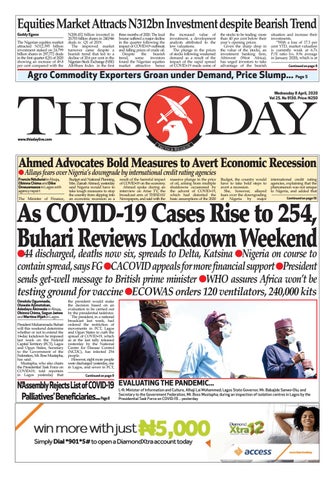
EVALUATING THE PANDEMIC... L-R: Minister of Information and Culture, Alhaji Lai Mohammed; Lagos State Governor, Mr. Babajide Sanwo-Olu; and Secretary to the Government Federation, Mr. Boss Mustapha; during an inspection of isolation centres in Lagos by the Presidential Task Force on COVID-19…yesterday
2
WEDNESDAY APRIL 8, 2020 •T H I S D AY
WEDNESDAY APRIL 8, 2020 • T H I S D AY
3
4
WEDNESDAY APRIL 8, 2020 •T H I S D AY
5
WEDNESDAY, ˜ ͺͺ ˾ T H I S D AY
NEWS
Group News Editor Ejiofor Alike Email Ejiofor.Alike@thisdaylive.com, 08066066268
Agro Commodity Exporters Groan under Demand, Price Slump
James Emejo in Abuja Exporters of Nigerian agricultural produce, particularly cocoa, are currently in a dilemma following the adverse impact of the COVID-19 pandemic on the economy. THISDAY learnt that exporters were being compelled to sell at discounted prices, which are far below the farm gate prices as demand for commodities had flattened due to the negative impact of the COVID-19 across countries, which are Nigeria's major trading partners, particularly Europe. In an exclusive interview with THISDAY, the National President, Federation of Agricultural Commodity Association (FACAN), Dr. Victor Iyama, said those in the agricultural produce export sector had been hard hit by the public health crisis. He warned that the severe foreign exchange losses to the country would worsen the situation. According to him, the lack of patronage means that stored cocoa will continue to lose weight over time and result in losses in monetary terms, despite quality assurance, because the commodity price is often determined by its weight. He said the COVID-19 pandemic, however, represented a wakeup call to the government to pursue the diversification
of the economy, noting that agriculture alone can guarantee over $100 billion annually "if the government is ready to do the needful." He said the government could help minimise the losses to stakeholders in the export business by giving at least a 50 per cent rebate after ascertaining the authenticity of goods kept in warehouses. He added that the government could also use goods as collateral to give exporters soft loans, which is interest-free, to help mitigate the situation as well as enable them to "buy more to blend and sell." Iyama added: "The truth is that it is going to affect so many of us because the buyers are not even buying because there's lockdown all over the country and all over the world. "And there are no demands and even where the terminal markets are open like in cocoa, for example, you can see that the price has really nosedived- say the cocoa that most of us have bought for N960,000 plus FOB (Free on Board) charges that is going for over N1 million, if you sell today you will lose nothing less than between N350,000 to N400,000- how do you do that? "Apart from the price nose-diving, there's going to be serious short weight because the longer it stays, the longer it loses weight.
Of course, you can still try to keep it in such a way that the quality will not deteriorate but definitely it will lose weight. "Many of us in the sector look at people who have stocked ginger, cocoabecause the thing happened suddenly- we are still in the midst of the season, so
only a few farmers will be affected as most of us had already taken the goods off the farmers." He said the COVID-19 pandemic had already exacted a devastating impact on the export business, especially agricultural produce. He added: "Even the
people we are going to sell to, we don't blame them, everybody is struggling for his life. "Definitely, nobody will be talking to you about buying any commodity or shipping any commodity to them when there's lockdown everywhere in the world." He stated that a similar experience, which occurred
between 2002/2003, had led people to commit suicide. Executive Secretary, FACAN, Mr. Peter Bakare, also told THISDAY the federal government should consider palliatives for agricultural exporters, noting that they still have to honour their obligations to their creditors.
DISCUSSING PALLIATIVES... L-R Speaker of the House of Representatives, Hon. Femi Gbajabiamila (left) and President of the Senate, Senator Ahmad Lawan, during a meeting with the Minister of Humanitarian Affairs, Disaster Management and Social Development, Ms. Sadiya Farouq, in Abuja…yesterday
FAN: 1,739 Foreigners Evacuated from MMIA in 10 Days US urges citizens to register for evacuation latest Chinedu Eze The Federal Airports Authority of Nigeria (FAAN) has said over 1,739 foreigners have been evacuated from Nigeria through the Murtala Muhammed International Airport (MMIA), Lagos since the evacuation began about 10 days ago. Delta Air Lines also yesterday evacuated 208 Americans with Flight D8956 from the airport in continuation of the repatriation. However, the US Mission in Nigeria has urged its citizens intending to leave Nigeria to register not later than 9a.m today. FAAN's Regional Manager, South-west Airport, Mrs. Victoria Shin-Aba, told reporters yesterday in Lagos that since the evacuation commenced with the airlifting of French and European citizens by Air France late March, some airlines, including two Nigerian carriers, had airlifted foreign nationals out of the country. Statistics provided by
Shin-Aba indicated that Air France evacuated 399 French and European nationals; Lufthansa, 238; Middle East Airline (MEA), 140; Ethiopian Airlines, 148; 137 (Canadians); 375 (US); Jed Air, nine (Liberians and crew); Air Peace, 87 Isrealis and Delta with 208 Americans. She explained that the evacuation had been going on smoothly with little or no hitches, adding that FAAN in collaboration with other agencies would continue to carry out its duties with utmost caution and professionalism. She said: “So far, the activities have been okay and well-coordinated. Since the closure of the airport, we have had about 10 evacuations with different nationals. We have had from Air France-KLM, Lufthansa, Middle East Airline (MEA) with the Lebanese; Ethiopian Airlines has been on with Americans and Canadians. Then, we have domestic charter too. Also, Jed Air did Liberia and Air Peace airlifted Israelis. Today, we have Delta Airlines on
ground that will take about 208 Americans. “The conditions are that you have to get an approval from the Federal Ministry of Aviation. When the ministry gives the approval, it is sent to FAAN, the Nigerian Airspace Management Agency (NAMA) and the Nigerian Civil Aviation Authority (NCAA). Then, we send the approval to all the security agencies, too. Most importantly, there is a procedure in place for the COVID-19 pandemic, which has to be followed. “For instance, Port Health Service has to check everyone that is going out, at times, Nigeria Centre for Disease Control (NCDC) will be on ground. Even, to access the terminal, there is a checking by the Nigeria Immigration Service (NIS) and others. It has been smooth sailing. "Though, we had a cancellation some few days ago, but that was not due to anybody’s fault. It was due to logistics of the flight plan. “Apart from today (Tuesday), we have had 1,539 evacuations through
the Lagos Airport alone. Today, United States is having another 208, another batch of Americans will be airlifted tomorrow (Wednesday) and next week, we are having South African Airways and Air France too. They can come up with any plan in the cause of the week. That is why we are essential workers. We have to ensure that there is smooth running of operations. Nothing is compromised.” On efforts of the management to prevent airport workers from contracting the virus, ShinAba said the agency had adopted social distancing practice, deployed metal detectors for security checks, rather than the initial pant down, encourages use of hand gloves and face masks, while sanitisers were positioned in strategic and open areas of the airport. She, however, decried that the revenue generations of FAAN had been negatively impacted in the past weeks, adding that on the average, the terminal handles 23-28 flights a day, but this has
dropped drastically to just 10 flights in 10 days due to closure of international flight operations. But she was optimistic that the aerodrome would once again scale the hurdle of NCAA certification later in the year, noting that all hands were on deck to make the exercise a huge success.
US Urges Citizens to Register for Evacuation Latest Tomorrow Meanwhile, the US Mission in Nigeria has urged its citizens intending to leave Nigeria to register not later than 9a.m today. The US also told potential evacuees from Nigeria amid the COVID-19 pandemic that the hospitals in the US were overwhelmed. In a statement issued on its website, it told its citizens that the registration for evacuation flights from Nigeria would end today. The statement said: “The U.S. Embassy in Abuja is in the process of contacting persons who have registered
their interest in being placed on an evacuation flight. “The flight is estimated to travel later this week, but we do not have exact information at this time. After this flight, there are no other flights currently scheduled. “Due to the unprecedented nature of this situation and the worldwide effort to ensure all American citizens have a chance to return to the United States, U.S. Embassy Abuja is not aware of when Washington, DC would be in a position to charter another aircraft. “U.S. Embassy Abuja urges all persons who are considering evacuation to take advantage of this opportunity. “If you have not yet registered your interest in repatriation flights but are interested in this week’s flight, you must register your interest no later than 9:00 am on Wednesday, April 8.” Ethiopian Airlines had on Monday evacuated 585 citizens of the United States and Canada from Abuja and Lagos.
6
WEDNESDAY APRIL 8, 2020 •T H I S D AY
WEDNESDAY APRIL 8, 2020 • T H I S D AY
7
8
WEDNESDAY, ˜ ͺͺ ˾ T H I S D AY
NEWS
Nigerian, Nigerien Troops Battle Insurgents in Borno Kingsley Nwezeh in Abuja Joint troops from Nigeria and Niger Republic yesterday battled fighters of Boko Haram and the Islamic State for West African Province (ISWAP) in Tumbun Tago and Tumbun Fulani in Borno State. This is coming as the Nigerian Navy yesterday recovered 140 litres of stolen crude oil from an illegal oil refinery site in Warri, Delta State. The troops had a fierce encounter with the insurgents at Kure village along Tumbun Rago and Tumbun Fulani general areas of Borno State. A war update issued by the Directorate of Defence Media Operations (DDMO) said the combined troops of 403 Special Forces Brigade Baga and Niger Republic troops supported by Air Task Force of Operation Lafiya Dole decimated scores of the terrorists. "In continuation with the ongoing clearance operations in the North-east theatre of operation, combined troops of 403 Special Forces Brigade Baga, Niger Republic Troops supported by Air Task Force of Operation Lafiya Dole had a fierce encounter with some Boko Haram/ISWAP elements at Kure village along Tumbun Rago and Tumbun Fulani general areas of Borno State. "Consequently, the terrorists
were decisively dealt with during the encounter. The terrorists suffered heavy casualties and unconfirmed number escaped with gunshot wounds," it said. The troops recovered one gun truck, one anti-aircraft gun, one motorcycle. Other recovered items are one light machine gun, one AK 47 rifle and a magazine, 227 rounds of 12.7 mm ammunition and 10 rounds of 7.62 mm special ammunition. It noted that there was no casualty or equipment loss by the joint military forces. The statement urged the public to continue to cooperate and support the security forces with credible information that could aid or hasten the completion of the ongoing clearance operations. Meanwhile, the Nigerian Navy has recovered 140,000 litres of stolen crude oil in Warri, Delta State. The discovery was made by the Nigerian Navy ship, Delta, whose patrol teams conducted anti-crude oil theft and antiillegal bunkering operations in its area of operation during the week. The update on naval operations signed by the Acting Director, Defence Media Operations, Brig-Gen. Bernard Onyeuko, said the patrol team located an illegal refining site around Opumami in Warri
PDP Demands Forensic Investigation of Fuel Subsidy Chuks Okocha in Abuja The Peoples Democratic Party (PDP) yesterday called for a forensic investigation of fuel subsidy payment by the National Assembly, describing the fuel subsidy regime under the President Muhammadu Buhari and All Progressives Congress (APC)’s administration as fraudulent. The party urged the federal government to stop lying to Nigerians and tell the truth on how trillions of naira, claimed to have been paid as a subsidy, was spent. PDP, in a statement by its National Publicity Secretary, Mr. Kola Ologbondiyan, described Monday’s statement by the Group Managing Director of the Nigeria National Petroleum Corporation (NNPC), Mr. Mele Kyari, that there would be no more subsidy and under-recovery as dramatic. The PDP said: "Our party notes that if the federal government is running away from its subsidy policy, the substantive Minister of Petroleum Resources, President Buhari or the Minister of State, Timipre Sylva, should muster the courage to announce this to Nigerians through a policy statement. "Our party holds that this sudden announcement of an end to fuel subsidy and commencement of a deregulation regime of the oil sector is a desperate step by the Buhari’s administration to stave off an investigation into the siphoning of trillions of naira by APC leaders using phony subsidy claims." The PDP urged Nigerians to note how Buhari set the stage for the alleged looting of fuel subsidy funds. PDP added that in his bid to smear its image, Buhari, while leading the agitation against the decision by the PDP-led administration to
deregulate the oil sector in 2012, had said fuel subsidy did not exist and described the fuel subsidy regime and its operators as a fraud. The main opposition party noted that rather than riding on this declaration on assumption of office, Buhari’s administration “provided official cover for the cabal and APC leaders to use his ascendancy to power to engage in underhand dealings, plunder the nation’s subsidy resources, pillaged trillions of naira from the oil cashbox, only to now turn around to announce an end to subsidy, seeing that there is nothing left to steal with the current international price crash.” It added: "We ask could this be the reason behind Mr. President's inability to make any concrete statement on the exposed subsidy scam under his administration in the last five years? “Could it also be the reason the oil subsidy, which Nigerians were enjoying under the PDP, was adjudged a fraud but suddenly ceased to be a fraud from 2015 till Monday, even when Nigerians no longer enjoyed any benefit from the payout within this period?" The opposition party said it was now “clear to all why the APC-led administration had resorted to muddling up oil revenue transactions, refused to open up on federation equity of crude while frustrating the free flow of information on product exchange and revenue remittances and why they have been promoting reports on imaginary pipeline losses as well as other opaque and non-transparent transaction in a sector that is directly under the supervision of the president.” It is also demanding a forensic audit of 60 million litres of petrol that NNPC claimed it was importing under its former GMD, to justify the fraudulent subsidy payout.
South LGA of Delta State. It said the site had 30 ovens, 40 receivers and 16 dugout pits cumulatively laden with about 120,000 litres of product suspected to be stolen crude oil and 40,000 litres of suspected illegally refined AGO. "The same day, the team discovered another illegal
refining site around Opumami general area. The site had two ovens, one receiver, 8 x 250 litres metal drums and one dugout pit cumulatively laden with about 30,000 litres of suspected stolen crude oil and 25,000 litres of product suspected to be illegally refined AGO," it said.
Also, a Nigerian Navy ship, Dorina, while on a routine patrol arrested a fishing trawler, Hajiya Binta, for operating in Nigerian waters without its Automatic Identification System (AIS). The arrest was effected about five nautical miles off the Escravos breakwaters. Upon
interrogation, the captain of the vessel affirmed that the AIS of the vessel was not operational as at the time of the arrest because it developed a fault while on the sea. Hajiya Binta was handed over to NIMASA officials on March 31, 2020, in line with due process.
HELPING HAND... L-R: Commissioner for Health, Dr. Mordi Ononye; Manager, Community Relations (NPDC), Mr. Dahiru Abubakar; and Commissioner for Oil and Gas, Mr. Emmanuel Amgbaduba, during the donation of medical items by NPDC to Delta State as support in the fight against COVID-19 pandemic in Asaba…yesterday
N’Assembly Rejects List of COVID-19 Palliatives’ Beneficiaries
Deji Elumoye and Chuks Okocha in Abuja
The leadership of the National Assembly has rejected the list of the vulnerable compiled by the presidency as beneficiaries of the COVID-19 special fund, describing it as fraudulent. The lawmakers have also expressed concern that the Social Investment Programme (SIP) introduced by the federal government in 2016 was yet to be backed by law. It, therefore, directed the Ministry of Humanitarian Affairs, Disaster Management and Social Development, overseeing the project to overhaul the scheme in four weeks. The ministry is also to discard the register and all indices used to generate those that are poor and vulnerable across the 360 federal constituencies in the country. These were the highlights of yesterday's meeting between the National Assembly leadership, led by the President of the Senate, Dr. Ahmad Lawan, with the Minister of Humanitarian Affairs, Disaster Management and Social Development, Ms. Sadiya Farouq, and top officials of the ministry. At the meeting, Lawan and Speaker of the House of Representatives, Hon. Femi Gbajabiamila, faulted the way the SIP of the federal government is being implemented and called for an enabling legislation in line with global best practices. Lawan and Gbajabiamila expressed their reservations about the scheme at a meeting attended by the Deputy Senate President, Senator Ovie OmoAgege; Deputy Speaker, Hon. Idris Wase, and some other principal officers and members from both chambers. The meeting was held at the
instance of the leadership of the National Assembly against the backdrop of the ongoing federal government's intervention initiatives aimed at reducing the impact of COVID-19 pandemic on the vulnerable. The two presiding officers said the SIP, which was established in 2016 under the presidency but which is now under the Ministry of Humanitarian Affairs, should be reformed to make it more efficient and effective. Lawan, in his remarks, said the National Assembly was interested in the current intervention initiatives of the ministry particularly the disbursement of the palliatives. "We feel that we need to work together with you to ensure that there is effectiveness, there is efficiency, that those who are supposed to benefit, benefit directly," Lawan said. According to him, the National Assembly is concerned about the conditions and guidelines for the intervention programme directed at the vulnerable. "When for example, some conditions are set that those who will benefit will have to go online, through the internet or BVN and the rest of it, I want to tell you that the majority of those who are supposed to benefit have no access to power. They have no access to the Internet. They have no bank accounts; so no BVN. In fact, many of them don't even have phones and these are the poorest of the poor. Yet, some of the conditions or guidelines which you set inadvertently leave them out," he added. To him, the poorest of the poor have not been sufficiently captured by the programme. "We believe that when we work together, the executive side of government and the National Assembly as representatives of
the people, we will be able to reach much more of these people who are in serious distress even before COVID-19. "Now with COVID-19, they need our attention more than ever before. The time has come that we review the ways and manner we use to deliver the services under the SIP to Nigerians. We need to be better in terms of strategy for delivery and definitely, what we have been doing in the past cannot deliver exactly what will solve the challenges of the most ordinary and most vulnerable Nigerians. "So, we need to put on our thinking cap and work out some strategies on how to identify the poorest persons in Nigeria. I think we have not been able to reach far out there to get them properly captured," Lawan said. Gbajabiamila also told the minister that she was in the eye of the storm because all eyes were on her He said: "Your job right now is probably the most important as we speak because you are saddled with the responsibility of alleviating 'poverty' or the hardship, due to no fault of anyone, being thrust upon Nigerians and I know that you came into a system, or you met a system that has nothing to do with you, but what we will be asking you to do is for you to change that system. "When you walk into a system, no system is 100 per cent perfect. The word reform is something we use all the time and this is the one time when that word reform must be used in the truest sense of that word. "The questions are going to be asked, how do you come about your list? How comprehensive is your distribution list? What are the parameters? What is the geographical spread? So these
are tough questions that are going to be asked but I want you to look at them as frank questions that we need to ask. "If you really want to define the meaning of representation, if that was being practiced in the real meaning of representation, then we shouldn’t be here. Because, all the questions we want to ask, we should already have the answers. We should be providing those answers to the Nigerian people we represent. "But if they ask me, as the speaker of the House, or ask the Senate president or any of my colleagues here, we are going to be struggling for answers. If we were really representing, then we will not need to ask because we will have the answers." According to him, committees in the House have been complaining even before the minister was appointed about the inability to access information about the programme. Gbajabiamila said the SIP was similar to the Unemployment Insurance Act in the United Kingdom and the Social Security Act in the United States. "There are a lot of takeaways from this COVID-19. One of them is the international best practices. My point is that these things are backed by law. They are codified by the legislature so that these issues and these questions will not arise." The speaker urged the minister to talk with the committees and the National Assembly leadership on the best way to codify the scheme. Responding, the minister said the SIP was moved to her ministry for sustainability and institutionalisation. "I am very pleased to hear that we are going to work together to see that we give legal backing to this programme because that is the only way to go," she said.
9
WEDNESDAY, ˜ ͺͺ ˾ T H I S D AY
PAGE NINE AS COVID-19 CASES RISE TO 254, BUHARI REVIEWS LOCKDOWN WEEKEND bringing the count to 44 while six are reported dead. Among the dead is a doctor who was confirmed dead in Katsina due to complications arising from the virus. Also yesterday, the Private Sector Coalition Against COVID-19 (CACOVID), being driven by the Central Bank of Nigeria (CBN) and some key stakeholders, solicited financial support from 146 companies and individuals to curb the virus. The SGF, who was at the head of the Presidential Task Force team’s visit to Lagos, the epicentre of the pandemic in Nigeria lauded the efforts of the Lagos State Government towards curtailing the virus, assuring the people that Nigeria is on course to contain the spread of COVID-19. Mustapha said the taskforce would do an evaluation of its objectives on the fight against COVID-19 in Nigeria, this weekend and this would guide the president to determine whether or not to extend the lockdown. According to him, the team has outlined its objectives and goals and within the next few days, it will determine if it has met them or not. He added that this will be relayed to the president who would direct on the next step. He said: “President Buhari alone will make the decision as to whether the lockdown will stop on its expiration at the 14th day or whether to extend it. “The president would have to review the recommendations of the team set up to monitor the various measures to curtail the spread of coronavirus and cushion its effects on the people. “We are looking at the objectives that were set when the lockdown or the quarantine declaration was signed by the president and subsequently by several other states. “Before the end of the week, we will do an evaluation and part of the trip here was to do an evaluation to see how the objectives that were set were being met and at the end of that exercise, we would have the responsibility of reporting to Mr. President.” Mustapha said the president had in his broadcast explained how he arrived at the decision to impose the lockdown on the two states and the FCT. He stated that Buhari took the decision on the advice of the Minister of Health, Dr. Osagie Ehanire, and this subsequently led to the signing of the Quarantine Declaration 2020. Mustapha said Nigeria was at war with an invisible enemy, noting that the enemy could only be defeated if
Nigerians stay at home, observe social distancing and report themselves to the health authorities if they present symptoms of COVID-19. “One person who is infected in one community can infect everyone in that community. This is why we must eliminate the virus from our country so we can all stay safe. COVID-19 is a dangerous sickness, we must abide by the instructions to stay at home and report all suspected cases,” he added. The SGF explained that members of the taskforce were in Lagos to inspect the isolation centres in the state as part of the responsibilities of the team.
Nigeria on Course to Eradicate COVID-19, Says SGF Mustapha also said that Nigeria was on course to eradicate the virus. The SGF told the Lagos State Governor, Mr. Babajide Sanwo-Olu, that "Lagos is doing a great job" on the containment of the pandemic. Sanwo-Olu said the state had put measures in place to combat the virus. He said: “For instance, we have established two quarantine centres in Badagry, one in Epe, and some other places. These facilities are where people, who come into the state through land borders, maybe from neigbouring countries, are placed for 14 days before they are allowed fully into the state to mix with the people.” The taskforce team inspected the isolation facilities at Mobolaji Johnson Arena, Onikan; Lagos Island; the Infectious Disease Hospital (IDH), Yaba; Lagos University Teaching Hospital (LUTH), Idi-Araba; and Gbagada General Hospital, Isolation Centre, Gbagada. Speaking to journalists after the inspection, Mustapha said: "So far, I think Lagos State is doing a great job. From what I've seen here, they're putting up a first-class and a world-class facility that will help us in the management of those that are affected with COVID-19. "I think we are on course and the basic strategy of the national response is containment to try as much as possible to reduce the spread to tracking of those that have already been infected so that we minimise the case of community transmission. "We are doing very well. So far, processes that have been put in place, the plans, the objectives are being achieved. "I listened to the briefing of the Commissioner for Health in Lagos State yesterday,
where there was quite a clear indication that the reason for the lockdown and the processes that have been put in place is achieving its desired objectives."
COVID-19 Cases Jump to 254, Spread to Delta, Katsina An update yesterday by the NCDC showed that Nigeria has recorded 16 new cases of COVID-19, bringing to 254 the total number of confirmed cases in the country. A breakdown of the new cases showed that 10 were recorded in Lagos, two each in the FCT and Oyo with one each in Delta and Katsina States. NCDC said: ''As at 09:30 p.m. on April 7, there are 254 confirmed cases of COVID-19 reported in Nigeria. Forty-four have been discharged with six deaths. "The breakdown of the figures shows that Lagos has recorded 130 cases, FCT 50, Osun 20, Oyo and Edo 11 each, Bauchi six, Akwa Ibom and Kaduna five each, Ogun four, Enugu, Ekiti, Kwara and Rivers two each, while Benue, Ondo, Delta, and Katsina have recorded one each.
Lagos, FCT Discharge Eight More Patients However, the Lagos State Government and the FCT discharged eight more patients yesterday to rally the count to the 44 announced by the NCDC. Of the eight persons, Lagos discharged one and FCT seven. According to SanwoOlu, who broke the news, the patient, a female, was discharged yesterday. Sanwo-Olu said the state was resolute in fighting the virus and asked residents to stay at home for their safety. Also, the Minister of FCT, Malam Muhammad Bello, announced the discharge of seven people who had been on treatment for COVID-19 at the Isolation Centre in Abuja. In a statement issued yesterday, the minister was also optimistic that the 39 who are still on admission would soon be discharged. Bello said: “Let me begin by appreciating the high level of compliance so far exhibited by residents of the FCT with regards to the 14day restriction of movement as directed by President Muhammadu Buhari, with a view to curbing the Coronavirus pandemic. This restriction was necessitated by the need to contain the spread of the virus within our community in order to
safeguard lives. “The level of compliance from residents is proof that we all understand the magnitude of the challenge before us and we are ready to come together to fight this enemy, so we can return to our normal way of life as quickly as possible.” The minister also said that a 300-bed isolation centre for COVID-19 cases at Idu District had been completed and ready to be put into use. The facility has the capacity to be expanded to 500 beds.
WHO Assures Africa Won’t be Testing Ground for Vaccine But amid the controversy over the trial of a vaccine for the virus, the World Health Organisation (WHO) has said that Africa will not be used as a testing ground for the COVID-19 vaccine. WHO’s Director-General, Dr. Tedros Ghebreyesus, gave the assurance yesterday while reacting to statements credited to two French doctors, Jean Paul Mira and Camille Locht, who were discussing “Africa as best destination to conduct a test for COVID-19 vaccine.” The two doctors reportedly cited the use of prostitutes in Africa to carry out vaccine test for the Acquired Immunodeficiency Syndrome (AIDS) as an example. Mira, head of the resuscitation department at Cochin Hospital also said the continent should be considered because of its perceived toughness to disease outbreaks. But Ghebreyesus described the statement as “racist” and a hangover of “colonial mentality.” He condemned the statement, saying it is a “disgrace” to scholars in the 21st century. The WHO director-general said the continent would not be used for such an experiment except in line with the rules governing the test of vaccines all over the world. “On the vaccines’ issue, there was I think a comment last week from a couple of scientists who said that the testing ground for these new vaccines will be Africa. To be honest, I was so appalled because it was at a time when I said we need a kind of solidarity – this kind of racist comment will not help. It goes against this solidarity. “Africa cannot and will not be a testing ground for any vaccine. We will follow all the rules to test any vaccine or therapeutics all over the world using exactly the same rule, whether it is in Europe, Africa or wherever, we will
use the same protocol. “It was a disgrace, appalling, to hear during the 21st Century, to hear from scientists that kind of remark. We condemn this in the strongest terms possible, and we assure you that this will not happen,” he said. CACOVID Appeals for More Financial Support Meanwhile, CACOVID has appealed for financial support from Nestle Nigeria Plc, Shell Petroleum Development Company, Seplat Exploration Development Company and 143 other individuals and organisations as the country continues to fight against the spread of the virus. The appeal was contained in a statement issued on behalf of the coalition by the Director, Corporate Communications, CBN, Mr. Isaac Okorafor. The statement said COCAVID invited them to join the fight against COVID-19. “Nigeria needs you now more than ever before. We are counting on you,” it added. Some of the organisations and individuals invited by COCAVID are Frieslandcampina Wamco Nigeria Plc, Promasidor Nigeria Limited, De-United Foods Industries Limited, UACN Group, Cadbury Nigeria Plc, Oriental Food Industry Limited, CFAO Nigeria Plc, AG Leventis, Dangote Industries Limited, Indorama Eleme Petrochemicals Limited, Lufthansa Airline, British Airways, Qatar Airways, Emirates, African World Airline, Airfrance, Unilever Nigeria Plc, PZ Cussons and Eko Supreme Group. Others are: Baker Magunda (Guinness Nigeria Plc); Zad Maalouf (Seven-Up Bottling Company); Ernest Obiejezie Azudialu (Neconde Energy Limited); Wole Abegunde (Meristem); Anthony Attah (Nigeria Liquified Natural Gas); Ken Etete (Century Energy Services Limited); Yinka Adekoya (Wapic Insurance); Oye HassanOdukale (Leadway Assurance Company Limited); Tony Okpanachi (Development Bank of Nigeria); Ebelechukwu Nwachukwu (NSIA Insurance Limited); Kayode Falowo (Greenwich Trust Limited); Bolaji Balogun (Chapel Hill Denham Limited): Johnson Chukwu (Cowry Assets Management Limited) and Nnamdi Ezeigbo (Slot Systems Limited). So far, CACOVID has raised a total of N21.588 billion, in an account domiciled at the CBN. Okorafor, while urging more Nigerians and corporate bodies to contribute to the fund, charged Nigerians to do their part in checking further
EQUITIES MARKET ATTRACTS N312BN INVESTMENT DESPITE BEARISH TREND its lowest since 2015. Given the effectiveness of social distancing measures to fighting the spread of COVID-19 and its wide adoption in countries most vulnerable to the virus, we could see a resumption of economic activities in second half of 2020 which would support crude oil prices and market performance. "Thus, we advise a gradual entry approach (buying in tranches) into the Nigerian equities market given the uncertainties both on the global and domestic fronts,” Afrinvest said. Also, the Chairman of Association of Securities
Dealing Houses of Nigeria (ASHON), Chief Onyenwechukwu Ezeagu, also urged investors to take advantage of the current bear market to beef up their portfolios. He said although ASHON acknowledged the high level of downswing on the market, fundamentals of the quoted companies remained strong. He explained that the Nigerian stock market remained part of the global exchanges and as such any development in the global market would impact on its operations. “The effect of the
coronavirus is gradually affecting trading all over the world and whatever happens elsewhere reflects in our market. The centre of it all is China and being a major world power both in productive and consumption capacities, any ill-wind affecting China would naturally cause a big sneezing to the rest of world. Investors should not panic. The share prices will bounce back. The companies’ fundamentals remain strong. Many investors are taking advantage of the bearish run to beef up their portfolios,” he said.
Regular dividend-paying stocks such as Zenith Bank Plc, Guaranty Trust Bank Plc, Access Bank Plc, Nestle Nigeria Plc, Nigerian Breweries Plc, United Bank for Africa Plc, Stanbic IBTC Holdings Plc, FBN Holdings Plc, Ecobank Transnational Incorporated (ETI) saw their prices fall significantly to new lows in spite of their strong fundamentals. For instance, Nigerian Breweries Plc once traded 49 per cent below its year’s opening value, Nestle Nigeria Plc is 42 per cent cheaper. Access Bank Plc, which recently
declared improved 2019 results and recommended significant final dividend for shareholders, is also trading 42 per cent lower than its opening price. Unilever Nigeria Plc has shed 43.7 per cent, while Cadbury Nigeria Plc and FBN Holdings Plc have declined by 40.7 per cent and 38.4 per cent respectively. Zenith Bank Plc and GTBank Plc are currently trading 36 per cent below the prices at which they began the year. UBA Plc is 30.5 per cent cheaper, while ETI 25 per cent cheaper compared to its year’s opening price.
spread of the virus.
ECOWAS Orders 120 Ventilators, 240,000 Diagnostic Kits The Economic Community of West African States (ECOWAS) has ordered 240,000 diagnostic kits, 240,000 extraction kits, 250,000 viral sample transport equipment, 285,100 Personal Protective Equipment (PPE) and 120 ventilators, among others, for member states to help fight the pandemic. The President of the ECOWAS Commission, Mr. Jean Claude Kassi Brou, said in a communique issued on yesterday in Abuja that the commission would continue to monitor the pandemic in the world and particularly in West Africa. According to him, as of April 5, 15-member states are affected by the pandemic with 1,739 confirmed cases of contamination, 55 deaths and 328 persons who have fully recovered. He, however, noted that approximately 95 per cent of deaths are patients with comorbid conditions. Brou said in light of the spread of the pandemic, the ECOWAS Commission reaffirmed its solidarity with member states and welcomed all the measures already taken to contain the spread of the pandemic and care for the sick. He added that the West African Health Organisation (WAHO), its specialised health institution responsible for coordinating the response at the regional level has drawn up a regional strategic plan with all member states. The president explained that to address the pandemic, the commission has given financial support for the purchase of medical supplies and equipment essential. He stated that WAHO had already purchased and dispatched to the 15-member states 30,500 diagnostic test kits, 10,000 personal protective equipment (PPE) (coveralls, aprons, gowns, gloves, goggles, boots) and 740,000 prescription tablets (Chloroquine and Azithromycin). Continued on page 10
TOP GAINERS FBNHOLDING STERLBANK FIDELITY LAFARGE CUSTODIAN TOP LOSERS CADBURY ARDOVA AXAMANSARD
NGN NGN 0.40 4.40 0.07 0.80 0.18 2.01 0.95 10.75 0.50 5.75 NGN 0.70 6.30 1.35 12.45 0.17 1.58 UPDC 0.09 0.86 WAPIC 0.02 0.26 HPE Nestle Nig Plc ₦764.90 Volume: 1.443 billion shares Value: N5.569 billion Deals: 4,647 As at yesterday 8/4/2020 See details on Page 29
% 10 9.9 9.8 9.6 9.5 % 10 9.7 9.7 9.4 7.1
WEDNESDAY, ˜ ͺͺ ˾ T H I S D AY
10
NEWS
Mele Kyari Gives Reasons for Petrol Subsidy Removal Emmanuel Addeh in Abuja The Group Managing Director of the Nigerian National Petroleum Corporation (NNPC), Mr. Mele Kyari, yesterday explained that the federal government removed petrol subsidy because it does not benefit the ordinary Nigerian. Kyari argued that not leaving market forces to determine the pump prices of the product was to the advantage of the rich in the country who have several
cars in their garages. Speaking in an interview with the Nigerian Television Authority (NTA) last night, the NNPC helmsman noted that when the market is freed from over-regulation and liberalised, funds which would have gone into subsidy would be spent on deepening the country’s infrastructural base. “As you are aware, fuel was selling for N145 before the current COVID-19 impact came into play. Selling fuel at N145 means that you are doing some form of under-
recovery which means that NNPC gets product and sells at below market price and take the hit on cost differential. “What we have done is that market forces will come into play such that at the end of the day, Nigerians will benefit from the enormous resources when that amount will be ploughed back. “You are also aware that fuel under-recovery means that we are taking back some money which would have gone back to fund infrastructure, health and education that we know
today we are lagging behind. “Given this opportunity, we have to ensure that these resources are available, then we stop subsidising the elite. And when we say subsidy or under-recovery, it is also an elitist thing. “In some cases , it is the elite that have two, three or four cars in their houses and the ordinary man or Nigerian does not benefit from it. This is the time to ensure that the things get to the ordinary man and not for the elites” he argued.
He noted that given the current realities in the industry, a lot of cost-cutting measures and rescheduling of payment processes would have to be embarked upon, to mitigate the effect of the fall in the international price of crude oil. He said: “The oil industry has a way of responding to situations like this. First of all, when there are low oil prices, you do two things. First of all you cut costs, then you extend your payment processes so that you don’t pay what you
can pay for tomorrow today , so you have more resources. “The money that we make from the current realities can be utilised for basic operational needs and that’s why we are also able to deliver on the expectations of our shareholders , particularly when government is in this business to make some money to meet some important needs. “We are responding to the situation, we will meet some of our commitments but we know this is a global challenge”.
that $3.4 billion or less. We have in the first instance applied for that maximum amount; then in the process when we negotiate, we might get the maximum amount or less but that is the amount of our contribution with IMF and this is the provision that the IMF has made for every member-country that you can apply for between 50 to 100 per cent of your contribution to IMF. “Again, this is a programme that has no conditions attached to IMF programmes and this is not an IMF programme.” She stated that up to about 80 countries had applied to draw from their contributions to IMF, in a bid to assuage the impact of COVID-19. Ahmed said Nigeria has also requested from the World Bank $2.5 billion and another $1 billion from the AfDB. The minister added that when secured, $1.5 billion of the $2.5 billion World Bank facility would go to the federal government, while the states get $1 billion.
Meanwhile, the International Monetary Fund (IMF) yesterday said it is working hard to respond to a request by the federal government to draw down a total of $3.4 billion out of the country’s contribution to the multilateral institution. IMF’s Managing Director, Ms. Kristalina Georgieva, disclosed this in a statement posted on the Washingtonbased institution’s website. Ahmed, had on Monday said Nigeria was seeking $3.4 billion from the IMF, among other measures the government was taking to reflate the economy, due to the disruptions caused by COVID-19. She had explained: “Nigeria has a contribution of $3.4 billion with IMF and we are entitled to draw up to the whole of that $3.4 billion or less. We have in the first instance applied for that maximum amount; then in the process when we negotiate,
we might get the maximum amount or less but that is the amount of our contribution with IMF and this is the provision that IMF has made for every member-country that you can apply for between 50 to 100 per cent of your contribution to IMF. “Again, this is a programme that has no conditions attached to IMF programmes and this is not an IMF programme.” She stated that up to about 80 countries had applied to draw from their contributions to IMF, in a bid to assuage the impact of COVID-19.” Furthermore, the IMF boss pointed out that the Nigerian economy was being threatened by the twin shocks of the COVID-19 pandemic and the associated sharp fall in international oil prices. Georgieva also noted efforts by the federal government to contain the virus. “Nigeria’s economy is being threatened by the twin shocks of the COVID-19 pandemic and the associated sharp fall in international oil prices. “President Buhari’s administration is taking a number of measures aimed at containing the spread of the virus and its impact, including by swiftly releasing contingency funds to Nigeria Center for Disease Control and working on an economic stimulus package that will help provide relief for households and businesses impacted by the downturn,” she said. To this end, she said, to support the efforts, Nigeria’s government had requested financial assistance under the Fund’s Rapid Financing Instrument (RFI). According to Georgieva, the emergency financing would allow the government to address additional and urgent balance of payments needs and support policies that would make it possible to direct funds for priority health expenditures and protect the most vulnerable people and firms. “We are working hard to respond to this request so that a proposal can be considered by the IMF’s Executive Board as soon as possible,” she said.
briefing yesterday. He said the doctor, aged 60, died at the Nigeria Air Force (NAF) Reference Hospital in Daura, three days ago. The governor said the deceased owned a private hospital in Daura and had visited Kogi State, where he hailed from, and later travelled to Lagos. Masari said on returning to the state, Yakubu became ill and was admitted to the hospital, where he died. He said the deceased’s
samples were taken to the NCDC for diagnosis before his death and he was confirmed positive for COVID-19. “We have received bad news of COVID-19. The deceased’s samples showed COVID-19 positive. Before his death, he was also diagnosed with hepatitis and hypertension three years ago,” he said. The governor said the state medical response team was in Daura, taking samples of all those that had contact with the doctor before his death.
AHMED ADVOCATES BOLD MEASURES TO AVERT ECONOMIC RECESSION others countries would suffer the same fate as a result of the adverse impact of the pandemic on the global economy. “So, we need to do things that are very radical, and very bold and very different and maybe, even unusual so that we don’t slip into a recession," she said. Ahmed expressed worry at the state of the economy, which had been worsened by freefall in the price of oil, Nigeria’s major foreign revenue earner. "It worries me that our economy is in crisis,” she told Arise TV, adding: “It worries me that when we did an assessment, our own assessment is that we could go into a recession in 2020 and the numbers we have from the NBS (National Bureau of Statistics) is a -3-4 and that is very disturbing. The multilateral institutions placed us on a much higher number.” The minister emphasised that the collapsing demand for crude oil was giving Nigeria a great deal of concern because of the projected crude oil price of $57 per barrel in the 2020 Budget had become unrealistic. She explained: "Now, we have to work with an average of $30 per barrel. We also have to adjust the volume from 2.1 million barrels per day to 1.7 million barrels per day because the market is low. "In the last couple of weeks, we have cargoes of crude that are not moving because Europe is literally shut down and that’s where we have our biggest market and also India is shut down. So, the demand is very low. We have seen countries planning to shut down production or part of their production. We hope it doesn't get to that. "We are happy that the price has adjusted at least within the $30 range now. Last week, there were some days that it went to as low as $17.5 per barrel. What we are doing now is we are reassessing our plans. We are deferring anything that is not vital.” She said, however, that the federal government
was studying the situation and making appropriate decisions on how to safeguard the economy from slipping into a recession, pointing out that one of the measures was the stimulus package and the moved to pick up $7billion from multilateral agencies, including the International Monetary Fund (IMF), the World Bank, African Development Bank (AfDB) and the Nigerian Sovereign Investment Authority (NSIA).
Allays Fears over Downgrade of Nigeria by Credit Rating Agencies Ahmed also spoke on the downgrading of Nigeria by international credit rating agencies that were moving Nigeria to a negative rating. “We will continue to engage the rating agencies,” she said, explaining: “The reassessment they are doing now is not just about Nigeria. They are reassessing all countries where they have ratings. I don’t think there is any country where the rating would not be lowered.” She said the agencies were assessing what the various governments were doing given the current global economic situation and making their judgments, revealing that Nigeria’s team had a long meeting with Moody’s on Monday on the country’s situation. According to the minister, “What we need to do, and that we are doing is to continue to update them on what we are doing, as we implement major decisions. “It is a positive thing that we have deregulated the PMS sector. It is also a positive thing that the exchange rate is aligned now; there are no more multiple exchange rates.” She said the rating agencies were happy that the federal government was cutting back on expenses that were not essential at these times, adding that the review of the 2020 budget to make it more realistic was also pleasing to them. Saying that the government’s quest for new
funding sources at a lower cost of financing its projects would shore up Nigeria's rating, Ahmed concluded: “They are doing their assessment based on what the realities are at the moment and it is not unique to Nigeria.” Admitting that it was not a nice thing to be downgraded, she said Nigeria would, however, have to live with it and take the appropriate measures to move up. On Nigeria’s rising debt portfolio, she insisted that Nigeria did not have a debt problem, explaining that the challenge was revenue shortfall. She said deliberate efforts were being made to shore up new revenue sources.
Presidential Directive on Salaries On efforts to cut costs she said Buhari had ruled out job cuts and had in fact, directed that salaries and pensions must be paid in spite of dwindling resources. "The president has also directed that we must make sure we protect salaries and pensions so that people have basic resources." On how long the federal government could sustain the payment of salaries and pensions when there is no certainty on the likely end of the current global economic meltdown caused by the virus, the minister said: "Our plan is that we have to do that in the course of 2020. We have reviewed the plans and we will be discussing this week with the National Assembly on the review before it is finally delivered to them."
FG Won’t Seek Eurobond Waiver Also speaking to Bloomberg, the minister said the federal government would not seek a suspension of interest payments from its Eurobond holders, but will seek debt relief from China as the government races for funds to battle the COVID-19 pandemic. “We have not considered
investors of our commercial paper,” Ahmed, told Bloomberg. “If it happens anywhere, if it’s something that would work, then we will look at it, but right now we are looking at multilateral lenders.” Ahmed said it’s unclear how a debt service moratorium, which was requested by African finance chiefs last month, could be sought from holders of Eurobonds, which are actively traded. Nigeria paid $771 million in interest on its Eurobonds last year compared with $329 million in debt service to multilateral creditors, according to the country’s Debt Management Office. The government plans to hold talks with China to seek a deferral of interest payments on bilateral loans, she said. “We will talk to the Chinese. We will negotiate multilateral loans and bilateral loans and where we get accommodation we will take it,” Ahmed said, without saying how much the government expects to save in payments this year. The federal government has asked for $7 billion in loans from multilateral creditors, including the International Monetary Fund, to allow the government to increase health spending as the COVID-19 as spreads in Africa’s most populous country. Tumbling oil prices have slashed revenue to the continent’s top oil producer, which could face its worst recession in decades this year. Nearly half of Nigeria’s outstanding external debt is with multilateral lenders, with the World Bank Group being its top creditor with $10.1 billion in loans. Beijing-based Export-Import Bank of China is the secondlargest single creditor with loans totaling $3.2 billion while Eurobonds account for $10.86 billion or 39 per cent of external debt. Explaining the moves towards seeking external interventions from multilateral institutions, the minister had said on Monday: “Nigeria has a contribution of $3.4 billion with IMF and we are entitled to draw up to the whole of
We are Working Hard on Nigeria’s $3.4bn Request, Says IMF
AS COVID-19 CASES RISE TO 254, BUHARI REVIEWS LOCKDOWN WEEKEND
Buhari Sends Get-well Message to Johnson Buhari yesterday sent a goodwill message to the Prime Minister of the United Kingdom, Mr. Boris Johnson, who has been hospitalised after being infected with COVID-19, wishing him a speedy recovery. The president, according to a statement by presidential spokesman, Malam Garba Shehu, expressed his sympathy and solidarity with Johnson
and the UK over his critical state of health. Johnson. who had tested positive for COVID-19, was rushed to the intensive care unit of Thomas Hospital, London on Monday when his health condition worsened. Buhari prayed that Johnson gets well soon so that he can return to his duty post and continue with the battle against COVID-19. The statement read: "On behalf of the government and people of Nigeria, President
Muhammadu Buhari wishes Prime Minister Boris Johnson a quick recovery and restoration to full health. "President Buhari's sympathy and solidarity are with the British leader as he battles COVID-19 personally, and with the British people as their country battles the devastating effects of the pandemic. "President Buhari prays that Prime Minister Johnson will soon be well enough to resume his great leadership of his country at this most
trying time in global history," the statement added.
Doctor Dies from Complications of COVID-19 in Katsina A medical doctor based in Katsina State, Dr. Aliyu Yakubu, has died from the complications of COVID-19. The Governor of Katsina State, Hon. Aminu Masari, broke the news at a media
WEDNESDAY APRIL 8, 2020 ˾ T H I S D AY
11
NEWS
How UITH Suspended Professor in Kwara Govt commences contact-tracing of 75 persons
Hammed Shittu in Ilorin The confirmation of two new cases of COVID-19 in Kwara State has led to suspension of a Senior Consultant with the University of Ilorin Teaching Hospital (UITH), Prof.Alakija Kazeem Salami, by its management. This is coming as the state governor, Alhaji Abdulrahman Abdulrasaq, yesterday disclosed that the state government had commenced contacttracing on about 75 persons who had contact with the two COVID-19 patients in the state in order to curb the spread of the infectious disease. The suspension of Salami was contained in a terse statement issued in Ilorin and signed by the Director of Administration of UITH, Dr. David. S. Odaibo.
The two-paragraph letter titled: “Immediate Suspension of Professor A.K Salami, read: ‘’The management of University of Ilorin Teaching Hospital hereby suspends Prof. A K Salami as a Senior Consultant in the hospital. “This is as a result of his unethical conduct in the admission, management and eventual release of the corpse of a suspected COVID-19 patient who died in the hospital on April 3, 2020.” Before then, the UITHC had in a letter with Ref no UITHMB/DA/ PER/86/1/232 and datedApril 6, 2020 signed by Odaibo, set up a 10-man committee under the chairmanship of Professor EO Afolayan, to among others, investigate the allegations of a suspected COVID-19 patient that
was brought in by Salami and later died on April 3, 2020. The suspended professor had claimed in his report at the hospital that the victim, Alhaji Jimoh Muideen, a chartered accountant, who recently returned from the UK for one of his children’s graduation ceremony, actually suffered from food poisoning.
It was several anonymous calls that revealed that the victim actually self-isolated himself since his return and that Salami actually brought him to the hospital when things went out of hand before the victim died the following day. The UK returnee was later taken to his hometown of Offa for burial, according to Islamic rites.
THISDAY gathered that it was when the Kwara State government on Monday raised an alarm that the two COVID-19 cases were traced to the UK returnee, according to a statement by the spokesman of the state’s COVID-19 Technical Committee, Mr. Rafiu Ajakaye, that the UITH became alarmed and took action.
The victim’s death led the management to embark on fumigation of the emergency department of the hospital. Apart from this, the hospital advised for self-isolation of close contacts of the deceased while in the hospital and the follow-up by the hospital’s COVID-19 committee.
House Minority Caucus Rejects Invitation of Chinese Doctors Adedayo Akinwale in Abuja The minority caucus in the House of Representatives kicked against the decision of the federal government to import Chinese doctors into the country over the deadly COVID-19. The Speaker, Hon. Femi Gbajabiamila, had at a meeting on Monday between the leadership of the House and the Minister of Health, Dr. Osagie Ehanire and the Minister of State for Health, Olorunnimbe Mamora, gave the support of the legislative arm to the decision of the federal government to allow Chinese doctors into the country. The Speaker however insisted that the Chinese medical personnel coming to Nigeria to assist in the fight against COVID-19 pandemic must undergo the necessary checks as provided by Nigeria. But in a statement issued yesterday, the Leader of the
Caucus, Hon. Ndudi Elumelu, warned against bringing in medical personnel from the epicenter of the dreaded disease , saying it would expose the nation to further danger. He stated categorically that Nigerian doctors and nurses are doing well so far in managing the scourge, but expressed fears that bringing in Chinese medical personnel, whose status, intentions and scope cannot be easily ascertained and controlled is totally against the national interest. The caucus therefore called on the federal government to immediately rescind its decision and jettison all plans to import doctors from the hotbed of the plague into our country at this critical time. He stated: “The federal government should note the apprehensions of Nigerians and professional bodies including the Nigeria Medical Association (NMA) over the decision.
Consultant Doctors Lament Abysmal State of Health Sector Seriki Adinoyi in Jos The consultant doctors under the aegis of the Medical and Dental Consultants Association of Nigeria (MDCAN) have lamented that the outbreak of COVID-19 has exposed the rout and the abysmally poor state of Nigerian health system. The President of MDCAN, Professor Ken Ozoilo, who addressed the press in Jos yesterday, feared the likelihood of a spike in the cases of infection and mortality from the COVID-19 in Nigeria judging from the experience of other more endowed countries so far. Ozoilo said: “This pandemic has exposed the abysmally poor state of the Nigerian health system. This has arisen from chronic neglect and under-funding of the sector by successive governments and the refusal to look into concerns and advice of the health care practitioners over the years. “We have repeatedly lamented the poor conditions of service, poor infrastructure, lukewarm attitude to effecting reforms that will make the
sector accessible to a greater majority of Nigerians and the ravages of brain drain in the sector, but all these have fallen on deaf ears over the years. “It must be abundantly clear that the sorry state of the health sector in Nigeria today is not necessarily a reflection of lack of funds, but rather the choices that we have made and the things we have prioritised over health. The current pandemic must however be seen not as a time for lamentations, but another opportunity to make the right decisions about what truly matters to us a people and how to begin to correct the ills suffered by this sector in the past.” The MDCAN said that information reaching it from different chapters of the association across the country showed that frontline personnel in the fight against the COVID-19 do not have enough supplies of personal protective equipment (PPE) such as gowns, gloves, masks among others. This, according to the association, has put the lives of these frontline personnel.
WE SHARE YOUR PAIN…
L-R: Catholic Archbishop of Lagos, Archbishop Alfred Adewale Martins (left), and Senior Pastor of Trinity House, Pastor Ituah Ighodalo, during a condolence visit to the Archbishop over the death of an administrator of Bethlehem Girls College Abule-Ado, Lagos....recently
FG Creates COVID-19 Eradication Support Bank Accounts James Emejo in Abuja Accountant General of the Federation (AGF), Mr. Ahmed Idris yesterday unveiled names of five commercial banks into which various financial donations made towards the eradication of COVID-19 pandemic could be paid. He said the move was in line with the current administration’s resolve to entrench efficiency, transparency and accountability in public finance management system.
Idris also said the move was to ensure seamless coordination and collection of the various financial donations made regarding the eradication of virus. In a statement by Director Information, Press and Public Relations, OAGF, Mr. Henshaw Ogubike, the AGF identified the designated collection account name as the FGN COVID-19 Eradication Support Account. He further explained that the decision was in line with the federal government’s financial regulations adding that the funds
will be released by his office to the Presidential Task Force on Control of COVID-19 according to the exigency of demand. The AGF however, commended individuals and organisations that have so far supported the federal government’s effort in eradicating the pandemic, urging good-spirited individuals and organisations that wish to support the government to pay into the designated bank accounts. The designated financial institutions include: Zenith Bank, Access Bank, GTB, First Bank and
United Bank for Africa (UBA). Meanwhile, the private sector relief fund, championed by the Central Bank of Nigeria (CBN) to raise funds to combat COVID-19 had rallied to N21.58 billion. According to a CBN update on the private sector Coalition Against COVID-19 (CACOVID) Relief Fund, domiciled with the apex bank, the cash, which totalled N19.488 billion as at last Friday, rose to N21.588 billion following fresh donations from some individuals and organisations.
Nigerian-born British Dies of COVID-19 Complications in UK A caregiver, Ms Carol Jamabo, has reportedly died from COVID-19 complications in the United Kingdom. The mother of two, who worked as a caregiver at the Cherish Elderly Care in Bury, Greater Manchester, was said to have passed away on Wednesday after reportedly testing positive for the virus. The Cable quoted BBC as saying that Jamabo became ill
at her home and was taken to hospital. While she is believed to have Asthma, the 56-year-old is suspected to be the first care giver to die of the disease in the UK. Jamabo moved to the UK from Nigeria in the early 1990s and served as a healthcare worker for over 25 years. She was said to have worked both with the prison service and
as a National Health Service (NHS) administrator at Guy’s and St Thomas’ Hospital, NHS Foundation Trust in London. While confirming her death, Dakuro Fiberesima, her nephew, said she was transferred to an intensive care unit at the Salford Royal Hospital, but that her condition worsened. “It happened so rapidly. No one was by her side. With the ventilator decision, you just get a call they
are planning to turn the ventilator off,” Fiberesima was quoted to have said. “You wonder if you were there, whether that would make a difference? She was such a popular person, there would have been people there to fight her corner so to speak. “The youngest son is in a terrible position. He was extremely close to her. He was living with her. She was just an amazing aunt.”
Nigeria to ProduceVentilators Locally Soon, Says FG Oghenevede Ohwovoriole in Abuja The federal government has revealed that local production of ventilators and disinfectant spraying devices to combat the rampaging pandemic would commence soon. The Minister of Science and Technology, Dr. Ogbonnaya Onu, disclosed this yesterday when he launched the newly produced devices by the National Agency
for Science and Engineering Infrastructure (NASENI) in Abuja The minister in a statement signed by its Spokesperson, Mr. Olusegun Ayeoyenika, said the first consignment of the devices would support breathing efforts of Nigerians who are already down with the pandemic. Onu who was represented by the Minister of State, Mr. Mohammed Abdullahi, stressed that the administration of President Muhammadu Buhari was not
resting on its oars to prevent Nigerians from dying as a result of COVID-19. According to him, as its response to the COVID-19 disease, the agency has manufactured a set of disinfectant sprayer devices to assist in sanitising Nigerian cities, streets and the environment including ventilators. Onu noted that ventilators are currently scarce all over the world as countries continue to conserve the ones they have for
their own citizens. He added, “Aside the ventilators which aid COVID-19 patients in breathing, NASENI had manufactured sprayer devices ranging from NASENI-Safety Tunnel (O shape), NASENI-Single Disinfectant Chamber, Disinfectant Delivery on KEKE NASENI (tricycle), Disinfectant delivery device on Hilux, Disinfectant delivery device on Tanker and the environmental disinfectant blower.”
12
WEDNESDAY APRIL 8, 2020 ˾ T H I S D AY
NEWS
Caverton Helicopters Kicks as Court Remands Two Pilots in Rivers Prison Ernest Chinwo in Port Harcourt and Chinedu Eze in Lagos Caverton Helicopters has condemned what it described as the unjust detention of its pilots by the government of Rivers state. A Port Harcourt Chief Magistrate Court yesterday remanded two pilots of Caverton Helicopters, Mr. Samuel Ugorji and Mr. Samuel Buhari in prison custody for allegedly disobeying the Executive Order issued by the Rivers State Governor, Mr. Nyesom Wike aimed at checking the spread of COVID-19 in the state. But in a statement signed by
the company, it explained that it received approval from the Minister of Aviation to operate essential services during the lockdown. “At the start of the COVID -19 lockdown, we received a letter from our client stating that they have been given approval/ exemption to fly and continue operations. We (Caverton along with three other companies) also received approval from the Minister of Aviation to fly only essential services, mainly in the oil and gas industry. Lastly, we got another approval from the Nigerian Civil Aviation Authority (NCAA) to fly for this same oil
and gas sector. We have been flying along these guidelines for the past seven days. “Today, we were informed that the Governor of Rivers State, Mr. Nyesom Wike was coming to address the operators in Port Harcourt and our people waited.
But on arriving, the governor directed two of our pilots to be taken to CID where they were told to write statements. “Despite all pleas by our lawyers who showed all the relevant documents, they were taken to the magistrate court
and charged. At the court, our lawyers also presented all the documentations approving us to fly by the federal government but the case was closed and the pilots have been remanded in Port Harcourt prison till May 19,” Caverton explained in the
statement. The company appealed to the federal government to urge the Rivers State government to release “our pilots who violated no law and are being unduly punished for reasons we still do not understand.”
FG Disburses N446.6m to 22,380 Poor Households in Kaduna The federal government yesterday begun disbursement of N446.6 million to 22,380 poor and vulnerable households in nine benefiting Local Government Areas of Kaduna State, under the National Cash Transfer Programme. The Focal Person on Social Investment Programme in the state, Mrs. Saude Atoyebi, told News Agency of Nigeria (NAN) in Kaduna that each household would receive N20,000. Atoyebi explained that the N20,000 was payment for the months of January, February, March and April at N5,000 per month. She said that the disbursement, which commenced in Sanga, Kachia and Lere Local Government Areas would be extended to Kauru on Wednesday (today). She added that beneficiaries in the remaining five local
government areas of Ikara, Kubau, Birnin Gwari, Chikun and Kajuru would be paid on Tuesday and Wednesday next week. She explained that the beneficiaries were from the National Social Register and the State Social Register of poor and vulnerable households. According to her, the money will significantly help benefiting households to cope with the hardship being experienced following the lockdown of some states to contain the spread of Coronavirus. “The National Cash Transfer also known as Households Uplifting Programme is one of the four Federal Government’s Social Investment programmes which commenced in 2016. “The implementation of the programmes is being carried out at the state level through the State Cash Transfer Unit,” she said.
Wole Olanipekun Donates Ventilators to Lagos Govt Akinwale Akintunde To complement the efforts of the Lagos State Government in confronting the COVID-19 pandemic, the law firm of Wole Olanipekun and Co. has made a donation of two ventilators at the medical facilities set up by the state government. In a statement signed by the firm’s Managing Partner, Bode Olanipekun (SAN), the law firm expressed concerns and empathy about the pandemic, and commended the state government led by Governor Babajide Sanwo-Olu in tackling the virus. According to the firm, the handson, pragmatic, effective and responsive approach of the state government in tackling the pandemic resonates with Section 14 (b) of the Constitution of the Federal Republic of Nigeria (1999) (as amended) mandating the government at every level to make “the security and welfare of the people” its primary objective/ purpose. The statement further read in part: “On behalf of all members of our law firm, Wole Olanipekun and Co., we convey our heartfelt empathy to the government and people of Lagos State (under your able leadership) on the outbreak of the deadly COVID-19 pandemic.Ourdeepwishesandsincere prayers are with the people of the state
and indeed the entire country in these trying, testing and difficult times. “We commend the hands-on and responsive approach of the state government in tackling the pandemic. This resonates with Section 14 (b) of the Constitution of the Federal Republic of Nigeria (1999) (as amended), which mandates governments at every level to make “the security and welfare of the people” its primary objective/ purpose. “We encourage the government to remain resilient in the face of the challenges of the present times, with the firm assurance that such emulative leadership will collectively galvanise all citizens to overcome the prevailing circumstance, with the hope and prayer that the pains of today will shortly be events of the past. “To compliment the efforts of the state government in battling this pandemic, we of Wole Olanipekun and Co. hereby donate two ventilators. According to the law firm, the decision to donate the equipment was due to the global shortage of ventilators and the critical role they play in recovery of patients as well as the fact that the ventilators will still be useful after the period of the pandemic to satisfy other medical needs.”
SHARING THE PALLIATIVES…
L-R: Beneficiary of the Conditional Cash Transfer, Mrs. Felicia Dada; Ekiti State Coordinator of Conditional Cash Transfer, Mr. Gabriel Adedokun; Special Adviser to Ekiti State Governor on Social Investment Programme, Hon. Victor Kolade; and Coordinator, Ekiti State Taskforce on COVID-19, Prof. Bolaji Aluko, during the flag-off of the conditional cash transfer to the vulnerable people in Ekiti State.... yesterday
RCCG Donates Medical Equipment to Ogun State govt relaxes lockdown order Kayode Fasua in Abeokuta The Ogun State Government yesterday took delivery of some medical equipment donated to the state by the leadership of the Redeemed Christian Church of God (RCCG), as part of the church’s contributions towards fighting the dreaded Coronavirus pandemic in the state. The medical equipment, which included two units of ventilators; two Intensive Care Unit (ICU) beds; two infusion pumps; one vital signs monitor as well as
one suctioning machine, were handed over to government by the Assistant General Overseer (AGO) of the church in charge of Administration and Personnel, Pastor Johnson Funso Odesola. Speaking on behalf of the General Overseer of the RCCG, Pastor Enoch Adejare Adeboye, leader of the team, Pastor Odesola said the medical equipment was part of the church’s contribution towards supporting government’s efforts in the war against COVID-19 in the state. The Assistant G.O. explained
that RCCG had been at the forefront of efforts at managing the outbreak of Coronavirus through direct support to government, donations of surgical face masks, hand gloves and hand sanitisers, among others. Odesola further disclosed that the RCCG, has in the last two weeks, distributed no fewer than 20, 000 bags of rice, packed in 1-kilogramme kit, and other food items to vulnerable citizens, to help them cushion the effect of the lockdown, irrespective of their tribes or religions.
The cleric, however, prayed that the crisis of Coronavirus would soon be over in the country, so that every Nigerian can be back on their daily activities. Receiving the medical equipment at the Redemption Camp, located along the Lagos -Ibadan expressway at Mowe in the Obafemi - Owode Local Government area of the state, the state’s Deputy Governor, Mrs. Noimot Salako-Oyedele, expressed appreciation of Governor Dapo Abiodun to the leadership of the church..
Senator Gives N50m to Constituents Deji Elumoye in Abuja A member of the National Assembly, Senator Olamilekan Adeola, has made a N50 million cash donation to cushion the effect of the dreaded COVID-19 pandemic on members of his constituents in Lagos West senatorial district. Adeola, a ranking senator and Chairman of the Senate Committee on Finance, said the donation would go to 15,000 persons identified in his constituency
as part of relief measures in the face of the ravaging COVID-19 pandemic. Adeola said: “In addition to all measures taken by the National Assembly as donation and palliative towards the fight against COVID-19, I deem it fit to go a step further in view of the huge population of the District and the many poor and vulnerable constituents and I urge constituents to see the donation as my contribution to lessen the inconveniences of the lockdown
with a view to return of normalcy soon.” The donation would be distributed across the 10 Local Government Areas (LGAs) and 18 Local Council Development Areas (LCDAs) in the senatorial zone. Adeola stressed that the gesture would complement the effort of Lagos State Government under Govenor Babajide Sanwo-Olu in ameliorating the hardship and inconveniences of the COVID- 19 lockdown on the residents of the state.
He advised that as much as possible Lagosians should abide by all precautionary measures rolled out by the government to contain and eliminate the pandemic. He also set up a six-man committee that would implement the cash disbursement targeted in the first instance at 15,000 vulnerable individuals, families and groups with beneficiaries getting sums ranging from a minimum of N2,500 and a maximum of N250,000 for groups based on needs.
Osun Begins Distribution of Palliatives Today Yinka Kolawole in Osogbo The Osun State Government has said it would today begin the distribution of food and relief materials to residents of the state as part of efforts to cushion the effects of the state-wide lockdown. The state government noted that plans had also been concluded to ensure that the
palliative measures reach people across every nook and cranny of the state. The Secretary to the State Government (SSG), Prince Wole Oyebamiji, disclosed this yesterday in Osogbo, the state capital, while fielding questions from journalists shortly after he received a truck laden with variety of food items donated by the management of Wema Bank Plc.
Oyebamiji said the distribution of the food items to the residents was in furtherance of the state Governor, Adegboyega Oyetola’s commitment to the welfare and well-being of the citizenry. The governor last week constituted a 21-man food and relief committee that was saddled with the responsibility of working out modalities to cushion the effect of restriction placed on human
and vehicular movements amid the coronavirus outbreak. Oyebamiji maintained that the administration would leave no stone unturned to ameliorate whatever the hardship people may face due to the lockdown, adding that every household would be taken care of particularly the vulnerable ones in the course of the distribution exercise.
WEDNESDAY APRIL 8, 2020 ˾ T H I S D AY
13
COVID -19 UPDATE...
COVID -19 UPDATE...
EU Earmarks €15bn to Fight against COVID-19 Worldwide The European Union (EU) is to put up 15 billion euros ($16.4 billion) to help poor countries fight the coronavirus epidemic, the bloc’s chief announced yesterday. European Commission’s Head, Ursula von der Leyen said the money would help countries with weak healthcare systems tackle the impact of COVID-19 and also aid their long-term economic recovery. Beating the pandemic in Europe alone is not enough, officials say, pointing out that if coronavirus continues to rage elsewhere in the world, it will simply return in time.
“We will only win this battle with a coordinated global response,” von der Leyen said in a video posted on Twitter. “This is why the European Union is securing more than 15 billion euros to help our partners worldwide to fight coronavirus.” The brief video did not give details of where the money would come from nor which countries would benefit. But officials have previously identified Africa as a concern because of its links to Europe and the poor state of healthcare in many of its
countries. A senior EU official last week warned it would be “completely useless” to defeat coronavirus in Europe if it simply re-emerged from nearby countries struggling
to contain it. “Africa could experience the same problems that we are facing in Europe in a matter of weeks,” von der Leyen said in her video. “They need our help to slow down the spread of the virus as
we needed help in this crisis.” Europe has been the epicentre of the virus in recent weeks but last week the EU’s diplomatic chief Josep Borrell warned the virus could “get out of
control very rapidly” in Africa. EU development ministers will meet by video call on Wednesday to discuss details of financial help for vulnerable countries.
NMA Seeks Protection for Health Workers Onyebuchi Ezigbo in Abuja The President of the Nigerian Medical Association (NMA), Dr. Francis Adedayo Faduyile, has called on the government to ensure good working environment for all categories of health workers in the country. In a goodwill message to nurses and midwives in the country to mark this year’s World Health Day celebration, Faduyile said nurses and midwives, who most often work under intense pressure, high workload and very inhumane conditions, especially in fragile health systems, should be taken care of. “We also note with particular concern the hazards all healthcare professionals, including nurses, working at the frontlines of the war against COVID-19 face continually. It is our prayer that those in authority will do all it takes to ensure a healthy working environment that is ennobling and dignifying,” he said. This year’s World Health
Day was dedicated to members of the nursing and midwifery profession by the World Health Organisation (WHO) with the theme: ‘Support Nurses and Midwives’. “As the World Health Organisation (WHO) celebrates the nursing profession by making the theme of the 2020 World Health Day ‘Support Nurses and Midwives’, the NMA acknowledges the enormous contributions of our nurses and midwives in the health sector and the country,” he said. The NMA president said the circumstances in which the nurses and midwives operate may expose them to dangerous health risks and e v e n death while saving other lives. According to him, “We in the NMA have opened another chapter of warmer relationship based on mutual respect and acknowledgement of our different but inter-dependent roles in the health sector. We pledge to continue on this path for better patient outcomes and the good of our country.”
UBTH Seeks Collaboration against COVID-19 Adibe Emenyonu in Benin City The University of Benin Teaching Hospital (UBTH) has cried out for help from well-meaning Nigerians in the fight against the deadly COVID-19 in the hospital. The Chairman, Medical Advisory Committee of UBTH, Professor Casimir Omuemu, sent the Save Our Soul (SOS) message when he addressed journalists after a tour of the facilities at the hospital for COVID-19 patients. Omuemu said: “We appeal to well meaning Nigerians to join us in this battle to support the hospital. You see there is more to be done right now but there is a lot we expect because as the number of victims of this pandemic increases, we expect that what is required to deal with them will increase. So we appeal to those who can support in meaningful way to join us. “At the moment, we have 12 beds that have been activated but we have an extra space that we can expand to accept a total of 40
patients.” He said the call became necessary in the face of envisaged increase in number of COVID-19 patients in the hospital. He also disclosed that the hospital has three ventilators but quickly added that the Edo State Government has promised to assist in supporting them with more ventilators and the repairs of those damaged by power surge. Also, an infectious disease physician managing the isolation room, Dr. Benson Okwara, told journalists that “currently we have two patients who are COVID-19 positive that we are managing and they are showing significant signs of improvement and we are hoping that in the next couple of days we will have their test done again to know whether they converted from positive to negative. Of course the process is that a patient must have two negative tests within 24 to 72 hours before being discharge from this facility,” he said.
TOTAL WAR AGAINST PANDEMIC…
Combined team of Ogun State Fire Service and environmental health officers decontaminating the Kuto Market, Abeokuta... yesterday
Hoodlums Attack Abia Task Force on Lockdown, Smash Vehicles Emmanuel Ugwu in Umuahia The task force set up by the Abia State Government to enforce compliance on the lockdown directive was yesterday attacked by hoodlums in Aba as the stayat-home order seemed to have been difficult to deal with. Eye witnesses said the incident occurred at the Tonimas junction market in Osisioma Ngwa Local Government Area leaving the members of the task force visibly scared for their lives as
they watched their vehicles being smashed by the irate mob. Traders at the market at the Aba axis of the Enugu-Port Harcourt expressway were said to have defied the state government directives on the COVID-19inspired lockdown, and could not bear the presence of the task force team, which they suspected was there to disrupt the market. Confirming the incident, the transition Chairman of Osisioma Ngwa LGA, Ikechukwu Nwabeke, told journalists that the state task
force team led by its Chairman, Dr. Solomon Ogunji, had actually gone to the market to sensitise the traders, but their mission was misconstrued. He said instead of listening to their message on the need to comply with the directives and guidelines issued by the government concerning the containment of the coronavirus, hoodlums attacked the task force. “When we got to the area, the chairman started his address, but some hoodlums started chanting
‘give us money’, while others started smashing windscreens and headlights of the vehicles we came in,” Nwabeke said. The LGA chairman, who was part of the task force team, insisted that “we were not even on enforcement, but on sensitisation,” adding that the team had already visited Afo Ule, Ahia Nkwo, Eke Akpara and other markets before coming to the market where they were attacked.
5,000 Indigent Citizens Benefit from FG’s Cash Transfer Scheme in Ekiti Victor Ogunje in Ado Ekiti No fewer than 5,000 indigent citizens have benefited from the conditional cash transfer under the household uplifting programme initiated by the federal government to fight poverty and other attendant menaces in the state. The beneficiaries, who were drawn from the 16 local government areas of the state, received between N20, 000 and
N60,000, representing the up -to -date payment alongside the outstanding stipends. Speaking during the flag-off ceremony of the National Conditional Cash Transfer programme executed in partnership with the Ekiti State Government, the stte Governor, Dr. Kayode Fayemi, said the programme was meant to alleviate the level of poverty among Nigerians. Fayemi, who was represented
by the Special Adviser, Office of Transformation and Delivery, Prof Bolaji Aluko, said: “This is parts of the programmes packaged by President Muhammadu Buhari’s administration to uplift the standard of living of the poor masses, and Ekiti people are benefitting from it owing to our recognition of our strong support for the federal government. “We decided to give you this cash at this time when COVID-19 scourge is rearing its ugly head
so that you can use the fund to support yourselves and prevent hunger, because the economy is presently facing challenges owing to lockdown in the state to stop the spread of the disease. “A total of 5,000 indigent populace who had been captured and had been enlisted on a single register will benefit from the scheme. It is for the poorest of the poor and only those that deserve it will continue to enjoy it.
Nurses, Midwives Lament Inadequate Protective Equipment Onyebuchi Ezigbo in Abuja The National Association of Nigeria Nurses and Midwives (NANNM) has expressed concern over inadequate provisions of personal protective equipment (PPE) for its members serving and attending as front line health workers to persons infected with COVID-19. The President of the association, Abdrafiu Adeniji, who spoke to THISDAY yesterday on the recognition accorded the nurses
and midwives at this year’s World Health Day celebration by the World Health Organisation (WHO), said the members have resolved to play a pivotal role to contain the coronavirus pandemic. When asked if he is satisfied with the level of preparedness of the members to confront the virus, Adeniji said: “ No, we cannot say that materials are adequate or that every nurse and midwife are being supplied with personal protective equipment such as hand gloves, face mask, gown and other
things that would help the nurses to carry out their duty. In some cases, running water may not be available.” Adeniji said Nigerian nurses are prepared and are battle-ready to help tackle the COVID-19 scourge, but they have some challenges which the government should address. He however said that much as the members of the nursing profession were prepared to contribute their quota, all issues that weaken their enthusiasm must
be addressed. He said it is unfortunate that whereas the WHO recognises the prime position nurses occupy in the fight against COVID-19 and it is calling for paramount position to be given to them, the nurses are being neglected in Nigeria. He listed some of the key factors that determine a good working environment for the nurses to include welfare, security, good infrastructure, and equipment.
14
T H I S D AY Ëž Ëœ ÍśËœ 2020
COMMENT
Editor, Editorial Page PETER ISHAKA Email peter.ishaka@thisdaylive.com
A SOLDIER, PALIAMENTARIAN AND PATRIOT Paul Mumeh pays tribute to David Mark, administrator, politician and former Senate President, at age 72
“
I will continue to contribute to the wellbeing and the development of our country. I will remain a peace ambassador both in Benue State and Nigeria at large. I will uphold the sanctity of peace and unity. More than anything, Nigeria needs peace and unity. We need to bond together as one people with a common destiny�. These were the inspiring words of a combatant soldier, distinguished parliamentarian and patriot, Senator David Alechenu Mark, President of the Sixth and Seventh Senate (2007 to 2015) in his avowed commitment to the unity, stability, development and prosperity of Nigeria. This soldier cum politician, astute administrator and parliamentarian, still brimming with his smart salute and patriotic gait turned 72 today, April 8th, 2020. Expectedly, Senator Mark has been overwhelmed by the deluge of encomiums, goodwill messages and prayers for his contributions to the development of the nation and humanity. Through the formative years in his career as a soldier, Military Governor of old Niger State, Minister of Communications and Member, Armed Forces Ruling Council (AFRC), President of the Senate, 2019 Presidential aspirant and now as an elder statesman, Senator Mark has remained outstanding in his display of loyalty to national stability and cohesion. At 72, Senator Mark stands tall as one of the brave and patriotic military officers who stood to be counted in the battle to secure the unity of the nation during the ill-fated 30 months old Nigeria/Biafra fratricidal civil war. He holds the laurel as one military officer who proved, while serving as the Governor of Niger State as well as the Minister of Communications, that opportunities bestowed by military positions can be utilized in achieving peace, stability and national cohesion for the good of all. As the Military Governor of Niger State (1984- 1986), David Mark stood out with his articulation and prompt implementation of development-oriented policies and programmes that laid the solid foundation for infrastructural and human capital development in the state. Of particular reference is Mark’s introduction of the compulsory girl-child education, an initiative that earned Niger State the leading position in girl-child education among the states in northern Nigeria till date. Today, beneficiaries of that programme have become high flyers and global competitors in their various chosen paths, where they are making immense contributions to the development of our nation and humanity. Upon appointment as the Minister of Communications in 1988, Senator Mark brought in managerial discipline and strategic initiatives that laid the foundation for the modernization of the communication sector in Nigeria. Among other initiatives, Mark reorganized the operations of NIPOST and NITEL, leading to the introduction of city coding system, construction of ultra-modern digital earth stations as well as laid the platform for mobile and digital telephone system in the country. His irrepressible stance that those who own telephone lines must pay the bills or get disconnected earned him the wrath of many. But like a
Â
HE LEFT NO ONE IN DOUBT ABOUT HIS COMPETENCE WHEN HIS POLITICAL DEXTERITY, UNDERSTANDING OF THE NIGERIAN SOCIO-POLITICAL DYNAMICS AND SENSE OF PATRIOTISM SAVED OUR NATION FROM A RIOTOUS CONSTITUTIONAL CRISIS IN 2010 WHEN HE INVOKED THE NOW FAMOUS “DOCTRINE OF NECESSITY“ TO SOLVE AN INTRACTABLE POLITICAL IMPASSE.
prophet who saw tomorrow, he ensured that NITEL became efficient and viable then. With the emergence of the Global System for mobile Communications (GSM) today, nobody can own a cell phone or enjoy the services without purchasing credit (prepaid). Unarguably, Senator Mark saw tomorrow. Mark is one of the disciplined public officers whose actions had demonstrated that our nation can get it right if we apply ourselves to the good of the country. His career in the military no doubt prepared him for various leadership roles which the nation reaped to the fullest with his ascendancy to the position of the President of the Senate. He left no one in doubt about his competence when his political dexterity, understanding of the Nigerian socio-political dynamics and sense of patriotism saved our nation from a riotous constitutional crisis in 2010 when he invoked the now famous “Doctrine of Necessity “to solve an intractable political impasse. Driven by patriotic zeal, Mark returned to Nigeria from self-exile in 1998 and immediately responded to the yearnings and promptings by his people, contested for the Senate, upon which he was elected as the Senator for Benue South Senatorial District in 1999 on the platform of the Peoples Democratic Party (PDP). As evidence of the love his people have for him, he was re-elected in 2003, 2007, 2011, 2015 and 2016. The nation witnessed a stable, purposeful and people-oriented Senate in June 2007, when Senator Mark was elected as the Senate President (making him the 12th President of the Senate of the Federal Republic of Nigeria). Mark’s tenure as Senate President (2007 - 2015) was characterized by parliamentary stability, harmonious relationship with other arms of government, particularly the executive, without compromising its statutory powers of checks and balances as well as parliamentary interventions to complex national challenges. His survival as Senate President for eight uninterrupted years where others before him failed, and when he was not given a whiff of a chance to survive the murky political waters, is a study in political brinkmanship. Of particular reference was Mark’s success in using the Senate in 2007 as a consultation platform to reach stakeholders in the crisis-ridden Niger Delta region and laid the grounds for the resolution of issues that led to armed struggles in the area. The success of the Amnesty Programme by the President Umaru Yar’Adua’s administration to stabilize the oil-bearing Niger Delta region was principally made possible by the successful interventions in the area on account of Mark’s led Senate Retreat in Port Harcourt, Rivers State in 2007. This was in addition to series of highly strategic parliamentary interventions that led to resolution of myriads of industrial disputes such as the Academic Staff Union of Universities (ASUU), their Polytechnic counterparts and the Nigerian Medical Association (NMA) strike during the Ebola pandemic in 2014. Such methods established by Mark are still being used by the Senate to resolve disputes and fine-tune enabling legislations in critical sectors of the economy. Mumeh wrote from Abuja
BANNING OF DRUG IMPORTATION: AN OBJECTION This is the time to make essential drugs available to Nigerians, writes Sonnie Ekwowusi
S
hortly before Chief of Staff to President Buhari Abba Kyari travelled to Germany and thereafter returned and tested positive to the coronavirus, some drug manufacturers in Nigeria had mounted pressures on Kyari and other power brokers at Aso Villa to prevail on the Buhari government to ban the importation of certain essential drugs into Nigeria. These essential drugs are: antibiotics (for fighting bacteria infections)-levofloxacin tablet, Ofloxacin tablet, Tetracycline HCL Capsule, Doxycycline HCI capsule, Penicillins, Amoxicillin, Ampicillin + cloxacillin capsule; Erythromycin tablet, Chloramphenicol, Ciprofloxacin infusion; Anti-fungals (for mycotic infections e.g. athlete foot etc.)-clotrimazole tablet, Flonazole capsure; Anti-hypertensives/Anti-AnginaAmiloride HCL 5mg +50mg, Amlodipine table, Methyodopa 250 tablet, Lisinopril tablet; anti-ulcer agents (for treatment of Ulcer in GERD)-Oprazole, Esomeprazole tablet, Cimetidine tablet 200 mg, Misoprostol tablet; Analgesic/Anti-inflammatory and Antipyretic agents-Paracetamol containing tablets, capsules and syrubs, Diclofenac sodium/Potassium tablet; anti-Diabetic agents (for treatment of diabetic patients)-Metformin tablet; cough preparations-All cough preparation syrups, liquid and tablets, etc. You must be familiar with some of the above drugs which importation they want to ban. I gathered that money had even exchanged hands between the people mounting pressures and some power brokers in Aso Villa. And that the banning of importation of the aforesaid drugs would have been approved at the last botched Federal Executive Council meeting under the pretext that they possess the capacity, wherewithal and competence to manufacture the aforesaid drugs in Nigeria. These
drug manufacturers want the importation of the aforesaid drugs banned in Nigeria so that they alone would enjoy the monopoly of importing the drugs into Nigeria so as to enable them to maximize their profits. This shows how personal greed for money can obstruct the pathway to the promotion of the common good. We live in a highly materialistic culture in which the only concern of most people is to acquire material wealth at all cost even if it entails endangering the lives of their fellow men and women. This attitude must change. We cannot continue to breed a new generation of people unconcerned about the social order. Considering the existential threat posed by the ravaging coronavirus this is not the time to ban essential drugs, rather this is the time to make essential drugs available, accessible and affordable to all Nigerians. This is the time to display humanitarianism not selfishness. This is the time to construct an ethic of human solidarity for promotion of the human welfare of our people. This is the time to shun parochialism and provincialism. Banning of the importation of essential drugs which Nigeria cannot yet manufacture portends great danger to public health especially in these coronavirus-ravaging times. I make no pretext to being neither a medical doctor nor a pharmacist. But common sense teaches that the scarcity of antibiotics in a country leads to many untimely deaths. When drug shortages consistently occur in a country the pharmaceutical and medicine shops are flooded with adulterated drugs, and medical doctors will start giving optimal treatments which are not only least effective but which increase the risk of antimicrobial resistance. Researchers have warned that shortage of antifungal products in a country like Nigeria can lead to sporadic epidemic outbreak. Sudden ban of essen-
tial drugs can lead to widespread negative impact on health care delivery. Malaria, for instance, is the main cause of death in children bellow the age of five years in Nigeria. People are even suggesting that pregnant women be treated in the second and third trimesters of pregnancy to alleviate the incidence of malaria in the mother and foetus. Consequently, Nigeria cannot afford the dearth of anti-malarial drugs especially in the treatment of Plasmodium falciparum. In fact, if the Buhari government really and truly intends to assist many poverty-stricken and sick Nigerians at this time it should deliver essential drugs to their respective homes. Human welfare is the epicenter of all developments. If the government boasts that it places high premium on the lives of the citizenry then it must demonstrate it by going the extra mile in making essential drugs available, accessible and affordable for the common man. The coronavirus, we have been told several times, thrives on existing illnesses and kills sick people faster. This is why the government must now invest heavily in promoting public health. Nigeria’s greatest challenge over the years has been that while the Nigerian rich enjoys uninterrupted access to medical tourism abroad majority of Nigerians especially the poor Nigerian rural dwellers have no access to basic primary health care. And with the high cost of essential drugs in the market sky-rocking owing to the 20% duty slammed on imported drugs by the government the lives of many poor Nigerians are greatly endangered. Therefore the Buhari government is respectfully urged to remove the 20% “Import Adjustment tax� on drug importation so that enough drugs and medicament will be imported into Nigeria for numerous sick Nigerians to buy at affordable prices.
If neigbouring African countries are operating a zero-tax regime plus lower port charges on drug importation, why should Nigeria operate a 20% tax regime that has now rendered essential drugs inaccessible to the public? One of the promises of the Buhari government is that it would ensure that many Nigerians would have unimpeded access to primary health care services. In one speech, President Buhari said: “Our goal of revitalizing the Primary Health care Centres is to ensure that quality basic health care services are delivered to majority of Nigerians irrespective of their location in the country�. The most effective way of ensuring that quality health care services are effectively delivered to majority of Nigerians is to allow the importation of essential drugs into Nigeria so that members of the public would have access to them at affordable prices. Non-access to essential drugs leads to the spread of coronavirus and preventable diseases such as malaria, polio, cholera and measles in Nigeria. By allowing the public unfettered access to essential drugs at affordable prices, the billions of Naira squandered in medical tourism every year would have been saved. In any case, most countries have shut their respective borders at the moment due to the coronavirus. Most Nigerians are presently falsely imprisoned inside their respective houses at the moment. Only God knows when the pandemic will be over to enable them to regain their full freedom of movement. Therefore it will be suicidal to ban the importation of essential drugs at this moment. Since the drug manufacturers in Nigeria still lack the requisite wherewithal to manufacture the essential drugs needed, it will be counterproductive banning the importation of essential drugs. Health is wealth.
15
T H I S D AY ˾ WEDNESDAY, APRIL 8, 2020
EDITORIAL ONE NATION, MANY DESTINIES The Oxfam report is a wake-up call
T
he reality of the Nigerian condition was recently brought home by Catholic Bishops when they spoke to the hunger, hopelessness and deprivation that pervade the country. “Our beloved country appears to be under siege. Many negative forces seem to be keeping a stranglehold on the population, especially the weaker and defenceless ones”, said the bishops in an assessment which validates a recent report by Oxfam, an international confederation of NGOs working with partners in over 90 countries to end the injustices that cause poverty. The report entitled “Time to Care”, reveals that 82 per cent of the wealth generated globally last year went to the richest one per cent. More disturbing is that the situation is even worse in our country where, according to Oxfam, no fewer than 112 million citizens live in poverty. “Nigeria is not a poor country yet millions are living in hunger. The government must work with the international community to get food and aid to hungry people now… It must free millions of Nigerians from poverty by building NIGERIA IS NOT A POOR a new political and COUNTRY YET MILLIONS economic system that ARE LIVING IN HUNGER. works for everyone, THE GOVERNMENT not just a fortunate few,” the report says. MUST WORK WITH To be fair, inequaliTHE INTERNATIONAL COMMUNITY TO GET FOOD ties in the distribution of opportunities is not AND AID TO HUNGRY peculiar to Nigeria. PEOPLE NOW According to Oxfam, economic rewards are “increasingly concentrated” at the top. However, the situation in our country is becoming very unbearable for majority of our people despite the denial by some delusional politicians. In Nigeria today, many basic services such as education, health and infrastructure are decrepit or in short supply, while a huge demographic crisis is looming.
The consequences of this state of affairs are not only for the victims but also those who feed fat at the expense of the poor in both the public and private sectors. The Oxfam report should therefore be a wake-up call not only for the authorities in Nigeria at a period the plight of the under-privileged is steadily worsening and many go to bed with less than a survival diet, but also for all critical stakeholders, including in the private sector. Indeed, the more worrisome aspect of the Nigerian condition is that poverty goes beyond the shortage of food, clothing, shelter and safe drinking water, all of which determine the quality of life. It is inclusive of educational attainment and gender inequality.
E T H I S DAY EDITOR BOLAJI ADEBIYI DEPUTY EDITOR YEMI AJAYI, DAVIDSON IRIEKPEN, MANAGING DIRECTOR ENIOLA BELLO DEPUTY MANAGING DIRECTOR KAYODE KOMOLAFE CHAIRMAN EDITORIAL BOARD OLUSEGUN ADENIYI EDITOR NATION’S CAPITAL IYOBOSA UWUGIAREN MANAGING EDITOR JOSEPH USHIGIALE
T H I S DAY N E W S PA P E R S L I M I T E D EDITOR-IN-CHIEF/CHAIRMAN NDUKA OBAIGBENA GROUP EXECUTIVE DIRECTORS ENIOLA BELLO, KAYODE KOMOLAFE, ISRAEL IWEGBU, IJEOMA NWOGWUGWU, EMMANUEL EFENI DIVISIONAL DIRECTORS BOLAJI ADEBIYI, PETER IWEGBU, ANTHONY OGEDENGBE DEPUTY DIVISIONAL DIRECTOR OJOGUN VICTOR DANBOYI SNR. ASSOCIATE DIRECTOR ERIC OJEH ASSOCIATE DIRECTORS PATRICK EIMIUHI, SAHEED ADEYEMO CONTROLLERS ABIMBOLA TAIWO, UCHENNA DIBIAGWU, NDUKA MOSERI DIRECTOR, PRINTING PRODUCTION CHUKS ONWUDINJO HEAD, COMPUTER DEPARTMENT PATRICIA UBAKA-ADEKOYA
ven before the advent of Covid-19 pandemic that has dire implications for our country, majority of the citizens could hardly eat a good meal a day. Millions are jobless while many of the employed are not paid living wages, hardly leaving any room for savings. Others get their daily living from the streets. But the main problem has been in the growing gap between the rich and the poor. Going by the Commitment to Reducing Inequality (CRI) Index, which ranks governments based on what they are doing to tackle this gap, Nigeria fares badly because its social spending (on health, education and social protection) is abysmally low. The solution to the problem can therefore not be in some tokenist programmes that are neither well thought-out nor enduring. The federal government must muster the political will to enact policies that will ensure a fair distribution of economic opportunities among all the citizens, regardless of status. What the totality of the foregoing suggests is that the problems of unemployment, poverty, inequality, decayed infrastructure, insecurity and serious challenges in social services like education and health, etc., are already telling. Therefore, the challenge of the moment is for the government, at all levels, to begin to deliver targeted and result-oriented policies that would ensure not only that our potentialities are maximised but also that the resultant prosperity is shared.
TO SEND EMAIL: first name.surname@thisdaylive.com
Letters to the Editor
TO OUR READERS Letters in response to specific publications in THISDAY should be brief (150-200 words) and straight to the point. Interested readers may send such letters along with their contact details to opinion@thisdaylive.com. We also welcome comments and opinions on topical local, national and international issues provided they are well-written and should also not be longer than (9501000 words). They should be sent to opinion@thisdaylive.com along with the email address and phone numbers of the writer.
COVID-19 AND TRANSITION IN GLOBAL ECONOMY
C
ovid-19 is a biological weapon created by world powers and allied organizations with the intent to carry out a test trial on the efficacy of digital identity with vaccine influence on the proposition of a New World Order govern by one president, one economy and one religion. Covid-19 is a real pandemic virus that could wipe the entire human race, but it is designed to create fear among men and lure men to embrace digital identity with vaccine. A vaccine that would ensure that future generation does not retain the knowledge of God. World powers are pointing fingers at one another while the allied organizations are working with specialist in centers for disease control globally to perfectly sell the idea that the origin of Covid-19 is natural rather than biological. World powers and allied organizations are working new strategy on how to reinvent a new deadly virus that would emerge between the periods 2020-2120 to birth the New World Order Government. Promoters of this New World Order (one World Government) are labeling oppositions to this novel idea as agent of conspiracy theory. Covid-19 outbreak has crippled global economy across diverse sectors. Global economy worldwide has moved from dependence on natural resources economy to knowledge economy for prosperity and sustainability. Global 500 fortune companies with revenue of over $10billion annually are majorly ICT companies which are referred to as knowledge- based economy sectors. Global 500 fortune companies are majorly found in United States of America, China and United Kingdom. Globally, countries have diversified their economy from dependence on natural resources economy to
knowledge economy. But majority of Africa countries especially Nigeria has refused to diversify her economy and reliance on natural resources economy. The catastrophe of Covid-19 on global economy is a sure warning to the government of Nigeria to diversify her economy from natural resources economy to knowledgebased economy. We refer to knowledge as the acquiring of skill, trade or profession through education and training offered by a learning institution or professional bodies. UNESCO recommended 26% budget for education and training to enable developing countries such as Nigeria transit from reliance on natural resources economy to knowledge economy. But it is saddening that Nigeria’s budget for education and training since 1960 is less than 15% of the nation’s budget except 1997 when 17.59% was budgeted. Thus, it is difficult to see the country transit from natural resources economy to knowledge economy. Investment in education and training is the road map to an economy built on knowledge. Nigeria government would need to develop a knowledge economy framework centre on three parameters, namely, people, process and technology. It is getting the right people, best process and better technology that would help to transit our economy. However, getting the right people, best process and better technology can only be achieved by implementation of UNESCO recommendation of 26% education budget over a period of 10 to 15 years. In the light of these realities, I am appealing to Covid-19 economy team and chairperson to prevail on the presidency to adjust her budget for 2020 to reflect 26% for education. Pedro Ukokobili, Lagos
CORONAVIRUS AND 5G
I
n the 17th Century the rave of the world technology was the printing press. Johannes Gutenberg had perfected this technology in the 1500; when it got to Turkey, Suleiman the magnificent said new technology like the printing press was evil because of his belief. That singular act of not accepting the printing press set Turkey’s development back about 100 years. Turkey learnt its lesson for not adopting new technology; afterwards it became a secular state and adopted new technology and they grew. The reason why Turkey did not accept the printing press was because the Ottomans didn’t like Prussia, just like the Americans don’t like the Chinese. Don’t be deceived by the propaganda against 5G, it is simply because Huawei, a Chinese company is providing most of this service. If it was an American company, Donald Trump will clamor for it. Understand the times and be wise.
Rufai Oseni, rufai@rufai.com.ng
16
WEDNESDAY APRIL 8, 2020 ˾ T H I S D AY
24 HOURS...
24 HOURS...
Atiku Urges African Countries to Seek Debt Relief Chuks Okocha in Abuja The former Vice President and presidential candidate of the Peoples Democratic Party (PDP) in the last general election, Alhaji Atiku Abubakar, has advised Nigeria and other African countries ravaged by the COVID-19 pandemic to collectively seek debt relief from their creditor countries and banks.
According to Atiku in an article titled: “What Africa Must Do to Mitigate the Damaging Effects of Coronavirus’, “I hate to be the bearer of bad news, but Nigeria and other African nations are yet to see the worst effects of this scourge. That is why we should come together and seek debt forgiveness, as a direct consequence of the impact of this pandemic on our economies.”
The former vice-president, who justified why Nigeria and African countries should seek debt forgiveness, said: “We have a perfect case because almost every African nation with a COVID-19 infestation had an index case that originated outside the continent. Nigeria’s index case was an Italian; Liberia’s was a Swiss. Ethiopia had
a Japanese index. South Africa’s index case was a South African, but he and his family got infected in Italy.” He explained that the COVID-19 crisis should force a commonality of purpose in Africa and more so in Nigeria, stressing that: “This is beyond politics, religion, region and ethnicity. As the crisis goes
on, this one can be described as existential.” According to Atiku, “While it is true that in a situation like this, the international community should invest in all countries needing help, we must be mature enough to see that that is not going to happen. The only thing that is standing in the way
of the coronavirus in Africa is we Africans. And we should not give in to panic by the doomsday scenarios being painted by analysts. They mean well, but if they only shout fire in a crowded theatre, all that their good intentions will cause is widespread panic.”
Insurgency War: PDP Urges Buhari to Emulate Chadian President Chuks Okocha The Peoples Democratic Party (PDP) yesterday called on President Muhammadu Buhari to emulate the Chadian President, Idris Deby, who personally led his troops to root out insurgents and freed Nigerian territories and soldiers held captive by terrorists in the northern part of Borno State. The party’s call is predicated on the fact that the development is already triggering questions among Nigerians regarding the commitment and capacity of Buhari as president and commander-inchief to lead the fight against insurgency in the country. PDP in a statement issued by its National Publicity Secretary, Kola Ologbondiyan, said it was worried that the silence of President Buhari who, as the C in-C, who had promised to lead from the front, is ominous and has opened the security apparatchik to a plethora of innuendos, claims and counter-
claims in the public space. According to the statement, “Our party is worried that the president has chosen silence again at a time when he needs to stand up and take action to assure our citizens of their safety as well as efforts being made by his administration against the insurgency.” The PDP urged the Buhari presidency to learn from President Deby of Chad and show commitment in the fight against terrorism beyond speeches and empty statements from the comfort of the Aso Villa. The party commended immensely the values and the sacrifices by the Nigerian gallant troops who are risking their lives on harm’s way to safeguard the country against the insurgents despite the daunting challenges they confront daily. The PDP also called on all Nigerians to remain vigilant and continue to pray for the country at this trying time.
CBN Partners DSS to Curb Smuggling in Adamawa Daji Sani in Yola The Central Bank of Nigeria (CBN) has declared that it would collaborate with the Department of State Services (DSS) to combat the negative effects of smuggling on Nigeria’s economy. The State Controller of the CBN in Borno State, Mr. Jatau Sato, who spoke on behalf of the CBN Governor, Mr. Godwin Emefiele, said the efforts of the federal government at creating jobs for the youths and diversifying the economy were being frustrated by smugglers. According to Sato, these smugglers usually beat the officers of the Nigeria Customs Service (NCS) to smuggle these foreign goods into the country through the porous nature of Nigeria’s border with the Republic of Cameroon. This development, he said, has led to the CBN’s collaboration with the DSS to go after the smuggled goods and arrest the culprits, which led to the raid of a community and the
recovery of 1207 bags foreign rice, 10 jerry cans of ground nut oil, 58 bottles of energy drinks and 83 bags sugar. “We all know the efforts of the federal government at diversifying the economic base of Nigeria, especially trying to diversify from the dependent on crude oil to more comparatively advantageous resources in agriculture,” he said. Sato said that it is our duty to develop our economy with the country’s verse natural and human resources, adding that it was the desire of the federal government to create jobs for the youths and be able to feed the nation using the anchor borrowers’ programme. “That is why the CBN has engaged the DSS because the NCS is inadequate due to the porous nature of our borders. The DSS disguise themselves and go into the communities to recover these smuggled goods,” he said.
FG Revokes Licences of 11 Marginal Field Operators The federal government has revoked the licences of 11 marginal field operators. The affected companies include Movido–Ekeh, Goland – Otiti, Independent Energy – Ofa, Associated-Tom Shot Bank, Bayelsa – Ayala, Sogenal – Akeni
and Delsigma–Ke. Others are Bicta–Ogedeh, Guarantee–Ororo, Eurafic-Dawes Island and Sahara–Tsekelewu. The affected companies were given letters on Monday. The operators were awarded the fields in 2003.
ENFORCING THE LAW...
Officials of Federal Road Safety Corps enforcing restriction of movement order around the Federal Secretariat, Abuja...yesterday JULIUS ATOI
Resident Doctors Kick against Mass Sack in BSUTH George OkohinMakurdi The Association of Resident Doctors (ARD) at the Benue State Teaching Hospital (BSUTH) has kicked against the action of the hospital management in issuing letters of sack to over 30 doctors. In a statement issued by Dr.Amina Japheth Onyewuchi and Dr. Sesugh Matthew Iorfa, President of ARD BSUTH and Public Relations Officer of ARD BSUTH respectively, which was made available to journalists, the group queried why the hospital upheld others in a haphazard and subjective manner that does not just follow the laws regulating the service of resident doctors in Nigeria, noting that such action is a disservice to the suffering people of Benue State.
The ARD explained that the training of resident doctors in Nigeria is regulated by the 2017 Medical Residency Training Act (MRTA) which is very explicit of how a doctor should enter and leave residency training, adding that theAct allows resident doctors to train and pass all examinations over an eight and half to nine year period as against the six years that the management of Benue State University Teaching Hospital wants to impose on resident doctors here. “The Act also empowers the National Postgraduate Medical College (NPMCN) as the only body that can recommend resident doctors for exit from the residency programme based on duration. The NPMCN sends the names of resident
doctors due to exit the training every six months to training institutions. Their last of such letters was on March 10, 2020, and none of the residents in Benue State University Teaching Hospital was listed for exit. Where then is the management getting the powers to sack resident doctors? “It is however unfortunate that rather than put these measures in place like in other places, the management of the teaching hospital is rather sacking medical doctors. Not just doctors, but some of its more experienced hands. “If there was any doubt, the management of BSUTH should borrow a leaf from its sister health institution-Federal Medical Centre in Makurdi-where the 2017 MRTA has been adopted and is being
used. No resident doctor who has spent less than eight years has been sacked. Of course, the NPMCN will not recommend such residents for exit. “Many of the doctors being told their time has expired have not been sent by the management for mandatory postings they are to undergo before completing their programmes. This, the management blames on the gross shortage of doctors in this hospital. Our doctors have their training stagnated (some for over three years) by the management, only to be issued sack letters that their time is up, when it was the fault of the management which refused to release them for those postings.
FG Adopts Voucher System to Feed Pupils Olawale Ajimotokan in Abuja The Minister of Humanitarian Affairs, Disaster Management and Social Development has Sadiya Umar Farouq has reached an agreement with state governments to continue the Home-Grown School Feeding Programme using a door-todoor voucher distribution system. Farouq said the programme will give priority to Lagos, Ogun and FCT, before it will be extended to all states currently participating in the programme
for a period of 30 days. “Vouchers will allocate collection time to avoid overcrowding. The vouchers will be redeemed at designated distribution sites,” she said. Existing aggregators will provide the food items. Distribution sites will be situated within the communities and in some States within the Schools by hand washing points. Safety and hygiene precautions will be observed,” The minister said that the Conditional Cash Transfer (CCT) Programme superintended by the ministry had so far distributed
N20,000 each to 110,202 existing beneficiaries on the National Social Register in seven States across the nation. “It is important to highlight that since the creation of the ministry, we have piloted digital payment in six states and part of the overhaul of the CCT programme is transitioning to digital payments across all participating States. This is a priority and we are actively working to transition the mode of payment all across the states.” She said. In addition, she disclosed that the National Emergency Management Agency (NEMA)
is ready to deploy 45,000 metric tonnes of food items to households of satellite towns in frontline states; Lagos, FCT, and Ogun with particular emphasis on vulnerable households as directed by President Muhammadu Buhari She added that the North East Development Commission has provided 11,000 Personal Protective Equipment, 12 ventilators, 6,000 surgical masks, 3,000 ordinary masks, 192 infra-red thermometers, 2,400 hand gloves and 2,500 hand sanitizers to the six states in the Northeast geopolitical zone.
Kogi Gov SacksVC, Rector, Names Replacements Kogi State Governor, Alhaji Yahaya Bello, has removed the Vice-Chancellor of the Kogi State University, Ayangba, Prof. Mohammed Abdulkadir. A statement issued yesterday by the Secretary to the State Government, Dr. Folasade Ayoade, in Lokoja, also
announced the removal of the Rector of the Kogi State Polytechnic, Lokoja, Prof. Mohammed Atureta. Abdulkadir and Atureta were in February been placed on indefinite suspension for allegedly ignoring the governor’s directive on Single Treasury
Account (TSA). It further said that the governor had approved the appointment of Prof. Marietu Tenuche as the Acting ViceChancellor of the university while Dr. Salisu Usman would act as the Rector of the polytechnic.
Tenuche was a former Deputy Vice-Chancellor of the institution. The statement said that the appointments took immediate effect. The state government wished Abdulkadir and Atureta “the best in their future endeavour”.
WEDNESDAY APRIL 8, 2020 • T H I S D AY
17
18
T H I S D AY ˾ WEDNESDAY APRIL 8, 2020
MIDWEEKPOLITICS
Group Politics Editor NSEOBONG OKON-EKONG Email nseobong.okonekong@thisdaylive.com 08114495324 SMS ONLY
A N A LY S I S
Politics of COVID-19 Relief Items in Ogun State Kayode Fasua writes that alleged favouritism in the distribution of COVID-19 relief items may have renewed bitter rivalry among political groups in Ogun State
Abiodun
Amosun
Akinlade
Oyedepo
I
on the Covid-19 food distribution suspicions, rather than encourage any friction, bearing the fact that the two politicians are now back in the same political party. Giving indication to this in a chat with THISDAY, Amosun’s spokesman, Mr. Azeez Alani, said, “We would not like to engage the governor in a war of words or pass any comment on the issue, since we are back in the same party with him.” On the morality of segmenting the distribution of food items in the face of socio-economic restrictions occasioned by the Coronavirus pandemic, Alani still insisted, “No comment, please.” But clearing the haze, the Chief Press Secretary to Governor Abiodun, Mr. Kunle Somorin, said it was only sheer mischief that could make anyone politicise the good intention of the state’s administration, in bringing relief to people who had been holed up at home. The initial items distributed, he said, were meant for the poor and the vulnerable in the society, hence government’s insistence on direct distribution to the intended beneficiaries. As the lockdown progressed, he assured, other people would benefit from the palliative foods. “Government’s attention had been drawn to some video clips circulating on the social media purportedly showing some scanty items being distributed to Community Development Councils/Associations for onward distribution to their members. He said these video clips were not only mischievous but deliberate concoctions and distortions to play dirty politics at a time of a grave global crisis. “For avoidance of doubt, the Ogun State Government’s relief food pack contains the following seven items: 5kg of rice, 5kg of beans, 5kg of garri, salt, seasoning cubes, four numbers of vegetable oil sachets, and five numbers of tomato puree sachets. “The pack is branded with Ogun State logo
for ease of identification. A pack is meant for one household, not for a street or CDA. “Five hundred thousand poor and vulnerable households are targeted in all, covering an estimated three million poor and vulnerable individuals in the state. The distribution has started with the first batch of 100,000 households across the 20 local governments in the state on a ward-by-ward basis, and in phases of 250 to 300 households per ward. “This phased approach is adopted because of the logistics of supply (at a time everyone is scrambling to buy available food items), repackaging and distribution to all the local governments and subsequently to the intended beneficiaries. “The government wishes to reassure the citizens that the distribution is an on-going process, and that the items will reach all the mapped beneficiaries in due course; starting with the elderly, the poor and the vulnerable,” Somorin clarified. Meanwhile, the Association of People with Disabilities (APWD) in Ogun State has complained that the relief items distributed by the state government have not been reaching their members, especially the blind and the lame. Speaking with THISDAY in Ijebu-Ode, its state chairman, Mr. Abiodun Adebesin, urged Governor Abiodun to wade in by making a special arrangement to cater to the need of the physically challenged residents. “The truth is that, once the physically able members of the public get hold of these items, they don’t remember us in any way. “When there was no lockdown, we were living a life of social neglect and living from hand to mouth; how about now that nothing is working, owing to the Covid-19 lockdown? Our fate is better imagined,” Adebesin demurred. He urged the state government to relate with their association in distributing relief items meant for its members across the state,
even as he applauded the administration of Governor Abiodun, “for having a human face”. In a similar breath, the leadership of Living Faith Church Worldwide (Winners’ Chapel International) has authorised donations to the Lagos and Ogun State governments, in the fight against the Coronavirus scourge in Nigeria. A statement issued by Professor Sheriff Folarin, Chairman, Editorial and Media Board of the Church, said the Living Faith Church had also put together, medical resources and food items as part of its phased and continuous support to the Nigerian authorities in taming the Coronavirus (COVID-19) and biting effect of the lockdown on poor citizens of the country. “The global Coronavirus pandemic has reached dangerous dimensions, with a spike in infection numbers around the world, and inevitable adverse effects on global economy and on virtually all areas of human endeavour. “The Living Faith Church, as a faith-based organisation with a global outreach, wishes to register its support, in entirety, to the Nigerian government and global efforts to win the war against this unseen but common enemy of mankind,” he disclosed. Among the medical and health resources yielded to the Lagos and Ogun State governments respectively, are two state-of-the-art ambulances with capacity for first-aid test and treatment of those infected or on emergency resulting from the infection. “Other items include 20 cartons of latex hand gloves (10 boxes per carton), 10 cartons of disposable face masks (40 boxes per carton), 40 pieces of infrared thermometer (gun-shaped type), 500 pieces of personal protective device (PPE) Hazmat suit, 2 boxes of pulse oximeter (10 per box), and two cartons of blood pressure monitor (10 per carton),” Folarin disclosed. Taking delivery of the ambulances and other medical items recently, Presiding Bishop, David Oyedepo, maintained that the church would continue to render medical, material and spiritual support to the government and the people to ensure that the situation in Nigeria did not explode or become intractable. The statement noted that Bishop Oyedepo personally upholds the principle of giving and catering for the needy, which are the hallmarks of the ministry under his leadership. “Also received are food items, which are meant for immediate distribution as palliatives to the less-privileged, who are likely to be the worst hit by the lockdown. “These are 400 bags of rice, 150 bags of beans, 400 bags of garri, and 500 gallons of vegetable oil, among other items,” the Church’s spokesman informed.
t was like a daze of the locust. A fully loaded delivery van had progressed on the Oke-Shaje road, off Elega, in Abeokuta, the Ogun State capital, at the speed of a snail. The crowd of locals in that area that swarmed it also helped create the needed mood for everyone to realise that the Ogun State Government’s relief package in the season of Covid-19 had arrived. But in the rowdy muttering of jabbers by those desperate to get their respective share of the largesse also dawned, the brutal truth that not half of the crowd stood the chance of going home with anything. At the Oremeji juncture along the stretch, the much-valued van detoured and the leaders of the Community Development Association (CDA) strolled out majestically, to give their ruling on the sharing formula. The items brought included bags of rice, of beans, of salt, and packs of various condiments. A list was thus released in a jiffy, comprising the names of prospective beneficiaries. That was the beginning of crisis. Some of the residents smelt a rat in the compilation of the list, alleging that it was designed to feed only members of the All Progressives Congress (APC) who worked for Governor Dapo Abiodun in the last election, and starve those who were led out of the party to vote for Mr. Adekunle Akinlade, the pet candidate of then Governor Ibikunle Amosun, under the make-shift political party called Allied Peoples Movement (APM). Seething with rage, some suspected Amosun loyalists in the area insisted that the food items must be shared equally between the respective loyalists of the two Ogun State’s political strongmen, or be returned to base. Eventually, some elders came around and pacified the agitators, assuring that the freebies would get to every home in the long run. Elsewhere in Ifo local council area of the state, it was yet another suspicion between the APC and some members of the Peoples Democratic Party (PDP). The state’s deputy public relations officer of a faction of the PDP, Alhaji Moshood Salami, who resides in the Iju-Aga area of the council, told THISDAY that his party men were initially invited to the council secretariat at Ifo, to come take delivery of food items meant for their members. “But to our amazement, on getting to the local government secretariat under a difficult condition, we were told to go back home as the items were meant only for the poor and vulnerable. “Who told them that we don’t have the poor and vulnerable in our party,” he fumed. However, it would seem that former Governor Amosun, who is now a serving senator on the APC platform, would prefer a top-level dialogue with Governor Abiodun
That was the beginning of crisis. Some of the residents smelt a rat in the compilation of the list, alleging that it was designed to feed only members of the All Progressives Congress (APC) who worked for Governor Dapo Abiodun in the last election, and starve those who were led out of the party to vote for Mr. Adekunle Akinlade, the pet candidate of then Governor Ibikunle Amosun, under the make-shift political party called Allied Peoples Movement (APM)
T H I S D AY ˾WEDNESDAY APRIL 8, 2020
19
POLITICS
Soludo May be APGA’s Ace for Anambra Governorship
GOVERNANCE IN PHOTOS
David-Chyddy Eleke reports that the All Progressives Grand Alliance in Anambra State may have resolved to field the former governor of the Central Bank of Nigeria, Prof Chukwuma Soludo as its candidate in the impending governorship election
Soludo
I
n December 2019, it was obvious that the All Progressives Grand Alliance (APGA) was not certain who should be trusted with the flag of the party for the 2021 governorship election in the state. Only one thing was certain, and that was which zone of the state the party’s flagbearer would come from. The party had emphatically zoned the position of the candidate of the party to the southern senatorial zone. This was understandable, especially as the incumbent governor of the state, who is also from the party, Chief Willie Obiano was a product of zoning. Obiano hails from the northern zone of the state, and his emergence in 2013 was for the simple reason that the former governor of the state, Mr Peter Obi stamped his feet on the ground and insisted that his successor must come from the North, which had not at that time been given the opportunity of producing a governor. Obi hails from the Central senatorial zone. In 2017, when Obiano was seeking reelection, besides his party, APGA, other political parties in the state conceded to him getting a second term on the basis that the north should be allowed to complete its tenure. In what seems like a reciprocation of the gesture, Obiano who is the Chairman, Board of Trustees of APGA is now championing a shift of power to the southern zone. In the zone, besides the former Central Bank of Nigeria Governor, Prof Chukwuma Soludo, other members of the party from the zone also have been touted to have interest in the position. They include; Mr Stanley Uzochukwu, the owner of a Stanel Oil and Entertainment Centre in Awka, a young, suave and urbane businessman, who recently debuted in the party, and is known to have the ears of the state’s first family. Dr. Vincent Okpala, the state’s Commissioner for Health, who is said to have been brought home from overseas to understudy governance, with the intension of preparing him for the governorship position. Of all these able personalities, the aspiration of Soludo, however, seems to be a settled deal. With each day, Soludo looks like he may emerge seamlessly as the consensus candidate of the All Progressives Grand Alliance for 2021 poll. A top source in APGA who spoke to THISDAY said this was made possible after an analysis of the integrity, capacity, capability and
popularity of all those running for the ticket of the party. The source who opted for anonymity said major stakeholders in the party had tacitly endorsed Soludo as the candidate of the party in the 2021 governorship poll in the state, and that this was after considering his acceptability. He described Soludo as “the tallest masquerade in the race, and even those in other political parties have confessed to that.” He continued, “You know it’s too early to say this publicly in order not to cause some discord internally in the party, but the truth must be said, Soludo has no equal in the race. Tell me the person who has half of Soludo’s pedigree and credentials in that race. We are for him; Anambra people are for him. And he is the right and best candidate. “Anambra must continue to move higher in our choice of governorship candidate. Since 2003, APGA has given the state the best products. Peter Obi started it, and now Willie Obiano. The next will be Soludo. That’s how we will continue to progress in the overall interest of the state. In some climes, we will be the people begging Soludo to come and lead us because of his pedigree,” the APGA chief stated. A lot of things already seem to be working for Soludo. His party, APGA has gained the confidence of the people of the state, his Anambra South origin where many are clamouring that power should shift to, his pedigree and performance as the chief of the Apex bank in the country and the support of the state governor, Chief Willie Obiano and many others. Though he had travelled the governorship road before in 2010, when he came up against former governor Peter Obi who was seeking re-election, all indices this time points to the fact that soludo will have a smooth ride this time, but not without stiff opposition from candidates of other political parties. Already, other aspirants to the position have started a calculated move to attack his integrity and reduce his acceptability. Recently, a campaign was mounted on the social media against him, by persons suspected to be sponsored by aspirants from other party, stating that Soludo would be too stubborn for Willie Obiano to handle, if he handed power over to him. The aim was to cause the state governor to withdraw his support for him Yet again, a media aide of a governorship aspirant, Hon Chris Azubogu just recently in an attempt to attack Soludo stated that the former CBN Chief pocketed N2billion donated by public spirited individuals and organisation meant for the building of a world-class hospital in his hometown in the memory of his mother, Madam Mgbafor Soludo. But putting a hole in the accusation, Soludo replying through his media aide, Joe Anatune showed pictorial evidence that the hospital project had reached 95 percent completion. He said this was despite the fact that about 98 percent of the pledges made towards the hospital project was not redeemed. As Anambra begins a countdown to the governorship election, there is no doubt that Soludo’s name will be mentioned many times over, alongside those of other key players in the state.
L-R: Permanent Secretary, Hospital Management Board, Dr Williams Afolabi; Ekiti State Commissioner for Health and Human Services, Dr. (Mrs) Moji Yaya- Kolade and Permanent Secretary, Ministry of Health, Dr(Mrs) Folake Olomojobi; briefing journalists on the state’s COVID-19 index case discharged from the Infectious Disease Control Centre, Ado-Ekiti
L-R: Rt. Hon. Francis Ogbonna Nwifuru, Speaker Ebonyi State House of Assembly, Deputy Governor of Ebonyi State, Eric Kelechi Igwe, Governor David Nweze Umahi, Ebonyi State Police Commissioner, Awosola Awotinde and the Secretary to the State Government/Coordinating Commissioner, Dr. Kenneth Igwe Ugbala during an inspection of the state COVID-19 Centre of Excellence
L-R: Mrs Stella Etukapan, Permanent Sectary, Akwa Ibom State Hospital Management Board; Deputy Governor, Mr Moses Ekpo; Dr Ukpong Ekwere of Emmanuel Hospital, Eket; and Health Commissioner, Dr. Dominic Ukpong during a recent inspection of facilities at the hospital
Acting Chairman Oyo State Covid-19 Taskforce, Prof Temitope Alonge (left) and Oyo State Governor, Engr Seyi Makinde (right) during the governor’s inspection of the Infectious Disease Centre Olodo, Ibadan
T H I S D AY Ëž Íś, 2020
20
FEATURES
Group Features Editor: Chiemelie Ezeobi Email chiemelie.ezeobi@thisdaylive.com, 08038901925
Stimulus Palliatives and Reality on Ground In this report, Chiemelie Ezeobi analyses the stimulus palliatives released by the Lagos State government to cushion the effect of the 14-day lockdown and the realities on ground
Dierent food items ready for distribution
Sanwo-Olu inspecting the warehouse before distribution
Some of the stimulus packages
Bread
“I
t was a slow day in the small Saskatchewan town of Pumphandle, and streets are deserted. Times are tough, everybody is in debt, and everybody is living on credit. A tourist visiting the area drives through town, stops at the motel, and lays a $100 bill on the desk saying he wants to inspect the rooms upstairs to pick one for the night. “As soon as he walks upstairs, the motel owner grabs the bill and runs next door to pay his debt to the butcher. The butcher takes the $100 and runs down the street to retire his debt to the pig farmer. “The pig farmer takes the $100 and heads off to pay his bill to his supplier, the Co-op. The guy at the Co-op takes the $100 and runs to pay his debt to the local prostitute, who has also been facing hard times and has had to offer her "services" on credit. “She rushes to the hotel and pays off her room bill with the hotel owner. The hotel proprietor then places the $100 back on the counter so the traveler will not suspect anything. At that moment the traveler comes down the stairs, states that the rooms are not satisfactory, picks up the $100 bill and leaves. “No one produced anything. No one earned anything.However, the whole town is now out of debt and now looks to the future with a lot more optimism. And that, ladies and gentlemen, is how a Stimulus package works.� Although the author of the above illustration is unknown, it seemingly depicts the story of the palliative package being distributed across Lagos to cushion the effect of the 14-days lockdown initiated by the federal government and backed by Lagos State government. The Lockdown Given the devastating effect of COVID-19
and retail entities; power generation, transmission, and distribution companies; private security companies and; telecommunication companies, broadcasters, print, and electronic media (conditional). Reacting to President Buhari’s directive, the Lagos State Governor, Babajide Sanwo-Olu said: “We will use this containment period to identify, trace and isolate all individuals that have come into contact with confirmed cases. We will ensure the treatment of confirmed cases while restricting further spread to other states.�
Some of the stimulus packages on nations across the world, its respective governments are taking stringent measures to combat the virus including imposing stay-athome orders. But this is not without making provisions for palliatives for its citizens. On Sunday, March 29, the federal government announced a lockdown. President Muhammadu Buhari ordered a lockdown in Abuja, Lagos and Ogun – the three most affected states in Nigeria, which was to take effect from 11 pm on Monday, March 30, 2020. Admitting that it would cause major inconveniences to many people, he however added that “these are sacrifices we should
all be ready to make for the greater good of the country�. During his nationwide speech, the president said the the shutdown was “based on the advice of the Federal Ministry of Health and the Nigeria Centre for Disease Control (NCDC)�. Nevertheless, he said some businesses have been exempted from the shutdown, they include; hospitals and all related medical establishments as well as organisations in healthcare-related manufacturing and distribution; food processing, distribution, and retail companies; petroleum distribution
Stimulus Palliatives Few days after the stay-at-home directive to residents, in order to curtail the spread of COVID-19, Sanwo-Olu unveiled economic stimulus package for the indigent and the most vulnerable in the society. The stimulus, which comes in food packs, was to be distributed to every local government in the state to cushion the effect of the lockdown. Speaking after an on-the-spot assessment of one of the state-owned food banks, located inside the premises of the Ministry of Agriculture and Cooperatives in Agege, Sanwo-Olu said the economic stimulus will reduce the burden of the temporary economic downturn on the citizens caused by the outbreak of COVID-19. He added that the food packs, which were put together by the Ministry of Agriculture and Cooperatives will reach the most vulnerable communities and households across Lagos, saying that the indigents who rely on daily wages will be given priority. He said: ‘‘We are here for an on-the-spot assessment, of our readiness, to see how we can fast track some of our stimulus package for our citizens. We are all aware that this is a trying time for our citizens and since
T H I S D AY Ëž APRIL 8, 2020
21
FEATURES
One of the beneďŹ ciaries
Some of the stimulus packages ready for distribution
Some of the beneďŹ ciaries the partial drop in economic activities, our government deemed it necessary to reach out to the vulnerable ones in the society. “ These people are those that fall below the pyramid, the aged and the physically challenged who need to move from one part of the city to another for them to have a living. We felt that as a government, the least we can do is to identify them and give them these stimulus packages immediately.’’ The governor stated that the package will touch at least 200,000 thousand households in the first phase, saying the food packs are produced for a size of six people per household and would last for at least fourteen days. “We have packaged dry food stimulus for about two hundred thousand families in the first instance for a household of husband, wife and about four children. We would be giving bags of rice, bags of beans, garri, bread, dry pepper and we are trying to see if we can add water and some elements of vitamin C. “Each ration, we believe is going to be able to last them at least minimum 14 days just so our advocacy around stay at home, stay with your loved ones will be respected. This is a catalytic initiative of our administration with the hope that well-meaning corporate organisations and private individuals can step up to complement the efforts of the government.â€? The state Commissioner of Agriculture, Prince Gbolahan Lawal earlier said the government would be working with the existing database of the state – using the Lagos State Social register and 4000 community development association register in 377 wards. Realities on Ground But despite the well-heeled instruction from the governor, its distribution has been rife with controversies. Lagosians have faulted the distribution pattern of the stimulus package, alleging that it is not reaching the people it is intended for. According to them, the actual package labeled 'Lagos State Government COVID-19 Emergency Food Response', negates what the governor promised. They also accused those distributing the package of bias, adding that they give only to card carrying members of their party and not
to all residents as instructed by the governor. Videos abound on the social media space about the distribution process and the sparse quantity given to residents. Another anomaly was the fact that the sharing process made a mess of the social distancing policy put in place to reduce the spread of the virus. The social distancing policy states that all must be at least two feet from another. At each distribution point, a mammoth crowd was always seen, most without any protective device on. In trying to ameliorate the situation, the distributors have even started door to door sharing, but this has not in any way stopped the recipients from not gathering together. According to the Founder, Women Arise Initiative, Dr. Joe Okei-Odumakin, the methods adopted in distributing the relief materials have also become an issue. “The predisposition of some of those put in charge to cut corners to compromise the integrity of the exercise, as well as divert relief materials even at the risk of their own personal safety also becomes worrisome,� she added. Meanwhile, one of the major challenges hampering the palliative is the sparse quantity given to recipients. But the government insist that at the point of leaving the dispatch centre to the wards, the packages are complete, which then points accusing fingers at the middlemen. Recently, some youths in Agege turned bread, one of the stimulus package given to them by Speaker of the House, Mudashiru Obasa, to football. To alleviate the suffering, Obasa had distributed distributed a stimulus package to his constituent members, which includes 3.500 bags of 2kg rice, 1,500 packs of table water and sanitisers at his constituency office in Agege. But the angry youths had turned it to football on the grounds that a loaf of bread won’t hold water for the teeming hungry families. In a now-viral video, the youths claimed that the speaker gave the N100 size of the bread for four persons in a building to share. Also, in Alimosho Local Government Area (LGA) over 8000 stimulus packs were delivered to the LGA/LCDAs. But some of the recipients claimed they were given a
stimulus pack per compound. In Zone 3 in Obadore, Alimosho LGA, the CDA chairman in a video alleged that the 5kg of rice and beans with two satchets of tomato paste was all he got for his community. In Ijora, one the CDA chairmen alleged that his community got five Bagco bags that contained 5kg of rice and 5kg of beans each. According to him, he is supposed to share that to the 3000 residents of his community. Another CDA chairman in Akowonjo alleged that a bag of 25kg rice and a loaf of bread were given to all residents of his CDA. In Agbado Oke LCDA, the CDA Ileke also complained about the sparse package he got, which is to be shared among the residents of the 600 house in the LCDA. ClariďŹ cation from LASG Reacting to the legions of videos and pictures circulating on social media, the Special Adviser on Agric, Abisola Olusanya reposted a video on her Twitter handle to show what a stimulus pack contains, which buttresses what the governor said each pack should contain. Olusanya said: “This is how the components of a pack of the Lagos State COVID-19 Emergency Food response stimulus looks like. Anything otherwise is not from Lagos State Government.â€? Also, according to the Senior Special Assistant to the governor on New Media, Jubril Gawat, the content of each palliative should be “5Kg rice, 5Kg garriand around 3-4kg of Beans ... in each pack ... All packs are sealedâ€?. But given the continuous complaints that have continued to riddle the social media space, the state government on Monday made further clarifications about who the stimulus is meant for. According to a post on the governor’s social media handle, the stimulus is targeted at the indigents and vulnerable. The statement read: “In the past few days, the social media have been awash with biased opinions about the welfare package initiative of the Lagos State government to support the indigent and the vulnerable. “The welfare package was one of the various
decisions taken by the Lagos State Executive Council to ease the discomfort thrust on Lagosians by the lockdown announced by the federal government, especially on those who earn daily income. “It has become necessary to reiterate the modus of distribution of the welfare package as well as the category of beneficiaries of the government’s compassionate gesture, which is deliberately being distorted by mischief-makers. “For the avoidance of doubt, the first stage of the welfare package was designed to cater for 200,000 households, comprising of a father, mother and four children across the 20 local governments and the 37 local council development authorities. “It is a misconception that it was meant for all Lagosians. No. All aged residents who are above 60 years old and registered with the Lagos State Residents’ Registration Agency, LASRRA, were sent text messages and requested to confirm the accuracy of their details, such as name and home address. They have since responded to the text messages so as to benefit from the package. “The food relief materials for the above 60 group are being delivered directly to the beneficiaries by representatives of the State Government based on the data with the Lagos State Residents Registration Agency. The other category of beneficiaries comprises the indigent and vulnerable within the various communities at the grassroots.� Unanswered Questions If the stimulus package is meant for indigent and the vulnerable, does it mean the distributors did not get the memo? If they did, as they are sharing the packages to CDA chairmen, have they at any point clarified that it’s simply meant for the vulnerable and indigent? Some of the contents of the package do not have what the governor promised for each, so at what point were they reduced? Who regulates what is being shared? How can the stimulus pack last a family for two week? Is a second ration coming? All these questions must be answered if the controversies surrounding the distribution of the stimulus package will be put to rest.
22
WEDNESDAY, ΀˜ ͺ͸ͺ͸ Ëž T H I S D AY
PERSPECTIVE
Time for Reform is Now!
Patrick Okigbo
gains will not be sustained. They were not sustained when a similar programme was tried in 2016. While Nigerians are thankful for the reduction in price, the review looks arbitrary. How did PPPRA arrive at this figure? Why is PPPRA the only ones anointed enough to talk to the gods and then interpret the revelation for the rest of us? Why is their pricing template not made public for other experts and market players to chime in? Using the 2016 PPPRA template, Nextier Advisory calculated that the current pump price should be about N100. If this is correct, why are Nigerians paying an extra N23.50 per litre? President Buhari, this is the time to act. As was the case in 2016, you have another golden opportunity to remove the fuel subsidy and rout those who have continued to profit from the subsidy at the detriment of the masses. Let market forces determine the price of fuel as it does the price of garri. The government should ensure that marketers do not collude to set prices.
A
s the Nigerian adage goes, the wind has exposed the fowl’s behind and it is not pretty. For years, high oil prices glossed over Nigeria’s poor economic choices but a reversal in fortune has put Nigeria’s vulnerability on global display. Will Nigeria’s leaders – in government, civil society, and the private sector - use this opportunity to drive the needed reforms? There is a compelling case for the removal of the fuel subsidies and to drain that cesspool of corruption. The question is; can Buhari do it? There is no good point from where to start this bad news. Take the 2020 national budget, for instance. The benchmark crude oil price of $57 per barrel is now at about $27; the same price level that triggered the 2016 recession. What was the basis for Nigeria’s projected sale of 2.18 million barrels of oil per day when data from the Central Bank of Nigeria (CBN) shows that the last time the country sold that quantity of crude oil was in January 2006? In fact, the last time Nigeria produced that quantity of crude oil was in November 2015. Will the low crude oil prices recover? It depends on how the current crude oil price war is resolved. Saudi Arabia called for a cut in oil production as a way to increase prices. Russia refused and this led to a drop in oil prices. The United States, which needs prices to come back up to $40 per barrel, retaliated with sanctions against Russia who, late last week, indicated her willingness to negotiate. Oil prices have started inching upwards but many analysts are still forecasting a drop to about $10 per barrel. Nigeria’s revenue is still against the ropes. A combination of a slowdown in global demand and the impact of the COVID-19 pandemic has triggered a global economic recession. Over 80 countries are already seeking support from the International Monetary Fund. Nigeria may not be spared the recession because she is vulnerable to a number of external factors that have already resulted in declining revenues. Last week, the CBN devalued the naira by 15 percent after it burnt through 16 percent of Nigeria’s foreign reserves in just one year. Unfortunately, Nigeria lacks the production capacity to take advantage of the expensive dollar. A lot needs to change.
Bad Economics Every Nigerian president since 1973 has known that the fuel subsidy is not sustainable. However, they all lacked the temerity and tenacity to do the needful. These failures have resulted in a need for urgent reforms across all sectors of the economy even at a time when the country is very poor. The intent is not to exonerate President Buhari from his responsibility. In fact, he has made many of his own errors. How can one justify his refusal to assent to the Petroleum Industry Governance Bill; an action that should have unlocked billions of dollars of investments in the petroleum sector? Similarly, he has had at least three opportunities (in 2015, 2016, and 2019) to eliminate the subsidy on Premium Motor Spirit (also now as petrol or gasoline) and stop the corruption. He refused. To put things in perspective, Nigeria has wasted over N10 trillion on fuel subsidy from 2006 to 2018. This amount could have built and equipped at least three 1,000-bed hospitals in each of the 774 local government areas in Nigeria. Let that sink in, especially in the face of the ongoing COVID-19 pandemic. Those opposed to a fuel subsidy reform will argue that the programme is in the interest of the poor. This is not true. There is now enough empirical evidence from Nigeria that it is the rich, not the poor, who benefit the most from the fuel subsidy. Isn’t it malevolent that kerosene - the product predominantly used by the poor - is not subsidized in Nigeria? By the way, in the event that the poor are impacted by the removal of the subsidy, there would be enough savings from the reforms to offer the right palliative measures.
No Ghosts in this Closet
Shower Time
Buhari One would understand if President Buhari is apprehensive about fuel subsidy removal. As the adage goes, he whose father was stung to death by a bee is typically petrified by a housefly. It was a similar reform effort in 2012 that helped coalesce the opposition against President Goodluck Jonathan. Buhari rode the public angst to Aso Rock. The circumstances are different this time. The coalition that opposed the 2012 fuel subsidy reforms has shifted ground since then. A 2015 study conducted by Nextier Advisory, a public policy advisory firm, shows that, except for the labour unions, all the other parties now support the reforms: civil society organisations, stalwarts of the All Progressives Congress, many members of the National Assembly, agencies in the petroleum industry, and the state governors. In 2018, the “Enough Is Enough Coalitionâ€? that was at the forefront of that protest hosted a workshop advocating the removal of fuel subsidies. The economics of the subsidy is now clear to even the most dogged resister. The labour unions are still holding on in opposition to reforms because their raison d'ĂŞtre is to protect the jobs of their members. Per the 2015 Nextier study, the unions want the government to “fix the refineries firstâ€? before removing the subsidy. They argued that the subsidy would not be necessary if
oil was refined in Nigeria; a concern that is being addressed by investors such as the Dangote Group. The main challenge is that President Buhari may not be inclined to deal with the subsidy. A December 2019 Political Economy Analysis conducted by Nextier Advisory showed that President Buhari genuinely believes that he is making the right decision for poor Nigerians. He is not. The poor who he might truly wish to protect are not the ones enjoying the subsidy. He needs to be open to what the evidence suggests.
Panadol; Not Brain Surgery No reform process is easy but some are easier than the others. A fuel subsidy reform, at this time, is not as difficult or complicated as, say, a public service reform. This is because the drop in crude oil prices means that the reform will have minimal impact on the poor. The government must be commended for realising this fact. In March 2020, Petroleum Product Pricing Regulatory Authority (PPPRA) dropped the retail price of a litre of gasoline from N145 to N125, in the first instance, and then to N123.50, in the second instance. This is a move in the right direction but it has, again, stopped short of a full reform. The
The current global challenges have presented an opportunity for President Buhari to provide a deďŹ nitive solution to the perennial fuel subsidy. His ability to seize the moment could be what brings together his life’s work to its apogee. This could be that opportunity he has been looking for to strike one effective blow on corruption. Failure to address this problem could quicken the decline of this once-great nation
The current state of the world economy provides the government with the opportunity to resolve many of its fundamental economic challenges. Most Nigerians appreciate that the country can’t continue stumbling its way to the future. It needs far-reaching reforms. Nigerians still see President Buhari as bold enough to make difficult choices. They would understand if the President calls for a “big bath�, or that concept in finance where all of the defective decisions and pulled together for a one-time write-off. The opportunity for reform is now. Not tomorrow. Now! No one knows what the state of the world would be in the morning. President Buhari should outline the major reforms and communicate how he has decided to sequence them. He should invite comments from Nigerians who already know that the country can’t continue to prioritise fuel subsidy payments over investments in education, healthcare, infrastructure, or defence. Nigerians are waiting for this clarion call from President Buhari. He should see this as his opportunity to define his space amongst the constellation of leaders.
Becoming Immortal President Buhari, fear not. The labour unions are the only ones who would resist the reforms because of the potential loss of jobs at the government refineries. Counter their argument with evidence of the billions of dollars that have been spent on turnaround maintenance (TAM) of the refineries without any considerable success. There is no assurance that further spending on the refineries would make any difference. The government should be bold enough to propose a privatisation of the assets after putting in place a generous severance package for any staff who may lose their jobs. The labour unions cannot argue about the negative impact on the masses if the reform is implemented now. The current low oil price regime means that there won’t be any increase in pump prices and so no increase in the cost of transportation for the poor. Fuel prices may go back up in the future but that will be after the world has defeated COVID-19 and opened up its doors. At that point, Nigeria can recommend a suite of palliative measures including but not limited to universal health coverage, conditional cash transfers, transportation vouchers, etc. In conclusion, the current global challenges have presented an opportunity for President Buhari to provide a definitive solution to the perennial fuel subsidy. His ability to seize the moment could be what brings together his life’s work to its apogee. This could be that opportunity he has been looking for to strike one effective blow on corruption. Failure to address this problem could quicken the decline of this once-great nation. All eyes are now on President Buhari to see if you can rise to the occasion and do the needful. It would be a shame and a wasted opportunity if he doesn’t. t0LJHCP *** JT UIF 'PVOEFS BOE 1SJODJQBM 1BSUOFS BU /FYUJFS
23
T H I S D AY Ëž ÍśËœ 2020
BUSINESSWORLD R A T E S MONEY MARKET OVERNIGHT OBB
A S
A T
A P R I L
3 3 3
S & P INDEX INDEX LEVEL 1-DAY MONTH-TO-DATE
REPO 2.60 2.20
CALL 1-MONTH 3-MONTH
3 ,
Group Business Editor Obinna Chima Email obinna.chima@thisdaylive.com 08152447875
2 0 2 0
466.99% 0.03% 0.28%
S & P INDEX 1/4 TO DATE YEAR TO DATE
0.28% - 2.95%
EXCHANGE RATE N361/1US DOLLAR* ĚŠ
Quick Takes OPEC Urged to End Price War
BREAKFASTSESSION
L-R: CountryManager,TekExpert,LarsJohannisson; Founder/ManagingDirector,FutureSoftwareResourcesLimited,NkemBegho;Head,Innovationand Sustainability, Honeywell Group,Tomi Otudeko, and Partner, Experience Centre and EmergingTechnologies, PwC, Olufemi Osinubi, at a breakout session organisedbytheLagosStateEmploymentTrustFundSummitinLagos...recently ETOPUKUTT
COVID-19: NAICOM Announces Business Continuity Measures for Insurance Operators Ebere Nwoji The National Insurance Commission (NAICOM) has rolled out palliative measures to sustain insurance operations and shield policy holders from the negative effects of COVID-19 pandemic. NAICOM said the move was part of its business continuity measures, adding that it was to, “as much as possible, ensure availability of insurance services and protections of insurance policy holders during the COVID-19 Movement Restriction.� Contained in a circular to all insurance companies that was signed by NAICOM Director Policy and Regulation, Pius Agboola, on behalf of the Acting Commissioner for Insurance, Sunday Thomas, the regulator urged all to, “be diligent, circumspect and supportive of government in its efforts to tame the COVID-19 pandemic.�
INSURANCE According to NAICOM in the circular referenced NAICOM/ DPR/CIR/29/2020 and dated 01 April 2020, “Where ApprovalIn-Principle for the preceding insurance period had been granted, all renewals or extensions of the foreign reinsurance proportions that become due during COVID-19 movement restriction are permitted for renewal on existing basis. “Where approval-in-principle for the foreign proportion of a new insurance placement is required during the COVID-19 movement restriction, it shall be treated on the basis of “Use and File� subject to prior exhaustion of in-country capacity.� It added: “For the avoidance of doubt, after utilising available local capacity, the lead insurer is permitted to reinsure the excess of the risk offshore and submit
relevant documentations to the Commission thereafter. “All Post Placement Reports, Reinsurance Treaties and other related special risk foreign reinsurance documentations due for submission during the pendency of the COVID-19 restrictions are to be submitted when movement restrictions are lifted.� NAICOM further stressed that, “all insurance/reinsurance placements shall be done in accordance with other relevant extant insurance laws, regulations and guidelines while all submissions to the Commission including hard-copies sequel to the above forbearance shall be done not later seven days from the end of COVID-19 Movement Restrictions.� Indications emerged recently that NAICOM may extend the deadline for the recapitalisation of insurance and reinsurance companies for the second time, due to concerns about the negative
impact of COVID-19 pandemic on the exercise. In May 2019, NAICOM had re-introduced the previously suspended recapitalisation exercise albeit with more stringent capital requirements. Under the revised capitalisation requirements, life insurance insurance firms are required to have a minimum paid up capital of N8 billion, from N2 billion previously, while general insurance companies are required to raise their minimum paid up capital to N10 billion, from N3 billion previously. The regulatory capital for composite issurance was also raised to N18 billion, from N5 billion previously while reinsurance businesses are now required to have a minimum capital of N20 billion, from N10 billion previously. Analysts at CSL Stockbrokers Limited, noted that though the recapitalisation exercise was Continued on page 24
WTO Unveils New Report on Trade in COVID-19 Medical Products Peter Uzoho The World Trade Organisation (WTO) Secretariat has released a new report on trade in medical products critical for the global response to the COVID-19 pandemic. The report posted on the WTO’s website, traced trade flows for products such as personal protective products, hospital and laboratory supplies, medicines and medical technology while providing information on their respective tariffs.
ECONOMY According to the global organisation, trade in medical products which have now been described as critical and in severe shortage during the COVID-19 crisis totalled about $597 billion in 2019 and accounted for 1.7 per cent of total world merchandise trade. It disclosed that the ten largest supplying economies accounted for almost three-quarters of total world exports of the products
while the ten largest buyers accounted for roughly two-thirds of world imports. “Commitments made under various WTO negotiations and agreements have helped slash import tariffs on these products and improve market access, with the average tariff on COVID-19 medical products standing at 4.8 per cent, lower than the 7.6 per cent average tariff for nonagricultural products in general,� it added. The statistics showed that 52 per cent of 134 WTO members
imposed a tariff of five per cent or lower on medical products, in the year under review. Among them, four members did not levy any tariffs at all: Hong Kong, China; Iceland; Macao, China, and Singapore. The report, however, also identified markets where tariffs remained high. Tariffs on face masks, for example, was said to be as high as 55 per cent in some countries. A breakdown of the report Continued on page 24
As the Organisation of Petroleum Exporting Countries (OPEC) prepare to meet inVienna tomorrow, to try to reach a deal on ending the current oil price, the African Energy Chamber has stressed the need for members to work together to restore market stability. Since OPEC failed to reach a deal on maintaining production cuts last March, major oil producers have been ramping up production to maintain and increase their market share. Increased supply came on top of a demand shock due to the COVID-19 pandemic, and sent oil prices at a historic low averaging $20. The situation in Africa’s oil economies is dire and the continent needs a deal to ensure the continuity and survival of its industry, a statement from the Chamber explained. Following the crash in oil prices, key projects awaiting FID such as ExxonMobil’s Rovuma LNG have been delayed. Other projects already on the move, such as Senegal’s Greater Tortue Ahmeyim, are seeing an extension of their timeline to provide for capex cuts. More importantly, several drilling contracts have been terminated or cancelled, or simply wont be happening. This is the case across the continent, especially for much-awaiting drilling operations like in The Gambia or Angola. On top of that, thousands of jobs could be lost in the African energy sector if the situation was to linger. “ThetwincrisisoftheCOVID-19countrylockdownsandoilpriceswar has had a devastating eect for Africa and its producing countries andcompanies,â€?declaredNjAyuk,ExecutiveChairmanattheAfrican Energy Chamber. “Let’s be clear, this current prices war will have no winner. We urge OPEC and OPEC+ Members, especially African producers, to support all eorts to reach a deal and bring the stability we need to see the end of the tunnel,â€? he added.
AIICO Pays N350m Claims
AIICO Insurance Plc said it paid its customers the sum of N350 million within the ďŹ rst 48 hours of the COVID-19 lockdown in Lagos and Abuja. The insurer, said the move was in fulďŹ lment of its commitment to prompt claims settlements. Explaining the rationale behind this, Managing Director, AIICO Insurance, Babatunde Fajemirokun, said, “We have been responding non-stop to our customers for payment of claims, policy loans, partial and full maturity beneďŹ ts, etc. since the lockdown took eect.â€? He added: “At AIICO, we are customer-centric; we put them ďŹ rst, and that dierentiates us from others.â€? According to Fajemirokun, “We value the investment of trust by our customers in our ability to protect them against risks, even in tough times. “We have invested substantially in building capacity and developing capabilities for business continuity, irrespective of the challenging situations we will experience. Our robust Business Continuity Plan has enabled us to continue operations without hitches.â€? He said the company was also leveraging its technology platforms and digital channels for optimum service delivery.
GNI Promotes Alternative Business Channels
Great Nigeria Insurance Plc said it has implemented its business continuity strategy as the world grapples with challenges posed by the COVID-19. The company said its business continuity strategy was hinged on safeguarding the health, wellbeing and safety of the lives of its esteemed customers and workforce while ensuring the continuity of operations during the lockdown period. Managing Director/CEO of Great Nigeria Insurance Plc, Mrs. Cecilia Osipitan, said in a bid to stay true to the company’s commitment of delivering quality service to its customers, alternative service channels have been made available for seamless access to all insurance products and services available under the stable of GNI Plc. She said: “On your mobile please explore our USSD platform for self-service, easy premium remittance, policy renewal and prompt claims settlement. “We plead with you to join us in the cause to atten the curve of the widespread of the COVID-19. We implore you to please stay safe during this period while ensuring to observe all the precautionary measures advised by the government and relevant health authorities,â€? Osipitan said.
“The decline in oil prices and domestic production may be magnified if a severe outbreak of COVID-19 occurs, despite ongoing efforts to curtail the spread of the pandemic through Minister of Finance, Budget and National Planning
Zainab Ahmed
24
T H I S D AY Ëž ÍśËœ Í°ÍŽÍ°ÍŽ
COVID-19: NAICOM ANNOUNCES BUSINESS CONTINUITY MEASURES FOR INSURANCE OPERATORS long overdue considering the substantial increase in the value of insured assets as well as the adverse impact of fragile macro conditions since the last recapitalisation exercise in February 2007, “the decision to extend the deadline may be imperative in light of the weak investor sentiment, brought about by the dual shock of COVID-19 and the downturn in oil prices.� “Accordingly, we think the issuance of debts instruments may come at a very high cost to the players at this time considering the risk premium that will be demanded by investors. On the other hand, raising equity capital does not appear feasible. Some of the under- capitalised players currently have negative book value of equity and are trading below their par values. Weak macro conditions would further deter investors as they remain skeptical on the ability of the players to unlock the potentials in the industry. WTO UNVEILS NEW REPORT ON TRADE IN COVID-19 MEDICAL PRODUCTS showed that Germany, the United States and Switzerland supplied 35 per cent of the medical products; while China, Germany and the United States exported 40 per cent of personal protective products in the year under review. Furthermore, it showed that imports and exports of medical products totalled about $ 2 trillion, including intra-EU trade, which represented approximately five per cent of total world merchandise trade in 2019; while trade of products described as critical and in severe shortage in the COVID-19 crisis totalled about $ 597 billion, or 1.7 per cent of total world trade in 2019. In addition, tariffs on some products remained very high in the year under review. “For example, the average applied tariff for hand soap is 17 per cent and some WTO members apply tariffs as high as 65 per cent. Protective supplies used in the fight against COVID-19 attract an average tariff of 11.5 per cent and go as high as 27 per cent in some countries.
Group Business Editor
ĂŒĂ“Ă˜Ă˜Ă‹ Ă’Ă“Ă—Ă‹ Capital Market Editor
ÙÎÎã Ă‘Ă?Ă˜Ă? Comms/e-Business Editor
Ă—Ă—Ă‹ Ă•Ă™Ă˜Ă”Ă“ Senior Correspondent
Ă‹Ă’Ă?Ă?Ă— Ă•Ă“Ă˜Ă‘ĂŒĂ™Ă–Ă&#x; (Advertising) Correspondents
Ă’Ă“Ă˜Ă?ĂŽĂ&#x; äĂ? (Aviation) ĂœĂ™Ă—Ă™Ă?Ă?Ă–Ă? ĂŒĂ“Ă™ĂŽĂ&#x;Ă˜ (Maritime) Ă‹Ă—Ă?Ă? Ă—Ă?ÔÙ (Finance) ĂŒĂ?ĂœĂ? åÙÔÓ (Insurance) Ă’Ă“Ă˜Ă?Ă—Ă? Ă•Ă‹Ă?Ă™Ăœ Ě™(Energy) Reporters
Ă&#x;Ă—Ă? Ă•Ă?Ă‘Ă’Ă? (Money Market) Ă™Ă?Ă‹ Ă–Ă?Ă•Ă’Ă&#x;ÙÑÓĂ? (ICT)
COVID-19: ABCON Seeks Policies to Support Informal Sector Obinna Chima The Association of Bureaux De Change Operators of Nigeria (ABCON) has called on the federal government to design policies to help informal workers overcome the severe impact of the COVID-19 pandemic. The association stated this in its quarterly economic report for the first quarter of 2020 (Q1’2020) obtained yesterday. ABCON noted that while most COVID-19 related government policies were targeted at the formal sector, the informal sector, which accounts for majority of the labour force, that suffers the greatest impact of the pandemic. “Nigeria has 41.5 million Micro, Small and Medium Enterprises (MSMEs), accounting for 17.4 million jobs. Most of these MSMEs operate in the informal sector. “These informal workers suffer disproportionately when largescale lockdowns are ordered, but at the same time, government aid packages are largely being targeted at formal businesses. “To ensure that these MSMEs continue to play their critical role in the economy especially employment generation, we recommend that economic policy trust for post COVID-19 must be designed to reach the informal sector that accounts for a larger percentage of the society, the association said. Noting that the COVID-19 pandemic represents a wakeup call to the government on the need to support indigent members of the society, ABCON said: “A major lesson to be
learned from COVID-19 is the practicability of social security policy in Nigeria. Government should be awakened to this prime realization of the need to support the indigent in the society not only during emergencies but under normal conditions. “This will consequently reduce a lot of social ills in the society and on the long run cost of crime prevention and management will reduce. This will encourage Government to realistically take accurate census and perfect the identification process in the country.� While commending the efforts
of the various government to provide relief materials to alleviate the impact of the lockdown on low-income earners, the association also called for the creation of call centres where members of the public would be able to call to request for food support and also to deliver such support. “In addition, the association advised that the federal government should sustain the school feeding system by allowing schools to cook while the pupils visit the school to collect the food,� the report added. The association also urged its members across the country
not panic due to the negative consequences of the pandemic, stressing there are also positive consequences with benefits for the BDC business. It called on the Central Bank of Nigeria (CBN) to enhance the global competitiveness of BDCs through a phase by phase upgrade of their business model in line with the global trend. It stated: “As soon as the financial situation becomes stable, exchange rates are subject to significant changes: sharp jumps and falls are common to many currencies. “However, traders should
continue to trade with confidence, the trader can benefit and increase his capital. There should not be fear of increased market volatility; traders should be able to earn on it. “Principally, BDC business is, first of all, buying and selling of forex, in the currency market, there are always ways and tools that will interact to make profit in the face of uncertainties. If the financial crisis entails a fall in the value of certain currencies, they are always automatic increasing of rates of other currencies, which, with proper analysis, allow traders to make profitable deals.
MEDIA BRIEFING
L-R: Brand, Media and Communications Manager, African Alliance Insurance, Bankole Banjo; Head, Human Capital Management, Akinwole Akinola; Managing Director/Chief Executive Officer, Funmi Omo; Executive Director, Finance, Olabisi Adekola; Head, Group Life Business,Azuka Ochonogor, and Head, Individual Life Marcel Okorie, during a media parley organised in Lagos‌recently
Group Commends NNPC GMD on Adequate Petrol Supply The National Youth Council of Nigeria (NYCN) has presented its report on the monitoring of the distribution of petroleum products since the commencement of the lockdown. The group in the report signed by its President, Solomon Adodo, commended efforts of the Group Managing Director, Nigerian National Petroleum Corporation (NNPC), Mr. Mele Kyari, in ensuring steady supply and availability of petroleum products across the country, despite the lockdown that was occasioned by the measures adopted to curtail the spread of the COVID-19 pandemic. It recalled that days before
the lockdown of some states, a vast number of Nigerians had embarked on a binge of panic buying of petroleum products despite the advice from the NNPC. “This development necessitated our team to embark on an independent nationwide exercise to monitor the availability and distribution of petroleum products. “From results of our field surveys across the country we can boldly say that the panic buying was needless. “The NNPC has kept to its word in ensuring constant and efficient availability of petroleum products at recommended
prices despite the bottlenecks occasioned by the lockdown,� it explained. The National Youth Council, pointed out that only times of adversity and challenges such as what is being faced presently, that the true mettle of leadership would be tested. “We can boldly attest to the fact that the Group Managing Director of NNPC - Mr. Mele Kyari - has provided the needed leadership in effectively coordinating the stakeholders in the downstream to deliver petroleum products to Nigerians. “But for the strategic planning and efforts of the NNPC, Nigerians would have been
subjected to compounded hardships in searching for petroleum products with other attendant crisis thrown up. “We therefore use this medium to reassure all Nigerians that there is no need for panic buying or hoarding of petroleum products on account of the fact that the NNPC has more than sufficient petroleum products in thousands of retail outlets across the country and there are still more products stored up in the depots,� it added. It noted that the multipronged partnerships the NNPC had initiated with the state governments, NUPENG, PTD,
among others, would ensure continuous flow of products even after the lockdown. According to the group, its interactions with managers of petrol stations revealed that they had sufficient supply to meet any amount of demands by Nigerians. “The reality on ground tells us beyond words that: We are in a new Era of excellence and efficiency. We must therefore avoid panic buying of petroleum products. “It is therefore imperative that we give institutions of government such as the NNPC the needed support to do even more,� they added.
Business School Netherlands Ranked Top on MBA Bamidele Famoofo The Business School Netherlands (BSN) said it has added another feather to its cap, saying it has moved up to occupy the top 11th position in the global ranking published by the CEO Magazine. The magazine has consistently ranked BSN among the tier-one leading MBA providers in the world. The 2020 ranking placed BSN far ahead of several business schools, eclipsing notable institutions running MBA Programme
and many others. In a report titled “CEO Magazine Global MBA Rankingsâ€? which was made available to THISDAY, the editors of CEO Magazine stated the rationale for the ranking: â€œâ€Śin an increasingly congested market, selecting the right business school can be difficult which is far from ideal given the time and investment involved. “Using a ranking system entirely geared and weighted to factbased criteria, CEO Magazine aims to cut through the noise and provide potential students
with a performance benchmark for those schools under review.� According to the report, specific criteria considered in assessing business schools are based upon key performance indicators considered to be of interest and value to potential students: Quality of Faculty (weighted 34.95%), International Diversity (9.71%), Class Size (9.71%), Accreditation (8.74%), Faculty to Student Ratio (7.76%), Price (5.83%), International Exposure (4.85%), Work Experience (4.85%), Professional Development
(4.85%), Gender Parity (4.85%) and Delivery Methods (3.8%). “Business School Netherlands now ranks among the best eleven business schools to study MBA programmes globally. It ranked no.11 out of over 150 MBA programmes that were thoroughly examined from all over the world. Thus, BSN outpaced over 138 excellent programmes from different continents of the world in terms of the quality of Faculty, learning environment, class sizes, tuition fees, faculty, delivery methods,
international diversity, gender make-up and more.� Business School Netherlands is present in the Netherlands, but has study centers in different locations across the globe, including Lagos, Abuja and Port-Harcourt. Commenting on this new ranking, Prof Lere Baale, said, “achieving 11th position out of a group of 85 Tier-One global universities and business schools is an immense source of pride for us and reaffirms our commitment to the innovative Action Learning and students-first approach.
25
T H I S D AY Ëž ÍśËœ Í°ÍŽÍ°ÍŽ
Commercial Contracts, Force Majeure, Frustration and Covid-19 Chidinma Ibe-Louis It is no longer news that the recent outbreak and spread of COVID-19 world-wide has been declared a pandemic by the World Health Organisation (WHO), leading to the protective measures and restrictions put in place by virtually all countries around the world, including Nigeria in an effort to minimise the spread of the virus. Sequel to that, parties to agreements may find themselves in precarious positions where the performance of their contractual obligations are now either arguably impossible or onerous to fulfil. The impact of Covid-19 pandemics since its outbreak, has significantly disrupted Parties’ rights and obligations under commercial contracts. Pursuant to these government restrictions due to the pandemic, parties to contracts may find it extremely difficult if not impossible to meet their obligations. Today, most businesses are either partially closed or completely shut down. The consequence could include breach of contracts. These restrictions and limitations arising from the COVID-19 outbreak may provide a party to a contract, a seemingly legal platform to avoid its obligations by operating a force majeure clause and, or by invoking the doctrine of frustration or impossibility. A “force majeure� clause (“superior force�) is a contractual provision which may excuse parties from performing their contractual obligations, when certain circumstances beyond their control arise, making performance inadvisable, commercially impracticable, illegal, or impossible. It is therefore imperative to determine the type of circumstances that could be covered by the force majeure clause. It is essential to note that its provisions often cover natural disasters such as earthquakes, hurricanes, floods, and weather disturbances commonly referred to as “acts of God.� Other covered events may include but not limited to insurrection, war, terrorism or threats of terrorism, civil commotions, labour strikes or disruptions, fire, national emergency, epidemics or pandemics, as well as governmental intervention by way of new laws or regulatory restrictions and or limitations, etc. However, for a force majeure clause to engage, performance of the contractual obligations must become physically or legally impossible. Thus, the contract must expressly contain a force majeure clause which specifies a type of event capable of encompassing the COVID-19 outbreak. It therefore follows that the clause cannot be implied. The defaulting or non performing party must satisfactorily prove that: a. One of the events referred to in the force majeure clause has occurred. b. It has been prevented, hindered or delayed from performance by that event. c. Its non-performance was due to circumstances beyond its control. d. There were no reasonable steps that it could have taken to avoid or mitigate against the event. The effect of the foregoing is that the defaulting or non performing party cannot successfully rely on the defence of Force Majeure when the causative link to the non-performance is broken. Thus, where a party anticipates challenges or difficulties to meet its obligations, for instance due to the shortage of staff through self-isolation in accordance with government restrictions or issues with the supply of materials through the ban of transportation, it is crucial to explore whether other alternatives are reasonably available. It could contemplate alternative sources of labour or materials, including at higher cost, unless this involves the breach of other existing contracts. Consequently, a party seeking to rely on a force majeure clause must also comply with all procedural requirements under the contract, such as the requirement to give notice of its intention to rely on the clause to the other party within particular timescales, including other formalities required for the service of notices. However, if the force majeure clause does not envisage an event such as the COVID-19 outbreak or where the contract is silent on the clause, all hopes may not be lost as Parties may safely rely on the doctrine of frustration or impossibility, which presumes that in such circumstances, the contract is said to have been frustrated. A frustrated contract is a contract that, sub-
ELEVATING TO THE NEXT LEVEL Marie-Therese Phido
Keeping Your Sta Motivated When Working Remotely
Ibe-Louis sequent to its formation, and without any fault of either party, is incapable of being performed due to an unforeseen event(s), resulting in the obligations under the contract being radically different from those contemplated by the parties at the time of making the contract. Thus, the frustrating event must significantly change the nature of the outstanding contractual rights or obligations. A contract may be frustrated if an unforeseen event occurs after the contract is formed, which: - makes performance impossible or radically different from that which the parties contemplated at the time of entering into the contract. - the unforeseen event is beyond the Parties’ control and is not caused by either party’s conduct. - the contract does not contain a clause intended to deal with the unforeseen event. The effect of frustration is automatic termination of the contract. Thus, Parties can recover amounts paid under the contract before it was frustrated, however less the other party’s expenses. While the foregoing analysis must be undertaken on a contract-by-contract basis, it is noteworthy to state that the principles discussed above are not only applicable to commercial contracts involving Multi-National Corporations (MNCs), bodies corporate but are also applicable to contracts involving Small and Medium Enterprises (SMEs), micro and macro entities, especially considering that the current restrictions issued by the government as a result of COVID-19 have had an impact on all businesses across the country. This has also forced the world to find a new normal as people navigate their lives around containing its spread as much as possible. Consequent upon this foregoing, the law of contract gives parties the latitude to agree and bind themselves to any form of arrangement provided such arrangements are legal. COVID-19 pandemic is currently affecting every facet of the global economy and has placed businesses in difficult positions. Despite the provisions of an agreement which may strictly dictate the contractual relationship amongst parties to an agreement, parties are at liberty if they so wish and could consider re-negotiating in the post COVID-19 pandemic era. Of course, this must be in good faith in tandem with the existing provisions in light of the effects of the pandemic in an effort to mitigate each party’s respective losses. By way of conclusion, in order to avoid the unsavoury legal consequences as a result of breaches, Parties should constantly engage and intimate the would-be-injured party on steps taken and are or being taken to ensure performance of the contractual obligations or mitigation of loss obligation, in view of the onerous burden of proof, as stated above. Further, if need be, These Parties should seek to review the contract with specific reference to the force majeure provision. Ibe-Louis, ACIPM; ACIS; LLM; ACIArb; BL; LLB, wrote in from Lagos
I was talking to some of my colleagues in recent days about, how do we keep ourselves motivated and how do we ensure that the pipeline of work you can do remotely continues and how do you ensure your staff is working? A friend told me that, she was writing a report to her boss yesterday and has had to do so every week, but does not think that by next week, she’ll have much to report. Another told me that every day, they have to have a team meeting, but she sometimes thinks they are just going through the motion for their boss to tick a box in order to be able to say, “yes, we are doing something.� I have heard others say, they are working much longer than they would normally work. One said, he works from 7am to 11pm in the night. I am sure his team is working just has hard, because if the boss is working this long, it means he’s churning out work for his team to do. The question is, how do you manage employees, create trust, open dialogue and ensure the communication necessary for collaborative work relationships. With the advent of Covid-19 the workplace has changed and will never be the same again. Many organisations have to ensure they drive performance and productivity at a distance otherwise, they will end up paying staff for doing nothing 80% of the time. According to GQ Blog, underlisted are some practices for ensuring you and your staff remain motivated to keep on working: Set clear expectations A flexible schedule is an advantage for remote employees, but if you need your workforce responsive and engaged during certain hours, communicate that expectation clearly. Encourage employees to allocate and calendar time when they’ll be online and available. Periodically check in to ensure schedules align with any persistent. If your team has critical commitments such as team or department meetings, hold employees accountable for attending and follow up on absences. Stay connected and communicate Collaboration is a crucial ingredient of a successful team, but you can’t communicate effectively with employees who aren’t connected. Make sure your team has the right tools for the job, including internet access and potentially a company cell phone for employees whose responsiveness is valuable to your organisation. Establish regular check-in calls to help your remote workforce feel included, but also encourage the use of platforms for instant messaging and chat that allow informal conversations between colleagues to flourish. Foster a growth mindset Even if you have an incredibly talented team with a dazzling skill set, they still need to stay challenged. One way managers can motivate a remote workforce is by focusing on both personal improvement and performance goals. This approach relies on a growth mindset, and it encompasses the
idea that no matter where you are in your career, from the front lines of service to executive leadership, you always have room to stretch for more. As a manager, when you focus your team on their potential and not just their performance, it opens both yourself and your remote workforce up to new opportunities. Manage accomplishments, not activity Working from home can be a distraction for some, but micromanaging seat time is one of the least effective ways to keep your remote workforce on task. Instead, zero in on whether your employees are meeting collective and personal performance goals. Encouraging achievement through accomplishment rather than emphasising activity is vital, and it keeps the spotlight where it belongs—on the contributions your team makes to a successful, thriving business. Create a visual scoreboard Even if your team regularly communicates and has a culture of accountability, they still need a way to capture shared goals. Creating a visual that represents progress not only motivates employees with a competitive streak but also clarifies key performance indicators and priorities for the entire team. Whether you invest time in a spreadsheet that tracks progress over time or produce a PDF of fancy graphs that represents quarterly goals, choose a consistent method easy to digest for your entire team. Set aside a dedicated time during weekly or monthly meetings to update the scoreboard and periodically realign to be sure the data you’re measuring reflects your business’s initiatives. \Leverage technology \It’s never been easier to build a virtual community and stay connected. Many high-quality solutions to support online collaboration and teamwork are free or relatively inexpensive. Choose tools that are easy to use, with an emphasis on the basics. Remote employees need email, video conferencing tools, a direct messaging platform, and a way to share and download files. Make sure that specialised roles like project managers, designers, and others also have access to the software they need to be successful. Get personal Consider celebrating milestones or making announcements about achievements and recognition part of your daily managerial approach. Trust your team At some point, once you’ve defined responsibilities, expectations, and deadlines, you must trust your team to follow through. In conclusion, managing and motivating a remote workforce requires the same basic approach as a traditional office environment. However, the tools and strategies you use to create connection, keep the lines of communication open, and managing performance will need an upgrade to keep up with the challenges of the remote workplace. rMarie-Therese Phido is a Sales & Mareting Strategist and Business Coach Email:mphido@elevato.com.ng
26
T H I S D AY Ëž ÍśËœ Í°ÍŽÍ°ÍŽ
FBN Holdings Set to Soar Having resolved legacy risk assets issues, FBN Holdings Plc has created significant headroom for increased business and enhanced earnings that will ultimately lead to higher returns to shareholders, writes Goddy Egene FBN Holdings Plc, the holding company of First Bank of Nigeria Limited and other subsidiaries is a leading force to reckon with in the financial sector and the Nigerian economy in general. At the stock market, the stock is regarded as one of the bellwethers. But in terms of returns, shareholders have not been very satisfied with the performance of FBN Holdings Plc lately. The firm’s performance was affected by huge non-performing loans, a development that made the board and management to adopt new risk management strategies. At the end of the financial year ended December 31, 2019, those strategies have paid off significantly because FBN Holdings did not only report improved bottom-line but also recommended a dividend that will restore confidence of the shareholders and other stakeholders. Financial performance FBN Holdings Plc posted gross earnings of N627 billion in 2019, showing an increase of 6.7 per cent compared with N587.4 billion in 2018. Net interest income moved from N285.3 billion to N290.2 billion, while non-interest income rose from N132 billion to N159.2 billion. Impairment charges fell 41.5 per cent to N51.1 billion from N87.5 billion, while operating expenses rose 18.3 per cent to N314.7 billion from N266 billion. As result, profit before tax (PBT) grew by 30.9 per cent to N83.6 billion in 2019, from N63.9 billion in 2018, while profit after tax (PAT) rose 26.5 per cent to N73.7 billion compared with N58.2 billion. Earnings per share grew from 161 kobo to 195 kobo, out which the board recommended that 38 kobo be paid as dividend to the shareholders. A further analysis of the results showed that customs’ deposits rose 15 per cent to N4.019 trillion, up from N3.486 trillion. Similarly, loans and advances to customers rose 10.9 per cent to N1.852 trillion, from N1.671 trillion. Total assets stood at N6.203 trillion, indicating a growth of 11.4 per cent from N5.568 trillion. Post-tax return on average equity improved from 9.7 per cent to 12.4 per cent while nonperforming loan (NPL) fell from 24.7 per cent to 9.9 per cent. Shareholders’ funds closed at N661.1 billion, 25 per cent higher than N528.9 billion in 2018. Capital adequacy ratio for First Bank (Nigeria) remains above regulatory minimum of 15 per cent at 15.5 per cent while the capital adequacy ratio for FBNQuest Merchant Bank closed at 17.1 per cent, up from 12.2 per cent which is above the 10 per cent required by regulation for merchant banks. Liquidity ratio for First Bank (Nigeria) remains healthy at 38.2 per cent and it is above the 30 per cent regulatory mark. Meanwhile, the net interest income that rose to N290.2 billion was due to a growth in the interest income largely on account of the 15.2 per cent increase in interest earned from investment securities due to an increase in average volume of investment securities. However, income from customer loans declined by 6.8 per cent to N245.7 billion due to compressed margin arising from low interest rate environment during the financial year. But income from customer loans and income from investment securities accounted for 55.5 per cent and 39.3 per cent of total interest income in 2019, compared to 60.5 per cent and 34.6 per cent in 2018. However, cost of funds declined to 3.1 compared to 3.4 per cent in 2018 primarily on the back of bank’s efforts to maintain a cheaper funding mix as well as following the redemption of the $450 million FBN Eurobond in July 2019. Similarly, the group maintained a decent mix of low-cost deposits highlighting the strength of the brand. According to FBN Holdings, ability to mobilise low-cost deposits is consistent with their strategic focus and they will continue to keep cost of funds low in the face of tight liquidity and stiff competition. Non-interest income increased by 20.6 per cent largely driven by N10.5 billion and N10.8
billion fair value gains recorded on derivatives and debt securities instruments respectively compared to losses of N6.5 billion and N1.5 billion recorded in prior year respectively. Also, fees and commission income grew 12.5 per cent to N104.3 billion, up from N92.7 billion on the back of growing volumes from electronic banking and alternative digital channels. The fees and commission (F&C) income continues to lead the non-interest income revenue stream contributing a total of 65.5 per cent and 70.2 per cent in 2019 and 2018 respectively. The key drivers of F&C remained electronic banking fees and account maintenance fees which grew by 41.2 per cent and 7.6 per cent to N48.0 billion and N13.3 billion respectively. The merchant banking and asset management business maintained a positive performance during the year amidst macro-economic headwinds. This performance was driven majorly by the fixed income trading, asset management, trustees and structured products businesses. According to the business, it continued to
We successfully overhauled our risk management architecture, strengthened our processes by leveraging technology and institutionalising a strong credit culture across the lending entities. These deliberate steps have seen the NPL ratio of our vintage book remained below one per cent
focus on enhancing the quality of and diversifying its earnings by growing its investment management businesses, with assets under management (AUM) increasing by 22 per cent to close at N319 billion from N261 billion, thereby contributing positively to annuity fee income. The FBNQuest Group gross earnings and profit before tax closed at N35.9 billion and N7.2 billion respectively, while total assets grew by 13.7 per cent to close at N248.6 billion. Also, the insurance business group continues to grow its market share and further improve profitability. Gross premium written increased by 46.8 per cent to close at N44.9 billion while PBT rose by 29.1 per cent to N8.8 billion, from N6.8 billion in 2018. Insurance business contributed 5.9 per cent to the group’s gross earnings and 9.8 per cent to its profit before tax. Company explains performance Commenting on the results, the Group Managing Director, FBN Holdings Plc, UK Eke said: “We are happy to close the 2019 financial year on positive notes across a number of key metrics giving the group a clean-slate to accelerate its growth plan as we conclude the three-year Strategic Planning Cycle which ran from 2017-2019 and commence a new cycle which coincide with the start of a new decade. In line with our promise to the market, FBNHoldings closed the year with a 30.9 per cent increase in profit before tax and delivered its target of a single digit NPL which closed at less than 10 per cent. Similarly, we successfully overhauled our risk management architecture, strengthened our processes by leveraging technology and institutionalising a strong credit culture across the lending entities. These deliberate steps have seen the NPL ratio of our vintage book remained below one per cent. In the same vein, we have made significant improvement in our revenue generation capacity with noninterest income benefiting from our market leadership in electronic banking channels. It is also noteworthy to highlight that our investments aimed at improving operational efficiencies and enhancing revenue accretion have resulted in higher cost-to-income ratio. The benefits of these investments will be realised in subsequent periods.� Looking ahead, Eke said 2020 promises to be a challenging year but assured stakeholders that
the institution is working hard to minimise its impact on its businesses by activating its business continuity plans thereby preserving the well-being of its employees and other stakeholders. Also, commenting, Chief Executive Officer of FirstBank, Dr. Adesola Adeduntan, said: “The commercial banking group delivered a solid performance in 2019 with profit before tax increasing by 83.1 per cent despite varying degrees of challenges and volatility in the operating environment. As a bank, 2019 marked the effective completion of the 2017 – 2019 strategic cycle and a key accomplishment during the cycle is the substantial resolution of our non-performing loan portfolio (NPL ratio dropped to 9.7 per cent from 24.3 per cent as of 31 December 2018), thereby positioning the group for accelerated growth in profitability. We recorded significant growth in our agent banking network with double digit growths in volume and value of transactions processed which further enhanced our leadership position in financial inclusion. Overall, we are pleased with the progress that has been made in our digital journey as over 85 per ent of our customers originated transactions are now processed on digital channels; we will continue to leverage technology to offer superior customer and enhance operational efficiency.� According to him, as they commence the execution of a new 2020 – 2022 strategic plan and in line with the realities of providing innovative customer service excellence and generating expected shareholder returns, they reviewed their vision to be Africa’s bank of First Choice to align with our ambition to optimise returns through customer led innovation and discipline execution. “Within this context, aggressive customer acquisition and excellence across products/channels/geographies is a priority to enhance revenue streams while we accelerate the drive to reduce overall cost to serve, improve employee productivity, enhance customer experience and maximise operational efficiency. We reiterate our focus on innovation, leveraging digital and emerging technologies to satisfy our customers, differentiate us from competition, drive revenue growth and optimise our business. As we progress with this new cycle, I am highly optimistic that 2020 and beyond will be more rewarding,� he said.
27
T H I S D AY Ëž ÍśËœ Í°ÍŽÍ°ÍŽ
COVID-19: Providing Life Insurance to Alth Workers As fight against the spread of the COVID-19 intensifies in Nigeria and across the globe with health workers who constitute the front line soldiers risking their lives, Ebere Nwoji looks at the need for enforcement of Workers’ Group Life Insurance policy in Nigeria
R
ecent reports on number of health workers worldwide who have made the supreme sacriďŹ ce of losing their lives in the ongoing ďŹ ght against Covid-19, points to the need for effective implementation and enforcement of the compulsory employers’ liability /group life insurance scheme in Nigeria. The insurance policy is one of the compulsory insurance meant to protect the interest of workers who die while in active service. Its implementation in Nigeria would help families of health workers and other professionals in other sectors who lose their lives while in active service. With the sudden outbreak of COVID-19 across the globe and the speed with which health workers who constitute the front line soldiers in the lingering fight against the much dreaded virus, a good number of health workers have lost their lives many have been placed under isolation while others are currently struggling with the virus. For instance, there are media reports that in some Asian countries, about 35 doctors have lost their lives in the ongoing fight while no less than 4,200 other health workers have been placed in isolation. Their death and infection with the disease has been attributed to shortage of protective equipment, a situation which has compelled them to complain bitterly while some in their workers’ union threatened to down tool at this critical time. Here in Nigeria, nurses in Enugu state for instance, were alleged to have recently taken to the streets, protesting against the non-provision of protective equipment even as they were expected to attend to COVID-19 infected persons. Though there has not been any confirmed case of death of Nigerian health workers in the fight, the case of the fight against outbreak of Ebola in 2014 readily comes to mind as a medical doctor in Lagos, Dr Stella Adadevoh, who treated the victim lost her life by contacting the virus in the course of discharging her duty. Often times, the family of the victim is left with little or no compensation to keep their lives moving. But there is an insurance policy, the Employers’ liability insurance meant to compensate the worker in case of permanent disability or the family in case of death as stipulated by the Pension Reform Act 2014.
Section 4 (5), of the Pension Reform Act, 2014 states that, “Every employer shall maintain a group life insurance policy in favour of each employee for a minimum of three times the annual total emolument of the employee and premium shall be paid not later than the date of commencement of the cover.� Unfortunately, this policy has over the years been treated with levity by both private and public sector employers because of lack of enforcement. Most private sector employers do not want to hear about group life insurance arrangement for their workers as they see it as bogus condition of service and unnecessary burden to their organisations, while public sector employers like local, state and federal government who see it as a necessary condition of service treat it with levity. For instance in the 2019 second quarter report of the National Pension Commission (PenCom), where the commission displayed on its website the performance of various state governments regarding compliance with group life insurance for their workers, whereas Section 9 (3) of the 2014 PRA Act requires every employer to which the Act applies, to take a life insurance policy for its employees for a minimum of three times the annual total emolument of the employees, sub-section 2.1 of the Act further states that the employer shall fully bear all costs in relation to procurement of the life policy in addition to and separate from the contributions to be made by the employer to each employee’s
To compel employers of labour to comply with the group life policy, PenCom early this year, ordered all employers of labour covered by the Pension Reform Act 2014, to submit copies of the insurance certiďŹ cates with the schedule of beneďŹ ts of their employees to the commission
RSA, most states have no group life insurance policy arrangement for their workers. For instance, out of the 36 states, 35 states have no group life insurance arrangement for their workers. At the federal level, the story is not so much different as year-in-year-out payment of premium for group life insurance of federal government workers is always a problem At federal level, THISDAY gathered from the office of Head of Service of the Federation that in the yearly appropriation bill, government often map out about N5.4 billion for insurance including group life insurance of its workers but often, this money is not released. With the result that some years, part of the money was released in the third quarter of the year and of course it will not be fully released. The result is that because of the no-premiumno cover regulatory policy which allows insurance underwriters to cover only insurance policies that are fully paid for, all government workers including the health sector workers who died during the period the group life insurance allocation was not released will have nothing paid to their families. During this period, the best the employers do to family of any of their deceased worker is to give out a paltry cheque or cash to the dependents which would never be up to what the law states, which is minimum of three times his Annual total emolument. This has been happening over the years whereas government in the annual budget map out specific amount for this. In 2020 budget, a total of N15 billion was mapped out for payment of group life insurance of workers in MDAs, but as at today, nothing has been released out of that This meant that in the event of loss occurring, particularly death, the government would pay compensation from taxpayers’ money, a burden that could have been transferred to the insurers known to be professional risk bearers. Against this backdrop, former Chairman, Nigeria Insurers Association(NIA) and president Chartered Insurance Institute of Nigeria(CIIN), Mr. Eddie Efekoha, said the delay, not only distorts the industry’s business plans and activities, but also goes contrary to government’s promise of leading by good example in payment of premium for insurances of its assets and life cover for its work force. According to him, the most disturbing part of it was that the delay was fast becoming the culture of the government, as every year,
instead of renewing contract with insurance firms concerned in January, the government would wait until last quarter of the year and when it pays, it is always in part. He noted that in the course of the delay, some workers whose families were supposed to benefit from the compulsory group life insurance policy, lose their lives, raising the question on how government settles such dependents. What this means is that in the ongoing fight against the COVID-19, some health worker that lose their lives, may not have life insurance cover. Perhaps, it was in realisation of this that the Nigeria Insurers Association(NIA) came out to voluntarily provide life insurance cover to any health worker that loses his life in the COVID-19 fight as well as promised to provide some protective kits to the health workers. To compel employers of labour to comply with the group life policy, PenCom early this year, ordered all employers of labour covered by the Pension Reform Act 2014, to submit copies of the insurance certificates with the schedule of benefits of their employees to the commission. PenCom, in a circular titled, “compliance with guidelines for life insurance policy for employers and submission of insurance certificates for 2020 sent to various employers,� had stated that, “in accordance with the provisions of Section 4(5) of the Pension Reform Act (PRA) 2014 and Section 5.5 of the Guidelines for Life Insurance Policy for Employees, employers of labour covered by the PRA 2014 are required to submit copies of the Insurance Certificates with the schedule of benefits to the National Pension Commission (PenCom).� According to the commission, the insurance certificates shall state that all employees are covered up to an amount not less than three times their respective Annual Total Emoluments (ATE). “Employers that have not yet submitted copies of insurance certificates for the current year to the commission, are therefore advised to do so before 31 March, 2020 failing which the National Pension Commission would consider such employers in default of Section 4(5) of the Pension Reform Act (PRA) 2014, PenCom stated. With ongoing fight against COVID-19, government should ensure the release of fund to insurers for their group life insurance cover to motivate the workers.
28
T H I S D AY Ëž ÍśËœ 2020
BUSINESS/MONEYGUIDE
COVID-19: World Food Prices Plummet in March Oluchi Chibuzor World Food Prices declined in March according to a statement released by the Food and Agriculture Organisation (FAO) arm of the United Nation. The drop in price was driven mostly by demand-side contractions linked to the effects of the COVID-19 pandemic and the drop in global oil prices, as governments rolled out measures to respond to the crisis. FAO in its March report on Food Price Index, noted that weakening demand and falling oil prices due to the global pandemic drive down international prices for major food commodities. The FAO Food Price Index, which tracks monthly changes in the international prices of commonly traded food commodities, averaged 172.2 points during the
month, down 4.3 percent from February. According to FAO Senior Economist, Abdolreza Abbassian, “The price drops are largely driven by demand factors, not supply, and the demand factors are influenced by ever-more deteriorating economic prospects.� Meanwhile, the FAO Cereal Price Index in March declined by 1.9 per cent from February, and stood at nearly at its level of March 2019. International wheat prices declined, as the effects of large global supplies and broadly favorable crop prospects outweighed those of increased import demand from North Africa and some small export limitations imposed by the Russian Federation. Also, international rice prices, by contrast, rose for the third consecutive month and Maize
prices also declined due to both large supplies and much weaker demand from the biofuel sector. According to the FAO, “The FAO Sugar Price Index posted the biggest drop, down 19.1 percent from the previous month. Causes include lower demand from out-of-home consumption linked to the confinement measures imposed by many countries, and lower demand from ethanol producers due to the steep fall in crude oil prices. “The FAO Vegetable Oil Price Index declined 12.0 percent in one month, mainly stemming from falling palm oil prices linked to the plunge in crude mineral oil prices and rising uncertainties over the pandemic’s impact on vegetable oil markets worldwide. Soy and rapeseed oil prices followed the trend.
AfDB Appoints Diouf Acting Director for Communications The African Development Bank Group (AfDB) has announced the appointment of Mrs. Nafissatou N’diaye Diouf as the Acting Director for Communications and External Relations Department (PCER), effective 1 April 2020. Nafissatou, a Senegalese national, is currently a Division Manager in the Communications and External Relations Department of the African Development Bank Group. A statement from the Bank described her as a dedicated and result-driven communications professional, Nafissatou brings over 20 years of experience to the role, with a comprehensive background in corporate com-
munications, public relations, journalism, digital and media Development. “Since her appointment as Division Manager in 2018, Nafissatou has fostered agile communication strategies, consistently reflecting cohesion with the Bank’s vision. “She has built and led a world-class team of editors, writers, digital and media specialists, resulting in exponential increase in coverage and awareness around the Bank’s strategic objectives and projects,� the statement added. Prior, Nafissatou had served as a communications consultant with the Bank’s Private Sector and Infrastructure Complex and
Trade Department from 2016 to 2018, during which she engaged with Regional Integration and Trade Department Senior Management, streamlining communication and public relations strategies across a variety of platforms. Before joining the Bank, Nafissatou, the founder and Managing Director of 54 Communications company, in Dakar, Senegal from 2011 to 2017, provided leadership for the cross-functional development and delivery of compelling public relations, branding, communication and event management strategies for a broad spectrum of public and private entities.
Heritage Bank Celebrates Health Workers Heritage Bank Plc has joined the World Health Organisation (WHO) in the celebration of “World Health Workers Week.� The bank also paid tribute to health workers globally for their selfless sacrifice and bravery in the fight against the virus. The World Health Workers’ week is an annual commemoration of health workers. But this year’s event was scheduled to honour and advocate for health workers during the 8th annual World Health Worker Week slated for April 6 - 11, 2020. Commending the health practitioners worldwide, the MD/CEO of Heritage Bank Plc, Ifie Sekibo, stated that the COVID-19 pandemic has shown the world the heroic efforts health workers on the front lines make
every day to keep their respective communities and the world safe and healthy. “Despite the havoc caused by the of coronavirus pandemic on individuals and the medical personnel who are not spared by the disease, they continue to play significant roles to contain the spread of the disease, carter for the affected patients and embark on research to attain robust understand of COVID-19. “They also take steps further to proffer recommendation on how to remain safe, hale and hearty, whilst we all embrace the warmth and safety of our home. This is a calling for every individual within and outside to honor and support the brave healthcare workers doing life-
saving work on the front lines,� he stated. He, however, assured that as a bank “We are proud to join forces with health workers and agencies to help suppress the transmission of the virus, minimize social-economic impacts on the global community and work together to boost the nation economic growth.� Also, as part of effort to support and attain a more robust health system in the country, Sekibo has further called and encouraged government at all levels, key stakeholders, including the private sector to strengthen financial and technical support for health workers, as part of efforts to create a safer environment for them.
Firm Announces Partnership with Australian Government Iron Capital, an Africa-focused corporate finance and financial advisory firm has announced its partnership with the Australian Government through its Australian Trade Commission (Austrade). The new partnership allows trade and investment agency of the Australian Government to leverage on extensive network of contacts that Iron Capital has cultivated on the African continent to support Australian businesses entering into Africa, with a special focus on Nigeria,
Ghana, Kenya and Zambia. The referral partnership would leverage on Iron Capital’s vast expertise in financial advisory, corporate finance, project finance, market penetration strategies and regulatory advisory services to help Australian companies navigate market entry with the aim of establishing a presence in the continent. Speaking on the partnership, the Chief Executive, Iron Capital, Jubril Enakele, said the firm selection also means that it would provide the same services to African companies interested
in doing business with Australian firms. According to him, “Africa is the future of growth, and the decision of Austrade to strategically focus on Australia-Africa trade could not be coming at a better time. “From inception, Iron Capital has pursued an Africa-wide agenda with a vision to helping its clients navigate the business terrain on the continent. This is reflected in the trust that Austrade has placed in us by appointing Iron Capital as their referral partner to Australian businesses.�
MARKET INDICATORS MONEY AND CREDIT STATISTICS
(MILLION NAIRA)
SEPTEMBER 2019 Money Supply (M3)
35,029,779.72
-- CBN Bills Held by Money Holding Sectors
7,374,356.91
Money Supply (M2)
27,655,422.82
-- Quasi Money
116,533,891.21
-- Narrow Money (M1)
11,121,531.60
---- Currency Outside Banks
1,625,047.69
---- Demand Deposits
9,496,483.91
Net Foreign Assets (NFA)
13,911,335.83
Net Domestic Assets(NDA)
21,118,443.89
-- Net Domestic Credit (NDC)
35,918,179.45
---- Credit to Government (Net)
10,452,199.38
---- Memo: Credit to Govt. (Net) less FMA
11,007,422.79
---- Memo: Fed. and Mirror Accounts (FMA)
25,465,980.07
---- Credit to Private Sector (CPS)
-14,799,735.56
--Other Assets Net
7,000,253.07
Reserve Money (Base Money
2,005,600.83
--Currency in Circulation
4,677,530.81
--Banks Reserves
317,121.43
Ëž Ă™Ă&#x;ĂœĂ?Ă? Ě‹
Money Market Indicators (in Percentage) Month
March 2018
Inter-Bank Call Rate
15.16
Minimum Rediscount Rate (MRR) Monetary Policy Rate (MPR)
14.00
Treasury Bill Rate
11.84
Savings Deposit Rate
4.07
1 Month Deposit Rate
8.82
3 Months Deposit Rate
9.72
6 Months Deposit Rate
10.93
12 Months Deposit Rate
10.21
Prime Lending rate
17.35
Maximum Lending Rate
31.55
Ëž Ă™Ă˜Ă?ĂžĂ‹ĂœĂŁ ÙÖÓĂ?ĂŁ Ă‹ĂžĂ? Ě‹ ͯ͹Ϲ
OPEC DAILY BASKET PRICE ˜ ʹ Ͱ͎Ͱ͎
The price of OPEC basket of thirteen crudes stood at $23.48 a barrel on Monday, compared with $23.01 the previous Friday, according to OPEC Secretariat calculations. The OPEC Reference Basket of Crudes (ORB) is made up of the following: Saharan Blend (Algeria), Girassol (Angola), Djeno (Congo), ZaďŹ ro (Equatorial Guinea), Rabi Light (Gabon), Iran Heavy (Islamic Republic of Iran), Basra Light (Iraq), Kuwait Export (Kuwait), Es Sider (Libya), Bonny Light (Nigeria), Arab Light (Saudi Arabia), Murban (UAE) and Merey (Venezuela) SOURCE: OPEC headquarters, Vienna
29
T H I S D AY Ëž ÍśËœ 2020
MARKET NEWS
Lafarge Africa Shareholders to Receive 100k Dividend as Firm Returns to Profitability Goddy Egene Shareholders of Lafarge Africa Plc are to receive a dividend of 100 kobo per share for the 2019 financial year, after some years without dividend pay-out. The payment of dividend followed the return of the cement company to profitability. Details of the audited results of the Lafarge Africa Plc made available yesterday, showed a revenue of N213 billion for the year ended December 31, 2019,
as against N218 billion in 2018. Operating expenses were reduced from N29.89 billion to N23.42 billion. The company ended the year with a profit after tax of N15.5 billion compared with a loss of N8.1 billion in 2018. Based on the positive performance, the board has recommended a dividend of 100 kobo per share. Commenting on the results, the Managing Director/Chief Executive Officer of Lafarge Africa Plc, Mr. Khaled El
P R I C E S MAIN BOARD
F O R DEALS
Dokani, said: “Our turnaround and cost-reduction strategy in 2019 and the divestment of the South African business, have delivered strong results. The decrease in net debt has significantly strengthened our balance sheet and has placed us in a vantage position to face the future.� Looking ahead, Dokani, said the coronavirus (COVID-19) pandemic now impacts Nigeria, Lafarge Africa had taken the necessary measures to protect
S E C U R I T I E S MARKET PRICE
QUANTITY TRADED
VALUE TRADED ( N )
the health of its employees, customers, suppliers and other stakeholders. “The construction sector and construction sites are generally more resilient than other sectors and Lafarge Africa has a strengthened balance sheet and is well equipped to weather the storm. However, we are closely monitoring the evolving situation and the impact of the COVID-19 pandemic on the Nigerian market,� he noted.
T R A D E D MAIN BOARD
A S
In the assessment of analysts at Cordros Securities Limited, said the result showed that the company’s 2019FY earnings per share (EPS) settled N7.15 per cent, up from a loss position in the previous year. According to Cordos Securities, the positive out turn was driven by the one-off gain from the sale of Lafarge South Africa Holdco (LSAH) in the third quarter (Q3) of 2019. “We understand that the comparative year now excludes
O F
the profit and loss statement of LSAH. Adjusting for the gains from the discontinued operation, Lafarge’s core EPS grew marginally by 2.8 per cent, supported by the blend of lower finance charges, higher other operating income, and lower operating expenses. On the 2019FY reported EPS, the board has proposed a final dividend of NGN1.00/ share, which implies a dividend yield of 10.2 per cent on today’s closing price (N9.80 per share),� the analysts added.
0 8 / 0 4 / 2 0 2 0 DEALS
MARKET PRICE
QUANTITY TRADED
VALUE TRADED ( N)
30
WEDNESDAY APRIL 8, 2020 ˾ T H I S D AY
INTERNATIONAL
China Tops US, Japan to Emerge World Leader in Patent Filer China last year became the world leader in international patent filings, unseating the United States which had held the top spot for more than four decades, the UN said Tuesday. A record 265,800 international
patent applications were filed last year, a hike of 5.2-percent from 2018, the World Intellectual Property Organisation said in its annual report. WIPO’s complex system of registering international patents
Trump Press Secretary Stephanie Grisham Steps down President Donald Trump’s chief spokeswoman Stephanie Grisham, who never held a single press briefing in a White House where Trump runs much of the communications himself, stepped down Tuesday. The White House said Grisham would now become spokeswoman and chief of staff for Trump’s wife Melania. “First Lady Melania Trump is
involves multiple categories. In the main category — the Patent Cooperation Treaty, or PCT — China topped the ranking for the first time, with 58,990 applications. It thus overtook the United States, which filed 57,840 applications, and which has topped the PCT ranking since the system took effect in 1978. China and the United States were followed by Japan,
Germany and South Korea as the world’s top patent application filers, WIPO found. “China’s rapid growth to become the top filer of international patent applications via WIPO underlines a longterm shift in the locus of innovation towards the East, with Asia-based applicants now accounting for more than half of all PCT applications,” WIPO Director General Francis Gurry
said in a statement. WIPO’s report showed Asianbased applicants accounting for 52.4 percent of all filings, while Europe and North America accounted for less than a quarter each. And for the third consecutive year, China-based telecoms giant Huawei Technologies topped the global ranking in 2019 with 4,411 PCT applications. This came despite a relentless
campaign by Washington, which has lobbied allies worldwide to avoid the company’s telecoms gear over security concerns, in the shadow of a wider US-China trade conflict. It was followed by Misubishi Electric Corp of Japan, which made 2,661 filings, Samsung Electronics of South Korea with 2,334 filings and Qualcomm Inc of the United States with 2,127 filings.
today announcing that Stephanie Grisham will be rejoining the East Wing full time as chief of staff and spokesperson,” a statement said. Grisham took up the once high profile job of White House press secretary in June last year but has been largely invisible since. “My replacements will be announced in the coming days,” she said.
Over 44,000 Nationals Repatriated from 78 Countries, Says US The United States Consulate General in Lagos said yesterday that it repatriated over 44,000 United States citizens from 78 countries since January 29, 2020. The statement came on the heels of the repatriation of 200 Americans yesterday from the Lagos international airport by a US carrier, Delta airline. Americans has so far repatriated 585 from Nigeria. The countries were; American citizens have been evacuated includes, Albania, Algeria, Angola, Argentina, Bangladesh, Belize, Bolivia, Brazil, Burkina Faso, Cabo Verde, Cameroon, the Central African Republic, Chad, China, Colombia, Congo (DRC), Cote d’Ivoire and Cyprus. Others are Djibouti, Dominican Republic, Ecuador, Egypt, El Salvador, Equatorial Guinea, Ethiopia, France, Gabon, Ghana, Guatemala, Guyana, Haiti, Honduras, Hungary, India, Iraq, Japan, Jordan, Kenya, Kosovo, Kuwait, Lebanon, Liberia, Madagascar, Malawi, Mali, Mongolia, Morocco, Mozambique, Namibia, Nepal, Nicaragua and Nigeria. “North Macedonia, Pakistan, Panama, Papua New Guinea,
Paraguay, Peru, Philippines, Poland, Samoa, SaudiArabia, Senegal, Serbia, Sierra Leone, Somalia, South Sudan, Sudan,Suriname,TrinidadandTobago, Tunisia,Turkey,Turkmenistan,Uganda, Ukraine, United Arab Emirates, Uruguay, and Uzbekistan.” According to the statement, the US Mission to Nigeria was organizing evacuationflightsforAmericancitizens who desire to return to the United States, now that commercial flights were no longer available. “The flights will depart from Lagos and Abuja.American citizens who have expressed a desire to depart on these flights are being contacted by our Consular staff. Bearing in mind, that space on the flights is limited; no one should come to the airport if they have not been contacted.” “At our Embassies and Consulates overseas, our Consular teams are working tirelessly to identify transportation options for U.S. citizens seeing to return to the United States. Where commercial transportation options no longer exist, our teams are exploring all possible means to help Americans get home, including charter flights where appropriate.”
Paris Bans Daytime Jogging to Fight Coronavirus Spread Paris officials said on Tuesday they would ban lone daytime jogging as people continue to flout anti-coronavirus lockdown rules, after France recorded its highest daily death toll. Under nationwide confinement rules that came into force on March 17, people can leave their homes only for essential purposes, which had included a solo walk or run within one kilometre of their homes. But as sunny days arrived over the weekend, large groups of Parisians were seen running, walking and congregating in groups, even as police issued fines for lockdown violations and hospitals struggled to cope with the influx of patients.
On Tuesday, as France entered its fourth week of lockdown, Paris toughened the confinement rules, announcing a ban on individual outdoor sports between the hours of 10:00 am and 07:00 pm starting Wednesday. The move came just after Health Minister Olivier Veran announced Monday a record daily coronavirus death toll of 833 people in 24 hours. He said 478 people were admitted to intensive care in the period, a higher figure than in previous days. “It is not over. Far from that. The path is long. The figures that I have announced show this,” the minister said, urging people to “stay at home and continue this confinement effort”.
Employees of the COVID-19 disease operations room of the Saudi Red Crescent (SRC) are seen while on duty in the Saudi capital of Riyadh... Tuesday AFP
Japan Declares State of Emergency over Coronavirus Japan on Tuesday declared a month-long state of emergency over a spike in coronavirus cases, ramping up efforts to contain infections but stopping short of the strict lockdowns seen in other parts of the world. The government has come under mounting pressure to tackle an outbreak that remains small by global standards but has raised concerns among Japanese medical experts, with warnings that local healthcare systems are already overstretched. Announcing the measures, Prime Minister Shinzo Abe
urged the Japanese people to draw on the sense of togetherness seen after the country’s devastating earthquake, tsunami and nuclear meltdown in 2011. “We are again facing a great difficulty. However, if we work together once again with hope, we will rise to the challenge and move forward,” he said. “We will beat the virus, we will defeat the virus and we can overcome the ordeal of this state of emergency.” The move allows governors in seven affected regions including Tokyo to ask people to stay
indoors and request that businesses close, but there are no enforcement mechanisms and no penalties for those who fail to comply. “Although a state of emergency is declared, it won’t mean a city lockdown as seen overseas,” Abe said, pledging public transport would run as normal and roads would not be blocked. But he urged people to take the declaration seriously, telling citizens “everything will depend on your actions.” And he warned that people would have to reduce contacts
by 70-80 percent if the emergency was to be lifted in a month. Pressure to declare an emergency grew after several days of record new infections in Tokyo, though the numbers are far smaller than in many parts of the world, with around 80 cases reported on Tuesday. Tokyo Governor Yuriko Koike has already asked residents to avoid unnecessary outings and work from home, but had pushed for an emergency declaration to give her requests legal strength.
COVID-19: Over 3,000 Health Workers Infected Globally More than 3,000 health workers have been infected since the outbreak of the coronavirus (COVID-19) pandemic, the World Health Organisation (WHO) has said. Tedros Ghebreyesus, the WHO Director-General, in a series of tweets on Tuesday to mark the 2020 World Health Day, said many other health workers had paid
the ultimate price in the fight against the virus. “When health workers are exposed or become sick, they have to go home and stay there for at least two weeks. Hospitals scramble to find replacements,” Dr Ghebreyesus said. He added, “That’s why we must ensure that health workers have the medical masks and other personal
protective equipment they need.” As of April 6, there had been 1.3 million confirmed cases of coronavirus across the world, with 76,507 deaths. Nearly 300,000 people have recovered from the COVID-19 infection. Dr Ghebreyesus used the opportunity to highlight the vital role of nurses and midwives, in
commemoration of the International Year of the Nurse and the Midwife. He said, “It may not seem that there are many reasons for celebration. The world is in the grip of the most severe health crisis of our time. The COVID-19 pandemic is reminding us of the vital roles of nurses and midwives play.
10 Newborns Contract Coronavirus at Romanian Hospital A Romanian maternity unit was being investigated on Tuesday after 10 newborns tested positive for the novel coronavirus, with the suspicion they contracted the virus from healthcare staff. “The mothers tested negative, but the babies tested positive so we have to consider their
contacts with medical staff,” Health Minister Nelu Tataru said in an interview with the Antena 3 TV station late on Monday. The babies have no symptoms and all but one of them, together with their mothers, have gone into self-isolation at home.
Tataru pointed to the “failures in the activities of both maternity officials and the local public health directorate (DSP)” and promised severe measures if necessary. The local DSP chief has already been dismissed. “For the past two days I have
felt like I am living in a horror film,” one of the mothers told the local pressalert.ro website. “The staff were not wearing masks,” she said, adding that the mothers had heard on Wednesday through unofficial channels that there was a case of coronavirus in the hospital.
Ëœ ΀˜ ͺ͸ͺ͸ Ëž T H I S D AY
31
WEDNESDAYSPORTS
Group Sports Editor Duro Ikhazuagbe Email duro.ikhazuagbe@thisdaylive.com 0811 181 3083 SMS ONLY
L’Equipe Rates Osimhen Best Lille Player Nigerian international, Victor Osimhen, is the highest rated player at French Ligue 1 club Lille, according to influential
French magazine, L’Equipe. Brazilian star, Neymar (PSG) and Wissam Ben Yedder (Monaco) were also listed as the best players
R U S S I A 2 0 1 8 & Q ATA R 2 0 2 2
Former FIFA Officials Accused of Taking Bribes Former FIFA executives took bribes in return for voting for Russia and Qatar to host the World Cup, US prosecutors announced yesterday. In what could be a highly significant twist in the FBI’s long-running investigation into allegations of football corruption, a new indictment was revealed in the US District Court on Monday. The documentsclaim several former FIFA executive committee members “were offered or received bribes in connection with their votesâ€?. The Department of Justice makes allegations against Nicolas Leoz, the former president of South American governing body CONMEBOL, and ex-Brazil federation supremo Ricardo Teixeira. Both are accused of taking money “in exchange for their votes in favour of Qatar to host the 2022 World Cupâ€?. Disgraced former FIFA Vice-president Jack Warner of Trinidad and Tobago was also allegedly paid ÂŁ4m through a host of offshore shell companies to back Russia’s 2018 bid. Russia beat England to win the right to host the most recent World Cup in 2018. Warner was president of the North and Central American and Caribbean confederation CONCACAF.
arrival at the beginning of the season from Belgian club Sporting Charleroi. Sky Sports reported recently that two Premier League clubs and another from the Spanish La Liga have submitted bids for Super Eagles forward. The Lille striker has been a top target for several top
clubs in Europe after he netted 18 goals for Ligue 1 side Lille this season. Arsenal, Manchester United, Tottenham Hotspur, Liverpool and Chelsea are among the clubs who have been linked with Osimhen. Barcelona are believed to be the Spanish club keen on the all-action striker.
Lille snapped up the Osimhen at the start of the season from Belgian club Sporting Charleroi for about 13 million Euros. They are now prepared to sell him for around 80 million Euros. The Super Eagles striker himself has said Lille will decide his future.
Another former FIFA ExCo member - Guatemala football chief Rafael Salguero - was allegedly promised a bribe to vote for Russia. Leoz died last year under house arrest in his native Paraguay, having fought extradition to the US. Teixeira has been banned from the game for life by FIFA for taking bribes for marketing and media rights for football competitions between 2006 and 2012. Teixeira and Warner, who is also banned for life, have avoided extradition to the US. Salguero was banned last year, having admitted corruption. Former executives at US television giant 21st Century Fox have also been charged in the indictment with making payments to South American football officials to secure broadcast rights.
Osimhen...rated best player in Lille
IOC Commends Dare, NOC over COVID-19 Awareness Campaign Infantino...FIFA President
2020 Africa 5s Football Competition Postponed Following the World Health Organization’s declaration of COVID-19 as a global pandemic and various measures implemented by governments in the continent to curb the virus, Castle Lager and Trophy Lager have announced the postponement of all 2020 Africa 5s activities to a date yet to be determined. “The impact of COVID-19 as well as the safety and well-being of our consumers and other role players is something we take extremely seriously. In light of measures implemented by governments in the continent and the world over, we have come to a decision to postpone our planned activities to later this year. “We understand that this decision may disappoint the football community, but in the spirit of encouraging social distancing and playing our part in curbing the spread of the virus, we have to make this difficult yet necessary decision on the basis that football is a highly social sport that is enjoyed in large groups,� said Castle Lager Brand Director, Kudzi Mathabire. Africa’s Premier Social
of their respective clubs. The 21-year-old Osimhen earned a rating of 5.92 after 26 matches in Ligue 1. His speed and finishing prowess have been commended. The 2015 Under-17 World Cup winner Osimhen has scored 18 goals in all competitions since his
League, Africa 5s, a leading movement to connect Africans from different walks of life and as with every year, the winning country champions will compete against other country champions in South Africa on a date that is yet to be confirmed. While the 2020 Ultimate winners of the Africa 5s were set to win a football trip to Milan, Italy, hosted by campaign ambassador, Samuel Eto’o, the seriousness of COVID-19 has led to the decision that for the first time in the history of the Africa 5s, the winners prize will be of monetary value totalling to $15, 000 for each of the teams. “It is unfortunate that participants will not be getting this experience , however, the safety of our consumers remains our number one priority. Furthermore, we truly believe that the teams can use the prize money to better their lives,� said Mathabire. Entries for participants across all countries will effectively be extended to the 31st of July 2020 and will only be through web entries.
The President of International Olympic Committee (IOC), Dr Thomas Bach, has commended the initiative of the Minister of Youth & Sports Development, Mr. Sunday Dare and the Nigeria Olympic Committee (NOC), in using Nigerian sports icons to raise awareness on the Covid-19 pandemic through massive media awareness campaigns. In a letter dated April 6th, Bach said the gesture to help raise awareness against the spread of the virus was worthy of emulation. “Thank you very much for
sharing with us the video for the campaign against Covid-19 put together by Nigerian athletes, the Nigeria Olympic Committee and the Ministry of Youth & Sports Development. “This video is a wonderful demonstration of how to put the power of sports at the service of the society. “ He further said “The Covid-19 pandemic is an unprecedented situation for the whole world and the International Olympic movement stands in solidarity with all the society to do everything to curtail the virus.
“Initiative like yours with the athletes leading by example show that sports is doing its part in this crisis. “I express my appreciation for the active engagement of the Nigerian athletes, the NOC and the Ministry in this campaign “ Bach affirmed. He concluded by saying, “Thank you for demonstrating that solidarity runs strong in our Olympic committee. “ The campaign initiated by Dare has such iconic sports personalities like Nwankwo Kanu, Austin Jay Jay Okocha,
Ahmed Musa, Segun Odegbami, Eniefiok Udo-Ubong, Mary Onyali, Blessing Okagbare, Chika Chukwumerije, Funke Oshonaike, Tobi Amusan, Samson Siasia among others lending their voices to the Covid-19 pandemic campaign. The campaign not only dwells on how to stay safe, but also keep hope alive. The campaign video has gone viral and is being viewed on YouTube as well as the Ministry of Youth and Sports Development website and other social platforms.
The Only Coach to Have Managed Atletico, Real and Barca Dies Serbian coach Radomir Antic, the only person to manage Atletico Madrid, Real Madrid and Barcelona, died on Monday at the age of 71 following a long illness. “The Atletico de Madrid family is mourning the passing of Radomir Antic, one of our legendary coaches. You will forever live in our hearts. Rest in peace,� the club tweeted. Spanish sports daily Marca said Antic had been suffering from a serious illness for a long time. Antic, who first moved to Spain as a player with Real Zaragoza in 1978, managed Atletico across three different spells between 1995 and 2000 and led the club to a
league and cup double in his first season. He also coached Barcelona during the second part of the 2002-03 campaign after replacing the sacked Louis van Gaal. His first stint at one of Spain’s big clubs came during a 10-month spell with Real in 1991-92. On the international stage, he led his native Serbia to the 2010 World Cup, where his team beat Germany 1-0 in the group stage but failed to advance to the knockout rounds. The Serbian football federation paid tribute to Antic as it confirmed the news of his death on its website. “All those who knew
Radomir will from now on have an emptiness in their heart and Serbia can be proud to have had such a man who was abroad and represented a source of pride,� the federation said. After leaving Partizan Belgrade in 1976 to sign for Fenerbahce, Antic moved to Zaragoza for two years before finishing his career in England with Luton Town. He helped the club achieve promotion to the English top flight in 1982, and scored the goal that helped them stay up on the final day of the following season. “We are devastated to learn of the passing of Town legend Radomir Antic, at the age of 71. A true Hatters hero, for
promotion and preventing relegation. The thoughts of all at Kenilworth Road are with his family and friends at this terribly sad time. Rest in peace, Raddy,� the club tweeted.
Antic...was only coach to manage, Atletico, Real and Barca
Wednesday April 8, 2020
TR
UT H
& RE A SO
N
Price: N250
MISSILE
PDP to FG
“Our party notes that if the federal government is running away from its subsidy policy, the substantive Minister of Petroleum Resources, President Buhari or the Minister of State, Timipre Sylva, should muster the courage to announce this to Nigerians through a policy statement” – PDP calling the fuel subsidy regime under the President Buhari and APC administration as fraudulent.
KAYODEKOMOLAFE Are Social Goods Back on the Table? B THE HORIZON
efore the coronavirus crisis, advocates of a better funding of the healthcare sector were often told to temper their expectations. The reason often adduced by brilliant experts and technocrats in Nigeria is that there were competing priorities in the budget. With graphs and figures they would seek to convince you in their inimitable power-point presentations on why Nigeria could not meet the international standards in health budget. You would be reminded of the hundreds of billions of naira needed to fund already awarded contracts and, of course, the cost of running government among other expenditures. However, in the last few weeks the implementation of these other aspects of the budget has been virtually kept on the hold because of the monumental disruptions caused by a public health emergency. The health of leaders and the people alike has been threatened around the world. Governance has more or less become crisis management while economies of nations have been shut down. People’s day to day lives have been put in a microbial danger. Community life has gone comatose. Companies and players in the informal sector of the economies are counting their losses. While scientists are busy studying the nature of coronavirus as well working on the cure and the production of vaccine for its disease, development experts are already making projections based on the impact of the crisis on the economy, polity and society. Will the consequences of this crisis bring back social goods into its pride of place in planning for development? This is one question to which experts should find answer as they make assessment of the COVID-19 war as well ponder the changes that are expected in the world after the crisis. Yes, it might not be predicable in prescient terms even by this time last year that a virus would close down the world by the first quarter of 2020. But then given the experience of Ebola, SARS, MERS-CoV and other epidemics, the world ought not to be so easily overwhelmed given a better preparedness for public health emergency. After all, there is often some preparedness against natural disasters , terrorist attacks, famine even when they invariably happen. The projection and preparedness could help a long way in mitigating against the inevitable disaster. One way in which governments could be prepared for public health emergency is by investing in public health as a social good. Concomitant social goods with health include education, environment and security. Globally, if institutions are supported to perform their roles effectively the common good would be achieved. If economically powerful nations embrace multi-lateralism instead of recoiling into misplaced isolationism, a viral common enemy of humanity might be stopped before killing people in hundreds of thousands. For instance, the World Health Organisation (WHO) should have its capacity enhanced with better funding and diplomatic support to deal with outbreak of epidemics. It should be placed in position to promote a synergy of purpose among nations, poor and rich, as they collectively confront global health crisis. Strengthening the capacity of the WHO would be a wise step in fortifying the global community against pandemics. It is, of course, to be expected that it is only those countries that prioritise health as a social good that would support funding public health coordination at the global level. A global power that treats its own institution responsible for disease control with levity in the name of cutting cost would not be expected to
kayode.komolafe@thisdaylive.com
Buhari see adequate funding of WHO as a good step in the interest of our common humanity. The folly in treating health budgets as just another cost is now manifesting in this crisis engulfing poor and rich countries alike. In the circumstance, a global institution such as the WHO can perform only to the best of its capacity in terms of resources and structure. Part of the global tragedy of this era is the relegation of the social goods as various governments calculate their growth rates and watch their fancy ratings by financial agencies. It is one proof that only a lip service is paid to fighting global poverty and meeting the social development goals. Come to think of it, , when social goods such as health are treated as commodities it is the poor that would be excluded. It is only when social goods are treated as social goods that the poor would have a greater access to these basic needs. Incidentally, two of the 2019 Nobel prize winners in economics, Abhijit Banerjee and Esther Duflo, have focused on this issue in their career. Hence along with Michael Kremer they got the award “for their experimental approach to alleviating global poverty.” It is believed that their experimental work has changed things significantly in development economics. Their work has
0805 500 1974
reminded experts to ponder on what exactly is economic development while questioning some general assumptions. In their book, Poor Economics: A Radical Rethinking of the Way to Fight Global Poverty, Banerjee and Duflo, devote a whole chapter on the issues of public health. According to them, with the right mix of policies, global health could actually be a “low-hanging fruit.” As if envisaging the current global emergency in the health sector, the Nobel Laureates respond in the book to the neo-liberal arguments that government’s investments in the health of the people amount to “paternalism.” They put the matter this way: “…It is easy to sermonize about the dangers of paternalism and the need to take responsibility for our own lives, from the comfort of our couch in our safe and sanitary home. Aren’t we, those who live in the rich world, the constant beneficiaries of a paternalism now so thoroughly embedded into the system that we hardly notice it? It not only ensures that we take care of ourselves better than we would if we had to be on top of every decision, but also, by freeing us from having to think about these issues, it gives us mental space we needed to focus on the rest of our lives. This does not absolve us of the responsibility of educating people about public health. We do owe everyone, the poor included, as clear an explanation as possible of why immunization is important and why they have to complete their course of antibiotics…” The moral of the global observations by these Nobelists should be noted by those in government given the task of preparing Nigeria for the socio-economic consequences of COVID-19. Banerjee and Duflo had written their book before the COVID-19 war began to ravage the world. They proposed huge investments in the heath sector as a pillar of a credible anti-poverty strategy. The investment is to enable the health sector deliver social goods for the poor. Regardless of the ideological orientation of any government, it is now compelled in this raging COVID-19 war to make public health a social good. Beyond that, however, the crisis should force a rethink about the centrality of human development on a sustainable basis. Things should not end with putting out the fire of coronavirus. This should be the beginning
of a fiscal culture of adequate budget for the health sector. Must it take COVID-19 emergency to vote the required billions to develop health infrastructure? The structures and equipment being put in place now should be ones that would be sustained after the crisis. More of such structures should be established in more locations in the various states. The various task forces being put together by the state governments should assist the respective governments to view things beyond the present crisis and think in strategic terms. Their jobs should not be limited to raising solidarity funds for the purpose of the emergency. Governments should be prepared to handle future crises better by making healthcare a social good. It is now proven beyond reasonable doubts (to borrow the lawyers’ common phrase) that creating the wealth of the nation is conditional on the health of the nation. So, the health budget should be so prioritised. The federal governments should also invest more substantially in the tertiary health institutions and make them centres of excellence. Research centres and specialised agencies such as the NCDC should be well funded and equipped to perform according to the international standards. If things are done properly in the health sector, even President Muhammadu Buhari would have no cause to step out of Nigeria for medical attention. If Nigeria learnt good lessons from the Ebola crisis, it should not take the coronavirus to get the Nigeria Centre for Disease Control (NCDC) to set up new laboratories for testing. After all, before coronavirus Lassa Fever had been killing people in dozens. Lassa Fever patients still die. Their stories are only eclipsed by the coronavirus tragedy. The situation is similar in the tackling of other epidemics. If social goods are to return to the table of policymaking, the public sphere ought to be sanitised so that the governments could be nudged to move in the pro-people direction with informed discussions. Another thing that this emergency has also proved is that harvesting ideas for policy-making should not be left to the governments at all levels alone. The public should push well-articulated options in informed debates for the policymakers to consider in the crucial business of governance. The public and social goods should return to the arena.
Leadership in Times Like This Issa Aremu Many leadership types abound, from the “ascribed”, to the “achieved”, the “inspirational” to the “complacent”, “libertarian” to the “authoritarian”, from the “redefining” to the “transformational”, “single leader” to the “collective”, “conservative” to the “revolutionary” ad ifintum. But that was before the outbreak of the novel COVID 19, first documented in Wuhan, Hubei Province, China in December 2019! The notorious Virus seems to redefine everything globally, leadership type inclusive. Leadership type is a matter of choice. But the meaning of leadership is universal: Simply put: It is a “process of directing the behaviour of others towards the accomplishment of some common objectives”. We are truly living in hard times. It’s defining (and deafening!) ringing tone is the rampaging disease with its spiral data of despair. According to Johns Hopkins University, confirmed
COVID-19 cases worldwide had surpassed 1 million, nearly 23% of which are from the United States. More than 51,000 had died. In Nigeria there are more than 209 confirmed cases, with 25 “Recoveries” and 4 Deaths. The preventive sound bites are by now globally familiar: “wash your hands”; “use sanitizers”, “ Don’t touch your face” “ensure social (read:physical) distancing”, etc. The mantra of the World Health Organization (WHO) is “test, test, test”. Undoubtedly COVID 19 storm will come to pass like past pandemics which through ages periodically ravaged humanity. But the definitive history would judge statesmen (and few women!), non- state leaders alike by their respective responses to the ongoing pandemic. How many leaders have so far directed the behaviour of others towards curtailing the spread of the pandemic? First is the group of “doubters’. This group questioned the existence of the Virus and down played it’s negative impact until it was out of the
window. Donald John Trump, the 45th and current president of the United States tops this group. The pandemic broke out mid January 2020 in USA when a 35-year-old man in Washington state, returned from visiting family in Wuhan in China, turned the first person to be with the virus. A month later, Trump reportedly said the virus “maybe go away. “We’ll see what happens. Nobody really knows.” He even predicted it was “going to disappear. “One day it’s like a miracle – it will disappear.” Compelled by the citizenship’s pressure to the grim reality, Donald John Trump, had turned a full cycle from sheer indifference and bared face denial to some overreaction, necessitating deployment of as many as 1000 military personnel to New York City, (including military doctors and nurses). t $PNSBEF "SFNV JT B .FNCFS PG UIF /BUJPOBM *OTUJUVUF NOJ
NOTE: This piece continues in the online edition on www.thisdayliive.com
Printed and Published in Lagos by THISDAY Newspapers Limited. Lagos: 35 Creek Road, Apapa, Lagos. Abuja: Plot 1, Sector Centre B, Jabi Business District, Solomon Lar Way, Jabi North East, Abuja . All Correspondence to POBox 54749, Ikoyi, Lagos. EMAIL: editor@thisdaylive.com, info@thisdaylive.com. TELEPHONE Lagos: 0802 2924721-2, 08022924485. Abuja: Tel: 08155555292, 08155555929 24/7 ADVERTISING HOT LINES: 0811 181 3085 0811 181 3086, 0811 181 3087, 0811 181 3088, 0811 181 3089, 0811 181 3090. ENQUIRIES & BOOKING: adsbooking@thisdaylive.com